/





































































































Автор: McNaney D. Huang C.
Теги: english english grammar english language
ISBN: 978-1-937707-08-8
Год: 2012


Текст
M A N H A TTA N
G uide 8
GM/
▲
Sentence Correction
Includes 6
Free Online
Exams
& More!
Covers Key Grammatical Principles In Depth
Teaches Effective GMAT Problem Solving Strategies
Includes Practice Problems with Detailed Explanations
Updated for The Official Guide for GMAT®Review, 13th Ed.
D an G o n z a le z , M a n h a tta n G M A T In s tru c to r
99th Percentile Instructors • Content-Based Curriculum
GMAT and GM AC are registered tradem arks of the G raduate M anagem ent A dm ission Council which neither sponsors nor endorses this product.
M A N H A T T A N GMAT
Sentence Correction
GMAT Strategy Guide
This essential guide takes the guesswork out of grammar by presenting
all the major grammatical principles and minor grammatical points
known to be tested on the GMAT. Do not be caught relying only on
your ear; master the rules for correcting every GMAT sentence.
Sentence Correction GMAT Strategy Guide, Fifth Edition
10-digit International Standard Book Number: 1-935707-67-1
13-digit International Standard Book Number: 978-1-935707-67-7
elSBN: 978-1-937707-08-8
Copyright © 2012 MG Prep, Inc.
ALL RIGHTS RESERVED. No part of this work may be reproduced or used in any form or
by any means—graphic, electronic, or mechanical, including photocopying, recording,
taping, web distribution—without the prior written permission of the publisher,
MG Prep Inc.
Note: GMAT, Graduate Management Admission Test, Graduate Management Admission
Council, and G/lMCare all registered trademarks of the Graduate Management Admission
Council, which neither sponsors nor is affiliated in any way with this product.
Layout Design: Dan McNaney and Cathy Huang
Cover Design: Evyn Williams and Dan McNaney
Cover Photography: Alii Ugosoli
ci ictaikjadi c Certified Chain of Custody
| FORESTRY
INITIATIVE
___________
Promoting Sustainable Forestry
www.sfiprogram.org
SFI-00756
J
INSTRUCTIONAL GUIDE SERIES
0
0
0
s
□
GMAT Roadmap
(ISBN: 978-1-935707-69-1)
Fractions, Decimals, & Percents
(ISBN: 978-1-935707-63-9)
Algebra
(ISBN: 978-1-935707-62-2)
Word Problems
(ISBN: 978-1-935707-68-4)
Geometry
(ISBN: 978-1-935707-64-6)
E)
Number Properties
0
Critical Reasoning
B
O
□
(ISBN: 978-1-935707-65-3)
(ISBN: 978-1-935707-61-5)
Reading Comprehension
(ISBN: 978-1-935707-66-0)
Sentence Correction
(ISBN: 978-1-935707-67-7)
Integrated Reasoning & Essay
(ISBN: 978-1-935707-83-7)
SUPPLEMENTAL GUIDE SERIES
Math GMAT Supplement Guides
Verbal GMAT Supplement Guides
Foundations of GMAT Math
Foundations of GMAT Verbal
(ISBN: 978-1 -935707-59-2)
Advanced GMAT Quant
(ISBN: 978-1-935707-15-8)
Official Guide Companion
(ISBN: 978-0-984178-01-8)
(ISBN: 978-1 -935707-01 -9)
MANHATTAN
GMAT
April 24th, 2012
Dear Student,
Thank you for picking up a copy of Sentence Correction. I hope this book provides just the guidance you need to get
the most out of your GMAT studies.
As with most accomplishments, there were many people involved in the creation of the book you are holding. First
and foremost is Zeke Vanderhoek, the founder of Manhattan GMAT. Zeke was a lone tutor in New York when he
started the company in 2000. Now, 12 years later, the company has instructors and offices nationwide and contributes
to the studies and successes of thousands of students each year.
Our Manhattan GMAT Strategy Guides are based on the continuing experiences of our instructors and students. For
this volume, we are particularly indebted to Dave Mahler, Ron Purewal, and Stacey Koprince. Dave deserves special
recognition for his contributions over the past number of years. Dan McNaney and Cathy Huang provided their
design expertise to make the books as user-friendly as possible, and Noah Teitelbaum and Liz Krisher made sure all
the moving pieces came together at just the right time. And there’s Chris Ryan. Beyond providing additions and edits
for this book, Chris continues to be the driving force behind all of our curriculum efforts. His leadership is invaluable.
Finally, thank you to all of the Manhattan GMAT students who have provided input and feedback over the years. This
book wouldn’t be half of what it is without your voice.
At Manhattan GMAT, we continually aspire to provide the best instructors and resources possible. We hope that
you will find our commitment manifest in this book. If you have any questions or comments, please email me at
dgonzalez@manhattanprep.com. I’ll look forward to reading your comments, and I’ll be sure to pass them along to
our curriculum team.
Thanks again, and best of luck preparing for the GMAT!
Sincerely,
Dan Gonzalez
President
Manhattan GMAT
www.manhattangmat.com
138 West 25th St., 7th Floor, NY, NY 10001
Tel: 212-721-7400
Fax:646-514-7425
HOWTO ACCESS YOURONLINE RESOURCES
If you...
®
are a registered Manhattan GMAT student
and have received this book as part of your course materials, you have AUTOMATIC
access to ALL of our online resources. This includes all practice exams, question banks,
and online updates to this book. To access these resources, follow the instructions in
the Welcome Guide provided to you at the start of your program. Do NOT follow the
instructions below.
®
M
purchased this book from the Manhattan GMAT online store
or at one of our centers
1. Go to: http://www.manhattangmat.com/practicecenter.cfm.
2. Log in using the username and password used when your account was set up.
®
purchased this book at a retail location
1. Create an account with Manhattan GMAT at the website: https://www.manhattangmat.com/createaccount.cfm.
2. Go to: http://www.manhattangmat.com/access.cfm.
3. Follow the instructions on the screen.
Your one year of online access begins on the day that you register your book at the above URL.
You only need to register your product ONCE at the above URL. To use your online resources any
time AFTER you have completed the registration process, log in to the following URL:
http://www.manhattangmat.com/practicecenter.cfm.
Please note that online access is nontransferable. This means that only NEW and UNREGISTERED copies of the book
will grant you online access. Previously used books will NOT provide any online resources.
®
purchased an eBook version of this book
1. Create an account with Manhattan GMAT at the website:
https://www.manhattangmat.com/createaccount.cfm.
2. Email a copy of your purchase receipt to books@manhattangmat.com to activate
your resources. Please be sure to use the same email address to create an account
that you used to purchase the eBook.
For any technical issues, email books@manhattangmat.com or call 800-576-4628.
Please refer to the following page for a description of the online resources that come with this book.
YOUR ONLINE RESOURCES
Your purchase includes ONLINE ACCESS to the following:
6 Computer-Adaptive Online Practice Exams
The 6 full-length computer-adaptive practice exams included with the
purchase of this book are delivered online using Manhattan GMAT’s propri
etary computer-adaptive test engine. The exams adapt to your ability level by
drawing from a bank of more than 1,200 unique questions of varying
difficulty levels written by Manhattan GMAT’s expert instructors, all of whom
have scored in the 99th percentile on the Official GMAT. At the end of each
exam you will receive a score, an analysis of your results, and the opportunity
to review detailed explanations for each question. You may choose to take
the exams timed or untimed.
The content presented in this book is updated periodically to ensure that
it reflects the GMAT’s most current trends and is as accurate as possible.
You may view any known errors or minor changes upon registering for
online access.
f □□□□□□□□□□□
□□□□□□□□□□□□
□□□□□□□□□□a
Important Note: The 6 computer adaptive online exams included with the purchase of
this book are the SAME exams that you receive upon purchasing ANY book in the
Manhattan GMAT Complete Strategy Guide Set.
Sentence Correction Online Question Bank
The Bonus Online Question Bank for Sentence Correction consists of 25 extra practice questions (with
detailed explanations) that test the variety of concepts and skills covered in this book. These questions
provide you with extra practice beyond the problem sets contained in this book. You may use our online
timer to practice your pacing by setting time limits for each question in the bank.
Online Updates to the Contents in this Book
The content presented in this book is updated periodically to ensure that it reflects the GMAT’s most
current trends. You may view all updates, including any known errors or changes, upon registering for
online access.
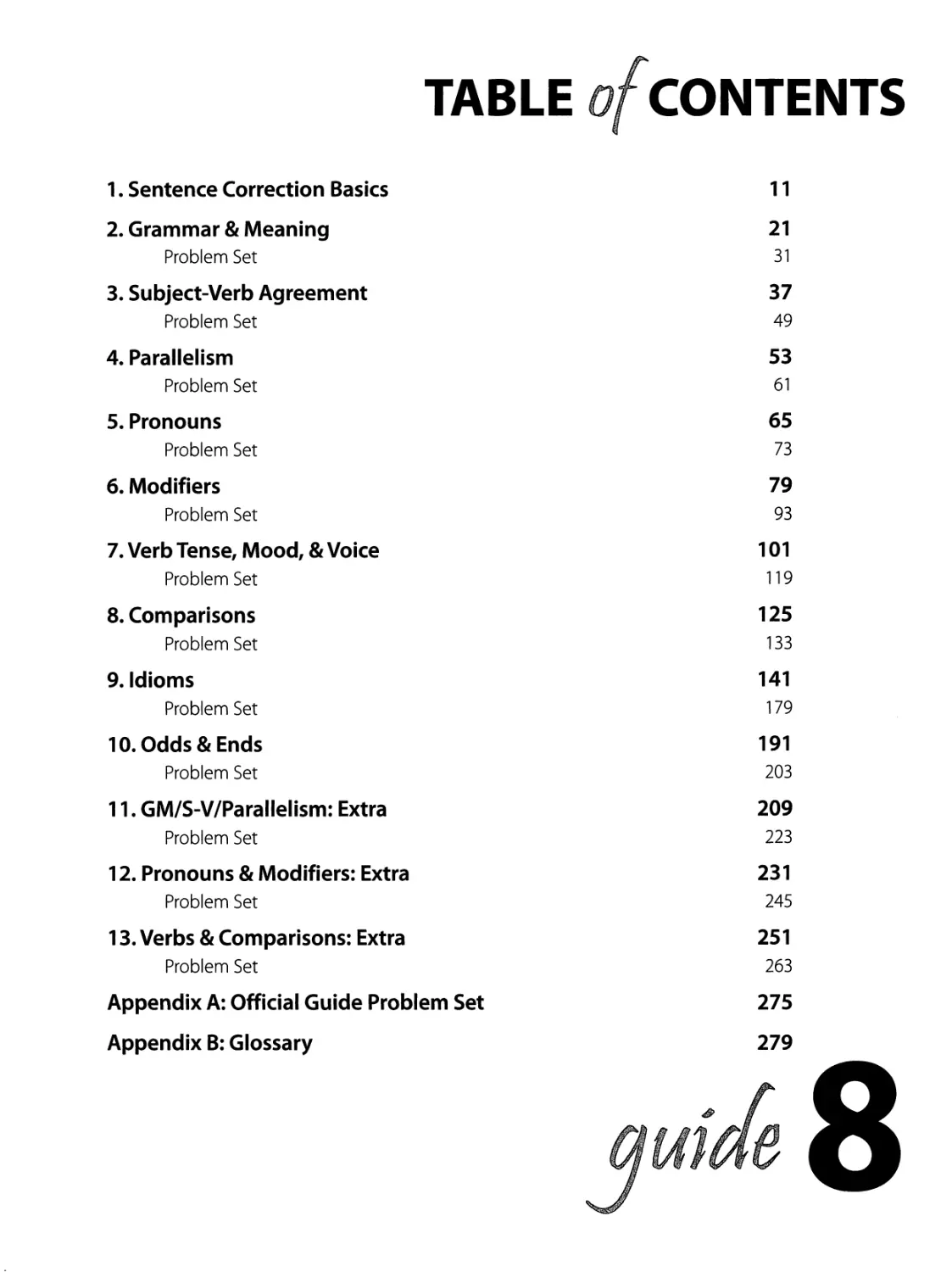
1. Sentence Correction Basics
11
2. Grammar & Meaning
21
Problem Set
3. Subject-Verb Agreement
Problem Set
4. Parallelism
Problem Set
5. Pronouns
Problem Set
6. Modifiers
Problem Set
7. Verb Tense, Mood, & Voice
31
37
49
53
61
65
73
79
93
101
Problem Set
119
8. Comparisons
125
Problem Set
133
9. Idioms
141
Problem Set
179
10. Odds & Ends
191
Problem Set
203
11. GM/S-V/Parallelism: Extra
Problem Set
12. Pronouns & Modifiers: Extra
Problem Set
13. Verbs & Comparisons: Extra
Problem Set
209
223
231
245
251
263
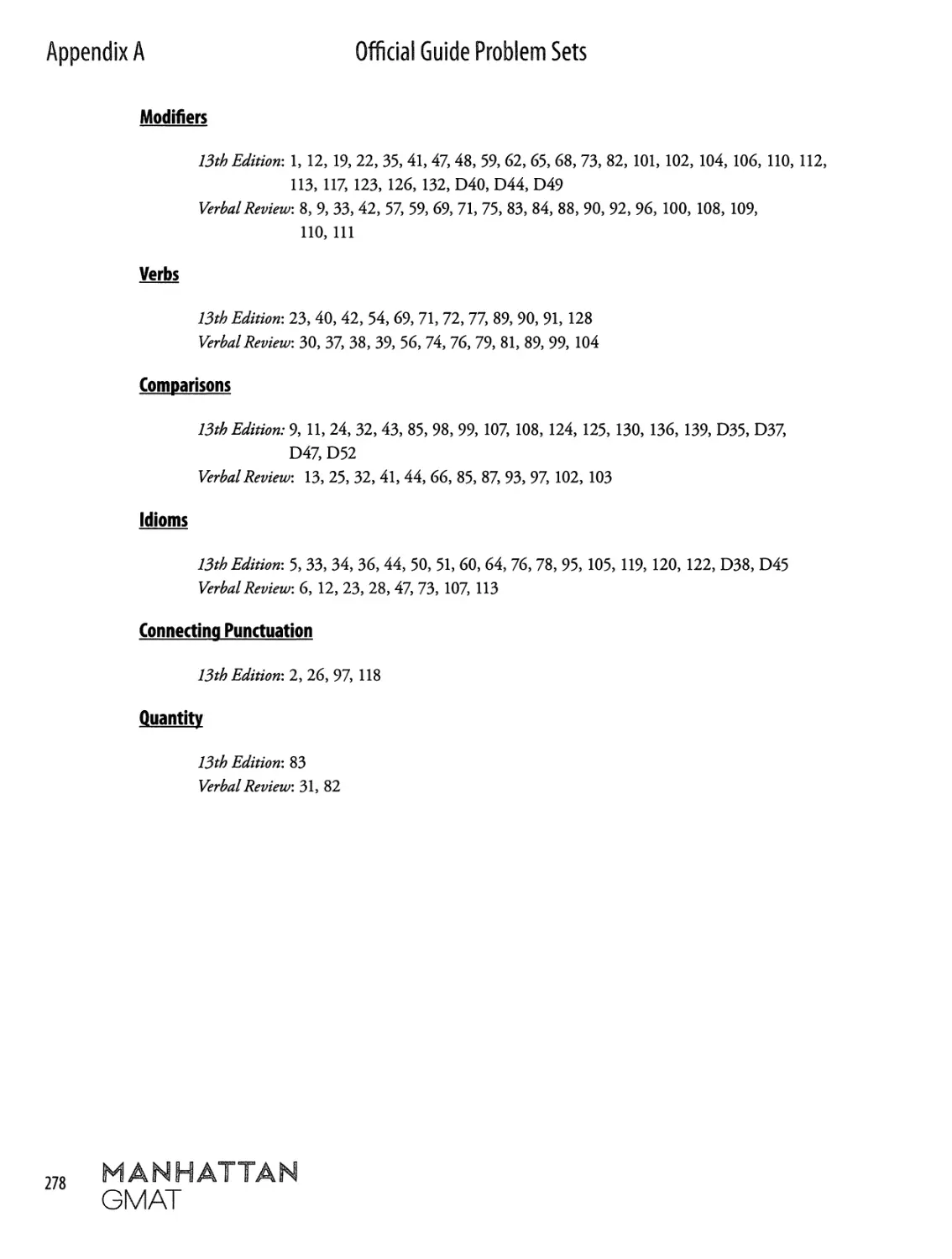
Appendix A: Official Guide Problem Set
275
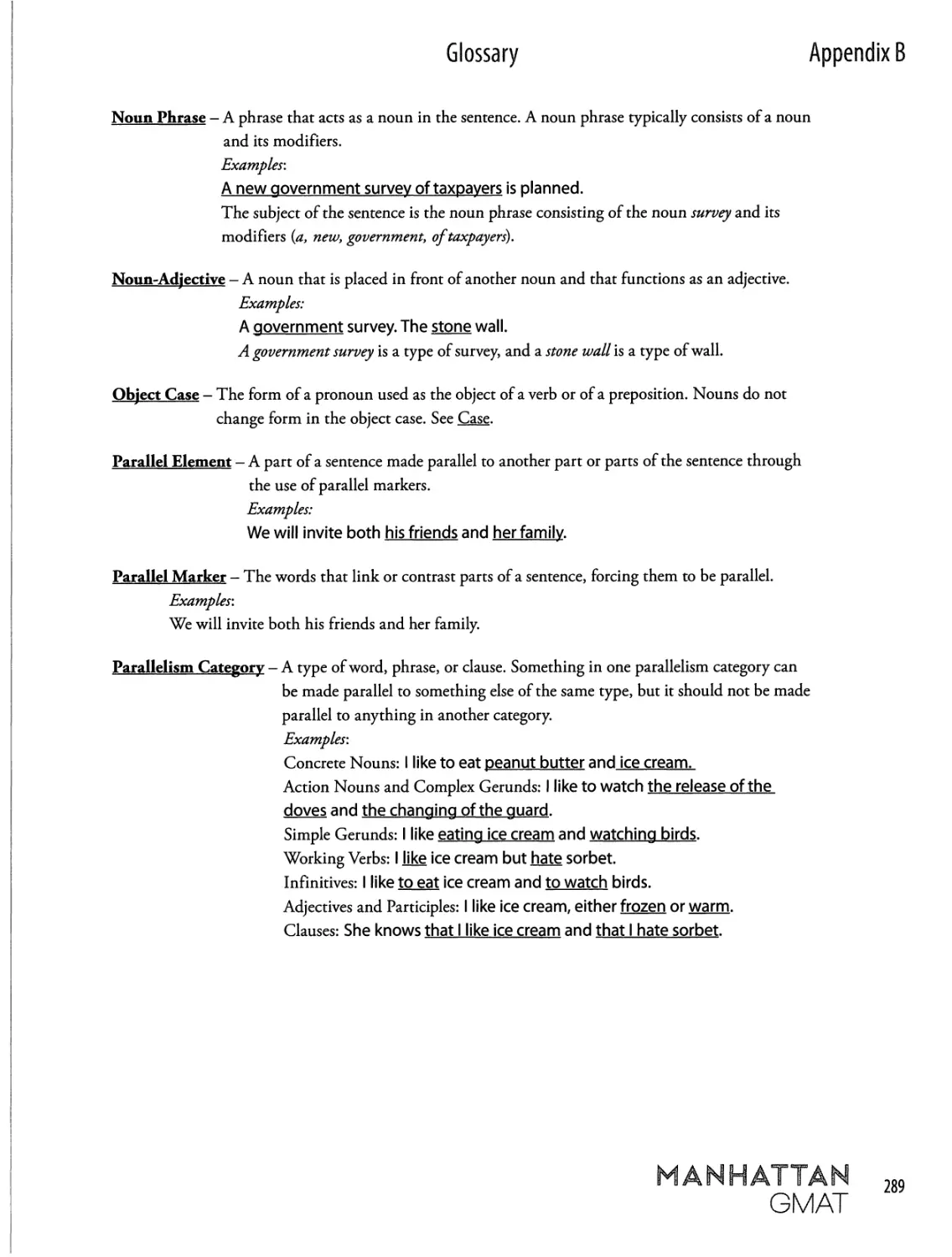
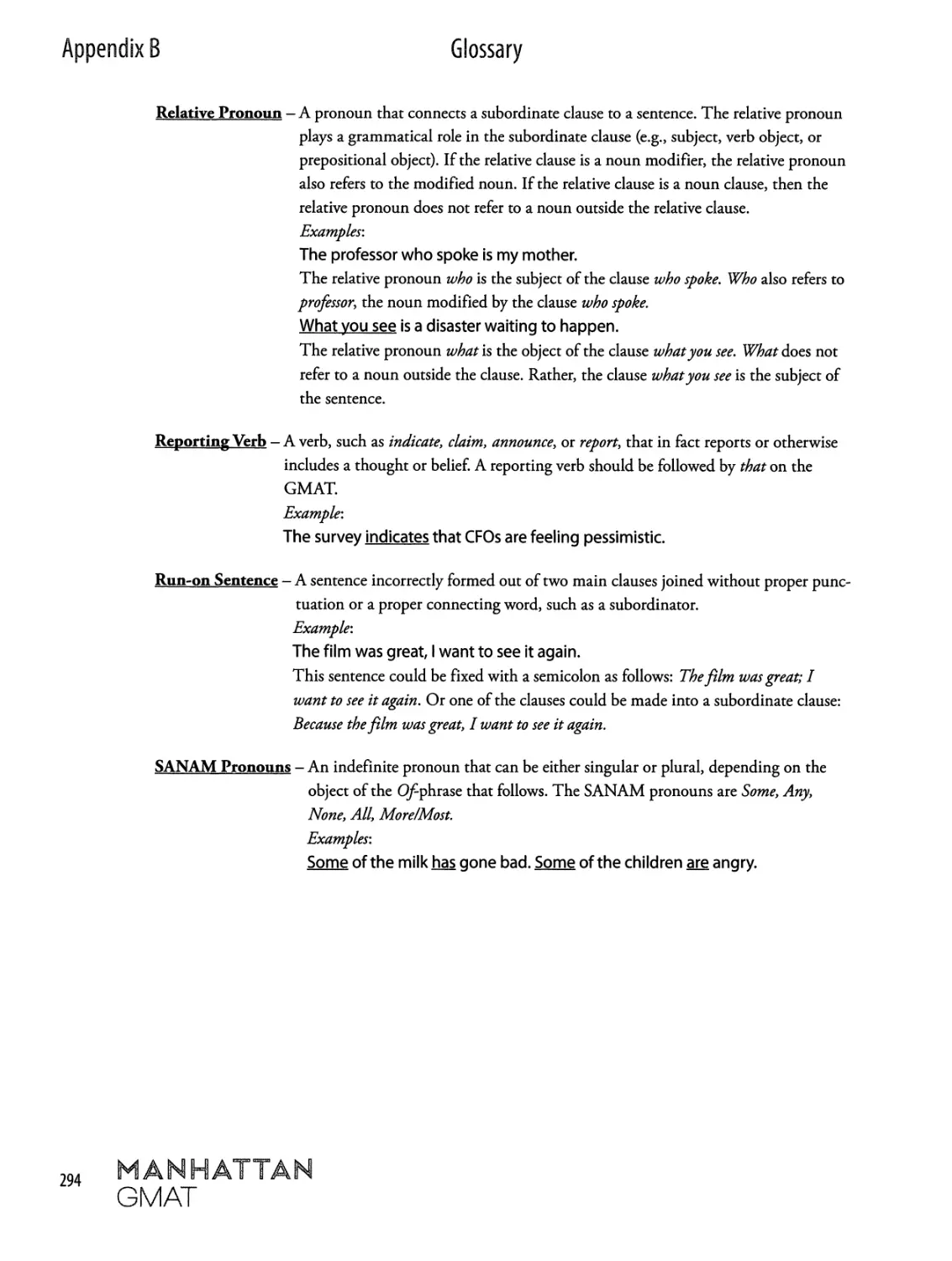
Appendix B: Glossary
279
Sentence Correction
Sentence Correction
Basics
Question Format
"Best" Does Not Mean Ideal
Understand the Sentence, Then Split the Answers
Put Your Answer Back In
Using This Book
Sentence Correction Basics
Sentence Correction is one of three question types found in the verbal section of the GMAT. Sentence
Correction tests mastery of the rules of formal written English. If you master the rules, you can make
significant gains in your performance.
Question Format___________________________
The format of a Sentence Correction question is consistent. Read through the sample question below:
Although William Pereira first gained national recognition for his movie set de
signs, including those for the 1942 film "Reap the Wild Wind." future generations
remember him as the architect of the Transamerica Tower, the Malibu campus of
Pepperdine University, and the city of Irvine.
(A)
(B)
(C)
(D)
(E)
including those for the 1942 film "Reap the Wild Wind," future generations
like that for the 1942 film "Reap the Wild Wind," future generations will
like those for the 1942 film "Reap the Wild Wind," future generations
including that for the 1942 film "Reap the Wild Wind," future generations will
including those for the 1942 film "Reap the Wild Wind," future generations
will
The question consists of a given sentence, part of which is underlined. The underlined segment may be
short, or it may include most or even all of the original sentence. The five answer choices are possible
replacements for the underlined segment.
In all Sentence Correction questions, choice (A) is exactly the same as the underlined portion of the
sentence above it. The other choices, however, offer different options. The question you are answering
in Sentence Correction is always the same: which of the answer choices, when placed in the given
Sentence Correction Basics
1
sentence, is the best option of those given, in terms of gram m ar and m eaning. Several principles
will be tested at once, typically.
By the way, answer choice (A) is not always wrong. The original sentence, (A), is the correct answer just
as often as the other answer choices— about 20% of the time.
"Best" Does Not Mean Ideal
Sentence Correction questions ask for the best option of those given, not the best option in the universe.
Sometimes you may feel— and rightly so— that all the answers, including the right one, “sound bad.”
Correct GMAT Sentence Correction answers never break hard grammatical rules, but these answers
can sound formal or even awkward. Your task is to evaluate the given answer choices, not to create
the ideal sentence. Never rewrite the sentence in your own words.
The GMAT exploits the fact that the English you hear is often riddled with grammatical mistakes.
Thus, your ear may not be trained so well to catch the errors that the GMAT cares about. To surpass
the limitations of your ear, you must rigorously compare the given answer choices to each other, using
principles of sound grammar and clear meaning to determine the best available option.
Understand the Sentence, Then Split the Answers
If you have not already chosen an answer for this question, do so now:
Although William Pereira first gained national recognition for his movie set de
signs, including those for the 1942 film "Reap the Wild Wind." future generations
remember him as the architect of the Transamerica Tower, the Malibu campus of
Pepperdine University, and the city of Irvine.
(A)
(B)
(C)
(D)
(E)
including those for the 1942 film "Reap the Wild Wind," future generations
like that for the 1942 film "Reap the Wild Wind," future generations will
like those for the 1942 film "Reap the Wild Wind," future generations
including that for the 1942 film "Reap the Wild Wind," future generations will
including those for the 1942 film "Reap the Wild Wind," future generations
will
How long did you take to solve this problem?
You should take no more than 90 seconds on average to answer a Sentence Correction question. To free
up even more time for Critical Reasoning and Reading Comprehension, consider aiming for 75 or even
60 seconds per Sentence Correction question.
How can you go that fast and still get the right answer? Consider:
M AN H ATTAN
GMAT
Sentence Correction Basics
•
•
•
•
Most problems test several issues at once.
M any choices are wrong for more than one reason.
The same error often shows up in more than one choice.
O f course, no two answer choices are exactly the same.
So, if you simply reread the sentence five times with each of the five choices inserted, you’re wasting
time. As you consider and reconsider the same issues, you might start to make “word salad” in your
brain. Its easy to get confused and make a careless mistake.
Here’s a better process. Follow these seven steps to be both efficient and effective on Sentence Correction.
1. Read the original sentence carefully, and make sure that you understand it.
Don’t rush the first reading. Make sure that you know what the author is trying to say. Meanwhile, pay
close attention to what the words actually say. If there’s a discrepancy, then the original sentence is prob
ably wrong. After all, the words should say what the author means them to say.
If any grammatical mistakes leap out, make mental note of them, too. Later, you can exploit them to
eliminate (A) and probably other answer choices as well.
If you don’t notice anything wrong on the first read, don’t go searching for errors. Just ensure that you
understand the sentence, both as it is written and as it is intended.
2. Scan the choices vertically for splits.
A split is a local difference between answer choices. In the example above, 3 choices begin with includ
ing ; the other 2 choices begin with like. That’s known as a 3 -2 split.
Don’t read the choices. Rather, scan up and down to find splits.
• The beginning of the choices is a great place to look. The five choices must
differ in their first word (otherwise, that word wouldn’t be underlined).
• The end of the choices must also produce a split.
• Finally, if you noticed something wrong in your initial reading, use that issue
in your search.
Don’t write the splits down. You don’t even have to find every split. Just get used to finding more than
one quickly.
By the way, not every difference is easily “splittable.” Choices can express the same concepts in totally
different words in totally different positions within the sentence. Ignore these complex differences for
now.
MANHATTAN
GM AT
1
Sentence Correction Basics
3. Choose an easy split to start with.
W hats an “easy” split to start with?
Easy to spot
Easy to compare
Easy to decide
You’re looking for a local difference, one that involves just a few words in similar positions. Ideally,
you’d like a two-way split, such as a 3-2 split, to reduce the comparisons you have to make. Occasion
ally, you’ll begin with a three-way split (three variations among the five choices), or even a five-way split.
Most importantly, you need to be able to decide which way is right.
• Does a grammatical rule make one way right and the others wrong?
• Does one way match the intended meaning much better than the others?
If you can’t decide, choose another split. If you don’t know the grammatical rule or can’t determine
which way matches the intended meaning, then there’s no point kicking a dead horse. In fact, an attrac
tive split might just be a red herring. That is, the difference doesn’t matter at all.
4. Make your decision on the first split.
Go ahead and apply the grammatical rule, or resolve the meaning problem.
5. Write down ABCDE and cross out the choices you’ve eliminated.
The point is that you should never again consider the dead choices. One bullet is enough. Remember,
many choices are wrong in more than one way. On test day, you should not try to find every error in
every choice. That’s a very useful review strategy, but a terrible game plan for the exam itself.
6. Re-split the remaining choices, and eliminate until you have one answer left.
The remaining answer choices must be different—but they will differ in some other respect from the
one you’ve just analyzed. Find another local difference and re-split the survivors, repeating earlier steps
until only one choice remains.
7. Put your final answer back into the original sentence.
Double-check that the winning answer choice fixes all the grammar and meaning issues that you’ve
identified. The best way to do this double-check is to re-read the sentence with the choice inserted.
M AN HATTAN
G M AT
Sentence Correction Basics
Chapter 1
Lets walk through this process with the example problem.
Although William Pereira first gained national recognition for his movie set de
signs, including those for the 1942 film "Reap the Wild Wind." future generations
remember him as the architect of theTransamerica Tower, the Malibu campus of
Pepperdine University, and the city of Irvine.
(A) including those for the 1942 film "Reap the Wild Wind," future generations
(B) like that for the 1942 film "Reap the Wild Wind," future generations will
(C) like those for the 1942 film "Reap the Wild Wind," future generations
(D) including that for the 1942 film "Reap the Wild Wind," future generations will
(E) including those for the 1942 film "Reap the Wild Wind," future generations
will
1. Read the original sentence carefully, and make sure that you understand it.
You might even whisper the sentence to yourself. This technique is especially useful when your brain is
fried, as it probably w ill be three hours or more into the exam. Speech is quick enough to be efficient
but slow enough to focus your mind on the words as they’re written.
If you read carefully enough, you might notice something funny at the end of the underlined portion:
fu ture generations remember ... If you notice that this phrasing seems odd, then use it for your first split.
2. Scan the choices vertically for splits.
Again, don’t write down splits or search for every single one. For the record, the only three splits in this
problem are as follows:
including/like - at the very beginning
those/that- immediately afterwards
will! nothing at all - at the end
Its easier to think of this last split as w ill remember vs. remember . Feel free to add the next word from
the non-underlined portion.
3. Choose an easy split to start with.
Say that you noticed something strange about fu ture generations remember... in your first reading.
Then choose the split between w ill remember and remember , if you feel that you can make a clear deci
sion between the two.
MANHATTAN
GM AT
Sentence Correction Basics
4. M ake your decision on the first split.
The issue here is one of intended meaning. Future generations are in the future relative to right now, so
the verb must be in the future tense (w ill remember), not the present tense (remember).
The correct phrasing \sfu tu re generations w ill rem em ber...
5. W rite down ABCDE and cross out the choices you’ve elim inated.
Using the first split, you can cross out (A) and (C). You are left with (B), (D), and (E).
6. Re-split the rem aining choices and elim inate until you have one answer left.
Now you might look at the including/like split at the beginning of the choices. Unfortunately this split
is not definitive. The GMAT used to claim that like simply meant “similar to” and could not introduce
examples. However, the exam writers have moderated this hardline position in published explanations.
As a result, either including or like would technically work in the sentence.
The only remaining difference is between that and those. At last, you can apply a purely grammatical
rule: pronoun agreement. Since the pronoun that or those refers to m ovie set designs , a plural noun, you
need to use the plural pronoun those rather than the singular pronoun that. You can eliminate answer
choices (B) and (D), leaving only (E).
7. Put your final answer back into the original sentence.
As a final check, quickly re-read the sentence, skipping down to (E) to replace the underlined portion.
As you reach any split, emphasize each choice you’ve made.
.. .for his movie set designs, including those for the 1942 film ...
.. .future generations w ill remember him ...
In this way, you confirm that the meaning and grammar of choice (E) is completely accurate. At this
point on the test, you would click on this choice and move on.
As you practice Sentence Correction problems, your process will accelerate. In reviewing problems, you
should study every grammatical and meaning issue that arises. Then you should determine the easiest
solution path. Remember, on test day, you only need one path to the right answer. Along the way,
you might not need to consider every issue.
For instance, the including/like split winds up going to including, but you should avoid leaning too hard
on the GMAT’s historical aversion to the use of the word like to introduce examples. You can answer
this question perfectly right without ever making a call on this particular issue.
M AN H ATTAN
GMAT
Sentence Correction Basics
Put Your Answer Back In_____________________
Is this underlined portion correct?
.. .and so was unable to go to recess.
You cannot decide until you see the sentence in its entirety:
The students came to school without mittens and so was unable to go to recess.
If you ignore the non-underlined section of the sentence in the heat of battle, you would miss that was is
incorrect. (The subject of the verb was is students, a plural noun, so the verb should be were)
The example above is elementary, but as you encounter more Sentence Correction questions, you will
see that the relationship between the underlined and non-underlined parts of the sentence is both com
plex and essential. Without understanding that relationship, you will miss errors and perhaps choose the
wrong answer.
Always read the entire sentence, as the GMAT often places important words far from the underlined
portion. After you have made your choice, double-check that your answer works in the context of the
entire sentence.
Using This Book____________________________
Throughout this guide, you will encounter both Right and Wrong examples, to teach you the precise
differences:
Wrong: The value of the stock ROSE by a 10% INCREASE.
Right: The value of the stock INCREASED by 10%.
Don’t just glance over those examples. Cement the wrongness of the Wrong options in your brain by
crossing them out as you read.
Wrong: The value-of-the-stock ROSE by a 1096 INCREASE.
Right: The value of the stock INCREASED by 10%.
MANHATTAN
GM AT
Sentence Correction
Grammar & Meaning
Grammar: A Closer Look
Meaning: A Closer Look
Meaning: Choose Your Words
Meaning: Place Your Words
Meaning: Match Your Words
Meaning: Avoid Redundancy
What About Concision?
Grammar & Meaning
Sentence Correction appears on the GMAT because business schools want to be sure that their admit
ted applicants grasp the principles of good business writing:
1. Grammar: Does the sentence adhere to the rules of Standard Written English?
2. Meaning: Does the sentence clearly indicate the authors intended meaning?
These principles are equally important. Grammatical rules are more mechanical, though, so they are
often easier to apply right away.
Grammar: Much of the language that one hears in everyday speech actually violates one rule or an
other. The GMAT tests your ability to distinguish between good and bad grammar, even when the bad
grammar seems natural.
Consider this example: Does everyone have their book? This sentence may sound fine, but only because
you hear similar things all the time. The question actually violates the rules of Standard Written Eng
lish; it should be Does everyone have his or her book?
Meaning: Confusing writing is bad writing. If you have to read a sentence more than once to figure out
what the author is saying— or if the sentence lends itself to multiple interpretations— it is not a good
sentence. Moreover, the sentence must reflect the authors intent. The correct answer can resolve ambi
guity in the original version, but you should not change the meaning that the author intends.
W hat about the often-cited “principle” of concision? It is true that the GMAT does not like to waste
words. If an idea expressed in ten words can be expressed clearly and grammatically in six, the GMAT
prefers six. However, this is a preference , not a rule.
Test-takers focus far too quickly and broadly on concision. As a result, the GMAT often makes the
right answer less concise than an attractive wrong answer. Never consider concision except as a last
resort— if you are down to two choices and you cannot make up your mind any other way.
Grammar & Meaning
Grammar: A Closer Look
This book w ill steer you through the major points of Standard Written English on the GMAT. Each
chapter will present a major grammatical topic in depth: subject-verb agreement; parallelism; pronouns;
modifiers; verb tense, voice, and mood; comparisons; and idioms. You will learn both the overarching
principles of each grammatical topic and the nitty-gritty details that will help you differentiate correct
grammar from poor grammar. Moreover, you will be given exercises to hone your skills in that topic.
For your reference, a glossary of common grammatical terms appears in the Appendix of this book. Do
not be overly concerned with the grammatical terms used, as the GMAT w ill only test your ability to
spot issues and mistakes. The terms are simply necessary to explain various grammatical rules. Focus on
understanding and applying these rules, not on memorizing terms.
Grammar is the major focus of this book. The rest of this chapter, however, focuses on the other main
principle of good writing: Meaning. The concept of concision will also be touched upon.
Meaning: A Closer Look______________________
A clear sentence is transparent—the authors intended meaning shines through. On the GMAT, how
ever, either the original sentence or its variations may muddy the waters. One of your tasks is to choose
the answer choice that transmits the author s intent as clearly as possible.
Sometimes the original sentence will have a clear, unambiguous meaning. In these cases, your goal is
to preserve this original meaning as you correct other issues. Do not alter the author s intent when you
make your choice!
At other times, the original sentence will be confusing, and you will need to discern the author s intent.
Fortunately, this intent w ill not be buried too deeply. After all, the correct sentence has to be one of
the five choices. Thus, the GMAT tends to make use of “small” errors in meaning that can be easy to
overlook.
Most instances of m eaning errors fall into one of three major categories:
1. Choose Your Words
2. Place Your Words
3. Match Your Words
MANHATTAN
GMAT
Grammar & Meaning
Meaning: Choose Your Words
Did the author pick the right words out of the dictionary? If a word has more than one meaning, is the
author using that word correctly, to indicate the right meaning? The GMAT rarely tests you on pure
“dictionary knowledge,” but very occasionally, it tries to pull a trick on you by switching a particular
word and its cousin.
My decision to drive a hybrid car was motivated by ECONOMIC considerations.
ECONOMICAL considerations motivated my decision to drive a hybrid car.
The second sentence, which is shorter and punchier, may look preferable. Unfortunately, it is wrong!
Economical means “thrifty, efficient.” Notice that this meaning is not too distant from what the author
intends to say: he or she wants an efficient automobile. But the appropriate phrase is economic consider
ations— that is, monetary considerations.
Consider the following pairs of “cousin” words and expressions, together with their distinct meanings.
aggravate (worsen) vs. aggravating (irritating)
known as (named) vs. known to be (acknowledged as)
loss o f {no longer in possession of) vs. loss in (decline in value)
mandate (command) vs. have a mandate (have authority from voters)
native ^(person from) vs. native to (species that originated in)
range ^(v ariety of) vs. ranging (varying)
rate 0/Xspeed or frequency of) vs. rates fo r (prices for)
rise (general increase) vs. raise (a bet or a salary increase in American English)
try to do (seek to accomplish) vs. try doing (experiment with)
Big changes in meaning can be accomplished with switches of little words. Pay attention to the precise
meaning of every word in each answer choice. Certain Helping Verbs, such as may ,will, must, and
should , provide another way for the GMAT to test meaning.
These helping verbs express various levels of certainty, obligation, and reality. Simply by swapping these
verbs, the GMAT can completely change the meaning of the sentence. Pay attention to helping verbs!
Example 1
Certain:
Uncertain:
The drop in interest rates WILL create better investment opportunities.
The drop in interest rates MAY create better investment opportunities.
Either of these sentences could be correct. However, do not jump from one to the other! Stay with the
intent of the original sentence, whether it uses will or may. The certain variation could be made uncer
tain with the addition of It is possible that... at the start of the sentence.
MANHATTAN
GM AT
Grammar & Meaning
Chapter 2
Example 2
Absolutely Necessary:
Morally Obliged:
The court ruled that the plaintiff MUST pay full damages.
The court ruled that the plaintiff SHOULD pay full damages.
Notice that the second sentence cannot be correct. Why? The word should means “moral obligation”—
something that a court cannot impose. On the other hand, the use of must in the first sentence indi
cates a legally binding obligation imposed upon the plaintiff. Thus, you should go with must> whether
the original sentence used must or not. On the GMAT, should almost always means “moral obligation,”
not “likelihood.” In everyday speech, you can say The train should arrive now to mean that the train is
likely to arrive now, but the GMAT doesn’t agree with this usage.
Example 3
Actual:
Hypothetical:
If Chris and Jad met, they DISCUSSED mathematics.
If Chris and Jad met, they WOULD DISCUSS mathematics.
The first sentence could be said by someone who is unsure whether Chris and Jad have actually met:
“If this did indeed happen, then that is the consequence.” The second sentence, however, predicts the
consequences of a hypothetical meeting of the two men: “If this were to happen, then that would be the
consequence.”
Pay attention to the original sentence’s helping verbs— and only change them if the original sentence is
obviously nonsensical.
For more on helping verbs, see Chapter 7: Verb Tenset Moody & Voice.
Meaning: Place Your Words___________________
Beware of words that move from one position to another. The placement of a single word can alter the
meaning of a sentence.
ALL the children are covered in mud.
The children are ALL covered in mud.
In these sentences, changing the placement of all shifts the intent from how many children (all of them)
to how the children are covered in mud (all over).
ONLY the council votes on Thursdays.
The council votes ONLY on Thursdays.
In the first sentence, only indicates that the council alone votes on Thursdays (as opposed to the board,
perhaps, which votes on Mondays and Fridays). In the second sentence, only indicates that the council
does not vote on any day but Thursday.
M AN H ATTAN
GMAT
Grammar & Meaning
If a word changes its position in the answer choices, consider whether the change has an impact on the
meaning of the sentence. Look out especially for short words (such as only and all ) that quantify nouns
or otherwise restrict meaning.
At a broader level, you need to pay attention to overall w ord order. All the words in a sentence could
be well-chosen, but the sentence could still be awkward or ambiguous.
The council granted the right to make legal petitions TO CITY OFFICIALS.
W hat does the phrase to city officials mean? Did the city officials receive the right to make legal peti
tions? Or did someone else receive the right to make petitions to the officials? Either way, the correct
sentence should resolve the ambiguity:
The council granted CITY OFFICIALS the right to make legal petitions.
OR
The right to make legal petitions TO CITY OFFICIALS was granted by the council.
Finally, check the overall word order for unnecessary inversions. For instance, English normally puts
subjects in front of verbs. Try to preserve that order, which is natural to the language.
Awkward:
A referendum is a general public vote by which PASSES OR FAILS
A LAW OR OTHER PROPOSAL.
Better:
A referendum is a general public vote by which A LAW OR OTHER
PROPOSAL PASSES OR FAILS.
However, both versions are grammatically correct! Either one could be the right answer on the GMAT.
To make sense of an inverted order, flip the subject and the verb.
Meaning: Match Your Words__________________
Sentences generally contain pairs of words or phrases that must match. For example, the subject and the
verb must match. This “matching” concept has grammatical implications (for instance, the subject and
the verb must agree in number), but it also has logical implications. In other words, we must remember
that the subject and the verb must make sense together!
You might think that this principle is so obvious that it would not be tested. But under exam condi
tions, you have to remember to check this point. After you find the subject and the verb (a task de
scribed in the next chapter), always ask yourself, “Do they make sense together?”
A similar matching principle holds for other grammatical connections (e.g., pronouns and the nouns
they refer to). Future chapters w ill explore each type of connection in turn, but never forget to apply the
meaning issue and test the meaning of any potential connection. Connected words must always make
sense together.
MANHATTAN
GM AT
Grammar & Meaning
Chapter 2
Meaning: Avoid Redundancy_________________
Another aspect of meaning is redundancy. Each word in the correct choice must be necessary to the
meaning of the sentence. If a word can be removed without subtracting from the meaning of the
sentence, it should be eliminated. Redundancy goes beyond mere concision— redundancy confuses
the meaning, causing the reader to ask: “Did I read that right?” No right answer on the GMAT will
contain redundant words.
A common redundancy trap on the GMAT is the use of words with the same meaning:
Wrong: The value of the stock ROSE by a 10% INCREASE.
Right: The value of the stock INCREASED by 10%.
Or:
The value of the stock ROSE by 10%.
Since rose and increase both imply growth, only one is needed.
Wrong: The three prices SUM to a TOTAL of $11.56.
Right: The three prices SUM to $11.56.
Or:
The three prices TOTAL $11.56.
Since sum and total convey the same meaning, only one is needed.
Pay attention to expressions of time. It is easy to sneak two redundant time expressions into an answer
choice (especially if one expression is in the non-underlined part, or if the two expressions do not look
like each other):
PAST:
Previously
Formerly
In the past
Before now
PRESENT:
Now
Currently
Presently
At present
YEARLY:
Annual
Each year
A year (e.g., three launches a year)
A sentence should include only one such expression. This does not mean that you can never repeat time
expressions in a sentence; just be sure that you are doing so for a meaningful reason. Pure redundancy is
always wrong on the GMAT.
M AN HATTAN
GM AT
Grammar & Meaning
Chapter 2
What About Concision?______________________
Yes, the GMAT prefers concise writing.
Wordy: They HAVE DIFFERENCES over THE WAY IN WHICH the company should
MAKE INVESTMENTS in new technologies.
Better: They DIFFER over HOW the company should INVEST in new technologies.
The first sentence is easily understood, but the wordy phrases have differences , the way in which , and
make investments can be replaced with more concise expressions, as in the second sentence.
It is worth recognizing the advantages of concise expression, if for no other reason than that your writ
ing will improve. That goal is worthy beyond the GMAT.
Remember, however, that concision is a preference on Sentence Correction problems. Do not simply pick
the shortest choice and move on. Quite frequently, the right answer will be a longer choice that is gram
matically correct and that clearly reflects the authors intended meaning.
Concision is a dangerous tool. Some people are better off never applying it on the GMAT, because of
the risks of misuse. There are specific patterns of wordiness covered in Chapter 11, but only touch that
extra material once you’ve mastered the core concepts and applications.
If you have run out of grammar or meaning issues to apply, and you are down to two choices, then
choose the more concise option. Otherwise, do not think about concision.
MANHATTAN
GM AT
29
Grammar & Meaning
Problem Set
The underlined portion of each sentence below may contain one or more errors. Each sentence is fol
lowed by a boldface sample answer choice that may change the meaning. Select (A) if the original ver
sion is correct, (B) if the boldface version is correct, (C) if neither is correct, and (D) if both are correct.
If you select (A), explain what is wrong with the boldface version. If you select (B), explain how the
boldface version corrects the original version. If you select (C), explain why both versions are incorrect.
Some questions refer to rules and distinctions that will be discussed in upcoming chapters.
1.
No matter how much work it mav require, getting an MBA turns out to be a wise invest
ment for most people.
Even though it requires much work
2.
The driver took the people for a ride who had been waiting,
the people who had been waiting for a ride
3.
Rising costs to raw materials may impel us to rise prices farther,
costs of raw materials may impale us to raise prices further
4.
She is the most dedicated gardener on the block, every dav watering the more than 50
plants in her yard.
every day watering more than the 50 plants in her yard
5.
Hector remembers San Francisco as it was when he left ten years aao.
as though he had left ten years ago
6.
Students at Carver High School are encouraged to pursue only those extracurricular
activities from which stems success in college applications.
success in college applications stems
7.
After the test format was changed, scores subsequently dropped bv more than a 25%
decrease.
dropped by more than 25%
8.
It is possible that the earthquake mav have caused to the building's collapse,
the earthquake may
Rewrite the following sentences more concisely. Justify the changes you make.
9.
Electronic devices can constitute a distraction to a driver.
10.
Many directors have a suspicion of there being an attempt by managers to conceal the
extent of losses at the company.
MANHATTAN
GM AT
Chapter 2
Grammar & Meaning
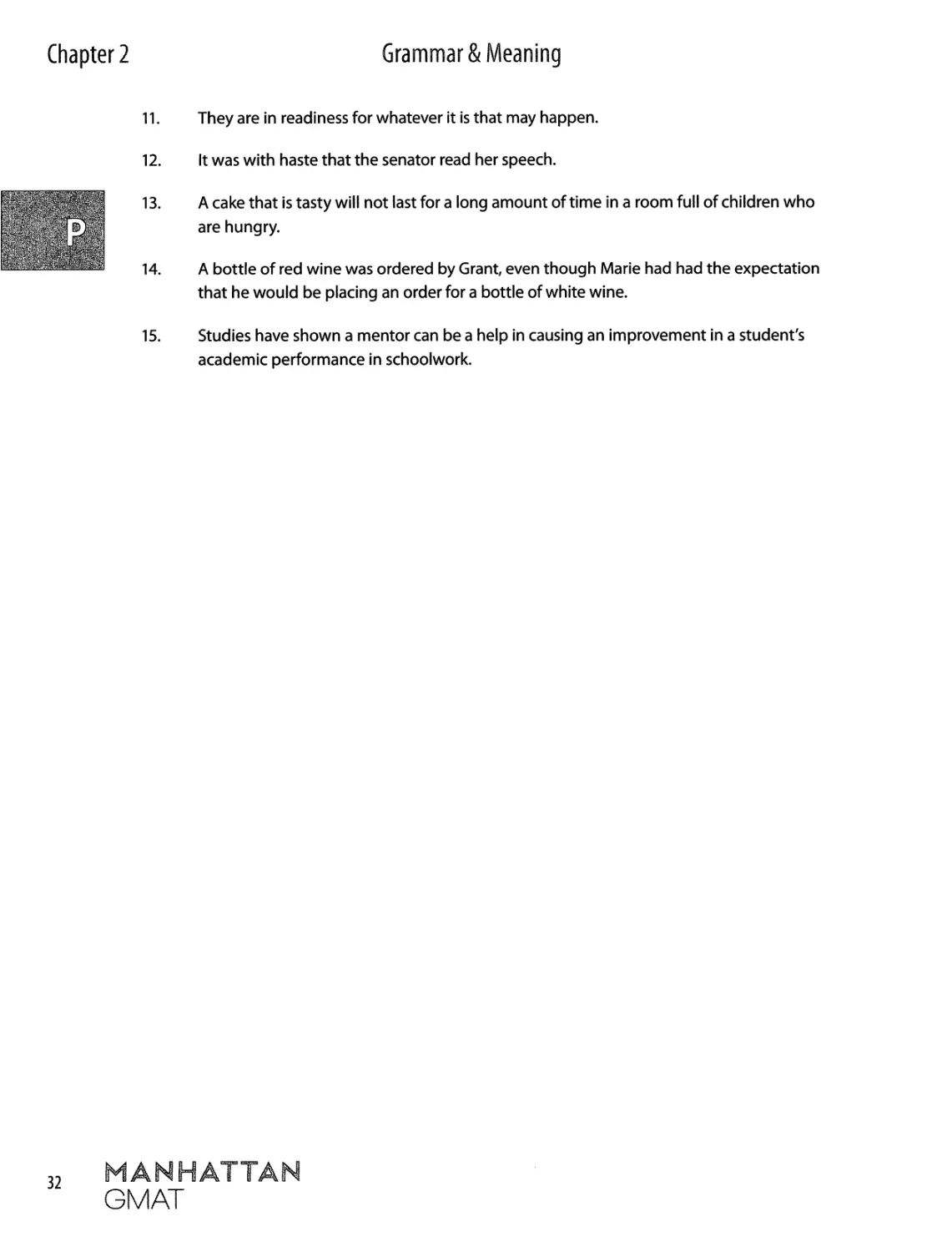
11.
They are in readiness for whatever it is that may happen.
12.
It was with haste that the senator read her speech.
13.
A cake that is tasty will not last for a long amount of time in a room full of children who
are hungry.
14.
A bottle of red wine was ordered by Grant, even though Marie had had the expectation
that he would be placing an order for a bottle of white wine.
15.
Studies have shown a mentor can be a help in causing an improvement in a student's
academic performance in schoolwork.
M AN HATTAN
GMAT
Grammar & Meaning
Solutions_________________________________
1.
(A). The original sentence does not say that getting an MBA requires a lot of work. The expres
sion no matter how much work it may require simply says that the amount of work (whether large or
small) does not matter. The revised version eliminates the word may, so that the new sentence does say
that an MBA requires a lot of work. This change of meaning is UNJUSTIFIED.
(B). In the original sentence, the modifier who had been waiting does not clearly modify the
people . It appears, illogically, to modify the closer noun {the ride). The boldface version moves who had
been waiting next to the people , thus making clear that it is the people who had been waiting. This change
of meaning is JUSTIFIED.
2.
However, the boldface version also makes another change of meaning. The words fo r a ride now come
right after waiting , so it seems that these people had been waiting fo r a ride. That’s not necessarily true.
This change of meaning is UNJUSTIFIED. To retain the original meaning, you could rewrite the sen
tence in the passive voice: The people who had been waiting were taken fo r a ride by the driver.
3.
(C). The boldface version makes several changes to the meaning of the original sentence. Most
of these changes are justified, but one of them is not—so the answer has to be (C).
The switch from cost to to costs o f is JUSTIFIED. Costs to X are what X has to pay, whereas costs ofX are
how much somebody must pay to buy X. The latter meaning makes much more sense here, because raw
materials are being paid for, not doing the paying.
The switch from impel to impale is UNJUSTIFIED. To impel is to force someone to do something. To
impale something is to pierce it with a sharp instrument!
The switch from rise to raise is JUSTIFIED. Raise is a verb that always takes a direct object: The Fed
(subject) raised the interest rate (object) in March. Rise is used only in contexts where there is no direct
object: Interest rates (subject) rose in March. In our sentence, prices are a direct object, so the verb must
be raise.
The switch from farther to fu rther is JUSTIFIED. Farther refers only to distance (/ can throw a javelin
farther than you can) whereas fu rther refers to degree of something other than distance {We needfurther
time and money fo r this project ).
(A). The original version contains the phrase the more than 50plants. Here the words more
than modify the number 50. The sentence therefore means that she waters her plants, of which there
are more than fifty. In the boldface version, we have the phrase watering more than the 50 plants. Here
the words more than are separated from the number 50 , and therefore do not modify that number. The
new version tells us that she waters something more than (i.e., in addition to) the plants — for instance,
she might water her gravel walkway or her garden gnomes. This change of meaning is UNJUSTIFIED
because there was nothing wrong with the original sentence.
4.
M ANHATTAN
GM AT
Grammar & Meaning
5.
(A). The boldface version makes two UNJUSTIFIED changes to the original version.
The original sentence tells us that Hector actually DID leave San Francisco 10 years ago. The revised
version tells as that he did NOT leave San Francisco ten years ago: the expression as though is used to
discuss things that are untrue or did not happen {You behave as though you were richer than Bill Gates!).
Another important change in meaning comes because the revised version takes out the words it (i.e.,
San Francisco) was, and therefore does not refer directly to the state of affairs in San Francisco ten years
ago.
6.
(D). Both versions are correct! The original sentence inverts the normal order of subject {success)
and verb {stems = “originates”), but this inversion is possible after which or in similar positions. There is
no change in meaning.
7.
(B). Eliminate redundancy. We do not need both dropped and decrease , since both words con
vey the same idea. For the same reason, we do not need both after and subsequently.
8.
(B). Eliminate redundancy. It is possible that and may both express the same level of uncertain
ty, so we can remove one of them without changing the intended meaning.
9.
Electronic devices can distract a driver.
The verb distract is more concise than the phrase constitute a distraction to.
10.
Many directors suspect that managers are trying to conceal the extent of losses at the
company.
Suspect is more concise than have a suspicion. That managers are trying is more concise than o f there being
an attempt by managers.
11.
They are ready for whatever may happen.
Are ready is more concise to are in readiness. Whatever may happen is more concise than whatever it is
that may happen.
12.
The senator read her speech hastily.
This sentence is more concise without the it was... that construction. Hastily is slightly more concise to
with haste.
13.
A tasty cake will not last long in a room full of hungry children.
Tasty cake is more concise to cake that is tasty. Last long is more concise to lastfo r a long amount o f time.
Hungry children is more concise than children who are hungry.
MANHATTAN
G M AT
Grammar & Meaning
Chapter 2
14.
Grant ordered a bottle of red wine, even though Marie had expected him to order a bottle
of white wine.
The first clause is a little more concise when placed in the active voice— Grant ordered a bottle rather
than a bottle... was ordered by Grant. (You will learn more about voice in Chapter 7.)
In the second clause, the verb expected is more concise to the phrase had the expectation . The verb order
is more concise than the phrase be placing an order for.
15.
Studies have shown that a mentor can help improve a student’s academic performance.
The verb help is more concise than the phrase be a help. To improve is more concise than the phrase
in causing an improvement in. Lastly, the phrase in schoolwork is redundant (a clear error) because we
already have the word academic. You can write either help improve or help to improve.
In one respect, however, the original sentence is too short: it is missing the word that after the reporting
verb shown. (See Chapter 11 for more on this subject.)
MANHATTAN
GM AT
35
Sentence Correction
Subject-Verb
Agreement
Subject and Verb Must Both Exist
Subject and Verb Must Make Sense Together
Subject and Verb Must Agree in Number
Eliminate the Middlemen, and Skip the Warmup
Use Structure to Decide
And vs. Additive Phrases
Or, Either.. .Or, & Neither.. .Nor
Collective Nouns: Almost Always Singular
Indefinite Pronouns: Usually Singular
Each and Every: Singular Sensations
Quantity Words and Phrases
Subject Phrases and Clauses: Always Singular
Flip It!
When in Doubt, Think Singular
Subject-Verb Agreement
Every sentence must have a Subject and a Verb. The subject is the noun that performs the action ex
pressed by the verb:
The DOG with the gray ears RUNS out of the house.
The subject is dog, and the verb is runs. In every sentence, the subject and the verb must make logical
sense together. Moreover, the subject and the verb must agree in number.
Subject and Verb Must Both Exist_____________
If a sentence is missing the subject or the verb, the sentence is a Fragment: in other words, it is not a
complete sentence! On the GMAT, an answer choice that makes the sentence a fragment is wrong.
This error is rather rare, but you need to be ready to recognize it when it occurs. One way the GMAT
disguises the error is by dropping the verb:
Wrong:
The electron named in 1894.
Wait a minute, what about named?. Named certainly looks like a verb. But in this context, named is
NOT a Working Verb, a verb that can run a sentence by itself. O f course, we do not mean that the
subject {the electron ) actually named anything. Rather, something or someone else did the naming.
Right:
Stoney NAMED the electron in 1894.
In this sentence, named is a working verb. Or we can express the sentence this way:
Right:
The electron WAS NAMED in 1894.
Chapter 3
Subject-Verb Agreement
In this sentence, the words was named make up the full working verb. W ithin was named , the word
named is a Past Participle. A Past Participle by itself is not a working verb: The electron named in 1894 is
not a sentence.
A sentence can be a fragment in another way: it could start with a Connecting Word and contain no
M ain Clause (a clause that could stand alone as a sentence as is, with its own subject and verb):
Wrong:
Wrong:
BECAUSE the dog was never mine.
WHICH will be approved tomorrow.
Because and which are connecting words. These are also known as Subordinators, because they turn
the clauses they are attached to into Subordinate Clauses, which cannot stand by themselves. To fix
this sort of fragment, you either need to attach it to a main clause or drop the connecting word (and if
necessary add some words, as in the second case: The plan will he approved tomorrow ). For more on con
necting words, see Chapter 10: Odds &Ends.
Subject and Verb Must Make Sense Together____
Remember the Meaning principle? A correct answer must have a clear meaning. Thus, it must make
logical sense.
Wrong:
The development of a hydrogen car based on expected performance parameters
will be able to travel hundreds of miles without refueling.
At first glance, this sentence may seem okay. But be careful: The development o f a hydrogen car... w ill be
able to travel. .. ? Something is wrong. It is not the development that w ill be able to travel. We want to say
that the hydrogen car itself will be able to travel.
Right:
Once developed, a hydrogen CAR based on expected performance parameters
WILL BE able to travel hundreds of miles without refueling.
Make sure that the subject and the verb actually have a sensible meaning together!
Subject and Verb Must Agree in Number________
Last but not least, the subject and the verb must agree in number. The number can be singular (one) or
plural (more than one).
40
A singular subject requires a singular verb form:
The dog runs out of the house.
A plural subject requires a plural verb form:
The dogs run out of the house.
M AN HATTAN
GMAT
Subject-Verb Agreement
Singular and plural verb forms are second nature to you— you use them so often that there is nothing
to memorize. You would never write the dog run out or the dogs runs out. Therefore, the GMAT often
tries to confuse you before you make the subject-verb match.
How? The GMAT hides the subject, so that you are unsure whether the subject is singular or plural! If
you do not know the number of the subject, then you will not be able to select the verb form that agrees
with it. Consider this example:
The discovery of new medicines (was/were) vital to the company's growth.
W hat is the subject, discovery or new medicines ? If you ask yourself “W hat is vital to the company’s
growth?” you may be able to talk yourself into either choice. But The discovery ... was is correct.
The key to making subjects and verbs agree in GMAT sentences is to find the subject that goes with a
particular verb. To find the subject, you must ignore all the words that are not the subject.
Eliminate the Middlemen, and Skip the Warmup
The GMAT hides the subject in a few ways. The most common way by far is to insert words between
the subject and the verb. You must learn to eliminate these Middlemen words to reveal the subject.
Furthermore, the GMAT often puts a significant number of words in front of the subject you want. In
these cases, you have to “skip the Warmup” that comes before the subject you are looking for.
There are a few common types of middlemen and warmups.
1, Prepositional Phrases
A Prepositional Phrase is a group of words headed by a Preposition.
of mice
in Zambia
to the store
for milk
with her
on their orders
by 1800
at that level
from the office
The prepositions underlined above are among the most common in English. A list of common preposi
tions is included in the Glossary. Prepositions are followed by nouns or pronouns, which complete the
phrase. Prepositional phrases modify or describe other parts of the sentence. Thus, you can generally
eliminate them to find the subject.
Near Galway, the houses on the road to Spiddle is/are gorgeous.
NEAR Galway, the HOUSES ON the road TO Spiddle ARE gorgeous.
In the example above, the subject is houses (plural), and the correct verb is are (also plural).
MANHATTAN
GM AT
Subject-Verb Agreement
2. Subordinate Clauses
We came across subordinate clauses earlier, in the discussion of sentence fragments. These clauses,
which begin with connecting words such as who or which , cannot stand alone as sentences. Instead,
they are always attached to a main clause. Like prepositional phrases, many subordinate clauses modify
other parts of the sentence, acting as “big adjectives” or “big adverbs.” Some subordinate clauses even
act as “big nouns.”
Either way, since these clauses do not contain the main subject or verb, they are frequently used as
middlemen and warmups.
When the auditors left, the executive who had been interviewed was/were glad.
When-tlie-attdttors-left, the EXECUTIVE WHO had been interviewed WAS glad.
Both the subject executive and the verb was are singular.
3, Other Modifiers
Other words can also function as Modifiers, which modify or describe other portions of the sentence.
Modifiers will be covered in depth in Chapter 6. In the meantime, to find and eliminate other modi
fiers, look for Present Participles (-ing forms derived from verbs) and Past Participles (-ed and -en forms
derived from verbs). Commas are another helpful sign, since commas sometimes separate modifiers
from the rest of the sentence.
Limping, the horse once considered one of the favorites was/were taken away.
LIMPING, the HORSE once CONSIDERED one of the favorites WAS taken away.
Use Structure to Decide_____________________
Consider the following sentence:
In the waning days of the emperor's life, the conquest of new lands on the
borders of the empire was/were considered vital.
To find the subject of the verb was or were considered , we might be tempted simply to ask ourselves,
“W hat was or were considered vital ?” This method will get rid of obviously inappropriate subjects, such
as the empire or the waning days, but we could fall into a trap: we might think that new lands is the sub
ject. However, new lands is in a prepositional phrase modifying the noun conquest. A noun in a prepo
sitional phrase cannot be the subject of the sentence, with limited idiomatic exceptions that we will
see later.
Wrong:
In the waning-days-of the emperor-s-Hfe; the CONQUEST of new lands
on-the-borders of the empire WERE CONSIDERED vital.
MANHATTAN
GM AT
Subject-Verb Agreement
We now see that conquest (singular) requires the singular verb was considered.
Right:
In the waning-davs of the emperor's-tife; the CONQUEST of new lands
on-the bordere-of-the-emptre WAS CONSIDERED vital.
Do not fall for tempting nouns, such as new lands, inserted to distract you! Use the structure of the
sentence (for instance, the prepositional phrases) to find the subject.
Now consider this example:
The tidal forces to which an object falling into a black hole is/are subjected is/are
sufficient to tear the object apart.
We have to match up two subject-verb pairs correctly. First, match up the main clauses subject and
verb, fixing them if necessary.
Better:
The tidal FORCES to which an object falling into a black hole aresubjected ARE sufficient to tear the object apart.
Next, match up the subject and the verb in the subordinate clause, and fix them as well.
Right:
The tidal forces to which an OBJECT falling into a black hole ]S_
SUBJECTED are sufficient to tear the object apart.
Of course, meaning should always guide you as you connect a subject up with its verb. As we have
noted, the subject and the verb must always make sense together. At the same time, you should base
your final decisions on the structure of the sentence.
Andy s. Additive Phrases_____________________
The word and can unite two or more singular subjects, forming a compound plural subject.
Joe AND his friends ARE going to the beach.
Mathematics, history, AND science ARE mandatory high-school subjects.
Notice that these compound subjects take a plural verb form {are).
M any other words and phrases besides and can “add” to a subject. These words and phrases are called
Additive Phrases. Examples include the following:
along with Polly
accompanied by me
in addition to surgery
together with a tie
as well as the mayor
including salt and pepper
Unlike and , additive phrases do not form compound subjects. Rather, additive phrases function as
modifiers and therefore cannot change the number of the subject.
M ANHATTAN
GM AT
Subject-Verb Agreement
Joe, as well as his friends, IS going to the beach.
Mathematics, in addition to history and science, IS a required subject.
The singular subjects {Joe and Mathematics) remain singular despite the additive phrases {as well as and
in addition to). Therefore, they each require the singular verb form {is). Note, incidentally, that Math
ematics is singular, although it ends in an -s; the same thing is true of other school subjects, as well as of
some activities (e.g., aerobics) and diseases (e.g., diabetes).
Only the word and can change a singular subject into a plural one. Singular subjects followed by addi
tive phrases remain singular subjects.
Or, Either... Or, & Neither... Nor_______________
Occasionally, a subject may include a phrase such as or, either... or , or neither... nor. Such phrases link
two nouns. If one of the nouns is singular and the other noun is plural, what verb form should be used?
The answer is simple: find the noun nearest to the verb, and make sure that the verb agrees in number
with this noun.
Neither the coach nor the players ARE going to the beach.
Neither the players nor the coach IS going to the beach.
In the first example, the plural subject players is nearest to the verb, so the verb takes the plural form
are. In the second example, the singular subject coach is nearest to the verb, so the verb takes the singu
lar form is.
(Note that when the words either or neither are in a sentence alone (without or or nor), they are consid
ered singular and take only singular verbs.)
Collective Nouns: Almost Always Singular_______
A Collective Noun is a noun that looks singular (it usually does not end with an -s) but can refer to a
group of people or objects. Some examples include the following:
People:
Items:
agency, army, audience, class, committee, crowd, orchestra, team
baggage, citrus, equipment, fleet, fruit, furniture
In some rare circumstances, collective nouns can be considered plural (e.g., when you emphasize the
individual actors, not their unity). However, on the GMAT, collective nouns are almost always consid
ered singular and therefore require singular verb forms. Note: in British usage, many of these nouns are
normally considered plural. Not so on the GMAT!
MANHATTAN
GMAT
Subject-Verb Agreement
The CROWD in the stands IS cheering loudly as the home TEAM TAKES the field.
Our ARMY of a hundred thousand soldiers IS attacking the enemy.
Each collective noun (crowd, team, and army) takes a singular verb form.
Indefinite Pronouns: Usually Singular
Pronouns are words that replace other nouns or pronouns. An Indefinite Pronoun is not specific about
the thing to which it refers. Anyone is an example of an indefinite pronoun. The following indefinite
pronouns are considered singular and require singular verb forms. Note that all the pronouns that end
in - one , -body , or -thing fall into this category.
Anyone, anybody, anything
No one, nobody, nothing
Each, every (aspronouns)
Someone, somebody, something
Everyone, everybody, everything
Whatever, whoever
Either, neither (may require a plural verb i f paired with or/nor)
There are, however, 5 indefinite pronouns that can be either singular or plural depending on the con
text of the sentence. You can remember these 5 by the acronym SANAM.
THE SANAM PRONOUNS: Some, Any, None, All, More/Most
How can you tell if these pronouns are singular or plural? Think about meaning, and look at the O f
phrase which usually follows the pronoun. You may recall that you are generally supposed to ignore O f
prepositional phrases (since they are misleading middlemen). But with the SANAM pronouns the noun
object of the O/^phrase can help you determine the number of the subject.
Right:
Right:
Some of the money WAS stolen from my wallet. (money is singular)
Some of the documents WERE stolen from the bank, {documents is plural)
Don’t apply the O f phrase mechanically. None 0/and any o f follow ed by a plural noun can be singular.
Right:
Any of these women IS a suitable candidate for marriage to my son.
You are referring to just one woman at a time. Since the usage of these pronouns is hotly contested
among experts, the GMAT is unlikely to test controversial cases.
Note that not one is always singular: Not one o f my friends IS here this weekend.
MANHATTAN
GM AT
ir 3
Subject-Verb Agreement
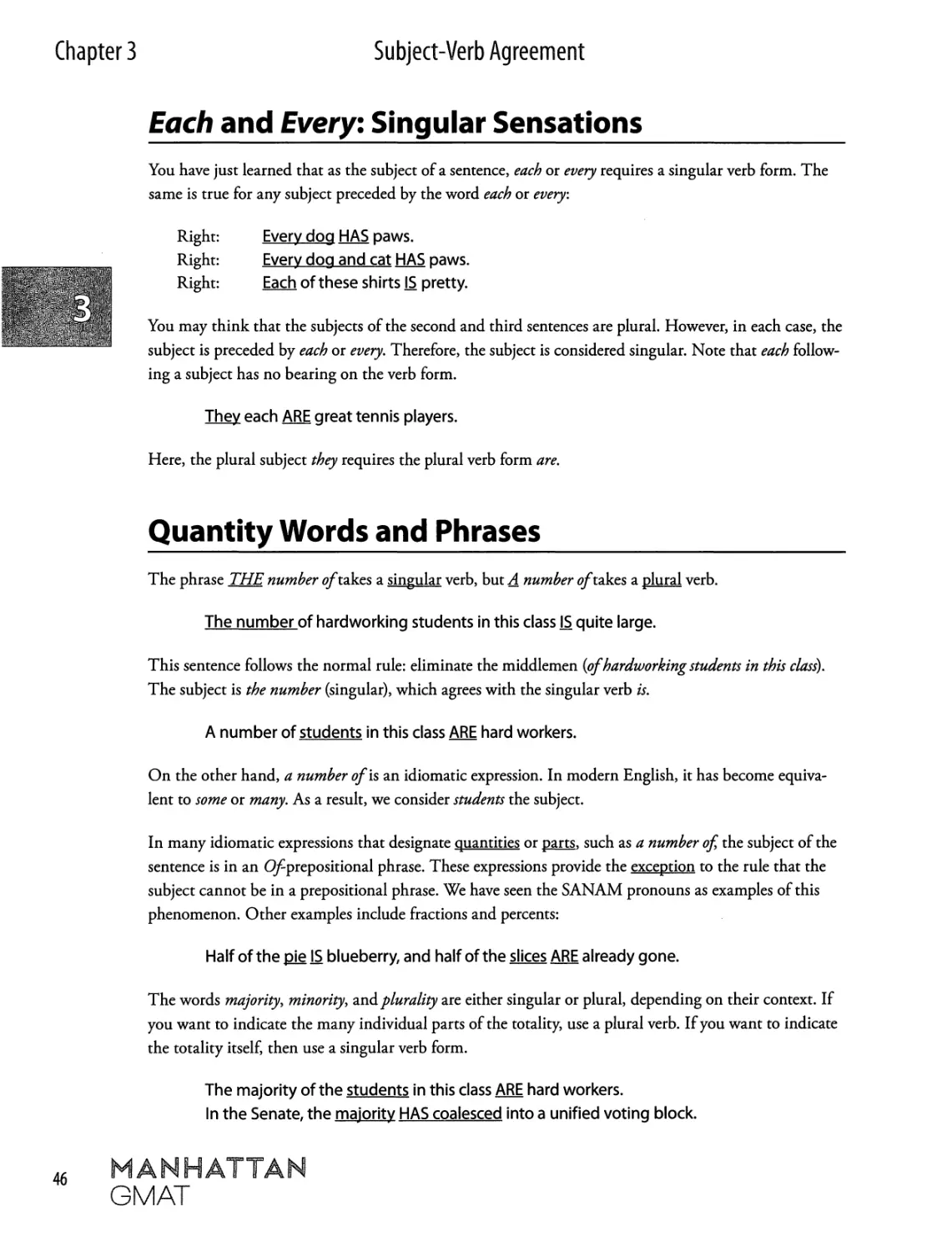
Each and Every: Singular Sensations
You have just learned that as the subject of a sentence, each or every requires a singular verb form. The
same is true for any subject preceded by the word each or every:
Right
Right
Right
Every dog HAS paws.
Every dog and cat HAS paws.
Each of these shirts IS pretty.
You may think that the subjects of the second and third sentences are plural. However, in each case, the
subject is preceded by each or every . Therefore, the subject is considered singular. Note that each follow
ing a subject has no bearing on the verb form.
They each ARE great tennis players.
Here, the plural subject they requires the plural verb form are.
Quantity Words and Phrases_________________
The phrase THE number o f takes a singular verb, but A number o f takes a plural verb.
The number of hardworking students in this class IS quite large.
This sentence follows the normal rule: eliminate the middlemen {ofhardworking students in this class).
The subject is the number (singular), which agrees with the singular verb is.
A number of students in this class ARE hard workers.
On the other hand, a number o f is an idiomatic expression. In modern English, it has become equiva
lent to some or many. As a result, we consider students the subject.
In many idiomatic expressions that designate quantities or parts, such as a number o f the subject of the
sentence is in an O/^prepositional phrase. These expressions provide the exception to the rule that the
subject cannot be in a prepositional phrase. We have seen the SANAM pronouns as examples of this
phenomenon. Other examples include fractions and percents:
Half of the pie IS blueberry, and half of the slices ARE already gone.
The words majority , minority , and plurality are either singular or plural, depending on their context. If
you want to indicate the many individual parts of the totality, use a plural verb. If you want to indicate
the totality itself, then use a singular verb form.
The majority of the students in this class ARE hard workers.
In the Senate, the majority HAS coalesced into a unified voting block.
M AN HATTAN
GM AT
Subject-Verb Agreement
Chapter 3
Treat quantity phrases in the same way as SANAM pronouns: the noun in the O/^prepositional phrase
will indicate whether the verb is singular or plural.
Subject Phrases and Clauses: Always Singular
Sometimes the subject of a sentence is an -ing phrase or even a whole clause. This sort of subject is
always singular and requires a singular verb form.
Having good friends ]S a wonderful thing.
The subject is the singular phrase having goodfriends , not the plural noun friends .
Whatever they want to do IS fine with me.
The subject is the clause whatever they want to do , which is considered singular.
Flip It!____________________________________
In most English sentences the subject precedes the verb. However, the GMAT occasionally attempts
to confuse you by inverting this order and placing the subject after the verb. In sentences in which the
subject follows the verb, flip the word order of the sentence so that the subject precedes the verb. This
way, you will identify the subject much more readily.
Wrong:
Flip it!
Right:
Near those buildings SIT a lonely house, inhabited by squatters.
A lonely house, inhabited by squatters, SITS near those buildings.
Near those buildings SITS a lonely house, inhabited by squatters.
In the original sentence, the singular subject house follows the verb. The verb form sit is mistakenly
plural, but your ear may not catch this error because it is near the plural word buildings . By flipping the
sentence so that the subject house precedes the verb, we see that we must use the singular form sits.
Wrong: There IS a young man and an older woman at the bus stop.
Flip it! A voung man and an older woman ARE there at the bus stop.
Right: There ARE a voung man and an older woman at the bus stop.
By flipping the sentence so that the subject precedes the verb, we can see that the compound subject a
young man and an older woman is plural. In spoken English, there is is often used incorrectly with plural
subjects. The subject of a there is or there are expression follows the verb.
Look for flipped subjects and verbs in subordinate clauses as well:
MANHATTAN
GMAT
„
Chapter 3
Subject-Verb Agreement
Uncertain: Pong is a classic game from which have/has descended many current computer
Flip it!
Right:
pastimes.
Pong is a classic game from which many current computer pastimes HAVE de
scended.
Pong is a classic game from which HAVE descended many current computer pas
times.
When in Doubt, Think Singular
You may have noticed that confusing subjects are more often singular than plural.
Singular subjects dominate the chart. Thus, if you cannot remember a particular rule for determining
the number of a subject, place your bet that the subject is singular!
Singular Subjects
Plural Subjects
It Depends
A singular subject
linked to other nouns
by an additive phrase
Subjects joined
by and
Subjects joined
by or or nor
Collective nouns
SANAM pronouns
Most indefinite pronouns
Subjects preceded
by each or every
Subjects preceded
by the number o f
Subject phrases or clauses
M AN H ATTAN
GM AT
Subjects preceded
by a number o f
Other numerical words
and phrases
Subject-Verb Agreement
Problem Set
In each of the following sentences, (a)(gircle)the verb and (b) underline the subject. Then (c) determine
whether the subject and the verb make sense together, and (d) determine whether the subject agrees in
number with the verb. If the subject is singular, the verb form must be singular. If the subject is plural,
the verb form must be plural.
If the sentence is a fragment, or if the subject and verb do not make sense together, or if the subject and
verb do not agree, (e) rewrite the sentence correcting the mistake. If the sentence is correct as it is, mark
it with the word CORRECT.
1.
The traveling salesman was dismayed to learn that neither his sons nor his daughter were
interested in moving.
2.
I was so thirsty that either of the two drinks were fine with me.
3.
A venomous snake designated the emblem of the rebellion by the insurgency.
4.
A number of players on the team have improved since last season.
5.
Jack, along with some of his closest friends, is sharing a limo to the prom.
6.
The recent string of burglaries, in addition to poor building maintenance, have inspired
the outspoken resident to call a tenants meeting.
7.
There is, according to my doctor, many courses of treatment available to me.
8.
After all the gardening we did, the sun shining on the flowerbeds make a beautiful sight.
9.
The placement of the unusual artwork in the mansion's various rooms was impressive.
10.
A new textbook focused on recent advances in artificial intelligence assigned by our
instructor.
11.
Just around the corner is a fantastic bakery and a small supermarket.
12.
Planting all these seeds is more involved than I thought.
13.
Whoever rented these movies has to take them back before midnight.
14.
Tired of practicing, the orchestra decide to walk out on their astonished conductor.
15.
The proliferation of computer games designed to involve many players at once were first
developed before the widespread availability of high-speed internet connections.
MANHATTAN
GMAT
Subject-Verb Agreement
Ch
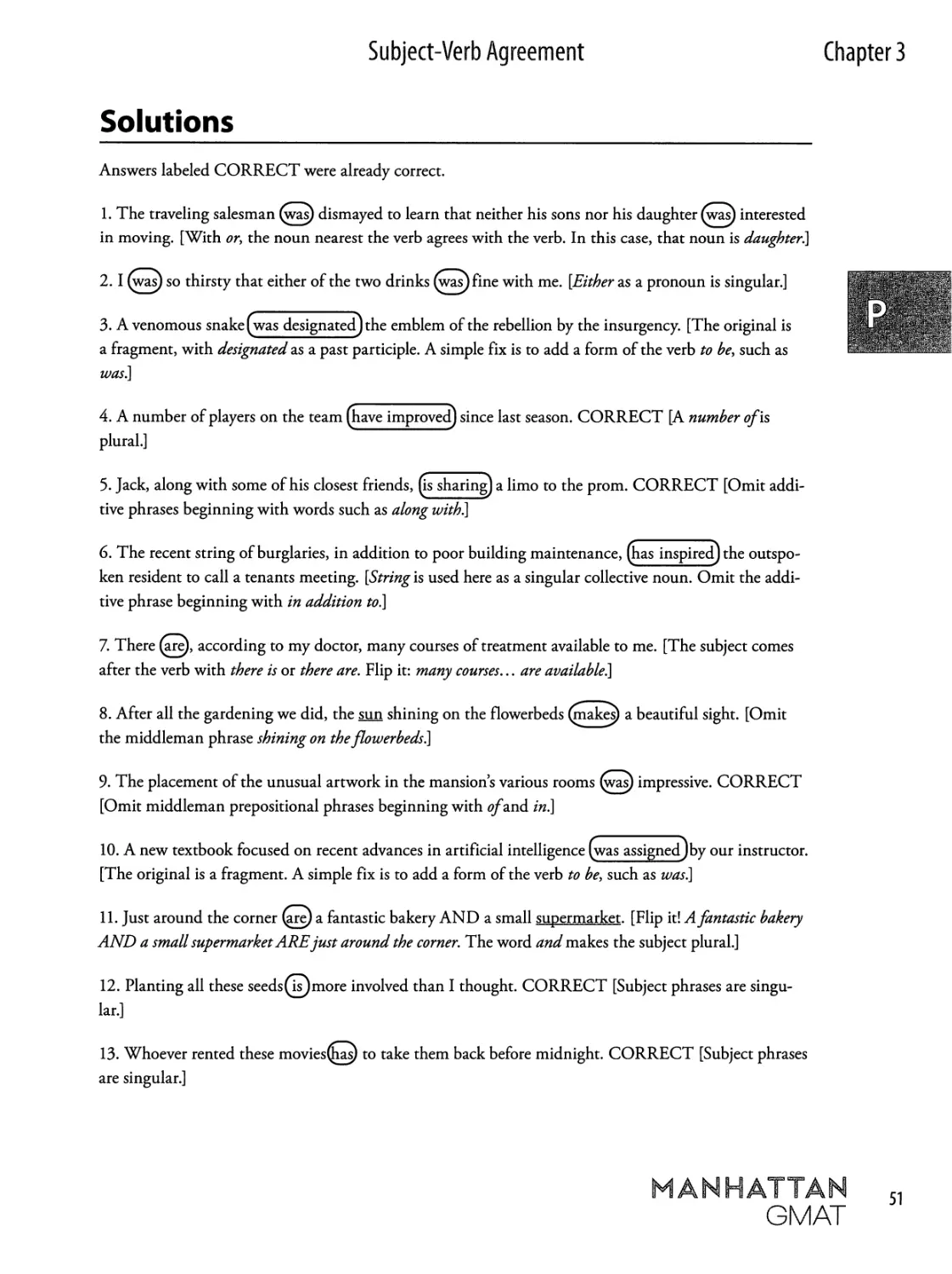
Solutions_________________________________
Answers labeled CORRECT were already correct.
1. The traveling salesman (was) dismayed to learn that neither his sons nor his daughter (was) interested
in moving. [With or , the noun nearest the verb agrees with the verb. In this case, that noun is daughter .]
2 . 1 (was) so thirsty that either of the two drinks (was) fine with me. [Either as a pronoun is singular.]
3. A venomous snake (was designated) the emblem of the rebellion by the insurgency. [The original is
a fragment, with designated as a past participle. A simple fix is to add a form of the verb to be , such as
was.]
4. A number of players on the team (have improved) since last season. CORRECT [A number o f is
plural.]
5. Jack, along with some of his closest friends, (is sharing) a limo to the prom. CORRECT [Omit addi
tive phrases beginning with words such as along with.]
6. The recent string of burglaries, in addition to poor building maintenance, (has inspired) the outspo
ken resident to call a tenants meeting. [String is used here as a singular collective noun. Omit the addi
tive phrase beginning with in addition to.]
7. There (axe), according to my doctor, many courses of treatment available to me. [The subject comes
after the verb with there is or there are. Flip it: many courses... are available .]
8. After all the gardening we did, the sun shining on the flowerbeds (makes) a beautiful sight. [Omit
the middleman phrase shining on the flow erbeds .]
9. The placement of the unusual artwork in the mansions various rooms foras) impressive. CORRECT
[Omit middleman prepositional phrases beginning with o f and in]
10. A new textbook focused on recent advances in artificial intelligence (was assigned)by our instructor.
[The original is a fragment. A simple fix is to add a form of the verb to be , such as was]
11. Just around the corner (are) a fantastic bakery AND a small supermarket. [Flip it! Afantastic bakery
AND a small supermarket AREju st around the corner. The word and makes the subject plural.]
12. Planting all these seeds^s)more involved than I thought. CORRECT [Subject phrases are singu
lar.]
13. Whoever rented these movies (has) to take them back before midnight. CORRECT [Subject phrases
are singular.]
MANHATTAN
GM AT
Chapter 3
Subject-Verb Agreement
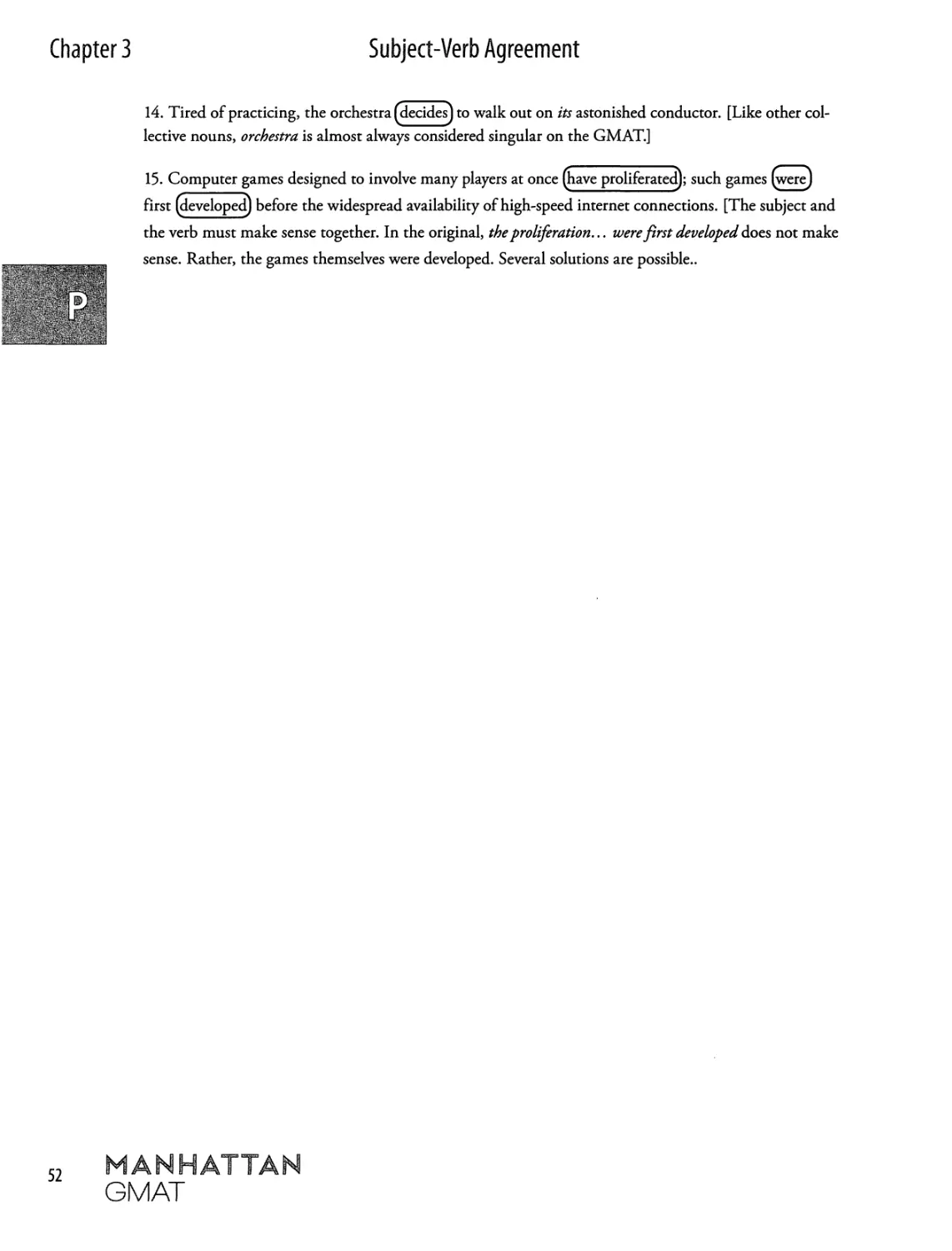
14. Tired of practicing, the orchestra [decides) to walk out on its astonished conductor. [Like other collective nouns, orchestra is almost always considered singular on the GMAT.]
15. Computer games designed to involve many players at once (have proliferated); such games (were)
first (developed) before the widespread availability of high-speed internet connections. [The subject and
the verb must make sense together. In the original, the proliferation... were first developed does not make
sense. Rather, the games themselves were developed. Several solutions are possible..
MANHATTAN
GM AT
Sentence Correction
Parallelism
Parallel Markers
Parallel Elements
Lists with And
Idioms with Built-In Parallel Structure
Superficial Parallelism vs. Actual Parallelism
Watch Out for Linking Verbs
Parallelism
Arguably, the GMAT s favorite grammar topic is parallelism. According to the principle of parallelism,
comparable sentence parts must be structurally and logically similar.
The employees were upset by the company's low pay, poor working conditions,
and that they did not have enough outlets for their creativity.
Notice that this example has three comparable parts— the three things that upset the employees. The
structure of the first two parts is similar; both parts consist of a Noun Phrase (centered on the nouns
pay and conditions, respectively). However, the third part has a different structure altogether: it is a
clause containing a subject, verb, and object. In order to make the sentence parallel, we must change the
third item in the list so that its structure is like that of the first two items (a noun phrase):
Right:
The employees were upset by the company's low pay, poor working conditions,
and shortage of outlets for employees' creativity.
Notice that we do not generally have to make every word parallel in the parallel elements. However, the
most important words must be parallel. In this case, the most important words in the three items in the
list—pay , conditions, and shortage— are all nouns. As a result, the phrase the company’s can now modify
each of the parallel parts.
the company's low pay
poor working conditions
"
shortage of outlets for employees' creativity
Chapter 4
Parallelism
Parallel Markers
How do we know that parts of a sentence need to be parallel to each other? Often, we know by spotting
Parallel Markers—words that link or contrast items and that force those items to be parallel. Examples
of parallel markers include the following:
Markers
And
Both/And
Or
Either/Or
Not/But
Not Only/
But Also
Rather Than
From/To
Structures
XandY
X, Y, and Z
Both X a n d Y
XorY
Either X or Y
Not X but Y
Examples
Apples AND pears
Apples, pears. AND bananas
BOTH apples AND pears
Apples OR pears
EITHER apples OR pears
NOT apples BUT pears
Not only X but also Y
X rather than Y
From X to Y
NOT ONLY apples BUT ALSO
Apples RATHER THAN pears
FROM apples TO pears
The most important parallel markers are the three common conjunctions: and , but, and or. O f these,
and is the most common. However, do not limit yourself to these markers. Any construction that ex
presses two or more things in the same way requires parallelism.
Parallel Elements__________________
Almost anything in a sentence can be made parallel to a similar Parallel Element.
Elements
Examples
Nouns
Her expression reflected BOTH anqer AND relief.
Adjectives
The park was NEITHER accessible NOR affordable.
We collected BOTH second- AND third-qrade books.
Verbs
The custodian cleaned the basement AND washed the windows.
Infinitives
We would like NOT ONLY to hear vour side of the storv BUT ALSO to
provide a response.
Participles
The actor left quicklv. shunninq fans AND ducking into a car.
Prepositional
Phrases
It was important to leave the monev in the drawer RATHER THAN
on the table.
(Note: the prepositions do not always have to be the same.)
Subordinate
Clauses
MANHATTAN
GM AT
Thev contended that the committee was biased AND that it should
be disbanded.
Parallelism
Some verbs or forms derived from verbs have more than one word: was opening, can lose, to increase . You
can often split apart these expressions, so that the first word or words count across all of the elements.
The division WAS opening offices, hiring staff, AND investing in equipment.
The railroad CAN EITHER lose more money OR solve its problems.
They wanted TO increase awareness, spark interest, AND motivate purchases.
Two parallel clauses often both start with subordinators in order to remove ambiguity.
Wrong:
Right:
I want to retire to a place WHERE I can relax AND I pay low taxes.
I want to retire to a place WHERE I can relax AND WHERE I pav low taxes.
Without the repetition of the subordinator where , the first sentence could be read I want to retire. .. and
I pay low taxes. Repeating the where eliminates ambiguity. The subordinators do not have to be identi
cal.
Right:
There are many people WHO speak English BUT WHOSE parents do not.
Do not over-shorten any element. Be sure that each element is complete.
Wrong:
Right:
Ralph likes BOTH THOSE WHO are popular AND WHO are not.
Ralph likes BOTH THOSE WHO are popular AND THOSE WHO are not.
In the first sentence, the second element cannot stand alone: likes... WHO are not does not make sense.
We have to write likes... THOSE WHO are not. (However, we do not have to repeat the word popular ,
which is understood in the second element.)
Lists with And_____________________________
As mentioned above, the word and is the most common and important parallel marker. Whenever you
see and in a GMAT sentence, look for the list and count the items. GMAT sentences have been ob
served to include as many as four items in a list connected by and.
List
X and Y
X, Y, and Z
X, Y, Z, and W
Examples
Apples AND pears
Apples, pears, AND bananas
Apples, pears, bananas, AND peaches
Correct lists obey these templates. No right answer omits and in a list just before the last item. More
over, the GMAT always inserts a comma before the and in lists of 3 or 4 items. However, if you join 2
clauses with and , you can put an optional comma before the and. Doing so is especially recommended
when the clauses are long, independent, or both.
MANHATTAN
GM AT
Parallelism
Chapter 4
List of Clauses
X, and Y
Example
I really like candy apples, AND I eat them often.
If the items in a list are long groups of words, such as clauses, that themselves contain lists, you should
be careful as you tally items.
Wrong:
She argues that the agency acts with disregard for human life AND property AND
reckless abandon AND it should therefore be shut down.
The four underlined items, which are all connected by and right now, are not all at the same logical
level. Human life and property are parallel to each other, but not to reckless abandon. Moreover, none of
these items is parallel to the clause it should therefore be shut down. To fix the sentence, create a clear
hierarchy by repeating words and adding commas where necessary. Also, you should flip lists so that the
longest item is last, if possible.
Applying these principles to the example, we get the following.
Right:
She argues THAT the agency acts WITH reckless abandon AND WITH disregard for
human life AND property. AND THAT it should therefore be shut down.
You can visualize the different levels of parallelism with a diagram:
She argues THAT the agency acts WITH reckless abandon
AND
WITH disregard for human life
AND
property,
AND
THAT it should therefore be shut down.
MANHATTAN
G M AT
Chapter 4
Parallelism
Idioms with Built-In Parallel Structure
Certain idioms demand parallelism as a result of their structure. The most important idioms demand
ing parallelism, such as both XandX, have already been described. The chart below lists additional
idiomatic structures that require parallelism. These idioms are more fully explored in the Idiom List in
Chapter 9.
X Acts As Y
Distinguish X From Y
X is the Same As Y
As X, SoY
Estimate X To Be Y
X is good, and So Too is
Between X And Y
X Instead OfY
X, Such As Y (example)
Compared To X, Y
X is Known To Be Y
Think Of X As Y
Consider X Y
X is Less Than Y
X is Thought To Be Y
In Contrast To X, Y
MakeXY
View X As Y
Declare XY
Mistake X For Y
Whether X Or Y
X Develops Into Y
Not Only X(,) But AlsoY
(the comma is optional)
X Differs From Y
Regard X As Y
Superficial Parallelism vs. Actual Parallelism_____
You always must figure out which grammatical structures are logically parallel before making them
structurally parallel. Be particularly careful with verbs and verbal forms.
Sal applied himself in his new job, arriving early every day, skipping lunch
regularly, AND leaving late every night.
In the sentence above, the -ing participle phrases arriving early every day , skipping lunch regularly , and
leaving late every night are parallel . The main clause, applied him self in his new job, is not parallel to these
participle phrases. This is CORRECT. The main verb is applied , and the -ing phrases provide addi
tional information about how Sal applied himself. It would distort the meaning to change the sentence
to this superficially parallel version:
Wrong: Sal applied himself in his new job, arrived early every day, skipped lunch regularly,
AND left late every night.
This version gives all the activities equal emphasis, instead of making the last three activities subordi
nate to the main activity (applied him self in his new job).
Do not assume that all verbs and verbal forms in a sentence must be parallel.
MANHATTAN
GM AT
59
Chapter 4
Parallelism
Watch Out for Linking Verbs
A more subtle form of parallelism involves Linking Verbs. Usually, we think of verbs as action words
(walk, dance , and jump), but another class of verbs is called linking verbs. Instead of expressing what a
subject does, these verbs express what the subject is, or what condition the subject is in. The most common
linking verb is naturally the verb to be, but there are other linking verbs as well. Below are two lists. The
first contains all the forms of the verb to be> while the second contains other common linking verbs:
To Be
is
are
was
were
am
been
be
being
S
ftp ® ’
ItSSIf
liSSS®
Other Linking Verbs
appear
become
feel
grow
look
remain
represent
resemble
seem
smell
sound
stay
taste
turn
Treat any linking verb as a parallel marker. Make the subject and the object parallel.
Wrong: The bouquet of flowers WAS a giving of love.
The two sides of the linking verb was are the bouquet and a giving. These two sides are not as structur
ally parallel as possible. In order to achieve true parallelism, we can rewrite the sentence replacing giving
with the noun gift, so that the two sides of the linking verb are as structurally similar as possible.
Right: The bouquet of flowers WAS a gift of love.
You must also ensure that the two sides of the linking verb are parallel in meaning.
Wrong: Upon being nominated, this politician REPRESENTS a step forward in
urban-rural relations in this country.
The two sides of the linking verb represents are the politician and a step forw ard . However, it is awkward
to say that a politician himself or herself is or represents a step forward, which is an occurrence or event.
Rather, the event involving the politician— his or her nomination — is what we should make parallel to
the noun a step forw ard.
Right: The nomination of this politician REPRESENTS a step forward in urban-
rural relations in this country.
Note that the verb to be does not have to be part of a linking verb phrase. The verb to be also forms the
progressive tenses (I am watering the plants) and the passive voice (The plants were watered last night). Do
not look for parallelism in these uses of be.
60
MANHATTAN
GMAT
Parallelism
Chapter 4
Problem Set
Each of the following sentences contains an error of parallelism in its underlined portion. For each
sentence, begin by writing a correct version of the sentence.
Then, using your correct version of the sentence: (l)(circlg)the parallelism markers and (2) place [square
brackets] around each set of parallel elements. In the solutions, key portions of the parallel elements will
be capitalized.
1.
Researchers have found a correlation between exercise and earning good grades.
2.
Although we were sitting in the bleachers, the baseball game was as exciting to us as the
people sitting behind home plate.
3.
Many teachers choose to seek employment in the suburbs rather than facing low salaries
in the city.
4.
A good night's sleep not only gives your body a chance to rest, but also energizing you
for the following day.
5.
The joint business venture will increase employee satisfaction and be improving relations
between upper management and staff.
6.
The museum displays the work of a wide variety of artists, from those who are worldrenowned to who are virtually unknown.
7.
We were dismayed to learn that our neighbors were untidy, disagreeable, and they were
uninterested to make new friends.
8.
The students did poorly on the test more because they had not studied than the material
was difficult.
9.
The blizzard deposited more than a foot of snow on the train tracks, prompted the transit
authority to shut down service temporarily, and causing discontent among commuters
who were left stranded for hours.
10.
The experiences we have when children influence our behavior in adulthood.
11.
The band chosen for the annual spring concert appealed to both the student body as well
as to the administration.
12.
Tobacco companies, shaken bv a string of legal setbacks in the United States, but which
retain strong growth prospects in the developing world, face an uncertain future.
MANHATTAN
GM AT
61
Chapter 4
Parallelism
13.
Voters want to elect a president who genuinely cares about health care, the environment,
the travails of ordinary men and women, has the experience, wisdom, and strength of
character required for the job.
14.
The consultant is looking for a cafe where there are comfortable chairs and that provides
free internet access.
15.
Dr. Crock's claims have been not corroborated by other scientists or published in a presti
gious journal but have nonetheless garnered a great deal of attention from the public.
MANHATTAN
G M AT
Chapter 4
Parallelism
Solutions
1. Researchers have found a correlation [(between) EXERCISING (and) EARNING good grades].
2.(Although) [we were sitting in the bleachers, the baseball game was [ (as) exciting TO us (as) TO the
people sitting behind home plate].
3. M any teachers choose to [SEEK employment in the suburbs (rather than) FACE low salaries in the
city].
4. A good nights sleep [(not on 1^) GIVES your body a chance to rest(, but also) ENERGIZES you for
the following day].
5. The joint business venture w ill [INCREASE employee satisfaction (and) IMPROVE relations be
tween upper management and staff].
6. The museum displays the work of a wide variety of artists, [(from) THOSE W HO are world-renowned (to) THOSE W HO are virtually unknown].
7. We were dismayed to learn that our neighbors were [UNTIDYQj DISAGREEABLE (, and) UNIN
TERESTED in making new friends].
8. The students did poorly on the test [ (more) BECAUSE they had not studied (than) BECAUSE the
material was difficult.
9. The blizzard deposited more than a foot of snow on the train tracks, [PROMPTING the transit au
thority to shut down service temporarily (and) CAUSING discontent among commuters who were left
stranded for hours]. (Note the removal of the comma after temporarily .)
10. The experiences we have IN CHILDHOOD influence our behavior IN ADULTHOOD.
This sentence does not have any parallelism signals for us to circle. We know that in childhood should
be parallel in structure to in adulthood because of logical considerations: the sentence is meant to high
light a connection between childhood and adulthood.
11. The band chosen for the annual spring concert appealed to [ (both) the student BODY (andj the
ADMINISTRATION!.
It would normally be correct to write The band. ..appealed to the student body as well as to the administra
tion . However, the word both was not underlined in the original question, so we are forced to choose
the both X and Y idiom as our parallelism structure.
12. Tobacco companies, [W H ICH have been shaken by a string of legal setbacks in the United States
(, but) W H ICH retain strong growth prospects in the developing world], face an uncertain future.
MANHATTAN
GM AT
63
Chapter 4
Parallelism
13. Voters want to elect a president [WHO genuinely cares about [health care Q the environment
( and)the travails of ordinary Imen (and) women! ] ( and) WHO has the [experience Q wisdom (, and)
strength of character] required for the job]. (For clarity, several elements in lists have been left
uncapitalized.)
14. The consultant is looking for a cafe [THAT has comfortable chairs (and) THAT provides free inter
net access].
15. Dr. Crock’s claims [HAVE (not) BEEN fCORROBORATED by other scientists @ PUBLISHED
in a prestigious journal] (but) HAVE nonetheless GARNERED a great deal of attention from the
public].
64
MANHATTAN
G M AT
Sentence Correction
Pronouns
The Antecedent Must Exist
The Antecedent & Pronoun Must Make Sense Together
The Antecedent & Pronoun Must Agree in Number
The Deadly Five: It, Its, They, Them, Their
This, That, These, and Those
What About Ambiguity?
Pronouns
A pronoun is a word that takes the place of a noun, so that we do not have to repeat that noun else
where in the sentence.
Gasoline has become so expensive that JLnow consumes as much as 16% of
personal income in some rural areas.
In the sentence above, the pronoun it takes the place of the noun gasoline . Alternatively, we can say that
it refers to gasoline . The noun gasoline is known as the Antecedent of it.
Pronoun errors are so frequent on the GMAT that every time you see a pronoun, such as it, its, they,
them, or their, you should be sure to check whether it is being used correctly.
The first question you must ask yourself is this: What is the antecedent of this pronoun? Once you
have found the antecedent, you must make sure that it makes sense and that it agrees in number with
the pronoun. Ideally, the match between the antecedent and the pronoun should not be ambiguous,
either.
Notice that these questions are essentially the same as those you should ask with subjects and verbs:
“what is the subject of this verb, does it make sense with the verb,” etc.
The Antecedent Must Exist___________________
The first task is to find the antecedent in the sentence.
The park rangers discussed measures to prevent severe wildfires, which would be
devastating to II.
W hat noun does it refer to? We might guess the park. However, you should note that in this sentence,
park is not truly a noun. Rather, park is acting as an adjective in the phrase the park rangers. As a result,
Pronouns
park cannot be the antecedent of it. Moreover, there is no other possible antecedent in the sentence.
Thus, as written, this sentence is incorrect.
One simple way to fix this sentence is to eliminate the pronoun, replacing it with the noun you want to
refer to.
Right: The rangers discussed measures to prevent severe wildfires, which would be dev
astating to THE PARK.
We eliminated the first mention of park to avoid repetition (after all, the noun rangers seems specific
enough), but we could have left the subject as the park rangers.
Watch out for nouns used as adjectives! They cannot be antecedents of pronouns.
The antecedent to which you want to refer must actually exist in the sentence as a noun.
The Antecedent & Pronoun Must Make Sense
Together__________________________________
The next task is to check whether the antecedent and the pronoun agree logically. That is, if you replace
the pronoun with the noun, w ill you get a sensible sentence?
Although the term "supercomputer" may sound fanciful or exaggerated, II is
simply an extremely fast mainframe that can execute trillions of calculations every
second.
Looking for the antecedent, we find the term “supercomputer? Now we replace the pronoun:
... the term "supercomputer" is simply an extremely fast mainframe...
The error in meaning is subtle but unmistakable. The term is not a mainframe; rather, the term refers
to a mainframe. Therefore, you must change the verb or make some other edit.
Right: Although the term "supercomputer" may sound fanciful or exaggerated,
I I simply REFERS TO an extremely fast mainframe that can execute tril
lions of calculations every second.
These issues are aspects of the principle of Meaning. The GMAT tries to trick you into “assuming
away” little wrinkles in meaning. After all, you knew what the author wants to say, right? Make no as
sumptions. Always check that the antecedent makes sense in place of the pronoun.
MANHATTAN
G M AT
Pronouns
Chapter 5
The Antecedent & Pronoun Must Agree in Number
After finding the antecedent, ask yourself whether the pronoun agrees with the antecedent in number.
If the antecedent is singular, the pronoun that refers to it must be singular. If the antecedent is plural,
the pronoun that refers to it must be plural.
Confronted by radical changes in production and distribution, modern Holly
wood studios are attempting various experiments in an effort to retain US status
as the primary arbiter of movie consumption.
The antecedent of its is intended to be modern Hollywood studios . However, its is singular, while studios
is plural. Singular must go with singular; plural must go with plural.
Right: Confronted by radical changes in production and distribution, modern
Hollywood studios are attempting various experiments in an effort to retain
THEIR status as the primary arbiters of movie consumption.
Right: Confronted by radical changes in production and distribution, the modern
Hollywood studio is attempting various experiments in an effort to retain
ITS status as the primary arbiter of movie consumption.
Either sentence is correct. We can speak about modern Hollywood studios (plural) or the “generic” mod
ern Hollywood studio (singular). Either way, the number of the pronoun must match the number of
its antecedent. Note that the GMAT tends to test number agreement when you can easily express the
relevant concepts either in singular or in plural form (studio or studios).
As we saw in Subject-Verb Agreement, the GMAT can disguise the subject and its number in various
ways (e.g., by using additive phrases such as along with). The same disguises apply to pronoun anteced
ents. Be sure to identify the antecedent properly.
The Deadly Five: It, Its, They, Them, Their_______
The most common pronoun mistakes involve Third Person Personal Pronouns— the singular it and its,
together with the plural they , them , and their. Whenever you see one of these five pronouns, find the
antecedent and check its viability (“is the antecedent sensible and in agreement with the pronoun?”).
Be careful with their , which is often used in everyday speech to refer to singular subjects.
Wrong: Whenever a student calls, take down THEIR information.
Right: Whenever a student calls, take down HIS or HER information.
Right: Whenever students call, take down THEIR information.
MANHATTAN
GM AT
69
Chapter 5
Pronouns
This, That, These/ and Those_________________
The Demonstrative Pronouns are this, that, these, and those. You may use any of these pronouns as adjec
tives in front of nouns, as we have already seen.
New "nano-papers" incorporate fibers that give THESE MATERIALS strength.
You may also use that or those to indicate a “New Copy” or copies of the antecedent.
The money spent by her parents is less than THAT spent by her children.
In this example, that spent by her children means the money spent by her children. Note that the two pots
of money are NOT the same. One pot of money is spent by the parents; another pot of money, spent by
the children, is the New Copy. In contrast, when you use it, they, or other personal pronouns, you mean
the same actual thing as the antecedent.
The money spent by her parents is more than H was expected to be.
That or those indicating a New Copy or copies must be modified. In other words, you have to add a
description to indicate how the new copy is different from the previous version.
The money spent by her parents is less than THAT SPENT bv her children.
Her company is outperforming THAT OF her competitor.
A little oddly, the GMAT insists that any “New Copy” that or those agree in number with the previous
version. If you must change number, repeat the noun.
Wrong:
Right:
Her company is outperforming THOSE OF her competitors.
Her company is outperforming THE COMPANIES OF her competitors.
Finally, on the GMAT, do not use this or these in place of nouns. A sentence such as This is great is unacceptably vague to the GMAT. Also, do not use that or those in place of nouns, unless you modify that
or those to make them New Copies. Instead, use it, they, or them.
Wrong:
Right:
Her products are unusual; many consider THESE unique.
Her products are unusual; many consider THEM unique.
What About Pronoun Ambiguity?______________
In theory, every pronoun in a well-written sentence should clearly refer to one antecedent. In particular,
every it and its in one sentence must refer to the same singular antecedent. Likewise, every they, them ,
and their must refer to the same plural antecedent. Otherwise, unacceptable confusion reigns.
70
MANHATTAN
GM AT
Chapter 5
Pronouns
Researchers claim to have developed new "nano-papers" incorporating tiny
cellulose fibers, which THEY allege give THEM the strength of cast iron.
W hat nouns do they and them refer to? You might assume that they refers to researchers (who claim
something) and that them refers to new “nano-papers? However, this confusing switch of reference is
not permitted by the GMAT.
Resolve the confusion by recasting the sentence. One solution is to eliminate they and them altogether.
Right: Researchers claim to have developed new "nano-papers" incorporating
tiny cellulose fibers, which give THESE MATERIALS the strength of cast
iron, according to the researchers.
Using a more generic noun (materials) is an effective way to kill off pronouns. Nano-papers are evidently
a type of material, so the phrase these materials clearly refers back to nano-papers. The phrase according
to the researchers does the work of they allege. The noun researchers is simply repeated, preventing any
possible misreading.
W hat if the sentence contains only one pronoun but more than one possible antecedent?
Again, in theory you should rewrite the sentence. In practice, though, you can often get away with this
theoretical ambiguity, because the GMAT itself does. That is, the GMAT occasionally has violated
“pronoun ambiguity” under these circumstances in correct answers to published problems!
W hy on earth does the GMAT allow potentially ambiguous pronoun references? The reason is that
the English language allows them. Otherwise, it would be nearly impossible to use a pronoun late in a
sentence. There would almost always be too many theoretically possible antecedents.
If the intended antecedent of a single pronoun is clear (e.g., by virtue of parallelism and meaning), and
if there is no other reasonable antecedent, then don’t worry if there is an unreasonable antecedent some
where else in the sentence.
Right: Supernovas destroy their immediate environments in vast explosions, but by syn
thesizing heavy chemical elements, THEY provide the universe with the possibility
of biochemistry-based life as we know it.
Supernovas is the subject of the first clause. The they is also in subject position in the second clause,
which is parallel to the first clause. Even though there are at least two closer possible antecedents (en
vironments and explosions), you know that they clearly refers to supernovas. The GMAT would consider
this sentence acceptable.
If you wanted to talk about environments or explosions later on, you would need to use a phrase such as
those environments or such explosions. The subject is the most important noun in the sentence; thus, it
generally makes the best antecedent, as this very sentence demonstrates.
MANHATTAN
GM AT
71
Pronouns
To understand one other wrinkle, you need to know about cases, which are grammatical roles or func
tions for nouns and pronouns. There are three cases in English: subject, object, and possessive.
1) Subject pronouns can be the subjects of sentences.
I you he she it we they who
They arrived late.
2) Object pronouns can be the objects of verbs or prepositions.
me you him her it us them whom
No one saw them or talked to them.
3) Possessive pronouns indicate ownership or a similar relation.
my/mine your/yours his her/hers its
our/ours their/theirs whose
Their presence went unnoticed.
The GMAT does not force you to pick pronoun cases directly, since this task is too easy. For instance,
Them arrived late and No one saw they sound terrible to the native ear and are simple to fix. However,
you should note that nouns in the possessive case (with s or s’) are often poor antecedents.
Wrong: The board is investigating several executives' compensation packages in order to
determine how much may have been improperly awarded to THEM.
In this sentence, the pronoun them refers better to packages than to executives'. Some grammarians claim
that them cannot refer to executives , arguing that possessive nouns can serve as antecedents only to pos
sessive pronouns. As a result of a controversy some years ago with another major standardized test, the
GMAT will steer away from having this issue be the “make or break” for any question. However, you
can technically correct the sentence by taking the possessing noun out of the possessive case.
Right: The board is investigating the compensation packages of several executives in
order to determine how much THEY may have been improperly awarded.
The GMAT would consider the previous sentence correct. If you really want to avoid any trace of ambi
guity, replace they with a noun phrase such as these executives:
Right: The board is investigating the compensation packages of several executives in
order to determine how much THESE EXECUTIVES may have been improperly
awarded.
So, where does all this discussion leave us?
Every it and its must refer to the same singular antecedent. Every they, them> and their must refer
to the same plural antecedent. These specific rules are respected on Sentence Correction.
Otherwise, don’t apply pronoun ambiguity unless you are backed into a corner. If you are down to
two answer choices that are absolutely identical, except that one has they (referring to executives earlier)
and the other has these executives, go with the latter, just to be super-safe.
MANHATTAN
G M AT
Pronouns
Problem Set
(Qirclg) all the pronouns in the following sentences. Underline the antecedent, if there is one, of each
pronoun. If you notice any pronoun errors in a sentence, correct the sentence by altering the pronoun(s).
Explain what rules are violated by the incorrect sentences. If a sentence is correct, mark it with the word
CORRECT.
1.
When the guests finished their soup they were brought plates of salad.
2.
Everyone here needs their own copy of the textbook in order to take the class.
3.
Jim may not be elected CEO by the board because he does not meet their standards.
4.
Meg left all her class notes at school because she decided that she could do her
homework without it.
5.
Some people believe that the benefits of a healthy diet outweigh that of regular exercise.
6.
Caroline receives e-mail from friends who she knows well, from acquaintances who's
names are only vaguely familiar, and from strangers about who she knows nothing at all.
7.
The players' helmets need to be repainted before they are used in Sunday's game.
8.
We finally chose the coffee table towards the back of the store, which we thought would
complement our living room furniture.
9.
Oil traders have profited handsomely from the recent rise in its price.
10.
A few Shakespearean scholars maintain that he borrowed some of his most memorable
lines from Christopher Marlowe.
11.
The Smiths avoid the Browns because they dislike their children.
12.
A careful analysis of the students' test scores reveals that some of them must have
cheated.
13.
Our cat is cuter than those in the shelter.
14.
The rapid development of India in the twenty-first century is like England in the
eighteenth century.
15.
She took her laptop and her books with her on the airplane because she thought she
could use these to get some work done.
M AN HATTAN
GM AT
Chapter 5
Pronouns
Solutions
W hen the guests finished^ their) soup f they) were brought plates of salad.
CORRECT.
Guests is the antecedent of their and they.
Everyone here needs(h is or h erjown copy of the textbook in order to take the class.
Everyone is an indefinite pronoun. It is the antecedent of his or her. (JTheir is incorrect, because
everyone is singular.)
Tim may not be elected CEO by the board because (he) does not meet( its )standards.
Board is the antecedent of its. (Their is incorrect, because board is a singular collective noun.)
Meg left all (her) class notes at school because (she) decided that (she) could do (her) homework
without(them.)
M eg is the antecedent of her and she.
Notes is the antecedent of them. {It is incorrect because notes is plural.)
Some people believe that the benefits of a healthy diet outweigh( those) of regular exercise.
Benefits is the antecedent of those. (That is incorrect, because benefits is plural.)
Caroline receives e-mail from friends (whom) (she) knows well, from acquaintances (whose )
names are only vaguely familiar, and from strangers about (whom ) (she) knows nothing at all.
Caroline is the antecedent of both she's.
Friends is the antecedent of the first whom. (Who is incorrect because the objective case is re
quired here. Whom is the direct object of the verb knows\ we would say that she knows them )
Acquaintances is the antecedent of whose. (Who's is incorrect, because who's means “who is”. We
need the possessive pronoun whose to indicate that the names belong to the acquaintances.)
Strangers is the antecedent of whom. (Who is incorrect because we need the objective case here.
Whom is the object of the preposition about)
7.
The players’ helmets need to be repainted before (th ey) are used in Sunday’s game.
CORRECT.
Helmets is the antecedent of they . You need not worry that they could refer to players\ because
(1) helmets is the subject, and (2) players is a possessive noun, and is therefore not a good ante
cedent for a pronoun in the subjective case.
M ANHATTAN
GM AT
75
ir5
Pronouns
8.
( We) finally chose the coffee table towards the back of the store, because (we) thought that this
table would complement (our) living room furniture.
We and our are pronouns that never have antecedents in the sentence, because we and our are
first person (these pronouns refer to the people speaking).
Rather than use the pronoun it, we repeat the noun table to be on the safe side. We might be
able to get away with using it, but the antecedent might be considered ambiguous (table or
store).
The original sentence is incorrect because the pronoun which seems to refer to store. Store is an
illogical antecedent for which, because the table, not the store, is what would complement some
one s living room furniture. We’ll come back to the pronoun which in Chapter 6: Modifiers.
9.
Oil traders have profited handsomely from the recent rise in the price of oil.
This new, correct version of the sentence contains no pronouns.
The original sentence is incorrect because its has no antecedent. Oil is an adjective in the ex
pression oil traders, and therefore cannot be the antecedent of its.
10.
A few Shakespearean scholars maintain that Shakespeare borrowed some of (his) most memo
rable lines from Christopher Marlowe.
Shakespeare is the antecedent of his.
The original sentence is incorrect because he has no antecedent. Shakespearean is an adjective,
and therefore cannot be the antecedent. We are thus forced to replace he with Shakespeare in
the correct sentence.
11.
The original sentence is far too ambiguous. The antecedent of they is almost certainly not
meant to be the same as the antecedent of their, a confusing state of affairs. Either family is a
reasonable antecedent for either pronoun. To correct this sentence, we could get rid of the pro
nouns. One possible version: The Smiths avoid the Browns because the Browns dislike the Smiths'
children. We cannot be sure that this version accurately represents what the author intended,
which may have been that The Smiths avoid the Browns because the Smiths dislike the Browns'
children.
M AN H ATTAN
GM AT
Pronouns
A careful analysis of the students’ test scores reveals that some students must have cheated.
This new, correct version of the sentence contains no pronouns.
The original sentence is incorrect because them refers to test scores. Them fails to refer to stu
dents', because students is a possessive noun and is therefore unattractive as an antecedent for a
non-possessive pronoun such as them.
(Our) cat is cuter than the cats in the shelter.
This new, correct version of the sentence contains no third-person pronouns. {Our is a pro
noun, but first-person pronouns such as our never have antecedents in the sentence.)
The original sentence is incorrect because those has no antecedent. Those is plural, and therefore
cannot refer to cat.
The rapid development of India in the twenty-first century is like (that) of England in the
eighteenth century.
Development is the antecedent of that.
The original sentence is incorrect because it makes an illogical comparison. India’s development
is not like England. It is like England’s development, or that o f England.
(S h e) took (her) laptop and(her)books with (her ) on the airplane because (she) thought (she)
could use (them) to get some work done.
The first she is the antecedent of all three hers.
The three uses of she lack an antecedent, but are correct. The subject of the sentence is simply
an unnamed she. Note that the GMAT will generally name any personal antecedent, rather
than leave this person nameless as in the example above.
Her laptop and her books is the antecedent of them. (The original these is incorrect because these
is never used as a stand-alone pronoun without a noun following.)
MANHATTAN
GM AT
Sentence Correction
Modifiers
Adjectives and Adverbs
Noun Modifiers
Position of Noun Modifiers
Watch Out for Possessives
Noun Modifiers with Relative Pronouns
Essential vs. Non-Essential Noun Modifiers
Verb Modifiers
Which vs. the Present Participle -Ing
Modifiers
A modifier describes or “modifies” someone or something in the sentence. Although modifiers can be
as simple as a single word (an adjective or an adverb), GMAT sentences often contain several complex
modifiers.
Tired out from plaving basketball, Charles decided to take a nap.
The modifier Tired out from playing basketball describes the noun Charles. Be on the lookout for open
ing modifiers, which appear at the beginning of a sentence. In the example above, tired out from playing
basketball is an opening modifier separated from the rest of the sentence by a comma. M any modifying
phrases in GMAT sentences are separated by commas from the noun being modified.
Adjectives and Adverbs______________________
Adjectives and adverbs are one-word modifiers. An Adjective modifies only a noun or a pronoun,
whereas an Adverb modifies almost anything but a noun or a pronoun. An adverb often modifies a
verb, but it can also describe an adjective, another adverb, a preposition, a phrase, or even a whole
clause.
The SMART student works QUICKLY.
Here the adjective smart modifies the noun student , while the adverb quickly modifies the verb works.
M any adverbs are formed by adding - ly to the adjective.
Be sure not to use an adjective where an adverb is grammatically required, and vice versa. Note that
adjectives, not adverbs, follow linking verbs such as feel. These adjectives do not modify the verb but
rather identify a quality with the noun subject. All of the following examples are correct, although they
differ in meaning:
Modifiers
Chapter 6
Amy is a GOOD person. {Good is an adjective that modifies the noun person.)
Amy is feeling GOOD. {Good is an adjective that modifies the noun Amy.)
Amv is feeling WELL. {Well is an adjective that modifies the noun Amy.)
Amy writes WELL. {Well is an adverb that modifies the verb writes.)
Often, the GMAT provides two grammatically correct phrasings. For instance, one phrasing might be
[Adjective + Adjective + Noun], in which the two adjectives both modify the noun. The other phras
ing would be [Adverb + Adjective + Noun], in which the adverb modifies the adjective, which in turn
modifies the noun. These two phrasings do not mean the same thing. Pick the phrasing that reflects
the authors intent.
Wrong:
Right:
James Joyce is Max's SUPPOSEDLY Irish ancestor.
James Joyce is Max's SUPPOSED Irish ancestor.
James Joyce may or may not be M ax’s ancestor, but James Joyce was certainly Irish. Thus, we want the
adjective supposed , so that we can modify the noun ancestor .
Wrong:
Right:
Max's grandmother is his SUPPOSED Irish ancestor.
Max's grandmother is his SUPPOSEDLY Irish ancestor.
W hat is in question here is whether M ax’s grandmother was Irish, not whether she is M axs ancestor.
Thus, we want the adverb supposedly , so that we can modify the adjective Irish .
Adjectives that have been observed alternating with their corresponding adverbs (in - ly) in released
GMAT problems include corresponding, frequent, independent, rare, recent, seeming, separate, significant,
supposed, and usual. It is easy to miss an -ly added in some of the answer choices; be sure not to miss this
difference.
H AN H ATTAN
G M AT
Modifiers
Chap
Noun Modifiers
Phrases or clauses that modify nouns or pronouns are called Noun Modifiers. Noun modifiers act like
long adjectives. The first word or two of a noun modifier determines its type, as seen in the chart below.
The modifier and the modified noun are both underlined.
Type / First Words
Position
Example
Adjective
Before noun
The LAZY cat took a nap.
After noun
The cat, LAZY from overeating, took a nap.
Preposition
After noun
The cat ON the couch took a nap.
Past Participle
Before noun
The TIRED cat took a nap.
TIRED from chasing mice, the cat took a nap.
Present Participle
without commas
Relative Pronoun
After noun
The cat, TIRED from chasing mice, took a nap.
Before noun
The SLEEPING cat took a nap.
After noun
The cat SLEEPING on the rug is named "Sue."
After noun
The grey cat, WHICH loves tuna, took a nap.
The cat THAT lives next door is noisy.
The person WHO lives next door is noisy.
Another Noun
Before noun
The dty WHERE I live is noisy.
A LOVER of mice, my cat hunts night and day.
After noun
The cat/ a TABBY raised on a farm, took a nap.
A noun used to modify another noun is called an Appositive. In the last example, the appositive noun
tabby was itself modified by a past participle modifier {raised on a farrn). Even modifiers of moderate
length {a tabby raised on a farm) can contain other modifiers.
In the chart above, notice that many modifiers are separated from the noun by commas. Again, pay
particular attention to opening modifiers, which appear at the beginning of a sentence. It may seem un
natural to say an unprepared sentence with a long opening modifier, but it is perfectly fine to write such
a sentence.
Right:
TIRED from chasing mice, the cat took a nap.
Because your ear is not accustomed to sentences with opening modifiers, the GMAT loves to play tricks
with these kinds of modifiers.
MANHATTAN
GM AT
Modifiers
Position of Noun Modifiers
When you see a noun modifier, ask yourself what noun should be modified. Then check to make sure
that the modifier is next to that noun. Follow the Touch Rule:
A NOUN and its MODIFIER should TOUCH each other.
If the modifier is next to a different noun, we have a Misplaced Modifier.
Wrong:
Jim biked along an old dirt road to get to his house, which cut through
the woods.
In the preceding example, the modifying phrase which cut through the woods is meant to describe the
road , not the house. Thus, you should move the modifier next to road.
Right:
To get to his house, Jim biked along an old dirt road, which cut through
the woods.
If the noun we want to modify is not even in the sentence, we have a Dangling Modifier.
Resigned to the bad news, there was no commotion in the office.
There was no commotion in the office, resigned to the bad news.
Wrong:
Wrong:
The modifier Resigned to the bad news should modify someone or some group of people who were actu
ally resigned to the news. However, no noun referring to a person appears in the sentence (<office means
the physical place in this context). Instead, the phrase resigned to the bad news seems to modify there or
the office. To correct this issue, we insert a reasonable noun as the noun modified by resigned :
Right:
Resigned to the bad news, the office workers made no commotion.
It is easy to miss a dangling modifier. In fact, the GMAT makers themselves missed one. See p. 374 of
The O fficial Guide fo r GMAT Review , 13th Edition for a dangling modifier in a Reading Comprehension
passage ( When rem oved.. . should modify the missing noun sea snakes, not the subject blood pressure).
A present participle (ring form) at the beginning of a sentence is often made to be dangling. Although
these forms are technically Verb Modifiers (more on these shortly), they still need a noun subject that
makes sense.
Wrong:
Wrong:
Using the latest technology, the problem was identified.
The problem was identified, using the latest technology.
Errors such as these are common in speech. The modifier using the latest technology needs to refer to
someone who actually used the technology. To correct this issue, we insert a reasonable noun as the
subject of using.
M AN HATTAN
G M AT
Modifiers
Right:
Chapter 6
Using the latest technology, the engineer identified the problem.
Notice that you can move the using phrase to the end of the sentence.
Right:
The engineer identified the problem, using the latest technology.
Unlike a noun modifier, a verb modifier does not have to touch the subject. However, the subject
must make sense with the verb modifier used in this way. We will cover verb modifiers in more detail
later in this chapter.
Avoid long sequences of modifiers that modify the same noun. Putting two long modifiers in a row
before or after a noun can lead to awkward or incorrect phrasings.
Wrong:
George Carlin, both shocking and entertaining audiences across the na
tion. who also struggled publicly with drug abuse, influenced and in
spired a generation of comedians.
The misplaced modifier who also struggled publicly with drug abuse should be next to George Carlin , not
nation . But the simple fix (putting the modifiers on either side of George Carlin) may still be awkward,
if the main verb is delayed or if the ideas are not connected clearly.
Better:
Both shocking and entertaining audiences across the nation. George Car
lin. who also struggled publicly with drug abuse, influenced and inspired
a generation of comedians.
An even better alternative may be to rephrase the sentence so that one of the modifiers is no longer a
modifier.
Best:
Both shocking and entertaining audiences across the nation. George
Carlin influenced and inspired a generation of comedians, even as he
struggled publicly with drug abuse.
In this version, the modifier Both shocking and entertaining. .. clearly links to the subject George Carlin
and explains how he influenced and inspired. The contrasting thought {struggledpublicly.. .) is put at the
end of the sentence in a subordinate clause headed by even as.
The “Better” construction above is grammatically correct but stylistically awkward. In the absence of a
“Best” construction, consider the “Better” option.
M AN HATTAN
GMAT
Modifiers
Chapter 6
Watch Out for Possessives____________________
Just as possessive nouns are often dangerous with regard to pronoun reference, they are also dangerous
in sentences with modifiers. Misplaced modifiers sometimes appear in sentences that have possessive
nouns (nouns that end in Vor / ).
Wrong:
Unskilled in complex math. Bill's score on the exam was poor.
Here, the modifier unskilled in complex math should describe Bill . However, this modifier cannot “reach
inside” the possessive form Bill's and modify Bill. As it stands, the sentence is saying that Bill's score
itself is unskilled in complex math. This meaning is not what the author intended. To solve the problem,
we should replace the possessive Bill's score with Bill.
Right:
Unskilled in complex math. Bill did not score well on the exam.
Do not ignore the noun development or other abstract nouns. They follow the same rules as all other
nouns: modifiers that touch them should be intended to modify them.
Wrong:
Only in the past century has origami's development, a ceremonial activity
invented millennia ago, into a true art form taken place.
We do not mean that the development of origami was a ceremonial activity. Thus, we need to rephrase
the sentence to modify the noun origami itself.
Right:
Origami—a ceremonial activity invented millennia ago— has developed
into a true art form only in the past century.
Noun Modifiers with Relative Pronouns_________
Noun modifiers are often introduced by Relative Pronouns such as the following:
Which That Who Whose Whom Where When
Such modifiers are called Relative Pronouns. Relative pronouns are subject to several restrictions. The
pronouns who and whom must modify people. On the other hand, the pronoun which must modify
things.
According to the GMAT, clauses led by the pronoun that cannot modify people. Other grammatical
authorities disagree, but what matters on test day is the GMAT s point of view.
Wrong:
Right:
The scientists THAT made the discovery were rewarded.
The scientists WHO made the discovery were rewarded.
M AN H ATTAN
G M AT
Modifiers
It is very easy to make a mistake on this issue. In fact, an earlier edition of The O fficial Guide includes
such an error in the commentary on one Sentence Correction problem.
Surprisingly, the pronoun whose can modify either people or things, according to the GMAT: the town
whose water supply was contaminated.
Which or whom sometimes follow prepositions: the canal through which w aterflow sxthe senator fo r whom
we worked.
Who is used as the subject of the verb in a relative clause, whereas whom is used as the object of the verb
or of a preposition.
Wrong:
Right:
The security guard WHO we met was nice.
The security guard WHOM we met was nice.
That or whom can be dropped when the modified noun is the object of the modifying clause.
Right:
Right:
The movie THAT we watched last Friday was scary.
The movie we watched last Friday was scary.
The pronoun where can be used to modify a noun place, such as area, site, country or Nevada. Where
cannot modify a “metaphorical” place, such as condition , situation , case, circumstances , or arrangement.
In these cases, use in which rather than where.
Wrong:
Right:
We had an arrangement WHERE he cooked and I cleaned.
We had an arrangement IN WHICH he cooked and I cleaned.
The pronoun when can be used to modify a noun event or time, such as period , age , 1987\or decade. In
these circumstances, you can also use in which instead of when.
Essential vs. Non-Essential Noun Modifiers______
Noun modifiers are either essential or non-essential.
As their name suggests, Essential Modifiers provide necessary information. Use an essential modifier
to identify the noun (out of many possibilities) or to “attach” the modifier to the noun from that point
onward.
Essential: The mansion PAINTED RED is owned by the Lees.
The modifier painted red is necessary to identify the mansion, perhaps from among a row of differently
painted mansions along a street. In other words, you cannot remove painted red without creating confu
sion and distorting the meaning of the sentence. To answer the question What is ow ned by the Lees?, you
would say The mansion painted red.
M AN HATTAN
GM AT
Modifiers
In contrast, Non-essential Modifiers provide extra information. You do not need this information to
identify the noun, since it is already identified in some other way. Moreover, you can forget about a
non-essential modifier afterward, in a sense; any later reference to the noun does not include that extra
information.
Non-essential:
This mansion. RECENTLY PAINTED RED, is owned by the Lees.
The modifier recently painted red is not necessary; we already know which mansion is under discussion
because of the word this. So you can remove recently painted red and preserve the sentences core mean
ing. To answer the question What is owned by the Lees?, you would simply say This mansion , leaving out
the information about the color of its paint.
Punctuation distinguishes between essential and non-essential modifiers:
Put COMMAS between NON-ESSENTIAL modifiers and their nouns.
Put NO COMMAS between ESSENTIAL modifiers and their nouns.
If you have a choice between which and that, then follow this general rule:
Use W H ICH (and commas) if the modifier is non-essential.
Use THAT (and no commas) if the modifier is essential.
Non-essential:
Essential:
This mansion. WHICH HAS BEEN RECENTLY PAINTED RED, is
owned by the Lees.
The mansion THAT HAS BEEN PAINTED RED is owned by the Lees.
However, the GMAT has acknowledged that this which/that differentiation is controversial, so the
GMAT is unlikely to make this distinction the make-or-break issue for any answer choice.
In some circumstances, you do not have a simple choice between Which and That (e.g., when Which is
used with a preposition). However, you should still obey the comma rule: use commas with non-essential uses of Which, but not with essential uses of Which.
Non-essential:
Essential:
This mansion. FOR WHICH I YEARN, is owned by the Lees.
The mansion FOR WHICH I YEARN is owned by the Lees.
Other relative pronouns, such as who , can be used in essential or in non-essential modifiers. W ith these
other pronouns, continue to observe the comma rule: use commas only with non-essential modifiers.
MANHATTAN
G M AT
Modifiers
Verb Modifiers_____________________________
As their name indicates. Verb Modifiers modify verbs. These modifiers answer questions about the
verb, such as “how,” “when,” “where,” “why,” etc. The most basic verb modifier is an adverb. Other verb
modifiers act in much the same way as adverbs.
Tvpe / First Words
Position
Example
Adverb
Before verb
FREQUENTLY, 1walk to the store.
1FREQUENTLY walk to the store.
After verb
Before verb
1walk to the store FREQUENTLY.
ON Mondavs, 1walk to the store.
After verb
1walk to the store ON Mondavs.
Before verb
WHEN mv car is broken, 1walk to the store.
1walk to the store WHEN mv car is broken.
Preposition
Subordinator
After verb
Subordinators include words such as because, although , if, unless, while, so that, while , and so on. These
words begin subordinate clauses, which cannot stand alone as sentences, but rather are attached to main
clauses.
Some verb modifiers may apply to both the verb and the verbs subject. In these cases, you must make
sure that the subject makes sense with the modifier.
Tvpe / First Words
Position
Example
Present Participle with Before verb
commas
After verb
WHISTLING "Beat It." 1lifted the weiaht.
Preposition + Simple
Gerund
Before verb
BY CONCENTRATING. 1lifted the weiaht.
After verb
1lifted the weiaht BY CONCENTRATING.
Before verb
TO FREE mv lea. 1lifted the weight.
After verb
1lifted the weiaht TO FREE mv lea.
Infinitive of Purpose
1lifted the weiaht. WHISTLING "Beat It."
In each case, the subject / makes sense: I was whistling*Beat It? I was concentrating, / wanted to fr ee my
leg. Make sure that these modifiers have a sensible subject in the sentence.
Wrong:
The weight was lifted by concentrating.
Infinitives of purpose can be used with unnamed agents in passive-voice sentences: The weight was
lifted to fr e e my leg. Just make sure that whoever does the lifting intends to fr e e my leg. An Infinitive of
Purpose needs to indicate the purpose of someone. The boulder rolled to fr ee my leg implies nonsensically
that the boulder wanted to fr e e my leg
M ANHATTAN
GM AT
Modifiers
Chapter 6
There is an important difference between verb modifiers and noun modifiers. Verb modifiers can be
placed more freely than noun modifiers, which must generally touch the modified noun. However,
you should always place a verb modifier so that it modifies the right verb, without ambiguity.
Wrong:
Right:
The nameless symphony was at last performed, decades after it was com
posed, yesterday.
The nameless symphony was at last performed yesterday, decades after it
was composed.
In the first example, the adverb yesterday is at best awkwardly placed. The concerto seems to have been
composed yesterday, a meaning that does not make sense with the rest of the sentence. In the second
example, yesterday has been m oved closer to the verb that ought to be m odified—namely , was performed.
Which vs. the Present Participle -ing___________
Sentences such as the following are common in speech, but they are wrong in writing.
Wrong:
Crime has recently decreased in our neighborhood. WHICH has led to a
rise in property values.
W hat you want to say is that the recent decrease in crime has led to a rise in property values. However,
whenever you use which , you must be referring to a noun— the noun that comes just before the which.
Here, the neighborhood itself has not led to anything!
Use WHICH only to refer to the noun immediately preceding it—never to refer to an
entire clause.
One way to correct the sentence is to turn the first thought into a noun phrase and make this phrase
the subject of the verb in the which clause, eliminating which altogether:
Right:
The recent decrease in crime in our neighborhood has led to a rise in
property values.
Another way to correct the sentence is to use a present participle, the -in gve rb form:
Right:
Crime has recently decreased in our neighborhood, leading to a rise in
property values.
The -in fo rm is very flexible. It can modify nouns directly (e.g., the changing seasons). It can modify
verbs and their subjects (e.g., I lifted the weight , whistling). It can even modify an entire clause as above,
as long as the entire clause converted into a noun phrase could function as the subject of the verb that
is now in -ing form. The two previous examples illustrate this process. Since we can say that the recent
decrease in crim e. .. has led to a rise, we can also say crime has recently decreased. .. leading to a rise. This
use of the -ing form works best when you want to express the result of the main clause.
90
MANHATTAN
G M AT
Modifiers
Chapter 6
Again, in speech we often break these rules—we incorrectly use which to refer to a previous thought
that is not a noun. In fact, the GMAT has made the same mistake in Sentence Correction explanations
and even in a Reading Comprehension passage! Do not use your ear. Always test which clauses to make
sure that the which refers to the noun immediately preceding the which .
MANHATTAN
GM AT
91
Modifiers
Chapter 6
Problem Set
Each of the following sentences contains one or more underlined modifiers. For each of these modifiers,
(1) identify the word or words, if any, that it modifies, and (2) indicate whether the modifier is correct.
If the modifier is incorrect, suggest a way to correct the error.
1.
Upon setting foot in the Gothic cathedral, the spectacularly stained-glass windows
amazed the camera-wielding tourists.
2.
Although the ballerina seems healthily, she feels very unwell and is unlikely to dance
well at tonight's performance.
3.
A recent formed militia, consisting of lightly armed peasants and a few retired army offi
cers, is fighting a bitterly civil war against government forces.
4.
Angola, which was ravaged bv civil war for many years after it gained independence
from Portugal, which is now one of Africa's success stories, has an economy that grew by
21 % last year, where parliamentary elections are to be held later this week.
5.
Mary buys cookies made with SugarFree, an artificial sweetener, which tastes as sweet
as the corn svrup that her brother loves but where there are fewer calories than in an
equivalent amount of corn syrup.
6.
People that are well-informed know that Bordeaux is a French region whose most
famous export is the wine which bears its name.
7.
The acquaintances who we like most are those that flatter us best.
8.
People, who talk loudly on their cell phones in crowded trains, show little respect for
other passengers.
9.
Of all the earthquakes in European history, the earthquake, which destroyed Lisbon in
1755. is perhaps the most famous.
10.
The tallest mountain on Earth is Mount Everest that is on the border between Nepal and
Tibet.
11.
Based on the recent decline in enrollment, the admissions office decided to reevaluate
its recruitment strategies.
12.
Unaccustomed to the rigors of college life. James's grades dropped.
13.
Regina returned the dress to the store, which was torn at one of the seams.
14.
Last night our air conditioner broke, which caused great consternation.
15.
The patient's rare disease was treated using novel techniques developed at the medical
school.
MANHATTAN
GM AT
,,
Chapter 6
Modifiers
Solutions
1. Upon setting foot in the Gothic cathedral, the spectacularly stained glass windows amazed the
camera-wielding tourists.
Upon setting fo o t in the Gothic cathedral: INCORRECT. Upon is a preposition. The phrase upon setting
fo o t in the Gothic cathedral contains the gerund setting Who or what set foot in the cathedral?
Logically, it must be the tourists, not the windows . However, the noun windows is the subject of
the sentence, and so windows seems to be the subject of setting.
spectacularly: INCORRECT. An adverb such as spectacularly can modify many parts of speech, but not
a noun. The phrase spectacularly stained-glass windows seems to imply that the windows were spectacu
larly stained —that is, spectacularly seems to modify stained . However, stained-glass is a material. The
author intended to say that either the stained glass itself or the windows were spectacular : The adverb
should be replaced with the adjective spectacular.
camera-wielding: CORRECT. This participle modifies tourists.
Correction:
Upon entering the Gothic cathedral, the camera-wielding tourists were amazed
by the spectacular stained-glass windows.
2. Although the ballerina seems healthily, she feels very unwell and is unlikely to dance well at tonight s
performance.
Healthily: INCORRECT. Healthily should be replaced by an adjective, because seems is a linking verb.
The appropriate adjective, healthy , would modify ballerina.
Very: CORRECT. The adverb very modifies the adjective unwell.
Unwell: CORRECT. Unwell is an adjective meaning “sick” or “ill.” It modifies she, because fe e l is a
linking verb.
Unlikely: CORRECT. Here, unlikely is an adjective. Unlikely modifies she, because is is a linking verb.
Well: CORRECT. Here, well is an adverb meaning “in a good manner.” An adverb is required to
modify dance , which is not a linking verb.
Correction:
Although the ballerina seems healthy, she feels very unwell and is unlikely to
dance well at tonight’s performance.
3. A recent formed militia, consisting of lightly armed peasants and a few retired army officers, is fight
ing a bitterly civil war against government forces.
Recent: INCORRECT. The adjective recent modifies militia , whereas logic calls for an adverb, recently ,
to modify form ed.
MANHATTAN
GM AT
95
Modifiers
Lightly: CORRECT. The adverb lightly modifies the past participle armed , which is being used as an
adjective {armed modifies the noun peasants).
Retired : CORRECT. Retired is an adjective that modifies army officers . (You can also argue that retired
is a past participle being used as an adjective.)
Bitterly : INCORRECT. The adverb bitterly modifies civil, but the writer surely meant to use an
adjective {bitter) to modify the noun phrase civil war.
Correction:
A recently formed militia, consisting of lightly armed peasants and a few retired
army officers, is fighting a bitter civil war against government forces.
4. Angola, which was ravaged by civil war for many years after it gained independence from Portugal
which is now one of Africa’s success stories, has an economy that grew by 21% last year, where parlia
mentary elections are to be held later this week.
Which was ravaged... from Portugal: CORRECT. This relative clause modifies the noun Angola.
Which is now one o f Africa's success stories: INCORRECT. This relative clause illogically modifies Portu gal.
Where parliamentary ... this week. INCORRECT. A relative clause that begins with where must modify
a noun that names a physical place, so this clause does not really modify year. The clause is too far away
from Angola, however, to perform its intended role of modifying Angola.
Repairing this deeply flawed sentence involves rearranging its components and incorporating some of
the modifiers into main clauses.
Correction:
Ravaged by civil war for many years after it gained independence from Portugal,
Angola is now one of Africa’s success stories: its economy grew by 21% last year,
and parliamentary elections are to be held later this week.
5. M ary buys cookies made with SugarFree, an artificial sweetener, which tastes as sweet as the corn
syrup that her brother loves but where there are fewer calories than in an equivalent amount of corn
syrup.
An artificial sweetener. CORRECT. This appositive noun phrase modifies SugarFree.
Which tastes... brother loves CORRECT. This clause modifies SugarFree. Normally a relative clause
should touch the noun that it modifies, but we are generally allowed to place an appositive between a
relative clause and the modified noun.
Where there are... corn syrup INCORRECT. This relative clause is wrong for two reasons. (1) The
relative pronoun where must modify places. SugarFree, the intended antecedent, is not a geographic
MANHATTAN
G M AT
Modifiers
place. (2) The relative clause where there ... corn syrup is meant to be parallel to the relative clause which
tastes... brother loves. W hen relative clauses are parallel, they should start with the same relative pronoun.
Mary buys cookies made with SugarFree, an artificial sweetener, which tastes
as sweet as the corn syrup that her brother loves but which contains fewer calories than does an
equivalent amount of corn syrup.
Correction:
6. People that are well-informed k now that Bordeaux is a French region whose most famous export is
the wine which bears its name.
That are well-informed: INCORRECT. This clause uses the relative pronoun that to refer to people.
Who must refer to human beings. Another problem with that are well-inform ed is that it is
wordy. Avoid relative clauses whose only verb is a form of to be , because they can generally be
expressed more succinctly.
Whose mostfam ous. .. bears its name : CORRECT. This clause modifies region . Notice that whose, unlike
who and whom , can correctly modify non-human entities.
Which bears its name : INCORRECT. The context of this sentence calls for an essential clause to
modify the wine, since the point of the clause is to identify the wine . If the sentence ended
with the wine, it would be incomplete. The clause should therefore begin with that rather than
which .
Correction:
Well-informed people know that Bordeaux is a French region whose most famous
export is the wine that bears its name.
7. The acquaintances who we like most are those that flatter us best.
Who we like most'. INCORRECT. The relative pronoun who should be whom , because whom is the
object of the verb like. The word whom is in fact optional in this circumstance. We can say either The
acquaintances whom we like most or The acquaintances we like most.
Thatfla tter us best: INCORRECT. Who, not that, should be used to refer to people {acquaintances).
Correction:
The acquaintances whom we like most are those who flatter us best.
8. People, who talk loudly on their cell phones in crowded trains, show little respect for other passen
gers.
Who talk... crow ded trains: INCORRECT. This clause is wrong because the commas that enclose it
make it a non-essential clause. The logic of the sentence calls for an essential clause, because the
rest of the sentence would change its meaning without the information in the relative clause.
(The sentence People show no respect fo r other passenger makes a sweeping claim about every hu
man being.) To correct this error, we need only to remove the commas.
MANHATTAN
GM AT
Modifiers
Correction:
People who talk loudly on their cell phones in crowded trains show little respect
for other passengers.
9. Of all the earthquakes in European history, the earthquake, which destroyed Lisbon in 1755, is per
haps the most famous.
Which destroyed Lisbon in 1755: INCORRECT. This clause is wrong because the commas that enclose
it make it a non-essential clause. The logic of the sentence calls for an essential clause to make clear
which earthquake is the most famous. (If you remove the relative clause, you get the very mysterious
sentence O f all the earthquakes in European history, the earthquake is perhaps the mostfamous .) To correct
the sentence, we must remove the commas and replace which with that.
Correction:
Of all the earthquakes in European history, the earthquake that destroyed Lisbon
in 1755 is perhaps the most famous.
10. The tallest mountain on Earth is Mount Everest that is on the border between Nepal and Tibet.
That is on ... Tibet: INCORRECT. This clause is wrong because it is essential. The logic of the sentence
calls for a non-essential clause for two reasons. (1) The information about Mount Everest be
ing on the border between Nepal and Tibet is hardly necessary to identify which mountain we
are talking about, since we are given both the mountains name (MountEverest) and a unique
description of the mountain (the tallest mountain on EartH). (2) The meaning of the rest of the
sentence would not change in any significant way if the information in the relative clause were
removed. To correct this sentence, we need to put a comma after Everest and change that to
which.
Correction:
The tallest mountain on Earth is Mount Everest, which is on the border between
Nepal and Tibet.
11. Based on the recent decline in enrollment, the admissions office decided to reevaluate its recruit
ment strategies.
Based on ... enrollment: INCORRECT. As a noun modifier, the past participle based modifies admis
sions office. However, the intention of the sentence is not that the admissions office itself is based on the
recent decline in enrollment. The phrase based on X is often incorrectly used in place of the prepositional
phrase because o f which can correctly modify the verb phrase decided to reevaluate.
Correction:
Because of the recent decline in enrollment, the admissions office decided to
reevaluate its recruitment strategies.
12. Unaccustomed to the rigors of college life, James’s grades dropped.
Unaccustomed to... college life: INCORRECT. As a noun modifier, the past participle unaccustomed
modifies the noun phrase James's grades. However, the author of the sentence obviously intends
MANHATTAN
GM AT
Modifiers
unaccustomed to modify James himself. If we wish to begin the sentence with the noun modifier, we
must rephrase the sentence to make James the subject.
Correction:
Unaccustomed to the rigors of college life, James allowed his grades to drop.
13. Regina returned the dress to the store, which was torn at one of the seams.
Which was. .. the seams: INCORRECT. This modifier is misplaced. It seems to describe store, the adja
cent noun; however, the modifier should modify dress. Thus, we must move the modifier next to dress.
Since the modifier is relatively short, we can get away with simply inserting it and setting it off with
commas.
Correction:
Regina returned the dress, which was torn at one of the seams, to the store.
14. Last night our air conditioner broke, which caused great consternation.
Which caused great consternation: INCORRECT. This modifier is dangling, since the sentence contains
no noun correctly modified by the clause which caused great consternation. The author s intent is to com
ment on the event (the breakdown of the air conditioner). But the main clause does not name the event
with a noun. Therefore, we need to change the modifier to a verb modifier, either a participle (caus
ing. . .) or an absolute phrase (an event that caused.. .).
Correction:
Last night our air conditioner broke, causing great consternation.
15. The patients rare disease was treated using novel techniques developed at the medical school.
Using novel techniques: INCORRECT. This modifier is dangling, since the sentence contains no noun
that is properly modified by using novel techniques. To fix the sentence, we can introduce an
agent who actually used the novel techniques (e.g., a doctor ), or we can switch to a prepositional
phrase, such as through the use o f novel techniques, that does not contain an -ing verb form.
Developed at the medical school: CORRECT. This past participle modifies techniques.
Correction:
The patient’s rare disease was treated through the use of novel techniques devel
oped at the medical school.
M AN HATTAN
GMAT
Sentence Correction
Verb Tense, Mood,
& Voice
Simple Tenses
Progressive Tenses
Make Tenses Reflect Meaning
The Perfect Tenses: An Introduction
Present Perfect: Still In Effect..
Past Perfect: The Earlier Action
Perfect Tenses: Only When Necessary
Tense Sequence
The Subjunctive Mood
The Hypothetical Subjunctive
If... Then Constructions
The Command Subjunctive
Active and Passive Voice
Is Passive Voice Ever the Correct Answer?
Verb Tense, Mood, & Voice
In addition to subject-verb agreement, we must consider three other features of verbs that are tested on
the GMAT: tense, mood, and voice.
Verb Tense indicates when the action of the verb takes place. In sentences with one action, verb tense is
relatively easy. Knowing this, the GMAT tries to complicate sentences by incorporating more than one
action.
Verb Mood indicates what the writer believes about, or wants to do with, the action. Two verb moods
are tested on the GMAT: indicative and subjunctive. Most verbs are in the indicative mood, which we
use to describe knowledge or beliefs. Occasionally, we use verbs in the subjunctive mood to express sug
gestions, desires, or hypothetical events.
Finally, Verb Voice indicates who or what is doing the action. Two verb voices are tested on the
GMAT: active voice and passive voice. In the active voice, the subject of the sentence performs the
action. In the passive voice, the subject of the sentence has an action performed on it by someone or
something else.
If you are a native speaker of American English, your ear is generally well-attuned to the right use of
tense, mood, and voice. Incorrect uses of tense (e.g., he has gone to France last year) w ill properly sound
funny to you; your instinctual correction {he went to France last year) will be correct. As you review this
chapter, don’t let any newly conscious knowledge mess up your instincts. Use this knowledge to rein
fo rce those instincts.
However, if you are not a native speaker of American English, you need to learn these rules consciously .
Patterns of verb tense, mood, and voice vary drastically among languages, even those related to Eng
lish. For instance, he is gone to France last year is correct in French, German, and Italian, but it is 100%
wrong in English.
Verb Tense, Mood, & Voice
Chapter 7
Simple Tenses_____________________________
The three simple tenses express three basic times:
SIMPLE PRESENT
SIMPLE PAST
SIMPLE FUTURE
Sandy PLAYS well with her friends.
Sandy PLAYED well with her friends yesterday.
Sandy WILL PLAY well with her friends tomorrow.
The Simple Present tense is often used to express “eternal” states or frequent events. In the first example
above, the sentence does not mean that Sandy is playing right now, but rather that as a general rule,
Sandy plays well with her friends.
The GMAT typically prefers the simple tenses, unless the sentence clearly requires one of the more
complex tenses discussed below.
Progressive Tenses
To emphasize the ongoing nature of an action, we can use the Progressive tenses, which use the verb to
be and the present participle (ring form):
PRESENT PROGRESSIVE
PAST PROGRESSIVE
FUTURE PROGRESSIVE
Sandy IS PLAYING soccer.
Sandy WAS PLAYING soccer yesterday.
Sandy WILL BE PLAYING soccer tomorrow.
The Present Progressive indicates action happening right now, whether the sentence contains words
such as right now or not. The first example above means that at the present moment, if you look for
Sandy, you w ill find her actually playing soccer. In contrast, the Simple Present version, Sandy plays
soccer, means that she frequently plays, or that she knows how to play.
Do not use the Present Progressive for general definitions. Instead, use the Simple Present.
W ro n g :
Right:
Cherenkov radiation is light that particles A R E E M IT T IN G when they A R E T R A V
E L IN G faster than the effective speed of light in any medium.
Cherenkov radiation is light that particles EMIT when they TRAVEL faster than
the effective speed of light in any medium.
In GMAT sentences, do not use the Present Progressive to indicate future actions. This usage is consid
ered too colloquial. Instead, use the Simple Future.
Wrong:
Right:
Quentin IS MEETING Harvey for lunch tomorrow.
Quentin WILL MEET Harvey for lunch tomorrow.
Verbs that express general states do not normally take progressive forms. Such State Verbs include know
or signify .
104
M AN H ATTAN
GM AT
Verb Tense, Mood, & Voice
Wrong: This inscription IS SIGNIFYING the emperor's birth.
Right: This inscription SIGNIFIES the emperor's birth.
Make Tenses Reflect Meaning_________________
Sometimes, all the tenses in a sentence are the same, because all the actions take place in the same time
frame.
Right: She WALKED to school in the morning and RAN home in the afternoon.
Right: She WALKS to school in the morning and RUNS home in the afternoon.
Right: She WILL WALK to school in the morning and RUN home in the afternoon.
In each sentence, the verbs are in the same tense: Simple Past in the first, Simple Present in the second,
and Simple Future in the third. (Note that run is understood as will run\ parallelism allows the will to
apply to both verbs.) Each sentence has a different, self-consistent meaning. In these examples, chang
ing tense midstream would be confusing and incorrect.
However, in some sentences the author clearly wants to talk about different periods of time. The tense
should change to reflect that intention.
Right: He IS thinner now because he WENT on a strict diet six months ago.
Here, the first verb {is) is in the Simple Present, while the second verb {weni) is in the Simple Past. This
switch is straightforward and logical, given the clear indications of time {now and six months ago).
In a more subtle example, you can use the Past Progressive to describe a background event, while you
use Simple Past to describe a more important event in the foreground.
Right: She WAS PLAYING with her friends when the babysitter ARRIVED.
In the previous example, the action was playing (in the Past Progressive) takes place in the background.
Arrived (in the Simple Past) is the interrupting foreground event. Note that the following sentence is
also correct, but it has a different meaning.
Right: She PLAYED with her friends when the babysitter ARRIVED.
In this case, the action played took place after the babysitter arrived. Both actions are in the Simple Past
and express equal levels of importance.
Since all these examples are correct, what could go wrong? In the heat of battle, you might miss a split
on verb tense. You know what the author means, so you overlook he goes on a diet six months ago.
In the final answer you choose, make sure that every verb’s tense clearly represents the author’s
intention.
M AN H ATTAN
GM AT
Chapter 7
VerbTense, Mood, &Voice
The Perfect Tenses: An Introduction
Some actions in a sentence involve more complex time sequences than can be expressed with the simple
tenses or the simple progressive tenses. These actions can be expressed using the PERFECT tenses: Pres
ent Perfect & Past Perfect. You must understand these tenses as they are tested on the GMAT.
Present Perfect: Still In Effect..._______________
We use the Present Perfect tense for actions that started in the past but continue into the present, or re
main true in the present. The Present Perfect tense has one foot in the past and one foot in the present.
THE ACTION or its EFFECT
------------------------------------------ ►
A moment in the past
NOW
Right: We HAVE LIVED in a hut for three days.
This sentence means that we started living in the hut three days ago and that we are still living in that
hut. In comparison, a sentence in the Simple Past has a different meaning.
Right: We LIVED in a hut for three days.
This example means that we are no longer living in the hut. The three daysare over. The Present Per
fect tense is formed as follows:
Present Perfect = HAVE/HAS + Past Participle
The past participle of a regular verb, such as walk or live, is simply the verb with an -ed ending: walked,
lived. Irregular verbs, such as go or see, have unique past participles {gone, seen). If you are a native Eng
lish speaker, you already know all the irregular forms. Otherwise, study the list of irregular past parti
ciples in the Glossary under “Past Participles.”
Here are some examples of actions in the Present Perfect tense:
Right: This country HAS ENFORCED strict immigration laws for thirty years.
Right: They HAVE KNOWN each other since 1987.
Each example involves an action that began in the past and continues into the present. This country
enforced strict immigration laws in the past and still enforces them today. They knew each other in
the past and still know each other today. In each case, the idea of “continuing action” is reinforced by a
time phrase, such as fo r thirty years or since 1987\that states how long the action has been occurring.
106 M AN HATTAN
G M AT
Verb Tense, Mood, &Voice
Sometimes, the Present Perfect tense means that the action is definitely over, but its effect is still rel
evant to the present moment.
Right:
The child HAS DRAWN a square in the sand.
In this example, the child is no longer drawing a square. The act of drawing is finished. However, the
square must still be here somehow. If the square has disappeared, use Simple Past.
Right:
Right:
Wrong:
The child DREW a square in the sand, but the ocean ERASED it.
The child DREW a square in the sand, but the ocean HAS ERASED
it.
The child HAS DRAWN a square in the sand, but the ocean HAS ERASED it.
In the first example above (with erased ), the current state of the sand is not known; in the second exam
ple (with has erased), the current state of the sand is square-free, since the Present Perfect has erased indi
cates that this actions effect is still true. The third example is awkward enough to be GMAT-wrong.
The Present Perfect indicates either continued action or continued effect of a completed action up
to the present.
W ith since, use the Present Perfect to indicate an action or effect that continues to the present time.
Wrong:
Wrong:
Right:
Since 1986 no one BROKE that world record.
Since 1986 no one BREAKS that world record.
Since 1986 no one HAS BROKEN that world record.
For the same reasons, use the Present Perfect with within the past... or in the last... phrases, such as
within the past fiv e minutes or in the last ten days. In contrast, a time phrase that does not include the
present (last month , in 2007, etc.) prevents the use of the Present Perfect. Use the Simple Past instead.
Wrong:
Right:
Veronica HAS TRAVELED all over the world in 2007.
Veronica TRAVELED all over the world in 2007.
Its fine to write Veronica has traveled all over the world and omit any specific, completed time reference.
In this case, you are making a statement about Veronica today (the kind of person she is, her experience
and qualities, etc.).
Finally, the Present Perfect can be used in - ing forms, infinitives or subordinate clauses to clarify an
ambiguous sequence in time. For instance, the word when can mean either “at the same time” or “after.”
The use of Present Perfect resolves the meaning.
Right:
She WILL PAY you when you ASK her. (No Present Perfect)
= She w ill pay you at the same time as you ask her, or maybe just after.
Right:
She WILL PAY you when you HAVE TAKEN out the garbage.
(Present Perfect)
= She will pay you clearly after you take out the garbage and have proven it!
M ANHATTAN
GM AT
Verb Tense, Mood, & Voice
Past Perfect: The Earlier Action
If two actions in a sentence occurred at different times in the past, we often use the Past Perfect tense for
the earlier action and Simple Past for the later action. The Past Perfect is the “Past of the Past,” or the
“Past Twice Removed” from the present time.
Past Perfect
EARLIER past moment
Simple Past
LATER past moment
NOW
The Past Perfect tense is formed as follows:
Past Perfect = HAD + Past Participle
Here are some examples of sentences using the Past Perfect tense:
Right: The film HAD STARTED by the time we ARRIVED at the theater.
Right: The teacher THOUGHT that Jimmy HAD CHEATED on the exam.
The earlier past action (had started , had cheated) is in the Past Perfect tense, while the later past action is
in the Simple Past tense (arrived , thought ). Do not use Past Perfect simply for “long ago” without a later
past moment. Even a long-ago moment can be referred to with Simple Past: An asteroid STRUCK the
earth millions o f years ago.
Note that we do not always use the Past Perfect for earlier actions. In general, you should use Past
Perfect only to clarify or emphasize a sequence of past events. The earlier event should somehow have a
bearing on the context of the later event. Moreover, if the sequence is already obvious, we often do not
need Past Perfect.
Right: Antonio DROVE to the store and BOUGHT some ice cream.
We already know that drove happened before bought. A sequence of verbs with the same subject does
not require Past Perfect. Rather, use the Simple Past for all the verbs.
Right: Antonio DROVE to the store, and Cristina BOUGHT some ice cream.
In the sentence above, which has two main clauses linked by andy we are not emphasizing the order of
events (although drove probably happened before bought). Clauses linked by and or but do not require
the Past Perfect as a general rule.
Right: Laura LOCKED the deadbolt before she LEFT for work.
M AN HATTAN
G M AT
Chapter 7
Verb Tense, Mood, & Voice
Likewise, we already know that locked happens before left because of the word before. The words before
and after indicate the sequence of events clearly and emphatically enough to make the use of the Past
Perfect unnecessary.
Also note that the later past event does not need to be expressed with a Simple Past tense verb. You
could just use a date or another time reference.
Right: Bv 1945. the United States HAD BEEN at war for several years.
Using this construction, you can even make a tricky sentence in which the first clause expresses an early
action in Simple Past. Then, a second clause expresses a later action in Past Perfect to indicate continued
effect (by a still later past time).
Right: The band U2 WAS just one of many new groups on the rock music scene in the
early 1980's, but less than ten years later, U2 HAD fully ECLIPSED its early rivals in
the pantheon of popular music.
Perfect Tenses: Only When Necessary__________
Do not use the perfect tenses when the simple tenses will do. The GMAT prefers simplicity.
Wrong:
Right:
Joe LEARNED about an epoch in which dinosaurs HAD WALKED the earth.
Joe LEARNED about an epoch in which dinosaurs WALKED the earth.
In the first example, the Past Perfect had walked is unnecessary. Although the action had walked does
take place earlier than the action learned , the earlier action does not have a direct bearing on the context
of the later action. The sequence of time does not need to be clarified or emphasized. Thus, the Past
Perfect is considered wrong in this context.
You should use the perfect tenses only when you can justify them with the rules described in these sec
tions. If an action began in the past and continues into the present (or its effect does), use the Present
Perfect tense. If one action in the past precedes another, and you need to clarify or emphasize the time
sequence, then use the Past Perfect tense. Otherwise, stick to the simpler tenses.
Tense Sequence____________________________
Consider the following quotation:
Scientist:
"The supercollider IS ready, it DID not COST too much, and it WILL PROVIDE new
insights into the workings of the universe."
How do we report this scientists speech, if we use a past tense reporting verb such as announced?. Typi
cally, we move the tenses back in time one step.
H AN H ATTAN
GM AT
109
Verb Tense, Mood, & Voice
Report:
The scientist ANNOUNCED that the supercollider WAS ready, that it HAD not COST
too much, and that it WOULD PROVIDE new insights into the workings of the
universe.
Compare the corresponding underlined clauses in the quotation and the report.
(1) The supercollider IS ready
becomes
. ..that the supercollider WAS ready.
The Simple Present tense (is) becomes the Simple Past (was).
(2) It DID not COST too much
becomes
... that it HAD not COST too much.
The Simple Past tense (did... cost) becomes Past Perfect (had... cost). The action
becomes one step further removed from the present.
(3) It WILL PROVIDE insights
becomes
. ..that it WOULD PROVIDE insights.
Finally, the Simple Future tense (willprovide) becomes the Conditional Tense, which is formed
by combining would with the base form of the verb: would provide. The helping verb would
expresses the future from the pasts point of view.
In these sorts of reporting sentences, avoid mixing Present tense with Conditional tense. Likewise, avoid
mixing Past tense with Future tense. The usual sequences are EITHER Present + Future OR Past +
Conditional.
Right:
The scientist BELIEVES that the machine WILL BE wonderful.
Present
Right:
The scientist BELIEVED that the machine WOULD BE wonderful.
Past
Wrong:
Conditional
The scientist BELIEVES that the machine WOULD BE wonderful.
Present
Wrong:
Future
Conditional
The scientist BELIEVED that the machine WILL BE wonderful.
Past
M AN H ATTAN
GM AT
Future
Chapter 7
Verb Tense, Mood, & Voice
The Subjunctive M ood_________
Again, verb mood expresses what the writer believes about, or wants to do with, the action expressed
by the verb. In English, most sentences express facts with the Indicative Mood or commands with the
Imperative Mood. You can expect to see the Subjunctive Mood in two special situations:
(1) Unlikely or unreal conditions (usually after i f on a similar word).
(2) Proposals, desires, and requests formed with certain verbs and the word that.
These two uses correspond to two forms of the subjunctive mood: the Hypothetical Subjunctive and
the Command Subjunctive.
The Hypothetical Subjunctive
We use the Hypothetical Subjunctive form in a few circumstances to indicate unlikely or unreal condi
tions. Principally, this form occurs after i f as i f or as though.
Right: To overcome my fear of germs, I will think about disease as though it WERE
harmless.
The speaker does not believe that disease actually is harmless. By using the Hypothetical Subjunctive
were , the speaker reveals that he or she thinks that disease is not harmless.
The basic form of the Hypothetical Subjunctive is equivalent to the Simple Past of every verb, with one
exception. For the verb to be, the form were is always used. (The Simple Past of be is both were and was:
I was, you were , he/she/it was, we/you/they w ere) Just remember the song “If I WERE a Rich M an” (not
I f I WAS a Rich Man ) and you will remember to use were. However, the GMAT tests this usage only
rarely. Because of its sim ilarity in form to the Simple Past, the Hypothetical Subjunctive is sometimes
called the “Past Subjunctive.” However, its use has to do with unlikely or unreal conditions, not with
past time.
If... Then Constructions____________________
Sentences that use the word i f do not always use the Hypothetical Subjunctive. Sentences with an i f
condition and a then outcome can follow any of several tense/mood patterns.
Right: IF you study diligently, [THEN] you will score highly.
Right: You will score highly IF you study diligently.
Note that the actual word then is frequently omitted. Also, the //’clause does not have to appear first in
the sentence. Here are the five common patterns of i f . . then sentences.
M AN H ATTAN
GM AT
m
Chapter 7
Verb Tense, Mood, & Voice
(1) General Rule with no uncertainty
IF Sophie EATS pizza, THEN she BECOMES ill.
IF Present, THEN Present.
This pattern is equivalent to whenever: WHENEVER Sophie EATSpizza , she BECOMES ill,
(2) General Rule with some uncertainty
IF Sophie EATS pizza, THEN she MAY BECOME ill.
IF Present, THEN Can or May.
Here, the helping verbs can or may can be used to allow for a somewhat uncertain outcome.
(3) Particular Case (in the future) with no uncertainty
IF Sophie EATS pizza tomorrow, THEN she WILL BECOME ill.
IF Present, THEN Future.
Another possibility for the Particular Case (in the present) is Present Perfect: I f Sophie HAS EATEN
pizza, then she WILL BECOME ill.
(4) Unlikely Case (in the future)
IF Sophie ATE pizza tomorrow, THEN she WOULD BECOME ill.
IF Hypothetical Subjunctive, THEN Conditional.
Here, the writer thinks that Sophie is unlikely to eat pizza tomorrow. The Conditional Tense (would)
shows the hypothetical result of an unlikely or untrue condition. In place of would , the form could can
be used to indicate improbability as well.
(5) Case That Never Happened (in the past)
IF Sophie HAD EATEN pizza yesterday, THEN she WOULD HAVE BECOME ill.
IF Past Perfect, THEN Conditional Perfect.
Other patterns are possible, but if... then sentences that you encounter on the GMAT should conform
to one of these five patterns.
The helping verbs would and should should NEVER go in the i f part of the sentence, according to the
GMAT! Be careful, as this construction is common in some regional forms of English.
The Command Subjunctive___________________
The other form of the subjunctive mood is the Command Subjunctive, which is much more important
on the GMAT than the Hypothetical Subjunctive.
The Command Subjunctive is used with certain Bossy Verbs, such as require or propose. Bossy Verbs tell
people to do things.
112
M AN H ATTAN
G M AT
Chapter 7
Verb Tense, Mood, & Voice
The agency REQUIRED that Gary BE ready before noon.
We PROPOSE that the school board DISBAND.
In these examples, the verbs Be and Disband are in the Command Subjunctive mood. The form of the
Command Subjunctive is the form you would use to command Gary or the school board directly:
BE ready before noon, Gary!
DISBAND, school board!
This form is also known as the Bare Form of the verb: the infinitive {to be, to disband) without the to.
The bare form is like the Simple Present, with two important exceptions: (1) there is no -5 on the end
for third person singular {that the school board DISBAND, not DISBANDS), and (2) the form of the
verb to be is always just be , not is, are , or am.
The subjunctive construction with a Bossy Verb is always as follows:
Bossy Verb + THAT + subject + Command Subjunctive
We PROPOSE THAT the school board DISBAND.
Take note of the following incorrect constructions, all commonly tested on the GMAT:
Wrong:
Wrong:
Wrong:
Wrong:
Wrong:
We PROPOSE the school board DISBAND. {That is not optional.)
We PROPOSE THAT the school board DISBANDS.
We PROPOSE THAT the school board IS TO DISBAND.
We PROPOSE THAT the school board WILL DISBAND.
We PROPOSE THAT the school board SHOULD DISBAND.
Speakers of British (Commonwealth) English should pay particular attention to the last example above.
In British English, you can often use should in place of a Command Subjunctive. Never do so on the
GMAT, which is based on American English.
W hat makes the Command Subjunctive complicated is that not every Bossy Verb uses the Command
Subjunctive. In fact, with some of the most common Bossy Verbs, such as want , you cannot use the
Command Subjunctive, but rather an infinitive {to + the bare form):
Right:
Wrong:
The vice-president WANTS her TO GO to the retreat.
The vice-president WANTS THAT she GO to the retreat.
W hich Bossy Verbs take which construction: subjunctive or infinitive? Unfortunately, this issue is
idiomatic. In other words, there is no rule. You simply have to memorize which verbs take which. If you
are a native speaker, your ear w ill guide you. See the Idiom List in Chapter 9 for more details on each
verb.
M AN H ATTAN
GM AT
113
Chapter 7
Verb Tense, Mood, & Voice
Common Verbs that take ONLY the Command Subjunctive when indicating desire:
demand, dictate , insist, mandate, propose, recommend, request, stipulate, suggest
We demand THAT HE BE here.
Note: Propose can take an infinitive when theres no second subject: The attorneys proposed to meet the
follow ing day.
Verbs that take ONLY the Infinitive:
advise, allow, forbid, persuade, want
We allow HIM TO BE here.
Verbs that take EITHER the Command Subjunctive OR the Infinitive
ask, beg, intend, order, prefer, urge, require (pay particular attention to require)
We require THAT HE BE here.
OR
We require HIM TO BE here.
A few Bossy Verbs, most notably prohibit , take other constructions altogether:
Right: The agency PROHIBITED Gary FROM WORKING on weekends.
The Command Subjunctive can also be used with nouns derived from Bossy Verbs, such as a demand
or a request.
Right: His demand THAT he BE paid full severance was not met.
Also, the Command Subjunctive is possible with It isX , in which X is an adjective, such as essential, that
conveys urgency. It is X is not commonly tested on the GMAT.
Right: It is essential THAT Gary BE ready before noon.
Other adjectives conveying urgency include advisable, crucial, desirable, fitting, imperative, important,
mandatory, necessary, preferable, urgent, and vital. Note also that you can use an infinitive in these con
structions: it is essentialfor Gary to be ready before noon.
Avoid the use of the Command Subjunctive after whether. This usage is old-fashioned.
Wrong: I like ice cream, WHETHER it BE chocolate, vanilla, or any other flavor.
Right: I like ice cream, WHETHER it ]S chocolate, vanilla, or any other flavor.
In summary, you should be familiar with the Subjunctive Mood, particularly the Command Subjunc
tive. When someone demands something in a sentence, pay attention to the verb and the that construc
tion. Generally, for native speakers, memorizing verbs will be unnecessary, as your ear w ill allow you to
determine which form or forms are possible.
114 MANHATTAN
GM AT
Chapter 7
Verb Tense, Mood, & Voice
By the way, a few Bossy Verbs can be used in non-Bossy ways: Her presence suggests that she is happy. In
this context, suggests means “probably means” it is not acting Bossy. As always, pay close attention to
the meaning!
Active and Passive Voice
Verbs are written in either Active Voice or Passive Voice. In the active voice, the subject of the sentence
performs the action. In the passive voice, the subject of the sentence has an action performed on it by
someone or something else.
Active:
Passive:
The hungry students ATE the pizza.
The pizza WAS EATEN by the hungry students.
The passive voice is formed with a form of the verb to be (in this case, was), followed by the past parti
ciple (eaten). Do not use other verbs besides be, such as get, to form the passive voice.
Wrong:
Wrong:
The pizza GOT EATEN by the hungry students.
The pizza must GET EATEN today.
Wrong:
Wrong:
Right:
mm
Whoever actually performs the action in the sentence may follow the verb in a phrase headed by the
preposition by (by the hungry students). Use by only for the actual doers of the action. Use through or
because of when you want to describe any instrument or means, which might be an awkward or nonsen
sical subject in active voice.
The pizza WAS accidentally EATEN BY a quirk of fate.
A quirk of fate accidentally ate the pizza.
THROUGH a quirk of fate, the pizza WAS accidentally EATEN.
If a by phrase is forced upon you (perhaps it s not underlined), then you must use the passive voice.
Wrong:
News of the moon landing repeated around the world BY people of all
ages, all races, and all religions.
Lacking a full verb, the sentence above is a fragment. Because the people repeating the news are men
tioned in a by phrase that you can’t get rid of, fix the sentence using the passive voice:
Right:
News of the moon landing WAS repeated around the world BY people
of all ages, all races, and all religions.
Only Transitive Verbs (verbs that take direct objects) can be written in the passive voice. For instance,
you can eat something, so something can be eaten. Verbs that do not take direct objects should never be
written in the passive voice.
M AN H ATTAN
GM AT
115
Verb Tense, Mood, &Voice
Wrong:
Right:
The aliens WERE ARRIVED on Neptune in the 20th century.
The aliens ARRIVED on Neptune in the 20th century.
The verb arrive does not take a direct object. You cant arrive something. So something can’t be arrived.
Is Passive Voice Ever the Correct Answer?________
The answer is YES, quite often! Voice is a matter of choice. Passive is sometimes longer or more awk
ward but still grammatically correct.
Passive:
Active:
It HAS BEEN DECIDED by Jason that he will not attend college.
Jason HAS DECIDED not to attend college.
The active version sounds much better than the passive one, but both are right. People often think that
the passive voice is inherently wrong. The GMAT sometimes exploits this incorrect thinking by making
the awkward, passive answer correct. Meanwhile, there’s a great-sounding active answer with a subtle
error somewhere else.
Passive:
Active:
It HAS BEEN DECIDED by Jason that he will not attend college next fall.
Jason HAS DECIDED next fall not to attend college.
The future time phrase nextfa ll must stay away from the Present Perfect verb has decided. The active
version has an illogical, incorrect meaning. But if you focus on the verb voice, you could miss this fun
damental issue and pick the concise, active, but wrong answer choice.
Don’t be biased against the passive. Don’t use voice to eliminate answers, except for the clearly
incorrect issues indicated on the previous page. In fact, if you must resort to guessing between an active
and a passive choice, with absolutely nothing else to go on, pick passive. You probably missed an error
somewhere else in the active choice!
By the way, the passive voice is not always ugly. Sometimes its even stylistically preferable.
Right:
During the operation, new blood vessels are inserted around blockages.
The passive voice is actually ideal here, as the writer intends to de-emphasize the surgeon and to em
phasize the action performed on the blood vessels. The person performing the action, the unmentioned
surgeon, is not important.
As a final note, you do not have to make active or passive voice parallel throughout a sentence.
Right:
The shuttle launch TOOK place flawlessly and WAS SEEN on television.
MANHATTAN
GM AT
Chapter 7
Verb Tense, Mood, & Voice
Problem Set
Each of the following sentences contains one or more underlined sections. If an underlined section con
tains no errors, mark it as CORRECT. Otherwise, write down a correct version of the underlined sec
tion. For extra credit, explain your decisions with respect to the tense, mood, and voice of the relevant
verbs, and with respect to the nature of the relevant verbals.
1.
Although Bernard normally is eating inexpensive foods, and indeed is eating a hot dog
right now, he is eating lobster and steak at tomorrow's party.
2.
Because Cole wears a helmet when he struck on the head by a falling coconut ten years
ago, he has escaped serious injury in that episode.
3.
Mozart, who died in 1791, has lived in Salzburg for most of his life.
4.
The local government has built the school that was destroyed by the earthquake.
5.
The editor of our local newspaper, who has earned much acclaim in her long career, has
been awarded a Pulitzer Prize yesterday.
6.
She already woke up when the phone rang.
7.
Last Monday Mary realized that she will have to spend all of that night rewriting her ap
plication because she did not back up her files.
8.
By the end of the Apollo program, twelve Americans have walked on the moon.
9.
Water freezes if it were cooled to zero degrees Celsius.
10.
Helen would feel better if she swallowed this pill.
11.
Helen will feel better if she swallows this pill.
12.
Ethan is unsure what to do tonight: his boss wants that he stay at the office, but his wife
insists that he come home for dinner.
13.
In the Fischer-Tropsch process, which developed in Germany by Franz Fischer and Hans
Tropsch, coal is converted into a liquid fuel similar to petroleum.
14.
The dealer was asked to sell a painting bv Picasso.
15.
New regulations require that every cyclist in the Tour de France has to be tested for
performance-enhancing substances.
H AN H ATTAN
GM AT
117
Verb Tense, Mood, &Voice
Solutions_________________________________
1.
Although Bernard normally is eating inexpensive foods, and indeed is eating a hot dog right
now, he is eating lobster and steak at tomorrows party.
Is eating is in the present progressive tense. The first is eating should be eats (simple present tense). The
word normally makes clear that this is a habitual action. We use the simple present for habitual actions.
The second is eating is CORRECT. We use the present progressive for an action that is happening right
now. The third is eating should be will eat (simple future tense). The simple future tense is preferred for
a future action. We know the action is future because the party is tomorrow.
Correction:
Although Bernard normally eats inexpensive foods, and indeed is eating a hot
dog right now, he will eat lobster and steak at tomorrow’s party.
2.
Because Cole wears a helmet when he struck on the head by a falling coconut ten years ago, he
has escaped serious injury in that episode.
Wears (present tense) should be was wearing (past progressive tense). The verb needs to be in the past
progressive because the action of wearing the helmet is a background state of affairs that was happening
when the foreground event (the fall of the coconut) occurred.
Struck (active voice) should be was struck (passive voice). The verb has to be in the passive voice because
the phrase by a falling coconut tells us that the coconut hit Cole.
Has escaped (present perfect tense) should be escaped (simple past tense). The verb has to be in the simple
past because we are told that the escape occurred at a specific time in the past (ten years ago , in that
episode).
Correction:
Because Cole was wearing a helmet when he was struck on the head by a falling
coconut ten years ago, he escaped serious injury in that episode.
3.
Mozart, who died in 1791, has lived in Salzburg for most of his life.
Has lived (present perfect tense) should be lived (simple past tense) or possibly had lived (past perfect).
One possible reason to use the present perfect (has lived) is to indicate that an action or state of affairs is
still in progress. Mozart is dead, so this reason does not apply here.
The other possible reason to use the present perfect is to indicate that an action, though completed in
the past, still has some continuing effect on the subject of the verb. Since Mozart is dead, this reason
does not apply either.
Since neither reason for using the present perfect applies to this sentence, we should use the simple past.
There is no real need to use the past perfect (had lived), because the sequence of past events (Mozarts
life and death) is obvious. Moreover, the actions are not contrasted (for instance, if he lived one place
but died somewhere else). That said, to emphasize the sequence of events, you could choose to use the
past perfect in this sentence.
M ANHATTAN
GM AT
Verb Tense, Mood, & Voice
Correction:
OR
4.
Mozart, who died in 1791, lived in Salzburg for most of his life.
Mozart, who died in 1791, had lived in Salzburg for most of his life.
The local government has built the school that was destroyed by the earthquake.
Has built (present perfect tense) should be built (simple past tense) OR had built (past perfect). Some
times we use the present perfect to indicate that an action or state of affairs is still in progress. However,
the original process of building the school cannot be continuing now, because the school was destroyed
by the earthquake. The government might be rebuilding the school now, but that is not the same as
building the school. The other possible reason to use the present perfect is to indicate that an action,
though completed in the past, still has some continuing effect on the subject and object of the verb. The
effects of the action of building were essentially wiped out by the earthquake, because the earthquake
destroyed the school. Since neither possible reason for using the present perfect applies to this sentence,
we cannot use the present perfect.
Either the simple past or the past perfect is possible. In the simple past version, the writer s mental time
frame is concurrent with built. The following clause (that was destroyed by the earthquake) just serves to
identify the school, and the writer might go on to discuss the building process. However, the past per
fect emphasizes the sequence of events more than the simple past does. In the past perfect version, the
writers mental timeframe is concurrent with was destroyed. The use of had built indicates that the writer
is dipping back in time only for a moment to the building process. In fact, the writer might proceed to
write more about the destruction (perhaps the consequences of shoddy construction methods).
Correction:
OR
The local government built the school that was destroyed by the earthquake.
The local government had built the school that was destroyed by the earthquake.
5.
The editor of our local newspaper, who has earned much acclaim in her long career, has been
awarded a Pulitzer Prize yesterday.
Has been awarded (present perfect tense) should be was awarded (simple past tense). The verb has to be
in the simple past because we are told that the action occurred at a specific time in the past (yesterday).
Correction:
The editor of our local newspaper, who has earned much acclaim in her long
career, was awarded a Pulitzer Prize yesterday.
6.
She already woke up when the phone rang.
Already woke up (simple past) should be had already woken up (past perfect). We need to use the past
perfect here because the word already requires this use for a momentary action such as wake up, when
placed prior to another past action. It would be fine to say She was already awake when the phone rang,
because was awake is a state and thus takes up time. In that case,already would indicate that this state
was in effect before the phone rang. However, when you use already with the simple past of a momen
tary action, you convey a present perfect meaning. As your spouse shakes you out of bed, you might say
I already woke up, but in proper English you should say I HAVEalready woken up. In other words, the
action is complete, AND the effect (your wakefulness) continues to the present. In the sample sentence,
MANHATTAN
G M AT
Verb Tense, Mood, &Voice
Chapter 7
since we want the subjects wakefulness to continue up through some point in the past (when the phone
rang), we must use the past perfect of wake up.
Correction:
She had already woken up when the phone rang.
7.
Last Monday M ary realized that she will have to spend all of that night rewriting her applica
tion because she did not back up her files.
Will have (simple future tense) should be would have (conditional tense). M ary made her realization on
Monday. At that time, her sleepless night spent rewriting the application was in the future. However,
last Monday night is now in the past. An action that was in the future (relative to the time of the main
verb, realized ), but is now in the past, must be rendered in the conditional tense. This tense is formed
by replacing will with would.
Did not back up (simple past tense) should be had not backed up (past perfect tense). The past perfect
tense is required here because M arys failure to back up her files must logically have occurred before
M ary became aware of {realized) this failure.
Correction:
Last Monday Mary realized that she would have to spend all of that night rewrit
ing her application because she had not backed up her files.
8.
By the end of the Apollo program, twelve Americans have walked on the moon.
S tilt
Have walked (present perfect tense) should be had walked (past perfect tense). The past perfect is required because the twelve Americans did their walking before the end of the Apollo program. Here the
phrase end o f the Apollo program functions much like a specific date in the past.
Correction:
9.
By the end of the Apollo program, twelve Americans had walked on the moon.
Water freezes if it were cooled to zero degrees Celsius.
Were (present tense of the hypothetical subjunctive mood) should be is (present tense of the indicative
mood). This sentence is stating a general rule that admits of no uncertainty, so the /^clause must be in
the indicative mood. You can also omit a tensed verb altogether from the ^clause: Waterfreezes i f cooled
to zero degrees Celsius.
Correction:
10.
Water freezes if it is cooled to zero degrees Celsius.
Helen would feel better if she swallowed this pill.
CORRECT. Swallowed is in the present tense of the hypothetical subjunctive mood. The presence of
would in the clause Helen would feel better requires that the /^clause be in the hypothetical subjunctive
mood. In other words, the verb in the //^clause takes the hypothetical subjunctive mood because would
indicates that Helen is unlikely to take the pill.
11.
Helen will feel better if she swallows this pill.
M ANHATTAN
GMAT
|||||
l' * A
Verb Tense, Mood, & Voice
CORRECT. Swallows is in the present tense of the indicative mood. The presence of will in the clause
She w ill fe e l better requires that the //^clause be in the indicative mood. In other words, the verb in the
/^clause takes the indicative mood because, as the use of will demonstrates, the author is at least neutral
in his or her beliefs about Helens chances of swallowing the pill. Notice that in this example, as in the
previous one, we use the present tense for a future action (taking the pill) in an /^clause.
12.
Ethan is unsure what to do tonight: his boss wants that he stay at the office, but his wife insists
that he come home for dinner.
That he stay (command subjunctive) should be him to stay (infinitive), because want is a verb that re
quires the infinitive. That he come (command subjunctive) is correct because insist is a verb that requires
the command subjunctive.
Ethan is unsure what to do tonight: his boss wants him to stay at the office, but
his wife insists that he come home for dinner.
Correction:
In the Fischer-Tropsch process, which developed in Germany by Franz Fischer and Hans
Tropsch, coal is converted into a liquid fuel similar to petroleum.
13.
D eveloped (active voice) should be was developed (passive voice). The passive voice is required because
the people who developed the process appear in the non-underlined phrase by Franz Fischer and Hans
Tropsch.
Is converted (passive voice) is correct. The passive voice is required because unnamed agent(s), rather
than the coal itself, cause the conversion of the coal into a liquid fuel. Supposing that the whole sen
tence were underlined and that you were therefore free to rewrite it completely, should you change it
into the active voice? No, because the passive voice is ideally suited to the purposes of this sentence. The
author wants to tell us about the Fischer-Tropsch process, not to list the various parties who happen to
use that process. It is therefore fitting for the words Fischer-Tropsch process to be in the subject position.
To put Fischer-Tropsch in the subject position, the verb to develop must be in the passive voice.
In the Fischer-Tropsch process, which was developed in Germany by Franz
Fischer and Hans Tropsch, coal is converted into a liquid fuel similar to petroleum.
Correction:
14.
The dealer was asked to sell a painting by Picasso.
The words by Picasso are ambiguous. Because was asked is in the passive voice, by Picasso could be meant
to tell us who asked the dealer to sell the painting—in which case the sentence should read Picasso asked
the dealer to sell the painting. Alternatively, by Picasso could simply be meant to identify the painting as a
work by Picasso, in which case the sentence should read The dealer was asked
to sell a Picasso painting.
Corrections:
OR
Picasso asked the dealer to sell a painting.
The dealer was asked to sell a Picasso painting.
M AN H ATTAN
G M AT
Verb Tense, Mood, &Voice
Chapter 7
15.
New regulations require that every cyclist in the Tour de France has to be tested for performance-enhancing substances.
Has to be tested should be be tested (command subjunctive). Has to be tested is redundant because has to
unnecessarily repeats the idea, already expressed by the verb require, that the testing is obligatory. Be
tested is correct because require, when followed immediately by the conjunction that, takes the com
mand subjunctive.
Correction:
New regulations require that every cyclist in the Tour de France be tested for
performance-enhancing substances.
MANHATTAN
GM AT
123
Sentence Correction
Comparisons
Like vs. As
Keep Comparisons Parallel
Omitted Words
Comparative and Superlative Forms
Comparisons
Comparisons are a form of parallelism that deserves special atten
tion. As the name indicates, comparisons compare two parts of the
sentence (or occasionally more).
To spot GMAT comparisons, you must first learn certain signal
words or phrases. Once you find a comparison, identify the two
parts of the sentence that are being compared to each other. Fi
nally, ensure that these two parts are truly parallel, both structur
ally and logically.
Comparison Signals
like
as
unlike
as (adj.) as
more than
as much as
less than
as little as
faster than
as fast as
different from the same as
in contrast to/with
The most important comparison signals are Like, Unlike, As, and Than. Whenever you see one of
these four words, stop and find the two items being compared. Other common comparison signals are
shown in the chart above.
Like vs. As_________________________________
Like and as are two very common comparison signals. You should learn to distinguish between them.
Like is a preposition. This means that LIKE must be followed by nouns, pronouns, or noun phrases.
Never put a clause or a prepositional phrase after like\ (Remember, a clause contains a working verb, one
that can be the main verb in a sentence.) You can correctly use like to compare two nouns.
Consider the following example:
Right:
LIKE her brother. Ava aced the test.
Here, like is followed by the noun phrase her brother. The whole phrase Like her brother indicates a com
parison between Ava and her brother (two nouns). Note that like can be followed by gerunds (-ing forms
used as nouns): LIKE swimming , skiing is great exercise.
Comparisons
On the other hand, as can be either a preposition (appearing with a noun) or a conjunction (appearing
with a clause). You can correctly use as to compare two clauses. Again, however, you cannot use like to
compare clauses.
Wrong:LIKE her brother DID, Ava aced the test.
Right:
AS her brother DID, Ava aced the test.
The words her brother did form a clause {did is a working verb). Therefore, you must use as to make the
comparison between the two clauses Ava aced the test and her brother did. Using like to compare clauses
is common in speech but always wrong in writing.
According to the GMAT, there is no difference in meaning between Like her brother, Ava aced the test
and As her brother did , Ava aced the test. You can compare Ava and her brother directly, or you can com
pare what they did.
Keep Comparisons Parallel___________________
Comparisons must be logically parallel. That is, they must compare similar things.
Frank's build, LIKE his brother, is broad and muscular.
W hat two things are being compared? As written, the sentence is comparing Frank's build directly to his
brother. This is not a logical comparison: someone’s build is not in the same class of things as someone’s
brother. In order to correct this error, we need to change the comparison.
Right:
Frank's build, LIKE his brother's, is broad and muscular.
We do not need to repeat the word build after brothers —it is implied.
Right: Frank's build, LIKE that of his brother, is broad and muscular.
We can also use the word that to stand for build. If the first noun were plural, we would use those in
stead: Frank's toes, LIKE THOSE o f his brother ; are short and hairy.
Right: Frank, LIKE his brother, has a broad and muscular build.
Finally, we can change the first term and rephrase the sentence accordingly.
Take a look at a harder example:
Beethoven's music, which broke a number of established rules with its structure
and melodic form, is considered more revolutionary than Bach.
First, we find the comparison signal: MORE revolutionary THAN.... Now we look for the two things
being compared. It is often easier to find the second thing, which follows the comparison signal:
MANHATTAN
G M AT
Comparisons
More revolutionary than Bach . So, what is more revolutionary than Bach? The subject of the sentence:
Beethovens music. This comparison is not parallel.
We have to be careful, since sometimes we talk about the music of Bach as “Bach” (e.g., I like to listen to
Bach on the radio). However, if the sentence has referred to Beethoven s music with the word music, then
the sentence should do the same with Bachs music.
Right: Beethoven's music, which broke a number of established rules with its
structure and melodic form, is considered MORE revolutionary THAN
BACH'S.
Note again that we do not have to repeat the word music, as long as we have written Bach s. We could
also write that o f Bach at the end of the sentence.
Comparisons must be structurally parallel. That is, they must have a similar grammatical structure.
I like to run through forests more than I enjoy walking through crowds.
Are the objects of comparison grammatically parallel? No, because to run through forests does not have
the same structure as walking through crowds. To run is an infinitive, whereas walking is a gerund (walk
ing is being used as a noun). To write a concise, parallel sentence, we should simply use one verb {like)
and convert both objects to -ing forms.
Right: I like running through forests MORE THAN walking through crowds.
Omitted Words____________________________
As we have already seen, you can often omit words in the second part of a comparison. Possessive nouns
provide one opportunity. All of the following sentences are correct.
My car is bigger than Brian's [car].
My toes are longer than Brian's [foes].
My car is bigger than the Smiths' [car].
My toes are longer than the Smiths' [foes].
Note that the possessing noun {Brian, the Smiths) can be singular or plural, regardless of whether the
implied possessed noun {car, toes) is singular or plural. Any singular-plural combination is possible
grammatically. You must simply make sure that the combination makes logical sense.
You can also omit units, verbs, and even whole clauses from the second term, as long as there is no
ambiguity.
Right: Whereas I drink 2 quarts of milk a day, my friend drinks 3 [quarts].
Right: I walk faster than Brian [walks].
Right: I walk as fast now as [I walked] when I was younger.
MANHATTAN
GM AT
Comparisons
In general, you should put in the omitted words or appropriate Helping Verbs (such as be, do , and have)
only if you need to remove ambiguity.
Vishal eats more carrots than donuts, (donuts must be the object)
Vishal eats more carrots than HE DOES donuts.
Right:
Wordy:
The first example is not ambiguous (donuts cannot eat carrots), so if all else is the same, choose the first
example over the slightly wordier second example.
Ambiguous:
Right:
Right:
I like cheese more than Yvette. (Yvette could be subject or object.)
I like cheese more than Yvette DOES. (= than Yvette likes cheese)
I like cheese more than I DO Yvette. (= than Ilike Yvette)
You need the helping verbs to resolve the role of Yvette in the second half of the comparison.
However, the GMAT occasionally allows unnecessary Helping Verbs.
Apples are more healthy to eat than caramels.
Apples are more healthy to eat than caramels ARE.
Right:
Right:
Do not throw out an answer choice simply because of an unnecessary Helping Verb in the second term
of a comparison.
Comparative and Superlative Forms___________
W hen comparing two things, use the Comparative Form of an adjective or adverb. When comparing
more than two things, use the Superlative Form of an adjective or adverb.
Regular Forms
Comparative: She is SHORTER than her sister. (Add -er)
Superlative:
She is the SHORTEST of her five siblings. (Add -est)
Comparative:
You are MORE INTERESTING than he. (Add the word more)
Superlative:
You are the MOST INTERESTING person here. (Add the word most)
Comparative:
You are LESS INTERESTING than she. (Add the word less)
Superlative:
You are the LEAST INTERESTING person here. (Add the word least)
For irregular forms, such as good/better/best, see the Glossary on “Comparative Forms” and “Superlative
Forms.”
Do not compare an adverb that ends in -ly by changing the ending to - er . This error is common in
speech. Instead, add more .
Wrong:
Right:
Adrian runs QUICKLY. He runs QUICKER than Jacob.
Adrian runs QUICKLY. He runs MORE QUICKLY than Jacob.
MANHATTAN
G M AT
Chapter8
Comparisons
However, some adverbs that do not end in -ly are made into comparatives by adding - er.
Right: Adrian runs FAST. He runs FASTER than Jacob.
Do not use a comparative adjective unless you have a than in the sentence.
Wrong: With winter coming, I will have HIGHER energy bills.
The sentence implies the comparison than now. On the GMAT, however, you must make that compari
son explicit, using the word than.
Wrong:
Right:
I will have HIGHER bills OVER last year.
I will have HIGHER bills THAN last year.
Always use than with a comparative form.
M ANHATTAN
GM AT
,,,
Comparisons
Problem Set
In each of the following 15 sentences, underline all comparison signals and all comparative or superla
tive forms. If the sentence is fine, write CORRECT. If not, correct the errors in the sentence. For an
ambiguous sentence, express each possible meaning of the sentence with a correct sentence of your own.
1.
Like many other states, Virginia is technically a commonwealth.
2.
I scored three goals in yesterday's game, as did Suzanne.
3.
Juggling is a favorite pastime for me, like for you.
4
The rate of foreclosure of owner-occupied homes in the northern counties is 75% higher
than those in the southern counties.
5.
Law students learn to think like a lawyer does.
6.
A leopard cannot run as fast as a cheetah.
7.
A leopard cannot catch a wildebeest as fast as a cheetah.
8.
A leopard's skill in catching a wildebeest is as impressive as a cheetah.
9.
In contrast to the trapeze artists, who fumbled their routine, the antics of the circus
clowns kept the audience entertained for hours.
10.
The clothes looked more appealing inside the store than on the racks outside.
11.
The clothes inside the store looked more appealing than on the racks outside.
12.
Thomas is more interested in video games than his girlfriend.
13.
Although the towers appear identical, the west tower is the tallest, standing 16 feet taller
than the east tower.
14.
Hugo is widely acknowledged to be our best employee, because he works harder and
more creatively than anyone else in the company.
15.
Courtney's experiences at Haleford, a large research university with renowned professors,
affluent students, and imposing buildings, were unlike her high school on the reservation.
MANHATTAN
GM AT
Comparisons
Solutions_________________________________
1.
Like many other states, Virginia is technically a commonwealth.
CORRECT.
The noun phrase many other states follows the comparison signal like. This noun phrase is being com
pared to the noun Virginia, which is the subject of the sentence.
2.
I scored three goals in yesterday’s game, as did Suzanne.
CORRECT.
The word as sets up a comparison between two clauses: I scored three goals inyesterdays game and did
Suzanne. The verb did in the second clause stands for the entire verb phrase scored three goals in yesterdays game, which thus does not need to be repeated.
3.
Juggling is a favorite pastime for me, like for you.
In this sentence, like is incorrectly followed by the prepositional phrase for you. Like can only be fol
lowed by a noun or noun phrase. If you want to compare prepositional phrases, you must use as:
Correction:
Juggling is a favorite pastime for me, as for you.
You can also change the second term of the comparison to a clause. Notice the parallelism in the verb is:
Correction:
Juggling is a favorite pastime for me, as it is for you.
It would not be correct to drop the preposition for and simply write Juggling is a favorite pastime for me,
tike you . The comparison would then be ambiguous: do we mean to say that juggling is a favorite pastime
fo r you or that you are a favorite pastime fo r m e ? In general, like does not form good comparisons with
nouns or pronouns in prepositional phrases (e.g., fo r me), even if the preposition is correctly omitted
after like.
4.
The rate of foreclosure of owner-occupied homes in the northern counties is 75% higher
than those in the southern counties.
This sentence incorrectly compares the rate o f foreclosure (of owner-occupied homes in the northern coun
ties) to those in the southern counties. A rate should be compared to another rate. In contrast, those is
meant to stand for homes. This comparison is illogical. We can fix this sentence in any one of several
ways, as long as we make the comparison logically and structurally parallel.
Correction:
The rate of foreclosure of owner-occupied homes in the northern counties is 75%
higher than that of owner-occupied homes in the southern counties.
M ANHATTAN
GM AT
Chapter 8
Comparisons
Here, that stands for the whole noun phrase the rate o f foreclosure. We should repeat the words owneroccupied homes to avoid confusion, which might arise if we write that of those in the southern counties.
Alternatively, we can make the subject homes or counties and recast the rest of the sentence.
Correction:
Owner-occupied homes in the northern counties are undergoing foreclosure at a
75% higher rate than those in the southern counties (are).
Correction:
The northern counties are experiencing a 75% higher rate of foreclosure of
owner-occupied homes than the southern counties (are).
5.
Law students learn to think like a lawyer does.
We should use as, not like, to make this comparison because a lawyer does is a clause, not a noun.
Correction: Law students learn to think as a lawyer does.
In fact, you can also change this sentence to Law students learn to think like a lawyer. You cannot keep
the verb after like, but you do not need a noun right in front of like. See Chapter 13 for advanced uses
of like.
6.
A leopard cannot run as fast as a cheetah.
CORRECT.
The sentence is an abridgement of the longer sentence A leopard cannot run as fast as a cheetah can run.
In the long version of the sentence, the clause A leopard cannot run is parallel to a cheetah can run. In the
shortened version, which the GMAT would prefer for the sake of concision, the omitted words, can run ,
are understood.
Another acceptable version of this sentence is A leopard cannot run as fast as a cheetah can. Here the help
ing verb can stands for the full verb phrase can run.
7.
A leopard cannot catch a wildebeest as fast as a cheetah.
This sentence is ambiguous because we cannot be sure what is being compared to what. Do we mean
that the wildebeest is as fast as a cheetah?
Correction (a): A leopard cannot catch a wildebeest that runs as fast as a cheetah.
Or do we mean that the leopard catches the cheetah?
Correction (b): A leopard cannot catch a wildebeest as fast as it can a cheetah.
Or do we mean that the cheetah catches the wildebeest?
Correction (c): A leopard cannot catch a wildebeest as fast as a cheetah can.
136
MANHATTAN
G M AT
Comparisons
In this last version can stands for can catch a wildebeest , and the sentence compares the two clauses A
leopard cannot catch a wildebeest and a cheetah can (catch a wildebeest ). For the sake of concision, it is
better to say can rather than the full can catch a wildebeest . Likewise, in correction (b), we can omit the
verb catch.
8.
A leopard’s skill in catching a wildebeest is as impressive as a cheetah.
This sentence makes an illogical comparison between a skill and a cheetah. A more logical comparison
would be between a skill (that of the leopard) and another skill (that of the cheetah).
Correction:
OR
A leopard’s skill in catching a wildebeest is as impressive as a cheetah’s.
A leopard’s skill in catching a wildebeest is as impressive as that of a cheetah.
9.
In contrast to the trapeze artists, who fumbled their routine, the antics of the circus clowns
kept the audience entertained for hours.
This sentence makes an illogical comparison between trapeze artists and antics. A more logical compari
son would be between trapeze artists and circus clowns.
In contrast to the trapeze artists, who fumbled their routine, the circus clowns
kept the audience entertained for hours with their antics.
Correction:
10.
The clothes looked more appealing inside the store than on the racks outside.
CORRECT.
This sentence compares how some clothes looked inside the store with how the same clothes looked on
the racks outside. A less concise, but acceptable, version of this sentence would be The clothes looked more
appealing inside the store than they d id on the racks outside. There are no logical or grammatical prob
lems with either version of this comparison.
11.
The clothes inside the store looked more appealing than on the racks outside.
This sentence seems to compare some clothes ( The clothes inside the store) to a location (on the racks
outside). It is hard to tell whether the author wants to compare two separate sets of clothes or one set of
clothes in two display locations.
One way to correct the sentence would be to rewrite it as the sentence in problem 6.
Correction (a): The clothes looked more appealing inside the store than on the racks outside.
This version makes sense because it puts the phrase inside the store after the comparison signal more
appealing, thus making that phrase available for a comparison with on the racks outside. In this version
there is one set of clothes, and the comparison is between how these same clothes looked inside the store
and how they looked on the racks outside. (Perhaps a customer brought the clothes into the store, and is
describing the different appearance of the same clothes before and after the move.)
M ANHATTAN
GM AT
Comparisons
Correction (b): The clothes inside the store looked more appealing than (did) those on the racks
outside.
This version compares two sets of clothes, the clothes inside the store and those on the racks outside, telling
us that the former are more appealing than the latter. The word did is optional.
12.
Thomas is more interested in video games than his girlfriend.
This sentence is ambiguous.
Correction (a): Thomas is more interested in video games than his girlfriend is.
Correction (b): Thomas is more interested in video games than (he is) in his girlfriend.
In the latter version, the words he is are optional because the parallelism between in video games and in
his girlfriend makes the meaning clear.
13.
Although the towers appear identical, the west tower is the tallest, standing 16 feet taller than
the east tower.
Since this sentence compares only two items—the west tower and the east tower—we must use the
comparative taller rather than the superlative tallest. We could make the sentence grammatical by
simply changing tallest to taller. For the sake of concision, however, it would be better to avoid using the
word taller twice.
Correction:
east tower.
Although the towers appear identical, the west tower stands 16 feet taller than the
14.
Hugo is widely acknowledged to be our best employee, because he works harder and more
creatively than anyone else in the company.
CORRECT.
In the first clause Hugo is being singled out from among a group {our. .. employee(s)), so we must use a
superlative {best) to modify employee.
In the second clause there is a comparison between A and B, so we must use comparative rather than
superlative forms. (The comparison is between how he works and how anyone else in the company
(works).) The comparative form o f the adverb creatively is more creatively. The comparative form of the
adverb harder is simply harder, because harder is a short adverb that does not end in -ly.
MANHATTAN
G M AT
Chapter 8
Comparisons
15.
Courtneys experiences at Haleford, a large research university with renowned professors, afflu
ent students, and imposing buildings, were unlike her high school on the reservation.
This sentence makes an illogical comparison between experiences and high school A more logical com
parison would be between one set of experiences (those at Haleford) and another set of experiences (those
at her high school).
Correction:
Courtney’s experiences at Haleford, a large research university with renowned
professors, affluent students, and imposing buildings, were unlike her experiences in high school
on the reservation.
MANHATTAN
GM AT
3
Sentence Correction
Idioms
Using Your Ear: Spot - Extract - Replace
Idiom List
Idioms
Idioms are expressions that have unique forms. There is no hard and fast rule for determining the form
of an idiom. In fact, it is this very uniqueness that makes an expression an idiom. For example, we must
say They tried to reach the summit and succeeded in doing so, not They tried in reaching the summit and
succeeded to do so. The verb to try is followed by an infinitive, but the verb to succeed is followed by in
and an -ing form of the verb. Why? There is no reason. Try to do and succeed in doing are the accepted
English conventions.
If you are a native English speaker, most idiomatic expressions are already wired into your brain from
years of hearing and speaking English. For non-native speakers, the task is more difficult. However,
the GMAT does tend to focus on certain common idioms. If you are not a native English speaker, you
should memorize the expressions in the Idiom List that starts on the next page. Even if you are a native
speaker, you should review the list.
Using Your Ear: Spot - Extract - Replace_________
Your ear is your most valuable weapon as you try to figure out the proper form of an idiom. This is the
one time when you are allowed to justify your choice by saying “it sounds better!” However, you must
understand how to use your ear wisely.
(A) Some historians attribute the eventual development of accurate methods for
measuring longitude as the monetary prizes offered by various governments.
(B) Some historians attribute the eventual development of accurate methods for
measuring longitude to the monetary prizes offered by various governments.
Idioms
(1) SPOT the suspect idiomatic expression. Compare answer choices to find the core words and all
variations. Include non-underlined words as necessary. In the choices above, the words that vary are as
and to. The idiom revolves around the use of the verb attribute.
(2) EXTRACT the various forms of the idiom and put them into simpler sentences that you can easily
compare. You can delete words, such as extraneous modifiers, or you can make up brand-new sentences.
Either way, you should present the simplest possible versions to your ear.
(A) Historians attribute the development AS the prizes.
(B) Historians attribute the development TO the prizes.
Your ear should choose the second choice. Attribute TO is the correct idiom.
(3) REPLACE the corrected idiom in the sentence and confirm that it works.
(B) Some historians attribute the eventual development of accurate methods for
measuring longitude TO the monetary prizes offered by various governments.
The choice that your ear preferred should work in the entire GMAT sentence. If it does not work, check
whether you spotted and extracted the idiom correctly.
Idiom List
Review the following GMAT-focused idioms. Almost every expression below has appeared at least
once in a released GMAT problem. However, you should remember that the GMAT can make use of
idioms not included below. To make the list memorable, we have put the expressions into real sentences.
Non-native English speakers should spend extra time studying the list, but even native English speakers
should review these idioms, since they cover many usage issues on the GMAT
Label
RIGHT
SUSPECT
WRONG
Definition
Expressions that the GMAT considers correct.
Expressions that the GMAT seems to avoid if possible. These expressions are some
times grammatically correct, but they may be wordy, controversial, or simply less
preferred than other forms.
Expressions that the GMAT considers incorrect.
** Starred entries are the most important and prevalent on the GMAT
M AN H A TTAN
GM AT
Chapter 9
Idioms
** ABILITY
RIGHT:
WRONG:
ACT
RIGHT:
SUSPECT:
I value my ABILITY TO SING.
(Note: I CAN SING is preferred to I HAVE THEABILITY TO SING.)
lv a lu e my ABILITY OF SINGING.
I value my ABILITY FOR SINGING.
I value the ABILITYFOR me TO SING.
The bay ACTED AS a funnel for the tide. (= functioned as)
M y friend ACTED LIKE a fool. (= behaved in a similar manner)
The bay ACTED LIKE a fu n n elfor the tide.
Note: #66 in The O fficial Guide, 13th Edition tests this idiom. The explanation claims
that ACT LIKE must be used only with people. This claim is contradicted by other
published problems. The way to resolve this issue is to ask whether the author intends
metaphorical comparison (= LIKE) or actual function (= AS). If “actual function” is
possible, use AS.
AFFECT/EFFECT
RIGHT:
The new rules will AFFECT our performance.
SUSPECT:
The new rules w ill HAVEAN EFFECT ON our perform ance . (wordier)
WRONG:
The new rules w ill CAUSEAN EFFECT ON our performance.
AFTER
RIGHT:
AFTER the gold rush, the mining town collapsed.
SUSPECT:
FOLLOWING the gold rush, the mining town collapsed . (ambiguous)
AGGRAVATE
RIGHT:
WRONG:
His behavior AGGRAVATED the problem. (= made worse)
His behavior WAS AGGRAVATING TO the problem . (= was annoying to)
AGREE
RIGHT:
They AGREE THAT electrons EXIST.
Electrons are particles THAT physicists AGREE EXIST.
SUSPECT:
There is AGREEMENTAMONG them THAT electrons exist.
They AGREE electrons EXIST. (AGREE THAT is preferred)
Electrons are particles THATphysicists AGREE ONAS EXISTING.
WRONG:
There is AGREEMENTAMONG them TO THE FACT THAT electrons exist.
Electrons are particles physicists AGREE THAT EXIST.
Electrons are particles physicists AGREE TO EXIST
M ANHATTAN
GM AT
Chapter 9
Idioms
AID
RIGHT:
WRONG:
She AIDS her neighbor.
She provides AID TO victims. AID FOR victims is available.
Her AID IN WALKING the dog was appreciated.
Her AID TO WALK the dog was appreciated.
AIM
RIGHT:
We adopted new procedures AIMED AT REDUCING theft.
We adopted new procedures W ITH THE AIM OF REDUCING theft.
SUSPECT:
We adopted new policies, THEAIM OF WHICH was TO REDUCE theft.
WRONG:
We adopted new policies WITH THEAIM TO REDUCE theft.
** ALLOW
RIGHT:
The holiday ALLOWS Maria TO WATCH the movie today. (= permits)
M aria WAS ALLOWED TO WATCH the movie.
The demolition of the old building ALLOWS FOR new construction.
(= permits the existence of)
WRONG:
The holiday ALLOWED FOR Maria TO WATCH the movie.
The holiday ALLOWED Maria the WATCHING OF the movie.
The holiday ALLOWS THAT homework BE done (or CAN BE done).
Homework is ALLOWED FOR DOING BY Maria.
The ALLOWING OF shopping TO DO (or TO BE DONE).
ALTHOUGH
See BUT.
AMONG
See BETWEEN.
AND
RIGHT:
We are concerned about the forests AND the oceans.
We are concerned about the forests, the oceans, AND the mountains.
We work all night, AND we sleep all day. (note the comma before AND)
SUSPECT:
We are concerned about the forests AND ALSO the oceans.
We work all night AND we sleep all day. (link 2 clauses with comma + AND)
We are concerned about the forests, ALSO the oceans.
WRONG:
ANXIETY
RIGHT:
WRONG:
146
His ANXIETY ABOUT his company’s future is ill-founded.
His. ANXIETY THAT .his .company MAY BE .S.OLD. is. iMounded................
His ANXIETYABOUT his company MAYBE SOLD is ill-founded.
MANHATTAN
GM AT
Chapter 9
Idioms
APPEAR
RIGHT:
Imperfections APPEAR AS tiny cracks. (= show up as)
He APPEARS CONFUSED. (= seems)
The dinosaurs APPEAR TO HAVE BEEN relatively smart.
IT APPEARS THAT the dinosaurs WERE smart.
WRONG:
He APPEARS AS confused. The dinosaurs APPEARED AS smart.
APPLY
RIGHT:
The rules APPLY TO all of us.
WRONG:
All o f us ARE SUBJECT TO THEAPPLICABILITY OF the rules.
** AS
RIGHT:
AS I walked, I became more nervous. (= during)
AS I had already paid, I was unconcerned. (= because, since)
AS we did last year, we will win this year. (= in the same way)
JU ST AS we did last year, we will win this year. (= in the same way)
AS the president of the company, she works hard. (= in the role of)
AS a child, I delivered newspapers. (= in the stage of being)
M y first job was an apprenticeship AS a sketch artist.
AS PART OF the arrangement, he received severance.
SUSPECT:
ASA PART OF the arrangement , he received severance.
WRONG:
My first job was an apprenticeship OF a sketch artist.
They worked AS a sketch artist, (needs to agree in number.)
WHILE BEING a child, I delivered newspapers.
AS BEING a child, I delivered newspapers.
WHILE IN childhood, I delivered newspapers.
** AS... AS
RIGHT:
Cheese is AS GREAT AS people say.
Cheese is NOT AS great AS people say.
We have AS MANY apples AS need to be cooked.
We have THREE TIMES AS MANY pears AS you.
We have AT LEAST AS MANY apples AS you.
We have 10 apples, ABOUT AS MANY AS we picked yesterday.
His knowledge springs AS M UCH from experience AS from schooling.
His knowledge springs NOT SO MUCH from experience AS from schooling.
He wins frequently, AS MUCH because he plays SO hard AS because he cheats.
SUSPECT:
Cheese is NOT SO great ASpeople say.
We have AS MANY apples AS OR MORE apples THANyou.
We have AS MANY apples AS THERE need to be cooked.
He wins frequently, AS MUCH because he plays AS hard AS because he cheats.
MANHATTAN
GM AT
147
Chapter 9
Idioms
WRONG:
Cheese is SO great ASpeople say.
Cheese is SO great THATpeople say.
Cheese is AS great THATpeople say.
We have AS MANY apples THANyou.
We have SO MANY apples ASyou.
We have AS MANY OR MORE apples THANyou.
We have THREE TIMES AS MANYMOREpears ASyou.
We have 10 apples, ABOUT EQUIVALENT TO what we picked yesterday.
His knowledge springs NOTfrom experience ASfrom schooling.
AS LO N G AS
RIGHT:
I will leave, AS LONG AS it IS safe.
I will leave, SO LONG AS it IS safe.
I will leave, PROVIDED THAT it IS safe.
SUSPECT:
I w ill leave, BUT it HAS TO BE safe.
WRONG:
I w ill leave, BUTitBEsafe.
AS... SO
RIGHT:
AS you practice, SO shall you play. (= in the same way or manner)
JU ST AS you practice, SO shall you play. (= in the same way or manner)
JU ST AS you practice piano regularly, you should study regularly.
(= in the same way; the situations are analogous)
WRONG:
You practice, SO shall you play.
JUST LIKEyou practice, SO shall you play.
A SK
RIGHT:
I ASKED FOR his AID.
He ASKED her TO GO to the store.
He ASKED THAT she GO to the store, (subjunctive)
WRONG:
He ASKED THAT she SHOULD GO to the store.
ATTRIBUTE
RIGHT:
We ATTRIBUTE the uprising TO popular discontent.
WRONG:
We ATTRIBUTE the uprising ASpopular discontent.
AVERAGE
148
RIGHT:
Tech COMPANIES are as likely as the AVERAGE COMPANY to fail.
WRONG:
Tech COMPANIES are as likely as the INDUSTRYAVERAGE to fail.
M AN HATTAN
GM AT
Idioms
AWARE
RIGHT:
WRONG:
Chi
AWARE OF the danger, he fled.
AWARE THAT danger was near, he fled.
WITHANAWARENESS THAT danger was near, he fle d
WITHANAWARENESS OF the danger, he fle d
BAN
RIGHT:
They passed a BAN PROHIBITING us FROM CARRYING bottles.
WRONG:
They passed a BAN that we CANNOT CARRYbottles.
BASED ON
RIGHT:
WRONG:
The verdict was BASED ON the evidence.
The jury reached a verdict BASED ON the evidence.
BASED ON the evidence , the jury reached a verdict.
(The jury was not itself BASED ON the evidence.)
** BECAUSE
RIGHT:
SUSPECT:
BECAUSE the sun SHINES, plants grow.
Plants grow BECAUSE the sun SHINES.
BECAUSE OF the sun, plants grow.
BY SHINING, the sun makes plants grow.
Plants grow, FOR the sun shines, (grammatically correct but very formal)
Plants grow BECAUSE OF the sun, WHICH SHINES.
Plants are amazing IN THAT they grow in the sun. (correct but wordy)
The growth o f plants IS EXPLAINED BY THE FACT THAT the sun shines.
(correct but wordy)
WRONG:
** BEING
RIGHT:
SUSPECT:
Plants grow BECAUSE OF the sun SHINING.
Plants grow AS A RESULT OF the sun SHINING.
BECAUSE OF SHINING, the sun makes plants grow.
ONACCOUNT OF SHINING or ITS SHINING, the sun makes plants grow.
BECAUSE the sun SHINES IS the REASON that plants grow.
The ABILITY OFplants TO grow IS BECAUSE the sun shines.
BEING THAT the sun shines, plants grow.
The growth o f plants IS EXPLAINED BECAUSE OF the shining o f the sun.
The growth o f plants IS EXPLAINED BECAUSE the sun shines.
BEING infected does not make you sick.
The judges saw the horses BEING led to the stables.
BEING an advocate o f reform, I would like to make a different proposal.
Note: The word BEING is often wordy or awkward. However, having caught on to the
MANHATTAN
GM AT
Idioms
“BEING is wrong” shortcut, the GMAT problem writers have created a few problems
that force you to choose BEING. BEING appears in many more wrong answers than
right ones. But BEING can be used correctly as a gerund or as a participle. In the end,
you should pick a BEING answer only if you are 100% sure that the other answer
choices are wrong for clear grammatical reasons.
BEGIN
RIGHT:
The movement BEGAN AS a protest. (= was born as)
The movement BEGAN W ITH a protest. (= protest was the first part)
The protest BEGAN a movement. (= caused)
WRONG:
The movement WAS BEGUN FROM a protest.
** BELIEVE
RIGHT:
She BELIEVES THAT Gary IS right.
She BELIEVES Gary TO BE right.
IT IS BELIEVED THAT Gary IS right.
Gary IS BELIEVED TO BE right.
SUSPECT:
Gary IS BELIEVED BY her TO BE right.
BETWEEN
RIGHT:
A battle ensued BETWEEN the reactionaries AND the radicals.
A skirmish ensued AMONG the combatants, (more than 2 parties)
WRONG:
A battle ensued BETWEEN the reactionaries WITH the radicals.
A battle ensued AMONG the reactionaries AND the radicals.
A battle ensued AMONG the reactionaries WITH the radicals.
BORDERS
RIGHT:
W ITH IN the BORDERS of a country.
WRONG:
IN the BORDERS o f a country. INSIDE the BORDERS o f a country.
BOTH... AND
RIGHT:
She was interested BOTH in plants AND in animals.
She was interested in BOTH plants AND animals.
WRONG:
She was interested BOTH in plants AND animals.
She was interested BOTH in plants AS WELL AS in animals.
She was interested BOTH in plants BUT ALSO in animals.
M AN HA TTAN
GM AT
Idioms
** BUT
RIGHT:
SUSPECT:
Chapter 9
I STUDY hard BUT TAKE breaks.
I STUDY hard, BUT I TAKE breaks.
ALTHOUGH I TAKE frequent naps, I STUDY effectively.
DESPITE TAKING frequent naps, I STUDY effectively.
I TAKE frequent naps, YET I STUDY effectively.
DESPITE THE FACT THATI TAKEfrequent naps, I STUDY effectively.
ALTHOUGH a frequent napper, I STUDY effectively.
(ALTHOUGH should generally be followed by a clause.)
WRONG:
** CAN
RIGHT:
SUSPECT:
I STUDY effectively ALTHOUGH TAKINGfrequent naps.
ALTHOUGH I TAKEfrequent naps, YETI STUDY effectively.
ALTHOUGH I TAKEfrequent naps, AND I STUDY effectively.
DESPITE TAKINGfrequent naps, YETI STUDY effectively.
The manager CAN RUN the plant.
The plant CAN CAUSE damage.
The manager IS ABLE TO RUN the plant.
The manager IS CAPABLE OF RUNNING the plant.
The manager HAS THEABILITY TO RUN the plant.
The manager HAS THE CAPABILITY OF RUNNING the plant.
It is POSSIBLE FOR the plant TO CAUSE damage.
The plant POSSIBLY CAUSES damage.
The plant HAS THE POSSIBILITY OF CAUSING damage.
Note: ALL of these suspect forms are grammatically correct but wordier than CAN.
CHANCE
RIGHT:
WRONG:
CLAIM
RIGHT:
I have ONE CHANCE IN A THOUSAND OF WINNING tonight.
I have ONE CHANCEIN A THOUSAND FOR WINNING tonight.
I have ONE IN A THOUSAND CHANCES TO WIN tonight.
I have ONE CHANCE IN A THOUSAND THAT I WILL WIN tonight.
I have ONE CHANCE IN A THOUSAND FORME TO WIN tonight.
They CLAIM THAT they CAN read minds.
They CLAIM TO BE ABLE to read minds.
SUSPECT:
They CLAIM the ABILITY to read minds.
They CLAIM they CAN read minds.
WRONG:
They CLAIM BEINGABLE to read minds.
MANHATTAN
GM AT
151
Idioms
COMPARABLE
RIGHT:
Costs are rising, but incomes have not increased COMPARABLY.
SUSPECT:
Costs are rising, but incomes have not increased TO A COMPARABLE EXTENT
COMPARED /COMPARISON
RIGHT:
IN COMPARISON W ITH (or TO) horses, zebras are vicious.
A zebra can be COMPARED TO a horse in many ways.
COMPARED W ITH a horse, however, a zebra is very hard to tame.
Note: The GMAT ignores the traditional distinction between COMPARED TO (em
phasizing similarities) and COMPARED W ITH (emphasizing differences).
SUSPECT:
AS COMPARED WITH (or TO) horses, zebras are vicious.
WRONG:
WHEN COMPARED TO horses, zebras are vicious.
Zebras are MORE vicious COMPARED TO horses.
CONFIDENCE
RIGHT:
We have CONFIDENCE THAT the market WILL RECOVER.
SUSPECT:
We have CONFIDENCE IN the market’s ABILITY TO RECOVER.
WRONG:
We have CONFIDENCE IN the market TO RECOVER.
CONCEIVE
RIGHT:
He CONCEIVES OF architecture AS a dialogue
SUSPECT:
His CONCEPTION OF architecture IS AS a dialogue.
WRONG:
He CONCEIVES OF architecture TO BE a dialogue.
CONNECTION
RIGHT:
There is a strong CONNECTION BETWEEN his grades AND his effort.
WRONG:
There is a strong CONNECTION OF his grades AND his effort.
** CONSIDER
RIGHT:
I CONSIDER her a friend. I CONSIDER her intelligent.
Note: You can switch the order of the two objects, if one is long.
I CONSIDER illegal the law passed last week by the new regime.
The law IS CONSIDERED illegal.
SUSPECT:
The ju d ge CONSIDERS the law TO BE illegal.
WRONG:
The ju d ge CONSIDERS the law AS illegal (or AS BEING illegal).
The ju d ge CONSIDERS the law SHOULD BE illegal.
The ju d ge CONSIDERS the law AS IF IT WERE illegal.
MANHATTAN
G M AT
Idioms
CONTEND
RIGHT:
WRONG:
Chi
They CONTEND THAT they can decipher the code.
They CONTEND they can decipher the code.
They CONTEND the code TO BE decipherable.
They CONTEND the ABILITY to decipher the code.
CONTINUE
RIGHT:
The danger w ill CONTINUE TO GROW.
SUSPECT:
The danger will CONTINUE GROWING, (correct but apparently not used)
WRONG:
The danger will CONTINUE ITS GROWTH.
The danger will CONTINUE GROWTH
The danger will CONTINUE ITS GROWING.
CONTRAST
RIGHT:
WRONG:
IN CONTRAST W ITH the zoo, the park charges no admission.
IN CONTRAST TO the zoo, the park charges no admission.
UNLIKE the zoo, the park charges no admission.
AS CONTRASTED WITH the zoo, the park charges no admission.
IN CONTRAST TO the zoo CHARGING admission, the park does not.
CONVINCE
RIGHT:
She was CONVINCED THAT she had been robbed.
SUSPECT:
She was OF THE CONVICTION THATshe had been robbed.
COST
RIGHT:
Pollution COSTS us billions IN increased medical bills.
SUSPECT:
WRONG:
The COST OFpollution TO us is billions IN increased medical bills.
Increased medical bills COST us billions BECAUSE OFpollution.
COULD
RIGHT:
You COULD DO anything you want.
SUSPECT:
You HAVE(or MAYHAVE) THEPOSSIBILITYOFDOING anythingyou want.
WRONG:
You COULD POSSIBLYDO anythingyou want.
CREATE
RIGHT:
We W ILL CREATE a team TO LEAD the discussion.
WRONG:
We WILL CREATE a team FOR LEADING the discussion.
MANHATTAN
GM AT
Chapter 9
Idioms
CREDIT
RIGHT:
WRONG:
Hugo CREDITS Sally W ITH good taste.
Sally IS CREDITED W ITH good taste.
Sally IS CREDITED FOR good taste (or FOR HAVINGgood taste).
Sally IS CREDITED AS a person with good taste (or AS HAVINGgood taste).
Sally IS CREDITED TO BE a person with good taste.
DANGER
RIGHT:
We ARE IN DANGER OF FORGETTING the past.
SUSPECT:
We ARE ENDANGERED BYFORGETTING the past.
WRONG:
We ARE IN DANGER TO FORGET the past.
We HAVEA DANGER OF FORGETTING (or TO FORGET) the past.
DATE
RIGHT:
WRONG:
They DATED the artifact AT three centuries old.
The artifact WAS DATED AT three centuries old.
The artifact WAS DATED TO BE three centuries old.
The artifact WAS DATED AS BEING three centuries old.
DECIDE
RIGHT:
She DECIDED TO START a company.
SUSPECT:
Her DECISION WAS TO STARTa company.
DECLARE
RIGHT:
I DECLARED the election a fraud. I DECLARED the referendum invalid.
I DECLARED invalid the referendum that the new regime imposed.
They DECLARED THAT the election was a fraud.
SUSPECT:
They DECLARED the election was a fraud. (DECLARE THAT is preferred.)
The judge DECLARED the election TO BE a fraud.
WRONG:
The judge DECLARED the election AS a fraud.
DECLINE
RIGHT:
See also NUMBER.
The price of oil DECLINED. Oil DECLINED in price.
The DECLINE IN the price of oil was unexpected.
M y friends reputation DECLINED.
WRONG:
My frien d DECLINED in reputation.
The DECLENSIONIN the price o f oil was unexpected, (obsolete meaning)
154 MANHATTAN
G M AT
Idioms
DEMAND
RIGHT:
They DEMANDED THAT the store BE closed.
Their DEMAND THAT the store BE closed was not met.
WRONG:
They DEMANDED the store TO BE closed.
They DEMANDED THAT the store SHOULD BE closed.
DEPEND
RIGHT:
SUSPECT:
The outcome DEPENDS ON WHETHER he CAN make friends.
The outcome DEPENDS ON his ABILITY TO make friends.
DESIGN
RIGHT:
WRONG:
This window IS DESIGNED TO OPEN.
This window IS DESIGNED SO THAT IT OPENS.
This window IS DESIGNED SO AS TO OPEN.
DETERMINE
RIGHT:
The winner was DETERMINED BY a coin toss.
WRONG:
The winner was DETERMINED THROUGH (or BECAUSE OF) a coin toss.
The winner was DETERMINED FROM (or AS A RESULT OF) a coin toss.
DEVELOP
RIGHT:
The executive DEVELOPED her idea INTO a project.
The idea DEVELOPED INTO a project.
An idea DEVELOPED ITSELF INTO a project.
WRONG:
DIFFER /DIFFERENT
RIGHT:
M y opinion DIFFERS FROM yours.
M y opinion IS DIFFERENT FROM yours.
WRONG:
My opinion IS DIFFERENT IN COMPARISON TO yours.
Note: The form DIFFERENT THAN does not appear in the 10th, 11th, or 12th Edi
tions of the Official Guide. According to other style guides, you should use DIFFER
ENT FROM, rather than DIFFERENT THAN, when you are comparing nouns.
DIFFERENCE
RIGHT:
WRONG:
There is a DIFFERENCE IN ability BETWEEN us.
There is a DIFFERENCE BETWEEN what you can do AND what I can do.
There are DIFFERENCES IN what you and I can do.
There are DIFFERENCES BETWEEN what you and I can do.
MANHATTAN
GM AT
Idioms
DIFFICULT
RIGHT:
WRONG:
Quantum mechanics is DIFFICULT TO STUDY.
Quantum mechanics is DIFFICULTFOR STUDY.
DISCOVERY
RIGHT:
I love the DISCOVERY THAT carbon CAN form soccer-ball molecules.
SUSPECT:
I love the DISCOVERY OF carbons ABILITY TOform soccer-ball molecules.
WRONG:
I love the DISCOVERY OF carbon BEINGABLE TOform soccer-ball molecules.
DISINCLINED
RIGHT:
She IS DISINCLINED TO WRITE to her parents.
WRONG:
She HAS A DISINCLINATION TO WRITE to her parents.
There ISA DISINCLINATION ON HER PART TO WRITE to her parents.
Her busy schedule BRINGS OUTA DISINCLINATIONIN HER TO WRITE to her
parents.
DISTINGUISH / DISTINCTION
The investor DISTINGUISHED BETWEEN trends AND fads.
RIGHT:
There is a DISTINCTION BETWEEN trends AND fads.
SUSPECT:
The investor DISTINGUISHED trends FROMfads.
WRONG:
The investor DISTINGUISHED trends ANDfads.
The investor DISTINGUISHED BETWEEN trends FROMfads.
There is a DISTINCTION BETWEENtrends WITHfads.
There is a DISTINCTION OF trends TOfads.
Trends HAVEa DISTINCTION FROMfads.
DO
RIGHT:
I did not eat the cheese, but my mother DID (or DID SO).
WRONG:
I did not eat the cheese, but my mother DID IT (or DID THIS).
DOUBLE
See TW ICE.
DOUBT
RIGHT:
SUSPECT:
We DO NOT DOUBT THAT the apples are ripe.
We HAVE NO DOUBT THAT the apples are ripe.
She DOUBTS WHETHER Jan will arrive on time.
She DOUBTS THATJan will arrive on time.
(The GMAT claims that DOUBT, used in a positive statement without NOT or NO,
should be followed by WHETHER or IF, not THAT.)
M AN HATTAN
G M AT
Idioms
We DO NOT DOUBT WHETHER the apples are ripe.
We HAVENO DOUBT WHETHER the apples are ripe.
WRONG:
DUE TO
RIGHT:
The deficit IS DUE TO overspending. (= results from)
Our policy w ill not cover damage DUE TO fire. (= resulting from)
BECAUSE politicians SPEND money, we have a deficit.
WRONG:
DUE TO politicians SPENDING money, we have a d eficit
DUE TO THE FACT THATpoliticians SPEND money, we have a deficit.
ECONOMIC
RIGHT:
The rise in gasoline prices has an ECONOMIC impact on consumers.
Our new car is more ECONOMICAL than our last. (= efficient)
WRONG
The rise in gasoline prices has an ECONOMICAL impact on consumers.
EFFECT
See AFFECT.
EITHER... OR
RIGHT:
I w ill take EITHER the subway OR the bus.
WRONG:
I w ill take EITHER the subway AND the bus.
ELECT
RIGHT:
She ELECTED TO W ITHDRAW her money early.
SUSPECT:
She ELECTED early WITHDRAWAL OF her money.
WRONG:
She ELECTED WITHDRAWING her money early.
ENOUGH
See also SO / THAT
The book was SHORT ENOUGH TO READ in a night.
The book was SHORT ENOUGH FOR me TO READ in a night.
RIGHT:
SUSPECT:
The power plant has found a way to generate energy at an unprecedented scale,
ENOUGH FOR powering and entire city.
WRONG:
The book was SHORT ENOUGH THAT I could read it in a night.
The book was SHORT ENOUGH FOR IT TO BE read in a night.
The book was SHORT ENOUGH SO THAT I could read it in a night.
The book was SHORT ENOUGHAS TO BE read in a night.
ENSURE
RIGHT:
He ENSURES THAT deadlines ARE met (or WILL BE met).
WRONG:
He ENSURES THAT deadlines MUST BE met (or SHOULD BE met).
MANHATTAN
GM AT
Idioms
EQUIPPED
RIGHT:
They are EQUIPPED TO FIGHT on any terrain.
WRONG:
They are EQUIPPED FOR FIGHTING on any terrain.
ESTIMATE
RIGHT:
She ESTIMATES the cost TO BE ten dollars.
The cost IS ESTIMATED TO BE ten dollars.
WRONG:
She ESTIMATES the cost AT ten dollars.
EVEN
RIGHT:
I am EVEN RICHER THAN a prince.
I earn AS M UCH money AS EVEN the wealthiest king.
WRONG:
Ia m RICHER EVEN THAN a prince.
I earn EVENAS MUCH money AS the wealthiest king.
EVER
RIGHT:
The economy is MORE fragile THAN EVER BEFORE.
WRONG:
The economy is MOREfragile THAN NEVER BEFORE.
The economy is MOREfragile AS NEVER BEFORE.
The economy is MORE THANEVER BEFOREfragile.
EVERY
RIGHT:
FOR EVERY dollar SAVED, THREE dollars ARE WASTED.
SUSPECT:
FOR EVERYdollar SAVED, you WASTE THREE dollars.
WRONG:
FOR EVERYdollar SAVED WASTES THREE dollars.
EXCEPT
RIGHT:
EXCEPT FOR a final skirmish, the war was over.
SUSPECT:
BESIDES a fin a l skirmish, the war was over.
WITH THE EXCEPTION OF a fin a l skirmish, the war was over.
EXCEPTING a fin a l skirmish, the war was over.
** EXPECT
RIGHT:
We EXPECT the price TO FALL. The price IS EXPECTED TO FALL.
We EXPECT THAT the price WILL FALL.
IT IS EXPECTED THAT the price WILL FALL.
Inflation rose more than we EXPECTED.
There IS an EXPECTATION THAT the price w ill fall.
SUSPECT:
There IS an EXPECTATION the price WILL FALL.
There IS an EXPECTATION OF the price FALLING.
M AN H ATTA N
G M AT
Chapter 9
Idioms
Inflation rose more than we EXPECTED IT TO.
Inflation rose more than we EXPECTED IT WOULD.
WRONG:
The price IS EXPECTED FOR IT TO FALL.
IT IS EXPECTED THAT the price SHOULD FALL.
EXPEND
RIGHT:
We EXPEND energy ON neighborhood development.
WRONG:
We EXPEND energy FOR neighborhood development.
EXTENT
RIGHT:
WRONG:
FACT THAT
RIGHT:
We enjoyed the film TO some EXTENT.
“Thumbs part up” is the EXTENT TO W HICH we enjoyed the film.
“Thumbs part up” is the EXTENT THAT we enjoyed the film .
It is important to recognize THAT our strategy is working.
We have succeeded BECAUSE we work hard.
SUSPECT:
It is important to recognize THE FACT THAT our strategy is working.
THE FACT THAT our strategy is working is important to recognize.
WRONG:
We have succeeded DUE TO THE FACT THAT we work hard.
FAULT
RIGHT:
The criminals ARE AT FAULT FOR BREAKING the law.
SUSPECT:
BREAKING the law IS THE FAULT OF the criminals.
WRONG:
THAT the criminals BROKE the law IS AT FAULT.
IT IS THE FAULT OF the criminals WHO BROKE the law.
FIND
RIGHT:
The scientist FOUND THAT the reaction WAS unusual.
SUSPECT:
The scientist FOUND the reaction TO BE unusual.
WRONG:
The scientist FOUND the reaction WAS unusual.
FOR (conjunction)
See BECAUSE.
FORBID
RIGHT:
The law FORBIDS any citizen TO VOTE twice.
WRONG:
The law FORBIDS any citizen FROM VOTING twice.
M ANHATTAN
GM AT
159
Idioms
FROM... TO
RIGHT:
The price fell FROM 10 euros TO 3 euros.
The price fell TO 3 euros FROM 10 euros.
WRONG:
The price fe ll FROM 10 euros DOWN TO 3 euros.
The price rose FROM 3 euros UP TO 10 euros.
GOAL
RIGHT:
The GOAL IS TO EXPAND the company.
SUSPECT:
The GOAL IS EXPANSION OF the company.
WRONG:
The GOAL IS EXPANDING the company.
HEAR
RIGHT:
She HEARD THAT her investment HAD PAID off.
WRONG:
She HEARD OF her investment PAYING off.
HELP
RIGHT:
He HELPS RAKE the leaves.
He HELPS TO RAKE the leaves.
He HELPS me RAKE the leaves.
He HELPS me TO RAKE the leaves.
His HELP IN RAKING the leaves has been welcome.
WRONG:
He HELPS me IN RAKING the leaves.
I need him AS HELP TO RAKE the leaves.
HOLD
RIGHT:
The law HOLDS THAT jaywalking is illegal.
SUSPECT:
The law HOLDSjaywalking TO BE illegal.
WRONG:
The law HOLDSjaywalking is illegal.
IF
RIGHT:
See also WHETHER.
Inflation can hurt profits IF costs increase. (IF = condition)
I can eat ice cream, PROVIDED THAT my doctor approves. (= ONLY IF)
SUSPECT:
Inflation can hurt profits WHEN costs increase. (WHEN= time period)
WRONG:
I can eat ice cream, PROVIDED my doctor approves, (requires THAT)
** IN ORDER TO
RIGHT:
She drank coffee IN ORDER TO STAY awake.
She drank coffee TO STAY awake, (infinitive TO STAY indicates purpose.)
MANHATTAN
G M AT
Idioms
SUSPECT:
She drank coffee IN ORDER THAT or SO THATshe MIGHT stay awake.
She drank coffee SO AS TO STAYawake.
WRONG:
She drank coffee FOR STAYING awake.
Coffee was drunk by her IN ORDER TO STAYawake or TO STAYawake.
Note: the subject COFFEE is not trying TO STAY awake.
** INDICATE
A report INDICATES THAT unique bacteria LIVE on our skin.
RIGHT:
SUSPECT:
A report INDICATES the presence o f unique bacteria on our skin.
(Note: this correct form seems to be avoided in right answers.)
A report IS INDICATIVE OF the presence o f unique bacteria on our skin.
WRONG:
A report INDICATES unique bacteria LIVE on our skin. (THATis needed.)
A report IS INDICATIVE THAT unique bacteria LIVE on our skin.
A report INDICATES unique bacteria ASpresent on our skin.
A report INDICATES unique bacteria TO LIVE on our skin.
INFLUENCE
His example INFLUENCED me.
RIGHT:
SUSPECT:
His example WAS INFLUENTIAL TO me (or AN INFLUENCE ON me).
WRONG:
His example WAS INFLUENTIAL ON me.
INSPIRE
RIGHT:
His example INSPIRED me.
SUSPECT:
His example WAS INSPIRATIONAL TO me (or AN INSPIRATION TO me).
INSTANCE
RIGHT:
We eat out often; FOR INSTANCE, last week we ate out every night.
WRONG:
We eat out often; AS AN INSTANCE, last week we ate out every night.
INSTEAD
RIGHT:
They avoided the arcade and INSTEAD went to a movie.
WRONG:
INSTEAD OF
INTENT
RIGHT:
SUSPECT:
They avoided the arcade and RATHER went to a movie.
They avoided the arcade, RATHER going to a movie.
See RATHER THAN.
I went with the INTENT (or INTENTION) OF LEAVING soon.
I went with the INTENT TO LEAVE soon.
I went with the INTENT THATI WOULD LEAVEsoon.
M ANHATTAN
GM AT
Idioms
INTERACT
RIGHT:
WRONG:
These groups often INTERACT W ITH ONE ANOTHER (or EACH OTHER).
These groups often INTERACTAMONG ONEANOTHER.
These groups often INTERACT WITH THEMSELVES.
INTERACTION
RIGHT:
The INTERACTION OF two nuclei COLLIDING releases energy.
SUSPECT:
The INTERACTION BETWEEN two nuclei COLLIDING releases energy.
WRONG:
The INTERACTION WHERE two nuclei COLLIDE releases energy.
INVEST
RIGHT:
She INVESTED funds IN research TO STUDY cancer.
WRONG:
She INVESTEDfunds INTO or FOR research TO STUDY cancer.
She INVESTEDfunds IN research FOR STUDYING cancer.
ISOLATED
RIGHT:
The culture was ISOLATED FROM outside CONTACT.
SUSPECT:
The culture was IN ISOLATION.
WRONG:
The culture was IN ISOLATION FROM outside CONTACT
TUST AS... SO
KNOW
RIGHT:
WRONG:
LACK
RIGHT:
See A S/SO .
We KNOW her TO BE brilliant. She is KNOWN TO BE brilliant.
We KNOW him AS “Reggie.” He is KNOWN AS “Reggie.”
We KNOW her AS brilliant. (KNOWAS = named)
Old gadgets ARE LACKING IN features.
Old gadgets LACK features.
The LACK OF features is upsetting.
SUSPECT:
There is A LACK OF engineers TO BUILD new gadgets.
WRONG:
Old gadgets LACK OFfeatures.
It is hard to build bridges LACKING engineers.
LESS
RIGHT:
See also THAN.
Our utilities add up to LESS THAN 10% of our income.
WRONG:Our utilities add up to LOWER THAN 10% o f our income.
MANHATTAN
GM AT
Idioms
LET
RIGHT:
M y doctor LETS me SW IM in the ocean.
WRONG:
My doctor LEAVES me SWIM in the ocean.
The surgery WILL LEAVE me TO SWIM in the ocean.
LIE
RIGHT:
Our strength LIES IN numbers. (= resides in)
Yesterday, our strength LAY IN numbers. (= resided in)
Tomorrow, our strength WILL LIE IN numbers.
I lose my books whenever I LAY them down, (present tense of different verb)
WRONG:
Tomorrow , our strength WILL LAYIN numbers.
** LIKE
See also SUCH AS.
LIKE his sister, M att drives fast cars. (= both drive fast cars)
M att drives fast cars LIKE his sister.
(= both drive fast cars, OR both drive fast cars in the same way)
M att drives fast cars LIKE his sisters.
(= both drive similar cars, OR, less optimally, one of the cars he drives is his sisters)
RIGHT:
WRONG:
M att drives fa st cars LIKE his sister does.
LIKE his sister, SO Matt drives fast cars.
** LIKELY
RIGHT:
M y friend IS LIKELY TO EAT worms.
IT IS LIKELY THAT my friend WILL EAT worms.
M y friend is MORE LIKELY THAN my enemy [is] TO EAT worms.
M y friend is TW ICE AS LIKELY AS my enemy [is] TO EAT worms.
MORE THAN LIKELY, my friend WILL EAT worms.
WRONG:
My frien d IS LIKELY THAT he WILL EAT worms.
RATHER THAN my enemy, my frien d is THE MORE LIKELY to EAT worms.
LOSS
RIGHT:
I have suffered a LOSS OF strength. (= decline of a quality)
They have suffered a LOSS IN the euro. (= decline of an investment)
WRONG:
I have suffered a LOSS IN strength.
MANDATE
RIGHT:
The general MANDATED THAT a trench BE dug. (subjunctive)
SUSPECT:
We HAVEA MANDATE TO CALL an election soon. ( - have authority)
WRONG:
The general MANDATED a trench TO BE dug.
The general MANDATES THAT a trench WILL BE dug.
We HAVEA MANDATE FOR an election in the near future.
MANHATTAN
GM AT
Idioms
MAKE
RIGHT:
The leader MADE the resistance POSSIBLE.
The leader MADE IT POSSIBLE TO RESIST oppression.
The leader MADE IT POSSIBLE FOR us TO RESIST oppression.
(Note: The IT properly refers to the infinitive TO RESIST.)
Windshields ARE MADE resistant to impact.
SUSPECT:
The leader MADE POSSIBLE the resistance.
Windshields ARE MADE TO BE resistant to impact.
WRONG:
The leader MADE POSSIBLE TO RESIST oppression.
MASS
RIGHT:
The truck HAS ten TIMES THE MASS of a small car.
WRONG:
The truck IS ten TIMES THE MASS o f a small car.
MAYBE
See PROBABLY.
MEANS
RIGHT:
Music education is A MEANS TO improved cognition.
WRONG:
Music education is A MEANS OF improved cognition.
Music education is A MEANS FOR improved cognition.
MISTAKE
RIGHT:
M y spouse HAS MISTAKEN me FOR a wealthier person.
WRONG:
My spouse HAS MISTAKEN me AS a wealthier person.
My spouse HAS MISTAKEN me TO a wealthier person.
MORE
See THAN.
We observed A 10% INCREASE IN robberies last month.
MORE AND MORE we have observed violent robberies on weekends.
INCREASINGLY we have observed violent robberies on weekends.
RIGHT:
SUSPECT:
We observed 10% MORE robberies last month.
MOST
RIGHT:
OF ALL the Greek gods, Zeus was THE MOST powerful, (superlative)
He was THE SECOND MOST attractive AND THE MOST powerful.
WRONG:
OF ALL the Greek gods, Zeus was THE MOREpowerful.
He was THE SECOND MOST attractive AND MOSTpowerful.
M AN H ATTAN
G M AT
Idioms
NATIVE
RIGHT:
The kangaroo is NATIVE TO Australia, (said of animals, plants)
M y friend is A NATIVE OF Australia, (said of people)
The kangaroo is NATIVE IN Australia.
WRONG:
** NOT... BUT
RIGHT:
She DID NOT EAT mangoes BUT ATE other kinds of fruit.
She DID NOT EAT mangoes BUT LIKED other kinds of fruit AND later BEGAN
to like kiwis, too.
A tomato is NOT a vegetable BUT a fruit.
A tomato is NOT a vegetable BUT RATHER a fruit.
The agency is NOT a fully independent entity BUT INSTEAD derives its authority
from Congress, (note that the verbs is and derives are parallel)
She DID NOT EAT mangoes; INSTEAD, she ate other kinds of fruit.
WRONG:
She DID NOT EAT mangoes BUT other kinds o f fruit.
She DID NOT EAT mangoes; RATHER other kinds o f fruit.
** NOT ONLY... BUT ALSO
RIGHT:
We wore NOT ONLY boots BUT ALSO sandals.
We wore NOT ONLY boots, BUT ALSO sandals, (comma is optional)
We wore NOT JU ST boots BUT ALSO sandals.
SUSPECT:
We wore NOT ONLY boots BUT sandals.
Note: The GMAT has used this construction in correct answers.
We wore NOT ONLY boots BUT sandals AS WELL.
We wore boots AND ALSO sandals.
WRONG:
We wore NOT ONLY boots AND ALSO sandals.
We wore NOT ONLY boots BUT, AS WELL, sandals.
NUMBER
RIGHT:
A NUMBER OF dogs ARE barking.
THE NUMBER OF dogs IS large.
THE NUMBER OF dogs HAS FALLEN, but THE NUMBER OF cats HAS
RISEN.
The grey oyster nearly vanished, but ITS NUMBERS have rebounded.
SUSPECT:
There HAS BEENA DECLINE IN THE NUMBER OF dogs.
WRONG:
THE NUMBERS OF dogs HAVEfallen.
Dogs HAVEFALLENIN NUMBER, but cats HAVERISEN IN NUMBER.
M AN HATTAN
GM AT
Chapter 9
Idioms
OBTECT
RIGHT:
We OBJECT TO these proceedings.
SUSPECT:
We HAVEAN OBJECTION TO these proceedings.
ONCE
RIGHT:
We might ONCE have seen that band.
WRONG:
We might AT ONE TIME have seen that band.
ONLY
RIGHT:
Her performance is exceeded ONLY by theirs, (modifies by theirs)
WRONG:
OR
RIGHT:
I do NOT want water OR milk.
SUSPECT:
I do NOT want water AND milk, (implies the combination)
ORDER
RIGHT:
WRONG:
166
Her performance is ONLYexceeded by theirs, (technically modifies exceeded)
Note: ONLYshould be placed just before the words it is meant to modify. In both speech
and writing, we ojten place ONLY before the verb, but this placement is generally wrong,
according to the GMAT, since we rarely mean that the verb is the only action ever per
form ed by the subject.
The state ORDERS THAT the agency COLLECT taxes, (subjunctive)
The state ORDERS the agency TO COLLECT taxes.
The state ORDERS THAT the agency SHOULD COLLECT taxes.
The state ORDERS the agency SHOULD (or WOULD) COLLECT taxes.
The state ORDERS the agency COLLECTING taxes.
The state ORDERS the agency the COLLECTION OF taxes.
The state ORDERS the COLLECTION OF taxes BY the agency.
The state ORDERS taxes collected.
OWE
RIGHT:
He OWES money TO the government FOR back taxes.
SUSPECT:
He OWES money TO the government BECAUSE OF back taxes.
PAY
RIGHT:
The employer PAYS the same FOR this JOB as for that one.
WRONG:
The employer PAYS the same IN this JOB as in that one.
PERHAPS
See PROBABLY.
MANHATTAN
G M AT
Idioms
PERSUADE
RIGHT:
He PERSUADED her TO GO with him.
WRONG:
He PERSUADED her IN GOING with him.
He PERSUADED THAT she GO (or SHOULD GO) with him.
POTENTIALLY
RIGHT:
A tornado IS POTENTIALLY overwhelming.
WRONG:
A tornado CAN POTENTIALLYBE overwhelming, (redundant)
PRIVILEGE
RIGHT:
The academy gave senior cadets DANCING PRIVILEGES.
SUSPECT:
The academy gave senior cadets THE PRIVILEGE OF DANCING.
WRONG:
The academy gave senior cadets THE PRIVILEGE TO DANCE.
PROBABLY
RIGHT:
This situation IS PROBABLY as bad as it can get.
This situation MAY BE as bad as it can get. (less certain than PROBABLY)
PERHAPS (or MAYBE) this situation IS as bad as it can get.
SUSPECT:
IT MAY BE THAT this situation IS as bad as it can get.
WRONG:
This situation IS MAYBE as bad as it can get.
PROHIBIT
RIGHT:
The law PROHIBITS any citizen FROM VOTING twice.
WRONG:
The law PROHIBITS any citizen TO VOTE twice.
The law PROHIBITS THAT any person VOTE (or VOTES) twice.
PRONOUNCE
RIGHT:
She PRONOUNCED the book a triumph.
SUSPECT: -
She PRONOUNCED the book AS a triumph.
PROPOSE
RIGHT:
The attorneys PROPOSED THAT a settlement BE reached, (subjunctive)
The attorneys PROPOSED a new venue.
The attorneys PROPOSED TO MEET for lunch.
WRONG:
The attorneys PROPOSED THAT a settlement IS reached.
The attorneys PROPOSED a settlement BE (or TO BE) reached.
The attorneys PROPOSED a settlement IS TO BE reached.
MANHATTAN
GM AT
Idioms
PROVIDED THAT
RAISE
See IF.
See RISE.
RANGE
RIGHT:
His emotions RANGED FROM anger TO joy.
His WIDELY RANGING emotions are hard to deal with. (= changing over time)
His WIDE RANGE of accomplishments is impressive. (= a variety)
WRONG:
His emotions RANGED FROM anger ANDjoy.
FROM anger AND TOjoy. FROM anger WITHjoy.
FROM anger IN ADDITION TOjoy.
His WIDELYRANGING accomplishments are impressive.
RANK
RIGHT:
This problem RANKS AS one of the worst we have seen.
WRONG:
This problem HAS THE RANK OF one o f the worst we have seen.
RATE
RIGHT:
The RATES FOR bus tickets are good for commuters. (= prices)
The RATE OF theft has fallen. (= frequency or speed)
WRONG:
The RATES OF bus tickets are good fo r commuters.
The RATE FOR theft has fallen.
RATHER THAN
RIGHT:
He wrote with pencils RATHER THAN with pens.
SUSPECT:
He wrote with pencils INSTEAD OFpens.
Note: The GMAT seems to avoid INSTEAD OF even when it is correct.
He wrote with pencils, BUT NOTpens.
WRONG:
He wrote with pencils INSTEAD OF with pens.
REASON
RIGHT:
I have A REASON TO DO work today.
She has A REASON FOR the lawsuit.
This observation indicates a REASON THAT he is here.
SUSPECT:
This observation indicates a REASON WHY he is here.
WRONG:
This observation indicates a REASON he is here.
The REASON he is here IS BECAUSE he wants to be.
MANHATTAN
G M AT
Chapter 9
Idioms
REBEL
RIGHT:
The colonists REBELLED AGAINST tyranny.
SUSPECT:
The colonists'REBELLION WAS AGAINST tyranny.
RECOGNIZE
RIGHT:
They RECOGNIZED THAT the entrance fee WAS a bargain.
They RECOGNIZED the entrance fee TO BE a bargain.
They RECOGNIZED the entrance fee AS a bargain.
WRONG:
They RECOGNIZED the entrance fe e AS BEING a bargain.
RECOMMEND
RIGHT:
We RECOMMENDED THAT the shelter BE opened.
WRONG:
We RECOMMENDED THAT the shelter SHOULD BE opened.
REDUCE
RIGHT:
The coalition REDUCED prices.
The coalition was considering A REDUCTION IN prices.
SUSPECT:
The coalition MADE (or CAUSED) A REDUCTION IN prices.
WRONG:
The coalition MADE A REDUCTION OFprices.
REFER
RIGHT:
This term REFERS TO a kind of disease.
REFERRING TO the controversy, the politican asked for calm.
SUSPECT:
This term IS USED TO REFER TO a kind o f disease.
WRONG:
This term IS IN REFERENCE TO a kind o f disease.
IN REFERENCE TO the controversy, the politician askedfor calm.
REGARD
RIGHT:
He REGARDS the gold ring AS costly.
The gold ring IS REGARDED AS costly.
He IS REGARDED AS HAVING good taste.
WRONG:
The gold ring IS REGARDED THAT IT IS costly.
RELUCTANT
RIGHT:
They were RELUCTANT TO SAY anything.
WRONG:
They were RELUCTANTABOUT SAYING anything.
MANHATTAN
GM AT
169
Idioms
Chapter 9
REPORT
RIGHT:
A study HAS REPORTED THAT bees ARE DISAPPEARING rapidly.
WRONG:
A study HAS REPORTED bees AS DISAPPEARING rapidly.
REQUEST
RIGHT:
I REQUEST THAT he BE removed, (subjunctive)
WRONG:
I REQUEST him TO BE removed.
REQUIRE
RIGHT:
She REQUIRES time TO WRITE {or IN ORDER TO WRITE).
She REQUIRES her friend TO DO work.
Her friend IS REQUIRED TO DO work.
She REQUIRES THAT her friend DO work, (subjunctive)
She REQUIRES OF her friend THAT work BE done, (subjunctive)
SUSPECT:
In this hostel, there is a REQUIREMENT OF work.
There is a REQUIREMENT THAT work BE done.
WRONG:
She REQUIRES her frien d DO work (or MUST DO) work.
She REQUIRES her frien d TO HAVE TO DO work.
She REQUIRES OF her frien d TO DO work.
She REQUIRES THAT her frien d DOES work (or SHOULD DO) work.
She REQUIRES THAT her frien d IS TO DO work.
She REQUIRES DOING work (or THE DOING OF work).
She REQUIRES her frien d DOING work.
In this hostel, there is a REQUIREMENT OF work BYguests.
RESEMBLE
RIGHT:
A neighbor of mine RESEMBLES my father.
SUSPECT:
A neighbor o f mine HAS A RESEMBLANCE TO my father.
RESTRICTION
RIGHT:
The government imposed RESTRICTIONS ON the price of gasoline.
WRONG:
The government imposed RESTRICTIONS FOR the price of gasoline.
RESULT
RIGHT:
, 70
Wealth RESULTS FROM work.
Work RESULTS IN wealth.
Wealth IS A RESULT OF work.
Wealth grows AS A RESULT OF work.
AS A RESULT OF our work, our wealth grew.
The RESULT OF our work WAS THAT our wealth grew.
MANHATTAN
G M AT
Idioms
WRONG:
We worked WITH THE RESULT OF wealth.
We worked WITHA RESULTINGgrowth o f wealth.
RESULTING FROM our work, our wealth grew.
BECAUSE OF THE RESULT OF our work, our wealth grew.
The RESULT OF our work WAS our wealth grew. (THAT is needed)
The growth o f wealth RESULTS.
REVEAL
RIGHT:
The analysis REVEALED THAT the comet WAS mostly ice.
SUSPECT:
The analysis REVEALED the comet WAS mostly ice.
WRONG:
The analysis REVEALED the comet TO HAVEBEEN mostly ice.
RISE
RIGHT:
Oil prices ROSE sharply last year.
A RISE IN oil prices has led to inflation.
RISING prices at the gas pump are hurting consumers.
The RISING OF the SUN always lifts my spirits.
SUSPECT:
Oil prices WERE RAISED sharply last year, (implies intent and control)
WRONG:
A RAISE IN oil prices has led to inflation. (RAISE = bet or pay increase)
A RISING OF PRICES at the gas pump is hurting consumers.
RULE
RIGHT:
The judge RULED THAT the plaintiff WAS in contempt.
SUSPECT:
The judge RULED the plaintiff WAS in contempt.
WRONG:
The judge RULED the plaintiff TO BE in contempt.
The judge RULED ON the plaintiff WHO WAS in contempt.
SAME
RIGHT:
WRONG:
The car looks THE SAME TO me AS TO you.
I drove to the store AT THE SAME TIME AS you [did].
The car looks THE SAME TO me ASyou. (ambiguous)
I drove to the store AT THE SAME TIMEyou did.
SECURE
RIGHT:
Our authority IS SECURE.
WRONG:
We ARE SECUREABOUT our authority.
M ANHATTAN
GM AT
Idioms
SEEM
RIGHT:
This result SEEMS TO DEMONSTRATE the new theory.
IT SEEMS THAT this result DEMONSTRATES the new theory.
IT SEEMS AS IF this result DEMONSTRATES the new theory.
SUSPECT:
This result SEEMS TO BEA DEMONSTRATION OF the new theory.
This result SEEMS DEMONSTRATIVE OF the new theory.
This result SEEMS LIKEA DEMONSTRATION OF the new theory.
WRONG:
This result SEEMSAS IF IT DEMONSTRATES the new theory.
This result SEEMS LIKE IT DEMONSTRATES the new theory.
SHOULD
RIGHT:
WRONG:
SHOW
RIGHT:
A car SHOULD BE TAKEN to the mechanic frequently. (= obligation)
A car SHOULD PASS every two hours. (= probability)
The owner REQUESTED THAT the car SHOULD BE TAKEN to the mechanic,
(use the subjunctive BE TAKENinstead)
A discovery SHOWS THAT an object IS strange.
A discovery SHOWS an object TO BE strange.
SUSPECT:
A discovery SHOWS an object IS strange.
WRONG:
A discovery SHOWS an object AS strange (or AS BEING) strange.
SIGNIFICANT
Your edits HAVE SIGNIFICANTLY IMPROVED the book.
RIGHT:
SUSPECT:
Your edits HAVEMADEA SIGNIFICANTIMPROVEMENTIN the book.
WRONG:
Your edits HAVEBEENSIGNIFICANTIN IMPROVING the book.
Your edits HAVEBEENSIGNIFICANTIN AN IMPROVEMENT OF the book.
SIMILAR
RIGHT:
WRONG:
SINCE
RIGHT:
ALL companies HAVE SIMILAR issues, (comparison requires plural)
EACH company HAS SIMILAR issues.
EVERYcompany HAS SIMILAR issues.
Xingo is THE MOST successful new product SINCE 1997. (= up to now)
It is the best new beverage SINCE Prune Cola.
SUSPECT:
Xingo is the best new beverage FOLLOWING Prune Cola.
WRONG:
Xingo is THEMOST successful new product AFTER 1997.
MANHATTAN
GM AT
Chapter 9
Idioms
SO... AS TO
SUSPECT:
The sauce was SO hot AS TO burn my mouth.
Note: The GMAT has an inconsistent position on this idiom. Question #39 in The
O fficial Guide, 13th Edition claims that this idiom is “incorrect” with no further expla
nation. However, a problem in GMATPrep has this idiom in a correct answer choice.
Other authorities consider this idiom correct, and we agree. Nevertheless, you should
be wary of its use.
WRONG:
The sauce had SUCH heat AS TO burn my mouth.
The sauce had SO MUCH heat AS TO burn my mouth.
** SO...THAT
RIGHT:
See also ENOUGH.
The book was SO SHORT THAT I could read it in one night.
The book was SHORT ENOUGH FOR me TO READ in one night.
Note: These two expressions have slightly different emphases, but it is unlikely that
you w ill need to choose an answer solely on this basis.
SUSPECT:
The book was SO SHORT I could read it. (THAT is preferred.)
The book was OF SUCH SHORTNESS THAT I could read it.
The book had SO MUCH SHORTNESS THAT I could read it.
SUCH was the SHORTNESS o f the book THAT I could read it.
WRONG:
The book was OF SUCH SHORTNESS, I could read it.
The book was SHORT TO SUCHA DEGREEAS TO ALLOW me to read it.
SO LONG AS
See AS LONG AS.
** SO THAT
RIGHT:
She gave money SO THAT the school could offer scholarships.
SUSPECT:
She gave money, SO the school was grateful. (= result)
WRONG:
She gave money SO the school could offer scholarships.
(= purpose)
SO TOO
RIGHT:
Bellbottoms ARE coming back in style, and SO TOO ARE vests.
SUSPECT:
Bellbottoms ARE com ing back in style, and ALSO vests.
WRONG:
Bellbottoms ARE com ing back in style, and SO TOO vests.
SUBSTITUTE
RIGHT:
We SUBSTITUTED Parmesan cheese FOR mozzarella.
WRONG:
We SUBSTITUTED Parmesan cheese IN PLACE OF mozzarella.
MANHATTAN
GM AT
173
Chapter 9
Idioms
SUCCEED
RIGHT:
She SUCCEEDED IN REACHING the summit.
WRONG:
She SUCCEEDED TO REACH the summit.
SUCH
RIGHT:
You may enjoy chemistry and physics, but I hate SUCH subjects.
You may enjoy chemistry and physics, but I hate THESE subjects.
Note: THESE means “these specifically.” SUCH is more general.
WRONG:
You may enjoy chemistry and physics, but I hate subjects OF THIS KIND.
You may enjoy chemistry and physics, but I hate subjects LIKE THESE.
** SUCH AS
RIGHT:
M att drives fast cars, SUCH AS Ferraris. (= example)
M att enjoys driving SUCH cars AS Ferraris.
M att enjoys intense activities, SUCH AS DRIVING fast cars.
SUSPECT:
Matt drives fa st cars LIKE Ferraris. (= similar to, but “example” is implied.)
Note: The GMAT has backed off from claiming that like cannot introduce examples,
but it is probable that the use of like with examples will continue to be avoided.
WRONG:
M att drives Ferraris AND THE LIKE.
Matt drives Ferraris AND OTHER cars SUCHAS THESE.
Matt trains in many ways SUCH AS BY DRIVING on racetracks.
Matt enjoys intense activities, SUCHAS TO DRIVEfast cars.
SUGGEST
RIGHT:
A study SUGGESTS THAT more work IS needed (or W ILL BE) needed.
We SUGGEST THAT he BE promoted, (subjunctive)
This artwork SUGGESTS great talent.
SUSPECT:
This artwork IS SUGGESTIVE OF great talent.
SURFACE
RIGHT:
Craters have been seen ON THE SURFACE OF the moon.
SUSPECT:
Craters have been seen AT THE SURFACE OF the moon.
TARGETED
RIGHT:
This intervention is TARGETED AT a specific misbehavior.
WRONG:
This intervention is TARGETED TO a specific misbehavior.
** THAN
RIGHT:
His books are MORE impressive THAN those of other writers.
This paper is LESS impressive THAN that one.
This paper is NO LESS impressive THAN that one.
MANHATTAN
GM AT
Idioms
This newspaper cost 50 cents MORE THAN that one.
MORE THAN 250 newspapers are published here.
Sales are HIGHER this year THAN last year.
WRONG:
His books are MORE impressive AS those o f other writers.
This paper is MORE impressive RATHER THAN that one.
This paper is MORE impressive INSTEAD OF that one.
This paper is NO LESS impressive AS that one.
This paper is NONE THE LESS impressive THAN that one.
This newspaper cost 50 cents AS MUCH AS that one.
AS MANYAS OR MORE THAN250 newspapers are published here.
Sales are HIGHER this year OVER last years.
THINK
RIGHT:
She THINKS OF them AS heroes.
She IS THOUGHT TO BE secretly wealthy.
WRONG:
They ARE THOUGHT OF BY her AS heroes.
She THINKS OF them TO BE heroes.
She THINKS OF them BEING heroes.
** TO + verb
See IN ORDER TO.
TOOL
RIGHT:
We have a TOOL FOR MAKING progress.
We have a TOOL TO MAKE progress.
Note: The GMAT does not seem to require W ITH , although one makes progress
W ITH a tool.
TRAIN
RIGHT:
She WAS TRAINED TO RUN a division.
WRONG:
She WAS TRAINED FOR RUNNING (or IN RUNNING) a division.
TRY
RIGHT:
They W ILL TRY TO BUILD a company. (= intent or purpose)
SUSPECT:
We TRIED BREAKING the door down. (= experiment)
WRONG:
They WILL TRYAND BUILD a company.
They WILL TRY THAT THEYBUILD a company.
TWICE
RIGHT:
He is TW ICE AS tall AS Alex [is].
Leaves fall TW ICE AS quickly AS they grow.
Naomi wrote TW ICE AS MANY letters AS Sara [did],
Naomi wrote ten letters, DOUBLE THE NUMBER THAT Sara wrote.
MANHATTAN
GM AT
Idioms
Naomis income DOUBLED in three years.
Naomi DOUBLED her income in three years.
WRONG:
He is TWICE AS tall THANAlex [is].
Leaves fa ll TWICE AS quickly AS their rate o f growth.
Naomi wrote DOUBLE THE LETTERS THAT Sara did.
Naomts income INCREASED BY TWICE in three years.
** UNLIKE
RIGHT:
See also CONTRAST.
UNLIKE the spiny anteater, the aardvark is docile.
WRONG:
UNLIKE WITH the spiny anteater, the aardvark is docile.
USE
RIGHT:
He USES the hammer TO BREAK a board.
He BREAKS a board W ITH the hammer.
His hammer BREAKS a board.
He USES the hammer AS a weapon.
WRONG:
He USES a hammer FOR BREAKING a board.
He USES the hammer LIKE a weapon.
He USES the hammer TO BE a weapon.
VARIATION
RIGHT:
There are VARIATIONS IN sunspot frequency and strength over time.
WRONG:
There are VARIATIONS OF sunspotfrequency and strength over time.
There are VARIATIONS AMONG sunspotfrequency and strength over time.
VIEW
RIGHT:
I VIEWED this process AS a mistake.
WRONG:
I VIEWED this process TO BE a mistake (or LIKE) a mistake.
WAY
RIGHT:
We proposed a WAY OF REACHING the goal.
The WAY IN W HICH we discussed the idea was positive.
The best WAY TO REACH the goal IS TO FOCUS one’s energy.
This process was developed TO ACHIEVE the target.
SUSPECT:
This process was developed AS A WAY OF ACHIEVING the target.
WRONG:
We proposed a WAYFOR REACHING the goal.
The best WAY TO REACH the goal IS FOCUSING ones energy.
WEIGH
RIGHT:
M y laptop WEIGHS LESS THAN a suitcase.
M y laptop IS LIGHTER THAN a suitcase.
MANHATTAN
G M AT
Idioms
WRONG:
My laptop WEIGHS LIGHTER THAN a suitcase.
WHERE
RIGHT:
Sussex is the only county WHERE pomegranates grow in this state.
Sussex is the only county IN W HICH pomegranates grow in this state.
This incident represents a case IN W HICH I would call the police.
WRONG:
This incident represents a case WHERE I would call the police.
WHETHER
RIGHT:
I do not know WHETHER I will go.
SUSPECT:
I do not know WHETHER OR NOT I will go.
WRONG:
I do not know IF I w ill go. (IF requires a consequence)
WHETHER... OR
RIGHT:
I decided to eat the food, WHETHER it was tasty OR NOT.
W HETHER trash OR treasure, the recyclables must be picked up.
WRONG:
WHETHER trash OR ALSO treasure, the recyclables must be picked up.
WHETHER THEYBE trash OR treasure, the recyclables must go.
WHOSE/WHOM
RIGHT:
The officer WHOSE task was to be here did not show up.
The company WHOSE growth leads the industry is XYZ, Inc.
SUSPECT:
The officer, THE task OF WHOM was to be here, did not show up.
WITH
RIGHT:
The lions growled, W ITH their fur STANDING on end.
WRONG:
WITH only 25% o f the student body, seniors get 50% o f the resources.
WORRY
RIGHT:
The committee was WORRIED ABOUT increased prices.
SUSPECT:
The com m ittee’s WORRY CONCERNING increased prices was well-founded.
WRONG:
The committee was WORRIED OVER increased prices.
YET
See BUT.
MANHATTAN
GM AT
Idioms
Problem Set
In each of the following problems, there will be multiple versions of a sentence. These versions will dif
fer by the form of an idiom. Underline the idiom in each version. For idioms that are split up, be sure
to underline both parts. Then evaluate each idiom using the Spot-Extract-Replace method. Label each
version as RIGHT, SUSPECT, or WRONG.
1. (a) The conflict started both because of ethnic tensions as well as because of eco
nomic dislocations.
(b) The conflict started both because of ethnic tensions and because of economic
dislocations.
(c) The conflict started both because of ethnic tensions but also because of eco
nomic dislocations.
2. (a) These results indicate a serious decline in the health of the marsh's ecosystem.
(b) These results indicate the health of the marsh's ecosystem has seriously
declined.
(c) These results are indicative that the health of the marsh's ecosystem has seri
ously declined.
(d) These results indicate that the health of the marsh's ecosystem has seriously
declined.
(e) These results indicate the health of the marsh's ecosystem to have seriously
declined.
3. (a) The new position required of Emma to master three difficult software packages.
(b) The new position required that Emma should master three difficult software
packages.
(c) The new position required Emma master three difficult software packages.
(d) The new position required that Emma was to master three difficult software
packages.
(e) The new position required Emma to master three difficult software packages.
(f) The new position required that Emma master three difficult software packages.
(g) The new position required Emma to have to master three difficult software
packages.
4. (a) The ring-tailed squirrel is more adept at surviving harsh winter conditions as its
cousin, the golden-mantled squirrel.
(b) The ring-tailed squirrel is more adept at surviving harsh winter conditions rather
than its cousin, the golden-mantled squirrel.
(c) The ring-tailed squirrel is more adept at surviving harsh winter conditions
instead of its cousin, the golden-mantled squirrel.
(d) The ring-tailed squirrel is more adept at surviving harsh winter conditions than
its cousin, the golden-mantled squirrel.
MANHATTAN
GM AT
Chapter 9
Idioms
5. (a) Unlike humans and guinea pigs, most mammals have the ability of synthesizing
Vitamin C from glucose, a simple sugar.
(b) Unlike humans and guinea pigs, most mammals have the capability of synthesiz
ing Vitamin C from glucose, a simple sugar.
(c) Unlike humans and guinea pigs, most mammals are able to synthesize Vitamin C
from glucose, a simple sugar.
(d) Unlike humans and guinea pigs, most mammals are capable of synthesizing
Vitamin C from glucose, a simple sugar.
(e) Unlike humans and guinea pigs, most mammals can synthesize Vitamin C from
glucose, a simple sugar.
(f) Unlike humans and guinea pigs, most mammals have the ability to synthesize
Vitamin C from glucose, a simple sugar.
6. (a) Advances in the production of high-temperature superconductors are expected
to increase the viability of so-called "maglev" trains that float on magnetic fields.
(b) It is expected that advances in the production of high-temperature supercon
ductors should increase the viability of so-called "maglev" trains that float on
magnetic fields.
(c) It is expected that advances in the production of high-temperature supercon
ductors will increase the viability of so-called "maglev" trains that float on mag
netic fields.
(d) Advances in the production of high-temperature superconductors are expected
for them to increase the viability of so-called "maglev" trains that float on mag
netic fields.
7. (a) Faced with the recurrence of natural disasters, such as floods and wildfires, many
state governments have imposed significant taxes on their citizens in order to
raise funds in advance of the next calamity.
(b) Faced with the recurrence of natural disasters, such as floods and wildfires, many
state governments have imposed significant taxes on their citizens for raising
funds in advance of the next calamity.
(c) Faced with the recurrence of natural disasters, such as floods and wildfires, many
state governments have imposed significant taxes on their citizens so as to raise
funds in advance of the next calamity.
(d) Faced with the recurrence of natural disasters, such as floods and wildfires, many
state governments have imposed significant taxes on their citizens in order that
the governments might raise funds in advance of the next calamity.
(e) Faced with the recurrence of natural disasters, such as floods and wildfires, many
state governments have imposed significant taxes on their citizens to raise funds
in advance of the next calamity.
180
M AN HATTAN
GM AT
Idioms
Ch<
8. (a) According to scientists, it is likely that the Earth will experience significant eco
logical changes within the next century.
(b) According to scientists, the Earth is likely to experience significant ecological
changes within the next century.
(c) According to scientists, the Earth is likely that it will experience significant eco
logical changes within the next century.
9. (a) In the wake of the scandal, the CEO ordered all company executives and even
middle managers should provide detailed reports to the outside investigators.
(b) In the wake of the scandal, the CEO ordered the provision of detailed reports to
the outside investigators by all company executives and even middle managers.
(c) In the wake of the scandal, the CEO ordered all company executives and even
middle managers to provide detailed reports to the outside investigators.
(d) In the wake of the scandal, the CEO ordered that all company executives and
even middle managers provide detailed reports to the outside investigators.
(e) In the wake of the scandal, the CEO ordered all company executives and even
middle managers providing detailed reports to the outside investigators.
(f) In the wake of the scandal, the CEO ordered that all company executives and
even middle managers should provide detailed reports to the outside investigators.
10. (a) The chemical processes were
(b) The chemical
(c) The chemical
analysis.
(d) The chemical
analysis.
(e) The chemical
analysis.
(f) The chemical
(g) The chemical
(h) The chemical
analysis.
processes were
processes were
processes were
processes were
processes were
processes were
processes were
MANHATTAN
Idioms
11. (a) The moon's gravitational pull, not only on the ocean water closest to the moon
but also on the Earth itself, results in the twice-daily cycle of the tides.
(b) The twice-daily cycle of the tides is a result of the moon's gravitational pull, not
only on the ocean water closest to the moon but also on the Earth itself.
(c) Resulting from the moon's gravitational pull, not only on the ocean water closest
to the moon but also on the Earth itself, the tides undergo a twice-daily cycle.
(d) The twice-daily cycle of the tides results from the moon's gravitational pull, not
only on the ocean water closest to the moon but also on the Earth itself.
(e) The tides undergo a twice-daily cycle as a result of the moon's gravitational pull,
not only on the ocean water closest to the moon but also on the Earth itself.
(f) The moon pulls gravitationally not only on the ocean water closest to the moon
but also on the Earth itself, with the result of the twice-daily cycle of the tides.
(g) The tides undergo a twice-daily cycle because of the result of the moon's gravi
tational pull, not only on the ocean water closest to the moon but also on the
Earth itself.
(h) The moon pulls gravitationally not only on the ocean water closest to the moon
but also on the Earth itself, with the resulting twice-daily cycle of the tides.
(i) The tides undergo a twice-daily cycle because of the moon, which pulls gravita
tionally not only on the ocean water closest to the moon but also on the Earth
itself.
0) The tides undergo a twice-daily cycle because the moon pulls gravitationally not
only on the ocean water closest to the moon but also on the Earth itself.
(k) The twice-daily cycle of the tides is because the moon pulls gravitationally not
only on the ocean water closest to the moon but also on the Earth itself.
(I) The tides undergo a twice-daily cycle because of the moon pulling gravitation
ally not only on the ocean water closest to the moon but also on the Earth itself.
12. (a)
(b)
(c)
(d)
(e)
(f)
(g)
The flag of the new republic seems to represent the old empire.
The flag of the new republic seems representative of the old empire.
It seems as if the flag of the new republic represents the old empire.
It seems that the flag of the new republic represents the old empire.
The flag of the new republic seems like it represents the old empire.
The flag of the new republic seems as if it represents the old empire.
The flag of the new republic seems to be a representation of the old empire.
M AN HATTAN
G M AT
Chapter 9
Idioms
13. (a) Many places are called Naples—not only the cities in Italy and in Florida, and
also a town in Clark County, South Dakota (population 25).
(b) Many places are called Naples—not only the cities in Italy and in Florida, but a
town in Clark County, South Dakota (population 25) as well.
(c) Many places are called Naples—not only the cities in Italy and in Florida, but also
a town in Clark County, South Dakota (population 25).
(d) Many places are called Naples—the cities in Italy and in Florida, and also a town
in Clark County, South Dakota (population 25).
(e) Many places are called Naples—not only the cities in Italy and in Florida but a
town in Clark County, South Dakota (population 25).
(f) Many places are called Naples—not only the cities in Italy and in Florida but, as
well, a town in Clark County, South Dakota (population 25).
14. (a) The Caucasus region has several times as many indigenous languages per square
mile than most other areas of the world.
(b) The Caucasus region has several times as many indigenous languages per square
mile as most other areas of the world.
(c) The Caucasus region has several times so many indigenous languages per
square mile as most other areas of the world.
(d) The Caucasus region has several times more indigenous languages per square
mile that most other areas of the world.
(e) The Caucasus region has several times as many more indigenous languages per
square mile as most other areas of the world.
15. (a) The sign in front of the Baker residence prohibits anyone to trespass on the
property.
(b) The sign in front of the Baker residence prohibits that anyone trespass on the
property.
(c) The sign in front of the Baker residence forbids anyone from trespassing on the
property.
(d) The sign in front of the Baker residence forbids anyone to trespass on the prop
erty.
(e) The sign in front of the Baker residence prohibits anyone from trespassing on
the property.
M ANHATTAN
GM AT
183
Idioms
Solutions________________________________
1.
(a) The conflict started both because of ethnic tensions as well as because of economic disloca
tions. (both... as well as...) WRONG
b) The conflict started both because of ethnic tensions and because of economic dislocations,
(both... and ...) RIGHT
c) The conflict started both because of ethnic tensions but also because of economic disloca
tions. (both... but also...) WRONG
2.
a) These results indicate a serious decline in the health of the marsh’s ecosystem, (indicate +
noun) SUSPECT (although grammatically correct)
b) These results indicate the health of the marsh’s ecosystem has seriously declined, (indicate
+ clause) WRONG
c) These results are indicative that the health of the marsh’s ecosystem has seriously declined,
(are indicative that + clause) WRONG
d) These results indicate that the health of the marsh’s ecosystem has seriously declined,
(indicate that + clause) RIGHT
e) These results indicate the health of the marsh’s ecosystem to have seriously declined, (indi
cate + noun + to do) WRONG
Note: The use of decline is also idiomatic. Both forms in this problem are correct (a
decline in the health OR the health has declined).
3.
a) The new position required of Emma to master three difficult software packages, (require of
+ noun + to dp) WRONG
b) The new position required that Emma should master three difficult software packages,
(require that + should) WRONG
c) The new position required Emma master three difficult software packages, (require + sub
junctive clause) WRONG
d) The new position required that Emma was to master three difficult software packages,
(require that + is to do) WRONG
e) The new position required Emma to master three difficult software packages, (require +
noun + to do) RIGHT
f) The new position required that Emma master three difficult software packages, (require
that + subjunctive clause) RIGHT
g) The new position required Emma to have to master three difficult software packages,
(require + noun + to have to do) WRONG
MANHATTAN
GM AT
Idioms
4.
(a) The ring-tailed squirrel is more adept at surviving harsh winter conditions
the golden-mantled squirrel, (more... as...) WRONG
(b) The ring-tailed squirrel is more adept at surviving harsh winter conditions
cousin, the golden-mantled squirrel, (more... rather than...) WRONG
(c) The ring-tailed squirrel is more adept at surviving harsh winter conditions
cousin, the golden-mantled squirrel, (more... instead of...) WRONG
(d) The ring-tailed squirrel is more adept at surviving harsh winter conditions
the golden-mantled squirrel, (more... than...) RIGHT
as its cousin,
rather than its
instead of its
than its cousin,
5.
(a) Unlike humans and guinea pigs, most mammals have the ability of synthesizing Vitamin C
from glucose, a simple sugar, (have the ability of doing) WRONG
(b) Unlike humans and guinea pigs, most mammals have the capability of synthesiz
ing Vitamin C from glucose, a simple sugar, (have the capability of doing) SUSPECT
(although grammatically correct)
(c) Unlike humans and guinea pigs, most mammals are able to synthesize Vitamin C from
glucose, a simple sugar, (are able to do) SUSPECT (although grammatically correct)
(d) Unlike humans and guinea pigs, most mammals are capable of synthesizing Vitamin C
from glucose, a simple sugar, (are capable of doing) SUSPECT (although grammatically
correct)
(e) Unlike humans and guinea pigs, most mammals can synthesize Vitamin C from glucose, a
simple sugar, (can do) RIGHT
(f) Unlike humans and guinea pigs, most mammals have the ability to synthesize Vitamin C
from glucose, a simple sugar, (have the ability to do) SUSPECT (although grammatically
correct)
Note: Sometimes the simple verb can is not available. In those cases, you must go with one
of the suspect but grammatically correct versions.
6.
(a) Advances in the production of high-temperature superconductors are expected to increase
the viability of so-called “maglev” trains that float on magnetic fields, (are expected to do)
RIGHT
(b) It is expected that advances in the production of high-temperature superconductors should
increase the viability of so-called “maglev” trains that float on magnetic fields, (it is expect
ed that + should do) WRONG
(c) It is expected that advances in the production of high-temperature superconductors will
increase the viability of so-called “maglev” trains that float on magnetic fields, (it is expect
ed that + will do) RIGHT
(d) Advances in the production of high-temperature superconductors are expected for them to
increase the viability of so-called “maglev” trains that float on magnetic fields, (are expect
ed for them to do) WRONG
MANHATTAN
G M AT
Chapter 9
Idioms
7.
(a) Faced with the recurrence of natural disasters, such as floods and wildfires, many state gov
ernments have imposed significant taxes on their citizens in order to raise funds in advance
of the next calamity, (in order to do) RIGHT
(b) Faced with the recurrence of natural disasters, such as floods and wildfires, many state gov
ernments have imposed significant taxes on their citizens for raising funds in advance of
the next calamity, (for doing) WRONG
(c) Faced with the recurrence of natural disasters, such as floods and wildfires, many state gov
ernments have imposed significant taxes on their citizens so as to raise funds in advance of
the next calamity, (so as to do) WRONG
(d) Faced with the recurrence of natural disasters, such as floods and wildfires, many state
governments have imposed significant taxes on their citizens in order that the governments
might raise funds in advance of the next calamity, (in order that + might do) SUSPECT
(e) Faced with the recurrence of natural disasters, such as floods and wildfires, many state gov
ernments have imposed significant taxes on their citizens to raise funds in advance of the
next calamity, (to do) RIGHT
8.
(a) According to scientists, it is likely that the Earth will experience significant ecological
changes within the next century, (it is likely that + noun + will do) RIGHT
(b) According to scientists, the Earth is likely to experience significant ecological changes with
in the next century, (noun + is likely to do) RIGHT
(c) According to scientists, the Earth is likely that it will experience significant ecological
changes within the next century, (noun + is likely that it will do) WRONG
9.
(a) In the wake of the scandal, the CEO ordered all company executives and even middle
managers should provide detailed reports to the outside investigators, (order + noun +
should do) WRONG
(b) In the wake of the scandal, the CEO ordered the provision of detailed reports to the out
side investigators by all company executives and even middle managers, (order + action
noun) WRONG (because of the awkward prepositional phrases that must be placed after
ward)
(c) In the wake of the scandal, the CEO ordered all company executives and even middle
managers to provide detailed reports to the outside investigators, (order + noun + to do)
RIGHT
(d) In the wake of the scandal, the CEO ordered that all company executives and even middle
managers provide detailed reports to the outside investigators, (order that + noun + sub
junctive mood) RIGHT
(e) In the wake of the scandal, the CEO ordered all company executives and even middle
managers providing detailed reports to the outside investigators, (order + noun + doing)
WRONG
(f) In the wake of the scandal, the CEO ordered that all company executives and even middle
managers should provide detailed reports to the outside investigators, (order that + noun +
should do) WRONG
MANHATTAN
GM AT
187
Idioms
10. (a) The chemical processes were so complex they required additional analysis, (so complex +
clause) SUSPECT
(b) The chemical processes were complex enough to require additional analysis, (complex
enough to do) RIGHT
(c) The chemical processes were of such complexity that they required additional analysis, (of
such complexity that + clause) SUSPECT
(d) The chemical processes were complex to such a degree as to require additional analysis,
(complex to such a degree as to do) WRONG
(e) The chemical processes were complex enough that they required additional analysis, (com
plex enough that + clause) WRONG
(f) The chemical processes were complex enough as to require additional analysis, (complex
enough as to do) WRONG
(g) The chemical processes were so complex that they required additional analysis, (so com
plex that + clause) RIGHT
(h) The chemical processes were complex enough for them to require additional analysis,
(complex enough for them to do) WRONG
11. (a) The moon’s gravitational pull, not only on the ocean water closest to the moon but also
on the Earth itself, results in the twice-daily cycle of the tides, (cause + results in + effect)
RIGHT
(b) The twice-daily cycle of the tides is a result of the moon’s gravitational pull, not only on
the ocean water closest to the moon but also on the Earth itself, (effect + is a result of +
cause) RIGHT
(c) Resulting from the moon’s gravitational pull, not only on the ocean water closest to the
moon but also on the Earth itself, the tides undergo a twice-daily cycle, (resulting from +
cause, effect) WRONG
(d) The twice-daily cycle of the tides results from the moon’s gravitational pull, not only on
the ocean water closest to the moon but also on the Earth itself, (effect + results from +
cause) RIGHT
(e) The tides undergo a twice-daily cycle as a result of the moon’s gravitational pull, not only
on the ocean water closest to the moon but also on the Earth itself, (effect + as a result of
+ cause) RIGHT
(f) The moon pulls gravitationally not only on the ocean water closest to the moon but also
on the Earth itself, with the result of the twice-daily cycle of the tides, (cause + with the
result of + effect) WRONG
(g) The tides undergo a twice-daily cycle because of the result of the moon’s gravitational
pull, not only on the ocean water closest to the moon but also on the Earth itself, (effect +
because of the result of + cause) WRONG
(h) The moon pulls gravitationally not only on the ocean water closest to the moon but also
on the Earth itself, with the resulting twice-daily cycle of the tides, (cause + with the
resulting + effect) WRONG
M AN HATTAN
GM AT
Idioms
(i) The tides undergo a twice-daily cycle because of the moon, which pulls gravitationally not
only on the ocean water closest to the moon but also on the Earth itself, (effect + because
of + cause, which does) SUSPECT
(j) The tides undergo a twice-daily cycle because the moon pulls gravitationally not only on
the ocean water closest to the moon but also on the Earth itself, (effect + because 4- cause)
RIGHT
(k) The twice-daily cycle of the tides is because the moon pulls gravitationally not only on the
ocean water closest to the moon but also on the Earth itself, (effect + is because + cause)
WRONG
(1) The tides undergo a twice-daily cycle because of the moon pulling gravitationally not only
on the ocean water closest to the moon but also on the Earth itself, (effect + because o f+
cause + doing) WRONG
12. (a) The flag of the new republic seems to represent the old empire, (seem to do) RIGHT
(b) The flag of the new republic seems representative of the old empire, (seem + adjective)
SUPECT
(c) It seems as if the flag of the new republic represents the old empire, (it seems as if + clause)
RIGHT
(d) It seems that the flag of the new republic represents the old empire, (it seems that + clause)
RIGHT with a slightly different meaning from that of version (c)
(e) The flag of the new republic seems like it represents the old empire, (seem like it does)
WRONG
(f) The flag of the new republic seems as if it represents the old empire, (seem as if it does)
WRONG
(g) The flag of the new republic seems to be a representation of the old empire, (seem to be)
SUSPECT
13. (a) Many places are called Naples—not only the cities in Italy and in Florida, and also a town
in Clark County, South Dakota (population 25). (not only... and also...) WRONG
(b) Many places are called Naples—not only the cities in Italy and in Florida, but a town
in Clark County, South Dakota (population 25) as well, (not only... but... as well)
SUSPECT
(c) M any places are called Naples—not only the cities in Italy and in Florida, but also a town
in Clark County, South Dakota (population 25). (not only... but also...) RIGHT
(d) Many places are called Naples— the cities in Italy and in Florida, and also a town in Clark
County, South Dakota (population 25). (... and also...) WRONG
(e) M any places are called Naples— not only the cities in Italy and in Florida but a town in
Clark County, South Dakota (population 25). (not only... but...) SUSPECT
(f) Many places are called Naples—not only the cities in Italy and in Florida but, as w ell
a town in Clark County, South Dakota (population 25). (not only... but, as welL...)
WRONG
M ANHATTAN
GM AT
Idioms
14. (a) The Caucasus region has several times as many indigenous languages per square mile than
most other areas of the world, (x times as m any... than) WRONG
(b) The Caucasus region has several times as many indigenous languages per square mile as
most other areas of the world, (x times as m any... as) RIGHT
(c) The Caucasus region has several times so many indigenous languages per square mile as
most other areas of the world, (x times so m any... as) WRONG
(d) The Caucasus region has several times more indigenous languages per square mile that
most other areas of the world, (x times more... that) WRONG
(e) The Caucasus region has several times as many more indigenous languages per square mile
as most other areas of the world, (x times as many more... as) WRONG
15. (a) The sign in front of the Baker residence prohibits anyone to trespass on the property, (pro
hibit + to do) WRONG
(b) The sign in front of the Baker residence prohibits that anyone trespass on the property,
(prohibit that + subjunctive mood) WRONG
(c) The sign in front of the Baker residence forbids anyone from trespassing on the property,
(forbid + from doing) WRONG
(d) The sign in front of the Baker residence forbids anyone to trespass on the property, (forbid
+ to do) RIGHT
(e) The sign in front of the Baker residence prohibits anyone from trespassing on the prop
erty. (prohibit + from doing) RIGHT
M AN HATTAN
G M AT
Sentence Correction
Odds & Ends
Connecting Words
Connecting Punctuation
Quantity
Odds & Ends
You now have many issues to look for as you analyze a GMAT sentence. On a general level, remember
GMC: Grammar, Meaning, and Concision. On a specific level, make sure to check each sentence for
errors related to the following grammatical topics: (1) Subject-Verb Agreement, (2) Parallelism, (3) Pro
nouns, (4) Modifiers, (5) Verb Tense, Mood, & Voice, (6) Comparisons, and (7) Idioms.
Most GMAT errors fall into one of the preceding categories. There are, however, a few other types of
errors that may be found in GMAT sentences. If you have checked for all the major types of errors and
you are still undecided between two versions of the sentence, consider the following odds & ends—
additional grammar topics that may help you identify the correct sentence:
1. Connecting Words
2. Connecting Punctuation
3. Quantity
Connecting Words__________________________
In order for phrases and clauses to combine into a complete, grammatical sentence, they must be linked
together in the proper way with certain Connecting Words.
Remember that a correct sentence always contains at least one main clause. (A main clause is group of
words that can stand on its own as a complete sentence. It contains both a subject and a verb, and it
does not begin with a subordinating conjunction such as because or if) As we saw in Chapter 3: SubjectVerb Agreement, a sentence that lacks a main clause is called a fragment.
A correct sentence can have more than one main clause; this very sentence has two. You must be care
ful, however, to use the right punctuation and/or connecting words to join two clauses. A comma is not
enough to join two main clauses. A sentence that violates this rule is called a Run-on Sentence.
10
Odds &Ends
Wrong:
I need to relax, I have so many things to do!
This sentence is considered a run-on, because it connects two independent sentences with only a
comma. You can correct the sentence by adding a logical connecting word, such as but :
Right:
I need to relax, BUT I have so many things to do!
The conjunctions and, but, and or are very common connecting words. These three words, along with
for, nor, yet, and so, are also called Coordinating Conjunctions. Together with a comma, a coordinating
conjunction can link two main clauses to form a grammatical sentence.
Consider a longer example:
Wrong:
New data from the Labor Department indicate that producer prices rose
rapidly last month, some analysts contend that the economic slowdown
in the euro zone and in Asia will stem the rise in commodity prices, lessen
ing inflationary pressures in the United States.
The above sentence is a run-on because it uses only a comma to join two main clauses. The first main
clause is New data... rapidly last month. The second main clause is the rest of the sentence: some analysts
contend... United States. You can fix this sentence by adding a coordinating conjunction:
Right:
New data from the Labor Department indicate that producer prices rose
rapidly last month, BUT some analysts contend that the economic slow
down in the euro zone and in Asia will stem the rise in commodity prices,
lessening inflationary pressures in the United States.
And is the most important coordinating conjunction. Whenever you see an and after a comma, check
for two possibilities: (1) a list (apples, grapes, AND pears), or (2) two main clauses (/ like apples, AND
she likes grapes). The GMAT will occasionally create a mixed-up sentence by linking a main clause to a
fragment with and after a comma.
Wrong:
The term "Eureka," meaning "I have found it" in ancient Greek and fa
mously uttered by Archimedes, AND ever since then, scientists have
exclaimed the same word upon making important discoveries.
The capitalized and in the middle of the sentence links a fragment ( The term “Eureka, ”followed by two
modifiers) to a main clause {ever since then, scientists have exclaimed the same term .. .). One way to fix the
sentence is to make the fragment into a main clause as well:
Right:
The term "Eureka," meaning "I have found it" in ancient Greek, WAS
famously uttered by Archimedes, AND ever since then, scientists have
exclaimed the same word upon making important discoveries.
MANHATTAN
G M AT
Odds & Ends
W hat comes before the AND is now a complete main clause, with its own subject and verb: The term
“Eureka, .. was famously uttered by Archimedes.
Subordinators are another kind of connecting word. Subordinators, such as because and although, create
subordinate clauses, which can in turn attach to a main clause with a comma. Previous examples of
run-on sentences can be fixed with subordinators as well.
Right:
Right:
I need to relax, BECAUSE I have so many things to do!
ALTHOUGH new data from the Labor Department indicate that producer
prices rose rapidly last month, some analysts contend that the economic
slowdown in the euro zone and in Asia will stem the rise in commodity
prices, lessening inflationary pressures in the United States.
You can think of a comma + coordinating conjunction as a neutral referee that allows two main clauses
to coexist peacefully as equals. A subordinated on the other hand, is decidedly partisan: it achieves
harmony within a sentence by reducing one of the clauses to a subordinate clause.
Use only one connecting word at once.
Wrong:
Right:
Right:
ALTHOUGH I need to relax, YET I have so many things to do!
ALTHOUGH I need to relax, I have so many things to do!
I need to relax, YET I have so many things to do!
You should also make sure that clauses are connected by a sensible connecting word:
Wrong:
She is not interested in sports, AND she likes watching them on TV.
In the example above, the connecting word and is not sensible, because the two sentence parts are in op
position to each other. This meaning error can be corrected by choosing a different connecting word:
Right:
Right:
She is not interested in sports, BUT she likes watching them on TV.
ALTHOUGH she is not interested in sports, she likes watching them on TV.
The following is a list of common connecting words:
Coordinating Conjunctions: For And
Nor But Or Yet So
Subordinators: Although
Because Before After Since
That Though While
When If Unless
Be sure to choose a connector that logically fits into a given sentence.
Finally, be on the lookout for sentences that join a main clause to something thatshould be a clause, but
is not actually a clause.
MANHATTAN
GM AT
10
Odds & Ends
Wrong:
Citizens of many countries are expressing concern about the environmen
tal damage caused by the widespread release of greenhouse gases may
be impossible to reverse.
The main clause in this sentence is Citizens o f many countries are expressing concern about the environ
mental damage caused by the widespread release o f greenhouse gases. There is nothing wrong with this
main clause. But what are we to make of the rest of the sentence, which consists of the verb phrase may
be impossible to reverse ? This verb phrase has no subject. The GMAT wants you to think that environ
mental damage is the subject of may be impossible to reverse, but environmental damage cannot play two
roles at once: object of the preposition about AND subject of the verb may be.
One way to fix the sentence is to change the preposition about to the subordinator that.
Right:
Citizens of many countries are expressing concern THAT the environmen
tal damage caused by the widespread release of greenhouse gases may
be impossible to reverse.
In this correct version, the main clause is Citizens... are expressing concern. The subordinate clause be
gins with the word that and extends to the end of the sentence. W ithin that subordinate clause, environ
mental damage is the subject of may be.
Another way to fix the sentence is to put may be impossible to reverse inside a noun modifier.
Right:
Citizens of many countries are expressing concern about the environ
mental damage caused by the widespread release of greenhouse gases,
DAMAGE THAT may be impossible to reverse.
In this correct version, the main clause ends right before the comma. The words damage that may be
impossible to reverse constitute an absolute phrase (see Chapter 6: Modifiers). Inside that absolute phrase,
the words that may be impossible to reverse are a noun modifier that modifies the word damage. Note
that we had to add the word damage here.
Connecting Punctuation_____________________
There are four major punctuation marks that can connect sentence parts:
Comma
Semicolon
>
>
Colon
Dash
•
Comma
The comma (,) is the most common punctuation mark, as well as the most difficult to use correctly.
Fortunately, you can rest assured that the GMAT does not make correct answers hinge solely on
MANHATTAN
GM AT
Odds &Ends
comma use. That is, the correct answer will never differ from an incorrect answer only by the place
ment of a comma.
However, you should certainly pay attention to commas, since they are important signals and separa
tors of modifiers, items in a list, and other sentence elements. For instance, remember that non-essential
modifiers are set off by commas, but essential modifiers are not separated by commas. This car, pur
chased last year, is a Buick contains a non-essential modifier, but The car purchased last year is a Buick
contains an essential modifier. Do not use a comma before and to separate two verbs that have the same
subject. Either eliminate the comma or add a subject to the second verb, creating a second main clause.
Wrong:
Right:
Right:
Earl walked to school, AND later ate his lunch.
Earl walked to school AND later ate his lunch.
Earl walked to school, AND HE later ate his lunch.
And of course, a comma by itself cannot connect two complete sentences (main clauses).
Wrong:
Earl walked to school, he later ate his lunch.
A strange kind of two-part sentence is legal: The bigger they are, the harder they fall. Use a comma here.
Semicolon
The semicolon (;) connects two closely related statements. Each statement must be able to stand alone as
an independent sentence. For instance, we can fix the previous example by using a semicolon.
Right:
Earl walked to school; he later ate his lunch.
Consider another example:
Wrong:
Andrew and Lisa are inseparable; doing everything together.
The second part of this sentence cannot stand on its own. Therefore, the two parts may not be con
nected by a semicolon.
Right:
Andrew and Lisa are inseparable; they do everything together.
In the corrected example, the two sentence parts can each stand alone. Therefore, they may be connect
ed by a semicolon. Moreover, when you use a semicolon, you should ensure that the two sentence parts
are related in an independent, balanced way. If it seems that the author originally meant to subordinate
one part to the other, you must preserve that intent.
Right:
Wrong:
The dam has created dead zones, WHERE fish have disappeared.
The dam has created dead zones; fish have disappeared.
In the second example above, the writer seems to be saying that fish all over the world have disappeared.
The first example is appropriately limited to the dead zones.
MANHATTAN
GM AT
10
Odds &Ends
The semicolon is often followed by a Conjunctive Adverb or other transition expression, such as how ever, therefore , or in addition . In this way, we can modify the equal relationship that a bare semicolon
implies. Note that these transitional elements are not true conjunctions like and . As a result, you must
use semicolons, not commas, to join the sentences.
Wrong:
Right:
Andrew and Lisa are inseparable, THEREFORE, we never see them apart.
Andrew and Lisa are inseparable; THEREFORE, we never see them apart.
A minor use of the semicolon is to separate items that themselves contain commas.
Wrong:
Right:
I listen to Earth, Wind & Fire, Wow, Owls, and Blood, Sweat & Tears.
I listen to Earth, Wind & Fire; Wow, Owls; and Blood, Sweat & Tears.
Colon
The colon (:) provides further explanation for what comes before it. For example, you can use a colon to
equate a list with its components. You should be able to insert the word namely or the phrase that is after
the colon.
W hat comes before the colon must be able to stand alone as a sentence. W hat comes after the colon
does not have to be able to stand alone.
Wrong:
I love listening to: classical, rock, rap, and pop music.
In this example, the words preceding the colon (I love listening to) do not form a complete sentence.
Right:
I love listening to many kinds of music: classical, rock, rap, and pop.
In the corrected version, the words preceding the colon can stand alone as a sentence. Moreover, the
words following the colon (<classical, rock, rap, and pop) give further explanation of the many kinds o f
music mentioned. You can insert namely or that is after the colon, and the result would make sense.
Right:
I love listening to many kinds of music: namely, classical, rock, rap, and
pop.
Whatever needs explanation should be placed as close to the colon as possible.
Worse:
Better:
Three factors affect the rate of a reaction: concentration, surface area, and
temperature.
The rate of a reaction is affected by three factors: concentration, surface
area, and temperature.
Notice that this principle helps justify the use of the passive voice in the second example.
You can put a main clause after a colon as well. The key is that this clause must explain what precedes
the colon— perhaps the entire preceding clause.
MANHATTAN
G M AT
Odds & Ends
Right:
On January 1,2000, the national mood was completely different from
what it would become just a few years later: at the turn of the century,
given a seemingly unstoppable stock market and a seemingly peaceful
world, the country was content.
The words after the colon, at the turn o f the century ... was content, can stand alone as a sentence. They
serve to explain the entire clause that comes before the colon (a clause that asserts an upcoming change
in the national mood, as of the first of the year 2000).
Do not confuse the semicolon (;) with the colon (:). The semicolon connects two related independent
clauses, but the second does not necessarily explain the first. In contrast, the colon always connects a
sentence with a further explanation.
Dash
The dash (—) is a flexible punctuation mark that the GMAT occasionally employs. You can use a dash
as an emphatic comma, semicolon, or colon.
Right:
By January 2,2000, the so-called "Y2K problem" was already widely
considered a joke— although the reason for the non-event was the huge
corporate and governmental investment in prior countermeasures.
In the case above, either a comma or a dash would be correct. Sometimes, a dash is preferred. For in
stance, you should use dashes to separate an appositive from an item in a list:
Right:
My three best friends— Danny, Jimmy, and Joey— and I went skiing.
If you used commas in this sentence, you might think that seven people were going skiing.
You can also use the dash to restate or explain an earlier part of the sentence. Unlike the colon, the dash
does not need to be immediately preceded by the part needing explanation.
Right:
Post-MBA compensation for investment bankers tends to surge far ahead
of that for management consultants—by tens, if not hundreds, of thou
sands of dollars a year.
The phrase after the dash (by tens... a year) explains the word far in the phrase fa r ahead . In compari
son, a colon would not work so well here.
In short, you cannot really go wrong with a dash!
MANHATTAN
GM AT
?r10
Odds &Ends
Quantity
In English, words and expressions of quantity are subject to strict grammatical rules. The GMAT tests
your knowledge of these quantity rules.
Rule #1: Words used for countable things vs, words used for uncountable things
Some nouns in English are Countable. Examples include hat(s), feeling(s), and person/people. Other
nouns are Uncountable. Examples include patience , water , and furniture . If you are unsure as to whether
something is countable or not, perform the counting test:
For hat :
For patience :
One hat, two hats, three hats. This works. Hat is countable.
One patience (?), two patiences (?), stop. This does not work.
Patience is not countable.
The table on the next page distinguishes between words and expressions that modify countable things
and those that modify uncountable things:
Countable Modifiers
Uncountable Modifiers
MANY hats
MUCH patience
NOT MANY hats
NOT MUCH patience
FEW hats
LITTLE patience
FEWER hats
LESS patience
FEWEST hats
LEAST patience
NUMBER of hats
AMOUNT of patience
FEWER THAN 10 hats
LESS THAN a certain
AMOUNT of patience
NUMEROUS hats
GREAT patience
MORE NUMEROUS hats
GREATER patience
More , most, enough , and all work with both countable (plural) and uncountable (singular) nouns: More
hats; More patience ; Most peoples Mostfurniture ; Enough hats\ Enough patience ; Allpeople ; Allfurniture.
Do not use less with countable items. This error has become common in speech, and in the signs above
express lines in grocery stores: 10 items or less. Since the noun item is countable, the sign should read 10
items or few er.
Wrong:
Right:
There were LESS Numidian kings than Roman emperors.
There were FEWER Numidian kings than Roman emperors.
M AN HATTAN
G M AT
Odds & Ends
Chapter 10
Be careful with unit nouns, such as dollars or gallons. By their nature, unit nouns are countable: one
dollar, two dollars, three dollars. Thus, they work with most of the countable modifiers. However, unit
nouns represent uncountable quantities: money , volume . (You can count money, of course, but you can
not count the noun money: one money (?), two moneys (?), stop.) As a result, we use less with unit nouns,
when we really want to indicate something about the underlying quantity.
Right:
We have LESS THAN twenty dollars.
This means that the amount of money we have, in whatever form, totals less than $20. If we write We
have FEWER THAN twenty dollars, we mean the actual pieces of paper. (You would probably say few er
than twenty dollar bills to make the point even clearer.)
Rule #2: Words used to relate two things vs, words used to relate three or m ore things
To relate two things, you must use different words from the words you use to relate three or more
things. Remember that you must use comparative forms of adjectives and adverbs {better, worse, more,
less) to compare two things or people, but you must use superlative forms {best, worst, most, least) to
compare three or more things or people.
The other distinction to remember is that you should use between only with two things or people.
When you are talking about three or more things or people, use among.
Wrong:
Right:
I mediated a dispute BETWEEN Maya, Logan, and Kalen.
I mediated a dispute AMONG Maya, Logan, and Kalen.
Rule #3; The Number or Number Ofversus A Number or The Numbers Of
As you may recall from the Subject-Verb Agreement section, the word Number is tricky. There are a few
major points to remember.
(1) The number o f is singular, and A number o f is plural.
Right:
Right:
THE NUMBER of dogs IS greater than the number of cats.
A NUMBER of dogs ARE chasing away the cats.
(2) The numbers o f is almost always incorrect. Stick to the expression the number of.
Wrong:
Right:
THE NUMBERS of dogs in Montana ARE steadily increasing.
THE NUMBER of dogs in Montana IS steadily increasing.
(3) However, numbers is possible in a few contexts. If you wish to make a comparison, use greater than,
not more than (which might imply that the quantity of numbers is larger, not the numbers themselves).
See the Idiom List for more details.
MANHATTAN
GM AT
2oi
Chapter 10
Odds &Ends
Wrong:
Right:
The rare Montauk beaked griffin is not extinct; its NUMBERS are now sus
pected to be much MORE than before.
The rare Montauk beaked griffin is not extinct; its NUMBERS are now sus
pected to be much GREATER than before.
Rule #4; Increase and Decrease vs. Greater and Less
The words increase and decrease are not the same as the words greater and less. Increase and decrease ex
press the change of one thing over time. Greater and less signal a comparison between two things.
Right:
Right:
The price of silver INCREASED by ten dollars.
The price of silver is five dollars GREATER than the price of copper.
Watch out for redundancy in sentences with the words increase and decrease.
Wrong:
Right:
Right:
The price of silver FELL by a more than 35% DECREASE.
The price of silver DECREASED by more than 35%.
The price of silver FELL by more than 35%.
Decrease already includes the notion of falling or lowering, so fe ll is redundant. Similarly, increase in
cludes the notion of rising or growing, so rise or growth would be redundant as well.
202 MANHATTAN
G M AT
Odds & Ends
Chapter 10
Problem Set
Fix the following 10 sentences if necessary. Look for issues outlined in this chapter, including connect
ing words, connecting punctuation, and quantity words.
1.
The music company was afraid of the accelerating decline of sales of compact disks
would not be compensated by increased internet revenue.
2.
The petroleum distillates were so viscous, the engineers had to heat the pipe by nearly
30 degrees.
3.
The invitees to the fundraiser include: corporate sponsors, major individual donors, and
important local leaders.
4.
The municipality's back-to-work program has had notable success, nevertheless, it is not
suitable for a state-wide rollout for several reasons.
5.
The negotiations between the company, the union, and the city government were ini
tially contentious but ultimately amicable.
6.
Though canals have experienced a severe decline in barge traffic over the past sev
eral decades, yet with the rise in fuel costs, "shipping" by actual ships may once again
become an important means of transporting goods within the country.
7.
Historically, the Isle of Man had an economy based primarily on agriculture and fishing;
now, one based on banking, tourism, and film production.
8.
The composer is regarded more for the quality than for the quantity of her work: in
two decades, she has written less than 20 complete works, including just 3 symphonies.
9.
Despite advancing in an absolute sense, the productivity of Zel-Tech's workforce has
fallen significantly behind that of competitor workforces: by up to thousands of dollars
per worker.
10.
The Bentley trench, situated at more than a mile and a half below sea level and com
pletely covered by Antarctic glaciers, and it is the lowest point on the planet not under
the oceans.
The following five sentences contain circled sections. Use the rules in this chapter to correct any errors
that you can find in the circled sections. Do not change anything that is not circled.
11.
Harvey Dash, the remarkable sprinter,(broken)world records (in: two Olympic events])
the 100-meter^ and)200-meter runs.
M ANHATTAN
GM AT
m
10
12.
Odds & Ends
Jim is trying to reduce the(number)of soda that he drinksQat last night's party,
(although,) his resolve to drink(fewer)soda was sorely testedQhe found himself quaffing
(many)of sodas.
13.
Orinoco.com, a major internet retailer, announced mixed results for the second
quarter(7)the(numbers) of people shopping at Orinoco.com grew
(by a thirty-four percent rise)(but)profit per customer fell sharply(as)consumers shifted
to lower-margin items in response to uncertain economic conditions.
14.
(Between) 1998 and 2003, there was heavy fighting in Parthia (between)numerous armed
factions(yet)this conflict, so much more complicated than a conventional war(between)
two states, involved no(less)than eight countries and twenty-five militias.
15.
Most legislators ( ^ ) including (much) in the governor's own party ^ ) realize that the
governor's budget would imperil the state's finances (, nonetheless^)the budget is likely
to be approved(, because)few legislators want to anger voters by cutting spending or
raising taxes.
MANHATTAN
G M AT
Odds & Ends
Solutions
1.
The music company was afraid THAT the accelerating decline of sales of compact disks
would not be compensated by increased internet revenue.
The original sentence has a main clause {The music company was afraid o f the accelerating decline o f sales
o f compact disks) with another verb phrase— would not be compensated by increased internet revenue—in
appropriately tacked on. One way to fix the sentence is to replace the preposition 0/with the subordinator that.
2.
The petroleum distillates were so viscous THAT the engineers had to heat the pipe by
nearly 30 degrees.
The original sentence is a run-on sentence. To fix the sentence, you need to insert the subordinator that.
3.
The invitees to the fundraiser include corporate sponsors, major individual donors, and
important local leaders, (no colon after include)
The original sentence places a colon incorrectly after the word include. The words that come before a
colon must constitute a complete sentence.
4.
The municipality’s back-to-work program has had notable success; nevertheless, it is not
suitable for a state-wide rollout for several reasons, (semicolon before nevertheless)
The word nevertheless is a conjunctive adverb, not a coordinating conjunction (such as and). As a result,
you need to use a semicolon, not a comma, before nevertheless.
5.
The negotiations AMONG the company, the union, and the city government were ini
tially contentious but ultimately amicable.
The word between can only be used with two things. You must use the word among to describe relation
ships of three or more things.
6.
Canals have experienced a severe decline in barge traffic over the past several decades, yet
with the rise in fuel costs, “shipping” by actual ships may once again become an important means
of transporting goods within the country, (no Though at the beginning of the sentence)
Using both Though and yet is redundant. It is preferable to keep yet in order to delineate the contrast
clearly; otherwise, you might mistakenly consider the phrase with the rise o f fu el costs as part of the first
clause.
M ANHATTAN
GM AT
Odds &Ends
10
7.
Historically, the Isle of Man had an economy based primarily on agriculture and fishing;
now, IT HAS one based on banking, tourism, and film production.
Just like the words that come before a semicolon, the words that come after a semicolon must consti
tute a complete sentence. In the original sentence, the second part of the sentence does not form a valid
main clause.
8.
The composer is regarded more for the quality than for the quantity of her work: in two
decades, she has written FEWER than 20 complete works, including just 3 symphonies.
Works is a countable noun, so the correct quantity word is few er , not less.
Note that the colon is used correctly. The first part of the sentence is a complete main clause. Moreover,
the second part of the sentence explains the assertion in the first part.
9.
Despite advancing in an absolute sense, the productivity of Zel-Tech’s workforce has
fallen significantly behind that of competitor workforces—by up to thousands of dollars per
worker, (dash instead of colon)
The dash is a better choice than the colon if you need to explain a particular phrase, such as significantly
behind , that cannot easily be moved closer to the explanation.
10.
The Bentley trench, situated at more than a mile and a half below sea level and completely
covered by Antarctic glaciers, IS the lowest point on the planet not under the oceans.
The original sentence has a main clause linked to a sentence fragment by the use of and. In the cor
rected version, one main clause combines all the information given.
11.
Harvey Dash, the remarkable sprinter, HAS BROKEN world records IN TWO OLYM
PIC EVENTS: the 100-meter and 200-meter runs.
Broken should be has broken (or broke). The original “sentence” is a fragment because it lacks a verb. To
rectify this problem, we must change the past participle broken into a verb such as has broken or broke.
In: two Olympic events, should be changed to in two Olympic events: with a colon at the end. Recall that
a colon cannot be placed anywhere but at the end of a main clause. The prepositional phrase in two
Olympic events logically belongs to the main clause, so the colon should come at the end of that preposi
tional phrase. The colon then works to introduce the two examples.
The comma before and should be dropped. Here and is a parallelism signal joining two modifiers
(100-meter and 200-meter*), not two main clauses. Thus, and should not be preceded by a comma.
M AN HATTAN
G M AT
Odds & Ends
12.
Jim is trying to reduce the AMOUNT of soda that he drinks; at last night’s party, HOW
EVER, his resolve to drink LESS soda was sorely tested, AND he found himself quaffing A
NUMBER of sodas.
Number should be amount or quantity. Here we are thinking of soda as an uncountable substance— oth
erwise, soda would be sodas.
The comma after drinks should be a semicolon, which would appropriately separate two main clauses:
Jim is trying... that he drinks and at last night's party . .. sorely tested.
Although should be however. Although is a subordinator; therefore, it must be placed at the start of a
subordinate clause. In contrast, the conjunctive adverb however can be placed in the middle of a main
clause.
Fewer should be less. Once again, we are regarding soda as an uncountable substance.
An and should be inserted after the comma after tested. This placement of and appropriately separates
two main clauses: at last night's party... sorely tested and he found . .. sodas.
Many should be a number. Since there is an -s on the end of sodas, we know that sodas are now thought
of as countable things— presumably servings of soda. A number o f is an appropriate modifier for count
able things.
13.
Orinoco.com, a major internet retailer, announced mixed results for the second quarter:
the NUMBER of people shopping at Orinoco.com grew by 34 PERCENT, but profit per customer
fell sharply as consumers shifted to lower-margin items in response to uncertain economic condi
tions.
The circled comma should be replaced, since both parts of the sentence can stand alone as sentences
(and thus, they cannot be joined by a comma). A colon works better than a semicolon, since the colon
implies an explanation. Here, the second part of the sentence explains the term mixed results.
Numbers should be number. The sentence is telling us that one particular figure (number) rose. It is not
telling us that several different figures (numbers) rose.
By a 34percent rise should be by 34percent. The verb grew already conveys the idea of an increase, so
there is no need to use the noun rise.
But should have a comma in front of it. But is a coordinating conjunction, and so it must be preceded
by a comma in order to separate two main clauses. The two main clauses in question are the number o f
people... percent and profit... fell sharply.
As is correct. As is a subordinator in this context. Unlike a coordinating conjunction, a subordinator
does not always have to be preceded by a comma when it links clauses.
MANHATTAN
GM AT
10
Odds & Ends
14.
Between 1998 and 2003, there was heavy fighting in Parthia AMONG numerous armed
factions; this conflict, so much more complicated than a conventional war between two states,
involved no FEWER than eight countries and twenty-five militias.
The first between is correct, since only two dates are mentioned.
The second between should be among, since the fighting involved more than two factions.
Yet should be a semicolon. Yet is illogical because the action in the second clause {this conflict... militia.s)
did not happen despite the action in the first clause {Between... factions ), as a word such as yet suggests.
The third between is correct, since only two states are mentioned.
Less should be few er , because countries and militias are countable entities.
15.
Most legislators—including MANY in the governor’s own party—realize that the gover
nor’s budget would imperil the state’s finances; nonetheless, the budget is likely to be approved,
because few legislators want to anger voters by cutting spending or raising taxes.
Both dashes are correct here. These dashes serve the same role as commas or parentheses, except that
the dashes add extra emphasis, drawing the readers attention to the somewhat surprising information in
the phrase including... own party.
Much should be many, because legislators are countable.
Nonetheless should be preceded by a semicolon. Nonetheless is a conjunctive adverb, like however and
therefore. A conjunctive adverb needs to be preceded by a semicolon if it is to separate one main clause
from another. The clauses in question are Most legislators... state'sfinances and the budget is likely to be
approved.
The comma before because is correct. Because is a subordinating conjunction; therefore, it can be sepa
rated from a main clause by a comma.
M AN HATTAN
G M AT
Chapter 11
Sentence Correction
GM/S-V/Parallelism:
Extra
Concision: Specific Patterns of Wordiness
Concision: Don't Make It Too Short
Parellelism: Concrete Nouns and Action Nouns
What Else Is Considered Parallel
GM/S-V/Parallelism: Extra
The previous chapters address the core rules of grammar and meaning tested on the GMAT. In con
trast, the next three chapters provide extra material: nuances, exceptions, and rules of thumb. Only
approach this material after you have mastered the core concepts of Sentence Correction.
In this chapter, we w ill cover further applications of Concision and Parallelism. In addition, there are
difficult practice problems on Meaning, Concision, Subject-Verb Agreement, and Parallelism.
Concision: Specific Patterns of Wordiness_______
The GMAT prefers concise expressions to wordier ones. As you were warned in Chapter 2, this is only a
preference. In fact, the GMAT will often make the less concise answer correct by putting a subtle error
into the more concise choice. Since so many students over-apply the principle of concision, you’re better
off putting any judgments about wordiness out of your mind until you’ve mastered the prior chapters.
But if you’re ready, here are rules of thumb that you can apply.
Wordiness is not as fuzzy as you might think. The GMAT seems to have particular opinions about
what sorts of phrases are wordier than others. Of course, wordier expressions have more words! But if
you can recognize these specific patterns, you can make faster and more confident assessments.
Again, do not look for absolute rules here. A few published GMAT problems violate these patterns,
which are only valuable at all because more published problems obey them. Proceed with caution.
Here is how to rank parts of speech by “concision power”: drive the V-A-N.
V-A-N = Verb > Adjective (or Adverb) > Noun
An active Verb is usually stronger and more concise than an Adjective or an action Noun.
11
GM/S-V/Parallelism: Extra
The preferred form may differ slightly in meaning from the non-preferred form. In general, the pre
ferred form is what the author intended to say anyway, so kill two birds with one stone: make the
expression more concise and crystallize the meaning.
V-A-N Pattern 1; Prefer a Verb to an Action Noun
Wordy:
Better:
The townspeople's REVOLUTION WAS AGAINST the king.
The townspeople REVOLTED AGAINST the king.
An Action Noun, such as revolution, is a noun that expresses an action. Try to express actions with
verbs (such as revolt), rather than with action nouns (such as revolution). Generally, a short, simple verb
is stronger than a phrase with the relevant action noun and a generic verb, such as be or make. In the
other examples listed below, notice how the nouns create wordy prepositional phrases.
Wordy
Better
They are subject to the applicability of rules.
Rules apply to them.
His conception of money was as a goal.
He conceived of money as a goal.
The cost of storms to the country is billions.
Her decision was to go.
His example was an influence on me.
Her example was an inspiration to me.
They made a reference to the strike.
The weiaht of the apples is a pound.
Storms cost the country billions.
She decided to go.
His example influenced me.
Her example inspired me.
They referred to the strike.
The apples weigh a pound.
Like all other patterns of wordiness and conclusion, this pattern does NOT provide a hard-and-fast
rule. As you start to notice these patterns, do not fall in love with them! Always use concision last- In
many cases, a difference among answer choices involving concision also hinges on other issues.
V-A-N Pattern 2: Prefer a rhaf-Clause (with Verbs) to a Series of Phrases (with Nouns)
Wordy:
Better:
The hypothesis ABOUT the COMPOSITION OF the universe AS largely dark
energy seems strange.
The hypothesis THAT the universe IS largely COMPOSED OF dark energy
seems strange.
When you tack a long thought onto a noun, try to put the thought in a That-C\a.use rather than in a
long series of prepositional phrases. A TiW-Clause starts with the word that and contains a working
verb (one that, as is. can be the main verb of a sentence by itself). Is composed is a working verb.
By choosing the 7/W-Clause, you are choosing the verb form of the action. This pattern is really a
special case of Pattern #1, Prefer a Verb to an Action Noun.
MANHATTAN
G M AT
GM/S-V/Pa ra11el ism: Extra
The prepositional phrases are not always much longer than the clause. But even a few prepositional
phrases in a row may be hard to grasp without a verb. About the composition o f the universe as largely dark
energy is muddled. So this issue is partly about meaning, too.
“Idea” nouns, such as hypothesis, idea, or suggestion, lend themselves particularly well to this pattern.
Other examples include belief, discovery, evidence, indication, and report. These sorts of nouns are often
modified by That-Clauses that contain full sentences: The BELIEF THAT the Earth isfla t is contradict
ed by EVIDENCE THAT the Earth is round and the DISCOVERY THAT the Earth circles the Sun.
V-A-N Pattern 3: Prefer a Verb to an Adjective
Wordy:
Better:
The artist WAS INFLUENTIAL TO the movement.
The artist INFLUENCED the movement.
Try to pick the verb form of the action, rather than an adjective form plus the verb to be. The verb
makes a more direct commitment to what happened.
Wordy
Better
This rash is aggravating to the pain.
This rash aggravates the pain.
We are able to go to the store now.
This signal is indicative of a problem.
Her example was inspirational to me.
We can go to the store now.
This signal indicates a problem.
Her example inspired me.
This painting is suggestive of calm.
This painting suggests calm.
V-A-N Pattern 4: Prefer an Adjective to a Noun
Wordy:
Better:
THERE IS AN ABUNDANCE OF funds for school construction.
Funds for school construction ARE ABUNDANT.
To describe a noun or noun phrase (e.g., funds fo r school construction), use an adjective {abundant). Avoid
the noun derived from that adjective (abundance) if you can. Here are other examples (also included in
the Idiom List):
Wordy
Better
She has the ability to juggle.
She is able to juggle.
(Note: The best form here is She can ju ggle)
She has the capability to juggle.
She is capable of juggling.
I am of the conviction that they
are right.
We have a disinclination to stay.
He is in isolation.
I am convinced that they are right.
We are disinclined to stay.
He is isolated.
MANHATTAN
GM AT
11
GM/S-V/Parallelism: Extra
Watch out for possible slight changes of meaning, too. In isolation does not mean exactly the same thing
as isolated.
V-A-N Pattern 5: Prefer an Adverb to a Prepositional Phrase
Wordy:
Better:
Oil prices have fallen, but prices at the gasoline pump have not fallen TO
A COMPARABLE EXTENT.
Oil prices have fallen, but prices at the gasoline pump have not fallen
COMPARABLY.
To modify a verb phrase (e.g., have notfallen), use a simple adverb rather than a long prepositional
phrase that means the same thing. Since prepositional phrases contain nouns, this is another example of
the V-A-N principle.
The first example above is suboptimal for another reason. The phraszfall to often indicates the level to
which something falls, rather than the extent: Prices have fallen to under a dollar. As a result, you might
misread the first example. This potential for confusion is a meaning issue.
Wordv
Better
to a considerable extent
considerably
to a significant degree
significantly
Two other concision patterns do not fit the V-A-N framework but are worth noting. Both of these
patterns involve overuse of the generic verb to be. As we have already seen, the verb to be can appear in
many instances of wordiness. When you search for the most concise answer, run an “Elimination BE”:
get rid of any unnecessary uses of be. (Remember that the verb to be can take on many other forms: am,
are, been, is, was, were)
Concision Pattern 6; Prefer an Adjective to an Adjective Clause with Be
Wordy:
Better:
Marcos is a professor WHO IS ADMIRABLE.
Marcos is an ADMIRABLE professor.
An adjective clause that contains the verb to be (in any of its forms) is generally wordier than the adjec
tive by itself. In particular, if the main clause contains be as well, try to use the adjective alone. The first
example has two occurrences of the word is, one of which is unnecessary. The second example has only
one is, because the adjective admirable has been moved in front of the noun professor.
This principle works similarly with nouns that identify or describe other nouns:
Wordy:
Better:
Joan, WHO IS a FIREFIGHTER, works in Yosemite Park.
Joan, a FIREFIGHTER, works in Yosemite Park.
MANHATTAN
G M AT
GM/S-V/Parallelism: Extra
Chapter 11
Be particularly careful with this pattern, which the GMAT violates from time to time. It is, after all,
only a pattern. All of these examples are grammatically correct and perfectly clear in meaning.
Concision Pattern 7: Remove IT IS... THAT...
Wordy:
Better:
IT IS without fear THAT children should play.
Children should play without fear.
The first construction is perfectly grammatical and even useful when you want to emphasize some as
pect of the situation (such as withoutfear). But the GMAT avoids such constructions in correct answers.
You should do the same as you make your choice.
Again, none of these Concision patterns expresses a rule but rather a preference. Make use of these pat
terns judiciously. In particular, be wary of shortcuts. Words or phrases such as being or the fa ct that do
not automatically indicate that an answer choice is wrong. In the Official Guide, both of these com
mon signals of wordiness are present in correct answers. The other answer choices are all grammatically
wrong.
Concision: Don't Make It Too Short_____________
As you cut out unnecessary words, be careful not to cut too much out of the sentence! Avoid creating
awkward phrasings or introducing new errors.
The GMAT sometimes tries to trick you with false concision: tempting expressions that are too short
for their own good. Some patterns are listed below.
"Too Short" Pattern 1: Keep the Prepositional Phrase if You Need To
Too Short: I talked to the BOSTON SOLDIER.
B e tte r:
I talked
to the S O L D I E R
FR O M B O STO N .
In many cases, when we have one noun modified by a prepositional phrase, we can turn the phrase into
a Noun-Adjective and put it in front of the first noun, thus shortening the whole expression. A NounAdjective is a noun that is placed in front of another noun and that functions as an adjective.
Right:
A wall OF stone
OR
A stone wall
(stone is a Noun-Adjective here)
This process works the best when the preposition is o f the simplest and most common preposition in
English. However, if the preposition is not o f then you should avoid collapsing the prepositional
phrase. The phrase Boston soldier is hard to understand: it seems to indicate a type of soldier, not a
soldier who happens to be from a particular city.
MANHATTAN
GM AT
215
11
GM/S-V/Parallelism: Extra
Study the table below. The expressions on the left are certainly comprehensible, but the GMAT regards
them as unclear. Notice that places or locations rarely work well as Noun-Adjectives, unless the original
prepositional phrase begins with o f
Too Short
Better
Aegean Sea salt
salt FROM the Aegean Sea
Ural Mountain ore
Danube River access
ore FROM the Ural Mountains
access TO the Danube River
population changes of honeybees
changes IN the population of honeybees
Moreover, you should not collapse certain O/^prepositional phrases into Noun-Adjectives. Whenever
you have a time period, quantity, or other measurement as the first word, keep the prepositional
phrase with o f Never modify a measurement using a Noun-Adjective. Also, you should generally avoid
using a possessive (5 or s 0 to modify a measurement. Study the examples in the table below.
Too Short
Better
Memorial Day week
OR Memorial Day's week
the week OF Memorial Dav
the merger year
the year OF the merger
the oxygen amount
the amount OF oxygen
the honeybee population density
OR the honeybee population's density
the density OF the honeybee population
"Too Short" Pattern 2: Keep That Of or Those Of if You Need To
Too Short: The face I see in ads every day is a famous actor.
Better:
The face I see in ads every day is THAT OF a famous actor.
As you trim words, you can wind up creating an illogical sentence if you are not careful. The first
sentence above seems nice and short, until you check the meaning. Can a face be an actori No. The face
I see. .. must be THE FACE OF a famous actor. The word that stands for face, so the second sentence is
correct.
Note that the GMAT sometimes inserts an unnecessary that o fo t those o f which you do have to re
move.
Wordy:
Better:
The fields I most enjoy studying are THOSE OF physics and chemistry.
The fields I most enjoy studying are phvsics and chemistry.
Physics and chemistry arc in fact fields (of study), so you should simply say Thefields... are physics and
chemistry.
MANHATTAN
G M AT
GM/S-V/Parallelism: Extra
"Too Short" Pattern 3: Keep That after a Reporting Verb
Too Short: The study INDICATES the problem has vanished.
Better:
The study INDICATES THAT the problem has vanished.
A Reporting Verb, such as indicate, claim, contend, or report, often in fact reports or otherwise includes
a thought or belief. This thought can stand alone as a sentence: The problem has vanished.
In informal speech, people often put a thought such as this one directly after the Reporting Verb. But
on the GMAT, you should always put a that between the Reporting Verb and the thought. If you drop
the that, you might get confused for a moment as you read: The study indicates the prob lem . ... At this
stage, the author might be saying that the study simply points out the problem . To avoid the ambiguity,
the GMAT prefers that you keep the that.
The GMAT insists that the following Reporting Verbs take that whenever you follow them with a
clause (a thought expressed in its own mini-sentence).
Verb
Better
Agree
The criminals AGREED THAT gold would be the scam.
Claim
They CLAIMED THAT gold was growing scarce.
Contend
They CONTENDED THAT the price of gold would rise.
Declare
They DECLARED THAT they had discovered gold.
Find
Investors FOUND THAT they could not get answers.
Indicate
An article INDICATED THAT the mine was worthless.
Reveal
An investigation REVEALED THAT the gold was a mirage.
Rule
The court RULED THAT the criminals were guilty of fraud.
Show
This story SHOWS THAT crime does not pay.
It is likely that the GMAT will insist on that after most other Reporting Verbs. Other common Re
porting Verbs include announce, assert, believe, confess, demonstrate, doubt, expect, hold, know, mention,
observe, proclaim , reason, recognize, repeat, state, think, and warn , as well as various forms with the verb
be, such as be convinced, be certain, be assured, and so forth.
The main exception to this pattern seems to be the verb say. Somewhat oddly, the GMAT does not
require you to put that after the verb say.
Right:
The water was so cold that people SAID polar bears would shiver.
The GMAT does not explain why this omission is acceptable, but the reason is probably that there is
very little chance of confusion:
...people SAID polar bears...
MANHATTAN
GMAT
11
GM/S-V/Parallelism: Extra
You rightly expect a full thought, since you cannot say polar bears as you might say a prayer (you can say
the words “polar bears,” but you cannot say the animals themselves). In a GMAT sentence, the verb say
will almost certainly be followed by an entire thought, not necessarily introduced with that:
Parallelism: Concrete Nouns and Action Nouns
Not every noun can be made parallel to every other noun. Remember this example?
Wrong:
The bouquet of flowers WAS a giving of love.
The bouquet is not parallel to a giving o f love, even though giving in this context is technically a noun (if
an awkward one). We can divide nouns into two categories:
1. Concrete nouns refer to things, people, places, and even time periods or certain events.
rock, continent, electron, politician, region, holiday, week
2. Action nouns refer to actions, as their name implies. They are often formed from verbs.
eruption, pollution, nomination, withdrawal, development, change, growth
To maintain logical parallelism, avoid making concrete nouns and action nouns parallel.
Unfortunately, the distinctions do not end there! -ing forms of verbs can also be used as nouns to in
dicate actions, -ing verb forms used as nouns are called Gerunds. Gerund phrases are divided into two
categories as well:
A. Simple Gerund Phrases
Tracking satellites accurately is important for the space agency.
Simple gerund phrases are “Nouns on the Outside, Verbs on the Inside,” like some kind of crunchy
grammatical cookie. The underlined phrase acts as a noun:
Something is important for the space agency.
However, inside the actual phrase, the words are arranged as if they follow a verb. Tracking satellites
accurately can easily be made part of a working verb phrase: I AM tracking satellites accurately.
B. Complex Gerund Phrases
The accurate tracking of satellites is important for the space agency.
Complex gerund phrases are “Nouns Through and Through.” The -ing gerund form is made fully into
a noun; in fact, it is often preceded by articles (a, any or the) or adjectives {accurate). The object is put
M AN HATTAN
GM AT
GM/S-V/Parallelism: Extra
Chapter 11
into an Oj^prepositional phrase (e.g., the running o f marathons) or placed in front of the -ing form (e.g.,
marathon running ). Complex gerund phrases may sometimes sound less natural than simple gerund
phrases, as in the example above.
W hy on earth does this matter? The reason is that the GMAT follows very strict rules of structural
parallelism with these gerund forms. Simple gerund phrases are NEVER PARALLEL to complex
gerund phrases— even though they both are -ing forms of a verb, and both are used as nouns!
Wrong:
I enjoyed drinking the water AND the wine tasting.
Drinking the water is a simple gerund phrase, but the wine tasting is a complex gerund phrase.
Right:
I enjoyed drinking the water AND tasting the wine.
Of the two types of gerund phrases, only complex ones can be parallel to action nouns. In a list of
action nouns, a simple gerund phrase might be mistaken for something other than a noun.
Wrong:
The rebels demanded the withdrawal of government forces from disput
ed regions, significant reductions in overall troop levels, raising the rebel
flag on holidays, AND a general pardon.
Withdrawal, reductions, and pardon are all action nouns. Thus, you should not include the word raising
by itself (it might be misinterpreted as a modifier). Rather, you should choose THE raising OF.
Right:
The rebels demanded the withdrawal of government forces from disput
ed regions, significant reductions in overall troop levels, THE raising OF
the rebel flag on holidays, AND a general pardon.
In any list of action nouns, always choose the complex gerund phrase (often with articles and the
word O f) over the simple gerund phrase!
Also, if an appropriate action noun for a particular verb already exists in English, then avoid creating a
complex gerund phrase. Instead, use the pre-existing action noun.
Wrong:
The rebels demanded the withdrawal of government forces from
disputed regions AND releasing certain political prisoners.
Wrong:
The rebels demanded the withdrawal of government forces from
disputed regions AND THE releasing OF certain political prisoners.
Right:
The rebels demanded the withdrawal of government forces from
disputed regions AND THE RELEASE OF certain political prisoners.
Release is a pre-existing action noun (meaning the act o f releasing), so use this noun. Fortunately, the
complex gerund phrase w ill generally sound worse than the pre-existing action noun.
MANHATTAN
GM AT
219
Chapter 11
GM/S-V/Parallelism: Extra
In brief, there are three categories of nouns: (1) Concrete Nouns, (2) Action Nouns and Complex Ger
unds, and (3) Simple Gerunds. Do not mix these categories.
This is a complicated issue. Perhaps that’s why the GMAT likes to test it. Spend a little time mastering
this topic, and your effort w ill pay off.
What Else Is Considered Parallel
We can outline Parallelism Categories for many other sentence elements as well. Don’t mix categories.
1. Working Verbs
Only working verbs are parallel to other working verbs.
The plant BOTH exceeded output targets AND ran more smoothly than ever.
2. Infinitives
Infinitives are the TO form of the verb (e.g., to be is the infinitive o f be). In general, only make infini
tives parallel to other infinitives. The to can be omitted in the second infinitive (and all the rest), unless
there is a parallelism marker before the first infinitive.
Wrong:
Right:
Right:
Right:
It is critical to suspend activities, to notify investors, AND say nothing.
It is critical to suspend activities, notify investors, AND say nothing.
It is critical to suspend activities, to notify investors, AND tosav nothing.
It is critical EITHER to suspend activities OR to notify investors.
3. Adjectives. Past Participles, and Present Participles fused as adjectives)
A mastodon carcass, thawed only once AND still fresh, is on display.
Both thawed and fresh describe carcass. Thawed is a past participle, whereas fresh is an adjective. How
ever, they are parallel to each other, since they both are functioning here as adjectives to modify a noun.
Only a few feet wide BUT spanning a continent, the railroad changed history.
Both wide and spanning describe the railroad. Wide is an adjective, whereas spanning is a present parti
ciple. However, in this context, they are parallel to each other.
4. Clauses
Only clauses starting with the same word should be made parallel. In general, clauses should not be
made parallel to anything besides another clause.
220
M AN HATTAN
G M AT
GM/S-V/Parallelism: Extra
Wrong:
Right:
Chapter 11
A mastodon carcass, thawed only once AND which is still fresh, is on
display.
A mastodon carcass, which has been thawed only once AND which is still
fresh, is on display.
Keep these categories straight, together with the noun categories.
Common Parallelism Categories
Nouns
Other
(1) Concrete Nouns
(1) Working Verbs
(2) Action Nouns and
(2) Infinitives
Complex Gerunds
(3) Adjectives and Participles
(3) Simple Gerunds
(4) Clauses
MANHATTAN
GM AT
221
Chapter 11
GM/S-V/Parallelism: Extra
Problem Set_______________________________
A.
Meaning
The underlined portion of each sentence below may contain one or more errors. Each sentence is fol
lowed by a boldface sample answer choice that changes the meaning of the original sentence. Select
(A) if the original version is correct, (B) if the boldface version is correct, and (C) if neither is correct.
If you select (A), explain what is wrong with the boldface version. If you select (B), explain how the
boldface version corrects the original version. (Remember that in Sentence Correction a change of
meaning is ONLY justified if the meaning of the original sentence is illogical or unclear.) If you select
(C), explain why both versions are incorrect. Note: several of these questions refer to rules and distinc
tions that will be discussed further in upcoming chapters.
1.
The yellow-toed macaque, which is native to Madagascar, is known as keeping cool by
laving down in damp caves during the hottest part of the day.
is native of Madagascar, is known to keep cool by lying down
2.
Martin's routine includes reading the daily newspaper and going to the gym.
Martin's daily routine includes reading the newspaper
3.
Stacey would have gone to the party if she knew about it.
if she had known about it
B.
Concision
Review problems #9-15 from Chapter 2. Identify the specific Concision issue at work (including the
various V-A-N patterns and other concision patterns, and the “Too Short” patterns).
Next, rewrite each of the following sentences more concisely. Justify the changes you make, identifying
the specific concision issue at work.
4.
Although most consumers are suspicious of such offers, Colin is desirous of purchasing
the two-for-one vacation package.
5.
The team has a determination to gain a victory.
6.
Work on the new railroad is progressing at a rapid rate of speed.
7.
The woman from Miami sat on the bench of wood and ate a soup bowl.
8.
The carbon emissions kilogram weight from cars is higher in summer than that of winter.
9.
The press release claims the France president is older than the United States.
MANHATTAN
GM AT
223
11
GM/S-V/Parallelism: Extra
C.
Subject-Verb Agreement
In each of the following sentences, (a) (circle] the verb and (b) underline the subject. Then (c) determine
whether the subject and the verb make sense together, and (d) determine whether the subject agrees in
number with the verb. If the subject is singular, the verb form must be singular. If the subject is plural,
the verb form must be plural.
If the sentence is a fragment, or if the subject and verb do not make sense together, or if the subject and
verb do not agree, (e) rewrite the sentence correcting the mistake. If the sentence is correct as it is, mark
it with the word CO RRECT
10.
The young bride, as well as her husband, were amazed by the generosity of the wedding
guests.
11.
Neither she nor her parents understands the challenging math problem.
12.
A congressional majority is opposed to the current policy.
13.
Although progress is still difficult to measure, the researchers have found that the benefit
of applying interdisciplinary approaches and of fostering cooperation across multiple
teams and divisions outweigh any potential cost.
14.
She knows that despite the element of luck, the judgment and the wisdom displayed by
each contestant evidently affects the outcome.
D.
Parallelism
Review problems #1-15 from Chapter 4. For each problem, identify the part of speech of each parallel
element.
Next, each of the following sentences contains an error of parallelism in its underlined portion. For each
sentence, begin by writing a correct version of the sentence.
Then, using your correct version of the sentence: (1) (circle) the parallelism markers and (2) place
[square brackets] around each set of parallel elements. In the solutions, key portions of the parallel ele
ments will be capitalized.
15.
Most employers agree that how a candidate dresses for a job interview and even the way
he positions himself in his seat leave a lasting impression.
16.
Dr. King's "Letter from a Birmingham Jail" is a condemning of racial injustice and a calling
for nonviolent resistance to that injustice.
17.
The network security team is responsible for detecting new viruses and the creation of
software patches to block those viruses.
18.
He received a medal for sinking an enemv ship and the capture of its crew.
MANHATTAN
GM AT
GM/S-V/Parallelism: Extra
Solutions
A.
M eaning
1. (C). The switch from is native to to is native o f Is UNJUSTIFIED. The expression X is native to Y
is used to say that X (a species) is from Y (a place). The expression X is a native o fY tells us that X (an
individual) was born in Y (a place). Note that the boldface version is doubly wrong, because it does not
even get the latter idiom right—the article a is missing before native.
The switch from is known as keeping to is known to keep is JUSTIFIED. The expression X is known as Y
means that X is commonly referred to by the name Y: Sean Combs was once known as “P u jf Daddy!' The
expression X is known to Ymeans that doing Y is a characteristic behavior of X.
The switch from laying to lying is JUSTIFIED. Lay is a verb that always takes a direct object:
I (subject) decided to lay my coat (object) on the sofa. In contrast, lie is a verb that never takes a direct
object: / (subject) decided to lie down.
2. (A). The original sentence does not say how often Martin goes to the gym, nor even how often he
reads the newspaper. (Perhaps he subscribes to a daily newspaper, but saves all the issues until the week
end, when he reads them all at once.) The boldface version, on the other hand, asserts that M artin reads
the paper every day and goes to the gym every day. It does not make clear, as the original sentence does,
that the newspaper is a daily (as opposed to, for example, a Sunday paper). These changes of meaning
are all UNJUSTIFIED.
3. (B). The original sentence contains the phrase would have gone, indicating that (1) Stacey did NOT
go, but that (2) she would surely have done so if she had known. The only way (1) and (2) can both
be true is if Stacey did NOT know about the party. The phrase i f she knew is therefore illogical here
because it conveys the meaning that perhaps Stacey DID know about the party. The boldface alterna
tive uses the subjunctive mood (if she had known), appropriately indicating that Stacey did NOT know
about the party.
B.
Concision
Chapter 2 Problems #9-15: Specific Concision Issues
9. V-A-N pattern 1: Prefer a Verb (distract) to an Action Noun (constitute a distraction).
10. V-A-N pattern 1: Prefer a Verb (suspect) to an Action Noun (in the phrase have a suspicion). V-A-N
pattern 2: Prefer a That-CX&use, (that managers are trying) to a Series of Phrases (of there being an attempt
by managers).
11. V-A-N pattern 4: Prefer an Adjective (ready) to a Noun (in the phrase in readiness).
Concision pattern 7: Remove it is that.
MANHATTAN
GM AT
GM/S-V/Parallelism: Extra
11
12. Concision pattern 7: Remove it was... that.
V-A-N pattern 5: Prefer an Adverb {hastily) to a Prepositional Phrase {with haste).
13. Concision pattern 6: Prefer an Adjective (in the phrases tasty cake and hungry children) to an Adjec
tive Clause with Be {cake that is tasty and children who are hungry). V-A-N pattern 5: Prefer an Adverb
{long) to a Prepositional Phrase {for a long amount o f time).
14. Active vs. passive voice: active {Grant ordered a bottle) is more concise than passive {a bottle was
ordered by Grant). V-A-N pattern 1: Prefer a Verb {expected) to an Action Noun (in the phrase had the
expectation).
15. V-A-N pattern 1: Prefer a Verb {help or improve) to an Action Noun (in the phrases be a help or in
causing an improvement in). Redundancy {academic and in schoolwork). “Too Short” pattern 3: Keep
That after a Reporting Verb {have shown).
Additional concision problems
4. Although most consumers are suspicious of such offers, Colin wants to purchase the two-forone vacation package.
The verb wants is preferable to is desirous o f according to V-A-N pattern 3. Notice, however, that you
should NOT change are suspicious o f to the verb suspect, because consumers suspect such offers is unidiomatic. {Suspect vs. are suspicious o f is, like lack vs. are lacking in , one of the rare exceptions to V-A-N
pattern 3.)
5. The team is determined to win.
Is determined to is preferable to has a determination to, according to V-A-N pattern 4. (Here determined
is an adjective.) The verb win is preferable to gain a victory , according to V-A-N pattern 1.
Notice that you should not attempt to apply V-A-N pattern 3 to the correct sentence above, because The
team determines to win changes the meaning of the sentence.
6. Work on the new railroad is progressing rapidly.
The noun rate is preferable to the modified noun rate o f speed, because the modifier o f speed is redun
dant. {Rate means speed) Thus, at a rapid rate would be better than the original at a rapid rate o f speed.
Even better, however, is to follow V-A-N pattern 5 and replace the prepositional phrase at a rapid rate
with the adverb rapidly.
MANHATTAN
G M AT
GM/S-V/Parallelism: Extra
Chapter 11
7. The woman from Miami sat on a wooden bench and ate a bowl of soup.
The adjective wooden is preferable to the phrase o f wood, according to V-A-N pattern 4. Alternatively,
you could write a wood bench , making wood a Noun-Adjective. This change is acceptable, because the
original phrase o f wood simply indicates the material out of which the bench was made, as does the
word wood placed in front of bench .
However, V-A-N pattern 4 does not require us to change woman from Miami to Miami woman . This is
because Miami, unlike wooden , is a Noun-Adjective, and therefore is governed by “Too Short” pattern
1, which identifies woman from Miami as preferable.
Choosing between bowl o f soup and soup bowl is somewhat more complicated. According to “Too Short”
pattern 1, both expressions should be equally acceptable. However, you must think about the mean
ing before you apply one of the concision rules. Soup bowl refers to a kind of bowl, whereas bowl o f soup
refers to the soup inside a bowl. It is more logical to say that she ate the soup than that she ate the bowl!
8. The weight of the carbon emissions from cars is higher in summer than in winter.
The word kilogram before weight is redundant, and should therefore be removed. On the other hand,
carbon emissions weight is too short, because weight is a quantity word that should be modified by the
phrase o f carbon emissions (see “Too Short” pattern 1).
The words that o f in the original sentence need to be removed because they have no clear meaning. The
intended comparison is best rendered with the parallel prepositional phrases in summer and in winter .
9. The press release claims that the president of France is older than that of the United States.
The original sentence is too short.
We need the word that to introduce a clause after the reporting verb claims (see “Too Short” pattern 3).
The president o f France is clearer and more idiomatic than the France president (see “Too Short” pattern
3). Moreover, the phrase the president o f France is needed to set up the intended parallelism between o f
France and o f the United States. You could write the French president, but it will not be parallel to the
second part of the comparison.
Finally, we need the words that o f before the United States, in order to make clear that the French
president is older than the American president, not older than the United States itself. (Without that o f
the sentence means that the French president was born on or before 1776!)
MANHATTAN
GM AT
227
Chapter 11
GM/S-V/Parallelism: Extra
C.
Subject-Verb Agreement
10. The young bride, as well as her husband, (was) amazed by the generosity of the wedding guests.
11. Neither she nor her parents [understand)the challenging math problem.
12. A congressional m a j o r i t y opposed to the current policy. CORRECT
13. Although progress (1?)still difficult to measure, the researchers(have found)that the benefits of
applying interdisciplinary approaches and of fostering cooperation across multiple teams and divisions
(outweigh) any potential costs, (or the benefit outweighs the cost)
14. She(k nows) that despite the element of luck, the judgment and the wisdom displayed by each con
testant evidently [affect) the outcome.
D.
Parallelism
Chapter 4 Problems: Parts of Speech of Parallel Elements
1. Exercising and earning good grades are both gerund phrases. (More precisely, they are simple ger
und phrases. Alone, exercising could be considered complex as well, but an action noun already exists:
exercise.)
2. To us and to the people sitting behind home plate are both prepositional phrases.
3. (To) seek employment in the suburbs and (to) face low salaries in the city are both infinitive phrases.
4. Gives your body a chance to rest and energizes you for the following day are working verb phrases.
5. (Will) increase employee satisfaction and (will) improve relations between upper management and staff are
working verb phrases.
6. Those who are world-renowned and those who are virtually unknown are pronoun phrases. [Each of
them contains a pronoun (those) modified by an relative clause (who. ..). ]
7. Untidy and disagreeable are adjectives. Uninterested in making new friends is a participial phrase
formed from a past participle. This participial phrase acts as an adjective and is parallel to the two
adjectives.
8. Because they had not studied and because the material was difficult are subordinate clauses. You can
tell they are clauses because each of them contains a subject (they) and a verb (had. .. studied , did . ..
understand). These clauses do the work of adverbs—in this case modifying the verb did.
9. Prompting. .. temporarily and causing.. hours are participial phrases formed from present participles.
They both function as adverbs, modifying the verb in the main clause (deposited).
228
MANHATTAN
G M AT
Chapter 11
GM/S-V/Parallelism: Extra
10. In childhood and in adulthood are prepositional phrases.
11. The student body and the administration are noun phrases.
12. Which have... United States and which retain... developing world are both subordinate clauses.
You can tell they are clauses because each of them has a subject (5which, a relative pronoun that refers
to companies) and a verb {have been shaken, retain). These clauses both describe the noun companies.
The original sentence was wrong because it attempted to put a participial phrase {shaken by... United
States) in parallel with an subordinate clause {which retain... developing world).
13. At the most fundamental level we have two subordinate clauses modifying president'. (1) who
genuinely... women and (2) who has... job. The two clauses are joined by the parallelism signal and.
(Normally, there is normally no comma before an and that joins only two parallel elements. However,
we should use a comma in this case to separate the two clauses, since the first clause ends in a list, men
and women, that we do not want to mingle with the beginning of the second clause.)
W ithin the first adjective clause we have three noun phrases in parallel: (a) health care, (b) the environ ment, and (c) the travails... women. These are not action nouns, so we would classify them as concrete
nouns. Inside (c), we have two nouns in parallel: men and women.
W ithin the second adjective clause we have three nouns or noun phrases in parallel: (d) experience,
(e) wisdom , and (f) strength o f character. Although these nouns are all abstract, they are not action
nouns; as a result, we would classify them as concrete nouns.
14. That has comfortable chairs and that provides free internet access are subordinate clauses. You can tell
they are clauses because each of them has a subject {that) and a verb {has, provides). These clauses both
describe the noun cafe. Parallel clauses should normally start with the same word (in this case, that).
15. The parallelism signal Not/But links two working verb phrases: have. .. been corroborated by...
journal and have nonetheless garnered... from the public. In the first of these verb phrases, the word not
must come after the first helping verb {have). Notice also that the first of our verb phrases contains two
parallel phrases formed from past participles (<corroborated, published).
Additional Parallelism problems
16. Most employers agree that [HOW a candidate dresses for a job interview(and) even HOW he posi
tions himself in his seat) leave a lasting impression.
How a candidate dresses fo r a job interview and how he positions himself in his seat are noun clauses. You
can tell that they are clauses because each of them contains a subject {candidate, he) and a verb {dresses,
positions). You can tell that they are noun clauses because they do the work of nouns— in this case act
ing as the subject of a verb {leave).
MANHATTAN
GM AT
,,,
GM/S-V/Parallelism: Extra
17. [Dr. King’s “Letter from a Birmingham Jail” (Ts^la CONDEMNATION of racial injustice (ancQa
CALL for nonviolent resistance to that injustice]].
The verb is equates the two parallel halves of this sentence, both of which are action noun phrases. In
order to maximize parallelism between the latter half of the sentence and the first half, we prefer simple,
common action nouns (condemnation ., call) to gerunds (condemning, calling ).
Note that the latter half of the sentence is one noun phrase that contains within itself two parallel noun
phrases, a condemnation o f racial injustice and a callfor resistance to that injustice.
18. The network security team is responsible for [the DETECTION of new viruses^an j ) the
CREATION of software patches to block those viruses].
The detection o f new viruses and the creation o f software patches to block those viruses are parallel noun
phrases. Both are centered on action nouns {detection, creation). The original sentence was incorrect
because it attempted to put a simple gerund phrase {detecting new viruses) in parallel with an action
noun phrase.
19. He received a medal for Fthe SINKING of an enemy ship and (the) CAPTURE of its crew].
The sinking o f an enemy ship is a complex gerund phrase, and the capture o f its crew is a noun phrase
that centers on an action noun {capture). The original sentence was incorrect because it attempted to
put a simple gerund phrase {sinking an enemy ship) in parallel with an action noun phrase.
[W hy do we not use an action noun phrase instead of a complex gerund phrase in this answer? Sim
ply because no appropriate action noun exists for the verb to sink. “Sinkage” is an English word, but it
does NOT mean the act of causing something to sink.]
M AN HATTAN
G M AT
Sentence Correction
Pronouns & Modifiers:
Extra
Other Pronouns
Placeholder It
Avoiding Pronouns Altogether
Nuances of Pronoun Reference
Modifiers: Exceptions to the Touch Rule
Possessive Nuances
Subgroup Modifiers
More on Relative Clauses vs. Participles
Absolute Phrases
Pronouns & Modifiers: Extra
Other Pronouns____________________________
Again, the major pronouns to worry about are the Deadly Five {It, Its, They, Them, Their), as well as the
Demonstrative Pronouns {This, That, These, and Those). But you should learn the properties of other
pronouns.
There
Technically an adverb, there means “in that place.” Thus, there acts a lot like a pronoun. The antecedent
place is often referred to in a prepositional phrase and should be a noun, not an adjective.
Wrong:
Right:
At current prices, Antarctic oil may be worth drilling for, if wells can be
dug THERE and environmental concerns addressed.
At current prices, oil in Antarctica may be worth drilling for, if wells can be
dug THERE and environmental concerns addressed.
Note that we also use there as a “dummy” pronoun in expressions such as There is a cat in a tree or There
are roses on my doorstep. In these cases, you do not need an antecedent.
Itself, Themselves, One Another. Each Other
The Reflexive Pronouns itself and themselves are used as objects to refer directly back to the subject: The
panda groomed itself. Since you must use a reflexive pronoun to indicate when the subject acts upon
itself, another pronoun may be less ambiguous than you think.
Right: After the agreement surfaced, the commission dissolved IT.
It must refer to t he agreement, because it cannot refer to the commission. If you wish to refer to the com
mission, you must use itself Note the difference in meaning below.
Right: After the agreement surfaced, the commission dissolved ITSELF.
12
Pronouns & Modifiers: Extra
Itself and themselves are also used to intensify a noun: The commission itself was wrong.
The Reciprocal Pronouns one another and each other are used to indicate interaction between parties.
These pronouns are not interchangeable with Themselves.
Wrong:
Right:
The guests at the party interacted with THEMSELVES.
The guests at the party interacted with ONE ANOTHER.
Such and Other/Another
The words such and other/another often combine with a general noun to indicate an antecedent. Such
means “like the antecedent.”
After the land-use agreement surfaced, the commission decided to subject any SUCH
contracts to debate in the future.
In this example, the land-use agreement is a type of contract. Similarly, other and another mean “addi
tional of the same type,” though not necessarily “exactly alike.”
After the land-use agreement surfaced, the commission decided to subject anv OTHER
contracts to debate in the future.
One
One indicates an indefinite copy or a single, indefinite part of a collection.
After walking by the chocolates so many times, Roger finally had to eat ONE.
The particular chocolate was not delineated ahead of time. In contrast, the personal pronouns it and
they/them indicate definite selection of an entire object or collection.
After walking by the chocolates so many times, Roger finally had to eat THEM.
In this case, Roger ate all the chocolates! Notice that after Roger has selected a chocolate, we now refer
to that particular chocolate using the definite pronoun it.
After walking by the chocolates so many times, Roger finally had to eat ONE.
JI was delicious, but HE could eat only half of H
Do So versus Do It
Do so can refer to an entire action, including a verb, its objects, and its modifiers.
Quinn did not eat dinner quickly, but her brother DID SO.
This sentence means that Quinns brother ate dinner quickly. In referring to an earlier part of the sen
tence, the expression do so functions like a pronoun. (Technically, do so is called a “pro-verb,” since it
stands for a verb or even an entire predicate.)
M AN HATTAN
GMAT
Chapter 12
Pronouns & Modifiers: Extra
Alternatively, you can simply repeat the helping verb without so.
Quinn DID NOT eat dinner quickly, but her brother DID.
On the other hand, in the phrase do it, the pronoun it must refer to an actual noun antecedent.
Quinn failed to do the homework, but her brother did JI.
It refers specifically to the homework. O f course, the verb does not have to be do:
Quinn did not eat the soup, but her brother ATE H.
Placeholder It_____________________________
Sometimes it would be nice to move an awkward subject or object to the back of the sentence. In these
cases, we can put an it in the sentence where the subject or object used to be. We call this use of it
“Placeholder It.” Do not look for a noun antecedent for a Placeholder It.
Here are the three situations in which you might want to use Placeholder It on the GMAT.
1. Postpone Infinitive Subjects
Awkward: TO RESIST temptation is futile.
The subject of the sentence is the infinitive phrase to resist temptation. Although this sentence is gram
matically correct, the GMAT usually avoids similar sentences on stylistic grounds.
Better:
H is futile TO RESIST temptation.
It is now the grammatical subject. As a pronoun, it refers to the infinitive phrase to resist temptation.
Under other circumstances, it cannot normally refer to an infinitive.
2. Postpone T/wf-Clause Subjects
Awkward: THAT we scored at all gave us encouragement.
The subject of the sentence is a That-Chnse, namely That we scored at all. Again, this sentence is gram
matically correct, since That-CXzxxses containing full subjects and verbs can function as nouns. How
ever, the position is awkward. Try to postpone a That-Clanst in subject position with an Placeholder It.
Better:
H gave us encouragement THAT we scored at all.
Remember, however, that the “Awkward” form could be the right answer!
It cannot normally refer to a clause under other circumstances.
MANHATTAN
GM AT
235
12
Pronouns & Modifiers: Extra
3. Postpone Infinitive or 7/mKlause Objects
Right:
She made H possible for us TO ATTEND the movie.
You cannot say this sentence any other way, unless you change the infinitive phrase to attend into the
action noun attendance. Then you should drop the Placeholder It:
Right:
Right:
She made possible our attendance at the movie.
She made our attendance at the movie possible.
Again, the point of this discussion is that these uses of Placeholder it are legal and even encouraged. If
you come across Placeholder it, do not be anxious because you cannot find a noun antecedent for the it.
There is no such noun antecedent for this use of it.
Avoiding Pronouns Altogether________________
Sometimes, the best way to deal with a pronoun problem is to eliminate pronouns, as we have seen. For
instance, at the end of a long sentence, a pronoun such as it or them might inevitably have truly ambigu
ous antecedents, no matter how you try to recast the sentence.
Wrong:
After roasting the deer, the hunter extinguished the fire and then
searched for a tree to hang H from.
From the sense of the words, we assume that the hunter intends to hang the deer , not the fire . But it
could reasonably refer to the fire , a closer non-personal noun. A reader would likely be confused.
Repeating the antecedent noun is always an option, if not necessarily the most elegant.
Right:
After roasting the deer the hunter extinguished the fire and then
searched for a tree to hang THE DEER from.
It is often smoother— and much more GMAT-like— to use a generic synonym for the antecedent
than to repeat the noun exactly. Such a synonym stands in for the antecedent and functions just like
a pronoun, but with none of the drawbacks. The synonym is often more general than the antecedent,
which refers to an example of the generic synonym. We have already observed such synonyms more
than once:
Right:
New "nano-papers" incorporate fibers that give THESE MATERIALS
strength.
The generic synonym materials refers to new “nano-papers which are types of materials.
Right:
After the land-use agreement surfaced, the commission decided to
subject any SUCH CONTRACTS to debate in the future.
MANHATTAN
GM AT
Pronouns & Modifiers: Extra
Cha|
Likewise, contracts refers to the land-use agreement, which is an example of a contract.
You do not always have to use these or such. Often, simply the article the will suffice.
Right:
After roasting the deer, the hunter extinguished the fire and then
searched for a tree to hang THE MEAT from.
The generic synonym meat refers to the deer , which is or provides a type of meat.
Nuances of Pronoun Reference________________
As you search for the antecedent of a particular pronoun, you should realize that several principles de
termine how suitable a noun may be as an antecedent. The most important principles are number and
gender agreement, determining which nouns are eligible antecedents. The GMAT also always respects
the repeats principle below.
1. Number
The antecedent must agree in number (singular, plural) with the pronoun.
2 . Gender
The antecedent must agree in gender (masculine, feminine, neuter) with the pronoun.
He and his are masculine; she, her, and hers are feminine. It and its are neutral. They,
them, and their can be any gender.
3. Repeats
Repeated pronouns are presumed to have the same antecedent. That is, every it and its
in the sentence must refer to the same singular noun; every they, them, and their must
refer to the same plural noun.
The remaining two principles are not absolute.
4. Proxim ity
The pronoun should refer to the closest eligible antecedent. Note that there is such
an idea as “too close.” In the sentence In the station house IT is considered taboo, the IT
cannot refer to station house. The antecedent normally occurs earlier in the sentence.
Rarely, the antecedent may come shortly after the pronoun (e.g., After he dried his tears,
Jack made a vow). However, you should usually place the antecedent first.
5. Case
The pronoun and the antecedent should agree in case if they are in parallel structures.
In particular, a subject pronoun in one clause often refers to a noun in subject position
in another parallel clause. In general, subject nouns make strong antecedents, even for
somewhat distant pronouns.
In the following example, the principles combine to ensure a single, unambiguous antecedent.
Although the company has had increasing revenues for years because of US welldesigned products and US excellent management team, in the current economic
climate H may finally experience sales declines.
M ANHATTAN
GM AT
12
Pronouns & Modifiers: Extra
W hat is the antecedent of the IT ? And is there ambiguity?
First, apply the filters of Number (singular) and Gender (neutral). The three eligible antecedents are
therefore company, team, and climate. Now apply the other principles.
Repeats: The earlier two Its {It and Its count as repeats) refer to company. Points to company.
Proximity: Climate is “too close .” Team is closer than company. Points to team.
Case: Company and IT are both the subjects of their clauses. Points to company.
Company clearly wins on “repeats” alone. The pronoun reference of IT is not ambiguous.
As noted in Chapter 5, what might seem to be slight antecedent ambiguity may in fact be tolerated. If
you eliminate every answer choice on the basis of antecedent ambiguity, go back and be less stringent
on this issue. Truly wrong answers will have other problems as well.
Modifiers: Exceptions to the Touch Rule________
In general, noun modifiers must touch their nouns. However, there are a few exceptions to the Touch
Rule.
1. A “mission-critical” modifier falls between. This modifier is often an O f phrase that defines the
noun. The less important modifier refers to the noun plus the first modifier.
Right:
He had a wav OF DODGING OPPONENTS that impressed the scouts.
Here, the “mission-critical” modifier of dodging opponents defines the noun way. Without this modifier,
the noun way is almost meaningless. In turn, the modifier that impressed the scouts modifies the entire
noun phrase a way o f dodging opponents. It helps that the relative pronoun that cannot refer to human
opponents, according to the GMAT. Moreover, the reversed order is nonsensical:
Wrong:
He had a wav that impressed the scouts OF DODGING OPPONENTS.
O f course, try to sidestep the issue altogether by rephrasing the sentence.
Best:
His wav OF DODGING OPPONENTS impressed the scouts.
Other examples include parts of a whole.
Right:
An ice sheet covers 80 percent OF THE SURFACE OF GREENLAND, an area
rouahlv the size of Alaska.
The modifier an area roughly the size o f Alaska modifies not the noun Greenland, but rather the whole
phrase 80 percent o f the surface o f Greenland. The “mission-critical” modifier o f the surface o f Greenland
is required next to 80 percent in order to define that percentage.
M AN HATTAN
GM AT
Chapter 12
Pronouns & Modifiers: Extra
2. A very short predicate falls between, shifting a very long modifier back.
Right:
A new CEO has been hired who will transform the company bv decentral
izing authority to various division heads while increasing their account
ability through the use of public scorecards.
The alternative construction is confusing, because the modifier is extremely lengthy:
Awkward: A new CEO who will transform the company by decentralizing authority
to various division heads while increasing their accountability through the
use of public scorecards has been hired.
3. A short non-essential phrase intervenes and is set off by commas.
Right:
Our system of Presidential elections favors states, such as Delaware, that
bv population are over-represented in the Electoral College.
The short phrase such as Delaware sneaks between the noun states and its modifier that by population are
over-represented in the Electoral College. There is nowhere else logical to put the phrase such as Delaware.
Because this phrase is short, its insertion is acceptable.
4. The modifier is part of a series of parallel modifiers, one of which touches the noun.
Right:
In heraldry, the term "tincture" refers to a color emblazoned on a coat of
arms and labeled with a special French word.
The second modifier, labeled with a special French word , is not positioned right next to the noun it
modifies, namely color. However, this modifier is in a parallel construction with another modifier,
emblazoned on a coat o f arms, that is positioned right next to the noun color. Thus, the second modifier
is considered well-placed.
To summarize, noun modifiers must touch the modified noun, with a few minor exceptions. These
exceptions all “read” well; simply use your judgment as you apply the Touch Rule.
MANHATTAN
GMAT
m
12
Pronouns & Modifiers: Extra
Possessive Nuances_________________________
You should not choose Y OFX s to indicate that ^belongs to X. Choose either the form Y OFXor the
form XsY. Other grammar authorities allow Y OFXs, but this construction is considered redundant by
the GMAT.
Wrong:
Right:
The orca, a relative of the blue whale's, is found throughout the globe.
The orca, a relative of the blue whale, is found throughout the globe.
Also, as a guessing rule of thumb, try to steer clear of the plural possessive form (-/ ) in answer choices.
In roughly 80-90% of publicly released problems that contain the plural possessive in the underlined
portion, the GMAT avoids the plural possessive answer choice or choices for a variety of reasons:
(1) You cannot easily modify the noun that is in the possessive.
(2) W ith a possessive, you cannot express a relationship other than of.
(3) The plural possessive can be easily misread, especially within a prepositional phrase. For one
thing, it sounds the same as the singular possessive, and you can easily miss the added-on
apostrophe after the final -s.
Wrong:
Right:
Certain humans' parasites have been shown to provide bacterial resis
tance and protection against auto-immune disorders.
Certain parasites in humans have been shown to provide bacterial resis
tance and protection against auto-immune disorders.
The correct version clears up the ambiguity about what the adjective certain modifies (do we mean
certain humans or certain parasites?). The correct version also properly identifies the relationship between
parasites and humans (it is more precise to say parasites IN humans than parasites OF humans).
Obviously, do not select an answer only to rule out plural possessives. The GMAT may force you to
choose a plural possessive in the right answer. But if you are stuck between choices and time is short,
guess away from the plural possessive option.
Subgroup Modifiers_________________________
When you want to describe a part of a larger group with a modifier, use one of the following three
Subgroup Modifier constructions.
Right:
Right:
Right:
This
model explains all known subatomic particles, SOME OF WHICH
WERE only recently discovered.
This model explains all known subatomic particles, SOME OF THEM only
recently discovered.
This model explains all known subatomic particles, SOME only recently
discovered.
M AN H ATTAN
GM AT
Chapter 12
Pronouns & Modifiers: Extra
Notice that only the which construction has a working verb (were) in it. In contrast, wrong answer
choices often include the following three incorrect constructions, which scramble the correct forms.
This model explains all known subatomic particles, OFWHICH SOME
WERE only recently discovered.
Wrong:
This model explains all known subatomic particles, SOME OF THEM
WHICH WERE only recently discovered.
Wrong: This model explains all known subatomic particles, SOME OF WHICH only
recently discovered.
Wrong:
In place of some, you can substitute the other SANAM pronouns (any, none, all, more/most), as well as
many, each, either, neither, half, one, and any other number or pronoun that picks out a subgroup.
More on Relative Clauses vs. Participles_________
In many cases, a relative clause (a clause headed by a relative pronoun) and a present participle modifier
are practically interchangeable.
Right:
Right:
The man WHO IS CLEANING the steps is my uncle.
The man CLEANING the steps is my uncle.
However, consider these examples:
(A) The rate of language extinction is accelerating, a tendency ultimately culminating
in the survival of just a few languages, according to some.
(B)
The rate of language extinction is accelerating, a tendency that will ultimately
culminate in the survival of just a few languages, according to some.
W hich sentence is correct? Choice (B): a tendency THAT WILL ultimately CULMINATE... The reason
is that the adverb ultimately tells us that the action of culminate or culminating is meant to happen in
the future. However, culminating by itself, in the context of choice (A), indicates the present time. Why?
The reason is that the main verb of the sentence, is accelerating, is in the present tense. In contrast,
through the use of the word will, choice (B) correctly establishes when the action is meant to occur
(that is, in the future).
Present participles get their tense from the m ain verb in the sentence.
Past:
Present:
Future:
I SAW a man CLEANING the steps, {cleaning takes place in the past)
I SEE a man CLEANING the steps, {cleaning takes place in the present)
I WILL SEE a man CLEANING the steps, {cleaning takes place in the future)
Thus, if you want the cleaning to take place at a different time from the seeing, then use the relative
clause, not the present participle.
M ANHATTAN
GM AT
Pronouns & Modifiers: Extra
12
Wrong:
Right:
I SEE the man CLEANING the steps yesterday.
I SEE the man WHO CLEANED the steps yesterday.
Absolute Phrases___________________________
A few GMAT sentences use a sophisticated modifier called an Absolute Phrase. Absolute phrases are
composed of a noun plus a noun modifier. These phrases do not have to modify what they touch;
rather, they modify the main clause in some way.
Right:
His head held high, Owen walked out of the store.
The absolute phrase His head held high is composed of a noun {His head) and a noun modifier {held
high) that describes the noun. The phrase His head held high describes how Owen walked out of the
store. Thus, this absolute phrase acts as a verb modifier.
You might argue that the noun Owen is directly described by His head held high , especially since the
pronoun His refers to Owen . However, you should note that His head held high is not an appositive
noun modifier. We are not placing His head held high next to Owen to equate them. Moreover, we can
easily move the modifier to the end of the sentence; we cannot do so with normal noun modifiers. We
can also vary the phrase slightly by adding with.
Right:
Right:
Owen walked out of the store, his head held high.
Owen walked out of the store with his head held high.
Consider another example:
Right:
Scientists have found high levels of iridium in certain geological forma
tions around the world, results that suggest the cataclysmic impact of a
meteor millions of years ago.
The absolute phrase in this sentence, results that suggest the cataclysmic impact o f a meteor millions o f
years ago, is composed of the noun results and the noun modifier that suggest... years ago. Notice that
the noun results does not modify world , the closest noun in the main clause. The noun results refers to
either high levels o f iridium or the act of finding these levels. The absolute phrase construction gives us a
way to link a second sentence to the first.
Right:
Scientists have found high levels of iridium in certain geological forma
tions around the world. These results suggest the cataclysmic impact of a
meteor millions of years ago.
You will never see two separate sentences in a Sentence Correction problem. However, the example il
lustrates how an absolute phrase at the end of a sentence gives you a legitimate way to tack on a second
thought. Remember, never use Which to do so!
MANHATTAN
GM AT
Pronouns & Modifiers: Extra
Wrong:
Scientists have found high levels of iridium in certain geological forma
tions around the world, which suggests the cataclysmic impact of a
meteor millions of years aao.
Again, the relative pronoun Which must refer to the noun just before the Which. In speech, you might
say something like the next example, although it would be wrong on the GMAT.
Wrong:
Scientists have found high levels of iridium in certain geological forma
tions around the world, AND THIS suggests the cataclysmic impact of a
meteor millions of years ago.
The problem with this sentence is that the GMAT does not like this or that by themselves, since these
pronouns have vague antecedents unless they are attached to a noun (e.g., these results). If you find your
self wanting to say and this... or and that... to add a second thought, then you need to write an absolute
phrase or find another legitimate way to refer to the previous thought.
In fact, we do have one more legal way to refer to the whole previous clause and indicate the result of
that clause: an -ing form placed after a comma.
Right:
Scientists have found high levels of iridium in certain geological forma
tions around the world, SUGGESTING the cataclysmic impact of a meteor
millions of years ago.
In some cases, you can use an -ing (otm (with a comma) in place of an absolute phrase. At the end of a
sentence, either an -ing form or an absolute phrase can indicate a result of the preceding clause.
An absolute phrase is typically separated from the rest of the sentence by a comma. However, for an
absolute phrase at the end of a sentence, you may also use a dash (—).
MANHATTAN
GMAT
Chapter 12
Pronouns & Modifiers: Extra
Problem Set
A.
Pronouns
^Circle) all the pronouns in the following sentences. Underline the antecedent, if there is one, of each
pronoun. If you notice any pronoun errors in a sentence, correct the sentence by altering the pronoun(s).
Explain what rules are violated by the incorrect sentences. If a sentence is correct, mark it with the word
CORRECT.
1.
The police have significantly reduced violent crime and are pleased with them for
doing it.
2.
When Norma and her husband read an article about Florida's adorable manatees, they
promised each other that they would one day go there and see one.
3.
Most European countries— including those of Bulgaria and Romania—have joined the
European Union; Norway and Switzerland, however, have steadfastly refused to do it.
4.
It would hardly be fair for the meatpacking industry to blame regulators for the harm that
it has inflicted upon itself in the sub-prime meat sector.
B.
Modifiers
Review Chapter 6 In Action Problems #1—15. For each problem, identify the type of modifier by choos
ing from the table below.
Noun Modifiers
(A)
(B)
(C)
(D)
(E)
(F)
Adjective or adjective phrase
Prepositional phrase
Participle or participial phrase
Relative clause
Appositive
Subgroup modifier
Verb Modifiers
(G) Adverb
(H) Prepositional phrase
(I) Participle or participial phrase
(J) Adverbial clause (starts with a
subordinator)
(K) Absolute phrase
Each of the following sentences contains one or more underlined modifiers. For each of these modifiers,
(1) identify the word or words, if any, that it modifies, and (2) indicate whether the modifier is correct.
If the modifier is incorrect, suggest a way to correct the error. Also, (3) identify the type of the modifier
by choosing from the table above.
5.
Some critics of the Olympian Party candidate Zeus Pater's are pleased that he has chosen
Artemis Rhodes, the prefect of Alexandria, to be his running mate; as many commenta
tors have pointed out, her views on social issues are more in line with the Olympian Party
platform than are Pater's.
MANHATTAN
GM AT
245
Pronouns & Modifiers: Extra
Chapter 12
246
6.
The principal tried to calm the worried students' parents, as a result of those students
disappearing in the storm.
7.
Kelp is a natural fertilizer that has become popular among growers of heirloom tomatoes,
who generally are willing to pav a premium for organic products.
8.
After many years of difficult negotiations, a deal has been reached that will lower tariffs
and end many subsidies, potentially changing the lives of millions of people in both the
developed and the developing world.
9.
The houses on Canal Street, of which many had been damaged in the storm, looked
abandoned.
M AN HATTAN
G M AT
Pronouns & Modifiers: Extra
Solutions
A.
Pronouns
1.
The police have significantly reduced violent crime and are pleased with (themselves) for doing
so.
Police is the antecedent of themselves. ( Them is incorrect here because we need a reflexive pro
noun here.)
It in the original sentence is incorrect. Its only possible antecedent, violent crime, does not make
logical sense. The authors intention is to refer to the verb phrase have significantly reduced vio
lent crime , but a pronoun cannot have such an antecedent. To solve this problem, we can write
doing so instead of doing it. Alternatively, we can replace doing it with an appropriate noun, such
as this achievement.
When Norma and(her)husband read an article about Florida’s adorable manatees, (the^) promised(each other) that (the^) would one day go to Florida and see (one])
Norma is the antecedent of her.
Norma and her husband is the antecedent of the first they and of each other. Manatees is a closer
antecedent, but they and Norma and her husband are in parallel positions in the two clauses. As
for the second they, we presume that the antecedent of this they— the people, not the mana
tees.
Manatees is the antecedent of one. Recall that one, although singular, can take either a singular
or a plural antecedent.
There in the original sentence is incorrect. There is an adverb that behaves much like a pro
noun. The problem with there in the original sentence is that it cannot refer to Florida, because
Florida's is in the possessive case.
Most European countries— including Bulgaria and Romania— have joined the European
Union; Norway and Switzerland, however, have steadfastly refused to do so.
This new, correct version of the sentence contains no pronouns, although do so acts somewhat
like a pronoun by referring to something else in the sentence (the verb phrase have joined the
European Union).
The original sentence is incorrect for three reasons: (1) those has no antecedent, (2) those o f is
redundant, since Bulgaria and Romania are European countries, and (3) the sentence attempts
to use a pronoun, it , to refer to the verb phrase joined the European Union.
M ANHATTAN
GM AT
Chapter 12
Pronouns & Modifiers: Extra
4.
(TF) would hardly be fair for the meatpacking industry to blame regulators for the harm that (IT)
has inflicted upon (itself) in the sub-prime meat sector.
CORRECT.
The antecedent of the first it (which is a Placeholder It) is the long infinitive phrase to blame ...
meat sector.
The antecedent of the second it and of itself is industry.
B.
Modifiers
1. Upon setting foot in the Gothic cathedral: (H ) Prepositional phrase. Spectacularly: (G) Adverb.
Camera-wielding: (C) Participle or participial phrase.
2. Healthily: (G) Adverb. Very: (G) Adverb. Unwell: (A) Adjective. Unlikely: (A) Adjective. Well: (G)
Adverb.
3. Recent: (A) Adjective. Lightly: (G) Adverb. Retired: (A) Adjective. Bitterly: (G) Adverb.
4. Which was ravaged... from Portugal: (D) Relative clause. Which is now one o f Africa's success stories:
(D) Relative clause. Where parliamentary... this week: (D) Relative clause.
5. An artificial sweetener. (E) Appositive. Which tastes... brother loves (D) Relative clause. Where there
are... corn syrup (D) Relative clause.
6. That are well-informed: (D) Relative clause. Whose mostfamous... bears its name: (D) Relative
clause. Which bears its name: (D) Relative clause.
7. Who we like most: (D) Relative clause. Thatflatter us best: (D) Relative clause.
8. Who talk... crowded trains: (D) Relative clause.
9. Which destroyed Lisbon in 1755: (D) Relative clause.
10. That is on... Tibet: (D) Relative clause.
11. Based on... enrollment: (C) Participial phrase.
12. Unaccustomed to . .. college life: (C) Participial phrase.
13. Which was... the seams: (D) Relative clause.
14. Which caused great consternation: (D) Relative clause.
15. Using novel techniques: (C) Participial phrase. Developed at the medical school: (C) Participial
phrase.
248
MANHATTAN
G M AT
Pronouns & Modifiers: Extra
Chapter 12
Additional Modifiers Problems
5. Some critics of the Olympian Party candidate Zeus Pater s are pleased that he has chosen Artemis
Rhodes, the prefect of Alexandria, to be his running mate; as many commentators have pointed out, her
views on social issues are more in line with the Olympian Party platform than are Paters.
O f the Olympian Party candidate Zeus Paters: (B) Prepositional phrase. INCORRECT. This
prepositional phrase modifies the noun critics. The phrase is incorrect, according to the
GMAT, because it uses two possessives (of and V) when only one is necessary. The GMAT
claims that you must say either critics o f Zeus Pater or Zeus Paters critics.
The prefect o f Alexandria: (E) Appositive. CORRECT. This noun phrase modifies another noun, Artemis Rhodes.
Paters: (A) Adjective. CORRECT. Paters is the possessive form of the noun Pater, therefore, it can be
thought of as an adjective. W hat does it modify? The last clause can be seen as an abbreviation
of her views on social issues are more in line with the Olympian Party platform than are Paters
views on social issues. Thus, Paters modifies the implied second occurrence of the noun phrase
views on social issues.
Correction:
Some critics of the Olympian Party candidate Zeus Pater are pleased that he has
chosen Artemis Rhodes, the prefect of Alexandria, to be his running mate; as
many commentators have pointed out, her views on social issues are more in line
with the Olympian Party platform than are Pater’s.
6. The principal tried to calm the worried students’ parents, as a result of those students disappearing in
the storm.
Worried: (C) Participle. INCORRECT. Worried is a past participle derived from the verb to worry. It is
used here as an adjective, but its meaning is ambiguous. Its placement suggests that it modifies
students ', but logic suggests that it should modify parents.
Students: (A) Adjective. INCORRECT. Students, in the phrase those students disappearing, is a noun
that seems intended to modify the gerund disappearing. The reason is that what is worrying the adults
is not the students themselves but their disappearance. A noun that modifies a gerund has to be in the
possessive form, however, so those students’ disappearing would, be better. Those students' disappearance
would be even better, because possessive nouns before gerunds tend to sound awkward.
The best way to salvage this sentence would be to rewrite it completely.
Correction:
The principal tried to calm the worried parents of the students who had disap
peared in the storm.
MANHATTAN
GM AT
249
Pronouns & Modifiers: Extra
7. Kelp is a natural fertilizer that has become popular among growers of heirloom tomatoes, who gener
ally are w illing to pay a premium for organic products.
That has. .. heirloom tomatoes: (D) Relative clause. CORRECT. This clause modifies fertilizer.
Who generally... organic products: (D) Relative clause. CORRECT Perhaps surprisingly, this clause
correctly modifies growers , or more precisely the noun phrase growers o f heirloom tomatoes. The preposi
tional phrase o f heirloom tomatoes is a “mission-critical” modifier: it cannot be moved away from grow
ers, the noun that is defined by the prepositional phrase. Moreover, o f heirloom tomatoes is short, and the
relative pronoun who cannot refer to objects such as tomatoes. For all these reasons, we are allowed to
position the relative clause a few words away from growers.
No correction necessary.
8. After many years of difficult negotiations, a deal has been reached that will lower tariffs and end
many subsidies, potentially changing the lives of millions of people in both the developed and the
developing world.
That will lower tariffs and end many subsidies: (D) Relative clause. CORRECT. This clause modifies
a deal. Normally a relative clause should touch its antecedent, but we are sometimes allowed
to put a short verb phrase between a relative clause and its antecedent. In this sentence, the
long participial phrase potentially changing.. world needs to be close to the verbs that it modi
fies (will lower... and end.. .). The only alternative to the current configuration of the sentence
would put has been reached at the end of the sentence, so far away from a deal that the sentence
would be difficult to understand: After many years o f difficult negotiations, a deal that will lower
tariffs and end many subsidies, potentially changing the lives o f millions o f people in both the devel
oped and the developing world\ has been reached.
No correction necessary.
9. The houses on Canal Street, of which many had been damaged in the storm, looked abandoned.
On Canal Street: (B) Prepositional phrase. CORRECT. This phrase modifies houses.
O f which many... storm: (F) Subgroup modifier. INCORRECT. This is a subgroup modifier because
it makes a statement about a subgroup of the houses on Canal Street. The wording is wrong, however.
One corrected version is many o f which had been damaged in the storm.
Abandoned'. (C) Participle. CORRECT. This past participle modifies houses, because looked is a link
ing verb.
Correction:
The houses on Canal Street* many of which had been damaged in the storm,
looked abandoned.
M AN HATTAN
G M AT
Chapter 13
Sentence Correction
Verbs & Comparisons:
Extra
Helping Verbs
Verbals: An Overview
Infinitives
Gerunds
Participles
When to Use Which Verbal or Verb
More on Like and As
Numbers in Comparisons
Other Comparison Constructions
Verbs & Comparisons: Extra
Helping Verbs
___
The three Primary Helping Verbs are BE, DO, and HAVE. As we have seen, be generates the progressive
tenses, and the passive voice, while have generates the perfect tenses. Do is used with Simple Present or
Past to negate verbs {I DO not like eggs), emphasize verbs {He DOES like eggs), or ask questions {DOyou
like eggs?).
You can use helping verbs to stand for longer verbs or verb phrases.
Wordy:
Better:
I have never seen an aardvark, but my father has seen an aardvark.
I have never seen an aardvark, but my father HAS.
The first instance of the verb should usually match the helping verb in tense. If you need to change
tenses, repeat the whole verb in the new tense.
Wrong:
Right:
I have never seen an aardvark, but last year my father DID.
Ihave never seen an aardvark, but last year my father saw one.
In the rare cases in which the tenses do not need to match, the exact verb form missing after the helping
verb should be present elsewhere in the sentence.
Wrong:
Right:
Our cars were designed to inspire envy, and they ARE.
Our cars were designed to inspire envy, and they DO.
They DO inspire is fine, but they ARE inspire is not grammatical. For they ARE to work, the form inspiring would need to be present in the sentence.
Note that the helping verbs be, do, and have stand for the positive form of a verb phrase, even if the full
verb phrase expressed elsewhere in the sentence is negative.
Verbs & Comparisons: Extra
13
Right:
Right:
Some people do not eat soup, but others DO. (= do eat soup)
Some people do not eat soup as others DO. (= do eat soup)
Use be, do-, and have in this way only if you mean the positive form of the verb.
In addition to these three primary helping verbs, there are several Modal Helping Verbs. The principal
modal helping verbs are can, could, may, might, must, shall, should, will, and would. As noted in Chapter
2, these verbs should not be used interchangeably.
Sometimes the GMAT uses modal verbs (or their substitutes, such as have to for must) in a redundant
or awkward manner. The idea of obligation or advisability may already be expressed elsewhere, or the
modal verb may be placed in the wrong part of the sentence.
Wrong:
Right:
This plan ensures that action MUST be taken.
This plan ensures that action WILL be taken.
Wrong:Our division spent significant funds on HAVING TO build facilities.
Right:
Our division HAD TO spend significant funds on building facilities.
Some sentences include the construction be to in order to indicate obligation or future time. Since the
form is ambiguous, the GMAT avoids it. Use will or should instead, depending on the intended mean
ing.
Wrong:
Right:
We ARE TO receive an invitation.
We WILL receive an invitation. OR We SHOULD receive an invitation.
Finally, express a condition by using the word if, not by inverting the subject and adding a modal verb
such as should. This inverted construction is considered awkward by the GMAT.
Awkward: SHOULD he PASS the test, he will graduate.
Right:
IF he PASSES the test, he will graduate.
Verbals: An Overview_______________________
Verbals are verb forms used as adjectives, adverbs, or nouns. There is nothing strange or uncommon
about verbals; we use them frequently in speech and in writing.
Verbals come in a few varieties. We have already encountered them in our study of Parallelism and of
Modifiers.
1. Infinitives: to watch, to throw , to see
2. Gerunds: watching, throwing, seeing (used as nouns)
3. Participles:
(a) Present Participles: watching, throwing, seeing (used as adjectives or adverbs)
(b) Past Participles: watched, thrown, seen (used as adjectives)
M AN HATTAN
G M AT
Verbs & Comparisons: Extra
Remember, you will never need to prove that you know the terms on the GMAT. However, you do
need to know how the words themselves behave.
Infinitives
Infinitives, such as to watch, to throw , or to see, are considered the “dictionary” form of the verb: the
most basic version. Infinitives may serve as nouns, adjectives, or adverbs.
Noun:
Adjective:
Adverb:
I love TO SWIM.
The person TO MEET is here.
Sue paused TO EAT lunch.
To swim is the object of the verb love.
To meet modifies the noun person.
To eat modifies the verb paused.
In the last example, the infinitive expresses purpose: why she paused or for what end. You can also write
Sue paused in order to eat lunch. The in order to construction is not automatically too wordy, as some
people mistakenly think; you should feel free to use in order to.
Whether you use in order to or not, you should pay attention to infinitives of purpose.
Right:
The contractors demolished the building TO KEEP it from falling down
accidentally.
The subject of the main verb demolished is the noun contractors, which is also the implied subject of the
infinitive to keep, which expresses the purpose of the demolition. The object it refers to the building.
Wrong:
The building was demolished TO AVOID falling down accidentally.
The subject of the main verb was demolished is the noun building , which is also the implied subject of
the infinitive to avoid. However, a building cannot avoid something intentionally. The sentence above is
nonsensical.
Right:
The building was demolished TO KEEP IT from falling down accidentally.
The subject building would normally be the implied subject of the infinitive to keep. However, it refers
to building. Since building is the object of the infinitive, the version above is fine as written. (We assume
that the same unnamed people who demolished the building wanted to keep it from falling down
accidentally.)
Note that infinitives can be used as nouns, but they are not very noun-like structures. Infinitives can be
used as subjects of verbs, but in general you should postpone an infinitive subject using a Placeholder It
(see Chapter 12).
MANHATTAN
GM AT
Verbs & Comparisons: Extra
Chapter 13
Awkward: TO ERR is human.
Right:
IT is human TO ERR.
Infinitives are often used as objects of verbs, but they cannot be used as objects of prepositions, as
normal nouns can. Moreover, you never modify an infinitive as you would modify a noun (that is, with
adjectives or articles). You would never say t he quick to run. Rather, you use adverbs: to run quickly.
Gerunds__________________________________
Gerunds are -ing forms used as nouns. - ing forms are much more noun-like than infinitives. You can
easily use them not only as objects of verbs, but also as subjects of verbs and objects of prepositions:
Subject of verb:
Object of verb:
Object of preposition:
SWIMMING is fun.
I love SWIMMING.
I dream of SWIMMING.
Swimming is the subject of is.
Swimming is the object of love.
Swimming is the object of of.
As we saw in Chapter 11, you can classify gerund phrases as Simple or Complex, depending on whether
you internally treat the gerund like a verb or like a noun:
Simple Gerund:
Complex Gerund:
EATING apples quickly.
The quick EATING of apples.
(more verb-like)
(more noun-like)
Remember that you should not make a simple gerund and a complex gerund parallel to each other.
Also, do not create a complex gerund if a more familiar action noun already exists: the quick consump
tion o f apples is better than the quick eating o f apples.
A noun preceding a gerund must be in the possessive case if the noun is the doer of the action described
by the gerund.
Wrong:
Right:
Mike SWIMMING is the product of new coaching techniques.
Mike's SWIMMING is the product of new coaching techniques.
Mike himself might be the product o f new coaching techniques in some way, but if you want to talk about
his behavior, you must say Mike's swimming, not Mike swimming.
Before applying this rule, make sure that the -ing form does indeed function as a noun rather than as a
noun modifier. Sometimes either interpretation may be possible.
256
Suspect:
I like Mike SWIMMING. (= I like Mike only as he swims, not as he runs?
Right:
Right:
Right:
OR I like for him to be swimming rather than lifting weights?)
I like Mike's SWIMMING. (= I like his swimming itself.)
Mike SWIMMING is a sight to behold. (Mike himself can be the sight)
Mike's SWIMMING is a sight to behold. (The swimming can be the sight)
MANHATTAN
GM AT
Verbs & Comparisons: Extra
Chapter 13
All the same, try to avoid possessing a gerund at all. In many cases, a less awkward phrasing is possible.
For instance, it is generally much better to possess an action noun that already exists. If you must pos
sess a gerund, try to use a personal pronoun such as Its, Their, His or Her.
Participles
As we saw in Chapter 6, Modifiers, both present participles and past participles may be used as modi
fiers.
Present participles are - ing forms used to modify nouns, verbs, or even whole clauses. By now, you
should note that the -ing form can be used in many grammatical ways. In fact, there are four members
of the “-ing Dynasty,” representing four key uses of the -ing form:
Verb (Progressive Tense)
Noun (Gerund)
Adjective (Present Participle)
Adverb (Present Participle)
She is FIXING the faucet.
FIXING the faucet is not fun.
The person FIXING the faucet is tired.
She crouched under the sink, FIXING the faucet.
In contrast, the past participle is typically used as part of a perfect-tense verb or as an adjective:
Verb (Perfect Tense)
Adjective (Present Participle)
She has BROKEN the lamp.
The BROKEN lamp is on the stairs.
An -ing form may be combined with a past participle: Having broken the lamp, she has been worrying all
night.
When to Use Which Verbal or Verb_____________
You should note the differences between using a present participle and using an infinitive at the end of
a sentence.
Present Participle:
Infinitive:
Investors sold the stock rapidly, CAUSING panic.
Investors sold the stock rapidly TO CAUSE panic.
Here, the present participle expresses a result: the rapid sale of the stock caused panic. However, with
the present participle, we know nothing about intention. The investors may have wanted to cause panic,
or panic may simply have occurred unintentionally.
In contrast, the infinitive here expresses intention: the investors wanted to cause panic. However, with
the infinitive, we know nothing about result. Panic may or may not have actually occurred. If there is
no deliberate intention (e.g., the subject is an inanimate object), then you should generally prefer the
MANHATTAN
GM AT
257
Verbs & Comparisons: Extra
participle -ing over the infinitive. This is a rule of thumb: Water droplets freeze to form snow is accept
able, although there is no intention.
You should also recognize the subtle differences between using a present participle (or a relative clause)
and using an infinitive to modify a noun. Consider the following correct examples and their meaning:
Present Participle:
Relative Clause:
A technique ALLEVIATING pain is growing popular.
A technique THAT ALLEVIATES pain is growing popular.
Both of these examples indicate that the technique itself alleviates pain. In other words, technique is
meant to be the subject of the action alleviate. Now consider the following example, which is also cor
rect but slightly different.
Infinitive:
A technique TO ALLEVIATE pain is growing popular.
This sentence means that you (or someone else) can alleviate pain by means of this technique. In other
words, technique is not meant to be the subject of the action alleviate. Often, when you modify a noun
with an infinitive, that noun is not the implied subject of the infinitive. For instance, in the sentence
There is a book to read\the modified noun {book) is the intended object of the reading. The book will
not read; someone w ill read the book.
In some circumstances, the difference in meaning is substantial:
Unlikely:
Unlikely:
Probable:
A plan CONQUERING the world is in his files.
A plan THAT WILL CONQUER the world is in his files.
A plan TO CONQUER the world is in his files.
In the examples above, the author probably intends to say that the plan is a means by which someone
can conquer or will try to conquer the world. It is unlikely that the plan itself is actually conquering the
world or will conquer the world. Thus, we should use the infinitive.
More on Like and As
Like means “similar to” or “in a manner similar to.” A prepositional phrase with like can modify a noun
or a verb, creating a comparison. Remember, only nouns or pronouns can follow like.
Notice that the position of the like phrase can change the meaning slightly, as in LIKEyou, I danced
last night and I danced LIKEyou last night. Also, note that a like comparison might be metaphorical, not
literal. He ran like the wind does not imply that the wind “runs”— only that the wind moves fast, and
that he runs fast as well.
You have to be careful about ambiguity with a like phrase at the end of a sentence:
1.1want to coach divers LIKE Greg Louganis.
M AN HATTAN
GM AT
Chapter 13
Verbs & Comparisons: Extra
= I want to coach divers WHO ARE LIKE Greg Louaanis.
OR
= I want to coach divers IN THE SAME WAY AS Greg Louganis does.
(2) I want to coach divers, LIKE Greg Louganis. (note the comma before like)
- LIKE Grea Louaanis. i want to coach divers, (he coaches divers; I want to do so.)
Unlike is very common on the GMAT. Remember that you must ensure parallelism with unlike, even
though unlike indicates that the two items are not like each other.
Right:
UNLIKE you. I danced last night.
(You did not dance last night.)
Unlike can come at the end of a sentence (just as like can), as long as there is no ambiguity. In the latter
situation, the noun following unlike will generally be compared to the subject.
Right:
Most materials under a wide range of conditions resist the flow of electric
current to some degree, UNLIKE superconductors, which demonstrate
zero electrical resistance.
Again, as is either a conjunction or a preposition, depending on the context. You should distinguish
among several meanings.
Conjunction As appears with a clause. It has three uses:
Duration As: AS I strolled to the store, I smelled the air. (= while, during)
Causation As: I will not tell you, AS you already know. (= since, because)
Comparison As: You should walk AS she wants you to. (= in the same way)
Comparison As is the most important conjunction use of as on the GMAT. It sometimes appears to
gether with just, so, or even so too.
Right:
Right:
JUST AS the trains were late yesterday, the buses are late today.
JUST AS the trains were late yesterday, SO TOO are they late today.
Comparison As can also appear with a phrase, rather than a full clause.
Right:
AS in the previous case, the judge took an early break.
Preposition As is used with a noun or noun phrase. It also has three uses:
Function As:
Equation As:
Stage As:
AS your leader, I am in charge. (= in the role o0
I think of you AS my friend. (=you are my friend)
AS a child, I thought I could fly. (= when I was)
MANHATTAN
GMAT
259
Verbs & Comparisons: Extra
13
In any of these prepositional senses, As does not mean “similar to.”
Right:
Right:
I will jump up LIKE a clown. (= in a clownish manner)
I will jump up AS a clown. (= in a clown suit!)
To force the Comparison As meaning, use a clause. To make a clause, include a verb:
Right:
Right:
I will jump up AS a clown MIGHT. (= like a hypothetical clown)
I will jump up AS clowns DO. (= like actual clowns)
The structure as...as... creates a comparison. The first as is followed by an adjective or adverb. The
second as is followed by a noun, a phrase, or even a whole clause.
Right:
Right:
Right:
They are AS hungry AS you.
They are AS hungry AS you are.
They are AS hungry AS they were last night.
Note: In modern English, like is often misused to mean “for example.” Even the New York Times en
dorses this faulty usage. But the GMAT is firm on the issue.
Wrong:
Right:
I enjoy fast food LIKE hamburgers. (= fast food SIMILAR TO hamburgers)
I enjoy fast food SUCH AS hamburgers.
Do not use like to introduce examples. Instead, use the phrase such as . See the Idiom List for more
details.
Numbers in Comparisons____________________
To indicate how much larger one quantity is than another, you have a few options.
If you want to relate the quantities by multiplication, use times and as... as... together.
Right:
Wrong:
The man is FIVE TIMES AS OLD AS his grandson.
The man is FIVE TIMES OLDER THAN his grandson.
The first sentence means that the mans age = 5 x his grandsons age. In the second example, the author
is technically saying that the man is six times as old as his grandson. This meaning is unlikely; the
author probably meant “five times as old.”
In one GMAT problem (#72 in the Verbal Supplement), the correct answer says that certain numbers
are “5 times greater than.. .” other numbers. In general, however, this usage should be avoided.
Use times without as or than to indicate direct multiplication. ( Twice means two times!)
Right:
The cost of a ticket is $12, SIX TIMES the cost ten years ago.
M AN HATTAN
GM AT
Verbs & Comparisons: Extra
Right:
The concert was attended by 300 people, TWICE the previous attendance.
If you want to relate two quantities by addition or subtraction, use more than or less than .
Right:
Wrong:
I am TEN years OLDER THAN you.
I am TEN years AS OLD AS you.
The first sentence means that my age = your age + 10 years. The second sentence is nonsensical.
The words more and less are rather flexible. They can be used as nouns (or pronouns), adjectives, or
adverbs.
Right:
Right:
Right:
I own MORE THAN I should. (;more = noun or pronoun)
I own MORE SHIRTS THAN I should. {more = adjective)
I sleep MORE THAN I should. (more - adverb)
In numerical comparisons, the words high and low, as well as higher and lower, should only be used as
adjectives.
Right:
Wrong:
Right:
My bills are LOWER than they were last year.
I spend LOWER than I did last year.
I spend LESS than I did last year.
Other Comparison Constructions______________
Put more and less in the right positions. Watch out for ambiguity, especially when more comes before an
adjective plus a noun.
We have even MORE efficient engines than before.
Does this sentence mean that we have a greater quantity of efficient engines? Or do we have engines
that are more efficient? The right answer w ill resolve the ambiguity.
Right:
Right:
We have even MORE engines that are efficient than before.
We have engines even MORE efficient than before.
Occasionally, a less common comparison signal appears in a GMAT sentence. For instance, some verbs,
such as exceed or surpass, indicate comparisons. As always, make sure that the two items under compari
son are parallel.
Wrong:
The incidence of the disease among men exceeds women.
M ANHATTAN
GM AT
Verbs & Comparisons: Extra
Chapter 13
An incidence cannot logically exceed women. In the construction X exceeds Y, the subject X and the ob
ject Y must be parallel. To fix the problem, you can repeat the noun incidence or use the pronoun that.
In any case, you must repeat the preposition among.
Right:
Right:
Right:
The incidence of the disease among men EXCEEDS the incidence among
women.
The incidence of the disease among men EXCEEDS its incidence among
women.
The incidence of the disease among men EXCEEDS that amongwomen.
The phrase in addition to is worth mentioning. At the beginning of a sentence, you canuse this con
struction to add another example to the subject. You can also use it to add another example to a differ
ent noun in the sentence, such as the object of the verb or some other noun. This usage is endorsed by
the GMAT.
Right:
Right:
,62
IN ADDITION TO taxes, death is inevitable.
IN ADDITION TO Munster cheese. I like Swiss.
M AN HATTAN
GM AT
Verbs & Comparisons: Extra
Cha|
Problem Set_______________________________
A.
Verb Tense, Mood, & Voice
Each of the following sentences contains one or more underlined sections. If an underlined section con
tains no errors, mark it as CORRECT. Otherwise, write down a correct version of the underlined sec
tion. For extra credit, explain your decisions with respect to the tense, mood, and voice of the relevant
verbs, and with respect to the nature of the relevant verbals.
1.
Having been shown into the office, Julia waited for the dentist to arrive.
2.
When he swam across the lake, he struggled to keep his head above the water.
3.
When he swam across the lake, he lay down on the far shore and relaxed in the sunshine
until he was thoroughly dry.
4.
Helen would feel better if she was my daughter.
5.
Helen may feel better if she would swallow this pill.
6.
If the supplier has signed a binding contract, he will deliver the goods.
7.
If the supplier has signed a binding contract, he would have delivered the goods.
8.
If Abraham Lincoln were born in Livonia, he cannot become the President of the United
States.
9.
Brokered by the President of Silonia, the ceasefire agreement mandates Carpathian forces
will cease their advance into Zapadnia, but allows them to engage in limited operations in
areas already captured.
10.
Because epidemiological evidence suggests that some tomatoes are contaminated with
bacteria, Rachel suggested that Patrick make a salad without tomatoes.
11.
It is necessary that our condominium association must comply with the new ordinance,
which requires homeowners clear the snow from the sidewalks in front of their property.
12.
A frightening storm has been lashing South Padre Island, forcing Natalie and Todd to
postpone their wedding.
13.
Sitting at the kitchen table, a decision to bake a cake got made bv Eric.
14.
Airline A does not charge passengers for in-flight snacks, although most other airlines are.
15.
Louise wanted to buy something to eat, so she stopped at the ATM to withdraw some
cash.
MANHATTAN
GM AT
Chapter 13
Verbs &Comparisons: Extra
The athlete's wearing the Brand X logo is a famous Olympian: his swimming has led to a
lucrative endorsement contract.
B.
Like vs. As
Each of the following sentences contains a blank space. Fill the blank space with either “like” or “as,”
depending on which you think is appropriate. If you choose “as,” write down one of the following let
ters to indicate the role played by “as”:
(a)
(b)
(c)
(d)
(e)
(f)
conjunction expressing duration (= while, during)
conjunction expressing causation (= since, because)
conjunction expressing comparison (= in the same way)
preposition
expressing function (= in the role of)
preposition
that equates two things
preposition expressing a stage in life (= when this person was)
17.
The person in the recording sounds___a child.
18.
__ a child has been injured, we must stop the party and call an ambulance.
19.
__ a child, Rebecca lived in Bristol.
20.
My grandfather eats___ a child, slurping loudly and helping himself to plenty of ketchup.
21.
Mrs. Jones watched___ a child played with a stick.
22.
Frankie never went to law school, but he believes that years of watching Law & Order
have taught him to think__ a lawyer.
23.
Eyewitnesses describe the missing passenger___ a lawyer in his late forties.
24.
__ lawyers, doctors are bound by a code of professional ethics.
25.
Having passed the state bar exam, she is licensed to work___ a lawyer in Illinois.
264 M AN H A TTAN
GM AT
Chapter 13
Verbs & Comparisons: Extra
C.
Comparison Signals, Comparatives, and Superlatives
In each of the following 4 sentences, underline all comparison signals and all comparative or superla
tive forms. If the sentence is fine, write CORRECT. If not, correct the errors in the sentence. For an
ambiguous sentence, express each possible meaning of the sentence with a correct sentence of your own.
26.
Tatiana analyzes people like Oliver Sacks, the famous neurologist.
27.
Of all the cities in Australia, Sydney is the largest and the most well-known; Melbourne,
however, can be equally as enjoyable to visit as its brasher, more frenetic rival.
28.
There are about the equivalent number of gym members in the boxing class as in the
aerobics class.
29.
The CEO earns twice higher than the average employee at this company.
M AN HATTAN
GM AT
26!
Chapter 13
Verbs & Comparisons: Extra
Solutions_________________________________
A.
Verb Tense, Mood, & Voice
1.
Having been shown into the office, Julia waited for the dentist to arrive.
CORRECT. The words having been shown are considered a participle, not a working verb. The whole
phrase that precedes the comma (.Having been shown into the office) functions as a participial phrase
modifying the verb waited.
Nonetheless, the words having been shown have verb-like features, and they are strongly analogous to a
verb in the past perfect tense and in the passive voice.
The presence of the helping verb to be, here in the form been , puts this in the passive voice. The use of
the verb to have, here in the form having, indicates that the action of being shown into the office oc
curred before Julia waited for the dentist. Since this meaning is perfectly logical, the participle having
been shown is correct.
2.When he swam across the lake, he struggled to keep his head above the water.
CORRECT. Swam and struggled are both in the simple past tense. This is appropriate because the
swimming and the struggling must have happened at the same time.
3.
When he swam across the lake, he lay down on the far shore and relaxed in the sunshine until
he was thoroughly dry.
Swam (simple past tense) should be had swum (past perfect tense). The verbs lay and relaxed are in the
simple past tense. Because the swimming must have happened before the lying and relaxing on the far
shore, the past perfect had swum is more appropriate than the simple past swam.
Correction:
When he had swum across the lake, he lay down on the far shore and relaxed in
the sunshine until he was thoroughly dry.
4.
Helen would feel better if she was my daughter.
Was (past tense of the indicative mood) should be were (present tense of the hypothetical subjunctive
mood). The presence of would in the clause Helen would feel better requires the i f clause to be in the
hypothetical subjunctive mood. In other words, the verb in the //^clause takes the hypothetical subjunc
tive mood because would indicates that Helen is not, or is unlikely to be, my daughter.
Correction:
Helen would feel better if she were my daughter.
MANHATTAN
GM AT
267
Chapter 13
Verbs & Comparisons: Extra
5.
Helen may feel better if she would swallow this pill.
Would swallow should be swallows. Would swallow is incorrect because it uses would in an /^clause.
Never use would in an if-c lause! Swallows is in the present tense of the indicative mood. The presence
of may in the clause She may feel better requires that the //^clause be in the indicative mood. In other
words, the verb in the /^clause takes the indicative mood because, as the use of may demonstrates, the
author is at least neutral in his or her beliefs about Helens chances of swallowing the pill.
Correction:
6.
Helen may feel better if she swallows this pill.
If the supplier has signed a binding contract, he will deliver the goods.
CORRECT. Has signed is in the present perfect tense of the indicative mood. The presence of will in
the clause he will deliver the goods requires the ^clause to be in the indicative mood. In other words, the
author is at least neutral in his or her beliefs about the suppliers likelihood of having signed the con
tract.
Notice that the use of the present perfect tense here indicates that the author is referring to a possible
signing at an unspecified time in the past. This is equivalent to saying I f it is NOW true that the supplier
has signed ... In contrast, the sentence I f the supplier signs a binding contract, he will deliver the goods is also
correct, but it refers to a possible signing in the future.
7.
If the supplier has signed a binding contract, he would have delivered the goods.
Has signed (present perfect tense of the indicative mood) should be had signed (past tense of the hypo
thetical subjunctive mood).
The presence of would in the clause he would have delivered the goods requires the //^clause to be in the
hypothetical subjunctive mood. In other words, the supplier did not actually sign, or is unlikely to have
signed, a binding contract. We need to use the past tense of the hypothetical subjunctive here because
the presence of have in would have delivered makes clear that the delivery of the goods would have hap
pened in the past.
Correction:
If the supplier had signed a binding contract, he would have delivered the goods.
8.
If Abraham Lincoln were born in Livonia, he cannot become the President of the United
States.
Was born (simple past tense of the indicative mood) should be had been born (past tense of the hypothet
ical subjunctive mood). The birth of Abraham Lincoln in Livonia is an unreal past event. Therefore, it
must be rendered in the past hypothetical subjunctive.
Cannot become should be could not have become. The second clause of this sentence is the then-clause of
an i f . . then sentence. Since the /^clause describes something that never happened, the then-ch\xst must
contain a helping verb such as would , could , or might. Could is closest in meaning to can , so could is the
MANHATTAN
Verbs & Comparisons: Extra
best option here. The reason we must say could not HAVE become, rather than simply could not become,
is that Abraham Lincoln actually became President of the United States in the past.
Correction:
If Abraham Lincoln had been born in Livonia, he could not have become the
President of the United States.
9.
Brokered by the President of Silonia, the ceasefire agreement mandates Carpathian forces will
cease their advance into Zapadnia, but allows them to engage in limited operations in areas already
captured.
Brokered is correct. In this sentence it functions as a modifier, not a working verb. The participial
phrase Brokered by the President o f Silonia modifies the ceasefire agreement. Carpathian forces will cease
should be that Carpathian forces cease, because mandate is a verb that must be followed by that and by a
verb in the command subjunctive (cease, not will cease).
Them to engage is correct, because allow is a verb that takes only the infinitive.
Correction:
Brokered by the President of Silonia, the ceasefire agreement mandates that
Carpathian forces cease their advance into Zapadnia, but allows them to engage in limited opera
tions in areas already captured.
10.
Because epidemiological evidence suggests that some tomatoes are contaminated with
bacteria, Rachel suggested that Patrick make a salad without tomatoes.
CO RRECT We use are (indicative mood), not be (command subjunctive mood), even though the verb
is in a that-clause following the verb suggests. This usage is correct because suggests in the first clause of
this sentence is not being used as a Bossy Verb. The epidemiological evidence is not really telling anybody
what to do, so epidemiological evidence suggests is not a signal for us to use the command subjunctive. In
contrast, suggested in the second clause does count as a Bossy Verb, because Rachel is definitely telling
Patrick what to do. When suggest is used as a Bossy Verb, it must be followed by the command subjunc
tive (make).
11.
It is necessary that our condominium association must comply with the new ordinance, which
requires homeowners clear the snow from the sidewalks in front of their property.
Must comply should be comply (command subjunctive). It is necessary is an expression that functions like
a Bossy Verb. In general, it can be followed by either an infinitive or a command subjunctive. In this
sentence, however, we have to choose the command subjunctive because it is necessary is followed by
that.
Clear (command subjunctive) should be to clear (infinitive). Require is a verb that can take either the
command subjunctive or the infinitive. In this sentence, however, we have to choose the infinitive be
cause requires is not followed by that. Never use the command subjunctive without a that in front of the
clause containing the command subjunctive.
MANHATTAN
GM AT
Verbs & Comparisons: Extra
Correction:
It is necessary that our condominium association comply with the new ordinance,
which requires homeowners to clear the snow from the sidewalks in front of their property.
12.
A frightening storm has been lashing South Padre Island, forcing Natalie and Todd to
postpone their wedding.
CORRECT. This sentence correctly uses all four members of the -ing Dynasty. The participle frighten
ing is an adjective modifying storm. Has been lashing is a working verb in the present perfect progressive
tense. It is present perfect because the first helping verb is has. It is the progressive version of the pres
ent perfect tense because it also includes to be as a helping verb {been). Remember that an -ing word is
never a working verb unless it is immediately preceded by a form of to be. The participle forcing works
as an adverb modifying the verb in the first clause {has been lashing). The full adverb here is actually the
whole participial phrase forcing Natalie and Todd to postpone their wedding. Like many participial ad
verbs, it tells us a consequence of the action in the clause that it modifies. Finally, wedding is a gerund.
In other words, it is an -ing noun derived from a verb {to wed).
13.
Sitting at the kitchen table, a decision to bake a cake got made by Eric.
The underlined words are the main clause of this sentence. There are a number of reasons to reject and
restructure the original version of the clause:
(1) the active voice makes the sentence more direct and concise;
(2) the use of the passive voice, which results in a decision being at the start of the clause, makes
it seem as if a decision had been sitting at the kitchen table\
(3) the original version uses the wrong helping verb {got) in the verb got made. Always use to be
as the helping verb in the passive voice.
Correction:
14.
Sitting at the kitchen table, Eric decided to bake a cake.
Airline A does not charge passengers for in-flight snacks, although most other airlines are.
Are should be do. The full verb phrase in the first clause is does not charge passengers fo r in-flight snacks.
Here are is a shortened version of are charge passengers for in-flight snacks. Since this latter phrase is
grammatically incorrect, are is also incorrect. Do, on the other hand, is correct because it stands for do
charge passengers fo r in-flight snacks. Notice, by the way, that do is preferable to do charge passengers for
in-flight snacks, because do is more concise than the full phrase that it replaces.
Correction:
airlines do.
Airline A does not charge passengers for in-flight snacks, although most other
M AN HATTAN
GM AT
Verbs & Comparisons: Extra
15.
Louise wanted to buy something to eat, so she stopped at the ATM to withdraw some
cash.
CORRECT. Infinitives can function as nouns, adjectives, and adverbs. Each of the three infinitives in
this sentence correctly fulfills one of these roles. To buy serves as a noun. More precisely, the full phrase
to buy something to eat serves as a noun. The phrase acts as a noun because it is the object of the verb
wanted , much as a snack is the object of wanted in the sentence Louise wanted a snack. To eat serves as an
adjective. It modifies the pronoun something, much as edible modifies something in the phrase something
edible. Finally, to withdraw serves as an adverb. More precisely, the full phrase to withdraw some cash
modifies the verb stopped, telling us the purpose for which Louise stopped.
16.
The athlete’s wearing the Brand X logo is a famous Olympian; his swimming has led to a
lucrative endorsement contract.
Athlete's wearing should be athlete wearing In athlete's wearing the... logo, the word athlete's is an adjec
tive modifying the gerund phrase wearing the... logo. In athlete wearing the... logo, however, wearing
the... logo is a participial phrase that acts as an adjective modifying the noun athlete. To see which
version is correct, we need to look at the rest of the clause. Who or what is a famous Olympian— the
wearing or the athlete? Clearly it must be the athlete, so we must choose the version in which athlete is
a noun. This means choosing athlete wearing, not athlete's wearing. In the second clause, his swimming
is correct. Here his acts as an adjective, modifying the gerund swimming. Since the swimming itself has
plausibly led to a lucrative endorsement contract, the second clause is correct.
Correction:
The athlete wearing the Brand X logo is a famous Olympian; his swimming has
led to a lucrative endorsement contract.
B.
Like vs. As
17.
The person in the recording sounds LIKE a child.
We use like, not as, to make this comparison because a child is a noun, not a clause.
18.
AS a child has been injured, we must stop the party and call an ambulance.
AS - (b) conjunction expressing causation (= since, because).
The logic of the sentence requires us to choose as, because the injury to the child is why we must stop the
party and call an ambulance.
19.
AS a child, Rebecca lived in Bristol.
AS - (f) preposition expressing a stage in life (= when this person was).
M ANHATTAN
GM AT
Verbs & Comparisons: Extra
13
20.
My grandfather eats LIKE a child, slurping loudly and helping himself to plenty of
ketchup.
We use like, not as, to make this comparison because a child is a noun, not a
21.
clause.
Mrs. Jones watched AS a child played with a stick.
AS —(a) conjunction expressing duration (= while, during).
22.
Frankie never went to law school, but he believes that years of watching Law & O rder
have taught him to think LIKE a lawyer.
We use like, not as, to make this comparison because a lawyer is a noun, not a clause. Moreover, like
indicates similarity, but as would indicate an actual ability to function as a lawyer. Whoever can think
AS a lawyer is probably a lawyer.
23.
Eyewitnesses describe the missing passenger AS a lawyer in his late forties.
AS - (e) preposition that equates two things
The eyewitnesses are saying that the passenger is, or appears to be, a lawyer in his late forties.
24.
LIKE lawyers, doctors are bound by a code of professional ethics.
We use like, not as, to make this comparison because a lawyer is a noun, not a clause.
25.
Having passed the state bar exam, she is licensed to work AS a lawyer in Illinois.
AS - (d) preposition expressing function (= in the role of)
C.
Comparison Signals, Comparatives, and Superlatives
26.
Tatiana analyzes people like Oliver Sacks, the famous neurologist.
The sentence is ambiguous, because the prepositional phrase like Oliver Sacks, the famous neurologist
could have either of the following roles: (a) it could modify the noun people, telling us what kind of per
son Tatiana analyzes, or (b) it could modify the verb analyzes, telling us that Tatianas way of analyzing
people is similar Dr. Sacks’s way of analyzing people.
Correction (a): Tatiana analyzes people who are similar to Oliver Sacks, the famous neurologist.
Correction (b): Tatiana analyzes people in the same way as Oliver Sacks, the famous neurologist,
does.
MANHATTAN
G M AT
Verbs & Comparisons: Extra
Notice that the following sentence does not correctly express meaning (b): Like Oliver Sacks, the famous
neurologist, Tatiana analyzes people. This last sentence means “Oliver Sacks analyzes people, and so does
Tatiana.” It tells us nothing of the manner in which Tatiana analyzes people.
27.
O f all the cities in Australia, Sydney is the largest and the most well-known: Melbourne, how
ever, can be equally as enjoyable to visit as its brasher, more frenetic rival.
In the first clause, Sydney is being singled out from among a group (all the cities in Australia:), so we
must use superlative forms. Largest is a correct superlative. Most well-known may look correct insofar as
most is a superlative. However, the correct way to say “most well” is “best,” so most well-known should be
best-known.
In the second clause, equally as enjoyable... as is incorrect because it is redundant. Never use equally as
on the GMAT!
The second clause compares Melbourne with its rival (Sydney), so we must use comparative, rather than
superlative, forms of the adjectives. (We could use superlatives (brashest, mostfrenetic ), but doing so
would change the meaning of the original sentence. We would be asserting that Melbourne has many
rivals, of which Sydney is the brashest and mostfrenetic .)
Brasher is a correct comparative form. So is more frenetic. W hy do we say brasher rather than more brash,
but more frenetic rather than freneticer ? The rule is simple: prefer the form that ends in -e r (brasher),
IF it exists. Otherwise, use the more X form (more frenetic). The word freneticer simply does not exist in
English.
Correction:
Of all the cities in Australia, Sydney is the largest and the best-known: Mel
bourne, however, can be as enjoyable to visit as its brasher, more frenetic rival.
28.
class.
There are about the equivalent number of gym members in the boxing class as in the aerobics
The wordy phrase the equivalent number 0/should be replaced with as many. The phrase in the aerobics
class is correct. It is short for there a re in the aerobics class. For the sake of concision we can leave out the
words there are.
Correction:
class.
There are about as many gym members in the boxing class as in the aerobics
M AN HATTAN
GM AT
Verbs & Comparisons: Extra
Chapter 13
29.
The CEO earns twice higher than the average employee at this company.
The words twice higher than are wrong for two reasons:
(a) twice can never modify higher , because the correct idiom is twice as high as.
(b) higher , like lower , can never function as an adverb in a numerical comparison. It thus cannot modify
earns. To modify earns we need to say as much as, or in this sentence twice as much as.
Correction:
274
The CEO earns twice as much as the average employee at this company.
M AN H ATTAN
G M AT
Sentence Correction
Official Guide Problem Sets
Official Guide Problem Sets
Appendix A
Official Guide Problem Sets
Official Guide Problem Sets__________________
Now that you have completed Sentence Correction, it is time to test your skills on problems that have
actually appeared on real GMAT exams over the past several years.
The problem set that follows is composed of questions from two books published by the Graduate
Management Admission Council® (the organization that develops the official GMAT exam):
The Official Guidefo r GMAT Review, 13th Edition (pages 4 0 -4 4 & 672-697)
The Official Guide fo r GMAT Verbal Review, 2nd Edition (pages 244—268).
These books contain Verbal questions that have appeared on past official GMAT exams. (The ques
tions contained therein are the property of The Graduate Management Admission Council, which is
not affiliated in any way with Manhattan GMAT.)
Although the questions in The Official Guides have been “retired” (they will not appear on future of
ficial GMAT exams), they are great practice questions.
Note: Problem numbers preceded by “D” refer to questions in the Diagnostic Test chapter of
The Official Guidefo r GMAT Review, 13th Edition (pages 40-44).
Meaning
13th Edition: 10, 14, 20, 21, 25, 31, 39, 49, 58, 94, 96,135
Verbal Review. 3, 18, 22, 36, 54, 72
Subject-Verb Agreement
13th Edition: 3, 6, 7, 16, 30, 45, 61, 67, 70, 81, 88, 103, 129, 133, 140, D41, D43
Verbal Review. 10, 11, 14, 20, 34, 35, 65, 101
Parallelism
13th Edition: 4, 8, 13, 15, 17, 18, 27, 28, 29, 37, 38 ,4 6 , 52, 53, 55, 56, 57, 63, 66, 74, 75,
79, 80, 84, 86, 87, 92, 109, 116,121,127, 134, 137, 138, D36, D39, D46,
D48, D50, D51
Verbal Review. 1, 2, 4, 5, 7, 15, 17, 24, 26, 27, 45, 46, 49, 52, 53, 55, 58, 60, 61, 63, 67, 77, 78,
86, 91, 94, 95, 106, 112
Pronouns
13th Edition: 93, 100, 111, 114, 115, 131, D42
Verbal Review: 16, 19, 21, 29, 40, 43, 48, 50, 51, 62, 64, 68, 70, 80, 98, 105
M ANHATTAN
GM AT
277
Official Guide ProblemSets
Appendix A
Modifiers
13th Edition-. 1 ,1 2,1 9, 22, 35, 41,47, 48, 59, 62, 65, 68, 73, 82, 101, 102, 104,106, 110, 112,
113, 117, 123, 126, 132, D40, D44, D49
Verbal Review. 8, 9, 33 ,42 , 57, 59, 69, 71, 75, 83, 84, 88, 90, 92, 96, 100, 108, 109,
110, 111
Verbs
13th Edition: 23, 40, 42, 54, 69, 71, 72, 77, 89, 90, 91, 128
Verbal Review. 30, 37, 38, 39, 56, 74, 76, 79, 81, 89, 99, 104
Comparisons
13th Edition: 9, 11, 24, 32,43 , 85, 98, 99, 107, 108, 124,125, 130,136, 139, D35, D37,
D47, D52
Verbal Review: 13, 25, 32, 41, 44, 66, 85, 87, 93, 97, 102, 103
Idioms
13th Edition: 5, 33, 34, 36, 44, 50, 51, 60, 64, 76, 78, 95,105,1 19,1 20 ,122 , D38, D45
Verbal Review: 6, 12, 23, 28,47, 73, 107, 113
Connecting Punctuation
13th Edition: 2, 26, 97, 118
Quantity
13th Edition: 83
Verbal Review: 31, 82
m
M AN HATTAN
GM AT
Sentence Correction
Glossary
#
8
Glossary
Glossary
Appendix B
Glossary
The following is a list of grammatical terms used in this guide.
Absolute Phrase - A phrase that consists of a noun and a noun modifier and that modifies a whole
clause or sentence. An absolute phrase cannot stand alone as a sentence, but it often
expresses an additional thought. An absolute phrase is separated from the main
clause by a comma; it may come before or after that main clause. See Modifier.
Examples:
The car fell into the lake, the cold water filling the compartment.
His arm in pain, Guillermo strode out of the building.
Action Noun - A noun that expresses an action. Action nouns are often derived fron verbs. In general,
action nouns should be made parallel only to other action nouns or to complex ger
unds.
Examples:
- TION: construction, pollution, redemption
- AL: arrival, reversal
- MENT: development, punishment
- Same as verb: change, rise
Active Voice - The form of a verb in which the subject is doing the action expressed by the verb. See
Voice.
Examples: The driver swerved. The tires exploded. They broke the lamp.
Additive Phrase - Modifier phrases that “add” nouns onto another noun. However, additive phrases
cannot change the number of the noun they modify.
Examples:
along with me
accompanied by her
in addition to the memo
together with the others
as well as a dog
including them.
Adjective - A word that modifies a noun.
Examples:
Descriptive: wonderful food, terrible sleep, green eyes, hungry minds
Demonstrative: this song, that moon, these costs, those sides
Noun used as adjective: forest fire, garage band
Present participle: the changing seasons
Past participle: the hidden ranch
Adverb - A word that modifies a verb, an adjective, another adverb, or even a whole clause. Most ad
verbs end in -ly> but not all.
Examples:
The stone fell slowly. A swiftly frozen lake. We ran very quickly.
MANHATTAN
GM AT
28,
8
Glossary
Appendix B
Antecedent —The noun that a pronoun refers to.
Example:
The rowers lifted the boat and flipped jt over their heads.
Rowers is the antecedent of their. Boat is the antecedent of it.
Appositive - A noun or noun phrase that is placed next to another noun to identify it. Often separated
from the rest of the sentence by commas.
Example:
The coach, an old classmate of mine, was not pleased.
An old classmate o f mine is an appositive phrase to the noun coach.
Article - The words a , an , or the. An article must be followed by a noun (perhaps with modifiers in
between). Articles can be considered special adjectives.
Bare Form - The dictionary form of a verb (what you would look up in a dictionary). A bare form has
no endings added on, such as -j, -ed, or -ing. The bare form is the infinitive without the to
in front.
Examples:
assess bark command decide eavesdrop furnish gather
Bossy Verb - A verb that tells someone to do something. Bossy verbs take the Command Subjunctive
or an infinitive (or either construction), depending on the verb.
Examples:
I told him to run. He requested that the bus wait another minute.
The verb to tell {told) takes the infinitive. Request takes the Command Subjunctive.
Case - The grammatical role that a noun or pronoun plays in a sentence.
Subject Case (subject role): I, you, she, he, it, we, they
Object Case (object role): me, you, her, him, it, us, them
Possessive Case (ownership role): my/mine, your(s), her(s), his, its, our(s), their(s)
Nouns show the possessive case by adding j or s’.
Clause - A group of words that contains a subject and a working verb.
Examples:
M ain or independent: This is nice. Yesterday I ate a pizza in haste.
Subordinate or dependent: Yesterday I ate a pizza that I did not like. When I think about that
pizza. I feel ill.
Collective Noun - A noun that looks singular (it does not end in -s) but that refers to a group of people
or things. Almost always considered singular on the GMAT.
Examples:
The army is recruiting again. This team was beaten.
,8,
282
M AN H ATTAN
GM AT
Glossary
Appendix B
Command Subjunctive - Subjunctive form used with certain Bossy Verbs and similar constructions.
Same in form as a direct command. See Subjunctive Mood.
Examples'.
The draft board required that he register for selective service.
Comparative Form - Form of adjectives and adverbs used to compare two things or people. Regular
comparative forms are either the base word plus - er (if the base is short, e.g.,
greener) or the base word preceded by more (more intelligent. Irregulars are listed
below:
Adjective or Adverb
Comparative
good/well
better
bad/badly
worse
much, many
more
little
less
far
farther, further
Comparisons - Structures by which we compare things or people in sentences. Usually marked with
signal words such as like, unlike, as, or than. Comparisons can be between two things
or people (comparative) or among three or more things or people (superlative).
Complex Gerund - A gerund (an -ing form of a verb used as a noun) that is made even more “nounlike” by the form of the surrounding words:
(1) Articles (a, an, the)
I prefer a quick reading of the text.
(2) Adjectives
I prefer a quick reading of the text.
(3) O/phrases for objects
I prefer a quick reading of the text.
The gerund phrase a quick reading o f the text is the object of the verb prefer. Con
trast Iprefer quickly reading the text.
Complex gerund phrases can be put in parallel with action nouns, but simple ger
und phrases can be. See Gerund.
Concrete Noun - A noun that does not represent an action. Concrete nouns refer to things, people,
places, and even time periods or certain events. Generally, concrete nouns are not
logically parallel to action nouns.
Examples:
volcano hole proton senator area month Halloween
Conditional Tense - A verb tense formed by combining the helping verb would with the base form of
the verb. See Tense.
Examples:
Future as seen from the past: He said that he would write.
Hypothetical result of unlikely condition: If she liked pizza, she would like this
restaurant.
M ANHATTAN
GM AT
283
lendix B
Glossary
Conjunction - A word that joins two parts of a sentence together. Coordinating and correlative con
junctions give the two parts equal weight. Subordinating conjunctions put one part in a
logically junior role, in relation to the other part.
Examples:
Coordinating: and, but, or
(Less common) for, nor, so, yet
Correlative: either... or..., neither... nor..., not... but..., not only... but also...
Subordinating: after, although, because, before, if, since, when, etc.
Conjunctive Adverb - A transition word or phrase that is used after a semicolon to help connect two
main clauses. Conjunctive adverbs are not true conjunctions.
Examples:
therefore, thus, consequently, however, nevertheless, furthermore, etc.
The general was stuck in traffic; therefore, the ceremony started late.
Connecting Punctuation - The comma (,), the semicolon (;), the colon (:), and the dash (—). Used to
link parts of the sentence.
Connecting Words - Conjunctions, conjunctive adverbs, and relative pronouns. Used to link parts of
the sentence.
Countable Noun - A noun that can be counted in English. For instance, you can say one hat, two hats,
three hats. Countable nouns can be made singular or plural.
Examples'.
hat/hats month/months thought/thoughts person/people
Dangling Modifier - A noun modifier that does not properly modify or describe any noun in the
sentence. In fact, the noun that should be modified has been omitted from the
sentence. Likewise, a verb modifier that requires a subject but lacks one in the
sentence is considered dangling. Dangling modifiers are always incorrect. See
Modifier.
Example:
Walking along the river, the new tower can be seen.
The modifier walking along the river bank has no subject. The sentence could be
rewritten thus: Walking along the river, one can see the new tower.
Demonstrative Pronoun - The pronouns this, that, these, and those. Demonstrative pronouns can be
used as adjectives (theseplants, that company). They can also be used in
place of nouns, but they must be modified in some way, according to the
GMAT. See Pronoun.
Example'.
The strategy taken by Livonia is preferable to that taken by Khazaria.
The demonstrative pronoun that properly stands for the noun strategy. The
pronoun that is modified by the phrase taken by Khazaria.
MANHATTAN
GM AT
Glossary
Appendix B
Dependent Clause - A clause that cannot stand alone without a main or independent clause. A de
pendent clause is led by a subordinator. Also known as a Subordinate Clause. See
Clause.
Direct Object - The noun that is acted upon by a verb in the active voice. Can be a pronoun, a noun
phrase, or a noun clause.
Examples:
I broke the lamp. Who let the big dogs out? I believe that vou are right.
Essential Modifier - A modifier that provides necessary information. Use an essential modifier to
identify the particular noun out of many possibilities or to create a permanent
description of the noun. Do not use commas to separate an essential modifier
from the modified noun. See Modifier.
Example:
I want to sell the car that my sister drove to the citv.
Fragment - A group of words that does not work as a stand-alone sentence, either because it is begun
by a subordinator or because it lacks a subject or a verb.
Examples:
Although he bought a pretzel. The device developed by scientists.
Future Tense - The form of a verb that expresses action in the future. Also known as Simple Future.
See Tense.
Examples:
The driver will swerve. The tires will be punctured. They will break the lamp.
Gerund - An -ing form of a verb used as a noun.
Examples•
Skiing is fun. She enjoys skiing. She often thinks about skiing.
Gerund Phrase —A phrase centered on an -ing form of a verb used as a noun.
Examples'.
Simple:
Complex:
Skiing difficult trails is fun.
We discussed the grooming of the horses.
Helping Verb - A verb used with another verb. Helping verbs create various grammatical structures or
provide additional shades of meaning.
Primary:
be do have
I am running. He did not run. She has run.
Modal:
can could may might must shall should will would
We must go to the bank. He should take his medicine.
M ANHATTAN
GM AT
285
Appendix B
Glossary
Hypothetical Subjunctive - Subjunctive form that indicates unlikely or unreal conditions. This form
is used in some cases after the words iif, as i f or as though, or with the verb
to wish. The Hypothetical Subjunctive is equivalent to the Simple Past
tense of every verb, except the verb to be: the Hypothetical Subjunctive of
be is were for every subject. See Subjunctive Mood.
Examples:
If he were in better shape, he would win the race.
Idiom - An expression that has a unique form. Idioms do not follow general rules; rather, they must
simply be memorized.
If-Then Statement - A sentence that contains both a condition (marked by an If) and a result (possibly
marked by a Then). Either the condition or the result may come first. The verbs in
If-Then statements follow particular patterns of tense and mood.
Examples:
If he were in better shape, he would win the race.
They get sick if they eat dairy products. If she swims, then she will win.
Imperative Mood - The form of a verb that expresses direct commands. Identical to the bare form of
the verb, as well as to the Command Subjunctive. See Mood.
Examples:
Go to the store and buy me an ice cream cone.
Indefinite Pronoun - A pronoun that does not refer to a specific noun. Most indefinite pronouns are
singular:
anyone, anybody, anything
no one, nobody, nothing
each, every (as pronouns)
someone, somebody, something
everyone, everybody, everything
whatever, whoever
either, neither (may require a plural verb i f paired with or/nor)
A few indefinite pronouns are always plural:
both few many several
The SANAM pronouns can be either singular or plural, depending on the noun
in the Oj£phrase that follows the pronoun,
some any none all more/most
Independent Clause - A clause that can stand alone as a grammaticalsentence. Contains itsown sub
ject and verb. Also known as a Main Clause.
Indicative Mood - The form of a verb that expresses facts or beliefs. Most verbs in most English sen
tences are in the indicative mood. See Mood.
Examples:
I went to the store and bought an ice cream cone. I will do so again.
,86 M AN HATTAN
286
GM AT
Appendix B
Glossary
Indirect Object - The noun that expresses the recipient or the beneficiary of some action. Can be a
pronoun, a noun phrase, or a noun clause.
Examples:
I gave him the lamp. She found the man a good book.
Infinitive - The bare form of the verb plus the marker
to. Used as a noun or as a modifier within a
sentence.
Examples:
I prefer to read novels. The strategy to execute is Arnold's. She drove many miles to_
see her uncle.
-in g Form —The bare form of the verb plus the ending -ing. When used as a noun, the -ing form is
called a gerund. When used as a modifier or as part of the progressive tense, the -ing form
is called a present participle.
Present Participle (part of verb): I am eating an apple.
Gerund (noun): Eating an apple is good for you.
Present Participle (noun modifier): The man eating an apple is my friend.
Present Participle (verb modifier): I sat on the porch, eating an apple.
Intransitive Verb - A verb that does not take a direct object. Intransitive verbs cannot be put in the
passive voice.
Examples:
The driver swerved. I went to the library.
Intransitive verb -ing forms followed by nouns are usually adjectives: The swerving
driver wound up on the sidewalk.
Linking Verb - A verb that expresses what a subject is, rather than what it does. The most important
linking verb is to be.
Main Clause - A clause that can stand alone as a grammatical sentence. A main clause contains its own
subject and verb, and is not introduced by a subordinator. Also known as an Indepen
dent Clause.
Examples:
I prefer to read novels. He was changing the tires.
Middleman - Words that the GMAT inserts between the subject and the verb to hide the subject.
Middlemen are usually modifiers of various types.
Misplaced Modifier - A noun modifier that is not positioned next to the noun it needs to describe in
the sentence. Misplaced modifiers are incorrect. See Modifier.
Example:
I collapsed onto the sofa, exhausted by a long dav of work.
The modifier exhausted by a long day at work is misplaced. The sentence should
be rewritten thus: Exhausted by a long day o f work, I collapsed onto the sofa.
M ANHATTAN
GM AT
,87
287
Appendix B
Glossary
Modal Helping Verb - See Helping Verb.
Modifier - Words, phrases or clauses that describe other parts of the sentence. Noun modifiers modify
nouns. Verb modifiers modify verbs.
Mood - The form of the verb that indicates the attitude of the speaker toward the action.
Indicative: I drive fast cars. We drove to Las Vegas.
Imperative: Drive three blocks and turn left.
Command Subjunctive: I suggested that he drive three blocks.
Hypothetical Subjunctive: If he drove three blocks, he would see us.
Non-essential Modifier - A modifier that provides extra information. You do not need a non-essential
modifier to identify the noun, since it is already identified in some other
way. Use commas to separate a non-essential modifier from the modified
noun. See Modifier.
Example:
I want to sell this beat-up old car, which mv sister drove to the citv.
Noun - A word that means a thing or a person. Nouns can be the subject of a verb, the direct or indi
rect object of a verb, or the object of a preposition. Nouns can be modified by an adjective or
another noun modifier.
Noun Clause - A subordinate clause (with its own subject and verb) that acts as a noun in the sentence.
That is, it is the subject of a verb, the object of a verb, or the object of a preposition.
Led by relative pronouns which, what, when, why, whether or that.
Examples:
I care about what he thinks. Whether I stay or go is unimportant.
I believe that you are right.
Noun Modifier - A word, phrase or clause that describes a noun.
Examples:
Adjective: This big window needs replacing.
Past Participle: Broken in the storm, this window needs replacing.
Present Participle: The window rattling against the sill needs replacing.
Prepositional Phrase: The window on the right needs replacing.
Appositive: This window, an original installation, needs replacing.
Infinitive: The window to replace is on the second floor.
Relative Clause: The window that needs replacing has a missing pane.
288
M AN H ATTAN
GM AT
Appendix B
Glossary
Noun Phrase - A phrase that acts as a noun in the sentence. A noun phrase typically consists of a noun
and its modifiers.
Examples'.
A new government survey of taxpayers is planned.
The subject of the sentence is the noun phrase consisting of the noun survey and its
modifiers (a, new, government, o f taxpayers).
Noun-Adjective - A noun that is placed in front of another noun and that functions as an adjective.
Examples:
A government survey. The stone wall.
Agovernment survey is a type of survey, and a stone wall is a type of wall.
Object Case - The form of a pronoun used as the object of a verb or of a preposition. Nouns do not
change form in the object case. See Case.
Parallel Element - A part of a sentence made parallel to another part or parts of the sentence through
the use of parallel markers.
Examples:
We will invite both his friends and her family.
Parallel Marker - The words that link or contrast parts of a sentence, forcing them to be parallel.
Examples'.
We w ill invite both his friends and her family.
Parallelism Category - A type of word, phrase, or clause. Something in one parallelism category can
be made parallel to something else of the same type, but it should not be made
parallel to anything in another category.
Examples:
Concrete Nouns: I like to eat peanut butter and ice cream.
Action Nouns and Complex Gerunds: I like to watch the release of the
doves and the changing of the guard.
Simple Gerunds: I like eating ice cream and watching birds.
Working Verbs: I like ice cream but hate sorbet.
Infinitives: I like to eat ice cream and to watch birds.
Adjectives and Participles: I like ice cream, either frozen or warm.
Clauses: She knows that I like ice cream and that I hate sorbet.
M ANHATTAN
GM AT
289
Appendix B
Glossary
Parts of Speech - The basic kinds of words. A word s part of speech is determined both by what the
word means and by what role or roles the word can play in a sentence.
Examples:
Noun: peanut lake vacuum considerations opportunity
Verb: swim proceed execute went should
Adjective: wonderful blue the helpful
Adverb: slowly very graciously
Preposition: of for by with through during in on
Conjunction: and but or although because
Participle - One of two kinds of words derived from verbs. Present Participles end in -ing. Past Partici
ples usually end in -ed, but there are many irregular forms. Participles are used in complex
verb tenses or as modifiers. Like other Verbals, participles do not indicate tense by them
selves. See also Past Participle and Present Participle.
Examples:
Present Participle: hiking growing giving being doing
Past Participle: hiked grown given been done
Passive Voice - The form of a verb in which the subject is receiving the action expressed by the verb.
See Voice.
Examples: The driver was thrown from the car. The crystal vases have been broken
by the thieves.
Past Participle - The participle used in perfect tenses and passive voice. A past participle may also be
used as an adjective. Past participles tend to indicate completed action, although not
necessarily in the past (relative to now).
Examples:
The tires will be punctured. They have broken the lamp. A frozen lake.
Regular past participles are formed by adding -d or -ed to the base form of the verb.
M any irregular past participles are listed below, together with irregular past-tense
forms. Sometimes the past-tense form and the past participle are identical. Non-native
English speakers should study this list. Native English speakers already know these
forms intuitively.
m
MANHATTAN
GM AT
Appendix B
Glossary
Base form
Past tense
Past participle
Base form
Past tense
Past participle
be
become
begin
break
bring
build
buy
catch
choose
come
cost
cut
do
draw
drive
eat
fall
fight
find
forget
freeze
give
go
grow
hold
keep
know
lead
was, were
became
began
broke
brought
built
bought
caught
chose
came
cost
cut
did
drew
drove
ate
fell
fought
found
forgot
froze
gave
went
grew
held
kept
knew
led
been
become
begun
broken
brought
built
bought
caught
chosen
come
cost
cut
done
drawn
driven
eaten
fallen
fought
found
forgotten
frozen
given
gone
grown
held
kept
known
led
lose
make
pay
put
rise
say
see
seek
sell
send
set
show
shrink
speak
spend
spread
stand
steal
strike
sweep
take
teach
tell
think
throw
understand
win
write
lost
made
paid
put
risen
said
saw
sought
sold
sent
set
showed
shrank
spoke
spent
spread
stood
stole
struck
swept
took
taught
told
thought
threw
understood
won
wrote
lost
made
paid
put
risen
said
seen
sought
sold
sent
set
shown
shrunk
spoken
spent
spread
stood
stolen
struck
swept
taken
taught
told
thought
thrown
understood
won
written
Past Perfect Tense - The form of a verb that expresses action that takes place before another past
action or time. The past perfect tense is formed with the verb had and the past
participle. See Tense.
Examples:
The officer said that the driver had swerved. By the time we arrived, the tires
had already been punctured.
M ANHATTAN
GM AT
,,,
Glossary
Past Tense - The form of a verb that expresses action in the past. See Tense.
Examples:
The driver swerved. The tires were punctured. They broke the lamp.
Common irregular past-tense forms are listed under the entry for Past Participles.
Person - Indicates whether the word refers to the speaker or writer (first person), the listener or reader
(second person), or someone/something else (third person). Personal pronouns are marked for
person. Present tense verbs in the third person singular add an -s: the doctor writes.
Examples'.
First person: I me my we us our
Second person: you your
Third person: she he it its they them their
Phrase - A group of words that has a particular grammatical role in the sentence. The type of phrase
is often determined by one main word within the phrase. A phrase can contain other phrases.
For instance, a noun phrase can contain a prepositional phrase.
Examples'.
Noun phrase: The short chapter at the end of the book is important.
Verb phrase: The computer must have been broken in the move.
Adjective phrase: The employee most reluctant to volunteer was chosen.
Prepositional phrase: The wolf in the cage has woken up.
Plural - A category of number that indicates “more than one.” Nouns, pronouns, and verbs can be
made plural. See Singular.
Examples:
Many dogs are barking; they are keeping me awake.
Possessive Case - The form of a pronoun or a noun that “owns” another noun. In possessive case,
nouns add -s or -s\ See Case.
Preposition - A word that indicates a relationship between the object (usually a noun) and something
else in the sentence. In some cases, prepositions can consist of more than one word.
Examples:
of in to for with on by at from as into about like after
between through over against under out of next to upon
Prepositional Phrase - A phrase that contains both a preposition and its object. Prepositional phrases
can modify either nouns or verbs.
Examples:
A drink of water would be nice. She was born in 1981.
MANHATTAN
G M AT
Appendix B
Glossary
Present Participle - The participle used in progressive tenses. A present participle may also be used as
a noun, a noun modifier, or a verb modifier. Present participles tend to indicate
ongoing action, although not necessarily at the present moment. To form a present
participle, add -ing to the base form of the verb, possibly doubling the last
consonant.
Examples:
The tires were rolling. Jump in that swimming pool. Hiking is great.
Present Perfect Tense - The form of a verb that expresses action that begins in the past
and continues to the present (or whose effect continues to the present).
The present perfect tense is formed with the verb has or have and the past
participle. See Tense.
Examples:
The driver has swerved. The tires have been punctured. They have broken
the lamp.
Present Tense - The form of a verb that expresses action in the present. The Simple Present (non-progressive) often indicates general truths. See Tense.
Examples:
The driver swerves. The tires are on the car. They speak English.
P rim ary H elping Verb - See Helping Verb.
Progressive Tenses - The form of a verb that expresses ongoing action in the past, present, or future.
See Tense.
Examples:
The driver is swerving. The tires were rolling. They will be running.
Pronoun - A word that stands for a noun. The noun is called the antecedent.
Examples:
Personal: it its they them their I me my we us our you your
Demonstrative: this that these those
Indefinite: some more all any one none much few several everyone
Reciprocal: each other one another
Reflexive: itself themselves
Relative: which that who whose whom when where whether what
Relative Clause - A subordinate clause headed by a relative pronoun. Relative clauses may act as noun
modifiers or, more infrequently, as nouns.
Examples:
The professor who spoke is my mother. What you see is what you get.
M AN HATTAN
GM AT
M3
Glossary
Relative Pronoun - A pronoun that connects a subordinate clause to a sentence. The relative pronoun
plays a grammatical role in the subordinate clause (e.g., subject, verb object, or
prepositional object). If the relative clause is a noun modifier, the relative pronoun
also refers to the modified noun. If the relative clause is a noun clause, then the
relative pronoun does not refer to a noun outside the relative clause.
Examples:
The professor who spoke is my mother.
The relative pronoun who is the subject of the clause who spoke. Who also refers to
professor, the noun modified by the clause who spoke.
What vou see is a disaster waiting to happen.
The relative pronoun what is the object of the clause what you see. What does not
refer to a noun outside the clause. Rather, the clause what you see is the subject of
the sentence.
Reporting Verb - A verb, such as indicate, claim, announce, or report, that in fact reports or otherwise
includes a thought or belief. A reporting verb should be followed by that on the
GMAT.
Example:
The survey indicates that CFOs are feeling pessimistic.
Run-on Sentence - A sentence incorrectly formed out of two main clauses joined without proper punc
tuation or a proper connecting word, such as a subordinator.
Example:
The film was great, I want to see it again.
This sentence could be fixed with a semicolon as follows:Thefilm was great;
I
want to see it again. Or one of the clauses could be made into a subordinate clause:
Because the film was great, I want to see it again.
SANAM Pronouns - An indefinite pronoun that can be either singular or plural, depending on the
object of the O/^phrase that follows. The SANAM pronouns are Some, Any,
None, All, More/Most.
Examples:
Some of the milk has gone bad. Some of the children are angry.
MANHATTAN
G M AT
Glossary
Appendix B
Sentence - A complete grammatical utterance. Sentences contain a subject and a verb in a main clause.
Some sentences contain two main clauses linked by a coordinating conjunction, such as
and. Other sentences contain subordinate clauses tied to the main clause in some way.
Examples:
My boss is angry.
This sentence contains one main clause. The subject is boss; the verb is is.
He read my blog, and he saw the photos that I posted.
This sentence contains two main clauses linked by and. In the first main clause, the subject
is he\ the verb is read. In the second main clause, the subject is he\ the verb is saw. There is
also a subordinate clause, that I posted , led by the relative pronoun that.
Sim ple Gerund - A gerund (an -ing form of a verb used as a noun in the overall sentence) that acts like
a verb in its immediate surroundings:
(1) Adverbs
I prefer quickly reading the text.
(2) Direct objects
I prefer quickly reading the text.
The gerund phrase quickly reading the text is the object of the verb prefer.
Contrast I prefer a quick reading o f the text.
Simple gerund phrases cannot be put in parallel with action nouns, but complex
gerund phrases cann be. See Gerund.
Sin gular - A category of number that indicates “one.” Nouns, pronouns, and verbs can be made singu
lar. See Plural.
Examples'.
A dog is barking; it is keeping me awake.
State Verb - A verb that expresses a condition of the subject, rather than an action that the subject
performs. State verbs are rarely used in progressive tenses.
Examples'.
Her assistant knows Russian. I love chocolate.This word means "hello"
Subgroup M odifier - A type of modifier that describes a smaller subset within the group expressed by
the modified noun.
Example:
French wines, many of which I have tasted, are superb.
Subject - The noun or pronoun that “goes with” the verb and that is required in every sentence. The
subject performs the action expressed by an active-voice verb; in contrast, the subject receives
the action expressed by a passive-voice verb. The subject and the verb must agree in number
and in person.
Examples:
The market closed. She is considering a new job. They have been seen.
MANHATTAN
GM AT
295
)endix B
Glossary
Subjunctive Mood —One of two verb forms indicating desires, suggestions, or unreal or unlikely con
ditions.
Examples:
Command Subjunctive: She requested that he stop the car.
Hypothetical Subjunctive: If he were in charge, he would help us.
Subordinate Clause - A clause that cannot stand alone without a main or independent clause. A sub
ordinate clause is led by a subordinator. Also known as a Dependent Clause.
See Clause.
Subordinator - A word that creates a subordinate clause.
Examples:
Relative Pronoun: which that who whose whom what
Subordinating Conjunction: although because while whereas
Superlative Form —Form of adjectives and adverbs used to compare three or more things or people.
The reference group may be implied. Regular superlative forms are either the base
word plus -est (if the base is short, e.g., greenest) or the base word preceded by most
{most intelligent). Irregulars are listed below:
Adjective or Adverb
Superlative
good/well
best
bad/badly
worst
much, many
most
little
least
far
farthest, furthest
Tense - The form of the verb that indicates the time of the action (relative to the present time). The
completed or ongoing nature of the action may also be indicated.
Examples:
Present: She speaks French.
Past: She spoke French.
Future: She will speak French.
Present Progressive: She is speaking French.
Past Progressive: She was speaking French.
Future Progressive: She will be speaking French.
Present Perfect: She has spoken French.
Past Perfect: She had spoken French.
That-Clause - A clause that begins with the word that.
Examples:
Relative Clause: The suggestion that he made is bad.
The clause that he made modifies suggestion. That is the object of the clause
(in other words, he made that = the suggestion).
MANHATTAN
G M AT
Glossary
Appendix B
Subordinate Clause: He suggested that the world is flat
The clause that the world is fla t is the object of the verb suggested ’
Subordinate Clause: The suggestion that the world is flat is bad.
The clause that the world is fla t modifies suggestion . However, that is not the object of the
clause, nor is it the subject. Rather, that provides a way for the idea in the sentence the world is
fla t to be linked to the suggestion.
Transitive Verb - A verb that takes a direct object. Transitive verbs can usually be put in the passive
voice, which turns the object into the subject.
Examples'.
The agent observed the driver. The driver was observed by the agent
Transitive verb -ing forms followed by nouns are usually simple gerund phrases:
The agent was paid for observing the driver.
Some verbs can be either transitive or intransitive. In particular, verbs that indicate
changes of state can be either: The lamp broke. I broke the lamp. This duality means
that some -in fo rm s in isolation can be ambiguous. The phrase melting snow could
mean “the act of causing snow to melt” or “snow that is melting.” Use context to
resolve the ambiguity.
Uncountable Noun - A noun that cannot be counted in English. For instance, you cannot say one
patience , two patiences, three patiences. Most uncountable nouns exist only in the
singular form and cannot be made plural.
Examples'.
patience furniture milk information rice chemistry
Verb - The word or words that express the action of the sentence. The verb indicates the time of the ac
tion (tense), the attitude of the speaker (mood), and the role of the subject (voice). The verb may
also reflect the number and person of the subject. Every sentence must have a verb.
Verb M odifier - A word, phrase or clause that describes a verb.
Examples'.
Adverb: He walked quickly.
Prepositional Phrase: He walked toward the building.
Subordinate Clause: He walked because he was thirsty.
Present Participle: He walked ahead, swinging his arms.
Infinitive: He walked to buy a drink.
Preposition + Simple Gerund: He walked bv putting one foot in front of the other.
MANHATTAN
GM AT
297
Appendix B
Glossary
Verbal - A word or phrase that is derived from a verb and that functions as a different part of speech in
the sentence: as a noun, as an adjective (noun modifier), or as an adverb (verb modifier).
Examples:
Infinitive: He likes to walk to the store.
Gerund: I enjoy walking.
Present Participle: She is on a walking tour.
Past Participle: The facts given in the case are clear.
Voice - The form of the verb that indicates the role of the subject as performer of the action (active
voice) or recipient of the action (passive voice).
Examples:
Active Voice: She threw the ball.
Passive Voice: The ball was thrown by her.
W arm up - Words that the GMAT inserts at the beginning of the sentence to hide the subject in ques
tion. Warmups are either modifiers of various types or “frame sentences” (that is, you really
care about the subject of a subordinate clause, not the subject of the main clause).
W orking Verb - A verb that could be the main verb of a grammatical sentence. A working verb shows
tense, mood, and voice, as well as number and person in some circumstances. The use
of this term helps to distinguish working verbs from verbals, which cannot by them
selves be the main verb of a sentence.
,98 H A N H A T T A N
GM AT
ALL TEST PREP IS NOT THE SAME
MANHATTAN
MANHATTAN
GMAT
GRE'
MANHATTAN
LSAT
Elite test p re p ara tio n from 99th percentile instructors.
Find out how we re different.
www.manhattanprep.com
Did you know you CA N N O T use
any paper on the actual GMAT?
When taking the GMAT, you can only use a laminated booklet
with a felt-tip pen to take notes and work out problems.
Don't be caught off-guard on test day!
M AN H A TTAN
GMAT
T E S T SIM ULATION B O O K LE T
+ MARKER
identical to lam inated scratch pad
and m arker provided at the official GMAT
Visit our website for free resources & expert advice, including:
Strategics for using this test simulation booklet
S f Free computer-adaptive practice exam
.V.j jjjjjj'j"
<21 Free GMAT flash cards
<8f Top ten tips for test day
&
Practice with a Test Simulation Booklet
Offered Exclusively By
MANHATTAN GMAT
&
A GMAT Prep
Essential!
Only $21.00 USD, and it
includes the felt-tip pen
FREE with any Complete
Prep Set purchase or any
ManhattanGMAT Course
* GMAT and GMAC are re g is te re d tra d e m a rk s o f th e G ra dua te M a nagem ent A dm ission C ouncil w hich n e ith e r spo nsors n o r endorses th is product.
Mission
EVERY CANDIDATE HAS A STORY TO TELL.
We have the creative experience to help you tell yours.
We are mbaMission, a professional MBA admissions consulting firm, specializing
in helping business school applicants identify and showcase the strongest aspects
of their candidacy in their applications. Our dedicated senior consultants—all
published authors with elite MBA experience—will work one-on-one with you to
help you discover, select and articulate your unique stories and force the
admissions committees to take notice.
Every Manhattan GMAT student receives
•
•
•
Free 30-minute consultation with an mbaMission senior consultant - Sign up
at www.mbamission.com/consult.php
Free copy of our 250-page book, The Complete Start-to-Finish MBA Admissions
Guide, loaded with application advice as well as sample essays,
recommendations, resumes and more
One free Insider’s Guide on one of 16 top business schools (available in the
Manhattan GMAT Student Center)
mbaMission Services
•
•
•
•
Complete Start-to-Finish Package offers unlimited service for a flat fee
and guides you through the entire MBA application process, from
brainstorming and outlining to interviews and beyond
A la Carte Hourly Services focus on specific application needs, such as
perfecting a single essay, reviewing your resume or analyzing a
recommendation
Mock Interview Sessions simulate a real MBA interview with feedback
MBA Application Boot Camp demonstrates how to create a standout
application in a live, classroom "workshop" environment
www.mbamission.com/manhattangmat I info@mbamission.com I (646)485-8844
STRATEGY GUIDE SERIES
0
0
( §
@
4
|5 |
6
9
Sentence Correction
The Sentence Correction Strategy Guide delves into every major principle and minor subtlety of grammar
tested on the GMAT. With this book, you will learn how to master the fundamental principles of grammar and
meaning and train your eye and ear to pick up subtle mistakes and avoid traps. From its comprehensive list of
GMAT-specific idioms to its thorough coverage of topics such as pronouns and parallelism, this guide teaches
exactly what you need to tackle Sentence Correction problems of every difficulty.
Used by itself or with other Manhattan GMAT Strategy Guides, Sentence Correction will help you develop all the
knowledge, skills, and strategic thinking necessary for success on the GMAT!
r
15.
The proliferation of computer games designed to involve
many players at once were first developed before the widespread
availability of high-speed internet connections.
Can you fix the
parallelism
error?
Can you fix the
subject-verb
error?
13.
Voters want to elect a president who genuinely cares about health care,
the environment, the travails of ordinary men and women, has the experience,
wisdom, and strength of character required for the job.
10.
A few Shakespearean scholars maintain that he borrowed some
of his most memorable lines from Christopher Marlowe.
Can you fix the
pronoun
error?
The answers can be found on pages 52,64, and 76.
M A N H A T T A N GMAT
Manhattan GMAT has perfected
the art of studying for the GMAT."
-
STUDENT
AT
US $26.00 C A N
TOP
FIVE
B-5CHOOL
$29 .9 9
Real content written by real GMAT instructors
How M anhattan GMAT is Different
/ f t \ SUSTAINABLE
V S j/ FORESTRY
^
INITIATIVE
99th percentile instructors with unparalleled GMAT expertise
Certified Chain of Custody
Focus on content-based curriculum, not empty tips & tricks
Promoting Sustainable Forestry
707677
More pages per topic than all-in-one tomes
Advanced online tools to help you study smarter
ISBN: 978-1-935707-67-7
781935
How This B ook is Different
V
www.sfiprogram.org
SFI-00756
J
Commitment to excellence in the classroom and beyond
/Is part o f M anhattan Prep, M anhattan GMAT provides intensive courses, private tutoring, and
free sem inars in addition to com prehensive curricular materials.
| ;|^
w w w .m anhattangm at.com
US & Canada: 1. 8 0 0 ^ 7 M 6 2 8 ^ l r n e m a t i o n a l ^ H n T ^ 7 ^ 7 4 0 ( ^ j j