/


Автор: Hewitt P.G.
Теги: physics natural sciences conceptual physics teaching physics
ISBN: 978-0-321-56809-0
Год: 2010



Текст
Publisher: Jim Smith
Project Editor: ( lhandrika .Madhavan
Editorial Assistant: Claudia Trotch
Executive Marketing Manager. Scott Dunan
Managing Editor: Corinne Benчin
Production Supervisor: Mary O’Connell
Manufacturing Buyer: left Sargent
Photo Researcher: David Chavez
Production Service and (aimposition: l\ogre»ive
Publishing Alternatives
Project Manager: Sylvia Rrbert
Illustrations: I'aul Hewitt and
Dartmouth Publishing. Inc.
Text Design: Emily* Friel, Elm Street Publishing Services
Cover Designer: Mark Ong
Physics Logo Designer; Ernie Brown
Image Permission Coordinator: Elaine Soares
Cover Printer: Lehigh-Phoenix ( л lor/Hager «town
Text Printer: Wrbcrafterv Inc.
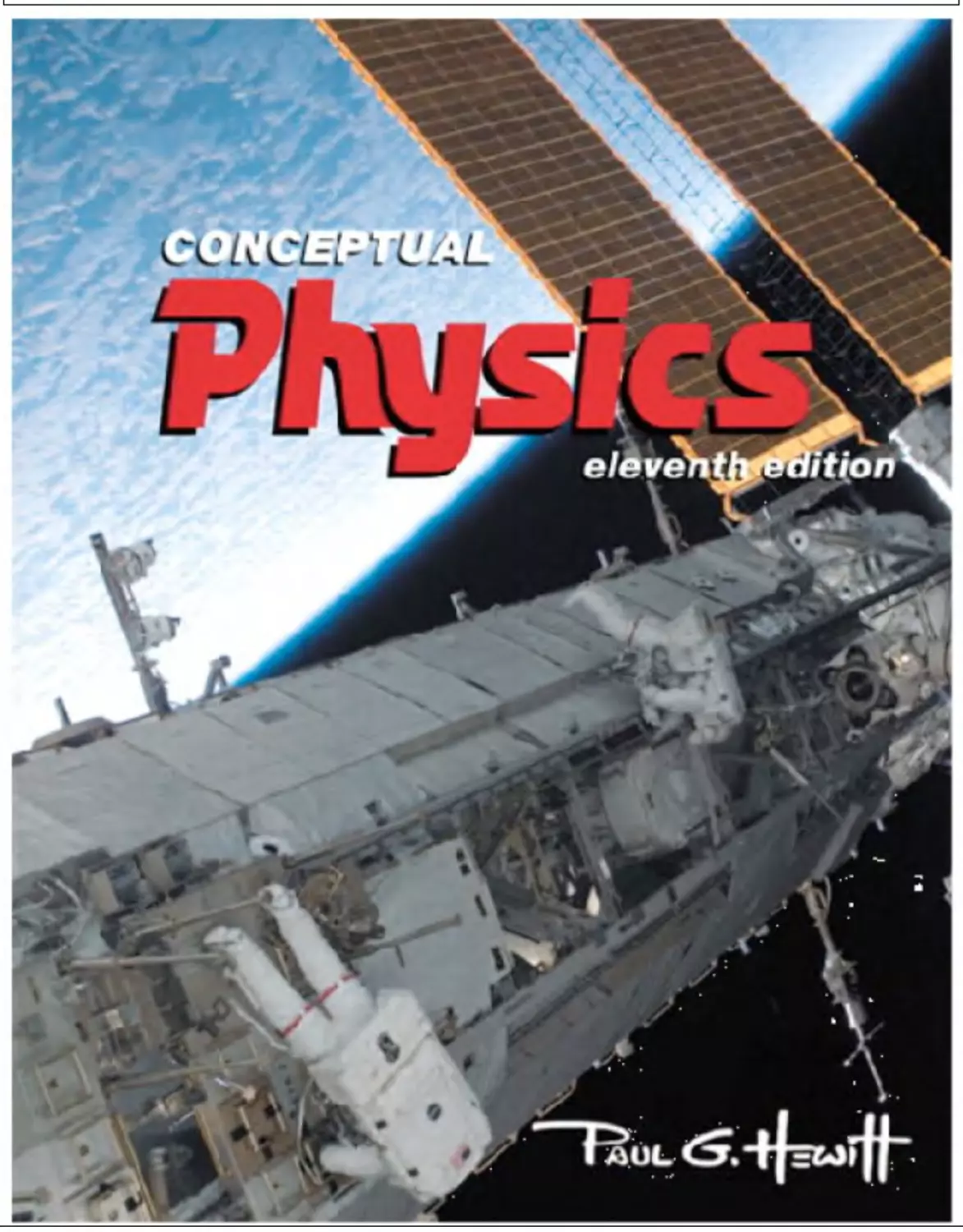
Cover Photo Credit: international Space Station (1SS),
NASA/Natiotul .Aeronautics and Space Administration
Library* of Congress Cataloging in-Publication Data
Hewitt. Paul G.
Conceptual physics / written and illustrated by Rnil G. Hewitt.—11 th ed.
p. cm.
Includes index.
ISBN-13: 978-0-321-56809-0
ISBN-10; 0-321-56009 5
1 PhpfcL I. 1:
QC23.2 H488 2010
53O-dc22	2009032499
Copyright © 2U10 Paul G. Hewitt. 300 Beach Drive NE, 1103. St. Petersburg. EL 33701. All rights reserved. Manufactured in
the United States of America. This publication is protected by Copyright and permission should be obtained from the publisher
prior to any prohibited reproduction, storage in a retrieval system, or transmission m any form or by any means, electronic,
mechanical. photocopying. recording. or likewise. To obtain permisyon(s) to use material from this work, please submit a written
request to Pearson Education. Inc.. Permissions Department, 1900 E. Lake Ave.. Glenview. IL 60025. For information regarding
permissions. call (847) 486 2635.
Many of the designations used by manufacturers and sellers tn distinguish their products are claimed as trademarks. Where
those designations appear in this book, and the publisher was aware of a trademark chinu the designations have been printed
in initial caps or all caps.
ISBN 10-digit 0-321 56809 $ (Student)
ISBN 13-digit 978-0-321-56809-0 [Student!
ISBN lU-dign 0-321-66263'6 [Instructor]
ISBN 13-digit 978-0-321-66263-7 (Instructor)
ISBN 10-digit 0-13-137583-0 [High School]
ISBN 13-digit 978-0-13-137583'3 [High School)
Addison-Wesley
Is an imprint of
PEARSON
www.pearsonhighcred.coen
1 2 3 4 5 6 7 8 9 10-WBC—14 13 12 11 10 09
To Lillian Lee Hewitt, Kenneth W. Ford, and
the memory of Ernie Brown
This page intentionally left blank
жа Photo Album
(onceptua! Physics is a very personal book, reflected
in its many photographs of family and friends,
beginning with three people to whom this edition is
dedicated—my mentor Ken Ford, my wife Lillian, and
my lifelong friend Ernie Brown. A personal profile of
Ken, former CEO of the American Institute of Physics,
opens Chapter 20 and indicates his passion for gliding.
Kens other passion, teaching with Germantown Acad-
emy high-school students in Pennsylvania, is shown on
page 620. Lillian is shown on page 1 and various other
photos scattered throughout the book. She holds our col-
orful pct conure, Sncedee, on page 478. Ernie Brown,
Conceptual Phvsics logo designer, is featured in the photo
opener to Chapter 8, with a cartoon likeness in Appendix
D, Figure D.7. Sadly, Ernie died in 2008 at the age of 82.
Fhe First Edition of Conceptual Physical Science was
dedicated to resourceful Charlie Spiegel, shown on page
462. Although Charlie passed away in 1996. his personal
touch carries over to this book.
Part opener photos arc of family and friends. The book
begins on page xxiv with my great nephew Evan Suchocki
(pronounced Su-hock-ee, with silent c) holding a per
chickie while sitting on my lap. Part One on page 17 is
my Hawaii friend Chiu Man Wus daughter Andrea,
when she was tour years old (repeated on pages 120 and
461). Chiu Man is on page 501. Pan Two on page 195 is
an Egyptian four-year old, Nour Tawfik Diab, niece of
friend Mona El Tawil-Nassar (on page 398). Then from
Italy. Part Three opens on page 267 with four-year old,
Francesco Ming Giovannuzzi, grandson of friends Keith
and Tsing Hardin. Keith took several of this hook's pho-
tos, including Tsing on page 228. Part Four, page 266. is
my grandson Alexander Hewitt. Part Five, page 381. is
my granddaughter Megan, daughter of Leslie and Bob
Abrams. Part Six, page 455, is Lillian's nephew, Joshua
Lee. Pan Seven» page 565, is Lillian s cousins, Sharon Yce
and Leslie Chew. My granddaughter Grace Hewitt begins
Part Eight on page 619.
To celebrate this Eleventh Edition, chapter-opening
photographs arc of teacher friends and colleagues,
mostly in their classrooms demonstrating physics typi-
cal of the chapter material. Their names, too numerous
to list here, appear with their photos.
City College of San Francisco friends and colleagues
open Chapters 2, 3, 13, 21, 26, 32, and 33. On page 92
we see Will Maynez with the air track he designed and
built, and again burning a peanut on page 299. Diana
Lininger Markham, physics department chairperson, is
shown on page 75.
Physics instructor friends from ocher colleges and univer-
sities include emeritus University of Hawaii Walter Steiger,
profiled in Chapter 30, and again shawm on page 588.
Man’ Beth Monroe demonstrates torque on page 129.
Retired physics instructor Evan Jones, in addition to open-
ing Chapter 30, shows the promise of LED light bulbs on
page 539. Chuck Stone shows an energy ramp on page 174.
Peter Hopkinton, who opens Chapter 28, tosses eggs on
page 98. John Hubisz, who opens Chapter 12, appears in
the entropy photo on page 327,
Physics teacher friends from high schools include
Chicago’s finest. Marshall Ellenstein, now retired, who
swings the water-filled bucket on page 136 and walks
barefoot on broken glass on page 244. His profile begins
Chapter 29. Marshall, a longtime contributor to this book
has produced the DVDs of my lectures, in San Francisco
(Conceptual Physics Alive!-— The San Franctsco Years) and
in Hawaii (ConceptualPhysics Alive!). He is presently edit-
ing 1982 classroom footage saved from CCSF archives by
librarian Judith Bergman. Other teachers from Illinois are
Ann Brandon, page 250. and lorn Senior, page 378.
Dean Baird, author of Conceptual Physics and Conceptual
Physical Science lab manuals is shown and profiled in
Chapter 17.
Family photos begin with the touching photo on page
72 of son Paul and his daughter Grace. On page 79 is
another photo that links touching to Newton’s third law;
my brother Steve with his daughter Gretchen at their cof-
fee farm in Costa Rica. Steves son Travis is seen on page
144, and his oldest daughter Stephanie on page 215. My
von Paul is again show n on pages 287 and 319. Daughter-
in-law Ludmila Hewitt holds crossed Polaroid* on page
523. I he endearing girl on page 202 is my daughter
Leslie Abrams, earth-science co-author of Conceptual
Physical Science textbooks. This colorized photo of Leslie
has been a trademark of Conceptual Physics since the
Third Edition. A more recent photo of her w ith husband
Bob is on page 456. Their children, Megan and Emily,
along with son Paul’s children, make up the colorful set of
photos on page 477. Granddaughter Emily is on page
520, and as mentioned. Megan on page 381. Photos of
my late son James arc on pages 140, 371» and 503. He left
me my first grandson, Manuel, seen on pages 219 and
360. Manuel’s grandmom. my wife Millie, who passed
away in 2004, bravely holds her hand above the acm e
XVI PHOTO ALBUM
pressure cooker on page 287. Brother Dave (no. not a
twin) and his wife Barbara demonstrate atmospheric pres-
sure on page 251. Their son Dave is on page 418, and
grandson John Perry Hewitt is on page 259. Sister
Marjorie Hewitt Suchocki, an author and emeritus the-
ologian at Claremont School of Theology, illustrates
reflection on page 489. Marjories son. John Suchocki,
author of Gratepmal Chemiswy, now in its fouith edition,
and chemistry co-author of the Conceptual Physical
Science textbooks» walks fearlessly across hot coals on page
500 (for emphasis, David Willey does the same on page
310). Talented nephew John is also a vocalist and guitarist
known as John Andrew in his popular CDs, seen with his
guitar on pages 351 and 443. The group listening co
music on page 375 arc pan of Johns and Tracy's wedding
рапу; from left to right, late Butch On. niece Cathy
Candler (on page 124). bride and groom, niece Joan
Lucas (on page 35). sister Marjorie. Tracy’s parents
Sharon and David Hopwood. teachers Kellie Dippel and
Mark Wcrkmcbtcr, and mysdf.
Photos of Lillian's family include her mom, Siu Bi к
Lee. who demonstrates solar power on page 295, and her
dad Wai Tsan Lee, who shows magnetic induction on page
428, Lillians niece and nephew. Allison and Erik Wong,
dramatically illustrate thermodynamics on page 325.
Personal friends who were my former students begin
with Lenny Lim. drawing her bow on page 106, which
has appeared in every book since the Sixth Edition. She is
presently a rocket engineer at Jet Propulsion Lab in
Pasadena and is profiled in Chapter 10. Tenn у is seen
with husband Mark Clark on page 134. Another of my
proteges is rocket-scientist Helen Yan. who develops satel-
lites for Lockheed Martin in Sunnyvale in addition to
stints at pan-time physics teaching. Her photos and pro-
file open Chapter 16. Helen is again shown on page 51 1
with Richard Feynman and Marshall Ellenstein. Alexei
Cogan demonstrates center of gravity* on page 134, and
the karate gal on page 87 is Cassy Cosme. On page 140
Cliff Braun is at the far left of my son James in Figure
8.50, with nephew Robert Baruffaldi at the far right.
Three dear friends who go back to my own school days
are Dan Johnson on page 315, his wife Sue on page 35
(the first rower in the racing shell), and Howie Brand on
page 83. Other cherished friends are Paul Ryan, who
drags his finger through molten lead on page 310, and
Tim Gardner, demonstrating Bernoulli's principle on
page 256. Lori Patterson is electrified on page 399 and
her son Ryan resonates on page 359. .My science influence
from sign-painting days is Burl Grey, page 26 (with a
sample sign-painting discussion on page 25). Also horn
the same eta is charismatic and very influential Jacquc
Fresco, whose profile opens Chapter 8. Larry and Tammy
lunison wear radiation badges on page 582 (Tammy’s
dogs are on page 301). Suzanne Lyons, co-author of
Conceptual Integrated Science textbooks poses with her
children Tristan and Simone on page 472. Phil Wolf, co-
author of the Problem Solving tn Conceptual Physics book
that accompanies this edition, is on page 547. Helping
create that book is high school teacher Diane Ricndeau.
on page 334 (and her son Tim on page 32).
Lhc inclusion of these people who arc so dear to me
makes Conceptual Physics all the more my labor of love.
To the Student
' You know you can't enjoy a game unless
you know its rules; whether it's a ball game, a
computer game, or simply a party game. Likewise, you
can't fully appreciate your surroundings until you
understand the rules of nature. Physics is the study of
these rules, which show how everything in nature is
beautifully connected. So the main reason to study
physics is to enhance the way you see the physical
world. You'll see the mathematical structure of physics
in frequent equations, but more than being recipes for
computation, you'll see the equations as guides to
. thinking.
I enjoy physics, and you will too
— because you'll understand it.
So go for comprehension of
concepts as you read this book,
and if more computation is on
your menu, check out Problem
Solving in Conceptual Physics,
the ancillary book by Phil Wolf
and me. Your understanding of
physics should soar.
Enjoy your physics!

XVII
To the Instructor
The sequence of chapters in this Eleventh Edition is identical to that of the
previous edition. New to this edition are the personality profiles at the outset
of every chapter. I was influenced to do this by David Bodanis’s popular book.
£ = лис*, in which the people behind physics discoveries are seen to be so fascinat-
ing. So each chapter highlights a scientist, teacher, or historical figure that comple-
ments the chapter material. Each chapter also begins with a photo montage of
professors, instructors, and teachers, who bring life to physics instruction.
As with the previous edition, Chapter 1, “About Science," begins your course on
a high note with coverage on early measurements of the Earth and distances to the
Moon and the Sun. It is hoped that the striking photos of wife Lillian surrounded
by spots of light on the sidewalk beneath a tall tree will prompt doing the Project at
chapters end that has students investigating the round spot cast by a small hole in a
piece of card held in sunlight. And going further to show that simple measurements
lead to finding the diameter of the Sun. This project extends to the Practice Book
and the Lab Manual. It’s one of my favorites.
Part One, “Mechanics,* begins with Chapter 2. which, as in the previous edition,
presents a brief historical overview of Aristotle and Galileo, progressing to Newtons
first law and io mechanical equilibrium. The high tone of Chapter I is maintained
as forces arc treated before velocity and acceleration. Students gel their fine taste of
physics via a very comprehensible treatment of parallel force vectors. They enter a
comfortable part of physics before being introduced to kinematics.
Chapter 5, “Linear Motion,” is the only chapter in Part One that is devoid of
physics laws. Kinematics has no laws, only definitions, mainly for speed, velocity and
acceleration—likely the least exciting concepts that your course has to offer. Too
often kinematics becomes a pedagogical “black hole" of instruction—too much
time for too little physics. Being more math than physics, rhe kinematics equations
can appear to the student as the most intimidating in the book. Although the expe-
rienced eye doesn't tec them as such, this is how students first see them:
" $6 +
<9 -	+ 2
i2 = л2 + W
i, = ’(ft +
If you wish to reduce class size, display these equations on the first day and
announce that class effort for much of the term will be making sense of them. Don’t
we do much the same with the standard symbols?
Ask any college graduate these two questions: What is the acceleration of an
object in free fall? What keeps Earth’s interior hot? You’ll see where their education
was focused, for many more will correctly answer the first question than the second.
Traditionally, physics courses have been top-heavy in kinematics with little or no
coverage of modem physics. Radioactive decay almost never gets the attention given
to falling bodies. So my recommendation is to pass quickly through Chapter 3,
making the distinction between velocity and acceleration, and then to move on to
Chapter 4, “Newton’s Second Law of Motion." where the concepts of velocity and
acceleration find their application.
Chapter 5 continues with Newtons third law. The end of the chapter treats the
parallelogram rule for combining vectors—first force vectors and then velocity
XVIII
TO THE INSTRUCTOR XIX
vector*. It also introduces vector components. More on vectors is found in Appen-
dix D, and especially in the Practice Book.
Chapter 6» “Momentum.” is a logical extension of Newtons third law. One reason
I prefer teaching it before teaching energy is that students find w much simpler and
easier to grasp than Another reason for treating momentum first is that the
vectors of the previous chapter arc employed with momentum but not with energy.
Chapter 7, “Energy," is a longer chapter, rich with everyday examples and cur-
rent energy concerns. Energy is central to mechanics, so this chapter has the greatest
number of exercises (64) in the chapter-end material. Work, energy, and power also
get generous coverage in the Practice Book
After Chapters 8 and 9 (on rotational mechanics and gravity), mechanics culmi-
nates with Chapter 10 (on projectile motion and satellite motion). Students arc
fascinated to learn that any projectile moving fast enough can become an Earth
satellite. Moving faster, it can become a satellite of the Sun. Projectile motion and
satellite motion belong together.
Part Two. “Properties of Matter,” begins with a new chapter on atoms. Chapters
on Solids. Liquids, and Gases, arc much rhe same as the previous edition. New
applications, some quite enchanting, increase the flavor of these chaplets.
Parts Three through Eight continue, like earlier parts, with enriched examples of
current technology. New lighting via CFU and LEDs arc introduced in Chapter 23
with more treatment in Chapter 30. The chapters with the fewest changes arc
Chapters 35 and 36 on special and general relativity, respectively.
At the end of each of the eight parts is a Practice Exam, most featuring 30
multiple-choice questions. Answers appear at the end of the book, along with
answers to all odd-numbered Exercises, Rankings and Problems. (Answers to sim-
pler Review Questions and Plug-and-Chugs are not listed.)
As with previous editions, some chapters include short boxed essays on such top-
ics as energy and technology, tailtoad train wheels, magnetic strips on credit cards,
and magnetically levitated trains. Also featured arc boxes on pseudoscience, culmi-
nating with the public phobia about food irradiation and anything nuclear. To the
person who works in the arena of science, who knows about the care, checking, and
cross-checking that go into understanding something, pseudoscientific misconcep-
tions arc laughable. But to those who don't work in the science arena, including
even your best students, pseudoscience can seem compelling when purveyors clothe
their wares in the language of science while skillfully sidestepping the tenets of sci-
ence. Our hope is to help stem this rising tide.
End-of-chaptrr material begins with a Summary of Terms. Following are
Review Questions that summarize the main points of the chapter. Students can
find the answers to these, word for word, in the leading. Unlike the more challeng-
ing end-of-chapter material, answers to Review Questions are not given at the end
of the book or in the кшгш. wr Manual, Likewise, no answers arc given for the Plug
and Chug problems. These require only single-step solutions, a simple plug-in of
numerical quantities to familiarize the student with the equations of the chapter.
ITicy appear only in more equation-oriented chapters.
New' to this edition arc Rankings. Critical thinking is required in comparing
quantities for similar situations. Getting an answer is not enough. The answer must
be compared with others and a ranking from most to least is asked for. 1 consider
this rhe most worthwhile of rhe chapter-end material.
Exercise* arc the nuts and bolts of conceptual physics. Many requite critical
thinking, while some ate designed to connect concepts to familiar situations. Most
chapters have From 50 to 60 Exercises. Solutions to odd-numbered Exercises are
found at the end of the book, and all solutions arc in the Inftruitor Manual.
More math-physics challenges are found in the sets of Problems. As with Rank-
ings and Exercises, odd-numbered solutions arc at the back of the book, and all
XX TO THE INSTRUCTOR
solutions appear in (he Instructor Manual. The problems are much less numerous
than Exercises. Many more problems arc available in the student supplement»
Problem Solving in Conceptual Physics, co-authored with Phil Wolf. While
problem solving is not the main thrust of a conceptual course, Phil and I, like most
physics instructors, nevertheless love solving problems. In a novel and student-
friendly way. our supplement features problems that arc more physics than math,
nicely extending ConctptwilPhytic*—even to courses that feature problem solving.
We think that many professors w ill enjoy the options offered by this student sup-
plement to the textbook. Problem solutions arc included in the instructor
Resources area oi l he Physics Plate.
The most important ancillary to this book is the Practice Book, which contains
the most creative of my writing and drawings. 1’hcse work pages guide students step
by step toward understanding the central concepts. ’There are one or more practice
pages fbr nearly every chapter in the book. They can be used inside or outside of
class. In my teaching 1 passed out copies of selected pages as a home tutor.
The Laboratory Manual that accompanies this edition provides a great variety
of activities and lab exercises. Available fbr purchase.
Next-Time Questions, familiar to readers of The Physics Teacher as Figuring
Physics, arc now available electronically. When sharing these with your classes,
please do not show a question and follow it with the answer. Let there be a sufficient
“Wait-time” between the question and the answer. Allow your students to argue over
the answer before showing it “next time” (which at minimum should be the next
class meeting, or even next week). More learning occurs when students ponder
answers before being given them. Next-Time Questions are now in a horizontal for-
mat to make them more compatible with computer monitors and PowerPoint"
displays. Next-Time Questions arc included on rhe Instructor Resource DVD, as
well as in the Instructor Resources area ofThc Physics Place. They arc also available
at the click of a mouse on the /Vborsci.com website.
I'hc Instructor Manual for the textbook and Labtinuaty Manual. like previous
ones, features demonstrations and suggested lectures for every chapter. It includes
answers to the cnd-of-chapcer material as cited above. If you’re new to teaching
this course, you'll likely find it enormously useful. It sums up the “what-works” in
my quarter-century of teaching.
The Instructor Resource DVD provides a wealth of presentation tools to help
support your instruction. It includes more than 100 video clips of my favorite class-
room demonstrations, more than 150 interactive applets developed specifically to
help you illustrate particularly tricky concepts, a full set of lecture outlines for each
chapter in PowerPoint, and chaptcr-by-chaptcr weekly in-class quizzes in PPT tor
use with Classroom Response Systems (easy-to-use wireless polling systems chat
allow you to pose questions in class, have each student vote, and then display and
discuss results in real time). I he* IR DVD also provides all the art and photos from
the book (in high-resolution jpeg format), the Jest Bank, Next-lime Questions,
and the Instructor Manual in editable Word format.
For out-of-dass help for your students, a critically acclaimed website found at
http://www.physicsplace.com provides a wealth of study resources. The Physics
Place is the most educationally advanced, most highly rated by students, and most
widely used website available fbr students taking this course. The website includes
students’ favorite interactive online rutonals (covering topics that many of you
requested), and a library of Interactive Figures (key figures from each chapter in the
book that arc better understood through interactive experimentation owing to
reasons of scale, geometry, time evolution, ot multiple representation). Through
(Ik website students can also access (he Pearson cTcxt, an online version of the text
with highlighting, notes, and search functions. as well as media linked directly from
the text. Videos, quizzes, flashcards, a glossary, and a wrealth of other chapter-
specific study aids are also provided.
TO THE INSTRUCTOR XIX
vector*. It also introduces vector components. More on vectors is found in Appen-
dix D, and especially in the Practice Book.
Chapter 6» “Momentum.” is a logical extension of Newtons third law. One reason
I prefer teaching it before teaching energy is that students find w much simpler and
easier to grasp than Another reason for treating momentum first is that the
vectors of the previous chapter arc employed with momentum but not with energy.
Chapter 7, “Energy," is a longer chapter, rich with everyday examples and cur-
rent energy concerns. Energy is central to mechanics, so this chapter has the greatest
number of exercises (64) in the chapter-end material. Work, energy, and power also
get generous coverage in the Practice Book
After Chapters 8 and 9 (on rotational mechanics and gravity), mechanics culmi-
nates with Chapter 10 (on projectile motion and satellite motion). Students arc
fascinated to learn that any projectile moving fast enough can become an Earth
satellite. Moving faster, it can become a satellite of the Sun. Projectile motion and
satellite motion belong together.
Part Two. “Properties of Matter,” begins with a new chapter on atoms. Chapters
on Solids. Liquids, and Gases, arc much rhe same as the previous edition. New
applications, some quite enchanting, increase the flavor of these chaplets.
Parts Three through Eight continue, like earlier parts, with enriched examples of
current technology. New lighting via CFU and LEDs arc introduced in Chapter 23
with more treatment in Chapter 30. The chapters with the fewest changes arc
Chapters 35 and 36 on special and general relativity, respectively.
At the end of each of the eight parts is a Practice Exam, most featuring 30
multiple-choice questions. Answers appear at the end of the book, along with
answers to all odd-numbered Exercises, Rankings and Problems. (Answers to sim-
pler Review Questions and Plug-and-Chugs are not listed.)
As with previous editions, some chapters include short boxed essays on such top-
ics as energy and technology, tailtoad train wheels, magnetic strips on credit cards,
and magnetically levitated trains. Also featured arc boxes on pseudoscience, culmi-
nating with the public phobia about food irradiation and anything nuclear. To the
person who works in the arena of science, who knows about the care, checking, and
cross-checking that go into understanding something, pseudoscientific misconcep-
tions arc laughable. But to those who don't work in the science arena, including
even your best students, pseudoscience can seem compelling when purveyors clothe
their wares in the language of science while skillfully sidestepping the tenets of sci-
ence. Our hope is to help stem this rising tide.
End-of-chaptrr material begins with a Summary of Terms. Following are
Review Questions that summarize the main points of the chapter. Students can
find the answers to these, word for word, in the leading. Unlike the more challeng-
ing end-of-chapter material, answers to Review Questions are not given at the end
of the book or in the кшгш. wr Manual, Likewise, no answers arc given for the Plug
and Chug problems. These require only single-step solutions, a simple plug-in of
numerical quantities to familiarize the student with the equations of the chapter.
ITicy appear only in more equation-oriented chapters.
New' to this edition arc Rankings. Critical thinking is required in comparing
quantities for similar situations. Getting an answer is not enough. The answer must
be compared with others and a ranking from most to least is asked for. 1 consider
this rhe most worthwhile of rhe chapter-end material.
Exercise* arc the nuts and bolts of conceptual physics. Many requite critical
thinking, while some ate designed to connect concepts to familiar situations. Most
chapters have From 50 to 60 Exercises. Solutions to odd-numbered Exercises are
found at the end of the book, and all solutions arc in the Inftruitor Manual.
More math-physics challenges are found in the sets of Problems. As with Rank-
ings and Exercises, odd-numbered solutions arc at the back of the book, and all
XX TO THE INSTRUCTOR
solutions appear in (he Instructor Manual. The problems are much less numerous
than Exercises. Many more problems arc available in the student supplement»
Problem Solving in Conceptual Physics, co-authored with Phil Wolf. While
problem solving is not the main thrust of a conceptual course, Phil and I, like most
physics instructors, nevertheless love solving problems. In a novel and student-
friendly way. our supplement features problems that arc more physics than math,
nicely extending ConctptwilPhytic*—even to courses that feature problem solving.
We think that many professors w ill enjoy the options offered by this student sup-
plement to the textbook. Problem solutions arc included in the instructor
Resources area oi l he Physics Plate.
The most important ancillary to this book is the Practice Book, which contains
the most creative of my writing and drawings. 1’hcse work pages guide students step
by step toward understanding the central concepts. ’There are one or more practice
pages fbr nearly every chapter in the book. They can be used inside or outside of
class. In my teaching 1 passed out copies of selected pages as a home tutor.
The Laboratory Manual that accompanies this edition provides a great variety
of activities and lab exercises. Available fbr purchase.
Next-Time Questions, familiar to readers of The Physics Teacher as Figuring
Physics, arc now available electronically. When sharing these with your classes,
please do not show a question and follow it with the answer. Let there be a sufficient
“Wait-time” between the question and the answer. Allow your students to argue over
the answer before showing it “next time” (which at minimum should be the next
class meeting, or even next week). More learning occurs when students ponder
answers before being given them. Next-Time Questions are now in a horizontal for-
mat to make them more compatible with computer monitors and PowerPoint"
displays. Next-Time Questions arc included on rhe Instructor Resource DVD, as
well as in the Instructor Resources area ofThc Physics Place. They arc also available
at the click of a mouse on the /Vborsci.com website.
I'hc Instructor Manual for the textbook and Labtinuaty Manual. like previous
ones, features demonstrations and suggested lectures for every chapter. It includes
answers to the cnd-of-chapcer material as cited above. If you’re new to teaching
this course, you'll likely find it enormously useful. It sums up the “what-works” in
my quarter-century of teaching.
The Instructor Resource DVD provides a wealth of presentation tools to help
support your instruction. It includes more than 100 video clips of my favorite class-
room demonstrations, more than 150 interactive applets developed specifically to
help you illustrate particularly tricky concepts, a full set of lecture outlines for each
chapter in PowerPoint, and chaptcr-by-chaptcr weekly in-class quizzes in PPT tor
use with Classroom Response Systems (easy-to-use wireless polling systems chat
allow you to pose questions in class, have each student vote, and then display and
discuss results in real time). I he* IR DVD also provides all the art and photos from
the book (in high-resolution jpeg format), the Jest Bank, Next-lime Questions,
and the Instructor Manual in editable Word format.
For out-of-dass help for your students, a critically acclaimed website found at
http://www.physicsplace.com provides a wealth of study resources. The Physics
Place is the most educationally advanced, most highly rated by students, and most
widely used website available fbr students taking this course. The website includes
students’ favorite interactive online rutonals (covering topics that many of you
requested), and a library of Interactive Figures (key figures from each chapter in the
book that arc better understood through interactive experimentation owing to
reasons of scale, geometry, time evolution, ot multiple representation). Through
(Ik website students can also access (he Pearson cTcxt, an online version of the text
with highlighting, notes, and search functions. as well as media linked directly from
the text. Videos, quizzes, flashcards, a glossary, and a wrealth of other chapter-
specific study aids are also provided.
TO THE INSTRUCTOR XXI
All of these innovative, targeted, and effective online learning media are easily
integrated in your course using an online gradebook {allowing you to “assign” the
tutorials, quizzes, and other activities as out-of-dass homework or projects that are
automaticaDy graded and recorded), simple icons throughout the text {highlighting
for you and your students key tutorials, Interactive Figures, and other online
resources), and the Instructor Resource DVD. A chapter guide section on The
Physics Place summarizes the media available to you and your students, chapter by
chapter.
For mote information on the support ancillaries, check out hnp://www.
pcarsorihighctvdxoin/physics or contact your Ptarson Addison-Wesley representative,
or contact me, I’ghewitt&iokom.
What’s New in This Edition
Unlike previous editions, every chapter in this Eleventh Edition begins with a
several-paragraph profile of a physicist or educator who is linked to the chap-
ter content. By learning more about the people behind the chapter content, the
reader gets a more personalized Havor of physics.
For the first time, the chapter-end material has Ranking Exercises, which elicit
critical student thinking that goes beyond that needed for another new and simpler
feature, the Plug and Chug exercises. When asked to rank quantities such as
momentum or kinetic energy, much more judgment is called for than tlut needed
in providing numerical answers. Also unlike previous editions, a page of multiple-
choice practice questions are at the end of each of the eight parts of the book.
The problem seis have been revised for greater success with math-challenged stu-
dents. In each sec of problems, the last one is a challenging one, noted with a •. For
the first time, solutions to odd-numbered Exercises and Problems (and now' Rank-
ings) are at the end of the book for students to check. More challenging problems
are presented in the second edition of the ancillary book. Problem Solving in Con-
ceptual Physia.
In addition to these sweeping changes, updates such as wingsuit Hying are in
Chapter 4. the latest on energy sources and power production are included in
Chapter 7. and the fascinating Falkirk Wheel in Scotland is featured in the physics
of liquids m Chapter 12. Waves and vibrations in Chapters 19-21 have been
updated with current technology, such as blue-ray compact discs. In the chapters on
dcctricity and light, compact fluorescent and light-emitting diodes are now
featured.
Acknowledgments
1am enormously grateful to Ken Ford for checking this edition for accuracy and
for his many insightful suggestions. Many wars ago, I admired Ken's own
books, one of which, Azuc Physics, first inspired me to write Conceptual Physics.
Today 1 am honored that he has given so much of his time and energy to assist in
making this edition, what he calls, my most beautiful ever. Errors insatiably crop
up after manuscript is submitted, so I take full responsibility for any errors that have
survived hb scrutiny.
For insightful additions to this edition I thank my wife Lillian, Marshall Elknstcin,
and Evan Jones. Lil made many suggestions for keeping examples updated. She and
Marshall convinced me to include the personal profiles of people of science, ala David
Bodanis book E " we*. Evan helped me update lighting via CFLs and LEDs,
and came up with the striking billboard photo that opens Chapter 30.1 appreciate the
suggestions of Tomas Brage, John Hubisz. Carlton Lane. David Kagan. Sebastian
Kuhn, Anne Tabor-Morns, Fred Myers, Chris Thron. and P.O. Zetterberg.
For valued suggestions carried over from previous editions, 1 thank my friends
Dean Baird, Howie Brand. George Curtis, Marshall El lens t ci n. Mona El Tawil-
Nassar, Herb Gottlieb, Jim Hicks, Peter Hopkinson. John Hubisz, David Kagan,
Dan Johnson, Juliet layugan. Paul McNamara. Fred Myers, Kenn Sherry, Chink
Stone. Diane Riendeau, Pablo Robinson. Lawrence Weinstein, and Phil Wolf.
Others who provided suggestions in years past include Matthew Griffiths, Paul
Hammer. Francisco Izaguirre. Les Sawyer. Dan Sulkc. and Richard W Ганга. 1 am
forever grateful to the input of my Exploratorium friends and colleagues: Judith
Brand. Paul Doherty; Ron Hipschman, Eric Mullen and Modesto Tamez.
For photos, in addition to my wife I thank Bob Abrams, Dean Baird. Keith
Bardin, Howie Brand. Mark Clark. Anne Cox, Ken Ford. Burl Grey, my brother
Dave Hewitt, my son Paul Hewitt, Ludmila Hcwitr, Ron Hipschman. Suzanne
Lyons, Will Maynez. Eric Muller, Fred Myers. Milo Patterson. Jay Pasachoff, Diane
Reindeau, Roger Rassool, John Suchocki. and David Willey.
I remain grateful to die authors of books that initially x*ned as influences and
references many years ago: Theodore Ashford, From Atoms to Stan; Albert Baez. The
New College Physics: A Spiral Approach; John N. Cooper and Alpheus W Smith,
Elements of Physics; Richard P Feynman, The Feynman Lectures on Physics; Kenneth
Ford, Basic Physics; Eric Rogers, Physics for the Inquiring Mind; Alexander Taftel.
Physics: Its Methods and Meanings. UNESCO, 700 Science Experiments for Everyone:
and I larvcy E. White. Descriptive College Physics. I’m thankf ul to Bob Park, whose
book Voodoo Science motivated me to include boxes on pseudoscience.
For rhe Problem Solving in Conceptual Physics ancillary, co-authored with Phil
Wolf, we both thank I cing Bardin. Howie Brand, George Curtis, Ken Hird. Herb
Gottlieb, Jim Hicks, David Housden, Chekie Liu, Evan Jones, Fred Myers, Stan
Schiocchio, Diane Riendeau, and David Williamson for valuable feedback.
1 am particularly grateful to my wife, Lillian Lee Hewitt, for her assistance in all
phases of book-and-ancillary preparation. I'm grateful to my niece Gretchen Hewitt
Rojas for keyboarding help. Thanks go to my lifelong friend Ernie Brown for
designing the physics logo and for chapter headers in the new problems book.
For their dedication to this edition, 1 am grateful to the stall at Addison Wesley* in
San Francisco. I am especially thankfill to Chandnka Madhavan and Editor-in-Ghicf
XXII
ACKNOWLEDGMENTS XXIII
Jim Smith. A note of appreciation is dor Chine Masson for the cyberspace compo-
nents chat go back several edition». I thank David Vasquez. my dear friend of many
years, and Suzanne Lyons, for their insightful tutorials. And I thank Sylvia Rebert
and the production folks at Progressive Publishing .Alternatives for their patience
with my last-minute changes. Lve been blessed with a first-rate team!
Paul G. Hewitt
St. Petersburg. Florida

About Science
1 I he circular ipors of light unrounding Lillian are 'pinhole' images of the Sain, cask
through small openings between leaves above 2 The spots would no longer be full cirdes
as the Moon progresses in front of rhe Sun. 5 The rendered photo at the right shows that
the spots would be crescents during a partial solar edipse.
Being second best was not all that bad for
Greek mathematician Eratosthenes of Gyrene
(276-194 Be:). He was nicknamed "beta” by his contem-
poraries who judged him second best in many Helds,
including mathematics, philosophy, athletics, and astron-
omy. IVihaps he took second prizes in running or
wrestling contests. He was one of the early librarians at the
world's then greatest library, the Mouscion, in Alexandria.
Egypt, founded by Ptolemy II Sorer. Eratosthenes was one
of the foremost scholars of his time and wrote on philo-
sophical, scientific, and literary matters. His reputation
among his contemporaries was immense—Archimedes
dedicated a book to him. As a mathematician, he in sen ted
a method fbr finding prime numbers. As a geographer, he
measured the till of Earths axis with great accuracy and
wrote Crfogntphy, the first book to give geography a mathe-
matical basis and io treat Earth as a globe divided by lati-
tudes and into fngid, temperate, and torrid zones
fhc classical works of Greek literature were pre-
served at the Mouseion, which was host to numerous
scholars and contained hundreds of thousands of
papyrus and vellum scrolls. But this human treasure
wasn't appreciated by everybody. Much information in
the Mouseion conflicted with cherished beliefs held by
others. Threatened by its “heresies/ the great library
was burned and completely
destroyed. Historians arc unsure
of (he culprits—who were likely
guided by the certainty of their
truths. Being absolutely certain,
having absolutely no doubts, is
certitude—the root cause of
much of the destrucuon, human
and otherwise, in the centuries
that followed. Eratosthenes did-
n't witness the destruction of his
great library, for it occurred after
his lifetime.
Ibday Eratosthenes is most remembered for his
amazing calculation of Earth's size, with remarkable
accuracy {two thousand years ago with no computers,
no artificial satellites—using only good thinking, geom-
etry, and simple measurements). In this chapter you will
see how he accomplished this.
2 CHAPTER 1 ABOUT SCIENCE
• Science is the body of knowledge
that describes the order within
nature and the causes of that
order Sciences also an ongoing
human xtr^ty that represents the
collective efforts findings and wis-
dom of the human race, an activity
that is dedicated to gathering
knowledge about the world a rd
organizing and condensing it into
testable laws and theories Science
had its beginnings before recorded
history, whe n peo pie first discov-
ered regularities and relationships
in nature, such as star patterns in
the night sky and weather
patterns—when the rainy season
started or when the days grew
longer From these regularities,
people learned to make predic-
tions that gave them some control
over thc*r surroundings
Science made great headway in
Greece in the 4th and 3rd centimes
to., and spread throughout the
Mediterranean world Scientific
advance came to a near halt in
Europe when the Roman E mpire
fell in the 5th century ли Barban an
hordes destroyed almost every-
thing in their paths as they overran
Europe Reason gave way to reli-
gion. which ushered in what came
10 be known as tire Dark Ages. Dur -
mg th»s time, the Chinese and Poly-
nesians were charting the stars
and the planets and Arab nations
were developing mathematics and
learning about the production of
glass, paper, metals, and various
chemicals Greek science was re-
introduced to Europe by Islamic
influences that penetrated into
Spain during the 10th. 11th. and
12th centuries Universities emerged
m Europe in the ijth century, and
the introduction of gun powd er
charged the social ard political
structure of E urope m the
14th century The 15th century saw
ad and science beautifully Wended
by Leonardo da Vina. Scientific
thought was furthered in the
16th century with the advent of the
printing press
 Scientific Measurements
Measurements are a hallmark of good science. How much you know about
something is often related co how well you can measure it. This was well
put by the famous physicist Lord Kelvin in the 19th century: MI often say that
when you can measure something and express it in numbers, you know something
about it. When you cannot measure it, when you cannot express it in numbers,
your knowledge is of a meager and unsatisfactory kind It may be the beginning
of knowledge, but you have scarcely in your thoughts advanced to rhe stage of
science, whatever it may be.” Scientific measurements arc not something new but
go back to ancient times. In the 3rd century BC, for example, fairly accurate meas-
urements were made of the sizes of Earth. Moon, and Sun, as well as of the
distances between them.
HOW ERATOSTHENES MEASURED THE SIZE OF EARTH
The size of Earth was first measured in Egypt by Eratosthenes about 235 BC. He cal-
culated the circumference of Earth in the following way. He knew that the Sun is
highest in the sky at noon on June 22, the summer sobtke. At this time, a vertical
stick casts its shortest shadow If rhe Sun is directly overhead, a vertical stick casts
no shadow at all. which occurs at the summer solstice in Syene, a city’ south of
Alexandria (where the Aswan Dam stands today). Eratosthenes learned that the
Sun was directly overhead at the summer solstice in Syene from library information,
which reported that, at this particular time, sunlight shines directly down a deep
well in Syene and is reflected back up again. Eratosthenes reasoned that, if the Suns
rays weic extended into Earth at this point, rhe}* would pass through the center.
Likewise, a vertical line extended into Earth at Alexandria (ot anywhere else) would
also pass through Earths center.
At noon on June 22. Eratosthenes measured the shadow cast by a vertical pillar
in Alexandria and found it to be 1/8 the height of the pillar (Figure 1,1). This cor-
responds to a 7. Г angle between the Sun's rays and the vertical pillar. Since 7. Г is
7.1/360, or about 1/50 of a circle, Eratosthenes reasoned that the distance between
.Alexandria and Syene must be 1/50 the circumference of Earth. Thus the circum-
ference of Earth becomes 50 rimes rhe distance between these two cities. This dis-
tance. quite Hat and frequently traveled, was measured by surveyors to be about
FIGURE 1.1
VC Ten the Sun is directly overhead at Syene. it ix nor directly overhead in Alexandria.
800 km north. When the Sunt rays shine directly down a vertical well in Syene, they cast a
xhadow of a vertical pillar in Alexandria. The verticals at both locations extend to the
center of Earth, and they make the same angle that the Sun s rays make with the pillar at
Alexandria. Eratosthenes measured this angle ro be l/SO of a complete circle. Therefore,
the distance between .Alexandria and Syene is 1/50 Earths circumference.
CHAPTER! ABOUT SCIENCE 3
5OOO stadia (800 kilometers). So Eratosthenes cakukucd Earths circumference to
be 50 X 5000 stadia = 250,000 stadia. This is very close to the currently accepted
value of Earths circumference.
We get rhe same result by bypassing degrees altogether and comparing the length
of the shadow cast by the pillar to the height of rhe pillar. Geometrical reasoning
shows, to a dose approximation, that the ratio shadow length/ptUar height is the same
as the ratio distance between Alexandria and Syene/Earrhs radius. So just as the pillar
is 8 times greater than its shadow, the radius of Earth must be 8 times greater than
the distance between Alexandria and Syene.
Since the circumference of a circle is lit times its radius (C = 2 nr), Earth's
radius is simply its circumference divided by 2тг. In modern units. Earths radius is
6370 kilometers and its circumference is 40.000 km.
SIZE OF THE MOON
Aristarchus was perhaps the first to suggest that Earth spins on a daily axis, which
accounted for the daily morion of the stars. He also hypothesized that Earth
moves around the Sun in a yearly orbit and that the other planets do likewise.1
He correctly measured the Moons diameter and its distance from Earth. He did
all this in about 240 BC, seventeen centuries before his findings became fully
accepted.
Aristarchus compared rhe size of the Moon with the size of Earth by watching an
eclipse of the Moon. Earth, like any body in sunlight, casts a shadow. An eclipse of
thr Moon is simply the event wherein the Moon passes into this shadow.
Aristarchus carefully studied this event and found that the width of Earths shadow
out at the Moon was 2.5 Moon diameters. This would seem to indicate that the
Moon’s diameter is 2.5 times smaller than Earths. But because of the huge size of
the Sun, Earth’s shadow tapers, as evidenced during a solar eclipse. (Figure 1.2
shows this in exaggerated scale.) At that time. Earth intercepts the Moon’s
Moon's orbit
li$ht rays from
upper edge of Sim
Light rays from
lower edge of Sun
/
Moon during
solar eclipse
I Moon's shadow
\ tapers 1 Moon diameter
\
Earth
Earth's shadow is 2.5 times
wider than Moon
Moon during
lunar eclipse
fyi
 The 16th-century Polish astronomer
Nicolaus Coperncus caused great
controversy when he published a
book proposing that the Sun is sta-
tionary and that Earth revolves
around the Sun These ideas con-
flicted with the popular v*ew that
Earth was the center of the uni-
verse They also conflicted with
Church teachings and were banned
for zoo years The Italian physicist
Galileo Galilei was arrested for pop-
ularizing the Copernican theory
and for some astronomical discov-
eries of his own Yet a century later,
the ideas of Copermcus and Galileo
were generally accepted.
This kind of eye к happens age
after age. m the early 1800s, geolo-
gists met with violent condemn*
tion because they differed with the
Genesis account of creation Later
m the same century geology was
accepted, but theories of evolution
were condemned and the teaching
of them was forbidden Every age
has its groups of intellectual rebels
who are condemned and some-
times persecuted at the time but
who later seem harmless and often
essential to the elevation of human
conditions. As Count M. Maeterlinck
wisely said, "At every cross way on
the road that leads to the future,
each progressive spirit is opposed
by a thousand men appointed to
guard the past ’
FIGURE 1.2
During a lunar eclipse. Earths
shaduw is observed to be 2-5 times as
wide as die Moon's diameter. Because
of the Sun s large dxe, Earth’s shadow
must taper, lhe amount of taper is
evident during a solar eclipse, where
the Moons shadow tapers a whole
Moon diameter from Moon to Earth.
So Earths shadow tapers the same
amount in the same distance.
Therefore, Earths diameter must be
3.5 Moon diameters
1 Amtarchua was unsure of his heliocentric hypothesis. Likely because L.anhi uotx|taal камин seemed not
to support the idea that Earth circles the Sun More vnportant. it was noted tint the Moons dtstanct
trixn Earth varies—clear evidence chat the Moon <1<ж» nit perfectly circle farrh. It rhe Moon does nor
follow a circular path about Earth, it was hard to argue that Earth follows a circular path about the Sun
Пк explanation, the rlliptkd path* of planets, was nor discovered until cell cutie» later In Johannes
Kepler. In the meantime, the epicycles proposed by other astronomers accounted foe these discrepancies.
It is interesting to speculate about die count ol XMnmomv it the Moon d*dn t cxiat. Its irregular orbit
would not have contributed to the eady discrediting of the hehocentnc theory, wluch might base taken
hold centuries earlier.
4 CHAPTER 1 ABOUT SCIENCE
shadow—but just hardy. The Muons shadow tapers almost to a point at Earths
surface» evidence that the taper of the Moons shadow at this distance is 1 Moon
diameter. So during a lunar eclipse Earths shadow, covering the same distance» must
also taper I Moon diameter. Taking the tapering of the Suns rays into account.
Earths diameter must be (2.5 ♦ 1) times the Moons diameter. In this way.
Aristarchus showed that the Moons diameter is 1/3.5 that of Earth’s. The presently
accepted diameter of the Moon is 3640 km. within 5% of the value calculated by
Aristarchus.
Sun
Moons orbd
Earth
(too small to see)
FIGURE 1.1
Correct scale of solar and lunar eclipses, which shows why eclipses arc rare. ( Jhey are
even rarer because the .Moons orbit is tilted about 5* from the plane of Earth's orbit about
the Sun.)
DISTANCE TO THE MOON
Гарс a small coin» such as a dime, to a window and view it with one eye so that it
just blocks out the full Moon. Ibis occurs w hen your eye is about 110 coin diame-
ters away. ТЪсп the ratio of coin diamctcr/cotn dutoncc is about 1/110. Geometrical
reasoning of similar triangles shows this is also the ratio of Moon diameter/Moon dis-
tance (Figure 1.4). So the distance to the Moon is 110 times the Moon’s diameter.
I he early Greeks knew this. Aristarchus's measurement of die Moon's diameter w as
all that was needed to calculate the Earth-Moon distance. So the early Greeks knew
both the size of the Moon and its distance from Earth.
Diameter of Moon
Diameter of coin
' Distance to coin
Distance to Moon
Coin diameter	Moon diameter 1
Coin distance	Moon distance	110
FIGURE 1.4
An exercise in ratios: When rhe coin barely “eclipses’ the Moon, then the diameter of rhe
coin to the distance between you and the coin is equal to the diameter of the Muon to the
distance between you and the Moon (not to scale here). Measurements give a rano of
1/110 fur both.
With this information. Aristarchus made a measurement of the Earth-Sun
distance.
DISTANCE TO THE SUN
If you were co repeat the coin-on-the-window-and-Moon exercise for the Sun
(which would be dangerous to do because of the Suns brightness)» guess what: The
ratio Sun diarnctcr/Sun distance is also 1/110. Th is is because the size of the Sun and
4 CHAPTER 1 ABOUT SCIENCE
shadow—but just hardy. The Muons shadow tapers almost to a point at Earths
surface» evidence that the taper of the Moons shadow at this distance is 1 Moon
diameter. So during a lunar eclipse Earths shadow, covering the same distance» must
also taper I Moon diameter. Taking the tapering of the Suns rays into account.
Earths diameter must be (2.5 ♦ 1) times the Moons diameter. In this way.
Aristarchus showed that the Moons diameter is 1/3.5 that of Earth’s. The presently
accepted diameter of the Moon is 3640 km. within 5% of the value calculated by
Aristarchus.
Sun
Moons orbd
Earth
(too small to see)
FIGURE 1.1
Correct scale of solar and lunar eclipses, which shows why eclipses arc rare. ( Jhey are
even rarer because the .Moons orbit is tilted about 5* from the plane of Earth's orbit about
the Sun.)
DISTANCE TO THE MOON
Гарс a small coin» such as a dime, to a window and view it with one eye so that it
just blocks out the full Moon. Ibis occurs w hen your eye is about 110 coin diame-
ters away. ТЪсп the ratio of coin diamctcr/cotn dutoncc is about 1/110. Geometrical
reasoning of similar triangles shows this is also the ratio of Moon diameter/Moon dis-
tance (Figure 1.4). So the distance to the Moon is 110 times the Moon’s diameter.
I he early Greeks knew this. Aristarchus's measurement of die Moon's diameter w as
all that was needed to calculate the Earth-Moon distance. So the early Greeks knew
both the size of the Moon and its distance from Earth.
Diameter of Moon
Diameter of coin
' Distance to coin
Distance to Moon
Coin diameter	Moon diameter 1
Coin distance	Moon distance	110
FIGURE 1.4
An exercise in ratios: When rhe coin barely “eclipses’ the Moon, then the diameter of rhe
coin to the distance between you and the coin is equal to the diameter of the Muon to the
distance between you and the Moon (not to scale here). Measurements give a rano of
1/110 fur both.
With this information. Aristarchus made a measurement of the Earth-Sun
distance.
DISTANCE TO THE SUN
If you were co repeat the coin-on-the-window-and-Moon exercise for the Sun
(which would be dangerous to do because of the Suns brightness)» guess what: The
ratio Sun diarnctcr/Sun distance is also 1/110. Th is is because the size of the Sun and
CHAPTER! ABOUT SCIENCE 5
Moon arc both the same to the eye, They both taper the same angle (about 0.5е).
So, although the ratio of diameter to distance was known to the early Greeks, di am
eter alone or distance alone would have to be determined by some other means.
Aristarchus found a method tor doing this. Here's what he did.
Aristarchus watched lor the phase of the Moon when it was exactly half full, with
the Sun still visible in the sky. Then the sunlight must be falling on the Moon at
right angles to his line of sight. This meant that the lines between Earth and the
Moon, between Earth and the Sun. and between the Moon and the Sun form a
right triangle (Figure 1.5).
FIGURE 1.1
When the Moon appears exactly half
full, the Sun, Moon. and Earth form
a right triangle (not to scale). 1Ъс
hypotenuse is the Earth-Sun
distance. By simple trigonometry, the
hypotenuse of a right mangle can be
found if you know the value of cither
nonright angle and the length of one
side. The Earth Moon distance is a
known side. Measure angle A a nd
you can calculate the Earth Sun
distance.
A rule of trigonometry states that, if you know all the angles in a right triangle
plus the length of any one of its sides, you can calculate the length of any other side.
Aristarchus knew the distance from Earth to the Moon. At the time of the half
Moon he also knew one of the angles, 90°. All he had to do was measure the second
angle between the line of sight to the Moon and the line of sight to the Sun. Then
the third angle, a very small one. is 180° minus the sum of the first two angles I the
sum of the angles in any triangle • 180°).
Measuring the angle between the lines of sight to the Moon and Sun is diffi-
cult to do without a modern transit. For one thing, both the Sun and Moon arc
not points, but arc relatively big. Aristarchus had to sight on their centers
(or cither edge) and measure the angle between—quire large, almost a right angle
itsclfl By modern-day standards, his measurement was very crude. He measured
87е, while the true value was 89.8е. He figured the Sun to be about 20 times the
Moons distance, when in fact it is about 400 times as distant. So although his
method was ingenious, his measurements were crude. Perhaps Aristarchus found
it difficult to believe the Sun was so far away, and he erred on the nearer side. We
don’t know.
Today we know the Sun to be an average of 150,000,000 kilometers away. It is
somewhat closer to Earth in December (147,000.000 km), and somewhat farther
in June (152.UOO.OUO km).
SIZE OF THE SUN
Once the distance to the Sun is known, the l/l 10 ratio of diametcr/distancc enables
a measurement of the Suns diameter. Another way to measure the l/l 10 ratio,
besides the method of Figure 1.4. is to measure the diameter of the Sun’s image cast
through a pinhole opening. You should try this. Poke a hole in a sheet of opaque
cardboard and let sunlight shine on it. The round image that is cast on a surface
below is actually an image of the Sun. You’ll see that the size of the image docs not
depend on the size of the pinhole, but, rather, on how far away the pinhole is from
the image. Bigger holes make brighter images, not bigger ones. Of course, if the hole
is very big, no image is formed. Careful measurement will show the ratio ol image
size to pinhole distance* is l/l 10—the same as the ratio of Sun diameter/Sun-Earth
distance (Figure 1.6).
d
_ D________________
h *150,000.000 km’ 110
FIGURE 1.6
rhe mu nd spot nf light cast by the
pinhole is an image of the Sun. lb
dwmfter/dirtancr ratio is the same as
the Sun dsamctertSun distance ratio,
l/l IU. The Suns diameter is 1/110
its distance from Earth.
6 CHAPTER 1 ABOUT SCIENCE
Interestingly, at the time of a partial solar eclipse, the image cast by the pinhole
will be a crescent shape—the same as that of the partially covered Sun. This pro-
vides an alternate way to view a partial eclipse without looking at the Sun.
Have you noticed that the spots of sunlight you see on the ground beneath
trees are perfectly round when the Sun is overhead and spread into ellipses when the
Sun is low in the sky?These arc pinhole images of the Sun. where light shines
through openings in the leaves that arc small compared with the distance to the
ground below. A round spot 10 centimeters in diameter is cast by an opening
that is 110 X 10 cm above ground. Tall trees make large images; short trees
make small images. And, a< the time of a partial solai eclipse, the images arc cres-
cents (Figure 1.8).
FIGURE 1.7
Renoir accurately painted the spots of
sunlight an his subject s’ clothing and
surroundings—images of the Sun cast
by relatively small openings in the
leaves above.
FIGURE 1.8
Ihe crescent-shaped spots of sunlight
arc images of the Sun when it is par
tially eclipsed.
 Mathematics—The Language of Science
\cience and human conditions advanced dramatically after science and mathc-
Jinatics became integrated some four centuries ago. When the ideas of science
are expressed in mathematical terms, they are unambiguous. The equations of sci-
ence provide compact expressions of relationships between concepts. I hey don't
have the multiple meanings that so often confuse the discussion of ideas expressed
in common language. When findings in nature arc expressed mathematically, they
arc easier to verify or to disprove by experiment. The mathematical structure of
physics will be evident in the many equations you will encounter throughout this
book. The equations arc guides to thinking that show the connections between
concepts in nature. The methods of mathematics and experimentation led to enor-
mous success in science.*
Wv distinguish bvtwwn the mathiniatical structure of physics «nd Ле practice of ffraihetnatical problem
Hiking—the focus of most nonconrefHud courses. Note the reLtnel) *nuU number ol problem* At the
end* oi the chapter* in thn book, compared with rhe number of слепоэс* The locus is on comprehension
cocnturuhlv bdoee compuexion. Addiiiucul problems tor this edition Air in cbe AeAJr/ti .Mning At
Соют/лы/ flfyrws booklet
CHAPTER 1 ABOUT SCIENCE 1
Scientific Methods
There as no one scientific method. But there are common features in the way scien-
tists do their work. This all dates back to the Italian physicist Galileo Galilei
(1564-1642) and the English philosopher Franc» Bacon (1%I-1626). They broke
free from the methods of the Greeks, who worked "upward ot downward,'* depending
on the circumstances, reaching conclusions about the physical world by reasoning from
arbitrary assumptions (axioms). The modern scientist works “upward," first examining
the way the world actually works and then building a structure to explain findings.
Although no cookbook description of the scientific method is really adequate,
some or all of rhe following steps arc likely to be found in the wfay most scientists
carry out their work.
1«	Recognize a question or a puzzle—such as an unexplained fact.
2.	Make an educated guess—a hypothesis—that might resolve the puzzle.
3.	Predict consequences of the hypothesis,
4.	Perform experiments or make calculations to test the predictions.
5.	Formulate the simplest general rule that organizes the three main
ingredients: hypothesis. predicted effects, and experimental findings.
Although these steps are appealing, much progress in science has come from trial
and error, experimentation without hypotheses, or just plain accidental discovery
by a well-prepared mind. The success of science rests more on an attitude common
to scientists than on a particular method. This attitude is one of inquiry, integrity,
and humility—that is, a willingness to admit error.
The Scientific Attitude
It ts common to think of a fact xs something that is unchanging and absolute.
But. in science, a fact is generally a close agreement by competent observers
who make a series of observations about the same phenomenon. For example,
where it was once a fact that the universe is unclunging and permanent, today it is a
fact (hat (he universe is expanding and evolving. Л scientific hypothesis, on the
other hand, is an educated guess that is only presumed to be factual until supported
by experiment. When a hypothesis has been tested over and over again and has not
been contradicted, it may’ become known as a law or principle.
If a scientist finds evidence that contradicts a hypothesis, law, or principle, then,
in the scientific spirit, it must be changed or abandoned—regardless of the reputa-
tion or authority of the persons advocating it (unless the contradicting evidence,
upon testing, turns out to be wrong—which sometimes happens). For example, the
greatly respected Greek philosopher Aristotle (384-322 Ek I claimed that an object
falls at a speed proportional to its weight. This idea was held to be true for neatly
2000 years because of Aristotle's compelling authority. Galileo allegedly showed the
falseness of Aristotle's claim with one experiment— demonsttating that heavy and
light objects dropped from the Leaning lower of l*isa fell at nearly equal speeds. In
the scientific spirit, a single verifiable experiment to the contrary outweighs any
authority, regardless of reputation or the number of followers or advocates. In mod-
ern science, argument by appeal to authority has little value.4
'Bui appeal io brausy Ku value in science. More ikxn one experimental rcuik in mndc-m nmet has
contradicted a Icnrly theory, which, upon further invewiption. proved co he wrong, This hi» bolstered
jtcieiMiau' Luth due the ultimately correct desuipciun <4 nature invedves cuncuene» ot expreuion -Mid
economy of concept*—a combination that dcscrrvi to be called beautiful.
8 CHAPTER 1 ABOUT SCIENCE
Experiment, not philosophical
discussion. decides what is correct
in science.
Much learr ip g can occur by
Asking questions Socrates
preached this, and hence the
Sccratic method Questioning has
led to some orf the most
magnlf Kent works of art and
science
Scientists must accept their experimental findings even when they would like
them to be different. They must strive to distinguish between what they see and
what they wish to see, for scientists, like most people, have a vast capacity for fool-
ing themselves? People have always tended to adopt general rules, beliefs, creeds,
ideas, and hypotheses without thoroughly questioning their validity and to retain
them long after they have been shown to be meaningless, false, or at least question-
able. The most widespread assumptions are often the least questioned. Most often,
when an idea is adopted, particular attention is given to eases that seem to support
it. while cases that seem to refute it are distorted, belittled, ot ignored.
Scientists use (he word ihtvry in a way that differs from its usage in everyday
speech. In everyday speech, a theory is no different from a hypothesis—a supposi-
tion that has not been verified. A scientific theory, on the other hand, is a synthesis
of a Urge body of information that encompasses well-tested and verified hypotheses
about certain aspects of the natural world. Physicists, for example, speak of the
quark theory of the atomic nucleus, chemists speak of the theory of metallic bond-
ing in metals, and biologists speak of the cell theory.
The theories of science arc not fixed: rather, they undergo change. Scientific the-
ories evolve as they go through stages of redefinition and refinement. During the
past hundred years, for example, the theory of the atom has been repeatedly refined
as new evidence on atomic behavior has been gathered. Similarly, chemists have
refined their view of the way molecules bond together, and biologists have refined
the cell theory The refinement of theories is a strength of science, not a weakness.
Many people feel that it is a sign of weakness to change their minds. Competent sci-
entists must be experts at changing their minds. They change their minds, however,
only when confronted with solid experimental evidence or when a conceptually
simpler hypothesis forces them to a new point of view. More important than
defending beliefs is improving them. Better hypotheses arc made by those who are
honest in the face of experimental evidence.
Away from their ptofession, scientists ate inherently no more honest ot ethical
than most othet people. But in their profession they work in an arena that places a
high premium on honesty. The cardinal rule in science is that all hypotheses must
be testable—they must be susceptible, at least in principle, to being shown to be
wrong. In science, it is more important that there be a means of proving an idea
wrong than that there be a means of proving it right. This is a major factor that dis-
tinguishes science from nonscicnce. At first this may seem strange, fbr when we
wonder about most things, we concern ourselves with ways of finding our whether
they are true. Scientific hypotheses arc different. In fact, if you want to distinguish
whether a hypothesis is scientific of not. check to see if there is a test for proving it
wrong. If there is no test fot its possible wrongness, then the hypothesis is not sci-
entific. Albert Einstein put it well when he slated. “No number of experiments can
prove me tight: a single experiment can prove me wrong."
Consider the biologist Charles Darwin's hypothesis that life forms evolve from sim-
pler to more complex forms. This could be proved wrung if paleontologists discovered
that more complex forms of life appeared before their simpler counterparts. Einstein
hypothesized that light is bent by gravity. This might be proved wrong if starlight that
grazed the Sun and could be seen during a solar eclipse were imdcfkctcd f rom its nor-
mal path. As it turned out. less complex life forms arc found to precede their more
complex counterparts and starlight is found to bend as it passes dose to the Sun.
which support the claims. If and when a hypodiesis or scientific claim is confirmed, it
is regarded as useful and as a stepping-stone to additional knowledge.
Consider the hypothesis *The alignment of planets in the sky determines the
best time for nuking decisions.4 Many people believe it, but this hypothesis is not
'In yemr	it м nut enough to be aware that other people may try to tool you; it u пммс опрос -
tint to be aware of your own tendency to fool youndf.
CHAPTER! ABOUT SCIENCE 9
scientific. It cannot be proven wrong, nor can it Ik proven right. It is iprculdtion.
Likewise, the hypothesis '‘Intelligent life exists on other planets somewhere in the
universe” is not scientific. Although it can be proven correct by the verification of a
single instance of intelligent life existing elsewhere in the universe, there is no way
to prove it wrong if no intelligent life is ever found. If we searched the far reaches of
the universe for eons and found no life, that would not prove that it doesn't exist
“around the next corner." On the other hand, the hypothesis “There is no other
intelligent life in the universe" it scientific. Do you see why?
A hypothesis that is capable of being proved tight but not capable of being
proved wrong is not a scientific hypothesis. Many such statements are quite reason-
able and useful, but they lie outside the domain of science.
The essence of science Is
expressed in two questions
How would we knew* And
what evidence would prove this
idea wrong? Assertions without
evidence are unsoentifx and can
be dismissed without evidence
CHECKpourr_
Which of these is a scientific hypothesis*
a.	Atoms are the smallest particles of matter that exist.
b.	Space s permeated wth an essence that is undetectable
c.	Albert Einstein was the greatest physicist of the 20th century
Check Your An s wer
Only a is scientific, because there is a test for falseness The statement Is not only
capable of being proved wrong but in fact has been proved wrung Statement
b has no test for possible wrongness and is therefore unscientific likewise for any
principle or concept for which there is no means, procedure.or test whereby it can
be shown to be wrong (if It is wrong] Some pseudoscientists and other pretenders
to knowledge will not even consider a test for the possible wrongness of then
statements Statement c is an assertion that has no test for possible wrongness If
Einstein was not the greatest physicist, how could we know? It is important to
note that because the name Einstem is generally held in high esteem, it is a
favorite of pieudosoentists So we should not be surprised that the name of
Einstein.hke that of Jesus or of any other highly respected person, is cited often by
charlatans who wish to bring respect to themselves and their points of view in
all fields, it is prudent to be skeptical of those who wish to credit themselves by
calling upon the authority of others
None of us has the time, energy, or resources to test every idea, so most of the time
we take somebody’s word. How do we know whose word to take? To reduce the
likelihood of error, scientists accept only the word of those whose ideas, theories, and
findings arc testable—if not in practice, ar least in principle. Speculations that cannot
be tested ate regarded as "unscientific." Ibis has the long-tun effect of compelling
honesn—findings widely publicized among fellow wientists arc generally subjected
to further testing. Sooner or later, mistakes (and deception) are found out; wishful
thinking is exposed. A discredited scientist docs not get a second chance in the com-
munity of scientists. The penalty for fraud is professional excommunication. Honesty,
so important to the progress of science, thus becomes a matter of self-interest to scien-
tists. There is relatively little blurting in a game in which all bets arc called. In fields of
study where right and wrong arc not so easily established, the pressure to be honest is
considerably less.
The ideas and concepts most important to our everyday life arc often unscien-
tific; their correctness or incorrectness cannot be determined in the laboratory.
Interestingly enough, it seems that people honestly believe their own ideas about
things to Ik correct, and almost everyone is acquainted with people who hold com-
pletely opposite views—so the ideas of some (or all) must be incorrect. How do you
know whether or not yaw are one of those holding erroneous beliefs? There is a test.
10 CHAPTER 1 ABOUT SCIENCE
Before you can be reasonably convinced that you are right about a particular idea,
you should be sure that you understand the objections and the positions of your
most articulate antagonists. You should find out whether your views arc supported
by sound knowledge of opposing ideas or by your mistoncefnons of opposing ideas.
You make this distinction by seeing whether or not you can state the objections and
positions of your opposition to t/w satisfaction. Even if you can successfully do
this, you cannot be absolutely certain of being right about your own ideas, but the
probability of being right is considerably higher if you pass this test.
CHtCSoiMT

Suppose that in a disagreement between two friends, A and B, you note
that friend A only states and restates one point of view, whereas fnend В
clearly states both her own position and that of friend A Who is more
likely to be correct* flh/rfc before jk>u read the answer below!}
Check Your Answer
Who knows for sure? Friend В may have the cleverness of a lawyer who can state
various points of view and still be incorrect We cant be sure about the other guy.*
The test for correctness or incorrectness suggested here >s not a test of others, but
of and for you. It can aid your personal devel opment As you attempt to articulate
the ideas of your antagonists, be prepared, like scientists who are prepared to
change then miixK to discover evidence contrary to your own ideas—evidence
that may alter your views. Intellectual growth often occurs in this way
We each need a knowledge filter
to tell the difference between
what »$ and what only
pretends to be valid The best
knowledge biter ever nvented is
science
Although the notion of being familiar with counter points of view seems reason-
able to most thinking people, just the opposite—shielding ourselves and others
from opposing ideas—has been more widely practiced. We have been taught to dis-
credit unpopular ideas without understanding them in proper context. With the
20/20 vision of hindsight, we can see that many of the “deep truths” that were the
cornerstones of whole civilizations were shallow reflections of the prevailing igno-
rance of the time. Many of the problems that plagued societies stemmed from this
ignorance and the resulting misconceptions; much of what was held to be true sim-
ply wasn’t true.This is not confined to the past. Every scientific advance is by neces-
sity incomplete and partly inaccurate, for the discoverer sees with the blinders of the
day and can only discaid a part of that blockage.
Science, Art, and Religion
Art is about cosmic beauty
Scence is about cosmic order.
Religion is about cosmic purpose
The search for order and meaning in the world around us has taken different
forms: One is science, another is art, and another is religion. Although the
roots of all three go back thousands of years, the traditions of science are relatively
recent. More important, the domains of science, art, and religion are different,
although they often overlap. Science is principally engaged with discovering and
recording natural phenomena, the arts are concerned with personal interpretation
and creative expression, and religion addresses the source, purpose, and meaning
of it all.
Science and the arts arc comparable. In the art of literature, we discover what is
possible in human experience. We can team about emotions tanging from anguish
to love, even it we haven't experienced them. The arts do not necessarily give us
those experiences, but they describe them to us and suggest what may be possible
for us. Science tells us what is possible in nature. Scientific knowledge helps us to
CHAPTER 1 ABOUT SCIENCE 11
Pseudoscience
I n prescientrflc times, any attempt to harness nature
1 meant forcing nature against her will. Nature had to be
subjugated, usually with some form of magic or by means that
were above nature—that is. supernatural Science does just the
opposite, and it works within nature's laws. The methods of sci-
ence have largely displaced reliance on the supernatural—but
not entirely The old ways persist, full force in primitive cultures,
and they survive in technologically advanced cultures too.
sometimes disguised as science This is fake science—
pseudoscience, The hallmark of a pseudoscience is that it lacks
the key ingredients of evidence and having a test for wrong-
ness In the realm of pseudoscience, skepticism and tests for
possible wrongness are downplayed or flatly ignored
There are various ways to view cause-and-effect relations in
the universe. Mysticism is one view, appropriate perhaps In
religion but not applicable to science Astrology is an ancient
belief system that assumes there ts a mystical correspondence
between individuals and the universe as a whole—that human
affairs are influenced by the positions and movements of plan
ets and other celestial bodies This non scientific view can be
quite appealing However insignificant we may feel at times,
astrologers assure us that we are intimately connected to the
workings of the cosmos which has been created for humans—
particularly those humans belonging to one’s own tribe, com-
munity. о» religious group Astrology as ancient magic Is one
thing, but astrotogy in the guise of science is another When rt
poses as a science related to astronomy.then it becomes pseu
doscience Some astrologers present their craft in a scientific
guise When they use up-to-date astronomical information
and computers that chart the movements of heavenly bodies
astrologers are operating In the malm of science But when
they use these data to concoct astrological revelations, they
have crossed over into full-fledged pseudoscience.
Pseudoscience, like science, makes predictions The predic-
tions of a dowser who locates underground water with a dows-
ing stick. have a very high rate of success—nearly ioo%. When-
ever the dowser goes through his or her ntual and points to a
spot on the ground, the well digger is sure to find water Dows
mg works Of course, the dowser can hardly miss because there
К groundwater within 100 meters of the surface at nearly
every spot on Earth (The real test of a dowser would be finding
a place where water wouldn't be foundi)
A shaman who studies the oscillations of a pendulum sus-
pended over the abdomen of a pregnant woman can predict
the sex of the fetus with an accuracy of 50%. This means that, if
he tnes his magic many times on many fetuses, half his predk
tions will be right and half will be wrong—the predictability of
ordinary guessing In oompanson, determining the sex of
unboms by scientific means gives a 95% success rate via so*k>
grams and 100% by amniocentesis The best that can be said
for the shaman is that the $0% success rate is a lot better than
that of astrologers, palm readers or other pseudoscientists
who predict the future
An example of a pseudoscience that has zero success is pro-
vided by energy-multiplying machines These machines, which
are alleged to deliver more energy than they take in. are. we are
told.‘still on the drawing boards and needing funds for devel-
opment.’ They are touted by quacks who sell shares to an igno-
rant public who succumb to the pie-in-the-sky promises of suc-
cess This Is junk science Pseudoscientists are everywhere, are
usually successful in recruiting apprentices for money or labor,
and can be very convincing even to seemingly reasonable peo-
ple Then books greatly outnumber books on science in book-
stores Junk science is thriving.
Four centuries ago. most humans were dominated by
superstition, devils, demons, disease, and magic In their short
and difficult lives Life was cruel m medieval times. Only
through enormous eWort did humans gain scientific knowl
edge, overthrow superstition, and gain freedom from igno-
rance We should rejoice In what we've learned—no longer hav
ing to die whenever an infectious disease strikes or to live in
fear of demons Today we have no need to pretend that super
stition is anything but superstition, or that junk notions are
anything but junk notions—whether voked bystreet corner
quacks, by loose thinkers who wnte promise-heavy health
books by hucksters who sell magnetic therapy, or by dema
gogues who inflict fear
*et there is cause for alarm when the superstitions that
people once fought to erase come back in force, enchanting a
growing number of people. There are now more than twenty
thousand practicing astrologers m the united States who serve
millions of credulous bckevers A greater percentage of
Americans today believe in astrology and occult phenomena
than did citizens of medieval Europe Few newspapers pnnt a
dally science column but nearly all provide daily horoscopes
Although goods and medicines around us have improved with
scientific advances,much human thinking has not
Many believe that the human condition is sliding backward
because of growing technology More likely, however, we l l slide
backward because science and technology will bow to the
it rationality superstitions, and demagoguery of the past.
’ Equal time“ will be allotted to irrationality in our classrooms.
Watch out (or the spokespeople of irrationality Pseudoscience
and irrationality are huge and lucrative businesses.
predict possibilities in nature even before those possibilities have been experienced.
It provides us with a way of connecting things, of seeing relationships between and
among them, and of making sense of the great variety of natural events around us.
Science broadens our perspective ol nature. A knowledge ot both the arts and the
sciences makes for a wholeness that affects the way we view the world and the deci-
sions we make about the world and ourselves. A truly educated person is knowl
edgeable in both the arts and the sciences.
12 CHAPTER 1 ABOUT SCIENCE
<------------------S
The beM that there is only
one truth and that oneself ri
m possession of it seems to
me the deepest root of all the evil
that is »n the woHd. —Max fom
м----------------------J
Science and religion have similarities also, but they are basically different—
principally because their domains are diflerent. The domain of science is natural
order, the domain of religion is nature's purpose. Religious beliefs and practices
usually involve faith in, and worship of, a supreme being and the creation of human
community’—пен the practices of science. In this respect, science and religion arc as
different as apples and oranges: They are two different yet complementary Helds of
human activity.
When we study the nature of light later in this book, we will treat light Hist as a
wave and then as a particle. To the person who knows a little bit about science,
waves and particles arc contradictory; light can be only one or the other, and we
have to choose between them. But to the enlightened person, waves and partides
complement each other and provide a deeper understanding of light. In a similar
way, it is mainly people who arc either uninformed or misinformed about the
deeper natures of both science and religion who feel that they must choose between
believing in religion and believing in science. Unless one has a shallow understand-
ing of either or both, there is no contradiction in being religious and being scien-
tific in one’s thinking. ’
Many people ate troubled about nor knowing the answers to religious and philo-
sophical questions. Some avoid uncertainty by uncritically accepting almost any
comforting answer. An important message in science, however, is due uncciuinty is
acceptable. Bor example, in Chapter 31 you'll Icam that it is not possible to know
with certainty both the momentum and position of an electron in an atom. The
more you know about one, the less you can know about the other. Uncertainty is a
part of the scientific process. Its okay not to know the answers to fundamental ques-
tions. Why arc apples gravitationally attracted to Earth? Why do electrons repel one
another? Why do magnets interact with other magnets? Why docs energy have
mass? At the deepest level, scientists don't know the answers to these questions—at
least not yet. We know a lot about where we are. but nothing really about nV/у we
are. Its okay not to know the answeis to such religious questions. Given a choice
between a closed mind with comforting answers and an open and exploring mind
without answers, most scientists choose the latter. Scientists in general arc comfort-
able with not knowing.
 Science and Technology
\ctcnce and technology arc also different from each other. Science is concerned
—/with gathering knowledge and organizing it. Icchnology is applied science,
used by technologists and engineers for practical purposes It also provides the tools
needed by scientists in rheir further explorations
Technology is a double-edged sword that can be both helpful and harmful. We
have the technology, for example, to extract fossil fuels from the ground and then
to burn rhe fossil fuels for the production of energy. Energy production from fossil
fuels has benefited our society in countless ways. On the Hip side, the burning oi
fossil fuels endangers the environment. It is tempting to blame technology itself for
problems such as pollution, resource depiction, and even overpopulation. These
problems, however, arc nor rhe fault of technology any more than a shotgun wound
is rhe fault of the shotgun. It is humans who use the technology, and humans who
arc responsible for how it is used.
Remarkably, we already possess the technology to solve many environmental
problems. This 21st century* is seeing a switch from fossil fuels to more sustainable
course. chit doHni apph «•» religion* eMicnusB who ttcidhsily шел chu one cmumm стЬгже b*xh
clxir brand of religion and «cicncc.
CHAPTER 1 ABOUT SCIENCE 13
Risk Assessment
he numerous benefits of technology are pal ted with
risks When the benefits of a technological innovation
are seen to outweigh its risks the technology Is accepted and
applied X-rays for example, continue to be used for medical
diagnosis despite their potential for causing cancer But when
the ri sks of a tech nology are percewed to outwei gh its benefits,
ft should be used very sparingly 01 not at all
Risk can vary for different groups Aspirin is useful for
adults, but for young children It can cause a potentially lethal
condition known as Reye s syndrome. Dumping raw sewage
rto the local river may pose little risk for a town located
upstream, but for towns downstream the untreated sewage is
a health hazard Similarly, storing radioactive wastes under-
ground may t>:se little nsk for us today, but for future genera-
tions the risks of such storage are greater if there is leakage
rto groundwater technologies involving different risks for dif-
ferent people, as well as differing benefits raise questions that
are often hotly debated Whkh medications should be sold to
the general publx over the counter and how should they be
labeled ? Should food be in adiated n order to put an erd to
food po*sonm g. which kills more than 5000 Amcncans each
year? The risks to all members of society need conslderat -on
when public policies ате deeded
The risks of technology are not always Immediately apparent.
Noone fully realized the dangers of com busvon products when
petroleum was selected as the fuel of choice for automobiles
early in the last century From the hindsight of zo/zo vision, alco-
hols from biomass would have been a superior choice environ-
mentally. but they were banned by the prohibiten movements
of the day that made akohoi an illegal substance
Because we ate now more awate of the environmental costs
of fossil-fuel combustion. biomass fuels a^e making a slow
comeback. An awareness of both the short-term r isks аг-d the
long-temn risks of a technology i s crucial.
People seem to have difficulty accepting the Impossibility
of zero nsk. Airplanes cannot be made perfectly safe
Processed foods cannot be rendered completely free of toxic-
ity. for al I foods are toxic to some degree. You cannot go to the
beach without risking skm cancer.no matter how much sun-
screen you apply You cannot avoid radioactivity, for it's in the
air you breathe and the foods you eat and 11 has been that
way since before humans first walked Earth. Even the cleanest
rain contains radioactive carbon-14, hot to mention the same
in our bodies Between each heartbeat m each hum an body,
there have always been about Ю.000 naturally occurring
radioactive decays. You might hide yourself in the hllls.eat the
most natural of food s pracnce obsessive hygiene, and soil die
from cancer caused by the radioactivity emanating from your
own body The probab’lrty of eventual death is 100% Nobody is
exempt
Science hel ps to determ me the most probabl e As the
tool s of science improve, t hen a ssessme nt of the m ost
probable gets closer to being on target Acceptance of nsk.
on the other hand, is a societal issue. Placing zero risk as a
societal goal is not only impractical but selfish. Any society
striving toward a policy of zero nsk would consume its pres-
ent and future economic resources Isn't it more noble to
accept nonzero risk and to minimize risk as much as possible
within the limits of practicality? A society that accepts no
risks receives no benefits
energy sources, such as photovoltaic*, solar thermal electric generation, and biomass
conversion. Whereas the paper on which this book в printed came from trees, paper
will soon come from fast-growing weeds, and less may be needed as small, easy-to-read
computer screens gain popularity We are more and more recycling waste products.
In some parts of the world, progress is being made on stemming the human popu-
lation explosion that aggravates almost every' problem faced by humans today. We
live on a finite planet and more of us are acknowledging Earths population carrying
capacity. The greatest obstacle to solving today’s problems lies more with social inertia
than with a lack of technology. Technology is our tool. What we do with this tool is
up to us. The promise of technology is a cleaner and healthier wot Id. Wise applica-
tions of technology can lead to a better world.

No wars are fought over
science
Physics—The Basic Science
\ciencc. once called нагим/philosophy. encompasses the study of living things
J and nonliving things. the life sciences and the physical sciences. The life sci-
ences include biology, zoology. and botany. 1 he physical sciences include geology,
astronomy, chemistry, and physics.
Physics is more than a part of the physical sciences. It is the basic science. It’s
about the nature of basic things such as motion, forces, energy, matter, heat, sound,
14 CHAPTER 1 ABOUT SCIENCE
light, and the structure of atoms. Chemistry is about how matter is put together,
how atoms combine to form molecules, and how the molecules combine to make
up the many kinds of matter around us. Biology is more complex and involves mat-
ter that is alive. So underneath biolog)’ is chemistry, and underneath chemistry is
physics. The concepts of physics reach up to these more complicated sciences.
That’s why physics is the most basic science.
An understanding of science begins with an understanding of physics. The fol-
lowing chapters present physics conceptually so that учил can enjoy understanding it.
POINT
Which of the following activities involves the utmost human expression
of passion, talent, and intelligence ?
a.	painting and sculpture
b.	literature
c.	music
d.	religion
e. science
Check Your Answer
All of them I The human value of science, however, is the least understood by most
individuals in our society The reasons are vared. ranging from the common
notl on that science $ incomprehensib le to peo pie of average ability to the
extreme view that science is a dehumanizing force in our society. Most of the
misconceptions about sconce probably stem from the confusion between the
abuses of science and science itself
Science »s an enchanting human activity shared by a wide vanety of people
who. with present-day tools and know-how. are reaching further and discovering
more about themselves andthr r environment than people in the past were ever
able to do. The more you know about science, the more passionate you feel toward
your surroundings. There is physics in everything you see. hear smell, taste and
touch!
 In Perspective
Only a few centuries ago the most talented and most skilled artists, architects,
and artisans of the world directed their genius and effort to the construction
of the great cathedrals, synagogues, temples, and masques. Some of these architec-
tural structures took centuries to build, which means that nobody witnessed both
the beginning and the end of construction. Even the architects and early builders
who lived to a ripe old age never saw the finished results of their labors. Entire
lifetimes were spent in the shadows of construction that must have seemed without
beginning or end. This enormous focus of human energy was inspired by a vision
that went beyond worldly concerns—a vision of the cosmos. To the people of that
time, the structures they erected were their “spaceships of faith," firmly anchored
but pointing to the cosmos.
Ibday the efforts of many of our most skilled scientists, engineers, artists, and
technicians arc directed to building the spaceships that already orbit Earth and others
that will voyage beyond The time required to build these spaceships is extremely
brief compared with the time spent building the stone and marble structures of the
past. Many people working on todays spaceships were alive before the first jetliner
carried passengers. Where will younger lives lead in a comparable time?
CHAPTER 1 ABOUT SCIENCE 15
We seem to be at (be dawn of a major change in human growth, for as little Evan
suggests in the photo that precedes the beginning of this chapter, we may be like the
hatching chicken who has exhausted the resources of its inner-egg environment and
is about to break through to a whole new range of possibilities. Earth is our cradle
and has served us well. But cradles, however comfortable, arc outgrown one day. So
with the inspiration that in many ways is similar to the inspiration of those who built
the early cathedrals, synagogues, temples, and mosques, we aim lor the cosmos.
We live in an exciting time!
SUMMARY OF TERMS
Scientific method Principles and procedures fot the system-
atic pursuit «4 knowledge involving the recognition and
formulation of a problem, the collection of data through
observation and experiment, and the formulation and
testing of hypotheses.
Hypothesis An educated guess; a reasonable explanation of an
observation of experimental result that is not fully accepted
as factual until tested over and over again by experiment.
Scientific attitude Ihe scientific method inclined toward
inquiry, integrity, and humility.
Fact A statement about the world that competent observers
who have made a series of observations agree on.
Law A general hypothesis or statement about the relationship
of natural quantities that has been tested over and over
again and has not been contradicted. Also known as a
principle.
Theory A synthesis of a large body of information that
encompasses well-tested and verified hypotheses about
certain aspects of the natural world.
Pseudoscience Fake science that pretends to be real science.
REVIEW QUESTIONS
1.	Briefly, what is science?
2.	Throughout the ages what has been the general reaction
to new ideas about established “truths"?
Scientific Measurements
3.	ХХЪеп the Sun was directly overhead in Syene, why was it
not directly overhead in Alexandria?
4.	Earth. I ike everything else illuminated by the Sun. casts a
shadow. Why docs this shadow taper?
5.	I low does the Moons diameter compare with the dis-
tance between Earth and the Moon?
6.	1 low does the Suns diameter compare xvich. the distance
between Earth and the Sun?
7.	Why did Aristarchus make his measurements of the Sun's
distance at the time of a half Moon?
8.	What are the circular spots of light seen on the ground
beneath a tree on a sunny day?
Mathematics—The Language of Science
9.	What is the foie of equations in this book?
Scientific Methods
10.	Outline some features of the scientific method.
The Scientific Attitude
11.	Distinguish among a scientific fact, a hypothesis, a law,
and a theory.
12.	In daily* life, people are often praised tor maintaining
some particular point of view, for the “courage of their
convKtioav." A change of mind u seen aa a sgn of
weakness. I low is this different in science?
13.	What is the test for whether a hypothesis is scientific
or not?
14.	In daily life, we see many cases of people who air caught
misrepresenting things and who soon thereafter are
excused and accepted by thetr contemporaries. How is
this diflerent in science?
IS.	What test can you perform to increase the chance in your
own mind that you arc right about a particular idea?
Science, Art, and Religion
16.	Why are students of die arts encourage to learn about sei
enceand science students encouraged to learn about the am?
17.	Why do many people believe they must choose between
science and religion?
18.	l\ycholog»cal comfort is a benefit of having solid answers
to religious questions. What benefit accompanies a posi-
tion of not knowing the answers?
Science and Technology
19.	Oearly distinguish between science and technology
Physics—The Basic Science
20.	Why is physics considered to be the basic science?
16 CHAPTER 1 ABOUT SCIENCE
PROJECTS
1. (\>kc j hole in a peer of cardboard and hold the canlboard hori-
zontally in the sunlight. Note the image of the Sun that is cast
below To convince yuundf that the round spot of light is an
image of the round Sun. try holes of different shapes. A square
or triangular hole will still east a round image when lite dotarn.c
to the image is large compared with the size of the hole. When
the Sun* ran arid the image surface are |*rrpcmliculat, the image
is a circle; when the Sun's ray* make an angle with the image sur-
face. the image is a “Mrctibal-out’ circle. an ellipse l<ct the solar
image fall upon a com. say a dime. Position the cardboard so the
image jia»t covers tlsccuin. Titas h a convenient way to rm-awire
the diameter of the image—the same as the diameter of the
с-аху-«п-тамигс coin. Then measure the distance between the
catdlmard and the coin. Your ratio of image size to image dis-
tance should he about 1/110. This м the rams of solar diameter
to solar distance to Earth Ching the information that the Sun is
1 М>.(ХЮ,00<) kilometers distant, calculate the diameter uf the
Sun (Interesting quotums: flow many coins placed end-to-end
would fit between the solar image and the cardboard? 1 low
many suns would lit between the card and the Sun?)
2. Choose a particular day tn the very near future—and during that
day carry a small notebook with you and record every time you
come in contact with modern technology. After sour recording is
done, write a short page or two diwux>mg your dcpoid<*iK»o on
your list of technologies. Make a note of how sxHi d be affected if
each suddenly vanished. and how you'd cope with the loss
EXERCISES
1.	Wh.it й rhe penalty for scientific fraud in rhe science
community?
2.	Which of the follow ing are scientific hypotheses?
(a) Chlorophyll make* grass green, (b) Earth rotates about
its axis because living things need an alternation of light
and darkness, (c) Tides arc caused by the Moon.
3.	In answer to the question, When a plant grows, where
doe* the material come from?” Aristotle hypothesized by
logic that all material came from the soil. Do you con-
sider his hypothesis to be correct. incorrect, or partially
correct? What experiments do you propose to support
your choice?
4.	T he great philosopher and mathematician Bertrand
Russell (1872-1970) wrote about ideas in the early pan
of his life that he rejected in the latter part of his life. Do
you see this as a sign of weakness or as a sign of strength
in Beiuand Russell? (Do you speculate that your present
ideas about the world around you will change as you learn
and experience mure, ot du you speculate that further
knowledge and experience will solidify your present
understanding?)
5.	Bertrand Russell wrote, ”1 think we must retain rhe belief
that scientific knowledge is one cd the glories cd man.
I will not maintain that knowledge can never do harm.
I think such general propositions can almost always be
refuted by well-chosen examples. What I will maintain—
and maintain vigorously is that knowledge is very much
more often useful than harmfill and that fear of knowl-
edge is very much mote often harmful than useful."
Think of examples tn support this statement
6.	When you step from the shade into die sunlight, the Sun's
heat is as evident as the heat from hot coals in a fireplace
in an otherwise cold room. You fed the Sun's heat not
because of its high temperature (higher temperatures can
be found in some welder s torches), but because the Sun is
big. Which do you estimate is larger, the Sun’s radius or
the distance between the Moon and Earth? Check your
answer in the list of physical data on the inside back
cover. Do you find your answer surprising?
7.	What is probably being misunderstood by a person who
*ay*. “Bur char's only a scientific theory"?
8.	The shadow cast by a vertical pillar in .Alexandria at noon
during the summer solstice is found to be 1/8 the height
of the pillar. The distance between /Alexandria and Syenc
is I /8 Earths radius. Is there a geometric connection
between these two 1 -tu-8 ratios?
9.	If Farth were smaller than it is. bur the Alexandria-to-
Syenc distance were the same, would the shadow of the
vertical pillar m Alexandria be longer or shorter ar noon
during the summer solstice?
10.	Scientists call a theory that unites many ideas in a
simple way “beautiful." Arc unity and simplicity among
the criteria of beauty outside of science? Support your
answer.
Like everyone, Гтп made of atoms. They're so
small and numerous that I inhale billions of
trillions of atoms with each breath of air. I exhale
some of them right away but other atoms stay
for awhile and become part of me, which I may
exhale later. Other people breathe some of these,
so they become a part of me And vice versa
Although I am Egyptian and was born in Cairo,
the atoms that make up my body were once in
the bodies of people from every country in the
world. Furthermore, since there are more atoms
in a breath of air than the total number of
humans since time zero, in each breath you
inhale you recycle atoms that were once a part of
every person who ever lived Hey in this sense,
we're all one!
Newton’s first Law of
Motion-Inertia
1 Theoretical physicist Toby Jacobson, my protege since age 13, shews a simple
demonstration of inertia. J lhe balanced rock more strikingly illustrates inertia. I David
Ycx asks hn student» which string, the lower or the upper, will break when he suddenly
yanks downward on the lower string.
God said. Let Newton be! and all was light!"
/1 lexAfidrr Pope.
In this and many other chapters we will study the ideas
of Isaac New ton, one of the greatest minds of all time.
Newton was born prematurely on Christmas Day, 1 642,
and barely survived in his mothers
farmhouse in England His father
died several months betorc his
birth, and he grew up under the
care of his mother and grand-
mother. As a child, he showed no
particular signs of brightness, and,
as a young teen, be was taken out of
school to help manage his mother's
farm. He had little interest in this,
preferring to read books he bor-
rowed from a neighbor. An uncle,
who sensed the scholarly potential
Isaac New ton	in young Isaac, arranged for him to
I (1642-1727)	go back to school for a year and
then on to rhe University of Cambridge, where he stayed
for 5 years, graduating without particular distinction.
Wien a plague swept through England. Newton
recreated to his mother's farm—this time to continue his
studies. There» at the age of 22 and 23, he laid the foun-
dations for the work (hat was to make him immortal.
Seeing an apple fall to the ground led him to consider (he
force of gravity extending to the Moon and beyond. He
formulated the law of universal gravitation and applied it
to solving the centuries-old mysteries of planetary
motion and ocean tides: he invented the calculus, an
indispensable mathematical tool in science. He extended
the work of Italian scientist Galileo, and formulated the
three fundamental laws of motion. The first of these laws
Is the law' of inertia, which is the subject of this chapter.
As background to (he physics that New ton so dearly
presented, we go back to the 3rd century BC to At istotle,
the most outstanding philosopher-scientist of his time
in ancient Greece. Aristotle attempted to clarify* morion
by classification.
CHAPTER 2 NEWTON’S FIRST LAW OF MOTION — IN E R Tl A	19
Aristotle on Motion
Aristotle divided motion into two main classes: natural motion and violent
motion. We briefly consider each, not xs study material, but xs a background
to present-day ideas about motion.
Aristotle asserted that natural motion proceeds from the “nature” of an object,
dependent on the combination of the four elements (earth, water, air. and fire) the
object contains, in his view, every object in the universe has a propct place, deter-
mined by its "nature : any object not in its proper place will “strive" to get there Being
of the earth, an unsupported lump of clay will fall to the ground; being of the air. an
unimpeded puff of smoke will rise; being a mixture of earth and air but predomi-
nantly earth, a feather falls to the ground, bur not as rapidly as a lump of day. He
stated that heavier objects would strive hander and argued that objects should fall at
speeds proportional to their weights: The heavier the object, the faster it should fall.
Natural motion could be either straight up or straight down. as in the case of
all things on Earth, or it could be circular, as in the case of celestial objects.
Unlike up-and-down motion, circular motion has no beginning or end, repeat-
ing itself without deviation. Aristotle bdieved that different rules apply to the
heavens and asserted that celestial bodies ate perfect spheres made of a perfect
and unchanging substance, which he called quintessence.1 (The only celestial
object with any detectable variation on its face was the Moon. Medieval Chris-
tians. still under the sway of Aristotle’s teaching, ignorantly explained that
lunar imperfections were due to the closeness of the Moon and contamination
by human corruption on Earth.)
Violent motion. Aristotle's other class of motion, resulted from pushing or
pulling forces. Violent motion was imposed motion. A person pushing a cart or lift-
ing a heavy weight imposed motion, as did someone hurling a stone oi winning a
tug of war. the wind imposed morion on ships. Floodwaters imposed it on boul-
ders and tire trunks. The essential thing about violent motion was that it was exter-
nally caused and was imparted to objects; they moved not of themselves, not by
their “nature," but because oi pushes or pulls.
The concept of violent motion had its difficulties, for the pushes and pulls
responsible for it were not always evident. For example, a bowstring moved an
arrow until the arrow left the bow; after that, further explanation of rhe arrow’s
motion seemed to require some other pushing agent. .Aristotle imagined, therefore,
that a parting of the air by the moving arrow resulted m a squeezing effect on the
rear of the arrow as the air tushed back to prevent a vacuum from forming. The
arrow was propelled through the air as a bar of soap is propelled in the bathtub
when you squeeze one end of it.
To sum up, Aristotle taught that all motions are due to the nature of the moving
object, or due to a sustained push or pull. Provided that an object is in its proper
place, it will not move unless subjected to a force. Except for celestial objects, the
normal state is one of rest.
Aristotle’s statements about motion were a beginning in scientific thought,
and, although he did not consider them to be the final words on the subject, his
followers for nearly 2DUO years regatded Ills views xs beyond question. Implicit in
the thinking of ancient, medieval, and early Renaissance times was the notion
that the normal state of objects is one of rest. Since it was evident to most thinkers
until the 16th century that Ear th must be in its proper place, and since a force
capable of moving Earth was inconceivable, it seemed quite cleat to them that
Earth docs not move.
Quin tcwiux is the fifth cucnic, cbe «xhci tuui Ixxng earth. wuer, air, and hie.
20 PARTONE MECHANICS
CHECK
POINT
Isn’t it corn men sense to think of Earth in its proper place and that a force
to move it /$ inconceivable, as Anstotle held, and that Earth w at rest in
this universe?
Check Your Answer
Anstotlc’s views were log ical and consistent ivth everyday observations. So, unless
you become familiar with the physics to follow in this book. Ar istocle’s views about
motion do make common sense But. as you acquire new information about nature's
rules you’ll likely find your common sense progressing beyond Aristotelian flunking
Nicolaus Copernicus
(1473-1543)
Copernicus and the Moving Earth
It was in this intellectual climate that the Polish astronomer Nicolaus Coperni-
cus (1473-1543) formulated his theory’ of the moving Earth. Copernicus rea-
soned that the simplest way to account for the observed motions of the Sun, Moon,
and planets through the sky was to assume that Earth (and other planets) circle
around the Sun. For years he worked without making his thoughts public—for two
reasons. The first was that he feared persecution: a theory so completely different
from common opinion would surely be taken as an attack on established order. The
second reason was that he had grave doubts about it himself; he could ши reconcile
the idea of a moving Eat th w ith the prevailing ideas of motion. Finally, in the Iasi
days of his life, at the urging of close friends, he sent his Dr fatvlmionibto to the
primer. Ihe first copy of his famous exposition reached him on the dav he died—
May 24. 1543.
Most of us know about the reaction of the medieval Church to the idea that
Earth travels around the Sun. Because Aristotle’s views had become so formidably a
part of Church doctrine, to contradict them was to question the Church itself. For
many Church leaders, the idea of a moving Earth threatened not only their author-
ity but the very foundations of faith and civilization as well. For bettet ot for worse,
this new idea was to overturn their conception of the cosmos—although eventually
the Church embraced it.
Aristotle (384-322 вс)
reek philosopher, scientist, and
educ ator. Aristotle was the son of a
physician who personally served the
king of Macedonia At 17. be ente red the
Academy of Plato, where he worked and
studied for 20 years until Plato s death
He then became the tutor of young
Alexander the Great Eight years late», he
formed h>$ own school. Aristotle's aim
was to systematize existing knowledge,
just as Euclid had systematized geome-
try. Anstotle made critical observations,
collected specimens, and gathered
together, summarized, and classified
almost all existing
knowledge of the physi-
cal world. His system-
atic approach became
the method from which
Western science later
arose After his death,
his voluminous note-
books were preserved In
caves near his home
and were later sold to the library at
Alexandra Scholarly activity ceased in
most of Europe through the Dark Ages,
and the works of Anstotle were
forgotten and lost in the
scholarship that contin-
ued in the Byzantine and
Islamic empires. Various
texts were reintroduced
to Europe during the 11th
and 12th centuries and
translated into Latin The
Church, the dominant
political and cultural
force in Western Europe, first prohibited
the works of Anstotle and then accepted
and Incorporated them into Christian
doctrine
CHAPTER 2 NEWTON S FIRST LAW OF MOTION INERTIA 21
Galileo and the Leaning Tower
It was Galileo, rhe foremost scientist of the early 17th century, who gave cre-
dence to the Copernican view of a monng Earth. He accomplished this by dis-
crediting the Aristotelian ideas about motion. Although he was not the first to point
out difficulties in Aristotle* views, Galileo was the first to provide conclusive refuta-
tion through observation and experiment.
Galileo easily demolished Aristotlcs falling-body hypothesis. Galileo is said to
have dropped objects of various weights from the top of the Leaning l ower of Pica
co compare their falls. Contrary to Aristotle's assertion, Galileo found that a stone
twice as heavy as another did not fall twice as fast. Except for the small effect of air
resistance, he found that objects of various weights, when released at the same time,
fell together and hit the ground ar the same time. On one occasion, Galileo
allegedly attracted a large crowd co witness the dropping of two objects of different
weight from the top of the rower. Legend has it that many observers of this demon-
stration who saw the objects hit the ground together scoffed at the young Galileo
and continued to hold fast to theit Aristotelian teachings.
Galileo’s Inclined Planes
I 'Iallies) was concerned with /ляг things move lather than u>Jy the}’ move. He
\J showed chai experiment rather chan logic is the best test of knowledge. Aris-
totle was an astute observer of nature, and he dealt with problems around him
rather than with abstract cases that did not occur in his environment. Motion
always involved a resistive medium such as air or water. He believed a vacuum to
be impossible and therefore did not give serious consideration to motion in the
absence of an interacting medium. That’s why it was basic to Aristotle that an
object requires a push or pull to keep it moving. And it was this basic principle that
Galileo rejected when he stated that, if there is no interference with a moving
object, it will keep moving in a straight line forever; no push, pull, or force of any
kind is necessary.
FIGURE 2.1
Galileo's famous demonstration.
Galileo was concerned with
how thmgs moi>e rather than
why they move He showed that
expenmem rather than logic is
the best test of knowledge
Galileo Galilei (1564-1642)
ableo was born in Pisa. Italy, m the
same yea r Shakespeare was bom
and Michelangelo died. He studed med
кше at the university of Pisa and then
changed to m athcmatics. He developed
an early interest in motion and was
soon at odds with his contemporanes
who held to Aristotelian deason falling
bodies Galileo's experiments with
Church doctrine. Galileo
went on to report h <5
telescopi c observations
which got him further
in trouble with the
Church He told of his
sightings of m oars that
orbited the planet
Jupiter The Church,
avu ded the fate of
Giordano Bnina who
held firm to his belief 1 n
the Copern lean model of
the solar system and was
burned at the stake »n
i6dq Nevertheless
Galileo was sentenced to
perpetual house anest
falling bodies discredited Aristotle's
assertion that the s peed of a falling
object was proporti onal to its wr ght as
discussed above But quite importantly,
Galileo's findings also threatened the
authority of the Church, who held that
the teachings of Anstotle were part of
however, taught that everything m the
heavens revolved around Earth Cal lee
also reported dark spots on the Sun. but
according to Church doctrine. God
created the Sun as a perfect source of
light, without blemish. Under pressure.
Gahlco recanted his discoveries and
Earl ier. be had damaged his eyes while
investigating the Sun in his telescopic
studies, which led to blindness at the
age of 74. He died 4 years later. Every age
has intellectual rebels, some of whom
push the frontiers of knowledge further
Among them »s certainly Galileo
22 PARTONE MECHANICS
Slope downward-
Speed increases
Slope upward-
Speed decreases
Na slape-
Does speed change?
FIGURE 2.2
Motion of balls on various planes.
fri
• Galileo published the first
nuthemanca) treatment of
ruction in 1632—u years after the
Pflgruns landed at Plymouth Rock
Galileo tested this hypothesis by experimenting with the motion of various
objects on plane surfaces tilted at various angles. He noted that balk rolling on
downward-sloping planes picked up speed, while balls rolling on upward-sloping
planes lost speed. From this he reasoned chat balls rolling along a horizontal plane
would neither speed up nor slow down. The ball would finally come to rest not
because of its "nature," but because of friction. This idea was supported by
Galileo's observation of motion along smoother surfaces: When there was less fric-
tion, the motion of objects persisted for a longer time; the less the friction, the
mote the motion approached constant speed. He reasoned that, in the absence of
friction or other opposing forces, a horizontally moving object would continue
moving indefinitely.
This assertion was supported by a different experiment and another line of rea-
soning. Galileo placed two of his indined planes facing each other. He observed
that a ball released from a position of rest at the top of a downward-sloping plane
rolled down and then up the slope of the upward-sloping plane until it almost
reached its initial height. He reasoned that only friction prevented it from using to
exactly rhe same height, for rhe smoother the planes, the closer the ball rose to the
same height. Then he reduced the angle of the upward-doping plane. Again the ball
rose to the same height, but it had to go farther. Additional reductions of the angle
yielded similar results; to reach the same height, the ball had to go farther each time.
He then asked the question. If I have a long horizontal plane, how far must the ball
go co reach the same height?" The obvious answer is "Forever—it will never reach
its initial height."2
Galileo analyzed this in still another way. Because the downward motion of the
ball from the first plane is the same for all cases, the speed of the ball when it begins
moving up the second plane Ls the same for all cases. If it moves up a steep slope, it
loses its speed rapidly. On a lesser slope, it loses its speed more slowly and rolls for a
longer time. The less the upwaid slope, the more slowly it loses its speed. In the
extreme case in w hich thete is no dope at all—that is, w hen the plane is horizontal—
the ball should not lose any speed. In the absence of teiatding forces, the tendency
of the ball is to move forever without slowing down We call this property of an
object to resist changes in motion inertia.
Galileos concept of inertia discredited the Aristotelian theory of motion.
Aristotle did not recognize the idea of inertia because he failed to imagine what
motion would be like without friction. In his experience, all motion was subject to
FIGURE 2.1
A ball rolling dawn an incline on the
left tends tu lull up co its initial
height on the right. The ball must
toll a greater distance as the angle of
incline on the right is reduced.
"From Galileo's DnitopMJ Ctmcvrnfvg fa 7r*v Ata* Aowro.
CHAPTER 2 NEWTON’S FIRST LAW OF MOTION INERTIA 23
resistance» and he made this fact central to his theory of motion. Aristotle’s failure to
recognize friction for what it is—namely, a force like any other—impeded the
progress of physics for nearly 20(H) years, until the time of Galileo. An application
of Galileo's concept of inertia would show that no force is required to keep Earth
moving forward. The way was open for Isaac Newton to synthesize a new vision of
the universe.
Would it be correct to say that inertia is the reason a moving object
continues in motion when no force acts upon it?
Check Your Answer
in the smet sense.no We don't know the reason for objects persisting in their
motion when no forces act upon them. We refer to the property of material
objects to beh aw in th is predictable way as inertia. We understand many things
and have labels and names for these things There are many th Ings we do not
understand, and we have labels and names for these things also Education con-
sists not so much in acquiring new names and labels but in learning which phe-
no mena we understand and which we don't.
In 1642, several months after Galileo died, Isaac Newton was boin. By the time
Newton was 23, he developed his famous laws of motion, which completed the
overthrow of the Aristotelian ideas that had dominated the thinking of the best
minds for nearly two millennia. In this chapter, we will consider the first of Newton’s
laws. It is a restatement of the concept of inertia as proposed earlier by Galileo.
(Newton’s three laws of motion first appeared in one of the most important books
of all time, Newtons Pnnapta.)
inertia isn't a kind of force;
if s a property of all matter to
resist changes In motion
Newton’s First Law of Motion
Aristotle's idea that a moving object must be propelled by a steady force was
completely turned around by Galileo, who stated that, in the abx-mc of a
force, a moving object will continue moving. The tendency of things to resist
changes in motion was what Galileo called inertia. Newton refined Galileos idea
and made it his first law, appropriately called the law of inertia. From Newtons
Principia (translated from the original Latin):
Every object continues in a state of rest or of uniform speed in a
straight line unless acted on by a nonzero net force.
PhysicsPlace.com
Videos
Newton s Law of Inertia
The Old Tableclot hTnck
Toilet Paper Roll
Inert la of a Cylinder
Inertia of an Anvil
l‘he key word in this law is continues: An object continue* to do whatever it hap-
pens io be doing unkss a force is exerted upon it. If it is at test, it continues in a state
of rest This is nicely demonstrated when a tablecloth is skillfully whipped from
under dishes on a tabletop, leaving the dishes in their initial state of rest. This prop-
erty of objects to resist changes in motion is called inertia.
If an object is moving, it continue} to move without turning or changing its
speed.This is evident in space probes that continually move in outer space. Changes
in motion must be imposed against the tendency of an object to retain its state of
motion. In the absence of net forces, a moving object tends to move along a
straight-line path indefinitely.
FIGURE 2.4
Inertia in action.
24 PARTONE MECHANICS
FIGURE 2.S
Examples of inertia.
CHECK
Why will the coin drop
into the glass when a
force accelerates
the card?
Why does the downward
motion and sudden stop
of the hammer tighten
the hammerhead?
Why is it that a slow
continuous increase in the
downward force breaks
the string above the massive
ball, but a sudden increase
breaks the lower string?
POINT
You can think of inertia as
another word for laziness (or
resistance to change}
A hockey puck sliding across the ice finally comes to rest How would
Aristotle have interpreted this behavior? How would Galileo and Newton
have interpreted it? How would you interpret it? (Think before you read
theanwvers betowQ
Check Your Answers
Aristotle would probably say that the puck slides to a stop because it seeks its
proper and natural state, one of rest. Galileo and Newton would probably say that,
once »n motion, the puck would continue m motion and that what prevents con
tinued motion ts not its nature or its proper rest state, but the friction the puck
encounters This fnction is small compared with the friction between the puck
and a wooden floor, which is why the puck slides so much farther on ice Only you
can answer the last question
 Net Force
PhysicsPlace.com
Video
Definition of a Newton
I hanges in motion arc produced by a force or combination of forces (in the
Vncxr chapter we’ll refer to changes in motion as acceleration}. A force, in the
simplest sense, is a push or a pull. Its source may be gravitational, electrical, mag-
netic, or simply muscular effort. When more than a single force acts on an object,
we consider the net force. For example, if you and a friend pull in the same direc-
tion with equal forces on an object, the forces combine to produce a net force twice
as great as your single force. If each of you pull with equal forces in opfunite direc-
tions. the net force is zero. The equal but oppositely directed forces cancel each
other. One of the forces can be considered to be the negative of the other, and they
add algebraically to zero, with a resulting net force of zero.
Figure 2.6 show’s how forces combine to produce a net force. A pair of 5-newton
forces in the same direction produce a net force of 10 newtons (the newton. N. is
the scientific unit of force). If the 5-newton forces arc in opposite directions, the net
force is zero. If 10 newtons of force is exerted to the right and 5 newtons to the left,
the net force is 5 newtons to the right. The forces are shown by arrows. A quantity
such as force that has both magnitude and direction is called a vector quantity Vec-
tor quantities can be represented by arrows whose length and direction show the
magnitude and direction of the quantity. (More about vectors in Chapter 4.)
CHAPTER 2 NEWTON S FIRST LAW OF MOTION— ’NERTIA 25
W Personal Essay
hen I was in high school, my counselor advised me
not to enroll in science and math classes and instead
to focus on what seemed to be my gift for art I took this advice.
I was then interested in drawing comic stops and in boxing,
neither of which earned me much success After a stint in the
Army I tned my luck at sign painting. and the cold Boston win*
ters drove me south to warmer Miami, Florida There, at age 26
I got a job painting billboards and met a man who became a
great Intellectual Influence on me Burl Grey like me. Burl had
never studied physics m high school But he was passionate
about science in general, and he shared his passion with many
questions as we painted together. I remember Burl asking me
about the tensions in the ropes that held up the scaffold we
were on The scaffold was simply a heavy horizontal plank sus-
pended by a pair of ropes Bu»l twanged the rope nearest his
end of the scaffold and asked me to do the same with mine. He
was comparing the tensions In both ropes—<0 determine
which was greater Burl was heavier than I was, and he rea-
soned that the tension m his rope was greater Like a more
gradually decrease as I walked toward Burl it was fun posing
such questions and seeing if we could answer them
A question that we couldn t answer was whether or not the
decrease m tension m my rope when 1 walked away from it
would be exactly compensated by a tension increase in Burl s
rope For example, if my rope underwent a decrease of 50 new-
tons. would Burl's rope gam 50 newtons? I We talked pounds
back then, but here we use the scientific unit of force, the
newton—abbreviated N) Would the gain be exactly 50 N? And,
if so would this be a grand coincidence? I didn’t know the
answer until more than a year later, when Burl s stimulation
resulted in my leaving full-time painting and going to college
to leam more about science3
At college. I learned that any object at rest, such as the sign-
paint ing scaffold that supported us. h said to be in equilibrium
That is. all the forces that act on it balance to zero So the sums
of the upward forces supplied by the supporting ropes indeed
do add up to our weights plus the weight of the scaffold A 50-N
loss in one would be accompanied by a 50-N gam In the other
4 2F8<fc
k_____________
tightly stretched guitar string the rope with greater tension
twangs at a higher pitch The finding that Buri’s rope had a
higher pitch seemed reasonable because his rope supported
more of the load.
When I walked toward Burl to borrow one of his brushes, he
asked if the tensions in the ropes had changed Did tension in
hrs »ope increase as > moved closer* We ag reed that it should
have, because even more of the load was supported by Burl’s
rope How about my rope? Would its tension decrease* We
agreed that it would, for it would be supporting less of the total
load I was unaware at the time that I was discussing physKS
Burl and I used exaggeration to bolster our reasoning (just as
physicists do) If we both stood at an extreme end of the scaf-
fold and leaned outward, it was easy to imagine the opposite
end of the scaffold nsmg like the end of a seesaw—with the
opposite rope going limp Then there would be no tension in
that торе. We then reasoned the tension in my rope would
I tefl th is true story to make the poi nt that one’s tbinkI ng is
very different when there is a rule to guide it. Now when I look
at any motionless object I know immediately that all the forces
acting on it cancel out. We view nature differently when we
know its rules. Without the rules of physics we tend to be
superstitious and to see magic where there is none Quite won
derfuHy.everythmg is connected to everything else by a sur-
prisingly small number of rules, and I n a beautifully simple
way The rules of nature are what the study of physics is about
’I am forever indebted to Burl Grey for the stimu'ation he provided.for
when I continued w*th formal education, It was with enthusiasm I lost
touch with Burl for 40 years A student m my class at the Expforafonum
In San Frant tsco Jayson Wechter. who was a prrrale deteclrwe, located
him m 1998 and put us in contact Friendship renewed. we once again
continue in spirited conversations
26 PARTONE MECHANICS
FICUtE 2.6
Net farce (a force of 5 N is
about 1.1 lb).
FIGURE 1Л
Burl Grey, wbo first intniducnl the
author to tendon forces, suspends a
2 lb hag of Hour from a xpnng scale,
showing its weight and the tension in
the string o4about 9 N.
Iverythtng not undergoing
changes in motion is In
mechanical equilibrium That s
when Xf - о
 The Equilibrium Rule
If you lie a string around a 2-pound bag of Hour and hang it on a weighing scale
(Figure 2.7), a spring in the scale stretches until the scale reads 2 pounds. The
stretched spring is under a “stretching force” called tern ion. The same scale in a sci-
ence lab is likely calibrated to read the same force as 9 newtons. Both pounds and
newtons are units of weight, which in turn are units of force. The bag of flour is
attracted to Earth with a gravitational force of 2 pounds—or, equivalently.
9 newtons. Hang twice as much flour from the scale and the reading will be
18 newtons.
Note that there are two forces acting on the bag of flour—tension force acting
upward and weight acting downward. The two forces on the bag arc equal and
opposite, and they cancel to zero. Hence, the bag remains at rest. In accord with
Newtons first law, no net force acts on the bag. We can look at New tons first law in
a different light—mechanical equilibrium.
When the net force on something is zero, we say that something is in
mechanical equilibrium.4 In mathematical notation, the equilibrium rule is
XF - 0
The symbol X stands for "the vector sum of" and F stands for “forces.” For a sus-
pended object at rest, like the bag of flour, the rule says chat the forces acting upward
on the object must be balanced by other forces acting downward to nuke rhe vector
sum equal zero. (Vector quantities take direction into account, so if upward forces
arc +, dow nward ones arc —. and, when added, they actually subtract.)
In Figure 2.8, we see the forces involved for Burl and Hewitt on their sign-
painting scaffold. I'he sum of the upward tensions is equal to the sum of their
weights plus the weight of the scaffold. Note how the magnitudes of the two
upward vectors equal the magnitude of the three downward vectors. Net force on
the scaffold is zero, so we say it is in mechanical equilibrium.
FIGURE 2.S
rhe sum of the upward vectors
equals the sum of the downward vec-
tors. IF = 0 and rhe scaffold is in
equilibrium.
Something in equilibrium u without a dxmgc in its ммс ot motiixi. Whrn ur study rotational motion in
Chipttr 8. we ll mx that another condktort for mechanical cqudibrntm is that the rxt rvrywr equal» xro
CHAPTER 2 NEWTON S FIRST LAW OF MOTION— ’NERTIA 27
checkpoint
Consider the gymnast hanging from the rings
1. tf she hangs with her weight evenly divided between the two rings, how
would scale readings in both supporting ropes compare with her weight?
1. Suppose she hangs with slightly more of her weight supported by the left
ring How will the right scale read?
Check Your Answers
(Are you reading this before you have formulated reasoned answers in your think-
ing (tf so do you also exercise your body by watching others do push ups ' Exercise
your thinking. When you encounter the many Check Point questions throughout
this book, think before you check the answers')
i. The reading on each scale will be half her weight The sum of the readings on both
scales then equals her weight.
2. When more of her weight Is supported by the left ring, the reading on the right
scale will be less. For vertical or near-vertical ropes, the sum of the upward pulls of
both scales will equal her weight (The upward pulls provided by the rope tensions
for non parallel ropes is treated in figure 525 on page 75.)
Practicing Physics
1. When Burl stands alone in the exact middle of h»s scaffold,
the left scale reads 500 N. Fill in the reading on the right scale
The total weight of Burl and the scaffold must be	N
2. Burl stands farther from the left Fill in the reading on the
right scale.
In a silly mood. Burl dangles from the right end Fill m the
reading on the right scale
Practicing Physics Answers
Do your answers Illustrate the equilibrium rule* hi Question 1 the right
rope must be under 500 N of tension because Burl is in the middle and
both ropes support his weight equally Since the sum of upward tensions
is 1000 N. the total weight of Burl and the scaffold must be woo N. Let’s
call the upward tension forces >ioooN Then the downward weights are
1000 N. What happens when you add + 1000 N and 1000 N? The
answer Is that they equal zero So we see that XF □
For Question 2, did you get the correct answer of 830 N> Reasoning We
know from Question 1 that the sum of the rope tensions equals »oooN.
and since the left rope has a tension of 170 N, the other rope must make up
the difference—that 1000 N-170 N  830 N Get it? if so. great If not. talk
about it with your fnends until you da Then read further
The answer to Question 3 i 1000 N. Do you see that this illustrates ?
Tf
28 PARTONE MECHANICS
I
FIGURE 2.f
(Left) The table pushes up on the
book with as nunh force as the
downward force of gravity on the
book (Right) The spring pushes up
on your hand with as much force as
you exert to push down on the
spring.
Support force
(scale reading!
 Support Force
I onsider a bcxik hang at rest on a tabic. It к in equilibrium. What forces act on the
Vbook? One force is that due to gravity—rhe weight of the book. Since rhe book is
in equilibrium, these must be another force acting on the book to produce a net force
of zero—an upward force opposite to the force of gravity. Ihe table exerts this upward
force. We call this the upward luppun force. This upward support force, often called the
normalforce, must equal the weight of the book.1 If we call the upward force positive,
then the downward weight is negative, and the two add to become zero. The net force
on rhe book is zero. Another way to say the same thing is LE 0.
To understand better that the table pushes up on the book, compare the case of
compressing a spring (Figure 2.9), If you push the spring down, you can feel the
spring pushing up on your hand. Similarly, the book lying on the table compresses
atoms in the table, w hich behave like microscopic springs. The weight of the book
squeezes downward on the atoms, and they squeeze upwaid on the book. In this
way, the compressed atoms produce the support force.
When you step on a bathroom scale, two forces act on the scale. One is your
downward push on the scale—the result of gravity pulling on you—and the other is
the upward support force of the Hoot. These forces squeeze a mechanism (in effect,
a spring) within the scale that is calibrated to show the magnitude of the support
force (Figure 2.10). It is this support force that shows your weight When you weigh
yourself on a bathroom scale at rest, the support force and the force of gravity
pulling you down have the same magnitude. Hence we can say that your weight is
the force of gravity acting on you.
CHECSo.Nr
i. What is the net force on a bathroom scale when a 150 pound person
stands on it?
2. Suppose you stand on two bathroom scales with your weight evenly
divided between the two scales. What will each scale read? What happens
when you stand with more of your weight ©none foot than the other *
FIGURE 2.10
The upward support is as much as
the downward gravitational force.
Check Your Answers
1, Zero, as evidenced by the scale remaining at nest The scale reads th e support force
which has the same magnitude as weight—not the net force
2. The wading on each scale is half your weight. Then the sum of the scale readings
will balance your weight and the ret fonze on you will be zero If you lean more on
one scale than the other, more than half your weight will be read on that scale but
less on the other, so they will sbll add up to your weight Like the ex am pie of the
gymnast hanging by the rings, if one scale reads two-thuds your wesg lit. the other
scale will read one-third your weight.
A aero r»et farce on an abject
doesn't mean the object must
be at rest but that its state of
moron remains unchanged It
can be at rest or moving
uniformly in a straight Ime
 Equilibrium of Moving Things
Rest is only one form of equilibrium. An object moving at constant speed in a
straight-line path is also in equilibrium. Equilibrium is a state of no change. A
bowling ball rolling ar constant speed in a straight line is in equilibrium—until it
hits the pins. Wliether at nest (static equilibrium) or steadily rolling in a straight-line
path (dynamic equilibrium). IF = 0.
’This force acts at right angle* <0 the surtax. When we say ‘notnui t«i.’ »e we living “ar right angjn
to.' which is why this toeve is vailed а ползи! force.
CHAPTER 2 NEWTON'S FIRST LAW OF MOTION—INERTIA 29
It follows from Newtons first law that an object under the influence of only one
force cannot be in cquilibnum. Net force couldn't be zero. Only when two or more
forces act on it can it be in equilibrium. We can test whether or not something is in
equilibrium by noting whether or not it undergoes changes in its state of motion
Consider a crate being pushed horizontally across a factor)’ floor. If it moves at a
steady speed in a straight-line path, it is in dynamic equilibrium. This tells us that
more than one force acts on the crate. Another force exists—likely the force of fric-
tion between the crate and the floor. The fact that the net force on the crate equals
zero means that die force of friction must be equal and opposite to our pm hi ng force.
The equilibrium rule, LF = 0, provides a reasoned way to view all thing» at
rest—balancing rocks, objects in your room, or the steel beams in bridges or in
building construction. Whatever their configuration, if in static cquilibnum, all act-
ing forces always balance to zero. The same is true of objects that move steadily, not
speeding up, slowing down, or changing direction For dynamic equilibrium, all
acting forces also balance to zero. The cquilibnum rule is one that allows you to sec
more than meets the eye of the casual observer. It’s nice to know the reasons for the
stability of things in our everyday world.
There arc different forms of equilibrium. In Chapter 8. we ll talk about rota-
tional cquilibnum, and. in Part 4. we'll discuss thermal equilibrium associated with
heat. Physics is everywhere.
75-N friction '75-N
force applied force
FIGURE 2.11
When the push an the crate is as
great as the force of fr iction between
the crate and the Hcxsr, the net force
on the crate is zero and it slide» at an
uihhanging speed.
CH“%OINT
An airplane flies at constant speed in a horizontal straight path. In other
words, the flying plane is in equilibrium. Two horizontal forces act on the
plane One is the thrust of the propellers that push it forward, and the
other is the force of air resistance that acts in the opposite direction
Which force is greater?
Check Your Answer
80th forces have the same magnitude Call the forward force exerted by the pro-
pellers positive Then the air resistance Is negative. Since the plane is In dynamic
equilibrium.can you see that the two fences combine to equal zero* Hence it nei
ther gains rxx loses speed
The Moving Earth
yi/ hen Capetnicus announced the idea of a moving Earth in the 16 th century,
r I the concept of inertia was not understood There was much arguing and
debate about whether or not Earth moved. The amount of force required to keep
Earth moving was beyond imagination. Another argument against a moving Earth
was che following: Consider a bird sitting at rest at the top of a tall tree On the
ground below is a fat, juicy worm. The bird sees the worm and drops vertically
below and catches it. This would be impossible, it was argued, if Earth moved as
Copernicus suggested. If Copernicus were correct, Earth would have to travd at a
speed of 107,000 kilometers per hour to circle the Sun in one year. Convert this
speed to kilometers pet second and you'd get 30 kilometers per second. Even if the
bird could descend from its branch in 1 second, the worm would have been swept
by the moving Earth a distance of 30 kilometers away. It would be impossible for a
bird to drop straight down and catch a worm. But birds in fact do catch wot ms from
high tree branches, which seemed to be clear evidence that Earth must be at rest.
Can you refute this argument? You can if you invoke the idea of inertia. You see,
not only is Earth moving at 30 kilometers per second but so are the tree, the branch
of the tree, the bird that sits on it, the worm below, and even the air in between. All
FIGURE 2.12
Сал the bird drop down and catch
the worm if Eaith moves at 30 km/s?
30 PART ONE MECHANICS
FIGURE 2.13
When you flip a coin in a high speed
airplane, к behaves as if the airplane
were at rest. The coin keeps up with
you—inertia in action!
are moving at 30 kilometers per second. Things in motion remain in motion if no
unbalanced forces arc acting upon them So, when the bird drops from the branch,
its initial sideways motion of 30 kilometers per second remains unchanged. It
catches the worm, quite unaffected by the morion of its total environment.
Stand next to a wall. Jump up so that your feet arc no longer in contact with the
floor. Docs the 3U-kilometcr-pcr-second wall slam into you? It doesn’t, because you
are also traveling at 30 kilometers per second—before, during, and after your jump.
The 30 kilometers pct second is the speed of Earth relative to the Sun, not the speed
of the wall relative to you.
People 400 years ago had difficulty with ideas like these» not only because they
failed to acknowledge the concept of inertia but because the)1 were not accustomed
to moving in high-speed vehicles. Slow, bumpy rides in horsedrawn carriages did
not lend themselves to experiments that would reveal the effect of inert i a. Today we
flip a coin in a high-speed car, bus, or plane, and we catch the vertically moving coin
as we would if the vehicle were ar rest. Wc sec evidence for the law of inertia when
the horizontal motion of the coin before, during, and after the catch is the same.
The coin keeps up with us. The vertical force of gravity affects only the vertical
motion of the coin.
Our notions of mot ion today are very different from those of our ancestors.
Aristotle did nut recognize the idea of inertia because he did not see that all moving
things follow rhe same rules. He imagined that rules for morion in the heavens were
very different from the rules of motion on Earth He saw vertical motion as natural
but horizontal motion as unnatural, requiring a sustained force. Galileo and
Newton, on the other hand, saw that all moving things follow' the same rules. To
them, moving things require no force to keep moving if there are no opposing
forces, such as friction. Wc can only wonder how differently science might have
progressed if Aristotle had recognized the unity of all kinds of motion.
SUMMARY OF TERMS
Inertia I hc property of things to resist changes in mixum.
Newton» first law of motion (the law of inertia) Every
object continues in a state of rest or of uniform speed in a
straight line unless acted on by a nonzero net force.
Force In the simplest sense, a push or a pull.
Net force The vector sum of forces that act on an object
Mechanical equilibrium The state of an object or system
of objects for which there are no changes in motion
In accord with Newton’s first law. if at rest, the state
of rest persists. If moving, motion continues without
change.
Equilibrium rule For any object or system of objects in equi-
librium. the sum nf the forces acting equals zero. In equa
non form, XF = 0.
REVIEW QUESTIONS
Each chapter in this book concludes with a set of retdew
questions. exercises. and. for some chapters. ranking exercises,
ami problems. The Review Question* are designed to help you
comprehend ideas and catch the essentials of the chapter material
You 11 notice that answer* to tire questions can be found within
the chapters. In some chapters. their is a set of single-step
numerical problems- Plug and Chug that are meant to
acquaint you with equations in the chapter In some chapters
Ranking tasks prompt you to compare the magnitudes of iw-ious
concepts. All chapters hme Exerciwi that stress thinking rather
than mere recall ofinformal son. Unless you caver only a few
chapters in your course, you will likely be expected to tackle only
a few exercises for each chapter. Answer* should be tn complete
sentences, with an explanation or sketch when applicable. The
large number of exercises is to allow your instructor a wide choice
of assignments. Problems go further than Plug and (.hugs and
feature amcepts theft are more clearly understood with more
challenging сотрпы turns. Challengingproblems are indicated
with a btdler (•) Solutions to odd-numbered Rankings.
Exercises, and Problems are shown at the back of this book
Additional problems are in the supple me Problem Solving
in Conceptual Physics.
Aristotle on Motion
1. Contrast Aristotle's ideas of natural morion and violent
motion.
2. What class of morion, natural or violent, did Aristotle
attribute co motion of the Moon?
5. VChar stare of motion did Aristotle attnbute to Earth?
CHAPTER 2 NEWTON S FIRST LAW OF MOTION—IN ERTl A	31
Copernicus and the Moving Earth
4.	What relationship between the Sun and Ea/th did Coper-
nicus formulate?
Galileo and the leaning Tower
5.	What did Galileo discover in his legendary experiment on
the Leaning Tower of Pisa?
Galileo's Inclined Planes
6.	What did Galileo discover about moving bodies and force
in his experiments with inclined planes?
7.	What does it mean to say that a moving object has iner-
tia? Give an example.
8.	Is inertia the гелию for moving objects maintaining
motion or the name given to this property?
Newton's First Law of Motion
9.	Cite Newtons hrat law of motion.
Net Force
10.	What is the net force on a cart that is pulled to the right
with 100 pounds and to the left with 30 pounds?
11.	Why do we say that force is a vector quantity*
The Equilibrium Rule
12.	Can force be expressed in units of pounds and also m
units of newtons?
13.	What в the net force on an object that is pulkd with
80 neurons to rhe right and 80 newtons to rhe left?
14.	What is the net force on a bag pulled down by gravity
w ith 18 newtons and pulled upward by a rope w ith
18 newtons?
15.	What does it mean to say something is in mechanical
equilibrium?
16.	State rhe equilibrium rule in symbolic notation.
Support Force
17.	Consider a book that weighs 15 N at rest on a flat table.
1 low many newtons of support force does the cable
provide' What is the net force on the book in this case?
18.	W hen you stand at rest on a bathroom scale, bow docs
your weight compare with the support force by the scale?
Equilibrium of Moving Things
19.	A bowling ball at rest is in equilibrium, b the ball in equilib-
rium when it moves ar constant speed in a straight line pa«h?
20.	What is the test for whether or not a muv ing object в in
equilibrium?
21.	If you push on a crate with a force of 100 N and it slides
at constant velocity, how much is rhe friction acting on
the crate?
The Moving Earth
22.	What concept wax missing in people's minds in the
16ch century when they couldn't believe Earth wa» moving?
23.	A bird string in a tree is travduig at 30 km/s relative to
the faraway Sun. When the bird drops to rhe ground
below, dors it still go 30 km/s. or docs this speed become
zero?
24.	Stand next to a wall that travels at 341 km/s relative to the
Sun. With your feet on the ground, you also travel the
same 30 km/s. Do you maintain this speed when your
feet leave the ground? What concept supports your
answer*
25.	What did Aristotle fail to recognize about the rules of
nature for objects on Earth and in the heavens?
RANKING
I. lhe weights ot Buri. Paul, and the scaffold produce
tensions in the supporting ropes. Rank the tension in the
Zrfr rope, from most to least, in the three situations, A, B.
1
4. Three pucks, A B. and G, are shown sliding across ice at
the noted speeds. Air and ice friction forces are negligible.
2. Rank the net force an the block from least to most in the
four situations, Л, В, C, and D.
2 m/s
3.	Different materials. А, В, C. and D, rest on a table.
a.	From greatest to least, rank them by how much they
resist being set into motion.
b.	From greatest to least, rank them by the support
(normal) force the table exerts on them.
a Rank them, from greatest to least, by the force needed
to keep them min ing.
b. Rank them, from greatest to least, by the force needed
to stop them in the same time interval.
52 PARTONE MECHANICS
EXERCISES
Please do not be intimidated by the large number nfexercises tn tins
book. As mentioned earlier if your course work is to ewer many
chapters, your instructor will bkefy assign only Лfiner exervtses
from each.
1.	A bail roll ing along a Hoot doesn't continue rolling indefi-
nitely. I* it because it is seeking a place of rest or bevausr
somc force is acting upon it? If the latter, identify the force.
2.	Copernicus postulated that Earth moves around the Sun
(rather than the other way around), but he was troubled
about the idea. What concepts of mechanics was he miss-
ing (concepts later introduced by Galileo and Newton)
that would haw cased his doubts?
3.	What .Aristotelian idea did Galileo discredit in his fabled
Leaning lower demonstration?
4.	What Arisarcclfeui idea did Galileo demolish with his
experiments with inclined planes?
5.	Was it Galileo ar Newton who first proposed the concept
of inertia*
6.	Asteroids have been moving through space for billions of
years. What keeps them moving?
7.	A space probe may be carried by a rocket into outer .space.
What keeps the probe moving after the rocket no longer
pushes it?
8.	In answer to the question *What keeps Earth moving
around the Sun?* a friend asserts that inertia keeps it
moving. Correct your friends erroneous assertion.
9-	Your tn end sap that inert La is a force that keeps things in
their place, either at rest or in motion. Do you agree?
Why or why not?
10.	Why is it important chat Tim pull slightly downward
when he attempts to whip the cloth from beneath the
dishes? (What occurs if he pulls slightly upward?)
11.	Consider a hall at rest in the middle of a toy wagon.
When rhe wagon i s pulled forward, the ball rolls against
the back of the wagon. Interpret this observation in terms
of Newton’s first law.
12.	In tearing a paper towel or plastic bag from a roll, why is a
sharp jerk more effective than a slow pull?
13-	If you’re in a car at rest that gets hit from behind, you can
suffer a serious neck injury called whiplash What docs
whiplash have co do wirh Newton’s first law?
14.	in terms of Newton's first law (the law of inertia)» how
does a car headrest help to guard again» whiplash tn a
rear-end collision?
15.	Why do you lunch forward tn a bus that suddenly slows?
Why do you lurch backward when it picks up speed?
What law applies here?
16.	Suppose chat you're in a moving car and rhe motor stops
running You step on the brakes and slow rhe car to half
speed. If упи release your loot from the brakes, will the
car speed up a bit. or will it continue at half speed and
daw due to friction? Defend your answer.
17.	When you push a cart, it moves When you stop pushing,
it comes to rest. Does this violate Newton's law of inertia?
Defend your answer.
18.	Each bone in the chain of bones forming vour spine is
separated from its neighbors by disks of elastic tissue.
Wh.it happens, then, when you jump heavily onto your
feet from an elevated position? {Hint. Ihink about
the hammerhead in Figure 2.5.) Can you think of a
reason why you are a little taller in the morning than
at night?
19.	Sun a lull rolling down a bowling alley* and you’ll find
that it mines slightly slower with time. Docs this violate
New ton's Law of inertia? Defend your answer-
21). Consider a pair of forces, one havi ng a magnitude of
20 N and the other a magnitude of 12 N. What maxi-
mum net force is possible for these two forces? What is
the minimum net force passible?
21.	When any object is in mechanical equilibrium, what can
be correctly said about all the forces chat act an it? Must
the net force necessarily be zero?
22.	A monkey hangs stationary at the end of a vertical vine.
What two forces act on the monkey? Which, if either, is
greater?
23.	Can an object be in mechanical equilibrium when only a
single force acts on it? Explain.
24.	WЪcn a ball is tossed straight up, it momentarily comes
to a stop at the top of its path. Is it in equilibrium during
this brief moment? Why or why not?
25* A hockey puck slides across the ice at a constant speed. Is
it in equilibrium? Why 01 why hoc?
26.	Can you say that no force acts on a body at rest? Or is it
correct to say that no net force acts on it? Defend your
answer.
27.	Nellie Newton hangs at rest from the ends of J L
the rope as shown. How does the reading on ( У |
the scale compare with her weight?	I ‘“’ 5
28	.1 larry the painter swings year after year from
his bosuns chair. His weight is 5(XJ N and the "ЯВ
rope, unknown to him, has a breaking point of JoC
300 N. W’hy doesn't the rope break when he is
supported as shown at the left? One day, 1 larry is paint-
ing near a flagpole, and. for a change, he ties the free end
of the tope to the flagpole instead of to his chair, as shown
CHAPTER 1 NEWTON S FIRST LAW OF MOTION — INERTIA 33
at the right. Why did Harr}’ end up taking his vacation
early?
29.	Eor the pulley system shown, what is the upper limit of
weight the strong man can Lift?
30.	It the strong nun in the previous exercise exerts a down
ward force of 800 N on the rope, how much upward force
is exerted on the block?
31.	A force of gravity pulls downward on a hook on a table.
W hat force prevents the book from accelerating downward?
32	.1 low many significant forces act on a book at rest on a
table? Identify the forces.
33.	Consider the normal force on a book at rest on a tabletop. If
the table is tilted so that the surface forms an inclined plane,
will the magnitude of the normal force change? If so, how?
34.	When you push downward on a book at rest on a table,
you fed an upward force. Docs this force depend on fric-
tion? Defend your answer
35.	15acc a heavy btxik on a table and the table pushes up on
the book Why doesn't this upward push cause the book
to rise from rhe table?
36.	As you stand on a floor, does the floor степ an upward
force against your feet? How much force does it exert?
VXhy are you not moved upward by this force?
37.	An empty jug of weight IV nests on a table. What is the
support force exerted on the jug by the table? What is
the support force when water i»i weight w is poured into
the jug?
38.	If you pull horizontally on a crate with a force of 2UU N.
it slides across the floor in dynamic equilibrium. How
much friction is acting on the crate?
39	.1 n order to slide a heavy cabinet across the floor at con-
stant speed, vou exert a horizonral force of 6110 N. Is the
force of friction between the cabinet and the floor greater
than, less than, or equal to 600 N? Defend your answer.
40.	Consider a crarc at rest on a factory floor As a pair of
workmen begin lifting it. does the support force on the
crate provided by the floor increase, decrease, or remain
unchanged? What happens co the support force on the
workmens feet?
41.	Two people each pull with 300 X’ on a rope in a rug of
war What is the net force on the rope? 1 low much force
is exerted on each person by the rope?
42.	Two forces act on a parachutist falling in air: weight and
air drag. If the fall is sready. with no gain or loss of speed,
then the parachutist is in dynamic equilibrium. How do
the magnitudes of weight and air drag compare?
43.	A child learns in school that Earth is traveling faster than
100,000 kilometers per hour around the Sun and, in a
frightened tone, axks why we aren e swept oft. What is
jxnir explanation?
44.	Before rhe time of Galileo and Newton, some learned
scholar* thought that a scone dropped from the top of a
tall mast of a moving ship would fall vertically and hit rhe
deck behind the mast by a distance equal to how far the
chip had moved forward while the stone was falling. In
light of your understanding of Newtons first law, what do
you think about this?
45.	Because Earth rotate* once every 24 hours, the west wall
in your room moves in a direction toward >xiu at a linear
speed that is probably more than 1000 kilometers pet
hour (the exact speed depends on your latitude). When
you stand facing the wall, you arc carried along ar the
same speed. so you don't notice ir. But when you jump
upward, with jour feet no longer in contact with the
floor, why doesn’t the high speed wall slam into sou?
46.	If you toss a coin straight upwaid while riding in a train,
where does the coin land when the motion of rhe train is
uniform along a straight-line track? When the train
slows while the coin is in the air? When the train и
turning?
47.	The smokcwack of a stationary toy train consists of a ver-
tical spring gun that shoots a steel ball a meter or so
straight into the air—so straight that the ball always falls
back into the smokestack- Suppose rhe train moves ar
constant speed along the straight track. Do you think
the ball will still return to the smokestack if shot from the
moving train? What if the tram gains speed along the
straight truck? What if it minn at a constant speed on a
circular track? Why do your answers differ’
48.	Consider an airplane that flies due east on a trip, then
returns flying due west. Flying in ooe direction, rhe
plane flies with Earths rotation, and in the opposite
direction, against Eanhs location But. in the absence
of winds, the times of flight are equal either way. Why is
this so?

PROBLEMS
1.	Lucy Lightfoot stands with one foot on one bathroom
scale and her other foot on a second bathroom scale. Each
scale reads 350 N. What is Lucy’s weight?
2.	Henry’ Heavyweight weighs 1200 N and stands on a pair
of bathroom scales so that one scale reads twice as much
as the other. What are the scale reading??
34 PARTONE MECHANICS
3.	T he sketch shows a painter s scaffold in meihanica) equi-
librium. The person in rhe middle weighs 500 N, and
the tensions in each rope arc 400 N. What is the weight
of the scaffold?
4.	A different scaffold that weigh* 400 N support* rwo
painters, one 500 N and the other 400 N. The reading in
the left scale is KOO N. What is the reading in the right-
hand scale?
400 N	400N (
500 N
♦
CHAPTER 2 ONLINE RESOURCES
Videos
Newton's Law of Inertia
The Old Tablecloth Trick
Toilet Paper Roll
* Inertia of a Cylinder
• Inertia of an Anvil
Definition of a Newton
500 N
PhysicsPlace.com
Quizzes
Flashcards
Links
Linear Motion
1 Join Lucia moves with increasing speed when the distance her hone travels each second
increases 2 Likewise for Sue Johnson and her crew who win medals for high speed in
their racing; shell. 1 C'heJcie Liu asks his students to check their thinking with neighbors
and predict which ball will first reach the end of the equal-length tracks
In this chapter we continue with the ideas of a man
who was subjected to house arrest because of his
ideas, the Italian scientist Galileo Galilei, who died in
the same year that Newton was born. There ideas were
to be a foundation for Isaac Newton, who, when asked
about his success in science, replied that he stood on the
shoulders of giants. Most notable of these was Galileo.
Galileo developed an early interest in motion and
was soon at odds with his contemporaries, who held to
Aristotelian ideas on tailing bodies and generally
believed that the Sun goes around Earth. He left Pisa to
teach at rhe University of Padua and became an advo-
cate of the new Copernican theory of the solar system.
He was the first man to discover mountains on the
moon and to find the moons of Jupiter. Because he
published his findings in Italian, the language of the
people, instead of in Latin, the language of scholars,
and because of the recent invention of the printing
press, his ideas reached a wide readership. He soon ran
afoul of the Church, and he was warned not to teach or
hold to Copernican view’s. He restrained himself pub-
licly for nearly 15 years and then defiantly published his
observations and conclusions,
which were counter co Church
doctrine. The outcome was a trial
in which he was found guilt)’,
and he was forced to renounce
his discovery that Earth moves.
As he walked out of die court, it
is said that he whispered. “But it
moves/ By then an old man.
btoken in health and spirit, he
was sentenced to perpetual house
attest. Nevertheless, he com-
pleted his studies on motion, and
his writings were smuggled from Italy and published in
Holland. His ideas on motion arc the subject of this
chapter.
36 PARTONE MECHANICS
FIGURE J.1
When }4>u sir on a chair, your speed
is zero relative to Earth but M> km/s
relative ro the Sun.
	Motion Is Relative
Everything moves—even things that appear to be at rest They move relative to the
Sun and stars. As you’re reading this, you re moving ar about 107,000 kilometers
pct bout rdativc to the Sun. and you’re moving even faster relative to the center of our
galaxy. When we discuss die motion of something, we describe the motion relative to
something else. If you walk down the aisle of a moving bus, your speed relative to
the floor of (he bus is likely quite different from your speed relative ro the toad.
When we say a racing car reaches a speed of 300 kilometers per hour, we mean rela-
tive to the track. Unless stated otherwise, when we discuss the speeds ot things in our
environment, we mean relative to the surface of Earth. Motion is relative
CHECK₽oint

A hungry mosquito sees you resting in a hammock in a $ m/s breeze How
fast and in what direction should the mosquito fly in order to hover
above you for lunch*
Check Уош Answer
The mosquito should fly toward you into the breeze When just above you. it
should fly at$ m/s in order to hover at r«t. Unless <ts grip on your skin ъ strong
enough after landing, it must continue flying at 5 m/s to keep from be- rg blown
off That's why a breeze is an effective deterrent to mosquito bites
If you took out an airpl ane
window and new a nother
plane flying at the same speed
m the opposite direction, you'll
see it flying twee as fast—nicely
illustrating relative motion
	Speed
Before the time of Galileo, peopk* described moving things as simply “slow" or
“fast.4 Such descriptions were vague. Galileo is credited with being the first to
measure speed by considering the distance covered and the time it takes. He defined
speed as the distance covered per unit of time. Interestingly, Galileo could easily
measure distance, but in his day measuring short times was no easy matter He
sometimes used his own pulse and sometimes the dripping of drops from a “water
clock" he devised.
PhysicsP1ace.com
Video*
Definition of Speed
Average Speed
TABLE 1.1
Approximate Speeds in Different
Units
12 mi/h - 20 km/h - 6 m/s
25 mi/h - 40 km/h • 11 m/s
17 mi/h = 60 km/h = 17 m/s
tomi/h - 80 km/h - 22 m/s
62 mi/h - iookm/Ъ - 28 m/s
75 m»/h » 120 km/h - 33 m/s
loomi/h 160 km/h 4401/5
distance
Speed “ —;------
time
A cyclist who covers 16 meters in a time of 2 seconds, for example, has a speed ol
8 meters per second.
Any combination of distance and time units is legitimate fbr measuring speed;
for motor vehicles (or long distances), the units kilometers per hour I km/h I or miles
per hour (mi/h or mph) arc commonly used. Fbr shorter distances, meters per sec-
ond (m/s) is more useful. The slash symbol (/) is read as /vr and means “divided by."
Throughout this book, we ll primarily use meters pet second (m/s). Table 3.1 shows
some comparative speeds in different units?
INSTANTANEOUS SPEED
Things in motion often have variations in speed. A ear, for example, may travel along
a street at 50 km/h, slow to 0 km/h at a red light, and speed up to only 30 km/h
because of traffic. You can tell the speed of the car at any instant by looking at its
'Convenion в bued an 1 h - 3(410 i. 1 nn - 1609.344 m.
CHAPTER 3 LINEAR MOTION 37
speedometer. The speed at any instant is the instantaneous speed. A car trawling at
50 km/h usually goes at that speed for less chan 1 hour If it did go at chat speed lor a
full hour, it would cover $1) km If ic continued at that speed for half an hour, it
would cover half that distance: 25 km. If it continued for only 1 minute, it would
cover less than 1 km.
AVERAGE SPEED
In planning a trip by car. the driver often wants to know the time of travel. The
driver is concerned with the average speed for the trip. Average speed is defined as
, total distance covered
Average speed - -------;--:-----:----
time interval
Average speed can be calculated rather easily. For example, if we drive a distance of
80 kilometers in a time of 1 hour, we say our average speed is 80 kilometers per
hour. Likewise, if we travel 320 kilometers in 4 hours,
total distance covered	320 km
Average speed =	” = —T7— = 80 km/h
time interval 4 h
We see that, when a distance in kilometers (km) is divided by a time in hours (h),
the answer is in kilometers per hour (km/h).
Since average speed is the whole distance covered divided by the total time of
travel, it doesn't indicate the different speeds and variations that may have taken
place during shorter time intervals. On most trips, we experience a variety of speeds,
so the average speed is often quite different from the instantaneous speed.
If we know average speed and time of travel, distance traveled is easy to And. A
simple rearrangement of (he definition above gives
Total distance covered = average speed X time
If your average speed is 80 kilometers per hour on a 4-hour trip, for example, you
cover a total distance of320 kilometers (80 km/h X 4 h).
FICURl 1.2
A speedometer gives reading?, in both
miles per hour and kilometers per
hour.
if you’re cited for speeding,
which does the police officer
write on your ticket your
/Astarfimftxn speed or your
arcragc speed?
chec%oINT

1.	What is the average speed of a cheetah that spn nts 100 meters in
4 seconds? If it sprints 50 m in 2 S?
2.	rf a car moves with an average speed of 60 km/h for an hour, it will travel
a di stance of 60 km
a.	How far would It travel if it moved at this rate for 4 h ?
b.	For 10 h?
3.	In addition to the speedometer on the dashboard of every car is an
odometer, which records the distance traveled If the initial reading is set
at zero at the beginning of a trip and the reading is 40 km one half hour
later, what has been your average speed?
4.	Would it be possible to attain this average speed and never go faster than
80 km/h?
Check Vour Answers
(Are you wdiri0	before you have reawwd answers injour mrnrf?As
mentioned in the previous chapter, when you encounter Check Yourself questions
throughout this book. check your thinking before you read the answers Vou 71 not
only learn more, you'll enjoy learning mare.)
1. In bath cases the answer is 25 m/s
distance covered 100 meters 50 meters
Average speed -	—  25 m/s
time interval 4 seconds 2 seconds
Э8 PARTONE MECHANICS
j. The distance traveled is the average speed x timeoftravel.se
a.	Distance - 60 km/h x 4 h - 240 km
b.	Distance - 60 km/h x 10 h 600 km
total distance covered 40 km
3. Average speed	.	=	80 km/h
time interval 0.5 b
4. No. not t the trip starts from rest atd ends at rest There are t mes in which the
instantaneous speeds arc less than 80 km/h. so the drver must dn ve at speeds
of greater than 80 km/h during one or more time intervals in order to average
80 km/h. In pract-ce, average speeds are usually much tower than h-ghirstanra
neous speeds
 Velocity
When we know both the speed and the direction of an object, we know its
velocity’. For example, if a car travels at 60 km/h, we know its speed. But if
we say it moves ar 60 km/h to the north, we specify its trfacit). Speed is a descrip-
tion of how fast: velocity is how fast ^wzf in what direction. A quantity such as veloc-
ity that specifies direction as well as magnitude is called a vector quantity. Recall
from Chapter 2 that force is a vector quantity, requiring both magnitude and direc-
tion for its description. Likewise, velocity is a vector quantity. In contrast, a quantity
that requires only magnitude for a description is called a scalar quantity. Speed is a
scalar quantity.
CONSTANT VELOCITY
Constant speed means steady speed. Something with constant speed doesn’t speed
up or slow down. Constant velocity, on the other hand, means both constant speed
anti constant direction. Constant direction is a straight line—the object’s path
doesn’t curve. So constant velocity means motion in a straight line at a constant
III
PhysicsP1ace.com
Videos
Velocity
Changing Velocity
FIGURE l.l
1’he car on the circular track may
have a constant speed, bur its velocity
is changing every instant. Why?
CHANGING VELOCITY
If either the speed or the direction changes (or if both change), then the velocity
changes. A car on a curved track, for example, may have a constant speed, but.
because its direction is changing, its velocity is not constant. We’ll see in the next
section that it is лгг/ewrir^
1.	"She moves at a constant speed in a constant direction? Rephrase the
same sentence in fewer words
2.	The speedometer of a car moving to the east reads 100 km/h. It passes
another car that tn oves to the west at 100 krn/h. Do both cars have the
same speed? Do they have the same velocity*
3.	During a certain period of time the speedometer of a car reads a constant
60 km /h Does this indicate a constant speed? A constant velocity*
Check Your Answers
1.	’She moves at a constant velocity“
2.	Both cars have the same speed but they have opposite velocities because they are
moving m opposite directions
3.	The constant speedometer reading Indicates a constant speed but not a constant
velocity. because the car may not be moving along a straight-line path, in which
case it is accelerating
CHAPTER? LINEAR MOTION 39
Acceleration
Wc can change the velocity of something by changing its speed, by changing
its direction, or by changing both its speed andits direction. How quickly
velocity changes is acceleration:
change of velocity
Acceleration *------;---;-------;—
time interval
We are familiar with acceleration in an automobile. When the driver depresses the
gas pedal (appropriately called the accelerator), the passengers then experience
acceleration (or ‘pickup.’' as it is sometimes called! as they arc pressed against their
scats. The key idea that defines acceleration is change. Suppose we ate driving and.
in 1 second, we steadily increase our velocity from 30 kilometers per hour ro
35 kilometers per houi. and then to 40 kilometers pct hout in the next second,
to 45 in the next second, and so on. We change out velocity by 5 kilometers pet
hour each second. This change in velocity is what we mean by acceleration.
FIGURt 5.4
We say that a body undergoes
acceleration when there is a change
in its state of motion.
change of velocity 5 km/h
Acceleration = —.-------. ~	I
time interval 1 s
In this case, the acceleration is 5 kilometers per hour second (abbreviated as
5 km/h’s). Note that a unit for time enters twice: once fbr the unit of velocity and
again lot the interval of time in which the velocity is changing. Also note that accel-
eration is not just the total change in velocity; it is the time rate of change, or change
per iectnui, in velocity.
chec*S>o.nt
i. A particular car can go from rest to 90 km/h in 10 s What is its acceleration?
2. in 2 5 s.a car increases its speed from 60 km/h to 65 km/h while a bicycle
goes from rest to $ km/h. Which undergoes the greater acceleration?
What is the acceleration of each?
PhysicsPlace.com
Videos
Definition of Acceleration
Hunverkal Example of Acceleration
Check Your Answers
1. its acceleration is 9 km/h-s Strictly speaking, this would be its average accelera-
tion.for there may have been some variation 1n Its rate of picking up speed.
2. The accelerations of both the car and the bicycle are the same 2 km/h-s
* 1 . change of velocity
Acceleration .. ------?---------
time interval
65 km/h - 60 km /h 5 km/h
—-------------------= ---------= 2 km/h-s
2.55	25s
Acceleration^ -
time interval
5km/h - 0km/h
2.5 s
5 km/h
- 2 km/h-s
25s
Although the velocities are quite different, the rates of change of velocity are the
same Hence, the accelerations are equal
FIGURE 1.5
Rapid deceleration is sensed by rhe
driver, who lurches forward (in
accord with Newtons first law).
The term acce/eranon applies to decreases as well as ro increases in velocity. We
say the brakes of a cat. for example, produce large retarding accelerations; that is.
there is a large decrease per second in the velocity of the car. We often call this
deceleration. We experience deceleration when the driver of a bus ot car applies the
brakes and we (end to lurch forward.
40 PARTONE MECHANICS
Can you see that a car has
three controls that change
vekjdty—the gas pedal
(accelerator I, the brakes, and
the steering wheeV
We accelerate whenever we move in a curved path, even if we arc moving al
constant speed, because our direction is changing—hence, our velocity is changing,
NXe experience this acceleration as we tend to lurch coward the outer part of the
curse. We distinguish speed and velocity for this reason and define acctieration as
the rate at which velocity changes, thereby encompassing changes both in speed and
in direction.
Anyone who has stood in a crowded bus has experienced the difference between
velocity and acceleration. Except for the effects of a bumpy road, you can stand with
no extra effort inside a bus that moves at constant velocity, no matter how fast it is
going. You can flip a coin and catch it exactly as if the bus were at rest. It is only
when the bus accelerates—speeds up. slows down, or turns—that you experience
difficulty standing.
In much of this book, we will be concerned only with motion along a straight
line. When straight-line motion is being considered, it is common to use sprrdand
velocity interchangeably. When direction doesn’t change, acceleration may be
expressed as the rate at which fpffdchanges.
change in speed
Acceleration (along a straight line) =---- ,
time interval
chec*i>oint
1. What is the acceleration of a race car that whizzes past you at a constant
velocity of 400 km/h?
2. Which has the greater acceleration, an airplane that goes from 1000 km/h
to 1005 km/h in 10 seconds o< a skateboard that goes from zero to5 km/h
in 1 second?
Check Your Answers
1. Zero because its velocity does n t change
2. Both	n $ km /h, but the skateboard does so in one-tenth the time The skateboard
therefore has the greater acceleration—in fact, ten times greater A httle figuring
will show that the acceleration of the airplane is 0.5 km/h*s, whereas acceleration
of the slower moving skateboard is 5 km/h-s Velocity and acceleration are very
different concepts Distinguishing between them is very important
ACCELERATION ON GALILEO'S INCLINED PLANES
Galileo developed the concept of acceleration in his experiments on inclined planes.
His mam interest was falling objects, and. because he lacked accurate timing
devices, he used inclined planes effectively to slow accelerated motion and to inves-
tigate it more carefully.
Galileo found that a ball rolling down an inclined plane picks up the same
amount of speed in successive seconds; that is, the ball rolls with unchanging
acceleration. For example, a ball rolling down a plane inclined at a certain angle
might be found to pick up a speed of 2 meters per second for each second it rolls.
This gain per second is its acceleration. Its instantaneous velocity at I-second
intervals, ar this acceleration, is then 0. 2. 4, 6. 8, 10. and so forth, meters per
second. We can see that the instantaneous speed or velocity of the ball at any
given time after being released from rest is simply equal to its acceleration multi-
plied by the time:’
Velocity acquired = acceleration X time
"Note chat this reluottship follow* hem the detinition of Axdcution. From a eJr. simple rearrange-
ment I multiplying both tide» cd the equation by rl prrrs - at.
CHAPTER} LINEAR MOTION 41
FIGURE J 6
WTBUCTWE НИИ» *
The greater rhe slope of the incline,
the gf eater the acceleration of the
ball. What is ns accrl era turn if the
• hall falls vertically?
If we substitute the acceleration of rhe ball in this relationship (2 meters per second
squared), we can see that, at the end of 1 second, the ball is traveling at 2 meters per
second: at the end of 2 seconds, it is traveling at 4 meters per second: at the end of
10 seconds, it is traveling at 20 meters per second: and so on. The instantaneous
speed or velocity at any time is simply equal to the acceleration multiplied by the
number of seconds it has been accelerating.
Galileo found greater accelerations lor steeper inclines. The ball attains its maxi-
mum acceleration when the incline is tipped vertically. Then it falls with the accel-
eration of a falling object (Figure 3.6). Regardless of the weight or size of the object,
Galileo discovered that, when air resistance is small enough to be neglected, all
objects fall with the same unchanging acceleration.
 Free Fall
How nice, the acceleration
due to gravity is io m/s each
second all t lie way dew n. Why
th w is so. for any mass, awaits
you m Chapter 4.
HOW FAST
Things fall because of the force of gravity. When a falling object is free of all
restraints—no friction. with the an or otherwise—and falls under the influence of
gravity alone, the object is in a state of free fall. (We’ll consider the eftects of air
resistance on falling objects in Chapter 4.) Table 3.2 shows the instantaneous speed
of a freely falling object at 1-second intervals. The important thing to note in these
numbers is the way in which the speed changes. During each second of fall, the object
gains a spied of 10 meters per second. Ibis gain per second is the acceleration. Free-fall
acceleration is approximately equal to 10 meters per second each second. or. in
shorthand notation, 10 m/s" (read as 10 meters per second squared). Note that the
unit of time, the second, enters twice—once for the unit of speed and again for the
time interval during which the speed changes.
In the case of freely falling objects, it is customary' to use the letter g to represent
the acceleration (because the acceleration is due to gravity}. The value of g is very
different on the surface of the Moon and on the surfaces of other planets. Here on
Earth, g varies slightly in different locations, with an average value equal to
9.8 meters per second each second, or. in shorter notation, 9.8 m/s2 We round this
off to 10 mA in our present discussion and in Table 3.2 to establish the ideas
involved more dearly; multiples of 10 are more obvious than multiples of 9.8.
Where accuracy is important, the value of 9.8 m/s" should be used.
Note in Table 3-2 that the instantaneous speed or velocity of an object falling from
rest is consistent with the equation that Galileo deduced with his inclined planes:
tabu 1.2
Free-Fall from Rest
Time of Fall Velocity Acquired
(seconds) Imeters/secondl
о	о
i	to
2	20
3	30
4	40
5	50
Velocity acquired = acceleration X time
42 PARTONE MECHANICS
rhe instantaneous velocity rof an object falling from rest5 after a time t can be
expressed in shorthand notation as
* " Г
To see that this equation makes good sense» take a moment to check it with Table
3.2. Note that the instantaneous velocity or speed in meters per second is simply the
acceleration^ 10 m/s2 multiplied by the time t in seconds.
Free-fall acceleration is dearer when we consider a falling object equipped with a
speedometer (Figure 3.7). Suppose a rock is dropped from a high diifand you wit-
ness it with a telescope. If you focus the telescope on the speedometer, you’d note
increasing speed as time progresses. By how much? 1Ъе answer is. by 10 m/s each
succeeding second.
CHtcWrn-
What would the speedometer reading on the falling rock shown in Figure
3 7 be 5$ after it скоръ from rest? How about 6 s after it is dropped?
6 5 s after it is dropped?
Check Your Answer
The speedometer readies would be 50 m/s, 60 m/s* and 65 m/s, respectively You
can reason this from Table 52 or use the equation v - gt, where g is id m/s‘
FIGURE >.?
Prerend that a tilling rock ii
equipped with a ipeedomctef. In
each Miccecding second of Ea.ll. у mid
find rhe rocks speed increasing by rhe
same amount: 10 m/s. Sketch in rhe
missing speedometer needle a< r =
3 s, 4 s. and 5 s. (Table 3.2 shows the
speeds *e would read ar various
seconds of fall.)
So far. we have been considering objects moving straight downward in the direc-
tion of the pull of gravity. How about an object thrown straight upward? Once
released, it continues to move upward for a time and then comes back down. At its
highest point, when it is changing its direction of motion from upward to down-
ward. its instantaneous speed is zero. Then it starts downward jurt as if it had hern
dropped from rest at that bright
During the upward part of this motion, the object slows as it rises. It should come
as no surprise that it slows at rhe rate of 10 meters per second each second—the same
acceleration it experiences on the way down. So, as Figure 3-8 shows, the instanta-
neous speed at points of equal elevation in the path is the same whether the object is
moving upward 01 downward. The velocities are opposite, of course, because they are
in opposite directions. Note that the downward velocities haw a negative sign, indi-
cating (he downward direction (it is customary to call up positive, and dtnvn negative.}
Whether moving upward or downward, the acceleration is 10 m/s‘ the whole time.
CHiCKP0IWT

A ball is thrown straight upward and leaves your hand at 20 m/s What
predictions can you make about the ball? (Please think about thisbe/eve
reading the suggested predictions!)
Phys4C5Hace.com
Videos
Free Fall How Fa$t>
v - gt
Free Fall How rar?
Check Your Answer
There ate several Ore predation б that it will slow to ю m/s i second after П
leaves your hand and will come to a momentary stop 2 seconds after lea vr g your
hand, when it reaches the top Ы *ts path This is because »t loses 10 m/s each sec-
ond going up Another prediction is that 1 second later. 3 seconds total, it will be
moving downward at 10 m /5 In another second, it will return to ds starti ng point
and be moving at 20 m/s. So the time each way « 2 secondhand its total time in
flight takes 4 seconds. Well now treat how far a travels up and down.
11. in Me ad of bring dropped From rat, the «bxet i» thrown d<n*wward it qxed r„. th* ipccd rafter any
cLpicd time / u r -	+ ft. will noc be coixctncd with rht. added complication here*, we uil
inucad learn as much as we can from the dmpItM сак». That will be a lot!
CHAPTER 3 LINEAR MOTION 43
HOW FAR
How /r/гал object falls is altogether different from howjGt// н falls. VC^itli his inclined
planes. Galileo found dut the distance a uniformly accelerating object travels is pro-
portional to the tqiutre of the time, The distance traveled by a uniformly accelerat-
ing object starting from nest is
Distance traveled - - (acceleration X time X time)
This relationship applies to the distance something falls. We can express it. for the
case of a freely falling object, in shorthand notation as
d"
in which d is the distance something falls when the time of fall in seconds is substi-
tuted for r and squared. ‘ If we use 10 m/s“ for the value ofg, the distance fallen for
various times will be as shown in Table 3.3.
Note that an object falls a distance of only 5 meters during the first second of fall,
although its speed is then 10 meters per second. This may be confusing, for we may
think that the object should fall a distance of 10 meters. But for it to fall 10 meters
in its first second of fall, it would have to fall at an average speed of 10 meters per
second for (heentire second, h starts its fall at 0 meters per second, and its speed is
10 meters per second only in the last instant of (he 1-second interval. Its average
speed during (his interval is the average of its initial and final speeds, 0 and
10 meters per second. To find the average value of these or any two numbers, we
simply add the two numbers and divide by 2. This equals 5 meters per second,
which, over a time interval of 1 second, gives a distance of 5 meters. As the object
continues to fall in succeeding seconds, it will fall through cvcr-incrcasingdistanccs
because its speed is continuously increasing.
PhysicsPlace.com
Videos
An Resistance and Falling Objects
Falling Distance
3 s e Velocity = 0
r I
• •
2s 4s
v = 20 m/s v - -20 m/s
I I

A cat stepsoffa ledge and drops to the ground »ni/1 second
a. What is its speed on striking the ground?
b. What is it saverage speed during the i/2 second?
c. How high is the ledge from the ground?
FICURl 3.8
,.l I .• I 1 I > n.
Check Vour Answers
a. speed v - gt - >omZsa x Vis «» gm/s
. ,	, initial v + final v om/s * jm/s
b ' । rp u "и: .	-  2.5 m/s
We put a bar over the symbol to derote average sueed v.
c. Distance:d - vt - 2.5mA * rfas - 125m
Or equivalently
d - J gf - ~ x lomA2 x ™ 1.25 m
Notice that we can find the distance by either of these equivalent relationshi ps.
The race at which the velocity’
changes each second is the same.
tPotancr lallrn from mt: J s avrragr velocity X time
initial velocity * find velocity
rf —--------• ----------X nine
0 + rt
J=lXl
TABlf M
Distance Fallen in Free Fall
Time of Fall Distance Fallen
(seconds)	(meters)
О	О
•	S
2	20
3	45
4	Bo
5	12s
] rot2
(See Appcndu В tar hut bet exptaiMtan.)
44 PARTONE MECHANICS
t-Os
t- 1 S
FIGURE 3.9
Prerend that a falling rock is equipped
with a speedometer and an odometer.
Speed readings increase by’ 10 m/s
and distance readings by \Hgt~,
(an you complete rhe speedometer
positrons and odometer readings?
h is a common observation that many objects
fall with unequal accelerations. A leaf, a feather, or
a sheet of paper may flutter co the ground slowly.
The fact that air resistance is responsible for these
different accelerations can be shown very nicely
with a closed glass tube containing light and heavy
objects—a feather and a coin, for example. In the
presence of ait. the feather and coin fall with quite
different accelerations. But, if the ait in the tube is
removed by a vacuum pump and (he tube is
quickly inverted, (he feather and coin fall with the
same acceleration (Figure 3.10). Although air
resistance appreciably alters the motion of things
like falling feathers, the motion of heavier objects
like stones and baseballs at ordinary low speeds is
not appreciably affected by the air. The relation-
ships v — gt and d = 111 gC can be used to a very
good approximation fot most objects falling in ait
from an initial position of rest.
FICU RE 3.10
A feather and a coin fall at
equal accelerations in a
vacuum
Acceleration -
'ate or
charge m
velocity
FIGURE >.11
Morion analysis
40 tonfli M> SttJ*
Change in direction	Change in (peed
but лог speed	end direction
Change in speed
but nor diftcbon
CHAPTER? LINEAR MOTION 45
Hang Time
Л ome athletes and dancers have great jumping ability.
—ZLcap-ng straight up. they seem to‘hang in the air/defy-
ing gravity Ask your friends to estimate the’hang time’of the
great jumpers—the time a jumper is aubomewith feet off the
ground They may say 2 or 3 seconds. But, surprisingly, the hang
time of the greatest jumpers is almost always less than 1 sec-
ond' A longer time is one of many Hustons we have about
nature
A related illusion 1$ the vertical height a human can jump
Most of your classmates probably cannot jump higher than
0.5 meter They can step over a о 5-meter fence but. in domg $0.
their body rses only slightly The height of the bamer is different
than the height a jumper’s ‘center of gravity "rises Many people
can leap over a i-meter fence, but only rarely does anybody таке
the 'center of gravity* of thei r body 1 meter Even basketball stars
Mkhael Jordan and Kobe Bryant in their prime couldn’t ra>se
then body 1 zs meters high, although they could easily reach
considerably above the more-than-3-meter-hlgh basket
Jumping ability »s best measured by a standing vertical
jump. Stand facing a wall with feet flat on the floor and arms
extended upward Make a mark on the wall at the top of your
reach.Then make your jump and, at the peak, make another
mark The distance between these two marks measures your
vertical leap. If 1t‘s more than 0.6 meter (2 feet|,you’re
exceptional
Here’s the physics When you leap upward.jumping force
s applied only while your fret make contact with the ground
The greater the force, the greater your launch speed and the
higher the jump. When your feet leave th e g round, your
upward speed immediately decreases at the steady rate of
g—io m/s-* At the top of your jump, your upward speed
decreases to zero Then you begin to fall, gaming speed at
exactly the same rate, g tf you land as you took off, upright
with legs extended, then time nsing
equals time falling hang time is
time up plus time down While air-
borne, no amount of leg or arm
pumping or other bodily motions
can change your hang time.
The relationship between time up
or down and vertical height is given by
d = ^Jt2
If we know the vertical height d we can
rearrange this expression to read
The wcnld-record vertical standing jump is 1.25 meterss Let's use
this Jumping besght of 1.2$ meters for d. and use the more precise
value of 9.8 m V for g Solving for t. half th c hang ome. we get
Double this (because this is the time for one way of an up-and-
down round-tn p| and we see that the record-breaking bang
time is 1 second
We’re discussing vertical motion here. Hew about running
jumps* Well see in Chapter 10 that hang time depends only on
the Jumper 5 vertical speed at launch while airborne, the
jumpers horizontal speed remains constant and only the verti-
cal speed undergoes acceleration Interesting physics!
’for a runn tng jump, liftoff speed can be me leased and hang time
extended lithe feet bounds И tne floor Well di^unthlr ir. Chapter 8
HOW QUICKLY "HOW FAST” CHANGES
Much of the contusion that arises in analyzing the motion of falling objects
comes about because it is easy to get “how fast* mixed up with “how far." VChen
we wish co specify how fast something is falling, we arc talking about speed or
velocity, which is expressed as v gt. When we wish co specify how far some-
thing falls, we arc talking about distance, which is expressed as d 1/2 gt".
Speed or velocity (how fast) and distance (how far) are entirely different from
each other.
A must confusing concept, and probably the most difficult encountered in this
b<x>k. is “how quickly does how fast change"—acceleration. What makes acceler-
ation so complex is that it is a rate of a rate It is often confused with velocity,
which is itself a rate (the rate of change of position). Acceleration is not velocity,
nor is it even a change in velocity. Acceleration is the rate at which velocity itself
changes.
Please remember that it took people nearly 2000 years from the time of Aristotle
to reach a clear understanding of motion, so be patient with yourself if you find that
you require □ few hours to achieve as much?
46 PARTONE MECHANICS
SUMMARY OF TERMS
Speed How fast something mow. the distance traveled per
unit of time.
Instantaneous speed The speed at any instant.
Average «peed 1Ъе total distance traveled divided by the rime
of travel.
Velocity' lhe speed of an object and a specification of its
direction of motion.
Vector quantity Quantity in physio that has both magnitude
and direct ton.
Scalar quantity* Quantity that can be described by magnitude
without direction.
Acceleration The rate at which velocity changes with time:
the change in velocity may be in magnitude» or direction,
or both.
Free fall Motion under the influence of gravity only.
SUMMARY OF EQUATIONS
distance
time
total distance covered
Avenge speed -	.----
time interval
change of velocity
H
time interval
change in speed
.Acceleration (along a straight line) =
time interval
Velocity acquired in free foil. from rest: v = /r
Distance fallen in free fall, from rest: d = I jp2
REVIEW QUESTIONS
Motion Is Relative
1.	As you trad this, how fast arc you moving relative to the
chair you arc sitting on? Relative to the Sun?
Speed
2.	What two units of measurement arc necessary' for describ-
ing speed?
Instantaneous Speed
3.	What land of speed is registered by’an automobile
speedometer average speed or instantaneous speed?
Average Speed
4.	Distinguish between instantaneous speed and average
speed
5.	What is rhe average speed in kilometers per hour for a
horse that gallops a distance of 1 $ km in a time of
30 min?
6.	How for docs a horse travel if it gillops at an average
speed ol 25 km/h liar 30 min?
Velocity
7.	Distinguish between speed and velocity.
Constant Velocity
8.	If a car moves with a constant velocity, docs к also move
with a constant speed?
Changing Velocity
9.	If a car is moving at ‘K> km/h and it rounds a corner, also
at 90 km/h. docs it maintain a constant speed? A constant
velocity? Defend your answer.
Acceleration
10.	Distinguish between velocity and acceleration.
11.	Wh.it is the acceleration of a car that increases its velocity-
from 0 to 100 km/h in 1U a?
12.	What is the accdeiation of a car that maintains a constant
velocity of 1 (X> km/h for 10 s? (Why do some of your
classmates who correctly answer rhe previous question ger
this question wrong?)
13.	When are you most aware of morion in a moving
vehicle—when it is moving steadily in a straight line or
when it is accelerating? II a car moved with absolutely
constant velocity (no bumps at all), would you be aware
о I motion?
14.	Accdeiation is generally defined as the rime rate of
change ot velocity. When can it be defined as the time
rate of change of speed’
Acceleration on Galileo’s Inclined Planes
15.	What did Galileo discover about the amount cd speed a
ball gained each second when tolling down an inclined
plane? What did this say about the balls acceleration?
16.	What relationship did Galileo discover for the velocity
acquired cm an incline?
CHAPTER 3 LINEAR MOTION 47
17.	Wh.it rehtwnshipdxl Galileo discover about a ball’s
acceleration and the steepness of an incline? What accvfor
anon occurs when the plane is vertical?
Free Fall—How Fast
18.	What exactly is meant by a “freely falling object?
19.	WTiat is the gam in speed per second for a freely falling
object?
20.	What is the velocity’ acquired by a freely falling object 5 s
after being dropped from a rest position? What is ebe
velocity 6 s after?
21.	ГЬе acceleration of free fall is about 10 m/r. Why does
the seconds unit appear twice
22.	When an object is thrown upward, how much speed does
it lose each second^
How Far
23.	Whir relationship between distance traveled and time did
Galileo discover for accelerating objects?
24.	What is the distance fallen for a freely falling object 1 s
after being dropped from a rat position? What is it 4 5
after?
25.	What is the effect of air resistance on the acceleration of
falling objects? What is rhe acceleration with no air resist-
ance?
How Quickly “How Fast” Changes
26.	Consider these measurements 10 m. 10 m/s. and
10 m/s*. W'hich is a measure of distance. which of speed,
and which of acceleration?
PROJECTS
1. Grandma is interested in your educational pnvgnrM. She perhaps
has lit tie science background and may he mathematically chal-
lenged. Write a letter to Grandma, without им ng equation», and
explain to het the difference between velocity and acceleration.
Tdl her why some ofrour classmates confose the two. *nd state
some examples chat dear up rhe confusion.
2. Stand flatfooted next to a wall. Make a mark at the highest potnt
you can reach. Then jump vertically and mark, this highest
point The distance between the marks ts your vertical jumping
distance. Use this data to calculate your personal hang time.
PLUG AND CHUG
Tbew are ‘plug-tn-lhe-number"typeartivitiei to familiarize yrm
with the etfuanow that link the tontepu tfpbyski. 7Z*ry art
mainly vne-rtep ittbttittaiom anti are 1см cbaUcnghtx than the
Problems.
, distance
Speed =
time
1.	Calculate your walking speed when you «ср 1 merer in
0.5 second.
2.	Calculate the specd of a bowling ball that travels 4 meters
in 2 seconds.
total distance covered
Average speed =
time interval
3.	Calculate your average speed if you run 50 metets in
11) seconds-
4.	Calculate the average speed of a tennis ball that travels the
full length of the court. 24 meters, in 0.5 second
5.	Calculate the average speed of a cheetah that runs
140 meters in 5 seconds.
6.	Calculate the average speed (in km/h) of Larry, who runs
to the йоге 4 kilometers away m 30 minutes.
Distance = average speed X time
7.	Calculate the durance (in km) that Larry runs if be main-
tains ал average speed of 8 km/h for 1 hour.
8.	Calculate the durance you will travel if you maintain an
average speed of 10 m/s for 40 seconds.
9.	Calculate the distance you will travel if you maintain an
average speed of 10 km/h for one-half hour.
change of velocity
Acceleration =
time interval
10.	Calculate the acceleration of a car (in km/h’s) that can go
from rest to 100 km/h in 10 s.
11.	Calculate the acceleration of a bus that goes from
10 km/h ro a speed of 50 km/h in 10 seconds.
12.	Calculate the acceleration of a ball that starts from rest, roils
down a ramp, and gains a speed of 25 in/s in 5 seconds.
13.	On a distant planet, a freely falling object gains speed at a
steady rate of 20 m/s during each second of fall. Cldcidarc
its acceleration.
Instantaneous speed  acceleration X time
14.	Calculate the instantaneous speed (in m/s) at the
10-second mark for a car that accckrares at 2 m/s* from a
position of rest.
15.	Calculate the speed (in m/s) of a skateboarder who accel-
erates from rest for 3 s down a ramp at an acceleration of
5 mA*
Velocity acquired in free fall, from rest!
v = gt (where x =10 m/s2)
16.	Calculate the instantaneous speed of an apple that falls
freely from a rest position and accelerates at 10 m/s* for
1.5 a.
48 PARTONE MECHANICS
17.	An object is dropped from rest and falls freely. .Mier 7 s,
calculate its instantaneous speed.
18.	A skjdivcr steps from a high-flying helicopter. In the
absence of air resistance, how fast would she be falling at
the end of a 12-s jump^
19.	On a distant planet, a freely tailing object has an accelcra
don of 20 m/s*. Calculate the speed that an object
dropped from rest on this planet acquires in 1.5 *•
Distance fallen in free fall, from rest: d = J giI. 2
20.	An apple drops from a tree and hits the ground in 1.5 s.
Calculate how tar it falls.
21.	Calculate the vertical distance an object dropped from
rest covers in 12 s ol free fail.
22.	On a distant planet a freely falling object has an accelera-
tion of 20 m/s . Calculate the vertical distance an object
dropped from rest on this planet covers in 1.5 s.
RANKING
1.	Jogging Jake runs along a train flatcar that moves at the
velocities shown in positions А-D. Rom greatest to
least, rank the velocity of Jake relative! to a stationary
observer on the ground. {Call the direction to the right
positive.)
4 m/s
a.	From fastest to slowest» rank the speed of the ball at
the tight end of rhe track
b.	From longest to shortest, rank the tracks in terms of
the time for the kill to reach the end.
c.	From greatest to least, rank the tracks in terms of the
Average speed of the boll. Or do .ill hails have the same
average speed on all three nicks?
4. Three balls of different masses arc thrown straight upward
with initial speeds as indicated.
2.	A track is made nl a piece of channel iron bent as shown.
A ball released at the left end of the track continues past
the various points. Rank the speed ol the ball at points A,
В. C. and 15, from fastest to slowest (Watch for tie
scores.)
C
3.	A ball is released ar the left end of these different tracks.
I he tracks arc bent from equal-length pieces id channel
iron.
a.	From fastest to slowest, rank rhe speeds of the balls 1 s
alter being thrown.
b.	From greatest to least, rank the accelerations of the
balls I s after being thrown. (Or arc the accelerations
the same?)
EXERCISES
I. What i* the impact speed when a car moving at 100 knv’h
bumps into the rear of another car traveling in the same
direction at 98 km/h?
2.	Sune Survfoot can paddle a canoe in still water at 8 km/h
I low successful will she be ar canoeing upstream in a river
that flows at 8 km/h?
CHAPTER 3 LINEAR MOTION 49
3.	h a fine for speeding based on one’s average speed or one's
instantaneous speed? Expbin.
4.	One airplane travels due nonb ar 300 km/h while another
travels due south at 300 km/h. Are their speeds the same?
Are their velocities rhe same? Fxplain.
5.	Light travels in a straight line at a constant speed of
300.000 km/s. What is rhe acceleration of light?
6.	Can an automobile with a Velocity toward the north
simultaneously have an acceleration toward the south?
Explain.
7.	You’re in a car traveling at some specified speed limit. You
see a car moving at the same speed coming toward wu.
I low fast is the car approaching you, compared with the
speed limit?
8.	Can an object reverse its direction of travel while main-
taining a constant acceleration? If so, give an example. If
not, provide an explanation.
9.	For straight-line motion, how does a speedometer indi-
cate w hether or not acceleration is occurring?
10.	(.Correct your friend who sap, "T he dragster rounded the
curve at a constant velocity of 100 km/h.*
11.	You are driving north on a highway. Then, without
changing speed, you round a curse and drive cast,
(a) Does your velocity change? (b) Do you accelerate?
Explain.
12.	lacob says acceleration is how fast you go Fmily says
acceleration is how fast you get fast. T hey look to you lot
confirmation. Who’s correct?
13.	Sorting from test, one car accelerates to a speed of M) km/h.
and another car accelerates ro a speed of 60 km/h. Can you
say which car underwent the greater acceleration? ViTiy or
why not?
14.	Cate an example of something with a constant speed that
also has a varying selocity. Can you cite an example of
something with a constant velocity and a varying speed?
Defend your answers.
15-	Cite an instance in which your speed could be zero while
your acceleration is nonzero.
16.	Cite an example of something that undergoes acceleration
svhile moving at constant speed. Can you also give an
example of something that accelerates while traveling ar
constant velocity? Explain.
17.	(a) Can an object be moving when its acceleration is zero?
If mj. give an example, lb) Can an object be accelerating
when its speed is кто? If so. give an example.
18.	Can you cite an example in which the acceleration of a
body is opposite in direction to its velocity? If so. what is
your example?
19.	On which of these hills does the ball roll down with
increasing speed and decreasing acceleration along the
path? (Use this example if you wish to explain to someone
the difference between speed and acceleration.)
20.	Suppose that rhe three balls shown in Exercise 19 start
simultaneously from the tops of the hills. Which one
reaches rhe bottom first? Explain
21.	Whar is the acceleration of a car that moves ar a steady
velocity of 100 km/h for 1001? Explain your answer.
22.	Which is greater, an acceleration from 25 km/h ro
11 Of otic ftotn ’>6 km/h lo 100 kni/h il both
occur during the same time?
23.	Galileo experimented with lulls rolling on inclined plane*
of various angles. What is rhe range of accelerations from
angle* 0“ to 90° (from what acceleration to what)?
24.	Be picky and correct your friend who says. "In free fall, air
resistance is more effective in dowing a feather than a
coin.”
25.	Suppose that a freely falling object were somehow
equipped with a speedometer. By how much would its
reading in speed increase with each second of fall?
26.	Suppose that the freely falling object in the preceding
exercise were also equipped with an odometer. Would the
readings of distance fallen each second indicate equal or
different falling distances for successive seconds?
27.	For a freely falling object dropped from rest, what is the
acceleration at the end of the fifth second of fall? Ar the
end of the tenth second of fall? Defend your answers.
28.	If air resistance can be neglected, how does the acceiera
rion of a ball that has been tossed straight upward com-
pare with its acceleration if simply dropped?
29.	When a ballplayer throws a ball straight up. by how much
does rhe speed of rhe ball decrease each second while
ascending? In the absence uf air resistance, by how much
docs ir increase each second w hile descending? How
much time is required for rising compared to falling?
30.	Someone standing ar the edge of a cliff (as in Figure 3.8)
thruws a ball nearly straight up at a certain speed and
another ball nearly straight down with the same initial
speed. If air resistance is negligible, which b.dl will have
the greater speed when it strikes rhe ground below?
31.	.Answer the previous question for the case where air resist-
ance is not negligible—where air drag affects motion.
32.	If you drop an object, its acceleration toward the ground is
10 m/s*. If you throw it down instead, would its accelera-
tion after throwing he greater than 10 m/s‘? Why nr
why not?
33.	In the preceding exercise, can you think of a reason why
rhe acceleration of the object thrown downward through
the air might be appreciably lew than 10 m/s2?
,34. While rolling balls down an inclined plane, Galileo
observes rhar the ball mils I cubit (the distance from
elbow to fingertip) as he counts to 10. How far will the
b.dl have rolled from its craning point when he has
counted to 20?
35.	Consider a vertically launched projectile when air drag is
negligible. When is the acceleration due to gravity
greater* When ascending, at the top, or when descending?
Defend your answer.
36.	Extend Fables 3 2 and 3.3 to include rimes of fall of 6 to
10 s, assuming no air resistance.
37.	If ir were nor for air resistance, why would it be dangerous
to go outdoors on rainy days?
38.	As speed increases for an object in free fall, docs accelera-
tion increase also?
39.	A ball tossed upward will return to rhe same point with
the same initial speed when air resistance is negligible
When air resistance  not negligible, how* docs the return
speed compare with its initial speed?
50 PARTONE MECHANICS
40.	Two balls arc released simultaneously from rest at rhe left
end of equal-length trades Л and В as shown. Which lull
reaches rhe end of in track first?
41.	Refer to the pair of tracks in Exercise 40. (a) On which
track is the average speed greater? (b) Why is the speed ot
the ball at the end of the tracks the same?
42.	In this chapter, we studied idealized cases of balls
rolling down smooth planes and objects falling with
no air resistance Suppose a classmate complains that
all this attention focused on idealized cases is worthless
because idealized case» simply don’t occur in the
everyday woild. How would you respond to (his com-
plaint? How do you suppose rhe author of this book
would respond?
43.	A person's hang time would be considerably
greater on the Moon. Why?
44.	Why docs a stream of water get narrower as it у 4"
falls from a faucet?	W
45.	Make up two multiple-choice questions
that would check a classmates understanding
of the distinction between velocity and	'
acceleration.
PROBLEMS
1.	You toss a hall straight up with an initial speed of 30 mA.
How high docs ir go. and how long is it in the air
(neglecting air resistance)?
2.	A ball is tossed with enough speed straight up so dial it is
in the air several second*, (a) What is the velocity of the
ball when it reaches its highest point? (b) What is its
velocity 1 s before ir reaches its highest point? (c) What
is the change in its velocity during this I-s interval?
(d) Whar is its velocity I s after ir reaches its highest
point? (e) What is the change in velocity during this l-s
interval? (f) What is the change in velocity during the 2-s
interval? (Careful!) (g) What is the acceleration of the bull
during any of these rime intervals and at the moment (he
ball has zero velocity?
3.	Whar is the instantaneous velocity of a freely falling
object 10 s after it is released from a position of rest?
W hat is its average velocity’ during this 10-s interval?
How far will it fall during this time?
4.	A car takes 10 s to go from v = 0 m/s to г = 25 m/s ar
constant acceleration. If you wish to find the distance
traveled using the equation 1/2 4t . whar value
should you use lot d'
5.	Surprisingly, very few athletes can jump more chan 2 fret
(0.6 ml sttaight up. Use d = \l2gr: and solve for live
time one spends moving upward in a 0.6-m vertical jump
Then double it for the “lung time"—the time ones feet
are off the ground
• 6. A dan leaves the barrel of a blowgun at a speed к The
length of the blowgun barrel is L. Assume that the
acceleration of the dart in the barrel is uniform.
a. Show that the dan moves inside the barrel for a
rlL
time ot —.
v
b If the dart’s exit speed is 15.0 m/s and the length of
rhe blowgun is 1.4 m. show that the time the dan is
in the barrel is 0.19 s.
CHAPTER 3 ONLINE RESOURCES
PhysicsPlace.com
Interactive Figures
•3.6,38
Videos
•	v « gt
•	Free Fall: How Far?
Air Resistance and Falling Objects
•	Falling Distance
Definition of Speed
Average Speed
• Velocity
Changing Velocity
Definition of Acceleration
Numerical Example of Acceleration
Free Fall: How Fast?
Quizzes
Flashcards
Links
Newtons Second Law
of Motion
1 Efrain Lopez shows that when rhe forces on die Hue block balance to zero. no accelera-
tion occurs. z Wingsuit skydivets do what Hying squirrels hair always done, bur faster.
They jump from mountains or airplanes and after high terminal speeds use a parachute to
safely land. i When Emily Abrams kicks the ball, it undergoes acceleration.
I Ialilco introduced the concept of acceleration.
VJilic rate at which velocity changes with time—
a = At\At. But what ptoduces acceleration? That
question is answered in New tons second law. It is/^rtr.
(Newton himself dealt first with momentum and impulse,
topics we address in Chapter 6, hut nowadays we like to
stan with acceleration and force.) Newtons second law
links these fundamental concepts of acceleration and force
to one more profound concept, mass, as given by the
famous equation, a — Fhn. Interestingly, although Newtons
insights of nature bloomed before he was 24 years of age.
lie was 42 when he included his three laws of motion in
what is generally acknowledged as the greatest scientific
book ever written, (be Prinapui Майюшшса Philtoophiae
Nuturalis. He wrote the work in Latin and completed it in
18 months. It appeared in print in
1687. but it wasn't printed in
English until 1729, two years after
his death. When asked bow be was
able to make so many discoveries,
Newton replied that he found
his solutions to problems not by
sudden insight but by continually
thinking very long and hard
about them until he worked them
out. We’ve treated his first law in
Chapter 2. defined acceleration in
Chapter 3. and in this chapter we
combine what we've learned—
Newtons second law of motion.
Isaac Newton
(1642-1727)
52 PARTONE MECHANICS
FIGURE 4.1
Kick the lull and ir accelerates.
PhysJcsP1ace.com
Video
Force Causes Acceleration
 Force Causes Acceleration
I (insider a hockey puck at rest on icc. Apply a force, and к wans to move—it
V accelerates. When the hockey stick is no longer pushing it. the puck moves at
constant velocity. Apply another force by striking the puck again, and again the
motion changes. Applied force produces acceleration.
Most often, the applied force is not the only force acting on an object. Other
forces may act as wdl. Recall, from Chapter 2, (hat the combination of forces acting
on an object is the net force. Acceleration depends on the net force, lb increase the
acceleration of an object, you must increase the net force acting on it. If you double
the net force on an object, its acceleration doubles; if you triple the net force, its
acceleration triples; and so on. This makes good sense. We say an objects accelera-
tion is directly proportional to the net force acting on it. We write
Acceleration ** net force
Force of hand
accelerates
the brick
Twice as much force
produces twice as
much acceleration
Twice the force on
twice the mass gives
the same acceleration
The symbol stands for “is directly proportional to." That means. for instance,
that if one doubles, the other also doubles.
СН£СКР0.нт

i. Vou push on a crate that sits on a smooth Coot, and it accelerates. If you
apply four times the net force, how much greater will be the acceleration?
1. If you push with the same increased force on the same crate, but it slides
on a very rough Poor.how wdl the acceleration compare with pushing the
crate on a smooth floor? (TTunf before you read the answer below/)
Check Your Answers
i. It wl II have four times as much acceleration
2. It wi II have less acceleration because frxtxjn will reduce the net force
FIGURE 4.2
Acceleration is directly proportional
to force.
FIGURE 4.1
Friction results from the mutual con-
tact of irregularities in the surfaces of
sliding objects, liven surfaces chat
appear to be smooth have irregular
surfaces when viewed ar rhe micro-
scopic level.
Friction
When surfaces slide or tend to slide over one another, a force of friction acts.
VChen you apply a force to an object, friction usually reduces the net force
and the resulting acceleration. Friction is caused by the irregularities in the surfaces
in mutual contact, and it depends on the kinds of material and how much they arc
pressed together. Even surfaces that appear to be very smooth have microscopic
irregularities that obstruct motion. Atoms cling together at many points of contact.
When one object slides against another, it must cither rise over the it regular bumpe
or else scrape atoms off. Either way requires force.
I'hc d i reel ion of the friction force is always in a direction opposing motion. An
object sliding dbwan incline experiences friction directed up the incline; an object
that slides to the right experiences friction toward the left. ITus, if an object is to
move at constant velocity, a force equal to the opposing force of friction must be
applied so that the two forces exactly cancel each other. The zero net force then
results in zero acceleration and constant velocity.
No friction exists on a crate that sits at rest on a level floor. But. if you push the
crate horizontally, you’ll disturb the contact surfaces and friction is produced. How
much? If the crate is still at rest. then the friction that opposes motion is just enough
to cancel your push. If you push horizontally with, say. 70 newtons, friction builds
up to become 70 newtons. If you push harder—say, 100 newtons—and the crate is
on the verge of sliding, the fric tion between the crate and floor opposes your push
CHAPTER 4 NEWTON S SECOND LAW OF MOTION 53
Friction
FIGURE 4.4
The direction of the force of friction
always opposes the direction of
motion. (Left) Push the crate to the
right, and friction acts toward the
left. (Right) The sack falls downward,
and air friction (air resistance) acts
upward. (What is the acceleration of
the sack when air resistance equals
the sack's weight?)
with 100 newtons. If 100 newtons is the most the surfacescan muster, then, when
you push a bit harder, the clinging gives way and the crate slides.1
Interestingly, the friction of sliding is somewhat less than rhe friction that builds
up before sliding takes place. Physicists and engineers distinguish between italicfric-
tion and >liihng friction. For given surfaces, static friction is somewhat greater dun
sliding friction. If you push on a crate, it takes mote force to get it going than it
takes to keep it sliding. Before the time of antilock brake systems, slamming on the
brakes of a car was quite problematic. When tires lock, they slide, providing less
friction than if they are made to roll to a stop. A rolling tire does not slide along the
road surface, and friction is static friction, with more grab than sliding friction. But
once the tires start to dido, the frictional force is reduced—not a good thing. An
antilock brake system keeps the tires below the threshold of breaking loose into a
slide.
It’s also interesting that the force of friction docs not depend on speed. A car
skidding at low speed has approximately the same friction as the same car skidding
at high speed. If the friction force ol a crate that slides against a floor is 90 newtons
at low speed, to a close approximation it is 90 newtons at a greatci speed. It may be
more when the crate is at rest and on the verge of sliding, but. once the crate is slid-
ing, the friction force remains approximately the same.
More interesting still, friction does not depend on the area of contact If you slide
the crate on its smallest surface, all you do is concentrate the same weight on a
smaller area with the result that the friction is rhe same. So those extra wide tires
you see on some cars provide no more friction than narrower tires. The wider tire
simply spreads the weight of the car over more surface area to reduce heating and
wear. Similarly, the friction between a truck and the ground is rhe same whether the
truck has four tires or eighteen! More tires sptead the load over mote ground area
and reduce the pressure per tite. Interestingly, stopping distance when brakes arc
applied is not affected by the number of tires. But the wear that tires experience very
much depends on the number of tires.
Friction is not restricted to solids diding over one another. Friction occurs also
in liquids and gases, both of which are called fluids (because they flow}. Fluid
friction occurs as an object pushes aside the fluid it is moving through. Have you
ever attempted a 100-m dash through w’aist-dccp water? The friction of fluids is
appreciable, even at low speeds. So unlike the friction between solid surfaces, fluid
friction depends on speed. A very common form of fluid friction for something
moving through air is air resistance. also called air drag. You usually aren’t aware of
air resistance when walking or jogging, but you notice it at higher speeds when rid-
ing a bicycle or when skiing downhill. Air resistance increases with increasing speed.
PhysicsPlace.com
Video
Fnction
Tires have treadi r<x to increase
frtchon, but to displace and redi-
rect water from between the road
surface and the underside of the
tire. Mary racing cars use tires
without treads because they race
on dry days.
FIGURE 4 5
Friction between the tire and the
ground is nearly the same whether
the rite is wide or narrow. The pur-
pose of the greater contact area is co
reduce heating and wear.
Even though n may not seem w yet. гпоч ol the concepts in physics ire not really cotnphcattd. But
friction u different. Unlike most аммерс* in physio. it i« a very «.ompdkaud phenomenon. The finding*
are empirical Igauud horn a wide range of оцхплкпь) and the prcihctium approximate I also based on
experiment).
54 PARTONE MECHANICS
The tailing sack shown in Figure 4.4 will reach a constant velocity when air resist-
ance balances the sacks weight.
CHECK
POINT
What net force does a sliding crate experience when you exert a force of
110 N arxl friction between the crate and the floor isiooNP
Check Your Answer
io N in the direction of your push {no N - юо N)
t4
FIGURE 4 6
An anvil in outer space -between
Earth and the Moon, for example—
may be weightless, but it is not
massless.
 Mass and Weight
The acceleration imparted to an object depends not only on applied forces and
friction forces but on the inertia of the object. How much inertia an object
possesses depends on the amount of matter in the object—the more matter, the
more inertia. In speaking of how much matter something has. we use the term ямгг.
The greater the mass cd an object, the greater its inertia. Mass is a measure of the
inertia of a material object.
Mass corresponds to out intuitive notion of weight. We casually say that some-
thing has a lot of matter if it weighs a lot. But there is a difference between mass and
weight. We can define each as follows:
Mass; The quantity of matter in an object. It it also the measure of the inertia
or sluggishness that an object exhibits in response to any effort made to start it,
stop it, or change its state of motion in any way.
Weight: The force upon an object due to gravity.
In the absence of acceleration, mass and weight arc directly proportional to each
other." If the mass of an object is doubled, its weight is also doubled; if the mass is
halved, the weight is halved. Because of this, там and weight arc often inter-
changed. Also, mass and weight are sometimes confused because it is customary to
measure the quantity of matter in things (mass) by their gravitational attraction to
Earth (weight). But mass is more fundamental than weight; it is a fundamental
quantity that completely escapes the notice of most people.
There arc times when weight corresponds to our unconscious notion of inertia.
For example, if you arc trying to determine w hich of two small objects is the heavier
one. you might shake them back and forth in your hands or move them in some
way instead of lifting them. In doing so. you arc judging which of the twu is more
difficult to get moving, feeling which of the two is mote resistant to a change in
motion. You arc really comparing the inertias of the objects.
In the United States, the quantity of matter in an object is commonly described
by the gravitational pull between it and Earth, or its weight, usually expressed in
pounds. In most of the world, however, the measure of matter is commonly
expressed in a mass unit, the kilogram. At the surface of Earth, a brick with a mass
of 1 kilogram weighs 2.2 pounds. In metric units, the unit of force is the newton,
which is equal to a little less than a quarter-pound (like the weight of a quarter-
pound hamburger after it is cooked). A I-kilogram brick weighs about 10 newtons
- Weight 4ixl mass are direcifj |xtip,,nanul. weghe nijf, where у is the constant of prupuctionality and
Кж the value 10 K’kg (or more precisely. O R K'kg). Equivalently, g is the acceleration dur to gravity.
10 m4- (the uniu N/kgare equivalent to m/A In Chaplet 9 well extend the dctimnon of weight a* the
fora that an object orris on л supporting surface.
CHAPTER 4 NEWTON S SECOND LAW OF MOTION 55
(more precisely; 9.8 N).5 Away from Earths surface, where rhe influence of gravity is
less, a 1 -kilogram brick weighs less. It would also weigh less on rhe surface of planets
with less gravity than Earth. On the Moon's surface, for example, where the gravita-
tional force on things is only 1/6 as strong as on Eanh, a I-kilogram brick w eighs
about 1.6 new tons (or 0.36 pounds). On planets with stronger gravity, it would
weigh more, bur the mass of the brick is the same everywhere. The brick offers the
same resistance to speeding up or slowing down regardless ol whether its on Earth,
on the Moon, or on any other body attracting it. In a drifting spaceship, where a
scale with a brick on it reads zero, the brick still has mass. Even though it doesn’t
press down on the scale, the brick has the same resiMancc to a change in motion as it
has on Earth Just as much force would have to be exerted by an astronaut in the
spaceship to shake it back and forth as would be required to shake it back and forth
while on Earth. You'd have ro provide the same amount of push to accelerate a huge
truck to a given speed on a level surface on the Moon as on Eanh. The difficulty of
Zr/ra^it against gravity I weight), however, is something else. Mass and weight arc
different from each other (Figure 4.7).
A nice demonstration that distinguishes mass and wreighr is rhe massive ball sus-
pended on the string, shown by David Ycc in the Chapter 2 opener photo, and in
Figure 4.8. The top string bleaks when the lower string is pulled with a gradual
increase in force, but the bottom string breaks when the lower string is jerked.
Which of these cases illuviratcs the weight of the balk and which illustrates the mass
of the ball? Note that only the top string beans the weight of the ball. So, when the
lower string is gradually pulled, the tension supplied by the pull is transmitted to
the top string. The total tension in the top string is caused by the pull plus the
weight of the ball The top string breaks when the breaking point is reached. But,
when the bottom string Is jerked, the mass of the ball—its tendency to remain at
rest—is responsible for the bottom string breaking.
It is also easy to confuse mass and volume. When wc think of a massive object, we
often think of a big object. An object's size (volume), however, is not necessarily a
good way to judge its mass. Which is easier to get moving: a car battery or an empty
cardboard box of the same size? So. wc ft nd that mass is neither weight nor volume.
—“““nmn—

i. Does a 2-kg iron brick have twice as much inert«j a& a i-kg iron brick?
Twice as much mcrsPTwice as much vofume? Twice as much
a. Would it be easier to lift a cement truck on Earth's surface or to lift it on
the Moon s surface?
FIGURE 4.7
Thr astronaut in space finds that it is
just as difficult to shake the “weight-
less" anvil ax it would be on Earth. If
die anvil were more massive than the
astronaut, which would shake
more—the anvil or the astronaut?
FIGURE 4.1
Why will a slow, continuous increase
in downward force break the string
above the massive ball, while a sud-
den increase will break the lower
string?
Check Your Answers
1. The answers to all parts a rcyrs
2. A cement truck would be easier to lift on the Moon because the gravitational force
is less on the Moon. When you frjT ал object.you arc contending with the force of
gravity {Its weight) Although its mass is the same anywhere, its weight is only i/6
as much on the Moon, so only i/6 as much effort is required to lift it there To move
4 horizontally. however you are not pushing against g ravity When mass is the
only factor equal forces will produce equal accelerations, whether the object is on
Earth or the Moor
’So 2.2 b <quil 9.8 N. or I N it appro* imardy tqual to 0.22 lb—about ihc wight of an apple. In tbt
metric system к is «.uaurrury to specify quantities of nutter m units of nus* |ui grum or kilogram») and
rarefy in unit» of weight fin помоги! In the United State» and countries that use the British »гмстп of
units, hownct. quantities at matter are customarily specified ui units of Mvigfit (in puunds). (The British
unit cd mis», the f/пд. is not well known ) Sec Appendn A for more dwut system» of measurement.
56
PARTONE MECHANICS
	Mass Resists Acceleration
Push your friend on a skateboard and your friend accelerates. Now push equally
hard on an elephant on a skateboard and the acceleration is much less. You'll
see (hat the amount of acceleration depends not only on the force but on (he mass
being pushed. The same force applied to twice the mass produces half the accelera-
tion: lot three times the mass. one-child the acceleration. We say that, for a given
force, the acceleration produced is inversely proportional ro the mass. Thar is.
Acceleration ~
mass
By inversely we mean that the two values change in opposite directions. As the
denominator increases, rhe whole quantity decreases. For example, the quantity
1 (100 r leu ili.m 1/10.
The greater the mass, rhe greater rhe
force must be for a given acceleration.
FIGURE 4,10
An enonnouj farce is required to accelerate this three-story high earth mover when it carries a
typical 550-ton food.
Physic sP1ace.com
Tutorial
Newtons Second Law
Video
Newtons Second Law
	Newton's Second Law of Motion
Newton was the first to discover the relationship among three basic physical
concepts—acceleration, force, and mass. He proposed one of the most
important rules of nature, his second law of motion. Newton’s second law states
The acceleration of an object is directly proportional to die net force acting
on the* object, is in lite direction of the net force, and is inversely proportional
to the mass of the object.
When two things are dnectly pro
portxrnal to each other, as
one wc teases, the other
increases also However, when
two things are inversely propot
btxial to each other, as one
mneases. the other decreases
In summarized form, this is
.	net force
Acceleration	-
mass
We use the wiggly line ~ as a symbol meaning “is proportional to.” We say that
acceleration a is directly proportional to the overall net force /- and inversely pro-
portional io the mass m. By this we mean that, if Л increases, a increases by the same
factor (if A doubles, a doubled; but if w increases, a decreases by the same factor (if
m doubles, a is cut in half).
By using consistent units, such as newtons (N) for force, kilograms (kg) for mass,
and meters per second squared (т/s’) for acceleration, the proportionality may be
CHAPTER 4 NEWTON S SECOND LAW OF MOTION 57
expressed as an exact equation:
net force
Acceleration =
mass
In its briefest form, where а к acceleration,	is net force, and m is mass, it becomes
Force of hand
accelerates
the brick
An object is accelerated in the direction of the force acting on it. Applied in the
direction of rhe object's motion, a force will increase rhe object’s speed. Applied in
the opposite direction, it will decrease the speed of the object. Applied at light
angles, it will deflect the object. Any other direction of application will result in a
combination of speed change and deflection, The aa&fution of an object is	in
the direction of the net force.
The same force
accelerates 2 bricks
Ъ as much
much acceleration
CHtCSoiMT------------------------------------------------------------

1. In the previous chapter.acceleration was defined to be the time rate of
change of velocity; that is. a = (change in v|/tirne Are we in this chapter
saying that acceleration is instead the ratio offeree to mass; that is. a -
F/m? Which is it?
a. A jumbo jet cruises at constant velocity of юоо km/h when the thrust-
ing force of its engines is a constant юо.ооо N. What is the acceleration
of the jet? What is the force of air resistance on the jet?
Check Vour Answers
i. Acceleration is de//ned as the tune rate of change of velocity and is produced by a
forte. How much forceJmass {the cause) determines the rate change in v/time
(the effect) So whereas we deft ned эссе lerahon in Chapter 3. in this chapter we
define the terms that produce acceleration
2. The acceleration is zero because the velocity is constant. Smce the acceleration 15
zero, it follows from Newton s second law that the net force Is zero which means
that the force of air drag must just equal the thrusting force of 100.000 N and act
»n the opposte direction 5o the al r drag on the jet is 100.000 N (Note that we
don’t reed to know the velocity of the jet to answer this question. We need only to
know that it is constant, our due that acceleration and therefore net force »s zero)
FIGURE 4.11
Acceleration is inversely proportional
to mass.
PhysicsPhce.com
Video
Frre Fall Acceleration Explained
When Acceleration Is g—Free Fall
Although Galileo introduced both the concepts of inertia and acceleration, and
although he was the first to measure the acceleration of falling objects, he
could not explain toby objects of various masses fall with equal accelerations.
Newton's second law provides the explanation.
Wc know that a falling object accelerates toward Earth because of the gravitational
force of attraction between the object and Earth. When the force of gravity
is the only force—that is. when friction (such as air resistance) is negligible—we say
that the object is in a state of free fall
The greater the mass of an object, the greater is the gravitational force of attrac-
tion between it and Earth. The double brick in Figure 4.12, for example, has twice
the gravitational attraction of the single brick. Why, then, as Aristotle supposed,
doesn’t the double brick fall twice as fast? The answer is that the acceleration of an
object depends not only on the force—in this case, the weight—but also on the
objects resistance to motion, its inertia. Whereas a force produces an acceleration,
FIGURE 4.12
RlfcHAL Itn HLLlHt *
ТЪе ratio of weight (£) <0 mass (w)
is the same for -ill objects in the same
locality; hence, their accelerations
arc the same* in the absence of air
resistance.
58 PARTONE MECHANICS
fyi
• We see in free fall that
weight/mass » g So we can say
that weight - mg
FIGURE 4.11
rhe ratio of weight (F) to mass (in) is
the same for the large rock and the
small feather, similarly, rhe ratio of
circumference (Q to diameter (D) is
the same tor the large and rhe small
circle.
inertia is a гешмпсе to acceleration. So twice the force exerted on twice the inertia
produces the same acceleration as half the force exerted on halt the inertia. Both
accelerate equally. The acceleration due to gravity is symbolized by g. We use the
symbol g, rather than a, to denote that acceleration is due to gravity alone.
The ratio of weight to mass for freely falling objects equals a constant—g. This is
similar to the constant ratio of circumference to diameter for circles, which equals
the constant ft {Figute 4.13).
Wc now understand that the acceleration of free fall is independent of an objects
mass. A boulder 100 limes more massive than a pebble falls with the same accelera-
tion as the pebble because, although the force on the boulder (its weight) is
100 times greater than the force on the pebble, its resistance to a change in motion
(its mass) is 100 times that of the pebble. The greater force offsets the equally
greater mass.

In a vacuum, a coin and a feather fall at the same rate, side by side Would
it be correct to say that equal forces of gravity act on both the coin and
the feather when in a vacuum*
Check Your Answer
No. no. no. a thousand times no’ These objects accelerate equally not because the
forces of gravity on them are equal but because the ratios of their weights to their
masses are equal Although air resistance is not present in a vacuum, gravity is
(Vou'd know this if you stuck your hand Into a vacuum chamber and the truck
shown m figure 4 w rolled over rtf) if you answered yes to this question, let this be
a warning to be more careful when you thin к physics!
 When Acceleration Is Less Than g—Nonfree Fall
When Galileo tried to explain
why all objects faff wtth equal
accelerations, nouldn't he Faw
bved to know the rule a - F/vn’
Objects falling in a vacuum are one thing, but what of the practical cases of
objects falling in air? Although a feather and a coin will fall equally fast in a
vacuum, they fall quite differently in air. How do Newton's laws apply to objects
falling in air?The answer is that Newtons laws apply for «ZZ objects, whether freely
falling or falling in the presence of resistive forces. I be accelerations, however, are
quite different for the two cases. The important thing to keep in mind is the idea of
netforvt. In a vacuum or in cases in which air resistance can be neglected, the net
force is the weight because it is the only force. In the presence of air resistance, how-
ever. the net force is le« than the weight—it is the weight minus air drag, the force
arising from air resistance/
*ln mathematical notation.
”»JT ~ *
a ” ------ “-----------
гм	m
where mg is the weight and R is the air resiwaricc. Note that when R - mg, a - <1; thrn. with no accd-
eration. the object tails at constant vc-kvdy. With denunur» algebra we can go another step and ger
Л /?
- ---- -	-
m ла	mi
Wc see chat the accelcutum a will always he les* thanj> if *“ resistance Jt impede* tailing. Only when
H 0 docs Г “ J-
CHAPTER 4 NEWTON S SECOND LAW OF MOTION 59
The force of air drag experienced by a falling object depends on two things First,
it depends on the frontal area of the falling object—that is. on rhe amount of air the
object must plow through as it falls. Second, it depends on the speed of the falling
object; the greater the speed, the greater the number of air molecules an object
encounters per second and the greater the force of molecular impact. Air drag
depends on rhe size and rhe speed of a falling object.
In some cases, air drag greatly affects falling; in other cases, it doesn’t. Air drag
is important for a falling feather. Because a feather has so much area for an object
so light in weight, it doesn't have to fall very fast before the upward-acting air
resistance cancels the downward-acting weight. The net force on the feather is
then zero and acceleration terminates When acceleration terminates, we say that
the object has reached its terminal speed. If we are concerned with direction,
down for falling objects, we say the object has reached its terminal velocity. The
same idea applies to all objects falling in air. Consider skydiving. As a falling sky-
diver gains speed, air drag may finally build up until it equals the weight of the
skydiver. If and when this happens, the net force becomes zero and the skydiver no
longer accelerates: she has reached her terminal velocity. For a feather, terminal
velocity is a few centimeters per second, whereas, for a skydiver, it is about
200 kilometers per hour. A skydiver may vary this speed by varying position.
Head or feet best is a way of encountering lesi air and thus less air drag and
attaining maximum terminal vdocicy. A smaller terminal velocity is attained by
spreading oneself out like a flying squirrel.
Terminal velocities arc very much less if the skydiver wean a wingsuit, as shown
in the center opening photo at the beginning of this chapter The wingsuit not
only increases the frontal area of the diver, but provides a lift similar to that
achieved by flying squirrels when they fashion thetr bodies into "wings.”This new
and exhilarating sport, wingsuit flying, goes beyond what flying squirrels can
accomplish, fot a wingsuit flyer can achieve horizontal speeds of more than
164) km/h (100 mph). Looking more like flying bullets than flying squirrels, high-
performance wingsuits allow these "bird people" to glide with remarkable ptecision.
To land safely, parachutes arc deployed. Projects to land w ithout a parachute, however,
are underway.
The large frontal area provided by a parachute produces low terminal speeds for
safe landings. To understand the physics of a parachute, consider a man and
woman parachuting together from the same altitude (Figure 4.15). Suppose that
the man is twice as heavy as the woman and that their same-sized parachutes arc
initially opened. Having parachutes of the same size means that, at equal speeds,
the ait resistance is the same on both of them. Who reaches the ground Hist—the
heavy man or the lightwoman? The answer is that the person who falls faster gets
to the ground first—that is. the person with the greatest terminal speed. At first we
might think that, because the parachutes arc the чипе, the terminal speeds for each
would be the same and, therefore, that both would reach the ground at the same
time. This doesn’t happen, however, because air drag depends on speed. Greater
speed means greater force of air impact. The woman will reach her terminal speed
w’hcn the air drag against her parachute equals her weight When this occurs, the
air drag against the parachute of the man will not yet equal his weight. He must
fall faster than she docs fbr the air drag to match his greater weight? Terminal
velocity is greater for rhe heavier person, with rhe result that the heavier person
reaches thegiound first.
PhysicsPhce.com
Video
Falling and Air Resistance
FIGURE 4.14
When weight w.c is greater chan air
resistance Я the tailing sack of mail
accelerates. At higher speeds. Z?
increases. АХЪсп ft = mg. acceleration
reaches zero, and the sack reaches its
terminal velocity
Air Resistance
4 Weight
FIGURE 4.15
The heavier parachutist must fall
faster than the lighter parachutist fbr
air resistance to cancel his greater
weight.
'Terminal »pcvd for the twice-а,-heavy man will be J bout 41% greater thin the sriimn, terminal
Jhpeed. because the retarding forced ait resistance u pruportiond t«> *pcrd M|uaxed. («’пып*''>Чч>спап- ~
1.41* « 2.)
60 PART ONE MECHANICS
fxi
• Headfirst, with arms tucked in.
skydrvers can reach terminal
$w?d$ of about 180 kntfh (no mph)
Terminal speeds are less with a
wingsuit, and greatly reduced with
a parachute.
checkpoint

Nellie Newton skydives from a high flying helicopter As she falls faster
and faster through the air. does her acceleration increase, decrease, or
remain the same?
Check Your Answer
FIGURE 4.16
A stroboscopic study of a golf ball
(leftI and a Styrofoam ball (right)
falling in air. The air resistance is neg-
ligible for the heavier golf ball, and
its acceleration is nearly equal to/.
Air resistance is not negligible for the
lighter Styrofoam balk which rexhes
its terminal velocity sooner.
Acceleration decreases because the net fo»ueon Nellie decreases Net force n equal to
her weight minus her air resistance, and since air resistance increases with Increasing
speed, net force and hence accderarcn decrease, by Newton’s second law,
n /net - *
where mg is her weight and R Is the air resistance she encounters As R increases <a
decreases Note that if she falls fast enough so that R - mg.« - o.thenwrthno
acceleration she falls at constant speed
Consider a pair of tennis balls, one a regular hollow ball and the other filled with iron
pellets. Although they arc the same size, the iron-filled ball is considerably heavier than
the regular ball. If you hold them above your head and drop them simultaneously, you’ll
sec that they strike the ground at about the same time. But if you drop them from a
greater height—say, from the top of a building—you'll note the heavier ball strikes the
ground first. Why? In die first case, the balls do шм gain much speed in their short fall.
I he air drag they encounter is small computed with their weights, even for the regular
ball. The tiny difference in their arrival time is not noticed. Bui, when they are dropped
from a greater height, the greater speeds uf fall arc met with greater air resistance. At any
given speed, each ball encounters the same air resistance because each has the same size.
1 his same air resistance may be a lot compared with the weight of the lighter ball, but
only a little compared with the weight of the heavier ball (like the parachutists in Figure
4.15) For example, 1 N of air drag acting on a 2-N object will reduce its acceleration by
half, but 1 N of air drag on a 20U-N object will only slightly diminish its acceleration.
So. even wirh equal air resistances, the accelerations of each arc different. There is a moral
to be learned here. Whenever you consider the xcelctatioci of something, use the equa-
tion of Newton's second law to guide your thinking: The acceleration is equal to the ratio
of net force to the mass. For the falling tennis balls, the net force on the hollow ball is
appreciably reduced is air drag builds up, while (he net force on the if on-filled ball is
only slightly reduced. Acceleration decreases as net force decreases, which, in turn,
decreases as air drag increases. If and when the air drag builds up to equal the weight of
the falling object, then the net force becomes zero and acceleration terminates.
SUMMARY OF TERMS
Force Any influence that can cause an object to be accelerated,
measured in newtons (or in pounds, in the British system).
Friction 1Ъе resistive force that oppose* the motion or
attempted motion of an object either past another object
with which it is in contact or through a fluid.
Мам Ihe quantity of matter in an object. More specifically it
и the measure of the inertia or duggishrscss that an object
exhibits in response co any effort made co start it, scop it,
deflect it. or change in any way its state of monon.
Wcight The force due to gravity on an object (wig).
CHAPTER 4 NEWTON S SECOND LAW OF MOTION 61
Volume lhe quantity of space an object occupies
Newton s second law The acceleration of an object is directly
proportional to rhe net force acting on die object, is in
the direction al the net force, and is inversely proportional
to the mass of the object.
Newton lhe SI unit ol force. One newton (symbol N) is the
force that will give an object of mass 1 kg an acceleration
Kilogram The fundamental SI unit of mass. One к i logjam
(symbol kg) it rhe mass of I liter (I L) of water at 4 C°.
Free fall Motion under rhe influence of gravitational pull
a I
Terminal speed lhe speed at which rhe acceleration of a
falling object terminates because air resistance balances its
weight. When direction is specified, then we speak of
terminal velocity.
SUMMARY OF EQUATIONS
Weight = wjf
Acceleration: a =
m
Force = w<r
REVIEW QUESTIONS
Force Causes Acceleration
1.	Is acceleration proportional to net force, or docs accelera-
tion equal net force?
Friction
2.	How does friction affect the net force on an object?
3.	How great is the force of friction compared with your
push on a crate that doesn't move on a level floor?
4.	As you increase your push, will friction on the crate
increase also?
5.	Once the crate is sliding, how hard do you push to keep it
moving ar constant velocity?
6.	Which is normally greater, static friction or sliding fric-
tion on the same object?
7.	How does the force of friction for a sliding object vary
with speed?
8.	Slide a block on its widest surface, then tip the block so it
slides on its narrowest surface. In which case is friction
greater?
9.	Docs fluid friction vary with speed? With area of contact?
Mass and Weight
10.	What rvhtHinship does mass have w ith inertia?
11.	Wh.it relationship does mass have with weight?
12.	Which is more fundamental, mast or weight*. Which varies
w ith location?
13.	Fill in the blanks: Shake something to and fro and you're
mcawiringits. I ifr it against gravity and you’re
measuring its	.
14.	Fill in the blanks The Standard International unit for
mass is the . The Standard International unit for
force is the.
15-	What is rhe approximate weight of a quarter pound ham
burger after ir is cooked?
16.	What и the weight of a I kilogram back?
17.	In rhe string-pull illustration in Figure 4.8, a gradual pull
of the tower string results in the top stnng breaking. Does
this illustrate the balls weight or its masa?
18.	In the string-pull illustration in Figure 4.8. a sharp |crk
on the bottom string results in the bottom string break-
ing. Does this illustrate the ball's weight or its mass?
19.	Clearly distinguish among hmi>. weight, and m>/ww.
20.	Is acceleration drrrrtfy proportional to mass, or is it
inversely proportional to mass? Give an example.
Newton's Second Law of Motion
21.	State Newton’s second law of motion.
22.	If we say that one quantity is tiieettiy	to
another quantity, does this mean they ate ri?.u.r/to each
other? Explain briefly, using mass and weight as an
23.	If the net force acting on a sliding block is somehow
tripled, by haw much docs the acceleration increase?
24.	If the mass of a sliding block is tripled while a constant
net force is applied, by how much docx the acceleration
decrease?
25.	If the mass of a sliding block is somehow tripled at rhe
same rime the net force on ir is tripled, how does the
resulting acceleration compare with the original
acceleration?
26.	How does the direction of acceleration compare with the
direction of rhe net force that produces it?
When Acceleration Is g—Free Fall
27.	What is meant by free J&//?
28.	Ibe ratio of circumference to diameter for all circles is л.
What is the ratio of force to mass for fnedy falling bodies?
29.	Why doesn't a heavy object accelerate more than a light
object when both are frvdy falling*
When Acceleration 1$ Less Than g—Nonfree Fall
30.	What is the net force chat acts on a 10-N freely falling
object?
31.	What is the net force chat acts on a 10-N falling object
when it encounters 4 N of air resistance? 10 N of air
resistance?
62 PARTONE MECHANICS
32,	What two principal factors affect the force of air rexin
ante on a tailing object?
33.	What is the acceleration of a falling object chat has
leached its terminal velocity?
34.	Why does a heavy parachutist fall faster than a lighter
parachutist who wears a parachute of the same size?
35.	If two objects having rhe same size fill through air ar dif-
ferent speeds. which encounters the greater air resistance?
PROJECT
1.	Write a letter to Grandma. similar to the one of Project 1 in
Chapter 3 Tell her that Galileo introduced the concept* of
acceleration and inertia and was familiar with force* but didn't
see the connection among these three concepts. Tell her how
Isaac Newton did see the connection and how it explains why
heavy and light objects in her fall gain the same speed in the
same time In this letter, it's okay to u*e an equation or two. as
long as w»u make n dear co Grandma that an equation is a
shorthand tMMation o| idtuayou'w explained
2.	Drop a sheet of paper and a coin at the same time. Which reaches
lhe gp'iitid lirM? Why? Now crumple the paper into a smal. light
wad and again drop it w ith the coin. Explain the difference
observed. Will they tall together if dropped from a second-, tIcard-,
or fourth-стогу window? Try rt and explain your observations
3.	Drop a book and a sheet of paper, and note that the book has a
greater accdcranon—g. Place the paper beneath the book so
that it u forced against tlx book as both fall, so both tall at £.
1 low do the accelerations compare if you place the paper on top
of the raised book and then drop both? You may be surprised, so
try it and sec. Then explain your observation.
4. Drop two balls ot different weight from the same he^ht. and . at
small speeds, they practically fall together. Will they roll together
down the same inclined plane* If each i* suspended front an
equal length of string, making a pair of pendulums, and dis
placed through (he Mine nigh*, will tlwy swing back and forth in
unison? Try it and see; then explain using Nrwtons laws.
5. The net force acting on an object and	/27^
the resulting acceleration are alwayx in	f z •>yj- ’!!►-J J
the same direction. You can demon-	\УХ If Г	►
srrare this with a spool. If the spool is
gently pulled hciruanully to the right.
m which direction will it roll?
PLUG AND CHUG
Make their ample one-jtrp calcnlarimu antifamiliarize youneil with
the etfiMfwrtf that link the сонеерв «ffiner, пм.а, and acceleration.
Weight =
I.	(Calculate the weigh1 *n newtons of a person having a
mass of 50 kg.
2.	Calculate the weight tn newtons of a 2000-kg elephant.
3.	Calculate the weight in newtons of a 2.5-kg melon. What
is its weight in pounds?
4.	An apple weighs about 1 N. W’hat is its mass in
kilograms? What is its wrtght tn pounds?
5.	Susie Small finds that she weighs 300 N. Calculate her mass,
at*
Acceleration: a =
6.	Calculate the acceleration of a 2000-kg. single-engine
airplane just before takeoff when the thrust of its engine is
SOON.
7.	Calculate the acceleration of a ЗОО.ООО-kg jumbo jet
just before takeoff’ when the thrust on the aircraft is
120.000 N.
8.	(a) Calculate the acceleration of a 2-kg block on a hori-
zontal friction free air table when you exert a horizontal
net force of 20 N. < b) What acceleration occurs if the
friction force is 4 N?
Force = ma
9.	Calculate the horizontal force that must be applied ro a
1 kg puck to make it accelerate on a horizontal friction-
free air table with the same acceleration it would have if it
were dropped and fell freely.
10.	Calculate the horizontal force that must be applied to
produce an acceleration of 1 Я jf for a I 2-kg puck on a
horizontal friction-free air table.
RANKING
1.	Boxes of various masses arc on a friction-free, level table.
From greatest tn least, rank rhe
a.	net forces on the boxes.
b.	accelerations of the boxes
2.	In all three cases. A, B. and C, the crate is in equilibrium
<no acceleration). From greatest to least, rank the amount
of friction between the crate and the Hoot.
V = 0
v = 0 v = 1 m/s
A
В
C
CHAPTER 4 NEWTON S SECOND LAW OF MOTION 6?
3.	Consider a l(XJ-kg box of tools in the locations A, B. and
C. From greatest to least, rank the
a.	masses of the HXJ-kg box of tools.
b.	weights of the 100-kg box of tools.
4.	Three parachutists, A, B, and C, each have reached termi
nal velocity at the same distance above the ground below.
a.	From fastest to slowest, rank the amount of theit
terminal velocities.
b.	From longest to shortest rimes* rank their older in
reaching the ground.
EXERCISES
1.	Can the velocity of an object reverse direction while
maintaining a constant acceleration? If so, give an
example; if not. provide an explanation.
2.	On a long alley, a bowling ball slows down as it rolls. Is
any horizontal force acting on the ball? How do you
know?
3.	Is к possible to move in a curved path in the absence of a
force? Defend your answer.
4.	An astronaut tosses a rock on the Moon. What forcc(s)
act(s) on the rock during its curved path?
5.	Since an object weighs less on the surface of the Moon
than on Earth's surface, does it have less inertia on the
Moon’s surfice?
6.	Which contains more apples, a 1 pound bag of apples on
Earth or a 1 -pound bag of apples on the Moon? Which
contains more apples, a 1 -kilogram bag ol apples on
Earth or a 1 -kilogram bag of apples on the Moon?
7.	A crate remains at text on a factory fl<x»r while you push
on it with a horizontal force F. I low big is the friction
force exerted on the crate by the floor Explain.
8.	A 400-kg bear grasping a vertical tree slides down at con-
stant velocity. What is the friction force that acts on the
bear?
9.	In an orbiting space shuttle, you axe handed two identical
boxes, one filled with sand and the other filled with leath-
ers. How can you determine which is which without
opening the boxes?
10.	Your empty hand is not hurt when it banp lightly against
a wall. Why dries it hurt if you're carrying a heavy load?
Which of Newtons laws is most applicable here?
11.	Why is a ma.viivc cleaver more effective for chopping veg-
etables than an equally sharp knife?
12.	lloes the mass of an astronaut change when he or she is
visiting the International Space Station? Defend your
answer.
13.	When a junked car is crushed into a compact cube, does
its mass change? Its weight? Explain.
14.	Gravity on the surface of the Moon is only 1/6 as strong
as gravity on Earth. What is the weight of a 10 kg object
on the Moon and on Earth? What is its mass on each?
15.	I foe s a dieting person more accurately lose mass or lose
weight?
16.	What weight change occurs when your mass increases by
2 kg?
17.	What is your own mass in kilograms? Your weight in
newtons?
18.	A grocery bag can withstand 300 N of force before it rips
арап. I low many kilograms of apples can it safely hold?
19.	Consider a heavy crate resting on the bed of a flatbed
truck. When rhe truck accelerates, the crate also acceler-
ates and remains in place. Idenuh the force that accder
arcs the crate.
20.	Explain how Newton’s first law of motion can be comid
cred to be a consequence of Newton s second law.
21.	When a car is moving in reverse, backing from a drive-
way. the driver applies rhe brakes. In what direction is the
cur’s acceleration?
22.	The auro in rhe sketch moves forward ax the brakes are
applied. A bystander says that during the intend of brak-
ing. the autos velocity and acceleration are in opposite
directions. Do you agree or disagree?
23.	Aristotle claimed that the speed of a falling object
depends on its weight. We now know that objects in free
fall, whatever their weights, undergo the same gain in
speed. Why does weight not affect acceleration?
24.	When blocking in foothill, a defending lineman often
attempts to get his body under the body of his opponent
and push upward. What effect docs th* have on the friction
force between the opposing linemans feet and the ground?
25.	A race car travels along a raceway at a constant velocity of
200 km/h Whir horizontal net force acts on rhe car?
26.	Three identical blocks axe pulled, as shown, on a horizon
tai frictionless surface. If tension in the rope held by the
hand is 30 N. whar is the tension in the other ropes?
64 PARTONE MECHANICS
27.	To pull .1 wagon across a lawn with constant velocity. you
have to exert a steady force. Reconcile this fact with
Newton’s first law, which say* that motion with constant
velocity require* no force.
28.	Free fall it morion in which gravity is the only force
acting, (a) h a xkydiver who has reached terminal speed in
free fall? (b) Is a satellite above the atmosphere that circles
Earth in free tall?
29.	When a cotn is tossed upward, what happens to its velocity
while ascending? Its acceleration? {Neglect air resistance.)
30.	I low much force acts on a tossed coin w hen it is halfway
to its maximum height? How much force act* on it when
it reaches its peak? (Neglect air resistance.)
31.	Sketch the path of a ball tossed vertically into the air.
(Neglect air resistance.) Draw the hall halfway to the top,
at the top. and hallway down to its starting point. Draw a
force vector on the ball in all three positions. Is the vector
the same or different in the three locations? lx the accelcr
ation the same or different in the three locations?
32.	Ax you leap upward in a standing jump, how does the force
that you exert on the ground compare with your weight?
33.	When you jump vertically off the ground, what is your
acceleration when you reach your highest point?
34.	What is the accdcrarion of a rock ar the top of its rrajec
lory when il has been thrown straight upward? (I* your
answer consistent with Newton’s second law?)
35.	A common saying goes. “It* not the fall that hurt* you;
it’s the sudden stop " Translate this into Newton’s laws of
motion.
36.	A fnend says that, as long as a car is at rest, no forces act
on it. What do you say if you’re in the mood io correct
the statement of your fnend?
37.	When your car moves along the highway at constant
velocity, the net force on it is zero Why then, do you
have to keep running your engine?
38.	\X'hat is the net force on a I -N apple when you hold it at
rest above your head? What i* the net force cm it alter you
release it?
39.	A ‘shooting star” is usually a grain of sand from outer
spice that burn* up and gives off light as it enters the
atmosphere. What exactly causes this burning?
40.	Does a stick of dynamite contain force?
41.	A parachutist, after opening her parachute, finds herself
gently Boating downward, no longer gaining speed. She
feels rhe upward pull of rhe harness, while gravity’ pull*
her down. Which ol these two forces is greater? Or ate
they espial in magnitude?
42.	Doc* a falling obpxt increase in speed if it* acceleration of
fall decreases?
43.	What is the net force acting on a I kg ball in free fall?
44.	What is the net force acting on a falling 1 -kg ball if it
encounter* 2 N of air resistance?
45.	A fnend says that, before the falling ball tn the previous
exercise reaches terminal velocity, it gains speed while
acceleration dtcftasti. Do you agree or disagree with your
friend? Defend учэиг answer.
46.	Why will a sheet of paper fall more slow ly than one that is
wadded into a ball?
47.	Upon which will air resistance be greater—a sheet of
falling paper or rhe same paper wadded into a ball that
falls at a faster terminal speed? (Careful!)
48.	Hold a Ping-Phng ball ami a golfball ar arm’s length and
drop them simultaneously. You’ll see them hit the floor at
about the same time. But, if you drop them off the top of
a high ladder, you'll see live gull ball hit first. What is your
explanation?
49.	How docs the force of gravity o«i a raindrop compare with
the air drag it encounters when ir falls ar constant velocity?
50.	If you hold your book horizontally with a piece of paper
beneath it, then drop both, they fall together. Repeat, but
this time place the paper on top ot the book. Describe the
motion of the paper relative to the book (Try it and see?)
51.	ViTicn a parachutist opens her parachute after reaching
terminal speed, tn what direction does she accelerate?
52.	How does the terminal speed of a parachutist before
opening a parachute compare to terminal speed after?
АХЪу is there a difference?
53.	How docs the gravitational force on a falling body com-
pare with the air resistance it encounters before it reaches
terminal vdocity? After reaching terminal velocity?
54.	Why is it that a car that accidentally fall* from the top of a
50-story building hits a safety net bdow no faster than if
it fell from the twentieth xtory?
55.	Under what conditions would a metal sphere dropping
through a viscous liquid be in equilibrium?
56.	When and if Galileo dropped two balls from the top of
the Leaning Tower of* Pisa, air resistance wax not really
negbgible. Assuming that both balls were of the same size,
one made of wood and one of metal, which ball actually
struck the ground first? Why?
57.	If you drop a pair of tennis balls simultaneously from the
top of a building, they will strike the ground at the same
time. If you fill one of rhe balls with lead pellet* and then
drop them together, which one will hit the ground first?
Which one will experience greater air resistance? Defend
учэиг answers.
58.	In rhe absence of air resistance, if a ball is thrown verti-
cally upward with a certain initial speed. on returning to
its original level ir will have the same speed. When air
resistance is a factor, will the ball be moving faster, the
same, or more slowly than its throwing speed when it gets
back to the same level? Why? (Physicists often use a “prin-
ciple of exaggeration” to help them analyze a problem.
Consider the exaggerated case of a feather, not a ball,
because the effect of air resistance on the feather is more
pronounced and therefore easier rn visualize.)
59.	If a ball is thrown vertically into rhe air in the presence of
air resistance, would you expect the rime during which it
rises to be longer or shorter than the time during which it
falls? (Again use rhe ‘principle of exaggeration.”)
60.	Make up two multiple-choice question* dial would check
a classmate's understanding of the distinction between
mas* and weight.
CHAPTER 4 NEWTON S SECOND LAW OF MOTION 65
PROBLEMS
1.	One pound is the umc xs 4.45 newtons. What »the
weight in pounds of 1 newton?
2.	If your friend Katelyn weighs $00 N. what is her weight
in pounds?
3.	Consider a 40 kg block of cement that is pulk-d sideways
with a net force of 200 N. Show that its acceleration is
4.	Consider a nuss of 1 kg accelerated 1 m/s2 by a force of
1 N. Show that the acceleration would be the same for a
force of 2 N acting on 2 kg.
5.	Consider a business |ct of mass 30,000 kg in takeoff when
the thrust for each of two engines is 30.000 N. Show that
its acceleration is 2 m/s*.
6.	Leroy, who has a mass of 100 kg, к skateboarding at
9.0 m/s when he smacks into a brick wall and comes to a
dead stop in 0.2 s.
a. Show that his deceleration is 45 m/s\
h. Show that the force of impact is 4500 N. (ouch!)
• 7. А rock band s tour bus. mass Л/. is accelerating away
from a STOP sign at rate 4 when a piece of heavy metal,
mass Af/6. fills onto the top of the bus and remains
there.
a. Show that the bus's acceleration is now ,4.
b If the initial acceleration of the bus is
1.2 m/s*, show that when the bus carries the heavy
metal with it, the acceleration will be 1.0 m/s*.
Remember, review questions provide
you with a self-check of whether or not
you grasp the central de as of the chapter.
The exeroses, rankings, and problems
are extra "pushups” for you to try after
you have at least a fair understanding of
the chapter and can handle the
review questions.
CHAPTER 4 ONLINE RESOU
Interactive Figures
•	4.9,4.12
Tutorial
Newton’s Second Law
Videos
•	Force Causes Acceleration
•	Friction
PhysicsPlace.com
	Newton s Second Law
Free-Fall Acceleration Explained
Falling and Air Resistance
Quizzes
Flashcards
Links
Newtons Third Law
of Motion
1 Darlene Librcro pulls with one finger; Paul Doherty pull* with both hand*. Who exerts
more force on the scale? 2 Does the racquet hit the ball or does the ball hit rhe racquet?
Answer The racquet cannot hit the ball rrnXnrs the ball simultaneously hit* the racquet
that's the law! i Wife Lil and I demonstrate Newtons third law— that you cannot touch
without being touched.
When Isaac Newton was 26 years old he was
appointed the Lucasian Professor of Mathe-
matics at Trinity College in Cambridge. He had
personal conflicts with the religious positions of the
College, namely questioning the idea of the Trinity as a
foundational tenet of Christianity at chat time. At the
age of 46, his energies turned somewhat from
science when he was elected to a 1-ye.ir term as a mem-
ber of Parliament. (At 57, he was elected to a second
terra.) In his two years in Parliament, he never gave a
speech. One day he rase and the House tell silent to hear
rhe great man. Newton s “speech" was very brief ; he sim-
ply requested that a window be closed because of a dralt.
Л further turn from his work in science was his
appointment as warden, and then as master, of the mint.
Newton resigned his professorship and directed his
efforts toward greatly improving the workings of the
mint, to the dismay of counterfeiters who were then
flourishing. He maintained his membership in the
Royal Society and at age 60 was elected president, then
was reelected each year for the test of his life.
Although Newton's hair turned gray at age 50, it
remained full, long, and wavy all his life, and, unlike
others in his time, he did not wear a wig. He was a
modest man. overly sensitive to criticism, and he never
married. He remained healthy in body and mind into
old age. At 80. he still had all his teeth, his eyesight and
hearing were sharp, and hrs mind was alert. In his life-
time he was regarded by his countrymen as the greatest
scientist who ever lived. In 1705. he was knighted by
Queen Anne. Newton died at the age of 84 and was
buried in Westminster Abbey along with England's
monarchs and heroes. His laws of motion were all that
was needed 242 years later to put humans on the Moon.
This chapter presents the third of his three law’s of
motion.
CHAPTER 5 NEWTON’S THIRD LAW OF MOTION 67
Forces and Interactions
\ о far we’ve treated force in its simplest sense—as а	уОМк
J push or pull. Yet no push or pull ever occurs alone.	)Hl
Every force is pan of an interaction between one thing *""" 1
and another. When you push on a wall with your fingers. ~
more is happening than your push on the wall. You're	.
interacting with the walk which also pushes back on you.
This is evident in your bent fingers, as illustrated in	frf
Figure $.1. There is a pair of forces involved: your push
on the wall and the wall pushes back on you. These forces	'
arc equal in magnitude (have the same strength) and	ff
opposite in direction, and they constitute a single interac-
tion. In fact, you can’t push on the wall ин/ess the wall	'
pushes back1
Consider a boxers fist hitting a massive punching bag. The fist hits the bag
(and dents it) while the bag hits back on the fist (and stops its motion). A pair of
forces is involved in hitting the bag. The force pair can be quite large. But whai of
hitting a piece of tissue paper, as discussed earlier? The boxer s fist can only exert
as much force on the tissue paper as the tissue paper can exert on the fist.
Furthermore, the fist can't exert any force at all unless what is being hit exerts the
same amount of force back.. An interaction requires a pair of forces acting on rww
separate objects.
FIGURE 1.1
W1ERACTNE FIGURE •
You can fed your fingets being
pushed by tour friend’s fingers You
aho feel the same amount of force
when you push on a wall and it
pushes back on you. As a point of
fact, you can’t push on the wall им/ns
it pushes back on you?
FIGURE 1.1
1 le can hit rhe massive bag
with considerable force But
with the same punch he can
exert only a tiny force on
the tissue paper in midair.
FIGURE 5.2
When you lean against a wall, you
exert a force on rhe wall. The wall
simultaneously exerts an equal and
opposite force on you. Hence you
don’t topple ewer.
Other examples: You pull on a rope attached to a cart, acuderation occurs. When
doing so, the cart pulls back on you. as evidenced perhaps by the lightening of the
rope wrapped around your hand. A hammer hits a stake and drives it into the
ground. In doing so, the stake exerts an equal amount of force on the hammer,
which brings the hammer to an abrupt halt. One thing interacts with another—you
with the cart, or the hammer with the stake.
Which exerts the force and which receives the force? Isaac Newtons response was
that neither force has to be identified as “cxerter* or ’receiver”: he concluded that both
objects must be treated equally. For example, when you pull the cart, the can pulls on
you. This pair of forces, your pull on the cart and the cart’s pull on you, makes up the
singk interaction between you and the cart. In the interaction between the hammet
and (he макс, the hammer exerts a force against (he stake but is itself brought to a lull
in the process. Such observations led Newton to his third law of motion.
‘Wc tend to chink that only living thing» ate capable ul pushing and pilling But inanimate thing,» can
du the »А1Ш. So ркде- don I be niiuhfoi uhour the idea of the irtmimate w JI pushing on you. h Joe*,
just as another person leaning against you would.
PhysicsPlace.com
Video
Forres and Interaction
FIGURE 5.4
In the interaction between the ham-
mer and the stake, each exerts the
same amount of force on the other.
68 PARTONE MECHANICS
FIGURE 5.1
The impact forces between the blue
ball and the yellow ball move the
yellow ball and stop the blue ball
 Newton's Third Law of Motion
ewtoa’c third law states:
Whenever one object exerts a force on a second object, the second object
exerts an equal and opposite force on the first.
We can call one force the action force and the other the reaction force then we can
express Newton's third law in the form:
To every action there is always an opposed equal reaction.
It doesn't matter which force we call anion and which we call
reaction. The important thing is that they arc со-parts of a
single interaction and that neither force exists without the
other.
When you walk, you interact with the floor. You push
against the floor, and the floor pushes against you. The
pair of forces occurs at the same time (they arc simultaneous).
Likewise, the tires of a car push against the road while the
FIGURE 5.6
In the interaction between the car
and the truck, u the force of impact
the same on each? Is the damage the
same?
PhysicsP1ace.com
road pushes back on the tires—the tires and road simultane-
ously push against each other. In swimming, you interact with the water, push-
ing the water backward, while the water simultaneously pushes you forward—
you and the water push against each other. The reaction forces arc what account
for our motion in (hoc examples. These forces depend on friction; a person or
car on ice, for example, may be unable to exert the action force to produce the
needed reaction force Forces occur in force pairs. Neither force exists without the
other.
Tutorial
Newton s Third law
When push ng my
fingers together I see
the same discoloration
on each of them. Aha
— evidence that each
experiences the same
amount of force!
Action: tire pushes on road
Reaction: road pushes on tire
Action: rocket pushes on gas Reaction: gas pushes on rocket
Action:
man pulls on spring
Reaction: spring pulls on man
FIGURE ST
Actum And reaction forces. Note that
when action is “A exerts force on ft”
the reaction u then amply "ft exerts
force on Я. ”
Action: earth pulls on ball
Reaction: ball pulls on earth
CHAPTER 5 NEWTON’S THIRD LAW OF MOTION 69
СНЕСКРОШТ

Does a speeding missile possess force?
Check Your Answer
No. a force is not something an object has. like mass, but is pad of an interacts
between one object and another A speeding missile may possess the capability of
exerting a force on another object when i nteraction occurs, but it docs not pos-
sess force as a thing in itself As we wll see in the following chapters, a speeding
mi ssile possesses momentum and kinebc energy
DEFINING YOUR SYSTEM
An interesting question often arises: Since action and reaction forces are equal and
oppcRsitc, why don’t they caned to zero? To answer this question, we must consider
the iynent involved. Consider, for example, a system consisting of a single orange.
Figure 5.8. The dashed line surrounding the orange encloses and defines the system,
lhe vector that pokes outside the dashed line represents an external force on the
system, l he system accelerates in accord with Newton’s second law In Figure 5.9,
wc see that this force is provided by an apple, which doesn’t change our analysis.
The apple is outside the system. The fact that the orange simultaneously exerts a
force on the apple, which is external to the system, may affect the apple (another
system), but not rhe orange. You can’t cancel a force on the orange with a force on
the apple. So, in this case, the action and reaction forces don’t cancel.
FIGURE S .8
ММПЯЕ RM •
A hirer acts on the orange, and the
orange accelerates to the fight.
FICU RE 5 »
WTERACnyt FIGURE \
lhe force on the orange.
pi о vidcd by the apple, is not
cancelled by the reaction force
on the apple The orange still
accelerates.
A system may be as tiny as an
atom ex as large as the universe
Now kt's consider a larger system, enclosing both the orange and the apple. We
see the system bounded by the dashed line in Figure 5.10. Notice that the force pair
is internal to the orange-apple system. Then these forces rfo cancel each other. They
play no role in accelerating the system. A force external to the system is needed lot
acceleration. That’s where friction with the floor plays a role (Figure 5.11). When
FIGURE 5.10
MRMUltFIM *
In the latger system of orange •+ apple, action and reaction forces arc
internal and cancel. Il these are the only horizontal forces. with no
external force, no acceleration of the system occurs
FIGURE 5.11
МВМЯМЕ Rfl jrl *
An external horizontal force occurs when the floor pushes on the apple
(reaction to the apple’s push on the floor). The orange apple system
accelerates
70 PARTONE MECHANICS
FIGURE 1.12
A о on B, and В accelerates.
FIGURE $.19
Both A and C act on B. They can
cancel each other, so В docs tux
accelerate.
FIGURE 9.14
Earth is pulled up by the boulder
with just as much force as the bouldrr
is pulled downward by Earth.
the apple pushes against the Boor, the floor simultaneously pushes on the apple—an
external force on the system. ITie system accelerates to the right.
Inside a football are trillions and trillions of interatomic forces at play. The}' hold
the ball together, but they play no role in accelerating the ball Although every one
of the interatomic forces is part of an action-reaction pair within the ball, they
combine to zero, no matter how many of them there are. A force external to the
football, like a kick, is needed to accelerate it. In Figure 5.12. we note a single inter-
action between the foot and the football.
The football in Figure 5.13. however, does not accelerate. In this case, there are
two interactions occurring—(wo forces acting on the football. If they arc simulta-
neous, equal, and opposite, (hen the net force is zero. Do the two opposing kicks
make up an action-reaction pair? No. for they act on the same object, not on dif-
ferent objects ‘ITiey may be equal and opposite, but, unless they* act on different
objects, they are not an action-reaction pair. Get it?
If this is confusing, it may be well to note that Newton had difficulties with the
third law himself (Sec insightful examples of New ton’s third law on pages 21 and
22 in rhe Concept Development Practice Rook.}
check₽oint
i.	On a cokl rainy day, you find у ourself in a car with a dead battery You must
push the car to move it and get it started. Why can't you move the car by
remaining comfortably inside and pushing against the dashboard?
2,	Why does a book sitting on a table never accelerate’spontaneously "in
response to the trillions of interatomic forces acting within it?
3.	We know that Earth pulls on the Moon Does it follow that the .Moon also
pulls on Earth?
4-	Can you identify the action and reaction forces in thecaseof an object
falling in a vacuum?
Check Your Answers
i.	In this case, the system to be accelerated к the car. if you remain Inside and push
on the dashboard. the force pair you produce acts and reacts within the system
These forces cancel out as for as any mobon of the car is concerned. To accelerate
the car. th ere m ust be ar nteraction between the car and something external
for example, you on the outside pushing against the road and on the car
2.	Every one of these interatomic forces is part of an action-reaction pair w ith in the
book These forces add up to zero. no matter how many of them there are This is
what makes Newtons first law apply to the book. The book has zero acceleration
unless an externa? force acts on it.
3.	ж both pulls make up an action-reactwn pair of forces associated with the
gravitational interaction between Eanh and Moon. We can say that (i| Earth pahs on
Moon and |2) Moon likewise pulls on Earth; but >t is more insightful tothmk of this
as a single interaction—both Earth and Moon simultaneously pulhng on each other,
each with the same amount of force. You can't push or pull on something unless that
something simultaneously pushes or pulls on youThat's the lawl
4.	To identify a pair of action-reaction forces many s4uation.f»rst identify the pair
of mteractlng objects evolved—Body A and Body В Body A the foiling object.
is interacting [gravitationally) wth Body В the whole Earth So Earth pulls downward
on the object kali it actionl. whde the object pulls upward on Earth (reaction)
ACTION AND REACTION ON DIFFERENT MASSES
As strange as it may first seem, a falling object pulls upward on Earth with as
much force as Earth pulls downward on it. The resulting acceleration of the
falling object is evident, while the upward acceleration of Earth is too small to
CHAPTER 5 NEWTON’S THIRD LAW OF MOTION 71
detect. So strictly speaking, when you step off a curb, the street rises ever so
slightly to meet you.
We can see that Earth accelerates slightly in response to a falling object by consid-
ering the exaggerated examples of two planetary bodies, parts (a) through (el in
Figure 5.15. The forces between bodies A and В arc equal in magnitude and oppo-
sitely directed in each case. If acceleration of planet A is unnoticeablc in (a), then it is
more noticeable in (b). where the difference between the masses is less extreme. In (c),
where both bodies have equal mass, acceleration of object A is as evident as it is for B.
Continuing, wv see that the acceleration of A becomes even more evident in (d) and
even more so in (e).
The role of different masses is evident in a fired cannon. When a cannon is fired,
there is an interaction between the cannon and the cannonball (Figure 5.16). A pair of
forces acts on both cannon and cannonball. The force exerted on the cannonball is as
great as the reaction force exerted on the cannon; hence, the cannon recoils. Since the
forces are equal in magnitude, why doesn’t die cannon recoil with die same speed as
the cannonball? In analyzing changes in motion. Newtons second law reminds us that
we must also consider rhe masses involved. Suppose we let Л represent both the action
and reaction force, tti the mass ol the cannonball. and ))l the mass of the much more
massive cannon, Ihc accelerations of the cannonball and the cannon arc then found
by comparing the ratio of force to mass. The accelerations arc:
Cannonball: _ = Cl
tn
F
Cannon: — * a
m
This shows why the change in velocity of the cannonball is so large compared with
the change in velocity of the cannon. A given force exerted on a small mass pro-
duces a large acceleration, while the same force exerted on a large mass produces a
small acceleration.
Going back to the example of the falling abject, if we used similarly exaggerated
symbols to represent the acceleration of Earth reacting to a falling object, the symbol
w for die Earth's mass would be astronomical in size. The force F the weight of the
falling object, divided by this large mass would result in a microscopic <i to represent
the acceleration of Earth toward the falling object.
FIGURE 5.16
tTERACTWE FIGURE *
lhe force exerted against the
recoiling cannon ts just as
great as the force that drives
the cannonball inside the bar
rel. Why, then, does the can
nonball accelerate more than
the cannon?
We can extend the idea of a cannon recoiling from the ball it fires to understanding
rocket propulsion. Consider an inHatcd balloon recoiling when air is expelled (Figure
5.17). If the air is expelled downward, the balloon accelerates upward. The same prin-
ciple applies to a rocket, which continually “recoils" from the ejected exhaust gas. Each
molecule of cxliaust gas is like a tiny cannonball shot from the rocket (Figure 5.18).
A common misconception is that a rocket is propelled by the impact of exhaust
gases against the atmosphere. In fact, before the advent of rockets, it was generally
thought that sending a rocket to the Moon was impossible. Why? Because there is
no air above Earth’s atmosphere for the rocket to push against. But this is like saying
PhysicsPlace.com
Videos
Action and Reaction an Offerer! Matses
Action and Reaction an Rifle and Bullet
FIGURE 5.15
VC’hich falls reward the other. A or B?
Although the forces between each
pair are the same, do accelerations
differ?
FIGURE 5.17
l he balloon recoils from the escaping
air. and и move» upward.
72 PARTONE MECHANICS
FIGURE $.18
The rocket recoils from rhe “molecu-
lar cannonballs4 it firti, and it moves
upward.
FIGURE 5.19
Geese fly in a V' fornurwn because
air pushed downward ar the tips of
their wings swirls upward» creating
an updraft that is strongest off to the
side of the bird A trailing bird gets
added lift by positioning itself m this
updraft. pushes air downward, and
creates another updraft for the next
bud. and so on. l he result is a flock
flying in a V formation
a cannon wouldn’t recoil unless the cannonball had air co push against. Not true!
Both the rocket and recoiling cannon accelerate because of the reaction forces
exerted by the material they fire—not because of any pushes on the air. In fact, a
rocket operates better above the atmosphere where there is no air resistance.
Using Newtons third law. we can understand how a helicopter gets its lifting
force. The whirling blades are shaped to force air particles down (action), and the
air forces the blades up (reaction). This upward reaction force is called lifi. When
lift equals the weight of the aircraft, the helicopter hovers in midair. When lift is
greater, the helicopter climbs upward.
This is true for birds and airplanes. Birds fly by pushing air downward, lhe air in
turn pushes the bird upward. When the bird is seating, the wings must be shaped so
that moving air particles arc deflected downward. Slightly tilted wings that deflect
oncoming air downward produce lift on an airplane. Air that is pushed downward
continuously maintains lift. This supply of air is obtained by the forward motion of
the aircraft, which results from propellers or jets that push air backward- The air, in
turn, pushes the propellers or jets forward. We will learn in Chapter 14 that the
curved surface of a wing is an airfoil, which enhances the lifting force.
VC’c sec Newtons third law at work everywhere. A fish pushes the water backward
with its fins, and die water pushes the fish forward. When the wind pushes against
(be branches of a tree and the branches push back on the wind, we have whistling
sounds Forces arc interactions between different things. Every contact requires at
least a cwoness: there is no way that an object can exert a force on nothing. Forces,
whether large shoves or slight nudges, always occur in pairs, each of which is oppo-
site to the other. Thus, we cannot touch without being touched.
FIGURE 5.20
You cannot touch without being touched Newton’s third law.
Practicing Physics
Tug of War
Per for m a tug-of-war between guys and gals Do it on
a pohshed floor that’s somewhat slippery with guys
wearing socks and gals wearing rubber-soled shoes
Who will surely wn\ and why ? |h*rnt Who wins a tug of
war. those who pull harder on the rope or those who
push harder against the floor?!
CHAPTER 5 NEWTON’S THIRD LAW OF MOTION 75
checkpoINT

i. A car accelerates along a road Identify the force that moves
the car.
2. A high-speed bus and an innocent bug have a head-on collision.The
force of impact splatters the poor bug over the windshield is the
corresponding force that the bug exerts against the windshield greater
less, or the same? is the resulting deceleration of the bus greater than,
less than, or the same as that of the bug ?
Jellyfish hive been using rocket
or jet propulsion for eons
Check Your Answers
1. it is the road that pashes the car along Really I Only the road provides the horizontal
force to move the car forward How does it do this? The rotating tires of the car
push back on the road (actx>n| The road simultaneously pushes forward on the
tires (reaction). How about that!
2. The magnitudes of both forces are the same, for they con stftute an action-
reaction force pair that makes up the interaction between the bus and the bug
The accelerations, however, are very different because the masses are different
The bug undergoes an enormous and lethal deceleration, while the bus
undergoes a very tmy deceleration—so tmy that the very slight slowing of the
bus Is unnoticed by its passengers But if the bug were more masstve—as
massive as another bus for example—the slowing down would unfortunately
be very apparent (Can you see the wonder of physics here> Although so much is
different for the bug and the bus the amount of force each encounters is the
some Amazing’)
 Summary of Newton’s Three Laws
Newton's first law, the law of inertia; An object at rest tends to remain at rest;
an object in motion tends to remain in motion at constant speed along a
straight-line path. This property ot objects to resist change in motion is called
inertm. Mass is a measure of inertia. Objects will undergo changes in motion only in
the presence of a net force.
Newton's second law. the law' of acceleration: When a net force acts on an object,
the object will accelerate. The acceleration is directly proportional to the nor force
and inversely proportional to the mass. Symbolically, a = F!m. Acceleration is
alw ays in the direction of the net force. When objects fall in a vacuum, the net force
is simply the weight—the pull of gravity—and the acceleration is^ (the symbol g
denotes that acceleration is due to gravity alone). When objects fall in ait. the net
force is equal to the weight minus the force of air resistance, and the acceleration is
less than g. 11 and when the force of air resistance equals the weight ot a tailing
object, acceleration terminates, and the object falls at constant speed (called
term tn al	.
Newtons third law, the law of action-reaction: Whenever one object exerts a
force on a second object, the second object exerts an equal and opposite force on
the first. Forces occur in pairs, one action and lhe other reaction, which together
constitute the interaction between one object and the other. Action and reaction
always occur simultaneously and act on different objects. Neither force exists without
the other.
Isaac Newtons three laws of motion are rules of nature that enable us to see how
beautifully' so many things conned with one another. We sec these rules in opera-
tion in our everyday environment.
74 PARTONE MECHANICS
FIGURE $.21
This vector, scaled so that 1 cm
equals 20 N. rrprrwnrs a farce of
60 N to the right
Phy3icsP1ace.com
Tutorial
Vectors
The valentine vector says,
"1 *as only a scalar urrnl you
came along and gave me direc
non.’
 Vectors
We hast learned that any quantity that requires both magnitude and direction
for a complete description is a vector quantity. Examples of vector quanti-
ties include force, velocity, and acceleration. By contrast, a quantity that can he
described by magnitude only, not involving direction, is called a scalar quantity.
Mass, volume, and speed are scalar quantities.
?\ vector quantity is nicely represented by an arrow. When the length of the
arrow is scaled to represent the quantity's magnitude, and the direction of the arrow
show’s the direction of die quantity we refer to the arrow as a vector.
Adding vectors that act along parallel directions is simple enough: If they act in
the same direction, they add; if they’ act in opposite directions, they subtract. The
sum of rwo or more vectors is called their resultant. To find the resultant of two
vectors that don’t act in exactly the same or opposite direction, we use the
fHtrallelogntm rule.' Construct a parallelogram wherein the two vectors are adjacent
sides—the diagonal of the parallelogram shows the resultant. In Figure 5.22. the
parallelograms are rectangles.
FIGURE $.2)
When a pair of equal length vectors
at tight angles to each other are
added, they farm a square, lhe di-ig
onal of the square is the resultant,
\ 2 times the length of either side.
FIGURE 5 24
The resultant oi the 30-N and 40-N
forces is 50 N.
FIGURE $.22
МСЯЕШК *
lhe pair of vectors at right angles to each other make two sides of a rectangle, the diagonal
of which is their resultant.
In the special case of two vectors that are equal in magnitude and perpendicular
to each other, the parallelogram is a square (Figure $.23). Since for any square the
length of a diagonal is V2. or 1.41. times one of the sides, the resultant is V2 times
one cd the vectors. Fm example, the resultant of two equal vectors ol magnitude 100
acting at a right angle to each other is 141.
FORCE VECTORS
Figure 5.24 shows a pair of forces acting on a box. One is 30 newtons and rhe
other is 40 newtons. Simple measurement shows rhe resultant of this pair of forces
is 50 newtons.
Figure $.25 shows Nellie Newton hanging at rest from a clothesline. Note that
the clothesline acts like a pair of ropes that make different angles with the vertical.
Which side has the greater tension? Investigation will show there arc three forces
acting on Nellie: her weight, a tension in the left-hand side of the rope, and a ten-
sion in the fight-hand side of the rope. Because of the different angles, different
rope tensions will occui in each side. Figure 5.25 shows a step-by-step solution.
Because Nellie hangs in equilibrium, her weight must be supported by two rope
A par J Lliigr.un is a four-»idcd Hgure with oppuMic ode* parallel co «th uthcr. Usually,
you determine the length <»l the diagonal by measurement; hut. in the special ca»c in
which the ruu trctuo X irul Y are pctpmdKiafa (a square or o rectangle).you can .apply
tbt IMhagorean Theorem. R2 * X2 ♦ Y2 to tind the multaait: R  VX2 ♦ Y2
CHAPTER 5 NEWTON’S THIRD LAW OF MOTION 75
tensions, which must add vectorially to be equal and opposite to her weight. The
parallelogram rule shows that the tension in the right-hand rope is greater than
the tension in the leli-hand rope. If you measure the vectors, you’ll see that tension
in the right rope is about twice the tension in the left rope. Roth rope tensions
combine ro support her weight.
FIGURE 5.2$
(a) Nellie's weight is shown by the
downward vertical vector. An equal
and opposite vector is needed for
equilibrium, shown by the dashed
vector. (b) This dashed vector is the
diagonal of a parallelogram defined
by thegiecn lines, (c) Both rope ten-
sions are shown by the can strutted
vectors. Tension is greater in the right
rope, the one more likely to break.
мшняеншм •
More about force vectors can be found in Appendix D at the end of this book
and in the PracticingPhysicsbook
VELOCITY VECTORS
Recall, from Chapter 3. the difference between speed and velocity—speed is a meas-
ure of *how fast”; velocity is a measure of both how fast and "in which direction. * If
the speedometer in a car reads 100 kilometers per hour {km/h), you know your
speed. If there is also a compass on the dashboard, indicating that the car is moving
due north, for example, you know your velocity—100 km/h north. To know your
velocity is to know your speed and your direction.
PhysicsPlace.com
Videos
Vector Representations How to Add ard
Subtract Vectors
Ceometrc Addition of Vectors
FIGURE 1.2 6
Duna l.imngcr Markham illustrates
the vector airangcnx-nt of Figure 5.25.
Consider an airplane Hying due north at 80 km/h relative to the surrounding
air. Suppose that the plane is caught in a 60-km/h crosswind (wind blowing at
right angles to the diiection of the ail plane) that blows it off its intended course.
This example is represented with vectors in Figure 5.27 with velocity vectors
scaled so that 1 centimeter (cm) represents 20 km/h. Thus, the 80-km/h velocity
of the airplane is shown by (he 4-cm vector, and the 60-km/h crosswind is
shown by (he 3-cm vector. The diagonal of the constructed parallelogram (a rec-
tangle, in this case) measures 5 cm, which represents 100 km/h. So the airplane
moves at 100 km/h relative to the ground, in a direction between north and
northeast.
The pair of 6 unit and 8-unit vet
tors at right angles to each other
$ay*Vfe may b? a six and an
eight, but together we re a per
better*'
76 PARTONE MECHANICS
FIGURE $.17
The 60-km/h crosswind blow's
the 80-km/h aircraft off course
at 100 km/h.
Con sider a motorboat that normally travels io km/h in still water. If the
boat heads directly across the rivet which also flows at a rate of io km/h.
what will be its velocity relative to the shore*
Check Your Answer
When the boat heads cross-stream (at right angles to the river flow), its velocity Is
цл km/h, 4$ degrees downstream {in accord with the diagram in Figure 5.23).
COMPONENTS OF VECTORS
Just as (wo vectors at right angles can be combined into one resultant vector, any vec-
tor can be resolved into two component vectors peipctidicuLr to each ocher. These two
vectors are known as the components of the given vector they replace (Figure 5.28).
1 he process of determining the components of a vector is called molwion. Any vector
drawn on a piece of paper can be resolved into a vertical and a horizontal component.
FIGURE 5 28
The horizontal and vertical
components of a stone's velocity.
Vector resolution is illustrated in Figure 5.29. A vector V is drawn in the proper
direction to represent a vector quantity. Then vertical and horizontal lines (axes) arc
FIGURE 5 2»
Construction of the vertical and
horizontal components of a vector.
CHAPTER 5 NEWTON S THIRD LAW OF MOTION 77
drawn at the tail of the vector. Next, a rectangle i* drawn that has V as its diagonal.
The sides of this rectangle arc the desired components, vectors X and Y. In reverse,
note that the vector sum of vectors X and Y is V.
Well return to vector components when we treat projectile motion in Chapter 10.
£HECK₽oint

With a niler, draw the horizontal and vertical components of the two
vectors shown Measure the com ponents and compare your ft ndings
with the answers given at the bottom of the page
Answers
Left vector: The horizontal component is 2 cm; the vertical component is a 6 cm
Right vector The horizontal component is 3 8 cm. the vertical component И
2.6 on.
SUMMARY OF TERMS
NcwtMi third law Whenever one object exerts a force on a
second object, the second object excm an equal and
opposite force on the lint.
Vector quantity A quantity that has both magnitude and
direction. Example» are force, velocity, and acceleration.
Scalar quantity A quantity that has magnitude but not
direction. Examples arc mass, volume, and speed.
Vector An arrow drawn to scale used to represent a vector
I
Resultant I he net result ot a combination ot two or more
vectors.
Components Mutually perpendicular vectors, usually
horizontal and vertical. whose vector sum is a given
vector.
REVIEW QUESTIONS
Forces and Interactions
I.	When you push against a wail with your fingers, they
bend because they experience a force, identify this force.
2.	A boxer can hit a heavy bag with great force. Why can't
he hit a piece cd tissue paper in midair with the same
amount of force?
3.	How many forces arc required for an interaction?
Newton’s Third Law of Motion
4.	Sure Newtons third law of morion.
5.	Consider hitting a baseball with a bat. If we call the force
on the bat against the ball the action force, identify the
reaction force.
6.	Consider the apple and the orange (Figure 5.9). If the
system is considered to lx* only the orange, is there a net
force on the system when the apple pulls?
7.	If the system is considered to be the apple and the
orange together (Figure 5 10), is there a net force on the
system when the apple pulls {ignoring friction with the
floor)?
8.	To produce a net force on a system, must there be an
externally applied net force?
9.	Consider rhe system of a single football. If sou kick it, is
there a net force to accelerate rhe system? If a friend kicks
it ar the same time with an equal and opposite force, is
there a net force to accelerate the system?
Action and Reaction on Different Masses
10.	Earth pulls dow n on you with a gravitational force
that you call your weight. Do you pull up on Eanh with
the same amount of force?
11.	If the forces that act on a cannonball and the recoiling
cannon from which it is fired are equal in magnitude.
78 PARTONE MECHANICS
why do the can non ball and cannon have very different
accelerations?
12.	Identify the force that propels a rocker.
13.	Haw dors a helicopter get its lifting forte?
14.	Can you physically touch a person without that person
touching you with thr same amount of force?
Summary of Newton's Three Laws
IS.	Fill tn the blanks: Newtons first law is often called the law
of	, Newtons second law is the bw of
; and Newtons third law is the law of
___________and__________
16.	Which of rhe three laws deals with interactions?
Vectors
17.	Cite three examples of a sector quantity and ducc
examples of a scalar quantity.
18.	Why is speed considered a scalar and velocity a
vector?
19.	According to the parallelogram rule, what quantity
is represented by the diagonal of a constructed
parallelogram'
20.	(Consider Nellie hanging at rest in Figure $.25. If the
ropes were vertical, with no angle involved, what would
be the tension in each rope?
21.	Vilicn Nellies ropes make an angle, what quantity must
be equal and opposite to her weight?
22.	When a pair of vectors are ar right angle*, is the resultant
always greater tn magnitude than either of the vectors
separately?
PROJECT
Hold your hand like a flat wing ouimcIc the window of a
moving automobile. Then slightly till che fioni edge upward
and ntxicc the lifting effect. Cm sou see Newton s laws at work
here?
PLUG AND CHUG
I. Calculate the resultant of the pair of velocities 100 km/h
north and 75 km/h south. Calculate the resultant if both
of the velocities arc directed notih.
Resultant of two vectors at right angle s to each other:
R = V XI. 2 + Y2
2. Calculate the magnitude of the resultant of a pair of
100-km/h velocity vectors that air at right angles to each
other.
3. Calculate the resultant of a horizontal vector with a
magnitude of 4 units and a vertical vector with a
magnitude of 3 units.
4. Calculate the resultant velocity of an airplane that
normally flics ar 200 km/h if it encounter* a 50-km/h
wind from the side (at a right angle to the
airplane}.
RANKING
1. As seen from above, a stubborn stump is pulled by a pair
of ropes, each with a force of 200 N. but ar different
angles as shown. From greatest to least, rank the net force
on the stump.
2. Nellie Newton hangs motionless by one hand from a
clothesline Which side of the line, a or b. has the
greater
CHAPTERS NEWTON’S THIRD LAW OF MOTION 79
a.	horizontal component of tension?
b.	verdeal component of tendon?
с.	ГСП ООП?
3- Here ur see a top view <>4 an airplane being blown oH
course by w ind in three different directions. Use a pencil
and the parallelogram rule and sketch the vectors that
show the resulting velocities for each case. Rank the
speeds of the airplane across the ground hom fastest to
slowest.
4.1 lere we see top view's of three motorboats crossing!
nver. All have the same speed relative to the water, and all
experience the same liter How, Construct resultant
vectors showing the speed and direction of the boats.
Rank them from most ro least for
a the nme for rhe boats to reach the opposite shore
b. the fastest nde.
EXERCISES
1.	A rocket becomes progressively easier to accelerate as it
travels through space. Why b this so? {Hint .About 90%
of the mass of a newly launched rocket is fuel.)
2.	lhe photo shows Steve I Icwirt and daughter Gietchen. Is
Gretchen touching her dad. or is dad touching her? Explain.
3.	ЖЪсп you rub your hands together, can you push harder
on one hand than the other’
4.	For each of rhe following interactions, identify action and
reaction forces, (a) A hammer hits a nail, (b) Earth gravity
pulk down on a hook, (c) A helicopter blade pushes air
downward.
5.	You hold an apple over your head, (a) Identify all the forces
acting on the apple and their reaction forces, (b) When you
drop the apple, identify all the forces acting on it as it falls
and rhe corresponding reaction forces. Neglect air drag
6.	Identify the action reaction pairs of forces for the follow-
ing situations (a) You step off a curb (b) You pat your
tutor on the back, (c) A wave hits a rocky shore.
7.	Consider a baseball player batting a ball, (a) Identify the
action reaction pairs when the ball is being hit and
(b) while the ball is in Hight
8.	What physics is involved fora passenger feeling pushed
backward into the seat of an airplane when ir accelerates
along the runway during takeoff?
9.	If you drop a rubber ball on the floor, it bounce* back up
What force acts on the ball to provide the bounce?
10.	When you kick a football, what action and reaction force*
arc involved? Which force, if any, is greater?
11.	h it true that when you drop from a branch to the ground
bdow. you pull upward on Earth? If so. then why и the
acceleration of Earth not noticed?
12.	Within a book on a table, there are billmns offerees
pushing and pulling on all rhe molecules. Why is it that
these forces never by chance add up to a net force in one
direction, causing the book to accelerate "spontaneously *
across the tabic?
13.	Two 100 N weights are attached to a spring scale as
shown Docs the scale read 0,100, or 200 N, or doc* it
give some other reading? (Hint: Would it read any differ
cntly if one of the ropes were tied to the wall instead of to
the hanging 100-N weight?)
14.	If you exert a horizontal force of 200 N to slide a crate
across a factory floor at constant velocity, how much fric-
tion is exerted by the floor on the crate? Is the force of
friction espial and oppositely directed co your 200-N
80 PARTONE MECHANICS
push* If the force of fncuon isn’t the
reaction force to your push, what is?
15.	When rhe athlete holds the barbell
overhead, the reaction force is the
weight of the barbril on his hand. How
dries this force vary for rhe case in
which rhe barbell is accelerated upward?
Downward?
16.	Consider the two forces acting on the
person who stands still -namely, the
downward pull of gravity and the
upward support of the floor. Are these
forces equal and opposite? Do they
form an action reaction pair? Why or
why not?
17. Why can you exert greater force on the pedals of a focydr
if you pull up on die handlebars?
18. Does a baseball bat slow down when it hits a ball? Defend
your answ er.
19.	Why does a rope climber pull downward on the rope to
move upward?
20.	A farmer urges his horse to pull э wagon. The horse
rehiset, saying that to try would be fertile, for it would
flour Newton's third law'. The horse concludes that she
can t exert a greater force on the wagon than the wagon
exerts on her and. therefore, that she won't be able to
accelerate the wagon. What is your explanation to con-
vince the horse to pull?
21.	You push a heavy car bv hand. The car, in turn, pushes
back with an opposite but equal force on you. Doesn’t
this mean that rhe forces cancel one another, making
acceleration impossible* Why or why nor?
22.	lhe strong man will push the rwo initially stationary
freight cars of equal mass apart before he himself drops
straight to the ground. Is it possible for him to give either
of the cars a greater speed than the other* Why or why
not?
23.	Suppose that two carts, one rwue as massive as the other,
fly apart when the compressed spring that joins them is
released What is the acceleration of the heavier cart rela-
tive to that of the lighter cart as rhe)- start to move apart?
24.	It a Mack truck and Honda Civic have a head -on colli-
sion. upon which vehicle is the impact force greater?
Which vehicle experiences the greater deceleration?
Explain your answers.
25.	Ken and Joanne arc astronauts floating some distance
apart in space. They are joined by a safety cord whose ends
are tied around their waists If Ken starts pulling on the
cord, will he pull Joanne toward him, or will he pull him
self toward Joanne, or will both astronauts move? Explain
26.	Which team wins in a tug-of-war the team that pulls
harder on rhe rope, or the team that pushes harder against
the ground? Explain.
27.	In a tug-of-war betw een Sam and Maddy» each pulls on
the rope with a force of 250 N. What is rhe tension in the
rope? If both remain motionless, what horizontal force
docs each exert against the ground?
28.	Your instructor challenges you and your friend to each
pull on a pair of scales attached ro the ends of a horizontal
rope, in tug-of-war fashion, so that rhe tradings on the
scales will differ. Can thu be done? Explain.
29.	Two people of equal man attempt a tug-of-war with a
12-m rope while standing on frictionless ice. When they
pull on the rope, each of them slides toward the other.
I low do their accelerations compare, and how far does
each person slide before they meet?
30.	What aspect of physics was nor know'll by the w riter of
this newspaper cd itonal that ridiculed early experiments
by Robert 11 Goddard on rocket propulsion above
Earths atmosphere? “JWc»or Goddard ... docs not
know the relation of action to reaction, and of the need ro
haw something better chan a vacuum against which to
react... he seems to lack the knowledge ladled out daily
m high school».'*
31.	Which ot' rhe following are scalar quantities, which ate
sector quantities, and which arc neither* (a) velocity;
(b) age: (e) speed: (d) acceleration: (e) temperature.
32.	What can you correctly say about two vectors that add
together to equal zero?
33.	Can a pair of vectors with unequal magnitudes ever add
to zero? Can three unequal vectors odd tu zero? Defend
your answers.
34.	When can a nonzero vector have a zero horizontal com-
ponent*
35-	When. if ever, can a sector quantity be added to a scalar
quantity*
36.	Which is more likely to break a hammock stretched
tightly between a pair of trees ot one that sags more when
you sit on it?
37.	A heavy bird as on a duthcsline. Will the tension in the
dothcslinc be greater if the line sags a lot or if it sags a little?
38.	1Ъе rope supports a lantern that weighs 50 N. Is the ten-
sion in the rope less chan, equal to, or more than 50 N?
Use the parallelogram rule to defend your answer.
CHAPTER 5 NEWTONS THIRD LAW OF MOTION 81
39.	The rope is repos к Mined as shown and still supports the
SO N lantern. Is the tension in die rope less (han. equal
to, or mono than $0 N? Use rhe parallelogram rule ro
defend your answer.
40.	Why does vertically falling rain make slanted streaks on
rhe side windows of a moving automobile? If rhe streaks
make an angle of 45°. what does this tell you about the
relative speed of the car and the tailing rain*
41.	A balloon float* motionless in the air. A balloonist begins
climbing the supporting cable. In which ditection sloes
the balloon move as the balloonist climbs? Defend your
answer.
42.	Consider a stone at rest on the ground. There arc rwo
interactions that involve the stone. One is between the
stone and Earth as a whole: Earth pulls down on the stone
(its weight) and the stone pulls up on Earth What is the
other interaction?
4J. A stone is shown at rest on the
ground. (a) The vector shows
(he weight of the stone. Caim-
plete (be vector diagram show-
ing another vector that results
in zero net force on the stone.
< h) What» the conventional name of the vector you have
drawn?
44.	Here a stone is suspended at rest
by a string, (a) Draw force vectors
for all the forces that act on the
scone, (b) Should your vectors
have a zero resultant? (c) Why or
why no<?
45.	Here the same «one is being
accelerated vertically upward,
(a) Draw force vectors to some
suitable scale showing relative
forces acting on the stone,
(b) Which is the longer sector,
and why?
46.	Suppose the string in tlx* preced-
ing exercise breaks and the stone
slow's in its upward morion. Draw a force vector diagram
of the «one when it reaches the top of its path.
47.	What is the aoederanon of the stone of Exercise 46 ar rhe
top of its path?
48.	Here the stone is sliding
down a fncnori-frcc incline.
<a| Identify the forces that
act on it, and draw appro-
priate force vector*, (b) By
the parallelogram rule, con-
struct the resultant force on the stone (carefully showing
that ic has a direction parallel to the incline—the same
directюп as the stone’s acceleration).
49.	I lore the stone is at rest,
interacting with both the
surface of the incline and
the block- (a) Identify all
(he force* due act on
the «one, and draw
appropriate force vectors.
(b) Show that the net force on the «one is zero. (Hint I
T here are rwo normal forces on the stone. Hint 2: Be sure
the vectors you draw are for forces that act on the stone,
not by the «tone on rhe surface*.)
50.	The strong man can withstand the tension force exerted
by the two horses pulling in opposite directions. How
would the tension compare if only one horse pulled and
the left rope were tied to a tree? How would the tension
compare if the two horses pulled in the same direction,
with the left rope tied to the tree?
PROBLEMS
1.	A boxer punches a sheet of paper in midair and brings it
from rest up to a speed of 25 m/s in 0.05 *. (a) What
acceleration is impaired to the paper? (b) If the mass of
the paper is 0.005 kg, what force does the boxer exert on
it? (c> How much force docs the paper exert on the boxer?
2.	If you «and next to a wall on a fnctioetless skateboard and
push the wall with a force of 40 N. how hard docs the
wall push on you? If yaw mass is KO kg. show that your
acceleration is 0 5 m/s*.
3.	If raindrops fall vertically at a speed of 3 m/s and you arc
running at 4 m/s. how fast do they hit your facer
4.	Forces of 3.0 N and 4.0 N act at 1 ight angles on a block of
mass 2.0 kg. Show that the acceleration of the block is
2.5 m/s*.
5.	Consider an airplane that normally ha* an airspeed of
100 km/h in a 100-km/h crosswind blowing from west ro
east. Calculate it* ground velocity when it* nose is
pointed north in the crosswind.
82 PARTONE MECHANICS
6.	You are paddling a canoe at a speed of 4 km/h directly
across a river that flows ar 3 km»'h. as shown in the figure,
(al Wfar is your resultant speed rdiuvc to the shore? (b) In
approximately what direction should you paddle the canoe
so that it reaches a destination directly across the river?
• 7. When two identical air pucks with repelling magnets are
held together on an air table and released. they end up
moving in opposite directions ar rhe same speed. /•
Assume the maxs ol one of the puckx is doubled and the
procedure is repeated.
a.	From Newton's third law. derive an equation that
shows how the final speed of rhe double-mass puck
compares with the speed at the single puck.
b.	Calculate the speed of the double-mass puck if the
single* puck moves away at 0.4 m/s.
CHAPTER 5 ONLINE RESOUR
Interactive Figures
51.58.59,510,5П, 516,5.22.525
Tutorials
Newton’s Third Law
• Vectors
Videos
Forces and interaction
Action and Reaction on Different Masses
PhysksPlace.com
Action and Reaction on Rifle and Bullet
Vector Representation- How to Add and Subtract
Vectors
Geometrical Addition of Vectors
Quizzes
Hashcards
links
6 Momentum
1 Howre Brand demonnHires the different results when a dan bounces from a wooden
block. rather than sticking to it. A bouncing dart produces more impulse, which tips
the block. 2 Likewise for the Pelton wheel, where water bouncing from the curved
paddles produces more impulse, which imparts more momentum to the wheel.
1 Momentum is mass times speed, as Alex Hewitt shows with his skateboard
T
I he gold rush that started in 1849 in California
1 brought wealth to many who arrived with picks,
shovels, and equipment for gold mining. But mining
wasn't the only way to make money in the gold rush.
Lester A. Pdion showed up without pick, shovel, oi min-
ing equipment and made his fortune by applying some
physics (common sense) co the waterwheels used in min-
ing operations at the time. He saw that the low efficiency*
of waterwheels was due to their flat paddles. Pdton
designed a curved paddle with a ndge in the middle that
caused the w ater to make a pair of U-turns upon impact.
This produced more force on the paddles, just as more
force is required to catch a ball and toss it back than to
merely stop the ball. Water made
to bounce exerts a greater impulse
on die wheel. Pelton patented his
idea and ushered in (he impulse
water turbine, more simply called
the Pelton wheel (above). Peltons
story illustrates the fact that
physics can indeed enrich your life
in more ways than one.
We begin this chapter by exam-
ining the concept of momentum
and the impulse that causes it to
change.
Lester A. Prlron
(1829-1908)
84 PARTONE MECHANICS
FIGURE 6.1
The boulder, unhwtunatdv. has more
momentum than the runner.
PhysicsPlace.com
Tutorial
Newton's Third Law and Momentum
Video
Definition of Momentum
 Momentum
Wc all know that a heavy truck is harder ro stop than a small car moving at the
same speed. We state this Fact by saying thar rhe truck has more momentum
than the car. Bv momentum wv incan inertia in motion. More specifically, momen-
tum is defined as the product of the mass of an object and its velocity: that is.
Momentum mass X velocity
Or. in shorthand notation»
Momentum mv
When direction is not an important factor, we can say:
Momentum = mass X speed
which we still abbreviate mu
We can see from the definition that a moving object van have a large momentum
if either its mass or its velocity is large or it both its mass and its velocity arc large.
The truck has more momentum than the car moving at the same speed because it
has a greater mass. We can see that a huge ship moving at a small speed can have a
large momentum, as can a small bullet moving at a high speed. And, of course, a
huge object moving at a high speed, such as a massive truck rolling down a steep hill
with no brakes, has a huge momentum, whereas the same truck at rest has no
momentum at all—because the r term in mv is zero.
FIGURE 6.2
Why arc the engines of a supertanker
normally cut off 25 km from port?
l iming is especially important when
changing momentum.
 Impulse
If the momentum of an object changes, then either the mass or the velocity or
both change, if the mass remains unchanged, as is most often the case, then the
velocity changes and acceleration occurs. Wliat produces acceleration? We know the
answer is font l he greater the force acting on an object, the greater its change in
velocity and, hence, the greater its change in momentum.
But something else is important in changing momentum: time—how long a
time the force acts. If you apply a brief force to a stalled automobile, you produce a
CHAPTER 6 MOMENTUM 85
change in its momentum. Apply (he same force over an extended period of time,
and you produce a greater change in the automobile’s momentum. A force sus-
tained for a long time produces more change in momentum than docs the same
force applied briefly. So, both force and time interval are important in changing
momentum.
The quantity force X time intenwfii called impulse. In shorthand notation
Impulse = A
che<k«™t-

1. Which has more mo mentum, a i-ton car moving at 100 km/h or a a-ton
truck moving at sokrn/h?
a. Does a moving object have impulse?
j. Does a moving object have momentum?
4. For the same force which cannon imparts a greater impulse to a
cannonball—a long cannon or a short one?
Check Your Answers
1. Bo:h have the same momentum (1 ton X 100 km/h 2 ton X 5a km/h).
2. No. impulse 1$ not som ething an object Mi hke momentum impulse what an
object can provide or what It can experience when It interacts with some other
object An object cannot possess impulse just as it cannot possess force
j. Yfes, but. like velocity in a relative sense—that Is. with respeettoaframeof refer-
ence. usually Earth’s surface. The momentum possessed by a moving object with
respect to a stationary point on Earth may be quite different from the momentum
rt pos sesses with respect to another moving object
4. The long cann on will impart a greater impulse because the force acts over a
longer tune IA greater Impulse produces a greater change n momentum, so a
long cannon will impart more speed to a cannonball than a short cannon J
FIGURE 6.1
When you push with the same force
for twice the time, you impart twice
the impulse and produce twice the
change in momentum.
Timing is important especially
when you're c hanging your
momentum
 Impulse Changes Momentum
The greater the impulse exerted on something, the greater will be the change in
momentum. The exact relationship is
Impulse = change in momentum
We can express all terms in this relationship in shorthand notation and introduce
the delta symbol A (a letter in the Greek alphabet used to denote “change in" or
“difference in*):1
Ft = A(wr4
The impulse-momentum relationship helps us to analyze many examples in
which forces act and motion changes. Sometimes the impulse can be considered to
be the cause of a change of momentum. Sometimes a change of momentum can be
considered to be the cause of an impulse. It doesn’t matter which way you think
about it. The important thing Ls that impulse and change of momentum arc always
linked. Here we will consider some ordinary examples in which impulse is related ro
Ou* ftLacionship ь derived b> rerunning Newton* second Lw co шлкс- the time factor more evident.
H equate the formula for acceleration, a - F'v with what acurkratiott actually is, a - Ar/А/. »v
jjet ffwv An'Ar From this wc dc-hvc FAr A< me) Calling Ar simply 1, the unse interval.
Я - A(n«0.
86 PARTONE MECHANICS
FIGU RE 6.4
rhe force of impact on a golf ball
varies throughout the duration of
impact.
(1) increasing momentum, (2) decreasing momentum over a long time, and
{3) decreasing momentum over a short time.
CASE i:	INCREASING MOMENTUM
To increase die momentum of an object, it makes sense to apply the greatest force
possible for as long as possible. A golfer teeing off and a baseball player trying for a
home run do both of these things when they swing as hard as possible and follow
through with their swings. Following through extends the time of contact.
i'he forces involved in impulses usually vary from instant to instant. For exam-
ple, a golf club that strikes a ball exerts zero force on the ball until it comes in
contact; then the force increases rapidly as the ball is distorted (Figure 6.4). The
force then diminishes as the ball comes up to speed and returns to its original
shape. So, when we speak of such forces in this chapter, we mean the average
n
CASE 2:	DECREASING MOMENTUM
If you were in a car that was out of control and you had to choose between hitting
a concrete wall or a haystack, you wouldn't have to call on your knowledge of
physics to make up your mind. Common sense tells you to choose the haystack.
But. knowing the physics helps you to understand trby hitting a soft object is
entirely different than hitting a hard one. In the case of hitting either the wall or
the haysuck and coming to a stop, it takes the same impulse to decrease your
momentum to zero. The same impulse does not mean the same amount of force
or the same amount of time; rather it means the same producr of force and time.
By hitting the haystack instead of the wall, you extend the trnte /faring which yaw
momentum is brought to zero A longer time interval reduces the force and decreases
the resulting deceleration. For example, if the time interval is extended 100 times,
the force is reduced to a hundredth. Whenever we wish the force to be small, we
extend the lime of contact. Hence, the padded dashboards and airbags in motor
vehicles.
FIGURE 6.5
If the change in momentum occurs
over a long time, rhe hitting force is
small.
FIGU RE 6.6
If the change in momentum occurs
over a short time» the hitring force is
large.
PhysicsP1ace.com
Video
Changing Momentum—Follow-Through
When jumping from an elevated petition down to the ground, what happens if
you keep your lcg> straight and stiff? Ouch! Instead, you bend your knees when
your feet make contact with the ground By doing so you extend the time during
which your momentum decreases by 10 to 20 times that of a stiff-legged, abrupt
landing. 'Hie resulting force on your bones is reduced by 10 to 20 times. A wrestler
CHAPTER 6 MOMENTUM 87
thrown to (he floor tries to extend his time of impact with (he mat by relaxing
his m us des and spreading (he impact into a scries of smaller ones as his foot»
knee, hip, ribs, and shoulder successively hit the mat. Of course» falling on a
mat is preferable to falling on a solid floor because the mat also increases the
time during which the force acts.
The safety net used by circus acrobats is a good example of how to
achieve the impulse needed for a safe landing. The safety net reduces the
force experienced by a fallen acrobat by substantially increasing the lime
interval during which the force acts. If you're about to catch a fast baseball
with your bare hand, you extend your hand forward so you'll have plenty of
room (o let your hand move backward after you make contact with the ball.
You extend the time ol impact and thereby reduce the force of impact. Sim-
ilarly, a boxer rides or rolls with the punch to reduce the force of impact
CASE 3:	DECREASING MOMENTUM OVER A SHORT TIME
When boxing, if you move into a punch instead of away, you’re in trouble.
Likewise, if you catch a high-speed baseball while your hand moves toward
the ball instead of away upon contact. Or, when your car is out of control» if
you drive it into a concrete wall instead of a haystack, you're really in trouble.
FIGURE 6Л
A large change in momentum over a
long time requires a safely small
average force.
In these cases of short impact times, the impact forces arc large. Remember that, for
an object brought to rest, the impulse is the same, no matter how it is stopped Rut,
if the time is short, the force will be large.
PhysicsPlace.com
Video
Doe’easing Vz.me*ttum Over a
Short Time
FIGURE 6 8
In both cases. the impulse provided by the boxer’s jaw reduces the momentum of the
punch, (a) When rhe boxer moves away (rides with the punch), he extends the time and
diminishes the force, (b) If the boxer moves into rhe gkwe, the time is reduced and be must
withstand a greater force.
The idea of short time of contact explains how a karate expert can split a stack of
bricks with the blow of her bare hand (Figure 6.9). She brings her atm and hand
sw iftly against the bricks with considerable momentum. This momentum is quickly
reduced when she delivers an impulse to the bricks. The impulse is the force of het
hand against the bricks multiplied by the time during which her hand makes con-
tact with the bricks. By swift execution, she makes the time of contact very brief and
correspondingly makes the force ol impact huge. If her hand is made to bounce
upon impact, the force is even greater.
FIGURE 6.9
Caxsy imparts a large impulse co the
bricks in a short rime and produces a
considerable force
88 PARTONE MECHANICS
Different forces exerted over dif-
ferent t-me intervals can produce
the same impulse
/W

i.	If the boxer in Figure 6 8 is able to increase the duration of impact 3 times
as king by ndi ng with the punch, by how much will the force of impact be
reduced?
2.	If the boxer instead moves info the punch so as to decrease the duration
of impact by half, by how much will the force of impact be increased?
3.	A boxer being hit with a punch contrives to extend time for best results
whereas a karate expert delivers a force in a short time for best results.
Isn't there a contradiction here?
4.	When does impulse equal momentum?
Check Vout Answers
1* The force of Impact will be only a third of what it would have been if he hadn t
pulled back.
2.	The force of impact will be 2 tunes greater than t would have been if he had held
his head still. Impacts of this kind account for many knockouts.
3.	There is no contradiction because the best results for each are quite different.The
best result for the boxer is reduced force, accomplished by maximizing tl me. ard
the best result ftx the karate expert is increased force delivered in rninrmum time
4.	Generally, impulse equals a change In momentum. If the initial momentum of an
object is zero when the impulse 1 s applied, then impulse - final momentum
A nd, if an object is brought to rest impulse = initial momentum
A flowerpot dropped onto your
head bounces quickly Ouch! If
bounong took a longer time as
with a safety net, then the force
of the bounce would be much
smaller
 Bouncing
If a flowerpot falls from a shelf onto youi head» you may be in (rouble. If it
bounces from your head» you may be in more serious trouble. Why? Because
impulses arc greater when an object bounces, l he impulse required to bring an object
to a stop and then to “throw it back again" is greater than the impulse required merely
ro bnng the object to a stop Suppose, for example, that you catch the falling pot with
your hands. You provide an impulse ro reduce its momentum ro zero. If you throw
the pot upward again, you have to provide additional impulse. Th is increased amount
of impulse is the same that your head supplies if the flowerpot bounces from it.
The left opening photo at the beginning of this chapter show s physics instructor
Howie Brand swinging a dart against a wooden block. When the dart has a nail at
its nose, the dart comes 10 a halt as it sticks to the block. The block remains upright.
FIGURE 6.10
Another view of a Belton whccL The
curved blades cause water to bounce
and make a U aim. which produces
a greater impulse to turn the wheel.
Impulse
CHAPTER 6 MOMENTUM 89
When the nail is removed and the nose of the dart is half of a solid rubber ball, the
dan bounces upon contact with the block The block topples over. The force against
the block is greater when bouncing occurs.
The fact that impulses arc greater when bouncing occurs was used with great suc-
cess during the California Gold Rush, as discussed ar rhe beginning of the chapter.
Pelton designed a curved paddle that caused the incoming water ro bounce upon
impact, increasing the impulse on the wheel.
ch£cSoimt

i. In reference to Figure 6.9, how does the force that Gassy exerts on the
bricks compare with the force exerted on her hand?
2. How will the impulse resulting from the impact differ if her hand
bounces back upon striking the bricks?
Check Your Answers
1. In accord with Newton’s third law. the forces will be equal Only the resilience of
the human hand and the training she has undergone to toughen her hand allow
this feat to be performed without broken bones
2. The impulse will be greater if he< hand bounces from the bricks upon impact. If
the time of impact 1 s not correspondingly increased, a greater force 1 s then
exerted on the bncks (and her hand!)
Conservation of Momentum
From Newton's second law, you know that to accelerate an object, a net force
must be applied co it. This chapter states much the same thing, but in different
language. If you wish to change the momentum of an object, exert an impulse on it.
Only an impulse external to a system can change the momentum of the system.
Internal forces and impulses wont work. For example, the molecular forces within a
baseball have no effect on the momentum of the baseball, just as a push against the
dashboard of a car you're sitting in docs not affect the momentum of the car. Mole-
cular forces within the baseball and a push on the dashboard are internal forces.
They come in balanced pairs that caned to zero within the object, lb change the
momentum of the ball or (be car, an external push or pull is required. If no external
force is present, then no external impulse is present, and no change in momentum
is possible.
As another example, consider the cannon being fired in Figure 6,11. The force
on the cannonball inside the cannon barrel is equal and opposite to the force caus-
ing the cannon to recoil. Since these forces act for the same time, the impulses are
also equal and opposite. Recall Newtons third kiw about action and reaction forces.
It applies to impulses, too. These impulses arc internal to the system comprising the
cannon and the cannonball, so they don't change the momentum of the
Momentum is conserved for all
collisions,elastic and inelastic
(whenever external forces don't
interfere)
fyi —
• In Figure 6.11, most of the cannon-
balls momentum к In speed most
of the recoding cannon’s momen-
tum Is m mass So
mV - ГП/
FIGURE 6.11
JRE •
Ihc momentum before fifing is zero. After firing, the net momentum is
still zero. because the momentum of the cannon is equal and opposite
to the momentum of the cannonball.
90 PART ONE MECHANICS
FIGURE 6.12
A cue ball hits an 8 ball head -on.
Consider this event in three systems:
(a) An external force acts on the
8-lxilI system, and its momentum
increases, (b) An external force acts
on the cue-ball system, and its
momentum decreases, (c) No external
force acts on the cue-ball + 8-ball
system» and momentum is conserved
(simply transferred from one pan of
the system to the other).
cannon-cannonball system. Before the firing, the system is at rest and the momen-
tum is zero. After the firing, the net momentum, or total momentum, is stillzero.
Net momentum is neither gained nor lost.
Momentum, like the quantities velocity’ and force, has both direction and mag-
nitude. It is a vector quantity Like velocity and force, momentum can be cancelled.
So, although the cannonball in the preceding example gains momentum when tired
and the recoiling cannon gains momentum in the opposite direction, there is no
gain in the cannon-cannonball syj/riw. The momenta (plural form of momentum)
of the cannonball and the cannon are equal in magnitude and opposite in direc-
tion.2 Therefore, these momenta caned to zero for the system as a whole. Since no
net external force acts on the system, there is no net impulse on the system and no
net change in momentum. You can see that, if no net fnve or wt impulse acts on a
system, die momentum of that system cannot change
8-Ьэ11 system
cue-ball t 8-ball system
When momentum, or any quantity in physics, does not change, we say it is
conserved. The idea that momentum is conserved when no external force acts is ele-
vated to a central law of mechanics, called the law of conservation of momentum,
which states:
Can you see how Newton's laws
relate to momentum conserva
bon?
In (he absence of an external forte, lhe momentum of a system remains
unchanged.
In any system wherein all forces are internal—as, for example, cars colliding,
atomic nuclei undergoing radioactive decay, or stats exploding—the net momen-
tum of the system before and after the event is the same
CHECSo.HT
i. Newtons second law states that, if no net force is exerted on a system, no
acceleration occurs Does it follow that no change in momentum occurs?
a. Newtuns third law states that the force a cannon exerts on a cannon bad
is equal and opposite to the force the cannonball exerts on the cannon.
Does it follow that the impulse the cannon exerts on the cannonball is
equal and opposite to the impufte the cannonball exerts on the cannon?
Check Your Answers
1. Ves. because no acceleration means that no change occurs in velocity or In
momentum (mass x velocity). Another line of reasoning is simply that no net
force means there is no net impulse and thus no change in momentum
2. Yes. because the Interaction between both occurs during the same time interval.
Since time is equal and the forces are equal and opposite, the impulses. Ft, are also
equal and opposite impulse Is a vector quantity and can be cancelled.
*1 Icrc *c ncfjett the momentum of chevied g*»e<. from the exphading gunpowder. whxh cm be comidcfablc.
Firing a f.un w ith blinks at dmr range и a detinue no-nti bccauv: at tbc tocHidcrahlc momentum of
ejecting gave* Mon- than tint pvraon has hem killed hv close-range h ting of blank». In IW8, j minister in
Jacksonville, Fkmda. dramatizing hie sermun hciorc several hundred panJueocrs. including his family,
shot himsdi in the head with a blank round from a .5$?-calibcr Magnum Although no »hag emerged from
the gun. exhaust gue* did—enough to be lethal. So, atricth' speaking, the momentum ut the bulk-t — the
monxnwm of the exhaust gawv is equal tn the oppmate momentum of the nrodtng gun
CHAPTER 6 MOMENTUM 91
Conservation Laws
conservation law specifies that certain quantities <n a
system remain precisely constant regardless of what
changes may occur w th n the system, ft Is a law of constancy
during charge In this chapter weseethat momentum is
unchanged during collisions. We say that momentum is con
served In the next cha pter. we’ll learn that energy is conserved
as it transforms—the amount of energy In light Лот example,
transforms completely to thermal energy when the light is
absorbed. We i I see. In Chapter 8. that angular momentum Is
conserved —whatever the rotatxinal motion of a planetary
system, its angular momentum remains unchanged so tong
as it is free of out side influences In Chapter 22. well learn that
electric charge is con served, which means that it can neither
be created nor destroyed When we study nuclear physics, we’ll
see that these and other conservation laws rule In the sub-
microscop* world Conservation laws are a source of deep
Insights into the simple regul arlty of nature and are often
considered the most fundamental of physical laws Can you
think of th Ings I n your own life that remain constant as other
things change*
Collisions
Momentum is conserved in collisions—that is, the net momentum of a
system of colliding objects is unchanged before, during, and after the
collision. This is because the forces that act during the collision arc internal
forces—forces acting and reacting within the system itself. There is only a
redistribution or sharing of whatever momentum exists before the collision. In any
collision, we can say
Net momentum before collision = net momentum after collision.
This is true no matter how the objects might be moving before they
collide.
When a moving billiard ball makes a head-on collision with [aj
another billiard ball at rest, the moving ball comes to rest and the
other ball movies with the speed of the colliding ball. We call this an
elastic collision: ideally, the colliding objects rebound without last-
ing deformation or the generation of heat (Figure 6.13). But
momentum is conserved even when the colliding objects become |cj
entangled during the collision. This is an inelastic collision, char-
acterized by deformation, or the generation of heat, or both. In a
perfoedy inelastic collision, both objects stick together. Consider,
for example, the case of a freight car moving along a track and colliding with
another freight car at rest (Figure 6.14) If the freight cars are of equal mass and are
coupled by the collision, can we predict the velocity of the coupled cars after
FIGURE 6.1S
ММАСТМ ПШМ *
impact?
Elastic collisions of equally massive
balls. (a> Л green bull strikes a yellow
ball at rest. (b) A head-on collision
(c) A collision of balls moving in the
tame direction In each case, momen-
tum is ttaiuferred from one ball to
the other.
FICU RE 6.14
ЛШАСТ1УЕ FIGURE V
Inelastic collision. The momentum of the freight car on the left is
shared with the same-mass freight car on the right after collision.
92 PARTONE MECHANICS
Suppose the single car is moving at 10 meters per second (m/s), and we consider
the mass of each car to be m. Then, from the conservation of momentum,
(net	= (net
{m X 10)bHnre (2иГ X lz)after
By simple algebra, И = 5 m/s. This makes sense because, since twice as much mass
is moving after the collision, the velocity must be half as much as the velocity before
collision. Both sides of the equation are then equal.
Note the inelastic collisions shown in Figure 6.15. И A and В arc moving with
equal momenta in opposite directions (A and В colliding head-on), then one of
these is considered to be negative, and the momenta add algebraically to zero.
After collision, the coupled wreck remains at the point of impact, with zero
momentum.
FIGURE 6.1$
цпмаствп ncum •
Inelastic collisions. The net лютел
turn of the trucks before and alter
coOiaon is the same
Galileo worked hard to produce
smooth surfaces to minimize fnc
Pon. How he wo uld har*e loved to
experiment with today’s air
tarts'
If. on the othet hand. A and В arc moving in the same direction (A catching up
with B), the net momentum is simply (he addition of their individual momenta.
If A. however, moves east with, say, 10 more units of momentum than В moving
west (not shown in the figure)» after collision, the coupled wreck moves east with
10 units of momentum. The wreck will finally come to a rest, of course, because of
the external force of friction by the ground. The time of impact is short, however,
and the impact force of the collision is so much greater than the external friction
force that momentum immediately before and after the collision is, for practical
purposes, conserved. The net momentum just before the trucks collide (10 units) is
equal to the combined momentum of the crumpled trucks just after impact
410 units). The same principle applies io gently docking spacecraft, where friction is
entirely absent. Their net momentum just before docking is preserved as their net
momentum just after docking.
FIGURE 6.16
Will Marner demonstrates his air
track. Blasts of air from tiny holes
provide a friction'free surface for the
carts to glide upon.
CHAPTER 6 MOMENTUM 9?
checkpoint

Consider the air track in Figure 616 Suppose a glnling cart with a mass of
ol5 kg bumps into, and sticks tQ a stationary cart that has a m ass of 15 kg.
If the speed of lhe gliding cart before irri pact is	bow fast will the
coupled carts glide after collision?
Check Your Answer
According to momentum conservation, the momentum of the 05 kg cart before
the collision - momentum of bath carts stuck together afterwards
O.5VbHcre-<O-5*1-5)»f4fl₽
O S Vlv|uu 0-5 Vhrlotv ^tcfote
V’n'r (0.5 + 15)	2	4
This makes sense, because four times as much mass will be moving after the
collision, so the coupled carts will glide more slowly The same momentum means
four times the mass glides 1/4 as fast.
For a numerical example of mo men aim conservation, consider a fish that swims
toward and swallows a smaller fish at rest (Figure 6.17). If the larger fish has a mass
of 5 kg and swims 1 m/s toward a 1-kg fish» what is the velocity of the larger fish
immediately af ter lunch? Neglect the effects of water resistance.
FIGURE 6.17
1 wo fish nuke up a system, which
has the same momentum ju« before
lunch and just after lunch.
Net momentum before lunch net momentum after lunch
(5 kglfl m/s) 4- (1 kg)(O m/s) - (5 kg + 1 kg) p
5 kg ти/s - (6 kgl г
p = 5/6 m/s
Here we see that the small fish has no momentum before lunch because its velocity
is zero. After lunch, the combined mass of both fishes moves at velocity P, which,
by simple algebra, is seen to be 5/6 m/s. This velocity is in the same direction as that
of the larger fish.
Suppose the small fish in this example is not at rest, but swims toward the left at
a velocity of 4 m/s. It swims in a direction opposite that of the larger fish—a nega-
tive direction, if the direction of the larger fish is considered positive. In this case.
Net momentum before lunch = net momentum after lunch
(5 kg)f 1 m/s) + (1 kg)(-4 m/s) = (5 kg + 1 kgl ir
(5 kg’m/s) — (4 kg« m/s) = (6 kg) v
1 kg’m/s = 6 kg v
v " 1/6 m/s
94 PARTONE MECHANICS
Note that the negative momentum of the smaller fish before lunch effectively slows
the larger fish after lunch. If the smaller fish were swimming twice as fast. then
Net momentum before lunch - net momentum after lunch
(5 kg)(l m/s) + (1 kg)( 8 m/s) - (5 kg t I kg) r
(5 kg* m/s) — (8 kg* m/s) = (6 kg) :•
—3 kg*m/s = 6 kg »
r e — 1/2 m/s
Here we see (he final velocity is -1 /2 m/s. What is the significance of the minus
sign? It means that the final velocity is ofifwiic to the initial velocity of the larger
fish. After lunch, rhe two-fish system moves toward the left. We leave as a chapter-
end problem finding the initial velocity of the smaller fish to halt the larger fish in
its tracks.
More Complicated Collisions
sion. nuclear particles expenence
no air drag or other friction and
fly on »n straight lines without
losing speed until hntlng another
particle or undergoing radioac
five decay
Ц|----------------------'
т
I he net momentum remains unchanged in any collision. regardless of the angle
1 between the paths of the colliding objects. Expressing the net momentum
when different directions arc involved can be achieved with the parallelogram rule
of vector addition. We will not treat such complicated cases in great detail here, but
will show some simple examples to convey the concept.
In Figure 6.18, we sec a collision between two cars traveling at right angles ro
each other. Car A has a momentum directed due cast, and car B's momentum is
directed due north. If their individual momenta are equal in magnitude, then their
combined momentum is in a northeasterly direction. Ibis is the direction the cou-
pled cars will travel after collision. We see that, just as the diagonal of a square is not
equal to the sum of two of the sides, the magnitude of the resulting momentum will
not simply equal the arithmetic sum of rhe two momenta before collision. Recall
the relationship between the diagonal of a square and the length of one of its sides.
Figuic 5.23 in Chapter S—the diagonal is V2 times the length of the side of a
square. So. in this example, five magnitude of the resultant momentum will be equal
to \ 2 times the momentum of either vehicle.
FIGURE 6 18
wnntacnw n<w •
Momentum is a vector quantity.
Figure 6.20 shows a falling Fourth-of-July firecracker exploding into two pieces.
The momenta of the fragments combine by vector addition to equal the original
momentum of the falling firecracker Figure 6.19b extends this idea to the micro-
scopic realm, where the tracks of subatomic panicles are revealed in a liquid hydro-
gen bubble chamber.
CHAPTER 6 MOMENTUM 95
Whatever the nature of a collision or however complicated it is, the total
momentum before, during, and after remains unchanged. This extremely useful
law enables us to learn much from collisions without knowing any details about
the forces that act in the collision. We will see, in the next chapter, that energy,
perhaps in multiple forms, is also conserved. By applying momentum and energy
conservation to the collisions of subatomic panicles as observed in various detec-
tion chambers, we can compute the masses of these tiny particles. We obtain this
information by measuring momenta and energy before and after collisions.
Remarkably, this achievement is possible without any exact knowledge of the
forces that act.
Conservation of momentum and conservation of energy (which we will cover in
the next chapter) are the two most powerful tools of mechanics. Applying them
yields detailed information that ranges from facts about the interactions of sub-
atomic partides to the structure and motion of entire galaxies.
FICURt «.19
Momentum is conserved for colliding billiard balls and for colliding nuclear panicles in a
liquid hydrogen bubble chamber. In (a), billiard ball A strikes billiard ball B, which was
initially ar rest. In (b), proton A collides successively with protons B. C. and D. ‘Hie
moving protons leave tracks of tiny bubbles.
FIGURE 6.20
After rhe fircciacker bursts, rhe
momenta of its fragments add up
(by vector addition) to rhe original
momentum.
SUMMARY OF TERMS
Momentum The product of the mass of an object and its
velocity.
Im pti Ise The product of the force acting on an object and rhe
time during which it acts.
Relationship of impulse and momentum Impulse is equal to
the change in the momentum cd the object that the
impulse acts upon In symbol notation,
Ft = Aw
Law of conservation of momentum In the absence of an
external force, rise momentum of a system remains
unchanged. Hence, the momentum before an event
involving only internal forces is equal ro rhe momentum
after the evenr
wrx ‘lbekrc cwnt) “	Wwr e»mt I
Elastic collision A collision in which colliding objects
rebound without lasting deformation or rhe generation of
hc.it.
Inelastic collision A collision in which the colliding objects
become distorted, generate beat, and possibly stick
together.
96 PART ONE MECHANICS
REVIEW QUESTIONS
Momentum
1.	Which has a greater momentum, a heavy truck at rest or a
moving skate board?
Impulse
2.	How doer impulse differ from force?
3.	What arc the two ways ro increase impulse?
4.	For the same force, why does a long cannon impart more
speed to a cannonball than a small cannon?
Impulse Changes Momentum
5.	h the impulse momentum relationship related to
New tons second law?
6.	To impart the greatest monx’nnim to an object, should
you exert the Largest force possible, extend chat force for
as long a time as possible. or both? Explain.
7.	When you are in the way of a moving object and an
impact force is your fate, are you better off decreasing its
momentum over a short time or over a long time?
Explain.
8.	Why is it a good idea to have )хюг hand extended forward
when you are gening ready to catch a fast-moving base-
ball with your bare hand?
9.	Why would it be a poor idea to have rhe back of your
hand up against the outfield wall when you catch a long
fly ball?
10.	In karate, why is a force that is applied for a short time
more advantageous?
11.	In boxing, why is it advantageous to roll with the punch?
Bouncing
12.	Which undergoes the greatest change in momentum
(1} a baseball that is caught, {2) a baseball that is thrown,
or (5) a baseball that is caught and then thrown back, if
all of the baseballs have the same speed just before being
caught and just after being thrown?
13-	In the preceding; question, in which case is the greatest
impulse required?
Conservation of Momentum
14.	Can you produce a net impulse on an automobile by
sitting inside and pushing on the dashboard? Сал the
internal forces within a soccer ball produce an impulse on
the soccer ball that will change its momentum?
IS.	Is it correct to say that, if no net impulse is exerted on a
system, then no change in the momentum of the system
will occur?
16.	What does it mean to say that momentum (or any
quantity) илмдегии/?
17.	VChcn a cannonball is fired, momentum is conserved for
the f)srew of cannon plus cannonball. Would momentum
be conserved for the system if momentum were not a
vector quant ire? Explain.
Collisions
18.	Distinguish between an cktnic cvlluieit and an tHtlaaic
cvllinon. For which type of collision u momentum con
served?
19.	Railroad car A rolls at a certain speed and makes a
perfectly elastic collision with car В of the same man.
After the collision, car A is observed to be at гем. How
does the speed of car В compare w ith rhe initial speed
of car A?
20.	If the equally mittive can of the previous question stick
together after colliding inelastic ally, how docs tbeir
speed after thr collision compare with the initial sjrecd
of caf A?
More Complicated Collisions
21.	Suppose a ball of purer moving horizontally with
I kg* m/s of momentum collides and sticks to an identical
ball cd putty moving vertically with 1 kg* m/s of momcn
rum Why is their combined momentum not simply the
arithmetic шт. 2 kg* mA?
22.	In the preceding question, what is the total momentum of
thr balk of putty before and after the collision?
PLUG AND CHUG
Momentum = w»*
1.	W'har is the momentum of an 8-kg bowling hall rolling ar
2 m/%?
2.	What is the momentum of a 50-kg carton that slides at
4 mA across an icy surface?
Impulse = Ft
3.	What impulse occurs when an average force of 10 N is
exerted on a can for 2.5 s?
4.	What impulse occurs when the same force of 1U N acts
on the cart for twice the time?
Impulse = change in momentum: Ft = Aw
5-	What is the impulse on an 8-kg ball rolling ar 2 m/s when
it bumps into a pillow and stops?
6.	How much impulse stops a SO kg carton sliding at 4 m/s
when it meets a rough surface2.
Conservation of momentum: мггьсЬт = w,'Wur
7.	A 2-kg blob of putty moving at J mA slams into a 2-kg
blub of putty at rest. Cakulitc the speed of the two stuck-
togethcT blobs of putty immediately after colliding.
8.	Calculate the speed of the two blobs if th c one at rest is 4 g.
CHAPTER 6 MOMENTUM 97
RANKING
1.	The balls have different masses and speeds. Rank the
following front greatest to least.
a.	Momentum
b.	I hc impulses needed to stop the bulls
2.	logging |лкс runs along a train flatcar that moves at the
velocities shown. In each ease» Jake’s velocity is given rela-
tive to the car. Call direction to the right positive. Rank
rhe following from greatest ro lease.
a.	Impulse delivered
b.	Change in momentum
c.	Final speed
d.	Momentum in 3 s
4. A hungry fish is about to have lunch at the speeds shown.
Assume the hungry fish has a truss S times that of the small
fish. Immediately after lunch, for each case» rank from
greatest to least the speed of the formerly hungry fish-
4 m/s
6 m/s
6 m/s
18 m/s
a.	The magnitude of Jakes momentum relative to the
flatcar
b.	Jake’s momentum relative to an observer ar rest on the
ground
3. Marshall pushes crates starting from rest across the floor
of his classroom for 3 « with a net force as shown. For
each crate» rank rhe following from greatest to least
PROJECT
When «на get a bit ahead tn your
studies, cut classes чипе afternoon
and visit your local pool or billiards
purior and bone up on momentum
conservation. Mote chat no matter
how complicated the collision of
bolls» the momentum along the line
of action of the cue bull before
impact is the мпи as the combined momentum of all the balls
along this direction after impact and that the components of
momenta perpendicular to this line of action cancel to zero
after impact, the same value as before impact in this
direction. You’ll see boih rhe vector nature of momentum and
its conservation more dearly when rotational skidding—
“English*’—is not imparted to the cue hall. When English is
imparted by striking the cue ball off center, rotational
momentum, which is also conserved, somewhat complicates
analysis But. regardless of bow the cue ball is struck. tn the
absence of external forces, both linear and rotational
momenta are always conserved. Both pool and billiards
offer a first-tare exhibition of ano mentum conservation in
action
98 PARTONE MECHANICS
EXERCISES
1.	When a supertanker is brought to a stop. its engines are
typically cut off about 25 kun from port. Why is it so dif-
ficult to stop or turn a supertanker?
2-	In terms of impulse and momentum, why do padded
dashboards make automobiles safer?
3.	In terms of impulse and momentum, why do ait bags in
cars reduce the chances of injury in accidents?
4.	Why do gymnasts use floor nuts that arc wry thick?
5.	In terms of impulse and momentum, why are nylon
topes, which stretch considerably under tension, favored
by mountain climbers?
6.	Why is it a serious tolly for a bungee jumper to use a steel
cable rather than an elastic cord?
7.	When jumping from a significant height, why is it advan-
tageous to land with your knees bent?
8.	A person can survive a fret first impact at a speed of about
12 m/s (27 tni/h) on concrete; 15 m/s (34 mi/h) on soil;
and 34 m/s (76 mtt'h) on water. Why the different values
for different surfaces?
9.	When catching a foul ball at a baseball game, why is it
important to extend jour bare hands upward so they can
move downward as the ball is being caught?
10.	Automobiles in past times weie manufactured to be as
ngid as possible, whereas modern autos are designed to
crumple upon impact. Why?
11.	In term» of impulse and momentum, why is it important
that helicopter blades deflect ait downward?
12.	It и generally much more difficult to stop a heavy
truck than a skateboard when they move ar the same
speed. State a case in wffiich the moving skateboard
could tequire more stopping force. (Consider relative
times.)
13.	A lunar vehicle is tested on Earth ar a speed of 10 km/h.
When it travels as fast on the Moon, is its momentum
more, less, or the same?
14.	If you throw a raw egg against a wall, you'll break it. But
when Peter Hopkituon throws an egg at the umc speed
into a sagging sheet, it doesn't break. Explain, using
concepts from this chapter.
15.	Why it it difficult for a firefighter to bold a hose that
ejects large amounts of water at a high speed?
16.	Would you care ro fire a gun that has a bullet 10 times as
massive as the gun? Explain
17.	Why arc rhe impulse* that colliding objects exett on each
other equal and opposite?
18.	If a ball is protected upward from the ground with
10 kg* m/s of momentum, what is Earth s momentum
of recoil? Why do we not ted this?
19.	When an apple falls from a tree and strikes the ground
without bouncing, what becomes of its momentum?
20.	Why docs a baseball catchers mitt have more padding
than a conventional glove?
21.	Why do 8-ounce boxing gloves hit harder rhan 16-ouncc
gloves?
22.	A boxer can punch a heavy bag for more than an hour
without tiring but will tire quickly when boxing with an
opponent tor a tew minutes. Why? (Hint: When rhe
hovers fist и aimed at the bag, what supplies che impulse
to stop the punches? When the boxer s fist в aimed at the
opponent, what or who supplies the impulse to stop the
punches that don't connect?)
23.	Railroad cars arc loosely coupled *> that there is a notice-
able time delay from the time the first car is moved until
the last cars arc moved from гея by the locomotive. Discuss
the advisability of tbix loose coupling and slack between
cars from the point of view of impulse and momentum.
24.	If only an external force can change the velocity of a body,
how can the internal force of the brakes bring a moving
car to rest?
25.	You arc at the front of a floating canoe near a dock. You
jump, expecting to land on the dock easily. Instead
you land in the water. Explain.
26.	Explain how a swarm of flying insects can have a net
momentum of zero.
27.	A fully dressed person is ar rnt in the middlr of a pond on
perfectly fncrionlcst ice and most get to shore. 1 low can
this be accomplished?
28.	If you throw a hall horizontal!) while standing on rollei
skates, you roll backward with a momentum that matches
that of the ball. Will you roll backward if you go through
the motions of throwing the ball, bur instead hold on to
it? Expbin.
29.	The examples of the tw o previous exercises can be
explained in terms of momentum conservation and in
terms of Newton’s third law Assuming you’ve answered
them in terms of momentum conservation, answer them
also in terms of Newtons third law (or vice versa, if you
answered already in terms of Newton's third law)-
30.	In Chapter 5. rocket propulsion w as explained in terms of
Newton’s third law. That is, the force that propels a rocket
is from the exhaust gases pushing against the rocket, the
reaction to the force the rocket exerts on the exhaust
gases. Explain rocket propulsion in terms of momentum
conservation.
31.	Explain how the conservation of momentum is a conse-
quence of Newton’s third law
32.	Go back to Exercise 23 in Chapter 5 and answer ir tn
terms of momentum conservation.
CHAPTER 6 MOMENTUM 99
33.	If you place a box on an inclined plane, it gains momen-
tum xs it didec down. What is responsible for this change
in momentum5
34.	Your friend says that the law of momentum conservation
is violated when a ball rolls down a hill and gains momen-
tum. What do you say?
35.	What is meant by a system, and how is it related ro the
conservation oi momentum?
36.	If you toss a ball upward, is the momentum of rhe
moving ball conserved? Is the momentum of the system
consisting of ball + Earth conserved? Explain your
answers.
37.	The momentum of an apple falling to the ground is not
conserved because the external farce of gravity acts on
it. But momentum is conserved in a larger system.
Explain.
38.	Drop a scone from the tup of a high cliff. Idcntifv the sys-
tem wherein the net momentum is rcro as the stone falls.
39. A cat hunks off a cl iff and crashes on the canyon Носи
below Identify the system wherein the net momentum is
zero during rhe crash.
40. Bronco dives from a hovering helicopter and finds his
momentum increasing. Does this violate rhe conservation
of momentum5 Explain.
41. Which exerts rhe greater impulse on a steel plate
machine gun bullets that bounce from the plate, or the
same bullets squashing and sticking to the plate?
42. An ice sailcraft is stalled on a
frozen lake cm a windless day.
l he skipper sets up a fan as
shown. If all the wind bounces
backward from rhe sail, will the
craft be set in motion? If so. in
w hat direction?
43. VC ill your answer to the pre-
ceding exercise be different if
the air is brought to a halt by
the sail without bouncing?
44. Discus the advisability of simply removing the sail in the
preceding exercises.
45. As you toss a ball upward, is there a change in the normal
force on your feet? Is there a change when you earth the
hill? (Think of doing this while standing on a bathroom
scale.)
46.	When you are traveling in your car ar highway speed, the
momentum of a bug is suddenly changed as it splatters
onto your windshield. Compared with the change in
momentum of the bug, by how much does the momen-
tum of your car change?
47.	If a tennis ball and a bowling ball collide in midair, does
each undergo rhe same amount of momentum change5
Defend your answer.
48.	If a Mack truck and a MiniCoopcr have a head-on colli-
sion. which vehicle will experience the greater force of
impact? The greater impulse? The greater change in
momentum? The greater deceleration?
49.	Would a head-on collision between two cars be more
damaging to the occupants if the cars stuck together or if
the cars rebounded upon impact?
50. Freddy Frog drops vertically from a tree onto a horizon-
tally moving skateboard. T he skateboard slows. (Jive two
reasons for this, one in terms of a horizontal friction force
between Freddy's feet and the skateboard. and one in
terms of momentum conservation.
51.	A 0.5-kgcart cm an air track mores 1.0 m/s to the right,
heading toward a 0.8-kg cart moving to the left ar
1.2 m/s. What is the direction ol the two-cart system's
momentum5
52.	In a movie, the hero jumps straight down from a bodge
onto a small boat that continues to move with no change
in velocity. What physics is being violated here?
53.	To throw a ball, do you exert an impulse on it? Do you
exert an impulse to catch it at the same speed? About how
much impulse do you exert, in comparison, if you catch it
and immediately throw it back again? (Imagine yourself
on a skateboard.)
54.	Suppose chat there are three astronaut* outside a space
ship and that they decide to play catch. All the astronauts
weigh the same on Earth and are equally strong. The first
astronaut throws the second one toward the third one and
the game begins Describe the motion of the astronauts as
the game proceeds. How long will the game last?
55.	In reference to Figure 6.9. how will the impulse at impact
differ if C2x«ys hand bounces hack upon striking the
bricks5 In any case, how does the force exerted on the
bricks compare ro the farce exerted on her hand?
56,	Light possesses momentum. This can be demonstrated
with a radiometer, shown in the sketch. Metal vanes
pointed black on one side and white on
the other arc free to rotate around the
point of a needle mounted in a vacuum.
When light is incident on the black
surface, it is absorbed; when light is
incident upon the white surface, it is
reflected. Upon which surface is the
impulse of incident light greater, and
which way will the vanes route? (They
rotate in the opposite direction in the
more common radiometers in which air
is present in the glass chamber your instructor may tell
you why.)
57.	A deuteron is a nuclear panicle of unique mass made up
of one proton and one neutron. Suppose due a deuteron
is accelerated up ro a certain very high speed in a
100 PARTONE MECHANICS
cyclocrnn and directed into an observation chamber,
where it collides with and sticks to a target particle that is
initially at rest and then is observed ro move ar exactly
half the speed of the incident dcutetun. Why du the
observer* чаге that rhe target panicle is itself a deuteron?
58.	A billiard ball will stop short when it collide* head-on
with a ball ar rest, lhe ball cannot stop short, however, if
the collision is not exactly head-on—that is. it the second
ball moves ar an angle to the parh of the first. Do you
know why? (Hint: (Consider momentum before and alter
the collision along the initial direction of the first ball and
also in a direction perpendicular to this initial direction.)
59.	When a stationary uranium nucleus undergoes fission, it
bleaks into two unequal chunks that fly apart. What can
you conclude about the momenta of rhe chunks? What
can you conclude about the relative speeds of the chunks:
60.	You have a fnend who says that afier a golf hall collides
with a bowling ball at rest. although the speed gained by
the bowling ball is very small, its momentum exceeds the
initial momentum of the golf ball. Your friend further
asserts this is related to rhe “negative’’ momentum of the
golf ball after collision. Another friend says this b hog-
wash—that momentum conservation would be violated.
Which friend do you agree with?
PROBLEMS
1.	When howling, your physics buddy asks how much
impulse is needed to stop a 10-kg bowling ball moving at
6 m/s. What is your answer?
2.	Joanne drives her car with a mass of 1000 kg at a speed ot
20 m/s. Show that to bring her car to a halt in 10 s road
friction must exert a force cd 2000 N on the car.
3.	A car carrying a 75-kg rest dummy crashes into a w*all at
2$ m/s and is brought to rest in 0.1 c Show that the average
force exerted by rhe seat belt on the dummy is 18,750 N.
4.	Judy (mass 40 kg), standing on slipper}’ ice. catches her
leaping dog (mass 15 kg) moving horizontally at 3.0 m/s.
Show that rhe speed of Judy and her dog after rhe catch is
5.	A 2 kg ball of purry moving ro the right has a head nn
inelastic collision with a 1 -kg putty ball moving to the
left. If the combined blob doesn’t move just after the colli-
sion. what can you conclude about the relative speeds ot
rhe balls before they collided*
6.	A railroad diesel engine weighs four limes as much as a
freight car. If the diesel engine coasts ar 5 km/h into a
freight car that is initially at rest, show that the speed of
the coupled cars is 4 km/h.
7.	A 5-kg fish swimming I m/s swallows an absentminded
1 -kg fish swimming toward it at a speed that brings both
fish to a halt immediately after lunch. Show that the
speed of rhe approaching smaller fish before lunch must
have been 5 m/s.
8.	Comic-strip hero Superman meets an asteroid in outer
space and hurls it at HIM) m/s, as fast as a bullet. The
asteroid is a thousand rimes more massive than
Superman. In the strip. Superman is seen at rest afier
the throw. Taking physics into account, what would be
hix recoil veksciry?
9.	Two automobiles, each of mass 1000 kg, are moving ar
the same speed. 20 m/s. when they collide and stick
together. In what direction and at what speed doe* the
wreckage move (a) if one car wax driving north and one
south; (b) it one car was driving north and one east
(as shown tn Figure 6.18)?
• 10. .An ostrich egg of mass m is tossed at a speed г into a
sagging bed sheet and is brought to rest in a time t
a. Show that the force acting on the egg when it hits
the sheet is iwrVZ
b. If the mass of the egg is 1 kg, its initial speed is
2 m/s. and the time co stop is 0.2 s. show that the
average force on rhe egg is ION.
CHAPTER 6 ONLINE RESOURCES
PhysicsPlace.com
Interactive Figures
 611.6.13,6 И. 6.15,618
Tutorial
Newton's Third Law and Momentum
Videos
Definition of Momentum
Changing Momentum Follow through
Decreasing Momentum Over a Short Time
Quizzes
Flashcards
Links
Energy
1 Electrical energy is created by wind turbines; wt call them wind mi Ik when they arc used
ro mill grain or pump water. 1 Roy Unruh converts light energy ro elecmeal energy with
small photovoltaic cells mounted on model solar-powered vehicles. 1 On a grander scale,
this photovoltaic faint at Nellis Air Force Base in Nevada leads America's way in harvesting
скал solar energy .
ne of France’s greatest scientists was E tn ike du
Chatclet, who lived during the l?OOs when all
of Europe was celebrating the achievements of Isaac
Newton. She was accomplished not only in science but
also in philosophy and even Biblical studies. She was the
first co translate Newtons Principw into French, and she
annotated her translation with new’ results in mechanics.
Of du Charelet’s several lovers, Voltaire was the most
intense. For 15 years they lived together, collecting a
library of more than 20,000 volumes, each encouraging
and critiquing the work of rhe other. Theirs wras one of
the most exerting and passionate European love stories.
Ac the time there was a great debate in physics about
the nature of the “oomph* possessed by moving objects.
Scientists in England claimed oomph (what we would
now call kinetic energy} was mass X velocity, whereas
scientists such as Leibniz in Germany claimed it was
mass X velocity squared. The debate was finally settled
by observations and a paper published by du Chatclet
that cited another scientist's simple experiment ro distin-
guish between the two hypotheses. When a small solid
brass sphere is dropped into clay, it makes a dent. If the
ball bits with twice the speed, and if its oomph is
mass X velocity. the dent in the clay should be twice as
deep. Bur experiment showed ir was 4 times as deep (2
squared). Dropping the ball higher so it hit with 3 times
the speed produced a dent that was not 3 times as deep,
hut 9 times xs deep (3 squared). Since Etnilic du Chatclet
was so highly respected by the scientific community, she
ended the controversy by support-
ing the argument that the oomph
of moving things is proportional
tomass X srlocitysquared.
Emilic became pregnant at the
age of 42. which was dangerous at
the time. Doctors then had no
awareness that they should wash
their hands or instruments. There
were no antibiotics io control
infections, which were common.
She died a week after the birth.
Voltaire was beside himsdf: “1 have
lose the half of myself—a soul for which mine was made.'*
.Although Voltaire's eolketed publications had exceeded
10*000 printed pages, after her death he published no
other scientific commentaries, even into a npe old age.
As we learned in the previous chapter, mass X veloc-
ity is what we call тммеягаию. In this chapter, we see
that mass X velocity squared (together with a factor of
1/2) is what we call kinetic energy We will now learn
about forms of energy, including kinetic energy.
We begin by considering a related concept: work
102 PART ONE MECHANICS
 Work
Thewvtd work. m common usage,
means physical or mental exer-
tion Don't confuse the physics
definition of work with the every-
day nation of work Work ч a
transfer of energy
In the previous chapter, we saw that changes in an objects motion depend both
on force and on how long rhe force acts. 'How long” meant rime. We called
the quantity “force X time" impulse. But “how long" does not always mean time.
It can mean distance also. When we consider the concept of force X distance, we
are talking about an entirely different concept—work. Work is the effort exerted on
something that will change its energy.
When we lift a load of gravel against Earth’s gravity, work is done, l he heavier
the load or the higher we lift the load, the more work is done I wo things enter the
picture whenever work is done: (I) application of a force and (2) the movement of
something by that force. For the simplest case, where the force is constant and
the motion is in a straight line in the direction of the force.1 we define the work
done on an object by an applied force as the product of the force and rhe distance
through which the object is moved. In shorter form:
Work = force X distance
IF = Fd
If wre lift two loads of gravel one story up. we do twice as much work as in lifting
one load the same distance, because the force needed to lift twice the weight is twice
as much. Similarly, if we lift a load two stones instead of one story, we do twice as
much work because the dtsiame is twice as great.
PhysicsP1ace.com
Tutorial
Energy
FIGURE 7.1
Compared with the work done in lifting a
load of gravel one story high, twice as
much work is done in lifting the same load
two stories high. Twice the work is done
because the distance i s twice as much.
FIGURE 7.2
When twKe the load of gravel is lifted to
the same height, twice as much work is
done because the force needed ro lift it is
twice as much.
We see that the definition of work involves both a force and a distance. A
weightlifter who holds a barbell weighing 1000 newtons oveilicad does no work on
the barbdl. He may get really tired holding the barbell, but. if it is not moved by
‘More generalh. work is the product ol ocJy the component of hirer that »ns in the direction ol mcxiiin
and the dietetic? moved. For erampk- it a force acts м an angle to du motion, lhe compoiwni of force
parallel tn monon it multiplied b> the dutance moved. When a force acu ai nglx angles to the direction
of motion. with no force component in the direction of motion, no work is done. A common example в
a katelbtc in a circular nfhit; lhe force of gravin' is ar right angle» to its circubr path and iui work u done
on the sardine. Hence, it orbits with no change in speed.
CHAPTER 7 ENERGY 103
the force he exerts, he does no work the barbell, Work may be done on the mus-
cles by stretching and contracting, which is force times distance on a biological
scale, but this work is not done on the barbell. Lifting the barbell, however, is a dif-
ferent story. When the wvightlifter raises the barbell from the floor, he docs work
on it.
Work generally talk into two categories. One of these is the work done against
another force. When an archer stretches her bowstring, she is doing work against
the elastic forces of the bow. Similarly, when the ram of a pile driver is taised. work
Is required to raise the rain against the force of gravity. When you do push-ups, you
do work against your own weight. You do work on something when you force it to
move against the influence of an opposing force—often friction.
Ihc other category of work is work done to change the speed of an object. This
kind of work is done in bringing an automobile up to speed or in slowing ir down.
Another example of this kind of work occurs when a dub hits a stationary golfball
and gets it moving. In both categories (working against a force or changing speed),
work involves a transfer of energy.
The unit of measurement for work combines a unit of force (NI with a unit of
distance (m); the unit of work is the new ton-meter also called the joule (J),
which rhymes with tool One joule of work is done when a force of 1 newton is
excited ova a distance of 1 meter, as in lifting an apple over your head, hot larger
values, we speak of kilojoules (kJ, thousands of joules), or megajoules (MJ, millions
of joules). The weightlifter in Figure 7.3 does work in kilojoules. To scop a loaded
truck going at 100 km/h takes megajoules of work.
—CHtcSoiwr--------------------------------------------------------------

i. How much work is needed to lift a bag of groceries that weighs 200 N to
a height of 3 m?
2. How much work is needed to lift it twice as high ?
Check Your Answers
1. IV - F x d - 200 N x 3 m - 600 J
2. Utting the bag twice as high requires twice the work (200 N x 6m 1200 J).
 Power
The definition of work says nothing about how long it takes to do the work.
l he same amount of work is done when carrying a load of groceries up a
flight of stairs, whether we walk up or run up. So why arc we more tired after tun-
ning upstairs in a few seconds than after walking upstairs in a few minutes? To
understand this difference, we need to talk about a measure of how fast the work
is done—fiourr. Power is equal to the amount of work done per time it takes to
do it:
work done
rower - -------------
time interval
A high_|x>wcr engine docs work rapidly. An automobile engine that delivers twice
the power of another automobile engine docs not necessarily produce twice as much
work or make a car go twice as fast as the less powerful engine. Twice the power
means the engine can do twice the work in the same time or do the same amount of
work in half the time. A more powerful engine can get an automobile up to a given
speed in less time than a less powerful engine can.
FIGURE T.i
Work is done in lifting the barbell.
FIGURE 7.4
I le may expend energy when he
pushes on the wall, but. if the wall
doesn't move, no work is done on
the wall.
• Your heart uses slightly more than
1W of power m pu mping blood
through your body.
104 PARTONE MECHANICS
FIGURE T.S
I he three main engines of a spare
shuttle can develop 33.000 MW of
power when fuel в burned at rhe
enormous race of 3400 kg/s This is
like emptying an average-size swim
mingpool in 20 s.
Here's another way to look at power: A liter (L) of fud can do a certain amount
of work, but the power produced when we burn it can be any amount, depending
on how/wr it is burned. It can operate a lawnmower for a half hour or a jet engine
for a half second.
The unit of power is the joule per second <J/s>, also known as the watt (in honor
of James Watt, the 18th-century developer of the steam engine). One watt (W) of
power is expended w hen 1 joule of work is done in 1 second. One kilowatt (kW
equals 1000 watts. One megawatt (MW) equals 1 million watts. In the United
States. we customarily rate engines in units of horsepower and electricity in
kilowatts, but either may be used. In the metric system of units, automobiles arc
rated in kilowatts. (One horsepower is the same as thtee-fourths of a kilowatt, so an
engine rated at 134 horsepower is a 100-kW engine.!
ch£CSoint
If a forklift is replaced with a new forklift that has twice the power, how
much more dirt can it lift in the same amount of time? If it lifts the same
dirt, how much faster can it operate?
Check Your Answer
The kxklrft that delivers twice the power wll Mt twee the load of dnt in the same time
or the same load in half the time. Either way.tbe owner of the new forkhit Is happy
fyi
 The co neept of energy was
unknown to Isaac Newton. and its
ex istence was st*II being debated m
the 1850s Although familiar, energy
difficult to define because Н ч
both a'’thing” arid a process—simi-
lar to both a noun and a verb We
observe the energ у in things onl у
when it is being transferred or
being transformed
 Mechanical Energy
When work is done by an archer in drawing a bowstring, the bent bow acquires
the ability <0 do work on the arrow. When work is done to raise the heavy
ram of a pile driver, the nun acquires the ability tu do work on the object it hits when
it falls. When work is done to wind a spring mechanism, the spring acquires the abil-
ity to do work on various gears to run a dock, ring a bell, or sound an alarm
In each case, something has bcm acquired that enables the object to do work. It
may be in the form of a compression of atoms in the material of an object, a physi-
cal separation of attracting bodies, ora rearrangement of dearie charges in the mol-
ecules of a substance. This “something" that enables an object to do work is
energy." Like work, energy is measured in joules. It appears in many forms that will
be discussed in the following chapters. For now. we will locus on the rwo most com-
mon forms of mechanical energy—the energy* due to the position of something or
the movement of something. Mechanical energy can be in the form of potential
energy, kinetic energy, or the sum of the two.
POTENTIAL ENERGY
An object may store energy by virtue ot its position. The energy that is stored and
held in readiness is called potential energy I PE) because in the stored state it has
the potential for doing work. A stretched or compressed spring, for example, has the
potential for doing work. When a bow is drawn, energy is stored in the bow. The
bow can do work on the arrow. A stretched rubber hand has potential energy
because of the relative position of its pans. If the tubber band is part ofa slingshot,
it is capable of doing work.
I’hc chemical energy in fuels is also potential energy. It is actually energy of
position at the submicroscopic level. This energy is available when die positions of
-Strictly Apcuking. 'hut whuh eiuhle* лп object hi «к» woric u in	rnrr^x i“< not ill the caefgy in
an object can be rnnitormcd to work
CHAPTER 7 ENERGY 105
dearie charges within and between molecules are altered—that is, when a chemical
change occurs. Any substance that can do work through chemical action possesses
potential energy. Potential energy* is found in fossil fuels, electric batteries, and the
foods we consume.
Work is required tn elevate objects against Earth’s gravity. The potential energy
due to elevated positions is albed gmvitahonal/mientmlenergy Water in an elevated
reservoir and the raised ram of a pile driver both have gravitational potential energy.
Whenever work is done, energy is exchanged.
FIGURE 7.6
The potential energy of the 10-N ball
is the same 130 J} in all three cases
because the work done in elevating it
3 m is the same whether it is (a) lifted
with 10 N of force, (b) pushed with
6 N of force up the $-m indine, or
(c) lifted with 10 N up each I -m
stair. No work is done m moving it
horizontally (neglecting friction).
The amount of gravitational potential energy possessed by an elevated object is
equal to the work done against gravity in lifting it. The work done equals the force
required to move it upward times the vertical distance it Is moved {remember
IF - Л/). The upward force required while moving at constant velocity is equal to
the weight, mg, of the object, so the work done in lilting it thtough a height b is lhe
product mgb.
Gravitational potential energy » weight X height
PE = mgb
Note that the height is the distance above some chosen reference level, such as the
ground or the Hoot of a building. The gravitational potential energy, mgb. is relative to
that level and depends only on mg and h. We can see. in Figure 7.6, that the potential
energy of the elevated ball does not depend on the path taken to get it there.
Potential energy, gravitational or otherwise, has significance only when it
thtingp—when it does work or transforms to energy of some othet foitn. For exam-
ple, if (he ball in Figure 7.6 falls from its elevated position and docs 20 joules of
work when it lands, then it has lost 20 joules of potential energy l he potential
energy* of the ball or any object is relative to some reference level. Only changes in
potential energy arc meaningful One of the kinds of energy into which potential
energy can change is energy’ of motion, or kinetic energy
checkpoint

1.	How much work is done in lifting the ioo-N block of ice a vertical distance
of 2 m, as shown m Figure 7.8?
2.	How much work is done in pushing the same block of ice up the 4-m-long
ramp? {The force needed is only 50 N. which is the reason ramps are used)
3.	What 1$ the increase 1 n the block s gravitational potential energy m each case?
Check your Answers
1.	IV - rd - too N x 2m - 200J.
2.	W - W - 50N x 4m - 200J
3.	Either way Increases the blocks potential energy by 200 J.The ramp simply makes
this work easier to perform
FIGURE 7.7
The potential energy of the elevated
ram of the pile driver is converted to
kinetic energy when ii breleased.
FIGURE 7.8
Both do the same work in elevating
the block.
106 PARTONE MECHANICS
FIGURE 7.9
lhe potential energy ofTcnnys
drawn bow equals rhe work (average
force X distance) (bar she did in
drawing rhe arrow into position.
When rhe arrow is released, most of
the potential energy of the drawn
bow will become rhe kinetic energy
of rhe arrow,
KINETIC ENERGY
If you push on an object, you can set it in motion. If an object is moving, then it
is capable of doing work. It has energy of motion. We say it has kinetic energy
(KE). The kinetic energy of an object depends on (he mass of the object as well
as its speed. It is equal to the mass multiplied by the square of the speed, multi-
plied by the constant
Kinetic energy = J mass X speed2
LT 1	2
KE — mv
2
When you throw a ball, you do work on it to give it speed as it leaves your hand.
The moving ball can then hit something and push it, doing work on what it hits.
The kinetic energy’ of a moving object is equal to the work required to bnng it
from rest to that speed, or the work the object can do while being bi ought to
rest:
Net force X distance kinetic energy'
on in equation notation,
Fd - - ntv1
2
Note that the speed is squated. so if the speed of an object is doubled, its kinetic
energy is quadtupled (2“ = 4). Consequently, it takes 4 times the work to double
the speed. Whenever work is done, energy changes.
PhysicsP1ace.com
Video
Bowling Ball and Conservation of Energy
FIGURE 7.11
ИПМАС1MtHfiUM •
FIGURE 7.10
Energy transitions in a pendulum.
PE is relative to the lowest point of
the pendulum, when it is vertical.
Potential energy to Potential + kinetic to Kinetic energy to
Potential energy
And so on
The pendulum bob will swing to its
original height whether or not the
peg is present.
FIGURE 7.12
I hr downhill *ЫГ of the roller coaster results
in its roaring speed in the dip, and this kinetic
energy sends it up the steep track to the next
summit.
CHAPTER 7 ENERGY
107
WORK ENERGY THEOREM
When a car speeds up. its gain in kinetic energy comes from the work done on
it. Or, when a moving car slows, work is done to reduce its kinetic energy. We
can say3
Work = AKE
Energy s nature's way of keeping
score Scams that sell energy
making machines rely on funding
from deep pockets arid shallow
brain d
Work equals <bd»gt in kinetic energy. This is the work-energy theorem. ГЬс
work in this equation is the mi work—that is, the work based on rhe net force. If,
for instance, you push on an object and friction also acts on the object, the change
of kinetic energy is equal to the work done by the net force, which is your push
minus friction In this case, only pan ot the total work that you do changes the
objects kinetic energy. The rest is soaked up by friction, which goes into heat If the
force of friction is equal and opposite to your push, the net force on the object is
zero and no net work is done. Then there is zero change in the object’s kinetic
energ)'. The work-energy theorem applies to decreasing speed as well. When you
dam on the brakes of an old car, causing it to skid, the road docs work on the car.
This work is the friction force multiplied by the distance over which the friction
force acts.
Interestingly, the maximum friction that (he road can supply io a skidding tire is
nearly (he same whether the car moves slowly or quickly. A car moving at twice the
speed of another takes 4 times (2*	4) as much work to stop. Since the frictional
force is nearly the same for both cars, the faster one skids 4 times as far before it
stops. So, as accident investigators arc well aware, an automobile going 100 km/h,
with 4 times the kinetic energy that it would have at 5U km/h. skids 4 times a.s far
with its wheels locked as it would from a speed of 50 km/h. Kinetic energ}' depends
on speed ufHdrttt The same reasoning applies for antilock brakes (which keep
wheels from skiddingi. For the not -quite-skidding tire, the maximum road friction
Is also nearly independent of speed, so even with antilock brakes, it takes 4 times as
far (о пор ac twice the speed.
When an automobile is braked, (he drums and (ires convert kinetic energy (o
heat. Some drivers are familiar with another way to slow a vehicle—shift to low gear
and allow the engine to do the braking. Ibday’s hybrid cars do something similar:
they use an electric generator to convert the kinetic energy of the slowing car co
electric energy that can be stored in batteries, where it is used to complement the
energ}’ produced by gasoline combustion. (Chapter 25 treats how they do this.)
Hooray tor hybrid cars!
The work-energy theorem applies to more than changes in kinetic energy. Work
can change the potential energ}’ of a mechanical device, the heat energy in a ther-
mal system, or the electrical energy in an electrical device. Work is not a form of
energy, but a way of transferring energy from one place to another or one form (o
another.
Kinetic energy and potential energy arc two among many forms of energy, and
they underlie other forms of energy, such as chemical energy, nuclear energ}’, and
the energy carried by sound and light. Kinetic energy of random molecular motion
is related ro temperature; potential energies of dearie charges account for voltage;
and kinetic and potential energies of vibrating air define sound intensity. Even light
energy originates (torn the motion id electrons within atoms. Every form of encigy
can be transformed into every other form.
♦Thucm be derived at follow If wr mulrqsb both sides of f - лы (Neurons second law) by J. we
jet /W = там/ Recall from Chapter 3 that l<ir ennttant acceleration Irom rvrt X " я> we ran
juy /</ “	rf1*) ~ фиииыг* - !лмСлг)*; and bubstkurinj» r - at, wr get FJ - ,/wr’. Thu is,
VC’nrk - KE pined.
108 PARTONE MECHANICS
FIGURE 7.11
Dur to trie non. energy is transferred both into the Ночи and into the tire when the bicycle
skids to a stop. An infrared camera reveals the beared cite track (the red streak on the floor,
leiti and the warmth of the tire (right), (Courtesy of Michael Vollmer.)
CHICK
POINT
i.	When you are driving at 90 km/h, how much more distance do you need
to stop compared with driving at 30 km/h?
2.	Can an object have energy?
3.	Can an object have work?
Check Your Answers
1* Nwie times farther. The car has 9 times as much kinetic energy when it travels 3 times
as fast	TbeFnctk>n<oncewillo*dinanlybethesamem
either case, therefore.g times as much work requires 9 times as much distance
a. ves. but in a relative sense For exa mple. an elevated object may possess PE relawe
to the ground below, but none relative to a point at the same elevation. S mllarly,
the KE that an object has is relative to a frame of reference, usually Earth's surface
(We will see that material objects have tnegyofbeng. f » me. the congealed
energy that makes up their mass Read on I)
3. No. unlike momentum oT energy, wo*k is not something that an object hes Work
is something that an object does to some other object An object does work when
it exchanges energy
 Conservation of Energy
imentors take heed When intro-
ducing a new idea, first be sure it
is in context wrth what is
presently known. For example, it
should be consistent with the
conservation of energy
More important than knowing what energy is is understanding how it
behaves—W it transforms. We can better understand the processes and
changes that occur in nature if we analyze them in terms of energy changes—
transformations from one form into another, or of transfers from one location to
another. Energy is natures way of keeping score.
Consider the changes in energy in the operation of the pile driver back in Figure
7.7. Work done to raise lhe ram. giving it potential energy, becomes kinetic energy
when the rani is released. This energy transfers to the piling below. The distance (he
piling penetrates into the ground multiplied by the average force of impact is almost
equal to the initial potential energy of the ram. We say almost because some energy
goes into heating the ground and ram during penetration. Taking heat energy’ into
account, we find energy transforms without net loss or net gain. Quite remarkable?
CHAPTER 7 ENERGY 109
The study of various forms of energy and (heir transformations from one form
into another has led to one of the greatest generalizations in physics—the law of
conservation of energy:
Energy cannot be created or destroyed; it may be transformed from one form
into another, but tile total amount of energy never changes.
When we consider any system in its entirety, whether it be as simple as a swing-
ing pendulum or as complex as an exploding supernova, there is one quantity* that
isn't created or destroyed: energy. It may change form or it may simply be trans-
ferred from one place to another, but, as scientists have learned, the total energy
score stays the same. I his energy score takes into account the fact that die atoms
that make up matter arc themselves concentrated bun-
dles of energy. When the nuclei (cores) of atoms
rearrange themselves, enormous amounts of energy can
be released. The Sun shines because some of this nuclear
energy is transformed into radiant energy.
Enormous compression due ro gravity' and cxrrcmcly
high temperatures in the deep intetior of the Sun fuse
the* nuclei of hydrogen atoms togethet to form helium
nuclei. This is /AerwonwcZrrtr fiuien. a process (hat
releases radiant energy, a small part of which teaches
Eairth. Part of the energy reaching Earth falls on plants
(and on other photosynthetic organisms), and part ol
this, in turn, is later stored in the form of coal. Another
part supports life in the food chain that begins with
plants (and other photosynthesizcrs), and pan of this
energy later is stored in ail. Part of the energy from rhe
Sun goes into the evaporation of water from the ocean,
and part of this returns to Earth in rain that may be
trapped behind a dam. By virtue of its elevated posi-
tion, the water behind a dam has energy that may be
used to power a generating plant below, where it will be
transformed to electric energy. The energy travels
through wires to homes, where it is used for lighting,
heating, cooking, and operating electrical gadgets. How
wonderful that energy transforms from one form to
another!
FIG URt 7.14
I INI IHUWf \
A circus diver at the top of a pole has
a PE of 10,000 J. As he dives, his PE
converts to KE Note that, at succes
sivc positions onc-founh, one-half,
three-fourths. and all the way down,
the total energy is constant.
Ф Energy and Technology
I ту to imagine life before energy was something that
1 humans controlled Imagine home life without electric
lig hts. refrigerators, heati ng and cooling systems, the telr-
phon e. and rado and TV—not to mention the family automo-
bile We may romanticize a better l*fe with out these but only if
we overlook the hours of dally toil devoted to doing laundry,
cooking, and heating our homes. We'd also have to overlook
how difficult it was getting a doctor in times of emergency
before the advent of the telephone—when a doctor had little
more in h s bag than laxatives, aspirins, and sugar pills and
when infant death rates were staggering.
We have become so accustomed to the benefits of tcchnol-
ogy that we are only faintly awa*eof oar dependence on dams,
power plants, mass transport anon, electnficat юл. modem
medicine, and modern agricultural science for our very exi$
fence. When we dig into a good meal, we gve litde thought to
the technology that went I nto growing, harvesting, and deliv-
ering the food on our table When we turn on a light, we grve
little thought to the centrally controlled power grid that hnks
the widely senarated power statins by long-distance trans-
mission lines. Tbese I ines serve as the productive arieries Ы
industry, transportation, and the electr ficat on of our society
Anyone who thinks of science and technology as‘inhuman'’
falls to grasp the ways in which they make our lives more
human
110 PART ONE MECHANICS
chec%int

i. Does an automobile consume more fuel when its air conditioner is
turned on? When its lights are on? When rts radio is on while it is sitting
in the parking lot?
2. Rows of wind-powered generators are used in various windy locations to
generate electric power. Does the power that is generated affect the
speed of the wind? That is, would locations beh ind the wind generators
be windier if the generators weren't there?
Check Your Answers
1. The answer to all three questions tsyes, for energy
consumed ultimately comes from the fuel Even the
energy taken from the battery must be given back to
the battery by the alternator, which is turned by the
engine. whxh runs from the energy of the fuel There's
no free lunch
2. Wind-powered generators take KE from the wind, so
the wind I s slowed by interaction with the blades So.
yes. it would be windier behmd the wind generators if
they weren’t there.
FIGURE 7.1 5
The lever.
5000 N
-d=F<
50 x 25 - 5000 * 0.25
FIGURE 7.IE
Applied force X applied distance =
output force X output distance.
Machines
A machine is a device for multiplying force or simply changing the direction ot
force. The principle underlying every machine is the conservation of energy
concept. Consider one of the simplest machines, the lever (Figure 7.15). At the
same time that we do work on one end of the lcvcr> (he other end docs work on the
load. Wc ЧХ that the direction of force is changed: If we push down, the load is
lifted up. If the work done by friction forces is small enough to neglect, the work
input will be equal to the work output.
Work input - work output
Since work equals force times distance, input force X input distance output
force X output distance:
(Force X dt«ancc)tfl|X1, = (force X di stance)^,|IUI
The point of support on which a lever rotates is called a fulcrum. When the ful-
crum of a lever is relatively dose io the load, then a small input force will produce a
large output force. This is because the input force is exerted through a Urge distance
FIGURE 7.18
HrnRACUW ИОМГ *J
PhysicsP1ace.com
Video
Machines Pulleys
FIGURE 7.17
Bsssnrsw
This pulley acts like a lever with
equal lever arms. It changes only the
direction of the input force.
In this arrangement, a load can be
lifted with half the input force Note
the “fulcrum" is at the left end rather
dun at the center.
CHAPTER? ENERGY 111
and lhe load is moved through a correspondingly short distance. So a lever can be a
force multiplier. Bin no machine can multiply work or multiply energy. That's a
conscrvation-of-encrgy no-no!
The principle of the lever was understood by Archimedes, a famous Greek scien-
tist in the third century BC. He said. “Give me a place ro stand, and 1 will move the
world/
Today, a child can use the principle of the lever to pek up the front end of an
automobile. By exerting a small force through a large distance, she can provide a
large force that acts through a small distance. Consider the ideal example illustrated
in Figure 7.16. Every time she pushes the jack handle down 25 centimeters, the car
rises only a hundredth as fat but with 100 times the force.
Another simple machine is a pulley. Can you sec that it is a lever “in disguise"?
When used as in Figure 7.17, it changes only the direction of the force; but, when
used as in Figure 7.18, the output force is doubled. Force is increased and distance
moved is decreased. As with any machine, forces can change while work input and
work output arc unchanged.
A block and tackle is a system of pulleys tint multiplies force more than a single
pulley can do. With the ideal pulley system shown in Figure 7.19, the man pulls
7 m of rope with a force of 50 N and lifts a load of 500 N through a vertical distance
of 0.7 m. The energy the nun expends in pulling the rope is numerically equal to
(he increased potential energy of the 500-N block. Energy is transferred from the
man to the load.
Any machine that multiplies force does so at the expense of distance. Likewise,
any machine that multiplies distance, such as your forearm and elbow, docs so at
the expense of force. No machine or device can put out more energy than is put into
it. No machine can create energy, it can only transfer energy or transform it from
one form to another.
FIGURE 1.19
WTFRaCTWF RfiUltf \
Applied hirer X applied durance —
output force X output distance
Efficiency
The three previous examples were of i<M maebinn: 100% of (he work input
appeared as work output. An ideal machine would operate at 100% efficiency.
In practice, this doesn’t happen, and we can never expect it to happen. In any trans-
formation, some energy is dissipated to molecular kinetic energy—thermal energy.
This makes the machine and its surroundings warmer.
Even a lever rocks about its fulcrum and converts a small fraction of the input
energy into thermal energy. XX c may do 100 J of work and get out 98 J of work. The
lever is then 98% efficient, and we degrade only 2 J of work input into thermal
energy. If the girl back in Figure 7.16 puis in 100 | of work and increases the poten-
lial energy of (he car by 60 J, ihe jack is 60% efficient; 40 J of her input work has
been applied against friction, making its appearance as thermal energy.
In a pulley system, a considerable fraction of input energy typically goes into
thermal energy’. If we do 100 J of work, the forces of friction acting through the dis-
tances through which the pulleys turn and rub about their axles may dissipate 60 J
of energy as thermal energy. In that case, the work output is only 4U J and the pulley
system has an efficiency of 40%. The lower the efficiency of a machine, the greater
rhe percentage of energy that is degraded ro thermal energy’.
Inefficiency exists whenever energy in the world around us ts transformed from
one form to another. Efficiency can be expressed by the ratio
useful energy output
Efficiency =------;--------------
total energy input
An automobile engine is a machine that transforms chemical energy stored in fuel
into mechanical energy. The bonds between the molecules in the petroleum fuel break
A machine мп multiply forte, but
neve* energy—no way!
fri
• A pe*petuakmotion machine
(a device that can do work without
energy in put I is a no-no But
perpetual тпетюп itself.is a yes-yes.
Atoms and the^electrons,and
stars and their planets, for example,
are »n a state of perpetual motion
Perpetual motion is the natural
order of things
112 PARTONE MECHANICS
fxi
• Conn paring transportation
efficiencies, the most efficient к
the human on a bxyde—far more
effirertthan tram and car travel
and even that offish and animals
Hooray for bicycles and those who
use them'
when the fuel bums. Carbon atoms in the fuel combine with oxygen in the air to form
carbon dioxide, hydrogen atoms in the fuel combine with oxygen to form water, and
energy is released. How nice if all this energy could be converted into useful mechan-
ical energy—chat is to say, how nice it would be if we could have an engine that is
100% efficient. This is impossible, however, because much of the energy is trans-
formed into thermal energy, a little of which may be used to warm passengers in the
winter but most of which is wasted. Some goes out in the hot exhaust gases, and some
is dissipated to the air through the cooling system or directly from hot engine parts/
Look at the inefficiency that accompanies transformations of energy in this way:
In any transformation, (here is a dilution of available twfid energy, The amount of
usable energy decreases with each transformation until there is nothing left but ther-
mal energy’ at ordinary temperature. When we study thermodynamics, we ll see that
thermal energy is useless for doing work unless it can be transformed to a lower tem-
perature. Once it reaches the lowest practical temperature, that of our environment,
it cannot be used. The environment around us is the graveyard of useful energy’.
Still more
heat (faster
molecular motion)
FIGURE 7.20
Energy transiuons. The graveyard of
mechanical energy is thermal energy.
, * ~ Less kinetic energy
1 + more potentiafenrrgy
Kinetic 1 potential energy V t
4^ Д	to Heat (kinetic energy4 4
4 Chemical energy	~ pf molecule) _
 Recycled Energy
Watch for the production of ho
fuels made from edible corn.soy
beans, and sugar cane to take a
back seat to cellulose biofuels—
hquid fuels made from inedible
fast-growing grasses and
agricultural leftovers such as
cornstalks and wood waste
Recycled energy is the reemployment of energy that otherwise would be wasted.
A typical fossil-fucl-firvd power plant discards about two-thirds of rhe energy
present in fuel as wasted thermal energy. Only about one-third of the energy input is
converted to useful electricity. What other business throws away two-thirds of its
input? This was not always so. 1 homas Edison's early power plants in the late 1880s,
for example, converted much more input energy to useful purposes than today ’s elec-
tric-only power plants. Edison used the castoff heat from his generators to warm
nearby homes and factories. The company he founded still delivers heat to thousands
of Manhattan buildings via the largest commercial steam system in the wwld. New
York is not alone: Most homes in the region around Copenhagen, Denmark, are
warmed by heat from power plants. More than 50% of energy used in Denmark is
recycled energy. In contrast, recycled energy in the United States amounts to less
than 10% of all energy used. A principal reason is that power plants arc now typi-
cally built far from buildings that would benefit from recycled energy. Nevertheless,
we can’t continue to throw heat energy to the sky in one place and then bum more
fossil fuel to supply heat somewhere else. Watch for more energy recycling.
'When iTMi 5tudy thcrnxxlyniniKA in Chapter 18. youTI learn that an internal cumbwion engine must
transform some ot iu tud energy into thermal energy. A tud cdl that power» vchkics. on ihc«xlin hand,
doesn't have thn limitation
CHAPTER 7 ENERGY 113
СН£СКРОШТ

Consider an imaginary miracle car that has a 100% efficient engine and
burns fuel that has an energy content of 40 MJ per liter rf the air drag and
overall frictional forces on the car traveling at highway speed is 500 N,
how far could t he ca r travel per liter of fuel at th f 5 speed ?
PhysicsPlace.com
Video
Canservabcn of Energy Numerical
Example
Check Your Answer
From the definition work = force x distance. simple rearrangement g^ves
distance - люгк/force tf all 40 million J of energy in 11 we*e used to do the work
of cvereorrnng the an drag and fncbanal forces, the distance would be
work	40.000.000 )/L	л
Distance - - - - - —- - - - 80,000 m/l - 8okm/L
force 500 N
(This is about 190 mpg.) The important point here is that.even with a hypotheti-
cally perfect engine, th ere is an upper hinlt of fuel economy dictated by the con-
servation of energy
 Energy for Life
Your body is a machine—an extraordinarily wonderful machine. It is made up
of smaller machines—living cells. Like any machine, a living cell needs a source
of energy. In animals—including you—cells feed on various hydrocarbon compounds
that release energy when they react with oxygen. Like gasoline burned in an automo-
bile engine, there is more potential energ}’ in the food molecules than there is in the
reaction products after food metabolism. The energy difference is what sustains life.
We see inefficiency at work in the food chain. Larger creatures feed on smaller
creatures, which, in turn, cat smaller creatures, and so on down the line to land
plants and ocean plankton that arc nourished by (he Sun. Advancing each яср up
(he food chain involves inefficiency. In (he African bush. 10 kg of grass may produce
1 kg of gazelle. However, it will require 10 kg of gazelle to sustain I kgof lion. We see
that each energy transformation along the food chain contributes co overall ineffi-
ciency Interestingly enough, some of the largest creatures on the planet, the elephant
and rhe blue whale, consume lower down on the food chain. Humans also are con-
sidering such tiny organisms as krill and yeast as efficient sources of nourishment.
Sources of Energy
\unlight evaporates water, which later falls as rain; rainwater flow’s into rivers
Jand into reservoirs behind dams w’here it is directed to generator turbines.
Then it returns to the sea, where the cycle continues. The Sun is the source of prac-
tically all our energy (except that from nuclear power). Even rhe energ}’ wc obtain
from petroleum, coal, natural gas. and wood originally came from the Sun. That’s
because these fuels are created by photosynthesis—the process by which plants trap
solar energy and store it as plant tissue. A square mile of sunlight at midday can pro-
vide a gigawatt of electric power, the same output as a latge coal or nudear plant.
Solar power is a growing green industry.
Photovoltaic solar cells transform sunlight to electricity, as is impressively shown on
the cover of this book They arc more familiar in solar-powered calculators and iPods.
Photovoltaic cells are already established as building materials, roofing, tiles, and soon
windows. Photovoltaic cells haw normally been crystal wafers produced the same way
fyi
 Imagine you’re ma completely dark
room vvrth no windows. Suppose
you cut a 1-ft2 round hole in the
roof. When the Sun is high in the
sky. about 100 W of solar power
enters the hole. On the floor where
the light hits, pl ace a beachball cov-
ered with aluminum fool, the shiny
side out Guess what?Your room 1$
illuminated with just as much light
as a 100-W lamp produces!
114 PART ONE MECHANICS
FIGURE 7.21
In Bermuda. where fresh water is scarce. rooftops are
designed to catch water, which is stored in containers
far household use.
FIGURE 7.22
Photovoltaic tolar cells on more and more rooftops (and tides of
homes such as these in Holland) catch sunlight and convert it to
electrical energy
fyi
• Watch for the downscaling of
today's large-scale power grids as
local sola* power becomes more
widespread fc* buildings and vehi-
cles. Smaller local grids tn dense
urban areas will remain. Big power
plants of all kinds may become
unnecessary, wrth the exception of
those located tvear virgin steel
mills—fora whOe Moststed mills
are already powered electrically.
FIGURE 7.23
When dearie current passes
through conducting water, hubbies
of hydrogen form at one wire and
bubble? of oxygen form ar the other.
This is electrolym. A furl crll does thr
opposite—hydrogen and oxygen
enter thr furl cell and are combined
to produce electricity and water.
that semiconductors an? made for computers, or as thin coatings on gbxs or metal back-
ing. Newer technology is replacing panels composed of these cells. Light and flexible
photovoltaic “power sheets ' are now produced by machines similar to printing presses
that roll out photovoltaic ink onto sheets about the thickness of aluminum foil. Power
sheets can be mounted almost everywhere and don't need the sturdy surfaces that solar
panels require.
The production of solar power is not confined to photovoltaic*. Sunlight can be
reflected by mirrors to watci-fillcd boilers perched on towers. Concentration of sun-
light by thousands of minors can beat water to more than four times its normal
boiling point, which becomes superhot steam to drive turbines that generate elec-
tricity. Although parabolic mirrors arc sometimes used at solar thermal power
plants, others use inexpensive easy-to-install small flat ones, each about the size of a
big-screen television Computerized tracking keeps each mirror focused at the opti-
mal angle throughout the day. When the Sun isn't shining, some facilities run the
turbines with natural gas. Also, solar power can be combined with traditional fossil
fuel power plants to increase their efficiencies. This is soLtr hybridization» Watch fbr
more hybridization of solar power.
Even the wind, caused by unequal warming ol Earth's surface, is a form of solar
power. The energy of wind can be used to turn generator turbines within specially
equipped windmills. Wind power is much about location—placing turbines where
wind blows steady and strong, and where it о vet comes the objections of residents
who don’t want theit views compromised. That can be out at sea, away from shores.
Where water isn't too deep, turbine towers can be anchored to the ocean bottom
In deeper water the towers can be mounted on floating platforms. Like solar power,
wind produces power with no carbon footprint.
Interestingly, wind power can be useful when the wind isn’t blowing, when it has
been used to compress air in tanks or caverns underground. The compressed air can
then be used to run a generator. Wind energy’ can also be used to produce hydro-
gen, which can be transported and stored lot various uses.
Hydrogen is the least polluting of all fuels. Most hydrogen in America is pro-
due cd from natural gas, where high temperatures and pressures separate hydrogen
from hydrocarbon molecules. Л downside to hydrogen separation from hydrocar-
bon compounds is the unavoidable production of carbon dioxide, a greenhouse gas.
A simpler and cleaner method that doesn’t produce greenhouse gases is clcctmlym—
CHAPTER 7 ENERGY 115
electrically splitting water into its constituent parts. Figure 7.23 shows
how you can perform this in a lab or ar home. Place two platinum
wires char arc connected to the terminals of an ordinary battery into a
glass of water (with an electrolyte such as salt dissolved in the water for
conductivity). Be sure the wires don't touch each other. Bubbles of
hydrogen form on one wire, and bubbles of oxygen form on the other.
A fuel cell is similar, but runs backwards. Hydrogen and oxygen gas ate
compressed at electrodes and elect tic current is produced, along with
water, l he space shuttle uses fuel cells to meet its electrical needs while
producing drinking water for the astronauts. Here on Earth, fud-cdl
researchers are deseloping fuel cells for buses, automobiles, and trains.
A hydrogen economy may likely start with railroad trains pow-
ered with fuel cells. Hydrogen can be obtained via solar cells, many
along train tracks and on the rail tics themselves (Figure 7.24). Solar
energy can extract hydrogen from water. It is important to know
that hydrogen is not a source of energy. It takes energy to make hydrogen (to
extract it from water and hydrocarbon compounds). Like electricity. it needs an
cnctgy source and is a way of storing and transporting that energy. Again, for
emphasis, hydrogen is not an energy source.
l he energy of ocean waves is being tapped off the coast of I’bnugal. where bob-
bing pontoons at the surface tutn generators on the ocean floor Of greater interest
is the energy of ocean tides, another dean source of energy currently being tapped
in various locations. Positioned across an estuary or inlet, the surging of rising and
falling ocean tides turns turbines to produce electrical power, much as the flow of
water from dams rums turbines in hydroelectric plants. The River Rance in France
has been churning out electric power for more than 40 years, as have others in
Canada and Russia. Interestingly, this form of energy is neither nuclear nor from
the Sun. It comes from the rotational energy of our planet. Watch for latger-scale
tidal powet plants.
l he most concentrated source of usable energy is that stored in nuclear fuels—
uranium and plutonium. For the same weight of fuel, nuclear reactions release
about ] million limes more energy than do chemical or food reactions. Watch lot
renewed interest in this form of power that doesn t pollute the atmosphere. Inter-
estingly, Earth’s interior is kept hot because of nuclear power, which has been with
us since time zero.
A by-product of nuclear power in Earths interior is geothermal energy.
Geothermal energy* is held in underground reservoirs of hot rock and hot water.
Geothermal energy relatively close to the surface is predominantly limited to areas
of volcanic activity, such as Iceland, New Zealand, Japan, and Hawaii. In these loca-
FIGURE 7.24
l he power harvested by photovoltaic
cells can be used ro separate hydro-
gen for fuel-cell transportation. Plans,
for trains that run on solar power
collected on railroad-track ties arc
presently at the draw ing, hoard stage
(www. Sun train U SA.com).
Sooner or later, all the sunlight
that falls on Earth will be radi
ated back into space. Energy in any
ecosystem is always in transit—
you can rent It but you can t own
»t
lions, heated water is tapped to provide steam for driving electric generators.
In ocher locations, another method holds promise for producing electricity.
That’s dry-пхк geothermal power (Figure 7.25). With this method, water is
pumped into hot fractured rock far below the surface. When the wratcr turns co
steam, it is piped to a turbine at the surface. After turning the turbine, it is pumped
back into the ground for reuse In this way, electricity is produced cleanly.
As the world population increases, so docs our need for energy, especially since
per capita demand is also growing. With the rules of physics to guide them, tech-
nologists arc presently researching newer and cleaner ways to develop energy
sources. But they race to keep ahead of a growing world population and greater
demand in the developing world. Unfortunately, so long as controlling popula-
tion is politically and religiously incorrect, human misery becomes the check
to unrestrained population growth. H. G. Wells once wrote (in lhe Outline of
History), “Human history becomes more and more a race between education and
catastrophe.”
Fuel cells are electrochemical
devices that combine stored
hydrogen with atmospheric oxy-
gen to generate electncity and
water vapor Vehicles operating
on fuel cells produce no CO,
emissions directly (They do n<b
rectiy only If lhe source of energy
to produce hydrogen is via fossil
fuel plants. I
116 PART ONE MECHANICS
(a)
First
hole
FIGURE 7.2 5
Dry-rock geothermal power, (a) A hole is sunk several kilometers into dry granite.
<b) Water is pumped into the hole at high pressure and fractures surtuunding rock to form
cavities with increared surface area, (c) A second hole is sunk nearby. (d> Water is circulated
down one hole and through the fractured rock, where it is superheated, before rising
through the second hole After dnving a turbine. it is recirculated into the hot rock again,
making a dosed cycle.
Junk Science
\ centers have to be open to new ideas That's hew
science grows. В ut there »s a body of established
knowledge that can’t be easily overthrown That includes
energy conservation, which 1$ woven into every branch of
science and supported by countless experiments from the
atomic to the cosmic scale Yet no concept has inspired more
"junk science'than erergy. Wouldn’t it be wonderful if we
could get energy for nothing, to possess a machine that gives
out more energy than Is put nto it? That’s what many
practitioners of junk science offer Gulhble investors put then
money into юте of these schemes. But none of the themes
passes the test of being real science Perhaps some day a flaw
m the law of energy conservation will be discovered If it ever
is. scientists will rejoice at the breakthrough. But so far, energy
conservat -on >s as solid as any knowledge we have Don’t bet
against it.
SUMMARY OF TERMS
Work The product of rhe force and the distance moved by
the force:
1F= Ы
(More generally, work is the component of force in the
direction of motion time> the distance moved.)
Power The time rare of work:
work done
Power =
time tnrervad
(More generally, power is the rare at which energy is
expended.)
Energy *1Ъе property of a system that enables it to do work.
Mechanical energy Energy due to the position of something
or the movement of something.
Potential energy The energy that something possesses because
of its position.
Kinetic energy' Energy of motion. quantified by the rclatiorediip
...	1	2
Kinetic energy = ^rm?
Work-energy theorem I he work done on an object equals
the change in kinetic energy of the object.
Work = AKE
(Work can also transfer other forms of energy to a
system.)
Conservation of energy Energy* cannot be created or
destroyed; if may be transformed from one form into
another, but the total amount of energy never changes.
Machine A device, such as a lever or pullev. that increases (or
decreased a force or simply changes rhe direction of a
force.
Conservation of energy for machines The work output of
any machine cannot exceed the work input. In an ideal
machine, where no energy is transformed into thermal
energy, workup,,, — work гжх<р1П,	Iwpur
Lever Simple machine consisting of a rigid rod pivoted at a
fixed point colled the fulcrum.
Efficiency I hc percentage of the work put into a machine
that is converted into useful work output. (More grner
ally, useful energy output divided by total energy input.)
CHAPTER 7 ENERCV 117
SUMMARY OF EQUATIONS
Wark = force X distance: U’z = /W
r.	WOtk n W
Power =	-: P — ~
rime f
Gravitational
potential energy - weight X height: PE - m$h
Kinetic energy = - mass X speed2: KE = ntv1
Л	£
Work energy theorem: Work = A KE
REVIEW QUESTIONS
1.	When в cnrrgv most evident?
Work
2.	.A force sets an object tn monon. When rhe force is multi-
plied by the rime ol its application, we call the quantity
impulx. which changes rhe wmurw of that object.
What do we call the quantity force X distance?
3.	Cite an example in which a force is exerted on an object
without doing work on the object.
4.	Which requires more work—lifting a 50-kg sack a vertical
distance of 2 m or lifringa 25 kg sack a vertical distance
of 4 m?
Power
5-	If both sacks in the preceding question are lifted their
respective distances in the same time, how does the power
required for each compare? How about for the case tn
which the lighter sack is moved its distance in half the
time?
Mechanical Energy
6.	Exactly what is it that enables an object to do work?
Potential Energy
7.	A car is raised a certain distance tn a service station lift
and therefore has potential energy relative to the floor If
it were raised twice as high, how much potential energy
would it have relative to the floor?
8.	Two cars are raised to the same elevation on service-
station lifts. If one car is twice as massive as the other,
how do their gains of potential energies compare?
9.	When is the potential energy of something significant?
Kinetic Energy
10.	A moving car has kinetic energy. If it speeds up until it is
going 4 times as fast, how much kinetic energy does it
have in comparison?
Work-Energy Theorem
11.	Compared w ith some original speed, how much work
must the brakes of a car supply to stop a car that в moving
4 rimes as fast? 1 low will the stopping distance compare?
12.	If you push a crate horizontally with 100 N across a
10-m factors’ floor and friction between the crate and the
floor is a steady 70 X. how much kinetic energy is gained
by the crate?
13.	How does speed aflret the friction between a road and a
skidding tire?
Conservation of Energy
14.	What will he the kinetic energy of a pile driver ram when
it undergoes a 10-kJ decrease in potential energy?
15.	An apple hanging from a limb has potential energy
because of its height. If it falls, what becomes of this
energy just before it hits the ground? When ir hits thr
ground?
16.	What is the sourer of energy in sunshine?
Machines
17.	Can a machine multiply input force5 Input distance?
Input energy? (Ifvour three answers are the same, seek
help, for the last question is especially important.)
18.	If a machine multiplies force by a factor of 4. what other
quantity is diminished, and by bow much?
19.	A force of 5U N i> applied to the end of a lever, which
is moved a certain distance. If the other end of the
lever mints one third as far. how much force can it
С1СП?
Efficiency
20.	What is the efficiency of a machine that miraculously
converts all the input energy ro useful output energy’?
21.	If an input of 100 J in a pulley system increases the poten-
tial energy of a load by 60 J. what в the efficiency* of the
system?
Recycled Energy
22.	What is recycled energy?
Energy for Life
23.	In what sense arc our bodies machines?
Sources of Energy
24.	What is the ultimate source of energy for fossil fuels,
dams, and windmills?
25.	What is the ultimate source of geothermal energy?
26.	Can nr correctly say that hydrogen is a new source of
energy? Why or why not?
118 PARTONE MECHANICS
PLUG AND CHUG
Work = forte X distance: W7 = Fd
1.	Cakuhte the work done when a force of I N mwrs a
book 2 m.
2.	Calculate the work done when a 20-N force pushes a
cart 3.5 m.
3.	Cakulate the work d«mc in lifting a 500-N barbell 2.2 m
above the floor. (What is the gain ot potential energ)’ ol
rhe barbell when it и lifted to this height?)
Power = work/timc P = W7r
4.	Calculate the watts of power expended when a force of
2 N moves a book 2 m in a time interval of 1 s.
5.	Calculate the power expended when a 20-N force pushes
a cart 3.5 m in a time of 0 5 s.
6.	Calculate the power expended when a 500-N barbell is
lifted 2.2 m in 2 s.
Gravitational potential energy =
weight X height: PE = mgb
7.	How липу joules of potential energy does a 1 kg book
gain when it в elevated 4 m? When it в elevated .8 m?
8.	Calculate the increase in potential energy when a 20-kg
block of ice is lifted a vertical distance of 2 m.
9.	Calculate the change in potential energy of 8 million kg
of water dropping 50 m over Niagara halls.
Kinetic energy = > mass X speed2: KE = » гм г 2
10.	(Calculate the number of joules of kinetic energy a 1 kg
ЬчмЖ has when tossed at a speed of 2 m/s.
11.	Calculate the kinetic energy of a 3-kg ten’ cart that moves
at 4 m/s.
12.	Calculate the kmenc energy of the same can moving at
twice the speed.
Work-energy theorem: Work = AKE
13.1 low much work is required to increase the kinetic energy
ol a car by $000 J?
14. What change in kinetic energ}' docs an aiiplane experi-
ence on takrotf if it is moved a distance of $00 m by a
sustained net fotcc of 5000 N?
RANKING
I. Ihc mass and speed of the three vehicles, A. B. and C, arc
shown, Rank them from greatest to least for
3.	The roller coaster ride suns from rest at point A. Rank
these quantities from greatest to least at each point:
800 kg
1000 kg
a.	momentum.
b.	kinetic energy.
c.	work done ro bring them up to their respective speeds
from rest
2. A ball is released from rest at the left of the metal track
shown here Assume it has only enough friction to roll,
hut not to lessen its spaed. Rank these quantities from
greatest to least at each point:
a.	Speed
b.	KE
c.	PE
4. Rank the как readings from most to кам (Ignore
friction.)
a. Momentum
b. KE
c. PE
CHAPTER 7 ENERGY 119
EXERCISES
1.	Why is it easier to stop a lightly loaded truck than a hcav
ier one that has equal speed?
2.	Why do you do no work on a 2S -kg backpack when you
walk a horizontal distance of 100 mm?
3-	If your friend pushes a lawnmower 4 times as far as you
do while exerting only half the force, which one of you
dors more work? How much more?
4.	Why does one get tired w hen pushing against a stationary
wall when no work is done on the wall*
5.	Which requires more work sttetching a strong spring a
certain distance or stretching a weak spring the same dis-
tance? Defend sour answer.
6.	Two people who weigh the same climb a Hight of stain
lhe first person climbs the stairs in 30 s. and the second
person climbs them in 40 s. Wrhich person docs more
work? Which uses more power?
7.	lhe Sun puts out twice as much solar energy in 2 hours as
it dues tn I hour. But the solar pourr of the Sun is the
same from one hour to the next. Distinguish between the
terms soiitr energy and whir power.
8.	In determining the potential energy of Геплуs drawn bow
(Figure 7.9). would it be an underestimate or an wenesti-
mate to multiply the force with which she holds the arrow
in its drawn pout ion by the distance she pulled it? Why do
we say the work done is the Mirage force X distance?
9.	When a nfle with a longer barrel is fired, the force of
expanding gases acts on the bullet for a longer distance.
What effect docs this have on the velocity of the emerging
bullet? (Do you see why long-range cannons have such
king barrels*)
10.	Your friend says that rhe kinetic energy of an object
depends on the reference frame of the observer. Explain
why you agree or disagree.
11.	You and a flight attendant toss a ball back and forth in an
airplane in Hight. Docs the KE of the ball depend on the
speed of the airplane? Carefully explain
12.	You watch your friend take off in a jet plane, and you
comment on the kinetic energy she has acquired But she
says she expencnces no such increase in kinetic energy.
Who is correct?
13-	When a jumbo jet slows and descends on approach to
landing, there is a decrease in both its kinetic and poten-
tial energy. Where does this energy go?
14.	Explain how “elastic potential energy* dramatically
changed the sport of pole vaulting when flexible fiberglass
poles replaced stiffer wooden poles.
15.	At what point tn its motion is the KE of a pendulum bob
at a maximum? At what point is its PE ar a maximum?
When its KE is at half its maximum value, how much PE
docs it have relative ro its PE at the center of rhe swing?
16.	A physics instructor demonstrates	,
energy conservation by releasing a heavy
pendulum bob. as shown in the dtctch.	YlujU
allowing it to swing to and fro. What , "’’ч //
would happen if, in his exuberance, he
gave the bob a slight shave ax it left his
nose? Explain.
17.	Docs the International Space Station have gravitational
PE? KE? Explain.
18.	What does the work energy theorem say about the speed
of a satellite in circular orbit?
19.	A moving hammer hits a nail and dnves it into a walL If the
hammer hits the nail with tw ice the speed, how much deeper
will the nail hr driven? If it hits with 3 times the speed?
20.	Why docs the force of gravity do xio work on (a) a bowl-
ing ball rolling along a bowling alley and <b) a satellite in
circular oibit about Earth?
21.	Why docs the force of gravity do work on a car that rolls
down a hill but no wink when it rolls along a kvd parr of
the rood?
22.	Does the string that supports a pendulum bub do work
on the bob as its swings ro and fro? Does the force of
gravity do any work on the bob?
23.	A crate is pulled across a horizontal Hoot by a rope. At the
sune time, the crate pulls back on the rope, in accord
with Newtons third law Docs the work done on the crate
bv the rope then equal xrro? Explain.
24.	On a playground slide, a child has potential energy that
decreases by 1000 J while her kinetic energy increases by
900 J. W’hat other form of energy b involved, and how
much?
25.	Someone wanting ro sell you a Superball claims that it
will bounce to a height greater than the height from
which it is dropped. Can this be*
26.	Why cant a Supcrball released from rest reach its original
height when it bounces from a rigid floor?
27.	Consider a ball thrown straight up in the air. At what
position is its kinetic energy at a maximum? Where is its
gravitational potential energy at a maximum?
28.	Discuss the design of the roller coaster shown in the
sketch in terms of the conservation of energy
29.	Suppose that you and twoclassmates arc discussing the
design of a roller cooxrcr. One classmate says that each
summit must be lower than the previous one. Your other
classmate sap this is nonsense, for as lang ax the first one
is the highest, it doesn’t matter what height the others arc
What do you say?
30.	Consider the identical balls released from rest on fracks
A and B. as shown. When they reach the right ends of the
cracks, which will have the greater speed? Why is this
question easier ro answer than the similar one (Exercise
40) in Chapter 3?
31.	Docx a car hum more gasoline when itx lights are turned
on? Does the overall consumption of gasoline depend on
whether or not the engine is running while the lights are
on? Defend your answer.
120 PART ONE MECHANICS
32.	Suppose an object is set sliding, with a speed less than
escape velocity*, on an infinite fnctionlets plane in contact
with rhe surface of Earth, as shown Descnbc its morion.
(Will it slide forever at a constant velocity? Will it slide to
a stop? In what way will its energy changes be similar to
that of a pendulum? I
33-	If a golfball and a Ping Pbng ball both move with the
same kinetic energy, can you say w hich has the greatet
speed? Explain in terms of the definition of KE. Similarly,
in a gaseous mixture of heavy molecules and light mole-
cules with rhe same average KE, can you say w hich have
the greater speed?
34.	Running a car's air conditioner usually increases fud con-
sumption. Bur. ar certain speeds, a car with its windows
open and with the air conditioner turned off can con-
sume more fuel. Explain.
35.	Why bother using a machine if it cannot multiplywork
input to achieve greater work output?
36.	When the girl in Figure 7.16 jades up a car, how can
applying so little force produce sufficient force to raise
the car?
37.	What famous equation describes the relationship between
там and energy3,
38.	You tell your friend that no machine can possibly put out
more energy than is put into it. and your friend sates that
a nuclear reactor puts out more energy’ than is put into it.
What do you say?
39.	IEls may seem like an easy question fbr a physics tvpe to
answer: With w hat force docs a rock that weighs 10 N
strike the ground if dropped from a rest position 10 m
high? In fact, the question cannot be answered unless you
know more Why?
40.	Your friend is contused about ideas discussed in (Chapter 4
that seem to contradict ideas discuocd in this chapter For
example, tn Chapter 4. we learned that rhe net force is zero
for a car traveling along a kvd road at constant velocity;
and. in this chapter, wc learned that work is done in such a
case Your friend asks. “I low can work be done when the
net force equals zero?’ Explain.
41.	In the absence of air resistance, a boll thrown vertically
upward with a certain initial KE will return to its original
level with the same KL When air resistance is a factor
affecting the ball, will it return ro its original level with
the same, less, or more KE? EXies your answer contradict
the law of energy conservation?
42.	You’re on a rooftop and you thiow one ball downward to
the ground below and another upward. The second ball,
after rising, falls and also strikes the ground below. If air
resistance can be neglected, and if your downward and
upward initial speeds arc die same, bow will the speeds of
the bolls compare upon striking the ground? (Use the idea
of energy conservation to arrive ar your answer.)
43.	Going uphill, the gasoline engine in a gasoline-electric
hybr id car provides 75 horsepower while the total powei
propelling the car is 90 horsepower Burning gasoline
provides the 75 horsepower. Whar provides the other
1S horsepower?
44.	When a driver applies brakes to keep a car going downhill
at constant speed and constant kinetic energy, the poten-
tial energy of the car decreases. Where docs this energy
go? Where docs most of it go with a hybrid vehicle?
45-	Does the KE of a car change more when it goes from
10 to 20 km/h or when it goes from 20 ro 30 km/h?
46.	Can something have energy without having momentum?
Explain Can something have momentum without having
energy? Defend your answer.
47.	When the mass of a moving object is doubled with no
change tn speed, by what factor is its momentum
changed? By what factor is its kinetic energy changed’
48.	When the velocity of an object is doubled, by what factor
is its momentum changed? By what factor ts its kinetic
energy changed?
49.	Which, if either, has greater momentum: a 1-kg ball mov-
ing at 2 m/s or a 2-kg ball moving at I m/s? Which has
greater kinetic energy?
50.	A car has the same kinetic energy when traveling north as
when it turns around and travels south. Is the momentum
of the car the same in both cases?
51.	II an object s KE is zero, what is its momentum?
52.	If your momentum is zero, is your kinetic energy neces-
sarily zero also?
53.	If two objects have equal kinetic energies, do they neces-
sarily have the same momentum? Defend your answer.
54.	Two lumps of day with equal and opposite momenta
have a head on collision and come to rest. Is momentum
conserved? Is kinetic energy conserved? Why are your
answers the same or different?
55.	Scissors for cutting paper have long blades and short han-
dles, whereas mrtaJ cut ting shears have long handles and
short blades. Bolt cutters hive very long handlev and very
short blades. Why is this so?
56.	(Consider the swinging-balls apparatus. If two halls arc
lifted and released, momentum is conserved as rwo balls
pop out the other side with rhe same speed as the released
balls at impact But momentum would also be conserved
if one ball popped out at twice the speed. Can you explain
why this never happens’ I And can wu explain why this
exercise is in Chapter 7 rather than in Chapter 6?)
57.	An inefficient machine is said to ‘waste energy.” Docs this
mean that energy is actually lost’ Explain.
58.	If an automobile were to have a 100% efficient engine,
transferring all of the fud s energy to wxsrk. would the
CHAPTER 7 ENERGY 121
engine be warm to your touch? Would its exhaust heat
the surrounding air? Would ir make any noise? Would it
vibrate? Would any of its fuel go unused?
59.	To combat wasteful habits, wr often speak ol “conserving
energy,” by which wr mean turning off lights and hot
water when they are not being used and keeping thermo-
stats at a moderate level. In this chapter, we ako speak of
“energy conservation." Distinguish between these two
usages.
60.	When an electric company can’t meet its customers'
demand for electricity on a hot summer day. should the
problem hr called an “energy crisis’ or a "power crisis’?
Explain.
61.	Your friend says that one way to improve air quality in a
city’ is to have traffic lights synchronized so that motorists
can travel long distances at constant speed What physics
principle supports this claim?
62.	The energy we require to live comes from the chemically
stored potential energy’ in hood, which is transformed into
other energy forms during rhe metabolism process What
happens to a person whose combined work and heat out-
put is less than the energy consumed? What happens
when the persons work and heat output is greater than
the energy consumed* Can an undernourished person
perform extra work without extra food? Defend your
answers.
65. Once used, can energy be regenerated? 1$ your answer
consistent with the common term nrwt’wwM’ <v*yp?
64. What do international peace, cooperation, and security
have to do with addressing rhe world's energy needs?
PROBLEMS
1.	The second floor of a house is 6 m above the street level.
How much work is required to lift a 300 kg refrigerator
to the second-story level*
2.	(a) How much work is done when you push a crate hori
zon tally with KMI N across a 10-m factory floor? (bl If the
force at friction on the crate is a steady 70 N. show that
the KE gained by the crate is 300 J. (c) Show that 700 I is
turned into heat.
3.	This question is typical on some driver's license exams
A car moving at Si) Icm/h skids 15 m with lacked brakes.
I low fax will the car skid with locked brakes at 150 km/h?
4.	Belly Hop Bernie dives from atop a tall flagpole into a
swimming pool below. I lis potential energy at the top is
10,000 J (relative ta the surface of the pool). What is his
kinetic energy when his potential energy reduces to
1000 J?
5.	Nellie Newton applies a force of 50 N to the end of a
kver, which is moved a certain distance. If the other end
of the lever moves one-third as far. show that rhe force ir
exerts is 15<J N.
6.	Consider an ideal pulley system. If you pull one end of
the гире 1 m downward with a 50-N force, show that you
can lilt a 200-N load о nr-quarter of a meter high.
7.	In raising a 5000-N piano with a pulley system, the work-
ers note that for every 2 m of rope pulled downward, die
piano rises 0.2 m Ideally, show that 51X1N is required to
lift the piano.
8.	In the hydraulic machineshown. you observe that when
the small piston is pushed down 10 cm, the large piston is
raised I cm. If rhe small piston is pushed down with a
force of 100 N. what is rhe most weight that the large pis
ton can support?
9.	How many watts of power do you expend w hen you exert
a force of 1 N that mines a book 2 m in a time interval
of 1 s?
• 10. Emily holds a banana of mass m avei rhe edge of a
bridge of height h She drops the banana and it falls co rhe
river below, the conservation of energy to show that the
speed of the banana just before him ng the water is
v = V2g6.
CHAPTER 7 ONLINE RESOURCES
Interactive Figures
7.11,714,7.17,718.719
PhysksPlace.com
Machines: Pulleys
Conservation of Energy Numerical Example
Tutorial
Quizzes
Energy
Flashcards
Videos
Bowling Ball and Conservation of Energy
Links
8 Rotational Motion
1 Buri Grey, my sign-painting buddy, stimulated my interest in science at the impression-
able age of 25. 2 He introduced me co futurist Jacquc Fresco, the most passkinace teacher
I base ever met. who inspired my love of teaching. 1 Jacquc also positively influenced my
lifelong friend, cartoonist Ernie Brown, who among many things, designed the ('.ou^efnual
Physics cover logos that go back to the first edition.
г
। uturist thinker Jacquc Fresco was the foremost
L influence in my transition from being a sign
painter to pursuing a life in physics, 1 met Fresco
through my sign-painting partner. Burl Grey, in
Miami, Florida. With my wife Millie and with Ernie
Brown, a dose friend and car-
toonist, 1 attended Frescos
dynamic series of weekly lectures
in Miami Beach and sometimes
at his home in Coral Gables.
Charismatic Jacquc has always
been a futurist, believing that the
best path to a better future is via
science and technology and that
a community with more engi-
neers than lawyers is more likely
to be a bettet one. His topics
revolved around the importance
of expanded technology to better living, locally and
globally. As a teacher, jacque was and is the very best.
He certainly was an enormous influence in my own
teaching He taught me ro introduce concepts new’ to a
student by tint comparing them to familiar ones—
teaching by analogy. He felt that little or nothing
would be learned if not tied to something similar,
familiar, and already understood. He had a built-in
“crap detector" that ensured emphasis on the central
parrs of an idea. After every lecture, I. my wife, and
Ernie lek with knowledge that was valued. The experi-
ence convinced me to take advantage of the G1 Bill
(I was a noncombat Korean War vet), get a college
education, and pursue a career in science.
Jacque Fresco, with his associate, Roxanne Meadows,
founded The IrwMs Ibvjeit and the nonprofit organization
Future By Design that reflect the culmination of Frescos life
work: the integration of the best of science and technology
into a comprehensive plan for a new society based on
human and environmental concerns—a global vision of
hope for the future of humankind in our technological
age. His vision is well stated in his many books and publi-
cations, on rhe web, and most lecently in a movie, Zeitgeist
Addendum. (hat features his visionary ideas. Now in his
90s, he continues to inspire young and old worldwide.
In typical lecture lessons, Jacquc treated the distinc-
tions between closely related ideas as well as their simi-
larity. 1 recall one of his lessons distinguishing between
CHAPTER 8 ROTATIONAL MOTION 123
linear motion and rotational motion Where does a
child move faster on a merry-go-round—near the out-
side rail or near the inside rail—or do they have the
same speed? Because the distinction between linear
speed and rotational speed is poorly understood. Jacque
said that asking this question to different people results
in different answers. Just as “tail-end Charlie” at the end
of a line of skaters making a turn moves faster than
skaters near the center of the curve, so it is that railroad-
train wheels on the outside track of a curve travel faster
than wheels on the inside track. Jacquc explained bow
slight tapering of the wheel rims make this possible.
This and other similarities and distinctions are treated
in this chapter.
Circular Motion
Linear speed, which we simply called speed in previous chapters, is the distance
traveled per unit of time. A point on the outside edge of a merry-go-round or
turntable travels a greater distance in one complete rotation than a point nearer the
center. Traveling a greater distance in the same time means a greater speed. Linear
speed is greater on rhe outer edge of a rotating object than it is closer to the axis.
The linear speed of something moving along a circular path can be called
tangential speed because the direction of motion is tangent tu the circumference
of the circle. For circular motion, we can use the terms linear speed and tangential
speed interchangeably Units of linear or tangential speed arc usually m/s or km/h.
Rotational speed [sometimes called angular speed) involves the number of rota-
tions or revolutions per unit of time. All parts of the rigid merry-go-round and
turntable turn about the axis of rotation in the same amount of time. Thus, all parts
share the same rate of rotation, or the same number of rotations or revolutions per
unit of time. Ir is common to express rotational rates in revolutions per minute
(RPM). For example, most phonograph turntables, which were common in mom
and dad's tunc, rotate at 33, RPM. A ladybug sitting anywhere on the surface ol the
turntable revolves ас 33} RPM.
PhysicsPlace.com
Tutorial
Rotational Motion
fyi
• when an obj ect turns about an
mtemal axis^the motion ч a
rotation or spin A merry-go-round
от a turntable rotates about a cen-
tral Internal axis. When an object
turns about an external axis, the
motion Is a zevoJutm Earth makes
one revolution about the Sun each
year, while It rotates about its polar
axis once per day
PhysicsPlace.com
Video
Rotational Speed
FIGURE 8.1
PTTHMCW FIGURE •
(a! When the turntable rotates. a
poinr farther from the center travels!
longer path tn the same time and has
a greater tangential speed, (b) A lady-
bug twice as far from the center
moves twice as fast.
Tangential speed and rotational speed are related. Have you ever ridden on a big.
round, routing platform in an amusement park? l he faster it turns, the faster your
tangential speed. This makes sense; the greater the RPMs, the faster your speed in
meters per second. We say that tangential speed is directly proportional to rotational
speed at any fixed distance from the axis of roution.
FIGURE 8.2
WIWCTWi FIGURE *
"Hiyucs types usually describe rotational speed, w. in terms of the number ol radians turned tn a unu
ol time There are a little more thin 6 radon» in a hill rotation (2ir radians to be evict). When a direc-
tion is assigned to nicaiuuul speed, we call it maarjuiwi1 ivXo/iy (often called dttgdat iviu/ol. Rotational
velocity is a vector whose magnitude is the ror.it Kind speed. By convention. the rotational velocity vector
lid along the axis ot routine. and point in the direction ot advance td a ccMVencioiul right-handed mjcw.
The tangential speed of each person
is proportional to the rotational
speed of the platform multiplied by
the distance from the central axis.
124 PARTONE MECHANICS
When a row of people, locked arm
m arm at the stating rnk makes
a turn, the motion of‘tall end
Charlie" ts evidence of a greater
tangential speed
tangential speed, unlike rotational speed. depends on radial distance (the dis-
tance from the axis). At the very center of the rotating platform, you have no speed
ar all; you merely rotate. Bur, as you approach the edge of the platform, you find
yourself moving faster and faster. Tangential speed is directly proportional to dis-
tance from the axis for any given rotational speed.
So wc sec that tangential speed is proportional to both radial distance and rota-
tional speed."
Tangential speed ** radial distance X rotational speed
In symbol form.
г ~ r<o
where v is tangential speed and <o (Greek letter omega) is rotational speed. You
move faster if the rate of rotation increases (bigger <u). You also move faster if you
move farther from the axis (bigger ri. Move out twice as far from the rotational axis
ar the center and you move twice as fast. Move out 3 times as far and you have 3
times at much tangential speed. If you find yourself in any kind of rotating system,
your tangential speed depends on how tar you arc from the axis of rotation.
Why will a person with one leg
shorter than the other tend to
walk In circles whe^ lost?
CHECK
POINT
i. Imagine a ladybug sitting halfway between the rotational axis and the
outer edge of the turntable in Figure 81 b When the turntable has a rota-
tional speed of 20 R PM and the bug has a tangential speed of 2 cm/s,
what will be the rotational and tangential speeds of her friend who sits
at the outer edge?
a. Trains ride on a pair of tracks. For straight line motion, both tracks are the
same length Not so for tracks along a curve Which track is longer the one
on the outside of the curve or the one on the inside?
Check Your Answers
1. Since all parts of the turntable have the same rotational speed, her friend also
rotates at 20 R Tangential speed is a different story Smce she 1$ tw<e as far
from the axis of rotation, she moves twice as fast—4 on/s.
2. Similar to Figure 81. the track on the outside of the curve is longer—just as the cir-
cumference of a circle of greater rad us is longer.
FIGURE 8.1
Cathy Candler asks her class which
set of cups will self-correct when ihc
ioik them iking a pair of “mctcistick
tracks."
When tangential speed undergoes change,
wc speak of a tangential acceleration. Any
change in tangential speed indicates an accel-
eration parallel to tangential motion. For
example, a person on a rotating platform that
speeds up ot slows down undergoes a tangen-
tial acceleration. Wc 11 soon see that anything
moving in a curved path undergoes another
kind of acceleration—one directed to the cen-
ter of curvature. This is centripttal acceleration.
In the interest of “information overload,’'
we’ll not go into the details of tangential or
centripetal acceleration.
“it you ukc a follow-up physics сомме, wu will lesrn due when the proper unia tie uxd tot ixn^ntul
ipccd r rotational »pccd <». and radial dirtancc r the direct proportion ol r to both r and 0» b<coroe$ the
exact ctjiutian t< - '«». So the uftgrntu! speed will lx- directly psupixtiunJ to г when all putt* ot a sys-
tem omulrancously haw the чипе л», as lor a wheel or disk (or a flyswatter?)*
CHAPTER 8 ROTATIONAL MOTION 125
W Wheels on Railroad Trains
hy does a moving railroad tram stay on the tracks’ Most
people assume that the wheel flanges keep the wheels
from rolling off. But if you look at these flanges, you'll likely note
they are rusty. They seldom touch the track.excezrt when they
follow slots that switch the train from one set of tracks to another
So how do the wheels of a tram stay on the tracks’ They stay on
the track because their nms are slightly tapered
If you roll a tapered cup across a surface.it makes a curved
path (Figure 8 4) The wider part of the cup has a greater radius,
rolls a greater distance per revolution, and therefore has a
greater tangential speed than the narrower end If you fasten a
pan of cups together at their wide ends (simply taping them
together} and roll the pair along a pair of parallel tracks (Figure
8.5). the cups will remain on the track and center themselves
whenever they roll off center This occurs because when the
pair rolls to the left ofcenter, say. the wider part of the left cup
rides on the left track while the narrow part of the right cup
ndes on the right track. The steers the pair toward the center.
If it ’’overshoots’ toward the right, the process repeats, this
time toward the left, as the wheels tend to center themselves.
Likewise for a railroad tram, where passengers feel the tram
swaying as these corrective actions occur
This tapered shape is essential on the curves of railroad
tracks On any curve, the distance along the outer part >s longer
than the distance along the inner part (as we saw in Figure 8 ia)
So. whenever a vehicle follows a curve, rts outer wheels travel
faster than rts mner wheels For an automobile, this is not a prob-
lem because the wheels are freewheel mg and roll independently
of each other For a train, however, like the pair of fastened cups
pairs of wheels are firmly connected and rotate together Oppo-
site wheels have the same RPM at any time But. due to the
slightly tapered rim of the wheel rts tangential speed along the
track depends on whether it ndes on the narrow part of the nm
or the wide part on the wide part It travels faster So. when a
train rounds a curve, wheels on the outer track nde on the wider
pa it of the tapered nms. while opposite wheels ride on their nar
row parts. In this way. the wheels have different tangential
speeds for the same rotational speed This Is v -* twin action1
Can you see that if the wheels were not tapered, scraping would
occur and the wheels would squeal when a train rounds a curve?
FIGURE 8.4
Because the wide part
of the cup rolls Faster
rhan rhe narrow pan, rhe
cup rolls in a curve.
Narrow part of left wheel goes
slower, so wheels curve to left
FIGURE 8.$
Two fastened cups stay on the tracks as they roll because,
when they roll off center, the different tangential speeds due
co the taper cause them to self-correct toward the center of
the track.
Wide part of left wheel goes
faster, so wheels curve to right
FIGURE 8.7
(1 bp) Along a track that curves ro the left, the right whed
rides on its wide parr and goes faster while the left wheel
ndes on its narrow part and goes slower. (Bottom) l he
opposite is true when the track curves ro the right.
FIGURE 8.6
VXTicels ей a railroad train are slightly tapered (shown
exaggerated here).
FIGURE 8.8
After rounding a curve, a train often oscillates on the
straightaway as the wheels self-correct.
126 PARTONE MECHANICS
fyi
• An idea p ut forwa rd in past years
for boosting efficiency in electric
ra*l travel was massive rotor
disks—flywheels—beneath the
flooring of railroad cars When
brakes were applied rather than
slowing the cars by converting
braking energy to heat via friction,
the braking energy would be
diverted to revving the flywheels,
which then could operate genera-
tors to supply electric energy for
operating the t rain. The massive-
ness of the rotors turned out to
make the scheme Im practical But
the *dea hasn't been lost Today's
hybrid automobiles do much the
same thing—not mechanically, but
electrically Brakln g energy is
diverted to dectnc batteries which
are then used for operating the
automobile
Easy to rotate
Difficult to rotate
FIGURE 1.9
Rotational inertia depends on the
distribution of mass relative to the
axis of rotation.
 Rotational Inertia
Just as an object at rest tends to stay at rest and an object in motion tends ro
remain moving in a straight line, an objett rotating about an axis tends to remain
rotating about tire same axis unless interfered wish by some external influence. (We shall
see shortly that this external influence is properly called a sortjue.} The property of
an object to resist changes in its rotational state of motion is called rotational
inertia.3 Bodies (hat arc rotating tend to remain rotating, while nonrotating bodies
tend to remain nonrotating. In the absence of outside influences» a rotating top
keeps rotating, while a top at rest remains at rest.
Like inertia for linear motion, rotational inertia depends on mass. The thick stone
disk that rotates beneath a potter’s wheel is very massive, and, once it is spinning, it
tends ro remain spinning. But. unlike linear motion, rotational inertia depends on the
distribution of the mass about the axis of rotation. The greater the distance between
an object’s mass concentration and the axis, the greater the rotational inertia. This is
evident in industrial flywheels that are constructed so that most of their mass is con-
centrated fat from the axis, along the rim. Once rotating, they have a greater tendency
to remain totaling. When ас rest, they arc more difficult to get rotating.
Industrial flywheels provide a practical means of storing energy in electric power
plants. When the plants generate continuous electricity, energy’ not needed when
power demand is low is diverted to massive flywheels, which arc the counterpart of
electric batteries—but environmentally sound with no roxic metals nor hazardous
waste. The whirling wheels arc then connected co generators to release the power
when it’s needed. When combined with other flywheels, banks often or more of
them connected to power grids offset fluctuations between supply and demand and
help them t un more smoothly. Cheers for rotational inertia!
lhe greater the rotational inertia of an object, the greater the difficulty in chang-
ing its rotational state, t his fact b employed by a circus tightrope walker who eatrio
a long pole to aid balance. Much of the mass of the pole is far from the axis of rota-
tion, its midpoint. The pole, therefore, has considerable rotational inertia. If the
tightrope walker stares co topple over, a tight grip on the pole rotates the pole. But
the rotational inertia of the pole resists, giving the tightrope walker time to readjust
his or her balance. The longer the pole, the better. And better still if massive objects
arc attached to the ends. But a tightrope walker with no pole can at least extend his
or her arms hill length to increase the body’s rotational inertia.
The rotational inertia of the pole, di of any object, depends on the axis about
which it rotates? Compare the different rotations of a pencil (Figure 8.111. Consider
PhysicsP1ace.com
Videos
Rotational Inertia Using Weighted Pipes
Rotational Inertia Using a Hammer
Rotational Inert! a with a Weighted Rod
FIGURE 8,10
The tendency of the pole to resist rotation aids the acrobat.
''Often called w»»»rwr efmerlin.
CHAPTER 8
ROTATIONAL MOTION 127
three axes—one about its centra! core parallel to the length of the pencil, where the
lead is; the second about rhe perpendicular midpoint axis; and the third about an axis
perpendicular to one end. Rotational inertia is ven* small about the first position,
and it’s easy to rotate the pencil between учэиг fingertips because most all the mass is
very dose to the axis. About the second axis, like that used by the tightrope walker in
the preceding illustration, rotational inertia is greater. About the third axis, ar the end
of the pencil so that it swings like a pendulum, rotational inettia is greater still.
Л lung baseball bat held near its end has more rotational inertia than a short hat.
Once it is swinging, it has a greater tendency to keep swinging, but it is harder to
bring it up to spa'd. A short bat, with less rotational inertia, is easier to swing—which
explains why baseball pbyers sometimes "choke up* on a bat by grasping it closer to
the more massive end. Similarly, when you run with your legs bent, you reduce their
rotational incnia so you can rotate them back and forth more quickly. A long-legged
person tends to walk with slower strides than a person with short legs The different
strides of creatures with different leg lengths are especially evident in animals. Giraffes,
horses, and ostriches run with a slower gait than dachshunds, mice, and bugs.
FIGURE 8.11
T he pencil has different rocarional
inertias about different rotational axes.
FIGURE 8.12
You bend your legs when you run co
reduce rotational incnia.
FIGURE 8.11
Short kgs hare lew rotational inertia
than long kgs. An animal with short
legs Ив a quicker stride than people
w ith long kgs. just as a baseball barter
can swing a short hit more quickly
than a long one.
Because* of rotational inertia, a solid cylinder starting from rest will toll down an
incline faster than a hoop. Both rotate about a central axis, and the shape that has
most of its mass far from its axis is the hoop. So, for its weight, a hoop has more
rotational inertia and is harder to start rolling. Any solid cylinder will outroll any
hoop on the same incline. This doesn’t seem plausible at first, but remember that
any two objects, regardless of mass, will fall together when dropped. They w ill also
slide together when released on an inclined plane. When rotation is introduced, the
object with rhe larger rotational inertia relative io its mrf/r has the greater resist-
ance to a change in its motion. Hence, any solid cylinder will roll down any incline
with more acceleration than any hollow cylinder, regard less of mass or radius. A hol-
low cylinder has more “laziness per mass’’ than a solid cylinder. Try it and see!
Figure 8.15 compares rotational inertias for various shapes and axes. It is not
important for you to learn the equations shown in the figure, but can you see how
they vary with the shape and axis?
*Whcn the mi* <4 an object h concentrated it thr radiwt r trom the ans of rotation (at for a simple
pendulum boh or a rhin ring). пмлгкии! usenia /is equal n> rhe nu^ mt muhipAted by the square ot the
radial distance. fee thn qxxsil case. / - mr1.
FIGURE 8.14
A solid cylinder rolls down an incline
faster than a hoop, w hether or not
the}’ hare the мпх mass or outer
diameter. A hoop has greater rota-
tional inertia relative to its mass than
a cylinder docs.
128 PARTONE MECHANICS
FIGURE 8.1$
Rotational inertias <>1 various objects,
each of mass w. about indicted axes.
Simple	Hoop about normal axis Hoop about diameter
1=тг?	l = mr?	J=
Stick about
/= V3mP
Stick about CO
f- ViZmL2
Solid sphere
about CG
l = tyj mr2
Note how rotabonal inertia very
much depends on the location of
the axn of rotation. A stick rota:
ed about one end.for example,
has 4 times the rotatx>nal inertia
than when rotated about its
center.
CHECV0IHT

1. Consider balancing a hammer upright on the tip
of your finger. The head is likely heavier than the
handle. Is it easier to balance with the end of the
h andle on your fingertip, with the he ad at the top.
or the other way around with the head at your fin -
gertip and the end of the handle at the top>
a. Consider a pair of meter sticks standing nearly
upright against a wall If you release them, they’ll
rotate to the floor in the same time. But what if
one has a massive hunk of clay stuck to its top
end* Will it rotate to the floor in a longer or shorter
time?
3. Just for fun. and since we're discussing round
things, why are manhole covers circular in shape?
Check Your Answers
i. Stand the hammer with the handle at your fingertip and the head at the top
Why? Because it will have more rotational inertia this way and be more resistant
to a rotar-onal change (Try this yourself by trying to balance a spoon both ways on
your fingerti p) Those acrobats you see on stage who balance a long pole have an
easier task when their friends are at the top of the pole A pole empty at the top
has less rotational inertia and s more difficult to balance!
a. Try d and see! (if you don’t have day. fashion something equivalent 1
3. Not so fast on this one Give it some thought If you don't come up with an answer,
then lock to the end of the chapter for an answer.
 Torque
FIGURE 8.16
Move the weight far thcr from yoiu
fund and fed the ditFcrmcc betwren
force and torque.
Hold the end of a mcterstick horizontally with your hand. Dangle a weight
from it near your hand and you can feel the stick twist. Now slide the
weight farther from your hand and you can feel that the twist is greater. But the
weight is the same. The force acting on your hand is the same. What s different is
the torque
CHAPTERS ROTATIONAL MOTION 129
A rorque (rhymes with <Mr} is rhe rotational counterpart of
force. Force tends to change the motion of things; torque tends to
twist or change the state of rotation of things If you want to make
a stationary object move or a moving object change speed, apply
force. If you want to make a stationary object rotate or a rotating
object change rotational speed, apply torque.
Just as rotational inertia differs from regulai inertia, torque dif-
fers from force. Both rotational inertia and torque involve distance
from the axis of rotation. In the case of torque, this distance, which
provides leverage, is called the !a*v arm. It is the shortest distance
between the applied force and the rotational axis. We define
torque as the product of this lever arm and the force that tends to
produce rotation:
Torque lever arm X force
Torques ate intuitively familiar to youngsters playing on a seesaw. Kids can bal-
ance a seesaw even when their weights arc unequal. Weight alone doesn't produce
rotation—torque docs also—and children soon learn that the distance they sit
from the pivot point is every bit as important as their weight. The torque pro-
duced by the boy on the right in Figure 8.18 tends to produce clockwise rotation,
w’hilc torque produced by the girl on the left tends to produce counterclock-
wise rotation. If the torques arc equal, making the net torque zero, no rotation is
produced.
Suppose that the seesaw is arranged so that the half-as-heavy girl is suspended
from a 4-m rope hanging from her end of the seesaw (Figure 8.19). She is now 5 m
from the fulcrum, and the seesaw is still balanced. Wc see that the levcr-atm dis-
tance is still 3 m and not 5 m. The lever arm about any axis of rotation is the per-
pendicular distance from the axis to the line along which rhe force acts. This will
always be the shortest distance between the axis of rotation and the line along which
the force acts.
This is why the stubborn bolt shown in Figure 8.20 is more likely to turn when
the applied force is perpendicular to the handle, rather than at an oblique angle as
shown in the first figure. In the first figure, the lever arm is shown by the dashed
line and is less than the length of the w-rcnch handle. In the second figure, the
lever arm is equal to the length of the wrench handle. In the third figure, the levet
atm is extended with a piece of pipe to provide more leverage and a greater
torque.
FIGURE 8.17
Mary Beth Monroe demonstrates a
‘torque feeler" before she passes it
around for her students to try.
SOON
FIGURE 8.18
WTERACTWE RQURE *
No rotation u produced when the
torques balance each other.
FIGURE 8.19
Fhe lever arm is still 3 m
FIGURE 8.20
WTOMCTIffRUt *
Force
Lever arm
Force
Even more torque ) I J
g=|—Illi
Lever arm
Although the magnitude* ot the force are the same in each case, the torques are diderrnt.
Recall (he equilibrium rule in Chapter 2—tlut the sum of the forces acting on a
body or any system must equal zero for mechanical equilibrium. 'Ihat is. ХЛ = 0.
Wc now see an additional condition. The яг/ torque on a body or on a system must
also be zero for mechanical equilibrium, Sr 0, where т stands for torque. Any-
thing in mechanical equilibrium doesn’t accelerate linearly or rotationally.
И and when all clocks go digitaL
will clockwise and counterdock
wise have meaning to Future gen
erations?
PhysksPlace.corn
Video*
Difference Between Torque and Weight
Why a Bal l Rol Is Down a Hill
130 PARTONE MECHANICS
CHECKPO.HT

1. If a pipe effectively extends a wrench handle to 3 tunes its length, by how
much will the torque increase for the same applied force?
2. Consider the balanced seesaw in Figure 8.18. Suppose the girl on the left
suddenly gains 50 N, such as by being handed a bag of apples Where
should she sit in order to balance, assuming the heavier boy does not move?
Check Your Answers
1* Three tunes more leverage far the same force produces 3 times more torque
(Caution This method of increasing torque somebmes results inshearmgoff
the bolt’]
2. She should sit '3 m doser to the center Then her lever arm is 2 5 m This checks
300N x 2.5m - 500N x 1.5m.
 Center of Mass and Center of Gravity
T
I uss a baseball into the air. and it will follow a smooch parabolic trajectory. loss
1 a baseball bat spinning into the air. and its path is nut smooth; its motion is
wobbly, and it seenu to wobble all over die place. But. in fact, it wobbles about a
very special place, a point called rhe center of mass (CM).
/
FIGURE a ll
l he center of тхи of the baseball
and that of rhe bar follow parabdic
trajectaries.
FIGURE 8 22
l he center of nuu for each object u
shown by the red dot.
For a given body, the center of mass is the average position of all the mass that
makes up the object. For example, a symmetrical object, such as a ball, has its center
of mass at its geometrical center, by contrast, an irrcgulatly shaped body, such as a
baseball bat. has more of its mass toward one end. The ccntet of mass of a baseball
bat, therefore, is toward the thicket end. Л solid cone has its center of inass exactly
one-fourth of the way up from its base.
Center of gravity (CG) is a tetm popularly used to express center of mass. 1Ъе
center ol gravity is simply the average position of weight distribution. Since weight
and mass arc proportional, center of gravity and center of mass refer co the same
point of an object.S The physicist prefers to use the term center of mass, fbr an object
has a center of mass whether or not it is under the influence of gravity. However, we
shall use cither term to express this concept, and we shall favor the term center of
gravity when weight is part of the picture.
'For dtnact ill objects on And near lurch's surface, these terms are interchangeable. A small difference
between center of gravity and center ol ma» can occur for an object Urge enough s» that gravnty varies
from one part ro another. R»t rumple, rhe center of gravity of rhe Empire State Building is 4b.Mii
1 millimeter bektw io center of тая. The is due tn the lower моги» being pulled a little more strongly
by Earth» gravity than the upper stories. Rm even dr) objects (including tall buildings). we cun use the
term* ernsrr of parity and center cf пми rntcrchmgcabb-.
CHAPTERS ROTATIONAL MOTION 131
1Ъе multiple-flash photograph (Figure 8.23) shows a top view of a wrench slid-
ing across a smooch horizontal surface. Note that its center of mass, indicated by the
white dot, follows a straight-line path, while other parts of the wrench wobble as
they move across the surface. Since there is no external force acting on the wrench,
its center of mass moves equal distances in equal time intervals. The motion of the
spinning wrench is the combination of the straight-line motion of its center of mass
and the rotational motion about its center of mass.

FIGURE 8.1 >
The center of mass of the spinning
wrench follows a straight line path.
If the wrench were instead tossed into the air. no matter how it rotates, its center
of mass (or center of gravity) would follow a smooth parabolic arc. The same is true
for an exploding cannonball (Figure 8.24). The interna] forces that act in theexplo-
sion do not change the center of gravity of the projectile Interestingly enough, if air
resistance can be neglected, the center of gravity’ of the dispersed fragments as they
fly though the air will be in the same location as the center of gravity would have
been if the explosion hadn't occurred.
FIGURE 8.24
The center of mass of the cannonball
and its fragments moves along the
same path before and after the
explosion.
CHECK₽01MT

1.	Where is the CG of a donut?
a. Can an object have more than one CG?
Check Your Answers
1.	In the center of the hole’
2.	No A rigid object has one CG If it is nonngid. such as a piece of day or putty, and is
distorted into different shapes, then its CG may change as Its shape changes. Even
then, it has orc CG for any given shape
LOCATING THE CENTER OF GRAVITY
The center of gravity of a uniform object, such as a mctetstick, is at its midpoint,
for the stick acts as if its entire weight were concentrated there. If you support that
single point, you support the entire stick. Balancing an object provides a simple
method of locating its center of gravity. In Figure 8.25, the many small arrows rep-
resent the pull of gravity all along the meterstick. All of these can be combined into
a resultant force acting through the center of gravity. 'The entire weight of the stick
may be thought of as acting at this single point. Hence, we can balance the stick by
applying a single upward force in a direction that passes through this point.
Upward
push by
finger —
ЧТИгтттт?
T Entire
weight
of stick
FIGURE 8.IS
l he weight of the entire stick behaves
as if it were concentrated at the socks
center.
132 PARTONE MECHANICS
FIGURE 8.26
Finding the center of gravity for an
irregularly shaped object.
I'he center ol" gravity of any freely suspended object lies directly beneath (or at)
the point of suspension (Figure 8.26). If a vertical line is drawn through the point of
suspension, the center of gravity lies somewhere along that line. To determine
exactly where it lies along the line, we have only to suspend the object from
some other point and draw a second vertical line through that point of suspension.
1Ъс center of gravity lies where the two lines intersea.
The center of mass of an object may be a point where no inass exists. For exam-
ple, the center of mass of a ring ot a hollow sphere is at the geometrical center where
no matter exists. Similarly, the center of mass of a boomerang is outside the physical
structure, nor within the material of the boomerang (Figure 8.27).
PhysicsPlace.com
Video
Learning the Center of Gravity
FIGURE 8.2?
FIGURE 8.28
The athlete executes a “Fosbury flop" to dear the bar while her center of gravity passes
beneath the bar
The center of mats can be outside rhe
mass of a body.
CH£CKPOIMT

1. Where is the center of mass of Earth s atmosphere*
2. A uniform meter stick supported at the 2 5-cm
mark balances when a 1 kg rock is suspended X. A
at the О-cm end What is the mass of the	fc
meterstick?	----“
Check Your Answers
1. Like a giant basketball Earths aurosphere is a spherical shell with its center of
mass at Earth’s center
2. The mass of the meterstkk isr kg Why? The system s m equilibrium.so any torques
must be balanced. The torque produced by the weight of the rock is balanced by the
equal but oppositely directed torque produced by the weight of the stick appW at
its CG, the 50-ою mark. The support force at the 25-cm mark Is applied midway
between the rock ard the stack's CG. so the lever arms about the support point are
equal (25 cm) This means that the weig hts (ard hence the masses) of t he rack and
stick are also equal (Note that we don't have to go through the laborous task of
considering the fractional pads of the stick’s weight on either s de of the fulcrum,
for the CG of the whole stick really is at one point—the 50-cm mark’) Interestingly,
the CG of the rock + stick system is at the 25-cm mark—directly above the fuknim
CHAPTER 8 ROTATIONAL MOTION Ш
FICURE 8.29
The center of gravity of the Leaning
lower of Pisa Lies above its base of
support, so the tower is tn stable
FICURE 8.10
^ХЪсп you stand, your center of grav
icy is somewhere above the base area
bounded by your feet. Why do you
keep your kgs far apart when you
have to stand in the aide of a bumpy-
riding bus5
STABILITY
The location of the centet of gravity is important for stability (Figure 8.29). If we
draw a line straight dow n from the center of gravity of an object of any shape and
it falls inside the base of the object, it is in stable equilibrium; it will balance (fit
falls outside the base, it is unstable. Why doesn’t the famous Leaning Tower of
Pisa topple over? As wc can sec in Figure 8.29, a line from the center of gravity of
the tower to the level of the ground falls inside its base, so the Leaning Tower has
stood for several centuries. It the tower leaned tat enough so that the center of
gravity extended beyond the base, an unbalanced torque would topple
the tower.
When you stand erect (or lie flat), your center of gravity is within
your body. Why и the center of gravity lower in an average woman
than it is in an average man of the same height? Is your center of grav-
ity' always at the same point in your body? Is it always inside your
body? What happens to it when you bend over?
If you are fairly flexible, you can bend over and touch your toes
without bending your knees. Ordinarily, when you bend over and
touch your toes, you extend your lower extremity as shown in the left
half of Figure 8.31. so that your center of gravity is above a base of support, your
feet. If you attempt co do this when standing against a wall, however, you cannot
counterbalance youiself, and your center of gtavicy soon protrudes beyond усни
foci, as shown in the right half of Figure 8.31.
FIGURE 8.11
You can lean over and touch your
toes without falling over only if your
center of gravity is above the area
bounded by your feet.
FICURE 8.22
lhe center of mass of the L-shaped object is located where no mass exists. In (a), the center
of таи u above the base of support, so the object is stable. In (b). it is not above the base
of support, so the object is unstable and will toppk over
134 PARTONE MECHANICS
FIGURE 8 13
Where is .Alexei ’s center of gravity
rrlatiw to his hands?
PhysksPlace.corn
Video
Toppling
You route because of an unbalanced torque. This is evident in the two L-shaped
objects shown in Figure 8.34. Both are unstable and will topple unless fastened to
the level surface. It is easy to see that even if both shapes have rhe same weight, the
one on rhe right is mure unstable. This is because of the greater lever atm and.
hence, a greater torque.
FIGURE 1И
The greater torque acts on lb) for
two reasons. What are they?
Try balancing the pole end of a broom upright on (be palm of your hand lhe
support base is quite small and relatively far beneath the center of gravity, «о it's dif-
ficult to maintain balance for very long. After some practice, you can do it if you
learn co make slight movements of your hand to respond exactly to variations in
FIGURE I.IS
Gyroscopes and computer-assisted
motors make continual adjustments
in thr self-balancing eiectnc scooters
to keep the combined CGs of Mark.
Tcnny. and the vehicles above the
wheelbase
balance. You learn to avoid underne-
sponding or ovcncsponding to the
slightest variations in balance. The
intriguing Segway Human Transporter
(Figure 8.35) docs much the same.
Variations in balance are quickly
sensed by gyroscopes, and an internal
computer regulates a motor to keep
the vehicle upright, l he computer reg-
ulates corrective adjustments of the
wheel speed in a way quite similar to
the way in which your brain coordi-
nates your adjustive action when bal-
ancing a long pole on the palm of your
hand. Both feats arc truly amazing.
To reduce the likelihood of tipping,
it is usually advisable to design objects
with a wide base and low center of
gravity’. The wider the base, the higher
the center of gravity’ must be raised
before the object tips over.
CHAPTER 8 ROTATIONAL MOTION 135
FICURE 8.16
Stability is determined by the vertical
distance that die center of gravity is
raised in tipping An object with a
wide base and a low center ot*gravity
is more stable
CH£CKPOIMT

i. Why is it dangerous to slide open the top
drawers of a fully loaded file cabinet that is
not secured to the floor?
2. When a car drives off a cliff, why does it rotate
forward as it falls?
Check Your Answers
1, rhe fihng cabinet Is in danger of tipping because the CG may extend beyond the
support base. If it does, then torque due to gravity t ips the cabi ret
2. When al I wheels are on the ground, the car’s CG is above a support base and no
tipping occurs. But when the car drives off a cliff, the front wheels are first to leave
the ground and the car is supported only by the rear wheels The CG then extends
beyond the support base, and rotation occurs Interestingly, the speed of the car
relates to how much time the CC is not supported, and h ence, the amount the car
rotates while it falls
 Centripetal Force
Any force directed toward a fixed center is called a centripetal force.
Centripetal means '‘center-seeking" or "toward the center." When wc whirl a
tin can on the end of a sen ng, we find that wc must keep pulling on rhe string—
exerting a centripetal force (Figure 8.37). The string transmits the centripetal force,
which pulls the can into a circular path. Gravitational and electrical forces can pro-
duce centripetal forces. The Moon, for example, is held in an almost circular orbit
by gravitational force directed toward the center of Earth. The orbiting elections in
atoms experience an electrical force toward the central nuclei. Anything that moves
in a circular path docs so because it's acted upon by a centripetal force.
Centripetal force depends on the mass tn, tangential speed r, and radius of
curvature r of the circularly moving object. In lab. you’ll likely use the exact
relationship
PhyricsPlace.com
Video
Centripetal Force
? _ mv2
r
Notice that speed is squared, so twice the speed needs 4 times the force. The inverse
relationship with the radius of curvature tells us that hall the radial distance requites
twice the force.
Centripetal force is not a basic force of nature; it is simply the name given to any
force, whether string tension, gravitational, electrical, or whatever, that is directed
toward a fixed center. If the motion is circular and executed at constant speed, this
force is at right angles to the path of the moving object.
When an automobile rounds a comer, the friction between the tires and the road
provides the centripetal force that holds the car in a curved path (Figure 8.39).
FIGURE 8.ST
I he force exerted on the whirling can
is coward the center.
FICURE 8.28
The centripetal force (adhesion of
mud on the spinning tire) is not great
enough to hold the mud on the tire,
so it fiics off in straight-line tangents.
136 PARTONE MECHANICS
* Center of curvature
If this friction is insufficient (doc to oil or gravel on the pavement, lor example), the
tires slide sideways and the car fails to make the curve; the car tends to skid tangen-
tially off the road.
* ** Center of curvature
FIGURE 8.40
I arge centripetal forces on the wings of an aircraft enable it co fly tn circular loop*. ITvc
acceleration away from the rtraighr-line path the aircraft would follow in the absence of
centripetal force is often several times greater than the acceleration due to gravity,/, l or
example, if the centripetal acceleration is 50 m/s* (5 times as great as 10 m/s*). we say that
the aircraft is undergoing 5 I or a pilot, the number of/’s is defined by the force on the
seat ot his or her pants. So at the bottom of the loop where the pilot's weight lines up with
the centripetal force, the pilot experiences 6/V Typical fighter aircraft arc designed to
withstand accelerations up to 8 or 9/s. 1Ъе pitot as well as the aircraft must withstand this
amount of acceleration. Pilots of fighter aircraft wear pressure suits to prevent blood from
flowing away from the head toward the legs, which could cause a blackout.
FIGURE «19
(a) When a car goes around a curve,
there muu be a forte pushing the car
toward the center of the curve, (bl A
car skids on a curve when the cen-
tripetal force (fnction of road on
tire*) is not great enough.
FIGURE 1.41
The clothes are forced into a circular
path, but the water is not.
Centripetal force plays the main rule in the operation <»f a centrifuge. A familiar
example is the spinning tub in an automatic washing machine (figure 8.41). In its
spin cycle, the tub rotates at high speed and produces a centripetal force on the wet
clothes, which are forced into a circular path by the inner w all of the tub. The tub
exerts great force on the clothes, but the holes in the tub prevent the exertion of the
same force on the water in the clothes. The w ater escapes tangentially out the holes.
Strictly speaking, the clothes are forced away from the water; the water is not forced
away from die clothes. Think about that.
Practicing Physics: Water-Bucket Swing
H alf fill a bucket of water and swing it Ina vertical circle, as Marshall Ellenstein
J I demonstrates. The bucket and water accelerate toward the center of your swing. If
you swing the bucket fast enough, the water won » fall out at the top Interestingly,
although it won't fall out, it still falls The tnck is to swing the bucket fast enough so that
the bucket falls as fast as the water inside the bucket falls Can you see that because the
bucket is circling the water moves tangentially—and stays in the bucket7 In Chapter ю,
we ll team that an orbiting space shuttle similarly falls while in orbit. The trick is to impart
sufficient tangential velocity to the shuttle so that it falls around the curved Earth rather
than into it
CHAPTER 8 ROTATIONAL MOTION Ш
Centrifugal Force
Although centripetal force is center directed, an occupant inside a notating sys-
tem seems ro experience an outward force. This apparent outward force is called
centrifugal force. Centrifugalmeans “center -fleeing" or “away from the center." In the
case of the whirling can, it is a common misconception to believe that a centrifugal
force pulls outward on the can. If the string holding the whirling can breaks (Figure
8 42), the can doesn't move radially outward, but goes oft’in a tangent straight-line
path—because wo force acts on it. We illustrate this further with another example.
Suppose you arc a passenger in a car that suddenly stops short. You pitch forw ard
toward rhe dashboard. When this occurs, you don’t say that something forced you for-
ward. In accord with the law of inertia, you pitched forw ard because of the absence of
a force, which scat belts would have provided. Similarly, if you arc in a car that rounds
a sharp corner to the left, учил tend to pitch outward to the right—not because of
some outward or centrifugal force, but because theie is no centripetal force holding
you in circular motion (again, the purpose of seat belts). The idea that a centrifugal
force bangs, you against the car door is a misconception. (Sure, you push out against
the door, but only because the door pushes in on you—Newtons third law.)
♦
FIGURE 8.42
When the string breaks, the whirling
can move» in a straight line, tangent
to—not outward from—the center
of its circular path.
FIGURE 8.43
The only force that is exerted on the
whirling can (neglecting gravity) is
directed rorum/che center of circular
motion. I Tux is a centripetal force.
No outHWtdforce acts on the can
Likewise, when you swing a tin can in a circular path, no force pulls the can
outward—the only force on the can is the string pulling it inward. There is no out-
ward force on the can. Now suppose there is a ladybug inside the whitling can
(Figure 8.44). The can presses against the bug's feet and provides the centripetal
force that bolds it in a circulat path. From our outside stationary frame of reference,
we sec no centrifugal force exerted on the ladybug, just as no centrifugal force
banged us against the car door. The centrifugal force effect is caused not by a real
force, but by inertia—the tendency of the moving object to follow a straight-line
path But try telling that to the ladybug!
Centripetal force
FIGURE 8.44
The can provides the centripetal
force necessary to hold the ladybug
in a circular path.
Centrifugal Force in a Rotating Reference Frame
If we stand at rest and watch somebody whirling a can overhead in a horizontal
circle, we see that the force on the can is centripetal, just as it is on a ladybug
inside the can. The bottom of the can exerts a force on the ladybugs feet. Neglect-
ing gravity, no other force acts on the ladybug. But. as viewed from inside the frame
of reference of the revolving can, things appear very different.6
In the ratal ingfrunte of the ladybug, in addition to the force of the can on the lady-
bugs feet, there is an apparent centrifugal force that is exerted on the ladybug. Cen-
trifugal force in a rotating reference frit nteib a force in its ow n right, as real as the pull
of gravity. However, there is a fundamental difference. Gravitational force is an
*A frame of rcfrrtnoc whervin a free body exhibit* гм» acceleration is called an mrvtial Imine ol rdencixv
Nrwtoiri laws arc мгп to hold exactly in an inertial frame. A routing Ira me of reference, in contrail, is
in aaxfcrarmg frame ol rclrrmce. Newtons law’s are not valid i n an arcricrating frame of reference
138 PARTONE MECHANICS
/
interaction between one mass and another. The gravity we experience is our inter-
action with Earth. But for centrifugal force in the rotating frame, no such agent
exists—(bene is no interaction counterpart. Centrifugal force feels like gravity, but
with no agent pulling. Nothing produces it; it is a result of rotation. For this reason,
physicists call it an “inertial" force (or sometimes a fictitious force)—an apparent
force—and not a real force like gravity, electromagnetic forces, and nuclear forces.
Nevertheless, to observers who are in a rotating system, centrifugal force feels like,
and is interpreted to be, a very real force. Just as gravity is ever present at Earths sur-
face. centrifugal force is ever present in a rotating system.
FIGURE 8.45
In the frame of reference of (he spin-
ning Eanh. wc experience a centrifu-
gal force that slightly decreases our
weight. Like an outside horse on a
merry-go-round, we have (he greatest
tangential speed fan best from Earths
axis, at the equator. Centrifugal force
is therefore maximum for us when
wc are ar the equator and zero for us
at the poles, where we have no tan-
gential speed. So, strictly speaking, if
you want to lose weight, walk toward
rhe equator!
chec%oint
A heavy iron ball is attached by a spring to
the rotating platform, as shown in the
sketch Two observer^ one in the rotating
frame and one on the ground at rest observe
its motion Wh ich observer sees the ball being pulled outward, stretch) ng the
spnng? Which sees the spring pulling the ball into circular motion?
FIGURE 8.46
From the reference frame of the lady-
bug inside the whirling can. it is
being held to the bottom of rhe can
by a force that is directed away from
die center of circular morion. The
ladvbug calls this outward force a
< ел/force, which is as real to it
as gravity.
Check Your Answer
The observer in the reference frame of the rotating platform states that a cen-
trifugal force pulls radially outward on the ball, which stretches the spring The
observer In the rest frame states that a centh petal force suppl ed by the stretched
spnng pulls the ЬаЧ into circular morion Only the observer m the rest frame car
identify an action-reaction pair offerees. whre action U ятпд on ball, reaevon is
ball on spnng. The rotating observer can’t identify a reaction counterpart to the
centnfugal force because there isn't any!
PhysicsPlacexom
Video
5'mulated Gravity
 Simulated Gravity
I onsider a colony of ladybugs living inside a bicycle lite—a balloon tire with
plenty of room inside. If we toss the bicycle wheel through the air or drop it
from an airplane high in the sky, the ladybugs will be in a weightless condition.
They will Hoat freely while (he wheel is in free fall. Now spin the wheel. The lady-
bugs will feel themselves pressed co the outer pan of the tire’s inner surface. If (he
wheel is spun at just the right speed, the ladybugs will experience simulated gravity
that will feel like the gravity they arc accustomed to. Gravity is simulated by ccn-
trdugal force. The “down" direction to the ladybugs w ill be what wc wxsuld call radi-
ally outward, away from the center of the wheel.
FIGURE 8.47
If the spinning wheel freely falls, rhe
ladybugs imide will experience a cen-
trifugal force that feels like gravity
when the wheel spins at the appropri-
ate rate. To the occupants, the direc-
tion ’up" is toward the center of
the whed and “down” is radially
outward.
CHAPTERS ROTATIONAL MOTION 139
FIGURE 141
I be interaction between the man
and the floor, as seen from a station-
ary frame of reference nunidr the
rotating system. ТЪе floor presses
against the man (action) and rhe man
presses back on the floor (reaction).
The only force exerted on rhe man is
by the fluor. Il is directed tow aid the
center and is a centripetal force.
FICUIE B.49
As seen from inside the rotating
system, in addition ro the man-floor
interaction, there is a centrifugal
force exerted on the man at his center
of mass. It seems as real as gravity.
Yet. unlike gravity, it has no reaction
counterpart there is nothing out
there that he can pull back on.
Centrifugal force is not part of an
interaction, but it is a consequence of
rotation. It is therefore called an
apparent force, or afniiiiotti fvrtr.
Humans today live on the outer surface of this spherical planet and are held
here by gravity. ПЪс planet has been the cradle of humankind. But we will not
stay in the cradle forever. We are becoming a spacefaring people. Occupants of
todays space vehicles feel weightless because they experience no support force.
They’re not pressed against a supporting floor by gravity, nor do they experience
a centrifugal force due to spinning. Over extended periods, this can cause loss of
muscle strength and detrimental changes in the body, such as loss of calcium
from the bones. But future space travelers need not be subject to weightlessness.
Their space habitats will probably spin, like rhe ladybugs spinning wheel, effec-
tively supplying a support force and nicely simulating gravity.
T he significantly smaller International Space Station doesn’t rotate. Therefore,
its crew members have to adjust to living in a weightless environment. Rotating
habitats may follow later, perhaps in huge, lazily rotating structures where occu-
pants will be held to the inner surfaces by centrifugal force. Such a rotating habi-
tat supplies a simulated gravity so that the human body can function normally.
Structures of small diameter would have to rotate at high rates to provide a sim-
ulated gravitational acceleration of 1 g. Sensitive and delicate organs in our inner
ears sense rotation. .Although there appears to be no difficulty* at a single revolu-
tion per minute (RPM) or so. many people find it difficult to adjust to lates
greater than 2 or 3 RPM (although some easily adapt to 10 or so RPM). To sim-
ulate normal Earth gravity at I RPM requires a latge structure—one about 2 km
in diameter. Centrifugal acceleration i* directly proportional to the radial
distance from the hub. so a variety of g states is possible. If the structure rotates
so that inhabitants on the inside of the outer edge experience 1 g, then halfway
to the axis they would experience 0.5 g At the axis itself they would experience
weightlessness (0 g). The variety of fractions of g possible from the rim of a rotat-
ing space habitat holds promise for a most different and (at this writing) as yet
unexperienced environment. In this still very hypothetical structure, we would
be able to perform ballet at 0.5 g, diving and acrobatics at 0.2 g and lower-g
states, and three-dimensional soccer land new sports not yet conceived) in very
low g states.
__________________a
A rotating habitat need not be a
huge wheel Gravity couki be sim-
ulated m a pair of circling pod*
connected by a long cable
140 PART ONE MECHANICS
-““W

If Earth were to spin faster about its axis.your weight would be less If you
were in a rotating space habitat that increased its spin rate, you d“ weigh”
more. Explain why greater spin rates produce opposite effects in these cases.
Check Your Answer
You're on the outside of the spinnin g Earth, but you d be on the inside of a spm-
n ng space habitat A greater spin rate on the outside of theEarth tends to throw
you off a weighing scale, causing it to show a decrease in weight but against a
weighing scale inside the space habitat to show an increase in weight.
Angular Momentum
Things that rotate, whether a colony in space, a cylinder rolling down an
incline, or an acrobat doing a somersault, remain rotating until something
stops them. A rotating object has an “inertia of rotation.” Recall, from Chapter 6,
that all moving objects have “inertia of motion" or momentum—the product of
mass and velocity. This kind of momentum is linear momentum. Similarly, the
"inertia of rotation" of rotating objects is called angular momentum. A planet
orbiting the Sun. a rock whirling at the end of a siring, and the tiny electrons
whirling about atomic nuclei all have angular momentum.
Angular momentum is defined as the product of rotational inertia and rotational
velocity:
Angular momentum rotational inertia X rotational velocity’
It is the counterpart of linear momentum:
Linear momentum = mass X velocity
Like linear momentum, angular momentum is a vector quantity and has direction
as well as magnitude. In this book. we wont treat the vector nature of angular
momentum (or even of torque, which also is a vector), except to acknow ledge the
remarkable action of the gyroscope, lhe rotating bicycle wheel in Figure 8.50 shows
what happens when a torque caused by Earths gravity acts to change the direction
of its angular momentum (which is along the wheels axle), lhe pull of gravity that
normally acts to topple the wheel over and change its rotational axis causes it instead
to preens about a vertical axis. You must do this yourself while standing on a
turntable to fully believe it. You probably wont hilly understand it unless you do
follow-up study sometime in die future.
FIGURE 8.SO
Angulai momentum keeps the wheel
axle nearly horizontal when a torque
supplied by Earth s gravity acts on it.
Instead of causing the wheel to top-
ple, the torque causes the whed s axle
to turn .slowly around the circle of
students This is calledрпнгшон.
CHAPTER 8 ROTATIONAL MOTION 141
For the cite of an object that is small compared with the radial distance to its axis
of rotation, such as a tin can swinging from a long string or a planet orbiting in a
cirdc around the Sun, the angular momentum can be expressed as the magnitude of
its linear momentum, w, multiplied by the radial distance, r (Figure 8.51). In
shorthand notation.
Angular momentum • wrr
Just as an external net force is required to change the linear momentum of an
object, an external net torque is requited to change the angular momentum of an
object Wc can state a rotational version of Newtons first law (the law of incnia}:
Ал object or system of objects will maintain its angular momentum unless
acted upon by an external net torque.
Our solar system has angular momentum that indudes the Sun, the spinning and
orbiting planets, and mynad other smaller bodies. The angular momentum of the
solar system today will be its angular momentum fbr cons to come. Only an exter-
nal torque from outside rhe solar system can change it. In the absence of such a
torque, we say the angulat momentum of the solar system is conserved.
FIGURE 8.51
A small object of mass m whirling in
a circular path of radius r with a
speed и has angular momentum mvr.
Conservation of Angular Momentum
Just as the linear momentum of any system is conserved if no net force acts on
the system, angular momentum is conserved if no net torque acts, l he law of
conservation of angular momentum states:
If no external net torque acts on a rotating system, lhe angular momentum of
that system remains constant.
PhysicsPlace.com
Videos
Conservaton of Angular Momentum
Us>ng a Rotating Platform
This means that, with no external torque, the product of rotational inertia and rota-
tional velocity at one rime will be the same as at any other rime
An interesting example illustrating the conservation of angular momentum is shown
in Figure 8.52. The man stands on a low-friction turntable with weights extended. His
rotational inertia. I. with the help of the extended weight*. is relatively large in this posi-
tion. As he slowly turns, his angulat momentum is the ptoduct of his rotational inertia
and rotational velocity. u>. When he pulls the weights inward, the rotational inertia of
his body and the weights is considerably reduced. What is (he result? His rotational
speed increases! This example is best appreciated by the turning person who feels
changes in rotational speed that seem to be mysterious. But it s straightforward physics!
This procedure is used by a figure skater who starts ro whirl with her arms and perhaps
a leg extended and then draws her arms and leg in to obtain a greater notational speed.
Whenever a rotating body contracts, its rotational speed increases.
FIGURE 8.52
ИГТГЯАППР nrajRF *
Conservation at angular momentum.
When the man pulls his arms and the
whirling weights inward, he decreases
his rotational inertia /. and Ms
rotational speed u> correspondingly
increases.
142 PARTONE MECHANICS
Why do short acrobats have an
advantage,T1 tumbling or in
othe*erd-over end rotational
motions*
1	2	3
FIGURE 1.5!
Rotational speed is controlled by variation» in tbe body's rotational inertia as angular
momentum is conserved during a forward somersault.
FIGURE 8 54
Time-lapse photo of a falling car.
Similarly, when a gymnast is spinning freely in the absence of unbalanced
torques on his or her body, angular momentum does not change. However, rota-
tional speed can be changed by simply making variations in rotational inertia. This
is done by moving some part of the body toward or away from the axis of rotation.
If a cat is held upside down and dropped. it Ls able to execute a twist and to land
upright, even if it has no initial angular momentum. Zcro-angular-momcntum twists
and turns arc performed by turning one part of the body against the other. While
falling, the cat rearranges its limbsand tail several times to change its rotational inertia
repeatedly until it lands feet downward. During this maneuver the total angular
momentum remains zero (Figure 8.54). When it is over, the cat is not turning. This
maneuver rotates the body through an angle, but it does not create continuing rota-
tion ЛЬ do so would violate angular momentum conservation.
Humans can perform similar twists without difficulty, though not as fast as a cat.
Astronauts have learned to make zcro-angular-momcntum rotations as the}’ orient
their bodies in preferred directions when floating freely in space.
The law of conservation of angular momentum is seen in the motions of plan-
ets and the shapes of galaxies. It is fascinating to note that the conservation ol
angular momentum tells us that the Moon is getting farther away from Earth.
This is because the Earth’s daily rotation is slowly decreasing due to the friction
of ocean waters on the ocean bottom, just as an automobile's wheels slow’ down
when brakes are applied. This dectease in Earths angular momentum is accom-
panied by an equal increase in the angular momentum of the Moon in its orbital
motion about Earth, which results in the Moon's increasing distance from Earth
and decreasing speed. This increase of distance amounts to one-quarter of a cen-
timeter per rotation. Have you noticed that the Moon is getting farther away
from us lately? Well, it is; each time wc see another full Moon, it is one-quarter
of a centimeter farther away!
Oh yes—before wc end this chapter, we ll give an answer to Check Point Ques-
tion 3 back on page 128. Manhole covers arc circular because a circular cover is the
only shape that can’t fall into the hole. A square covet, for example, can be tilted ver-
tically and turned so it can drop diagonally into the hole Likewise for every other
shape. If you're working in a manhole and some fresh kids are horsing around
above, you’ 11 be glad the cover is round!
CHAPTER 8 ROTATIONAL MOTION 14Э
SUMMARY OF TERMS
Tangential speed The linear speed tangent to a curved path,
such ал tn circular motion.
Rotational speed The number of rotations or revolutions per
unit of time; alien measured in rotations or revolutions
pct second of per minute. (Scientists usually measure it in
radians per second.)
Rotational inertia that property of an object that measures
its resistance to any change in its state of rotation if at
rest, the body tends to renuin at rest; if rotating, it tends
to remain rotating and wall continue to do so unless acted
upon by an external net torque.
Torque 1Ъе product of force and lever-arm distance, which
tends to produce rotation.
T orque = lever atm X force
Center of mass (CM) The average position of the mass of an
object. ITse CM moves as if all the external forces acted at
this point
Center of gravity (CG) The average position of weight ar the
single point associated with an object where the force of
gravity can be considered to act.
Equilibrium lhe state of an object in which it is not acted
upon by a net force or a net torque.
Centripetal force A force directed toward a fixed point, usu-
ally rhe cause of circular motion:
F = wri^/r
Centrifugal force An outward force apparent in a rotating
frame of reference. It is apparent (fictitious) in the sense
that it is nor part of an interaction but is a result of
roranon—with no reaction-force counterpart.
.Angular momentum The product of a body's rotational iner
tia and rotational velocity about a particular axis. For an
object that is small compared with the radial distance, it
can be expressed as the product of mass, speed, and the
radial distance ol rotation.
Conservation of angular momentum When no external
torque acts an an abject or a system of objects. no change
of angular momentum can occur. I fence, the angular
momentum before an event involving only internal
torques or no torques is equal to the angular momentum
alter the event.
REVIEW QUESTIONS
Circular Motion
1.	What is meant by tangential speed?
2.	Distinguish between tangential speed and rotational
speed.
3.	What is the relationship between tangential speed and
distance from the center of the rotational axia? Give an
example.
4.	A tapered cup lolled on a Hat surface makes a circular
path. What docs this tell you about the tangential speed
of the rim of the wide end of the cup compared with that
of the rim of the narrow end?
5.1 low dues the tapered rim of a wheel on a railroad train
allow one pan of the rim to have a greater tangential
speed than another pan when it is rolling on a track?
Rotational Inertia
6.	\Xhat is rotational inertia, and is it similar to inertia as
studied in previous chapters?
7.	Inertia depends on mass; rotational inertia depends on
mass and something rise. What?
8.	Docs the rotational inertia of a particular object differ for
different axes of rotation? Can one object have more than
one rotational inertia?
9.	Consider three axes of rotation for a pencil: along the
lead; at right angles to the lead at the middle; at right
angles ro rhe lead at one end. Rare rhe rotational inertias
about each axis from small ro large.
10.	Which is easier to get swinging, a baseball bat held at the
end or one held closer to the massive end (choked up)?
11.	Why does bending your legs when running enable you to
swing your legs to and fro more rapidly?
12.	Which will have the greater acceleration rolling dawn an
incline, a hoop or a solid disk?
Torque
13.	Wlut docs a torque tend to do ro an object?
14.	What is meant by the "lever arm" of a torque?
15	.1 low do clockwise and counterclockwise torques compare
when a system is balanced'
Center of Mass and Center of Gravity
16.	H you toss a stick into the air. it appears to wobble all over
the place. Specifically, what place?
17.	Where is the center af mass of a baseball? Where is its cen-
ter of gravity? Where arc these centers for a baseball but?
Locating the Center of Gravity
18.	If you hang at rest by your hands from a vertical rope,
where is your center of gravity with respect to tlx- rope?
19.	Where is the center of mass of a soccer ball?
Stability
20.	What is the relationship between center of gravity' and
support base for an object in stable equilibrium?
21.	Why dnesn t the I caning Tower of Pisa topple over
22.	In terms af center of gravity, support base, and torque,
why can you not stand w ith heels and back co a wall and
then bend over to touch your toes and return to your
stand-up position?
144 PARTONE MECHANICS
Centripetal Force
23.	When you whirl л can ar (hr end of a Kring in a circular
path, what is the direction of rhe farce you exert on rhe can?
24.	Is it ал inward force or an ouewatd force chat is exerted un
the dothes during the spin cycle of an automatic washing
machine?
Centrifugal Force
25-	If the string that holds a whirling can m its circular path
breaks, whar kind of force causes ir to move in a straight-
line path xentnpctaL centrifugal, or no force? What law
of physics supports wur answer?
26.	If you are in a car that rounds a curse, and you ate not
wcat ing a seal belt, and s ou slide actoss your seat and
slam against a car door, what kind of force в rcsponsble
for your slide—centripetal, centrifugal, or no force? Why
is the correct answer “no force?
Centrifugal Force in a Rotating Reference Frame
27.	Why is centrifugal force in a rotating frame called a “ficti-
tious force"?
Simulated Gravity
28	.1 low can gravity be simulated in an orbiting space
station?
Angular Momentum
29.	Distinguish between linear momentum and angular
momentum.
30.	What is the law of inertia for rotat ing systems in terms of
angular momentum?
Conservation of Angular Momentum
31.	What does it mean to say that angular momentum is
conserved?
32.	If a skater who is spinning pulls hei arms in so as to
reduce her rotational inertia by half, by how much
will her angular momentum increase? By bow much
will her rate of spin increase? (Why are your answers
different?}
PROJECTS
1.	Write * letter to (. itundpa and tell him haw you rr learning to dis-
tinguish between doeely related concepts, using the examples of
force and torque. Tell him how the two arc umdar. and Isaw
rhey re different Suggest when- he can find “hands-on" things in
hu home that can dlustratr rhe difference between the two. Also
cite an example that «hows how the net force on an object un be
tens while the net torque not, as well » an example sbemtne vice
venu. (Now make your Grandpa's day and the letter to him!}
2.	Fasten a pair of foam cups together at their wide ends and roll
them along a pair of meter sticks that simulate radtoad tracks.
Note how they self-correct whenever their path departs from the
center. (Question.. If you taped the cups together at their narrow
ends, so they tapered oppositely as shown, would the pair of
cups sell-correct nr self-destruct when rolling slightly oil center?
3.	Fasten a fork, spoon, and wooden match together as shown. I he
«.ombsnaiion will balance nicely—on the edge of a glass. fin
example. This happens because the center ol gravity actually
‘hangs” below the paint of support.
4.	Stand with your heels uiJ back against a wall and try to bend
aver and touch your toes. You'll find that you have to stand away
from the wall co du so without Hoppling mvr. Comput e the min-
imum durance of your heels from the wall with that of a friend
of the oppciure sex. 4’ho can touch th nr tors with thrir heels
nearer to the wall—males or females? On the average and in
proportion to height. which sex has the lower center of gravity?
5.	First ask a friend to stand feting d wall with her toes touching
the wall, then алк her to stand on the balls of her feet without
toppling backward. Yow tnciid won't be able to do it. Now you
explain why it cant be done
6.	Rest a meteKtick on two extended knefingirs as shown. Slowly
bnng your lingers together. At what part of the stick doyour
finger» nsevt? Gan you explain why this always happens. m> mat-
ter where vou Mart your fingers?
7.	Place the hook of a wire COM hanger over your finger. < ’.aiefully
balance a coin on the straight wire on the bottom directly under
the hook. You may have to flarten the wire with a hammer or
fashion a tiny platform with tape. With a surprisingly small
amount of practice you can wing rhe hanger and balanced cocn
back and forth and then in a circle. Centripetal force holds the
aiin tn place.
CHAPTER 8 ROTATIONAL MOTION 145
PLUG AND CHUG
Torque = Lever Arm X Force
1.	Calculate the rocquc produced by a $0-N perpendicular
force at the end of a 0.2-m-k»ng wrench.
2.	Calculate rhe torque produced by the same 50-N force
when a pipe extends the length of lire wrench to 0.5 m.
Centripetal Force: F « mi^lr
3.	Calculate the tension in a horizontal string that whirls a
2-kg toy in a circle ot radius 2.5 m when it moves at 3 m/s
on an icy surface.
4.	Calculate the force ot friction that keefw a 75 kg person
sitting on the edge of a horizontal rotating platform when
the person sits 2 m from the center of the platform and
has a tangential speed of 3 m/s.
.Angular Momentum = tnvr
5.	Calculate the angular momentum of the person in the
previous problem.
6.	If rhe person’s speed doubles and all else remains the
same, what will be the persons angular momentum?
RANKING
I. The three cups are railed on a level surface. Rank the cups
by the amount the}’ depan from a straight-line pith (most
curved ro least curved).
4. You hold a mctcrstick horizontally with the same mass
suspended at the end. Rank the torque needed ro keep the
stick steady, from largest ro smallest.
2. Three types of rollers are placed on slightly inclined parallel
mctcrstick tracks as show n. From greatest to least, rank rhe
rollers in terms of their ability to remain stable as the)- roll.
A
3. Beginning from a rest position, a solid disk A. a solid ball B.
and a hoop C race dow n an inclined plane. Rank them in
order for finishing: winner, second place, and third place.
5. T hree physics majors stand with their backs against a
wall The)* arc all in good physical shape. T har task is to
Lean over and touch their toes without toppling over.
Rank their chances for success from highest to lowest
146 PARTONE MECHANICS
EXERCISES
1.	While riding on a carnival Ferns wheel, Sam Nasty horses
around and climbs out ofhit chair and along the spoke so
he is halfway to the axis. How does his rotational speed
compare with that of his friends who remain in the chair?
How does his tangential speed compare? Why are your
answers diflenmt?
2.	An automobile speedometer is configured to read speed
proportional to the rotational speed of its wheels. If larger
wheel», such as those of snow tires, are used, will the
speedometer trading be high, or low—or no different?
3.	A large wheel is coupled to a wheel with half the diameter,
as shown. How does the rotational speed of the smaller
wheel compare with that of the larger wheel? 1 low do the
tangential speeds at the rims compare (assuming the belt
doesn’t slip)?
4.	Dan and Sue cycle at the same speed. The tires on Dan's
bike are larger in diameter than those on Sues bike.
Which wheels, if either, have the greater rotational speed?
5.	Use the equation tf = r<o to explain why the end of a fly-
swatter mows much faster than your wrist when swatting
a fly.
6.	lhe wheels of railroad trains are tapered, a feature espe-
cially important on curves. How. if at all. does rhe
amount of taper relate to the curving of the tracks?
7-	Flamingos arc frequently seen standing on one leg with
the other lifted Is rotational tnettia enhanced with long
legs? What can you ray about the bird's center of mass
with respect to the foot on which it stands?
8.	The front wheels of a racing vehicle are located far out
in front to help keep rhe vehicle from nosing upward
when it accelerates. What physics concepts play a role
here?
9.	In this chapter, we learned that an object may wf be in
mechanical equilibrium even when SF = 0. Explain.
10.	When a car drives off a diffit rotates forward as it falls
For a higher speed off the cliff, will it rotate more, or less?
(Consider the rime that the unbalanced torque acts.)
11.	Why does a car nose up when accelerating and nose down
when braking?
12.	Which will have the greater acceleration rolling down an
incline—a bowling ball or a volleyball? Defend your
answer.
13.	A softball and a basketball мал from rest and roll dow n
an incline. Which ball reaches the bottom first? Defend
your answer.
14.	How would a ramp help you to distinguish between two
identical-looking spheres of the same weight, one solid
and the other hollow'
15.	Which will roll down an incline hitter a can of water or
a can of ice?
16.	Why arc lightweight tires preferred over lightweight
frames in bicycle racing?
17.	A youngster who has entered a soapbox derby (in which
4-whcel unpowered vehicles roll from гем down a hill )
asks if large massive wheels or lightweight ones should be
used, Ako, should rhe wheels have spokes or be solid?
\Xhat advice do you offer?
18.	Is the net torque changed when a partner on a seesaw
stands or hangs from her end instead of sitting? (Docs the
weight or the lever arm change*)
19.	Gan a force produce a torque when there is no Iner arm?
20.	When you pedal a bicycle, maximum torque is produced
when rhe pedal sprocket arms are in rhe horizontal po*i
non. and no torque is produced when they are in the ver-
tical position. Explain.
21.	When the line of action of a force intersects the center of
mass of an object, can that force produce a torque about
the object’s center of mass*
22.	The spool is pulled in three ways, as shown. I here is sufti
cient friction for rotation In what direction will the qiool
roll in each case?
CHAPTER 8 ROTATIONAL MOTION 147
23.	When .i bowling hill leases your hand, it may not spin.
Bur tardier along the alley, it does spin. What produces
rhe spinning?
24.	Why does sitting closest to the center of a vehicle provide
the most comfortable ride in а bus traveling on a bumpy
road, in a ship in a choppy sea. or in an airplane in nirbu
lent air?
25-	Which is more diihcult doing sit ups with yxiur knees
bent, or with your legs straight out? Why?
26.	Explain why a long pole is more beneficial to a tightrope
walker if the pole droops
27.	Why must you bend forward when earn ing a heavy load
on your buck?
28.	Why is the wobbly motion of a single star an
induration that the star has one or more planets orbiting
around it?
29.	Why is it easier to earn.’ the same amount ol water in two
buckets, one tn each hand, than tn a single bucket?
50.	Nobody at the playground wants to play with the
obnoxious boy, so be fashions a seesaw as shown so he
can play by himself. Explain how this is done.
31.	Where is the center of mass of Earth’s atmosphere?
32.	Using the ideas of torque and center of gravity, explain
why a bull rolls down a hill.
33.	Why is it imponant co secure fik cabinets co the floor,
especially cabinets with heavy loads in top drawers?
34.	How can the three bricks be stacked so that the top bnck
has maximum horizontal displacement from the bottom
bnck? for example, stacking them like the dotted lines
suggest would be unstable and the bricks would topple.
(Hint Stan with the top brick and work down. Ar every
interface the CG of the bricks above must not extend
beyond the end of the supporting brick.)
35	.1describe the comparative stabilities of the three objects
shown tn terms of work and potential energy.
36.	The centers of gravity of the three trucks parked on a hill
are shown by rhe Xs. Which rruck(s) will tip over?
37.	A long track balanced like a seesaw supports a golf ball
and a more massive billiard bail with a compressed spring
between the two. When the spring is released, the balls
move away from each ocher. Does the track tip clockwise»
tip countercfockwi&e. ot remain in balance ал the balls
roll outward* Whir principles do you use tor your
38.	When a long-range cannonball is fired toward the equator
from a northern (or southern) latitude, it lands west of its
“intended” longitude Why? (Hint: Consider a flea jump-
ing from partway out to the outer edge of a rorat mg
turntable.)
39.	A racing caron a flat circular track needs friction between
the (ires and the track to maintain its circular morion.
How much more finer ion is required for twice the speed?
40.	Gan an object move along a curved path if no force acts
on it? Defend your answer.
41,	As a car speeds up when rounding a curve» docs (he cen-
tripetal force on the car also increase? Defend your
answer.
42.	When you are in the front passenger seat of a car turning
to (he left, you may find yourself pressed against the
right-side door Why do you press against the door? Why
does the door press on you? Does your explanation
involve a centrifugal force, or Newtons lawn?
43.	Friction is needed for a car rounding; a curve. But. it the
road is banked, friction may not be required at all What,
then, supplies the needed centripetal force? {.Hint: (лп
sider vector components of the normal force on the car.)
44.	Under what conditions could a fast-mewing car remain on
a banked track covered with slippery ice?
45.	Explain why a centripetal force dors not do work on a cir-
cularly moving object.
46.	The occupant inside a ro tat ing space habitat of the future
feels that she is being pulled by artificial gravity against
the outer wall of the habitat (which becomes the "floor”).
Explain what is going on in terms of Newtons laws and
centripetal force.
148 PARTONE MECHANICS
47.	The «ketch shows л coin at the edge of
a turntable. The weight of rhe coin is
chown by rhe vector W. Two other
forces act on the coin—the normal
force and a force of faction that pre-
vents it from sliding oft the edge.
Draw in force vectors for both of these.
48. The sketch shows a conical pendulum.
The bob swings in a circular path. The
tension T and weight W are shown by
vectors. Draw a parallelogram with these
vectors and show that their resultant lies
in the plane of the circle. (See the paral-
lelogram rule in Chapter 5.) What is the
name of this resultant force?
4?. A motorcyclist is able to ride on the vertical wall of a
bowl-shaped «аск as shown. Friction of the wall on the
tiro is shown by the vertical red vector, (a) How docs the
magnitude ot this serried vector compare with the weight
of the motorcycle and rider? (b) Docs the horizontal red
vector represent rhe normd force acting on the hike and
rider, the centripetal force, both, or neither? Defend your
answer.
50.	Consider a ball rolling around in a	---------
circular path on thr inner surface of a	С*	1
cone. The weight of the ball is show n by	V	’“*^7
the vector W. Without faction, only	\ * • - ' J
one other force acts on the bull—a	\	/]
normal force, (a) Draw in the vector foe	/ 1
the normal force the length of the	\ / ’ W
vector depends on the next step. (b).
(b) Using the parallelogram rule, show that the resultant of
the two vectors is along the radial direction of the ball's
circular path. (Yes. the normal is appreciably larger than the
weight!)
51.	You sit at the middle of a large turntable ar an amusement
park as it is set spinning and then allowed to spin freely.
When you crawl toward the edge of the turntable, docs
the rate of the rotation increase, decrease, or remain
unchanged? What physics principle supports your
answer?
52.	A sizable quantity of soil is washed dow n rhe Mississippi
Riser and deposited in rhe Gulf of Mexico each year.
What effect does this tend to have on the length of a day?
(I lint: Relate this ro the previous exercise.)
53-	If all cd Earth's inhabitants moved to the equator, henv
would this affect Earths rotational inertia? How would it
affect the length ol a day?
54.	Strictly speaking as more and more skyscrapers are built
on the surface of Earth, does the day tend to become
longer or shorter? And. strictly speaking, docs the falling
of autumn leaves tend to lengthen or shorten the 24-hour
day? What physics principle suppons your answers?
55.	If the worlds populations mewed to the North Pole and
the South Pbfe. would the 24 hour day become longer,
shorter, or stay the same?
56.	ft the polar ice caps ol Earth were to melt, thr oceans
would be deeper. Strictly speaking, what effect would this
have on Earth's rotation?
57.	Why does a typical small helicopter with a single main
rotor have a second small rotor on its tail? Describe the
consequence if the small rotor fails in flight
58.	A toy train is initially ar rest on a track fastened 10 a bicy-
cle wheel, which is free to rotate How does the wheel
respond when the train moves clockwise? When the train
backs up? Does the angular momentum of the
wheel train «умет change during these maneuvers? How
would the resulting motions be affected if the train were
much more massive than the track? Or vice vena?
59.	We bdicve that our galaxy was formed from a huge cloud
of gjas. The original cloud was far larger than the present
size of the galaxy, wax more or levs spherical, and was
rotating very much more slowly than the galaxy is now In
this sketch, we see the original cloud and the galaxy as it is
now (seen edgewise). Explain how the inward pull of
gravity and the conservation of angular momentum con-
tribute to the galaxy's present shape and why it rotates
faster now than when it was a larger, spherical cloud.
60.	Earth is not spherical but bulges at the equator. Jupiter
bulges more. What is the cause of these bulges?
CHAPTERS ROTATIONAL MOTION 149
PROBLEMS
1.	Ike diameter of the base of a tapered drinking cup is 6 cm.
*1Ъс diameter of its mouth is 9 cm T he path of the cup
curves when you roll it on the top of a table. Which end,
the base or the mouth» rolls faster? I low much faster?
2.	To tighten a bolt, you push with a force of 80 N at the end
of a wrench handle that is 0.25 m from the axis of the bolt,
(a) What torque are you exerting? lb) If you пил е your
hand inward to be only 0.10 m from the bolt, to achieve
the same torque show that yuu should exert 200 N of
force, (c) Do your answers depend on the direction of your
push relative tn the direction of the wrench handle?
3» The rock and mctersrick balance at the 25-cm mark, as
shown. The nxterMick has a maw of 1 kg. What must be
the nwsA of rhe rock?
4.	Mary Beth uses a torque feeler that consists of a meter-
stick held at the Octn end with a weight dangling from
various positions along the stick (see Figure 8 17). When
the stick и held horizontally, torque is produced when a
1 -kg mass hangs from the 50-cm mark. How much more
torque is exerted when it xs hung from the 75-cm mark?
The I OO-cm mark?
5.	An ice puck of mass m revolves on an icy surface in a cir
ck at speed r at die aid of a horizontal string of length L
The tension in the string is T.
a.	Write the equation for centripetal force, and substi-
tute the values I and L appropriately. T hen with a bn
of elementary algebra, rearrange the equation »that
it solves for mass.
b.	Show that the mass of the puck is 5 kg when the
length of the string is 2 m. string tension is ION. and
the tangential speed of the puck is 2 m/s.
6. If a trapeze artist rotates once each second w hile tailing
through the air and contracts to reduce her notational
inertia to one-third ol what it was. how many rotations
per second will result?
• 7. A small space telescope at the end ol a tether line of
length L moves at linear speed t< about a central space
station.
a What will be the linear speed of the telescope if the
length of the line is reduced to 0.35 Z?
b. If the initial linear speed of the telescope is 1.0 m/s,
what is its speed when pulled in to one third its initial
distance from the space station?
CHAPTER 8 ONLINE RESOURCES
Interactive Figures
• 8.1,8.2,8.18,8.19.8.20,8.52
Tutorial
Rotational Motion
Videos
Rotational Speed
Rotational Inertia Using Weighted Pipes
Rotational Inertia Using a Hammer
Rotational Inertia with a Weighted Rod
Difference Between Torque and Weight
PhysicsPhce.com
Why a Ball Rolls Down a Hill
	Locating the Center of Gravity
Toppling
Centripetal Force
Simulated Gravity
	Conservation of Angular Momentum Using a
Rotating Platform
Quizzes
Flashcards
Links
Gravity
i Neil deGrasse Tyson emphasizes the universal nature of guv icy in his standing-r<x>ni-only
knurrs. I Contrary to what most people think, the gravitational force on the spacewalking
astronaut is nearly as strong as ir is when ar Earths surface. So why doesn't the astronaut fall
to Earth* Well see in the next chapter that the astronaut, like all Eanh ntdlitcs, continu-
ally falls Around Earth. ] Tomas Brige uses a da&crnom model of a Cavendish apparatus to
measure G.
According to popular legend. Isaac Newton was sit-
ting under an apple tree when the idea struck him
that what pulls apples from trees is the same force that
keeps the Moon circling Earth. Newton didn't discover
gravity, as is commonly thought. What he discovered is
that gravity extends beyond Ear th—that it is universal. It
pulls any comers of planets inward
to form spheres, pulls planets
toward the Sun, raises ocean tides,
and accounts for the shapes of
galaxies. However, since he was
very shy and sensitive to criticism.
Newton put his writings about
gravity in a drawer, untouched for
some 20 years. As will be soon
explained. Newton was prodded by
a friend to publish his results.
Once Newton published his findings» he did much
more than explain how the Sun pulls on planets and
how planets pull on moons, and did much more than
solve the mystery of ocean tides. Newton took a giant
step further and showed that nature plays by natural
rules and operates by natural laws—at a time when
rules and laws were decreed by kings and other high
officials. New ton's findings went on to show* that natu-
ral law is neither capricious not malevolent—nature is
indifferent to the human condition. This was an enor-
mous break with established tradition. Knowledge of
nature's laws provided hope and inspiration to scien-
tists, writers, artists, philosophers, and people of all
walks of life. Newton’s way of looking at nature ushered
in the Age of Reason. The ideas and insights of Isaac
Newton truly changed the world and elevated the
human condition.
CHAPTER 9 GRAVITY 151
The Newtonian Synthesis
From the time of Aristotle, the circular motion of heavenly bodies was regarded
as natural. The ancients believed that rhe stars, rhe planers, and the Moon
moved in divine circles. As far as the ancients were concerned, this circular morion
required no explanation. Isaac Newton, however, recognized that a force of some
kind must act on the planets, whose orbits, he knew, were ellipses; otherwise, their
paths would be straight lines. Others of his time, influenced by Aristotle» supposed
that any force on a planet would be directed along its path. Newton, however, rea-
soned chat the force on each planet would be directed coward a fixed central
point—toward the Sun. This, the force of gravity, was the same force chat pulls an
apple off a tree Newtons stroke of intuition, that the force between Eanh and an
apple is the same force that pulls moons and planets and everything else in our uni-
verse. was a revolutionary break with the prevailing notion that there were two sets
of natural laws: one for earthly events, and another, altogether different, for motion
in the heavens. This union of terrestrial laws and cosmic laws is called the Newton-
ian synthesis.
The Universal Law of Gravity
To test his hypothesis that Earth gravity reaches to the Moon, Newton com-
pared the fall of an apple with the Tall” of the Moon. He realized that the
Moon falls in the sense that it falls away from the straight line it would follow tfthere
were no forces acting on it. Because of its tangential velocity, it “falls around" the
round Earth (more about this in the next chapter). By simple geometry, the Moon’s
distance of tall per second could he compared with the distance that an apple 01
anything that far away would fall in I second. Newton’s calculations didn't check.
Disappointed, but recognizing that brute fact must always win over a beautiful
hypothesis, he placed his papcts in a drawer, where, as mentioned earlier» they
remained for nearly 20 years. During this period, he founded and developed the
field of optics, for which he first became famous.
Newtons interest in mechanics was rekindled with the advent of a spectacular
comet in 1680 and another 2 years later. He returned to the Moon problem at the
prodding of his astronomer friend Edmund Halley, for whom the second comet
was later named. He made corrections in the experimental data used in his earlier
method and obtained excellent results. Only* then did he publish what is one of
the most far-reaching generalizations of the human mind: the law* of universal
gravitation.1
Everything pulls on everything eke in a beautifully simple way that involves only
mass and distance. .According to Newton, every body attracts every other body with
a force that, for any two bodies, is directly proportional to (he product of (heir
masses and inversely proportional to the square of the distance separating them.
This statement can be expressed as
mass । X mass2
Force ~	,
distance*
Du* u a dramatic ciamplr oi the paimukmg ctluri and crcuvchecking iKh gp in III the hirmulician
of a scientific theory. Contrast Newton's approach with the failure to *do ones homework.’ the hasty
judgments, and the kwence of crtwc-c becking that *o «dten characterize the pn.innuncc-mcnu of people
wbvearing Icss-thui-scientilic theories
FIGURE 9.1
Could the gravitational pull nn the
apple teach to the Moon?
The tangential velocity of a planet
or moon moving in a circle Is at
rght angles to the force of gravity.
PhysicsPlace.com
Tutorial
Motion and Guv rty
152 PARTONE MECHANICS
Expressed in symbol shorthand.
v
h. _ "'iw.
<4“
FIGURE 9.2
The tangential velocity of the Moon
about Earth allows it to fall around
Earth rather than directly into it. U
this tangential velocity were reduced
to zero, what would he the fate of the
Moon?
where m । and m > arc the masses of the bodies and d is the distance between their
centers. Thus, the greater the masses jn( and wrb rhe greater rhe force of attraction
between them, in direct proportion to the masses.2 The greater the distance of sep-
aration z/. the weaker the force of attraction, in inverse proportion to the square of
the distance between theit centers of mass.
СНЕСКшгшт-
i.	In figure g 2. we see that the Moon falls around Earth rather than straight
into it. If the Moon's tangential velocity were zero, how would it move?
2.	According to the equation for gravitational force, what happens to the
force between two bodies if the mass of one of the bodies is doubled? if
both masses arc doubled?
3.	Gravitational force acts on all bodies in proportion to their masses. Why.
then, doesn’t a heavy body fall faster than a light body?
Check Your Answers
1.	If the Moor s tangential velocity were zero, it would fall straight down and crash
Into Earth!
2.	When one mass is doubled, the force between it and the other one doubles If both
masses double, the force is 4 times as much
3.	The answer goes back to Chapter 4 Recall Figure 4.12. in which heavy and light
brxks fall wvth the same acceleration because both have the same ratio of weight
to mass. Newton s second law |o - f/m) reminds us that greater force acting on
greater mass does not result in greater acceleration
The Universal Gravitational Constant, C
FIGURE 9.1
As the rocket gets Farther from Earth,
gravitational strength between the
rocket and Earth decreases.
T
I he proportionality form of the universal law of gravitation can be expressed as
1 an exact equation when the constant ofproportionality (7 is introduced. G is
called the univtnal gravitationalconstant. Then the equation is
W|W2
d2
The units of G make the force come out in new tons. The magnitude of G is the
same as the gravitational force between two 1-kilogram masses that ate I meter
apart: 0.0000000000667 newton.
G = 6.67 x KT11 N- nr/kg2
This is an extremely small number.3 It shows that gravity is a very weak force com-
pared with electrical forces. The large net gravitational force we feel as weight is
because of the enormity' of atoms in planet Earth that arc pulling on us.
PhysicsP1ace.com
Video
Von Jolly's Method of Measuring the
Attraction Between Two Masses
Ni>rc the ditk-rviM Kile nt mas> here. Thus tar, wc have traced mass ax a measure nt ioenia. which is
caAcd tHcrtud лык Ncm* we see mass as a measure ot gravitational torrr. which in this rocitrxt is called
gwiwietwf Wjj It if схреп men talk established that (he two are equal. and. ж a matter ot principle, (he
equivalence ot cncnial jixI graviuciond таи м the foundation ot Einsteins jjenetal chcon of rcLtivity.
The numerical value of G depends entirely on the units of mcasunrvncnt we choose for mass, distance
and rime. The international xyueni ot choice is: fa mass, the Lny.iani. fa distance, the meter: and tor
tunc, the second Scientific notation is discussed in Appendn A at the end of this book.
CHAPTER 9 GRAVITY 153
Interestingly» Newton could calculate the product of G and Earth's mass, but not
cither one alone. Calculating G alone was first done by the English physicist Henry
Cavendish in 1798, a century after Newtons time.
Cavendish measured Gby measuring the tiny force between lead masses with an
extremely sensitive torsion balance, as Professor В rage shows in the opening photo
at the beginning of this chapter. A simpler method was later developed by Philipp
von Jolly, who attached a spherical flask of mercury to one arm of a sensitive bal-
ance (Figure 9.4). After the balance was put in equilibrium, a 6-ton lead sphere was
rolled beneath the mercury flask, l he gravitational force between the two masses
was measured by the weight needed on (be opposite end of the balance (o restore
equilibrium. All the quantities, IW|, F, and 4 were known, from which the con-
stant G was calculated:
Just as sheet music guides a
musician playing music,equa
tons guide a physics student to
understand how concepts arc
connected.
= 6.67 x IO’11 N/kg:/m2 = 6.67 X IO"11 N • nr/kg 2
The value of G shows that gravin’ is the weakest of the presently known four fun-
damental forces. (The other three are the electromagnetic force and two kinds of
nudcar forces.) We sense gravitation only when masses like that of Earth arc
involved. If you stand on a large ship, the force of attraction between you and the
ship is too weak fbr ordinary measurement. The force of attraction between you and
Earth, however, can be measured, к is your weight. Your weight depends not only on
your mass but also on your distance from the center of Earth. At the top of a moun-
tain. your mass is the same as ii is anywhere else» but your weight is slightly less dun
it is at ground level. That's because your distance from Earth's center is greater.
Once the value of G was known, the mass of Earth was easily calculated. The force
that Earth exerts on a mass of 1 kg at its surface is 10 N (more precisely, 9.8 N).
The distance between the 1-kg mass and the center of Earth is Earths radius,
FIGURE 9.4
Jolly s method of measuring G. Balk
of mass and w. attract each other
with a force F provided by the
weights needed co restore balance
6.4 x l(/’m. Therefore. from F = G
d2
where w»| is the пыль of Earth.
ii •»	* I kg X IW|
9.8 N = 6.67 X ]0"N • nr/ke2---------~
b (6.4 x IQ^n)2
which leads co w, = 6 X 10** kg.
In the 18th century, when G was first measured, people all over the wxuid were
excited about it. That’s because newspapers everywhere announced the discovery as
one that measured the mass of the planet Earth. How exciting that Newtons for-
mula gives the mass of the entire planet, with all its oceans, mountains, and inner
parts yet to be discovered. G and the mass of Earth were measured when a great por-
tion of Earth’s surface was still undiscovered.
Just as я relates circumference
and dimeter for circles, G relates
gravitational force to mass and
distance
CH£CVotut

if there is an attractive force between all objects, why do we not feel
ourselves gravitating toward massive buildings m our vicinity?
You can never change only one
thing I Every equation ’ermnds us
of this—you can t change a term
on one wde without affecting
the other s de
Check Your Answer
Gravity certainly does pull ustomass ^ buildings and everything else inthe uni-
verse. The forces between buildings and us are relatively small because the*!
masses are smaiI compared with the mass of Earth The forces due to the stars ate
extremely tmy because of the'r great distances from us. These tmy forces escape
our notice when they are overwhelmed by the overpower rg attraction to Earth
Physicist Paul A M Dirac, 1933 Nobel Prize recipient, put It th« way. ’Pick a flower
on Earth and you move the farthest starr’
154 PARTONE MECHANICS
PhysicsP1ace.com
Video
inverbe Square Law
 Gravity and Distance: The Inverse-Square Law
We can better understand how gravity weakens with distance by consider-
ing how paint from a paint gun spreads with increasing distance (Figure
9.5X Suppose we position a paint gun at the center of a sphere with a radius of
1 meter, and a burst of paint spray travels 1 tn to ptoduce a square patch of paint
that is 1 min thick. How thick would the patch be if the experiment were done
in a sphere with twice the radius? If the same amount of paint travels in straight
lines for 2 m. it will spread to a patch twice as tall and twice as wide, l he paint
would then be spread over an area 4 times as big, and its thickness would be only
1/4 mm.
FIGURE 9.5
The in vxnc-square lass. Paint spray
travels radially away from rhe nozzle
of the can in straight lines. Like grav
icy. the 'strength’’ of rhe spray obeys
the invcrve-squarc law
Can you see from the figure that, for a sphere of radius 3 in. the thickness ol the
paint patch would be only 1/9 nun? Can you see the thickness of the paint decreases
as the square of the distance increases? This is known as the inverse-square law. lhe
inverse-square law holds for gravity and for all phenomena wherein the effect from a
localized source spreads uniformly throughout the surrounding space: the electric
field about an isolated electron, light from a match, radiation from a piece of ura-
nium, and sound from a cricket.
New’ton’s law of gravity as written applies to particles and spherical bodies, as
well as to nonsphcncal bodies sufficiently far apart. The distance term d in Newtons
equation is the distance between the centers of masses of the objects. Note in Figure
9.6 that the apple that normally weighs 1 N at Earth's surface weighs only 174 as
much when it is twice the distance from Earths center. The greater the distance
FIGURE 9 6
IRrtMCl Wt rittflt *
If an apple weighs 1 N at Earth’s surface, it would weigh only
I /4 N twice as far from the center of Earth. At 3 times the
distance, it would weigh only 1/9 N. Gravitational force versus
distance is platted in color. What would the apple weigh at
4 rimes the distance? Five times the distance?
CHAPTER 9 GRAVITY 155
from Earths center, the less the weight of an object. A child who weighs 300 N at
sea level will weigh only 299 N atop Mt. Everest. Eor greater distances, force is less.
For very great distances. Earth’s gravitational force approaches zero. The force
approaches zero, but never reaches zero. Even if you were transported to the far
reaches of the universe, the gravitational field of home would still be with you. It
may be overwhelmed by the gravitational fields of nearer and/or more massive bod-
ies, but it is there. The gravitational field of every material object, however small or
however far. extends through all of space.

i. By bow much does the gravitational force between two objects decrease
when the distance between their centers is doubled? Tripled? Increased
tenfold?
2. Consider an apple at the top of a tree that is pulled by Earth's gravity with
a force of i N If the tree were twice as tall, would the force of gravity be 1/4
as strong? Defend your answer.
Check Your Answers
1. It decreases to 1/4,1/9 and i/ioo the original value
2, No. because an apple at the top of the twicc-as-tall apple tree is not twice as far
from Earth's center. The taller tree would need a height equal to the Earth s radius
(6.370 km) for the apple's weight at its top to reduce to 1/4 N Before its weight
decreases by 1%. an apple or any object must be raised у km—nearly 4 times the
height of Mt. Everest Spas apractical matter, we disregard the effects of everyday
changes in elevabon
Weight and Weightlessness
The force of gravity, like any force, can produce acceleration. Objects under the
influence of gravity’ accelerate toward each other. Because we are almost always
in contact with Earth, we think of gravity as something that presses us against Earth
rather than as something that accelerates us. The pressing against Earth is the sensa-
tion wc interpret as weight.
Stand on a bathroom scale that is supported on a stationary floor. The gravita-
tional force between you and Earth pulls you against the supporting floor and the
scale. By Newtons third law; at the same time, the floor and scale push upwaid on
you. Located in between you and the supporting floor are springs inside the bath-
room scale. Compression of the springs is read as your weight. If you repeat this
weighing procedure in a moving elevator, your weight reading would vary—not
during steady motion, bur during accelerated motion. If the elevator accelerates
upward, the bathroom scale and floor push harder against your feet. So the
springs inside the scale arc compressed even more. The scale shows an increase in
your weight. If the elevator accelerates downward, you sense a decrease in your
weight.
In Chapters 2 and 4. we treated the weight of an object as the force due to gravity
upon it. When in equilibrium on a firm surface, weight is evidenced by a support
force, or, when in suspension, by a supporting rope tension. In either case, with no
acceleration, weight equals ntg. Then, when wc discussed rotating environments in
Chapter 8, we learned that a support force can occur without regard to gravity. So a
broader definition of the weight of something is the force it exerts against a sup-
porting floor or a weighing scale. According to this definition, you arc as heavy as
FIGURE f.7
According to Newton's equation, her
weight (nor her mass) decreases as she
increases her distance from Earth $
center.
When you step on a weighing scak,
two forces act on ir: a downward
force of gravity,	And an upward
support force. These two forces arc
equal and opposite when no accelera-
tion occurs, and rhe)' squeeze a
spring-like device inside the scale that
is calibrated to show your weight.
Physic sPlace.com
Videos
Apparent Weightlessness
Weight and Weightlessness
Astronauts inside an orbiting
space vehicle have no weight,
even though the ftxce of gravity
between them and Earth Is only
slightly less than at ground level
156 PARTONE MECHANICS
FIGURE 9 9
। u|« *
Your weight equals the force with
which you press against the support-
ing floor. If the floor accelerates up or
dawn, your weight varies (even
though the gravitational force mg
that acts on you remains the same).
zero
weight
you feel; so, in an elevator that accelerates downward, the
supporti ng force of the floor is less and you weigh less. If the
elevator is in free fall, the reading on a weighing scale would
be zero. According ro the reading, you would be weightless
(Figure 9.9). Even in this weightless condition, however,
there is still a gravitational force acting on you. causing your
downward acceleration. But gravity now is not felt as weight
because there is no support force.
Astronauts in orbit ate without a support force. They arc
in a sustained state of aw/Mrt/iww. which isn't the absence
of gravity, but the absence of a support force. Astronauts
sometimes experience “space sickness" until they become
accustomed to a state of sustained weightlessness. Astronauts in orbit are in a state
of continual free fall.
The International Space Station in Figure 9.12 provides a weightless environ-
ment. The station facility and astronauts all accelerate equally toward Eat th. at
somew hat less than I g because of elicit altitude. This acceleration is not sensed at
all. with respect to the station, the astronauts experience Qg. Over extended peri-
ods of time, this causes loss of muscle strength and othet detrimental changes in
the body. Future space travelers, however, need not be subjected to weightlessness.
As mentioned in the previous chapter, lazily rotating giant wheels or pods at the
FIGURE 9.10
These astronauts arc in free fall. They
feel weightless because they aren't
pressed against anything that would
provide a support force.
FIGURE 9.11
Both are weightless.
FIGURE 9.12
The inhabitants in thus laboratory and docking facility continually experience wvightlcxv
new. They are in free tall around Earth. Docs a force of gravity act on (hem?
CHAPTER 9 GRAVITY 157
end of a tether will likely lake the place of today's nonrotating space habitats.
Rotation effectively supplies a support force and nicely provides weight.
CH“%01NT

in what sense Is drifting in space far away from all celestial bodies like
stepping down off a stepladder?
Check Your Answer
In bath cases, you'd experience weightlessness. Drifting In deep space you would
remain weightless because no discernable force arts on you. Stepping from a
stepladder, you would be only momentarily weightless because of a momentary
lapse of support force.
Ocean Tides
\ call ring people have always known that there is a connection between the
J ocean tides and the Moon, bur no one could off er a satisfactory theory to
explain the two high tides per day. Newton produced the explanation: Ocean tides
arc caused by difference in the gravitational pull between the Moon and Earth on
opposite sides of Earth. Gravitational force between the Moon and Earth is stronger
on the side of Earth nearer to (he Moon, and it is weaker on (he side of Earth (hat is
farther from (he Moon. This is simply because the gravitational force is weaker with
increased distance.
PhysicsPlace.com
Tutorial
Tides
FIGURE 9.13
Ocean tides.
To understand why these different pulls produce tides, let’s look at a ball of Jell-O
(Figure 9.14). If you exerted the same force on every part of the ball, the ball would
remain perfectly round as it accelerated. Bur if you pull hander on one side than
the other, the different pulls would stretch the ball. That’s what’s happening to
this big ball on which we live. Different pulls of the Moon stretch Earth, most
notably in its oceans. Tins stretch is evident in ocean bulges on opposite sides of
FIGURE 9.14
A ball of Jell-O stays spherical when
all parrs are pulled equally in the
same direction. When one side is
pulled more than the other, it is
elongated.
FIGURE 9 15
The vwo tidal bulges produced by differences in gravitational pulls remain relatively fixed
relative to the Moon, while Earth spins daily beneath them.
158 PARTONE MECHANICS
FIGURE 9.16
A plot of gravitational force versus
distance (not to scale). The greater
the distance from the Sun, the
smaller the force F, which varies as
lAr, and the smaller the difference
in gravitational pulls on opposite
sides of a planet, AF.
barth. Hence we experience two sets of ocean tides per day—two high tides and
two low tides.
On a world average, the ocean bulges are nearly 1 m above the average surface
level of the ocean. Earth spins once per day, so a fixed point on Earth passes beneath
both of these bulges each day. This produces two sets of ocean tides per day. Any
parr of Earth that passes beneath one of the bulges has a high tide. When Earth has
made a quarter turn 6 hours later, the water level at the same part of the ocean
is nearly 1 m below the average sea level. This is low tide. The water that “isn’t there”
is under the bulges that make up the high tides. A second high tidal bulge is experi-
enced when Earth makes another quarter rum. So wv have two high tides and two
low tides daily. Interestingly, while Earth spins, the Moon moves in its orbit and
appears at the same position in our sky every 24 hours and 50 minutes, so the twx>
high-tidc cydc is actually at 24-hour-and-50-minutc intervals. That is why tides do
not occur at the same time every day.
The Sun also contributes to ocean tides, but it’s about half as effective as the
Moon. Interestingly, the Sun pulls 180 times as hard on Earth as on the Moon.
Why aren't rides due ro rhe Sun ISO times as large as rides due to rhe Moon?
Because of the Sun’s great distance, the liifferttue in gravitational pulls on opposite
sides of Earth is very small. In other words, the Sun pulls almost as hard on the far
side of Earth as it docs on the near side. You'll understand tides mote when you
tackle “OceanTides* in the Conceptual Physics Practice Pooh*
When the Sun, Earth, and Moon are aligned, the tides due to the Sun and the
Moon coincide. Then wc have higher-than-average high tides and lower-than-
averagc low tides. These arc called spring tides I Figure 9.17). (Spring tides have
FIGURE 9.17
When rhe attractions of the Sun and
the Moon arc lined up with each
other, spring tides occur.
nothing to do with the spring season.) You can tell when the Sun, Earth, and
Moon arc aligned by the full Moon or by the new Moon. When the Moon is full.
Earth is between the Sun and Moon. (If all three arc exactly in line, then wc have a
lunar eclipse, for the full Moon passes into Earth’s shadow.) Л new Moon occurs
when the Moon is between the Sun and Earth, when the nonilluminated hemi-
sphere of the Moon faces Earth (When this alignment is perfect, the Moon
blocks the Sun and wc have a solar eclipse.) Spring tides occur at the times of a
new or full Moon.
All spring tides arc not equally high because Earth-Moon and Earth-Sun
distances vary, rhe orbital paths of Earth and the Moon arc elliptical rather than
circular. The Moons distance from Earth varies by about 10% and its
X '	effect in raising tides varies by about 30%. Highest spring tides occur
. w	when the Moon and Sun are closest to Earth.
( J When the Moon is halfway between a new Moon and a lull Moon, in
either direction (Figure 9.18), (he tides due (o the Sun and the Moon
О	Г	partly cancel each other. Then, the high tides arc lower than average and
the low tides arc not as low as average low tides. These are called neap
FIGURE 9,IS	.j	b	r
When the attractions of the Sun and
the Moon are about 90° apart (at the
time of a half Moon), neap tide s
occur.
'Newton deduced char л in tidal pul к Лскгсам: as the iuZw* ot the distance between the centers ot
the bodies Hence, only relatively скис dntancr^ result in appreciable tide*.
CHAPTERS GRAVITY 159
Another factor that affects (he tides is the tilt of Earths axis (Figure 9.19). Even
though the opposite tidal bulges arc equal. Earths tilt causes the two daily high tides
experienced in most parts of the ocean co be unequal most of the time.
Tides don’t occur in ponds because no part of the pond is significantly closer co
the Moon or Sun than any other part. With no differences in pulls, no tides arc pro-
duced. Similarly tor the fluids in your body: any tides in your body fluids that arc
caused by the Moon are negligible. You’re not call enough for tides. What
micro! ides the Moon may produce in your body are only about one two-hundredth
the tides produced by a 1 -kg melon held 1 m above your head (Figure 9.20).
Our treatment of tides is quite simplified here, for tides are actually more com-
plicated. Interfering land masses and friction with the ocean floor, for example,
complicate tidal motions. In many places, the tides break up into smaller “basins of
circulation." where a tidal bulge travels like a circulating wave that moves around in
a small basin of water that is tilted. For this reason, the high tide may be hours away
from an overhead Moon, hi mid-ocean, where the range between high and low tide
is usually about a meter, variations in range occur in different parts of the world.
The range is greatest in some Alaskan fiords and is most notable in the basin of the
Bay of Fundy, between New Brunswick and Nova Scotia in eastern Canada, where
tidal differences sometimes exceed 15 nt. This is largely due to the ocean floor,
which funnels shotcwaid in a V-dupc. The tide often comes in faster than a person
can tun. Don't dig clams near the waters edge at low tide in the Bay of Fundy’
CH£CKpoint
We know that both the Moon and the Sun produce out ocean tides And
we know the Moon plays the greater role because it is closer. Does its
closeness mean that it pulls on Earths ocean* with more gravitational
force than the Sun?
Check Your Answer
No. the Sun’s pull 6 much stronger But the difference in lunar pul Is Is more than
the difference in solar pulls So our tides are due pnmanly to the Moon
TIDES IN EARTH AND ATMOSPHERE
Earth is not a rigid solid but. for the most part, b a semimohen liquid covered by a
thin, solid, and pliable crust. As a result, the Moon-Sun tidal forces produce Earth
tides as well as ocean tides. Twice each day, the solid surface of Earth rises and falls
as much as 1 /4 ml .As a result, earthquakes and volcanic eruptions have a slightly
higher probability* of occurring when Earth is experiencing an Earth spring tide—
that is, near a lull or new Moon.
We live at the bottom of an ocean of air that also experiences tides. Being at the bot-
tom of rhe atmosphere, we don’t notice these tides (just as creatures in deepwater likely
don’t notice ocean tides). In the uppet pan ol the atmosphere is the ionosphere, so
turned because it contains many ions—electrically charged atoms that arc the result of
ultraviolet light and intense cosmic ray bombard nwtu. Tidal effects in the ionosphere
produce electric cutrents that alter the magnetic field that surrounds Earth These arc
magnetic tides. They, in turn, regulate the degree to which cosmic rays penetrate into
the lower atmosphere. The coemic-ray penetration is evident in subtle changes in the
behaviors of living things. The highs and low* of magnet* tides are greatest when the
atmosphere is having its spring tides—again, near the full and new* Moon.
TIDAL BULGES ON THE MOON
Their arc two tidal bulges on the Moon for the same reason there arc two tidal
bulges on Earth—the near and far sides of each body are pulled differently. So the
FIGURE 9.19
I'hc inequality of the two high odes
per day. Because of Earths tilt, a per-
son may find the tide nearest the
Moon much lower (or higher) than
the tide half a day later. Inequalities
of tides vary with the positions of the
Moon and the Sun.
FIGURE 9.10
The tidal force difference due to a
I kg body 1 m <net the head of an
average height person is about
60 trillion ths (6 X 10 n) N/kg.
For an overhead Moon, it is about
O3tnHaoath0 X 10 NJkg.
So holding a melon over your head
produces about 200 time» as much
tidal effect in your body as the
Moon does.
in addition to ocean tkles. the
Moon and San make atmospheric
tdes—highest then lowest dur-
ing a full Moon Dees this explain
why some of your fnends are
werid when the Moon Is fullf
160 PARTONE MECHANICS
Exaggerated
Moon
CM
CG
Lever arm
Torque exists
’ ' .when Moon's
long axis
is not
aligned with
f\.! ) Earth 4 CM
x Earth /
FIGURE *11
Earth’s pull on the Moon at its center
of gravity produces a torque about
the Moon's center of mass, which
tends ro rotate the long axis of the
Moon into alignment with Earth's
gravitational held I like a compau
noodle that aligns with a magnetic
held'. That's why only one side ol the
Moon faces Earth
FIGURE 9.22
Field lines represent the gravitational
field about Earth. Where the field
lines arc cioxer together, the field is
stronger. Farther away, where the
field lines arc farther apart, rhe field
is weaker.
Moon is pulled slightly away from a spherical shape into a football shape, with its
long axis pointing toward Earth. But unlike Earth's rides, the tidal bulges remain in
fixed locations, with no “daily” rising and falling of Moon tides. Since the Moon
takes 27.3 days to make a single revolution about its own axis (and also about the
Earth-Moon axis), the same lunar hemisphere faces Earth all the time. This is not a
coincidence: it occurs because the elongated Moon’s center of gravity is slightly dis-
placed from its center of mass. So whenever the Moons long axis is isot lined up
toward Earth (Figure 9.21). Earth exerts a small torque on the Moon. This tends to
twist the Moon toward aligning with Earth's gravitational field, like the torque that
aligns a compass needle with a magnetic field. So we see there is a icason why (he
Moon always shows us Its same face.
Interestingly enough, this Tidal lock" is also working on Eanh. Our days air get-
ting longer at rhe rate of 2 milliseconds per century. In a few billion years, our day
will be as long as a month, and Earth will always show the same face to the Moon.
How about that!
Gravitational Fields
Eanh and the Moon pull on each other. This is action at a diuance» because
Earth and Moon interact with each other without being in contact. Wc can
look at this in a different way: Wc can regard the Moon as being in contact and
interacting with the gravitational field of Earth. The properties ol the space sur-
rounding any massive body can be looked at as altered in such a way that another
massive body in this region experiences a force. This alteration of space is a
gravitational field, к is common to think of rockets and distant space probes being
influenced by the gravitational field at their locations in space, rather than by Eaith
and ocher planets or scars. 1Ъе field concept plays an in-bccwcen role in our think-
ing about the forces between different masses.
A gravitational field is an example of a force field, for any body with mass experi-
ences a force in the field. Another force field, perhaps more familiar, is a magnetic
field. Have you ever seen iron filings lined up in patterns around a magnet? (Look
ahead to Figure 24.2 on page 427. lot example.) The pattern of the filings shows the
strength and direction of the magnetic field at different points in the space around
the magnet. Where the filings are closest together, the field is strongest. The direc-
tion uf the filings shows the direction of the field at each point.
The pattern of Earth’s gravitational field can be represented by field lines (figure
9.22). Like the iron filings around a magnet, the field lines arc closer together
where the gravitational field is stronger At each point on a field line, the direction
of the field is along the line Arrows show the field direction. A particle, astronaut,
spaceship, or any body in the vicinity ot Earth will be accelerated in the direction
of the field line at that location.
The strength of Earth’s gravitational field, like rhe strength of its force on objects,
follows the inverse-square law. It is strongest near Earth’s surface and weakens with
increasing distance from Earth?
The gravitational field at Earth's surface varies slightly from location to location.
Above large subterranean lead deposits, for example, the field is slightly stronger
than average Above large caverns, the field is slightly weaker. To predict what lies
beneath Earths surface, geologists and prospectors of oil and minerals make precise
measurements of Earth’s gravitational field.
The strength of the gravitational field g at any point is equal to the force Fpcr unit of mass placed
cheer. Sc»x ’ and its unit* arc newtons per lulo^i.nn {NJkgj. The hcldjt *L*o equal* the free-fall
acceleration of gravity The units N/kg and m/s" art equivalent.
CHAPTER 9 GRAVITY 161
GRAVITATIONAL FIELD INSIDE A PLANET6
l he gravitational field of tat th exists inside Earth as well as outside. Imagine a hole
drilled completely through Eatth from the North l\>lc to the South Pole. Forget
about impraaicalkiet, such as the high-temperature molten interior, and consider
the motion you would undergo it you tell into such a hole It you started at
the North Bole end, you'd fall and gain speed all the way down to the center, then
lose speed all the way "up" to the South Pole. Without air drag, the one-way trip
would take nearly 45 minutes. If you tailed co grab the edge of the hole when you
reached the South Pole, you’d fall back toward the center, and return to the North
Pole in rhe umc rime.
Your acceleration,will be progressively less as you continue toward the center
of Earth. Why? Because, as you fall toward Earths center, there is less mass pulling
you toward the center. When учти are at the center of Earth, the pull down is bal-
anced by the pull up, so the net force on you as you whiz with maximum speed past
Earths center is zero That’s right: you'd have maximum velocity and minimum
acceleration at Earths center! T he gravitational field of Earth at its center is zero!
The composition of Earth varies, being most dense at its core and least dense at
the surface. Inside a hypothetical planet of uniform density, however, the field
inside increases linearly—that is. at a steady rate—from zero at its center to jat the
surface. Wc won’t go into why this is so, but perhaps your instructor will provide
the explanation. In any event, a plot of the gravitational field intensity inside and
outside a solid planet of uniform density is show n in Figure 9.24.
FIGURE 9.1 I
As you fall faster and faster in a hole
bored completely through Earth,
your acceleration decreases because
the part of Earths mass beneath you
becomes smaller and smaller Less
maw means less attraction until, ar
the center, where you are pulled
equally in all directions, rhe net force
is zero and acceleration is zero.
Momentum carries you past the cen-
ter and against a growing acceleration
to the opposite end of the tunnel,
where acceleration is again £, directed
back toward the center.
FIGU RE 9.24
Tlie gravitational field inten-
sity inside a planet ot uniform
density is directly proportional
to the radial distance from its
center and is maximum at its
surface. Outside, it is inversely
proportional to the square of
the distance from its center.
Imaginc a spherical cavern at the center of a planet. The cavern would be gravity-
free because of the cancellation of gravitational forces tn every direction. Amazingly,
the size of the cavern doesn’t change this fact—even if it constitutes most of the vol-
ume of the planer! A hollow planer, like a huge basketball, would have no gravita-
tional field anywhere inside it. Complete cancellation of gravitational forces occurs
everywhere inside. To see why. consider the particle Pin Figure 9.25. which is twice
as far from the left side of the planet as it is from the tight side. If gravity depended
only on distance, P would he attracted only 1/4 as much to the left side as to the
right side (according to the inverse-square law). But gravity also depends on mass.
Imagine a cone reaching to the left from P to encompass region A in the figure, and
an equal-angle cone reaching to the right encompassing region B. Region Л has
4 times the area and therefore 4 times the mass of region В Since 1/4 of 4 в equal to I,
sTtib wetion may N skipped for i btid treatment of gravitational folds
Intcfoimglv enough. dunog che first its* kilometer* beneatfi Earths surface. yeud actually gain accdo-
ition because the density of the compact center ft much greater than the density of the uirfact material
So gravity would be digfah siniiigrt during the first part ot a tall. Farther in, gtuviuium would decneare
and would dimmish m zero at Earth» center.
FIGURE 9.2$
l he gravitational field anywhere
inside a spherical shell of uniform
thickness and composition is zero,
because the field components from
all the particles of mass in the shell
cancel one another. A mass at point
Л far example, is attracted ju« as
much to the larger but farther region
A as it is to the smaller bur doser
region В
162 PARTONE MECHANICS
PhysicsP1ace.com
Video*
Gravitational Field Inside a Hallow Planet
The We ight of an Object Inside a Hollow
Planet but Not at Its Center
Pis attracted to the farther but more massive region A with just as much force as it is
to the doser but less massive region В Cancellation occurs. More thought will show
that cancellation will occur anywhere inside a planetars’ shell having uniform density
and thickness. A gravitational field would exist within and beyond the shell. At its
outer surface and in the space beyond the gravitational field would be the same as if
all the mass of the planet were concentrated at its center. Everywhere inside the hol-
low part, the gravitational held is zero. Anyone inside would be weightless. I call this
“yum-yum” physics!
CHECK
POINT
i. Suppose you stepped into a hole bored dear through the center of Earth
and made rm attempt to grab the edges at either end Neglecting air
drag, what kind of motion would you experience?
2. Halfway to the center of Earth would the force of gravity on you be less
than at the surface of Earth>
Check Your Answers
1. vou would oscillate back and forth if Earth were a n Idea I sphe
slty and there were no air drag, your osc llation would be what is called simple
Ьагтмоллс /попел Each round-trip would take nearly go minutes Interestingly, we
will see in the next chapter that an Earth satellite In close orbit about Earth also
takes the same 90 minutes to make a complete round-tnp (This is no coincidence
If you study physics further, you'll learn that 'back-and-forth* simple harmonic
motion is simply the vertical com pore nt of uniform circular motion—interesting
Stuff!
2. Gravitational force on you would be less, because there Is less mass of Earth below
you. which pulls you with less force, tf Earth were a uniform sphere of uniform
density, gravitational force halfway to the center would be exactly half that at the
surface But since Earth’s corn is so dense (about 7 times the density of surface
rock), gravitational force halfway down would be somewhat more than half
Exactly how much depends on how Earth’s density vanes with depth, which is
information that 1$ unknown today
Neil deGrasse Tyson nicely de
scribe* a falling through Earth
scenanoon NOVA
Although gravity can be canceled inside a body or between bodies, it cannot be
shielded in the same way that electric forces can. In Chapter 22, wc will sec that
electric forces can repel as well as attract, which nukes shielding possible. Since
gravitation only attracts, a similar kind of shielding cannot occur. Eclipses provide
convincing evidence for this, lhe Moon is in the gravitational held of both the Sun
and Earth. During a lunar eclipse, Earth is directly between the Moon and tlx Sun,
and any shielding of the Suns field by Earth would result in a deviation of the
Moon’s orbit. Even a very slight shielding effect would accumulate over a period ol
years and show itself in the timing of subsequent edipses. But there have been no
such discrepancies; past and future eclipses are calculated to a high degree of accu-
racy using only the simple law of gravitation. No shielding effect in gravitation has
ever been found.
 Einstein’s Theory of Gravitation
In the early part of the 20th century, a model for gravity quite unlike Newtons
was presented by Einstein in his general theory of relativity. Einstein perceived
a gravitational field as a geometrical warping of 4-dimensional space and time: he
realized that bodies put dents in space and time somewhat like a massive ball
CHAPTER 9 GRAVITY 16?
placed in the middle of a large waterbed dents the 2-dimensional surface (Figure
9.26). The more massive the ball, the greater the dent or warp. II we roll a marble
across the top of the bed but well away from the ball, the marble will roll in a
straight-line path. But if we roll the marble near the ball, it will curve as it rolls
across the indented surface of the waterbed. If rhe сил е closes on itself, the marble
will orbit the ball in cither an oval ora circular path. If you put on your Newtonian
glasses, so that you see the ball and marble but not the bed. you might conclude
that the marble curves because it is attracted to the ball. If you put on your Ein-
sieinian glasses, so that you see the marble and the indented watetbed but not the
“distant" ball, you would likely conclude that the marble curves because the sur-
face on which it moves is curved—in 2 dimensions for the waterbed and in
4 dimensions lor space and time.8 In Chapter 36, wc will treat Einstein's theory of
gravitation in more detail
FIGURE 9.26
Warped space-time. Space-time near
a star is curved in 4 dimensions in a
way similar to the 2 dimcnMonal sur
face of a warerbed when a heavy bidl
rests on it.
Black Holes
\ oppose you were indestructible and could travel in a spaceship to the surface
^Jof a star. Your weight on the stat would depend both on your mass and the
яаг > nun and on the distance between the star's center and your belly button. If
the star were to burn out and collapse to half its radius with no change in its mass,
your weight at its surface, determined by the inverse-square law. would be 4 times
as much (Figure 9.27). II the star were to collapse to a tenth of its radius, your
weight at its surface would be 100 times as much. If the star kept shrinking, the
gravitational held at the surface would become stronger. It would be more and
more difficult for a starship to leave. The velocity required to escape, the acdpt
iviccity, would increase. If a star such as our Sun collapsed to a radius of less than
3 к tn. the escape velocity from its surface would exceed the speed of light, and
nothing—not even light—could escape! The Sun would be invisible. It would be a
black hole.
fyi
• Contrary to stones about black
hdes, they’ve nonagqresswe and
don’t reach out and swallow inno-
cents at a distance. Their gravita-
tional belds are no strode* than
the ongin al fields about the stars
before collapse-except at dis
tances smaller than the ongmal
star radius Except when they are
too close, black holes shouldn’t
worry future astronauts
FIGURE 9.2?
If a star collapses to half its radius
and there и no change in its mass,
gravitation ar its surface is multiplied
by<
The Sun, in fact, has too little mass to experience such а collapse, but when some
stars with greater mass—now estimated to be at least 1.5 solar masses or more—
reach the end of their nuclear resources, they undergo collapse and, unless rotation
is high enough, the collapse continues until the stars reach infinite densities. Gravi-
tation near these shrunken stars is so enormous that light cannot escape from their
vicinity. They have crushed themselves out of visible existence. The results arc black
holes, which are completely invisible.
Physic5Place.com
Tutorial
Bl ack Hales
’Don’t be diicixir^gtd it you cannot vitualixc 4-dimcmion.il 'pace-time. Einstein himwW often told hii
friends. “Dofit try. I ont do it cithti.” FVrtupk we лес not ню diHcfcnt Irani the fcreat thinken around
Galileo who vouldn t ritualize a moving Eanh!
164 PARTONE MECHANICS
A black hole is no more massive than the star from which it col-
lapsed, so the gravitational field in regions at and greater than the origi-
nal stars radius is no different after the star's collapse than before. But, at
closer distances near the vicinity of a black hole, the gravitational field
can be enormous—a surrounding warp into which anything that passes
too close—light, dust, or a spaceship—is drawn. Astronauts could enter
the fringes of this warp and. il they were in a powerful spaceship, they
could still escape. After a certain distance, however, they could not. and
they would disappear from the observable universe. Any object falling
into a black hole would be torn to pieces. No feature of the object
would survive except its mass, its angular momentum (if any), and its
electric charge (if any).
A theoretical entity with some similarity to a black hole is the
’wormhole* (Figure 9.29). Like a black hole, a wormhole is an enor-
FIGURE 9.28
Anything that falls into a black hole
is crushed out of existence. Only
mass, angular momentum, and
electric charge are retained by the
Mack hole.
mous distortion of space and time. But instead of collapsing toward an
infinitely dense point, the wormhole opens out again in some other part of the
universe—or even, conceivably, in some other universe! Whereas the existence of
black holes has been confirmed, the wormhole remains an exceedingly speculative
notion. Some science buffs imagine that the wot in hole opens up the possibility of
time travel.4
FIGURE 9.29
A speculative wormhole may be the
portal to another purr of our universe
or even to another universe.
How can a black hole be detected if there is literally no way to *scc” it? It
makes itself felt by its gravitational influence on nearby matter and on neighbor-
ing stars. There is now good evidence that some binary star systems consist of a
luminous star and an invisible companion with black-hole-like properties orbit-
ing around each other. Even stronger evidence points to more massive black
holes at the centers of many galaxies. In a young galaxy, observed as a ’quasar.*
the central black hole sucks in matter that emits great quantities of radiation as it
plunges to oblivion. In an older galaxy, stars arc observed circling in a powerful
gravitational field around an apparently empty center. Ihesc galactic black holes
have masses ranging from millions to more than 1 billion times the inass of our
Sun The center of our own galaxy, although not so easy to see as the centers of
some other galaxies, almost surely hosts a black hole. Discoveries are coming
faster than textbooks can report. Check your astronomy web site for the latest
update.
 Universal Gravitation
We all know that Earth is round. But why is Earth round? It is round because
of gravitation. Everything attracts everything else, and so Earth has
attracted itself together as far as it can! Any "comers* of Earth have been pulled in;
as a result, every part of the surface is equidistant from the center of gravity. This
makes it a sphere. Therefore, we sec from the law of gravitation that the Sun, the
Moon, and Earth arc spherical because they have to be (although rotational effects
make them slightly ellipsoidal).
If everything pulls on everything else, then the planets must pull on each other.
The force that controls Jupiter, for example, is not just the force from the Sun; there
arc also the pulls from the other planets Their effect is small in comparison with
Stephen Hawking, л pioneering expert on black hole*, one сИdx hnt to speculate about the
existence i>l uurntholcx But. in 2003. № the <lunuy of auny science buth. he лптмпхсЛ Ku bclxt (Нас
they cinnoe exist
CHAPTER 9 GRAVITY 165
FIGURE 9.10
Form anon of rhe solar system A shghrly renting ball of interstellar gas (a) contracts due to
mutual gravitation and (b) conserves angular momentum by speeding up. The increased
топки turn of individual particles and dusters of panicles causes them (c) to sweep in
wider paths about the rotational axis, producing an overall disk shape. *ГЬе greater surface
area of the disk promotes cooling and condensation of matter in swirling eddies—rhe
birthplace of the planets.
the pull of (he much more massive Sun, but it still shows. When Saturn is near
Jupiter, its pull distuibs the otherwise smooth path traced by Jupiter. Both planets
“wobble" in their orbits. The interplanetary forces causing this wobbling are called
perturbations By the 1840s, studies ot the most recently discovered planet at the
time, Uranus, showed that the deviations of its orbit could not be explained by
perturbations from all other known planets. Either the law of gravitation was failing
at this great distance from the Sun or an unknown eighth planet was perturbing the
orbit of Uranus. An Englishman and a Frenchman. J. C. Adams and Urbain Lcvcr-
rier, each assumed Newton's law co be valid, and they independently calculated
where an eighth planet should be. Ac about the same time, Adams sent a letter to
the Greenwich Observatory in England and Leverrier sent a letter to the Berlin
Observatory in Germany, both suggesting that a certain area of the sky be searched
for a new planet. Lhe request by Adams was delayed by misunderstandings at
Greenwich, but Lcverriers request was heeded immediately, l he planet Neptune
was discovered that very night!
Subsequent tracking of the orbits of both Uranus and Neptune led to the pre-
diction and discovery of Pluto in 1930 at the Lowell Observatory in Arizona.
Whatever you may have learned in your early schooling, astronomers now regard
Pluto as a thvurjplanet, a new category of certain asteroids in the Kuiper belt.
Regatdless of its status. Pluto takes 248 years to make a single revolution about the
Sun. so no one will see it in its discovered position again until the year 2178.
Recent evidence suggests that the universe is expanding and accelerating out-
ward. pushed by an antigravity dark energy that makes up some 73% of the uni-
verse Another 23% is composed of the yvt-to-be-discovcrcd particles of exotic dark
matter Ordinary matter, the stuff of stars, cabbages, and kings, makes up only
about 4%. The concepts of dark energy and dark matter arc lacc-20th- and
21st-century' discoveries. The present view of the universe has progressed apprecia-
bly beyond the universe as Newton perceived it.
Yet few theories have affected science and civilization as much as Newton s theory'
of gravity. The successes of Newtons ideas ushered in the Age of Enlightenment.
Newton had demonstrated that, by observation and reason, people could uncover
the workings of the physical universe. How profound that all the moons and plan-
ets and scats and galaxies have such a beautifully simple rule to govern them,
namely.
A sphere has the smallest surface
area for any volume of matter.
M —
• A widespread assumptions that
when Earth ceased to be regarded
as the center of the universe. its
place and humankind were
demoted and no longer considered
special On the contrary, writings of
the time suggest most Europeans
Hewed humans as filthy and sinful
because of Earth s lowly positron
farthest from heaven, with hell at
ds center Human elevation di dn‘t
occur until the Sun, viewed posi-
tively took a center position We
became special by shewing we re
not so special
PhysicsPlace.corn
Video
Discovery of rieptune
г = G—-y—
166 PARTONE MECHANICS
I he formulation of this simple rule is one of the ma jor reasons for the success in sci-
ence that followed, for it provided hope that other phenomena of the world might
also be described by equally simple and universal laws.
This hope nurtured rhe thinking of many scientists, artists, writers, and philoso-
phers of the 1700s. One of these was the English philosopher John Locke, who
argued that observation and reason, as demonstrated by Newton, should be our best
judge and guide in all dungs. Locke utged that all of nature and even society should
be searched to discover any “natural laws” that might exist. Using Newtonian
physics as a model of reason. Locke and his followers modeled a system of govern-
ment that found adherents in the thirteen British colonics across the Atlantic. These
ideas culminated in the Declaration of Independence and the Constitution of the
United States of America.
SUMMARY OF TERMS
Law of universal gravitation Every body in the universe
attracts every other body with a force that, for two bodies,
is directly proportional to the product of their masses and
inversely proportional to the square of the distance sepa-
rating them:
dr
Inverse square law A law relating rhe intensity of an effect
to the inverse square of the distance from the саше.
Gravity follows an inverse square law, as do the effects
of electric, magnetic, light, sound, and radiation
Weight The force that an object exerts on a supporting surface
(or. if suspended, on a supporting string), which is often,
but not always, due to the force of gravity.
Weightless Being without a support force, as in free fall.
Spring tides 1 ligh or low tides that occur when the Sun.
Earth, and the Moon are all lined up so that the tides
due to the Sun and the Moon coincide, making the high
tides higher than average and the low* tides lower than
average.
Neap tides Tides that occur when the Moon is midway
between new and full, in either direction Tides due to
the Sun and the Moon partly cancel, making the high
tides lower than average and the low tides higher than
average.
Gravitational field The influence that a massive body extends
into the space around itself producing a force on another
massive body. Ir is measured in newtons per kilogram
(N/kg).
Black hole A concentration of mass resulting from gravita-
tional collapse, near which gravity is so intense that not
even light can «cape.
REVIEW QUESTIONS
I.	What did Newton discover about gravity?
2.	What is the Newtonian synthesis?
The Universal Law of Gravity
3.	In what sense does rhe Moon “fall”?
4.	State New ton’s law of universal gravitation in words.
Then do the same with one equation.
The Universal Gravitational
Constant, C
5.	What is rhe magnitude of gravitational force between two
I -kg bodies that аге 1 m apart?
6.	What is rhe magnitude of the gravitational force between
Earth and a I kg body?
7.	What do we call the gravitational force between Earth
and your body?
8.	When G was first measured by I lenry Cavendish, news-
papers of the time hailed his expenment as the * weighing
Earth experiment.” Why?
Gravity and Distance: The Inverse-Square Law
9.	How docs the force of gravity between two bodies change
when the distance between them is doubled5
10.	How docx the thickness of paint sprayed on a surface
change when the sprayer is held twice as far away?
11.	Where do you weigh more at the bottom of Death Vai
ley or atop one of the peaks of the Siena Nevada? Why?
Weight and Weightlessness
12.	Would the springs inside a bathroom scale be more com
pressed or less compressed if you weighed yourself in an
elevator that accelerated upward? Downward?
13.	Would the springs inside a bathroom scale be more com-
pressed or leas compressed if you weighed yourself in an
delator that moved upward at сопяам tvltKif) ? Down-
ward at contra» i wlortfy^
14.	When is your weight equal to
1$.	Give an example of when your weight is more than mg
Give an example of when its zero.
CHAPTERS GRAVITY 167
Ocean Tides
16.	Do c»do depend more on the strength of gravitational
pull or on the dsffrrrnce in strengths? Explain.
17.	Why du both the Sun and the Moun exert a greater gt ag i-
tational force on one side of Eanh than the other?
18.	Distinguish between sprts^ tides and neap tides.
Tides in Earth and Atmosphere
19.	Do tides occur in the molten interior of Earth for the
same reason that rides occur in the oceans?
20.	Why axe all tides greatest at rhe time of a full Moon or
new Moon?
Tidal Bulges on the Moon
21.	Why is there a torque about the Moons center ol mass
when the Moons long axis is not aligned with Earth's
gravitational held?
22.	Is there a torque about the Moons center of mass when the
.Moon's long axis is aligned with Earth's gravitational field?
Explain how this compares with a magnetic compass
Gravitational Fields
23.	Wh.it к a gravitational field, and how am its presence be
detected?
Gravitational Field Inside a Planet
24.	What is the magnitude of the gravitational field at Earths
center?
25.	For a planet of uniform density, how would the magni-
tude of the gravitational field haltway ro rhe center com
parr with the field ar the surface?
26.	What would he the magnitude ol the gravitational held
anywhere inside a hollow, spherical planet?
Einstein’s Theory of Gravitation
27.	Newton viewed (he curving ol' rhe path of a planer as
being caused by a force acting upon the planet How did
Einstein view rhe curved path of a planet?
Black Holes
28.	If Earth shrank with no change in its mass, what would
happen co your weight at the surface?
29.	What happens to the strength of the gravitational field at
the surface of a star that shrinks?
30.	Why is a black hole invisible?
Universal Gravitation
31.	What was the cause of perturbations discovered in the
orbit of the planet Uranus? What greater discovery did
this lead to?
32.	What percentage of the universe is presently speculated to
be composed of dark matter and dark energy?
PROJECTS
I. Hold your hands outuietchcd in front
of you. one twke as far from your cyo
as the other, and make a casual judg-
ment as tu tohnuh hand looks bigger.
\4osi реорк kc them co be about the
same siac. Although many sec the
nearer hand as slightly Ixggcr. Alm me
no one. upon casual impcctiixi. secs
the neater hand as 4 times as big, but.
by the inverse-square lavs; the nearer
hand should appear to be twice as tall and twice as wide and
therefore seem to occupy 4 times as much of your visual field as.
tlx farther hand, four belief that your hands ate the same sue is
so strong (hat you likely overrule this information. Now. if you
merhp your hands slightly and view them with one eye dosed,
youll see the neater hand as dearly bigger. This raises an inter-
esting question: What other illusions do you have that are not so
easily checked?
2.	Repeat the eyeballing experiment, only this time use two dr4l.it
bills—one regular, and the othet tedded akmg its mi sidle length-
wise. and again widthwse. so it has I /4 the area Now hold the
two in front of your eyes. Where do you hold die folded one so
that it looks the same size as the unfolded one? Nice?
PLUG AND CHUG
1. Calculate the force of gravity on a I -kg mass at Earth's
surface. The maw cd Earth is 6.0 X 10~* kg. and its radius
is 6.4 X 10й m.
2. Calculate the force <ii gravity' on the same I -kg mass it it
were 6.4 X IO6 m above Earth's surface (that is, if it were
twx> Earth radii from Earths center).
3. Calculate the force of grav ity between Earth (mass =
6.0 X 10²* kg) and the Moon (mass — 7.4 X UK* kg).
T he average Earth-Moon distance is 3.8 X 10* m.
4.	Calculate rhe force of gravity between Earth and rhe Sun
(the Suns mass = 2.0 X 10ю kg; average Earth -Sun
distance = 1.5 X lO^m).
5.	Calculate the force ol gravity between a newborn baby
(mass = 3 kg) and the planet Mars (mass = 6.4 X
102' kg) when Mars is at its dosest to Earth (distance -
5.6 X 10,0m).
6.	Calculate the force of gravity between a newborn baby of
mass 3 kg and the obstetrician of mass 100 kg, who is
0.5 m from the baby. Which exerts more gravitational
force on the baby Mars or the obstetrician? By how much1 2 3.
168 PARTONE MECHANICS
RANKING
1.	The planet and its moon gravitationally attract rack
other Rank the force of attraction between each pair
from greatest to least.
2,	Consider the light of multiple candle flames, each of the
same brightness. Rank from brighten to dimmest the
light that enters your eye fbr the following situations.
a.	3 candles seen frnm a distance of 3 m.
b.	2 candles seen from a distance of 2 m.
с.	1 candle seen frnm a distance of I m.
3.	Pretend you fall into a hole bored completely through
rhe Earth. Discounting friction and rotational effects.
rank, from most to least, at positions А. В. C. and
D your
a. speed of fall.
b acceleration of fall.
4.	Rank the average gravitational forces from greatest to least
between
a. Sun and Mars.
b Sun and the Moon.
c. Sun and Earth.
5.	Rank rhe micro tidal forces on your own body, from great
cst to least, produced In the
a.	Moon.
b.	Earth.
c.	Sun.
EXERCISES
1.	Comment on whether or not the following label on a
consumer product should be cause for concern:
CAUTION: Thr mass of this product pulls on curry other
mats tn the universe, wish an attractingforce that is proper
(tonal tts rhe product of the masses and tnetrsely proportional
to the square of the distance between tlsem
2.	Gravitational force acts on all bodies in proportion to
their masses. Why. then, doesn’t a heavy body fall faster
than a light body?
3.	What would be the path of rhe Moon if somehow all
gravitational forces on it vanished to zero?
4.	Is the force of gravity stronger on a piece of iron than on
a piece of wood if both have die same mass? Defend your
answer.
5.	Is the force of gravity stronger on a crumpled piece of
paper than on an identical piece of paper that has not
been crumpled? Dclend your answer.
6.	What is the relationship between force and distance in an
inverse-square law*?
7.	A fnend says that up above the atmosphere, in space shut-
tle territory, Earths gravitational held is xero. Explain how*
your friend has a misconception, and use the equation for
gravitational force in your explanation.
8.	A friend says that, since Earth's gravity is so much
stronger than rhe Moons gravity, rocks on the Moon
could be dropped to Earth. What is wrong with this
assumption?
9.	Another friend says that the Moon's gravity* would pre-
vent rocks dropping from the Moon to Earth, but that if
the Moons gravity somehow no longer pulled on its own
rocks, then rocks on the Mnon would fall to Earth. Whar
is wrong with this assumption?
10.	A friend says that the International Space Station shown
on lhe cover of this book is beyond the pull of Earth s
gravity. Correct your friend s misconception.
11.	Somewhere between Earth and the Moon. gravity from
these two bodies on a space pod would cancel. Is this
location nearer Earth or the Moon?
12.	An apple falls because of the gravitational attraction ro
Earth. How docs thr gravitational attraction of Earth to
the apple compare? (Docs force change when you inter-
change W| and т у in the equation for gravity—mjiwi
instead of m। wj?)
13.	Larry weigh* 300 N at the surface ot Earth. What is thr
weight of Earth in the gravitational field of Larry ?
14.	Earth and the Moon are attracted to each other by gravi
rational force. Docs the more massive Earth attract the
less massive Moon with a hirer that is greater, smaller, or
the same as the force with w hich the Moon attracts Earth?
(With an elastic band stretched between your thumb and
forefinger, w hich is pulled more strongly by the band,
your rhumb or your forefinger?)
15.	If the Moon pulls Eaith as strongly as Earth pulls the
Moon, why doesn't Farth rotate around the Moon, or
CHAPTER 9 GRAVITY 169
why don’t both rotate around a point midway between
them?
16	.1 $ rhe acceleration due to gravin’ more or less atop
Mt. Everest th.in at sea level? Defend your answer
17.	An astronaut lands on a planet that has the same mass as
Earth but twice the diameter. How docs the astronaut's
weight differ from that on Earth?
18.	An astronaut lands cm a planet that has twice the mass as
Earth and twice the diameter 1 low does the astronauts
weight differ from that on Earth?
19.	If Earth somehow expanded to a laigcr radius, with no
change m mass, how would your weight be affected? How
would it be affected if Earth instead shrunk? (Hint: Let
the equation for gravitational force guide your thinking.)
20.	lite intensity of light from a central source varies
inversely as the square of the distance. If you lived on a
planet only hall as tar from the Sun as our Eanh, how
would Sun’s light intensity compare w ith that on Earth?
1 low about a planet 10 rimes farther away than Earth?
21.	A small light source located 1 m in front of a l*m* open-
ing illuminates a wall behind. If the wall is 1 m behind
the opening (2 m from the light source), the illuminated
area covers 4 itr. How many square meters will be illumi
nated if the wall is 3 m from the light source? 5 m? 10 m?
22.	lhe planet Jupiter is more than 300 times as massive as
Earth, so it might seem that a body on the surface of
Jupiter would weigh 300 times as much as on Earth. But
it so happens that a body wxsuld scarcely weigh 3 times as
much on the surface of Jupiter as it would on the surface
of Earth. Can you think of an explanation for why this is
so? (Hint: Let the terms in the equation for gravitational
force guide wur thinking.)
23.	Why does a person in free fall experience weightlessness,
while a person falling at terminal velocity doo noc?
24.	Why do the passengers in high altitude |et planes feel the
sensation of weight while passengers in an orbiting space
Schick, such a» a space shuttle, do not?
25.	Is gravitational force acting on a person who falls off a
cliff? On an astronaut inside an orbiting space shuttle?
26.	If you were in a car that drove off the edge of a cliff, why
would you be momentarily weightless? Would gravity still
be acting on you?
27.	What two forces act on you while you are in a moving
elevator? When are these forces of equal magnitude and
w hen are they not?
28.	If you were in a freely hilling elevator and you dropped a
pencil, it would hover in front of you Is there a force of
gravity acting on the pencil? Defend your answer.
29.	Why does a bungee lumper feel weightless during the
jump?
30.	Since your weight when standing on Earth is the gravita-
tional attraction between you and Earth, would your
weight be greater if Earth gained mass? If the Sun gained
mass? Why are vour answers the ume or different?
31.	Your friend says that the primary reason astronauts in
orbit feel weightless is that they are beyond the main pull
of Earth's gravity. Why do you agree or disagree?
32.	Explain why the following reasoning is wrong. “The Sun
attracts all bodies on Earth. Ar midnight, when the Sun is
directly bckiw, it pulls on you in the same direction as
Earth pulls cm you: at noon, when the Sun is directly
overhead, it pulls on you in a direction opposite to Earth’s
pull on you. Therefore, you should be somewhat heavier
at midnight and somewhat lighter at noon.*
33.	When will the graviunonal force between rou and the
Sun be greater— today at noon, or tomorrow at mid
night? Defend your answer.
34.	11 the mau of Earth increased, your weight would corre-
spondingly increase. But, if the mass of the Sun increased,
your weight would not be affected at all. Why?
35.	If somebody tugged haid on your shirt sleeve, it would
likely tear. But if ail parts of your shirt were rugged
equally, no tearing would occur. I low docs this relate to
tidal forces?
36.	Most people today know that the ocean tides are caused
principally by the gravitational influence of tbe Moon,
and most people therefore think that the gravitational
poll of the Moon on Earth is greater than the gravita-
tional pull of the Sun on Earth. What do you think?
37.	Would ocean tides exist if the gravitational pull of the
Moon {and the Sun) were somehow equal on all parts of
the world? Explain.
38.	Why aren’t high ocean tides exactly 12 hours apart?
39.	With respect to spring and neap ocean tides, when are the
tides lowest? That is. when is ir best for digging clams?
40.	Whenever the ocean tide is unusually high- will the fol-
lowing low tide be unusually low? Defend vour answer in
terms of Conservation of water." (If you slosh water in a
nib so chat it is extra deep at one end. will the other end
be extra shallow ?)
41.	The Mediterranean Sea has very little sediment churned
up and suspended in its waters, mainly because of the
absence of any substantial ocean tides. Why do you
suppose the Mediterranean Sea has practically no tides?
Similarly, are there tides in the Black Sea? In the Great
Salt Lake? Your county reservoir? A glass of water?
Explain.
42.	The human body is composed mostly of water Why docs
the Moon overhead cause appreciably less tidal effect in
rhe fluid compartment of your body than a 1-kg melon
held over your hcad>
43.	Docs the fact that one side of the Moon always faces
Eanh mean that the Moon rotates about its axis (like a
top) or that it doesn’t rotate about its axis? Defend your
answer.
44.	What would he the effect on Earths tides il the diameter
of Earth were very much larger than it и? If Earth were as
it presently is. but the Moon were very much larger and
had the same mass?
45.	W’hich would produce the greatest microtidcs in your
body, the Earth, the Moon, or the Sun? Why?
46.	Exactly why do tides occur in Earths crust and in Earths
atmosphere?
47.	The value ofj at Earth's surface is about 9.8 m/s . What
is the value of*£ at a distance of twice Earths radius?
48.	If Earth were of uniform density (same mass/volumr
throughout), w hat would the value of g be inside Earth at
half its radius?
49.	If Earth were of uniform density, would your weight
increase or decrease at the bottom of a deep mine shaft?
Defend your answer.
50.	It so happens that an actual incrtiift in weight is found
even in rhe deepest mine sluffs. What docs this tell us
about how Earth's density changes with depth'
170 PARTONE MECHANICS
51.	Which requires mare fuel—a r<xk« going from Earth to
the Moon or a nicker coming from the Moon to Earth?
Why?
52.	If you could somehow tunnel inside a uniform density
star, would your weight increase or decrease’ If, instead,
you somehow stood on the surface of a shrinking star,
would your weight increase o< decrease? Why are учэиг
answers different?
53.	If our Sun shrank in size ro become a black hole, show
from the gravitational force equation that Earth's orbit
would not be affec ted.
54.	If Earth were hollow but still had the same mass and same
radius, would your weight in your present location be
more, less, or rhe same as it is now’ Explain.
55-	Some people dismiss the validity* of scientific theories by
saying that they* are "only’ theories. The law of universal
gravity is a theory. Does this mean that scientists still
doubt its validity’ Explain.
56.	Make up two multiple choice questions ont that would
check a classmates understanding of the inverse-square
law and another that would check a distinction between
weight and weightlessness.
PROBLEMS
1. Suppose you stood atop a ladder so tall that you were
3 rimes as far from Earth's center as you presently are.
Show that your weight would be onc«ninth of its present
value.
2.	Show that the gravitational force between twxs planets в
quadrupled if the masses of both planers are doubled but
the distance between them stavs the same
3.	Show that there is no change in the force of gravity
between two objects when their masses are doubled and
the distance between
them is also doubled.
4.	Find the change in the
force of gravity between
two planets when dis-
tance between them is
/Глтг.г/л/by 10.
5.	Many people mistakenly
believe that the astro-
nauts that orbir Earth
are "above gravity."
Cakulare g for space
shuttle territory; 21Ю km
Space shuttle in orbit
(farther from Earth s renter»!
above Earth's surface. Earth’s mass is 6.0 X IO24 kg, and
its radius is 6.38 X 10е* m (6380 km). Your answer is
what percentage of 10 m/s*?
• 6. Newton's universal law of gravin’ tells us that
F — G—Newtons second law tells us that a —
*
a.	With a bit of algebraic reasoning show that your grav-
itational acceleration tow ard any planer of mass M a
distance a from its center is a —
b.	How docs thu equation tell >xxi whether or not your
gravitational acceleration depends on your mass?
CHAPTER 9 ONLINE RESOURCE
Interactive Figures
	96,9.9
Tutorials
Motion and Gravity
	Tides
	Black Holes
Videos
Von Jolly's Method of Measuring the Attraction
Between Two Masses
inverse-Square law
PhysicsPlace.com
Apparent Weightlessness
Weight and Weightlessness
Gravitational Field Inside a Hollow Planet
The Weight of an Object Inside a Hollow Planet but
Not at Its Center
Discovery of Neptune
Quizzes
Flashcards
Links
Projectile and
Satellite Motion
1 Lopographic globes that show (he relative heights of mountains and valleys arc greatly
exaggerated. Truly sealed» the surface of Earth is as smooth as the globe that Emily
Abrams holds. And Earths atmosphere is a small fraction of the width of het Angers, with
space shuttles orbiting about the distance to her smallest fingernail’ 1 hi the dust-free
‘ clean room* of the Jet Propulsion Laboratory, Ben Thoma and Penny Lini stand beside
the Mars Science Laboratory Ilescent Stage that is scheduled for a 2011 launch to Marc.
3 Lenny with a «ale model of her design.
A teachers influence knows no bounds. Our
influence on students goes beyond what feed-
back makes its way to us. When I’m asked about
which of my many students I take most pride in, and
whom 1 most influenced, my answer is quick: Tenny
Lun. In addition to being bright, she is artistic and
very dexterous with her hands. She was the top-scoring
student in my Conceptual Physics class in 1980 and
earned an AS degree in Dental Laboratory Technol-
ogy. With my encouragement and support, she
continued at City College with courses in math and
science and decided to pursue an engineering career
Two years later, she transferred to California Polytech-
nic Institute in San Luis Obispo. While earning her
ILS degree in mechanical engineering, a recruiter from
the Jet Propulsion Laboratory in Pasadena was
impressed that she concurrently took art classes to bal-
ance her technical studies When asked about this, she
replied that art was one of her passions. What the
recruiter was looking for was someone talented in
both art and engineering for J PL’s design team. Tenny
was hired and became part of rhe space program. Her
current project is the Mars Science Laboratory, where
she is the lead designer for the Descent Stage (see
photo above). She also continues to pursue her att and
has her work shown in local galleries.
Jenny's story exemplifies my advice to young people:
Excel at more than one thing.
172 PARTONE MECHANICS
PhysksP1ace.com
Tutorial
Projectile Motion
Videos
Projectile Motion
More Projectl le Motion
 Projectile Motion
Without gravity, you could toss a rock at an angle skyward and ir would fol-
low a srraighr-linc path. Because of gravin’. however, the path curves. A
tossed lock, a cannonball, or any object chat is pro jected by some means and con-
tinues in motion by its own inertia is called a projectile. To the cannoneers of ear-
lier centuries, the curved paths of projectiles seemed very complex. Today these
paths arc surprisingly simple when we look at the horizontal and vertical compo-
nents of velocity separately
T	—• » • • •
I hc horizontal component of velocity for a projectile is no more complicated
than the horizontal velocity of a bowling ball rolling freely on the lane of a bowling
alley. If the retarding effect of friction can be ignored, there is no horizontal force
on the ball and its velocity is constant. It rolls of its own inertia and cavers equal dis-
tances in equal intervals of time (Figure 10.1, above right). The horizontal component
of a projectiles motion is just like the* bowling balls motion along the lane.
The vertical component of motion for a projectile following a curved path is just
like the motion described in Chapter 3 for a freely falling object. Ihc vertical com-
ponent is exactly the same as for an object falling freely straight down. as shown at
the lef t in Figure 10.1. The foster the object falls, the greater the distance covered in
each successive second. Or. if the object is projected upward. the vertical distances
of travel decrease with time on the way up.
I‘he curved path of a projectile is a combination of horizontal and vertical
motion 1 Figure 10.2). The horizontal component of velocity for a projectile is com-
pletely independent of the vertical component of velocity when air resistance is
small enough to ignore Then the constant horizontal-velocity component is not
affected by the vertical force of gravity. Each component is independent of the
other Then combined effects produce the trajectories of projectiles.
FICURE 10.1
(Above right! Roll a ball along a level
surface, and its velocity’ is constant
because no component of gravita
tiuiial force acts horizontally. (Above)
Drop it. and it accelerates downward
and covers a greater vertical distance
each second.
FIGURE 10.2
Vertical and horizontal
components ofa stones
velocity.
PROJECTILES LAUNCHED HORIZONTALLY
Projectile motion is nicely analyzed in Figure 10.3, which shows a simulated
multiple flash exposure of a ball rolling oft the edge of a table. Investigate it care-
fully, for there's a lot of good physics there. At the left wc notice equally timed
CHAPTER 10 PROJECTILE AND SATELLITE MOTION 173
sequential positions of the ball without the effect of gravity. Only the effect of
the ball's horizontal component of motion is shown. Next we sec vertical motion
without a horizontal component. The curved path in the third view is best
analyzed by considering the horizontal and vertical components of motion sepa-
rately. Nonce two important things. The first is that the ball’s horizontal compo-
nent of velocity doesn’t change as the falling ball moves forward, l he ball travels
the same horizontal distance in equal tunes between each Hash. That’s because
there is no component of gravitational force acting horizontally. Gravity acts
only downuard, so the only acceleration of the ball is downward. l he second
thing to notice is that the vertical positions become farther apart with time. The
vertical distances traveled are the same as if the ball were simply dropped. Notice
the curvature of the balls path is the combination of constant horizontal
motion, and accelerated vertical motion.
Horizontal motion
with no gravity
Vertical motion only
with gravity
Combined horizontal
and vertical motion
Superposition of the
preceding cases
FIGURE 10 1
ямям имя •
SimuLted photographs of a moving ball illuminated with a strobe light.
The trajectory of a piujccuk that accelerates only in the vertical direction while
moving at a constant horizontal velocity is a parabola. When air resistance « small
enough to neglect, as it is for a heavy object without great speed, the trajectory is
parabolic.
|—““^outr
At the instant a cannon fires a cannonball horizontally over a level range
another cannonball held at the side of the cannon is released and drops
to the ground Which ball the one fired downrange or the one dropped
from rest, strikes the ground first?
Check Your Answer
Both cannonballs hit the ground at the same time for both fall the same verticd?
drstanef Nobce that the physics is the same as shown in Figures 103 and 10 4 We
can reason this a nother way by askln 9 which one would h t the ground fust If the
cannon were pointed at an upward angle.Then the dropped cannonball would hit
first, while the fired ball rem a ns airborne Nowconskte* thecannon pointing
down iwinl m this case, the *ired ball hits fi rst So projected upward, the dropped
onehits first; downward, the fired onehits first. Is there some angle at which
there Is a dead heat, where both hit at the same time? Can you see that this occurs
when the cannon 1$ horizontal?
FIGURE 10.4
MBUCTNE NfiUM *
A strobe-light photograph of rwo
golf balk released simultaneously
from a mechanism that allows one
ball to drop freely while the other is
projected horizontally.
174 PARTONE MECHANICS
FIGURE 10.5
Chuck Stone releases a ball near the
top of a track. His students make
measurements to predict where a can
on the floor should be placed to catch
the ball after it tolls oft' the table
FIGURE 10.6
The vertical dashed line is the path of
a stone dropped from rest. The hori-
zontal dashed line would be its path
if there were no gravity. Thr curved
solid line shows the resulting trajec-
tory that combines horizontal and
vertical motion
PROJECTILES LAUNCHED AT AN ANCLE
In Figure 10.7. we sev the paths of stones thrown at an angle upward (left) and
downward (right). The dashed straight lines show the ideal trajectories of the stones
if there were no gravity. Notice that the vertical distance beneath the idealized
straight-line paths is the same for equal times. This vertical distance is independent
of what’s happening horizontally.
Figure 10.8 shows specific vertical distances for a cannonball shoe at an upward
angle. If there were no gravity the cannonball would follow’ the straight-line path
shown by the dashed line. Bur there is gravity, so this doesn’t occur. What really
happens is that the cannonball continuously falls beneath the imaginary line until it
finally strikes the ground. Note that the vertical distance н falls beneath any реши
on the dashed line is the same vertical distance it would fall if it wete dropped from
rest and had been falling for the same amount of time. This distance, as introduced
in Chapter 3. is given by<i = I p1, where i is the elapsed time.
FIGURE юл
Whether launched at an angle upward ordownward, the vertical distance of fall beneath
the idealized srraight-line path is the same fbr equal times.
CHAPTER 10 PROJECTILE AND SATELLITE MOTION 175
FIGURE 10.8
VC’ich no gravity, rhe projectile would
follow a straight-line path (dashed
line}. Bur. because of gravity, rhe
projectile falls beneath this line rhe
same vertical distance it would fall if
it were released from rest. Compare
the distances fallen with those given
in Table 3.3 in Chapter 3. (With
g = 0.8 m/s*. these distances are
more precisely 4.9 m. 19.6 m, and
44.1 m.)
Wc can pm it another way? Shoot a projectile skyward at sonic angle and pretend
there is no gravity. After so many seconds A it should be at a certain point along a
straight-line path. But, because of gravity, it isn’t. Where is it?Tbc answer is that its
directly below this point. How tar below? The answer in meters is (or, more pre-
cisely, 4.9C). How about that?
Note another thing from Figure 10.8 and previous figures. The hall moves equal
horizontal distances in equal time intervals, That! because no acceleration takes place
horizontally. The only acceleration is vertical, in the direction of Earth's gravity.
check₽oint

i. Suppose the cannonball in Figure ю 8 were fired faster. How many
meters below the dash rd line would it be at the end of the $ s?
a. if the horizontal component of the cannonball's velocity is zo m/s, how
far downrange will the cannonball be in 5 $?
Check Your Answers
1.	The vertical distance beneath the dashed line at the end of 5 s »s 125 m
[d - 5Г2 - s(s)2 - s(2$| - 125 m]. Interestingly enough, this distance doesn't
depend on the angle of the cannon If air drag is neglected, any projectile will fall
St2 m below where it would have reached if there were no gravity.
2.	With no ar drag, the cannonball will travel a horzontal distance of 100 m
|d - vt - (zom/sKss) - loom). Note that, since gravity acts only vertically and
there is no acceleration In the horizontal direction, the cannonball travels equal
horizontal distances in equal timcs.This distance is simply its horizontal compel
nent of velocity multiplied by the time (and not 5Г', which appl esonly to vertical
motion under the acceleration of gravity).
—
HH Practicing Physics: Hands-On Dangling Beads
’ I ake your own model of projectile paths. Divide a ruler or a stick mto five equal
1 Ispaces At posit-on 1. hang a bead from a str ng that is 1 cm long, as shown
At position 2. hang a bead from a string that is4 cm long At position 3. do the same
with a g -cm length of string At position 4. use 16 cm of string, and for position 5, use
25 cm of string. If you hold the stick horizontally you wll have a version of Figure 10.6.
Hold it at a slight upward angle to show a version of Figure 107. left Hold it at a downward
angle to show a version of Figure 10.7, right.
176 PARTONE MECHANICS
FIGURE 10.9
I 1|R> *
In Figure 10.9, we see vectors representing both horizontal
and vertical components of velocity for a projectile following a
parabolic trajectory Notice that the horizontal component
everywhere along the trajectory is the same, and only rhe verti-
cal component changes. Note also that the actual velocity is rep-
resented by the vector that forms the diagonal of the rectangle
formed by the vector components. At lhe top of the trajectory.
lhe velocity of a projectile at various
points along its trajectory. Note that
the vertical component changes and
that the horizontal component is the
same everywhere
FIGU IE 10.10
Trajectory for a steeper projection
angle.
the vertical component is zero, so the velocity at lhe zenith is
only the horizontal component of velocity. Everywhere else along the trajectory,
(he magnitude of velocity is greater (just as the diagonal of a rectangle is gteatcr
than either of its sides).
Figure 10.10 shows the trajectory traced by a projectile launched with the same
speed at a steeper angle. Notice the initial velocity vector has a greater vertical com-
ponent than when the launch angle is smaller. This greater component results in a
trajectory that reaches a greater height. But the horizontal component is less, and
the range is less.
Figure 10.11 shows the paths of several projectiles, all with the same initial speed
but different launching angles. The figure neglect* the effects of air drag, so the tra-
jectories ate all parabolas. Notice that these projectiles reach diffetent dll unties, or
heights above the ground. They also have different boriwnul ningn, ot distances
traveled horizontally. The remarkable thing to note from Figure 10.11 is that the
same range is obtained from two different launching angles when the angles add up
to 90°! An object thrown into rhe air at an angle of 60°, for example, will have the
same range as if it were thrown at the same speed at an angle of 3(T. For the smaller
angle, of course, the object remains in the air fbr a shorter time. The greatest range
occurs when rhe launching angle is 45“—when air drag is negligible.
FIGURE 10.12
Maximum range would hr attained
when a ball is batted at an angle of
nearly 45"— but only in the absence
of air drag.
FIGURE 10.11
wmuirnvF nuwr
Ranges of a projectile shot at
the same speed ar different
projection angles.
CH£CVo™T

1.	A baseball is batted at an angle into the air Once airborne, and neglecting
air drag, what is the ball’s acceleration vertically? Horizontally?
2.	At what part of its trajectory does the baseball have minimum speed?
3.	Consider a batted baseball following a parabolic path on a day when the
Sun is directly overhead. How does the speed of the balls shadow across
the field compare with the ball’s horizontal component of velocity?
Check Your Answers
1, Vcrtcal acceleration is g because the force of gravity ч vertical Horizontal acceler-
ation Is zero because no horizontal force acts on the ball
a. A ball's minimum speed occurs at the top of its trajectory If it is launched verti-
cally. Its speed at the top is zero if launched at an angle, the vertical component of
velocity e zero at the top, leaving only the horizontal component . So the speed at
the top is equal to the horizontal component of the ball ’$ velocity at any point.
Doesn't this make sense?
3.	They are the same I
CHAPTER 10 PROJECTILE AND SATELLITE MOTION 177
Wichoui the effects of air, the maximum range for a baseball
would occur when it is batted 45° above the horizontal. Without
air drag, the ball rises just like it falls, covering the same amount
of ground while rising as while filling. But not so when air drag
slows the ball. Its horizontal speed at the top ot its path is less
than its horizontal speed when leaving the bat, so it covers less
ground while falling than when rising. As a result, for maxi-
mum range the ball must leave the bat with more horizontal
speed than vertical speed—at about 25* to 34*, considerably
FIGURE 10.1)
T.H4I ГМ HRM •
less than 45*. Likewise for golfballs. (As Chapter 14 will show,
spin of the ball also affects range.) For heavy projectiles like javelins and the shot,
air has lew effect on range. A javelin, being heavy and presenting a very small cross
section to the air, follows an almost perfect parabola when thrown. So docs a shot.
Aha, but launching speeds are not equal for heavy projectiles thrown at different
angles. In throwing a javelin or putting a shot, a significant part of the launching
force goes into lifting—combating gravity—so launching at 45“ means less bunching
speed. You can test this yourself: Throw a heavy boulder horizontally, then at an
angle upw ard—youli find the horizontal throw to be considerably faster. So maximum
range for heavy' projectiles thrown by humans is attained for angles of less than 45*—
and not because of air drag.
When air resistance is small enough to be negligible, a projectile will rise to its
maximum height in the same time it takes to fall from that height to its initial level
(Figure 10.14). This is because its deceleration by gravity while going up is the
same as its acceleration by gravity while coming down. The speed it loves while
going up is therefore the same as the speed gained while coming down. So the pro-
jectile arrives at its initial level with the same speed it had when it was initially
projected.
Baseball games normally take place on level ground. For the short-range projec-
tile motion on the playing field, Earth can be considered to be Hat because the Hight
of the baseball is not affected by Earths curvature. For very long-range projectiles,
however, the curvature of Earth’s surface must be taken into account. Well now see
In the presence of air resistance, the
trajectory of a high-speed projectile
falls short of the idealized parabolic
path.
10 m/s p • 10 m/s
20 m/s •	• 20 m/s
30m/s«	• jo m/s
FIGURE 10.14
VC ithnut air drag, «peed lost while
going up cquab speed gained while
coming down Time going up equals
time coming down.
that if an object is projected fast enough, it will fall all lhe way around Earth and
become an Earth satellite.
r-^^SoiKT-

The boy on the tower throws a ball 20 m downrange, as shown In Figure
10.15 What is his pitching speed?
FIGURE 10.1S
Check Tout Answer
The ball is thrown horizontally, so the pitching speed is horizontal distance divided
by time A horizontal distance of 20 m is given, but the time is not stated However,
knowing the vertical drop is 5 m. you remember that a 5 m drop takes»$1 From
the equation for constant speed (which applies tohonzontal motion), v - d/t
(20 m)/(i s) - 20 m/s. It is interesting to note that the equation for constant
speed, v • d/t, qui des our thin king about the crucial factor I n this problem—
the time
178 PARTONE MECHANICS
Hang Time Revisited
n Chapter 3. we stated that airborne time during a jump
is ’independent of horizontal speed Now we see why this
is so—ho rizontal and vertical components of motion are inde-
pendent of each other The rules of projectile motion apply to
jumping Once orves feet are off the ground, only the force of
gravity acts on the jumper (neglecting ат resistance}. Hang
time depends only on the vertical component of lift-off veloc-
ity It so h aupcr s, however, th at the actwn of running can
make a difference When running. The lift-off force during
jumpirg car be appreciably increased by pourdirg of the feet
against the ground (and the ground
poundmg against the feet in
action-reaction fashionj.sohang
time for a running jump can exceed
hang time for a standing Jump.But
again for emphas's: Once the run-
ners feet are off the ground, only the
vertical component of lift-off velocity
determines hang time
 Fast-Moving Projectiles—Satellites
femsider the baseball pitcher on the tower in Figure 10.15. If gravity did not
act on the ball, the ball would follow a straight-line path shown by the dxdicd
line. But gravity does act. so the ball falls below this straight-line path. In fact, as
just discussed, 1 s after the ball leaves the pitcher’s hand n will have fallen a vertical
distance of 5 nt below the dashed line—whatever the pitching speed, к is impor-
tant to understand this, for ir is the crux of satellite motion.
FIGURE 10.16
If you throw a ball ar any
speed. 1 s later it will have
fallen 5 m below where ir
would have been without
gravity.
Eartb $ curvature dropping 5 m
for each H km tangent, meant
that if you were floating in a calm
ocean, youd be аЫе to see only
the top of a s-m mast on a shrp
8 km away.
FIGURE 10.18
If the speed of the stone is great
enough. the stone may become a
satellite.
An Earth satellite is simply a projectile that falls around Earth rather than into
it. I he speed of the satellite must be great enough to ensure that its tailing distance
matches Earths curvature. A geometrical fact about the curvature of Earth is that its
surface drops a vertical distance of 5 m for every 8000 m tangent to the surface
(Figure 10.17). If a baseball could be thrown last enough ro travel a horizontal dis-
tance of 8 km during the 1 s it takes to fall 5 m. then it would follow the curvature
of Earth. This is a speed of 8 km/s. Il this doesn't seem fast, convert it to kilometers
per houi and you get an impressive 29.000 km/h (or 18.000 mi/h}!
FIGURE 10.17
Earth’s curvature—not co scale’
z\t this speed, atmospheric friction would burn the baseball—or even a piece of
iron—to a crisp. This is the fate of bits of rock and other meteorites that enter
Earths atmosphere and burn up, appearing as 'falling stars." That is why satellites,
such as the space shuttles, are launched to altitudes of 150 km or more—to be
above almost all of the atmosphere and to be nearly free of air resistance. A common
misconception is that satellites orbiting at high altitudes are free from gravity’. Noth-
ing could be further from the truth. The force of gravity on a satellite 200 km above
CHAPTER 10 PROJECTILE AND SATELLITE MOTION 179
Earth's surface is nearly as strong as it is at the surface.
The high altitude is to position rhe satellite beyond
Earth’s atmosphere, where air resistance is almost totally
absent, but nor beyond Earth’s gravity.
Satellite motion was understood by Isaac Newton,
who reasoned that the Moon was simply a projectile
circling Earth under the attraction of gravity. This con-
cept is illustrated in a drawing by Newton (Figure
10.19). He compared the motion of the Moon to a
cannonball filed from the top of a high mountain. He
FIGURE 10.19
* The greater the velocity . .. with
which (a stone) is projected, the far-
ther it goes before it tails to the
Earth We may therefore suppose the
velocity to be so increased, that it
would describe an arc of 1,2, 5, 10.
I (KI. 1000 miles before it arrived at
the Earth, till ar last, exceeding the
limits of the Earth, it should pass
into space without touching * —
Isaac Newton, System of the WorLL
imagined that the mountaintop was above Earth’s atmosphere so
that air resistance would not impede the motion of the cannonball
II fired with a low horizontal speed, a cannonball would follow a
curved path and soon hit Earth below. If it were fired faster, its
path would be less curved and it would hit Earth farther away. If
the cannonball were fired fast enough, Newton reasoned, the
curved path would become a circle and the cannonball would circle
Earth indefinitely. It would be in orbit.
Both cannonball and Moon have tangential velocity (parallel to
Earth's surface) sufficient ro ensure motion around the Earth
rather than into it. If there is no resistance to reduce its speed, the
Moon or any Earth satellite “falls* around and around the Earth
indefinitely. Similarly, the planets continuously fall around the
Sun in closed paths. Why don’t the planets crash into the Sun?
They don’t because of their tangential velocities. What would hap-
pen if their tangential velocities were reduced to zero? The answer
is simple enough: Their falls would be straight toward the Sun.
and they would indeed crash into it. Any objects in the solar sys-
tem without sufficient tangential velocities have lung ago crashed
into the Sun. What remains is the harmony we observe.
FIGURE 10.20
A space shuttle is a projectile in a con
scant state of fire fall. Because of its
tangential velocity, it falls around the
Earth rather than vertically into it.
CHECK
POINT
One of the beauties of physics is that there are usually different ways
to view and explain a given phenomenon. Is the following explanation
valid? Satellites remain in orbit instead of falling to Earth because they
ate beyond the main pull of Earth s gravity.
Check Your Answer
No, no. a thousand times ro! If any moving object were beyond the pull of gravity
П would move in a straight line and would not curve around Earth Satellites
remain i n orbit because they are being pulled by gravity. not because they are
beyond it For the altitudes of most Earth satellites, Earth s gravitational field is
only a few percent weaker than it Is at Earth s surface
Circular Satellite Orbits
An 8-km/s cannonball fired horizon rally from Newton's mountain would fol-
low Earths curvature and glide in a circular path around Earth again and again
(provided the cannoneer and the cannon got out of the way). Fired at a slower speed,
the cannonball would strike Earth’s surface; fired at a faster speed, it would overshoot
a circular orbit, as we will discuss shortly Newton calculated the speed for circular
orbit, and because such a cannon-muzzle velocity was clearly impossible, he did not
Phy5icsPlace.com
Tutorial
Orbital АЛсйюп
Video
Circular Or bits
180 PARTONE MECHANICS
FIGURE 10.21
ГШ1ДС1Ж RRURE *
foresee the possibility of humans launching tatdlites (and likely didn't consider
multistage rockets),
Note that, in circular orbit, the speed of a satellite is not changed by gravity;
Only the direction changes. We can understand this by comparing a satellite in cir-
cular orbit with a bowling ball rolling along a bowling lane. Why doesn't the gravin’
that acts on the bowling ball change its speed? The answer is that gravity pulls
straight downward with no component of force acting forward or backward.
Direction of
Eircd fast enough. the cannonball
will go into orbit.
motion 'y'a
Rxce of
gravity -*▼
Bowing alley above the
FIGURE 10.22
(a)	The force of gravity on rise bowling ball is at 90° to its direction o4 motion, so it has
no component of force to pull it forward or backward, and the ball rolls at constant speed.
(b)	The same is true even if the bowling alley is larger and remains "level* with the
curvature of Earth.
FIGURE 10.2)
What speed will allow the ball to
clear the gap?
-----------------------\
The initial vertical chmb gets a
rocket quickly through the denser
part of the atmosphere.
Eventually, the rocket must
acquire enough tangential speed
to remain in orbit without thrust,
so it must tilt until its path is
parallel to Earth’s surface
Consider a bowling lane that completely surrounds the Earth, elevated high
enough to be above the atmosphere and ait resistance. The bowling ball w ill roll at
constant speed along the lane. If a part of the lane were cut away, the ball would roll
off its edge and would hit the ground bdow. A faster ball encountering the gap
would hit the ground farther along the gap. Is there a speed at which the ball will
clear the gap (like a motorcyclist who drives off a ramp and clears a gap to meet a
ramp on the other side)? The answer is yes: 8 km/s will be enough to clear any
gap—even a 360“ gap. The ball would be in circular orbit.
Note that a satellite in circular orbit is always moving in a direction perpendicu-
lar to rhe force of gravity that acts upon it. The satellite does not move in the direc-
tion of the force, w hich would increase its speed, nor docs it move in a direction
against the force, which would decrease its speed. Instead, the satellite moves ar
tight angles to lhe gravitational force that acts upon it. No change in speed occurs—
only a change in direction. So we sec why a satellite in circular orbit sails parallel to
the surface of rhe Earth ar constant speed—a very special form of free fall.
For a satellite close ro Earth, the period (the time for a complete orbit about
Earth) is about 90 minutes. For higher altitudes, the orbital speed is less, dis-
tance is more, and the period is longer. For example, communication satellites
located in orbit 5,5 Earth radii above the surface of Earth have a period of
24 hours. This period matches the period of daily Earth rotation. For an orbit
around the equator, these satellites always remain above the same point on the
ground. The .Moon is even farther away and has a period of 27.3 days. The
higher the orbit of a satellite, the less its speed, the longer its path, and the longer
its period.1
Putting a satellite into Earth orbit requires control over the speed and direction
of the rocket that carries it above the atmosphere. A rocket initially fired vertically is
intentionally tipped from the vertical course. Then, once above the resistance of the
atmosphere, it is aimed horizontally, whereupon the satellite is given a final thrust
to orbital speed. We see this in Figure 10.24, w here, for the sake of simplicity, the
1 The speed ol a «Mcllttc in circular orbit is pven by » - V the penod id saulhte monoa is
pin by T - 2ir V ,'ly. when G i» the universal gravitational coihuim <»ee реонм» Chapter 9), Л/ it
the mu at Earth <•» whatever body the uadliae orbits), and is rhe deselect cd the uielliie brum rhe
center of Earth or other parent hod}-.
CHAPTER 10 PROJECTILE AND SATELLITE MOTION 181
FICURE 10.24
The initial thrust of the rocket
pushes it up above the atmmpherc.
Another thrust to a tangential speed
of at least 8 kmJx is required if the
rocket is ro fall around rather than
into Eanh.
satellite is the entire single-stage rocket. With the proper tangential velocity it falls
around Eanh, rather than into it, and becomes an Eanh satellite.
check₽oint

1.	True or false: The space shuttle orbits at altitudes in excess of 150 km to
be above both gravity and Earth’s atmosphere.
2.	Satellites inclose circular orbit fall about $ m during each second of orbit
Why doesn’t this distance accumulate and send satellites crashing into
Earth’s surface?
Check Your Answers
1. Fal se. What satellites are above is the atmosphere and air resistance—not gravityl
It’s important to note that Earth's gravity extends throughout theumvene in
accord with the inverse-square law.
2. In each sccond.thc satellite falls about 5 m betowthe stra>ght-hr< targent rt would
have followed if there were no gravity Earths surface also curves 5 m beneath a
straight-line 8-km tangent The process of falling with the curvature of Eanh
continues from tangent line to tangent line, so the curved
path of the satellite and the curve of Earth's surface “match"	__ 8km
all the way amund the planet Satellites do m fact oash to
Earth’s surface from time to time when tbey encounter air	< jfci
resistance in the upper atmosphere that decreases their	j m
or bltal speed	1
 Elliptical Orbits
If a projectile just above die resistance of the
atmosphere is given a horizontal speed
somewhat greater than 8 km/s, it will overshoot
a circular path and trace an oval path called an
ellipse. An ellipse is a specific curve: the closed
path taken by a point that moves in such a way
that the sum of its distances from two fixed
points (called foci I is constant. For a satellite
orbiting a planet. one focus is at the center of
the planet; tlie other focus could be internal or
external to the planet. An ellipse can be easily
constructed by using a pair of tacks (one at each
focus), a loop of string, and a pencil (Figure
10.25). The doser the foci are to each other, the
doser the ellipse is to a circle. When both foci
arc together, the ellipse /< a circle. So we can sec
that a aide is a special case of an ellipse.
FICURE 10.25
WTERACTNE FIGURE •
A simple method for constructing an
ellipse.
FICURE 10.24
T he shadows cast by die ball from
each lamp in the room are all ellipses.
T he point at svhich the ball makes
contact with the table is the common
focus of ail three ellipses.
182 PARTONE MECHANICS
Whereas die speed of a satellite is constant in a circular orbit, speed varies in an
elliptical orbit. Ног an initial speed greater than 8 km/s, the satellite overshoots a cir-
cular path and moves away from Earth, against the force of gravity. It therefore loses
speed. The speed it loses in receding is regained as it falls back toward Earth, and it
finally rejoins its original path with the same speed it had initially (Figure 10.27).
The procedure repeats over and over, and an ellipse is traced each cycle.
FIGURE 10.27
Elliptical orbit An Earth satellite that has a speed somewhat greater than 8 krru's over-
shoots a circular orbit (a) and travels away from Earth. Gravitation slows ir to a point
where it no longer moves farther from Earth (b). It falls toward Earth, gaining the speed it
lost in receding (c). and follows the same path as before in a repetitious cycle.
Interestingly enough, lhe parabolic path of a projectile, such as a tossed baseball
or a cannonball, is actually a tiny segment of a skinny ellipse that extends within
and juM beyond the center of Earth (Figure 10.28a). In Figure 10.28b, we sec sev-
eral paths of cannonballs fired from Newton’s mountain. All these ellipses have the
center of Earth as one focus. As muzzle velocity is increased, the ellipses are less
eccentric (more nearly circular); and, when muzzle velocity reaches 8 km/s, the
ellipse rounds into a circle and docs not intercept Earths surface. The cannonball
coasts in circular orbit. Ar greater muzzle velocities, orbiting cannonballs trace the
familiar external ellipses.
FIGURE 10.28
(a) l he parabolic path of the cannonball is
pan of an ellipse that extends within
Earth. Earths center is the far focus.
(b) All paths of the cannonball arc ellipses
For less dun orbital speeds, rhe center of
Earth is the far focus; for a circular orbit,
both foci are Earth’s center; for greater
speeds, the near focus is Earth s center.
-£HECSoiwt-

The orbital path of a satellite is shown in the
sketch in which of the marked positions A
through D does the satellite have the greatest
speed? The lowest speed?
Check Yout Answer
The satellite has its greatest speed as it whips around position A and has its low -
est speed at position C. After passing C, It gains speed as it falls back to A to repeat
its cycle
CHAPTER 10 PROJECTILE AND SATELLITE MOTION 18?
World Monitoring by Satellite
atellites are useful in monitoring our planet.
Figure A shows the path traced in one period by a
satellite In circular orbit launched in a northeasterly di-
rection from Cape Canaveral. Florida The path is curved
only because the map is flat. Note that the path crosses
the equator twKe in one penod. for the path describes a
circle whose plane passes through Earth's center.
Note also that the path does not terminate where it
begins.This Is because Earth rotates beneath the satellite
while it orbds During the go-minute period, Earth turns
n.$o, so, when the satell te makes a complete orbit
it begins its new sweep many kilometers to the west
(about 2500 km at theequatorl This is quite advan-
tageous for Earth-mo niton ng satellites Figure В shows
the area monitored over io days by successive sweeps for
atypxal satellite.
FIGURE A
The path of a typical satellite launched in a nonhexsterly
direction from Cape Canaveral Became Earth rotates
while the satellite orbits. each sweep passes overhead some
2100 km farther west at the latitude of Cape Canaveral.
Д dramatic but type al example of such monitoring is the
S-уеат worldwide watch of the distribution of ocean phyto-
plankton (Figure C). Such extensive Information would have
been impossible to acquire before the advent of satellites
FIGURE В
Typical sweep pattern far a satellite over the penod of a week
FIGURE C
Phytoplankton production in Earth's oceans over a 3-year
period. Magenta and yellow show rhe highest concentra-
tions» while blue shows moderately high concentrations.
 Kepler’s Laws of Planetary Motion
Newton’s law of gravitation was preceded by three important discoveries about
planetary motion by the German astronomer Johannes Kepler» who started
as a junior assistant to the famed Danish astronomer Tycho Brahe. Brahe directed
the world s Hist great observatory, in Denmark, just before the advent of the tele-
scope. Using huge, brass, protractor-like instruments called quddntnti. Brahe mcas-
uied the positions of planets over 20 years so accurately that his measurements arc
Mill valid today. Brahe entrusted his data to Kepler. After Brahes death, Kepler con-
verted Brahe's measurements to values that would be obtained by a stationary
observer outside the solar system. Kepler’s expectation that the planets would move
in perfect circles around the Sun was shattered after years of effort. He discovered
the paths to be ellipses. This is Kepler’s Hrst law of planetary motion:
Tycho Brahe (1546-1601)
184 PARTONE MECHANICS
Johan Iks Kepler (1571-1630)
FIGURE 10.29
Equal areas ate swept out in equal
intervals of time.
With Kepler s third law. you can
cakuhte the radius of a planet’s
orbit from Its orbital perod
fyi------------------
 In 2009.400 years after Galileo
invented the telescope, the United
States launched an cnbmng tele-
scope named Kepler specifically to
see Earth-like planets obscured by
the light of then sun.
I'he path of each planet around (he Sun is an ellipse with the Sim
at one focus.
Kepler also found that the planers do not revolve around rhe Sun at a uniform
speed but move faster when they are nearer the Sun and dower when they
arc fat thet from the Sun. They do this in such a way dut an imaginary line or spoke
joining the Sun and the planet sweeps out equal areas of space in equal times. The
triangular-shaped area swept out during a month when a planet is orbiting far from
the Sun (triangle ASH in Figure 10.29) is equal to the triangular area swept out
during a month when the planet is orbiting closer to the Sun (triangle CSD in
Figure 10.29). Illis is Kepler s second law:
l*hc line from the Sun to any planet sweeps out equal areas of space in equal
time intervals.
Kepler was rhe first ro coin the word wtelltte. He had no dear idea as ro why rhe
planers moved as he discovered. He lacked a conceptual model. Kepler didn't see
that a satellite is simply a projectile under the influence of a gravitational force
directed toward the body that die satellite orbits. You know that if you toss a rock
upward, it goes dower the higher it rises because its moving against gravity. And
you know that when it returns, it's moving with gravity and its speed increases
Kepler didn't see that a satellite behaves in the same way. Going away from the Sun,
it slows Going toward the Sun, it speeds up. A satellite, whether a planet orbiting
the Sun or one of today's satellites orbiting Earth, moves slower against the gravita-
tional field and faster with the field. Kepler didn't see this simplicity and instead fab-
ricated complex systems of geometrical figures to find sense in his discoveries. These
systems proved to be futile.
After 10 years of searching by trial and error for a connection between the time
it takes a planet to orbit the Sun and its distance from the Sun, Kepler discov-
ered a third law. From Brahe's data, Kepler found that the square of any planet’s
period (T) is directly proportional to the cube of its average orbital radius (r). Law
three is:
l‘he square of (he orbital period of a planet is directly proportional to (he
cube of the average distance of the planet from the Sun (7"	r' for all
planets).
This means that the ratio 7*7 r' is the same for all planets. So. if a planet s period is
known, its average orbital radial distance is easily calculated (ot vice versa).
It is interesting to note that Kepler was familiar with Galileo's ideas about inertia
and aocdcratcd motion, but he failed to apply (hem to his own work. Like Aristotle,
he thought that the force on a moving body would be in the ume direction as the
body's motion. Kepler never appreciated the concept of inertia. Galileo, on the
other hand, never appreciated Kepler's w»ork and held to his conviction that
the planets move in circles ‘ Further understanding of planetary motion required
someone who could integrate the findings of these two great scientists.' The rest is
history, for this task fell to Isaac Newton.
2|| в not ввт to look ar familiar things through the new insights of others. tend to see only what we
have burned in see ot Wbh to see. Galileo repotted thit main ot hit colleagues were unable or refused to
set the moon* ol luptwr when they perted skeptically through bi* trlncopn. Galileos telescopes w«v a
boon ro «ыгопопв. but more important than an improved instrument to sec thing* dearer wu a new
war of understanding whit it seen, к this still true today?
'lYthap* your instructor will show that Kepler * third law results when Newtons inverse-square formula
tot gravitational force is equated to centripetal force. and how T~lty equals a constant that depends only
on G and Л/. the ma»» of the body about which orbiting occur*. Intriguing stuff?
CHAPTER 10 PROJECTILE AND SATELLITE MOTION 185
Energy Conservation and Satellite Motion
Recall, from Chapter 7, that an object in motion possesses kinetic energy (KE)
due ro irs morion. An object above Earths surface possesses potential energy
(PE) by virtue of its position. Everywhere in its orbit, a satellite has both KE and
PE. The sum of the KE and PE is a constant all through the orbit. The simplest case
occurs for a satellite in circular orbit.
In a circular orbit, lhe distance between the satellite and the center of the attracting
body does not change, which means that the PE of the satellite is the same everywhere
in its orbir. Then, by rhe conservation of energy, the KE must also be constant. So a
satellite in circular orbit coasts at an unchanging PE. KE. and speed (Figure 10.30).
In an elliptical orbit, the situation is different. Both speed and distance vary. PE
is greatest when the satellite is farthest away (ar the rtpoger} and least when the satel-
lite is closest (at the perigee}. Note that the KE will be least when the PE is most, and
the KE will be most when the PE is least. At every point in the orbit, the sum of KE
and PE is the same (Figure 10.31).
At ail points along the elliptical orbit, except at the apogee and the perigee, there
is a component of gravitational force parallel to the ditection of motion of the satel-
lite. Ihis component of force changes the speed of the satellite. Or we can say that
(this component of force) X (distance moved) •= AKE. Either way, when the satel-
lite gains altitude and moves against this component, its speed and KE decrease.
The decrease continues ro the apogee. Once past the apogee, the satellite moves in
the same direction as the component, and the speed and KE increase. The increase
continues until the satellite whips past the pengee and repeats the cyde.
CH£C%0IMT

1. The orbital path of a satellite is shown in the sketch. In which marked
positions A through D does the satellite have the greatest KE? The
greatest PE? The greatest total energy?
2. Why does the force of gravity change the speed of a satellite when it is in
an elliptical orbit but not when it is in a circular orbit?
PEtKE
FIGURE 10.10
The force ofgravin’ on the satellite is
always toward the center of rhe body
it orbits. For a satellite in circular
orbit, no component of force acts
along rhe direction of motion. The
speed and thus the KE do nut change.
« PE
FIGURE 10.11
The sum of KE and PE for a satellite is
a constant at all points along its otbir.
C
A
This component of
force does work
on the satellite
Check Your Answers
i. KE is maximum at the pengee A; PE »s maximum at the apogee G the total energy
к the same everywhere in the orbit.
2. 1л circular orb«t the gradational force is always pcrpendxular to the orbital path
W»th nocornponent of gravitational force along the path.only the directs of motion
changes—not the speed. In eiliptxal orht. however. the satellite moves in directions
that are rot perpendicular to the force of gravity Then components of force do exist
along the path, which change the speed of the satellite A component of force along
(parallel to) the di rection the satellite moves does work to change its KE
FIGURE 10.>2
In elliptical orbit, a component of
force exists along che direction of the
satellite's motion. This component
changes the speed and, thus, the KE.
(The perpendicular component
changes only the direction )
186 PARTONE MECHANICS
If Superman losses a ball 8 km/s
horizontally from the top of a moun-
tain high enough to be just above air
resistance (a), then about 90 minutes
later hr can turn around and catch it
(neglecting Earth’s rotation}, Tossed
slightly faster (b). it will take an ellip-
tical orbit and return in a slightly
longer time. Tossed at more than
11.2 km/s (c), it will escape Earth.
Tossed at more than 42.5 km/s <d), it
will escape the solar system.
Wouldn’t Newton have relished
see ng satellite motion in terms
of energy—a concept that catne
much later?
 Escape Speed
We know that a cannonball fired horizontally at 8 km/s from Newton’s moun-
tain would find itself in orbit. But what would happen if the cannonball
were instead hied at the same speed гт/сД? It would rise to some maximum
height, reverse direction, and then fall back to Earth. Then the old saying “What
goes up must come down* would hold true, just as surely as a stone tossed skyward
will be returned by gravity' (unless, as we shall see, its speed is gtcat enough).
In today’s spacefaring age, it is more accurate to say, * VC hat goes up W4> come
down/ for there is a critical starting speed that permits a projectile to outrun grav-
ity and to escape Earth. This critical speed is called the escape speed or» if direction
is invoked, the rrozpr velocity From the surface of Earth, escape speed is И .2 km/s.
If you launch a projectile at any speed greater than that, it will leave Earth, traveling
slower and slower, never stopping due to Earth’s gravity? We can understand the
magnitude of this speed from an energy point of view.
How much work would be required to lift a payload against the force of Earths
gravity to a distance very, very far (“infinitely far") away? We might think that the
change of PE would be infinite because the distance is infinite But gravity dimin-
ishes with distance by the inverse-square law. The force of gravity on the payload
would be strong only near Earth. Most ol the work done in launching a rocket
occurs within 10,000 km or so of Earth. It turns out that tbc change of PE of a 1 -kg
body moved from the surface of Earth to an infinite distance is 62 million pules
(62 MJ). So, to put a payload infinitely far from Earths surface requires at least
62 MJ of energy per kilogram of load. We w'on’r go through rhe calculation here,
but 62 MJ per kilogram corresponds to a speed of 11.2 km/s. whatever the total
mass involved. This is the escape speed from the surface of Eat th?
If we give a payload any more energy chan 62 MJ per kilogram at the surface of
Eat th or, equivalent))', any more speed (han 11.2 km/s, then, neglecting air drag, the
payload will escape from Earth, never to return. As it continues outward, its PE
increases and its KE decreases. Its speed becomes less and less, though it is never
reduced to zero. The payload outruns the gravity' of Earth. It escapes.
The escape speeds from various bodies in the solar system are shown in Table
10.1. Note that the escape speed from the surface of the Sun is 620 km/s. Even at a
I 5l).()()U.0()U-km distance from the Sun (Earth’s distance}, the escape speed to break
free of the Sun’s influence is 42.5 km/s—considerably more than the escape speed
from Earth. An object projected from Eaith at a speed greater than 11.2 km/s but
less than 42.5 km/s will escape Earth but not the Sun. Rather than recede forever, it
will occupy an otbit around the Sun.
The first probe to escape the solar system, Pioneer 10. was launched from Earth in
1972 with a speed of only 15 km/s. The escape was accomplished by directing the
probe to pass just behind giant Jupiter. It was whipped about by Jupiter's great grav-
itational field, picking up speed in the process—similar to the increase in the speed of
a baseball encountering an oncoming bat (but without physical contact) Its speed of
departure from Jupiter was increased enough to exceed the escape speed from the
Sun at the distance of Jupiter. Pioneer 10 passed the orbit of Pluto in 1984. Unless it
collides with another body, it will wander indefinitely through interstellar space. lake
a boule cast into the sea with a note inside. Pioneer 10 contains information about
*Екаре *pcvd from any planet or any kdv n given by r • V‘^w. where G is the universal gravitation-
al rontunt. M it the nu« of the anrxrinf, Sndv. and J u rhe ditunoe from its center (At the surface ci
tin body У would limply be the radiui <4 the body I Fora bit more rnjtlumMKil mMght. compare thi*
t<nnriuL with the one tor orbital tpecd in footnote I a tew радо bit к
'’Inwrotingh- enough, cho might well be called the nwxirrrnm fatting ym/ Any object. h<w*v»er tar from
Eanh. u-kooi trom rot end allouvd to till to Earth only untkt the influence of Earth's gravity. muuM
doc exceed 11.2 knt'A. (With air fncuon. it would be less.I
CHAPTER 10 PROJECTILE AND SATELLITE MOTION 187
TABLE 10 1
Escape Speeds at the Surface of Bodies in the Solar System
Astronomical	Mass	Radius	Escape Speed
Body	(Earth masses)	(Earth radii)	(km/s)
Sun	333.000	109	620
Sun (at a distance of Earth's otbrt)		2J5OO	42.2
Jupiter	318	П	602
5atum	9S 2	92	360
Neptune	«73	147	249
Uranus	45	37	22.3
Earth	1.00	t.oo	112
Venus	0.8 2	a-95	1Q4
Mars	an	053	50
Mercury	0055	038	4-3
Moon	0.0123	027	24
The turn d that encompasses the
universe Is as marvelous as the
universe that encompasses
the mind.
Earth that might be of interest to
extraterrestrials, in hopes that it
will one day ’wash up” and be
found on some distant ‘seashore.*
It is important co point ouc
that the escape speed of a body
is rhe initial speed given by a brief
thrust, after which there is no
force to assist morion. One could
escape Earth at any sustained
speed more than zero, given
enough time. For example» sup-
pose a rocket is launched to a destination such as the Moon. If the rocket engines
burn out when still dose to Earth, the rocket needs a minimum speed of 11.2 km/s.
But if the rocket engines can be sustained for long periods of time, the rocket
could reach the Moon without ever attaining 11.2 km/s.
It is interesting to note that the accuracy with which an unmanned rocker reaches
its destination is not accomplished by staying on a preplanned path or by getting
back on that path ii the rocket strays oH course. No attempt is made to return the
rocket to its original path. Instead, the control center in effect asks, ‘Where is it now
and what is its velocity?
What is the best way on reach
its destination, given its pres*
ent situation?” With the aid
of high-speed computers, the
answers to these questions
arc used in finding a new
path. Corrective thrusters
direct the rocket to this new
path. Ulis process is repeated
over and over again all the
way to the goal.6
FICURE 10.14
Historic Aorrrrr 10, Lunched from
Earth in 1972. passed the outermost
planet in 1984 and is nnw wandering
in our galaxy.
fyi
 Just as planets fall around the Sun,
stars fall around the centers of
galaxies Those with insufficient
tangential speeds are pulled into,
and"are gobbled up by the gal attic
nucleus—usually a black hole
FICURE 10.15
The European U.S. spacecraft
Cassini beams close-up images of Sat-
urn and its giant moon Titan to
Earth It also measures surface tem-
peratures, magnetic fields, and the
size, speed, and uaicctorics ot tiny
surrounding space particles.
4* there a 1с*м>п to be learned here? Suppose pou find that you are off спиле. You may. like the nxkct,
find it more Iruitlul tn follow a гошмг that lead» to your goal a* best plotted Irom your present position
and dfcumxanccc rather than try to get hack <>n the coune wu pkitted truin a previous ровмюп and
under, perhaps, dificrcnt circumstances.
188 PARTONE MECHANICS
SUMMARY OF TERMS
Projectile Any object that mcnts through thr air or through
space under the influence of gravity.
Parabola The curved path followed by a projectile under the
influence only of constant gravity.
Satellite A projectile or small celestial body that orbits a larger
celestial body.
Ellipse The oval path followed by a satellite. The sum of the
distances from any point on the path to two points called
foci is a constant. When the foci are together at one
point, the ellipse is a circle. As the foci get farther apart,
the ellipse becomes more “eccentric."
Keplers laws Law 1: The path of each planet around the Sun
is an ellipse with rhe Sun at one focus.
Law 2: The line from the Sun to any planet sweeps out
equal areas of space in equal time intervals.
Law 5: The square of the orbital period of a planet is
directly proportional to die cube of the average durance
of the planet from the Sun (T2 -* r’ for all planets).
Escape speed The speed that a projectile, space probe, or sim-
ilar object must reach to escape the gravitational influence
of Earth or of another celestial body ro which it is
attracted.
REVIEW QUESTIONS
I.	Why must a horizontally moving projectile have a large
speed to became an Earth satellite?
Projectile Motion
2.	What exactly is a projectile?
Projectiles Launched Horizontally
3.	W’hy does the vertical component of velocity tor a projec-
tile change with time, whereas the horizontal component
of velocity dnesn t?
Projectiles Launched at an Angle
4.	A stone is thrown upward at an angle. What happens to the
horizontal component of its velocity as it rises? As ir falls?
5.	A stone is thrown upward at an angle What happens to
rhe vertical component of its velocity as it rises? As ir falls?
6.	A projectile falh beneath the straight-line path it would
follow if there were no gravity. I low many meters does it
fall below this line if it has bcm traveling for 1 s? For 2 s?
7.	Do your answers to the previous question depend on the
angle at which the projectile is launched?
8.	A projectile is launched upward ar an angle of 7S°
from the horizontal and strikes the ground a certain
distance downrange. For what other angle of launch
at the same speed would this projectile land just as far
away?
9.	A projectile is launched vertically ar 100 mA. If air resist-
ance can be neglected, at what speed will it return to its
initial level?
Fast-Moving Projectiles—Satellites
10.	How can a projectile “fill around the Earth"?
11.	W’hy will a projectile that moves horizontally at 8 km/s
follow a curve that matches the curvature of the Earth?
12.	W’hy is it important chat the projectile in the previous
question be above Earth’s atmosphere?
Circular Satellite Orbits
13-	W’hy docsn t the force of gravity change thr ipexd ol a
satellite in circular orbit?
14.	How much time is taken for a complete revolution of a
satellite in close orbit about the Earth?
15.	For orbits of greater altitude, is the period longer or
shorter?
Elliptical Orbits
16.	Why docs the force of gravity change the speed of a
satellite in an elliptical orbit?
Kepler's Laws of Planetary Motion
17.	Who garhcicd the data that were used to show that the
planets trawl in elliptical paths around the Sun? Who
discovered elliptical orbits? Who explained them?
18.	Wh.ic did Kepler discover about the periods of planets
and their distances from the Sun? Was this discovery
aided by thinking of satellites as projectiles moving under
thr influence of the Sun?
19.	In Kepler’s thinking, whar was the direction of the force
ana planet? In Newtons thinking, what was the direction
of the force?
Energy Conservation and Satellite Motion
20.	W’hy is kinetic energy a constant faff a satellite in a circu-
lar orbit but not for a satellite in an elliptical orbit*
21.	Is the sum of kinetic and potential energies a constant
for satellites in circular orbits. in elliptical orbits, or in
both?
Escape Speed
22.	Wrc talk of 11.2 km/s as the escape speed from Earth h it
possible ro escape from Earth ar half this speed? Ar one-
quarter this speed? If so. how?
CHAPTER 10 PROJECTILE AND SATELLITE MOTION 189
RANKING
1.	A ball is thrown upward at velocities and angles shown.
From greatest to least, rank them by choir
3. The dashed lines show three circular orbits about Earth.
Rank the following quantities from greatest to least.
a.	vertical components of velocity.
b.	horizontal components of velocity.
c.	accelerations when they reach the top of their paths.
2.	A ball is tossed off the edge of a cliff with the same speed
but at different angles, as shown. From greatest to least,
rank the
a Their orbital speed
b. Their rime to orbit Earth
4. The positions of a satellite in elliptical orbit are indicated.
Rank these quantities from greatest ro least.
a.	initial PEs of the balls relative to the ground below.
b.	initial KEs of the balls when tossed.
c.	KEs of the balls when hitting the ground below.
d.	times of flight while airborne.
a.	Gravitational force
b.	Speed
c.	Momentsun
d KE
e.	PE
f.	Total energy (KE + PE)
g.	Acceleration
EXERCISES
1.	In synchronized diving, divers remain in the air for the
same time. With no air drag, they would fall together. But
air drag is appreciable, so how do they remain together in
fall?
2.	Suppose you roll a ball off a tabletop. Will the time to
hit the floor depend on the epeed of the ball? I Will a fast
ball rake a longer rone to hie the floor?) Defend your
answer.
3.	Suppose you roll a ball off a tabletop Compared w ith a
slow roll, will a foster moving ball hit the floor with a
higher yen/? Defend your answer.
4.	If you toss a ball vertically upward in a uniformly moving
train, it returns to its starring place Will it do the same if
the train is accelerating? Explain.
5.	A heavy crate accidentally falls from a high flying airplane
just as it flics directly above a shiny red IVxsche smartly
parked in a car lot. Relative to the Porsche, where will the
crate crash?
190 PARTONE MECHANICS
6.	Suppose you drop in object from in airplane traveling at
constant velocity, and further suppose that air resistance
doesn’t affect the falling object Whir will be in falling
path as observed by someone at test on the ground, not
directly below but off to the tide where there’s a dear
view? What will be the tailing path as observed by you
looking downward from the airplane? Where will the
object strike the ground, relative to you in the airplane?
Where will ir strike in the more realistic case in which air
resistance doc* affect the fall?
7.	Fragments of fireworks beautifully illuminate the night
sky. (a) What specific path is ideally traced by each frag
ment? (b) What paths would the fragments trace in a
gravin’-free region?
8.	In rhe absence of air resistance, why does the horizontal
component of a projectile’s motion not change, while the
vertical component docs?
9.	At what point tn its trajectory does a batted baseball have
its minimum speed? If air drag can be neglected, how-
does this compare with the horizontal component of its
velocity at other points?
10.	A friend claims that bullets fired by some high-powered
nfles travel for many meters in a straight line path before
the}' start to fall. Another friend disputes thisdaim and
states that all bullets from any rifle drop beneath a
straight-line path a vertical distance given by \gf2 and
that the curved path is apparent for low velocities and less
apparent for high velocities. Now it's your turn; Will all
fired bullets drop rhe same vertical distance in equal
rimes? Explain.
II.	For maximum range, a football should be punted at about
45° to rhe horizonral—somewhat less due ro air diag. Bur
punts are often kicked at angles greater than 45*. Can you
think of a reason why?
12.	When a nfie is being fired at a distant target, why isn’t the
barrel aligned so that it points exactly at the target?
13.	Two golfers each hit a ball at the same speed, but one at
6(У* with the horizontal and the other at 30°. Which ball
goes farther? Which hits the ground first? (Ignore air
resistance.)
14.	A park ranger shoots a monkey hanging from a branch of a
tree with a tranquil ixi ng dart. The ranger aims directly* at
the monkey, not realizing that the dart will follow a para-
bolic path and thus w-ill fall below the monkey. The mon-
key. however, secs the dan lease rhe gun and lets go of rhe
branch to avoid being hit Will the monkey be hit anyway?
Does the velocity of the dart affect your answer. assuming
that ir is great enough to travel the ho mental distance ro
the tree before hitting the ground? Dck-nd your answer.
15-	A projectile is fired straight upward at 141 m/s. How last is
it moving ar the instant it reaches the top of its trajectory5
Suppose that it were find upward at 45* instead. Then its
horizontal component of velocity is 100 m/s. What would
be the speed of the projectile at the top of из trajectory?
16.	When you jump upward, your hang time is the time your
fort are off the ground- Does hang time depend on your
vertical component of velocity when you jump, your hor-
izontal component of velocity, or both? Defend your
answer.
17.	The hang time of a basketball player who lumps a vertical
distance of 2 feet (0.6 ml is about * second. What will be
the hang time if the player reaches the same height while
jumping 4 feet (1.2 ml horizontally?
18.	Since the Moon is gravitationally attracted to Eanh, why
docent it simply crash into Eanh?
19.	Which planets have a nvore-than-ooc-Eanh-ycar period,
planets nearer than Earth to the Sun. or planets farther
from rhe Sun than Eanh?
20.	When the space shuttle coasts in a circular orbit at con
slant speed about Eanh. is it accelerating? If so, in what
direction? If not. why not?
21.	Docs the speed of a falling object depend on its mass?
Does the speed of a satellite in orbit dc*|x*nd on its mast?
Defend your answers.
22.	On which does the speed of a circling satellite wu depend:
the mass of the satellite, the mass of Earth, or the distance
of the satellite from Earrh.
23.	A circularly moving object requires a centripetal
force. What supplies this force for satellites that orbit
I
24.	If you have ever watched the launching of an Earth satel-
lite. you may have noticed that the rocket scans vertically
upward, then departs from a vertical course and continues
its climb at an angle. Why does it start vertically? Why
does ir not continue vertically?
25.	Mars has about., the mass of Earth. If Mars wen? some-
how positioned into the same orbit as Earth’s, how would
its time to circle the Sun compare with Earth's? (Longer,
shorter, or the same?)
26.	If a cannonball is fired from a tall mountain, gravity
changes its speed all along its trajectory. But if it is fired
fast enough ro go into circular orbit, gravity dor s not
change its speed at all. Explain.
27.	A satellite can orbit at $ km above the Moon, but not at
5 km above Earth. Why?
CHAPTER 10 PROJECTILE AND SATELLITE MOTION 191
28.	In 2000-2001 . NASA’s Near Earth Asteroid Rendezvous
(NEAR) spacecraft orbited around rhe 20-mile-long
aneroid Eros Was the orbital speed of this spacecraft
greater or less than 8 km/s? Defend your answer.
29.	Would the speed of a satellite in close circular orbit about
Jupiter be greater than, equal to. or less than 8 km/s?
30.	Why are satellites normally sent into orbit by firing them
in an easterly direction, the direction in which Earth spins?
31.	When a satellite in circular orbit slows, perhaps due to the
firing of a “retro rocket." it ends up gaining more speed
than it had initially. Why?
32.	Earth is closer to the Sun in December than in June. In
w hich of these two months is Earth moving faster around
the Sun?
33.	Of all the United States, why is Hawaii the most efficient
launching site for nonpolar satellites? {Hint: Look at thr
spinning Earth from above cither pole and compare it to a
spinning turntable.)
34.	Two planets arc never seen at midnight. Which two. and
why?
35.	Why doe a satellite burn up when ir descends into rhe
atmosphere when it doesn't bum up when it ascends
through the atmosphere?
36.	Neglecting air resistance, could a satellite be put into
orbit in a circular tunnel beneath Earth's surface? Discuss.
37.	In the sketch on the left, a
bail gains KE when rolling
down a hill because work is
done by thr component of
weight (F) that acts in the
direction of motion. Sketch
in the similar component
of gravitational force that does work to change the KE of
the satellite on the right.
38.	Why is work done by the force of gravity on a satellite
when it moves from one part of an elliptical orbit to
another, but not when it moves from one part of a circu
lai orbit to another?
39.	What is the shape of the orbit when the velocity of the
satellite is everywhere perpendicular to the force of gravity?
40.1 f a space shuttle circled Earth л a distance equal co the
Earth Moon distance, how long would it rake for it to make
a complete orbit? In other words. what wxiuld be its period?
41.	Clan a satellite coast in a sable orbit in a plane that
doesn’t intersect the Earth’s center? Defend your answer.
42.	Can a satellite maintain an orbit in the plane of the Arctic
Circle? Why or why not?
43.	You read in an article about astronauts in a major maga
zine that “about 62 miles up, the atmosphere ends and
gravity* becomes very weak. ..." What error is made here?
44.	A "geosynchronous* Earth satellite can remain nearly
directly overhead in Singapore, but not in San Francisco.
Why?
45-	When an Earth satellite is placed into a higher orbit, what
happens to its period?
46.	If a Hight mechanic drops a box of tools ftom a high Hying
jumbo jet, it crashes to Earth. In 2008 an astronaut on the
orbiting space shuttle accidentally dropped a box of tools.
ХХЪу did rhe tools not crash to Earth? Defend your answer.
47.	How could an astronaut in a space shuttle “drop" an
object vertically to Earth?
48.	A high-orbiting spaceship travels at 7 km/s with respect to
Earth. Suppose it projects a capsule rearward at 7 km/s
with respect to the ship Describe the path of the capsule
with respect ro Earth.
49.	A satellite in circular orbit about rhe Moon fires a small
probe in a direction opposite to the velocity of the satel-
lite. If the speed of the probe relative to the satellite is rhe
umc ад the satellites speed relative ro the Moon, describe
the motion of the probe. If the peobe’s relative speed is
twice the speed of the satellite, why would it pose a dan
ger to the satellite?
50.	The orbital velocity of Earth about the Sun is TO km/s. If
Earth *erc suddenly stopped in its tracks, it would simply
fall radially into the Sun. Devise a plan whereby a rocket
loaded with radioactive wastes could be fired into the Sun
for permanent disposal. How fast and in what direction
with respect to Earths orbit should the rocket be fired?
51.	If you stopped an Earth satellite dead in its tracks, it
would simply crash into Earth. Why. then, don't the com-
munications satellites that “hover motionless” above the
same spot on Earth crash into Earth?
52.	In an accidental explosion. a satellite breaks in half while
in circular orbit about Earth. One half is brought
momcnunly to rest What is the fate of rhe half brought
to rest? What happens to the other half?
S3.	A giant rotating wheel in space provides artificial gravity
for its occupants, as discussed in < chapter 8. Instead of a
full wheel, discus*» the idea of a pair of capsules joined by
a tether line and rotating about each other. Clan such an
arrangement provide artificial gravity for the occupants?
54.	What is the advantage of launching space vehicles from
high-flying aircraft instead of from the ground?
55.	Which requires less furl, Lunching a rocket to escape
speed from the Moon or from Earth? Defend your answer.
56.	What is the maximum possible speed of impact upon the
surface of Earth for a faraway body initially at rest that
falls ro Earth by* virtue of Earth’s gravity only?
57.	As pan of their training before going into orbit, astro-
nauts experience weightlessness when riding in an air
plane that is flown along the same parabolic trajectory as a
fredy tailing projectile. A class mate says that gravitational
forces on everything inside the plane during this maneu-
ver cancel to zero. Another classmate kioks to you for
confirmation. What is your response?
58.	At which of the indicated роя-	g
turns does the satellite in ellip
ucal orbit experience the great-
est gravitational force? Have A
lhe greatest speed’ The greatest
velocity? The greatest momen-
tum? The greatest kinetic energy? The greatest gravita-
tional potential energy? The greatest total energy? The
greatest angular momentum’ The greatest acceleration?
59.	At what point in its elliptical orbit about the Sun is the
acceleration of Earth toward the Sun at a maximum? At
what point is it at a minimum? Defend your answers.
60.	A rocker coasts in an elliptical orbit around Earth. To
attain the greatest amount of KE for escape using a given
amount of fud, should it fire its engines ro accelerate for-
ward when it is at the apogee or at the perigee? (Hint; Let
the formula EW = A Ki be your guide ro thinking. Sup-
pose the thrust Fvi brief and of the same duration in
cither case. Then consider the distance d rhe rocket would
navel during this brief burst at the apogee and at the
perigee)
192 PARTONE MECHANICS
PROBLEMS
1.	A ball is thrown horizontally from a difl* at a speed of
10 m/s. You predict that its speed I s later will be slightly
greater than 14 m/s. Your friend says it will be 10 m/s.
Show who is correct.
2.	You’re in an airplane that flies horizontally with speed
1000 km/h (280 m/s) when an engine falls off. Neglect-
ing air resistance, assume it takes 50 s for the engine to hit
the ground.
a.	Show that the airplane is 4.5 km high
b.	Show that the horizontal distance that the aircraft
engine falh is 8400 m
c.	If rhe airplane somehow continues to fly as if nothing
had happened, where is rhe engine relative to the air-
plane at the moment the engine hits the ground?
3.	A cannonball shot with an initial velocity of 141 m/s at an
angle ol 45* follows a parabolic path and hits a balloon at
the top of its trajectory Neglecting air resistance, show
that the cannonball hits the balloon ar a speed of 100 m/s.
4.	Students in Chuck Scones lab (Figure 10.5) measure the
speed of a sted ball to be 8.0 m/s when launched horizon
tally from a 1.0-m high tabletop. Their objective is to
place a 20-cm tall coffer can on the floor to catch the ball.
Show that they score a bull’s-eye when the can is placed
3.2 m from the base of the table.
5.	At a particular point in orbit a satellite in an elliptical
orbit has a gravitational potential energy of5000 Ml with
respect ro Earths surface and a kinetic energy of 4500 MJ.
Later in its orbit, the satellite's potential energy is MMX) Ml
What is its kinetic energy at that point?
6.	A certain satellite has a kinetic energy of 8 billion pules
at perigee (the point at which it is closest to Earth) and
5 billion joules at apogee (rhe point at which it is farthest
from Earth). As the satellite travels from apogee to
perigee, how much work does the gravitational force do
on it? Docs its potential energy increase or decrease dur-
ing thus time, and by how much?
7.	Calculate die hang time of a person who moves horizon-
tally 3 m during a 1.25-m high lump. What is the hang
time when moving 6 m horizontally during this jump?
• 8. A honzonully moving tennis ball hardy dean the net, a
distance у above rhe surface of the court .To land within
the tennis court the ball must not be moving too fist.
а.	To remain within the courts border, a horizontal dis.
rance ti from the bottom of the net. show that the
ball s maximum speed over the net is
b.	Suppose rhe height of the net is 1.00 in. and rhe
court’s border is 12.0 m from the bottom of rhe net
Use g = 10 m/s* and show that the maximum speed
of the horizontally moving bull clearing the net is
about 27 m/s (about 60 mi/h}.
c.	Docs the mass of the ball make a difference? Defend
your answer.
CHAPTER 10 ONLINE RESOURCES
PhysicsPlace.corri
Interactive Figures
10.3.10.4.10.9,10.11,10.13.10.21,10.25,10.33
Move Projectile Motion
Circular Orbits
Tutorials
Quizzes
Projective Motion
Orbital Motion
Flashcards
Videos
Links
Projectile Motion
CHAPTER 10 PROJECTILE AND SATELLITE MOTION 193
PART ONE MULTIPLE-CHOICE PRACTICE EXAM
CAmur the BES T answer to the foUmssn^:
1. T he language of science is
(a) matlienraticx.
lb) Larin.
(c) Chinese.
id) Arabic.
2. Somebody who says, “that's only л theory* likely docMi’t know
that a scientific theory is
(a) an tdlKated gucw
lb) ahypothesis.
(c) a vast synthesis of w г IL test cd hvpochrxs jxul facts.
(d) None of these.
3- The force needed tu keep a bul rolling along a howling alley is
(a) due to gravity.
lb) an inertial force.
(t) a slight breeze.
(d) None of these.
4.	The equilibrium rule. — 0, applies to objects
(a)	at rest.
(b)	mtn ing at constant velocity.
(c)	Both.
(d)	Neither.
5-	If gras icy between the Sun and Earth suddenly vanished. Earth
would continue min ing in
(a) a curve.
lb) a straight line
(t) an outward spiral.
(d) an inward spiral
6.	The average speed of a gazelle traveling a distance of 2 km in a
time of one-halt hour м
(a) I km/h
l b) 2 km/h.
(c)	4 km/h
(d)	more than 4 km/h.
7.	An object in free fall undergoes an increase in
(a) speed.
lb) acceleration.
(c) both speed and acceleration.
8.	If a falling object gains 10 m/s each second it talk its
acceleration is
(a) 10 m/s. (b) 10 m/s per second. (c) Both I'd) Neither
9.	An object with a huge mass also must have a huge
fa) weight. I bl wdumc (с) ear. (d) surface area.
10.	Why the acceleration of free fall is the same for ail masses в
explained by Newton’s
(a) first law. fb) second law. (c) third law. id) law of gravity.
11.	The amount ol air drag on an 0.8-N flying squirrel dropping
vertically at terminal velocity is
(a) In» than 0.8 N
(b) 0.8 N.
(c) nx*r than 0.8 N
Id) dependent on the orientation of ias body.
12	When a cannonball is fired Inmi a cannon, both the uinnunbui)
and the cannon experience equal
(a) amounts ol force (h) acccieratton*. (<) Both id) Neither
13.	The team that wins in a tug ofwar is the team that
(a) produces more tendon in the rope than the opponent.
lb) pushes hardest on the ground.
(c) Both.
id) Neither.
14.	An airplane w ith its nose pointing north with an airspeed <d
40 km/h in a TO- km/h crosswind (at right angles I has a
grounds peed of
(1)30 km/h. (b) 44) km/h. (c) $0 km/h. (d) 60 km/h
15.	The impulse-momentnm relationship is a direct result of
Newton’s
(a) firu Law. (b) second law. (c) third law. (dl law of gravity:
16.	A big fish swim* upon and «walk>ws a small fish at rest. Right
after lunch, rhe fattened big fish has a change in
(a) speed (b) momentum (c) Both. (d.) Neither
17.	The work done on a 1 IXL kg crate that is hoisted 2 m in a time
ol 4 s is
GO 200J. (b) 500 J. (c) 800 |. (d) 20001.
18.	The power required ю raise a 100-kg state a vertical distance of
2 m m a time of 4 s is
(a)200W (b)5(M)W (c)800W. (d)2000W
19.	A model car with 3 times as much speed as another has a kinetic
energy that is
(a) the same, (b) twice, (c) 3 times, (d) None of these.
20.	Lift a IIXLN crate with an ideal pulley system by pulling a rope
downward with 25 N of force For every 1 -m length of rope
pulled down, rhe crate rises
(a) 25 cm. (b) 25 m. (c) 50 cm. (d) None of these
21.	When 100 | arc put into a device that puts out <10 J of useful
work, die efficiency of the device is
(a) 44)4 (b) 50%. (c)G0%. (d) 140%.
22.	A machine cannot multiply
(a) forces, (b) distances, (c) energy, (d) None of these.
23.	When a tin can is whirled in a horiMNMal circle, the net force on
the can acts
(a) inward, lb) outward (c) upward, (d) None of (hew
24.	A torque is a force
(a)	like any other force.
(b)	multiplied by a lever arm
(c)	that it fictitious.
(d)	that accelerates things.
25.	The ioUiMKi.il inertial of an object is greater when matt of the
ma» is located
(a)	near the rotational axis.
(b)	away from the axis.
(c)	on rhe rotariond axis.
(d)	off center.
26.	If the Sun were twice as massne. its pull on Mars would he
U) unchanged.
(b)	twice as much.
(c)	half as much.
(d)	4 times as much.
27.	The highest ocean tides occur when the Earth and Moon arc
(a)	Lined up with the Sun.
(b)	at right .ingles to the Sun.
(c)	at any angle to the Sun.
(d)	Knvd up during spring
28.	The component of velocity that can remain constant foe a tossed
baseball it
(a)	horizontal.
(b)	vertical
(c)	Either of these.
(d)	None of ths-w
29.	The magnitude of gravitational force on a satellite is constant if
the orbit it
(a) parabolx (b) circular, (c) elliptical, (d) All of their.
34)	. A satellite in Earth orbit is abotc Earth’s
(a)	atmosphere
(b)	gravitational held
(C) Both
(d) Neither
After учма have made rhoughrtul choices, and discussed them with
your friends, find the answer» on page 6H1.
This page intentionally left blank
Like everyone. I'm made of atoms. They’re so small and numerous
that I inhale billions of trillions of atoms with each breath of air I
exhale some of them right away, but other atoms stay fbr awhile
and become part of me. many of which I later exhale Other people
breathe some of these, so they become a part of me. And vice
versa. I am Egyptian and was born in Cairo.yet the atoms that
make up my body were once in the bodies of people from every
country in the world. Furthermore, since more atoms are in a
breath of atr than the total number of humans since time zero, In
each breath you inhale, you recycle atoms that were once a part of
every person who ever lived Hey. in this sense, we’re all one!
Th? Atomic
Nature of Matter
i An arasfs rendition of the tip of a xanning probe microxope (SFM). which map* out
the relative positions of atoms on the surface of a nurcrial. rhe rip can also be used ro
move individual atoms around as desired or co sketch patterns, such as those needed for
ultra small intcgtaiod circuits. 1 Extraordinary 20th-century physicist Richard P. Feynman.
1 A depiction of a DNA molecule, the stuff of life.
Mose people, when asked who was the most out-
standing physicist of the 20th century, arc likely
to answer Albert Einstein. When physicists arc asked
who was the most playful and colorful physicist of the
2l)th century, if their answer isn’t Einstein, it’s likely to
be Ricliatd Feynman. This chapter is about atoms, the
focus of Feynmans work and teaching that led to our
further undet standing of the atom, and a Nobel Prize in
I’hysics for him. If you read his book Surety You're Joking,
Mr, Feynman, you will see that in addition to his love of
physics, he wfas very much interested in how physics is
taught—particularly in high school. I was privileged co
be on a panel of teachers with Feynman at a meeting of
physics educators in 1987. 1Ъе panel addressed the
question of what kind of physics should be taught in
high school. When 1 arrived at the school where
the meeting was held. I spotted Feynman standing in
the hall, alone. It was known that Feynman was often
alone at such meetings, tor teachers were uncomfortable
in his presence. What do you talk about to someone like
Feynman? 1 had something to talk about because he had
been sent a copy of my brand-new high school version
of Conceptual Phyrics,	। wanted his impression of it.
Ib my delight, but not to my surprise, he had trad it—
all of it, judging by his recommended improvements
for the next edition. As his own Joking book makes
CHAPTER 11 THE ATOMIC NATURE OF MATTER 197
clear, Feynman “did his home-
work" before giving his presenta-
tions. He had read my book and
several ocher high school books in
preparation for this panel, which»
sadly, was his last public appear-
ance. We all knew he was fighting
cancer.
On the panel 1 was almost flab-
bergasted to realize he and I were
debating not how physics should
be taught in high schools but
rather whether it should be taught at all. Feynman liked
extreme points of view, and his position was that it
shouldnt be caught in high school because most of the
teachers lacked a passion for the subject. This lack of pas-
sion would be communicated to students, who would be
better off'arriving at college with a dean slate. My posi-
tion was that physics should be taught conceptually, with
any problem-solving course as a second course in
physics—that the central concepts of physics should be
familiar to all students—that physics, like math and
English and history, should be in the educational main-
stream. Feynman countered that a major problem with
my position was the inadequate number of trained
physics teachers. Where would they come from? My
reply was that if wc made lhe course delightful, more
than the current percentage of students would like
physics, then major in it, and in 10 years be in the ranks
of needed teachers.
len years later at a physics meeting in Las Vegas, a
young man stopped me in the hall to tell me how his
encounter with my book steered him to majoring in
physics and then becoming a physics teacher. He further
expressed a passion for physics. 1 thought to myself,
“Did you hear that. Richard?’ For it was true, rhe con-
ceptual orientation ot physics helped increase the ranks
of new physics (cachets. .My motto since has been that,
if a learner s first course in physics is delightful, the rigor
of a second course will be welcomed.
The Atomic Hypothesis
T
I he idea that matter is composed of atoms goes back ro the Greeks in the
1 Sth century BC. Investigators of nature back then wondered whether matter
was continuous or not. We can break a rock into pebbles, and the pebbles into fine
gravel. The gravel can be broken into fine sand, which then can be pulverized into
powder, lb the 5th-century Greeks, there was a smallest bit of rock, an “atom," that
could not be divided any further.
Aristotle, the most famous of the early Greek philosophers, didn't agree with the
idea of atoms. In the 4th century BC, he taught that all matter is composed of vari-
ous combinations of four elements—earth, air, fire, and water. This view seemed
reasonable because, in the world around us, matter is seen in only four forms: solids
(earth), gases (air), liquids (water), and the state of flames (fire) . The Greeks viewed
fyi
• If, m some cataclysm all of scientific
knowledge were to be destroyed,
and only one scntercc could be
passed on to five next generation of
creatures, Richard Feynman chose
this *AJI thrr-gs are made of
atoms -little particles that move
around m perpetual motwn
attracting each ocher when they are
a little distance ара»! but repelling
upon being squeezed into one
another'The idea that matter is
composed of atoms $ a central
foundation of all of socnce.
Falling Alice
magme that you 'nhabit the world of Alee In Wonder-
J, land when she shrank in size Pretend that you topple
from a chair and fall In slow mo&on to the floor—and while
falling, you continually shrink You brace yourself for impact on
the wood floor, and. as yo u get rearer and nearer, becoming
smaller and smaller, you notice that the surface of the floor is
not as smooth as It first looked. Great crevkes appear that are
the microscopic irregularities that are found in all wood In
falling Into one of these canyon sized crevkes, you again brace
yourself for impact only to find that the bottom of the canyon
consists of many other crevxes falling farther while growing
even smaller you notice t he sol id vralls th rob and pucker. The
throbbing surfaces consist of hazy blobs, mostly spherical,
some egg-shaped, some larger than others.and all oozing
intoeach ocher, forming long chains of complicated structures.
Falling still farther, you brace for impact as you approach one
of these cloudy spheres, closer and doser, smaller and
smaller, and—Wow! You have entered what seems to be a
new un verse You fal I Into a sea of empt iness, occupied by
occasional specks whirling past at unbelievably high speeds
You are in an atom. as empty of matter as the solar system. The
solid floor you have fallen i nto is. except for specks of m atter
here and there, mostly empty space You have entered the
world of the atom.
198 PART TWO PROPERTIES OF MATTER
FIGURE 11.1
An early model of (be atom, with a
central nucleus and orbiting elec-
trons, much like a solar system with
orbiting planets.
PhysicsP1ace.com
Video
Evidence for Atoms
We can't see atoms because
they те too small We can t see the
farthest star either There's much
that we can t see with out eyes.
But that doesn't prevent invest!
gal lon of such th mgs so that we
can ‘sec’ them via our instm
ments
• How long would *ttate you to court
toi milhon? If each count takes
i second counting nonstop to a
million would take il6 da\s To
count to a bl Ilion (io9} would take
ji 7 years To count to a trillion |x>w|
would take 51.700years Counting
to ю" would take more than 10000
t Imes the ag e of the universe!
fine as the element of change, since fire was observed to produce changes on sub-
stances that burned. Aristotle's ideas about the nature of matter persisted for more
than 2(MX) years.
The atomic idea was revived in the early 1800s by an English meteorologist
and school teacher, John Dalton. He successfully explained the nature of chemical
reactions by proposing that all matter is made of atoms. He and others of the
time, however, had no direct evidence for their existence. Then, in 1827, a Scot-
tish botanist named Robert Blown noticed something very unusual in Ins micro-
scope. He was studying grains of pollen suspended in water, and he saw that the
grains were continually moving and lumping about. At first he thought the grains
were some kind of moving life forms, but later he found that dust particles and
grains of soot suspended in water moved in the same way. This perpetual and
haphazard jiggling of tiny particles—now called Brownian motion—results from
collisions between visible particles and invisible atoms. The atoms arc invisible
because they’re so small. .Although he couldn’t see the atoms. Brown could sec the
effect they had on particles he could sec. It’s like a supcrgiant beach ball being
bounced around by a crowd of people ar a football game. From a high-flying air-
plane, you wouldn't see the people because they arc small relative to the enormous
ball, which you would be able co sec. l he pollen grains chat Brown observed
moved because they were constantly being jostled by the atoms (actually, by the
atomic combinations referred to as molecules) that made up the water surround-
ing them
Brownian motion was explained in 1905 by .Albert Einstein, the same year that
he announced the theory’ of special relativity. Until Einstein’s explanation—which
made it possible ro find the masses of atoms—many prominent physicists remained
skeptical about the existence of atoms. So we sec that the reality of rhe atom was not
firmly established until the early 2()th century.
Characteristics of Atoms
Atoms Are Incredibly Tiny An atom is as many times smaller than you as
an average star is larger than you. A nice way to say this is that we stand between the
atoms and the stars. Or another way of stating the smallness of atoms is that the
diameter of an atom is to the diameter of an apple as the diameter of an apple is ro
the diameter of Eatth. So. to imagine an apple full ol atoms, think of the Earth
solid-packed with apples. Both have about the same number.
Atoms Arc Numerous There arc about 100,000,000,000,000,000,000,000
atoms in a gram of water (a thimbleful). In scientific notation, thar s 102' atoms.
The number 10** is an enormous number, more than rhe number of drops of
water in all the lakes and rivers of the world. So there arc more atoms in a thim-
bleful of water than there are drops of water in the wot Id's lakes and rivers. In
the atmosphere, there are about 10*” atoms in a liter of ait. Interestingly, the vol-
ume of (he atmosphere contains about IQ22 liters of air. That's an incredibly
large number of atoms, and the same incredibly large number of liters of atmos-
phere. Atoms are so small and so numerous that there are about as many atoms
in the air in your lungs at any moment as there are breathfuls of air in Earth’s
atmosphere.
Atoms Are Perpetually Moving In solids, they vibrate in place; in liquids,
they migrate from one location to another; and in gases, the rate of migration is
even greater. Drops of food coloring in a glass of water, for example, soon spread to
color the entire glass of water. The same would be true of a cupful of food coloring
CHAPTER 11 THE ATOMIC NATURE OF MATTER
199
thrown into an ocean: It would spread around and later be found in every pan of
the worlds oceans.
Atoms and molecules in the atmosphere zip around at speeds up co 10 times the
speed of sound. They spread rapidly, so some of the oxygen molecules you breathe
may have been halfway across rhe country a few- days ago. Taking Figure 11.2 fur-
ther, your exhaled breaths ot air quite soon mix with other atoms in rhe atmosphere.
After the few years it takes lot your breath to mix uniformly in the atmosphere» any-
one, anywhere on Earth, who inhales a breath of ait will take in. on the average, one
of the atoms in that exhaled breath of yours. But you exhale many, many breaths,
so other people breathe in many, many atoms (hat were once in your lung>—that
were once a pare of you; and. of course, vice versa. Believe it or not with each breath
you take in, you breathe atoms that were once a part of everyone who ever lived!
Considering that the atoms we exhale were part of our bodies (the nose of a dog has
no trouble discerning this)» it can be truly said that we arc literally breaching one
another.
Smell d»scriml nation for salmon
has been measured in parts per
trtliion—quite incredible When
the time comes to return from
the ocean co then original habi-
tat. salmon follow their noses.
They swim in a direction where
concentrations of familiar water
become greater »n time, they
encounter the source of that
water where they spent the first
2 years of their lives
Atoms Are Ageless Many atoms in your body are nearly as old as the universe
itself. When you breathe, for example, only some of the atoms that you inhale are
exhaled in your next breath. The remaining atoms arc taken into your body to
become pan of you, and they later leave your body by various means. You don’t
“own” rhe atoms that make up your body; you borrow them. Wc all share from the
same atom pool, as atoms forever migrate around, within, and among us. Atoms
cycle from person to person as wc breathe and as our perspiration is vaporized. We
recycle atoms on a grand scale.
The origin of the lightest atoms goes back to the origin of the universe, and most
heavier atoms are older (han the Sun and Earth. There arc atoms in your body that
have existed since the first moments of time, recycling throughout the universe
among innumerable forms, both nonliving and living. You're the present caretaker
of the atoms in your body. There will be many who will follow you.
CHECK₽OINT

i.	Which are older, the atoms in the body of an elderly person or those in the
body of a baby?
2.	World population grows each year Does this mean that the mass of Earth
increases each year?
3.	Are there really atoms that were once a part of Albert Einstein incorpo-
rated in the brains of all the members of your family?
PhysicsPlacexom
Video
Atoms Are Recyclable
FICURE 11.2
There are as many atoms in a normal
breath of air ax there are brcathfulx of
air in Earths atmosphere.
Check Your Answers
i. The age of the atoms in both is the same Most of the atoms were manufactured
r> stars that exploded before the solar system came into existence.
2. The greater number of people increases the mass of Earth by zero The atoms that
make up our bodies are the same atoms that were here before we were born—we
are but dust and unto du st we shall return. The materials that make up human
cells are rearrangements of material already present The atoms that make up a
baby forming In its mothers worn bare supplied by the food the mother eats. And
those atoms org mated in stars—some of them in far-away galaxies (Interest-
ingly the mass of Earth does Increase by the Incidence of roughly 40,000 tons of
 interplanetary dust each year but not by the birth and survival of more people)
j. Quite ward of Barack Obama too However these atoms arecomblred differently
than they were previously. If you expenence ore of those days wh en you feel hke
you’ll never amount to anything, take comfort in the thought that many of the
atoms that now constitute your body w II live forever in the bodies of all the peo-
ple on Earth who are yet to be Our atoms are immortal
Life is not measured by the num
be* of breaths we tale, but by the
moments that take our breath
away —George Grrhn
200 PART TWO PROPERTIES OF MATTER
FIGURE 11.3
Information about the -ship is
revealed by passing waves because the
distance between wave crests is small
compared svirh rhe size of rhe ship.
The passing waves meal nothing
about rhe chain.
FIGURE 11.4
Thr strings of docs ate chains of tho-
rium atoms imaged with a scanning
electron microscope. T his historic
photograph of individual atoms was
taken in 1970 by researchers at the
University of Chicago's Enrico Fermi
Institute.
Sometimes a model is useful even
when it’s Scotsman
	Atomic Imagery
Atoms arc too small ro be seen with visible light. Because of diffraction, you
can discern details no smaller than the wavelength of light you use ro look
with. This can be understood by an analogy with water waves. A ship is much larger
than the water waves that toll on by it. As Figure 11.3 shows. water waves can reveal
features of the ship. The waves zZr^rwi/ as they pass the ship. But diffraction is nil for
waves (hat pass by the anchor chain, revealing little or nothing about it. Similarly,
waves of visible light are too coarse compared with the size of an atom to show
details of atomic size and shape.
Yet here in Figure 11.4 we sec a picture of atoms—the historic 1970 image of
chains of individual thorium atoms. The picture is not a photograph but an elec-
tron micrograph—it was not made with light but with a thin electron beam in a
scanning electron microscope (SEMI developed by Albert Crewe at the University
of Chicago's Enrico Fermi Instinire. An electron beam, such as the one that sprays a
picture on an early television screen, is a stream of particles that have wave proper-
ties. T he wavelength of an electron beam is smaller than the wavelengths of visible
light, and atoms arc larger than the tiny wavelengths of an electron beam. Crewe's
electron micrograph is the first high-resolution image of individual atoms.
In the mid-1980s, researchers developed a new kind of microscope—the scanning
tunneling microscope (STM). It employs a sharp tip that is scanned over a surface at
a distance of a few atomic diameters in a point-by-point and line-by-line fashion. At
each point, a tiny electric current, called a tunneling current, is measured between
thr rip and the surface. Variations in thr current reveal the surface topology. The
image of Figure 11.5 beautif ully shows the position of a ring of atoms. The r ipples
shown in the ring reveal the wave nature of matter. This image, among many others,
underscores the delightful interplay of art and science.
Because wc cant sec inside an atom, wc construct models. A model is an abstrac-
tion (hat hdps us to visualize what wccanc sec. and. importantly, it enables us to
make predictions about unseen portions of the natural world. An early model of the
atom (and the one most familiar to the general public} is akin to that of the solar
system. As with the solar system, most of an atom's so I time is empty space. At the
center is a tiny and very dense nucleus in which most of the mass is concentrated.
.Surrounding the nucleus arc “shells" of orbiting particles. These are electrons, elec-
trically charged basic units of matter (the same electrons that constitute the electric
current in your iPhone). Although electrons electrically repel ocher elections, they
are electrically attracted to the nucleus, w hich has a positive charge. As the size and
charge of the nuclei increase, electrons arc pulled closer, and the shells become
smaller. Interestingly, the uranium atom, with its 92 electrons, is not appreciably
larger in diameter than the lightest atom, hydrogen. This model was first proposed
in the early 2(hh century, and it reflects a rather simplified understanding of the
atom, к was soon discovered, for example, that electrons don’t orbit the atom’s
James wart constructed a work
abie steam engine in the iBth ten
tury based on a model of heat that
turned out to be quite incorrect
FIGURE 11.5
An image of 4К iron atoms positioned
into a circular ring that ’ corrals’*
electrons on a copper crystal surface,
taken with a scanning tunneling
microscope at the IBM Almaden
Laboratory in San Jose. California.
CHAPTER 11 THE ATOMIC NATURE OF MATTER 201
Aluminum -
13 electrons
in 3 shells
FIGURE 11.«
A simplified model of the Atom con-
sists of a any nucleus surrounded by
electrons that orbit in shells. As the
charges of nuclei increase, electrons
arc pulled closer. and the shells
become smaller.
center like planets orbit the Sun. Like most early models, however, the planetary
atomic model served as a useful stepping stone to further understanding and more
accurate models. Any atomic model, no matter how refined, is nothing more than a
symbolic representation of rhe atom and nor a physical picture of the actual atom.
	Atomic Structure
Nearly all the mass of an atom is concentrated in the atomic nucleus, which
occupies only a tew quadrillionrhs of its volume. The nucleus, therefore, is
extremely dense. If bare atomic nuclei could be packed against each other into a lump
1 centimeter in diameter (about the size of a large pea), the lump would weigh
133.000.000 tons! Huge electrical forces of repulsion prevent such close packing of
atomic nuclei because each nucleus is ckcittcally charged and repels all other nuclei.
Only under special circumstances ate the nuclei of two or more atoms squashed into
contact. It can happen when nudei in a laboratory» are slammed into a target, or when
matter is heated to millions of degrees. A nuclear reaction resulting from high tem-
perature is called a ffarnwnufltar jwion таит. It occurs in the centers of stars and
ultimately makes them shine. {Well discuss these nuclear reactions in Chapter 34.)
The principal building Ыоск of the nucleus is the nuclron. which is in turn composed
of fundamental parades culled quarks. When a nucleon is in an electrically neutral state,
it is a neutron. when it is in a positively charged Mate, it is a proton. All protons are iden-
tical; they ate copies of one another. Likewise with neutrons: Each neutron is like every
other neutron. The lighter nuclei have roughly equal numbers of protons and neutrons;
mote massive nuclei have more neutrons than procons. Protons have a positive dearie
charge chat repels other positive charges but attracts negative charges. So like kinds of
electrical charges repel one another, and unlike charges attract one another. It is the
positive protons in the nucleus that attract a surrounding cloud of negatively charged
electrons to constitute an atom. (The strong nuclear force, which binds the protons
to neutrons and to each other wnhin the nucleus, is described in Chapter 33.)
Artists and scientists, both lock w
natie ms in nature, nding connee
tiom that have always been there
yr haw rmsed the eye
The Elements
When a substance is composed of only one kind of atom, we call that substance
an clement. T he words element and a tom arc often used in a similar context,
the distinction being that elements arc made of atoms and not (he other way around.
A pure 24чага< gold ring, for example, is composed only of gold atoms. A gold ring
with a lower carat value is composed of gold and other elements, such as nickel. I he
silvery liquid in a barometer or thermometer is the element mercury. The entire liq-
uid consists of only mercury atoms. An atom of a particular element is the smallest
sample of that clement. .Although atom and element are often used interchangeably,
fH
• A combmatior of аб I ette** makes
up every word in the English lan-
guage Similarly, all material things
m the world are composed of dif-
ferent combinations of about 100
different elements
202 PART TWO PROPERTIES OF MATTER
element refers io a type of substance (one containing only one type of atom), whereas
acorn refers to rhe individual panicles that make up that substance For example, wc
speak of isolating a mercury atom from a flask of the ckmeni mercury.
FIGURE 11.7
Any element consists only of one
kind of atom. Ci old consists only ot
gold atoms, a flask of gaseous nitro-
gen consists only of nitrogen atoms,
and rhe carbon of a graphite pencil is
composed only of carbon atoms.
The lightest atom ol ail is that of hydrogen. In the universe at
large, hydrogen is the теме abundant clement—mote than 90%
of the atoms are hydrogen atoms. Helium, the second-lightest ele-
ment, provides most of the remaining atoms in the universe.
Heavier atoms in our surroundings were manufactured by the
fusion of light elements in the hot, high-pressure cauldrons deep
within the interiors of stars. The heaviest elements form when
huge stars implode and then explode—supernovas. Nearly all the
elements on Earth arc remnants of stars that exploded long before
the solar system came into existence.
To date, more than 115 elements have been identified. Of
these, about 90 occur in natuie. The others are produced in the
laboratory with high-energy atomic accelerators and nuclear reac-
tors. Thc*c laboratory-produced elements are too unstable
(radioactive) to occur naturally in appreciable quantities. From a
pantry containing less than 1 (M) elements, we haw the atoms that constitute almost
every simple, complex, living, or nonliving substance in the known universe. More
than 99% of the material on Earth is formed from only about a dozen of the ele-
ments. The other elements arc relatively rare. Living things are composed primarily
of five elements: oxygen (O). carbon (C). hydrogen (H). nitrogen (N). and calcium
(Ca). The letters in parentheses represent the chemical symbols for these elements.
FIGURE 11. •
Bath you and Leslie arc made of
stardust—in the sense that the
carban. oxygen, nitrogen, and other
atoms that make up your body origi-
nated in chc deep interiors of ancient
stars that have long since exploded.
t*i
 Mercury, element number So.is
commonly found m rocks and min-
erals such as cinnabar ore and fos-
sil fuels. Meroi ry on its own. undis-
turbed.к not h armful But when
o»e is smashed or coal is burned,
mercury is released into the air.
whew it can waft over hundreds of
kilometers depositing тве If on
treesand land or streams, lakes, and
oceans That к where it becomes a
dange* When It combines with car-
bon it becomes methyl mercury, a
deadly neurotoxin Each year about
75 tons of mercury are in coal deliv-
ered to US. power plants and about '
of this is em itted to the air. China
has now joined in this practice
 The Periodic Table of the Elements
Elements arc classified by the number of protons in their nucleus—their atomic
number. Hydrogen, containing one proton per atom, has atomic number I .
helium, containing two protons per atom, has atomic number 2; and so on in
sequence to the heaviest naturally occurring element, uranium, with atomic num-
ber 92. The numbers continue beyond atomic number 92 through rhe artificially
produced transuranic (beyond uranium) elements. The arrangement of dements by
their atomic numbers makes up the periodic table of the dements (Figure 11.9).
The periodic table is a chart that lists atoms by their atomic number and also by
their electrical arrangements. It bears some resemblance co a calendar with its weeks
in rows and its dap in columns. From left to right, each dement has atoms with one
more proton and electron than the preceding element. Reading dow n the table, each
clement has atoms with one more shell than the one above. The inner shells arc filled
to their capacities, and the outer stall may or may not be, depending on the element.
Only the elements al the far right of the table, where Saturdays would be on a calen-
dar, have their outer shells filled to capacity. These arc the noble —helium, neon.
исип ii •
flic ретим1к table the dcmcvits. I he number above rhe chemical symbol is the auwn nutnbrr. and the number bdow n the trftmne nwo’ averaged by twtop«c abundance in
Earth's surface and expressed in atomic там unns lamsil Atomic misws lor radioactive dements sbenvn in parentheses are the whole number nearest the most stable isotope o4
that demenc.
CHAPTER 11 THF ATOMIC NATURE OT MATTFR 203
204 PART TWO PROPERTIES OF MATTER
Most of the elements of 1Ive pen
odic table are found m interstel
Lar gases
argon. krypton, xenon, and radon lhe periodic table is the chemist's road map—and
much more. Most scientists consider the periodic cable to be the mow elegant organi-
zational chan ever devised. The enormous human effort and ingenuity that went into
finding its regularities makes a fascinating atomic detective story.1
Elements may have up co seven shells, and each shell can hold some maximum
number of electrons. The first and innermost shell has a capacity tor two electrons
and the second shell has a capacity for eight electrons. The arrangement of electrons
in the shells dictates such properties as the melting and freezing temperatures, elec-
trical conductivity, and the taste, texture. appearance, and color of substances, lhe
arrangements of electrons quite literally give life and color to the world.
Models of the atom evolve with new findings. The old orbital model of the atom
has given way to a modd that views the electron as a standing wave—altogether dif-
ferent from the idea of an orbiting particle. This is the quantum mechanical modd.
introduced in the 1920s. which is a theory of the small-scale world that includes
predicted wave properties of matter. It deals with “lumps'* occurring at the sub-
atomic level—lumps of matter or lumps of such things as energy and angular
momentum. (More about the quantum in Chapter 31.)
Relative Sizes of Atoms
The diameters of the electron shells of atoms are determined by the amount of
electrical charge in the nucleus. For example, the positive proton in the hydro-
gen atom holds one electron in an orbit ar a certain radius. If we double the positive
charge in the nucleus, the orbiting ekxiron will be pulled into a tightei orbit with
half its former radius, since the electrical attraction is doubled. This occurs for
helium, which has a doubly charged nucleus when it attracts a single electron. Inter-
estingly. an added second electron isn't pulled in as far because tlx first electron par-
tially offsets the attraction of the doubly charged nucleus. This is a neutral helium
atom, which is somewhat smaller than a hydrogen atom.
An atom with unbalanced electrical charge. for example a nudeus with more posi-
tive charge than the surrounding negative charges, is called an ion. An ion is a charged
atom. A helium atom that holds only one electron, for example, is a helium ion. We
say it is a positive ion because it has more positive charge than negative charge.
GROUPS
FIGURE 11.10
The sixes of atoms gradually decrease
from left to right «игом the periodic
table (only the first five periods ate
shown here).
Rb Sr Y Zr Nb Mo Tc Ru Rh hi Aq Cd In Sn 5b Тс I Xc
1 The pctioJk table it credited ui Rinuan chemistry ptedefeor Dmitri Meudcltxv {1Я.Ц-1907). who,
mou irnporuntlv, predicted with hi' table the «iitcnoe <4 element» not then known Mendeleev mu a
much kwed and devoted teacher whose lecture hall» were hlk-d by student» wanting h> hear him speak.
He was both a great teacher and a great soentist. Bement 101 is named tn bis honor.
CHAPTER 11 THE ATOMIC NATURE OF MATTER 205
So two electrons around a doubly charged nucleus assume a configuration charac-
teristic ol helium. Iwo electrons surrounding a helium nucleus constitute a neutral
atom. A third proton in an atomic nucleus can pull two electrons into an even closer
orbit and, furthermore, hold a third electron in a somewhat larger orbit. This is the
lithium atom, atomic number 3- We can continue with this process, increasing the
positive charge of the nucleus and adding successively more electrons and more orbits
.ill the way up co atomic numbers above l(M), to the “synthetic” radioactive elements. “
We find that as the nuclear charge increases and additional electrons are added
in outer orbits, the inner oibits shtink in size because of the stronger nuclear attrac-
tion. This means that the heavier dements are not much target in diameter than the
lighter dements. 'ГЪе diameter of the xenon atom, lot example, is only about fout
helium diameters, even though it is nearly 33 times as massive. The relative sizes of
atoms in Figure 11.10 are approximately to the same scale.
checSoiht

What fundamental force dictates the size of an atom?
Check Your Answer
The electrical force
Isotopes
Whereas the number of protons in a nucleus exactly matches the number of
electrons around the nucleus in a neutral atom, the number of protons in
the nucleus need not match the number of neutrons there. For example, most iron
nuclei with 26 protons contain 30 neutrons, while a small percentage contains
29 neutrons. Atoms of the same element that contain different numbers of neutrons
arc isotopes of the clement. The various isotopes of an clement all have the same
number of elections, and so. for the most part, the}' behave identically. We shall
return to isotopes in Chapter 33-
Wc identify isotopes by their жшг number, which is the total number of protons
and iKUtrons (in ocher words, (he number of nucleons) in (he nucleus A hydrogen
isotope with one proton and no neutrons, for example, has a mass number of 1 and
is referred to as hydrogen-1. Likewise, an iron atom with 26 protons and 30 neu-
trons has a mass number of 56 and is referred to as iron-56. An iron atom with
26 protons and only 29 neutrons is designated as iron-55.
The total mass of an atom is called its atomic mass. This is the sum of the masses
of all the atom’s components (electrons, protons, and neutrons). Because electrons
are ui much less massive than protons and neutrons, their contribution to atomic
mass is negligible. Atoms arc so small that expressing their masses in units of grams
or kilograms is not practical. Instead, scientists use a specially defined unit of mass
known as (he atomic mass unit or amu. A nucleon has a mass of abou( I amu. The
amu is defined as exactly 1112 of (he mass of a carbon-12 atom f’he per iodic table
lists atomic masses in units of amu.
Моя elements haw a variety of isotopes. The atomic mass for each dement listed
in the periodic table is the weighted average of the masses of these isotopes based on
the occurrence of each isotope on Earth. For example, although the predominant
isotope of carbon contains six protons and six neutrons, about 19b of all carbon
atoms contain seven neutrons. The heavier isotope raises the average atomic mass
of carbon from 12.0U0 amu to 12.011 amu.
Don’t confuse an isotope with ar
ton which is an atom that is elec
tncally charged owing to an excess
or a deficiency of electrons
Tach orbit Mill hold un)y so many cleccroeu. The number* for the hr*r tour sheik, tot cuenple. are 2.
8, 8,18.
206 PART TWO PROPERTIES OF MATTER
Don't confuse mass num be» wi th
the atomic masi Mass number is
an integer that specifes an iso-
tope and has no units—it's simply
equal to the number of nucleons
in a nucleus. Atomic man is an
average of the masses of isotopes
of a given element, expressed in
irtomic mass units (amu)
POINT
i. Which contributes more to an atom’s mass.electrons or protons* Which
contributes more to an atom s volume (its size) ?
a. Which is represented by a whole number—the mass number or the
atomic mass?
5. Do two isotopes of iron have the same atomic number?The same atomic
mass number?
Check Your Answers
1.	Protons contribute more to ап atom's mass: electrons contribute more to ris six.
2.	The mass number Is always given as a whole number, such as hydrogens or
carbon-12. Atom»c mas* by contrast. »s the average mass of the various >sotopes of
an element and Is thus represented by a fractional number
3.	The two isotopes of iron have the same atomic number 26. because they each
have 26 protons in the nucleus They have different atomic mass numbers f they
have different numbers of neutrons in the nucleus
FIGURE 11.11
Table salt (NaCl) is a crystalline com-
pound that is not made of molecules.
The sodium (pten) and chlorine
(yellow) atoms comprise a crystal.
 Compounds and Mixtures
When atoms of different elements bond to one another, they make a
compound. Examples of simple compounds include water, ammonia, and
methane. A compound is uniquely different from the elements from which it is
made, and it can only be separated into its constituent elements by chemical means.
Sodium, for example, is a metal that reacts violently with water. Chlorine is a poi-
sonous ydlow-grvcn gas. Yet the compound of these two elements is the harmless
white crystal (NaCl) that you sprinkle on your potatoes. Consider also that, at ordi-
nary temperatures, the elements hydrogen and oxygen arc both gases. When com-
bined, they form the compound water (H »O), a liquid—quite different.
Not all substances react with one another chemically when they are brought dose
together. A substance that is mixed together without chemically bonding is called a
mixture. Sand combined with salt is a mixture. Hydrogen and oxygen gas form a
mixture until ignited, whereupon they form the compound water. A common mix-
ture that wc all depend on is nitrogen and oxygen together with a little argon and
small amounts of carbon dioxide and other gases. It is the air that we breathe.
Is common table salt an element, a compound, or a mixture?
Check Your Answer
Salt Is not an element.for If t were you'd see It listed In the periodic table Pure
table salt is a compound of the elements sodium and chlorine, represented in
figure 11.11. Notice that the sodium atoms (green) and the chlorine atoms (yellow)
are arranged in a three-dimensional repeating pattern—a crystal. Each sodium
atom is surrounded by six chlorine atoms, and each chlorine atom is s urrounded
by six sodium atoms. Interestingly, there are no separate sodium-chlorine groups
that can be labeled molecules i
'Ina «ria ^nu-, common ruble мк h a mixture—often with wiudl amounts of potassium udide and
«ajir. The iodine in the ро'мышп iodide ha* virtually ditninated a common aiflictwm ol earlier time* a
idling at the thscuid glim! known -u endemic goiter. Tiny Amount* ot say.Ai present midation cd the
salt, which othcnvi»c would aim yd low
CHAPTER 11 THE ATOMIC NATURE OF MATTER 207
Molecules
A molecule consists of two or more atoms that bond together by sharing elec-
trons. I We say such atoms arc covaleutfy bonded.) A molecule may be as sim-
ple as the two-atom combination of oxygen. Oj, or the two-atom combination of
nitrogen, N». which are the elements that comprise most of the air we breathe. Two
atoms of hydrogen combine with a single atom of oxygen to form a water molecule,
HjO. Changing a molecule by one atom Gin make a big difference. Replacing the
oxygen atom with a sulfur atom produces hydrogen sulfide, H>S, a strong-smelling,
toxic gas.
FIGURE 11.12
Models of simple molecules: Oj,
N11 v CH4. and I hO. l he atoms
in a molecule are not |usx mixed
together, but are ioined in a
well-defined way.
CH“5»OIHT------------------------------------------

How many atomic nudei are tn a single oxygen atom? In a single oxygen
molecule?
Check Your Answer
There Is one nucleus In an oxygen atom. 0 and two r the comb nation of two oxy
gen atoms—an oxygen molecule. 0>
Energy is required to pull molecules apart. We can understand this by consider-
ing a pair ol magnets stuck together. Just as some “muscle energy' is required to pull
the magnets apart, the breaking apart of molecules requires energy. During photo-
synthesis, plants use the energy of sunlight to break apart the bonds within atmos-
pheric carbon dioxide and water to produce oxygen gas and carbohydrate molecules.
These carbohydrate molecules retain this solar energy* until the process is reversed—
the plant is oxidized. either slowly by rotting 01 quickly* by burning. Then the encigy
that came from rhe sunlight is released back into the environment. So the slow
warmth of decaying compost or the quick warmth of a campfire is really the warmth
of stored sunlight!
More things can burn besides those that contain carbon and hydrogen. Iron
“burns” (oxidizes) too. I hat's w hat rusting is—the slow combination of oxygen
atoms with iron atoms, rdeasi ng energy. When the rusting of iron is speeded up. it
makes nice hand-warmer packs for skiers and winter hikers. Any process in which
atoms rearrange ro form different molecules is called a chemical reaction.
Our sense of smell is sensitive to exceedingly' small quantities of molecules. Our
olfactory organs easily detect small concentrations of such noxious g^ses as hydro-
gen sulfide (the stuff that smells like rotten ejgp). ammonia, and ether. The smell of
perfume is the result of molecules that rapidly evaporate and diffuse haphazardly in
the air until some of them get dose enough to your nose to be inhaled. They arc just
a few of the billions of jostling molecules (hat, in their aimless wanderings, happen
to end up in the nose. You can get an idea ol the speed ol molecular diffusion in the
air w’hen you are in your bedroom and smdl food very* soon after the oven door has
been opened in the kitchen.
Although H2O is the major green
house gas in the atmosphere
COj. the second most abundant
greenhouse gas, is notorious
because tts growth is attributable
to human activity Since further
wanning by C02 can trigger more
HjO. a present concern is the
growmg amounts of both gases
in the atmosphere.
208 PART TWO PROPERTIES OF MATTER
 Antimatter
FIGURE 11.11
An atom of antimatter has a nega-
tively charged nucleus surrounded by
positrons.
,--------------------------
‘'Science is a way to teach how
something gets to be known,
what is not known, to what
extent things are known (for
nothing is known absolutely!
how to handle doubt and oncer
lamty. what the ruks ©* cvxkncc
are. how to think about things so
that judgments can be made, and
how to distinguish truth from
fraud and from show”— Richard
feynmun
'
Whereas matter is composed of atoms with positively charged nuclei and neg-
atively charged electrons, antimatter is composed of atoms with negative
nuclei and positive electrons, or fwiironi.
Positrons were first discovered in 1932, in cosmic rays bombarding Earths
atmosphere. Today, antipatticlcs of all types arc regularly produced in laboratories
using large nuclear accelerators. Л positron has the same mass as an electron and the
same magnitude of charge, but the opposite sign Antiprotons have the same mass
as protons but are negatively charged. Ihe first complete artificial anti-atom, a
positron orbiting an antiproton, was constructed in 1995. Every charged particle
has an antipartide of the same mass and opposite charge. Neutral panicles (such as
the neutron) also have antipartidcs, which air alike in mass and tn some other prop-
erties but opposite in certain other properties. Every panicle has an antipartide.
There arc even antiquaries.
Gravitational force does not distinguish between matter and antimatter—each
attracts the other. Also, there is no way to indicate whether something is made of
nutter oi antimatter by (he light it emits. Only through much subtler, hard-
to-measure nuclear effects could we determine whether a distant galaxy is made of
matter or antimatter. But, it an antistar were to meet a star, it would be a different
story. They would mutually annihilate each other, with most of the matter convert-
ing co radiant energy (this is what happened to the anti-atom created in 1995, when
it encountered normal matter and rapidly annihilated in a puff of energy). This
process, more so than any other known, results in the maximum energy output per
gram of substance—£ = ж’. with a 100% mass conversion? (Nuclear fusion and
fusion, by contrast, convert less than 1% of the matter involved.)
There cannot be both nutter and antimatter in our immediate environment, at
least not in appreciable amounts or for appreciable limes. That's because something
made ol antimatter would be completely transformed to radiant energy as soon as it
touched matter, consuming an equal amount of normal matter in the process. If the
Moon were made of antimatter, for example, a flash of energetic radiation would
result as soon as one of our spaceships touched it Both the spaceship and an equal
amount of the antimatter Moon would disappear in a burst of radiant energy. Wc
know the Moon is not antimatter because this didn’t happen during the Moon mis-
sions. (Actually, astronauts weren’t in this kind of danger, for previous evidence
showed that the Moon is made oi ordinary maitct.) But what about other galaxies?
There is strong reason to believe that in the part of the universe we know (the
“observable universe’}, galaxies are made only of normal matter—apart from the
occasional transitory antipartick. But what of the universe beyond? Or other uni-
verses? We don’t know.
checkpoint
If a i-gram body of antimatter meets a ю-gram body of matter, tvhat
mass survives?
Check Your Answer
N'ne grams of matter survive (the other a grams are transformed into radiant
energy)
Some physicists speculate that right after the Big Bang, the early unnrrsc had hilliom <4 times more
panidcs than it hot now. and that a neat total extinction ot otartce and antimaatet Lauded by cbeit mutual
annihilation Irit only the relatively small amount of matter now present m the unnvrse.
CHAPTER 11 THE ATOMIC NATURE OF MATTER
209
Dark Matter
Wc know that the elements in the periodic table arc not confined to our
planer. From studies of radiation coming from other parts of rhe universe,
we find that stars and other objects “out there9 ate composed of the same particles
we have on Earth. Stars emit light with the same "fingerprints" (atomic ipectra.
Chapter 50} as the elements in the periodic table. How wonderful to find that the
laws that govern matter on Eatth extend throughout the observable universe. Yet
there remainsone troubling detail. Gravitational forces within galaxies are measured
to be far greater than visible matter can account for.
Astrophysicists talk of the dark matter—matter we can't see that tugs on stars
and galaxies that we can see. In the dosing years of the 2(>th century, astrophysicists
confirmed that some 23% of matter in the universe is composed of the unseen dark
matter. Whatever dark matter is. most or all of ir is likely to be “exotic” matter—
very different from the elements that make up the periodic table, and different from
any extension of the present list of elements. Much of the rest of the universe is dark
energy which pushes outward on the expanding universe. Both dark matter and
dark energy make up some 90% of the universe. Only in (his 21 st century has this
type of energy been apparent. At this writing, neither has been identified. Specula-
tions abound about dark matter and dark energy, but we dont know what they arc.
Richard Feynman often used to shake his head and say he didn’t know anything.
When he and other top physicists say they don’t know anything, they mean that
what they do know is closer to nothing than to what they can know. Scientists know
enough to realize that they haw a relatively small handle on an enormous universe
still full of mysteries. From a looking-backward point of view, today’s scientists
know enormously more than their forebears a century ago. and scientists then knew
much more than ibeir forebears. But, from our present vantage point, looking for-
ward, there is so much yet to be learned. Physicist John Л. Wheeler, Feynman’s
graduate-school advisor, envisioned the next level of physics going beyond Ьои-ю
Wjy—to meaning. XX’e have scarcely scratched the surface.
Finding the nature of the dark
matter and the nature of the
energy of empty space are high
priority quests in these times.
What we wOI have learned by
2050 will likely dwarf all that we
have ever known
’1 can live with doubt a nd uncer •
tainty and not knowing l think it
в much more Interesting to lhe
not know-sg than to hove
answers that might be wrong * —
Richard ftynman
SUMMARY OF TERMS
Atom The smallest particle of an element that has all of the
element's chemical properties.
Brownian motion l he haphazard movement of tiny panicles
suspended in a gas or liquid resulting from their bom
bardmen i by the last-moving atoms or molecules of the
gas or liquid.
Electron Negatively charged panicle that whizzes about
within an atom.
Atomic nucleus The core of an atom, consisting of two basic
subatomic particles—protons and neutrons.
Proton Pbxitively charged particle in the nucleus of an atom.
Element A pure substance consisting of only one kind of atom
Atomic number Г be number that designates the identity of
an element, which is the number of protons in the
nucleus of an atom; in a neutral atom, thr atomic number
is also the number of deerrons in the atom.
Periodic table of the elements A chart that lists thr elements
in hotizontal row’s by their atomic number and in vertical
columns by their similar electron arrangements and
chemical properties. (See Figure 11.9.)
Ion An electrically charged atom; an atom with an excess or
deficiency of electrons.
isotope An atom of the same element that contains a different
number of neutrons.
Atomic mass unit (amul Ike standard unit of atomic mass,
which is equal to 1/12 the mass of the most common
atom of carbon. One amu has a mass of 1.661 X
10 2 kp
Com pound A material in which atoms of different elements
are chemically bonded ro one another
Mixture A substance whose components art mix rd together
without combining chemically.
Molecule Two or more atoms that bond together by a sharing
of electrons Atoms combine to become molecules
.Antimatter A “complementary” toon of matter composed of
atoms with negative nuclei and positive electrons.
Dark matter Unseen and unidentified matter that is evident
by its gravitational pull on stars in the galaxies. Dark mat-
ter. along with dark energy, constitutes perhaps 90% of
the stuff of the universe
210 PART TWO PROPERTIES OF MATTER
REVIEW QUESTIONS
The Atomic Hypothesis
1.	What causes du я particles and tiny grains of soot to move
with Brownian motion?
2.	Who first explained Brownian motion and made a con-
vincing case for the existence of atoms?
3.	According to Richard Feynman, when do atoms attract
each other, and when do they repel?
Characteristics of Atoms
4.	How docs the approximate number of atoms in the air in
your lungs oomparr with the number of breaths of air in
Earth's atmosphere?
5.	Arc most of the atoms around us younger or older than
the Sun?
Atomic Imagery
6.	Why can atoms not be seen w ith a powerfill optical
microscope?
7.	Why can atoms he seen with an electron beam?
8.	What is the purpose of a model in science?
Atomic Structure
9.	How docs the mass of an atomic nucleus compare with
the mass of an atom as a whole?
10.	What is a nucleon?
11.	How does the mass and electric charge of a proton com
pare with the mass and charge of in electron?
12.	Since ноли are mostly empty space, why don t we I all
through a floor we stand on?
The Elements
13.	What element has the lightest atoms?
14.	W’har is the most abundant element in the known universe?
15.	How were dements heavier than hydrogen formed?
16.	Where slid the heaviest elements originate?
17.	W’har arc rhe five must common dements in living things?
The Periodic Table of the Elements
18.	What does the atomic number of an dement tell you
about the element?
19.	What is characteristic of the columns in the periodic
table?
Relative Sizes of Atoms
20.	What kind of basic force pulls eiecuons close to the
atomic nucleus?
21.	Why are heavier elements no< much larger than lighter
dements?
Isotopes
22.	How docs one isotope differ from another?
23-	Distinguish between тли ннт(мг and аюти пых.
Compounds and Mixtures
24.	What is a compound? Cite three examples.
25.	What 15 a mixture? Cate three examples.
Molecules
26	.1 low docs a molecule differ from an atom?
27.	Compared with the energy it takes to separate oxygen and
hydrogen from water, bow much energy is released when
they recombine? (In Chapter 5 you studied the conserva
tioti of energy)
Antimatter
28.	How do matter and antimatter differ?
29.	What occurs when a particle of matter and a particle of
antimatter meet?
Dark Matter
30.	What is the evidence that dark matter exists?
RANKING
1.	Consider the following atoms: A. Gold, В Copper. C.
Carbon, D. Silver.
Consult the periodic table and rank these atoms, from
most to least, by their
a. mass.
b.	number of elect tons.
c.	number of protons
2.	Rank the number of shells in these noble gas atoms from
most to least:
a. Argon, b. Radon. c. Helium, d. Neon.
3.	Rank the mass of these molecules from most to least.
A В
PROJECTS
1. A candle will bum only if oxygen is present. Will a candle burn
twice * lung in an inverted liter par as it will in an inverted half-
liter par? Try it and sec.
2. Write a letter to Grandma or Grandpa and describe how long
the atoms that make up their hudio have been aiiiund. .And
bow Long they' will conunuc to be aruuod.
CHAPTER 11 THE ATOMIC NATURE OF MATTER 211
EXERCISES
1.	How many* type» of atoms can you expect to find in a
pure sample of any element?
2.	How many individual atoms are tn a water molecule?
3.	YXhen a container of gas is heated» what happens to the
average speed of its molecules?
4.	lhe average speed of a pcrtmuc-vapot mdccuk at tuum
temperature may be about TIKI mA. but you'll find the speed
at which the scent travels across the room is much less. Why?
5.	.A cat strolls across your backyard An hour later, a dog
with his nose to the ground follows rhe trail of the car.
Explain thistKcurrencr from a molecular point of view.
6.	If no molecules tn 1 body could escape, would rhe body
have any odor?
7.	Where were the atones that make up a newborn infant
‘‘manufactured’'*
8.	Which of the tailowing is not an clement: hydrogen, car
bon, oxygen, water?
9.	Which of the following are purr elements: H >. H>O. He.
10.	Your fnend says that what makes one element distinct
from another is the number of electrons about rhe atomic
nucleus. Do you agree wholeheartedly, partially, or not at
all? Explain.
11.	What ls rhe cause of the Brownian motion of dust parti
des? Why aren't larger objects, such as baseballs, similarly
affected?
12.	Why don't equal masses of golf balls and Ping-Pong balks
contain the same number of balls?
13.	Why don't equal masses of carbon atoms and oxygen
atoms contain the same number of particles?
14.	Which contains more atoms: 1 kg of lead or 1 kg of
aluminum?
15.	How many atoms are in a molecule of ethanol. C2H6O?
16.	The atomic masses of rum isotopes of cobalt are 59 and
60.	(a) Wh.it u the number of protons and neutrons in
each? (b) WTiat is the number of orbiting electrons in
each when rhe isotopes are electrically neutral?
17.	A particular atom contains 29 electrons, 34 neutrons, and
29 protons. What is the identity of this element and its
atomic number?
18.	If two protons and two neutrons arc removed from the
nucleus of ал oxygen atom, what nucleus remains?
19.	What element results if you add a pair of protons to the
nucleus of mercury? (Sec the periodic table.)
20.	What element results if two protons and two neutrons are
ejected from a radium nucleus?
21.	To become a negative ion, does an atom Iwe or gain an
electron?
22.	To become a positive ion. docs an atom lose or gain an
electron?
23.	You could swallow a capsule of germanium without ill
effects But, if a proton were added <o each of the germa-
nium nuclei, you would not want ro swallow* the capsule.
Why? (Comult the periodic ublc.1
24.	Helium is an inert gas, meaning that it doesn't readily com
bine with other elements. What live other elements would
you also expect to be mere gases? (Sec the periodic table.)
25.	Which cd the following dements would you predict ro
have properties most like those of silicon (Si): aluminum
(Al), phosphorus (P). or germanium (Lie)? (Consult rhe
periodic Table.)
26.	A carbon atom, with a half lull outer shell of electrons
four tn a shell that can hold eight—readily shares its elec-
trons with other atoms and forms a vast number of mole
cults, many of which are die organic molecules that form
the hulk of living matter. Looking at the periodic table,
what ocher element do you think might play a role like
carbon m life forms on some other planer?
27.	Which contributes more to an atoms mass—eleccrons or
protons? Which contributes more to an atom's size?
28.	A hydrogen atom and a carbon atom mow at rhe same
speed. Which has the greater kinetic energy?
29.	Ina gaseous mixture of hydrogen and oxygen gas, bo<h
with the same average kinetic energy, which molecules
nunt faster on average?
30.	The atoms that constitute your body are mostly empty
space, and structures such as the chair you re sitting on arc
composed of atoms that arc also mostly empty space So
why don't you fall through the chair?
31.	In what sense can you truth folly say that you are a pan of
every person in history? In what sense can you say that
you will tangibly contribute ro every person on Earth who
will follow?
32.	What are the chances that at least one of the atoms exhaled
by your very hrst breath will be in your next breath?
33.1 lydrogen and oxygen always react in a 1:8 ratio by mass
to form water. Eady investigators thought this meant that
oxygen was 8 times more massive than hydrogen. What
chemical formula did these investigators assume tar water?
34. Somebody told your friend that if an antimatter alien ever
set foot upon Earth, the whole world would explode into
pure radiant energy. Your friend looks to you for verifica-
tion or refutation of this claim. What do you say?
35. Make up a multi pk-chuicc quotum that will tot your
dasmates on the distinction between any two terms in
the Summary of Terms list.
CHAPTER 11 ONLINE RESOURCES
PhysksPlace.com
Videos
A ashcards
Evidence for Atoms
Atoms Are Recyclable
Links
Quizzes
12 Solids
1 Silver crystals, с кие up. 2 John Hubia display’s an enlarged image of one of Eric
Muller’s famous micrographs. 1 Compression between adjacent stones accounts for the
strength nt semicircular arches, which for centuries have hern used in the construction of
doorways, bridges, and many structures
Over two nights in February l«М5, late in World War
11, the German city of Dresden was firebombed,
leveling the city and killing tens of thousands of its inhabi-
tants. Beneath those bombs, and
surviving, was the German physi-
cist Erwin Wilhelm Muller.
Befotc the war. Muller invented
the field emission microscope and
later was the first person to experi-
mentally observe atoms. After the
war. in 1951. he invented the field
ion mictoscope, which jxovided a
sharper and clearer view of atoms
in a crystal lattice. Л sample of this
is shown in the striking photo-
graph above held by physicist john
Hubisz. 1Ъс photograph is a micrograph, produced in
1958 by Muller after he joined the faculty’ at Pennsylvania
State University’.
Muller used an extremely fine platinum needle with
an incredibly tiny hemisphere-shaped up. The needle
was enclosed in a tube of rarefied helium and subjected
to a very high positive voltage relative to its surround-
ings. This voltage created such an intense electric force
that any helium atoms “settling4 on the atoms of the
needle tip were stripped of electrons to become iow.
Positively charged helium ions streamed away from the
platinum needle tip in a direction almost perpendicular
to its surface at every point. They then struck a fluores-
cent screen, producing this picture of the needle tip.
which magnifies the spacing of the atoms by approxi-
mately 750,000 times. Clearly, the platinum is crys-
talline. with the atoms arranged like oranges in a grocer s
display. Although the photograph is not of the atoms
themselves, it shows the positions of the atoms and
reveals the microarchitccturc of one of the solids that
make up our world.
CHAPTER 12 SOLIDS 2B
Crystal Structure
Metals, salts, and most minerals—the materials of Earth—are made up of
crystals. People have known for centuries about crystals such as salt and
quartz, but it wasn't until the 20th century that crystals were interpreted as regular
arrays of atoms. In 1912. physicists used X-rays to confirm that each crystal is a
three-dimensional orderly arrangement—a crystalline latticework of atoms. The
atoms in a crystal were measured to be very close together, about the same distance
apart as the wavelength of X-rays.
I’hc German physicist Max von Laue discovered that a beam of X-rays directed
upon a crystal is diffracted, or separated, into a characteristic pattern (Figure 12.1).
X-ray diffractionpatterns on photographic film show crystals to be neat mosaics of
atoms sited on regular lattices, like three-dimensional chessboards or children’s jun-
gle gyms. Such metals as iron, copper, and gold have rel-
atively simple crystal structures. Tin and cobalt ate a lit-
tle more complex. All metals contain a jumble of many
crystals, each almost perfect, with the same regular lat-
tice but at some inclination to the crystal nearby. These
metal crystals can be seen when a metal surface is eufad,
or cleaned, with acid. You can see the crystal structures on
the surface of galvanized iron exposed to the weather, or
on brass doorknobs etched by the perspiration of many
hands.
Von Laues photographs of thr X-ray diffraction pat-
terns fascinated English scientists William Henry Bragg
and his son William Law rente Bragg. They developed a
mathematical formula that showed just how X-rays
should scatter from the various regularly spaced atomic
layers in a crystal. With this formula and an analysis of
the pattern of spots in a diffraction pattern, they could
determine distances between the atoms in a crystal.
X-ray diffraction is a vital tool today in the biological
and physical sciences.
Non crystalline solids arc said to be atnorpbous. In the
amorphous sure, atoms and molecules in a solid are dis-
tributed tandundy. Rubber, glass. and plastic are among the materials that lack an
orderly, repetitive arrangement of their basic pat tides. In many amorphous solids,
the particles have sonic freedom to wander, lids is evident in the elasticity of tubbet
and the tendency of glass to flowr when subjected to stress over long periods of time.
Whether atoms are in a crystalline state or in an amorphous state, each atom or
ion vibrates about its own position. Atoms are tied together by electrical bonding
forces We ll not discuss atomic bonding now, except to mention the four principal
types of bonding in solids: ionic, covalent, metallic, and Van dcr Waals\ the last
being the weakest. Some properties of a solid are determined by’ the types of bonds it
has. More information about these bonds can be found in almost any chemistry text.
fxi
 Humans have been using solid
matenals for many thousands of
years The names of the time peri-
ods Store Age Bronze Age. and Iror
Age tell us the importance of solid
materials in the development of
civilization The numbers and uses
of materials multiplied ovr< the
centuries yet there was little
progress in understanding thr
n ature of solids Th is understand-
ing had to await discoveries about
atoms that occurred In the aoth
century With that knowledge mves-
Vgator s now invent new materials
daily, meeting the demands of
today s information age.
FIGURE 12.1
X -ray determination of crystal strue
ture. Ihc photograph of common
table salt (sodium chloride) is a prod
ucr of X-ray diffraction. Rays from
the X-ray tube arc blacked by a lead
screen except for a narrow beam that
hits the salt crystal. The radution
that penetrates the crystal and
reaches the photographic film makes
the pattern shown. The white spot in
the center ls due to tbe mam unseat -
tefed beam of X-rays. The size and
arrangement of the other spots result
from tbe latticework structure of
sodium and chlonnc ions in the crys
tai. A crystal of sodium chloride
always produces this same design.
Every crystalline stiucture has its own
unique X-ray diffraction picture.
FIGURE 12.2
1Ъе crystalline structure of
diamond is illustrated with
slicks to represent the covalent
bonds responsible for its
extreme hardness.
__________________a
Diffraction patterns of DNA
(similar to the one of salt shown
here), made by Маигке Wilkins
and Rosalind Franklin in *953.
provided tbe data from which
James D. Watson and Francis Crick
discovered the double helix of
DNA
M---------------------'
214 PART TWO PROPERTIES OF MATTER
The Van dcr Mails force is the
mechanism that provides adhe
swn of the many ndges in the
feet of a gecko.
FIGURE 12. J
The cubic crystalline stпкпке
at common salt ax seen
through a microscope The
cubic shape is a consequence
of the cubic arrangement of
sodium and chloride ions.
Ф Sodium ion, Na*
ф Chloride ion. O~
 Density
FIGURE 12.4
When the volume of the bread is
reduced, its density increases.
Is iron heavier than wood? The question is ambiguous, for it depends on the
amounts of iron and wood. A large log is clearly heavier than an iron nail. A
better question to ask is if iron is denser than wood, in which case the answer isjrr,
iron is denser than wood. The masses of the atoms and the spacing between them
determine the density of material*. We think of density as the lightness" or *hcas-
incss” of materials of the same size. It's a measure of the compactness of nutter, of
how much mass occupies a given space; it is the amount of mass per unit volume:
Density =
inu^
volume
Density is a propcity of a material; it doesn't matter how much of the material
you actually have. The densities ol a lew materials arc shown in Table 12.1. Density
T Crystal Power
he regularly repeating internal structure of atoms in
crystals gives them aesthetic properties that have long
made them attractive In Jewelry. Crystals also have properties
that a^e very important to the electronics and opbcabndus-
trles and they are used In just about every type of modem
technology In tunes past crystals were valued for their alleged
healing powers. This belief continues today, particul arly among
occultists ard hew Age healers Crystals are said to channel
good energy’and ward off’bad energy” They carry "vibra-
tions’ that resonate with healing *ftoqucnc*es”that help main-
tain a beneficalbody balance. When properly arranged,crys-
tals arc sad to provide protection against harmful
electromagnet* forces emitted by power lines, cellular phones,
computer monito rs. m icmwavc ovens, ard exh er people We are
told that crystals are ’medially proven* to heal and to protect
and that such claims are’based on Ncbel Prize-wr rung
physics/
Crystals do give off energy—as every other object dees. Well
learn m chapter ibthat all things radiate energy—and also
that al I things absorb energy. If a crystal or any substance radi
ates more energy than it receives rts temperature drops Atoms
in crystals do vibrate and do resonate with matching frequen-
cies of external vibrations—just as molecules in all gases and
in all liquids da If purveyors of crystal power are talking about
some kind of energy special to crystal^ or to life, no scientific
evidence supports this fthe discoverer of such a special kind of
energy would quickly become world-famous) Of course, evi-
dence for a new kind of energy, such as the dark energy dis-
cussed m the previous ch apter. could one day be found, but this
s not what is claimed by purveyors of crystal power, who assert
th at modern scientific evidence supports their dai ms
The evidence for crystal power is not experimental, rather, it
•s confmed to testimonial As advertising illustrates, people are
generally more persuaded by testimonials than by confirmed
facts. Testimonials by people who are convinced of the personal
benefits of crystals are common. Being convinced by scientific
evidence is one thing; bci ng co mi reed by wishful th ir king,
communal reinforcement or by a place bo effect $ quite
another. None of the claims for th e special powers of crystals
have ever been backed up by scientific evidence.
Claims aside, weanng crystal pendants seems to give some
people a good/eehng. and even a feeling of protect on The^e
feelings, and the aesthetic qualities of crystals, are their virtues.
Some people feel that crystals bring good luck, just as carrying
a rabbit sfoot т yourpocketis supposed to do The difference
between crystal power and rabbit s feet, however, is that the
benefits of crystals are couched in scientific terms, whereas
claims for the benefits of carrying a rabbit ’$ foot are not Hence,
the purveyors of crystal power are Into full-fledged pseudo-
science
CHAPTER 12 SOLIDS 215
is usually expressed with metric units, generally kilograms per cubic meter, kilo-
grams per liter or grams per cubic centimeter. Water, tor example, has a mass density
of 1000 kg/m\ or, equivalently, I g/cm\ So the mass of a cubic meter of fresh
water is 1000 kg, and, equivalently, the mass of a cubic centimeter (about the size of
a sugar cube) of fresh water is 1 g.
Density may be expressed in terms of weight rather than mass. This is uwg/я den-
sity. which is defined as weight per unit volume:
weight
Weight density " —:-------
volume
Weight density is measured in N/m\ Because a I-kg body has a weight of 9.8 N.
weight density is numerically 9.8 X mass density. For example, the wright density
of water is 9800 N/m\ In the British system, 1 cubic foot (ft b of fresh water
(almost 7.5 gallons) weighs 62.4 pounds. Thus, in the British system, fresh water
has a weight density of 62.4 Ib/ft .
The density of a material depends upon the masses of the individual atoms that
make it up and the spacing between those atoms. Iridium, a hard, brittle, silvery-
white metal in the platinum family, is the densest substance on Eanh. Although the
individual iridium atom is less massive than individual atoms of platinum, gold,
lead, or uranium, the close spacing of iridium atoms in the crystalline form con-
tributes to its greater density. .More iridium atoms fit into a cubic centimeter than
other, more massive but more widely spaced atoms. Hence iridium has a whopping
density ol 22,650 kg/m\
CHECKFOINT
1.	Here‘5 an easy one. When water freezes, it expands. What does this say
about the density of ice com pared with the density of water?
2.	Here 5 a slightly tncty one Which weighs more a liter of ice or a liter of
water?
3.	Which has the greater density—100 kg of lead or 1000 kg of aluminum?
4.	What is the density of 1000 kg of water?
5.	What is the volume of ЮОО kg of water?
TABLE 12.1
Densities of Common Substances
(kg/m1) |for density in д/спЛ divide
by 1000)
Solids	Density
Iridium	22.6$ 0
Osmium	22,610
Platinum	21.0Q 0
Gold	>9.300
Uramum	19.050
Lead	11.340
Silver	10.490
Copper	8.920
Brass	8.600
Iror	Z«7O
Tin	73Ю
Aluminum	2.700
Concrete	2.300
Ice	9 >9
Liquids
Mercury	15.600
Glycerin	1.260
Seawater	>jO2$
Water at 4*C	IjOOO
Ethyl alcohol	785
Gasoline	68O
Check Your Answers
i.	Ice is less dense than water [because rt has more volume for the same mass),
which is why ice floats on water
2.	Don't say that they wrgh the same A liter of w ater weighs more If it is frozen
then its volume will be mcxe than a hter if you shave that part off so that the chunk
of ice к the same size as the original liter of water, it will certainly weigh less
3.	Density is a rat/o of mass and volume (or weight an d volumel, and th*s ratio is
greaterfor any amount of lead than for any amount of aluminum—see Table и t
4.	The density of any amount of water is 1000 kg/m1 (or ig/cm1!.
5.	The volume of 1000 kg of water b 1 m3
Elasticity
FIGURE 12.J
Both Stephanie and the tree are com-
posed mainly of hydrogen, oxygen,
and carbon. Food ingestion supplies
these to Stephanie, whereas the tree
gets most of its oxygen and carbon
from the air. In this sense, a tree can
be thought of as "solid air*
When an object is subjected to external forces, it undergoes changes in size, or
in shape, or in both. The changes depend on the arrangement and bonding
of the atoms tn the material. A spring, for example, can be stretched or compressed
by external forces.
A weight hanging on a spring stretches the spring. Additional weight stretches it
further. If the weights arc removed, the spring returns to its original length. Wc say
216 PART TWO PROPERTIES OF MATTER
A cube meter ts a suable volume
and contains a million cubic
centimeters so there are a million
grains c»f water in a cube meter
(ex. equivalently a thousand к lk>-
grams of water in a cubic meter)
Hence, ig/cm* - loookg/m1.
f*i----------------
• The enamel in your teeth is the
hardest substance in your body
FIGURE 12 6
A baxrball tx elastic.
that the spring is flattie When a batter hits a baseball, the bat temporarily changes
the bail s shape. An archer, about to shoot an arrow, first bends the bow, which
springs back to its original shape when the arrow is released. The spring, the baseball,
and the bow arc examples of clastic objects. A body’s elasticity describes how much it
changes shape when a deforming force acts upon it. and how well it returns to its
original shape when the force is removed. Chy. putty, and dough do not return to
their original shape when a deforming force is applied and then removed. Materials
such as these, which do not resume their original shape after being deformed, are said
to be inei/utic. Lead is also inelastic, since it’s easy to disco? t lead's shape permanently.
When you hang a weight on a spring, the weight applies a force to the spring and
this stretches the spring Twice the weight causes twice as much stretch; triple the
force causes triple the stretch. We can say»
F~ Дл-
That is, the screech is directly proportional co the applied force (Figure 12.7). This
relationship, noted in the mid-17th century by the British physicist Robert Hooke,
a contemporary of Isaac Newton, is called Hooke's law.
If an clastic material is stretched or compressed beyond a certain amount, it will
not return to its original state and will remain distorted, lhe distance beyond which
permanent distortion occurs is called the elastic limit. Hookes law holds only as
long as the force does not stretch ot compress the material beyond its elastic limit
FIGURE 12.?
I he stretch of the spring is directly
proportional ro thr applied force. If
the weight if doubled, the spring
stretches twice as much
• Robert Hooke.one of England’s
9 reate st scientists, was the first to
propose a wave theory of lag h t and
the first to describe the cell (for
which he became known as the
father of microscopy). As an artist
and surveyor, he helped Christo-
pher Wren rebuild London alter the
great fire m 1766 As a physicist he
collaborated with Rober Boyle and
other physicists of hi $ v me and was
cho sen to head th e Royal Soci ety
Upon Hookes death. Isaac Newton
became president of the Royal Soci-
ety. and he jealously destroyed
everything he could of Hooke's
work. No paintings or likenesses of
Robert Hooke survive today
C1*1CK₽O™7
1. A1- <g antique painting is hung from the end of a spring. The spring then
stretcher a distance of 10 ern if. instead^ 4 kg painting is hung from the
same spring,how much will the spring stretch? What if a 6-kg painting
were hung from the same spring? (Assume that none of these loads
stretches the spring beyon d its elastic limit.)
2. If a force of 10 N stretches a certain spring 4 ern how much stretch will
occur for an applied force of 15 N ?
Check Your Answers
1. A4 kgioad(paintirg in th*.s case) has twice the weight of a 2-kg load rr accord
with Hooke's law F - Ал. 2 times the applied force results ir. 2 times the stretch,
so the spring shou ki stretch 20 cm The weight of the 6-kg load makes the spring
stretch 3 t'm es as far. 30 cm (If the elastic limit were exceeded the amount of
stretch could not be predicted with the information given)
CHAPTER 12 SOLIDS 217
2. The spring will stretch 6 cm By ratio and ртороФоп. (io IM)/(4 cm) 0$ N)/(* an),
which is read 10 newtons is to 4 centimeters as 1$ newtons is to x centimeters,
x - 6 cm H taking a lab.you'll learn that the ratio of force to stretch is called the
spring constant, к {in this case к - 2.5 N/cm), arid Hooke s law is expressed as the
equation F •
 Tension and Compression
When something is pulled on (stretched)» it is said to be in ten turn. When it is
pushed in (squashed), ir is in compression. If you bend a ruler (or any stick),
the pan bent on the outside of the cunt is in tension. The inner curved pan. which
Is pushed in. is in compression. Compression causes things to get shorter and wider,
whereas tension causes them to get longer and thinner. This is not obvious for most
rigid materials, however, because the shortening or lengthening is very small.
Steel is an excellent elastic material, because it can withstand large forces and
then teturn to its original size and shape. Because of its strength and elastic proper -
ties, it is used to nuke not only springs but construction gilders as well. Vertical
girders of steel used in the construction of tall buildings undergo only slight com-
pression. A typical 25-mctcr-long vertical steel girder (column) used in high-rise
construction is compressed about a millimeter when it carries a 10-ton load. This
can add up. A 70- to 80-story building can compress the huge steel columns at its
base by some 2.5 centimeters (a full inch) when construction is completed.
More deformation occurs when girders are used horizontally, where their ten-
dency is 10 sag under heavy loads. When a horizontal beam is supported at one ot
both ends, it is under both tension and compression from its weight and the load it
supports. Consider the horizontal beam supported at one end (known as a can-
tilever beam) in Figure 12.8 h sags because of its own weight and because of the
load it supports at its end. A little thought will show that the top part of the beam
tends to be stretched. Atoms tend to be pulled apart. The top pan is slightly longer
A diving board with a diver stand
^ng at one end is a cantilever
h
FICURE n.a
The top part of the beam и
stretched and the bottom parr
is compressed. What happens
in the middle portion, between
top and bottom?
and is under tension. More thought shows that the bottom part of the beam is
squashed. It is compressed as atoms there are squeezed together The bottom part is
shghtlv shorter because of the w’ay it is bent. Can you sec that, somew here between
the top and bottom, there is a region in which nothing happens, in which there is
neither tension nor compression? This is the neutral layer.
The horizontal beam shown in Figure 12.9. known as a simple beam, is sup-
ported at both ends and carries a load in the middle. Here there is compression in
the lop of the beam and tension in the bottom part. Again, there is a neutral layer
along the middle portion of the thickness of the beam all along its length.
FIGURE IM
The top part of the beam is
compressed and the bottom
part is stretched. Where is
the neutral layer (the pan
that is nor under stress due to
tension or compression)?
218 PART TWO PROPERTIES OF MATTER
| Practicing Physics
f you nafl four sticks together to form a rectangle, they can
be deformed nto a parallelogram without too much effort
But, if three sticks are nailed together to form a triangle the shape
cannot be changed wxhout actually breaking th e sticks от dis-
lodging the nails The triangle I s the strongest of all the geometri-
cal figure* which is why you see triangular shades in bndges.Go
ahead and nail three sticks together and try th Is out and then look
at the triangles usedin strengthening structures of many kinds
FIGURE 12.10
An I-beam is like a solid bar with
миле of the «cd scooped from its
middle where it is needed least, lhe
beam is therefore lighter, but it has
nearly the same strength.
With (he neutral lam in mind, we can see why (he cross section of steel girders
has the form of the letter 1 (Figure 12 10). Most of the material in these I-beams is
concentrated in the top and bottom When the beam is used horizontally in
construction, the stress is predominantly in the top and bottom Hangcs. One flange
is squeezed while the other is stretched» the two Hanges supporting virtually all
stresses in the beam. Between the Hanges is a relatively stress-free region, the wtb,
that acts principally to hold the top and bottom Hanges well apart. Because of the
web, comparatively little material is needed. An I-beam is neatly as strong as a solid
rectangular bar of the same overall dimensions, with considerably less weight. A
large tcctangulai steel beam on a certain span might fail under its own weight,
whereas an I-beam of the same depth could support much added load.
FIGURE 12.11
lhe upper half of each horizontal
branch и under tension because of
the branchs weight, while the lower
half is under compression. In w hat
location is the wood neither stretched
nor compressed?
CHtCltp0INT--------------------------------

i. When you walk on floorboards in an old house that
sag due to your weight, where is the neutral layer?
2. Suppose you drill a hole horizontally through a tree
branch as shown Where will the hole weaken the
branch the least—through the upper portion,the
middle portion.or the lower portton of the branch?
Check Your Answers
1. The neutral layer б midway between the top and bottom surfaces of the floorboards.
2. Dr'll the hole horizontally through the middle of the branch, through the neutral
layer—a hole at that location will hardly affect the branch’s strergth because
fi bers t here are neither stretched nor compressed Wood fi bers in the top part are
be ng stretched, so a hole there may result I n fibers pulling apart F Ibers In the
lower part are compressed, so a hole there might crush under compression
CHAPTER 12 SOLIDS 219
Arches
\ tone breaks more easily under tension than compression. The roofs of stone
Jsrrucrurcs built by rhe Egyptians during rhe rime of rhe pyramids were con-
structed with many horizontal stone slabs. Because of the weakness of these slabs
under the forces produced by gravity, many vertical columns had to be erected to
support lhe roofs. Likewise for the temples in ancient Greece.Then came arches—
and fewer vertical columns.
FIGURE 12.12
lhe horizontal slabs of stone of rhe roof cannot be too long because stone easily breaks
under tension. Thar is why many vertical columns arc needed to support the roof.
FIGURE 12.13
Common semicircular stone arches,
w hich have stood for centuries.
Look at the tops oi the windows in old brick building?. Chances arc the tops arc
arched. Likewise for the shapes of old stone bridges. When a load is placed on a
properly arched structure, the compression strengthens rather than weakens the
structure. The stones are pushed together more firmly and arc held together by
compressive forces. With just the right shape of the arch, the stones do nor even
need cement to hold them together.
When the load being supported is uniform and extends horizontally, as with a
bridge, the proper shape is a parabola, the same curve followed by a thrown ball,
l he cables of a suspension bridge provide an example of an “upside-dow n" para-
bolic arch. If, on the other hand, the arch is supporting only’ its own weight, the
curve that gives it maximum strength is called a елггпагр A catenary is the curve
formed by a tope or chain hung between two points of support. Tension along every
part of the rope or chain is parallel to the curve. So, when a free-standing arch takes
the shape of an inverted catenary, compression within it is everywhere parallel to the
arch, |ust as tension between adjacent links of a hanging chain is everywhere parallel
io the chain. Tbe Gateway Arch, which graces tbe waterfront of St. Louis. Missouri,
is a catenary (Figure 12.14).
If you rotate an arch through a complete circle, you have a dome. The weight of
(he dome, like that of an arch, produces compression. .Modern domes, such as the
Astrodome in Houston, are inspired by three-dimensional catenaries, and they
cover vast areas without the interruption of columns. There are shallow domes (the
Jefferson Monument) and tall ones (the U.S. Capitol) And long before these, there
were the igloos in the Arctic.
FIGURE 12.14
Both the curve of a sagging chai n
held by Manuel and the Gateway
Atch in Sc. Louis arc catenaries
220 PART TWO PROPERTIES OF MATTER
fyi
• A catenary an:h could even be
made with slippery blocks of ice!
Prowled that the compressive
forces between blocks are parallel
to the arch and th at tern perature
doesn't n se enough to cau se
melting, the arch wll I remaw
stable
FIGURE i 2.is
The weight of the dome produces
compression, not tension, so no
support columns arc needed in the
middle
PhysicsP1ace.com
Video
Scaling
Scaling was studied by Galileo,
who differentiated the bone sizes
of various creatures.
CHtC%OlNT
Why is it easier for a chicken inside an eggshell to poke its way out than it
is for a chicken on the outside to poke its way in?
Check Your Answer
To реке *ts way into a shell, a chicken on the outside must contend wth compressior
which greatly resets shell breakage But. when poking from the msde.only the
weaker shell tension must be overcome lo see that the compression of the shell
requites greater force, try crush ing an egg along its long axis by squeezing it between
your thumb and fingers SurprisedHry ft along its shorter diameter. Surprised? (Do
this over a sink with some protection,such as gloves,foT possible shell sphnte*s)
 Scaling1
Have you ever noticed how strong an ant is for its $ize> An ant can carry' the
weight of several ants on its back, whereas a strong elephant would have great
difficulty carrying even a single elephant. How strong would an ant be if it were
scaled up ro the size of an elephant? Would this “super ant” be several times stronger
than an elephant? Surprisingly, the answer is no. Such an ant would he unable to lift
its own weight oil* the ground. Its legs would be too thin for its gieatei weight, 4r,d
they would likely break.
There is a reason for the thin legs of the ant and the thick legs of an elephant. As
dte size of a thing increases, it grows heavier much faster than it grows stronger. You
can support a toothpick horizontally at its ends and notice no sag. But support an
entire tree trunk of the same kind of wood horizontally at its ends and you'll notice
an appreciable sag. Relative to its weight, the toothpick is much stronger than the
tree. Scaling is the study of how the volume and shape {sue) of any object affect
the relationship of its strength, weight, and surface area.
Strength is related to rhe area of the cross section (which is two-dimensional and
is measured in ufuart centimeters), whereas weight tcLres to volume (which is thiee-
1 Materia) in chi» section is bued on two delightful and iniormativt cuaw On Being the Right She.* by
J. RS.) IJdunc. and “On .Magnitude.* by Sir D’Arcy Went worth Thompson. bech in James R
Newman (cd.)» ГЛг UWu1 of	vol II (New York: Simon & Schuster 19561.
CHAPTER 12 SOLIDS 221
dimensional and is measured in <w6m* centimeters). To understand this square-cube
relationship, consider the simplest case of a solid cube of matter. I centimeter on a
side—say, a sugar cube. Any I-cubic-centimeter cube has a cross section of I square
centimeter. That is, if we sliced through the cube parallel to one of its faces, the
sliced area would be 1 square centimeter. Compare this with a cube made of
the same material that has double the linear dimensions—a cube 1 centimeters on
each side. As shown in Figure 12.16, its cross-sectional area will be 2 X 2, or
4 square centimeters, and its volume will be 2 X 2 X 2. or 8 cubic centimeters.
Therefore. the larger cube will be 4 times as strong but 8 times as heavy. Careful
investigation of Figure 12.16 shows that, for increases of linear dimensions, (he
cross-sectional area and the total area grow as the square of the increase, whereas
volume and wight grow a» the cube of the increase.
A sphere has the least area per
volurre Now you kr ow why ele
sated water reservoirs are often
spherical in shape.
Mass -1g	_
Length of side - 1 cm
Cross-section area = 1 cm2
Volume (1x1x1) - 1 cm3
Volume (2x2x2) = 8 cm3
Mass ’8g
Length of side = 2 cm
Cross-section area - 4 cm2
length of side - 3 cm
Cross-section area • 9 cm2
Volume (3x3x31 - 27 cm3
Mass = 27 g
Length of side - 4 cm
Cross-section area - 16 cm2
Volume (4x4x4) = 64 cm3
Mass - 64 g
FICUIE 12. IS
ИГШЫСТМ UfiURt •
As the linear dimensions of an object
change by мэтс factor, the crou-
sectional area changes as the square
ol thi.% factor, and the volume (and
hence the weight) changes as the
cube ol this factor. We see that, when
the linear dimensions arc doubled
(factor 2). the area grows by 2* = 4,
and the volume grows by 2r = 8.
increases much faster than the corresponding
Volume (and thus weight)
increase of cross-sectional area. Although Figure 12.16 demonstrates the simple
example of a cube, the principle applies to an object of any shape. Consider a foot-
ball player who can do many pushups. Suppose he could somehow be scaled up ro
twice his size—that is, twice as tall and twice as broad, with his bones twice as
thick and every linear dimension increased by a factor of 2. Would he be twice as
strong and be able to lift himself with twice the ease? The answer is no. Although
his twicc-as-thick arms would have four times the cross-sectional area and be four
times as strong, he would be eight times as heavy. For comparable effort, he would
be able to lift only half his weight. Relative to his new weight, he would be weaker
than before.
We find in nature that large animals have disproportionately thick legs com-
pared with chose of small animals. This is because of the relationship between
volume and area—the fact that volume (and weight) grows as the cube of the
factor by which the linear dimension increases, while strength (and area) grows
as the square of the increase factor. So wc sec that there is a reason for the thin
legs of a deer or an antelope, as well as for the thick legs of a rhinoceros, a hip-
popotamus. or an elephant. So the great strengths attributed co King Kong and
other fictional giants cannot be* taken seriously. The fact that the consequences
of scaling arc conveniently omitted is one of (he differences between science and
science fiction.
Important also is the comparison of total surface area to volume (Figure 12.17).
Total surface area, just like cross-sectional area, grows in proportion to the square of
PhysicsPldce.com
Video
Surface Area vs Volume
fn
 Leonardo da Vinci was the fi rst to
report that tbe cross-sethonal area
of a tree trunk is equal to the com-
bined surface areas produced
by making a horizontal sice
through all of the branches farther
up on the tree (but perpendicular
to each branch! Likewise for the
cross-sectional areas of capillanes
with the cross section of the vein
that supplies blood to them.
222 PART TWO PROPERTIES OF MATTER
FIGURE 12.17
As the size of ал object increases,
there is a greater increase in its
volume than in its surface area; as a
result, the ratio of surface area to
volume decrcases.
The surface area of a
I-cm3 volume I shown
opcred up) is 6 cm2:
the ratio of
surface area _ 6
volume “ 1
is 2x2x2 (8 cm3) the surface
area is 24 cm2: the ratio of
127 cm3) tbe surface area is 54 cm2:
the ratio of
surface area 54 2
volume " 27 ’ T
surface area 24 3
vol jrne ' 8 ' 1
I____________I
an object’s linear size, whereas volume grows in proportion to the cube of the linear
size. So, as an object grows, its surface area and volume grow at different rates, with
the result that the ratio of surface area to volume decreases. In other words, both the
surface area and the volume of a growing object increase, but the growth of surface
area relative to the growth ot volume decreases. Not many people really understand
this concept, l he following examples may be helpful.
A chef knows that more potato peelings result from peeling 5 kg of small
potatoes than from peeling 5 kg of large potatoes. Smaller objects have more
surface area per kilogram. Thin french fries cook faster in oil than thicket french
fries, flattened hamburgers cook faster than meatballs of the same mass. Crushed
icc will cool a drink much faster than a single ice cube of the same mass, because
crushed icc presents more surface area to the beverage. Steel wool rusts away at
the sink while steel knives rust more slowly. Iron rusts when exposed to air, bur it
rusts much faster, and is soon eaten away, if it is in the form of small strands or
filings.
Burning is an interaction between oxygen molecules in the ait and molecules on
the surface of the fud. That 's why chunks of coal burn, w hile coal dust explodes
when ignited, and why we light fires with several thin pieces of w ood instead of the
same mass of wood as a single log. These are all consequences of the fact that vol-
ume and area are not in direct proportion to each other.
CHECKpOINT
i.	Consider a i-cmj cube scaled up to a cube ю cm
long on each edge
a.	What would be the volume of the scaled up
cube?
b.	What would be its cross sectional surface area?
c. What would be its total surface area?
2.	If you were somehow scaled up to twice your size
while retaining your present proportions, would
you be stronger or weaker? Explain your reasoning.
Check Your Answers
1. a. The volume of the scaled-up cube would be (length of side}5 (io cm)5, or
looocm1.
b. its cross-sectional surface area would be (length of side)2 - (iocm)2.o< ioocma
c. its total surface area 6sm1cs x area of a side - 6 x |iocvn)J - boocnv1
CHAPTER 12 SOLIDS 223
1.	You» scaled up self would be four times as strong, because the cross-sect tonal
area of your twice-as-th<k bones and muscles increase by four You could lift a
load four times as heavy. But your weight would be eight times greater than
before, so you would not be stronger relative to your greater weight You have four
times the strength but carry eight times the weight which gives you a strength-
to-weight ratio of only half Its former value So. if you can barely lift your own
weight now. when scaled up you could lift only half your new weight Your
strength would increase, but your strength to weight ratio would decrease. Stay
as you are’
The large ears of African elephants arc nature’s way of compensating for rhe small
ratio of surface area to volume for these large creatures. The large cars may enhance
hearing, but better, they enhance cooling. The rate at which a creature generates
heat is proportional to its mass (or volume), but the heat dial it can dissipate is pro-
portional to its surface area. If an African elephant didn't have large' ears, it would
not have enough surface area tn cool its huge mass. The large ears greatly increase
its overall surface area, which facilitates cooling in hot climates.
At the microscopic level, living cells must contend with the fact that the growth
of volume is faster than the growth of surface area. Cells obtain nourishment by dif-
fusion through their surfaces. As cells grow, their surface area increases, but not fast
enough to keep up with their increasing volume, for example, if the surface area
increases by’ four, rhe corresponding volume increases by eight. Eight rimes as much
mass must be sustained by only four times as much nourishment. At some size, the
surface area isn’t large enough to allow sufficient nutrients to pass into the cell, plac-
ing a limit on how large cells can grow. So cells divide, and there is life as wc know
it. Thai’s nice.
Not so nice is the fate of large animals when they fall. The saying “The bigger
they are, the harder they fall" holds true and is a consequence of the small ratio of
surface area to weight. Air resistance to movement through the air depends on the
surface area of the moving object. If you fell off a difl, even with air resistance, your
speed would increase at the rate of very nearly I g. Your terminal speed (the speed at
which the force of air resistance on you equals your weight ! would be large unless
you wore a parachute to increase your surface area. Small animals need no para-
chute.
Scaling works for shrinking things too. If your linear dimensions got smaller by a
factor of 10. your area would decrease by a factor of 100, but your weight would
decrease by 1000. Being this small means that you’d have 10 times as much surface
area relative to your weight, so you would have a much lower terminal speed.This is
why an insect can fall from the top of a tree to the ground below without harm. The
ratio of surface area per weight is in the insect s favor—in a sense, the insect is its
own parachute.
The dissimilar consequences of a fall are just one illustration of the different
relationships that large organisms and small organisms have with the physical envi-
ronment. The force of gravity is tiny for insects compared with cohesion forces (stick-
iness) between their feet and the surfaces the}’ walk on. That's why a fly can crawl up a
wall or along the ceiling completely ignoring gravity. Humans and elephants can't do
(hat. The lives of small creatures arc ruled not by gravity but by such forces as surface
tension, cohesion, and capillarity, which we II treat in the* next chapter.
It is interesting to note that the heartbeat rate of a mammal is related to the size of
the mammal The heart of a tiny shrew beats about 20 times faster than the heart of
an elephant. In general, small mammals live fast and die young; larger animals live at
a leisurely pace and live longer. Don’t feel bad about a pet hamster that doesn’t live as
long as a dog. All warm-blooded animals have about the same life span—not in
terms of years, but in the average number of heartbeats labour 800 million). Humans
arc the exception: wc live two to three rimes longer than other mammals of our size.
FIGURE 12.It
The African elephant has less surface
area relative to its weight than many
other animals. It compcmata for dits
with its large cars, which significantly
increase its radiating surface area and
promote cooling of rhe body.
FICURE 12.19
I hc long tail of rhe monkey not only
helps the monkey ro maintain its bal
ancc but also effectively radiates
excess heat.
large raindrops fall faster than
small raindrops, and large fish
sw»m faster than small fish
224 PART TWO PROPERTIES OF MATTER
fyi
• Raindrops can get as large as 8 mm
m diameter Drops about i mm in
diameter are spherical;at 1 mm,
they flatten like a hamburger bun.
and at 5 mm. air res nt ante distorts
them to parachute shapes When
circulation tosses raindrops back
up Into the air. often repeatedly,
they may freeze and form hail
Hailstones have been recorded that
are as large as 178 mm in diameter
Researchers arc finding chat, when something shrinks enough—whether it's an
electronic circuit, a motor, a him of lubricant, or an individual metal or ceramic
crystal—it stops acting like a miniature version of its larger self and starts behaving
in new and different ways. Palladium metal, for example, which is normally com-
posed of grains about 1000 nanometers in size, is found to be five times as strong
when formed from 5-nanomcter grains. * Scaling is enormously important as more
devices arc being miniaturized.
“A nanometer is orx-billiomh of a meter, so 1000 nanometers is one-millюпЛ of a meter, or one-
rhuUMiktith <>4 a mil It merer Small indeed!
SUMMARY OF TERMS
Atomic bonding The linking together of atoms to form larger
structures. including solids
Density l he mass of a substance per unit volume:
Density -
mass
volume
Ur/jpfer dmtity is weight per unit volume:
Weight density
weight
volume
Elasticity The property of a material wherein it changes shape
when a deforming force acts upon it and ncnims to its
original shape when lhe force is removed.
Hookes law lhe amount of stretch or compression of an elas-
tic material is directly proportional to the applied force:
F- Дх
When the spnng constant k is introduced. F = £Дл.
Scaling The study of how size affects rhe relationships among
weight, strength, and surface.
SUMMARY OF EQUATIONS
Density =
mass
volume
weight
Weight dcnsrtv = -
volume
F- Дх
REVIEW QUESTIONS
Crystal Structure
1.1 low does the arrangement of atoms in a crystalline sub-
stance differ from that in a noncryiaaUine substance?
2.	What evidence can ,vou cite for the microscopic crystal
nature of certain solids? For macroscopic crystal nature?
Density
3.	What happens to the volume of a loaf of bread that is
squeezed? The mass? The density?
4.	Which is denser, something having a density of
1UOO kg,' m' or something having a density of I g/cm'?
Defend your answer
5.	Iridium is not the heaviest atom found in nature. What,
then, accounts for a chunk of pure iridium being the
densest tulntanrr on Earth?
6.	How does mass density differ from weight density?
Elasticity
7.	Why do we say that a spnng is clastic?
8.	Why do we say a blob of putty is inelastic?
9.	What is Hooke’s law? Does it apply to rl.istH materials or
to inelastic materials?
10.	What is meant by the clastic limit for a particular object?
11.	If a 1 -kg object stretches a spring by 2 cm. flow much will
rhe spring be stretched when it supports a 3-kg object?
(Амите the spring docs not reach in elastic limit.)
Tension and Compression
12.	Distinguish between Глодая and comfrmun.
13.	What and where is the neutral layer in a beam that sup-
ports a load?
14.	Why are the cross sections of metal beams in the shape of
the letter I instead of solid rectangles?
Arches
15.	Why were so many vertical columns needed to support
the roofs of stone buildings in ancient Egypt and Greece?
16.	Is it nww or Г4»от/»ягс<г4>« that strengthens an arch that
supports a load?
17.	Why is cement not needed between the stone blocks of an
arch that has the shape of an inverted catenary?
CHAPTER 12 SOLIDS 225
18.	Why are vertical columns not needed ro support die
middle* of domed stadiums. such as the Houston
Astrodome^
Scaling
19.	Docs the strength of a persons atm usually depend un die
length of the arm or on its crow sectional area?
20.	What is rhe volume of a sugar cube that measures I cm
on each «dr? What is the cross-xcctxmal area of the cube?
l he total suitace area?
21.	If the linear dimensions of an object are doubled by how
much does rhe surface area increase? By how much does
the volume increase*
22.	As the volume of ал object is increased, its surface area
also increases. During this increase, does the wno of
square meters to cubic meters increase or does it decrease?
23.	Which has more skin, an elephant or a mouse? Which ha*
more skin ptr unit of body aright, an elephant or a mouse?
24.	Why can small creatures fall considerable distances with-
out injury, while people need parachutes to do the same?
RANKING
I. Consult Table 12.1 and rank the density ot rhe following
materials from greatest to least:
a. concrete,
b. liquid water.
c. ice,
d. aluminum.
2. Consider these three animals: A. dog. В horse. C. ele-
phant. Rank them, from highest to lowest, fbr their
a. surface areas.
b. manes.
c. weights.
d_ volumes.
c. surface area per Height.
PROJECTS
I. И >uu live in a legion when* snow talk, collect sixnc snowtiaLo.
on black doth and examine them with a magnifying glass. You'll
see many hexagonal crystalline structures. among die most
beautiful sights in nature.
2. Simulate atomic ck»e packing with a couple at dozen ot so pen-
nio. Arrange them in a square pattern so each penny inssdc the
peri merer makes contact w»t h four others. Then aitange them
hexagonally so contact with lix others occurs. Compare rhe
area* occupied by the same number ot pennies close packed
both ways.
5. Ate you slightly longer while lying down than you are tall when
standing up' Make measurements and see
4. 1 lold an egg verts, ilk and dangle a small diain beside it. (Ian
you sec that the chain follows the contour of the egg—dial low
sag for rhe more rounded end, and deeper sag fix the nsoic
pointed end? Nature has not overlooked the catenary!
EXERCISES
1.	You take 10UU mg of a vitamin and your Fnend takes 1 g
of the same vitamin. Who takes more vitamins?
2.	Your fnend says that the primary difference between a
solid and a liquid is the kind of atoms in the material. Do
you agree or disagree, and why?
3.	In what sense can ir he said that a tree is soliditicd air?
4.	Silicon is the chief ingredient of both glass and semicon-
ductor devices. yet the physical properties of glass are dif-
ferent from those of semiconductor devices. Explain.
5-	What evidence can you cite to support rhe claim that
crystals are composed of atoms that are arranged in spe-
cific patterns?
6.	What happens ro the density of air in a common tub bet
balloon when it is heated?
7.	Is iron necessarily heavier than cork? Explain.
8.	How docs tbe density ol a 100 -kg iron block compare
with the densify of ял iron filing?
9.	Wh.it happens to the density of water when it freezes to
become icc?
10.	In a deep dive, a whale is appreciably compressed by the
pressure of the surrounding water. What happens to the
whales density during tbe dive?
11.	The uranium atom is the heaviest and most massive atom
among the naturally occur ring elements. Why, then, isn't
a solid bar of uranium the densest metal?
12.	Which has more volume, a kilogram of gold or a kilogram
ofaluminum?
13.	Which has more mass, a liter of ice or a liter of water?
14.	How would you test the notion that a sred Kill is clastic*
15.	Why docs the suspended spring stretch more at rhe top
than at the bottom?
16.	If the spring in the sketch above were supporting a heavy
weight, how would the sketch be changed?
17.	A thick rope is stronger than a thin rope of the same
material. Is a long rope stronger than a short rope?
226 PART TWO PROPERTIES OF MATTER
18.	When you bend л mermtick, one side is under tension
and the ocher Is under compression. Which side Is which?
19.	Tension and compression occur in a partially supported
horizontal beam when it sags due tn gravity or when it
supports a load Make a simple sketch to show a means of
supporting the beam so that tension occurs at the top part
and compression at the bottom. Sketch another case in
which compression is at the top and tension occurs at the
bottom.
20.	Suppose you’re constructing a balcony that extends
beyond the main frame of your house. In a concrete over-
hanging slab, should steel reinforcing rods be embedded
in the top. middle, or bottom of the slab?
21.	Can a horizontal 1 beam support a greater load when the
web is horizontal or when the web is vertical? Explain
22.	I he sketches arc of top views of a dam to hold back a
lake. Which of the tux» designs is preferable? Why?
23.	Consider a very Urge wooden barrel foe storing wine.
Should the "flat" ends be concave (balding inward) or
convex [bending outward)? Why?
24.	Why do you suppose that girders axe so often arranged co
form triangle* in the construction of bridges and ocher
structures? (Compare the stability of three sticks nailed
togethet to form a triangle with tour slicks nailed tn form
a rectangle, or any number of sticks to form multilegged
geometric figures. Try it and see?)
25.	Consider two bridges that are exact replicas of each ocher
except that every dimension ol the larger bridge is exactly
twice (hat of the orhef—that is, twice as long, structural
elements twice ax thick, etc. Which bridge is more likely
to collapse under its own weight?
26.	Only with great difficulty can you crush an egg when
squeezing it along its long axis, but it breaks easily if you
squeeze it sideways. Why?
27.	Archie designs an arch of a certain w idth and height to
serve as an outdoor sculpture in a park. To achieve the size
and shape for the strongest possible arch, he suspends a
chain from two equally elevated suppons аз far apart as
the arch is w ide and allows the chain co hang as low as the
arch is high He then designs the arch to have exactly the
inverted shape of the hanging chain. Explain why.
28.	The photo shows a semicircular arch of stone Note that
it must be held together with steel rods to prevent out -
ward movement If rhe shape of the axch were not a semi-
circle but the shape used by Archie m the previous exer
cine, would the steel tods be ncoc&sary? Explain.
H
29.	A candymaket making tally apples decides to use 100 kg of
large apples rather than 100 kg of small apples. Will the can
dymaket need to make more or less tall}’ ro cover the apples?
30.	Why is it easier to start a fire with kindling rather than
with large sticks and logs of rhe same kind of wood?
31.	Why docx a chunk of cool burn when ignited, w hereas
coal dust explodes?
32.	Why docs a two story house that is roughly a cube suffer
Jexs heat loss than a rambling one-story house of the same
sxilumtr*
33.	Why is hearing more efficient in large apartment build
ings than in single-family dwellings?
34.	Some environmentally conscious people build their
homes tn the shape of a dome Why is less heat lost in a
dome shaped dwelling than in a consrntional dwelling
with the same volume’
35.	VChy does crushed ice meh faster than the same ma» of
ice cubes?
36.	Why do some animals curl up into a ball when they are
cold?
37.	Why ix rust a greater problem far thin iron rods than far
thick iron piles?
38.	Why do thin french fries cook faster than thick fries?
39.	If you are grilling hamburgers and getting impatient, why
и it a good idea to Hatten the burgers to make them wider
and thinner?
40.	If you use a batch of cake batter for cupcakes and bake
them far the rime suggested for baking a cake, what will
be the result?
CHAPTER 12 SOLIDS 227
41.	Why are mittens warmer than gloves on a cold day? And
which pans of the body are most susceptible to frostbite?
Why?
42.	What в the advantage tn a gymnast of being short in
stature?
43.	How docs scaling relate to the fact that the heartbeat cd
large creatures is generally slower than the heartbeat of
smaller creatures?
44.	Nourishment is obtained from food through rhe inner sur-
face area of the intestines. Why is it that a small organism,
such as a worm, has a simple and relatively straight intes-
tinal tract, while a large organism, such as a human being,
has a complex and extensively folded intestinal tract?
45.	The human lung? have a volume of only about 4 L. yet an
internal surface area of nearly 100 m‘. Why is this impor-
tant, and how is this possible?
46.	What does the concept of scaling have to do with the fact
that living cells in a whale are about the same size as those
in a mouse?
47.	Which fall faster, large or small raindrops5
48.	Who has more need for drink in a dry desert climate, a
child or an adult?
49.	Why doesn't a hummingbird soar like an eagle and an
eagle Hap its wings like a hummingbird?
50.	Can you relate the idea of scabng to the governance of
small versus large groups of citizens? Explain.
PROBLEMS
1.	Show that the density of a S-kg solid cylinder that is
10 cm tall with a radius of 3 cm is 17.7 g/cm
2.	What is the weight of a cube meter of cork? Could you
lift it? {For the density of cock, use 400 kg'’m\)
3.	A certain spring stretches 6 cm when a load of 30 N is sus-
pended from it. Haw much will the spring stretch if $0 N
is suspended from it (and it doesn't reach its elastic limit)5
4.	Consider a spring that stretches 4 cm when a load of
10 N is suspended from it. How much will the spring
stretch if an identical spring also supports the load as
shown in (a) and (b)? (Neglect the weights of the springs )
5.	A cube 2 cm on a side is cur into cubes 1 cm on a side
a- How many cubes result?
b.	What was the surface area of the original cube and
what is the total surface area of the eight smaller cubes?
What is the ratio of surface areas?
c.	Show* that the surface-to-volume ratio of the
smaller cube is twice as great as for rhe single
larger cube.
6.	A 19 3-g mass of gold in the form of a cube is 1 cm long
on each side (somewhat smaller than a sugar cube). What
would be the length of the sides of a cube having twice
this сполз. of gold?
7.	In 2009. one of the U.S government's bailout
packages was $7(KI billion when gold was worth
5800 per ounce ($28.20 per gram). Calculate the matt in
grams of $7(XJ billion worth of gold. If this amount of
gold were in the shape of a cube, bow long would each of
its side* be*
ID)
CHAPTER 12 ONLINE RESOURCES
PhysicsPlace.com
Interactive Figure
 1216
Videos
 Scaling
Surface Area v$. Volume
Quizzes
Flashcards
Links
1 ГЬе depth of water above ground Ind in the tower ensures substantial and reliable
water pressure to the many homes it serves. 2 УХ'Ъсл Tsing Bardin shows her class Pascal's
vases* she asks bow the same levels of colored water relate to the saying that “water seeks
its own level." 1 The Ealkirk XXhcel in Scotland lifts boats I# m from a lower body of water
to a higher one with case. While one water-filled caisson rotates upward* the other rotates
downward, always balanced regardless of the weights of boats it nuv ar may not earn’.
D
I 1 laisc Pascal was an outstanding 17th-century sci-
U entist, writer, and theologian. In investigating
the physics of Hinds he invented the hydraulic press that
uses hydraulic pressure to multi-
ply force. He also invented rhe
syringe. Pascal's notoriety was
prompted by his commentary on
Evangelista Torricelli’s experimen-
tation with barometers. Pascal
questioned what force kept some
mercury in the tube and what
filled the space above the mercury
in the tube. Most scientists at the
time, in the spirit of Aristotle,
didn’t believe a vacuum was pos-
sible and thought some invisible
matter was present in the “empty space." Pascal pro-
duced new experiments and contended that, indeed, a
near-vacuum occupies rhe space above the column of
liquid in a barometer tube.
Pascal, in poor health all his life, enlisted his brothet-
in-law to carry a barometer up the slope of a high
mountain to investigate the effect on the mercury level
in lhe tube. As Pascal hypothesized, the level of mercury
dropped with increased altitude. Pascal conducted a
more modest version of the experiment by carrying a
barometer up to the top of a church bell tower, a height
of about 50 meters. Again the mercury level dropped*
but not as much. These, and other experiments of Pas-
cal, were hailed throughout Europe as establishing rhe
principle and value of the barometer.
To answer the criticism chat some invisible matter
must exist in the empty space. Pascal called an the scien-
tific method and replied: “‘In order to show that a
hypothesis is evident, it does not suffice that all the phe-
nomena follow from ir, instead, if it leads to something
contrary to a single one of the phenomena, that suffices
to establish its falsity." His insistence on tbe existence of
the vacuum also led to conflict with other prominent
scientists, including Descartes.
CHAPTER В LIQUIDS 229
Pascals work with hydraulics led him to what is
now called Pascal's Principle: “A change in pressure at
any point in an enclosed fluid at rest is transmitted
undiminished to all points in the fluid Ropes and
pulleys have given way to this principle, as hydraulic
devices multiply forces unimagined before the time of
Pascal.
Although a devout theologian. Pascal took issue with
sonic of the dogmas of the time. Some of his writings on
religion were banned by the Church. As a scientist, he is
remembered for the hydraulics that subsequently
changed the technological landscape; as a theologian, he
is remembered tor his many assertions, one of which
relates to centuries of human landscape: “Men never do
evil so cheerfully and completely as when they do so
from religious convictions.’'
Today, in honor of his scientific contributions, the
name Pascal has been given to the SI unit of pressure
and to a computer programming language. In literature.
Pascal is regatded as one of the most important authors
of the mid-17th century. His use of satire and wit influ-
enced writers around the world.
 Pressure
A liquid contained in a vessel exerts forces against the walls of the vessel. To
discuss the interaction between the liquid and the walls, it is convenient
to introduce the concept of pressure. Pressure is a force divided by the area over
which the force is exerted.1
force
Prc”ur< “ area
As an illustration of the distinction between pressure and force, consider the two
blocks in Figure 13.1. The blocks are identical, but one stands on its end and the
other rests on its side. Both blocks arc of equal weight and therefore exert the same
force on the surface (if you were to put them on a bathroom scale, each would regis-
ter the samel, but the uptight block exerts a greater preuttre against the surface. If
the block were tipped up so that its contact with the table were on a single corner,
the pressure would be greater still.
FIGURE 11.1
Although the weight of both blocks is
the same, the uptight block exerts
greater pressure* against the table.
lYesvurr may be measured tn any unit id hove divided by any unit id area. The standard international
(SI) unit of pressure, the newton per square meter, is called the /wai I Pal A peessurv ot 1 Pa i* very
small and approximately equals the pressure exerted by a dollar hill resting flat on a (able. Science types
more often use kil»pa»ods < I kPa - 1000 Pa).
FIGURE 11.1
Physicist Sarah Blomberg lies without
harm on the bed of nail* because her
weight и distributed over hundreds
of reads, which makes the prexture at
the point of each nail safely small.
The inset photo of the dropped apple
arrests ro the shatpness of the nails.
230 PART TWO PROPERTIES OF MATTER
fxi
• Molecules that makeup a liquid
can flow by siding over one
another A liquid takes the shape
ofitsconta’ner rts molecules are
close togeth e* and greatly resist
compressive forces, so liquids, like
soldb are difficult to co impress
The dependence of liquid pressure
on depth is not a problem for the
giraffe because of its large heart and
its intricate system of valves and elas-
tic» absorbent blood vessels in the
brain. Without these structures, the
giraffe would faint when suddenly
raising its head, and it would be sub-
ject to brain hernonhaging when
lowering it.
 Pressure in a Liquid
When you swim under water, you can feel the water pressure acting against
your cardrums. The deeper you swim, the greater rhe pressure. The pressure
you feel is due to the weight ot water above you. As you swim deeper, there is more
water above you and therefore greater pressure. The pressure a liquid exerts depends
on its depth.
Liquid pressure also depends on the density of the liquid. If you were submerged
in a liquid more dense than water, the pressure would be correspondingly greater
1 he pressure due to a liquid is precisely equal to the product ot weight density and
depth:*
Liquid pressure = weight density X depth
Simply put, the pressure a liquid exerts against the sides
and bottom of a container depends on the density and the
depth of the liquid. If we neglect atmospheric pressure, at
twice the depth, the liquid pressure against the bottom is
twice as great: at three times rhe depth, the liquid pressure
is threefold; and so on. Or. if the liquid is two or three times
as dense, the liquid pressure is correspondingly two or three
times as great for any given depth. Liquids are practically
incompressible—that is, (heir volume can hardly be changed
by pressure (water volume decreases by only 50 millionths of
its original volume breach atmosphere increase in pressure)
So. except for small changes produced by temperature, the
density of a particular liquid is practically the same at all
depths.3
If you press your hand against a surface, and somebody else presses against your
hand in the same direction, then the pressure against the surface is greater than if
you pressed alone. Likewise with the atmospheric pressure that presses on the sur-
^Thi* it dernvii lironi the definitions at (Measure and weight density. Consider an wo ar die b«>tt<xn at At
vessel ol liquid. The weight of the column ol liquid directly above this am produco pressure From the
definition

volume
wc COD cxpfck* chb uf liquid as
Weight = weight demity X volume
where the volume of the column is imply the area multiplied by the depth Пип wc get
finite _ weight _ weight density X volume _ weight density X (area X depth)
Pressure = ------- = --------=-------------------------------= -------------------—----------------
леса л.1са	area	are.»
= weight density X depth
For total pressure, we add to this equation the pressure due to the atmosphere cm the surface of the liquid.
’The denutv id freshwater is 1000 kgi'nr’. Since the weight |лч^) nt 1000 kg is 1000 X 10 N/kg
10000 N, rhe weight densatyof water is 10,000 newton» per cubac meter (or more precisely, 9800 N/m
usings ~ N/lg|. The water pressure beneath (he Mirtacc of a lake is simply equal io (his derniu
multiplied by the depth in meters. For example. water ptriune is ID.DOt) N/m* at a depth ot I m and
100.000 N/m* at a depth nt 10 m In SI units, pressure n measured in pased*. «о thi> would be ЮХЮ0
Pa and 100,000 Pa, respectively. at. in kilopascdx 10 kPa and 100 kPa. reipixtiivh. Far die Mai усилие
in these ca«cs. add the pressure ot the atmosphere 101.3 kPa.
CHAPTER В LIQUIDS 231
face of a liquid. The total pressure of a liquid, then, is weight density X depth plut
the pressure oi the atmosphere. When this distinction is important, wc will use the
term total pressure. Otherwise, our discussions of liquid pressure refer to pressure
without regard to the normally ever-present atmospheric pressure. (You will learn
more about atmospheric pressure in the next chapter.)
It is important to recognize that the pressure docs not depend on the amount of
liquid present. Volume ii not tbe key—depth is. The average water pressure acting
against a dam depends on the average depth of the water and not on the volume of
water held back, as shown in Figure 13-4.
• Earth is the only planet in the
solar system with a mostly liquid
surface— its oceans К Earth wc*e a
little closer to the Sun. the oceans
would turn to vapor, if Earth were
a little farther away, most of its
surface, not just the polar regions,
would be sold i ce. tt's nice that
Earth *s located where it is
PhysicsPlacexom
Video
Pam
FIGURE 11.4
*1Ъс large, shallow lake exerts only
one half the average pressure that the
small, deep pond exerts.
You'll feel the same pressure whether you dunk your head a meter beneath the
surface of the water in a small pool or to the same depth in the middle of a large
lake. The same is true fbr a fish. Refer to the connecting vases in Figure 13.5. If we
hold a goldfish by its tail and dunk its head a couple of centimeters under the sur-
face, the water pressure on the fish’s head will be the same in any of the vases. If wc
release the fish and it swims a few centimeters deeper, the pressure on the fish will
increase with depth and be the same no nutter which vase the fish is in. If the fish
swims to the bottom, lhe pressure will be greater, but it nukes no difference what
vase it swims in All vases arc filled to equal depctis, so the water pressure is the same
at the bottom of each vase, regardless of its shape or volume. If water pressure at the
bottom of a vase were greater than water pressure at the bottom of a neighboring
narrower vase, the greater pressure would force water sideways and then up the nar-
rower vase to a higher level until the pressures at the bottom were equalized. But
this doesn’t happen. Pressure is depth dependent, not volume dependent, so we see
that there is a reason why water seeks its own level.

FIGURE U.S
Liquid pressure is rhe same fbr any
given depth below rhe surface,
regardless of the shape of the contain-
ing vessel. Liquid pressure = weight
density X depth (for total pressure
add the air pressure at the top).
l he fact that water seeks its own level can be demonstrated by filling a garden
hose with water and holding the two ends at the same height. The water levels will
be equal. If one end is raised higher than the other, water will flow out of the lower
end, even if it has to flow "uphill* part of the way. This fact was not fully under-
stood by some of the early Romans, who built elaborate aqueducts with tall arches
and roundabout routes to ensure that water would always flow slightly downward
every place along its route from the reservoir to the city. If pipes were laid in the
ground and followed the natural contour of the land, in some places the water
 Mot all Romans tn ancient times
believed that water couldn t flow
и ph 111, as evidenced by some pipe
systems back then that ran upward
as well as downward.
232 PART TWO PROPERTIES OF MATTER
FIGURE 11.6
Roman aqueducts assured that water
flowed dighdy downhill from icscx-
voir ro city.
FIGU RE 11.7
The forces of a liquid pressing against
1 surface add up ro a net force that is
perpendicular to the surface.
FIGURE 11.8
l he lorce vectors act pcrpendiculady
to the inner container surface and
increase with increasing,depth.
would have to How uphill, and the Romans were skeptical of this. Careful experi-
mentation was not yet the mode. so. with plentiful slave labor, the Romans built
unnecessarily elaborate aqueducts.
An experimentally determined fact about liquid pressure is that it is exerted
equally in all directions. For example, if we arc submerged in water, no matter
which way we tilt out heads wc fed the same amount of water ptvssurc on our can
Because a liquid can flow, the pressure isn't only downward. We know pressure acts
sideways when we sec water spurting sideways from a leak in the side of an upright
can. Wc know pressure also acts upward when wc try to push a beach ball beneath
the surface of the water. The bottom of a boat is certainly pushed upward by water
pressure.
When liquid presses against a surface, there is a ncrj&nv that is perpendicular to
the surface. Although pressure doesn't have a specific direction, force does. Consider
the triangular block in Figure 13.7. Focus youi attention only at tile three points
midway along each surface. Water is forced against each point from many direc-
tions. only a few of which arc indicated. Components of the forces that arc not per-
pendicular to the surface cancel each other out. leaving only a net perpendicular
force at each point.
That's why water spurting from a hole in a bucket initially exits the bucket in a
direction at right angles to the surface of the bucket in which the hole is located.
Then it curves downward due to gravity. The force exerted by a fluid on a smooth
surface is always at right angles to the surface.4
CHtCKP0.WT

Suppose that when standing on a bathroom scale you raise one foot.
Does the pressure you exert on the scale change? Is there a difference in
the scale reading?
Check Your Answers
When you shift your weight by standing on one foot, pressure on the scale
doubles But the scale doesn't measure pressure—it measures weight Except for
some Jiggling as you shift your weight, the scale reading stays the same
*Thc «peed <il liquid out of the hole в vdxnr Л в the depth below the tree surface. Intttotingjv. the
is the- Mine qtecd the wstcr (or anything eke) would acquire ii freely idling the ssme vetriud distance it.
CHAPTER В LIQUIDS 233
Buoyancy
Anyone who has ever lifted a heavy submerged object out of water is familiar
with buoyancy, rhe apparent loss of weight experienced by objects submerged
in a liquid. For example, lifting a large boulder oil the bottom of a riverbed is a rela-
tively easy task as long as the boulder is below the surface. When it is lifted above the
surface, however, the force required to lift it is increased considerably. 1'his is because,
when the boulder is subnutged, the water exerts an upward force on it that is exactly
opposite to the direction of gravity's pull This upward force is called the buoyant
force, and it is a consequence of pressure increasing with depth Figure 13.9 shows
why the buoyant force acts upward Forces due to w ater pressures are exerted every-
where against the boulder in a direction perpendicular to its surface, as shown by the
vectors. Force vectors against the sides at equal depths cancel one another, so there is
no horizontal buoyant force. Force vectors in the vertical direction, however, don’t
cancel. Pressure is greater against the bottom of the boulder because the bottom is
deeper. So upward forces against the bottom are greater than downward forces
against the top, producing a net force upward—the buoyant force.
Understanding buoyancy requires understanding the expression “volume of water
displaced/ If a stone is placed in a container that is brimful of water, some water will
overflow I Figure 13.10). Water isz/A/^rroVby the stone. A little thought will tell us that
the wZwwe of the stone—that is, the amount of space it takes up—is equal to the roArw
of the water displaced If you place any object in a container pardy filled with water, the
level of the surface rises (Figure 13.11). By how much? By exactly the same amount as if
a volume of water were poured in that equals the volume of the submerged object. This
is a good method fbr determining the volume of irregularly shaped objects: A completely
submerged object always displaces a volume of liquid txptal to its own illume.
CH“So.MT

A recipe calls for a specific amount of butter. How does the displacement
method relate to the use of a kitchen measuring cup*
Check Your Answer
Put some water in the cup before you add the butter Note the water-level reading
on the side of the cup. Then add the butter and you’ll note the water level rise.
Because butter fl oats, poke it beneath the surface When you subtract the lower-
level reading from the higher-level readlng.you know not only the volume of
water displaced, but the volume of the butter.
 Archimedes’ Principle
The relationship between buoyancy and displaced liquid was first discovered in
the 3rd century BC by the Greek scientist Archimedes. It is stated as follows:
.An immersed object is buoyed up by a force equal to the weight of die
fluid it displaces.
1 his relationship is called Archimedes’ principle. It is true of liquids and gases, both
of which arc fluids, II an immersed object displaces 1 kg of fluid, the buoyant force
acting on it is equal to the weight of I kg.s By immersed we mean either compkid) or
FIGURE 11.9
WTIIWTWF RBURt *
T he greater pressure against the
bonom of a submerged object
produces an upward buoyant force.
FIGURE 1 J.10
When a none is submerged, it
displaces water that has a volume
equal to the volume of the stone.
FIGURE 11.11
The increase in water level is the
same as if you pouted in a volume of
water equal to the stone s volume.
Phy5icsPlace.com
Video
Buoyancy
И you stick your foot in water,
rt 5 immersed. If you jump in
and sink and immersion is total,
you’re submerged.
'tn Uh. лиг may hnd ir convenient ыемргем btunant Ьхсе tn kiiugnum. even rbtiugh a kilogram is a uiut
«I таи arid rm a unit of three So striedy <pcaking. the buoyant torcr is the of I kg. which в 10 N
(or peecudj, 9.8 N). Or wc could as urll suj' that the buoyant iorcc л 1 ioJvguoM ftvagfv, сих tiniph I kg.
234 PART TWO PROPERTIES OF MATTER
FIGURE 11.12
A liter of water occupies л volume of
1<X)U cm\ has a ma» of 1 kg, and
weighs 9.8 N. les density may there-
fore be expressed as 1 kg/1 and its
weight density as 9.8 N/L. (Seawater
is slightly denser, about 1U 0 N/L).
frfrtwlb	If we immerse a sealed 1-L container halfway into the water, it
will displace a half-liter of water and be buoyed up by a force equal to the weight of a
half-liter of water—no matter what is in the container, if wc immerse it completely
(submerge it), it will be buoyed up by a force equal co the weight of a full liter of
water (1 kg of mass). If the container is fully submerged and doesn’t compress, the
buoyant force will equal the weight of 1 kg of water at any depth. This is because, at
any depth, the container can displace no gieater volume of water than its own vol-
ume. And the weight of this displaced water (not the weight of the submerged
object!) is equal to the buoyant force.
If a 30-kg object displaces 20 kg of fluid upon immersion, its apparent weight
will be equal to the weight of 10 kg (100 N). Note that, in figure 13.13, the 3-kg
block has an apparent weight equal to the weight of a I -kg block when submerged.
The apparent weight of a submerged object is its usual weight in air minus the
buoyant force.
PhysicsP1ace.com
Video
Archlm odes' Principle
FIGURE U.11
Objects weigh more in air than in water.
When a 3 kg block is lubmcrged. the
scale reading reduces ro 1 kg. lhe “miss-
ing" weight is equal to the weight of the
2 kg of water displaced, which equals
rhe buoyant force.
FIGURE 19.14
HTTFRACTWI HflURS *
The difference in the upward and
downward force acting on the
submerged block is rhe same at any
depth.
Perhaps your instructor will summarize Archimedes’ principle by way of a
numerical example to show that the difference between the upward-acting and the
downward-acting forces due to the similar pressure differences on a submerged
cube is numerically identical to the weight of fluid displaced. If the density is
nearly constant, as it is for most liquids, it makes no difference how deep the cube
is placed Although the pressures are greater with increasing depths, the diffrrrnce
between the pressure up against the bottom of the cube and the pressure down
against the top of the cube is the same at any depth (Figure 13.14). Whatever the
shape of the submerged body, the buoyant force is equal to the weight of fluid
displaced.
|—СНЕСКР0ГНТ

1.	Trueor false? Archimedes pr inci pie tells us that any object that displaces
io N of liquid will be buoyed up with 10 N
2.	A 1-L container completely filled with lead has a mass of 113 kg and is sub-
merged in water What is the buoyant force acting on it?
3.	As a boulder thrown into a deep lake sinks deeper and deeper into the
water, does the buoyant force upon it increase or decrease?
Check Your Answers
1. True tt'soHy the weight of the displaced liquid that counts (Also look at it in a
Newtons third law way If the mmersed object pushes ю N of fl u d as de, the
displaced fluid reacts by pushing back on the immersed object with ioN)
J. The buoyant force equals the weight of the I iter of water displaced—rot the
we-ght of the lead I One L of water has a mass of 1 kg and weighs 10 N So The
buoyant force on it is 10 N
3. Buoyant force remains unchanged as the boulder sinks, because the boulder
displaces the same volume and same weight of water at any depth
CHAPTER В LIQUIDS 235
What Makes an Object Sink or Float?
Its i in port in t to remember that the buoyant force acting on a submerged
object depends on the volume of the object. Small objects displace small
.imounts of water and are acted on by small buoyant forces. Large objects dis-
place large amounts of water and arc acted on by larger buoyant forces. It is the
volume of the submerged object—not its weight—that determines the buoyant
force, lhe buoyant force is equal to the weight of the volume of fluid displaced.
(Misunderstanding this idea is the root of much confusion that people have
about buoyancy.)
The weight of an object does play a role, however, in floating. Whether an object
will sink or float in a liquid depends on bow the buoyant force comfusrcs with tire
objects weight. This, in turn, depends on rhe object s density. Consider these three
simple rules:
1.	An object more dense than the fluid in which it is immersed will sink
2.	An object less dense than the fluid in which it is immersed will float.
3.	An object having a density equal to the density of the fluid in which it is
immersed will neither sink nor float.
Rule 1 seems reasonable enough, for objects denser than water sink ro the bot-
tom. regardless of the water’s depth. Scuba divers near the bottoms of deep bodies of
water may sometimes encounter a waterlogged piece of wood hovering above the
ocean floor (with a density equal to that of water at that depth), but never do they
encounter hovering tucks!
From Rules 1 and 2, what can you say about people who, try as they may. cannot
float? They're simply too dense! To float more easily, you must reduce your density.
1Ъе formula weight density - weight! volume says you must either reduce your
weight or increase your volume Wearing a life jacket increases volume while corre-
spondingly adding veryr little to your weight. It reduces your overall density
Rule 3 applies to fish, which neither sink nor float. A fish normally has the same
density’ as water. A fish can regulate its density by expanding and contracting an air
sac in its body that changes its volume. The fish can move upward hy increasing its
volume (which decreases its density) and downward by contracting its volume
(which increases its density).
For a submatine, weight, not volume, is varied to achieve the desired density.
Water is taken into or blown out of its ballast tanks. Similarly, the overall density
of a crocodile increases when it swallows stones. From 4 to 5 kg of scones have
been found in the stomach? of large crocodiles. Because of this increased
density’, the crocodile swims lower in the water, thus exposing itself less to its prey
(Figure 13.15).
 People who can t float are. g times
out of ю, mates Most mates ate
more muscular and slightly denser
than females Alsa cans of d*et
soda Boat, whereas cans of regular
soda sink in water What does this
tdl you about their relative
densities?
FICUS! 11.1S
(Left) A crocodile coming toward
you in the water. (Right) A stoned
crocodile coming toward you in the
water.
236 PART TWO PROPERTIES OF MATTER
СНЕСКРШНТ

i. Two solid blocks of identical size are submerged »n water One block is lead
and the other is aluminum. Upon which is the buoyant force greater?
2. If a fish makes itself denser, it wilbink; if it makes itself less dense, it will
rise । n terms of buoyant force, why is th is so?
Check Your Answers
1. The buoyant force 1$ the same on each block because they displace the same vol-
ume of water For submerged objects, buoyant force is determined only by the vol-
ume of water displaced, not the object s weight
a. When the fish decreases ts volume. It displaces less water, so the buoyant force
decreases When the fish expands its volume, the buoyant force increases
 Flotation
PhysicsP1ace.com
Video
Flotation
FIGURE 1 Э . 1 •
An iron block sinks, while rhe same
quantity of iron stuped like a bowl
floats.
Primitive peoples made their boats of wood. Could they have conceived of an
iron ship? Wc don’t know. The idea of floating iron might have seemed
strange. Today ir is easy for us to understand how a ship made of iron can float.
Consider a I-ton block of solid iron. Because iron is nearly
8 times denser dun water, it displaces only 1/8 ton of water w hen
J	submerged. which is not enough to keep it afloat. Suppose we
' reshape the same iron block into a bowl (Figure 13.16). h still
weighs I ton. But when wc put it in water, it displaces a greater
volume of water than when it was a block. The deeper the iron
bowl is immersed, the more water it displaces and the greater the
buoyant force acting on it. When the buoyant force equals 1 con,
it will sink no farther.
When any boar displaces a weight of water equal to its own
weight, it floats. This is sometimes called the principle of flotation:
l he weight of a floating object equals
the weight of the water displaced by
the submerged part.
A floating object displaces a weight of fluid equal to its own weight.
Every ship, every submarine, and every blimp must be designed co displace a weight
of fluid equal to its own weight Hi us, a 10.000-ton ship must be built wide enough
to displace 10,000 tons of water before it sinks too deep in the
water. The same bolds true for vessels in air A blimp that weighs
KMi tons displaces at least 100 tons of air. If it displaces more, it
rises; if it displaces less, it falls. If it displaces exactly its weight, it
hovers at constant altitude.
For a given volume of displaced fluid, a denser fluid exerts a
greater buoyant force than a less dense fluid. A ship, therefore, floats higher in salt-
water than in freshwater because saltwater is slightly denser. Similarly, a solid chunk
of iron will float in mercury, even though it will sink in water.
The physics of Figure 13.18 is nicely employed by the Falkirk Wheel, a unique
rotating boat lift that replaced a series of 11 locks in Scotland. Connected to its
35-m tall wheel are two caissons brimful of water
FIGURE 11,1t
A floating object displaces a weight of
fluid equal to its own weight.
When one or more boats enters a caisson, the amount
of water that overflow’s weigh5 exactly as much as the
boat(s). So the water-filled caissons always weigh the
same whether or not they carry boats and the wheel
always remains balanced. Therefore, in spite of its
enormous mass, the wheel rotates each half revolution
with very little power input.
CHAPTER В LIQUIDS 237
FIGURE 13.19
1Ъе Falkirk Wheel has two balanced water-filled caissons, one going up and one going
down.The caissons rotate as the wheel turns so the water and boats don’t tip out.
CH£C%OiliT

i. Why is it easier for you to Boat in saltwater than in freshwater?
2. On a boat ride. the skipper gives you a life preserver filled with lead
pellets. When he sees the skeptical look on your face, he says that you II
experience a greater buoyant force if you fall overboard than your fnends
who wear Styrofoam-filled life preservers Is he being truthful?
Check Your Amwen
i. Saltwater s denser than freshwater, wh Ich means you don't *slnk"as far wher
displacing your weight. You'd float even higher in mercury (density 13.6 g/cm 1>.
and you'd sink completely In alcohol (density 08 g/cmJ).
2. He's truthful But what he doesn't tel I you is that you'll drown ivour life present
will submerge and displace more water than those of your fnends who float at
the surface. Although the buoyant force on you will be greater, your increased
weight * greater still! Whether you float or sink depends on whether o< not the
buoyant force equals your weight.
Only in the specul case of float
hi g doe* the buoyant force acting
on an object equal the object's
weight.
Floating Mountains
T
I he tip of a float ng iceberg above the ocean's surface
1 is approximately 10% of the whole iceberg That's
because ice s 0.9 times the density of water, so 90% of It
submerges in water Similarly, a mountain floats on the
Earth's semlhquid mantle with only its tip showing. That's
because Earth’s continental crust is about 0.85 times the
density of the mantle it floats upon, thus, about 85% of a
mountain extends beneath the Earth s surface So. like
floating icebergs, mountains are appreciably deeper than
they are high
There 1$ an interesting gravitational sidelight to this: Recall,
from Chapter 9. that the gravitational field at the Earth's sur-
face varies slight ly with varying densities of underlying rock
(which is valuable mformation to geologists and oil prospec-
tors). and that gravitatxm is less at the top of a mountain
because of the greater distance to Earth's center Combining
these <dcas. we see that because the bottom of a mountain
extends deep I nto the Earth’s mantle, there s increased dis-
tance between a mountaintop and the dense* mantle This
Increased ’gap” further reduces gravitation at the to p of a
mountain
Another Interesting fact about mountains. If you could shave
off the top of an iceberg, the iceberg would be lighter and would
be buoyed up to nearly Its original height before being shaved.
Similarly.when mountains erode, they a*e lighter, ard they are
pushed up from below to float to nearly then origina I heights
So when a kilometer of mountam erodes away, some 85% of a
kilometer of mountain thrusts up from below That's why it
takes so long for mountains to weather away.
Mountain range
FIGURE 13.20
live continental crust
is deeper beneath
mountains.
Mantle
238 PART TWO PROPERTIES OF MATTER
CHECK
POINT
A river barge loaded with gravel approaches a low bridge that it cannot
quite pass under Should gravel be ternoved/rom or added to the barge?
Check Your Answer
Ho. ha ho! Do you think ot Hewitt »s go^ng to g' we al) the answers to Check Point
questions ? Good teaching Is asking good questions, not providing all answers.
You’re on your own with th vs one!
FIGURE 11.21
l he force exerted on (he left piston
increases the ргсмиге in the liquid
and is transmitted to rhe right piston.
 Pascal’s Principle
One of the most important facts about fluid pressure is that a change in pres-
sure at one part of the fluid will be transmitted undiminishcd to other parrs.
For example, if the pressure of city water is increased at the pumping srarton by
10 units of pressure, the pressure everywhere in the pipes of the connected system
will be increased by 10 units of pressure (provided that the water is at rest). This
rule, discovered in the 17ihcentury by Blaise Pascal, is called Pascals principle?
A change in pressure at any point in an enclosed Huid at rest is transmitted
undiminishcd to all points in the fluid.
Fill a U-tube with water and place pistons at each end, as shown in Figure 13.21.
Pressure exerted against the left piston will be transmitted throughout the liquid
and against the bottom of the right piston. (The pistons arc simply “plugs” that can
slide freely but snugly inside the tube.) The pressure that the left piston exerts
against the water will be exactly equal to the pressure rhe water exerts against
the right piston. This is nothing to write home about. But suppose you nuke the
tube on the tight side wider and use a piston of larger area: Then the result will be
impressive. In Figure 13.22 (he piston on the right has 50 times the area of the piston
FIGURE 13.22
A 10-kg load on the left piston
wilI support 500 kg on the
right piston.
on the left (let s say that the left piston has a cross-sectional area of 100 square cen-
timeters and that the right piston has a cross-sectional area of 5000 square centime-
ters). Suppose a Ю-kg load is placed on the left piston. Then an additional pressure
(nearly 1 N/cm2) due to the weight of the load is transmitted throughout the liq-
uid and up against the larger piston. Here is where rhe difference between force and
pressure comes in. The additional pressure is exerted against every square centimeter
of the larger piston. Since there is 50 limes the area. 50 times as much force is
exer ted on lhe larger piston. Thus, the larger piston will support a 5()()-kg load—
50 times the load on the smaller piston!
This if something to write home about, for we can multiply forces using such a
device. One newton input produces 50 newtons output. By further increasing the
area of the larger piston (or reducing the area of the smaller piston), wc can multiply
force, in principle, by any amount. Pascals principle underlies the operation of the
hydraulic press.
CHAPTER 13 LIQUIDS 239
The hydraulic press does гни violate energy conservation, because a decrease in
distance moved compensates for the increase in force. W hen the small piston in
Figure 13.22 is moved downward 10 centimeters, the large piston will be raised
only one-fiftieth of this, or 0.2 centimeter. The input force multiplied by the dis-
tance moved by the smaller piston is equal to the output force multiplied by the dis-
tance moved by the larger piston; this is one more example of a simple machine
operating on the same pt indplc as a mechanical lever.
Pascals principle applies to all fluids, whether gases or liquids. A typical applica-
tion of Pascal's principle for gases and liquids is the automobile lift seen in many
service stations (Figure 13.23). Increased ait pressure produced by an air compressor
FIGURE 13.23
Pascals principle in a service station.
is transmitted through the air to the surface of oil in an underground reservoir, lhe
oil, in turn, transmits the pressure to a piston, which lifts the automobile. The rela-
tively low pressure that exerts the lifting force against the piston is about the same as
the air pressure in automobile tires.
Hydraulics is employed by modern devices ranging from very small to enormous.
Note the hydraulic pistons in almost all construction machines where heavy loads
arc involved. Thu many applications of Pascal’s principle have truly changed the
landscape of our world.
CHtCK₽0.hT
i. As the automobile in Figure 13.23 is being lifted, how does the change in oil
level in the reservoir compare with the distance the automobile moves*
2. if a fnend commented that a hydraulic device is a common way of multi-
ply in 9 energy, what woul d you say?
FIGURE 13.24
Pascals principle ar work in rhe
hydraulic devices on these incredible
machines. We can only wonder
whether F*asc.il envisioned the extent
to which his principle uvntld lead ro
the lifting of huge loads so easily.
Check Your Aniwen
1.	The car moves up a greater distan cc thar the oil level drops, since the area of the
pston is smaller than the surface area of the oil in the reservoir
2.	No. no. nol Although a hydraulic device, like a mechanical lever, can multiply force,
d always docs so at the expense of distance Energy is the product offeree and dis-
tance. If you increase one, you decrease the other No device has ever been found
that can multiply energy!
Surface Tension
FIGURE 13. 25
When the bent wire is lowered into
the water and then raued, the spnng
vs ill ягс-tch because of surface tension.
\ upposc that you suspend a bent piece of clean wire from a sensitive spiral
J spring (Figure 13.25), lower the wire into water, and then raise it. .As you
attempt to free the wire from the water surface, you sec from the stretched spring
240 PART TWO PROPERTIES OF MATTER
FIGURE 11.26
When the brush is taken out of the
water. rhe hairs arc held together by
surface tension.
chat the water surface exerts an appreciable force on the wine. The water surface
resists being stretched, lor ir has a tendency to contract. You can also see this when a
fine-haired paintbrush is wet. When the brush is under water, the hairs arc fluffed
pretty much as they are when the brush is dry, but when the brush is lifted out, the
surface film of water contracts and pulls the hairs together (Figure 13.26). This con-
tractive tendency of the surface of liquids is called surface tension.
Surface tension accounts for the spherical shape of liquid drops. Raindrops, oil
drops. and falling drops of molten metal are all spherical because their surfaces tend
to contract and force each drop into the shape having the least surface area, litis is a
sphere, the geometrical figure (hai has the least surface area for a given volume. For
this reason, (he mist and dewdrops on spider webs or on (he downy leaves of plains
arc nearly spherical blobs. (The larger they arc. the more gravity’ will flatten them.)
FICURE 11.27
Small blob* of water arc drawn by
surface tension into spberdike
shapes.
FIGURE 11.28
A molecule at the surface is palled
only sideways and downward by
neighboring molecules. A molecule
beneath the surface is pulled equally
in all directions.
Surface tension is caused by molecular attractions. Beneath the surface, each
molecule is attracted in every direction by neighboring molecules, resulting in no
tendency to be pulled in any specific direction. A molecule on the surface of a liq-
uid, however, is pulled only by neighbors on each side and dow nward from below’*,
there is no pull upward (Figure 13.28). These molecular attractions thus tend to
pull the molecule from the surface into the liquid, and this tendency minimizes the
surface area. The surface behaves as if it were tightened into an elastic film. This is
evident when dry steel needles or razot blades seem to float on water. They don't
float in (he usual sense, but they arc suppotted by the surface molecules opposing
an increase in surface area. The water surface sags like a piece of plastic wrap, which
allows certain insects, such as water striders. to run across the surface of a pond.
I he surface tension of water is greater than that of other common liquids, and pure
water has a stronger surface tension than soapy water We can sec this when a little soap
film on the surface of water is effectively pulled out over the enure surface. This mini-
mizes the surface area of the water. The same thing happens for oil or grease floating on
water. Oil has less surface tension than cold water, and it is drawn out into a film cover-
ing the whole surface. But hot water has less surface tension than cold watet because
the faster-moving molecules are not bonded as tightly. T his allows the grease or oil in
hot soups to float in little bubbles on the surface of the soup. When the soup cools and
the surface tension of (he water increases, the grease ot oil is dragged ou( over the sur-
face of the soup. The soup becomes “greasy." Hot soup tastes different from cold soup
primarily because the surface tension of water in the soup changes with temperature.
Capillarity
When the end of a thoroughly clean glass tube with a small inside diameter is
dipped into water, the water wets the inside of the tube and rises in it. In a
tube with a bore of about U2 millimeter in diameter, for example, the water rises
CHAPTER В LIQUIDS 241
FIGURE 11.29
Bubble Master Темп Noddy
blows bubbles within bubbles
The large bubble u elongated
due to blowing, bur it will
quickly settle to a spherical
shape due to surface tension
slightly higher than 5 centimeters. With a still smaller bore, the water rises much
higher (Figure 13.30). This rise of a liquid in a tine, hollow tube or in a narrow
spate is capillarity.
When thinking of capillarity, think of molecules as sticky balls. Water mole-
cules stick to glass more than to each other. The attraction between unlike sub-
stances such as water and glass is called adhesion The attraction between like
substances, molecular stickiness, is called cohesion. When a glass tube is dipped
into water, the adhesion between the glass and water causes a thin film of water
to be drawn up over the inner and outer surfaces of the tube (Figure 13.31a).
Surface tension causes this film to contract (Figure 13-3 lb). The film on the
outer surface contracts enough to make a rounded edge. The him on the inner
surface contracts more and raises water with it until the adhesive force is bal-
anced by (he weight of the water lifted (Figure 13.31c). In a nanowet tube, the
weight of the water in the tube is small and (he water is lifted higher (han it
would be if the tube were wider.
FIGURE 11.10
Capillary rubes.
FIGURE 11.11
Hypothetical stages of capillary
action, as seen in a cross-sectional
view of a capillary tube
If a paintbrush is dipped partway into water, the water will rise up into the
narrow spaces between the bristles by capillary action. If your hair is long, let it
hang into the sink or bathtub, and water will seep up to your scalp in the same
way. This is how oil soaks upward in a lamp wick and water soaks into a bath
towel when one end hangs in water. Dip one end of a lump of sugar in coffee,
and the entire lump is quickly wet. Capillary action is essential for plant growth.
It bung.s water to the roots of plants and transports sap and nourishment to high
branches of trees. Just about everywhere wc look, we can see capillary action at
work. That's nice.
But from the point of view of an insea, capillarity is not so nice. Recall horn the
previous chapter (hat, because of an insect s relatively large surface area, it falls
slowly in air. Gravity poses almost no risk at all—but not so with capillarity. Being
in the grip of w’atcr may be fatal to an insect—unless it is equipped for water like a
water sender.
242 PART TWO PROPERTIES OF MATTER
SUMMARY OF TERMS
Pressure l he ratio of force to the area erver which that force is
distributed:
„	force
Pressure = -
area
Liquid pressure = weight density X depth
Buoyant force The net upward force that a fluid exerts on an
immersed objcct.
Archimedes' principle An immersed body is buoyed up by a
force equal to the weight of the fluid it displaces.
Principle of flotation A floating object displaces a weight of
fluid equal to its own weight.
Pascal's principle l he pressure applied to a motionless fluid
confined in a container is transmitted undiminished
throughout the fluid.
Surface tension lhe tendency of the surface of a liquid to
contract in area and thus to behave like a stretch rd clastic
membrane.
Capillarity The nseofa liquid in a fine, hollow tube or in a
narrow space.
SUMMARY OF EQUATIONS
force
Pressure = ------
area
liquid pressure = weight density X depth
REVIEW QUESTIONS
I.	Give two exampin of a fluid
Pressure
2.	Distinguish between J&nrand^mrwr
Pressure hi a Liquid
3.	What is the relationship between liquid pressure and the
depth of a liquid? Between liquid pressure and density*
4.	If you swim beneath the surface in saltwater, will the pre*
sure be greater than in freshwater at rhe same depth? Why
or why not?
5.	How does water pressure I m below the surface of a small
pond compare with water pressure 1 m below* the surface
of a huge lake?
6.	If you punch a hole m a container filled with water, in
whac direction docs the water initially flow outward from
the container?
Buoyancy
7.	Why docs buoyant force act upward on an object sub-
merged in water?
8.	Why is there no horizontal buoyant force on a submerged
object?
9.1 low docs the volume of a completely submerged object
compare with the volume of water displaced?
Archimedes’ Principle
10	.1 low docs the buoyant force on a submerged object com-
pare with the weight of water displaced?
11.	Distinguish between a i«Awr*y<v/body and an /w/иеллУ
body
12.	Whac is the mass of I L of water? What is its weight in
newtons?
13.	If a 1«L container is immersed halfway into water, what is
the volume of water displaced? What is the buoyant force
on the container*
What Makes an Object Sink or Float?
14.	Is the buoyant force on a submerged object equal to the
weight of the object itself or equal to the weight of the
fluid displaced by the object?
15.	There is a condition in which the buoyant force on an
object does equal the weight of the object. What is this
condition?
16.	Does the buoyant force on a submerged object depend on
the volume of the object or the weight of the object?
17.	Fill in the blanks An object denser than water will
in water. An object less dense than water will
in water. An object with the same density as
water will in water
18.	How is the density of a fish controlled? How is the den
si ry of a submarine controlled?
Rotation
19.	It was emphasized earlier chat buoyant force does not
equal an object’s weight but docx equal the weight of dis-
placed water. Now wc say buoyant to tee equals the
object's weight. Isn’t this a grand contradiction? Explain.
20.	Why do the caissons of rhe Falkirk Wheel (Figure 13. 19)
haw the same weight whether or not they carry boats?
Pascal’s Principle
21.	What happens to rhe pressure in all parts of a confined
fluid if rhe pressure in one pan и increased?
22.	If the pressure in a hydraulic press is increased by an addi-
tional 10 N/cm“. how much extra load will the output
piston support if its cross-sectional area is 50 cm*?
CHAPTER 13 LIQUIDS 24?
Surface Tension
23.	What geometrical shape has the least surface area for a
given volume?
24.	What b chc cause of surficc tension?
Capillarity
25.	Distinguish between «^wforand гоАлиг forces.
26.	What determines how high water will climb m a capillary
tube?
PROJECTS
1. Place an egg in a pan ut tap water. Then dusolve «alt in die water
until the cjg floats. Hem- <k»o tbe density of an egg compare to
that of tap watci ?To that of calrwatet?
2. If you punch j couple of boles in tbe bottom of a water-filled
container, water will spun out because of water prcuurc. Num-
drop tbe container, and. as it freely falls, note that the water no
Longer «putts out! if your fuciuL» don't understand this, could
you figure it out and then explain it to them5
5. Host a water-soaked Ping-Bong ball in a can of w ater held more
chan a incur above a rigid Hour, llxn drop chc can. Careful
inspcctson will show (he ball was pulled beneath the surface ars
both the ball and die can drop. (What docs this say about
surfoue tetuion?) More dramatically, when the can makes impact
with the floor, what happens to tbe ball, and why? Try it and
youll be axonished! (Goioam. Unless you're wearing safety
goggles, keep your head away from above the can when it nukes
impact.)
4. Soap grv*dy weakens tbe cohesive forces between water mole-
cules. You can «се this by adding some oil to a bottle of water
and shaking it so that the oil and water mitt. Notice chat the oil
and water quickly separate a* soon as you stop shaking the bot-
tle. Now add some liquid soap to the mixture Shake the b<xtlc
again .«nd you svill see that rhe soap nukes a line film around
each little oil bead and chat a longer time is required for the oil
to coalesce after you stop shaking the bottle. This is how жмр
works in cleaning Ir breaks the surface tenwon around each
particle of din so that the water cun reach the panicles and sur-
round them. The dirt is carried away in rinsing Soup it a good
cleaner only in the procnccof water
5. Sprinkle кипе black pepper on the surface of Mime pure water in
a saucer. The pepper floats. Add a drop of liquid dnh мшр tv the
surface and the pepper grains repel from the soap droplet. Stir
gently once or twice and watch the pepper sink.
PLUG AND CHUG
Pressure • weight density * depth
(Mrfect rhe ^ivxnwr r/we the	in rhe following,
calru Lilians.}
1.	Calculate the water pressure at the bottom of the
100-m-high water tower shown in the phi но that opens
this chapter.
2.	Calculate the water pressure at the base of rhe 1 looser
Dam. The depth of water behind the dam is 220 m.
3» The top floor of a building is $0 m above the basement.
Calculate how much greater the water pressure is in (he
haxement than on tbe top floor.
4.	A l-m-tall bat rd is closed on top except for a thin pipe
extending 5 m up from the top. When tbe barrel is tilled
with water up to the base of the pipe (1 m deep) the water
pressure on the bottom of the barrel is 10 kPa What is
chc pressure on the bottom when water is added to till rhe
pipe to its top?
RANKING
1.	Rank the pressures from most to least for the following:
a. Bottom of a 20-cm-tall container of saltwater.
b Bottom of a 20-cm-tall container of freshwater
c. Bottom of a S-cm tall container of mercury.
2.	Rank the following from most to least for the percentage
of its volume above tbe water line:
a.	Basketball floating in freshwater
b.	Basketball floating in saltwater
c.	Basketball floating in mercury
3.	Think about what happens to the volume of an air-filled
balloon on top of water, and beneath Then rank the
buoyant force on a weighted balloon in water, from most
to least, when it is
a barely floating with its top at the surfice.
b. pushed 1 m beneath the surface.
c pushed 2 tn beneath rhe surface.
244 PART TWO PROPERTIES OF MATTER
EXERCISES
1. What common liquid coven mote than two-thirdx of our
planet, nukes up 60% of our bodies, and sustains our
lives and lifestyles in countless wavs?
2. You know that a sharp knife cuts better than a dull knife.
Do you know why this в so? Defend your answer.
J. Which is more likely to hurt—being stepped on by a
200 lb man wearing loafers or being stepped on bv a
100-ib woman wearing high heels?
4.	W’hich do you suppose exerts more pressure on the
ground—a 5<lOO-kg elephant or a 50-kg lady standing on
spike heels? (Which will be more likely to make dents in a
linoleum floor?) Approximate a rough calculation for each.
5.	Why arc persons who are confined ro bed less likely to
develop bedsores on their bodies if they rest on a
waterbed rather than an ordinary mattress?
6.	lhe photo shows physics
instructor Marshall El lensrein
walking barefoot on broken glass
bottles in his class. What physics
concept ix Marshall demonxtrat
ing, and why is he carefol that
the broken pieces arc small and
numerous? ( lite Band-Aids on
his feet are for humor?)
7-	W’hy is blood pressure measured
in the upper arm. at the doa
tion of your hrait?
8.	W’hy docs your body get more rest when you’re lying
dow n than when you're sitting? Is blood pressure in your
legs greater*
9.	When you are standing, blood pressure in your legs is
greater thin in yxuir upper body. Would this be true for
an astronaut in orbit? Defend your answer.
10.	If water faucets upstairs and downstairs arc turned fully
on. will more water per .second flow out of the upstairs
faucets or the downstairs faucets?
IL How does water pressure I m beneath the surface of a
lake compare with water pressure I m beneath the surface
of a swimming pool?
12.	Ihe sketch shows a reservoir that supplies water ro a farm.
It is made of wood and is reinforced with metal hoops.
(a) Why is it elevated? <b) Why are the hoops closer
together near the bottom part of the tank?
13.	Which teapot holds more liquid?
14.	A block of aluminum with a sxilumc of 1U cm1 is placed
in a beaker of water tilled to the brim. Water overflow s.
The same is done in another beaker with a 10-cm * block
of lead. Docs the lead displace more. less, or the same
amount of water?
15.	A block of aluminum with a mass of 1 kg is placed in a
beaker of water filled to the brim. Water overflows The same
is done tn another beaker with a I -kg block of lead. Does
the lead displace more, less, or rhe same amount of water?
16.	A block of aluminum with a weight of ION is placed in a
beaker of water filled to the brim. Water overflows. The
мгле is done in another beaker with a 10-N block of lead.
Docs the lead displace more, less, or the same amount of
water? ;Why are your answers to this exercise and to Exer
cisc 15 different from your answer to Exercise 14?)
17.	In I960, the U.S. Navy's bathyscaphe 7nettr(a sub
mersible) descended to a depth of nearly 11 km in the
Marianas Trench near the Phdipptnes in the Pacific
Ocean. Instead of a large viewing window, it had a small
circular window 15 cm in diameter. What ix your expla-
nation for so small a window'?
18.	There u a legend of a Dutch boy who bravely held back the
whole North Sea bv plugging a hole in a dike with his fin-
ger. Is this possibk- and reasonable? (Sec also IVoblcm 4.)
19.	I here is a story about Pascal's Assistant climbing a ladder
and pouring a small container of water into a tall. thin,
serried pipe inserted into a wooden barrel full of water
below The barrel burst when the water in the pipe
reached about 12 m. Ihis was all rhe more intriguing
because the weight of added water in the tube was scry
small. What is your explanation, and how does this relate
to Plug-and-Chug 4?
20.	If you've wondered about the Hushing of toilets on the
upper floors of city skyscrapers, how do you suppose the
plumbing is designed so that there is not an enormous
impact of sewage arriving at the basement level? (Check
your speculations with someone who ls know ledgcable
about architecture.)
21.	Why docx water “seek itx own level"?
22.	Suppose char you wish to lay a Icvd foundation tor a
home on hilly and bushy terrain. How can you use a gar-
den hose tilled with wuer tv determine equal deration*
for distant points?
23.	When you arc sunbathing on a stony beach, why do rhe
«ones hurt your feet less when voufe standing in deep water
24.	If liquid pressure were the umc at all depths, would there
be a buoyant force on an object submerged in the liquid?
Explain.
25.	A can of diet soda floats in water, whereas a can of regular
soda sinks. Explain this phenomenon first in terms of
density', then in terms of weight versus buoyant force.
26.	Why will a block of non float in mercury but sank in water?
27.	The mountains of the I limalayas are dighdy less dense
than the mantle material upon which they “float.* Do
you suppose that, like floating icebergs, they are deeper
than they are high?
28.	Why is a high mountain composed mostly of lead an
impossibility on Earth?
29	.1 low much force is needed to bold a nearly weightless but
npd 1 -L carton beneath the surface nfwater?
CHAPTER 13 LIQUIDS 245
30.	Why will a volleyball held beneath the surface of water
have mon* buoyant force than if it is floating?
31.	Why does an inflated beach ball pushed beneath the
surface of water swiftly shoot above the water surface
w hen released?
32-	Why is it inaccurate to say that heavy objects sink and
that light objects float? Give exaggerated examples to
support your answer.
33.	Why is the buoyant force on a submerged submarine appre-
ciably greater than the buoyant force on it while it is floating?
34.	A piece of iron placed on a block of
wood makes it float lower in the water.
If the iron were instead suspended
beneath the wood, would the wood
float as low, lower, or higher? Defend
your answer.
35.	Compered witli an empty ship, would a ship loaded with
a cargo of Styrofoam sink deeper into the water or rise in
the water? Defend your answer.
36.	Ifa submarine starts to sink, will it continue to sink to the
bottom if no changes are made? Explain.
37.	A barge filled with scrap iron is in a canal lock. If the iron
is thrown overboard. does the water level at the side of the
lock rise, fall, or remain unchanged? Explain.
38.	Would the water level in a canal lock go up or down it a
battleship in the lock sank?
39.	W ill a rock gain or lose buoyant force as it sinks deeper in
water? Or will the buoyant force remain the same at
greater depths? Defe nd your answer.
40.	Will a swimmer gain or lose buoyant force as she swims
deeper in the water? Or will her buoyant force remain the
same at greater depths? Defend your answer, and contrast
it with your answer to Exercise 39.
41.	A balloon is weighted so that it is
barely able to float in water. If it is
pushed beneath the surface, will it
return to the surface, stay at the depth
to w hich it is pushed, or sink? Explain.
{Hint: Docs the balloon's density*
change?)
42.	The density* of a rock doesn't change
when it is submerged in water, but your density changes
when you arc submerged Explain
43-	In answering thr question of why bodies float higher in
saltwater than tn freshwater, your friend replies that the
reason is that saltwater is denser than freshwater. (Docs
your friend often answer questions by reciting only fac-
tual statements that relate to the answers hut don’t pro-
vide any concrete reasons?) I low would vou answer the
same question?
44.	A ship sailing from the ocean into a freshwater harbor
sinks slightly deeper into the water. Docs thr buoyant
force on the ship change? If so. does it increase or
decrease?
45.	Suppose that you arc given the choice between two life
preservers that are identical m size, thr first a light one
filled with Styrofoam and the second a very heavy one
filled with gravel. If you submerge* these life prwervcn in
the water. upon which will the buoyant force be greater?
Upon which will the buoyant force be ineffective? Why
arc your answers different?
46.	The weight of the human bram is about 15 N. The
buovint force supplied by fluid around the brain is about
14.5 N. Does this mean that the weight of flux! surrounding
the brain is at least 14.5 N? Defend your answer.
47.	The relative densities of water, ice, and alcohol arc 1.0,
0.9. and 0.8, respectively. Do ice cubes Ho.it higher or
lower in a mixed alcoholic drink? What comment can you
make about a cocktail in which the ice cubes lie sub-
merged at the bottom of the glass?
48.	When an ice cube in a glass of water mdts, d<x*s the water
kvel in the glass rise, fall, or remain unchanged? Doo
your answer change if the ice cube has many air bubbles?
1 low about if the ice cube contains many
grains of henry sand?
49.	When the wooden block is placed in the
beaker, what happens ro the scale reading?
Answer the same question tor an iron
block.
50.	A small aquarium balt-hlkd with water is
on a spring icale. Will the reading of the scale increase or
remain rhe same if a fish is placed in the aquarium? (Will
your answer be different if the aquanum is initially filled
to the brim?)
51.	If the gravitational field of Earth were to increase, would a
fish float to the surface, sink, or stay* at the tame depth?
52.	What would you experience when swimming in water in
an orbiting space habitat where simulated gravity isg?
Would you float in the water as you do on Earth?
53.	We say that the dupe ol a liquid is that ol its container.
But, with no container and no gravity, what is the natural
shape of a blob of water? Why?
54.	If you release a Ping-Pong ball beneath the surface of
water, it will rise to the surface. Would it do the same if it
were inside a big blob of water Halting weightless in an
orbiting spacecraft?
55.	So you're on a run of bad luck, and you slip quietly into a
small, calm pool as hungry crocodiles lurking at the hot
tom are relying on Pascal ’s principle to help them to
detect a tender morsel. What doo Pascal s principle have
to du with their delight at your arrival?
56.	In rhe hydraulic arrangement shown, the larger piston has
an area that is 50 times that of rhe smaller piston. The
strong man hopes to exert enough force on the large pis-
ton ro raise the 10 kg that rest on rhe small piston. Do
you think he will be successful? Defend your answer
57.	In the hydraulic arrangement shown in Figure 13.22, the
multiplication of force is equal to the ratio of the anas of
(he large and small pistons. Some people arc surprised to
karn that the area of the liquid surface in the reservoir of
the arrangement shown in Figure 13.23 is immaterial.
What is your explanation to rexohe this confusion?
58.	Why will water How more readily than cold water
through small leaks in a car radiator?
59.	A chunk of steel will sink in water. But a steel razor blade,
carefully placed on the turface of water will nor япк.
What is your explanation?
246 PART TWO PROPERTIES OF MATTER
60.	The weight of the container of water, as shown in (a), is
equal to lhe weight of rhe stand and rhe suspended
solid iron ball When rhe suspended ball is lowered into
the water, as shown in (b), the balance is upset. Chal-
lenge your friends and ask if the additional weight
needed on the right side to restore balance ix greater
than, equal to, or less than the weight of the solid
iron ball.
PROBLEMS
1.	Calculate the average force per nail when Sarah (Figure
13.2	). who weighs 120 pounds, lies on a bed of nails and
is supported by 6OU nails.
2.	Suppose that you balance a 5-kg ball on the tip of your
finger, which has an area of 1 cm‘. Show that the pressure
on your linger is 50 N/cm2, which is 500 kPa.
3.	A 6 kg piece of met al displace* I 1. of water when sub
merged. Show that its density is 6(100 kg/m\ How doc*
th is compare with the density’ of water*
4.	Л dike in I iolland springs a leak through a hole of area
I cm* at a depth of 2 m below the water surface. How
much force must a bay apply to rhe hole with his thumb
to stop the leak? Could he do it?
5.	In lab mu find that a I kg rock suspended above water
weighs 10 N. When the rock is suspended beneath the
surface of the water, the scale reads 8 N.
a.	What is the buoyant force on the rock?
b.	If tbe container of water weighs 10 N on the weighing
scale, what is the scale reading when the rock is sus-
pended beneath the surface of the water?
с.	^СЪас is the scale reading when the rock is released and
rests at the bottom of the container?
6.	A merchant tn Katmandu sells you a .solid gold I kg
statue for a very reasonable price. When you get home,
you wonder whether or not you got a bargain, so vow
lower the statue into a container of water and measure
the volume of displaced water. Show that, for purr gold,
the volume of water displaced will be 51.8 on3.
7.	In the sketch, the small hydraulic piston has a diameter of
2 cm. The large piston has a diameter of 6 cm. For each
newton of force applied to the small piston, bow many
newtons of force arc exerted by the large piston?
• 8. Your friend of ma» 100 kg can just barely float in fresh
water. Calculate her approximate volume.
CHAPTER 13 ONLINE RESOURCES
Physic sPlace.coni
Interactive Figures
-13.9.13.14
Videos
• Dam
Buoyancy
Archimedes’ Principle
• Flotation
Quizzes
Flashcards
links
Gases
1 1Ъс forces dur to atmospheric pressure art nicely shown by Swedish lathe ra nd -son
physics professors, P O. and Johan Zetterberg, who pull on a classroom model of the
.Magdeburg hemispheres. 2 A print shows the famous 1654 demonstration of atmospher
к pressure with rhe original Magdeburg hemispheres. Two teams of horses couldnt pull
the evacuated hemispheres apart. J Air in motion is a different story, as Машсуа
Suchocki blows across the top of rhe paper reducing air pressure so that the dighdy
greater pressure beneath pushes the paper upward.
Can a vacuum, a condition of nothingness, exist?
And how great is the pressure of air? In this chapter
well learn how a German man in 1654 answered these
questions. After inventing the first suction and air pumps
that produced partial vacuums. he performed the widely
attended and celebrated demonstration of the "Magde-
burg hemiephefes." as shown in the engraving above. He
placed together two copper hemispheres about 1 /2 meter
in diameter to form a sphere, with an airtight pint com-
posed of an oil-soaked leather gasket When he evacuated
the sphere with his vacuum pump, two teams of eight
horses were unable to pull the hemispheres apart. (Some
accounts say it took thirty horses to do the job.) Witnesses
were astonished ro sec stunning evidence of the great
force of the atmosphere. This man was Otto Guericke,
later raised in rank to Otto von Guericke.
Like most successful scientists at the time. Guericke
was born into a wealthy family. Except fot benevolent
bcnriacton» science as a profession back then didni exist.
People with time on their hands did science as a hobby,
not unlike the way wc play computer games today. At
age 15, Guericke studied at Leipzig University in
Germany. With the early stages of the Thirty Years War
threatening, he and his family moved to Helmstedt,
where he studied law. His studies were interrupted by
the death of his father, whereupon Guericke moved to
Leiden, Netherlands. He didn’t complete any degree
and instead wont on a 9-month
journey through France and
England, as young men of noble
houses were entitled to do.
Ono von Guericke continued
his fascination with reduced air
pressure. Influenced by the astron-
omy of Copernicus, he studied the
nature of space and the possibility
of empty space. Like his contempo-
raries Torricelli and Pascal (profiled
at the beginning of the previous
chapter), he became convinced
that the height of the column of mercury in a barome-
ter was a measure of air pressure. He made forecasts of
the weather based on his observations over a period of
years and proposed a network of stations to make sys-
tematic reports of the barometer readings and
weather. He died in 1686 at the age of 83.
248 PART TWO PROPERTIES OF MATTER
Interestingly von Guericke's
demonstration preceded к now I
edge of Newton's third law. The
forces on the hemispheres would
have been the same if he used
only one team of horses and tied
the other end of the rope to
a tree’
fyi
• Gases as well as liquids flow: hence
bath are called fhifds. A gas
expands indefinitely and fills all
space available to it On ly when the
quantity of gas is very large, such as
in the atmosphere of a pla net or a
star, do gravitational forces limit
the size or shape of a gas.
 The Atmosphere
The thickness of out atmosphere is determined by wo competing factors: the
kinetic energy of its molecules, which rends ro spread rhe molecules apart, and
gravity, which tends to hold them near Earth. If Earth gravity were somehow shut
off. atmospheric molecules would dissipate and disappear. Or if gravity acted but
the molecules moved too slowly to form a gas (as might occur on a remote, cold
planet), uur ‘atmosphere4 would be a liquid or solid layer, just so much more mat-
ter lying on the ground. There would be nothing to breathe. The atmosphere keeps
us alive and warm, and without it, wc would perish within minutes.
But our atmosphere is a happy compromise between energetic molecules that
tend to Hy away and gravity that holds them back. Without solar energy, air mole-
cules would lie on Earths surface the way popcorn settles at the bottom of a pop-
corn machine. But, if heat is added to the popcorn and to the atmospheric gases,
both will bumble their way up to higher altitudes. Pieces of popcorn in a popper
attain speeds of a few kilometers pet hour and reach altitudes up to a meter or two;
molecules in the air move at speeds of about 1600 kilometers per bout and bumble
up co many kilometers in altitude. Fortunately, there is an energizing Sun, there is
gravity, and Earth has an atmosphere.
I'he exact height of the atmoiphere has no real meaning, for the air gets progres-
sively thinner and thinner the higher one travels upward. Eventually, it thins out to
emptiness in interplanetary space Even in the vacuous regions of interplanetary space,
however, there is a gas density of about one molecule per cubic centimeter. This is pri-
marily hydrogen, the most plentiful element in the universe. About 50% of the atmos-
phere is below an altitude of 5.6 km (18.000 ft). 75% is bdow 11 km (56.000 ft), 90%
is below 18 km (60.000 ft), and 99% is below about 30 km (100,000 ft) (Figure 14.1).
A detailed description of the atmosphere can be found on various web sites.
FIGURE 14.1
The atmosphere. Air is more
compressed ar sea level than
at higher altitudes. Like
feathers in a huge pile, what s
at the bottom is more
squashed than what's nearer
the top.
That's right Ninety nine percent
of Earth s atmosphere is below an
altitude of jo km (only 05% of
Earth's ud»us)
CHECK
POINT
Why do your ears sometimes pop when you change altitude, say in a sky-
scraper elevator or descending in an airplane?
Check Your Answer
A change in altitude means a charge in an pressure, as discussed in the next sec-
tion, and this causes a temporary Imbalance In the pressures on the two s des of
your eardrum
CHAPTER 14 GASES 249
Atmospheric Pressure
Wc live at the bottom of an ocean of air. The atmosphere, much like water in
a lake, exerts pressure. As mentioned at the beginning of this chapter, the
strength of atmospheric pressure was convincingly demonstrated by Otto von
Guericke. Similarly, when the air pressure inside a cylinder like the one shown in
Figure 14.2 is reduced, there is an upwatd force on the piston from the ait outside.
This force is latgc enough ro lift a heavy weight If the inside diameter of tlx* cylin-
der is 10 cm or greater, a person can be suspended by this force.
Contrary to common thought, what the experiment of Figure 14.2 does not
show is “force of suction.” If wc say there is a force of suction, then wc assume that
a vacuum can exert a force. But what is a vacuum? к is an absence of matter; it is a
condition of nothingness. How can nothing exert a force? The hemispheres in von
Guericke’s demonstration were nor sucked together, nor is the piston holding the
weight up in Figure 14.2 sucked upward. The hemispheres and the piston are
pushed by the weight of tbe atmosphere.
|ust as water pressure is caused by the weight of water, atmospheric pressure is
caused by the weight of the ait. Wc have adapted so completely to the invisible ait
that we don't fed it and sometimes forget that it has weight. Peihaps a fish “forgets'*
about the weight of water in the same way. The reason wc don't feel this weight
crushing against our bodies is that the pressure inside our bodies balances out the
pressure of the surrounding air. There is no net force for us to sense.
To vacuum
pump
FIGURE 14.2
Is rhe piston that supports the load
pulled up or pushed up?
FIGURE 14.1
You don’t notice the weight of a bag of water while
you ’re submerged in water. Similarly, you aren e
aware of the weight of air while you are submerged
in an “ocean* of air.
fri
• Many deep-sea creatures experi-
ence enormous water pressures on
then bodies, but they suffer no ill
effects. Die us at the bottom of
Earth s atmospbere.no net force or
strain occurs because the pressures
inside their bodies match the sur
rounding fluid pressure. For many
creature* but not all. problems
occur wher they change depth too
suddenly Scuba divers,for example,
who make the rmstake of rrs’ng to
the surface too quickly experience
pam and possible death from rapid
decompression—a condition
known as the bends (Scuba is an
acronym for Self-Contained Under-
water Breathing Apparatus.}
Mar ine biologists are looking for
ways to bnrg depth-sensitive
deep-sea creatures to the surface
without killing them
Ac sea level. 1 m4 of air has a mass of about 1.25 kg. So the ait in your kid sister 's
small bedroom weighs about as much as she does! The density of air decreases with
altitude. At 10 km, lot example, I in'of air has a mass of about 0.4 kg. lb compensate
for this, airplanes are pressurized; the additional air needed to fully pressurize a mod-
ern jumbo jet, for example, is more than 1000 kg Air is heavy if you have enough of
it If your kid sister doesn’t believe that air has weight, you can show her why she
falsely perceives the air co be weight-free. If you hand her a plastic bag of water,
she’ll tell you that it has weight. But. if you hand her the same bag of Water while
she’s submerged in a swimming pool, she won't feel its weight. That's because she
and the bug are surrounded by water. Likewise with the air that is all atound us.
Consider the mass of ait in an upright 30-km-tall bamboo pole that has an
inside cross-sectional area of I enr. If the density of air inside the pole matches the
density of air outside, the mass of enclosed air would be about 1 kg. The weight of
this much air is about 10 N . So air pressure at the bottom of the bamboo pole
would be about 10 N per square centimeter (10 N/cm“). Of course, the same is
true without the bamboo pole, 'llierc arc 10,000 cm* in 1 m~, so a column of air
1 m* in cross section that extends up through the atmosphere has a mass of about
10,000 kg. The weight of this air is about lOU.OOO N(1(T N). This weight
FIGURE 14.4
l he mass of air that would occupy a
bamboo pole that extends 30 km
up—to the “top” of the atmosphere—
is About 1 kg. This Air weighs about
ION.
250
PART TWO PROPERTIES OF MATTER
produces a pressure of 100,000 N/m*—or. equivalently. 100,000 pascals» or
100 kilopascals. To be more exact, the average attnosphetic pressure at sea level is
101.3 kilopascals (101.3 kPa).1
I'hc pressure of the atmosphere is not uniform. Besides altitude variations,
atmospheric pressure varies from one locality to the next, and from day to day. This
leads co moving weather Fronts and storms that shape our weather. When a high-
pressure system approaches, you can expect cooler temperatures and clear skies.
When a low-pressure system approaches, then expect warmer weather, rain, and
storms. Measurement of changing air pressure is important to meteorologists when
predicting weather.
FIGURE 14.5
The weight of air bearing down
on a I -ni‘ surtax ar sea level is
about lOCkOIJU N In ocher words,
atm<»pberiL pressure is about
10SN/m\ or about 100 kPa.
PhysicsP1ace.com
Videos
An Has Weight
AJrls Mater
FICURE 14.6
Ann Brandon fascinates her students
when she rides on a cushion of air
blown through a hole in the middle
of this jumbo air puck.
CHtCltPO.NT

1. About how many kibgramsof air occupy a classroom that has a 200-rn2
floor area and a 4-m-high ceiling? (Assume a chilly temperature of io"C)
1. Why doesn't the pressure of the atmosphere break windows?
TABLE 14.1
Densities of Various Gases
Gas	Density (kg/m})'
Dry air
oX	U9
1O"C	US
2O‘C	121
3O’C	ll6
Hydrogen	0 090
Hehum	0178
Nitrogen	^5
Oxygen	М3
At sea level atmospheric pressure and at
O*C (Unless utlrriwbr specified}
Check Your Answers
1. The mass of air к 1000 kg The volume of an is are a x height - loom4 x 4m
800 m1; each cubic mete* of a:r has a mass of about 125 kg. so 800 m* x 1.25 kg<fm;; -
1000 kg.
2. Atmosphere pressure is exerted on both sides of a window, so no net forcers
exerted on the glass If, for some reason, the pressure Is reduced or Increased or
one side only, as when a tornado passes by. then watch out! Reduced outside an
pres sure created by a tornado can bed>sastrous
 The Barometer
In 1643, Italian physicist and mathematician Evangelista Torricelli found a way
to measure the pressure that air exerts—he invented the first barometer. A sim-
ple mercury’ barometer is illustrated in Figure 14.7. It consists of a mercury*-filled
’The puMul (1 N/лг) is the SI unit ut prcMuic The avcrj*e рггиьше ас sea level (101.5 LI\I is tact»
called I атммрЬгге. In Briciih или», the average atmospheric регмшг л» ил lew! is 14.7 lb'in*
CHAPTER 14 GASES 251
glass tube, somewhat longer than 76 cm, that is immersed in a dish (reservoir) of
mercury. When Torricelli tipped the mcrcury-filkd tube upside down and placed it
mouth downward in a dish of mercury, the mercury in the tube dropped to a level
where the weight of mercury in the tube was balanced by the atmospheric force
exerted on the reservoir The empty space trapped above, except for some mercury
vapor, is a vacuum. The vertical height of the mercury column remains constant
even when the tube is tilted, unless the top of the tube is less than 76 cm above the
level in the dish—in which case the mercury completely fills the tube.
lhe balance of mercury in a barometer is similar co the way a playground seesaw
will balance when the torques of people at its two ends arc equal. The barometer
“balances" when the weight of the liquid in the tube exerts the same pressure as the
atmosphere outside. Whatever the width ol the tube, a 76-cm column of mercury
weighs the same as the air that would fill a super-tall 30-km tube of rhe same width.
If rhe atmospheric pressure increases, then the atmosphere pushes down harder on
the mercury and the column of mercury is pushed higher chan 76 cm. The mercury
is literally pushed up into the rube of a barometer by the weight of the atmosphere.
Atmospheric pressure was originally measured in millimeters of mercury, easily read
on a batotncter. Today it is measured in kilopascals.
Could water be used to make a barometer? The answer is yer. but the glass tube
would have to be much longer—13.6 times as long, co be exact. You may recognize
this number as the density of mercury relative to that of water. A volume of water
13.6 times that of mercury is needed to provide the same weight as the mercury in
the tube. So the tube would have to be at least 13.6 times taller than the mercury
column. A water barometer would have to be 13.6 X 0.76 m, or 10.3 m high—too
tall to be practical.
What happens in a barometer is similar to what happens during the process of
drinking through a straw. By sucking on the straw placed in the drink, you reduce the
air pressure in the straw. The weight of the atmosphere on the diink pushes liquid up
into the reduced-pressure region inside the straw. Strictly speaking, the liquid is not
sucked up; it is pushed up by the pressure of the atmosphere. If the atmosphere is
prevented from pushing on the surface of rhe drink, as in the party-trick boule with
the straw passing through ал airtight cork stopper, one can suck and suck and get
no drink.
If you understand these ideas, you can understand why there is a 10.3-m limit on
the height that water can be lifted with vacuum pumps. The old-fashioned farm-type
pump, like the one shown in Figure 14.9, operates by producing a partial vacuum
in a pipe that extends down into the water below. The weight of the atmosphere on
the surface of the water simply pushes die water up into the region of reduced pressure
inside the pipe. Can you see that, even with a perfect vacuum, the maximum height
to which water can be lifted is 10.3 m?
FIGURE 14.7
A simple mercury barometer.
FIGURE 14.8
Stnctly speaking, these two do not
suck the soda up rhe straws.They
instead reduce pressure in the straws
and allow the weight of the atmos-
phere ro press the liquid up into the
straws. Could they drink a soda this
way on the Moon?
VVher the handle n pumped, air
m the pipe “thinned- as it
expands to fill a larger volume
Atmospheric pressure on the well
surface pushes water up into the
pl pe. causing water to overflow at
the spout
FIGURE 14.9
The atmosphere puxhex water
from below up into a pipe that
is partially evacuated of air by
the pump ing action.
252 PART TWO PROPERTIES OF MATTER
FIGURE 1 4.10
An aneroid barometer (top) and its
cross section {bottom).
M------------------
• For international flqhts on aircraft.
a cabin pressure of three-quarters
normal atmospheric pressure is tbe
least permitted
A small portable instrument that measures atmospheric pressure is the aneroid
btiivmcter. l he classic model shown in Figure 14.10 uses a metal box that is partially
exhausted of air and has a slightly flexible lid that bends in or out with changes in
atmospheric pressure. The motion of the lid is indicated on a scale by a mechanical
spring-and-levcr system. Since the atmospheric pressure decreases with increasing
altitude, a barometer can be used to determine elevation. An aneroid barometer cal-
ibrated for altitude is called an ahtmeier (altitude meter). Some altimeters are sensi-
tive enough to indicate a change in elevation of less than a meter.
Vacuums are produced by pumps, which work, by virtue of a gas tending to fill its
container. If a space with less pressure is provided, gas will flow from the region of
higher pressure to the region of lower pressure. A vacuum pump simply provides a
region of lower pressure into which fast-moving gas molecules randomly move. The
air pressure is repeatedly lowered by piston and valve action (Figure 14.11). ‘l he best
vacuums attainable with mechanical pumps arc about 1 Pa. Better vacuums, down
to 10 K Pa, arc attainable with vapor-difiusion or vapor-jet pumps. Sublimation
pumps can reach l(J “ Pa. Greater vacuums arc very difficult to attain.
FIGURE 14.11
A mechanical vacuum pump.
When the piston is lifted, the
intake valve opens and air
moves in to fill the empty
space. When the piston is
moved downward, the outlet
valve opens and the air is
pushed out. What changes
would you nuke ro convert this
pump into an air compressor?
CHECK
POINT

Intake Outlet
What is the maximum height to which water can be sucked up through a
straw?
Check Your Answer
At sea level, however strong your lungs m ay be. or whatever device you use to
make a vacuum in the straw the water cannot be pushed up by the atmosphere
higher than 10.3 m.
PhysicsP1ace.com
Video
Ait Has Pressure
FIGURE 14.11
When the density of gas in thr tire is
increased, pressure is increased.
 Boyle’s Law
T
I he air pressure inside the inflated ores of an automobile is considerably more
1 than the atmospheric pressure outside. The density of the air inside is also
more than rhe density of the air outside. To understand the relation between pressure
and density, think of the molecules of air (pi inurily nitrogen and oxygen) inside the
tire, which behave like tiny Ping-Pong balls—perpetually moving helter-skelter and
banging against one another and against the inner walls. T heir impacts produce a
jittery force that appears to our coarse senses as a steady push. This pushing force
averaged over a unit of area provides the pressure of the enclosed air
Suppose that there are twice as many molecules in the same volume (Figure
14.12) Then the air density is doubled. II the molecules move at the same average
speed—or, equivalently, if they have the same temperature—then the number of
CHAPTER 14 GASES 25Э
collisions will be doubled. This means that the pressure is doubled. So pressure is
proportional to density.
We can also double the air density by compressing air to half its volume. Con-
sider the cylinder with the movable piston in Figure 14.13. If the piston is pushed
downward so that the volume is half the original volume» rhe density of molecules
will double and the pressure will correspondingly double. Decrease the volume ro a
third oi its original value, and the pressure increases by three, and so forth (provided
that the temperature remains the same).
Is atmospheric pressure actually
different over a fee» centimeters
difference tn altitude? The fact
that it Is Is de^new^trated with
any helium filled balloon that
n$e$ in air Atmospheric pressure
up against the bottom surface of
the balloon is greater than atmos-
pheric pressure down against
thetop
FIGURE 14.11
When the volume of gas is
decreased, density and therefore
pressure are increased.
Notice in these examples involving the piston that pressure and volume art
inverselyproportional; if you double one, for example, you halve the other*
W = W
Here Pi and Ц represent the original pressure and volume, respectively, and P2 And
1'2 represent the second pressure and volume. Or. put more graphically.
Г />
In general, we can say that the product of pressure and volume for a given mass
of gas is a constant as long as the temperature doesn’t change. This relationship is
called Boyle s law, alter physicist Robert Boyle, who, with the help of fellow physicist
Robert Hooke, made this discovery in the 17th century*. Boyle’s law applies to ideal
gases. An ideal gas is one in which the disturbing effects of the forces between mol-
ecules and the finite size of the individual molecules can be neglected. Air and other
gases undet normal pressures approach ideal-gas conditions.
СН£С%б!МТ

i. A piston in an airtight pump Is withdrawn so that the volume of the air
chamber is increased 3 times What is the change in pressure?
2. A scuba diver 10.3 m deep breathes compressed air. If she were to hold her
breath while returning to the surface, by how much would the volume of
her lungs tend to increase?
fri
 A tire pressure gauge at a service
station doesn't measure absolute
an pressure A flat tire registers
zero pressure on the gauge, but a
pressure of about 1 atmosphere
exists there. Gauges read 'gauge'
pressure—pressure greater than
atmospheric pressure.
Workers in underwater construc-
tion toll in an env ironment of
compressed are The air pressu re 1 n
their underwater chambers is at
least as much as the combined
pressure of water and atmosphere
outside.
Check Your Answers
1. The pressure in the p«ton chamber s reduced to one-third. This is the principle
that underlies a mechanical vacuum pump.
2. Atmospheric pressure can support a column of water 103 m high, so the pressure
m water due to its weight alone equals atmospheric pressure at a depth of 10.3 m
Taking the pressure of the atmosphere at the water’s surface mto account, the
total pressure at this depth is twice atmospheric pressure. Unfortunately for the
scuba diver, her lungs tend to inflate to twice then normal size rf she holds her
breath while r Islng to the surface A first lesson in scuba diving ts not to hold your
breath when ascending. To do so can be fatal.
*A general law that икс» temperature cliango into account is ЛИ/7| - /’»1j/7j. where 71 and 7}
rcprcM.ni du- hut &nd uxund ab^te untpeuiuu-x. tncjbured in du SI unit called the- Mein (Chaptctt
15 and 18).
254 PART TWO PROPERTIES OF MATTER
PhysksP1ace.com
Video
Buoyancy of Air
 Buoyancy of Air
A crab lives ar the bottom of its ocean of water and looks upward at jellyfish
floating abase it. Similarly, wc live at rhe bottom of our ocean of air and look
upward at balloons drilling above us. A balloon is suspended in air and a jellyfish is
suspended in water for the same reason: Each is buoyed upwatd by a displaced
weight of fluid equal to its ow n weight. In one case, the displaced fluid is air; and in
the other case, it is water. As discussed in the previous chapter, objects in water arc
buoyed upward because the pressure acting up against the bottom of the object
exceeds the pressure acting down against the top. Likewise, air pressure acting up
against an object in air is greater than the pressure above pushing down. The buoy-
ancy’, in both cases, is numerically equal to the weight of fluid displaced.
Archimedes' principle holds tor air just as it docs tor water.
FIGURE 14.14
All bodies are buoyed up by a force
equal to the weight of the air they
displace. Why. then, don’t all objects
like this balloon?
fyi
• A typcal good-sized ckxid bank
contains a million dt so tons of
water, all in thefonn of suspended
water drops.
An object surrounded by air is buoyed up by a force equal to the weight ot the
air displaced.
Wc know chat a cubic meter of air at ordinary atmospheric pressure and room
temperature has a mass of about 1 2 kg, so its weight is about 12 N. Therefore, any
I-nr object in air is buoyed up with a force of 12 N. If the mass of the 1-m3 object
is greater than 1.2 kg (so that its weight is greater than 12 N}, it falls to the ground
when released. If an object of this size has a mass less than 1.2 kg, it rises in the air.
Any object that has a mass that is less than the mass of an equal volume of air will
rise in air. Another way to say this is that any object less dense than air will rise in
air. Gas-filled balloons that rise in air arc less dense than air.
Greatest buoyancy would be achieved if a balloon were evacuated, but this isn’t
practical. The weight of a structure needed to keep an evacuated balloon from col-
lapsing would mote than offset the advantage of the extra buoyancy. So balloons arc
filled with gas less dense dun ordinary air, which keeps the balloon from collapsing
while keeping it light In sport balloons, the gas is simply heated air. In balloons
intended to reach very high altitudes or to stay up for a long time, helium is usually
used. Its density is small enough so that the combined weight of helium, balloon,
and whatever the cargo happens to be is less than the weight of rhe air it displaces.'
Low-density gas is used in a balloon for the same reason that cork or Styrofoam is
used in a swimmer’s life preserver. The cork or Styrofoam possesses no strange ten-
dency to be drawn toward the surface of water, and lhe gxs possesses no strange ten-
dency io rise. Both arc buoyed upward like anything else. The}* ate simply light
enough for lhe buoyancy to be significant.
Unlike water, the atmosphetc has no definable surface. There is no “top.” further-
more. unlike water, the atmosphere becomes less dense with altitude. Whereas cork
will float to the surface of water, a released hdium-filled balloon does not rise to any
atmospheric surface. How high will a balloon rise? Wc can state the answer in several
ways. A gas-filled balloon w ill rise only so long as it displaces a weight of air greater
than its own weight Because air becomes less dense with altitude, a lesser weight of
air is displaced per given volume as the balloon rises. When the weight of displaced
air equals the total weight of rhe balloon, upward motion of the balloon will cease.
Wc can also say that when the buoyant force on the balloon equals its weight, the
balloon will cease rising. Equivalently, when the density of the balloon (including its
load) equals the density of lhe surrounding ait, the balloon will cease rising. Hcliuni-
hllcd toy balloons usually break when released in the air because the expansion of the
helium they contain stretches the rubber until it ruptures. Laige dirigible airships are
designed so that when they are loaded, the}’ will slowly rise in air; that is, their total
'Hydrngrn ii rfx lca»t <l<n$c gas. but. Ixvjum it is highly HimmiNc, it в tddorn used.
weight is 1 litde less than the weight of air displaced. When in motion, the ship may
be raised or lowered by means ot horizontal “elevators."
Thus far, we have created pressure only as it applies to stationary fluids Morion
produces an additional influence.
CH£C%OHIT
i. Is there a buoyant force acting on you? И there is, why are you not buoyed
up by this force?
a. (This one calls for your best thinking!) How does buoyancy change as a
helium-filled balloon ascends?
CHAPTER 14 GASES 255
FIGURE 14.IS
(Left) At ground level, the balloon is
pant .illy inflated (Right) lhe same bal-
loon is fully inflated at high altitudes
where sut rounding pics sure b less.

Check Your Answers
i. There is a buoyant force acting on you and you are buoyed upward by it You don t
notice it only because your weight к so much greater
2. If the balloon is free to expand as it rises, the increase in volume is counteracted
by a decrease In the de nsity of higher altitude air. So. interestingly, the greater vol-
ume of displaced air doesn’t weigh more, and buoyancy stays the same if a bal-
loon К not free to expand, buoyancy will decrease as a balloon rises because of tbe
less-dense displaced air. Usually, balloons expand as they use initially and. rf they
don't fnally rupture, the stretchmg of the r fabric reaches a maximum, and they
settle where their buoyancy matches then weight.
FIGURE 14.18
Because the flow is continuous, water
speeds up when it flows through the
narrow and.1’or diallaw part of rhe
brook.
 Bernoulli’s Principle
fonsidcr a continuous flow of water through a pipe. Because water doesn’t
“bunch up,'* lhe amount of water that flows past any given section of the pipe
is the same as the amount that flows past any ocher section of the same pipe—even
if the pipe widens or narrows. For continuous flow, a fluid speeds up when it goes
from a wide to a narrow part of the pipe, this is evident in a broad, slow-moving
river that flows mote swiftly as it enters a narrow gorge It is also evident when water
flowing from a garden hose speeds up when you squeeze the end of the hose to
make chc stream narrower.
The motion of a fluid in steady flow follows imaginary yrnrrfwZrwr. represented
by thin lines in Figure 14.17 and in other figures that follow. Streamlines arc the
smooth paths of bits of fluid. The lines arc closer together in narrower regions,
where the flow speed is greater. (Streamlines ano visible when smoke or other visible
fluids are passed through evenly spaced openings, as in a wind lunnd.)
Daniel Bernoulli, an 18th-century Swiss scientist, studied fluid flow in pipes. His
discovery, now called Bernoulli's principle, can be stated as follows:
Where the speed of a fluid increases, internal pressure in the fluid decreases.
Where streamlines of a fluid are doser together, flow speed is greater and pres-
sure within the fluid is less. Changes in internal pressure arc evident in water con-
taining air bubbles. The volume of an air bubble depends on the surrounding water
pressure. Where water gams speed, pressure is lowered and bubbles become bigger.
In water that slows, pressure is greater and bubbles arc squeezed to a smaller size.
FIGURE 14.1?
Water speeds up when it flows into
the narrower pipe. The close-together
streamlines indicate increased speed
and decreased internal pressure.
fyi
• Because the volume of witer flow-
ing through a pine of different cross-
sectlonal ar eas A rema1 ns constant,
speed of flow v is high where the
an?a is small, a nd the speed ч low
where the area is large This is stated
m theequanon of cononuRy
Av, ” Ajifj
The product A,^ at any point i
equals the product A#3 at pci nt 2.
FIGURE 14.18
Internal pressure is greater in dower-moving water in
the wide port of the pipe, as evidenced by the more-
squeezed air bubbles. The bubbles arc bigger in rhe nar-
row pan because internal pressure there is 1см.
256 PART TWO PROPERTIES OF MATTER
Recall from Chapter Ъ that a large
change tn momentum is associ at
ed wMh a large impulse So when
water from a fireman's hose hits
you the impulse can knock you
off your feet Interestingly, the
pressure within that water is rela
bvely small*
A fire hose is fat when it rs not
spurting water. When the water is
turned on and the hose spun*
why does rt become thinner?
Bernoulli’s principle is a consequence of the conservation of energy, although,
surprisingly’, he developed it long before the concept of energy was formalized? 1 Tic
full energy picture fora fluid in motion is quite complicated. Simply stated, more
speed and kinetic energy mean less pressure» and more pressure means less speed
and kinetic energy.
Bernoulli’s principle applies to a smooth, steady How (called laminar flow) of
constant-density fluid. At speeds above some critical point, however, the flow may
become chaotic (called turbulent flow) and follow changing, curling paths called
eeidie>. This exerts friction on the fluid and dissipates some of its energy. Then
Bernoulli’s equation doesn’t apply well.
I he decrease of fluid pressure with increasing speed may at first seem surprising,
particularly il you fail to distinguish between the pressure within the fluid, internal
pressure, and the pressure by the fluid on something that interferes with its flow.
Internal pressure within flowing water and the external pressure it can exert on
whatever it encounters are two different pressures. When the momentum of moving
water or anything else is suddenly reduced, the impulse it exerts is relatively huge. A
dramatic example is the use of high-speed jets of water to cur sted in modern
machine shops. The water has very little internal pressure, but the pressure the
stream exerts on thested interrupting its flow is enormous.
APPLICATIONS OF BERNOULLI’S PRINCIPLE
Hold a sheet of paper in front ofyoui mouth, as shown in Figure 14.19. When you
blow across the top surface, the paper rises. That's because the internal pressure ol
moving air across the curved top of the paper is less than the atmospheric pressure
beneath it.
FIGURE 14.19
The paper rises when Tim blows
across its top surface.
Anyone who has ridden in a convertible car with the canvas top up has noticed
that the roof puffs upward as the car moves. This is Bernoulli’s principle again.
Pressure outside against the top oi the fabric, where air is moving, is less than the
static atmospheric pressure inside the car. The result is an upward net force on
rhe fabric. Atmospheric pressure beneath the paper pushes it upward, sweet and
simple (Mai trey a showed the same in the photo that opened this chapter).
* In nuthcTTUticil form: I /2л»'2 + wgy ~ p\ - ccxivtant I iking a streamline); where m is ebe пии of
some чпзП mlunx И г» its *ptvd g rhe aredtraiion due to gratify.; its deration. and p its internal pres-
sure. II ни» »n u ciprn»d in terms «it dentin, p. where- p WK and cmiK term is divided by I/,
Bernoulli* equation reads: I ' 2/ir* + (tgr + p - constant. Then all three terms have units of pressure.
It > dot*. not , an increare in t* means a decrease in p. rod rice vena. Nott when e n lero
Bernoulli* equation reduces to Д/ * ~f>gA; (weight density X depth}
CHAPTER 14 GASES 257
Consider wind blowing across a peaked roof. Thr wind gains «peed as it flow
over (he roof as the crowding ol* streamlines in the sketch indicates. Pressure along
the streamlines is reduced where they are closer together. I’he greater pressure inside
the roof can life it off the house. During a severe storm, the difference in outside and
inside pressure doesn’t need to be very much. A small pressure difference over a large
area produces a force that can be formidable.
If we think of rhe blown-off roof as an airplane wing, wc can better understand the
lifting force that supports a heavy aircraft. In borh cases, a greater pressure below pushes
the roof or the wing into a region of lesser pressure above. Wings come in a variety of
designs. What they all have in common is that air is made to flow faster over (he wing's
top surface than under its lower surface. This is mainly accomplished by a tilt in the
wing, called it* angle of attack. Then air flows faster over (he (op surface fur much the
same reason that air flows faster in a narrowed pipe or in any other constricted region.
Often, but not always, diftvrvnt speeds of airflow over and beneath a wing arc enhanced
by a difference in the curvature (camber) of the upper and lower surfaces of the wing.
Tbc result is more crowded streamlines along the top wing surface than along the bot-
tom. ^ХЪсп the average pressure difference over the wing is multiplied by the surface
area of the wing, we have a net upward force—lift? Lift is greater when there is a large
wing area and when the plane is traveling fast. A glider has a ver)' laige w ing area rela-
tive to its weight, so it does not have to be going very fast for sufficient lift. .Ar the other
extreme, a fighter plane designed for high-speed flight has a small wing area (dative ro
its weight* Consequently, it must take off and land at high speeds.
Wc all know (hat a baseball pitcher can impart a spin on a ball to make it curve
off to one side as it approaches home plate. Similarly, a tennis player can hit a ball so
it curves. A thin layer of air is dragged around the spinning ball by friction, which is
enhanced by the baseball's threads or the tennis ball’s fuzz. The moving layer of air
produces a crowding of streamlines on one side. Note, in Figure 14.22b, that the
streamlines are more crowded at В than at A for the direction of spin shown. Air
pressure is greater at A. and the ball curves as show n.
FIGURE 14.20
Air pressure above the roof is less
than air pressure beneath the roof.
FIGURE 14.21
l he vertical vector represents the net
upward force (lift) that results from
more air pressure below the wing
than above thr wing. The horizontal
vector represents air drag.
Motion of air relative to ball
FIGURE 14.22
(a) lhe streamlines are rhe same on
either side of a nonspinning baseball
(b) A spinning ball produces a
crowding of streamlines. The result
ing "lift" (red arrow) cause» die ball
to curve, as shown by the blue arrow.
Recent findings show that many insects increase lift by employing motions simi-
lar to those of a curving baseball. Interestingly, most insects do not flap their wings
up and down. They flap them forward and backward, with a tilt that provides an
angle of attack. Between flaps, their wings nuke semicircular motions to create lift.
A familiar hand-operated sprayer, such as a perfume atomizer, utilizes Bernoulli's
principle. When you squeeze the bulb, air rushes across the open end of a tube
inserted into the perfume. This reduces the pressure in the tube, whereupon atmos-
pheric pressure on the liquid below pushes it up into the tube, where if is carried
aw’ay by the stream of air.
'PrcMurr difference» arc only «me way to understand wing lift Another way inc* Newton» child bw The
wing forte* ail downward (auiori) and the air Niko dx wing upward (rrailmnl Ail h dclkvicd down-
ward by the wing till, the angle of attack—even when Hying upside down! When nding in a car. place
your hard out the wtndcm and pretend it'» a wing. Tip it up dightly »o air isforced downward. Up goo
you* hand! Air litt provide* a nice example ю remind ш that there is often more than one way to explain
the behavior of nature
FIGURE 14.22
Why docs the liquid in the reservoir
go up the tube?
258 PART TWO PROPERTIES OF MATTER
F-B Practicing Physics
old tbe end of a filing card down to make a little bridge or runnel. Place it on a table
and blow through the arch as shown Ho matter how hard you blow you will not
succeed fn blowing the card off the table {unless you blow against the side of It) Try this
with your friends who have not taken physics Then explain it to them •
Bernoulli's principle exp Lins why trucks passing closely on chc highway are drawn
to each other, and why passing ships t un the risk of a sideways collision. Water flowing
between lhe ships travels faster than water flowing past the outer sides. Streamlines are
closer together between the ship» than outside, so water pressure acting againu the
hulls is reduced between the ships Unless the ships are steered to compensate for this,
the greater pressure against the outer sides ol the ships forces them together, figure
14.24 shows how to demonstrate this in your kitchen sink or bathtub.
FIGURE 14.24
Loosely moor a pair of toy boats side
by side in your sink. Then direct a
stream of water between them. The
boats will draw together and collide.
Why?
FIGURE 14.25
Pressure is greater in rhe stationary
fluid (air) than in the moving fluid
(water stream), l he atmosphere
pushes the ball into the region of
reduced pressure.
Bernoulli’s principle plays a small role when your bath-
room shower curtain swings toward you in the shower w hen
the water is on lull blast. The pressure in the shower stall is
reduced with fluid in motion, and the relatively greater pres-
sure outside the curtain pushes it inward. Like so much in
the complex real world, this is but one physics principle that
applies in this situation. Mote important В the convection
of air in the shower. In any case, the next time you're taking
a shower and the curtain swings in against your legs, think
of Daniel Bernoulli.
CHECK
POINT
A windy day makes for waves in a lake or the
ocean. How does Bernoulli’s principle help to
explain the height of the waves?
Aird
FIGURE 14.24
The curved shape of an umbrella can
be disadvantageous on a windy day.
Check Your Answer
The troughs of the waves are partially shielded from tbe wind, so air travels fasten
over the crests Pressure over the crests Is therefore lower than down below in the
trough s.The greater pressure in the troughs pushes water up into the crests.
CHAPTER 14 CASES 259
Plasma
In addition to solids, liquids, and gases, there is a fourth phase of matter—
plasma mor ro be contused with rhe clear liquid parr of blood, also called
plasma}. It is the least common phase in our everyday environment, but it is the
most prevalent phase of matter in the universe as a whole. The Sun and other stars
arc largely plasma.
Л plasma is an electrified gas. The atoms that make it up ate ionized, stripped of
one or more electrons, with a corresponding number of free electrons. Recall that a
neutral atom has as many positive protons inside the nucleus as it has negative elec-
trons outside the nucleus. When one or more of these electrons is
stripped from the atom, rhe atom has more positive charge than
negative charge and becomes a jmsitii't ion. (Under some condi-
tions. it may have extra electrons, in which case it is a negative ion.)
Although the electrons and ions are themselves clcctiically
charged, the plasma as a whole is electrically neutral because there
are still equal numbers of positive and negative charges, just as
there arc in an ordinary gas. Nevertheless, a plasma and a gas have
very different properties. The plasma readily conducts electric cur-
rent, absorbs certain kinds of radiation that pass unhindered
through a gas. and can be shaped, molded, and moved by electric
and magnetic fields.
Our Sun is a ball of hot plasma. Plasmas on Earth are created in
laboratories by heating gases to very high temperatures, making
them so hot that electrons are “boiled” off the atoms. Plasmas may
also be created at lower temperatures by bombarding atoms with
high-energy particles or radiation.
PLASMA IN THE EVERYDAY WORLD
FIC U Rt 14.2?
Streets ate illuminated at night by
glowing plasmas.
If you’re reading this by light emitted by a fluorescent lamp or a compact fluores-
cent bulb, you don’t have to look far ro see plasma in action. Within the glowing
tube is plasma that contains argon and mercury ions (as well as many neutral atoms
of these dements). When you turn the lamp on. a high voltage between electrodes
at each end ot the tube causes electrons to How. These electrons ionize some atoms,
forming plasma, which provides a conducting path that keeps the current flowing.
I hc current activates some mcicury atoms, causing them to emit radiation, mostly
in the invisible ultraviolet region. This radiation causes the phosphor coating on the
tube’s inner surface to glow with visible light.
Similarly, rhe neon gas in an advertising sign becomes a plasma when its atoms
are ionized by electron bombardment. Neon atoms, after being activated by electric
current, emit predominantly red light. The different colors seen in these signs corre-
spond ro plasmas made up of different kinds of atoms. Argon, for example, glows
blue, and helium glow’s pink. Sodium vapor lamps used in street lighting emit yel-
low light stimulated by glowing plasmas (Figure 14.27).
Flat plasma TV screens arc composed of many thousands of pixels, each of which
is composed of three separate subpixcl cells. One cell has a phosphor that fluoresces
red, another has a phosphor that fluoresces green, and the other blue. Ihc pixels are
sandwiched between a network of electrodes that are charged thousands of times in
a small fraction of a second, producing electric currents that flow through gases in
the cells. As in a fluorescent lamp, the gases con ven to glowing plasmas that release
ultraviolet light that stimulates the phosphors. The image on the screen is the blend
of pixel colon activated by the TV control signal.
FICURF 14.21
In л pLauru TV. hundred* of thou-
sands of tiny pixels are lit up red,
green, and/or blue by glowing ph*
mas. by combining these colors in
different proportions, the entire color
spectrum can be produced.
260 PART TWO PROPERTIES OF MATTER
fyi
• High-frequency radio and TV waves
pass through the atmosphere and
out m*o space. Hence you have to
be in the’hne of sight* of broad-
casting or relay antennas to pick up
fm and TV signals. But layers of
plasma some 80 km high.making
up the ionosphere, reflect lower -
frequency radio waves.That
explains why you can pkl up radio
stations long distances away on
your lower-frequency AM radio. At
night, when the plasma layers are
settled closer together and are
more reflective.you can sometimes
receive very distant stations on
your AM radio
The aurora borealis and the aurora australis (called the northern and southern
lights, respectively) are glowing plasmas in rhe upper atmosphere Layers ol low-
temperature plasma encirde the whole Earth. Occasionally, showers of electrons
from outer space and radiation belts enter “magnetic windows” near Earth s poles,
crashing into the layers of plasma and producing light.
PLASMA POWER
A higbcr-tempcraturc plasma is the exhaust of a jet engine, a weakly ionized plasma.
But when small amounts of potassium salts or cesium metal ate added. it becomes a
very good conductor and. when directed into a magnet, can generate electricity!This
is MHD power, (he magnctohydrodynamic interaction between a plasma and a
magnetic field. (We will treat the mechanics of generating electricity in this way in
Chapter 25.) Low-pollution MHD power is in operation at a few places in the world
already. Looking forward, perhaps wc will sec more plasma power with MHD.
An even more promising achievement will be plasma power of a different kind—
the controlled fusion of atomic nuclei. Wc will treat the physics of fusion in Chapter
34. The benefits of controlled fusion may be far-reaching. Fusion power may not
only make electrical energy abundant but may also provide the energy and means
to recycle and even synthesize elements.
Humankind has come a long way with the mastery of the first three phases of
matter. Out mastery of the fourth phase may bring us much farther.
SUMMARY OF TERMS
Atmospheric pressure The pressure exened against bodies
immersed in the atmosphere. It results from the weight of
air pressing down from above. At sea level, atmospheric
pressure is about 101 kPa.
Barometer Any device that measures atmospheric pressure
Boyle's law l he product of pressure and volume Is a constant
for а given mass of confined gis, as long as temperature
remains unchanged:
^4 = W,
Archimedes’ principle ifor air) An object in the air u
buoyed up with a force equal to rhe weight of
displaced air.
Bernoulli's principle When the speed of a Huid increases,
internal pressure in the fluid decreases
Plasma An electrified gas containing ions and free electrons.
Most of the matter in the universe is in the plasma
phase.
REVIEW QUESTIONS
The Atmosphere
1. What is the energy source for the motion of gas in the
atmosphere? What prevents atmospheric gases Horn flying
off into space?
1.1 low high would you hate to go in the atmosphere for
half of the mass of air to be below you?
Atmospheric Pressure
3-	What is the cause of atmospheric pressure?
4.	What is rhe mass of a cubic merer of air at room tempcra-
5.	What is rhe approximate mass of a column of air I cm* in
area that extends from sea level to tbe upper atmosphere?
What is rhe weight of this amount of air?
6.	What is the pressure at rhe bottom of the column of air
referred to in the previous question?
The Barometer
7.	How does the pressure ar the bonom of a 76-cm column
of mercury in a barometer compare with air pressure ar
the bottom of the atmosphere?
8.	1 low docs the weight of mercury in a barometer compare
with the weight of an equal cross section of air from sea
knc-l to the top of the atmosphere?
9.	Why would a water barometer have to be 13 6 rimes taller
than a mercury barometer?
10.	When you drink liquid through a straw, is it more accu-
rate to say the liquid is pushed up the straw rather than
sucked up the straw’? What exactly docs tbe pushing?
Defend your answer.
11.	Why will a vacuum pump not operate for a well that is
more than 10.5 m deep?
12.	Шу is it that an aneroid barometer is able to measure
altitude as well as atmospheric pressure?
CHAPTER 14 GASES 261
Boyle's Law
13.	By how much doc* the density of air increase when it is
compressed to half its volume?
14.	What happen» io the air pressure inside a balloon when it
is squeezed to half its vdumc at constant temperature?
15.	What is an ideal gtt?
Buoyancy of Air
16.	A balloon that weighs 1 N is suspended in air. drifting
neither up nor down. (a) How much buoyant force acts
on it? (bi What happens if the buoyant force decreases?
(c) If it increases?
17.	Docs the air exert buoyant force on all objects in air or
only on object» such as balloons that arc very light fox
their size?
Bernoulli's Principle
18.	What arc streamlines? Is pressure greater or less in regions
where streamlines are crowded?
19.	What happens ro the internal pressure in a fluid flowing
in a horizontal pipe when its speed increases?
20.	Does Bernoulli’s principle refer to changes in internal
pressure of a fluid or to pressures rhe fluid may exert on
objects?
Applications of Bernoulli's Principle
21.	How docs Bernoulli s principle apply tv the Hight of air-
planes?
22.	Why docs a spinning ball curve in its flight?
23.	Why do ships passing doer together run a risk of sideways
collisions?
Plasma
24.	How docs a plxsma differ from a gas?
Plasma in the Everyday World
25.	Great least three examples of plasma in your daily envi-
ronment.
Plasma Power
26.	W’har can be produced when a plasma beam is directed
into a magnet?
PROJECTS
I. Compare the pecssurc excited by rhe tires of yum car on the
road with the air pressure in the tires. For thr project, you
need the weight of yuur car. wh*.h you can get from a manual
or a dealer. You divide the weight by 4 to get the approximate
weight held up by erne tire. You can dmdy approximate thr
area of contact of a lire wiih rhe toad by tilling the edge
of tire contact on a sheet of paper
marked with I-inch square*
beneath the arc. After you calculate
the pressure of lhe lire agairut
the road, compare it with the air
pressure in rhe tire. Are they
nearly equal? If not, which is
greater?
2. You ordinarily pour water from a full glass into an empty gla^
simply by placing the full glass above the empty glaio. and
tipping. Hart you ever poured air
from one glaxs into another? The pro-
cedure is similar. Lower two glasses in
water, mouths downward. Let one hll
with water by tilting its mouth
upward. Tlken bold the water-filled
glass mouth downward above die air-
filled glass. Slowly tilt the lowel glass
and lit the air escape, hlling the
upper glass. You will be pouring air
from one glaw into another*
5-	Hold a glass under water, allowing it to fill
with water. Then turn it upside down and
raise it. but with us mouth beneath the
surface. Why doo the water not flow out of
the glass? How tail would a glass have to be
before water began to flow our? (If you
could find 4>ch a glass, Tou might need to
cut holo in your veiling and roof to male
room for it!)
4.	Place a card user the open top of a glass filled to the bum with
water and invert it Why docs the card stay in place? Try it
5.	Invert a water-filled pop boeile or a small-necked jar. Notice
chat the water docxn t simply tall out bur gurgles out of the
container. Air pressure won't let it escape until some air has
pushed its way up inside the boule to occupy the space abuse
the liquid How would an inverted, water-filled bottle empty on
the Moon?
6.	1 leal a snull amount of water to boil ing in an aluminum soda-
pop can and invert it quickly into a didi ol cooler water Surpris-
ingly dramatic!
7.	1 owxr a nuro* gbw tube or drinking straw into water and place
yixu finger over the top of rhe tube. Lift the tube from the water
and then Idt your finger bom the cop of the luihc. What happens?
(You’ll do this ohm if you enroll tn a chemistry Uh.)
262 PART TWO PROPERTIES OF MATTER
8.	Puvh a pin through л mull card and place it tn the hole of a
Ililead «pool Try to Mow the »aid from the *р<к>| by blowing
through the hole. Try it in all direction».
9.	I kikl a spoon tn a stream of water as shown and feel the effect of
the diffcivmo in pressure.
RANKING
1. Rank rhe volume of air tn the glass, from greatest to least.
when it is held
a.	near the surface as shown
b.	1 m beneath the surface.
c.	2 m beneath the surface.
2.	Rank the buoyant force supplied by the
atmosphere on the following, from most
to least:
a.	An elephant
b.	A helium-fiUed parts balloon
c.	A skydiver at terminal velocity
3.	Rank from most to least, the amount of lift on rhe follow ing
airplane wings:
a. Area 1000 m? with atmospheric pressure difference of
b Area 800 m’ with atmospheric pressure difference of
2.4 N/m2
c. Area 600 m* with atmospheric pressure difference of
3.8 N/m2
EXERCISES
I.	It is said that a gas fills all rhe space available ro it. Why.
then, doesn't the atmosphere go off into space?
2.	Why is there no atmosphere on the Moon’
3.	Why is the pressure in an automobile's tires slightly
greater after the car has been driven several kilometers?
4.	If you count the titvs on a large tractor-trader that is
unloading food at your local supermarket, you may be
surprised to count 18 tires. Why so many tires? (Hint:
Consider Project 1.)
5.	The valve stem on a tire must exert a certain force on the
air within to prevent any of that air from leaking out. If
the diameter of the valve stem were doubled, by how
much would the force exerted by the valve Mem increase?
6.	Why is a soft, undrrinffarrd football at sea level much
firmer when ir is taken to a high elevation in the mountains?
7.	What is the purpose of the ndges	л
that prevent the funnel from fitting / 1\
rightly in the mouth of a bottle?	f Я \
8.	Huw docs the density of air in a If
deep mine compare with rhe air I !
density at Earth's surface?
9.	When an air bubble rises in water.
what happens to its mass, volume, and density?
10.	I wo teams of eight horses each were unable to pull the
Magdeburg hemispheres apart (shown at the top cd the
opening page of this chapter). Suppose that two teams of
nine horses each could pull them apart Then would one
team of nine horses succeed if the other team were
replaced with a strong tree? Defend your answer
11.	When boarding an airplane, you bring a bag of chips (or
any ocher item packaged in an ainight foil package) and.
while you arc in Hight, you notice that the bag puffs up.
Explain why this happens.
12.	Why do you suppose that airplane sviudows arc smaller
than bus window's?
13. We can understand how pressure in water depends on
depth by considering a stack of bricks. Ihe pressure below
the bottom brick n determined by
the weight of the entire stack.
Halfway up rhe stack, the pressure
is half because the weight of the
bricks above is half. To explain
atmospheric pressure, we should
conuder compressible bnckx. like
those made of foam rubber. Why is
this so?

14.	The “pump* in a vacuum cleaner is
merely a high-speed fan. Would a vacuum cleaner pick up
dust from a rug on the Moon? Explain.
15.	Suppose that the pump shown in figure 14.9 operated
with a perfect vacuum. From how deep a well could water
be pumped?
CHAPTER 14 CASES 26?
16.	If a liquid only half as dense as mercury were used in a
barometer. how high would its level be on a day of nor-
mal atmospheric pressure*
17.	Why does the size of the cross‘Sectional area of a mercury
barometer not affect the height of the enclosed mercury
column?
18.	Prom how deep a container could mercury be drawn with
a siphon?
19.	If you could somehow replace the mercury in a mercury
barometer with a denser liquid, would rhe height of the
liquid column be greater chan or less than the height of
the mercury? Why?
20.	Would ir be slighdy more difficult to draw xxh through a
straw at sea level or on top of a wry high mountain? Explain.
21.	The pressure exerted against the ground by an elephant s
weight distributed evenly over its four feet is less than
1 atmosphere. Why» then, would you be crushed beneath
the foot of an elephant, while you're unharmed by the
pressure of the atmosphere?
22.	Your fnend says that the buoyant force of the atmosphere
on an elephant is significantly greater than the buoyant
force of the atmosphere on a small hclium-filled balloon.
What do you ray?
23.	Which will icgistcr the greater weight: an empty flattened
balloon or thr same balloon filled w ith air? Defend your
answer, then try it and see.
24.	On a sensitise balance, weigh an empty, flat, thin plastic
bag. Then weigh the bag filled wich air. Will the readings
differ? Explain.
25.	Why is it so difficult to breathe when snorkeling at a
depth of I m and practically impossible at a 2-m depth?
Why can t a diver simply breathe through a hose that
extends to the surface?
26.	A little girl sits in a car at a traffic light holding a hdi Un-
filled balloon. The windows are closed and the car is rela
civch1 airtight When chc light turns green and chc car
accelerates forward, her bead pitches backward but the
balloon pitches forward. Explain why.
27.	How docs chc concept of buoyancy complicate chc old
question "Which weighs more, a pound of lead or a
pound of fcachere"?
28.	Why does the weight of an object in air differ from its
weight in a vacuum I remembering that weight is rhe force
exerted against a supporting surfice)? (lite an example m
which this would bean important consideration.
29.	Would a bottle of helium gas weigh more or less than an
identical bottle filled with air at the same pressure? Than
an identical battle with thr air pumped out?
30.	When you replace hdium in a balloon with less-dense
hydrogen, does the buoyant ft мх е on the balloon change
if the balloon remains the same size? Explain.
31-	A steel tank filled with helium gas doesn't rise in air. but a
balloon containing the same helium rises easily. Why*
32.	If the number of gis atoms tn a container is doubled, the
pressure of rhe gas doubles (assuming constant tempera-
ture and volume) Explain this pressure increase in terms
of molecular motion oi the gas.
33.	What, if anything, happens to chc volume of gas in an
atmospheric research-type balloon when it is heated?
34.	What» if anything, happens to chc pressure of rhe gas in a
rubber balloon when the balloon is squeezed smaller?
35.	What happens co rhe size of the air bubbles released by a
diver as they rise?
36.	You and Tim float a long string of closely spaced hclium-
filled balloons over his used-car lot. You secure the two
ends of the long string of balloons to different points on
the ground so that the balloons float over the lot in an arc.
What is the name of this arc? (Why could this exercise
have been included in Chapter 12?)
37.	The gas pressure inside an inflated rubber balloon is
always greater than the air pressure outside. Explain.
38.	Two identical balloons of the same vxilume arc pumped
up with air to morr chan atmospheric pressure and
suspended on the ends of a stick that is horizontally
balanced. One of the balloons is then punctured Is the
balance of rhe stick upter? If so. which way does it tip?
39.	Two balloons chat have the same weight and volume are
filled with equal amounts of helium. One is rigid and rhe
ocher is free co expand as the pressure outside decreases.
When released, which will rise higher? Explain.
40.	The force of the atmosphere at sea level against the outside
of a 10-nT store window is about a milium N. Why dors
this no< shatter the window? Why might rhe window
xhatter m a strung wind blowing past thr window?
41.	Why docs the fire in a fireplace burn more briskly on a
windy day?
42.	What happens to the pressure in water as it speeds up
when it is ejected by the nozzle of a garden hose?
43.	Why do airplanes normally takeoff lacing the wind?
44.	What provides the lift to keep a Fnsbce in flight?
45.	imagine a huge space colony that consists of a routing
air tilled cylinder. Howwould the density of air at
“ground level*" compare ro rhe air densities “above”?
46.	Would a hdium*filled balloon "rise" in the atmosphere of
a rotating space habitat? Defend your answer.
47.	W'hen a steadily flowing gas flows from a largrr-diametrr
pipe to a smaller diameter pipe, what happens co (a) its
speed, (b) its pressure, and (c) rhe spacing between its
streamlines?
48.	Compare the spacing of streamlines around a toshxI baseball
that doesn't spin in flight with thr spacing of streamlines
around one that docs. Why docs the spinning baseball veer
from tbe courxe of a nonspinning one?
49.	Why is it easier ro throw a curve with a tennis Kill than a
baseball?
50.	Why do airplanes extend wing flaps that increase the area
and the angle of attack of the wing during takeoffx and
264 PART TWO PROPERTIES OF MATTER
landings? Why are these flaps pulled in when the airplane
has reached cruising speed?
51.	How и an airplane able to fly upside down?
52.	Why arc runways longer for takeoffs and landings at
high-altitude airports, such as those in Denver and
Mexico City?
53	.1 low will two dangling vertical sheets of paper move
when you blow between them? Try it and see.
54.	What physics principle underlies rhoc three observations?
When passing an oncoming truck on the highway your
car tends co sway toward (he track. The canvas roof of a
convertible automobile bulges upward when the car is
traveling at high speeds. The windows of older trains
sometimes break when a high speed train pasxrs by on the
next track
55.	Wharves are made with pilings that permit the free
passage of water Why would a solid walled wharf be
disadvantageous to ships attempting to pull alongside?
' V.7 |
56.	к lower pressure the result of fast-moving air, or is fasr-
moving air the result of lower pressure? Give one example
supporting each point of view. (In physics. when two
things are related—such as force and acceleration or speed
and pressure it is usually arbitrary which one we call
саме and which one we call effect )
PROBLEMS
1.	What change in pressure occurs in a parn* balloon that is
squeezed to one-third its volume with no change in tem-
perature?
2.	Estimate (he buoyant force (hat air exerts on you. (To do
this, учju can estimate your volume by knowing yuur
weight and by assuming that your weight density is a bit
less than that of water.)
3.	A mountain-climber friend with a mass of 80 kg ponders
the idea of attaching a helium filled ballcxm to himself to
effectively reduce his weight by 25% when he climbs. I ie
wonders what the approximate size of such a balloon
would be. Hearing of your physics skilK he asks you.
Share with him vour calculations that show the volume of
the balloon to be about 17 nr (slightly more than 3 m in
diameter for a spherical balloon).
4.	On a perfect fall day. you an* hovering at low altitude in a
hot-air balloon, accelerated neither upward nor down-
ward- Flu: total weight of the balkson, including its load
and the hoc air in it. is 20,000 N.
a. Show that the weight of the displaced air is 20,000 N.
b. Show that the volume of the displaced air is 1 TOO m1.
5.	Consider an airplane with a total wing surface of I<M)~ m.
At a certain speed the difference in air pressure below and
above the wings is 4% of atmospheric pressure. Show that
(he lift on (he airplane is 400.000 N.
• 6. The weight of the atmosphere* above I m* of Earth’s surface
is about 100,000 N. Density, of course, becomes less with
altitude. But suppose the* density of air were a constant
1.2 kg/m1. Calculate where rhe top of the atmosphere
would be.
CHAPTER 14 ONLINE RESOURCES
PhysicsPlace.coni
Videos
Quizzes
Air Has Weight
 Air Is Matter
Air Has Pressure
Buoyancy of Air
Flashcards
Links
CHAPTER 14 CASES 265
PART TWO MULTIPLE-CHOICE PRACTICE EXAM
Ch&off the hat лпжгг л» r/v fit/lou'trtg
I.	If twx» proton» and two neutron* arc removed from the nucleus
of neon-20, a nucleus of which dement remains?
(al Magncsium-22.
(bl Magnesium 20.
(c) Oxygen-1 в.
<d) Oxygen* 16.
2.	The nuclein «il an electrically neutral iron atom contain»
26 protons. I he number of electrons this iron atom has is
<4)52
(b)26.
(<) 24.
id) None.
3.	Flow many electrons arc there in rhe third shell ot sodium, Na
(atomic number 11)?
(a)	None.
(b)	One
(c)	Two.
id) Three
4.	The crystals that make up minerals are composed of
(а)	шот» with a definite geometrical arrangement
(b)	molecules that perpetually move.
(c)	X-ray patterns.
(d)	three dimensional chessboards.
5.	II the volume ol an object were to double. with no change in
mass, its densirv would
(a) hah*.
(bl double.
(<) be the same-
id) None of these.
6.	According In I broke'» law, it you hang by a tree branch and
note bow much it bends, then hanging w ith twice the weight
produces
(a) half the bend.
(bl the same bend if the branch docent break
(cl twice the bend
<d) 4 times rhe bend.
7.	When you bend tbe branch <d a tree by hanging on its end. the
top side of the branch Й under
(a)	tension.
<b) compression.
(c)	Both.
(d)	Neither.
8.	When you scale up an object to 3 times its linear яге. the sur-
face area increases by
(a)	3 and the wlumc by 9.
(Ь)	3 and the volume by 27.
(c)	9 and tltc volume by 27.
<d)	4 and the volume by 8.
9.	Pumice is a vulcanic rock that Boats in water. Tlsc density <d
pumice compared with water is
(a)	In*.
<b) equal.
(<) more.
(d) none, for it sinks.
III.	The pressure at the bottom ot a frond doc» NOT depend on the
(a) acceleration due to gravity.
(b)	water density.
(c)	depth of the pond
(d)	surface area of the pond.
11.	A completely submerged object always diqBaecs its own
(a)	weight of fluid.
(b)	volume ol fluid
(c)	density* of flusd.
(d)	All of (l»rw
12.	A rock suspended by a weighing scale weighs 5 N out of waiter
and 3 N when submerged in watet What h the buoyant hirer
on the rock?
WIN.
(b> 5 N.
(c)8N.
(d) None of there
13.	In a vacuum, an object has no
(a)	buoyant force.
(b)	mass.
(c)	weight
(d)	AU of these.
14.	Atmospheric pressure is due to the weight
(a)	of the atmosphere.
(b)	and volume of the atmosphere.
(c)	density and volume ui the atmosphere-.
(d)	of planet Forth itsrll
15.	(fonsider two mercury barometers, one having a cross sectional
arva of I cin and (he other 2 cm Tlx height of mercury in tlx
narrower rube is
(a)	half.
(b)	twice.
<c> гЬгампс.
(d) None of these.
16.	A barometer that uses water instead of mercury will he
(a)	shorter.
(b)	taller.
(c)	equal in height.
(d)	inoperable.
17.	When you squeeze an air-hlkd party balloon rou me tease its
(a) volume.
(b)	mass-.
(c)	weight.
(d)	density.
18.	In a hydraulic press operation, the output piston cannot
(a)	move farther than the input piston.
(b)	exceed the force inpuc.
(c)	exceed the input pistons speed.
(d)	produce increased energy.
19.	The Hight ot a blimp best illustrates
(a)	Archimedes* principle.
(b)	Pawah principle
(c)	Bernoulli * principle.
(d)	Boyle's law
20.	When wind speeds up as rt blows over tbe top of a hdl.
atmn»|dicfK pomn ilwrc
(a) incrcaxs.
(Ы decrease».
(c) isn't affected.
(d) reduces to ret о
After you have made thoughtfol choices, and discussed them with
your friends, find die answers on page 6Я1
This page intentionally left blank
Part Three
1
Although the temperature of these sparks
exceeds 2O0OcC, the heat they impart when
striking my skin is very small—which illustrates
that temperature and heat are different concepts
Learning to distinguish between closely related
concepts is the challenge and essence of
Conceptual Physics
Temperature, Heat,
and Expansion
1 Hot materials, such as lava and cinders bursting from a volcano, are composed of fast-
moring atoms and molecules. 2 Aortic Zetterberg asks her students to predict whether or
not the ball can pass through the hole when the ring is heated. 1 A testament to Daniel
Gabriel Fahrenheit is shown outside his home (now in Gdansk. Poland). 4 The six sided
structure of a snowflake is a result of the six-sided ice crystals that make it up.
I remember as a child, that whenever my family
drove past the Massachusetts Institute of technol-
ogy in Cambridge, a few miles
from my home in Saugus, the
name RUMFORD inscribed at
the top of one of the prominent
buildings was pointed out to me.
I was told that out family is
descended from this great scien-
tist and diplomat.
Rumford was born Benjamin
Thompson in Woburn, Massa-
chusetts, in 1753. By age 13 he
demonstrated unusual skill with
mechanical devices and had an almost faultless command
of language and grammar. Soon he was attending science
lectures at Harvard University. At the age of 19 he became
a schoolmaster in Concord (earlier called Rumford), New
Hampshire. There he met and married a nch widow 14
years his senior. Then, during the outbreak of the Ameri-
can Revolution, he sided with those loyal to England. faff
a time spying on tKcii behalf. Facing arrest in 1776, he
abandoned his wife and daughter and fled just ahead of a
mob armed with hot tar and bap of feathers. He made
his way to Boston during rhe evacuation of British
troops and caught a ship to England. Once there, his
scientific career prospered. His experiments with gun-
powder were so successful that at age 26 he was elected
CHAPTER 15 TEMPERATURE, HEAT, AND EXPANSION 269
to (he prestigious Royal Society. He eventually made
his way to Bavaria, where he was made a count by the
Bavarian prince for whom he was making cannons. He
chose the name Count Rumford, after Rumford, New
Hampshire.
A cannon is made by first casting a large metal
cylinder in a foundry. The cylinder is then turned on a
lathe, where the barrel is bored by advancing a station-
ary dtill bit down the casting. Rumfords lathe was
horse-driven, as was common at the time. Rumford
was puzzled about the huge amounts of heat given off
in the process. The notion of heat at the time, a hypo-
thetical fluid called caloric, didn't fit the evidence.
With a dull drill, the amount of heat was greater As
long as the horses kept at their work, more and more
heat was produced. The source of heat was not some-
thing in the metal, but rhe morion of rhe horses. This
discovery occurred long before friction was seen as a
force, and before the concept of energy and its conser-
vation were understood. Rumford's careful measure-
ments convinced him of the falseness of the caloric
theory of heat. Nevertheless, the caloric theory of heat
as a fluid held sway for many years. Over time, his
experiments were repeated and led to the connection
between heat and work.
Rumford s achievements weren't limited to science.
For example, while in Munich, he put unemployed beg-
gars to work making uniforms for the Army. He also put
them to work on public projects, one of which is now
the famous English Gardens. A bronze statue of Count
Rumford stands there as testimony of the gratitude of
the citizens of Munich.
Rumford's many inventions made him a wealthy
man. In 1796. he gave $5,000 each to the Royal Society
of Great Britain and to the American Academy of Ans
and Sciences to fund medals to be awarded every two
yean for outstanding scientific research on heat or light.
Over the years, a galaxy of scientific stars in Europe and
America have received the medals, including Michael
Faraday, James Maxwell, Louis Pasteur, and Thomas
Edison. The residue of Rumford’s estate was left to Har-
vard University where ir was used ro establish the pres-
ent Rumlotd Professorship.
Rumford was honored worldwide. In 1805 he wooed
and married Madame Lavoisier, widow of Antoine
Lavoisier. The marriage was brief and the}' soon
separated. Rumford settled in Paris and continued his
scientific work, extending the long list of his many
inventions, until his death in 1814.
What an incredible relative’
Temperature
All matter—solid, liquid, and gas—is composed of continuously jiggling
atoms or molecules. Because of this random motion, the atoms and mole-
cules in matter have kinetic energy. The average kinetic energy of the individual par-
tides produces an effect we can sense—warmth. The quantity that indicates
warmth with respect ro some standard is called temperature. The first “thermal
meter” for measuring temperature, the thermometer. was invented by Galileo in
1602 (the word thermal is from the Gnxk term for “heat ”). The once familiar mei-
cury-in-glass tbennometet came into widespread use some 70 years later. (.Mercury
thermometers aie being phased out because of the danger of mercury poisoning.)
Wc express the temperature of some quantity of matter by a number that corre-
sponds to its degree of hotness or coldness on some chosen scale.
Nearly all materials expand when their temperature is raised and contract when
their temperature is lowered. Most thermometers measure temperature by means of
the expansion or contraction of a liquid, usually mercury* or colored alcohol, in a
glass tube with a scale.
On the most widely used temperature scale, the international scale, the number
II is assigned to the temperature at which water freezes and the number 100 to the
temperature at which water boils (at standard atmospheric pressure). The space
between is divided into 100 equal parts called efegires. hence, a thermometer so cal-
ibrated has been called a antigrade thermo meter (from anti, “hundredth,* and
gnuiuy. However, it is now called a G7n'io thermometer in honor of the nun
who first suggested the scale, the Swedish astronomer Anders Celsius 11701-1744).
Another temperature scale is popular in the United States. On this scale, the num-
ber 32 is assigned to the temperature at which water freezes, and the number 212 is
FIGURE 15.1
Сал we rr usr our sense of hot and
cokP Will both fingers fed the same
temperature when placed in rhe
warm water?
PhywcsPlace.com
Video
Low Temperatures with Lqu-d Nitrogen
270 PART THREE HEAT
FIGURE IS.2
Fahrenheit and Celsius scales on a
thermometer.
assigned co the temperature at which water boils. Such a scale makes up a Fahrenheit
thermometer, named after its illustrious originator, the German physicist Gabriel
Daniel Fahrenheit (1686-1736). The Fahrenheit scale will become obsolete if and
when the United Scares goes metne.1
The temperature scale favored by scientists is the Kelvin scale, named after the
Scottish physicist William Thomson, 1st Baron Kelvin (1824-1907). This scale is
calibrated not in terms of the freezing and boiling points of water but in terms of
energy itself. The number 0 is assigned to the lowest possible temper a tune—absolute
zero» .it which a substance has absolutely no kinetic energy to give up.- Absolute zero
corresponds to —273°C on the Celsius scale. Units on the Kelvin scale have the same
size increments as degrees on the Celsius scale, so the temperature of melting ice is
273 K. There arc no negative numbers on the Kelvin scale Wc won’t treat this scale
further until we study thermodynamics in Chapter 18.
Arithmetic formulas used for convening from Fahrenheit to Celsius, and vice
versa, arc popular in classroom exams. Such arithmetic exercises arc not really
physics, and the probability that you'll have the occasion to do this task elsewhere
is small, so w’c will nor be concerned with them here. Besides, this conversion can
be very closely approximated by simply reading the corresponding temperature
from the side-by-side scales in Figure 15.2.
Temperature is related to the random motion of atoms and molecules in a sub-
stance (For brevity, hereaftei in this chapter well simply say moUtuUs to mean
4/ows and nwkeufa.) More specifically, temperature is proportional to the average
“translational’' kinetic energy of random molecular motion (motion that carries die
molecule from one place to another). Molecules may also rotate or vibrate, with
associated rotational or vibrational kinetic energy—but these motions are not trans-
lational and don't define temperature.
CHECK
POINT
True or false* Temperature is a measure of the total kinetic energy in a
substance
(a) Translational motion
(b) Rotational motion
O~—-О (c) Vibrational motion
FIGURE IS. >
Rartides in maner move in different
ways. They more from one place ro
another, they rotate, and they vibrate
to and fro. All these modes of
morion, plus potential energy, con-
tribute to the overall energy of a sub-
stance. Temperature, however, is
defined by translational motion.
Check Your Answer
False. Tern pet attire is a measure of the average (not fotd.“| translational klnebc
energy of molecules in a substance. For example, there is twice as much total
molecular kmetic energy in 2 Lof boding water as tn 11—but the temperatures of
the two volumes of water are the same because the average translational kinetic
energy per molecule is the same in each
l he effect of translational kinetic energy versus rotational and vibrational kinetic
energy’ is dramatically demonstrated by a microwave oven. The microwaves that
‘The cnnwninn co OkiiA would put the United States tn step with thr rent cd thr world, where the
Celsius scale к the standard. Amentum are slow to convert. Changing any long-established custom ('dif-
ficult. and the Fahrenheit sc de due* hive some advantage* in everyday use. For crumple, iu degree, arc
smaller (l“F - S/^^Cl. which gives greater accuracy when reporting the weather in whole-number tem-
perature reading*. Then, lcnx people sumehuw attribute a special significance n> numbers increasing by
an extra digit. Thus, when the temperature of a hot day о reported to reach 100*F. the idea ol heat is
conveyed more dtamnicdly dun by stating rhtf the temperature is 38*C. like so much of the British
system cd measure, thr Fahrenheit scale u geared to human beings.
“F»vn at ihsalutc «его. a substance has what is called ’zero-point energy, which is unavailable energy
that cannot be tramferred to a different *uhkumx- I Idium. for example, has enough motion at absolute
zero to avoid freezing. The explanation for this involves quantum theory
CHAPTER 15 TEMPERATURE. HEAT, AND EXPANSION 271
bombard your food cause certain molecules in the food, mainly water molecules,
to flip co and fro and to oscillate with considerable rotational kinetic eneigy. But
oscillating molecules don’t cook food. What does raise the temperature and cook
thr food, and swiftly, is the translational kinetic energy imparted to neighboring
molecules that arc bounced off the oscillating water molecules. (To picture this,
imagine a bunch of marbles set flying in all directions after encountering the spin-
ning blades of a fan—also, see page 398.) If neighboring molecules didnt interact
with the oscillating water molecules, the temperature of the food would be no dif-
ferent than before the microwave oven was turned on.
Interestingly, what a thermometer really displays is its own temperature. When a
thermometer is in thermal contact with something whose temperature we wish to
know, energy will flow between the two until their temperatures are equal and
thermal equilibrium is established. If we know the temperature of the thermome-
ter, wc then know the temperature of w hat is being measured. A thermometer
should be small enough that it doesn't appreciably alter the temperature of w hat is
being measured. If you arc measuring the air temperature of a room, then your
thermometer is small enough. But. if you are measuring the temperature of a drop
of water, contact between the dtop and the thermometer may change the drops
temperature—a classic case of the measuring process changing the thing that is
being measured.
 Heat
If you touch a hot stove, energy enters your hand because the stove ls warmer
than yout hand. When you touch a piece of ice, however, energy transfers
from your hand into the colder ice. The direction of spontaneous energy transfer is
always from a warmer object to a neighboring cooler object, l he energy trans-
ferred from one object co another because of a temperature difference between
them is called heat.
It is important to point out that matter does not contain heat. This was discov-
ered by Rumford in his cannon-boring experiments, as mentioned earlier. Rum-
ford, and investigators that followed, realized that matter contains molecular
kinetic energy* and possibly potential energy, not heat, Heat is energy in tramit from
a body of higher temperature to one of lower temperature. Once transferred, the
energy ceases to be heat. (As an analogy, w ork is also energy in transit. A body docs
not contain work. It work or has work done on it.) In previous chapters, we
called the energy tesuhing from heat flow thermal energy to make clear its link to
heat and temperature. In this chapter, we will use the term that scientists prefer,
internal energy.
Internal energy is the grand total of all energies inside a substance. In addition
to the translational kinetic energy of jostling molecules in a substance, there is
energy in other forms. There is rotational kinetic energy of molecules and kinetic
energy due to internal movements of atoms within molecules. There is also poten-
tial energy’ due to the forces between molecules. So a substance docs not contain
heat—it contains internal energy:
When a substance absorbs or gives off heat, the internal energy of the substance
increases or decreases. In some cases, as when ice is melting, the added heat does
not increase molecular kinetic energy but goes instead into othei forms of energy*.
The substance undergoes a change of phase, which we will cover in detail in
Chapter 17.
For two things in thermal contact, heat flow is from the higher-temperature
substance ro the lower-temperature substance. This is not necessarily a flow from a
i
FIGURE IS.4
There is more molecular kinetic
energy in the container filled with
warm water than in rhe small cupful
of h igher-Tcmperarure water.
Just as dark is the absence of
light, cold ft the absence of
eternal energy
272 PART THREE HEAT
Hot stove
FIGURE IS. 5
Although the same quantity ot’ heat
is added to both containers, thr
temperature increases more in the
container with the smaller amount
substance with more internal energy to a substance with less internal energy. There
is more internal energy in a bowl ol warm water than there is in a red-hot thumb-
tack; yet, if the tack is immersed in the water, heat flows from the hoc tack to the
warm water and not the other way around. Heat never flows of itself from a lower-
temperature substance into a higher-temperature substance.
How much heat flows depends not only on the temperature difference between
substances but on the amount of material as well. For example, a barrclful of hot
water will transfer more heat to a cooler substance than will a cupful of water. There
is more internal energy in the larger volume of water.
of water.
FIGURE 15.6
Just as water in the two arms of the U-<ube seeks a common
level (where rhe pressures at any pvrn depth are the same), the
thermometer and its immediate surroundings reach a common
temperature (at which the average molecular KE is the same
for both).
POINT
i. Suppose you apply a flame to i L of water for a certai n time and its tem-
perature rises by 2*C. If you apply the same flame for the same time to 2 L
of water, by how much will its temperature rise>
2. If a fast marble hits a random scatter of slew marbles, does the fast mar-
ble usually speed up or slow down? Which lose(s) kinetic energy and
which gain(s) kinetic energy—the initially fast-moving marble or the ini-
tially slow ones’ How do these questions relate to the direction of heat
flow?
Check Your Answers
i. Its temperature will rise by only i *C, because there are twice as many molecutes In
2 L of water, and each mclecul e rece’ves only half as much energy on the average
2. A fast-moving marble slows when It hits slower-moving marbles it transfers some
of its kinetic energy to the slower ones. Likewise with the flow of heat. Molecules
with more kinetic energy that are m contact with molecules havmg less krnehc
energy transfer some of their excess energy to the less energetic ones.The direc-
tion of energy transfer is from hot to cold For both the marbles and the molecules
however the totoi energy before and after contact Is the same
Temperature is measured in
degrees, heat в measured in
pules.
MEASURING HEAT
So heat is the flow of energ}1 from one thing to another due to a temperature differ-
ence, Since heat energy is in transit, it is measured in joules. In the United States, a
more common unit of heat is the calorie The calorie is defined as the amount of
heat required to change the temperature of 1 gram of water by 1 Celsius degree.'
The energy ratings of foods and fuels arc determined by burning them and meas-
uring the energy released. (Your body “burns” food at a slow rate.) The heat unit
used to label foods is actually the kilocalorie, which is 1000 calorics (the heat
required to raise the temperature of 1 kilogram of water by ГС1. To distinguish this
unit from the smaller calorie, the food unit is sometimes called a Calorie (written
with a capital C). It is important to remember that the calorie and Calorie are units
of energy. These names ate historical carryovers from the early idea that heat is an
'A leu сотам» unit ot heat u the British thermal unit (BTU). The IVIT i* dchned the unxuni ut h«ux
nxpirvd to change the temperature of I lb ot water by 1 Fahrenheit degree. One BTU equal» 11)54 J.
CHAPTER 15 TEMPERATURE. HEAT. AND EXPANSION 27Э
invisible fluid called fabric. This view persisted, even after Rumford's experiments
co the contrary, into the 19th century.
We now know that heat is a form of energy transfer, not a separate substance, so it
doesn’t nerd its own separate unit Someday the calorie may give way to the pule, an
SI unit, as the common unit tor measuring hear. (The relationship between calorics
and joules is that 1 caloric — 4.184 joules.) In this book, we’ll learn absiut heat with
the conceptually simpler calorie—but. in the lab. you may use the joule equivalent,
whetc an input of 4.184 joules raises the temperature of I gram of water by ГС.
CHtCS0.NT

An iron thumbtack and a big iron bolt are removed from a hot oven Both
are red-hot and have the same temperature. When dropped into identical
containers of water of equal temperature, which one raises the water
temperature more?
Check Vour Answer
The big »ron bolt has more mtemal energy to impart to the water and warms it
more than the thumbtack. Although they have the same Initial temperature {the
same average kinetic ererqy per moleculel the more massive bait has more
molecules and therefore more toto/ energy—internal energy This example
underscores the difference between temperature and internal energy
FIGURE 15.7
To the weight watcher, the
peanut contains It) Calorics; to thr
physicist, it releases 10.000 calories
(w 41,840 pouks) of energy when
burned or consumed.
Both heat and work are ways tn
which energy can be transferred
from one substance to another
Although they are measured m
pules, they shouldn’t be confused
with energy it self
 Specific Heat Capacity
You’ve likely noticed that some foods remain hotter much longer than others
do. If you remove a piece ol toast from a toaster and pom hot soup into a
bowl at the same time, a few minutes later the soup is still pleasantly warm, while
(he toast has cooled oil considerably. Similarly, if you wait a shott w hile before eat-
ing a slice of hot toast beef and a scoop of mashed potatoes, both initially at the
same temperature, you’ll find that the meat has cooled oft"more than the potatoes.
Different substances have different capacities for storing internal energy’. If wc
heat a pot of water on a stove, wc might find chat it requires 15 minutes to raise it
from room temperature to its boiling temperature But if we put an equal mass of
iron on the same Наше, wc would find that it would rise through the same tempera-
ture range in only about 2 minutes. For silver, the time would be less than a minute.
Different materials require different quantities ol heat to raise the temperature of
a given mass of the material by a specified number of degrees. I bis is partly due to
different materials absorbing energy in different ways. T he energy may be spread
around among several kinds of energy, including molecular rotation and potential
energy, which raises the temperature less. Except for special cases such as helium gas.
the energy is always shared among different kinds of motion, but in varying degrees.
Whereas I gram of water requires I calorie of energy to raise its temperature
1 Celsius degree, it takes only about one-eighth as much energy to raise the temper-
ature of a gram of iron by the same amount. Water absorbs more heat per gram than
iron for the same change in temperature. We say water has a higher specific heat
capacity (sometimes simply called specific Ал/г)Л
fhe specific heat capacity of any substance is defined as the quantity of heat
required to change the temperature of a unit mass of the substance by I degree.
’П mv know the «pcvific hen capacity г. the formula for tlx quantity of hear Q involved when a m*» or
<4 а шлипсе uixk-rgpei 4 uhuufjc in tcinpcracuac А / ь Q /мА T. Ot. bent lumtcricd specific heal
capacity X man X temperature change.
FIGURE 15.8
The filling of hot apple pic may be
too hot to eat even though the crust
is not.
If you add i calorie of heat to
i gram of water, you’ll raise its
temperature by f C.
274 PART THREE HEAT
FIGURE 15.9
Because water has a high specific heat
capacity and is transparent, it takes
more energy co warm the water than
to warm the land- Solar energy inci
dent on die land is concentrated at
the surface, but because sunlight on
water extends beneath the surface, it
is “diluted/
Climate 1$ about average behavior
while weather is about tbe
fluctuations Climate »s what we
expect and weather ч what we
gr
We can think of specific heat capacity as thermal inertia. Recall that inertia is a
term used in mechanics to signify the resistance of an object to a change in its state
of motion. Specific heat capacity is a sort of thermal inertia since it signifies the
resistance of a substance to a change in its temperature.
THE HIGH SPECIFIC HEAT CAPACITY OF WATER
Water has a much higher capacity fbr storing energy than all bur a few uncommon
materials. A relatively small amount of water absorbs a large quantity of heat for a
coiivspondingly small temperature rise. Because of this, water is a very useful cool-
ing agent in the cooling systems of automobiles and other engines. If a liquid of
lower specific hear capacity were used in cooling systems, its temperature would rise
higher for a comparable absorption of heat
Water also takes a long time to cool, a tact that explains why, in previous times,
hot-water bottles were employed on cold winter nights. In many places, electric
blankets have replaced them. This tendency on the part of water to resist changes in
temperature improves the climate in many locations. The next time you arc look-
ing at a world globe, notice the high latitude of Europe. If water did not have a high
specific heat capacity, the countries of Europe would be as cold as the not theastern
regions of Canada, for both Europe and Canada receive about the same amount of
sunlight per square kilometer, lhe Atlantic current known as the Gulf Stream car-
ries warm water northeast from theCaribbean h maim much of its internal energy
long enough to reach the North Atlantic off the coast of Europe, where it then
cools, l he energy released, about 1 caloric per degree for each gram of water that
cools, transfers to the air. where it is carried by the westerly winds over the Euro-
pean continent.
A similar effect occurs in the United States. The winds in the latitudes of Nonh
America arc westerly. On the West Coast, air moves from the Pacific Ocean to the
land. Because of water’s high specific heat capacity, an ocean docs not vary much in
temperature from summer to winter. The water is warmet than chc ait in the winter
and cooler than the air in the summer. In winter, the water warms the air that moves
over it. and the air warms the coastal regions of North America. In summer, the
water cook the air, and the coastal legions arc cooled. On the East Coast, air moves
from the land to the Atlantic Ocean. Land, with a lower specific heat capacity», gets
hot in the summer but cools rapidly in the winter. As a result of waters high spe-
cific heat capacity and the wind directions, the West Coast city of San Francisco is
FIGURE 15.10
Many ocean currents, shown in blue,
distribute heat from the warmer
equatorial regions to thr colder polar
regions.
CHAPTER 15 TEMPERATURE. HEAT. AND EXPANSION 275
warmer in the winter And cooler in the summer than the East Coast city of
Washington, D.C., which is at about the same latitude.
Islands and peninsulas that arc more or less surrounded by water do not have the
same extremes of temperatures that are observed in the interior of a continent.
When air is hot in summer months, water cools it. When air is cold in winter
months, water warms it. Water moderates temperature extremes. The high summer
and low winter temperatutes common in Manitoba and the Dakotas. for example,
arc largely due to the absence of latge bodies of water. Europeans, islanders, and
people living near ocean air currents should be glad that water has such a high spe-
cific heat capacity. San Franciscans arc!
CHECK--,..-_______________________________________________________
POINT

Which has a higher specific heat capacity, water or sand?
Check Your Answer
Water has a higher specific heat capacity Water has more thermal inenvi and
takes a longer time w warm in the hot sunlight and a longer time to cool on a cold
mght Sand has a low heat capacity, as evidenced by how quickly the surface
warms In the morning sunlight and bow quickly It cools at night. (Walking or run-
ning barefoot across scorching sand in the daytime is a much different expedience
than walking on cool sand in the evening !
FICURf 15.11
The temperature of the sparks is very
high. absMit 2000°C That’s a lot of
energy per molecule of spark
Because of the few molecules pci
spark, however, internal energy’ is
safely mull. Tern peraiuic is one
thing; transfer of energy is another.
 Thermal Expansion
When the temperature of a substance is increased, its molecules or atoms jig-
gle faster and move fat the: apart, on the average. The result is an expansion
of the substance. With few exceptions, all forms of matter—colids, liquids, gases,
and plasmas—generally expand when they’ are beared and contract when they are
cooled.
In most cases involving solids, these changes in volume are not ven* noticeable,
but careful observation usually detects them. Telephone wires become longer and
sag more on a hot summer day than on a cold winter day. A metal lid on a glass jar
can often be loosened by hearing the lid under hot water. If one part of a piece of
glass is heated or cooled more rapidly than adjacent pares, the resulting expansion ot
contraction may break the glass, especially if the glass is thick. Pyrex hcat-rcsisunt
glassware is an exception because it's specially formulated to expand very little with
increasing temperature (about a third as much as ordinary glass).
ITie expansion of substances must be accommodated in structures and devices of
all kinds. A dentist uses filling material that has the same rate of expansion as teeth.
The aluminum pistons of some automobile engines are just a bit smaller in
diameter than the steel cylinders to allow for the much greater expansion rate of
aluminum. Civil engineers use reinforcing steel with the same expansion rate as
concrete. Long steel bridges commonly have one end fixed while the other end rests
on rockers (Figure 15-12).The Golden Gate Bridge in San Francisco contracts mote
than a meter in cold weather. Tire roadway itself is segmented with tongue-and-
gioovc-typc gape called expansion joinii (Figure 15.13)- Similarly, concrete road-
ways and sidewalks arc intersected by gaps, sometimes filled with tar, so that the
concrete can expAnd freely in summer and contract in winter.
In times past, railroad tracks were laid in 39-foot segments connected by joint
bars, with gaps for thermal expansion. In summer months, the tracks expanded and
the gaps were narrow'. In winter, the gaps widened, which was responsible for a more
FIGURt 15 12
One end of the bridge is fixed, while
the end shown ndes on rockers to
allow for thermal expansion.
276 PART THREE HEAT
FIGURE 15.11
This gap in the roadway of a bridge is
called an expansion joint, it allows
the bridge to expand and contract.
pronounced dickity-clack when the trains rolled along the tracks. Wc dont hear
clickity-clacks these days because someone got the bright idea to eliminate the gaps
by welding the tracks together. Doesn't expansion in the summer heat cause the
welded tracks to buckle, as shown in Figure 15.14? Nut if the tracks arc laid and
wdded on the hottest summer days! Track shrinkage on cold winter days stretches
the tracks, which doesn’t cause buckling. Stretched tracks an? okay.
FIGURE IS.14
Thermal expansion. The extreme
heat of a July day in Asbury Park.
New Jersey, caused the buckling of
these railroad tracks. ( WuJe Wbrid
Photos)
PhysicsP1ace.com
Video
How a Thermostat Works
Different substances expand at different rates. When two strips of different
metals—say. one of brass and the other of iron—are w elded ot t iveted together, the
greater expansion of one metal results in the bending of the strip, as shown in Figure
15.15. Such a compound thin bat is called a bimtutllu' strip. When the strip is
heated, one side of the double strip becomes longer than the other, causing (he strip
to bend into a curve. On the other hand, when the strip is cooled, it tends to bend
in the opposite direction, because the metal that expands more also shrinks more,
‘lhe movement of the strip may be used to turn a pointer, regulate a valve, or close a
switch. Bimetallic strips arc used in oven thermometers, electric toasters, and a vari-
ety of devices.
FIGURE IS.IS
A bimetallic strip. Brass expands
marc when heated than iron dors
and contracts more when cooled.
Because of this behavior, the «пр
bends as shown.
ГкеТ6га2>
Чгоп
Room temperature
CHAPTER 15 TEMPERATURE. HEAT. AND EXPANSION 277
A practical application of different rates of expansion is the thermostat (Figure
15.16). 1Ъс back-and-forch bending of the bimetallic coil opens and doses an dearie
circuit. When the room becomes too cold, the coil bends toward the brass side, which
activates an electrical switch that turns on the heat. When the room becomes too
warm, the coil bends toward rhe iron side» which activates an electrical switch that
turns off the heating unit. Refrigerators are equipped with thermostats to present
them from becoming either too warm or too cold.
Liquids expand appreciably with increases in temperature. In most cases, the
expansion of liquids is greater than die expansion of solids. The gasoline overflow-
ing a car's tank on a hot day is evidence for this. If the tank and contents expanded
at the same rate, they would expand together and no overflow would occur. Simi-
larly, if the expansion ol the glass of a thermometer were as great as the expansion of
the mercury, the mercury would not rise with increasing temperature. The reason
the mercury in a thermometer rises with increasing temperature is that the expan-
sion of liquid mercury is greater than the expansion of glass.
CH“%OINT

Why is it advisable to allow telephone lines to sag when stringing them
between poles in summer?
Check Your Answer
Telephone lines are longer m summer, when they are warmer, and shorter in win-
ter when they are cooler They therefore sag more on het summer days than in
winter if the telephone lines are not strung with enough sagm summer, they
might contract too much and snap during the winter.
Io furnace
FIGURE 15.16
A thermostat. When the bimetallic
coil expands, the drop of liquid mer-
cury rolls away from the electrical
contacts and breaks the electrical cir-
cuit. When the coil contracts, the
mercury rolls against the contacts
and completes the circuit.
EXPANSION OF WATER
Water, like most other substances, expands when heated. But. interestingly, it dotm'i
expand in the temperature range between (ГС and 4”C. Something quite fascinat-
ing happens in this range. Ice has a crystalline structure, with open-structured crys-
tals Water molecules in this open structure occupy a greater volume than in the liq-
uid phase (Figure 15.18). This means that ice is less dense than water.
FIGURE 15.17
Пасе a dented Ping-Pong bill in
boiling water, and you’ll remove thr
dent. Why?
Liquid water
(dense)
FIGURE 15.16
Liquid water is more dense than ice
because water molecules in a liquid
arc doser together than water mole-
cules frozen in ice. where they have
an open crystalline structure.
Ice
(less dense)
CH“%O,NT

What s inside the open spaces of th e water crystals shown in Figure
Is it air. water vapor.or nothing?
Check Your Answer
There’s nothing at all in the open spaces H's empty space—avoid H there were ah
or vapor In the open spacey the Illustration should show molecules there—
oxygen and nitrogen for air and H,0 for water vapor
fii—
 Snowflakes form mainly from water
vapor rather than liquid water Truly
symmetrical snowflakes are the
exception, rather than the rule.
Many mcchamsms interrupt per-
fect snowflake growth. In i6n. the
astronomer Kepler wrote a paper on
six cornered snowflakes. Fifty-four
years later, physicist Robert Hooke
u sed his early microscope to sketch
the forms of snowflakes
278 PART THREE HEAT
FIGURE 15.19
Close ro O*C. liquid water contains
crystals of ice The open structure of
these 3D cagelike crystals increases
the volume of the water slightly.
fyi-----------------------------
• How does nxk salt spread on icy
roads in winter help to melt Ice? ft
so happens that salt m water
separates Into sodium and chlorine
sons, which when joining water
molecules, give off energy that
melts iwosccq>c parts of an ку
surface. The pressure of auto-mo
biles rolling along the salt-covered
icy surface forces the salt into the
ке. enharcing the melting process.
The only difference between the
rock salt and the salt you sprinkle
on popcorn is the s'zcof the
crystals.
When icc melts, not all the open-structured crystals collapse. Some microscopic
crystals remain in the ice-water mixture, making up a microscopic slush that slightly
“bloats" the water, increasing its volume slightly (Figure 15.19). This results in ice
water being less dense than slightly warmer water. As the temperature of water at
0nC is increased, mote of rhe remaining ice crystals collapse. The melting of these
crystals further decreases the volume of the water. The water undergoes two
processes at the same time—cont taction and expansion. Volume tends to decrease
as icc crystals collapse, while volume tends to increase due to greater molecular
motion. The collapsing «fleet dominates until the temperature reaches 4*C. After
10016
10014
(?) Lqu d water below 4 C is bloated
with ke crystals
i 2J Upon warming, the crystals colapse.
resulting in a smaller .ourr# for the
liquid water.
@ Abonr 4 C. iquid water expands as it
is nea ted because of greater molecular
motion.
FIGURE 15.20
Between 0°C and 4°C", the volume of liquid water decreases as temperature increases.
Above 4°G water behaves the way other subtunces do: Its volume increases as its
temperature increases. The volumes shown here are for a 1 gram sample.
CHAPTER 15 TEMPERATURE, HEAT, AND EXPANSION 279
Life at the Extremes
\ ome deserts, such as those on the plains of Spain, the
J Sah ara in Africa, and the Gobi Desert in central Asia,
reach surface temperatures of 6o*C (цо’Р).Тоо hot for l.fe> Not
for certain species of ants of the genus Cataglyphis, which
thrive at this searing temperature At this extremely high
temperatu re the desert ants can forage for food without the
presence of lizards, which would otherwise prey upon them
Resistant to heat these ants can withstand higher tempera-
tures than any other creatures In the desert (except microbes).
How they are able to do this is currently being researched They
scavenge the desert surface for the corpses of those creatures
that did not fi nd cover in tunc, touching the hot sard as little
as possible while often sprinting on four legs with two held
high in the air. Although their foraging paths zigzag over the
de sect floor, their return paths are almost straight lines to thei r
nest holes They attain speeds of too body lengths per secord.
During an average 6-day life, most of these ants retrieve is to
zo ti mes their weight in food
From deserts to glaciers a variety
of creatures have invented ways to
survive the harshest comers of the .
world. A species of worm thrives m 4^4—
the glacial Ice in the Arctic. There are Z4'' 1.
insects in the Antarctic ice that	c
pump their bodies full of antifreeze
toward off becoming frozen solid
Some fish th at live beneath the Ice
are able to do the same Th en there
are bacteria that thrive in boiling hot ~~	'
spn ngs as a result of having heat
resistant proteins
An urderstandi ng of ho w creature s survive at the extrrm es
of temperature can pwde clues for practical solutions to the
physical challenges faced by humans. Astronauts who venture
from Earth.for example, will need all the techniques available
for coping with unfamiliar emnonments.
that, expansion overrides contraction, because most of the microscopic icc crystals
have melted by then (Figure 15.20).
When icc water freezes to become solid ice, its volume increases by neatly 10%
and its density is lowered. Hiat s why icc floats on water. Like most other sub-
stances, solid icc contracts with further cooling. T his behavior of water is very
important in nature. If water were most dense at 0°C, it would settle to the bottom
of a pond or lake. Water at 0°C. however, is less dense and "floats” at the surface.
That's why ice forms at the surface.
So a pond freezes from the surface downward. In a cold winter, the icc will be
thicker than in a milder winter. Water at the bottom of an ice-covered pond is 442,
which is relatively warm for the organisms that live there. Interestingly, very deep
bodies of water arc nor icc covered even in the coldest of winters. This is because all
the water must be cooled to 4°C before lower temperatures can be reached. For
deep water, the winter is not lang enough to reduce an entire pond to 4eC. Any 4eC
water lies at the bottom. Because of water's high specific heat capacity and pout abil-
ity to conduct heat, the bottom of a deep body of water in a cold region remains at
a constant 4°C year-round. Fish should be glad that this is so.
FIGURE 15.21
As water is cooled at die surface, it sinks until the tcmpeiature of the entire lake is 442.
Only then can the surface water cool to 042 without sinking. Once ice has formed,
temperatures lower than 4°Ccan extend down into the lake.
280 PART THREE HEAT
checkpoint

i. What was the precise temperature at the bottom of lake Michigan,
where the water is deep and the winters long, on New Year’s Eve in 1901?
a. Why do fish benefit from waler being rnobt dense at 4X?
Check Your Answers
1. 4"C. because the temperature at the bottom of any body of water contammg any
4*C water hasa bottom temperature of 4*C,for the same reason that rocksare at
the bottom Rocks are more dense than water, ard д’С water is more dense than
water at any other temperature So both rocks and 4*C water sink to the bottom
Water Is also a poor heat conductor, so If the body of water Is deep and In a region
of tong winters and short summers, the water at the bottom likely remai ns a con-
stant 4’C year-round
2. Since water is most dense at 4C. colder water rises ard freezes on the surface,
which means that fish remain In relative warmth’
SUMMARY OF TERMS
Temperature A measure af rhe average rrandarional kinetic
energy per molecule in a substance, measured in degrees
CXsius or Fahrenheit or in kelvins <K).
Absolute zero The lowest possible temperature that a sub-
stance may have the temperature at which molecules of
the substance have their minimum kinetic energy.
Heat The energy that Him from a substance оf higher tem-
pcfatufc to a substance of lower temperature, commonly
measured in calories or pubs.
Internal energy lhe total of all molecular cncigics, kinetic
plus potential, that arc internal to a substance
Specific heat capacity l he quantity of heat per unit mats
required to raise the tempera turn of .1 substance by
1 Celsius degree.
REVIEW QUESTIONS
1. Why does a penny become warmer when it is struck by a
hammer?
Temperature
1. Whar arc rhe temperatures for freezing water on the Cel-
sius and Fahrenheit scales? For boiling water?
3.	Whar are rhe temperatures for freezing water and boiling
water on the Kelvin temperature scale?
4.	What is meant by "translational’ kinetic energy?
5.	Which defines temperature—translational kinetic energy,
rotational kinetic energy, vibrational kinetic energy, or all
of these?
6.	What is meant by the statement that a thermometer
measures its own temperature?
Heat
7.	When you touch a cold surface. dors cold travel from thr
surface to your hand of docs energy travel from your hand
to the cold surface? Explain.
8.	Distinguish between temperature and heat.
9.	Distinguish between heat and internal energy.
10.	W’har determines rhe direction of heat flow?
Measuring Heat
11.	1 low is the energy value of fouib determined?
12.	Distinguish between a cakine and a Calonc
13-	Distinguish between a caloric and a joule.
Specific Heat Capacity
14.	Which warms up faster when heat is applied—iron or
silver?
15.	Dues a substance that heats up quickly have a high 01 a
low specific heat capacity?
16.	Dues a substance that cools off quickly have a high or a
low specific heat capacity?
17	.1 low docs rhe specific heat capacity of water compare with
the specific heat capacities of other common materials?
18.	Northeastern Canada and much of Europe receive about
the same amount of sunlight per unit area. Why. then, is
Europe generally warmer in the winter?
19.	According to the law of conservation of energy. if ocean
water cools, something else should warm. What и it that
warms?
20.	Why is the temperature fairly constant for land masses
surrounded by large bodies of water
CHAPTER 15 TEMPERATURE, HEAT. AND EXPANSION 281
Thermal Expansion
21.	Why do substances expand when temperature is
increased?
22.	Why docs a bimetallic strip bend with changes in
temperature?
23.	Which generally expands more for an equal increase in
temperature—solids or liquids?
Expansion of Water
24.	When the temperature of ice-cold sparer is increased siightly.
dors it undergo a nrt expansion or a net contraction?
25.	What is the reason for ice being less dense than water*
26.	Dues "microscopic slush" in water rend tu make ir mote
dense or less dense?
27.	What happens tn the amount ol “microscopic slush* in
cold water when its temperature is increased?
28.	At what temperature do the combined effects at cotitrac
non and expansion produce the smallest volume for
water?
29.	Why sloes all the water in a lake have to be cooled to 4°C
bef ore surface water can be cooled below 4*C?
30.	Why does ice form at the surface of a body of water
instead of at the bottom?
PROJECT
Write a letter to Grandpa dcscribtng how you're learning to sec
the connections in nature. Abo give him examples of how you're
learning to distinguish between closely related ideas. Use tem-
perature and heat as examples.
EXERCISES
1.	In a meeting room, there are chairs, a table, and people.
Which of these things has a temperature (a) lower than,
(b) greater than, or (c) equal to the temperature of the air?
2.	Which is greater—an increase in temperature of 1 (kisius
degree or an increase of 1 Fahrenheit degree*
3.	In a glass of water ar room temperature, do all rhe mole-
cules have the same speed?
4.	Why wouldn't sou expect all rhe molecules in a gas ro
have the same speed?
5-	Why can r you etrablish whether you are running a high
tempeiature by touching your own forehead?
6.	Which has more kinetic energy a molecule in a gram of
see water of a molecule in a gram of steam? Defend your
answer.
7.	Which has the greater amount of internal energy—an
iceberg or a cup of hot coffee? Defend your answer.
8.	When a mercury thermometer is heated, the mercury
expands and rises in the thin tube of gla». What docx this
indicate about rhe relative rates of expansion for mercury
and glass? What would happen if their expansion rates
were the same?
9-	Which is the largest unit of heat transfer Calorie, calo-
rie. or joule?
10.	If wu drop a hot rock into a pail of water, the temperature of
the rock and the water will change until both arc equal *1Ъе
rock will cool and the water will warm. Docs this hold true if
rhe hot rock в dropped into the Atlantic Ocean? Explain.
11.	Consider two glasses, one filled with water and the other
half-full, with the water in rhe two glasses being ar the
same Temperature. In which glass are the water molecules
moving fester? In which is there greater internal energ)-?
In which will more heat be requited to increase the tem-
perature by l“C?
12.	Would you expect the temperature of water at the bottom
ol Niagara Falls to be dightly higher than the temperature
at the top of the falls? Why*
13.	Thermometers in a physics lab often use gas rather than
mercury. Whereas changes in volume indicate tempera-
ture in a mercury thermometer, what changes in a gas do
yx»u think indicate temperature in a gas theinu*meter?
14.	Why docs the pressure of gas enclosed in a rigid container
increase as the temperature increases?
15.	Adding tbe same amount of heat to two different objects
does not necessarily produce the same increase in temper
attire Wby not?
16.	A certain quantin* of heat в supplied tn both a kilogram
of water and to a kilogram of iron Which undergoes the
greater change in temperature? Defend your answer.
17.	Which has the greater specific heat capacity1—an object
that cods quickly, or an object of the same mass that
cools more slowly?
18.	If the specific heat capacity of water were less. wxiuld a
nice hot bath be a longer or a shorter experience?
19.	Heat added to a substance goes partly into the transla
tional kinetic energy of its molecules, which directly ele-
vates temperature. For some substances, large proportions
of beat also go into vibrations and rotations of the mole-
cules. Would you expect materials in which a lot of energy-
goes into nuntrandauurul luolecuiai motions to have a
high or a low specific heat capacity? IXfend your answer.
20.	Why does a piece of watermelon way cool for a longer
time than sandwiches do when both are removed from a
picnic cooler on a hot day?
21.	Ethyl alcohol has about one-half the specific heat capacity*
of water. If equal masses of each ar the same temperature
are supplied with equal quantities of hear, which will
undergo the greater change in temperature?
22.	When a 1-kg metal pan containing I kg of cold water is
removed from the relrigerator and set on a table, which
absorbs more hear from the room—the pan or the water?
23.	In times past, on a cold winter night, it was common to
bring a hot object to bed with you. Which would keep
282 PART THREE HEAT
you warmer through the cold night—a 10-kg iron brick
or a IO-kg jug of hot water ar rhe same temperature?
Explain.
24.	Bermuda is about a* far north of the equator ax North
Carolina, bur, unlike North Carolina, it has a subtropical
climate year round. W’hy is this so?
25.	Iceland, so named to discourage conquest by expanding
empires, is not at all ice covered like Greenland and parts
of Siberia, even though ir is not far from the Arctic Circle,
lhe average winter temperature of Iceland к considerably
higher than ir is in regions at the same latitude in eastern
Greenland and central Siberia. Why is this so?
26.	Why does the presence of large bodies of water tend to
moderate the climate of nearby land—to make it warmer
in cold weather and cooler in hot weather?
27.	If the winds at the latitude of San Francisco and
Washington. D.G, were from the cast lather than from
the west, why might San Francisco be able to grow only
cherry trees and Washington. D.G.. both cherry trees and
palm trees?
28.	Desen sand is very hot in rhe day and very cool at night.
What docs this indicate about its specific heat capacity?
29.	Cite an exception to rhe claim that all substances expand
when heated.
30.	Would a bimetallic: strip function if the two different
metak have the same rates of expansion? Is it important
that they expand at different rates? Explain.
31.	Steel plates are commonly attached to each other with riv-
et», which arc slipped into boles in the plates and rounded
over with hammers, lhe hotness of the rivets makes them
easier to round over, but their hotness has another impcir
rant advantage in providing a tight fit. What is it?
32.	An old method fbr breaking boulders was to put them in
a hot fire and then to douse them with cold water. Why
would this fracture the boulders?
33-	After you have driven a car for some distance» why docs
the air pressure in the tires increase?
34.	Structural groaning noises are sometimes heard in rhe
attic of old buildings on cold nights. Give an explanation
in terms of thermal expansion.
35.	An old remedy for a pair of nested drinking glasses that
stick together is to run water ar different temperatures
into thr inner glass and over the surface of the outer glass.
Which water should be hot. and which cold?
36.	Why is it important chat glass mirrors used tn astronomi-
cal observatories be composed of glass with a low "coeffi-
cient of expansion’5
37.	In terms of thermal expansion, why is it important that a
key and its lock be made of the same or similar materials?
38.	Any architect will tell you that chimneys arc never used as
a weight-bearing parr of a wall. Why?
39.	Looking at the expansion joint tn the photo of Figure
15.13. would vuu sav it was taken on a warm day or a
cold day? Why?
40.	Would you or the gas company gain by having gas
warmed before it passed through your gas meter?
41.	After filling your gas tank co the tup and parking your car
in direct hot sunlight, why docx the gasoline overflow?
42.	A metal bull is just able to pass Through a metal ring.
W’hcn Anertc increases the temperature of the ball, how-
ever. ir w ill not pass through the ring. Whar would hap-
pen if she instead increased the temperature of the ring»
rather than the ball? Will the size of the hole increase, stay
the same, or decrease?
43.	Consider a pair of brass balls of the same diameter, one
hollow and the other solid. Both are heated with ec]ual
increases in temperature. Compare the diameters of du-
ll eared balls.
44.	After a machinist very quickly slips a hot.
snugly fitting iron nng over a very cold
brass cylinder, there is no way that the two
can be separated intact. Can vuu explain
why this is so?
45. Suppose that you cut a small gap in a
metal ring. If you were to brat the ring,
would the gap become wider or nar-
rower?
46.	When a mercury thermometer is
warmed, the mercury level momentarily goes down
before it rises. Can you give an explanation tor this?
47.	Why do long steam pipes often have one or more rela-
tively large U-shaped sections of pipe5
48.	Why arc incandescent bulbs typically made of very thin
glass?
49.	One of the reasons rhe first lightbulbs were expensive was
due to the platinum electrical lead wires into the bulb,
necessary because they expanded ar about rhe same rate as
glass when heated W’hy is it important that the metal
leads and the glass have thr same coefficient ot e храпя on?
50.	After you measure the dimensions of a plot of land with a
steel tape on a hoc day. you return and remeasure the
same plot on a cold day. On which day do you determine
the larger area for the land?
51.	What was rhe precise temperature ar the bottom of Lake
Superior at 12.01 am on October 31.2000?
52.	Suppose that water is used in a thermometer instead of
mercury. If the temperature is at 4“C and then changes,
why can’t the thermometer indicate whether the tempera-
ture is rising or falling?
53.	A piece of solid iron sinks in a container of molten iron A
piece of solid aluminum sinks in a container of molten
aluminum. Why doo a piece of solid water (icc) not sink
in a container of “molten" (liquid) water? Explain, using
molecular terms.
54.	How would the shape of the 0“C- 18“C curve in Figure
15.20 differ if density rather than volume were plotted
against temperature5 Make a rough sketch.
CHAPTER 15 TEMPERATURE. HEAT. AND EXPANSION 285
55.	What happen* to the volume of water as it is cooled from
ГСюГС?
56	.1 low docs the combined volume of the billions and bil-
lions of hexagonal open spaces in the structures of ice
crystals in a piece of ice compare with the portion of ice
that Hoars abase the waterline?
57.	State whether water at the following temperatures will
expand or contract when warmed a liede: 0“C; 44'; 6*C.
58.	Why is it important to protect water pipes in the winter
so that they don’t freeze?
59.	If water had a lower specific hear capacity’, would ponds
be more likely to Irrexe or less likely to freeze?
60.	If cooling occurred at the bottom of a pond instead of at
the surface, would the pond freeze from the bottom up?
Explain.
PROBLEMS
I.	What would be the final temperature of a mixture of 50 g
of 20“C water and 50 g of 4(ГС water?
2.	Suppo&c that а brax> rod 1.0 m long expands 0.5 cm when
ns temperature is increased а сенат amount. By how
much will a brass rod 100 m long expand with the same
change of temperature?
3.	Steel expand* 11 pans in a million tor each 1°C change.
Th ink about the 1 3-km main span of steel for the Golden
Gate Bridge. If rhe span had no expansion joints, xhow
that the span would be 0.21 m longer for a 15“C increase
in temperature. [Use the formula AL — trLaA T. where
L<, is tlx- original length, a is the "coefficient of expansion’'
that for steel is (IЛ ,000,000) per *('. and A 7 is the
change in temperature. ]
4.	Consider a 40,000-km steel pipe
that forms a ring to fit snugly all
around the citcumfctencc of the
Eanh. Suppose pcopk along its
length breathe on it so as ro raise its
temperature 1 *C. The pipe gets
longer. It also is no longer snug.
How high docs it stand above ground levd? (To simplify,
consider only rhe expansion of its radial distance from the
center of Earth, and apply the geometry formula that
relates circumference Land radius r, (. = 2 IF r. The
result is surprising!)
CHAPTER 15 ONLINE RESOURCES
Videos	Quizzes
 Low Temperatures with liquid Nitrogen
• How a Thermostat Works	ashcards
PhysicsPlace.com
Links
6 Heat Transfer
i Rocket scientist Helen Yan, when she was my student in die 198(k. showing how a
hole in the box looks perfectly black and indicates a black interior. 2 The xnciw-covrred
mailboxes raise a question: What physics explains why rhe light-coloicd ones are snow
covered. while* the black ones arc free of mow? J More recent photox of Helen who shows
the same box—yes, with a white interior
When Helen Yan was the top-scoring student
in my physics class back in 1984, and then
became my teaching assistant. 1 half-seriously sug-
gested she continue in physics and become a rocket
scientist. She may have taken me seriously, for after
getting both a B.S. and M.S. in physics, today she it a
rocket scientist. Back then she posed for the above
pair of photos at the left, which first appeared in the
fifth edition of Conceptual Physics. when all physics
books were printed in only black ink. Color didn’t
occur in this book until the seventh edition. Helen
then posed again for rhe same pair of photos in full
color, and these photos have continued in editions
since then.
In the pair of photos she is illustrating a property of
radiation and, interestingly, today she specializes in radi-
ation in the infrared part of the spectrum. Her science
career began when she monitored the details of rocket
launches with Lockheed Martin. Prcscndy, in addition
to teaching physics part-rime at City College of San
Francisco, and ballroom/swing dancing, she is involved
in the designs of imaging sensors that ate carried in
satellites for viewing det aits of Earths surface.
Helen is a personal merit badge in my teaching
career, and a rdc model for others. So when you
encounter a bright girl or young woman unsure of a
career objective, suggest she follow Helens path and.
yes. even become a rocket scientist!
CHAPTER 16 HEAT TRANSFER 285
• Conduction
\ upposc you're roasting marshmallows on the end of 2 long metal fork over a
J campfire. While waiting to toast a crunchy surface on the marshmallow, rhe
fork becomes a bit hot to hold. Heat enters the Ibik at tbe end that is kept in the
flames and is transmitted along the entire length to your hand. The transmission of
heat in this manner is called conduction. Tbe fire causes the atoms at tbe heated
end of the fork to move more rapidly. These atoms vibrate against neighboring
atoms, which, in turn, do the same. More important, free electrons that can drift
through the metal arc made to jostle and transfer energy’ by colliding with atoms
and other free electrons within the material.
How well a metal fork or any solid object conducts heat depends on the bonding
within its atomic or molecular structure. Solids built of atoms that have one or
more “loose” outer electrons conduct heat (and electricity) well. .Metals have the
“loosest" outer electrons, which ate free to carry energy by collisions throughout the
metal. That is why metals ate excellent conductors of heat and electricity. Silver is
tbe best conductor, copper is next, and, among the common metals, aluminum and
then iron arc next in order. Wool, wood, straw, paper, cork, and Sty rofoam, on the
ocher hand, are poot conduc tors of heal. The outer electrons in the atoms of these
materials arc firmly attached. Poor conductors arc called insulator?.
Because wood is a good insulator (poor conductor) of heat, it is used for han-
dles of cookware. Even when it is hot, you can grasp the wooden handle of a pot
with your bare hand and quickly remove the pot from a hot stove without harm.
Grasping an iron handle of the same temperature would surely burn your hand.
NXcMid is a good insulator even when very hot. which is why fircwalkcrs can walk
barefoot on red-hot wooden coaks without burning their feet. (CAUTION: Don’t
try this on your own; even experienced firewalkers sometimes receive bad but ns
when conditions aren’t just tight—bits of coals sticking to the feci, for example.)
lhe principal factor in firewalking is the low conductivity of wood—even red-hot
wood. Although its temperature is high, relatively little heat is conducted to the
feet, just as little heat is conducted by air w hen you put your hand briefly in a hot
pizza oven. If you couch metal in the hot oven—OUCH! Similarly, a fircwalkcr
who steps on a hot piece of metal or another good conductor will be burned. Evap-
oration of moisture on wet feet can play a role in firewalking too. as well sec in the
next chapter.
Most liquids and gases are poor conductors of heat. Air is a very poor conductor,
which is why your hand isn't harmed if placed briefly in a hot oven, lhe good insu-
lating properties of such things as wool, fur. and feathers arc largely due to the air
spaces they contain. Other porous substances such as fiberglass ate likewise good
insulators because of their many small air spaces. Be glad that air is a poor conduc-
tor; if it weren’t, you'd feel quite chilly on a 2042 (68*F) day!
Snow' is a poor conductor (a good insulator)—about the same as dry wood.
Hence, a blanket of snow can literally keep the ground warm in winter. Snow flakes
arc formed of crystals, which collect into feathery masses, imprisoning air and
thereby interfering with the escape of heat from Earths surface. Traditional Arctic
winter dwellings are shielded from the cold by their snow coveting. Animals in lhe
forest find shelter from the cold in snowbanks and in holes in the snow. The snow
doesn't provide warmth; it simply slows down the loss of the beat that the animals
generate.
Heat is transmitted from a higher to a lower temperature. We often heat people
say that they wish to keep the cold out of their homes. A better way to state this is to
say that they want to prevent the heat from escaping. There is no “cold" chat flows
into a warm home (unless a cold w’ind blows into it). A home becomes colder
 The spontaneous transfer of heat »s
always from warmer objects to
cooler objects aid is bro light about
m three ways, by cordurt?on, by
confirm and by rtfdtotkw
FIGURE 16.1
When wu touch a nail stuck in ice,
does cold flow from the nail ro yvuar
hand, or does energy flow from your
hand to the nail?
PhysicsPlace.com
Video
The Secret to Wah ng on Hot Coals
rhe feeling of warmth or cold for
different materials involves rates
of heat transfer, not necessarily
•.emperatures.
FIGURE 16.2
The tile floor feds colder than the
w ooden floor, even though both Йсмэг
materials are at the same tempera-
ture. This is because tflr is a better
conductor of heat than wood, and so
heat u more readily conducted out 0Г
the foot touching the rile.
286 PART THREE HEAT
FIGURE 16.)
Snow patterns on the roofed a bouse
show areas of conduction and insula-
tion. Bare parts them where heat
front inside has leaked through the
roof and melted the snow.
because heat flows out.
Homes arc insulated with
rock wool to prevent heat loss
rather than to prevent cold
from entering. It is important
to note that no insulator can
totally prevent heat loss. An
insulator merely reduces the
rate at which heat penetrates.
In winter, even the best-insu-
lated warm homes will grad-
ually* cool. Insulation slows
heat transfer.
PhysicsP1ace.com
Video
Air Is a Poor Conductor
ch£CK₽oint
i. In desert regions that are hot in the daytime and cold at nighttime, the
walls of houses are often made of mud. Why is it important that the mud
walls be thick?
a. Why is it that you can pl ace your hand briefly inside a hot oven without
harm, but you are burned if you touch the metal sides of the oven?
FIGURE 16.4
(a> Convection currents in air.
(b) Convection currents in liquid.
Check Your Answers
1. A wall of appropriate thickness keeps the house warm at night by slowing the
flow of beat from I nslde to outside, and It keeps the house cod in the daytime by
slowing the flow of heat from outside to inside Such a wall has 'thermal inertia ’
i. When your hand is in the air of the hot even .you're not harmed mainly because
air is a peer conductor—heat doesn t travel well between the hot an and your
hand Touching the hot metal skies of the oven is another story. f<x metal >s an
excellent conductor and considerable heat flows i nto your hand
 Convection
——
Convection ovens are simply
ovens with a fan msde. which
speeds up cookmg by the circula
tuxi of warmed air
'Hl--------'
FIGURE 16.5
A hearer at (he tip of a J-tubc sub-
merged in water produces convection
currents, which are revealed as shad-
ows (caused by deflections of light tn
water of different temperatures)
Liquids and gases transmit heat mainly by convection, which is heat transfer
due to the actual motion of the fluid itself. Unlike conduction (in which heat
is transferred by successive collisions of elections and atoms), convection involves
the motion of “blobs'* of matter—the overall movement of molecules of a fluid.
Convection can occur in all fluids, whether liquids or gases. Whether wc heat
water in a pan or heat air in a room, the process is the same (Figure 16.4). As the
fluid is heated from below, the molecules at the bottom
begin moving faster, spreading арап more, becoming
less dense, and are buoyed upward Denser, cooler fluid
moves in to take the place of the warmer fluid at the
bottom. In this way, convection currents keep the fluid
stirred up as it heats—warmer fluid moving away from
the heat source and cooler fluid moving toward the heat
source.
Convection currents occur in the atmosphere and
affect the weather. When air is warmed, it expands. In
expanding, it becomes less dense than the surrounding
air. Like a balloon, it is burned upward. When the rising
air reaches an altitude at which its density matches that
CHAPTER 16 HEAT TRANSFER 287
of the surrounding air, it no longer rises, This is evident when w see smoke from a
fine rise and then loci of I as it cools to match the density ol the surrounding air.
Rising warm air expands as it rises because less atmospheric pressure squeezes it at
higher altitudes. As the air expands, it cools. (Do the following experiment right
now. With your mouth open, blow on your hand. Your breath is warm. Now repeat,
but this time pucker your lips to make a small hole so your breath expands as it
leaves youi mouth. Note that yout breath is appreciably cooled Expanding ait
cools.) This is the opposite of what occurs when air is compressed. If you've ever
compressed air with a tire pump, you probably noticed that both air and pump
become quite hot.
We can understand the cooling of expanding air by thinking of molecules of ait
as tiny Ping-I\»ng balls bouncing against one another. A ball picks up speed when it
is hit by another that approaches with a greater speed But when a ball collides with
one that is receding, its rebound speed is reduced Likewise iora Ping-Bong ball
moving toward a paddle; It picks up speed when it hits an approaching paddle, but
it loses speed when it hits a receding paddle. The same idea applies to a region of air
that is expanding: Molecules collide, on average, with more molecules that are
receding than with molecules that ate approaching (Figure 16.7). Thus, in expand-
ing air. the average speed of the molecules decreases and the air cools.1
A dramatic example of cooling by expansion occurs with steam expanding
through the nozzle of a pressure cooker (Figure 16 8). The cooling effect of both
expansion and rapid mixing with cooler air allows you to hold your hand comfort-
ably in the jet of condensed vapoc, (Caution: If you try this, be sure to place your
hand high above the nozzle at first and then lower it to a comfortable distance. If
you put your hand at the nozzle where no steam appears, watch out! Steam is invis-
ible near rhe nozzle before it has sufficiently expanded and cooled. The cloud of
“steam” that you sec is actually condensed water vapor, which is much cooler.)
Convection currents stirring the atmosphere result in winds. Some parts of
Earth's surface absorb heat from the Sun more readily than others, and. as a result,
the ait near the surface is heated unevenly and convection currents form. This is evi-
dent at the seashore. In the daytime, ihc shore warms more easily dun the water;
air over the shore is pushed up (we say it rises) by coolei air (hat comes in from
above the water to take its place. The result is a sea breeze. At night, the process
reverses, because the shore cools off more quickly than the water, and then the
warmer air is over the sea (Figure 16.9). If you build a fine on the beach, you’ll
notice that the smoke sweeps landward during the day and seaward at night.
FIGURE 16.9
Convection currents produced by unequal heating of land and water, (a) During the day,
warm air above the land rises, and cooler air over the water moves to replace it. (b) At
night, the direction of air flow is reversed because then the water is warmer than the Land.
FIGURE 16.6
Bk>w warm air onto your hand from
vour wide-open mouth. Now reduce
the opening between your lips so that
the air expands as you blow Do you
notice a difference in air temperature?
FICURE 16.7
Molecules in a region of expanding
air collide moie often with receding
molecules than with approaching
ones. Their rebound speeds therefore
tend to decrease and. as a result, the
expanding ai r cook
FIGURE 16.8
i hc hot steam expands from the
pressure cooker and is cool to Millie’s
touch.
Where dim the energy pj in thii еле? Wc will see. in Chapter 18. that it foes into wuik dune on the
eurrounding air ar «he expanding air pusher outward.
288 PART THREE HEAT
Convection occurs wherever fluid* arc subjected to temperature difference*, h
produces clouds in the sky and contributes to oceanic currents in deep ocean waters
In Earths interior, the convection of semimolten material is the likely cause of slid-
ing tectonic plates, which produce events such as earthquakes and volcanic erup-
tions. Convection plays a large role in the Sun. Convection is a central player in
much that occurs around us.
fou can hold your fingers beside the candle flame without harm, but not
above the flame Why>
Check Vout Answer
Hot air travels upward by a n convection Since air is a poor conductor, very little
heat travels sideways to your fingers.
Radiation
Energy from the Sun pacses through space and then through Truth's atmosphere
and warms Earth's surface. This energy does not pass through the atmosphere
by conduction, because air is a poor conductor. Nor docs it pass through by
convection, for convection begins only after Earth is warmed Wc also know that
neither convection nor conduction is possible in the empty space between our
atmosphere and the Sun Wc can sec that energy must be transmitted by some other
means—by radiation.~ The energy so radiated is called nuluuit energy.
FIGURE 1 6.10
Types of radiant energy
(electromagnetic waves}.
Radiant energy is in the form of electromagnetic It includes radio waves,
miciowaves, infrared radiation, visible light, ultraviolet radiation. X-rays, and
gamma rays. 1'hcsc types of radiant energy are listed in order of wavelength, from
longest to shortest. Infraicd (bclow-thc-rcd) radiation has longer wavelengths than
visible light I he longest visible wavelengths are for red light, and the shortest are
for violet light. Ultraviolet I beyond-thc-violet) radiation has shorter wavelengths.
(Wavelength is treated in more detail in Chapter 19. and electromagnetic waves arc
covered in more detail in Chapters 25 and 26.)
^Thc iMliuiiixi we arc talking about hetc is decttumagjMtic cuLiiion. including visible U^h(- IWi
OOtlfwe this w ith nduxictmiy. a proc*»» of thr atomic nucleus that v*v1l discus» in Part 7
CHAPTER 16 HEAT TRANSFER 289
H-. Practicing Physics
old the bottom end of л test tube full of cold water in your hand. Heat the top part
in a flame until the water boils The fad that you can still hold the bottom of the
test t ube shows that glass and water are poor conductors of heat and that correction does
not move the hot water downward. This »s even more dramatic when you wedge chunks of
ice at the bottom with some steel wool, then the water above can be brought to a bo*l
without melting the ice.Try it and see
The wavelength of radiation is related ro the frequency of radiation. Frequency is
rhe rate of vibration of a wave. The girl in Figure 16.11 shakes a rope ar a low fre-
quency (left) and at a higher frequency (tight). Note that the low-frequency shake
produces a long, lazy wave and the higher-frequency one produces shorter waves.
Likewise with electromagnetic waves. We will see, in Chapter 26, that vibrating
electrons emit electromagnetic waves. Low-frequency vibrations produce long
waves and high-frequency vibrations produce shoner waves.
EMISSION OF RADIANT ENERGY
All substances at any temperature above absolute zero emit radiant energy. The peak
frequency f of the radiant energy is directly proportional to rhe absolute (Kelvin)
temperature Tof the emitter (Figure 16.12):
f ~ T
If an object is hot enough, some of the radiant energy it emits is in the range of
visible light. At a temperature of about 5004, an object begins to emit die longest
waves wc can see, ted light Higher temperatures produce a yellowish light. At about
150042 all the different waves to which the eye is sensitive are emitted and wc see
FIGURE 16.11
A wave of long wavelength is pro-
duced when rhe rope и shaken gendy
(ar a low frequencyj When it is
shaken more vigorously (ar a high fre-
quency). a wave of shorter wavelength
is produced.
FIGURE 16.12
WVMSCfWi *
Radiation curves for different temperatures The peak frequency of radiant energy is
directly proportional to the absolute temperature of the emitter.
'The ot radiant energy Q emitted by an object is ptoputtional to the tounh power oi tbe Kebin
temper atone.	74
290 PART THREE HEAT
FIGURE It.II
Bath the Sun and Eanh emit the
tame kind of radiant energy The
Sun’s glow ix visible to the eye; Earths
glow consists of longer waves and
ixn’t visible to the eye.
lb) z- -,	z--.,
medium*^/
Because (he surface of the Sun has a high temperature (by earthly standards), it
therefore emits radiant energy at a high frequency—much of it in the visible portion
of the elearornagncnc spectrum. The surface of Eanh, by comparison, is relatively
cool, and so the radiant energy’ it emits has a frequency lower than that of visible
light. The radiation emitted by Earth is in the form of infrared waves—below our
threshold of sight. Radiant energy emitted by Eanh is called terrestrial radiation.
The Sun’s radiant energy stems from nuclear reactions in its deep ulterior. Like-
wise, nuclcat reactions in Earth's interior warm Earth (visit the depths of any mine
and you'll find it’s warm down there—year-round). Much of this internal energy
conducts to (he surface to become terrestrial radiation.
All objects—you, your instructor, and everything in your surroundings—contin-
ually emit radiant energy over a range of frequencies. Objects with everyday tem-
peratures emit mostly low-frequency infrared waves. When the higher-frequency
infrared waves arc absorbed by your skin» as when standing beside a hot stove, you
feel the sensation of heat. So it is common to refer to infrared radiation as /ли/ radi-
ation. Common infrared sources rfut give the sensation of heat arc the Sun. a lamp
filament, and burning embers in a fireplace.
Heat radiation underlies inflated thermometers. You simply point the ther-
mometer at something whose temperature you want, press a button, and a digital
temperature reading appears. The radiation emitted by the object in question pro-
vides the reading. Typical classroom infrared thermometers operate in the range of
about 30*42 to 200eC.
fcl/л /\ /Л /\
hotW V/
FIGURE K.K
(a) A low temperature (cool) source
emits primarily lw-frequency. long-
wavelength waves. I h l A medium
temperature source emits primarily
medium-frequency, medium
wavelength waves, (c) A high-
temperature I hot) source emits
primarily high-frequency, short-
wavelength waves.
CH£CSoiht

Do any of the following not give off radiant energy’ (a) The Sun. |Ъ) Lava
from a volcano, (c) Red-hot coals, (d) This book that you're reading.
Check Vour Answer
Let s hope you didn't answer (d). the book Why? Because the book, I Ike the other
substances Iistrd has temperature—though not as much. According to the rule
/ - T, it therefore emits radi ation whose peak frequency/ is quite low compared
with the radiation frequences emitted by the oth er substances. Everything with
any temperature above absolute zero emits electromagnetic radiation That’s
right—everything!
FIGURE K. 1>
An infrared thermometer measures
the- infrared radiant energy emitted
by a body and converts it to
temperature.
ABSORPTION OF RADIANT ENERGY
If every thing is emitting energy, why doesn't everything finally tun out of it? The
answer is that everything is also absorbing energy. Good emitters of radiant energy are
also good absorber* pool emitters arc poor absorbers. For example, a radio antenna
constructed to be a good emitter of radio waves is also, by its very design, a good
receiver (absorber) of them. A poorly designed transmitting antenna is also a poor
receiver.
The surface of any material, hot or cold, both absorbs and emits radiant energy
If the surface absorbs more energy than ir emirs, it is a net absorber and its temper-
ature rises. If it emits more than it absorbs, it is a net emitter and its temperature
drops. Whethet a surface plays the role of net emitter or net absotbei depends on
whether its temperature is above or below that of its surrounding^. If the surface is
hotter than its surroundings, it will be a net emitter and will cool. If its surface is
colder (han its surroundings, it will be a net absorber and become warmer. Every
surface, hoc or cold, both absorbs and emits radiant energy.
You can verify this with a pair of metal containers of the same size and shape, one
having a white or mirrorlikc surface and the other having a blackened surface
CHAPTER 16 HEAT TRANSFER 291
(Figure 16.16) Hll the containers with hot water and place a thermometer in each.
You will find that the black container cools faster. The blackened surface is a better
emitter. Coffee or tea stays hot longer in a shiny pot than in a blackened one. The
same experiment can be done in reverse. This time, fill each container with ice water
and place the containers in front of a fireplace, outside on a sunny day. or wherever
there is a good source of radiant energy. You’ll find that the black container warms
up faster. As said, an object that emits well also absorbs well.
ch£ckpo.nt

i. if a good absorber of radiant energy were a poor emitter, how would its
temperature compare with the temperature of its surroundings?
2. A farmer turns on the propane burner in his barn on a cold morning and
heats the air to Ю*С (68*F). Why does he still feel cold?
Check Your Answers
i. If a good absorber were not also a good emitter there would be a net absorption
of radiant energy and the temperature of the absorber would remain higher than
the temperature of the surroundings. Things around us approach a common tem-
perature only because good absorbers are. by then very nature, also good emitters.
2. The walls of the barn are still cold. The farmer radiates more energy to the walls
than thr walls radiate back and hr s ch illed. (Insidr your home or your classroom
you are comfortable only if the walls are warm, not just the air. I
FICURt 16.16
When the- containers arc tilled with
hot (or cold) water, the blackened
one cools (or warms) faster.
Emission and absorption in the
visible part of the spectrum are
affected by color, whereas the
infrared part of the spectrum is
more affected by surface texture.
A dull finish emtts-’absorbs better
m the infrared than a polished
one. whatever Its color
REFLECTION OF RADIANT ENERGY
Absorption and reflection are opposite processes. A good absorber of radiant energy
reflects very little radiant energy, including visible light. Hence, a surface that
reflects very little or no radiant energy looks dark So a good absorber appears dark
and a perfect absorber reflects no radiant energy and appears completely black. The
pupil of the eye, for example, allows light to enter with no reflection, which is why
it appears black. (An exception occurs in flash photography when pupils appear red,
which occurs when very bright light is reflected off the eyes innet ted surface and
back th lough the pupil.)
Look at lhe open ends of pipes in a stack; the holes appear black. Look at open
dootways ot windows of distant houses in the daytime, and they. coo. look black.
FIGURE 16.1?
Radiation chat enters the cavity has lit-
tle chance of exiting because most of it
is absorbed. For this reason, the open-
ing to any cavity looks black to us.
Openings appear black because the light that enters them is reflected back and forth
on the inside walls many times and is partly absorbed at each reflection. As a result,
very little or none of the light remains to come back out of the opening and travel co
your eyes (Figure 16.17). Hden Yan nicely illustrates this in the chapter-opening
photos.
Good reflectors, on the other hand, are poor absorbers. Clean snow is a good
reflector and therefore does nor melt rapidly in sunlight. If rhe snow is dirty. it
absorbs radiant energy from the Sun and melts faster. Dropping black soot from an
A hot pizza placed outs ide on a
winter day is a net emitter The
same pizza placed m a hotter
oven is a net absorber
aircraft onto snow-covered mountains is a technique sometimes used in flood con-
trol. Controlled melting at favorable times,
rather than a sudden runoff of melted snow, is
thereby accomplished.
COOLING AT NIGHT BY RADIATION
Bodies that radiate more energy than they
receive become cooler. This happens at night
when solar radiation is absent. An object left
out in the open at night radiates energy’ into
FIGURE 16.It
Most of the heat provided by a heat-
ing radiator is accomplished by con
vecrion, so color makes little differ-
ence (a better name for this type of
beater would be а rtwrwftv). For
optimum efficiency, however. a
silver-painted radiator will radiate
less, become and remain hotter, and
do a better job of heating the air. So
paint your radiator uber!
292 PART THREE HEAT
FIGURE 16.19
Parches of frost crystals betray the
hidden entrances to mouse burrows.
Each cluster of crystals is frozen
mouse breath!
• in any given hour more energy
from the Sun reaches Earth than
the entire energy used from all
sources by the wh ole human popu-
lation m any given year
space and, because of the absence
of any warmer bodies in the
vicinity, receives very’ little energy
from space in return. Thus, it
gives out more energy than it
receives and becomes cooler.
But if the object is a good con-
ductor of heat—such as metal,
stone, or concrete—hem conducts
to the ground, which somewhat
stabilizes its temperature. On the
other hand, materials such as wood, straw, and grass arc poor conductors and little
heat is conducted into them from the ground. Ibcsc insulating materials are net
radiators and get roAZrr r/vrw r/v air It is common for frost co form on these kinds of
materials even when the temperature of the air docs not go down to freezing. Have
you ever seen a frost-covered lawn or field on a chilly but above-freezing morning
before the Sun is up? The next rime you see this, nonce that the frost forms only’ on
tbe grass, straw, ot other poor conductors, while none forms on the cement, stone,
or other good conductors.
Serious gardeners will cover their favorite plants with a tarp when they expect a
frost, l he plants radiate just as before, but now they ate receiving radiant energy from
the carp rather than from the dark night sky Because the tarp radiates as an object at
the temperature ot the surroundings rather than at the temperature of chc cold, dark
sky, frost doesn’t form on the plants’ leaves. This is the same reason that plants on a
covered porch wn't have frost on them, whereas plants exposed to the open sky will
Earth itself exchanges radiation with its surroundings. The Sun is a dominant
part of Earth's surroundings during the day. The sunlit half of Earth absorbs more
radiant energy than it emits. /\t night, if the an is relatively transparent. Earth radi-
ates more energy to deep space than it receives in return. As the Beil Laboratories
researchers Arno Penzias and Robert Wilson learned in 1965, outer space has a
temperature—about 2.7 К (2.7 degrees above absolute zero). Space itself emits
weak radiation characteristic of that low temperature.4
CHtCKPOINT
i. Which is likely to be colder—a night when you can see the stars or a night
when you cannot?
a. In winter.why does the road surface on abridge tend lobe more icy than
the road surfaces at either end of the bridge?
Check Your Answers
1. It H colder on the starry night, when Earth's surface radiates directly to frigid deep
space On a cloudy night net radiation is less, because the clouds radiate energy
back to Earth's surface
2. Energy radiated by roads or lard is partly replenished by heat conducted from the
warmer ground below the pavement But there's an absence of thermal contact
between the road surfaces of bridges and the ground so they тесе ve very little, rf
any. replenishing energy conducted from the ground This is why road surfaces <xi
bridges get colder than roads on land, wh Ich increases tbe chance of Ice formation
on bndges Understanding heat transfer can make you a safer driver1
*Brnxiae «nd Wilton rhanxl a Nobel Priaor for thi» discovery of ‘cownic background radiation." deemed
и* be a relic of the Bi> Bang lu temper a tut t К» гн»<л been measured u* the inaedMc accuracy at
2.725 K. and it i» revealing much about the early hotory of the univxne and it* present composmen
CHAPTER 16 HEAT TRANSFER 29?
Newton's Law of Cooling
Left to themselves, objects hotter than their surroundings eventually cool co
match the surrounding temperature. The rate of cooling depends on how much
boner ihc object is than its surroundings. A hot apple pie will cool more each minute
if it is put in a cold freezer than if it ii left on the kitchen table. That s because, in the
freezer, the temperature difference between the pie and its surroundings is greater.
Similarly. the rate at which a warm house leaks internal energy to die cold outdoors
depends on the difference between the inside and outside temperatures.
I he rate of cooling of an object—whether by conduction, by convection, or by
radiation—is approximately proportional to the temperature difference AT*
between the object and its surroundings.
Rate of cooling ** AT
This is known as Newtons law of cooling. I Guess who is credited with discover-
ing this?) The law applies also to warming. If an object is cooler than its surround-
ings, its rate of warming up is also proportional to AT/ Frozen food will warm up
faster in a warm room dian in a cold room.
I hc rate of cooling we experience on a cold day can be increased by the added
convective effect ol the wind We speak of this in terms ol win&hill. For example, a
windchill of 20*C means wc are losing heat at the same rate as if the temperature
were ~20*C without wind.
----^^SoiNT

Since a hot cup of tea knes heat more rapidly than a lukewarm cup of tea.
would it be correct to say that a hot cup of tea will cool to room tempera-
ture before a lukewarm cup of tea will?
Check Your Answer
No! Although the rate of coo Im g 15 greater for the hotter cup. it has farther to cool
to reach thermal equilibrium The extra time 1$ equal to the t w it takes to cod to
the initial temperature of the lukewarm cup of tea. Cooling rate a rd cooling t’me
are not the same thmg.
The Greenhouse Effect
An automobile parked in the street in the bright Sun on a hot day with closed
windows can get very hot inside—appreciably hotter than the outside air.
This is an example of the greenhouse effect, so named for the same temperature-
raising effect in florists’ glass greenhouses. Understanding the greenhouse effect
requires knowing about two concepts.
The first concept has been previously stated—that all things radiate, and the
frequency and wavelength oi radiation depend on the temperature ot the object emit-
ting the radiation. High-temperature objects radiate short waves, low-temperature
'A warm object that Domains а мхше <d cncrp may rvrnuin warmer than its mrmundmp irxkhniuly.
The inter ml energy it emits doesn t neosurily cool it. and Newtons la* of cooling doesn’t apply
This. an autnmobilc engine ihui u tunning rctnaans warmer than the autonuihile's body and tbe
ntrrnu tiding air But after the engine в turned off it cook in accordance with Newton* law ol cooling
and gradually appeuadte* the umc temperature м its surrounding* Likewise, the Sun will remain butter
than to vurroundinp a* long » hi nuclear himace i* functioning—another 5 billxm yean or »n
FICURE 16.20
I hc long stem of a wine glass bdps
to prevent heat From the hand from
warming the wine.
Interestingly. Newton s law of
cooling is an empirical relation
ship and not a fundamental Uw
like Newton's laws of motion.
A significant note of glass in a
florist's greenhouse is preventing
convection of cooler outside air
with warmer inside air $0 the
greenhouse effect actually plays a
bigger role in global warming
than it does m the warming of
florists greenhouses.
294 PART THREE HEAT
FIGURE 1 «.21
Glass is transparent to short-
wave length radiation but opaque ro
long-wavelength radiation Rciadi-
ated energy from the plant is of long
wavelength because else plane has a
relatively low temperature.
Long-wavelength
reradiated energy
is not transmitted
out through the
glass and is
trapped inside.
Short-wavelength radiaton
from the Sun b transmitted
through the glass.
FIGURE 1 «.22
inraucrwE FWUHE •
l he hot Sun emirs short waves, and
the cool Earth emits long waves.
Water vapor, carbon dioxide, and
other '‘greenhouse gases’ in (he
atmosphere retain heat that would
otherwise be radiated from Earth ro
space.
Vokarwes put more parbculate
matter into the atmosphere, by
far. than industries ard all
human activity
objects radiate long waves. The second concept wc need to know is that the trans-
parency of things such as air and glass depends on the wavelength of radiation. .Air is
transparent to both infrared (longl waves and visible (short) waves, unless the air
contains excess water vapor and carbon dioxide, in which case it is opaque to
inflated. Glass is transparent to visible light waves, but is opaque to infrared waves.
(The physics of ttansparency and opacity is discussed in Chapter 26.)
Now to why that car gets so hot in bright sunlight: Computed with the car. the
Suns temperature is very high. This means the waves radiated by the Sun arc very
short. These short waves easily pass through both Eanhs atmosphere and the glass
windows of the car. So energy’ from the Sun gets into the car interior, where, except
for reflection, it is absorbed. The interior of the car warms up. The car interior radi-
ates its own waves» but, since it is not as hot as the Sun, the waves arc longer. The
rcradiated long waves encounter glass that isn’t transparent to them. So the reradi-
ated cncigyr remains in the car. which makes the car’s interior even warmer I which is
why leaving your pct in a car on a hot sunny day is a no-no).
The same effect occurs in Earths atmosphere, which is transparent to solar radia-
tion. l he sutfacc of Earth absorbs this energy and reradiates patt of this as longer-
wavclcngih terrestrial radiation. Atmospheric gases (mainly water vapor and carbon
dioxide) absorb and tocmit much of (his long-wavelength terrestrial radiation back to
Earth. Terrestrial radiation that cannot escape Earth’s atmosphere keeps Earth from get-
ting too cold. 'I his greenhouse effect is very nice, for Earth would be a frigid 18"C
otherwise. Over the last 500,000 years the average temperature of Earth has fluctuated
between 19ftC and 27*Cand is presently at the high point, 27nC—and climbing
Although H>O is the major greenhouse gas in the atmosphere, the second most
abundant greenhouse gas. CO», is notorious because its contribution from humans
has been steadily increasing. Unhappily, further wanning by COj can trigger more
HjO as well. So our present environmental concern is the combination of growing
amounts of both these molecules in the atmosphere, which would fuithet increase
dx* temperature and produce a new thernial balance unfavoiable ro (he biosphere.
An important credo is “You can never change only one thing.* Change one
thing, and you change another. A slightly higher Earth temperature means slightly
warmer oceans, which means changes in weather and storm patterns. The consensus
among scientists is that Earth’s climate is getting too warm too fast. This phenome-
non в called global warming How this will play out is not known. At one extreme,
corrections can be made and life will be fine for Earth’s inhabitants. At the other
extreme, we are reminded of the planet Venus, which in earlier times may have had
a climate somewhat similar to Earths. A runaway greenhouse effect is thought to
have occurred on Venus, which today finds its atmosphere 96% carbon dioxide,
with an average surface temperature of 46041 Venus is the hottest planet in the
solar system. We certainly don't want to follow its course. Our fate likely lies
between these extremes. VC c don't know.
What wc do know is that energy consumption and modifying our atmosphere is
related to population size Wc arc seriously questioning the idea of continued
CHAPTER 16 HEAT TRANSFER 295
growth. (Please take the time to read Appendix E, “Exponential Growth and Dou-
bling Time"—very important material.)
CHECK
Solar pawe’ is what you have
once solar energy has been con-
verted to electricity This can be
done by photovoltaic cells or by
changing water :o steam to sp«n
a generator
POINT
i. What eventually happens to the sol ar energy that falls on Earth?
2. What does it mean to say that the greenhouse effect is like a one-way
valve?
Check Your Answers
i. Sooner or later.it wll be radiated back into space Energy is always in transit—you
can rent It but you can t own It.
2. The tran spare nt materia)—atmosphere tor Earth and glass tor the greenhouse—
allows only incoming short waves and blocks outgoing long waves As a result
radiant energy is trapped within the ‘greenhouse.’
Solar Power
If you step from the shade into the sunshine, you're noticeably warmed. The
warmth you feel isn't so much because the Sun is hot. for its surface temperature
of 64X)O°C is no hotter dun the flames of some welding torches. Wc are warmed
principally because the Sun is so btg.(' As a result, it emits enormous amounts of
energy, less than one pari in a billion of w hich reaches Earth. Nonetheless, the
amount of radiant energy received each second over each square meter at right angles
to the Sun's rays at the top of the atmosphere is 1400 joules (1.4 kJ). This input of
energy is called the solar constant. I his is equivalent, in power units, to 1 4 kilowatts
per square merer (1.4 kW/m“l. Solar power is the rare at which solar energy is
received from the Sun. The amount of solar power that reaches the ground is attenu-
ated by the atmosphere and reduced by nonpcrpcndicular elevation angles of the
Sun. Also, of course, it ceases at night. The solar power received in the United States,
averaged over day and night, summer and winter, is about 13% of the solar constant
(0.18 kW7m"). This amount of power, illuminating the roof of a typical American
house, is twice the power needed to comfortably heat and cool the house year-round.
More and more homes arc capcuring sobi energy for space hearing and water heating.
Also gaining in popularity ate photovoltaic shingles used in rooting buildings
l*horovduic systems convert light energy directly to electrical energy*. They can
be designed for power needs ranging from milliwatts to megawatts, powering a cal-
culator or a generator in a power plant. They also can be located in remote areas not
readily accessible to utility grid lines. Solar-energy collccung and concentration sys-
tems. whether arrays of mirrors or photovoltaic cells, arc becoming competitive in
cost with electrical power generated by conventional power sources.
FIGURE 16.21
Over each square meter of area per-
pendicular to the Suns rays ar the top
of the atmosphere, the Sun pours
14(10 J of radiant energy each second.
I lence tbe solar constant is
1.4 kj/s/m*. or 1.4 kW/m‘.
FIGURE 16.24
Higher-tech solar water heaters are covered with
glass to provide a greenhouse effect, which further
heats the water. Why are the collectors a dark
color?
FIGURE 16.26
A simple and effective use of solar
power.
"To viiwihe ho« big thr Sun k. real ire that in diameter is more than 3 time* rhe distance between
Eanh and the Moon. So it Earth and the Моею west imide the Sun. with Earth ar the uiIm center, rhe
Moon would be deep mode The Sun is *wr//y bigj
296 PART THREE HEAT
D-. Practicing Physics
oes the distance from tbe Sun.or the angle of the Sun's lays on Earth, account far
frigid polar regions and tropical equatorial regions’ Ybu can see tbe answer for
yourself if you hold a flashlight above a surface ard note Its brightness. When the light
strikes perpendicularly light energy is concentrated; but when the surface is tipped, keep-
ing the same distance I ncldent light Is more spread out Can you see that the same energy
over a larger area is akin to the kw temperatures of the Arctic ard Antarctic regions of
Earth?
The sketch to the right is of Earth with parallel rays of I ight conrng from the Sun Count
the number of rays that strike Region A and equal area Region B. Wheve Is the energy per
unit area less? How does tins relate to climate?
FIGURE 1 $.26
A Thermos bottle
 Controlling Heat Transfer
A nice way to review the methods of heat transfer is by considering a device
that inhibits all three methods: the vacuum bottle. A vacuum bottle (known
by the trademark name Thermos) consists of a double-walled glass container with a
vacuum between the walls and a close-fitting stopper of cork or plxstic. (There is
usually an outer covering as w ell.) The glxss surfaces that face each other arc silvered.
Any liquid, hot or cold, in a vacuum boule w ill remain dose to its original temper-
ature for many hours.
1.	Heat transfer by <онЖ<аюн through the vacuum is impossible. Some heat
escapes by conduction through the glass and stopper, but this is a slow
process, as glass, plastic, and cork arc poor conductors.
2.	Ihc vacuum has no fluid to convert, so there is no heat loss through the
walls by convection,
3.	Heat loss by ntdiation is reduced by the silvered surfaces of the walls, which
reflect heat waves back into the bottle.
SUMMARY OF TERMS
Conduction The tram ter of heat energy by molecular and
electron collisions within a substance (especially a solid).
Convection 1Ъе transfer of brat energy in a gas or liquid by
means of currents tn the heated fluid The fluid moves,
carrying energy with it.
Radiation Ihc transfer of energy by means of electromagnetic
waves.
Terrestrial radiation I hc radiation emitted by Earth to outer
space.
Newton’s law of cooling Ihc rate of loss of heat from a warm
object is proportional to the temperature difference
between the object and its surroundings. (Similarly for
the gain of heat by a cool object.)
Greenhouse effect Warming of the lower atmosphere by short
wavelength radiation from the Sun that penetrates the
atmosphere is absorbed by Earth and is reradiared at longer
wavelengths that cannot easily escape Earths atmosphere.
Solar constant 1400 J/m* received from the Sun each second
at die top of Earth’s atmosphere on an area perpendicular
to the Sun’s rayx. expressed in terms of power. 1.4 kW/m“
Solar power Energy per unit time derived from the Sun.
REVIEW QUESTIONS
Conduction
I.	What is the role of "loose” electrum m heat conductors?
2.	If you touch the metal sides inside of an own with a bare
hand, you’re in trouble. But hold your hand briefly in the
oven air and rou te okay. Whar docs this tell you about
the relative conductivities of metal and air?
3.	Explain why a fircwalkcr can step quickly without harm
on red-hot coals with bare feet.
CHAPTER 16 HEAT TRANSFER 297
4.	Why are such materials as wood, fur» feathers» and even
Know good insulators?
5.	Does a good insulator prevent hear from escaping, or docs
it simply slow its passage?
Convection
6.	What happens to the volume of air as it rises? What
happens co its temperature?
7.	When an air molecule is hit by an approaching faster-
moving molecule. docs its rebound speed increase or
decrease' How about when it hits a receding molecule?
8.	How are the speeds of molecules of air affected when the
air is compressed by the action of a nre pump'
9.	How arc the speeds of molecules of air affected when the
air rapidly expands?
10.	Why is Millie s hand not burned when she holds it above
the escape valve of the pressure cooker (Figure 16.8)’
11.	Why dues the direction of coastal winds change from day
to night?
Radiation
12.	In what form does radiant energy travel?
13.	Relatively speaking, do high-frequency waves have long
wavelengths<*r short svavclcngths?
Emission of Radiant Energy
14.	How docs the frequency of radiant energy relate to the
absolute temperature of the radiating source?
15.	What n terrestrial radiation?
16.	Cite a primary difference between waves of solar radiation
and waves of terrestrial radiation
Absorption of Radiant Energy
17.	Since all objects emit energy to their surroundings, why
don’t chc temperatures of .ill obicsxs continuously decrease?
18.	What determines whether an object is a net absorber of a
net emitter of radiant energy at a given time?
19.	Which will normally warm faster—a black put of cold
water or a silvered pot of cold water? Explain
Reflection of Radiant Energy
20.	Can an object be both a good absorber and a good reflec-
tor at the same time? Why, or why not?
21.	Why docs the pupil of the eye appear black?
Cooling at Night by Radiation
22.	What happens to the temperature of something that radi-
ates energy without absorbing rhe same amount in
return’
23.	An object radiating energy at night is tn contact with
the relatively warm Earth. How does its conductivity
affect whether or not it becomes appreciably colder
than the air?
Newton's Law of Cooling
24.	Which will undergo the greater rate of cooling—a red-
hot poker in a warm own or a red-hot poker in a cold
room {or do both cool at the same rate)?
25.	Doo Newton's law of coding apply to warming as wdl
as ro cooling?
The Greenhouse Effect
26.	What would be the consequence of completely eliminat-
ing thr greenhouse effect?
27.	In what way docs glass act like a one-way valve for a
conventional greenhouse? Docs the atmosphere play the
same role?
Solar Power
28.	How much radiant energy from the Sun. on average»
reaches each square meter at the top of Earth’s atmosphere
each second?
29.	What is the function of a photovoltaic cell?
Controlling Heat Tran if er
30.	Cite three ways in which a Thermos bottle inhibits heat
transfer.
PROJECTS
I.	Wrap a piece oi paper around
a thick metal bar and place it
in a flaanc. Notice tlut tbe
paper will not catch hrr Can
you explain this in terms of
the conductivity ol tbe metal
bar? (Paper generally will nut
ignite until its temperature
reaches about 230f‘C)
Tightly rolled
2.	Turn * common incandescent lamp on and off qukkly while
holding your hand a few inches from tbe bulb You feel its beat,
but, when you touch the bulb, u isn't hoc. Explain chk in terms
ol radiant energy and tbe bulb’s transparency
3.	Write a tenet co Grandma and share your knowledge about why
air temperature is cooler on clear nights and warmer on cloudy
nights. With reasoned examples, convince het that all dungs are
continually emitting energy’—and absorbing energy.
EXERCISES
1.	On a cold day, why docs a metal doorknob fed colder
than the wixxlen door?
2.	Wh.H is chc explanation for feather beds being
warm?
3.	Wrap a fur coat around a thermometer. Will the tempera-
ture rise?
4.	If 70° F air feels warm and comfortable <o us. why does
70^F water feel cool when wc xwim in it?
298 PART THREE HEAT
5.	At what common temperature will a Hock of wood and a
block of metal both ki-l neither hot nor cold ю the touch?
6.	If you hold one end of a piece of moral against a piece of
ice, the end in your hand soon becomes cold, I3ocs cold
flow from the ice to your hand? Explain.
7.	What is the purpose of a layer of copper or aluminum on
the bottom of stainless steel cookware?
8.	In terms of physics, why do restaurants serve baked pota-
toes wrapped in aluminum foil?
9.	Wood is a better insulator than glass, yer fiberglass is com
monly used as an insulator in wooden buildings. Explain
10.	Many tongues have been injured by licking a piece of
metal on a very cold day Why would no harm result if a
clean piece of wood were licked on the same day?
II.	Visit a snow-covered
cemetery’ and note that
the snow docs not slope
upward again» the grave
stones. Instead, it forms
depressions. as shown.
Clan you think af a reason for this?
12.	Why arc mittens warmer than gloves on a cold day*
13.	If you wvre caught in freezing weather with only your
own body heat as a source, would you be warmer m an
Arctic igloo or in a wooden shack? Defend your answer.
14.	Wood conducts heat very psiorly—it has a very low con-
ductivity. IXses wood still have a low conductivity if it is
hot? Could you quickly and safely grasp the w ooden han-
dle of a pan from a hot oven with your bare hand?
Although rhe pan handle is hot. is much beat conducted
from it to your hand if grasped briefly? Why would it be a
poor idea to do the same with an iron handle? Explain.
15.	Does w ood have a low conductivity if it и very hot that
is. in the stage of smoldering, red-hot coals? Could you
safely* walk across a bed of red hot wooden coals with bare
feety .Although the coals are hot, does much heat conduct
from them to your fact if you step quickly? Could you do
rhe same on red-hot iron coals? Explain, [Cauiwn. Coals
can stick to your feet, so—OUCH! don’t try it!)
16.	Is it possible tor heat to flow between rw о objects with the
same internal energy? Can heat flow from an object with
less internal energy to one with more internal energy?
Defend your answers
17.	When two cups of hot chocolate, one at 5042 and the
other at 60*C, are poured into a bowl, why will the tem-
perature ol the mixture be between 504.' and 6042?
18.	W’hy is it incorrect to say that, when a hot object warms a
cold object, temperature flows between them?
19.	Why is it incorrect to say that, when a hot object warms a
cold one. the increase in temperature of the cold one в
equal to the decrease in temperature of the hot one?
When is this statement correct?
20.	A friend says that the molecules in a mixture of gps in
thermal equilibrium have rhe same average kinetic energy.
Do you agree or disagree? Explain.
21.	Your fnend states that the average speed of all hydrogen
and niuugcn molecules in a gas is the same. Du you agree
or disagree, and why?
22.	Why would you nor expect all rhe molecules of air in
your room to have the same average speed?
23.	In a mixture of hydrogyn and oxygen gases at rhe same
temperature, which molecules move faster? Why?
24.	One container is filled with argon gax and the other with
krypton gas. If both gtses have the same temperature, in
which container are the atoms moving faster? Why?
25-	Which atoms., on average, move slower in a mixture,
U-238 or U-235? How would this affect diffusion
through a porous membrane of otherwise identical gases
made from these isotopes?
26.	Solid uranium can be converted chemically to uranium
fluoride, UE6, which can be cooked up into a dense
vapor that diffuses through a porous barrier. Which is
likely to diffuse at a greater rite, a gas with isotope
U-235 or U-238?
27.	Consider two equal-size rooms connected by an open door.
One room is maintained at a higher temperature than the
other one. Which room contains more air molecules?
28.	In a still room, smoke from a candle will sometimes rise
only so far, nut teaching the ceiling. Explain why.
29.	Soaring birdsand glider pilon can remain aloft for hours
without expending power. 1 low do they do it?
30.	Why docs helium, released into the atmosphere, eventu-
ally disappear into space?
31.	Ice cubes float in a glass of iced tea. Why would cooling be
less if the cubes were instead on the bottom of the drink?
32.	Release a single molecule in an evacuated region and it
will fall ax fast as. and no differently from, a baseball
released in the same region. Explain.
33.	Air density is normally less above any punt in air than
below, providing a “migration window* in air How
does this affect the movement of faster moving molecules
in air?
34.	What does the high specific heat of water have to do with
convection currents in the air at the scachore?
35.	If wc warm a volume of air. it expands. Does it then fol-
low that if we expand a volume of air, it warms? Explain.
36.	Ceiling fans can make you feel cooler in a warm room.
Do ceiling fans reduce room temperature?
37.	Some ceding fans are reversible w that they dnvc air down
or pull it up. In which direction should the fan drive the
air during winter? In which direction for summer
38.	A snow-making machine used for ski areas blows a mix-
ture of compressed air and water through a nozzle The
temperature of rhe mixture may initially be well above the
freezing temperature of water, yet crystals of wow are
formed as the mixture is ejected from the nozzle. Explain
how this happens.
39.	In which form of heat transfer ix a medium not required?
40.	W’hy docs a good ewfr/rz of heat radiation appear black at
room temperature?
41.	Since energy is radiated by all objects, why can’t we sec
them in the dark?
42.	A number of bodies at different temperatures placed in a
dosed room share radiant energy and ultimately reach a
common temperature. Would this thermal equilibrium be
possible if good absorbers were poor emitters and poor
absorbers were good emitter*? Explain.
43-	f rom thr rules that a good absorber of radiation is a good
radiator and a good reflector is a pour abroxben suit a lulc
relating the reflecting and radiating properties of a surface.
44.	Ibc heat of volcanoes and natural hot springs comes from
trace amounts of radioactive minerals in common ruck in
Earth’s interior. Why isn’t the same kind of rock ar Earth s
surface warm to the touch?
CHAPTER 16 HEAT TRANSFER 299
45.	Even though metal к a good conductor, frost can be seen
on parked cars in the early morning even when the air
temperature is above freezing. Provide an explanation
46.	When there is morning frost on the gra.u in an open park,
why is frost unlikely to be found on the ground dirccdy
beneath park benches?
47.	Why is whitew ash sometime* applied to the glass of
Aorists* greenhouses in the summer?
4Я. On a very cold sunny day. you wear a black coat and a
transparent plastic coat. Which coat should be worn on
the outside for maximum warmth?
49.	If the compostion of rhe upper atmosphere were changed
so that it permitted a greater amount of terrestrial radiation
to escape, whar effect would this have on Earth's climate?
50.	Is it important to convert temperatures to the Kelvin scale
when we use Newton’s law of cooling? Why or why not?
51.	Why is the insulation in an attic commonly thicker than
the insula non in the walls of a house?
52.	Suppose that, ar a restaurant. you ate served coffee before
you are ready to dnnk it. In order that it be hottest when
you are ready for it. should you add cream to the coflee
right away or wait until you are ready ro drink ir?
53.	If you wish ro save fuel and you’re going to leave your
warm house for a hall hour or so on a very cold day.
should you turn your thermostat down a few degrees,
turn it oft altogether, car let it remain at the room temper-
ature you desire?
54.	If you wish to save furl and you're going to leave your cool
house for a half hour or so on a very hot day, should y ou
turn your air-conditioning thermostat up a bit, turn it off
altogether, or let it remain at the room temperature you
desire?
55.	As more energy from fossil fuels and ocher fuels is released
on Earth, the overall temperature of Earth tends to rise.
How docs temperature equilibrium explain why Earth's
temperature cannot rise indefinitely?
56.	Make up a multipk-choicc question that would test a
classmates undentandmgof the distinction between con
duction and convection. Make another in which the term
лмЛиг/wn is the correct answer.
PROBLEMS
1.	In lab. Will burns a 0.6 g
peanut beneath SO g of
wafer, which increases in
temperature from 22MC to
50“C. The amount of heat
absorbed by the water can
be found with the equation
Q — cwA 7', where Q is the
amount of heat, г the spe-
cific heat of water, w the
mass of water, and Д T the
change in the water's
temperature.
a.	Assuming that 40% of the heat released makes its way
to the water, show that the food value of the peanut и
3500 calorics, or 3.5 Calorics
b.	What is the food value in calorics per gram? In
Calorics per gram?
2.	Radioactive decay of granite and other rocks in Earth's
interior provides sufficient energy ro keep the interior
molten, to heat lava, and to provide warmth to natural
hot springs. This is due to the average release of about
0.03 1 per kilogram each year Show that a $00“C increase
in temperature for a thermally insulated chunk of granite
takes about 133 million yean. (Assume that the specific
heat capacity <* of granite is 800 J/kg*Cp. Use the equation
3.	In a 25"C room, hex coffee in a vacuum flask ooau from
75°C to 50°C in 8 hours. Explain why you pt edict that
its temperature alter another 8 hours will be 37.5^C.
4.	At a certain location, the solar power per unit area reaching
Earths surface is 200 W/m". averaged aver а 24-hour day.
If the average power requirement in your home is
3 kW and you can convert solar power to electric power
with 10% efficiency. how large a collector area will you
need to meet all your household energy requirements
from solar energy? (Will a collector fit in your yard or on
your roof?)
• 5. In lab you submerge 100 g of 40°C iron nails in 100 gof
26“C water I t he specific heat of iron is 0.12 cal/g*C.)
(a) Equate the hear gained by the water ro rhe heat lose by
the naib and show that the final temperature of the water
becomes 22. ГС. (b) Your Lb pinner is surprised by the
result and says that since the masses of iron and water are
equal, rhe final water temperature should lie closer to
34X43. half-way between. What is your explanation?
CHAPTER 16 ONLINE RESOURCES
PhysicsPlace.com
Interactive Figures
 16.12,16.22
Videos
The Secret to Walking on Hot Coals
Air Is a Poor Conductor
Quizzes
Flashcards
Links
Change of Phase
1 Nephew John Sucbocki walks barefoot without harm on ho< coals (stepping quickly1).
1 Dean Baird demonstrates rcgrlanon, illustrated later in Figure 17.15. 3 Ron Hipw.hm.an
at the Exploratorium removes a piece of icc from the Water Freezer exhibit. When room-
temperature water was placed in the chamber and a vacuum was drawn, rapid evaporation
cooled the water to ice, as wc skill investigate in Figure 17-13
AgiKid measure of physics teacher effectiveness is
the percentage of students in tbe school who
take a course in physics When Dean Baird began his
leaching career at Rio Americano High School in Sacra-
mento, California, in 1986, some
10% of graduates had taken a
physics course. Today that per-
centage is more than 70%, with
physics as an elective. Of the stu-
dents who take Dean’s Advanced
Placement Physics courses, over
90% earn a passing grade of 3 or
higher on (he AP (cm. In addition
to coaching science teams at his
school, mentoring statewide work-
shops for new physics teachers, and
advising the California State Board
of Education regarding statewide science exams, he is the
author of my physics and physical science laboratory
manuals. A glance at his web site, www.phyz.org. indi-
cates how busy a teacher can be! He is also an accom-
plished photographer. Dean has been recognized at the
local, state, and national levels for outstanding service
in physics education and was honored with its 2008
Distinguished Service Citation award by the American
Association of Physics Teachers. Dean’s specialties as a
teacher arc curricular diversity’ and skepticism. He mixes
labs, demos, presentations. web video, and active assess-
ment with critical thinking lessons to keep students
engaged every day.
Dean loves thermal physics. He plays with hot and
cold with a gusto his students love him for. He can’t
make snowballs in Sacramento, but in lab he can
demonstrate regelation, as shown above. He shows how
the metal wire slowly passes through the block of ice,
refreezing as it goes, so that the icc remains intact. This
chapter is about phases of matter and the changes in
energy that occur whenever a change of phase occurs.
CHAPTER 17 CHANGE OF PHASE 301
 Phases of Matter
Matter around us exists in four common phasa (or states). lee, lor example, is
rhe solid phase of H2O. Add energy. and you add morion to rhe rigid molcc-
uLat structure, which breaks down to form H2O in the liquid phase, water. Add
more energy, and the liquid changes to the tj.broro phase. Add still more enetgy. and
the molecules break into ions and electrons, giving the plaimd phase. ’l he phase of
matter depends on its temperature and the pressure that is excited on it. Changes
of phase almost always require a transfer of energy.
Evaporation
Water in an open pan will eventually evaporate, 01 dty up. l he liquid that dis-
appears becomes water vapor in the air. Evaporation is a change of phase
from liquid to gas that occurs at the surface of a liquid
The temperature of any substance is related to the average kinetic energy of its
particles. Molecules in liquid water have a wide variety of speeds, moving about in
all directions and bumping against one another. At any moment, some move at very
high speeds while others barely move at all. In the next moment, the slowest mole-
cule may become the fastest due to molecular collisions. Some gain kinetic energy
white others lose kinetic energy. Molecules at the surface that gain kinetic energy by
being bumped from below may have enough energy to break free from the liquid,
lhey can leave (he surface and escape into the space above (he liquid hi this way.
they become molecules of vapor.
The increased kinetic energy' of molecules bumped hard enough to break free
from the liquid comes from molecules remaining in the liquid. This is “billiard-ball
physics": When balls bump into one another and some gain kinetic energy, others
lose the same amount of kinetic energy. Molecules about to be propelled out of the
liquid arc the gainers, while the losers of energy remain in the liquid. Thus the aver-
age kinetic energy of the molecules remaining in lhe liquid is lowered—evaporation
is a cooling process. Interestingly, the fast molecules that break free hum the surface
arc slowed as they fly away due to their attraction to the surface. So although the
water is cooled by evaporation, the air above is not correspondingly warmed by
the process.
Nearly 90% of Earth s atmospher
x moisture comes from evapora-
tion of tts oceans, lakes and
nvers The rest comes from plant
transpiration
FIGURE 1 7.1
When wet, the cloth covering on the
sides of the canteen promotes cooling
The canteen shown in Figure 17.1 keeps cool because of
evaporation when the cloth that covers the sides is kept wet. As
the faster-moving water molecules break free from the doth,
the temperature of the doth decreases. The cool wet doth, in
turn, cools the metal canteen by conduction, which, in turn,
cools the water inside. So energy is transfetred from the water
in the canteen to the ait outside. In this way, the water ls cooled
appteciably below the air temperature outside.
The cooling effect of evaporation is strikingly evident
when some alcohol is applied to your body. The alcohol evap-
orates very rapidly, cooling the surface ol the body quickly.
I’hc more rapid the evaporation, the faster the cooling
VCTien our bodies overheat, our sweat glands produce per-
spiration. This is part of natures thermostat, for the evapora-
tion of perspiration cools us and helps us to maintain a stable
body temperature. Many animals have very’ few sweat glands
or none at all and must cool themselves by other means
(Figures 17.2 and 17.3).
FIGURE 17 1
Like other dogs, Tammy's dogs have no sweat glands (except
between their tors). They cool by panting. In this way. rvapci
rarion occurs in the mouth and within the bronchial tract.
302 PART THREE HEAT
FIGURE 17.1
Pigs, having no sweat glands, wallow
in the mud to cool themselves.
I'he rate of evaporation is greater at higher temperatures because there is a greater
proportion of molecules having sufficient kinetic energy to escape the liquid. Water
evaporates at lower temperatures, too, but at a lower rate. A puddle of water, for
example, may dowdy evaporate to dryness on a cool day.
Even frozen water “evaporates.” This form of evaporation, in which molecules
arc bumped directly from a solid (icc or snow) to a gaseous phase bypassing the
liquid phase, is called sublimation. Because water molecules are so tightly held in
the solid phase, frozen water docs not cvapoiacc (sublime) as readily as liquid water.
Sublimation, however, docs account for the loss of significant portions of snow and
ice, and it is especially high on sunny days in dry di mates.
FIGURE 17.4
The toy drinking bird operates by the evaporation of ether inside its body and by the evap-
oration of water from the outer surface of its head. The lower body contains liquid ether,
which evaporates rapidly at room temperature. As it (a) vaporizes, it (b) increases pressure
{imide arrow’s), which pushes ether up the tube. Ether tn the upper part does not vaporize
because the head is cooled by the evaporation of water from the outer felt-covered beak
and head. When the weight of ether in the head is sufficient, the bird (c) pivots forward,
permitting the ether to flow back to the body. Each pivot wets the felt surface of rhe beak
and head, and (d) the cycle is repeated.
CHICK
POINT
Would evaporation be a cooling process if molecules of every speed had
an equal chance to escape from the liquid surface?
Check Yout Answer
No If molecules of all speeds escaped equally easily from the surface the mole-
cules left behind would have the same range of speeds as before any escaped,
and there would be no change of the liqu ds temperature. When only the faster
moleculescan break free, those remainin gate slower, and the liquid becomes
cooler
 Condensation
PhysicsPlacexom
Video
Condensation Is a Warming Process
T
I he opposite of evaporation is condensation—the changing of a gas to a
1 liquid. When gas molecules neat the surface of a liquid arc attracted to the
liquid, they strike the surface with increased kinetic energy and become part of
the liquid. In collisions with low-energy molecules in the liquid, excess kinetic
energy' is shared with the liquid, increasing the liquid temperature. Condensation
is a warming process.
CHAPTER 17 CHANGE OF PHASE 303
A dramatic example of the warming that results from condensation is the energy
released by steam when it condenses—a painful experience it it condenses on you.
That’s why a steam burn is much more damaging than a burn from boiling water
of the same temperature; the steam releases considerable energy when it condenses
to a liquid and wets the skin. This energy release by condensation is utilized in
steam-heating systems.
Steam is water vapor at a high temperature, usually 100°C or more. Cooler water
vapor also releases energy when it condenses. In taking a shower, for example, you're
warmed by condensation of vapor in the shower region—even vapor from a cold
shower—if you remain in the moist shower area. You quickly sense the difference if
you step outside. Away from the moisture, net evaporation takes place quickly and
you feel chilly. But, it you remain in the shower stall, even with the water turned off,
the warming effect of condensation counteracts the cooling effect of evaporation. If
as much moisture condenses as evaporates, you feel no change in body temperature.
11 condensation exceeds evaporation, you are wanned. If evaporation exceeds con-
densation. you are cooled. So now you know why you can dry yourself with a towel
much more comfortably if you remain in rhe shower stall. To dry* yourself thor-
oughly. you can finish the job in a less moist area.
Spend a July afternoon in dty Tucson or Phoenix where evaporation is apprecia-
bly greater dun condensation. The result of this pronounced evaporation is a much
cooler fooling than you would experience in a samoicmperature July afternoon in
New York City or New Orleans. In these humid locations, condensation noticeably
counteracts evaporation, and you feel the warming effect as vapor in the air con-
denses on your skin. You arc literally being bombarded by the impact of HjO mol-
ecules in the air slamming into you. Put more mildly, you arc warmed by the con-
densation of vapor in the air upon your skin.
CH£CKpoint

if lhe water level in a dish of water remains unchanged from one day to the
next, can you conclude that no evaporation or condensation has occurred?
FIGURE 17.5
Internal energy is released by steam
when it condenses inside the
‘radiator.”
FIGURE 17.«
If you’re chilly outside rhe shower
stall, step back inside and be warmed
by the condensation of the excess
water vapor.
Check Vour Answer
Not at alitor there I $ much activity taki ng place at the molecular level both evap-
oration and condensation occur continuously. The constant water level simply
mdlcates equal rates erf both, rot that nothing s happening when just as many
molecules evaporate as condense, no net evaporation or condensation occurs Tire
two processes cancel each other
CONDENSATION IN THE ATMOSPHERE
There is always some water vapor in rhe air. A measure of rhe amount of this water
vapor is called Airjwiditfy (matt of water pct volume of air). Weathei reports often use
the term retain* buenidiiy—tbe ratio of the amount of water vapor currently in the
air at a given temperature to (lie largest amount of water vapor the air can contain at
(hat temperature.1
Air that contains as much vapor as it can is saturated. Saturation occurs when the
air temperature drops and water-vapor molecules in the air begin condensing. Water
molecules tend to stick together. Because of their normally high average speeds in air,
however, most water molecules do not stick together when they collide. Instead, these
fast-moving molecules bounce back when they collide and therefore remain in the
‘Relative humidity is a good indicator ol comfort For том people. cotidrtinnv are deal when the ton-
pci mu re is about 2(Г( мм! the relative huniklio tf between ^0% and 60%. When the relative humidity
is higher moiit air tech "muggy’ as condensation counteracts tbt evaporation ol perspiration.
Э04 PART THREE HEAT
FIGURE 17.1
Condensation of water vapor.
Fast-moving HjO molecules rebound upon collision
Slow-moving HjO molecules coalesce upon collision
fyi
• Does humd ity make us feel
warmer or colder—or both? if
you're already cold, more humid Ity
makes you feel colder if yuu’rc
already hot. more humkilty makes
you feel hotter At pleasant temper-
atures. a little humidity makes us
more comfortable
gaseous phase. Some water molecules mow more slowly dun average, though, and
these slow ones art more likely to stick co one another upon collision (Figure 17.7).
(This can be understood by thinking of a fly making a grazing contact with sticky fly-
paper. At a high speed, the fly has enough momentum and energy to rebound from the
flypaper into the air without sticking, but at a low speed, it ts more likely to get stuck.)
So slow-moving water molecules arc the ones most likely to condense and to form
droplets of Water in saturated air. Because lower air temperatures arc characterized by
slower-moving molecules, saturation and condensation arc more likely to occur in cool
air than in war m ait. Warm air can contain mote water vapor than cold air.
Ck»uds are normally denser than
air So why don’t clouds fall from
the sky? The answer Is. douds do
faTlt A stable cloud falls as fast as
the upwelling of air beneath It. so
it remams statxxiary If it falls
anyway.wecall it fog
““‘Soon
Why does dew form on the surface of a cold soft-drink can?
Check Your Answer
Water vapor in the warm air is chilled wh en it makes contact with the cold can
What the fate of chilled water molecules? They are slower when they colhde.
and they stick This К condensation, which ts why the surface of a cold can Is wet
FIGURE 1 7. 8
Why is it common for clouds to form
where there arc updrafts of warm
moist air?
FOG AND CLOUDS
Warm air rises. As it rises, it expands. As it expands, it chills. As the air chilis, water-
vapor molecules too small to be visible are slowed. Lower-speed molecular collisions
result in water molecules sticking together. Water molecules combine with tiny par-
ticles of dust. salt, and smoke in the air to form cloud droplets that grow and
devdop into clouds. If these particles arc nor present, we can stimulate cloud for-
mation by “seeding’ the ait w ith appropriate pat tides or ions.
Warm breezes blow over the ocean and become moist. When the moist ait moves
from warmer to cooler waters or from warm water to cool land, it chills. As it chills,
water vapor molecules begin sticking rather than bouncing off one another. Conden-
sation takes place near ground level, and we have fog. The difference between fog and
a cloud is basically altitude. Fog is a doud that forms near the ground. Mying through
a cloud is much like dnving through fog. Check the web for different kinds of fog.
 Boiling
Under the right conditions, evaporation can take place beneath the surface of
a liquid, forming bubbles of vapor that arc buoyed to the surface, where
they escape. This change of phase throughout a liquid rather than only at the
CHAPTER 17 CHANGE OF PHASE 305
surface is called boiling. Bubbles in the liquid can form only when the pressure of
the vapor within the bubbles is great enough to resist the pressure of the
surrounding liquid Unless the vapor pressure is great enough, the surrounding
pressure will collapse any bubbles that tend to form. At temperatures below the
boiling point, the vapor pressure in bubbles is not great enough, so bubbles do
not form until the boiling point is reached. At this temperature—100*C for water
at atmospheric pressure—molecules are energetic enough to exert a vapor pres-
sure as great as the pressure of the surrounding water (which is due mainly to
atmospheric pressure).
It is common to say that we boil
water, meaning that we apply
heat to it Actually, the boiling
process cools the water
FICU RE 17.9
The motion ofwatenvapor
molecules in the bubble of
steam {much enlarged) creates
a gas pressure (called the мрвг
p/memr) that counteracts the
atmospheric and water pressure
against the bubble.
If pressure is increased, the molecules in the vapor must move faster to exert
enough pressure to keep the bubble from collapsing. Extra pressure can be
provided either by going deeper below the surface ot the liquid (as in geysers,
discussed below) or by increasing the air pressure above the liquid s surface—which
is how a pressure cooker works. A pressure cooker has a tight-fitting lid that does
not allow vapor to escape until it reaches a certain pressure greater than normal air
pressure. As the evaporating vapor builds up inside the scaled pressure cooker,
pressure on the surface of the liquid increases, which at first prevents boiling.
Bubbles that would normally form ate crushed. Continued heating increases the
temperature beyond 10СГС. Boiling does not occut until the vapor pressure within
the bubbles overcomes (he increased pressure on the water. The boiling point is
raised Conversely, lowered pressure (as ai high altitudes) decreases the boiling
point of the liquid. So we sec that boiling depends not only on temperature but on
pressure as well.
At high altitudes, water boils at a lower temperature For example, in Denver.
Colorado, the Mile-High City’, water boils at 95“C instead of at rhe 100лС boiling
temperature characteristic of sea level. If you try ro cook food in boiling water of a
lower temperature, you must wait a longer time tor proper cooking. A Л-minute
boiled egg in Denver is yucky. It the temperature of the boiling water is too low.
food will not cook ar all. It is important to note that it is the high temperature of
the water that cooks the food, not the boiling process itself.
GEYSERS
A geyser is a periodically erupting natural pressure cooker It consists of a long,
narrow, vertical crevice into which underground streams seep (Figure 17.11). The
column of water is heated by volcanic heat below to temperatures exceeding
IOO*C. This can happen because the relatively deep vertical column of water
exerts pressure on the deeper water, thereby increasing the boiling point. The nar-
rowness of the shaf t shuts off convection currents, which allows the deeper por-
tions to become considerably hotter than the water surface. Water at the surface is
less than 100eC, but the water temperature below, where it is being heated, is
mote (han 100eC, high enough to permit boiling before water at the top reaches
the boiling point. Boiling therefore begins neat the bottom, where the rising bub-
bles push out the column of w'atcr above, and the eruption starts. As the water
gushes out, the pressure on the remaining water is reduced. It then boils rapidly
and erupts with great force. When the eruption subsides, the crevices fill with new
water and the cydc repeats.
FIGURE 17.10
The tight lid of a pressure cooker
holds pressurized water vapor above
the water’s surface, which inhibits
boiling. Water therefore boils at a
temperature greater than 100“C.
G round level
FlCURt 17.11
A geyset of the Old Faithful type.
306 PART THREE HEAT
• 100’C» Energy
♦ • entering
-I——water
А £!/ (heating)
BOILING IS A COOLING PROCESS
Evaporation is a cooling process. So is boiling. ?\< first thought, this may seem sur-
prising—perhaps because we usually associate boiling with heating, hut heating
water is one thing; boiling is another. When lOO’C water at atmospheric pressure is
boiling, its temperature remains constant. That means it cools as fast as it warms.
By what mechanism? By boiling. If cooling didn't take place, continued input of
energy to a pot of boiling water would result in a continued increase in temperature.
The reason a pressure cooker reaches higher temperatures is because it prevents nor-
mal boiling, which, in effect, prevents cooling.
FIGURE If.11
1 icating warms the water, and boil-
ing cools it.
Mountaineering pioneers in the
igth century, without altimeterx
used the boiling point of water to
determine their altitudes
Phys4csP1ace.com
Video
Bailing ts a Cooling Process
To vacuum pump —*
FIGURE 17.13
Since boiling is a cooling process, would it be a good idea to cool your hot
and sticky hands by dipping them into boiling water?
Check Your Answer
No. no. no I When we say boning I $ a cod irg process, we mean th at the water (not
yourhands’l is being cooled relative to the higher temperature it would attain
otherwse Because of cooling, it remains at юоХ instead of getting hotter A dip
in ioo’C water would be a big ouchl
BOILING AND FREEZING AT THE SAME TIME
Wc usually boil water by the application ot heat. But wc can boil water by the
reduction of pressure. VCc can dramatically show the cooling effect of evaporation
and boiling when room-temperature water is placed in a vacuum jar (Figure 17.13).
If the pressure in the jar is slowly reduced by a vacuum pump, the water will start to
boil. The boiling process removes heat from the water left in the dish, which cools
to a lower temperature. As the pressure is further reduced. more and more of the
molecules have enough speed to boil away. Continued boiling results in a lowering
of temperature until the freezing point of approximately 0X7 is reached. Continued
cooling by boiling causes ice to form over the surface of rhe bubbling w ater. Boil-
ing and freezing arc taking place at the same time! This must be witnessed to be
appreciated. Frozen bubble* of boiling water are a remarkable sight.“
If you spray some drops of coffee into a vacuum chamber, they, too, will boil
until they freeze. Even after they are frozen, the water molecules will continue to
evaporate into the vacuum until little crystals of coffee solids arc left This is how
freeze-dried coffee is made. The low temperature ofThis process tends to keep the
chemical structure of coffee solids from changing. When hot water is added, much
of the original flavor of the coffee is restored. Boiling really is a cooling process!
Apparatus to demonstrate that water
will freeze and bod at the same time
in a vacuum. A gram or two of water
is placed in a dish that is insulated
from the base by a polystyrene cup.
PhysicsP1ace.com
Video
Pressure Cooker Bolling and Freeing at
the Same Time
 Melting and Freezing
\ upposc that you arc holding hands with someone. and both of you start
—/jumping around randomly. The more violently you jump, the mote difficult
holding hands would become. If you were to jump violently enough, holding hands
would be impossible. Something like this happens to the molecules of a solid when
it is healed. As heat is absorbed, the molecules vibrate more and more violently in a
les ordered manner. If enough heat is absorbed, the attractive forces between the
molecules will no longer be able to hold them together The solid melts
''“Water Freezer’ is my Гл or itc exhibit at the ExploMtOffium in San Fundsox Room-се треплите water
i» placed tn a vacuum chamber where it rapidly boil» and rum» to icc. The exhibit и featured in the
opening phucograph cd this chapter.
CHAPTER 17 CHANGE OF PHASE 307
Freezing is the reverse of this process. Substances freeze at exactly the same tem-
perature as they melt. As energy is withdrawn Irom a liquid, molecular motion
diminishes until finally the molecules, on the average, are moving slowly enough so
that the attractive forces between them are able to cause cohesion. The molecules
then vibrate about fixed positions and form a solid.
A pure substance has a definite melting or freezing point at any given pressure.
The addition of any impurities will lower this temperature. Hciwc we can use the
freezing or melting point as an indicator of the purity of a substance. For example,
at atmospheric pressure, water freezes at 0*C—unless such substances as sugar or
salt arc dissolved in it. Then the freezing point is lower. In the case of salt in water,
chlorine ions grab electrons from the hydrogen atoms in HsO and impede crystal
formation. The result of this interference by "foreign" ions is that slower motion is
required for rhe formation of the six-sided ice-crystal structures As ice crystals
form, the interference is intensified because the proportion of “foreign” molecules
or ions among nonfused water molecules increases. Connections become more and
more difficult. Only when the water molecules move slowly enough for attractive
forces to play an unusually large part in the process can freezing be completed. The
ice first formed is almost always pure НЮ.
FIGURE 17.14
The open structure of pure ice
crystals that normally fuse at 0*C.
When impurities are introduced,
crystal formation is interrupted, and
the freezing temperature is lowered.
REGELATION
Because H;O molecules form open structures in the solid phase (Figure 17.14), the
application of pressure can cause ice to melt. The crystals arc simply crushed to the
liquid phase. (The temperature of the melting point is only slightly lowered, by
0.007*C for each additional atmosphere of added pressure.) When rhe pressure is
removed, molecules crystallize and reffcczing occurs. This phenomenon of melting
under pressure and freezing again when the pressure is reduced is called regelation.
It is one of the ptopetties of water that distinguishes it from other materials.
Regelation is nicely illustrated in Figure 17.15 (and in the opening photo of this
chapter). A fine copper wire with weights suspended from iu ends is hung over a
block of ice.'The wire will slowly cut through the ice, but its track will be left full of
ice. So rhe wire and the weights will fall co the floor, leaving the ice a solid block.
Making snowballs is a good example of regelation. When wc compress the snow
with our hands, wc cause a slight melting of the ice crystals; when pressure is removed,
refrcczing occurs and binds the snow together. Making snowballs is difficult in very
cold weather because the pressure wc can apply is not enough ro melt the snow.
FIGURE 17.IS
Rcgclariun. The wile gradually passes
through the ice without cutting it in
Energy and Changes of Phase
If wc continually add hear to a solid or a liquid, the solid or liquid
will eventually change phase. A solid will liquefy, and a liquid will
vaporize. Energy input is required for both liquefaction of a solid and
vaporization of a liquid. Conversely, energy must be extracted from a
substance to change its phase in the direction from gas to liquid to solid
(Figure 17.16).
The cooling cycle of a refrigerator niedy employs the concepts shown
in Figure 17.16. A refrigerator is a heat pump that “pumps" beat from a
cold environment to a warm one. This is accomplished by a liquid of
low boiling point, the refrigerant, which is pumped into the cooling
Energy Is absorbed when change of phase
Energy is released when change of phase
Js in this direction.
FIGURE 17.16
Energy changes with change of phasc.
nFUCW Fiounr •
4.fungr> ol phase ut occurring, as кг mdu And the wares lehciao. laKigj. is needed tut these changes.
When the water immediately ibovc rhe wire rrfreraes. it give* up energy. How much? Sufficient to meh
an eq is cl anuiunt ot ice immediate!) under the wire. This energy must he conducted through the thkfc-
пси ol the wine. Hrnce. the dcmonnnitron require* that the wine he an excellent conductor of heat.
String, thr rumple, wont do.
308 PART THREE HEAT
A refrigerator b a heat pump It
transfers heat out of a cold cnv>
ronment and into a warm envv
ronment An air conditioner n
also a heat pump with the ’cold’
mvrrcmmmt being indoors and
the 'warm* environ ment being
outdoors In both cases, external
energy operates the device.
unit, where it turns into a gas. When changing phase from liquid to gas, heat is
drawn from the interior where the food is. I hc gas. with its added energy, is
directed outside to condensation coils. At the coils, heat is released into the outside
air as the gas condenses to the liquid phase again. A pump forces the refrigerant
through the system, where it is made to undergo cydic phase changes of vaporization
and condensation. The next rime you’re near a refrigerator, place your hand near the
condenser coils in the rear, or at the bottom, and you'll feel the air that has been
warmed by the energy extracted from inside.
Heat pumps of various designs are increasingly being utilized to bear (and cool)
homes. They typically use less energy than fossil fuel to heat a home. Heat pimps
function like a standard refrigerator. Whereas a refrigerator unavoidably warms a
room by removing heat from food imide and depositing it at its condensation coils,
heat pumps warm a room Mbcratefy. Instead of extracting heat from food, they can
extract heat from water that is pumped in from nearby underground pipes. Water
underground is relatively warm. Subsoil temperatures depend on latitude. In the
Midwest and the Central Plains, subsoil temperature below a meter deep is about
13°C (S5°F) year-round—warmer than the air in wintertime. Underground pipes
outside the home carry 13*C water to a heat pump inside the home. The vaporized
refrigerant is then pumped to condensation coils, where it condenses and gives off
heat to warm the home. The cooled water is returned to the ground outside, where
it warms to ground temperature and repeats the cycle.
In summer, the process can be reversed, turning the heat pump into a cooler. An
air conditioner is itself a heat pump. Employing the same principles, it simply
pumps heat energy from the cooler inside of a home to the- w armer outside on a
summer day. In a crowded city, the effect of thousands of air conditioners operat-
ing at once can be to elevate the outdoor temperature somewhat.
So we see that a solid must absorb energy to meh, and a liquid must absorb
energy to vaporize. Conversely, a gas must release energy to liquefy*, and a liquid
must release energy to solidify*.
chec%oint

When H2O in the vapor phase condenses, is the surrounding air warmed
or cooled?
Water s heat of vaporization is
huge. Tbe energy needed to
vaporize a quantity of boiling
water is neady 7 times the energy
needed to melt the игле amount
of ice
Check Your Answer
The change of phase n from vapor to liquid, which releases energy (Figure 1716). so
the surrounding air is warmed. Look ahead to Figure 177 for another way to see
this Removal of slower molecules from the air raises the average kinetic energy of
remaining molecules—hence the warming This goes hand in hand with water
cooling when fastcr-movmg molecules evaporate- where the ones remaining m
the liquid phase have a lowered average kinetK energy
Let» look, in particular, at the changes of phase* that occur in HjO. To make the
numbers simple, consider a bg piece of ice at a temperature of -50"C in a cloved
container that is placed on a stove to heat. A thermometer in the container reveals a
slow* increase in temperature up to 0*C. Then an amazing thing happens. The tem-
perature remains at 0nC even though heat input continues. Rather than getting
warmer, the icc begins to melt. In order for the whole gram of icc to meh. 80 calo-
rics (335 pules) of energy is absorbed by the icc. not even raising its temperature a
'[Xpcodinp on the amount ot beat needed about 2<H> to SOO mclcn oi piping » normally placid out-
udr the home in trenches about 1.0 to 1.8 meter, beneath rhe ground surface, tbe configuration ot the
piping may be horizontal loops ar deeper-reaching vertical I'-shapes.
CHAPTER 17 CHANGE OF PHASE 309
FIGURE 17.17
A graph showing (he energy involved in die heating and (he changes of phase of 1 g of i 14).
fraction of a degree. Only when all (he ice melts will each additional caloric (4.187
joules) absorbed by the water increase its temperature by ГС until the boiling tem-
perature, 10042, Is reached. Again, as energy is added, (he temperature remains
constant while more and more of the gram of water is boiled away and becomes
«cam The water must absorb 540 calories (2260 joules) of heat energy to vaporize
the whole gram. Finally, when all the water has become steam at 10OrtC. the tem-
perature begins to rise once more. It will continue to rise as long as energy is added.
This process is graphed in Figure 17.17.
The 540 calories (2260 joules) inquired to vaporize a gram of water is a large
amount of energy—much more than is required to transform a gram of ice at
absolute zero to boiling water at IOO*C. Although (he molecules in steam and boil-
ing water at 10042 have the same average kinetic energy, steam has mote potential
energy’ because the molecules arc relatively free of each other and arc not bound
together as in the liquid phase. Steam contains a vast amount of energy that can be
released dun ng condensation.
So we see that the energies required to melt icc (80 caloncs, or 335 jouks, per gram)
and to boil water (540 caloncs. or 226U joules, per gram) arc rhe same is the amounts
released when the phase changes are in the opposite direction. The processes are
reversible. The amount of energy required to change a unit mass of any substance from
solid to liquid (and vice versa) is called the latent Iseat of fusion for the substance, ( lhe
woid burnt reminds us diac this is thermal energy hidden from the thermometer.) Foi
water, we have soon dur this is 80 calories per gram (335 joules per grain). The amount
of energy required to change any substance from liquid to gas (and vice versa) к called
the latent heat of vaporization for the substance. For water, this is a whopping
540 calorics per gram (2260 joules per gram).6 It so happens that these relatively high
values arc due to the strong forces between water molecules—hydrogen bonds.
The large value of 540 calorics per gram for the latent heat of vaporization of
water explains why, under some conditions, hot water will freeze faster than warm
water. This phenomenon is evident when a thin layer of water is distributed over a
large area—like when you wad) a car with hot water on a cold winter day or Hood a
skating link with hot water, which melts, smoothes out the rough spots, and
«freezes quickly. Ihc rate of cooling by rapid evaporation is very high because each
evaporating gram of water draws at least 540 calories from the water left behind.
This is an enormous amount of energy compared with the 1 caloric per Celsius
Heat of vaporization is either the
energy required to separate mole-
cules from the liquid phase or the
energy released when gas con-
denses to the liquid phase
FIGURE 17.IR
On a cold day. hot water may freeze
faster than warm water due to the
energy that kava the hot water
during rapid evaporation.
Heat of fusion is either the ener-
gy needed to separate molecules
from the solid phase or the ener
gy ieleased bonds form n a
hquid that change rt to the sc* »i
phase
*ln SI unite the heat of vipoh/uiinn ot water к expressed as 2.260 megajoules ptr kilogram iMJ'kgj.
and the hrat ot libxiii of water it П.1.И MJ/kg.
Boiling-hot water will not frnnee before cold water doo- but « will Irecze before moderately hot water
docs. Fo< example. bo«liiq>-hut water will freeze before water warmer than about fiO'C. bur not betorc
water cooler than MI‘C In it and чх
Э10 PART THREE HEAT
FIGURE 17.1»
[bid Ryan tests the hotness of molten
lead by dragging his uwed finger
through it.
degree that U drawn from each gram of water that cools by thermal conduction.
Evaporation is truly a cooling process.
FIGURE 17.20
Professor Dave VCrdky walks barefoot
across red hen wooden coals without
harm.
POINT
1. How much energy is transferred when i g of steam at ioo‘C condenses to
water at юо*С?
a. How much energy is transferred when 1 g of boiling water at Ю0вС cools
to icewater ato*C?
3. How much energy is transferred when 1 q of ice water at o*C freezes to ice
at o’C?
4. How much energy is transferred when 1 q of stearn at roo'C turns to toe
at o’C?
Check Your Answers
1.	One gram of steam at 100‘C transfers 540 cabnes of en ergy when it condenses to
become water at the same temperature
2.	One gram of boiling water transfers 100 calones when it cools юо’С to become ice
water
3.	One gram of <e water at o’C transfers 80 calones to become ке at o*C
4.	One gram of steam at 100Х transfers to the surroundings a grand total of the
above values. 720 calcines, to become ce at o*C.
You dare nor touch your dry finger ro a hot skillet on a hot stove, bur you can
certainly do so without harm if you first wet your finger and touch the skillet very
briefly. You can even touch it a few times in succession as long as yout finger
remains wet. This is because energy that ordinarily would go into burning your fin-
ger goes instead into changing the pluse of the moisture on your finger. The energy
converts the moisture to a vapor» which then provides an insulating layer between
your finger and the skillet. Similarly, you are able to judge the hotness of a hot
clothes iron if you touch it wry briefly with a wet finger.
Former supervisor Paul Ryan of rhe Department of Public Works in Malden, Mass-
achusetts, years ago used molten lead to seal pipes in certain plumbing operations. He
startled onlookers by dragging his finger through molten lead to judge its hotness
(Figure 17.19). He was sure that the lead was very hot and that his finger was thor-
oughly wet befbiv doing this. (Do пси try this on your own, for if the lead is not hot
enough it will stick to yout finger and vou could he seriously burned!) Similarly» fire-
walkers walking barefoot on red-hot coals often prefer wet feet (others such as Dave
Willey in Figure 17.20 prefer dry feet, claiming hot coals mote readily stick to wet
feet—OUCH!). The low conductivity of wooden coak however (as discussed in the
previous chapter), is the principal reason the feet of barefoot firewalkcrs arc not burned.
1 gram
ice
0-Cj
1 I Practicing Physics
II in the r umber of calones or Joules at each step In changing the phase of 1 g of o*C ice to юо’С steam
Change of
phase
Heat
needed " -------
CHAPTER 17 CHANGE OF PHASE 311
CH“SoiNT

Suppose that 4 g of boiling water is poured onto a cold surface and that
1 g rapidly evaporates, if evaporation takes 540 calones from the remain-
ing 3 g of water and no other heat transfer takes place, what will be the
temperature of the remaining 3 g?
Check Your Answer
The remaining 3 g will turn to o'C ice 540 ca lories bom в g means each gram g ves up
18a calones. 100 calones bom a gram of bailing water reduces its temperature too“C,
ard removal of 80 more calones turns it to ke.This is why hot water so quickly turns
to Ice in a freer rg-cold environment. (In practice, because of other heat transfer, more
than 1 g of the original 4 g would need to evaporate to freeze the rest)
SUMMARY OF TERMS
Evaporation The change of phase from liquid co gaseous.
Sublimation I he change of phase from solid to gaseous,
bypassing the liquid phase.
Condensation The change of phase from gaseous to liquid.
Boiling Rapid evaporation that rakes place within a liquid as
well as at its surface.
Regulation I'he process of melting under pressure and rhe
subsequent rrfreezing when the pressure is removed.
Heat pump A device that transfers heat ou< of a cool environ-
ment and into a warm environment.
Latent heat of fusion The amount of energy required ro
change a unit mass of a substance from solid to liquid
(and released in the reversed process).
Latent heat of vaporization The amount of energy required
to change .1 unit mass of a substance from liquid toga*
(and released in the reverse process).
REVIEW QUESTIONS
Phases of Matter
1.	What are the four common phases of matter?
Evaporation
2.	Do the molecule* in a liquid al) have about the same
speed, or do they have a w ide variety of speeds?
3-	What is evaporation, and why is it a cooling process?
Exactly what is it that cools?
4.	Why does warmer water evaporate more readily than cold
water?
5-	What ls sublimation?
Condensation
6.	Distinguish between condensation and evaporation
7.	Why is a steam bum more damaging than a burn from
boiling water of the same temperature*
8.	XXhy do you feel uncomfortably warm on a hot and
humid day?
Condensation in the Atmosphere
9.	Distinguish between humidity and relative humidity.
10.	Why does water vapor in the air condense when the air is
chilled?
Fog and Clouds
11.	Why does warm, moist air form clouds when it rises?
12.	What ь the basic difference between a cloud and fog?
Boiling
13.	Distinguish between evaporation and boiling.
14.	Docs increased atmospheric pressure* increase or decrease
the boiling point of water? Why is this so?
15.	Is it the boiling of water or the higher temperarure of
water that cooks food faster in a pressure cooker?
Geysers
16.	W’hy will water at the bottom oi a gevser not boil when it
is at 1004?
17.	What happens to the water pressure at the bottom of a
geyser when some of the water above gushes out?
Boiling Is a Cooling Process
18.	The temperature at bailing water doesn t increase with
continued energy input Why is this evidence that boding
is a cooling process?
Boiling and Freezing at the Same Time
19.	When will water boil at a temperature of less than IIKTC?
20.	What evidence can you cite for rhe claim that water can
boil at a temperature of ETC?
Melting and Freezing
21.	Why docs increasing the rem perature of a solid make it melt?
22.	W’hy docs decreasing the temperature of a liquid make it
freeze?
М2 PART THREE HEAT
23.	Why dors freezing of water not occur at 0X2 when for-
eign ioru are present?
Regelation
24.	Whar happens to the hexagonal open structure of ice
when sufficient pressure is applied to it?
25.	Why d<xx a wire not simply cut a block of ice in two
when ir passes through the ice?
Energy and Changes of Phase
26.	Doe* a liquid release energy or absorb energy when it
changes into a gas?
27.	Does a liquid release energy or absorb energy when it
changes into a solid?
28.	Is heat discharged at the back of л refrigerator and by a
hear pump given off by vaporization of the refrigerating
fluid or by condensation?
29.	How many calcines are needed ro change the temperature
of 1 g of water by 1“C? To nsdt 1 g of ice at 0°C? To
vaporize I g of boiling water at 100*C2?
30.	Cite two reasons why fircwalkcrs don’t burn their wetted
feet when walking barefoot on red hot coals.
PROJECTS
1.	Place a Pyrex funnel mouth-do* n in a saucepan full of water so
th м the narrow lube of the funnd protrudes above rhe water
Rest a part of the funne I on a nail or a coin to that water can get
under it. Place the pan on a stove and watch the water as it
begins to boil. Where do the bubbles form first? Why? As the
bubbles rise, they expand rapidly and pud» .
water ahead of them The fun nd confine*	JI____
the wacce. which it kxeed up the cube and	/ \
driven out at the top. Now do yoni know
ho* a gvyicr and a coffee percolator work? iTjT
2-	Watch the spout of a teakettle of boding
water. Notice that sou cannot see the 4cam chat kwuic* hum the
spout. The cloud that you vr farther away from rhe spout is not
steam hue cundcnicd waler dropkts. Now hold else Нлпи of a
candle in rhe doud of condensed steam. Can you explain your
observations?
3.	You can make rain in your kitchen. I\it a cup of water in a Pyrex
сшеграп or a glaxt coffeemaker and heat it Jo* ly over a low
Hanvc VCTh’ii the water is warm. place a saucer filled with ice
cubes on tup of the container .Ac the water befew «* heated,
droplets form at rhe bottom ol the cold saucer and combine
until they are large enough n> fdl- producing a steady 'rainfall
as the water below is gently heated. How
dot* this resemNv. and ha*» does it differ
from, the way in which natural rain u
formed?
4.	Measure the temperature nfbmling water
and (be temperature of a boding Miluiion of sail and waur. How
do they compare?
5.	Do a> Dean Baird demonstrate* in rhe chapcct-opener photo, nr
a* the sketch sbowv and suspend a
heavy weight by copper w ire over an
see cube In a matter of minutes, the
wile will be pulled through the ice.
The kc will melt beneath the wire
and refreeze above ic. leaving a visi-
ble path if the icc is clear.
6. Plate a tray of huiling-hot water and a tray of water from a hot-
wacer cap to the same depth in a freezer. See wh ich water will
freeze first.
7. Write a letter to Grandma and tell her why Ьл nging water to a
boil when die s making tea is actually a process diet < uuZ> the
water Explain how she could convince her tcirimc friends of
ths intriguing concept.
EXERCISES
1.	Alcohol evaporate* more quickly than water at the same
tempeuture. Which ptoduccs more tooling—alcohol or
the tame amount of water on your skin?
2.	You an determine wind direction by wetting your linger
and holding it up in the air. Explain.
3.	When you step out of a swimming pool on a hot, dry day
in the Southwest, you feel quite chilly. Why?
4.	Why is swearing in efficient mechanism for cooling off
on a hor day’
5-	Why does blowing over ho< soup cool the soup?
6.	Can you give two reasons why pouring a cup of hoc coffee
into a saucer results in Easter cooling?
7.	What happens to else temperature of a pan of water when
evaporation exceeds condensation?
8.	Whar is rhe source of energy that keeps the dunking bird
in Figure 17.4 operating?
9.	An inventor claims to have developed a new perfume that
lasts a king time because it doesn’t evaporate. Comment
on this claim.
10.	Pretend that all the molecules in a liquid have the
same speed, not random speech. Would evaporation of
this liquid cause rhe remaining liquid to be cooled?
Explain.
11.	Does a common clectnc fan cool the air in a room? If not,
then why is ir used in an overly warm room?
12.	Porous canvas bags filled with water are used by travelers
in h<H weather. When the bags are dung on the outside of
a fast-moving car. rhe water inside к cooled considerably.
13.	Why will wrapping a bottle in a wet cloth ar a picnic
a hen produce a cooler bottk* than placing the bottle in a
bucket of cold water?
14.	The human body can maintain its customary temperature
of 37°C on a day w hen the temperature is above 4ОЧ22.
How is this done?
15.	Double-pane windows have nitrogen gas or very dry air
between the pane*. Why is ordinary air a poor idea?
16.	Why are icebergs often surrounded by fog?
CHAPTER 1? CHANGE OF PHASE 313
17.	Hew does Figure 17.7 hdp explain the moisture that
forms on the inside of car windows when you're parking
with your dare on a cool night*
18.	You know that the windows in your warm house get wet
on a cold day. But can moisture form on the windows if
the interior of your house is cold on a hot day? How is
(his different?
19.	On freezing dap. frost often forms on windows. Why is
there usually more frost on chc bottom portions of the
windows?
20.	Why do clouds often form above mountain peaks? (///w
Consider the updrafts.)
21.	Why will clouds (end to form above either a Hat or a
mountainous island in the middle of the ocean? (Hint:
Compare rhe specific hear capacity of the land with that
of the water and the subsequent convection currents in
the air.)
22.	A great amount of water vapor changes phase to become
water in ibe clouds that form a thunderstorm. Docs this
release thermal energy or absorb it?
23.	When can you add hear to something w ithout raising its
temperature?
24.	When can you withdraw heat from something without
lowering its temperature?
25.	Why does the temperature of boiling water remain the
same as long as the heating and boding continue*
26.	Why do vapor bubbles in a pot of boiling water increase
in size as the)’ rise in the water?
27.	Why does the boiling temperature of water decrease when
(he water is under reduced pressure, such as when it is at a
higher altitude?
28.	Hace a jar of water on a small stand within a saucepan
of water so that the bottom of the jar is held above the
bottom of the pan. When the pan is placed on a stove,
the water in the pan will bod, hut not the water in the
jar. Why?
29.	Hydrothermal vents arc openings in the ocean Hour chat
discharge very hot water. Water emerging ar nearly
280"C from one such vent off the Oregon coast, some
2400 m beneath the surface, is not boiling. Provide an
explanation.
30.	Water will boil spontaneously in a vacuum -on the
surface of the Moon, for example. Could you cook an
egg in this bailing water? Explain.
31.	Our inventor friend proposes a design for cookware (hat
will allow boiling to occur at a temperature less than
100°C so that food can be cooked with less energy con-
sumption. (Comment on this idea.
32.	What can go wrong if you grasp the handle of a hot skillet
with a wet thin dishcloth?
33	.1 low can water be brought to a boil without heating it?
34.	If water chat bods due to reduced pressure is not hot,
then is ice formed by the reduced pressure not cold?
Explain.
35.	Your instructor hands you a closed fl ask partly filled with
room-temperature water. When you hold it, the heat
transfer between your bare hands and the flask causes the
water to boil. Quite impressive! How is this accom
plished?
36.	When you boil potatoes, will your cooking time be
reduced with vigorously boiling water instead of gently
boiling water? (Directions for cooking spaghetti call for
vigorously boiling war er - not to lessen cooking rime but
tn prevent something else If you don’t know what it is,
axk a cook.)
37.	Why docs placing a lid over a pot of water on a stove
shorten the time foe the water to come to a hod. whereas,
after the water is boiling, the use of a lid only slightly
xbortenx thr cooking rime?
38.	In the power plant of a nuclear submarine, the tempera-
ture of the water in the reactor is above НМГС. How is
this possible?
39.	Explain why thr eruptions of many geysers, repeat with
notable regularity.
40.	Why does the water in a car radiator sometimes boil
explosively when the radiator cap is removed?
41.	Can ice be colder than (УХ2? WKat is the temperature of
an ice-water mixture?
42.	Why is very cold iw “socky”?
43	.1 low docs the freezing point of a liquid compare with its
melting point?
44.	IVople who live where snowfall is common will tell you
that air temperatures are higher when it's snowing than
when it* dear. Some misinterpret this by stating that
snowfall can’t occur on very cold days. Explain this misin-
terpretation.
45.	I low might water be desalinized by freezing?
46.	Would regelarion occur it ice crystals did not base an
open structure? Explain.
47.	A piece of metal and an equal mass of wood arc both
removed from a hot oven at equal temperatures and are
dropped onto blocks of icc. The metal has a lower spccific
hcat capacity than chc wood. Which will melt more ice
before cooling to 0“C?
48.	I low docs melting ice change the temperature of the sur-
rounding air?
49.	When you step inside a warm ski lodge on a cold day, you
find your eyeglasses fog. Why docs th» occur?
50.	What accounts for the bulged ends of a can of soda that
has been frozen?
51.	Why is half-frozen fruit punch always sweeter chan coni-
pletely melted fruit punch?
52.	Air-conditioning units contain no water whatever, yet it is
common to ser water dripping from them when they’re
operating on л hot day. Explain.
53.	Is it condensation or vaporization that occurs on (be
warm outside coils of an operating air conditioner?
54.	Some old-timers found that when they wrapped news-
paper around the ice in their iceboxes, melting was inhib-
ited. Discuss the advisability of this practice.
55.	When ice in a pond melts, what effect does this have on
the temperature of the nearby air?
56.	Why is it that a rub of water placed in a farmer s canning
cellar helps prevent canned food from freezing in cold
winters?
57.	Why will spraying fruit trees with water before a frost
help to protect the fruit from freezing?
58.	How can devices that heat homes in winter also be used
to cool homes in summer?
59.	Why docs a hot dug pant?
60.	Make up a multiple-choice question about naporation
and condensation energy changes.
314 PART THREE HEAT
PROBLEMS
1.	The quantity of heat Q that changes the temperature Д T
of a там wt of a substance is given by Q = <wA72 where г
is the specific heat capacity of the substance. For example,
for 11 jCh c = 1 cal/g4J. And foe a change of phase, the
quantity of heat Q that changes the phase of a mass m us
Q = ml, whctc L is the heat of fusion or heat of vaporiza-
tion of the substance. Fur example, for HiO, the heat of
fusion is HO cal/g (<m 80 kcal/kg) and the hear of vaporiza-
tion is 540 cal/g (or 540 kcaFkgj. Use these relationships
to determine the number of calorics ro change (a) 1 kg of
0*C ice to (ГС ice water, lb) I kg of (ГС ice water to 1 kg
of 1004: boiling water, (c) I kg of 10042 boiling water to
I kg of IO(FC «ream, and (d) 1 kg of 0“C ice ro I kg of
1004: steam.
2.	The specific hear capacity of tee is about 0.5 cal/g42. Sup-
posing that it remains at that value ail the way to absolute
zero, calculate rhe number of calories it would rake to
change a I -g ice cube at absolute zero (—273*0 to 1 g of
boiling water. I low does this number of calorics compare
with the number of calories required co change the same
gram of 100’C boiling water ro 10042 steam?
3.	Find the mass of U“C ice that 10 g of 10042 scram will
completely melt.
4.	Consider 50 g of hot water at 8042 poured into a easily
in a very large block of ice at 042. VC'hat will be the final
temperature of the water in the cavity? Show that SO g of
ice must melt in order co cool the hot water down to this
temperature.
5.	A 50-g chunk of8042 iron is dropped into a cavity in a
very large block of ice at 0“C. Show that 5-5 g of ice will
mdc. ffhe specific heat capacity of iron isO. 11 cal/g42.)
6.	If you drop a piece of icc on a hard surface, the energy of
impact will melt some of rhe icc. The higher ir drops, rhe
more icc will melt upon impact Show that to completely
melt a block of icc that fills w ithout air drag, it should
ideally be dropped from л height of 34 km [Hint’ Equate
the joules of gravitational potential energ}' ro the product
of the mass of ice and its hear of fusion (tn SI units.
335.000 J/kgl. Dei you see why the answer doesn't depend
on mass?]
7.	A 10-kg iron ball is dropped onto a pavement from a
height of 100 m. If half of the hear generated goes into
warming the ball, find the temperature increase of the
ball. (In SI units, the specific heat capacity of iron is
450 J/kg“C.) Why is the answer the same for a ball of any
mass?
• 8. The heat of vapor ixa tian of ethyl alcohol is about
200 cal/g. If 2 kg of this fluid were allowed to vaporize in
a refrigerator, show that $ kg of ice would be formed from
042 watet.
CHAPTER 17 ONLINE RESOURCES
PhywcsPlace.com
Interactive Figure
• 17.16
Videos
Quizzes
Flashcards
Condensation Is a Warming Process
Boiling Is a Cooling Process
Pressure Cooker: Boiling and Freezing at the Same
Time
18 Thermodynamics
1 After boiling a Hit of water in the gallon-size can. then sealing the can when water vapor
has driven out most of the air. Dan Johnson and hix class watch the can Jowly crumple.
By way of student discussion, the class concludes that condensation of vapor inside the can
leaves a partial vacuum inside, whereupon atmospheric pressure on the outside docs its
thing. 1 On a larger scale» P O. Zetterberg uses a vacuum pump to reduce the air pressure
inside a SOtimcs larger oil drum. 1 Barbara and Tomas В rage assist as atmospheric pressure
on the outside docs its thing—to the applause of the class!
Lord Kelvin, for whom the Kelvin temperature
scale is named, published more than 600 scien-
tific papers and filed а «на! of 70 patents. He began as
William Thomson, born in 1824 in Belfast. Ireland.
Educated at first by his father, young Thomson began
studying at the childrens division of Glasgow University
at age 10 after his father moved to that Scottish city. He
published his first scholarly paper when he was 16. After
completing studies at Glasgow, he moved on to Cam-
bridge University and graduated w ith honors in 1845.
at age 21. The next year he was a full professor of natur al
philosophy at Glasgow University. No question about
it—William Thomson was a smart guy.
.Among the subjects Ihomson studied was heat, and in
1847 he defined the absolute temperature scale, which
was subsequently named after him. He was also a strong
advocate of the metric system of measurement. And in
1856. he was the first to introduce the term kinetic energy.
He introduced Bell’s telephone into Britain and helped to
plan the first transatlantic cable, devising a sensitive elec-
tric merer that led ro rapid transmission of Morse code
signals between Europe and North America. Eor this suc-
cess» he was knighted. The government further expressed
its appreciation in 1892 by making Thomson a baron He
thenceforth was Lord Kelvin, taking his title from the
Kelvin River that ran through his estate in Glasgow.
Kelvin made an estimate of the age
of the Earth, a controversial wibjcxt at
the time. He began his calculations
by assuming that the original temper-
ature of Earth was the temperature oi*
the Sun. From measurements of cool-
ing rates in rock he calculated the
time for a body of Earth’s sac to cool.
He estimated Earth's age to be about
1(M) million years. What Kelvin didn’t
know about at the time was the phe-
nomenon of radioactivity and its role
in keeping the Earth’s interior warm.
Even the greatest scientists make errors and some,
even worse, defend them when evidence contradicts
them. Kelvin stubbornly defended his 100-million-year
calculation throughout his life and contested Darwin's
conclusions on evolution as impossible in the 100-mdlion-
year time period. He also said that heavicr-than-air
aircraft would be an impossibility. In 1900 he stated.
* There is nothing new to he discovered in physics now.
All that remains is more and more precise measure-
ment. “ Despite these serious misjudgments in his later
years, his achievements in science and engineering were
enormous. When he died in 1907» he was buried next to
Isaac Newton in Westminster Abbey.
316 PART THREE HEAT
	Thermodynamics
ch in was the first to coin the word thermodynamics (which stems from
Greek words meaning “movement of hear") .The science of thermodynamics
was developed in the early 19th century, befbie lhe atomic and molecular theory of
matter was understood. Because the early workers in thermodynamics had only
vague notions of atoms. and knew nothing about electrons and other microscopic
particles* (he models they used invoked macroscopic notions—such as mechanical
work, pressure, and temperature—and their roles in energy transformations, lhe
two foundation stones of thermodynamics arc the conservation of energy’ and the
fact that heat flows spontaneously from hot to cold and not the other way around.
Thermodynamics provides the basic theory of heat engine*, from steam turbines to
nuclear reactors, and the basic theory of refrigerators and heat pumps. The laws of
thermodynamics dashed the drcams of inventors and industrialists who believed in
the possibility of a perpetual motion machine: a device that, upon receiving an initial
input of energy, would continue to operate indefinitely without fuithet input. We
begin our study of thermodynamics with a look at one of its early concepts—a
lower limit to temperature.
	Absolute Zero
Absolute zero isn’t the coldest you
can reach It s the coldest you can
hope to approach (Researchers
have been within a beHeonth of a
degree of it)
FIGURE 18.1
l he gray piston in tbe vessd goes
down as the volume of gas (blue)
shrinks. The volume of gis changes
its volume ar (ГС by 1/273 with each
I °C.* change in temperature when the
pressure is held constant, (a) At
1004?, the volume is 100/273
greater than it is at (b). when its
temperature is 0*C. (c) When the
temperature is reduced to —I OO^C,
the volume is reduced by 100/273.
(d) At —273X3, the volume of the gas
would be reduced by 273/274 and яа
would ideally be zero.
In principle, chcre is no upper limit to temperature. As thermal motion
increases, a solid object first melts and then vaporizes; as the temperature is fur-
ther increased, molecules break up into atoms, and atoms lose some or all of their
electrons, therein' forming a cloud of electrically charged particles—a plasma. This
situation exists in stars, where the temperature is many millions of degrees Celsius.
In contrast, there is a definite limit at the other end of the temperature scale.
Gases expand when heated and contract when cooled. Nineteenth-century experi-
ments found that all gases, regardless of their initial pressures or volumes, change by
1/273 of their volume at 0°C for each degree Celsius clunge in temperature. pro-
vided the pressure is held constant. So, if a gas at 0**C were cooled down by 273°C.
it would contract, according to this rule, by 273/273 of its volume and be reduced
to zero volume. Clearly, wc cannot have a substance with zero volume.
Scientists also found that the pressure of any gas in any container of fixed volume
changes by 1/273 of its pressure at 0°C for each degree Celsius change in tempera-
ture. So a gas in a container of fixed volume cooled to 273°C below zero would have
no pressure whatsoever. In practice, every gas liquefies before it gets this cold. Nev-
ertheless» these decreases by 1/273 increments suggested the idea of a lowest tem-
perature: -273*C. So there is a limit to coldness.
When atoms and molecules lose all available kinetic energy, they reach the
absolute aero of temperature. At absolute zero, as briefly discussed in Chapter 15.
no more energy can be extracted from a substance and no further lowering of its
temperature is possible. This limiting temperature is actually 273,15° below zero on
the Celsius scale (and 459.7° below zero on the Fahrenheit scale).
CHAPTER 18 THERMODYNAMICS 317
The absolute temperature scale is called the Kelvin scale, after Lord Kelvin, who
first suggested this thermodynamic temperature scale. Absolute zero is О К (short
for *0 kelvin,” rather than ”0 degrees kelvin”). There arc no negative numbers on
the Kelvin scale. Degrees on the Kelvin scale are calibrated with the same-sized divi-
sions as on rhe Celsius scale. Thus, the melting point of ice is 273.1 5 K. and the
boiling point of water is 373.15 K.
Fahrenheit. ’F Celsius *C Kelvin. К
+200* C
FI6UII IS.2
Familiar temperatures on different scales.
+100-C
IBOOK
bon melts
500 К
Tin melts
400 К
- Water boils
check₽o.nt

i. Which is larger.a Celsius degree or a kelvin?
2. A flask of helium gas has a temperature of O’C. If a second, identical flask
containing an equal mass of helium is twice as hot (has twice the inter-
nal energy), what is its temperature in kelvins? m degrees Celsius?
Check Your Answers
1, Neither They are equal
2. A container of hehum tw ce as hot has twice the absolute temperature, or 2 times
273 K. which is 546 K.This ч 273’C (Simply subtract 275 from the Kelvin tempera-
ture to convert to Cekl us degrees. Can you see why 1}
300 к
273 К ’Ice melts
. Mirror a boils
200 К
< Dry ice
vaporizes
100 К
Cr.cvgn bos
Helium boils
273‘C-OK
o-c
-lOO’C
-2(ХГС
FIGURE 18.1
Some absolute temperatures
	Internal Energy
As briefly discussed in Chapter 15. there is a vast amount of energy locked in
all materials. In this book, for example, the paper is composed of molecules
(hat arc in constant motion. They have kinetic energy. Due 10 interactions with
neighboring molecules, they also have potential energy. The pages can be easily
burned, so wc know they store chemical energy, which is really electric potential
energy at the molecular level Wc know there arc vast amounts of energy associated
with atomic nuclei. Then there is the "energy of being,” described by the celebrated
318 PART THREE HEAT
equation E - me'- (mass energy). Energy at the particle level within a substance is
found in these and other forms, which, when taken together, arc called internal
energy. Although the internal energ}’ in even the simplest substance can be quite
complex, in our stud}’ of heat changes and heat How wc will be concerned only with
the changes in the internal energ)’ of a substance. Changes in temperature indicate
these changes in internal energy.
	First Law of Thermodynamics
\ome 200 years ago. heat was thought to be an invisible fluid called caloric,
J which flowed like water from hot objects ro cold objects. Caloric appeared ro
be conserved—thai is. it seemed to How from one place to another without being
created or destroyed. This idea was the forerunner of the law of conservation of
energy. By the middle of the 19th century, many wars after Rumford showed that
heat was not a substance locked up in matter, it was accepted that the flow of heat
was nothing more than the flow of energ}’ itself. The caloric theory of heat was grad-
ually abandoned." Today, we view heat as energ}' being transferred from one place to
another, usually by molecular collisions. Heat is energy in transit.
When the law of energy conservation is broadened to include heat, wc call it the
first law of thermodynamics. * We state it generally in the following form:
When heat Hows to or from a system, the system gains or lose» an amount of
energy equal to the amount of heat transferred.
lock Ing for a diet plan* Consume
fewer calores than you bum This is
the only diet plan firmly based on
the first law of •henrcdyrarnict.
By system, wc mean a well-defined group of atoms, molecules, particles, or
objects. The system may be the я cam in a steam engine or it may be Earths entire
atmosphere. It can esen be the body of a living creature. Ihe important point is that
wc must be able to define what is contained within the system and what is outside it.
If wc add heat to the steam in a steam engine, to Eanh‘s atmosphere, or to the body
of a living creature, we arc adding energy to the system. The system can "use* this
heat to increase its own internal energy’ or ro do work on its surroundings. So
adding heat to a system docs one or both of two things: (1) it increases rhe internal
energy of the system, if it remains in the system, or (2) it does wcuk on things exter-
nal to the system, if it leaves the system. Mote specifically, the first law states:
Heat added to a system ~ increase in internal energy E external work done
by the system.
I hc first law is an overall principle that is not concerned with the inner workings
of the system itself. Whatever the details of molecular behavior in the system» the
added heat cither increases the internal energy’ of a system or enables the system ro
do external work (or both). Our ability' to describe and predict the behavior of systems
'll this book wvrt poi^d it the edge of a cable and f<-ad> <o fall, ii would рааш gravitational potential
energy; it it were nxsed into the ли. it Mould kinetic energy. Bui these are nut eaantpL-s ot inter-
nal energy, because they involve more thin just the particles of which the book is composed They
cncliade gravitational incciacnoeu with Earth and motion with respect CO Earth. Wt distcnguidi between
tbe internal energy tn a book and forms ol external energ}’ that may also act on the book.
’hjpulir idca>. when prosed wrung. arc sddixn suddenly dissuaded. Fcnplc tend to identify with the
ideas that characterize their time hence, it u often rhe young who are more prone tn discover and accept
new ideas and n> push the human advmrun.* forward
vfhcre is also a wroth law «it thermodynamics (bearing this charming name because it was brnudated
л/ifT the first and second law’s suerr formulated). which states that two systems, each in thermal equilibri-
um with a third system. are in equilibrium with each other. A third law states that no system can has* its
absolute temperature reduced torcrex
CHAPTER 18 THERMODYNAMICS 319
without lhe need io analyze complicated atomic and molecular processes is one of
chc beauties of thermodynamics. Thermodynamics bridges the microscopic and
macroscopic worlds.
Consider a given amount of energy supplied to a steam engine, whether in a
power plant or nudcar-powcrcd ship. The amount of energy supplied will be evi-
dent in the increased internal energy of the steam and in the mechanical work done.
The sum of tbe increase in internal energy and the work done will equal the energy
input. In no way can energy output exceed energy input. The first law of thermody-
namics is simply the thermal version of the law of conservation of energy.
Adding heat to a system so the system can do mechanical work is only one appli-
cation of the first law of thermodynamics. If, instead of adding heat, we do mechan-
ical work on the system, the first law tells us what wc can expect: an increase in
internal energy. Rub your palms together and they become warmer. Or rub two dry
sticks together and thcyll certainly become hotter. Or pump the handle of a bicycle
pump and the pump becomes hoc Why? Because wc arc primarily doing mechani-
cal work on the system and raising its internal energy. If the process happens so
quickly that very little heat Is conducted out of rhe system, then most ot the work
input goes into increasing the internal energy, and the temperature rises.
FIGURE 18.4
Paddle-wheel apparatus used to com
pare heat with mechanical energy. As
the weights fall, they give up poten
rial energy (mechanical), which is
convened to beat that warms the
water. This equivalence of mechani-
cal and heat energy was first demon-
strated by James Joule, fbr whom the
unit of energy is named
CH£C%OINT

1. if too J of heal is added to a system that docs no external work, by how
much is the internal energy of that system raised?
2. If ioo J of heat is added to a system that dors 40 J of external work by
how much is the internal energy of that system raised?
Check Your Answers
1. IOO J.
2. 60 J. И/e see from the first law that too J	60 J 4- 40 j.
Adiabatic Processes
I «impressing or expanding a gas while no hear enters or leaves the system is said
\.u> be an adiabatic process (from the Greek for “impassable4). Adiabatic con-
ditions can be achieved by thermally insulating a system from its surroundings
(with Styrofoam, for example) or by performing the process so rapidly that heat
has no time to enter or leave. In an adiabatic process, therefore, because no heat
enters or leaves the system, the “heat added" part of the first law of thermodynamics
must be zero. Then, under adiabatic conditions, changes in internal energy arc
equal to the work done on or by the system.4
For example, if wc do work an a system by compressing it, its internal energy
increases: Wc raise its temperature. Wc notice this by the warmth of a bicycle pump
when air is compressed. Conversely, if work is done Л) the system, its internal
energy decreases: It cook. We note this by the ccxilness of a tire valve if air escapes
and expands from it. Rapidly expanding gas cools.
You can demonstrate the cooling of air as it expands by repeating the personal
experiment of blowing air on your band, discussed in Chapter 16. Blow air on your
hand—first with your mouth wide open, then with puckered lips so the air expands
(Figure 16.6, Chapter 16). Your breath is noticeably cooler when the air expands!
FIGURE 1 8. S
When you do work on the pump by
pressing down on the piston, you
compress the air inside. What hap-
pens ro the temperature of the
enclosed air? What happens to its
temperature it it expands and pushes
the piscon outward?
PhysicsPlace.com
Video
Adiabatic Process
As gas expands it gives up some
of its energy by doing work or its
surroundings Hence, the gas
cools.
‘Alk-ai	A internal energy 4- Murk. When dietc is nu heat runiter. Л1 (eat 0. So 0 Ainterrul
energy 4- work. Then wc can му -Work - A internal energy.
Э20 PART THREE HEAT
FIGURE 18.6
l he temperature of a pared of dry' air
that expands adiabatically decreases
by about IITC for each kilometer of
elevation.
 Meteorology and the First Law
T .
I hcrnwdynamics is useful to meteorologists when analyzing weather. Mctco-
1 rologisrs express rhe first law of thermodynamics in the following form:
Air temperature rises as heat is added or as pressure is increased.
The temperature of the air may be changed by adding or subtracting heat, by
changing the pressure of the air (w hich involves work), or by both. Heat is added
by solar radiation, by long-wave Earth radiation, by moisture condensation, or by
contact with the warm ground. An increase in air temperature results, l he atmos-
phere may lose heat by radiation to space, by evaporation of rain falling through dry
air, or by contact with cold surfaces. The result is a drop in air temperature.
There arc some atmospheric processes in which the amount of heat added ar
subtracted is very small—small enough so that the process is nearly adiabatic. Then
we have the adiabatic form of the first law:
Air temperature rises (or falls) as pressure increases (or decreases).
Adiabatic processes in the atmosphere are characteristic of parts of the air, called
fwreeh, which have dimensions on the order of tens of meters to kilometers These
parcels arc large enough that outside air doesn’t appreciably mix with the air inside
them during the minutes co hours that they exist. They' behave as if they ate enclosed
in giant, tissue-light garment bags. As a parcel Hows up the side of a mountain, its
pressure lessens, allowing it to expand and cool. The reduced pressure results in
reduced temperature.'
Measurements show that the temperature of a pared of dry air will decrease by
104? for a decrease in ptessure that corresponds to an increase in altitude of 1 kilo-
meter. So dry air cools 104? for each kilometer it rises (f igure 18.6). Air flowing
ovet tall mountains or rising in thunderstorms or cyclones may change elevation by
several kilometers. Thus, if a parcel of dry air at ground level with a comfortable
temperature of 25°C were lifted to 6 km, the temperature would be a frigid 35°C.
On the other hand, if air at a typical temperature of 20°C at an altitude of 6 km
descends co the ground, its temperature would be a whopping 40*C. A dramatic
example of this adiabatic warming is the cbtnook—a wind that blows down from
the Rocky Mountains across the Great Plains. Cold air moving down the slopes of
the mountains is compressed into a smaller volume and is appreciably warmed
(Figure 18.7). The effect of expansion or compression on gases is quite impressive.
A rising parcel cools as it expands. But the surrounding air is cooler at increased
elevations also. The parcel will continue to rise as long as it is warmer (and there-
fore less dense) (han (he surrounding air. If i( gets cooler (denser) (han its surround-
ings it will sink. Under some conditions, large parcels of cold air sink and remain at
a low level, with the result that the air above is warmer. When the upper regions of
the atmosphere are warmer than the lower regions, wc have a temperature inver-
sion. If any rising warm air is denser than this upper layer of warm air, it will rise no
farther. It is common to sec evidence of this over a cold lake where visible gases and
'Recoil that. in Chapter 16.	treated the axrling ut expanding air at lhe microscopic knrl by consider-
ing the Ixhavior <>i colliding molecule* Mi’ith thcrmothrnaniK*. wc consider only the macroscopic meas-
urements of tempetaturc and pressure to conic up with the unx result»- It* nice to analyze thing* hum
more than «inc point ol view.
*lnte№tingh' enough. *hm you tv living at high altitudes when- outside air lempvnMurc ► typically
- I5®C, ware quite comfortable in your warm ohm—but not becaarse of heaters. The penccx* of com-
prosing outside air to a cabin pressure that ippeutinsato armcnphcric pressure at sea kvd would nor-
mally hear rhe sir co a routing 55°CZ (131 *F). So *ir conditioners must be used coextuct heat horn the
pressurized air.
CHAPTER 18 THERMODYNAMICS 321
FIGURE 18.T
Chinooks, which ал* warm, dry winds, occur when high-altitude Rif descends and is adia
bar ically warmed.
FIGURE 18.8
A thunderhead is the result of the
rapid adiabatic cooling of a rising
там of moist air. It derives energy
from condensation of water vapor.
panicles, such as smoke, spread out in a Hat layer above the lake rather than rise and
dissipate higher in the atmosphere (Figure 18.9).Temperature inversions trap smog
and other thermal pollutants. The smog of Los Angeles is trapped by such an inver-
sion. caused by low-level cold air from the ocean over which is a layer of hot air that
has moved over the mountains from the hotter Mojave Desert. The mountains aid
in holding the air trapped (Figure 18.10). The mountains on the edge of Denver
play a similar role in trapping smog beneath a temperature inversion.
FIGURE 18.9
The layer of campfire smoke over rhe
lake indicates a temperature inver-
sion. The air above the smoke is
warmer than die smoke, and the air
below is cooler
Adiabatic parcels arc not restricted to the atmosphere, and changes in them do
not necessarily happen quickly. Some deep ocean currents take thousands of years
for circulation. The water manes arc so huge and conductivities arc so low that no
appreciable quantities of heat are transferred to or from these parcels over these long
periods of time. They are warmed or cooled adiabatically by changes in pressure.
Hot air from
desert
FIGURE 18.10
Smog in Loe Angeles is trapped by
the mountains and a temperature
inversion caused by warm air from
rhe Mojave Desert mrrlying ctxd air
from the Pacific Ocean.
Strictly speaking. mctcimdogim call any temperature prolife that thwarts upward convection a tempera-
ture insertion—indudir^ instance* in whach the upper regions ot air ace cooler but not cool enough ro
allow continued upward convection.
322 PART THREE HEAT
Changes in adiabatic ocean convection, as evidenced by events such as the recurring
El Nino, have a great effect on Earths dimate. Ocean convection is influenced by
the temperature of the ocean floor, which, in turn, is influenced by convection cur-
rents in the molten material that lies beneath Earth’s crust (Figure 18.11). Knowl-
edge of the behavior of molten material in Earth’s mantle is difficult ro acquire.
Once a parcel of hot liquid material deep within the mantle begins to rise, will it
continue to rise to Earth's crust? Or will its rate of adiabatic cooling find к cooler
and denser than its surtoundings. at which point it will sink? Is convection self-
perpetuating? Geophysical types are currently pondering these questions.
FIGURE 18.11
tMUMI.Nl IIJUIL *
Do convection currents in rhe Earth’s
mantle drive the continents as they
drift aero» rhe global surface? Do
rising parcels al molten material coal
faster or slower than die surrounding
material? Do sinking parcels heat to
temperatures above or below those
of the surroundings? The answers to
these questions are not known at this
writing.
fyi
• Mountaintop clouds created by
farced adiabatic ccol ing. in effect a
forced correction, tscalled
orographtc Itft by meteorologists.
These "lenticular ctowd$* have often
been mistaken for UFOs
r- Expansion
Compression	and cooling
and heating
Hot interior

i. If a parcel of dry air initially at 0‘C expands adiabatically while flowing
upward alongside a mountain a vertical distance of 1 km, what will its
temperature be? What will its temperature be when it has risen 5 km?
2. What happens to the air temperature m a valley when cold air blowing
across the mountaintops descends into the valley?
Check Your Answers
1* At 1 km elevation, its temperature will be -10'C, at S km elevation,-SO'C
2. The air s adiababcally com pressed and the temperature in the valley n increased
In this way, town residents of some valley towns In the Rocky Mountains, such as
SaWa, Colorado experience ’banana-belt"weather in midwmter
 Second Law of Thermodynamics
\uppose you place a hot brick next to a cold brick in a thermally insulated
J region. You know that the hot brick will cool as it gives heat to the cold brick,
which will warm. They will arrive at a common temperature: thermal equilibrium.
No energy will be lost, in accordance with the first law of thermodynamics. But pre-
tend the hot brick extracts heal from the cold brick and becomes holier. Would this
violate the first law of thei modynamics? Not if the cold brick becomes correspond-
ingly colder so that the combined energy of both bricks remains the same. If this
were to happen, it would not violate the first law of thermodynamics.
But it would violate the second law’ of thermodynamics, l he second law iden-
tifies the direction of energy transformation in natural processes. The second law of
thermodynamics can be stated in many wap, but, put most simply, is
Heat of itself never flows from a cold object to a hot object.
In winter, hear flow’s from inside a warm, heated home ro the cold air outside. In
summer, heat flows from the hot air outside into the cooler interior. The direction
of spontaneous heat flow is from hoi to cold. Heat can be made to flow the other
way from cooler to wanner. but only by doing work on the system or by adding
CHAPTER 18 THERMODYNAMICS 323
energy from another source—as occurs with heat pumpsand airconditioners» both
of which cause heat to How from cooler to warmer places.
The huge amount of internal energy in the ocean cannot be used to light a single
Hashlight bulb without external effort. Energy will not of itself How from the lower-
temperature ocean to the higher-temperature bulb filament. Without external
effort, the direction of heat How is from hot to cold.
CMbCK>0iWT

Can the internal energy of a huge iceberg be harness-ed to do work?
Check Your Answer
According to the second law, it can do work on cooler things, but not on warmer
things. E nergy spontaneously flows from hot to cold, and not the other way
around.
HEAT ENGINES
Machines were the focal point of the Industrial Revolution during the late 18th and
early 19th centuries. With hopes dashed for perpetual motion machines, scientists
and industrialists focused on the efficiency of actual machines and rhe engines that
drove them.
Л heat engine is any device chai converts internal energy into mechanical work. The
bask idea behind a heat engine—whether a steam engine» internal combustion engine,
or jet engine—к that mechanical work can be obtained only when heat flows from a
high temperature ro a low temperature. In every heat engine, only some of the heat can
be transformed into work. In considering heat engines, wc talk about nrsrnwnr. Heat
Hows out of a high-temperature reservoir and into a low-temperature one. Every heat
engine (1) gains heat from a reservoir of higher temperature, increasing the engine's
internal energy, (2) converts some of this energy into mechanical work: and (3) expels
the remaining energy as heat to some lower-temperature reservoir, usually called a
sink (Figure 18.12). In a gasoline engine, for example. (If products of burning fuel
in the combustion chamber provide the high-tetnperature reservoir, (2) hot gases do
mechanical work on the piston, and (3) heat is expelled to the environment via the
cooling system and exhaust (Figure 18.13).
The second law tells us that no heat engine can convert all the heat supplied into
mechanical energy’ Only tome of the heat can be transformed into work, with the
FIGURE 18.11
ШЙДСТЖ FIGURE *
FIGURE 18.12
When heat in a heat engine flows
from the high temperature reservoir
to the low-temperaturc sink, part of
the heat can be turned intn work.
(If work is put into a heat engine,
the flow of heat may be from thr
low-temperature sink to rhe high-
temperature reservoir, as tn a
refrigerator or airconditioner)
A four-cycle internal-combustion gasoline engine, (a) A fuel air mixture fills the cylinder
as the piston moves down, (b) The piston moves upward and compresses the mixture—
adiabatically, because no appreciable heat is transferred tn or out. (c) The spark plug fires,
igniting the mixture, which raises ir to a high temperature, (d) Adiabatic expansion pushes
the piston downward, the power strake, (e) The burned gases are pushed out the exhaust
valve Then the intake valve opens and the cycle repeats. These stages can be put differ-
ently: (a) suck, (b) squeeze, (c) bang, (d) push, and I cl blow.
324 PART THREE HEAT
An important source of water for a
carrel is not rts hump but rts over
sized nose, which allows it to with-
draw water from its awn exhaled
breath Its inner nostrils are struc-
tured to recapture effectively most
of the moisture contained in the
warm water saturated air moving
out of its lungs
--------------X
The body temperature о* camels
can rise several degrees above
normal without causing heat
stroke Their excess heat Is dissi-
pated when an temperature
drops at night.
4----------------'
remainder expelled in the process. Applied to heat engines, the second law may be
stated:
When work is done by a heat engine operating between two temperatures,
and only some of the input heat at can be converted to work.
and the rest is expelled al
Every heal engine discards some heat, which may he desirable or undesirable. Hoi
air expelled in a laundry or a baking oven on a cold winter day may be quite desir-
able, while the same hot air on a hoi summer day is something else. When expelled
heat is undesirable, wccall it pollwutn.
Before scientists undeistood the second law, many people thought that a very
low-friction heat engine could convert nearly all the input heat energy to useful
work. But not so. In 1824, the French engineer Nicolas Leonard Sadi Carnot1* ana-
lyzed the functioning of a heat engine and made a fundamental discovery. He
showed that the greatest fraction of energy input that can be convened to useful
work, even under ideal conditions, depends on the temperature difference between
the hot reservoir and the cold sink. Carnots cquanon is
Ideal efficiency ₽
7Lh
where Th™ is the temperature of the hot reservoir and /„.ui is the temperature of the
cold sink. Ideal efficiency depends only on the temperature difference between
input and exhaust. Whenever ratios of temperatures arc involved, the absolute tem-
perature scale must be used, so Г^,, and /" <.le arc expressed in kelvins. For example,
when the hot reservoir in a steam turbine is 400 К (127“C) and the sink is 3<HJ К
(27°C). the ideal efficiency is
44M) - 300	1
400	4
This means that, even under ideal conditions, only 25% of the heat provided by the
steam can be converted into work, while the remaining 75% is expelled as waste.
I his is why steam is superheated to high temperatures in steam engines and power
plan». I hc higher the steam temperature driving a motor or (.utbogencratur. the
higher the possible efficiency of power production. For instance, if (he operating
temperature in the cited example is 600 K. rather than 400 K, the efficiency would
be <600	300)/600	] /2, which is twice the efficiency at 400 K.
Wc can sec the role of temperature difference between heat reservoir and sink in the
operation of the steam-turbine engine in Figure 18.14. The hot reservoir is steam from
the boiler and the cold sink is the exhaust region in the condenser. The hot steam exerts
pressure and docs work on rhe blades when ir pushes on their front sides. This is nice.
But w hat if the same steam pressure were also exerted on the back ncie of the blades?
This would be cuuntetproductive and not so nice. It is vital that pressure on the back
side of the blades be reduced. How is it done? The same way that pressure inside the
can of Meant is reduced in (he Thermodynamics Dramatized! Box on page 325. If >xxi
condense the steam, the pressure on the blades’ back sides is greatly reduced. Wc know
that, with confined steam, temperature and pressure go hand in hand: Increase
Ч'мтк wu tlx мт ot Lazarc Nicola, XGrguentc Cainot (pronounced саг-сю), wito created the (bumca
armies ihtr the rewluuon that defended Fiance apiinn all of .Europe. After hu defeat at Waterloo.
Napcdcon said to karate. “Monsieur Carnot, I came to know you tui fare A lew years ahci producing
his famous equinon. Nicolas Leonard Sadi Camm died tragically ar the ape ot 56 durinp, a cholera epi-
demic th*» wept through Pari».
"Efficient} - work out pur.’hear input. From energy conservation. hc*t input ~ work output + heat
that How, out at low temperature (*cc Figure 18 12). So w<xk output “ heat input - hex output So
efficiency ~ (beat input - heat uutputVCheat input). In the ideal case, it can be shown that the ratio
(beat oui|.'(hcar in) 7|rt. Then wc can say nkaJ efficiency - (- Ftl4j)/ 7)к<-
CHAPTER 18 THERMODYNAMICS 325
Thermodynamics Dramatized!
К ut a small amount of water In an aluminum soda-pop
1 can and heat rt on a stove unbl steam issues from the
open Ing. When this occurs air has been driven out and
replaced by steam. Then, with a pair of tongs, quickly invert
the can into a pan of water. Crunch! The can Is crushed by
atmospheric pressure! Why? When the molecules of steam
e ncounter wat er fro m the par condensation occu rs leaving
a very low pressure in the can. whereupon the surrounding
atmospheric pressure crunches the can. Here we see, dra
matically, how pressure is reduced by condensation Can you
now better understand the role of condensat ion In the tur
bine of Figure 18.14?
temperature and you increase pressure; decrease temperature and wu decrease pressure.
So the pressure difference necessary for the operation of a heat engine is directly related
to the temperature difference between source and sink. Tbe greater the temperature
difference, the greater the efficiency.1 °
Carnot's equation states the upper limit of efficiency fbr all beat engines, whether
in an automobile, a nucl em-
powered ship, or a jet aircraft. In
practice, friction is always present
in all engines, and efficiency is
always less than ideal.1* So,
whereas friction is solely responsi-
ble for rhe inefficiencies of many
devices, the overriding concept in
the case of heat engines is the
second law of thermodynamics:
Only some of the heat input can
be converted to work—even
without friction.
FIGUH 18.14
l he steam cycle. *1Ъе turbine turns
because pressure exerted by h igh-
temperature steam on the front side
of die turbine blades is greater than
that exerted by law-temperature
steam on rive back side of the blades.
Without a pressure difference, the
turbine would not route and deliver
energy to an external load (such as an
electric generator) The presence of
steam pressure on the back side of the
blades, even without friction, pre-
vents the turbine from being a per-
fectly efficient engine.
‘ТЬуькде Vicco* Wcisskopt edit the йогу of an mgjnoct who it explaining the operation of a Meant
engine to a peasant. Tbe engineer explains in detail the engines steam ode. whereupon chc peasant asks.
‘Yes. I understand all that, bur •here’s the horse?’ It’s difficult to abandon our way of taking at the
world when a nmrer method comes dnng tn replace established ways
1 ‘Tbe ideal efficiency of an automobile internal-combustion engine is more than $0%. but. in practice,
the actual efficiency i> about 25‘>u Engines of higher operating temperatures (compared co sink tempera-
tures) uvuld be more eflkwnt. but the melting punt ol engine material* limit* the upper temperatures at
which they can operate. I ligfwi clt»iienci« await engine made with new niateriak with higher melting
points. Keep »vur errs on ceramic engines!
326 PART THREE HEAT
FIGURE 18.15
The Tranxamerica I*yramtd And some
other buildings are beared by electric
lighting. which u why the lights are
on most of rhe time
FIGURE 1 B.16
Molecules of per fame readily go
from the bottle (a more ordered
sure) ro the air (a less ordered starch
and not vkc vena
FIGURE 18.17
If you push a crate full of auro parts
across a rough Hoot, all your work
goes into hearing the floor and the
crate. Work against friction produces
hear, which cannot do any work on
the crate. Ordered energy »trans-
formed into disordered energy.
checkpo.nt

i. What would be the ideal efficiency of an engine if its hot reservoir and
exhaust were the same temperature—say, 400 K?
a. What would be the ideal efficiency of a machine having a hot reservoir at
400KandacoW reservoir somehow maintained at absolute zero*
Check Vout Answers
1. Zero efficiency : <400 - 4001/400  0 5o no work output I $ possible for any heat
engine unless a temperature difference exists between the rese’wir and the sink.
2. One |400 01/400 - I Only in this idealized case is an ideal efficiency of 100%
possible
 Order Tends to Disorder
T
I he first law ol thermodynamics states that energy can neither be created nor
1 destroyed. It speaks of die quantity of energy. The second law qualifies this by
adding that lhe form energy takes in transformations “deteriorates1’ to less useful
forms, h speaks of the r/Atf/Лу of energy, as energy disperses and ultimately degener-
ates into waste. Another way to say this is that organized energy (conoenuated, and
therefore usable, high-quality energy) degrades into disorganized energy’ (nonusable,
low-quality energy). For example, once water flows over a waterfall, it loses its poten-
tial for useful work. Similarly for gasoline, where organized energy’ degrades as it
bums in a car engine. Useful energy degrades ro non useful forms and is unavailable
for doing the same work again, such as driving another car engine. Heat, dispersed
into the environment as thermal energy, is the graveyard of useful energy.
The quality of energy is lowered with each transformation, as energy ol an organ-
ized form tends to degrade into disorganized forms. With this broader perspective,
tlx second law can be stated another way:
In natural processes, high-quality’ energy tends to transform into lower-quality'
energy’—order tends toward disorder.
Consider a system consisting of a stack of pennies on a table, all heads up Some-
body walks by and accidentally bumps the table and the pennies topple to the floor,
certainly' not landing all heads up. Order becomes disorder. Molecules of gas all
moving in harmony’ make up an orderly state—and also an unlikely* state. On the
other hand, molecules ol gas moving in haphazard directions with a broad range ol
speeds make up a disorderly, chaotic (and more likely) state, ifyou remove the lid of
a perfume bottle ot open the oven door on a tray of baked chocolate cookies, mole-
cules escape into (he room and make up a mote disorderly state. Relative order
becomes disorder You would not expect the reverse to happen by itself; tint is, you
would not expect the perfume or cookie molecules to spontaneously order them-
selves back into the botde or tray and thereby return to the more ordered state.
Processes in which disorder returns to order without any external help don’t
occur in nature. Interestingly, time is given a direction via this thermodynamic rule.
Time’s arrow always points from order to disorder.
Disordered energy can be changed to ordered energy only with organizational
effort or work input. For example, water in a refrigerator freezes and becomes more
‘ЯстггмЫс systems look sensible when a movie film «I them is run backward Remember those old
пн». »es where л train cnenc* to a stup indies away йот a heroine tied ю the tracks' flow w-u th a tkme
without mishap? Semple. The train began at nest. inches away from the heroine and went
gaining ipecd. When the him wss rocmed. the train waa wen to move ntuwz/ rhe Ьспмпе. Watch d«»dy
toe the telltale smoke that enters the smokestack!
CHAPTER 18 THERMODYNAMICS 327
ordered because work is pur into the refrigeration cycle; gas can be ordered into a
small region it a compressor supplied with outside energy docs work. Processes in
which the net effect is an increase in order always require an external input of
energy But, for such processes, there is always an increase of disorder somewhere
else to more than offset the increase of order.
Biological systems are enormously
complex and. while living, new»
reach thermal equilibrium.
check₽0.Nt

in your bedroom are probably some io’1 air molecules If they were all to
congregate on the opposite side of the room you could suffocate. But this is
unlikely h such a spontaneous congregation of molecules less likely, more
likely, or of the same probability if there are fewer molecules in the room?
Check Your Answer
Fewer molecules mean a greater probability of their spontaneously congregating
on the opposite side of your room Exaggeration makes this credible: If there n only
one molecule in the room, there's a 50% chance of It being in the other half of the
room. If you har»r two molecules, the chances of both being on one side at the same
time К 25% if there are three molecules the chance of your being breathless is one-
eighth (12$%). The greater the n umber of molecules, tbe greater the chances of
there being nearly equal numbers of molecules on both sides of the room
Entropy
Energy tends to disperse: Hot air in a hot oven disperses when an oven door is
opened. Energy tends to degrade: Energy locked in chemical bonds of w ood
degrades when the wood is burned Entropy is the term we use to describe chc natural
dis per у ng or degrading of energy. Entropy can be measured by rhe amount of disorrier
in a system.1' More entropy means more dispersal or more degradation of energy.
Since energy tends to disperse and degrade with tune, lhe total amount of entropy in
any system tends to increase with time. Whenever a physical system is allowed to dis-
tribute its energy freely, it always does so in a manner such that entropy increases while
the energy of the system remaining available foe doing work decreases.
The net entropy in the universe is continually increasing (continually running
“downhill"). We say net because there are some regions in which energy is actually
being organized and concentrated. Ibis occurs in living organisms, which survive by
concentrating and organizing energy from food sources. All living organisms, from
bacteria to trees to human beings, extract energy from their surroundings and use it
to increase their own organization (growth and repair!. In living organisms, entropy
decreases. But rhe order in lite forms is maintained by increasing entropy elsewhere,
resulting in a net increase in entropy. Energy must be transformed into the living sys-
tem to support life. When it isn't, the organism soon dies and tends toward disorder? ’
The first law of thermodynamics is a universal law of nature to w hich no excep-
tions have been observed, l he second law, however, is a probabilistic statement.
Sharks rely on a gel under their
skin that detects extremely small
changes in ocean temperature—
less than a thousandth of a
degree Celsius This capability
hkely assists in detecting subtle
temperature boundaries where
their prey are found.
FIGURE 1 B. IB
Entropy.
Entropy can lx cxpccixU mathtmiticaliv. The increase in entropy XV ot a thermodynamic system u
equal 10 lhe amount ot hen aided to the qsicm AQdivided by the temperature Tat which ihc heal is
added: XV - SQ/T.
4lntcrotingly enough. rhe American writer Ralph Waldo Emerson. who lived during the time the wc-
ond bw ot thermodynamics wax rhe new science topic ot* the- day. pMttwiphically «peculated that not
cvtnthinf: become? more disordered with time and curd the cxampJe ol humin thought Ideas about the
nature of dunp. grow, increasingly refined and better organized as they рам through the nonds ol suc-
ceeding generations. Human thought u evolving toward more order.
328 PART THREE HEAT
Л к
Old nddle 'How do you unscram-
ble an egg ?’ Answer: Teed to a
chicken ‘ But even then you won t
get your anginal egg back.
Mak ng eggs takes energy and
increases entropy
Given enough time, even the most improbable states may occur; entropy may
sometimes decrease. For example, the haphazard motions of air molecules could
momentarily become harmonious in a corner of the room, just as a tall stack of pen-
nies spilled on the floor could all come up heads. These situations arc possible, but
they arc not probable. I hc second law tells us the most probable course of events,
not the only possible one.
The laws of thermodynamics are often stated this way: You cant win (because
you cant get any more energy out of a system than you put into it), you cant break
even (because you cant get as much useful energy out as you put in), and you can’t
get out of the game (entropy in the universe is always increasing).
f ICURE 18 19
Why is the motto of this contractor -“Increasing entropy is our business’’ so appropriate?
SUMMARY OF TERMS
Thermodynamics 1 be study of heat and its transformation to
different forms of energ}'.
Absolute zero The lowest possible temperature that a
substance may have: the temperature at which
panicles of a substance have their minimum kinetic
energj’
Internal energ}* The total energy (kinetic plus potential) of
the suhmicroscnpic particles that make up a substance
(.'hangej in internal energ}- are of principal concern in
thermodynamics.
First law of thermodynamics A restatement of the law ol
energy conservation, applied co systems in which energy
is transferred by hear and/or work. The heat added to a
system equals its increase in internal energy plus the
external work it does on its environment.
Adiabatic process 4 process, often of fast expansion or com-
pression, wherein no heat enters or leaves a system.
Temperature inversion A condition in which upward convec-
tion of air ceases, often because an upper region of the
atmosphere is warmer than the region below it.
Second law of thermodynamics Thermal energy never
spontaneously flows from a cold object ro a hot object.
Also, no machine can be completely efficient in
converting heat to work, some of rhe heat supplied to rhe
machine ar high temperature is dissipated as waste heat at
lower temperature. And finally. all systems tend to
become more and more disordered as time goes by.
Heat engine A devict- that uses heat as inpur and supplies
mechanical work as output, or chat uses work as input
and movies heat ‘uphill** from a cooler ns a warmer place.
Entropy A measure of the disorder of a system Whenever
energ}- freely transforms from one form to another, the
direction of transformation is toward a state of greater
disorder and therefore toward one of greater entropy.
I
REVIEW QUESTIONS
Thermodynamics
I.	What is rhe origin and meaning of the word
thermodjn amici:'
2.	Is the study of thetmodynamics concerned primarily with
microscopic processes or with macroscopic ones?
Absolute Zero
3.	By how much does the volume of gas ar 0°C contract for
each decrease in temperature of 1 Celsius degree when the
pressure is held constant?
CHAPTER 18 THERMODYNAMICS 329
4.	By haw much docs the pressure of gas at 0“C decrease for
each decrease in temperature of 1 Celsius degree when the
volume is held constant*
5.	Ifwc assume the gas does not condense to a liquid,
what volume is approached for a gas at (FC cooled by
273 Celsius degrees?
6.	What is ebe lowest possible temperature on the Celsius
scale? On the Kelvin scale?
Internal Energy
7.	What else besides molecular kinetic energy contributes to
the internal energy of a substance?
8.	Is rhe principal concern in the study of thermodynamics
the amount ol internal energy in a system or the change» in
internal energy in a substance?
First law of Thermodynamics
9.1 low docs the law of the conservation af energy relate to
the first law of thermodynamics?
10.	What u rhe relationship between hear added to a system,
change in its internal energy, and external work done by
the rytrem?
II.	What happens to the internal energy of a system when
mechanical work is done on it? What happens ro its
temperature?
Adiabatic Processes
12.	Whar condition is necessary for a process to be adiabatic?
13.	If work is done on a system, docs the internal energy of the
system increase or decrease? If work is done by a system,
does the internal energy of the system increase or decrease*
Meteorology and the First Law
14.	How do meteorologists express the first law of
thermodynamics?
15.	What is the adiabatic form of the first law?
16.	What generally happens to the temperature of rising air?
Of unking air*
17.	What is a temperature invetsaon?
18.	Do adiabatic processes apply only to gases? Defend your
answer.
Second Law of Thermodynamics
19.	I low does the second law of thermodynamics relate to the
direction of heat flaw?
Heat Engines
20.	Whar three processes occur in ever)’ beat engine*
21.	What exactly is thermal pollution?
22.	How does the second law relate to heat engines5
23.	Why is the condensation pan of the cycle in a steam
turbine so essential?
Order Tends to Disorder
24.	Distinguish between high-quality energy and low-quality
energy in terms of organ wed and disorganized energy.
Give an example of each.
25.	How can the second law be stated with regard to
high-quality and lower-quality energy*
26.	With respect to orderly and disorderly states, what do
natural systems rend to do* Can a disorderly stare ever
transform to an orderly state? Explain.
Entropy
27.	What is the physicist’s term for measure of amount trf
tbwtfrr'
28.	Distinguish between the first and second laws of
thermodynamics in terms of whether o< nor exceptions
occur.
EXERCISES
1.	A friend said the temperature inside a particular oven is
SIX) and the temperature inside a particular star is $0.000.
You re unsure whether your hicnd meant Celsius degrees or
kelvins. How much difference doca it make in each case?
2.	lhe temperature of the Suns interior is about 10 degrees.
Docs it matter whether this is degrees Celsius or kelvins?
Explain.
3.	VCTien heat flows from a warm object in contact with a
cool object, do both objects undergo rhe same amount of
temperature change?
4.	Heat always flows spontaneously from an abject with a
higher temperature to an object with a lower temperature.
Is this thr same thing as saying that heat always flows
from an object with a greater internal energy to one with
a lower internal energy? Explain.
5.	Consider a jar of helium with a temperature of (FC
What will be its temperature if it is twice as hot (has twice
the internal energy)?
6.	If you vigorously shake a can of chicken broth back and
forth for more than a minute, will the temperature of the
broth increase? (Try it and see.)
7.	When air is quickly compressed, why docs its temperature
increase?
8.	Suppose you do 100 J of vsork in compressing a gas. If
80 1 of heat escapes in the process what is the change in
internal energy of thr gas?
9.	Why docs the bottom of a tire pump feel hot when you
pump air in the tire, but л hen air is released, rhe vahc
stem feels cool?
10.	When you blow up a balloon, do you dightly warm the
balloon* When air is allowed to rush our of it. how. if at
all. docs the temperature of that expanding air change?
11.	What happens to the gas pressure within a sealed gallon
can when it is heated? When it is cooled? Why?
12.	Is it possible to wholly convert a given amount of mechan-
ical energy into thermal energy? Is it possible ro wholly
convert a given amount of thermal energy into mechanical
energy* Cite examples ro illustrate your answers.
13.	Why does cold mountain air become war m when it
descends into a valley?
14.	Everybody knows that warm air rises. So it might seem
that the air temperature should be higher at the tops af
330 PART THREE HEAT
mountains than down below But rhe opposite is mow
often the case. Why?
15.	What is the ultimate sourer of energy in coal, oil, and
wood? Why do wc coll energy from wood renewable but
energy from coal and oil non renewable?
16.	What is the ultimate source of energy in a hydroelectric
power plant?
17.	The combined molecular kinetic energies ol molecules in
a cool lake are greater than the combined molecular
kinetic energies at molecules in a cup ol hot tea. Pretend
you partially immerse the teacup in the lake and that the
tea abtarbi 10 calones from the water and becomes hatter,
while the water that gives up 10 calories becomes cooler.
Would this energy transfer violate tbe first law of thermo-
dynamics? The second law of thermodynamics’ Defend
your answers.
18.	W hy is thermal pollution a relative term?
19.	The box 'Thermodynamics Dramatized’ shows the
crushing of an inverted steam-tilled can placed in a pan of
water. Would rhe water need tn be cold? Would crushing
occur if rhe water were hot but not boiling? Would it
crush in boiling water? (Try it and see!)
20.	Why is it advantageous to use steam that is as hot as pos-
sible in a steam driven turbine?
21.	How docs the ideal efficiency of an automobile relate to
rhe temperature of the engine and the temperature of the
environment in which it operates? Be specific.
22.	What happen* to the efficiency of a hear engine when the
temperature of the reservoir into which thermal cnetgy is
transferred is lowered?
23.	Under what conditions would a heat engine be 100%
efficient?
24.	To increase the efficiency ol a heat engine, would it be
preferable ro produce the same temperature increment
by increasing the temperature ol the reservoir while
maintaining the temperature of the sink constant, or to
decrease the temperature of the sink while maintaining
the temperature of the reservoir constant? Explain.
25.	Could you cool a kitchen by leaving the refrigerator door
open and closing rhe kitchen door and windows? Explain.
26.	Could you warm a kitchen by leaving rhr door of a hot
oven open? Explain.
27.	An electric fan not only doesn't decrease rhe temperature
of air, but it actually increases air temperature. How. then,
are you cooled by a fan on a hot day?
28.	Strictly speaking, why will a refrigerator containing a
fixed amount of food consume more energy in a warm
room than in a cold room?
29.	A refrigerator moves heat from cold to warm. Why does
this not violate the second law of thermodynamics?
30.	What happens to the density of a quantity of gas when
its temperature is decreased and its pressure is held
constant?
31.	If you squeeze an air-filled balloon and no heat escapes,
what happens to the internal energy of the gas in the bal-
loon?
32.	In buildings that are being electrically heated, is it ar
all wasrrfiil tn rum all the lights on? Is turning all rhe
lights on wasteful if rhe building is being cooled by air-
conditioning?
33.	Why can the drinking bird in figure 17.4 in rhe previous
chapter be considcted a heat engine?
34.	Defend the statement that 100% of the electrical energy
that goes into lighting a lamp is converted to thermal
energy’. Are rhe first and the second laws of thermody-
namics violated?
35.	Molecules in the combustion chamber of a rocket engine
are in a high state ot random motion. When die mole-
cules are expelled through a nozzle in a more ordered
state, will their temperature be more, less, or live same as
their initial temperature in the chamber before being
exhausted?
36.	Is the total energ)- of the universe becoming more
unavailable with time? Explain.
37.	According to the second law of thermodynamics, is the
universe moving to a more ordered state or to a more dis-
ordered state?
38.	Do adiabatic parcels occur in the atmosphere, in tbe
ocean, or in both?
39.	The ocean possesses enormous numbers of molecules, all
with kinetic energy. Cm this energy be extracted and used
as a power source? Defend your answer.
40.	Why do we say a substance in a liquid phase is more
disordered than rhe tame substance in a solid phase?
41.	(Comment on this statement: The second law of thermo-
dynamics В one of rhe most fundamental laws of nature,
yet it м not an exact law at alt
42.	Water evaporates from a salt solution and leases behind
salt crystals that have a higher degree of molecular order
than rhe more randomly moving molecule* in tbe
saltwater. Has the entropy principle been violated? Why
or why nor?
43.	Water put into the freezer compartment of your refrigera-
tor goes to a state of less molecular disorder when it
freezes. Is this an exception to the entropy principle?
Explain.
44.	.As a chicken develops from an egg. it becomes more
ordered with time. Does this violate the pnnciple of
entropy? Explain.
45.	lhe United States Patent and Trademark Office rejects
claims for perpetual morion machines (in which energy
output is as great or greater than energy input) without
even investigating them. Why is this?
46.	Ir is generally assumed that perpetual motion machines
are impossible ro construct. Is it inconsistent to say that
molecules are in perpetual motion?
47.	A classmate says that all this stuff about no perpetual
motion is bunk that atoms, planets. sure, and everything
are in perpetual motion. What distinction ц being missed
here?
48.	(a) If you spent 10 minutes repeatedly shaking and
throwing down a pair oi coins, would you expect to sec
two heads come up at least once? (b) If you spent an
hour shaking a handful of 10 coins and throwing them
down, would you expect to see all 10 come up heads at
least once? (c) If you stirred a box nf I 0.000 coins and
tossed them repeatedly on the floor all day long, would
you expect to see all 10.000 appear as heads ar least
once?
CHAPTER 18 THERMODYNAMICS 331
PROBLEMS
1.	What u the ideal efficiency of an automobile engine in
which fuel is heated to 2700 К and the outdoor air is
2.	Consider an ocean thermal energy conversion (OTEC)
power plant that operates on a temperature difference
between deep 4°C water and 25”C surface water. Show
that the Carnot efficiency of this plant » 7%.
3.	On a chilh- IO°C day. your friend who loves cold
weather says she wishes it weir twice as cold. Taking
this literally, show that the temperature she wishes for
would be~ 131.5*C.
4.	Imagine a giant dry cleaners bag full of air ar a tempera
rurc of-SV’C floating like a balloon with a string hang-
ing Irom it 10 km above the ground. Estimate what its
temperature would be if you were able to yank it suddenly
back to Earth's surface.
5.	Calculate the ideal efficiency of an engine wherein fuel is
heated to 274XJ К and the surrounding air is 5011 K.
6.	Wally Whacko claims to hare invented a heat engine that
will revolutionize industry. It runs between a hot source at
ЗСКГС and a cold sink at 2S4Z. He claims that his engine
is 92% efficient.
(a)	What error did he make m his choice of temperature
scales?
(b)	What is the actual maximum efficiency of his engine?
7. A power sution with an efficiency of 0.4 generates 10’ W
of electric power and dissipates 1.5 x 1(1* J of heat energy
each second ro rhe cooling water that flows through ir.
which increases its temperature by 3 Celsius degrees
Knowing that the specific hear of wattf in SI units is
4184 |/kg-“C. show that 12,000 kg of warmed water
flows through the plant each second.
• 8. Construct a table of all the possible combinations of
numbers that can come up when you throw two dice.
Your friend says. *Ycs. I know that 7 is the most likely
ratal number when two dice are thrown. But iidy 7?"
Based on your table, answer your friend, and explain that,
in thermodynamics. the situations that are likely to be
observed are those that can be formed in the greatest
number of ways.
CHAPTER 18 ONLINE RESOURCES
PhysksPlace.com
Interactive Figures
• 18.11.18.13
Video
Quizzes
Flashcards
Adiabatic Process
Links
332 PART THREE HEAT
PART THREE MULTIPLE-CHOICE PRACTICE EXAM
Choose the BEST а шито ihefoilou'irt^
I.	’Temperature ь generally proportional to a subuancc*
(a) t henna! energy
(bl vibrational kinetic energy.
k) average translational kinetic energy.
id) rotational kinetic energy.
2.	Hear is samply another word for
(a)	temperature.
(b)	internal energy
Id interna! energy that flows from hot to cold.
id) radiant energy
3.	Which of these temperatures is likely when a container of water
at 204’ is mixed with water at 284?
i I I '
(Ь) 22T.	(d)	More than JOT.
4.	The amount of heat transferred to a system can be measured in
(a) calories.	(c)	Either.
Ibl loulcs.	(d)	Neither.
5.	Hot sand cook afi taster ar naght than vegetation. Com pored
with srgrtation. Kind’s spec ilk heat capacity is
(a) less.	(c) about rise same.
(bl greater.	(d) Cant say
6.	When the temperature of a strip of iron is increased, the length
of the strip
(a) also increases.
lb) actually dci rvaw*
(c) may increase and may decrease.
id) dee reave* in width as it gel* longer
7.	Microscopic slush in water tends to make the water
(a) mote dense.	(d more dtpprry.
(bl less dense.	(d) warmer.
X. The principal source of Earths internal energy is
(a) tidal friction.	(d radioactivity
I bl gravitational ptessiMi (d> gyorhermal hear
9.	The surface of planet Earth loses energy to outer space due
mostly to
(a) conduction.	(d radiation.
lb) convection	(d) radioactivity
10.	The greenhouse gases that comnbutc to global warming are
(a)	water vapor.	(c) Both.
(b)	carbon dioxide	(d) Neither.
11.	In a mature of hydrogen, oxygen, and mrrogen gases at a
given temperature^ the fastest molecules. on average arc
those of
(a) hydrogen.	(c) nitrogen.
I bl oxygen.	(d) AU have same average speed.
12.	Thermal conduction mainly involve*
(a) electrons.	(c) neutrons.
(bl protons.	(d) iom,
13-	Thermal convection numly invokes
(al radiant energy.	(d insulators
I.	bl fluids.	(d) AU of these.
14 Heat conic* from the Sun to Earth by the prose* of
(a) conduction.
lb) convection
(c) radiation.
I'd I All ol flwsc. though radiation ia greater
15.	A high temperature source radiates relatively
(a) abort wavelengths. (d low trv«|ucmie» of radcatxNi.
I bl long wavelengths. (d) None of these.
16.	An object that absorb* energy well also
(a) conducts well.	(d radiates well
(Ы converts well.	(d) None of these
17.	Newton's law of cooling applm to objects that
(a)	cool.	(c) Both
(b)	warm up.	(d) Neither.
18	Compared with radiation front the Sun. terrestrial radiation has
a lower
(a) wavelength.	(<) Roth.
<b) frequency.	(d) Neither.
19.	Win n relatively dim-imwing molecules condense from lhe air.
the temperature of the remaining air tends to
<a) remain unchanged	(c) increase
<b) decrease.	(d) spread out uniformly.
20.	1*ut a saucer of water on your table. A process that then
occurs is
(a)	evaporation.	(c)	Both.
(b)	condensation.	(d)	Neither.
21.	The process of boding water rends to
(a) warm the water.	(c)	Both.
<b) cool rhe water.	(d)	Neither.
22.	Boiling and freezingoccur when water в sufotxud to
(a)	dcvit-bcd temperatures.
(b)	decreased atmospheric pressure
(c)	increased temperatures.
<d I increased atmospheric pressure
23- Regulation occurs due to water's
(a) high specific heal.
<b) open structured ice crystals.
(d high rate of expansion.
(d) slight tendency to freeze when temperature is lowered.
24.	When water t lunge* to steam, energy is
(a) absorbed by the water.
<b) released by the water
<d comerved as the phase change occurs.
(d) changed to a different form
25.	The lowest posable temperature is absolute zero, at
(a) 0 Lehin.	(c) Both are the same.
<b)-273-C.	(d) None of these.
26.	^ХЪеп you breathe on your hand, the temperature of the exhaled
air reaching your hand
(a) increases.	(c) remains unchanged.
<b) decreases	(d) depends on how you blow
27.	The second Law of thermodynamics tells u* that heat doesn't
flow from
<a) hot to cold ever.
(b) cold to hot csxr.
<c) hot to cold without external energy.
Id) cold to hot without external energy .
28.	I leat ei^ines, such as a jet engine, аге more efhoent when run at
(a) high temperatures.
<b) constant temperarures.
(*) k»w temperature*
<d) a constant rate.
29.	The di reel kin ol natural processes к from statesuf
(a) higher order to lower order.
<b) luwet Hide» to higher utdrr.
(c) diwrgannation to organization.
<d) dkonlcr to equilibrium.
50. .As entropy in a system increases, energy in the system
(a)	become* more ordered.
(b)	becomes lew ordered
<c) reaches equilibrium
<d) moves toward destruction
Afierymi have made thoughtful choices, and discussed them with
ynur friends, find (he answer* on page 681
Part Four
Sounc
This DVD is the pits—billions of them inscribed in an array
that is scanned by a laser beam at millions of pits per
second. The sequence of pits detected as light and dark
spots forms a binary code that is converted Into sound we
hear and pixels of light we see on a screen. I m holding a
Blu-Ray* DVD that is read by a blue laser, which nicely plays
in my PlayStation 3®. It holds adequate information to
produce a picture with 1920 x 1080 pixel resolution. That s
over 2 millions pixels of picture for each picture that
changes some 30 times a second! And all of this from
merely a bunch of ones and zeros That’s physics’
Vibrations and Waves
i Diane Rcmdc.ni shows her class how waves arc generated by vibrations in a classroom
wave demonstrator. 2 Frank Oppenheimer at the San Francisco Explcnatorium shows a
straight-line trace when a swinging pendulum bob leaks sand on a stationary conveyor
belt. i When the conveyor belt moves in uniform motion, a sine curve is traced.
T
I he Exploratorium in San Francisco is not only a
1 world-class museum of science and technology; it is
also perhaps the best place on planet Earth to teach a
physics class. I was honored to do
so in the years 1982-2000. The
Exploratorium is special because
of its founder Frank Oppen-
heimer, the younger btother of
more famous J. Robert Oppen-
heimer. the director of the Loe
Alamos lab during World War 11
Frank’s passion fbr doing physics
was surpassed only by his passion
for teaching it. I was enormously
privileged to share my classroom
with him when vibrations, waves.
and musical sounds were the topic. I remember af ter one
of his brilliant presentations he quietly asked me how he
did. Almost tearfully I responded. “You were great.” For
it was true. In addition to his explanations of physics
being great, he himself exuded a personal greatness—with
his insistence on excellence, a lack of pretentiousness, and
a respect fbr invention and play, and fbr his students.
Frank w as the most-loved teacher in my experience.
Frank Oppenheimer suffered in the political witch
hunts of the 1950s when he admitted membership in
the American Communist Рану back in the depths of
the Depression, along with many idealistic citizens who
wav sensitive to the nation's high unemployment at the
time. Frank told me that after he refused to give the
names of other members to the House Un-American
Activities Committee, he was hounded by the FBI
Despite high accomplishments in physics, and despite
international awards in physics, he was barred from prac-
ticing physics. He was. however, allowed to be a cattle
farmer and teach gcnctal science at Pagosa Springs High
School in Colorado. Frank went on to say that adding
insult to injury, his neighbors were warned by government
agents to keep a wary eye on his potential un-American
activities." Frank devoted rhe rest of his life to exposing
the general public to the wonders of science, which
culminated in the Exploratorium in San Francisco.
CHAPTER 19 VIBRATIONSANDWAVES 335
I dedicated the Fifth Edition of my Conceptual Phyrics to
him. Before Frank died in 1985, he contributed this
paragraph, which 1 used as the book’s opening paragraph:
“By trying to understand the natural world around
us. wc gain confidence in our ability to determine
whom ro trust and what to believe about other matters
as well. Without this confidence, our decisions about
social, political, and economic matters are inevitably
based entirely on the most appealing lie that someone
else dishes out to us. Our appreciation of rhe noticings
and discoveries of both scientists and artists therefore
serves, not only to delight us, but also ro help us make
more satisfactory and valid decisions and to find better
solutions for our individual and societal problems."
Franks main motive for founding the Exploratorium
was to lilt people by encouraging them to do tor them-
selves. and think for themselves—a way of leaching that
is now widespread.
Good Vibrations
In a general sense, anything that moves back and forth, to and fro, side to side,
in and out, or up and down is vibrating. A vibration is a periodic wiggle in
time. A periodic wiggle in both space and time is a wwv. A wave extends from one
place to another. Light and sound are both vibrations that propagate throughout
space as waves, but two very different kinds of waves. Sound is a mechanical wave,
the propagation of vibrations through a material medium—a solid, liquid, or gas.
11 there is no medium to vibrate, then no sound is possible. Sound cannot travel in
a vacuum. But light can. for. as wc shall learn in later chapters, light is a vibration of
electric and magnetic fields—an electromagnetic wave of pute energy. Although
light can pass through many materials, it needs none. This is evident when it prop-
agates through the vacuum between the Sun and Earth. The source of all waves—
mechanical or electromagnetic—is something that is vibrating. Vie shall begin our
study of vibrations and waves by considering the motion ot a simple pendulum
PhysicsPlace.com
Tutorial
Wanes and Vibrations
Vibration of a Pendulum
If we suspend a stone at the end of a piece of string, wc have a simple pendu-
lum. Likewise for a sand-filled container suspended at the end of a vertical pole
that swings to and fro. In the opening photos of this chapter, Frank Oppenheimer
shows how sand leaking from such a pendulum traces a straight line on a stationary
conveyor belt, and then, when the belt moves at constant speed, produces a special
curve known as a sine curve. A sine curve is a pictorial representation of a wave pro-
duced by simple harmonic motion.1
Pendulums swing to and fro with such regularity that, for a long time, they were
used to control tlx motion of most clocks. They can still be found in grandfathet
clocks and cuckoo clocks Galileo discovered that the time a pendulum takes to swing
to and fro through small distances depends only on the length of thependulum.2 The
In 1848 Jean kmcault devised a
vety long pendulum. that when
swinging appears to be changin g
directions during the day
Actually. Earth revolves under
neath the pendulum.
The condition tuc ample кммапк motion it tfot the texturing ioece U proportional to the displacement
foien cqulibrium This condition is met. at lent apprnnmMcly for most vibrations. The component of
vrcigfo that restore* a dupLced pendulum to ill cgoiiibnum position w dircitiy propottiotul to the
pen du hum displacement Iior mull anjjksl—likewise for a boh attached to a spring. Recall from
Chupwt 12. Hookes la* for a spring: Л = Mr. «here the fora 10 meidi lor compnsg a spring is
directly piopurtsonal to the dutance ttretchcd lot uunprewedl.
'The equation for ihc ptrinii of a simple penduhim for small arcs is 7 -	’ where T и the period.
L is the krigih of the pendulum, and % is the acceleration of gravity.
336 PART FOUR SOUND
FIGURE 1 9.1
If you drop two bilk of different
mass. they accelerate at g. Let them
slide without friction down the
incline, and the}’ slide together at the
same fraction of%. Tie them to
strings of the same length so they are
pendulums, and they swing ro and
fro in unison. In all cases, the
motions are independent of mass
time of a to-and-fro swing, called the period, does not depend on the inass of the pen-
dulum or on the size of the arc through which it swings.
A long pendulum has a longer period than a short pendulum; that is, it swings to
and fto less frequently than a short pendulum. A grandfather dock's pendulum with
a length of about I meter, for example, swings with a leisurely period of 2 seconds,
while the much shorter pendulum of a cuckoo clock swings with a period that is less
than a second. In addition to length, the period of a pendulum depends on the
acceleration of gravity. Oil and mineral prospectors use very sensitive pendulums to
detect slight differences in this acceleration, which is affected by the densities of
underlying formations.
 Wave Description
A sine curve can also be traced by a bob attached to a spring undergoing verti-
cal simple harmonic motion (Figure 19.2). As previously mentioned, a sine
curve is a pictorial teptescntaiion of a wave. Ла for a water wave, the high paints of
a sine wave ate called ereitt and the low points ate called tnmgin. l he straight dashed
line represents the “home* position, or midpoint of the vibration. Ihc term
amplitude refers to the distance from the midpoint to the crest (or trough) of the
wave. So the amplitude equals rhe maximum displacement from equilibrium.
The wavelength of a wave is the distance from the top of one crest to the top of
the next crest. Or, equivalently, the wavelength is the distance between any succes-
sive identical parts of the wave. The wavelengths of waves at the beach arc measured
in meters, the wavelengths of ripples in a pond arc measured in centimeters, and the
wavelengths of light arc measured in billionths of a meter (nanometers).
How frequently a vibration occurs is described by its frequency. The frequency
of a vibrating pendulum, or of an object on a spring, specifies the number of
to-and-fro vibrations it makes in a given time (usually 1 second). A complete to-and-fro
oscillation is one vibration. If it occurs in 1 second, the frequency is one vibration per
second. If two vibrations occur in I second, the frequency’ is two vibrations per second.
FIGURE 19.2
WHC1WIRCHRI *.
When thr bob vibrates up and down,
a marking pen traces a sine curve on
paper that is moved horizontally at
constant speed.
CHAPTER 19 VIBRATIONSANDWAVES 337
The unit of frequency is called the hertz (Hz), after Heinrich Hertz, who
demonstrated radio waves in 1886. One vibration per second is I hertz; two vibra-
tions per second is 2 hertz, and so on. Higher frequencies arc measured in kilohertz
(kHz, thousands of hertz), and still higher frequencies in megahertz (MHz, millions
of hertz) or gigahertz (GHz, billions of hertz). AM radio waves arc measured in
kilohertz, and FM radio waves are measured in megahertz: radar and microwave
ovens operate at gigahertz frequencies. A station ai 960 kHz on the AM radio dial,
for example, broadcasts radio waves that have a frequency of960.000 vibrations per
second. A station at 101.7 MHz on the FM dial broadcasts radio waves with a
frequency of 101,700,000 hertz. These radio-wave frequencies are the frequencies
at which elections are forced to vibrate in the antenna of a radio station's transmit-
ting tower. So wc see that the source of all waves is something that vibrates, l he
frequency of the vibrating source and the frequency of the wave it produces are
the same.
The period of a vibration or wave is the time for one complete vibration. If an
objects frequency is known, its period can be calculated, and vice versa. Suppose, for
example, that a pendulum makes two vibrations in 1 second. Its frequency’ is 2 Hz.
The time needed to complete one vibration—that is. the period of vibration—is 112
second. Or. if the vibration frequency is 3 Hz. then the period is 1/3 second. The
frequency and period are the inverse of each other;
Frequency =	,
' period
or, vice versa,
FIC URt 19.1
Electrons in the uansmitung antenna
vibrate 940,000 times each second
and produce 940-kHz radio waves.
The frequency of a "classical*
wave—such as a sound wave,
water wave, or radio wave—
matches the frequency of rts
vibrating source |ln the quantum
world of atom s and photons the
rules are different)
Period  7—
frequency
CHtCK₽01NT

i. An electric toothbrush completes 90 cycles every second. What is (a) its
frequency* (b) its period?
2. Gusts of wind make the Willis Tower in Chicago sway back and forth, com-
pleting a cycle in 10 s. What is (a) Its frequency* (b) its period?
Check Your Answers
1. (a) 90 cycles per second »s 90 Hz; (b) 1 /90 5.
2. (a) 1/10 Hz (bj 105.
Wave Motion
Most information about our surroundings arrives in some form of waves. It is
through wave motion that sounds arc transported to our cars, light to our
eyes, and dectromagnetk signals to our radios and wireless phones. Through ww
motion. energy can be transferred from a source to a receiver without the transfer of
matter between the two points.
Wave motion can be most easily understood by first considering the simple case
of a horizontally stretched rope. If one end of such a rope is shaken up and down, a
rhythmic disturbance travels along the rope. Each panicle of the rope moves up and
down, while, ar rhe same rime, rhe disturbance moves along rhe length of the nope.
The medium, rope or whatever, returns to its initial condition alter the disturbance
has passed. What is propagated is the disturbance, not the medium itsdf.
Numerous fans at a concert or
stadium "do the wave’ by ris ng
from their seats, swinging their
arms high then setting back in
their seats—all in appropriate
sequence
338 PART FOUR SOUND
Mechanxal waves require a
medium A Slinky needs its co*K
ocean waves need water; sound
from a bugle needs air; ’doing the
wave* In a stadium needs exuber
ant fans
Perhaps a more familiar example of wave motion u provided by a water wave. If a
stone is dropped into a quiet pond, waves will travd outward in expanding circles, the
centers of which arc at the source of the disturbance. In this case, we might think that
water is being transported with the waves, since water is splashed onto previously dry
ground when the waves meet the shore. Wc should realize, however, that, barring
obstacles, the water will How back into tbe pond, and things will be much as they were
in the beginning. The surface of the water will have been disturbed, but the water
itself will have gone nowhere. A leaf on the surface will bub up and down as the waves
pass, but will end up where it started. Again, the medium returns to its initial condi-
tion after the disturbance has passed—even in the extreme case of a tsunami.
Let us consider another example of a wave to illustrate that what is transported
from one location to another is a disturbance in a medium, not the medium itself. II
you view a field of tall grass from an elevated position on a gust}’ day, you will see
waves travel across the grass The individual stems of grass do not leave their places;
instead, they swing to and fro. furthermore, if you stand tn a narrow footpath, the
grass that blows over the edge of rhe path, brushing against your legs, is very much
like the water that doused the shore in our earlier example. While wave morion con-
tinues, the tall grass swings back and forth, vibrating between definite limits but
going nowhere. When the wave motion stops, the grass returns to its initial position.
 Wave Speed
Tbe speed of per iodic wave motion is i elated to the frequency and wavelength of
rhe waves. We can understand this by considering the simple case of water waves
(Figures 19.4 and 19.5). Imagine that wc fix our eyes on a stationary point on the sur-
face of water and observe the waves passing by this point. We can measure how much
time passes between rhe arrival of one crest and rhe arrival oi rhe next one (the period)
and also observe the distance between crests (the wavelength). Wc know that speed is
defined as distance divided by time. In this case, the distance is one wavelength and
the time is one period, so wave speed wavelcngth/pcriod.
For example, if the wavelength is 10 m and the time between crests at a point on
the surface is 0.5 s, the wave moves 10 m in 0.5 s and its speed is 10 m divided by
0.5 s. or 20 m/s.
Since period is the inverse of frequency, the formula wave speed = wavelength/
period can also be written
Wave speed frequency X wavelength
This relationship holds true for all kinds of waves, whether they are water waves,
sound waves, or light waves.
FICURE В 4
Water waves.
Wavelength
FICURE 19.5
A top view of water waves.
CHAPTER 19 VIBRATIONS AND WAVES 339
FIGURE 19.S
HTIMCTW HGMRI *
If the wavelength is 1 tn, and one
wavelength per second passes rhe pole,
then the speed of the wave is I m/s.
CH£CKP0iwr~

i. rf a train of freight cars, each io m long, rolls by you at the rate of three
cars each second, what is the speed of the train*
a. rf a water wave oscillates up and down three times each second and the
distance between wave crests is 2 m. what is its frequency? What is its
wavelength* What is rts wave speed*
The speed vof a wave can be
expressed by the equation v = fA,
where/6 the wave frequency
and A (the Creek letter lambda) is
the wavelength of the wave
Check Your Answers
i. 30 m/s We can see this in two ways (a| According to the speed def n tion from
ChapterZv - d/t - (3 X lomjyis - 30 m/s. since 30 m of tram passes you in is.
(b) rf we compare our tram to wave motion, where wavelength corresponds to 10 m
and freq uency к 3 Hz. then speed - frequency x wavelength - IHzxMJm-
3/s x 10m * 30m/s
2. The frequency of the wave 1$ 3 Hz. its wavelength is 2 m. and its wave speed -
frequency x wavelength - 3/s X 2 m - 6 mA.
 Transverse Waves
Las ten one end of a rope to a wall and hold the free end in your hand. If you
1 suddenly shake the free end up and then down, a pulse will navel along the
rope and back (Figure 19.7). In this case. the motion of the rope (up and down
arrows) is at light angles to the direction of wave speed. The right-angled, or side-
ways. motion is called tntfbtrr>e motion. Now shake the tope with a tegular, contin-
uing up-and-down motion, and the series of pubes will produce a wave. Since the
motion of die medium (the tope, in this case) is transverse to the direction the wave
travels, this type of wave is called a transverse wave.
FIGURE 19.7
A transverse wave.
Waves in the stretched strings of musical instruments and on the surfaces of
liquids arc transverse. Wc will see later that electromagnetic waves, which make up
radio waves and light, arc also transverse.
H-| Practicing Physics
ere we have a sine curve that represents a transverse wave With
a ruler, measure the wavelength ard amrlrrude of the wave.
Wavelength
Amplitude
ШМ
Э40 PART FOUR SOUND
 Longitudinal Waves
Sound requires a medium ft can't
travel in a vacuum because
there's nothing to compress and
stretch
PhysicsP1ace.com
Video
Longitudinal vs.Transverse Waves
Not all waves are transverse. Sometimes parts that make up a medium move to
and fro in the same direction in which rhe wave travels. Motion is along rhe
direction of the wave rather chan at right angles to it. This produces a longitudinal
wave.
Both a transverse wave and a longitudinal wave can be demonstrated with a
spring or a Slinky stretched out on the floor, as shown in Figure 19.8. A transverse
wave is demonstrated by shaking the end of a Slinky from side to side in a direction
perpendicular co the Slinky. A longitudinal wave is demonstrated by rapidly pulling
and pushing the end of the Slinky toward and away from you in a direction parallel
to the Slinky In this case, wc see that the medium vibrates parallel to the direction
of energy transfer. Pan of the Slinky is compressed, and a wave of comprealon travels
along the spring. In between successive compressions is a stretched region, called a
rarefaciiten. Both compressions and rarefactions travel in the same direction along
live Slinky. Sound waves are longitudinal waves.
FIGURE 19.1
Both waves transfer energy from left
to right, (a} When the end of the
Slinky is pushed and pulled rapidly
along its length, a longitudinal wave
is produced iKl When it's shaken
from side to side, a transverse wave is
produced
imuucm НСШК •
FIGURE 1 9.9
P and S waves generated by an
earthquake.
Waves that have been generated by earthquakes and that travel in the ground arc
of two main types: longitudinal P waves and transverse S waves. (Geology students
often remember P waves as *push-pull” waves, and S waves xs “sidc-io-sidc4 waves.)
S waves cannot travel through liquid matter, but P waves can travel through both
molten and solid pans of Earth’s interior. Study of these waves reveals much about
Earths interior.
The wavelength of a longitudinal wave is the distance between successive com-
pressions or. equivalently, the distance between successive rarefactions. The most
common example of longitudinal waves is sound in air. Elements of air vibrate to
and fro about some equilibrium position as the waves move by. Wc will treat sound
waves in detail in Chapter 20.
	Wave Interference
Whereas a material object such as a rock will not share its space with another
rock, more than one vibration or wave can exist at the same time in the
same space. If we drop two rocks in water, the waves produced by each can meet
and produce wave interference. The overlapping of waves can form an
interference pattern. Within the pattern, wave effects may be increased, decreased,
or neutralized.
When more than one wave occupies the same space at the same time, the dis-
placements add at every point. This is the superposition priwipte. So, when the crest
of one wave overlaps the crest of another, their individual effects add together to
produce a wave о fine leased amplitude. This is exiled constructive interference
CHAPTER 19 VIBRATIONSANDWAVES 341
(Figure 19.10). When the crew of one wave overlaps (he trough of another, their
individual effects arc reduced. The high pan of one wave simply fills in the low
pan of another. This is called destructive interference.
Re nyrcement
FICURE 19.10
Constructive and destructive inter-
ference in a runn'cnc wave.
Wave interference is easiest to see in water. In Figure 19.11 we see the interfer-
ence pattern made when two vibrating objects touch the surface of water. Wc can
see the regions where a crest of one wave overlaps the trough of another to produce
regions of zero amplitude. At points along these regions, the waves arrive out of
step. We say they are out ofwith each other.
Interference is characteristic of all wave motion, whether the waves arc water
waves, sound waves, or light waves. We will treat the interference of sound in the
next chapter and the interference of light in Chapter 29.
FIGURE 19.11
Two sets of overlapping water waves
produce an interference pattern.
The left image is an idealized draw
ing of the expanding waves from the
two sources. The nght image is a
photograph of an actual interference
partem,
	Standing Waves
If wc tie a rope ro a wall and shake (he free end up and down, we produce a (rain
of waves in (he rope. Ihe wall is (oo rigid to shake, so (he waves are reflected
back along the rope. By shaking the rope just right, wv can cause rhe incident and
reflected waves to form a standing wave, where parts of the rope, called the nodes.
appear to be standing still. Nodes arc the regions of minimal or zero displacement,
with minimal or zero energy. Antinodes (not labeled in Figure 19.12), on the other
hand, arc the regions of maximum displacement and maximum energ)’. You can
hold yout fingers just over and under the nudes and the rope doesn't touch them.
Other parts of the юре. especially the antinodes, would make contact with yout fin-
gers. Antinodes occur halfway between nodes.
Standing waves arc the result of interference (and, a* wc will see in Chapter 20,
monante). When tw*u sets of waves of equal amplitude and wavelength pass through
each other in opposite directions, the waves arc steadily in and out of phase with
each other. This occurs for a wave that reflects upon itself. Stable regions of con-
structive and destructive interference arc produced.
J42 PART FOUR SOUND
FIGURE 19.12
MJ HJI IU' II Jllr •
Thr incident and reflected waves
interfere io produce a standing wave.
It is easy to make standing waves yourself. Tic a rope—or better, a rubber tube—to
a firm support. Shake the tube from side to side with your hand. If you duke the tube
with the right frequency, you will set up a standing wave, as shown in Figure 19.13a.
Shake (he tube with twice the frequency, and a standing wave of half the previous
wavelength, having two loops, will result (Figure 19 13b). (’lhedistance between suc-
cessive nodes is a half wavelength; two loops constitute a full wavelength.) If you triple
the frequency, a standing wave with one-third the original wavelength, having three
loops, will result (Figure 19.13c); and so forth.
FIGURE 1 9.11
IKTFWrTWT FIGURE •
(al Shake the rope until you set
up a standing wave of one segment
(1/2 wavelength).
(b) Shake with twice the frequency
and produce a wave with two
segments (1 wavelength).
(c| Shake with three times the
frequency and produce three
segments (1 1/2 wavelengths).
An organ pipe or flute makes
sound by standing waves af an in
a column of air
Standing waves arc set up in the strings of musical instruments when plucked,
bowed, or struck. The)’ are set up in the air in an organ pipe, a trumpet, or a clarinet
and the air of a soda-pop bottle when air is blown over the top. Standing waves can
be set up in a tub of water or in a cup of coffee by sloshing the tub or cup back and
forth with die right frequency. Standing waves can be produced with cither trans-
verse or longitudinal vibrations.
CHAPTER 19 VIBRATIONSANDWAVES 343
checiS>oint
i. is it possible for one wave to cancel another wave so that no am plitude
remains at certain points?
2. Suppose you set up a standing wave of three segments, as shown in
Figure 1913c. if you shale with twice as much frequency, how many
wave segments will occur in your new standing wave? How many
wavelengths?
Check Your Answers
1. Yes This »s called destructive interference I n a standing wave in a rope. f<x exam-
ple. parts of the tope have no amplitude—the nodes
2. if you ’mpa rt twice the frequency to the rope, you’ll produce a standing wave with
twice as many segments. You’ll have six segments. Since a full wavelength has two
segments, you’ll have three complete wavelengths in you* standing wave.
FIGURE 1 9.14
Satchmo produces standing waves of
sound in his crumpet.
Doppler Effect
A pattern of water waves produced by a bug jiggling its legs and bobbing up
and down in the middle of a quiet puddle is shown in Figure 19.15. lhe bug
в not going anywhere but is merely treading water in a fixed position. The waves it
makes arc concentric circles, because wave speed is the same in all directions. If the
bug bobs in the water at a constant frequency, the distance between wave crests (the
wavelength! is the same in all directions. Waves encounter point A as frequently as
they encounter pmt B. This means that the frequency of wave motion is the same
at points A and B. or anywhere in the vicinity ol the bug. This wave frequency is
the same as the bobbing frequency of the bug.
Suppose the jiggling bug moves across the water at a speed less than the wave
speed. In effect, the bug chases part of the waves it has produced. The wave pattern
is distorted and is no longer made of concentric circles I Figure 19.16). The center of
the outer wave was made when the bug was at the center of that circle. The center of
the next smaller wave was made when the bug was at the center of that cirdc, and so
forth. The centers of the circular waves move in thedirvetion of the swimming bug.
Although thr bug maintains the same bobbing frequency as before, an observer at В
would see the waves coming more often. The observer would measure a higher fre-
quency. This is because each successive wave has a shorter distance to travel and
therefore arrives at В more frequently than if the bug weren't moving coward B. An
observer ar A, on the other hand, would measure a /eurr frequency because of the
longer rime between wavc-cresc arrivals. This is because, in order to teach A, each
crest has to travel farther than the one ahead of it due to the bug's motion. This
change in frequency due to the motion of the source (or receiver) is called the
Doppler effect (after the Austrian scientist Christian Doppler, 1805-1853).
Water waves spread over the Hat surface of the water. Sound and light waves, on
the other hand, travel in three-dimensional space in all directions like an expanding
balloon. Just as circular waves are closer together in front of the swimming bug.
spherical sound or light waves ahead of a moving source ate closer together and
reach a receiver more frequently.
The Doppler effect is evident when you hear the changing pitch of an ambulance
siren as it passes you. When the vehicle approaches, the pitch is higher than normal
(like a higher note on a musical scale). This is because the crests ofthe sound waves
encounter your ear more frequently. And when the vehicle passes and moves away, you
hear a drop in pitch because the crests of the w’aves arc hitting your car less frequently.
FIGURE 19.1$
"Гор view of water waves formed by a
stationary bug jiggling in still water.
FIGURE 19.14
EESS3SBS
Water waves formed by a bug
swimming in still water toward
point В
Phy5icsPlace.com
Tutorial
Doppler Effect
Video
Doppler Effect
J44 PART FOUR SOUND
Be clear about the disbnchon
between frequency and tpeed
How frequently a wave vl brates Is
altogether different from how
fast ft moves from one location to
another.
FIGU RE 1 9.17
l he Doppler effect also occurs for light When a light source approaches, there is
an increase in its measured frequency; and when it recedes, there is a decrease in its
frequency. An increase in frequency’ is called a blue shift. because the increase is toward
the high-frequency (or blue) end of the color spectrum. A decrease in frequency' is
called a red shift, referring to a shift toward the lower-frequency' (or red) end of the
color spectrum. Distant galaxies, for example, show a red shift in the light they
emit. A measurement of this shift permits a calculation of their speeds of recession.
A rapidly spinning star shows red-shifted light from lhe side turning away from us
and blue-shifted light from the side turning toward us. This enables astronomers to
calculate the star’s spin rate.
IhfiHACTro HOJiq •
Thr pitch (frequency) of sound is
higher when a source is moving
toward you. and lower when the
source is moving away.
-““W-

While you’re at rest, a sound source moves toward you. Do you measure
the speed of its sound wave to be greater or less than if the source were
stationary?
Check Your Answer
Neither! It s the jrcqurncy of a wave that undergoes a change where there is
motion of the source, not the wove speed. Be clear about the distinction between
frequency and speed
FIGURE 1 9.18
Wave pattern created by a bug
swimming at wave speed.
FIGURE 19.19
A bow wave, the partem produced by a
bug swimming faster than wave speed,
l he points at which adjacent waves
ovcrUp (X) produce the V shape.
 Bow Waves
When the speed of a source is as great as the speed of the waves it produces,
something interesting occurs. The waves pile up in front of the source.
Consider the bug in our previous example when it swims as fast as the wave speed.
Can you sec that the bug will keep up with the waves it produces? Instead of the
waves moving ahead of the bug, they superimpose and hump up on one another
directly in front of the bug (Figure 19.18). l he bug moves right along with the
leading edge of the waves it is producing.
A similar thing happens when an aircraft travels at the speed of sound. In the
early days of jet aircraft, it was believed that this pile-up of sound wav» in front of
the airplane imposed a “sound barrier” and that in order to go faster than the speed
of sound, the plane would have to “break the sound barrier.” VChat actually happens
is that the overlapping wave crests disrupt the How of air over the wings, making it
more difficult to control the aircraft. But the barrier is not real. Just as a boat can
easily travel faster than the waves it produces, an aircraft with sufficient power easily
travels faster than the speed of sound. Then we say that it is superittnu. A supersonic
airplane Hies into smooth, undisturbed air because no sound wave can propagate
out in front of it. Similarly, a bug swimming faster than the speed of water waves
finds itself always entering into water with a smooth, unripplcd surface.
When the bug swims faster than wave speed, ideally it produces a wave pattern,
as shown in Hgure 19.19. It outruns the waves it produces l he waves overlap at the
edges and produce a V shape, called a bow wave, which appears to be dragging
behind the bug. The familiar bow wave generated by a speedboat knifing through
CHAPTER 19 VIBRATIONSANDWAVES 345
(he water is not a typical oscillatory wave. It is a disturbance produced by the over-
lapping of many circular waves.
Some wave patterns made by sources moving at various speeds arc shown in
Figure 19.20. Note that after rhe speed of the source exceeds wave speed, increased
speed of the source produces a narrower V shape. *
FIGURE 19.20
Patterns produced by a bug swim
ming ar successively greater speeds.
Overlapping at the edges occurs only
when the bug swims faster than wave
speed.
v less than v„ v equals v*	vexceeds vw vgreatly exceeds vw
Shock Waves
A speedboat knifing through the water generates a two-dimensional bow wave.
A supersonic aircraft similarly generates a three-dimensional shock wave.
Just as a how wave is produced by overlappingcircles that form a V, a shock wave is
produced by overlapping spheres that form a cone. And, just as the bow wave of a
speedboat spreads until it reaches the shore of a lake, the conical wave generated by
a supersonic craft spreads until it reaches the ground.
The bow wave of a speedboat that passes by can splash and douse you if you arc
at the waters edge. In a sense, you can say that you are hit by a “water boom.” In
the same way. when the conical shell of compressed air that sweeps behind a supet-
sonic aircraft reaches listeners on the ground below, the shar p crack (hey hear is
described as a sonic boom.
We don’t hear a sonic boom from dower-than-sound, or subsonic, aircraft
because the sound waves reaching our ears arc perceived as one continuous tone.
Only w'hcn the aircraft moves faster than sound do the waves overlap to reach the
listener in a single burst. The sudden increase in pressure is much the same in effect
as the sudden expansion of air produced by an explosion. Both processes direct a
burst of high-pressure air to the listener. The car is hard pressed to distinguish
between the high pressure from an explosion and the high pressure from many over-
lapping waves.
A water skier is familiar with the fact that next to the high crest of the V-shaped
bow wave is a \-shaped depression. Hie same is true of a shock w ave, which usually
consists of two cones: a high-pressutv cone generated at the bowr of the supersonic
aircraft and a low-pressure cone that follows at the tail of the aircraft .4 The edges of
these cones are visible in the photograph of the supersonic bullet in Figure 19.22.
Between these two cones, the air pressure rises sharply to above atmospheric pres-
sure, then falls below atmospheric pressure before sharply returning to normal
beyond the inner tail cone (Figure 19.23). This overpressure suddenly followed by
underpressure intensifies the sonic boom.
A common misconception is that sonic booms arc produced when an aircraft
flies through the "sound barrier*—that is, just as the aircraft sutpasses the speed
of sound. This is the same as saying that a boat produces a bow wave w hen it first
overtakes its own waves. This is not so. The fact is that a shock wave and its
’Bout wivta. generated by boat* in ммсг аге more complex (Km is indicated hen*. Out idealized treat-
ment htvc as in analogy for the production of the kw complex shock wire, in air.
Shock waves arc often more camplc-л ind inwihe multiple cones.
FIGURE 19.21
This aircraft i> producing a cloud of
water vapor that has jusr condensed
out of tbe rapidly expanding air in
rhe rarefied region behind the wall of
compressed air.
FIGURE 19.22
Shock wave of a bullet piercing a
sheet o4 Mcxigfas. Light deflecting as
the bullet piv-cs through the com-
pressed air makes «be shock visible.
Look carefully and see the second
shock wavr originating at the tail of
the bullet.
J46 PART FOUR SOUND
FIGURE 1
FIGURE 19.24
A shock wave.
Thr shock wai t is actually made up
of two cones—a high-pressure cone
with the apex at the bow of the air-
craft and a taw pressure cone with
the apex at the tail A graph of the air
pressure at ground level between the
cones takes the shape of the letter N.
minutes ago!
FIGURE 19.25
The shock wave has not yet reached
listener A. but it is no*’ reaching
listener В and has already reached
listener C.
resulting sonic boom arc swept continuously behind and below an aircraft travel-
ing faster than sound, just as a bow wave is swept continuously behind a speed-
boat. In Figure 19.25. listener В is in the process ot hearing a sonic boom. Lis-
tener C has already heard it. and listener A will hear it shortly. The aircraft that
generated this shock wave may have broken through the sound barrier many
к is not necessary that the moving source be
*noisy* to produce a shock wave. Once an object is
moving faster than the speed of sound, it will гтшке
sound. A supersonic bullet passing overhead pro-
duces a crack, which is a small sonic boom. If the
bullet were larger and disturbed more air in its path,
the crack would be more boom-like. When a lion
tamer cracks a circus whip, the cracking sound is
actually a sonic boom produced by lhe tip of the
whip when it navels faster dun (he speed of sound.
Both the bullet and the whip ate not in themselves
sound sources, but. when traveling at supersonic
speeds, they produce their own sound as they gener-
ate shock waves.
SUMMARY OF TERMS
Sine curve l he waveform traced by simple harmonic morion,
which can be made visible on a moving conveyor belt by a
pendulum swinging at right angles above the moving belt.
Amplitude lor a wave or vibration. tbe maximum displace-
ment on either side of rhe equilibrium (midpoint)
position.
Wavelength I be distance between successive crests, troughs,
or identical parts of a wave.
Frequency' For a vibrating body nr medium, the number of
vibrations per unit time. For a wave, the number ofcrests
that pass a particular point per unit time.
I Irra The SI unit of frequency. One hertz, (symbol 1 h) equals
one vibration per second.
Period l he time in which a vibration is completed l he
period of a wave equals the period of the source and is
equal to 1/frequency.
Wave speed The speed with which waves pass a paiticular
point;
Watt speed — frequency X wavelength
Transverse wave A wave in which rhe medium vibrates in a
direction perpendicular (transverse) ro the direction in
which the wave travels. Light waves and water waves are
transverse.
Longitudinal wave A wave in which the medium vibrates in a
direction parallel (longitudinal) to the direction in which
the wave travels. Sound waves are longitudinal.
Wave interference Phenomenon that occurs when two waves
meet while traveling along the same medium.
Interference pattern lhe pattern formed by superposition of
different sets of waves that produces reinforcement in
some places and cancdlation in others.
CHAPTER 19 VIBRATIONSANDWAVES 347
Standing wave A stationary wave pattern formed in a medium
when two sees of identical waves pass through the
medium tn opposite directions.
Doppler effect lhe shift in reernvd frequency due to motion
of a vibrating source toward or away from a receiver.
Bow win lhe V-shaped disturbance created by an object
moving across a liquid surface at a speed greater than the
wave speed.
Shock wave lhe cone-shaped disturbance created by an object
moving at supersonic speed through a fluid.
Sonic boom The loud sound resulting from the incidence of a
shock wave.
SUMMARY OF EQUATIONS
Frequency =	,
period
Period = -------
wavelength
Wave speed = —	. |— or frequency X wavelength
jxm nm
REVIEW QUESTIONS
Good Vibrations
I.	What is a wygf/c in rtwe called? What do you call a
in tp&c and time?
2.	What is the source of all waves?
Vibration of a Pendulum
3.	VC hat к meant by the period of a pendulum?
4.	Which has the longer period, a short or a long pendulum?
Wave Description
5.1 low is a sine curve related ro a wave?
6.	Distinguish between these different aspects of a wave:
period, amplitude, wavelength, and frequency.
7.	How many vibration* per second air represented in a
radio wave of 101.7 MHi?
8.	How do Jwjuenry and ptrtnd relate to each other
Wave Motion
9.	In one word, whju is it that moves from source to receiver
in wave motion?
10.	Docs the medium in which a wave travels move with the
wave? Give examples to support your answer.
Wave Speed
11.	What ts the relationship among frequency, wavelength,
and wave speed?
Transverse Waves
12.	In what direction ate the vibrations relative to the
direction of wave travel in a transverse wave?
Longitudinal Waves
13.	In what defection arc the vibrations relative to the
direction of wave travel in a longitudinal wave?
14.	The wavelength of a transverse wave is the distance
betwren successive crests (or troughs). What is the
wavelength of a longitudinal wave?
Wave Interference
15.	Whar is meant by the $upcrpv>inon principle?
16.	Distinguish between cvnrtructivc inrtrft>xn<x and
da wait* interfetenre.
17.	Whar kinds of waves can show interference'
Standing Waves
18.	What is a mwfe? Whar is an antinode?
19.	Arc standing waves a property of transverse waves, of
longitudinal waves, or of both?
Doppler Effect
20.	In rhe Doppler effect, docs frequency change? Docs
wavelength change? Does wave speed change?
21.	Gan the Doppler effect be observed with longitudinal
waves, with transverse waves, or with both?
22.	Whir is meant by a blue shift and a red shift for light?
Bow Waves
23.	How fast must a bug swim to keep up with the waves it
produces? How fast must ir move to produce a bow
wave?
24.	How last doe» л supersonic aircraft fly compared with the
speed of sound?
25.	How doe» the V shape of a bow wave depend on the
speed of the source?
Shock Waves
26.	A bow wave on the surface of water is two dimensional.
How about a shock wave in air?
27.	True or fake: A sonic boom occurs only when an aircraft
is breaking through the sound barrier. Defend your
answer.
28.	True or false In older for an object to produce a sonic
boom, it must be "newsy." (.live two examples to support
your answer.
148 PART FOUR SOUND
PROJECTS
1.	Tic a rubber cube. a spring. or a rope to a fixed support and pro-
duce blinding wave*. See how many nodes you can produce.
2.	Wft your finger and rub it dowdy around «be nm of a thin-
rimmed. stemmed wine glau while you hold the Ixkw of rhe
glass firmly ro a taHcrop with your other hand. The friction of
your finger will excite standing waves in the glass, much like the
wave made on the string? of a violin by the friction from a violin
bow. Try ir with a metal bowl.
3.	Write a letter to Grandma and tell her bow waves can cancel one
another, as wed as what Mint of else applications of this physical
phenomenon arc these days.
RANKING
I. All the watts shown have the came speed in the same
medium. Use a ruler and rank these waves from most to
lease for
3.	The siren of a fire engine is heard tn situations A. B. and
C. Rank rhe pitch heard, from greatest ro least, when rhe
fire engine is traveling
a.	toward the listener at 30 km/h.
b.	toward the listener at 50 km/h.
c.	away from the listener л 20 km/h.
4.	The shock waves А. В. C are produced by supersonic air-
craft. Rank their speeds Iпип greatest to least.
a.	amplitude.	c. frequency.
b.	wavelength.	d. period.
2. Shown above right are four different pain of transverse
wave pubes that move toward each other. Ar some point
in time, the pulses meet and interact (interfere) with each
other. Rank rhe four cases, from meat ro least, on rhe
basis of the height of rhe peak that results when the
centers of the pukes coincide.
EXERCISES
1.	Does the period of a pendulum depend on the maw of
the bob? On the length of the string?
2.	A heavy person and a light person swing to and fro
on swings of the same length. Who has the longer
period?
3.	If a pendulum is shortened, docs its frequency' increase <и
decrease? What about its period?
4.	A grandfather pendulum dock keeps perfect time. Then
it is relocated to a summer home high in the mountains.
Docs it run fauci. slower, or the same? Explain.
5.	You pick up an empty briefcase and let it swing to and fro
ar its natural frequency. If the case were filled with books,
would the natural frequency be lower, greater, or the same
as before?
6.	Is the tune requtred to swing to and fro (the period) on a
playground swing longer o< shorter when you stand
rather than sit? Expbin.
7.	What happens to the period of a wave when the
frequency decreases?
8.	Does it make sense that the mass of a bob in a
simple pendulum doesn't affect the frequency of the
pendulum? Defend your anawet.
9.	What happens to the wavelength of a wave when the fre-
quency decreases?
10.	If the speed of a wave doubles while rhe frequency
remains the same, what happens to rhe wavelength?
11.	If the speed of a wave doubles while the wavelength
remains the same, what happens to rhe frequency?
CHAPTER 19 VIBRATIONSANDWAVES 349
12.	You use j vice to firmly clamp one end of a hacksaw
blade*. You twang rhe free end and ir vibrate*. If you do
the same, bur first plice a wad of day on rhe free end,
how. if at all, will the frequency* of vibration differ? Would
it такса difference if the wad of clay were stuck to the
middle? Explain. I Why could this question have been
asked back in Chapter 8*)
13* The needle of a sewing machine moves up and down in
simple harmonic motion. Its driving force comes from a
rotating wheel that is powered by an electric motor. How-
do you suppose the period of the up-and-down needle
compares with rhe period of"rhe rotating wheel?
14.	If you shake the end of a spring to produce a wave, how
does the frequency of the wave compare with the
frequency of your shaking hand? Does your answer
depend on whether you he producing a transverse wave or
a longitudinal wive? Defend vour answer.
15.	What kind of motion should you impart to the nozzle of
a garden hu.se so that the resulting stream of water
approximates а япс curve'
16.	What kind of motion should you impair to a stretched
coiled spring (or Slinky) ro provide a transverse wave? To
provide a longitudinal wave?
17.	What kind of wave is each of the following? (a) An ocean
wave rolling toward Waikiki Beach, (bl lhe sound of one
whale calling another whale under water, (c) A pulse sent
down a stretched rope hr snapping one end at it.
18.	If a gas rap is turned on for a few seconds, someone a cou-
ple of meters away will hear tbe gas escaping long before
she smells it. What docs this indicate about rhe speed of
sound and the speed at which molecules diffuse through
the sound-carrying medium>
19.	If we double the frequency of a vibrating object or thr
wave it produces, what happens to the period?
20.	l>o thr two terms aewne* ipeedand xvrrr frequency refer to
the same thing? Defend your answer.
21.	Red light has a longer wavelength than violet light.
Which has rhe greater frequency?
22.	What is the frequency of thr second hand of a clock? The
minute hand? The hour hand?
23.	Consider a wave traveling along a thick rope tied to a thin
rope. Which of these three wave characteristics does rwi
undergo change—speed, frequency, or wavelength?
24.	If you dip yout finger repeat cdlv into a puddle cd water, it
creates waves. What happens to the wavelength if you dip
your finger more frequently?
25.	I low does the frequency of vibration of a small object
Hearing in water compare with the number af waves pa»
ing it each second?
26.	In terms of wavelength, shmv bow far a wave travels in
one period.
27.	What ls rhe source of mechanical waves and of electro
magnetic weaves?
28.	How many nodes, not including tbe endpoints, are there
in a standing wave that is rwo wavelengths long? Three
wavelength* long?
29.	A rock is dropped in water» and waves spread over the flat
surface of the water. What becomes of the energy in these
waves when they die out?
30.	The wave patterns seen in Figures 19 4 and 19.5 are
composed of circles. What docs this cell you about the
speed of waves moving in different directions^
31.	Why' is lightning seen before thunder is heard?
32.	A banjo player plucks the middle of a string pinned down
at both end*. Where are the node* of the standing wave in
the string? What й rhe wavelength of the vibrating string?
33.	Violinists sommmo bow a stnng to produce maximum
vibration (antinodes) at one-quarter and three-quarters of
the string length rather than at thr middle of the stnng
Then the string vibrates with a wavekngth equal to the
«ring length rather than twice the string length. (See Figures
19.13a and bl What is the effect on frequency when this
occurs?
34,	A bat chirps as it flies toward a wall Is the frequency of
the echoed chirps ir receives higher, lower, or the same as
the emitted ones?
35.	A railroad locomotive is at rest with its whistle shrieking,
then starts moving toward you. (a) Docs the frequency of
sound that you hear increase, decrease, or stay the same?
(bl 1 low* about the wavelength teaching уош car? (с) 1 low
about the speed of sound in the air between you and the
locomotive?
36.	Why is there a Doppler effect when the source of sound is
stationary and the listener is in motion? In which direc
von should the listener move co hear a higher frequency?
A lower frequency?
37.	When you blow yxxir horn while driving toward a station-
ary listener, the listener hears an increase in frequency ol
the horn. Would the listener hear an increase in hom fre-
quency if he or she were also in a car traveling at the same
speed in the same direction as vou are? Explain
38.	Is there an appreciable Doppler effect when tbe motion of
the source is at right angles to a listener? Explain.
39.	How docs the Doppler effect aid police in detecting
speeding motorists3
40.	Astronomers find that light emitted by a particular dement
at one edge of the Sun has a dighdy higher frequency than
light from that element at the opposite edge. What do
these measurements rdl us about the Suns motion?
41.	Would it be correct to say that the Doppler effect is the
apparent change in the speed of a wave due io motion of
the source? (Why is this question a test of reading com-
prehension as well as a test of physics know ledge?)
42.	How doc* the phenomenon of interference play a role in
the production of bow w aves or shock wave*?
43.	What can you say about the speed of a boat that makes a
bow wave?
44.	Docs the conical angle of a shock wave open wider, nar-
row down, or remain constant as a supersonic aircraft
increases its speed?
45.	П tbe sound of an airplane does not come from the part of
the sky where tbe plane is seen, docs this imply that the air-
plane is traveling faster than the speed of sound? Explain.
46.	Docs a sonic boom occur at the moment when an aircraft
exceeds rhe speed of sound? Explain.
47.	Why is it that a subsonic aircraft, no matter how loud it
may be, cannot produce a sonic boom?
48.	Imagine a superfasr fish that is able ro swim faster than
the speed of sound in water. Would such a fish produce a
"sonic boom ?
49.	Make up a multi pic-choice question that would check a
classmates undemanding of the distinction between a
transverse wave and a longitudinal wave.
50.	Make up two multi pic-choice questions that would check
a classmate's understanding of any of the terms that
describe a wave.
350 PART FOUR SOUND
PROBLEMS
1.	What is the frequency, tn hertz, that correipondi to each
of the following periods?
(a)	0.101
(b)	5s
(c)	1/601
2.	What is the period, in seconds due corresponds to cadi
of die following frequencies?
(a)	10 Hz
(b)	0.2 Hz
(c)	GO Hz
3.	A skipper on a boat notices wave crests passing he anchor
chain every 5 s. He estimates rhe distance between wave
crests to be 15 m He also correctly estimates the speed of
the waves. Show that this speed is 3 m/s.
4.	A weight suspended from a spnng is seen to bob up and
down over a distance ot 20 cm twice each second. What is
its frequency* Its period? Its amplitude?
5.	A mosquito flaps its wings 600 vibrations per second,
which produces che annoying 600-Hz buzz. Given that
the speed of sound is 340 m/s, how far does the sound
travel between wing beats? In other words, find rhe wave-
length of che mosquito's sound.
6.	On a keyboard, you snike middle C. whose frequency is
256 Hx_
(a)	What is rhe period of one vibration of this cone?
(b)	As the sound k-avcs the instrument at a speed of
.M0 m/s. whar is its wavelength in air?
7.	As shown in the drawing, the half-angle of the shock wave
cone generated by a supersonic airplane is 45°. What is
thr speed of the plane relative to the speed of sound?
• H. An astronaut on the Moon attaches a small brass ball to a
1,00-m length of string and makes a simple pendulum
She time» 15 complete swings in a time of 75 seconds.
From this measurement she calculates the acceleration due
ro gravity on the Moon. What is her result?
CHAPTER 19 ONLINE RESOURCES
PhysicsPlace.com
Interactive Figures
• 19.2,19.6.19.8,19.12,19.13,19.16,19.17
Tutorials
Waves and Vibrations
Doppler Effect
Videos
Longitudinal vs. Transverse Waves
Doppler Effect
Quizzes
Flashcards
Links
Sound
1 Ken I ord was one of* the first to wear noise-canceling earphones when towing gliders in
quiet comfort. 1 Chris Chiaverina. former president of the American Association of
Physics Teachers, and Tom Rosing, recipient of the Acoustics Gold Medal by the Acousti-
cal Society of America, produce sounds on a hang, a new ha nd-played steel instrument
3 Singer, composer, and chemistry professor John Suchocki produces pleasing sounds
with his voice and guitar.
One ol the world's great combinations ol physicist,
author, and physics educator is Kenneth W. Ford,
who was a University of California professor. a college
president, and head of (he American Institute of Physics
before he became a classroom teacher in grades 9
through 12 at Germantown Academy in Pennsylvania
An expert and author of books on quantum physics, his
passions also include teaching, Hying small airplanes and
gliders, and his wife Joanne. He Is also a dear friend and
rides “shotgun” in the writing of my physics books.
Conceptual Physici is a beneficiary ol Kens deep and
extensive knowledge of physics. 1 am grateful that he
tweaks most all my writing before it goes to press, so that
there is a higher likelihood that the physics is correct.
When 1 first wrote ConceptualPhysics. Kens textbook
&rsir Physics was an inspiration to me, as were the three
volumes of Feynmans Lectures on Physics and Physics for
the inquiring .Mt nJ by Eric Rogers. Ken was one of the
first to write a review of Conceptual Physics. He gave it
much praise, adopted it for his
own classes, and alerted me to
some of its errors, which 1 quickly
corrected. It is said that if you
want to learn physics, teach it I
add, if you want to learn more
about physics, write a textbook
on it. 1 continually learn, much
more due to the input of Ken
Ford.
Years ago. as seen in his photo
above. Ken was a user of noise-
canceling earphones when Hying
noisy aircraft. Mote recently, his
book in Lote With Flying emphasizes his greater passion
for motorless flight—soaring. In Ken's portrait, notice
Planck’s constant on the license plate of his hybrid and
a Diamond Soaring Badge on his lapel.
Let’s learn a bit of the physics that Ken Ford loves.
Ken Ford
Э52 PART FOUR SOUND
	Nature of Sound
If a tree fell in the middle of a deep forest hundreds of kilometers away from any
living being, would there be a sound? Different people will answer this question
in different ways. ‘No," some w ill say. "sound is subjective and requires a listener. If
there is no listener, there will be no sound/ “Yes/ others wdl say. “a sound is not
something in a listener's head. A sound is an objective thing.” Discussions like this
one often arc beyond agreement because the participants fail to realize that they arc
arguing not about the nature of sound, but about the definition of the word Either
side is correct, depending on the definition taken, but investigation can proceed only
when a definition has been agreed upon. Scientists, such as the four shown on the
previous page, take the objective position and define sound as a form of energy that
exists whether or not it is heard, and the}’ go on from there to investigate its nature.
	Origin of Sound
Elephants communicate with one
another with infrasonic waves.
Their large ears help them to
detect these low frequency sound
waves
Most sounds arc waves produced by the vibrations of matter. In a piano, a
violin, and a guitar, the sound is produced by the vibrating strings; in a
saxophone, by a vibrating reed; in a Hute, by a fluttering column of air at the
mouthpiece. Your voice results from the vibration of your vocal chords. Sounds in
the air are caused by a w ide variety of vibrations.
In each of these cases, the original vibration stimulates the vibration of something
larger ot more massive, such as the sounding board of a stringed instrument, the air
column within a need or wind instrument, or the air in the throat and mouth of a
singer. This vibrating material then sends a disturbance through the surrounding
medium, usually air, in the form of longitudinal waves. Under ordinary conditions,
the frequencies of the vibrating source and sound waves are the same. We describe our
subjective impression about the frequency of sound by the word pitch. Frequency
corresponds to pitch: A high-pitched sound from a piccolo has a high frequency of
vibration, and a low-pitched sound from a foghorn has a low’ frequency of vibration.
The car of a young person can normally hear pitches curtespunding to the range
of frequencies between about 20 and 20.000 hertz. As wc grow older, the limits of
this human hearing range shrink, especially at the high-frequency end. Sound waves
with frequencies below 20 hertz arc infrasonic, and those with frequencies above
20.000 hertz are called ultrasonic. VC e cannot hear infrasonic and ultrasonic sound
waves, Infrasonic: frequency too low for human hearing. Ultrasonic: frequency too
high for human hearing.
CHECK₽o.nt
What 1$ the wave frequency of sound produced by a 220 hertz tuning fork*
Check Your Answer
220 Hz.
Sound in Air
When wc clap our hands, the sound produced is nonperiodic. It consists of a
wave />м//е that travels outward in all directions. To better understand how a
pulse in air moves, consider a long room, as shown in Figure Figure 20.1 a. At one
CHAPTER 20 SOUND 35Э
end is an open window with a curtain over ir. At the ocher end is a door. When we
open the door, wc can imagine the door pushing the molecules next to it away from
their initial positions and into their neighbors. The neighboring molecules, in turn,
push into their neighbors, and so on, like a compression traveling along a spring,
until the curtain daps out the window. A pulse of compressed air has moved from
the door to the curtain. This pulse of compressed air is called a compression.
When wc dose the door I Figure 20.1b), the door pushes some ait molecules out
of the room. This produces an area of low pressure behind the door. Neighboring
molecules then move into it, leaving a zone of lower pressure behind them. Wc say
this zone of lower pressure air is rarefied, Other molecules farther away from the
door, in turn, move into these rarefied regions, and a disturbance again (ravels across
the room. This is evidenced by the curtain, which Haps inward. This time the dis-
turbance is a rarefaction.
As with all wave motion, it is not the medium itself that travels across the room
but the energy-carrying pulse. In both compression and rarefaction, the pulse trav-
els from the door to the curtain. Wc know this because, in both cases, the curtain
moves after the door is opened or closed. If you continually swing the door open
and closed in periodic lashion. you can set up a wave of periodic compressions and
rarefactions that will cause the curtain to swing in and out of the w indow. On a
much smaller but mote rapid scale, this is what happens when a tuning fork is
struck. The periodic vibrations of the dining fork and (he waves produced are
considerably higher in frequence* and lower in amplitude than those caused by the
swinging door. You don't notice the effect of sound waves on the curtain, but you
arc well aware of them when they meet your sensitive eardrums.
Consider sound waves in the tube shown in Figure 20.2. For simplicity, only the
waves that travel in the tube arc depicted. When the prong of the tuning fork next to
FICURE 20.1
(a) When the door is opened, a
ccimprexsion travels across the room.
(bl When the door is dosed, a
rarefaction travels across the room.
FICURE 20.1
A Ping Pong paddle vibrating in the
midst of Ping-Pong balls produces
vibration of rhe balls.
FICURE 20.2
Compressions and rarefactions travel (both at the same speed in the same direction) from
rhe tuning fork through the air in the tube.
FICURE 20.4
Waves of compressed and rarefied air.
produced by the vibrating cone of
the loudspeaker, make up tbe
pleasing sound of music.
the tube moves towaid the tube, a compression enters the tube. When the prong
swings away in the opposite direction, a raidaction follows the compression It's like a
Ping-Pong paddle mewing to and fro in a room packed with Ping-Iking balk. As the
source vibrates, a periodic scries of compressions
and rarefactions is produced. The frequency of
the vibrating source and the frequency of the
wave it produces are the same.
Pause to reHcct on the physics of sound while
you are listening ro your radio sometime. The
radio loudspeaker is a paper cone that vibrates
in thythm with an electrical signal. Air mole-
cules next to the vibrating cone of the speaker
are themselves set into vibration. This air. in
turn, vibrates against neighboring particles,
which, in turn, do the same, and so on. As a
result, rhythmic patterns of compressed and
354 PART FOUR SOUND
T Loudspeaker
he loudspeaker of your radio or other sound-producing systems changes electrical
signals into sound waves The electrical signals pass through a coil wound around
the neck of a paper cone. This coll, which acts as an electromagnet, is located near a per
manent magnet When current flows one way, magnetic force pushes the electromagnet
toward the permanent magnet, pulling the cone n ward When current flows in the
oppcsrtc direction, the cone is pushed cutward. Vibrations n the electric signal cause the
cone to vibrate vibrations of the cone then produce sound waves in the air. The physics of
large loudspeakers applies to small опек even those that fit in your ear.
rarefied air emanate from the loudspeaker, showering the whole room with undulat-
ing motions. The same process occurs with the bud earphones used with your iPod
or other device wherein the speaker is small enough to hi in your car. The resulting
vibrating air sets your eardrum into vibration, which, in turn, sends cascades of
rhythmic electrical impulses along the cochlea nerve canal and into the brain. And
you listen io the sound of music.
FIGURE 20 5
(a)	Vibrations of the radio loud-
speaker set up similar vibrations in
rhe microphone, which arc displayed
on ал сне illoscope.
(b)	rhe shape of the waveform on
the oscilloscope screen reveals
information about rhe sound.
Media That Transmit Sound
Atoms and molecules in a med»
um tremble as they transmit
sound Sound cannot тгаг*е1 in a
vacuum because there's noth ng
to do the trembling
Most sounds that wc hear are transmitted through the air. However, any elastic
substance—whethet solid, liquid, gas. or plasma—can transmit sound. Elas-
ticity is the property of a material that has changed shape in response co an applied
force to resume its initial shape once the distorting force is removed. Steel is an elas-
tic substance. In contrast, putty is inelastic.1 In clastic liquids and solids, rhe atoms
arc relatively dose together, respond quickly to one another’s motions, and transmit
energy with little loss. Sound travels about 4 rimes faster in water than in air and
about 15 times faster in steel than in air.
Relative to solids and liquids, air is a poor conductor of sound. You can hear the
sound ol a distant train more clearly il your ear is placed against the rail. Similarly, a
ticking watch placed on a table beyond heating distance can be heard if you place
your ear to the table. Or click some rocks together under water while your ear is
submerged. You’ll heat the clicking sound very dearly. If you’ve ever been swimming
’Elasticity is not jtfctchincw.’ like a rubber band. Some very niH material' ire cl art к—like steel.
CHAPTER 20 SOUND 355
Practicing Physics
impend the wire g r lie from a refrigerator or an oven from a string, holding the ends of the string to
your ears. Let a fnend gently stroke the grlle with pieces of broom straw an d with other objects The
effect к best appreciated when you are in a relaxed condition with your eyes closed. Be sure to try thisl
in the presence of motorized boats, you probably noticed that you can heat the
boats* motors much more dearly under water than above water. Liquids and
crystalline solids arc generally excellent conductors of sound—much better than air.
l he speed of sound is generally greater in solids than in liquids, and greater in
liquids than in gases, Sound won’t travel in a vacuum because there is nothing to
compress and expand.
 Speed of Sound in Air
If we watch a person at a distance chopping wood, or see a far-away baseball
player hit a ball, we can easily see that the blow takes place an appreciable time
before its sound reaches our ears. Likewise, thunder is heard after we sec a Hash of
lightning. These common experiences show that sound requires a recognizable time
to travel from one place to another. The speed of sound depends on wind condi-
tions. temperature, and humidity. It does not depend on the loudness or the fre-
quency of the sound; all sounds in the same medium travel at the same speed. The
speed of sound in dry air at 0°C is about 330 meters per second, nearly 1200 kilo-
meters per hour (a little more than one-millionth the speed of light). Water vapor tn
the air increases this speed slightly Sound travels faster through warm air than cold
air. This is to be expected because the faster-moving molecules in warm air bump
into one another more often and therefore can transmit a pulse in less time? For
each degree rise in temperature above 0*C, rhe speed of sound in air increases by
0.6 merer per second. So. in air at a normal room temperature of about 20“C,
sound travels at about 340 meters per second.
vour two ears are so sensUtne to
the differences in sound reaching
them that you can tell from what
direction a sound is coming with
almost pinpoint accuracy With
only one ear, you would have no
idea (and. I n an emergency, might
not know which way to jump).
CH£C%o.nt

1. Do compression’, and rarefactions in a sound wave travel in the same
direction or in opposite directions from one anotherI
2. What is the approximate distance of a thunderstorm when you note a 3-s
delay between the flash of lightning and the sound of thunder)
Check Your Answers
1, They travel in the same drection
2. Assuming that the speed of sound In a ir is about 340 m/s, n jsrt will travel
(j4.om x jsl - 1020 m There is no appreciable delay for the flash, so the storm »$
slightly more than 1 km away
The «peed of sound in 1 gi* is about ЗИ the awr^gc speed <»f the gas moltvukv
356 PART FOUR SOUND
 Reflection of Sound
We call the reflection of sound an rr/w. The fraction of energy carried by the
reflected sound wave can be large if the surface is rigid and smooth, and less
if the surface is soft and it regular Sound energ}* not cat tied by the reflected sound
wave is carried by the “transmitted* (absorbed) wave.
Sound reflects from a smooth surface the same way that light doe»—the angle of
incidence is equal io the angle of reflection (Figure 20.6). Sometimes, when sound
FIGURE 20.6
The angle of incident sound is equal
to rhe angle of гевее ted sound.
FIGU RE 20.7
Special spongy walk absorb rathci
than reflect sound in this acoustical
quiet room.
/---------------------
Bats hunt moths m darkness by
echo location Some moths are
protected by a thek covering of
fuzzy soaks that deaden the
echoes.
4--------------------------,
reflects from the walls, ceiling, and floor of a
room, the reflecting surfaces are too reflective
and the sound becomes garbled. When sound
undergoes multiple reflections and persists
after the source has ceased emitting, wc hear
reverberations.
On the ocher hand, if the reflective surfaces
are too absorbent, the sound level will be low
and the hall will sound dull and lifeless.
Reflection of sound in a room makes it sound
lively and full, as you have probably discov-
ered while singing in the shower In the design
of an auditorium or concert hall, a balance
must be achieved between reverberation and
absorption. The study of sound properties is
called diousticj.
FIGURE 20.8
Ihr plastic plates above the orchcs
tra reflect both light and sound.
Adjusting them is quite simple
What you sec is what you hear.
It is often advantageous to place highly
reflective surfaces behind the stage to direct
sound out to an audience. Reflecting sur-
faces arc suspended above the stage in some
concert halls Most often they uc large,
shiny, plastic surfaces that also reflect light
(Figure 20.8). A listener can look up at these
reflectors and see the reflected images of the
members of the orchestra. The plastic reflec-
tors arc somewhat curved, which increases the
Held of view. Both sound and light obey
the same law of reflection, so if a reflector is
oriented so that you can sec a particular
musical instrument, rest assured that you
will heat it also. Sound from the instrument
will follow the line of sight to the reflector
and then to you.
Refraction of Sound
When sound waves continue through a medium and bend, they undergo
refraction. Sound waves bend when pans of the wave fronts travel at dif-
ferent speeds. This may happen in uneven winds or when sound is traveling
through air of uneven temperatures. On a warm day, the air near the ground may be
appreciably warmer than the rest of the air. so rhe speed of sound near the ground
increases (Figure 20.9). Sound waves therefore rend to bend away from the ground,
resulting in sound that docs not seem to travel well. Refraction of sound is caused
by differences in the speed of sound.
CHAPTER 20 SOUND 357
FIGURE 20.9
Sound waves arc bent in air of
uneven temperatures.
Wc heat ihundct when the lightning is reasonably dose, hut wc often fail to hear
the thunder for distant lightning because of refraction, l he sound travels slower at
higher altitudes and bends away from the ground» so you may nor hear it. l he
opposite often occurs on a cold day or at night when the layer of air near the ground
is colder than the air above. Then the speed of sound near the ground is reduced.
The higher speed of the wave fronts above causes a bending of the sound toward the
ground, resulting in sound that can be heard over considerably longer distances.
Sound refraction explains why you can clearly hear conversations over a campfire
far across a lake at night. Sound docs not always travel in straight-line paths.
The refraction of sound occurs undet water, where the speed of sound vanes with
temperature. This poses a problem for surface vessels that bounce ultrasonic waves
off the bottom of the ocean to chart the sea bottoms features. Refraction is a bless-
ing io submarines that wish to escape detection. Because of thermal gradients and
layers of water at different temperatures» the refraction of sound leaves gaps or
“blind spots" in the water. This is where submarines hide. If it weient lor refraction,
submarines would be easier to detect.
The multiple reflections and refractions of ultrasonic waves are used by physicians
in a technique for harmlessly viewing inside the body without the use of X-rays.
When high-frequency sound (ultrasound) enters the body, it is reflected more
strongly from the outside of an organ than from its interior, and an image of the
outline of the organ is obtained. When ultrasound is incident upon a moving
object, the reflected sound has a slightly different frequency. Using this Doppler
effect» a physician can “see" the beating heart of a fetus as early as 11 weeks after
conception (Figure 20.10).
Ultrasound is used in medicine to produce images of internal body organs and
babies in the womb and in industry to detect flaws in metal. Although the ultrasound
echo technique may be relatively new to humans, it is old stuff to creatures such as
bats and dolphins. Bats, for example, emit ultrasonic squeaks and locate objects by
their echoes. Dolphins do this and more.' Whereas sound is a passive sense for us. it is
an active sense for rhe dolphin who sends our sounds and then perceives its surround-
ings on the basis of their echoes. Sensing ultrasonic waves enables a dolphin to *sec”
through the bodies of other animals and people. Skin, muscle, and fat are almost
transparent to dolphins, so they "see4 only a thin outline of the body—but the bones,
Note »n f •gtne 20 g that the dree
lions of the soun d waves are
always at right angles to the
wave fronts
FIGURE 20.10
A human fetus is clearly displayed on
a viewing screen by ultrasound.
PhysicsPlace.com
Video
Refraction of Sound
’The primary sense ol the dolphin it acoustic for vision is nor a very useful sense in the often murky
and dark depths nt chc ocean. Whxi's more intending the dolphin can reproduce lhe- sonic signal* that
paant thr mental image nt its turrmindinp: thus the dolphin probably convnunuatn its ripcncrxc tn
other dolphins by communicaiing the full acoustic image of what is "wtn ’ placing ii directly in the
numlt at othci dolplunx It needs no word or aymbol tor ‘Eds.* lot example, but commutucates an
image ol the real thing—perhaps with emphasis highlighted by selective filtering, as wc similarly commu-
nicate a musical concert in othen via van <iu> means of sound reproduction. Small winder rKar the lan-
guage ol the dolphin is very unlike our own!
358 PART FOUR SOUND
FIGURE 20.11
A dolphin emits ultra high-frequency
sound to locate and identify objects
in its environment. Distance is
sensed by the rime delay between
sending sound and receiving its echo,
and direction is sensed by differences
in time fix tbe echo to reach its two
ears. A dolphins main diet is fish and
since hearing in fish is limited to
fairly Imv frequencies, they ate not
alerted to the fact they are being
hunted.
teeth, and gas-filled cavities are dearly apparent. Physical evidence of cancers, turnon,
hcan attacks, and even emotional sure can all be "seen’' by’ the dolphin—as humans
have only recently been лЫе to accomplish with ultrasound.
£H£C%0IHT

An oceanic depth-sounding vessel surveys the ocean bottom with ultra-
sonic sound that travels an average 1530m/s in seawater How deep is the
waler if the time delay of the echo from the ocean floor is 2 s?
Check Your Answer
1530 m (15 down and 1 s up).
	Energy in Sound Waves
Wave motion of all kinds possesses energy of varying degrees. Electromagnetic
waves from the Sun. for instance, bring us the enormous quantities ot
energy that sustain life on Eatth. By comparison, the energy in sound is extremely
small. That's because producing sound tequires only a small amount of energy. For
example, 10,000,000 people talking at the same time would produce sound energy
equal only <0 the energy needed to operate a common flashlight Hearing is possible-
only because of our remarkably sensitive ears. Only the most sensitive microphone
can detect sound that is softer than what we can hear.
Sound energy dissipates to thermal energy- while sound travels in air. For waves of
higher frequency, the sound energy- is transformed into internal energy more rapidly
than for waves of lower frequencies. As a result, sound of low frequencies will travel
farther through air than sound of higher frequencies. That’s why’ the foghorns of
ships arc of a low frequency.
	Forced Vibrations
If we strike an unmounted tuning fork, the sound from it may be rather faint. If
wc hold the same tuning folk against a table after striking it. the sound is
louder. This is because the table is forced ro vibrate, and. with its larger surface, the
tabic will set more air in motion. The tabic can be made to vibrate by a folk of any
frequency—a case of forced vibration. I*he mechanism in a music box is mounted
on a sounding board. Without the sounding board, the sound produced by’ the
music-box mechanism is barely audible. Sounding boards arc important in all
stringed musical instruments.
CHAPTER 20 SOUND 359
	Natural Frequency
When someone drops a wrench on a concrete floor, ire arc not likely to mis-
take its sound for that ot a baseball bar hitting the floor. This is because the
two objects vibrate diflcrcntly when they arc struck Tap a wrench and the vibra-
tions it makes ate different from the vibrations of a baseball bat, or of any thing else.
Any object composed of an elastic material when disturbed will vibrate at its own
special set of frequencies, which together form its special sound. We speak of an
objects natural frequency, which depends on such factors as the elasticity and
shape of the object. Bells and tuning forks, of course, vibrate at their own charac-
teristic frequencies. And, interestingly enough, most things from planers to atoms
and almost everything else in between have a springiness to them and vibrate at one
or more natural frequencies.
	Resonance
When the frequency of forced vibrations on an object matches the object s
natural frequency, a dramatic increase in amplitude occurs. This phenome-
non is called resonance. Literally, гамютсс means “resounding/ or “sounding
again/ Ihitty doesn’t resonate because it isn't elastic, and a dropped handkerchief is
too limp In order for something to resonate, it needs a force to pull ir back to its
starting position and enough energy to keep it vibrating.
A common experience illustrating resonance occurs on a swing When pumping
a swing, we pump in rhythm with the natural frequency of the swing. More impor-
tant than the force with which wc pump is the timing. Even small pumps or small
pushes from someone else, if delivered tn rhythm with the frequency of the swing-
ing motion, produce large amplitudes. A common classroom demonstration of res-
onance is illustrated with a pair of tuning forks adjusted to the same frequency and
spaced a meter or so apart. When one of the forks is struck, it sets the other fork
into vibration (Figure 20.13). This is a small-scale version of pushing a friend on a
swing—it’s the liming that s important. When a series of sound waves impinge on
the fork, each compression gives the prong of the fork a tiny push. Since the fre-
quency of these pushes corresponds to the natural frequency of the fork, the pushes
w ill successively increase the amplitude of vibration This is because the pushes
occur at the appropriate time and repeatedly occur in the same direction as the
instantaneous motion of the fork. The motion of the second fork is often called a
ympofbetic I'ibnifton.
If the forks are not adjusted for matched frequencies, the liming of pushes is
off, and resonance w ill not occur. When you tunc a radio, you are similarly
ad justing the natural frequency of the electronic* to match one of the many sur-
rounding signals. The set then resonates to one station at a time instead of playing
all stations at once.
FICURe 20.12
The natural frequency of the smaller
bell is higher than that of the larger
bdl, and it rings at a higher pitch.
FIGURE 20.11
When Ryan strikes one of the
matched frequency tuning forks, the
other is set into resonance
FIGURE 2 0.14
Stages of rtwnancc (blue arrows indi-
cate sound waves traveling to rhe
nghr). (a) The first compression
meets the tuning lurk and gives it a
tiny and momentary push, (b) The
lork bench and then (c) rcturns cd its
initial position just at the rime a
rarefaction arrives and (d) overshoots
in the opposite direction Just w hen
the fork returns to its initial position
(e), rhe next compression arrives to
repeat the cycle. Naw it bends fan her
because ir is moving.
360 PART FOUR SOUND
FIGURE 20.1$
In 1940. four months after being completed, rhe Tacoma Narrows Budge in Washington
State was destroyed by wind-generated resonance. A mild gale pnxluced an irregular force
in resonance with rhe natural frequency of the bridge, steadily increasing the amplitude
of vibration unnl the bridge collapsed.
FIGURE 20.16
МЛ'1 I / или. ‘
Pumping a swing in rhythm with its
natural frequency produces a large
amplitude.
Resonance is not restricted to wave motion. It occurs whenever successive
impulses are applied to a vibrating object in ihythtn with its natural frequency. Cav-
alry troops matching across a footbridge near Manchester, England, in 183! inad-
vertently caused the bridge to collapse when they marched in rhythm with the
bridge's natural frequency. Since then, it is customary to otdet troops to “break erep*
when crossing bridges in order to prevent resonance. A century later another major
bridge disaster was caused by wind-generated resonance (Figure 20.15).
The effects of resonance are all about us. Resonance underscores not only the
sound of music but the color of autumn leaves, the height of ocean tides, the opera-
tion of lasers, and a vast multitude of phenomena that add to the beauty of the world.
	Interference
PhyslcsPlace.com
videos
Resonance
Resonance and Bridges
\ ound waves, like any waves, can be made to exhibit interference. Recall that
Jwavc interference was discussed in the previous chapter. A comparison of
intetfetencc for transverse waves and longitudinal waves is shown m Figure 20.17.
In either case, when the crests of one wave oveibp the crests of another wave.
The super posit on of two identical transverse waves phase produces a wave of incxased amplitude.
The superpositon of two identical longitudinal naves in pnase produces a wave of increased intensity
Two identical transverse waves that are out У phase destroy each other when they are superimposed
FIGURE 20 17
unuucim rioiHE •
Constructive (a, b) and destructive
(c, d) wave interference in transverse
and longitudinal waves.
Two identical lonqitudina waves tnat are out of phase destroy earn other when they are super mooted.
CHAPTER 20 SOUND 361
increased amplitude results. Or, when the crest of one wave overlaps the trough of
another wave. decreased amplitude results. In the case of sound, the crest of a wave
corresponds to a compression and the trough of a wave corresponds to a rarefaction.
Interference occurs for all waves» both transverse and longitudinal.
An interesting case of sound interference Is illustrated in Figure
20.18. If you are an equal distance from two sound speakers that
emit identical tones of fixed frequency, the sound is louder
because the effect* of the two speakers add. Tbe compressions and
rarefactions of the tones arrive in step, or in phase. However, if
you move to the side so that chc paths from the speakers to you
differ by a half wavelength, then the rarefactions from one
speaker will be filled in by the compressions from the other
speaker. This is destructive interference It is just as if the crest of
аимастяамм •
one water w ave exactly filled in the trough of another water wave, canceling both. If
the region is devoid of any reflecting surfaces» litdc or no sound will be heard!
If the speakers emit a whole range of sounds with different frequencies, only some
waves destructively interfere fbr a given difference in path lengths. So interference of
this type is usually not a problem, because there is usually enough reflection of sound
to fill in canceled spots. Nevertheless, “dead spots” arc sometimes evident in poorly
designed theaters or music halls, where sound waves reflect off walls and interfere
with nonrcflocccd waves to produce zones of low amplitude. When you move your
head a few centimeters in either direction, you may hear a noticeable difference
FIGURE 20.18
Interference of sound waives.
(a)	Waves arrive in pha.se and interfere
constructively when the pith lengths
from the speakers. are the same.
(b)	Waves arrive out of phase and
interfere destructively when the path
lengths differ by half a wavelength
(or 5/2. 5/2. etc.).
Sound interference is dramatically illustrated when monaural sound is played by
stereo speakers that arc out of phase. Speakers arc out of phase when the input wines
to one speaker arc interchanged (positive and negative wire inputs
reversed). For a monaural signal, this means that when one speaker
Is sending a compression of sound, the other is sending a rarefac-
tion. The sound produced is not as full and not as loud as from
speakers properly connected in phase because the longer waves ate
being canceled by interference. Ihis is dramatically illustrated in
Figure 20.19. Shortct waves are canceled as the speakers are
brought closer together» and when the pair of speakers is brought
face to face against each other, very little sound is heard! Only the sound waves hav-
ing the highest frequencies survive cancellation. You must try this to appreciate it.
Destructive sound interference is a useful property in an tin о iff technology. Such
noisy devices as jackhammers arc being equipped with microphones that send the
sound of the device to electronic microchips, which create mirror-image wave patterns
of the sound signals. For the jackhammer, this mirror-image sound signal is fed to ear-
phones worn by the operator. Sound compressions (or rarefactions) from the hammer
arc canceled by mirror-image rarefactions (or compressions) in the earphones, l he
combination of signal* cancels the jackhamtnct noise. Noisc-canccling earphones
are al ready common for pilots (as worn by Ken, pictured at the outset of this chapter),
l he cabins of some airplanes are now quieted with antinoise technology. When
they’re not, that's when you should wear your noise-canceling earphones.
FIGURE 2 0.18
If the positive and negative wire
inputs to one of the stereo speakers
arc switched, the speakers arc out of
phase. When the speakers arc far apart,
monaural sound is not as loud as
from properly phased speakers. When
brought face to facie, very little sound is
beard. Interference is nearly complete
as the compressions of one speaker fill
in the rarefactions of thr other!
POINT
tn the demonstration of Figure 2019. why is it important that monaural
sound be used?
Check Your Answer

You can cancel signals if they’re identical, not the different signals fed to stereo
speakers Identical signals fed to both speakers produce morainal sound —just
what you need for maximum destructive Interference when you switch the
phases of monaural signals
FIGURE 20.20
When a mirror image of a sound sig-
nal combines with the sound itself,
the sound is canceled.
362 PART FOUR SOUND
PhysicsP1ace.com
Video
Interference and Beats
 Beats
When two tones of slightly different frequency are sounded together, a fluctu-
ation in the loudness of the combined sounds is heard: the sound is loud,
then faint, then loud. then faint. and so on. This periodic variation in the loudness
of sound is called beau and is due to interference. Strike two slightly mismatched
tuning forks and, because one folk vibrates at a different frequency than the other,
the vibrations of the folks will be momentarily in seep, then out of step, then in
again, and so on. When the combined waves reach our ears in step—say, when a
compression from one fork overlaps a compression from the other—the sound is a
maximum. A moment later, when the forks are out of step, a compression from one
fork is met with a rarefaction from the other, resulting in a minimum. The sound
that reaches our cars throbs between maximum and minimum loudness and produces
a tremolo effect.
FIGURE 20.21
The interference of two sound sources of slightly different frequencies produces beats.
Why does Hollywood persist tn
playing engine noiset whenever a
spacecraft *n outer space passes
by? Wouldn't seeing them float
by s-lently be far more dramatic?
FIGURE 20.22
I hc unequal spacings of the combs
produce a moire partrm that is
similar to beats.
We can understand beats by considering the analogous case of a tall person and
short person walking side by side with different strides. At some moment they
will be in step, a little later out of step, then in step again, and so on. Imagine that
the tall person with longer legs takes exaedy 70 steps in 1 minute, and the shorter
person takes 72 steps in the same time. Ihc shorter person gains 2 steps per
minute on the taller person A little thought will show that they will both be
momentarily in step twice each minute. In general, it two people with different
strides walk together, the number of times they are in step in each unit of time is
equal to the difference in the frequencies of the steps. This applies also to the pair
of tuning forks. If one fork undergoes 264 vibrations each second and the other
fork vibrates 262 rimes per second, they will be tn step twice each second. A beat
frequency of 2 hertz will be heatd. The overall tone will correspond to the average
frequency, 263 hertz.
If wc overlap two combs with different teeth spacing, well sec a moird pattern
that is related to beats (Hgutv 20.22) Ihc number of beats per length will equal the
difference in the number of teeth per length for the two combs.
Beats can occur with any kind of wave and can provide a practical way to com-
pare frequencies. To tune a piano, for example, a piano tuner listens for beats pro-
duced between a standard frequency and the frequency of a particular string on
the piano. When the frequencies arc identical, the beats disappear. Beats can help
you tunc a variety of musical instruments. Simply listen for beats between the
tone of yout instrument and a standard tone produced by a piano or some other
instrument.
Beats arc utilized by dolphins in surveying the motions of things around them.
When a dolphin sends out sound signals, beats may be produced when the echoes it
receives interfere with the sound it sends. When there is no relative motion between
the dolphin and the object returning the sound, the sending and receiving frequen-
cies arc the same and no beats occur. But when there is relative motion, the echo has
a different frequency due to the Doppler effect, and beats are produced when the
CHAPTER 20 SOUND 36?
echo and emitted sound combine, lhe same principle is applied by the radar guns
used by police officers, l he beats between the signal chat is sent and the one chat is
reflected arc used co determine the speed of a car.
An intriguing and life-saving application of beats is used in detecting dangerous
gases in mines. The air in some mines contains poisonous methane. There’s a slight
difference in the speed of sound in pure air and in air that contains methane.
When a pair of small identical pipes are blown together, one by pure air from a
reservoir and the other by the ait in the mine, beats arc heard if the air contains
methane. If you work in a mine, do so in one where beats are not heard when this
procedure is done!

What is the beat frequency when a 262-Hz tuning fork and a 266-Hz
tuning fork are sounded together? A262 Hz fork and a 272 Hz fork?
Check Your Answers
For the 262-Hz and 266-Hz forks the car will hear 264 Hz, which will beat at 4. Hz
{266 Hz - 262 Hz> For tbe 272-Hz and 262-Hz forks, 267 Hz will be heard, and some
people will hear rt throb 10 times each second I272 Hz - 262 Hz) Beat frequencies
greater than 10 Hz are normally too rapid to be head
Radio Broadcasts
11 radio receiver rums electromagnetic waves which we
/l cannot hear, mto sound waves that we can hear Every
radio station has an ass gned frequency at which it broadcasts
The electromagnetic wave transmitted at this frequency б the
carrier wave. The relatively tow-frequency sound signal to be
communicated f$ superimposed on the much higher-fre-
quency carrier v/ave in two pnncipal ways by slight variations
tn amplitude that match the audiofrequency or by slight varia-
tions in frequency This impression of the sound wave on the
higher-frequency radio wave is modulation AA'hcn the
amplitude of the carrier wave is modulated, we call It AM or
amplitude modulation AM stations broadcast in the range of
535 to 1605 kilohertz When the frequency of the carrier wave is
modulated, we call if FM, or frequency modulation. FM stations
broadcast in the higher-frequrrey range of 88 to 108 megahertz.
Amplitude modulation is similar to rapidly changing the
brightness of a constant -color lightbulb. Frequency modulation
is similar to rapidly changing the color of a constant-intensity
lightbulb
Turning the knob of a radio receive* to select a particular Sta-
tion is like adjusting movable masses on the prongs of a tuning
fork to make rt resonate to the sound produced by another fork
In choosing a radio station you adjust the frequency of an
electrical crcuit inside the radxi receiver to match and resonate
with the frequency of the desired station. You sort out ore
earner wave from many Then the impressed sound signal is
separated from the carrier wave, amplified, ard fed to tbe
loudspeaker It s mce to hear only one station at a time!
4ОШ A/y
(a)	(b)	(c)	Id)	k)
FIGURE 20.13
AM and FM radio signals, (a) Sound waves that oncer a microphone. (b) Radio-frequency carrier wave produced by
a transmitter without л sound signal. (c) Carrier wave modulated by signal, (d) Static interference, (e) Carrier wave
and signal affected by static. (f) Radio receiver cuts our negative half of carrier wave. (g) Signal remaining is rough
for AM because of static bur is xm<x>th file FM because rhe tip* of the waveform are dipped without loss to the sigpal.
564 PART FOUR SOUND
СНЕС%отт

Is it correct to ьау that, in every case without exception any radiowave
travels faster than any sound wave?
Check Your Answer
Vfes, because any radio wave is an electromagnetic wave and travels at tbe speed of
hght A sound wave. on the other hand, is a mechanical wave that travels m air
about 340 m ?$, about one-millionth the speed of a radio wave 5o any rad« wave
travels appreciably faster than ary sound wave
SUMMARY OF TERMS
Pitch Ihc highne» or Lwnns of a tone related to wave
frcquency
Infrasonic Describes a sound that has a frequency coo low ro
be heard bv the normal human ear.
Ultrasonic Describes a sound that has a frequency too high ro
be heard bv rhe normal human car.
Compression Condensed region of tbe medium through
which a longitudinal wave travels.
Rarefaction Rarefied region (of reduced pressure) of the
medium through which a longitudinal wave travels.
Reverberation IVrustencc of sound, as in an echo, due to
multiple reflections.
Refraction Bending of round or any wave caused by a differ-
ence in wave tpccdc.
Forced vibration The setting up of vibrations in an object by
a vibrating force.
Natural frequency A frequency at which an elastic object
naturally tends ro vibrate if ir is disturbed and the disturb-
ing force is removed.
Resonance The response of a body when a forcing frequency
matches its natural frequency’.
Interference A result of superposing different waves, often of
the same wavelength Constructive interference results
from crest-to-crect reinforcement: destructive interference
results from crest-to-trough cancellation.
Beats A senes of alternate rvinhirxemenrs and cancellations pro
duccd by the interference of two waves of slighdy different
frequencies, heard as a throbbing effect in sound waves.
REVIEW QUESTIONS
Nature of Sound
I.	Haw does a physicist usually define sound?
Origin of Sound
2,	What is rhe relationship between/тушегму and pitch?
3.	What is the average range ol a young person s hearing?
4.	Distinguish between Av/fotuMrand aZmboifo'sound
waves.
Sound in Air
5.	Distinguish between a ftw/rrrrwwrand a rarefaction.
6.	Cite evidence to support the fact that сотрсеодмв and
rarefactions travel in rhe same direcnon in a wave.
Media That Transmit Sound
7.	Relative to solid» and liquids. how duo air rank as a con-
ductor of round?
8.	Why will sound not travel in a vacuum?
Speed of Sound in Air
9.	What factors docs the speed of sound depend upon?
What arc some factors that it does nor depend upon?
10.	What is the speed of sound in dry air at 0X2
11.	Docs sound travel faster in warm air than in cold air?
Defend your answer.
Reflection of Sound
12.	What is an echo'
13.	What is a reverheraiMn?
Refraction of Sound
14.	What is the cause of refraction?
15-	Does round rend to bend upward or downward when its
speed is lex» near the ground?
16.	Why docs sound sometime* refract under water?
Energy in Sound Waves
17.	Which u normally greater, the energy in ordinary sound
or the energy in otdinary light?
18.	What ultimately becomes of the energy of round in the air?
Forced Vibrations
19.	Why will a struck tuning fork sound louder when it is
held against a table?
CHAPTER 20 SOUND 365
Natural Frequency
20.	Give at least two factors that determine the natural fre-
quency of an object.
Resonance
21	.1 low do forced иботгаош relate to
22.	When you listen to a radio, why do you bear only one xta
tion at a titne rather than hearing all stations at once?
23-	How did wind generated resonance affect the Tacoma
Narrow Bridge in rhe state of Washington in I94(F
Interference
24.	When is it possible tbe one wave to cancel another?
25.	What kind of waves can exhibit interference?
Beats
26.	What physical phenomenon underlies rhe production of
beats?
27.	What beat frequency will occur when a 370-Hz and a
374-Hz sound source are sounded together?
28.	I low docs a radio wave differ horn a sound wave*
PROJECTS
1. In the bathtub. submerge your brad .uni listen to the M>und you
make when clicking your fingernails together or tapptng the tub
beneath the water surface. < Compare rhe sound by doing the
чтс when both the source and your care arc above chc water. At
the nsk at getting the flout wet. dide back and lot th in the tub
at different frequencies and see how the amplitude of the slosh-
ing musts quickly builds up when you didr in rhythm wnh the
warn. (The latter ol thr* projects is most effective when you
arc alone tn the tub. I
2. Stretch a piece of bulk*m rubber not coo tightly over a radio
loudspeaker. Glue a small. very lightweight piece of mirror,
aluminum foil, or polished nweul near one edge. Project *
narrow beam ol light on the mirror while your favorite musk is
playing and observe tlx beautiful patterns that are reflected on a
screen or wall.
Rubber membrane
stretched over speaker
Mirror
Light source
Viewing area
RANKING
1.	Rank lhe speed of sound through the following from
greatest to least:
a.	Air
b.	Steel
c.	Water
2.	Rank the beat frequency from highest to lowest for the
following pairs of sounds:
a.	132 Hz. 136 Hz
b.	264 Hz. 258 Hz
c 528 Hz. 531 Hz
d 1056 Hz. 1058 Hz
EXERCISES
1.	Why do you nor hear rhe sound of distant fireworks until
after you see them*
2.	If the Moon blew up. why would wc nor hear it?
3.	Why would it be funic to attempt to detect sounds from
other planets. even given the very best in audio detectors?
4.	If you toss a stone in still water, conoentnc circles are
formed. What form will waves have if a stone ix tossed
into smoothly flowing water?
5.	Why do flying bees buzz?
6.	A cat can bear ?<ound frequencies up to 70.01X11 Iz Bats
send and receive ultra-high frequency squeaks up to
120,000 I it Which hears sound of shorter wavelengths,
cats or bats?
7.	What docs it mean to say that a radio station is “ar 101.1
on your FM dial"?
8.	Suppose a sound wave and an electro magnet k wave
have the same frequency. Which has the longer wave-
length?
9.	Sound from source A has twice the frequency of sound
from source B. (Compare the wavelengths of sound from
the two sources.
10.	What happens to the wavelength of sound ax the fre-
quency increases?
11.	In tbe standxof a racetrack, you notice smoke from rhe
starter s gun before you hear it fire. Explain.
12.	In Olympic competition, a microphone detects rhe sound
of the starters gun and vends it electrically to speakers at
every runner x xtarting block. Why?
13.	When a sound wave moves past a point in air, arc there
changcx tn the density of air at thix point? Explain.
366 PART FOUR SOUND
14.	At the instant that a high-pressure region is created just
outside the prongs of a vibrating tuning fork, what is
being created inside between the prongs?
15.	Why is it »o quiet after a snowfall?
16.	If a bell is tinging inside a bell jar. wc can no longer hear
it when the air is evacuated, but we can still see it. What
differences in rhe properties of sound and light does this
indicate?
17.	Why is the Moon described as a “silent planet*?
18.	As you pour water into a gjasx. you repeatedly tap the
glass with a spoon. As tbe capped glass is being tilled, does
the pitch of the sound increase or decrease? (What should
you do to answer this question?)
19.	If the speed of sound were dependent on its frequency*,
would you enjoy a conceit sitting in the second balcony?
Explain.
20.	If die frequency of sound is doubled, w hat change will
occur in its speed? In its wavelength?
21.	Why docs sound travel slower in cold air?
22.	Why dors sound travel faster in moist air? (Hrnf At the
same temperature, water vapor molecules have the same
average kinetic energy as the heavier nitrogen and oxygen
molecules in rhe air. How*, then, do the average speeds of
1LO molecules compare with those of N> and O? mole-
23.	Would the refraction of sound be possible if the speed of
sound were unafleeted by wind, temperature, and other
conditions? Defend your answer.
24.	Why can thr tremor of the ground from a distant explo
sion be felt before rhe sound of the explosion can be
heard?
25.	Whar kinds of wind conditions would make sound more
easily heard at long distances? Less easily* heard at long
distances?
26.	Ultrasonic waves hast many applications tn technology
and medicine One advantage is that large intensities can
be* used without danger to the* car. Cite another advantage
of their short wavelength. (Him: Why do microscopists
use Hue light rather than white light to see detail?)
27.	If rhe distance from a bugle is tripled, by whar factor does
the sound intensity decrease? Assume that no reflections
affect rhe sound.
28.	Why is an echo weaker than rhe original sound?
29.	What two phvsics mistakes occur in a science fiction
movie that shows a distant explosion in outer space,
where you sec and hear the explosion at rhe same time?
30.	A rule of thumb for estimating the distance in kilometers
between an observer and a lightning stroke is to divide the
number of seconds in the interval between the flash and
the sound by 3. Is this rule correct? Defend your answer.
31.	If a single disturbance at an unknown distance emits both
transverse and longitudinal waves that travel with dis-
tinctly different speeds in the medium, such as in the
ground during an earthquake, how can the distance to the
di sturbance be determined?
32-	Why will marchers ar the rnd af a long parade following a
band be out of step with matchers near the front?
33.	Why is it a sensible procedure for soldiers to break step
when marching over a bridge?
34.	Why is thr sound of a harp soft in comparison with the
sound of a piano?
35.	Your class mate says that the speed of sound and thr fre-
quency of sound depend on the medium in which ir trav-
els. What part of this statement do you disagree with?
36.	Apartment dwellers wilI testily' that bass notes are more
distinctly heatd from music played in nearby apartments.
Why do you suppose lower-frequency sounds travel
through walls, floors, and ceiling» more easily?
37.	The sirar. an Indian musical instrument, has a set ol
strings that vibrate and produce music, even though they
are never plucked by the player. These 'sympathetic
strings' are identical to the plucked strings and are
mounted below them. What и your explanation?
38.	Why does a dance floor heave only when certain kinds of
dance steps are being performed?
39.	A pair of loudspeakers on two sides of a stage arc emitting
identical pure tones (tones of a fixed frequency and fixed
wavelength in ait). When you stand in the center aisle,
equally distant from the two speakers, you hear rhe sound
loud and dear. Why docs the intensity of the sound
diminish considerably when you step to one side?
(Awgpsfrtiw. Lhe a diagram to nuke your point.)
44)	. A special device can transmit out-of-phasc sound from
a noisy jackhammer to its operator using earphones.
Over the none of the jackhammer, the operator can
easily hear your voice while you are unable to hear his.
Explain.
41.	When two out-ol phase speakers are brought together as
shown in Figure 20.19, which waves arc most canceled,
long waves or short w*as*cs? Why?
42.	An object resonates when the frequency of a vibrating
force either matches its natural frequency or is a nihmul
tipleof its natural frequency. Why will it nor resonate to
multiplex of its natural frequency? (Hint.Think of push
ing a child in a swing.)
43.	How can a certain note sung hr a singer cause a crystal
glass to shatter?
44.	Are beats the result of interference or of die Doppler
effect» or of both?
45.	Can it correctly be said that beats of sound arc much the
same thing as rhe rhythmic “beat” of music? Defend your
answer.
46.	I wo sound waves of the same frequency can interfere,
but. in order to produce beats, the two sound waves must
be of different frequencies. Why?
47.	Walkingbeside you, your friend takes 50 strides per
minute while you rake 48 strides per minute. If you start
in step» you’ll soon be out of step. When will you be in
step again?
48.	Suppose a piano tunef hears 3 beats per second when lis-
tening to the combined sound from a tuning fork and the
piano wire being tuned. After slightly tightening the
string, 5 beats per second are heard. Should thr string be
loosened or tightened?
49.	A piano tuner using a 264-Hz tuning fork hears 4 beats
pel second What arc two possible frequencies of vibra-
tion of the piano wire?
50.	A human cannot hear sound at a frequency of 100 kl Iz
or sound at 102 kHz. But if you walk into a room in
which two sources arc emitting sound waves, one at
100 kHz and the other at 102 kHz. you'll hear sound
Explain.
CHAPTER 20 SOUND 367
PROBLEMS
1.	What is live wavelength of a 340-Hz tune in air? What is
rhe wavelength of a 34.000-Hz ultrasonic wave in air?
2.	For yean, marine scientists were mystified by sound waves
detected by underwater microphones in the Pacific
Occan. These .so-called T-waves were among rhe purest
sounds in nature. Eventually they traced the source to
underwater volcanoes, whose rising columns of bubbles
resonated like organ pipes. What is rhe wavelength of a
typical T-wave whose frequency is 7 Hz? (The speed of
sound in seawater is 1530 m/s.)
3-	An oceanic depth«minding vessel surveys the ocean hot
tom with ultrasonic waves that travel 1530 m/s in sea-
water. The time delay of the echo to the ocean floor and
back is 6 s. Show that the depth of the water directly
below the vessel is 4590 m
4.	Л bat Hying in a cave emits a sound and receives its cclvo
0 1 s brer. Show that its distance from the cave wall в 19 m.
5.	You watch distant Sally Homemaker driving nails into a
front porch at a regular rate of I stroke per second. You
hear the sound of the blows exactly synchronized with the
Mows you sec. And then you hear one more blow after
you sec the hammering stop. Explain how you calculate
that Sally is .140 m away from you.
6.	Imagine a Rip van Winkle type who lives in the moun-
tains. Just before going to sleep, he veils. ‘WAKE UP.*
and rhe sound echoes off the nearest mountain and
returns 8 hours later. Show that the distance between Rip
and rhe imaginary mountain is nearly 5(XM) km (about
the distance from New York to San Francisco).
7.	What bear frequencies arc possible with tuning forks of
frequencies 256. 259. and 261 Hz?
• 8. A grunting porpoise emits sound at 57 Hz. What is the
wavelength ot this sound in water, where the speed of
sound is 1 SCIO m/s?
CHAPTER 20 ONLINE RESOURCES
PhysicsPlace.com
Interactive Figures
20.16.20.17.20.18
Videos
Refraction of Sound
• Resonance
Resonance and Bridges
Interference and Beats
Quizzes
Flashcards
Links
Musical Sounds
1 Gracie 1 lewitt produces soothing tones with her clarinet. 2 Norm Whitlatch shows
the first live harmonics, in blur, from a Fourier analysis ot sound from a guitar pitch
pipe, which is displayed on the upper green oscilloscope trace 1 Michelle Anna Wong
and Miriam Di pm co drlight audiences when they draw' bows across the strings of their
violins.
What does physics have to do with music?
PLEN'FY! Since ancient times, scientists have
seen a dose connection between music and mathematics
One such mathematician and
physicist was Jean Baptiste Joseph
Fourier, who was born in France
in 1768. He was the son of a tailor
and was orphaned at age 10.
Fourier showed signs of great
brightness, but since not being of
“good birth." he was ineligible for
a commission he sought in the sci-
entific corps of the army. Instead,
he accepted a military lectureship
and became a teacher of mathe-
matics.
In his home district. Fourier rook a prominent parr
in promoting the French Revolution. At age 30 he went
with Napoleon Bonaparte on his Egyptian expedition
and was made governor of Lower Egypt. Cut oft from
France by the English fleet, he organized the workshops
on which the French army relied on for their munitions
of war. At that time he also contributed several mathe-
matical papers to the institute that Napoleon founded,
the Cairo Institute. After British victories. Fourier made
his way back to France, where he conducted experi-
ments on the propagation of heat. He discovered that
sums of mathematical trigonometric functions greatly
simplified the study of heat propagation.
Fourier discovered a mathematical regularity to the
component parts of any type of periodic wave motion.
He found that even the most complex periodic waves
can be disassembled into simple sine waves that add
together. What he discovered in 1822 is today called
Fourier analysis. In this chapter lets sec how this applies
to musical sounds.
CHAPTER 21 MUSICAL SOUNDS 369
Noise and Music
Most of the sounds we hear arc noises. The impact of a falling object. the slam-
ming of a door, rhe roaring of a motorcycle, and most of the sounds from
traffic in city streets arc noises. Noise corresponds to an irregular vibration of the
eardrum produced by some irregular vibration in our surroundings, a jumble of
wavelengths and amplitudes. Whitt ntist is a mixture of a variety of frequencies of
sound, just as white light is a mixture of all the frequencies о flight. Wc describe the
sound of surf, rustling leaves, or bubbling water in a brook as white noise.
Music is the art of sound and has a different character. Musical sounds have periodic
tones—or musical notn. Although noise doesn’t have these characteristics, the line that
separates music and noise can be thin and subjective. To some contemporary composers,
it is nonexistent. Some people consider contemporary music and music from other cul-
tures to be noise. Differentiating these types of music from noise becomes a problem of
aesthetics. However, differentiating traditional music—that is. Western classical music
and nwst types of pupulai music—from noise ptesents no problem. Л person with total
hearing loss could distinguish between these by using an oscilloscope, as Notm Whit-
latch shows in the opening photo. When an electrical signal from a microphone в fed
into an oscilloscope. patterns of air-pressure variations with time are nicely displayed
that make it easy to distinguish between noise and traditional music (Figure 21.1).
FICURE 21.1
Graphical repi mentations of noise
and mujic.
Musicians usually speak of musical tones in terms of three principal characteris-
tics: pitch, loudness, and quality.
CHKKWNT

A thud makes noise. Can a series of thuds be musical?
Check Yout Answer
Yes, especially wh en they are penodic—think of a drum sola
Pitch
Music is organized on many different levels. Most noticeable arc musical notes.
You may remember these in your earlier school years as “do. re. mi, fa, sol.
la. ti. and do.” Each note has its own pitch. Wc can describe pitch by frequency.
Rapid vibrations of the sound source (high frequency) produce sound of a high
pitch, whereas slow vibrations (low frequency) produce a low pitch. Wc often speak
of the pitch of a sound in terms of its position on the musical scale. Musicians give
different pitches different letter names: Л, В, C, D, E, E G. When A, called concert
A, is struck on a piano, a hammer strikes two or three strings, each of which vibrates
440 times in 1 second. The pitch of concert A corresponds to 440 hertz 1 Notes A
Inicrotinjlv concert A varies from as low as 456 Hr to as high as 448 H? in frequency.
370 PART FOUR SOUND

32 70 Hz 6541 Hz 130.31 Hz 261.63 Hz 523.25 Hz 1046.5 Hz 2093.0 Hz 41860 Hz
FIGURE 21.2
Piano keyboard. Low С (C j) is 52.70 Hz and successive overtones of CI keep doubling in
frequency The 261.63-Hz C is called middle C.
FIGURE 21.2
Bath Miund waves travel at the same
through G arc all notes within one octave. Multiply the frequency on any
note by 2. and you have the same note at a higher pitch in the next octave.
A piano keyboard covers a little more than seven octaves (Figure 21.2).
Different musical notes are obtained by changing the frequency of the
vibrating sound source. This is usually done by altering the size, the tight-
ness. or the mass of the vibrating object. A guitarist or violinist, for example.
speed. The one with the shorter
wavelength A reaches the listeners ear
more frequently. It therefore has a
higher frequency and ts heard as a
higher pitch.
adjusts the tightness, or tension, of the strings when tuning them. Then different
notes can be played by altenng the length of each string by “stopping" it with the
lingers. In wind instruments, the length of the vibrating air column can be altered
{trombone and trumpet) or holes in the side of the tube can be opened and closed
tn vanous combinations (saxophone, clarinet, Hute) to change the pitch of the note
produced.
High-pitched sounds used in music are most often less than 4000 Ha. but the
average human car can hear sounds with frequencies up to 18.000 Hz. Some people
and most dog? can hear tones of higher pitch than this. In general, the upper limit
of hearing in people gets lower as they grow older. A high-pitched sound is often
inaudible to an older person and yet may be clearly heard by a younger one. This is
due co aging of the sensitive hairs on the organ of Corti in the car. The sense of hear-
ing, especially of higher frequencies, decreases as wc grow' older.

CH£CK₽OINT

The sound emitted by bats is extremely intense Why cannot humans
hear them?
Check Vout Answer
Tbe pitch of sound emitted by bats К higher than humans can hear Otherwise the
sound of bats would drive people batty!
Sound Intensity and Loudness
T
I he intensity of sound depends on the amplitude of pressure variations
I within the sound wave. (And. as with all waves, intensity is directly propor-
tional to the square of the wave amplitude.) Intensity is measured in units of
watts/square meter. The human ear responds to intensities covering the enormous
range from 10-1“ W/nr (the threshold of hearing) to more than 1 W/m’ (the
threshold of pain). Because the range is so great, intensities are scaled by factors of
10, with the barely audible 10 12 W/nr as a reference intensity—called 0 M(a
unit named after Alexander Graham Bell}. A sound 10 limes more intense has an
intensity of 1 bd (10 11 \X7m2) or 10 dtciMf Table 21.1 lists typical sounds and
their intensities. A sound of 10 decibels is 10 times as intense as 0 decibels, the
threshold of hearing. Accordingly, 20 decibels is 10O, or 10*. times the intensity
CHAPTER 21 MUSICAL SOUNDS 371
of the threshold ol hearing. 30 decibels is !<>' times the threshold of hearing, and
40 decibels is 10* times. So 60 decibels represents sound intensity a million times
(10f3 greater than 0 decibels. Can you sec that 80 decibels represents sound 102
times as intense as 60 decibels?2
Physiological hearing damage begins at exposure to 85 decibels, the degree of
damage depending on the length of exposure and on frequency characteristics.
Damage from loud sounds can be temporary or permanent, depending on whether
the nerve ending on the organ of Coni, the receptor organ in the inner car, is
impaired or destroyed. A single burst of sound can produce vibrations in the organ
intense enough to tear it apart. Less intense, but severe, noise can interfere with cel-
lular processes in the organ and cause its eventual breakdown. Unfortunately, the
cells of the organ do not regenerate.
Sound intensity is a purely objective and physical attribute of a sound wave, and
it can be measured by various acoustical instruments (and (he oscilloscope in
Figure 214» Loudness, on the other hand, is a physiological sensation, l he eat
senses some frequencies much better than others. A 3500-Hz sound at 80 decibels,
for example, sounds about twice as loud to most people as a 125-Hz sound at 80
decibels; humans are more sensitive to the 3500-Hz range of frequencies. The
loudest sounds wc can tolerate have intensities a trillion times greater than the
faintest sounds. The difference in perceived loudness, however, is much less than
this amount.
FIGURE 21.4
James display* a sound \ignal on an
oscilloscope.
TABLE 21.1
Common Sources and Sound Intensities
Source of Sound	Intensity (W/m1)	Sound Level (dB)
Jet airplane 30 m away	10*	140
Air-raid siren, nearby	1	120
Disco musv. amphfied	>0 1	110
Riveter	1O’J	90
Busy street traffic	10 *	70
Conversation m borne	10£	60
Quiet radio in home	10”	40
Whisper	10 10	20
Rustle of leaves	10”	10
Threshold of hearing	10“’2	0
• The Blue Whale em Its tbe loudest
sounds, greater than 180 db m
water, but pitched too low for
h umans to detect without
sensitive equipme nt.

Is hearing permanently impaired when attending concerts, dubs, or func-
tions that feature very loud music*
Check Your Answer
Yts. depending on how loud, how long, how near, and how often Some music
groups have emphasized loudness over quality Trag»cally as hearing becomes
more and more impaired, m embers of the group {and then fans) require louder
and louder sounds for stimulation Heat ng loss caused by sounds is particularly
common in the frequency range of 2000-5000 Hz Recall that human hearing is
normally most sensitive around 3000 Hz (looking for a career* Consider becoming
an audiologist—you'll be busy4)
‘The dcvibel как i* called л logaridunk scale. The devibd rating u proponioikd to the legal ithm «»<
the intensity
372 PART FOUR SOUND
 Quality
FIGURE 21.S
Modes of vibration of a guitar string.
Wc have no trouble distinguishing between the tone from a piano and a tone
of rhe same pitch from a clarinet. Each of these tones hat a characteristic
sound that differs in quality* the “color" of a tone—timbre. Timbre describes all of
the aspects of a musical sound other than pitch, loudness, ot length of tone. Timbre
is described subjectively as heavy, light, murky. thin, smooth, ot transparently clear.
Sound from a viola, for example, has a noticeably “deeper” sound, while the violin
has a noticeably “brighter" sound.
Моя musical sounds arc composed of a superposition of many tones differing in
frequency The various tones arc called partial tones, or simply/wrw/л The lowest fre-
quency, called the fundamental frequency, determines the pitch of the note. A partial
tone whose frequency is a whole-number multiple of the fundamental frequency is
called a harmonic. Different harmonics have different pitches. A tone that has twice
the frequency ol the fundamental is the second harmonic; a lone with 3 times the
fundamental frequency is the third harmonic; and so on (Figure 21.5)/ It is the variety
of partial tones that gives a musical note its characteristic quality. So we see that
musical instruments have characteristic timbres, each with their own “color"
Thus, if we strike middle C on the piano, we produce a fundamental tone with a
pitch of about 262 Hz and also a blending of partial tones of two, three, four, five,
and so on. times the frequency of middle C. The number and relative loudness of
the partial tones determine the quality of sound associated with the piano. Sound
from practically every musical instrument consists of a fundamental and partials.
Pure tones, those having only one frequency, can be produced electronically. Elec-
tronic synthesizers produce pure tones, and mixtures of these toises, to give a vast
variety of musical sounds.
FIGURE 21.6
A composite vibration of
the fundamental mode and
the third harmonic.
hanoC
.	ClarinetC
V V M ¥
FIGURE 21.1
Sounds from the piano and clarinet
differ in quality.
lhe quality of a tone is determined by the presence and relative intensity of the
various partials, l he sound produced by a certain tone from the piano and a clarinet
of the same pitch have different qualities that the car can recognize because their
partials arc different. A pair of cones of the same pitch with different qualities have
either different partials or a difference in the relative intensity* of the partials.
CH£CSoint

The pitch and kindness of two people's voices rnay be the same, but we
easily distinguish between them Why?
Check Vour Answer
The voice of each person has a characteristic mixture of partial tones. We say each
person's voice has its own timbre—its own spec* a I‘color ’
'In the tcrminDihgy often turd in muuc. the second harmonic и called the first олэттллг. the third har-
monic is called tht ^lyrAwr. and w un. N<m all parrial loots present in a complex lone arv integer
multiples of the fundamental. Unlike the harmonics ot wixidwtnih and Ьгаде&. stringed instruments,
sixh as piano*. produce ‘urctchcd’ pan ill tour» that are nearly but not quite, harmonics This is an
important factor in tuning piamu. and it ixiun became the stillness ot the unnjo adds a little bit at
restoring torev to thr tension.
CHAPTER 21 MUSICAL SOUNDS 37Э
Musical Instruments
I onvcntional musical instruments can be grouped into one of three classes:
Vrhose in which rhe sound is produced by vibrating strings, those in which the
sound is ptoduccd by vibrating air columns, and those in which the sound is pro-
duced Ьуреппшию—as with rhe vibrating of a two-dimensional surface.
In a stringed instrument, the vibration of the strings is transferred to a sounding
boatd and then to the air. but with low efficiency. lb compensate for this, wx? find
relatively large string sections in orchestras. A smaller number of the high-efficiency
w’ind instruments sufficiently balances a much larger number of violins.
In a wind instrument, the sound is a vibration of an air column in the instru-
ment. There are various ways to set air columns into vibration. In brass instruments,
such as trumpets. French horns, and trombones, air is blown into the instrument’s
mouthpiece at or near one end of the tube and exits at the other end. Vibrations of
the player’s lips interact with standing waves that ate set up by acoustic energy
reflected within the instrument by the flared bell at the end of the instrument.
Sound from wind instruments depends mostly on the size and shape of the tube
that the ait moves through. The lengths of (he vibrating air columns are manipu-
lated by pushing valves (hat add or subtract extra segments4 or by extending the
length of the tube, as in a slide trombone. In woodwinds, such as clarinets, oboes,
and saxophones, a stream of air produced by the musician sets a reed vibrating,
whereas in fifes, flutes, and piccolos, the musician blows air against the edge of a
hole to produce a fluttenng stream that sets the air column into vibration.
In percussion instruments such as drums and cymbals, a two-dimensional mem-
brane or clastic suffice is struck to produce sound. I hc fundamental tone ptoduccd
depends on the geometry, the elasticity, and, in some cases, the tension of the sur-
face. Changes in pitch result from changing the tension in the vibrating surface;
depressing the edge of a drum membrane with the hand is one way of accomplishing
(his. A variety of modes of vibration can be set up by striking (he surface in different
places. In the kettledrum, for example, the shape of the kettle changes the frequency
of the drum. As in all musical sounds, the quality' depends on the number and relative
loudness of rhe partial tones.
Electronic musical instruments differ markedly from conventional musical
instruments. Instead of strings that must be bowed, plucked, or struck, or reeds
over which air must be blown, or diaphragms that must be tapped to produce
sounds. some electionic instruments use electrons to generate the signals that pro-
duce musical sounds. Others Stan with sound from an acoustical instrument and
then modify it. Electronic music demands of the composer and player an expertise
beyond (he knowledge of musicology, к brings a powerful new tool (o (he hands of
(he musician.
POINT
Sound from a guitar comes from vibrating strings What vibrates to
produce sound from a bugle?
Check Your Answer
In a bugle the players lips vibrate against each other and against the nm of the
mouthp-ece AArxe than depending on brass metal, brass instruments depend on
the vibrating reeds or lips at tbe mouthpiece
’A bugle ho neichct run voiiblr length A buglet must be adept in erecting vatunu overUNM* to
pct various niHrv
574 PART FOUR SOUND
 Fourier Analysis
Parrots, like humans use their
tongues to craft and shape
sound. Tiny changes in the posi
tion of a parrot s tongue produce
b'g differences in the sound frrst
produced in the parrot's syrinx, a
voice box organ nestled between
the trachea and the lungs
I I rd you ever look closely at the grooves in an old phonograph record, the kind
U rhar provided music for Grandma and Grandpa? Variations in the width of
the grooves, seen in Figure 21.8. cause the phonograph needle (stylus) to vibrate as
it rides in the moving groove. These mechanical vibrations, in turn, are transformed
into electrical vibrations to produce sound. Isn't it remarkable that all the distinct
vibrations made by the various pieces of an orchestra arc captured and then con-
verted to a single sound signal?
FIGURE 21.8
A microscopic view of the
grooves in a phonograph
record.
The sound of an oboe displaced on the screen of an oscilloscope looks like Figure
21.9a. This wave corresponds to the vibrations in the oboe, к also corresponds to
tbe amplified signal that activates the speaker of the sound system and to the ampli-
tude of ait vibrating against the eardrum. Figure 21.9b shows tlw wave appearance
of a clarinet. When oboe and clarinet arc sounded together, the principle of super-
position is evident as their individual waves combine to produce the waveform
shown in Figure 21,9c.
FIGURE 21.9
Waveforms of (a) an oboe.
(b! a clarinet, and (c) the oboe and
clarinet sounded together
(c)	Oboe and clarinet together
The shape of the wave in Figure 21.9c is the net result of shapes a and b super-
posing (interfering). If we know a and b. it is a simple thing to create c. But it is a far
different problem to discern in c the shapes of a and b that make it up. Looking
only at dupe c, we cannot unscramble the oboe from the clarinet But if we listen to
a recording of the music, our ears will at once distinguish what instruments are
being played, what notes they are playing, and what their relative loudness is. Our
ears break the overall signal into its component parts automatically.
CHAPTER 21 MUSICAL SOUNDS 375
As mentioned at the beginning of this chapter, the French mathematician Joseph
Fourier discovered a mathematical regularity to the component parts of periodic
wave motion. He found that even the most complex periodic wave motion can be
disassembled into simple sine waves that add together. Recall that a sine wave is the
simplest of waves, having a single frequency (Figure 21.10). Fourier found that all
periodic waves may be broken down into constituent sine waves of different ampli-
tudes and frequencies. The mathematical operation for performing this is called
Fourier analysis. We will not explain tbe mathematics here but simply point out
that, by such analysis, one can find the pure sine waves that add to compose the
tone of, say, a violin. When these pure tones arc sounded together, as by striking a
number of tuning forks ot by selecting the proper keys on an electric organ, they
combine to give the tone of the violin. The lowcst-frcqucncy sine wave is the funda-
mental and determines the pitch of the note. 1Ъе higher-frequency sine waves arc
the partials that give the characteristic quality. Thus, the waveform of any musical
sound is no more than a sum of simple sine waves.
Since the waveform of music is a multitude of various sine waves, to duplicate
sound accurately by any of rhe means by which sound is recorded, we should
process as large a range of frequencies as possible. The notes of a piano keyboard
range from 27 Hz to 4200 Hz, but, to duplicate the music of a piano composition
accurately, the sound system must have a range of frequencies up to 20,000 Hz. The
great ci the range of the frequencies of an electrical sound system, the closer the
musical output approximates the original sound, and hence the wide range of
frequencies in the best of sound systems.
Our ear performs a sort of Fourier analysis automatically It sorts out the complex
jumble of air pulsations that reach it and transforms them into pure tones composed
of sine waves. Wc recombine various groupings of these pure tones when we listen.
What combinations of tones wc have learned to focus our attention on determines
what wc heat when we listen to a concert. We can direct our attention to the sounds
of the various instruments and discern the faintest cones from the loudest: we can
delight in the intricate interplay of instruments and still detect the extraneous noises
of others around us. This is a most incredible feat
FIGURE 21.10
A sine wave.
FIGURE 21.11
Docs each listener hear the same
music?
Fundamental
2nd harmonic
3rd harmonic
FIGURE 21.12
The fundamental and its harmonics
combine to produce a composite wave.
Digital Versatile Discs (DVDs)
The phonograph records of old utilized a conventional stylus that vibraccd in
the squiggly groove of a disc more (han twice the diameter of today's CDs
(compact discs) and DVDs (first called digital video discs, and now digital versatile
discs). I hc output of phonograph records was signals like those shown in Figure
21.9. This type of continuous waveform is called an analog signal The analog signal
can be changed to a digital signal by measuring the numerical value of its amplitude
during each split second (Figure 21.13). This numerical value is expressed in the
number system that is convenient for computers, called binary. In rhe binary code,
any number can be expressed as a succession of Is and Os; for example, tbe numbet
1 is 1,2 is 10, 3 is 11. 4 is 100. 5 is 101, 17 is 10001. and so forth. So the shape of
the analog waveform is expressed as a series of “on' and “oft" pulses that corres-
ponds to a series of Is and 0s in binary code.
Who better appreciates music—
one knowledgeable about it, or
the casual listener?
Analog signal
Amplitudes provide
digital signal
Time
FIGURE 21.1)
The amplitude of the analog
waveform is measured at suc-
cessive split seconds to provide
digital information that is
recorded in binary form on the
reflective surface of the CD
576 PART FOUR SOUND
FIGURE 21.14
A micra&copic view of the pits on a
laser disc.
Microscopic pits about one-thirtieth the diameter of a strand of human hair are
imbedded in die CD or DVD (Figure 21.14). The pits are of two types. short and
long, with short corresponding to 0 and long to 1. A laser beam reads these pits.
When the beam falls on a short pit on the reflective surface, it is reflected directly
into the players optical system and registers a 0. When the beam is incident upon a
passing longer pit. the optical sensor registers a 1. Hence the beam reads the 1 and 0
digits of the binary code.
On a CD. the rate at which these tiny pits are sampled is 44.100 times pet sec-
ond. If you could gather all these pits together without overlapping they would be
(Ik size of the pciiod at (he end of this sentence. Billions of bits of information arc
encoded on lhe reflective surface, which is covered with a protective layer of clear
lacquer.
Single-layer digital versatile discs (DVDs) have about 6 times the information-
carrying or information-storage capacity of CDs, 437 GB versus 700 MB DVD
discs have smaller pits, which, in effect, make the length of the spiral track more
than twice as long as that of a CD. The smaller pits of the DVD arc read with laser
light of shorter wavelength and also by way of a more powerful focusing lens.
Whereas the pits on a CD lie on a single reflecting surface, a DVD can have multi-
ple layers, storing even more information on a disk. By precision focusing, laser
light reads the pits in the desired layer.
Now wc have the 25-GB Blu-ray™ DVD player, l he even shorccr-wavclength
blue light reads even more pits stored on a disc. More information (up to SO GB)
means higher resolution, so this feature is responsible for the incredibly sharp pic-
tures on high-definition Blu-ray™ DVDs.
FIGURE 21.IS
A tighdy focused laser beam reads
digital information represented by a
series of pits on the laser disc.
SUMMARY OF TERMS
Pitch lhe “highness" or “lowness" of a tone, as on a musical
scale, which is principally governed by frequency. A high-
frequency vibrating source produces a sound of high
pitch: a low-frequency vibrating source produces a sound
©flow pitch.
Intensity l he power per square meter carried by a sound
wave, often measured in decibels.
Loudness The physiological sensation directly related to
sound intensity or volume.
Quality The characteristic timbre of a musical sound, which is
governed by the number and rdatne intensities of partial
tones.
Partial tone Singh* frequency component sound wave of a
complex tone. When tbe frequency of a paitial tone is an
integer multiple of the lowest frequency, it is referred to as
a /urrwonfr.
Fundamental frequency Lhe lowest frequency of vibration,
or first harmonic, in a musical tone.
Harmonic A partial rone whose frequency в an integer multi-
ple of the fundamental frequency. lire second harmonic
has twice the frequency of the fundamental, the third har-
monic 3 times rhe frequency, and so on in sequence.
Fourier analysis A mathematical method that disassembles any
periodic waveform into a combination of simple sine waves.
CHAPTER 21 MUSICAL SOUNDS 377
REVIEW QUESTIONS
Noise and Musk
1.	Distinguish between noise and music.
2.	What arc tbe three principal characteristics of musical
cones?
Pitch
3.	How docs a high-pitch musical note compare with a Low
one in terms of frequency?
4.	How docs the highest pitch one can hear vary with
age?
Sound Intensity and Loudness
5.	Whar is a decibel, and how many decibels correspond to
the lowcst-intcnsity sound we can hear?
6.	Is the sound of 30 dB 30 times greater than the threshold
of hearing, or 10* (a thousand) times greater?
7.	Distinguish between sound intensity and Inudncxs.
8.	How do the loudest sounds wc can tolerate compare with
the faintest sounds?
Quality
9.	What is it that determines lhe pitch of a note?
10.	If rhe fundamental frequency of a note is 2(Ю I k, whar
is the frequency of the second harmonic? lhe third
harmonic?
11.	What exactly determines the musical quality of a rune?
12.	Why do the same notes plucked on a banjo and on a
guitar have distinctly different sounds?
Musical Instruments
13.	What are the three principal classes of musical
instruments?
14.	Why do orchestras generally have a greater number of
stringed instruments than wind instruments?
Fourier Analysis
15.	What did Fourier discover about complex periodic wave
patterns?
16.	A high-fidelity sound system may have a frequency range
that extends up ro or beyond 20.000 Hr What is the
purpose of this extended range?
Digital Versatile Discs (DVDs)
17.	I low was the sound signal captured on phonograph
records of the 20th century? How is the sound signal
captured on a CD?
18.	Why does the use of blue light allow more information
on a DVD?
PROJECTS
I. Tint to sec whsch ear has the better hearing by covering one ear
and finding bow tar away your open car can hear the ticking of
a clock; repeat tor the other ear. Nonce also how the sensitivity
of your hearing improves when you cup your cars with your
hands.
2. Make the lowot-pstched sound you arc capable of; then keep
doubling the pitch to sec how many octaves your voice can
span. II you arc a singer, what b your range1 2
3. On a sheet af graph paper, construct one full cycle (one period
of the fundamental) ot the composite wave of Figure 21.12 by
superposing various vertical displacements of the fundamental
and lint two partial tones Your instructor can show you how
this is done. I hen find the composite waves of partial tones af
your own chooMttg.
RANKING
1.	Consider three notes: A, 220 Hz; B. 440 Hz; and C.
660 I Iz. Rank them from highest to lowrst for
a.	pitch.
b.	frequency.
c.	wavelength.
2.	You blow across rhe mouths of identical bottles A. B. and
C, each containing a different amount of water, xs
shown. From highest to lowest, rank the pitch of sound
for each.
378 PART FOUR SOUND
EXERCISES
I.	Your friend says that frequency is a quantitative measure
of pitch. Do you agree or disagree?
2.	Ль tbe pitch of sound increases, what happens to the
frequency?
3.	Your classmate says chat timbre refers to the quality of a
steady musical sound composed of a mixture of harmon-
ics of different intensities. Do yon agice or disagree?
4.	The yellow-green light emitted by streetlights matches the
yellow-green co lot to which the human eye is must sensi-
tive Consequently, such a 100-W streetlight emits light
that is better seen ar night. Similarly, rhe monitored
sound intensities ofTV commercials are louder than rhe
sound of regular programming, ret don’t exceed tbe
regulated intensities. At what frequencies do advertisers
concentrate the commercials sound?
5.	Why should guitars be played offstage before they are
brought onstage for a concert? (//frrr.l hink thermally.)
6.	A guitar and a Hute arc in tunc with each other. Explain
how a change in temperature could alter thu situation.
7.	If sound becomes louder. which wive c hat acteristk is likely
increasing frequency, wavelength. amplitude, or speed?
8.	Explain how you can lower the pitch of a note on a guitar
bv altering the string's (a) length, (b) tension, or (c) thick-
ness or mass.
9.	Docs the pitch of a note depend on sound frequency,
loudness, quality, or on all of these?
10.	When a guitar string is struck, a standing wave is pro
duced that causes the sounding board to oscillate w ith a
large sustained amplitude, pushing back and forth against
the surrounding air to generate bound. 1 low does the fre-
quency of the resulting sound compare w ith the fre-
quency of the standing wave in rhe string?
11.	The strings on a harp are of different lengths and produce
different notes. How are difrerent notes produced on a
guitar, where all strings have the same length?
12.	If a vibrating string is made shorter (as by holding a huger on
it). how docs this affect the frequency of vibration and pi tch?
13.	A nylon guitar string vibrates in a standing ware pattern,
as shown below. What is the wavelength of the ware?
<	-	- go cm	e
14.	Why do tuning forks with long lines vibrate at a lower
frequency than short -nnrd forks? {Hint: This question
could hare been asked back in Chapter 8.)
15.	W’hy is the thickness greater for the bass strings of a guitar
than for the treble strings?
16.	Will the thicker or thinner of two guitar strings of the
same tension and length vibrate at the higher frequency?
17.	Why does a vibrating guitar string not sound as loud
when it is mounted on a work bench as it dues when
mounted on the guitar?
18.	Would a plucked guitar string vibrate for a longer time or a
shorter time if the instrument had no sounding board? Why?
19.	If you very lighrlv touch a guitar «ting at its midpoint, you
can hear a tone that is one octave above the fundamental for
that string. (An octare is a factor of 1 in frequency) Explain.
20.	If a guitar string vibrates in two segments, where can a
tiny piece of folded paper be supported without thing
off? How many pieces of folded paper could similarly be
supported if the waveform were of three .segments?
21.	Your classmate says that a harmonic series of frequencies
includes the fundamental frequency and integral multiples
of the fundamental frequency. Do you agicc or disagree?
22.	Why do thr same notes on a trumpet and on a saxophone
sound different when both arc placed with the same pitch
and loudness?
23-	The amplitude of a transverse wire in a stretched string is
the maximum displacement of the string frnm its equilib-
rium position. What docs thr amplitude of a longitudinal
sound wave in air correspond to?
24.	Which of the two musical notes displayed one at a time
on an oscilloscope screen has the higher pitch?
25.	In the oscilloscopes shown above, which screen displays
the louder sound (assuming detection by equivalent
microphones)?
26.	Tom Senior makes music by setting small columns of air
into vibration by blowing across the ends of drinking
straws of various lengths. Which straws, the short ones or
the long ones, produce krovr pitch? What would you
expect of the pitch produced by the much larger musical
instrument behind Tom that uses resonant air columns
excited by striking the ends of the rubes with paddles?
27.	Which is a more objective measurement—sound intensity
or loudness? Defend your answer.
28.	One person has a threshold of hearing of 5 dB, and another
cif 10 dB. Which person has the more acute hearing?
29	.1 low if an electronic organ able to imitate the sounds of
various musical instruments?
30.	After inhaling helium gas, a person talks with a high-
pitched voice. One of the reasons for this is the higher
speed of sound in helium than in air. Why does sound
travel faster in helium?
31.	Wrhy docs your voice sound fuller in the shower?
32.	The frequency range for a telephone is betwxxn 500 Hz
and 4000 I Iz. Why docs a telephone not do a very good
job of transmitting music*
33	.1 low many octaves docs normal human hearing span?
How many octaves are on a common piano keyboard?
(If you re nor sure, look and see.)
CHAPTER 21 MUSICAL SOUNDS 379
34.	The note middle Cnn л piano ha* a fundamental frr
quency of about 262 Hr. What is the frequency of the
second harmonic of thr* note?
35.	If the fundamental frequency of a guitar string is 220 Hz.
what is rhe frequency of the second harmonic? (X the
third harmonic?
36.	If the fundamental frequency of a violin string is 440 Hz,
what is the frequency of the second harmonic? Of the
third harmonic?
37.	Him- many nodes, not including the endpoints, arc in a
standing wave three wavelengths long? 1 low many nodes
arc in a standing wave tour wavelengths long?
38	.1 low can you tune rhe note Aj on a piano to its proper
frequency of 220 Hz with the aid of a tuning fork whose
frequency is 440 Hz?
39.	At an outdoor concert, the pitch of musical tones is net
affected on a w indy day. Explain.
40.	A trumpet has keys and valves that permit the trumpeter
to change rhe length of the vibrating air column and the
position of the nodes. A bugle has no such keys and
valves, yet ir can sound various notes. How do you think
the bugler achieves different notes?
41.	The human rar is sometimes called a Fourier analyzer What
docs this mean, and why is it an appropriate description?
42.	The width nf a laser beam к significant in reading CDs
aisd DVDs. The thinner the beam, the closer the scries of
pits can be. Why will blue laser light allow doser pits than
red laser light?
43.	Do all the people in a group hear the same music when they
listen attentively as in Figure 21. П? Du all see the same sight
when viewing a painting? Do all taste the same flavor when
sipping thr same wine? Do all perceive the same aroma when
smelling the same perfume? Do all feel the same texture
when touching thr same fabric? Do all come to the* same
conclusion when listening to a logical presentation of ideas?
44.	Why is it a sale prediction that you. presently reading
this, w ill have a significantly greater loss of hearing in
your brer years than your grandparents experienced?
45.	.Make up a multiple-choice question that distinguishes
between any of the terms liwed in the Summary of Terms.
PROBLEMS
1.	The highest frequency' humans can hear is about
20,000 Hz. What is the wavelength of sound in air at this
frequency? Whar is rhe wavelength of the lowest sounds
wc can hear, about 20 Hz?
2.	A violin string playing rhe note *A" oscillates ar 440 Hz.
What is the period of the string's oscillation?
3.	Fhe string of a cello playing the note C oscillates ar
264 Hz. What is the period ot the strings oscillation?
4.	How much more intense than the threshold of hearing is
a sound of 10 dB? 30 dB? 60 dB?
5.1 low much more intense is sound at 40 dВ than sound «it
6. How much more intense is a sound of 40 dB than a
i
7. A certain note has a frequency of 1000 Hz_ Whar is the
frequency of a note one octave above it? Two octaves
above it? One octave below it? Two octaves below it?
• 8. Starting with a fundamental tone, how many harmonics
are between the first and second octaves? Between the
second and third octaves? (See Figure 21.5 to get started.)
CHAPTER 21 ONLINE RESOURCES
PhysicsPlace.com
Quizzes
Links
Flashcards
580 PART FOUR SOUND
PART FOUR MULTIPLE-CHOICE PRACTICE EXAM
C/vosr z/v BESTfiwwtr z/v
1 You «wing to and fro on a playground swing If you stand rather
than Mt. the rime tor a ro-ond-tro swing is
la} lengthened.	(ci unchanged
l	.b 1 shortened.
2	The time rt takes for a pendulum swinging to and fro refers
to its
(a) frequency	(c) warelc ngth.
l'b> period.	(d) amplitude.
3.	The period ol a 10-H? wave is
(a)	1/10 s.	(c) 10 s.
(b)	1.0».	(d) None oi these
4.	A wave transfer»
(a)	amplitude	(<) frequency
(b)	wavelength.	(d) energy.
5	And the speed of a wave by multiplying iw frequency by iu
(a) penod.	(c) amplitude.
(Ы wavelength	< d I None of these
6.	The vibrations in a transverse wave mine in a direction
(a) along rhe wave.	«I Bui It uf these.
I hr perpendicular to the wave. (d) Neither of these
7.	The- vibrations in a longirudinal wave move in a direction
(a) along and parallel to tbe wave.
l b / perpendicular to rhe wave.
(c> Both of these.
I’d | Neither of these.
8.	Interference is characteristic of
(a) sound waves.	(cl water waves.
I.b> light waves.	(d) All of these.
9.	Standing waves are rise result of
(a) interference.
I b| wases overlapping an phase and «Mat of phase.
(c) wave * reflecting upon tbcmxkx»
id} All ot these.
10	The Doppkr effect occur» when a source of sound move»
(a) toward you.	(cl Both of these.
l b 1 j way from you.	(di None of these
11.	Compared with the sound you hear from the siren of a station-
ary fire engine, its sound when it approaches you has an
increased
l a/ speed.	(cl Both of these.
l b > frequency	(dl Neither of these.
12.	Bow waves arc produced by waves of water
(a) overlapping one another.
I.b} «mstructrvely interfering.
(c) moving slower than the source producing them.
Id I All of these
13.	Shock waves ate produced by waves oi uiutsd
(a) overlapping one another.
(bl constructively interfering.
(c) moving dower than the source producing them.
.1 Ail of these.
14	During the time an aircraft produce» a sonic boom* rhe
aircraft is
(a) breaking the sound barrier.
lb' pulling out i>fa subsonic dive.
(c) flying taster than sound.
id) All of these.
15	The sound waves that most human» cannot hear are
(a) infrasonic	(c) Both of these.
(bl ultroonk.	<d l Neither of these.
16.	Sound travels tn air by a serie» of
(a)	compressions.	(c) Both of these.
(b)	rarcfactsons.	(dl Neither of these.
17.	The compressions and rarefactions in sound normally travel
(a) tn the same direction.
(bl in cipptkMlc directions.
(c) at right angles to each other
(d‘l None of these.
18.	Sound travels in
(a)	solkk.	(c) gases.
(b)	liquid».	(d) All <»f the к.
19.	The speed of sound й slightly greater on a
(a)	cold day.
(bl hot day.
(c)	day with steady temperature.
(d)	None of thrac
20.	Sound will travel fastest in
(a) a steel beam.	(cl ocean water.
<t>) a wooden plank-	(dl air in a bdloua
21	The loudness of a sound в most closely related to it»
(a)	frequency.	(c) wavelength.
(b)	period	(dl amplitude.
22.	Your friend slates that under all conditions, any radxi wave
crawls foster than any sound wave You
(a) agree with your friend.
(bi disagree with your friend.
23.	When you rap a piece oi мчим! it will produce a characteristic
sound related to its
(a) wavelength.	(c) period.
(bl amplitude	(dl natural frequency
24.	VC 'Ten an object is set v ibranng by a wave that has a matching
frequency, what occurs is
(a) forced vibration.	(c> refraction.
(bl resonance.	(dl amplitude reduction.
25.	Nciisr-c .meeting devices make use of sound
(a)	desniKiiofl	(cl	resonance.
(b)	interference.	(dl	amplihcatmct.
26.	The phenomenon of heals is ihc result of sound
(a)	destruct Kin.	(c)	rraonanix.
(b)	inicricrcncc.	(dl	amplitKaifon.
27 A 1134-Hz tuning fork is sounded at the same time a piano
note is struck You heat 3 beats per second. The ttequenev ot the
piano string is
(a) 1131 Hx.
(b)	1134 Hr
(c)	113711a.
(d)	More information is needed.
28.	The pitch ot a sound is niuMtiy related to its
(a)	intensity.	(cl amplitude.
(b)	frequency .	(d) speed.
29.	Compared with a sound ot 60 decibels. a sound ol 80 decibels
has an intensity
(a) 10 rimes greater
(bl I (XI times greater.
(с) 1000 times greater.
(d.l more than 1000 rime greater.
30 Computed with 3 fundamental tone. the frequency of its second
harmonic is
(a) half at much.	(cl tlx- ume.
(bl rw tee as much.	(dl 4 rimn as muc h.
After you haw made thoughtful choices, and discussed them with
your fricibdx, hod the answers on pqp: 681.
How intriguing that this magnet outpulls the
whole world when it lifts these nails The pull
between the nails and the Earth I call a
gravitational force, and the pull between the nails
and the magnet I call a magnetic force. I can
name these forces, but I don't yet understand
them. My learning begins by realizing there’s a big
difference In knowing the names of things and
really understanding those things.
Electrostatics
1 |im Stith, farmer president of the American Association of Physics Teachers,
demonstrates a VChimshurst generator that produces miniature lighting strokes
i Nature produces larger and more energetic ones- J Lillian, with her hand on a charged
Van de Graaff generator, is charged to a high voltage as evidenced by the electrostatic
repulsion of strands of her hair.
Its reasonable to say that if Benjamin Franklin had
not been born, the birth of rhe American Revolu-
tion would have turned our differently. This is because
Franklin, in addition to his contributions to the Declara-
tion of Independence. influenced the French to position
a fleet of warships near the American coast to prevent the
British from reinforcing General Cornwallis, whom
George Washington defeated in a defining battle of the
war. Franklin's clout in Europe stemmed from the high
level of respect he earned as Americas leading diplomat
and scientist. Wherever he went in France, admiring
crowds formed.
Franklin was a man for all seasons. His accomplish-
ments as printer, publisher, balladecr. inventor, philoso-
pher, politician, soldier, litefightei. ambassador cartoonist,
and antislavery agitator were all parts of his commitment
to public service. A very important part of his legacy has to
do with his scientific accomplishments.
Although he is popularly remembered for his invention
of the lightning rod. he also invented thr glass harmonica,
the Franklin stove. bifocal glasses, and the flexible urinary
catheter. He never patented his inventions, stating in his
autobiography, “... as wc enjoy great advantages from the
inventions of others, wv should be glad of an opportunity
to serve others by any invention of ours; and this wc
should do freely and generously.” He is especially remem-
bered lor his investigations of electricity.
At a time when electricity' was thought of as two
types of fluid, called vitreous and resinous, Franklin pro-
posed that electric current was of one electrical fluid
under different pressures. He was the first to label these
pressures as positive and negative, respectively, and he
was the first: to discover the principle of conservation of
charge. The story of his lightning rod began with a pub-
lication in 1750. He proposed an experiment to prove
that lightning is dcctricity by flying a kite in a storm, at
CHAPTER 22 ELECTROSTATICS 385
a stage before it became a lightning storm. Legend has it
that with a kite he successfully extracted sparks from a
cloud. Wh.it he did not do was fly his kite in die midst
of a lightning storm, which others unfortunately did
and were electrocuted. Instead, the collection of electri-
cal charge on Franklins kite string proved to him that
lightning was electrical.
His lightning rod came about by his experiments
showing that metals with a sharp point could collect or
discharge electricity silently, preventing charge buildup
on buildings when charged clouds were overhead. On
the roof of his home he installed rods of iron, with sharp
tips, with a wire running from the loot ot the rods to the
ground below. His hypothesis was that the rods would
draw ‘electrical fire’ silently from the clouds before it
struck as lightning. Satisfied that lightning was pre-
vented, he encouraged the installation of lightning rods
on the Academy of Philadelphia (later the University of
Pennsylvania) and the Pennsylvania State House (later
Independence Hall) in 1752.
In recognition of his achievements with electricity.
Franklin received the British Royal Society's Copley
Medal in 1753. and in 1756 he became one of the lew
Americans to be elected as a Fellow of the Royal Society.
With this reputation he was in a position to affect the
outcome of the forthcoming War of Independence in
America.
Benjamin Franklin truly reshaped the world.
Electricity
Electricity is the name given to a wide range of electrical phenomena that, in
one form or another, underlie just about everything around us. Its in the light-
ning from the sky, its in the spark when we strike a match, and its what holds
atoms together to form molecules. The control of electricity is evident in techno-
logical devices of many kinds, from lamps to computers. In this chapter, we will
investigate electricity at rest, static electricity, or simply electrostatics.
Electrostatics involves electric charges, the forces between them, the aura that
surrounds them, and their behavior in materials. In Chapter 23, we ll investigate the
motion of electric charges, or electric currents. We’ll also study the voltages that
produce currents and how they can be controlled. In Chapter 24, we ll study* the
relationship of electric currents to magnetism, and, in Chapter 25, we ll learn how
magnetism and electricity can be controlled to operate electrical devices and how
electricity and magnetism connect to become light.
An understanding of electricity requires a step-by-step approach, for one concept
is the foundation on which the next concept is based. So please put in extra atten-
tion in studying this material. It can be difficult, confusing, and frustrating if you re
hasty; but, with careful effort, it can be comprehensible and rewarding Onward!
PhysicsPlace.com
Tutorial
Elect rot tatxs
 Electrical Forces
What if there were a universal force that, like gravity, vanes inversely as the
square of the distance but is billions upon billions of times stronger? If there
were such a force and if it were attractive like gravity, the universe would be pulled
together into a tight ball, with all matter pulled as close together as it could get. But
suppose this force were a repelling force, with every bit of matter repelling every
other bit. What then? Then tbe universe would bk>w itself apart in short order. Sup-
pose, however, that the universe consisted of two kinds of particles—positives and
negatives, say. Suppose (hat positives repelled positives but attracted negatives and
that negatives repelled negatives but attracted positives. In other words, like kinds
repel and unlike kinds attract (Figure 22.1). Suppose that there were equal numbers
of each so that this strong force were perfectly balanced! What would the universe
384 PART FIVE ELECTRICITY AND MAGNETISM
FIGURE 22.1
urmiACTm rcuwi •
Like charges repel. Unlike charges
attract.
be like? Ihc answer is simple: It would be like the one wc arc living in. For there arc
such part ides, and there is such a force. We call it the dearie forrr
Inside every piece of matter arc atoms. And what is inside ever)’ atom? Positive
and negative charges held together by the enormous attraction of electric force. By
forming compact and evenly mixed dusters of positives and negatives, the huge
electric forces have balanced themselves out almost perfectly. When two or more
atoms join to form a molecule, the molecule also contains balanced positives and
negatives. And when trillions of molecules combine to form a speck of matter, the
electrical forces balance again. Between two pieces of ordinary matter, there is
scarcely any electrical attraction or repulsion at all, because each piece contains
equal numbers of positives and negatives. Between Eanh and the Moon, for exam-
ple, there is no electrical force. The much weaker gravitational force, which only
attracts, remains as the predominant force between these bodies.
 Electric Charges
Which charges are call ed positive
and which are called negative is
the result of a choice made by
Benjamin Franklin It could have
been the other way around
The terms pourive and negative refer to electric charge. the fundamental quan-
tity that underlies all electrical phenomena. Ihc positively chatged panicles in
ordinary matter are protons, and the negatively charged particles are electrons. Pro-
tons and electrons, with neutral particles called neutrons, make up the atom. When
two atoms get dose together, the balance of attractive and repelling forces is not per-
fect. because electrons whiz around within the volume of each atom. The atoms
may then attract each other and form a molecule. In fact, all the chemical bonding
forces that hold atoms together to form molecules arc electrical in nature. Anyone
planning to study chemistry should first know something about electrical attraction
and repulsion and, before studying electrical phenomena, should know something
about atoms. Recall from Chapter 1 1 some important facts about atoms:
FIGURE 22.2
iMrrurTNt naw *
Model of a helium atom. The atomic
nucleus is composed of two protons
and two neutrons. The positively
charged protons attract two negative
electrons.
1,	Every atom is composed of a positively charged wwcZrwr surrounded by nega-
tively charged electrons.
2.	The electrons of all atoms arc identical. Each has the same quantity’ of nega-
tive charge and the same mass.
3-	Protons and neutrons compose the nucleus. (The common form of the
hydrogen atom, which has no neutron, is the only exception.) Protons are
about 1800 times more massive than electrons, but they carry an amount of
positive charge equal to the negative charge of electrons. Neutrons have
slightly more mass than protons and have no net charge.
4.	Atoms usually have as many electrons as protons, so the atom has zero net
charge.
Why don't protons pull the oppositely charged electrons into the nucleus?
You might think that elections behave the same way as planets that orbit the Sun.
But not so, for this planetary explanation is invalid for electrons. When the nucleus
was discovered in 1911, scientists knew that electrons couldn’t orbit placidly around
the nucleus in the way Earth orbits the Sun. In only about a hundred-millionth of a
second, according to classical physics, the electron would spiral into the nucleus,
emitting electromagnetic radiation as it did so. So a new’ theory was needed, the
CHAPTER 22 ELECTROSTATICS 385
theory called quantum mechanics. In describing electron motion, we still use
old terminology’, orbit and orbi/dL although the preferred word is sML which suggests
that the electrons are spread out over a spherical region. Today, the explanation for
the atom’s stability has to do with the wave nature of electrons. An electron
behaves like a wave and requires a certain amount of space related to its wave-
length. When we treat quantum mechanics in Chapter 32, we’ll sec that atomic
size is determined by the minimum amount of elbow room’ that an electron
requires.
Why don't the protons in the nucleus mutually repel and fly apart? What holds
the nucleus together? The answer is (hat, in addition to dcctrical forces in the
nucleus, even stronger nonelectrical nuclear forces hold the protons together and
overcome the electrical repulsion. In Chapter 33 wc will learn about nuclear forces,
and how neutrons put a needed distance between the protons.
checkpoint

1.	Beryjath thr complexities of electrical phenomena, there lies a funda
mental rule from which nearly all other effects stem. What is this funda-
mental rule?
a. How does the charge of an electron differ from the charge of a proton?
Check Your Answers
i. Like charge s repel, opposite charges attract
2. The charge of an electron is equal in magnitude, but opposite in sign, to the
charge of a proton
Conservation of Charge
A basic rule of physics is that, whenever something is charged, no electrons are
created or destroyed. Electrons are simply transferred from one material to
another. Charge is rowerrw/. In every event, whether large scale or at the atomic and
nuclear level, the principle of conservation of charge has always been found to
apply. No case of the creation or destruction of net electric charge has ever been
found. The conservation of charge ranks with the conservation of energy’ and
momentum as a significant fundamental principle in physics.
In a neutral atom, there arc as many elec lions as proton*», so there is no net
charge. The positive balances the negative exactly. If an electron is removed from an
atom, then it В no longer neutral. The atom then has one more positive charge
(proton) than negative charge (electron) and is said to be positively charged.1 A
charged atom is called an ion A potitiir ion has a net positive charge A ion.
an atom with one or more extra electrons, is negatively charged
So wc see that an object having unequal numbers of electrons and protons is elec-
trically charged. If it has more electrons than protons, it is negatively charged. If it
has fewer electrons than protons, it is positively charged.
Interestingly, any electrically charged object has an excess or deficiency of some
whole nuinbei of electrons—meaning the charge of the object is a whole-number
multiple of the charge of an electron. Electrons cannot be divided into fractions of
electrons. Charge is grainy,’ oi nude of elementary units called Wc say that
charge is qwntizfd, with the smallest quantum of charge being that of the electron
Tach procon ha» a charge equal to +1 6 X |0~19 coulomb. Each electron hi* a charge -r. equal
ro — I.G X 10 1 * cuulucnh. Why such different particle* tu>c die unw magnitude ot charge is an
uninnvcrcd quntinn in physics. Thr equality of elw magnitudes has born tested to high accuracy
FIGURE 11.1
Electrons an? transferred from the fur
to the rod. The rod is then negatively
charged. Is the fur charged? How
much compared to the rod? Ptni-
tivdy or negatively?
Charge •$ hie a baton m a relay
race. It can be* passed from one
object to another but 'sn’t lost
Э86 PART FIVE ELECTRICITY AND MAGNETISM
Electronics Technology and Sparks
f lectric charge can be dangerous Two hundred years ago.
La young boys called powder monkeys ran barefooted below
the decks of warships to bring sacks of biack gunpowder to tire
cannons above it was sh ip I aw that this task be done barefoot
Wiry? Because It was important that no static charge build upon
the powder on the» bodies as they ran to and fro Bare feet scuffed
the decks much less than shoes and assured nocharge accumula-
tion th at might produce an igniting spa* and an explosion
Static charge vs a danger in many Industries today—not
because of explosions, but because dehcate electronK circuits
may be destroyed by static charges. Some circuit components
are sensitive cnoug h to be 'fried' by spa rks of statk electricity
Election cs technicians frequently wear clothing of special fab-
rics with ground wires between their sleeves and their socks
Some wear special wri stbands that are connected to a
grounded surface so that static chargeswill not build up—
when moving a chair,for example.The smaller the electronic
circuit, the more hazardous are sparks that may short-circuit
the circuit elements
fyi
• Statx: electricity’5 a problem at
gasoline pumps Even the tiniest of
sparks ignite gasoline vapors and
cause fires—frequently lethal A
good rule »s to touch metal and d»s-
charge static charge from your
body before you fuel Also don't use
a cell phone when fuel ing
Coulomb s law Is like Newton s
law of gravity. But. unlike gravity,
electric forces can be attractive or
repulsive
(or proton). In all matter. no smaller units of charge have ever been observed.2 .Ml
charged objects to date have a charge that is a whole-number multiple of the charge
of a single electron or proton.
CHtCltPOINT--------------

If you scuff electrons onto your feet while walking across a rug. are you
negatively or positively charged?
Check Your Answer
You have more electrons after you scuff your feet so you are negatively charged
(and the mg is pos rbvely charged)
 Coulomb’s Law
T
I he electrical force, like gravitational force, decreases inversely as the square ol
1 the distance between charged bodies. This relationship, discovered by Charles
Coulomb in the 18th century, is called Coulomb’s law. It states that, for two
charged objects that are much smaller than the distance between them, the force
between the two objects varies directly as the product of their charges and inversely
as the square ol the separation distance. (Review the inverse-square law back in
Figure 9.5.) lhe force acts along a straight line from one charged object to the
other. Coulomb’s law can be expressed as
where d is the distance between the charged panicles, represents the quantity of
charge of one particle, a/j represents the quantity of charge of the other particle, and
k is rhe proportionality constant.
The unit of charge is the coulomb, abbreviated C. It turns out that a charge of
1 C is the charge associated with 6.25 billion billion elections. This might seem like
a great number of electrons, but it only represents the amount of charge that flows
in a common 100-wau lightbulb in a little over a second.
4'ichin chc atomic nudcuc. however. cIcmctUMV particles called yu.ezb cany chaegcs I /3 and US du
magniiudc of the devtron» charge. Tach proton ind each neutron в made up «4 three quarks. Since quark*
always disc in such ситЬслаюим and base never been tuund separated. the wluJr-nicnibcf-enuhipAc- rule
of electron charge bold* for nuclear processes as vwll.
CHAPTER 22 ELECTROSTATICS 387
1Ъе proportionality constant k in Coulomb’s law is similar to <7in Newtons law
of gravitation. Instead ol being a very small number like (7(6.67 X 10 1 *), the elec-
trical proportionality constant k is a very large number. It is approximately
9,000.000,000 N»m2/C2
or, in scientific notation, k - 9 X 10м N*m2/C2. The unit Nr m2/C2 is not central
to our interest here; it simply converts the tight-hand side ot the equation for
Coulomb’s law to the unit of force, the newton (N). What is important is the large
magnitude of k. If, tor example, a pair of like charged particles of 1 C each were 1 m
apart, the force of tepubion between them would be 9 billion N.3 Thai would be
mote than 10 times the weight of a battleship! Obviously, such amounts of net
charge do not exist in our everyday environment
So Newton's lawot gravitation for masses is similar to Coulombs law for electri-
cally charged bodies? The most important difference between gravitational and
electrical forces is that electrical forces may be either attractive or repulsive, whereas
gravitational forces are only attractive. Coulomb’s law underlies the bonding forces
between molecules rhat arc essential in rhe Held of chemistry.
The greatest threat to civtlizatxin
an excess of certitude
CH£C%01NT
i.	The proton that is the nucleus of the hydrogen atom attracts the electron
that orbits it Relative to this force, does the electron attract the proton
with less force, with more force, or with the same amount offeree?
2.	if a proton at a particular distance from a charged particle is repelled
with a given force, by how much will the force decrease when the proton
is з times farther away from the particle? When it is 5 times farther away?
3.	What is the sign of charge of the particle in this case?
Check Your Answers
1.	The same amount of force, in accord with Newtons third law—basic mechanics!
Recall th at a force >s an interaction between two things—in this case, between the
proton and tbe electron They pull on each other equally
2.	It decreases to 1/9 Its onglnal value, to M25 its original value
3.	Positive
 Conductors and Insulators
11 is easy co establish an electric current in metals because one or more of the
electrons in the outer shell of its atoms are not anchored to the nuclei of partic-
ular atoms but are tree to wander in the material. Such a material is called a good
’Сомгы this to th< gnmurioiud forceot annction between tuo I-kg nu«e\ I m apart 6.67 x 111 11 N
This e an exuemeh *null Iimcc. For the force co be I N, (he maues at I m apart would have to be iwadi
123,000 kg each! Gravitational forces between ordinary abject» are eicvedingly small. while decfocal
forces between ordinary ttbjeas can be cxcccdingh huge. We don't seme them because the positives and
negative normally balance out. b<n for highly charged object», the imbalance of electron» to protons is
nornudh le^ than sieve part in a trillion trillion.
’Acrarding to quantum theory, a force that varies inversely as the square of the distance imnlves the
exchange of рапккч with no mass. Euhangv of rnatdew photons is tvsponsible for the electrical force,
and exchange cd masslcu gravitons accounts for the gravitational force. Some scientists pursue an even
deeper rdatkmdiip between gravity and electricity .Albert Einwin spent the latter pan of his life search-
ing with lurk- success tin a "‘unities! held theory." More recently, the dectrical force has hern untried with
one of the two nuclear forces, the wwd/ewr. which plays a role in radioactive decay
388 PART FIVE ELECTRICITY AND MAGNETISM
FIGURE 22.4
It is easier to establish ал dearie cur-
rent through hundred? of kilometers
of metal wire than through a few cen
tinsctcfs of insulating material
conductor. Any metal is a good conductor of electric current for the same reason it
is a good heat conductor—the electrons in the outer atomic shell of its atoms arc
“loosc.”The expensive metals such as silver, gold, and platinum arc among the very
best conductors, don’t corrode, and arc commonly used in small quantities tor high-
value prnduas. Copper and aluminum arc commonly used in wiring electrical sys-
tems because of their good performance and lower cost.
The electrons in other materials—rubber and glass, for example—are tightly
bound and belting to particular atoms. They are not free to wander about among
other atoms in the material. Consequently, it isn't easy to make them flow. These
materials arc poor conductors of electric current for the same reason they ate gener-
ally poor heat conductors. Such a material is called a good insulator. Glass is an
extremely good insulator and is used to keep electrical wires away Irom the metal
towers that carry them. Many plastics arc also good insulators, which is why wiring
in your home is covered with a layer of plastic.
All substances can be arranged in order of their ability to conduct electric charge.
Those at the top of such a list would be conductors and those at the bottom would
be insulators. The ends of rhe list arc ven* far apart. The conductivity of a metal, for
example, can be more than a million trillion times greater than the conductivity ol
an insulator such as glass.
fyi
• The new memnstot (short f<x
memory resistor) utilizes a thin
film of titanium oxide s andwiched
between two platinum layrrs.lt
packs into chips >oo times more
densely than transistors and
remembers information without
elcctrx power. Will memnstors
soon appear In computers and
wireless devices?
SEMICONDUCTORS
Some materials, such as germanium (Ge) and silicon (Si), are neither good conduc-
tors nor good insulators. These materials fall in the middle of the range of electrical
resistivity, being fair insulators in their pure crystalline form and becoming excel-
lent conductors when even 1 atom in 10 million is replaced with an impurity’ that
adds or removes an electron from the crystal structure. A material that can be made
to behave sometimes as an insulator and sometimes as a conductor is called a
semiconductor. Thin layers of semiconducting materials sandwiched together
make up iramistcn, which are used to control the How of electrons in circuits, to
detect and amplify radio signals, and to produce oscillations in transmitters; they
also act as digital switches. There tiny solids were the fast ctearical components in
which materials with different electrical characteristics were not interconnected by
wires but were physically joined in one structure. Ihey require very little power, and
they last indefinitely in normal use.
A semiconductor w ill also conduct when light of the proper color shines on it. A
pure selenium plate is normally a good insulator, and any dearie charge built up
on its surface will remain for extended periods in the dark If the plate is exposed to
light, however, the charge leaks away almost immediately. If a charged selenium
plate is exposed to a pattern ol light, such as the pattern ol light and dark that makes
up this page, the charge will leak away only from the aieas exposed to light. If a
black plastic powder were brushed actoss its surface, the powder would stick only
to the charged areas where the place had not been expored co light. Now if a piece of
paper with an electric charge on the back of it were put over the plate, the black
plastic powder would be drawn to the paper to form the same pattern as, say. the
one on this page. This is the nuts and bolts of photocopiers.
 Superconductors
An ordinary conductor has only a small resistance to the flow of dearie
charge An insulator has much greater resistance (we ll treat the topic of dec-
trie resistance in the following chapter). Remarkably, in certain materials at suffi-
ciently low* temperatures, electrical resistance disappears. The materials acquire zero
resistance (infinite conductivity) to the How of charge Such a material is called a
CHAPTER 22 ELECTROSTATICS 389
superconductor. Once electric current is established in a superconductor, the elec-
trons flow indefinitely. \Xzith no electrical resistance, current passes through a super-
conductor without losing energy; no heat loss occurs when charges flow. Supercon-
ductivity in metals near absolute zero was discovered in 1911. In 1987,
superconductivity at a “high” temperature (above 100 K) was discovered in a non-
mciallic compound. Superconductivity has since progressed with applications that
include low-loss power-line transmission and high-speed, magnetically levitated
vehicles intended to replace traditional rail trains.
Charging
We charge things by transferring electrons from one place to another. We can
do this by physical contact, as occurs when substances are rubbed together
or simply touched. Or wc can redistribute the charge on an object simply by put-
ting a charged object near it—this is called /Wwrrww.
CHARGING BY FRICTION AND CONTACT
Wc arc all familiar with the dectrical effects produced by friction. Wc can stroke a
cat's fur and hear the crackle of sparks that arc produced, or comb our clean, dry
hair in front of a mirror in a dark room and see as wdl as bear the sparks. We can
scuff our shoes across a rug and feci a tingle as chaigc flows when wc couch a door-
knob. Talk to old-timers and they 'll tell you about the surprising shock that was typ-
ical of sliding across a plastic seat cover while parked in an automobile (Figure
22.6). Charge is tunsfeirvd in clothes in a dothes dryer. In all these cases, electrons
arc transferred by friction when one material rubs against another.
Electrons can transfer from one material to another by simply touching. For
example, when a negatively charged rod is placed in contact with a neutral object,
some electrons will move to the neutral object. This method of charging is simply
(a)
(Ы
FIGURE U.S
(a)	Three transistors.
(b)	Many transistors in an integrated
circuit.
FIGURE 22.6
Charging by friction and then by
contact.
called charging by contact. If the object is a good conductor, electrons will spread
to all parts of its surface because the transferred electrons repel one another. If it is a
poor conductor, it may be necessary to touch the rod at several places on the object
in order to get a more-or-less uniform distribution of charge
CHARGING BY INDUCTION
If you bring a charged abject near a conducting surface, electrons are made to
move in rhe surface material, even without physical contact. Consider the two
insulated metal spheres, Л and B. in Figure 22.7. (a) They touch each other, so in
effect they form a single unchatged conductor, (h) When a negatively charged tod
is brought near A. electrons in the meed, being free to move, arc repelled as far as
possible until their mutual repulsion is big enough to balance rhe influence of the
rod: The charge is redistributed, (c) If A and В are separated while the tod is still
present, (d) each will be equal and oppositely charged This is charging by induc-
tion. The charged rod has never touched them, and the rod retains the same
charge it had initially.
390 PART FIVE ELECTRICITY AND MAGNETISM
(a)	(b)	(d
FIGURE 22.?
ИПШСПНМШМ *
Charging by induction.
Wc can similarly charge a single sphere by induction if we touch it when differ-
ent parts of it arc differently charged. Consider the metal sphere that hangs from a
nonconducting string, as shown in Figure 22.8. When we touch the metal surface
with a finger, we arc providing a path for charge to flow to or from a very large reser-
voir for electric charge—the ground. We say that wc arc grcuwJjng the sphere, a
process that may leave it with a net charge. We will return co this idea of grounding
in Chapter 23 when wc discuss electric currents.
FIGURE 22.8
ШЯКЯМ *
Stages of charge induction by grounding, (a) Ihc net charge on the metal sphere is zero,
(b) Charge redistribution is induced on the sphere by the presence of the charged rod. The
net charge on the sphere is still aero, (c) Touching the negative side of the sphere removes
electrons by contact, (d) This leaves the sphere positively charged <c) The sphere is more
strongly attracted to the negative rod. and. when ir touches, charging bv contact oeetiHi
(fl The negative sphere is repelled by the still somewhat negatively charged tod

FIGURE 22.8
The negative charge at the bottom of
the cloud induces a positive charge at
the surface of the ground below.
Charging by induction occurs during thunderstorms. The negatively charged
bottoms of clouds induce a positive charge on the surface of the ground below As
mentioned at the beginning of this chapter, Benjamin Franklin was the first to
demonstrate this when his famous kite-flying experiment proved that lightning is
an electrical phenomenon. ' Lightning is an electrical discharge between a cloud and
the oppositely charged ground or between oppositely charged parts of clouds.
Franklin also found that charge flows readily to or from sharp metal points, and
he fashioned the first lightning rod. The primary purpose of rhe lightning rod is to
FIGURE 22.10
Lightning rods arc connected by
heavy-duty wires so that very large
currents can be conducted to die
ground if lightning strikes. Most
often, charge leaks off the pointed
tips to prevent rhe occurrence of
lightning.
'Bc-n Minin Ft&nldin inve-nred many thtn^ that «mpetm-rf ihc quality •>! lite. I Ir was certainly a very busy
num! Only J task as important as hdpng to form the United States system erf government prevented
him tnim deuxing even enure of lib time to bb favorite activity—the scientific tmestigMian <rf nature.
CHAPTER 22 ELECTROSTATICS 391
prevent a fire caused by lightning. If, for any reason, sufficient charge docs not leak
from the air to the rod and lightning strikes anyway, it may be attracted to the rod
and take a direct path to the ground, thereby sparing the building.
““War-

1. Would the charges Induced on the spheres A and В of Figure 22 7 neces
sarily be exactly equal and opposite?
2. Why does the negative rod in Figure 22.7 have the same charge before
and after the spheres are charged, but not when charging takes place, as
in Figure 22.8?
Check Your Answers
1. УК, because each positive charge on sphere A results from an electron taken from
A and moved to 8 This is like removing bricks from the surface of a brick road and
placing them all on the sidewalk The number of bncks on the sidewalk exactly
matches the number of holes in the road. Likewise, the number of extra electrons
on В will exactly match the number of "holes* (positive charges) left in A. The
positive charge is the result of an absent electron
2. In the charging process of Figure 22 7. no contact was made between the negative
rod and either of the spheres In Figure 22.8, however, the rod touched the posi-
tively charged sphere A transfer of charge by contact reduced the negative charge
on the rod
fyi
• Lightning occurs mainly in warm
climates As warm water vapor
rises m air it brushes against Ice
crystals high in the an above, pro-
ducing a charge similar to what
occurs when you scuff your feet on
a carpet The ice crystals gain a
slight positive charge, and the
updraft carries them to the top of
the cloud So the top of a cloud is
usually positively charged, with the
bottom negat vely charged Light-
ning is the bolt that arcs between
these regions and between the
cloud and the ground below
 Charge Polarization
I barging by induction is nor restricted to conductors. When a charged rod
Vis brought near an insulator, there arc no free electrons that can migrate
throughout the insulating material. Instead, there is a rearrangement of charges
within the atoms and molecules themselves (Figure 22.11). .Although atoms
don't move from their relatively fixed positions, their \cntcrs of charge” are
moved- One side of the atom or molecule is induced into becoming more nega-
tive (or positive) than the opposite side 1Ъе atom or molecule is said to be
electrically polarized. If the charged rod is negative, say, then the positive part
of the atom or molecule is tugged in a direction toward the rod, and the nega-
tive side of rhe atom or molecule is pushed in a direction away from the rod. The
positive and negative pans of the atoms and molecules become aligned. They are
electrically polarized.
(a)
FIGURE 22.11
An electron buzzing around the atomic nucleus produces an electron cloud, (a) The center
of the negative cloud normally coincides with the center of the positive nucleus in an
atom. <b) When an external negative charge is brought nearby to the nght. as on a charged
balloon, the electron cloud is distorted so that the centers of negative and positive charge
no longer coincide, l he atom is now electrically polarized.
All the atoms or molecules near the
surface become electrically polarized
Surface charges of equal magnitude
and opposite sign are induced on
opposite surfaces of thr material.
392 PART FIVE ELECTRICITY AND MAGNETISM
FIGURE 22.1)
A charged comb attracts an
uncharged piece of paper because che
force o4 attraction foe the doser
charge is greater than the force of
repulsion for rhe farther charge.
eSB
FIGURE 22.14
l he negatively charged balloon
polarizes atoms in tbe wooden wall
and creates a positively charged sur-
face, so the balloon sticks to the wall
Wc can understand why electrically neutral bits of paper arc attracted to a
charged object—a comb passed through your hair, for example. When the charged
comb is biought nearby, molecules in the paper arc polarised. The sign of charge
closest to die comb is opposite to the combs charge. Charges of the same sign are
slighdy more distant Closeness wins, and the bits of paper experience a net attrac-
tion. Sometimes they will ding to the comb and then suddenly fly off. The repul-
sion occurs because the paper bits acquire the same sign of charge as the charged
comb when they come in contact. Kuh an inflated balloon on yout hair, and it
becomes charged. Place the balloon against the wall, and it sticks. This is because
the charge on the balloon induces an opposite surface charge on the wall. Again,
closeness wins, fbr the charge on the balloon is slightly closer to the opposite
induced charge than to the charge of same sign (Figure 22.14).
Many molecules—HjO, for example—arc electrically polarized in their normal
states. The distribution of electric charge is not perfectly even. There is a little more-
negative charge on one side of the molecule than the other (Figure 22.15). Such
molecules arc said to be rZrcrnrr dipvia.
FIGURE 22.IS
An HiO molecule is an electric
dipole.
i. A negatively charged rod is brought close to some small pieces of neutral
paper The positive sides of molecules in the paper are attracted to the
rod and the negative sides of the molecules are repelled Why don’t these
attractive and repulsive forces cancel out*
2. In a humorous vein if you rub a balloon on your hair and put your head to
the wall, will it stick to the wall I ike the balloon would?
Check Your Answers
i. The positives vies are simply closer to tbe rod They therefore experience a greater
electrical force than the father away negative sides. Hence we say that closeness
wms Can you see that a positive rod would still produce attraction*
a. It would. If you were an airhead—that Is If the mass of your head were about that
of the balloon, so that the force produced would be evident.
 Electric Field
Sharks and related species of fish
are equipped with special ixed
receptors *n their snouts that
sense extremely weak electric
fields generated by other
creatures in seawate*
Electrical forces, like gravitational forces, act between things that are not in con-
tact with each other. For both electricity and gravity, a force field exists that
influences charged and massive bodies, respectively. Recall, from Chapter 9. that the
properties of space surrounding any massive body are altered such that another mas-
sive body introduced to this region will experience a force. The force is gravitational,
and the altered space surrounding a massive body is its gntviiational field. We can
think of any othet massive body as interacting with the field and not directly with
die massive body producing it. For example, when an apple falls from a tree, we say it
is interacting with Earth, but wc can also think of the apple as interacting with the
gravitational field of Earth. The field plays an intermediate role in chc force between
bodies. It is common to think of distant rockets and the like as interacting with grav-
itational fields rather than with the masses of Earth and other bodies responsible for
CHAPTER 22 ELECTROSTATICS 39?
Satellite
An electric field is nature's
storehouse of electrical energy
FIGURE 22.16
(a) A gravitational force holds the satellite in orbit about the planet, and (b) an electrical
fence holds the electron in orbit about the proton. In both cases, there в nn contact
between the bodies. We say that the orbiting bodies inter act with thc/рлг fidd> of the
planet and proton and arc everywhere in contact with these fields. Thus, the force that one
electrically charged body exerts on another can be described as the interaction between one
body and the field set up by the other.
the fields. Just as rhe space around a planet (and around every other massive body') is
filled with a gravitational field, the space around every’ electrically charged body is
filled with an electric field—an energetic aura that extends through space.
An electric field has both magnitude (strength) and direction. The magnitude of
the field at any point is simply the force per unit of charge. If a body with charge q
experiences a force Fat some point in space, then the electric field Fat that point is
The electric field is depicted with vector arrows in Figure 22.17a. The direction of
the field is shown by the vectors and is defined to be the direction in which a small
positive test charge at rest would be pushed." I hc direction of the force and that of
the field at any point arc the same. In the figure» wc see that all the vectors therefore
point to the center of the negatively charged ball. If the ball were positively charged,
the vectors would point away from its center because a positive test charge in the
vicinity would be repelled.
A more useful way to describe an electric field is with lines of force, as shown in
Figure 22.17b. The lines of force shown in the figure represent a small number of the
infinitely numerous possible lines that indicate the direction of the field. The figure is
a two-dimensional repicsentaiion of three dimensions. Where the lines are farther
apart, die field is weaker. For an isolated charge, the lines extend to infinity; for two or
more opposite charges, wc represent the lines as emanating from a positive charge and
terminating on a negative charge Some elcctric-fidd configurations arc shown in
Figure 22.18. and photographs of field patterns are shown in Figure 22.19. lhe pho-
tographs show bits of thread that arc suspended in an oil bath surrounding charged
conductors. The ends of the thread bits arc charged by induction and tend to line up
end-to-end with the field lines like iron filings in a magnetic field.
(b)
FIGURE 2 2 17
Electric field represents nans about
a negative charge, (a) A vector
representation, (b) A lines-of*force
representation.
FIGURE 22.18
4Thc tet charge is sm all »n that it does not appreciably influence tlx sources of the held being measured
Recall. from out study ot heat, the similar need tor a rhcrmacnctcr of suull when measuring the
icmpcxMurc ot bodies ot lugct masses.
ИИММИ •
Some elcctnc-ficld configurations.
(a) Lines of force emanating from a
single positively charged particle.
(bl Lines of force lor a pair of equal
but oppositely charged particles.
More that the line* emanate from the
positive particle and terminate on the
negative particle.
(c) Uniform lines of force between
two appositely charged parallel plates.
BTRUCTW
394 PART FIVE ELECTRICITY AND MAGNETISM
,------------------
A candy bar in Percy Spencer s
pocket mysteriously melted wh4e
he was experimenting with
electrical oscillations in a new
vacuum tube in 1946. Intrigued,
he placed some popcam kernels
near the tube and saw them pop
The b*rth of the microwave oven
soon followed.
4---------------------->
FIGURE 21.19
1Ъе electric field due to a pair of
«.barged conductors is shown by bits
of thread suspended in an oil bath
surrounding the conductors. Note
that the threads line up end-to-end
along rhe direction of the electric
(a) Equal and oppositely charged
conductors (like those in Figure
22.18b).
(b) Equal and identically charged
conductors.
(c) Oppositely charged plates.
(d) Oppositely charged cylinder
and plate.
The dccrric-ficld concept helps us understand not only the forces between isolated
stationary' charged bodies but also what happens when charges move. When charges
most, their motion is communicated to neighboring charged bodies in the form of a
field disturbance. Such a disturbance emanates from an accelerating charged body at
the speed of light. Wc will learn that the electric field is a storehouse of energy and that
energy can he transported over long distances in an electric field. Energ)' that is travel-
ing in an electric field may Ik directed through, and guided by, metal wires, or it may
be teamed up with a magnetic field to move through empty space. Wc will return to
this idea in tbe next chapter and later when we learn about electromagnetic radiation.
ELECTRIC SHIELDING
An important difference between electric fields and gravitational fields is that elec-
tric fields can be shielded by various materials, while gravitational fields cannot. The
amount of shielding depends on the material used for shielding. For example, air
Microwave Oven
I maqlne an enclosure with Pinq-Pong balls amonq a few
1 batons, all at rest Now imagine the batons suddenly flip-
ping to and fro hie semirotating propellers, striking neighbor-
ing Ping-Pong balls The balls are energized, moving m all direc-
tions A microwave oven operates similarly The batons are
water molecules (or other polar molecules) made to flip to and
from rhythm with the oscillating microwaves in the enclosure
The Ping-Pong balls are nonpolar molecules that make up the
bulk of tbe food being cooked
Each H;0 molecule is an electric dipole that aligns with an
electrtc field. I Ike a compass needle aligns with a magnetic
field. When the electric field is made to oscillate, the H20 mole-
cules oscillate also The HaO molecules move qu’te energetically
when the oscillation frequency matches their natural
frequency—at resonance Food is cooked by a sod of * kinetK
friction’ as flip-flopping H/D molecules (or other polar molecules)
impart thermal motion to surrounding molecules. The metal
enclosure reflects microwaves to and fro throughout the oven
for rapid cooking
Dry paper, foam plates, or other materials recommended for
use in microwave ovens contain no water or any other polar mol
ecu les. so microwaves pass through them with no effect Like-
wise for ice. in which the H,0 molecules are locked in position
and can t rotate to and fro Metallic materials reflect microwaves,
whkh н why metal pans do not work well m a microwave oven
A note of caution is due when bothng water m a microwave
oven Water can sometimes heat faster than bubblescan form,
and the water then heats beyond its boiling point—it becomes
superheated If t he water is bumped or jarred just enough to
cause the bubbles to form rapidly, they'll violently expel the hot
water from its container More than one person has had boiling
water blast Into his or her face
CHAPTER 22 ELECTROSTATICS 395
makes the electric field between two charged objects slightly weaker than it would
be in a vacuum, while oil placed between the objects can diminish the field to nearly
a hundredth of its original strength. Metal can completely shield an electric field.
Quite interestingly, when no current is flowing, the electric field inside metal is zero,
regardless of the field strength outside.
Consider, fbr example, electrons on a spherical metal ball. Because of mutual
repulsion, the electrons will spread out uniformly over the outer surface of the ball.
It is not clifKcu.lt io sec that the electrical force exerted on a sample test charge
placed at the exact center of the ball is zero, because opposing forces balance in
every direction, interestingly enough, complete cancellation occurs anywhert inside
a conducting sphere Understanding why this is true requires more thought and
involves the inverse-square law and a bit of geometry Consider the test charge at
point P in Figure 22.20 The test charge is twice as far from the left side of the
charged sphere as it is from the right side. If the electrical force between the test
charge and the charges depended only on distance, then the test charge would be
attracted only 1/4 as much to the left side as to the right side. (Remember the
inverse-square law: Twice as far away means only 1/4 the effect, three times as far
away means only 1/9 the effect, and so on.) But the force depends also on the
amount of charge. In the figure, the cones extending from point Г to areas A and В
have chc same apex angle, but one has twice the altitude of the other. This means
that area A at the base ol* the longer cone is 4 times area В at the have of the shorter
cone, which is true fbr any apex angle. Since 1/4 of 4 is equal to I, a test charge ас I1
is attracted equally co each side. Cancellation occurs. A similar argument applies if
the cones emanating from point P are oriented i n any direction. Complete cancella-
tion occurs at all points within the sphere. (Recall this argument back in Chapter 9,
Figure 9.25. for rhe cancellation of gravity inside a hollow planet. T he metal ball
behaves the same way. whether hollow or not. because all of its charge gathers on its
outer surface.)
If the conductor is not spherical, then the charge distribution will not be uni-
form. T he charge distribution over conductors of various shapes is shown in Figure
22.21. Most of the charge on a conducting cube, for example, is mutually repelled
toward the corners. The remarkable tiling is this: The exact charge distribution over
the surface of a conductor is such that the dearie field everywhere inside the con-
ductor is zero. Look at ir this way: If there were an dectric field inside a conductor,
then free electrons inride the conductor would be set in motion. How far would
they move? Until cquilibnum is established—which is to say, when rhe positions of
all the electrons produce a zero field inside the conductor.
FIGURE 22.20
The test charge at P is attracted just
as much to the gicatcr amount of
charge at farther region A as it is to
rhe smaller amount of charge at
closer region В The net force on the
rest charge is zero—there. <m any-
where inside rhe conductor The
electric held everywhere inside is
also zero.
FIGURE 11.11
Electrons from the lightning bolt
mutually repd to the outer metal sur
face. Although the electric field the
electrons set up may be great mtiride
the car. the net electric field irmdt the
car is zero.
FIGURE 22.11
Electric charge distributes itself on the surface of all conductors in such a way that the elec-
tric field inside the conductors is zero.
We cannot shield ourselves from gravity, because gravity only attracts. There arc
no repelling parts of gravity to offset attracting parts. Shielding dec trie fields, how-
ever, is quite simple. Surround yourself, ot whatever you wish to shield, with a con-
ducting surface. I*ut this surface in an electric field of any field strength. The free
charges in the conducting surface will arrange themselves on the surface of the
conductor in such a way that all field contributions inside cancel one another.
596 PART FIVE ELECTRICITY AND MAGNETISM
That’s why certain electronic components are encased in metal boxes and why certain
cables have a metal covering—to shield them from outside electrical activity.
POINT
Small bits of aligned thread vividly show the electric fields in the four
photos of Figure 22.19 But the threads are not aligned inside the cylinder
in Figure n igd Why?
Check Your Answer
Tbe electric held »s shielded in side the cylinder, shown as a circle in the two-
dimensional photograph. Hence, the threads are without alignment.The electnc
field inside any conductor is zero—so long as no electric charge is flowing
PhysicsP1ace.com
Video
Electric Potential
FICURE 22.2 3
(al The spring has more mechanical
PE when compressed.
(b| The charged particle similarly has
more electrical PE when pushed
скюст to the charged sphere. In both
cases, the increased PE is the result of
work input.
 Electric Potential
When we studied energy’ in Chapter 7, wc learned that an object has gravitational
potential energy’ because of its location in a gravitational field. Similarly, a
charged object has potential energy by nnuc of its location in an electric field. Just as
work is required to lift a massive object against the gravitational field of Earth, work
is required to push a charged panicle against the electric field of a charged body. This
work changes the electric potential energy* of the charged particle. Consider the parti-
cle with the small positive charge located at some distance from a positively charged
sphere in f igure 22.23b. If you push the panicle closer to the sphere, учш will expend
energy» to overcome electrical repulsion; that is, you will do work in pushing the
charged particle against the dearie field of the sphere. This work done in moving rhe
particle to its new location increases its energy Wc call the energy’ the panicle possesses
by virtue of its location electric potential energy. If the partide is released, it acceler-
ates in a direction away from the sphere, and its electric potential energy’ changes to
kinetic energy.
If we instead push a particle with twice the charge, we do twice as much work
pushing it, so the doubly* charged particle in the same location has twice as much
electric potential energy as before. A particle with 3 times the charge has 3 times as
much potential energy and so on Rathvt than dealing with the potential energy of a
charged panicle, it is convenient, when working with charged particles in an electric
field, co consider the electric potential energy prr unit of charge The unit ot electric
FIGURE 22.24
(a)	The PE (gravitational
potential energy) of a inass
held tn a gravitational field,
when released. transforms to
KE (kinetic energy).
(b)	1'hr PE of a charged parti
de held in an dearie field,
when released, becomes KE.
Can you see that the KE
acquired by each equals the
decrease in PE?
This utiik is ptuicive it it increases the electric putcntul rncigy nt iIk charged particle and negatist it it
decreases it.
CHAPTER 22 ELECTROSTATICS 397
charge is the coulomb, so we consider the electric potential energy per eoubwb of
charge. Ihcn at any location the electric potential energy per coulomb will be the
same—for however much charge. For example, an object with 10 coulombs of
charge at a specific location has 10 times as much electric potential energy as an
object with 1 coulomb of charge. But 10 rimes as much electric potential energy for
10 times as much charge gives the same value as the electric potential energy per I
coulomb of charge. The concept of electric potential energy per unit charge has a
special name, electric potential:
electric potential energy
Electric potential ---------;-------------
charge
The unit of measurement for electric potential is the volt, so electric potential is often
called wlbtge. A potential of 1 volt (V) equals 1 joule (J) of energy per 1 coulomb
(Cl of charge.
1 volt " 1
coulomb
Thus, a 1.5-volt battery gives 1.5 joules of energy to every 1 coulomb of charge
passing through rhe battery. Both the names efectnrpotential and wZtag? arc com-
mon. so either may be used. In this book, the names will be used interchangeably.
Electric potential (volt^c) plays the same role for charge ih.it pressure docs for fluids.
When a pressure difference exists between two ends of a pipe filled with fluid, the fluid
flows from the high pressure end towards the lower pressure end. Wc will rec in the
next chaplet that charges respond io differences in potential in a similar way
If you rub a balloon on your hair, the balloon becomes negatively charged—perhaps
to several thousand volts? That would be soxral thousand pules of energy, if the charge
were 1 coulomb. However, 1 coulomb is a very large amount of charge. The charge on
a balloon rubbed on hair is more typically much less than a millionth of a coulomb.
Therefore, the amount of energy associated with the charged balloon is very, very small.
high voltage means a lot of energy only if a lot of charge is involved. There is an
iinpottant diflerence between electric potential energy and electric potential
FIGURE 22.2S
Of the two charged bodies near the
charged dome, the one with the
girarer charge has rhe higher electri-
cal PE in the field of the dome But
rhe r/wrrir potential of each is the
same—likewise for any amount of
charge in the same location. Clan you
see why1?
So electnc potent «of and voltage
m ean the same thl ng—electrical
potential energy per unit
charge—In units of volts.
CH£CKP0IMT

if twice as many coulombs were in the test charge near the charged
sphere in Figure 2223b. how would the electric potential energy of tbe
test charge relative to the sphere be affected? How would its electric
potential be affected?
Check Your Answers
Twxe as many coulombs means that the test change has twice as much electnc
potential energy (because twice as much work put the charge at that location|.
But the electnc potential would not be affected. Electric potential (measured in
volts) is different from electnc potential energy [measured m joules) 8e sure you
understand this before you study further.
FIGURE 22.26
Although the electnc potential (volt-
age) of die charged balloon is high,
the ckctric potential energy 15 low
because of the small amount of
charge. Therefore, ven* linle energy
transfers when rhe balloon is dis-
charged
High voltage at low energy ч
similar to the harmless high
temperature sparks of a fireworks
sparkler Recall that temperature
ч average kinetic energy per
mdecule. which me ans total
energy Is large only for a large
number of molecules Similarly,
high voltage means a large
quantity of energy only for a large
amount of charge
Electric Energy Storage
Electric energy can be stored in a common device called a capacitor. The sim-
plest capacitor is a pair of conducting plates separated by a small distance, bur
not touching each other. When the plates are connected co a charging device, such
as the battery shown in Figure 22.27, electrons are transferred from one plate to the
398 PART Five ELECTRICITY AND MAGNETISM
FIGURE 22.27
A capacitor consisting of two closely
spaced par al Id metal plates. When
connected to a batter}’, the plates
acquire equal and opposite charges.
The voltage between the plares then
matches the dcctric pocential differ-
ence between the battery terminals.
FIGURE 22.2 t
Mona EJTawil-Nassar adjusts
demonstration capacitor plates.
other. 'This occur* as the positive battery terminal pulk electrons from the plate con-
nected to it. These electrons, in effect, arc pumped through the batter)’ and through
the negative terminal to the opposite plate The capacitor plates then have equal and
opposite charges—the positive plate connected to the positive battery terminal, and
the negative plate connected to the negative terminal. The charging process is com-
plete when the potential difference between the plates equals the potential differ-
ence between the batter}* terminals—the battery voltage. The greatei the battery
voltage, and lhe larger and closer the plates, the greater the charge that can be
stored, in practice, the plates may be thin metallic foils separated by a thin sheet of
paper. This “paper sandwich” is then rolled up to save space and inserted into a
cylinder. Such a practical capacitor is shown with others in Figure 22.29.
Capacitors arc found in nearly all electronic circuits. A capacitor stores energy in
common photoflash units. The rapid release of this energy is evident in the short
duration of the flash. Likew ise for a defibrillator, where short bursts of energy are
applied to a heart attack victim. Similarly, but on a grander scale, enormous
amounts of energy arc stored in banks of capacitors that power giant lasers in
national laboratories.
The energy stored in a capacitor comes from the work required to charge it. Dis-
charging a charged capacitor can be a shocking experience if you happen to be the
conducting path. The energy transfer that occurs can be fatal where high voltages arc
present, such as the power supply in a TV set—even after the set has been turned off
This is the main reason fbr the warning signs on such devices, lhe energy is stored in
the electric field between its plates. Between parallel plates, the electric field is uni-
form, as indicated in Figure 22.18c and Figure 22.19c. So the energy stored in a
capacitor is the energy of its electric field. In Chapter 23, we’ll consider the role of
capacitors in electric circuits. Then in Chapters 25 and 26. we will see how energy
from the Sun is radiated in the form of electric and magnetic fields. The fact that
energy is contained in electric fields is truly fat-reaching.
What is the net charge of a charged capacitor?
Check Your Answer
Zero, because the charges on its two plates are equal in number and opposite in
sign Ever when the capacitor is discharged—say, by providing a path for ch arge
flow between the oppositely charged plates—the net charge of the capacitor
remains zero, for then each plate has zero charge.
PhysicsF4ace.com
Video
Van de Graaff Generator
FIGURE 22.29
Practical capacitor*.
VAN DE GRAAFF GENERATOR
A common laboratory device for producing high voltages and creating static elec-
tricity is the Van tic Graaff generator (invented by American physicist Robert J Van
de Graaff in 1931 co supply chc high voltage needed for early panicle accelerators)
These accelerators were known as atom smashers because they accelerated sub-
atomic particles to very high speeds and then “smashed" them into thr target atoms.
The resulting collisions could knock protons and neutrons out of atomic nuck*i and
create high-energy radiation such as X-rays and gamma rays. The ability co create
these high-energy collisions is essential for pat tide and nucleat physics.
Van de Graaff generators ate also the lightning machines that mad scientists used
in old sdcnoe-fiction movies. Л classroom model of a Van de Graaff generator pro-
vides the static charge to make Lillians hair stand out in the opening photo to this
chapter, and likewise for her friend in Figure 22.30.
Figure 22.31 shows chc interior of a simple model of chc generator A hollow
metal sphere is supported by a cylindrical insulating stand. A motor-driven rubber
CHAPTER 22 ELECTROSTATICS 399
belt inside (he support stand passes by a comblike sei of metal tips that are main-
tained at a large negative potential relative to ground. Discharge by rhe tips deposits
a continuous supply of electrons on the belt, which are carried up into the hollow
conducting sphere. Since the electric field inside the sphere is zero, the charge is not
prevented from leaking onto metal points (tiny lightning rods) inside the sphere.
The electrons repel one another to the outer surface of the sphere, just as static
charge always lies on the outside surface ol any conductor. This leaves rhe inside
uncharged and able to receive more electrons as they aie brought up by the belt.
I he process is continuous and the charge builds up until the negative potential on
ihc sphere is much gtratcr (han at (he voltage source at the bottom—on the order of
millions of volts.
A sphere with a radius of I m can be raised to a potential of 3 million V before
electrical discharge occurs through the air. The voltage can be further increased by
increasing the radius of the sphere or by placing the entire system in a container
filled with high-pressure gas. Van de Graaff generators can produce voltages as high
as 20 million V. Touching one can be a hair-raising experience.
FIGURE 22.ЭО
Voltage source
Roller
Insulating
support
Charge carried up
an insulator belt
Metal points -
V-------------
Motor-driven roller
Metal collector
points
Electric field inside metal
sphere is always гего, so
charges that leakoff
the belt are not replied
oy charge stored on the
outside of the sphere
FIGURE 22.И
A simple model of a Van de
Graaff generator.
Both Lon and the dome of the Van
de Graaff generator are charged ro a
high voltage. Why doo her hair
stand out?
SUMMARY OF TERMS
Electricity General term for elcctncal phenomena, much like
gravity has co do with gravitational phenomena, or sociol-
ogy with social phenomena.
Electrostatics The study of dearie charge ar rest (not in
mtrtwn. as in electric currents).
Conservation of charge Electric chaigc is neither created nor
destroyed. The total charge before an interaction equals
the total charge after.
Coulomb's law The relationship between electrical force,
charge, and distance:
If the charges arc alike in sign, the force is repulsive; if the
charges are unlike, the force is attractive.
Coulomb The SI unit of electrical charge. One coulomb (sym
bol Q is equal to the total charge of 6.25 x 10,H dcarons.
Conductor Any mate n al having free charged par Titles that
easily flow through it when an dearie force acts un (hem.
Insulator A material without free charged particles and
through which charge docs not easily flow.
Semiconductor A material with properties that fall between a
conductor and an insulator and whose resistance can be
affected by adding impurities
Supciconductor A material that is a perfect conductor with
zero resistance to the flow of electric charge
Charging by contact Iramler of electric charge between
objects by rubbing or simple touching
Charging by induction Redistribution of electric charges in
and on objects caused by the electrical influence of a
charged object close by but nor in contact.
Electrically polarized Term applied to an atom or molecule
in which the charges arc aligned so that one side has a
slight excess of positive charge and the other side a slight
excess of negative charge*.
Electric field Defined as dearie force pci unit chatgc. it can
be considered to be an “aura’ surrounding charged objects
and is a storehouse of dearie energy. About a chai god
400 PART FIVE ELECTRICITY AND MAGNETISM
point, rhe field decreases with durance according ro the
inverse-square law. like a gravitational field. Between
oppositely charged parallel plates, rhe electric field is
uniform.
Electric field = —
4
Electric potential energy The energy a charged object pos
sesses by virtue of its location in an electric field.
Electric potential lhe eleerne potential energy per unit of
charge, measured in volts, and often called voltage;
electric potential energy
Voltage =-------------
charge
Capacitor An electrical device—in its simplest form, a pair of
parallel conducting plates separated by a small distance—
that stores electric charge and energy.
REVIEW QUESTIONS
Electricity
I.	VC’hat term is used for “electricity at rest’?
Electrical Forces
2.	Why does the gravitational force between Earth and
Moon predominate over electrical forces?
Electric Charges
3-	What part of an atom is posiiively charged and what part
is negatwtiy charged?
4.	How does the charge of one electron compare to that of
another electron? 1 low does it compare with the charge of
a proton?
5.	What is normally tbe net charge of an atom?
Conservation of Charge
6.	What is a positive ion? Л negative ion?
7.	What is meant by saying charge is nwnerrvW?
8.	What is meant by saying charge is quantized?
9.	What particle has exactly one quantum unit of charge?
Coulomb's Law
10.	How does one «wdtuw^of charge compare with the charge
of a tingle electron?
11.	How is Coulombs law similar to Newton's law of gravita-
tion? How is it different?
Conductors and Insulators
12.	Why are metals good conductors both of heat and of elec-
tricity?
13.	Why are materials such as glass and rubber good insula-
tors?
14.	How docs a semiconductor differ from a conductor or an
insulator?
15.	What is a transistor composed of. and what are some of
its functions?
Superconductors
16.	How docs the flow of current differ in a superconductor
compared with the flow in ordinary conductors?
Charging
17.	What happens to electrons in any charging process?
18.	Cite an example of something charged by friction.
19.	Cite an example of something charged by contact.
20.	Give an example of something charged by induction.
21.	Vihai is the primary purpose of a lightning rod?
Charge Polarization
22.	How docs an electrically polarized object differ from an
electrically charged object?
23-	What is an electric dipole?
Electric Field
24.	How is the magnitude of an electric field defined? Its
direction?
25.	Why is there no electric field ar the center of a charged
spherical conductor?
26.	When charge* mutually repel and distribute themselves
on the surface ol conductors, what becomes of the electric
field inside rhe conductor?
Electric Potential
27.	How much energy is given to each coulomb of charge
that flows through a 1.5 V battery?
28.	A balloon may easily be charged to several thousand volts.
Does that mean ir has several thousand joules of energy;
Explain.
Electric Energy Storage
29.	Where is the energy stored in a capacitor?
30.	What is the magnitude of rhe electric field inside the
dome of a charged van dr Graaff generator?
RANKING
1. lhe three pairs of metal same-size spheres have different
charges on their surfaces, as indicated- Each pair is
brought together, allowed to touch, and then separated.
Rank f rom greatest to least the total amount of charge on
the pairs of spheres after separation.
CHAPTER 22 ELECTROSTATICS 401
2. Shown art three separate pain of point charges. Assume
the pairs interact only with each other. Rank the magm
nidcs of the fence between rhe pain from largest to
smallest.
-4q	+2q
•f--------- x ---------
f3q
4*
+2q	-2q
H---x/2—
PROJECTS
I. DcmiNuuaci- charging by friction and discharging from points
with a friend who Mandi at the fir end of a carpeted room. Scuff
your way across the rug until your noses arc date together. This
can be a delightfully tingling experience, depending on how dry
the air is and luiw pointed rout noses arc.
2. Write a letter to Grandp and tell him why bed be ialc in a
lightning storm it he's inside an automobile.
J. Briskly rob a comb through your
hair or on a woolen garrnen t and
bring ir near a small bur smooth
stream of running water Is the
stream of water deflected?
EXERCISES
1.	At the atomic level, wh.it is meant by saying something и
electrically charged?
2.	Why is charge usually transferred by electrons rather than
by protons?
3.	Why are objects with vast numbers of electrons normally
not electrically charged?
4.	Why do clothes often cling together after tumbling tn a
cloches dryer?
5.	Why will dust be attracted ro a DVD wiped with a dry doth?
6.	When you rcmow your wixsl suit from the dry cleaner s
garment bag. the bag becomes positively charged. Explain
how this occurs.
7.	Plastic wrap becomes electrically charged when pulled
from its box. As a result, it is attracted to objects such as
food containers. Does the wrap stick better to plastic con-
tainers or to metal containers?
8.	When combing your hart, you scuff electrons from your
hair onto tbe comb. Is your hair then positively or nega-
tively charged? 1 low about rhe comb?
9.	At some automobile toll booths, a thin metal wire
protrudes from the road. making contact with cars before
they reach the toll collector. What is the purpose of this
wire?
10.	Why are the nres for trucks carrying gaso-
line and exher flammable Huids ttunubc	у
cured co be electrically conducting?
11.	An cfoctroscopc is a simple device comasting	fp—
of a metal ball that is attached by' a conductor	/ T\
to two thin leaves of metal foil protected	I L ’
from air disturbances in a pan as shown.	JQ
When the ball is touched by a charged body,	Ж
the leaves that normally hang straight down
spread apart. Why? (Electroscopes are usefill	L-—	.
not only as charge detectors but also for
measuring the quantity of charge: the more charge trans-
ferred to the hall, the more rhe leaves diverged
12,	The leaves of a charged electroscope collapse in time. At
higher altitudes, they collapse mon* rapidly. Why is this
true? (Hint. The existence of cosmic lays was first indi-
cated by this observation.)
13.	Is it necessary for a charged body actually ro touch the
ball oi the electroscope hir the leaves to diverge? Defend
your answer
14.	Strictly speaking, when an object acquires a positive
charge by the transfer of electrons, w hat happens to its
mass? What happens to its mass when it acquires a nega-
tive charge? (Think small')
15.	Strictly speaking, wall a penny be slightly more massive if
it has a negative charge or a positive charge? Explain
16.	A crystal of salt consists of electrons and positive ions.
How docs the net charge of the elections compare with
the net charge of the ions? Explain.
17	.1 low can you charge an object negatively with only the
help of a positively charged object?
18.	It is relatively easy to snip the outer electrons from a
heavy atom like that of uranium (which then becomes a
uranium ion), but ir is very difficult to remove the inner
electrons. Why do you suppose this is so*
19.	When onr material is rubbed against another, electrons
jump readily from one ro the other but protons do not.
Why is this? (Think in atomic terms.)
20.	If electrons were positive and protons were negative,
would Coulombs law* be written the same or differently?
21.	What docs the inverse-square law tell you about the rela-
tionship between force and distance?
22.	l he 5000 billion billion (5 x IO21) freely moving elec-
trons in a penny repel one another. Why don’t they fly out
of the penny?
402 PART FIVE ELECTRICITY AND MAGNETISM
23.	How does rhe magnitude of electrical force between a pair
ot charged particles change when rhe panicles arc moved
half as far apart? One-third as far арап?
24.	How does the magnitude of electric force compare
between a pair of charged panicles when they are brought
to lull'their original distance of separation? To one-quar-
ter their original distance? To 4 times their original dis-
tance? (What law guides your answers?)
25.	When you double the distance between a pair of charged
particles, what happens to the lorcc between them? Docs
it depend on the sign of the charges? What law defends
your answer?
26.	When you double the charge on only one of a pair of par-
ticles. what effect does this have on the force between
them? Does the effect depend on the sign of the charge?
27.	When you double the charge on both particles in a pair,
what effect does this have on the force between them?
Does it depend on the sign of the charge?
28.	Ihc proportionality constant k tn Coulombs law is huge
in ordinary units, whereas the proportionality constant G
in Newton v law of gravitation is tiny. What does this
indicate about the relative strengths of these two forces?
29.	How do electrical field lines indicate the strength of an
electric field?
30.	How is the direction of an electric fidd indicated with
electrical field lines?
31.	Suppose that the sttcngtb of the electric fidd about an
isolated point charge has a certain value at a distance of
1 m. How will the cievtrk field stirngth compare at a
distance of 2 m from rhe point charge? What law guides
your answer?
32.	In the phenomenon of superconductivity’, what happens
to electrical resistance at low temperatures?
33.	Measurements show that there is an electric field sur-
rounding Earth. Its magnitude is about 100 N/C at
Earth's surface, and it points inward toward Earth's center.
From this information, can you state whether Earth is
negatively or positively charged?
34.	Why are lightning rods normally at a higher elevation
than the buildings they protect?
35.	Why arc metal -spiked shoes not a good idea for golfers on
a stormy day?
36.	If you are caught outdoors in a thunderstorm, why should
you not stand under a tree? Can you think ol a reason
why you should nor stand with your legs far apart? Or
why lying dow n can be dangerous? (Hint: Consider elec-
tric potential difference.)
37.	If a Urge enough electric field is applied, even an insulator
will conduct an electric current, as is evident in lightning
discharges through the air. Explain how this happens, tak-
ing into account the opposite charges in an atom and how
ionization occurs.
38,	If you rub an inflated balloon against your hair and place
it against a door, by what mechanism docs it stick?
Explain.
39.	When a car is moved into a painting chamber, a mist of
paint is sprayed around its body. When the body is given a
sudden electric charge and mist is attracted ro it—
presto—the car is quickly and uniformly painted. What
does the phenomenon of polarization have tn do with this?
40.	How can a charged atom (an ion) attract a neutral atom?
41.	If you place a free electron and a free proton in the same
elect tk field, how will the forces acting on them compare?
42.	How will the accelerations of the proton and electron in
the previous problem compare?
43.	How will rhe directions nf travel compare for the electron
and proton in the previous problem?
44.	I wo pieces of plastic, a full ring and a half ring, have rhe
same radius and charge density. Viliich electric field at the
center has the greater magnitude? Defend your answer.
45.	Why is the magnitude of the electric field zero midway
between identical point charges?
46.	Imagine a proton at rest a certain distance from a nega-
tively charged plarc. It is released and collides with rhe
plate. 1Ъсп imagine the similar case of an electron at rest
the same distance away from a positively charged plate. In
which case will the moving paxtkle have the greater speed
when rhe collision occurs? Why?
47.	A gravitational field vector points toward Earth, an elec-
tric field vector points toward an electron Why do elec-
tric field vectors point away from prototu?
43.	By what specific means do the bin of fine threads align in
the electric fields shown in Figure 22.19?
49.	Suppose that a metal file cabinet is charged. 1 low w ill the
charge concentration at the corners ot the cabinet com-
pare w ith the charge concentration on the flat parts of the
cabinet?
50.	If you were to expend 10 J of work to push a 1 -C charge
against an electric field, what would be its change of
voltage?
51.	When released, what will be tbe kinetic energy of the 1 •(.
charge of tbe previous problem if it flies past its starting
position?
52.	You arc not harmed by contact with a charged metal ball,
even though in voltage may be very high. Is rhe reason
similar to why you are nut harmed by the gieatcr-than-
КМХГС spirks from a Fourth-of-July sparkler? Defend
your answer in terms of the energies that arc involved.
53.	What is the voltage ar rhe location of a 0.0001 -C charge
that has an electric potential energy of 0.5 J (both meas-
ured relative ro the same reference pomt)?
54.	Why is it safe to remain inside a car during a lightning
storm?
55.	How* do the charges on opposing plates of a capacitor
compare?
56.	In order to store more energy in a parallel-plate capacitor
whose plates differ by a fixed voltage, what change would
you make in the plates?
57.	Why is it dangerous to touch the terminals of a high-
voltage capacitor even after rhe charging circuit is
turned off?
CHAPTER 22 ELECTROSTATICS 403
58.	An electron volt. eV, is a unit of energy. Which is larger, a
GeV or a MeV?
59.	Would you feel any electrical effects if you were inside the
charged sphere of a Van de Graaff genera lot ? Why or why
nor?
60.	A friend says that rhe reason one’s hair stands out while
touching a charged Van de Graaff generator is simply that
the hair strands become charged and arc light enough so
that the repulsion between strands is visible. I>o you agree
or disagree?
PROBLEMS
I.	Two point charges are .separated by 6 cm. The attractive
force between them is 20 N. Find the force between them
when they are separated by 12 cm. (Why can you solve
this problem without knowing rhe magnitudes of the
charges?)
2.	Suppose that rhe charges attracting each other in the pre-
ceding problem have equal magnitude. Rearrange
Coulomb's law and show that the magnitude of each
charge is 2.8 x КГ6 C (2.8 mkrocoulombs).
3.	Two pellets, each with a charge of I microcoulumb (10 4* C),
are located 3 cm (0.03 m) арап. Show that rhe electric
force between them is 10N. Whai would be the mass ol
an object that would experience this came force in Earths
gravitational field?
4.	Electronic type* neglect the force of gravity on electrons.
To see why. compute the force of Earth s gravity on an
electron and compare it with the force exerted on the
electron by an electric Held ol magnitude 10.000 V/m
(a relatively small held). The mass and charge of an
electron arc given on the inside back cover.
5.	Atomic physicists ignore tbe effect of gravity within an
atom. To sec why. calculate and compare tbe gravitational
and electrical forces between an electron and a proton
separated by 10 10 m. The charges and masses are given
on the inside back cover.
6.	A drnplet of ink in an industrial ink-jer printer canies a
charge of 1.6 X 10 1 ° C and is deflected onto paper by
a force of 3.2 X 10 ‘ N. Show that the strength of the
electric held to produce this force is 2 million N/C.
7.	The potential difference between a storm cloud and the
ground is 100 million V. II a charge of 2 C flashes in a
bolt from cloud to Earth, what is the change of potential
energy of the charge?
8.	An energy of 0.1 J is stored in tbe metal sphere on top of
a Van de Graaff generator. A spark carrying 1 micro-
coulomb (I O’6 C) discharges the sphere. Show that the
sphere’s potential relative to ground is 100.000 V?
9.	Find the voltage change when (a) an electric held does
12 J of work on a 0.0001 -C charge; (b) the same dearie
field does 24 J of work on a 0.0002 C charge.
•10. In 1909. Robert Millikan was the first to find the chaigc
of an electron in hh now famous oil drop expenment. In
that experiment tiny oil drops were sprayed into a uni-
form electric field between a horizontal pair nf oppositely
charged plates. The drops were obsetved with a magnify-
ing eyepiece, and the dearie field was ad lusted so that the
upward force on some negativdy charged oil drops was
just sufficient to balance the downward force of gravity.
T hat is, when suspended, upward force just equaled
wf. Millikan accurately measured the charges on many oil
drops and found die values to be whole -number multiples
of 1.6 x 10 17C—the charge of the electron. For this he
won the Nobel Pnze.
a.	If a drop of mass I. I x 10 'kg remains stationary in
an electric field of 1.68 X 10' N/C, what is tier charge
of this drop?
b.	How many extra electrons are on this particular oil drop
(given the presently known charge of the electron)?
CHAPTER 22 ONLINE RESOURCES
PhysicsPlace.com
Interactive Figures
22.1,22.2.22.7,22.8,22.12,22.17,22.18
Tutorial
• Electrostatics
Videos
Electric Potential
Van de Graaff Generator
Quizzes
Flashcards
Links
Electric Current
1 David Housden constructs л parallel circuit by fastening lamps to extended terminals
of a common car bancry. 1 к asks his class to predict the relative brightness of the identi-
cal lamps tn the top branch. 2 luhct Layugan leads her class in a discussion of the relative
efficiencies of a compact fluorescent lamp and an incandescent bulb, t Will Maynez
shows his lab class hew to connect batteries in series, and then in parallel, and predict
their effects on lighting the lamps.
Georg Simon Ohm
(1789-18Я)
| kctric current is the How of charge» pressured into
La motion by voltage, and hampered by resistance
The mathematical relationship among the three quanti-
ties current, voltage, and resistance is credited to the
German scientist Georg Simon Ohm. who was bom in
1789. His father was a locksmith and his mother was
the daughter of a tailor. Neither had formal education.
Ohms self-educated father gave his sons an excellent
home education, with his brother
Martin going on to become a
wdl-knowTi mathematician.
In 1805, at age 15, Ohm
entered the University of Erlangen.
But instead of concentrating on
his studies, he spent much time
dancing, ice skating, and playing
billiards. Ohm’s father, angry that
Geotg was wasting his educational
opportunity, sent him to Switzer-
land, where, in September 1806.
at a mere 16 years of age, he
became a mathematics teacher. He
left his teaching post 2'i years later
and became a tutor, continuing with his passion of study-
ing mathematics. His studies paid off. Returning to the
University of Erlangen, he earned his doctorate in 1811,
joining the staff of that university as a mathematics lec-
turer. But tbe lectureship paid so little that he soon gave
it up and spent the next 6 years teaching in undistin-
guished schools in Bavaria. During this time he wrote an
elementary book on geometry, l he book impressed
King Wilhelm 111 of Prussia, who offered Ohm a teach-
ing position in Cologne. Luckily, the physics lab at the
school was well equipped, so Ohm devoted himself to
experimentation on physics. His practical experience
w ith his father’s locksmith activities prosed helpful.
Ohm wrote extensively, and his Ohm's law was not
fully appreciated at the time. His work was eventually
recognized in 1841 by the Royal Society with its award
of the prestigious Copley Medal. Ohm became a profes-
sor of experimental physics at the University of Munich,
where he remained until he died at age 65.
lhe SI unit of electrical resistance, the ohm (symbol
Q), is named after him.
CHAPTER 23 ELECTRIC CURRENT 405
low of Charge
-rom our study of heat and temperature, recall that when the ends of a con-
> ducting material are at different temperatures, heat energy Hows from the
higher temperature to the lower temperature, l he flow ceases when both ends reach
the same temperature. Similarly, when the ends of an electrical conductor are at dif-
ferent electric potentials—when there is a potential difference—charge flows from
one end to the other.1 The How of charge persists for as long as there is a potential
difference. Without a potential difference, no charge Hows. Connect one end of a
wire to the charged sphere of a Van de Graaff generator, fbr example, and rhe other
end to the ground, and a surge ol charge will How through the wire. The How will
be brief, however, because the sphere will quickly reach a common potential with
the ground.
lb attain a sustained flow of charge in a conductor, sonic arrangement must be
provided to maintain a difference in potential while charge flowy from one end to the
other, l he situation is analogous to the flow of water from a higher reservoir to a
lower one (Figure 23. la). Water will flow in a pipe that connects the reservoirs only
as long as a difference in water level exists. The floss’ of water in the pipe, like the flow
of charge in the wire that connects the Van de Graaff generator to the ground, will
cease when the pressures at each end arc equal (wc imply this when wc say that water
seeks its own level). A continuous flow is possible if the difference in water levels—
hence the difference in water pressures—is maintained with the use of a suitable
pump (Figure 23.lb).
NCUII 2 3.1
(a) Water flows from thr reservoir ol
higher pressure to rhe reservoir of
lower pressure. The flow ceases when
the dimefence in pressure ceases.
(b) Wafer continues to flow because a
difference in pressure is maintained
with rhe pump.
checkpoint
Okay.soa potential difference across the endsof a wire produces current,
instead of saying potential difference, can we as well say voltage*
Check Your Answer
Yes Recall from the previous chapter that potential difference and voltage are
interchangeable terms—the difference in electrical potential between two points
m a conducting path Both are measured m units of volts
Electric Current
I uit as water current is the flow of HjO molecules, electric current is simply
J the flow of electric charge. In circuits of metal wires, electrons make up the
flow of charge. This is because one or more elections from each metal atom are free
to move throughout the atomic lattice. These charge carriers are called conduction
electrons Protons, on the other hand, do not move because they arc bound inside
the nuclei of atoms that are more or less locked in fixed positions. In conducting
fluids, however—such as in a car battery—positive ions as well as electrons compose
the flow of electric charge.
We often think of current flowing
through a circuit. but don’t soy
this around somebody who is
picky about grammar because the
expression ’current flows” 1$
redundant. More properly, charge
flows—which is current
ЧЪт we ay that charge Acjwi. we mean that charged pMrttdn flow. Charge it a property of particular
partidff. mcMt dgnihcanrly electrons, proton* and wtv When the flow is «1 negatiw charge*, electron»
or negative iont contritUBC the flow. When the Hum. of charge is pixurive, pcotons or positive ions are
flowing
406 PART FIVE ELECTRICITY AND MAGNETISM
• Andre Marie Ampere ч often
referred to as ‘the Newton of
electrcity ‘ In the 182 05k he showed
that parallel wires carrying current
m the same direction attract each
other, and he postulated that
circulating charge is responsible
for magnetism In he honor, the
unit for current is amperes often
shortened to amps
I he w/eof electrical flow is measured in One ampere is a rate of flow
equal to 1 coulomb of charge per second. (Recall that 1 coulomb, the standard unit
of charge, is the electric charge of 6.25 billion billion electrons.) In a wire that car-
ries 5 amperes, for example, 5 coulombs of charge pass any cross section in the wire
each second. So that's a lot of electrons! In a wire that carries 10 amperes, twice as
many electrons pass any cross section each second.
FIGURE 21.2
Each coulomb of charge nude to
flox* in a circuit that connects the
ends of this 1 5-V flash light cell is
energized with 1.5 J.
• A single flashlight се II supplies 15 V
Inside a 9-V battery are six little
cells of 15 Veach
FIGURE 21.1
An unusual source of vohan. The
electric potential between rhe head and
tail of rhe electric cvi (Electrophorus
rAvr»'Aiw>l can be up to 600 V.
 Voltage Sources
harges How only when they are “pushed’* or “driven.” A sustained current
requires a suitable pumping device ro provide a difference in electric potential—
a voltage. If wc charge one metal sphere positively and another negatively, wc can
develop a huge voltage between the spheres. This voltage source is not a good elec-
trical pump because, when the spheres arc connected by a conductor, the potentials
equalize in a single brief surge of moving charges—like discharging a Van de Graaff
generator. It is not practical. Generators or chemical batteries, on the other hand,
are suitable pumps in dearie circuits and can maintain a steady flow.
Batteries and electric generators do work to pull negative charges away from pos-
itive ones. In chemical batteries, this work is usually, but not always, done by the
chemical disintegration of zinc or lead in acid, and the energy* stored in the chemical
bonds is converted to electric potential energy.* Generators, such as alternators in
automobiles, separate charge by electiomagneuc induction, a process we will
describe in Chapter 25. Ihe work done by whatever means in separating the oppo-
site charges is available at the terminals of the battery or generator. These different
values of energy per charge create a difference in potential (voltage! This voltage
provides the "electrical pressure* to move electrons through a circuit.
I hc unit of electric potential difference (voltage) is the wZr ' A common auto-
mobile battery will provide an electrical pressure of 12 V co a circuit connected
across its terminals. Then 12 J of energy are supplied to each coulomb of charge that
is made to How in the circuit pined to these terminals.
There is often some confusion about charge flowing through a circuit and volt-
age placed, or impressed, acron a circuit. We can distinguish between these ideas
by considering a long pipe filled with water. Water will flow through the pipe if
FIGURE 2i.4
(a) In a hydraulic circuit, a nar-
row pipe (green) offers resist-
ance to water flow, (b) In an
dearie circuit, a lamp or other
device (shown by rhe zigzag
symbol lor resistance) offers
resistance to electron flow
*Thr life ot a battery depends an the length of time it shares its chemical energr with circuit device*
Like water p«pc* that become clogged with otetumc and rime, buttetio. build up (сймапсг that tunhee
shortens their useful lives An explanation id how hanenn ofxrratr can be found in almost any chemistry
tcubook.
' IK let tin nolop i»t this area ol phyuo. can be confusing, so a repctitMxi of tetim may be useful. Efrtfru
jvtevndand /kurwna/ mean the umc thing—electrical potential energy per unit charge hs units arc
volts. The teem it u»udly used to indicate rhe	in electrical potential between cmu point»
in a conducting path. Unit* of voltage arc aho vnhv
CHAPTER 23 ELECTRIC CURRENT 407
(here is a difference in pressure across (or between) its ends. Water flows from the
high-pressure end to the low-pressure end. Only the water flows, not the pressure.
Similarly, electric charge flows because of the differences in electrical pressure (volt-
age). You say that charges flow through a circuit because of an applied voltage across
the circuit. You don't say that voltage flows through a circuit. Voltage doesn’t go
anywhere, for it is the charges that move. Voltage produces current (if there is a
complete circuit).
Store yo ur batteries in a cod, dry
place If you put them In a
refrigerator they’ll last a bit
longer
CH“%0INT

Is the voltage between two points in an electric circuit related to the flow
of electrons between the points?
Check Your Answer
Ves. ard we will soon see it relates to the amount of energy given to the electrons
 Electrical Resistance
Wc know that a battery or generator of some kind is the prime mover and
source of voltage in an electric circuit. How much current exists depends
not only on the voltage but also on the dectrical resistance the conductor offers to
the flow of charge. This is similar to the rate of water flow in a pipe, which depends
not only on the pressure difference between the ends of the pipe but also on the
resistance offered by the pipe itself. A short pipe offers less resistance to water flow
than a long pipe; the wider the pipe, the leu the reststancc. Likewise for the resist-
ance of wires that carry current. The resistance of a wire depends both on the thick-
ness and length of the wire and on its particular conductivity. Thick wires have less
resistance than thin wires. Longer wires have more resistance than short wires. Cop-
per wire has lees resistance than steel wire of the same size. Electrical resistance also
depends on temperature. The gre-atet the pestling about ot atoms within the con-
ductor. the greater resistance the conductor offers to the flow of charge. For most
conductors, increased temperature means increased resistance/ T he resistance of
some materials reaches zero at very low lunpcraiurcs. These arc the superconduc-
tors discussed briefly in lhe previous chapter.
Electrical resistance is measured in units called ohms. T he Greek letter omega. £2,
is commonly used as the symbol for the ohm. As mentioned at the beginning of this
chapter, this unit is named after Georg Simon Ohm, who, in 1826, discovered a
simple and very important relationship among voltage, current, and resistance.
ch“%oint

When electrons flow in a thin lamp filament they experience ’friction"
What is the practical outcome of this?
Check Your Answer
Heat and light I
*Cafb«n is an interesting ctceptiim. As temperature increases, more carbon atoms shake loose an elec-
tron. This increases the dnriric current. So the resistance ot carbon li>ucrs with irorrciaung temperature.
This and (primarily! its high inching point arc why carbon is used in arc lamps.
 While Alessandro Volta was experi-
menting with metals and acids in
1791 he touched a silver spoon and
a piece of bn to his tongue (saliva is
slightly acidic) and connected them
with a piece of coppcT wne.The
sour taste 1 ndiuted electncity. He
went on to assemble a pile of cells
to form a battery, in Volta s honor,
electnc potential is measured m
units of ’volt s.* (touch the two ter-
minals of a 9-volt battery to your
tongue to experietxe th Is for
yourself}
FIGURE 23.5
More water flows through a thick
ho*c than through a thin one con-
nected to a city’» water system (same
waoer pressure}. Likewise for ekcuic
current in thick and thin wires con
ncvred across the same potential
difference.
The unit of ekxtnca I resntan ce is
the ohm, a, I te the song of 0kt
*Цйоп the Range"
408 PART FIVE ELECTRICITY AND MAGNETISM
 Ohm’s Law
Phys4csP1ace.com
Video
Ohm's Law
The relationship among voltage, current, and resistance is summarized by a
statement called Ohms law. Ohm discovered that the current in a circuit is
directly proportional to the voltage established across the circuit and is inversely
proportional to the resistance of the circuit. In short.
voltage
Current — —;-----------
resistance
Or, in units form.
volts
Amperes = ——
ohms
FIGURE 21.6
Resistors. The symbol of resistance in
an electric circuit is -ЛЛА .
So, for a given circuit of constant resistance, current and voltage arc proportional to
each other? This means that well get twice the current for twice the voltage, lhe
greater the voltage, the greater the current. But, if the resistance of a circuit is dou-
bled. the current will be half what it would be otherwise. The greater the resistance,
the smaller the current. Ohm's law makes good sense.
Ohm’s law tells us that a potential difference of 1 V established across a circuit
that has a resistance of 1 12 will produce a current of I A. If a voltage of 12 V is
impressed across the same circuit, the current will be 12 A. The resistance of a typi-
cal lamp cord is much less than I 12, while a typical incandescent bulb has a resist-
ance of more than 100 £2. An iron or an electric coaster has a resistance of 15—2012.
Remember that for a given potential difference, less resistance meins more current.
In the interior of such electrical devices as computers and television receivers, cur-
rent is regulated by circuit dements called пинок. whose resistance may boa few
ohms or millions of ohms.
CH£CK₽o.HT

1. How much current rs drawn by a 6o 12 resistor when a voltage of 12 V is
impressed across it?
2. What is the resistance of an electric frying pan that draws 12 A when
connected to a 120-V circuit?
Check Your Answers
voltage 1? v
1. 1/5 A From Ohm’s I aw Current -	02 A
resistance 60 !2
voltage	120 V
2. 10 Q. Rearrange Ohm s law Resistance	-	, - io (1
cunent 12 A
Current is a flow cf charge,
pressured into motion by whage
and hampered by resistance
OHM'S LAW AND ELECTRIC SHOCK
The damaging effects of electric shock arc the result of current passing through the
body. What causes electric shock in lhe body—current or voltage? From Ohms law,
we can see that this current depends both on the voltage that is applied and on the
electrical resistance of the human body. The resistance of ones body, which depends
on its condition, ranges from about 100 12 if it is soaked with saltwater to about
500,000 12 if the skin is very dry. If wc touch the two electrodes of a battery with
4XGny tens use L’for voltage /for current, arxl R foe resistance, and express Ohm’s law * V - /Л It
then follows dui / ~ p. or R J.. >0 it any too variaUrs ace known, the third ежп be found- Units arc
abbreviated V for wits. A for amperes, and U for ohms.
CHAPTER 2J ELECTRIC CURRENT 409
dry fingers, completing the circuit from one hand to the other, we can expect to
offer a resistance ot about 100,000 12. Wc usually cannot fed the current produced
by 12 V, and 24 V just barely tingles. If our skin is moist, 24 V can be quite uncom-
fortable. Table 23.1 describes the effects of different amounts of current on the
human body.
Many people are killed each year by current from common 120-V electric cir-
cuits. If you touch a faulty 120-V light fixture with your hand while you arc stand-
ing on the ground, there is a 120-V *dcctrical pressure” between your hand and the
ground, so the current would probably not be enough to do serious harm. But if
you arc standing barefoot in a wet bathtub connected through its plumbing co the
ground, the resistance between you and the ground is very small. Your overall resist-
ance is so low that the 120-V potential difference may produce a harmful current
in your body. Handling electrical devices while caking a bach is a definite no-no.
Drops of water that collect around the on—off switches of such devices as a hair
dryer can conduct current co the user. .Although distilled water is a good insulator,
the ions in ordinary tap water greatly reduce the electrical resistance. These ions arc
contributed by dissolved materials, especially salts. There is usually a layer of salt left
from perspiration on yout skin, which, when your skin is wet. lowers your skin
resistance to a few hundred ohms or less, depending on the distance over which lhe
voltage acts.
To receive a shock, (here must be a different? in electric potential between one
part of your body and another part. Most of the current will pass along the path of
least electrical resistance connecting these two points. Suppose you fell from a
bridge and managed to grab onto a high-voltage power line, hairing your fall. So
long as you touch nothing else of different potential, you will receive no shock at
all. Even if the wire is a few thousand volts above ground potential and you hang by
it with rwo hands, no appreciable charge will How from one hand to the other. This
is because there is no appreciable difference in electric potential between your
hands. If, however, you reach over with one hand and grab onto a wire of different
potential... tap? Wc have all seen bitds perched on high-voltage wires. Every part
of their bodies is at the same high potential as the wire, so they feel no ill effects.
PhysicsPlace.com
Video
Handily Electnc Wires
В rds and High Voltage Wires
FIGURE 11.1
I’hc bird can stand harmlessly on one
wire of high potential, but it had bet-
ter not reach over and grab a neigh-
boring wire!
TABLE 21.1
Effect of Electric Currents on the Body
Current (A|	Effect
O.OOl 0005 0.010	Can be felt Is painful Causes involuntary muscle contractions (spasms}
0.015 0070	Causes loss of muscle control if through the heart, causes serious disruption, probably fatal if current lasts for more than is
CHECSo.MT

if the two feet of a bird on the high-potential wire of a power line are
widely spaced, want it get a shock?
Check Your Answer
No. because there is no appreciable defence in potential between its feet
Моя electric plugs and sockets today are wired with three, instead ot two, connec-
tors. The principal two Hat prongs on an electrical plug are for the current-carrying
410 PART FIVE ELECTRICITY AND MAGNETISM
FIGURE 21. S
The round prong connects the body
of (he appliance directly to ground
(Eanh). Any charge that builds up on
an appliance is there tore conducted
to the ground, therein’ preventing
accidental shock.
double wire, one pan of which is “live* (energized) and the other neutral, while the
round prong connects to a wire in the electrical system that is grounded—connected
directly to the ground I Figure 23.8). The electric appliance at the other end of the
plug is, therefore, connected to all three wires. If the live wire of the appliance acci-
dentally comes in contact with the metal surface of the appliance and you touch the
appliance, you could receive a dangerous shock. This won’t occur when the appliance
casing is grounded via the ground wire, which assures that the appliance casing is
always at zero ground potential.
Electric shock can overheat tissues in the body and disrupt normal nerve func-
tions. It can upset the rhythmic electrical patterns that maintain proper heartbeat,
and it can upset the nerve center that controls breathing. In rescuing shock victims,
the first thing to do is to locate and turn off the power source, Ihen do CPR until
help arrives. For heart-attack victims, on the other hand, a properly administered
electric shock can sometimes be beneficial in getting the heartbeat started again.
[ CHECSOtNT

1. If your body resistance is 100,000 □. how much current will you expen
ence if you touch the terminals of a iz-V battery*
2. If your skin is very moist, so that your resistance isonlyioooQ and you
again touch the battery terminals, how much current will you experience?
Check Your Answers
1. Current
2. Current
voltage
resistance
voltage
resistance
12V
100 000 П
- 0.00012 A.
> 0.012 A. Ouch!
1,000 П
FICURE 21.9
Time graph*. of de and ac.
In ac circuits. 120 Vis the 'root
mean square * average of the
voltage The actual witage
in a uo-v ac circuit vanes
between -r?o volts and t/o volts,
delivering the same power to an
non or a toaster as a tao V de
circuit
 Direct Cunent and Alternating Current
Electric current may be de or ac. By r4*. we mean direct current, which refers to
the flowing of charges in one direction. A battery produces direct current in a
circuit because each terminal of a battery’ always has the same sign: the positive ter-
minal is always positive, and the negative terminal is always negative. Electrons
move from the repelling negative terminal toward the attracting positive terminal,
always moving through the circuit in the same ditection. Even d the current occurs
in unsteady pulses, so long as electrons move in one direction only, it is de.
Alternating current lac) acts as the name implies. Electrons in the circuit are
moved first in one direction and chon in the opposite direction, alternating to and
fro about relatively fixed positions. I his is accomplished by alternating the polarity of
voltage at the generator or other voltage source. Nearly all commercial ac circuits in
North America involve voltages and currents that alternate back and fonh at a fre-
quency’ of 60 cycles per second. This is 60-henz current. In some places, 25-hcrtz.
30-hertz, or 50-hertz current is used. Throughout the world, most residential and
commercial circuits are ac because electric energy in the form of ac can easily be
stepped up to high voltage fot long-distance transmission with small heat losses,
then stepped down to convenient voltages where the energy is consumed. Why (his
is so will be discussed in Chapter 25.
The voltage of ac in North America is normally 120 V. In the early days of doc-
tricity, higher voltages burned out the filaments of electric lightbulbs. Tradition has
it that 110 V was first adopted as the standard because it made bulbs of the day glow
as brightly as a gas lamp. So the hundreds of power plants built in the United States
prior to 1900 produced electricity at 110 V (or 115 or 120 V). By the rime dectricity
became popular in Europe, engineers had figured out how to manuf acture lightbulbs
CHAPTER 21 ELECTRIC CURRENT 411
that would not burn out so fast at higher voltages. Power transmission is more effi-
cient at higher voltages, so Europe adopted 220 volts as their standard, l he United
States continued with 110 V (today officially 120 V) because so much 110-V equip-
ment was already installed. (Certain appliances, such as electric stoves and clothes
dryers, presently use higher voltage.)
The primary use of electric current, whether de or ac. is to transfer energy qui-
etly. flexibly, and conveniently from one place to another.
CONVERTING AC TO DC
Household current is ac. The current in a battery-operated device, such as a laptop
computer, is de. You can operate these devices on ac instead of batteries with an
ac-dcconverter, in addition to a transformer to lower the voltage (Chapter 25), the
converter uses a diwfc. a tiny electronic device that acts as a one-way valve to allow
electron How in one direction only (Figure 23.10). Since alternating current changes
its direction each half-cycle, current passes through a diode only half of each period.
The output is a rough de. and it is oft half the time. To maintain continuous current
while smoothing the bumps, a capacitor is used (Figure 23.11).
FIGURE 21.10
Diodes. As the symbol M
suggests, current flows in the
direction of the arrow but not in the
reverse direction.
(31	(bl	(d	(d)
PhywcsPlace.com
Video
Alternating Current
FIGURE 22.11
(a) When input to a diode is ac, (b'l output is pulsating de (c) Slow charging and discharg
ing of a capacitor provides continuous and smoother current, (d) In practice, a pair <4
diodes is used, so there are no gaps in current output The pair of diodes reverses the polar-
ity of alternate lulf-cydes instead of diminaring г hem.
Recall, from the previous chaptct, that a capacitor acts as a storage reservoir for
charge. Just as it takes time to raise the water level in a reservoir when water is
added, it take* time to add or remove electrons from the plates of a capacitor A
capacitor, therefore, produces a retarding effect on changes in the flow of charge. It
opposes changes in voltage and smoothes the pulsed output.
Speed and Source of Electrons in a Circuit
When wc flip the light switch on a wall and the circuit is completed, cither ac
or de, the lamp appears to glow immediately. Current is established through
the wires at nearly the speed of light. It is not the electrons that move at this speed/
Although electrons inside metal at room temperature haw an average speed of a few
million kilometers per hour, they make no current because they are moving in all
possible directions. There is no net flow in any preferred direction. But. when a bat-
tery ot generator is connected, an electric field is established inside the conductor.
The doctrons continue their random motions while simultaneously being nudged by
(his Add. It is (he deed it field that can travel through a circuit at nearly the speed of
light. I*he conducting wire acts as a guide or "pipe" for electric field lines (Figure
23.13), In the space outside the wire, the electric field has a pattern determined by
the location of electric charges, including some charges that accumulate on the surface
of the wire. Inside the wire, the electric field is directed along the wire.
FIGURE 22.12
Water input to the reservoir may be
in repeated spuds or pukes, but the
output is a fairly smooth stream
Likewise with a capacitor.
*МисЬ effort and expense arc expended in building partide accelerators that accelerate electrons and pro-
ton* to speed* near that of light. If election* m A common аким traveled that fait, one would only have
to bend a wire at a sharp angle and electrons traxding through the wire would possew so much momen-
tum that the, would bil to make the turn and would H, uti. pexnidfoga hc-am uxnparablc to that pro-
duced by the acockracon!
412 PART FIVE ELECTRICITY AND MAGNETISM
FIGURE 11.14
The solid lines suggest the random
path of an electron jostling about in
an atomic lattice at an average speed
of about 1/200 the speed of light.
The dashed lines suggest an exagger-
ated and idealized view of how this
path is altered when an electric field
is applied. The electron drifts toward
the right with a drift rrZtvfry that is
very slow.
After failing more than 6ooo
times before perfecting the first
electric lightbulb. Edison stated
that his trials were not failures,
because he successfully discovered
6ooo ways th at don't work
FIGURE 21.11
l he ckcuic field lines between rhe
terminals of a battery are directed
mainly through a conductor that
ioint tbe terminals A thick metal
wire U shown here, bur rhe path from
one terminal to the other is usually an
electric circuit. (You wont be shocked
if you touch this connecting wire, bur
you migh( be burned because the wire
would likely be very hod)
If the voltage source is de. like the batteiy shown in Figure 23-13. the electric held
lines arc maintained in one direction in tbe conductor. Conduction electrons arc
accelerated by the field in a direction parallel to the field lines. Before they gain appre-
ciable speed» they *bump into’ the anchored metallic ions in their paths and transfer
some of their kinetic energy to them. This is why current-carrying wires become hut
These collisions interrupt the motion of the electrons, so the speed at which they
migrate along a wire is extremely low. This net flow of electrons is the drift vdoaty. In
a typical de circuit—the electrical system of an automobile, for example—electrons
have a drift velocity that averages about a hundredth of a centimeter per second. At
this rate, it would take about 3 hours for an electron to travel through 1 meter of wire?
Large currents arc possible because of large numbers of flowing electrons. So although
an electric signal travels at nearly the speed of light in a wire, the electrons that move
in response to this signal actually travel slower than a snail s pace.
In an ac circuit, the conduction deci tuns done progress along the wire at all.
They oscillate rhythmically io and fro about (datively fixed positions. When you
talk co your friend on a conventional land telephone, it is the/м/rem of oscillating
motion that is transmitted across town at nearly the speed of light lhe electrons
already in the wires vibrate to the rhythm of the traveling pattern
A common misconception regarding electrical currents is that the current is
propagated through the conducting wires by electrons bumping into one another—
that an electrical pulse is transmitted in a manner similar to the way the pulse of a
tipped domino is transferred along a row of closely spaced standing dominoes. This
simply isn’t true, lhe domino idea is a good model for the transmission of sound,
but not for the transmission of electric energy. Electrons that are free to move in a
conductor arc accelerated by (he electric field impressed upon (hem, but not
because (hey bump imo one another True, (hey do bump into one another and
other atoms, but this slows them down and offers resistance to their motion. Elec-
trons throughout the entire closed path of a circuit all react simultaneously to the
electric field.
Another common misconception about electricity is the source of electrons. In a
hardware store, you can buy a water hose that is empty of water. But you cant buy a
piece of wire, an “electron pipe.” that is empty of electrons. The source of dectrons
in a circuit is the conducting circuit material itself. Some people think that tbe elec-
trical outlets in the walls of their homes arc a source of electrons. They incorrectly
assume that dectrons flow from the power utility through the power lines and into
(lie wall outlets of their homes. This assumption is false, l he outlets in homes are
ac. Electrons make no net migration through a wire in an ac circuit.
When you plug a lamp into an outlet, energy flows from the outlet into the lamp,
not dectrons. Energy is carried by the pulsating electnc field and causes vibratory
CHAPTER 2) ELECTRIC CURRENT 413
motion of the deci non* that already exist in the lamp filament. If a voltage of 120 V
is impressed on a lamp, then an average of 120 J of energy is dissipated by each
coulomb of charge that is made to vibrate. Most of this electrical energ)’ appears as
heat, while some transforms to light. Posser utilities do not sdl electrons. They sell
rwrxy. You supply the electrons.
So. when you are jolted by an electric shock, the electrons making up the current
in your body originate in your body. Electrons do not emerge from the wire and
pass through your body and into the ground: energy docs. The energ)' simply causes
free electrons already existing in your body to vibrate in unison. Small vibrations
tingle: large vibrations can be fatal.
check₽oini

Consider members of a marching band standing at rest You can set
them into motion in two ways; (i) Give the last person in line a shove
that cascades to the first person in line (2) issue the command "forward,
march "Which of these two is analogous to the way electrons move in a
circuit when the switch is closed, and which is analogous to the way
sound travels?
Check Your Answer
Issuing the canmand'forward. march"* analogous to the way electrons move when
they sense the electric field that energizes the ernzu it when the switch is closed. One
marcher lurching against the other is analogous to the way sound travels
fyi
 Thomas Edison did much more
than invent a functioning incan-
descent bulb in 1879 He solved the
problems of building the dynamos,
cable systems, and connections to
light New York City He made the
phone work properly, and he gave
us recorded music and movies He
also invented a method of Invent
mg: His New Jersey lab was the
forerunner of the modern indus-
trial research lab
Why is it correct to say that the
energy from a car battery
ultimately comes from tbe fuel
the car consumes?
Electric Power
Unless it is in a superconductor, a clurge moving in a circuit expends energy. This
may result in hearing the circuit or m turning a motor. I he rate at which electric
energy is converted into another form, such as mechanical energy, heat, or light, is
called electric pmtr. Electric power is equal to the product of current and voltage.
Power  current X voltage
It the voltage is expressed in volts and the current in amperes, then the power is
expressed in watts. So. in units form.
Watts = amperes X volts
An incandescent bulb rated at 60 W draws a current of 0.5 A (60 W =
0.5 A X 120 V). A 100-VC bulb draws about 0.8 A. Interestingly, a 26-W compact
fluorescent lamp (CFL) provides about the same amount of light as a 100-W incan-
descent bulb—only one-quarter of the power for the same light!*
I he relationship between energ)’ and power is a practical matter. From the
definition, power * energ)’per unit rime, it follows that energy = power X time.
Recall. from Chapter 7» that Fewer wurk/timr. I Watt I J/ж. Nou that the unit* lot mechanical
power and devtrieal power cheek (wo<k and energy are both measured in joules):
tunc «.barge time
'it turn* our that the power hnrmiala. f* IV docent hold lor CFL*. 1 hb is because in a CFL the alter
ruling volume and current art out «>1 step with each other (out ol phase) and the product ol current and
suiuge is larger than the actual power ainsumptiotv How much larger? Ghedc the printed data at the
haw at a CFL and nsu can find out.
414 PART FIVE ELECTRICITY AND MAGNETISM
FIGURE 2J.I5
ТЪе power and volcage on a compact
fluorescent bmp (CFL) reads *13 W
120 V.*
So ал energy unit can be a power unit multiplied by a time unit, such as kilowatt-
hours (kWh). One kilowatt-hour is the amount ot energy transferred in 1 hour at
the rate of 1 kW. Therefore in a locality in which electric energy' costs 15 cents per
kWh, a 1000-W iron can operate tor 1 hour at a cost of 15 cents. A refrigerator,
typically rated at around 500 W, costs less for an hour, but much more over the
course of a month.
CHECK
POINT
At i$C/kWh. what does it cost to operate a noo-W hair dryer for i h?
FIGURE 21.16
Another common light source bar
tomorrow* is flic light-emitting diode
LED
PhysccsPlacexom
Video
Electric Circuits
A downside to CFLs is the trace
amounts oF mercury in them But
the single largest source of
mercury emissions in the
environment is coal fired power
plants According to the Ейл.
when coal power is used to
illuminate a single incandescent
lamp, more mercury is released In
the air than exists ma
comparably lum inous CFL
Check Your Answer
tSt.uooW - 1.2kW. 501.2kWxihxisG’kWh - 18c.
	Compact Fluorescent Lamps (CFLs)
The brightness of incandescent lightbulbs can be judged by wattage. A 100-W
bulb, foi example, glows brighter than a 60-W bulb. But most of the power
dissipated by these bulbs is not light—it is heat. At least 90% of the energy trans-
ferred by an incandescent bulb is heat. Fluotcscent lamps, on the other hand, emit
much less heat, which is why you can touch them without burning yourself. Incan-
descent bulbs are today being replaced by compact fluorescent lamps (CFLs), which
arc a type ot fluorescent lamp that fits into a standard lightbulb socket. For the same
wattage, CFLs emit much more light and much less heat than incandescent*. That s
why you can replace a 100-W incandescent with a CFL of about 25 W and get
about the same amount of light. So unless you’re using incandescent bulbs to hear a
room (which farmers do in chicken coops in the winter), you’ll probably benefit
by using lower-wattage CFLs. And the lifetimes of CFLs arc typically more than
10 times that of incandescent bulbs.
A light source even more long-lasting is the light-emitting diode (LED), the
most primitive being the little ted lights that tell you whether your stereo is on or
off. Between CFLs and LEDs, watch for common-use incandescent bulbs to be his-
tory. We’ll return to the physics of CFLs and LEDs in Chapter 30.
	Electric Circuits
Any path along which elections can flow is a < in wi. For a continuous flow of
electrons, there must be a complete circuit with no gaps. A gap is usually pro-
vided by an electric switch that can be opened or dosed to either cut off or allow
energy flow Most circuits have more than one device that receives electric energy.
These devices arc commonly connected in a circuit in one of two ways, series or
pamtteL When connected in scries, they form a single pathway for electron flow
between the terminals of rhe battery, generator, or wall socket (which is simply an
extension of these terminals). When connected in parallel, they form branches, each
of which is a separate path for the flow of electrons. Both series and parallel connec-
tions have theii own distinctive characteristics. Wc shall briefly treat circuits using
these two types of connections.
SERIES CIRCUITS
A simple series circuit is shown in Figure 23.17. All devices, lamps in this case, arc
connected end-to-end, forming a single path for electrons to flow. The same current
CHAPTER ELECTRIC CURRENT 415
Fuel Cells
/1 battery is an energy-storage device Once its stored
/1 chemical energy converted to electrical energy, its
energy is depleted. Then it must be discarded (if rt is a dispos-
able battery) or recharged with an opposite flow of electricity
A fuel celt on the other hand, converts the chemical energy
of a fuel to electrical energy continuously and indefinitely, as
long as fuel Is supplied to it. In one version, hydrogen fuel
reacts chemically with oxygen from the a»r to produce elec
trons and ions—and water The ions flow Internally withm the
cell in one direction; the electrons flow externally through an
attached circuit m the other direction. Because this reaction
directly converts chemical energy to electricity, it is more effi-
cient than If the fuel were burned to produce heat, which, in
turn, produces steam to turn turbines to generate electricity.
The only ‘waste product’ of such a fuel cell Is pure water, suit-
able for dnnking!
The space shuttle uses hydrogen fuel cells to meet Its electh
cal needs |tts hydrogen and oxygen are both brought on board
in pressurized containers) The cells aho produce more than
wo gallons of dnnkmg water for the astronauts dunng a typical
week long mission Back on Earth, researchers are perfecting
fuel cells for a vanety of vehicles. Some fuel-cell buses operate in
several cities, such as Vancouver, British Columbia and Chicago,
llinon in the future, commercial buildings as well as individual
homes may be outfitted with fuel cells as an alternative to
receiving electricity from regional power stations
So why aren't fuel cells more widespread today? Currently,
they are more costly than other sources of electricity But
mainly, there ts the question of the availability of the choice
fuel—hydrogen. Although hydrogen is the most plentiful ele-
ment in the universe, and Is plentiful in our immediate sur-
roundings, it is locked away in water and hydrocarbon mole-
cules. it is not aval lable in a free state (a fact overlooked by
people cheering for hydrogen-fueled vehicles NOW) Energy is
required to separate hydrogen from molecules In which it is
tightly bonded The energy needed to make hydrogen is
presently supplied by conventional energy sources.
Hydrogen is. in effect, an energy-storage medium Like elec-
tricity. it is created In one place and used In another Hydrogen
is a highly volatile gas that is difficult to store, transport and
use safely Fuel cells will be attractive in the future when these
difficulties are minimized, when the cost of fuel cells comes
down, and mainly, when the hydrogen needed to fuel them is
generated by alternative energy sources such as wind or solar.
exists almost immediately in ill three bmps, and also in tbe battery, when the switch is
closed. lhe greater the current in a lamp, the brighter it glows, Electrons do not “pile
up" in any lamp but flow through each lamp—simultaneously. Sonic electrons move
away from the negative terminal of the battery, some move toward the positive termi-
nal. and some move through the filament of each lamp. Eventually, the electrons may
mow all the way around the circuit (the same amount of current passes through the
battery). This ts the only path of the electrons through the circuit. A break anywhere
in the path results in an open circuit, and the flow of electrons ceases. Burning out one
of the lamp filaments or simply opening die switch could cause such a break
FIGURE 21.17
RHBUCTIW ПИЯ» *
A simple series circuit. The 6-V bat
tcry provides 2 V across each lamp.
The circuit shown in Figure 23.17 illustrates the following important character-
istics of scries connections:
1. Electric current has only a single pathway through the circuit. This means
that the current passing through the resistance of each electrical device along
the pathway is lhe same.
2, ТЫ» current is resisted by the resistance of the first device, the resistance of
the second, and that of the third also, so the total resistance to current in the
circuit is the sum of the individual resistances along the circuit path.
What is П that gets "used up* in
an electric circuit—current or
energy?
416 PART FIVE ELECTRICITY AND MAGNETISM
3.	I he current in the circuit is numerically equal to the voltage supplied by the
sourer divided by the total resistance of the circuit. I bis is in accord with
Ohm‘s law.
4.	The supply voltage is equal to the sum of the individual “voltage drops”
across each device. This is consistent with the total energy supplied to rhe
circuit being equal to the sum of the energies supplied to each device.
5.	I hc voltage drop across each device is proportional to its resistance—Ohms
law applies separately to each device. This follows from the fact that more
energy* is dissipated when a current passes through a large resistance than
when (he same current passes through a small resistance.
fyi
• The words open and closed apphed
to a doc* aTr different whe-r
applied to electric circuits. For a
do<x."open" means free passage
and 'closed* means blockage. With
electrical switches the terms a»e
opposite open* means no flow
while “dosed* means free passage
of electrons
PhysicsP1acc.com
Tutorial
Electricity and Circuits
It is easy to sec the main disadvantage of a scries circuit: If one device fails, cur-
rent in the whole circuit ceases. In day’s of yore, Christmas tree lights were con-
nected in scries. When one bulb burned out. it was fun and games (or frustration)
trying to locate which bulb to replace.
Most circuits are wired so that it is possible to operate several electrical devices,
each independently of the othet. In your home, for example, a lamp can be turned
on oi off without affecting the operation of other lamps ot electrical devices. This
is because these devices are connected not in series but in parallel with one
another.
CHECKPOINT
i. What happens to current in other lamps if one lamp in a senes circuit
burns out?
a. What happens to the brightness of light from each lamp in a senes
circuit when more lamps are added to the circuit?
Check Your Answers
i. The circuit is broken and all lamps will go out
2. Adding more lamps in senes produces a greater circuit resistance Th>s decreases
the current in the circuit ard therefore In each lamp, so the lamps dim. Since all
witages have to add up to the same total voltage, tbe voltage drop across each
lamp will be less
PARALLEL CIRCUITS
A simple parallel circuit is shown in Figure 23.18. Three lamps arc connected to
the same two points. A and B. Electrical devices connected to the same two points
of an electrical circuit arc said to be еонпеегеЛ in parallel. The pathway for current
from one terminal of the battery to the ocher is completed if only one lamp is lit. In
this illustration, the circuit branches into three separate pathways from A to B. A
break in any one path docs not interrupt the flow of charge in (he other paths. Each
device operates independently of the other devices
FIGURE 21.18
urtHiacTwt ней» •
A simple parallel circuit. A 6-V
battery provides 6 V across each
lamp.
ELECTRIC CURRENT 417
CHAPTER 2J
The circuit shown in figure 23.18 illustrates the following major characteristics
of parallel connections;
1.	Each device connects the same two points A and В of the circuit. The voltage
is thereto re the same across each device.
2.	The current divides among the parallel branches. Ohms law applies sepa-
rately to each branch.
3.	l he total current in lhe circuit equals the sum of the currents in its parallel
branches. This sum equals the current in die battery or other voltage source.
4.	As the number of parallel branches is increased, the overall resistance of the
circuit is ikcrmitd Overall resistance is lowered with each added path
between any two points of the circuit. This means the overall resistance of
the circuit is less than the resistance of any one of the branches.
CHECK₽OIHT

i.	What happens to the cunent in other lamps if one of the lamps in a
parallel circuit burns out?
2.	What happens to the brightness of light from each lamp in a parallel
circuit when more lamps are added in parallel?
1 What happens to the cunent in the battery when more lamps are added
in parallel?
Check Your Answers
1. If one lamp bums out. the other lamps are un affected This is because current in
each kanch. accord ing to Ohm $ law. к equal to voltage/resistance. and since
neither vdtage nor resistance is affected in the other branches, the current In
those brarches is unaffected
2. Tbe brightness of each lamp is unchanged as other lamps are introduced
(or removed}
1 Current in the battery increases by an amount that feeds the added branches), in
the overall circuit added paths means decreased resistance There is resistance in
a battery al so which we assume * negligible here}
PARALLEL CIRCUITS AND OVERLOADING
Electricity is usually fed into a home by way of two wires called lines. These lines,
which are very low in resistance, branch into parallel circuits connecting ceiling
lights and wall outlets in each room. Lights and wall outlets axe connected in paral-
lel. so all arc impressed with the same voltage, usually about 110-120 V. As more
devices arc plugged in and turned on, more pathways for current result in lowering
of (he combined resistance of each circuit. Therefore, a greater amount of cut rent
occurs in (he circuits, lhe sum of these currents equals the line current, which may
be more than is safe, l he circuit is then said to be overloaded.
VC'e can sec how overloading occurs by considering the circuit in figure 23.19.
The supply line is connected in parallel to an electric toaster that draws 8 A, to an
electric heater that draws 1U A, and to an electric lamp that draws 2 A. When only
the toaster is operating and drawing 8 A. the total line current is 8 A. When the
hearer is also operating, rhe total line current increases to 18 A (8 A ro the roaster
and 10 A to the heater). If you turn on the lamp, the line current increases to 20 A.
Connecting any more devices increases the current still mote. Connecting too many
devices into the same circuit results in wet heating that may cause a fire.
SAFETY FUSES
To prevent overloading in circuits, fuses may be connected in series along the supply
line In this way, the entire line current must pass through the fuse. The fuse shown
in Figure 23.20 is constructed with a wire ribbon that will heat and melt at a given
Line
i
1
I
Line
I
I
i
FIGURE 21,1»
Circuit diagram for appliances
connected io a household circuit.
418 PART FIVE ELECTRICITY AND MAGNETISM
Currents
ribbon
To circuit
FIGURE 21.20
A safety fuse.
current. If the fuse is rated at 20 A. it will pass 20 A, but no more. A current above
20 A will meh the fuse, which “blows out4 and breaks the circuit. Before a blown
fuse is replaced, the cause of overloading should be determined and remedied.
Often, insulation that separates the wires in a circuit erodes and allows the wires to
touch. This greatly reduces the resistance in the circuit, effectively shortening the
circuit path, and is called a short circuit.
In modern buildings. fuses haw been largely replaced by circuit breakers, which use
magnets ot bimetallic strips to open a switch when the current is too great. Utility
companies use circuit breakers to protect their lines all the way back to the generators.
FIGURE 21.21
Electrician Dave Hewitt with a safety
fuse and a circuit breaker He favors
the old hues, which he ha* found
more reliable.
SUMMARY OF TERMS
Potential difference The difference in electric potential
between two point*, measured in volts. VX’hcn two points
of different electric potential are connected by a conduc-
tor. charge flows so long as a potential difference exists.
(Synonymous with diffrrtner)
Electric current 1Ъс flow of elect nc charge that transports
energy from one place to another. Measured in amperes,
where 1 A is the flow of 6.25 X IO1 K electrons per second,
or I coulomb per second
Elec trical resistance The property of a material that resists
electric current. Measured in ohms iU).
Ohms law Ihc statement that the current in a circuit varies
in direct proportion ro rhe potential difference or
voltage across the circuit and inversely with rhe circuit’s
resistance.
voltage
Current = —;----------
resistance
A potential difference of I V across a resistance of 1 Q
produces a current of 1 A.
Direct current (de) Electrically charged panicles flowing in
one direction only.
Alternating current (ac) Electrically charged panicles that
repeatedly reverse direction, vibrating about relatively
fixed positions In the United States, the vibrational rate
is commonly (M Hx.
Electric power Ihe rate of energy transfer, or the rate of doing
work. the amount of energy per unit time, which electrical iv
can be measured by the product of current and voltage
Power = current X voltage
Electric power is measured in watts (or kilowatts), where
1 W = I A x I V = I J.4.
Scries circuit An electric circuit in which electrical devices arc
connected along a single wire such that the same electric
cunent exists in all of them.
Parallel circuit An electric circuit in which electrical devices
are connected in such a way that the same voltage acts
across each one, and any single one completes the circuit
independently of all the others.
REVIEW QUESTIONS
Flow of Charge
I.	What condition is necessary for the flou- of heat? What
analogous condition is necessary for the How of charge?
2.	What condition is necessary for the sustained How of
water in a pipe? What analogous condition is necessary
for the sustained flow of charge in a wire?
Electric Current
3.	Why aree/rrrww. rather than protons, the principal
charge earners in metal wires?
4.	What exactly is an .rwrpetr?
CHAPTER 23 ELECTRIC CURRENT 419
Voltage Sources
5.	Name two kinds of practical “electric pumps.*
6.	How much energy t* supplied to each coulomb of charge
that flows through a. 12-V battery?
7.	Docs charge flow t/vvw^ a circuit or into a circuit? Docs
voltage How ibrougb a circuit, or is voltage established
acron a circuit?
Electrical Resistance
8.	Will water flow more easily through a wide pipe or a nar-
row pipe? Will current flew more easily through a thick
wire or a thin wire?
9.	Docs heating a metal wire increase or decrease its electn
cal roisuiKc?
Ohm's Law
10.	If the voltage impressed across a circuit is held constant while
the resistance doubles, what change occurs in rhe current?
11.	If the resistance of a circuit remains constant while the
voltage across the circuit decreases to half its former value,
w hat change occurs in the current?
12.1 low does wetness a fleet the resistance of your body?
13. What в the function of the round third prong tn a mod
ern household electric plug?
Direct Current and Alternating Current
14. Docs a battery produce de or ac? Docs the generator at a
power station produce de or ac?
1$. What docs it mean to say that a certain current is G(l Hz?
16.	What property of a diode enables it co convert ac co
pulsed de?
17.	A diode converts ac to pulsed de What electrical device
smoothes the pulsed de to a smoother de?
Speed and Source of Electrons in a Circuit
18.	What is the error in saying chat electrons in a common
battery-driven circuit travel at about the speed of light?
19.	Why dtses a wire that carries decent current become hot?
20.	What is meant by zfn/i reAurry?
21.	A ripped domino sends a pulse along a row of standing
dominoes. Is this a good analogy lor the way electric cur
rent, sound, or both travel?
22.	What is the error in saying the source of electrons in a cir-
cuit is the battery or generator5
23.	When you make your household electric payment ar the
end of the month. which of the following are you billed
for: voltage, current, power. energy?
24.	Horn where do the electrons originate that produce an
electric shock when you couch a charged conductor?
Electric Power
25.	What is the relationship among electric power, current.
and voltage'
26.	Which of these is a unit of power and which is a unit of
energy a watt, a kilowatt, a kilowatt hour?
Compact Fluorescent Lamps (CFLs)
27.	How docs the heat emitted by lamps aflcct their effi-
ciency?
Electric Circuits
28.	In a circuit of two bmps in scries, if the current through
one lamp is 1 A. what is rhe current through the other
lamp5 Defend your answer.
29.	If a voltage of 6 V is impressed across the circuit in the
preceding question and tbe voltage across the first lamp is
2 V. what к the voltage across the second lamp? Defend
yt>ur answer.
30.	In a circuit of two bmps in parallel, if then* is a voltage of
6 V across one lamp, what is the voltage across the other
lamp?
31.1 low doe* the sum of the currents through the branches
of a simple parallel circuit compare with the current that
flows through the voltage source?
32. What is the tunction of fuses or circuit breakers in a circuit?
PROJECTS
1 • An dcctric cell » made by placing two plates made of different
marcnali that hate different affinities for electrons in a conduct-
ing solution. The voltage ot a cell depends on the materials used
and rise MiJuxiiMW they aie placed in. not on the tiaeof the plates.
<A cell is often called a battery, but strictly speaking a battery ₽
a >cr>ek of cells—for imuncc, six € ells tn a 12-V car battery. I Vuu
can make a dmplc I 5-V cell by placing a scrip of copper and a
strip of zinc in a tumbler of calnvarer.
An easy cell to construct is tbe citrus cell. Stick a
straightened paper dip and a piece of copper wire into a
kmon. 1 lold the ends of the wire dose together, but not
touching, and place the ends on
your tongue. Tbe slight tingle you
fed and the metallic usee you
experience icsuit from a slight
electric current from tbe citrus
cell through die wires м hen your
moist tongue closes the circuit
Paper clip
Copper wire
2. Examine the dcctric meter in your house. It ts probably in the
basement nr on the outside of rhe bouse. You will see that, in
addition to the clocklikc dials in the meter, there n a circular
aluminum disk that spins between the poles of magnets when
electric current goes into chc house. Tbe more dcctric current,
the fatter the disk tuxib. The speed of the disk it directly propor-
tional to the number ol wartt* used; lor example, it spins $ times
at fast tor MM) W as fhr IIXI W.
You can use the meter io determine how many watts an
electrical device uses. Flat, tee that all electrical devices in
yout home arc disconnected (okay to neglect ckctric clocks
and other 2-W devices, which will hardly be псиккаЫс). The
disk will be practically stationary. Then connect a 100-W
bulb and note bow many seconds it cakes fox chc disk to make
five complete t evolutions. The black spot painted on die edge
of the disk makes this easy Disconnect tbe 100-W bulb
and plug in a device of unknown wattage. Again, count the
seconds for fiw revolutions. If i< takes the same time, it's a
420 PART FIVE ELECTRICITY AND MAGNETISM
KXJ-W device; if it tiles twice the time, it’s a 50- W device;
half the time. a 2 00-W device; and so forth. In this way
you can estimate the power con sumpixm of devices fairly
accurately.
J. Write a letter ro Grandma and convince her that whatever elec-
tric shocks she may have received over the veers have been due
tn the movement ofciectrons alnaciv tn her body—not elec-
tron* from sixnewhetc etc.
PLUG AND CHUG
Ohm'j Lawx I = r
1.	Cakulatc the current in a roaster that has a heating cle-
ment of 15 Q when connected to a 120-V outlet.
2.	Calculate rhe current that move» through your lingers
(resistance 1 IKK) Ul when you touch rhem to the termi-
nals ol a 6-V battery.
3.	Calculate the cunent in the 240-Q filament of a bulb
connected to a 120-V line.
/W = / X И
4.	Calculate live power of a device that carries 0.5 A when
impressed with 120 V
5.	Calculate the power of a hair dryer that operates on
120 V and draws a current of IO A.
6.	Given that the power consumed by a device is 1200 \X
operating on a 120-V Line, calculate the amount of
current it draws.
RANKING
I.	Rank the circuits illustrated according to the brightness of
the identical bulbs, from brightest to dimmest.
2.	The bulbs shown are identical. An ammeter к placed in
different locations, м shown. Rank the current readings
in the ammeter from greatest to least.
3.	Ail bulh« arc identical in the circuits shown. An ammeter
is connected next to the battery, as shown. Rank the cur-
rent readings in tbe ammeter, Irum greatest to least.
4,	AU bulbs are identical in the folkwing circuits. A volt-
merer is connected across a single bulb ro measure the
voltage drop across it. Rank the voltage reading? from
greatest to least.
5.	Consider the three pans of the circuit:
A. the top branch with two bulbs; B.
the middle branch with one bulb; C,
the battery.
a.	Rank the current through each,
from greatest to least.
b.	Rank the voltage across each from
greatest го кая.
CHAPTER 23 ELECTRIC CURRENT 421
EXERCISES
1.	What two things can be done to increase the amount of
flow in a water pipe? Similarly» what two things can be
done to increase the current in an electrical circuit?
2.	Consider a water pipe that branches into two smaller
pipes. If rhe How of water is 10 gallons per minute in the
main pipe and 4 gallons pct minute in one of die
branches, how much water per minute Hows in the other
branch?
3.	Consider a circuit with a main wire that branches into
two ocher wires. If the current is 10 A in the main wire
and 4 A in one of the branches, how much current в in
the other brunch?
4.	One example of a water system is a garden hose that
waters a garden. Another is the cooling system al an auto*
mobile. Which of these exhibits behavior more analogous
to an electric circuit? Explain.
5.	What happens to the brightness of light emitted by a
lightbulb when the current flowing through it increases?
6.	Your friend says that a battery supplies the electrons in an
electric circuit. I X> you agree or disagree? Defend your
answer.
7.	h a current-carrying wire electrically charged because of
the electrons moving in ir?
8.	Your tutor tells you that an ampere and a volt really meas-
ure the same thing and that the different terms only serve
co make a simple concept seem confusing. Why should
you consider gen ing a different tutor?
9.	In which of the circuits shown docs a current exist to light
the bulb?
10.	l>ocs more current flow out of a buttery than into it?
Docs more current flow into a lightbulb than out of it?
Explain.
11.	Something gers ’used up" in a battery that eventually dies
and goes Hat. One friend says that current is used up.
Another friend says that energy is used up. Who. if either,
do )<ou agree with, and why?
12.	Suppose you leave your car lights on while at a movie.
When you return, your battery is too "weak" <o scan your
car. A friend gives you a jump-sun with his battery and
battery cables. What physics is ixcurring here?
13.	Your friend says that, when jump-starting a dead battery,
you should connect your live battery' in parallel with the
dead barrery. which, in effect, replaces rhe dead one Do
you agree?
14.	An electron moving in a wire collides repeatedly with
atoms and travels ал average distance' between collisions
called the me,in free /.?//•. If the mean free path is less in
some metals, w hat can you say about the resistance of
these metals? For a given conductor, what can be done to
lengthen the mean free path?
15.	Why is the current in an incandescent bulb greater immc
diately after it is turned on than i< is a few moments later?
(Thar s why bulbs usually bum out just as they are being
turned on.)
16.	Only a small percentage of the electric energy fed into a
common lightbulb is transformed into Light. What hap-
pens to the remaining energy?
17.	Why arc all compact fluorescent lamps more efficient
than incandescent lamps?
18.	A simple lie detector consists of an electric circuit, often
from one linger to another. A rensitivr meter shows the
cunent that flows when a small voltage is applied. How
docs this Technique indicate that a person is lying? (And
when does this technique not indicate when someone* is
lying?)
19.	Why are thick wires rather than thin wires usually used to
carry large currents?
20.	Why does the filament of a lightbulb glow while the con
nccting wires do not?
21.	It is commonly said that a certain resistor draws a certain
current. Does this mean that dx* resistor‘attracts" the
current? Defend your answer.
22.	Will a lamp with a thick filament draw more current or
less current than a lamp with a thin filament?
23.	What causes electric shock—current or voltage?
24.	If a current of one or two tenths of an ampere were to
flow into one of your hands and our the ocher, you would
probably be ekctrocuted But if the same current were to
flow into your hand and out the elbow above the same
hand, you would survive even though the current might
be Urge enough tn burn your flesh. Explain.
25.	Would you expect to find de or ac in the filament of a
lightbulb in your home? In the headlight of an
automobile?
26.	Are automobile headlights wired in parallel or in senes?
What is your evidence?
27.	As more lanes are added to toll booths, the resistance to
vehicles passing through is reduced. How is this similar to
what happens when more branches are added to a parallel
circuit?
28.	A car’s headlights dissipate 40 W on low beam and 50 W
on high beam. Is. there more or less resistance in the high-
beam filament?
29.	What unit is represented by (a) joule per coulomb,
(b) coulomb per second, (c) watt-second?
30.	To connect a pair of resistors so that their combined
(equivalent) resistance will be greater than the reustancc
of cither one, should you connect them in series or in
parallel?
31.	To connect a pair of resistors so that their combined
(equivalent) resistance will be less than the resistance of
either one. should you connect them in series or in
parallel?
32.	Between current and voltage, which remains the same for
a 10-U and a 20-0 resistor in scries in a scries circuit?
33.	Between current and voltage, which remains the* same for
a 1П-U and а 20-П resistor in parallel in a parallel circuit?
34.	The damaging effects of electric shock result from the
amount of current (hat flows in tbe body. Why. then, do
422 PART FIVE ELECTRICITY ANO MAGNETISM
ur see signs chit read “Danger—High Voltage" rather
thin 'Danger—High Current”?
35.	Comment on the warning sign shown in the sketch.
’danger t‘
H'6H resistance
(l OOOOdO OOO-'T-J
36.	Is the following label on a household product ciuse fbr
concern? “Caution: This product contains tiny, electri-
cally charged particles moving ar speeds in excess of
I(J(i,000,000 kilometers per hour/
37.	Which will do less damage—plugging 1 110-V hairdryer
into a 220-V circuit or a 220-V hairdryer into a 110-V
circuit? Defend your answer.
38.	Why are the wingspans of birds a consideration in deter-
mining rhe spacing between parallel wires in a power line?
39.	Estimate the number of electrons that a power company
delivers annually to the homes of a typical town of 40,000
people.
40.	If electrons How very slowly through a circuit, why does it
not take a noticeably long time fbr a lamp to glow when
you turn on a distant switch?
41.	W’hy is the speed of an dcctric signal so much greater
than the speed of sou nd?
42.	If a glowing incandescent lightbulb is jarred and oxygen
leaks inside, the bulb will momentarily brighten consider
аЫу before burningout. Putting excess current through a
lightbulb will also bum tt out. What physical change
occurs when a lightbulb burns out?
43.	Consider a pair of flashlight bulbs connected to a battery.
Will they glow brighter if they arc connected in scries or
in parallel? Will the battery run down faster if they are
connected in series or in parallel?
44.	W’hat happens to the brightness of Bulb A when the
switch is closed and Bulb В lights up?
45.	If several bulbs are connected in series to a battery, they
may feel warm to the touch but not visibly glow. What is
your explanation?
46.	In the circuit shown, how do the brightnesses of the
identical lightbulbs compare? Which bulb draw's the most
current? What will happen if Bulb A is unscrewed* If
Bulb C is unscrewed?
47.	.As more and more bulbs are connected in series ro a
flashlight battery, what happens to the brightness of
each bulb? Assuming that heating inside the battery is
negligible, what happens ro rhe brightness of each bulb
when more and more bulbs are connected in parallel?
48.	What changes occur in the line current when more
devices axe introduced in a series circuit? In a parallel cir-
cuit? Why are your answers different’
49.	Why is there no effect on other branches in a parallel cir
cuir when one branch of rhe circuit is opened or closed?
54). Your friend says that tbe equivalent (combined) resistance
of resistors connected in series is always more than the
resistance of the largest resistor. Do you agree?
51.	Your friend says that the equivalent (combined) resistance
of resistors connected in parallel is always less than tbe
resistance of the smallest resistor. Do you agree*
52.	Your electronic> fnend needs a 2042 reswor but has only
4042 resistors. He tells you that he can combine them to
produce a 2042 resistor. How?
53.	Your electronics friend needs a 1042 rcsutor, bur only has
4042 ones. How can he combine them to produce an
equivalent resistance of 10 Q?
54.	When a pair of identical resistors are connected in series,
which of the following it rhe same for both resistors
(a) voltage across each, lb) power dissipated in each.
(c) current through each? Do any of your answers change
if the resistors ate different from each other?
55-	When two identical resistors arc connected in parallel,
which of the following is the same for both resistors—
(a) voltage across each, lb) power dissipated in each,
(c) cunent through each? Do any of your answers change
if the resistors are different from each other?
56.	Batteries do have internal resistance, which is not always
negligible. It shows when the current a battery supplies
increases, whereupon rhe voltage it supplies decreases.
Taking internal resistance of the battery into considera-
ti<Ni> w ill the brightness of many bulbs diminish when
connected in parallel? Defend your answer.
57.	Arc these three circuits equivalent to one another? Why or
why not?
CHAPTER 23 ELECTRIC CURRENT 423
58.	Figure 23.19 shows a fuse plated in a household circuit.
In what other location! might a fuse be placed in this cir-
cuit co be useful, melting only if a problem arises?
59.	Il the resistance of a 100-W bulb greater ш км than the
resistance of a 60-W bulb? Assuming rhe filaments in
each bulb are of the same length and made of the same
material, which bulb has the thicker filament?
60.	If a 60* W bulb and a 100-W bulb are connected in series
in a circuit, across which bulb will there be a greater voh-
age drop? How about if the}' are connected in parallel?
PROBLEMS
I.	What is the cHcvt on the current in a wire if both thr volt
age across it and its resistance are doubled? If both are
halved?
2.	The wattage marked on a lightbulb is not an inherent
property of the bulb, but depends on the voltage to which
it is connected, usually 110 or 120 V. How many amperes
How through a 60- W bulb connected in a 120-V circuit?
3.	Rearrange the equation current = voluge/resistancc to
express rriubtntT in terms of current and voltage. Then
solve the following: A certain device in a 120-V circuit
has a current raring of 20 A. Whar is the resistance of rhe
device (how many ohms)?
4.	Using rhe formula power current X voltage, find rhe
current drawn by a 1200-W toaster connected to 120 V.
1Ъеп, using the method from the previous problem,
show that the resistance of the toaster is 12 L2.
5.	The total charge that an automobik battery can supply
without being recharged is given in terms ol ampere -
hours. А о рка! 12-V battery has a rating of 60 ampere-
hours (60 A lor I h. 30 A lor 2 h. and so on). Suppose
that you forget to turn the headlights oft*in your parked
automobile. It each ot the two headlights draws 3 A. how
long will it be before your battery is "dead"?
6.	Show that operating a 100-W lamp continuously for I
week w hen the power utility rate is 15c/kWh costs $2.52.
7.	A 4-W night light is plugged into a I2O»V circuit and
operates continuously for 1 year. Find the following:
(a) the current it draws, (b) the resistance of its filament,
(c) the energy consumed in a year, (d) Then show that for
a utility rate of 1 $C/kWh the cost for a years operation is
8.	An electric iron connected ro a 110-V source draws 9 A of
current. Show that the amount of heat it generates in a
minute is nearly 60,000 J.
9.	Show in the previous problem that 540 C ol charge How
through the iron in I minute.
•10. In periods of peak demand, power companies lower their
sxsltage. This saves them power (and saves you money’!).
To sec the effect, consider a 1200-W coffeemaker that
draws 10 A when connected ro 120 V. Suppose the volt-
age is lowered by 10% to 108 V. By how much does the
current decrease? By bow much does the power decrease^
(Cmttion: l he 1200-W label is valid only when 120 V is
applied. When the solrage is lowered, ir is the resistance
of the toaster, not its power, that remains constant.)
CHAPTER 23 ONLINE RESOU
Interactive Figures
• 23.17.23.18
Tutorial
Electricity and Circuits
Videos
• Ohm’s Law
Handling Electric Wires
PhyslcsPbce.com
	Birds and High-Voltage Wires
	Alternating Current
	Electric Circuits
Quizzes
Flashcards
Links
Magnetism
1 Fred Myers shows that the magnetic field of a ceramic magnet penetrates flesh and the
plastic coating on a paper clip. 1 Ken Ganczer snows the bluish green glow ol electrons
circling the magnetic fidd lines inside a Thompson tube. 1 Haul Callaghan is about to
load a nuclear magnetic resonance sample into the room temperature bore ol a 7 leda
superconducting magnet at Victoria University of Wellington in New Zealand.
Nikola Tesla
(1857-1943)
У uring the time that whale oil was being used co
light lamps and electric lighting was making its
debut, a pressing question was what form of energy
would power electric lighting. The person who best
answered that question was Nikola Tesla, an ethnic Serb
who emigrated to America from the Austrian Empire in
1884.
IcsJa, an electrical engineer. was a prolific inventor
and a genius who spoke seven languages When he came
to America he had little besides a
letter ot recommendation from
his former employer to Thomas
Edison. The letter was brief: *1
know* two great men. one is you
and the other is this young man."
Edison hired Tesla to work for his
Edison Machine Works. Tesla was
soon solving the company's most
difficult problems. He worked day
and night redesigning Edison's
inefficient motors and generators,
thinking that he was promised
a handsome bonus if he were
successfill. When the bonus didn't materialize, leda quit.
He then found himself digging ditches for a short period
of time, ironically, for the Edison company.
The major dispute between Tesla and Edison was
about whether electric power should be carried by direct
current ot alternating current. Edison championed
direct current. which didn t carry well over long dis-
tances. Teslas alternating current did. Edison was furi-
ous with Tesla and aggressively campaigned against
leslas alternating current. The two remained bitter
antagonists over their lifetimes. But Tesla prevailed and
formed his own company, wrhich led to many patents
that helped power modern cities and industry. Tesla was
repeatedly honored and hailed as the patron saint of
modern electricity.
In 1888 he teamed up w’ith George Westinghouse
and together they harnessed the energy of Niagara Falls
to light up the nearby city of Buffalo. For sending
electricity over longer distances, Westinghouse perfected
a device called a transformer (next chapter). Power from
Niagara Falls soon reached New York City and beyond.
The efforts of Tesla and Westinghouse truly lit up the
world.
CHAPTER 24 MAGNETISM 425
Magnetism
Youngsters arc fascinated with magnets, largely because they act at a dis-
tance. They act ar a distance even when your hand is between them, as
Fred Myers shows in the chapter-opening photo. Likewise, a neutosutgeon can
guide a pellet through brain tissue to inoperable tumors, pull a catheter into
position, 01 implant electrodes while doing little harm to brain tissue. The use
of magnets grows daily.
The term яидогож comes from the name Magnesia, a coastal district of ancient
Thessaly» Greece, where unusual stones were found by the Greeks more than 2000
years ago. These stones, called (смкяоись had the intriguing property of attracting
pieces of iron. Magnets were first fashioned into compasses and used for navigation
by the Chinese tn the 12rh century.
In the 16th century. William Gilbert. Queen Elizabeths physician, made
artificial magnets by rubbing pieces of iron against lodestone, and he suggested
that a compass always points north and south because Earth has magnetic
pi о per tics. Later, in 1750. John Michell, an English physicist and astronomer,
found that magnetic poles obey the inverse-square law, and his results were
confirmed by Charles Coulomb. The subjects of magnetism and electricity
developed almost independently ol each other until 1820, when a Danish physi-
cist named Hans Christian Oersted discovered, in a classroom demonstration,
that an electric current affects a magnetic compass 1 He saw confirming evidence
that magnetism was related to electricity. Shortly thereafter, the French physicist
Andre Mane Ampere proposed that electric currents arc the source of all magnetic
phenomena.
PhysicsPlace.com
Video
Oersted s Dncovery
There's much bunk about mag
netism Hence the need of a
Anpwftntye/We* to tell the differ
ence between what s true and
what's not The best knowledge
filter ever invented is science.
 Magnetic Forces
In Chapter 22, wc discussed the forces that electrically charged particles exert
on one another: The force between any two charged particles depends on
the magnitude of the charge on each and theit distance of separation, as speci-
fied in Coulomb's law. But Coulombs law is not the whole story when the
charged particles arc moving with respect to each other. The force between
electrically charged particles depends also, in a complicated way, on their
motion. Wc find that, in addition ro electric force, there is a force due to
the motion of the charged particles that we call the magnetic force. The source
of magnetic force is the motion of charged particles, usually elections. Both electri-
cal and magnetic forces are actually different aspects of the same phenomenon of
electromagnetism.
СН£СК₽ошт
Do both ekcttK forces and magnetic forces depend on motion?
Check Your Answer
Only the magnetic force requires motion Read on
Wc can only «peculate about h*»w ohm wch tdationshipr become evident when they "aren’t supposed
to* and are dismissed a* 'something м rung with the apparatus.” Oersted. however, h^d the insight—
charactensnc ol a good scientist—to их that nature »*a> revealing another cd it» Mcms.
426 PART FIVE ELECTRICITY AND MAGNETISM
FIGURE 24.1
A horseshoe magnet.
 Magnetic Poles
The forces that magnets exert on one another arc similar ro electrical forces, for
they can both attract and repel without touching, depending on which ends
of the magnets are held near one another. Ako like electrical forces, the strength of
their interaction depends on the separation distance between the two magnets.
Whereas electric charge is responsible for electrical forces, regions called magnetic
/^Zr/givc rise io magnetic forces.
If you suspend a bar magnet at its center by a piece of string, you'll have a com-
pass. One end. called the north-seeking pole, points northward, and the opposite
end. called the soutb-teehngpole. points southward. More simply, these arc called
the north and south poles. All magnets have both a north and a south pole (some
have more than one of each). Refrigerator magnets, popular in recent years, have
narrow strips of alternating north and south poles. These magnets arc strong
enough to hold sheets of paper against a refrigerator door, but they have a very short
range because the north and south poles are close together and cancel at short dis-
tances. In a simple bar magnet, a single north pole and a single south pole are
located at opposite ends. A common horseshoe magnet is simply a bat magnet that
has been bent into a U shape Its poles are also at its two ends (Figure 24.1).
When the north pole of one magnet is brought near the north pole of another
magnet, they repel* The same is true of a south pole near a south pole. If opposite
poles are brought together, however, attraction occurs. Wc find that
Like poles repel each other; opposite pedes attract.
If magnets won’t stick to your
stainless steel refrigerator door,
the door is probably a mixture ai
steel and nkkel But magnets will
stick to stain less steel when made
with chromium instead of nickel
This rule is similar to the rule for the forces between electric charges, where like
charges repel one another and unlike charges attract. But there is a very important
difference between magnetic poles and electric charges. Whereas electric charges can
be isolated, magnetic poles cannot. Negatively charged electrons and positively
charged protons ate entities by themselves. A cluster of electrons need not be
accompanied by a cluster of protons, and vice versa. But a north magnetic pole
never exists without the presence of a south pole, and vice versa.
If you break a bar magnet in half, each half still behaves as a complete magnet.
Break the pieces in half again, and you have four complete magnets. You can con-
tinue breaking the pieces in half and never isolate a single pole.' Even when your
piece is one atom thick, there arc two poles, which suggests that atoms themselves
are magnets.
CHECK
Does every magnet necessarily h ave a north an d south pole?
Check Your Answer
Yesjust as every com has two s-des a’head’ and a Tail ” Some ‘tndc’ magnets
have more than one pair of poles, but nevertheless, poles always occur in pairs
> •
*Theforce <if inceractton between magnetic poles is given by F — where/1 and /»- represent magnetic
p>k- >xrcngths At»dJ represent* the separation tfonnee between the pules Note the tamilarip ot th* tda-
tionship tn I xrukxnh s lau.
Theoretical physicists have ^emitted for more than 75 >v.irs about the possible existence of discrete
magnetic ’cliatgo..* called лмдигП,	These tiny particle* would awry etfhet a wangle north ш а
single south magnetic pok and would be tlx counterpane to the positive and negative charges in electric-
ity Various attempts haw been made ui hnd monopole*, but none base prosed successful. АЛ known
magtxts always have at least one north pole and oex south pole
CHAPTER 24 MAGNETISM 427
Magnetic Fields
If you sprinkle some iron Klings on a sheet of paper placed on a magnet, you’ll
see dur the Klings trace our an orderly pattern of lines that surround the mag-
net. The space around the magnet contains a magnetic field. The shape oi the field
is revealed by the Klings, which align with the magnetic field lines that spread out
from one pole and return to the other. It is interesting to compare tbe field patterns
in Figures 24.2 and 24.4 with the electric field patterns in 22.19 back in Chapter 22.
PhysicsPlace.com
Tutorial
Magnetic Fields
FICURt 24 2
WTBUCTWE FIGURE *
Top view of iron filings sprinkled
around a magnet tracing a pattern of
magnetic field lines. Interestingly, the
magnetic field lines continue inside
rhe magnet (not revealed by the
filings) and form dosed loops.
The direction of the field outside a magnet is from the north pole to the south
pole Where the lines are doser together, the field is stronger. The concentration of
iron filings at the poles of the magnet in Figure 24.2 shows the magnetic field
strength is greater there. If wc place another magnet or a small compass anywhere in
the field, its poles line up with the magnetic field.
Magnetism is very much related to electricity. Just as an electric charge is sur-
rounded by an electric field, the same charge is also surrounded by a magnetic field
if it is moving. This magnetic fidd is due to the *disior lions' in the electric fidd
caused by motion and was explained by Albert Einstein in 1905 in his special the-
ory of relativity. We won’t go into the details except to acknowledge that a magnetic
field is a relativistic by-product of the electric field. Charged partides in motion
have associated with them both an electric field and a magnetic field. A magnetic
field is produced by the motion of electric charge 1
If the motion of dearie charges produces magnetism, where is this motion in a
common bar magnet? The answer is, in the electrons of the atoms that make up the
magnet. These dec irons arc in constant motion. Two kinds of electron motion con-
tribute to magnetism: electron spin and electron revolution. Electrons spin about
their own axes like tops, and they also revolve about the atomic nucleus. In most
common magnets, electron spin is the chief contributor to magnetism.
Every spinning electron is a tiny magnet. A pair of electrons spinning in the same
direction makes up a stronger magnet. A pair of electrons spinning in opposite
directions, however, work against each other. The magnetic fields cancel. This is
why most substances are not magnets. In most atoms, the various fields caned one
another because rhe electrons spin in opposite directions. But in such materials as
iron, nickel, and cobalt the fields do nor cancel each other entirely. Each iron atom
Torque No torque
FIGURE 24.>
When rhe compass needle к not
aligned with the magnetic field (left),
the oppositely directed hirers, on the
needle produce a pair of torques
(called a coupk} that twist the needle
into alignment (right).
'Inimstingh since motion is rehriw. rhe magnetic hdd is fdatiw For «ample. when a charge mow»
by yuu. there t» a definite magiwtu. field Msociated with the moving durgp. Bui d you move with
the charge «э tbit there is no motion relative to yt»u, you’ll find no magnetic field asuxiated with the
efiugr. Magnetism u ntawuric. 1л her, it *a* Albert Einstein who hot explained this w hen he pub-
lished hi» firw paper on ^xcial rcbcwicy ‘On the Electrodynamic* <jf Moving Bodie» ’ (Mon? on rthttvity
in CKaptcti J5 ami 36.)
428 PART FIVE ELECTRICITY AND MAGNETISM
FIGURE 24.5
A microscopic view of magnetic
domains in л crystal of iron. The
blue arrows pointing in different
directions reil us that these domains
are not aligned.
FIGURE 24.4
Wai Ran Lee shows iron nails that
have become induced magnets.
Cows often swallow metal objects
that puncture their stomachs
That’s winy farmers feed cow
magnets flong narrow alnico
magnetsl to cows, which attract
metal pieces and lower the
chance of stomach puncture
FIGURE 24.4
l he magnetic tic+d patterns for a pair
of magnets, (a) Opposite poles are
пенсы each other, and (b) Like poles
arc nearest each other.
<aj
(b)
has four electrons whose spin magnetism is not canceled. Thus, each iron atom is a
tiny magnet. The same is true, to a lesser extent, for the atoms of nickel and cobalt.
Most common magnets are made from alloy's containing iron, nickel, and cobalt in
various proportions?
 Magnetic Domains
The magnetic Held of an individual iron atom is so strong that interact ions
among adjacent atoms cause large clusters of them to line up with one
another. These clusters of aligned atoms are called magnetic domains. Each
domain is made up of billions of aligned atoms. The domains arc microscopic
(Figure 24.5), and there ate many of them in a crystal of iron. Like the alignment of
iron atoms within domains, domains themsdves can align with one another.
Not every piece of iron, however, is a magnet. This is because the domains in
ordinary’ iron arc not aligned. Consider a common iron nail: The domains in the
nail are randomly oriented. Many of them arc
induced into alignment, however, when a magnet is
brought nearby. (It is interesting to listen with an
amplified stethoscope to the dickiry-clack of
domains undergoing alignment in a piece ol iron
when a strong magnet approaches.) The domains
align themselves much as electrical charges in a piece
of papci align themselves in the presence of an elec-
trically charged rod. When you remove the nail f rom
the magnet, ordinary thermal motion causes most or
all of the domains in the nail to return to a random
arrangement. If the held of the permanent magnet is
very strong, however, the nail may retain some
permanent magnetism of its own after the two are
separated.
Permanent magnets arc made by simply placing
pieces of iron or certain iron alloys in strong magnetic fields. Alloys of iron differ,
soft iron is easier to magnetize than steel. It helps to tap the iron to nudge any stub-
born domains into alignment. Another way of making a permanent magnet is to
stroke a piece of iron with a magnet. The stroking motion aligns the domains in the
iron. If a permanent magnet is dropped or heated, some of the domains are jostled
out of alignment and the magnet becomes weaker.
Tlcvtron ipin contribute* virtually all of the magnet к properties in magnet) made from alloy* contain-
ing iroa, nkkd. cobalt, and aluminum In the ran- earth metdk tuck a* gadolinium. the orbital tuotiun &
more Mgmhcrnt
CHAPTER 24 .MAGNETISM 429
FIGURE 24.T
ЛЕМСПУЕ ROURE *
Piecw of iron in sucomsm stages ol' mag-
netization. The arrows represent domains:
the bead is a north pole and the tail is a
south pole Poles of neighboring domains
neutralize each other’s effects, except at
the two ends of a piece of iron
fxi
• A mags tn pc ©n a credit card
contains millions of tiny magnetic
domains held together by a resin
binder. Data are encoded m binary
code, with zeros and ones distin-
guished by the frequency of
domain reversals It’s quite amaz-
mg how quickly your name pops up
when a clerk swipes you г card
When a magnet is broken
into two pieces» each piece
is an equally strong magnet
CH“%0tNT
How can a magnet attract a piece of iron that is not magnetized*
Check Уоиг Answer
Domains in the unmagnetized piece of non are induced Into alignment by the
magnetic field of the nearby magnet See the similarity of this to Figure 22.13 back
in Chapter 22. like the pieces of paper that jump to the comb, pieces of iron will
jump to a strong magnet when it is brought nearby But unlike the pieces of
paper, they are not then repelled Can you think of the reason why?
Electric Currents and Magnetic Fields
\incc a moving charge produces a magnetic held, it follows that a current of
«/charges also produces a magnetic field. The magnetic field that surrounds a
current-earning conductor can be demonstrated by arranging an assortment of
compasses around a wire (Figure 24.8) and passing a current through it. The com-
pass needles line up with the magnetic field produced by rhe current and they show
the field to be a pattern of concentric circles about the wire. When the current
reverses direction, the compass needles turn around, showing that the direction of
the magnetic field changes also. This is the effect that Oersted first demonstrated in
his classroom.
If the wire is bent into a loop, (he magnetic field lines become bunched up inside
the loop (Figure 24.9). If the wire is bent into another loop, overlapping the first.
FIGURE 24.8
The compasses show rhe circular
shape of the magnetic field Mir round
ing the current-carrying wire.
M-f Practicing Physics
□st iron objects around you are magnetized to some degree. A filing cabinet a refrigerator, or
even cans of food on your pantry shelf have north and south poles induced by Earth s magnetic
field If you bring a magnetic compass near the taps of iron or steel objects in your home, you will find
that the north pole of the compass needle points to the tops of these objects, and the south pole of the
compass needle points to their bottoms. Thts shows that the objects are magnets having a south pole
on top and a north poleon the bottom Turn cans of food that have been in a vertical position upside
down and see how many days it takes for the poles to reverse themselves!
430 PART Five ELECTRICITY AND MAGNETISM
FIGURE 24.9
Magnetic field lines about a current
carrying wire crowd up when the
wire is bent into a loop.
0Q00000
(Ik concentration of magnetic fidd tines inside (Ik loops is doubled, It follows that
the magnetic field intensity in this region is increased as the number of loops is
increased The magnetic field intensity is appreciable for a current-carrying coil of
many loops.
Electromagnets
A current-carrying coil of wire is an electromagnet. The strength of an elec-
tromagnet u increased by simply increasing the current through the coil and
the numbet of turns in the coil. Industrial magnets gain additional Miength by
having a piece of iton within the coil. Electromagnets powetful enough to lift
automobiles arc a common sight in junkyards. Magnetic domains in the iron core
are induced into alignment, adding to the field. For extremely strong electromag-
nets, such as those used to control charged-particle beams in high-energy accelera-
tors, iron is not used, because, beyond a certain point, all of its domains are
aligned. The magnet is said to be saturated and increasing the electric current flow-
ing around the core no longer affects the magnetization of the core itself and it no
longer adds to the field.
(a)	(b)
FIGURE 24.10
Iron filings sprinkled on paper reveal the magnetic fidd configurations about (a) a current
carrying wire, (b) a current-carry ing loop, and (c) a current-carrying coil of loops.
CHAPTER 24 MAGNETISM 431
Electromagnets need not have iron cotes. Electromagnets with-
out iron cores are used in magnetically levitated, or “maglcv,*
transportation Figure 24.11 shows a maglcv train, which has no
diesel or other conventional engine. Already operating in different
countries, various designs are still being engineered. In one design
already in commercial use. levitation is accomplished by magnetic
coils that run along the (tack, called a guideway. The coils repel
large magnets on the train's undercarriage. Once levitated a few
centimeters, power is supplied to the coils within tbe guideway walls
(hat propels (he (tain. This is accomplished by continually alter-
nating (he electric current fed to the coils, which continually
alternates their magnetic polarity. In this way a magnetic field
pulls the vehicle forward, while a magnetic field farther back
pushes. The alternating pushes and pulls produce a forward thrust. Since maglev
trains float on a cushion of air, friction experienced by conventional trains is elimi-
nated. Maglcv speeds, about half that of commercial aircraft, arc limited only by air
friction and passenger comfort. Watch for expansion of this growing technology.

A magnetically Ion cared vehicle a
глыдо/лж*. Whereas conventional
trains vibrate as they ride on rails at
high speeds» magplancs can travel
SUPERCONDUCTING ELECTROMAGNETS
The most powerful electromagnets without iron cores use superconducting coils
through which large electrical currents flow with ease. Recall, from Chapter 22, that
(here is no electrical resistance in a superconductor to limit the flow of dearie
charge and, therefore, no heating, even if the current is enormous. Electromagnets
that utilize superconducting coils produce extremely strong magnetic fields—and
they do so very economically because there arc no heat losses (although energy is
used to keep the superconductors cold). At the Large Hadron Collider in Geneva,
Switzerland, superconducting magnets guide high-energy particles around an accel-
erator 17 miles in circumference. Superconducting magnets are used in magnetic
resonance imaging (MRl l devices in hospitals.
Whethet superconducting or not, electromagnets arc part of everyday life.
They’re in sound systems, dearie motors, in our automobiles, and even in shred*
ded garbage recycling sys terns co remove metal bits. Cheers for electromagnets.
vibration'five at high speeds because
they levitate above the guideway
FIGURE 2 4.12
A permanent magnet levitates above
a superconductor because its mag
netic field cannot penetrate the
superconducting material.
 Magnetic Force on Moving Charged Particles
A charged panicle at test will not interact with a static magnetic field Bui if the
charged particle is moving in a magnetic field, the magnetic character of a
charge in motion becomes evident. It experiences a deflecting force.b The force is
greatest when the panicle moves in a direction perpendicular to the magnetic field
lines. At other angles, the force is less, and it becomes zero when the particles move
parallel ro the field lines. In any case, the direction of the force is
always perpendicular to the magnetic field lines and to the velocity
of the charged particle (Figure 24.13). So a moving charged particle
is deflected when it crosses through a magnetic field, but. when it
travels parallel to the field, no deflection occurs.
This deflating force is very different from the forces that occur
in other interactions, such as the gravitational forces between
masses, the electric forces between charges, and the magnetic forces
between magnetic poles. The force that acts on a moving charged
HGURt 2 4.11
A beam of dectrons is deflected by a
magnetic field
4Whcti particle* of electric charge q and velocity »• move perpendicularly into a magnetic tick! ol urvngth
Л. the force Fan each panicle к uniply the proiluci <it the three tartables: F - ф-8. 1*л nonperpcisdicu-
lar angjev, r in t hi» rdattomhip mint be the component of velocity perpendicular to В
432 PART Five ELECTRICITY AND MAGNETISM
FIGURE 24.14
lhe magnetic fidd of Earth deflects
many-charged particles chat make up
cosmic radiation.
parade does not act along the line that joins the sources of interaction but, instead,
acts perpendicularly co both the magnetic field and the electron beam.
Wc arc fortunate that charged particles arc deflected by magnetic fields. Charged
particles in cosmic rays arc deflected by Earths magnetic field. Although Earths
atmosphere absorbs most of these, cosmic ray intensity at Earths surface would be
much more intense without Earth’s protective magnetic field.
 Magnetic Force on Current-Carrying Wires
PhysicsP1ace.com
Video
Magnetic Forces on
Current Carrying Wires
\ imple logic tells you that if a charged particle moving through a magnetic field
J experiences a deflecting force, then a current of charged particles moving
through a magnetic field also experiences a deflecting force. If the particles ate
trapped inside a wire when they respond to the deflecting force, the wire will also
be pushed (Figure 24.15).
FIGURE 24 15
IKTEBACTWE HWRE *
A current-carrying wire experiences a
force in a magnetic field. (Can you
see that this is a follow-up of what
happens in Figure 24.13?)
If we reverse the direction of the cm rent, the deflecting force acts in the opposite
direction. 1 he force is strongest when the current is perpendicular to the magnetic
field lines, l he direction of force is not along the magnetic field lines or along the
direction of current, lhe force is perpendicular to both field linesand current. It is a
sideways force.
Wc sec chat, just as a current-earning wire will deflect a magnet such as a compass
needle (again, as discovered by Oersted), a magnet will deflect a current-carrying wire.
Discovering these complementary links between electricity and magnetism created
much excitement, and people began harnessing the electromagnetic force for useful
purposes almost immediately—with great sensitivity in dearie meters and with great
force in electric motors.
CHECK
POINT
What I aw of physns tells you that if a cunent-car tying wire produces a force
on a mag net. a mag net must produce a force on a current-carrying wire?
Check Your Answer
Newton's third law. which applies to cd/forces in nature
ELECTRIC METERS
The simplest meter to detect electric current is a magnet that is free to turn—a
compass, l he next simplest meter is a compass in a coil of wires (Figure 24.16).
FIGU RE 24.14
A very simple galvanometer.
CHAPTER 24 MAGNETISM 433
When an electric current passes through the coil, each loop produces its own effect
on the needle, so a very small current can be detected. A sensitive current-indicating
instrument is called a galvanometer, named after Luigi Galvani, who in the 18th
century discovered that dissimilar metals caused twitching in a frog’s leg that he was
dissecting.
A common galvanometer design is shown in Figure 24.17. It employs many
loops ol wire and is therefore more sensitive. The coil is mounted for movement,
and tbe magnet is held stationary. The coil tut ns against a spring, so the greater
the current in its windings, the greater its deflection. A galvanometer may be cal-
ibrated to measure cut rent (amperes), in which case it is called an ammeter. Or it
may be calibrated to measure electric potential (volts), in which case it is called a
«Лигйг,
FICURE 24.IT
A common galvanometer design.
FIGURE 2418
Both the ammeter and the voltmeter arc basically galvanometers. (The electrical resistance
of the instrument is made to be very low for rhe ammeter and very high for the sxrlrmeter.)
Galvani's chance discovery of the
twitching frog ted him to Invent
the chemical cell and the battery.
The next time you pick up a galva
nized pail, think of Luigi Galvani in
his aratomy laboratory
ELECTRIC MOTORS
If wc modify' the design of the galvanometer slightly, so deflection makes a complete
rather than a partial rotation, we have an electric motor. 1'he principal difference is
that in a motor, the current b made to change direction every time the coil makes a
half location. After being forced to turn one-half rotation, the coil continues in
motion just in time for the cunent to reverse, whereupon, instead of the coil revers-
ing direction, it is forced to continue another hall rotation in the same direction.
This happens in cydic fashion to produce continuous rotation, which has been har-
nessed to run clocks, operate gadgets, and lift heavy loads.
In Figure 24.19, wc can sec the principle of the electric motor in bare outline. A
permanent magnet produces a magnetic field in a region in which a rectangular
loop of wire is mounted to turn about the dashed axis shown. The current in the
loop flips direction with each half-turn, and continuous rotation results.
Any current in tbe loop moves in one direction in ihc upper side of the loop and
(he opposite direction in the lower side (because charges flowing into one end of the
loop must flow out the other end). If the upper side of the loop is forced to the left
by the magnetic field, the lower side is forced to the right, as if it were a galvanome-
ter. But, unlike the situation in a galvanometer, the current in a motor is reversed
during each half-revolution by means of stationary contacts on the shafr. The parts
of the wire that rotate and brush against these contacts are called brttshet. In this
way. (he current in the loop alternates so that the forces on the upper and lower
regions do not change directions as the loop rotates. The location is continuous as
long as cut rent is supplied.
We have described here only a very simple de motor. Larger motors, de ot ac, are
usually manufactured by replacing the permanent magnet with an electromagnet
that is energized by the power source. Of course» more than a single loop is used.
Many loops of wire are wound about an iron cylinder, called an armatwv, which
then rotates when the wire carries cunent.
The advent of electric motors brought to an end much human and animal toil in
many parts of the world. Electric motors have gready changed the way people live.
A simplified dearie motor.
A motor and a generator are
actually the same device, with
hi put and output reversed The
electrical device in a hybrid car is
such a moton'generator combina
non
434 PART Five ELECTRICITY AND MAGNETISM
CH£CSoint

What i$ the rnajot similarity between a galvanometer and a simple
electric motor? What is the major difference?
Check Your Answers
В oth are similar as colls are positioned In a magnetic field. A force produces rota-
tion when current passes through the coils.The major dffcrcnceis that the maxi
mum rotation of the coil in a galvanometer Is one half-turn, whereas, in a motor,
the coil (wrapped on an armature' routes through many complete turns—
accomplished by alternating the current with each half-turn of the armature
Earth’s Magnetic Field
FIGURE 24.20
Earth is a magnet.
Be-ng certain about things Is not
science. The cert nude responsible
for disasters throughout history
a absent m science Scientists
accept 'not known g‘ ah the
answers.
FIGURE 2 4 2 1
Convection currents in the molten
parrs of Earth's interior may drive
electric currents to produce Earth's
magnetic field.
A suspended magnet or compass points northward because Earth itself is a huge
magpet. The compass aligns with the magnetic fidd of Earth. The magnetic
poles of Earth, however, do not coincide with the geographic poles—in fact, the
magnetic and geographical poles arc widely separated. The magnetic pole in the
Northern Hemisphere, for example, is now located nearly 1800 kilometers from
the geographic pole, somew here in the Hudson Bay region of northern Canada.
The other pole is located south of Australia (Figure 24.20). This means that
compasses do not generally point to the true north, l he discrepancy between the
orientation of a compass and true north is known as the magnetic Miftatrvn.
We do not know exactly why Earth itself is a magnet. The configuration of
Earth's magnetic field is like that of a strong bar magnet placed near the center of
Earth. But Earth is not a magnetized chunk ol iron like a bar magnet. It is simply
too hot for individual atoms to hold co a proper orientation. So the explanation
likely involves electric currents deep in the interior. About 2000 kilometers below
the outer rocky mantle (which itself is almost 3000 kilometers thick) lies the molten
pan that surrounds the solid center. Most Earth scientists think that moving charges
looping around within the molten part of Earth create lhe magnetic field. Some
Earth scientists speculate that the electric currents are the result of convection
currents—from heat rising from the central core (Figure 24.21)—and that such
convection currents combined with the rotational effects of Earth produce Earths
magnetic field. Because of Earth's gteat size, the speed of moving charges need only
be about a millimeter per second to account for the field. A firmer explanation
awaits more study.
Whatever the cause, the magnetic fidd of Earth is not stable; it has wandered
throughout geologic time. Evidence of this comes from thr analysis of magnetic prop-
erties of rock strata. Iron atoms in a molten state are disoriented because of thermal
motion, but a slight predominance of the iron atoms align with the magnetic field of
Earth. When cooling and solidification occur, this predominance records the ditec-
tion of Earth's magnetic fidd in the resulting igneous tock Its similar for sedimentary
rocks, where magnetic domains in grains of iron that settle in sediments tend to align
themselves with Earth's magnetic fidd and become locked into the rock that forms,
l he slight magnetism that results can be measured with sensitive instruments. As
samples of rock are tested from different strata formed throughout geologic time, the
magnetic field of Earth fbr different periods can be charted This evidence shows that
there have been times when chc magnetic field of Earth has diminished to zero,
followed by reversal of the poles. More than 20 reversals have taken place in the past
5 million years. The mosr recent occurred 700,000 years ago. Prior reversals happened
870,000 and 950,000 years ago. Studies of deep-sea sediments indicate that the field
was virtually switched off for 10,000 to 20,000 years just over 1 million years ago. Wc
cannot predict when the next reversal will occur because the reversal sequence is not
CHAPTER 24 MAGNETISM
435
regular. But there is a clue in neoent measurements that show a decrease of more than
5% of Earth's magnetic field strength in the last 100 years. If this change is main-
tained, we may well have another reversal within 2000 years.
The reversal of magnetic poles is not unique to Earth. The Sun’s magnetic field
reverses regularly, with a period of 22 years. This 22-ycar magnetic cycle has been
linked, through evidence in tree rings, to periods of drought on Earth. Interestingly
enough, the long-known, 11-ycat sunspot cycle is just half the time during which
the Sun gradually reverses its magnetic polarity.
Varying ion winds in Earth’s atmosphere cause more rapid but much smaller fluctu-
ations in Earth's magnetic fidd. Ions in this region are produced by the energetic inter-
actions of solar ultraviolet rays and X-rays with atmospheric atoms. The motion of these
ions produces a small but important part of Earths magnetic field. Like the lower layers
of air, the ionosphere is churned by winds. 1Ъс variations in these winds are responsible
for nearly all of the fast fluctuations in Earth's magnetic field. Interestingly, solar winds
that reach Earth collide with Earth's magnetic field rather than with the atmosphere.
COSMIC RAYS
The universe ts a shooting gallery of charged particles. They are called cosmic rays and
consist of pro-tons, alpha particles. and other atomic nuclei stripped of electrons, as well
as high-energy electrons. The protons may be remnants of the Big Bang: the heavier
nuclei probably boiled off from exploding stars. In any event, they travel through space
at fantastic speeds and make up the cosmic radiation that is hazardous to astronauts.
This radiation is intensified when the Sun is active and contributes added energetic par-
ticles. Cosmic rays are also a hazard to electronic instrumentation in space, impacts of
cosmic-ray nuclei can cause computer memory bits to “Hip” or small microcircuits to
fail. Fortunately for those of us on Earths surface, most of these charged particles don’t
reach us due to the thickness of the atmosphere. Cosmic rays arc also deflected away by
the magnetic field of Earth. Some of them are trapped in the outer reaches of Earth’s
magnetic field and make up the Van Allen radiation belts (Figure 24.22).
The Van Allen radiation belts consist of two doughnut-shaped rings about Earth,
named after James A. Belts, who suggested their existence from data gathered by
the U.S. satellite Exptortr i in 1958. The inner ring is centered about 3200 kilome-
ters above Earth s surface, and the outer ring, which is a larger and wider doughnut, is
centered about 16,000 kilometers overhead. Astronauts orbit at safe distances well
below these belts of radiation. Most of the charged particles—protons and electrons—
trapped in the outer belt probably come from the Sun Storms on the Sun hurl charged
particles out in great fountains, many of which pass near Earth and are trapped by its
magnetic field, l he trapped panicles follow corkscrew paths around the magnetic field
lines of Earth and bounce between Earths magnetic poles high above the atmosphere.
Disturbances in Earths field often allow the ions to dip into the atmosphere, causing it
to glow like a fluorescent lamp. Ihis is the beautiful амгига bonalii (or northern lights);
in the Southern Hemisphere, it is an autvnt atumtlis.
The particles trapped in the inner belt probably originated from Earth's atmos-
phere. This belt gained newer electrons from high-altitude hydrogen-bomb explo-
sions in 1962.
In spite of Earth's protective magnetic field, many “secondary” cosmic rays reach
Earth's surface/ These are particles created when “primary" cosmic rays—those
Actually, humor aside, tlx name is James A. Van ABen (with hi» prnmiwion).
'Some biokigjcal scientists speculate that Earths magnetic changes piped a significant role in the evolu-
tion ol hie bmu. One hypothesis к that tn the early phases <il primitive lite. Earths magnet ic held was
Mrnng enough to shield the delicate life boon» from high-energy charged particles Hut. during periods of
«то strength, counit radiation and thr spilling cd rise Vmi Allen belts increased the rate mutacinn of
more robust life forms—not unlike the munitions produced by X-ray* in the famous heredity studies of
huit Hicx Caaincidcno» between the dates at inaraxxi life change* end the date* ot the magnetic pwk-
reversals in the last kw million yean lend support to th» hypothesis.
Like tape from a tape recorder,
history of the ocean's bottom is
preserved in a magnetic record.
FIGURE 2 4.22
A cross section of the Van Allen radi-
ation belts, shown here undistorted
by rhe solar wind.
FIGURE 24.23
The aurora borealis lighting of the
sky caused by charged particles in the
Van .Allen belts striking atmospheric
molecules.
436 PART FIVE ELECTRICITY AND MAGNETISM
coming from outer space—strike atomic nuclei high in the atmosphere. Cosmic-ray
bombardment is greatest at the magnetic poles, because charged particles that hit
Earth there do not travel <icrw the magnetic field lines but, rather, д/ow^tbc field
lines and are not deflected. Cosmic-ray bombardment decreases assay from the
poles, and it is smallest in equatorial regions. At middle latitudes, about fist parti-
cles strike each square centimeter each minute at sea level; this number increases
rapidly with altitude. So cosmic rays an? penetrating your body as you are reading
this—and even when you aren’t reading this’
 Biomagnetism
terrain bacteria biologically produce single-domain grains of magnetite
(a compound equivalent to iron ore) that they siring together to form
internal compasses They then use these compasses to detect the dip of Earths
magnetic field. Equipped with a sense of direction, the organisms arc able to
locate food supplies. Amazingly, those bacteria that live south of the equator
build the same single-domain magnets as their counterparts that live north of the
equator, but they align them in the opposite direction to coincide with the oppo-
sitely directed magnetic field in the Southern Hemisphere! Bacteria ate not the
only living organisms with built-in magnetic compasses: Pigeons have multiple-
domain magnetite magnets within their skulls that are connected with a large
number of nerves to the pigeon brain. Pigeons have a magnetic sense, and not
only can they discern longitudinal directions along Earth's magnetic field, they
can also detect latitude by the dip of Earth's field. Magnetic material is also in
the abdomens of bees, whose behavior is affected by small magnetic fields. Some
wasps. Monarch butterflies, sea turtles, and fish join the ranks of creatures with a
magnetic sense. Magnetite crystals that resemble the crystals found in magnetic
bacteria have been found in human brains. No one knows if these arc linked to
our sensations. Like the creatures mentioned above, we may share a common
magnetic sense.
MRI: Magnetic Resonance Imaging
agnetk msonance imaging (MR 1} is a nonmvasive way
to provide h Igh-resolutlon pictures of the tissues
mside a body Superconducting coils produce a strong
magneto field up to 60.000 times stronger than the intensity
of E arth’s magnetic field, which is used to align the protons of
hydrogen atoms in the body of the patient.
Like electrons, protons have a ’spin' property, so they will
align with a magnetic field Unlike г compass reedie that
aligns with Earth’s magnetic field, the proton s axis wobbles
about the applied magnetic fteki Wobbling protons are
slammed with a burst of radio wav«es tuned to push the
proton’s spin axis sideways, perpendicular to the applied
magnetic field When the radio waves pass and the protons
quickly return to their wobbhng pattern, they emit faint
computer to reveal varying
densities of hydrogen
atoms m the body and their
interact*) ns with surround-
ing tissue The ’mages
clearly distinguish fluid ard
bore.
it is interesting to note
that MRI was formerly
called NMRi (nuclear mag-
netic resonance imagingl,
because hydrogen nuclei
electrcmagnetc signals whose frequencies depend slightly on
the chemical environment in which the proton resides The
resonate w*th the applied fields. Because of public phobia of
anything‘nuclear.* the devxes are now called MRi scanners
Tell phob*c fnends that every atom in their bodies contains a
nucleus’
signals, which are detected by sensors, are then analyzed by a
CHAPTER 24 MAGNETISM 437
SUMMARY OF TERMS
Magnetic force (1) Between magnets, it is the attraction of
unlike magnetic poles for each other and the repulsion
between like magnetic poles. (2) Between a magnetic
field and a moving charged particle, it is a deflecting force
due to the motion of the particle: The deflecting force is
perpendicular to the velocity of the partidc and
perpendicular ro the magnetic field lines. This force is
greatest when thr charged particle moves perpendicular to
the field lines and is smallest (zero) when it mines parallel
to the field lines
Magnetic field The region of magnetic influence around a
magnetic pole or a moving charged panicle.
Magnetic domains Clustered regions of aligned magnetic
atoms. When these regions themselves are aligned with
unc another, the substance containing them is a magnet.
Electromagnet A magnet whose field и produced by an
dcctric current. It is usually in the form of a wire coil
with a piece of iron inside the cod
Cosmic rays Various high-speed panicles that travel
throughout the universe.
REVIEW QUESTIONS
Magnetism
1.	By whom, and in what ’setting, was the relationship
between electricity and magnetism discovered?
Magnetic Forces
2.	lhe force between electrically charged panicles depends
on the magnitude of each charge, the distance of separa-
tion. and what else?
3.	ХХЪаг is rhe source of magnetic force?
Magnetic Poles
4.	1* the rule for the interaction between magnetic poles
similar to the rule for the interaction between electrically
charged partides?
5.	In what way arc «Mgwfj?ywfo scry different from <*/лтг/г
r/ftwyrs?
Magnetic Fields
6.1 low docs magnetic field strength relate to the closeness
of magnetic field lines about a bar magnet?
7.	What produces a magnetic field?
8.	What two kinds of rotannnal motion are exhibited by
electrons in an atom?
Magnetic Domains
9.	XXhat is a magnetic domain?
10.	At the micro level, w hat is the difference between an
unnugnetized iron nail and a magnetized iron nail?
11.	Why will dropping an iron magnet on a concrete
sidewalk make it a weaker magnet?
Electric Currents and Magnetic Fields
12.	In Chapter 22» wc learned that rhe direction of rhe
electric field about a point charge is radial to the charge*.
What ts the direction of the magnetic field surrounding a
current -carrying wire?
13.	What happens ro the direction of the magnetic field
about an electric current when the direction ol the
current is reversed?
14.	Why ix the magnetic field strength greater inside a
current-car tying loop of wire than about a straight
section of wire?
Electromagnets
15.	W’hy does a piece of iron in a current-carrying loop
increase the magnetic held strength?
16.	Why are the magnetic fields of superconducting
magnets often stronger than those of conventional
magnets*
Magnetic Force on Moving Charged Particles
17.	In what direction relative to a magnetic field docs a
charged particle move in order to experience maximum
deflecting force? Minimum deflecting force?
Magnetic Force on Current-Carrying Wires
18.	What effect does Earth’s magnetic held have on the
intensity of cosmic rays striking Earths surface?
19.	What relative direction between a magnetic field and a
cunent-carrying wire results in the gicarcst force?
20.	How dixs a galvanometer detect dcctric current?
21.	What is a galvanometer called when it has been calibrated
to read current? When it has been calibrated to read
voltage?
22	.1 low often is current reversed in rhe loops of an electric
motor?
Earth's Magnetic Field
23.	Why are there probably no permanently aligned magnetic
domains in Earths core?
24.	W’hat arc mogпеги /юк rcwmalr?
Biomagnetism
25.	What is the cause of the aurora borealis (northern
lights)?
26.	Name ac least six creatures that are known ro harbor tiny
magnets within their bodies.
438 PART FIVE ELECTRICITY AND MAGNETISM
PROJECTS
1. Rod the dircvtuin and dip of Earths magnetic fidd lion in your
locality. Magnetise a Urge steel needle or a straight piece of steel
wire by Mtolong it a couple of dozen
times with a strong magnet. Run the
needle oi wire through a cock in such a
way that, when rhe cork floats, your
thin magnet remains horuontd
(parallel to the water's surface). Float
the cork in a plastic or wooden
container ol wate r. The needle w ill
point toward the magnetic pok. Then
press a pair of unmagnetized uinmuni pins into the sides of the
cork. Reel the pins on the rims of a pair of drinking glass» so
that the needle or wire points toward the magnetic pole It
should dip in line wirh Earth's magnetic held.
2. An iron bar can Ix easily magnetized by aligning it with the
magnetic field lines of Eanh and striking it lightly a few tin*»
with a hammer This works hoc if the bar is tilted down to
match the dip of Earths fidd. Tlx hammering jostfo the
domains so they arc better able to tall into alignment with
Earth's field. The bar can be demagnetized by striking it when it
ts oriented in an east-west direction.
EXERCISES
1.	Many dry cereals are fortified with iron, which is added to
the cereal in the form of small iron panicles. How might
these particle's be separated from the cereal?
2.	In what sense arc all magnets electromagnets?
3-	All atoms have moving electric charges, Why, then, aren’t
all materials magnetic?
4.	To make a compasx, point an ordinary iron nail along the
direction of Earth s magnetic field (which. in the Northern
Hemisphere, is angled downward a5 well as northward)
and repeatedly strike it for a few seconds with a hammer
or a rock. Then suspend it at its center of gravity by a
string. Why does the act of striking magnetize the nail?
5.	If you place a chunk of iron near the north pole of a mag-
net, attraction will occur. Why will attraction also occur if
you place tbe same iron near rhe south pole of the magnet?
6.	Do the piles of a horseshoe magnet attract each ocher? If
you bend the magnet so that the poles get closer together,
what happens ro the force between the poles?
7.	Why is it inadvisable to moke a horseshoe magnet from a
flexible material?
8.	Your study buddy claims that an electron always experi-
ences a force in an electric field, but not always in a mag-
netic field. Do you agree? Why or why not?
9.	What kind of force field surrounds a stationary electric-
charge? What additional field surrounds it when it moves?
10.	What is different about the magnetic poles of common
refrigerator magnets and those of common bar magneu?
11.	A friend tells you that a refrigerator door, beneath its layer
of white-painted plastic, b made of aluminum. 1 low could
you check to see if this is tme (without any scraping)*
12.	Why will a magnet attract an ordinary nail or paper dip
but not a wooden pencil?
13.	Why aren’t permanent magnets really permanent?
14.	Will either pole of a magnet attract a paper dip? Explain
what is happening inside the attracted paper clip. [Hint:
Consider Figure 22.13.)
15.	One way ro make a compacs is to stick a
magnet tied needle into a piece of cork
and Hoar it in a glass bowl full of water.
1Ъе needle will align itself with the hori-
zontal component of Earths magnetic-
field. Since the north pole of this compass is attracted
northward, wall the needle float toward the north side of
the bowl? Defend your answer.
16.	A “dip needle” is a small magnet mounted on a horizontal
axis so that it can swivel up or down (like a compass
turned on its side). Where on Earth will a dip needle
point most nearly vertically? Whereon Earth will it point
most nearly horizontally?
17.	In what direction would a compass needle point» if ir were
fnx to point in all directions, when located near Earth’s
north magnetic pole in (Canada?
18.	What is the net magnetic force on a compass needle? By
what mechanism docs a compass needle align with a mag-
netic field?
19.	Since the iron filings that align with rhe magnetic field of
the bar magnet shown in Figure 24.2 are not solely little
individual magnets, by what mechanism do they aligns
themselves with the field of the magnet?
20.	Ihe north pole ol a compass is attracted to the north
magnetic pole of Earth, yet like poles repel. Can you
resolve this apparent dilemma?
21.	Wc know that a compass pointe northward because Earth
is a giant magpet. XX ill the northward-pointing needle
point northward when the compass is brought to the
Southern Hemisphere?
22.	Your friend says that, when a compass is taken across the
equator, it turns around and points in the opposite direc-
tion. Your other friend says that this is not true, that peo-
ple in tbe Southern Hemisphere use the south magnetic
pole of the compass to point toward the nearest pok.
You’re on; what do you say?
23.	In what position can a current-carrying loop of wire be
located in a magnetic fidd so that it doesn’t tend to rotate?
24.	Magnet Л has twice the magnetic fidd strength of magnet
В (at equal distance) and, at a certain distance, if pulls on
magnet В with a force of 50 N. With how much force,
then, does magnet В pull on magnet A?
25.	In Figure 24.15 we see a magnet exerting a force an a cur
rent-carrying wire. Does a current-carrying wire exert a
force on a magnet? W’hy or why not?
26.	A wrong magnet attracts a paper clip to itxlf with a certain
force. Does the paper clip exert a force on the strong mag
net? If not. why not? If so, docs if exert as much force on the
magnet as the m^nrt exerts on it? Defend your answers.
27.	A current-carrying wire is in a north-south orientation.
XXhen a compass needle ix placed below or above it. in
what direction does the compass needle point?
CHAPTER 24 MAGNETISM 439
28,	A loudspeaker consists of a cone attached to a current-
carrying coil located in a magnetic held. W hat is the
relationship between vibrations in the current and
vibrations of the cone?
29.	Will a superconducting magnet use less electnc power
than a traditional copper-wire electromagnet ot the same
field strength’ Defend your answer.
30.	When iron hulled naval ships are built, the location of
the shipyard and the orientation of the ship in rhe ship-
yard are recorded on a brass plaque permanently attached
to the ship. Why?
31-	A beam of electrons passes through a magnetic field with
out being deflected. W hat can you conclude about the
orientation of the beam relative to the magnetic field?
(Neglect any other fields.)
J2. Can an electron at rest m a magnetic field be set into
motion by the magnetic field? W hat if it were at rest in an
electnc field?
33.	A proton пило in a circular path perpendicular ro a con-
stant magnetic field. If the field strength of the magnet is
increased. does rhe diameter of the circular path increase,
decrease, or remain thr same?
34.	A cyclotron is a device for accelerating charged particles
to high speed as they follow an expanding spiral-like path.
The charged parti-
cles arc subjected to
both an electric	И Л._
field and a	Is
magnetic field.	IN	j
One of these fields
increases the speed ^4.	— к. L|X
of the charged par-
tides, and the ocher
field causes them to follow a curved path Which field
performs which function?
35« A magnet can exert a force on a moving charged parade»
but it cannot change the particle's kinetic energy. Why not?
36.	A beam of high-energy protons emerges from a cyclotron.
Do you suppose that there is a magnetic field associated
with these particles? Why or why not?
37.	Two charged particles arc projected into a magnetic field
that is perpendicular ro their velocities. If the particles are
deflected in opposite directions, what does this tdl you
about them?
38,	A magnetic field can deflect a beam of electrons, bur it can-
not do wxirk on the electrons to change their speed. Why?
39.	Inside a laboratory room there is said to be either an elec-
tric field or a magnetic field, but not both. Whar experi-
ments might be performed to establish whar land of field
is in the room?
40,	Residents of northern Canada arc bombarded by more
intense cosmic radiation than residents of Mexico. Why is
this so?
41.	Why do astronauts keep to altitudes beneath the Van
Allen radiation belts when doing space walks?
42.	What changes in cosmic-ray intensity at Earths surface
would you expect during periods in which Earth's mag-
netic field passed through a zero phase while undergoing
pole reversals?
43.	In a mass spectrometer (Figure 34.14). ions are directed
into a magnetic field, where they curse and strike a detec-
tor. If a variety of singly ionized atoms travel at the same
speed through, the magnetic field, would you expect them
all to be deflected by the same amount, or would different
ions be bent different amounts? Defend your answer.
44.	One way ro shield a habitat in outer space from cosmic
rays is with an absorbing blanker of some kind, which
would function much like the atmosphere that protects
Earth. Speculate on a second way lor shielding rhe
habitat that would also be similar to Earth's natural
shielding.
45.	If you had two bars of iron—one mag-
netizrd and one unmagnetized and no
other materials at hand, how could you Ш * J
determine which bar was the magnet?	jT)
46.	I listorkally, replacing dirt roads with
paved roads reduced friction on vehicles.	/
Replacing paved roads with steel rails
reduced friction further. Whar recent step eliminates rail
friction of vehicles? What friction remains after rail
friction is eliminated?
47.	Will a pair of parallel current-carrying wires exert forces
on each other?
48.	Whar is the magnetic direr of placing rwn wires with
equal but oppositely directed currents close together or
twisted about each other?
49.	When a current is passed through a helicaDy coiled
spring, the spring contracts as if its compressed- What's
your explanation?
SO.	When preparing to undergo an MR! scan, why are
patients advised to remove eyeglasses, watches, jewelry,
and other metal objects?
МННМНННВНШ1ММНМШМВНМНН
CHAPTER 24 ONLINE RESOURCES
PhysksPlace.com
Interactive Figures
24.2.24.7,24.15.24.19
Tutorial
Magnetic Fields
Quizzes
Flashcards
Links
Videos
 Oersted’s Discovery
Magnetic Forces on Current Carrying Wires
Electromagnetic
Induction
1 Jean Curtis prompts a check-your neighbor ducuxoon to explain why the
copper ring levitates about the iron сок of the electromagnet. 1 A common neighbor-
hood transformer typically steps 2400 volt* down to 24U vole for houses and small busi
noses. The 240 volts can divide to safer 120 volts. 1 Shcron Snyder converts mechanical
energy into electromagnetic energy which in turn, converts to light
In previous times, most great scientific contributors
were men of financial means. I’Copk with little or
no money were too busy making a living to spend the
time required for serious scientific inquiry. Michael
Faraday was an exception.
Michael Faraday was one of lour children of James
Faraday, a village blacksmith in Southeast London
Michael had only a basic school education and was largely
self-educated. At the age of 13 he became an apprentice
to a local bookbinder and. during
his seven-year apprenticeship, he
read many books in the bindery.
He became very interested in sci-
ence, especially electricity, In
1812. at tbe end of his apprentice-
ship and then 20 years old, Fara-
day attended lectures by the
world-renowned English chemist
Sir Humphry Davy of the Royal
Institution and Royal Society.
Faraday rook derailed notes, put
diem in book form, and sent Davy
Michael Faraday	a morc-rhan-30C-page book of the
(1791-1867)	lectures. Davy was most impressed

and congratulated Faraday, although at first he advised
him to stay in the bookbinding business. But the next
year, when Davy's assistant wai fired for fighting, Davy
invited Faraday to take his place.
In the class-based English society of the time, Faraday
was not considered a gentleman. When Davy went on
an 18-month tour to the continent with his new wife,
Faraday went along but traveled outside the coach and
ate with the servants because Davy’s wife refused to treat
him as an equal. Faraday nevertheless had an opportu-
nity to meet Europe’s scientific elite and gain a host ol
stimulating ideas.
Faraday went on to be one of the most important
experimental scientists of the time. He made significant
discoveries in chemistry, electrolysis, and mainly elec-
tricity and magnetism In 1831, he made his most
remarkable discovery. When he moved a magnet into
loops of wire, electric current was induced in them. This
is tltctronwgneiit induct ton, coincidentally discovered at
about the same time in America by Joseph Henry (the
insulation for Henry's wire loops was tearfully donated
by his wife, who sacrificed part of the silk from her wed-
ding gown to cover the wires). At this time the only way
of producing substantial dearie current was with
CHAPTER 25 ELECTROMAGNETIC INDUCTION 441
batteries. Electromagnetic induction ushered in the age
of electricity.
Faraday's mathematical abilities were limited co sim-
ple algebra and did not extend as fat as trigonometry. As
a result, he conveyed his ideas pictorially and with sim-
ple language He visualized electric and magnetic effects
being conveyed by “lines of force." Wc now call them
lines of electric and magnetic fields, and they remain
useful tools in science and engineering.
Faraday refused co participate in the production of
chemical weapons for the Crimean War, citing ethical rm-
sons. He was deeply religious and met his wife, Sarah
Barnard, while attending church. They had no children.
He was elected to membership in prestigious societies and
enjoyed high scientific status in his later years. He rejected
knighthood and twice refused to be President of the Royal
Society. He put great effort into service projects for private
companies and the British government—increasing the
safety ot coal mines, new ways ol operating lighthouses,
and controlli ng pollution. Faraday was an origi nal “green."
The unit of electrical capacitance, the farad, is named
after Faraday. He died at the age of 75 in 1867. Before
his death he turned down future burial in West minster
Abbey. A memorial plaque for him is there, near Isaac
Newton's tomb. He was. instead, buried in a plot at the
chuich he attended.
 Electromagnetic Induction
Faraday and Henry both discovered that electric cur tent can be produced in a
wire simply by moving a magnet in or out of loops of wire without an addi-
tional voltage source (Figure 25.1). No bancry or other voltage source is needed—
only the morion of a magnet in a wire loop. This phenomenon of inducing voltage
by changing the magnetic field in loops of wire is called electromagnetic induction.
Voltage is caused, or irufatrd, by the relative motion between a wire and a magnetic
field—that is, whether the magnetic field of a magnet moves near a stationary
conductor or rhe conductor moves in a stationary magnetic field (Figure 25.2).
FIGU RE 25.1
VC'hcn the magnet is plunged into the
coil, voltage is induced in the coil
and chaiges tn the coil are set in
motion.
FICURE 21.2
Voltage is induced in
rhe wire loop either
when tbe magnetic
field moves past the-
se ire or the wire
moves through the
magnetic field.
The greater the nunibct of loops of wife that move in a magnetic field, the greater
the induced voltage (Figure 25.3). IVishing a magnet into a coil with twice as many
loops will induce twice as much voltage; pushing it into a coil with 10 times as many
loops will induce 10 times as much voltage; and so on. It may seem that we get some-
thing (energy) for nothing simply by increasing the number of loops in a coil of wire.
But. assuming that the coil is connected to a resistor or other energy-dissipating
FIGU RE 2S.I
When a magnet is plunged into a coil
of twice as many loops as another,
twice as much voltage is induced. If
the magnet is plunged into a coil
with 3 times as many loops, then
3 tunes as much voltage is induced
442 PART FIVE ELECTRICITY AND MAGNETISM
FIGURE 25.4
к is more difficult to push the
magnet into a coil ssirh more loops
because rhe magnetic field of each
current loop resists the motion of
the magnet.
device, we don't. We find that it is more difficult to push the magnet into a coil made
up of a greater number of loops.
J his is bccau.se the induced voltage makes a current, which makes an clccuomag-
net, which repels the magnet in our hand. More loops mean more voltage, which
means wc do more work to induce it (Figure 25.4). lhe amount of voltage induced
depends on how last the magnetic field lines ate entering or leaving the coil. Very slow
motion produces hardly any voltage at all. Quick motion induces a greater voltage.
Electromagnetic induction is all around us. On the road, it triggers traffic lights
when a car drives over—and changes the magnetic field in—coils of wire beneath
the road surface. Hybrid cars utilize ir to convert braking energy into electric energy
in theii batteries. We sense decttotnagneiic induction in the security systems of air-
ports as wc walk through upright coils and, if wc are carrying any significant quan-
tities of iron, change the magnetic field of the coils and irtgget an alarm. We use it
with an ATM caid when its magnetic strip is swiped through a scanner. As wc shall
see, ar the end of this chapter and at the beginning of the following chapter, it even
underlies the electromagnetic waves wc call light.
checSo.NT

b electromagnetic induction (EMI) an energy source*

Changing a magnetic field in a
closed loop induces voltage. If the
loop is in an electrical conductor,
then current is induced.
fyi
 Shake flashlights need no batteres
Shale the flashlight for 50 seconds
or so and generate up to 5 minutes
of bright Illumination Electromag-
netic induction occurs as a built-in
magnet slides to an d fro between
coils that charge a capacitor. When
brightness dimimsbes. shale again.
You p rovide the ene rgy to ch arge
the capacitor
Check Your Answer
No. EMI >s not a source of energy, but a method of transforming mechanical
energy to electrical energy. Work must be done to produce energy by EMI
 Faraday's Law
^kxziromjgncik induction is tumnuuiacd by Faraday s law. which states.1
The induced voltage in a coil is proportional 10 die product of iu number of
loops, (he cross-sectional area of each loop, and the rate al which the mag-
netic field changes within (hose loops.
The amount of current produced by electromagnetic induction depends not only on
the induced voltage bur also on the resistance of the coil and the circuit ro which it is
connected." For example, we can plunge a magnet in and out of a dosed loop of rubber
and in and out of a closed loop of copper. The voltage induced in each is the same,
provided that the loops are the same size and the magnet moves with the same speed.
But the current in each is quite diffetent. Electrons in the rubber sense the same electric
field as those in the copper, but (heri bonding to (he fixed atoms prevents (he move-
ment of charge chat so freely occurs in copper.
Wc have mentioned two ways in which voltage can be induced in a loop of wire:
by moving the loop near a magnet or by moving a magnet near the loop. 'Hicre is a
1 In equation lorrn.
Voltage induced *- number ol loop» X am of each loop X
A magnetic field
A time
‘Current aiw depend» on thr 'inductance^ of tbe cod Inductance mcawi the tendency of a coil to
rrusi a change in current because the magnetism produced by one pan «it the coil acts to оррсьс thr
chongc ot current in other pans cd the coiL In ac circuits, it is aJun to raistajicc. depending on tbe fre-
quency of the ac source and the number of loops in the coil. We’ll 1Ш <o*cr th» topic here
CHAPTER 25 ELECTROMAGNETIC INDUCTION 443
third way, by changing а current in a nearby loop. All three cases possess tbe same
essential ingredient—a changing magnetic Held in the loop.
PhysksPlace.com
Video
CHtCK₽OINT
Faraday’s Law
к What happens when a magnetically stored bit of information on a com
puter disk spins under a reading head that contains a small coil?
2. If you push a magnet into a coil connected to a resistor as shown in
Figure 25.4, you'll feel a resistance to your push. Why is th is resistance
greater in a coil with more loops?
Check Your Answers
к The chang ng magnetic field in the coil induces voltage In this way. information
stored magnetically on the disk Is converted to electric signals.
2. Si mpy put. more work 15 required to provide more energy to be dissipated by more
cunent in the resistor You can also look at It th is way When you push a magnet Into a
ool.you cause the coil to become a magnet {an electromagnet) The more loops there
are in the coll, the stronger the electromagnet that you produce and the stronger It
pushes back aga inst the magnet you are mov ng. Ilf the coil's electromagnet attracted
your magnet instead orf repelling it energy would be created from nothing and the
law of energy conservation would be violated So the coll must repel your magnet)
 Generators and Alternating Current
When one end of a magnet is repeatedly plunged into and back out of a coil of
wire, the direction of rise induced voltage alternates. As the magnetic field
strength inside the coil is increased (as the magnet enters the coil), the induced volt-
age in the coil is directed one way. When the magnetic field strength diminishes (as
tbe magnet leaves the coil), the voltage is induced in rhe opposite direction, l he fre-
quency of the alternating voltage that is induced equals tbe frequency" of the chang-
ing magnetic field within the loop
к is more practical to induce voltage by moving a coil than it is by moving a mag-
net. This can be done by routing the coil in a stationary magnetic held I Figure 25.6).
This arrangement is called a generator, l he construction of a generator is. in princi-
ple. identical to that of a motor. They look the same, but the roles of input and out-
put ate reversed. In a motor, electric energy is the input and mechanical energy is the
output; in a generator, mechanical energy is the input and electric energy is the out-
put Both devices simply ttansforni energy from one form co another.
к is interesting to compare the physics of a motor and a generator and to see that
both operate according to the same underlying principle: that moving electrons expe-
rience a force that is mutually perpendicular to both their velocity and the magnetic
FICUH 25.5
Guitar pickups arc tiny coils with
magnets imide them. The magnets
magnetize the steel strings. When the
strings vibrate, voltage is induced m
rhe coils and boosted by an amplifier,
and sound is produced by a speaker.
PhysksPlace.com
Video
Application of E & M Induction
FIGURE 25.6
IVTERACT1VE FIGURE *
A simple generator. Voltage is
induced in rhe hop when it is rotated
in the magnetic field.
444 PART FIVE ELECTRICITY AND MACKETISM
(a)
Magnetic force
♦ Moving charges
°” (current!
Magnetic
fidd .
Stationary
' wire and
magnet
Magnetic
FIGURE 25?
KT BUCTWERIME •
(л) Motor effect: When charge movo along the wire, there и a perpendicular upward force
i>n rhe charge. Since there is no conducting path upward, the force on the charge tugs the
wire upward, (h) Generator effect: When a wire w ith no initial current is moved down-
ward, the chatgc in the wire experience* a deducting force perpendicular to its motion.
There is a conducting path in this direction, so the charge moves, constituting a current
----------------------------
When you step on the brakes in a
hybrid cat, the electric motor
becomes a generator and charges
a battery.
fidd they traverse (Figure 25.7). We will call the deflection of the wire (motion as a
result of current) the motor effect. and wc will call w’hat happens as a result ol the law
of induction (current as a result of motion) the genera tor effect. These effects are sum-
marized in (a) and (b) of the figure (where by convention, current and force arrows
apply to positive charge). Study them. Can you sec that the two effects arc related?
Wc can sec the electromagnetic induction cycle in Figure 25.8. Note that when
the loop of wire is rotated in the magnetic field, there Is a change in the number of
magnetic field lines within the loop. When the plane of the loop is perpendicular to
the field lines, the maximum number of lines is enclosed. As the loop rotates, it in
effect chops the lines, so that fewer lines are enclosed. When the plane of the loop is
parallel to the field lines, none are enclosed. Continued rotation increases and
decreases the number of enclosed lines in cyclic fashion, with the greatest rate of
change of field lines occurring when the number of enclosed field lines goes through
zero. Hence, the induced voltage is greatest as the loop rotates through its parallel-
to-rhe-lines orientation. Because the voltage induced by the generator alternates, the
current produced is ac. an alternating current/ The alternating current in our
homes is produced by generators standaidizcd so that the current goes through 60
cycles of change each second—60 hertz.
FIGURE 25.8
As the loop rotates, the induced
vol rage (and current) changes in
magnitude and direction. One
complete roution of the loop
produces one complete cycle in
voltage (and in current)
checkpo.nt
When is work input necessary for energy output by electromagnetic
induction?
Check Your Answer
Always.
’With appropriate brushes and by other means. the к in the boplsl can be converted to de to make a
de generator
CHAPTER 25 ELECTROMAGNETIC INDUCTION 445
 Power Production
Fifty years after Michael Faraday and Joseph Henry discovered electromagnetic
induction, Nikola Tesla and George Westinghouse put those findings to prac-
tical use and showed the world that electricity' could be generated reliably and in
sufficient quantities to light entire cities.
TURBOGENERATOR POWER
Tesla built generators much like those in operation today, but quite a bit more
complicated than the simple modd wc have discussed. Teslas generators had
armatures—iron cores wrapped with bundles of copper wire—that were made to
spin within strong magnetic fields by means of a turbine, which, in turn, was spun
by the energy of steam or falling water. The rotating loops of wire in the armature
cut through the magnetic field ol the surrounding electromagnets, thereby induc-
ing alternating voltage and current.
FICU RE 25.9
Steam drives the turbine, which is
connected to the armature of the
generator.
We can look at this process from an atomic point of view. When the wires in the
spinning armature cut through the magnetic field, oppositely directed electromag-
netic forces act on the negative and positive charges. Electrons respond to this force
by momentarily swarming relatively freely in one direction throughout the crys-
talline copper lattice; the copper atoms, which arc actually positive ions, arc forced
in the opposite direction. Because the ions arc anchored in the lattice, however, they
hardly move at all. Only the electrons move, sloshing back and forth in alternating
fashion with each rotation of the armature. The energy ol this electronic sloshing is
tapped at die electrode terminals of the generator.
In making a great discovery being
at the right plate at the right time
is ncx enough—curiosity and hard
work are also important
MHD POWER
An interesting device similar to (he turbogenerator is the MHD (tnagnetohydrody-
namic) generator, which eliminates the turbine and spinning armature altogether.
Instead cd making charges move in a magnetic field via a rotating armature, a
plasma of electrons and positive ions expands through a nozzle and moves at super-
sonic speed through a magnetic field. Like the armature in a turbogenerator, the
motion of charges through a magnetic field gives rise to a voltage and How of
current in accordance with Faraday’s law of induction. Whereas in a conventional
generator “btushes" carry the current to the external load circuit, in the MHD
generator the same function is performed by conducting plates, or elairtkin (Figure
25.10). Unlike the turbogenerator, the MHD generator can operate at any temper-
atutc to which the plasma can be heated, either by combustion or nuclear processes.
446 PART FIVE ELECTRICITY AND MAGNETISM
The high temperature results in a high thermodynamic efficiency. which means
more power for the same amount of fuel and less waste heat. Efficiency is further
boosted when the “waste" heat is used to convert water into steam to tun a conven-
tional steam-turbine generator.
FIGURE 25.10
A simplified MHD generator. Oppo-
sitely directed forces act on the posi-
tive and negative partides in rhe
high-speed plasma moving through
the magnetic fidd. The result is a
voltage dift'cicncc be ween rhe two
electrodes Current then flows from
one electrode to the other through an
external circuit. There are no moving
parts: only the pksma moves. In
practice. Mipcrconducringelectro-
magnets arc used.
This substitution of a flowing plasma for rotating copper coils in a generator has
become operational only since development of the technology to produce suffi-
ciently high-temperature plasmas. Current plants use a high-temperature plasma
formed by combustion of fossil fods in air or oxygen/
Its important to know that generators don't produce energy—they simply con-
vert energy horn some other form to electric energy*. As we discussed in Chapter
7. energy from a source, whether fossil or nuclear fuel or wind or water, is con-
verted to mechanical energy to drive the turbine. The attached generator cun vens
most of this mechanical energy to electrical energy. Some people think that elec-
tricity is a primary source of energy It is not. It is a carrier of energy that requires
a source.
FIGURE 2S.11
MW]
Secondary
Whenever the primary switch is
opened or closed, voltage is induced
in the secondary circuit.
TRANSFORMERS
Electric energy can certainly be carried along wires, and now* we ll see how it can be
carried across empty space. Energy can be transferred from one device to another
with the simple arrangement shown in Figute 25.11. Note that one coil is con-
nected to a battery and the other is connected to a galvanometer. It is customary to
refer to the coil connected to the power source as the primary (input) and to the
other as the xcondary (output). suon as the switch is closed in the primary and
current passes through its coil, a current occurs in the secondary also—even though
there is no material connection between the two coils. Only a brief surge of current
occurs in the secondary, however. Then, when the primary sw itch is opened, a surge
of current again registers in the secondary, but in the opposite direction.
This is the explanation; A magnetic held builds up around the primary when the
current begins to flow through the coil. This means that the magnetic field is grow-
ing (chat is. changing) about the pnmary. But. since the coils are near each other, this
changing field extends into the secondary coil, thereby inducing a voltage in the sec-
ondaty. This induced voltage is only temporary, for when the current and lhe mag-
netic field of the primary reach a steady state—that is, when the magnetic field is
no longer changing—no further voltage is induced in tlx* secondary. But. when the
switch is turned off, the current in the primary drops to zero, l he magnetic field
about the coil collapses, thereby inducing a voltage in the secondary coil, which
senses the change. We see chat voltage is induced whenever a magnetic field is
changing through the coil, regardless of the reason.
temperatures ire sulfiocnt when the dcancally cooducung Huid is liquid metal, usually lithium.
A liquid-metal Ml ID power system is tefened to as a LMM1 ID power xystern
CHAPTER 25 ELECTROMAGNETIC INDUCTION 447
checkpoint
When the switch of the primary m Figure 25.1115 opened or closed, the gal
variometer in the secondary registers a current. But when the switch remains
dosed, no cunent is registered on the galvanometer of the secondary Why?
Check Yout Answer
When the switch remain srn the dosed position, there's a steady current in the pri-
mary and a steady magnetic field about the coil This held extends to the secondary,
but unless there *s a change in the field, electromagnetic induction does not occur
ficu er as. 12
A simple transformer.
If you place an iron core inside the primary and secondary coils of the arrange-
ment of Figure 25.11, the magnetic field within the primary is intensified by the
alignment of magnetic domains. The field is also concentrated in the core and
extends into the secondary, which intercepts more of the field change. The gal-
vanometer will show greater surges of current when the switch of the primary is
opened or closed. Instead of opening and closing a switch to produce the change of
magnetic held, suppose that alternating current is used to power the primary. Then
the frequency of pet iodic changes in the magnetic field is equal <0 the frequency of
the alternating current. Now we have a transformer (f igure 25.12). A more effi-
cient arrangement is shown in Figure 25.13.
If the primary and secondary have equal numbers ol wire loops (usually called
turrtj), then the input and output alternating voltages will be equal. But if the sec-
ondary coil has more turns than the primary, the alternating voltage produced in
the secondary coil will be greater than that produced in the primary. In this case,
the voltage Ls said to be stepped up. If the secondary has twice as many turns as the
primary, the voltage in the secondary will be double that of the primary.
VCe can see this with the arrangements in Figure 25.14. Fust consider the simple case
of a single primary loop connected to a 1 -volt alternating source, and a single secondary
loop connected to the ac voltmeter (a). I he secondary intercepts the changing
magnetic field of the primary, and a voltage of 1 V is induced in the secondary. If
another loop is wrapped around the core so that the transformer has two secondaries
(b), it intercepts the same magnetic field change. We sec that 1 V is induced in it
also. There is no need co keep both secondaries separate, for wc could join them (c) and
still have a total induced voltage of 1 V * I V, or 2 V. This is equivalent co saying
that a voltage of 2 V will be induced in a single secondary that has twice rhe number
of loops as the primary. If the secondary’ is wound with 3 times as many loops, then
3 times as much voltage will be induced. Stcppcd-up voltage may light a neon sign
or send power over a longdistance.
FIC U RE SS.11
A practical and more efficient trans-
former. Both primary and secondary
coils arc wrapped on the inner part of
rhe iron core (yellow), which guides
alternating magnetic lines (green)
produced by ac in rhe primary. The
alternating held induces ac voltage in
the secondary. Ihus power at one
voltage from the primary »s trans-
ferred to the secondary at a different
voltage.
FICURE 21.14
(a) Ihe voltage of I V induced in the
secondary equals the voltage of the
primary, lb) A volcage of I V is also
induced in the added sccondary
bccause it intercepts the same mag-
netic Held change from the primary,
(c) T he voltages of I V each induced
in the two one-turn secondaries arc
equivalent to a voltage of 2 V induced
in a single two-turn secondary.
448 PART FIVE ELECTRICITY AND MACKETISM
If the see on da ry has fewer turns than the primary, the alternating voltage
produced in the secondary will be lower than that produced in the primary. The
voltage is said to be tteppaldown. This stepped-down voltage may safely operate
a toy electric train. If the secondary has half as many turns as the primary, then
only hall as much voltage is induced in the secondary. So electric energy can be
fed into the primary at a given alternating voltage and taken from the secondary
at a greater or lower alternating voltage, depending on the relative number of
turns in the primary and secondary coil windings. The relationship between
primary’ and secondary voltages with respect to the relative number of turns is
given by
Primary voltage _ secondary voltage
Number of primary turns number ol secondary turns
It might seem that wc get something for nothing with a transformer that steps
up the voltage. Nut so. for energy conservation always regulates what can happen.
When voltage is stepped up. current in the secondary is less than in lhe primary.
The transformer actually transfers energy from one coil to tlx* other. .Make no mis-
take about this point: It can in no way step up energy—a conservation of energy no-
no. A transformer steps voltage up or down without a change in energy, lhe rate at
which energy’ is transferred is called power lhe power used in the secondary is sup-
plied by the primary. The primary gives no more than the secondary uses, in accord
with the law of conservation of energy. If the slight power losses due to heating of
the core are neglected, then
Power into primary *= power out of secondary
Electric power is equal to the product of voltage and current, so we can say
(Voltage X cwrent)piiewMy = (voltage X current)^,^,.
We see that if the secondary has more voltage than the primary, it will have less cur-
rent than the current in the primary, lhe ease with which voltages can be stepped
up or down with a transformer is the principal reason that most electric power is ac
rather than de.
—хишсгапггr—

i.	If too Vof ac is put across a 100-turn transformer pnmary, what will be
the voltage output if the secondary has 200 turns?
2.	Assuming the answer to the previous question 15 200 V. and the second-
ary is connected to a flood lamp with a resistance of 5011. what will be
the ac current in the secondary circuit?
Э-	What is the power in the secondary coil?
4.	What is the power in the primary coil?
5.	What is the ac current drawn by the pnmary coil?
6.	The voltage has been stepped up. and the current has been stepped
down Ohm’s law says that increased voltage will produce increased cur
rent. Is there a contradiction here, or does Ohm s law not apply to circuits
that have transformers?
Check Your Answers
r	100V	xV	...
1» From	—. you should see that x - 200 V.
100 primary turn s	200 secondary turns
2.	From Ohm’s law 200 V/50 0 - 4 A
3-	Power - voltage x current - 200 V x 4 A - 800 W
4.	By the law of conservation of cn ergy. the power n the pr mary is the same. 800 W.
CHAPTER 2$ ELECTROMAGNETIC INDUCTION 449
j. 8 A twee as much (юо V x ?A BooW}
6. Ohm s I aw remains ahve and well The voltage mduced across the secondary аг-
cwt divided by the load (resistance) of tbe secondary circuit equals the current in
the secondary circuit, tn the pnm ary circuit, on tbe other hand, there ts no conven-
tional resistance What ’resists-the current in the primary 1$ the transfer of
energy to tbe secondary
Self-Induction
I ur rent-car tying loops in a coil interact not only with loops of other coils but
V. also with loops of the same coil. Each loop in a coil interacts with the mag-
netic fidd around the current in other loops of the same coil. This is xlf-induction
A self-induced voltage is produced T his voltage is always in a direction opposing
the changing voltage that produces it and is commonly called the “back electromo-
tive force," or simply ’back emf“s We won’t treat self-induction and back emfs
here, except to acknowledge a common and dangerous effect.
Suppose that a coil with a large number of turns is used as an electromagnet
and is powered with a de source, perhaps a small battery. Current in the coil is
then accompanied by a strong magnetic field. When wc disconnect the battery by
opening a switch, wc had better be prepared for a surprise. When the switch is
opened, the current in the circuit falls rapidly to zero and the magnetic field in
the toil undergoes a sudden decrease (Figure 25.15). What happens when a
magnetic field suddenly changes in a coil, even if it is lhe same coil that produced
it? lhe answer is that a voltage is induced, l he rapidly collapsing magnetic field
with its store of energy may induce an enormous voltage, large enough to develop
a strong spark across the switch—or to you, if you are opening the switch! For this
reason, electromagnets arc connected to a circuit that absorbs excess charge and
prevents the current from dropping too suddenly. This reduces the self-induced
voltage. This is also, by the way. why you should disconnect appliances by turning
off the switch, not by pulling out the plug. The circuitry in the switch may pre-
vent a sudden change in cut rent.
FICU KE 2S.1S
When the switch is opened. the
magnetic fidd of the coil colhp«cs
T his sudden change in the held can
induce a huge voltage.
 Power Transmission
AlmoM all electric energy sold today is in the form of ac. traditionally because of
the ease with which it can be transformed from one voltage to another/’ Large
currents in wires produce heat and energy losses, so power is transmitted great distances
ac high voltages and correspondingly low currents (power voltage X cunent).
Power is generated at 25.U(JO V or less and is stepped up near the power station to as
much as 750.000 V for long-distance transmission, then stepped down in stages at
substations and distribution points to voltages needed in industrial applications
(often 440 Vor mote) and for the home (240 and 120 V).
Note transformers on utlbty poles
in your ne ighborhood. They are
tbe go-between from power $ta
irons to indvidual comsumers.
often humming as they do their
thing.
'‘The opposition ol an tndiKtd effect to an inducing cause м called Lmz\ law: it is a consequence ot the
axuenitMin energy.
6 Nowadays, power utilities can transform de voltages using semiconductor technology Keep an eyr
on the present advances in superconductor tcchnologv. and watch tor resulting changes in power
transmission.
450 PART FIVE ELECTRICITY AND MAGNETISM
FIGURE 25.16
IWvr transmission.
Energy. <hcn, is transferred from one system of conducting wires to another by
electromagnetic induction, к is but a short step further to find that the same
principles account for eliminating wires and sending energy from a radio-transmirter
antenna to a radio receiver many kilometers away. Extend these principles just a
tiny step further to the transformation of the energy of vibrating electrons in the
Sun to life energy on Earth. The effects of electromagnetic induction are very
far-reaching.
aoo years ago. people got light
frvm whale cd. Whales should be
glad that humans discovered how
to harness electnc ttyI
Electromagnetic waves scarcely
ever interact with each ocher The
space around you is f<Hed with
radkj waves, TV signal^ cell phone
messages. a»xi light each ’doing
rts own thing" and ignoring all
the others How fortunate for us
Field Induction
Electromagnetic induction explains the induction ot voltages and currents.
Actually, the more basic fields are at the root of both voltages and currents.
The modern view of electromagnetic induction states that dcccric and magnetic
fields are induced. These, in turn, produce the voltages wc have considered. So
induction occurs whether or not a conducting wire or any material medium is pres-
ent. In this more general sense, Faraday s law states:
An electric field is induced in any region of spat e in which a magnetic field
is changing with time.
There is a second effect, an extension of Faraday's law. It is the same except that
the roles of electric and magnetic fields are interchanged. It is one of nature’s many
symmetries This effect was advanced by the British physicist James Clerk Maxwell
in about 1860 and is known as Maxwells counterpart to Faraday s law:
A magnetic field is induced in any region of «pace in which an electric field
is changing with time.
In each case, the strength ot the induced field is proportional to the rate of change
of the inducing held. Induced electric and magnetic fields are at right angles to each
ocher.
Maxwell saw the link betsveen electromagnetic waves and light If electric
charges arc set into vibration in the range of frequencies that match chose of light,
waves arc produced that are light! Maxwell discovered that light is simply electro-
magnetic waves in the range of frequencies to which the eye is sensitive
Because of electromagnetic induction, the energy of elevated rivers has been har-
nessed. turned to electricity, and transported to distant cities. The advent of motors,
generators, and transformers occurred at about rhe rime the .American Civil War
was being fouglit. From a long view of human history, there can be little doubt that
events such as the American Civil War will pale into provincial insignificance in
comparison w ith the more significant event of the 19th century: the discovery and
implementation of the electtotnagnctic laws.
<bi the or erf his discowcry. story has it that Maxwell had a date with j young «roman he was later w»
marry. While walking an a garden. hi> date remarked aKntt the beaut) and wonder «if the ШЛ. Ma swell
asked how »hc would fed to know that she was walking with the only person in the world who knew
what starlight really waa. Foe it was true. At that time, James Clerk Maxwell was the only person in the
world co know that light of any kind is energy earned tn waves orf electric and magnetic tickb thu coa-
(intully regenerate cadi other
CHAPTER 25 ELECTROMAGNETIC INDUCTION 451
SUMMARY OF TERMS
Electromagnetic induction The induction of voltage when a
magnetic field changes with time. И the magnetic field
within я dosed loop changes in any way» a voltage is
induced in the loop:
A magnetic field
Voltage induced - area of loop X -
*	b A time
This is a statement of Faradays law. (If multiple loops are
connected together in a coil, the voltage induced и multi-
plied by the number of loops.) The induction of voltage is
actually the icbult of a more fundamental phenomenon,
generally, the induction of an electric fidd
Faradays law An electric held is created in any region of space
in which a magnetic field is dunging with time. The
magnitude of the induced electric field is proportional
to the rate at which rhe magnetic field changes The
direction of the induced field is at right angles to the
changing magnetic field.
Generator An decrromagnetic induct ion device that produces
electric current by touting a coil within a stationary mag
netic field. A generator converts mechanical energy to
electrical energy.
Transformer A device for transferring elec ti n power from one
coil of wire to another, by means of elect rumagnetic
induction, for the purpose of transforming one value of
voltage to another.
Maxwell» counterpart to Faraday's law A magnetic field is
created m any region of space in which an electric field is
changing with rime. Ihc magnitude of the induced mag-
netic field в proportional ro the rare at which the electric
field changes I he direction of the induced magnetic field
is at right angles to the changing electric field.
REVIEW QUESTIONS
Electromagnetic Induction
1.	Exactly what did Michael Faraday and Joseph Henry dis-
cover?
2.	What muit change in order for electromagnetic induction
ro occur?
Faraday's Law
3.	In addition to induced voltage, on what docs the current
produced by electromagnetic induction depend?
4.	What are rhe three ways in which voltage can he induced
in a wire?
Generators and Alternating Current
5.	I low doo the frequency of induced voltage relate to how
frequently a magnet is plunged in and out of a coil of
wire?
6,	What is the basic .«rwr4fW> between a generator and an
electric motor? What is the basic dt^ermce between them?
7.	Where in the rotation cycle of a simple generator is the
induced voltage at a maximum?
8,	Why does a generator produce alternating current’
Power Production
9.	Who discovered electromagnetic induction, and who put
it co practical use?
10.	What is an armature?
11.	What commonly supplies rhe energy input ro a turbine?
12.	What are the principal differences between an MUD
generator and a rtnwnttnnal generator'
13.	Does an MHD generator employ Faradays law’ of
induction?
14.	Electric energy can certainly be carried along wires, but
can it be carried aero» empty space’ Ifso, how?
15.	Why does a transformer require ac?
16.	What name is given to the rate ar which energy is
transferred?
17.	What is the principal advantage of ac over de?
Self-Induction
18.	When rhe magnetic field changes in a cod of wire, voltage
in each loop of the coil is induced. Will voltage be
induced in а loop if the source ol the magnetic field is the
coil itself?
Power Transmission
19.	What ts rhe purpose of transmitting power at high volt-
ages wet long distances?
20.	Does rhe transmission of electric energy require electrical
conductors between the source and receiver? Cite an
exampie to defend your answer.
Field Induction
21.	What is induced by the rapid alternation of a magnetic field i
22. What is induced by the rapid alternation of an elec tric field?
PROJECT
1. Drop a small magnet through a vertical pkisiic pipe, noting its
speed of fill. Then do ihe same with a copper pqx. Explain why
the magnet rills much slowet in the copper pipe.
2. Write a letter to Grandma and cell bcr the answer to wlut ha»
been a mystery foe centuries—what Light в. Tell bcr how light и
(dated todcaricity and magnetron.
452 PART FIVE ELECTRICITY AND MAGNETISM
EXERCISES
1.	Why docs chc word c/wnfr occur so frequently in this
chapter?
2.	A common pickup for an electric guitar consists of a coil of
wire around a small permanent m^net. as described in Fig
urr 25.5 Why will this type cf pickup fail with nylon strings?
3-	Why does an iron core increase the magnetic induction of
a coil of wire?
4.	W’hy arc the armature and held windings cd an electric
motor usually wound on an iron core?
5-	W’hy is a generator armature harder to rotate when it is
connected to a circuit and supplying electric current?
6l W’hy does a motor also tend to act as a generator?
7.	Wil I a cyclist coast farther if the lamp connected to the
generator on his bicycle is turned oil? Explain.
8.	W hen an automobile moves over a wide. closed loop of
wire embedded in a road surface, is the magnetic tick! of
Earth within the loop altered? Isa pulse of current pro-
duced? Can you cite a practical application for this at a
traffic intersection?
9.	At the security area. people walk through a large coil of
wire and through a weak ac magnetic field. What is rhe
result of a small piece of metal on a person that slightly
alien rhe magnetic held in rhe coil?
10.	A piece of plastic tape coated with iron oxide is magnet-
ized more in tome parts than in others. When the tape is
moved past a small coil of wire, what happens in the coil?
Wh.ic и a practical application ol this?
11.	foseph I lenry's wife donated part of her silk wedding
gown to cover the wires ol Josephs electromagnets. W'hat
was the purpose of the silk covering?
12-	A certain simple earthquake detector consists of a little
box firmly anchored to Earth Suspended inside the box is
a massive magnet that is surrounded by stationary coils of
wire fastened to the box. Explain bow this device works,
applying two important principles of physics- one stud-
ied in Chapter 2 and the ocher in this chapter.
13-	How do the direction of the magnetic force and its effects
differ between the motor effect and the generator effect,
a> shown in Figure 25.7?
14.	When you turn the shaft of an electric motor by hand,
whit occurs in the interior coils of wire?
15-	Your friend says that if you crank rhe shaft of a de motor
manually, the motor becomes a de generator. Do you
agree or disagree?
16.	Does rhe voltage output increase when a generator is
made to spin faster? Defend your answer.
17.	If you place a metal ring in a region in which a magnetic
field is rapidly alternating, the ring may become hot co
your touch. Why?
18.	An electric saw operating at normal speed draws a relatively
small current. But if a piece of* wood being sawed jams and
the motor shaft is prevented from turning, the current dra
maticalfy increases and the motor overheats. Why?
19.	A magician places an aluminum nng on a table with a
hidden electromagnet underneath. When the magician
sap "abracadabra” (and pushes a switch that starts current
flow ing through the coil under tbe table), the ring jumps
into the air. Explain his “trick.”
20.	In the chapter-opening photograph, Jean Cuius asks her
das why the copper nng levitates about the iron core of
the electromagnet. What is thr explanation, and docs it
involve ac or de?
21.	How could j lightbulb near an electromagnet, bur not
couching it, be lit? Is ac or de required? Defend your answer.
22.	A length of wire is bent into a closed loop and a magnet is
plunged into it. inducing a voltage* and, consequently, a
current in the wire. A second length of wire, twice as long,
is bent into wo loops of wire, and a magnet is similarly
plunged into it. Twice the voltage is induced, but the cur-
rent is the same as that produced in the angle loop. W’hy?
23.	Two separate but similar coils of
mounted dose to each ггагу Secondary
other, as shown, lhe first coil is /7Й/СТИ] [rWfWP
connected to a battery and has a wlAJlA* I
direct current flowing through	I |
it. The second coil is connected L—
to a galvanometer.	I J
a. How docs the gahanometer
respond when the switch in tbe first circuit is closed?
b. After being dosed, how dors the meter respond when
the current is steady?
c. How don the meter respond when the switch is opened"
24. Why csill mine voltage be induced with the apparatus
shown above if an iron core is inserted in the coils?
25.	Why will a transformer not work if you are using de?
26.	I low does the current in the secondary of a transformer
compare with the current in the primary when the sec-
ondary voltage is twice the primary voltage?
27.	In what sense can a transformer be considered an elec-
trical lever* What does it multiply? What does it not
multiply?
28.	What is the principal difference between a step-up trans-
former and a step-down transformer?
29.	Why can a hum usually be heard when a transformer is
operating?
30.	Why doesn't a transformer work with direct current? W’hy
is ac required?
3 J. Why is it important that the core of a transformer pass
through both coils."
32.	Аге the primary and secondary aids in a transformer php-
ically linked, or is there фасе between the two? Explain.
33.	In the circuit shown, how many volts arc impressed across
the lightbulb and how many amps fkw through it?
34. In the circuit shown, how
many volts are impressed
across the merer and how
many amps flow through it?
35.	How would you answer the previous question if the input
were 12 V ac?
36.	Your friend says that according to Ohm's law. high voltage
produces high current. Thai your friend asks, "So how
can power be transmitted at high voltage and laic current
in a power line?’ What is your illuminating response?
CHAPTER 25 ELECTROMAGNETIC INDUCTION 453
57.	Can an efficient transformer step up energy? Defend your
answer.
58.	If a bar magnet is thrown into a coil of high-resistance
wine, it will slow down. Why?
59.	Your physics instructor drops a magnet through a long
vertical copper pipe and it moves slowly compared
with the drop of a nonmagnetized object. Provide an
explanation.
40.	This exercise is similar to die previous one. Why will a bar
magnet fall slower and reach terminal velocity in a vertical
cupper ar aluminum rube but nor in a cardboard tube?
41.	Although copper and aluminum are not magnetic, why is
a sheet of cither metal more difficult ro pass between rhe
pole pieces of a magnet than a sheet of cardboard?
42.	A metal bar, pivoted at one end. oscillates freely in the
absence of a magnetic field. But when ir oscillates
between the [xilcs of a magnet, its oscillations are quickly
damped. Why? (Such magnetic damping is used in a
number ol practical devices.}
43.	The metal wing of an airplane acts like a “wire” flying
through Earths magnetic field. A voltage is induced
between the wing rips, and a current flows along the
wing, but only for a short time, Why does the current
wop even though the airplane continues flying through
Earth's magnetic field?
44.	What is wrong with this sc heme? To generate electricity
without fuel, arrange a motor to operate a generator that
will produce electricity that is stepped up with transform-
ers so that the generator can operate the motor and simul
taneously furnish electricity for other uses.
45.	XX e know that the source of a sound wave w a vibrating
object. What is the source of an ckcttonugnctic wave?
4<k With no magnets in the vicinity, why will current flow in
a large coil of wire waved around in the air?
47.	What doo an incident radio wave do to the dectrons in a
receiving antenna?
48.	How» do you suppose the frequency of an deerromagnette
wave compares with the frequency of rhe electrons it sets
into oscillation in a receiving antenna^
49.	A In end stays that changing electric and magnetic fields
generate one another and that this gives nsc to visible
light when the frequency of change marches the frequen
cies of light. Do you Agree? Explain.
50.	Would electromagnetic waves exist if changing magnetic-
fields could produce clecrric fields, but changing dectric
fields could not. in turn, produce magnetic Adds? Explain.
PROBLEMS
I.	The primary coil of a step-up transformer draws 1 DU W
How much power is provided hy the secondary coil?
2.	An ideal transformer has 50 rums in its primary and 250
rums in its secondary. 12 V ac is connected to the primary,
a. Find rhe volts к available ar the secondary.
b.	Show that a 1(1 II device connected to thr secondary
draw's a current of 6 A.
c.	How much power is supplied to the primary?
3.	A model dectric train requires 6 V to operate. If the pri-
mary* coil ol its transformer has 240 windings, how many
windings should the secondary have if the primary is con-
nected to a 120-V household circuit?
4.	Neon signs require about 12,000 V for their operation.
Whar should be the ratio of the number of loop» tn the
secondary to the number of loops in the primary for a
ncon-ugn transformer that operates from 120-V lino?
• 5. 100 kW (10$ W) of power is delivered ro rhe other side of
a citv bv .1 pair of power lines berwrtn which the voltage
is 12.000 V.
a.	How much current as earned in rhe lines?
b.	Each ol tbe two lines has a resistance ol 10 II. What
ts the voltage difference between the two ends of each
line? (Think carefully. This voltage 1$ not that between
the two lines.)
c.	Whar power is wasted as heat in both lines together
(distinct from power delivered to customers)?
How docs this compare with the power being
delivered?
Remember, review questions provide
you with a self check of whether or not
you grasp the central ideas of the chapter
The exercises, rankings, and problems are
extra "pushups“ for you to try after you have
at least a fair understanding of the chapter
and can handle the review qpestions.
CHAPTER 25 ONLINE RESOURCES
PhysicsPiace.com
Interactive Figures
25.6,25.7
Videos
- Faraday's Law
Application of E&M Induction
Quizzes
Flashcards
Links
454 PART FIVE ELECTRICITY AND MAGNETISM
PART FIVE MULTIPLE-CHOICE PRACTICE EXAM
(Jtoatt tbe BEST muhxt to the fol/tni'ingi
1.	The electrical farce of artractron between an electron and a pro*
ion b greater on the
lai proton.	|c> Neither; both arc the same.
(b) electron.
2.	When you brush your hair and scrape electrons from your hair,
du- charge of your hair becomes
(a)	poshrre.	(cl Both of these.
(b)	negative.	Id) Neither of these.
3.	According to Coulomb, a pair of charged particle* placed плке
a* dose co meh other experience a force
lai twice a s я rong	Icl 1 '*2 as strung
lb) 4 rinses as rifling.	|d> 1/4 as strong.
4.	When you buy a pipe in a hardware stone, the water isn’t
included. When you buy copper wire, electrons
lai must be supplied by you.
lb) Me included in the wire.
Icl may hill out; hence, insulation.
|d I None of these.
5.	Immediately after rwo separated charged partkies are released
from rest, both increase in tprett. The sign of charge of the parti-
cles is therefore
(al the same.	(c) Either of these.
(b)	opposite.	(dl Need more information
6.	Immediately after two separated charged piracies are released
farm re»c, both incruac in ла&нпоп, The Mgn ot charge of the
part kIo is therefore
(al the same.	(c) Either of these.
Ibi opposite	Idl Need more information
7.	'Иге electric field between a pair ot oppositely uh Algid parallel
plates
(a) gees weaker with distance inside the plates.
lb) follows the inverse-square law.
(c) Both of these.
id) Neither of these
8.	A capacitor can store
lai charge.	Icl Both of these.
lb) energy.	Id) Neither ol these.
9.	The electric field inside the dome ol a Van de Graaff generator is
aero when the dome it
lai charged.	(cl Either of’ these.
lb) uncharged.	|d) Neither of these.
10.	The pou-niul energy ot a compresaed spring and the pountnl
energy of л charged cibiect both depend oct
hl the work done on (hem. (cl Both of there.
lb) mo«Min.	Id) Neither of these.
11.	To receive an dearie dreck there must be a
hl current in one direction.
(b) presence of moisture.
Ic) high voltage and low body resistance.
(d) voltage difference across part or allot your body.
12.	A 1U-Q resistor earner 10 A. The voltage across the resistor is
(c)	10 V.
lb) move than 0 but less (dl more than 10 V
than 10 V.
13.	If the current in the filament of a lamp is 3 A. the current in the
coiusec ling wire is
(a) less than 3 A.	(cl more chan 3 A.
|b) 3 A.	Id) Nat enough information to say.
14.	The difference between de and ac in electrical circuits is that in
de, charges flow
(al steadily in one direction. Ic) to and fro.
lb) in one direction. Id) All of these.
15.	As more lamps are connected tn a series circuit, the current in
(he power source
(a) increases.	(c) remains the same.
(b) decreases.	(d) None of these.
16.	In a senes circuit, if the current in one lamp is 2 A, the current
in the lamp next to it is
(a) half. I A.
(Ы2А.
(cl Depends on whach lamp is doser co the battery.
(dl Not enough information to say.
17.	As more lamps are connected in parallel in a circuit, the current
in the power source
(a) increases	(c) remains rhe same.
(b> decrease».	(d) Not enough information to say
18.	In a circuit of rwo lamps in parallel, J the current in one Lamp »
2 A. the current in the other lamp is
(a) about 1 A.

(cl Depends on whn.h lamp is doser to the battery.
(dl Not enough information to му.
19.	An electron can be speeded up by
(a) an electric livid	(c) Both of there
(Ы a magnetic field. (d) Neither of these.
20.	The magnetic field lines about a current-cat tying wife form
(a) circles-	(c) eddy current».
(bl radial lines.	(d) energy loops.
21.	A magnetic force can act on an electron even when it
(a) i> at rest.	(c) Ikxh of these.
(bl move* parallel to (d) Neither of these
magnetic field lines.
22.	A mignctK force acting on a beam of electrons can change its
(a) direction.	(c) Both of these.
(bl energy	(d) Neither of these
23.	A gjihunometer can be calibrated to read clcctnc
(a)	current.	(cl Ei ther of these
(b)	voltage.	(d) Neither of these.
24.	A motor and a generator are
(a)	sunilaa dcsxces.	(c) forms of transformers.
(b)	very different devices (d) energy source*.
25.	The metal detectors people walk through at airports operate vu
(a) Oh m’t law	(c) Coufom be law.
(Ы Faraday s law.	(d) Newtons lass*.
26.	If you change the magnetic field in a closed loop ot wire, what is
created in the loop is a(n)
(a) current.	(<> dearie held.
(b) voltage.	(d) .Ml of these.
27.	A voltage will be induced in 4 wire loop when rhe magnetic
field within dxu loop
(a) change
(Ы aligns with the elcctnc field.
(c) kat right angles to the electric field.
(dl converts to magnetic energy
28.	A step-up transformer in an clcctrkal circuit can step up
(a) voltage	(c) Both of these.
(Ы energy.	(d) Neither of these.
29.	Caimporcd with power input, the power output of an hIc.iI
transformer h
(a) greater.	(c) the same.
(b> less.	(d) Any oi these.
Ю. Electricity and magnetism connect to form
(a)	mas*	(<) ultra-high-frequency	sound.
(b)	energy.	(d) light.
After you hare made thoughtful chorees, and discussed them with
your friends, find (Ire answers on page 681
How nice that energetic photons in sunlight
are stimulating vibrations of zllhons of electrons
in the molecular structure of this leaf. Some of the
vibrations produce heat, while some send out new
photons, revealing the translucence and delicate
structure of the leaf in intricate detail. And the
photons don’t vibe at any old frequency by goily!
They wiggle to an average rhythm of 6 x iou
vibes per second, which is why the leaf is green’
Z6 Properties of Light
1 Looking down from rhe space station MIR at а ийаг eclipse on Earth. I Bob and Leslie
Abi ams (my daughter) assist Dave Wall with ал optics experiment. 3 Physics student* at
Lund Lnrvemty in Sweden arc introduced to optics by being treated to a laser show cadi
semester.
James Clerk Maxwell, born in 1831, was a Scottish
mathematician and theoretical physicist. His par-
ents did not meet and marry until they were well into
their thirties, which was unusual at that time, and his
mother was nearly 40 when he was born. James was an
only surviving child, his older sister dying in infancy.
Maxwell maintained an unquenchable curiosity from
an early' age. His mother recognized his potential and
took responsibility lot his early education, which in the
Victorian era was latgcly the pb of
the woman of the house. Unfortu-
nately, she died of abdominal can-
cer when Maxwell was only 8 His
education was then overseen by’ his
father, who hired a 16-ycar-old
tutor for young .Maxwell. The
tutor ttcated bint harshly, chiding
him for being slow and wayward.
After his father dismissed the
tutor. Maxwell was sent to the
prestigious Edinburgh Academy.
Ten-year-old Maxwell, raised
in isolation on his fathers countryside estate, didn't fit in
well at school. With no space in the first-year class, he
w as obliged to join the sccond-year class with classmates
л year his senior. His mannerisms and Galloway accent
struck the other boys as rustic, and arriving on his first
day at school wearing home-made shoes and tunic
earned him the unkind nickname of *Dafty.” .Maxwell,
however, never seemed to have resented the epithet,
bearing it without complaint for many years.
At an early age, Maxwell was fascinated by geometry.
His academic work remained unremarkable until, at the
age of 13, he won the school’s mathematical medal and
first prizes fbr English and poetry. At age 14, Maxwell
wrote a paper describing a mechanical means of drawing
mathematical curves with a piece of twine and the prop-
erties of curves with two or more foci. His genius showed
in this work on “oval curves,’’ which was presented to the
Royal Society of Edinburgh, but not by .Maxwell. Since
he was deemed too young, he entrusted the paper to a
professor of natural philosophy at Edinburgh University.
Maxwell left Edinburgh Academy at the age of 16
and began attending classes at the University of Edin-
burgh. He had the opportunity to attend Cambridge
after his first term but decided instead to complete the
full course of his undergraduate studies at the local uni-
versity. Maxwell soon found his classes undemanding,
and he immersed himself in private study during free
time at the university; and particularly* in visits back
home. There he experimented with improvised chemi-
cal and electromagnetic apparatus. His chief preoccupa-
tion at the time was polarized light. He constructed
shaped blocks of gelatin, subjecting them to various
stresses, and w ith a pair of polarizing prisms viewed the
resulting colored fringes in the gelatin. Maxwell had dis-
covered photoelasticity, a means of determining the
stress distribution within physical structures.
At age 18, Maxwell contributed two papers to the
Royal Society’ of Edinburgh. Although the work was
impressive, as with his schoolboy paper on oval curves,
he was considered too young to stand at the rostrum
CHAPTER 26 PROPERTIES OF LIGHT 457
and make the presentation himself. Maxwells papers
were instead delivered by his tutor.
In October 1850, already an aaximplishod mathemati-
cian, Maxwell left Scotland for Cambridge University and
soon joined Trinity College, where in 1854 he graduated
with a degree in mathematics Maxwell decided to remain
at Trinity after graduating and, aside from tutoring and
examining duties, to pursue scientific interests such as
color, hydrostatics. optics, and Siturns rings at his own
leisure.
In 1859. after moving to Matischal College in
Aberdeen. Scotland, Maxwell nuiiicd Katherine Mary
Dewar, the daughter of the college's principal. In that
same year, he won a prize for concluding that the rings
of Saturn consist of small partides—a conclusion veri-
fied more than a century later in the space age. Maxwell
had a near-fatal bout of smallpox soon thereafter and
headed south to London with his wife He took a position
at King's College, which turned out to be the most pro-
ductive period of his career. There he displayed the
worlds first colored photograph and developed ideas on
the viscosity of gases. His most sign ilka nt achievement,
however, was the development of electromagnetic theory,
synthesizing all previous unrelated observations, experi-
ments, and equations of electricity, magnetism, and
even optics into one consistent theory. .Around 1862, he
calculated that the speed of propagation of an electro-
magnetic field is approximately that of the speed of
light, and he wrote. ° We can scarcely avoid the condudori
that light consists in the transverse undulations of the
same medium which is tbe cause of electric and magnetic
phenomena."
Whereas Newton's work first unified mechanics,
Maxwell's work in electromagnetism has been called the
‘second great unification in physics.” Maxwell died of
abdominal cancer at the age of 48.
 Electromagnetic Waves
Recall from the previous chapter how Maxwell discovered that light is the oscil-
lation of electric and magnetic fields. You know that if you shake the end of a
stick back and forth in still water, you will produce waves on the surface of the
water. Maxwell caught us that if you similarly shake an electrically charged rod to
and fro in empty space, you will produce waves in space. The vibrating electric and
magnetic fields regenerate each other to make up an electromagnetic wave, which
emanates (moves outward} from the vibrating charge. There is only one speed, it
turns out, for which the electric and magnetic fields remain in perfect balance, rein-
forcing each other as they carry energy through space. Let’s see why this is so.
Light is the only thing we see
Sound is the only thing we he«r
f IC URE 26.2
iWHMfcC nvt	*
FICU RE 26.1
Shake an electrically charged object
to and fro. and you produce an
electromagnetic wave
The electnc and magnetic fields of an electromagnetic wave arc perpendicular to each
other and to the direction of motion of rhe wave.
ELECTROMAGNETIC WAVE VELOCITY
Unlike other moving objects, electromagnetic waves traveling through tree space
never change speed Why this is so involves electromagnetic induction and energy
conservation. If light were to slow down, its changing electric field would generate a
weaker magnetic field, which, in turn, would generate a weaker electric field, and so
on. until the wave dies out. Energy would be lost and none would be transported
from one place to another. So light cannot travel slower than it docs.
fyi
 Ou? study of light begins by
investigating ns electromagnet к
properties in the next chapter,
we’ll d’scuss its appearance—color
tn Chapter 28, well learn how light
behaves—how it reflects and
refracts Then well learn about its
wave nature -n Chapter 29 and its
quantum nature m Chapters 30
and 31.
458 PART SIX LIGHT
Mawell ‘ with h s own Thinking’
calculated the speed of light
Some xxj years later, m 1969. mil-
ttons of people watching the first
Moon landing on IV Htmed to
conversations between the astro-
nauts and mission control on
Earth When viewers perceived a
distinct time delay between the
messages, they heard the effect of
Maxwell s speed 'with the^r own
ears’
If light were to speed up. the changing electric fidd would generate a stronger
magnetic field, which, in turn, would generate a stronger electric fidd. and so cm. a
crescendo of cver-incrcasing fidd strength and ever-increasing energy—dearly a no-
no with respect co energy conservation. At only one speed does mutual induction
continue indefinitely, carrying energ}’ forward without loss or gain, from his equa-
tions of electromagnetic induction, Maxwell calculated the value of this critical
speed and found it to be 300,000 kilometers per second. In his calculation, he used
only the constants in his equations determined by simple laboratory experiments
with electric and magnetic fields. He didn’t use the speed of light. Нс/Ьигя/ the
speed of light?
.Maxwell quickly realized that he had discovered the solution to one of the greatest
mysteries of the universe—the nature of light. He discovered that light is simply elec-
tromagnetic radiation within a particular frequency range, 4.3 X I014 to 7 X 10H
vibrations per second. Such waves activate the “electrical antennae" in the retina of
the eye. The lower-frequency waves appear red, and the higher-frequency waves
appear violet.1 Maxwell realized, at the same time, that electromagnetic radiation of
any frequency propagates at the same speed as light.
СИЕС%О1НТ

The unvarying speed of electromagnetic waves in space is a remarkable
consequence of what central principle in physics?
Check Your Answer
The conservation of energy
 The Electromagnetic Spectrum
In a vacuum, all electromagnetic waves move at the same speed and differ from
one another in their frequency. The classification of electromagnetic waves
according to frequency is the electromagnetic spectrum ( Figure 26.3). Electro-
magnetic waves have been detected with a frequency as low as0.01 hertz (Hz). Elec-
tromagnetic waves with frequencies of several thousand hertz (kHz) are classified as
very low frequency radio waves. One million hertz (MHz) lies in the middle of rhe
AM radio band. The very high frequency (VHF) television band of waves starts at
about 50 MHz. and FM radio waves arc between 88 and 108 MHz. Cell phones
operate on either 800 MHz or 1900 MHz. Then come ultrahigh frequencies
FICURE 26 1
The electromagnetic spectrum is a
continuous range of waves extending
from radio waves to gamma rays. iTsc
descriptive names of the sections are
merely a historical classification, for
all waves are the same in nature,
differing principally in frequence'
and wavelength, all travd at the
same speed.
Visible
1 million 1 billion 1 trillion 100 trillion 1 million trillion
Frequency in hertz

‘It is uuntnon to describe sound and radio waves by friwrrnn uid l^fit by «wnf/rnjfr/’. In this book,
however. wc hror the xmgk concept of frequency in dc<iibinj light
CHAPTER 26 PROPERTIES OF LIGHT 459
(UHF), followed by microwaves, beyond which are inflated waves, often called
"heat waves/ Further still is visible light, which makes up less chan 1 millionth of
1% of the measured dccwomagnctic spectrum. I hc lowest frequency of light visible
to our eyes appears led. l he highest frequencies of visible light, which are nearly
twice the frequency of red light, appear violet. Still higher frequencies are ultravio-
let These higher-frequency waves cause sunburns. Higher frequencies beyond ultra-
violet extend into the X-ray and gamma-ray regions. There are no sharp boundaries
between the regions, which actually overlap each other. The spectrum is separated
into these arbitrary regions for classification.
The concepts and relationships wc treated earlier in our study of wave motion
(Chapter 19) apply here. Recall that the frequency of a wave is the same as the
frequency of the vibrating source. The same is true here: The frequency of an
electromagnetic wave as it vibrates through space is identical to the frequency of
the oscillating dcctric charge generating it.2 Different frequencies correspond to
different wavelengths—waves of low frequency have long wavelengths and waves
of high frequencies have short wavelengths. For example, since the speed of the
wave is 31Ю.000 km/s, an electric charge oscillating once per second (I Hz) will
produce a wave with a wavelength of 300,000 km. This is because only one wave-
length is generated in 1 second. If the frequency of oscillation were 10 Hz. then
10 wavelengths would be formed in 1 second, and the corresponding wavelength
would be 30,000 km. A frequency of 10,000 Hz would produce a wavelength of
30 km. So the higher the frequency of chc vibrating charge, the shorter the wave-
length of radiant energy/
Wc tend to think of space as empty, but only became wc cannot see the montages
of electromagnetic waves that permeate every pan of our surroundings. We set
some of these waves, of course, as light. These waves constitute only a microportion
of the electromagnetic spectrum. VC'e arc unconscious of radio and cell-phone
waves, which engulf us every moment. Free electrons in every piece of metal on
Earth’s surface continually dance to the rhythms of these waves. They jiggle in uni-
son with the cl<x irons being driven up and down along their transmitting antennae.
A radio or television receiver is simply a device that sorts and amplifies these tiny
currents. There is radiation everywhere. Our first impression of the universe is one
of matter and void, but actually the universe is a dense sea of radiation occupied
only occasionally by specks of matter,
CHECKPOINT

Ate we correct to say that a radio wave is a low-frequency light wave? And
that a radio wave Is also a sound wave’
Check Your Answers
Yes and no: Both a radio wave and a light wave are electromagnetic waves emitted
by vl bratlng electrons, radio waves have lower frequences than light waves, so a
radio wave may be consxleTcd to be a k>w-frequen cy light wave (and a light wave,
similarly, can be considered to be a high-frequency radio wave) But a sound wave
is a mechanical vibration of matter and is fundamentally different from an elec-
tromagnetic wave So a radio wave is definitely not a soundwave
*Thi* u a rule i*i dauied pbyucc. vdid when charge* are mcilLring over Jiibemioni that are larjjc com-
pand with the itze at a 'ingle atom liar imcance. in a radio antennal. Quantum phytic* permits excep-
tion*. Radiaixm emitted by a single жпхп ш molecule can diticr in frequency hunt the frequency of the
oKdbfing charge within the atom or molecule
The ftfanionship ht /Л. * here < is (he wave speed (consiani)*/ i* chc frequency. and Л is the
wavelength
Red
Green
Violet
FICU RE 26.4

Relative wavelength s of red, green,
and violet light Violet light has
nearly twice the frequency* of red
light and half the wavelength.
M —
 For quality reception of electro-
magnetic waves, a conventional
antenna has to be about one-
quarter wavelength long That s
why, in early mobile devxcs^ anten-
nas had to be pulled out before the
device was used Nathan Cohen, a
professor at Boston University, was
troubled by a rule m Boston at the
time that prohibited the use of
large external antennas on build-
ing s So he fashioned a small
antenna by folding aluminum foil
into a compact fractal shape (a Van
Koch figure—check the Web fo<
more on fractals) tt worked. He
then engineered and patented
many practical fractal antenna^ as
dd Carles Fuente, an inventor in
Spam. Both formed fractal-antenna
companies
Fractals are fascinating shapes
that can be split into pam each of
which is (or approximates) a reduced
copy of the whole, tn any fractal
simiar shapes anpea* at all levels of
magnification. Common fractals in
rature include snowflakes, douds.
lightning bolts, shorelines, and even
cauliflower and broccoli
The tract al antenna, like other
fractals, has a shape that repeats
Itself. Because of Its folded self-
similar des'gn. a fractal antenna
can be compressed Into a sm all
space, and m fact. be built into the
body of the device—It can also
simultaneously operate at different
frequencies.This means that tbe
same antenna can be used fex cell-
phone conversations and for GPS
navigation
How nice that an iPhone or
BlackBerry fits In your pocket
Cheers for compact fractal
antennas’
460 PART SIX LIGHT
PhysicsPlace.com
Video
Lqht and Trans parent Materials
 Transparent Materials
When light is transmitted through matter, some of the electrons in the matter
are forced into vibration. In this way, vibrations in the emitter arc transmit-
ted to vibrations in the receiver. This is similar to the way sound is transmitted
I i
FIGURE 26 5
Just as a sound wave can force a
sound receiver into vibration, a light
wave can force electrons in materials
into vibration.
-----------------------------
Atoms a»e like optical tuning
forks that resonate at certain fre
quendes
fICUIt 26.6
The spring model of light. 1Ъс
electrons of atoms in glass have
certain natural frequencies of
vihratwn and behave as if they were
connected to rhe atomic nucleus hr
springs.
The way a receiving material responds when light is incident upon it depends on
rhe frequency of the light and on the natural frequency of the electrons in the matc-
nal. Visible light vibrates at a very high frequency, more than 1UO trillion times per
second (more than IO1‘ Hz). If a charged object is io respond to these ultrafast
vibrations, it must have very, very little inertia. Because the mass of electrons is so
tiny, they can vibrate at this rate.
Such materials as glass and water allow light to pass thtough in straight lines Wc
say they are transparent to light. To understand how light travels thtough a trans-
parent material. visualize the electrons in the atoms of transparent materials as if
the}’ were connected to the nucleus by springs (Figure 26.6)? W’hen a light wave is
incident upon them, the electrons are set into vibration.
Materials that are springy' (clastic) respond more ro vibrations at some frequen-
cies than at others (Chapter 20). Bells ring ar a particular frequency, tuning forks
vibrate at a particular frequency, and so do the elections of atoms and molecules.
The natural vibration frequencies of an electron depend on how strongly it is
attached to its atom or molecule. Different atoms and molecules have difletent
‘spring strengths." Electrons in the atoms of glass have a natutal vibration frequency
in the ultraviolet range. Therefore, when ultraviolet waves shine on glass, resonance
occurs and the vibration of electrons builds up to large amplitudes, just as pushing
someone at the resonant frequency on a swing builds to a large amplitude. The
energy received by any glass atom is either reemitted or passed on to neighboring
atoms by collisions. Resonating atoms in the glass can hold onto the energy of the
ultraviolet light for quite a long time (about 100 millionths of a second). During
rhis time, the atom makes more than 1 million vibrations, and it collides with
neighboring atoms and gives up its energy as heat. Thus, glass is not transparent to
ultraviolet light.
At lower wave frequencies, such as those of visible light, electrons in the glass
atoms arc forced into vibration, but at lower amplitudes. The atoms hold the energy
‘Electrons, <4 course. or not really connected by spnnp. Their vibration" is actually orbital as they men
around the nudeux. but the “spring model** helps u> to understand the interaction ot light with matter.
Hiyucius ckvar such conceptual models to understand nature, prncularlv at the submicrtiKop к Icvd.
The worth of a modd lie* not in whether it u “true * but in whether i< is useful. A gpod modd not only
u consistent usth and explains observations but akn predicts uhat may happen. Il pedicrions at the
model art contrary to what happens, the modd is usually cither refined or abandoned The simplified
model that wc present here—ot an Mom whose elcvtron* vibrate a» it on tptings. with a time interval
between absorbing energy and memicting energy—is quite useful for understanding bow lipbi passes
through transpuimt solids.
CHAPTER 26 PROPERTIES OF LIGHT
461
lot a shorter time, with less chance of collision with neigh bo ting atoms, and with
less energ}' transformed to heat. I hc energ)' of vibrating electrons is reemitted as
light. Glass is transparent to all the frequencies of visible light. The frequency of
the reemitted light that is passed ftom atom to atom is identical to the frequency
of the light that produced the vibration in the first place. However, there is a slight
time delay between absorption and recmission.
It is this time delay that results in a lower average speed of light through a trans-
parent material {Figure 26.7). Light travels at diflcrcnt average speeds through dif-
ferent materials. Wc say average speeds because the speed of light in a vacuum,
whether in interstellar space or in the space between molecules in a piece of glass, is
a constant 300.000 km/s. Wc call this speed of light c? The speed of light in the
atmosphere is slightly less than in a vacuum, but it is usually rounded off as e. In
water, light travels at 75% of its speed in a vacuum, or 0.75c. In glass, light travels at
about 0.67r, depending on the type of glass. In a diamond, light cravds at less than
half its speed in a vacuum, only 0.4 Ir When light emerges from these materials
into the air, it travels at its original speed, r.
Different materials have different
molecular structures and there-
Rxc absorb or reflect light from
various spectral ranges different)/
FIG Ult 26.7
A wave of visible light incident upon a pane of glass sets up vibrations in else glass atoms
that produce a chain of absorptions and reernkstons. which pass the light energ?' through
the material and out the ocher side. Because of the time delay between absorptions and
reetnissions. tbe light travels more slowly through the glass than through empty space
Ingl ass, infrared waves, with frequencies lower than those of visible light, cause
not only the electrons, but entire atoms or molecules to vibrate. This vibration
increases the internal energy and temperature of the structure, which is why infrared
waves are often called heat uwes. So wc see that glass is transparent to visible light,
but not to ultraviolet and inflated light.
FIGURE 26.8
VC'hen rhe raised ball ix released and
hits the others, rhe ball that emerges
at the opposite side as not the ball
that initiates the transfer of energy
Likcw isc. light that emerges horn a
pane of glass is not rhe same light
that was incident on the glass.
FIGURE 26 9
Glass blocks both infrared and ultraviolet, but it is transparent to visible light.
'The presently accepted value is 2*19,792 km?'- rounded to 500.001) km*». (This corresponds to
186.000 mi/к)
462 PART SIX LICHT
cmeckfoint
i. why is glass transparent to visible ii ght but opaque to ultraviolet and
infrared?
a. Pretend that, while walking across a conference room, you make several
momentary stops along the way to greet people who are “on your
wavelength" How is this analogous to light traveling through glass?
3. In what way is it not analogous?
Check Your Answers
1.	Because tbe natural vibration frequency for electrons I n glass s the same as the
frequency of ultraviolet light, resonance occurs when ultraviolet waves shroe on
glass The absorbed energy is passed on to other atoms as heat not reemitted as
light, making the glass opaque at ultraviolet frequencies tn the rarge of visible
light, the forced vibrations of electrons n the glass are at smaller amplitudes-
vibrations are more subtle r remission of light (rather than the generation of beat)
occurs, and the glass »s transparent Lower-frequency infrared light causes whole
molecules, rather than electron^ to resonate, again, heat is generated and the
glass i s opaque to infrared light
2.	Your average speed across the room is less than it would be vn an empty room
because of the time delays associated with your momentary stops. Likewise, the
speed of light in glass 1$ less than in an because of the tw delays caused by the
light's Interactions with atoms along Its path.
3.	In walking across the room, it is you who begin and complete the wall Th»s »s not
analogous to light traveling through glass because, according to our model for
light passmg through a transparent material. tbel*ght absorbed by tbe hist
electron that is made to vibrate б rot the same light that is reemitted—even
though the two. like identical twins, are indistinguishable
FICU1E 26.10
Metals lie shiny because light that
shines on them forces free electrons
into vibration, and these vibrating
electron* then emit their 'nun” light
wives os reflection.
Opaque Materials
Most things around us are opaque—they absorb light without reenutting it.
Books, desks, chairs, and people arc opaque. Vibrations given by light to
their atoms and molecules arc turned into random kinetic energy—into internal
energy These materials become slightly warmer.
.Metals are opaque. Because the outer electrons of atoms in metals arc not bound
to any particular atom, they arc free to wander with very little restraint throughout
the matenal (which is why metal conducts electricity and heat so well). When light
shines on metal and sets these free elect tons into vibration, their energy does not
HCUIE 26.11
A small light source produces a
sharper shadow than a larger source.
CHAPTER 26 PROPERTIES OF LIGHT 463
FIGURE 26.12
An object held close to a wall casts a sharp shadow because light coming from slightly
difterent directions dors not spread much behind the object. Ax the abject ix mincil farther
away from the walk penumbras arc formed and the umbra becomes smaller. When the
object is farther away, the shadow is less distinct. When the object ix very lar away (not
shown)»no shadow is evident because all the penumbras mix together into a big blur.
"spring" from atom to atom in the material but. instead, is reflected. That’s why
metals arc shiny.
Earth's atmosphere is transparent to some ultraviolet light, to all visible light, and
to some infrared light, but it is opaque to high-ftcqucncy ultraviolet light The small
amount of ultraviolet that does get through is responsible for sunburns. If it all got
through, wc would be fried to a crisp. Clouds arc semitransparent to ultraviolet,
which is why you can get a sunburn on a cloudy day. Dark skin absorbs ultraviolet
before it can penetrate too far, whereas it travels deeper in fair skin. With mild and
gradual exposure, fair skin develops a tan and increases protection against ultraviolet
light. Ultraviolet light is also damaging to the eyes—and to tarred roofs. Now you
know why tarred tools arc coveted with gravel.
Have you noticed that things look darker when they are wet than they do when
they are dry? Eight incident on a dry surface bounces directly to your eye, while
light incident on a wet surface bounces around inside the transparent wet region
before it reaches your eye. What happens with each bounce? Absorption! So more
absorption of light occurs in a wet surface, and the surface looks darker.
SHADOWS
A thin beam of light is often called а rwy. When we stand in the sunlight, some of
the light is stopped while other rays continue in a straight-line path. We cast a
shadow—a region where light rays do not reach. If you are close to your own
shadow, the outline of your shadow is sharp because the Sun is so far away. Eicher a
large, far-away light source or a small, nearby light source will produce a sharp
shadow. A large, nearby light source produces a somewhat blurry shadosv (Figure
26.11). There is usually a dark parr on rhe inside and a lighter part around rhe edges
of a shadow. A total shadow is called an umbra and a partial shadow is called a
penumbra. A penumbra appears where some of the light is blocked but where
other light fills it in (Figure 26.12). Л penumbra also occurs where light from a
broad source is only partially blocked.
Both Earth and the Moon cast shadows when sunlight is incident upon them.
When the path of either of these bodies crosses into the shadow cast by the other, an
eclipse occurs (Figure 26.13) A dramatic example of the umbra and penumbra occurs
when the shadosv of the Moon falls on Earth during a solar eclipse. Because of the
large size of the Sun, the rays taper co provide an umbra and a surrounding penumbra
{Figure 26.14). If you stand in the umbra part of the shadow, you experience darkness
M—
 Higher frequency ultraviolet, called
UV-Д, is close to visible light ard
isn’t harmful Lower-frequency
ultraviolet, called UV< would be
harmful if »t reached us. but is
almost com pletelу stopped by the
atmosphere $ ozone laye* it »s the
intermediate ultraviolet UY-8, that
can cause eye damage, sunburn,
□nd skm cancer
PhysicsPlace.com
Tutorial
Eclipses
464 PART SIX LIGHT
FICUIE 26.1 J
(a) A full Moon is seen when Earth
в between the Sun and the Moon,
(b) When this alignment is perfect,
the Moon is in Earth's shadow, and a
lunar eclipse is produced, (c) A new
Moon occurs when the Moon is
between the Sun and Earth
(dl When this alignment is perfect,
the Moon’s shadow falls on pan of
Earth to produce a solar eclipse.

during the day—a total eclipse. If you stand in the penumbra. you experience a partial
eclipse, lor you see a descent of the Sun (recall the photos of partial-eclipse crescents
in (Chapter 1. and recall the opening phoDO in this chapter of a solar eclipse as viewed
from the space station MIR). In a lunar eclipse, the Moon passes into the shadow
of Eanh.
FICUR E 26.14
wnflacTT.F nr.UPF •
Details of a solar eclipse. A total
eclipse is seen by observers in the
umbra, and a partial eclipse is seen by
observers in the penumbra. Most
Earth observers see no eclipse at all.
fri----------------------------
• People are cautoncd not to look
at the Sun at the time of a solar
eebpse because the brightness
and the ultraviolet light of direct
sunlight are damag ing to the
eyes. This good advice is often
mi sunderstood by those who then
think that sunlight is more
damaging at this special time But
starng at the Sun when rtis high
in the sky is harmfu I whether or
not an eclipse occurs. In fact,
stanng at the bate Sun Is more
harmful than when part of the
Moon blocks it! The reason for
special caution at the time of an
eebpse is simply that more people
arc interested in looking at the Sun
during this time
CH“S0INT

1. Which type of eclipse—a solar eclipse, a lunar eclipse, or both—is
dangerous to view with unprotected eyes?
a. Why are lunar edi pses more commonly seen than solar eclipses?
Check Your Answers
1. Only a solar eclipse is harmful because one views the Sun directly. CXirmg a lunar
eclipse, one views a very dark Moon. It Is not completely dark because Earth s
atmosphere acts as a lens ard bends some light into the shadow region Interest-
ing ly. this is the l^ht of red sunsets and sunrises all around the world, which К
why the Moon appears a faint deep red during a lunar echpse
a. Because the shadow of the relatively small Moon on the large Earth covers a very
small part of Earth s surface, only a relatively few people are In tbe shadow of the
Moon in a solar eclipse But the shadow of Earth that covers the Moon dunng a
lun ar eclipse Is In view of everybody who can see the Moon In the nighttime sky.
CHAPTER 26 PROPERTIES OF LIGHT 465
 Seeing Light—the Eye
I ight is the only thing wc see with the most remarkable optical instrument
Jj known—the eye (Figure 26.15). As light enters the eye. it moves through the
transparent cover called the cornea, which docs about 70% of the necessary bending
of the light before it passes through an opening in the iris (colored part of the eye).
The opening is called the pupil. The light then reaches the crystalline lens, which fine
tunes the locust ng of light that passes through a gelatinous fluid called vitreous
humor. Light then passes to the retina.
l he nrsitta covers the back two-thirds of the eye and is responsible for the wide
field of vision that wc experience. For clear vision, light must focus directly on the
retina. When light focuses in front of ot behind the retina, vision is blurry. Until
very recently, the retina was more sensitive to light than any artificial detector ever
made, l he retina is not uniform. In the middle is the macula. and a small depres-
sion in the center is the fovea, the region of most distinct vision. Behind the retina
is the optic nerve, which transmits signals from the photoreceptor ceils to the
brain.
Much greater detail can be seen at the fovea than at the	।
side parts of the eye. There is also a spot in the retina w here
the nerves carrying all lhe information exit along the optic
nerve; this is the blindspot. You can demonstrate that you
have a blind spot in each eye if you hold this book at arms
length, close your left eye, and look at Figure 26.16 with
your right eye only. You can see both the round dot and the
X at this distance. If you now move the book slowly toward
your face, with your right eye fixed upon the dot, you’ll
reach a position about 20-25 cm from your eye where the X
disappears. Now repeat with only the left eye open, looking
tho time at the X, and the dot will disappear. When you look with both eyes open,
you arc not aware of the blind spot, mainly because one eye "fills in" the part to
which the other eye is blind. Amazingly, the brain fills in the “expected” view even
with one eye open. Repeat the exercise of Figure 26.16 with small objects on various
backgrounds. Note that, instead of seeing nothing» your brain gratuitously fills in
the appropriate background. So you not only see what's there—you also see what's
not there!
The retina is composed of tiny antennae that resonate to the incoming light.
There arc two basic kinds of antennae, the rods and the cones (Figure 26.17). As
the names imply, some of the antennae are rod-shaped and some cone-shaped. The
rods predominate toward the periphery of the retina, while cones are denser
toward the fovea. Rods handle vision in low light and the cones handle color vision
and detail. There are three types of cones: those that are stimulated by low-
frcqucncy light, those that arc stimulated by light of intermediate frequencies, and
those that are stimulated by light of higher frequencies, lhe cones are very dense in
the fovea itsell, and. since they arc packed so tightly, they arc much finer or nar-
rower there than elsewhere in the retina. Wc sec color most acutely by focusing an
image on the fovea, where there arc no rods. Primates and a species of ground
squirrel arc the only mammals that have the three types of cones and experience
full color vision. The retinas of other mammals consist primarily of rods, which arc
sensitive only to lightness or darkness, like a black-and-white photograph or
movie.
in the human eye. the numbet of cones decreases as we move away from tbe fovea.
Il s interesting that rhe color of an object disappears if it is viewed on lhe periphery of
the visual field T’his can be tested by having a friend enter yout periphery of vision
FIGURE 26.15
Tbe human eye.
FIGURE 26.16
Tbe blind spot experiment, ('lose
your lefi eye and look with your right
eye at the round dot. Adjust your
dhcance and find the blind spot that
erases thr X. Switch ovi and look at
rhe X and the dot disappears. Docs
your brain fill in crossed lines where
rhe dot was?
FIGU RE 26.17
Magnified view of rhe rods and canes
in the human rye
466 PART SIX LICHT
fyi
 Ammals with 360* учюп without
turning then heads include rabbits
and hares because of their big
jxotrud’ng eyes on the sxks of
then heads. But they have depth
perception on ly where the view
from each eye overlaps a bit in front
of their heads and behind them
FIGUR t 26.11
On the periphery of your vision» you
can see ал object and its color only if
ir is moving.
Eyes differ for differed creatures
Mostly cones and only a few rods
are in the retina of a chicken, who
doesn't see dim light well Bees
have cones that are sensitive to
ultraviolet Ixjht The giant sguxi
has the largest eyes in the world
She loves you...
She loves you not?
FIGURE 26.19
The size of your pupils depends on
your mood.
with some brightly colored objects. You will find that you can see the objects before
you can see w hat color they are.
Another interesting observation is that the periphery of the retina is very sensitive
to motion. Although our vision is poor from the corner of our eye. we are sensitive to
anything moving there. Wc arc “wired” co look for something jiggling to the side of
our visual field, a feature that must have been important in our evolutionary develop-
ment. So have your fnend shake those brightly colored objects when she brings them
into the periphery of your vision. If you can just barely see the objects when they
shake, but not at all when they’re stationary, then you wont be able to tell what color
they arc (Figure 26.18).Try it and sec!
Another distinguishing feature of the tods and cones is the intensity of light to
which they respond. The cones requite more energy than the rods before they will
“fire* an impulse through the nervous system. If the intensity of light is very low,
the thing?» wc sec have no color. Wc see low intensities with our rods. Dark-adapted
vision is almost entirely due to the rods, while vision in bright light is due to the
cones. Stars, for example, look white to us. Yet most stars are actually brightly
colored. A time exposure of the stars with a camera reveals reds and red-oranges for
the “cooler" stars and blues and blue-violets for the “hotter”’ stars. The starlight is too
weak, however, to fire the color-perceiving cones in the retina. So wc see the stars
with our rods and perceive them xs white or, at best, xs only faintly colored. Females
have a slightly lower threshold of firing lot the cones, however, and can sec a bit
more color than males. So if she says she sees colored stars and he says she doesn't,
she is probably nght!
Wc find (hat the rods “see” better (han (he cones toward (he Ыис end of the
color spectrum, and the reverse is true at (he other end of the spectrum. As far as
the rods are concerned, a deep red object might as well be black Thus, if you have
two colored objects—say, one blue and one red—the blue one will appear much
brighter than the red in dim light, although the red one might be much brighter
than the blue one in bright light. The effect is quite intriguing. Try this: In a dark
room, find a magazine or something that has colon, and. before you know for sure
what the colors are. judge the lighter and darker areas. Then bling the magazine
into the light. You should see a remarkable shift between the brightest and
dimmest colors.6
lhe rods and cones in the retina arc not connected directly <0 the optic nerve,
but, quite amazingly, arc connected to many other cells chat are joined to one
another. While many of these cells are interconnected, only a few’ carry information
co the optic nerve. Through these interconnections, a certain amount of informa-
tion is combined from several visual receptors and “digested" in the retina. In this
way, the light signal is “thought about" before it goes to the optic nerve and thence
to the main body of thr brain. So some brain functioning occurs in the eye itself.
The eye docs some of our “thinking" for us. This thinking is betrayed by rhe ins,
the colored part of the eye that expands and contracts and tegulatcs the size of the
pupil, admitting more or less light as the intensity of light changes. It so happens
that the expansion ot contraction of the iris is related to our emotions. If wc see,
smell, taste, or hear something (hat is pleasing to us, our pupils automatically
increase in size. If we see, smell, taste, or hear something repugnant to us, our pupils
automatically contract. Many card players have betrayed the value of a hand by the
size of their pupils! (The study of the size of the pupil as a function of attitudes is
called puptlometria >
'Thi* phcrxiinrruifi it cdlixl tbe АггЬм/г tffcti it\c( the Caech physiologist *b<> discovered it.
CHAPTER 26 PROPERTIES OF LIGHT 467
The brightest light that the human eye can perceive without damage is some
500 million times brighter than the dimmest light that can lx* perceived. Look at
a nearby lightbulb. Then turn to look into a dimly lit closet. The difference in
light intensity may be more than a million to one. Because of an effect called
Literal inhibition. we don't perceive the actual differences in brightness. I he
brightest places in our visual field are prevented from outshining the rest, for
whenever a receptor cell on our retina sends a strong brightness signal to our
brain, it also signals neighboring cells to dim their responses. In this way» wc even
out our visual field, which allows us to discern detail in very bright arras and in
dark areas as well. (Camera film is nor so good ar this. A photograph of a scene
with strong differences of intensity may be overexposed in one area and underex-
posed in another.) Lateral inhibition exaggerates the difference in brightness at
the edges of places in our visual field. Edges, by definition, separate one thing
from another. So we accentuate differences. The gray rectangle on the left in
Figure 26.20 appears darker than the gray rectangle on the right when the edge
that separates them is in our view. But cover the edge with your pencil ot yout fin-
ger, and they look equally bright. That's because both rectangles arc equally
bright; each rectangle is shaded lighter to darker, moving from left to right. Our
eye concentrates on the boundary where the dark edge of the left rectangle joins
the light edge of the right rectangle, and our eye-brain system assumes that the
rest of the rectangle Is the same. We pay attention to the boundary and ignore the
rest.
Questions to ponder: Is the way the eye selects edges and makes assumptions
about what lies beyond similar to the way in which we sometimes make judgments
about other cultures and other people? Don't wc, in the same way, tend to exaggerate
the differences on the surface while ignoring the similarities and subtle differences
within?
FIGURE 26.20
Both rectangles arc equally bright.
Cawcr the boundary between them
with your penal and see.
FIGURE 26.21
Graph of brightness levels for the
rectangles in Figure 26.20.
468 PART SIX LIGHT
Is the slanted line really broken?
Are the dashes on the right really shorter?
Is the hat taller than
the brim is wide?
Are the rows of tiles really crooked?
FICU R E 2C.11
Optical illusions.
CHAPTER 26 PROPERTIES OF LIGHT 469
SUMMARY OF TERMS
Electromagnetic wave An energy-tarrying wave emitted by a
vibrating charge (often electrons) that is composed of
ifecilbting dearie and magnetic fields that regenerate one
another.
ElectriMnagnetic spectrum 1Ъе range uf electromagnetic waves
mending i n frequency from radio waves co gamma rays.
Transparent ТЪе term applied to materials through which
light can pass in straight lines.
Opaque The term applied to materials that absorb light with
out recmission and thus through which light cannot pass
Shadow A shaded region that appears where light rays arc
blocked by an object
Umbra Ihe darker pan of a shadow where all the light is
blocked.
Pen umbra Л panial shadow that appears where some but not
all of the light is blocked
Solar edipse An event wherein the Moon blocks light from
the Sun and the Moons shadow falls on part of Earth.
Lunar eclipse An event wherein the Mexsn passes into the
shadow of Earth.
REVIEW QUESTIONS
Electromagnetic Waves
I.	What does a changing magnetic fitMinduce?
2.	What does a changing electric field induce?
3.	What produces an electromagnetic wave?
4.	How is the fact that an electromagnetic wave in space never
slows down consistent with the conservation of energy5
5.	How is tbe fact that an ckctromagnetic wave in space never
speeds up consistent with the conservation of energy?
6.	What do dearie and magnetic fields contain and transport?
The Electromagnetic Spectrum
7.	What is the principal difference between a rndin u«riY and
light: Between light and an X-ray?
8.	About how much of the measured electromagnetic spec-
trum dors light occupy?
9.	What is the color of visible light of rhe lowest frequencies?
Of the highest frequencies?
10.	How does the frequency of a radio wave compare to the
frequency cd the vibrating electrons that produce it?
11.	How is the wavelength of light related to its frequency?
12.	What is the wavelength of a wave that has a frequency of
I Ilz and travels at 300.000 km/s?
13.	What do we mean when we say that outer space is not
really empty?
Transparent Materials
14.	The sound coming from one tuning fork can force
anothet to vibrate. What is the analogous effect for light?
15.	In what region of the electromagnetic spectrum is the
resonant frequency of electrons in glass?
16.	What is the fate of the energy in ultraviolet light that is
incident upon glass?
17.	What is the fine of the energy in visible light that is
incident upon glass?
18.	Haw dors the frequency of rermittrd light in a transparent
material compare with the frequency of the light that
stimulates its recmisMon?
19.	How does the average speed of light in glass compare with
its speed in a vacuum?
20.	W'hy arc infrared waves often calкч! heat waves?
Opaque Materials
21.	Why do opaque materials become warmer when light
shines on them?
22.	Why are metals shiny'
23-	Why do wet objects normally look darker than the same
objects when dry?
24.	Distinguish between an umbra and a pmnmhnt.
25.	Do Earth and the Moon always cast shadows5 What do
we call the occurrence where one passes within the
shadow of the other?
Seeing Light—the Eye
26.	Distinguish between rhe mtb and tana of the eye and
between their functions.
PROJECTS
I. Compare the lire of the Moon on the horizon with its rise
higher in the sky. One way ro do this is tn hold it arm s length
various objects that will just barely block our tin- Moon Experi-
ment until you find samething lust right, perhaps a thick pencil
or a pen You 11 find dur ihc object will be less than a centimeter,
depending on the length of yaur arms. Is the Moon really bigger
when it is near the horizon?
2. VC hich eye do you use more? To test which you favor, bold a
finger up At arm's length. W’irh both cy0* open, look past it at
a distant object. Now close ymir
right eye. If your finger appears
to jump to the right, then you
use your right rye more. Check
with friends w hu are both
left-handed and right-handed,
h there a correlation between
doaunant eye and dominant
hand?
470 PART SIX LIGHT
EXERCISES
1.	A friend up. in a profound соле, chat light is the only
thing we can ice. Is your friend correct?
2.	Your friend goes on to say that light is produced by the
connection between electricity and magnetism, к your
friend correct?
3-	Vl'hat is the fundamental ммлгсе of electromagnetic
radiation?
4.	Which hair the longest wavelengths - light waves.
X-rays, or radio waves?
5.	Which has the shorter wavelengths, ultraviolet or
infrared? Which has the higher frequencies?
6.	How »it pcxuible to take photographs in complete darkness?
7.	What is it. exactly, that waves in a light wave?
8.	We bear people talk of “ultraviolet light' and “infrared
light. ” Why are these terms misleading? Why are we less
likely to hear people talk of “radio light" and “X-ray light”?
9.	Know ing that interplanetary’ space consists of a vacuum,
what is your evidence that electromagnetic waves can
travel through a vacuum?
10.	What is the principal difference between a gamma ray
and an infrared ray?
11.	Wh.it is the speed of X-rays in a vacuum?
12.	Which travels faster through a vacuum an infrared ray
or a gamma ray?
13.	Your friend says char microwaves and ultraviolet light
have different wavelengths hut travel through space at the
same speed. Do you agree or disagree?
14.	Your friend says that any radio wave travels appreciably
faster than any sound wave. I\> you agree or disagree, and
why?
15-	Your frirnd says that outer space, instead of being empty’,
is chock full of elec tromagnetic waves. Do you agree or
disagree?
16.	Are the wavelengths of radio and television signals longer
or shorter than waves detectable by the human eye?
17.	Suppose a light wave and a sound wave have the same fre-
que ncy. Which has the longer wavelength?
18.	Which requires a physical medium in which to travel—
light. sound, or both? Explain.
19.	Do radio waves travel ar the speed of sound, or at the
speed of light, or somrwherr in between*
20.	When astronomers observe a supernova explosion in a
distant galaxy’, they see a sudden, simultaneous rise in visi-
ble light and other forms of electromagnetic radiation. Is
this evidence to support the idea that the speed of light is
independent of frequency? Explain.
21.	What are the similarities and differences between radio
waves and light?
22.	A helium-neon laser emits light of wavelength 633
nanometers (nm). Light from an argon laser has a wave*
length of 515 nm. Which laser emits the high er-frequency
23.	Why would you expect the speed of light to be slightly
less in the atmosphere than in a vacuum?
24.	If you fire a bullet through a board, it will slow down
inside and emerge at a speed that is less than the speed at
which it entered. Docs light, then, similarly slow down
when it passes through glass and also emerge at a lower
speed? Defend your answer.
25.	Pretend that a person can walk only at a certain pace—
no faster, no slower. If you time her uninterrupted walk
across a room of known length, you can calculate her
walking speed. If. however, she stops momentarily along
the way to greet others in rhe room, rhe extra time «tpenr
in her brief interactions gives an rftvnrjjr speed acro&s the
room that is less than her walking speed. I low is this
similar tn light passing through glass? In what way does
it differ?
26.	Is glass transparent or opaque to light of frequencies that
match its own natural frequencies? Explain.
27.	Short wavelengths of visible light interact more frequently
with the atoms in glass than do longer wavelengths. Lkscs
this interaction time tend to speed up or ro slow down the
average speed of short-wavelength light in glass?
28.	What determines whether a material is transparent or
opaque?
29.	You can get a sunburn on a cloudy day. but you cant get a
sunburn even on a sunny day if you are behind glass.
Explain.
30.	Suppose that sunlight tails both on a pair of reading
glasses and on a pair of dark sunglasses. Which pair of
glasses would you expect to become warmer? Defend your
answer.
31.	Why does a high-flying airplane east little or no shadow
on the ground below while a low-flying airplane casts a
sharp shadow?
32.	Only some of the people on the daytime side of Earth can
witness a solar eclipse when it occurs, whereas all the peo-
ple on the nighttime side of Earth can witness a lunar
eclipse when it occurs. Why is this so?
33.	Do planets cast shadows' What is your evidence?
34.	Lunar eclipses are always eclipses of a full Moon. That is,
the Moon is always seen full just before and after Earths
shadow passes over it. Why ix this? Why can we never
have a lunar eclipse when tbe Moon is in its crescent or
half-moon phase?
35.	In 2004, the planet Venus passed between Earth and the
Sun. What kind ofedipse, if any. occurred?
36.	Whar astronomical event would be seat by observers on
the Moon at the time Earth experiences a lunar eclipse?
Ar the time Earth experiences a solar eclipse?
37.	Light from a location on which vou concentrate your
attention falls on your fovea, which contains only cones.
If you wish ro observe a weak source of light, like a faint
star, why should ynu not Itxik dr/err/yat tbe source?
38.	Why do objects illuminated by moonlight lack color?
39.	Why do wr no< see color at thr periphery ol our vision?
40.	Why should you be skeptical when your sweetheart holds
you and looks at you with constricted pupils and says.
“I love you*?
41.	From your experimentation with Figure 26.16, is your
Hind spot located noseward from your fovea or to rhe
outside of it?
42.	Can we infer that a person w ith large pupils is generally
happier than a person with small pupils? If not, why not?
43.	1Ъе intensity of light decreases as the inverse square of
the distance from the source. Docs this mean that light
energy is lost? Explain.
CHAPTER 26 PROPERTIES OF LICHT 471
44.	Lighr from a camera flash weakens with distance in
accord with the inversesquare bw. Comment on an
airline passenger who rakes a flash photo of a city at
night time from a high flying plane.
45.	Ships determine the ocean depth by bouncing sonar
waves from the ocean bottom and measuring the round
trip time. I low do some airplanes similarly determine
their distance to the ground below?
46.	lhe planet Jupiter is more than 5 times as far from the
Sun as planet Earth. How docs rhe brightness of the Sun
appear ar this greater distance?
47.	When you look at the night sky. some stars are brighter
than others. Can you correctly say that the brightest star»
emit more light? Defend your answer
48.	When you look at a distant galaxy through a telescope,
how is it that you're looking backward in time?
49.	When we look at rhe Sun. wr are seeing it as it was
8 minutes ago So we can only see chc Sun “in tbe past."
When you look at thr back of your own hand, do you
see it “now” or m "the past”?
50.	“20/20 vision” is an arbitrary measure of vision	meaning
гЬм you can read what an average person can read ar a dis-
tance of 20 feet in daylight. What is this distance in meters?
PROBLEMS
1.	In 1676, the Danish astionomer Ole Roemer had one of
those “aha* moments in science. He concluded from
accumulated observations of eclipse* of Jupiter s moon at
different times of the year that light must travel ar finite
speed and needed 1300 s to cross the diameter of Earth s
orbit around the Sun. Using iUU.UOO.CMXJ km for the
diameter of Earth s orbit, calculate chc speed of light
based on Roemer's 1300-s estimate. How does it difler
from a modern value tor the speed of light?
2.	More than 200 years later, Albert A. Michelson sent a
beam of light from a revolving minor to a stationary
mirror 15 km away, Show that the time interval between
lighr leaving and returning to the revolving minor was
0.0001 s.
3.	The Sun is 1.50 X 10” m from Earth. I low long docs it
rake for chc Sun’s light to reach Earth* How long doo it
take light to cross rhe diameter of Earths orbit? Compare
this time with the time measured by Roemer in the 17th
century (Problem 1).
4.	Show- that it would take 2 5 s for a pulse of laser light to
reach the Moon and to bounce back to Earth.
5.	The nearest юг beyond the Sun is Alpha Centauri,
4.2 X 10¹⁶ m away. It we were to receive a radio message
from this star today, show that it would have been sent
4.4 years ago.
6.	A ball w ith the same diameter as a lightbulb is held
halfway between the bulb and a wall, as shown m the
sketch. Construct light rays (similar to those in Figure
26.14) and show that the diameter of the umbra on
the w all is chc same as the diameter of the ball and chai
the diameter of the penumbra is 3 times the diameter
of the ball.
7.	A certain radar installaiwm tracks airplanes by rranmiitring
electromagnetic radiation of wavelength 3 cm. (a) Show
that the frequency of this radiation is 10 GHz.
(b) Show that the rime required for a pulse of radar waves
to reach an airplane 5 km away and return it 33 X 10 51.
• 8. The wavelength of light changes as light goes from one
medium to another, while the frequency remains the same.
Is the wavelength longer or shorter in water than in air?
Explain in terms of the equation speed — frequency X
wavelength. A certain blue-green light has a wavelength
of 601) nm (6 X 10" m) m air. VC'hat is its wavelength in
water, where light travels ar 75% of its speed in air? In
Plexiglas, where light travels at 67% of its speed in air?
ШННВНННННМНВННВНВИНВ11МНННННВННИВНМВНМВВНВВ1МВННННМВВВВНВ
CHAPTER 26 ONLINE RESOURCES	«
PhysksPlace.corn
Interactive Figures	Quizzes
	26 J. 26.3.26.4,26.13.26.14
Flashcards
Tutorial
	Eclipses	Links
Video
Light and Transparent Materials
11 Color
i Car км Visquez displays a variety ot’colors when he is illuminated by only red, green,
and blue lamps. 1 The color blur tn the sky is due to the scattering of sunlight from
the air; (he cyan color of water is due to absorption of the infrared and red portions of
sunlight by the water. Э A photo of science author Suzanne Lyons with her children Tristan
and Simone. ♦ A negative ot the same photo shows its complementary colors.
Isaac Newtons first became famous not due to his
laws of motion, nor even due to his law of univer-
sal gravitation. Newtons fame began with his study of
light hi about 1665 while study-
ing the images of heavenly bodies
formed by a lens, he noted col-
oration at the edges of the
images. To investigate this, he
darkened his room and allowed a
beam of sunlight ro pass through
a small circular hole in the shut-
ter that ptoduccd a circular patch
of white light on the opposite
wall. He then placed a triangular
glass prism in the beam of light
and observed that the white light split into the colots of
the rainbow.
Newton showed (hat inside a beam of sunlight arc all
(he colors of (he rainbow. White light is a composition
of the rainbow odors. And furthermore, he showed that
a rainbow’ is the outcome of similar dispersion of sun-
light by water drops in the sky.
With a second prism he found that these colors could
be recombined to make white light again. In his middle
years, he was elected co rhe Royal Society, where he
exhibited the world's first reflector telescope. It can still
be seen, preserved at the library of the Royal Society in
London with the inscription: “The hist reflecting tele-
scope» invented by Sit Isaac Newton, and made with his
own hands."
CHAPTER 27 COLOR 473
	Color in Our World
Roses air red and violets arc blue; colors intrigue artists and physics types too.
To die physicist» the colors of objects arc not in the substances of the objects
themselves or even in the light they emit or reflect. Color is a physiological experi-
ence and is in the eye of the beholder. So when wc say that light from a rose is red.
in a stricter sense wc mean that it appears red. Many organisms, including people
with defective color vision, do not see the rose as ted at all.
The colors we see depend on the frequency of the light wc see. Lights of different
frequencies are perceived as different colors; the lowest-frequency light we can
detect appears to most people as the coloi red and the highest frequency as violet.
Between them range the infinite number of hues that make up the color spectrum
of the rainbow. By convention, these hues are grouped into the seven colors ot red,
orange, yellow, green, blue, indigo, and violet. These colors together appear white.
The white light from the Sun is a composite of all the visible frequencies.
	Selective Reflection
L xcept for such light sources as lamps, lasers, and gas discharge tubes (which wc
Li w ill treat in Chapter 30), most of the objects around us reflect rather than emit
light. They reflect only part of the light that is incident upon them, the pan that
gives them their color. A rose, for example, doesn't emit light: it reflects light (Figure
27.1). If we pass sunlight through a prism and then place a deep-red rose in various
parts of the spectrum, the petals appear blown or black in all parts of the spectrum
except in the ted. In the ted part of the spectrum, the petals appear red, but the gtcvn
stem and leaves appear black. This shows that the red petals have (he ability to reflect
ted light but not light of oihet colors; likewise, the green leaves have the ability to
reflect green light but not light ot other colors. When the rose is held in white light,
the petals appear red and the leaves appear green because the petals reflect the red
part of the white light and the leaves reflect the green part. To understand why
objects reflect .specific colors of light, we must turn our attention to the atom.
Lighr is reflected from objects in a manner similar to the way in which sound is
"reflected" from a tuning fork when a nearby tuning fork sets it into vibration. One
tuning fork can make another vibrate even when the frequencies aie not matched,
although at significantly reduced amplitudes. The same is true of atoms and mole-
cules. l he outer electrons that buzz, about the atomic nucleus can be forced into
vibration by the oscillating electric fields ofdecttomagnetic waves.1 Once vibrating,
these electrons send out their own electromagnetic waves, just as vibrating acousti-
cal tuning forks send out sound waves.
Different materials have different natural frequencies for absorbing and emitting
electromagnetic radiation. In one material, electrons oscillate readily at certain
frequencies; in another material, they oscillate readily at different frequencies. Ar the
resonant frequencies at which rhe amplitudes of oscillation arc large, lighr is absorbed;
but at frequencies below and above the resonant frequencies, light is reemitted. If die
material is transparent, the reemined light passes through it. If the material is opaque,
tbe light passes back into the medium from which it came, this is reflection.
Usually, a material absorbs light of some frequencies and reflects the test. If a
material absorbs most of the visible light that is incident upon it but reflects red. for
example, it appears red. Thars why the petals ol a red rose arc red and the stem is
green. The atoms of the petals absorb all visible light except red, which they reflect;
PhysksPlace.com
Tutorial
Color
FIGURE 27.1
Lhe colon of things depend on the
colors of the light that illuminates
them.
FIGURE 27.2
The outer electrons in an atom
vibrate and resonate just as weights
on springs would do. As a result,
atoms and molecules behave some-
what like optical tuning forks.
’The wonb and wininwo both refer io per iodk motion—motion that icgulirlv ripcats.
474 PART SIX LIGHT
the atoms of the stem absorb all light except green, which they reflect. An object
that reflects light of all the visible frequencies, such as the white part of this page
docs, is the same color as the light (hat shines upon it. If a material absorbs all the
light that shines upon it, it reflects none and is seen as black.
FIGURE 27.)
(a)	Red ball seen under white light.
The red color is due co the bail
reflecting only the red part ol the
illuminating light. The rest of the
light is absorbed by the surface.
(b)	Red ball seen under red light.
(c)	Red ball seen under green light.
The ball appears black because the
surface absorbs green light there is
no source of rod light tor it <o reflect.
(a)	(b)	(c)
MCUIt 27.4
Most of the bunny’s fur reflects light
of all frequencies and appears white
in sunlight. Its dark fur absorbs all of
the radiant energy in incident sun
light and therefore appears black.
Interestingly, the petals of most yellow Howers, such as daffodils, reflect red and
green as well as yellow. Yellow daffodils reflect a btoad band of frequencies. The
reflected colors of most objects are not pure single-frequency colors, but ate com-
posed of a spread of frequencies.
An object can reflect only those frequencies present in (he illuminating light. The
appearance of a colored object, therefore, depends on the kind of light that illuminates
it. An incandescent lamp, for instance, emits more light in the lower than in rhe
higher frequencies, enhancing any reds viewed in this light. In a fabric having only a
trace of red, the red is more apparent under an incandescent lamp than it is under a
fluorescent lamp. Fluorescent lamps arc richer in the higher frequencies, and so blues
arc enhanced under them. Usually wc define an object s “true” color as the color it has
in daylight. So. when you're shopping for clothing or accessories, the color you see in
artificial light may be quite different from its true color (Figure 27.5).
FIGU R E 27.S
Color depends on the light source
Selective Transmission
FIGURE 27 6
Only energy having thr frequency of
blue light is transmitted, energy of
the other frequencies is absorbed and
warms the glass.
_ Red _
Orange
Yellow
freer.
____Blue
Violet
The color of a transparent object depends on the color of the light it (raiumits.
A piece of glass contains dyes or pigrntnti—fine particles (hat selectively
absorb light of certain frequencies and selectively transmit others. A red piece of
glass appears red because it absorbs all the colors that compose white light, except
red, which it transmits. Similarly, a blue piece of glass appears blue because it absorbs
light of the ocher colors that illuminate it and transmits primarily blue
light. From an atomic point of view, electrons in the pigment atoms
selectively absorb illuminating light of certain frequencies. Light of other
frequencies is recmittcd from molecule to molecule in the glass. The
. energy of the absorbed light increases the kinetic energy of the molecules,
and the glass is warmed. Ordinary window glass is coIodess because it
transmits light of all visible frequencies equally well.
Blue yhbb
CHAPTER 27 COLOR 475
i.	When red light shines on a red rose, why do the leaves become warmer
than the petals?
2.	When green light shines on a rose, why do the petals look black?
3-	If you hold any small source of white light between you and a piece of red
glass, you’ll see two reflections from the glass one from the front surface
and one from the back surface What color is each reflection?
Check Your Answers
i.	The leaves absorb the energy of red light rather th an reflect It, and so become
warmer
2.	rise petals absorb rather than reflect the green light Because green is the only
color iliummatmg the rose ard because green contains no red to be reflected, the
rose reflects no color and appears Nack
3.	The reflection from the front surface a wh ite because the light doesn’t go far
enough into the colored glass to allow absorption </ nonred light Only red light
reaches the back surface because the pigments in the glass absorb all the other
colors, and so th e back reflection >s red.
 Mixing Colored Light
The fact that white light from the Sun is a composite of all the visible frequen-
cies is easily demonstrated, as Newton first did nearly four centuries ago, by
passing sunlight through a prism and observing the rainbow-colored spectrum. The
intensity of light from the Sun vanes with frequency, being most intense in the ydlow-
green part of the spectrum. It is interesting to note that our eyes have evolved ro
have maximum sensitivity in this range. That’s why more fire engines these days arc
painted yellow-green, particularly at airports, where visibility is vital. Our sensadvity
to yellow-green light also explains why we sec better at night under the illumination
of yellow sodium-vapor lamps than undet tungsten-filament lamps of the same
brightness.
The graphical distribution of brightness versus frequency is called the radwtivn
curve vi sunlight (Figure 27.7). .Most whites produced from reflected sunlight share
this frequency distribution.
All the colors combined make white. Interestingly, the perception of white also
results from the combination of only red, green, and blue light. Wc can understand
this by dividing the solar radiation curve into three regions, as in Figure 27.8. Three
types of cone- shaped receptors in out eyes perceive color, light in the lowest third
of the spectral distribution stimulates the cones sensitive to low frequencies and
appears ted; light in the middle third stimulates the cones sensitive to middle fre-
quencies and appears green; light in the highest third stimulates the cones sensitive
to the higher frequencies and appears blue. When all three types of cones are stimu-
lated equally, we sec white.
Project red, green, and blue lights on a screen. Where they all overlap, white is
produced. Where two of the three colon overlap, another color is produced (Figure
27.9). In the language of physicists, colored lights that overlap arc said to udd to
each other. So wc say that red. green, and blue light to produce white hght. and
that any two of these colors of light add ro produce another color. Various amounts
of red, green, and blue, the colors to which each of our three types of cones are sen-
sitive. produce any color in the spectrum. For this reason, ted, green, and blue are
called the additive primary colors. This color system, known by the initials RGB,
is used in computer monitors and television sets. Dots of red, green, and blue create
FICUU 27.7
The radiation curve of sunlight is a
graph of brightness versus frequency.
Sunlight is brightest in the yellow-
green region, in the middle of the
visible range
FIGURE 27.R
Radiation curse of sunlight divided
into three regions—red, green, and
blue (RGB). These are the additive
primary colors.
(——
pure rainbow colon can produce
other colors like shocking pink,
brown or many of the colors of
nature
476 PART SIX LIGHT
FIGURE 21.9
RMMNMI •
Color addition by the mixing of
cellared lights. VCTien three pro joe -
tors shine red, green, and blue light
on a white screen, the overlapping
parts produce different colors.
White is produced where ail three
colors overlap.
the image. Cyan, yellow, and magenta appear where pairs of dots overlap. A close
examination of the image on a IV screen will reveal the assemblage of tiny spots,
each less than a millimeter across When the screen is lit, the mixtures of RGB colors
at a distance provide a complete range of colors, plus white.
PhysicsPlace.com
Videos
Y?llcw-Green Peal of Sunlight
Colored Shadows
It s interesting to note that the
"black"you see in the darkest
scenes on a TV screen is simply
the color of the unlit screen itself,
which is more a hght gray than
black Because our eyes are sensi-
tive to the contrast with the illu
m mated parts of the screen, we
see this gray as black.
checkpoint
If white light is all the colors added together is Wack simply the absence
of light?
Check Your Answer
Yes
FIGURE 27.10
Nr < iiai:n »> f наш *
Thr white golfball appears white
when illuminated with red» green,
and blue lights of equal intensities.
Why arc chc shadows of chc ball
cyan, magenta, and yellow?
COMPLEMENTARY COLORS
Here’s what happens when two of the three additive primary colors are combined:
Red + blue  magenta
Red + green = yellow
Blue 4- green — cyan
Wc say that magenta is the opposite of green; yellow is the opposite of blue; and
cyan is die opposite of ted. Now. when we add each of these colors to its opposite,
we get white.
Magenta + green = white (~ red + blue + green)
Yellow ♦ blue white ( red + green blue)
Cyan * red = white (= blue 4- green + red)
When two colors arc added together to produce white, they arc called
complementary colors. Every hue has some complementary colot that when
added to it will result in white.
'lhe fact that a colot and its complement combine to produce white light is
nicely used in lighting stage performances. Blue and yellow lights shining on per-
formers, lor example, produce the effect of white light—except where one of the
two colors is absent, as in the shadows. The shadow of one lamp, say the blue, is
dlummated by the yellow- lamp and appears yellow. Similarly, die shadow cast by
the yellow lamp appears blue. This is a most interesting effect. We sec this effect in
Figure 27.1U. where red. green, and blue lighr shine on the golfball. Note the shad-
ows cast by the ball. The middle shadow is cast by the green spotlight and is not
dark because it is illuminated by the red and blue lights, which make magenta. The
shadow cast by the blue light appears yellow because it is illuminated by red and
green light Can you see why (he shadow cast by the red light appears cyan?
CHAPTER 27 COLOR 477
check₽oint
i. From Figure 279. find the complements of cyan, of yellow, and of red
2. Red + blur -
3. White - red =
4. White blue -
Check Your Am wen
1. Red, blue, cyan
a. Magenta
3- Cyan
4. Yellow
Mixing Colored Pigments
tvcry artist knows that if you mix red, green, and blue paint, the result will
not be w hite but a muddy dark brown. Red and green paint certainly do not
combine to form yellow, as is the rule for mixing colored lights. Mixing pigments
in paints and dyes is entirely different from mixing lights. Pigments ate tiny parti-
cles that absorb specific colors. For example, pigments that produce the color red
absorb lhe complementary color cyan. So something painted ted absorbs mostly
cyan, which is why it reflects red. In dfcct, cyan has been itibtntaed from white
light. Something painted blue absorbs yellow, and so reflects all the colors except
yellow. Гаке yellow away from white and you've got blue, lhe colors cyan, yellow,
and magenta arc the subtractive primaries, lhe variety of colors in the colored
photographs in this or any ocher book arc the result of cyan, yellow, and magenta
dots. Light illuminates the book, and light of some frequencies is subtracted from
the light reflected. The rules of color subtraction differ from the rules of light
addition.
(0
FIC U Rf 27. 11
Only four colors of ink arc used tn print color illustrations and photographs (a) magenta,
lb) ydlow. (c) cyan, and black. When magenta, yellow. and cyan are combined, they pro-
duce (d). Addition of black (e) produces the finished result (f).
478 PART SIX LIGHT
FIGURE 27.12
Dyes or pigments, as in the three
transparencies shown, absorb and
effectively subtract light of some
frequencies and transmit only part
of the spectrum. The subtractive
primary colors are cyan, yellow, and
magenta. When white light passes
through overlapping sheets of these
colon, light of all frequencies is
blocked (subtracted) and wc have
black Where only cyan and yellow
ov ci lap. light of ail frequencies
except green is subtracted. Various
proportions of cyan, yellow, and
magenta dyes will produce nearly any
color in the spectrum.
FICURE 27.13
The rich colors of Sncczlce represent
many frequencies of light. I he
photo, however, is a mixture of only
cyan. vellow. magenta, and black
(CYMK)
Color punting is an interesting application of color mixing. Three photographs
(color separations) are taken of the illustration to be printed: one through * magenta
filler, one through a yellow filter, and one through a cyan filler. tach of ihc three neg-
atives has a different pattern of exposed arras that corresponds to the filter used and
the color distribution in the original illustration. Light is shone through these nega-
tives onto metal plates specially treated to hold pnnters ink only in areas that have
been exposed to light The ink deposits arc regulated on different parts of the plate by
tiny dots. Inkjet printers deposit various combinations of cyan, yellow, magenta, and
black inks. This is CMYK printing (K indicates black). Interestingly, the three colors
can produce black, but that takes mote ink and has a colot cast; hence the black ink.
which does a better job. Examine the color in any of the ligutcs in this or any book
with a magnifying glass and see how the overlapping dots of these colon show a w ide
tangs' of colors. Oi look al a billboard up dose.
Wc sec that all ihc rules of color addition and subtraction can be deduced from
Figures 27.9, 27.10. and 27.12.
When wc look at the colors on a soap bubble or soap film, we sec cyan, yellow,
and magenta predominantly. What docs this tell us? It tells us that some primary
colors have been subtracted from the original white light! (How this happens will
be discussed in Chapter 29.)
CHECK₽oim—
For the projection of light, the primary colon are RGB. For light we see
by reflection from opaque surfaces the primary colors are СМГ is this
correct?
Check Your Answer
Yes And for reflected light, toss tn black with the dyes to get pnmo images.
FIGURE 27.14
The approximate ranges of the
frequencies wc sense as rhe additive
primary colon and the subtractive
primary colors.
Why the Sky Is Blue
PhysicsPlace.com
Video
Why the Sky Is Blur and Why the Sunset
Is Red
\l or all colors arc the result of the addition or subtraction of light. Some colors.
1 ilike the blue of the sky. are the result of selective scattering. Consider the
analogous case of sound: If a beam of a particulat frequency of sound is directed to
a tuning folk of similar frequency, the tuning fork Is set into vibration and redirects
the beam in multiple directions. Ihc tuning fork outers the sound A similar
CHAPTER 27 COLOR 479
process occurs with the scattering of light from atoms and parades that arc fat apart
from one another, as they are tn the atmosphere.^
Recall Figure 27.2. where wc karned that atoms behave like tiny optical tuning
folks and remit light waves that shine on them Molecules and larger collections of
atoms do the same, l he tinier the particle, the greater the amount of higher-
frequency light it will reemit This is similar to the way small bells ring with higher
notes than larger bells. The nitrogen and oxygen molecules that make up most of
the atmosphere arc like tiny bells that “ring” with high frequencies when energized
by sunlight. Like sound from the bells, the permitted light is sent in all directions.
When light is recmittcd in all directions, wc say rhe light is tcattmd.
Of the visible frequencies of sunlight, violet is scattered the most by nitrogen and
Scattered radiation
FIGURE 27.15
A beam al light tails an an atom and
increases the vibrational motion of
electrons in the atom. The vibrating
electrons teem it rhe light in various
oxygen in tbe atmosphere, followed in order by blue, green, yellow, orange, and red.
Red is scattered only a tenth as much as violet, Although violet light is scattered more
than blue, our eyes arc not wry sensitive to violet light. Therefore, (he blue scattered
light is what predominates in our vision, and we see a blue sky.
The blue of the sky varies in different locations under different
conditions. A principal factor is the water-vapor content of the
atmosphere. On dear, dry days, the sky is a much deeper blue than
on clear days with high humidity. In locations where the upper air
is exceptionally dry, such as Italy and Greece, beautifully blue skies
have inspired painters for centuries. Where the atmosphere con-
tains a lot of pai tides of dust and other particles large* than oxy-
gen and nitrogen molecules, light of the lower frequencies is also
scattered strongly. This makes the sky less blue, and it takes on a
whitish appearance. After a heavy rainstorm when the particles
have been washed away, the sky becomes a deeper blue.
The grayish haze in the skies over large cities is tbe result of particles emitted by
car and truck engines and by factories. Even when idling, a typical gasoline-burning
automobile engine emits more than 100 billion particles per second. Most panicles
arc invisible, but they act as tiny centers to which other panicles adhere. These arc
tbe primary scattered of lowcr-irvqucncy light. The largest of these particles absorb
rather than scatter light, and a brownish haze is produced. YukJ
directions. Light is scattered.
In dean air. the scattering of high-
frequcncy light provides a blue sky.
When the air is full of particles larger
than molecules, lower - frequence
light is also scattered, which adds to
rhe blue ro give a whitish sky.
checSoint

Distant dark mountains are bluish. What is the source of this blueness?
(Hint What is between us and the mountains we see?)
Check Your Answer
If we lock at distant dark mountains, very little light from them reaches us. and
the blueness of the atmosphere between us and them predominates, lhe blue-
ness we attribute to the mountains is actually the blueness of the low-alfrtude
‘sky** between us and the mountains!
 Why Sunsets Are Red
Light that isn’t scattered is light that is transmitted. Because red, orange, and
yellow light arc the least scattered by the atmosphere, light of these lower fre-
quencies is better transmitted through the air. Red. which is scattered the least—
FIGURE 27.17
There are no Hue pigments in the
feathers of a blue jay. Instead, there
are tiny alveolar cells in the barbs of
its feathers chat scatter light—mainly
high frequency light. So a blue jay is
blue for tbe same reason rhe sky is
blue—scattering.
2Thia typcol uurceting «.died	occur* whenever the scattering pirtklcs are much
unallcr than the wasvknph af incident light and hive raonanca м inqucixia higha than thox of the
Mattered light Scattering is more compla than our simplified trcaimcni here.
480 PART SIX LIGHT
-----------A
Isn't it true that knowing why the
sky is blue and why sunsets are red
adds to then beauty? Knowledge
doesn't subtract—tt adds
Ml--------------)
and. therefore, is transmitted the most—passes through more atmosphere than any
other color. So the thicker the atmosphere through which a beam of sunlight trav-
els, the more time (here is to scatter all the higher frequency component* of the
light. This means that the light that makes it through best is red. As Figure 27 18
shows, sunlight travels through more atmosphere at sunset, and that is why sunsets
(and sunrises) arc red.
FIGURE 27.It
WTHMCnWERWE \
A sunbeam must travel
through more of the atmw
phere at sunset than ar noon.
As a result, more Wuc is scat-
tered from rhe beam at sunset
than at noon. By the time a
beam of initially white light
reaches the ground, only light
of the lower frequencies sur-
vives to produce a red sunset.
fxi
• Atmospheric soot heats Earth s
atmosphere by absorbing light,
while coohng local regions by
blocking sunlight from reaching
the ground. Soot panicles in tbe air
may trigger severe rains in one
region and cause droughts and
dust storms in another
At noon, sunlight travels through the least amount of atmosphere co reach
Earths surface. Only a small amount of high-frequency light is scattered from the
sunlight, enough to make the Sun look yellowish. .As the day progresses and the Sun
descends lower in the sky, the path through the atmosphere is longer, and more vio-
let and blue arc scattered from the sunlight. The removal of violet and blue leaves
the transmitted light redder. The Sun becomes progressively redder, going from yel-
low to orange and finally to a red-orange at sunset. Sunsets and sunrises arc unusu-
ally colorful following vulcanic eruptions because particles larger than atmospheric
molecules arc then more abundant in the air. *
FIGURE 21.It
The sunset sky is red because of the absence of high-frequency light that has been scattered
beyond the horizon.
Sunwu and winruo would be unusually colorful it'particles larger than aunmphrfk molecules were
more abundant in the air Th в wa» the case all mer the world for three years following the eruption, tn
I MH 3. ot the volcano Kxxkuuu l<»< Krakatoa) in who 0, now Indonesia. when micromcccr-uxed pax tides
were spewed ош tn abundance and spread throu^xit the worlds atmosphere. Ibis occurred to a k»cr
extent foBouing the 1991 eruption of Mount Pirutdbo in the Philippine! Neir
CHAPTER 27 COLOR 481
I ou can simulate a sunset with a ft sh tank full of water m which you ve dropped a t iny bit of m ilk. A few drops will da Then
1 sh ine a flashlight beam through the water and you'll see that it looks bluish from the side Mi Ik panKies are scattering the
higher frequencies of light in the beam. Light emerging from the far end of the tank will have a reddish Vnge. That’s the light that
wasn't scattered
The colors of the sunset are consistent with our rules for color mixing. When
blue is subtracted from white light, the complementary color that is left is yellow.
When higher-frequency violet is .subtracted, tbe resulting complementary color is
orange. When medium-frequency green is subtracted. magenta is left. The combi-
nations of resulting colors vary with atmospheric conditions, which change from
day to day. giving us a variety of sunsets to enjoy.
CHECKPOINr

i. If molecules in the sky scattered low-frequency light more than high-
frequency light, what color would the sky be? What color would sunsets be?
a. Distant snow covered mountains reflect a lot of light and are bright Very
distant ones look yellowish. Why? (Hint What happens to the reflected
white light as it travels from the mountains to us?)
Check Yout Answers
1. If low-frequency light were scattered, the noontime sky would appear reddish-
orange. At sunset, more reds would be scattered by the longer path of the
sunlight,and the sunlight would be predominantly Ыие and vxilet So sunsets
would appear blue!
2. Bnght snow covered mountains appear yellow because the blue ?n the white li ght
they reflect is scattered on its way to us By the t'me the light reaches us,«•< weak
In the high frequencies and strong in the low frequencies—hence, It Is yellowlsh
Snow-covered mountains much farther away have an orange tinge for the same
reason a sunset appears orange.
Why do we see the scattered blue when tbe background is dark but not when
the background 1$ bnght ? Because the scattered blue is faint. A faint color wil I show
itself against a dark background but not against a bnght background. For example,
when we look from Earth s surface at the atmosphere against the darkness of
space, the atmosphere Is sky blue But astronauts above who look down through
the same atmosphere to the bright surface of Earth do not sec the same blueness
 Why Clouds Are White
Water droplets in a variety of sizes make up clouds. Ihe different-size droplets
produce a variety* of scattered frequencies: The tiniest scatter more blue than
other colors; slightly larger droplets scatter light of slightly higher frequencies, such
as green; and still larger droplets scatter more red. The overall result is a white cloud.
Electrons close ro one another in a droplet vibrate together and in step, which
results in a greater intensity of scattered light than from the same number of elec-
trons vibrating separately. Hence, clouds ate blight! Larger assortments of droplets
absorb much of the light incident upon them, and so the intensity of the scattered
light is less. This contributes to the darkness of clouds composed of larger droplets
fyi
 Anew brawn pamt is naw available
that reflects wfrated but absorbs
visible light Since ove< half the
power of sunl^ht Is in the infrared,
roo*s covered with this paint are
called “cool roofs, "for they reduce
energy spent on an conditioning
The same ’cool* color on cars^
sdewalks.and road pavements also
adds to the green ing of the planet.
FIGURE 27.2 0
A cloud is composed of water
droplets of various sixes. The tiniest
droplets scatter blue light, slighdy
larger ones scatter green light. and
still larger ones starter red light. The
result is a white cloud
482 PART SIX LIGHT
Further increase in the size of the droplets causes them to fall as raindrops, and we
have rain.
lhe next time you find yourself admiring a crisp blue sky, or delighting in the
shapes of bright clouds, or watching a beautiful sunset, think about all those ultra*
tiny optical tuning forks vibrating away—you'll appreciate these everyday wonders
of nature even more!
fyi
 The fall coleus of some trees due
to removal of sugars and starches
from leaves to tree roots for winter
storage. As green is withdrawn
from leaves, yellow begins to show,
which can change to red.orange, or
pu rpl e by the aodity of other
chemical substances in the leaf So
each fall. the t*ees prepare for
winter ’ sleep* in a cloak of flaming
glory
Why Water Is Greenish Blue
We often see a beautiful deep blue when wc look at the surface ot a lake or rhe
ocean. But that isn't the color of water; its the reflected color of the sky. The
color of water itself, as you can see by looking at a piece of white material under
water, is a pale greenish blue.
Although water is transparent to light of nearly all the visible frequencies, it
strongly absorbs infrared waves. This is because water molecules resonate to the fre-
quencies of infrared. The energy of the infrared waves is transformed into internal
energy in the water, which is why sunlight warms water. Water molecules resonate
somewhat in the visible red, which causes red light to be a little more strongly
absorbed in water than blue light Red light is reduced to one-quatter of its initial
brightness by 15 meters of water. There is very little red light in the sunlight that
penetrates below 30 meters of water. \XTicn red is removed from white light, what
color remains? This question can be asked in another way: What is the complemen-
tary color of red? The complementary color of red is cyan—a bluish-green color. In
seawater, every thing at these depths has a cy an color.
Many crabs and other sea creatures that appear black in deep water are found to
be ted when they arc raised to the surface. At these depths, black and red look the
same. .Apparently the selection mechanism of evolution could not distinguish
between black and rod at such depths in the ocean.
FIGURE 27.21
Water is cyan because ir absorbs red
light The froth in rhe waves is white
because, like clouds, if is composed
of a variety of tiny w ater droplets
that scatter light of all tbe visible
frequencies.
FIGURE 27.22
The extraordinary Hue of Lakes, in the
Canadian Rocky Mountains is pro-
duced by scattering from extremely
tine particles of glacial silt suspended
in the water.
Whereas the bluish-green color of water is produced by selective absorption of
light, the intriguingly vivid blue of lakes in tlx Canadian Rocky Mountains is due
to scattering/ lhe lakes are fed by runoff from melting glaciers that contain fine
particles of silt, called rock flour, which remain suspended in the water. Light scat-
ters from these tiny particles and gives the water its eerily vivid color (Figure 27.22).
(Tourists who photograph these lakes are advised to inform their photo processors
not to adjust the color to a real’ blue!)
Interestingly enough, the color wc sec is not in the world around us—the color is
in out heads. The world is filled with a montage of vibrations—electromagnetic
‘Scattering by mull, widclv spaced punido in tbe inso ot blue eyes, ruber dun any pigments. accounts
tat their color. Absorption be pigments accounts hit brow n eyes
CHAPTER 27 COLOR 483
waves that stimulate the sensation of color when the vibrations interact with the
cone-duped receiving antennae in the retinas of our eyes. How nice that eye-brain
interactions produce the beautiful colors we see.
POINT
Of these sources of blue light (a) TV screen, (b) the sky. (c) lakes of the
Canadian Rockies, which are due tv scattering?
Check Your Answer
(Ы and (c).
SUMMARY OF TERMS
Additive primary color* The three colon»—red, blue, and
green that, when added in certain proportion*. produce
any other color in the visible-light part of the electromag-
netic spectrum and can be mixed equally to produce
white light.
Complementary color* Any two colon that, when added,
produce white light.
Subtractive primary colon The three colors of absorbing pig-
ments magenta, yellow, and cyan that, when mixed in
certain proportions, reflect any other color in the visible-
Light part of the electromagnetic spectrum
REVIEW QUESTIONS
Color In Our World
1.	What is the relationship between the frequency of light
and its color?
Selective Reflection
2.	What occurs when the outer electrons that buzz about the
atomic nucleus encounter electromagnetic waves?
3.	What happens to light when it falls upon a material that
has a natural frequency equal Ю the frequency of the
light?
4.	What happens to light when it falb upon a material that
his a natural frequency above or below the frequency of
the light?
Selective Transmission
5.	What color light is transmitted through a piece of red
glass?
6.	What is a pigment!
7.	Which warms more quickly in sunlight—a colorless or a
colored piece of glass? Why?
Mixing Colored Light
8.	What is the evidence for the statement that white light is
a composite of all thr colons of the spectrum?
9.	What is the color of the peak frequency of solar radia-
tion?
10.	To what color of Light ate our eyes most sensitive?
11.	What is a radMttafi curve!
12.	W hat frequency ranges of the radiation curve do ted.
gnxn, and blue light occupy?
13-	Why are red. green, and blue called the addin vs primary
Col&n!
Complementary Colors
14.	What is the resulting color of equal intensities of red light
and cyan light combined?
15-	Why are red and cyan called complementary л»А>ш
Mixing Colored Pigments
16.	When something is painted red. whar color в most
absorbed?
17.	What arc the rulftmctar pnmary colon!
18.	If you look with a nugnifyingglass at pictures printed in
full color in this or other books or magazines, you'll
notice three colors of ink plus black. Whar are these
colors?
Why the Sky Is Blue
19.	Which interact more with high pitched sounds small
bdls or large bells?
20.	Which interact mote with high-frequency light—small
particles or large panicles?
21.	Why is it incorrect to say the sky is blue because oxygen
and nitrogen molecules an? blue in color?
22.	Why does the sky sometimes appear whitish?
Why Sunsets Are Red
23.	Why dtxs the Sun look reddish at sunrise and sunset but
not ar noon?
24.	Why does the color of sunsets vary from day to day?
484 PART SIX LIGHT
Why Clouds Ате White
25.	What is rhe evidence for a variety of droplet sizt* in a cloud?
26.	What is rhe effccr on rhe color of з doud when ir contains
ап abundance ol large droplets?
Why Water Is Greenish Blue
27.	What parr of the electromagnetic spectrum is most
absorbed by water?
28.	What parr of the	electromagnetic spectrum is most
absorbed by water?
29.	What color results when red is subtracted from white
30.	Why does water appear cyan?
PROJECTS
1.Sure ar a piece of colored pxjxt lor 45 лсситЬ. or ao. Then luol
at a plain white surface The cones in your retina receptive to the
color of (be paper become fatigued, so you ясс an afterimage of
the complementary color when you look at a white area. This is
because the fatigued cones send a weaket xignal to the brain. All
the colon produce white, but all the colon minus one produce
the complement to the missing color. Try ic and see!
2-	Cut a disk a few centimeters or
so in diameter from a piece ol
cardboard; punch two holes a
bit off-center, big enough to
loop a piece ot «ring a< shown
tn the sketch. Twirl the disk os
drown, so the string winds up
like a rubber hind un a model
airplane. Then, if you tighten
tbe string by pulling outward, the dkk will spin. II hall the disk
i s colored yellow and the other half blue. when it is spun the col-
ors will be mixed and appear nearly white. (1 low close ro white
depends on the hues of the colors^ Try this for ocher comple-
mentary colors.
3.	Fashion a cardboard tube covered at each end with metal foil.
Punch a bole in each end with a pencil, one about 3 or so mil-
limetcrs in diameter and tbe other twice as big. Place your eye to
the small hole and look thiough the rubcar the colon.of things
against the blade background ol the tube. You II sec colors that
look very deficient from Itos* they appear agaubi ordinary back-
grounds
4.	Write a letter tn C.ra ruins .1 and tell bet whit details you’ve
learned that explain why the 4у о blue, sunsets are red. and
clouds are white. Dncuu whether or not thn information adds
toot decreases yout perception of the beauty of nature.
EXERCISES
l.	WTiat color of viable light has the longest wavelength?
The shortest wavelength?
2.	In a boutique store with only fluorescent lighting, a
ccustomer insists on caking dresses into the daylight at the
doorw ay to check their color. Is she being reasonable?
Explain.
3.	W’hy ia red paint red?
4.	W hy will the leaves of a ted rose be warmed more than
the petals when illuminated with red light? How does this
relate to people tn rhe hoc desen wearing white clothes?
5.	If rhe sunlight were somehow green instead of white,
what color clothing would be most advisable on an
uncomfortably ho< day5 On a very cold day?
6.	W’hy do wt not list black and white as colors?
7.	W’hy are die intenors of optical instruments intentionally
Я- Fire engines used to be ted. Yellow-green is now' rhe
preferred color. W’hy the change?
9.	W’hac is the usual color of common tennis balls, and why?
10.	The radiation curve of the Sun (Figures 27.7 and 27.8)
show chat the brightest light from the Sun is yellow-green
Wby. then, do we see the Sun as whitish instead of yellow*
green5
11.	What color docs red doth appear to be when illuminated
by sunlight? By light from a ncun sign? By cyan light?
12* Why does a white piece of paper appear white in white
light, red in red light, blue in blue light, and so on for
every color?
13.	A spotlight is coated so that it won t transmit yellow light
from in white-hoc filament. What color is rhe emerging
beam of light?
14.	1 low could you use the spotlights at a play to change the
performers dexhes suddenly from yellow to black?
15.	Suppose that two flashlight beams arc shone on a white
screen, one through a pane of blue glass and the other
through a pane of yellow glass. Wha t color appears on the
screen where the rwo beams overlap? Suppose, instead,
chat the two panes of glacs are placed in the beam of a
single flashlight. Whar colors then appear?
16.	Docx color trie vision operate by color addition or by
color subtraction? Defend your answer.
17.	On a IV screen, red, green, and blue spots of fluorescent
materials are illuminated at a variety of relative intensities
to produce a full spectrum ol colon. W’hat docs are
activated to produce yellow? Magenta? White?
18.	W'hat colors of ink do color ink jet printers use to produce
a full range of colors5 Do the colors form by color addition
or by color subtraction?
19.	Your friend reasons that magenta and yellow paint mixed
together will produce red because magenta is a combination
of red and blue and yellow is a combination of red and
green and that the color tn common is red. Do you
agree or disagree, and why?
20.	Science author Suzanne Lynns is shown with son Tristan
wearing red and daughter Simone wearing green in rhe
opening set of photos for th is chapter Note that the
CHAPTER 27 COLOR 485
negative of the photo show в these colors differently.
Whir is your explanation?
21.	Streetlights that use high-pressure sodium vapor produce
lighr that is mainly yellow with some red. Why are dark
Hue police cars not advisable in a community that uses
these streetlights?
22.	In which of these cases will a ripe banana appear tslack—
when illuminated with red, yellow, green, or blue light?
23.	What colot of light will be transmitted through overlap-
ping cyan and magenta filters?
24.	Look at your red, sunburned feer when they are under
water. Why don’t they look as ted as when they’ arr above
water?
25.	Why does the blood of in lured deep-sea divers look
greenish black in underwater photographs taken with
natural light, but red when flash is used?
26.	By reference to Figure 27.9, complete the following equa-
tions:
Yellow light 4- blue light —	-ight
Greenlight -I-________________light = white light
Magenta 4- yellow 4- cyan —	_ light
27.	Check Figure 27 9 to sec if the following three statements
are accurate. Then fill in the last statement. (All colors arr
combined by the addition of light.)
Red -* green 4- blue = white
Red - green = yellow = white — blue
Red — blue - magenta — white — green
Green * blue = cyan = white -
28.	Your frumd яр dut red and cyan light produce white light
because cyan is gteen 4- blue, and so red 4- green +
Hue - white. Domi agro* or disagree and why?
29.	When w hite light is shone on red ink dried on 1 glass
plate, the color that is transmitted is red. But the color
dut is reflected is not red. What is it?
50.	Scare intently at an American flag. Then turn your view to
a white area on a wall. What colors do you see in the
image of the flag that appears on the walP
51.	Why can t we sec stars in the daytime?
52.	Why is the sky a darker blue when you are at high
altitudes? (Hint: What color is the “sky’ on the Moon?)
53.	There is no atmosphere on the Moon to produce
scattering of light. How dors tbe daytime sky of the
Moon appear when viewed from the Moon's surface?
54.	Can stars be seen from the Moon’s surface in the
’’daytime* when the Sun is shining*
35.	What is the color of the setting Sun as seen on the Moon?
36.	At the beach, you can get a sunburn while under the
shade of an umbrella. What is your explanation*
37.	Pilots sometimes wear glasses that transmit yellow light
and absorb light of most other colors Why does this help
them see more clearly?
38.	Docs light travel faster through rhe lower atmosphere or
through the upper atmosphere?
39.	Your friend says dial the reason the distant dark
mountains appear blue is because you're looking at thr
sky between you and the mountains. Do you agree or
disagree?
40.	Why docs smoke from a campfire look blue against trees
near the ground but yellow against the sky?
41.	Comment on the curemetit "Oh. that beautiful red
sunset is just the leftover colors char weren't scattered on
their way through the atmosphere."*
42.	If the sky on a certain planet in the solar system were nor-
mally orange, what color would xunxets be?
43.	Volcanic emissions spew fine ashes in the air that scatter
red light. What color docs a full М<мэп appear to be
through these ashes?
44.	Tiny particles, like tiny bells, scatter high frequency
waves more than low-frequency waves Large panicles,
like large bells, moistly scatter low frequency wave*.
Intermediate-size particles and bells mostly scatter waves
of intermediate frequencies. How does this relate to the
whiteness of clouds?
45.	Wrhy и the foam of root beer white, while the beverage и
dark brown?
46.	Ven* big panicles, like droplets of water, absorb more
radiation than they scatter. I low docs this relate ro rhe
darkness of rain clouds?
47	.1 low would rhe whiteness of snow appear if Earth's
atmosphere were several times denser^
48.	lhe atmosphere of Jupiter is more than 1000 km thick.
From the surface of Jupiter, would you expect to sec a
white Sun?
49.	Red sunrises occur for the same reason as red sunsets. But
sunsets are usually mote coksrlul than lunnws especially
near cities. Whar is your explanation?
50.	You're explaining to a youngster at the seashore why the
water is cyan colored. The youngster points to rhe white-
caps of overturning waves and asks why they are white.
What is your answer?
CHAPTER 27 ONLINE RESOURCES
PhysksPlace.com
Interactive Figures
 279,27.10,2718
Tutorial
	Color
Quizzes
Flashcards
Links
Videos
Yellow-Green Peak of Sunlight
	Colored Shadows
Why the Sky Is Blue and Why the Sunset Is Red
18 Reflection and Refraction
1 Peter Hopkinson boosts daw interest using this zany demonstration of standing astnde
a large mirror ал he lifts his tight leg while his unseen left leg provides support behind
the mirror. 1 Why do the legs of the duck, but not its fret, show in the reflected view of
the center photo? J Physics teacher Fred Myers stands between parallel mirrors and takes
a phoco of his daughter McKenzie, now a design engineer.
french lawyer and mathematician Pierre de Fermat
(pronounced fer-mah) was born in 16UI. He
attended rhe University of Toulouse before moving to
Bordeaux in his twenties. He was fluent in Latin, Greek
Julian, and Spanish and was wdl recognized lor his
written verse in several languages. In 1629, he produced
i тропа nt mathematical work on
the ideas of maxima and minima,
which turned out to be useful to
Newton, as well as to Leibniz,
when they independently devel-
oped calculus. Through his corre-
spondence with Blaise Pascal in
1654. Fermat helped lay the fun-
damental groundwork for the
theory of probability.
To mathematicians, Fermat is
best remembered for his famous
“Last Theorem.” a special case of which states that rhe
sum of two cubes of whole numbers cannot be the cube
of another whole number. For more than 300 years,
mathematicians were tantalized by a marginal note in
Latin in one of Formats books, which is translated as “I
have a truly marvelous proof of this proposition which
this margin is too narrow to contain." Not until 1994
was the theorem proved (by Andrew Wiles of Princeton
University) using methods unavailable to Fermat, so it
seems unlikely that Fermat really did have a proof. This
doesn’t diminish the genius that he showed in many
ocher ways.
Fermat had a unique way of looking at paths of light.
He staled that of all the possible paths that light can
trawl from one point to another, it travels the path that
requires the least time. Reflection and refraction, the
chief topics ot this chapter, arc nicely understood with
this principle.
CHAPTER 28 REFLECTION AND REFRACTION 487
	Reflection
MOST of the th ings wc see around us do not emit light of their own. They arc
visible because they recmit light reaching their surface from a primary
source, such as the Sun or a lamp, or from a secondary source, such as the illumi-
nated sky. When light falls on the surface of a material, it is cither recmittcd without
change in frequency or is absorbed into the material and convened to heat.1 We say
light is reflected when it is returned into the medium from which it came—the
process is reflection.
When sunlight or lamplight illuminates this page, electrons in the atoms of the
paper and ink vibrate mote energetically in response to the oscillating dectric fields
of the illuminating light l he energized dectrons reemit the light by which you see
the page. When the page is illuminated by white light, the paper appears white,
which reveals that the electrons recmit all the visible frequencies. Very little absorp-
tion occurs. The ink is a different story. Except for a bit of reflection, it absorbs all
the visible frequencies and therefore appears black.
	Principle of Least Time2
T
I he idea that light takes the quickest path in going from one place to another,
1 as mentioned on the previous page, was formulated by Pierre Fermat. His idea
is now called Fermat's principle of least time.
We can understand reflection by Fermat's principle. Consider the following situ-
ation. In Figure 28.2, we see two points, /К and B. and an ordinary plane mirror
beneath. How can we get from A to В most quickly, that is, in the shortest time?
The answer is simple enough—go straight from Л to B’ But, if wc add (he condi-
tion that the light must strike the minor in going from A to В in the shortest time,
the answer is nor so easy. One way would be to go as quickly as possible to the mir-
ror and then to B, as shawm by the solid lines in Figure 28.3. This gives us a short
path to the mirror but a very long path from the mirror to B. If wc instead consider
a point on the mirror a link* to the right, wc slightly increase the first distance, but
we considerably decrease the second distance, and so the total path length shown by
the dashed lines—and therefore the navel time—is less. How can we find the exact
point on the mirror for which the time is least? We can find it very nicely by a geo-
metric trick.
Wc construct, on the opposite side of the mirror, an artificial point, B*, which is
the same distance “through'4 and below the mirror as the point В is above the mirror
(Figure 28 4). l he shortest distance between A and this artificial point B’ is simple
enough to determine: Its a straight line. Now this straight line intersects the mirror
ar a point C. the precise point of reflection for the shortest path and hence the path
of least time for the passage of light from A to B. Inspection will show that the dis-
tance from C to В equals the distance from C to B’. Wc sec that the length of rhe
parh from A to B' through C is equal ro the length of rhe path from A ro В bounc-
ingoff point C along the way.
Inspection of Figures 28.4 and 28.5 and a little geometrical reasoning will
show that the angle of incident light from A to C Is equal to the angle of reflection
from C to B.
FIGURE 28.1
Light interacts with atoms as sound
interacts with tuning forks.
•B
A-
Mirror
FIGURE 28.2
Mirror
FICU RE 213
FIGURE 28.4
’Another 1ся common fate is ak»nrpti<»n hvllmvtd hr rteminion at lower trvquenoo—fluorescence
{Oupcef 30).
'This nuuxiai and many ot du examples oi кая urac arc adapted from R. I* Feynman. R_ B. Leighton.
and M Sands.	Zotjw w /Wjafo. Vol I. Chap. 26 (Reading. MA Addiwn-Wcdcy. 1963).
488 PART SIX LIGHT
White coatings on roofs reflect up
to of incident light which on
hot summer days greatly ^educes
air conditioning costs and carbon
emispons. On cold winter days
where heat К desirable, however,
this is not such a good idea But
for regions with hot summers
and mild winters, paint your
rooftops whit el | As mentioned In
Chapter 27. there are also new
brown paints that aid cooling by
reflecting infrared light)
 Law of Reflection
As Fermat showed, the angle of incident light w ill be the same as the angle of
reflected light. 1'his is the law of reflection, and it holds for all angles
(Figure 28.5):
'lhe angle of incidence equals lite angle of reflection.
The law of reflection is illustrated with arrows representing light rays in Figure
28.6. Instead of measuring the angles of incident and reflected rays from the
reflecting surface, it Ls customary to measure them from a line perpendicular to rhe
plane of the reflecting surface. This imaginary line is called the normal. The inci-
dent ray. the normal, and the reflected ray all lie in the same plane. Such reflection
from a smooth surface is called bprcuLir reflection. Mirrors produce excellent spec-
ular reflections.
FICU R f 28.6
'hTE?A.-TlVE FK.Ft *
lhe lais ot 1 eflection.
CHtCK₽OINT

The construction of artificial points B’ in Figures 28.4 and 28 $ shows how
light encounters point C in reflecting from A to 0 By si milar construction,
show that hght originating from В reflects to A also encounters tbe same
point C.
Check Your Answer
Construct an artificial pomt A' as far below the mirror as A >5 above, then draw a
straight I Ine from В to A' to find C, as shown at the left Both corstructlons super
imposed, at right, show that C is common to both We see that light will fol low the
«me path if it goes m the opposite direction Whenever you see somebody else's
eyes m a minor, be assured that they can also see yours
CHAPTER 28 REFLECTION AND REFRACTION 439
PLANE MIRRORS
Suppose a candle Нагле is placed in front of a plane minor. Rays of light radiate
from the Наше in all directions. Figure 28.7 shows only four of the infinite number
of rays leaving one of rhe infinite number of points on rhe candle. These ray’s
diverge from the candle flame and encounter the mirror, where they are reflected at
angles equal to (heir angles of incidence. The rays diverge from the mirror and
appear to emanate from a particular point behind the minor (where the dashed
lines intersect). An observer sees an image of the flame at this point. The light rays
do not actually originate from this point, so the image is called a штм! image
1Ъс image is as far behind the mirror as the object is in front of the mirror, and
image and object have the same size. When you view yourself in a mirror, for exam-
ple, the size of your image is the same as the size your twin would appear if located
the same distance behind the mirror as you arc in front—as long as the minor Is flat
(wc call a flat minor a plane mirror}.
FIGURE 28.7
A virtual image is formed behind the
mirror and is located at the position
where rhe extended reflected rays
(dashed lines) converge.
FIGURE 28.8
Marjories image is as far behind the
mirror as she is in front. Note that
she and her image have the same
color of clothing evidence that light
doesnt change frequency upon reflec-
tion. Interestingly, her left right axis
is no more reversed (han her
up-down axis The axis that is
reversed, as shown to the right, is
front-back. That's why it seems her
left hand faces (he right hand of her
image.
When the mirror is curved, the sizes and distances of object and image arc no
longer equal. Wc will not discuss curved mirrors in this text, except co say that the
law of reflection still applies. A curved mirror behaves as a succession of flat mirrors,
each at a slightly different angular oriental ion from the one next to it. At each point,
the angle of incidence is equal to (he angle of reflection I Figure 28.9). Note that, in
2 curved mirror, unlike in a plane mirror, the normals (shown by the dashed black
lines to the left of the mirror) at different points on the surface are not parallel to
one another.
PhysksPlace.com
Video
’mage Formation in a Mirror
FIGU RE 28.9
(a) The virtual image formed by a
rmravx mirrw (a mirror that cunts
outward) is smaller and doser do the
mirror than the objea.
lb) When the object is close to a
cowaoc mirror (a mirror that curves
inwatd like a “cave"), the virtual
image is larger and fan her away than
rhe object. In either case, the law of
reflection applies ro each ray
Whether the mirror is plane or curved, the eye—brain system cannot ordinarily
differentiate between an object and its reflected image. So rhe illusion that an
object exists behind a mirror (or in some cases in front of a concave mirror) is
merely due to the fact that the light from the object enters (he eye in exactly the
same manner, physically, as it would have entered if the object really were at the
image location.
490 PART SIX LIGHT
Only putt of the light that strikes a surface is reflected. On a surface of clear glass,
for example, and for normal incidence (light perpendicular co the surface), only
about 4% is reflected from each surface. On a clean and polished aluminum or
silver surface, however, about 90% of incident light is reflected.
chec%oint
v What evidence can you cite to support the claim that the frequency of
light dors not change upon reflection?
a. If you wish to take a picture of your image while standing 5 m in front of a
plane mirror for what distance should you set your camera to provide the
sharpest focus’
FICUH 28.10
Diffuse reflection. Although each ray
obey* the law of reflection, the many
diffcient surface angles that light rays
encounter in striking a rough surface
cause reflection in many directions.
Check Your Answers
1. The cokx of an nnage is identical to the color of the object forming the 1 mage
When you look at yourself In a minor, for example, the color of your eyes doesn't
change
2. 5et your camera for 10 m. the situation 15 equivalent to standing 5 m In front of an
open «endow and viewing your twin standing 5 m beyond the window
DIFFUSE REFLECTION
When light is incident on a rough or granular surface» it is reflected in many direc-
tions. This is called difluse reflection (figure 28.10) It die surface is so smooth that
the distances between successive elevations on the surface are less than about one-
eighth the wavelength of the light, there is very little diffuse reflection, and the sur-
face is said ro be polished. A surface, therefore, may be polished for radiation of a
long wavelength but not polished for light of a short wavelength. The wire-mesh
“dish” shown in Figure 28.11 is very’ rough for light
FIGURE 28.12
A magnified view of the surface of
ordinary paper
FIGURE 28.11
The open-mesh parabolic dish is a
diffuse reflector for short wavelength
lighr but a polished reflector for
long wavelength radio waves.
waves and so is hardly mirror I ike; but fot long-wave-
length radio waves, it is “polished* and therefore an
excellent reflector. Reflection off the walls of your
room is a good example of diffuse reflection, l he
light reflects back to the room, but produces no mir-
ror images. Unlike specular reflection, diffuse reflec-
tion docs not produce a mirror image.
Light reflecting from this page is diffuse. The page
may be smooth to a radio wave, but is rough to a
light wave. Rays of light that strike this page
encounter millions of tiny flat surfaces facing in all
directions. The incident light therefore is tcflected in
all directions, which enables us to see objects from any direction or position. You
can sec (he road ahead of your car at night, for instance, because of diffuse reflec-
tion by the road surface. When the road is wet, diffuse reflection is less, and it is
more difficult to see. Most of our environment is seen by diffuse reflection.
checkfoint

Howcan the surface of water in a lake exhibit both specular and diffuse
reflection?
Check Your Answer
Where the water Is very still and the surface smooth, reflected images occur This
is specular refl ection. Where the water is rough and doesn’t show reflected
Images.the reflection * diffuse
CHAPTER 28 REFLECTION AND REFRACTION 491
 Refraction
l/ccall. from Chapter 26, that the average speed of light is lower in glass and
Jiothcr transparent materials than through empty space. Light travels at differ-
ent speeds in different materials? It travels at 300,000 km/s in a vacuum, at a
slightly lower speed in air. and at about three-fourths that speed in water. In a dia-
mond. light travels at about 40% of its speed in a vacuum. When light bends in
passing obliquely from one medium to another, we call the process refraction. It is
a common observation that a ray of light bends and takes a longer path when it
encounters glass or water at an oblique angle. But the longer path taken is nonethe-
less the path requiring the least time. Л straight-line path would take a longer time.
We can illustrate this with the following situation.
Imagine that you arc a lifeguard at a beach and you spot a person in distress in
the water. Wc show the relative positions of you, the shoreline, and the person in
distress in Figure 28.13. You are at point A, and the person is at point B. You can
run faster than you can swim. Should you travel in a straight line to get to B? A
little thought will show that a straight-line path would not be the best choice
because, if you instead spent a little bit more time traveling farther on land, you
would save a lot more time in swimming a lesser distance in the water. The path of
shortest time is shown by the dashed-line path, which clearly is not the path of the
shortest distance. The amount of bending at the shoreline depends, of course, on
how much faster you can run than swim. I hc situation u similar for a ray of light
incident upon a body of water, as shown in Figure 28.14. Ihe angle of incidence is
larger than the angle of refraction by an amount that depends on the relative speeds
of light in air and in water.
Consider the pane of thick window glass in Figure 28.15. When light goes from
point A through tbe glass to point B. it will go in a straight-line path. In this case,
light encounters the glass perpendicularly, and wc see that the shortest distance
through both air and glass corresponds to the shortest time. But what about light
that goes from point /4 to point C? Will it travel in the straight-line path shown by the
dashed line? Ihe answer is no. because if it did so it would be spending more time
inside the glass, where light travels more slowly than in air. I he I ight will instead take a
less-inclined path through the glass. The time saved by taking the resulting shorter
path through the glass more than compensates for the added time required to travel
the slightly longer path through the air. The overall path is the path of least time—
the quickest path. Tbe result is a parallel displacement of the light beam, because the
angles in and out are the same. You’ll notice this displacement when you look
through a thick pane of glass at an angle. The more your angle of viewing differs
horn perpendicular, the more pronounced die displacement.
Another example of interest is the prism, in w hich opposite faces of the glass are
not parallel (Figure 28.16). Light that goes from point Л to point В will not follow
ihc straight-Iinc path shown by the dashed line, because too much time would be
spent in the glass. Instead, the light will follow the path shown by the solid line—a
path that is a bit farther through the air—and pass through a thinner section of the
glass to make its trip to point B. By this reasoning, one might think that the light
4? Lifeguard
А ч
Sand/
Water
Person in
FICURE 21 II
Refraction.
Angle of *
Angle of
FIGURE 28.14
IMTERACIMHBURE *
Refraction.
FIGURE 28.11
Refraction through glass. Alt bough
dashed line AC is rhe shortest parh.
light takes a slightly longer path
through the air from A to a. then a
shorter path through the glass ro c,
and then to C The emerging light is
displaced but parallel to the incident
light.
'Just how much tb< speed ol light ditftn from io speed in a vacuum и given by the indet of refraction,
u. ut the material:
xpctxi <>i light in vacuum
speed of light i n material
Rm example. the apced i«t Lghr in a dianiund is 124.000 kmJs. and ш the index <4 refraction tor diamond
. ,.	" 2.42. For л vacuum, л• - 1.
124.000 km/s
492 PART SIX LIGHT
FICU R E IS .1 6
A prism.
FIGURE 28.1?
A curved prism.
FIGURE 28.18
А converging lens.
should take a path doser to the upper vertex of the prism and seek the minimum
thickness of glass. But if it did. the extra distance through thr air would result in an
overall longer time of travel. The quickest path followed is the path of least time.
It is interesting to note that a pi о pct I у curved prism will provide many paths of
equal time from a point A on one side to a point В on the opposite side (Figure
28.17). 1Ъс curve decreases the thickness of the glass correctly to compensate for
the extra distances light travels tu points highei on the surface. For appropriate posi-
tions of A and В and for the appropriate curve on the surfaces of this modified
prism, all light paths are of exactly equal time In this case, all the light from A that
is incident on the glass surface is focused on point В Wc see that this shape is sim-
ply the upper half of a converging lens (Figure 28.18, and treated in more detail
later in this chapter).
Whenever wc watch a sunset, wc see the Sun fot several minutes after it has sunk
below the horizon. Earth's atmosphere is thin at the top and dense at the bottom. Since
light travels faster in thin ait than it does in dense air. light from the Sun can reach us
mote quickly if, instead of traveling in a straight line, ic avoids the denser air by taking
a higher and longer path to penetrate the atmosphere at a steeper tilt (Figure 28.19).
FIGURE 28.18
Because of atmospheric refraction,
when the Sun is near tbe horizon, it
appears to be higher in the sky.
FIGURE 2S.20
The Sun’s shape is distorted by
differential refraction.
Since the density of the atmosphere changes gtadually. the light path bends grad-
ually to produce a curved path. Interestingly, this path of least time provides us
with a slightly longer period of daylight than if the light traveled without bend-
ing. Furthermore, when the Sun (or Moon) is near the horizon, the rays from the
lower edge are bene more than the rays from the upper edge. This produces a
shortening of rhe vertical diameter, causing the Sun to appear pumpkin shaped
checkpoint

Suppose the lifeguard m the preceding example were a veal instead of a
human being. How would its path of least time from A to В differ?
Check Your Answer
The seal can swim taster than it can run. and its pat h would
herd as shown; likewise with light emerging from the bot-
tom af a piece of glass into ai r
CHAPTER 28 REFLECTION AND REFRACTION 493
MIRAGE
Wc arc all familiar with the mirage wc sometimes see while driving on a hot road.
The distant road appears to be wet. bur when wc get there, the rood is dry. Why is
this so? The air is very hot just above the road surface and cooler above. Light nav-
els faster th tough the thinner hot ait than through the denser cool air above. So
light. instead of coming to us from the sky in straight lines, also has least-time paths
by which it curves down into the hotter region near the road for a while before
teaching our eyes (Figure 28.21). Where we arc seeing “wetness,’’ we ate really see-
Hot road
FIGURE 28 21
Light from the sky picks up speed
in the air near the ground because
that air is warmer and less dense
than the air above. When the light
grazes the surface and bends upward,
the observer sees a mirage.
ing the sky. A mirage is not, as many people mistakenly believe, a “trick of the
mind.* A mirage is formed by real light and can be photographed, as shown in
Figure 28.22.
When we look at an object over a hot stove or over hot pavement, wc sec a wavy,
shimmering effect. This is due to the various least-time paths of light as it passes
through varying temperatures and therefore varying densities of air. The twinkling
ol stars results from similar phenomena in the sky. where light passes through unsta-
ble layers in the atmosphere.
In the foregoing examples, how docs light seemingly “know" what conditions
exist and what compensations a least-time path requites? When approaching window
glass, a prism, or a lens at an angle, how does light know to travel a bit farther in air
io save time in taking a shorter path through the glass? How dues light from the Sun
know to travel above the atmosphere an extra distance before taking a shortcut
through the denser air to save time? How does sky light above know' that it can reach
us in minimum time if it dips toward a hot road before tilting upward to our eyes?
The principle of least time appears to be noncausal, that light has a mind of its own
and can “sense" all the possible paths, calculate the times for each, and choose the
one that requires the least time. Is this the ease? As intriguing as all this may seem,
there is a simpler explanation that doesn’t assign foresight to light—that refraction is
simply a consequence of light having different average speeds in difierent media.
FIGURE 28 2 2
A mirage. The apparent wetness of
rhe road u not rrHection of the sky
by water but, rather, refraction of
sky light through the warmer and
less-dense air near the road surface
CHE£SaiNT-------------------------------------------

If the speed of light were the same in air of various temperatures and
densities, would there still be slightly longer daytimes, twinkling stars at
night, mirages, and slightly squashed Suns at sunset?
Check Your Answer
Na for no refraction would occur.
 Cause of Refraction
Refraction occurs w hen the average speed of light c/wwgr/ in going from one
transparent medium to another. We can understand this by considering the
action of a pair of toy cart wheels connected io an axle as the wheels roll gently
PhysicsPliKe.com
Video
Model of Rcfractxin
494
PART SIX LICHT
FIGURE 28 23
The direction of the rolling wheels
changes when one wheel slows down
before the o<her one docs.
FIGURE 28.24
The direction of the light waves
changes when one part of each wave
slows down before the other part.
downhill from a smooth sidewalk onto a grass lawn. If the wheels meet the grass at
an angle, as Figure 28.23 shows, the}' are deflected from their straight-line course.
Note (hat the left wheel slows first when it interacts with the grass on the lawn. The
higher-speed right wheel on the sidewalk then pivots about the slower-moving left
wheel, l he direction of the rolling wheels is bent coward the normal (the black
dashed line perpendicular to the grass-sidewalk border in Figure 28.23).
A light wave bends in a similar way, as shown in Figure 28.24. Note the direc-
tion of light, indicated by the blue arrow (the light ray), and also note the wair/wntj
(red) drawn at rigjht angles to the ray. In the figure thr wave meets the water surface
ar an angle. This means rhar the left portion of rhe wave slows down in the water
while the ivmainder in the ait travels at speed c. The light ray remains petpendteu-
lat to the wavefront and therefore bends at the surface. It bends like the wheels bend
when they roll from the sidewalk into the grass. in both cases, the bending is a con-
sequence of a change in speed.4
I’he changeable speed of light provides a wave
explanation for mirages. Sample wavefronts coming
from the top of a tree on a hot day are shown in
Figure 28.25. If the temperature of the air were uni-
form. the average speed of light would be the same in
all parts of the air; light traveling toward the ground
would meet the ground. But the air is warmer and less
dense near the ground, and the wavefronts gain speed
as they travel downwatd, making them bend upward.
So, when the observer looks downward, he sees the
top of the tree—this is a mit age.
FIGURE 28.26
When light slows dow n in going
from one medium ro another such as
gping from air to water. ir refracts
toward the normal. When it speeds
up in traveling from one medium to
another, such as going from water to
air, it telractx away from thr normal.
FIGURE 28 2 5
A wave explanation of a
mirage. Wavefronts cd light
travel faster in the hot air near
the ground and bend upward-
Refraction accounts for many illusions. A common one is the apparent bending
of a stick that is partially in water. The submerged part seems doser to the surface
than ir really is. Likewise when you view a fish in the water. The fish appears nearer
to the surface and closer than it really is (Figure 28.27). If we look straight down
into water, an object submerged 4 m beneath the surface will appeal ro be only 3 m
deep. Because of refraction, submerged objects appeal to be magnified.
Wc see that wc can interpret the bending of light at the sutface of the w ater in ar
least two ways. Wc can say (hai the light (hat leaves (he fish and reaches the observers
eye does so in the least time by taking a shorter path upward toward the surface of the
water and a correspondingly longer pith through the air. In this view, least time dic-
tates the pith taken. Or wc can say that the waves of light directed upward at an angle
toward the surface are bent off-kilter as they speed up when emerging into the air
reaching the observer s eye. In this views the change in speed from water to air dictates
4The quantitative law oi retraction cilkd 1ли\ is credited w
Vi’ Snell, a I7ih-ccntuiy Dutch astronomer and nuukenAikun.
n । einW| - e^sint*,. where n । and я у are the indices af refraction of
the media on either sideoi the surface and t», and flj arc the respective
angles ol лхкклсс and rciraaion. If thru: of these values arc known,
the fourth can к cakulaicd hum this rduiocuhip
CHAPTER 28 REFLECTION AND REFRACTION 495
FICURE 28.27
Because oi refraction. a submerged
object seems ro be nearer ro the
surface than it actually ix.
the path taken, and this path turns out to be a least-time path. Whichever view wc
choose, the results are the same.
checkpoint
If the speed of light were the ьагпе in all media, would refraction still
occur when light passes from one medium to another?
Check Your Answer
NO
DISPERSION
Wc know that the average speed oi light is less than c in a transparent medium; how
much less depends on the nature oi the medium and on the frequency of light. The
speed of light in a transparent medium depends on its frequency. Recall, from Chapter
26 that light whose frequencies match the natur al oc resonant frequencies of the elec-
tron oscillators in the atoms and molecules of the transparent medium is absorbed, and
light with frequencies near the resonant frequencies is not absorbed, but interacts more
often than light of lower frequencies in the absorption/reemission sequence. Since the
natural or resonant frequency of тоя transparent materials is in the ultraviolet part of
the spectrum, higher-frequency light travels more slowly than lower-frequency light
Violet light travels about 1% slower in ordinary glass than red light. Light waves with
colors between red and violet travel at their own intermediate speeds.
Because different frequencies ol light travel at different speeds in transparent
materials, they refract by different amounts. When white light is refracted twice, as
in a prism, the separation of the different colors of light is quite noticeable. Ihis
separation of light into colon arranged according co frequency is called dispersion
(Figure 28.291. It is what enabled Isaac Newton to form a spectrum when he held a
glass prism in sunlight.
Rainbows
A most spectacular illustration of dispersion is a rainbow. For a rainbow to be
seen, the Sun must be shining in one part of the sky and water drops in a
cloud or in falling rain must be present in the opposite pan of the sky. When wc
turn our backs toward the Sun, wc see the spectrum of colors in a bow. Seen from
an airplane near midday, the bow forms a complete circle. All rainbows would be
completely round if the ground were not in the way.
The beautiful colors of rainbows are dispersed from tbe sunlight by millions of
tiny spherical water droplets that act like prisms. Wc can bettet understand this by
considering an individual raindrop, as shown in Figure 28.30. Follow the ray of
sunlight as it enters the drop near its top surface. Some of the light here is reflected
FIGURE 28.28
Because of refraction, the full root-
beer mug appears to bold more toot
beer than it actually docs.
FIGU RE 28.29
Dispersion by a prism makes the
components of whrre light visible.
FIGU RE 28.30
Dispersion of sunlight by a single
raindrop.
496 PART SIX LICHT
PhysicsPlace.com
Video
The Rainbow
(noi shown), and the remainder is refracted into die water. At this first refraction,
the light is dispersed into its spectrum colors, violet being deviated the most and red
the least, Reaching (he opposite side of the drop, each color is partly refracted out
into die air (not shown) and partly reflected back into the water. Arriving at the
lower surface of the drop, each color is again reflected (not shown) and refracted
into the air. 1’his second refraction is similar to that of a prism, where refraction at
the second surface increases the dispersion already produced at the first surface.
Two refractions and a reflection can actually result in die angle between the incom-
ing and outgoing ran being anything between 0 and about 42* (0* corresponding to
a full 181Г reversal of rhe lighr). There is a strong concentration of lighr intensity,
however, near the maximum angle of 42°. That is what is shown in Figure 28.30.
Although each drop disperses a full spectrum of colors, an observer is in a posi-
tion co see the concent rated light of only a single color from any one drop (Figure
28.31). If violet light from a single diop reaches the eye of an observer, red light
from the same drop is incident dsewhene below the eyes, lb see red light, one must
look to a drop higher in the sky. 1Ъе color red will be seen when the angle between
a beam of sunlight and the light sent hack by a drop is 42*. The color violet is seen
when the angle between the sunbeams and deflected light is 40*.
FIGURt 2S.I1
Sunlight incident on two sample
raindrops, as shown, emeiges from
them ax dispersed light. The observer
secs rhe red light from the upper
drop and rhe violet light from the
lower drop. Millions of drops pro-
duce the whole spectrum of visible
ligh<
Why docs the light dispersed by the raindrops form a boss? The answer to this
involves a little geometric reasoning. First of all, a rainbow is nut the flat rwo-
dimcnsional arc it appears co be. It appears flat for the same reason a spherical burst
of fireworks high in rhe sky appears as a disc—because of a lack of distance cues.
The rainbow you see is actually a three-dimensional cone with the tip (apex) at your
eye (Figure 28.32). Consider a glass cone, the shape of those paper cones you some-
times see at drinking fountains. If you held the tip of such a glass cone against your
eye. what would you see? You'd sec the glass as a cirde. Likewise with a rainbow.
FIGURf 28.22
When your eye is located between
the Sun (not shown off co chc left)
and a water drop region, the
rainbow you see is rhe edge of a
three-dimensional cone that extends
through the water drop region.
(Innumerable layers of drops form
innumerable rwo dimensional arcs
like rhe four mggesred here.)
CHAPTER 28 REFLECTION AND REFRACTION 497
All the drops that disperse the rainbows light toward lie in the shape of a
tone—a cone of different layers with drops chat disperse red co your eye on the out-
side, orange beneath the red, yellow beneath the orange, and so on, all the way co
violet on the inner conical surface, l he thicker (he region containing watei drops,
the thicker the conical edge you look through, and the more vivid the rainbow
lb further understand this, consider only the deflection of red light. You see red
when the angle between the incident rays of sunlight and dispersed rays is 42*. Of
course, beams arc dispersed 42“ from drops all over the sky in all directions—up,
down, and sideways. But the only red light you sec is from drops that lie on a cone
with a sidc-ro-axis angle of 42°. Your eye is at rhe apex of this cone, as shown in
Figure 28.33. To see violet, you look 40° from the conical axis (so the thickness of
glass in the cone of the previous paragraph is tapered—very thin at the tip and
thicker with increased distance from the tip). Your cone of vision that intersects the
cloud of drops (hat creates your rainbow is different from that of a person next to
you. So when a friend says, “look at the pretty rainbow/ you can reply, “Okay, move
aside so I can sec it too.” Everybody secs his or her own personal rainbow'.
.Another fact about rainbow’s: A rainbow always faces you squarely, because of the
lack of distance cues mentioned earlier. When you move, your rainbow’ moves with
you. So you can never approach the side of a rainbow, or sec it nearly end-on as in
the exaggerated view of Figure 28.32. You cant get to its end. Hence the expression
"looking for the pot of gold at the end of the rainbow4 means pursuing something
you can never reach.
Often a target, secondary bow with colots reversed can be seen arching at a
greater angle around (he primary bow. Wc wont treat this secondary bow except
to say that it is formed by similar circumstances and is a result of double reflection
within the raindrops (Figure 28.34). Because of this extra reflection (and extra
refraction loss), the secondary bow is much dimmer, and its colors arc reversed.
FIGURE 28.33
Only raindrops along the dashed line
disperse red light to the observer ac a
42“ angle; hence, the light forms a
bow.
FIGURE 28.34
Two refractions and a reflection in
water droplets produce light at all
angles up to about 42°, with the
intensity concentrated where we see
the rainbow at 40* to 42*. No light
emerges from the water droplet at
angles greater than 42* unless it
undergoes cwxs or more reflections
inside the drop So the sky is brighter
inside the rainbow than outside it.
Notice the weak secondary rainbow
co the nght of the pnmary.
FIGU RE 28.3 3
Double reflection in a drop produces
a secondary’ bow.
checkp0Int

к If you point to a wall with your arm extended to make
about a 42“ angle to the normal to the wall, then rotate
your arm in a full circle while keeping the same angle,
what shape does your arm describe? What shape on the
wall does your finger sweep out?
a. If light traveled at the same speed in raindrops as it does
in air, would we still have rainbows?
Check Your Answers
1. tour arm describes a cone and your finger sweeps out a circle. Likewise with rair bows
2. No
498 PART SIX LIGHT
 Total Internal Reflection
FICURf 1116
MKRACTmt Я81ЖЕ *
\ome Saturday night when you're taking your bath, fill the tub extra deep and
Jbring a waterproof flashlight into the tub with you. Switch oft the bathroom
light. Shine the submerged light straight up and then slowly tip it away from the sur-
face. Note how the intensity of the emerging beam diminishes and how more light is
reflected from the surface of the water to the bottom of the rub. Ar a certain angle,
called the criticalangle. you'll notice that the beam no longer emerges into the air
above the surface. The intensity of the emerging beam reduces to zero where it tends
to graze the surface. Tile critical angle is the minimum angle of incidence inside a
medium at which a light ray is totally reflated. When the flashlight is tipped beyond
the critical angle (48° from the normal for water). you’ll notice that all the light is
reflected back into the tub This is total internal reflection. 1Ъе light striking the
Light emitted in the water is partly
refracted and partly reflected at the
surface. I he Hue dashes show the
direction of light and the length of
the arrows indicates the proportions
refracted and reflected. Beyond the
critical angle, the beam is totally
internally reflected
FICUIt 28.Э?
An observer underwater sees a circle
of light at the still surface. Beyond a
cone of 96’ (twice rhe critical angle)
an observer sees a reflection of the
water interior or bottom.
Wo old you like to become rkh ? Be
the hrst to mwent a surface that
will reflect юо% of external light
incident upon it.
air-water surface obeys the law of reflection; The angle of incidence is equal to the
angle of reflection I he only light emerging from the surface of the water is that which
is diffusely reflected from the bottom of the bathtub. ’Ihis procedure is shown in
Figure 28.36. The proportion of light refracted and light internally reflected is indi-
cated by the relative lengths of the arrows.
Total internal reflection occurs tn materials in which the speed of light is less than
the speed of light outside. The speed of light is less in water than in air. so all light rap
in water that reach the surface at mote than an incident angle of 48° are reflected back
into the water. So yucu pct goldfish in its aquarium looks up to see a reflected view of
die sides and bottom of the aquarium. Direc dy above, it secs a compressed view of the
outside world (Figure 28.37). The outside 180° view from horizon to opposite hori-
zon is seen through an angle of 96°—twice the critical angle. A Ims that similarly
compresses a wide view, called a fisheye lens. is used for special-effect photography.
Total internal reflection occurs in glass surrounded by air, because the speed of
light in glass is less than in air. Ihe critical angle for glass is about 43“, depending on
the type of glass. So light in the glass that is incident at angles greater than 43“ to
the surface is totally internally reflected. No light escapes beyond this angle: instead,
all ol it is reflected back into the glass—even if the outside surface is mat red by din
or dust. Hence the usefulness of glass prisms (Figure 28.38). A little light is lost by
reflection before it enters the prism, but once the light is inside, reflection from the
45° slanted face is total—100%. In contrast, silvered or aluminized mirrors reflat
only about 90% of incident light Hence the use of prisms instead of mirrors in
many optical instruments.
FIGURE 28.88
Total internal reflection in a prism.
The prism changes the direction of
the light beam (a) by 90*, (b) by
180°. and (c) nut at all. Note that, in
each case, the orientation of the
image is different from rhe orienta-
tion of the object.
CHAPTER 28 REFLECTION AND REFRACTION 499
FICUH 28.3 9
Tout internal reflection in a pair of
pnsms. common in binoculars.
.X pair of prisms, each reflecting light through 180°, is .shown in Figure 28.39.
Binoculars use pairs of prisms to lengthen the light path between lenses and thus
eliminate die need for long barrels. So a compact set of binoculars is as effective as a
longer telescope. Another advantage of prisms is that whereas the image in a straight
telescope is upside down, reflection by the prisms in binoculars reinserts the image,
so things are seen right-side up.
The critical angle for a diamond is about 24.5*. smaller than for any other com-
mon substance. The critical angle varies slightly for different colors, because the
speed of light vanes slightly for different colors. Once lighr enters a diamond gem-
stone. most is incident on the doped backsides at angles greater than 24.5rt and is
totally internally reflected (Figure 28.40). Because of the great slowdown in speed
as light enters a diamond, refraction is pronounced, and because of rhe frequency-
dcpcndence of the speed, there is great dispersion. Further dispersion occurs as the
light exits through the many facets at its face. Hence we see unexpected flashes of a
wide array of colors. Interestingly, when these flashes arc narrow enough «> be seen
by only one eye ac a time, the diamond "sparkles.*
FIGURE 28.40
Paths of light in a diamond. Rays
that strike the inner surface at angles
greater than the critical angle arc
internally reflected and exit via
refraction at the top surface.
local internal reflection also underlies the operation of optical fibers,
or light pipes (Figure 28.41). An optical fiber “pipes' light from one
place to another by a series of total internal reflections, much as a bullet
ricochets down a steel pipe. Light rays bounce along the inner walls, fol-
lowing the twists and turns of the fiber. Bundles of optical fibers arc used
to sec what is going on in inaccessible places, such as the interior of a
motor or a patient1 stonuch. They can be made small enough to snake
through blood vessels or chtough narrow canals in the body, such as the
urethra. Light shines down some of the fibers to illuminate the scene
and is reflected back along others.
Fiber-optic cables are also important in communications because
they offer a practical alternative to copper wires and cables. Ihin glass
fibers now replace thick, bulky, expensive copper cables to carry rhou-
sands of simultaneous telephone messages among the major switching centers and
across the ocean floor. Control signals arc fed in aircraft from the pilot to the con-
trol surfaces by means of fiber optics. Signals arc carried in the modulations of laser
FICU RE 28.41
The light is ‘piped” from below by a
succession of total internal reflections
until it emerges at the top ends.
500 PART SIX LICHT
light. Unlike electricity, light is indifferent to temperature and fluetualions in sur-
rounding magnetic fields, and so the signal is clearer. Also, it is much less likely to
be tapped by eavesdroppers.
Leaning about lenses b a hands-
on activity. Not fiddling with lens
es whle learn ng about them rs
like taking swimming lessons
away from water
Lenses
FIGURE 28.42
A lens may be thought of as a set ol
blocks and prisms, (a) A converging
lenj- (b) A diverging Ims.
Avery practical case of refraction occurs in lenses. We can understand a lens by
analyzing equal-lime paths as wc did earlier, or wc can assume that ii consists
of a set of several matched prisms and blocks of glass arranged in the order shown in
Figure 28.42. The prisms and blocks refract incoming parallel light rays so they
converge to (or diverge from) a point. The arrangement shown in Figure 28.42a
converges the light, and wc call such a lens a converging lens. Note that it is thicker
in the middle and thinner at the edges.
The arrangement in (b) is different. The middle is thinner than the edges, and it
diverges the light; such a lens is called a diverging lens. Note that the prisms diverge
the incident rays in a way that makes them appear to come from a single point in
Front of the lens. In both lenses, the greatest deviation of rays occurs at the outermost
prisms, for they have the greatest angle between the two ref racting surfaces. No devi-
ation occurs exactly in the middle, for in that region the glass faces arc parallel to each
other. Kcal lenses are not nude of prisms, of coutse, as is indicated in Figure 28.42;
they arc made of a solid piece of glass with surfaces that arc ground usually to a spher-
ical curve. In Figure 28.43, we see how smooth lenses refract waves.
FICUU 28.41
Wavefronts travel more slowly in
gla» chan in air. (a) The warn arc
ret aided more through the center of
the lens, and convergence results, (b)
The waves are retarded more at the
edges, and divergence results.
Some key features in lens description are shown for a converging lens in
Figure 28.44. The principal axis of a lens is the line pining the centers of curva-
tures of its surfaces. The focal point is the point to which a beam of parallel light,
parallel to the principal axis, converges. Incident parallel beams that ate not par-
allel to the principal axis focus at points above or below the focal point. All such
possible points make up a focalplane. Because a lens has two surfaces, it has two
focal points and two focal planes. When the lens of a camera is set for distant
objects, the photosensitive surface is in the focal plane behind the lens in the
FIGURE 28.44
Key features of a converging lens
focal
point
Center of
curvature focal length
focal length
focal
point
Principal axis
Center of
curvature
CHAPTER 28 REFLECTION AND REFRACTION 501
FIG UIE 28.45
The moving pattern* of bright and dark area* at the bottom of the pool result from the
uneven surface of the water, which behaves like a blanket of undulating lenses, just as wc
see the pool bottom shimmering, a hsh looking upward at die Sun would see it shimmering
too. Because of similar irregularities m the atmosphere, we see the wars twinkle-
camera. I hc fowl length of the lens is the distance between the center of the lens
and either focal point.
IMAGE FORMATION BY A LENS
At this moment, light is reflecting from your face onto this page. Light that reflects
from your forehead, for example, strikes every part of the page. Likewise lot the
light that reflects from your chin. Every part of the page is illuminated with
reflected light from your forehead, your nose, yout chin, and every other part of
your face. You done see an image of your face on the page because there is too much
overlapping of light. But put a barrier with a pinhole in it between your face and
the page, and the light that reaches the page from your forehead does not overlap
the light from your chin. Likewise for the rest of your face. Without this overlap-
ping, an image of your face is formed on the page It will be very dim, because very
little light reflected from your face gets through the pinhole. To see the image, you'd
have ro shield the page from other light sources. The same is true of the vase and
Howers in Figure 28.46b?
Tile first cameras had no lenses and admitted light through a small pinhole. You
can see why the image is upside down by the sample rays in Figure 28.46b and c.
Long exposure limes were required because of the small amount of light admitted by
if you wear glasses ard have ever
misplaced them, or If you find It
difficult to read small print, try
S4jui ntmg. or. even better, try
holding a pinhole (In a piece of
paper or whatever) in front of
your eye dose to the page You'll
see the print dearly, and. because
you're ctose to It. tt is magnified.
Try it and see!
(a)
FIGURE 18 46
ihimsriivt гои» •
Image formation, (a) No image appears on the wall because rap from all pans of the object
overlap all parts of the wall. I bl A single small opening in а barrier prevents overlapping
rap from reaching the wall; a dim upside-down image is farmed, (c) A lens converges the
rays upon rhe wall without overlapping, more light makes a brighter image.
$A quantitative way of relating object distaners with image distances is given by the thin-lent equation
where ft, xs the distance ot the object from the lens. fi. is the distance iron» the kns to the ini^i and fis
the fatal length erf the lenv
502 PART SIX LICHT
HI Practicing Physics
▼ I akc a pinhole camera. Cut out one end of a small cardboard box and cover the end with
1 Isenutransnarent tracing or tissue paper Make a dean-cut pinhole at the other end (if	I i I
the cardboard is thick, you can make the pinhole through a piece of tinfoil placed over a larger	|	!
opening in the cardboard I Alm the camera ata bright object in a darkened room, and you will	|
see an upside-down image on the tracmg paper. The tinier the rrnhoie the dimmer and shan>er
the image if. in a dark room, you replace the tracing paper with unexposed photographic film
cover the back so that it is light-tight andcoverthe pinhole with a removable flap. Youre ready to take a picture Exposure
times differ depend ing principally on the kind of fil m and the am ount of light Гry different exposure tunes sta rtmg with about
3 seconds Also try boxes of various lengths.
Rather than viewing a candle.as the sketch suggests point your box skyward toward the Sun The sola* image on the tracing
paper Is dear and bright Pinhole I mages of the Sun are also evident on tlie ground beneath a tree on a sunny day. When openings
between leaves in the tree are small compared with the height of the tree, th e openm gs behave as pinholes and cast cncles of
light, many overlapping, on the ground. Recall the opening photos of Chapter i that show what occurs at the time of a partial
solar eclipse
Can you see why the image In
Figure 28.46 b is upside down?
And Is it true that when your
photographs Are processed and
printed, they're ail upside down?
the pinhole. Л somewhat larger hole would admit more light, but overlapping rays
would produce a blurry image. Too large a hole would allow too much overlapping
and no image would be discernible. Thats when? a converging lens conics in (Figure
28.46c). The tens converges light onto the screen without the unwanted overlapping
of rays. Whereas the first pinhole cameras were useful only for still objects because of
the long exposure rime required, moving objects can be photographed with the lens
camera because of the short exposure time—which is why photographs taken with
lens earner as came to be called ifMpihvb.
lhe simplest use of a converging lens is a magnifying glass. To understand how it
wotks, think about how you examine objects near and fat. With unaided vision, a
far-away object is seen through a relatively narrow angle of view and a close object is
seen through a wider angle of view (Figure 28.47). To see the details of a small
object, you want to get as close to it as possible for the widest angle view. But your
eye cant focus when too dose. That’s where the magnifying glass comes in. When
you are close to the object, the magnifying glass gives you a clear image that would
be blurry otherwise.
FIGURE 28 47
Viewing.
Object is viewed through a narrow angle
Object is viewed through a wide angle
When wc use a magnifying glass, wc hold ir close to chc object wc wish ro exam-
ine. This is because a converging lens provides an enlarged, nghi-sidc-up image only
when the object is inside the focal point (Figure 28.48). If a screen is placed at the
image distance, no image appears on it because no light is directed to the image
CHAPTER 28 REFLECTION AND REFRACTION 503
position. Tbe rays that reach our eye. however, behave as if they came from the
image position; we call the result a virtual image.
When the object U far away enough io be outside (he focal point of a converging
lens, a real image is formed instead of a virtual image. Figure 28.49 shows a case in
which a converging lens forms a real image on a screen. A real image is upside down
A similar arrangement is used for projecting slides and morion pictures on a screen
and for projecting a real image on the photosensitive area of a camera. Real images
with a single lens arc always upside down.
FIGURE 28.4 8
When an object it near a converging
lais (imide its focal point/), the kns
acts as a magnifying glass ro produce
a virtual image. The image appears
larger and farther from the lens than
rhe object.
Real image on wall
FIGURE 2 8.49
When an object is far from a converging lais (beyond its focal point}, a real upside-down
image is formed.
A diverging lens used alone produces a reduced
virtual image. It makes no difference how far or how
near the object is. When a diverging lens is used
alone, the image is always virtual, nght-side up, and
smaller than the object. A diverging lens is often used
as a ‘finder" on a camera. When you look at the
object to be photographed through such a leas, you
see a vittual image that approximates the same pro-
portions as the photograph.
FIGURE 28.SO
A diverging lens forms a virtual,
nght-side-up image of Jamie and
hbt car.
checkpoint
i. Why is the greater part of the photograph tn Figure 28 50 out of
focus?
a. When the lens of a projector for PowerPoint presentations is half covered,
what happens to the 1 mage on the screen?
Check Ybur Answers
1. Both Jamie and h scat and the virtual Im age of Jamie and h's cat are ‘objects"
for the lens of the camera that took th»s photograph Because the objects are
at different distances from the lens, their respective images are at different
distances with respect to the film m the camera So only one can be brought into
focus The same 1$ true of your eyes. You cannot focus on near and far objects at
the same time
2. The image for a half-covered lens is d'-mma because it is formed with half as
much light Importantly, this does not mean half the imoge Is formed. The full
image, though dimmer, is still there (Vcne rays, rather than the few we’ve chosen
In Figure 28 46 to show image location, would show this.|
504 PART SIX LIGHT
FIGURE 28.51
Spherical aberration.
FIGURE 28.52
Chromatic aberration.
fyi
 Now there are iinexpensive eye-
glasses with water-filled lenses.
Addir g or removing water between
two polycarbonate membranes can
correct both nearsighted and far-
sighted vision A sin all pump regu-
lates the amount of water between
the membranes. Water can produce
a convex lens for farsighted won,
or less water can produce a concave
lens for nearsighted vision Once
each lens is optimized, the user
kicks the water setting in place The
pump and tube assembly is
removed and left intact for later
adjustments Check the web for
Se^-Adjusting Eyeglasses for the
WorWs Poor
 Lens Defects
No lens provides a perfect image. A distortion in an image is called an
aberration. By combining lenses in certain ways, aberrations can be mini-
mized. For this reason, most optical instruments use compound lenses, each con-
sisting of several simple lenses, instead of single leases.
Spherical aberration results from light that passes through the edges of a lens
focusing at a slightly different place from where light passing near the center of the
lens focuses (Figuie 28.51).This can be remedied by covering the edges of a lens, as
with a diaphragm in a camera. Spherical aberration is corrected in good optical
instruments by a combination offenses.
Chromatit aberration is the result of light of different colors having different
speeds and hence different refractions in the lens (Figure 28,52). In a simple lens (as
in a prism), different colon of light do not come to focus in the same place.
Achromatic Icnres. which combine simple lenses of different kinds of glass, correct
this defect.
The pupil of the eye changes in size ro regulate the amount of light that enters.
Vision is sharpest when the pupil is smallest because light then passes through only
the central part of the eyes lens, where sphetical and chromatic aberrations ate min-
imal. Also, the eye then acts more like a pinbole camera, so minimum focusing is
required for a slurp image. You see better in bright light because in such light your
pupils arc smaller.
AttigHMtitm of the eye is a defect that results when the cornea Is curved more in
one direction than the other, somewhat like the side of a barrel Because oi this
defect, the eye docs not form sharp images. The remedy is eyeglasses with cylindri-
cal lenses that have more curvature in one direction than in another
Today, an option for those with poor sight is wearing eyeglasses. The advent of
eyeglasses probably occurred in China and in Italy in the Late 1200s. (Curiously
enough, the telescope wasn’t invented until some 300 years later. If. in the mean-
time. anybody viewed objects through a pair of lenses separated along theit axes,
such as lenses fixed at the ends of a tube, their is no record of it.) An alternative to
wearing eyeglasses is contact lenses A further alternative is lasik (acronym for laser-
assisted in-situ keratomileusis), where pulses of laser light reshape the cornea and
produce normal vision. Another procedure, PRK (phocorefractive keratectomy),
corrects all three common defects in vision. IncraLasc, implantable contact lenses,
and newer procedures continue It’s safe to say that quite soon, the wearing of eye-
glasses and contact leases may be a thing of the past. We really do live in a rapidly
changing world. And that can be nice.
check₽oint
i. If light traveled at the same speed in glass and in air. would glass lenses
alter the direction of light rays?
2. Why is there chromatic aberration in light that passes through a lens but
none in light that reflects from a mirror?
Check Your Answers
1. No.
2. Different frequencies travel at different speeds in a transparent medium and
therefore refract at different angles which produces chromatic aberration. The
angles at which light reflects, however, h as nothing to do with its frequency One
color reflects the same as anyothercolor In telescopes therefore, mirrors ate
preferable to lenses because there is no chromatic aberration
CHAPTER 28 REFLECTION AND REFRACTION 505
манмнмвм
SUMMARY OF TERMS
Reflection lhe return of light rap from a surface.
Fermat's principle of least time Light takes rhe path that
requires the least time when it goes from one place to
another.
Law of reflection The angle of reflection equals rhe angle of
incidence.
Refraction lhe bending of an oblique ray of light when it
passes from one transparent medium to another.
Critical angle The minimum angle of incidence inside a
medium ar which a light ray is totally reflected.
Toed internal reflection lhe total reflection of light traveling
within a denser medium when it strikes the boundary
with a less dense medium at an angle greater than the
critical angle.
Converging lens A lens that is thicker in the middle than at
the edges and that refracts parallel rays tn a focus.
Diverging lens A lens that is thinner in the middle than at
rhe edges, causing parallel rays co diverge as if from a
point.
Virtual image An image formed by light ray’s that do not
converge at the location of the image
Real image An image formed by light rays that converge ar
the location of the image. A real image. unlike a virtual
image, can be displayed on a screen.
Aberration Distortion in an image produced by a lens, which
to some degree is present in all optical systems.
REVIEW QUESTIONS
Reflection
1.	How docs incident light that falls on an object affect the
motion of electrons in the atoms of the object?
2.	What do the electrons affected by illumination do when
they are made to vibrate with greater energy?
Principle of Least Time
3.	What is Fermat's principle of least time?
Law of Reflection
4.	Cate rhe law of reflection.
5.	Relative to the distance of an objea in front of a plane
mirror, how tar behind (he mirror is rhe image?
6.	Whir fraction of the light shining straight at a piece of
dear glass is reflected from the first surface?
7.	Gin a surface be polished for some waves and not for
others? Cite an example.
Refraction
8.	I low does rhe angle at which a ray of light strikes a pane
ol window glass compare with the angle at which it pxsxes
our the other side?
9.	How docs the angle at which a ray of light strikes a prism
compare with the angle at which it passes out the other
side?
10.	In which medium docs light travel faster, in thin air or in
dense air? What does this difference in speed have to do
with the length of a day?
11.	Ls a mirage the result of reflection or refraction?
Cause of Refraction
12.	When the wheel of a cart rolls from a smooth sidewalk
onto a plot of grass, the interaction of the wheel with
blades of grass slows the wheel. What slows lighr when it
passes from air into glass or water?
13.	Does the refraction of light make a swimming pool seem
deeper ot shallower?
14.	Which travels more slowly in glass, red light or violet
light?
Rainbows
15.	Does a single raindrop illuminated by sunlight deflect
light of a single color or docs it disperse a spectrum of
colors?
lb. Docs a viewer see a single color or a spectrum of colors
coming from a single faraway drop?
17.	Why is a secondary rainbow dimmer than a primary
bow?
Total Internal Reflection
18.	What u meant by cntrcaJirny/e?
19.	Ar w hat angle inside gla.v> is light totally internally
reflected? At what angle inside a diamond is light totally
internally reflected?
20.	Light normally travels in straight lines. but it "bends" in
an optical fiber. Explain.
Lenses
21.	Distinguish between a twirtyrNjf and □ diverging
Uni.
22.	What is rhe focal length of a lens?
23-	Distinguish between a inrtnaf image and a no!
image
24.	What kind of fens can be used to produce a real image? A
virtual image?
Lens Defects
25.	Why is vision sharpest when the pupils of the eye are very
small?
26u What is astigmatism, and how can it be corrected'
506 PART SIX LIGHT
PROJECTS
1. Text Grandma and convince her that in order to see her full-
kngth image in a mirror, lhe mirror need be only lull her
height. Dimu» abo tbe inu^uing role of distance in a mirror
being hall aiac. Bctliap* n»ugli sketches co accompany your
explanations will help.
2. You can prod ucc- a spectrum by pL*.mg a tray of water in bright
wnl igfit. l ean a pocket mirror against rhe amide edge of the tray
and adjust it until a spectrum appears on rhe wail or ceiling.
Aha! You're produced a spectrum without a pri «n
Again rotate the mirrors and see if your image rotates also.
Amazing?
5. Set up i*o pocket minor» at right angles and place a coin
between them Youll чч four coins. Change the angle of the
mirrors and see hem many images of the coin you can see. With
the minors at right angles, look at your face. Then wink. Do
you see anything unusual? link! a printed page up to the doublc
mirrors and conirau its appearance with the reflex rion from a
single mirror.
4. Look ar yourulf in a pair of mirrors at right ingles tn each
ocher. You set yourself as others иг you. Rotate the minors,
er ill at right angles io each either, fhxs your image route also?
Now place lhe mirrors 60° a port so you again see your face.
5. Determine the magnifying power of a lens by focusing on rhe
lines of a ruled piece of paper. Count the spaces between the lines
that fit into one magnified space and you hate the magnifying
power of the lens. You can do the wine with binoculars and a dis*
rant brick wall. Hold the binoculars sn that only one eye looks at
the bricks through the cycpwic while the ocher eye looks di rally
at the brides. Tbe number of bricks sren with the unaided nr
due will til into one magnified biick gives the magiuhuiron <4
the instrument
Magnified
3 spaces fit into
one magnified ьрасе
4. Poke a hole in a piece ol paper, bold it in sunlight that the
solar imigi' is the same sue as a coin on the ground, and then
determine bow many coins would hi between the ground and
the pinhole. That’s rhe same number of solar diameters that
would hr in rhe distance from Earth to the Sun. (Do you
remember this from Chapter 1 ?)
RANKING
1.	She looks at her face in thr handheld mirror. Rank the
amount of her face she sees in the three locations,
from greatest to least (or is it the same in all positions?):
A»B.C.
2.	Wheels from a toy can arc rolled from a conacre sidewalk
onto the following surfaces: A. a paved driveway; B. a
grass lawn; C, dose-cropped grass on a golf-course put-
ting green. Dur to slowing, each set of wheels bends at
the boundary and is deflected from its initial straight-line
course. Rank the surfaces according to the amount each
set of wheels bends at the boundary, from greatest
amount of bending to least.
CHAPTER 28 REFLECTION AND REFRACTION 507
3.	Identical rays of light enter three transparent blocks com-
posed of different materials. Light slows down upon
entering the blocks. Rank rhe blocks according to the
speed light travels in each, from highest speed to lowest
speed.
4.	Identical rays of light in air are refracted upon entering
three transparent materials: A. water, where the speed of
light is 0.75г. B. ethyl alcohol (speed 0.7r); C, crown
glass (speed 0.6c). Rank the materials according to bow
much the light ray bends toward the normal, from most
bending to least bending.
EXERCISES
1.	This chapter opened with a photo of physics instructor
IVtcr 1 (opkinson seeming to hover above the table. I Ic
isn't. Explain how he creates this illusion,
2.	In rhe opening photo of rhe duck standing on rhe
rock, why are the duck's fret not shown in rhe reflected
view?
3.	In the other opening photo of physics teacher bred Myers
taking a photo of his daughter McKenzie, how many nui -
tore were involved? Explain.
4.	Fermat's principle is of least time rather than of least dis
unce. Would least distance apply as well for reflection?
For refraction? Why art your answers different?
5.	Her eye at point P looks into the mirror. Which of chc
numbered cards can she see reflected in the mirror?
f/'Wir/
------f7—-----------
Mirror
6.	Cowboy |ne wishes to shoot his assailant by ricocheting a
bullet off a mirroted metal place. To do jo, should he sim-
ply aim ar the mirrored image of his assailant? Explain
7.	Why is the lettering on the front ol some vehicles
’backward"?
ЗЭИА-ЮаМА
8.	Trucks often have signs on their back ends that say, “If
you can t see my mirrors. I can t sec you ” Explain the
physics bene.
9.	When you look at yourself in the mirror and wave your
tigh. hand, your beautiful image waves the left hand.
Then why don't the feet of your image wiggle when you
shake your bead?
10.	Cat mirrors arc uncoatcd on the front surface and sib cred
on the back surface. When the mirror is properly
adjusted, light from behind reflects from the silvered sur-
face into the driver s eyes Good But this is not so good at
nighttime with the gjarr of headlights behind. This prob-
lem is solved by the wedge shape of the mirror (see
sketch). When the mirror в tilted slightly upward to the
"nighrrimc ' position, glare is directed upward toward the
ceiling, away from the driver’s eyes. Yet the driver can still
sec cars behind in the mirror. Explain.
11.	To reduce glare from the surroundings, the window's of
same department stores, rather than bring vertical,
slant inward at the bottom. How does this reduce
glare?
12.	A person in a dark room looking through a window
can clearly see a person outside in the daylight, whereas
the person outside cannot see the person inside.
Explain.
13.	What is the advantage of having nut re (nonglossy)
pages in this book rather chan pages with a glossier
surface?
14.	Which kind of road surface is easier to see when driving
at night —a pebbled, unntn surface or a mirror-smooth
surface? And why is ic difficult to see the roadway in front
ot you when driving cm a rainy night?
15.	What must be the minimum length of a plane mirror in
order for you to see a full image of younsrlt?
16.	What effect docs your distance from the plane mirror have
m your answer to the preceding exercise? (Try it and see!)
17.	On a steamy mirror, wipe away just enough to sec your
full face. How tall will the wiped area be compared with
the vertical dimension of your lace?
18.	Hold a packet mirror almost at arm» length from your
face and note how much of >our face )xm can see. To sec
more ofyour face, should you hold the mirror doser or
farrher away, or would you have to have a larger mirror?
(Try’ it and see!)
508 PART SIX LIGHT
19. The diagram shows a person and her twin ar equal dis-
tances on opposite sides of a thin wall. Suppose a window
is to be cut in the wall so each ewin san see a complete
view of the other. Show the site and location of the small-
est window that can be cut in the wall to do the job.
(Hint: Draw rays from the top of each twin's head to the
other twins eyes. Do the same from the feet of each to the
eyes of the other.)
wheels inside the plots and on the othei sides, thereby
indicating the direction of traveL
20.	Why does reflected light from the Sun or Moon appear as
a column in the body of water as shown? I low would the
reflected light appear if the water surface were perfectly
smooth?
21.	You can tell whether a pe rson is nearsighted or farsighted
by looking at the size of their eyes through thetr glasses
When a person's eyes seem magnified, is the person near
sighted or farsighted5
22.	5X'*hat is wrong with thr cartoon of the man looking at
himself in the mirror? (Have a friend face a mirror as
shown. and you’ll see.)
23-	Your friend says that the wavelength of light waves is less
in water than in air and circs Figure 28.24 as evidence.
Do you agree or disagree, and why?
24.	A pair of toy cart w heels is rolled obliquely from a smooth
surface onto two plots of grass, a rectangular plot and a
triangular plot, as shown. The ground is on a slight
incline so that, after slowing down in the grass, the wheels
will speed up again when emerging on the smooth sur-
face Finish each sketch by showing some positions of the
25.	A pulse of red light and a pulse of blue light enter a glass
block at the same time normal to its surface. Strictly
speaking, after passing through the block, which pulse
exits firxt?
26.	During a lunar eclipse, the Moon is nor completely daik
but is usually a deep red in color. Explain this in terms of
the refraction of all the sunsets and cunrises around the
world.
27.	If you place a glass test tube in water, you can see thr
cube If you place it in clear soybean oil, you may not be
able to see it. What does this indicate about thr speed al
light in the oil and in chc water relative to its speed in
glass?
28.	A beam of light bends as shown in (a). while the edges of
the immersed square bend ax show n in (b). Do these pic
cure* contradict each other? Explain.
29.	If, while standing on a bank, you wish to spear a fash
beneath the water surface in front of you. should you aim
above, helms or directly at the observed fish to make a
direct hit? If, instead, you rap the tish with 1 laser, should
you aim above, below, or directly at the observed fish?
LX* fa nd your answers,.
30.	If the fish in rhe previous exercise were small and blue and
your laser light were nd, what corrections should you
make? Explain.
31.	When a fish in a pond looks upward at an angle al 45”,
docs it see the sky above the water’s surface of a reflection
from the water air boundary of the bottom ol rhe pond?
Defend your answer.
32.	Upward rays of light in water toward the water air
boundary at angles greater than 48° to the normal arc
totally reflected. No raj's beyond 48“ refract outside. How
about the reverse? Is there an angle at which light rap in
air meeting the air water boundary' will totally reflect? Or
will some light be refracted at all angles?
33.	If you were to send a beam of laser light to a space station
above the atmosphere and just above the horizon, would
you aim the laser above, below, or at the visible space
stinoti? Defend your answer.
34.	What exactly are you seeing when you observe a “water-
on-thc-road4 mirage?
CHAPTER 28 REFLECTION AND REFRACTION 509
55.	Whir accounts for (he large shadows case by (he cods of
the thin legs of the water st rid er?
36.	When you «and with your buck to the Sun, you see a
rainbow as a circular arc. Could you move off to one side
and then see the rainbow as rhe segment of an ellipse
rather than the segment of a cirde (as Figure 28 32 sug-
gests)? Defend your answer.
37.	Tw«o observers standing apart from one another do not see
rhe 'time' rainbow. Explain.
38.	A rainboss viewed from an airplane may form a complete cir-
cle. Where will the shadow ol the airplane appear? Explain.
39.	How is a rainbow similar to the halo sometimes seen
around the Moon on a frosty night? 11 you re trumped,
check the web and see how rainbows and halos differ.
40.	Transparent plastic swimming pool covers called solar
bMtfbtru have thousands of small air-idled bubbles that
resemble lenses. The bubbles in thr.se sheets are advertised
to focus heat from the Sun into the water, thereby raising
its temperature. I Ao you think these bubbles direct more
solar energy into the water? Defend your answer
41.	Would the average intensity of sunlight measured by a
light meter at the bottom of the pool in Figure 28 45 be
different if the water were still?
42.	When your eye is submciged in water, is the bending of
light rays from water to your eyes more, less, or the same
as in air?
43.	Why will goggles allow a swimmer under water to focus
more dearly on whar he or she is looking ar?
44.	If a fish wore goggles above the water surface, why wwld
vision be better for the fish if the goggles were filled with
water? Explain.
45.	Doo. a diamond under water sparkle more or less than in
air? Defend your answer.
46.	Cover the top half of a camera lens. What effect docs this
have on the pictures taken?
47.	What will happen to thr image projected onto a screen by
a lens when you cover one-third of the lens with a red
filter, one third with a green filter, and one third with a
blue filter? (Try it and see!)
48.	How could a converging lens be made for sound waves?
(Such a lens, a spherical bag of gas, is a feature of San
Francisco's Exploratonum.)
49.	Would refracting telescopes and microscopes magnify if
light bad thr same speed in glass as in air? Defend your
answer.
50.	There is less difference between the speed of light in glass
and the speed of light in water than there is between rhe
speed of light in glass and the speed of light in air. Does
this mean that a magnifying glass will magnify' more or
magnify* less when it is used under water rather than in air?
51.	Waves don't overlap in the image of a pinhole camera. Duo
this feature contnburc to sharpne» or roa blurry image?
52.	Why docs rhe sharpness of rhe image in a pinhole camera
not depend on the position of the viewing screen?
53-	Whereas pinholes pnwide sharp images, lenses with large
apertures are advantageous for spy cameras in high-flying
aircraft. Why?
54.	If you point the pinhole camera of Exercise 52 at the Sun, a
dear and bright solar image* will be xvn on the viewing
screen. I low docs this rd arc to the circular spots of light that
surround Lillian beneath the sunlit tree shown in the photo?
55.	In terms of focal length, how for behind the camera lens is
photosensitive surface* located when very distant objects
are bang photographed ?
56.	Why do you put slides into an old fashioned slide projec
tor upside down?
57.	The image produced by* a converging lens is upside down.
Our eyes have converging lenses. Does this mean the
images wc see are upside down on our retinas? Explain.
58.	( he images produced by a converging camera lens arc
upside down. Does this, mean the photographs taken with
cameras arc upside down?
59.	Maps of the Moon arc upside down. Why?
60.	Why do older people who do not wear glasses read books
farther away from their eyes than younger people do?
PROBLEMS
1.	Suppose you walk toward a mirror at 2 m/s. How fost do
you and your image approach each ocher? (The answer is
rwl 2 m/s.)
2.	Show with a simple diagram that when a mirror with a
fixed beam incident upon it is rotated through a certain
angle, the reflected beam is rotated through an angfe
twice as large. (This doubling of displacement makes
irregularities in ordinary window glass more evident.)
3.	A butterfly ar eye level is 20 cm in front of a plane mirror.
You are behind the butterfly. $0 cm from the mirror
510 PART SIX LIGHT
VCTiat is chc distance between your eye and the image of
the butterfly in the mirror?
4.	When light strikes glass perpendicularly, about 4% is
reflected at each surface. Show that ‘>2% of light is trans-
mitted through a pane of window glass.
5.	No glass is perfectly transparent. Mainly because of reflcc
tioos. about 92% of light passes through an average sheet
of clear windowpane. The 8% loss is not noticed through
a single sheet, but through several sheets, the loss is appar-
ent 1 low much light is transmitted by a doubk-paned
window (one with two sheets of glass)?
• 6. Ihe diameter of the Sun makes an angle of 0.53’ from
Earth. How many minutes does it take the Sun to move
1 solar diameter in an overhead sky? (Remember th л it
cakes 24 hours, or 1440 minutes, for the Sun to move
through 360° ) I low does your answer compare with the
ume it takes the Sun to disappear, once its lower edge meets
die horizon at sunset? (Docs ichaction affect your answer?)
CHAPTER 28 ONLINE RESOURCES
PhysksPlace.com
Interactive Figures
• 28.6,28.14,28.36,28.46
Videos
 Image Formation in a Mirror
• Model of Refraction
The Rainbow
Quizzes
Flashcards
Links
Light Waves
1 Robert Greenkr shows interference coion with a big soap bubhk. 2 This photo is a
highly valued one for physics teachers Marshall Ellenstem and Helen Yan. who were in the
Cal Tech parking lot discussing the Feynman diagrams on Feynman's van when Richard
Feynman came by—and agreed to this pose, i New Zealander Jennie McKelvie shows
wave behavior with a ripple tank.
After Conceptual Phyiut was first published in
1971,1 met Marshall Ellen stein at a physics con-
ference in Chicago. He was one of the first teachers to
adopt the book and said it was the book that he
intended writing. Marshall asked if Id come to his
home in Chicago for dinner with him and his wife. He
also asked if I'd visit his classes in the high school where
he taught. I agreed to both requests and wc have been
close friends ever since.
Marshall, now retired, was among Chicago's very
finest physics teachers. In addition to his passion for
teaching physics, he's an accomplished magician and a
prize winner in both jitterbug dancing and bridge play-
ing. In his reaching he bdicves that physics is too excit-
ing and relevant to everyday life not co be part of the
educational mainstream. Because he possessed all the
qualities that make for a great teacher, his physics classes
were overflowing with students eager to learn. A term
project at the time 1 visited was having each student pro-
duce a scrapbook of ten photographs that showed
physics in daily life. The punch line, given well into the
school term after all photos were submitted, was that
any photograph shows physics—that physics is rtrry-
K’Aeir. Even a blank all-white photo shows the reflection
of whatever color of light is incident upon it. Physics
wasn’t something tucked away in books ot on lab shelves
with Marshall s students.
Mat shall never wrote his textbook on physics. Instead,
he pumped ideas to me continuously over the years.
Hence the many ‘thanks to
Marshall Ellenstcin at the bot-
toms of Practice Book pages and
Next-Time Questions. Marshall
edited video footage of my class-
room lectures, which are featured
in the Videos listings at the ends
of chapters throughout this book
Less conspicuous are his many
ideas within the textbook para-
graphs and figures In this chapter,
for example, Marshall suggested
the section on three-dimensional
viewing and provided the computer-generated stere-
ogram in Figure 29.41. He urged me to treat holograms
and helped me to tailor topics all throughout the book.
Like many teachers, Marshall began physics with the
study of light rather than mechanics, his experience
telling him that light was a better hook for gaining initial
student interest. We begin this chapter as Marshall did
with his course*. with the wave nature of light.
512 PART SIX
LIGHT
FICURE 29.1
Water waves form concentric circles
Huygens’ Principle
throw a rock in a quiet pool, and waves appear along the surface of the water.
Strike a tuning fork, and waves of sound spread in all directions. Light a
match, and waves of light similarly expand in all directions. In 1678 a Dutch physi-
cist. Christian Huygens, studied wave behavior and proposed that the wavefronts of
light waves spreading out from a point source can be regarded as the overlapped
crests of tiny secondary waves (Figure 29.2)—that wavefronts arc made up of tinier
wavefronts. This idea is called Huygens’ principle.
Every point of a wavefront may be considered the source of secondary
wavelets that spread out in all directions with a speed equal to die speed of
propagation of the waves.
FICURE 29.2
These drawings are from Huygens
book Zitwn/r Light from A
expands in wavefronts, every* point ot
wh ich behaves as if it were a new
source of waves. Secondary wavelets
starting at M.AAform a new wave-
front	); secondary wavelets
starting at	tld form nil I .mother
new wavefront (DCEF).
FICURE 29.3
WTERACTTYE FIGURE *
1 luygens principle applied to a
spherical wavefront.
Consider the spherical wave front in Figure 29.3. Wc can sec that if
all points along the wavefront ЛА' arc sources of new wavelets, a short
time later (he new overlapping wavelets will form a new surface, BB’.
which can be regarded as the envelope of all the wavelets. In the figure
we show only a few of the infinite number of wavelets from a few sec-
ondary point sources along AA' that combine to produce the smooth
envelope BB’. As the wave spreads, a segment appears less curved. Very
tar tirom the original source, the waves nearly form a plane—as do waves
from the Sun. for example. A Huygens wavelet const! uction lor plane
wavefronts is shown in Figure 29.4. We see the laws of reflection and
refraction illustrated via Huygens' principle in Figure 29.5.
FICURE 29.4
ИЛТНВДПТЕ RfilWF •.
Huygens principle applied to a plane
wavefront.
(a)
FICURE 29.5
1 luygens principle applied to
(a) reflection and I bl refraction.
Notice that rays and wavefronts arc
perpendicular to each other.
(b)
s
CHAPTER 29 LIGHTWAVES 513
Plane waves can be generated in water by successively dipping a horizontally held
straightedge, such as a tnecerstick, into the surface (Figure 29.6). I he photograph*
in Figure 29,7 arc top viewsofa ripple tank in which plane waves arc incident upon
openings of various sizes (the straightedge is not shown). In (a), where the opening
is wide, wc sec the plane waves continue through the opening without change—
except at the corners, where the waves arc bent into the shadow region, as predicted
by Huygens' principle. As the width of the opening is narrowed, as in (b), less and
less of the incident wave is transmitted, and the spreading of waves into the shadow
region becomes more pronounced. When the opening is small compared with the
wavelength of rhe incident wove, as in (c), rhe truth of Huygens’ idea that every part
of a wavefront can be regarded as a source ol new wavelets becomes quite apparent.
As the waves ate incident upon the
narrow opening, the water slosh-
ing up and down in (Ik opening is
easily seen to act as a “point”
source of the new waves that fan
out on the other side of the bar-
rier. Wc say that the waves are
diffracted as they spread into the
shadow region.
FIGURE 29.6
lhe oscillating mctcrsrick makes
plane waves in the tank of water.
Water oscillating in the opening acts
as a source of waves. Water diffracts
through the opening.
 Diffraction
In the previous chapter, we learned that light can be bent from its ordinary
straight-line path by reflection and by retraction, and now we learn another
way in which light bends. Any bending of light by means other than reflection and
refraction is called diffraction. Diffraction is the bending of light as it passes the
edge of an object, creating a fuzzy edge. It also occurs when a wave passes through
an aperture. The diffraction of plane water waves shown in Figure 29.7 occurs for
all kinds of waves, including light waves.
FIGURE 2 9.7
Plane waves passing through openings of various sizes. The smaller the opening» the greater
the bending of tbe waves at the edges in other words, the greater the diffraction.
When light passes through an opening that is large compared with the wave-
length of light, it casts a shadow such as the one shown in Figure 29.8a. We see a
rather sharp boundary between the light and dark area of the shadow. But if we pass
light through a thin razor slit in a piece of opaque cardboard, we see that the light
diffracts (Figure 29.8b) The sharp boundary' between the light and dark area dis-
appears, and the light spreads out like a tan to produce a bright area that fades into
darkness without sharp edges. The light is diffracted.
If someone in another room calls
jvj. the sound seems to be com
ing from the doorway {unless you
have very thin walls).
514 PART SIX LIGHT
FIGURE 29 8
MirtMCntf OGURI
(a)	l ight casts a sharp shadow with
some fuzziness ar its edges when chc
opening is large compered with the
wavelength of the light.
(b)	When the opening is very narrow,
diffraction is more apparent and rhe
shadow is fuzzier.
Screen width
FIGURE 29.9
Graphic interpretation of diffracted
light through a single thin slit.
FIGURE 29,10
Diffraction fringes arr evident in the
shadows of monochromatic (single-
frequency) laser light. These fringes
would be filled in by multitudes of
other fringes if the source were white
hgbt.
A graph of the intensity distribution for diffracte'd light through a single thin die
appears in Figure 29-9. Because of diffraction, there is a gradual increase in light
intensity rather than an abrupt change from dark to light. A photodetector sweep-
ing across the screen would sense a gradual change from no light to maximum light.
(Actually, there arc slight fringes of intensity to either side of the main pattern; we
will see shortly that these arc evidence of interference that is more pronounced with
a double slit or multiple slits.)
Diffraction в not confined to narrow slits or to openings in general but can be
seen for all shadows. On dose examination, even the sharpest shadow is blurred
slightly ac the edge. When the light is of a single color (monochromatic), diffraction
can produce diffraction fringe* at the edge of the shadow, as in Figure 29.10. In
white light, lhe fringes merge together to create a fuzzy blur ai the edge of a shadow.
'lhe amount of diffraction depends on the wavelength of the wave compared
with the size of the obstruction that casts the shadow. Longer waves diffract more.
They’re better at filling in shadows, which is why the sounds of foghorns arc low-
frequency long waves—to fill in any “blind spots * Likewise for radio waves of rhe
standard AM broadcast band, which arc very long compared with the size of most
objects in their path. The wavelengths of AM radio waves range from 180 to
550 meters, and the waves readily bend around buildings and other objects that
might otherwise obstruct them. A long-wavelength radio wave doesn't ’see” a tela-
civcly small building in its path, but a short-wavelength radio wave does. The radio
waves of the FM band tange from 2.8 to 3.4 meters and don't bend very well
around buildings. This is one of the reasons that FM reception is often poor in
localities where AM comes in loud and dear. In chc ease of radio reception, wc don't
wish to “see* objects in the path of radio waves, so diffraction is not a bad thing.
Diffraction is not so nice for viewing very small objects with a microscope If
the size of an object is about the same as the wavelength of light, diffraction blurs
chc image. If the object is smaller than the wavelength of light, no structure can be
seen. The entire image is lost due to diffraction. No amount of magnification or
perfection of microscope design can defeat this fundamental diffraction limit.
FIGURE 29.11
(a)	Waves tend tt> spread into the
shadow region.
(b)	When tbe wavelength в about
the size of rhe object, tbe shadow is
soon filled in.
(c)	When the wavelength is shun
relative to the object’s size, a sharper
shadow is cast.
To minimize this problem, microscopists can illuminate tiny objects with elec-
tron beams rather than with light. Relative to light waves, electron beams have
extremely short wavelengths. Ebtaran fimrmwpes take advantage of the fact that all
matter has wave properties A beam of electrons has a wavelength shorter than those
CHAPTER 29 LIGHTWAVES 515
of visible light. In an electron microscope, electric and magnetic fields, rather than
optical lenses, ate used to focus and magnify images.
The fact that smaller details can be seen better with shorter wavelengths is neatly
employed by the dolphin in scanning its environment with ultrasound The echoes
of long-wavelength sound give the dolphin an overall image of objects in its sur-
roundings. To examine more detail, the dolphin emits sound of shorter wave-
lengths. As discussed in Chapter 20. the dolphin has always done naturally what
physicians arc now able to do with ultrasonic imaging devices.
CHtcSo™T

Why does a microscopist use blue light rather than white light to
illuminate objects being viewed?
Check Your Answer
There is less diffraction wl th shorter-wavelength blue light, and so the micro-
scopist sees more d«aiI (just as a dolphin beaut fully investigates fine detail in rts
environment by the echoes of ultra-short wavelengths of sound!
Diffraction occurs when a wave
passes through an aperture or by
the edge of an obiect
 Superposition and Interference
When two waves interact, the amplitude of the resulting wave is the sum of
the amplitudes of the two individual waves. This is called the principle of
superposition. I his phenomenon is generally described as interference (as discussed
in Chapters 19 and 20). Constructive and destructive interference arc reviewed in
Figure 29.12. We sec that the superposition of a pair of identical waves in phase w ith
each other produces a wave of the same frequency but twice the amplitude. If the waves
arc exactly* one-half wavelength out of phase, their superposition results in complete
cancellation. If they arc out of phase by other amounts, jxarii.il cancellation occurs.
FIGURE 29.12
VCave interference.
The interference of water waves is a common sight, as shown in Figure 29.13. In
some places, crests overlap crests; in other places, crests overlap troughs of other waves.
FIGURE 29.12
Interference of water wave<
516 PART SIX LIGHT
FICURE 29.14
Interference pattern* of overlapping
waves from two vibrating sources.
Under more carefully controlled conditions, inter-
esting patterns are produced by a pair of wave sources
placed side by side (Figure 29.14). Drops of water arc
allowed to fall at a controlled frequency into shallow
tanks of water (ripple tanks similar to Jennie's in the
chapter opener) while their patterns arc pho-
tographed from above. Note that areas of construc-
tive and destructive interference extend as tar as the
right-side edges of the npple tanks, where the num-
ber of these regions and their size depend on the dis-
tance between the wave sources and on the wavelength (or frequency) of the waves.
Interference is not restricted to easily seen water waves but is a property of all waves.
FICURE 29.11
Thomas Young's original drawing of
a two-source interference pattern.
The dark circles represent wave
crests; the white spaces between the
crests represent troughs Constructive
interfere nee occurs where crests oirr
lap crews or troughs overlap troughs
Letters C. D. £, and I mark regions
of destructive interference.
In 1801, the wave nature of light was convincingly demonstrated when the British
physicist and physician Thomas Young performed his now famous interference
experiment? Young found that light directed through two closely spaced pinholes
recombines to produce fringes of brightness and darkness on a screen behind. The
bright fringes form when a crest from the light wave through one hole and a crest
from the light wave through the other hole arrive at tlx screen at the same time.The
datk fringes form when a crest from one wave and a trough from the other arrive at
the same time. Figure 29.15 shows Young's draw ing of the pattern of superimposed
waves from the two sources. VChen his experiment is done with rwo closely spaced
slits instead of pinholes, tbe fringe patterns are straight lines (Figure 29.17).
Wc see in Figure 29.18 how the series of bright and dark lines results from rhe
different path lengths from the slits to the screen." For the central bright fringe, the
paths from the two slits are the same length and so the waves arrive in phase and
reinforce each other. The dark fringes on either side oi the central fringe result from
one path being longet for shorter) by one-half wavelength. so that the waves arrive
half a wavelength out of phase. The other sets of datk ft inges occur where the paths
differ by odd multiples of one-half wavelength: 3/2, 5/2, and soon.
In performing this double-slit experiment, suppose we cover one of the slits so
that light passes through only a single die. Then light will fan out and illuminate the
screen to form a simple diffraction pattern, as discussed earlier (Figures 29 8b and
29.9). If we cover the other slit and allow light to pass only through the slit just
FICURE 29.14
Bright fringes occur when waves
from both slits arrive in phase: dark
anrxs result from the overlapping oi
waves that are out of phase
Bright
area
Dark
area
1 (bonus Voting read fluently at the age <4 2: by 4, he had read «he Bible twice; by 14 be knew eight
languages. In his adult life. he was a phyucun and scicntiei» contributing to an unilcoundingot fluids
work and energy, and the elastic properties nt materuk Hr was the first person tn nuke progress tn deci-
phering Egyptian hieroglyphics No doubt about it—Thomas Young was a h right gut ’
CHAPTER 29 LIGHTWAVES 517
FIGURE 29.17
L'lr.lMHdHMS
When monochromatic light passes th tough two
closely spaced dits, a striped interference pattern
is produced.
Bright
Dark
Bright
Dark
Bright
FIGURE 29 It
I.../'.'.n.'.l,. L О
Light horn О passes through slits M and N and produces an
interference pattern on the screen S.
uncovered, we get the same illumination on the screen, only displaced somewhat
because of rhe difference in slit location. If wc didn't knots better, wc might expect
that with both slits open, the pattern would simply be the sum of the single-slit dif-
haction patterns, as suggested in Figure 29.19a. But this doesn't happen. Instead,
the pattern formed is one of alternating light and dark bands, as shown in Figure
29.19b. We have an interference pattern. Interference of light waves docs not. by
the way, create or destroy light energy; it merely redistributes it.
i. If the double slits were illuminated with monochromatic (single-
frequency) red light, would the fringes be more widely or more closely
spaced than if they were illuminated with monochromatic Wue light?
2. Why is it important that monochromatic light be used?
Check Your Answers
1. More w dely spaced Can you see in Fyjure ag.tf that a si ightly longer—and
therefore a slightly more displaced-path from entrance sltt to screen would
result for the longer waves of red light?
2. If light of various wavelengths were diffracted by the sl»ts. dark fringes for one
wavelength would be filed In with bright fr ngesfor another, resulting In no
distinct fringe pattern. If you haven't seen th^, be sure to ask you* Tistructor to
demonstrate It.
Interference patterns are not limited to single and double slits. A multitude
of closely spaced slits makes up a diffraction grating, These devices, like prisms,
disperse white light into colors. Whereas a prism separates the colors of light by
refraction, a diffraction grating separates colors by interference. These arc used in
*ln bh. you may drirrrnine the wawlenph ot light wing measurements hated on Figure 29. IK.
The equation hw the hrst oH-c enter intcrlrrcncx maximum Imm two or more Jit» i«
A — cfsinfl
where A is the wjvefcogch ot light being diffracted. «/u the distance hciwven adiaccnt diu. and # is the
angle between line to die central fringe of light and the Нгч ofreenter constructive interference fringe.
From the diagram, sin н is the ratio ot dMarxcj to distance P, where/ is the distance on the чгссп
between the central fringe of light and the lint сопяruerrve-interference Inngr on etcher ode. D u the
dirtincc Irom the hinge tn the Jit* (which. in practice i* much greater than diown herd
FIGU RE 29.19
The light that diffracts through each of
rhe double slits docs ши harm a super-
position of intensities as suggested in
(a). l he intensity pattern, because of
interference, is as shown in (b).
FIGURE 29.20
A diffraction grating may be used in
place of a prism in a spectrometer.
518 PART SIX LIGHT
FICUIE 29.21
Limps of a chandelier seen through
diffraction-gracing parry glasses
Sodium arc
lamp
Glass plates
FIGURE 29.22
Interference fringes produced when
monochromatic light is reflected
from two plates of glass with an air
wedge between them.
devices called iptciromtun. which wc will discuss in the next chapter. Diffraction
gratings arc t uled with tiny grooves and spread white light into bands of color. They
arc common in some kinds of costume jewelry and in “рапу glasses" (Figure 29.21).
l iny grooves in the feathers of some birds disperse beautiful colors. Colors by dif-
fraction arc especially vivid on the reflective surfaces of DVDs.
SINGLE-COLOR THIN-FILM INTERFERENCE
Another way interference fringes can be produced is by the reflection of light
from the top and bottom surfaces of a thin film. A simple demonstration can be-
set up with a monochromatic light source and a couple of pieces of glass. A
sodium-vapor lamp provides a good source of monochromatic light. The two
pieces of glass are placed one atop the other, as shown in Figure 29.22. A very thin
piece of paper is placed between the plates at one edge to provide a very thin
wedge-shaped film of air between the places. If the eye is in a position to see the
reflected image of the lamp, the image will not be continuous but will be made
up of dark and bright bands.
'Hie cause of these bands is the interference between the waves reflected from the
glass on the top and bottom surfaces of the air wedge, as shown in the exaggerated
view* in Figure 29.23. The light reflecting from point P comes to the eye by two dif-
ferent paths. In one of these paths, the light is reflected from the top of the air
wedge: in the other path, it is reflected from the lowct side. If the eye is focused on
point P. both rays reach the same place on the retina of the eye. But these rays have
traveled different distances and may meet in phase or out of phase, depending
on the (hkktKss of the air wedge—chai is, on how much farther one ray has uav-
cled than the other When wc examine (he entire surface of the glass, wc sec alter-
nate dark and bright regions—the dark portions, where the air thickness is just right
to produce destructive interference, and the bright portions, where the air wedge is
just the proper amount thinner or thicker co result in the reinforcement of light So
the dark and bright bands arc caused by the interference of light waves reflected
from the two sides of the thin film. ’
Glass
FIGURE 29.23
Reflect ion from the upper and lower
surfaces of a “thin film of air °
Air wedge
Glass
Incident lights
Light source^
Eye sees dark fringe
(destructive interference)
Wave reflected from bottom I
surface of upper glass______J
-----Wave reflected from top
______Of iQtfgfgto
'I’hjK shifts at saxne reflecting surfaces also contribute co interference. For simplicity and bresiry. out
concern with thia tupu. will be limited to th» luotnoti. In short when light in a medium is reflected at
thr narbee of i second medium in which the ^xvd ol light »less (when there is a greater indet of
rrfranion). there u a IК1Г ph.w dufr (rh.it ir. halt л wuveicn^th). 1 lewever. no phase shift nemn when
the second medium ir one that transmits light к a higher speed land has a lower index ol refraction) In
our air-wedge example, no phase shift occun foe reflection ar the upper gLus-air surface, лги! a 1 Hl> shift
dor» occur at the lower air-glan surface So. at the apex ol the air wedge where the thickncw approaches
aero, the phase shift produces cancelation. and the «edge is «Luk Likewise with a soap him so thin that
its thtekne» u apprccubh* smaller dun the wavelength cd light This is why parts of a him that arc
cincmdy thin appear black Wee of all hcqucficics ire canceled
CHAPTER 29 LICHT WAVES 519
If the surfaces of the glass plates ate perfectly Hat. the bands ate uniform. But if
the surfaces arc not perfectly flat, the bands ate distorted. I he interference of light
provides an extremely sensitive method for testing the Hamess of surfaces. Surfaces
that produce uniform fringes are said co be optically flat—this means that surface
irregularities arc small relative to the wavelength of visible light (Figure 29.24).
When a lens that is flat on top and has slight convex curvature on the bottom is
placed on an optically flat plate of glass and illuminated from above with monochro-
matic light' a series of light and dark rings is produced, llus pattern is known as Neuwrit
rings (Figure 29.25). These light and dark rings arc the same kinds of fringes observed
with plane surfaces. This is a useful resting technique in polishing precision lenses.
FIGURE 29 2 5
Newtons rinpL
FIGURE 29.24
Optical flats used for resting the
Нлтем of surfaces.
checkpoint

How would the spacings between Newtons rings differ when
illuminated by red light and by blue light?
Check Your Answer
The rings would be mote widely spaced for longer-wavelength red light than for
the shorter waves of Ыие light Do you seethe geometr cal reason for this?
INTERFERENCE COLORS BY REFLECTION FROM THIN FILMS
VCc have all noticed the beautiful spectrum of colors reflected from a soap bubble
or from gasoline on a wet street. These colors are produced by the interference of
light waves. This phenomenon is often called indcsccnec and is observed in thin
transparent films.
A soap bubble appears iridescent in white light when the thickness of the soap
film is about the same as the wavelength of light. Light waves reflected from the
outer and inner surfaces of the film travel different distances. When illuminated by
white light, the film may be just the right thickness at one place to cause the
destructive interference of, say, yellow light. When yellow light is subtracted from
while light, the mixcure left will appear as the complementary color of yellow,
which is blue At another place, where the film is thinner, a different color may be
canceled by’ interference, and the light seen will be its complementary color.
The same thing happens to gasoline on a wet street (Figure 29.26). Light reflects
from both the upper gasoline surface and the lower gasoline-water surface. If the
thickness of the gasoline is such that it cancels blue, as the figure suggests, then the
gasoline surface appears yellow ro the eye. This is because rhe blue is subtracted
from the white, leaving the complementary color, yellow. The different colors, then,
correspond to different thicknesses of the thin film, providing a vivid “contour
map” of microscopic differences tn surface “‘elevations.'* Over a w ider field of view,
different colors can be seen, even if the thickness of the gasoline film is uniform.
Soap-bubble colore rnult from
the interference of reflected I ight
from the ms’de and outside sur
faces of the soap film When a
color is canceled, what you sec is
Its complementary color
^-n------------------------------J
520 PART SIX LIGHT
PhysicsPlace.com
Video
Soap Bubble Interference
This is due to the apparent thickness of the film: Light reaching the eye from
different parts of the surface is teficcted at different angles and traverses diffetent
thicknesses. If the light is incident at a grazing angle, for example, the ray transmit*
ted to the gasolines lower surface travels a longer distance. Longer waves are can-
celed in this case, and different colors appear.
FIGURE 29.26
The thin film of gasoline is just the
right thickness tn cancel the rrftec
cions of blue light from the top and
bottom surfaces. If the film were
chi finer, perhaps shorter-wavelength
violet would be canceled. (One wave
is drawn in black co show how ir is
out of phase with the blue wave upon
reflection.)
Gasoline
Waler
----Wave transmitted
through gasoline and
reflected from water surface
Incident
beam of
blue light
Reflected beam is
canceled by
interference—the
eye sees no light
Wave reflected from
top gasoline surface
FIGURE 29.27
The magenu seen in Emilys soap
bubbles is due to cancellation of
green light. What primary color is
canceled to produce cyan?
Dishes washed in soapy water and poorly rinsed have a thin film of soap on
them. Hold such a dish up to a light source so that interfere/tir colon can be seen.
Then turn the dish to a new position, keeping your eye on the same part of the dish,
and the color will change. Light reflecting from the bottom surface of the transpar-
ent soap him is canceling light reflecting from the top surface of the soap film. Light
waves of different wavelengths arc canceled for different angles Interference colors
are best seen in soap bubbles (Figure 29.27).
You’ll notice that these colors arc predomi-
nantly cyan, magenta, and yellow, due co the
subtraction of primary red. green, and blue.
Interference provides a way to measure the
wavelength ul light and other electromagnetic
radiation. It also makes it possible to measure
extremely small distances with great accuracy.
Instruments called intcrfcrometfrs, which use
the principle of interference, are the most
accurate instruments known for measuring
small distances.
Practicing Physics
o this physics r xprrimcnt at yaur kitchen sink. Dip a dark-colored coffee cup (dark colors make
the best background for v ewing interference colors) in dishwashing detergent and then hold
it sideways and look at the reflected light from tbe soap film that covers its mouth. Swirling colors
appear as t he soap flows down to form a wedge that grows thicker at the bottom The top tiecomes
thinner, so thm that it appeals black. This tells you that its thickness is less than one-fourth thewave-
length of the shortest waves of visible bght Whatever its wavelength, light reflecting from the in ner
surface reverses phase, rejoins light reflecting from the outer surface and cancels. The film seen
becomes so thin 4 pops
CHAPTER 19 LIGHTWAVES 521
checSoint
In the left column are the colors of certain objects. In the right column are
various ways in which colors are produced. Match the right column to
the left
i. yellow daffodil
2. Hue sky
3- rainbow
4. soap bubble
a_ interference
b. selective reflection
c refract юп
d. scattering
Check Your Answer»
Ab; 2.d; J. C, 4.3
 Polarization
Interference and diffraction provide the best evidence that light is wavdike. .As
wc learned in Chapter 19. waves can be cither longitudinal or transverse.
Sound waves arc longitudinal, which means the vibratory motion is d/ovjrhe direc-
tion of wave travel. But when we shake a taut rope, the vibratory motion traveling
along the rope is perpendicular, or /n/nj/rrw-, to the rope. Both longitudinal and
transverse waves exhibit interference and diffraction effects. Arc light waves, then,
longitudinal or transverse?
Polarization of the light waves demonstrates (hat they arc transverse. Polariza-
tion can be understood when we shake a taut rope as in Figure 29.28. A transverse
wave travels along the rope in one plane Wc say that such a wave isplanc-polarized,
meaning the waves traveling along rhe rope are confined to a single plane. If we
shake the rope up and down, wc produce a vertically plane-polarized wave. If we
shake it from side to side, wc produce a horizontally plane-polarized wave.
.A single vibrating electron can emit an electromagnetic wave that is planc-
polanzcd. The plane of polarization will match the vibrational direction of the
electron. A vertically accelerating electron, then, emits light that is vertically
polarized, while a horizontally accelerating dectron emits light that is horizontally
polarized (Figure 29.29).
FIGURE 29.21
А vertically plane polarized wave and
a horizontally plane-polarized wave.
FIGURE 29.29
(a) A vertically plane polarized wave
from a charge vibrating vertically.
lb) A horizontally plane polarized
wave from a charge vibrating
horizontally.
A common light source—such as an incandescent lamp, a fluorescent lamp, or a
candle flame—emits light that is unpolarizcd. Ibis is because there is no preferred
vibrational direction for the accelerating electrons emitting the light. The planes of
vibration might be as numerous as the accelerating electrons producing them. A few
planes are represented in Figure 29.30a. Wc can represent all these planes by radial
lines (Figure 29.30b) or. more simply, by vectors in two mutually perpendicular
directions (Figure 29.30c). as if we Kid revolved all the vectors of Figure 29.30b into
horizontal and vertical components. This simpler schematic represents unpolarizcd
light. l\>!arized light would be represented by a single vector.
'UK may alto be circularly pulanad and cllipucally pohxucd. which arc cocnbinzuoiu oi transverse
polarizations. But wc uill not study these cases.
PhysksPlace.com
Video
Polarized Ught and j D Viewing
522 PART SIX LIGHT
FICURE 29.10
Representations of plane-polarized
wives. The three representations
show the electric pan of the
electromagnetic wave.
FICURE 29.11
One component of the incident
unpohriacd light is absorbed,
resulting in emerging polarized light.
All transparent crystals of a noncubic natural shape have the property of trans-
mitting light of one polarization differently from light of another polarization. Cer-
tain crystals5 not only divide unpolarized light into two internal beams polarized at
right angles to each other but also strongly absorb one beam while transmitting the
othei (Figure 29.31). Tourmaline is one such common crystal, but. unfortunately,
the transmitted light is colored. Herapaihite, however, docs tbe job without discol-
oration Microscopic crystals of hetapathite arc embedded between cellulose sheets
in uniform alignment and are used in nuking Polaroid biters. Some Polaroid sheets
consist ol certain aligned molecules rather than tiny crystals/'
If you look at unpolarized light through a Polaroid filter, you can rotate the filter
in any direction and the light will appear unchanged. But if you are looking at
polarized light and you rotate the filter, you can progressively cut off more and more
of the light until ir is entirely Hocked out. An ideal Polaroid will transmit 50% ol
incident unpolarized light. That 50% is. of course, polarized. Wlwn two Polaroid*
arc arranged so that their polarization axes arc aligned, light will be transmitted
through both (Figure 29.32a). If their axes arc at right angles to each other (in this
case wc say the filters arc iwr/h no light penetrates the pair (Actually. some light
of the shorter wavelengths docs get through, but not to any significant degree.)
When IMaroids are used in pairsjike this, the first one is called thepoLtnzer and the
second one is called the aiwiyzrr
Nonpolarized light vibrate) In all directions
/ Horizontal and vertical components
’ / ^A/ertica I component passes
“ through first polarizer .
..And the second
Vertical componcn r'|
does not pass through^
this second polarizer
FICURE 29.12
A rope analog) illustrates rhe effect of
crossed Polaroid*
4 Idled ЖЖгом.
bTbe molecule* arc polymeric iodine in a <hrct of polrnnyl iknhnl or polyvinyltnc
In a common Polaiuu.1 filter. long-chain molecule-*, ate oriented with their лжй per pen die of и to the
polartrrng axi«- and preferentially (rather then transmit) l»t;ht polarized dong their length, much
like mi antenna abaith* radio waves Such hirers arc in cimtraM to the rope-th rough-* he-fence analogy of
Fgure 29.32. For either type cd filter the point to karn u that the transmitted and absorbed wave «.om-
ponrms arc at right angles to each other
CHAPTER 29 LIGHTWAVES 523
Much of the light reflected from nonmctallic surfaces is polarized. The glare from
glass or water is a good example. Except for perpendicular incidence, tbe reflected
ray contains more vibrations parallel to the reflecting surface» whereas the transmit-
ted beam contains more vibrations at tight angles to the vibrations of reflected light
(Figure 29.34). This is analogous to skipping flat rocks oil the surface of a pond.
FIGURE 29.14
Mort glare from nonmetallic surfaces u polarized.
Note how components of incident light parallel to
the surface are reflected and bow components per
pendkulat to the surface pass through the surface
into the medium
FIGURE 29.11
I’blamid sunglasses block out hori-
zontally vibrating light. When the
lenses overlap ar nghr angles, no lighr
gets through.
When the rocks hit with their faces parallel to the surface, they easily reflect; but if
the}* hit with thcii faces tilted to the surface, they Tcfraci" into the water. The glare
from reflecting surfaces can be appreciably diminished with the use of Polaroid sun-
glasses. lhe polarization axes of the lenses are vertical because most glare reflects
from horizontal surfaces.
FIG URE 29.1$
Light b transmitted w hen the axes of the Rdifoids arc aligned (a), but absorbed when Ludmila
routes one so that the axes are at right angles to each other (b). When she insens a third
IVAuuid at an angle between the cioswd РоЕшжЬLight b again transmitted (c). Why? (Fox the
answer after you have given this some thought -ясе Appendix D, ‘More About Vectors.')
Polarization occurs only for trans
verse waves In fact it is an
Important way of determining
whether a wave is transverse or
longitudinal
CHtCKPOINT
Which pair of glasses 15 best suited for automobile dnvers> (The polariza-
tion axes are shown by the straight lines.)
Check Your Answer
Glasses (a) are best suited because the vertical axis blocks horizontally polarized
light, which constitutes most of the glare from horizontal surfaces Glasses (c) are
suited for viewing 3-D movies.
524 PART SIX LIGHT
FIGURE 29.IS
'Lhe crystal structureot’ice in stereo.
You’ll see depth when your brni n com-
bines the view» <4 your left ryv look-
ing ar the left figure and y our fight eye
looking at the right figure. T<> accom-
plish this, focus your eyes for distant
viewing before looking at this page.
Without changing your focus, look at
the page, and each figure will appear
double. Then adjust your focus so (hat
the rwx> insulc images overlap to form
a central composite image. Practice
makes perfect. (If you instead стам
your eyes to overlap the figures, near
and for arc rowed!)
THREE-DIMENSIONAL VIEWING
Vision in three dimensions depends primarily on the tact that both eyes give their
impressions simultaneously (or nearly so), each eye view-ing the scene from a slightly
different angle. To convince yourself that each eye secs a different view, hold an
uptight finget at arms length and see how it appears to shift position from left to
right in front of tbe background as you alternately close each eye. The drawings of
Figure 29.36 illustrate a stereo view of the crystal structure of ice.
FIGURE 29.27
A stereo view of snowflakes. View
these in (he same way as Figure
29.36.
FIGURE 29.lt
A stereoscopic viewer
The handheld stereoscopic viewer familiar to your grandparents (Figure 29.38)
simulates the effect of depth. In this device, there ate two photographic transparen-
cies (or slides) taken from slightly different positions. When they are viewed at the
same time, the arrangement is such that the left eye secs the scene as photographed
from the left, and the right eye sees it as photographed from the right. As a result,
the objects in the scene sink into relief in correct perspective, giving apparent depth
to the picture. I’he device is constructed so that each eye sees only the proper view.
There is no chance for one eye to see both views. If you remove the slides from the
hand viewer and project each view on a screen by slide projector (so that the views
are superimposed), a blurry picture results.
This is because each eye secs both views simultaneously. This is where Polaroid
filters come in. If you place the Pblaroids in front of the projectors so that they are at
right angles to each other, and you view the polarized image with polarized glasses
of the same orientation, each eye will sec the proper view as with the stereoscopic
viewer (Figure 29.38). You then will see an image in three dimensions.
CHAPTER 29 LIGHTWAVES 525
The test of all knowledge
Is experiment
Experiment is the sole judge
of scientific "truth."
Richard P Feynman
The test of all knowledge
is experiment.
Experiment Is the sole judge
of scientific "truth."
Richard P. Feynman
FIGU RE 29.3 9
With your eyes focused for distant
viewing, the second and fourth lines
appear ro be farther away: if you cross
your eyes, rhe second and fourth lines
appear doser.
FIGURE 29.40
A 3’D show using Polaroads.
I he left eye sees only polarized
light tram the left projector, the
right eye sees only polarized
light from the right projector,
and both views merge in rhe
brain to produce depth.
Depth is also seen in computer-generated stereograms, as in Figure 29.41. Here
the slightly different patterns arc not obvious in a casual view. Vise the procedure for
viewing the previous stereo figures. Once you’ve mastered the viewing technique,
head for the local mall and check the variety of stereograms in posters and books.
fyi
 Cosmic rrrerowave background
(CMB| fills all of space and comes at
us from every direction. It is an
echo of the Big Bang that got out
universe started nearly 14 ЫПюп
years ago Recent findings show
this radiation to be ever so slightly
pel ar zed and with s light variation s
of polarization from one direction
to another Polarization observa
tions help to provide a clear ard
detailed look at the early cosmos.
FIGU RE 29.41
A computer-generated htereogram
 Holography
Perhaps the most exciting illustration of interference is the hologram, a two-
dimensional photographic plate illuminated with laser light that allows you
to see a faithful reproduction of a scene in three dimensions. The hologram was
invented and named by Dennis Gabot in 1947, 10 years before lasers were
invented Holo in Greek means “whole,” and in Greek means “message" or
“information.” A hologram contains the whole message or entire picture. With
proper illumination, the image is so realistic that you can actually look around the
comers of objects in the image and see the sides.
In ordinary photography, a lens is used co form an image. Light reflected from
each point on the object is directed by the lens only to a corresponding point on the
him or photoreceptor. In the case of holography, however, no image-forming lens is
used. Instead, each point of the object being “photographed* reflects light to the
entire photographic plate, so every* part of the plate is exposed with light reflected
from every part of the object. It is important that the light used to make a hologram
be of a single frequency and all parts exactly in phase к must be cohewnL If, for
H------------------------
 Watch for autostereoscopy 3-D
without Polaroid glasses The
system relies on lenticular tenses
that project a slightly different
image to each eye. creating the
illusion of depth
526 PART SIX LIGHT
example, white light were used, the diffraction fringes for one frequency would be
washed out by those of other frequencies. Only a laser can easily produce such light.
(Wc will treat lasers in detail in the next chapter.) Holograms arc made with laser
light but can be seen with regular light, as attested to by the hologram on your
credit card or on some kinds of money.
Light is truly fascinating—especially when ir is diffracted into interference
fringes in a hologram. Look for detailed information about holograms on the web.
SUMMARY OF TERMS
Huygens' principle Every point on a wavefront can hr
regarded as a new source of wavelets, which combine to
produce the next wavefront, whose points arc sources of
further waselecs, and so on.
Diffraction The bending of light that passes near the edge of an
object or through a narrow slit, causing the light to spread
Superposition The overlapping and combining of waves.
Interference l he result of superposing different waves, usually
of the same wavelength. Constructor interference results
from crcst-to-crcst reinforcement; destructive interference
results from crest-to trough cancellation. The interference
of selected wavelengths of light produces colors known as
rnterjerrner colon.
Polarization Tbe alignment of the transverse electric vibra-
tions of electromagnetic radiation. Such waves of aligned
vibrations are said ro be ftoktnzctl.
Hologram A two dimensional microscopic interference pat
tern that shows three-dimensional optical images.
REVIEW QUESTIONS
Huygens' Principle
1.	According to Huygens, bow does every point on a
wavefront behave?
2.	Will plane waves incident upon a small opening in a
harrier tan out on the other side or continue as plane
waves?
Diffraction
3.	Is diffraction more pronounced through a small opening
or through a large opening?
4.	For an opening of a given size, is diffraction more
pronounced for a longer wavelength or for a shorter
wavelength?
5-	Which is more easily diffracted around buildings. AM or
FM radio waves? Why?
Superposition and Interference
6.	Is interference restricted to only some types of waves or
docs it occur for all types of waves?
7.	What exactly did Thamxs Young demonst rate in hi*
famous experiment wirh light?
Single-Color Thin-Film Interference
8.	W hat account* for the light and dark bands produced
when monochromatic light reflects from a glass pine amp
another glass pane?
9.	What к meant by saying a surface is Дгг?
10.	What is the cause of Newtons ringp?
Interference Colors by Reflection from Thin Films
11.	What produces iridescence’
12.	What causes die spectrum of colors seen in gasoline
splotches on a wet street? Why are these not seen on a dry
street?
13.	What accounts for the different colon in cither a soap
bubble or a layer of gasoline on wafer?
14.	Why arr interference colors primarily cyan, magenta, and
yellow?
Polarization
15.	What phenomenon distinguishes longitudinal waves
from transverse waves?
16	.1 low does the direc tion of polarization of light compare*
with the direction of vibration of the electron that
produces it?
17.	Why will light pass through a pair of Polaroid* when the
axes are aligned bur not when the axes are ar right angles
co each ocher
18.	How mudi ordinary light wdl an ideal Polaroid
transmit?
19.	When ordinary light is incident ar an oblique angle upon
water, what can you say about the light’
Three-Dimensional Viewing
20.	Why would depth not be perceived if you viewed
duplicates of ordinary dides in a stereo viewer (Figure
29.39)» other than the pairs of didos taken with a stereo
camera?
21.	Whar role do polarization filters play in a 3-D movie?
Holography
22.1 low docs a hologram differ from a conventional
photograph?
CHAPTER 29 LIGHTWAVES 527
PROJECTS
I. With 4 razor blade. cut a slit in a card and look ar a light source
spaced sfits.
2. Next time ymi re in the bathtub, froth up the soapsuds and
notice the color» <wfhich light» from the illuminating light over-
head on each tiny bubble. Notice that different bubble* reflect
different colon, due to the different t hie know» of soap film If a
friend b> bathing with yuu. compare the different coIota that
each of you see reflected from the чпх bubble» You’ll wc that
they're different—for what you их depend* on your point of
view!
3. When wearing Pblaraid sunglasses, look at the glare from a non-
mctallic *urfacc. such a» a road or body of water Tip your head
frtxn side to side and see how rhe glare intensity change* as you
vary the magnitude of the electric vector component aligned
with the pularixaCHHi axis of the glares. Also notice the pedarua-
tion of different part» of the »ky when you hold the »ungla»»cs in
your hand and rotate them.
4. Place a wunce of white light
on a table in front of you.
Then place a »heet of Polaroid
in front of the tout ее, a bottle
of corn syrup in front of the
sheet. and a second sheet of
Polaroid in front of the bottle Look through tbe Polaroid sheet*
that sandwich the syrup and view spectacular colors as you
rotate one of the sheet*
EXERCISES
I.	Why can sunlight that illuminates Eanh be approximated
by plane waves, whereas the light from a nearby lamp
cannot?
2.	In ouf everyday env iron menu diffraction is much more
evident for sound waves than for light wavec W hy is this so?
3,	Why do rw/fn» «wrer diffract around buildings, while ligbr
ам«мп do not?
4.	I low arc interference fringes of light analogous to the
varying intensity that you hear as you walk past a pair of
speakers emitting the same sound?
5.	By bow much should a pair of light rays from a common
source differ in distance traveled to produce destructive
interference?
6.	Light illuminates two closely spaced thin slits and pro-
duces an interference pattern on a screen behind- For
which color of light—yellow or green—will the distance
between the fringes be greater?
7.	A double-slit arrangement produces interference fringes
for yellow sodium light To produce narrower spaced
fringes, should red light or blue light be used?
8.	When white light diffracts upon passing through a thin
die. as in Figure 29.8b. different color components dif-
fract by differenr amounts so that a rainbow» of colors
appears at the edge of the pattern. Which color ix dif
fracted through the greatest angk^ Which color through
the smallest angle?
9,	Which will give wider-spaced fringes in a double-slit
experiment, red light or violet light- (Let Figure 29.18
gu ide your th inking)
10.	Which will give wider spaced fringes, a double slit expert
ment in air or in water? (Let Figure 29.18 guide your
thinking.}
II.	If rhe path-length difference between two identical and
coherent beams is two wavelengths when they arrive on a
screen, will they produce a dark or a bright spot?
12.	Which will produce more widely spaced fringes of light
when passed through a diffraction grating—light from a
rod laser or light from a green laser?
13.	When the reflected path from one surface of a thin him is
one frill wavelength different in length from the reflected
path from the other surface and no phase change occurs,
will the result be destructive interference or constructive
interference?
14.	When else reflected path from one surface of a thin film is
one-half wavelength different in length from the reflected
path from tbe other surface and no phase change occurs,
will the result be destructive interference or constructive
interference?
15.	Suppose you place a diffraction grating m front of a cam
era lens and cake a picture of illuminated streetlights.
What will you expect to xer in ymir photograph?
l(k What happens го the distance between interference
fringe* if the separation between two ditx ix increased?
17.	Why is Young’s experiment more effective with slits than
with the pinhole* he first used?
18.	In which of these is color formed by refraction—flower
petals, rainbow, soap bubbles? By selective reflection? By
th in-film interference?
19.	The colors of peacocks and hummingbirds arc the result
nor of pigments but of ridges in the surface layers of their
feathers. By what physical principle do these ridges pro-
duce colors?
20.	The colored wings of many butterflies arc due ro pigmen-
tation, but in others, such as the Morpho butterfly, the
colors do not result from any pigmentation When the
wing is viewed from different angles, the colors change.
I low arc these colors produced?
21.	Why do the iridescent colors seen in some seashells (such
as abalone shells) change as the shells are viewed from var-
ious positions?
22.	When dishes arc not properly rinsed after washing, differ-
ent colors arc reflected from their surfaces. Explain.
23.	Why are interference colors more apparent for thin films
than for thick films?
24.	Will the light from two very dose stars produce an inter-
ference pattern? Explain.
25.	If you notice the interference patterns of a chin film of oil
or gasoline on water, you’ll note that the colon form com
plerc rings. I low arc these rings similar co the lines of
equal elevation on a contour map?
528 PART SIX LIGHT
26.	Because of wave interference. a film of oil on water in
sunlight в seen to be yellow to observers directly above
in an airplane What color of light transmits through
the oil (that would be seen by a scuba diver directly
below)?
27.	For the Hubble Space Telescope, which light red. green,
blue» or ultraviolet—is better for seeing fine detail of
distant astronomical objects?
28.	labialized light is a part of nature, but polarised sound is
not. Why?
29.	I hc digital displays of watches and othet devices arc
normally polarized. What related problem can occur
when wearing Polaroid sunglasses?
30.	Why will an ideal Polaroid filter transmit of incident
nonpolarized light?
31.	Why may an ideal Polaroid filter transmit anything from
zero to 100% of incident polarized light?
32.	What percentage of light is transmitted by two ideal
PbLaroids. one on top ol the other with their
polarization axes aligned? With their axes at right
angles to each other?
33	.1 low can you determine the polarization axis for a single
sheet of Polaroid (especially if you're at the edge of a lake)?
34.	W’hy do Polaroid sunglasses reduce glare, whereas nonpo-
larized sunglasses simply cut dow n the total amount of
light reaching the eyes’
35.	To remove the glare of light from a polished floor, should
the axis of a Polaroid filter be horizontal or vertical?
36.	Most of the glare from non metallic surfaces is polarized,
the axis of polarization being parallel ro that of the reflect-
ing surface. Would you expect the polarization axis of
Polaroid sunglasses to be horizontal or vertical? Why?
37.	How can a single sheet of Polaroid film be used to show’
that the sky is partially polarized? (Interestingly enough,
unlike humans, bees and many insects can discern polar
ized light and use this ability for navigation.)
38.	Light will not pass through a pair of ftdaroid sheets when
they are aligned perpendicularly. However. if a third
Polaroid is sandwiched between the run with its alignment
halfway between the alignments oi the other two (that is.
with its axis making a 45u angle with each of the othet two
alignment axes), some light doe* get through. W’hy?
39.	W’hy did practical holography have co await the advent of
rhe laser?
40.	Which of these is most central to holography—
interference, selective reflection, refraction, or all of these?
CHAPTER 29 ONLINE RESOURCES
PhysksPlace.com
Interactive Figures
•	29.3,29 4,29.8,2917,2918
Videos
	Soap Bubble Interference
•	Polarized Light and 3 D Viewing
Quizzes
Flashcards
Links
Light [mission
1 George Curtis separates light frnm ля Argon source into its component frequencies with
a spectroscope. 1 The aurora borealis (northern lights) and aurora australis (southern
lights) arc produced by charged particles thrown off from the Sun. which make impact
with and excite atoms and molecules high in rhe sky. i Evan Jones points to an extensive
use of light emitting diodes (LEDs) in a billboard near his college. 4 The LEDs arc
arranged in sets of the three additive primaries, red. green, and blue. All colors of rhe
rainbow arc activated by turning on various combinations of LEDs.
nailer Steiger is a stargazer. Hil interest in stars
centers on the light they emit and how they
do so. 1 met Walter when I first visited the University
of Hawaii at Manoa in the mid-1970s. At that time, he
was chairman of the physics department. I was
impressed to meet the pioneer of astronomy in
Hawaii, for he was the first scientist to install an
interim solar observatory at nearby Makapuu Point,
and later a permanent facility atop Halcakala in Maui.
His pioneering work led to the development of the
first telescope atop Mauna Kea on the Big Island,
which is now home to some of the leading telescopes
on planet Earth.
.After retirement from the Manoa campus, Walter
served as the manager of the Science Center of the В. P
Bishop Museum in Honolulu until 1986. He then moved
to Hilo and served 5 years as chc site manager of the Cal-
tech Submillimctcr Observatory on Mauna Kca. Since
1993, he has lectured on physics
and astronomy at the University of
Hawaii at Hilo. I also lectured in
physics there and wc have been
close friends since. Walter’s many
interests include photography, in
which he has won various awards.
For a time, he and I enjoyed mak-
ing pottery together—justifiably
winning no prizes.
Humans know about as much
about die atmospheres of stars as
they do about the atmosphere of
Earth. That's because the light emitted by stars, and
everything else, tells us what atoms make up the emit-
ters. This chapter examines the emission of lighr,
which is fascinating to astronomers, physicists, and, 1
hope, you too.
530 PART SIX LIGHT
Simplified view of electron? orbiting
in discrete shells about the nucleus of
an atom.
Light Emission
If energ)’ is pumped into a metal antenna in such a way that it causes free elec-
trons to vibrate to and fro a few hundred thousand times per second, a radio
wave is emitted. If the free electrons could be made to vibrate to and fro on the
order of a million billion tunes per second, a visible light wave would be emitted.
Bur light is nor produced from metallic antennae, nor is it exclusively produced by
atomic antennae via oscillations of electrons in atoms, as discussed in previous chap-
ters. In this chapter, we discuss the physics of light sources—of light tmisjian.
The details of light emission from atoms involve the transitions of electrons from
higher to lower energy Mates within the atom This emission process can be under-
stood in terms of the familiar planetary model of the atom that we discussed in
Chapter 11. Just as each clement is characterized by the number of electrons that
occupy the shells surrounding its atomic nucleus, each element also possesses its
own characteristic pattern of electron shells, or energy states. These states are found
only at certain energies; wc say they are discrete. We call these discrete states
quantum slates. and we’ll return to them in detail in the next two chapters. For now.
we’ll concern ourselves only with their role in light emission.
Excitation
-------------------
ed. Even islands are connected
underneath
Ml-----------------------'
An electron farther from the nucleus has a greater electric potential energy
with respect to the nucleus than an electron nearer the nucleus. We say that
the more distant electron is in a higher energy state, or. equivalently, at a higher
energy level. In a sense, this is similar to the energy of a spnng duor or a pile driver,
fhe wider the door is pulled open, the greater its spring potential energy; the higher
the ram of a pile driver is raised, the greater its gravitational potential energy.
When an electron is in any way raised to a higher energy level, the atom is said to
be excited The electron’s higher position is only momentary: Like the pushed-open
spring door, it soon returns to its lowest energy- state. The atom loses its temporanly
acquired energy’ when rhe electron returns to a lower level and emits radiant energy.
The atom has undergone the process of excitation and de-exatation.
FICURE 30.2
ГИШЯГЕЗЬ
When an electron in an atum ь
boosted to a higher orbit, the atom is
excited. When the electron returns ro
its original orbit, the atom dc-exatcs
and emirs a photon of light.
Just as each electrically neutral element has its own number of electrons, each
element also has its own characteristic set of energy levels. Electrons dropping
from higher to lower energy levels in an excited atom emit with each jump a
throbbing pulse of electromagnetic radiation called a photon, the frequency of
which is related to the energy transition of the jump. \Xe think of this photon as a
localized corpuscle of pure energy—a “particle” of light—which is ejected from
the atom. The frequency of the photon is directly proportional to its energy. In
shorthand notation.
CHAPTER iO LIGHT EMISSION 531
When the proportionality constant /• is introduced, this becomes the exact equation
£=Af
where h is Planck's constant (more about this in the next chapter). A photon in a
beam of red light, for example, carries an amount of energy that corresponds to its
frequency. Another photon of twice the frequency has twice as much energy and is
found in the ultraviolet part of the spectrum. If many atoms in a material arc
excited, many photons with many frequencies arc emitted that correspond to the
many different levels excited. These frequencies correspond to characteristic colon
of light from each chemical clement.
The light emitted in the glass tubes of advertising signs is a familiar consequence
of excitation, lhe different colors in the signs correspond to the excitation of differ-
ent gases, although it is common to refer to any of these as "neon/ Only the red
light is (hat of neon. At the ends of the glass cube chat contains the neon gas arc elec-
trodes. Electrons are boiled off’these electrodes and are jostled back and forth at
high speeds by a high ac voltage. Millions of high-speed electrons vibrate back and
forth inside the glass tube and smash into millions of target atoms, boosting orbital
electrons into higher energy levels by an amount of energy equal to the decrease in
kinetic energy of the bombarding electron. This energy is then radiated as the char-
acteristic red light of neon when the electrons fall back to their stable orbits (to their
ground states). The process occurs and recurs many times, as neon atoms continu-
ally undetgo a cycle of excitation and de-excitation, lhe overall result of this process
is the transformation of dectrical energy into radiant cnctgy.
The odors of various flames arc due io excitation. Different atoms in the flame
emit colors characteristic of their energy-level spacings. Common table salt placed
in a flame, for example, produces the characteristic yellow of sodium. Every ele-
ment, excited in a flame or otherwise, emits its own characteristic color or colon.
Street lamps provide another example. City streets are illuminated with light
emitted by gases such as mercury vapor. The light from these lamps is rich in blues
and violets and therefore is a different “white” than the light from previous incan-
descent lamps. -Most street lamps use the glow of sodium gas. w hich consumes less
energy. Sodium vapor lamps have an orange-yellow lint. See if your instructor lias a
spate pt ism or diffraction grating you can borrow. Look through the prism or grat-
ing at the light from street lamps and их the discreteness of the colors, which indi-
cates the discreteness of (he atomic levels. Nore the different colors of mercury and
«odium lamps.
Excitation is illustrated in the aurora borealis and australis (as pictured in the
chapter opener). High-speed charged panicles that originate in the solar wind stnke
atoms and molecules in the upper aunospherc. They emit light exactly as occurs in a
neon tube. The diff erent colon in the aurora correspond to the excitation of different
gases—oxygen atoms produce a grecnish-whirc color, nitrogen molecules produce
ted-violet. and nitrogen ions produce a blue-violet color. A moral emissions arc not
restricted to visible light; they also include infrared, ultraviolet, and X-ray radiation.
l he cxcitaiioii/de-cxcnation process can be accurately described only by quantum
mechanics. An attempt to view the process in terms of classical physics runs into con-
tradictions. Classically, an acceleratingelectnc charge produces electromagnetic radi-
ation. Docs this explain light emission by excited atoms? An electron does accelerate
in a transition from a higher to a lower energy level. Just as the innermost planets of
tbe solar system have greater orbital speeds than those in the outermost orbits, the
electrons in the innermost orbits of the atom have greater speeds. An electron gains
speed in dropping to lower energy levels. Fine—the accelerating electron radiates a
photon! But not so Hne—the electron is continually undergoing acceleration
(centripetal acceleration) in any otbit. whether 01 not it changes energy levels.
According io classical physics, it should continually radiate energy. But it doesn’t. All
attempts to explain (he emission of light by an excited atom in terms of a classical
FIG U RE SO .J
Excitation and de-excitation.
,-------
ккк a ball out of a ditch Many
short licks won't do the job,
because the ban keeps falling
back. A kick of just the right
a mount of energy l s erough to
get the ball out of the ditch
Likewise with the e «citation of
atoms.
M'
532 PART SIX LIGHT
model have been unsuccessful. Wc shall simply say that light is emitted when an elec-
tron in an atom makes a “quantum jump" from a higher to a lower energy level and
that the energy and frequency of the emitted photon are described by E = bf.
CHLCKp
OINT
Suppose a fnend suggests that, for a first-rate operation, the gaseous
neon atoms in a neon tube should be periodically replaced with fresh
atom 5 because the energy of the atoms tends to be used up with continued
excitation, producing dimmer and dimmer light. What doyou say to this?
Check Your Answer
The neon atoms don't release ary energy that is not given to them by the electnc
current in the tube and therefore don't get ’ used up “ Any single atom may be
excited and re-exclted without limit. If the light isjn fact, becoming dimmer and
dimmer, it ts probably because a leak exists Otherwise, there is no advantage
whatsoever to changing the gas In the tube, because a "fresh ’atom is indistin-
guishable from a‘used” one. Both are ageless and older than the solar system.
Emission Spectra
PhysksPlace.com
Tutorial
X- very clement has its own characteristic pattern of electron energy levels and
JL therefore emits light with its own characteristic pattern of frequencies, its
emission spectrum, when excited. This pattern can be seen when light is passed
through a prism—or, better, when it is first passed through a thin slit and then
focused through a prism onto a viewing screen behind. Such an arrangement of slit,
focusing lenses, and prism (ot diffraction grating) is called a spectroscope, one of
the most useful instruments of modern science (Figure 30.4).
Light and Spectroscopy
FICUU 30.4
A simple spectroscope Images of the
illuminated slit are cast on a screen
and make up a pattern of lines The
spectral pattern is characteristic of
the light used ro illuminate the slit
Each component color is focused at a definite position, according to its
frequency; and forms an image of the slit on the screen, photographic film, or
appropriate detector. The different-colored images of the slit arr called spectral lines.
Some typical spectral patterns labeled by’ wavelengths are shown in Figure 30.5. It is
customary to refer to colors in terms of their wavelengths rather than their frequen-
cies. A given frequency corresponds to a definite wavelength.
If the light given off byr a sodium-vapor lamp is analyzed in a spectroscope, a single
ydlow line predominates—a single image of (he slit If wc narrow the width of the slit,
we find that this line is really composed of wo very dose lines. Ihese lines correspond
1 Retd!. tram Chaplet 19. thu* i« - }\. »hcie »• is tbe wave speed, fv, the wave Ггсдиспьу. and
Л llambda) u the waveknph. Fix light, г is the constant c. so vre six trotn < /Л the relationship
between frequent» and wavelength—namely./ -	and A =
A I
CHAPTER 30 LIGHT EMISSION 533
(a) incandescent bulb
(bl hydrogen
(c) sodium
FICURE 30 5
нгыист HLLMk
(d) mercury
(а) Ал incandescent bulb has a
continuous spectrum. Each of the
three elements (b) hydrogen.
(c) sodium, and (d) mercury has a
different line spectrum.
to tbe two predominant frequencies ol light emitted by excited sodium atoms. ‘I he
rest of the spectrum looks dark. (Actually, there are many other lines, often too dim to
be seen with the naked eye.) The same happens with all glowing vapors. The light
from a mercury-vapor lamp shows a pair of bright svllow lines dose together (but in
different positions from those of sodium I, a very intense green line, and several blue
and violet lines. A neon tube produces a more complicated pattern ot lines. We find
that the light emitted by each clement in the vapor phase produces its own character-
istic pattern of lines. These lines correspond to the electron transitions between atomic
energy levels and axe as characcerisik of each element as ate the fin gu prints of people.
The spectroscope, therefore, is widely used in chemical analysis.
The next time you sec evidence of atomic excitation, perhaps the green flame
produced when a piece ol copper is placed in a fire, squint your eyes and see if you
can imagine electrons pimping from one energy level to another in a pattern charac-
teristic of the atom being excited—a pattern that displays a color unique to that
atom. That’s what’s happening!
fvi
 Because every chemical element has
its own unique set of energy levels,
each element also has ‘ts own
dishnrtivr pattern of spectral
absorption (and emission) lines—the
tpeclra! 'fwjgerprrrrt * that
astronomers use to identify vanous
chemical elements in astronomical
objects
checkpoint

Spectral patterns are not sh apeleas smears of light b ut. instead, consist of
fine and distinct straight lines Why is this so>
Check Yout Answer
The spectral lines are simply innages of the slit which Is itself a thin, straight open-
ing through which light н admitted before being spread by the pnsm (ar diffrac-
tion grating) When the sld is adjusted to make 4s most narrow opening, closely
spaced lines can be resolved (distinguished from one another) A wider slit admits
more light which permits easier detection of dimmer radiant energy But width is
at the expense of resolution when closely spaced lines blur together.
 Incandescence
Light that is produced as a result of high temperature has the property of
incandescence (from a Latin word meaning “to grow hot*). It can have a
reddish tint, as from the heating element of a toaster, or a bluish tint, as from a
534 PART SIX
LIGHT
FIGURE 30.6
'ГЬс sound of ал isolated bell rings
with a clear and distinct frequency,
whereas the sound emanating from a
box of bells crowded together is di*
cordant. Likewise with the difference
between the light emitted from
acorns in the gaseous state and that
from atoms in the solid state.
Brightness
Frequency
FIGURE 30.7
IVTtRflCTm FIGURE *
Radiation cunts for an incandescent
solid.
particularly hot star. Or it can be white, as from the familiar incandescent lamp.
What sets incandescent light apart from the light of a neon tube or mercury vapor
lamp is that it contains an infinite number of frequencies, spread smoothly across
the spectrum. Does this mean that an infinite number of energy levels character-
izes the tungsten atoms making up the filament of the incandescent lamp? The
answer is no; if the filament were vaporized and then excited, the tungsten gas
would emit light with a finite number of frequencies and produce an overall
bluish color. Light emitted by atoms far from one another in the gaseous phase is
quite different from the light emitted by the same atoms closely packed in rhe
solid phase. This is analogous ro the differences in sound from an isolated ring-
ing bell and from a box crammed with ringing bells (Figure 341.6). In a gas. the
atoms arc far apart. Electrons undergo transitions between energy levels within
the atom quite unaffected by the presence of neighboring atoms. But when the
atoms ate closely packed, as in a solid, electrons of the outer orbits make transi-
tions not only within the energy levels of their "parent" atoms but also between
the levels of neighboring atoms. They bounce around over dimensions larger than
a single atom, resulting in an infinite variety of transitions—hence the infinite
number of radiant-energy frequencies.
As might be expected, incandescent light depends on temperature, because it is a
form of thermal radiation. A plot of radiated energy over a wide range of frequen-
cies for two different temperatures is shown in Figure 30.7. (Recall that we treated
the radiation curve for sunlight back in Chapter 27 and discussed blackbody radia-
tion in Chapter 16.) As the solid is heated further, more high-enetgy transitions
occur, and higher-frequency radiation is emitted. The curve comprises a continu-
ous spectrum. In the brightest part of rhe spectrum, the predominant frequency of
emitted radiation, the /Kdk frrqwncy, is directly proportional to chc absolute tem-
perature of the emitter:
f- T
Wc use the bar above thc/ to indicate the peak frequency, fbr radiations of many
frequencies are emitted from the incandescent source. If the temperatune of an
object (in kelvins) is doubled, the peak frequency of emitted radiation is doubled,
l he electromagnetic waves of violet light have nearly twice the frequency of red
light waves. A violet-hot star, ilicrdure, has nearly twice the surface temperature of a
red-hot star.* The temperature of incandescent bodies, whether they be stars or
blast-furnace interiors, can be determined by measuring the peak frequency (or
color) of the radiant energy they emit.
СНЕСКР0ШТ

From the radiation curves shown in Figure 30.7. which emits the higher
average frequency of radiant energy—the iooo‘C source or the 1500X
source? Which emits more radiant energy?
Check Your Answers
The 1500’C radiating source emits the higher average frequencies, as noted by the
extension of the curve to the right The rsocfC source is brighter and also emits
more radiant energy as noted by Its greater vertical displacement
you »tudy thi» topic further, then as mentioned in footnote Л of Cbapter 16. you will find that the
rime rate ar 4liK.i1 an object radiatei cnctg>' (rhe udiau-J ро«и) it proportional co rhe tounh power of
it» Kelvin temperature So a doubling of temperature a»nv»pand» w a doubling of the frequency of radiant
energy but й Mjccentald inoeMe in the cue of emiuion «if udLint energy.
CHAPTER 30 LIGHT EMISSION 535
 Absorption Spectra
When we view white light from an incandescent source with a spectroscope, we
see a continuous spectrum over the whole rainbow of colors, If a gas is placed
between the source and the spectroscope, however, careful inspection will show that
rhe spectrum is not quite continuous. This is an absorption spectrum, and there arc
dark lines distributed throughout it: these dark lines against a rainbow-colored back-
ground arc like emission lines in reverse. These ate abwrption linen.
FIGURE 30.S
Experimental arrangement for
demonstrating the absorption
spectrum of a gas.
WTERACnVE FIGURE V
Atoms absorb light as well as emit light. An atom will most strongly absorb
light having the frequencies io which it is tuned—some of the same frequencies it
emits. When a beam of white light parses through a gas. the
atoms of the gas absorb light of selected frequencies from the
beam This absorbed light is reradiated, but in all directions
instead of only in the direction of the incident beam. When the
light remaining in the beam spreads out into a spectrum, the fre-
quencies that were absorbed appear as dark lines in the otherwise
continuous spectrum. The positions of these dark lines corre-
spond exactly to the positions of lines in an emission spectrum

of the same gas (Figure 30.9).
Although the Sun is a source of incandescent light, the spectrum it produces,
upon close examination, is not continuous. T here are many absorption lines, called
Fraunhofer linn in honor of (he Bavarian optician and physicist Joseph von Fraun-
hofer. who first observed and mapped them accurately. Similar lines are found in
the spectra produced by the scars. T hese lines indicate that the Sun and stars arc
each surrounded by an atmosphere of cooler gases that absorb some of the frequen-
cies of light coming from the main body. Analysis of these lines reveals the chemical
composition of the atmospheres of such sources. Wc find from these analyses that
the stellar elements are the same elements that exist on Earth. An interesting side-
light is that, in 1868. spectroscopic analysis of sunlight showed some spectral lines
different from any known on Earth. These lines identified a new clement, which
FICU RE 30.9
Emission and absorption spectra.
was named helium, after Helios, the Greek god of the Sun. Helium was discovered
in the Sun before it was discovered on Earth. How about (hat!
We can determine (he speed of stars by studying (he spectra they emit lust as a
moving sound source produces a L)opplcr shift in its pitch (Chapter 19), a moving
light source produces a Doppler shift in its light frequency T he frequency (not the
speed!) of light emitted by an approaching source is higher, while the frequency' of
light from a receding source is lower, than the frequency' of light from a stationary
source. The corresponding spectral lines arc displaced toward the red end of the
spectrum for receding sources. Since the universe is expanding, almost all the galaxies
show a red shift in their spectra.
We shall sec. in Chapter 31. how the spectra of elements enable us to determine
atomic structure.
The Andromeda galaxy is
approaching us. emitting light
toward Farth that is blur shifted
536 PART SIX LIGHT
check₽oint
Distinguish between emission spectra, continuous spectra, and
absorption spectra.
Check Your Answer
Em ission spectra are produced by thin gases in which the atoms do not experi-
ence many collisions Continuous spectra result when atoms continually collide,
wh ich s why solids, liquids, or dense gases em it I ight at all the visi ble frequences
when heated Absorption spectra occur when light passes through a dilute gas
and atoms In the gas absorb at characteristic frequencies Because the re-emitted
light is unlikely to be emitted »n the same direction as the absorbed photons, dark
lines (absence of 1 ghti occur in the spectrum
Fluorescence
Thermal agnation and bombardment by panicles, such as high-speed electrons,
are not the only means of imparting excitation energy to an atom. An atom
may be excited by absorbing a photon of light. Krom the relationship E - bf, we
see that high-frequency light, such as ultraviolet, which lies beyond the visible spec-
trum. delivers more energy per photon than lower-frequency light. Many sub-
stances undergo excitation when illuminated with ultraviolet light.
FICURE 30 10
In fluorescence. the energy of the
absorbed ultraviolet photon boons
the electron in an atom co a higher
energy state. When the electron then
returns to an intermediate state, the
photon emitted is less energetic and
therefore of a lower frequency than
the ultraviolet photon.

Many materials that arc excited by ultraviolet light emit visible light upon de-
excitation. The action ol these materials u called fluorescence. In these manuals. a
photon of ultraviolet light excites the atom, boosting an electron to a higher energy
state. In this upward quantum jump, the atom is likely to leapfrog over several inter-
mediate energy states. So when the atom dc-excites. ir may make smaller jumps,
emitting photons with Jess energy.
Tins excitation and de-excitation process is like leaping up a small staircase in a
single bound, and then descending one or two steps at a time rather than leaping all
the way down in a single bound. Photons of lower frequencies are emitted. Hence,
ultraviolet light shining on the material causes it to glow an overall red. yellow, or
FICURE 30.11
An excited atom may dc-excitc in
several combinations of jumps.
CHAPTER 30 LIGHT EMISSION 537
whatever color is characterise к of the material. Fluorescent dyes are used in paints
and fabrics to make them glow when bombatded with ultraviolet photom in sun-
light. They can be spectacular when illuminated with an ultraviolet lamp.
Deteigenis that make the claim of cleaning youi clothesл whiter than white” use
the principle ol fluorescence. Such detergents contain a fluorescent dye that con-
verts the ultraviolet light in sunlight into blue visible light, so clothes washed in this
way appear to reflect more blue light than they otherwise would. This makes the
clothes appear whiter.'
The next time you visit a natural-science museum, go to the geology section and
take in the exhibit of minerals illuminated with ultraviolet light (Figure 30.13).
You’ll notice that different minerals radiate various colors. This is to be expected
because diftetent minerals are composed of various elements, which, in turn, have a
variety of sets of electron energy levels. Seeing the radiating minerals is a beautiful
visual experience, which is even more fascinating when integrated with your knowl-
edge of nature s submicroscopic happenings. High-energy ultraviolet photons strike
the minerals, causing the excitation of atoms in the mineral structure. The frequen-
cies of light that you see correspond to the tiny energy-level spacings as the energy
cascades down. Every excited atom emits its characteristic frequencies, with no two
different minerals emitting light of exactly the same color. Beauty is in both the eye
and the mind of the beholder.

Why would it be impossible for a fluorescent material to emit ultraviolet
light when illuminated by infrared light?
Chwck Your Answer
Phot of energy output would be greater than photon energy input, which would
vidate the law of conservatxm of energy
FIGURE 30.12
Crayons fluorescing in various colors
under ultraviolet light
FIGURE 30.13
The rock contains the fluorescing
minerals calcite and willemite,
which, under ultraviolet light, arc
dearly seen as red and green,
respectively.
 Phosphorescence
When excited, certain crystals as well as some large organic molecules
remain in a state of excitation tor a prolonged period of time. Unlike what
occurs in fluorescent materials, their elections are boosted into higher orbits and
become “stuck,* As a result, there is a time delay between the processes of excita-
tion and deexcitation. Materials that exhibit this peculiar property arc said to
have phosphorescence.
l he dement phosphorus is used in a variety of luminous materials, even tooth-
brushes, that are made to glow in the dark. Atoms or molecules in these materials arc
excited by incident visible light. Rather than dc-cxciting immediately, as fluorescent
materials do, many of the atoms remain in a me tillable state—a prolonged stare of
excitation—sometimes is long is several hours, although most de-excite rather
quickly If the source of excitation is removed—for instance, if the lights are put out—
an afterglow occurs while millions of atoms spontaneously undergo gradual de-cxcita-
tion. lbe afterglow of some phosphorescent light switches in the home may last more
than an hour. Likewise for luminous clock dials, which arc excited by visible light.
Some oldtt clock dials glow indefinitely in the dark, not because of a long rime delay
between excitation and de-excitation, but because the}’ contain radium or some other
radioactive material that continuously supplies energy to keep the excitation process
fyi
• To make counterfeiting more difficult
талу governmentь, including the
US government, use fluorescence
See this, yoursetf by exposing any
new style U S currency to UV hght
Near one end, a hoe wMl appeaг that
cannot be seen with visible light This
fluorescent thread can be seen on the
front and back of the bill
'Interest High enough, dx iinx detergents marketed in Mexico and same other countries are ad|usud lor
a rosier. warmer effect
538 PART SIX LIGHT
going. Such dials are no longer common because of ihc potential harm of the radioac-
tive material co the user, especially if in a wristwatch or pocket watch.**
Many living creatures—from bacteria to fireflies and larger animals, such as
jellyfish—chemically excite molecules in their bodies that emit light We say that
such living things arc bivlwntHftcfnt Under some conditions, certain fish become
luminescent when they swim but remain dark when stationary. Schools of these fish
hang motionless and are not seen, but when they arc alarmed, they streak the depths
with sudden light, crcaung a sort of deep-sea fireworks. The mechanism of biolu-
mincsccncc is not well understood and is currently being researched.
checkpo1NT

Distinguish between fluorescence and phosphorescence in terms of
time
FIGURE 30.14
Simplified version of an incandescent
bulb. A voltage source provides
surges of energy to electrons in the
high resistance filament. A relatively
small portion of this energy is
converted to light-
fyi
 Although the incandescent bulb
was not invented by Thomas
Edison, he was the first to build one
that outperformed other versions
of the time and went on to invent
an entire integrated system of
dectnc lighting.
Check Your Answer
Fluorescent materials emit hght immediately after bemg excited, for phosphores*
cent matenals there is a time delay between excitation and de-excitation
 Lamps
INCANDESCENT LAMP
I he common incandescent lamp consists of a glass enclosure with a filament of
tungsten wire inside, through which an electric current is passed (figure 30.14). The
current typically heats the filament to 2000 К to 3300 K, well below tungsten’s melt-
ing point of 3695 K. The hot filament emits a continuous spectrum, mostly in the
infrared, with visible light as the smaller and useful pan. The glass enclosure prevents
oxygen in air from reaching the hot filament, which otherwise would be destroyed
by rapid oxidation. Eventually, the filament fails anyway because of its gradual evap-
oration. which leads finally to a break in the filament and to the bulb "burning out.'
Typically, argon is the gas inside the enclosure. If a small amount of a halogen
element such as iodine is added ro the interior, the evaporation of the tungsten is
slowed and the bulb lasts longer. I he action of die halogen requites that the whole
bulb be hotter (done touch a glowing halogen lamp’), so ir is made smaller and usu-
ally encased in heat-resistant quartz. The halogen lamp may also be somewhat more
efficient than the conventional incandescent lamp.
The efficiency of incandescent lightbulbs as visible light emitters is typically less
than 1 UAii. Hence, they arc gradually being replaced by lamps that convert a greater
percentage of electrical energy into visible light.
FLUORESCENT LAMP
Ihc common fluorescent lamp consists of a cylindrical glass tube with electrodes
at each end (Figure 30.15). In the lamp, as in the tube of a neon sign, electrons
FIGURE 30.IS
A fluorescent tube. Ultraviolet (UV) light is emitted
by gas in the tube excited by an alternating electric
current. The UV light, in turn, excites phosphors on
rhe inner surface of the glass tube, which emit white
Ugfit.
’ Electrons emitted from filament
*A tadiixxuw farm ot hrdrogen called iraiWN. however, can xm to harp watch duh illunnruccd harndcssh.
This is because it* radiaihxi doesn’t Iww enough cncrp to pcnctuic the mcul« plastic ol the wakh cne.
CHAPTER 30 LIGHT EMISSION 539
arc boiled from one of the electrodes and forced co vibrate to and fro ac high
speeds within the tube by the ac voltage, lhe tube is filled with ver у-low-pressure
mercury vapor added to argon. Mercury atoms arc excited by the impact of the
high speed elections. Much of the emitted light is in the ultraviolet region This is
rhe primary excitation process The secondary process occurs when the ultraviolet
light strikes photphon, a powdery material on the inner surface ol the tube ’lhe
phosphors are excited by the absorption of the ultraviolet photons and Huoresce,
emitting a multitude of lower-frequency’ photons that combine to produce white
light. Different phosphors can be used to produce different colors or “textures" of
light.
COMPACT FLUORESCENT LAMP (CFL)
Miniaturize a fluorescent tube, wrap it into a coil, and outfit it with the same kind
of plug a common incandescent lamp has, and you have a compact fluorescent lamp
(CFL). Like the traditional cube-type fluorescent lamps, CFLs are more efficient
than incandescent lamp*, putting out about 4 times more light for the same power
input. They fit into conventional lamp sockets and have lifetimes more than
10 times that of incandescent bulbs. As mentioned above and in Chapter 23, incan-
descent lamps arc being replaced with more efficient lighting.
Like the tubular lamp, there are two main parts in a CFL: the gas-filled rube
(mercury vapor mixed with argon) and the magnetic or electronic ballast. Whereas
tbe ballasts used in early fluorescent tubes were magnetic, electronic ballasts are now
much more common and don't flicker as the earlier ones did. ТЪе ballast provides
the initial kick to start an arc discharge, boosts operating frequency via its transis-
tors. and stabilizes current. Phosphors on the interior of the lamp can be chosen co
produce not only different hues of white light but also colored light: yellow for out-
door lighting that docs not attract insects; or long-wave ultraviolet for special
effects.
A downside to the CFL is its mercury’ content, which poses environmental dis-
posal problems. A more attractive alternative fbr lighting is the up-and-coming
LED.
FIGURE 30.16
This pair of 25-W CFLi emir as
much light as a pair of 100-W
incandescent lightbulbs operating ar
the same voltage
LIGHT-EMITTING DIODE (LED)
FIGURE 30.17
Evan holds two LEDs. 1Ъс larger
one. a GeoBulb (www.ccrinc.com),
uses less than 8 W and is the first
direct replacement for asame-sixe
incandescent 60-W bulb, lhe smaller
LED. common in flashlights, emits
15 times as much light per watt as an
incandescent bulb
Л diode is a two-tcrminal dcctronic device that permits a flow of charge in only
one direction. Recall from Chapter 23 our brief discussion of a diode in converting
ac to de in dearie circuits. LTiodes serve a variety of functions, including regula-
tion of voltage in circuits, signal amplification, measuring illumination, and con-
verting light to electricity as photocells. One
kind of diode design is the reverse of a photocell,
in that an impressed voltage stimulates the emis-
sion ol light! This is a light-emitting diode.
LED. The first LEDs developed in the 1960s
produced the ted light common in instrument
panels of the time. They let you know whether
your DVD player is olTot on. LEDs that emit a
full range of colors were developed in the 1990s.
Ibday. LEL>s have advanced beyond indicator
displays of electronic appliances and are com-
mon in traffic lights, automobile brake lights,
airport runway lighting, warning lights on TV
transmission rowers, and even billboards. LEDs
arc compact, efficient, require no filament, arc
long-lasting (about 100 times longer than
incandescent bulbs), and contain no harmful
mercury.
When a di ode collects light and
produces electncity it s a solar
cell. When the irput electricity
and the output light, it $ an LED
Just another nice symmetry in
phySKSl
540 PART SIX LIGHT
In one common LED design, a layer of a semiconductor that contains free elec-
trons is deposited onto the surface of another semiconductor that contains energy
“holes* (hat can accept the free electrons. An electrical barrier at the boundary of
these rwo materials blocks electron flow (Figure 30.18a). But when an external volt-
age is applied, the barrier is overcome and energetic electrons cross over and “drop4
into energy “holes.” In a way similar to de-excitation, dropped electrons lose poten-
tial energj’ that is convened into quanta of light—photons (Fig. 30.18b). Just as a
bowling ball rolling offof a cable makes a loud “kerplunk ' when it hits the floor, the
analogous “kerplunk" of electrons in an LED is the emission of light. The drop in
electron energy is convened to light.
FICURE 30.18
(a) An LED chip consists of two
semiconductors, one with loose
electrons, the other with “holes.”
(bl When a voltage is applied,
elections cross rhe barrier, occupy rhe
holes, and emit light. The 0.25-mm
square chip is surrounded by a
transparent epoxy dome (not shown)
of about 2 to 10 mm in diameter.
Energy “holes’’
fri
 One type of dksde. the organs light
emitting diode IDLED), is thin light
weight. bright and easy to manufac-
ture OLE Ds may become important
in the producti on of large flexible
displays wall decorations and even
illuminated clothing (This possibility
gives new mean ng to the phrase,
'blue jeans!’
The elements used in the manufacture of an LED determine the depth of the
energy “holes" and hence the color of the emitted photons. A greater energy drop
releases light closer to blue; a lesser energy drop releases light toward tbe red. The
huge commercial LED display in the billboard shown in the opening photographs
of this chapter is composed of arrays of LEDs in sets of three. Each LED in a set can
produce a single color: red, green, or blue. As with the displays ofTV screens, each
LED is activated to produce du* desired mix of ted, green, and blue. The full range
of colors follows the color-mixing rules of Chapter 27. Then there are w hite-light
LEDs that employ phosphors.
 Lasers
T
I be phenomena ot excitation, fluorescence, and phosphorescence underlie the
1 operation of a most intriguing instrument, the laser (light amplification by
stimulated emission of radiation).' Although the first lawn was invented in 1958,
the concept ot stimulated emission was predicted by Albert Einstein in 1917. To
understand how a laser operates, wc must first discuss cohrrrnt light.
Light emitted by a common Limp is incoherent; that is, photons of many fre-
quencies and in many phases of vibration arc emitted. The light is as incoherent
as the footsteps on an auditorium floor when a mob of people are chaotically
rushing about. Incoherent light is chaotic. A beam of incoherent light spreads our
after a short distance, becoming wider and wider and less intense with increased
distance.
FICURE 30.19
Incoherent white light contains
waves of many f requencies (and of
many wavelengths) that are out of
phase with one another.
SA uvrd constructed trona the inimb ot a phrase is called in .rmutym
CHAPTER 30 LIGHT EMISSION 541
Even if the beam is filtered w that it consists of single-frequency waves (monochro-
matic light), it is still incoherent, because the waves arc out of pluse with one another.
FIG и KE 10.20
Light of a single frequency and wavelength still contains a mixture of phases.
A beam of photons having the same frequency, phase, and direction—chat is, a
beam of photons that arc identical copies of one another—is said to be coherent. A
laser emits a beam of coherent light that spreads and weakens very little.6
FIGURE 10.21
Coherent light All the waves arc identical, in phase, and in the same direction
Every laser has a source of atoms called an active medium, which can be a gas, liq-
uid, or solid (the first laser was a ruby crystal). Lite atoms in die medium are excited ro
metastable states by an external source of energy. When must of the atoms in the
medium are excited, a single photon from an atom chat undergoes de-excitation can
stan a chain reaction. This photon strikes another atom, stimulating it into emission,
and so on, producing coherent light Most of this light is initially moving in random
directions Light traveling along the laser axis, however, is reflected from mirrors coated
to reflect light of the desired wavelength selectively. One mirror is totally reflecting,
while the other к partially reflecting. The reflected waves reinforce each other after each
round-trip reflection between the mirrors, thereby setting up a to-and-fro resonance
condition w herein the lq;lit builds up to an appreciable intensity. The light that escapes
through the more transparent-mirrored end makes up the laser beam. In addition to
gas and crystal lasers. other types have pined the laser family: glass, chemical, liquid,
and semiconductor lasers, Present models produce brains ranging from infrared
through ultraviolet. Some models can be tuned to various frequency ranges.
A laser is not a source of energy. It is simply a converter of energy that takes advan-
tage of the process of stimulated emission to concentrate a certain fraction of its
energy (commonly 1%) into radiant energy of a single frequency moving in a single
direction. Like all devices, a laser can put out no more energy dun is put into it.
Lasers have found wide use in surgery. Laser* are also used in cutting and wdding
procedures, mainly where small parrs аге involved. The}’ cur cleanly. Laser beams
weld wires into microcircuits and repair damaged wires inside glass tubes. They are
used in reading CDs and DVDs, and they create holograms. One day, they may
trigger controlled fusion power. A huge application is in communications. Whereas
radio wavelengths span hundreds of meters and television waves span many
centimeters, wavelengths of laser light are measured in millionths of a centimeter.
Correspondingly, laser-light frequencies are vastly greater than radio or television
A laser beans is not seen unless it
scatters off something tn the air
Like sunbeams or moonbeams
what you see are the particles n
the scattering medium, not the
beam Itself When the beam
strikes a diffuse surface, part of it
Is scattered toward your eye as a
dot
"Thr twmnett nt a Lun bcuni is evident when ywu see a lecturer prudu<x a nny red q*>t on a screen
Ш1ЦС a laxr 'pointer.' Light inxn an intense Luix pointed at the Moon has been reflected and detested
tuck on Earth, rest J ing the Earth-Moon distance to an inch or so
542 PART SIX LIGHT
FICURf >0.22
Laser action in a helium neon laser.
(a) The laser consists of a narrow Pyrex rube char contains a low-pressure gas mixture
consisting of 8S% helium (small black dots} and 15% neon (Large colored docs).
(b! When a high-voltage current zaps through the rube, it excites hoch helium and neon
atoms to their usual higher states, and they immediately undergo de-excitation,
except tor one state in chc helium chat is characterized by a prolonged delay before
de-excitation a mrtMtabtr stale. Since this state is relatively stable, a sizable
population of excited helium atoms (black open circles) is built up These atoms
wander about in the tube and act as an energy source for neon, which has an
otherwise hard-to-comoby mcrastable stare very dose to the energy of the excited
hdium.
(c)	When excited helium atoms collide with neon atoms in their lowest energy stare
(ground state), the helium gives up its energy to thr neon, which is boosted to its
merasubk’ state (red open circles}. The process continues, and the population of
excited neon atoms soon outnumbers neon atoms in a lower-energy excited state.
This inverted population is, in effect, waiting to radiate its energy.
(d)	Some neon atoms eventually de-cxcite and radiate red photons in the tube. When
this radiant energy passes other excited neon atoms, the latter arc stimulated into
emitting photons exactly in phase with the radiant energy that stimulated the
emission. Photons pass out of the tube in irregular directions, giving it a red
glow.
(e)	Photons moving parallel to rhe axis of the tube arc reflected from specially coated
parallel mirrors at lhe ends of the tube. l he reflected photons stimulate the emission
of photons from other neon atoms, thereby producing an avalanche of photons having
the same frequency, phase, and direction.
(0 The photons flash to and fro between the mirrors, becoming amplified with each
pass
(g) Some photons “leak’ out of one of the mirrors, which is only partially reflecting.
These make up the laser beam.
CHAPTER 30 LIGHT EMISSION 543
frequencies. As a result, laser light can transmit an enormous number of messages
bunched into a very narrow band of frequencies. Communications can be carried
in a laser beam directed through space, through the atmosphere, or through optical
fibers (light pipes) that can be bent like cables.
I he laser is at work at supermarket checkout counters, where code-reading
machines scan the universal product code (UPC) symbol printed on packages and
on the back cover of this book. Laser light is reflected from the bars and spaces and
convened to an electric signal as the symbol is scanned. The signal rises to a high
value when reflected from a bright space and falls to a low value when reflected from
a dark bar. The information on rhe thickness and spacing of the bars is “digitized"
(converted into the Is and Os of binary code) and processed by a computet.
Environmental scientists use lasers to measure and detect pollutants in exhaust
gases. Different gases absorb light at characteristic wavelengths and leave their "fin-
gerprints" on a reflected beam of laser light. Ihc specific wavelength and amount of
light absorbed are analyzed by a computer, which produces an immediate tabula-
tion of the pollutants.
Lasers haw ushered in a whole new’ technology, the promise of which wc contin-
ually tap The future for laser applications seems unlimited.
FIGU it 30.21
A helium-neon laser.
SUMMARY OF TERMS
Excitation Ihe process of boosting one or more dect rons i n an
atom or molecule from a lower to a higher energy level. An
atom in an «cited state will usually decay (dc-excite) rapidly
to a lower state by the emission ol a photon. I hr energy of
the photon is proportional to its frequency: £ = hf.
Emission spectrum I he distribution ot wavelengths in the
light from a luminous source.
Spectroscope .An optical instrument that separates light into
its constituent wavelengths in the form of spectral lines.
Incandescence Ibe state of glossing while ar a high temperature,
caused by electrons bouncing around over dimensions larger
than the size of an atom, emitting radiant energy in the
process. Ihc peak frequency of radiant energy is propor-
tional to the absolute temperature of the heated substance:
7- т
Absorption spectrum A continuous spectrum, tike that of
white light, interrupted by dark lines or bands that
result from the absorption of light of сенат
frequencies by a substance* through which the radiant
energy passes.
Fluorescence 1’hc property of certain substances to absorb
radiation of one frequency and ro re-cmit radiation of
lower frequency. It occurs when ал atom is boosted up to
an excited state and loses its energy in two or more
downward pimps to a lower energy state.
Phosphorescence A type of light emission that is the same as
fluorescence except for a delay between excitation and
de-excitation, which provide* an afterglow. The delay is
caused by atoms being excited to energy states that do not
decay rapidly The afterglow may last from fraction* of a
second to hours or even days, depending on the type of
material, temperature, and other factors.
Laser (light amplification by stimulated emission of
radiation} An optical instrument that produces a beam
of coherent monochromatic light
REVIEW QUESTIONS
light Emission
1. If electrons arc made to vibrate to and fro at a few hundred
thousand hern, radio waves are emitted What ciass of
waves is emitted when electrons are made to vibrate to
and fro ar a few million billion hertz*
2. What docs it mean to say an energy state is discrete?
Excitation
J. Relative to the atomic nucleus, which has more potential
energy, electrons in inner electron shells or electrons in
outer electron sheila?
4. In a neon tube, what occurs immediately after an atom is
excited*
5. What is the rclatromhip between the difference in energy
between energy levels and the ewygy ofthe photon that is
emitted by a transition between those levels?
fx How is the energy nf a photon related to its vibrational
frequency?
7.	Which has the higher frequency. red or blue light? Which
ha* the greater energy per photon, red or blue light?
8.	Clan a neon atom in a glass cube be excited more than
once? Explain.
9.	What do the various colon displayed in the flame of a
burning log represent?
10.	Which puts out the greater percentage of its energy
as light, an incandescent lamp cm a mcrcury-vapnr
lamp*
544 PART SIX LIGHT
Emission Spectra
11.	What is a урл'т^оре, and what does it accomplish?
Incandescence
12.	When a gas glows, discrete colors arc emitted. When a
solid glows, the colon arc smudged. Why?
13.	How is the peak frequency of emitted light related to the
temper attire of its incandescent source?
Absorption Spectra
14.	How docs an absorption spectrum differ in appearance
from an emission spectrum?
15.	What are Fraunhofer lines?
Ifr. How can astrophysicists tell whether a star is receding or
approaching Earth?
Fluorescence
17.	Why is ultraviolet lighr. but not infrared light, effective in
making certain materials fluoresce?
Phosphorescence
18.	Distinguish between fitwHKtwe and ркыркогыгпн
19.	What is a mtMrtablt stot?'
Lamps
20.	Why is argon, instead of air. used imide an incandescent
21.	Distinguish between the primary and secondary
excitation processes that occur in a fluorescent lamp
22	.1 low does the lifetime of a typical CFL compare with that
of an incandescent bulb?
23.	How does the lifetime of a typical LED compare with
dur of an incandescent bulb?
Lasers
24.	Disungubh between maoefZuvmirAf Z^rand niAetewr iigbt.
25.	How docs the avalanche of photons in a laser beam differ
from the hordes of photons emitted by an incandcvccnr
lamp*
PROJECTS
1. Write a letter to Grandma co npliin how light is emitted from
bmp*. flanscs. rod 1лмгг« Tdl her why fluorocent dye* and
pjim» arc 43 rtnprcwtvcly void when illuminated with лп ultra-
violet lamp. Go on to Sell her about the higher ctticicncio ol
CFL. and LEDs.
2. Borrow a diffraction grating horn yoor phyGo instructor. The
common kind lookalike a photographic didc. and light parsing
through it or reflecting iron» it it diffracted into its component
colon by thousands of finch ruled lines. Look through the grat-
ing at the light from a «odium-vapor ures-t Lamp [f its a low-
prcisurc lamp, you II sec the nice yellow spectral “line* that
dumiruateb sodium light (actually. it’s two closely «paced lines).
If the street lamp is round, you II orc circles in«rad of line»; if
you look through a dit cut in conBxutd or some cimilar material,
youll w lines. What happens with the now common high*
picture «odium lamps is more interesting. Bcvau«e ot the
colltMons of excited atoms. you'll sec a smeared-out spectrum
that is nearly continuous, almost like that of an incandescent
lamp Right at the yellow location. where youd expect tosee the
sodium Line, is a dark area. This » the- sodium absorption bund.
It is due to the cooler sodium which surrounds the high*prreun-
emission legion. You should view this a block or so away so that
the line. oecirdc. is small enough to al km the resolution to be
maintained- Try this. It is very easy co sec?
EXERCISES
1.	Why is a gam ma-му photon more energetic thin an X-ray
photon?
2.	I lave you ever watched a Arc and noticed that the burning
of various materials often produces flames of different
colors? W’hy is this so?
3.	Green light is emitted when electrons in a substance make
a piHKulai energy-level transition. If blue light were
instead emitted from the same substance, woukl it
correspond ro a greater or Icbscr change of energy in the
atom?
4.	Ultraviolet light causes sunburns, whereas visible lighr.
even of greater intensity, does not WTty is this so?
5.	If we double the frequency of light, we double the energy
of each of its photons. If we instead double the wave-
length <d light, what happen* to the photon energy?
6.	Why doesn’t a neon sign finally "run out’’ of atoms to
excite and produce dimmer and dimmer light?
7.	An investigator wishes spectral lines in a spectrum to be
chin crescents. What change in tbe spectroscope will
accomplish this?
8.	If light were passed through a round hole instead of a thin
dit in a spectroscope, how would the spectral "Lincs*
appear? What is the draw-back of a hole in comparison
with a dit?
9.	If wc use a prism or a diffraction grating to compare the
red light from a common noon tube and rhe red light
from a helium-neon laser, what striking difference do
we see?
10.	What is the evidence for the claim that iron exists in the
relatively cool outer layer of the Sun?
11.	1 low might the Fraunhofer lines in the spectrum of
sunlight that arc due to absorption in the Sun s atmosphere
be distinguished from those due ro absorption by gases in
Earth* atmosphere?
CHAPTER 30 LIGHT EMISSION 545
12. In what specific way docs light from distant scan and
galaxies tell astronomers that atoms throughout the
universe have rhe same properties as those on Earth?
13» What difference does an astronomer see between thr
emission spectrum of ал dement in a receding star and a
spectrum of the same element in the lab? (Hint: Thia
relates to information in Chapter 19.)
14.	A blue hot star is about twice as hot as a red hot star. But
the temperatures of die gases in advertising signs are
about the same, whether the}* emit red or blue light.
What is your explanation?
15.	Which has the greatest energy—a photon of infrared
light, of visible light, or of ultraviolet light?
16.	Docs atomic exaration occur tn solids as well as in gases?
How does the radiant energy from an incandescent solid
differ from rhe radiant energy emitted by an excited
ga«?
17.	Low-pressure sodium-vapor lamps emit line spectra with
well defined wavelengths, but high pressure sodium vapor
lamps emit light whose lines are more spread out. Relate
this to the continuous smear of wavelengths emitted by
solids.
18.	A lamp filament ix made of tungsten. ХХ'Ъу do we get a
continuous spectrum rather than a tungsten line spectrum
when light from an incandescent Lamp is viewed with a
spectroscope?
19.	How can a hydrogen atom, which has only one electron,
have so талу spectral lines?
20.	Since ал absorbing ga> rc emits the light it absorbs, why
are there dark lines in an absorption spectrum? T hat is,
why doesn’t the re'emitted light simply fill in the dark
places?
21.	If atoms of a substance absorb ultraviolet light and emit
red light, what becomes of the "missing* energy?
22.	la) Light from an incandescent source is passed through
sodium vapor and then examined with a spectroscope.
What is the appearance of the spectrum* (b) The
incandescent source is switched oft and the sodium is
heated until it glows. How does the spectrum of the
glowing sodium compare with rhe previously observed
spectrum?
23.	Your friend reasons that if ultraviolet light can activate the
process of/Имоггягмге. infrared light ought to also. Your
friend looks to you for approval or disapproval of this
idea. What is your position?
24.	When ultraviolet light foils <Ml certain dyes, visible light is
emitted. Why docs this not happen when infrared light
fills on these dyes?
25.	Why are tabrkv that fluuievcc when exposed to ultraviolet
light so bright in sunlight?
26.	Why do diffcient fluorescent minerals emir different
colors when illuminated with ultraviolet light*
27.	Some doors have xpring-and-dainpcr combinations so
they dose slowly when released. How is this similar to
phosphoresevnee?
28.	When a certain material is illuminated with visible light,
electrons jump from lower to higher energy states in
atoms of the material. When illuminated by ultraviolet
light, atoms are ionized as some of them eject electrons.
Why do the two kinds of illumination produce such
different results?
29.	To keep chickens warm in a chicken coop, why would a
CFL be a poor choice compared with an incandescent
bulb?
TO. Why are LEDs the lamps of choice tn hard-to-get-to
places, such as high ceilings?
31.	What color results when a red and a green LED shine
together*
32.	Cite at least two reasons for predicting that LEDs will
emerge as mure popular chan CFLs.
33.	The forerun пет to thr laser involved microwaves rather
chan visible light. Whar doo maser mean?
34.	l he first laser consisted of a red rubs- rnd activated by a
photoflash rube that emitted green light- Why would a
laser composed of a green crystal rod and a photoflash
tube that emits red light not work?
35.	A laboratory’ laser has a power of only 0.8 mW.
8X10 W. Why docs it seem more powerful than
light from a 1DU-W lamp?
36.	How do the avalanches of photons in a laser beam differ
from the hordes of photons emitted by an incandescent

37.	In the operation of a helium-neon laser, why is it
important that the metastablc state of helium be relatively
long-lived? (What would be the effect of this stare
de-exciting too rapidly?) (Refer to Figure 30.22.)
38.	In the operation of a helium—neon laser, why is it
important that the metastable state in the helium atom
closely match the energy level of a more-difficulr-to-
comc by mccasublc state in neon?
39.	A friend speculates that scientists in a certain country
have developed a laser that products for more energy than
is put into ir and asks for your response. Whar is your
response?
40.	A laser cannot produce mote energy than is put into ir. A
laser can. however, produce pulses ©flight with more
power output than the power input required to run rhe
laser. Explain.
41.	in the equation f -* 7", what do the symbols / and T
represent?
42.	We know that an incandescent bmp filament at 2500 К
radiates white light Docs the lamp filanvenr also radiate
energy when it is at room temperature?
43.	Wc know that the Sun radiates energy. L>oes Earth simi-
larly radiate energy? If so. what is different about their
radiations?
44.	Since every object has some temperature, every obyxt radi
arcs energy. Why, then, cant we sec objects in the dark?
45-	If wc continue hearing a piece of initially room temperature
metal in a dark room, it will begin to gfow visibly. Wbat
will be its first visible color, and why?
46.	W'e can hear a piece of metal ro red-hot and then ro
white-hot. Can we heat it until the metal glows blue-hot3
47.	1 low do tbe surface temperatures of reddish, bluish, and
whitish stars compare?
48.	If you see a red hot star, you can be certain that its peak
intensity is in the infrared region. Why 15 this*
49.	If you see a "violet-hot* star, you can be certain its peak
intensity is in the ultraviolet range. Why is this?
50.	Wc perceive a “green-hot* star not as green bur as white.
Why? (Him Consider the radiation curve back in figures
27.7 and 27.8. and in figure 30-7.)
546 PART SIX LIGHT
51.	Sketch (a) below shows a radiation curve of an incandes-
cent solid and its spectral pattern as produced with a
spectroscope. Sketch (b) shows the “radiation curve* of
an excited gas and its emission spectral pattern. Sketch
(c) shows the curve produced when a cool gas is between
an incandescent source and the viewer, tbe corresponding
spectral pattern is left as an exercise tor you to construct.
Sketch (d) shows the spectral pattern of an incandescent
source as seen through a piece of green glass, you arc to
sketch in the corresponding radiation curve.
I rm	««tl lllllll
(al	(Ы
ж
52.	Consider just four of the energ}' levels in a certain atom,
as shown in the diagram. How many spectral lines will
result from all possible transitions among these levels?
Which transition corresponds to the highest-frequency-
light emitted? To the lowest-frequency light emitted?
53.	.An electron dc-cxcites from the fourth quantum level
in the diagram of Exercise 52 to the third and then
directly ro tbe ground state Two photons are emitted
How does the sum of their frequencies compare with the
frequency of the single phoron that would be emitted by
de excitation from the fourth level directly to the ground
state?
54.	For the transitrons described in the previous exercise. u
there any relatmnship among rhe wavelengths of the
emitted photons?
55.	Suppose rise four energy levels in Exercise 52 were мжк-huw
evenly spaced How many spectral lines would result*
PROBLEM
In the diagram, the energy difference between states A and В
is twice the energy- difference between states В and C. Ina
transition (quantum jump) from C to B, an electron emirs a
photon ot wavelength 600 nm.
a. VChat is the wavelength emitted w-hen the phoron jumps
from В to A?
b When it jumps from C ro A?
CHAPTER 30 ONLINE RESOURCES
PhysksPlace.com
Interactive Figures
- 30.2.30.5.30.7,30.8,30.10
Tutorial
Quizzes
Flashcards
Light and Spectroscopy
Links
Light Quanta
1 Phil Wolf. coauthor of Problem .Sotting in Сопее^тл! РЬуйа. demonstrates the photo-
electric effect by directing light of different frequencies onto a photocell and measuring
the energies of ejected electrons. 1 Busy phyricisis as a control center at the CERN Super
Proton Synchrotron in France, on the Swiss border near Geneva. The control center
combines the control moms of rhe laboratory f eight accelerators. ) Anne Co*, co author
of I'byslrt Qrmnturn Pbyiicj, aligns an optical tweezer with her students at Eckerd College
in Florida.
As a youth it) Germany. Max Planck was a gifted
musician. He sang» played various instruments,
and composed songs and operas. Instead of studying
music, however, he chose to study physics, earning his
doctorate in 1879 when he was 21 At the time, the two
great theories of physics being actively pursued were ther-
modynamics. the study of heat, and electromagnetism,
rhe study of radiation. Little did Planck guess that in try-
ing to blend these two fields, he would usher in a whole
new physics of the 20th century—qminiunt rneetntnici.
In 1900, perplexing questions about lhe radiation of
thermal energy remained unanswered, l he way in
which the energy of thermal radiation is distributed over
different frequencies had been carefully measured, but
no one had been able co provide a theory to account for
the results. In hopes of providing a theoretical answer,
Planck, at the “advanced” age of 42, made a hypothesis
that he called ‘an act of despair." He proposed that
when a warm object emits radiant energy, it loses energy
not continuously but in discrete amounts, or lumps,
which he called quanta. Moreover, he postulated that
the quantum of energy that is
radiated is proportional co the
frequency of the radiation. With
this theory he could explain how
the energy in thermal radiation is
distributed over different fre-
quencies. Five years later Einstein
(then 26) took the next step, pro-
posing that not only is energy
added to light in quantum units
but light itself exists as quantum
lumps, or “corpuscles," later
named photons.
In recognition for introducing the quantum,
Planck was awarded the Nobd Prize in Physics in 1918.
548 PART SIX LIGHT
Interestingly, Planck himself never accepted the pho-
ton idea, in 1912. in a classic put-down. Planck wrote
that because of other achievements, Einstein deserved
membership in the Prussian Academy of Sciences,
despite having gone astray in proposing a corpuscle of
light.
Planck had twin daughters, Emma and Grcte, and
two sons, Karl and Erwin. During the First World War
his younger son. Erwin, was taken prisoner by the
French in 1914. and his older son. Karl, was killed in
action at Verdun. Soon after and two years apatt. both
daughters died while giving birth. Planck endured these
losses stoically.
When Hitler came to power in 1933. Planck at first
lioped that Nazism would be a temporary affliction, but
eventually he made his distaste lot the Nazis plain, and
in 1938 he resigned the presidency of the Prussian .Acad-
emy in protest. In 1944. at the height of World War 11,
Planck’s house in Berlin was completely destroyed by
Allied bombing raids. In the same year his son Erwin was
implicated in the attempt nude on Hitlers life in the
lamed July 20 plot. .Although it is said that Erwin could
have been spared had Planck joined rhe Nazi Parry,
Planck took a stand and refused to join. Erwin was
lunged in early 1945. which devastated his elderly father.
Planck died two years later in 1947, at age 89.
 Birth of the Quantum Theory
The classical physics that we have so far studied deals with two categories of
phenomena: particles and waves. In accord with Newtons laws, ’particles" arc
tiny objects like bullets that have mass and travel through space in straight lines
unless a force acts upon them. Likewise, ’waves." like those of sound or in the
ocean, are phenomena that exfenJin space. When a wave travels through an open-
ing or around a barrier, the wave diffracts and different parts of the wave interfere.
Therefore, particles and waves arc easy to distinguish from each other. In fact, they
have properties that arc mutually exclusive. Nonetheless, the question of how to
classify* light was a mystery for centuries.
One of the early theories about the nature of light is that of Plato, who lived in
the 5th and 4th centuries BC. Plato thought that light consisted of streamers emitted
by the eye. Euclid, who lived roughly a century* later, also held this view. On the
other hand, the Pythagoreans believed that light emanated from luminous bodies
in the form of very fine panicles, while Empedocles, a predecessor of Plato, taught
that light is composed of high-speed waves of some sort. For more than 2000 years,
the questions remained unanswered. Docs light consist of waves ot particles?
In 1704. Isaac Newton described light as a stream of particles. He held this view
despite his knowledge of what wc now call polarization and despite his experiment
with light reflecting from glass plates, in which he noticed fringes of brightness and
darkness (Newton’s rings) He knew that his particles of light had to have certain
wave properties too. Christian Huygens, a contemporary of Newton, advocated a
wave theory* of light.
With all this history as background, Thomas Young, in 1801, performed the
“double-slit experiment." which seemed to prove, finally, that light is a wave
phenomenon. This view was reinforced in 1862 by Maxwell's prediction that light
carries energy in oscillating electric and magnetic fields. Twenty-five years later,
Heinrich Hertz used sparking electric circuits to demonstrate the reality of electro-
magnetic waves (of radio frequency). As mentioned above. Max Planck in 1900
hypothesized that radiant energy was entitled in discrete bundles, each of which he
called a quantum. According to Planck, the energy in each energy bundle is pro-
portional to the frequency ol radiation (£ ** f, which wc treated in the previous
chapter). His hypothesis began a revolution of ideas that has completely changed
the way sve think about the physical world. Planck’s hypothesis was given credence
in 1905 when Albert Einstein published a Nobel Prize-winning paper that chal-
lenged the wave theory* ol light by arguing that light interacts with matter, not in
continuous waves, as Maxwell envisioned, but in tiny packets of energy a» Planck
CHAPTER 11 LIGHT QUANTA 549
bad suggested. which we now call photo nt. Broadly speaking, the body of laws devel-
oped from 1900 to the late 1920s that describe all quantum phenomena of the
microworld is known as quantum physics.
 Quantization and Planck’s Constant
I luantizaiion, the idea that the natural world is granular rather than continu-
Voudy smooth, is certainly not a new idea to physics. Matter is quantized:
the mass of a bar of gold, for example, is equal to some whole-number multiple of
the mass of a single gold atom. Electricity is quantized, as electric charge is always
some whole-number multiple of the charge of a single electron.
Quantum physics states that in the microworld of the atom, rhe amount of
energy in any system is quantized—not all values of energy are possible. This is
analogous to saying a campfire can only be so hot. It might burn at 45O“C or ir
might bum at 451 °C. but can’t burn at 450.5®C. Believe it? Well, you shouldn’t, for
as far as our macroscopic thermometers can mcasuic. a campfire can hutn at any
temperature as long as it's above the minimum temperature that is required for
combustion, But the energy of the campfire, interestingly enough, is the composite
energy of a great number and a great variety of elemental units of energy. A simpler
example is rhe energy in a beam of User light, which is a whole-number multiple of
a single lowest value of energy—one quantum. The quanta of light, and of electro-
magnetic radiation in general, are the photons. (The plural of quantum is quanto.)
Recall, from the previous chapter, that the energy’ of a photon is given by
E ж hf. where b is Planck’s constant (the single number that results when the
energy of a photon is divided by its frequency)? Wc shall see (hat Planck's constant
is a fundamental constant of nature that serves to set a lower limit on the smallness
of things It ranks with the velocity of light and Newton's gravitational constant as a
basic constant of nature, and it appears again and again in quantum physics. 'Ihc
equation E = A/givcs the smallest amount of energy that can be converted to light
with frequency/ The radiation of light is not emitted continuously but is emitted
as a stream of photons, with each photon throbbing at a frequency/and carrying
an energy hf.
The equation £ //tells us why microwave radiation can’t do the damage to
molecules in living cells that ultraviolet light and X-rays can. Electromagnetic radi-
ation interacts with matter only in discrete bundles of photons. So the relatively
low frequency of microwaves ensures low energy per photon. Ultraviolet radiation,
on the other hand, can deliver about a million times more energ}* to a molecule
because the frequency of ultraviolet radiation is about a million times greater than
the frequency of microwaves. X-rays, with even higher frequencies, can deliver
even more.
Quantum physics tells us that the physical world is a coarse, grainy place. Ihe
*common-sensc” world described by classical physics seems smooth and continuous
because quantum graininess is on a very* small scale compared with the sizes of
things in the familiar world. Planck’s constant is small in terms of familiar units. But
you don’t have to enter the quantum world to encounter graininess underlying
apparent smoothness. For example, the blending areas of black, white, and gray in
the photograph of Max Planck on the opening page of ibis chapter and other pho-
tographs in this book do not look smooth at all when viewed through a magnifying
glass. With magnification, you can sec that a printed photograph consists of many
tiny dots. In a similar way, we live in a world that is a blurted image of the grainy
world of atoms.
Light quanta, electron Land other
partides all behave as if they were
Iwnps In some respects and *ave$
in others
1 PLiackf. Loeuunt. A Ilu the mumciical value 6.6 x I0s\|
550 PART SIX LIGHT
cmeck₽0INt
i. what does the term quantum mean?
2. How much total energy is in a monochromatic beam composed of n
photons of frequency/?
Cbeclc Your Answers
i. A quantum $ the smallest elemental unit of a quantity Radiant energy for exam
pie, is composed of many quanta, each of which i s called a photon So the more
photons in a beam of light, the more energy in that beam
2. The energy in a monochromatic beam of light containing n quanta is f - nht.
 Photoelectric Effect
In the brier part of chc 19th century, several investigators noticed that light was
capable of ejecting electrons from various metal surfaces. This is the
photoelectric effect, for many years used in electric eyes, in the photographers
light meter, and, before digital, in the sound tracks of motion pictures. An exten-
sion of the photoelectric effect is today's photovoltaic electric cells and their poten-
tial for being a major power source.
An arrangement for observing the photoelectric effect is shown in Figure 31.1.
Light shining on the negatively charged, photosensitive metal surface liberates elec-
trons. The liberated electrons are attracted to the positive plate and produce a meas-
urable current. If we instead charge this plate w ith just enough negative charge that it
repels electrons, the current can be stopped. We can then calculate the energies of the
ejected elections from the easily measured potential difference between the plates.
FICUftf 31.1
•П'гНАЕ'П'ЛF16 LIRE *
An apparatus used for observing rhe
photoelectric cffca. Reversing the
polarity and slopping the electron
flow provides a way co measure the
energy of the electrons.
The photoelectric effect was not particularly sut prising io early investigators. T he
ejection of electrons could be accounted for by classical physics, which pictures the
incident light waves building an electron’s vibration up to greater and greater ampli-
tudes until it finally breaks loose from the metal surface, just as water molecules
break loose from the surface of heated water. It should take considerable time tor a
weak source of light ro give electrons in a metal enough energy to make them boil
off the surface Instead, к was found that electrons are ejected as soon as the lighr is
turned on—bur not as many arc ejected as with a strong light source. Careful exam-
ination of the photoelectric effect led to several observations that were quite con-
trary to the classical wave picture:
1. The time lag between turning on the light and the ejection of the first
electrons was unaffected by the brightness or frequency of the light.
CHAPTER И LICHT QUANTA 551
2.	The effect was easy to observe with violet or ultraviolet light but пси with
ted light.
3.	The rate at which dectrons were ejected was proportional to the brightness
of the light.
4.	lhe maximum energy of the ejected electrons was unaffected by the
brightness of the light. However, there were indications that the electron's
energy did depend on the frequency of the light
I’hc lack of any appreciable time lag was especially difficult to understand in
terms of the wave picture. According to the wave theory, an electron in dim light
should, after some delay, accumulate sufficient vibrational energy to fly out» while
an electron in bright light should be ejected almost immediately. However, this
didn't occur It was not unusual to observe an electron being ejected immediately,
even undet the dimmest light. The observation chat the brightness of light in no
way affected the energies of ejected electrons w as also perplexing. The stronger dectric
fields of brighter light did not cause electrons to be ejected at greater speeds. More
electrons were ejected in brighter light, but not at greater speeds. A weak beam of
ultraviolet light, on the other hand, produced a smaller number of ejected electrons
but at much higher speeds. This was most puzzling.
Einstein produced the answer in 190$, the same year he explained Brownian
motion and set forth his theory of special relativity. His clue was Planck’s quantum
theory of radiation. Planck had assumed that the emission of light in quanta was due
to restrictions on the vibrating atoms that produced the light. That is, he assumed
that energy in matter is quantized, but that radiant energy is continuous. Einstein,
on the other hand, attributed quantum properties to light itself and viewed radiation
as a hail of pat tides. This particle aspect is emphasized when wc speak of photons (by
analogy wnh electrons» protons, and neutrons). One photon is completely absorbed
by each electron ejected from the metal. The absorption is an all-or-nothing process
and is immediate, so there is no delay as “wave energies" build up
A light wave has a broad front, and its energy is spread out along this front. For
the light wave to eject a single electron from a metal surface, all its energy would
somehow have to be concentrated on that one electron. But this is as improbable as
an ocean wave hurling a boulder far inland with an energy equal to that of the
whole wave. Therefore, instead ol thinking of light encountering a surface as a con-
tinuous train of waves, the photoelectric effect suggests we conceive of light encoun-
tering a surface or any detector as a succession of particles—photons, l he number
of photons in a light beam affects (he brightness of the u/wZr bed nt, whereas the fre-
quency of tbe light controls the energy of each indivirfwi photon.
Electrons arc held in a metal by attractive electrical forces. A minimum energy,
called the work function. IV», is required for an electron to leave the surface. A low-
frequency photon with energy less than VVq won't produce electron ejection. Only a
photon with energy greater than Wo results in the photoelectric effect. Thus the
energy of the incoming photon will be equal to the outgoing kinetic energy of the
electron plus rhe energy required ro ger it our of rhe metal. W&.
Experimental verification of Einstein's explanation of the photoelectric effect was
demonstrated 11 years later by the American physicist Robert Millikan. Interest-
ingly, Millikan spent some 10 years trying ro disprove Einstein's theory of the pho-
ton only to become convinced of it as a result of his own experiments, which won
him a Nobel Prize Ever}' aspect of Einstein's interpretation was confirmed, includ-
ing the direct proportionality ol photon energy to frequency. It was for this (and not
for his theory of relativity) that Einstein received his Nobel Prize. Astoundingly, it
was not until 1923 and the discovery of other quantum evidence that physicists
generally accepted the reality of the photon.
The photoelectric effect proves conclusively that light has particle properties. Wc
cannot conceive of the photoelectric effect on the basis of waves. On the other
Mort light ejects
more electrons
FICU RE 31.2
The photoelectric effect depends on
intensity.
Low frequency
High-frequency
FIGURE 31.3
Ebe photoelectric effect depends on
frequency.
552 PART SIX LIGHT
hand. wc have seen chat the phenomenon of interference demonstrates convinc-
ingly that light has wave properties. Wc cannot conceive of interference in terms of
particles. In classical physics this is contradictory. From the point of view of quan-
tum physio, light has properties lesembling both. It is “just like a wave” or “just like
a particle,'* depending on the particular experiment. So wc think of light as both, as
a wave-particle. How about “wavide*? Quantum physics calls for a new way of
thinking.
chec*foiwt

1. Will brighter light eject more electrons from a photosensitive surface
than dimmer light of the same frequency?
a. Will high-frequency light eject a greater number of electrons than low
frequency light?
Check Your Answers
l Yes. The number of ejected electrons depends on the number of incident photons
2. Not necessarily The energy [not the n umber) of ejected electrons depends on the
frequency of the Illuminating photons A bright source of blue light, for example,
may eject more electrons at a lower energy than a dim violet source
	Wave-Particle Duality
The wave and particle nature of light is evident in the formation of optical
images. We understand the photographic image produced by a camera in
terms of light waves, which spread from each point of the object, refract as they pass
through the lens system, and converge ro focus on the light-sensitive recording
medium—either photographic film or, in a digital camera, an electronic detector.
1'he path ol light from the object through the lens system and to the focal plane can
be calculated using methods developed from the wave theory of light.
But now consider carefully the way in which an image is formed on photo-
graphic film. The film consists of an emulsion that contains grains of silver halide
crystal, each grain containing about 10w silver atoms. Each photon that is absorbed
gives up its energy, bf, to a single giain in the emulsion. This energ}' activates sur-
rounding crystals in the entire grain and is used in development to complete the
photochemical process. Many photons activating many grains produce the usual
photographic exposure. When a photograph is taken with exceedingly feeble light,
we find that the image is built up by individual photons that arrive independently
and are seemingly random in their distribution Wc sec this strikingly illustrated in
Figure 31.4, which shows how an exposure progresses photon by photon.
	Double-Slit Experiment
Let’s return to Thomas Young’s double-slit expenment, which wc discussed in
terms of waves in Chapter 29. Recall that when wc pass monochromatic light
through a pair of closely spaced thin slits, wc produce an interference pattern
(Figure 315). Now let’s consider rhe experiment in terms of photons. Suppose wc
dim our light source so that, in effect, only one photon at a time reaches the barrier
with the thin slits. If film behind the barrier is exposed to the light for a very short
time, the film gets exposed as simulated in Figure 31.6a. Each spot represents the
place where the film has been exposed by a photon. II the light is allowed ro expose
CHAPTER JI LICHT QUANTA 553
FIGURE >1.4
Stages of film exposure reveal rhe photon-by-photon production of л photograph
l he approximate numbers of photons at each stage are (a) 3 X 10*. (b) 1.2 X 10*.
(c)9.3 X Kit (d) 7.6 X |05, (c) 3.6 X 10\ and (f) 2 8 X 1117.
Light
, source
FIGURE 31.5
(a) Arrangement for double-dir
experiment, (b) Photograph of
interference pattern, (c) Graphic
representation of pattern.
rhe film for a longer time, a pattern of fringes begins to emerge, as in Figures 31.6b
and 31 -6c. Ibis is quite amazing! Spots on the film arc seen to progress, photon by
photon, to form the same interference pattern characterized by waves!
if we cover one slit so that photons striking the photographic film can pass
only through a single slit the liny spots on the film accumulate to form a single-si it
FIGURE 31.6
епжлстм muwr *.
Stages oftwo-slit interference pattern. The pattern of individually exposed grains
progresses from (a) 28 photons to (b) 1000 photons to (c) 10,000 photons. As more
photons hit the screen, a pattern of interference fringes appears
554 PART SIX LIGHT
FIGURE 31.7
Single-die diffraction pattern.
Light travels as a wave and hits
like a particle
diffraction pattern (Figure 31.7). Wc find that photons hit the film at places they
would not hit if both flits were open! If we think about this classically, we arc per-
plexed and may ask how photons passing thtough the single slit “know” that the
other slit is covered and therefore fan out to produce the wide single-slit diffraction
pattern. Or, if both slits are open, how do photons traveling through one slit
“know" that the other slit is open and avoid certain regions, proceeding only to
areas that will ultimately fill to form the fringed double-slit interference pattern?*
The modern answer is that the wave nature of light is not some average property
that appears only when many photons act together. Each single photon has wave
properties as well as particle properties. But the photon displays different aspects ar
different times. /I photon bebatn ал a particle when it is being emitted by ан atom or
absorbed by photograph it filin or other detec ton, and behaves as a waue in traveling
from а типе to the place when it ь detected So the photon strikes the film as a parti-
cle but travels co its position as a wave that interferes constructively The fact that
light exhibits both wave and partick1 behavior was one of the interesting surprises of
the early 20th century. Even more surprising was the discovery that objects with
mass also exhibit a dual wave-particle behavior.
Lotus de Broglie
 Particles as Waves: Electron Diffraction
If a photon of light has both wave and particle properties, why can't a material
particle (one with mass) also have both wave and particle properties? This ques-
tion was posed by rhe French physicist luouis de Broglie while he was still a graduate
student in 1924. His answer constituted his doctoral thesis in physics and later
earned him the Nobel Prize in physics. According to de Broglie, every particle of
matter is somehow endowed with a wave to guide it as it travels- Under the proper
conditions, then, every particle will produce an interference or diffraction pattern.
Each body—whether an electron, a proton, an atom, a mouse, you, a planet, a
star—has a wavelength that is related to its momentum by
Wavelength =
e momentum
where h is Planck’s constant. A body of large mass and ordinary speed has such
a small wavelength that interference and diffraction are negligible; rifle bullets
fly straight and do not pepper their targets far and wide with detectable
interference patches/ But, for smaller particles, such as electrons, diffraction can be
appreciable.
“ From a pn-quantum point ol view. this wave-partidc duality is indeed rnnirrnxu. Hus leads some
people to bdiew dur quanta haw some eon of consciousness. with each photon or demon having “a
mind of ice own/ The mystery, 1u/acict, u like bcuun. It м in the mind ol rhe bcbaildcr rwdicf thin in
nature itself We conjure modd* to undentand nature and. when incortiistrncic* arivc. wr diarpcn or
change our nxdds. The wave-particle duality ot li|»K< doont tic a model btaik on classical ideas. An
alternate modd is that quanta have minds ot their own Another modd is quantum physio. In this
book, wc subsuibe ui tlx latter.
*A hullo nt mm (1.02 kg trawling at 110 mi’s. tor example. has a de Broglie vmriength af
h 6.6 X |(TMJ-5
—	,	- 10 Hm
wr	10.02 kgl(.14> mAl
an incredibly «mall size, a million million million millionth the size of a hydrogen atom. An electron
traveling ar 2*o the speed ot light. on the other hand, ha* a wavelength 10 >em. which is equal to the
diameter of die hydrogen atom. LMiracuon effects tor electrons arc measurable, whereas diitractroo
clfab for bullet* arc not
CHAPTER JI LICHT QUANTA 555
la)	(bl
FIGURE 31.8
Fringes produced by the diffraction
of (a) light and (b) an electron beam.
Bath a beam of dcctrons and a beam of photons van be diffracted in the same way,
as is evident in Figure 31.8. Beams of electrons directed through double slits also
exhibit interference patterns. I be double-slit experiment discussed in the previous sec-
tion can be performed with electrons as ssell as with photons. For electrons, the appa-
ratus is more complex, but the procedure is essentially the same. The intensity of the
source can be reduced to direct electrons one at a time through a double-slit arrange-
ment. producing the same remarkable results as with photons. Like photons, electrons
strike the screen as particles, but the /uramr of arrival is wavclikc. l lie angular deflec-
tion of electrons to form rhe interference pattern agrees perfectly with calculations
using de Broglie's equation for tbe wavelength of an electron.
FIGURE 1 1.9
An electron microscope makes practical use of the wave nature of electrons. ‘Ihe wave-
length of electron beams is typically thousands of times shorter than the wavelength of
visible light, so the electron microscope is able to distinguish detail nor visible with optical
microscopes.
In Figure 31.11, we see another example of electron diffraction, using a stan-
dard electron microscope. The electron beam of very low current density' is
directed through an electrostatic biprism that diffracts the beam. A pattern of
fringes produced by individual electrons builds up step-by-step and is displayed on
a TV monitor. The image is gradually tilled by electrons ro produce the interfer-
ence pattern customarily associated with waves. The wave-particle duality is not
restricted to photons and electrons. Neutrons, protons, whole atoms, and, to an
immeasurable degree, even high-speed rille bullets exhibit a duality of particle and
wave behavior.
FIGURE 31.10
Detail of the head of a fcnulc
mosquito as seen with a scanning
electron microscope ar a "low ”
magnification of200X.
556 PART SIX LIGHT
FIGUKt 11.11
Electron interference patterns filmed
from a TV monitor, showing the
diffraction of a very low intensity
electron-microscope beam through
an electrostatic biprism.
CHtCK₽olNT
i. If electrons behaved on ly I Ike particles what pat-	$| jts
tern would you expect on the screen after the Electrons ,
electrons passed through the double slits?	.	I
a. We don’t notice the de Broglie wavelength for a
pitched baseball. Is this because the wavelength is
very large or because it is very small?
3- If an electron and a proton have the same de Broglie wavelength, which
particle has the greater speed?
I
Fluorescent
screen
Check Your Answers
i. If electrons behaved only like particles, they
would form two bandx as indicated in (al
Because of then wave nature, they actually
produce the pattern sb own in (b}
1111111111
(a)	Ibl
a. We don't notice: be wavelength of a pitched baseball because It is extremely
small—on the order of io JU times smaller than the atomic nucleus.
3- The same wavelength means that the two particles have the same momentum This
means that the less mass ve electron must travel faster than the heavier proton.
 Uncertainty Principle
The wave-particle duality of quanta has inspited interesting discussions about
the limits of our ability to accurately measure the properties of small objects.
T he discussions center on the idea that the act of measuring something affects the
quantity being measured.
CHAPTER JI LIGHT QUANTA 557
For example, wc know that, if we place a cool thermometer in a cup of hoi
coffee. ihe temperature of the coffee is altered as it gives heat to the thermometer.
1Ъс measuring device alters (he quantity being measured. But wc can correct for
these errors in measurement if we know the initial temperature of the thermometer,
the masses and specific heats involved, and so forth. Such corrections fall well
within the domain ol classical physics—these are not the uncertainties of quantum
physics. Quantum uncertainties stem from the wave nature of matter. A wave, by
its very nature, occupies sonic space and lasts for some time. It cannot be squeezed
to a point in space or limited to a single instant of rime, for then it would not be a
wave. This inherent “fuzziness" of a wave gives a fuzziness or uncertainty of meas-
uicmcnt at the quantum level. Innumerable experiments have shown that any
measurement that in any way probes a system necessarily disturbs the system by at
least one quantum of action, h—Planck's constant. So any measurement that
involves interaction between the measurer and what is being measured is subject co
this minimum inaccuracy.
Wc distinguish between observing and probing. Consider a cup of coffee on rhe
other side of a room. If you passively glance at it and see steam rising from it, this
act of “measuring" invokes no physical interaction between your eyes and the cof-
fee. Your gjancc neither adds nor subtracts energy from the coffee. You can assert
that it’s hot with no probing. Placing a thermometer in it is a different story. You
physically interact with the coffee and thereby subject it to alteration. The quantum
contribution co this alteration, however, is completely dwarfed by classical uncer-
tainties and is negligible. Quantum uncertainties are significant only in the atomic
and subatomic realm.
Compare the acts of making measurements of a pitched baseball and of an elec-
tron. You can measure the speed of a pitched baseball by having it fly through a pair
of photogates that are a known distance apart (Figure 31,12) The ball is timed as it
interrupts beams of light in the gates. The accuracy of the ball’s measured speed has
to do with uncertainties in the measured distance between the gates and in the tim-
ing mechanisms. Interactions between the macroscopic ball and the photons it
encounters arc insignificant. But not so in the case of measuring submicroscopic
things like electrons. Even a single photon bouncing off an electron appreciably alters
the motion of the electron—and in an unpredictable way. If you wish to observe an
electron and determine iu whereabouts with light, the wavelength of the light would
have to be very short. You fall into a dilemma. Light of a short wavelength, which
can “see" the tiny electron better, corresponds to a large quantum of energy, which, in
turn, gready alters the electrons state of motion. If, on the other hand, you use a long
wavelength that corresponds ro a smaller quantum of energy, the change you induce
to the electron’s state of motion will be smaller, but the determination of its position
by means of the coarser wave will be less accurate. The act of observing something xs
tiny as an electron probes rhe electron and. in so doing, produces a considerable
uncertainty in either its position or its motion. .Although this uncertainty is com-
pletely negligible for measurements of position and motion regarding everyday
(macroscopic) objects, it is a predominant fact of life in the atomic domain.
The uncertainty of measurement in the atomic domain, which was first stated
mathematically by the German physicist Werner Heisenberg, is called the
uncertainty principle. It is a fundamental principle in quantum mechanics
Heisenberg found that when the uncertainties in the measurement of momentum
and position for a particle arc multiplied together, the product must be equal to or
greater than Planck’s constant, h, divided by 2 IT, which is represented as Л (called
h-bar)* Wc can state the uncertainty principle in a simple formula:
Д/Дх s Л
^Quantum physuut Ken Fuid cckbraus Л on tbe number pLu of his Honda Civic Hybrid Ibodt on
page 353)
Photogate light
FIGURE 31.12
The balls speed is measured by divid-
ing the distance between the photo-
gircs hy rhe time difference between
crossing the two light paths Photons
hitring the ball alter its motion much
less than the motion of an oil super-
ranker would be altered by a few fleas
bumping into it.
Werner Heisenberg (1901 1976)
558 PART SIX LIGHT
Vom can пеиег change only one
thing! Every equation reminds us
of this—you can't charge a term
on one side without affecting the
other side
ЧЪс Д here means “uncertainty of": S/> is the uncertainty of momentum (the
symbol for momentum is conventionally p), and Дл is the uncertainty of posi-
tion. The product of these two uncertainties must be equal to or greater than
(a) the size of A. For minimum uncertainties, the product will equal A; the prod-
uct of larger uncertainties will be greater than A. But in no case can the product of
the uncertainties be less than Л. The significance of the uncertainty principle is
that, even in the best of conditions, the lower limit of uncertainty is A This
means that if wc wish ro know the momentum of an electron with great accuracy
(small Д^). the corresponding uncertainty in position will be large. Or if we w ish
co know the position with great accuracy (small Ал). the corresponding uncer-
tainty in momentum will be large. The sharper one of these quantities is. the less
sharp is the other.'
lhe uncertainty principle operates similarly with energy’ and time. Wc cannot
measure a particle s energy with complete precision in an infinitesimally short span
of time lhe uncertainty in our knowledge of energy’. A£. and the duration taken to
measure the energy. Ад arc related by the expression6
Д£Дг A
The greatest accuracy wc can ever hope to attain is that case in which the product of
the energy and time uncertainties equals A. The more accurately we determine the
energy of a photon, an electron, or a particle of whatever kind, the mote uncertain
we will be of die time during which it has that energy.
The uncertainly principle is relevant only io quantum phenomena, l he inaccu-
racies in measuring the position and momentum of a baseball due <o quantum
effects are completely negligible. But the inaccuracies in measuring the position and
momentum of an electron arc far from negligible. Ihis is because the uncertainties
in the measurements of these subatomic quantities arc comparable to the magni-
tudes of the quantities themselves
There is a danger in applying the uncertainty principle to areas outside of quan-
tum mechanics. Some people conclude from statements about the interaction
between the observer and the observed that rhe universe docs isot exist “out there/
independent of all acts of observation, and that reality is created by the observer.
Others interpret the uncertainty principle as natures shield of forbidden secrets.
Some critics of science use the uncertainty principle as evidence (hat science itself is
uncertain, l he reality of (he universe (whether observed or not), nature's secrets,
and the uncertainties of science have very little to do with Heisenberg’s uncertainty
principle. The profundity* of the uncertainty* principle has to do with the unavoid-
able interaction between nature at the atomic level and the means by which we
probe it.
'in a hypothetical purely dasucal world. Л would be него and the urKcruinucs ot both portion and
morncnium could be arbitral ill small In the real world Plancks сопяшг is greater dun icto. and *e
cannot. tn principle, umuluncously Icnma* both quantities with certainty.
hWc can see that this и con я» tent with the uncertainty in momentum and position. Recall that
Amomcntuin - force X Atimc and that Acncrgy force X Advance. Then.
Л “ A momentum X Advance
- (force X A distance) X A time
— Acncygy X A time
The uncertainties in measurement* ot momentum, position, energy, or time that arr related to the
uncertainty principle for a pitched boekdl at e only I pare in about 10 null on billion billfon billion
(10 u). Quantum dfoct» arr negligible even for the most slugpsh bacterium. wherr the uncertainties arc
about 1 port in a billion (10 "). Qiamtutn cHccts become evident for atonu. where chc uncertainties can
be as Luge ® For ejections nxnin^ tn an atom, quantum uncertainties dominate, and wc arc in
rhe (ull-walc quantum train).
CHAPTER 31 LICHT QUANTA 559
checkpoint
1.	Is Heisenberg's uncertainty principle applicable to the practical case
of using a thermometer to measure the temperature of a glass of
water?
2.	A Geiger counter measures radioactive decay by registering the electrical
pulses produced in a gas tube when high-energy particles pass through
it.The particles emanate from a radioactive source—say. radium Does
the act of measuring the decay rate of radium alter the radium or its
decay rate?
3.	Can the quantum principle that we cannot observe something without
changing it be reasonably extrapolated to support the claim that you
can make a stranger turn around and look at you by staring intently at
hisbacV
Check Your Answers
i. No Although we probably subject the temperature of water to a change by the act
of probing t with a t hemno meter especially one appreciably colder or hotter than
the water, the uncertainties that relate to the precision of the thermometer are
quite within the domain of classical physics The role of uncertainties at the sub-
atomic level is inapplicable here
a. Not at all. because the interaction involved is between the Geiger counter and the
particles not between the Gel ger counter and the radium, it is the behavior of the
particles that is altered by measurement not the radium from which they
ema nate. See how this relates to the next question.
J. No Here we must be careful m defin ing what we mean by ohscrvzng If our obser-
vation l nvolves probing (giving or extracti ng energy), we indeed change to some
degree that which we observe. For example if we shire a light source onto the per
sons back, our observation consists of probing, which, however slight physically
alters the configuration of atoms on his back. If he senses ths. he may turn
around But s’m ply starmg intently at his back is observing m the passne sense
The light you receive (or block by blinking, for example) has already left his back So
whether you stare, squint, or close your eyes completely, you »n no physical way
alter the atomic configuration on hl $ back sh n ng a light or otherwise probing
something is not the same thing as passively looking at someth)rq. A failure to
make the simple distinction between and passiveobse/whon is at the
root of much nonsense that Is said to be sup ported by quantum physics Better
support for the above claim would be positive results from a simple and practical
test rather than the assertion that it rides on the hard-earned reputation of
quantum theory
 Complementarity
T
I he realm of quantum physics can seem confusing. Laght waves that interfere
1 and diffract deliver their energy in packages of quanta—particles. Electrons
that move through фасе in straight lines and experience collisions as if they were
particles distribute themselves spatially in interference patterns as if they were
waves. In this confusion, there is an underlying order, l he behavior of light and
electrons is confusing in the same way! Light and electrons both exhibit wave and
particle characteristics.
The Danish physicist Niels Bohr, one of the founders of quantum physics, for-
mulated an explicit expression of the wholeness inherent in this dualism. He called
his expression of this wholeness complementarity'. As Bohr expressed ir, quantum
phenomena exhibit complementary’ (mutually exclusive) properties—appearing
560 PART SIX LIGHT
FICURE 11, II
OppcMitcs arc seen to complement
one anochcr in the yin-yang symbol
of Eastern cultures.
either as pat tides or as waves—depending on the type of experiment conducted.
Experiments designed to examine individual exchanges of energy and momentum
reveal pattidc-1 ike properties, while experiments designed to examine spatial distri-
bution of energy reveal wavelike properties. 1'he wavelike and panicle-like proper-
ties of light complement one another—both arc necessary for the understanding of
“light." Which part is emphasized depends on what question one presents to
nature.
Complementarity is not a compromise, and it doesn’t mean that the whole truth
about light lies somewhere in between particles and waves. Its rather like viewing
the sides of a crystal. What you see depends on whar facet you look at, which is why
light, energy, and matter appeal to be behaving as quanta in some experiments and
as waves in others.
'Ihe idea that opposites arc components of a wholeness is not new. Ancient
Eastern cultures incorporated it as an integral part of their worldview. This is
demonstrated in the yin-yang diagram of Tai ChiTu (figure 31.15). One side of
the circle is called yin (black), and the other side is called yan/ (white). Where there
is yin, there is yang. Only the union of yin and yang formsa whole. Where there is
low, there is also high Where there is night, there is also day. Where there is birth,
there is also death. A whole person integrates yin (feminine traits, right brain, emo-
tion. intuition, darkness, cold, wetness) with yang (masculine traits, left brain, rea-
son. logic, light, heat, dryness). Each has aspects of the othet. for Niels Bohr, the
yin-yang diagram symbolized the principle of complementarity. In later life. Bohr
wrote broadly on the implications of complementarity. In 1947, when he was
knighted foi his contributions to physics, he chose for his coat of arms the
yin-yang symbol.
W Predictability and Chaos
e can make predKt’ons about an orderly system
when we know the initial conditions For example,
we can state precisely where a launched rocket will land,
where a given planet will beat a particular time.or when
an eclipse will occur These are ex am pies of events in the
Newtonian macroworld Similarly, in the quantum
microworld, we can predict where an electron is hkefy to
be in an atom and the probability that a radioactive particle
willdecay in a given time interval. Predictability inorderly
systems, both Newtonian and quantum, depends on
knowledge of Initial conditions.
Some systems, however, whether Newtoni an <x quantum,
are not orderly—they are inherently unpredictable. These are
called ‘'chaotic $y5tems.’’Turbulent water flow is an example
No matter how precisely we know the Initial conditions of a
рчхе of floatmg wood as it flows downstream, we cannot pre-
dict Its location later downstream A feature of chaotic systems
is that slight differences m initial conditions result in wildly
different outcomes later. Two identical pieces of wood just
slightly apart at one time may be vastly far apart soon
thereafter
Weather is chaotic Small changes in one day’s weather can
produce big (and largely unpredictable! changes a week later
Meteorologists try their best but they am buckmg the hard
fact of chaos in nature This banker to accurate prediction first
led the meteorologist Edward Lorenz to ask, ’ Does the fl ap of a
butterfly s wings in Brazil set off a tornado m Texasr We row
talk about the butterfly effect when we are deal ing with sttua-
trons in wh<h ve*y small effects can amplify into very big
effects.
interestingly, chaos is not all hopeless unpredictability
Even In a chaotic system there can be patter ns of regularity
There is order tn chaos. Scientists have learned hew to treat
chaos mathematically and how to find the parts of it that
are orderly Artists seek patterns in nature m a different way.
Both scientists and artists look for the connections in nature
that were always there but arc not yet out together in our
thinking
CHAPTER 31 LIGHT QUANTA 561
SUMMARY OF TERMS
Quantum (pt. quanta! From the Latin word tpuntw. mean-
ing "hi ju much. * A quantum is an elemental unit of a
quantity, a discrete amount of something. One quantum
of electromagnetic energy is called a photon.
Quantum physics I he physics that describes the microworld,
where many quantities arc granular (in units called
уммы), not continuous- and where panicles of light
(pAotans) and particles of matter (such as electrons)
exhibit wave as well as particle properties.
Planck’s constant A fundamental constant. h. that relates the
energy of light quanta to their frequency':
h - 6.6 x 10 MJ-S
Photoelectric effect The emission of electrons from a metal
surface when light shines upon it.
Uncertainty principle The principle, formulated by Werner
1 Icisenbcfg, stating that Planck’s constant, h. sets a limit
on the accuracy of measurement According to the uncer-
tainty principle, it is not possible to measure exactly both
rhe position and rhe momentum of a panicle ar rhe same
time, nor thr energy and the time during which the parti
clc has (hat energy.
(Complementarity I br principle, enunciated by Niels Bohr,
stating that the wave and particle aspects of both matter
and radiation arc necessary, complementary parts of the
whole. Which port is emphasized depends on what
experiment is conducted (i.e.. on whar question one puts
to nature).
REVIEW QUESTIONS
Birth of the Quantum Theory
I.	Which theory of light, the wave theory or the particle
theory, did the findings of Young. Maxwell, and Hertz
support?
2.	Did Einsteins photon explanation of the photoelectric
effect support the ware theory or rhe panicle theory of
light*
3.	What exactly did Max Planck consider quantized, the
energy of vibrating itomsor the energy of light itsdff
Quantization and Planck’s Constant
4.	W’hat is a quantum of light called?
5.	In the formula E — ££doo/sund for wave frequency. as
defined in Chapter 19?
6.	WTiich has the lower energy’ quanta—red light or blue
light? Radio waves or X-rays?
Photoelectric Effect
7.	WTiich are more successful in dishxlgmg electrons from a
metal surface—photons of violet light ot photons of red
light* Why*
8.	Why wont a very bright beam of red light impart more
energy to an ejected electron than a feeble beam of violet
light?
Wave-Particle Duality
9.	Why do photographs in a book or magazine look grainy
when magnified?
10.	Does light behave primarily as a wave or as a particle
when it interacts with rhe crystals of matter in photo-
graphic film?
Double-Slit Experiment
11.	Duo light travel from one place to another in a wavelike
or a pamde-likc way*
12.	Does light interact with a detector in a wavelike or a
particle-like way?
13.	When does light behave as a wave? When docs it behave
as a particle?
Particles as Waves: Electron Diffraction
14.	W'hat evidence can you cite for the wave nature of
particles?
15.	When dectrons are diffracted through a double slit, do
they hit the screen in a wavrlike way or in a panicle-like
way? Is the pattern of hits wavrlike or panidedikc?
Uncertainty Principle
16.	In which of (he following are quantum uncertainties sig-
nificant: measuring simultaneously the speed and location
of a baseball, of a spitball; of an electron?
17.	What is the uncertainty principle w ith respect to morner.
turn and position?
18.	If measurements show a precise position for an electron,
can those measurements show previse momentum also?
Explain.
19.	If measurement shows a precise value for the energy radi
ared by an ciecrron, can that measurement show a precise
time for this event as well? Expbin.
20.	What is the distinction in this book between passively
and actively observing an event?
Complementarity
21.	What is the principle of complementarity*
22.	Cite evidence that the idea of opposites as components
of a wholeness preceded Bohr’s principle of
complementarity.
562 PART SIX LIGHT
EXERCISES
1.	What dors it mein to say that something is quantized*
2.	Distinguish between i^ronWphysicsand qtuiniumphysics.
3.	In the previous chapter, we learned the formula E * f In
this chapter, we learned the formula £ = bf. Explain the
difference between these wo formulas What is A?
4.	Ebe frequency of violet light is about twice that of red
light. How does the energy of a vwlet photon compile
with the energy of a red photon?
5.	^X,rhi<h has more energy—a photon of visible light or a
photon ol ultraviolet light?
6.	Wc speak of photons of red light and photons of green
light. Can we speak of photons of white light? Why or
why not?
7-	Which laser beam carries more energy per photon a red
beam or a green beam*
8.	If a beam of red light and a beam of blue light have
exactly the same energy, w hich beam contains the greater
number of photons?
9.	One of the technical challenges facing the original devel-
opers of color television was the design of an image tube
(camera) for (be red pinion of the image. From an energy
point of view, why was finding a matenal dut would
respond ro red light more difficult than finding materials
ro respond to green and blue light ?
10.	Phosphors on the inside of fluo res cent lamps convert
ultraviolet light to visible light. Why arc there no sub-
stances that convert visible light to ultraviolet light?
11.	Silver bromide (AgBr) is a light-sensitive substance used
in some types ol photographic hint. To cause exposure ot
the film, it must be illuminated with light having suffi-
cient energy to break apart thr molecules. Why do you
suppose this film may be handled without exposure in a
darkroom illuminated with red light? How about blue
light? How about very bright red light relative to very dim
blue light?
12.	Sunburn produces cell damage in the skin. Why is ultra-
violet radiation capable of producing this damage, while
visible radiation, even if more intense, is not?
13.	In the photoelectric effect, docs brightness or frequency
determine rhe kinetic energy of the ejected electrons?
Which determines tbe number of the elected electrons?
14.	A very bi ight source of red light hits much more energy
than a dim source of blue light, but tbe red light has no
effect in ejecting electrons from a certain photosensitive
surface Why is this so?
15.	Why are ultraviolet photons more effective at inducing
the photoelectric effect than photons of visible light?
16.	W’hy docs light striking a metal surface eject only elec
irons, not protons?
17.	Does the photoelectric effect depend on the wave nature
or the particle nature of light*
18.	Explain how the photoelectric effect is used to open auto
marie doors when someone approaches.
19.	Explain briefly how thr photoelectric effect is used in the
operation of at least two of the following: an electric eye.
a photographer's light meter, the sound track of a pre-
digital motion picture.
20.	If you shine an ultraviolet light on the metal ball of a neg
axhdy charged dcctruscopc (shown in Exercises 11 and
12 in Chapter 22), it will discharge But if the dcoro-
scope is positively charged, it won t discharge. Can you
venture an explanation?
21.	Discuss how the leading of rhe meter in Figure 31.1 will
varyas the photosensitive plate is illuminated by lighr of
various colors at a given intensity and by light ol various
intensities of a given color.
22.	Does the photoelectric effect prvrv that light is made of
particles? Chi interference experiments/wr that light is
composed of waves? (Is there a distinction between what
something is and how it
23.	Does Einstein’s explanation of the photoelectric effect
invalidate Young’s explanation of the double-slit experi-
ment? Explain.
24.	Ibe camera that took the photograph of rhe womans face
(Figure 31.4) used ordinary lenses that arr well known to
refract waves. Yet the step-by-step formation of the image
is evidence of photons. How can this be? What is your
explanation?
25.	What evidence can you cite for the ww nature of light *
For the particle nature of light*
26.	When does a photon behave like a wave? When does it
behave like a partide?
27.	l ight has been argued to be a wave and then a partide,
and then back again. Does this indicate that light s true
nature probably lies somewhere between these two
models?
28.	What laboratory device utilizes the wave nature of
electrons?
29.	I low might an atom obtain enough energy to become
ionized?
30.	When an X-ray photon of a certain frequency hits an
electron and gives it energy, make a hypothesis about the
frequency of the photon that ‘leaves the scene" of the col-
lision. (This phenomenon is called the Compton rftrrt.}
31.	A hydrogen atom and a uranium atom mote at the same
speed. Which possesses more momentum? Which has rhe
longer wavelength*
32.	If a cannonball and a BB have the same speed, which has
the longer wavelength*
33.	An electron and a proton travel at the same speed. Which
has more momentum? Which has the longer wavelength?
34.	One electron travels twice as fast as another. Which has
the longer wavelength*
35.	Does the de Broghe wavelength of a proton become
longer or shorter ax its velocity increases?
36.	We doo r notice the wavelength of moving matter in our
common experience. Is this because the wavelength is
extraordinarily large or extraordinarily small?
37.	What principal advantage does an electron microscope
have over an optical microscope?
38.	Would a beam of protons in a “proton microscope”
exhibit greater or less diffraction than electrons of the
same speed in an electron microscope? Defend your
answer.
39.	Suppose nature were entirely different so that an infinite
number of photons would be needed to пъаке up even the
tiniest amount of radiant energy, the wavelength of mate
rial panicles was zero, light had no particle properties.
CHAPTER 31 LICHT QUANTA 563
and matter had no wave properties This would be the
da-uical world described by the mechanics of Newton and
the electricity and magnetism of Maxwell. What would
be the value of Planck’s constant for such a world with no
quantum effects?
40.	Suppose that you lived in a hypothetical world in which
you’d be knocked down by a single photon, in which mat-
ter would be so wavchke that it would be fazzy and hard
to grasp, and in which the uncertainty principle would
impinge on simple mcavurvmcncs of position and speed
in a laboratory, making results irrcproducible. In such a
world, how would Planck’s constant compare with the
accepted value?
41.	Comment on the idea that the theory one accepts deter-
mines rhe meaning of one's observations and nor vice
versa.
42.	A friend says. “If an electron в not a particle, then it must
be a wave " What is your response? (Doyou hear *cirhet-
or" statements like this often?)
43.	Consider one of the many electrons on the tip of your
nose. If somebody looks at it, will its motion be altered?
How about if it is viewed with one eye closed? With two
eyes open, but crossed? Does Heisenberg’s uncertainty
principle apply here?
44.	Does the uncertainty principle tell us that we can never
know- anything for certain?
45.	Do we inadvertently alter the realities that w attempt ro
measure in a public opinion survey? Does Heisenberg's
uncertainty principle apply here?
46.	If the behavior of a system is measured exactly far some
period of time and is understood, docs ic follow chat the
future behavior of that system can be exactly predicted?
(Is there a distinction between properties that axe
wnr/wrwWr and properties that are ртЖсыЫс?)
47.	When checking rhe pressure in tires, sonic air escapes.
Why does Heisenberg's uncertainty principle not apply
here?
46.	If a butterfly causes a tornado, does it make sense to eradi-
cate butterflies? Defend your answer.
49. We hear the expression Taking a quantum leap’ co
describe large changes. Is the expression appropriate?
Defend your answer.
50. Ib measure the exact age of Old Methuselah, the oldest
living tree in the world, a Nevada professor of dendrology,
aided by an employee of the U.S. Bureau of Land Manage
ment, cut tbe tree dow n in 1965 and counted its ring^ Is
this an extreme example of altering that which you meas-
ure or an example of arrogant and criminal stupidity?
PROBLEMS
1. A typical wavelength of infrared radiation emitted by
tour body is 25 mm (2.5 X 10 1 2 m). Show that rhe
energy per photon of such radiation is about
I
2. Consider the de Broglie wavelength of an electron that
strikes rhe back face of one of the early models of a TV
screen at 1/10 the speed of light Show that the electron
wavelength is 2.4 X 10 11 m.
• 3. You decide to roll a U.1-kg ball across the Асмн м» slowly
char ir will have a small momentum and a large de Broglie
wavelength If you roll it at 0.001 m/s, what is its wave-
length? 1 low does this compare with the de Broglie
wavelength of the high-speed electron in the previous
problem?
CHAPTER 31 ONLINE RESOURCES
Interactive Figures
 31.131.6
Quizzes
Flash cards
Links
564 PART SIX LIGHT
PART SIX MULTIPLE-CHOICE PRACTICE EXAM
€7wtw the BES T аши*г to the foUtnvmg;
1.	'A’hich of the к docs NOT belong in the family of clraromag-
iKtic was«?
(a)	Light.	(cl Radio waves.
(b)	Sound.	(d) Х-муж.
2.	Light that i» not transmitted by opaque materials as
(a)	converted to internal cneigy in the material.
(b)	mainly reflected
(c)	mainly retracted.
id I transmitted at a k»*xr frequency
5.	When lhe shadow id the Moon tails on Eaith, wc have a
(a) lunar eclipse.
lb) *olar eclipse.
(<) solar eclipse if it's daytime and lunar eclipse if it's
nighttime.
Id I very dangerous event
4.	Black is the ООтЬмШМкП ot
(d)	all the colon together
lb.1 см» ar mure appropriate color*.
(<) light when a prism в held upside down
id I None of these.
5.	То wy chat a tore petal в ted is to tty that it
(a) absorbs red.	(c) emits red.
lb) reflects red	(d) transmits red
6.	The color ot light OMNI intense in (he solar radiation curve »
(st) infrared.	(cl	ycllow-gycen.
(b) red.	(d) »kdct.
7.	When red and blue light arc overlapped, the color produced is
(a)	magenta.	(c) cyan.
(b)	yellow.	(d) white.
8.	The complementary colot ot blue is
(a) magenta	(c)	cyan.
lb) ydlow.	(d)	white.
9.	The blueness of the daytime sky is due mostly to light
(a)	absorption.	(c|	reflection.
(b)	transmission.	(d)	scattering
10.	I he redneas of a sanrue ar sunset i* due mostly to light that
hasn't been
1.Д.1 absorbed.	(c)	scattered.
lb) transmitted.	(d)	polarized
11.	The greensdi blue tif ocean water mostly involves light that is
(a)	absorbed	(c)	scattered
(b)	reflected.	(d)	refracted.
12.	Your disuiKcof your image behind a plane mirror ts equal ro
(a) half y»ur height.
lb) halt rout distance from rhe minor
l<) your distance in front of the mirror.
id I more than your distance in front of the mirror.
15. Refraction occurs when a w*ave crosses a boundary and
changes
la) speed and direction.	(c) frequency.
lb) intensity.	(d) amplitude.
14.	When white light posses through a prism. the light that bends
more than green is
(a) red.	(c) blue.
lb) yellow.	(d) None of these.
15.	A rainbow is tlx result ol light in raindrops that undergoes
la) internal reflection.	(c| refraction.
lb) dispersion	(d) All of these.
16.	\СЪсп a diver points a HarJil igh( upward toward the surface of
the water at an angle 20* from the normal, thr beam of light
(a) totally inlet (rally reflects
(Ы passes into du air above.
(с)	в. absorbed.
(d)	None of these
17.	A led image can be cast on a screen by a
(a)	converging lens	(c) Either of these
(b)	divttgii^ lens.	(d) Neither ol these.
18.	Huygens' principle lor light ts primarily described by
(a) waves.	(c) panicles.
(bl rays.	(d) photons.
19.	A Ji/Fraction grating relic* on light
(a) interference.
(bl amplitudes.
(cl variations in brightness.
(d) being compcned of photon*.
20.	When light undergoes interference, it can sometimes
(1| build up to mole than the sum ol amplitude*,
(b) cancel completely
(c| Both of these.
(d) N6ihef of these.
21.	Colon in a scup bubble result from light
(a) converted co a different frequency.
(Ы deflection.
(cl subtracted from incident lighi*
(d) amplification
22.	Rilariaatkm is a property ot
(a) transverse waves.	(c) all waves.
(b| longitudinal wave».	(d) Noncot these.
23.	A hologram best illustrates
(a)	polarization.	(c) superposition.
(b)	diffraction	(d) «deexrun mrertcrericc.
24.	In the proportion E —	thc/slands for the
(aI frequency oflight.
(bl frequency ot sound.
(cl frequency of a tuning toik uc vibrating ski ing.
(d) Irictsocial force.
25.	The energy ot an emitted photon M related to us
(a) amplitude	(c)	momentum.
(bl polarization.	(d) frequency'.
26	Among these colors, the one Iws ing the most energy pct plxxiwi в
(1) red.	(c) blue.
(bl yellow-green.	id) violet.
27-	The red glow in the neon tube of an advertising «gn в a result of
(a) fluorcxciKc.	(с) ежжмюл.
(b| incandescence.	(d) polarizauon.
28.	All parts of a laser beam bas e- the same
(a) frequency.	(cj speed.
(bl phase.	(d.) All af these.
29.	The model oflight supported by the photoelectric effret is the
(a) wave model.	(c) Both ot lhese.
(bl particle model. (d) Neither of these
JO. Hauck's constant сап be found by dividing the energy «at a pla>-
ton by its
(a| wavelength.	(c) ampltnide.
(bl frequency.	(d) None ot these.
you have made thoughtful choices, and discussed them with
your triends, find the answers on page 6ЯI
Part Seven
Atomic and
The hot springs in back of us are
too hot to dip our feet into. What
is the source of energy that warms
these hot springs and others? The
answer is, the same energy source
that keeps the inside of Earth
molten hot—radioactivity. The
radioactive decay of minerals in
Earth s interior powers hot springs,
geysers, and volcanoes worldwide
Radioactivity is as old as Planet
Earth itself!
The Atom and
the Quantum
These three physicists who excd in their teaching bring quantum physics dwn to birth
for then studrnis. i David Kagan uses a strip of corrugated plastic in davs co model an
orbiting electron. The stacked wood blocks model electron energ}’ levels 2 Roger King
ii>cb a magnet ro bend ал electron beam in a Crookes rube. 3 Dean Tollman investigates
nuclear properties with a modern version of Rutherford's scattering experiment.
Niels Bohr was born in Copenhagen, Denmark, in
188$. His father, a Lutheran, was a professor of
physiology at tbe University of Copenhagen. His mother
came from a wealthy Jewish fam-
Neils Bohr (1885-1962)
ily prominent in Danish banking
and parliamentary circles. His
brother, Hat aid Bohr, was a math-
ematician and Olympic soccer
player on the Danish national
team. Niels was passionate about
soccer as well, and the two broth-
ers played a number of national
matches in Copenhagen.
Boht earned his physics doctor-
ate in Denmark in 1911. He then
worked tor a time in the Laboratory
of J. J. Thomson, the discoverer
of the electron, at Trinity College in Cambridge,
England, before going on to continue hrs research under
Ernest Rutherford at the University of .Manchester, also
in England. Ruthetford had just discovered that a tiny,
positively chaiged nucleus sits at the center of every
atom, miirounded, presumably, by Thomson's ckarons.
Bohr pondeted this new picture of the atom and added
quantum principles to it. He published his model of
atomic structure in 1913, in which electrons travel only
in certain orbits around the atomic nucleus, and the
atom emits light when electrons make “quantum
jumps” from one orbit to another. His theory brilliantly
accounted for rhe observed spectral lines of hydrogen,
the so-called Balmer series as well as othet scries.
Boht won the Nobel Prize in physics in 1922 for his
work on the quantum theory of atoms, a year after
Albert Einstein won the Nobel Prize for his work on the
CHAPTER П THE ATOM AND THE QUANTUM 567
photoelectric effect. After quantum theory evolved and
matured in the mid- 1920s. Einstein had great reserva-
tions about its probabilistic nature» much preferring the
determinism of classical physics He and Bohr debated
these two views of physics throughout their lives, always
maintaining die greatest respect for each other.
Because Bohr’s mother was Jewish, he was in danger
in Nazi-occupied Denmark during World War 11. In
I*>43. shortly before an impending arrest, he escaped to
Sweden with his family. The Allies, recognizing Bohr's
importance. Hew him from Sweden to London tucked
into the bomb bay of an unarmed Mosquito bomber.
Because he forgot to pul on his oxygen mask, he passed
out. fortunately, the pilot, sensing that something was
wrong when Bohr didn’t respond to intercom messages,
descended to lower altitude and delivered a still-living
passenger to London. Bohr reportedly said that he had
slept like a baby during the flight. He then went on to
the United States to work on the U.S. Manhattan Pro-
ject at the top-secret Los Alamos laboratory tn New
Mexico. For security reasons he was assigned the name
of Nicholas Baker during the project.
After the war, Bohr returned to Copenhagen, advo-
cating the peaceful use of nudear energy and the sharing
of nuclear inf ormation. When awarded the Order of the
Elephant by the Danish government, he designed his
own roar of arms, which featured a symbol of yin and
yang, with the Latin motto ctmrnana junt vonipiemen ta:
^opposite* are complementary.*
Bohr's son Aage went on to become a very success-
ful physicist and, like his father, won a Nobel Prize in
physics, his in 1975. Niels Bohr died in Copenhagen
in 1962. Much of this chapter involves his view of
physics.
 Discovery of the Atomic Nucleus
Half-a-dozen years after Einstein announced the photoelectric effect» the New
Zealand-born British physicist Ernest Rutherford oversaw his now famous gold-
foil experiment.1 This significant experiment showed that the atom is mostly empty
space, with most of its mass concentrated in the central region—the atomic nucleus.
In Rutherford’s experiment, a beam of positively charged panicles (alpha parti-
des) from a radioactive source was directed through a sheet of extremely thin gold
foil. Because alpha partides arc thousands of times more massive than electrons, it
was expected that the stream of alpha particles would not be impeded as it passed
through the “atomic pudding.” This was indeed observed—for the most part.
Nearly all alpha pat tides passed through the gold foil with little ot no deflection
and produced a spot of light when they hit a fluorescent screen beyond the foil. But
some pat ticks were deflected from their straight-line paths as they emerged. A few
alpha particles were widely deflected, and a small number were even scattered back-
ward! These alpha panicles must haw hit something relatively massive—but what?
Rutherford reasoned that the undeflcctcd particles traveled through empty space in
regions of the gold toil, while the small number of deflected particles were repelled
from extremdy dense, positively charged central cores. Each atom, he concluded,
must contain one of these cores, which he named rhe atomic nucleus.
Rutherford later related that the
discovery of alpha particles
rebounding backward was the
most incredible eeent of Ins Ide-
as Incredible as If a 15-lnch can-
non shell rebounded гчот a piece
of tissue paper.
FIGUIE 32.1
The occasional Large-angle scattering
of alpha particles from gold atoms
led Rutherford ro the discovery of
the very massive small nuclei at their
centers.
PhysicsPlace.com
Tutorial
Atoms and isotopes
Ernest Rutherford (1871-1937)
‘Why annj*': To indicate th» rnorr invntipior» than Rutherford mctv involved in thi-* experiment
The uidesprcul ргмхюе ot debating a ungfc seienti&c ro (Ire pnuion of mAc investigator. whieh к-ккмп is
du сак, doo often demes the mvohement id other investigation, l licrvi substance to tbe sarutg ‘"There
aw two things more important to people rhan sex and money—"
568 PART SEVEN ATOMIC AND NUCLEAR PHYSICS
FICUU 32.2
Franklin's kite-flying experiment.
check₽Oint
i. what convinced Rutherford that the gold foil was mostly empty space?
2. What convinced him that the particles in empty space were massive?
Check Your Answers
1. Finding most alpha particles were undcflcctcd indicated much empty space
& Finding some bounced backward indicated something m assise in the empty
space
You'll note much of this chapter
is background fix chapters
already covered—hopefully a
“tyr ng-ntog ether’chapter
High-voltage source
Anode
(positively
(negatively
charged)
FICURE 32.3
A simple cathode-ray rube. An dcxtric
current is produced in ibe gas when a
high voltage is imposed across the
electrodes inside the rube.
 Discovery of the Electron
\urroundmg the atomic nucleus arc electrons. The name electron comes from
J rhe Greek word for amber, a brownish-yellow fossil resin studied by the early
Greeks. They found that when amber was rubbed by a piece of doth, it attracted
such things as bits of straw. This phenomenon, known as the amber effect, remained
a mystery for almost 2000 years. In the late 1500*. William Gilbert. Queen Eliza-
beths physician, found ocher materials that behaved like amber, and he called them
“electrics.* I he concept of electric charge awaited experiments by the American sci-
entist-statesman Benjamin Franklin nearly two centuries later. Recall from Chapter
22 that Franklin experimented with electricity and postulated the existence of an
electric fluid that could How from place to place. An object with an excess of this
Huid he called electrically positive, and one with a deficiency of the fluid he called
electrically negative. The Huid was thought to attract ordinary matter but to repel
itself. Although wc no longer talk about electric fluid, wc still follow Franklins lead
in how we define positive and negative electricity. Franklins 1752 experiment with
the kite in the lightning storm showed that lightning is an eketrieal discharge
between clouds and the ground. This discovery told him that electricity is not
restricted to solid or liquid objects and that it can travel through a gas.
Franklins experiments later inspired other scientists to produce electric currents
through various dilute gases in scaled glass tubes. Among these, in the 1870s, was
Sir William Crookes, an unorthodox English scientist who believed he could com-
municate with the dead. He is better remembered for his “Crookes’s tube." a scaled
glass tube containing gas undei very low pressure and with electrodes inside the
tube near each end (the forerunner to today's neon signs). 1Ъс gas glowed when the
electrodes were connected to a voltage source (such as a battery). Different gases
glowed with different colors. Experiments conducted with tubes containing metal
slits and plates showed that the gas was made to glow by some sort of a “ray” emerg-
ing from the negative terminal (the cathode). Slits could make the ray narrow and
plates could prevent the ray from reaching the positive terminal (the anode). The
apparatus was named the cathode-ray tube or CRT (Figure 32.3). When dearie
charges were brought near the tube, the ray was deflected. It bcm toward positive
FICURE 32.4
A cathode ray (electron beam) is
deflected by a magnetic field.
Deflection is at r ight angles ro the
field (not toward either pole)
High-voltage source
CHAPTER 32 THE ATOM AND THE QUANTUM 569
charges and away from negative charges. The ray was also deflected by the presence
of a magnet. These findings indicated that the ray consisted of negatively charged
particles.
In 1897. the English physicist Joseph John Thomson (*J. J.,* as his friends called
him) showed that the cathode rays were particles smaller and lighter than atoms. He
created narrow beams of cathode rays and measured their deflection in electric and
magnetic fields. Thomson reasoned that the amount of the beams’ deflection
depended on the mass of the particles and their electrical charge. How? The greater
each particles mass, rhe greater the inertia and the less the deflection. The greater
each particles charge, rhe greater rhe force and rhe greater rhe deflection. The
greater the speed, the less the deflection.
From careful measurements of the deflection of the beam. Thomson succeeded
in calculating the mass-tochargc ratio of the cathode-ray particle, which was named
the electron. All electrons arc identical; they ate copies of one another. For estab-
lishing the existence of the electron. J. J. Thomson was awarded the Nobel Prize in
Physics in 1906.
A dozen years later, in 1909, Amencan physicist Robert Millikan carried out an
experiment that enabled him to calculate the numerical value of a single unit of
electric charge. In his experiment. Millikan sprayed tiny oil droplets into a chamber
between electrically charged plates—into an elee trie field. When the field was
strong, some of the droplets moved upward, indicating that they carried a very
slight negative charge. Millikan adjusted the field so that droplets hovered motion-
less. He knew that the downward force of gravity on the droplets was exactly bal-
anced by the upward electrical force. Investigation show ed that the charge on each
drop was always some multiple of a single very small value, which he proposed to
be the fundamental unit of charge carried by each electron. Using this value and
the там-to-cbarge ratio discovered by Thomson, he calculated the mass of an
electron to be about U2000 the mass of the lightest known atom, hydrogen. This
confirmed Thomson’s supposition that the electron is a lightweight and it estab-
lished thr quantum unit of charge. For his work in physics. Millikan received the
1923 Nobel Prize.
If atoms contained negatively chatgcd electrons, it stood to reason that atoms
must also contain some balancing positively charged matter. J. J. T homson pro-
posed what he called a "plum-pudding' model of the atom in w hich dectrons were
like plums in a sea of positively chatgcd pudding. The experimentation of Ruther-
ford and the gdd-foil experiment, previously mentioned, proved this model wrong.
FIGURE 32.3
CRTs like this were common before
flat-screen displays largely replaced
them.
Atomizer
FIGU RE 32.6
Millikan s oil drop experiment for
determining rhe charge on the
electron. The pull of gravity on a
particular drop can be balanced by
an upward electrical force
The electron was the first of many
fundamental particles that were
later discovered
 Atomic Spectra: Clues to Atomic Structure
During the period of Rutherford’s experiments, chemists were using the spec-
troscope (discussed in Chapter 30) for chemical analysis, while physicists
were busily occupied trying to find order in the confusing arrays of spectral lines. It
had long been known that the lightest element, hydrogen, has a far mote orderly
spectrum than the other elements (Figure 32.7). An important
sequence of lines in the hydrogen spectrum starts with a line in the
red region, followed by one in the blue, then by several lines in the
violet, and many in the ultraviolet. Spacing between successive lines
becomes smaller and smaller from the first in the red to the last in the
ultraviolet, until rhe lines become so close that they seem ro merge.
A Swiss schoolteacher. Johann Jakob Balmct. first expressed the wavelengths of these
lines in a single mathematical fotmula in 1884. Balmer, however, was unable to pro
vide a reason why his fotmula worked so successfully. His guess that his fotmula
could be extended to predict other lines of hydrogen proved to be correct, leading to
the prediction of lines that had not yet been measured.
FIGURE 32.7
A portion of the hydrogen spectrum.
Each line, an image of rhe dir in rhe
spectroscope, represents light of a
specific frequency emined by
hydrogen gas when excited (higher
frequency is to the right).
570 PART SEVEN ATOMIC AND NUCLEAR PHTSICS
FIGURE 32 8
ТЪс Boht model of the atom
Although this model is very
oversimplified, it is still usefijl in
understanding light emission.
Another regularity in atomic spectra was found by the Swedish physicist and
mathematician Johannes Rydberg. He noticed that the frequencies of lines in cer-
tain series in other elements followed a lot inula similar to Balmer’s and that the sum
of the frequencies of two lines in such seiies often equals (he frequency of a third
line. 1 his relationship was later advanced as a general principle by the Swiss physi-
cist Walter Ritz and is called the Ritz combination principle. It states that the
spectral lines of any element include frequencies that are either the sum or the dif-
ference of the frequencies of tw o ocher lines, Like Balmer, Ritz was unable co oiler
an explanation for this regularity. These regularities were the clues that the Danish
physicist Niels Bohr used ro understand the structure of the atom itself.
 Bohr Model of the Atom
FICURt 32.9
According to classical theory, an
electron accelerating around its orbit
should continuously emit radiation.
This loss of energy should cause it to
spiral rapidly into the nucleus. But
this docs not happen.
n-3___________
' 3rd < iergv lev I
A
2nd ener у le ret
В C
/1=2^, л ________
Ground state
FIGURE 32.10
Three of many energy levels in an
atom. An electron pimping from the
third level co the second level (red A),
and one jumping from the second
level to rhe ground state (green B)
The sum of the energies (and rhe
frequencies) for these two jumps
equals the energy (and the frequency)
of chc single jump from rhe third
level to the ground state (blue Q.
In 1913. Bohr applied the quantum theory of Planck and Einstein to the
nuclear atom of Rutherford and formulated the well-known planetary model
of the atom.* Bohr reasoned that electrons occupy "stationary" states (of fixed
energy, not fixed position) at different distances from the nucleus and that the elec-
trons can make “quantum jumps" from one energy state (o another. He reasoned
tha( light is emitted when such a quantum jump occurs (from a higher to a lower
energy state). Furthermore, Bohr realized that the frequency of emitted radiation is
determined by E //’(actually, f E/h)„ where E is the difference in the atoms
energy when the electron is in the different orbits. This was an important break-
through, because he said that the emitted photons frequency is nor the classic fre-
quency at which an electron is vibrating but. instead, is determined by thr energy
differences in the atom (as discussed in Chapter 30). From there, Bohr could
advance to the next step and determine the energies of the individual orbits.
Bohr's planetary model of the atom begged a ma jor question. Accelerated elec-
trons. according co Maxwell s theory, cadiace energy in chc form of electromagnetic
waves. So an electron accelerating around a nucleus should radiate energy continu-
ously. This radiating away of energy should cause rhe electron to spiral into the
nucleus (Figure 32.9). Bohr boldly deviated from classical physics by stating that
the electron doesn’t radiate light while it accelerates around the nucleus in a single
orbit, but that radiation oflight occurs only when the electron makes a transitron
from a higher energy level to a lower energy level. As wc now know, the atom emits
a photon whose energy’ is equal to the difference in energy between the two energy
levels. E — hf. As wc learned in Chapter 30, the frequency of the emitted photon,
its color, depends on the size of the jump. So the quantization oflight energy neatly
corresponds to the quantization of electron energy.
Bohr’s views, as outlandish as they seemed at the time, explained the regularities
found in atomic spectra. Bohr's explanation of the Ritz combination principle is
shown in Figure 32.10. If an electron is raised to the third energy level. it can return to
its initial level cither by a single jump from the third to the first level or by a double
jump, first to the second level and then to the first level. These two return piths will
produce three spectral lines. Note that the sum of the energy jumps along paths A and
В is equal to the single energy’ jump along path G. Since frequency is proportional to
energy, the ficquenctes of light emitted along paths Л and В when added equal the fre-
quency of light emitted when the transition is along path C. Now we can sec why the
sum of two frequencies in the spectrum is equal to a third frequency in the spectrum.
2This modd. like mix model,, ha* major detects because the electrons do not rewhi m plane, as
plint-b do. The miuid wio. revised; “orbits’ bctsnic *<Jiclk* and “deutk ’ Wc u.< Ьесаилс it was,
and sull is. commonly used. Ekctrom irc not nut bodio hie planets. but rather bchivc like waves
oonccntrMcd in certain pins ot the atom
CHAPTER 32 THE ATOM AND THE QUANTUM 571
Bohr was able id account foi X-rays in heavier elements, showing that they are
emitted when elections jump from outer to innermost orbits. He predicted X-iay
frequencies that were later experimentally confirmed. Bohr was also able ro calcu-
late rhe “ionization energy" of a hydrogen atom—the energy needed co knock the
electron out of the atom completely. This also was verified by experiment.
Using measured frequencies of X-rays as well as visible, infrared, and ultraviolet
light, scientists could map energy’ levels of all the atomic dements. Bohr's model
had electrons orbiting in neat circles (or ellipses) arranged in groups or shells. This
model of the atom accounted for the general chemical properties of the elements. It
also predicted a missing element, which led to the discovery of hafnium.
Boht solved the mystery of atomic spectra while providing an extremely useful
model of the atom. He was quick to stress that his model was to be interpreted as a
crude beginning, and the picture of electrons whirling about the nucleus like plan-
ets about the Sun was not to be taken literally (to which popular izers of science paid
no heed). His sharply defined orbits were conceptual representations of an atom
whose later description involved waves—quantum mechanics. His ideas of quan-
tum jumps and frequencies being proportional to energy differences remain part of
todays modern theory’.
PhysksPlMe.com
Tutorial
Bohr's Shell Model
CHtCK₽OINT
i. What is the maximum number of paths for de-excitation available to a
hydrogen atom excited to level $ in changing to the ground state?
2. Two predominant spectral lines in the hydrogen spectrum, an infrared
one and a red one. have frequencies 2.7 X 10 4 Hz and 4.6 x 10u Hz,
respectively Can you predict a higher-frequency line in the hydrogen
spectrum?
Check Your Answers
i. Two |a single jump and a double Jump), as shown 1n Figure 32ю
2. The sum of the frequencies ч 2 7 x 10м ♦ 4.6 x 10й • 7 3 x Ю1* Hz. which
happens to be the frequency of a violet hne tn the hydrogen spectrum, Using
Figure 52 л □ as a model, can you see that if the infrared line ts produced by a
trans tion $ milar to path A and the red hne corresponds to path B.then the violet
line corresponds to path C?
 Explanation of Quantized Energy Levels:
Electron Waves
Back in Chapter 11 wc discussed the differ ent sizes of atoms. This was
shown in Figure 11.10. In Chapter 30 wc discussed atomic excitation and
how atoms emit photons when their elections make energy-level transitions. The
idea that electrons may occupy only certain levels was very perplexing to early
investigators and to Bohr himself. It was perplexing because the electron was at
first thought to be analogous to a particle, a tiny BB, whirling around the
nucleus like a planet whirling around the Sun. Just as a satellite can orbit at any
distance from the Sun. it would seem that an electron should be able to orbit
around the nucleus at any radial distance—depending, of course, like rhe satel-
lite. on its speed. Moving among all orbits would enable the elections to emit all
energies of light. But this doesn't happen (recall Figure 32.9). Why the electron
occupies only discrete levels is understood by considering the electron to be not a
particle but a wrr.
PhysksPlMc.com
Video
Electron Waves
572 PART SEVEN ATOMIC AND NUCLEAR PHYSICS
Louis de Btuglie introduced the concept of matter waves in
1924. He hypothesized that a wave is associated with every parti-
cle and (hat the wavelength of a matter wave is inversely related to
a panicles momentum. These matter wavet behave just like other
waves; they can be reflected, refracted, diffracted, and caused to
interfere. Using the idea of interference, de Broglie showed that
the discrete values of radii of Bohr’s orbits arc a natural conse-
quence of standing electron waves. A Bohr orbit exists when: an
electron wave closes on itself constructively. The electron wave
FICURf 12.11
(a)	An orbiting electron forms a
standing wave only when the
circumference of its orbit is equal
to a whole-number multiple of the
wavelength.
(b)	When the wave docs not close
in on itself in phase, it undergoes
destructive interference. Hence,
orbits exist only where waves close
in on themselves in phase.
becomes a standing wave, like a wave on a musical string. In this
view, the electton is thought of not as a particle located at some point in the atom
but as if its mass and charge were spread out into a standing wave surrounding rhe
atomic nucleus—with an integral number of wavelengths fitting evenly into the
circumferences of (he orbits (Figure 32.11), lhe circumference of the innermost
orbit, according to this picture, is equal co one wavelength l he second orbit has a
circumference of two electron wavelengths, the third has three, and so forth
(Figure 32.12). This is similar to a chain necklace made of paper dips. No matter
what size necklace is made, its circumference is equal to some multiple of the
length of a single paper clip.' Since the circumferences of electron orbits arc dis-
crete. it follows that the radii of these orbits, and hence rhe energy levels, arc also
discrete.
FIGURE 12.12
WTHUUnm RBURt \
T he electron orbits in ал atom
have discrete radii because the
circumferences of the orbits are
whole-number multiples of the
electron wavelength. This results in a
discrete energy state for each orbit.
(The figure is greatly oversimplified,
as the standing waves make up
spherical and ellipsoidal shells rather
than flat, circular ones.}
This modd explains why electrons don’t spiral closer and closer to the nucleus,
causing atoms to shrink to the size of the tiny nucleus. If each electron orbit is
described by a standing wave, the circumference of the smallest orbit can be no
smaller (han oik wavelength—no fraction of a wavelength is possible in a circular
(or elliptical) standing wave. As long as an electron carries the momentum neces-
sary for w’ave behavior, atoms don’t shrink in on themselves.
In the still more modern wave model of the atom, electron waves move not only
around the nucleus but also in and out, toward and away from the nucleus. The
electron wave is spread out in three dimensions, leading to the picture of an elec-
tron “cloud.” As wc shall sec. this is a cloud ofprobability. nor a cloud nude up of a
pulverized electron scattered over space. The electron, when detected, remains a
point particle.
’For each orbit. the electron Kb a unique speed. which dcecrrnmcs its uavdength. Electron speeds are
Icto. and ’AuKflcn^lhi ate longer. tor orbits ot increasing radii; so. Um uur analog to be accurate. wed
have co use not only more paper dips to nuke increasingly longer necklaces but incrcuingh Luger paper
dips» wel
CHAPTER 32 THE ATOM AND THE QUANTUM 573
 Quantum Mechanics
Many changes in physics occurred in the mid-1920s, Not only was the partidc
nature of light established experimentally but particles of matter were found
to have wave properties. Starting with de Broglie’s matter waves, the Austrian physi-
cist Erwin Schrodinger formulated an equation that describes how matter waves
change under the influence of external forces. Schrodingers equation play’s the same
role in quantum mechanics dut Newton’s equation (acceleration = force/mass)
plays in classical physics? The matter waves in Schrodinger’s equation are mathe-
matical entities that arc nut directly observable, so the equation provides us with a
purely mathematical rather than a visual model ol* the atom—which places it
beyond the scope of this book. So our discussion will be brief?
In Schrodinger's wave equation, the thing that "waves" is the nonmatcrial matter
twnv (implitudr—a mathematical entity called a mnr function. represented by the
symbol •)• (the Greek letter psi). The wave function given by Schrodingers equation
represents the possibilities that can occur tor a system. For example, the location of
the electron in a hydrogen atom may be anywhere from the center of the nucleus to a
radial distance fat away. An electron’s possible position and its probable position at a
particular time are not the same. A physicist can calculate its probable position by
multiplying the wave function by itself (|ф|). This produces a second mathematical
entity called aprobability density ftMahtt. which at a given time indicates the proba-
bility per unit volume for each of the possibilities represented by ф.
Experimentally, there is a finite probability (chance) of finding an electron in a
particular region at any instant. The value of this probability’ lies between the limits 0
and 1, where 0 indicates never and 1 indicates always. For example, if the probability
is 0.4 for finding the electron within a certain radius, this signifies a 40% chance that
the electron will exist there. So the Schrodinger equation cannot tell a physicist
where an electron can be found in an atom at any moment, but only the likelihood of
finding it there—or. for a large number of measurements, what f raction of measure-
ments will find the electron in each region. When an electron's position in its Bohr
energy level (state) is repeatedly measured and each of its locations is plotted as a dot.
the resulting pattern resrmbks a eon of electron cloud (Figure 32.13). An individual
electron may, at various times, be detected anywhere in this probability cloud; it even
has an extremely small but finite probability of momentarily existing inside the
nucleus. It is detected most of the time, however, dose to an average distance from
the nucleus, which fits the orbital radius described by Niels Bohr.
Erwin Schrodinger (1887-1961)
*1 th Ink It Is safe to say that no
one understands quantum
mechanics ’ —Rrchurd P Fe/лпхги
FICURE 32.11
Probability distribution of an
electron cloud for a particular excited
«ate.
FICURE 12.14
From the Bohr model of the atom, to
rhe modified model with de Broglie
waves, to a wave model with the
electrons distributed in a “cloud"
throughout the atomic volume.
 » + V 1ф	A —.
'Our dwn treatment of this complex tuhicct u hardly conducnr to any real undemanding of quantum
mechanics. At best, it serves as a brief cnvtvicw and ршмЫс introduction to funbrr study Fot example,
read Ken Fold's 7/v Qiimr/wju №>r& Цынпм I'hyna fvr iverywx. Harvard Lnivcnuty l*rus> paperback
edition 2005.
574 PART SEVEN ATOMIC AND NUCLEAR PHYSICS
Most physicists, but not all. view quantum mechanics as a fundamental theory
of nature. Interestingly enough. Albeit Einstein, one of the founders of quantum
physics» never accepted it as fundamental; he considered the probabilistic nature of
quantum phenomena as the outcome of a deepen as yet undiscovered, physics. He
seated. “Quantum mechanics is certainly imposing. But an inner voice tells me it is
not yet the real thing. The theory says a lot. but docs not really bring us closer to
the secret of’the Old One.*"6
Considering something to be
impossible may reflect a hek of
understanding, as when scien
bsts thought a single atom could
never be seen Or it may repre
sent a deep understanding, as
when scientists (and the Patent
Office!) reject perpetual motion
machines.
checkpo-nt

i. Consider 100 photons diffracting through a thin slit to form a diffraction
pattern. If we detect 5 photons in a certain region in the pattern, what is
the probability (between о and 1) of detecting a photon in this region?
2. Suppose that you open a second identical slit and that the diffraction
pattern is one of bright and dark bands. Suppose the region where $
photons hit before now has none. A wave theory says that waves that hit
before are now canceled by waves from the other slit—that crests and
troughs combine to zero But our measurement >s of photons that either
make a hit or don't. How does quantum mechanics reconcile this?
Check Vour Answers
1. We have approximately a о 05 probability of detecting a photon at this locatxin.
The true probability could be somewhat mexe or less than 0.05 ₽ut the other way
around, if the true probability 15 005. the number detected could be somewhat
more or less than 5.
2. Quantum mechanics says that photons propagate as waves and are absorbed as
partkies, with the probability of absorption governed by the maxi ma and minima
of wave interference Whe^e the combined wave from the two slits has zero ampli-
tude. the probability of a parbde being absorbed is zero
 Correspondence Principle
The correspondence principle is a general rule not only for good science but for
all good theory—even in areas as far removed from science as government,
religion, and ethics. If a new theory is valid, it must account for the verified results
of the old theory. This is the correspondence principle, first articulated by Bohr.
New theory and old theory must correspond; that is, they must osrdap and agree in
the region where the results of the old theory’ have been hilly verified.
Bohr introduced the correspondence principle in connection with his 1913 the-
ory of the hydrogen atom. He reasoned that when an electron is in a highly excited
state, orbiting far from the atomic nucleus, its behavior should resemble (corre-
spond to) classical behavior. And indeed when an electron in such a highly excited
state makes a series of quantum jumps, from one state to the next lower one and on
downwatd. it emits photons of gradually increasing frequency that match its own
frequency of motion. It seems to spiral inward, as classical physics predicts.
When the techniques of quantum mechanics are applied tu still larger systems,
the results arc essentially identical with those of classical mechanics, l he two
domains blend when the de Broglie wavelength is small compared with the dimen-
sions of the system or of the pieces of matter in the system. It is satisfying to know
that quantum theory and classical theory, which make such completely different
‘‘Although Enure in practKxd no religion. be when invoked God u the *OJd One in bis suxcnunu
about the mysteries of ruruir
CHAPTER 32 THE ATOM AND THE QUANTUM 575
predictions at the level of a single atom, blend smoothly into a description of nature
that extends from the smallest to lhe largest things in the universe.
SUMMARY OF TERMS
Atomic nucleus llositivcly charged center of an atom,
containing protons and ncuttons and almost the entire
ma» of the atom, but only a tiny fraction of its volume,
flee non Negative panicle in the outer part of an atom.
Ritt combination principle The statement that the
frequencies of some spectral lines of rhe elements are
other the sums or the differences of the frequencies of
two other lines.
Quantum mechanics l he theory of the microworld based on
wave functions and probabilities developed especially by
Werner Heisenberg (1925) and Erwin Schrodinger
(1926).
Schrodinger's wave equation A fundamental equation of
quantum mechanics, which relates probability wave
amplitudes to the forces acting on a system. It is as basic
to quantum mechanics as Newtons laws of motion arc to
classical mechanics.
Correspondence principle lhe rule rhar a new theory must
produce the same results as the old theory where the old
theory is known to be valid.
REVIEW QUESTIONS
Discovery of the Atomic Nucleus
I,	Wliy do most alpha particles fired through a piece of gold
toil emeige almost undeftecicd. and why do others
bounce backward?
2.	What did Rutherford discover about the atomic nucleus?
Discovery of the Electron
3.	What did Benjamin franklin postulate about electricity?
4.	Whar is a cathode ray?
5.	Whar property of a cathode ray is indicated when a
magnet is brought near the tube?
6,	Whir did I. J. Thomson discover about the cathode ray?
7.	Whar did Robert Millikan discover about rhe electron?
Atomic Spectra: Clues to Atomic Structure
8.	What did Johann |akob Balmer discover about the
spectrum of hydrogen?
9.	What did Johannes Rydberg and Walter Ritz discover
about atomic spectra?
Bohr Model of the Atom
10.	What relationship between electron orbics and light
emission did Bohf postulate?
11.	According to Niels Bohr, can a single electron in one
excited state give oft more than one photon when it
jumps to a lower energy state?
12.	What is rhe relationship between tbe energy differences of
orbits in an atom and the light emitted by the atom?
Explanation of Quantized Energy Levels:
Electron Waves
13.	I low does treating the electron as a wave rather than as a
particle solve the riddle of why electron orbits are discrete?
14.	According to the simple de Broglie model, bow many
wavelengths arc there in an electron wave in the first
orbit? In the second orbit? In the rrth orbit?
15.	How can we explain why electrons don't spiral into the
attracting nucleus?
Quantum Mechanics
16.	What docs the wave function ’I' represent?
17.	Distinguish between a	and a/>reAfMas>
density funcsi/m.
18.	J low docs the probability cloud of the electron in a
hydrogen atom relate to the orbit described by Nick
Bohr?
Correspondence Principle
19.	Exactly what is it that 'corresponds" in the correspondence
principle?
20.	Would Schrddingcr s equation be valid if applied to the
solar system? Would it be usefid?
EXERCISES
1.	Consider photons emitted from an ultraviolet lamp and a
TV UiUbmittcr. Vvhkh has the greater (a) wavelength,
(b) energy, (c) frequency, and I'd । momentum?
2.	Which color light is the result of a greater energy transition,
red or Hue?
3-	In whar way did Rutherford’s gold-tod scattering
experiment diow that the atomic nucleus is both small
and very massive?
4.1 low docs Rutherford * model of the atom account for the
back-scattering of alpha particles directed at the gold foil?
576 PART SEVEN ATOMIC AND NUCLEAR PHTSICS
5. Ar chc time of Rutherford s gold-foil experiment,
scientists knew that negatively charged clectrom exist
within chc atom, hue they did hoc know where rhe
positive charge resides. What information about the
positive charge was provided by Rutherford s experiment5
(*. Why docs classical physics predict that atoms should
collapse?
7-	И the electron in a hydrogen atom obeyed classical
mechanics instead ot quantum mechanics, would it emit
a continuous spectrum or a line spectrum? Explain.
8.	Why arc spectral lines often rdcircd to as "atomic
fingerprints’?
9.	When an electron makes a transition from its first
quantum Irvd to ground level, thr energy difference is
carried by the emitted photon. In comparison. how much
energy is needed ro return an electron at ground level to
the first quantum level?
10.	figure 32.10 shows three transitions among three energy
levels that would produce three spectral lines in a
spectroscope. If the energy spacing between chc levels
were equal, would this affect the number of spectral lines?
11.	1 low can dements with low atomic numbers have so
many spectral lines?
12.	In terms of wavelength, what is the smallest orbit chat an
electron can have about the atomic nucleus?
15. Which best explains the photoelectric effect—the particle
nature or the wave nature of tbe electron? Which best
explains the discrete levels in the Bohr model of the atom3.
Defend your answers.
14	.1 low does the wave model ot electrons orbiting the
nucleus account for discrete energy’ values rather than a
continuous range of energy values?
15.	Why do helium and lithium exhibit very different chemical
behavior, even though they differ by only one electron?
16.	The Ritz combination principle can be considered to be a
tutemenr of energy conservation. Explain.
17.	Docs the de Broglie model assert that an electron must be
moving in order to have wave properties? Defend your
answer.
18.	W’hy does no stable electron orbit with a circumference ol
2.5 de Broglie wave-lengths exist in any atom?
19.	An orbit is a distinct path followed by an object in its
revolution around anocher object. An atomic orbital is an
electron spread out over a ivluMte of (pace in which the
electron is most likely to be found. What do orbits and
orbitals have in common?
20.	Сал a particle be diffracted? Con it exhibit interference?
21.	How docs the amplitude of a manor wave relate to
probability?
22.	If Planck’s constant, Л, were larger, would atoms be larger
also? Defend your answer.
23.	What is ir chat waves in the Schxtfdingcr wave equation?
24.	If the world of the atom is ю uncertain and subject to chc
laws of probabilities, how can we accurately measure such
things as light intensity, electric current, and temperature?
25.	When we say that electrons have particle properties and
then continue to say that electrons have wave properties,
aren’t wv contradictingoun-elves? Explain.
26.	Did Einstein support quantum mechanics as being
fundamental physics, or did he think quantum mechanics
was incomplete?
27.	When only a few photons arc observed, classical physics
fails When many axe observed. classical physics is valid
Which of these two facts is consistent with the
correspondence principle?
28.	When and where do Newton's Ians of motion and
quantum mechanics overlap5
29.	What does Bohr’s correspondence principle say about
quantum mechanics versus classical mechanics?
30.	Docs the correspondence principle bas e application to
macroscopic events in the everyday macrowxirid5
31.	Richard Feynman, in his book Thr Character с/Phywri
Lau\ states: “A philosopher once said. ' Ir is necessary for
the wry existence of science that the same conditions
always produce the same results.’ Well. they don't!* Who
was speaking of classical physics, and who was speaking of
quantum physics?
32.	Whit does the wave nature of matter haw ro do with the
bet that can’t walk through solid walls, at Hollywood
movies often show using special effects?
33.	Largeness or smallness has meaning only relative to
something else Why do we usually call the speed of lighr
“large and Planck's constant “small ”?
34.	Make up a multiple-choke question that would check a
classmate s understanding of thr difference between the
domains of classical mechanics and quantum mechanics.
CHAPTER 32 ONLINE RESOURCES
PhysksPlace.com
Interactive Figure
• 32.12
Tutorials
Atoms and Isotopes
Bohr's Shell Model
Quizzes
Flashcards
Links
Video
Electron Waves
The Atomic Nucleus
and Radioactivity
1 When Rjoju Alvis moves the tube of a Geiger counter close to л piece of uranium orc
(carnotite), an increased rate of dicks is heard by- students in her Conceptual Physics class
ac City College of San Francisco. 2 Radioactive decay in Earths interior hears the water
that feeds hot springs worldwide. These impressive ones, loaded with calcium carbonate,
arc in Pamukkalc. Turkey Э University of Melbourne professor Roger Rassool uses a
scintillation counter to show that the paths of gamma rays arc unaffected by* a magnetic
field» as illustrated in Figure 33.3.
What physicist won two Nobel Prizes, one in
physics and one in chemistry, and had a
daughter who also earned a Nobel Prize in chemistry?
The answer is Madame Curie. Born in 1867 as Mane
Sldodowska in Warsaw, then part of the Russian
Empire, she received her general education in local
schools with some scientific training from her father, a
secondary-school teacher. Encouraged by her elder sister
Bronidawa. who was a physician and had relocated io
Paris. Marie moved to Paris to continue her studies at
the Sorbonne There she lived in a primitive garret,
which she chose because it was affordable and close to
the university. In 1894, after earning her first degree, she
met the love of her life, physics professor Pierre Curie.
In 1895. they were married and soon began working
together.
In 1896. the French physicist Henri Becquerel
discovered that uranium salts emitted rays that resem-
bled X-rays in their ability to penetrate solid matter.
Marie and Pierre began investigating uranium. They
were the first co coin the word лк&’дгг/шгу. Ir became
Marie's life's work. By this time (1898) a French citizen,
Marie named the first new chemical clement that
she and Pierre discovered polonium—for her native
country*. They also discovered and
named the element radium. In
1903, Pierre and Marie shared
the Nobel Prize in Physics with
Henri Becquerel for their work
with radioactivity. Some sources
say that the Curies shared money
from the prize with needy
acquaintances, including stu-
dents. The Sorbonne in Paris
honored Pierre with a professor-
ship and a laboratory in which
Marie became chief of laboratory
work.
Marie Caine
(1867-1934)
578 PART SEVEN ATOMIC AND NUCLEAR PHYSICS
In 1906, Pierre was struck by a horse-drawn vehicle
while crossing a street in the tain. Pierre fell under its
wheels and was killed by a skull fracture. Marie was dev-
astated by her husband's death The Sorbonne physics
department entrusted Pierre’s chair to Marie. She was
the first female professor at the Sorbonne, where she
continued her work and earned her Nobel Prize in
Chemistry in 1911. She was also appointed Director of
the Curie Laboratory in rhe Radium Institute of the
University of Paris, founded in 1914.
During World War 1 she donated her Nobel Prize
gold medals to the war effort. In 1921, she was
welcomed triumphantly on her first tour of the United
States, where she raised funds for radium research. She
loured America again in 1929. when President Hoover
presented her with a check for $50,000. enough to buy
I gram of radium for the Radium Institute in Paris.
Madame Curie visited Poland for the last time in 1934.
A couple of months later she died—probably from the
excessive exposures to radiation she endured during her
lifetime of work. At that time, the damaging effects of ion-
izing radiation were not hilly appreciated. She was buried
at the cemetery in Sceatix, alongside her husband Pierre.
Sixty years later, in 1995. in honor of their achievements,
the remains of both were transferred to the Paris Panth&in.
She became the first woman so honored.
 X-rays and Radioactivity
fyi
 So far wo ve treated atom*
physics—the study oft be clouds of
electrons that make up the atom
Now well burrow beneath tbe elec-
trons and go deeper into the
atom—to the atomic nucleus—
where available ere^es dwarf
those available to electrons This is
nti dear physics, a top* of great
public interest—and public fear—
not unlike the fear of electncity
more than a century ago. With safc-
guards and well-informed con-
sumers. society has determined
that the benefits of electricity out-
weigh its risks. Likewise today with
nuclear technology’s nsks versus rts
benefits
Deeper probing into the atom began in 1895 when the German physicist Wil-
helm Roentgen discovered X-rays—rays of an unknown nature. Roentgen
discovered these ‘new kind of rays” produced by a beam of “cathode rays” (later
found to be dectrons) striking the glass surface of a gas-discharge tube. He found
that X-rays could pass through solid materials, could ionize the air. showed no
refraction in glass, and were undeflected by magnetic fields. Today we know that X-
rays are high-frequency electromagnetic waves, usually emitted by the de-excitation
of the innermost orbital dectrons of atoms. Whereas the election current in a fluo-
rescent Limp excites the outer elections of atoms and produces ultraviolet and visi-
ble photons, a more energetic beam of electrons striking a solid surface excites the
innermost electrons and produces higher-frequency’ photons of X-radiation.
X-ray photons have high energy and can penetrate many layers of atoms before
being absorbed or scattered. X-rays do this when they pass through your soft tissue
to produce an image of the bones inside your body (Figure 33.1). In a modern
X-ray tube, the target of the electron beam is a metal plate rather chan the glass wall
of the tube.
PhysicsPlace.com
Tutorial
Nuclear Physcs
FIGURE 11.1
X-rays emitted by excited metallic
atoms in rhe electrode penetrate flesh
more readily than bone and produce
an image on the film.
In early 1896. a few months after Roentgen announced his discovery of X-rays,
the French physicist Antoine Henri Becquerel stumbled upon a new kind of pene-
trating radiation. Becquerel was studying fluorescence and phosphorescence created
by both light and the newly discovered X-rays, and one evening happciuxl io leave a
wrapped photographic plate in a drawer next to some crystals that contained
uranium l he next day he discovered ro his surprise that the photographic plate had
been darkened, apparently by spontaneous radiation from the uranium He went
CHAPTER 33 THE ATOMIC NUCLEUS AND RADIOACTIVITY 579
on to show that iKis. new radiation differed from X-rays in chat ic could ionize air
and could he deflected by electric and magnetic fields.
к was soon discovered that similar rays arc emitted by other elements, such as
thorium, actinium, and two new elements discovered by Marie and Pierre Curie—
polonium and radium. 1 he emission of these rays was evidence of much more drastic
changes in the atom than atomic excitation. These rays, as it turned out, were the
result not of changes in the electron energy states of the atom but of changes occurring
within the central atomic core—the nucleus. This process is radioactivity* which,
because it involves rhe decay of the atomic nucleus, is often called radioactive decay.
К common misconception is that radioactivity is something new in rhe environ-
ment, but it has been around far longer than the human race, h is as much a part of
our environment as the Sun and the rain. It has always been in the soil wc walk on
and in the air we breathe, and it is what warms tbe interior of Earth and makes it
molten. In fact, radioactive decay in Earths interior is what heats the water that
spurts from a geyser or wells up from a natural hot spring. Even the helium in a
child's balloon is nothing more than the product of radioactive decay. Radioactivity
is as natural as sunshine and rain.
Radioactivity has been around
since Earths beginning.
PhysicsPlace.com
Video
Badtoaewe Decay
 Alpha, Beta, and Gamma Rays
More than 99.9% of the atoms in our everyday environment are stable. The
nudci in those atoms will be unlikely to change over the lifetime of the uni-
verse. But some kinds of atoms arc unstable. All elements having an atomic number
greater than 82 (lead) arc radioactive. These elements, and others, emit three dis-
tinct types ol radiation, named by the first thtee letters of the Greek alphabet, a. 0.
7—alpha, beta, and gamma.
Alpha rays have a positive electrical charge, beta rays have a negative electrical
charge, and gamma rays have no charge at all (Figure 33,2). The three rays can be
separated by placing a magnetic field across their paths
(Figure 33.3). Further investigation has shown that an	bght ray
alpha ray is a stream of helium nuclei, and a beta ray is a
stream of electrons. Hence, wc often call these alpha A p. X-ray
particles and beta particles. A gamma ray is electromag-
netic radiation (a stream of photons) whose frequency is
even higher than that of X-rays. Whereas X-rays origi-
nate in the election cloud outside the atomic nucleus,
Light is emitted by energy level
transitions in atoms, gamm a rays
are em Itted by similar energy
tTansnio»is within the atomic
nucleus.
FIGU RF 31.2
IVERCC’IVE ЕШ1ЯЕ *
A gamma ray is pan of the electro
magnetic spectrum. It is simply clcc-
trornagneue radiation that ix much
higher in frequency and energ)’ than
light and X-rayx.
FIGURE 33.3
ямимитим *]
In a magnetic field. alpha rays bend
one way. beta rays bend die other
way, and gamma rays don’t bend at
all. Ihc combined beam comes from
a radioactive source placed at the
bottom of a hole drilled in a lead
block.
5 SO	PART SEVEN ATOMIC AND NUCLEAR PHYSICS
FIGURE 33.4
alpha, beta, and gimnu rays originate in the nucleus. Gamma photons provide
information about nuclear structure, much as visible and X-ray photons pro-
vide information about atomic datron structure.
UfflMCntl FtCURI \
Alpha particles are the least
penetrating ar|d can be stopped
by a few sheets of paper. Beta
particles will readily pass through
paper, but not through a sheet of
aluminum. Gamma rays penetrate
several centimeters into solid lead.
FICU R E 31.5
lhe shelf life of fresh strawberries and other perishables is markedly increased when the
toad is subjected to gamma rays from a radioactive sourer. The strawberries on the right
were neared with gamma radiation» which kills the microorganisms that normally lead to
spoilage. The food is only a receiver of radiation and is in no way transformed into an
emittet of radiation, as can be confirmed with a radiation detector.
Once alpha and beta parte les are
slowed by collision^ they com
bine to become harmless hebum
ata mt

Pretend you are given three radioactive roch—one an alpha emitter, one a
beta emitter, and one a gamma emitter You can throw away one. but of the
remaining two.you must hold one in your hand and the other you must place
in your pocket. What can you do to minimizeyouT exposure to radiation?
Check Your Answer
Hold the a) pha emitter in your hand because the skin on your hand will shield you
Pat the beta emitter p yc-ur pocket because beta parities will likely be stopped by
the combined thickness of your clothing and skin Throw away the gamma emitter
because it would penetrate your body from any of these locations. Ideally of
course, you should distance yourself as much as possible from all the rocks
 Environmental Radiation
I ommon rock and minerals in our environment contain significant quantities of
v. radioactive isotopes because most of them contain trace amounts of uranium.
As a matter of fact» people who live in brick, concrete, or stone buildings are exposed
to greater amounts of radiation than people who live in wooden buildings.
FIGURE 33.6
Origins of radiation exposure for an
average individual in tbe United
States.
Natural background 75Ab
(cosmic rays,
Earth minerals,
diagnostics 1506
Food and water 8%
Consumer
products 246
Coal and nuclear power plants.
weapons tests fallout c0.003<fo le g„ potassium)
CHAPTER 3? THE ATOMIC NUCLEUS AND RADIOACTIVITY 581
The leading source ofnaturally occurring radiation is tadon-222, an inert gas aris-
ing from uranium deposits. Radon is a heavy gas that tends to accumulate in base-
ments after it scope up through cracks in the floor. Levekof radon vary from region to
region, depending upon local geology. You can check (he radon level in your home
with a radon detector kit (Figure 33.7). If levels arc abnormally high, corrective meas-
ures. such as sealing the basement floor and walls and maintaining adequate ventila-
tion, arc recommended.
About one-sixth of our annual exposure to radiation comes horn nonnatural
sources, primarily medical procedures. Smoke detectors, fallout from long-ago nuclear
testing, and the coal and nuclear power industries arc also contributors. The coal
industry far outranks the nuclear power industry as a source of tadiatiuic Globally, die
combustion of coal annually releases about 13.000 tons of radioactive thorium and
uranium into the atmosphere. Both these minerals arc found natur ally in coal deposits
so (hat (heir release is a natural consequence of burning coal. Worldwide, the nuclear
power industries generate about 10.000 tons of radioactive waste each year. Most all of
this waste, however. is contained and wor released into the environment.
UNITS OF RADIATION
Radiation dosage is commonly measured in raeb (radiation absorbed z/osc), a unit
of absorbed energy. One rad is equal to 0.01 joule of radiant energy absorbed per
kilogram of tissue.
I'hc capacity for nuclear radiation co cause damage is not just a function of its
level of energy, however. Some forms of radiation are more harmful than others. For
example, suppose you have two arrows, one with a pointed tip and one with a suc-
tion cup at its tip. Shoot both arrows at an apple at the same speed and both have
the same kinetic energy The one with the pointed tip, however, will invariably do
more damage to the apple than the one with the suction cup. Similarly, some forms
of radiation cause greater harm than other forms even when wc receive the same
number of rads from both forms.
1‘hc unit of measure for radiation dosage based on potential damage is the rem
(roentgen equivalent man).1 In calculating the dosage in rems, wc multiply the
number of rads by a factor that corresponds to different health effects of different
types of radiation determined by clinical studies. For example, I tad of alpha parti-
cles has the same biological effect as 10 rads of beta panicles.* Wc call both of these
dosages 10 rems.
FICU H 33.7
A commercially available radon test
kit for the hoove.
Particle	Radiation Dosage		Factor	Health Effect
alpha	trad	X	10	•O	rcrems
beta	lorad	X	1		io rems

Whi ch is more harmful, being exposed to i rad of alpha particles or i rad
of beta particles?
Check Your Answer
Alpha partides: Multiply these quantises of radiation by the approprate factor to
get the dosages in rems Alpha: i rad x to = ю rems: beta wad x i = i rem. The
factors show us that phys-ologically speaking alpha parrides are io times more
damaging than beta partkles.
‘Thu unit is ruuned for Wilhelm Rovnigcti, the discoverer ol X-ray*.
‘This is true even ilxxrgli beta parriclo haw more penetrating proct; ac previous!) dixuvsed
582 PART SEVEN ATOMIC AND NUCLEAR PHYSICS
DOSES OF RADIATION
Lethal doses of radiation begin ac 500 rcnis. A person has about a 50% chance of
surviving a dose of this magnitude delivered to the whole body over a short period
of rime. During radiation therapy, a patient may receive localized doses in excess of
2U0 rems each day for a period of weeks (Figure 33.8).
FIGURE 33.В
Nuclear radiation is IckusoJ on
harmful tissue, such as a cancerous
tumor, to selectively kill or shrink die
tissue in a technique known as
nt^iatiau thrntpy. This application of
nuclear radiation has saved millions
of live*—a dear-cut example of rhe
benefits of nuclear technology. Tbe
inset diaws rhe internationally used
symbol mdicaung an area where
radioactive material к being handled
or produced.
FIGURE 33.9
The film badges worn by Tammy and
Larry contain audible alerts for both
radiation surge and accumulated
exposure. Information from the
individualized badges is periodically
downloaded to a database for analy sis
and storage.
All the radiation we receive from natural sources and from diagnostic medical pro-
cedures is only a fraction of 1 tetn per year. For convenience, die smaller unit nufltr&n
is used, where 1 millirem (mrem) is I/1000th of a tem. The average person in the
United States is exposed to about 360 mrem a year, as Table 33.1 indicates. About
80% of this radiation comes from natural sources» such as cosmic rays and Faith itself.
A typical chest X-ray exposes a pet son to 5 to 30 miein (0 005 to 0.030 rem), less than
one ten-thousandth of the lethal dose Interestingly the human body is a significant
source of natural radiation, primarily from the potassium we ingest. Our bodies
contain about 200 grams of potassium. Of this quantity, about 20 milligrams is the
radioactive isotope p<xassium-4U, which is a gamma-ray emitter. Between even’ heart-
beat about 60.1MK) potassium-40 isotopes in the average human body undergo sponta-
neous radioactive decay. Radiation is indeed everywhere.
When radiation encounters the intricately structured molecules in the watery,
ion-rich brine that makes up our cells, the radiation can create chaos on the atomic
scale. Some molecules are broken, and this change alters othet molecules, which can
be harmful to life processes.
TABLE 33.1
Annual Radiation Exposure
Source
Na tural Origin
Cosmic radution
Ground
Air (radon-222>
Human tissues (K-40. Ra-226}
Typical Dose (mrem) Received Annually
26
33
198
IS
Human Origin
Medical procedures
Diagnostic X-rays	40
Nuclear diagnostics	15
Consumer products	8
Weapons-test fallout	1
Ccmmerci al fossil-fuel power plants	<1
Commercial nuclear power plants	<0
CHAPTER 3? THE ATOMIC NUCLEUS AND RADIOACTIVITY 583
Cdls arc able to repair most kinds of molecular damage caused by radiation if the
radiation is not too severe. A cell can survive an otherwise lethal dose of radiation if
the dose is spread over a long period of time to allow intervals for healing. When
radiation is sufficient to kill cells, the dead cells can be replaced by new ones (except
lor most nerve cells, which arc irreplaceable). Sometimes a radiated cell will survive
with a damaged DNA molecule. New cells arising from the damaged cell retain
the altered genetic information, producing а тишкт Usually the effects of a
mutation arc insignificant, but occasionally the mutation results in cells that do not
function as well as unaffected ones, sometimes leading to a cancer. If the damaged
DNA is in an individual’s reproductive cells, rhe genetic code of the individual's off-
spring may retain the mutation.
RADIOACTIVE TRACERS
In scientific laboratories radioactive samples of all the elements have been made.
This is accomplished by bombardment with neutrons or other panicles. Radioac-
tive mate nab arc extremely useful tn scientific research and industry. *Ib check the
action of a fertilizer, for example, researchers combine a small amount of radioac-
tive material with the fertilizer and then apply the combination to a few plants. The
amount of radioactive fertilizer taken up by the plants can be easily measured w ith
radiation detectors. From such measurements, scientists can inform farmers of the
proper amount of fertilizer to use. Radioactive isotopes used to trace such pathways
arc called шют.
FIG Utt >1.10
Tracking fertilizer uptake with a radioactive isotope.
In a technique known as medical imaging, tracers arc used for the diagnosis of
internal disorders. T his technique works because the path the tracer takes is influ-
enced only by its physical and chemical properties, not by its radioactivity. T he
tracer may be introduced alone or along with some other chemical that helps target
the tracer to a particular type of tissue in the body.
 The Atomic Nucleus and the Strong Force
T
I he atomic nucleus occupies only a few quadrillionths of the volume of the
1 atom, leaving most of the atom as empty space. The nucleus is composed of
nucleons, which is the collective name for protons and neutrons. (Each nucleon is
composed of three smaller particles called quarks—believed to be fundamental, not
made of smaller pans.)
FIGURE 33.11
T he thyroid gland, located in the
neck. absorbs much of the имкпе
that enters the body through food
and drink. Images of the thyroid
gfrnd. such as the one shown here,
can be obtained by giving a patient a
itnall amount of the radioactive
isotope iodine-131. These images
arc useful in diagnosing metabolic
disorders.
584 PART SEVEN ATOMIC AND NUCLEAR PHYSICS
 Among nature s fundamental
particles are six kinds of quark. of
which two are the fundamental
building blocks of all nudeors
(protons and neutrons). Quarks
cany fractional electrical charges
One kind, the up quark, carries -+2/3
the proton charge, and another, the
down quark h as -1/3 the proton
change. (The name quark inspned
by a quotation from fmneganr
by James Joyce, was chosen tn
1963 by Murray Gell-Mann, who
hist proposed their existence I
Quarks in the proton are the com-
bmatton up up down. and in the
neutron up down down. The other
four quarks bear the whimsical
names stra nge, charm, top, and
bottom. No quarks have been iso-
lated and experimentally observed
Most theorists think quarks, by
then nature, cannot be isolated.
Just as there arc energy levels for the otbital electrons of an atom, there arc energy
levels within the nucleus. Whereas orbiting electrons emit photons when making
transitions to lower orbits, similar changes of energy states in radioactive nuclei
result in the emission of gamma-ray photons. This is gamma radiation.
Wc know that electrical charges ol like sign repel one another. So how is it possi-
ble that positively charged protons in the nucleus stay dumped together? Ibis ques-
tion led to the discovery of an attraction called the strong force, which acts between
all nucleons. This force is very strong, but only over extremely shon distances
(about 1 LI 15 m. the approximate diameter of a proton or neutron). Repulsive elec-
trical interactions, on rhe other hand, arc relatively long-ranged. Figure 33.12 sug-
gests a comparison of the st lengths of these two forces over distance. For protons
that are close together, as in small nuclei, the attractive strong nuclear force easily
overcomes the repulsive electrical force. But for protons that arc far apart, like those
on opposite edges of a large nucleus, the attractive strong nuclear force may be
weaker than the repulsive electrical force.
Strong nudear force Electric force
(attractive)	(repulsive)
Strong nuclear force Electric force
(attractive)	(repulsive)

Without the nuclear strong
fmcc—strong interaction—there
wouki be no atom 5 beyond
hydrogen
FICURE 31.11
(a)	All nucleons in a small atomic
nucleus art close ro one another,
hence, they experience an attractive
strong nuclear force.
(b)	Nucleons on opposite sides of a
larger nucleus are not as close to one
another, and so the attractive strong
nuclear forces holding them together
arc much weaker. The result is that
the large nucleus is lew stable
(a|
1г5кр»»с.ум s*yi0cjr»i insgrttkam sigrvhcirK

(bl
FICURE 33.12
Imaginary meter readings of comparative farces: (a) Two orarbv pnexons experience* both
an attractive strong nudear force and a repulsive electric force At this tiny separation
distance, the strong nuclear force overcomes the electric force, and the)* stay together,
(b) When they arc far apart, the electric force predominates and they repel. This
proton pro run repulsion in large atomic nuclei reduces nuclear stability.
Л large nucleus is not as stable as a small one. In a hdium nucleus, for example,
each of the two protons feels the repulsive effect of the other. In a uranium nucleus,
each of the 92 protons feels the repulsive effects ol the other 91 protons! 1Ъе
nucleus is unstable. We see that there is a limit to the size of the atomic nucleus. It is
for this reason that all nuclei having more than 82 protons are radioactive (number
83, bismuth, just barely so).
(a) Nucleons dose together
(b) Nucleons far apart
CHAPTER И THE ATOMIC NUCLEUS AND RADIOACTIVITY 585
POINT
Two protons in the atomic nucleus re pel each other, but they also attract
each other. Why?
Check Your Answer
Two forces are actmg—electncal and nuclear. While protons electrically repel each
other, they also simultaneously attract each other by the strong nuclear force
When the attractive strong nuclear force к stronger than the repulsive electric
force, the protons remain together When far apart, the electrical force can over-
come the nuclear force, and they tend to fly apart.
Neutrons serve as a “nudcar cement4 that holds the atomic nucleus together.
Protons attract both protons and neutrons by the strong nuclear force. Protons also
repel ocher protons by the electric force. Neutrons, on the other hand, have no elec-
tric charge and so only attract other protons and neutrons by the strong nuclear
force. The presence of neutrons therefore adds to the attraction among nucleons
and helps hold the nucleus together (Figure 33-14).
All nucleons, both protons and
neutrons, attract one another
by the strong nuclear force.
Only protons repel one
another by the electric
force.
FIGURE H .14
I’he presence ot neutrons helps
hold the nude ib together by increas-
ing thr effect of the strong nuclear
force, represented by the single-
headed a.rTOWX.
The more protons there are in a nucleus, the more neutrons arc needed to help
balance the repulsive dearie forces. For light elements, it is sufficient to have about
as many neutrons as protons. The most common isotope of carbon, C-12, for
instance, has equal numbers of each—six protons and six neutrons. For large nuclei,
more neutrons than protons arc needed. Because the strong nuclear force diminishes
rapidly over distance, nucleons must be practically touching in order for the strong
nuclear force to be effective. Nucleons on opposite sides of a large atomic nucleus arc
not as attracted to one another. 1Ъс electric force, however, docs not diminish by
much across tlx diameter of a large nucleus and so begins to win out over the strong
nuclear force. To compensate for the weakening of the strong nuclear force across the
diameter of the nucleus, large nuclei have more neutrons than protons. Lead, for
example, has about one-and-a-half times as many neutrons as protons.
So wc sec that neutrons arc stabilizing and Urge nuclei require an abundance of
them—up to a point beyond which not even neutrons can hold a nucleus together.
Interestingly, neutrons arc not stable when they arc by themselves. A lone neutron is
radioactive and spontaneously transforms to a proton and an electron (Figure
33.15a). A neutron needs platans around to keep this from happening. The alpha
particles emitted in alpha decay arc literally nuclear "chunks/ and only heavy nuclei
emit than.3 Beta and gamma particles, on the ocher hand, can Ik emitted by
’An cxktpcion U> the rule rhar .tlpJu tietx, is limited ti> beav, nudet u thr tadkuinvc nixleu. ut
bcnllnixn 8. with tour protons and tour iwutruns, which splits mtu n»u aJpha poxudts—a form of
nixlcif bsion.
586 PART SEVEN ATOMIC AND NUCLEAR PHYSICS
О
FIGURE 33.IS
(a) A neutron near a proton is stable, but a neutron by itself is unstable and decays ro a
proton by emitting an electron, {bi Destabilized by an increase in the number of protons,
chc nucleus begins co shed fragments, such as alpha parades.
radioactive nuclei both heavy» and light. The beta decay of a single neutron and rhe
alpha decay of a heavy nucleus are shown in Figure 33-15b.
CH“So1NT

What role do neutrons serve in the atomic nucleus? What is the fate of a
neutron when alone or distant from one or more protons?
Check Your Answers
Neutrons serve as a nuclear cement in nuclei and add to nudear stability But
when alore, a neutron is radioactive and spontaneous!)’transforms to a proton
ard an electron
Radioactive Half-Life
PhysicsPlace.com
Video
Half Life
The radioactive decay rate of an dement is measured in terms of a characteristic
time, the half-life. Ibis is the time it takes for half of an original quantity of a
radioactive isotope to decay. Radium-226, for example, has a hall-life ot 1620 years.
This means that half of any given specimen of radium-226 will be converted into
FIGURE 33.16
КЛИНИМ NOURI •
livery 1620 усата, the amount of
radium decreases by half.
CHAPTER THE ATOMIC NUCLEUS AND RADIOACTIVITY 587
other elements by tbe end of 1620 years. In the following 1620 years, half of the
remaining radium will decay, leaving only one-fourth the original amount of
radium (after 20 half-lives, die initial quantity radium-226 will be diminished by a
factor of about 1 million).
Half-lives are remarkably constant and not affected by external conditions?
Some radioactive isotopes have half-lives chat are less than a millionth of a second,
while others have half-lives of more than a billion years. Uranium-238 has a half-
htc of 4.5 billion years. .411 uranium eventually decays in a scries of steps to lead. In
4.5 billion yean, hall the uranium presently in Earth today will be lead.
It is nor necessary to wait through rhe duration of a half-life in order ro measure
it. The half-life of an element can be calculated at any given moment by measuring
the rate of decay of a known quantity. This is easily done using a radiation detector.
In general, rhe shorter the half-life of a substance, the faster it disintegrates, and the
more radioactivity per amount is detected.
The radioactive half life of a
matenaJ vs also the time for its
decay rate to reduce to half
check₽oint
If a sample of radioactive isotopes has a half-life of i day.how much of the
□rig inal sam pie will be left at the end of the second day? The third day ?
Check Your Answers
One-quarts at the end of the second day, one-eighth at the end of the th* rd day.
 Radiation Detectors
Ordinary thermal motions of atoms bumping one another in a gas or liquid arc
not energetic enough to dislodge electrons, and the atoms remain neutral.
But when an energetic particle such as an alpha or a beta particle shoots thtough
matter, electrons one after another arc knocked from tbe atoms in the particles
path. T he result is a trail of freed electrons and positively chatged ions. 1'his ioniza-
tion process is responsible for the harmful effects of high-energy radiation in living
cells. Ionization also makes it relatively easy to trace the paths of high-energy parti-
cles. We will briefly discuss five radiation detection devices.
1.	Л Geigrr co wnrrr consists of a central wire in a hollow metal cylinder filled
with low-pressure gas. An electrical voltage is applied across the cylinder and
w ire so that the wire is more positive than the cylinder If radiation enters the
tube and ionizes an atom in the gas. the freed electron is attracted to the
(a)	(b)
FIGURE Ji .17
Radiation detecton. (a) A Geiger
counter detects incoming radiation
by a short pulse of current triggered
when radiation ionizes a gas in the
rube, (b) A scintillation counter
indicates incoming radiation by
fladics of light produced when
charged par tides or gamma rap pass
through the counter.
Ял 2008 rocaruhcn at Purdue University chimed to kc a small solar inHucncc on radioactive decay
rates. As of this writing, ihc claim remain* to be checked
588 PART SEVEN ATOMIC AND NUCLEAR PHYSICS
FICUU 11.18
A cloud dumber. < Chatgcd panicles
moving through supersaturated
vapor leave trails. When the chamber
is in i strong dectric or magnetic
held, bending ol the* tracks provides
information about the charge, mass,
and momentum of the particles.
FIGURE 33.19
XX'ahcr Steiger examines vapor trails
in a small cloud chamber.
positively charged cent!al wire. As this electron is accelerated toward the wire,
it collides with other atoms and knocks out nsore electrons, which, in turn,
produce more dectrons. and so on. resulting in a cascade of electrons moving
toward the wire. This makes a shoit puke of electric current, which activates a
counting device connected to the tube. .Amplified, this pulse of current pro-
duces the familiar clicking sound we associate with radiation detectors.
2.	A cZowr/chamber shows a visible path of ionizing radiation in the form of fog
trails. It consists of a cylindrical chamber closed at the upper end by a glass
window and ar the lower end by a movable piston. Water vapor or alcohol
vapor in the chamber can be saturated by adjusting rhe piston. The source of
radiation can be outside the chamber or inside it. as shown in Figure 33.18.
When a charged panicle passes thtough the chamber, ions arc produced
along its path. If the saturated air in the chambci is then suddenly cooled by
motion of the piston, tiny droplets of moisture condense about these ions
and form vapor trails, showing the paths of the radiation. These are the
atomic versions of the ice-crystal trails left in the sky by jet planes.
Even simpler is the continuous cloud chamber. It contains a steady
supersaturated vapor, because it rests on a slab of dry ice, with a temperature
gradient from near room temperature at the top ro very low temperature at the
bottom. Fog tracks that form are illuminated with a lamp and may be seen or
photographed through the glass top. The chamber may be placed tn a strong
electric or magnetic field, which will bend the paths in a manner that provides
information about the chatge, mass, and momentum of the radiation panicles.
IWivcIy and negatively charged particles will bend in opposite directions.
Cloud chambers, which were critically important tools in early cosmic ray
research, arc now used principally for classroom demonstrations. Perhaps
your instructor will show* you one, as does Walter Steiger in Figure 33.19.
3.	The particle trails seen in a bubble chamber are minute bubbles of gas in liquid
hydrogen (Figure 33.20). The liquid hydrogen is heated under pressure in a
glass and stainless steel chamber ro a point just short afboiling. If rhe pressure
in the chamber is suddenly released at the moment an ion-producing particle
enters, a thin trail of bubbles is left along the particles path. All the liquid then
erupts to a boil. but, in the few thousandths of a second before this happens,
photographs arc taken of the parades short-lived trait As with the cloud
chamber, a magnetic field in (he bubble chamber reveals information about the
charge and relative mass of the partides being studied. Bubble chambers have
been widely used by researchers in past decades, but presently there is greater
interest in spark chambers.
4.	A ipiirk chamber is a counting device that consists of an array of closely spaced
parallel plates. Every other plate is grounded, and thr plates in between are
FIGURE 33.20
Tracks of elementary particles in a
bubble chamber. (Tbe trained eye
notes that two parades were
destroyed at the point where the
spirals emanate, with four others
created in tbe collision )
CHAPTER Я THE ATOMIC NUCLEUS AND RADIOACTIVITY 589
maintained at a high voltage (about 10 kV). Ions ate produced in tbe gas
between (he plates as charged particles pass through the chamber. Discharge
dong the ionic path produces a visible spark between pairs of places. Л (tail of
many sparks reveals die path of the particle. A different design, called a
fpramfr cbtimbrr. consists of only two widely spaced plates, between which an
electric discharge. or “streamer,” closely follows the path of the incident
charged particle. The principal advantage of spark and streamer chambers over
the bubble chamber is that more events can be monitored in a given time.
5. A scintillation counter uses the fact that certain substances arc easily excited and
emir light w hen charged particles or gimnu rays pass through them. Tiny
Hashes of light, or scintillations, arc converted into electric signals by special
photomultiplier lubes. A scintillation counter is much more sensitive to
gamma rays than a Geiger counter, and, in addition, it can measure (he energy
of charged panicles or gamma rays absorbed in the detector. The radiation
detector that Roger Rassool shows in the chapter-opener photo is a scintillator.
Interestingly, ordinary’ water, when highly purified, can serve as a scintillator.

FICU IE 33.21
Installation of the Big European
Bubble Chamber (BEBC) at CERN,
near Geneva, typical of the large
bubble chambers used tn the 1970s
to study particles produced by
high energy accelerators.
Which will give a higher counting rateon a radiation detector, radioactive
material that has a short half-life or radioactive material that has a long
h^lf-life?
Check Ybur Answer
The material with the shorter half-life Is more active and w ll show a higher count-
ing rate on a radiation detector.
 Transmutation of Elements
When a radioactive nucleus emits an alpha or a beta particle, there is a change
in atomic number—a different dement is formed. The changing of one
chemical element to another is called transmutation. Transmutation occurs in nat-
ural events, and is also initiated artificially in the laboratory.
NATURAL TRANSMUTATION
Consider uranium-238, the nucleus of which contains 92 protons and 146 neu-
trons. When an alpha particle is elected, the nucleus loses two protons and two
neutrons. Because an clement is defined by the number of protons in its nucleus,
the 90 protons and 144 neutrons left behind arc no longer identified as being
uranium. What wc have is the nucleus of a different element—thorium. This trans-
mutation can be written as a nuclear equation:
Jg?U - «Th t jHc
We see that transmutes to the two elements written to the right of the arrow.
When this transmutation occurs, energy is released, partly in the form of kinetic
energy’ of the alpha particle (>Hc), partly in the kinetic energy of the thorium
nucleus, and partly in the form of gamma radiation. In this and all such equations,
the mass numbers at the top balance (2.38	234 t 4) and the atomic numbers at
the bottom also balance (92	90 f 2).
590 PART SEVEN ATOMIC AND NUCLEAR PHYSICS
ThiHiutn-234. the product of this reaction, is also radioactive. When it decays, it
emits a beta particle/ Since a beta particle is an electron, tbe atomic number of the
resulting nucleus is/mvtttrfcf by I. So after beta emission by thorium with 90 protons,
the resulting dement has 91 protons. It is no longer thorium, but the element protac-
tinium. Although the atomic number has increased by I in this process, the mass
number (protons T neutrons) remains the same. The nuclear equation is
2MTk - 214p	о
ю1п —* 9IPa ♦ _|t
One ton of ordinary granite con
tains about g grams of uranium
and ao gram» of t Когтит. One
ton of basalt contains 3 5 (pams
of uranium and 77 grams of
thorium
Wc write an electron as e. I hc superscript 0 indicates that the electrons mass is
insignificant relative to that of protons and neutrons. I he subscript -1 is the elec-
tric charge of the electron.
So we sec that when an element ejects an alpha particle from its nucleus, the mass
number of the resulting atom is decreased by 4 and its atomic number is decreased
by 2. The resulting atom is an element rwo spaces back in the periodic table of rhe
elements. When an element ejects a beta particle from its nucleus, the mass of rhe
atom is practically unaffected, meaning there is no change in mass numbci, but its
atomic number increases by 1. The resulting atom belongs to an element one place
forward in the pet iodic table. Gamma emission tesults in no change in either rhe
mass number or the atomic number. So wc sec that radioactive dements can decay
backward or forward in the periodic table.6
The successions of radioactive decays of to “^Pb, an isotope of lead, is
shown in Figure 33.22. Each blue arrow shows an alpha decay, and each red arrow
shows a beta decay. Notice that some of the nuclei in the scries can decay in both
ways. This is one of several similar radioactive scries that occur in nature.
check₽oint

1. Complete the following nuclear reactions
а. •««Ra —• J? 4-
b ‘SjPo—**&Pb 4 ;?
2. What finally becomes of all the uranium that undergoes radioactive decay*
Check Your Answers
t. a. ijRa -*иДАс +
b.
2. All uranium will ultima:ely become lead On the way tobecom ng lead, it will exist
as a series of elements, as indicated m Figure 33.22.
'Beta emission is always accompanied by the emission of a neutrino (actually, an antin rut rino). a neutral
particle with nearly aero nxi»w that triads M abuut the speed of light- The netinnu, (’link- neutral one T
wi» postulated hy Wolfgang Pauli in 1930 and detected in 1956 Neurone* are hard to detect becacrc
they interact very weakly «мН outlet. Where*» a piece of solid lead л tew ccntiotetecs thick wiB stop
must gamma rays irurn a radium source, a pxxc ot kad about К light -years duck would be needed to
uop halt (he neutrinos prrdikcd in typical nudcM decays. Thousands ol neurrinc* arc flying through
ynu every second of every day. because rhe unisrrre it filled with them. Only оссаапплЛу. one or rwo
times a year or so doc* a neutrino interact with the matter of your body
Ar this witting, the mac» of neutrino» at unknown. bur is established to be no enure than about a
millionth the тая of an electron Yet neutrinos are ro numerous they mipht comprise most of the тая
id the uniscnc. Neutrinos nu> be the that holds the universe together.
uSotncumci a nuclei» слип a positron, which n the antipartide oi an electron. In this case, a proton
becomes a neutron, and the atomic number is decreased
CHAPTER 33 THE ATOMIC NUCLEUS AND RADIOACTIVITY 591
Atomic number
FIGURE 11.22
U-238 decays to l*b-2O6 through a
senes of alpha and beta decays.
ARTIFICIAL TRANSMUTATION
Ernest Rutherford» in 1919, was the first of many investigators to succeed in delib-
erately transmuting a chemical clement. He bombarded nitrogen gas with alpha
particles from a piece of radioactive ore. The impact of an alpha particle on a nitro-
gen nucleus can transmute nitrogen into oxygen:
jHe + H,N — 'Jo ♦ |H
Rutherford used a cloud chamber to record this event. From л quarter-of-a-mil lion
cloud-chamber tracks photographed on movie him. he showed seven examples of
atomic transmutation. Analysis of tracks bent by a strong external magnetic field
showed that sometimes when an alpha panicle collided with a nitrogen atom, a pro-
ton bounced out and the heavy atom recoiled a short distance. The alpha panicle
disappeared. lhe alpha particle was absotbed in the process, transforming nitrogen
to oxygen.
Since Rutherford s announcement in 1919, experimenters have carried out many
other nuclear reactions, first with natural bombarding projectiles from radioactive
orcs and then with still more energetic projectiles—protons and other particles
hurled by huge panicle accelerators. Artificial transmutation is whar produces the
hitherto unknown synthetic elements from atomic number 93 to 118. Al) these
artificially made elements have short hall-lives. Any that may have existed naturally
when Earth was formed have long since decayed.
 Radiometric Dating
Earths atmosphere is continuously bombatded by cosmic rays, and this bom-
bardment causes many atoms in the upper atmosphere to itanstnuie. These
transmutations result in many protons and neutrons being “sprayed out" into the
environment. Most of the protons arc stopped as the}* collide with the atoms of
PhysksPldce.com
Video
Carbon Dating
592 PART SEVEN ATOMIC AND NUCLEAR PHYSICS
the upper atmosphere, stripping electrons from these atoms to become hydrogen
atoms. The neutrons, however, keep going for longer distances because the}’ have
no electrical charge and therefore do not interact electrically with matter. Eventu-
ally, many of them collide with the nuclei in the denser lower atmosphere. A nitro-
gen nucleus that captures a neutron, for instance, can emit a proton and become the
nucleus of a carbon isotope:
’>» ♦ > - ‘ic ♦ !h
This carbon-14 isotope, which makes up less than one-millionth of 1% of the
carbon in the atmosphere, has eight neutrons and is radioactive. (The most common
isotope, carbon-12, has six neutrons and is not radioactive.) Because both carbon-12
and carbon-14 are forms of carbon, they have the same chemical properties. Both
these isotopes can chemically react w ith oxygen to form carbon dioxide, which is
taken in by plants. This means that all plants contain a tiny bit of radioactive carbon-
14. All animals car plants (or other animals that ate plants), and therefore have a link
carbon-14 in them. In short, all Irving things on Eanh contain some carbon-14.
Carbon-14 is a beta emitter and decays back ro nitrogen by the following
reaction:
Because plants continue to take in carbon dioxide as long as they live, any
carbon-14 lost by decay is immediately replenished with fresh carbon-14 from the
atmosphere In this way, a radioactive equilibrium is reached where there is a con-
stant ratio of about one carbon-14 atom to every 1U0 billion carbon-12 atoms.
When a plant dies, replenishment of carbon-14 stops. Then the percentage of
carbon-14 decreases at a constant rate given by its half-life. The longci a plant or
other organism is dead, therefore, the less carbon-14 it contains relative to the con-
stant amount of carbon-12.
'lhe half-life of carbon-14 is about 5730 years. This means that half of the
carbon-14 atoms that are now present in a plant or animal that dies today will decay
in the next 5730 years. Half of the remaining carbon-14 atoms will then decay in
the following 5730 years, and so forth.
17,190 years ago
11,460 years ago
5730 years ago
Present
22.920 years ago
mF
FICURE 31.11
lhe amount of radioactive carbon-14 in the skeleton diminish by one-half every
5730 years, with thr result that today thr skeleton contains only a fraction of the
carbon-14 it originally had. lhe red arrow's symbolize relative amounts of carbon-14.
A 1-f, simple otf contemporary carbon contains about 5 X 10²¹ atoms. 6.5 X 11>‘3 of which ire C-14
atoms, and has a beta disintegration rate ol about 13.5 decays p<r minute
CHAPTER 31 THE ATOMIC NUCLEUS AND EADIOACTIVI TV 593
E Food Irradiation
acti week in the United States about ioo people, most
of them children or eldrly. die from illnesses they con-
tract from food. People stricken ill each week from food-borne
diseases number in the millions» according to the Centers for
Disease Control and Prevention in Atlanta Georgia But never
astronauts Why> Becaused^rrhea m orbit is a no-no. and food
taken on space missions is irradiated with high-energy gamma
rays from a radioactive cobalt source (Co-60) Astronauts, as
well as patients in many hospitals and nursing homes don’t
have to contend with salmonella. F coft. microbes» <x parasites
in food Irradiated by Co-6a 5o why isn’t more Irradiated food
available 1 n the marketplace? The answer »s pubic phobia
about the r word—radiation.
Food irradiation kills insects in grains.flour fru<\ and vegeta-
bles. Small doses prevent stored potatoes» onions, and garik: from
sprouting and sign ificantly ^crease the shelflife of soft fruits,
such as strawberdes. Larger doses kill microbes, insects and pai
asftes in spices, pcxk.ard poultry Irradiation can penetrate
through seated cans a nd packages. What irradiator does not do
is leave thr -eradiated food radioactrvr. No radioactive material
touches the food Gamma rays pass through the food like Ig ht
passing through glass destroying most bacteria that can cause
disease No food becomes radioactive, for the gamma 1 ays lack
the energy needed to knock neutrons from atomic nuclei.
Irradiation does however, leave behind traces of broken
compounds— dentical to those resulting from pyrolysis when
charbroiling foods we already eat Compared with canning and
cold storage, irradiation has lesseffect on nutrition andtaste
It’s been around for most of the 1900s. and it has been tested
fry more than 40 years, with no evidence of danger to con-
sumers Eradiation of foods is endorsed by all major scientific
societies, the United Nations'World Health Organization, the
U S. Food and Drug Adm in istratxm, and the American Medical
Association Irradiation is the method of choke for 37 countries
worldwide. Although wdely used in Belgium, France, and the
Netherlands, its use in the United States is presently small, as
controversy continues.
Th»s controversy 15 another exa mple of nsk evaluation and
management. Shouldn't risks of injury or death from irradiated
food be judged rationally and weighed against tbe benefits it
would bring? Shouldn’t the choice be based upon the number
of people who might die of irradiated food versus those who in
fact ctod* because food is not irradiated?
Perhaps what is needed is a name change—expunging the
r word, as was done with the n word when the resisted medical
procedure once known as h MR I (nuclear magnetic resonance
imaging) was g^en a more acceptable name. MRI (magneto
resonance imaging)
With this knowledge, scientists arc able to calculate the age of carban-contain-
ing artifacts, such as wooden tools or skeletons, by measuring their current level of
radioactivity. This process, known as carbon dating, enables us to probe as much as
50,000 years into the past. Beyond this time span, there is too little carbon-14
remaining to permit accurate analysis.
Carbon-14 dating would be an extremely simple and accurate dating method if
the amount of radioactive carbon in the atmosphere had been constant over the
ages. But it hasn’t been Fluctuations in the Sun’s magnetic field as well as changes in
the strength of Earth’s magnetic field affect cosmic-ray intensities in Earth’s atmos-
phere. which in turn produce fluctuations in the production of C-14. In addition,
changes in Earth's climate affect rhe amount of carbon dioxide in rhe atmosphere.
The oceans arc gicat reservoirs of carbon dioxide. When the oceans arc cold, they
release less carbon dioxide into the atmosphere than when they ate warm.
Suppose an archeologist extracts a gram of carbon from an ancient ax
handle and finds it one-fourth as radioactive as a gram of carbon
extracted from a freshly cut tree branch . About how old is the ax handle*
Check Your Answer
Assuming the ratio of С-ц/С-i 2 was the same when the ax was made, tbe ax
handle is two half-lives of C-14. or about 11.500 years, old.
lhe dating of older, but nonliving, things is accomplished with radioactive min-
erals, such as uranium, t he naturally occurring isotopes U-238 and U-235 decay
very slowly and ultimately become isotopes of lead—but not the common lead iso-
tope Pb-208. For example. U-238 decays through several stages to finally become
594 PART SEVEN ATOMIC AND NUCLEAR PHYSICS
Pb-206. whereas U-235 finally becomes tbe isotope Pb-207. Lead isotopes 206 and
207 that now exist were at one time uranium. Tbe older the uranium-bearing rock,
chc higher the percentage' of these remnant isotopes. From the half-lives of uranium
isotopes and the percentage of lead isotopes in uranium-bearing rock, it is possible
to calculate the date at which the rock was termed.
SUMMARY OF TERMS
X-ray Electromagnetic tadiation of higher frequencies than
ultraviolet; emitted by electron transitions to the lowest
energy state* in atoms.
Radioactivity Process of the atomic nucleus that results in the
emission of energetic subatomic particles.
.Alpha ray A stream of alpha particles (helium nuclei) ejected
by certain radioactive elements.
Beta ray A stream of electrons (or positrons) emitted during
the radioactive decay of certain nuclei.
Gamma ray High frequency electromagnetic radiation emit
red by the nuclei of radioactive atonu.
Rad .Acronym (radiation absorbed rfosc) for a unit of absorbed
energy. One rad is equal ro 0.01 J of energy absorbed per
kilogram of tissue.
Rem Acronym (roentgen equivalent man) for a unit used to
measure the effect of ionizing radiation on humans.
Nucleon A nuclear proton or neutron; the collective name h>r
either or both.
Quarks The elementary constituent particles or building
blocks of nuclear matter.
Strong force force that attracts nucleons to each other within
thr atomic nucleus; a force that s very strong at close
distances, and that greatly weakens as distance increases.
Half life fhe time required for half the atoms in a sample of a
radioactive isotope to decay.
Transmutation The conversion of an atomic nucleus of one
dement into an atomic nucleus of another dement
through a Io® or gain in the number of proton*
Carbon dating Process of determining the time that has
elapsed since death by measuring the radioactivity of the
remaining carbon 14 atoms.
REVIEW QUESTIONS
X-Rays and Radioactivity
1.	What did the physicist Roentgen discover about a
cathode-ray beam striking a glass surface?
2.	What is the similarity between a beam nf X rays and a
beam of light? What is the principal difference between
the two?
3.	What did chc physicist Becquerel discover about uranium?
4.	What two elements did Pierre and Mar le Curie discover?
Alpha, Beta, and Gamma Rays
5.	Why are gamma rays not deflected in a magnetic field?
6.	What is tbe origin of a beam of gamma rays? A beam of
X-rays?
Environmental Radiation
7.	Distinguish between a nidand a rrm.
8.	Do humans receive more radiation from artificial or from
natural sources of radiation?
9.	Is rhe human body radioactive? Explain
10.	What kinds of cells arr in most danger when they are
irradiated?
11.	What is a radioactive tracer?
The Atomic Nucleus and the Strong Force
12.	Name the two different nucleons.
13.	Why doesn’t the repulsive electric force of protons in the
atomic nucleus cause rhe protons to fly apart?
14,	Why is a larger nucleus generally less stable than a smaller
nucleus?
15.	What is the role of neutrons in the atomic nucleus?
16.	Which contains tbe bigger percentage of neutrons, Urge
nuclei or small nuclei?
Radioactive Half-Life
17.	How docs the rate of decay of a long-half-life material
normally compare with the rate of decay of a short-half-
life mate n al?
18.	What is the half-life of Ra-226?
Radiation Detectors
19.	What kind of trail is left when an energetic particle shoots
through matter?
20.	Which two tadiaefon detectors operate primarily by sens-
ing the trails kit by energetic panicles that shoot through
matter?
21.	Which detector senses flashes of light produced by
charged particles or gamma rays?
Transmutation of Elements
22.	What is transmutation"
CHAPTER 33 THE ATOMIC NUCLEUS AND RADIOACTIVITY 595
23.	When thorium (atomic number 90) decays by emitting
an xlpha partidr. what is the atomic number of the result
ing nucleus?
24.	When thorium decays by emitting a beta partide, whit is
the atomic number of the resulting nucleus?
25.	What is the change in atomic mass for each of tbe above
two reactions?
26.	What change in atomic number occurs when a nucleus
emits an alpha parade? A beta panicle? A gamma ray?
27.	What is the long range fate of all the uranium that casts
in the world?
28.	When, and by whom, did the first successful intentional
transmutation of an element occur?
Radiometric Dating
29.	What occurs when a nitrogen nucleus captures an extra
neutron?
30.	Which are more prominent in the food we ear. carbon-12
or carbon-14?
RANKING
1.	Rank these three types of radiation by rheif ability to
penetrate this page of your book, from greatest
penetration to least.
a.	.Alpha panicle.
b.	Beta particle.
c.	Gamma ray.
2.	Consider these three nuclei; A. Th 233: B. U-235;
C U-238. From том to least, rank them by the number of
a. protons in the nucleus,
b neutrons in the nucleus
с. electrons that normally surround the nucleus.
3.	Consider rhe following reactions: A. uranium 258 emits
an alpha particle: В pluronium-239 emits an alpha
particle; C. thorium 239 emits a beta particle.
a.	Rank the resulting nucleus by atomic number, from
most to least.
b.	Rank the resulting nucleus by the number of
neutrons, from most to least.
PROJECT
Write a letter to one of your favorite relatives that will help dis-
pel any notion dies may haw about radaoacriviiy bong some-
thing new in the world. Briefly discuw the role of radioactivity
in dating ancient objects. Also discuss how radioactivity u a
major source of natural heat in Earths interior, and sire its role
in hot springs and volcanoes.
EXERCISES
1.	In the 19th century, the famous physicist Lord Kelvin esti-
mated the age of Earth to be much lew than (be present
estimate. WTiat information that Kelvin did noc bate might
have allowed him to avoid making his erroneous estimate?
2.	X-rays are most similar to which of the following—alpha,
beta, or gamma rays?
3.	Gamma radiation is fundamentally different from alpha
and beta radiation. What is this basic difference?
4.	W’hy is a sample of radioactive material always a little
warmer than its surroundings?
5.	Some people say that all things are possible. Is it at all
possible foe a common hydrogen nucleus to emit an alpha
particle? Defend сюит answer
6.	Why are alpha and beta rays deflected m opposite directions
in a magnetic field3. Why are gemma rays not deflected?
7.	The alpha panicle has twice the electric charge of rhe beta
particle but, tor the same kinetic energy, deflects Ins than
the beta in a magnetic field. Why is th is so?
8.	1 low do rhe paths of alpha, beta, and gamma rays com-
pare in an electric field?
9.	Which type of radiation—alpha, beta, or gamma—
produces the greatest change in ли*ш number when
emitted by an atomic nucleus? Which produces rhe
greatest change in atomic number'
10.	Which type of radiation—alpha, beta, of gamma—
produces the least change in ma» number? In atomic
number?
11.	Which type ol radiation alpha, beta, or gamma
predominates within an enclosed elevator descending into
a uranium mine?
12.	In bombarding atomic nuclei with proton 'bullets,” why
must the protons be accelerated to high energies if they
arc to make contact with the target nuclei?
13.	Just after an alpha particle leaves the nucleus, would you
expect ir to speed up? Defend your answer.
14.	What do all isotopes of the same element have m com-
mon? 1 loss do they diflci?
15.	W’hy would you expect alpha panicles, w ith their greater
charge, ro be less able ro penetrate into materials than
beta parades of the same energy*
596 PART SEVEN ATOMIC AND NUCLEAR PHYSICS
16.	Two protons in an atomic nucleus repel each other. but
they art also attracted to each other. Explain.
17.	Which interaction tends co hold the particles in an
atomic nucleus together and which interaction tend* to
push them apart?
18.	What evidence supports thr contention that the strong
nuclear interaction can dominate over the electrical inter-
action at short distances within the nucleus?
19.	Can it be truthfully stated that whenever a nucleus emits
an alpha or beta portklc. it necessarily becomes the
nucleus of another element?
20.	Exactly what is a positively charged hydrogen atom?
21.	Why do different isotopes of the same clement have rhe
came chemical properties*
22.	If you make an account of 1000 people born in the year
2000 and find that half of them are still Irving in 2060.
doc* this mean that one quarter ot them will be alive in
2120 and one-eighth of them alive in 2180? What is
different about the death rates of people and the '‘death
rates” of radioactive atoms?
23-	Radurion from a point source obeys the inverse square
law If a Geiger counter I m from a small sample registers
460 counts per minute, what will be its counting rate 2 m
from rhe source? What will it be 3 m from the source?
24.	Why do the charged particles Hying through bubble
chambers travel in spiral paths rather than in the circular
or helical path* the}* might ideally follow ?
25.	Whar two quantities arc always conserved in all nuclear
equations?
2Gu Judging from Figure 33.22. huw many alpha and beta
panicles arc emitted in the senes of radioactive decay
events from a U-238 nucleus to a l'b-206 nucleus? Does
it matter which path is followed*
27.	If an atom ha* IGO dectrons, 157 neutron*, and
100 protons, what is its approximate atomic mass?
What«the name of this element?
28.	When a «Ra nucleus decays by emitting an alpha
particle, whar is the atomic number of thr resulting
nucleus? What ts the resulting atomic mass?
29.	When a nucleus of Po emit* a beta particle, ir trans
forms into the nucleus of a different element. W’har ate
thr atomic number and thr atomic mas* of this "daughter”
element?
30.	When a nucleus of‘^Po emit* an alpha particle, what
are the atomic number and the atomic mass of the result-
ing element?
31.	W hich has the greater number of protons, U-235 or
U-238? Which has the greater number of neutrons?
32.	State the number of neutrons and protons in each of
the following nuclei; {H. 'f.C, iJ-Fc. P7«iAu, <JSr.
33.	How is it possible for an dement ro decay ‘forward in the
periodic table—that k. to decay co an dement of higher
atomic number?
34.	How could an dement emit alpha and beta panicles and
result in rhe same element?
35.	When radioactive phosphorus (P) decays, it emits a
positron. Will the resulting nucleus be another isotope of
phosphorus? If not. what will it be?
36.	‘Strontium-90 is a pure beta source ” I low could a
physicist text this statement?
37.	A friend suggests that nuclei are composed of equal
numbers of protons and electrons, and not neutrons.
What evidence can you cite to show that your friend is
mistaken?
38.	Radio in-226 is a common isotope on Earth, but it has a
half-life of about 16Ul> years. Given that Earth в some
5 billion у cats old, why is there any radium left at all?
39.	Elements above uranium in the periodic table do not exist
in any appreciable amounts in nature because they have
short half-livcs. Yet there arc several dements below ura-
nium in atomic number with equally short half-lives that
do exist in appreciable amounts in nature. How can you
account for this?
40.	Your friend says that the helium used ro inflate balloons is
a product of radioactive decay. Another friend disagrees.
With whom do you agree?
41.	Another friend. fretful about living near a fission power
plant, wishes ro get away from radiation by traveling to
the high mountains and sleeping at night on granite out
croppings. Comment on this
42.	Still another friend ha* ioumeyed to the mountain
foothills to escape the effec ts of radioactivity altogether.
While bathing in the warmth of a natural hot spnng. she
wonders aloud how the spring gets its heat. What do you
cell her?
43-	Although coal contains only minute quantities of
radioactive mate nah, there u more radration emitted
by a coal-tiicd power plant than a fission power plant
simply because of the vast amount of coal that is
burned in coal-tired plants. What docs this indicate
about methods of preventing the release of radioactivity
char are typically implemented ar rhe two kind* of
power plants?
44.	A friend produces a Geiger counter to check the Incal
normal background radiation It clicks randomly but
repeatedly. Another friend, whose tendency is ro fear most
chat which is least understood, makes an effort to avoid
Cieiger counter* and looks to you for advice. What do
you say?
45.	When food is irradiated with gamma rays from a cobalt
60 source, does the food become radioactive* Defend
your answer.
46.	When the author attended high school some GO years
ago, his teacher showed a piece af uranium one and
measured its radioactivity with a Geiger counter. Would
that reading for the same piece of orc be different
today?
47.	Why is carbon dating ineffective in finding the ages of
dinosaur bones?
48.	Is carbon dating appropriate for measuring the age of
material* that are a few years old? A few thousand years
old* A few million yean old*
49.	fhe age of the Dead Sea Scrolls was found by carbon dat
mg Could this technique apply if they were carved in
stone tablets? Explain.
50.	Make up rwx> multiple-choice questions thar would check
a classmate’s understanding of rad inactive daring.
CHAPTER 33 THE ATOMIC NUCLEUS AND RADIOACTIVITY 597
PROBLEMS
I.	If a sample of a radioactive isotope has a half-life of 1 year,
how much ot the original sample will be left ar rhe end of
the second year? At the end of the third year* At the end
of (he fourth year?
2.	A simple of a particular radioisotope is placed near a
(iriger counter, which is observed to register 160 counts
per minute. Eight hours latef. the detector counts at a rate
ot 10 counts per minute. What is the half lite o4 the
material?
3.	The isocope cesium 137. which has a halt life ot 30 years,
is a product of nuclear power plants. Show that it will
rake 120 yean for this isotope to decay to about one
sixteenth its original amount
4.	At 6.0(1 AXf a hospital uses its cyclotron to make
I milligram of tbe isotope fluorine-18 tor use as a
diagnostic tool with its PET scanner. The half-life of F-l 8
is 1.8 hours. I low much E-18 is left ar 3-4)0 PM? Ar
midnight? Should tbe hospital plan to make more F-18
the next morning?
5.	Suppose that you measure rhe intensity of radiation from
carbon -14 in an ancient piece of wtxxl to be 6% ol what
it would be in a freshly cut piece of wood. Show that the
age ol this artifact is 23.000 years old.
6.	Suppose that you want to find out how much gasoline is
in an underground storage tank. You pour in 1 gallon of
gasoline that contains some radioactive material w ith a
long half-life that gives off SOOD counts per minute. The
next day. you remove a gallon from rhe underground tank
and measure its radioactivity to be 10 counts per minute.
How* much gasoline is in the tank?
CHAPTER 33 ONLINE RESOURCES
PhysksPlace.com
Interactive Figures
- 33.2,33.3,33.4,33.16
Tutorial
	Nuclear Physics
Videos
	Radioactive Decay
	Half-Life
	Carbon Dating
Quizzes
Flashcards
Links
H Nuclear Fission
and Fusion
1 Lise Meitner, ihc discoverer of nudcar fission, 2 Otto Frisch, her physicist nephew who
aided in her discovery, and J Ono I lahn. who rook rbc credit for ir. 4 Italian physicist
Enrico Fermi received the 1938 Nobel Prize for work leading to nuclear fission. When he
left Stockholm after receiving the prize to return to his native Italy, he said jokingly that
he got lost and ended up in New York. In fact, he and his Jewish wile Laura carefully
planned their escape from Fascist Italy. Four years later in Chicago, he was the first to
initiate controlled fission, and he became an American citizen in 194$. 5 Robert J.
Oppenheimer headed the Los Alamos labs for the Manhattan Project during World War
II. He was considered a national hern—until he was professionally and personally devas-
tated by political witch hunts in rhe 1950s.
Lise Meitner was born in 1878 in Vienna. Giris at
that time had no public schooling after their early’
teen years. Lise received her school 'completion certifi-
cate” while still 13. Since her parents could not afford to
send her to Switzerland co a private boarding school, she
enrolled in a “young ladies school" to prepare for leach-
ing French. But her heart was in mathematics and
physics, not French. At 19. she joined a group of other
ambitious young women who studied on their own—
with some help from private tutors—to prepare tor the
university’. After just 2 y ears of intensive work, she passed
the test for admission ro the University of Vienna (1 of
just 4 of 14 women who tried that year), and in 1906. at
age 27, she earned a doctorate with highest honors.
With the encouragement and financial support of her
father. Meitner went ro Berlin to further het career. Max
Planck departed from his policy’ of not letting women
attend his lectures and allowed her into his class. Alter
one year, she became his assistant. She then joined the
chemist Otto Hahn in what was ro be a fruitful 30-ycar
collaboration. They soon discovered several new isotopes,
and in 1909 die published two papers on beta radiation.
During World War I. both she and Halm took some
time off tor war work—she to work as a nurse and X-ray
technician—but they also found time to continue their
research, and in 1918 they discovered element number
91. protactinium. In the 1920s she became the first
woman in Berlin, perhaps the first in all of Germany, to
be named a professor. Soon her work on radioactivity
led to her scientific recognition worldwide.
When Adolf Hitler came ro power in 1933, Meitner,
although Jewish, was able* to continue her work, at least
CHAPTER i4 NUCLEAR FISSION AND FUSION 599
fai a time, protected by het Austrian citizenship. Most
other Jewish scientists, including her nephew Otto
Frisch, were dismissed or forced io resign from (heir
posts, and most of them, including Albert Einstein,
emigrated from Germany.
In 1934 came word of the work of Enrico Fermi and
his colleagues in Rome, in which they had bombarded
many elements, including uranium, with neutrons,
and seemingly created new elements. Meitner and Hahn
joined rhe international hunt for “rransuranics,” elements
heavier than uranium—a hunt that unexpectedly led to
nuclear fission.
In July 1938, when Meitner was threatened with dis-
missal. w idi the help of Dutch physicists she escaped to
Holland. After a dose call with German immigration
officials, she reached safety, but without her posses-
sions. She had hastily left Germany with only 10 marks
in her purse, plus a ring that Otto Hahn had given her,
one inherited from his mother, ro be used ro bribe the
frontier guards if needed. Meitner then moved on to
Stockholm, where she took up a post and established a
working relationship with Nick Boht. who traveled
tegulatly between Copenhagen and Stockholm. She
continued to correspond with Hahn and other German
scientists.
In the fall of 1938, Hahn and Meitner met clandes-
tinely in Copenhagen to plan a new round of experi-
ments with uranium. In December of that year, Hahn
wrote ro Meitner that he and his associate Fritz Strass-
mann had discovered the element barium in samples of
pure uranium that had been bombarded with neutrons.
They were good chemists and sure of their result but
were at a loss to explain the appearance of barium. Dur-
ing the Christmas holidays, Meitner and her visiting
nephew Otto Frisch, on a walk in snowy woods in
Sweden, came up with an explanation: The uranium
nucleus was breaking apart into lighter nuclei, including
nuclei of barium. Frisch rushed back to Copenhagen
and performed an experiment chat confirmed their
hypothesis of nuclear breakup. Borrowing a term from
biology, they called it fission) When Niels Bohr boarded
a boat for America on January 7, he carried the news of
fission with him. (The possibility of nuclear fission had
actually been suggested 5 years earlier by the Get man
scientist Ida Noddack. based on hints from Fermi s
work, but no one at the time rook her suggestion
seriously.)
Meitner and Frisch realized dut based on chc known
masses of nuclei and Einstein’s famous equation
E = me2, rhe fission process should release a lor of
energy. This energy release is what made it easy for
Frisch, and later other scientists, to quickly verify the
reality of fission in the laboratory.
Ill a letter to Hahn. Meitner explained the new idea.
Rut it was politically impossible for the exiled Meitner
to publish jointly with Hahn in 1939. So it was Hahn
and Strassmann who published the now historic piper
reporting the production of barium w hen uranium was
bombarded with neutrons. And it was Hahn alone who.
in 1944. received the Nobel Prize in Chemistry for
the discovery of nuclear fission. Nowhere in bis accept-
ance did he mention the role of Meitner and Frisch. He
alone got the 'limelight” of the prestigious award.
Scientists around the world realized, almost at once,
that nuclear fission had potential to power a weapon.
Emigre scientists in America jumped into action and
urged Albert Einstein to write a letter of warning to
President Roosevelt. But, instead, the Manhattan Pro-
ject and the creation of the atomic bomb began under
the direction of Robert J. Oppenheimer.
After the war was over, Meitner expressed outrage at
the German scientists who helped Hitler (but who. for-
tunately. did not succeed in making an atomic bomb).
She became a Swedish citizen in 1949 hue moved co
Britain in I960 and died in Cambridge in 1968. shortly
before her 90th birthday. Her nephew* Otto composed
the inscription on her headstone: “Lise Meitner: a physi-
cist who never lost her humanity.” A more recent
memorial is found in the name of element number
109. meitnerium.
 Nuclear Fission
Nuclear fission involves a delicate balance within the nucleus between nuclear
attraction and the electrical repulsion between protons. In all nuclei of ele-
ments found in nature, the nuclear forces dominate. In uranium, however, this
domination is tenuous. If the uranium nucleus is si retched into an elongated shape
(Figure 34.1), the electrical ibices may push it into an even more elongated shape. If
the elongation passes a critical point, nuclear forces yidd to electrical ones, and (he
PhysksPlace.com
Tutorial
Nuclear Ptiysics
'.Similarly. Ernest Rutherford used a luuki^icii term when he chose the word nndctu h>r the tenter ol an
atom
600 PART SEVEN ATOMIC AND NUCLEAR PHYSICS
nucleus separates. This is fission/ The absorption of a neutron by a uranium
nucleus supplies enough energ}' to cause such an elongation. The resultant fission
process may produce many different combinations of smaller nuclei. A typical
example is
Critical deformation
The greater force n electrical
FICURt 14.1
Nuclear deformation may continue ail
the way to fission when repulsive
electrical forces cnercomc attractive
nuclear forces.
FICURE 14.2
A chain reaction.
In this reaction, note that one neutron starts (he fission of the uranium nucleus
and that the fission produces three neutrons (yellow).5 Because neutrons have no
charge and are not repelled by atomic nuclei, they make good “nuclear bullets4
and can cause the fissioning of additional uranium atoms, releasing still more
neutrons, which can cause still more fissions and release an avalanche of still more
neutrons. Such a sequence is called a chain reaction—a self-sustaining reaction
in which the products of one reaction event stimulate further reaction events
A typical fission reaction releases energ}1 of about 200.000.000 election volts
(eV).5 (By comparison, the explosion of a TNT molecule releases only 30 eV.)
The combined mass of ihc fission fragments and neutrons produced in fission is
less dun the mass of the original uranium nucleus. The tiny amount of missing
mass converted to this awesome amount of energy is in accord with Einstein's
equation £ wr‘. Quire remarkably, the energy of fission is mainly in the form
of kinetic energy of the fission fragments that Hy apart from one another and of
the ejected neutrons. Interestingly, a smaller amount of energy is that of gamma
radiation.
The scientific world was jolted by the news of nuclear fission—not only because
of the enormous energy release but also because of the extra neutrons liberated in
the process. A typical fission reaction releases rwo or three neutrons. These new
neutrons can, in turn, cause the fissioning of two ot three other atomic nuclei,
releasing more energy and a total of from four to nine mote neutrons. If each of
these neutrons splits just one nucleus, the next step in the reaction will produce
between 8 and 27 neutrons, and so on. Thus, a whole chain reaction can proceed at
an exponential rate.
Why do chain reactions not occur in naturally occurring uranium ore deposits?
They would if all uranium atoms fissioned so easily. Fission occurs mainly for rhe
rare isotope U-235. which makes up only 0.7% of the uranium in pure uranium
metal. When the more abundant isotope U-238 absorbs neutrons created by fission
of U-235, the U-238 typically docs not undeigo fission. So any chain reaction is
snuffed out by the neutron-absorbing U-238, as well as by the rock in which the ore
'Fiction rrxultinp. from neutron absorption ic celled fiutM In rare meuneex. expcculh* amang
the transurrnks (rk-mcnti heavier thin uranium), nuclei can alw undergo jr/u>wurou/without
initial neutron аЬымргь>л.
’In th»«reunion, three neutron» ire netted when fotion occurv In мине other reaction*- two neutrons
may be ejected—«и, оссмаопЛу, one ot four. On average, tfoiiMi produce* 2.5 neutron* pet rcMtiun.
’The datmn toit IcV'l » defined u the utxnuit cd kinetic energy on dextran acquires in accelerating
through a potential difference of V.
CHAPTER 34 NUCLEAR FISSION AND FUSION 601
is imbedded. In todays world, naturally occurring uranium is too “impure” to
undergo a chain fraction spontaneously/
Ifa chain reaction occurred in a baseball-size chunk of pine U-235, an enormous
explosion would result. If the chain reaction were started in a smaller chunk of pure
U-235. however, no explosion would occur This is because of geometry: lhe ratio
of surface area to mass is larger in a small piece than in a large one (just as there is
more skin on six small potatoes having a combined mass of 1 kg than there is on a
single 1-kg potato !. So there is more surface area on a bunch of small pieces of uranium
than on a large piece. In a small piece of U-235. neutrons leak through the surface
before an explosion can occur. In a bigger piece, rhe chain reaction builds up ro
enormous energies before the neutrons get to the surface and escape (Figure 34.4).
For masses greater than a certain amount, called the critical mass, an explosion of
enormous magnitude may occur.
Consider a large quantity of U-235 divided into two pieces, each having a mass
less dun critical. The units are nibcriiual. Neutrons in either piece readily reach a
surface and escape before a sizable chain reaction builds up. But if the pieces arc sud-
denly driven together, the total surface area decreases. If the timing is right and the
combined mass is greater than critical, called mpmvitical, the chain reaction builds
up explosively. This is what can happen in a nuclear fission bomb (Figure 34.5). A
bomb in which pieces of uranium arc driven together is a so-called “gun-type"
weapon, as opposed to the now more common "implosion weapon."
• U-235 OU-238
FIGURE 14.3
Only 1 pan in 140 (0.7%) ot
naturally occurring uranium ts U-235.
Neutrons escape surface
Neutrons trigger
more reactions
FIG U RE >4.5
Simplified diagram of an idealized
uranium fi»ion bomb of the "gun
гуре/
Barrel
Explosive to drive subcnlical
piece down barrel to collide
with other subcrilical piece
Radioactive
neutron source
ben tical pieces of uranium
Constructing a fission bomb is a formidable task. The difficulty is separating
enough U-235 from the more abundant U-238. Scientists took more than 2 years
to extract enough U-235 from uranium ore to make the bomb that was detonated
at Hiroshima in 1945- A chunk of U-235 probably a little larger than a softball was
used in (his historic blast. Io this day, uranium isotope separation remains a difficult
process, although advanced centrifuges have made it less formidable than it was in
World War II. Project scientists at the secret Manhattan Project at that time used
two methods of isotope separation. One method employed diffusion, where mole-
cules of a gaseous compound (uranium hexafluoride) containing the lighter U-235
have a slightly greater average speed than molecules containing U-238 at the same
temperature. The taster isotope has a higher rate of diffusion through a thin mem-
brane or small opening, resulting in a slightly enriched gas containing U-235 on the
other side (Figure 34.6). Diffusion through thousands of chambers ultimately pro-
duced a sufficiently enriched sample of U-235.
The other method, used only for partial enrichment, employed magnetic sepa-
ration of uranium ions shot into a magnetic field. l he smaller-mass U-235 ions
'Much earlier in Earth* hinxxy the percentage of U-235 in natural uranium was greater chan ii as today
U-235 ho* a shonct halt-lite (ban U-238. их over time, the percentage at U-235 declines. In 1972 the
French pbr-sKist Francis Pcrrui turned up evidence that sonu 1.7 billion yean ago. natural rcactuo
cibtcd in uranium deposits in what is now Gabon in West Atria.
FICU RE 34.4
A chain traction in a small piece of
pure U-235 dies out because
neutrons leak from the surface too
readily. Hie small piece has a lot of
surface area relative to its mass. In a
larger piece, more uranium atoms
and less surface area are presented to
the neutrons.
4 о
Lt-l--—£ =^^==
FIGURE 94.4
Lighter molecules move faster than
heavier ones at the same temperature
and diffuse mare readily through a
rhin membrane.
602 PART SEVEN ATOMIC AND NUCLEAR PHYSICS
were deflected more by the magnetic field than the U-238 ions and were collected
atom by atom through a slit positioned to capture them (lookahead to Figure 34.14).
.After a couple of years, the rwo methods yielded a few tens of kilograms of U-235.
Uranium-isoiope separation today is more easily accomplished with a gas
centrilugc. Uranium hexafluoride gas is whirled in a drum at tremendously high
rim speeds (on the order of 1500 km/h). Gas molecules containing the heavier
U-238 gravitate to the outside like milk in a dairy separator, and gas containing
chc lighter U-235 is extracted from the center. Engineering difficulties» overcome
only in recent years, prevented the use of this method during the Manhattan
Project.
CHtCKPOINT

1. Дю kg babofU 235 is supercritical, but the same ball broken up into
small chunks isn't. Explain
2. Why will molecules of uranium hexafluoride gas made with U-235 move
slightly faster at the same temperature than molecules of uranium
hexafluoride gas made with U-238?
Check Your Answers
1. The small chunks have more combi red surface area than the ball from which they
came (just as the comb red surface area of gravel is greater than the surface area
of a boulder of the same mass) Neutrons escape via the surface before a sustained
chain reaction can budd up
2. At the same temperature the molecules of both compounds have the same
kinetic energy (1/2 mv4) So the molecule made w*th the less massive U-235 m ust
have a correspondingly higher speed
 Nuclear Fission Reactors
A chain reaction cannot ordinarily take place in pure natural uranium, since it
is mostly U-238. lhe neutrons released by fissioning U-235 atoms arc fast
neutrons, readily captured by U-238 atoms,
FICUKE 34.у
An anise s depiction of die setting in
the tqiuxh court beneath the stands
which do not fission. A crucial experimental
fact is that slow neutrons are far more likely to
be captured by U-235 than by U-238.6 If neu-
trons can be slowed down, there is an increased
chance that a neutron released by fission will
cause fission in another U-235 atom, even
amid the more plentiful and otherwise neu-
tron-absorbing U-238 atoms. This increase
may be enough to alkiw a chain reaction to
take place.
Within less than a year after the discovery of
fission, scientists realized that a chain reaction
with ordinary uranium metal might be possible
if the uranium were broken up into small lumps
and separated by a material that would slow dow n the neutrons released by nuclear
fission. Enrico Fermi, who came to America from Italy in December 1938. led rhe
at the University of Chicago s Stagg
Field, where Елгко Fermi and his
colleagues constructed the first
nuclear reactor.
bThi* u MtniLar cd 1 Iw uJcvtive дКымрсюп of various frequencies of lighc. )ин л» Mams of ынш»
elements obsurb light ddtcrcndy. vinous isotopes ot du same dement, though chcnucaflr almost
idcncitd. can hast quite dirtetent nude л ptopcriics ^nd absorb neutrons dittciendv
CHAPTER 34 NUCLEAR FISSION AND FUSION 603
ЖхД-22 &1ИМ ДЖ
- 1   —* 1
FIGURE 34.8
construction of the first nuclear reactor—or atomic pile, as it was
called—in a squash court underneath the grandstands of the
University of Chicago's Stagg Field. He and his group used graphite,
a common form of carbon, to slow the neutrons. They achieved the
first self-sustaining controlled release of nuclear energy on December
2. 1942.
Three fares are possible for a neutron in ordinary uranium metal.
It may (11 cause fission of a U-235 atom, (2) «cape from the metal
into nonfissionahlc surroundings, or (3) be absorbed by U-238
without causing fission. Graphite was used co make the first fare
more probable. Uranium was divided into discrete parcels and buried at tegular The btonw plaque ar Chicago’s Stagg
intervals in nearly 400 tons of graphite. A simple analogy clarifies the function of Field commemorates Елгно Fermi’s
the graphite: If a golfball rebounds from a massive wall, ic loses hardly any speed; historic fission chain reaction,
but if it rebounds from a baseball, it loses considerable speed. The case of the
neutron is similar If a neutron rebounds from a heavy nucleus, it loses hardly
any speed; but if ic rebounds from a lighter carbon nucleus, it loses considerable
speed. The graphite was said to “moderate” the neutrons? The whole apparatus
is called a reactor,
Today’s fission reactors contain three components: nuclear fuel, control rods,
and a Huid (usually water) to extract heat from the reactor. The nuclear fiid is pri-
iii.nil	CRUMtli*. 1-2 15 is 1O highly diluted with
U-238, an explosion like that of a nuclear bomb is not possible.4 Hie reaction
tate, which depends on the number of neutrons available to initiate fission of
other U-235 nuclei, is usually controlled by rods inserted into the reactor, I hc
control rods are made of a neunon-absotbing material, usually cadmium or
boron. Water surrounding the nuclear fuel is kept under high pressure to keep it
at a high temperature without boiling. Heated by fission, this water then transfers
heat to a second, lower-pressure water system, which operates a turbine and
electric generator. Two separate water systems are used so that no radioactivity
reaches the turbine.
fyi
 Plenty of nuclear fuel for fisskxi
reactors will be available when the
thousands of nuclear weapons
developed dumg previ ous decades
are dsmantled.When bomb-grade
Pu-2J9 is bkrded with the tons of
depleted U-a j8 presently in stor-
age. reactors can supply the world
with dean electrxaJ power for
many years.
FIGU RE 14.9
Diagram of a nuclear fission powrr
plant
Ншу which contains the heavy hrdiugt-n isotope deuterium is anewn mote effective modcratiM.
This к became. in an elastic collision, я neutron transfers я greater portion of its energy to rhe deuterium
nucleus than it would to the heavier carbon nudem. and a deuteron never ahvodss a neutron » a carbon
nuclein ешмаош11у docs.
"In a wont-case accident however, beat sufficient to rneh the tractor core it possible—and. if the
reactor budding u not snoag enough. radioactivity will scalier into the environment. One such accident
occurred at tbe Chernobyl reactor in 1986 in L kraanc. which was then a connuucmt republic of the
Soviet Union
604 PART SEVEN ATOMIC AND NUCLEAR PHYSICS
CHtCKP0INT

what is the function of a moderator in a nuclear reactor? Of contro? rods?
Check Your Answers
A moderator slows down neutrons that are normally too fast to be absorbed read-
ily by fissionable isc<opes such as U-235. Control rods absorb more neutrons when
they are pushed into the reactor and fewer neutron$ when t hey are pulled out of
the reactor They thereby control the number of neutrons that participate in the
chain reaction
f Plutonium
arly m the 19th century, the farthermost planet known
in the solar system was Uranus The first planet to be
discovered beyond Uranus was named Neptune In 1930. what
seemed to be a planet beyond Neptu ne was discovered and
was named Pluto. D url ng this ti me the heaviest element
l rcwn was uranium Appropriately enough, the first
transuranic element to be discovered was named neptunium
and tbe second transuranic element was named p/utonrum
Neptunium is produced when a neutron is absorbed by a
U-238 nucleus Rather than undergoing fission, the nucleus
emits a beta particle ard becomes neptunium, the first
synthetic element beyond uranium The half-life of neptunium
И only a. 3 days, so It isn’t around very long. Neptunl urn Is a beta
emitter and very soon becomes plutonium. The half-lrfe of
plutonium 1$ about 24.000 years. 50 it lasts a considerable
time. The isotope pluton шт-23 9, like U-235, w® undergo fission
when it captures a neutron Whereas the separation of
f'ss»nable U-235 from uranium metal is a very difficult process
(because U-235 and U-238 have the same chemistry).the
separation of plutonium from игапшт metal is relatively easy
This is because plutonium is an element distmet from uranium,
with its own chemical properties
The element pluton-um is chemically
poisonous in the same sense as are lead
and arsenic. It attacks the nervous
system andean cause paralysis Death
can follow if the dose Is sufficiently
large Fortunately, plutonium doesnot
remain In its elemental form for long because It rapidly
com bines with oxygen to form three compounds: PuO. PuQ,,
and Pu ,0,. all of which chemically are relatively benlgn.They wi II
not dissolve in water or in biological systems These plutonium
com pounds do not attack the nervous system and have bee n
found to be chemically harmless
Plutonium in any form, however,Is radioactive ly toxk. It is
more toxic than uranium, although less toxic than rad*um
Plutonium emits high-energy alpha partkies, which kill cells
rather thar simply di snipping th cm and leading to mutation s
interestingly, damaged cells rather than dead cells contribute
to cancer This is why plutonium ranks relatively low as a
cancer-producing substance Thegreatest danger that
plutonium presents to humans is its potential for use
in nuclear fission bombs ns usefulness is in fission
reactors—particularly breeder reactors
PhysicsPlace.com
Video
Plutonium
Uranium-238 —*Uramum-239------*Neptunium-239 — Plutonium-239
FIGURE 34.10
When a nucleus of U-238 absorbs a neutron, it becomes a nudcus of U-239. Within
about half an hour, this nucleus emits a beta particle, resulting in a nucleus of about
the same mass but with one more unit of charge. This is no longer uranium; it's a new
dement яфгашит. After the neptunium, in turn, emits a beta partide, it becomes
plutonium (In both events, an .inn neutrino. nor shown. is also emitted )
checkpoint
f*i
 Weapon s-grade plutonium is 90%
purePu-239.
Why does plutonium not occur in appreciable amounts in natural ore
deposits?
Check Your Answer
On a geological time scale, plutonium has a relatively short half-hfe. so any th at
exists is produced by very recent transmutations of uranium isotopes
CHAPTER 34 NUCLEAR FISSION AND FUSION 605
 The Breeder Reactor
A remarkable fcanire of fission power is the breeding^ plutonium from non-
fissionablc U-238. Breeding occurs when small amounts of fissionable U-235
are mixed with U-238 in a reactor. Fissioning liberates neutrons that con ven the rel-
atively abundant nonfissionable U-238 to U-239. which beta-decays to became
Np-239, which, in turn, beta-decays to fissionable plutonium—Pu-239- So, in
addition io the abundant energy produced, fission fuel is bred from relatively abun-
dant U-238 in the process.
FIGURE 14.11
ИПВКТМЯЦЖ *
Pu-239 or U-233. like U 235.
undergoes fission when it captures a
neutron.
Some breeding occurs in all fission reactors, but a breeder reactor is specifically
designed to breed more fissionable fuel than is put into it. Using a breeder reactor is
analogous to filling your cars gas tank with water, adding some gasoline, then driv-
ing the car and having more gasoline at the end of" the trip than at the beginning!
The basic principle of the breeder reactor is very attractive: After a few years of oper-
ation, a breeder-reactor power plant can produce vast amounts of power while
breeding twice as much fuel as it had in the beginning.
The downside of breeder tractors is the enormous complexity of successful and
safe operation, lhe United States gave up on breeders in the 1980s, and only
France, Germany, India, and China arc still investing in them. Officials in these
countries point out that supplies of naturally occurring U-235 are limited. At pres-
ent rates of consumption, all natural sources of U-235 may be depleted within a
century. Countries then deciding to use breeder reactors may well find themselves
digging up radioactive wastes they once buried.'
CHECK
POINT
Some public outcry is against
nuclear power—‘No Nukes''The
posit ion of this book, In contrast
is'Knew Nukes’*—first know
something about the promises of
as well as the drawbacks to
nuclear power before saying
or nc to nukes
Complete these reactions, which occur in a breeder reactor
2gU —_______f_°e
‘$NP-*______+ -?e
Check Your Answers
J^NP, J$Pu. (Antmeuvinos are also emitted in these beta-decay processes, and
they escape unobserved.)
 Fission Power
Energy available from nuclear fission was introduced ro the world in the form of
nuclear bombs. Ihis violent image still impacts out thinking about nuclear
power. Add to this the fearsome 1986 Chernobyl disaster in the Soviet Union, and we
find many people viewing nuclear power as evil technology. Nevertheless, about 20%
9Many nuclear scientists do nm think that deep burial is a desirable solution to the problem ol nuclear
waste, Devices arc presently being midtcd that could, in principle, convert long-lived radioactive atoms
of «pent reactor fuel intis short-lived or nonraditxunve atoms. Nudear wastes may ncc plague future
generation' indefinitely, as has been comrnonlv thought.
606 PART SEVEN ATOMIC AND NUCLEAR PHYSICS
FIGURE 34.12
The nuclear reactor is housed within
a dome shaped containment budding
that is designed ro prevent the release
of radioactive isotopes in the event of
an accident.
fyi
 Nuclear waste can be* burned’m
special reactors that tr ansm utes It
into more benign element^ thus
eliminating the objection th at
nuclear wastes are tn the laps af
future generations
of electric energy in the United States is generated by nuclear-fission reactors. These
reactors, sometimes called wr/jEei, are simply nuclear furnaces. Like fossil-fuel furnaces,
they do nothing more degant than boil water to produce steam for a tui bine, lhe gicat-
est practical difference is the amount of fuel involved One kilogram of uranium fuel,
a chunk smaller than a baseball, yields more energy than 30 freight car loads ol coal.
One disadvantage of fission power is the generation of radioactive waste products.
Light atomic nuclei arc most stable when composed of equal numbers of protons
and neutrons, and it is mainly heavy* nuclei that need more neutrons than
protons for stability. For example, there are 143 neutrons bur only 92 protons in
U-235. When uranium fissions into rwo medium-weight elements, the extra neu-
trons in their nuclei make them unstable. These fragments are therefore radioactive,
and meet of them have very short half-lives. Some of them, however, have lull-lives of
thousands of years. Safely disposing of these waste products as well as materials
made radioactive in the production of nuclear fuels requires special storage casks
and procedures. Although fission power goes back a half century, the technology of
radioactive waste disposal remains in the developmental stage.
The benefits of fission power anc (1) plentiful electricity; (21 the conservation of
the many billions of tons of coal, oil, and natural gas that every’ year arc literally con-
verted to hear and smoke and that in the long run may be far more precious as
sources of organic molecules than as sources of hear, and (3) the elimination of rhe
megatons of sulfur oxides and other poisons, as well as the greenhouse gas carbon
dioxide, that are released into the air each year by the burning of these fuck.
lhe drawbacks include (1) the problem of storing radioactive wastes; (2) the
production of plutonium and the danger of nuclear weapons proliferation; (3) the
low-level release of radioactive materials into the air and groundwater; and, most
importantly, (4} the risk of an accidental release of large amounts of radioactivity.
Reasoned judgment requires not only that we examine the benefits and draw-
backs of fission power but also that wc compare its benefits and drawbacks with
those of other power sources.
The energy value af radioactive
materials released in coal
burning power ptants is some
15 times more than the energy
provided by coal itself
CHtCK₽oINT

More environmental radiabon surrounds a typical coal fired power plant
than surrounds a fission power plant What does this indicate about the
shielding typically surrounding the two types of power plants?
Check Your Answer
Coel-<ircd power plants are. seemingly as Ame^can as apple pie. with {at this
writing) no required sheldlng to restrict the emissions of radioactive particles
Fission power plants on the other hand, are required to have shelding to ensure
strictly low levels of raduactl ve emissions.
 Mass-Energy Equivalence
In 190$, Albert Einstein discovered that mass is actually “congealed" energy.
Mass and energy arc two sides of the same coin, as stated in his celebrated equa-
tion £ me2. In this equation. E stands for the energy that any mass has at rest,
w stands tor mass, and c is the speed of light. The quantity’ c‘ is the proportionality^
constant of energy and mass. This relationship between energy and mass is the key
ro undeistanding why and how energy is released in nuclear reactions.
'lhe more energy that is stored in a particle, the greater is the mass of the particle.
Is the mass of a nucleon inside a nucleus the same as that of the same nucleon
CHAPTER 34 NUCLEAR FISSION AND FUSION 607
outside a nucleus? This question can be answered by considering the work that
would be required to separate nucleons from a nucleus. Hom physics we know that
work, which is expended energy, is equal to/ferer x ‘Think of the amount of
force required to pull a nucleon out of the nucleus through a sufficient distance to
overcome the attractive strong nuclear force, comically indicated in Figure 54.13.
Enormous work would be required. 'T'his work is energy added to the nucleon that
is pulled out.
The mass difference in a nucleon outside a nucleus and locked inside a nucleus
is related to the “binding energy’" of the nucleus. For uranium, the mass difference
is about U.8%. or 8 pans in 1000. The 0.8% reduction in rhe average nucleon
mass within a uranium atom indicates the binding energy of the nucleus—how
much work would be required to disassemble the nucleus.11 i hat works out to
be about 8 million eV per nucleon.
The experimental verification of this conclusion is one of the triumphs of mod-
ern physics. The average mass per nucleon within the nuclei of the isotopes of the
various elements can be measured with an accuracy of I part per million or better.
One means of doing this is with а тая spearotneter (Figure 34.14).
FIGU RE 34.11
Work is required to pull a nucleon
from an atomic nucleus. This work
goes into mass energy
Ions are directed into the entrance slit at a
Entrance slit
velocity regulated by electric and magnetic
fields in an ion gun assembly (not shown]
Photo detector
Single protons strike here
ions strike here
U-235 ions strike here
U-238 ions strike here
This
is placed
the pole
FIGU RE 34.14
The mass spectrometer. Ions of a
fixed speed are directed into the
semicircular ‘drum.’ where they
are swept into semicircular paths by
a strung magnetic field. Which will
be swept into smaller arcs, heavy
nuclei or light nuclei?
In a mass spectrometer, charged ions with identical speeds are directed into a
magnetic field, where they deflect into circular arcs. The greater the inertia of the
ion, the more it resists deflection and the greater the radius of its curved path. The
magnetic force sweeps the heavier ions into larger arcs and the lighter ions into
smaller arcs. The ions pass through exit slits, where they may be collected, or they
strike a detector, such as photographic film. An isotope is chosen as a standard, and
its position on tbe film of the mass specif omelet is used as a reference point. The
standard is the common isotope of carbon, C-12, the atomic mass of which is
assigned (he value of 12.00000 atomic mass units. Recall that the atomic mass unit
(amu) is defined to be precisely one-twelfth the mass of the common carbon-12
atom. With this reference, the amu values ol the other atoms are measured. You can
see chat in a C-12 atom, the average mass per nucleon is exactly 1.00000. This is
less than the mass of either a hydrogen atom or a free neutron, which are, respec-
tively, 1.007825 and 1.00867 amu.
A graph of nuclear mass as a function of atomic number is shown in Figure
34.15. The graph dopes upward with increasing atomic number, as expected. rolling
*°&naly qsetkiug. it uii i powubL- co meukure du.-	an individual nudcon within a nudcus. We can
only nuuaurv the inul mus ot the oudcus and divide bv the number of nudcucu therein to get the мпр
maw per nudcon. which is what tonics out to be аЬмк 0.8% км than rhe nww of a tree nudcon
Atomic number
FIGURE 34.13
The plot shows how nuclear mass
increases with increasing atomic
number.
608 PART SEVEN ATOMIC AND NUCLEAR PHVSICS
TABLE >4.1
Masses and Masses per Nucleon of Some Isotopes
isotope	Symbol	Mast famu)	Mass/Nudeon fa mu J
Neutron	n	1008665	1008665
Hydrogen		1.007825	1007825
Deuterium	fH	101410	100705
Tritium		301605	100535
Hdium-4	<He	4.00260	1.00065
Carbon-12	V	1200000	1000000
Поп-58	life	579B2B	099885
Coe per-63	$Cu	6192960	099888
Krypton-go	?£Kr	899’952	099911
Banum-143	•^a	14192063	099944
UTanium-235	'8U	2550439?	100019
us that elements arc mote massive as atomic number increases. (The slope curves
because there arc proportionally more neutrons in the more massive atoms.)
A more important graph results from a plot of average mass^er ntulcvn for the
elements hydrogen through uranium (Figure 34.16). This is perhaps the most
important graph in this book, lor it is the key to understanding the energy associ-
ated with nuclear processes—fission as well as fusion. To obtain the average mass
per nucleon, you divide the total mass of an atom by the number of nucleons in the
nucleus. (Similarly, if you divide the total mass of a roomful of people by rhe num-
ber of people in the room, you get the average mass per person.) The major fact wc
learn from Figure 34.16 is that the average mass per nucleon varies from one
nucleus to another.
FIC Ut I >4.1 6
unimnif niamt \
Thr graph shows that thr average
mass per nucleon in the nucleus
vanes from one end of the periodic
table to the other. You can say that
individual nucleons have the most
mass in the lightest (hydrogen)
nuclei, the least mass in iron nuclei,
and intermediate mass in the heaviest
(uranium) nuclei (The vertical scale
в exaggerated.)
The graph of Figure 34.16 reveals
the energy of the atomic nucleus,
hkely the primary source of ener
gy in the universe—which Is why
it can be considered the most
Important graph in this book
The greatest mass per nucleon occurs fbr hydrogen, whose lone central proton has
no binding energy to pull its mass down. As we progress to dements beyond hydro-
gen, Figure 34.16 tells us that the mass per nucleon decreases and is кам lot iron,
l he iron nucleus holds its nucleons more tightly than any other nucleus docs.
Beyond iron» the (tend reverses itself as proton repulsion becomes more important
and rhe binding energy per nucleon gradually decreases (meaning chat (he mass per
nucleon gradually increases). This continues all the way through the list of elements.
From this graph, wc can sec why energy is released when a uranium nucleus is
split into two nuclei of lower atomic number When the uranium nucleus splits, the
masses of the two fission fragments lie about halfway between the masses of ura-
nium and hydrogen on the horizontal scale of the graph. It is most important to
CHAPTER 34 NUCLEAR FISSION AND FUSION 609
uranium nuceus rragmtnts mat are now
nucla of atoms such as barium and krypton__________
Kr Ba	U
Atomic number —•
FIGURE 34.17
The average mass of each nucleon in
a uranium nucleus is greater rhan (he
avenge mass of each nucleon in any
one of its nuclei» fission fragments.
This decrease in mass is mnstormed
into energy. Hence, nudear fusion в
an energy-rdcaMng process.
note chat the mass per nucleon in the fission fragments is Zw than the mass per
nucleon when the same set of nucleons is combined in the uranium nucleus. When
this decrease in mass is multiplied by the speed of light squared, it equals
200,000.000 eV, the energy yielded by each uranium nucleus that undergoes
fission. As mentioned earlier, most of this enormous energy is the kinetic energy of
the fission fragments.
FIGURE 34.18
WriKIHJISl mi ими	*
The mass of a nucleus is net equal co
the sum of the masses of its parts,
(a) The fission fragments of a heavy
nucleus like uranium are less massive
than tbe uranium nucleus
lb) Two procons and two пешими
arc more massive tn their free states
rhan when they are combined ro
form a helium nucleus.
We can think of the mass-pet-nucleon curve as an energy valley that eta its at the
highest point (hydrogen), slopes steeply down to the lowest point (iron), and then
slopes more gradually up to uranium Iron is ac the bottom of the energy valley and
is the most stable nucleus. It is also the most tightly bound nucleus; more energy
per nucleon is required to separate a nudcon from its nudeus than from any other
nucleus.
All nudear power today is by way of nuclear fission. A more promising long-
range source of energy is to be found on the left side of the energy’ valley.
TABIC 34.2
Energy Cain from Fission of Uranium
Binding energy reduces the mass
of a nucleus by exactly tbe mass
equivalence |Pr*| ot that binding
energy The more binding energy,
the Ims mass. The iron nucleus
has the greatest binding energy
per nucleon and the least mass
per nucleon
Reaction
Mass balance
Loss of mass:
Gain of energy
Energy galn/nudeon.
J*4J + n-* M*8a * *°Kr 4- 3n 4- Am
23S 04393 * 1.008665 142 92063 ♦ 89.91952 4- 3(1008665! > Am
Am - oi86amu
AF  Amc2  0186 x 931 Mev « 173 MeV
AE/236 • i73MeV/236 - O73AAeV/nudeon
{uhiu x c* - 9jiMrV.t»»t«>Hfigy«qulwileit of 1 amu In addltGn to the abuwv. there San additional
delayed energy release uf about 2$ MeV hum Ore radio actке Гьлюп fragments fur a total energy release
per fission event of close to 200 MeV)
610 PART SEVEN ATOMIC AND NUCLEAR PHYSICS
A Physics at Airport Security
version of the mass spectrometer shown m Figure
34.14 И employed in airport security ton mobility
rather than electromagnetic separation ts used to sniff out
certain molecules, mainly the few nltiogen-rlch ones charac-
teristic of explosives. Security personnel swab your luggage or
other belongings with a small disk of paper, which they place
m a dezee that heats it to expel vapors from it. Molecules in
the vapor are ionized by exposure to beta radiation from a
radioactive source. Most molecules become pos itive 1 ons,
whereas nitrogen-rkh molecules become negative, which
drift aga r st a flow of air to a positively charged detector The
time for a negati ve ion to reach the detector indicates the
ton s mass—the heavier the Ion, the slower It will be to reach
the detector
The same process occurs In body scans In which a person
stands momentanly in an enclosed region tbe size of a
telephone booth whe»e upward puffs of a r Impinge or the
body Tbe air is then '’sniffed' by the same technique, searching
for some 40 types of explosives and 60 types of drug residues
Presto green light means none were detected, and red I Ight
means—uh-ohl
г u с г К
^>OINT

1. Wait a minute! If isolated protons and neutrons have masses greater
than 1.0000 arnu, why don't 12 of them in a carbon nucleus have a
combined mass greater than 12 0000 amu?
2. Correct the following incorrect statement: When a heavy element, such as
uranium undergoes fission, there are fewer nucleons after the reaction
than before
Chech Your Answers
l When you pull a nudeon from the nucleus, you do work on it and It gains energy
When th at nucleon falls back into the nucleus, it does work on vts surroundings
and toes energy. Los ng energy means losmg mass, it's as if each nucleon, on aver-
age, slims down to a mass of exactlyi.oDoo amu when, it joins with 11 other nucle-
ons to form C-12. If you pull them back out you'll get back the original mass
Indeed, f - me4
2. When a heavy element, such as uranium, undergoes hssxjn. there aren’t fewer
nucleons after the react on. Instead, there's A«s пиш in the same number of
nucleons
Nuclear Fusion
I nspcction of the masa-pcr-nudcon versus atomic-number graph will show that
1 the steepest part of the energy hill is from hydrogen to iron. Energy is gained as
light nuclei fusr (which means that they combine). This combining of nuclei is
nuclear fusion—the opposite of nuclear fission. Wc can sec from figure Э4.19 that
as wc move along the list of elements from hydrogen to iron (left side of the energy'
valley), the average mass per nucleon decreases. Thus, if two small nuclei were to
CHAPTER 34 NUCLEAR FISSION AND FUSION 611
FICURE 34.1*
The average mass of a nucleon in
hydrogen is greater than its average
mass when fused with another to
become hdium. The decreased mass
is mass that is converted ro energy',
which is why nuclear fusion of light
elements is an energy-releasing
process.
fuse, the mass of the fused nucleus would be less than the mass of rhe two single
nuclei before fusion. Energy is released as light nuclei fuse.
Consider hydrogen fusion. For a fusion reaction to occur, the nuclei must collide
ac a very high speed in order to overcome their mutual electric repulsion, 'l he
tequired speeds correspond to the extremely high temperatures that are found in the
Sun and other stars. Fusion brought about by high temperatures is called
thermonuclear fusion. In the high temperatures of the Sun, approximately
6S7 million tons of hydrogen arc fused to 6S3 million tons of helium each second.
'ГЪе “missing* 4 million tons of mass convert to energy. Such reactions are, quite
literally, nuclear burning.
In a imse, nucleons in the heavy
elements wish to lose mass and
be like nucleons w iron. And
nudeons i n the I »ght elements
also wish to lose mass and
become more tike those in Iron.
FICURE 34.20
Fictitious example: The
"hydrogen magnets’ weigh
more when the}’ аге арап than
they do when they are
together.
Interestingly, most of the energy’ of nuclear fusion is in the kinetic energy of
fragments. When the fragments are stopped and captured, the energy of fusion
turns into heat. In the Sun. this heat ends up as photons radiated from the
surface. In fusion reactions of the future, part of this heat will be transformed to
electricity.
Thermonuclear fusion is analogous to ordinary chemical combustion. In both
chemical and nudear burning, a high temperature starts the reaction; the release of
energy by the reaction maintains a sufficient temperature to spread the fire. The net
result of the chemical reaction is a combination of atoms into more tightly bound
molecules. In nuclear reactions. the net result is nuclei that arc more tightly bound.
In both cases, mass decreases as energy is released. The difference between chemical
and nuclear burning is essentially one of scale.
In fission reactions, the amount of matter that is converted to energy is about
0.1%; in fusion, it can be as much as 0.7%. These numbers apply whether the
process takes place in bombs, in reactors, or in stats. Some ty pical fusion reactions
are shown in Figure 34.21. Most reactions produce at least a pair of particles—for
example, a pair of deuterium nudci that fuse produce a tritium nucleus and a
neutron rather than a lone hdium nucleus. Either reaction is okay as far as adding
the nudeons and charges is concerned, but rhe lone-nucleus case is not in accord
with conservation of momentum and energy. If a lone helium nucleus flics away
3.26MeV
Ф+ ф “•	* ► ♦ Energy
17.6 MeV
FICU RE 34.21
Two of many fusion reactions.
612 PART SEVEN ATOMIC AND NUCLEAR PHYSICS
TABLE 14.>
Energy Gain from Fusion of Hydrogen
Reaction:
Mass balance
Mass defect
Energy gain.
Energy gain/nucleon
2H -	-* *H - и - Am
201410 + 301605 - 400260 ♦ 1008665 + Am
Am= 001888 amu
Af - W - 0.018888 X 931 MeV - 17.6 MeV
Af 5 * i? 6MeV/5 - isMeWnudeon
Fission
atomic bomb
TNT
Neutron
source
Uranium
plutonium
Fusion
hydrogen bomb
FIGURE 14.22
Fusion and fusion bombs.
after the reaction, и adds momentum that wasn't there initially. Ot if it remains
motionless, there’s no mechanism for energy release. So. because a single product
particle cant move and it cant sit still, it isn’t formed. Fusion normally requires the
creation of at least two panicles to share the released energy.1
Table 34.3 shows the energy gain from the fusion of hydrogen isotopes deu-
terium and tritium T his is the reaction proposed for plasma fusion power plants of
the future. The high-energy neutrons, according ro plan, will escape from rhe
plasma in the reactor vessel and heat a surrounding blanket of material to provide
useful energy'. The helium nuclei remaining behind will help to keep the plasma
hot. Another reaction, not described here, will provide the tritium, which is not
found in nature on Earth.
Elements somewhat heavier than hydrogen relea.ee energy when fused. But
they release much less energy per fusion reaction than hydrogen. T he fusion of
still heavier elements occurs in the advanced stages of a stars evolution. The
energy released per gram during the various fusion stages from helium to iron
amounts to only about one-fifth of the energy released in the fusion of hydrogen
to helium.
Prior to the development of the atomic bomb, the temperatures required to initiate
nuclear fusion on Earth were unattainable When it was found that the temperatures
inside an exploding atomic bomb arc 4 to 5 times the temperature at the center of
the Sun. the thermonuclear bomb was but a step away. This tint hydrogen bomb
was detonated in 1952. Whereas the critical mass of fissionable material limits the
size of a fission bomb (atomic bomb), no such limit is imposed on a fusion bomb
(thermonuclear, or hydrogen, bomb). Just as there is no limit to the size of an
oil-storage depot, there is no theoretical limit to the size of a fusion bomb. Like the
oil in a storage depot, any amount of fusion fuel can be stored with safety until it is
ignited. Although a mere match can ignite an oil depot, nothing less energetic than
a fission bomb can ignite a thermonuclear bomb. We can sec that there is no such
thing as a "baby" hydrogen bomb. It cannot be less energetic than its fuse, which is
a fission bomb.
The hydrogen bomb is another example of a discovery applied to destructive
rather than constructive purposes. The potential constructive side of the picture is
the controlled release of vast amounts of clean energy.
nl)nc «4 the reaction» in the Sun* proton-proton fusion cycle doe» have a onc-p ankle Hn.il state It
M proton 4 deuteron —• I le-3. Thu happens became the denary in rhe center of the Sun is great
enough that "spectator” pan ides than: m the energy release. So. even in this case, the enerjr» released
px*s to two or more panicles. Fusion in rhe Sun involves more complicated (and slowed) reactions in
which a small port of the energy alaa appears in the form ot gamma fay* and ncutriatM. The псигптм
escape unhindered from the center ol the Sun and bathe the volar restem Interestingly, the lnwon of
nuclei in the Sun is an occaional рпх.см, tot rhe- mean «pacing between nuclei i* vast, even at the
high ргтииге» tn it» center. That'» why it takes some 10 billion year» lor the Sun to consume its
hidrugen fuel.
CHAPTER 34 NUCLEAR FISSION AND FUSION 613
checkpoint
l First it was stated that nuclear energy is released when atoms split
apart Now it is stated that nuclear energy is released when atoms
combine, is this a contradiction? How can energy be released by
opposite processes?
a. To obtain energy from the element iron, should iron nude» be fissioned or
fused?
Check Your Answers
v Energy и released In any nuclear reaction in which the mass of the nuclei after
the reaction is less than the mass of the nu dei before When light nuclei, such
as those of hydrogen, fuse to form heavier nuclei, total nuclear mass decreases
The fusion of light nuclei therefore releases energy. When heavy nuclei, such as
those of uranium, split to become lighter nudei. total nuclear mass also
decreases. The splitting of heavy nuclei, therefore, releases energy. For energy
release. ‘decrease mass" is the name of the game—any game, chemical or
nuclear
a. Neither, because iron is at the very bottom of the curve (energy valley | If you fuse
two iron nudel, the prod uct lies somewhere on the upper nght of iron on the
curve, which mean s the product has a higher mass per nudeon. If you split an i ron
nucleus the products He on the upper left of iron on the curve which again means
a higher mass per nucleon. Because ro mass decrease occurs In either reaction no
energy is ever released
fri
 The energy released mfusmg a pair
of hydrogen nudei >s less than that
of fissioning a uranium nucleus
But because there are more atoms
in a gram of hydrogen tha n in a
gram of uranium, gram for gram,
fusion of hydrogen releases several
times as much energy as fission of
uranium.
 Controlling Fusion
T
I he fuel for nuclear fusion is hydrogen, the most plentiful element in the uni-
1 verse. The reaction that works best at “moderate” temperature is the fusion of
the hydrogen isotopes deuterium (f H) and tritium <{H). Deuterium is found in
ordinary water. Deuterium in the world's oceans has the potential to release vastly
inorc energy than all the world's fossil fuds and much more dun the world's supply
of uranium. Tritium, with a half-life of 12 years, is almost completely absent in
nature, but it can be created by reacting deuterons (as in Figure 34.21) or in a reac-
tion involving lithium.
Fusion, therefore, is a drcam source of long-term energy needs. The outlook for
fusion power in the foreseeable future, however, is bleak. Various fusion schemes
have been tried. The earliest approach, still being pursued, involves confining a hot
plasma with a magnetic field. Other approaches have harnessed high-energy lasers.
One scheme is to drop hydrogen pellets into a crossfire of lasers that would ignite
pulses of fusion power. The problems, after many years of effort, have been over-
whelming. Implosion of a variety of panicles, electrons, and many kinds of ions has
also been unsuccessful. All scenarios have been in quest of an ‘energy breakeven,”
where energy output at least equals energy input Except for brief spurts, it hasn’t
happened.
Will there be a breakthrough, where sustained energy output in a device will
be greater than the energy input to initiate and sustain fusion? Will wc find a
way to tame the power of the Sun and stars? Wc don’t know. If and when that
comes to be. humans may synthesize their own elements and produce energy
in the process, just as the stars have always done. At that point, fusion will
likely be the primal у energy source for generations to come. Keep tuned to
the web.
614 PART SEVEN ATOMIC AND NUCLEAR PHYSICS
SUMMARY OF TERMS
Nuclear fission lhe splining of rhe nucleus of a heavy atom,
such as uranium'235, into two smaller nudci, accompa-
nied by rhe release of much energy.
Chain reaction A self-sustaining reaction in which the products
of one reaction event srimuhte further reaction events.
Critical mass lhe minimum mass of fission able material in a
reactor or nuclear bomb that will % us tain a chain reaction.
Breeder reactor A fission reactor that is designed ro bleed
more fissionable fuel than is put into it by convening
nonfissionable isotopes to fissionable isotopes.
Nuclear fusion The combi nation of light atomic nuclei to
form heavier nuclei, with the release of much energy.
Thermonuclear fusion Nuclear fusion produced by high
temperature.
REVIEW QUESTIONS
Nuclear Fission
1.	Why docs a chain reaction not occur in uranium mines?
2.	Why is a chain reaction mow likely in a big piece of
uranium than it is tn a small piece*
3-	What is meant by the idea of a critical nuw.’
4.	Which will leak more neutrons, two separate pieces of
uranium oi the same pieces stuck together?
5.	Wh.it were the two methods used to separate U-235
from U-238 in rhe Manhattan Project during World
War II?
Nuclear Fission Reactors
6.	Wh.it arc the three possible fates of neutrons in uranium
mend?
7.	What arc the three main components of a fission
reactor?
Ik What arc the safeguards to prevent a reactor exploding
like a fission bomb?
9.	What isotope is produced when U-238 absorbs a
neutron?
10.	What isotope is produced when U-239 emits a beta
particle?
11.	W'hat isotope is produced when Np-239 emits a beta
partide?
12.	What do U-235 and Pu-239 have in common?
The Breeder Reactor
13-	What is the effect of placing small amounts of fissionable
isotopes with large amounts of U-238?
14.	Name three isotopes that undergo nuclear fisnon.
15	.1 low dues a breeder reactor breed nuclear fud?
Fission Power
16.	How is a nuclear reactor similar to a conventional fossd fuel
plant? How is it different?
17.	Grc a main advantage of fission power. Cite a main
drawback.
Mass-Energy Equivalence
18.	What celebrated equation shows the equivalence of mass
and energy?
19.	Is work required to pull a nucleon out of an atomic
nucleus? Does the nucleon, once outside, haw more
energy than it did when it was inside the nudcud In what
form is this energy?
20.	Which ions arc least deflected in a maw spectrometer?
21.	What is the basic difference between rhe graphs of Figure
34.15 and Figure 34.16?
22.	In which atomic nucleus do nucleons have the greatest
average mass? In which nucleus do they have the least
average mass?
23.	If the graph in Figure 34.16 is seen as an energy valley,
what can be said about the energy of nuclear transforma'
cions chat progress toward iron?
Nuclear Fusion
24.	W hen two hydrogen nuclei are fused, is the mass of chc
product nucleus more or less than the sum of the masses
of rhe two hydrogen nuclei?
25.	For helium to release energy, should ir be fissioned or fused*
Controlling Fusion
26.	Where arc isotopes of deuterium and tritium to be found?
RANKING
1.	Assume that all of rhe following nuclei undergo fission
into a pair of equal or nearly equal mass fragments. Using
Figure 34.16 as your guide, rank from greatest to least the
nductran tn mass for these nuclei after fusion.
a.	Uranium
b.	Silver
c.	Titanium
d Iron
2.	Rank from greatest to least chc Wwcfrdirof mass per
nucleon that accompanies the fusion of the following
pairs of nuclei.
a.	Two hydrogen nuclei
b.	Two carbon nudci
c- Two aluminum nudci
d. Two irun nudci
CHAPTER 34 NUCLEAR FISSION AND FUSION 615
PROJECT
Write a letter to Grandpa or Grandma discussing nialear power.
Cite why uranium mines van be dosed if plutonium from pres-
ent nucleu warhead* worldwide can be duinantled and uxd as
fission furl for power reactors. Cite both the up and downs of
iriKlcar fisrion power plants and explain how the companion
affects your personal view of nukes. Also explain to him or her
ho* nudcai fission and nuclear fusion differ.
EXERCISES
I.	Do today s nixlcar power planes use fission, fusion, or both?
2.	Why doesn’t uranium ore spontaneously undergo a chain
reaction?
3.	Some heavy nuclei, containing even more protons than
the uranium nucleus» undergo “spontaneous fission,*
splitting apart without absorbing a neutron. Why is spon-
taneous fission observed only in the heaviest nuclei?
4.	Why will nuclear fission probably not be used directly for
powering automobiles? 1 low could it be used indirectly to
power automobiles?
5.	Why does a neutron nuke a better nuclear bullet than a
proton?
6.	Why will the escape of neutrons be proportionally lets in
a large piece of fissionable mater sal than in a smaller piece?
7.	A 56-kg sphere of U-235 constitutes a critical mass. If the
sphere were flattened into a pancake shape, wxsuld it still
be critical? Explain.
8.	Which shape is likely to need more material for a critical
mass, a cube or a sphere? Explain.
9.	Does the average distance that a neutron travels through
fissionable material before escaping increase or decrease
when rwo pieces of fissionable material are assembled into
one piece? Does this assembly increase or decrease the
probability of an explosion?
10.	U-235 releases an average of 2.5 neutrons per fission,
while Pu-239 releases an average of 2.7 neutrons per fis-
sion. Which of these elements might you therefore expect
ro have the smaller critical mas&?
11.	Uranium and thorium occur abundantly in various orc
deposits. However. plutonium could occur only in
exceedingly tiny amounts in such deposits. What is your
explanation?
12.	Why, after a uranium fuel rod reaches the end of its fuel
cycle (typically 3 yean), docx most ol its energy come
from the fissioning of plutonium*
13.	If a nucleus of * J>Th absorbs a neutron and the resulting
nucleus undergoes two successive beta decays (emitting
electrons), what nucleus results?
14.	Ihe water that passes through the reactor core of a water-
moderated fission reactor docx not pass into the turbine.
Instead, heat is transferred to a separate water cycle that is
entirely outside the reactor. Why в this done?
15.	Why is carbon better than lead as a moderator in nuclear
reactors?
16.	h the mass of an atomic nucleus greater or less than the
sum of the masses of the nucleons composing it? Why
done the nucleon masses add up to the total nuclear mass?
17.	Ihc energy release of nuclear fission is tied to the fact that
the heaviest nuclei have about 0.1% more mass per
nucleon than nuclei near the middle of the periodic table
of the elements. W’har would be the effect on energy
release if the 0.19b figure were instead I9h?
18.	In what way arc fiction and fusion reactions similar? What
are the main differences in these reactions?
19.	I low is chemical burning similar to nuclear fusion?
20.	Го predict the approximate energy release of either a fis-
sion reaction or a fusion reaction, explain how a physicist
makes use of the curve in Figure 34 16 or a table of
nuclear masses and rhe equation £ = «*’.
21.	What nudei will result if a U-235 nucleus, after absorbing
a neutron and becoming U-236, splits into two identical
fragments?
22	Heavy nuclei can he made to fuse for instance. by firing
one gold nucleus at another one. Docs such a process
yield energy or cost energy? Explain.
23.	Light nuclei can be split For example. a deuteron, which
is a proton neutron combination, can split into a separate
proton and separate neutron. Docs such a process yield
energy or cost energy? Explain.
24.	Which process would release energy from gold, fission or
fusion? Which would release energy from carbon? From
iron?
25.	If uranium were to split into three segments of equal size
instead of rwo, would more energy or less energy be
released? Defend your answer in terms of Figure 34.16.
26.	Mixing copper and zinc atoms produces the alloy brass.
What would be produced with the fusion of copper and
zinc nuclei?
27.	Oxygen and hydrogen atoms combine to form water If
rhe nuclei in a water molecule w ere fused, what element
would be produced?
28.	If a pair of carbon atoms were fused, and the product
were to emit a beta partide, what element would be
29.	Suppose the curve in Figure 34.16 for mass per nucleon
versus atomic number had the shape of the curve in
Figure 34.15. Then would nuclear fission reactions
produce energy? Would nuclear fusion reactions produce
energy* Defend your answers.
30.	T he "hydrogen magnets” in Figure 34.20 weigh more
when apart than when combined. What would be the
basic difference if the fictitious example instead consisted
of "nuclear magnets" half as heavy as uranium*
31.	In a nuclear fission reaction, which has more mass, the
initial uranium or its products?
32	In a nuclear fusion reaction, which has more mass, the
initial hydrogen isotopes ox the fusion products?
33.	Which produces more energy, the fissioning of a single
uranium nucleus or the fusing of a pair of deuterium
nuclei? The fissioning of a gram of uranium or the
616 PART SEVEN ATOMIC AND NUCLEAR PHYSICS
fusing of a gram of deuterium? (Why do your answers
J: th.
54. Why is there, unlike fission fuel, no limit co rhe amount
of fiction fuel that can be safely stored in one locality?
55. If a fusion reaction produces no appreciable radioactive
isotopes, why docs a hydrogen bomb produce significant
radioactive fallout?
36. List at least two major potential advantages of power
production by fusion rather than by fusion.
57.	Sustained nuclear fusion has yet to be achieved and
remains a hope for abundant future energy. Yer the energy
that has always sustained us has been the energy of
nuclear fusion. Explain.
58.	Explain how radioactive decay has always warmed Earth
from the inside and how nuclear fusion has always
warmed Earth from the outside.
59-	Ebe world hxs nrvrr been the same since the discovery ol
electromagnetic induction and us applications to electric
motors and generators. Speculate and list some of the
worldwide changes chat are likely to follow the advent of
successful fusion reactors.
40.	Discuss, and make a compai ison of. pollution by conven-
tional fossil-fuel power plants and nuclear-fission power
plants. Consider thermal pollution. chemical pollution,
and radioactive pollution.
41,	Ordinary hydrogen is sometimes called a perfect hid.
both because of its almost unlimited supply on Earth and
because, when it bums, harmless water is the product of
the combustion. So why don't we abandon fission and
fusion energies, not to mention fossil-fuel energy, and just
use hydrogen?
42.	It’U-238 splits uno two even pieces, and each piece emits
an alpha particle, what dements are produced?
45.	lhe energy of fission is mainly in the kinetic energy of its
products. What becomes of this energy’ in a commercial
power reactor?
44. Fermi’s original reactor was just “barely” critical because
the natural uranium that he used contained less rhan 1%
of rhe fissionable isotope U-25S (half-life 713 million
years). What if. in 1942. Earth had been 9 billion years
old instead of 4.5 billion years old Would Fermi have
been able to make a reactor go critical with natural
uranium?
45. U-235 has a half life of about 700 million year*. What
docs this say about the likelihood of fission power on
Earth 1 billion sears from now?
PROBLEMS
1.	I'hc kibron, which is used ro measure the energy released
in an atomic explosion, is equal to4.2 x IO12 J (approxi-
mately rhe energy released in rhe explosion of 1000 tons
ofTNT). Recalling that 1 kilocalorie of energy raises the
remperarute of 1 kg of water by 14’ and that 4184 joules
is equal to I kilocalorie. show that 4 0 x 10s kilograms of
water (nearly half a million tons) can be heated through
$0*C by a 20-ktlo«Mi atomic bomb.
2.	Ebe isotope ol lithium used in a hydrogen bomb is Li-6,
whose nucleus contains three protons and three neutrons.
When a Li-6 nucleus absorbs a neutron, a nucleus of the
heaviest hydrogen isotope, tritium, is produced. Whar is
the other product of this reaction ? Which of these two
products fuds the explosive reaction?
3.	An important fusion reaction in both hydrogen bomb*
and control led-fusion reactors is the “DT reaction/ in
which a deuteron and a tnton (nuclei of heavy hydrogen
isotopes) combine to form an alpha particle and a neu
tton with the release of much energy . Use momentum
conservation to explain why the neutron resulting from
this reaction receives about 80% of the energy, while the
alpha particle gets only about 20%.
CHAPTER 34 ONLINE RESOURCES
PhysksPlace.com
Interactive Figures
• 3411.3416,3418
Tutorial
 Nuclear Physics
Video
Quizzes
Flashcards
Links
Plutonium
CHAPTER 34 NUCLEAR FISSION AND FUSION 617
PART SEVEN MULTIPLE-CHOICE PRACTICE EXAM
('hwue lire BEST answer to ibt foUotvtng.
I.	The neutrons in w лот arc normally found
{a) inside the nucleus.	|c) Buber of these.
(bl outside chc nod»». |d) Neither of these.
2.	Spec rial lines of chc elements ate
la) chaotK.	(c) po$it»oncd by	amplitude
|b) ordered.	Id) in phase.
3.	The energy of an entitled photon is related to its
(a) frequency.	(c)	amplitude.
lb) polarization	id) direction.
4.	The discrete orbit* of electrons is beet understood when
modeled by
(a) high-speed paxtides.	|c) waves.
lb) particles on springs id) photon».
5.	From quantum mechanics we learn chat a radioactive nucleus »
governed hi-
la) Newton* laws.	|c) certainty.
lb) probabil icy.	id I no law* at all
6.	Radioactivity has been around on Earth since the
|a) middle of the 1900s.
lb) Industrial Revolution.
Id advent of medical technology.
Id) Earth formed.
7.	Which of these can NOT be deflected by electrical oc magnetic
means?
(a	) Alpha rays.	|c I Gamma rays.
lb) Beta ray*.	Id I .Ml can.
b.	Which type ot radiation ft on) cosmic source* predominate* on
the inwdc of high-flying commercial airplane»*
la) Alpha.	(c) Gamma.
Ib> Beta.	Id) None of these.
9. In the atomic niicleu*. electrical forces tend to
(a)	hold particles together.	Ic I produce orbital motion.
(b)	push particles apart.	Id) charge particles.
I U. When KkhI is expened tn gamma radutiun, the huid
(a) becomes dightly radioactive.
|b) doesn't become radioactive.
fc> will qxiil lu-Mer.
|d| should be avoided.
1 1. Most ol the radiation in Earth’s biosphere rs
|a) natural background radaaxMin.
lb) the result ol military activities.
(c) from nuclear power plants.
Id) tn the form ol cosmic rays.
12.	Carbon 14 is primarily produced bv cosmic radiation tn rhe
(a) atmosphere
|b) food we eat.
k) Earths interior
Id) fallout of nuclear bomb tests.
13.	A rad»*live sample lu> a halt-life nf I bout. Starting with
l.UtXJ gram of it at noon, how much remains at ЗЛО I'M?
(a) 0.50g.	k) 0.125 g.
lb) 0.25 g.	Id) 0.0625 g.
14.	When an element ejects an alpha particle, the mass number of
the resulting element
|a) reduces by 2.	k) increases by 2.
lb) reduces by 4.	Id) increases by 4.
I 5. When an element ejects an alpha particle, the atomic number id
the resulting element
la) reduces by 2.	k) increases by 2.
lb) reduces by 4.	id) increases by 4.
1 6 When an element ejects a beta particle, the atomic number of
that element
(a)	reduces by I	Ic I reduces by 2.
lb! increase* by 1.	Id) increases by 2.
17.	A certain dement emits 1 alpha particle, and its produces then
emit 2 beta particles in succession The atomic number cd the
resulting element u changed by
(a) zero.	(c) mints 2.
(b)	minus 1.	id) plus I.
IB.	When a nucleus of urani un>238 emirs an alpha panicle, lek
behind is
(a) thori urn-242.	(c) tborium-234.
(b) tborium-238.	(d) radium-214.
1 *). Wlscti a proton is plucked from an atomic nucleus, there is a
decrease in
(a)	charge.	(c> mass.
(b)	energy.	(d> None of these.
20.	When «mall pieces of material are assembled into a larger piece,
the combined surface area
(a)	greatly i ncrtapcs.	(c) <Jccrc»n
(b)	slightly increase*.	(d) is unchanged.
21.	Chain reactions in a fusion ttactor are caused by
(a) kinetic energy.	(c> mass cnnvcninn.
(b) energy conversion. (d) ejected neutrons.
22.	A common maclcat fission reactor
(a) heats water.
lb) generates electricity directly.
(<) get» energy from nothing
(d) is a ma|€>r polluter of tbe atmosphere.
23.	Compared with the mass of a uranium atom undergoing h«ion.
the combined masses of the products after бинт ore
(a) leu.	(c> (he same
(b) more.	(d) zero.
24.	When energy is released by the process of luiHin. the total mass
of lhe materia) after rhe event is
(a) less.	(c) more.
(b) rhe name.	(d) ecru.
25.	Which process would release energy from gold, tiwion or fusion?
From carbon?
(a)	Gold: hssion; carbon: fuwon
(b)	Gold fusion; carbon: fusion
(c)	Gold: fission; carbon: fission
(d)	Gold fusion; carbon: fusion
26.	If an iron nucleus split in two. its fission fragments would
have
(a)	less maw per nucleon.
(b)	mure mass per nucleon.
(c)	the some mass per nucleon.
(d)	either more or le» mass per nucleon.
27.	Which ol these three elements has the most massy»r’ nucleon?
(a)	Hydrogen.	(c) Uranium.
(b)	Iron.	(d) Same in each.
2M In both hssion and fusion, energy is released while mass
(a)	decreases
(b)	remains unchanged: is conwnvd
(c)	increases.
id) may dec rease or increase
29. In either a fission nvnt or a fusion event, a quantity that
remains unchanged is the
(a) kinetic energy.	(c) number of nucleon»,
(b) ma**.	(d) binding of nudeons.
30. The equation that most underlies energy release in nuclear
events »
(a)£ = Л/	(c)E=/W.
(b> £ - 1/2 mr.	(d) £ - me2.
Л/trr you have made thoughtful choices, and discussed them with
your fnctuk, find the answer* on page 681.
This page intentionally left blank
Before the advent of Special Relativity, people
thought the stars were beyond human reach.
But distance is relative—it depends on motion.
ime of reference moving almost as fast
as light, distance contracts and time stretches
enough to allow future astronauts access to
the stars and beyond1 We are Hie Evan’s chickie
on opening page i, at the verge of a whole new
beginning. Newton's physics got us to the
moon; Einstein’s physics points us to the stars.
We live at an exciting time I
Special Theory
of Relativity
i Ken Ford, former CEO of the American Institute of Physics, brings rhe beaut)’ of
relativity to hi> high school students. 2 The twentieth century’s greatest scientist and
one of its favorite human beings i Edwin F. Taylor» co-author of several relativity books»
gestures at a diagram showing two paths between a staning gun and crossing the finish
line. One path is straight, one round-nip. The round-trip twin returns home vuunger
dun the lazy stay-at-home twin, an astonishing result showing Einstein's key idea that
rime between two events depends on rise path taken between them.
Albert Einstein was born in Ulm, Germany, on
March 14, 1879. According ro popular legend,
he was a slow child and learned to speak at a much later
age than average; his parents feared for a while that he
might be mentally retarded. Yet his elementary school
records show (hat he was remarkably gifted in mathe-
matics. physics, and playing the violin. He rebelled,
however, at the practice ol education by regimentation
and rote and was expelled just as he was preparing to
drop out at the age of 15. Largely because of business
reasons, his family moved to Italy. Young Einstein
renounced his German citizenship and went to live with
family friends in Switzerland. There, two years younger
than the normal age. he was allowed to take the entrance
examinations for the renowned Swiss Federal Institute
of Technology in Zurich. But because of difficulties with
the French language, he did пси pass the examination.
He spent a year at a Swiss preparatory school in Aarau,
where he was “promoted with protest in French." He
tried the entrance exam again at Zurich and passed.
As an eager young student of physics in the 1890s,
Albert Einstein was troubled by a difference between
Newton's laws of mechanics and Maxwell s laws of elec-
tromagnetism. Newton’s laws were independent of the
state of motion of an observer; Maxwell s laws were
not—or so it seemed. Someone at rest and someone in
morion would find that the tanu laws of mechanics
apply to a moving object being studied, but they would
CHAPTER 55 SPECIAL THEORY OF RELATIVITY 621
find that different laws of electricity and magnetism
apply ro a moving charge being studied. Newton's laws
suggest that there is no such thing as absolute motion;
only relative motion matters. Beit Maxwell’s law's seemed
to suggest that motion is absolute.
In a celebrated 1905 paper titled “On the Electrody-
namics of Moving Bodies/ written when he was 26,
Einstein showed that Maxwell’s lawscan, after all, like
Newtons laws, be interpreted as being independent of
the state of motion of an observer—bur at a cost! The
cost of achieving this unified view of natures laws is a
total revolution in how we understand space and time.
Einstein showed that, as the forces between electric
charges arc affected by motion» the very measurements
of space and time are also affected by motion All
measurements of space and time depend on relative
motion For example, the length of a rocket ship poised
on its launching pad and the ticks ofclocks within arc
found to change when the ship is set into motion at
high speed, h has always been common sense that we
change out position in space when wc move, but
Einstein flouted common sense and stated that, in mov-
ing, wc also change our rate of proceeding into the
future—time itself is altered. Einstein went on to show
that a consequence of the interrelationship between
space and time is an interrelationship between mass and
energy, given by the famous equation E- me2.
These arc the ideas thar make up this chapter—the
ideas of special relativity—ideas so remote from your
everyday experience that understanding them requires
stretching your mind. It will be enough to become
acquainted with these ideas, so be patient with yourself
if you don't understand them right away. Perhaps in
some future era, when high-speed interstellar space
travel is commonplace, your descendants will find that
relativity makes common sense.
 Motion Is Relative
Recall from Chapter 3 that whenever wc talk about motion, wc must always
specify* the vantage point from which motion is being observed and meas-
ured. For example, a person who walks along the aisle of a moving train may be
walking at a speed of 1 kilometer pet hour relative to his seat but at 60 kilometers
per hour relative to the railroad station. We call the place from which motion is
observed and measured a frame of reference. An object may have different veloci-
ties relative to different frames of reference.
To measure the speed of an object, we first choose a frame of reference and pre-
tend that wc arc in that frame of reference standing still. Then wc measure the speed
with which the object moves relative to us—dial is. relative to the frame of reference.
In the foregoing example, if wc measure from a position of rest within the train, die
speed of the walking person is 1 kilometer per hour. If we measure from a position of
rest on the ground, the speed of the walking person is 60 kilometers per hour. But
tlx ground is not really still, fot Earth spins like a top about its polar axis. Depending
on how* near the train is to the equator, the speed of the walking person may be as
much as 1600 kilometers per hour relative to a frame of reference at the center of
Eanh. And the center of Earth is moving rdativ’e to the Sun If wc place our frame of
reference on the Sun, the speed of the person walking in the train, w hich is on the
orbiting Earth, is nearly 110,000 kilometers per hour. And the Sun is not at rest, for
it orbits the center of our galaxy, which moves with respect to other galaxies.
MICHELSON-MORLEY EXPERIMENT
Isn’t there some reference frame that is still? Isn’t space itself still, and can’t measure-
ments be made relative ro still space? In 1887, the American physicists A. A. Michelson
and E. W. Morley attempted ro answer these questions by performing an experi-
ment that was designed to measure the motion of Earth through space. Because
light travels in waves, it was then assumed that something in space vibrates—a
mysterious something called er/vr. thought to fill all space and to serve as a frame of
reference attached to space itself. These physicists used a very sensitive apparatus
622 PART EIGHT RELATIVITY
FIGURE 1S.1
The Michelson-Morley interferometer, which splits a light
beam into two pans and then recombines them to form an
interference panel n after they have traveled different
paths. Rotation was accomplished in their experiment by
floating a massive sandstone slab in mercury. This
schematic diagram diows how the half-silvered mirror
splits the beam into two rays, l he dear glass assured that
both rays traverse the same amount of glass In the actual
experiment, four minors were placed at each comer to
lengthen the paths.
called an interferometer to make their observations (Figure 35.1). In this instrument,
a beam of light from a monochromatic source was separated into two beams with
paths at right angles to each other, these were reflected and recombined to show
whether there was any difference in average speed over the two back-and-forth
paths. The interferometer was set with one path parallel to the motion of Earth in
its orbit; (hen either Michelson ot Morley carefully watched for any changes in aver-
age speed as the apparatus was rotated to put the other path parallel to the motion
of Earth, l he interferometer was sensitive enough to measure the difference in the
round-trip times of light going with and against Earths orbital velocity of 30 kilometers
per second and going back and forth across Earth’s path through space. But no
changes were observed. None. Something was wrong with the sensible idea that rhe
speed of light measured by a moving receiver should be its usual speed in a vacuum,
e, plus or minus the contribution from tbe motion of the souice or receiver. Many
repetitions and variations of the Michelson-Morley experiment by many investigators
showed the same null result. This was one of the puzzling facts of physics when the
20th century opened.
One interpretation of the bewildering rank was suggested by the Irish physicist G.
E FitzGerald, who proposed that the length of the experimental apparatus shrank in
the direction in which it was moving by just the amount required to counteract the
presumed variation in the speed of light. The needed “shrinkage factor," V I
was worked out by the Dutch physicist Hendrik A. Lorentz. This arithmetical factor
accounted for the discrepancy, but neither FitzGerald nor Lorentz had a suitable the-
ory for why this was so. Interestingly, the same factor was derived by Einstein in his
1905 paper, w here he showed it to be the shrinkage factor of space itself, not just ol
matter in space.
How much the Michelson—Morley experiment influenced Einstein, if at all. is
unclear. In any event. Einstein advanced (he idea chat the speed of light in free space is
die same in all reference frames, an idea that was contrary to the classical ideas of space
and time. Speed is a ratio of distance through space to a corresponding interval of time.
For the speed of light to be a constant, the classical idea that space and time are inde-
pendent of each other had to be rejected. Einstein saw that space and rime are linked,
and, with simple postulates, lie developed a profound relationship between the two.
 Postulates of the Special Theory of Relativity
instcin saw no need for the ether. Gone with the stationary ether was the
notion of an absolute frame of reference. .All motion is relative, not to any sta-
tionary hitching post in the universe, but to arbitrary frames of reference. .A rocket
ship cannot measure its speed with respect to empty space but only with respect to
other objects. If, for example, rocket ship A drifts past rocket ship В in empty space,
spaceman Л and spacewoman В will each observe the relative motion, and, from
this observation, each will be unable to determine who is moving and who is at test,
if either.
CHAPTER И SPECIAL THEORY OF RELATIVITY 623
This tt a familial experience so a passenget on a train who looks out his window
and sees the train on the next track moving by his window. He is aware only of chc
relative motion between his train and the other train and cannot tell which train is
moving. He may be at rest relative to the ground and the other train may be mov-
ing, or he may be moving relative to the ground and the other train may be at rest,
or they both may be moving relative to the ground. The important point here is
that, if you were in a train with no windows, there would be no way to determine
whether chc train was moving with uniform velocity’ or was at rest. This is chc first
of Einsteins postulates of the special theory of relativity:
All laws of nature arc the same in all uniformly moving frames of reference.
On a jet airplane going 70) kilometers per hour, for example, coffee pours as it
does when the plane is at rest; if we swing a pendulum in the moving plane, it
swing? as it would if the plane were at rest on the runway There is no physical
experiment that we can perform, even with light, to determine our state of uniform
motion, l he laws of physics within the uniformly' moving cabin arc the same as
those in a stationary laboratory.
.Any number of experiments can be devised to detect accelerated motion, but
none can be devised, according to Einstein, to detect a state of uniform motion.
Therefore, absolute motion has no meaning. Ir would be very peculiar if the laws of
mechanics varied for observers moving at different speeds. It would mean, for exam-
ple, that a pool player on a smoothly moving ocean liner would have co adjust her
style of play to the speed of the ship, or even to the season as Earth varies in its
orbital speed about the Sun. It is our common experience that no such adjustment
is necessary. And, according to Einstein, this same insensitivity to motion extends
to electromagnetism. No experiment, mechanical or electrical or optical, has ever
revealed absolute motion. That is what the first postulate of relativity means.
One of the questions that Einstein, as a youth, asked himself was, “What would
a light beam look like if you traveled along beside it?" According to classical physics,
the beam would be ac rest to such an observer. The more Einstein thought about
this, the more convinced he became that one could not move with a light beam. He
finally came to the conclusion that, no matter how fast two observers might be
moving relative to each ocher, each of them would measure the speed of a light
beam passing them io be 300.0(H) kilometers per second. This was the second pus-
tulate in his special theory of relativity:
The speed of light in free space has lhe same measured value for all observers,
regardless of the motion of lhe source or lhe motion of lhe observer; that is,
the speed of light is a constant.
To illustrate this statement, consider a rocket ship departing from the space station
shown in Figure 35.3. A Hash of light traveling ar 300,000 km/s. or c. is emined from
the station. Regardless id the velocity of die rocket, an observer in the rocket sees the
flash of light pass her at the same speed, c. If a Hash Is sent to the station from the mov-
ing rocket, observers on the station will measure the speed of the flash to be i*. 'lhe
speed of light is measured to be the same regardless of the speed of the source or
receiver. All observers who measure the speed of light will find it has the same value, r.
lhe more you think about this, the more you think it doesn't make sense. Wc will sec
that the explanation has to do w ith the relationship between space and time.
FIGURE 35 2
The speed of light is measured to be
the same in all frames of reference.
JT
FIGURE 55.5
The speed of a light H.nh emitted bv
rhe space station is measured to be<
by observers on both the space
station and the rocket ship.
 Simultaneity
An interesting consequence of Einsteins second postulate occurs with the con-
cept of simultaneity. Wc say that two events arc simultaneous if they occur at
the same time. Consider, for example, a light source in the exact center of the
624 PART EIGHT RELATIVITY
FICURE И.4
From the point of view of the
observer who travels with the
compartment, light from the source
travels equal distances to both ends
of the compartment and therefore
strikes both ends simultaneously.
FICURE 35.5
Ihe events of light striking the front
and back of the compartment ate not
simultaneous from tbe point of view
of an observer in a different frame of
reference. Because of the ship's
motion, light that strikes the back of
the compartment doesn't base as tax to
go and strikes sooner than light that
strikes the front of the compartment.
compartment of a rocket ship (Figure 35-4). When the light source is switched on.
light spreads out in all directions at speed i. Because the light source is equidistant
hom (he front and back ends of the compartment, an observer inside the compart-
ment finds that light reaches the front end at the came instant it reaches the back
end. This occurs whether the ship is at rest or moving at constant velocity. The
events of hitting the back end and hitting the front end occur sbmtllanrvtufy for this
observer within the rocket ship.
But what about an outside observer who views the same two events in another
frame of reference—say. from a planer not moving with the ship? For that observer,
those same two events arc not simultaneous. As light travels out from rhe source, this
obset vet secs the ship move forward, so the back of the compartment moves toward
the beam while the front moves away from it. The beam going to the back of the
compartment, therefore, has a shorter distance to travel than the beam going
forward (Figure 35.5). Since the speed of light is the same in both directions, this
outside observer sees the event of light hitting the back of the compartment btforr
seeing the event of light hitting the front of rhe compartment. (Of course, we are
making the assumption that the observer can discern these slight differences.) A lit-
tle thought will show that an observer in another rocket ship that passes the ship in
the opposite direction would report that the light reaches the front of the compart-
ment first.
Iwo events that are simultaneous in one frame of reference need not be
simultaneous in a frame moving relative to the first frame.
This nonsimultaneity of events in one frame that are simultaneous in another is a
purely relativistic result—a consequence of light always having the same speed tor
all observers.
check₽oint

1. How is the nonsimultaneity of hearing thunder a/trr seeing lightning
similar to relativistic nonsimultaneity?
2. Suppose that the observer standing on a planet in Figure 35.5 sees a pair
of lightning bolts simultaneously stride the front and rear ends of the
compartment in the high-speed rocket ship Will thelightnmg strikes be
simultaneous to an observer in the middle of the compartment in the
rocket ship? (We assume here that an observer can detect any slight
differences in time for light to travel from the ends to the middle of the
compartment)
Check Your Answers
1. It isn't! The duration between bearing thunder and seeing bghtr irg has nothing
to do with moving observers or relativity !n such a case, you simply make correc-
tions for the time the signals (sound and light) take to reach you The relativity of
simultaneity rs a genuine discrepancy between observations made by observers In
relative motion, and not simply a disparity between different travel times for dif-
ferent signals
2. No; an observer m the middle of the compartment will see the lightning that hits
the front end of the compartment before seeing the I ight ning that hds the rear
end. The is shown in positions |a). (b). and (c) to the left In (a), we see both light
nin g bolts striking the ends of the compartment simultaneous ly. according to the
outside observer In position (b|. light from the front lightring bolt reaches the
observer within the rocket ship Slightly later, in (c|, light from the rear lightning
bolt teaches this observer
CHAPTER И SPECIAL THEORY OF RELATIVITY 625
	Spacetime
When we look up at the stars, wc realize that we arc actually looking backward
in time. The stars wc see farthest away arc the stars wc arc seeing longest
ago. The more wc think about this, the more apparent it becomes that space and
time must be intimately tied together.
The space we live in is three-dimensional; that is, wc can specify the position of
any location in space with three dimensions. For example, these dimensions could
be notth-south, east-west. and up-down. If we are at the corner of a rectangular
room and wish to specif)* the position of any point in the room, we can do this with
three numbers. The first would be the number of meters the point is along a line
joining the side wall and the floor; the second would be lhe number of meters the
point is along a line joining the adjacent back wall and the floor; and the third
would be the number of meters the point lies above the floor or along the vertical
line joining the walls at the corner. Physicists speak of these three lines as the
coordinate oxa of a reference frame {Figure 35.6), Three numbers—the distances
along the x axis, the )' axis, and the z axis—will specify the position of a point in
space.
We also use three dimensions to specify* the size of objects. A box. for example, is
described by its length, width, and height. But the three dimensions do not give a
compkic picture. 1 here is a fuunh dimension—lime. The box was not always a box
of given length, width, and height It began as a box only at a certain point in time,
on the day it was made Nor will it always be a box. At any moment, it may be
crushed, burned, or otherwise destroyed. So the three dimensions ol space are a
valid description of the box only during a certain specified period of time We can-
not speak meaningfully about space without implying time. Things exist in
spacetime. Each object, each person, each planet, each star, each galaxy exists in
what physicists call “the spacetime continuum.”
Two side-by-side* observers at test relative to each other share the same reference
frame. Both w ould agree on measurements of space and time intervals between
given events, so we say they shaie the same realm of spacetime. If there is relative
motion between them, however, the observers will not agree on these measurements
of space and time. At ordinary speeds, differences in their measurements are imper-
ceptible, but. at speeds near the speed of light—so-called relativistic speeds—the
differences are appreciable Each observer is in a different realm of spacetime, and
one observer s measurements of space and time differ from the measurements of
another observer in some other realm of spacetime. The measurements differ not
haphazardly but in such a way that each observer will always measure the same ratio
ol space* and time for light: the greater the measured distance in space, the greater
the measured interval of time. This constant ratio of space and time for light, c, is
the unifying factot between different realms of spacetime and is the essence of
Einsteins second postulate.
	Time Dilation
Let's examine the notion that time can be stretched. Imagine that we are
somehow able to observe a flash of light bouncing to and fro between a pair
of parallel mirrors, like a ball bouncing to and fro between a floor and ceiling. If
the distance between the mirrors is fixed, then the arrangement constitutes a light
cloclt, because the back-and-forth trips of the flash take equal time intervals
(Figure 35.8). Suppose this light clock is inside a transparent, high-speed space-
ship. An observer who travels along with the ship and watches the light clock
FIGURE 35 6
Pbint P can be specified with three
numbers: the distances along the
xaxis. the y axis, and the zaxis.
ficu it as.?
All space and rime measurements of
light are unified by c.
Mirror
Mirror |
FIGURE SS . t
Л light clock A flash of light w ill
bounce up and down between paral
lei mirrors and “tide ofT equal inter-
vals of time.
626 PART EIGHT RELATIVITY
Clockwatching on a Trolley Car Ride
К retend you are Einstein at the turn of the 20th century.
1 riding in a trolley car moving away from a huge dock in
the village square. The dock reads 12 noon. To say it reads 12
noon is to say that light that carries the information‘12 noon*
is reflected by the clock and travels toward you along your Ii ne
of sight if you suddenly move your head to the s de. the light
carrying the information, instead of meeting your eye. contin-
ues past, presumably out into space Out there, an observer
who later receives the light says."Oh, It's 12 noon on Earth now”
But. from your point of view, it s now later than that Abu a rd
the distart observer see 12 noon at d fife rent times You wonder
mom about this idea If the trolley car traveled as fast as the
light, then the trol ley car would keep up with the light s
information that says"12 noon/’Travelmg at the speed of light,
then, tells you It s always 12 roon at tbe village square. In other
words, nme at th e village square is frozen!
If the trolley car is not moving, you see tbe village square
dock move into the future at the rate of 60 s/mm; if you move
at the speed of light.you see seconds on the dock takng
infinite time. These are the two extremes. What's in between?
How would the advance of the dock's hands be viewed as you
move at speeds less than the speed of light?
A little thought will show that you will recel ve the
message”! o'clock" anywhere from 60 minutes to an infinity
of time after you receive the message '12 noon/ depending
on what your speed is between the extremes of zero and the
speed of light. From your high-speed (but less than c) frame
of reference, you see all events taking place in the reference
frame of the clock (which is Earth} as happening m slow
motion if you reverse direction and travel at highspeed back
toward the dock, you'll see all events taking place in the
clocks reference
frame as being
speeded up When
you return and are
once again sitting in
the square, will the
effects of going
and coming com-
pensate each other?
Amazingly, nol
Time wdl be
stretched.The wrist-
watch you were
wearing the whole
time and the village
clock will disagree
This is time dilation
(Figure 35.9-a| sees the Hash reflecting straight up and down between the two mir-
rors, just as it would if the spaceship were at test, This observer sees no unusual
effects. Note that because the observer is in the ship moving along with it, there is
no relative motion between the observer and the light clock: we say that the
observer and the dock share the same reference frame in spacetime.
FICUU 35.9
мшопи luuiiL •
(a)	An observer moving with the
spaceship observes the light НллЬ
moving vertically between the mirrors
ot thr light dock.
(b)	An observer who sees the moving
ship ра» by observes thr flash mov-
ing along a diagonal path.
Suppose now that wc arc standing on the ground as the spaceship whizzes by us
at a high speed—say, half the speed of light. Things ate quite different from out ref-
erence frame, for we do not see chc light path as being simple up-and-down motion.
Because each flash moves horizontally while it moves vertically between rhe two
mirrors, wc sec the flash follow a diagonal path. Notice in Figure 35.9b that from
our earthbound frame of reference, the Hash travels a longer durance as it makes one
round-trip between the mirrors, considerably longer than the distance it travels in
rhe reference frame of rhe observer riding along with the ship. Because rhe speed of
light is the same in all reference frames (Einsteins second postulate), the flash must
travel for a cotnespondingly longer time between the mirrors in our frame than in
the reference frame of the onboard observer. This follows from the definition of
speed—distance divided by time. /Ar longer diagonaldinance wtr</ be divided by a
CHAPTER И SPECIAL THEORY OF RELATIVITY 627
correspondingly longer time interval to yield an unvarying value for the ipeed of light.
This stretching exit of time is called time dilation.
Wc have considered a light clock in out example, but the same is true for any kind
of dock All clocks run more slowly when moving (han when at rest. Time dilation
has to do not with the mechanics of clocks, but with the nature of time itself
FIGURE 35 10
nSIMnWE FIGURE *
rhe longer distance covered by (he
hghr flash in following rhe longer
diagonal path on thr right must be
divided by a correspondingly longer
time interval to yield an unvarying
value for the speed of light.
The relationship of time dilation for different frames of reference in spacetime
can be derived from Figure 35.10 with simple geometry and algebra. I hc relation-
ship between the time (call n the proper time) in the frame of reference moving
with the clock and the time / measured in another frame of reference (call it the
relative time) is
’The ligjht dock u shown in three lucocuivr peisittons in the figure below. I hc diagonal line* repment
the path ol the light Hadi as if nam from the lower mirror at petition I. moves to the tippet mirror at
ptMiCiun X and then buck to rhe lamer nurrm ar putition 3. Distances on the diagram are mailed ct, at,
jr»d <-r0. which follows from the ha that the distance trawled by a uniformly moving object i» equal to
its speed multiplied by rhe rime.
The symbol to represents the time it take* lor the Hath to mewe between the mirrors. at measured
horn a fame ot reference fued io the light dock. Thia м tbe time tor weight up ot down motion.
The speed at light is <r, and the path of light is seen to теме a venial distance ci* Thu distance
between mirrors is M right angles to tbe motion ol the light dock and w the omc in both reference
frames
Die symbol / represent* the time л takes the Hash to m<wv from one mirror to the other, as measured
from a frame ot tdcxencc in uh uh rhe light dock mswea with speed г. Hecausc the speed of the H^h u .
and the time it takes to go from position I to position 2 is i, the diagonal distance traveled is ct. Dunng
this time t, the clock (which ttasvh horizooully at speed M mmes a IroriaoMtal diaunoe whum position
1 to position 2.
As the hgurv shows. these three distances make up a right triangle in which cl is the hypotenuse and
a,, and if arc legs. A well-known ihcorcrn ol geumetly, the Pythagorean Theorem, slate* that the square
of the hypotenuse is equal to the sum ol the squares ot the two kg*. If wc apply this formula co the fig-
ure. we obtain
Vl - (Л2) position 1	position 2	position 3
628 PART EIGHT RELATIVITY
where v represents the speed of the clock relative to the outside observer (the same
as the relative speed of the two observers) and r is the speed of light. The quantity
is the same factor used by Lorena to explain length contraction Wc call rhe inverse
of this quantity the Lorentz factor, у (gamma}. That is.
Vc kc C
4	2	4
Speed
FIGURE IS.II
A plot of the Lorentz factor yas a
function of q»eed.
FIGURE 15.12
When wc see thr rocket at rat. wc
sec it traveling at die maximum
rate in time: 24 hours per day. When
wc see die rocket traveling ax close to
the maximum rate through space
(the speed of light), wc sec its time
practically standing still.
I hcn wc can express the lime dilation equation more simply as
f  7'o
Lets look at the terms in y. Some mental tinkering will show that у is always
greater than 1 for any speed г greater than zero Note that, since speed r is always less
than c, the ratio vic is always less than 1; likewise for p2/r2. Can you see it follows
that у is greater than 1 ? Now consider the case where i1 - 0. This ratio v"!c~ is 0.
and lor everyday speeds, where и is negligibly small compared to c, its practically
0. Then 1 — has a value of 1, as has V 1 — v ~lc •. which makes у = 1. Then
we find i = tg—time intervals appeal the same in both reference frames. For higher
speeds, vfc is between 0 and 1. and I - v2lc2 is less than I; likewise, VT - v 2lc2.
This makes у greater than 1, so /(l multiplied by a factor greater than 1 produces a value
greater than Ai—an elongation—a dilation of time.
To consider some numerical values, assume that r is 50% the speed ol light lhen
wc substitute 0.5г for r* in the time-dilation equation and, after some arithmetic, find
that у 1.15; so Г - 1.15r(> This means that if wc viewed a clock on a spaceship
traveling at halt the speed of light. wc would sec the second hand take 1.15 minutes
to make a revolution, whereas an observer riding with the clock would sec ir take
1 minute. If the spaceship passes us at 87% the speed of light, у = 2 and t = 2r().
Wc would measure time events on the spaceship taking twice the usual intervals, for
the hands of a dock on the ship would turn only half as fast as those on our own
dock. Events on the ship would seem to take place in slow motion . At 99.5% the
speed of light, у = 10 and/ - I Оф we would see the seco nd hand of the spaceship’s
dock take 10 minutes to sweep through a revolution requiring 1 minute on our clock.
To put these figures another way, at 0.995г, the moving dock would appear to run
a tenth of our rate; it would tick only 6 seconds while our dock ticks 60 seconds. At
l).87r, the moving dock ticks at half rare and shows 30 seconds to our 60 seconds;
at (J. 5 Or. the moving clock ticks 1/1.15 as fast and ticks 52 seconds to our 6U seconds.
Moving clocks run slow.
Nothing is unusual about a moving clock itself; it is simply ticking to the rhythm
of a different time. The faster a dock moves, the slower it appears to run as viewed
by an observer not moving with the dock. If it were possible to make a clock fly by
us at the speed of light, the dock would not appear to be running at all. We would
measure the interval between ticks to be infinite, l he dock would be ageless! But
one thing docf move at the speed of light—light itself So photons never age. There
is no passage of time for a photon. Photons are truly ageless
If a person whizzing past us were to check a clock in our reference frame, he
would find our dock to be running as slowly as wc would find his to be. Each would
condudc that the other’s dock runs slow. There is really no contradiction here, for ir
is physically impossible fot two observers in relative motion to refer to one and the
same realm of spacetime. The measurements made in one realm of spacetime need
not agree with the measurements made in aiMithet realm of spacetime, lhe meas-
urement that all observers always agree on. however, is the speed of light.
CHAPTER 35 SPECIAL THEORY OF RELATIVITY 629
Time dilation has been conlitmcd in the laboratory innumerable times with par-
ticle accelerators. The lifetimes of last-moving radioactive particles increase as the
speed goes up, and (he amount of increase is just what Einstein's equation predicts,
lime dilation has been confirmed also for not-so-fast motion. In 1971, to test
Einstein’s theory, four cesium-beam atomic clocks were twice flown on regularly
scheduled commercial jet flights around the world, once eastward and once
westward, to test Einsteins theory’ of relativity’ with macroscopic clocks. The clocks
indicated different times after their round-trips. Relative to the atomic time scale of
the U.S. Naval Observatory, rhe observed time differences, in billionths of a second,
were in accord with Einsteins prediction. Now; w’ith atomic docks orbiting Earth as
part of the Global Positioning System, adjustments lot the effects of time dilation
are essential in order to use signals from live docks to pinpoint locations on Earth.
This all seems very strange to us only because it is not our common experience to
deal with measurements made at relativistic speeds or atomk-clock-type measure-
ments at ordinary speeds, l he theory of relativity does not make common sense.
But common sense, according to Einstein, is that layer of prejudices laid down in
the mind prior to the age of 18. If we had spent our youth zapping through the
universe in high-speed spaceships, we would probably be quite comfortable with
the results of relativity.
fyi
 Tbe Globa) Positioning System
(GPS| takes account of the time
dilation oforbltlvvg atomic docks
Otherwise, your GPS receiver would
badly miss your location.
i.	If you were moving in a spaceship at a high speed relative to Earth, would
you notice a difference in your pulse rate? In the pulse rate of the people
back on Earth?
2.	Will obse rvers A and В agree on measurements of time if A moves at half
the speed of light relative to B7 If both A and В move together at half the
speed of light relative to Earth?
3-	Does time dilation mean that time really passes more slowly in moving
systems or only that it seems to pass more slowly?
Check Your Answers
i.	There would be no relative speed between you and your pulse because the two
share :he same frame of reference Therefore, you would rotice no relativistic
effects in your pulse Them would be. however, a relativistic effect between you
and people back on Earth You would find their pulse rate to be slower than
normal (and they would f nd your pulse rate to be slower than normal I Relativity
effects are always attributed to the other guy
2.	When A and В move relative to each other each observes a slo wi ng of time in the
other s frame of reference So they do not agree on measurements of tune wiser,
they are movng in unison, they share the same frame of reference and agree on
measurementseftime They see each other s t me as passing normally, and they
each see events on Earth In the same slow motion.
3-	The slowing of time m mov’-ng systems is not merely an illusion resulting from
motion Time really does pass more slowly In a moving system relative to one at
relative rest as we shall see m thr rext section. Read on!
 The Twin Trip
A dramatic illustration of time dilation is provided by identical twins, one an
astronaut wbo takes a high-speed tound-trip journey in the galaxy while the
other stays home on Earth. When the traveling twin returns, he is younger than the
stay-at-home twin. How much younger depends on the relative speeds involved.
650 PART EIGHT RELATIVITY
FICURE 1S.11
’l*he (raveling twin docs not age as
fast as the stay-at-hcime twin.
fyi
 Cosmonaut Sergei Avdryev spent
more than two yean orbing Earth
in the M >r spacecraft, arid, due to
time dilation, he is today two
hundredths of a second younger
than he would be if he‘d newer been
in space’
If rhe traveling twin maintains a speed of 50% the speed of light for I year (accord-
ing to clocks aboard the spaceship), 1.15 years will have elapsed on Earth. If the
traveling twin maintains a speed of 87% the speed of light for a year, then
2 years will have elapsed on Earth. At 99.5% the speed of light, 10 Earth years
would pass in one spaceship year. Ar this speed, the traveling twin would age a sin-
gle year while the stay-at-home twin would age 10 years.
One question often arises: Since motion is relative, why doesn’t the effect work
equally well the other way around? Why wouldn’t the traveling twin return to find
his stay-at-home twin younger dun himself? Wc will show that, from the frames of
reference of both the earthbound twin and traveling twin, it is the earthbound twin
who ages more. First, consider a spaceship hovering at rest relative to Eanh. Sup-
pose the spaceship sends brief, regularly spaced Hashes of light to the planet (Figure
35.14). Some time will elapse before the Hashes get to the planet, just as 8 minutes
elapse before sunlight gets to Earth. The light flashes will encounter the receiver on
the planet at speed r. Since there is no relative motion between rhe sender and
receiver, successive Hashes will be received as frequently as they are sent. For exam-
ple, if a flash is sent from the ship every 6 minutes, then, after some initial delay, the
receiver will receive a Hash every 6 minutes. With no motion involved, there is
nothing unusual about this.
FICURE 35.14
When no motion is involved, the
light Hashes arc received as frequently
as the spaceship sends them.
Rocket ship at rest
i relative to Earth
✓ .
• * 0
Sends Hash every
When motion is involved, the situation is quite different. It is important to note
that the speed of the Hashes will still be r, no matter how the ship or receiver may
move. How frequently the Hashes arc seen, however, very much depends on the rel-
ative motion involved. When the ship travels toward the receiver, the receiver sees
the flashes more frequently. This happens not only because time is altered due to
motion but mainly because each succeeding flash has less distance to travel as the
ship gets doser to the receiver. If the spaceship emits a flash every 6 minutes, the
flashes will be seen at intervals of lew chan 6 minutes. Suppose the ship is traveling
fast enough for the flashes to be seen twice as frequently. I hen they are seen at inter-
vals of 3 minutes (Figure 35.15).
If the ship recedes from the receiver at the same speed and still emits flashes at
6-minutc intervals, these flashes w ill be seen half as frequently by the receiver—
that is. at 12-minute intervals (Figure 35.16). This is mainly because each sue-
CHAPTER 35 SPECIAL THEORY OF RELATIVITY 631
FIGU KE 3$ .IS
When the sender moves toward (he
receiver, thr flxshes arc seen more
frequendy.
cccding Hash has a longer distance co travel as the ship gees farther away from the
receiver.
The effect of moving away is just the opposite of moving doser co the receiver.
So if the Hashes arc received twice as frequently when the spaceship is approach-
ing (G-minute Rash intervals arc seen every 3 minutes), they arc received half
as frequently when it is receding (6-minutc flash intervals are seen every
12 minutes)?
This means that, il two events arc separated by 6 minutes according co the space-
ship clock, Hashes will be seen co be separated by 12 minutes when the spaceship
recedes and by only 3 minutes when the ship is approaching.
FIGURE 35.14
When the sender moves away from
the receiver, the flashes arc spaced
fan her apart and are seen less
frequently.
‘This reciprocal rebtunshq» (halving and docibling of frequencies) is a consequence of thr constancy of
the speed ot light and can he illustrated with the following cvtmplr Suppux- that a sender on Faith
emits flashes i nun apart to a distant observer on a planet that is at rest relative to Earth. The observer,
then. sees a Hash every 3 min. Now suppose a second observer travels in a spacohip between Earth and
the planet ar a speed great enough to allow him ro xec rhe Asdic» half at frequently—6 min арил. I hi»
hiking of frequency occurs for a speed ot recession of 0.6»-. We can see that the frequency will double lor
a speed ot approach nt 0.6c by supposing that the spaceship emits it* own flaxh every time it see» an Earth
Hadi—that is, епгуб min. How docs the оЬч-rsvr on the distant planet see these Hashed Smee Earth Hashes
and the queeship Hashes mnd whether a( lhe wunc speed, <. (he observer will ace not only Earth fltohes о co
5 mtn but thr spaceship Hashes every 1 min a* well. So, although а person on the spaceship emits Hashes
every 6 min. the observer seis them every 3 min at twice the emitting frequency. So. toe a speed ot recession
where frequency appeals halved. frequency appears doubled tot the same speed of approach. It the ship
wire traveling taster wo that the frequency of recesuon were 1/3 or 1/4 as much, then the frequency of
approach would be thtcrtold or fourfold, tespcctively This recipeicaJ irlatu.Hb.hip doc* not Isold toe
waves that require a medium. In the ease <4 sound wave», for example, a speed that results in a doubling
ot emitting frequency tot appttuch produces 2/3 (not 1/2) the emitting frequency lot reocssioa So the
relativistic Doppler e tie it differs from the one we eqienmce with sound
652 PART EIGHT RELATIVITY
checkpoint

i.	If the spaceship emits an initiarstarting gun" signal followed by a flash
every 6 rnin for an hour, how many flashes will be emitted?
x The ship sends equally spaced flashes every 6 min while approaching the
receiver at constant speed. Will these flashes be equally spaced when
they encounter the receiver?
3. If the receiver sees these flashes at 3-min intervals how much time will
elapse between the initial signal and the last flash (in the frame of refer
ence of the receiver)?
Check Your Answers
к The ship will em it a total of io flashes	ih.sirce 1бо mini-(6 ni’i| ion
initial signal is counted)
2.	Yes; as long as the $h p moves at constant speed, the equally spaced flashes w II be
seen equally spaced but more frequently (If the ship accelerated while sending
flashes, then they would not be seen at equally spaced intervals I
3.	Thirty minutes, since the 10 flashes are coming every 3 min.
Let’s apply this doubling and halving of Hash intervals ro the twins. Suppose rhe
traveling twin recedes from the earthbound twin at the same high speed for 1 hour
and then quickly turns around and returns in 1 hour. Follow this line of reasoning
with the help of Figure 35.17. The traveling twin takes a round trip of 2 hours,
according to all clocks aboard the spaceship. T his trip will not be seen to take
2 hour» from the Earth frame of reference, however. Wc can see this with the help of
the flashes from tire ship’s light dock
As the ship recedes from Earth, it emits a flash of light every 6 minutes. T hese
flashes are received on Earth every 12 minutes. During the hour of going away from
Sees flashes from
approaching ship
every 3 minutes
Still sending flash
every 6 minutes
FIGURE 15.17
The spaceship emirs flashes every 6 min during a 2 h trip. During rbe first hour, it recedes
from Earth. During rhe second hour, ir approaches Earth
CHAPTER 35 SPECIAL THEORY OF RELATIVITY 633
Earth, a total of 10 flashes arc emitted (after the 'starting gun" signal). If the ship
departs from Earth at noon, docks aboard the ship read 1 PM when the tenth flash
is emitted. What time will it he on Earth when this tenth flash teaches Earth? The
answer is 2 PM. Why? Became the time it takes Earth to receive 10 flashes at 12-
minute intervals is 10 x (12 min), or 120 min (= 2 h).
Suppose the spaceship is somehow able co turn around “on a dime" (in a negligi-
bly short time) and return at the same high speed. During the hour of return, it
emits 10 more flashes at 6-min intervals. T hese flashes are received every 3 minutes
on Earth, so all 10 flashes come in 30 minutes. A clock on Eanh will read 2:30 PM
when the spaceship completes its 2-hour trip. We see that the earthbound twin has
aged half an hour more than the twin aboard the spaceship!
Earth frame of reference:
10 flashes © 12 min - 120 minutes
10 flashes & 3 min  30 minutes
150 minutes
^^jour^
Spaceship frame of reference:
20 flashes W 6 min « 120 minutes
2 hours
FICUIE 15.18
The trip that takes 2 h in the frame
of reference of the spaceship takes
2 1/2 h in Earth* frame oi reference.
Fhe result is the same from either frame of reference. Consider the same trip
again, only this time with flashes emitted from Earth at regularly spaced 6-minute
intervals in Earth time. From the frame of reference of the receding spaceship,
these flashes arc received at 12-minute intervals (Figure 35.19a). This means that
5 flashes are seen by the spaceship during the hour of receding from Eanh. During
FICURE 55.19
Flashes sent from Earth at 6-min
intervals are seen ar 12-min intervals
by the ship when it recedes and at
3-min intervals when it approaches.
634 PART EIGHT RELATIVITY
the spaceships hout of approaching, the light flashes arc seen at 3-minutc intervals
(Figure 35.19b). so 20 flashes will be seen.
So wc see that the spaceship receives a total of 25 flashes dm ing its 2-hour trip.
According to clocks on Earth, however, the time it took to emit the 25 flashes at
6-minucc intervals was 25 X (6 min), or I 50 min (=2.5 h). This is shown in
Figure 35.20.
FIGURE 35.20
A time in tonal of 2 1/2 h on Earth is
seen to take 2 h in the spaceship's
frame of reference.
Earth frame of reference:
25 flashes ® 6 min • 150 minutes
2 2 hours
♦
Spaceship frame of reference:
5 flashes ф 12 min - GO minutes
20 flashes & 3 min = 60 minutes
120 minutes
z
,	2 hours
So both twins agree on the same results, with no dispute as to who ages mote.
While the stay-at-home twin remains in a single reference frame, the traveling twin
has experienced two different frames of reference, separated by the acceleration of
the spaceship in turning around, l he spaceship has in effect experienced two
different realms ol time, while Earth has experienced a still different but single
realm of time. The twins can meet again at the same place in space only at the
expense of time.
CHiCSo.WI

Since motion is relative, can’t we say as well that the spaceship is at rest
and the Earth moves, in which case the twin on the spaceship ages more?
Check Your Answer
No, not unless Earth ther undergoes the turnaround аг-d returns, as our spaceship
did ir. the hvm-tnp example The s tuation к not symmetrica), for onrtwrr remains in
a single reference frame in spacet ine during the tripwh- ie the other makes a distinct
change of reference frame, as ecdenced by the acceleration m turning around.
	Addition of Velocities
Most people know that if you walk at 1 km/h along the aisle of a tram that
moves at 60 km/h, your speed relative to the ground is 61 km/h if you walk
in the same direction as the moving train and 59 ktn/h if you walk in the opposite
direction. What most people know is almost correct. T aking special relativity’ into
account, ones speeds are wry warty 61 km/h and 59 km/h, respectively.
For everyday objects in uniform (nonaccelerating) motion, we ordinarily com-
bine velocities by the simple rule
lz = r*i T- г н
CHAPTER 35 SPECIAL THEORY OF RELATIVITY 635
But this rule docs not apply to light, which always has the same velocity, r. Strictly
speaking, the above rule is an approximation of lhe relativistic rule for adding
velocities. Wc II not treat the long derivation but simply state the rule:
,?L +
V =
The numerator of this formula makes common sense. Bui this simple sum of two
velocities is altered by the second term in lhe denominator, which is significant only
when both it] and p» arc nearly <*.
As an example, consider a spaceship moving away ftom you at a velocity of 0.5<*.
It fires a rocket that thrusts in the same direction, also away from you, at a speed of
O.Sr relative to itself. How fast does the rocket mine relative to you? l he nonrela-
tivistic rule would say that the rocket moves at the speed of light in your reference
frame. But, in fact,
0.5c 4- 0.5r
0.25г2
1 + —7-
1.25
0.8г
which illustrates another consequence of relativity: No material object can travel as
fast as, or faster than, light.
Suppose that the spaceship instead fires a pulse of laser light in its direction of
travel. How fast docs the pulse move in your frame of reference?
0.5c + г = кSc
0.5c2	1.5
,+
No matter what the relative velocities between two frames, light moving at <• in one
frame will be seen to be moving at r in any other frame If you try chasing light, you
can never catch it.
	Space Travel
One of the old arguments against the possibility of human interstellar travel
was that our life span is too short. It was argued, tor example, that the star
nearest Earth (after the Sun), Alpha Centauri, is 4 light-years away, and a round-trip
even at the speed of light would require 8 years.' And even a speed-of-light voyage
to the center of our galaxy. 25.1XJO light-years distant, would require 25,000 years.
Bur these arguments fail to take into account rime dilation. Time for a person on
Earth and time for a pct son in a high-speed spaceship are not the same.
A person's heart beats to the thythtn of the realm of spacetime in which it finds
itself. And one realm of spacetime seems the same as any other to the heart, but not
to an iibscivcr who stands outside the heart’s frame of reference. For example, astro-
nauts traveling at 99% of r could go to the star Procyon (10.4 light-years distant)
and back in 21 Earth years. Because of time dilation, however, only 3 years would
pass for the astronauts. This is what all their clocks would tell them—and, biologi-
cally, they would be only 3 years older. It would be the space officials greeting them
on their return who would be 21 years older!
At higher speeds, the results arc even more impressive. Ar a speed of 99.99% of c,
travelers could travel a distance ol slightly more than 70 light-years in a single year
A light-year is the dbunce light travels in I year, 9.46 x 10 2 km.
656 PART EIGHT RELATIVITY
FICURE 35.21
From the Earth frame of reference,
light takes 25.000 years to travel
from the center of our Milky Way
galaxy to our solar system. From the
frame of reference of a high-speed
spaceship flying outward from the
gilactic center toward Eanh. the trip
takes kss time. If a frame of reference
could be attached to the light itself, the
navd tune could be reduced to «го.
of their own time; at 99.999% of t\ this distance would be pushed appreciably far-
ther than 200 light-years. A 5-year trip for them would take them farther than light
travels in 1000 Earth-time yean!
Present technology does not permit such journeys. Getting enough propulsive
energy and shielding against radiation are both prohibitive problems. Spaceships
traveling at relativistic speeds would require billions of times the energ)* used to put
a space shuttle into orbit. Even some kind of interstellar ramjet that scooped up
interstellar hydrogen gas tor burning in a fusion reactor would have to overcome the
enormous retarding effect of scooping up the hydrogen at high speeds. And rhe
space travelers would encounter interstellar particles just as if they had a large parti-
cle accelerator pointed at them. No way ol shielding such intense particle bombard-
ment for prolonged periods of time is presently known. For the present, interstellar
space travel must be relegated to science fiction. Not because of scientific fantasy,
but simply because of the impracticably of space travel. Traveling dose to the speed
of light in order to take advantage of time dilation is completely consistent with the
laws of physics.
Wc can see into the past, but wc cannot go into the past. For example, we expen-
ence the past when we look at the night skies The starlight impinging on our eyes
left those stars dozens, hundreds, even millions of yean ago. What wc sec is the stars
as they were long ago. Wc an? thus eyewitnesses to ancient history—and can only
speculate about what may have happened to the stars in the interim.
If we are looking at light that left a stat, say, 100 years ago. then it follows that
any sighted beings in that solar system ate seeing us by light that left 100 years
ago and that, further, if they possessed supci telescopes, they might very well be аЫс
to eyewitness eanhly events of a century ago—the aftermath of the American Civil
War, for instance. They would see our past, but they would still sec events in a for-
ward direction; they would see our clocks running clockwise.
Wc can speculate about the possibility* that time might just as well move counter-
clockwise into the past as clockwise into the future. Why is ic, wc might ask. that in
space wc can move forward or back, left or right, up or down, but we can move only
in one direction through time? Quite interestingly, the mathematics ot elcmenury-
particlc interactions permits *time reversal,* although there are some particle inter-
actions that slightly favor one direction in time. Hypothetical particles that can
move both faster than light and backward in time arc called McAycw/. In any cax,
for the complex organism called a human being, time has only oik direction.'*
I his conclusion is blithely ignored in a limerick that is a favorite with scientist types:
There was a young lady named Blight
Who traveled much Uster than light.
She departed one day
In a relative way
And returned on the previous night.
If trawling backward in tune
were possible, wouldn't we have
tourists from the future?
Even with our heads fairly well into relativity, wc may still unconsciously cling to
the idea that there is an absolute time and compare all these relativistic effects to it—
recognizing (hat time changes this way and that way for this speed and that speed,
yet feeling that there still is some basic or absolute time. We may tend to think that
the time wc experience on Earth is fundamental and that other times arc not. This is
understandable: Were earthlings. But the idea is confining. From the point of view
of observers elsewhere in the universe, wc may be moving at relativistic speeds; they
sec us living in slow motion. They may sec us living lifetimes a hundred times as long
as theirs, just as with super telescopes we would see them living lifetimes a hundred-
fold longer than ours. There is no universally standard time—nunc.
*h has been speculated that it wc moved backward through uraCi wc wouldnt know it. toe then uc
would remember our tuiuri and would think ir uos our past?
CHAPTER 35 SPECIAL THEORY OF RELATIVITY 637
Century Hopping
I ct s push our soencc fiction to a poss’We time »n the
lj future when the prohibtlve problems of energy sup-
plies and of radiation have been overcome and space travel is a
routine experience People will have the option of taking a trip
and rctumin g to any future century of their choosing. For
example, one might depart from Earth in a high-speed space-
ship in the year 2100. travel for 5 years or so. and return in the
year 2$oo. One could live among the earthlings of that period
for a while and depart again to try out the year poo for style.
People could keep jumping into the future with some
expense of their own time—but they could not trip into the
past They could never return to the same era on Earth to
which they had bade farewell Time, as we know it. travels one
way—forward Hereon Earth, we move constantly into the
future at the steady rate of 24 hours per day. An astronaut
leaving on a deep-space voyage must live with the fact that,
upon return, much more tune will have elapsed on Earth
than the astronaut has subjectively and physically
experienced during the voyage The credo of all star traveler^
whatever their physiological conditi on. will be permanent
farewell.
Wc chink of time and then wc think of rhe universe. Wc think of the universe
and we wonder about what went on before the universe began. Wc wonder about
what w ill happen if the universe ceases to exist in time. But the concept of time
applies id events and entities within the universe, not to rhe universe as a whole.
Time is “in' the universe; the universe is not *in’ time. Without the universe, (here
is no time no before, no after. Likewise, space is “in" the universe: the universe is
not *in* a region of space. There is no spec “outside" the universe. Spacetime exists
within the universe Think about that’
Length Contraction
As objects move through spacetime, space as well as time changes. In a nut-
shell, space is contracted, making the objects look shorter when they move
by us at relativistic speeds. This length contraction was first proposed by the
physicist George F. FitzGerald and mathematically expressed by another physicist,
Hendrik A. Lorentz (mentioned earlier). Whereas these physicists hypothesized
that matter contracts. Einstein saw that what contracts is space itself. Nevertheless,
because Einsteins formula is the same as Lorentz's, wc call the effect the* Lorentz
contraction:
FICUH 3S.22
The Lorentz contraction. The
mctcfsnck is measured to be half as
long when traveling at 87% of tbe
speed of Light relative to the observer.
L = L^y
where r is the relative velocity between the obsci ved object and the observer, c Is the
speed of light, L is the measured length of the moving object, and Z,o is the meas-
ured length of the object at rest?
Suppose that an object is at rest so that v e 0. When wc substitute 1/ 0 in the
Lorentz equation, we find £ Ao, as wc would expect. When wc substitute various
large values of v in the Lorentz equation, wc begin to see chc calculated L get smaller
and smaller. At 87% ofc. an object would be contracted to half its original length.
At 99-5% ofr. it would contract to onc-tcnth its original length. If the object were
somehow able to move at c. its length would be zero. This is one of the reasons we
say that the speed of light is the upper limit for the speed of any moving object.
Another limerick popular with the science heads is this one:
'We con express this ttl~ Lo. Where ts always 1 or ie« (because у it ilwijs 1 ar greater). Note
that we du not explain how the IcDgth-eontraeuon equation or other equations come about. Wc simply
stale equations as ‘guides to thinking about the ideas ot spcoaJ rditivity
658 PART EIGHT RELATIVITY
Time dilation- Moving clocks run
slowly. Length contraction
Moving objects are shorter (in the
direction of rnotlonl
FlCUlt IS.21
As speed increases, length in the
direction ot morion decreases.
Lengths in the perpendicular
direction do not change.
There was a yxiung fencer named Fisk.
Whose thrust was exceedingly busk.
So fast was his action
1 lie Lorentz contraction
Reduced his rapier to a disk.
As figure 35.23 indicates, contraction takes place only in the direction of
motion. If an object is moving horizontally, no contraction cakes place vertically.
v = 0	v = 0.87c v= 0.995c v = 0.999c v=c(?)
Length contraction should be ol considerable interest to space voyagers. I be cen-
ter of our Milky Way galaxy is 25,000 light-years away. Does this mean that if wc
traveled in that direction at the speed of light, it would take 25,000 years to get
there? From an Earth frame of reference, yer. but to the space voyagers, decidedly
not! At the speed of light, the 25.000 light-year distance would be contracted to no
distance at all. lhe imagined space voyagers would arrive there instantly!
FICURt IS .24
NTfRACim FIGURE V
In the frame of reference of our
mctcTsxick, its length is 1 m
Observers in a moving frame see лиг
mctcrsticks contracted, while wc see
their mefencttcla contracted. The
effects of relativity arc always
attributed to "the ocher guy.’
For hypothetical travel near the speed of light, length contraction and time dila-
tion are just two faces of the same phenomenon. If asttonauts go so fast that they
find the distance to lhe nearest star (o be just 1 light-year instead of the 4 light-years
measured from Earth, they make the trip in a little more than I year. But observers
back on Earth say that the clocks aboard the spaceship have slowed so much that
they tick off only 1 year in 4 years of Earth time Both agree on what happens: The
astronauts are only a little more than a year older when they reach the star. One set
of observers say its because of length contraction; the other set say it’s because of
time dilation. Both are right.
If space voyagers are ever abk* to boost themselves to tekuivisric speeds, they will find
distant par is of the universe drawn doser by space contraction, while observers back on
Eatth will see the astronauts covering mote distance because they age more slow ly.
CHBCSoiHT

A rectangular billboard in space has the dimensions ютх 20 m How
fast, and in what direction with respect to the billboard, would a space
traveler have to pass for the billboard to appear square?
Check Your Answer
The space traveler would have to travel at 0.87c in a direction parallel to the longer
side of the board.
CHAPTER 35 SPECIAL THEORY OF RELATIVITY 639
 Relativistic Momentum
Recall our study ol momentum in Chapter 6. Wc learned that the change of
momentum mv of an object is equal to the impulse Ft applied to it: Ft Awr,
or, Ft bp, where/» wr< If you apply тоге impulse to an object that is Free to
move, the object acquires more momentum. Double the impulse, and the momentum
doubles. Apply 10 times the impulse, and the object gains 10 times as much momen-
tum. Docs this mean that momentum can increase without any limit? The answer is
yei. Docs this mean that speed can also increase without any limit? The answer is no!
Nature's speed limit for material objects is c.
To Newton* infinite momentum would mean infinite mass or infinite speed. But not
so in relativity. Einstein showed that a new definition of momentum is required. It is
FIGURE 95.25
Tbe Stanford Linear Accelerator
P = ymv
w here у is the Lorentz factor (recall that у is always I or greater). This generalized
definition of momentum is valid in all uniformly moving reference frames
Relativistic momentum is larger than mu by a factor of y. For everyday speeds much
less than с, у is nearly equal to 1, so/> is nearly equal to top. Newton’s definition of
momentum is valid at low speeds. At higher speeds, у grows dramatically, and so
does telativistic momentum. As speed approaches с, у approaches infinity* No mat-
ter bow close to can object is pushed, it would still require infinite impulse to give ii
the last bit of speed needed io reach —clearly impossible. Hence wc sec chat no
body with mass can be pushed co the speed of light, much less beyond it.
Subatomic particles are routinely pushed to nearly the speed of light. ’Ihe
momenta of such panicles may be thousands of times more than the Newtonian
expression wp predicts. Classically, the particles behave as if their masses increase
with speed. Einstein initially favored this interpretation and later changed his mind
to keep mass a constant, a property of matter that is the same in all frames of refer-
ence. So it is у that changes with speed, not mass. The increased momentum of a
high-speed particle is evident in the increased “stiffness" of its trajectory. The more
momentum it has. the '"stiffer” is its ttajectory and the harder it is ro deflect.
We see this wlicn a beam of electrons is diiectcd into a magnetic field. Chatged par-
ticles moving in a magnetic field experience a force that deflects them from their nor-
mal paths. For small momentum, the path curves sharply. For large momentum, there
is greater stiffness and the path curses only a little (Figure 35.26). Even though one par-
ticle may be moving only a little faster than another one—say, 99.9% of the speed of
light instead of 99% of the speed of light—its momentum will be considerably greater
and it will follow’ a straighter path in the magnetic field. This stiffness must be com-
pensated for in circular accelerators like cyclotrons and synchrotrons,
where momentum dictates die radius of curvature. In tbe linear acceler-
atoi shown in Figure 35-25, the particle beam travels in a straight-line
path and momentum changes don’t produce deviations from a straight-
line path. Deviations occur when the beam of eketrons is bent at the
exit port by magnets, as indicated in Figure 35.26. Whatever the type
of particle accelerator, physicists working with subatomic particles
every day verify the correctness of the relativistic definition of momen-
tum and the speed limit imposed by nature.
To summarize, wc sec that, as the speed of an object approaches the speed of
light, its momentum approaches infinity—which means there is no way that the
speed of light can be reached. There is. however, ar least one thing that reaches rhe
speed of light—light itself? But the photons of light are massless, and the equations
that apply to them are different. Light travels always at the same speed. So. interest-
ingly, a material particle can never be brought ro the speed of light, and light can
never be brought to nest.
is 3.2 km (2 mi) long. But ro
electrons moving through it at
0.99999999995c. the accelerator is
only 3.2 cm long. Thr electrons start
their journey in the foreground, and
they smash into targets, or arc other
wise studied, in thr experimental
areas beyond the freeway (near the
top of the photo).
If thr momentum of the electrons
were equal co the Newtonian value
utr, the beam would follow tbe
dashed line. But because the
relativistic momentum ymv is
greater, the beam follows rhe "stiffer”
trajectory shown by the solid line
640 PART EIGHT RELATIVITY
FICUtt as .27
Saying that a power plant delivers
90 million megajoules of energy to its
consumers is equivalent ro saying
that it delivers 1 gram of energy to its
согишпегк because mass and energy'
are equivalent.
FICURE as .28
In 1 second 4.5 million tons of mass
are converted to radiant energy in the
Sun. l he Sun is so massive, however,
that tn I million years only I ten-
millionth of rhe Suns mass will haw
been converted to radiant energy
Mass, Energy, and E = me2
Einstein linked not only space and time but also mass and energy’. A piece of
matter, even at rest and not interacting with anything else, has an “energy of
being.” This is called its rest energy. Einstein concluded that it takes energy to make
mass and that energy is released if mass disappears. The amount of energy £ is related
to the amount of mass tn by rhe most celebrated equation of the 20th century:
E = me2
l he c* is the conversion factor between energy units and mass units. Because of the
large magnitude of r, a small mass corresponds to an enormous quantity of energy.6
Recall from the previous chapter that tiny decreases of nuclear mass in both
nuclear fission and nuclear fusion produce enormous releases of energy, all in accord
with E ww". To the general public, E •= w* is synonymous with nuclear energy.
If we were to weigh a fully fueled nuclear power plant, then weigh it again a
week later, we’d find it weighs slightly less—about 1 gram less for every kilogram of
fuel that underwent fission in that week. Part of the fuel’s mass has been converted
to energy. Now, interestingly enough, if we were to weigh a coal-burning power
plant and all the coal and oxygen it consumes in a week, and then weigh it again
with all the carbon dioxide and other combustion product* that came out during
the week, we'd also find it all weighs slightly less. Again, mass has been converted
co energy. About 1 part in a billion has been converted. Get this: If both plants
produce the same amount of energy, the mass change will be the same for both—
whether energy is released by nuclear or chemical mass conversion makes no differ-
ence. The chief difference lies in the amount of energy released in each individual
reaction and the amount of mass involved. Fissioning of a single uranium nucleus
releases 10 million times as much energy as the combustion of carbon to produce a
single carbon dioxide molecule. Hence, a few truckloads of uranium fuel will
power a fission plant while a coal-burning plant consumes many hundred car
trainloads of coal.
When wc strike a match, phosphorus atoms in the match head rearrange them-
selves and combine with oxygen in the air to form new molecules. The resulting
molecules have very slightly less mass than the separate phosphorus and oxygen
molecules. From a mass standpoint, the whole is slightly less than the sum of its
parts, by amounts that escape our notice. For all chemical reactions that give oft
energy, there is a corresponding decrease in mass of about 1 part in a billion.
For nuclear reactions, a decrease in mass by 1 part in a thousand can be directly
measured by a variety of devices. This decrease of mass in the Sun by the process of
thermonuclear fusion bathes the solar system with radiant energy and nourishes life.
The present stage of thermonuclear fusion in the Sun has been going on lot the past
5 billion years, and there is sufficient hydrogen fuel for fusion to last anothet 5 bil-
lion years. It is nice to have such a big Sun!
'lhe equation £ = wc2 is not restricted to chemical and nuclear reactions. A
change in energy’ of any object at rest is accompanied by a change in its mass. 1Ъе
filament of a lightbulb energized with electricity has more mass than when it is
turned oft. A hot cup of tea has more mass than the same cup of tea when cold.
A wound-up spring clock has more mass than the same clock when unwound.
But these examples involve incredibly small changes in mass—far too small ro be
measured. Even rhe much larger changes of mass in radioactive change were nor
‘’U'bcn <• is in meters per second and is m kilograms, then /«ill be in >ouks. If «he equivalence of
ixuai* and cncrgv had bern umietnoud kmy ago v»bc-n pbystes concepts. weee ПЫ being turmubred. there
wuuld probably be no xpontc units lot mass and energy. Furthermore. with a rcdciimtron ot spue and
time units, i could cqud I J nd E = «ii2 onuld simply be E = m.
CHAPTER 35 SPECIAL THEORY OF RELATIVITY 641
measured until after Einstein predicted the mass-energy equivalence. Now, how-
ever, mass-to-c-ncrgy and cncrgy-to-mass conversions are measured routinely.
Consider a coin with a mass of I g. You'd expea 2 of the same coins to haw a mass
of 2 g. I (I coins to have a mass of 10 g, and 1,000 coins piled in a box to have a mass
of I kg. Not so it the coins attract or rcpci each other. Suppose, tor example, that
each coin carries a negative electric charge so that each coin repels all other coins.
Then forcing them together in the box takes work. This work adds to the mass of the
collection. So a box containing 1,000 negatively charged coins has more than 1 kg
of mass. If on the other hand, the coins all attracted one another (as nucleons in the
nucleus attract one another), ir takes work ro separate them; then a box of 1,000
coins would have a inass less than I kg. So the mass of an object is not necessarily
equal to the sum of the masses of its parts, as we know from measuring die masses of
nuclei. The effect would be dramatically enormous if we could deal with bare
charged panicles. If wc could force (ogeiher a number ofdectrons whose masses add
separately to 1 g into a 10-cm-diameter sphere, the collection would haw a mass of
40 billion kg’ The equivalence of mass and energy is indeed profound.
Before physicists came to understand that the electron is a fundamental particle
with no measurable radius, some speculated that it had a certain size and that its
mass is merely a measure of how much work was required to compress its charge to
that nzc.
In ordinary units of measurement, the speed of light r is a large quantity and its
square is even larger—hence a small amount of mass stores a large amount of
energy, l he quantity г is a 'conversion factor/* It converts the measurement of
mass ro the measurement of equivalent energy. Or it is the ratio of rest energy to
mass: £7m - c2. Its appearance in either form of this equation has nothing to do
with light and nothing to do with motion. The magnitude of r“ is 90 quadrillion
(9 X J/kg. One ktlog ram of matter has an “energy of being** equal to
90 quadrillion J. Even a speck of matter with a mass of only I mg has a rest energy
of 90 billion J.
T he equation £ — Mi" is more than a formula for the conversion of mass into
other kinds of energy, or vice versa. Il states even more: that energy and mass are the
same thing. Mass is congealed energy. If you want to know how much energy is in a
system, measure its mass, hot an object at rest, its energy is its mass. Energy, like
mass, exhibits inertia. Shake a masaivc object back and forth; it is energy itself that is
hard to duke
The first evidence for the conversion of radiant energy to mass was provided in
1932 by the American physicist Carl Anderson. He discovered the positron by the
track it left in a cloud chamber. The positron is the anti particle of the electron, equal
in mass and spin to the electron but opposite in charge. When a high-frequency
photon comes close to an atomic nucleus, it can create an electron and a positron
together as a pair, thus creating mass. The created particles fly apart. The positron is
not past of norm al matter because it lives such a short time. As soon as it encounters
an electron, the pair is annihilated, sendingout two gamma rays in the process.
1Ъеп mass is converted back to radiant energy/
---------------------------------
t = mcJ says th at energy and
mass are related. Mass is con
grated energy.
San ЙМСМШ Sidewalk Astrunomn John Dublin qxculite* that. just ш a dock become* mure nu*m<
when wc do work on it b< winding it against the resistance ut iu spring, the nws ol the entire unnvrx
n nothing more than the energy that has gone into winding it up igainst mutual gravitation In Ihi>
new, rhe mast at the universe is equivalent tn the work done in tprearling ir our.
Recall that the energy ol a photon is E h/ and thai the mas* energy ot a particle is F - wc* High-
frequent у photom aoutincly coencrt their energy t«i nuw. when they pcoduct- pain ot partidc* in nature—
and in accelerator*. where the processes can be observed. Why pairv Mainly because that* the only way
the conservation ot charge u mu violated. So. when an elect run is creased, an antipartkle poutran is
created also. Equating the two equations,	«here w is the mass cd a parude (or anuparudcl.
wc see the minimum frequency of a gamma ray tor the production of a particle pair is/ = 2on
642 PART EIGHT RELATIVITY
checkpoint
Can we look at the equation f - me1 in another way and say that matter
transforrribirto pure energy when it is traveling at the speed of light
squared?
Check Your Answer
Na no. no! Matter cannot he made to move at the speed of light, let alone the
speed of light squared (which is not a speed!) The equation £ - me2 simply
means that energy and m ass are 'two sides of the same coin.’
 The Correspondence Principle
How nice that Einstein’s equa-
txrns for time, length an d
momentum correspond to their
classical expressions for everyday
speeds
VV c introduced the correspondence principle in Chapter 32. Recall that it
11 states that any new theory ot any new description of nature must agree with
the old where the old gives correct results. If the equations of special relativity are
valid, they must correspond ro those ol classical mechanics when speeds much less
than the speed of light arc considered.
The relativity equations for time, length, and momentum arc
I-----
L « £,^11 - - - LJy
rnv
Note that these equations each reduce to Newtonian values for speeds that are very
small compared with r. Then the ratio v*lc* is very small and. for everyday speeds,
may be taken to be лею. The relativity equations become
L = Z.A 1 - 0 = L„
mv
So, for everyday speeds, the momentum, length, and time of moving objects arc
essentially unchanged Ihe equations of special relativity hold for all speeds, although
they differ appreciably from classical equations only for speeds near the speed of light.
Einsteins theory of relativity has raised many philosophical questions. What,
exactly, is time? Can we say that it is nature's way of seeing to it that everything does
not all happen at once? And why does time seem to тоге in one direction? Has it
always moved /йгиигп/? Arc there other pans of the universe in which time moves
Is it likely dur our three-dimensional perception of a four-dimensional
world is only a beginning? Could there be a fifth dimension? A sixth dimension? A
seventh dimension? And, if so, what would the nature of these dimensions be? Per-
haps these unanswered questions will be answered by the physicists of tomorrow.
Haw exciting!
CHAPTER И SPECIAL THEORY OF RELATIVITY 643
SUMMARY OF TERMS
Frame of reference A vantage point [usually a set of coordinate
axes) with respect to which position and motion may be
described.
Pio-st ulates of the special theory’ of relativity (1) All laws of
future are the same in all uniformly moving frames of
reference (2) The speed of lighr in free space has rhe same
measured value regardless of thr motion ol thr source or
the motion of the observer; that is, the speed of light is a
constant.
Simultaneity Occurring ar the same rime. Two events that are
simultaneous in one frame of reference need not be
simultaneous in a frame moving relative to the first frame.
Spacetime The four-dimensional continuum in which all
events take place and all things exist: Three dimensions
arc the coordinate* of space. and the fourth к rime.
Time dilation lhe slowing <d time аз a result of speed.
Length contraction The contract юп of space in an observer’s
direction of motion as a result of speed.
REVIEW QUESTIONS
Motion Is Relative
1.	If you walk ar I km/h down the aisle of a train that mora
at 60 km/h. what is your speed relative to the ground3,
2.	In the previous c|uestion, is your approximate speed
relative to the Sun as you walk down the aisle of the train
slightly more or very much more?
Michelson-Morley Experiment
3.	What hypothesis did G. F. FitzGerald make to explain the
findings of Michelson and Morley?
4.	What classical idea about space and time was rejected by
Einstein?
Postulates of the Special Theory of Relativity
5,	Cite two examples of Einstein's first postulate
6.	Cite one example of Einstein's second postulate.
Simultaneity
7.	Inside the moving compartment of Figure 35 4, light
trawls a certain dcstance to the front end and a certain
distance co the bock end of the compartment. I low do
these durances compare as seen in the frame of reference
of the moving rocket?
8.	How do the durances in Question 7 compare as seen in
the frame of reference of an observer on a stationary
planet?
Spacetime
9.	I low many coordinate axes are usually used to describe
three-dimensional space? What docs the fourth dimension
measure?
10.	Under what condition will you and a fnend share the
same icaJm of spacetime? When w ill you not share chc
same realm?
11.	What is special about the ratio of the distance traveled by
a flash of light and the time the light rakes ro travel this
distance?
Time Dilation
12.	Time is requited tor light ю travel along a path from one-
point ro another. If this path is seen to be longer because
of motion» what happens to the time it takes for light to
travel thus longer path?
13.	What do wc caJi the “stretching out’ of time?
14.	What tv an algebraic expression for rhe Lorentz factor у
(gamma)? Why is у never less than I?
15.	How do measurements of rime differ for events i n a
frame of reference that moves at 50% rhe speed of
light relative to us? At 99.5% the speed of light relative
to us?
16.	What tc the evidence for time dilation?
The Twin Trip
17.	When a Hashing light approaches you. each flash that
reaches you has a shorter distance to travel. W hat
efface does this have on how frequently you receive
the flaxhex?
18.	When a fladiing light source approaches you, docs the
speed of light <xr the frequency of light -or bixh
increase?
19.	If a flashing light source moves toward you fast enough
so that the duration between flashes is half as long, how
long will be the duration between flashes if the source is
moving away from you ar the same speed?
20.	How many frames of reference docs the stay-at home
twin experience in the twin trip? 1 low many frames of
reference does the traveling twin experience?
Addition of Velocities
21.	What is rhe maximum value ol in an extreme
situation3 What is rhe smallest value?
22.	Is the relativistic rule
consistent with the fact that light can have only one speed
in oil uniformly moving reference frames?
Space Travel
23.	What two main ob«<idc.s prevent us from traveling today
throughout rhe galaxy at relativistic speeds?
24.	What is the universal standard of nmc?
644 PART EIGHT RELATIVITY
Length Contraction
25.	How long would a metentick appear to be if it were
traveling like a properly thrown spear at 99.5% rhe speed
ol light?
26	.1 low longu-ould the mcfcrsckk in the previous question
appear to hr it it were traveling with its length perpendicular
to its direction of motion? (Why is your answer different
from your answer to the previous question?}
27.	If you were traveling in a high-speed rocket ship, would
mercrstickx on board appear to you to be contracted?
Defend your answer.
Relativistic Momentum
28.	What wviuld be the momentum of an objec t pushed to
the speed of light?
29.	When a beam of charged panicle* moves through a
magnetic field, what is the evidence that panicles in the
beam have momenta greater than the value wr*?
Mass, Energy, and E = mel. 2
30.	Compare rhe amount of mm converted to energy in
nuclear reaennns and in chemical reactions.
31.	How does the energy from the fissioning ot a single
uranium nucleus compare with the energy from the
combustion of a single carbon atom?
32.	Does the equation E = rw * apply only to nuclear and
chemical reactions?
33.	What is the evidence for E = mc ~ in cosmic-ray
investigations?
The Correspondence Principle
34.	How does the correspondence principle relate to special
relativity?
35.	Do the relativity equations for time, length, and
momentum hold true for everyday speeds’ Explain.
PROJECT
Text Grandma and rrplain hew Einstein's theories of relativity
concern the fast and the big—rhit relativity is noconly “out
there* but that it afitets this world. Tell her bow these ideas
uinmlatr your quest lor more knowledge about the universe.
Impress Grandma by piopcr use of the words /Mr. rfoyrr. and
r/v/r in your text.
RANKING
1.	Electrons arc fired at different speeds through a magnetic
field and are bent from tbeir straight line paths to hit
the detector at the points shown. Rank the speeds of the
electrons from highest to lowest.
2.	To an Earth observer, metersticks on three spaceships
arc seen to have these lengths. Rank the speeds of the
spaceships relative to Earth from highest to lowest.
EXERCISES
l. The idea that force causes acceleration doesn’t seem
strange. This and other ideas of Newtonian mechanics arc
consistent with our everyday experience. But the ideas of
relativity do seem odd and more difficult to grasp. Why is
this?
2. If you were in a smooth riding train with no windows,
could you sense the difference between uniform motion
and rest? Between accelerated motion and rest? Explain
bow you could make such a distinction with a bow l filled
with water.
3.	A person riding on the roof af a freight train throws a ball
forward, (a) Neglecting air drag and relative to rhe
ground, is the ball moving faster or slower when the train
is moving than when it is standing still? (b) RcLnivc io the
CHAPTER 35 SPECIAL THEORY OF RELATIVITY 645
freight car, is the ball mewing faster or slower when rhe
train is moving than when the train is standing still?
4.	Suppose instead that the person riding on top of the freight
car shines a searchlight beam in the direction in which the
train is traveling Compare the speed of the light beam
relative to the ground when the tram is at rest and when
it is in motion. I low does rhe behavior of the light beam
differ from the behavior of the ball in Exercise 3?
5.	Why did Michelson and Motley at first consider their
experiment a failure? (Have you ever encountered other
examples where failure has to do nor with the lack of
ability, but with the impossibility of the task*)
6.	When you drive down the highway, you arc mining
through space. What else are you moving through?
7.	In Chapter 26. we learned that light travels mote slowly
in glass than in air Does this contradict Einsteins second
postulate?
8.	Astronomers view light coming from distant galaxies
moving away from Earth ar speeds greater than 10% thr
speed of light 1 low fast does this light meet the telescopes
of the astronomers’
9.	Does special relativity allow Anything to travel faster than
light? Explain.
10.	When a light beam approaches you, its frequency is
greater and its w avelength les. Does this contradict the
postulate that the speed of light cannot change? Defend
your answer.
11.	The beam of light from a laser on a rotating turntable casts
into space, At some distance, the beam mines across space
faster than c. Why docs this nor contradict relativity?
12.	Can an electron beam sweep across the face of a cathode
ray tube at a speed greater than the speed of light?
Explain.
13.	Consider rhe speed of the point where scissors blades
meet when the scissors are closed. The doser the blades
are to being dosed, the faster the point moves. 1'he point
could, in principle, move faster than light. Likewise for
the speed of the point where an ax meets wood when the
ax blade meets the wood not quite horuontally, the
contact point travels faster than rhe ax. Similarly, a pair
of laser beams that arc crossed and moved toward being
parallel produce a point of intersection that can move
faster than light. Why do these examples not contradict
special relativity?
14.	If rwo lightning bolts hit exactly the same place at exactly
the ume time in one frame of reference, is it possible that
observers in other frames w ill sec the bolts hitting at
different times or at different places?
15.	Event A occurs before event В in a certain frame of
reference. How could event В occur before event A in
some other frame of reference?
16.	Suppose that the lightbulb in the rocket ship in Figures
35.4 and 35.5 в скмсг to the front than ro the rear of the
compartment so that the observer in the ship sees the
light reaching the front before ir reaches the hack. Is it
still possible that rhe outside observer will see the light
reaching the back first?
17.	The speed of light is a speed limit in the universe—at
least for thr four dimensional universe wc comprehend.
No material particle can attain or surpass this limit even
when a continuous, unremitting force is exerted on it.
Whit evidence supports this?
18.	Since there is an upper limit on the speed of a particle,
docx it follow that there is also an upper limit on its
momentum, and, therefore, on its kinetic energy?
Explain.
19.	Light travels a certain distance in, say, 20,000 years. I low
is it possible that an astronaut, traveling dower than light,
could go as far in 20 years of her life as light travels in
201,000 years'
20.	b it possible in principle for a human being who has a life
expectancy of 70 yean ro nuke a round trip journey to a
pan of the universe thousands of light-years distant?
Explain.
21.	A twin who nukes a king trip at relativistic speeds returns
younger than her stay-at-home twin sister Could she
return before her twin sister was born? Defend your
answer.
22-	Is it possible км* a von or daughter to he biologically older
than his or her parents? Explain.
23.	11 you were in a rocket ship traveling away from Earth at a
speed close to the speed of light, what changes would you
note in your puke? In your volume? Explain.
24.	If you were on Earth monitoring a person tn a rocket ship
traveling away from Earth at a speed doxe to the speed of
light, wfeit changes would you note in his pulse? In his
volume? Explain.
25.	Due to length contraction, you sec people in a spaceship
passing bv you ax being .slightly narrower than they
normally appear. I low do these people view you?
26.	Because of time dilation, you observe the hands of your
friend s watch ro be moving slowly. 1 low does your friend
new vour watch as running slowly, running rapidly, or
neither?
27.	Does the equation for time dilation show dilation
occurring for all speeds, whether Jow or fist? Explain.
28.	If you lived in a world where people regularly traveled at
speeds near rhe speed of light, why would it be risky to
make a dental appointment for 10:00 AM next Thursday?
29.	How do the measured densities ol a body compare at nest
and in motion?
30.	If stationary observers measure the shape oi a passing
object to be exactly circular, w hat is the chape of the
object according to observers on board the object,
traveling with ic?
31.	I he formula relating speed, frequency, and wavelength
of electromagnetic waves, r* = fA, was known before
relativity was developed. Relativity has not changed this
equation, but it has added a new feature to it. What is
that feature?
32.	Light is reflected hum a moving minor. 1 low u the
reflected light different from the incident light, and how
is it the same?
33.	As a metentick moves past you. your measurements show
its momentum to be twice its classical momentum and its
length to be 1 m. In what direction is the stick pointing?
34.	In the preceding exercise, if the stick is moving in a
direction along its length dike i properly thrown spear),
how long will you measure its length to be?
35.	If a high-speed spaceship appears shrunken to half its
normal length, how does its momentum compare with
the classical formula f> = wr?
36.	How can thr momentum of a particle increase by 5%
with only a I % increase in speed?
646 PART EIGHT RELATIVITY
37.	The 2-mile linear accelerator ac Stanford University in
California ’appears" ro be less than a meter long to the
electrons that travel in it. Explain.
38.	Electrons end their trip in the Stanford accelerator with
an energy thousands of times greater chan their initial rest
energy*. In theory, if you could travel with them, would
you notice an increase in their energy? In their momentum?
In your moving frame of reference, what would be the
approximate speed of die target they arc about co hit?
39.	Two safety piny, identical except that one is latched and
one is unlatched, are placed in identical acid baths. After
the pins arc dissolved. what, if anything, is different about
the two acid baths?
40.	A chunk of radioactive material encased in an idealized,
perfectly insulating blanker gets warmer as its nuclei
decay and release energy Docs the miss of the radioactive
material and the blanket change? If я», docs it increase or
decrease?
41.	l he electrons that illuminate the screen in the picture
rube of yesterdays TV sets travel at nearly one-fourth the
speed ol light and posse» nearly 3% more energy than
hypothetical nonrelativistk electrons traveling at the same
speed. Does this relativistic effect tend to increase or
decrease the electric bill?
42.	Muons arc elementary particles that arr formed high m
the atmosphere by the interactions of cosmic rays with
atomic nuclei up there. Muons are radioactive and have
average lifetimes of about two-millionths of a second.
Even though they trawl at almost the speed of light, very
few should be detected at sea level after traveling through
the atmosphere at least according to classical physics.
Laboratory measurements, however, show that muons in
great number do reach Earths surface. What is the
explanation?
43.	How might the idea of the correspondence principle be
applied outside the fidd of physics?
44.	What does the equation £— me" mean?
45.	According to E~ how dues the amount of energy in
a kilogram of feathers compare with the amount of energy
in a kilogram of iron?
46.	Docx a hilly charged flashlight battery weigh more than
rhe same battery when dead? Defend your answer.
47.	When we look out into the universe, we see into the past.
John Dobson, founder of the San Francisco Sidewalk
Astronomers, says that we cannot even see the backs of
our own hands now- - in fact, wc can t see anything now.
Do you agree1 2 3 Explain
48.	One ol the lads of the tururc might be “century hopping/
where occupants of high-speed spaceships would deport
from Earth for several years and return centuries later.
What arc the present-day obstacles to such a practice?
49.	Is the statement by the philosopher Kierkegaard that "Life
can only be understood backwards: but it must be lived
forwards" consistent with the theory of special relativity?
50.	Make up tour multiple-choke questions, one each that
would check a classmate's understanding of (a) time*
dilation, lb) length contraction, (c) relativistic
momentum, and Id IE- mc‘.
PROBLEMS
Лл-л//. front thii chapter. that thefactor gamma (y) goterrn both
ttme dilution and length contntition. where
U’Arn joh multiply ri/е rime in a moving frame by y. yon get rhe
longer 'dilated) time in yourfixedframe. When yon divide lhe
length in a moving frame by y, you get the J barter (conentited)
length in your fixedframe.
1. Consider a high speed rocket ship equipped with a
fladwig light source. If the frequency of dashes seen on
an approaching ship is tvs ice what it vsa.s when the ship
was a fixed distance away, by how much is the period
(time interval between flashes) changed* Is this pentxl
constant tor a constant relative speed? For accelerated
motion* Defend your answer.
2. A starship passes Earth at 80% of rhe speed of light and
vends a drone ship forward ar half the speed of light rdanw
to itself. Show that the drone travels at 93% the speed ol
light relative to Earth.
3. Ptetend that the starship in the previous problem is
somehow traveling at c with respect ro Earth and it fires
a drone forward at speed г with respect to itself. Use the
equation for the relativistic addition of velocities to show
that the speed of the drone with respect to Earth is still r.
4. A passenger on an interplanetary express bus traveling at
и = 0.99 г takes a S-minute catnap, according to her watch.
Show that her catnap from the vantage point of a fixed
planet lasts 33 minutes.
5. According to New tonian mechanics, the momentum of
the bus in the preceding problem isp — mv. According to
relativity, it is/» = у wr*. 1 low does the actual momentum
of the bus moving at 0.99c compare with thr momentum
it would have if classical mechanics were valid? I low does
the momentum of an electron traveling at 0.99c compare
with its classical moment uni?
6.	1Ъс bus in the previous probkms is 70 fort long, according
to its passengers and driver. Show that its length is seen as
slightly less than 10 fra from a vantage point on a fixed
planer.
7.	If the bus in Problem 4 were to slow to a “mere’' 10% of
the speed of light, show that you would measure rhe
passenger s catnap to bsx slightly more than 5 minutes.
8.	It the bus driver in Problem 4 decided to drive at 99.99%
of the speed of light in order to gain sonw nine. show that
you'd measure the length cd the bus to be a little less than
1 fool.
CHAPTER 35 SPECIAL THEORY OF RELATIVITY 647
9.	Assume that rocket taxis of the future move about the
solar system at half the* speed of light- For a I hour trip as
measured by a clock in the taxi, a driver is paid 10 stellar*.
The taxi-drivers union demands that pay be based on
Earth time instead of taxi time. If their demand is met.
show that the new payment for the same tnp would be
11.5 dollars.
10.	ТЪе ft actional change of reacting mass to energy in a
fission reactor ix about 0.1%. or 1 part in a thousand.
Kot each kilogram of uranium that undergoes fission,
how much energy is released? If energy costs 5 cents per
megajoule, how much is this energy worth in dollars?
CHAPTER 35 ONLINE RESOURCES
PhysicsPbce.com
Interactive Figures
 35.935.10,35 24
Flashcards
Links
Quizzes
36 General Theory
of Relativity
i When your Global Positioning System (GPS) unit tdls you where you arc, thank
Einstein. 2 Richard Crowe kicks off a lecture on general relativity with a celestial sphere.
I When he and other astrophy skists make measurements of far-off galactic events, they
also thank Einstein.
When Einstein was a young student he cut
many lectures, preferring to study on his own,
and in 1900 he succeeded in passing his examinations
by cramming with the help of a friend’s meticulous
notes. He said later of this. .
after I had passed the final exami-
nation, 1 found the consideration
of any scientific problem distaste-
ful to me for an entile year."
During this year he became a cit-
izen of Switzerland; he accepted a
temporary summer teaching
position and tutored vwo young
high school students. He advised
their father, a high school teacher
himself, to remove the boys from
school, where, he maintained.
their natural curiosity was being destroyed. Einsteins
job as a tutor was short-lived.
It was not until two years after graduation that he got
a steady job, as a patent examiner at the Swiss Patent
Office in Berne. Einstein held this position for over
seven years. He found the work rather interesting, some-
times stimulating his scientific imagination, but mainly
freeing him of financial worries while providing time to
ponder the problems in physics that puzzled him.
With no academic connections whatsoever, and with
essentially no contact with other physicists, he laid out
the main lines along which 20th-century theoretical
physics has developed. In 1905, ar the age of 26, he
earned his Ph.D. in physics and published four major
papers. The first was on the quantum theory of light,
including an explanation ot the photoelectric effect, for
which he won the 1921 Nobel Prize in Phy sics. The sec-
ond paper was on the statistical aspects of molecular the-
ory and Brownian motion, a proof for the existence of
atoms. His third and most famous paper was on special
relativity. In a follow-up fourth paper he presented the
famous £ wr.
Then came ten years of intense work, leading in 1915
to the general theory of relativity in which Einstein pre-
sented a new theory’ of gravitation that included Newton’s
CHAPTER 36 GENERAL THEORY OF RELATIVITY 649
theory as a special ease. These trailblazing papers have
greatly affected the course of modem physics.
Einsteins concerns were not limited to physics. He
lived in Berlin during World Wat I and denounced the
German militarism of his time. He publicly expressed
his deeply felt conviction that warfare should be abol-
ished and an international organization founded to gov-
ern disputes between nations. In 1933» while Einstein
was visiting the United States, Hitler came to power.
Einstein spoke out against Hitlers racial and political
policies and resigned his position at the University of
Berlin. No longer safe in Germany, Einstein cause to the
United States and accepted a research position at the
Institute for Advanced Study in Princeton, New Jersey.
In 1939, one year before Einstein became an American
citizen, and after German scientists fissioned the uranium
atom, he was urged by several prominent Hungarian-
American scientists to write the famous letter to Presi-
dent Roosevelt pointing out the scientific possibilities of
a nuclear bomb. Einstein was a pacifist, but the thought
of Hitler developing such a bomb prompted his action.
The outcome was the development of the first nuclear
bomb, which, ironically, was detonated on Japan after
the fall of Germany.
Einstein believed that the universe is indifferent to
the human condition and stated that if humanity were
to continue, it must create a moral order. He intensely
advocated world реке through nuclear disarmament.
Nuclear bombs. Einstein remarked, had changed every-
thing but our way of thinking.
Science philosopher С, P Snow, who was acquainted
with Einstein, in a review of Born-Einstein Letters,
1916-1955» says this of him: “Einstein was the most
powerful mind of rhe twentieth century; and one of the
most powerful that ever lived. He was more than that.
He was a man of enormous weight of personality, and
perhaps most of all, of normal suture ... I have met a
number of people whom (he world calls great; of these,
he was by far, by an order of magnitude, the most
impressive. He was—despite the warmth, the human-
ity, the touch of the comedian—the most different
from other men."
Einstein was more than a great scientist: he was a
man of unpretentious disposition with a deep concern
for the welfare of his fellow beings. The choice ol Ein-
stein as the person of the century by Time magazine at
the end of the 1900s was most apptupiiate—and non-
controvcrsial.
	Reference Frames—Nonaccelerated
and Accelerated
Recall that Einstein postulated, in 1905, that no observation made inside an
enclosed chamber could determine whether (he chamber is at rest or moving
with constant velocity; that is, no mechanical, electrical, optical, or any other phys-
ical measurement that one could perform inside a closed compartment in a
smoothly riding train traveling along a straight crack (or in an airplane flying
through still air with the window curtains drawn) could possibly give any informa-
tion as to whether the train was moving or ar rest (or whether the plane was air-
borne or ar rest on the runway). But if the track were nor smooth and straight (or if
the air were turbulent), the situation would be entirely different: Uniform motion
would give way to accelerated motion, which would be easily noticed. Einstein’s
conviction that the laws of nature should be expressed in the same form in every
frame of reference, accelerated as well as nonaccelerated, was the primary motiva-
tion that led him to the general theory of relativity.
	Principle of Equivalence
Long before there were real spaceships, Einstein could imagine himself in a vehi-
cle far awiy from gravitational influences. In such a spaceship at rest or in uni-
form morion rclans-c to rhe distant stars, he and everything within the ship would float
freely, there would be no Uup" and no “down.” But. when the rocket motors were
turned on and the ship accekraied. things would be diffetent; phenomena similar to
gravity would be observed. The wall adjacent to the rocker motors would push up
against any occupants and become (he floor, while the opposite wall would become the
M-----------------------
 Spec^l relativity 15 ‘special * in the
sense that it deals with uniformly
moving reference frames—ones
that aren't accelerated General rel-
ativity is'generar and deals also
with accelerating reference frames
Tbe general theory of relatMly
presents a new theo ry of gravity
FICURE 36 1
Everything и weightless on the inside
of a nonaccdcrating spaceship far
away from gravitational influences
650 PART EIGHT RELATIVITY1
FIGURE 36.2
When (be spaceship accelerates, an
occupant inside feck “gravity."
ceiling. Occupants in (he ship would be able to stand on the Hoot and even jump up
and down. If the acceleration of the spaceship were equal to£, the occupants could
well be convinced the ship was not accelerating but was at rest on the surface of Earth.
To examine this new “gravity" in an accelerating spaceship, lets consider the con-
sequence ot dropping two halls inside the spaceship, one ball ot wood and the other
of lead. When the balls arc released, they continue to move upward side by side with
the velocity the ship had at the moment of release. If the ship were moving at
constant velocity (zero acceleration), the balls would remain suspended in the same
place because they and the ship move the same distance in any given time interval.
But because rhe ship is accelerating, the Hoor moves upward faster than rhe balls,
with rhe result chat the Hour soon catches up with the balk (Figure 36.3). Bath
balls, regardless of their mass, meet the Hour at the same time. Remembering
Galileo's demonstration at the Leaning Tower of Pisa, occupants of the ship might
be prone ro attribute their observations ro die force of gravity.
FIGURE 36. В
Го an observer imide rhe accelerating ship, a lead ball and a wood ball appear to tall
together when released.
lhe two interpretations of the falling balls arc equally valid, and Einstein incor-
porated this equivalence, or impossibility of distinguishing between gravitation and
acceleration, in the foundation of his general theory of relativity. The principle of
equivalence states that observations made in an accelerated reference frame are
indistinguishable from observations made in a Newtonian gravitational field. This
equivalence would be interesting but not revolutionary if it could be applied only
to mechanical phenomena, bur Einstein went further and seated that the principle
holds lor ail natural phenomena; it holds for optical and all electromagnetic
phenomena as well.
An rncorrect hypothesis, right Гу
treated, can sometimes produce
more new useful information
than unguded observation.
OINT
If you drop a ball inside a spaceship at rest on a launching pad, you’ll see
i t acuc crate to the f cor. Far away from Earth, how eIse could you sec th c
ball do the same?
Check Your Answer
You cook! also see the ball accelerate to the floor if your spaceship accelerated arg
CHAPTER 36 GENERAL THEORY OF RELATIVITY 651
	Bending of Light by Gravity
A ball thrown sideways in a stationary spaceship in a gravity-tree region will
follow a straight-line path relative both to an observer inside the ship and
to a stationary observer outside the spaceship. But if the ship is accelerating,
the Hoot overtakes the ball just as in our previous example. An observer outside the
ship still sees a straight-line path, but to an observer in the accelerating ship, the
path is curved; it is a parabola (Figure 36.4). The same holds true for a beam
of light.
FICURE 36.4
(a) An outside observer sees a hori-
zontally thrown ball travel in a
straight lose. Вселим.* the ship »
moving upward while the ball travels
horizontally, the ball strikes the wall
below a point opposite the window.
(b) To an inside observer, the ball
bends as if in a gravitational held.
Imagine that a light ray enters the spaceship horizontally through a side window,
passes through a sheet of glass in the middle ot the cabin, leaving a visible trace, and
then reaches the opposite wall, all in a very short time. The outside observer secs
that the light ray enters the window and moves horizontally along a straight line
with constant velocity toward the opposite wall. But the spaceship is accelerating
upward. During the time it takes for the light to reach the glass sheet, the spaceship
moves up some distance, and, during the equal tune for the light to continue to the
fat wall, the spaceship moves up a greater distance. So. to observers in the spaceship
the light has followed a downward curving path (Figure 36.5). In this accelerating
Itame of reference, (he light ray is deflected downward toward the floor, just as the
thrown ball in Figure 36.4 is deflected, l he curvature of the slow-moving ball is
very’ pronounced; but if the ball were somehow thrown horizontally across the
spaceship cabin at a velocity equal to that ol light, its curvature would match the
light ray’s curvature.
Einstem actually imagined
himself in elevators, certainly
more common at the tlm e than
spaceships'
FIGURE 36.3
(a) An outside observer sees light
travel horizontally in a straight line,
and, like the ball in the previous
figure, it strikes the wall jJighth
below a point opposite the window,
lb) To an inside observer, the light
bends as if responding to a gravita-
tional held.
652 PART EIGHT RELATIVITY
FICURE 36 6
The trajectory of a tiashligh t beam is
identical to the trajectory that a
baseball would have if it could be
’’thrown" at the speed of light. Both
paths curve equally in a uniform
gravitational held.
FICURE 16.?
.Starlight bends ал ir grazes rhe Sun.
Phint A shows the apparent position;
point В shows the true position.
An observer inside the ship feds “gravity” because of tbe ship’s Acceleration. The
observer is not surprised by the deflection of the thrown ball, but might be quite
surprised by (he deflection of light. According to the principle of equivalence, if
light is deflected by acceleration, it must be deflected by gravity. Yet how can gravity
bend light? According to Newton's physics, gravitation is an interaction between
masses; a moving ball curves because of the interaction between its mass and the
mass of Earth. But what of light, which is pure energy’ and is massless? Einsteins
answer was that light may be massless. but it’s not 'cncigylcss? Gravity’ pulls on the
energy of light because energy is equivalent to mass.
This was Einsteins first answer, before he hilly developed the general theory of
relativity. Later, he gave a deeper explanation—that light bends when it travels in a
spacetime geometry that is bcm. Wc shall see later in this chapter that the presence
of mass results in the bending ot warping of spacetime. The mass of Earth is too
small to appreciably warp (he surrounding spacetime, which is practically flat, so
any such bending of light in our immediate environment is not ordinarily detected.
Close to bodies of mass much greater than Earths, however, the bending of light is
large enough to detect.
Einstein predicted that starlight passing dose to the Sun would be deflected by
an angle of 1.75 seconds of arc—large enough to be measured. Although stars are
not visible when the Sun is in the sky, the deflection of starlight can be observed
during an eclipse of the Sun. (Measuring this deflection has become a standard
practice at every total eclipse since the first measurements were made during the
total eclipse of 1919.) photograph of a darkened sky around the eclipsed Sun
reveals the presence of (he nearby bright stars. The positions of the Mars are com-
pared with those in other photographs of (he same area taken at other times in the
night with the same telescope. In ever}’ instance, the deflection of starlight has sup-
ported Einsteins prediction (Figure 36.7).
Light bends in Earths gravitational field also—but not as much. Wc don't
notice it because the effect is so tiny. For example, in a constant gravitational field
of 1 g, a beam of horizontally directed light will “fair a vertical distance of 4.9 m in
1 s (just as a baseball would), but it wilt travel a horizontal distance of 300.DUO km
in that time. Its curve would hatdly be noticeable when you’re this far from the
beginning point. But if the light traveled 300.000 km in multiple reflections
between idealized parallel mirrors, the effect would be quite noticeable (Figure
36.8). (Doing this would make a dandy home project for extra credit—like earn-
ing credit fora PhD.)
FIGURE 16. В
(a) If a ball ts horizontally projected between a vertical pair of parallel walls, it will bounce
back .and forth and fall a vertical distance of 4.9 min h. (b) If a horizontal beam of light is
directed between a vertical pair of perfectly paiallcl ideal minors, ic w ill reflect back and
forth and fall a vertical distance of 4.9 minis. The number of back and forth reflections
is overly simplified in the diagram; if the mirrors were 300 km apart, for example, 1000
reflections would occur in I s.
CHAPTER 36 GENERAL THEORY OF RELATIVITY 653
checkpoint

i. Whoa! We learned previously that the pull of gravity is an interaction
between masses And we tear ned that light has no mass. Now we say that
light can be bent by gravity isn't this a contradiction?
2. Why do we not notice the bending of light in our everyday environment?
Check Your Answers
i. There is no contradiction when tbe mass-energy equivalence is understood It's
true that light has ro mass, but it is not energy less” The fact that gravity deflects
light Is evidence th at gravity pulls on the energy of light Energy indeed Is equiva-
lent to mass’
a. Only because light travels so fast, just as.over a short distance, we do not notice the
curved path of a h igh-speed bullet, we do not notice the curving of a Ikj ht beam
 Gravity and Time: Gravitational Red Shift
According to Einsteins general theory of relativity, gravitation causes time to
slow down. If you move in the direction in which the gravitational force
acts—from the top of a skyscraper to the ground Аски, for instance, or from the sur-
face of Earth co the bottom of a wdl—time will run slower at the point you reach
thin at the point you left behind. Wc can understand the slowing ofclocks by grav-
ity by applying the principle of equivalence and time dilation to an accelerating
frame of reference.
Imagine our accelerating reference frame to be a large rotating disk. Suppose we
measure time with three identical docks, one placed on the disk at its center, a sec-
ond placed on rhe rim of the disk, and the third at rest on the ground nearby
(Figure 36.9). From the laws of special relativity, wc know that the clock attached to
the center, since it is not moving w ith respect to the ground, should run at the same
rate as the dock on the ground—but not at lhe same rate as the dock attached to
the rim of the disk l he dock at the rim is in motion with tespect to the ground and
should therefore be observed to be running more slowly than the ground dock—
and therefore more slowly than the dock at the center of the disk. Although the
clocks on the disk are attached to the same frame of reference» they do not run syn-
chronously; the outer dock runs slower than the inner clock.
An observer on the rotating disk and an observer at rest on the ground both see
the same difference in dock rates between themselves and the dock on the nm.
Interpretations of the difference for the two observers arc not rhe same, however. To
the observer on the ground, the slower rate of the clock on the nm is due to its
motion. But. to an observer on the rotating disk, the disk docks ate not in motion
with respect to each other. instead, a centrifugal force acts on the dock at the rim.
whik no such force acts on the dock at the center. The observer on the disk is likely
to conclude that the centrifugal force has something to do with the slowing of time
He notices that as he moves in the direction of the centrifugal force, outward from
the center to the edge of the disk, time is slowed. By applying the principle of equiv-
alence, which says that any effect of acceleration can be duplicated by gravity, we
must conclude that as wc move in the direction in which a gravitational force acts,
time will also be slowed.
This slowing down will apply to all “docks.” whether physical, chemical, or bio-
logical. An executive working on the ground floor of a tall city skyscraper will age
more slowly than her twin sister working on the top floor, l he difference is very
small, only a few millionths of a second per decade, because, by cosmic standards,
tlx distance is small and the gravitation is weak For larger differences in gravitation,
,-----------------ft.
Astrophysics goes beyond
describing how the sky looks by
explaining ho* It got to be as
it is.
Ml--------------------'
FIGURE 36.9
Clocks 1 and 2 arc on an accelerating
disk. and clock 3 is at next in an incr
rial frame. Clocks I and 3 run at rhe
wnw rate, while dock 2 runs dower.
From rhe point of view of an
observer at dock 3, dock 2 runs slow
because it is moving. From the point
of view of an observer at dock I,
clock 2 runs slow because it is ar a
lower potential (it would take work
ro move it from the edge to the
center).
654 PART EIGHT RELATIVITY
FICURE 36.10
If you move from a disranc point
down to the surbee ot Earth, you
move tn the direction in which rhe
gravitational Force acts toward a
location where clocks run more
slowly. A clock at the surface of Earth
runs dower than a clock farther away.
The Global Positioning System
(GP5| must take account of tbe
effect of gravity as well as speed
on orbtvog atomic docks Because
of gravity clocks run faster in
orbit Because of speed, they run
slower. The effects vary during
each elliptical orbit and they don t
cancel. When your GPS unit tells
you exactly where you are. thank
Einstein
such as between the surface of the Sun and the surface of Earth, the differences in
time ate largci (although still tiny). Л clock at the surface of the Sun should tun
measurably slower than a clock at the surface of Earth. Years before he completed his
general relativity theory. Einstein suggested a way to measure this when he formu-
lated chc principle of equivalence in 1907.
All atoms emit light at specific frequencies characteristic of the vibrational rate
of electrons within the atom. Every atom is therefore a “dock,” and a slowing down
of atomic vibration indicates the slowing down of such docks. An atom on chc Sun
should emit light of a lower frequency’ (slower vibration) than light emitted by
the same clement on Earth. Since red lighr is ar rhe low-frequency end of the visible
spectrum, a lowering of frequency shifts the color toward the ted. This effect is
called the gravitational red shift, lhe gravitational red shift is observed in light
from the Sun, but various disturbing influences prevent accurate measurements of
this tiny effect It wasn’t until I960 that an entirely new technique, using gamma
rays from radioactive atoms, permitted incredibly precise and confirming measure-
ments of the gravitational slowing of time between the top and bottom floors of a
laboratory building at Harvard University.1
So measurements of time depend not only on relative motion, as we learned in
the last chapter, but also on gravity’. In special relativity. time dilation depends on
the speed of one frame of reference relative to another one. In general relativity. rhe
gravitational red shift depends on the lonition of one point in a gravitational field
relative to another one. As viewed from Eat th. a clock will be measured to tick more
slowly on lhe surface of a star than on Earth. If the star shrinks, its surface moves
inward (oever-sttonget gravity, which causes lime on its surface to slow down mote
and more. We would measure longvt intervals between the licks of like маг clock.
But if we made our measurements of the star clock from the star itself, wc would
notice nothing unusual about the clock's ticking.
Suppose, fbr example, that an indestructible volunteer stands on the surface of a
giant star that begins collapsing. Wc, as outside observers, will note a progressive
slowing of time on the clock of our volunteer as the star surface recedes to regions of
stronger gravity. The volunteer himself, however, does not notice any differences in
his own time. He is viewing events within his own frame of reference, and he
notices nothing unusual. As. the collapsing star proceeds toward becoming a black
hole and lime proceeds normally horn the viewpoint of the volunteer, wc on the
outside perceive lime for the volunteer as approaching a complete scop; we see him
frozen in time with an infinite duration between the ticks of his dock or the beats of
his heart. From our view, his time stops completely. The gravitational red shift,
instead of being a tiny effect, is dominating.
Wc can understand the gravitational red shift from another point of view—in
terms of the gravitational force acting on photons. As a photon Hies from the sur-
face of a scar, ir is “retarded" by the star’s gravity’. It loses energy (but not speed).
Since a photons frequency is proportional to its energy, its frequency’ decreases as its
energy decrease*. When we observe the photon, we see that it has lower frequency
than what к would if it had been emitted by a less-massive source. Its time has been
slowed, just like the ticking of a clock is slowed. In the case of a black hole, a photon
is unable to escape ac all. It loses all its energy and all its frequency in the attempt. Its
frequency is gravitationally red-shifted co zero, consistent with our observation that
the rate at which time parses on a collapsing scar approaches zero
’In the Imc I'Kth, Jiofily after Einstein's death. the German р11гш.ы Rudidph Muubduct Jiwinvrrd an
important effect in nvekar phyikt that provides an cvtrvmtly accurate method ol oung atomic nudci a»
atomic dock*. The Maidniuct tffra. for which iudiaui veter wa* ан aided the Nobel Priar. ha> naanv
practical application» In lat< 1959. Robert Pound and Glen Rebka at Harvard Lninrnmy conceived an
application that wa> a test for general telaciut) and performed the confirming experiment.
CHAPTER 36 GENERAL THEORY OF RELATIVITY 655
It is important to note the relativistic nature of time both in special relativity and
in general relativity. In both theories, there is no way that you can extend the dura-
tion of your own existence. Others moving at different speeds or in different gravi-
tational fields nuy attribute a great longevity to you» but your longevity is seen from
their frame of reference, never from your own. Changes in time are always attrib-
uted to “rhe other guy."
CHICKPOINT

Will a person at the top of a skyscraper age more than or less than a
person at ground level?
Check Your Answer
More—going from the top of tbe skyscraper to the ground is going in the
direction of the grartatuxi al force, so rt is going to a place where time runs
more slowly
	Gravity and Space: Motion of Mercury
I-tom the special theory of relativity, wc know chat measurements of space and
1 time undergo transformations when motion is involved. Likewise with the
general theory: Measurements of space differ in different gravitational fields—for
example, close to and far away from the Sun.
Planers orbit the Sun and stars in elliptical orbits and move periodically into
regions farther from the Sun and closer to the Sun Einstein directed his attention co
the varying gravitational fields experienced by rhe planets orbiting the Sun and
found that the elliptical orbits of the planers should prteeu (Figure 36.11)—inde-
pendently ol the Newtonian influence of ocher planets. Neat the Sun. where the
effect of gravity on time is the greatest, the rate of precession should be the greatest;
and far from the Sun, where time is less affected. any deviations from Newtonian
inahanks should be virtually unnocioeable.
Mercury, the planet neatest the Sun, is in the strongest part of the Sun's gravita-
tional field 11 the orbit of any planet exhibits a measurable precession, it should be
Mercury, and the fact that the orbit of Mercury docs precess—above and beyond
effects attributable to the other planets—had been a mystery to astronomers since
the early 181MK Careful measurements showed that Mercury's orbit precesses about
574 seconds of arc per century. Perturbations by the other planets were found to
account for all but 43 seconds of arc per century. Even after all known corrections
due to possible perturbations by other planets had been applied, die calculations of
physicists and astronomers failed to account for the extra 43 seconds of arc. Either
Venus was extra massive or a never-discovered other planet (called Vulcan) was
pulling on Mercury. And then came the explanation of Einstein, whose general rel-
ativity field equations applied to Mercury's orbit predict an extra 43 seconds of arc
per century?
The mystery of Mercury’s orbit was solved, and a new theory of gravity was
recognized. Newton’s law of gravitation, w hich had stood as an unshakable pillar of
science for more than two centuries, was found to be a special limiting case of
Einsteins more general theory. If rhe gravitational fields are comparatively weak.
Newton’s law turns out to be a good approximation of the new law—enough so that
Newton's law. which is easier to work with mathematically. is the law that today's
space scientists use most of tbe time.
FIGURE 3ft.11
A precessing elliptical orbit.
656 PART EIGHT RELATIVITY
*c*—
FIGURE 36.12
A measuring snck along the edge of
the routing disk appears contracted,
while a measuring wick fatxber in and
moving more slowly is not contracted
as much A measuring stick along a
radius is not contracted at all. When
(he disk is nor rotating. C/D = It;
but. when the disk is rotating, C/D is
not equal to It and Euclidean geome-
try is no longer valid. Likewise in a
gravitational held
The standard model of cosmology
assumes a flat universe
dominated by dark matter and
da»k energy that formed by rapid
inflation from its hot, dense
origins
	Gravity, Space, and a New Geometry
We can begin co understand that measurements ol space are altered in a grav-
itational field by again considering the accelerated frame of reference of our
rotating disk Suppose that wc measure the circumference of the outer rim with a
measuring stick. Recall the Lorentz contraction from special relativity: The measur-
ing stick will appear contracted to any observer not moving along with the stick,
while the dimensions of an identical measur ing stick moving much more slowly
near the center will be nearly unaflevicd (Figure 36.12). All distance measurements
along a radiw of the rotating disk should be completely unaffected by motion,
because motion is perpendicular to the radius. Since only distance measurements
parallel to and around the circumfereiKe are affected. the ratio of circumference to
diameter when the disk is rotating is no longer the fixed constant Я (3.14159 . ..)
but is a variable depending on angular speed and the diameter of rhe disk.
According to the principle of equivalence, the rotating disk is equivalent to a
stationary disk with a strong gravitational field near its edge and a progressively
weaker gravitational field toward its center. Measurements of distance, then, will
depend on the strength of gravitational field (or, more exactly, for relativity buffs,
on gravitational potential), even if no relative motion is involved. Gravity causes
space to be non-Euclidean; the laws of Euclidean geometry taught in high school
are no longer valid when applied to objects in the presence of strong gravitational
lhe familiar rules of Euclidean geometry pertain to various figures you сап draw
on a flat surface, lhe ratio of the circumference ol a circle to its diameter is equal to
It; all the angles in a triangle add up to 180“; the shortest distance between two
points is a straight line. The rules of Euclidean geometry are valid in Hat space; but
if you draw these figures on a curved surface, like a sphere or a saddle-shaped object,
the Euclidean rules no longer hold (Figure 36.13). If you measure the sum of the
angles for a triangle in space, you call the space flat if the sum is equal to 180*.
spherelike or positively curved if the sum is larger than 180°. and saddlelike or neg-
atively cut ved if it is less than 180*.
FIGURE 36.13
The sum of the angles of a triangle
depends on which kind of surface the
triangle is drawn on. (a) On a Aar
surface, the sum is 180“. (b) On a
spherical surface, the sum is greater
than 1SIT. id Оn a saddle shaped
surface, the sum is less than 184Г.
(a)	(b)	(c)
FIGURE 36.14
The light rays joining the three plan
cts form a triangle. Since light pass-
ing near the Sun bends, the sum of
the angles of the resulting triangle is
greater than 184Г
Of course, the lines forming the triangles in Figure 36.13 arc not all Straight*
from a three-dimensional view, but they are the “straighten/ or r/югглг, distances
between two points if wc are confined to the curved surface. These lines of shortest
distance are called grw/rsic lines or simply geodesics.
The path of a light beam follows a geodesic. Suppose three experimenters on
Earth, Venus, and Mars measure the angles of a triangle formed by light beams trav-
eling between these three planets. The light beams bend when passing the Sun.
resulting in the sum of the three angles being larger rhan 1811* (Figure 36-14). So
the space around the Sun is positively curved. The planets that orbit rhe Sun
travel along four-dimensional geodesics in this positively curved spacetime. Freely
falling objects, satellites, and light rays all travel along geodesies in four-dimensional
spacetime.
CHAPTER 36 GENERAL THEORY OF RELATIVITY 657
“Small’ parts of the universe arc certainly curved. What about the universe ал a
whole? Recent study of the low-temperature radiation in space that is a remnant of
the Big Bang suggests that the universe is flat, if it were open-ended like the saddle
in Figure 36.13c, it would extend forever and beams of light that started out paral-
lel would di serge. If it wxrre closed like the spherical surface in Figure 36 13b, beams
of light that started out parallel w'ould eventually cross and circle back to their start-
ing point. In such a universe, if you could look infinitely into space through an ideal
telescope, you would see the back of your own head (after waiting patiently fbr
enough billions of years)! In our actual Hat universe, parallel beams of light remain
parallel and w’rll never return.
General relativity calk for a new geometry: Rather than space simply being a
legion of nothingness, space is a flexible medium that can bend and twist. How it
bends and twists describes a gravitational field. General relativity is a geometry of
curved, four-dimensional spacetime 2 The mathematics of this geometry is too for-
midable to present here. l he essence, however, к that the presence of mass produces
the curvature, or warping, of spacetime. Conversely, a curvature of spacetime shows
that mass must be present. Instead of visualizing gravitational forces between
masses, we abandon altogether the notion of force and instead think of masses
responding in their motion ro the warping of the spacetime they inhabit. It is the
bumps, depressions, and warpings of geometrical spacetime that art the phenom-
ena of gravity.
We cannot visualize the four-dimensional bumps and depressions in spacetime
because wc are three-dimensional beings. Wc can get a glimpse of this watping by
considering a simplified analogy in two dimensions: a heavy ball testing on the mid-
dle of a waterbed. The mote massive the ball, the greater it dents or warps the two-
dimensional surface. A marble rolled across the bed, but far from the ball, will roll
in a relatively straight-line path, whereas a marble rolled near the ball will curve as it
rolls across the indented surface. If the curve closes upon itself, its shape resembles
an ellipse. The planets that orbit the Sun similarly travel along four-dimensional
geodesies in the warped spacetime about rhe Sun.
	Gravitational Waves
Every object has mass and therefore warps the surrounding spacetime. When
an object undergoes a change in motion, the surrounding warp moves in
order to readjust to the new position. These readjustments produce ripples in the
overall geometry of spacetime. This is similar to moving a ball that rests on the sur-
face of a waterbed. A disturbance tipples across the waterbed surface in waves; if we
move a mote massive ball, then wc get a greater disturbance and the production of
even stronger waves. Similarly for spacetime in the universe. Similar ripples travel
outward from a gravitational source at the speed of light and arc gravitational
waves.
.Any accelerating object produces a gravitational wave. In general, the more mas-
sive the object and the greater its acceleration, the stronger the resulting gravita-
tional wave. But even the strongest waves produced by ordinary xstronomical events
arc extremely weak—the weakest known in nature. For example, lhe gravitational
waves emitted by a vibrating electric charge are a trillion trillion trillion times
weaker than the electromagnetic waves entitled by the same charge. Detecting grav-
itational waves is enormously difficult, and no confirmed detection has occurred to
fyi
 One of general relativity $ predictions
is a subtle twisbng of spacetime
around a massive spinning object. A
test for this “frame dragging" effect
would be pied stable tiny changes in
the orientation s of satelfte orbits
and orbiting gyroscopes. Researchers
ir 2<x>4 found such confirming
evdence.
FICURE 56 15
The geometry of the curved surface
of Earth differs from the Euclidean
geometry of Hat space. Note, in the
globe on the left, that rhe sum of rhe
angles for an equilateral triangle in
which each side equals 1/4 Earths
circumference is dearly greater than
180°. lire globe on the right shows
Earth's circumference is only twice its
diameter instead of 3.14 times its
diameter. Euclidean geometry is also
invalid in curved space.
FIGURE 36.16
A rwo-dimensional analogy of four-
duneruional warped spacetime.
Spacccimc near a star is curved in a
way similar to the surface of a
waterbed when a heavy ball rests
on ic.
fyi
 Researches ns 2005 confirmed pre
dxztiorvs of energy losses due to
gravitational waves emitted by the
double-pulsar system psr .10737
3039A/B over a 3-year pen ext Yay.
Einstein!
Duet be	it you caimiH tisudiac tuui-dimciuuxul qxMctiinc. Exnuein binuelt utu-п told hi*
ir lends. "Doot try. 1 cant do it cither/ Fcrhapa »< arc not too different Irvin the jritt thinkers oi
Galileos lime ubocmilditt think ol a moving Earth!
658 PART EIGHT RELATIVITY
Space is stretching out. c arrym g
the galaxies with it. Visible light
i n the ca*ty universe has
stretched out new to be relatively
long wavelength microwave
radiation.
If a learners first course in physics
l s епюуаЫе. the rigor of a second
course will be welcome and
meaningful
date. Recently completed wave detectors are expected to detect gravitational waves
from supetnovae, which may radiate away as much as 0.1% of their mass as gravita-
tional waves, and perhaps from even mote cataclysmic events, such as colliding
black holes.
As weak as they arc, gravitational waves arc everywhere. Shake your hand back and
forth—you have just produced a gravitational wave. It is not very strong, but it exists.
Newtonian and Einsteinian Gravitation
When Einstein formulated his new theory of gravitation, he realized that if his
theory is valid, his field equations must reduce to Newtonian equations for
gravitation in the weak-field limit. He showed that Newtons law of gravitation is a
special case of the broader theory of relativity. Newtons law of gravitation is still an
accurate description of most of the interactions between bodies in the solar system
and beyond. From Newtons law. one can calculate the orbits of comets and aster-
oids and even predict the existence of undiscovered planets. Even today, when
computing the trajectories of space probes to the Moon and planets, only ordinary
Newtonian theory is used. This is because the gravitational field of these bodies is
very weak, and, from die viewpoint of general relativity, the surrounding spacetime
is essentially flat. But for regions of more intense gravitation, where spacetime is
more appreciably curved, Newtonian theory cannot adequately account for various
phenomena—such as the precession of Mercury’s orbit close to the Sun and, in rhe
case of stronger fields, the gravitational red shift and other apparent distortions in
measurements of space and time. These distortions reach their limit in the case of a
star that collapses to a black hole, where spacetime completely folds over on itself.
Only Einsteinian gravitation reaches into this domain.
We saw, in Chapter 32. that Newtonian physics is linked at one end with quantum
theory, whose domain is tlx very light and very small—tiny parades and atoms. And
now wc have seen that Newtonian physics is linked at the other end with relativity tlx-
or}', whose domain is the very massive and very large. We do not see the world the way
the ancient Egyptians, Greeks, or Chinese did. к is unlikely that people in the future
will see the universe as we do. Our view of the universe may be quite limited, and per-
haps filled with misconceptions, but it is most likely clearer than the views of others
before us. Our view today stems from the findings of Copernicus, Galileo. Newton,
and. more recently, Einstein—findings that were often opposed on the grounds that
they diminished tlx importance of humans tn the universe. In die past, being impor-
tant meant having risen above nature—being apart from nature. We have expanded
out vision since then by enormous effort, painstaking observation, and an unrelenting
desire ro comprehend our surioundings. Seen from today's understanding of the uni-
verse, we find our importance in being very much a part of nature, not apart from it.
Wc arc the part of nature that is becoming more and more conscious of itself.
SUMMARY OF TERMS
General theory of relativity I he second of Einstein’s theories
of relativity, which relates gravity to the properties of
space and time.
Ptiixipk of equivalence because observations nude in an accel-
erated frame of reference are indistinguishable from observa
rions made in a gravitational field, any effect produced by
gravity can be d upl иrated by accr lerati ng a frame о f reference
Gravitational red shift I hc lengthening of the waves of dec
tromagnctic radiation escaping from a massive object.
Geodesic The shortest path between two points in various
mudeb of space.
Gravitational wave A gravitational disturbance, generated by
an accelerating maxs, that propagates through spacetime.
CHAPTER 36 GENERAL THEORY OF RELATIVITY 659
REVIEW QUESTIONS
Reference Frames—Nonaccelerated and
Accelerated
I.	What is (he principal difference between (he theory of
special relativity and the theory of general relativity?
Principle of Equivalence
2.	In a spaceship accelerating at far from Earth's gravity;
bow docs thr motion of a dropped ball compare with thr
motion of a ball dropped ar Earths surface?
Э.	Exactly what is equivalent in the principle of equivalence?
Bending of Light by Gravity
4.	Compare the bending of rhe paths of basebalk and pho-
tons by a gravitational held.
5.	Why must the Sun be eclipsed to measure the deflection
of starlight passing near rhe Sun?
Gravity and Time: Gravitational Red Shift
6.	What в the effect of strong gravitation on measurements
of time?
7.	Which runs slower, a dock at the top of the tallest sky-
scraper in Chicago or a clock on the shore of Lake
8.	How does the frequency of a particular spectral line
observed tn sunlight compare with the frequency of that
line observed from a source on Earth?
9.	If we view events occurring on a star that is collapsing to
become a black hole, do wv see time speeded up or slowed
down?
Gravity and Space: Motion of Mercury
10.	Of all tbe planets, why is Mercury thr best candidate far
finding evidence of the relationship between gravitation
and space?
11.	In what kind of gravitational field are Newton’s laws valid?
Gravity, Space, and a New Geometry
12-	A measuring stick placed along the circumference о I a
rout ing disk will appear contracted, but if it is oriented
along a radius, it will not. Explain.
15. l he ratio of circumference to diameter for measured ai-
des on a disk equals Л when the desk is at rest, but not
w hen the disk is rotating. Explain
14. What effect does mass have on spacetime?
Gravitational Waves
IS. What occurs in the surrounding space when a massive
object undergoes a change in its motion?
18. A star 10 light-years away explodes and produces gravita-
tional waves. How* long will it take these waves to reach
17.	Why are gravitational waves so difficult to detect?
Newtonian and Efnsteinian Gravitation
18.	Docs Einsteins theory ofgravitatton invalidate Newtons
theory of gravitation? Explain.
19.	Is Newtonian physics adequate to get a rocket to the Moon*
20.	How does Newtonian physics link with quantum theory
and relativity theory?
EXERCISES
1.	What is different about the reference frames that apply to
special relativity and to general relativity?
2.	An astronaut aw .ikes in her closed capsule, which actually
sits on the Moon. Can she nil whether her weight is the
result of grain ration or of accelerated morion? Explain.
3.	Provide a classical explanation for an astronaut in an
orbiting spacecraft experiencing no net force (as measured
by a weighing scale), even though the astronaut is in the
grip* of Earth gravity.
4.	An astronaut is provided a ‘gravity* when the spaceships
engines are activated to accelerate the ship This requires
the use of fad. Is there a way to accelerate and provide
“gravity" without the sustained use of fuel? Explain,
perhaps using ideas from Chapter 8.
5.	In a spaceship far from the reaches of gravity, under whar
conditions could you feel as if the spaceship were station
ary on Earth's surface?
6.	In his famous novel Journey to the Moon, Jules Verne
stated that occupants in a spaceship would shift their
orientation from up to down when the ship crossed the
point where the Moons gravitation became greater than
Earth's. Is this correct? Defend sour answer.
7.	What happens to the separation distance between two
people if they both walk ninth ar rhe came rate from two
locations on Earth s equator? .And just for fan. where in
the world is a step in every direction a step south?
8.	We readily note the bending of light by reflccnon and
refraction, but why are we not aware of the bending of
light by gravity?
9.	Light doet bend in a gravitational field. Why is this
bending not taken into consideration by surveyors who
use laser beams as straight lines?
10.	Why do we say that light travels in straight lines? b it
strictly accurate to say that a laser beam provides a per-
fectly straight line for purposes of surveying? Explain
11.	Your friend says that light passing the Sun is bent whether
or not Earth experiences a solat eclipse. Do той agree or
disagree. and why?
12.	In 2004, when Mercury’ passed between the Sun and
Earth, sunlight was not appreciably bent as it passed
Mercury. Why?
13.	A vetting Sun is seen as distorted on Earth, but not by astro-
nauts on the Moon. What causes this distortion (and why
could this quesnon have been asked back in Chapter 28>?
660 PART EIGHT RELATIVITY
14.	At the end of 1 s, a horizontally fired bullet drop* a verti-
cal durance of 4.9 m from its otherwise straight-line path
in a gravitational field of I g. By what distance would a
beam of light drop from its otherwise straight-line path if
it traveled in a uniform fidd of 1 gfor 1 s? For 2 s?
15.	Light changes its energy when it ‘falls" in a gravitational
field. This change in energy is not evidenced by a change
in speed, however. What is the evidence for this change in
energy?
16.	Would wc notice a slowing down or speeding up of a
clock if wc carried ir ro the bottom of a very deep vvdl?
17.	If we witness events occurring on the Moon, where
gravitation is weaker than on Earth, would we expect to
see a gravitational red shift or a gravitational blue shift?
Explain.
18.	Armed with highly scnsiuve detection equipment, you are
in the front ot a railroad car that is accelerating forward.
Your friend at the tear of the car shines green light toward
you. I3o you find the light to be red-shifted (lowered in
frequency), blue-shifted (increased in frequency), or
neither? Explain. (Hint: Think in terms of the principle
of equivalence. What is your accelerating railroad car
equivalent to?)
19.	Why will the gravitational held intensity increase on the
surface of a shrinking star?
20.	Will a clock at the equator run slightly faster or slightly
slower than ал identical clock at one of Earth's poles?
21.	Do you age faster at the top of mountain or at sea level?
22.	Splining hairs, should a person who worries about grow
mg old live at rhe top or at rhe bottom of a tall apartment
building?
23.	Which would run slower. a clock at rhe center of a
rotating space habitat or one at the edge? Or would there
be no difference?
24.	Prudence and Chanty are twins raised at the center of a
rotating kingdom. Charity goes to live ar the edge of the
kingdom for a time and then returns home. Which twin
is older when they rejoin? (Ignore any time dilation
effects associated with travel to and from the edge.)
25-	Splining hairs, if you shine a beam of colored light to a
friend above in a high rower, will the color of light your
friend receives be thr same color you send? Explain.
26.	Is light emitted from the surface of a massive stat
ted-shifted or blue-shifted by gravity?
27.	From our frame of reference on Earth, objects slow to a
stop as they approach black holes in space because rime
gets infinitely stretched by the strong gravity near the
black hole. If astronauts accidentally falling into a black
hole tried to signal back ro Earth by Hashing a light, what
kind of “telescope’’ would wc need to detect the signals?
28.	Would ал азtiuпаиt falling into a black hole see the
outside universe red shifted or blue shifted?
29	.1 low can wc “observe" a black bole if neither nutter nor
radiation can escape from it?
30.	Should it be possible in principle tor a photon to circle a
very massive star?
31.	Why does the gravitational attraction between the Sun
and Mercury vary? Would it тагу if rhe orbit of Mercury
were perfectly circular?
32.	Your friend whimsically says that at the North ftde. a step
in any direction is a step south. Do you agree?
33.	In the astronomical triangle shown in Figure 36.14. with
sides defined by light paths, the sum of the interior angles
is mote than 180°. Is there any' astronomical triangle
whose interior angles sum to less than 18U"?
34.	Do binary stars (double-star systems that orbit about a
common center of mass) radiate gravitational waves? 5XTiy
or why not?
35.	Given the possible sources of gravitational waves in
the universe, would you expect them to have short
wavelengths or long:
36.	Based on what you know about rhe emission and absorp-
tion of electromagnetic waves, suggest how gravitational
waves arc emitted and bow they arc absorbed. (Scientists
seeking to detect gravitational waves must arrange for
them to be absorbed.)
37.	Comparing Einstein's and Newton's thrones of gravita-
tion. how can the correspondence principle be applied?
38.	Current findings suggest that tbe universe is Hat What is
an implication of this finding?
39.	Make up a multiple-choice question to check a classmates
understanding of the principle ol equivalence.
40.	Make up a multiple-choice question to check a classmate's
understanding of the effect of gravity on time.
CHAPTER 36 ONLINE RESOURCES
PhysksPldce.com
Quizzes
Links
Flashcards
CHAPTER 36 GENERAL THEORY OF RELATIVITY 661
PART EIGHT MULTIPLE-CHOICE PRACTICE EXAM
thr BESTansurr to the fallow ing:
1.	What Eamtcin disunxftd about space aod riinc is that (hey
la) arc separate entities.
|b) arc parts ot one whole.
(c) follow an inverse-square law.
Id) Are special ro space naiders.
2.	In h₽ special theory of relativity Einstein Mated that the law* of
physics are
(a) different in different situations.
lb} common sense applied >o microscopic and macroscopic
things
(c) rise same in ail frames of reference.
Id) the same in all uniformly moving frames of reference.
3.	Einsteins second postulate tell* us that the speed of light
(a) depends on one's frame ot reference.
lb) cs a corutant in all fearnc* of reference.
(cl presides accurate docks.
Id) slows in a transparent medium.
4	When wc speak of time dilation we mean that time
(a) com presses with speed.
lb) terete h« * ith speed
(c) n a constant at all speeds.
Id)  f elated to space
5.	If ynu travel at high speed. then compared with your friends
who “яау at home," you arc
(a)	older.
(b)	younger.
fe) no younger nor no older.
Id) lunger
6.	Clocks on a last-moving spaceship whining past Earth appear
to run slow when viewed tr»>m
(a)	inside the spaceship.
(b)	Earth.
fe> Both of these.
id) Neither of these.
7.	If you were to travel at a speed dose to that of the speed ol light,
you could nonce that your own
(a) moss changes.
|b) pulse decreases.
fe) Both ol thew.
Id) Neither of these.
8.	As a blinking light source approaching you gains in speed, you
see the frequency of flashes
(a) increase.
|b) decrease.
k) remain unchanged
Id) None of these.
9.	At very high speeds, an object appear* to an observer at test
to be
(a)	shorter in the direction uf travel.
lb) shrunken in all directions.
(c)	shorter in the direction perpendicular to travel
(d)	longer in all directions.
10.	Compared with the Newtonian momentum p - гмц the
momentum of an object traveling at great qxvd b
(a) greater.
(b)	less.
(c)	rhe same.
id) dependent on rest mass.
11.	Relativity cquauotu for tunc. Length and momentum hold
true for
(a)	everyday kww speeds.
(b)	relativistic speeds.
(c)	Both of these
(d)	Neither ot these.
12.	To say that E — rec‘ is to say that energy
(a) increase* as the speed at light squared,
(b) is twice as much as che speed of light
(c) and nuss ate equivalent.
(d) equals там traveling at the speed of light squared.
1 J. According tD tike correqxmdencc principle,
(a)	new theory’ must agree with old theory’where they overlap,
(b) Newtons mechanics » as valid as Einsteins тссКапн*.
(c)	relativity* equation* apply to high speeds while Newton’s
equations apply' to Low speeds.
(d)	special relativity and general relativity are rwo side* of the
u me coin.
14.	Thing* that are «quitdent According ro rhe equivalence
principle arc
(a) space and rime
(b)	a trawling twin and a stay-at-home twin.
(<) gravity and acceleration.
(d) mass and energy.
1 5. According to general relativity,
(a) mass distorts spacetime,
(b) gravity aftccxs clocka.
(c)	light can't escape from a black bole
(d)	All of these.
16.	According co four-dimenuonal geometry, the angles of a triangle
add to I 80’
(a)	always.
(b)	sometimes.
(c)	never.
l'd) on planet Earth only.
17.	General relativity predict* that
(a)	light leaving the- Sun n slowed by gravity.
(b)	light passing the Sun is deffectrd.
(c)	a dock on rhe Sun s surface runs faster chan on Earth.
(d)	/Ml of theve
IS.	If a star that к 2(1 light-years fnxn Eanh explode*, gravitational
wave* hunt the explosion would reach Earth in
(a) leu than 20 years.
(b.) 20 years.
(c)	more than 20 yuan.
(d)	None ut these.
Л/trr you bane made thoughtful choices, and discussed them with
your thciuK find the answer* on page 681.
This page intentionally left blank
EPILOGUE
(hope you've enjoyed Ctncepttud Physia and will
value your knowledge of physics as a worthwhile
component of your general education. Viewing physics as
a study of the rules of nature can contribute to your sense
of wonder and enhance the way you see the physical
world—knowing that so much in nature is intercon-
nected» w ith seemingly diverse phenomena often follow-
ing the same basic rules. How intriguing that rhe rules
governing a falling apple also apply to a space station
orbiting Earth, that a sky’s redness at sunset is connected
to its blueness at midday, or that lhe link between elec-
tricity and magnetism reveals the nature of light
The value of science is more than its applications to
fast cars, iPods, computers, and other products of tech-
nology. Its greatest value lies in its methods of under-
standing and investigating nature—that hypotheses arc
framed so that they are capable of being disproved and
experiments arc designed so that their results can be
reproduced by others. Science is more than a body of
knowledge. It is a way of thinking.
But even now many, if not most, people hardly give a
thought to science. Too many people around the world
believe that all relevant knowledge is to be found in one
or another sacred book. To such people, the answers to
any questions of nature arc to be found not in experimen-
tation, but in the established written word. Once answers
аге found in the sacred text, there is no further investiga-
tion. Where there is no investigation, there is no science.
Science becomes moot. Questioning and openness to
new ideas scop.
This kind of thinking can get in the way of solving
environmental problems, feeding ever more people, and
finding cures for disease and other forms of human mis-
ery. Certitude ruled in the Dark Ages, and it may rule
again, l he beginning pages of this book cited the burning
down of the Great Library of Alcxandna by people who
presumably were certain in their world view, people
threatened by rhe heretical writing in the Great Library.
Could ir happen again—on a larger scale?
It is hard to imagine an end to the human adventure,
but an end is painfully possible. This adventure started
eons ago with specks of living nutter making their
appearance on this tiny planet orbiting an undistin-
guished stat among countless other stars in one of
billions of galaxies. Some of the specks replicated them*
selves, and the replicas replicated themselves ad infini-
tum—but with variations appearing in all the niches of
ever-changing environments. Hour hundred million
years ago, before mammals, there were fish. Then came
amphibians and then reptiles. In die struggle of species
survival, trillions upon trillions of life forms passed their
genetic traits on to their offspring, sometimes here and
there making adaptive changes. After a long and prodi-
gious ascent, some 200,000 years ago. humans emerged.
Wc should not ignore the sacrifices of the innumerable
lives that brought us to where wc arc. We should cele-
brate this long and astounding journey of life—for we
arc the benefactors. In my view, just as science is more
fascinating than science fiction, the modern story of the
ascent of humans is more beautiful than the legends
written in sacred books.
Science offers a means of establishing our origins and
shaping our future—ai a time when the potential lor
world calamity has never been greater. Denial of overpop-
ulation (the elephant in the room), indifference of the
powerful to human suffeting, energy greed, and forms of
fanaticism devoted to (error, esen nuclear tenor, beset our
age. Science offers the tools to save ourselves. Lhe wr// is
ours to find.
Fortunately, more and more people arc finding the will
and employing scientific tools to address the societal
issues that threaten our survival. Growing numbers of
imaginative, knowledgeable, caring pc*ople arc focusing
their intellectual and emotional energies to help solve
global problems. Awareness of the urgency is growing.
Faith is the home wc all share. Science is needed to pro-
tect and preserve this home and to care for its billions of
human occupants.
663
This page intentionally left blank
Appendix A___________________
ON MEASUREMENT AND UNIT CONVERSIONS
Two major systems of measurement prevail in the
world today: the United States Customary System
(USCS, formerly called thr British system of units), used
in the United States of America and formerly in Burma,
and the Sys terne International (SI) (known also as the
international system and as the metric system), used
everywhere else. Each system has its own standards of
length, mass, and time. The units of length, mass, and
time are sometimes called the fandamentalunits because,
once they ate selected, other quantities can be measured
in terms of them.
United States Customary System
Based on the British Imperial System, the USCS is familiar
to everyone in the United States. It uses the foot as the unit
of length, the pound as the unit of weight or force, and the
second as the unit of time. The USCS is presently being
replaced by the international system—rapidly in science
and technology and some sports (паск and swimming),
but so slowly in ocher areas and in some specialties it seems
the change may never come. For example, we will continue
to buy scats on the 50-yard line. We remember camera film
in millimeters and com рал discs in inches.
For measuring time, there is no difference between the
two systems except that in pute SI the only unit is the sec-
ond (s. not sec) with prefixes; but in general, minute,
hour, day, year, and so on, with two or more lettered
abbreviations (h, not hr), are accepted in the USCS.
Systeme International
During the I960 Intel national Conference on Weights
and Measures held in Paris, the SI uniis were defined
TABU Al
SI Units
Quantity	Unit	Symbol
Length	meter	m
Mass	kilogram	kg
Time	second	s
Force	newton	N
Energy	joule	J
Current	ampere	A
Temperature	kelvin	К
and given status. Table Л. 1 shows SI units and their
symbols. SI is based on the metric system. originated by
French scientists after the French Revolution in 1791.
The orderliness of this system makes it useful for
scientific work, and ic is used by scientists all over the
world The metric system branches into two systems of
units. In one of these the unit of length is the meter,
the unit of mass is the kilogram, and the unit of time
is the second. This is called the meter-kslogratn-seeond
(inks> system and is preferred in physics. The other
branch is the lentirneter-gram-iei'ond (cgs) system,
which, because of its smaller values, is favored in
chemistry, l he cgs and mks units are related co each
other as follows: 100 centimeters equal 1 meter; 10П0
grams equal 1 kilogram. Table A.2 shows several units
of length related to each other.
One mapor advantage of a metric system is that it uses
the decimal system, in which all units arc related to
smaller ot larger units by dividing ot multiplying by 10.
The prefixes shown in Table A.3 are commonly used to
show the relationship among units.
TABU A.2
Conversions Between Different Units of length
Unit ol length	Kilometer	Meter	Centimeter	Inch	Foot	Mile
i kilometer	• i	1000	100,000	593?o	3280.84	062140
i meter	• o.ooioo	1	100	39370	328084	6.21 x 10 4
icentlmeter	• 1.0 x to-5	о.оюо	1	a 19370	О.О32808	6.21 X IO 6
linch	254 x ю	0.02540	25400	1	0.08333	1.58 X 10 T
ifoot	• 3.05 x io“4	0 30480	30480	12	1	189 x IO*4
imile	-1.60934	160934	160,934	63.360	5280	1
665
666 APPENDIX A ON MEASUREMENT AND UNIT CONVERSIONS
TA BL! A J
Some Prefixes
Prefix Definition
micro-	One-millionth: a microsecond is one-millionth of a
second
mill»- One-thousandth: a milligram is one-thousandth of a
gram
centl- One-hundredth, a centimeter is one-hundredth of a
meter
kilo One thousand a kilogram is 1000 grams
mega One million, a megahertz is i mill ion hertz
giga-	One bill ion a gigahertz >si bullion hertz
METER
The standard of length of the metric system orginally was
defined in terms of the distance from the north pole to
the equator. This distance was thought at the time to be
dose to 10,000 kilometers. One ten-millionth of this, the
meter, was carefully determined and marked by means of
scratches on a bar of platinum-iridium alloy. This bar is
kept at the International Bureau of Weights and Measures
in France. The standard meter in France has since been
calibrated in terms of the wavelength of light—it is
1,650,763.73 times the wavelength of orange light emit-
ted by the atoms of the gas krypton-86. l he meter is now
defined as being tbe length of the path traveled by light in
a vacuum during a time interval of 1/299,792,458 of a
second.
KILOGRAM
'lhe standard unit of mass, the kilogram, is a block of
platinum—iridium alloy, also preserved at the Interna-
tional Bureau of Weights and
.Measutes located in France
(Figure A. 1). The kilogram
equals I 000 grams. A gram is
the mass of 1 cubic centime-
ter (cc) of water at a tempera-
ture of 4ЛС. (The standard
pound is defined in terms of
the standard kilogram; the
mass of an object that weighs
1 pound is equal to 0.4536
kilogram.)
FIGURE A.1
The standard kilogram.
SECOND
The official unit of tunc f or both the USCS and the SI is
the second. Until 1956, it was defined in terms of the
mean solar day, which was divided into 24 hours. Each
hour was divided into 60 minutes and each minute into
60 seconds. T hus, there were 86.400 seconds per day, and
the second was defined as 1/86,400 of the mean solar day.
This proved unsatisfactory because the rate of rotation of
Earth is gtadually becoming slower. In 1956, the mean
solar day of the year 1900 was chosen as the standard on
which to base the second. In 1964, the second was offi-
cially defined as the time taken by a cesium-133 atom to
make 9,192,631,770 vibrations.
NEWTON
One newton is the force required to accelerate 1 kilogram
at 1 meter per second per second. This unit is named after
Sir Isaac Newton.
JOULE
One joule is equal to the amount of work done by a force
of I newton acting over a distance of 1 meter. In 1948,
the joule was adopted as the unit of energy by the Inter-
national Conference on Weights and Measures. There-
fore, the specific heat of water at 15°C is now given as
4185.5 joules per kilogram Celsius degree. This figure is
always associated with the mechanical equivalent of
heat—4.1855 joules per caloric.
AMPERE
T he ampeie is defined as the intensity of rhe constant
dectric current that, when maintained in two parallel
conductors of infinite length and negligible cross section
and placed 1 meter apart in a vacuum, would produce
between them a force equal to 2 X 10 newton per
meter length In our treatment of electric cunent in this
text, we have used the not-so-official but easier-to-
comprchcnd definition of the ampere as being the rate
of How of 1 coulomb of charge per second, where
1 coulomb is the charge of 6.25 X 101 * dec irons.
KELVIN
The fundamental unit of temperature is named after the
scientist William T homson, Lord Kelvin. T he kelvin is
defined to be 1/273.15 the thermodynamic temperature
of the triple point of water (the fixed point at which ice,
liquid water, and water vapor coexist in equilibrium!.
This definition was adopted in 1968 when it was decided
ro change the name degree kelvin (*K) to kelvin (K). The
temperature of melting ice at atmospheric pressure is
273.15 K. The temperature at which the vapor pressure
of pure water is equal co standard atrnosphet ic pressure is
373.15 К (the temperature of boiling water at standard
atmospheric pressure).
AREA
The unit of area is a square chat has a standard unit of
length as a side. In the USCS, it is a square with sides that
are each 1 foot in length, called 1 square foot and written
1 ft4. In the international system, it is a square with sides
that are 1 meter in length, which makes a unit of area of
I nr. In the cgs system it is 1 cm*. The area of a given
surface is specified by the number of square feet, square
APPENDIX A ON MEASUREMENT AND UNIT CONVERSIONS
667
meters, or square centimeters thai
would fit into it. The area of a rectan-
gle equals (he base times the height.
1Ъе area of a circle is equal to
where 1Г w 3.14 and r is the radius of
the circle. Formulas for the surface
areas of other objects can be found in
books.
1 cm
_L
FIGURE A.2
Unit square.
geometry text-
quantity cxpiessed in different units. Because any
quantity divided by itself is equal to I. all conversion
factors arc equal to 1. For example, the following two
conversion factors are both derived from the relationship
100 centimeters w I meter:
100 centimeters
1 meter
1 meter
100 centimeters
VOLUME
The volume of an object relets to the space it occupies.
The unit of volume is the space taken up by a cube that
has a standard unit of length for its edge. In the USCS.
one unit of volume is the space occupied by a cube 1 foot
on an edge and is called 1 cubic foot, written 1 ft3. In the
metric system it is the space occupied
by a cube with sides of 1 merer (SI) or
I centimeter legs). It is written I m3 or
1 cm' (or cc). The volume of a given
space is specified by the number of
cubic feet, cubic meters, or cubic cen-
timeters that will fill it.
In the USCS, volumes can also be measured in quarts,
gallons, and cubic inches as well as in cubic feet. There arc
1728 (12 X 12 X 12) cubic inches in I ft3. A U.S. gal-
lon is a volume of 231 in3. Four quarts equal 1 gallon. In
the SI volumes arc also measured in liters. A liter is equal
to I000cm \
1cm
FIGURE A.I
Unit volume.
Because all conversion factors arc equal со I. mu hiply-
ing a quantity by a conversion factor does not change the
value of the quantity. Whai docs change are the units.
Suppose you measured an item to be 60 centimeters in
length. You can convert this measurement to meters by
multiplying it by the conversion factor that allows you to
caned centimeters.
Convert 6o centimeters to meters
Cheek Your Answer
6 meter)
16a ceiHirwtersi-	ж -______- о.б meter
(юо centimeter?)
1	T	f
quantity »n	conversion	quantity in
centimeters	factor	meters
Unit Conversion
Often in science, and especially in a laboratory setting, it
is necessary to convert from one unit to another. To do so,
you need only multiply the given quantity by the appro-
priate еотегшт factor
.Ml conversion factors can be written as ratios in which
the numerator and denominator represent the equivalent
Todenvc a conversion factor,consult a table that presents
unit eqiaahties.such as Table a.2 o< on the inside back cover
of this book Then multiply the given quantity by the conver-
sion factor, and vo*U the units are convened. Always be care-
ful to write down your units They are your ultimate qude,
telling you what num bers go where and whether you are
setting up the equation properly.
APPENDIX A ONLINE RESOURES
PhysksPlace.com
Tutorials
Significant Figures
 The Metric System
MORE ABOUT MOTION
hen we describe the motion of something, we say
bow it moves relative to something else (Chapter 3).
In other words, morion requires a reference frame (an
observer, origin, and axes). We are tree to choose this frames
location and to have к moving relative to another frame.
When our frame of motion has zero acceleration. it is called
an inertial frame. In an inertial frame. force causes an object
to accelerate in accord with Newtons laws. When our frame
of reference is accelerated, we observe fictitious forces and
motions (Chapter 8). Observations horn a carousel, for
example, arc different when it is rotating and when it is at
rest. Our description of motion and force depends on our
"point of view.*
Wc distinguish between speedand velocity (Chapter 3).
Speed is how fast something moves, or the time rate of
change of position (excluding direction I: a адеАгг quantity.
Velocity includes direction of motion: a vector quantity
whose magnitude is speed. Objects moving at constant
velocity move the same distance in the same time in the
same direction.
Another distinction between speed and velocity has to
do with tbe difference between distance and net distance,
or displacement. Speed is distance per duration. while
velocity is displacement per duration Displacement differs
from distance. For example, a commuter who travels
10 kilometers to work and back travels 20 kilometers, bur
has “gone” nowhere. The distance traveled is 20 kilome-
ters and the displacement is zero. Although the instanta-
neous speed and instantaneous velocity have the same
value at the same instant, the average speed and average
velocity can be very different. The average speed of this
commuter's round trip is 20 kilometers divided by the
total commute time—a value greater than zero. But the
average velocity is zero. In science, displacement is often
more important than distance. (To avoid information
overload, wc have not treated this distinction in the text.}
Acceleration is rhe rate at which velocity changes. This
can be a change in speed only, a change in direction only,
oi both. Slowing down is often called deceleration.
In Newtonian space and time, space has three
dimensions—length, width, and height—each with two
directions. Wc can go. stop, and return in any of them.
Time has one dimension. with two directions—past and
future. Wc cannot stop or return, only go. In Einsteinian
spacetime, these four dimensions merge (Chapter 35).
Computing Velocity and Distance
Traveled on an Inclined Plane
Recall, from Chapter 2, Galileo's experiments with
inclined planes. Consider a plane tilted such that the speed
of a rolling ball increases at the rate of 2 meters per second
each second—an acceleration of 2 m/s . At the instant it
starts moving, its velocity is zero: and 1 second later, it is
tolling at 2 m/s; at the end of the next second. 4 m/s; at
the end of the next second. 6 m/s; and so on. Starting
from гея, the velocity of chc ball at any instant is simply
Velocity = acceleration X time
or, in shorthand notation,
v = at
(It is customary to omit rhe multiplication sign. X, when
expressing relationships in mathematical form. When two
symbols ate written together, such as the at in this case, it
is understood that they are multiplied.)
How fast the ball rolls is one thing, how far it rolls is
another. To understand the relationship between acceler-
ation and distance traveled, w»e must first investigate the
relationship between instantaneous velocity and average
velocity If the ball shown in Figure В. I starts from rest, it
will roll a distance of 1 meter in the first second.
Question: What will be its average speed? The answer
is 1 m/s (because it covered 1 meter in the interval
of I second). But wc have seen that the imtantaneous
velocity ai the end
of rhe first second
is 2 m/s. Since rhe
acceleration is uni-
form, the average in
any rime interval is
found the same way
we usually find the
average of any two
numbers: add them
and divide by 2.
(Be careful not to
do this when acceleration is not uniform!) So, if wc add
rhe initial speed (zero in this case) and the final speed of
2 m/s and then divide by 2, we get 1 m/s for the average
velocity.
FIGURE В .1
The ball rolls 1 m down the incline
in I s and reaches a speed of 2 m/s.
Its average speed, however, к 1 m/s.
Do you see why?
668
APPENDIX В MORE ABOUT MOTION 669
FICURE B 2
If (be ball covers I m during its first second,
then, tn each successive second, it will cover the
odd-numbered sequence of 3, 5» 7,9 m, and so
on. Note that the total distance covered increases
as the square of the total time.
In each succeeding second, we see the ball roll a longer
distance down the same dope in Figure В 2. Note the dis-
tance covered in the second time interval is 3 meters» This is
because the average speed of the ball in thts interval is 3 m/s.
In the next 1-second interval. the awragc speed is 5 m/s, so
the distance covered is 5 meters. It is interesting to sec that
successive increments of distance increase as а ьеуиепее of
odd numben. Nature ckaily follows mathematical rules!
During the span of the second time interval
the ball begins at 2 m/s and ends at 4 m/s.
What 1 s the average speed of the ball during
this i-s interval? What is its acceleration?
Check Your Answers
beginning - final speed
Average speed ------------~
2 m/s ♦ 4 m/s
----------------* 3ГП/5
change in velocity
Acceleraion - —-------
time interval
4m/s-2m/s 2 m/s
•-------------*-------• 2 m/sJ
Investigate Figure B.2 carefully and note the total dis-
tance covered as the ball accelerates down the plane. The
distances go from zero to 1 meter in 1 second, zero to
4 meters in 2 seconds, zero to 9 meters in 3 seconds, zero
to 16 meters in 4 seconds, and so on in succeeding
seconds. The sequence for total distances covered is of the
squares of the time. We’ll investigate the relationship
between distance traveled and the square of the time tor
constant acceleration more closely in the case of free fall.
Computing Distance When
Acceleration Is Constant
How far will an object released from rest fall in a given
time? To answer this question, let us consider the case in
which it falls freely for 3 seconds, starting at rest.
Neglecting air resistance, the object will have a constant
acceleration of about 10 meters per second each second
(actually more like 9.8 m/s", but wc want to make the
number!» easier to follow).
Velocity at the beginning — 0 m/s
Velocity at thetWof3 seconds = (10 X 3) m/s
Average velocity I the sum of these two speeds
 J X (0 + 10 X 3) m/s
= I X 10 X 3 = 15 m/s
Distance traveled = average velocity x time
 (] x 10 x 3) x 3
- I X 10 X 32 - 45 m
We can see from the meanings of these numbers that
Distance traveled = J X acceleration X square of time
This equation is true for an object falling not only for
3 seconds but for any length of time, as long as the accel-
eration is constant. If wc let dstand for the distance trav-
eled, a for the acceleration, and t for the time, the rule
may be written, in shorthand notation,
d = f ar
This relationship was first deduced by Galileo. He rea-
soned that, if an object falls for. say, twice the time, it will
fall with twice the average speed. Since it falls for twice the
time at twice the average speed, it will fall four times as
far. Similarly, if an object falls for three times the time, ic
will have an average speed three times as great and will
fall nine times as far. Galileo reasoned that the total
distance fallen should be proportional to the square of
the time.
in the case of objects in free fall, it is customary to use
the letter g to represent the acceleration instead ol the let-
ter a (/becauseacceleration is due lo/wr/ry). While the
value of/ varies slighdy in different parts of the world, it
is approximately equal to 9.8 m/s" (32 ft/s*). If wc use/
for the acceleration of a freely filling object {negligible air
resistance), the equations for falling objects starting from
a rest position become
и = gt
<i= 'if1
670 APPENDIX В MORE ABOUT MOTION
Much of the difficulty in learning physics, like learning
any discipline. has to do with learning the language—the
many terms and definitions. Speed is somewhat different
from velocity, and acceleration is vastly different from
speed or velocity.
|—"“Sow

i.	An auto starting from rest has a constant
acceleration of 4 m/sJ. How far will it go in $s?
2.	How far wi II an object released from rest fall in 1 s?
hi this case the acceleration is g = 9.8 m/s2.
3.	if it takes 4 s for an object to freely fall to the
water when released from the Golden Gate
Bridge, how high is the bridge?
Check Your Answers
1.	Distance • J X 4 к 5* - 50 m
2.	Distance  } x 9 8 x p ® 4.9 m
3.	Distance - J X 9.8 X 42  78 4 m
Notxc that the units of measurement when multiplied
give the proper units of meters for distance.
d - J x 9 8 x i6sJ - 78 4 m
.Mass and weight arc telatcdbut arc different from each
other. Likewise for work. heat, and temperature. Please be
patient with yourself as you find that learning the similar-
ities and rhe differences among physics concepts is not an
easy task.
So far chir equations for speed and distance have been
fbrstarting-firom-rcst cases. What of objects that undergo
uniform acceleration and don't start from rest? A little
thought will show that
v  Po ♦
d —	4- M2at~
We'vc simply tacked on the initial conditions: velocity
beginning with r.'o and distance traveled increased by t\>r.
Common sense tells you that when acceleration is zero,
these equations become
v • rio
After all. physics is applied common sense!
Appendix С
GRAPHING
Graphs: A Way to Express Quantitative
Relationships
Graphs, like equations and tables, show how two or more
quantities relate to each other. Since investigating rela-
tionships between quantities makes up much of the work
of physics, equations, tables, and graphs are important
physics tools.
Equations arc the most concise way co describe quanti-
tative relationships. For example, consider the equation
г из f gt. It compactly describes how a freely falling
object’s velocity depends on its initial velocity*, accelera-
tion due co gravity, and time. Equations arc nice short-
hand expressions for relationships among quantities.
Tables give values of variables in list form. The
dependence of v on / in ir = iro + gi can be shown by a
table that lists various values t for corresponding times r.
table 3.2 on page 41 is an example. Tables are especially
useful when the mathematical relationship between quan-
tities is not known, ot when numerical values must be
given to a high degree о I accuracy. Also, tables are handy
for recording experimental data.
Graphs visually represent relationships between quanti-
ties. By looking at the shape of a graph, you can quickly tell
a lot about how the variables are related. For this reason,
graphs can lulpdarify the meaning ol an equation or table
of numbers. And. when the equation is not aheady known,
a graph can help reveal the telationship between variables.
Experimental data arc often graphed for this reason.
Graphs arc helpful in another way. If a graph contains
enough plotted points, it can be used to estimate values
between the points (interpolation) or values following rhe
points (extrapolation).
Cartesian Graphs
The most common and useful graph in science is the
Cartesian graph On a Cartesian graph, possible values of
one variable arc represented on the vertical axis (called the
у-лхп) and possible values of the other variable arc plotted
on the horizontal axis (х-лхл).
Figure C.I shows a graph of two variables, л and у that
ate «Zrmz/уproportional to each other. A direct proportional-
ity is a type of linear relationship. Linear relationships have
straight-line graphs—the easiest kinds of graphs to interpret.
On the graph shown in Figure C. 1. the continuous straight-
line rise from left to right tells you that, as л- increases, у
increases More specifically, it shows that у increases at a
constant rate with respect to x .As x increases, у increases.
Ebe graph of a direct proportionality often passes through
the “origin”—the point at the lower left where x 0 and
у 0. In Figure C.1, however, wc sec the graph begins
where у has a nonzero value when x — I). The value у has a
“head start."
Figure C.2 shows a graph ot lhe equation v =	+ £z-
Speed v is plotted along the у-axis. and time / along the
x-axb. As you can sec, there is a linear relationship between
v and f Note that the initial speed is 10 m/s. If the initial
speed were 0, as in dropping an object from rest, then the
graph would intercept the origin, where both r and t are 0.
Note that tbe graph originates at /•	10 m/s when Г " 0,
showing a 10-m/s “head start."
<($)	fl с и 11 C. 2
Many physically significant relationships arc more
complicated than linear relationships, however. If you dou-
ble the size of a room, the area of the floor increases four
times; tripling the size of the room increases die floor area
nine times; and so on. This is one example of a nonlinear
671
672 APPENDIX C GRAPHING
f($)	F I G U R E C. >
relationship. Figure G3 shows a graph of another nonlinear
relationship: distance versus time in (he equation of free fall
from rest, d = \gt‘.
Figure C.4 shows a radiation curw The гмгге (or graph)
shows rhe rather complex nonlinear relationship between
intensity / and radiation wavelength A tor a glowing
object ar 21Ю0 K. The graph shows that radiation is most
intense when A equals about 1.4 pun. Which is brighter,
radiation at 0.5 p.m or radiation at 4.0 p.mr 1 he graph can
quickly tell you that radiation at 4.0 pun is appreciably
more intense.
FIGURE C.4
Slope and Area Under the Curve
Quantitative information can be obtained from a graph's
dope and the area under die curve. The slope of the graph in
Figure C.2 represents the rate at which t? increases relative
to r. It can be calculated by dividing a segment Ar along
they-ax is by a corresponding segment Ar along the x^axis.
For example, dividing Ac of 30 m/s by Ar of 3 s gives
ArVAr 10 m/s*s 10 m/s*, the acceleration due to
gravity. By contrast, consider the graph in Figure C.5,
which is a horizontal straight line. Its slope of zero shows
zero acceleration—that is, constant speed. The graph
shows that the speed is .4) m/s, acting throughout the
entire 5-sccond interval. The rate of change, or slope, of the
speed with respect to time is zero—there is no change in
speed at all.
The area under the curve is an important feature of a
graph because it often has a physical interpretation. For
example, consider the area under the graph of v versus t
shown in Figure C.6. 'lhe shaded region is a rectangle with
sides 30 m/s and 5 s. Its area is 30 m/s X 5 s = 150 m. In
this example, the area is the distance covered by an object
moving at constant speed of 30 m/s for 5 s (</ vr).
t($)	FIGURE C.4
The area need not be rectangular. The area beneath
any curve of r versus t represents the distance traveled in a
given time interval. Similarly, the area beneath a curve of
acceleration versus time gives the change of velocity* in a
rime interval. The area beneath a forcc-versus-rime curve
gives the change of momentum. (What does rhe area
beneath a forec-vervus-distance curve give?) l he nonrec-
tangular area under various curves, including rather com-
plicated ones, can be found by way of an important
branch of mathematics—integral calculus.
Graphing with Conceptual Physics
You may develop basic graphing skills in the laboratory
part of this course. The lab “Blind as a Bat” introduces
you to graphing concepts. It also gives you a chance to
work with a computer and sonic-ranging device. The lab
"Trial and Error" will show you the useful technique of
converting a nonlinear graph to a linear one to discover a
direct proportionality, l he area under the curve is the
APPENDIX C GRAPHING 673
(Bl
FIGURE C.7
basis of the lab experiment "Impact Speed.” You will learn
more about graphing in other labs as wdl.
You may also learn in the lab part of your Сонары I
Pbyria course that computers can graph data for you. You
are not being lazy when you graph your data with a
software program. Instead of investing time and energy
scaling the axes and plotting points, you spend your time
and energy investigating tbe meaning of the graph, a high
level of thinking!
POINT
Figure C 7 is a graphical representation of a ban
dropped into a mine.
i. Mow long did the ball take to hit the bottom*
a. What was the ball's speed when it struck bot-
tom*
). What does the decreasing slope of the graph
tell you about the acceleration of the ball with
increasing speed*
4. Did the ball reach terminal speed before hit-
ting the bottom of the shaft? If so. about how
many seconds did it take to reach its terminal
speed?
5. What is the approximate depth of the mine
shaft*
Check Your Answers
1. 9S
2. 25 m/s
I. Acceleration decreases as speed increases {due to air
resistance)
4.	Ves (since slope curves to zero), about 7 s.
5.	Depth 1$ about 170 m (The area under tbecurve ‘5 about
17 squares, each of which represents 10 m.)
APPENDIX C ONLINE RESOURES
Tutorial
PhysksPlace.com
Graphing
Appendix D
MORE ABOUT VECTORS
Vectors and Scalars
A lector quant icy is a directed quantity—one that must be
specified not only by magnitude (size) but by direction as
well. Recall. from Chapter 5. that velocity tt a vector quan-
tity. Other examples are force, accelera- Direction
t>on. and momentum. 1 n contrast, a scalar --------2^.
quantity can be specified by magnitude v--------------'
alone. Some ecamples of scalar quantities Size
are speed, time, temperature, and energy. FIGURE D. 1
Vector quantities may be represented by arrows. The
length of the arrow tells you the magnitude of the vector
quantity, and the arrowhead tells you the direction of the
vector quantity. Such an arrow drawn to scale and point-
ing appropriately is called а мммг.
the desired components). Second, draw another dashed
line through the tail end ol the vector at right angles to
the first dashed line. TTsircL make a rectangle whose diag-
onal is the given vector. Draw’ in the two components.
Here wc let F stand for “total force," U stand for “upward
force," and S stand for “sideways force."
FICURE D.5
FICURE 0 4
Adding Vectors
Vectors that add together arc called component vectors.
The sum of component vectors is called a wmltant.
To add two vectors, make a parallelogram with rwo
component vectors acting as two of the adjacent sides
(Figure 1X2). (Here our patallclogtam is a rectangle.)
Then draw a diagonal from the origin of (he vector pair;
FICURE D.6
EXAMPLES
i. Ernie Brown pushes a lawnmower and applies a force
that pushes it forward and also against the ground. In
figure D.7. F represents rhe force applied by Ernie.
Wc can separate this force into two components. The
Caution: Do not try to mix vectors! Wc cannot add
apples and oranges, so velocity vectors combine only with
velocity vectors, force vectors combine only with force
vectors, and acceleration vectors combine only with accel-
eration vectors—each on its own vector diagram. If you
ever show different kinds of vectors on the same diagram,
use different colors or some other method of distinguish-
ing the different kinds of vectors.
vector D represents the down
ward component, and S is the
sideways component, the force
that moves the lawnmower
forward. If we know the mag
nirude and direction of the
vector F. we can estimate the
magnitude of the components
from the vector diagram.
2. Would it be easier to push or
FICURE 0.7
pull a wheelbarrow over a step? Figure D.8 shows the
force at the wheel’s center. When you push a wheelbar-
row, part of the force is directed downward, which makes
it harder to get over the step. When you pull, however,
part of the pulling force is directed upward, which helps
ro lift rhe wheel over rhe step. Note that rhe vector dia-
gram suggests that pushing the wheelbarrow may not get
it over rhe step at all. IX» you sec that rhe height of rhe
Finding Components of Vectors
Recall, from Chapter 5, that to find a pair of perpendicu-
lar components for a vector, first draw a dashed line
through the tail of the vectors I in the direction of one of
FICURE 0 8
674
APPENDIX D MORE ABOUT VECTORS 675
step, the* radius af the wheel, and the angle of tbe applied
lb rec det ermine whether the wheelbarrow can be pushed
over thr step? We see how vectors help us analyze a situa-
tion so that we can sec just what the problem is!
J. If we consider the components of the weight of an object
rolling dow n an incline, wc can see why its speed
depends on the angle. Note that the steeper the incline,
the greater the component S becomes and the faster the
object rolk. When the incline is vertical, S become* equal
to the weight, and tbe object attains maximum accelera-
tion. 9.8 m/s* There are two mote force vectors that arc
not shown: rhe normal force N. which is equal and oppo-
sitely directed to D and the fncoon force f. acting at the
barrel plane contact.
FICURE 0.9
4- When moving air stakes the underside of an airplane
path. The relative
these components
wing, the force of air impact against the wing may he
represented by a single vector perpendicular to the plane
of the wing (Figure D.10). Wc represent tbe force vector
as acting midway along the lower w ing surface, where the
dot is. and pointing above* the w*ing to show the direction
of the resulting wind impact force
This force* can br broken up into
rwx> components, one sideways
and the other up. Tbe upward
component. U. is called lift The
sideways component, S, is called
If the aircraft is to fly at con-
stant velocity at constant altitude. FIGURE 0.10
then lift must equal the weight of
the aircraft and the thrust of the plane*» engines mu я
equal drag. The magnitude of lift (and drag) can be
altered by changing the speed of the airplane or by
changing the angle (called angle ofaxiack) between the
wing and the horizontal
Consider the satellite moving clockwise in Figure D. 11.
Everywhere in its orbital path, gravitational force F pulls
it toward the center ot the host planet. At position A we
see F separated into two components f. which is tangent
to the path ol the projectile, and
F, which is perpendicular co the
magnitudes of
in comparison
to the magnitude of F can be
seen in the imaginary rectangle
they compose: f and F are tbe
sides, and F is the diagonal. We
sec that component f к along the
orbital path but against the direc-
tion of motion of tbe satellite.
This force component teduces
the speed of the satellite. The
ocher component, F. changes rhe
direction of the satellite’s motion
FIGURE D.I1
and pulls ir away from its tendency to go in a straight line.
So the path of the satellite curves The satellite loses speed
until it reaches position B. At this farthest point from the
planet (apogee), the gravitational force is somewhat weaker
but perpendicular to the satellite s motion. and component
f has reduced to zero. Component Г. on the ocher hand,
has increased and is now fully merged to become F. Speed
ar this point is not enough for circular orbit, and che
satellite begins to fall toward the planet. It picks up speed
because the component f tcappcao and is in the direction
of motion as shown in position С. Ihc satellite picks up
speed umil it whips around to position D (pctigpc). where
once again the direction of motion is perpendicular ro the
gravitational force. F blends to full F. and f is nonexistent.
ITie speed is in excess of that needed for circular orbit at
this distance, and it overshoots to repeat che cycle. Its loss
in speed in going from D го В equals its gam in speed
from В to D. Kepler discovered that planetary paths are
elliptical, but never knew why. Do you?
6.	Refer to the Polaroid* held by Ludmila back in Chapter 29.
in Figure 29.35. In the first picture (a), we see that light
is transmitted through thr pair of Polaroids because their
axes arc aligned. lhe emerging light can be represented as
a vector aligned with the polarization axes of the Iblaroids.
When the IVilaroids arc crossed (b), no light emerges
because* light passing through the first Polaroid is perpen
dicular to the polarization axes of the second Polaroid,
with no components along its axis. In the third picture
(c), we sec that light is transmitted when a third Polaroid
w sandwiched at an angle between the crossed Ifolaroids.
The explanation for this is shown in Figure D.12.
FIGURE D.12
Sailboats
F’
Sailors have always known that a sailboat can sail downwind,
in the direction ot the wind. Sailors have* not always known,
however, that a sailboat can sail upwind, against the wind.
One* reason for this has to do with a feature that is common
only to recent sailboats—a fin-like keel that extends deep
beneath the bottom of the boar to ensure that the boat will
knife through the water only in a forward
(or backward) direction. Without a keel,
a sailboat could be blown sideways.
Figure D. 13 shows a sailboat sailing
directly downwind, lhe force of wind
impact against the sail accelerates the
boat. Even if the drag of the water and all
other resistance forces arc negligible, the
maximum speed of the boat is the wind
speed. This is because the wind will not
make impact against tbe sail if du* boat is
moving as fast as the wind. Tbe wind
would have no speed relative to the boat and the sail wxiuld
simply sag. With no forces there is no acceleration. I hc
force vector in Figure D.13 г/егтг/лг/ as the boat travels
FIGURE D.12
676 APPENDIX D MORE ABOUT VECTORS
faster. The force vector is maximum when the boat is at rest
and the full impact of the wind tills the sail, and is mini-
mum when the boat travels as fast as du* wind. If the hoar is
somehow propelled to a speed faster than the wind (by way
of a motor, for example), then air resist-
ance against the front side of the sail will
produce an oppositely directed force
sector. This will slow the boat down.
Hence, the boat when driven only by
the wind cannot exceed w ind speed.
If the sail is oriented at an angle, as
shown in Figure D.14. the boat will
move forward, but with less accelera-
across the wind, the wind may continue
to make impact with the sail even after
the boat exceeds w ind speed. A surfer, in
a similar way. exceeds the velocity of the
propelling wave by angling hi* surf-
board across the wave. Greater angles to
the propelling medium (wind for the
boat, water wave for the surfboard)
result in greater speeds. A sailcraft can
sail faster cutting across the wind than it
FIGURE D.16
can sailing downwind.
As strange xs it may seem, maximum speed for most
tion. There are two reasons for this:
sailcraft is attained by cutting into (against) the wind, that
FIGURE D.14
I. ТЪе force on the sail is less because the sail does not
intercept as much wind in this angular position.
2. The direction of the w ind impact force on the sail
is not in the direction of the boat s motion but is
perpendicular to the surface of the sail. Generally
speaking, whenever any fluid (liquid or gas) inter-
acts with a smooth surface, the force of interaction
is perpendicular to the smooth surface.* The boat
docs not move in the tame direction at the perpen-
dicular force on the sail, but is constrained to move
in a forward (or backward) direction by its keel.
is. by angling the sailcrati in a direction
upwind! Although 4 sailboat cannot sail
directly upwind, it can reach a destina-
tion upwind by angling back and forth
in a zigzag fashion. This is called tacking.
Suppose die boat and sail arc as shown
in Figure D.17. Component К will
push tbe boat along in a forward direc-
tion. angling into the wind. In the posi-
tion shown, the boat can sail faster than
the speed of the wind. This is because as
FIGURE D.17
Wc can better understand the
motion of the boat by resolving the
force of wind impact. F. into perpendi-
cular components. The important
component is that which is parallel to
the keel, which we label K. and the
other component is perpendicular to
the keel, which we label T It is the
component К as shown in Figure
D.15. that is responsible for the for-
Wl I N D
I i
FIGURE D.1S
ward motion of the boat. Component T is a useless force
that tends to tip the boat over and move it sideways. This
component force is offset by the deep keel. Again, maxi-
mum speed of the boat can be no greater (han wind speed.
Many sailboats sailing in directions other than exactly
downwind (Figure D.16) with their sails properly oriented
can exceed wind speed. In the case of a sailboat cutting
the boat travels faster, the impact of wind is increased. This
is similar to running in a rain that comes down at an angle.
When you run into the direction of the downpour, the
drops strike you harder and more frequently, but when you
run away from the direction of the downpour, the drops
don’t strike you as hard or as frequently. In the same way, a
boat sailing upwind experiences greater wind impact force,
while a boat sailing downwind experiences a decreased
w ind impact force. In any case, the boat reaches its termi-
nal speed when opposing forces cancel the force of wind
impact. The opposing forces consist mainly of water resist-
ance against the hull of the boat, lhe hulls of racing boats
arc shaped to minimize this resistive force, which is thr
principal deterrent to high speeds.
Iceboats (saikraft equipped with runners for traveling
on icc) encounter no water resistance and can travel at
"You can do .1 мт pic ewrewe to mx
trut this IS SO. In boUIKallg, A coin oft	Л	®
another on a «nsooth «urlact, 1* 4wmn. W	'p
Note thst the stnxi coin moves at F	F *
ngltf JOgks (perpendic uLrl U> the CO«-
UO <dpc Note Jw chut it nukes no diiterriKr whether the projected
«МП tnovo iking pth A o« path В Ser ynstr ili»<rtKt<N hw a inner rig-
oroos nplarution. which involves momentum conservation.
several times the speed of the wind when they tack
upwind. Although icc friction is nearly absent, an iceboat
does not accelerate without limits. The terminal velocity
of a sailcrafr is determined not only by opposing friction
forces but also by the change in relative wind direction.
When the boat's orientation and speed arc such that the
wind seems to shift in direction, so the wind moves paral-
lel to the sail rather than into it, forward acceleration
ceases—at least in the case of a flat sail. In practice, sails
arc curved and produce an airfoil that is as important to
sailcrati as it is to aircraft, as discussed in Chapter 14.
APPENDIX D ONLINE RESOURES
PhysicsPlace.com
Tutorial
Vectors
Appendix [_____________________
EXPONENTIAL GROWTH AND DOUBLING TIME*
One of (he most important things wc seem unable to
perceive is the process of exponential growth. Wc
think we understand how compound interest works, but
wc can’t get it through our heads that a fine piece of tissue
paper folded upon itself 50 times (if that were possible)
would be more than 20 million kilometers thick. If we
could, wc could ’’see” w’hy our income buys only half of
what it did 4 years ago. why the price of everything has
doubled in the same time, why populations and pollution
proliferate out of control.
When a quantity such as money in the bank, population,
or the rate of consumption of a resource steadily grows at a
fixed percent per year, wc say the growth is exponential.
Money in the bank may grow at 4 percent per year electric
power generating capacity in the United States grew at about
7 percent per year for the first three-quarters of the 20th ccn-
tuty. 1Ъе important thing about exponential growth  that
the time required for the growing quantity to double in size
(increase by I CM) percent) is also constant. For example, if the
population of a growing city takes 12 years to double f rom
10.000 to 20,000 inhabitants and its growth remains steady,
in the next 12 years the population will double to 40,000,
and in the next 10 years to 80,000, and ю on.
There is an important relationship between the per-
cent growth rate and its (tumbling time. the time it takes to
double a quantity?
Doubling time = -------------------------;—;—
percent growth per unit time
70
a: —
%
So to estimate the doubling time for a steadily growing
quantity, wc simply divide the number 70 by the percent-
age growth rate. For example, the 7 percent growth rate of
electric power generating capacity in the United States
means that in the past the capacity had doubled every
10 years |70%/(7%/ycar) = 10 years], A 2 percent growth
•Thu ippendn is iiLpKtl from material wnnrn by Umvtnity oi
(kilncado physics pr«»tew»< Albert A. Harriett, who ШКЛХ, “The greatest
UHiruomng oi thr human race ii our inability to undmeand th<
exponential function.* Ser more on Al Bartlett on the web.
•*K. ( (-ole. Лумуыл/.ггл'	(Nev York: Morrow, 1ОД41
Tor exponential decay wc speak about hali-libc. the time required
for a quantity ro reduce ro halt in value. Thu case is treated in
Chapter 33.
.An exponential curve. Notice that each of the successive equal
time intervals noted on the horizontal wale corresponds to a
doubling of the quantity indicated on the vertical scale. Such
an interval is called the doubling time.
rale fur world population means the population of
the world doubles every 35 yean |70%/(2%/ycar) - 35
years]. A city planning commission that accepts what
seems like a modest 3.5 percent growth rate may not real-
ize that this means that doubling will occur in 70/3.5, or
20 years; that’s double capacity for such things as water
supply, sewage-treatment plants, and other municipal
services every 20 years.
What happens when you put steady growth in a finite
environment? Consider the grow th of bacteria that grow
by division, so that one bacterium becomes two, the two
divide to become four, the four divide
to become eight, and so on. Suppose
the division time for a certain strain of
bacteria is 1 minute. This is then steady
growth—the number of bacteria grows
exponentially with a doubling time of
I minute. Further, suppose that one
bacterium is put in a bottle at 11:()0
AM. and that growth continues steadily
until the bottle becomes full of bacteria
at 12 noon. Consider seriously the fol-
lowing question.	FIGURE E . 2
checSo1NT

When was the bottle half-full?
Check Your Answer
n $9 am; the bacteria will double in number every minute’
678 APPENDIX E EXPONENTIAL GROWTH AND DOUBLING TIME
TABLE 1.1
Tbe Last Minutes In the Bottle
Time	Part full (%)	Part Empty
1154. алл.	1/64 (1.5%)	63/64
11:55 AM	«/32(3*1	3U32
11:56AM	1/1616%)	15/16
1157 AM.	U8 (l2*|	7'8
11:58 AM.	i/4U5*>	34
П59 AM	1/2(50%!	1/2
12 00 noon	full (100*1	none
Ii is startling to note that at 2 minutes before noon the
boule was only 1/4 full. Table E.l summarizes the
amount of space left in the bottle in the last few minutes
before noon. If you were an average bacterium in the bot-
de, at which time would you first realize that you were
running out of space? For example, would you sense there
was a serious problem at 11:55 A.M., when the bottle was
only 3% tilled (1/32) and had 97% of open space (just
yearning tor development)? The point here is that there
isn't much time between the moment that the effects of
growth become noticeable and the time when they
become overwhelming.
Suppose chat ac 11;58 л.М. some fa nigh ted bacteria
sec chai they arc running ouc of space and launch a full-
scale search for new* bottles. Luckily, at 11:59 A.M. they
discover three new empty boules, three times as much
space as they had ever known. This quadruples the total
resource space ever known to the bacteria, fbr they now
have a total of four bottles, whereas before the discover)’
they had only one. Further suppose that, thanks to their
technological proficiency, they are able to migrate to
their new habitats without difficulty. Surely, it seems to
most of the bacteria that their problem is solved—and
just in time.
CHEC%OIM

If the bacteria growth continues at the
unch an ged rate, what time will it be when the
three new bottles are filled to capacity*
Check Your Answer
1202 RM I
Wc sec from Table E.l that quadrupling the resource
extends the life of the resource by only two doubling umes.
In our example rhe resource is space—but it could as well
be coal. oil. uranium, or any nonrcncwablc resource.
Continued growth and continued doubling lead to
enormous numbets. In two doubling times, a quantity
will double twice (2‘ = 4; quadruple) in size; in three
TAB LE 1.2
Effects of the Discovery of Three New Bottles
Time	Effect
11 58am	Bottle 1 is 1/4 full
it59 AM.	Bottle 1 is 1Л full
12:00 ПООП	Bottle 1 is full
12:01 P.M.	Bottles 1 and 2 are both full
12:02 MM	Bottles 1,2,3. and 4 Are all full
doubling times, its size will increase eightfold (2 ’	8);
in four doubling times, it will increase sixteenfold
(24	16); and so on.
This is best illustrated by the story of the court mathe-
matician in India who years ago invented the game of
chess for his king. The king was so pleased with the game
that he olTcted to repay tbe mathematician, whose request
seemed modest enough. The mathematician requested a
single grain of wheat on the first square of the chessboard,
iwo grains on the second square, four on (he third square,
and so on, doubling the number of grains on each suc-
ceeding square until all squares had been used. At this rate
there would be 2Л< grains of wheat on the 64th square.
The king soon saw’ that hr could not fill this ‘‘modest’’
request, which amounted to more wheat than had been
harvested in the entire history of Planet Earth!
FIGURE E.l
A single grain of wheat placed on
rhe first square of the chessboard
is doubled on the second square,
this number is doubled on the
third, and so on, presumably for
all 64 squares. Note that each
square contains one итоге grain
than all thr preceding squares
combined. Does enough wheat
exist in the world to fill all 64
squares in this manner?
It is interesting and important to note that the num-
ber of grains on any square is one grain more than the
total of all grains on the preceding squares. This is true
anywhere on the board. Note from Table E,3 chai when
eight grains are placed on the fourth square, (he eigh( is
one more than the total of seven grains that were already
on the board. Or the 32 grains placed on the sixth square
is one more than the total of 31 grains that were already
on the board. Wc sec that in one doubling time wc use
more than all that had been used in all the preceding
growth!
So if we speak of doubling energy consumption in the
next however many years, beat in mind that this means
in these years wc will consume more energy than has
APPENDIX E EXPONENTIAL GROWTH AND DOUBLING TIME 679
TABLE El
Filling the Squares on tbe Chessboard
Square Number Grain son Square	Total Grams Thus Far
1		i
a	2	3
3	4	7
4	8	IS
5	16	3»
6	P	6}
7		127
	/0	2U -
heretofore been consumed during the entire preceding
period of steady growth. And if power generation contin-
ues io use predominantly fossil fuck, then except for
some improvements in efficiency, we would burn up in
the next doubling time a greater amount of coal, oil, and
natural gas than has already been consumed by previous
power generation, and except for improvements in pol-
lution control, we can expect to discharge even more
toxic wastes into the environment than the millions
upon millions of tons already discharged over all the pre-
vious years of industrial civilization We would also
expect more human-made calorics of heat to be absorbed
by Earths ecosystem than have been absorbed in the
entire past! At the previous 7% annual growth rate in
energy production, all this would occui in one doubling
time of a single decade. If over the coming years the
annual growth rate remains at half this value, 3.5 percent,
then all this would take place in a doubling time of two
decades. Clearly this cannot continue!
FIGURE E.4
(a) If the exponential race of consumption for a non renewable
resource continues until и is depleted, consumption falls
abruptly to zero. The shaded area under this curve represents
the total supply of tbe resource, (b) In practice, the rare of
consumption levels off and then falls less abruptly to zero.
Note that tbe croxshatchcd area A is equal to the crosshatebed
area B. Why? (c) Ar lower consumption rates, the same
resource lasts a longer time.
The consumption of a nonrcnewablc resource cannot
grow exponentially lor an indefinite period, because rhe
resource is finite and its supply finally expires. The most
drastic way this could happen is shown in Figure E. 4(a),
where the rate of consumption, such as barrels of oil per
year, is plotted against time, say in years. In such a graph
the area under the curve represents the supply of the
resource. Wc sec that when the supply is exhausted, the
consumption craves altogether. This sudden change is
rarely the case, for rhe rate of extracting rhe supply falls as
it becomes more scarce. This is shown in Figure E.4(b).
Note that the area undet the curve is equal to lhe area
under the curve in (a). Why? Because the total supply is
the same in both cases. I he principal difference is the
time taken to finally extinguish the supply. History shows
chat the rate of production of a non renewable resource
rises and falls in a nearly symmetric manner, as shown in
(c). The time during which production rates rise is
approximately equal to the time during which these rates
fall to zero or near zero.
Production tales for all nonrenewable resources
decrease sooner or later. Only ptoduction rates for renew-
able resources, such xs agriculture ot forest products, can
be maintained at steady levels for long periods of time
(Figure E.5), provided such production does not depend
on waning non renewable resources such as petroleum.
Much of today’s agriculture is so petroleum-dependent
that ir can be said that modern agriculture is simply the
process whereby land is used to convert petroleum into
food. The implications of petroleum scarcity go far
beyond rationing of gasoline lor cars ot fuel oil for home
heating.
FIGURE E.5
A curve showing the rate of con-
sumption of a renewable resource
such as agricultural or forest
products, where a steady rate of
production and consumption
can be maintained foe a long
period, provided this production
is not dependent upon the use of
a non renewable resource that is
waning in supply.
The consequences of unchecked exponential grow th
arc staggering, li is important to ask: Is grow th really
good? In answering (his question, bear in mind (hat
human growth is an early phase of life chat continues nor-
mally through adolescence l*hysical grow-th stops when
physical maturity’ is reached What do we say of growth
that continues in the period of physical maturity? We say
that such growth is obesity—or worse, cancer.
680 APPENDIX E EXPONENTIAL GROWTH AND DOUBLING TIME
QUESTIONS TO PONDER
1.	According to a French riddle, a lily pond starts with a sn-
gk leaf. Each day the number of leaves doubles, until die
pond is completely covered by leaves on rhe 30di day. On
what day was rhe pond half covered? One«quM№r covered?
2.	In ал economy that has a steady inflation rare of 7% per
year, in how many yean does a dollar lose halt its value?
3-	At a steady inflation rate of 7%s what will be rhe price
every 10 yean tor the next SO years lor a theater ticket
that now coses $20? Foe a coat that now costs $200? For
a car that now costs $20,000? For a home that now costs
$200,000?
4.	If the sewage treatment plant of a city is just adequate for
the city’s current population, how many sewage treat-
ment plants will be necessary 42 yean later if the city
grows steadily at 5% annually?
5.	If world population doubles in 40 years and world
food production also doubles in 40 years, how many
people then will be starving each year compared to
now?
6.	Suppose you get a prospective employer to agree to hire
your services for wages of a single penny for the first day,
2 pennies for rhe second day, and double each day there-
after providing the employer keeps to the agreement fora
month. What will be your total wages for tbe month?
7.	In the preceding exercise, how will your wages for only
the 30th day compare <0 your total wages for the previ-
ous 20 days?
8.	If fuUon power were harnessed today, tbe abundant
energy resulting would probably sustain and even further
encourage our present appetite for continued growth and
in a relatively few doubling times produce an appreciable
fraction of tbe solar power input to Earth. Make an argu-
ment that the current delay in harnessing fusion is a
blessing for the human race.
ANSWERS TO ODD-NUMBERED RANKINGS. EXERCISES, AND PROBLEMS 681
MULTIPLE-CHOICE PRACTICE EXAM ANSWERS
PART ONE
LA	2. С Э. D 4.	C	6	В fc.	C 7. А Я. В	9.	A	10. В
11. В	12. A 13. В	14.	С	15. В	16 А 17. D	16	В	19. D
20. Л	21. А 22. С	25.	А	24. В	25. В 26. В	27.	А	28. А
29. В 36 А
PART TWO
I. Р 2. В 3. В 4. А 5. А 6 С 7. А 8. С 9. А 10. D
11. В 12. D 13. А 14. А 15. С 16. В 17.1) 1613 19. А 20. В
PART THREE
I. С 2. С 3. В	4. С	5.	А 6	А 7. А	В. С	9.	С	10.	С
II. А	I '	14.1	U 16, I 	г. С	IH	В	I'),	I:
20. С 21. В 21	В 23.	в	24. А	25. С	26. D	27.	D	26	А
29. А 30 В
PART FOUKE
I. В 2. В 3. А 4. D 5. R 6 В 7. А 8. D 9. Р 10. С
11. В 12. D 13. I) 14. С 1$. С 16. С 17. A 16 D
19. В 20. А 21. Р 22. А 23. D 24. В 25. В 26. В 27. D
26. В 29. В Ю. В
PART FIVE
1. С 2. А Эи В	4.	В 5и	С К	В 7. I) 8.	С.	9.	С	10.	А
II. D 12. D 13.	В	14. В	15. В	16 В 17.	А	18.	Р	19.	А
20. А 21. D 22.	А	23. С	24- А	24. В 26.	I)	27.	А	28.	А
29. С 36 Р
PART SIX
1. В 2. А 3. В 4. D 5. В 6 С 7. А В- В 9. D 10 С
11. А 12. С 13. А 14. С 14. D 16. В 17. А 18. А 19. А
20. В 21. С 22. А 23. В 24. А 25. D 26. D 27. С
26 D 29. В м В
PART SEVEN
I. А 2. В 3. А	4.	С 5.	В 6. D 7. С И. С	9.	В	10.	В
11. А 12. А 13.	С	И. В	IS. А 16 В 17. А	IK	С	19.	Р
20. С 21. I) 22.	А	23. А	24. А 24. А 26. В	27.	А	28.	А
29. С 30. Р
РАЖТ EIGHT
1. В 2. Р 3. В 4. В 5. В 6. В 7. Р 6 А 9. А 10. А
11. С 12. С 13. А 14. С 15. D 16 В 17. D 18. В
ANSWERS ТО ODD-NUMBERED RANKINGS, EXERCISES, AND PROBLEMS
CHAPTER 06IE EXERCISES
1. The |4iul6 far trend is prtih^uufial escommuiucMiiMi 3. At mocks
hypothesis was partially corw Plitx material come* partly from thr wmL hut
nuanly from the cir and water. An rsprr»mc-ni wuuM be in wi^li л pot of votl
with a small seedling, thru »cigb the ported plant later after it has grown Th<
fact that the рялп pbni will weigh more к evidence that the plant is
compond of mon material than thr wtl offer* Keep a record ot the wrigfit of
wooer uxd co water the plant, anti cover the toil w ath pbvtu. wrap io miiuiiuar
evaporation lenses. Then tbe weight nt thr grown plant can be compared with
the we^ht ui *Mct at аЬыаНн. Ham can the* we^fit nt*air taken in by the pfant
be estimated1 5. The example» are endless Knowledge of electricity. for
ciample, has peeve a tn be extrnndy uxetul. The number of people и ho hate
hern harmed hr electricity who understood it is far fewer than the number of
people who we harmed by л who dun t understand ic. A tear ot efectrxicy is
much mon KimnKil than imtul to cere's general beahh and attitude. 7. What
в likely bring misunderstood ь the distinction between theory and
hypothesis In common inagr, 'theory’ may mean a gucw ot hypothesis,
uimcthiiag that is trnuchv or tpecubtrrc. But in tamer a thnxy is a synthesis
of a brgr body of«aluiiicd itifornMtion (eg,. all (booty ot quarwum ihcoryf.
Thr rahac ot a thenn и its usefulness (not its truth'l. 9. The shadow would
he lunger became »n itx smaller pbnei ihc angk of (he pole *uukl be greater
nLir.c to the sunlight. The ratio of the shadow to pok fxaghi would be
greaser than 1:8, as in the previous answer
CHAPTER TWO RANKING
LC.B.A За. B. A.CD 3b.K.ACD
CHARTER TWO EXERCISES
I. Thr tendency ot a rolling ball is tn coeitinur rolling r» the absence ot a tome.
The fact that it slows down » likdy due co die force uf fhetiorc 3. He
«faretdited Aristotle's idea that thr гам и which bed its fall is proportional to
their <Avigh:. 5. Galileo pnipmcd tbe concept of inertia before Newton was
bom 7. Nothing keep* the probe moving In tbe absence of a pniptAmg or
«1-Hcvting force, л would continue muring m a straight hne. 9. You dmdkl
dMgnt with your trwnd In thr absence of estemal tomes, a body it rest tends
tn remain ir rew it mewing, it tends m remain mming Inertia к в /т/trty nt
rmnef и» bdwv (hb way. шя tome kind ot Ьж v II. The Midcruy cf ihe bill
в tn remain at test. Fmm a point of dew outside the oagon. the ball stays in
pbcc Ж ihc tack of dr nagym moves iinrard it Ifcvtttvc of friaion. the tai miy
mil alccg the can surface—without tncnon thr surface would didr beneath thr
tall.I 13» Your boch (ends to revnun л гея. m Kturd «uh Newtons firn law
The back oi the xat pushes you lurward. Without support at the back od ynur
head, sour head is atit pushed lotvud и sth war body, likdy injuting yuw neck.
Hence, headrest* are recommended 15. Thr law ot mrrtu applies in both
cases. \1Ъел tbe bus derws. ptau tend Ui keep лигу tag at the рсскга» epeed and
lurch forward When thr bus picks up speed, you tend ro keep owning ж thr
presume Ihswer) tpecJ and you h«ch backused. 17. If there were ao tiiaron
acting on thr cart, it would continue in motion when you stop pushing. But
tnctMin dues act. and the cart dowv Um dneuit svofate che bw uf inertia
hecaux an external tomcr indeed acts. 19. II therr wm no hirer acting on the
bJL it wuuid continue in motum » ahour skming. Bur an di^». docs act. oAsng
with slight trietko with the lane, and the bJ drove Tbe doesn't мсАпг the bw
<il inertia became external iurces mdetd act 21. In mcchan«.d t-quililu mtn.
thr «sector »um of J Inters, the net torcrs. necrwanly equals trro:	• 0.
23. It urili a singk nonteni trirce acts ua an <4>iect. iu moUiin will change and
wtl not be in methanted equilibrium There would tame to be other forces to
treat tn a xero net force lot «quilhrrjni 25. It the puck moves in a uraight
line with umh.tnpng speed, ihe torte* of tHcnon arc negligible Then ihe net
inter is pncncallr ino. and thr puck can be cnntidmd to br in dynamic
oyul ihmim. 27. The wdc will read h »f her weight. In the way, the net force
lupwani pull id kft nipt t upward pull cd righ* rope rope weight - 0.
29. The upfvt kmn he c« lift в a load oqud do his weight- lk*r«aui ihac he
karts the ground! 31. Tht Doccc that prevents dmvnwacd aixckntajn и du
supptMt liuinual^ force—ihe table pushing up cm the ЫиЯс. 33. Nbrmd force
is grrarttsr when the taHc wirtacr is borirootal. and progrr«nv’y drcroisec as thr
irijjr of tilt increase». As the uiglc uf till appruaches ’MJ', the norniJ tixex
jppmachcs rrm When the гаЫс «urtacr is vertical, it r» longer presar» on thr
book, which then tady bib. .14. И the upwatd farce were the only force
acting, the book indeed would risr. But another farce, that due ro gravity, results
in the net force beie»* aem 37. WiihmB wuct. the support force is W Wxh
water, the support fora is W ♦ w, 39. The tncrwri farce is <Ku) N tor
OMMCMC speed. Only then w ill XF = 0. 41. The net force on the Mipc n aeto
The force cimed hr the rope co «ch person is 300 N (in оррочп
dbetliunsl. 43- We areni swept eft hcviuse wv are irasding just as tat m the
Earth. ju« as in □ hst-mewing whsdc you mow along with the which Also
there is no acmmphcTc tliniugh »*hich the Luth пмгоес. uhach would do mere
than blot* our ha»ts <»H' 45. A body m тосюп tends to nvnain in mortioo no
w>u move with the moving Earth whether or nee roue terr are m contact with ir
When you jump, your horormial million miiihe<» itar of rhe bnh crwdireg
with it. Hence the wall dm not sbm inui you. 47. T his к omilor to Esercise
46 If (he ball is vlxc uhik (he iratn is mewing ar аошим vdocip комапс
speed tn a straight lincl, its hixi/ona! motion before, during, and after bring
tiled n dir SRinc as that of ihc nain. so (he tall Ulh bad inrv (he chimney as ir
'• aad have ii tlx tixa were at iu>t_ Li tix true changes speed, the ball will mm
because the tai t hurounul speed will match rhe turn «peed M the hall is tired.
682 ANSWERS TO ODD-NUMBERED RANKINGS. EXERCISES. AND PROBLEMS
but (iii< when the hat liiuk SimJariy. tin n circular aide rhe lull will aUi
miss the chimixy because thr Kill wil move along a tangent to the track while
the train turns assay bum this tangent So tin bull returns co the chimney in
the fine сан and m iwes tn the second and third caxs 1ч<аич ci the । Ar луг
in morion.
CHARTER TWO FRORLEMS
1. Since each wJc reads SSl> NL Lucy» curd ire-^hx ь ~oo N. 3. from the
equilibrium rule. “ 0. the upward кесст ax Wil N. and tlx downward
forces air XKt N 4 the weigh' “f *he si^ng, So the staging must weigh MIO N.
CHARTER THREE RANKING
l. D. С, AB За. H A-C 3b. А. В. C 3c. G В A
CHAPTER THREE EXERCISES
I. The impact qxtd will k> (he rdMtve speed. 2 km/h (IU0km/h -
9H lun'h = 2 kmlh). 3. Your hne fix spending it hared on ynur insunt.inrtxis
Vtx.il the speed registered on а specdroncicr or a radar до. 5. Соамлм
vrtociry mcaru no acceleration, ro the acceleration at light is xern. 7. The car
approaches юи м rarer rhe speed bmic. 9. Лйхкшюп occur when rhe
spccdoencccr trading changes. No change. no accdcraxiun. Ila. Yes. bccaux
«I the i-hingr ut direction. 1 lb. Yes, because «d vetociry change*. 1.1. You
cannot ну which car undtmerx the greater acceleration unlew you know the
times oisoked. 15. A vertically thrown bull has aero speed ax the cup d in
trajectory, but acceleration there ejf 17a, Ye», Foe example in object staling
«ir rolling hui i л mu lh on a fnctiunlrs» plane 17b. Y«. For example. a
vertically thrown ball ar the top nt ns tweroev 19. Only on tbe middle hill
doe* speed dung the path decrease with time, for the hill becomes less arrp as
motion progresses. When the hill kvtb oH. acceleration «anil he rero On the
left lull, acceleration it constant. On the right hill. acceleration increase» as the
hill become» steeper. In all three cases, speed increases. 21. The accderatson
it icn>. for во change m velocity axun. Whenever the change in velocity is
aero, the acceleration is rem tf the velocity is ’steady” constant," or
"undorm." the change in velocity is aero. Rrnietnhct the «iehnxiun ol
acceleration? 23. At <P the acceleration в erm. At 90* the acceleration is that
«it Iter tai. f So the raegy of accderatuitu и 0 tn/. ос 0 to 10 mA*. 25.
Speed rtadmp would «crease by 10 nVr each second. 27. The accderabon
«it tm* fall at the end nt the tilth. tenth, or any number of xeconds wil be jf Its
idvaty has dilfertnt values at different dines, but same if «► free tram the
cftccti «it air resotaocr. its лтл'/дглии remain» a enruunt jj 29. Whether up
«ir down. die rate of change cif speed with respen co lime is ID mA*, so each
second while going up the spud decream bv 10 m/a. Conning down, the
speed uktease» 10 m'i cash second. Ns wuh ao air drag, the time amending
equal* thr time descending 31 > When air drag affects motion» the ball
tiui мп upward recurns to its starting level with less speed than it* initial speed,
and aho less speed than the hall to<red downward. So the downward thrown
lull hixs the grnurd below with a greater speed 53. Ir» wxdeunun wmikl
acraolh* be Im d the air гечнагмх w encounters и high speed retards its motion
(We will treat this uanerpt in ilel^il in Lhapcrx 9.1 53. The aixcicranon due
«о gravity remain* a constant g at all points along ire path as long as no other
iutcex like air drag act an thr ptiqev tile. 37. It и и ere not fol the slowing
eifect <9 the air. raindrops would чпке the ground with the speed or high-
speed bullets! 39. Air dxag decreases speed, a teased ball wdl return with
less speed than it posseted mitialh 91. (a) Average speed is greater for the
lull on track В (b) The instanuneous speed ai the end» d the tracks is I lie
same because the qxed pined on the down-ramp for В »s equal to the speed
law on the up-и unp side. (Many people gc-: the wrong answei for Ibtcrcwe HI
because they assume that чпсс thr bolls end up with tlx чтс speed that they
red for the same time. Nor n>.) 43. On the Nfonn the accelcraticin due m
gnKtry if «imtderoNy км to hang rime would be lomdmbh more 0»
timn more for thr same qxnl.'l. 45-Open rxrxrisr
CMAZTIR THREE PROR4.EMS
1, Since it чат going up at X> mt's and Imre 10 mf« each second its time
going up ь 3 seconds, hs time returning is also sewed», so it’s fo the air
tor a ti»tal ol 6 seconds [Хяапсг up (or down) в I f2gt ’ — 5 X 32 - 45 ».
Or hsim /-де. «'here average velocity is (Ю+ l))/2 = 15 m/s.
and time о 3 sccnmk wv also get Л - 15 m/s X 3 s - 4$ m 3» Using
jf^lQm/r, wr see thar r — p - 110 mA2)(1(H) ~ IOO mA: r4V~
1 sir^il _ ;u - цю|
downward. We can gre
"how Im’ tnxn ctfhc-x 4 -	(50 m's’il 10 s) - 500 in, ш cquiv Jendr
V “ l/Jjgr* — 5lll>l’ — 5t)0 m. (Phvsici i« nice »r ptt the same distance
using cither fomtniL!) 5»l:rum</ - l/2jp* 5a2. a - V’J5 - V(0.6)i*5
03$ s. Dciuble for a hang time ol 0,7 s.
CHAPTER FOUR RANKING
I. (a)D, A B-C <b)A^C.B-l> 3-(a)A=B=C (b)C, A. В
CHAPTER FOUR EXERCISES
I. Yre» as illustrated by a ball thrown vertxalr into the air. Ire velocity is
initially up, and finally down, all the while acceleracii^* at a crenstant g 3.
No Ari пЬххл cun roewv in a curve only when a force acre With no force its
put h would br a auight line. 5. No. inertia invcihra naaw. not и eight 7.
The foecc ol Erection on the crate must be-f- Then the net force on it is rem
which xcountx for the trace of rest. 9. Shake the boxes. The bm that often
rhe pfeaur геммпке ro accelerxron n (he mote iftbsny box the one
containing the sand. 11. A nusuvr dearer is more efoectire in chopping
vcgftjNrt became iis gtrarcr пм*х cun rrihuict io gfcaicf icnJcnci (o keep
moving as the cleaver severs the food. 13. Nti thrr the там nnr the weight of
a |unkcd car changes *bcn n it ii^bcd. WNr direx change is ire volume, nut
to be cocihucd with ли» and wight- 15. A diiiing perron Loses mass.
Intermingle, а регат Uli к«н* «офг by simply being fanhef Irani the saner
of the Earth, at the top of a mountain. for скатрк 17, One kg of mass
vreighs 2.2 pounds at the Erethi wurfacc. If vou weigh pound», for
example, sour maw is IOOIhi’2 2 kgflb - 45 kg. Your weight in newtons
using the tdauxMhip weight = »mg. I» then 45 kg X 10 N/kg ~ 450 N.
19. Fricxfon is tlx force thac keeps the crate picking up the чипе ammmt nf
vpced * the truck. 9k*ith no fiklum. the a»xekrarrog irm.k uixAl lea»г the
crate behind. 21. Acceleration <slowing the car) is opposite to velocity
(direction or moves). 23. Acceleration t» the cattn forscJmass (Neutaiiic
second hwl, which in free hll в ju4 weighti'mare - nt^m - g. Since weight
ь pnqxutiiMul to mau. the Mtfo uc^fii/mas* a the uiuc uharever the weight
of a bodr. 25.1*hc forces acting honxmntally are the driving force prwvdcd
by hiction berwern lhe tires and the road, and resistive forces arc mainly air
drag These forces cancel and the car is in dynamic cquilibnum with a net
force of xeta 27. The лгГ force ua the \ucir pull plus friction, it uro.
So IF  U. 29. The vtiodiy cd (he avereding <otn	__
dccmsH while at xieleratii» retsiMns enmtant (in	(|J
M	p
в the tanxat allIccataom Axxderuiongis therefore the J
rtxir acct I era i Kin of Let the equation tor acceleration	CLr
via Newton*» secund law guide tuut ihinkmg;	J*
л - /7т — injure - g If you said rero, mure T/nq wfvg
unpiyieg; the focce of gyauty ccates ra act at lhe top of *	।
your | и nip—not »! 35. Х1Ъсп yno stop stfodcnlr.
youe sclocMy change» rapidly, which mean» a Luge accdctaiiun of stepping. By
Newton's second bw, this means the force diac acts on poo is alm large
Eapeticncaftg a Iroge force is wluc huiu you. 37. When drying ac constant
vdccirv the rero net force on the rar results from the driving force that your
engine Hipphc» again»! the hictuwi drag force. You continue to apply a driving
force ro offset the drag force that otherwise would slow the car. 39. High-
speed graine of sand gix?ing the Earths scmospheir burn up because d iiicnon
against the air 41. Both forces ha*v the нте magnitude Thu is easier to
understand if hiu visuahre the parachutist м nett in a ccrong updrah—static
oyjilihnum Whether equilibrium is static or dynamic the net force is
гею. 43. The net force л mg. 10N lot лихе precisely. 9 J N). 45. Agree
with >war friend. Although acceleration decreases, the bal is nevertheless
gaining qietd. Ir will do xn until к reaches termini speed. Only then wil ir
геск crennnur pining sg^td. 47. In exfi raw ihc рецнг rexbes (etmind
speed, which means axr drag equals thr weight of thr paper So air resistancr
will be ihc юте on eidi! CM sourer (he wadded piper bib finer fur air
resistance to equal thr weigh: of the paper 49. When anything falls at
с'опяам vdixny. Air dr** And graniMHeul farce arc equal m mxgnirudc
Raindrops arc nicreh one example. 51* When a parachutist opens her
chuu die скос» down. That тот» she accelerate» upward. 53- Jum before a
tilling body attains terminal vekxiey, there is still a downward acctkracion
bccsiusc gtaviuiMinal force о stlM greater than Air restwancc. ’Alien the air
resistance builds up ro equal the gravitational force, terminal vttocity is
teaclted. Then alt rcsittance is ixpd ami opposite to graviianund force.
ANSWERS TO ODD-NUMBERED RANKINGS. EXERCISES AND PROBLEMS 683
54. Thr aftafe will be us equilibrium when ii ccu.hr* terminal speed—which
occurs when the gravitational lonx on it is balanced by in equal and opposite
io ter oi Hud drug, 57. Thr heatice tennis ball » a «trike thr ground hoi iai
the same reason the heavier parachutist in Figure 4.1$ япкеч the ground first
Note that although глс air rootUAce on thr heavier hall к smaller rdarrve ro
(he ball s щ tth< it к actually greater thin the air геякмее that acts on the
other ball. Why: Because thr heavier hall talk taster, and air reustance is
greater il greater speed. 59. The ball rtws tn ku time than к fats. By
схадесгашу. the circumstance and conodeTing the teacher example in the
preceding Jtrwvt. the rune tor the feather io flutter from its iiuxinium altitude
л dtariv longer than du time it took tu attain that altitude. The same is true
for the noi-juo-obviixis case of the ball.
CHAPTER FOUR PROBLEMS
I. IN x | lbM.45 N = 022 lb * d = Hw = 200 NMD kg = 5 eV?.
5. Eor the jet: a - Pro - 2HO.OOO NI/30.0UU kg - ln/iJ. ’7. (a)
Iswir on thr buai u .Mt. New xxdrtaUMi = same forcctaew mas* - AAa'l-M ♦
V«'6J - RMWQfiM t JMJ - ММ7.Ч - <6/7)a. 7. (b> New xceleraeior -
<(»r>d - (<>/7|1.2 m(s‘ = l.Dm/Л
CHAPTER FIVE RANKING
I.B.A.C 3.B.A.C
CHAPTER FIVE EXERCISES
I. The answer i« given tn the equation 4 • Put. Ar fuel it burned, me mats ol
the nxkce bevomn less. Ля av JciTcaies as F remains tbe same, и increased
There в few mifo to be MOtferated u tud is айна mnl 5. No. tor exh hand
pusho equally on the other in acron! with Nrwtcci* third law—you can not
push harder on one hand (han chc «her 5. la) Two force purs act: Earth s
pull on apple {action). and appks pull on Earth ircactuxi). Hand pushes apple
upward faction.'. and appk pudio hand downward (reaction). (bl With no ait
drag, one force pair am; Earths pu 1 on apple, and ippe s pal on Earth 7.
(a) Actino, hat h>u baM Reaction: hall hies but. (bi While ro flight there mc
n*o interactions, one with the Earths gravity and the «her with the air.
Action: Earth pull* down «за full Iwngfo). Неасгмт ball pull» up cm Earth.
.And. action air pushes ball, and reaction: ball pushes air 9. When the ball
cxetu a force on the floor. the floor exerts an equal and cipputice force on the
bell—hence bouncing The lone of the Aonr on the ball pro*ides the
bounce. 11. Yes. its true. The Earth can't puL you downward without sou
simultaneously pulling Earth upward. The acceleration ot Earth is negligibly
small, and rxit noticed.. due ui its егоипнхл там. 15. The scale will read
100 N. the same it wv«uld rv»d if one of the ends were tied to a wall instead ol
tied to the 100-N hanging weight Although the net force on chc system is
zero, the tension tn the rope within the system в 100 N. as shewn on the scale
(radirqt 15. When the hurbdl ь accelerated upwii«L the force exerted by the
atfiler< в gpeaitr than the weight ol the barker (the barbell, umultanenudy.
pushes a nh greater force *f>inst thr athlete). When accelmtion it dnwnuuni.
(he force supplied by lhe athlete fe less 17, Whrfi sou pull up on the
handrban. the handlebars unuiltancuudy pull down on you. This downward
force ii nammincd to rtx petLak. 19. When the climber pulh the rope
dcronuani. the rape umuhantnudy pulh the climber upward—the dinnum
desired fo chcdimbcr 21. When you push the tar. you exert а force on the
cat When the car smiduncousiy pushes back on you. that force u on you—
aor the «.ax You <foei caned a ferae «зе tbe car w ith a ferae on you. Eos
caoocllatfon. the forces hasv to be equal and opposite and act on the came
obfoi. 21. .As in the pres riling exercise, tbe force on each cut Mill be the
same But since the masses are different, the accelerations will differ. The
cu Ke-as-mafeavc cart will umiergu only halt the acccle-гмизе <it the 1см-там1«с
cart 25. Both »il more. Kens pull on the rope is transmitted to Joanne,
causing her to accelerate toward him. By Scvtans third uw. the rope pulls
back on Ken. causing him tn accelerate toward Joanne 27, The tension in
chc rope u 250 N. Smcc they Meric accdctating, each must experience a 2$U*
N force of friction via the ground This is provided by pushing against the
ground w ith 250 N. 29. The forces on each are the same in maprirude. aiul
their masses are the same, м» their accelerations will be the same. TTiey will
slide equal distances of 6 meteis ro meet м thr nudpiMM 31. \fcvtoi
quantrtic s are velocity and acceleration All «her» arr «cabrs. 35. A pair of
vectors can cancel only it they ire equal in magnitude and apposite in
direaion Bin (hra unequal vector* can canbfoe io tqual tiro— the vecinn
comprising thr tensions in thr ropes that support Nrfiir in Hgurr 5.26. for
example 35. Na. no. no. A vatoc quundn and salat quantity cm never be
addeti J7. Tcftsfon will be grea let foe a cmal sag, Thais because laigy
vectors m each side of the rope supporting the herd are needed for a militant
rhar is <x]ual and opposite to the bird s vngfo. 19. By the parallelogram rule,
the tension is greater than 50 N.
91. To climb cpwatii mean* pedlirw». the rope dawmaanl. which moves the
balloon downward as the penon climbs. 43. (al Tbe other sector is upward
as shown.
Ib> It is aled the normal force. 45. (al As shown
lb/ Upward tendon Inter is greater resulting in an upward net force 47. The
accrlcrarrim of (hr inxic st thr top of its path, or anywhecr thr net foreran thr
stone is му*, ng. 49. (a) As shown below.
lb) Note (he resultant of chc* rwv ncornal forces n equil and oppaiie io the
stone s weight.
CHAPTER FIVE PROS I EMS
l.a. rf “ Ats'3r = (25 mi’iPfO.US s) - 500 nit1, b. F - ma - (0.003 kg)
15lHl fltfri - 1.5 N. wh*h is about l/Apound. c By Noun's third law the
uirr amount. 1.5 N. 3. They hit sour toce wrh thr resuluna of thr
botitiinialand scnital axnponcim Л - V 1I3.V tn-'s)’ * 1.4.0 n . cHl - 5 m/s.
5. Sinxind vrfocuy 1’- V‘1(100lawfhp 4 {l(JOknrih)-’| - 141 km'h.
45 tsorthcuM (45* from lhe dirccinsn of the wind). The vdocny tdir>c
tu die ground makes the diagonal ot a 45*-45"-9O triangle. ’7. (a) Erum the
3tdl.vwAw	- яНа^-*2го
Since (he force axis for exacilv itic ытс А/ for each tnus w
Since both mosses start out at rest -*	“ jAv (b)	*
,(0.4?) = 0.2?.
684 ANSWERS TO ODD-NUMBERED RANKINGS. EXERCISES. AND PROBLEMS
CHAPTER SIX RANKING
1. (а) В. I >. < Л (МММ -A 3. (al А. В. С (Ъ> А. В. C (<> С B. A (d) A.
 ।
CHARTER SIX EXERCISES
I. The momentum ot a supertanker к enormout which meins enormous
impulses ate nixxleri for changing motion—which an- prefund bs applying
modest forces osrr long periods ot time. Due to the force cd water resistance,
«nn time it соло 25 kikimclcrs io wiltkicwiiy rcduic thr momentum
J. Air bogs lengthen the time ad nnpwct thereby reducing the force ot
niquit $. Mrcuhuig горл cured the time during wfoih momentum
decreases, theretw decreasing tbe inking force ot the rope Nore that bringing a
prtum (о j stop more gendv doc* amt reduce- rhe impulse. It unit reduce* the
twee. 7. Ben: knees will allow more time for momentum to decrease,
therefore reducing the force nd landing 9. An extended hand allows more
nmr for reducing the momentum ot the Kall no rrro. resulting tn a smaller
force od impact on your hand. 11.The blades impart a «founward impuhe tn
the air and produce a downward change m the momentum nd the air The air
at the same time exerts an upward impulse on the blades, prenuimg lift.
(Neuron s third law applies to impulses as wdl as Io rets.) 13. Its momentum
u the same (its wct/Kr might change, but not iu mass). 15. The laage
miMncntum o( the spurting water is met by a rcvcwl that nukes the how
dithcuii to bold. |ua as a shoegun u difficult co bold when ic hn-s
birdshot 17. Impulw is force x «тс I Ik Inters are equal and opposite, by
Ncwuxis third law. and the times are the same, ю the impulses are equal and
apposite 19. lhe Mommram nd dx tailing apple it rranifmtd ro lhe Earth
Inrereaingly. when rhe apple it released, the Earth and the apple more toward
each in1кг wwh equal and oppositely directed namnctiia Because </ ilw Earth's
enormous там. res motion is imperceptible. When the apple and Earth hat
each other, their momenta arc brought ro a hah—rero, the same value as
before 21. The Iightcr gloves base le» pudding, and less ability- co extend the
nmr of impact. and therefore result in greater forces of impact far a giren
punch 23. Without this duck a locoenotnv might simply sit nil and spin
it* wheck The loukc coupling enables a Linger time for the entire tram to gain
momentum, requiring less loecc ol the locumomv wheels against the track. In
du» sei, the urcral req turc-d impulse it broken into a senes of tnullct
impulses (Ibis loose coupling can be very important for braking as
ut<.| 25- la jumping, you impart the same momentum ro both sou and the
canoe. This means ixm jump from a canoc that ts moving away from the dock,
reducing your speed relative co the duck. so you done fump as fax as you
expected to. 27. To get to short chc pc non may throw keys, arias or an stem
ot clothing. The momentum ot what is thrown nil be accompanied by the
thivwer s oppositely directed mcmcruum In this way. one can rooil toward
shore. (One can also inhale being the shore and exhale lacing away from the
shore.I 29. Regarding Exenwc 27- It one throws cfothang. chc loecc chat
accelerate* the cloches will be paired with an equal and apposite force on the
thrower Ibi* Infix can provide mail inward shore Regarding Exrrnw 2H
According to Newton's thud law. whaaever forces you exert on the ball, hast tn
<mr directum, I bra in thr other. arr luLimcd bn cqud force* that ihe hall
exons on you. Since the forces on thr ball gjvr it no final momentum, the forces
ii rxtt* cm you idui gnr во final mnmnwuin 31- Whrn two ofoext* mretail,
the forces they exert on each other arc equal and opposite and these forces act
«muhanenudv. so the rnqxaho arc equal arul appoint. Therefore ifou
changes of momenta are equal and opposite, and the total change ot
momentum of both obyects tt aero 33. Arc impulse u responsible for rhe
change in momenturn. resulting from a component of gravitational force
parkfol to rhe inclined plam 45. A syacm u any object or coUecrnm of
objects. 'X’hxrrer momentum such a svstem has. in thr absence of external
forces, that momeruum гепимп» unchangeii—what the cancrrvarion ot
momentum is about. 37. For the system comprised ot boll * Earth,
momentum u onnrerwd for rhe impuhc* acting are internal impulses. The
momentum ot the tailing apple в equal in magnitude to the momentum ot the
Eurth coward the apple. 39. Let the system be the car and the Elarrh together.
As the car gams downward momentum during rts tai. chc Eanh pirn equal
upward moeneetum. When the car crashes and its momentum u reduced cn
aero, the tank stops its upward motion, also reducing its momentum to
aero. 41. Bullen bouncing from the «eel pbte expcnence a greater impulse.
The plate will be moved more by bouncing bulcts than by bullets that
«icL 43. it the flic is brought co a halt by the sail, then the impulse- against
the sad will be equal and оррпмгс to the impulse on the fan *1 here wdl be no
net impubc and no change in momentum. I he boat will remain monocdcis.
Bouncing count»! 45. Yes. because sou push upward an the hafl you tme.
which means the ball pushes downward no you. which ts transmined to the
ground So hocuxil force increases as the bal n thrown land gon b* k to espial
wf alter the ball в released) 47. In accord with Newtons third law. the forces
orc c.uh are equal in magnitude, which means the impulses Mr likewise equal
in magnitude, which means both undergo equal change* in momentum.
49. Cars brought to a rapid hah experience a change in momentum, ami a
corresponding impulw But greater momereum change occurs it the cars
bawince. with corrcsfumiingjt greater impulse and rhrtefore greater dam^e
l.ns damage revolts it the can stick upon impact than if they bounce apart
51. The direction <d momentum is to the left, for the momentum of the <).X-kg
car is greater. By magnitude, net momentum _ (0.5Ц1)	(0.8)(1.2) •
-0.46. 53. Yes. smu exert an impulse on л hall that vou throw. You also
cirri an wnpdw on the bod whtis you catch M. Since you change its momentum
by the same amount in both cases, the impulse умма run m both cases is the
same, lb catch the ball and then throw it Kwk agarn at the same qxod requires
twice as much impulse. On a skateboard, ruud rrend and gam nwmencum
when throwing the Kill, youd also gam tlu same momentum by catching tire
bull, and youd gain twice the momentum d you did both—catch and chess
throw the bull al it* inatial tpevd m thr iqqroure direction. 55. Ihr impiifo*
will be greater if the hand is made tn bounce bccaux there is a greater change in
(hr титанит fond and arm. accompanied by a gtv.ilrr aiquilw The force
exerted on the bncks is equal and opposite to the force of the bricks on the hand
FurtunMch, the hand » resilient ami touglicisod by locyr, рем in c 57. Thru
masses arr the same halt speed for the coupled particles means equal masses for
the colliding and thr larger panicles. Thu n kke rhe freight can at equal mass
shown in Figure 6.14. 59. The chunks have equal and opposite momenta,
with the smdler-mass chunk having gyercet speed (mV - ЛМ
CHARTER 54X BROtLEMS
I. Dir bawling hall his a momentum of (I •> kg)l6 «••'%>	(»O kg • m.'». wtmh
bus tbe magnitude of the impubc to stop iL Thaas 60 N • s. iNotc that
kmiN*s kg-m/s j A From A* A wr. Г -	|(75 kgH25m(s)|.*
OU- 1S.75O N. 5- Momentum after cidluion is aero, which mean* tlu-
net momentum before coAroon must hasr born zero. So the 1 kg bull must be
moi nig twice as fast .u the 24g bull hi tbur the magmrudix ot their momenta
areeqml 7. iMomenrumi^e, - momentum^ (5kg)llm's) ♦ (lkg)r - 0
5 m/s + a = 0 r = — 5 m/s So if the linle iish approaches the big fob ar
5 m/s. thr momentum after will be rem. 9. Momentum oomservjtxin can be
applied in both cases, la) For hc-ad-iin ом к ion the total momentum ts aero, so
the wreckage alter collrciori is тогммйгм. 1») As shown in Figure 6.18. the
total momentum u directed to the northeast—the resultant of two
perpendicular sectors each cd magnitude 20.000 kg - m< v It has magnitude
2Х.21Ю kg • nks. Tbe speed of the wreckage в this momemum ihuded by the
total traw г (2B.2BQ kg* m/s (2000 kg) 14.1 m/s,
CHAPTER SEVEN RANKING
1. U> B. A. € lb| С В. А (с) С. B. A 3c la) D. B. G E, A <b> D. В. С, E A
(c)AEC. B.D
CHAPTER SEVEN EXERCISES
I. Slopping a Hghtly liiMirsi tnuk id thr unx s|»erd h easier Ьсчмк H ha» Iru
KE and will therefore require less wsxk to stop. (An answer in terms ot impulse
and momentum is alm агсгрсаЫс i Л Your tinend does twice ac much work
(4 x | (2 > I x 1). 5. More force в required to srretch the strong *pnng so
mon- work is «force in ureu hing ir the ипк efouner m. a weaker spring. 7. S®br
energy в merely energy from the Nm. Solar power lie power in general, is the
war at whwh rnetg» is transferred. Soln power w therefore ihe »ame trcim huur
to hour, whereas the amount ot solar energy depends on the amount ot time
energy ж» transferred. 9. When a title with a king barrel n ford, in»«n- work is
done as the bfolict is pushed through the longer droarxc A greater KE is the
result ot the greaser work, ю of course, the bullet emerges with a greater
velocity. (Norc that the force acting on the bullet ts not constant, but decreaxs
with increasing distance inside the barrel.) 11. The KE of the ocused ball
relative to occupant» in the airplane does not depend on the speed ot tlx
airplane, lhe KE at the ball relative to observers on the ground befon.
however, в a dilhcrrnt master KE. like velocity, is reiatrcv 13. ‘Fite energy
goes mcutly into tricriocul heating ot rhe air. 15. The KE id a pendulum bob
rs rnaxitnum where n intw fasten, at the lowest point; PE n maximum at tlx
ANSWERS TO ODD-NUMBERED RANKINGS. EXERCISES AND PROBLEMS 685
<4>pi-r люя points. 'ОСЪгп (he pendulum bob swings by the point due ммк>
halt in maximum Kciehr и nas hill rts minimum KE. and ns PE в hallway
between its minimum und maximaiin values. И wc defuse PE 0 ar the
bottom of the swing, the place where KE is half its maximum vafoc в aim the
pure where PE it half tn marunum value. and KE - PE ar dus point iBy
energy comervadonr Tool vntTgt KE + PE I 17. Ye* co both refanvi ro
Eanh. because work was dune to hit ix in Earths gravitational tick! and to
unfurl speed io к. 19. Aecorciing ro the roxk-cnctgy (hrotvm twice ihc
speed cormponds to 4 times the energy. and therefore 4 tunes the driving
dcsiMCt. At J lime* rhe ipetd. drrvi ng distance i* 9 times a> much. 21. On
die hill there is a cumpocxn: ot weight alntxg the surface, but on the horizontal
there ъ none. 23- I he tact that the crate pulls bud on the r«ipe in action*
nacnon radiion is irrelevant. The work deme co the crate by the rope is the
hunzunul iiinifsxsmt nt tupc fixer that acts un the crate mukipasxi by the
distance the erase is moved by that force—period How much of this work
produces KE or thermal energy depend* eci the amount of fncnon
acting. 25. A Superha? will bounce higher than ns original height tf thrown
duunnarj. but it simply dropped, no u.n Such would incite thecoruenonon
ct energy 27. Kinetic energy is a maximum as яхт as the hall leaves the
hand Potential energy is a maximum ulven the ball has teachcd its
renith. 29. You agree with your second classmate The спаяет could just as
wdl encounter a Las summit hehce or alter a luyfot one. ю long as the higher
еле в enough lower than tbe initial summit to compensate fix energy
dasipurion by hrwiion. 11. Yes. a car bun. more gasoline when iu lights arc
on. The eweval consumption of gasoline does пае depend on whether or nix
the mguir t» running, lights and other deuces are run silt the battery, which
"runs dnuit’ the battery The energy u«d to recharge the bitterr ultimately
comes tram the picoline 33. If KEs are the came but muses ditiet. then the
tull with unrfkt nuw, has ihe greater speed Thai к 1/2 Aft»* = 1/2 fol'*.
Ukmix with mnlcxuln. where lighter апл move inner on the uvrap.- than
mure nustivr ones i Wc will «к tn Chapter IS that ternpe-tarwe o a mcmurcof
.nenqy molecular KE—lighter molecules in a pj num laser than млк-
KtnpctMwc heavier molcvulei.i J5. A machine un multiply force or
multiply distance, both oi which can be nt value 37. Einsteins £ - xtr1.
{More un this in Chapters 34 and .15). .W. Ihe week that the rock cLcs on the
ground is iquil ro its FT before being dropped »ypA — I• Hi joules The freer oi
impact, however. depends un the distance that the mcl penctraxes into the
ground It wc do not know this diwancc we cannot calculate the horcc Ilf we
knew the tune during which the uii|Mihc occurs »: emdd cakedate die fitter from
the impulse-momentum rcfatiorwhiip—bat not knowing the distance or time
of the rock's pcnetiarinn into the ground. wc cannot calculate the fixer.)
41. When air mrtance в a factor the ball will return with less speed
Idtuuwni in Exercbr AM ia Chapter 4). It thi-refnee will Кос less KE You can
sec this directly from the fact that the bal foies mechanical energy so the air
molecules л encounters, so when it retuitb to its starting point and to its
•xtguxil PE it will have less KE. This doo not contradict energy conscnaxicn.
ior energy is trandormed. ani declined. 43. The other 15 hut сером rt is
supplied bv dcctnc energy from the batteries I which arc ulmnatdy rrchirgcJ
utusg energy from Caroline). 45. Ihe quesnon can be restated: Is 130*	20*)
grt-Herur lew dun <JI>* - IO*xi> Wesrt that - 2O2) = (900 - 400) =
ЭД0, which is considerably putrr than (20* - KT) (40(1 I00| - 300.
Ni KE dlingei mine for a ghtfl Ar M (he hgbet speed 47. ^'hen the mass
в dnuhltd with no change in speed, both meunentum and KE arc
doubled. 49. IV<h hast (he same mu mentum, but the 1-kg one. the t*icr
cat. has du greater KE 51. Zero KE means zero speed, so momentum is
aho arm 33. Nut ac all. For two ubfoetc of thr ume KE, the one ot greater mass
has tytartr momentum iThe mathematical sriaxinnship n f1 - 2m x KE.)
99. SciiMMs and diem uc leverc. The apfdicd finer is normally exerted cwtt a
shon diwancr hot sensor* so that the output force is exerted mvr a relatively
jxi|; durarur {except when you want a luge cutting force like cutting a piece
of tough rope and you place the rope clow to the fulcrum’ чо you can
multiply forte). With met 11-cutting shears, she handles aw lung so that a
rriinvrfr small input hwe в exerted over a Inng distance to produce a large
output force ovei a shon durance. 37. Enet jy is traibfortncii men nonusetul
forms in an inrHktent machine, and is 'lost * onh in the loose wnsc of the
weird. In the Uriel seme, it can be accounted tor and is chctcfoer nee кы. 99. In
the popular sense, conserving energy means not wawing energy. In the physKS
scene energy cortaervatiun relets ti* a bw of nature that underlies natuial
processes Although energy can be wasted (which really means tnndnrrrwng it
from a more luehil to a k-c. uuful turns I. ic cannot be descruied. Nor can it be
created. Einetgy is trarauierrod nr transformed, without gain or loss Ehat s »hat
a physicist mean* in saying energy is conserved. 61. Yc>ut friend & coritcv
for changing KE requires work, which means mnrt hid cvrtwmptson and
decreased air qvulin* 6). Once used, energy cannot be rcfjeneratrd. tor ir
dbMpaes into ltv< useful forms tn ihe vtivironmeiw—ккссьмет with the
term renewable rnexp ‘ RrnewaKe energy refers tn enrrp derrred tram
renewable rcHiiHccs—irks, fix example.
CHAPTER SEVEN PROfllEMS
I	I	lON.'k X f.m - IB,000J. 3, At
three times the speed, ir hat 9 timet (3*) the KE and will skid 9 tunes at tar—
135 m. Since iht hKiiunul font « ubou( (he яте ttt bnih oe&. dw dniaAce
hat tn be 9 timet at gyrat for 9 timet at much wurk done by the pavement
on the car. S. From Fx / = Fx dO. ur w F = \F~ 150 N. 7.
(F X ^>,г - IF X Fx 2m - 5000 N x 0.2m F-|(5000NI
(0.2 ml|/2 m = 900 S 9. [Wet = hift - 2J/B = 2 who
CHAPTER EICHT RANKING
1.B.C.A 3.B.A.C 5XA.B
CHAPTER EIGHT EXERCISES
1.	Sam's rotational speed <m. RFMs. remains thr same, assuming the Ferris
wheel is powered and nut ‘free wheeling-' Sam's rangcruul speed, v = пи м
half bemuse the radial diuance ris fob Answers different because tangential
«peed 1* is not the ыте as tccatiuual speed w. 3. The uia'rrin.d speeds axe
equal for they base the same speed as the bch The smaller whod rotates twice
as fast because tor ihe same impelled speed, md r half, ш must be twice.
 *»: h-wiwh... • W2 x 2«) 5. For the «me tv urirg «peed
ui the gmtrr distance r meins a much preantr speed u 7. Yes, raratxnu!
пхпвз в enhanced with bqg legs. The bird's fijot n dincih btfow (he bird*
GM. 9. Two cmditiunn arc neveuary hir mechanical equilibrium. XF 0
Mid S Z ivyor - 0. 11. Ericuon by (he road un the lifts produces a torque
about the car s CM YThen the car accdrraxn Innvard. the friction hirer points
torwaud and rotates foe ur upward. When braking fix dircvucmof ftutiun u
rearw ard and the torque rotates the cur in tbe opposite di noction so the near
end rotates upwind (and the мне downwiard). 13. The bull to reach the
bottom hr4 is the one with the leaw rotaxfonal inerru compared with its
nxiw—that's the softball. 15. Don't say ihe same, fur the water didos inude
thc can while die foe is made ro roll along with the can. When the waiter Minde
dido*, it cimiribuccs wcigfii rather chan turaiuanal incrtra to thr can. So tbe can
of water will roll tawrr [It «ill c*vn brat a hollow can.) 17. Advac the
wiungstcr to use wheels with the leasx rutaliunJ inertia—lq*hcwcighr solid
ones without spokes Ididdike rather than hooplikc) 19. No. for by
definition, a totqiae reqiairrs both force and a lever atm. 21. N>. because
thrnc is шч> lesvr .irrn about the CM. Zero lotr irm means rcro torque
23. I iittJL.n between the ball and the Larie pniiidcs a tuique, which spins the
ball 25. With youx legs straight out. yoer OG в farther away and vnu
exett rooec toiqtie sitting up. So ur-ups arc лике diHuult with legs straight
out. 27. You bend forward when canting a heavy load on yvur tuck to shift
the CG of roo and your fold above rhe area bounded hvynur tret—otherwise
am tuppk' btKkuanl 29. Two buckifs ire ea>nr became }imi may «rand
upnght whik carrying a Ьеккл m each hand. Wrh run buckeu. the CG wil
be in ihc center uf the suppan haw provided by your feet, so (here в no need
tn lean. (The same can he acuxnplnhcd by earning a single bucket on tour
head.I 31. The Earths atmotphcfc ia a ncadv spherical shell, xhich like a
basketball, has its cctxtr oi mass at its center, ix.. at the center of the
Earth. 33. I< i« iliiigitiais ю рЛ open the uppci drawers erf a fiaRy-luuded
hk cabinet that is пае secured ro the floor because the CG of the cabinet can
еамК* be dufred bound the support base of the cabinet. When th» happens,
the torque that is produced causes the cabinet to topple over. 35 An object
is ixahk when its PE must be raised in order to tip it тег. гм equivalent!y.
when к» PE must be increased before к can topple. Bv inspection, the lint
cylindet undL-igix-4 the ktsr duafp la PE computed lo its и eight m tipping.
This к because of ns narrow haw Tbe third truncated prrarnid requires ehe
most wxirL 37. The nad will remain in cqudiixtum as the balls mA
outward. This is bccauw the CG of the ггжт remains wer the folcnim. For
example, suppuur the billiard Kill has twice the truss uf the gult bull. Bi
corocnanon ol momentum, the twice-avnu«ne ball will roll outward ax half
the specs! oi the liffocr hall, and at any time be halt os tai Irani the starting
pewnt as the lighter ball So there в no CG change m the system of the two
686 ANSWERS TO ODD-NUMBERED RANKINGS, EXERCISES. AND PROBLEMS
ball*. So the totq ues pcixh* ni by thr weights of lhe bilk multiplied by their
relative distance* from the hikrum are o;val at al points—because at any time
the les* massive bull has a correspondingly Liger lever aim. W. In accord
with the equation few centripetal force, twee the qroed correspond! to four
r.mes rhe force 41. Yes. leering the equation for centripetal force guide our
thinking increased qxvd ж the tame nd til dnuficc means grentr tYnir^xtal
force It this greater centripetal hirer ant provided. the car will slad 4 J. On
a banked road the r»<rrul lune. ж ngh: angle* tn the rmd surface, Нал a
htirirnntal нхпропегл that provides the centripetal force. Bron an a perfectly
dupery aurtke, this component of the тмпм! fotcc can
provide sufficient centripetal force to keep the car on the	.	|,j
crack. 45. There is no соапропем of three parallel to the	<4*	у
direction al motion, which work requires. 47. See an an
r^fet. 49. {al Except the the vertical force of friction. no	:
other venial force except the weight ol the mororcydr *	•
ndcr cuts. Since there ts гн» change nf monoei in lhe vertical
direction, the force of fncrion must be equal and opposite to thr weight ol
motorcycle 4 rider, (bl The bonaontd vector indeed represents tbe normal
force. Since it в the only force acting in the radial direction, hoeironrally. it is
 ceninpeul fa	I	.1
rotational inertia of the rr«cm increase* llikc the masses hdd outward in
Figure Я.5 5|. In accord with the ciirurnatjoa of angular momentum, crawling
toward the outer rim increases the rotational inertia of the «pinning «чет
and decreases the angular speed. 55. RutacxinaJ menu would их.«ы- By
angufcir momentum conservation. the rotation of the Earth would decrease
4 гад! a a skate; <pim slower with arms outstretched), lending to make a lungc-t
day 55. In accord with the епгкегемиж of angular women nxm tf maw
moves doser ro the atu ot nituuxi routuinal ipen.1 inc гелей So the day
would be ever ю dghdy duxtet 57. Without lhe small киот on its (ail the
helicopter and thr num rocor unud mure in apposite directions. The «null
rc®o< pnwidc-s 1 rocquc <u offal (he murnm*! morion iha( ihc licfoopicr
would otherwise have. 59. Gravitational Inner acting nn rrrry panicle by
<Wy vlbct perlitic UUM (he cloud (и ймккли. The detruted radius uf the
cloud is then accompanied by an increased angular spood becau»e ot angular
momentum cixuctvatiisn. lhe increased epevd reudt» in nunv stars being
thrown our into a dish-lire shape
CHART! R EIGHT PROBLEMS
1. In accord with r  rw. the greaser the radius (nr diameter). the greater the
tangential speed So lhe indr рш tub Iwet к rolls 9,’6 -3/2	1.5 (antes
foster. >. The там nt the rock is 1 kg. iThii в a rrursr at thr Check
Yourself queuauo and answer to itu, chapter’ > 5. From F -
substituting, T— ow*TL (o| Rearranging w — TUtr. (b| Substituting
numerical lalaies. in - {III N||2mVl,2nVfo =	7. fol In the absence
ot an unbalanced external torque the angular momentum ot the micm is
conserved. So (Angular mumenium^muj - {Angular momcnrum.lf,,^
-• WHrX - ЮТотООЗХ) "* Гггш "	" out
CHAPTER N1ME RANKING
1. B-C A. D 3. (a) 0. A-G D (b) D A-C\ В 5. Ik A. C
CHARTER NINE EXERCISES
1. Nothing to be concerned about on this consumer label. Ir simpiy states the
umsrrul Law cd groiiatKin, which applre* to ail pruducu. к looki blue the
manufacturer know* some physics and has a sense of humor. 3. In accord
with thr law ot типа, thr Nfoun would merer ia a ireaighc-linc path our rad of
circfang both the Sun and Earth. 5. The force ot gravity ts the чпк on each
beuusc the ma^rs are the same, os Neu’rocis equataxn fat gtaviuixinal force
sen ties. When dropfwd the crumpled paper talk tatter only because it
encaiuntctt leu aar drag than the sheet. 7. Your tiiends пилмхпсгрсюп it a
popular one But mvefog^tion of the gravitational equation *how*« that no
(natter bow big the distance, force neicr get» to ano. li ic wear aenx any
space shuttle would Hy cd in a straight-line path1 9. If gravity hemren the
Mihms and its Kicfo vantdied. the rock*, like thr Muon, uixld continue in
•heir orbital path around the Earth. The assumption ignores the la* of
inertia. 11. Nearer the Moon, because of ire smaller mats ard le«er pull и
equal disuntYs 13. In aoconi with Newton s 3rd law (he retail of (he Eanh
in thr g rar national held nl Larry is .100 N’. the same as the weight nf Larry in
lunh't gt лил Kind tick! 15. Linh and Moon db route around а оитшикП
point, but its not madwat between them (uhich would requite both Earth and
Moon to haw the same m»K> The point around winch Earth and Moon
niutr (called the Awyt oir/r) в withus the Luth about 464Ю km from the
Earths center 17. Letting tbe equation hwr gravitation guide nxir thinking,
twice rhe diameter ic rwwe the radxs. which cnrrecpcireds tn 1M the asmxuut c
weight Л (he pfontf s surface. 19. Yow weight wiitrid decrease if lhe brfh
etpunded with nn change in ire mass and uuuld increase il the Earth
contracted u iih no change in ire nus< Your nruu and the Earths nrax« tbxfi
change, but the durance between ywu and thr Earths ranter docs change. Enter
» proportional to (he inverse square of (hit disuncr 23. A penun b
weightless wixn the unh force acting s grasui. and there is no support force.
Ileace the person an free fall u wc^uicw. But uuire than gravity acts on ihc
perwo tilling at termmaJ velocity. Ire addition ro gravity, the falling person is
Hipfkinrxi' by air drag. 25. Gravitational force is indeed acting on a perwu
who tafc off a cliH. and on a pcrwti in a «pact shuttle Both are falling under
the inBueocc of paiicv. 27. lhe run forces ate the ruMireal force and wj*.
which are equal when the clereacor doesnt accelerate, and unequal when the
elevator acralceatn. 29. The jumper is weightless due tn thr absence af a
support force. 31. You disagree for the forex of gravity on orbiting
atficinauts is almost .ь strung as at l ardis wutaae. Ihey frel weightier tx-vaua-
of the absence of a support force 33. The graviranonal force vanes with
d&taecr. At nuon you uc ckiaer ro the Sun. At nudnight you are an rarra
Earth diameter farther away. Therefore the grasitational force af the Sun on
sou is giratcr at noon. 15. lust a» differences i n ti^gs tin your shin uA Jiiaort
the shin, differences in tugs on the «cans divert the ocean and produce
tide*. 57. Nkx Ttdcs ate causad by differences us gravitational pul к It there
are reo differences tn pulk. there are no tides 39. l-owest tides occur along
with highest ndes—spnng tides. So thr spnng tide cycle ainsists nt highrr-
(hin-awrape high rides fuHnwed hy ku*rr-ihjn-j»«'^r low (id» ibesi for
dg/jng clamsll 41. Because at its relatively small snr. diricrmr parts of thr
Mcdifononran Sea and u(hn fdativth unall fedicv of water aft cwcmrally
ccpidiAunt fntm the Mmin lor from the Sun I. So one part is tint pulled with
any apptccubh diltacni farce (Iran anr oitict pan. Thu rraulu ui eurenxh
tiny tsdes. Tides are caused by appreciable differences in palk 43. The
bfoon dim ftMate like a tup as л atcfei Eanh. It rotate» oner pet revoluruxi.
which is why we see only the same bee It r didn t rotate, wd see the Kick side
cirry half month. 45. liarth. М»rti 11 des are greater where difference
between your head and feet is greatest compared with the distance to the ride-
pulling body, the Earth. 47. In accord with the unerse-square law. ruicc as
far from the Earths center diminishes the rafoe af jf to 1/4 its value at the
surface at 2.45 m/a*. 49. Voui weight would be leu dawn in tbe muw shaft
One way ro explain this is to consider the tmw cd the Earth abase vou which
pJIs upuurd an mu. Thk effect reduces youi weight. fUsi a» pout wc<hl н
reduced if romenne palls upwanl on тч while voure weighing yourself Or
more accurately, we see that you ate effectively uithia a cphmad shdl in
which the gravitational field contribution norm; and that мои arc being pulled
ooly by thr cphcexal pottioo below pou. Yuu ace lighter the deeper pou go. and
d the mine <hah were ro tbcnretKalfe continue to the Earths center, your
weight merm dnrer m rem 51. More fuel в required for a rocker that leaves
the Earth ю go 10 the Moon (han die other wty around. This is because a rocket
must mow against the greater gravitational held of tbe Earth mt»t at the way
(It burxhed from (hr Muon 10 the Earth, (hen u would be nauding with ihc
Earths raid meet uf the way) 53. Fлц tw/cf'. where m» is the man ot the
Sun Iwhuh doesn (dungc when forming a bla<k Ь4е). e*i ь (he тлч of ihc
oebniqi Earth, and Л is the distance between the cuxcr at ma» of Earth and
the Sun None of these terms chaagy, ш thr futce Athat hold» Eirth in orbit
docs not change 55. The misunderstanding here is not distinguishing
between a theory aisd a hsportu-sis oa еоп|схгигс. A theory, such as the thnwy
of universal gravitation, is a <yndi<4« ot a large body of minim it юп that
cnccmp*»srs urlktcstixl and verified hypotheses about nature. Any doubts
about the theory have rodo with its applications to yet untested «ituanons. not
with rhe theory iisdt (foe of the tiratures of cuenntk thrames u that they
undergo nrhnement with new knowledge (Eanmins general theory of
rrlanvicy has taught us that in fact there ace limits to the validity uf Ncutsm s
theory of' universal gravitation I
CHAPTER NINE PROBLEMS
1. From F -	(hrec (ime* / squared is 9 which «wins (he
force is owe ninth ot surface weight. 3. from F - tiluilMlild2')
ANSWERS TO ODD-NUMBERED RANKINGS. EXERCISES AND PROBLEMS 687
424	wnh the tame force of gravitation. 5. g -	, =
(6.67 X 10 "H6 0 X 10й)	.
9.24 S I* ut 9.24 ru's* 9.2V9.H	<).%» or
|<6MO + 2OU) X |O*r
94%.
CHAPTER TEN RANKING
I. CiJ к C A. D (Ь> B. D. A. C (c> A=B=C=D (10 nVs*’)
X (a) A. 1кС(Ь)С, В A
CHAPTLR TIN EX£RC15£S
I. Diem can corn» their bodin к» change the force ot air resisrance mi that the
rax» erfм farce to ты м nearly the umr tor each. 3. Yes. it will hit aith л
higher speed m the same time because the horizontal <not the venial)
component of mot мт is tftttei. 3. The crate will nor hit the Rotsche. but
will crarfi a distance beyond if determined by the height and speed ot the
pane. 7. (a) The path* art parabola*. IЫ Thr path* would be straight
fate,. 9. Minimum speed occurs at the top. which и the same as the
tanronul component ot velocity anyuhrre along the path. 11. Kicking lhe
Kill it angle* greater than 45* sacrifices some distance tn gain ettra time A
krek greater than 45* doesn't go as tai. but stay* cn the sir liMsgyj, giving players
on the kicker* team a chance to run downheld and be dose to the player on
chc other team who coaches the hull. I 3. Buch balls have the same ungc (sec
hpurc IU.9I. The ball with thr initial profectinn angle of 50*. hnwrver. it in
the air tor a dinner tune and hits the ground hnt. IS. Any vertically
ptoxaeti ubfett h» rero tpred м (he wp of tn (raieaory. But if it is tired at mi
angle, onb k* vertical component of vctocity is aero and the srkrcin at the
pfonMik- м the mp is equal to nt hohionud component of velocity. This
would be 100 rn'i when thr 141-тй projectile is herd it 45*. 17. The hang
time will be (he или. mi accord with the answr to the preceding okkik. I Ung
time в rcbted tn rhe vertical height attained in a jump, new on horirnntal
distance moved acruu • level flotf. 19. Items Kepler's rtuid lata. i - Jt\
the period в greater when the distance is greater. So the periods ot planets
faether tram the* Sun are longer than our tear. 21. Speed dues nut de|vnd on
the mi« ot the satellite (just as tree-tall ^wd doo nor). 23. Gravitation
supplies rhe cmrnpetal force on saxdhte*. 25. Man or any body m Earths
orbit would take the <amc time to orbit The motion ot a satellite. like that ot
atmosphere ftacausc escape velocity at the Moons surface is less than the
speeds of any atmospheric ga*e*i A saedhte *» km above the Earth's surface is
still in considerable atmosphere. as well as tn range ol some mountain peaks
Axmutphctic drag is the factor that most determines orbiting altitude.
29. ( oastder ’Newtons cannon' tired frnm a tall mountain on Jupiter Tn
nuuh the wider curvature ut much larger hfiitcL and to contend with
Jupitert greater grmitMKvul pull, the cinnnnhal would have tn be bred
sigturuanth tut ст lOrhitil speed about lupacr is about 5 tns itut far
Einh I 31  l|ron slowing, и sptnh in rowMd (he Earth Mid in «doing his
a component od gravKinnrul force in its direction at mor inn which causes it tn
gun spetd. О put another way. incircular otbit (heperpendicular component
of force «iocs no work on the satellite and t maintains constant speed But
when it skmv and spirab reward Earth (here t* а coroponcnc of g|W»iuuonal
farce that docs work co increase the KE ot the satellite. 33. Hawaii as duvet
Ki the cquMix. and therefore has a gjeaier unpcnnJ speed about the pciar
ask This speed con'd be added to the launch speed ot a «telliec and thereby
save fuel. 35. When dectcndiAg. a saadlire meets thr atnunpherc at almost
orbital speed When ascending, its speed through thr air is ctvnoderaNr Ins
and ir anains orbital .peed well ahtne air drug 37. The conifoncnt dong the
direction ot mnnnn does work on the satellite to change its speed. Thr
component perpendicular to the direction of morion changes indirection of
motKin. 39. When the srrltacity ci a sotdlitr is everywhere perpendicular to
the farce of grassy, the isibtiJ path is a circle (ace F^ure 10.20). 41. No
way fur the Earths center is a fact» cf the efipncoi pith 'mcliKling the special
case ut a ciaclel. so an Earth tdttlliie orbits the семп id the Earth. The plane
cf a saceBnr самnng in orbit always intersects the Earth* center. 43. The
ansvrcc-square lau gjas iti fault gravity a mere 62 nukes h^h very nearly as
strong as it в oe Earth’s surface. Gravity и an inverse-square law phenomenon
that ha: nothing to do with being above thr atmosphere. 45. Period is
grtKet far sadhus fanht r from Earth 47. k could lie dropped by faing к
straight backward at the ume* speed nt the satellite Then its speed relative tn
Earth would be rcro. and it would fil sna$hi downward 49. Ir the speed nt
the probe relative to the said lite u the same as the speed ot the ureilite* tclaim
tn the Маст, then, like tEse projected capsule that fcl to 1 anh in the previous
que>tio<s. ir uiU drop verticaib ro the М«юа It hred at twice the speed, it and
the satellite »vukl have the same speed relanw tn the Monn. but in the
nppoorr direction, and rrvyh r cnibde with the osdbte after half an odw. 51.
CommunKuiion ик<1Ь|гч«м1у аррш motinnk*6 Ьеспы (heir orbital period
ciwKides with the duly rotation <it the Earth. 53. The dre^n is a good one.
Rixition would ptiwidc a centripetal forcr on ihr «хсирмкх Witch fur ihn
design m future space habitats. 55. Siner Moons surface gravity в much kis
lhan EmiIm. ku ihruM and lew fuel is required to launch it to escape speed
trom the Moen. 57. Grasitauon mai seem u> coned, but r. docket l he
airplane it ximph *n a stare of tire fall and occupant* inside cxpctrence no
wippon farce. No vjpport force means no чпчпоп ce wngfa 59.
AcccIriatuMi is maximum where grasitanorui facce it maximum, and that t
when Earth is dosest ro the Son. at the pcrigrr At the apogee, force and
accdcraruin ate minimum.
CHAPTER TEN PROBLEMS
1. |a) One second aftet bciag, thrown, its ~
horizontal comporsent ol velocity is 10 mi's,	ч r 1Q fn/s
and iu vertical component и alui	•
10 mb By the Pythagorean theorem, Г—	I ♦
X, IltF >10*)	14.1 as Adit и musing 10 m/s4... 2л»14.1 mfs
at a 45* angle.)
Ih) In 3U wvimkK; J ~ atf - 240 mA X tl> » ~ MaOOm. (c) The engine tt
directh below ihe airplane (In a more practic al care, air resistance is overcome
fat the plane by its engine*, bus not far the falling engine, so the ea^mcs
speed is reduced by air drag and rt co*rm less than 8400 honnwital meters
landing behind lhe plane.) 5. At the top of* in trajecuiry. the vertical
component of velocity н rero. leaving only the hoeirontal component The
honjumtal compunrAi ax the top ar aaiywhetr a fang chc path is the same as
the initial horizontal cornponctn UK) m/s (the sdc ol a square where the
diagonal & 1411. 5u Total energy = 500(1 MJ > 45041 MJ = 9500 MJ.
Signer tottu Ml and KE  ЗЯИ1 MJ. 7. flong time drprndt only nn the
svrtical component id initial sdneity and the corresponding vtrtusl chsiaacr
Kuitxd. From d- 5r .1 vetncal 1.25 m drop corres^mds t«j 0.5 s
(r  \ Idig • V2(l 25)/10 • 0.5 0. Double thia Itime up and time dmm)
for < hang time of I x I fang nmc fe (he ramr nhaicvcr the horitonul doiMKc
mnrlcd.
CHAPTER ELEVEN RANKIMC
1. (al A D. В C (b> A. D. В. C IcJ A. D. В. C 3. A. B.
D.C
CHAPTER ELEVEN EXERCISES
I. Ont UI though perhaps more than one isotopt) 3. The .ntragt speed of
moieetdes increase*. 5. The nt leases a trail of malecues arai atoms on the
guv These in rum lease the gl*i and mil with the air. “here (her enter the
dogs noir, activating ia rente ot saidL 7. The лит* that nukt up a
ncuhutn tuby uf anything dsc in this wjrid ortp n«cd in lhe серкмют of
ancient rears. The nfofaWri that make up the baby, henarser. m re formed from
Monts ingpted by the mother and nansfttned Ю her womb. 9. Of the
substances fated. EG, He. Na. and V arc pun elemenu H jO and Na<2 an
uimpuunds made of two cfemcnc*. and three di It etc at elements cuotnbuti- cd
H»SO., 11. Brownian motion в the mult of more atom* or molecule*
bumping agauiAt one sidr of a tany particle than the uthet. This produces a net
force co the panicle, which affects its motion Such Brownian moetoo is not
observed toe larger panicle* because the numbers of fasanp* cm opposite ode*
is more nearly equal, and the inertia ot the larger рапкк is greater
1J. Indaudual carbon Moms hast lets mat* than indavahial oxygen axomc.
w equal maws rd each means more carbon* than osvgen*. 15. Nine.
17. The element is cupper, atomic number 29. Any alum faiiitg 29 prcitrm* и
by dchnitkin copper. 19, Lead 21. To become negator, gain an
etccmoa. 21. Gcnnaniuia would become arsenic 25. Gcimaiouni.
which is in the same column directly below silicon in the periodic nbk
27. I’nxuii* «NMribuic mure ro an мит* пил. and electrons more co an
atoms size 29. Ihe hvdmgm molecule*, having le>* maw. move faster than
the heavier axygee molecules. M. You really are a pan ot even person
around yuu in the renw thir you are competed of яппь not only from ttvry
person around you. but freo every person whai ever I bed on Earth! The child«
KJictncnr in (he Pan 2 phouiopener» mdnpuublc. And the лит* (hat now
688 ANSWERS TO ODD-NUMBERED RANKINGS. EXERCISES. AND PROBLEMS
ni(np<ix you Mill make up (hr atomic pm! chaa uchn* will dr.iu upon. .И.
Ibex- assumed th it a water molecule it made of om hsdrogrn atom and one
«uygen лит. HO. 35. Open-ended.
(НАГЛЯ TWELVE RANKING
1. D.A.B.C
CHARTER TWELVE EXERCISES
1. Both thr same. for I DOO mg - 1 g. Ju The carbon that campe ьг* much
of the maw of a tire opginatn hum COj m the air 5. Evidence fa
crystalline structure includes the symmetric difhactiun pattern* given uH by
vanou* materials, macrographs such as the one shown by Prolvssnr Hubin in
(he chaptcf-openrt phtxo. (he i-dimcnuunal shape ot maaetiab such as
quartt. and men brass doorknobs that have been etched by the perspiration of
hands. 7. Iron is denser rhan cock. hue nor nrcessaryr heavier A common
cork tKim a • me beetle, fix example. и bean let than an iron ihumbnuk. but к
vuuldn t be heavier ii the mhirnes ot each nr re thr some 9. Density of water
dctneiKi when к becomes кс 11. Omny lus not only to do wxh die man
«it the atoms that make up a material but eith the spacing bet wren the atoms
as isvI. The atom» of die mad indium, hit oampkr. ate nui as rw'iw it
uranium atoms, but due to that dox spacing they nuke up the deiuat oi the
merah. Uranium atom* an net as Josch spaced л indium atoms. 1 J. Wai re
is denser, »o a liter ot »atcr has mow тая dun a liter ci kt. lOncc a liter ot
sneer fteeae*. its volume is greater than 1 leer.) 15. The cop part of the
spring supports the entire weight of the spring and «retches more than. say.
du* nuddle, i* huh only support* half the weight aiui *:irub» half as far. Ports
<il the spring toward the bottom support my little of the spring! weight and
hardly urctch at all. 17. A rwice-os-tluck rufe has fuur times (he crat*-
scction and is therefore four times a* strong. The length ot tbe rope does not
contribute m its strength. iRnncinber (he old ad^e. a chain is only as strong
as its wrakr« link—the strength of the chain has to do with the thickness ol
the link*, nut the length cd (he chain.)
19. Caw I. Ten*имi at (he cop and 19. Case 2: Caimprc**Min at (he tup
ептргезчоп at the bottom.	and tension at the bottom.
21. A hnruimial l-Ьсат is stronger when the web is vertacaa bevasne muse of
the material в where k rs needed tor the most strength, in the top and
bottom Hang». When upporting a hud. one Hinge will be under tension
and the other Hangc under сотргеяаоп. But when the "ch is horuimtal. onlv
(he edges of (he Hangr*. much *malwr than the Hang» them>ehcs. pLn these
important roles 23. I ike the dams in the preotdteg exercise, the ends
should he rocuaw as an thr left. Then the ргевигс dur tn thr wine inside
produces compression on the ends that strengthens rjthrr than vreakem
the barrel. II the ends arr convex a* on thr right, the pressure dur to the wine
inside produces tendon. whkh lends to separate the boards that make up (he
ends. 25. -Stair a beam up to mice its linear dimensions. 1-bcam or
otherwise, and it will be tour nmn as (hack. .53-ng its ctira-xcnon then, к
will be four unics as strong. Bat u will be eight times as heavy. Four times the
strength *aippcutiog eight ran» (be weight result* in a b<-am only half as
wrong as thr original beam. Thr same holds true inc a bndge that is scaled up
by csaia The larger bridge trill he only half as strong as the smaller one.
I Larger bridges have different designs than smal let bridges How they differ is
what aichicn-ts and engineers gvi paid ti>r!l IrMctotingly. how *ricng,ch
depends on sire was onr of Galileo's 'two new sciences ' published in
16.WL 27. Since each link in a chaia n pulled by ics neighboring knks.
tension in thr hanging chain is tract I v along thr chain—paralld to the chain
at every prune. It the arch takes rhe same shape, then camprewum dl along
the arch will «milady be exactly along thr arch—para Bel to the arch at cvrrv
point Then will he no inieiiul forces tending to bend the arch. Thi* sh^c is
a catenary, and is the sh ape ol modern-day arches such » the nnc that graces
(he city ci Sc. Loua 29. TT*e «.andyrcukcr needs l»s tad) tut (hr largn
apples because thr surface area я less per kilogram (This is easdy noticed
bv comparing the peehngc nt the same number of kilograms nt «mill and
luge apples I 31. The answer to (hn queviioii uset the same principle as
the ancuYr tn the previous exercise. The greater curtate area at the coal in the
famed duct lAsurcs an enormoudy grcMcr proportion ot carton atoms tn the
coal having cspsiuite (u (he ucigrn in (he air. The rewdt is very rapid
combustion. 33 An apartment building has less area per dwelling unit
cspokcd to the weather than a single-family unit nt the same volume The
smaller area means hrat low per unit lit is interesting tow th nearly
cubical chap» ot apartment buildings in northern dimarec—a cube has the
beast 4irtMr am fa a solid with ranngtilat side I 35. The surfaiv aria of
crashed ice is greater which pcovidei more mrhing surtacr to thr
suttnuodinp 37. Riming о a rarttae phenomenon. Rif a pern там*
nun rods prrxnt mure surface area tn the air than thicirr piles. J9. Thr
wider, thinner burger has nrore surface area tor the same volume. The greater
dir Mirtact area, tbe greater will be the beat crandcr from the stove to
the meat. 41. Mineru hate less surface than gloves. Aayone who has nude
mittrm and gkwvs will tri you that much mon. material is required to make
glove*. Hand* in fftut* will cool tester than hand* in mitten*, l-ingn*. to»,
and ran hare □ dupropnnionatrly large uorhet area relative to other parts of
(he body and arc thcretorc mure prueir (n fimschice. 4J. Small animal*
radiate more cnergr per bodyweight, so the Am» of blnod is corropondmgly
greaicr. and (he hrartbeu tauer. 45. The inner surface uf the lungs is nut
smooth, but is sponge-like As a rcualt there is an enormous surface cxpwscd
(0 the an the: is breathed. Thi* is nature* way of ситрепьмтд far the
proportional decrease in surface area tor Urge bodies In this wary, an adequate
amoutu of oxygen vital to life и Liken m. 47. Larg^* raindrop* fall faster
than smaller raindrops loc the same reason that heavier parachutists fill taster
(han lighter parachutiis*. Both larger thing* have In* surface исл and
therefore less air resiwance relative to their weight’ 49. Scaling plays a
sigiuhcant rule in the design uf tl»e hummirgfard and the eagle. The wiags uf
a hummingbird arc smaBcr dun those nt the eagk rehmt to the tiu of fhe
turd, but are larger rd a tree to the turns ot thr turd Thr hummingbird s nvih
nuneuitrs ме possible became ihe snub roiMiood menuoflht ’hoei mugs
permits rapid Sapping that would he ипрсииЫс tnr wings as large as tbnw nt
an eagle If a hummingbird were waled up tn the мве of an cagfc. its wing*
would hr much shorter than those of an cagit. so it couldnt *nar. Its
cuMuewy rate sd Наррще, wvuld be invuffKicnr го ротик lift for iu
disproportionately greater «right Such a giant hummingbird couldn't Ay.
and iud»* iss kv,* were dispn^ortuMiatch (hackee, к would have gyeat
drlhculty walking The great difference in the drsigp ot hummingbirds and
eagle* t* a natural consequence of the area to volume rauo tif scaling
Interveting*
CH АРТ1Я TWELVE PROBLEMS
I. Ihnsirv —	— . Now tire volume ot a eshnder is its {round
volume V
. skg	50(Юe
I ~ ~
тгг-b 0.I4M3 )(1<»спв
g’em'. 3» 50 N is 5/3 limes 30 N. so tbe spring will stretch 5/3 times
a* tar. 10 on. th from Him Ar* lau; f Ь, x hi 50 Nb'fW N/6
cm) — 10 cm. (The spring constant 4 • 5N<'cm.l 5* ч । Eight «nailer cubes
<*oc kguec 12.15). (Ы L*.h face of (he anginal cube ha* ал area uf 4 cm2 and
then are 6 teen, so thr total area is 24 cer*. Each ot dir smaller cubes has an
area uf (• cm*’ and their are eight of (hem. so (hcu total suetace area a 4H un2.
nri« as great, (c) TTie «urhct-to*dumc ratio tor the ordinal cube в (24
cm* i'(B emb - 5 cm*1. For the set «f smaller cube*, at is i IN cm*V(M cm’) ~
6 cm’l n»ice as great (Notice thx the narfaoe-co-inlunic ratio ha* the
«Niinwnean «7.3700 IO1 -	2.46 llHognm
US i и' П»1
VnlltoK	I II.Km
turns out to be more than for nmn the total stored in Fort Knm and about
16 nm« rhe wnrld ( annail gold production !
CHAPTHt THItTHN RANKING
I.GA. В 3.A.B.C
CHAPTER THIRTEEN EXERCISES
1. Water. 3. Pre**uie would be appreciably greater by the woman, uhith
would hurt rou more 5. There is Ins pressure with a watrrbed due to the
greater contact area. 7. Your upper arm is at (hr unx lesd as your heart. so
thr blood pressure in your upper arms will be the same as tbe blood preware
m ynur hcxrr. 9. No. in orbit where support it absent there are nn pressure
ddieretKn du- co gravity 11. Both are (he «are, fa pressure cfavnd- on
depth. 13- The water can be no (keeper dun thr spout*, which are at thr
млн- height ro bach (сарос* hold ihc ытс amount of liquid 15. A one-
ANSWERS TO ODD-NUMBERED RANKINGS. EXERCISES. AND PROBLEMS 689
kilogram block ut aluminum is Lx get dun aone-kik>grans block of lead. The
alum i num therefore displaces more water. 17. The мп slier dx window
ли, ihc smaller the crushing force ot water on it. 19. This dramatically
Austratrs that »хп pressure depend* on depth, which directly relate» to
Plug-xnd-l hug 4. 21. Watte seeking « own level is i consequence nt
pressure depending on dtpih. In a bet* l'-<ube lull o( water, tor crumple. the
water in one side ot thr tube tends tn push water up thr other side until the
ркмию л (he vjidc depth tn each rube arc ciyu.il If the oarer kvds were nor
the same, their wtxtki he motr pressure at a pven level tn the hilkr tube,
which would m me rhe warn until rhe Icvd» were equal. 23. In deep wain,
you arc bwyed up by the water displaced and as a nsuh. you don t earn as
much pressure agiinst the stones on the bottom. When you ore up to your
neck in water, you hardly Joel the bottom at all 25. The diet drink is les»
deme than water, whereas the- regular dnnk и denser than water {Water with
disrobed sugar is denser thin pure wit it | Also. the «eight "I the can is less
than the bunranc three that would act on ir if rurally subou-r^-d So и Аиш.
where hisovant fixer equals the weight <rf the cin. 27. Mountain ranges are
very similar to xebetgii Both fliut in a denser medium, and euend farther
down into that medium thin they eitrnd above it. Mountain*, like icebergs,
arc bigger chan they appeal м be The concept irf duaimg mountain» is
»м*Г Archimedes' principle tor rocks 29. The force needed will be the
weight of I L <rf water, which ts Ч Н NL It thr и eight of thr салоп t» not
negligible. then the force needed would be *> H N minus the carton'* wight,
fot then the cartun siouki be ‘helping* co puih iudt down. 31. The
buoyant force <»n rhe ball beneath the surface is much greater than the force
ot gravity on thr bull, producing a large- net upward force and large
jc<flerMk»n 33. While floating. KI equals the weight of the tubmanne
When uibmngrd. BE equals thr (uhnurine s weight /Ле. the wxighc nd water
и ken into iisImIIm tanks. looked at another way. tlx ‘.ubnietged submarine
displaces a greater weight nt water than the same submarine Boating.
35. When а is empty its utighc is lca« and it displaces rhe Iran water and
floats highest (Jurying a knd nt uiything increases in weight and makes it
float bwet. h will Huai at fow urrtmg a lew охи vf Xyrotoam *• ir wdl
earns ng rhe same number cd tons ot iron one. So the ship floats lower m the
wiser when loaded uxh Sqr«>foum than when cnapti If thr SnrsitiMm were
outside the ship befow- water line, then rhe dop «odd float higher is a perron
would «sth a lite pi nerve: 37. The water level wdl fall. Thia as because the
non wil displace a greater amount of water while being supported than when
submerged A fleutang object displaces its «right cd waler, which is more than
ns own volume. while a submerged ofocvr displaces only its volume. ГПп* may
be illustrated in thr kitchen unk with a duh flatting in a dishpaii full at wain.
Sihvrwarv tn the dish takr* the place ot the scrap iron Note the lewd ol water
at the udr «if thr dishfun. ami then throw the ul sen* are overboard. The
Uniting dnh will Anar higher and the water level at the side of the dishpan will
iiL Wii thesulutiac ut the Jew и oredisplace enough want to bringthr lesel
ro its Mining point' No. nee as long is it к Непчг than water I 39. Buoyant
force will irinain unchanged nn thr unking tuck, because st sfopla.r. the came
volume and weight <d *a*rr at any depth. 41. The balloon will unk to the
bottom neouse its density increases with depth. The balloon is compressible,
so (he tncmw m water pressure beMRlh the aurfice oompnttes к and reduces
its volume, thereby ихтеаяп^ it* dr пеку Density further increases as it sinks
bwer co region* of greaser prevuJt and cornprcwon. Think buoyini force as
xs volume is reduced by increasing pauun as is descends, the amount ot
waxr ir diffico baumn Ins. So buoyant force dareaxs as it doemds 43.
A both floats hiper tn denser fluid because it does txx have to sutk as far to
daplacc a weight of fluid espial tn cu own weight. A smaller volume- of the
displaced denser fluid is able tn match the wrtght of the Ножing body 45.
Since foith preservers are the same sue. they wdl displace the same amount of
water «hen suhmerped and be buoyed up with equal force* Ettectivene» is
anochrt story*. The amount erf buoyant force mm rd cm thr hessy gyaveldilled
ргеч-птт is much les* than its weight If you wear it. you’ll sink. Tlx umt
amount ot buoyaa< force esettod oe the lighter Styrofoam prewncr n greater
than its weight and it will keep ина afloae The .тмояпг ot thr force and the
ij^rr/iarAvu of the force ate two different thing*. 47. Ice cubes will Ifout lower
m a mixed drink Ьесаич- the mmurr of ikohol and water is 1сч dense thin
waaer. In a leu dense liqiakl a greater volume of' Ikfuid must be displaced to
equal the «vitht of the Halting ice. In pure akohol. tbe volume ol alcohol
equal to that <d the tee cube* uvigfo Iru than the ice cube*, and buoyancy is
Im than wight and ter cubes wJ sink. Submerged ice cubes tn a cocktail
indicate that ii is peedomi&aMly alccrfsol. 49. The total weight on the scale is
the same other way. w> the scale rradmg will he the same w+sedxr or nm the
utxxicn block is outside «М Hiutifij. as thr beaker likmue foe an mui 1ы.чК
where tlx sole trading shows the total weight of the mtrm 51. If the
grniTOrtiorul held of rhe Earth merrased. both water and tub would increase tn
vcvtg4ir and wrigfo densify bv the <rtnc factor, to the tish uvuld slay* at its pnor
Irvrl in water. 53. Because nt surface tension, which ictuk m mintrnixe the
surface of a bfob of wain, its shape nirtnuM grjntv and ocher dmotung fofics
will be a ipirrn—the shape with tbe leas suffice ana for a giwn volume. 55.
Гоп of whatever рккчле you add to ihc waler is trammitrcd to the hungry
cnicudiha, via 1‘ass.al s principle. If the water wen confined, chat is. nee open
to the ittuiMfheve. the ernes «uedd receive every be ot preuurr n>u exert. But
even if you «rtc able tn dip intn the pod io qaxdy float without exerting
pressuie via swimmus£ sirokcs. yow displacement «rf water ratw* the wan level
in the pool Thia ever-so-digfo rix. and accompanying ev<r-w-»light increase
in pleasure at the bottom af the pool, ix an ever-tu-wefcume signal tn the
hungry crocodiles 57. In Figure 13.21. the rnoraxd pressure in the
rcservuM is a rcwik of the applied iixce distributed user the input puiun area.
This increase m рсечиге is transmitted to the output piston. In Figure 13.23.
however, the pressure increase is uipplied by the тесБапка] pump, which has
nothing to do with the ana «if fluid inierfacr foxwoen the compressed air and
tbe lispud. Mine hydraulic device* fuse a ungfo piston upuei и huh pressure is
exerted. 59. Surface trmion accounts for the floating" «if the razor Rode
The weight ot the Ride is less than tbe restoring forces erf the wutev surface
that tench to resiM snrtchmg.
С НАРТЫ THIRTEEN PROBLEMS
1. Force per nail is 120 pnundsi^OO nails - 0 2 pounds per nail. Quite
tnkrable. Ju Density = m/F = f'l^'l litev = 6kgditcr. (Since there are
I0W litas m I cubic mrtcr. drnsitv may be expetsaed in unit* kg'm*1
Density - Г» kg/1 littr X 1000 Lae-ii'tn1 - bOOOkg.'m1. ш times the
dcnsfiv of water.) 5. la) BF м 10 N x N - 2 N. <h) The gain tn vale
rruhttfi в 2 N: uxal weight 12 N. (c) Weight id the nick is 10 N. я> tool
wetghr if 20 NL 7. The telMtut are» ire as ihc squares of lhe diameters.
(t2ll2 • .16)4 - 9. The large peton can lift 9 times the input fixer to the
smalct piston.
С НАРТЫ FOURTEEN RANKING
LA. В. С АСА В
С НАРТЫ FOURTEEN EXERCISES
1. Some of the mokxulcs in the Earth's acmosphert go oft mto outer
space—chase like hdiuin wnh speeds great» chan escape speed. Ifot che
average speeds ol mon molecules m the irmoipbcrt are well befow escape
speed, so the xmosphere is hdd to Earth by Earth granty. A Tbe tires brat,
gis-ing addition a* morion to the gas molecules within 5. When the diameter
is doubled, the area is four time* as much. Bit the дате pressure, this would
nxin four times as much force 7. The ndgc« near the haw of the funnel
allow air to escape from a container it is inserted into. Without che ndges. air
in the container wuuld be compressed and would tend t«i prevent filling as the
level ot liquid rites 9. The huhbfos mats dnet nnt change Ik volume
ifkrvasis beCMIH m pressure decreases (Boyle's litr). and IB deftuiy decreases
I same mass, mnrr snlumrl. 11. It thr iirrn is sealed in an acr-tight packer ar
sea Ind. (hen ihc pressure tn (he package » atv»ur 1 aicnosphctc Cabin
pressure is rtduad umruhat for high altitude Bring, ui the pressure id the
pucker is greater than die surrounding pftwure and ihc package (herefore
putts outwards. 13. Unkau water, ал и easily oompresoud. Ln tact, its detutn
is prciputtiunal to its pressure (at a given cemperaruae). So, near the ground,
where the prewurr в greater, the air«derwiry is gn iter and corresponds to moer
tquadied ЬгкЬ: ac ftq;h altitude, where tbe pressure и less, the air's density и
Im. cnrre<ponding to less squashed brick» 15. A perfect vacuum pump
enuki pump waret nn higher thio Hl. I т. Ли* о Ьскаиге the астсьрЬеги
pressure ttu< pushes the water up thr tube uv^is as much as 10.3 vertical
meters of waler of che umc cra>*><etttonal are*. 17. The height of the
ccdumn in a mercury haronxrer n determined In рггяигс not force. Fluid
pies sure* depend uc. density and depth—pressure at che b*xumi ot a wide
column of’ mercury is no different chan at the bottom of a narrow column of
mercury <rf the same depth TTu- vnght ol fluid pet «егем of contact is the
same for rack Likewise vxh the surrounding air. which explains why wide-
tubc barometers Junv the m»r hogfo as otfrurw-tubed barometers.
19. The bright «oud hr less. The weight of thr column balances the wvgfo of
690 ANSWERS TO ODD NUMBERED RANKINGS. EXERCISES AND PROBLEMS
an equal-area column <rf air Thr Jniu-f liquid would need less height <o have
the чпх weight as the mercury column 21. If an elephant steps on you. the
pressure that the elephant exerts is «vet and abme the atmospheric pressure
that afreadr is exerted on »vxi It » the rrfnr pmwire the elephant s loot
produces that crudies nxi For ex a tn per. it armrapbenc pressure the size erf an
dqthinit foot were wmehim vtmmvd thxn a patch ot your body. you utxild
be in teriout trouble You wixild he HNithni. hnwever. it an elephant stepped
until dire area.' 25. Il du- air m the in fl «cd tullooo we equal to the
«lutuck air pressure. thr rxtra weght nt thr air in thr balloon would he
CMrfdcd by hi equal buoyant toftX and (he чаА reading wnukl not change.
But to keep a rubber balloon inflated, ks air pexasure inside has to be greater
than outside air ргешме. Then the extra «Aright a. greater than the buoyuM
force and the как will «how j greater weight 25. One» lung?, like an
inflated bwlliHMi. are compressed when submerged in water, and rhe air Within
is compnned Air w< not ot iredl flow from a region of tow pressure into a
region ot higher pressure. The diaphragm in ones body reduces king рее-миге
to permit breathing, but this limit is «trained when nearly I m below the water
мнГме. It и exceeded at moee than I m. 27. \X'rigfu a the force with which
smmnhing prors on a supporting surface VThen the twyancy of air pbys a
role, the net force against the supfxxting vurtace и leu, indicating a smaller
weight Buoyant force is more apprcciibk for larger volumes, like leathers So
the там of feathers that nv^h 1 pound и теме than the mass of iron that
weigh* I pound 29. Hdium is Isa dense than air. and «ill «cifh I*4» chan
an cqud volume ot air. A helium-hlled buttle wuiAd weigh kw than the air
bottle (assuming they- arc rilled «о th< same pressure I However. the hdram-
hllcd bottle will weigh mure than the empty beetle. M. An object гы> us air
only when buoyant force exceed* tt< weight. A cred tank nt anything weigh*
mon* than the air it dupbcEs. so wnnt me. A hrlium-itlkd balloon weighs les
dun ihe air к d tqM mr and risu. 33. The wffumc of gas in the ЬАжт
inirroecs 35. Trouun ol the water dcvreaui and the buhhln expand. 37.
The «tochcd rubber of an intlaicd halkum prconks an inward ptosiire So
the pressure iruidc is balanced by the sum er two prosums; the outside air
pressure p«ui chc pressure ut ihe smashed bdk*on. iThc бю dui air ptouire tt
gnarer inside an in Hated balloon than outode is evident when ir is
puifeclurcsi—the air 'raplodes’ outward.) 39. The balkoin which is fret tn
expand wil displace more air as it rises than the haloon »hkh is restrained.
Hence, the balloon, which ts het to expand. ssri hast more buoyant force
exerted on it than the balloon that does not expand, and w-rfl rise higher ISec
also Problem M.) 41. According to Bernoulli s principle. the wind ar the top
«I the chimney lowers the pre«ure there, producing a better ’draw* m the
fireplace below. 45. Ai r speed across the wing surfaces, necessary for flight- is
greater when hung the wind 45. The rotating hahttu is a centrifuge and
drnscr air is “thrown V» the outer wall, lust a* on Earth, the лшатит ан
den ory is at ртом nd level." and becomes less with merrasong altitude ^distance
toward the center). Air denary in the routing habiuc is le-ан al chc acting
region, the hub. 47. '41 Speed increases (so that the same quantity ol gas can
move through lhe pipe in the unu- time/, (b) Picture deer rates (Bernoulli's
principle). Icl Tbe spacing between the wnamlines decreases, because the
same number of crreamlincs вс in л muller area. 49. A rmms Kill Lu about
(he same die ь a bMtKill. but much bets maw. Lrw	means leu inertu.
and more accdrratian foe the urrr force. A riag-Rir^ hall pnnidei a more
«ibs tout сипе due io spinning because of its km там. 51. An airplane flin
upside down hr tilting its iusdagc in that there is ал angk ol attach at the
wmg with one।mung air. lit daa the same when flung ng^ir side up but (hen.
btcaux the wings arc dcugned for rightuidc-up flight, the uk of chc fux-igc
may mu need to be as gnat I 5J. In accoed with Bernoullis prmcipk, tbe
sheens of piper will mmr together because air рттге Ьепмхп them is
reduced, and br leu than chc air prewurr un the* outside aurfucex. 55. A
solid-waAed wharf is disadvantageous to ships pulling alopgsidr because water
currents are comcmiaed and >peed up between the *hip aad the nkirf. flus
rrualts in a reduced water prtwirr. and the necmil pressure on the other «кк
ot the ship then forces chc shf* against chc wharf. Tbe palings aund this
mishap by aftvwirtg the freer passage ot water between the wharf and the ship
CHAFTfR FOUrFEEN PtOBlfMS
I. According to Boy*Zc law, the prauure will mcrexce ro three rinses
th orctnoi pressure 5. To efltxiivch lih U).25)IMl kgl JO kg, the
maa nl displaced air would be 20 kg. I density erf air i* about 1.2 kg1 m ’. From
denary - miuiSiuliimc. (he volume of 20 kg erf ar. al«o ihe volume
of the bulkiun (neglecting the uvighc “t rhe hydrogen) would be
volume - maw*density - <20 kgli'l 1.2 kg'm ’I - 17»*. 5. from P - —;
ч
F - PA - <004) Ilf- . 11 (KI ГТЙ - 4 x II? N
V nr i
CHAPTER FIFTEEN EXERCISES
I. Inanimate things vxh aschaitxtnd cabics have the мтс temper a lure & (he
lurrouodnig air. People and uthet mammals, however, generate then ewn heat
and fuse ho«h temperatuees that ак irornulv libber than air
tempenxuw. 3. Yes. the same averagr «peed, but not the same instantaneous
specs!. .At any niiaueni molecules with ifi.- ume a»«apr tpetd can hair
cnocmsvdsh different instantaneous speeds 5. You cannot establish by y-our
own couch whether or nut you arc running a fcsvi because there unuld be no
temperature difference bensexn your fund and forehead. H your kwehrad is a
couple of degrees hgh<r tn temperature than tuirmd. yxxir hand is also a
couple of degrees higher 7. The hot entfee has a hgher temperature, but not
a greater internal energy. Although rhe iccbctg has less internal energy per
mass, its enormously greater mass gjvn it a greater total energy than that in the
small cup of coBet. (Foe a smaller volume of icc. the fewer number of more
energetic molecules in the hot cup of coffee may constitute a greater total
amount ot internal energy—but c*x coixqueeil to an iceberg I 9. (Zalorie is
largest, winch is ЦМШ calonn 11. The overage speed of molecules in both
container* is the umc. Thctc is greater йменха! energy in the lull glass (twice
(he miner if (he »ame temperature). More beat util he required to inctrau the
temperature erf the full glass by ГС. шлее ж much, in het. Li. Gmroiu
ptrwure ihingn with <hinges m (стрет пигс 15. Drflcrent Hibuancei hnr
drffcrem thermal properties due to difterrncri in the way mergy и Hiimi
tnicrnaHy in the wbnatKo. When ihe мте amount of hear produces different
changes in tempmeun» in two nfbatancn nd thr same mau. we uy they fun
drfkrom >|Х\1Га. bi-.il иркиюс 14.1» lubsUttaX ha* 111 Own dttllKKIMlfc
iptcihc heat capacity Temperature measures the anrerasje kinetic energy nt
random m nt inn. but not othn kinds of energy. 17. The dowiy cooling
object has the greater qtccihc beat capacity 19. A high specific heat capacity
The more ways л molecule can move miertuly. thr mure «wip- и cun absorb
to excite these intevnal motions Ihis greater capaarv tor absorbing enetgy
ntukrs a highn specific brae capacliy. 21. Alcohol, foe less speu6c heal
means less thermal inertia and a greater change in temperature. 23. The
bride wdi cod elf too fast and youl be cold tn tbe muisle nl thr eug-M Iking
a jqg ot hot water with tn higher qsccihc heat to bed and you 11 make it
thtuugli the night. 25. The climate of Iceland, like that of Bermuda in the
previous exercire. is moderated by the sorrixinding water. 27. As the ocean
od the coast ot San Francisco cods in the winter, the hent it loses {uansiersl
warms the atmosphere it comes in contact with This warmed air Nows over
the Caliluпни coastline to produce a rebcisrly warm climate. II the winds were
easterly mifeod of weneffo. the climate of San Francncn would be chi lied by
winter winds hum dn and cold Nevada. The climate mould be reversed aho in
Washington. DC because air warmed by (he cooling of the A dan tn Ocean
would blow over Wathingftin, D.C and produce a w armor cimare in winter
(here 29. Waler ia an cxccpnon. 31. When lhe mtts cool (hey conreacL
This tightras the plates being attached. 33. Thr tim hear up w hich heats
(he air vrehm. The mokcuks in (he hexed ай пмпг Ысг. whch «подо air
prrsaun. in the tires. (See Exercise 14.) 35. Cool the inner gios and heat du
outer g)ass. If it's done the either wai around, lhe glasses Aid stick even tighter
(if not break). 37. It they expanded difkrcndy. as tar different materiah, the
key and loci wouldn i match. 99. The photo was likely token on a warm day
If if wire taken on a cold day there would be trenre space between the
segments 41. Oicrfluw as the result erf hquid gawdine espusdnig more than
thr «>lid tank 43. The heated bolls uoukl hove the same diameter 45.
The gap in chc nng wil become wider when the nng ts heated. Try <fu> Draw
a couple of lines on a rirg where wu pretend a gap «» be. When vnu heat the
ting, chc lines will be farther apart—chc same amount as if a real gap were
there Every part of the nng expands proportionally when heated uniformly—
thickness. Ictigdv #.ip. and all. 47. The U shape tales up chc sLwk of
expansion nr contraction, without changing chc poueiore of the end
poants. 49. In chc construciuin <rf a light bJb. it is unpxircant (hat chc metal
leads and the glaw have the чт< rate of heat expansion If the metal leads
expand wore dun ghss. the pjass nut* crack. It chc merx expands lest than
gja» upon being beared, air will leak in (hnaggh the resulting gaps 51.44.
53. The atonic and mokcuks <rf mmt substances are m<xr closely packed in
ANSWERS TO ODD-NUMBERED RANKINGS. EXERCISES AND PROBLEMS 691
solids than in liqu«b. 5u met i substances ate denset in the «did phase than in
the liquid pFuw Such is the ok lor iron and aluminum and mn« all other
metals. Bui water is diHernu. la the solid phase the sinxiure a opcn-»puccd
and ice ii kss dense thin water. Hence icc floats in water 55. Volume
incrrascc 57. Ar OXI rt will omrrxr when warmed a little: ж 4X1 it will
vtpand. and M 6*C Я will ctpmd 59, Pond* wodd hr mere hkdv to free»
it water had a Inner specdk heat capacity. Thu n betaine thr trmperarare
would decrease mute when waler guts up energy; water wouhl more rcaidv be
cooled 11» the ircrnng point
CHAPTER FIFTEEN PROBLEMS
I. Hear gained by the cooler uaset - heal lose by the warmer witet Since the
masses nF water art the same. the tin il temperature n midwar 3U*€. So voull
end ap with 100 g ol .WC water. 3. AT = aLAT - (I I x 10 TC)
<1300 niHlVO = «Jim.
CHAPTER SIXTEEN EXERCISES
I. The metal doorknob conduce heat better than wood A Nx the coat ii
out л source cd hrai. bur merely keeps the thermal energy of the wearer from
leaving rapidly. 5. ЧЪгп the temperatures of the block* are tbe same a* the
temperature id your hand, then on Ье-at cranster occurs. 11см will Him between
your hand and wmahiqg being touched only d their is a temperature
ddfcrence between them. 7. Cuppei and aluminum ate belief ccmductixs
than <rnnk« creel, and therefore more quickie «ohlish a uniform temperature
ovrr the bottom ol the pan and translrr hear to the cnckware s interim. 9. Air
ii an eudfcnr intufoix The reasun that tibrr^.M it a good itisuiakN it
principally hvca-ai of thr vast arnouix nt air spacri trapped in h. II. Hext
from the refoi»ch wini ground n caiducud by the gusoinnc to rodr tire
inow in contact with the gravestone. IJkrwix tor rim or any materials dur are
better tnaduaors of brat dun mow. ami th.it extend into ihc ground. 15.
Thr snow and iur ci thr igloo в a better insulator than wood. You would be
woemer ui the ig|u<» than the wuuden shack. 15. The cotidiuitivxy cd wccul is
rtfcnivdy low wharesrr tbe temperature—even in the sage ol red-hne coals You
can utcly walk barefoot acruu red hoc wsiuden coal» if you step quukly (such as
rtvnnvmg thr wooden-handled pan with bare hands quickl»* from the hm oven
tn the ptrVMius csctusel became very fork hear и iimducied h> your feet.
Because of the poor conductivity of the coals, energy* from within the coals does
not readib replace rhe coetgr that transfer» to snsar feet. This is evident in the
diminished rednew ci the coal after rour foot has left it. Stepping on red-htre
jrvrt coak. however, is a diflcrctK story. That would be a truiu tiding, ouc h! 17.
The temperature w-fl be m between because one decreases in temperature and
the ocher increase» in temperacure. 19. It t» correct tn say that rhe increase in
fivrvfs} ffrrv^j ot one obfect equals the deervare in rbrrnxd efrergi ci the other—
aot temperature. The statement is cixrect when the hot red warm object* are
the same material and same мж. 21. Disagree for although the mixture hat
the same traiprrxure, uhuh is t» say. thr same KE per molecule. the lighter
hydrogen molecules hast more -peed than heavier пиксел for the ume
KI'. 25. Hydrogen rnnkcuics wil be the taster mewing when rntted with
iMygrn rnoiciuln They will luic the same temper миге, uhx.li means (her wdl
haw the или averap- kinetic energ». Recall that KE - 1/2 ntr*. Siner the
trass of hydrogen в сомЬкяЫу к» (1мл oiigen. ihe fad mu»(
comspondingly be prater. 25. Makxuks ot gju with greater mass have a
snaalla average speed So molecules cuntaming hrostcr U-JJX arc slower on the
.•nenge This favore the dittioion ci the faster gn containing U-235 thmugh a
ригой» inembrane I which is h«iw U*255 w*. separated trom U-2.M by scientbn
in the 1940s). 27. More molecules arc in the cooler room The greater
Auiuber ot slower-musing, mulecufos three produce м prevurc ac the door
equal m the fewer number of fa»ter-mo»ing molecules m the warmer
room. 29. Urey гик in “chanrels. ^idcxits ct Jut 31. it ice cubes were at
the bottom they wouldn t be in contact with the warmer pan of the tea at the
surface, so cooling uuuid be less, lee cubes are pcederablc at the lurface to
decrease the tmipcrature ci the warmer pan ci the tea. 33. Faner-mnvmg
{warm air) moletuk» migrate upward through die 'open window* io the
atmosphere, pmdudng upward convection 35. When wc warm a volume ol
ait. we a.ld energy to it. Vlreii w< expand a volume ul sit. ur normaUy икс
map- out ol it (because the expanding are don wotk on its surroundirgs) So
the condinoeu are quire ditterrnr and the multi will be drUrrenr Expanding a
volume of air actually hx tn iti u*m(x*raiure 37. lit и truer you wani warm
air near the ftoeir. sn thr Ian should push warmer ceihng air dirunwani In
«ummer you want coder air near (he floor. «0 the fan thouki pull air
upwacd. 59. Raduxuxi requires nu anidiaim for tnoedcr. 41. Нигеып
cyrs are ineenvnvc ro the infrared radiated by obxcr* at average
temperatures. 4). A h.ihm! reHeciut й a poor radiatus of heat, and a poor
reHector is a good radiator of heat. 45. Heat radtacn into the clear night air
and rhe tempcromre ot the cm goei down Normally, here и conducted to rhe
car bi ihc relaovdy warn^r ground, bur the rubber on* pcvenc the
nmduaion od heat trom the ground So hne radiated away в мп rauh
replaced and (he car cools 10 icmpcraturn helms rbar of thr surrounding. In
this way treat can form on a bdnw-tmcring car tn «hr abovv-trciranj
ciwunmcni. 47. ^hen п и desirable Ю reduce the radiatnui (hai comes into
a greenhouse, whiawaah ii applied m the jjxsa to amply reflect much ot du
nwemung rxlutiiia Energy reflected is energy* nut absorbed. 99. If the upper
atmofhere permitted the escape ol nvm terrestrial radiation chan it does
pirseMly, mo«e energy would escape and the Earth's dimare wosid be
coder. 51. Because warm air rises there's a bigh<r temperature at die ceiling
than ar the walls. VI Uh a pcaief ddierencc in mude and ouudc tempera cures,
thicker insula non is needed ro sfou- the trandvr at heat 53. Turn your heater
uti Jtugrcbci and save fuck ЧЪеп it ts cold nuuide. sour bouse и constantly
losing heat How much is lost depends on the insulation and thr diltenmcr in
made and outside temperature I.Ncwsoa'i law ci coolutgl. Krrptrig AT high
cuoume more hid To consume less foci, keep А Г low and rum your hearer
off alrogethcf. XXUl теме hid he required co rehear the bouse when you reiuni
than would have been required co loop к warm whik rou were away'* Nnt at al
When you irturn. you are replacing heat lost by the house st an sveragr
temperature below the normal setting, but if you had left tbr beater ore it
would have supplied more heat, tinxgh tn maL- up tor heat кмг by the house
at iw normal higher rtmprrarurr setting. (Ikthaps your mqrtKior «il
drmom 1 rau- the uich the uulngy ol leaking water hackrn.l 55. П the Earth i
lenipcramrc тспачп. its face ol radiating will tiKtease. And il much of rhts
extra nrreurul radiarnm й blocked, and the rempaaiurv of the Earth incrtairs
пхиг. then ib rate of radiating simply increases fonhet. A iku and hghcr
rqulihnum temperature is ixubluhcd.
CHAPTER SIXTEEN PROBLEMS
I. <a| 1Ъе amount ol heat abvoibed by the water is Q = <«wA J =
(1.П caKg 0*1(50.0 g)(50*C	22X71 - 1400 cal .At 40% dhckrscy only
0.4 of the energy frum the peaout raise» the water temperature, so the calorie
coanent of rhe peanut is 14O0iO.4  350Ю cak or rquivakmiv. 3.5 Calories,
(h) The feud value of a peanut is IMXI caVtt.b g 5M51 cal/g, or
cqurvakndy. 5 A Calories per gram. 3. The coflrc decreases 25*C in
temperature in eight hours. Newtoos law of coolmg и-a» иь that its rate of
aiding is peoponinrol to rhe tempcratstre diftcrence. So when the
temperature difiereoce ix hall as great, the rate of cooling will he Kall as
great. Hence, the roffoc will lose 12Л degrees in another eq^n hours, hall
as much as in the hist eight boats, cooling horn ЧГС 00 57.5'C.
•5. Q gained br waiet  Q ln« by naik. » (<iwA7)w-m • (мЛЛмМ
(l.llg-CHIOOgHT - 20X11 = (0.12 cal/gXIKlOOglllir - Tl. where
T = 22.ГС (bl Although the тэде* are the rame. the fptdfc beau in
widely арап, iroe bring my Inw and water incredibly high. It takes a* much
hear л ik 1 ran an rdtx-w 10 raise water by 2.1 *C.
CHAPTER SEVENTEEN EXERCISES
I. Alcohol produce’s mare cooling because of its higher race of
cvapcinuxin. 5. Ilic water evapocain rap idly m the dry air. gaming its energy
Iron» your skin. whkh is cooled. 5. VCTren you blow over the top ol a bowl of
hex soup, itiu increase net evaporation uwi its ciMiling ctfccr by temoving the
warm sapor that tends tn condertw and reduce net cvipoianon. 7. The
temperature of the warn lowers. 9. Il the perfume dnesn r evaporate it wifl
produce no odnr. The odor ol a substance is evidence foe its evaporation Don r
invest tn tbu invention! 11. A fan does not cool the room, but instead
promotes evaporation c£perspiration, which cools the bndv. 13. The wrt
doth cods by evaporation. А» evaporation pcogreuev the temperature id the
water in the doth drops, and cools the bottle to л temperature be4ow that of
the bucket of water. 15. Viability oc the windows и unpaired 4 there is any
enndemanon of water between the panes of glass. Hence the gas between the
panes should contain no water npnr. 17. Aade trnm the cannocatioc of
kfomg mukculn and puking on 1 cod nqtft 1. (he warm air gent-raied in the
car’s interim meru thr cold g-u» and a knsning ol molecular speed muks m
condemunun ul water <Nl the inside of (he umdivw* 19. A icmpctaiufc
692 ANSWERS TO ODD-NUMBERED RANKINGS, EXERCISES AND PROBLEMS
gradient nornrally exists in a riMim. with coaler air near tbe bocrotn. Hence
frost forms on the cnkkr part of thr window, the bottom 21. (loud* trnd
«0 hum »mci »UimK because land Lus a lower ipcxdu Кем capacity rhan water.
ж> the Lind к warmed faster than the surrounding water This cause* sgsdraifts
above the warmed land; rhe rumg air laden with HjO expands and ends,
allowing lhe Н/Г» molttule* to coaleur (hgufi- 1' 7). 15, You an add Нем
without changing tetnperxutr when the шЬяалсе is undetgtNng a change ot
pliaw 25. When waler n boding к » being cooled bv dx boiling protm м
fast as it is bcinf, heated by thr stove. Hence its temper мил remain* the
мяк—KMFC. 27. [htite.twvl pressure k^<re dx *qucc?iqg of moktulo.
which favors their tendency to separate and form vapor. 29.1Ъс hoc water u
below the buv-iog panic tbe the very high ргсшог there, tomes*hat like the
higher boihng point cd water in а регчиге cooker 31. As in the answer tn
the previous exeicise. high tenipeiaturr and rhe resulting internal energy gnvn
tn the toad arc responsible for cooking—if the water boils at a km- temperature
tprcMtmably under reduced peessuve). rhe food isn l hut enough ccmiL 35.
Both beat and ргсчип arc involved in boiling Reduction ot pressure only can
produce boiling Bee Figure I 15)	35. The air in the flask ts »ery Io** in
pressure. *0 that the heat rrom vour hand will produce boiling л this reduced
ргемше (four iAstiuciiM и ill мам tu be sure that the flask it sarong enough <«
feist implosion before handing it to nw!l 37. The Hd on the pot traps beat
that quickens boiling, che lid aiui slightly iiurcasn pressure on lhe boiling
water that raises its boiling temperature The hccter water o>rrvspcndingt‘v
coaks food in a shorter time, ilthnugli the effect is not sign abeam unless the lid
is bftd down as on a pressure cooker. 39, After a pryser has erupted, к muse
uhll and then luxkigu che same heatuig cycle. If rhe tates ol tilling ami
hating dnnt change, then the time to boil to thr eruption stagy will be the
same 41. Yes. ice can be much colder than 0*G, which is the temperature м
which ice will itxli when < afouttw energy The lempctarute of an ice-wittf
mixture in equilibrium и 0’LL Iced tea, for example, it 041 4). Btxh
herring putni and boding pouiti arc dx sanx for a purr substance. 45. The
water that treexa is purr water. Meh the kt and vault hair purr water. 47.
The wood, because iu greater «pccitk heat vopasin means л wdl tdease mute
energy in cooling 49. Your eyeglasses arc colder than the inside air and
ciinckikueu» ot the air in thr пни» occurs on your rvegfoses—anuthu
example nt lypurr 17.7	5 I Vogar docvii Irccrr with the water in the punch.
w> half-frozen punch has. the (ugar of the original niiuurr—twice the original
enneen nation 53. Condensation occurs on the cold coils, which is why the
coils drip и мег. 55. Thr temperature nt nraibi ам decreases dur to energy
absorbed by the mdting vce 57. The answer to this в similar to the previous
answer, and also thr tact chat the coating </ice acts as an insulating blanket.
Every gram of water that Irotvcs refoaws AU calorics, much of it to the fruit; the
dun layer of ice then act* a* an insulating blanket against further loss of
beat 59. Dog* have no sweat g?and* (except between the toes for most dogs)
and therefore cool hy the cvaporateMi ot moisture from the mouth arid the
rvspimtoty track So dogs literally cool from the inside out when they pant.
СМАЯЛИ SEVIN ЛЕМ PROBLEMS
1. (al I kgfTC kv 10 OT water rtqutr» Kff kilocalories. Ibf 1 kg 1ГС wiHt
to КМГС water requires 100 kilocalories, (c) I kg 100'C water ro 10041
«cam require* M0 kilixaloevcs. idl 1 kg O'L kc to КИГС sream rcquim
(SO t 100 ♦ 5401 - 720 kilocalories ar "’ZO.OOO caloriev J. First,
find ihc number of calorics rh« 10 g cf UJtnC Jtttoi w ill gnx tn changing
to 10 g of (I'C water. 10 g	of r.ium	changing to 10 g ot boiling water at 100'<
releases 5400 calcines.	10	g	of	100*0	water cooling to 0*C
releases 1000 calories So MOO calories are available for melting ice.
6400 cal	,	_	... ।
KOgfMiiM ot	10.	5.	lhe	quiMity	ot heat lost by che imn is
Q - rwl Г - <0 11 caKgXK50 gKUVQ - 440 cd. The item will low a
quantity uf heat M the ice Q - imL The nun «if tee nw.ted will therefore be
m - Q'f - <440 cafh'lBO caPgl - 5.5 grants- (The lower specific cd heat of
iron durro itidf cunipared w<h the inuh uf ihr prestuus pniblem.) 7. Pl
Q 0.5 wgA - nnA T А Г - 0.5 ivgMcw - 0.5 gAQ - (0.5X9 fl nVs-)
110(1 nt|.'45O Jikg’C - 1.ГС. Mms cancel out
СМАЯЛИ EIGHTRN EXERCISES
t. tn the i.ase «it the 5O0-«iegrce oven it makes a Im ni ddlrtencc. 500 kddiu is
2274k quite a bit different than 5110‘G. But m the case of the SO.IKtO-degrre
маг. the 273 иккпкпь cither way make* piactKab ao difference. Give or
take 273. the tw is still SO.000 К ос ЗО.ОООС' when MMandcd oft 5. Nm
cedmanlv. They undetgp the same chaqge in forowu/mr«x». which trandate*
to the xanic temperature change when both object* are the Mme mas* and
composed of the unv nutcn.il 5. Its absolute temperature is 2 ’5 К Double
this and you haw 546 K. Expressed tn Gekitac 546	273 = 273*C
7. Yau do uvtk tn compressing the air. which irwrcaws its internal etxtg) This
в evidenced by an increase in teenperx arr. 9. The puntp gets hut hreasnr
you arc 1 vw/vn^itf rhe arr wtrhin. The rile valw forb cool bec ame rhe escaping
air is rxfamiinjr Thnc arc adiabatic procnscs. 11. <ias prriaurr merraws in
rhe can when hr.ocd. ami dec reaxi when cooled. The pressure lhar a p» acres
depends oa the апгегакс kiiu-ix energy ot ru mukxulo. therdoa an iu
semperMMir. 13. It warms bevausc it is adaahancally niinprcswii. 15- Solar
enrqjr. lhe terms rmewabic and nonrcncwablc really refer to time Kales for
rrgettefaxion—tens </ year* for wood versus лиПкиъ of yean far cad and
oil. 17. Ibis transfer uvuld not siolate tbe 1st law because energy has been
traAkferrcd without low m gam II would violate the 2nd law becau*r internal
enrtp- wil not iredy transfer from a cooler to a warmer object. 19. The can
и crushed by MiTMuphcnc pressure when vapor prosuir m the can lus beets
signihcanth reduced Reduction «t rapor pressure in the can is acvaimplidtcd
by cmuknsMimt of the vapor un ihc surface of water ciucnivg the upetung in
the can If that waiter is boiling, then it «upplic* vapor at alsout tbe яте rate as
cemde-ncatnm ожигк rnulna^ in no net condensaiion and no crunching Bur
even hew waver, if in temperature is less than IOO*C will mailt in net
condensation and a crushed can. 21. In accord with (aimtb cquMuui
efficiency is higher with greater dtffitnencc in temperature bersveen the heat
sniuce (civmbusriun chamber us the rtiptu) and wnk {air surrounding the
«ha и«I. 23. СЫу when tbe sink к ar absolute uro id Kl will a heat engine
haw an ideal rthcienrr ot КХУЧ. 25. No. In thr* case the heat uak is also in
(he нот. Tha<\ u4iy the condensation coih art in a regain minuir the rqpott
ю be ended. Irmpcraiurr d thr room acrualh incmaes Ьесаим thr
refrigerator motor warms the surrounding air. 27. You aitr coded b> rhe hn
which hktwi air ovrr you tn inc как thr rare nt evaporation from sour skin,
but suu arc a unad pan of che overall system, whudi warms. 29. It donni
violate thr second law of thermodynamics bccaux an etaemd agent docs work
ms the svstetn. 31. You do work in cumpresung che gas. which umkoms thr
internal energy. 33. It docs what beaa enpnes do curmrts energy of one
kind (*dar> ими mechaaicJ energy (the nicking of (he hud). 35. .4s the gas
srrvanu out ot the noaric. much ot the kmetk energy ot its molecules is
uedcred energy of the flonu^. go*, and les* «it the ктеск energy is an random
motion, so thr temperature drops. Fxpammn ot the gas also cvntrihutr* to its
lower сетрегмик. 57. The urvoefse t* musing towttd a mare disocdertd
state. 39. Mnec cnerp- would be tawd to extract the energy than wxsuld bc
ioadabk from it. So aldiougl. extracting occaas energy t* passable-, и t* nut
practical, and cannot produce net power 41. h is tundaanental in that it
gnserns the genetd tendency duui^luiui natutc to nows- tram order co
disorder, yet it к inetact in the senx that it is bused nn probability, not
certainty. 43. No. the treeling at WMcr is nut аа exception to the eturopy
pnnciplc because work has been put into the ntngrranon system to prompt
this clung; ot trite Three it жгиаИт a greater nrr dsonier when the
environment surrounding the father a conuderod. 45. Such machine*
vinfxr at least the snnnd law nt thrnxuidyiumu.5. and thr hra law os wef.
Thoc bav are ю rkhb supported by u> many cipcftnxnt* uver w long a umc
that thr Ibtrnt Other wisely acramrs that there is a Hana in the claimed
indention rather rtun in the laws of tbcfniodtnafmct. 47. Your cUumne
un’i discHguishing betroxn perpetual motion and perpetual пихюи
auchincs. four cLusmale и correct about perpetual motion being the norms!
state ot the universe, but what e nn< possible is a perprtiul motion machine
chat риь «мм more energy <nu.luiiing h it non lots) than is put in.
CHAPTER EIGHTEEN PROBLEMS
I. Idral efficiency is <2^00	270X270» - 2430/2790 - 0.90 ос 905
5. If by "twice as fluid" she means cae-fodt the absolute temperature, the
temperature would be (1/21(273 T 101 - 141.'» K. To find how many
Cekius degrees below (УС this ix. fosr subcract 141 5 К tux» 273 K. (hb is
273 К 141.5 К - 131.5 К befow thr trotting point afire, or 131.5*C
(Dr um[4y. 141.5 К - 273 К = - 131-5X1) Un all' <k Idedeftacncy
-(2700 К MHI KI/27O0 К - 094. 7. Heating each kg nf
•na
water through 3 degree* lakes X I kg x 4184 Ji'kg’C = 1X550 |. The
ANSWERS TO ODD-NUMBERED RANKINGS, EXERCISES, AND PROBLEMS 693
number erf fodcs erf heat supplied to the water «ch second is 15 x НУ*.
mi the number of kdogpan* of water healed each second is
<1 .5 x 10* JP(I2.55O J'kgi - 12.000kg.
CHAPTER NINETEEN RANKING
I. (а) О. В. A. C (b) D А. В. С <c) С. B. A. D Cd I D. А. В. C 3. B. A. €
CHAPTER NINETEEN EXERCISE'S
I. The period ot a pendulum doe» not depend on the пмм of tbe boh. hut
does depend on che length of (be string. 3. Л shorter pendulum swings to
and Ini with a higher Егпрхгкг and shorter period. 5. Assuming the center
of grasiry uf the sustcuse doesn't change when luudrd with book*. the
pendulum rate ot the etnprr ease and haded сале will be the same. This is
because the period rd a pcndiduru a independent erf mass Since chc length of
the pendulum doesnt change, the frequency and hence the period ate
unchanged. 7. The period mcreotes. fix pciird and frequency arc reciprocals
of each «her. 9. Lower frequency produces waves farther apart. so
wavelength increases. Wavelength and hequmcv ate invrne rn «ch
odut II. Lining r = /А gunk dunking cwke (hr speed mraes twice the
frequency 13. The periods ate equal Interest! rgiy. an edge-cm view of a
body mciuQg in uniform circular mount h xxn to vibrate in a straight line.
Hnw1 Exactly in single harmonic motion. So thr up and down motion of
ptsinru tn a ear engine arc simple harmonic. and have fix same penod ь ihe
corvubrh rotating duh that they drive. 15. Shake the garden how to-and-frci
ui a dtfevram pcrpcnsUular w rhe hw io produce a stnr-likc cunt.
17. (al Trannrrsc. lb/ Longitudinal <c) Transverse 19. Frequency and
period arc reciprocals ot'one another. / - MT, arsd T ~ I If. Ihmbfc «me and
the other is halt as much. So dniiKmg the frequency erf a vibrating obyect
liaises (be period. 21. Violet light has the greater frequency. 23- Only
frequency docsn t c haryge rn»m one nope to the «her 25. The frequency of
vibtaruMi and tbe number nt waves passing by each secund ait the some 27.
fbr mechanical waives, something dut vibrates For E&.M «u*w. vibrating
electric charges. 29. The enetgs' of л water wave spreads along chc increasing
circumference of the wane until ns mapritudc dinwnishrs to a value dut
cannot hr disrirsguidicd from cbenual millions in the ustci. The energy ut the
waves adds to the internal enerp of the water. 31. Thr speed nt light is
ЮО.ООО km's, about a milhxs tunes faster than sound. Because <rf chic
difference in speeds, -ghtning в wen a million times sooner than it is
hecid 33- The frequency is doubled. 35- <a| The frequency increases,
(hl Thr wavelength decreases i<) The speed it unchanged (became the air
retrain* tnotionlru ndatwe tn you). 37. Xo. the rfhvt- ot dtiirtenrd waves
and stretched waves would cancel one another. 39. Police uw radar waves
that are ndketed from moving can. Frnm the shift in thr rcturned frequencies,
the qxed erf the rcflcuors Icar bmhol is dcremnincd. 41. Oops. carefal The
Dnppfcr etlnct is about changes in /mpwvny. not speed. 43. A boat dut
тли-* a b<i«* wave и Raiding tibia chan itx nates ut ваш ж gcticuicc 45.
The ha that ynu bear an airplane in a direction that differs from *hnt sou
mt it simply mean* (he actpbnc is nuning. esd not ncceswfih fairer than
sound la sons boom would be evidence ot supersonic Hijhfl. И the speed of
sound and the speed of light weir (be seme. then wud hear a plane where it
appears in tbe sky. But because the two speeds arc so different, the plane спи
«г appear* ahead af the plane mu bear. 47. The qxed of the Miund source
rather than the loudness rd the sound is cruaal to the ptoducnon « a shock
wave. At cubuHtic epetde. an medappmg of the wove* will occur ui prosiuce a
shock wase. Hence no sonic boom is produced. 49. Open-ended
CHAPTER NINETEEN PROBLEMS
f/T- I/O. 10 s - 10Hu (b)/- 1/5 - 0.2 Hu
<c) /-	60 Ila. к lhe Juppet notes that 14 meters of wu»e
piss «di 5 seconds, or cquivalmthc that 3 meters pass each I second.
distance	15 m
mi the speed nf the ware ппим be Spcni -	-	- fm's.
time	5 s
Or us wave terminology: Speed _ frequency X waidcngtb _ (1/5 lit)
<|5т)-ЗааТ». 5. <f - vt “ (340m/s)fl/600s) — 0.57 m. Or use
speed - uowleagrh X frequency to gpt uasefength ~ »pcedArequency
<340 m'sli'1600 Hxl - 0.57 <n. 7. Speed of plane - 1 41 x <pe<d of
sound I.MmU 1.411 In (he rime ic takes sound tci go frcim Л to (L tbe plane
gnes frren A to B. Since the tning'c A-B-£ в a 45-45-90 mangle the distance
.AB it VI - 1.41 tunes и long as the duu&re AC1
CHAPTER TWTNTV RANKIMC
I. B. C. A
CHAPTER TWENTY EXERCISE5
1.1 trawls ibout a million rimes faster than sound, hencr the delay between
uh.it you see and wfut you hear. .1. Between u. and other planet* n a vacuum.
Sound docs n« travel in a vacuum 5, Bcnbrn/wficn m flght because they flap
their wings or audio frequenc»». 7.1Ъе comer trequcKy of eiecrmtnagnenc
warn emitted by the radio uanon is 1011 МНг 9. The netvehngfl) ot sound
from Snurce A is h.ir thr wavelength ot siund from Source В. 11. I ifa tnsvh
jNhk a md>ж nine, faster ihtn yxrnd in air, ю wru wc j diusar* cvtnr a m limn
times «MX» than yvu hear it. 13. Wien sound passes a particular point in the
ilk (hr sir it first uxvpfCMcd and then rarefied л ihe wsand р***сч So its dcmin
и increased and :hcn decreased ob ihe wave paxv 15. Иеедия v*jw в a pxxi
absorber of sound, и кКсхъ little мла«|—hcisvc quietnes*. 17. The Moon и
described as a silent planet because it has no лтпп«рчп to transmit sounds
I ‘	|U. I • . -Г I . . I . H
higher frequencies then the lurcher а Ькпст is from chc musk source, the nw
liunbkd the uAind would be. In that слс. higher -frequency soles weaakf teach thc-
ear of the listener fint The fact that the* men bling doesnt occur is evidence that
uiund id al frequencies teasel и die same tpeed. like gLd du* и so. puxticuLidy if
»viu sit far bom the sragr. « if you like autdi»x enneenv) 21. Sound travels
denser in cold air betame lhe air molecules that compute ci Al ли thcnuchts ira.d
d«wwcr and therefore rake a bit longer bcrixv they bump moo each other, which
rcsulc* in *ktuet UK*sd. 23. Rrfractuin и the result ui changing was* qserd*.
where part of a wove travels at a different speed than «her parts *|5ii$ occurs in
mxi-uiufcum winch and iu«n-i«^&.irm lenapetatutes. Intensunfjy, ii winds,
rrmpcnnirvs or «her factors could not efurtpe thr speed of sound, then
rehactaoti would not occur. (The fact that refractuMk duo indeed occur is evidencr
fne the changing «peed* nf sound i 25. Scurtd в morc aetly beatd when the
wind tratefing touurd the fstener .it rievatkms abmt* gnrjsd kNd travel* faster
lhan wind near che gp mod. Then the was» arc bene dow nward л ь rhe см of
the rctnaxin of шиш! shown in Figure 2I1H. 27. Ln xmnl with the imvne*
square law. (hr intefbif)' detnewo (о 1Л2 when dbuncc t* irfkd 29. Ftrx. tn
outer spaa- then в no air at other matrrsf tn cany viund Second, it there were,
itx tttici-moswg ligni w%«JJ rcadi More the sound. JI. If a «ugfc
disturbance at some unknown dinance send' longhudnal wises at «w known
«peed, xnd tiaibAcrse watts ax a Irwrr known qxetf. ami »ou measure :he
difference in time of wast arrival, yuu ran afeubtr rhe distance The wider the gap
in time, die gnaier the d&unce—ishoh <<ukl be in my direction. If tuu use thu
distance as the radius ci a cirde on a map. wmi know the disturbance occurred
иjmewhere ce chat ctfde. If suu tekpheru- two tnenck wfiu hast made MixUar
nxastircmeno of the same event from diflencrw kcancww. you can rrareWrr their
clacks co rewu пир. and the pcxiu oboe the three link* asccixxl и the bcalion ot'
the disturbance. 33. Soldiers brv.it. wep when crowing a brieve so they wrrfl not
«er the biuigc inn» forced tibtariam or ггмтапсе. 33- Ague with the speed of
sound, bur not the fmpmey. Sound's frequency depend* only on the visrarion ot
the SCUK» itself, iuk the medium. 17. The Iiosh tetusgs гемтахе и i ch the upper
<пцр. 39. U’fnn you are equally distant from the speakers, their sones interim-
cixurructnrly. 'Ж'Ъеп you step n> une *ick. the distance to one speaker t* greater
than the detance to chc «her peaker and the two wanes art no longer in phase
They inrcrfm drcmi.-rnrh-. Ilf you step hr enough tn one ride they wiL inrrricft
axurnrcmvh aptn.l 41. Lxig wu»« ж mo* cmxvfed. whtdi makes the
rendting uxmd so tinny. For exanqrfe when the speaker cones or. say. 4
ccfNimcfCTt Jpin. «ко more chan a mart long are ncarb I NO* oui of [dux-
в-гкгса* 2-cenrimctrr wave* will be in phase Lhe htf^xt itrquencK* ate кам
Gilded by (hb pNKcdurc. Thn тин br med to be app,n;i”cd 4J. By
rcwtuncc when the buddip ot sibrauuns tn the jjaos exceed tbe breaking point ot
the gla*.. 45. Na fix the same weed refers tudiftmec aipectscf muss., lhe bear
ol mwK mwives rhythm, and tht hear* ot sound invoke thtvbbrg due to
interference. 47. The "bar hesyuen.v t» 2 per minute, so ynu and rout fnend
»-fl be in «ср tw-кс per mi mne. or tvery 30 seconds Tbu can wt this aha Item the
fact that your inemi's smde lengrh *s a letk dinner thait yemrs. 2V24 л king to be
txan. mi when ynu h.wv taken exactly 24 stnckw—which is after hiM a minute—
ynar friend wiO have taken cucib 25 and you ail be htick. л мер. 49. lhe
possible frequencies arc 264 • 4 - 268 Hr. or 264	4 - 260 Hr.
CHAPTER TWENTY PROBIEM5
1. Wavdcngth - speed.'frequency -	" 1 ro Smilarty for a
MO mi’s
S4.0CMI hcru wore; wasckngth	•>.<!I m 1 cm. 3. I hr
UOOfllU
694 ANSWERS TO ODD-NUMBERED RANKINGS, EXERCISES. AND PROBLEMS
«ММЛ Hoot is 4590 metets dawn Thr 6-«ecand time dJay means (hit the
sound reached thr bait«»m in 3 seconds Dimmer ” «peed x time “ 1530
mi's x .h 4590 na. 5. The ungk hluu you beat idler wu see Sally «top
hammering originated with the next-to-last bkw you mw Thr very fine
blow would hire appeared at «iient. and tucceethng hioni ivnchrnnoui
uuh successive strikes In one second sound travels 540 meters in air the
durance Ireturrc you and Sally. 7. There ire 5 pouihk beat frequencies:
2 Hi. 5 lh. and 5 Hl These arc of difference in fork frequencies:
261 259 - 2Hzt261 256 - 5Нд259 256 - 5 Hr.
CHARTER TWENTY-ONE SANK INC
I. a.C. B. Ab.CB.Ac. A. B.C
CHARTER TWENTY-ONE EXERCISES
1. Agree, tor perch и the subjective tn rm of frequency. 3. Agree. 5. The
«rings wann up anti expand during pkty Hence they should be tuned «hike
warm mi rr-tuning и minimized while cm «rage. 7. Amplitude. 9. Pitch
depend» cm frequency It docs not depend on londncw ot quality
П. Diffncnt urings here different ma» and dittcrrnt tension For a tingle
string, a linger can change ihc kr^ilt uf vibrating pan 15, The «aeckngth
is the length ot two loop, 60 cm. 15. The greater mas increases the inctui
of the unrig which dcoeaies the frequeno at which я wil nhratc. 17. The
vxMidieig board ot the guitar presents more area ot vibration, which produces
louder sound. With no sounding hoard on the erode bench, the sound is rvx a»
food 19. The Fundamental for a srni^g occur» when only n*n nodes eiiw;
one и each end of the string. so that ii riuain in one segment By touching
the mulpomi. a third node w imposed there and the «ring vibrato in rwo
segments. The wavelength is dumnrdaed by one-half, so the frequency
increases by two. {Nene the speed ot the ware along the «ring doesn't change:
sped frequency x waselmgth. I 21. Apre. 21. The anqriiiuiic in a
vwid ware correspond» to the are гремите of the comp real on or cquirelmrfy
the underpressure of the rareiactuin. 25. The partem on the right ho the
greater amplitude and is therefore louder 27. Sound imrnwv is a purdy
objective and phyued uitbuk id а и mod wave and can be meoutred by
various ocouMical instruments. Loudness, though dorefy related, is a
physKilugred *сп»мюа. and tan vary hum penna to ренет nr tor one pnnin
4f different ttm<< 29. An electronic otgan produce» the itxmdi of various
musical instruments by dupixxting and superimposing ihe sine waves that
таке up the metal wave paxhictd by ihere inurunienb 31. Your «весе
sounds fuller in a shower principal b became at thr <rr_dl rndenure that С1ШП
your voice to reverberate as n reflects from wil to wall. 55, Tbe range of
humin hearing, tnxxi about 20 Hz to about 20.000 Hz. is a factor of about
IDW. Пн* a ten «Mates Ьсмич ten doubling» uf frequency gnvi a fetor of
approximately liMKl 11024 to be exact). Ihe range ot a piano is a Iridc more
than seven octaves. 35. Frequency of recond humonic is Wicr the
tundarnmr.il. or +ri> Hr. The third w three times the harmonic, or 660
Hau 57. Not Mcludiag endpoints, there are 5 nodes an a wove IWO
wavelength» long, and 7 node» m a wave three wavdengfhs long. IMake a
drawing and спим them!) 39. Although the speed of sound gust a listmci
on a windy dav will change the wavelength will correspondingly change also,
rewriting in no change in frequency or pitch. Or look al и this way: сиррле a
friend is placing bottles on a convert» belt, ray ac a ’ frequency" of one each
second. Then n»u. ar thr other end of thr hdc. take «iff one b»xrie each
second Now suppose your friend mcreare» tbe speed of tbe bek. but still puts
«in one bottle each second. Can you lee that thr bottles (farther opart now)
will still arrive to »w<i at the rare of one per KcontF 41. A Fourier analyzer
is a device that scctx out lire uidivdud sine wares hom и mixture of two oe
more sine wares, which is ,ru« «hat the human car does. You hear the pure
meet that nuke up a complex toec. 43. We each pcrcrivr whx we lure
bun iaugh< or haw learned ro peneiw Th* applies to our appreciation of
art. our taste tor food, and dnnk. and to the value we give to that which we
smell, and to ihc icxiures we touch <\if perception of utur ts real in tenm of
religious hclirfv poll t к al beiicb. and nut nounns about where we hi in the
scheme uf things, n a ptcduct of uhu wc hate learned (oc hare nut
Icacncdl. 49* Open ended.
CHAFFER TWENTY ONE PROBLEMS
1. For the highest frequencies. A - »f/— l34llmi'sl/(2<I.IXXJHzj e 0.017 m
or 17 mm. For the louvre trvquencwc k-vif- (340m/s>'(20 H?) ~ 17 m.
3. Period = I// = 11?64secund (П.СЮЗХ t. се 31 msl 5. Sound ar 40 dB
й 10 thnuiand times more intense (each addiniY increment ni Hi dB
curmpsnds to а /геме 11) in intensin). 7. One octave shore- 1000 Hz и
J000 Hr, and two octave» alxwc 1000 Hz 4000 He. < Ъе octave below
1CKHI ih i - SOO Ha, and two octaves bclnn 10001 la й 250 Hx.
CHAPTER TWENTY-TWO RANKINC
I. A. QB
CHAPTER TWENTY-TWO EXERCISES
1. Something й dcctncdly charged when я has an excess o< defikrence of
electrons, compared with the number of protons in the atomic nuclei ot the
outer ial. 3. The uhyxts aren't chaeged because of their equal numbet of
protons 5. When wiped. the DVD becomes charged, wh ich polarwcs and
attracts duu particles. 7. The charged wrap rucch puLtire» mxKoaaducTirig
pkutK rather than metal, rewriting in better kicking 9. Tbe wires at tall-
coilciting stations are u>ed io discharge the can to that paying ihe cull ь nor
a»bock.wig experience lor the dro-er or the coRecroc 11. The leares. like the
rest cd the ciearuscope. Mquir e charge ftona the charged cib|ect and repd each
other because they bath hare the same ngn of charge. The weight of the
conducting metal toil as so >null that even tiny forces arc dearly
oident 13. The chargid N”iv need not touch the ball «fan ekctroicope If
a negative chafgy is simply brought near, inmc clcciroas in the ball are
repellrd and driven to the gold leaves, leasing the ball positively charged Or
ii a piuiine chaage is brought aeai the ball, some dectmns wil be attracted
and tw up to the ball to make it nrgitnt and leave the leaves pnittrrelv
charged. This к charge separation due tn rw/мспвл. (If bi small chance мма
are intmpMg an amu re ю (hit question without having witnessed (his. pin
pity, pity! Bcrtet that nx.tr time ic spent itudying the physics tri tamilur
ihinp I 15, The penny Atll he shghch miYcmawtst with a nepme charge,
far ir wdl hasv tn orc ciectrom than when neutral. If я wen positively
charged, it wvJd be slighil» lighter because of missing dccnous. 17. Bs
induction Bring the positively chargtd objesv near the object to be charged
and the fur side of the utuharged nb|oct will bcciinae pusiiis«lv charged It
you then touch the far side, you will in cHect remove this chaqqe becoare
cleciruib will 1к>и from sour bodt co the preuiare charge Remove your ringer
and tbe object then has a neprisv charge, interestingly enough, пик hi ng
any rede will рг<м1и.ге the same result.) 19. Elevtruns are eanah duludged
from the outer regions <4 atom». Frat protons art hdd tigjiclv within the
nudcus. 21. It soys that force decreases with the square of tactracing
distance, or increases as the square of decreasing distance 23.
By the inrene-squarr lass, the force uaueases Ir writ he four limes as great
when at half tbe distance, and nine times » great when at one-third the
duunce. 25. Doubling the durance reduces the force to 1/4, whatever the
sign of charge. The n m accord with Coulombs las* 27, Dodblmg both
charge» quadruples the force. The magnitude ol the force dun МЯ depend on
the sign of charge 29. Where lint» are dorer the held il stronger 31. At
drier thr distance rhe held strength will be 1/4. in neemd with the tnvene-
square Ьа 33. Planet Eurib h negAtively ihateed If it were poMivr ihe
held would point Gurnard 35. The metal ipdkrs penetrating imn the
ground reduce dckttKal тьигкс between the godet and the gn.rand
providing an cffccttre electrical path from clnud tn ground. Not a good xira'
37. A ncutril anxn »n an dctitu tidd is dcctrkally distorted (set hgurc
22.11). Li the tick! ts strong enough, the dtxortxm results in ionization,
where the chregys are torn from each cither. The ions then prereide a
conducting path Inr an drctric current 39. The paint panklts in the mist
are polarued and are therefore anracicti co the chared chassis. 41. The
forces on the electron and pros on will be equal m rnign made, but opposite
in duectam. • I. The dectron and prniun ac crleratr tn оручляг direct и тс
45. Tbr hdd is zero because the force on a ten cha rpe midway cancels to иго
47. By CDitsvtKion «mly. the «farectioti iX an electric tidd at any point is the
direction ot the force acting on a pmitire test charge placed ar that perini. A
pxuiivc chaigy placed tn the ocituty of a proton и pushed away from the
proton; hence the direction of the electric fidd vector is asvay from the
protiin. 49. Chatgy will be more concennircd cm the corners. (Set Figure
22.21 I 51. hen released its 10 mules ol potrntu enetgv w ill become 10
Males ot kinetic energy as к paucs its sunuig position. 53. Vokagr = (0.5
j)iXl.lll.KI1 С - МКЮ V 55, The charge» are nt eqtul nrwgnrtudr because the
charge token from пае plxc к given to che other Thor s whv the nrr charge nF
a lopadtot is alvray» ?t ro 37. It ь dongtrous because the capacitor mas snl
be charged. 59. No. nor inside oar sfatKalh charged conducting body
MutuaJh repelling charges on the sutfiuc lofted the electric hdd inside ihc
ANSWERS TO ODD-NUMBERED RANKINGS, EXERCISES, AND PROBLEMS 695
body ro zero—true fa solid* a* well м hollow conductor*. |1r (he electric tirkl
were not eero. then conduction electrons would marc in гефечш ro the field
until electrical equilibrium was esubluhed—whxh is a zero electric held.I
CHAPTER TWENTY-TWO PROBLEMS
I.	By the inverse-square law, twice fl* fa it 1/4 the face; 5 N. Tbe uduiron
mvofan rclanvc distance orofy. » the magnitude ol chargt^ is irrelevant
3. From Coutanbs bw. /' - 4^*5* “ © X 11)1 *	, - - ION.
S	ГООЗН
This it che umc a* the weight af * 1-kg mats. 5. flgeavi "	-
W x ,<r..,« !>^1,Xia7 x.yj.,> = , o x ,^XftA()=
(1.0 X io-,ur
. (I A x 10 ‘V
<9 x III i	2.3 X IQ *N. The ckitnul
T ’	<1 JO X 10 "P
face between ап electron and a proton it льоге thin
1 jOOOjOOO.OOOJOOO.OOO.OOOjOOOXDO.OOO.OOajOOO.OOO.OOO timet greater
than the graviutionai face between them! (Note that tbit tau> of forces is the
umt lor яку reparation of the partkkn.1 7. Fncrgr is charge X potential:
pc =r fl/ = (2 0(100 x !</' И - 2 X 10*J. 9. (fl) AV= =
 " '•
12 J
120.000solu. 9. lb.* AT for twice the charge it
0.0001 C
24)
- — мтс 120 kV,
0.0002
CHARTER TWENTY THREE RANKING
I.A-B-C 2.CBA UGIA Ib.A-IK
CHAPTER TWENTY THREE EXERCISES
I. Make the ppt wider and apply more pressure. Make the conducting wire
thicker and apply mure iiduge (а!ю iou amid u»c maicnJ w«h let»
resistance! 3. Siijtnpcres(IO 4 —6l 5. At the current in the filament ot
й iifh* bulb >niM.-aicc die bub jjirwc bnghtet 7. Norreully a «.unew-curying
wire is not elcctncally charged because foe oery electron m the wire there is a
procure 9. Only circuit 5 is oxnplete and will light the bub. (Circuit* 1 uui
2 are short circuits* and will quackle drain the cell ol its energy. In circuit 3
bulh end* ut the Lamp tibmcni are cunnecied to the same (rtnund and are
therefore at the same pccerxiai Only one end al the lamp r ament в connected
to the cell in circuit 4.) 11. Agree with the friend who lays energy, шм
current, is ured up 13. Agree. for then the same appropriate vnltapc wdl
power the circuit. IS. Before it hcAb up, the hlamcnt U coaler and has less
resistance 17. <TLs are more efficient because, relative ro incandescent*,
mure ut che energy they transfer u light -‘•'•d les is heat. 19.Thick wuc. hate
k« rtrotince and »il mow effectively catry currents wrhout пегмгее
besting. 21. A resiunr doeuit attract’ or draw current. |u*t as a pipe in a
pbumhmg iiraai doesn't ’draw" water it instead "alkm" ot ‘pfosttks fix” the
pcisuge nt current when an electrical prevure it ectablidied acrou it. 23.
Ekxtnc shcck when current is produced in thr body. which is uirorrf’by
an improved wkagr. So the initial ымг в the voltage. but л и the сштпм that
docs the damage. 25, I.Icvuk power in your home is hkdy applied at Ml
hertz and 110-120 vote *ii ckv.tuol ouxko. Thu is ac. Batten urminafe don't
Alternate, aad current provided by them flows in one direaxin and & de. 27.
Mnre branches reduce resistance to nvxinn, in both circuits and in toll
Nxwhb. 29. (Al >oIl (Ы Aiupete. (cl ,*>ulc 31. The equivalent teusunce i>l
resistors in parallel и lev dun the smaller гечлсапсе ol the гм> So connect a
purr of nautixt in pualki fur lets reutunce. 33. Voltage actoaa [ui alel
branches, whatever the resistance remains the same. 35. The sign is a foie.
High voltage may he dangerouc hui htgli roustancc is a peupetty of all
nonconductors. 37. Piruee peneralh occurs by excess heating when too
much cunenr u driven thruogh an appliance. Rx the luurdiyrtv. lev* damage is
done plttgpng the 220-V one into 110 voks 39. Zrrcc Ibwyr companies do
not idl efrvtnitto; they sell cnetg) ^Fhatcvct numbet ui'decuiim Aov* into a
home, the same number Howv out 41. Electric energy as propagated throui^i
a circuit fo dearie helds lYMrvwg. at dose to the speed «X light, net by elect rota
colliuons. Sound, on the other hand, travels by molcvulae or atomic
oolliaont—a much dewer promt. 43. Bulbs will glow bnghrer when
connected in pirillcl. fa the voltage of (he Ьшегу is imprewcd aaoss each
bulb When ran drrzical bulbs are connected in series, half the voltage of the
battery is imperwed Ai. гсш each bulb. The battery will nan down fatter when che
ЬиЖ are tn parallel 45 Most of the electnc energy in a lamp filament is
iraruiutmed to heat Fax k>u cuiifm* an the bulb, the hrst that is produced may
be enough to fieri but not enough to make the lilammt rjow red or vdnro
hce. 47. Mnre bulbs m tenet means mnre reottanct ard bets current Baht
gkiw dimmer Bui when more bdbs ret oonnakd io the banerv in furalk I che
hrtfhtnea id the bulht cbesn't ihangr. far exh bub is connected dirttth to thr
breicn Each bi/b hre lb own current (uih. 49. Mi hai afb.es the uihcr
branches is thr voltage impxnxd actou them, and their own гсяяипсе—
penud Opening im cliiMtig a branch docmt ahcr etcher <rf ihcc 51. Agree
bcvau.4 nun fa the smallest пал tor, current lus an abernatni pashisl.
rrukiBg, fa an ever all undkr restuancc. 53- Cfatncct four ati-olim гейшмх
in parallel 55. All arc the samr lor identical re listens in poralk It thr
resusoes arc nut che vamc. the one <4 fprater misiancc wiR hast- few current
through it and lew power disnpuion m it Reprdfas of the resistance*, the
ivdtA$c flcruu buth will be identical. 57. All three arc equivalent parallel
circuits Each branch is indreidualy connected tn the batten- 59. Moir
oarernt flow* in the lOU-wats hu-Ь Wc see chb horn the rcLciuatkhip "power -
current x voltage' More current for the same voltage means less revstanev. So
а НИХ-иutt Lh_1i has kv* reu^taiue chan a 60-wuti bulb. Lets mwaivc foe the
same length of the same material means a thicker filament The filaments of
hqji wattage bulb* arc thicker thac rhorc ci luwer-uaatage bulbs, th и
important to note that both warts uid volts arc printed rm a light bulb A bulb
that в Labded НИ1 W. 120 V’, i* 1 (Ml W ttth if there are 12(1 volb acrou it. If
there are only 111) softs aero я t«. and the resisanoe remams unchanged, then
the penvet output would be ixdy 84 watu!)
CHAPTER TWENTY THREE PROBLEMS
1. From ! - IT/f. if h«h voltage and resistance are doubled, current
remain* unchanged. Likewise if buth vullage and rewMAiue are halved.
voltage	voltage ) 20V
3. From current	.гежшкх	’	61) 5. Two
гешгаагсе	curicnt 21XA
hcidlghis draw 6 amps, so the 4Ю anipcre-liour battery will last for about
10 hour*. 7. (ui From puw<r current X voltage, current - poweri’
wit age - 49i/lKlV - 1/30 A. lb* From current • voltagrirewuanoc
(Окой fair мшШмх s uh	u«..in 120 V7(l/M Al MOO 11
le) First. 4 warn  0.004 kiltvwirt Second, there are 1760 hours tn a yar (24
hounJd.yy X 365 ebyx ~ Я76О hnun). So 8760 hours X (1.004 Utmatt =
35.0 kWh. Id I At ihc rate of 15 cems pci №'h. the annual cott is 35.0
kWh X Si). ISV kWh - S5-25. 9. Siner current в charge pct unit tunc.
dw$c ts current x time q = h = 19 AX60 s> = Г» €/sl<60 si = 540 C
«.barges nt this magnitude nn the more .ire cnmmixipiaar. but this quantity
uf charge Accumulated tn utrc place wuuM be incredibly laigc.?
CHAPTER TWENTY-FOUR EXERCISES
I. Srparation it easy with a magnet (try’ it and be amazed.) 3. How the
charge nxreo dictates (he direction of its magnetic hefid. (A magnetic lied is a
ivitor quantity I Magnet* txlds caned, mon in merit matcrialt than
o(hcn. 5. Anraaiun udl осам because che magnet induces opperote
polarity in a nearby pave of iron North will induce smith, and мклЬ wil
indtKC north. This ts vrrnldt in charge tnducifcYS. where a bdloon wfl wick co
a wall whcdicx the balloon a negamv or poutivc. 7. The poles ui the magnet
ACUAct each ocher and пгЛ cause the magnet ti* bend, even enuug)* iiu the
poles to touch if the material в flcxiblr enough. 9. .An electric held
tut round* a sucroiury dearie chAfge. .Are electnc fidd and a magnetic field
surround a moving ciecttK charge (And а jr.oriiruxi.il field also surrounds
hoch). 11. Apply fl unall magnet to che ifax. If it *udu. yuur tneexi и
wrong becauw al и mi mini is not magnetic If it doesn't stick, your friend rough'
be right i.bur not ncccAMtdy—there arc lots ut ruinmagactK macenalri. 14.
Orcr time, domains are knocked out of af^nment. 15. The needle is not
pu^-d toward the lux th vide of the Kwl hcviauc the south pile of che rcugnet
is equafiy attracted southward. The net force on the needle is tern. (The net
torque, on the other hand, will he zoo only when die needle i> Myjied wuh
the Earth's magnetic mid I 17, Vertically do«ro«afd 19. The mechanism
ut alignment imobei two бкюм: Firrc. etch filing м turned rom a liny
magnet by the magnetic field of the bit nrwgnct. which induces domain
ilipmen: in rhe tiling Sccoed. a pair ci equal ronyoet act on the tilireg
u henrcvf it is nut parallel co the mogjieix field It t»«. Ehew torques rtxait the
hhngc into aligranesit with thr field hnn like little compass needles. 21. Ye*,
tor the compass aligns with (hr Earths magnetic field which нгемТ from
696 ANSWERS TO ODD-NUMBERED RANKINGS. EXERCISES. AND PROBLEMS
(he magnnit pole in chc Soul het a Hemisphere to rhe magnetic pole in the
Northern Hcmi’pherv 25. Rotation is not produced when tlx axis of thr
l<Hip is aligned with rhe bdd. 25. Yrs, к dees Siner die magnet exetts a
force on the wire, the wire according w Newtons third law miw ooert a farce on
«he magnet 17. Tbe needle pointe perpendicular to the nine Icier nr west).
(See hgure 24.8.1 29, Leu power became of reduced decirtal
resistance. 51. The beam must be traveling along <x parallel tn the magnets,
tidd. 55. The diameter dccKUH as the proton » pulled in a nghict
circle 55. Speed or KE doesn't increase because the farce is perpendicular tn
lhe wtoarv, doingГк' ••Л ’be |мпн1с 57. If (he ptnida oncer (he field
moving in the same direction and are difkocd in opposite directions list one
kft and one ngfu), the charges must be ot opposite ugn J9. If the Held
interacts with а лмюлагу bar magnet и is magnetic; if with a stationary
ihxrgr. it ь electric. If an electric current a generaaed m a rotating loop of
wire, the held в magnet к Ir a Inter act* only on a moving charge, the held м
nugnetu. So any of the daucs erf expenmmts that deal with eketrx chaxge al
re<t and electric charge m motion could be used to determine the nature of the
tidsf in the ними 41. The Van Alien radiation belts arc filled with soarreu of
high-energp charged partides that can damage living tissue АЖГОПШВ,
ihcrefore. make an effort ti> keep bdrew these belts. 45. Singh-charged mni*
travding with the same speed through d* same magnetic held will etpcrience
the same magnetic Гейсе. The extent of there deflections wdl then depend on
their accelerations. which in turn depend on their respective masse* The 1еая
massive *>ns wdl be deflected (he tnmx and if».- mini ncowve ions will be
deflected least. (See Figure 34.14. hirehcr in the hook, for a d ngram of а тая
spectrograph.) 45. To determine oidi by chest interactions with each othet
uhich of tw bars is a magnet, pbee the end of the bar «1 at the m»dp<w of
hit 31 (like making a T*|. If there it an attraction, then bur ЛI is the magnet.
И (here im«(. (hen bar *2 is the magnet 47. Yes, exh wiI cxptneme a three
beiausc each u in the magnet*. held geniT.it cd br the ocher. Intcmtingly.
currcnu in the wmc direction astrat. and currents in opposite dircatom
repd. 49. Fath coil is mcqgncticaily attracted tn res electromagnetic neighbor.
СИАЛИ* TWEMTY-FIVI EX EXCISES
1. l.fcM uidtacinxs i прайсе charge: nt the iamnttiy of a magneto fidd. or of
motion in a magnetic held. 5. The magpttic domains th»? become aligned in
the Mon core coairiburc in the osctall m^pictu held of tlx coil and therefore
increase its magnetic induction 5. 9To<k mu<i be done to nw a current-
carrywf, luih1u*.:<m m a magnetic Held This & tnac whether cc trot the current is
скетпаЗт produced or produced as a result ot the induction that accompanies
the тоски! of che wire in the held. It's also a mallei of energy имислаглт.
There has ro be more enerp- input if there is iron- energy output. 7. A cyclist
will io*» Luthet d the lamp t> iUci «rousted hum the generator, lhe energy that
рчч mtn I ghnng the limp is taken frnm the Moc < kinetic entfgy ro the bike
stows down. The work sm rd hr not hr Limp ndl he the ritr.i 'hirer X
dkunoe* (hat lets the hike охая farther 9. As in the previous answer. etih
currents induced in thr metal dungr the magncru held, which in turn changp
the ж curreni tn the cosh and № olf an alarm. II. Copper wires were ixx
inwiiarcd in Henry's nmt. A coil al non-insidatcd wm touching ent another
wrnAi ami prix a shots okam. bilk nan uxd to idmiLmc the »nn so current
vuLui Hun aking the wuu ui the coil radur chin across the kxrps tuudiuig one
anuthee lju In both cakes, the directroe <rf rhe nrugnet*. foecc- is perpetxicidae
«•> the mignttre held and the mot«mi ot charges—but eith different results. In the
tniitur edeci, the rrugiutii tune pushes the wire u|>wird. In the grtwratix cflfcct.
«he wire is pci died downward and the magnetic iorec pushes electron* in a
direction along the w ire cn produce a current. IV .Agre-r wilh your friend. Any
coil of wire spinning tn a magnet* hdd that cuts through magnetic held line* is
a gcncratat. 17. bi accord nuh decnonu.gpct.ic iniluuiron, it the augneue
field ahem arcs in the hole of the ring, an 11 tr mating m«agr will Er induced in
(he nng. Became the nng is metal, its relattveh low юиелпег wil result m a
cormpcrdingly bigi alternating airrent. This airornt is evident in the hearing
ui lie ring. 19. The changing magnetic field [Muduced when che шлем vurts
0>Ikwv induces a current in the aluminum ring. This turret*, in turn, generates
a magnet*, hckl tfut uppuies che hdd produced by the magnet under the table.
The aluminum nng becomes, momentardy, a magnet that в repdkd Ew the
hidden magnet. Ir is repelled, rust as rhe aluminum nng levimres in the phnrn
ope rut wuh jean Cunis 21. If ihe light bulb к «xuiecied to a uve bop (hax
intrrcepre changing подпегк held linn from ac rtoctnxzugnec. ccikagr vull be
induced which <jn tllumirucc chc bulb Change м (he krt го (о ял k (he
ckvuuatugnet dxiuld be poucrnl uish ж. 25. Induaion «ксып only for *
rkrngr in the mrervrpred magnerx field, lai The galvanometer dnp'ay* a pulre
when lhe swsieh in the hue cafcuit is doted, as the cuinni m che coil tocrcxses
from tcro. lb) ЧЪгп the airrern in the first coil is steady, no cumene я induced
in rhe seermdan1 and the gxAuncmerer reads rem. (c) The gihunomrrer needle
will swing in flu- opposite dircciicm whtn ihe switch i$ opened and current tall*
tn aem 25. A transformer requires ahematfof wdtagr Ewuuse the magnetic
held hi itx pnnun winding тия change rf it is to induce vulugc in the
secondary. No change, no indiKtKm. 27. A transformer is analogous to a
mechanical Inn in that work к transferred from one put to anuthcr. Wur is
mulqdtcd in a muhanroa. Lever is jorex. and in an ckxukal lexer, iviuje. In both
l-uck cnetgi ard power are commied, so what u not multiplied t* cncrgi. a
ccMuenacion of energy no-no! 29, The hum heard when a transformer is
operating ее a 6U hern ac line is а (Ю hou foe<cd dbtatioe of the mm dab> in
the transformer core as their m^penc polarities alremaw The hum is prater if
any 4»;hci mcdutucal parts are ret intai sihunou 51. High efliema requires
that the maximum numbered magnetic held faves produced in rtx primary are
«Mcneptrd by (he secondary. The cure guides die linn frum che pnmary
through the secondary. Otherwise some of the magnetic mid gmerared for the
peimary wuuld go into healing metal paib cd the (ransiuemer instead of
powering the secondary circuit 35, The voltage impressed aenws the lamp is
12U V aiui the current through « Ь <f. 1 A. Vie sec that the fir a irarbfumicr steps
the wkage demn to 12 V and the second one sreps ir back up tn 120 V The
current in the secundaiy of the sniiind tiaikdiximct. which t* the umc as the
current in the bull», is one-tenth c4 tbe current m die primary, or О I A
55. Ily symmetry, dx v ullage- aid current fur both primary ami uxamdary are
fhe unx So 12 V is impressed nn (he merer «reh a current of I А ж 57. Nee
aa. no. a thouund rums nd No ctovice an sup up energy. Thr. pnn.iplr u at
(he hran uf physics Ireetgc cmnot be creared a dttfniyed 39. As (he magnet
tills, it induces current th.it eweks in tlx cnnducring pqx and is xcuatpanied by
its own magnet* tick!. The moving magnet о skmol be mimcnon with (his
induced field 41. Monon ot Limdusting shcru through a magnttic hrai
ioduco sMuluig curecms leddy «uticaul wuh fidd» ihai imciaft wuh ihc
magnet and dow motion. Such doesn't occur m nonconducting
cardfourd. 4 A A vidt^y ddtrie-ncc it lodiurd xnu> die wings of a moving,
airplane This pnxkicn a momentary currerw and chirpr builds up co the wing
tips ui crcare a suAugy difference (Eut counteracts the sndused xulugc diifcreiur-
5o charge * puled equally in both directicm and doesn't memr. 45, The
source of an dccncimagprnc wave is an uwillating dectnc charge. 47. The
incident radio wave cause* conduction dcctrons in the antenna co owilbtc This
и*.discing charge i>a cedBMiog current) provides dx bgfial :ha? foods thr
rad to 49. Agree with your friend, tor light is eketromagnewe rads* «mi having
a frequency cKm marches the frequency to which our eyes are sensitive.
СНАРТИ TWENTY-f TVi MOBLEMS
I. If power luwcs wan be igneued. an Muxd with energy Ulftxrranun. lhe
pourer proi*ided by the secondary- is also IOO W >, From the transforener
primary voltage secondary voltage 120V 6V
eelackuidiip.	~	= Soler
решигу turns sccondari turns 240 (urra	Jf turna
foil Л1Л = '.(»V)<24oturns 1.120 V| * 12 twrnx «5. fa) Sib»x powet is
power
voltage x current, the current in the lines e: current
voltage
, В.ЗЛ (bl Vdurec bcwxn ends uf each wire - current x
12.000 V
refinance of rhe wire - IS. 5 Al 110 Lri =13 V. (c) In each line, power - current
X = (H..5 Al(B3 V) = 6НЧ U For both wire* lhe pouvr wasted to hra< is
twice (hit. 1.58 kW. ( nmpured with 100 kW, this u a unJ and tnlrrable Iocs.
So mon power get* to (he coOMtfnci
CHAPTHt TWfNTY-MX fXfЯС15Е5
1. Your fnersd U comer. Ako in a profound tone, уош fnend could ыу
that wund is rhe onh chmg we hear! 5. The fundamental source of
ciectroinagnenc raduikm is utcdlaxing electric charges, which emit cucillaung
electric and magnetic fields 5. LMtrauolet ha* shorter watrelengdv than
infrared. IxirrL-spondingJv uhrtriakt also ha* the higher hcquenoes.
7. What waves m a light wa»v are the electric and magnetic held*. Their
Mediation frequency u the frequency ref the wm. 9. We can see the Sun
II-	15 4:i • I* m
17. The faster wait has the kingrr wjvrknpth—Lq;hl. in jcrxtni wuh the rule
A = df. 19. Radio w ore are rlcctronugnttK owa atui irnrl м (he qxtd
ANSWERS TO ODD-NUMBERED RANKINGS. EXERCISES, AND PROBLEMS 697
«light (Don't confuse toumi with radio w-averf 21. Radio waves and
□re both tiecmxnagnctic. transverse mr u the speed cd Igjht. and are
created and аЬмм bed by ia»cil Liling vhuip- They differ m then frequency and
wivekngth and in th< type cd oscillating charpt that crease* and absorbs
them. 25. The asrr^e speed cd lif.hr wil be leu where it interacts with
obcotbmg and re-ttnitong ролик* of milter such as in the jimuspherv The
greater the number nt nzcnctiixn along the lifhts path, thr lea thr лег^е
speed 21 Walking Knau i (immi and paining to greet others о anafc^>u> to
the tranwniMKin-ol-ligin model in that there u a paux with each imcnctuxa.
Ihiuom the same pct mmi that begins the walk ends the walk, whetras in light
traxumuMun there as a 'death-bath sequence ot events as l^ht is abuxbvd and
‘neu light' is etnined us iu plwc The 1^.1 it io tint strike the gk»* u aoc the
same ligfn that finally cmcrgirv I Another analogy в a relay race, where
the runner that begin» the tut u not the runner сЬи сгаме» the tinuh
line.) 27. The greater number ot ineeraaioas prr distance tend» to «low the
Ugh: and result is a »maUrr average *pcecl 29. l.luud» are transparent to
uYravinlrt light, which is why clouds offer no pnxocrke 1тпи reinbum Glass,
hnnrvef. is opaque to ultra edict l«*lu. and ndl therefore »hidd you horn
sunburn 31. Any shadow соя bv a faraway object <uch a* a high-ffsing plane
ts tilled in mainly by light tapering in from the !4xn, uhich is nut a point suurce.
This tapering b responsible tor the umbra and penumbra of *»br eclipses
(Fguie 26.14). If the puutH is k>w ti> the pound. bowevve. the capering ot Lghi
arcrand the airplane may be inwdheient to till in the shadow, pan of which can
be seen. Illi* idea is shown in figure 26.11. II. Yes. Esulcrue is a lucui
eclipse when the Moon pawen in the Earth s shadow 35. No eclipse occurred
because no shadow »*» сам «in any ocher bud». У7. Resh, not «IMS. wdl
respond to weak light » you warn to Incur low-intenunr ghi ол a part of the
retina that is oampmod ot rork That would be utt tn thr side cd thr fcnra.
If pm re koktng at a weak tor. look a bt< off (o (hr tide of u befe sou npai to
see it. Then iu im-igr will tall an a part ot inur eyr where rods nuv pick it
up У9 We see no соки и (he periphery of our niton simply because (here
are no conn located on the outermoet region* nt thr retina. 41. Ihe blind
spot и kwaivd cm du- side of ihc клга a«*«i fiuin wut oust. 43. Unctgy is
spread «но and cHutvd. but not "lost.* Wt diwinpodi between something
being diluted and uonething being annihilated, la record woh the envene-
squarc hw. Iijhe тггпясу gets weaker ’*rh distance, but the tool amount ot
light oirr a sphencal surface u the same at all distances from the source.
45. Some airliners bounce electromagnet и wave* from the ground below,
meOkunng the found uip nitre tn ucdei to find the Jiuaiur co the ground,
much as a shp bounces tonic waves from the ocean floor to measure water
depth. Far atxwr the gruuaid an alumrsct i> hne tin detetniirnng the airplane's
height above xa lorl but close to the ground the pilot wants to know the
anpLee * duoatree iroiB local gyuuirel. 47. No. fix the bryhtrM star nuy
simply hr the closest wax 49. You see yexir hand in the роя! Flare much? To
tend out. simfdy divide the durance between your hands and your eyes by the
speed ol light. (At 311 cm. tht« в about a bdlsonth of a wcond I
CHAPTER TWENTY SIX PROBLEMS
deitolv IlMl.OOO.lKKJkm
1. Speed	2.11,000 lun/s. This value is
' rime	IMMIt
. c____ ti rfVl.5x 10" m
S< the modern value 3. from r	-	- -
t r f 3 X Iff’ mi’s
SfXl$ (uhtch o|uak X5 min i The time co troa the diamtttf of ihc Eanhc otb<(
в twice this, or 1000 i, as rmmatrd fairly ckxdv by Rrrmcr (Ibubletn I).
d 4.2 x	.
5. As in the previous problem. / -	-	1.4 * 10».
’	1	V 3 X 10" m/s
Convening to years by dimensional analyst. 1.4 x 10* s x x
I da» 1 yr
x	- 4.4 yr. 7. la) Frcquoxv - spsxdi'watikngth - (J X
24 h .165 day
10* trVsl/<0.03«nl - 1.0 x IO10Ha - lOGHx. 7.1» Distance - qre^
X rime, и» time - dbrance/spetd = 110,000 m)((5 X 10* m)s|
3.3 X КП5s. (Note the importance of consasrent SI units to get rhe right
numeric al airewetv)
CHAPTER TWENTY SfVEN EXERCISES
1. Red has (he iongjMt wavdength: noki has (be dvontM wavdengfh.
Jl Red paint u red bevxtce it reflect* the red component ot wnite b^ht. while
ahsiitbuig the uchcr «unponcMs. 5. Either a white cm green garment wil
reflect incident green ligbe and Ix cooler. Ihe complementary color, magenta,
will аЬмхЬ green Ц»Ь| and be the best garmetK colair tn wear when the
abuiqxion of energy и desired. 7. The tntersar coating absorb* rather than
reflects light -tnd rhe retort appears black. A block interior in an optical
irwrurncfK will absorb any way liglu raitwf ihan refitxrmg к and passing и
around the interior nl the inarument tn interfere with the optical image
9. Teanit bafc are ytlim green to be more vniblc where ihey march Ac cdor
tn which wc an mna xnsitnv 11. Rid cloth appears red in junlighi. and
red bi (he illumination of the red light from a neon tube. But bcuure the red
doth absorbs cyan light, a appeals black when iilotnicatcd bv cyan light-
13. The color that wdl emerge from a Lampcuaicd to JbnMub veRow is blue, the
nxrplcnxntarr cedar. (WTtitr ydlow - Moe.) 15. The mxdappmg Hue and
yellow beams will prudun- whale Iwjn. When the- mo panes uf g)x. . uv
overlapped and |itced in front of a single flashlight however. Indc nr no light
Will be transmitted. 17. Red Mid green produce yellow-, red rod blue
prodixc magenta; red. blue, and green рпмкке whnt 19. Agree, for the
|tfht mathematics' л ciwrect 21. The mange-svlluw is complementary co
blue. жЬкЬ enmbine to Wack. Cars would be dilbcuit »o sec under wch
light. 23. I^utpie ь seen. See figure 27.12. 24. Deep in water red is no
longer present m light, so bbxl looks black. But there is plenty of red m a
camera flash, to the Ькмн! кмм» red when to illuminated. 27. Green +
blue - cyan - white nW 29. The rcflectrd color ss white minus red. or
cyaa. 31. Wv onneit »er siar» in ihe daytime becauie their dim light it
overwhelmed by thr brighter skylight, which is sunlight xasrertd bv the
atmosphere. 33- The daytime tky is black, а» о и un the lughrtimc dcy
there 35. Thr color of the 4in н yrllow-whtre ar al timer on the
Moon. 37. Such glasses eiinunatr the distraction proridrd by the num-
reroagly wKieied blue and viofat hgh( yet l« (he pilot tee in a frequency
ra.nf.L- where thr eye is tnuime. (Glures that transmit pndnminantly red
would а1я» gel nd of the и altered blue and vtolci hghi but wouM provide
light tn which tht rye u not my sensitise. I 59. Agnx. 41. Ihc scatment
it (лк. Л more ptoinvr tone Mould оош ihc word 'fwt,' kit it».- tunxi b ooi
jut» the Icfcoser colors, bur u those colon that weren't scattered in other
iIucvIaxo. 43. I rinutgh the svilcanic emtuiom. the Nfcxxi appear» pan. the
complementary color of red 45. The loam is compoxd of tiny bits of liquid
that warier light as a cloud doex 47. If the atmosphere weec wcvcul times
thicker, the sunlight reaching the Earth would be predominantly low
frequencies because mu«t of the blue lighr would be »cattcred away. Snow
nvuld Hkdy appear orange at noon, and a deep red when the Sun is not
dMcvtiy overhead. 49. Suiiwct follow» the actnmc» of humans and ocher Ide
that put dust and other particles in the air. So the componsion cd the sky is
more varied ai suarei.
CHAPTER TWENTY-EKHT RANKINC
I
CHAPTER TWENTY-EIGHT EXERCISES
1. lYrefs left foot is firmly planted on the cahfa. behind the mu tot bcrumi h is
kgs. J. Fred ard ЛкКеплс аге between two parallc. mirrors. The rejection
Inxn one m irror is incident on (he uilrer. and mi or. kk<dh (here would ix ал
inhniu number cd images, but Light в lost with each rcHccuon. 5* Onlv light
from card number 2 reaches het eye.
Mirror
7. Such knering is xeri in proper form m the rearsxw mirror* of cars
alwad. 9. Whets sum wave yoor rqghi hand, image of the waving hand is «tl
on vour right, mst as v«n head is «ill up and your fret will down. Neither Irh
and light nor up and down are inverted by the mimx. but fomt awd And are.
a» the author * «srer Mari one illustrate* in figure 2KN I Consider throe axe* at
right angles to each other, thr standard coordinate syttem. huriauorJ x
«ertical >. and pcrpcndicular-to-thc-mirror r. The anb mis to be inverted is z.
where the image b -1) 11. When rhe source nf glare is tnmrtvhar above
ihe Ьтквопч a wnxil «indou will refkvi л to people in front of the windiw*
By tipping the winder» inward at the bottom, glarr u reflrvted dannuani
rathet than into (hr суъ of fusrenby (Nbre I he similarity of this cwreisc and
698 ANSWERS TO ODD-NUMBERED RANKINGS, EXERCISES. AND PROBLEMS
the pcriiuu» i>nc. I 1 J. Rough pages pnwidc drfluse reflection. which can be
viewed from any angle II tbe page wen smooth и could only be viewed well и
certain ang|» 15. Thr minimum Ir&gih «rf A vertical miner must be lull
мхаг heght in order lor you in чх j lull-length new ot yourself l he pan of
thr mirror above and below rotar li ne ot tip.hr ro your image wnr needed, ts tbe
sketch shows.
17. The wiped area wil bi hall at tall as yuur hoc. 19. The smalkst window
will be half thr height <4 the person nt bet rwta. Note that this does not
depend on distance, pnmding both subjects are the same dinanct from the
si cl. Thu ilkxstratrs lueectses 12-15 abu*r.
1Ш
Window
21. Farsighted 25. Agree. <r inspection erf Figure 2H.24 shims Note:
vardremts are cicaer together in water ал compared with in air above.
25. Bed light uarch laalcr (htuodi glau and will ail 6r«. 27. Tbe ipcpsfc in
both glass anti soybean oil arr the same lame index of retraction), so there is
no rcfiactacm bccuccn the glass and
oil. 29. Throw the spear below the
apparent positKMi <rf the hdi because
retraction makes the fish appear doser tn
the surface than it really ic But m
zapping a fish with a Laser make no
corrections end amply atm dirccth at
the mb The is because the I gh« from
the fish you we has been refracted m
getting to you. and the laser light will
refract alnro the same path in getting m
the fish A slight cocmxioo may be
плгшп. depending on the cubits of the
laser beam and the fish—see tbe new
exercise. 31. A hsh sees the dcy (as wdl
as some rcflecMtn from the bonoml
when it looks upward at 45s. lor the
critical angle к 4ТГ far water If ii h»b
at and benand 4H* it sees only a
reflevnem of the bottom. 53. In
sending a laser beam :t> 1 space station,
make no cot ret rum» and simply aim at
the waimtt you see. This is like rapping
the hsh tn Exercise 29. The path of
refraction is the same in either
Man would
have to be
here to be
seen by viewer
Top view
of man
М»ГГОГ
Viewer
/
/
directiOA. 55. The *гммwritable' leg of the water under depresses ami
curves the surface ot the water, which effectively produces a lens that directs
light away from its path tn form rhe eircnded shadow region. (Close
ubsenaisoti shows a bright nng around the darker rrpnn. (noemringly. the
•iiceall bngbeoess of the shadow ami the bright nng average che same
brightness—conservation of light.**! 37. The tact char two ebsenvn
suitdiiig -ip.ilt hum une another du iux the same rainbow can be
understood by exaggerating the circumstance Suppose tbe two eiwervers arc
«vend LAimcicis арап. (IbiinuJ* they an- looking at different drops in tbe
sky Although they may both sec a rainbow, they arc looking at diHerewt
rainbow l ikewise it they are closer together. Only if their eyes are ar rhe very
same location will they uv eiacdy (he same rainbow 39. Moon halos and
rainbows arr similar in that both are produced by ly.hr refracting from water,
kc errsuh can dnperc moonlight into twu htlttt, much as water dtopkh
doperxe light into twu rainbows. |\_ч buck, che outer bow is much fainter dun
thr inner one Halos and rainbows are different tn that a halo and Moon arr
seen in the same pan i»i the sky. with che Moon in the middle ut the halo—
whereas a rainbow is seen tn the part ot rhe dcy opposite tn the Sen (your
shadow, if ir can be seen, is us the middle ut the rainbawl. Another difference
» that tut rainbows гоНатюп as wdl as Mracnon и impxiaiM. when» for
halm only refraction is inipsnani let another difference is that whereas a
rainbow invokes liquid water droplets a halo mrobes froicn water crystals
41. The average intensity cd sunlight at the bottom ю the same whether the
want is mtwingoe is Mit 1 igN rhai mtsaa «me pan of (he bonom of rhe |>« •
reaches anuthcr par:. Every dark regiua u balanced by a bxijhc region
TonscrvjtKin uf light.' 4>. Normal s^jhr depends on tf< a mu uni of
refraction that occurs for light traveling from air so the eye. The speed change
ensures nixnul vision. Bui it the ярко! change ь from water ro eye. then light
will be refracted levs and an unclear image will result A swimmer uso g'»ggk-\
to male sure th.it the l^hi Им»eh from air to eye. csvn it underwateL 45.
The diamond sparkles less because there arc smaller ang^e' of retraction
between lhe water and the diamond. Light i* already dimed when ic meets the
diamond so che amount ot further slowing, and refraction, e reduced 47.
The image will be a bit dimmer wuh ur^uial colots. hut urherwne
UTuiVecnd 49. If light had the same avtr^r speed in glam lenses that it has
m air. no refraction erf light tsiiuhi occur m Lenses, and no magnifkacmn would
occur Magni tkafiori depends on rvfirxtion. which in turn depend? on speal
«Tungus 51. Nharpnevc 4Л. The image produced by a pmhule & sharp,
but scry dim—a serious liability tre a spy camera. A spy camera needs all the
light it can get. purticulady tor dimly In areas, which is why a Urge aperture is
advantageous 55. for vtiy dwanf oN«t*. efteen vHy м *mhnipy’ light
coma to tevus at the local plane nt the lens. So the phonxenu nvr turticr is
иве local In-gilt tn hade of die knt tor very dttatl dims For shorter distances
а ш farther tnim thr Irm. 57. Yn. the images arr indeed upuric iknrn Thr
Nam rc-tmcrn therm. 59. Moon map* arr upodc-dcwn views of (he Moon
tn enmeide with the upode-dnwn image that Motin watchers m m a retracthv
«loco pc.
CHAPTER TWENTY EIGHT PROBLEMS
1.4 mfi. V<xi and your image art both waiting ar 2 mH 3. The burrerrtvs
image it 20 can in back at thr nurmc. sa the distance tram rhe image to your
nr is 70 cm 5. The amount of иanuiwned through two sheets of glass
и about 85*u. To re thn. consider an incident intrmin of 100 unite Then 92
units arc (raffirmned through ihc hut pane. 92*9 of (his amount is
transmitted ihnn^.h the second pane 10.92 of 92 • B4.6|.
CHAPTER TWENTY-NINE EXERCISES
I. Forth intercepts such a tiny traction <rf the expanding spherical wave from
the Sun that it can be approximated at a pbne wave l)u« as a «mal portion of
the sphencai surface nt thr Earth cut be appnnimated as Нас). The spherical
waves from a nearby bmp ha*e noiKeable omacure. iSee Figures. 293 and
29.4.1 J. Thr W3vdengths <rf AM radio aain an: hundreds ot mrirn. match
larger than (he si» of buildings so (hey arc rauh diffrac ted an *snid huiklings
FM wavelengths arc a kw meten. borderline tor dattraerxin around buildings
Light, with wa»ckngrh> a liny trA.ii on of a cmimcrcr. show do арргтоаЫс
daftrasuon around buidinp. 5. By a halt wavelength, tx aat odd number ut
half-wavdcwgihs. 7. Blue light will ре»н1исс nanuwvt-spaced fringes. 9-
l ongrr wasvlerigth red light 11. The ipot will lx brij^it due to conitrocthv
MHerieni 1 i lacdvt uiicrierttuc. 15. Yhul phocogyaph whar
you же through the lens—a spcctnun ot colors on cither side ot the
Hireifrghts. We II see ui the thlloMing chapter that rhe ccdon diffracted
conrtatc with the ilktmmaeing fp« in the wrevtlight' 17. Youngs
cntcrie-frtue expenmeni produces a clearer fringe pattern with slits than with
pinholes because the partrm is ot parallel strai^t-line-shapcd fringes rather
than the mages ut overlapping circics. Circles oieilap m relautch smaller
segments than the broader o*vrtap of parallel straight lines .Also the dies allow
mate light to get through, ihc pattern *iih pmholcs L dimmer 19.
infraction is the pnncfde by which pexods and hummingbirds display
their ccdors. The ridge» m the >urtacc lasers ol the Heathers ta as dittrasnon
gratings 21. The optical paths of light tmm upper and Itnsvr reflecting
surfaces change with dirtercm viewing positions. Thus, a change in cnlor can
be seen by (iking che shell at dirkurti angles 23. A Ncnraiy cundii ion for
luteriermcr is that the out-ot-phase parts ul the wave cmncide. It thr him is
(hick, the pan of (he wax chat reflects from one surface will be ilnpiaad tmm
ANSWERS TO ODD-NUMBERED RANKINGS, EXERCISES. AND PROBLEMS 699
(be part dur trficii» from the ocher surface. No anteracrinn. n«i cancellanoa.
no interference colors. Foe thin tihns. the two pan* of the wave coincide as
(het rrcomhme. 25. Each culoretl ring represents л particular thickness ofoil
film xnt as the lines on a wrvryoA contour map represent equal
elevations. 17. Ultraviolet. due tn ns shorter wavelengths. 29. The
ptohfem fat dependMgM (tKontn(aiionolttu*p<^ifi?aiiiinuteM>f
the display and the gbsvec. no display may be seen JI. It the idm к aligned
with the pdatiuuon of (he light, all the light gen through If it о aligned
perpendicular ret the polar rut inn at the ligfii none цеп through. At any other
angle, muw nt the light gets through because live pdaitred light can be
resolved' {lake a vccrotl into components parotid and perpendicular to the
alignment of the sheet. 53- You сам dccrnnine the polarization axis for a
single sheet of Polaroid by viewing the glare from a ftar surtKc as in Figure
29.54. The glare u must intense nhea the puLuiunon axis is parallel to (he flat
surface 55, The axis ot the hirer should be verncal not allowing the passage
of the gLate. which u pacaJiel to the plane cif (he floor—horuonui. 57. You
can determine that the sky is panultr polarized by rotating a single sheet ot
halihiid in front of sour eye while iieuing (he sky. Ynu ll notice the iky darken
when the axis at the Polaroid is perpendicular to the polarization axis of the
skylight 59. Making holograms requires coherent light. exactly uhat a laser
provides. Hence practical holography* followed the advent of the laser.
(Ineerrslingfy enough, (he tirst haik^tanw were made before the adsent of die
brer, and were crude by todays standards. They were made with
muiuKhruni ar*: light bom a indium vapor Lamp, through * hny pinhole to
provide a dose approximation of coherent light. and required *vry long
expos июне)
CHART» THIRTY t XEROSES
I. In accord with Л* “ AY. a fjrami ray phixein has prater energy Ьгсаии it
has a higher trcqwctxi 5. I l^hcr-frcqucnvy. holier-energy blue light
corresponds to a greater change ol energy in the atom 5. DtxHing the
wavelength cf light halves its frequency. l-igfit of half frequency has half the
energy рст pbcncn Think in terms ol the equation г - /Л. Since rhe speed ol
hgh< c ts constant, Л is inversely prufMirtJunal co f. 7. Spectral lines are
images ol the slit in a spectroscope II the sht were crescent shaped, the 'lines*
would Xu> be crescent duped. 9. Nixm light is not momachtumat*.. so
diffracted light from a neon nfcr produces a band ol colors, most ref which are
vinous shades of rod. Light from a hdium-меоп laser is at one color—
monochmm arse—showing etily on* ol the spectral hne* ol neon 11, By
comparing (he abtupnon speetta of iukui notisobr sources through Earth s
atmosphere, the lines due to Earth's atmosphere can be established. Then
when viewing wlar spectra. extra lines *nd extra line iMrnueacx can be
attributed to the atm<vphcrc ol the Yun. 13. The moving srar will show a
Doppler shall. Since the star к receding. i( wil be a rod shift I So lower
frequency ,r>^ Inngtr wavelength t 15, In xonrd with £*-/ the higher
frequency ultraviolet photon has nui re energy than a photon in the visible part
of the spectrum. which m turn has more energy than a photon m the infrared
part ot the spectrum. 17. Atoms excited in high-pteuure gas mterlere with
one another in a way umdar to ihc wiy dofth-packcd atoms in a solid do.
resulting in overlapping waves and uncaring ot light 19. The many qxctral
hno from rhe dement hydrogen arc the mult of the many energy 4Mts ihc
single electron can occupy when exuted. 21. The missing' energy may
appear as light of othet colon or M tm aihie inflated ligfu If chc Moms arc
closely packed, as in a solid, some of the missing* energy may appear as heat.
In that case. the illuminated suhsiance warms. 25. Huoeocence re the
process in sHikH h^b-lrequmcy (high rnergy) ulrra*wler radiation converts ro
Ьм»-frequency (loner energy I ituHe radiation ssuh some energy leh over,
perhaps appearing as heat И your Iricnd is sirggnting chart low-energy infrared
radianmi can he c on vetted Mi hijficf-cnctjy ммЫе light, that is cleatiy a
violation ol the comcrxatioei of energy—a nn-no! Now if your frietxd is
suggesting that infrared radtMina can cause (he duorcsccnce of «cdl kreaet-
frequcncy infrared radiation which is not seen as light, then vnur friends
reasoning is well luurkicd. 25. Fabrics and ocher itiMirescent ntaleruls
produce bright colors in sun light because drey b«tn reAect visible light and
(tamhimi aame cd the Sum's ulttas wilet light into visible hght. They literally
glow when exposed to the combined viable and ultravrolet light of the
Sun. 27. hist at a rune delay occurs with the opening and ckuing ot a pring
door, □ similar un»e deby occur btrwen «KcilADM and dv-ettduuon tn a
phmphnancent material. 29. ACFL puts, cut litde heat and much light. Far
the same waatage. the CFL would pux out tar les. heat than an incandescent
bdh. The chickens would be well lit. but cold 31. Red + green -
yellow. ЭЗс The acronym says ic ммсгенте amplihcation by .timulatcd
rmnsion of radiation 35. Its energy is very concentrated in enmpamon with
that nt a Lamp. 37. It и werent rebtrody lang-hmd. there wxxaidnt be
ttwgh iKCumutaKffl ol alums in fhucuned чке(о produce the “popuhcioA
iimnionf that ic neveuurr kw laser action. 59. Yiiur tnrnds assertion
tvobia the law of energy coaterrMion. A layer or any device cannot put out
more energy than is put imn n. I’cnsrr on the other hand, is another suin', as
d in ihi hdkvwmg ooriK. 41, /bit b chc peek ttequmey of
itxandcscoic radsauon—that is. chc frequency ac which th* radiaaion is must
inirate. 7 is (he temperature of the emitrei. 4J. Ik<h radiate energy, but
япсе tetTpcrarures are different the hotter Sun emm higfier frequencies ot
lipin than doc-л Earth, and of much greater intensity. 45. The metal is
glowing at all temperatures, whether wv can see the glow or no«. As its
temperature is inc teased, the glow reaches the vtubk putt <4 the spectrum and
is tuibe ro human eyes—red. So the heated nvetal passe* from infrared (whech
we can't seel to visible icd. k is red hot 47. Star’s relative temper num—
kswwh for reddidi: nwddish hx whitish; and hocmh for tduids 49. A war
with peak trequency us the ukraviidct emit* enough l^ht m the lugfui-
trnpamey part ot the veihfe spectrum to appear 'violet-hot “ As in the
previous exercise, if it were cooler, iL frequencies of the visible spectrum would
he present and the star would appear whire
(c)
mu 11 i
53. The turn of the two frequencies n equal (n the fteqtrcno of light cnniicd
in the transition trnm quantum level 4 tn du ground state, quantum Irrd
I. 55, Onh three, one from 4 ro grouixd. one from J ro ground, and one
from 2 to ground. The transition trom 4 ro 3 would involve the same
dxficvcncc in energv Mid he indntmguidiJdr trom the transition from Y co 2.
or from 2 m ground. LArwire. the transition from 4 ro 2 would have rhe same
dxingy in metgi as a transition from 3 io ground.
CHAPTHt THIRTY PROBLTMS
1. (a) The B-(i>A uanunon tus twice the energy and rocr the frrquenci of
the C-n>-B transaion Therefore, it udl have ha> the «atdength. or 300 nm.
Reasoning Smcr < = /А. h iff. Wavelcfigth is rnvendy pnipoitiuiul to
frequency. Twice the frequency means halt the wavelength {bl The G-to-A
transition has three time* the energy and three tune» the frequency uf the C-
ro-B tranacion. Therefore к will haw one-third the wavelength, or 21Ю nm
CHAPTER THIRTY ONE EXERCISES
1. Saying that something is quantized is saying it is compowd of elementary
uniti, Electric charge, for example, is composed ot multiples of the chaigy of
the electron, so we say charge is quant reed A gram ol pure gnki is quanmed
in thM it x> made of a whole- mamhet of gold atoms. In this chapter we learn
that light—radiant energy—is also quantized. 3, E-f is a proponion
When E ь divided by f we haw the constant Ar. With A (he pruponню
becomes the exact equation E ” So wr see A is the proportionality
iomrant for the cnrfgy and frequency of a photon of light. 5. Higher-
frequency ultraviolet ‘yghi has more enerpr per photon 7, Highcr-
trequeiKy green light has more energy pet photon. 9. Fimlmg тактик that
would respond photoekctrtcally to red light was difficult because photo ns of
red liprir have lets energ}' tor image production than photons nt green or bhre
hgfu. II. Tht energy of nd light » too k* per phoron io (nfti.iv (he
chemical reaction tn the photographic crysub. Very bryght light amply
means more photons (tut arc unrhk co (nggtt а гглпои Blue light, on the
700 ANSWERS TO ODD-NUMBERED RANKINGS, EXERCISES AND PROBLEMS
•itfat hand. hx» suffiuciu energy pet ph<xoa to trigger a reaction. Very dim
blue light tnggcr* tr*4T reaction, only because there arr lr»er photon,
involved. It t* safer tn have bright red lighi thia dim blur light 13. The
kinetic energy ol elected electrons depend, on the Frequency ot the
illuanimrinf light. With suffidmtir high frequency, rhe number ot eknrons
elected in the pfaifixkcirit effect it determined 1л the number of ptlOKNM
incident upon the metal So «father or not election ocean depend, on
frequency, uni hew many ckciront are ejected depends on the brightness of
tfa luihcimth high-frequency light 15. Ulnasxdct photons arr more
спадом. 17. Пшик natu c 19. £Ai frn rm A beam of light is directed
ro a photosensitive surface that completes the path ot an dcctric arcuxc.
When the beam I* interrupted, rhe circuit is faiAcn. The entire phocoekctra.
circ uit may fa used as a roitch tor another circuit DjgAr merer The variation
cd phcunclecnic curteM wuh variation* in light intensity activate* a
galvanometer, or ns equnalent. th* i, calibrat'd to show light intensity.
л*пиУ /hui: An optical sound crack on mouon picture him u a strip of
emulsion cd variable density that transmit, light ot variahk intensity onto a
phi»tu*cn*ahve surface. which in turn	an ctairn*. current ot rhe
rksind variation, Thi, current is amplified and that activates tbe
luudqxakcr. 21. Three will fa colors (owaad the ted end of the spectrum
«here the meter wil ,how no reading. ,inc< no electrons arc elected As the
color is charged tuujrd the blue and i inlet. a point “ill bi- irasbcd where th:
meter «arts to gnv a reading. If a color lor which rhe meter reads вего is made
more intense, the meter will inntiaue tn read aero. It a color fur which
the meter diows a reading r made mon interne, the current recorded by the
mrtcr %• ill inc reuse as more electrons are ejected 23- Youag * explanation of
the double-slit cxpeflmctM is based on the wax model of light: bin,feint
expluutiun of the phmnekctric effect uses a modd in uhich light is
composed of paruckv lhe eflktntMtt of one model ot another doesn't
invahdaac tfa other mnckl. panicubriy in this iruxancc « here the models are
used to dcuribc coeplach dilfttcni phcnomciu. Models arc not to fa
judged as bring true’ nr 'lafa' but as bring useful nr nnt useful. Tfa panick
model of light is useful an nukiag чин of the derail* of the pbocockvUK
effect whereas tfa wax modd ot light i, not useful in understanding tfax
detail*. On che other hand, the uasr model of l^ht is useful for
understanding tfa details ot interference, whereas tfa panick medd n not.
The cticciasencs* of une model over MlOtfar mean, utnply chat: One model it
mote effective chan Another. This effect nenes, docs nt mean that one model is
Correa and the other invalid- A* we gather none dau and gam new inAght*.
•r reline our mesdefa The fact that two quite different model, arr needed to
describe Lj;hi lra»f to what u called the "uavr-purtsde duality.' a central pan
of quantum physics. 25. Diffraction prtiri?«K»n. and interference art
evidence of the wave future of light: the photoelectric effect ic evidence of tlx
partidc nature of light. 27. No Complementarity isn't a compromise hut
that what you sec depend» ea lour point of view. 'X’hx: you sec when
you lode at a fact for example. depends on whether you ч*е it From owe nek.
tfa top. and so on. .31 meacurcnsenti <j4 energ, and mattci show quanta in
v»me experiment, and wave, tn other,. For light, wr see particle behavior m
enusaon and absorpnnn. and wave behavior in propagation fatwren
<mismisn and afacrpiion. 19. By abowfatig energy fnxn (he impact of a
panicle or photon 31. Uranium poueun mote momentum. Hydrogen has
(fa longer wjsdcngih. which u invcTKlyqxoponional iu momentum.
33. The more masrivr proton has meet rnoenrnrum while thr dcctron with
io wnallcr mirmemum hai tfa longer wavelength. 35, As vcfccity increase»,
momentum increases so fa de Bruglin formula, wuckngth decreases.
37. The principal adianugf of ад cinxron microscope over aa optical
microwope is it, ability w see things that are too «mall bx viewing with an
optic J micnMciqie. This is because an cbjeii caniuu fa daccincd if ir is
nnalkr than tfa wavelength of tfa iluminatfag beam. Ал electron beam ha,
a uavelenf th (hat n typically a chisuMind times shorter than tlu wacdraglh of
Msihk light, which mean, it can discern partick, a thousand times smaller
than iImim.- barely wrn with an opeical micru»c<ipe .19. Planck's constant
would fa arro 41. In tfa fast spirit ni science, from our ob«rrva<i<№, we
develop a theory that gives meaning to those obaetvanons. I lowevet. it is
often the case that faliei in a theory precede, оЬчтгжкт, rod influence, our
perception of chose obse-fvatiuftx and tfa meaning we give them. Wc should
be aware of this “human factor.' Sometimes it is wrv beneficial and
Momctimex л is nut. 43. If sumefaAiv looks и an ekecron on the tip of \х»ш
лгме with an eketron beam or a light beam, then it, motion as well a, that of
surrounding electron* will fa altered. We take the view fan thx passively
looking at lignr aftCT n ha, refkettd from an objeit dne, not alter the
electrons in the object. Wc distinguish between passive ohserc arson and
probing, Tfa uncertainty pnrvapic ap(4u, to profang, not tn pj«,nr
obeervannn. (Tbit view, however, is not held by seme physicists who userr
any тешик. putiveor probing, altert ifat famg meaflind м tfa quantum
lerel. These physicists argue that pusne observation provides knnu ledge, and
that without this knutvkdgr. the ckinon mtgfa be doing siwcthirg chc
ix might fa doing a mixture, a lupcrpoiitxin of <xfar things. I 45.
Ikocnbcrg» unccruiniY principle applies wt/> to quantum phenomena.
However, it serve, as a popuur mnaphor fix the macro domain, fast as the
way we measure affect* w4im's being meauiicd, tfa way vc pfaa*c a question
often influence, tfa answer we get 5o ro vanou, extent, wc alter that which
we ouh In nseastue in a public opinion curve* Although there are counties*
ciampk, of altering, circumnancv* by measuring them, the uncertainty
principle has meaning imli' in the sub-true raucopu aim Id 47. The
uncertainly principle rrftr, onh to tfa quantum realm, and trot the macro
world. .Ait est-ipir^, from a ure is a macro-world event. 49. Unku the tc-tni
в meant to leap into a completely different realm, thro no. became a
циамит leap u the смшАпг transition wimcthiBg can undergo.
CHAPTER THIRTY-ONE PROBLEMS
I. hcqwouy b ipcvdiwiifrcfcngih; f- (5 x |0*m/iK2.) X lu -ml =
|_2 x 10й Hi Photon energy i, Planck', oonwam X frequency
E - hf - (<i.6 X II» 4,Js>|1.2 X IO,OH8> 7.9 X ID MJ. 3. The
ball', mcmcnram is K (0.1 kg)l(iOOl m',J — 10 x fl] 1 kg mi». m> k,
de Br^fa wacvkngrh is hip - «,.(» X 10 4ls||l.(i X 10 'kgmft) -
6.6 x 10 M m, uhich is incrcdilily ”«11 refatfre e»vn tn rhe tiny wavelength
of the electron. There i * nu hope of rolling a fal sluwh ctwiugh io make ic*
wavelength appreciable.
CHAPTER THIRTY TWO EXIRCIHS
I. Phciinn, treat the ukravmln lamp haw gnatcr tmqurniy. energy, and
OKHikcmum. Only wavelength is gmeer far phvU'ft* cmiitod by tfa TV
transmitter 3. A «nail tractrw, <4 the alpha panick, were deflected
(scMtered) through й large angfe. ledicaong suds -* strong dectrsc field within
the atom that the posient charge must fa concentrated m a «mail central
cure—a core that i* mauive o* util a* small because the rebounding alpha
particle, vhnwed no appreciable кэю ot KE 5. Ruehertord, etpenment,
showed that tfa positive charge roust fa concentrated in a small cnee, the
atomic nucleus 7. It would emit a continuous spectrum. It, energy would
charge grndu Jh and conn nuixali as it spuaktl us ward and л uviuki radiate at
it, rntamnal frrqumcy. w+uch would be continuously tncreanng 9. ’The
same anuiunt of energy u aetded to return the eltitiun. as it gave to the
photem when dropping ro tfa ground «аге. 11. Eketron, can fa boosted ro
mam etkeigy level*, and therefore make man, connhirurion* of tranutioce* to
ground level and к*ч1« in between. Tbe vast variety of transition, produce the
vast numbers of spectial line* in a »pectra>cope. Even hsdrogen. uith a single
eketron, ha* many line,. 13, I fa partrde nature <4 the electron fax explain,
the phoroelccrnc effect, whde tfa wane nature fan ctphiru rhe discretencsc of
energy lovh 15. Hdium, deccron» ant tn one filkd shdl The filled shdi
mean* that bonding with other ekments is rare. Lithiutn has two dtelk the
fine tilled mil the kcvond with on ly une of eight dcarotn in k. making it very
rractrrr wxh «her element,. 17. Yes. In atnm*. cltctnina more on the order
of 2 million т'к md then wax ntrutr is quite pronounced 19, Both snr
Bohn concept of crxr^r levtb in an arom. An oxbtial is rcpccscntcd b»- the
easier-n>suualijc otbit. 21. Tfa amptamk of a nuncr wave ic udkd x*
wav« function, reperanted by tfa ,ymb<4’ЧкЪгтс в large, tfa рзпкк (or
eefar nutctraJl is more likefi to fa bound. Where ф ic small, tfa parncir is les*
Ifaly to he found. ( Efa actual probability i, proportional tn 4" • 23. 9That
wave* ic the prohafalriy amptaudr. 25. Flectrons has* a definite mas* iml c
ckhnire charge and can ,ometin»e» fa detected at qitctbc point»—w we ну
the, have partidc properties: electrons also produce diffraction and
mterienner effect,, ю wv му they hax »avr properties. There b a
contradutuM* only if we must tfa electron may hu»c only pat tide OR only
wave properties Irnntigavon find (fan electron, dr-q4ay both partick and
wave properties. 27. Both are consistent. Tfa cortrqxxidenu- priaciple
nquirc, agreement of quantum and classical remit, when the ‘ graaniree,," of
the quantum wotkl is not important, but permit* disagreement when the
gramme», в dominant 29, Bohr', correspondence principle му, that
ANSWERS TO ODD-NUMBERED RANKINGS. EXERCISES. AND PROBLEMS 701
quantum mcdunics nuei overlap ami agree with eluded mev hanks in the
domain where chsecol mechanics has been dxissn tn he vahd 31. The
philosopher was speaking ot classical phiiac*. che phpicsot the macroscopic
world where to a lurf* degree of accuracy the wme phv«cal conditions
prodjre the unv remits. Feynman was speaking erf rhe quantum domain
where, for small number* of pa Kick* and euentx (he time condiMMU ire not
eipected to (xexiuir the ome results. 33. T~he speed cd light is large
compared with the ntdirurv speed* with which wc deal in crcrpdiy life
Planck's constant is small in that it gists wavelengths erf n nil nary matter lie too
>п ull to detect and energies ot mdivdud photons too small to delect singly
with our oik
CHAPTER THWTY-THeiE RANKING
I.C.B.A ЗаЛСА. ИС.АЛ
CHAPTER ТМЖТТ-ТНРЕЕ EXERCISES
I. Kelvin ** tun aware uf tadiosHUw decay, a source uf energy to keep Eat th
warm tor fottnn* c4 rears 3. Gamma radiation is in the form ot
cfo его magnetic wuies. while alpha and beta radiMuass coaster of
par tides 5. It в impassible h»r a fodrcgjcn atom to eject an alpha particle,
lot an alpha partide is «imputed uf Гош nucleons—two protons and two
neutron* It is equally impo*uble fora I-kg melon to disintegrate into four
1-kg melons. 7. The alpha parade has twice the charge, hut almost HlMXI
rimes the inertia (since each of the four nucleons has nearly 2000 times the
mass of an electron). Ewn though the alpha puiude is slower dun the
electron, n has more momentum due to ns great mass, and hence deflects less
chan an electron io a given magnetic held. 9. Alpha radiation decreases the
atomic number erf the emitting tlemtnt by 1 and the atomic ma« number by
I Beu radiation incresse-i the atomic number of an element by I and does
not affect the аюпме maw number. Gamma raduiion dt*< mx affect the
atomic number oc thr Manic mao number. So alpha radutKin rrsulti in the
gjcMnt change in both iiofnit number and miss number 11. < umma
predoounam inode thr cnciawd eirvatew because the structure nt chr elcYMnr
ihicki» agauui alpha rod fcia ралкк> better chan against gamma-ray
photons 13. An alpha panicle undergo?* an acceleration due tn mutual
electric rtpulsaan м soon as at is uur of che nucleus and away from the
attracting nuclear force. This is becauw it has the same ugn of charge as the
nucleus. L-Ar charge* repel. 1S. Because i1 has ггекс as much charge л» a beta
parridc an ofoha panicle interact* more strongly with atomic efcarons and
Iimcs energy ituirc rapidly by ionaieg the auxux iThe slower speed of the
alpha particle also contributes to its ahtfcty to ionur atoms more
etieeusviy.) 17. Within che atocnic nucleus, it x* the strong nuclear force that
holds the nucleons together, and the dearie force that mutually repds protons
and pud»es (hem apart 19. Vex. indeed 21. Cheinu.il репрессии have to
do with efoctron structure. which is determined by the nurrKr of protons in
the nucleus, not che number of nctilMMU. 23. In Mcord with (he inverse-
square bw. at 2 m double the distance, the count rate will be I /4 of 360 or
9Q coun tsJ'muMite; ar 1 m. the aauit rate will be 1/9 of 340. or 40
counts' minute 25. Number of nucleons and electnc charge 27, The mass
ot the dement is 157 + 100 “ 257. Ire atomic number is 1011, rhe
transuranic element named krmium. alter Enrico Fermi 29. Alter ih<
polonium nucleus etna в a beta parride. thr atnmic number increases by 1 to
become B5 and the atomic mis* n unchanged м 2 IN 31. Both ha»e 92
promos, but U-238 has more neutrons than U-235- 33. An element can
dcut to an dement of greater momic number by emitting dectrons (beta
rays I. When mu happens, a neutron in tbe писали becomes a proton and the
atumte number increases Ew «me. 35- When a phmphtxus nuclei» (atomic
number 15.1 cm in а poutron la poirfivcly-charged dectrvn) the charge of the
Mamie nxfou decreases by I. «inverting it co the audcus <rf the dement
silicon laromic number 14). 37. It nudri were compoacd of equal numbers
of peutotb and electiiMtt. nuclet uouid has* no net charge They wuuldn't
hold deacons in <»rbt The taa that atoms do have a positive nucleus and
ocbuttng dextrans contradicts >uur In ends auertrem. 59. The elements
below uranium in atomic number with short half-lives erist as the product of
the radreuenve decay of uranium ot another very luirg-lorvi element,
thorium Few the biions of years that the uranium and thorium law. the
Lehrer elements wil hr steadily teplcnidred. 41. Your fnead w£] eocountet
more raJmaaivscy from the granite outcroppings than he or she will in the
unu- tirree neai a nuck-ar |ma*<i plant. Fhas. at high akitude your hiend util
he treated ro increased cosmic radution But the radiations encountered in
the vicinity ut the pkuM, nn the grafote isutctcipping, or at high altitude are
not appreciable different than the radiation escse encounters in the **itect of
wtuatiom. Achxse ynur friend го соул life anyway! 43. Akhutigh there as
ngnthcanth* more radioactivity in a nuclear pawn plant than in a coal-bred
powvr plant, almnsr nee* erf ir escapes from rhe nuclear plant, whereas most
of what rodiiMUtiviiy there is tn a atd-lind plant doc* tuape. through the
Racks. .As a result, a apical cool plant injects more radinactnity into thr
etv toniYKM than doe» j typtial nuclear phnt 45.1 he irrad uicd lood dues
not bcinmr radinacmr м a result erf bring zapped with gamma rays, litis it
bexauw the gamim riw Ink the cnap co innuic the niKlcat reiCDMU tn
Hums in the tood that could make them radioactive. 47. Dinosaur bones
ate simply nroch too old for carbon danng 49. Stone tablets cannot be
dated by the carbon dating technique Nonliving «one dne* not ingest carbon
and transform that carbon bi raiikuctive decay. Curbon daring works for
organise mareruls.
CHAPTER THIRTY THREE PROGLEMS
1. Ar the end of tbe wvcmd year 1/4 of tbe original «ample will be lc<r. at the
end nd the rhtrd jimr. 1 ' Я will be left: and ar the end of the fourth year. 1/16
w*ill be Idt 1 1/14 will remnn aha 4 fodfTitw. u> 4 < 30
rein. 5. Thr intensity* is dnwn by a factor af 16." I from I (Kt G m 6%J. Haw
many fetors of two is this' АЬмн 4. чпее 2* = 16 So the ogt of the Mtifet is
about 4 X 5730 nan or about 23.000 yean.
CHAPTER THIRTY-fOUR RANKING
l. А. В. C. D.
CHAPTER THIRTY FOUR EXERCISES
1. hsuon 3. Electric repulsion between protons reaches icros* the whole
nucleus, affecting all protnnt. whereas thr artnarvr nudrar force reaches
onh from one nudeun to neiret nagbNxs. So tbe greim the number of
protons in a nucleus, rhr greater the likrlihnod that mutual rIroned
repulsion will iwvtctme the tfirKiivr nudeir fixos ind lead to fission.
5. A neutron nukes a baser hullct for penetrating atomic nucki because it
hits i hi dccuu charge and is therefore ink cfemully repdkd by an мекав
nucleus. 7. No. The ftarened shape has mnre siarfaoc area, and therefore
nx»re aeucran leakage, nrakieg, it subcrincal. 9. The рсисем» of asscmblurg
snial pieces of fosion fuel into a single big piece increases average (raveling
dtrfanec. decreases surttce area, reduces neutron leakage ami increases thr
probability ol a chain reaction and an erxpfosicm II, Only trace amountsot
pkitixxHiiu can occur naruully in U-ItN canccncracsuns. 'ХТгел U-2M
captures a stray neutron it becomes U-239 and after beta cmisuon becomes
Np 259. which futthet transforms by beta emiuaun ю l*u 259 Because ot iu
relatively short balt-lik (24.360 Ran) it doesn't last long; Any plutonium
initially m Earth's crust has long since decayed. 13. The resulnng nuckw is
The maw number в increased by I and the atomic number fo 2. U-
233. like U-235. is hssiuiaabk- with dow neutron» (Коске the wniikuuy to the
production ot <>.Pu' ' from wU4'*’.) 15, When a neutron bounces from a
L.itKm nucleus, tlx nucleus reboueds. taking мшае energj' away linni the
neutron and slowing к down so ir will be nwrc effective m snmularmg fosKxi
cvmrs. A lead nucleui is ro suscivc that it branrely rebnunch ar Л The
neuiror bounce with peKiicilK nn lost or energy and prattled lv no change of
speed {like a marhbe from a bawling ball). 17. II the difference in mist for
dung» m (he atomic nuclein mcttMcd (enfold (fem 0.1% to 1<У*»>. (he
energy release from such reactions would merrase tenfold a> wdl 19. Ihxh
dxfniial burning and nuclear fusion require a minimum rgnt(»on
temperature to start and m both the rcacuon is spread by licar tram one
regiiis to ne^hbixmg regiiuis Three is no critical mass. Any amount of
thermonuclear foi l or of combusdblc fud can be stored 21. Each fragment
would contain 46 protons lhalf of 92) and 72 neutron» I half о 1144|. making
ir the nudeus of Pd-llH. an isotope of palbdram element number 46
23. Splitting light nuclei I which happens in parnde accdceMon) costs energi
As the cunc m Figure 34.16 shows, the total mass <rf the products is greater
than the total nuw o< the iniiid nucleus. 25. It utsruum were split into three
pans, the wgmmt5 would be nuclei of smaller atnmic numbers, more toward
iron on the graph of Figure 34. fe The roulne^ nias> pre nucleon would be
levs, and there vswuld be more тая convened ro energy in such a
fodoniag. 27. The fusion ol 2 hsdtugcn nuclei wkh an niygen tuulctas
wrould produce a nucleus erf neon, акемпк number 10 29. If the mass per
тккип sailed us accord with the shape ot che curve «it Fqpur 34.15 instead ot
702 ANSWERS TO ODD-NUMBERED RANKINGS. EXERCISES, AND PROBLEMS
the curve «if Figure Ul A (hen the fkiBining uf JI elements would liberare
energy and all fusion processes would absorb ndicr than liberate energy Thu
it bccau»e dl fission reactions Idtxucaung atocnii number) would irudt in
nuclei Mich kss min per nucleon and al luvoei react inn» (increanng мптк
number) ireuid resuh in the пррмгеге nuclei of more тли per nuclrce.. 31.
The mticjl uranium ha* mo« miw chan (he tiirion prodiuu 33. Although
mnrr enerp is rrieasrd in thr tasinning cd a игре uranium aodau than in
the fusing ut a pan of tlcuiccium nuclei, the much gtcairt number of lighict
deuterium amms in a grant ot matter than thr heauer uranium atoms in a
gram uf rnjncr ratlin in mo«t energy liberated per gram for (he fusion of
dcuuri urn. 35. Л ludrogcn Lxcib produces a kx od huioc energy as м □ as
fusion energy. Some «if the fusion u in the fusaoa bomb ‘trigger' used co ignite
the thermonuclear reaction and »nmc в in hvianaNc material that surrounds
the lhcimisniuk-ае fuel Neutrons produced in fusion cause asorc fisuon ia this
blanket. Fallout results mainly hoen the Ьиих» 37. Energy from the Sun is
our chief s«xucc of energy, which itsdi is the cneeg» of fusion. ILarnnair^ that
energy on Eanh ha* proven to be a formidable challenpr. 39. Such
u-iiKin could till oilumn. Ihc energy and mater tai abundance chat is the
povsHc outcome of a bicrr age will likdy prompt sovr.il fundamental
changes. Obifous changes would ixcui in the fiefeb of commerce .Also. gjotul
warming by humans would be greatly reduced Regional wan based on oil
scarcity would be rcdiM.nl. More development would likely reach
underdeveloped pan* of the world. A fusion age would likdy sec changes that
Mould imach every facet oi human life. 41. You don't get something foe
nothing There is great me understanding about hydropen To release it hum
маасс ar othet chemicals cueu mote energy than you get hack when you burn
ir Hydrogen rtprrtefih stored energy, like a battery If* made in one place and
used in another. It burns without pollutuin, a big advantage', but it should be
regarded as a «orage and ffliupon medium tor energy not м л fuel.
43. The KF. of the huxxi product* is convened into heat energy for boiling
uaacr co turn a turbine. 45. In I billion уелп U-235 would be in diem
supply and fiaainn pawn would likdy be a thing of harnrv.
CHATTER THIRTY-FOUR PROeifMS
I. The trxrjjy released by the cipkiuon in kikxalnrxt u (20 kdotont)
<4 2 x io’2 JililutianlMl A4 J/kilouloric) ~ 2 0 x Id"* kfoalonci. This is
enough energy tri heat TO x IO14, kg nt wattr by I *C. I>rr ding by St), we
conclude (hot this energy could heat 4.0 x 10х kdugrams of water by 511*42.
This is nearly hall a million tons. 3. The neutron and the alpha panicle
th apart wxh equal and uppsbau- momenta But since rhe neutron ha»
one-fourth the mass <4 the alpha partklc. it has four times the speed.
Then comsdet the kinetic-energy equation. KE = (l/2)mv*. Foe the neu-
tron. KE - <l/2)M4t>r — A mr*. and tor the alpha partidc KF-
(1)2J(4m)»* - 2мИ. The KI-» ire in tbe ratio of MJ 2. or M(li‘2U. So we see
that the neutron gets ЯГНЧ. of the energy and the alpha particle 20*4,
f.Akctnatrrc method: The formula» fix momentum sesd KE can be combined
to gjsv KE - /• /2*» This equation tells и» that far particles with tbe simc
niiitnenrum. KE it inversely pnipiMtuxud ro там.)
CHAPTER THIRTY-FIVE RANKING
l.GIKA.
CHAPTER THIRTY-FIVE EXERCISES
1,The eflea» id rdMivth kxornc premuwKcdonly ar xxxds neat ihc ipctii of
light nr when energies chacgr fo атоипв comparable to мн*. In our
‘rxiiirofaiivwK uurtd. wt doni directly perceive «xh ihingt. whereas wc du
pcruavc той governed b» ciuiual nxchania. Su the rnechaniu ot Newton и
consistent with <Nlf csxnmnn sense, bawd <Xl evvtydsy experience, whik the
rrtotnity of Eimtcin is not cor.» «tent with common чме Its rfhxn art ouukIc
our esetyday experience. I. la) The ball is moving faster rdacive to the ground
«•hen the train is mewing (forward) I’M The h*1 mewn at the same speed
rckatnr to the freigh* whether ihe tram is mining or not.
5. Mxhdsoa and Marley mnudered their experi mem a failure in the sense that
it »iid mx cantirro thr remit that was espected. namely chat differences in tlx
sdixity ol hgh< ’•x’M d be encountered and mcasaired. No such differences were
found. Thr experiment им Массеиfid in tful it w**ieiud thr dual* № new
insights in physics. 7. The anew/r speed <4 hg^tt in a transparent medium ts
leu than i. hut in the medd ut Lglii di*uwcd in Chapter 26, rhe pheiton» chat
make up the beam travel at < tn the void that ho between the atoms of the
mac aid Hence thr speed ot individual pboiiar» is always c. In any event.
Emsineu postulate is that the speed ol light in 6n space is invariant 9. Yes.
for rumple, a dutant part uf a beam sweeping the sky. Wha: it donn'c allow i*
егктрг or pertide* or the tranor isonn of inlormano«i to exceed 11. No
cnetp <u infomutoiii i* carried prrpcadiiuLaf to thr swept beam 13. As
explained in the answer to barrets* 12. the nrovapg points are not maitmal
things. No ma« or nn mfinrmxion can mvrl faster than r. and the painr* to
deKnbtd art neiiher maw not mlomiairon Htnct lheif four irxHkn dixNi t
contradict tprccal oetniviiy. 15. k'a a* a moater ot rrLarnr velocity. It twu
franio <«f frfcrcncc .w in rcbinr motion, event* «.an occui in iheoedcr AB m
ooc frame and in the order RA in the other frame (See the next cicroix.l
17. Experimental cvtdefKc in acodettion h* а^дап .and apun dtown dut a»
itxift and more energy и put into a partidc. the parade novr reaches the speed
of light. Ic* momriKUisi grow» without limit, but n«x it» spend. As thr speed of
light « approached the momentum al thr partxlr approaches infinity There is
an infinite resistance to any further increase m momentum, and hence spent
So г is the spend limit for marcrul partxln. I Kirxnc energy Mkcssisc approaches
infimey o. the speed oi kgh* и appreuchcvi.l 19. U hcn we ui that lq>ht
travels a certain dntance in 2O.i)tKi yean wv are talking about distance in our
frame cd reference. From the frame «if reference of a usvrluig astronaut, this
dneancc mor ««II be far shorter, perhaps even shon enough that she could cover
К in 20 years of her time (tratcling. to be stair, ar a »pced close tu the spend of
light! In a distant ha гите, astronauts may travel «о dnn nations many light pears
....ar m a nurtet ut month» m then frame oi mfeimce. 21. A twin win» make»
a long tnp at relativistic speech mums younger chan his stay-at-home twin
sister, hut both oi them are older chan when they teparatni. It they crxdd watch
each ocher during the tnp thru wvuld be no time where cither would see a
reversal of aging, only a slowing at spretfiny, id agu^> A hypothetical revrtsJ
«<»uld reeult only for ipced» grower than the speed of light 23. И уши *tfc in
a high-<pcnl for no speed) rocket ship, tvai would mxc ms changes in your
pdse ot tn your Mjlutne This в betausr rhe vekxirv between the uh ven er, that
u. yaundt. and the nbaerved is arm. No relativistic effect ocean lor the
obHfvct ard ihc observed when both arc in itx same гс1стспсс frame 25.
Narrower as wrl. 27. Yo. although <xih high qxrds are significant. Changes
ai low qxxds. dilumgli then, arc tmpcKcpublc. 29, The dcruey <4 a mm ing
bodv is measured to increase because nd a decrease in miimr for the мпи
reuse JI. For the tpctxi of liglit cquasioo. f и t. Before rebnwiry, / nugfit have
one vifoe in one frame nt nelrrmir and a different value m another frame. It
depended on the miXHiii of the Unmet According to relarnity.. t» a constant,
the same for all observer 33. The sock must be oriented in a direction
pcrpcndxulsr io ms nuition. unlike that of л propedy-thrown spear. ‘Ibis is
because к is travcliryg at relatrvmic speed (actually 0S7r) as evidenced hr ks
increase in mumeiMum. The fact thsr its fengdi t» undicied meaas that Ks long
direction в nut in the dmcnon of motion The thickness ol the snek. ixx the
Icogth of the Kick, w ill appeal duunlu-n to halt urr. IS. .As with the trick in
the preceding ewehe. the momentum of the rocket ship Mill he twice thr
cLtfcucal value it its measured kngfh is hxi its mxmal length. П. For the
mating electron, length contraction reduce* the apparent length of the J-mile
long tube. Bcioum- ib speed is nearly the speed <4 Kght. the contiaction is
great 39. Ihc acid hath that disxdvod the latched pin will he a brtk warm it
atxi a lirrie more sustive (in pnnciplel. Ihe extra potential ctieigy of the
foebed p< ti * tnimfwmetl men a Nt mon. muw 41. To гоикл ibeelecinmt hit
the scirm with a certain speed, they haw to he green more mnmrexum and
mote energy than if they were niinrdanvtMu paniikv The сига energy is
suppfod by thr pntwr utility-. Пи- drixrk hill is more’ 43. The
cormpondcnyc pnniipk |ич nukn «oud «вс. If a nc« xle.t is vakL eben ii
ough> t° be ire harnxmv widi the areas it orcda.px Li it ifocsci. then cidici du
areas themselves are suspect, or ihc new idea is unpeti. If a new lheorv и vakd.
it rtwt account foe the verified results ot the aider theory, whether the theory is
o< ЫН in the field of science. 45. B«xh haw both the same mass, and hence,
the some energy 47. |.nt as nmt в required for lirowfedgr «I distant events
co teach our evex. a lesser ум finite time is requited fix mfomunun on aeaebv
things to reach our eye». So the answer is rn. there is always a finite interval
between are event atui out perception <4 that event. If the back of ими kund tt
30 cm hum your eyes, vou are wring it as it was onc-bdlionth of a second
.ф! 49. Kierkegaards statement, “lafe care only he understood hadewaads.
hit it must be lived forward*.' is ennristent with special refoiuty. No matter
how much time might he tUfocd a» a resuk of high speeds, a space ria»rkr can
ixvly eUkctncly »fow the pvagx of time rdanvr to various Frames of reference
but can never irvuie it—the theory dues nut pro*ide foe tnmdrfq» hacks*aid in
time. Time, at wlutmr rate. Hows only forward.
ANSWERS TO ODD-NUMBERED RANKINGS. EXERCISES. AND PROBLEMS 703
CHART» THIRTY-FfVE PROOL1MS
I. frequency and penod are гесфгска!» «I one another iChaptcr 19>. It the
frequency is doubled. (he period ь halved. Feu uniform motion, unc semes
only haJF a much time between Hashes that arr dixJbkd in frequency For
xcrlented тпгюп. the srnianon н different. If the source gams speed in
approaching. then cidi smamtswe flash has even le* distance to trivd and (he
frequency increacs mure, and thr period decreases more at well with time.
* iz £±X	. . .	. ki	. t
Ju I' - -----z ~ -	- c 5. In rhe previous problem we их that foe
v = 0.9*M у и 7.1 The momentum of the but в more than ttven timet
preatri than wxrnld he calculated d clacucai mechanics were valid. The un* is
true ot elecnofb. of anything (rave hog a rtus speed 7. Gamma a
v - O.Kk в l/V'jl - (M - IM I ~ WLlOpI - l/V|l 0.011 -
I/V0.99 - 1,1)05. You wixiid moult the passenger* catnap to Imi
1-OU545 ml - 5ЛЭ min. 9. tiacama at a - 0.5c u IZ|V1 t <rI/r1)| -
1/|¥1 - u.p] I/|V1	S55| - 1/VO 75	1.15. Multiplying 1 hot
«ui time by p gjvvs 1.15 h ci Earth rone The driven new pay «ill be
<IObours|(ll5) = 11.5 stellar* few this trip.
CHAPTER THIRTY SIX EXERCfSES
I. The reference frame» <4 «pedal relativity are <dtin dorm motion—constant
velocity. The reference frame ol general rebtrnry mdude xcdrratrd
frame* 3, An wreoum. when in orbit although in the grip of ЕдлЪ gravity
d wof htleu bream» ni no uipport hen las explained tuck in Chapter 9). Both
the astronaut and the spat ship лк in tree tall kgciticr
5u You wviuki ted as oo Earth when the q»crshq? accelerates at Earth /. or voci
route with a cenut petal Modccublk <4 g. 7, The separation ditCMKe of two
people walking north from the Earths equator decreases and if they continue
ui the North hdc then scparacuMi distance will be aero. At the North Bile. a
step in any d irecnon » a step south' 9. Be nd mg is not taken into account only
team < ,i i. inyi riUu fin d .-i dinmea ii.Ai»..i iii. i.4. ot du roИрм i.
simply to better rec the bending effect by comparing displacement ot stars oo
the othet side of chc Sun. 13. Dictarraon of the Sun at sunset is due to
atmasphcric retraction, which doesn't occur on the Moon dur to its absence of
an atromphete. Gravitational defiecuon ct light is uu u£bt hi be ween freeing
thr Moon or the Earth 15. The charge in energy for I ich< в evidenced br a
change in frequcacy If thr energy of light w kiwered. as in travdir^ agamic a
strong gravwatireul field, its frequency is lowered, and the fight is said to be
guvitariiBiully redshdted. It theeoetgy «it thr I «Ju is inc teased. as when idling
tn a gravitational field, for example, then the frequence* в increased and the
light ts blue-shifted 17. Events on the Moon. as ntonitored horn the Fur th.
run a Nt fatter and are dighih Nue-shifted him though ogyialt escaping the
.Moon ire red shirted in ascending the Monas gnvuatmnad fidd. thm ire hlue-
shrfitd even more m descending through Earths «ranger £ fidd. rewttir^. in a
net bkx duh. 19.Tlu- gravitaiaxkil tiekl iiuxtbiry will roucasc on the surface
of a shrinking star became the matter that produces chc field ts becoming mow
cismpacc and more localued. Thia is easiest to mt by cunsidcruig che fixe on a
hodv ol там oi at the amber of the star of тач Л/ ria NcMons equation
F “	where the onh’ term that change* i« X which dtnuntshec and
therefore results tn an increasing F XI. Ar the top of the muuntnn ivu age
lacier <«er Figure J6.10). 2). Timr wvuld run slcmw at the edge. 25. The
pbxvns of light are climbing agatnu the graviui nnal fidd and bung nxrgi
Lxw cnergr means lets frequency. Ynut trrnd acts the light rcd-shihrd The
frequency she retciw» » км chan the frequency you wnt 17. We would need
a tdneope sensttne ti> very long »a*dcnph radiation such as radio vraves. The
light tuxsn the asuunaucs wouki be test-shifted i«i vet) king wavelength,
eventualh infinitely long wavelength 29. There are various ways to 'see*
hhde holes. It it is the |мппгг of a cubic star, wv ran see iu gpviunueul cifcit
on the visible war's orbif. Wc could srr ws effect on light that passes do«
enough to be- dctfixicd hut not <Ьме enough to tv captured. Wc can str
radiation emitted bv matter as it is being sucked into a Wack hnlc (before it
croucs the horiaoa tn oblivion). In the future, perhaps, we wit Jerevt
gravitational radiation emitted by block holes as they are being formed. 31.
Mercury fsdlouv an ellipcicJ path in ns orbit about the Sun. with я> pcnheluMi
in a stronger pan of the Sun < gravitononal field than its aphelion If Mercury
hxtawed a circular artu. then there wndd he no varuiaxi id the Suns
gravitational field in its orbit 33. Yec For example place the Son just outside
<mc id the legs in hgute IA.14. 55. (.Irasuatiotxd waves are eucenaely lung
sra*TA 37. Einstein's theory of’ gnviranon predicts the same results as
Newtona theory of gravitahian in weak gravitational fields such as those nl chc
«nbr ivtfrm In weak fields, Вммп'« theory rwcrlapw, cnrretpemdi. and gfoes
the tame results as Neutons theory, and thmtore obeys the cnrrcqHindmcr
principle 39. Open-ended.
APPENDIX 1
1. A dollar loses half its mine in one doubling time of che шДасммип
economy^ this is ^00 - 10 rears, 3. Fur a 59» growth raw. 42 years is three
dtxaNmg nines rU'S1*'. = 14 yean; 42/14 = I) Three driJNing tunes u an
eightfokl irwrease. So in 42 rears the city would have to hare К sewigy
treatment plants to remain as presently incrhxidcd; mocc than 8 if oicrkaadiitg
is to be reduced while serving К times as nuny pcopfc 5. doubling one
penny for Ю days yitiafs a total of $ 10.7J?.418.23. 7. It is generally
acknowledged than if the humin race is to survive, even from an overhearing of
the world standpoint, while alleviating even pan ui the misery that afflicts so
mii.h of humafiktnd. the регч-nt rate* of energ.- comumptton and papulation
growth must be reduced. The chances ot achieving reduced growth rales ate
better tn a dtmane nt Kirre cnerp than tn i dimire of abundant energy We
must hope that hr the tune we huvr fusion under cnmrol, we will hare Irxmed
to iipctmur out mimbtrv and to u«e energy mote uvseli
Glossary
A (a) Abbreviation for ampere (b) When a lowercase
italic a, the symbol for acceleration.
aberration Distortion in an image produced by a lens or
mirror, caused by limitations inherent ro some degree in
all optical systems. See spherical aberration and chromatic
aberration.
absolute aero Lowest possible temperature that any
substance can have; the temperature at which the atoms
of a substance have their minimum kinetic energy, lhe
temperature of absolute zero is 273.15nC, which is
-459.7T and О К
absorption lines Dark lines that appear in an absorption
spectrum. The pattern of lines Is unique for each element,
absorption spectrum Continuous spectrum, like that
generated by white light, in ten up ted by dark lines ot
bands that result from the absorption of light of certain
frequencies by a substance thtough which the light passes,
ac Abbreviation for alternating current
acceleration (4) Rate at which an object's velocity
changes with time; the change in velocity may be in mag-
nitude (speed), or direction, or both.
change of velocity
Acceleration " ------—---------
time interval
acceleration due to gravity (j) Acceleration of a freely
falling object. Its value near Earth’s surface is about
9.8 m/s each second.
achromatic lenses Ser chromatic aberration.
acoustics Study of the propct tics ol sound, especially its
transmission.
action force One of the pair of forces described in
Newtons third law. See also Newton* lawt of motion. Law3.
additive primary colors I htee colors of light—red,
blue, and green—that when added in certain proportions
will produce any color of the spectrum.
adhesion Molecular attraction between two surfaces
making contact.
adiabatic Term applied to expansion or compression of
a gas occurring w ithout gain or loss of hear.
adiabatic process Process, often of fast expansion or
compression, wherein no heat enters ot leaves a system.
As a result, a liquid or gas undergoing an expansion will
cool, of undo going a compression will warm.
air resistance Friction, or drag, that acts on something
moving through air.
alchemist Practitioner of the early form of chemistry
called alchemy, which was associated with magic. The
goal of alchemy was to change base metals to gold and to
discover a potion that could produce eternal youth.
alloy Solid mixture composed of two or more metals or
of a metal and a nonmcral.
alpha particle Nucleus of a helium atom, which consists
of two neutrons and two pt о tons, ejected by certain
radioactive nuclei.
alpha ray Stream of alpha particles (helium nuclei)
ejected by certain radioactive nuclei.
alternating current (ac) Electric current that rapidly
reverses in direction. The electric charges vibrate about
relatively fixed positions, usually at the rate of 60 Hz.
AM Abbreviation for amplitude modulation.
ammeter A device that measures current. Secgaft'anometer.
ampere (A) SI unit of dectric current. One ampere is a
flow of one coulomb of charge per second—6.25 X 101H
elect tons (or protons) per second.
amplitude For a wave or vibration, the maximum dis-
placement on either side of the equilibrium (midpoint)
position.
amplitude modulation (AM) Type of modulation in
which the amplitude of the carrier wave is varied above
and below its normal value by an amount proportional to
the amplitude of the impressed signal.
amu Abbreviation for atomic ma*s unit.
analog signal Signal boAcd on a continuous variable, as
opposed to a digital signal made up of discrete quantities,
aneroid barometer Instrument used to measure atmos-
pheric pressure; based on the movement of the lid of a
metal box, rather than on the movement of a liquid.
angle of incidence Angle between an incident ray and
the normal to the surface it encounters.
angle of reflection Angle between a reflected ray and the
normal to the surface of reflection.
angle of refraction ?\nglc between a refracted ray and
the normal to the surface ar which it is refracted.
angular momentum Product of a body's rotational
inertia and rotational velocity about a particular axis. For
an object that is small compared w ith (Ik radial distance,
it is the product of mass, speed, and radial distance of
rotation.
Angular momentum m mor
antimatter Matter composed of atoms with negative
nuclei and positive electrons.
antinode Any part of a standing wave with maximum
displacement and maximum energy.
704
GLOSSARY 705
antiparticle Partide having ihc same mass as a normal
particle, but a charge of the opposite sign, l he antiparti-
de of an dcctron is a positron.
anti proton Anripartkle of a proton; a negatively chaiged
proton.
apogee l\»int in an elliptical orbit farthest from the focus
around which orbiting takes place. Sec also perigee
Archimedes' principle Relationship between buoyancy
and displaced Hu id: An immersed object is buoyed up by
a force equal ro rhe weight of rhe Huid ir displaces.
armature Pat t of an electric motor ot generator where an
electromotive force is produced. Usually the rotating pan.
astigmatism Defect of the eye caused when the cornea is
curved more in one direc tion than in another.
atmospheric pressure Pressure exerted against bodies
immersed in the atmosphere resulting from the weight of
air pressing down from above. At sea level, atmospheric
pressure is about 101 kPa.
atom Smallest particle of an element that has all the
element’s chemical properties. Consists of protons and
neutrons in a nucleus surtounded by electrons.
atomic bonding Linking together of atoms to form
larger structures, such as molecules and solids.
atomic miss number Number associated with an atom,
equal to the number of nucleons (protons plus neutrons)
in the nucleus.
atomic mass unit (amu) Standard unit of atomic mass.
It is based on the mass of the common carbon atom,
which is arbitrarily given the value of exactly 12. An amu
of 1 is one-twelfth the mass of this common carbon atom,
atomic number Number associated with an atom, equal
to the number of protons in the nucleus, or. equivalently,
to die number of electrons in the election cloud of a neu-
tral atom.
aurora borealis Glowing of the atmosphere caused
by ions from above the atmosphere that dip into the
atmosphere; also called northern lights. In the southern
hemisphere, they arc called aurora australis.
average speed Path distance divided by time interval.
total distance covered
Average s|K*ed = ------;---;----------
time interval
Avogadros number 6.02 X IO25molecules.
Avogadros principle Equal volumes of all gases at the
same temperature and pressure contain tbe same number
of molec ules, 6.02 X 10“’ in 1 mole (a mass in grams
equal to the molecular mass of the substance in atomic
mass units).
axis (pl. axes) (a) Straight line about which rotation takes
place, I b) Straight lines for teference in a graph, usually
the x axis for measuring horizontal displacement and the
у axis for measuring vertical displacement.
barometer Device used to measure the pressure of the
atmosphere.
beats Sequence of alternating reinforcement and cancel-
lation of two sets of superimposed waves differing in fre-
quency, heard as a throbbing sound.
bel Unit of intensity of sound, named after Alexander
Graham Bell, l he threshold of hearing is 0 bel
(10 '"W/m"). Often measured in decibels (dB, one-
tenth of a bel).
Bernoulli's principle Pressure in a Huid along a given
streamline decreases as the speed of rhe Huid increases,
beta partide Electron (or positron) emitted during the
radioactive decay of certain nuclei.
beta ray Stream of beta particles (electrons or positions)
emitted by certain radioactive nuclei.
Big Bang Primordial explosion that is thought to have
resulted in the creation of our expanding universe.
bimetallic strip Iwo strips of different metals welded or
riveted together. Because the two substances expand at
different rates w’hen heated or cooled, the strip bends;
used in thermostats.
binary code Code based on the binary' number system
(which uses a base of 2). In binary code, any number can be
expressed as a succession of Is and Os. For example, the
number 1 is 1, 2 is 10, 3 is 11.4 is 100, 5 is 101 r 17 is
1П001, etc. These Is and 0s can then be interpreted and
transmitted electronically as a series of “on4 and “off” pulses,
the basis for all computers and other digital equipment.
bio luminescence Light emitted from certain living
things that have the ability to chemically excite molecules
in their bodies; these excited molecules then give off
visible light.
bio magnetism Magnetic material located in living
organisms that may help them navigate, locate food, and
affect other behaviors.
black hole Cunccniiuuon of inass resulting from gravi-
tational collapse, near which gravity is so intense that not
even light can escape.
blind spot Area of the retina where all rhe nerves carry-
ing visual information exit the eye and go to the brain;
this is a region of no vision.
blue shift Increase in the measured frequency of light
from an approaching source*, called rhe blue shift because
the apparent increase is toward the high-frequency, or
blue, end of the color spectrum. Also occurs when an
observer approaches a source. See also Doppler tfftci.
boiling Change from liquid to gas occurring beneath the
surface of the liquid; rapid vaporization, lhe liquid loses
energy, the gas gams it.
bow wave V-shaped wave produced by an object moving
on a liquid surface faster than the wave speed.
Boyle's law The product of pressure and volume is a
constant for a given miss of confined gas regardless of
changes in cither pressure or volume individually, as long
as temperature remains unchanged.
АЦ - АИ
706 GLOSSARY
breeder reactor Nuclear fission reactor that not only pro-
duces power but produces more nuclear fuel than it con-
sumes by converting a noufissionabk uranium isotope into
a fissionable plutonium isotope. See also nuclear ntaaor.
British thermal unit (BTU) Amount ol heat required to
change the temperature ot 1 pound of water by 1 Fahren-
heit degree.
Brownian motion Haphazard movement of tiny parti-
cles suspended in a gas or liquid resulting from bombard-
ment by the fast-moving molecules of the gas or liquid.
BTU Abbreviation for British thermal unit.
buoyancy Apparent loss of weight of an object immersed
or submerged in a fluid.
buoyant force Net upward force exerted by a fluid on a
submerged or immersed object.
butterfly effect Situation in which a very small change in
one place can amplify into a large change somewhere else
C Abbreviation tor coulomb
cal Abbreviation for caloric.
caloric (cal) Unit of heat. One caloric is the heat
requited to raise the tempeiature of 1 gram of water
1 Celsius degree. One Calorie (with a capital (?) is equal
to 1000 calorics and is the unit used in describing the
energy available from food; also called a kilocalorie (kcal).
I cal = 4.184 J or I J = 0.24 cal
capacitor Device used to store charge in a circuit,
capillarity Rise of a liquid in a fine, hollow tube or in a
narrow space.
carbon dating Process of determining the time that his
elapsed since death by measuring the radioactivity of the
remaining carbon-14 isotopes.
Carnot efficiency Ideal maximum percentage of input
energy chai can be converted io work in a heat engine,
carrier wave High-frequency radio wave modified by a
lower-frequency wave.
Celsius scale Temperature scale that assigns 0 to the
melt-freeze point for water and 100 to the boil-condense
point of water at standard pressure (1 atmosphere at sea
level).
center of gravity (CG) Point at the center of an object’s
weight distribution, where the force of gravity can be
considered to act.
center of mass Point at the center of an object's mass dis-
tribution, where all its inass can be considered to be*
concentrated For everyday conditions, it is the same as
rhe center ol gravity.
centrifugal force Apparent outward force on a rotating
or revolving body.
centripetal force Center-directed force that causes an
object to follow a curved or circular path.
CG Abbreviation for center of gm trity.
chain reaction Self-sustaining reaction that, once
started, steadily provides the energy and mattei necessary
to continue lhe reaction.
charge See electric charge.
charging by contact Transfer of elec it ic charge between
objects by rubbing ot simple touching.
charging by induction Redistribution of electric charges
in and on objects caused by the electrical influence of a
charged object close by but not in contact.
chemical formula Description that uses numbers and
symbols of elements to describe the proporuons ot elements
in a compound or reaction.
chemical reaction Process of rearrangement ot atoms
that transforms one molecule into another.
chinook Warm, dry wind that blows down from the
eastern side of the Rocky Mountains actoss the Great
Plains.
chromatic aberration Distortion of an image caused
when light of different colons (and thus different speeds
and refractions) focuses at different points when passing
through a lens. Achromatic lenses correct this defect by
combining simple lenses made of different kinds of glass,
circuit Any complete path along which electric charge
can flow. See also senes circuit and parallel circuit.
circuit breaker Device in an electric circuit that bteaks
the circuit when the current gets high enough to risk
causing a fire.
cloud chamber A device used to detect the paths of
particles emitted by radioactive sources.
coherent light Light of a single frequency with all pho-
tons exactly in phase and moving in the same direction.
Lasers produce coherent light. Sec also incoherent light
and laser.
compact fluorescent lamp (CFL) A miniature version
of a fluorescent lamp, commonly in a spiral shape.
complementarity Principle enunciated by Niels Bohr
seating that ihc wave and panicle aspects of both nuucr
and radiation arc necessary, complementary parts of the
whole. Which part is emphasized depends on what
experiment is conducted (i.e., on what questions one puts
to nature).
complementary colors Any two colors of light that,
when added, produce white light.
component Pans into which a vector can be separated
and that act in different directions from the vector. See
resultant.
compound Chemical substance made of atoms of two or
more different elements combined in a fixed proportion
compression (a) In mechanics, the act of squeezing
material and reducing its volume, (hl In sound, the
region of increased pressure in a longitudinal wave.
concave mirror Mirror that curves inward like a “cave."
condensation Change ofpha.se of a gas into a liquid; rhe
opposite of evaporation.
conduction la) In heat, energy transfer from particle to
particle within certain materials, or from one material
to anothet when the two ate in direct contact, (b) In elec-
tricity, the flow of dectric charge through a conductor.
GLOSSARY 707
conduction electrons Electrons in a metal that move
freely and carry electric charge.
conductor (a) Material through which heat can he trans-
ferred. lb) Material, usually a metal, through which
electric charge can flow. Good conductors ot heat arc
generally good electric charge conductors.
cones Sec nw.
conservation of angular momentum When no external
torque acts on an object or a system of objects, no change
of angular momentum rakes place. Hence, rhe angular
momentum before an event involving only internal
torques is equal to the angular momentum after the event,
conservation of charge Principle that net electric charge*
is neither created nor destroyed but is transferable from
one material to another.
conservation of energy Principle that energy cannot be
created or destroyed. It may be transformed from one
form into another, but the total amount of energy never
changes.
conservation of energy for machines Work output of
any machine at steady state cannot exceed the work input,
conservation of momentum In the absence of a net
external force, the momentum of an object or system of
objects is unchanged.
wr’|bctonc event) — wt,(afirx cvtni)
conserved Term applied to a physical quantity, such as
momentum, energy, or electric charge, that remains
unchanged during interactions.
constructive interference Combination of waves so that
two of more waves overlap to produce a resulting wave of
increased amplitude. Sec also interference
convection Means of heat transfer by movement of che
heated substance itself, such as by currents in a Huid.
converging lens Lens that is thicker in the middle than
at the edges and refracts parallel rays of light passing
through it to a focus. See also	Zero.
convex mirror Minor that curves outward. The virtual
image formed is smaller and closer to the mirror than the
object. See also concave mirror.
cornea it an spa rent covering over the eyeball, which
helps focus the incoming light.
correspondence principle If a new theory is valid, it
must account for the verified results of the old theory in
the region where both theories apply.
cosmic ray One of various high-speed particles that
travel throughout rhe universe and originate in violent
events in stars.
cosmology Study of the origin and development of the
entire universe.
coulomb (C) SI unit of electrical charge. One coulomb
is equal to the total charge of 6.25 X 101* electrons.
Coulombs law' Relationship among dectrical force,
charges, and distance: The electrical force between two
charges varies directly as the product of the charges and
inversely as tbe square of the distance between them (It is
the proportionality constant 9 X IO** N’nr/C2). If the
charges are alike in sign, the force is repulsive; if the
charges ate unlike, the force is attractive.
crest One of the places in a wave where che wave is high-
est or the disturbance is greatest in the opposite direction
from a trough. See also trough.
critical angle Minimum angle of incidence for which a
light ray is totally reflected within a medium.
critical mass Minimum mass of fissionable material in a
nuclear reactor or nuclear bomb that will sustain a chain
reaction. A subcritical mass is one in which the chain reac-
tion dies out. A supercritical mass is one in which the
chain reaction builds up explosively.
crystal Regular geometric shape found in a solid in
w hich the component particles are arranged in an orderly,
three-dimensional, repeating pattern.
current Sec eZrr/w current.
cyclotron Barticlc accelerator that imparts high energy to
charged particles such as protons, deuterons, and helium
ions.
dark matter Unseen and unident ifled matter that
is evident by its gravitational pull on stars in the
galaxies.
ilB Abbreviation for decibel. See bd.
de Abbreviation for directcurrent.
DDT Abbreviation for the chemical pesticide dichloro
diphenyl trichlorocthanc.
de Broglie matter waves All particles have wave proper-
ties; in de Broglie’s equation, the product of momentum
and wavelength equals Planck’s constant.
decibel (dB I One-tenth of a bd.
de-excitation See exdfMton.
density Mass of a substance per unit volume. Weight
density is weight per unit volume. In general, any item
per space element (e.g., number of dots per area).
_	mass
Density " —------
volume
weight
Weight density =
volume
destructive interference Combination of waves so that
crest parts of one wave overlap trough parts of another,
resulting in a wave of decreased amplitude See also
inrerfhrnce
deuterium Isotope of hydrogen whose atom has a pro-
ton, a neutron, and an electron. The common isotope of
hydrogen has only a proron and an electron: therefore,
deuterium has mote mass.
deuteron Nucleus of a deuterium atom; it has one pro-
ton and one neutron.
708 GLOSSARY
dichroic crystal Crystal that divides unpolarized light
into two internal beams polaiized at right angles
and strongly absorbs one beam while transmitting the
other.
diffraction Bending ol light that passes around an obsta-
cle or through a narrow slit, causing the light to spread
and to produce light and dark fringes.
diffraction grating Scries of closely spaced parallel slits
or grooves that arc used to separate colors of light by
interference.
diffuse reflection RcHec lion of waves in many directions
from a tough surface. Sec also polished.
digital audio Audio reproduction system that uses
bi nan- code to record and reproduce sound.
digital signal Signal made up of discrete quantities or
signals, as opposed to an analog signal, which is based on
a continuous signal.
digital versatile disc (DVD) Formerly called digital
video disc, a compact disc that contains video material,
diode Electronic device that restricts current to a single
direction in an electric circuit; a device that changes alter-
nating current to direct current.
di pol e See eketric dipole.
direct current (de) Electric current in which the How of
charge is always in one direction.
dispersion Separation of light into colors arranged
according to their frequency—for example, by* interaction
with a pnsm ora diffraction grating.
displaced Term applied ro the Huid that is moved our of
the way when an object is placed in fluid. A submerged
object always displaces a volume of Huid equal to its own
volume.
diverging lens Lens that is thinner in the middle than at
chc edges, causing parallel rays of light passing through it
to diverge as if from a point. Sec also conHrging Ittts.
Doppler effect Change in frequency of a wave of sound
or light due to the motion of the source or the receiver.
Sec also пт/shift and bfw shift.
echo Reflection of sound.
eddy Changing, curling paths in turbulent How of a
Huid.
efficiency In a machine, the ratio of useful energy output
to total energy input, or the percentage of the work input
that is converted to wotk output.
useful energy output
Efficiency’ w-----:-------;------
total energy input
clastic collision Collision in which colliding objects
rebound without lasting deformation or heat generation.
clastic limit Distance of stretching or compressing
beyond which an elastic material will not return to its
oiiginal state.
elasticity Property of a solid wherein a change in shape
is experienced when a deforming force acts on it. with a
return co its oiiginal shape when the deforming force is
removed.
electric charge fundamental electrical property to
which the mutual attractions or repulsions between elec-
trons or protons is attributed.
electric current Flow of electric charge that transports
energy from one place to another. Measured in amperes,
where 1 ampere is the flow of 6.25 X 10,K electrons (or
protons) per second.
electric dipole Molecule in which the distribution of
charge is uneven, resulting in slightly opposite charges on
opposite sides of the molecule.
electric field Force field that fills the space around every
electric charge or group of charges. Measured by force per
charge (newtons/coulomb).
electric potential Electric potential energy (in joules)
per unit of charge (in coulombs) at a location in an elec-
tric field; measured in volts and often called voltage.
electrical energ}* joules
VO'“* = charge = c’oulomb
electric potential energy Energy a charge has due to its
location in an dcctric field.
electric power Rate of electrical energy transfer or the
rate of doing work, which can be measured by the prod-
uct ol current and voltage.
Power = current X voltage
electrical force Force that one charge exerts on another.
When the charges are the same sign, the}* repel; when rhe
charges arc opposite, they attract.
electrical resistance Resistance of a material to the flow
of electric charge through it; measured in ohms (£1).
electrically polarized term applied to an atom or
molecule in which the chargee arc aligned so that one
side is slightly more positive or negative than the oppo-
site side.
electricity’ General term for electrical phenomena, much
like gravity has to do with gravitational phenomena, or
sociology with social phenomena.
electrode Terminal—for example, of a battery—through
which electric current can pass.
electrodynamics Study of moving electric charge, as
opposed to electrostatics.
electromagnet Magnet whose magnetic properties arc
produced by electric current.
electromagnetic induction Phenomenon of inducing a
voltage in a conductor by changing the magnetic field
near the conductor. If the magnetic field within a closed
loop changes in any way. a voltage is induced in the loop.
The induction of voltage is actually the result of a more
fundamental phenomenon: the induction of an electric
field. See also Лдеш&уг law.
electromagnetic radiation Transfer of energy by the
rapid oscillations of electromagnetic fields, which travel
in the form of waves called electromagnetic waves.
GLOSSARY 709
electromagnetic spectrum Range offrequencies over which
electromagnetic radiation can be propagated. l he lowest
frequencies arc associated with radio waves; microwaves
have a htglwr frequency, and then infrared waves, light,
ultraviolet radiation, X-rays, and gamma rays in sequence,
electromagnetic wave Energy-carrying wave emitted by
vibrating charges (often electrons) that is composed of
oscillating clccmc and magnetic fields that regenerate one
another. Radiowaves, microwaves, infrared radiation, vis-
ible light, ultraviolet radiation. X-rays, and gamma rays
arc all composed of electro magnetic waves.
electromotive force (emf) Any voltage that gives rise to an
dectric current. A battery 01 a generator is a source of emf.
electron Negative particle in the shell of an atom.
electron volt (eV) Amount of energy equal to that an
electron acquires in accelerating through a potential dif-
ference of 1 V.
electrostatics Study of electric charges at rest, as opposed
to electrodynamics.
clement Substance composed of atoms that all have the
same atomic number and. therefore, the same chemical
properties.
elementary particles Subatomic particles, lhe basic
building blocks of all mailer, consisting of two classes of
panicles, the quarks and the leptons.
ellipse Closed curve of oval shape wherein the sum of
the distances from any point on the curve to two internal
focal points is a constant.
emf Abbreviation for electromotiveforce.
emission spectrum Distribution of wavelengths in the
light from a luminous source.
energy Thai which can change the condition of nutter.
Commonly defined as the ability to do work; actually
only describable by examples.
engineering Technology directed to the design, con-
struction, and maintenance of works, machinery, roads,
railways, bridges, engines, all manner of vehicles from
micro-cans to space stations, and to the generation, trans-
mission, and use of electric power. Some main divisions
arc aerospace, chemical, civil, communication, electrical,
dccrronic, materials, mechanical, mining, and structural,
entropy A measure of the disordet of a system. When-
ever energy freely transforms from one form to another,
the direction of transfer nut ion is toward a scale of greater
disorder and ihcidbtc toward one of greater entropy.
equilibrium In general, a state of balance, for mechani-
cal equilibrium, the state in which no net forces and no
net torques act. In liquids, the state in which evaporation
equals condensation. More generally, the state in which
no net change of energy occurs.
equilibrium rule —Л — 0. On an object or system of
objects in mechanical equilibrium, the sum of forces equals
aero. Also. Sr = □; the sum of the torques equal aero.
escape velocity Velocity that a projectile, space probe,
etc, must reach to escape the gravitational influence of
Earth or (he celestial body to which it u attracted.
ether Hypothetical invisible medium that was formerly
thought to be required for the propagation of electro-
magnetic waves and thought to hll space throughout the
universe.
eV Abbreviation for electron tv/l
evaporation Change of phase from liquid to gas that
takes place at the surface of a liquid; the opposite of con-
densation.
excitation Process of boosting one or more electrons in
an atom or molecule from a lower ro a higher energy
level. An atom in an excited state will usually decay
(de-cxcite) rapidly to a lower state by die emission of
radiation. Ihc frequency and energy of emitted radiation
arc related by
£• //
excited See excitation.
eyepiece Lens of a telescope closest to the eye; which
enlarges the real image formed by the first lens.
fact Close agreement by competent observers of a series
of observations of che same phenomena.
Fahrenheit scale Temperature scale in common use in the
United States. The number 32 is assigned to the melt-freeze
point of water, and the number 212 to the boil-condcnsc
point of water at standard pressure (1 atmosphere, at sea
Faraday's law Induced voltage in a coil is proportional to
the ptoduct of the number of loops and the rate at which
the magnetic field changes within those loops. In general,
an electric fidd is induced in any region of space in which
a magnetic field is changing with time, l he magnitude of
the induced dectric field is proportional to the rate at
which the magnetic field changes. See also Maxwell't
counterptrt to Faradays law
Voltage induced ~ number of loops X
magnetic field change
change in time
Fermat's principle of least time Light takes the path
that requires the least rime when ir goes from one place to
another.
fidd Sex*forcefield.
fidd lines See magnetic field line*.
flotation Sec frrindfdc offlotation
fluid Anything that flows; in particular, any liquid
or gas.
fluorescence Property of certain substances to absorb
radiation of one frequency and to rc-emit radiation of a
lower frequency.
FM Abbreviation for frequency modulation.
focal length Distance between the center ol a lens and
either focal point: the distance from a mirror to its focal
point.
focal plane Plane, perpendicular to the principal axis»
that passes th rough a focal point of a lens or mirror. For a
710 GLOSSARY
converging lens or a concave miltor. any incident parallel
rays of light con vet ge to a point somewhere on a focal
plane. For a diverging lens or a convex mirror, (he rays
appear ro come from a point on a focal plane.
focal point For a converging lens or a concave mirror,
chc point at which rays of light parallel to the principal
axis converge. For a diverging lens or a convex mirror, chc
point from which such rays appear to come.
focus (pL foci) (a) For an ellipse, one of rhe two points tor
which rhe sum of the distances ro any point on rhe ellipse
is a constant. A satellite orbiting Earth moves in an ellipse
that has Eatth at one focus. (b) For optics, a focal point.
force Any influence that tends to accelerate an object; a
push or pull; measured in newtons. Force is a vector
quantity*.
force field That which exists in the space surrounding a
mass, electric charge, or magnet, so that another там.
dearie charge, or magnet introduced into this region will
experience a force. Examples of force fields arc gravita-
tional fields, electric fields, and magnetic fields.
forced vibration Vibration of an object caused by the
vibrations of a nearby object. The sounding board in a
musical instrument amplifies the sound thtuugh forced
vibration.
Fourier analysis Mathematical method that disassem-
bles any periodic waveform into a combination of simple
sine waves.
fovea Area of the retina that is in the center of the field
of view; region of most distinct vision.
frame of reference Vantage point (usually a set of coor-
dinate axes) with respect to which position and motion
may be described.
Fraunhofer lines Dark lines visible in the spectrum of
the Sun or a sut.
free fall Motion under the influence of gravity only.
free radicd Unbonded, electrically neutral, very chemi-
cally active atom or molecular fragment.
freezing Change in phase from liquid to solid; the oppo-
site of melting.
frequency For a vibrating body or medium, the number
of vibrations per unit rime. For a wave, rhe number of
ctcsts that pass a particular point per unit time. Fre-
quency is measured in hertz.
frequency modulation (FM) lype of modulation in
which the frequency of the carrier wave is varied above
and below its normal frequency by an amount that is pro-
portional to the amplitude of the impressed signal. In this
case, the amplitude of the modulated carrier wave
remains constant.
friction Force that acts to resist the relative motion (or
attempted motion) of objects or materials that are in contact,
fuel cell A device that converts chemical energy to elec-
trical energy, but unlike a battery is continually fed with
fuel, usually hydrogen.
fulcrum Pivot point of a lever.
fundamental frequency See partial tone.
fuse Device in an electric circuit that breaks the circuit
when the current gets high enough to risk causing a fire.
g (a) Abbreviation for дот (b) When a lowercase italic
g. the symbol for the acceleration due to gravity (at Earth's
surface, 9.8 m/s2). (c) When a lowercase bold g, the
gravitational fidd vector (at Earth’s surface, 9.8 N/kgl.
(d) When a uppercase italic G, the symbol for the
tint vrrsal gravitation constant (6.67 X 1U 11 N*m2/kg2).
galvanometer Instrument used to detect electric current.
With the propet combination of tesisiors. it can be con-
verted to an ammeter or a voltmeter. An ammeter is
calibrated to measure electric current. A voltmeter is cali-
brated (o measure electric potential
gamma ray High-frequency electromagnetic radiation
emitted by atomic nuclei.
gas Phase of matter beyond the liquid phase, wherein
molecules fill whatever space is available to them, taking
no definite shape.
Geiger counter A device used to measure radioactive
decay.
general theory of relativity Einsteins generalization of
special relativity, which deals with accelerated morion and
features a geometric theory of gravitation.
generator Machine that produces electric current, usu-
ally by rotating a coil within a stationary magnetic fidd.
geodesic Shortest path between points on any surface
geosynchronous orbit A satellite orbit in which the
satellite orbits Earth once each day. When moving west-
ward. the satellite remains ar a fixed point (about .36,000
km) above Earth’s surface.
global warming Sec gnenhome effect.
gram I g) A metric unit of mass. It is one-thousandth of
a kilogram.
gravitation Attraction between objects due to mass. Sec
also law of universal gravitation and universal graviMtional
constant.
gravitational field Force fidd that exists in the space
around every там or group of masses; measured in new-
tons per kilogram.
gravitational potential energy Energy* associated with a
gravitational held, which on Earth results from the gravi-
tational interaction of a body and Earth Potential energy
(PE) then equals mass (w) times the acceleration due io
gravity (£) times height (/?) from a reference level such as
Earth's surface.
PE • nigh
gravitational red shift Shift in wavelength toward the
red end of the spectrum experienced by light leaving rhe
surface of a massive object, as predicted by the general
theory of relativity.
gravitational wave Gravitational disturbance that
propagates through spacetime made by a moving mass
(undetected at this writing).
GLOSSARY 711
graviton Quantum of gravity, similar in concept to the
photon as a quantum of light (undetected at this writing},
greenhouse effect Warming effect caused by short-wave-
length radiant eiwrgy from the Sun that easily enters the
atmosphere and is absorbed by Earth, but when radiated
at longer wavelengths cannot easily escape Earths atmos-
phere.
grounding Allowing charges to move freely along a con-
nection from a conductor ro the ground.
group Elements in the same column of the periodic
table.
h (a) Abbreviation for hour <though hr. is often used),
(b) When an italic A the symbol for Pldncks constant.
hadron Elementary particle that can participate in
strong nuclear force interactions.
half-life Time required lor hall the atoms of a radioac-
tive isotope of an element to decay. This term is also used
to describe decay processes in general.
harmonic .Sec partial tone.
heat The energy that Hows from one object to another
by virtue of a difference in temperature; measured in
calories ot joules.
heat capacity Sec specific heat capacity.
heat engine Л device (hat uses heat as input and supplies
mechanical work as output, ot that uses work as input
and moves heat “uphill* trom a cooler to a warmer place,
heat of fusion Amount of energy that must be added
to a kilogram of a solid (already at its melting point) to
melt it.
heat of vaporization Amount ol energy that must be
added to a kilogram of a liquid (already at its boiling
point} to vaporize it.
heat pump A device that transfers heat out of a cool
environment and into a warm environment.
heal waves Sec infratrd «vaes.
heavy water Water (ЕЬО) that contains the heavy
hydrogen isotope deuterium (Can be written D»O.)
hertz (Hz) SI unit of frequency. One hertz is one vibra-
tion per second-
hologram Two-dimensional microscopic interference
pattern that shows three-dimensional optical images.
Hookes law Distance of stretch ot squeeze (extension or
compression) of an clastic material is directly propor-
tional to the applied force. Where A.r is the change in
length and k is the spring constant,
F - JAx
humidity Measure of tbe amount of water vapor in the
air. Absolute humidity is the mass of water per volume of
air. Relative humidity is absolute humidity at that tem-
perature divided by the maximum possible, usually given
as a percent.
Huygens* principle Light waves spreadingout from a
light source can be regarded as a superposition of tiny
secondary wavelets.
hypothesis Educated guess; a reasonable explanation of
an observation ot experimental result that is not fully
accepted as factual until tested over and over again by
experiment.
Hz Abbreviation for hertz.
ideal efficiency' Upper limit of efficiency for all heat
engines; it depends on the temperature difference
between input and exhaust.
Ideal efficiency =
'hot
impulse Product of force and the time interval during
which the force acts. Impulse produces change in
momentum.
Impulse = Я = A(wi')
incandescence State of glowing while at a high tempera-
ture. caused by electrons bouncing around over dimen-
sions larger than the size of an atom, emitting radiant
energy in the process. Tbe peak frequency of radiant
energy is proportional to the absolute temperature of the
heated substance:
/-Г
incoherent light Light containing waves with a jumble
of frequencies, phases, and possibly directions. Sec also
(ohtrrnt light and laser
index of refraction (w) Ratio of the speed of light in a
vacuum to the speed ol light in another material.
speed of light m vacuum
speed of light in material
induced (a) Term applied to elccrnc charge that has been
redistributed on an object due to rhe presence of a
charged object nearby, (b) Term applied to a voltage, elec-
tric field, or magnetic field that is created due co a change
in or motion through a magnetic field or electric field,
induction Charging of an object without direct contact.
See also electrornagrictn indict tion
inelastic Term applied to a material that does not
return to its original shape after it has been stretched or
compressed.
inelastic collision Collision in which the colliding
objects become distorted and/or generate heat during the
collision, and possibly stick together.
inertia Sluggishness or apparent resistance oi an object
to change its state of motion. Mass is the measure of
inertia.
inert ial frame of reference Unaccderated vantage point
in which Newtons laws hold exactly.
infrared Electromagnetic waves of frequencies lower
than the red of visible light.
infrared waves Electromagnetic waves that have a lower
frequency dun visible red light.
712 GLOSSARY
infrasonic Term applied to sound frequencies below
20 Hz. the normal lower limit of human hearing.
in parallel Тслп applied to pontons of an dearie circuit
that are connected at two points and provide alternative
paths for the current between those two points.
in phase Term applied to two or more waves whose
crests (and troughs) arrive at a place at the same time, so
that choir effects reinforce each other.
in scries Term applied to portions of an electric circuit
that arc connected in a row. so that the current that goes
through one must go through all of diem.
instantaneous speed Speed at any instant.
insulator i a) Material that is a poor conductor of heat
and (hat delays the transfer of heat (bl Material (hat is a
poor conductor of electricity.
intensify IViwer per square meter carried by a sound
wave, often measured in decibels.
interaction Mutual action between objects where each
object exerts an equal and opposite force on the other.
interference Result of superposing different waves, often
of rhe same wavelength. Constructive interference results
from crest-to-crvsi reinforcement; destructive interference
results from crest-to-trough cancellation. The interference
of selected wavelengths of light produces colors known as
interference colots. See also rwwrwcr/iv interference. desma-
tive interference, interference pattern. and standing wave.
interference pattern Pattern formed by the overlapping
of two or more waves that arrive in a region at the same
time.
interferometer Device that uses the interference of light
waves to measure very small distances with high accuracy.
Michelson and Morley used an interferometer in their
famous experiments with light.
internal energy The total energy scored in the atoms
and molecules within a substance. Changes in internal
energy are of principal concern in thermodynamics.
inverse-square law Law relating tbe intensity’ of an effect
to the inverse square of che distance from the cause.
Gravity, electric, magnetic, light, sound, and radiation
phenomena follow the inverse-square law.
. 1
Intensity —----------у
distance4
inversely When two values change in opposite direc-
tions, so (hat if one increases and the other decreases by
the same factor, they art said to be inversely proportional
to each other.
ion Atom (or group of atoms bound together) with a net
dectric charge, which is due to the loss or gain of elec-
trons. A positive ion has a net positive charge. A negative
ion has a net negative charge.
ionization Process ol adding or removing electrons to oi
from the atomic nucleus.
iridescence Phenomenon whereby interference of light
waves of mixed frequencies reflected from the top and
bottom of thin Elms produces an assortment of colors.
iris Colored part of the eye that surrounds the black
opening through which light passes, l he iris regulates the
amount of light entering the eye.
isotopes Atoms whose nuclei have the same number of
protons but different numbers of neutrons.
J Abbreviation for joule
joule (J) SI unit of work and of all other forms of energy.
One joule of work в done when a force of 1 newton is exerted
on an object moved 1 meter in rhe direction of rhe force.
К (al .Abbreviation for kelvin, (b) When a lowercase k, the
abbreviation for the prefix kilo-. (c) When a lowercase ital-
ics k. the symbol for the electrical proportionality constant
in Coulombs law. It is approximately 9 X IO9 N-nr/C2.
(d) When a lowercase italics k. the symbol for the spring
constant in Hookes law.
kcal Abbreviation for kilocalorie
KE Abbreviation for kinetic energy.
kelvin SI unit of temperature. A temperature measured in
kelvins ( symbol K) indicates the number of units above
absolute zero. Divisions on the Kelvin scale and Celsius
scale arc the same size, so a change in temperature of
I kelvin equals a change in temperature of I Celsius degree.
Kelvin scale Temperature scale, measured in kelvins, K,
whose zero (called absolute zero) is the temperature at
which it is impossible to extract any more internal energy
from a material. 0 К 273.15ftC There are no nega-
tive temperatures on the Kelvin scale.
Keplers laws Law /.The path of each planet around the
Sun is an ellipse with the Sun at one focus.
Law 2: The line Irom the Sun to any planet sweeps out
equal areas of space in equal time intervals.
Law J: l*he square of the orbital period of a planet is
directly proportional to the cube of the average distance
of the planet from the Sun (T1 ** r3 for all planets),
kg Abbreviation for kilogram.
kilo- Prefix that means thousand, as in kilowatt or
kilogram.
kilocalorie (kcal) Unit oi heat. One kilocalorie equals
ItXXJ calories, or the amount of heat required to raise rhe
temperature of I kilogram of water by 1*C. Equal ro one
food Caloric.
kilogram (kg) Fundamental SI unit of mass. It is equal
to 1000 grams. One kilogram is very nearly the amount
of mass in 1 liter of water at 4°C.
kilometer (km) 1000 meters.
kilowatt (kW) 1000 watts.
kilowatt-hour (kWh) Amount of energy consumed in
I hour at the rate of 1 kilowatt.
kinetic energy (KE) Energy of motion, equal {nonrela-
tivistically) to mass multiplied by the square of the speed,
multiplied by the constant 1/2.
KE = W
km Abbreviation for kilometer.
GLOSSARY 713
kPa Abbreviation for kilopauaL Sec pascal.
kWh .Abbreviation for kiloicatt-hour.
L Abbreviation for liter. (In some textbooks, lowercase I
is used.)
laser Optical instrument that produces a beam ot coher-
ent light—that is, light with all waves of the same fre-
quency, phase, and direction. The word is an acronym fbr
light amplification by stimulated emission of radiation,
latent heat of fusion The amount of energy required to
change a unit mass of a substance from solid ro liquid
(and vice versa).
latent heat of vaporization The amount of energy
required to change a unit mass of a substance from liquid
to gas (and vice versa).
law General hypothesis or statement about the relation-
ship of natural quantities that has been tested over and
over again and has not been contradicted. Also known as
a principle
law of conservation of momentum In the absence of an
external force, the momentum of a system remains
unchanged. Hence, the momentum before an event
involving only internal forces is equal to chc momentum
after the event:
wf'lbc4or< tvvni I	cwm)
law of inertia Sec Newtons laics of motion, Law 1.
law of reflection The angle of incidence lot a wave that
strikes a surface is equal to the angle of reflection. This is
true for both paitially and totally reflected waves. Sec abo
angle of incidence and angle of reflection.
law of universal gravitation For any pair of objects,
each particle attracts the other object with a force that is
directly proportional to the product of the masses of the
objects, and inversely proportional ro the square of
the distance between them (or their centers of mass if
spherical objects), where Fis the force, m is the mass. /Zus
distance, and C is the gravitation constant:
least time See Fermat’s principle of lease rime.
length contraction Shrinkage of space, and therefore of
matter, in a frame of reference moving at relativistic
speeds.
lens Piece of glass or other transparent material that can
bring lighr ro a focus.
lepton Class of elementary particles that ate not involved
with the nuclear force. It includes the electron and its
neutrino, the muon and its neutrino, and the tau and
its neutrino.
lever Simple machine made of a bar that turns about a
fixed point called the fulcrum.
lever arm Perpendicular distance between an axis and
the line of action of a force that tends to produce rotation
about that axis.
lift In application of Bernoulli's principle, the net
upward force produced by the difference between upward
and downward pressures. When lift equals weight, hori-
zontal flight is possible.
light Visible part of the electromagnetic spectrum,
light-emitting diode (LED) A diode that emits lighr
light-year The distance light travels in a vacuum in one
year. 9.46 X IO12 km.
line spectrum Pattern of distinct lines of color, corre-
sponding ro particular frequencies of light, that are seen
m a spectroscope when a hot gas is viewed. Each element
has a unique pattern of lines.
linear momentum Product of the mass and the velocity
of an object. Abo called momentum. (This definition
applies at speeds much less than the speed of light.)
linear motion Straight-line motion, as opposed to
circular, angular, or rotational motion.
linear speed Path distance moved per unit of time. .Also
simply called speed.
liquid Phase of matter between the solid and gaseous
phases in which the matter possesses a definite volume
but no definite shape: h lakes on the shape of its
container.
liter <L) Metric unit of volume. A liter is equal to
1000 cm’.
logarithmic Exponential.
longitudinal wave Wave in which the individual pani-
cles of a medium vibrate back and forth in the direction
in which the wave travels—for example, sound.
Lorentz contraction See length contraction.
loudness Physiological sensation directly related to
sound intensity or volume. Relative loudness, or sound
level, is measured in decibels.
lunar eclipse Event wherein the full Moon passes into
ihe shadow of Earth.
m Abbreviation for meter.
Mach number Ratio of the speed of an object to the
speed of sound for example, an aircraft traveling at
the speed of sound is rated Mach 1.0; traveling ac twice
the speed of sound, Mach 2.0.
machine Device fbr increasing (or decreasing) a force or
simply changing the direction of a force.
magnet Any object that has magnetic properties, that is,
the ability to attract objects made of iron or other magnetic
substances. Sec also electromagnetism and magnetic force.
magnetic dedination Discrepancy between the orienta-
tion of a compass pointing toward magnetic north and
rhe true geographic north.
magnetic domain Microscopic duster of atoms with
their magnetic fields aligned.
magnetic field Region of magnetic influence around a
magnetic pole or a moving charged particle.
magnetic field lines Lines showing the shape of a mag-
netic field. A compass placed on such a line will turn so
that the needle is aligned w ith it.
714 GLOSSARY
magnetic force (a) Between magnets, it is the attraction
of unlike magnetic poles for each other and the repulsion
between like magnetic poles, (bl Between a magnetic field
and a moving charged particle. ic is a deflecting force due
to the motion of the particle: I he deflecting force is
perpendicular to the magnetic field lines and the direc-
tion of motion. This force is greatest when the charged
particle moves perpendicular to the field lines and is
smallest (zero) when it moves parallel to rhe field lines.
magnetic monopole Hypothetical particle having a
single north or a single south magnetic pole, analogous to
a positive or negative electric charge.
magnetic pole One of the regions on a magnet that
produces magnetic forces.
magnetic pole reversal When the magnetic field of an
astronomical body reverses its poles, that is, the location
where the north magnetic pole existed becomes the south
magnet к pole, and the south magnetic pole becomes the
nonh magnetic pole.
magnetism Phenomena associated with magnetic fields.
Sec also electn) magnet ts/n and magnetic force.
magnecohydrodynamic |MDH> generator Device
generating electric power by interaction of a plasma and a
magnetic field.
maser Instrument that produces a beam of microwaves.
'Ihe word is an acronym for microwave amplification by
stimulated emission of radiation.
mass Quantity of matter in an object; rhe measurement
of the inertia or sluggishness that an object exhibits in
response to any effort made to start it. stop it. or change
in any way its state of motion; a form of energy.
mass spectrometer Device that magnetically separates
charged ions according to their mass.
mass-energy equivalence Relationship between mass
and energy as given by the equation
E " me2
where c is the speed of light.
matter waves Sec de Broglie matter wavet.
Maxwells counterpart to Faradays law A magnetic
field is created in any region of space in which an electric
field is changing with time. I hc magnitude of the
induced magnetic field is proportional to the rate at
which the electric field changes. The direction of the
induced magnetic field is at right angles to rhe changing
dearie field.
mechanical advantage Ratio of output force to input
force for a machine.
mechanical energ}' Energy due to the position ot the
movement of something; potential or kinetic energy (ot a
combination of both).
mechanical equilibrium State ot an object or system of
objects for which any impressed forces cancel to zero and
no acceleration occurs and when no net torque exists.
That is, SF = 0, and Sr 0.
mega- Ptefix that means million, as in megahertz oi
megajoule.
melting Change in phase from solid to liquid; (he
opposite of freezing. Melting is a different process from
dissolving, in which an added solid mixes with a liquid
and the solid dissociates.
meson Elementary particle with an atomic weight of
zero; can participate in the strong interaction.
me last able state State of excitation of an atom that is
characterized by a prolonged delay before de-cxciration.
meter (m) Standard SI unit of length (3.28 feet).
MeV Abbreviation for million electron tvlti, a unit of
energy, or equivalently, a unit of mass.
MHD Abbreviation for niagneinhyinnfynamic
mi Abbreviation for mile.
microscope Optical instrument that forms enlarged
images of very small objects.
microwaves Electromagnetic waves with frequencies
greater than radio waves but less than infrared waves,
min .Abbreviation for minute.
mirage False image that appears in the distance and is
due to the refraction of light in Earth s atmosphere.
mixture Substances mixed together without combining
chemically.
MJ Abbreviation for megajoules, million fouks.
model Representation of an idea created to make the
idea more understandable
modulation Impressing a signal wave system on a
higher-frequency carrier wave; amplitude modulation
(AM) for amplitude signals and frequency modulation
(FM) for frequency signals.
molecule Two ot more atoms of the same or different
elements bonded to form a larger particle.
momentum Inertia in motion. The product of the mass
and the velocity of an object (provided the speed is much
lees than rhe speed of light). Has magnitude and direction
and therefore is a vector quantity. Also called linear
momentum, and abbreviated />
/> = mt'
monochromatic light Light made of only one color and
therefore waves of only one wavelength and frequency,
muon Elementary particle in the lepton family.
music Scientifically speaking, sound associated with
periodic tones and regularity.
N Abbreviation for newton.
nanometer Metric unit of length that is 10 ' meter
(one-billionth of a meter).
natural frequency Frequency at which an clastic object
naturally (ends to vibrate if it is distur bed and the disturb-
ing force is removed.
neap tide l ido that occurs w’hen the Moon is haltway
between a new Moon and a full .Moon, in either direc-
tion. The tides due to the Sun and the Moon partly
cancel, so that the high tides arc lower than average and
GLOSSARY 715
lhe low tides ate not as low as average. See also spring
tide.
net force Combination of all the forces that act on an
object.
neutrino Elementary particle in the class of elementary
particles called leptons. It is uncharged and almost
massless; three kinds—electron, muon, and tau neutri-
nos, arc the most common high-speed panicles in the
universe; more than a billion pass unhindered through
each person every second.
neutron Electrically neutral particle that is one ol the
two kinds of nucleons that compose an atomic nucleus.
neutron star Star that has undergone a gravitational
collapse in which electrons arc compressed into protons
to form neutrons.
newton (N) SI unit of force One newton is the force
applied to л I-kilogram mass that will produce an accel-
eration of I meter per second per second.
Newton's law of cooling The rate of cooling of an
object—whether by conduction, convection, or radia-
tion—is approximately proportional to the tempetaiutc
difference between the object and its sut roundings.
Newtons laws of motion Lau> I: Every object continues
in a state of rest, or of uniform speed in a straight line,
unless acted on by a nonzero net force. Also known as the
law of inertia.
Law 2: The acceleration produced by a net force on an
object is directly proportional to the magnitude of tbe net
force, is in the same direction as the net force, and is
inversely proportional to the mass of the object.
Law 3: Whenever one object exerts a force on a second
object, the second object exerts an equal and opposite
force on the first.
node Any part of a standing wave that remains station-
ary; a region of minimal or zero energy.
noise Scientifically speaking, sound associated with
irregular vibrations.
normal At right angles to. or perpendicular to A normal
force acts at right angles to the surface on which it acts, hi
optics, a normal defines the line perpendicular to a
surface about which angles of light rays arc measured.
normal force Component ol support force perpendicu-
lar to a supporting surface. For an object resting on a hor-
izontal surface, it is the upward force that balances the
weight of the object.
northern lights See aurora [wreath
nuclear fission Splitting of an atomic nucleus, particu-
larly that of a heavy element such as uranium-235, into
two lighter elements, accompanied by the release of much
energy.
nuclear fusion Combining of nuclei of light atoms, such
as hydrogen, into heavier nuclei, accompanied by the
telease of much encigy. See also thermo nuclear fiction.
nuclear reactor Apparatus in which controlled nuclear
fission oi nuclear fusion reactions take place.
nucleon Principal building block of the nucleus; a neu-
tron or a proton; the collective name for cither or both,
nudeus (pl. nuclei) Itaitivcly charged center of an atom,
which contains protons and neutrons and has almost all
the mass of the entire atom but only a tiny fraction of the
volume.
objective lens In an optical device using compound
lenses, the lens closest to the object observed.
octave In music, the eighth full tone above or below a
given tone. The rone an octave above has twice as many
vibrations per second as the original tone; the tone an
octave below has half as many vibrations per second.
ohm (11) SI unit of electtical resistance. One ohm is the
resistance of a device that draws a current of I ampere
when a voltage of 1 volt is impressed across it.
Ohms law Current in a circuit is directly proportional to
the voltage impressed across the circuit and is inversely
proportional to the resistance of the circuit.
voltage
Current =	1
resistance
opaque icon applied to materials that absotb light with-
out re-emission and consequently do not allow light
thtough them.
optical fiber Transparent fiber, usually of glass or plastic,
that can transmit light down its length by means of total
internal reflection.
oscillation Same as vibration a repeating to-and-fro
motion about an equilibrium position. Both oscillation
and vibration refer to periodic motion, that is. motion
that repeats.
oscillatory motion To-and-fro vibratory motion, such
as that of a pendulum.
out of phase l erm applied to (wo waves for which the
crest of one wave arrives coincident with a trough of the
second wave. Their effects tend to cancel each other.
overtone Musical term where the first overtone is the
second harmonic. Sec also partial tone
oxidize Chemical process in which an clement or mole-
cule loses one or more electrons.
ozone .A gas of oxygen molecules composed of three,
rather than the usual two, oxygen atoms. O3 is formed
when the molecule of stable oxygen (O2) is split by UV
radiation or electrical discharge. Found naturally in a thin
layer in rhe upper atmosphere.
Pa Abbreviation for the SI unit paicaL
parabola Curved path followed by a pioycctilc acting
under the influence of gravity only.
parallax Apparent displacement of an object when
viewed by an observer from two different positions; often
used to calculate the distance of stars.
parallel circuit Electric circuit with two or more devices
connected in such a way that the same voltage acts across
each one and any single one completes the circuit inde-
pendently of the others. Sec also in parallel.
716 GLOSSARY
partial tone One of (he many tones that make up one
musical MHind. Each partial tone (or partial) has only one
frequency. The lowest partial of a music al sound is called
the fundamental frequency. Any partial tvhose frequency
is a multiple of the fundamental frequency is called a har-
monic. The fundamental frequency is also called the first
harmonic. The second harmonic has twice the frequency
of the fundamental; the thud harmonic, three umes the
frequency, and so on.
pascal (Pa) SI unit of pressure. One pascal of pressure
exerts a normal force of 1 newton per square meter. A
kilopascal (kPa) is 1000 pascals.
Pascals principle ( bango. in pressure at any point in an
enclosed fluid ar rest arc transmitted undiminishcd to all
points in the fluid and act in all directions.
PE Abbreviation for potential energy
penu mbra Partial shadow that appears where some of the
light is blocked and other light can fall. Sec also umbra
percussion In musical instruments, the striking of one
object against another.
perigee Point in an elliptical orbit closest to the focus
about which orbiting takes place. Sec also хгум^ес.
period In general, the time required io complete a single
cycle, (а) Ног orbital motion, the time required for a com-
plete orbit, (b) For vibrations or waves, the time required
for one compktc cycle, equal co 1 /frequency.
periodic table Chart that lists elements by atomic num-
ber and by electron arrangements, so that elements with
similar chemical properties arc in the same column
(group). Sec Figure 11.9. page 203-
perturbation Deviation of an orbiting object (c.g., a
planet) from its path around a center of force (c.g., the
Sun) caused by the action of an additional center of force
(c.g., another planet).
phase (a) One of the four main forms of matter: solid,
liquid, gac, and plasma; often called stare (b) l he part of
a cycle that a wave has advanced at any moment. See also
in phase and out of phase.
phosphor Powdery material, such as chat used on the
inner surface of a fluorescent light tube, that absorbs
ulrraviokr photons, then gives off visible light.
phosphorescence Type of light emission that is the same
as fluorescence except for a delay between excitation and
de-excitation, which provides an afterglow that may last
from fractions of a second to hours, or wen days, depend-
ing on such factors as the type of material and temperature,
photoelectric effect Ejection of electrons from certain
metals when exposed to certain frequencies of light.
photon Light manifesting as a particle; as a corpusck of
light.
pigment Fine particles that selectively absorb light of
certain frequencies and selectively transmit others.
pitch Term that refers to oui subjective impression about
the “highness* or “lowness" of a tone, which is related to
(he frequency of che tone. A high-frequency vibrating
source produces a sound of high pitch; a low-frequency
vibrating source produces a sound of low pitch.
Planck s constant (/fl Fundamental constant of quantum
theory (hat deteimines the scale of the small-scale world.
h - 6.6 X HTMps
When multiplied by the frequency of light it equals its
energy.
E-hf
plane mirror Flat-surfaced mirror.
plane-polarized wave A wave confined to a single plane,
plasma bi ин th phase of matter, in addition to solid, liq-
uid. and gas. In the plasma phase» existing mainly at high
temperatures, matter consists of positively charged ions
and free electrons.
polarization Aligning of vibrations in a transverse wave,
usually by filtering out waves of other directions. See also
plane-polarized ufaie and dichroic crystal.
polished Describes a surface that Is so smooth chat the
distances between successive elevations of the surface aie
less than about one-eighth the wavelength of the light or
other incident wave of interest, l he result is very little
diffuse reflection.
positron Anti pa nick of an electron; a positively charged
electron.
postulates of special relativity hirst: All laws of nature
arc the same in ail uniformly moving frames of reference.
Second The speed of light in free space has the same meas-
ured value regardless of the motion of the source or the
motion of the observer, that is, the speed of light is invariant,
potential difference Difference in electric potential
(voltage) between two points. Free charge flows when
there is a difference and will continue until both points
reach a common potential.
potential energy (PE) Energy of position, usually
related to the relative position of two things, such as a
stone and Earth (gravitational PE), or an electron and a
nucleus (electric PE).
power Rate at which work is done or energy’ is trans-
formed. equal to the work done or energy transformed
divided by time; measured in watts.
work
Power = ------
time
precession Wavering of a spinning object, such that its
axis of rotation traces out a cone.
pressure Force per surface area where the force is normal
(perpendicular) to the surface; measured in pascals. See
also atmospheric pressure.
force
Pressure = •
area
primary colors Sec additiveprimary colors and subtractive
primary colon.
GLOSSARY 717
principal axis Line joining the centers of curvature of
the surfaces of a lens. Line pining the center of curvature
and the focus of a minor.
principle General hypothesis or statement about the
relationship of natural quantities that has been tested over
and over again and has not been contradicted; also known
as a law.
principle of equivalence Observations made in an
accelerating frame of reference arc indistinguishable f rom
observations made m a gravitational field.
principle of flotation A floating object displaces a
weight of fluid equal to its own weight.
prism Triangular solid of a transparent material such xs
glass that separates incident light by refraction into its
component colors. These component colors are often
called the spectrum.
projectile Any object that moves through the air or
through space, acted on only by gravity (and air resist-
ance. if any).
proton Positively charged panicle that is one of the rwo
kinds of nucleons in the nucleus of an atom.
pseudoscience Fake science that pretends to be real
science.
pulley Wheel that acts as a lever used to change the
direction of a force. A pulley or system of pulleys can also
multiply forces.
pupil Opening in the eyeball through which light passes,
quality Charaaerisnc timbre of a musical sound, governed
by chc number and relative intensities of partial tones.
quantum I pl. quanta) From the Larin word quantum
meaning “how much. ’ a quantum is the smallest elemental
unit of a quantity, the smallest discrete amount of some-
thing. One quantum of electromagnetic energy is called a
photon. Sec also quantum tnechania and quantum theory.
quantum mechanics Branch of physics concerned with
the atomic microworld based on wave functions and
probabilities, introduced by Max Planck (1900) and
developed by Werner Heisenberg (1925), Erwin
Schrodinger (1926’1, and others.
quantum physics Branch of physics that is the general
study of the microworld of photons, atoms, and nuclei,
quantum theory Theory that describes the inicroworld,
where many quantities are granular (in units called
quanta), rather than continuous, and where particles of
light (photons) and panicles of matter (such as electrons)
exhibit wave as well as panicle properties.
quark One of the two classes of elementary particles (the
other is the lepton). Two of the six quarks (up and down)
are the fundamental building blocks of nucleons (protons
and neutrons).
rad Llnic used to measure a dose of radiation: the
amount <d energy (in centijoules) absorbed from ionizing
radiation pet kilogram of exposed material.
radiant energy Any energy, including heat, light, and
X-rays, that is transmitted by radiation. It occurs in the
form of electromagnetic waves.
radiation (a) Energy transmitted by electromagnetic
waves, (b) The particles given off by radioactive
atoms such as uranium. Do not confuse radiation with
radioactivity.
radiation curve of sunlight Sec tolar radiation cmm.
radio waves Electromagnetic waves of the longest fre-
quency.
radioactive Ferm applied to an atom having an unstable
nucleus that can spontaneously emit a panicle and
become rhe nucleus of another element.
radioactivity Process of the atomic nucleus that tesults
in the emission of energetic particles. Sec radiation.
radiotherapy Use of radiation as a treatment to kill cancer
cdls.
rarefaction Region of reduced pressure in a longitudinal
wave.
rate How fast something happens or how much some-
thing changes per unit of time; a change in a quantity
divided by the time it takes for the change to occur.
ray Thin beam of light. Also. lines drawn to show light
paths in optical ray diagrams.
reaction force Force that is equal in strength and oppo-
site in direction to the action force, and one that acts
simultaneously on whatever Is exerting the action force.
See also Aewrows third law
real image Image formed by light rays that converge at
the location of the image. A real image, unlike a virtual
image, can be displayed on a screen.
red shift Decrease in the measured frequency of light
(or other radiation) from a receding source; called the
reel ihifi because the decrease is toward the low-
frequency, or red. end of the color spectrum. See also
Doppler effect.
reflection Return uf light rays from a surface in such a
way that the angle at which a given ray is returned is equal
co the angle at which it strikes the surface. When the
reflecting surface is irregular, the light is returned in irreg-
ular directions; this is diffiite reflection. In general, the
bouncing back of a partidc or wave that strikes the
boundary between two media.
refraction Bending of an oblique ray of light when it
passes from one transparent medium to another. This is
caused by a difference in the speed of light in the trans-
parent media. In general, the change in direction of a
wave as it crosses the boundary between two media in
which the wave travels at different speeds.
rcgclation Process of melting under pressure and the
subsequent re freezing when the pressure is removed.
relationship of impulse and momentum Impulse is
equal to the change in the momentum of the object that
the impulse acts upon. In symbol notation.
Ft = Aw
relative Rugatded in relation to something else, depend-
ing on point of view or frame of reference. Sometimes
referred to as *with respect to."
718 GLOSSARY
relative humidity Ratio between how much water vapor
is in the air and the maximum amount of watct vapor
(hat could be in the air at the same temperature.
relativistic Pertaining co the theory of relativity; or
approaching the speed ol light.
relativity See special theory of relativity, postulates of the
special theory of relativity, and general theory of relativity
rem Acronym of roentgen equivalent man; it is a unit
used to measure the effect of ionizing radiation on human
beings.
resistance Sec electrical resistance.
resistor Device in an electric circuit designed to resist the
flow of charge.
resolution (a) Method of separating a vector into its
component parts, (b) Ability of an optical system to make
dear or to separate the components of an object viewed,
resonance Phenomenon that occurs when the frequency
of forced vibrations on an object matches the object’s natu-
ral frequency; producing a dramatic increase in amplitude,
rest energy The “energy of being," given by the equa-
tion E — me".
resultant Net result of a combination of two or more
vectors.
retina Layer of light-sensitive tissue at the back of the
eye, composed of tiny light-sensitive antennae called rods
and cones. Rods sense light and darkness; cones sense
color.
reverberation Persistence of a sound, as in an echo» due
to multiple reflections.
revolution Motion of an object turning around an axis
that lies outside the object.
Ritz combination principle For an element, the fre-
quencies of some spectral lines arc either the sum or the
difference of the frequencies of two other lines in that
dements spectrum.
rods See retina.
rotation Spinning motion that occurs when an object
rotates about an axis located within the object (usually an
axis through its center of mass).
rotational inertia Reluctance or apparent resistance of
an object ro change its stare of rotation, determined by
the distribution of the mass of the object and the location
of the axis of rotation or revolution.
rotational speed Number of rotations or revolutions per
unit of time; often measured in rotations or revolutions
per second or minute.
rotational velocity Rotational speed together with a
direction for the axis of rotation or revolution.
RPM Abbreviation for rotat ions or revolutions per minute
s Abbreviation for second.
satellite Projectile or smaller celestial body that orbits a
larger cdestial body.
saturated Term applied to a substance, such as air. that
contains the maximum amount of another substance,
such as water vapor, at a given temperature and pressure.
scalar quantity* Quantity in physics, such as mass, vol-
ume. and time, that can be completely specified by iu
magnitude and has no direction.
scale In music, a succession of notes of frequencies that
arc in simple ratios to one another.
scaling Study of how size affects the relationship among
weight, strength, and surface area.
scatter To absorb sound or Light and re-cmit it in all
directions.
scattering Emission tn random directions of light that
encounters particles that arc small compared to che wave-
length of light; more often at short wavelengths (blue)
than at long wavelengths (red).
Schrodingers wave equation Fundamental equation of
quantum mechanics, which interprets the wave nature of
material particles in terms of probability wave ampli-
tudes. It is as basic to quantum mechanics as Newtons
laws of motion are to classical mechanics.
scientific method Orderly method for gaining, organiz-
ing, and applying new knowledge.
scintillation counter A device used io measure radiation
from radioactive sources.
self-induction Induction of an electric field within a sin-
gle coil, caused by the interaction of the loops within the
same coil. This self-induced voltage is always in a direc-
tion opposing the changing voltage that produces it and
is commonly called back electromotive force or back emf.
semiconductor Device made of material not onh* with
properties that fall between a conductor and an insulator
but with resistance that changes abruptly when other
conditions change, such as temperature, voltage, and elec-
tric ot magnetic field.
series circuit Electric circuit with devices connected in
such a way that the elccuic current through each of them
is the same. See also in seriei.
shadow Shaded region that appears where light rays are
blocked by an object.
shell model of the atom Model in which the electrons
of an atom arc pictured as grouped in concentric shells
around the nucleus.
shock wave Cone-shaped wave produced by an object
moving at supersonic speed through a Huid.
short circuit Disruption in an electric circuit, caused by
the flow of charge along a low-resistance path between
two points that should not be directly connected, thus
deflecting the current from its proper path; an effective
‘shortening of the circuit.”
SI Abbreviation for System? International, an interna-
tional system of units of metric measure accepted and
used by scientists throughout the world. See Appendix A
for more details.
simple harmonic motion Vibratory or periodic motion,
like chat of a pendulum, in w hich the force acting on the
vibrating body is proportional to its displacement from iu
central equilibrium position and acts toward that position.
GLOSSARY 719
simultaneity Occurring at the same time. In special rela-
tivity, isvо events that are simultaneous in one frame of
reference need not be simultaneous in a frame moving
relative to the first frame.
sine curve Curve whose shape represents the crests and
trough* of a wave, as traced out by a pendulum that drops
a trail of sand while swinging at right angles to and over a
moving conveyor belt.
sine wave The simplest of waves with only one fre-
quency7 and the shape of a sine curve.
sliding friction Contact force produced by the tubbing
together of the surface of a moving object with the mate-
rial over which it slides.
solar constant 1400 J/m2 received from chc Sun each
second at the top of Earths atmosphere, expressed in
terms of power, 1.4 kW/m“.
solar eclipse Event wherein the Moon blocks light from
the Sun and the .Moon’s shadow falls on part of Earth,
solar power Energy per unit time derived from the Sun.
See also solar constant.
solar radiation curve Graph of brightness versus fre-
quency (cm wavelength) of sunlight.
solid Phase of mailer characterized by definite volume
and shape.
solidify To become solid, as in freezing ot the setting of
concrete.
sonic boom Loud sound resulting from the incidence of
a shock wave.
sound Longitudinal wave phenomenon that consists of
successive compressions and rarefactions of the medium
through which the wave travels.
sound barrier The pileup of sound waves in front of an
aircraft approaching or teaching the speed of sound,
believed in the early days of jet aircraft to create a barrier
of sound that a plane would have to break through in
order ro go faster than the speed of sound. The sound
barrier docs not exist.
spacetime Four-dimensional continuum in w'hich all
events take place and all things exist; Three dimensions
arc rhe coordinates of space and the fourth is of time,
special theory' of relativity' Comprehensive theory of
space and time that replaces Newtonian mechanics when
velocities are very large; introduced in 1905 by Albert
Einstein. See also postulates of the special theory uf relativity.
specific heat capacity Quantity of heat required to raise
the temperature of a unit mass of a substance by I degree
Celsius (or cquivalcndy, by 1 kelvin); often simply called
specific heat.
spectral lines Colored lines that form when light is
passed through a slit and then through a prism or diffrac-
tion grating, usually in a spectroscope. The pattern of
lines is unique for each element.
spectrometer See spectroscope.
spectroscope An optical instrument that separates light
into its constituent frequencies or wavelengths in the
form of spectral lines. A spectrometer is an instrument that
can also measure the frequencies or wavelengths.
spectrum I pl. spectra) For sunlight a**d othe t white light,
the spread of colors seen when the light is passed thtuugh a
prism or diffraction grating. Ihc colors of the spectrum, in
order from lowest frequency (longest wavelength) to high-
est frequency (shortest wavelength), arc red, orange, yd low*,
green, blue, indigo, violet. See also absorption spectrum, elec-
tromagnetic spectrum. emission spectrum, and prum.
speed How fast something moves*, the distance an object
travels per unit of time; the magnitude of velocity. See
also ate rage speed, linear speed, rotational speed, and
tangential speed.
Speed =
distance
time
spherical aberration Distortion of an image caused
when the light that passes through the edges of a lens
focuses at slightly different points from the point where
the light passing through the center of the lens focuses. It
also occurs with spherical mirrors.
spring tide High or low tide that occurs when the Sim,
Earth, and Moon are all lined up so that the tides due to
the Sun and Moon coincide, making the high tides higher
than average and thr low tides lower than average. Sec
also neap tide.
stable* equilibrium State of an object balanced so that any
small displacement or rotation raises its center of gravity,
standing wave Stationary wave pattern formed in a
medium when two sets of identical warn pass through
the medium in opposite directions. I hc wave appears not
to be traveling.
static friction Force between two objects at relative rest
by virtue of contact that tends to oppose sliding.
streamline Smooth path of a small region of Huid in
steady How.
strong force Force that attracts nucleons to each other
within the nucleus; a force that is very strong at close
distances but decreases rapidly as the distance increases.
Also calk'd strong interaction.
strong interaction See trrnng force.
subcritical mass See critical mass.
sublimation Direct conversion of a substance from the
solid to chc vapor phase without passing through the
liquid phase.
subtractive primary colors The three colors of lighr-
absothing pigments—magenta, yellow, and cyan—that
when mixed in certain proportions will reflect any color
in the spectrum.
superconductor Material that is a perfect conductor
with zero resistance to the flow of electric charge,
supercritical mass See critical mass.
superposition principle In a situation where more than
one wave occupies the same space at the same time, the
displacements add ar every point.
720 GLOSSARY
supersonic Traveling faster than the speed of sound.
support force Upward force that balances the weight of
an objec t on a surface.
surface tension Tendency of the surface of a liquid to
contract in area and thus behave like a stretched clastic
membrane.
tachyon Hypothetical particle that can travel faster than
light and thus move backward in time.
tangent Line that touches a curve in one place only and
is parallel to the curve at that point.
tangential speed Linear speed along a curved path.
tangential velocity Component of velocity tangent to
the trajectory of a projectile.
uu lhe heaviest elementary panicle in the class of ele-
mentary particles called leptons.
technology Method and means of solving practical
problems by implementing the findings of science.
telescope Optical instrument that forms images of very
distant objects.
temperature Measure of the average translational kinetic
energy per molecule of a substance, mcasuted in degrees
Celsius ot Fahrenheit or in kelvins.
temperature inversion Condition wherein upward con-
vection of air is stopped, sometimes because an upper region
of the atmosphere is wanner than the region below it.
terminal speed Speed attained by an object wherein the
resistive farces, often air resistance, counterbalance the
dnving farces, so motion is without acceleration.
terminal velocity Terminal speed together with the
direction of motion (down for falling objects).
terrestrial radiation Radiant encigy emitted from Earth,
theory Synthesis of a large body of information that
encompasses well-tested and verified hypotheses about
aspects of the natutal world.
thermal contact State of two ot mote objee w or substances
in contact such that heat can flow from one to the other.
thermal equilibrium State wherein substances in ther-
mal contact have reached a common temperature.
thermal pollution Undesirable heat expelled from a heat
engine or other source.
thermodynamics Study of heat and its transformation
to mechanical energy, characterized by two principal laws:
Ft nt Law: A restatement of the law of conservation of
energy as it applies to systems involving changes in
temperature: Whenever heat is added to a system, ii
transforms to an equal amount of some other form of
energy.
Second Law Heat cannot be transferred from a colder
body to a hotter body without work being done by an
outside agent.
thermometer Device used to measure temperature, usu-
ally in degrees Celsius, degtees Fahrenheit, or kelvins.
thermonuclear fusion Nuclear fusion brought about by
extremely high temperatures; in other words, the welding
together of atomic nuclei by high temperature.
thermostat Type of valve or switch that responds to
changes in temperature and that is used to control the
temperature of something.
time dilation Slowing diown of time for an object mov-
ing at relativistic speeds.
torque Product of force and lever-arm distance, which
tends to produce rotational acceleration.
Toique = lever-arm distance X force
total internal reflection The 100% reflection (with no
transmission) of light that strikes the boundary between
two media at an angle greater than the critical angle.
transformer Device for increasing or decreasing voltage
or transferring electric power from one coil of wire to
another by means of electromagnetic induction.
transistor See letnuondiu'ior.
transmutation Conversion of an atomic nucleus of one
clement into an atomic nucleus of another element
through a loss or gain in the number of protons.
transparent I'enn applied to materials that allow light to
pass through them in straight lines.
transuranic clement Element higher than uranium in
the periodic table
transverse wave Wave writh vibration at right angles to rhe
direction the wave is traveling. Light consists of transverse
waves.
tritium Unstable, radioactive isotope of hydrogen whose
atom has a proton, two neutrons, and an electron.
trough l he lowest part of a wave, in contrast to the
highest part, a rim
turbine Paddle wheel driven by steam, water, etc. that is
used to do work
turbogenerator Generator that is powered by a turbine,
ultrasonic Term applied to sound frequencies above
20.000 Hz. the normal upper limit of human hearing,
ultraviolet (UV) Electromagnetic waves of frequencies
higher than those of violet light.
umbra Darker pan of a shadow where all the light is
blocked. See also penumbra.
uncertainty principle The principle formulated by
Heisenberg, stating that Planck’s constant, b, sets a limit
on the accuracy of measurement at the atomic level.
Accordingly, it is not possible to measure exactly both rhe
position and the momentum of a particle at the same
time, nor the energy and the rime associated with a pani-
cle simultaneously.
universal gravitational constant The proportionality
constant G that measures the strength of gravity in the
equation for Newtons law of universal gravitation.
F~G d'-
unstable equilibrium State of an object balanced so that
any small displacement or rotation lowers its center of
gravity
GLOSSARY 721
UV Abbreviation for ultraviolet.
V (a) In lowercase italic v. the symbol for ipeedex velocity.
(b) In uppercase V, the abbreviation for voltage.
vacuum Absence of matter; void
Van Allen radiation belts Two donut-shaped belts of
radiation that surround Earth.
vaporization The process of a phase change from liquid
to vapor; evaporation.
vector Arrow whose length represents the magnitude of
a quantity and whose direction represents rhe direction of
the quantity.
vector quantity Quantity in physics that has both mag-
nitude and direction. Examples ate force, velocity, accel-
eration, torque, and electric and magnetic fields.
velocity Speed of an object and its direction of motion:
a vector quantity.
vibration Oscillation; a repeating to-and-fro motion
about an equilibrium position—a “wiggle in time."
virtual image Image formed by light rays that do not
converge at the location of the image. .Mirrors, converg-
ing lenses used as magnifying glasses, and diverging lenses
all produce virtual images. The image can be seen by an
observe! but cannot be projected onto a screen.
visible light Part of the electromagnetic spectrum that
the human eye can see.
visible spectrum Sec electromagnetic spectrum.
volt (V) SI unit of electnc potential. One volt is the elec-
tric potential difference across which one coulomb of
charge gains or loses 1 joule of energy. 1 V 1 J/C
voltage Electrical “pressure" or a measure of electrical
potential difference.
dectric potential energy
voltage = --------;——-------------
unit of charge
voltage source Device, such as a dry cell, battery, ot gen-
eratot, that provides a potential difference.
voltmeter A galvanometer calibrated to read potential
differences.
volume Quantity of space an object occupies.
W I a) Abbreviation for ww/r. (b) When an italic U ’ the
abbreviation for work.
watt SI unit of power One watt is expended when 1
joule of work is done in 1 second. 1 W 1 J/s.
wave A “wiggle in spec and time”; a disturbance that
repeats regularly tn space and rime and that is transmitted
progressively from one place to the next with no net
transport of matter.
wavefront Crest, trough, or any continuous portion of a
two-dimensional or three-dimensional wave in which the
vibrations arc all the same way at the same time
wave speed Speed with which waves pass a particular
point.
Wave speed = frequency X wavelength
wave velocity Wave speed stated with the direction oi
travel.
wavelength Distance between successive crests, troughs,
or identical parts of a wave.
weak force .Also called weak interaction; the force within
a nucleus that is responsible for beta (electron) emission,
weak interaction Sec weak force.
weight lhe force that an object exerts on a supporting
surface (or, if suspended, in a supporting siting)—often,
but noi always, due to the force of gravity.
weight density Seer/rwr/y
weightlessness Condition of free fall toward or around
Earth in which an object experiences no support force
(and exerts no force on a scale).
white light Light, such as sunlight, that is a combination
of all the colors. Under white light, white objects appear
white and colored objects appear in their individual colors,
work (IF) Product of the force on an object and the dis-
tance through which the object is moved (when force is
constant and motion is in a straight line in the direction
of the force); measured in joules.
Work a force X distance
work-energy theorem Work dune on an object is equal
do the kinetic energy gained by the object.
Work - AKE
wormhole Hypothetical enormous distortion of space
and lime, similar to a black hole, but opening out again
in some other pari of tbe universe.
X-ray Electromagnetic radiation, higher in frequency
than ultraviolet, emitted by atoms when the innermost
orbital electrons undergo excitation.
aero-point energy Extremely small amount of kinetic
energy that molecules or atoms have even at absolute
zero.
Photo Credits
tvir hllun Lee Hewitt
axis. pboto. PaoI G. I kwin. background.
Sam I > cnn/l )rtwm»t»me com
It Paul G. Hewitt
6; ( aifbi»
6: Paul G. Hewitt
17: photo Paul G. Fkwut. background
ScinruiL'Drtamstime.aM»
IN: Paul G. Hew in
IN: An Resource. N.Y
20: top PhcitM.iom. bottom Ап RewMarce. N.Y
21: An Resource. N.Y.
36: Paul G. Hewin
32: Paul G. Hewitt
35: leir. Rack Lucas. middk and nghr. Paul G.
Hewitt
35: Cocbu
37: IVtcr Vu»tin/iSnxk Photo
45: NBAL'Geen Imago
51: kft: Paul G. Hewin. middle: Oliver
Furar/Btond Xi’Corbn. nj>t Paul G.
Н1-Л111
51: Ooebu.'Beam inn
53: Ibrcon SdlttCT
56: Caartpallu Inc.
«I; Fundamental Phoiogiaph*
66: kit: Exploracotium. middle: Axnoz Eckcrron.
ngju Paul G. Hewin
72: tnp Henn- R. Fox'Animal» AximalvEanh
Scenes. middle Lillian lev Heun
75: Paul G. Hewin
79: Paul G. Hewitt
83: kit. middk. right: Paul G. Hewin. bottom
NYP1. Digital Gallen
84: Crag AumcwA.orbn
86:	Harold E. Edgi-rum.'Palm Dew
87:	tnp Ofcw Furrer1 lupiter Imign.'Brand
X/Alaem, bottom. Pau! G. Hewitt
88:	Paul G. Hewitt
92: Paul G. Hewin
95: FdmtMioa Desvloprocnt Center
98: Paul G. Hewin
101: kit: David Nunuk. middle and right
Paul G. Hewin
101: Reunion dr» Мийо Ыасйимих/Лл
Resource. N Y
HI3: < harles Krupa' AP W*k Wv»rkl Photos
104: NASAiVioddard Institute lor Speer Studies
1<Ик юр P.iul <• Hewitt, hotcoin. Pawl G
Hrwin
KIN Mu had Vollmer'Paul G Hewin
114: kit: Paul G. Hewin. right: id van den Berg
120t PaulG, Hewin
122: kit. middk. right: PaulG. Hewitt, bonom:
Paul G. Hewin
124: IhulG. Hewin
12" SdstMte MichaAVPhutolihray
129: Anna Marie Darden
151 Rubar d Mrgna 'T undimen tai Photographs
132: Ihonus KxnricMP
134: tup. Paul G. Hewin. bottom. Paul G.
Hewin
136: Paul G. Hewin
140: Paul G Hewitt
142: Gerard Lacr/Peter Arnold
144: Paul G Hewitt
148: Paul G. Hewin
ISO: kit: Tyson. middle NAVA, right: Paul G.
Hewin
1$6: cop NASA/PhiKo RewMiher». hnctum:
NASA
171: kfr, right. middle: Paul G. Hewin
173: Richard Nkgna/Fundamental Photographs
174: Paul G. Hewin
176: Al Behrnwv AI*
170: NBAEJGmy Images
179:	NASAyJohnewi Speer Center
182:	cop Paul G. I Irwin, bonom. Diane
Schiurno/Fundamcntai Photograph»
183:	cop. NASA'Gexkkni Space Hight Oncer,
hmtom- Rosal Obwrvatcirv.'Fdinhurghi’
Photo Researcher»
184:	Fl uh I cs^ng' Ari Resource N Y
187: cop NASA'C>oddard Space Flight Onter.
bottom N.ASA Earth Observing System
191): Fred Mitts. Photographer
195:	photo Tawfik S. Diab, hackground: Lhotd
Schrader / Dream»ime. com
196:	left: European <ummuiucux muidh-
Paul G. Hewm. right: Photo Rewarcben
197:	Amrruan Institute id PhysacVEmilio Segre
Visual Archrm
200: cop The Enrico Fernu Institute. bonom
IBM Corporate Archives
2U2: Paul G. Hewin
2)2: left: Pearron Science middlr Mam bed
Kagdltacr Arnold, right: Paul G Hew in.
bottom: AtP Landin Segre Visual Archive»
215: Vaughan Arming* Photo Reseat chefs
214: Dec Brewer'Photo Researchers
216: Andrew DavidharyJRI I
218: PaulG. Hewin
219; top: Raymond V Schcdcr. SJ.. middk:
Keich Bardin, bonom: Paul G. Hewin
220: Cmbto
223: cop Dialing Kindrrsky Media Library,
but tom Adam Vm aid'Alum
226: Paul G. Hewin
220: kit. middk: Paul G Hewitt, right; Ahmy.
bottom: Gcoege BemardiThoto Researcher»
229: Piul G. Fkwut
230: Coebis Premium RF'Alatny
232: Photolibrary
237: left: Dual Aspect Scotland
(adlrcrxm/Alamy, nghr И"M” Canal
(nllrctxini1 Alamy
239:	CoakurucrioA Pboiographt.iom
240:	Getty ImaprVPhotodiK
241:	Paul G. Hewin
244: Margaret FllcnucwV Paul <> Hewin
247: kh; Paul G. Hewm. middle: The (.Granger
ColhciKin. oghc: Paul G. Hewitt, bottom
Anielm san Hulk
250: Paul G Hewitt
251: PaulG. Hewin
256: Paul G. Hewin
259: вор: (.ierty Image s'Thccodisc. bottnen: David
Itewm
26”: phorcr Paul G. Hcwiet. background: Vadym
Viiloslm/Drcamsiame com
268: left: G. Brad Lewi». Om*alla Image»- middle
right: Paul G. Hewin. bottom. The Granger
Collection
275: W Engineers
2’6: cop: Hu Modor. bottom: ЛР U’wrld Wide
Photos
277: Paul G. Hewitt
282: Ed Young/Phoro Researchers
284: Paul G. Hewitt
2Ж>: cop: Don Hynek. bottom: Paul G. Hewitt
287; cop- Paul G Hewin. bottom: Paul G.
I к win
290:	David J Grcm'Alaim
291:	PaulG. Hewitt
292:	Ndtaonal l.cegnphk Image ( oiks lion
293:	Paul G. Hewin
295: kft ShutterstiMk. right Stephen W. Hewin
299:	Paul G. Hewin
300:	kft. middk Paul G. Hewin, right: Nfcole
Minor Espkiratiwium bonom: Paul G.
Ikwm
301:	cop and bonom: Paul G. Hewm
302:	Lilian Lee Hewm
303:	Paul G Hewin
310: cop: Pau! G. Hewitt, bonom: Rick Pen uh
Photographs
31$: cop. middk, tight. Paul G. Hewin. bonom:
Smitbcnian Institution Library
319: Paul G. Hewin
321: Mark Lhilh? Abney
325:	Dennis Wue^
326:	Rc4xrt Hunting World Imagery
327:	Paul G. Hewin
333: photo hull G HruMt. iMkkground
Sampho nW Drramst ime com
334: cop. miihlk. ng|it Paul G. Hewin. bottom
Nancy RodgcCEiptoratoriiam
338: Benwla Thacp hiprcr Images
M1: Richard MegnaJFundamental Photographs
343: Getty lmap>,l itc PkiurrA
,345: t»p: U.S. Navy Ntws Pbotoe. bottom. The
Harold R. Fdgy-non Tnur/Palm Pre»»
351: kft Norman Ss-nnemvdfTaul G. Hewin.
miiiiilc: Andrew Morrison right' Paul G.
Hewin. bottom: Paul G Hewitt
353: Paul G. Hewin
722
PHOTO CREDITS 723
156. tup: Paul G. 1 fcwict. kinum: Alamy
357: < ictty lma$r*/Sconc Al knock
358; I aura Pike.'Str»r F^f.i-n
359: Paul G. Hcwin
160: ktr AP Wide World Photos, middle
Corbie, tight- AP Wick Utirtd Photo*
bottom: Paul G. Hewitt
362: Prarum Science
56K: kit Paul G. Hewitt, middle: David Yet.
tight: Chn* ChrawinuTcim
Rosing,1 Andrew Moriiaan» bottom;
Smithxmion Imtnuiux) Library
369:	юр: Bernd Каттстст'АР bottom: Ivan
NAcitMi
370:	Chula Noni/Rhn Migk/Grtty Image*
371:	mp: Pad G. Hewitt, bottom: Mark J.
TemlUAP
373: юр: Kerork D|atixaur?AP. bottom. Paul
Drinkwatcr/AP
374; center. Roudd B. Fitrgeiald. middle. David
Cmia/Gcitr Image*
375: Hu Meuix
376: Andrew Syrcd.'Pkoti» Researcher*
3?8: Paul G. 1 lew in
381: photrr Bob Abram* background: Igo-r
Кшютм'/Drtamtiirnr.uim
382: kit PmjI G. Hewitt, middle Inugt
BtfikiGrrty Images Inc., right: Paul G.
I к will
188: Aurora fbotoa
389: nip: Pearson Science, bratrcen: Теш
ImagcVAlamy
39(1; Gum W. Gixn^k
394:Г rm err on Unmnity, Palmer Physical
Laboratory
395: British Geological Sunvy
WH: top; Lid Ahmed. bottom; (hiding KuuierJcy
399: Evan Jones
404; kit. middle, right; Paul G. Hewitt. bottom;
Science Source
406: юр: Pcjimhi Science, Ьогпмп; Am так
AnimalvEarth Science*
408: Tim Ridley i'Doding Kxnderdcy
411:Tun Ridlcy'Dcelrig Kindcnlcy
414: lop and b<xtom: Paul G. Hewitt
415: Pearson Science
416; IVaiuin Science
41K: Paul G. Hewitt
424: kit Fred Myers, middle ind right Paul G.
Fkwtti. bnitoni* Etndu Stgfr VicujI
Archiver Brittle Book* Gollrvtroa
427: Richard McgniFFunduncnul Photograph*
428: tup: Richard Skgna'lundimcnrtal
Photographs. bMuim ПМ G. Houin
430: Richard Skgn&'Funduncntal Photograph*
4.31; lop: AP Wide ’Aofki PhiXm, hotinni:
John A Suchocki
435; Beaason Science
435: Jorma Luhta/Naturc Picture Library
4 36: Pete Saloutuci'CLorbu
440: klr Lillian Lee/Paul G. Hewitt, middle:
Lillian Lee Hewitt, tight; Paul G Hewitt,
bottom: Dibner Library
44.V. John A. Suchocki
447: Pad G. Hewitt
455; photo: Paul G. Hew ill. buckgruued; Alekxi*
Kmtin^Llreatnnirnt.com
456t lefc ONES, middle and right Paul G.
Hcwin. bonom: Doritng Kinderdey Media
461:	Paul G. Ilcwin
462:	togr Paul G. Hewitt, bottom: Diane
Schiunitt'hiniiimcnral Phocugrapb
463:	Dune Sduuma'Fundamcnub Photographs
465 Albert Boomers fodag AB
467: Pcanon Science
4'2. left, middle, ngjw PaulG. Hewitt, bortom:
Corhn
474. toft Cordelca Mdloy/SPUHoND
Rex archer*. middle: Hu Mcidor
4 "lx Dane Vakpicx'Paui G. Hewitt
477: Paul G. Hemin
4"tt top I Save Vasques, bottom; Paul I* Hewitt
4’9- tngr Hu Medior. bottom: .Animal* Aninrulv’
Earth Scenes
4Ж> Don & Vysa King/Grtty Images
481: Gerty Image*
482: tngr Ihxi KmgAxtry Image*, bottom:
Stephen Mow ern yfShut let i tuck
4K6c кй. middle: Paul G. Hewitt, right: bred
hirer*. bottom: .An Remittee. N.Y.
489 Paul G. Hcwin
49ft top David NunukJPhoto Rreeardien,
bottom. Institute of Paper Science fit
Tedinokfy
49i Ted MmHku.T'uuI G. Hcwm
493:	Robert (.irvenlrn'Paul Ci Hewm
497; Paul G. I lewirr
*»99 Will & Deni Mclntyre/Photo Researcher*
Mil MaAeym GorpenycAJtMock Photo
503: Paul G. Hcwin
MIH; Cumcoqui-.'H. Armstrong Rcibertb'Cieay
Image*
MI9. top Mdu Рапегюп. middle: Paul G. I kwut
511: left, middle: Paul G. Hewitt, ngh»- Udo Von
Mulcrt. bottom. Paul G. Heuttt
512. Manin tbhmfSPL'Pharo Rcxarchcn
5I V. Education Development (xnter
$14: Ken Kay*1 Fundamental Photograph,
516c Education Development Lcftter
518: Fred Mners
519 ngh- Bausch Be Lomb Incorpmitd. mid-
dle: ftausih A Ijornb [ncorparaud
52ft Paul G. I levin
52V top Dune SchiuntniTuncbmcntal
PhocogfjplK middle. Paul G. Hcwin
529. kh: Paul G. HcwitL nuddlc kit; forma
Ladua'Narurc Puture Library, nuddk пфг
and rigfir I5nd G. Hewitt, bottom: Paul G.
I lewsn
533: Kodamha Ltd.'G«ty Image
557; top. Acron IbLpii'SPL'PhuKi Rcu-archcn.
bottom.* Mark A. Schneider/Thcco
Rexarchets
539. top; Paul G. Hcwin. bottom; Paul G.
Hewitt
543e IDS
$47: left Paul G Hemet, middle CERN, right
Paul G. I Icw’Kt. bottom: Cor bo
55V top: Albert Row bonom- Pmkftor FJnhi
Нцдеиь
554: cop: Paul G Ikwitt. boitont Naggers
Galrry.'American ln«kutc ot BhyiacVSPL
555 top: Springcr-Vcrtag GmbH 6c Co. KG,
iiuddk. Will di Deni Melonn.1 Pho to
Rcuwrchcn, bcanum; Dr. Toni BrurVDiiitn
Rrtearchen
556 American Лшнхагмп ut Phydcs Tcuchen
557 Photo RcKcarchcn
SCO. Ic6 InFocm.'Alamy: ngha National Oceanic
and Atmospheric Administration
565. photm Robert Chew, ba^kgrocuid. Sa*du
BurkanKDrcrm «ime com
566 left. Mary Murph. Waldorf, muidir
Piul G HcwKt right Dean Znlbnan.
bociiim; <.Torbrs
$67 Corhi,
57 k Cxirbis
577: leiv Paul G. Hewitt, middle I' Vaulaadi*.
nght Paul G. Hewitt, bottom: AP W'tdr
World 1‘hotrv»
573: National labeury ol Medaciwe
581> Internaiiistul Atomic Energy Agcno
581: Richard Mrgrui Fundamental Photograph*
582: top: Latty Muhchill.'Phciiu Researchers.
boitiim: Jerry Nuk and Sn Jndnu Kikar
58J; Qduu PtiwPhoio RcKrarchcu
587:	Idv Wally McNamec/Catbis, right Kevin
Sc hater.' Be lev Arnold
588:	top: Lillian lav Hewm. bottom: Em«*t
Odando Lawrence Bcfkelci National
Ubrary
589.	Photo Researcher*
598: left Science Source, middle letr SPUPhoto
Researcher*, center: AKG/Phoeo
Researcher*, middle right: Dr. Harold
Agnew1 LANL'Photo Researcher*, ngju;
Pkomlibrary.com
601 Chicago J iiuorical Mu*eum
603 Argonne National Laboratory
606 Conulocic Image*
6U> Lilian Lee Hcwytt
619 phrnn: PaaIG Hcwin, background: Markut
Gann^Dreamstime cum
62ft leic Paul G. Hrvntt. middle AP Wide
Wodd Phoitx right: Paul G. Ikwiti
616c NASAJJobn F. Krnnrdy Spare (enter
628 Photo RtMUfchcn
640: Getty Images.1 Stone .Alnode
(•48; left Paul G. Heutft, middle Ldiian Lee
Hewitt, right: Ang|o-Amtralian
OhxriMory/Daild Malm, bonnen; Library
ol Congren
A
Aberration. 5<l4
dkKMMOC, 504
spherical, 504
Abrams, Bob, 456
Abram*. Emily. 49. 171
Abram». Leslie* 456
Absolute xero, 270. 516-317
Absorprmn firns, 535
Absorption of radiant energy.
 и, 'и
Absorption spectra. 535—5 36
Ac er к rated frame of reference, 137,
656.659
Acceleration. 23. 39-41, 45
centripetal. 124
equations» 39. 46, 57. 61
force and. 51, 52, 69-71
free fall and. 44. 57-58
gravity and. 155
on inclined planes. 40-41
inertia and, 57-58
ПЫР rCMIting, 56
Newtons second law of motion and.
56-57. 75
nonlrcc fall. 58-60
tangential. 124
velocity и., 40
Acceleration .'g). 41
Achromatic lenses, 504
Acoustics, 356
Actinium. 579
Action force*. 68-70
on different masses. 70-73
1
Additive primary colors, 481-482, 484
Adhesion, 241
Adiabatic processes. 319
Air
buoyancy of, 254-255
sound in, 352-355
Str aAo AtiiHivphcrc
Air lift, 176
Airplane, supersonic, .345, 346
Airport security. 610
Air rctisutux (air dfagl. 53-54»
176-177.257
acceleration and. 59. 60
free fall and. 44
surface area and. 223
Alpha decay. $85.	591
Alpha parades» 567, 579-580, 604
.Alpha rays. 579-580
724
Altciluting current (ac). 410-412, 424.
443-444
enlivening to direct current. 411
Altimeter, 252
Altitude, 176, 254
Aluminum, 200» 215
Alvis, Rosa, 577
Amber effect, 568
Amnvrtcr, 433
Amorphous, 213
Ampere. Andre Matic. 406, 425
Ampere*. 406
Amplitude. 336
Amphrude modulation I AM). 337.
AM radio, 337. .U3. 514
amu (atomic mass unit), 203. 205
Analog signal. 377
Analyzer, 522
Anderson, (Lari, 642
Aneroid barometer. 252
Angle
of attack. 257
of incidence, 356, 488. 491
of reflection. 356. 488-489
of refraction, 491
Angular momentum, 140-141
сопоспшмп of. 141-142
defined, 140
Angular speed. 123-124
Angular velocity, 123
Anode. 568
Anti-atom, 208
Antimatter. 208
Antinodes. 341
Anti noire technology. 361
Antipartide, 641
Antiprotons. 208
Ants, desert. 279
Applications
of Bernoulli's principle, 256-258
of plasma, 259-260
Aqueducts, 232
Arches, 219-220
Archimedes, 1. 110
Archimedes' principle
for air. 254
for fluids, 233-234
Area, volume and, 221-222
Argon. 5 38. 539
Aiiscaichua. 3.5
AnsrotJe
compos ition of тают. 197-198
life of. 19
planetary motion, 151
speed of falling obfect. 7-8
theory of motion. 17, 18-19. 20, 21-22.
29-30
Ai mu tute, 433. 445
Armstrong. Louis (Satchmo), 343
Are. religion, science, and, 10-12
Artificial trajumuuuon. 591
Astigmatism, 504
Atmosphere. Earth's, 248. 463
condensation in. 302-304
convection tn. 286-288
pith of sunlight through. 480
water-vapor content of. 479
Ser .Air
Atmosphcnc pressure. 249-250. 253
Atmospheric refraction. 491-492
Atmospheric sooc. 480
Atom
agelcone*» of, 199
Bohr (planetary) modd of. 566. 570-571
characteristics oi. 198-199
charge pobrrzatson in, 391-392
electric charge of. 204-205, 381
energy levels of. 570
morion ol. 198-199
numbers of, 198
vrbsial model of, 198, 200. 204
plum-pudding model of. 569
sizes uf, 198. 204-205
xpccih of, 199
structure of. 201
wave model of. 204. 572, 573
Atomic bonding. 213
Atomic clocks. 635, G6(l
Atomic hypothesis, 197-198
Atomic imagery. 200-201
Atomic mass, 203» 205
Atomic mass unit lamu), 201, 205
Atom к nucleus . 201
discovery of. 567-568
strong force and. 583-586
Atomk number. 202-203
nudear mass and. 607-608
transmutation and. 589-591
Atom к physics, 578
Atomic pile, G01
Atonic spectra* 209, 569-570
Aurora australis. 260, 435
Aurora borealis, 260. 435, 529, 531
Automobile lift. 239
Autoctereoscopy, 525
Average- speed. 37
equation. 37, 46
INDEX 725
в
B-нк ekccromotive force. 451
Bacon. Francis, 7
Baird, Dean, 300
Baker, Nicholas Jirr Behr. Niels
Balmer, Johann Jakob, 569
Balmer летам» $66
Bardin, Tsing. 228
Barometer. 228. 247. 250-252
aneroid. 252
Лшг (Ford). 351
Baronies, 406. 408
Beats. 362-364
Bccquerrl. Henri, 577, 578
Bel. 370
Bends. 249
Bernoulli. Dttllkl, 255
Bernoulli's principle, 255—258
application* of. 256—258
Beta decay. 586. 590
Bera particles, 579-580
Beta raw 579-580
Big European Bubble Chamber, 589
Bimetallic strip, 276-277
Binary code, 375. 376
Binding energy, 607, 608
BinucuLm. 499-500
Bkilumrncsccnt, $38
Bkunagnetbm. 436
Black baits, 16>-164
Blind spot, 465
Block arid tackle. 111
Blue shift, 344
Blu-ray DVD player, 376
Bohr Nids, 559-560. 566-567, 599. 605
correspondence principle and, 574—575
Bohr model ol atom. 566. 570-571
Boiling, 304-306
as cooling process. 3(16
frccaing and. at кате time. 306
geysers. 305
Bombs
nuclear fission. 601, 604. 612
nudcar fusion. 612
Bond*
atomic, 213
covalent, 207, 213
Bohr. Adtgc, 567
Born, Max. 12
Lmm, 1916-1955,
Thr, 649
Вопит quark. 584
Bouncing. 88-89
Bow waves, 344-345
Bode. Robert, 216. 253
Boyle's law, 252—253
Bragc, Barbara, 315
Brage, Tonus, l$0, 31$
Bragg, Жми Henry, 213
Bragg William Lawrence. 213
Brahe*. Tycho. 183
Brand. Howie. 83. 88
Brandon. .Ann. 250
Breeder reactor. 605
Bodges. 275. 360
British thermal unit (BTU). 272
Brown, Ernie. 122
Brown. Robert. 198
Brownian motion, 198. 648
Bevan t. Kobe, 44
BTU (British thermal unit), 272
Bubble chamber, 588, 589
Buoyancy, 233-2.35
of air. 254-255
Buoyant force, 233-235
Butterfty effect» 560
C
Calcium. 202
Calculus. 17
Callaghan. Paul. 424
Caloric theory cd heat 269. 272-273
caloric (energy), 272-273
Calorie (food energy). 272
Camber. 257
Candler. Cathy, 124
Cantilever, 217
Capacitor. 397-399. 411
Capillarity. 240-241
Carbon, 202. 407
Carbon-14, 591-592
Carbon dating, 593
Carlin. Gouge, 199
Camiit, laxare Nicolas Marguerite. 324
Carnot. Nicolas Ldonitd Sadi. 324
Carrier wave. 363
Catenary arch. 219
Cathode, 568
Cathode-ray tube (CRT). 568-569
(.-avendtsh, Henry, 153
Cavendish measure, 150
CD*. Srr Compact dues (CDs)
Celsius, Anders-. 269
Cc-Liua scale, 316-317
Celsius thermometer, 269, 279
Cement, 217
Center of gravity (CG), 1343-13$
locating, 131-132
stability and, 133-135
Center of ma*s (CM). 130-135
Centigrade, 269
Centrifugal force, 137
in routing reference frame, 137-1.38
Centrifuge* 13^
Cxntrtpetal acceleration. 124
Ccntripcul force,. 135-1.16
CERN Super Proton Synchrotron. $47
CFLs. Ser Compact fluomcenc
bmps (CPU)
CG. Srr Center ol gravity (CG)
Chain reunion. ЫХ1. 601
Change of phase. 300-314
boiling, 304—306
condensation, 302-304
energy and. 307—311
evaporation. 301-102
freezing/ 306-311
melting. 306-311
Chaos, order and, 560
Charge, electric, 384-385, 568
conservation of. 385-386
flow of, 405
of nucleons, 201
мае of atom and. 204—205
Charged panxlcs. rnagpctic force on.
431-432
Charge polarization. 391-392
Charging 389-391
by friction and contact. .389
by induction, 389-391
(.harm quark. $84
Chemical reaction. 207
Chernobyl reactor, 6(13, 605
Chkwerina. Chris. 351
Chinook, 320, 321
Chromatic aberration, $04
Circuit breakers. 418
Circular morion. 123-125
Circular satellite orbit*. 179-181
energy conservation in, 18$
Climate. 274, 322
Clocks
atomic. 629. 654
gravitational red shift and, 653-655
light. 625-629
macroscopic. 629
lime dilation and. 625-629
C’loud chamber. 588. 591
Cloudt. .UM
color of, 481-482
CM Center of тал (CM)
CMB. Jmv* Connie microwave back-
ground (CMB)
CMYK pt inting, 478
Coherent light. 540-541
Cohesion, 241
Collisions. 89. 91-94
complicated, 94-95
clastic. 91-92
inelastic, 91 -92
Color. 472-484
addiihe primary. 475-476, 478
complementary. 476-477, $19
interference, 519-521
mixing colored light, 475—477
mixing colored pigments. 477-478
overview, 473
sdcctivc reflection. 473-474
selective trans minuon. 474-47$
subtraaive primary, 477-478
why clouds are white, 481-482
why sunsets are red. 479—481
why the >ky i* blue, 478-479
why water is groennh blue,
482-483
Color printing. 478. 479
726 INDEX
Compact discs (CDs), 375—376
Compact fluorescent lamps (CFLs),
414,539
Compass, 425. 432, 436
Complementarity. 559-560
Complementary colors. 476-477, 519
Component» ot vector, 76-77
Compounds. 206
Comprmion, 217-218, 342, 353
(Zoncase mirror, 4 89
Concrete, 215
Condensation, 302-304
in atmosphere, 303-304
tog and clouds. 304
Conduction. 285-286. 296
Conduction electrons. 405—406
Conductors. 387-389
charge distribution over. 395
Cones. 465-466
Conservation laws. 91
Conservation of angular momentum,
141-142
Conservation ot charge. 382. 385-386
Conservation of energy. 108-110
Bernoulli * principle and. 256
hw machines, 110
Conservation ot momentum. 89—91. 95
Constant velocity, 38
Constructive inlettcrcnie, 340. .166-.161,
515-516
Conua. charging by. .389
Contact area, trie turn and, 5.3
Continuous cloud chamber. 588
Convection, 286-2K8. 296
Convector. 291
Converging lens. 500. 502
Comdex mirror. 489
1
adiabatic, 319-321
hading and. .306
evaporation and. 301
law of. 293
at night by radiation, 291-292
Coordinate axes. 625
Copernican theory of solar system, 35
Copernicus. Nicolaus. 3. 19. 29
Copper. 285
Cornea. 465
Correspondence principle, 574-575, 642
Cosmic background radiation, 292
Cosmic microwave background (CMBl ,
525
Cosmic ray». 435-436
Coulomb. Charles, 386, 425
Coulomb (C). 386-587. 397
Coulombs law. 386-387
Covalent bonds. 207.213
Cow magnets. 428
Cox, Anne. 547
Crests, 336
Crick. Franck. 213
Critical angle. 498
Critical mass. 601
Crookes, William. 568
Crowe. Richard. 648
CRT. Ser Cathode-ray rube (CRT>
Crystalline lens. 465
Crystal power. 214
Crystal structure. 213-214
Curie. Marie, 577-578, 579
Curie. Pierre, 577-578, 579
Current-carrying wiles, magnetic force on,
432-434
Curtis. George, 529
Curtis, Jean, 440
D
Dalton. John, 198
Dade energy. 165. 209
Dirk matter. 165. 209
Darwin, Charles. 9
da Vinci. Leonardo. 2, 221
Davy. 1 lumphry. 440
de Broglie, Louts, 5 58, 578
Deceleration. 39
Decibel. .370-371
De-excitation. 530
Density, 214-215
buoyant force and. 235
of common substances. 215
of gases, 250
of ice» 277-270
liquid ptenure and, 230-231
pressure and, 252-253
' . 11
weight. 215
Depth of liquid, pressure and. 229-231
Descart esc Rene. 228
Desert ants, 279
Destructive interference. 341. 360-361.
$15-517
Detergents. 5 37
Deuterium. 608, 613
Diamond. 21 3. 499
Dffraction. 513—515
election, 554—556
Diffraction fringes. 514
Diffraction gracing, 517
Diffraction patterns, 213. 554
Diffuse reflection. 490
Digital signal, 375
Digital versatile «Uses (DVDs), 375-376
LXjamco, Miriam. 368
Diode. 411
Drpalcs. electric, 392
Dirac, Paul A. M., 153
LXrect current lek), 410-411. 412. 424
Discrete wares, 530
Disorder
entropy and, 327-328
aider tends toward. 326-327
Dispersion. 495
Distance
in free fall. 43-44
gravity* and. 154—15$
universal gravitational constant and. 153
work and. 102-103
Diverging lens. 500. 503
DNA molecule, 196.213
Dthson. John, 641
Daherty, Paul. 66
Dolphins, 357-358. 362
Dime 219.220
Dippier. Chiuuan, 343
Doppler effect. 343-346, 364
ftbuvunC' 631
Doppler shift of light frequency. 515
D»ublc-sli( experiment. 516»—517. 548.
552-554
Down quaik. 584
Drift velocity. 412
Dry-rock gcothennal power. 115, 116
du Chatclet. Emilie, 101
DVD». Зег Digital versatile dhes (DVDs!
Dwarf planet, 165
E
Earth
age of, 315
atmosphere Atmosphere. Eanh»
circumference of 2-3
distance to Moon. 3—4
distance to Sun, 5
Eanh ndex 159
giasiuiiund fidd in, 161-162
magnetic field of, 432.434—436
massuf, 153
movement of, 19. 29-30
oceans. 231
ocean tides. 157-160
radiant energy emission. 290. 292. 294
satellites, 178-179
shadow of, 463-464
shape of, 164
size of, 1-3
Earthquakes. 34(1
Echo. 358
Eclipses
lunar. 3. 4, 162, 464
sotar, 1. 3, 4.6. 456. 46.3-464
Eddie». 256
Edison. Thomas, 112,269.413,
424, 538
Efficiency, 11 l-l 12, 324-325
ideal, 324
Einstein. Albert, 8,9,196.427, 540,
548. $99
Bohr and. 566. 567. 573
Brownian motion and, 198
general theory of relativity, 152
gravitation and. 162-163, 658
lilr of, 620-621.648-649
mass and energy and. 640-642
mass-energy equivalence uid 606-610
momentum and. 639
particle theory of light. $47, $48-549
INDEX 727
photoelectric effect and. 551
quantum medunio aivd, 574
speed of light and* 622» 623 . 629
unibed held theory and. 387
Dastic collision, 91-92
□astkiry, 215-217. 354
Dastic limit, 216
Electrical fore», 383-384. 587
nudcar force and, 583-585
Dectrically |xJuijKil, 391-392
Electrical ittBUiKii 407
Ohm’s law and, 408
parallel circuits and. 416—417
series circuits and. 414-416
superconductor* and. 388-389
Electric charge. 3iv Charge. electric
Electric circuits, 414-418
prallel circuits, 416-417
safety fuxs. 417-418
series circuits, 414-416
speed and source of electrons in. 411-413
Electric current, 383. 404-418
diet mung current, 410-411
compact fluorescent lamps. 414. 539
direct current. 410-411
electrical resistance, 407
electric circuits, 414—41H
electric power. 413-414
elcctioinagpctic induction and. 441-442
flow of charge, 404
magnetic fidd» and. 429-430
Ohms law and, 408-410
oven icw. 405-406
speed and source of electrons in circuit.
411-414
voltage sources. 406-407
Electric dipoles, 392
Electric eel. 406
Electric energy storage, 397-399
Electric field. 392-396.575
in electric circuit. 411-412
electric shielding. 394-396
of electromagnetic wne, 457-458
magnetic fidd and, 427
Electricity. 383
Franklin and. 382-383
positive and negative. 568
Electric nseterc, 432-433
Electric motors, 433—434
Electric plugs. grounding, 409-410
Electric potential, 397, 406-407, 409
Electric potential energy, 396-397
Electric power. 413-414
Dcctric power production. 445-449
MHD power. 445-444»
transformers. 446-449
turbogenerator power. 445
Dedric power transmission, 449-450
Dcctric duckling. 394-396
Dedric shock. 408-410, 413
Dectrodcs. 445
Dedrolysis, 114
Electromagnetic induction. 440—454
Faraday» Law, 442—443
field induction, 450
generators and alternating current.
443—444
overview. 441—443
power production. 445—449
power transmission, 449—450
self-induction. 449
Electromagnetic spectrum, 290, 458-459
Electromagnetic theory, 457
Electromagnetic waves, 288, 457-458
velocity of, 457—459
Electromagnet*. 430-431
ujprrcnnducting, 431
Electron cloud. 391
Electron diffraction. 554-556
Electronic musical instruments, 373
Electron microscope, 514—515. 555
Electron revolution magnetism and, 427
Electrons. 200
conduction. 405-406
discovery of. 568-569
electric charge and, 384-385
light emission and. 530
photoelectric effect and. 550-552
speed and source of in circuit. 411-413
Electron spin, magnetism and, 427
Electron volt (eV), 600
Electron waves, 571-572
Екешмиом. 382-401
charge polarization, 391-392
charging, 389-39)
conductor*. 387-388
conservation of charge. 385-386
Coulombs law. 386-387
electrical forces. 383-384
electric charge*. 384-385
electric energy storage. 397-399
electric field. 392-396
electricity. 383
electric potential, 396-397
insulators. 387—388
wupcrcoisdirc tors. 388-389
Dements, 201—202
transmutation of, 589-591
transuran ic. 599, 604
Elk-п» rein. Marshall. 116. 244, 511
EllipM.', 181
Elliptical orbits, 181-182
energy conservation tn. 185
El Nifto, 322
Emerson. Ralph Waldo. 327
Emission spectra. 532-533
Empedodes. $48
Energy. 101-121
nf being, 317-318. 64(1
change ol phase and, 307-311
conservatioa <»f. 108-110
dark 165.209
defining, 102
efficiency, 11 l—l 12
electric, storage of, 397-398
electric potential. 396-397
gain from fusion of hydrogen 612
heat and transfer of. 271-273
internal. 271. 317-318
kinetic. &r Kinetic energy
life and, 113
machines. 110-111
таи and, 640-642
mass-energy equivalence, 606-610
mechanical, 104-108
potential, 104-105, 107
power and. 103-104,413-414
radiant. Vc Radiant crxigt
recycled, 112-113
rest. 640
in round waves, 358
sources of, 113-116
technology and. 109
thermal. 271
uncertainty principle and. 558
work. 102-103
zero-point. 270
Energy const n atron . 108-1 1(1
satellite motion and. 185
Energy transitrons, 112
Entropy. 327-128
Environmental radiation. 580-583
Equation»
acid era twin, 39, 46, 57, 61
average speed* 37, 46
Bernoulli's, 256
density. 213,224
distance- fallen in free fall. 45. 46
£ " rwr, 640-642
Faraday's low. 442-443
force. 61
frequency. 336. 344
grad uation al potential energy.
105. 117
ideal efficiency (Carnot s). 324-325
impulse. 85
kinetic energy, 106. 117
liquids pressure, 230. 242
period. 337, 347
power, 103. 117
pressure, 229. 242
tcLitavity. 642
Schrodingers wave, 573
speed, 36, 46
tune dilation, 628
uncertainty principle, 557
srfocity. 44. 46
wave speed. 337.338. 346-347
weight. 61
weight density. 215, 224
work, 102.117
work-energy theorem. 107, 117
Equdibtium, 133
mechanical. 25
of moving thing». 28-29
Equilibrium rule. 26-27, 28
728 INDEX
Equivalence principle. 649-6$4). 6$2. 656
Er acm then». 1.2-3
Escape speed. 186-187
Escape velocity. 186
Ether. 20.621
Euclid. 548
Evaporation, 301-302
Exciiaiion, 530-532
Expansion. Ser Thermal expansion
Expansion points, 275-276
Evt, 466-468
Eyeglasses, 501-503
F
Fact. 7
Fahrenheit. Daniel Gabrid. 268. 270
Fahrenheit scale. 316-317
Fahrenhe it thermometers. 269-270
Мик Wheel. 228. 236-237
Falling objects, speed of. 7-8. 20
Eat ad. 4*41
Faraday, Michael. 269. 440-441
Faiatlay's law. 442-44.3
Maxwell's counterpart co. 450
Fermat, Pierre de. 486
principle of least time. 487. 602-603
Fct mi. Enrico. 598. 599
Feynman. Richard P. 196-197. 208. 209.
511. 524. 573
/rpuswirs Zerrarm <w 353
Fiber-optic fiben, 499
Fkiiucius furor. 138. 139
Fidd induction, 450
Fidd lines. 160
Fiddh
electric. Arr Electnc field
force, 160. 392
gravitational. 161U162. 392-393, 394
magnet*. 427-428.429-430. 434-436
Fiiewaikera. 285. 310
First law ol motion . 22—23, 73
First Law uf ihetmculynamics. 318-319. 327
adiabatic foein of, 320
meteorology and. 320-322
Fisheye lens. 498
FiuGetald, George E. 622, 637
Flanges. 218
Floating. 235
Flotation, 236-238
Fluid*, 248
friction and, 53
pressure <4 Huid and speed ok 255-258
Huixrscencr. 487. $36-537
Fluorescent lamps. 538-539
FM radio. 337. 36$. $14
Focal length. 500
Focal plane, S4KI
Focal point. 500
Fog.llM
Food chain. 113
FckjJ irradiation. 580. 593
Force. 23, 25. $1
acceleration and. $1, $2
action. 68-73
buoyant. 233-235
centrifugal. 137-138
centripetal. 135-136
direction of liijuid and. 232
electrical. 383-384. 387. $84-585
equation. 61
ficticious. 138, 139
inertial, 138
mtcractkin and, 67
magnetic, 425,431-433
between planets. 16$
pressure. 229
traction. 68-73
suppon. 26-28. 139.156-157
torque rr, 129
work and. 102-103
Srr jbe Net force
Forced s-ibrations. 360
Force field. 160. 392
Force vectors, 75
Ford. Kenneth W.. 351. 361,557. 620
Foucault. Jean. 335
Fourier. Jean Bupciste Joseph, U»8. 375
Fourier analyse*. 368, 374-37$
Fovea, 465
Frame of reference, 621-623
accelerated and nonaccelerated, 649
centrifugal force in rotating, 137-138
law ut nature and, 623
wmultancity and. 624
time dilation and. 626
Franklin, Bcnpmin. 384-385. 390. $68
Franklin, Rosalind. 213
Fraunhnter. Joseph son. $3$
Fraunhofer linn. 535
Free tall, 41-45
acceleration and. 44, 57-58
distance. 43-44
velocity» 41-42, 44
weightlessness and, 156
Freezing. 306-311
boiling and. at UflK time. 306
Freezing poent. 307
Ftequcncy, 338-339
electromagnetic wave, 457-458
fundamental, J72, 375
natural, 359
peak, 534
pitch and. 369-370
radiation, 289
speed №.. 344
Frequency modulation IFMl. 337, 363. 514
Fresco, lacqur. 122-123
Friction. 21.52-54
air rrsKtance. 53-54
charging by. 389
sliding. $3
static. 53
жчик-energy theorem aisJ. 107-108
Frisch. Otto. 598, $99
Fuel cells, 11$, 41$
Fulcrum, 110. Ill
Fundamental frequency. 372, 37$
Future By Design, 122
c
Gabor. Dennis. $2$
Galileo Galilei. 7, 17
Copcmscan theory and, 3
distance of object in hcc talk 43
hxpkr and, 184
life of, 20, 35
pendulum and, 33$
waling and. 220
speed and. 36
speed of fall ing objects and. 7, 20
rheorv of irserru, 20-22
thermometer and. 269
Galvani. Luigi, 433
Galvanometer. 433, 434
Gamma emission. $90
Gamma rays, 57*3-580. 593
Gancacr. Ken. 424
Gases, 247-26$, 341 I
absolute octo and, 317
adiabatic processes and. 319
atmosphere. 248
atmospheric pressure. 249-2$<J
barometer. 250-252
Bernoulli's principle, 255-258
Boyles law. 252-253
buoyancy of air, 254-25$
conduction and. 285
convert ton and, 286
densities of. 250
greenhouse. 207. 293. 294
plasma. 259-260
Ser aita (.Tungc uf phaxc
Gasolinc. iridescence cd. 519-520
Gateway Arch, 219
Geiger counter. 577. 587-589
Gell-Mann. Murray. 584
General theory of relativity, 648-61» 1
bending of tight by gravity. 651-653
Einstein and. 648-649
gtavitationd red shift, 65.1—655
gravitational waves. 657-658
gravity, space, and new geometry.
656-657
motion of mercury, 655
Newtonian and Linstunun
gravitation. 658
principle of equivalence. 649-654)
reference frames. 649
tie net at nr effort. 444
Generators, 4416 424.433,443-444
Ml ID I magnetohvdrodynxmicj.
445-446
turbo-, 445
Van de Graaff. 382. 398-399,405
GeoBulb. 539
Geodesics. 6$6-6$7
INDEX 729
f»nr»yn//>Ai < ErагокЬсм*)« I
Geometry, general relativity theory and, 657
Geothermal energy. 115
Geyiers. 505
Gilbert. Willem. 425. 568
Gia». 460-461
refraction through, 491
Global lUttMoing System (GPS). 629,
648.654
Global warming, 294
Gold. 202. 215
Gold-foil experiment, 567
GPS. Snr Global Positioning System I GPS)
Gravitation
Einsteinian. 658
Newtonian, 658
theory of, 162-16.5
universal. 164-166
Str alto lie neral theory of relativity;
Gravity
Gravitational fields. 160-162. 592-393. 594
inside a planet. 161-162
Gravitational force, 58 7
Gravitational ma»», 152
GcaviutKinal potential energy, 105
Gravitational red shift. 653-655
< ।mv notional waves, 657-658
Gravity. 150-170
atmosphere and. 248
bending of light by» 651-653
Hack holes. 163-164
center of. 130-135
distance and. 154-155
Einstein's theory of gravitation. 162-163
escape speed and. 186
gravitational fields. 160-162.
396-397. 398
inverse squire law. 154-155
matter and antimatter and. 208
Newtonian synthesis, 151
ocean tides. 157-160
satellite in circular orbit and. 179-180
simulated, 138-140
spice and. 655-657
time and. 653-655
universal gravitation, 1 C>4-166
universal gravitational constant (G).
152-154
universal law of, 151-152
weight and. 26, 27-28. 54-55. 155-157
weightlessness. 155-157
.Vr Gravitation
Greek view of matter. 197 198
Greenhouse effect, 293-295
Greenhouse gases. 207
Grvcnlct. Robert. 511
Gary. Burl. 24. 25. 122
Grounding
charge induction by. 390
electric plugs and, 409-410
Guericke, Otto von. 247. 249
Guitar pickup. 443
H
Hahn. Otto. 598. 599
Half-life. 586-587
Halin, Edmund, 151
Halogen. 538
Hang time. 44-45, 178
Harmonic. 374. 377
Hawking. Stephen. 164
Heat. 269. 271-273
caloric theory of, 269, 272-273, 318
first law of thermodynamics and.
318-319.320
measuring. 272-273
second law ot thermodynamic* and.
specific beat capacity. 273-275
See aha Thermodynamics
Heat engines. 323-326
Hear pump, 307- 308
Heal radiation, 290
Heat transfer, 284299
conduction, 285-286
controlling, 296
convection, 286-288
greenhouse effect. 293-295
Newtons law uf cooling. 293
radiation. 288-292
solar power, 295-296
Heat waves, 461
Heavy water. 603
Heisenberg. Werner, 557
Heliocentric hypothesis. 3
Helium, 200. 202. 204. 205. 250. 254.
5 35,611 612
Helium atom, 384
Helium-neon laser. 542
Henry, Joseph. 440. 445
Herta. Heinrich. 337. 548
Herta (Hr). 337
Hewitt. Alex. 83
Hewitt, Гкг»х, 418
I Irwin. Gtacic. 368
Hewitt. Lak 66
I lipschman. Ron. 300
Никт. Adolf. 598. 649
Holography, 529-5.30
Hook. Ruben. 216, 253. 277
Hooke* law. 216. 335
Hopkinson. Peter. 486
Hot tpiings, 577
Housdcn. David. 404
I luhisa, John, 212
Humidity. 303
Huygens, Christian, 512, 548
Huygens' principle, 512-513
Hybrid automobile*. 107. 126,442
I lydraulic circuit. 406
Hydraulic pre*». 238-239
1lydrockctnc plants. 115
Hydrogen. 200. 201. 202, 250, 254.
533. 570
spectral lines of, 570
Hydrogen atom. 574
1 lydrogen fuel, 114-115» 419
Hydrogen fusion, 611. 612. 613. 618. 619
1 lydroggn sulfide, 207
Hypothesis, 7
testing, 8-9
I
I-beams, 218
Ice. 277-279. .301. 307, 308, 524
Icebergs. 237
Ideal efficiency. 324
Illusions, optical. 472. 494
Image
formation by lens, 500-503
optical, 552
real. 503
virtual, 503
Imagery, atomic. 200-201
Impulse. 84-85
equation. 85
relationship to momentum. 85-88
Incandescence, 533-534
Incandescent lightbulb. 417. 533. 534, 538
Incident waves, 343
Inclined piano
acceleration on. 40-41
Galileo and. 20-22. 40-41
Incoherent light, 540
Index of refraction. 491
Induced fission. 600
Inductance. 442
Induction,, charging by. 389-.391
Inelastic collision. 91-92
Inertia. 21-22
acceleration and. 57-58
Galileo* theory of, 20-22
Kepler and. 184
moving Earth and, 29-30
Newtons law of. 23. 73
rotational, 126-128
specific heat capacity and, 274
Inertial force. 138
Inertial mass. 152
Inertial reference frame, 137
Infrared thermometer, 290
Infrared waves. 290, 459. 461
Intrasonx. 352
In phase, 361
Instantaneous speed. 36-37
in free tall. 41
Instruments, musical, 373
Insulator*. 285. 387-388
Intcnxirv of sound, 370-371
Interactions, forces and. 67
InterIcrcncc, 515-521
beats and. ,162
constructive. 340-341. 515-516
destructive, ,341. 515-516
electron wave and, 572
holography. 525-526
particle theory uf light and. 552
730 INDEX
Intcrlcrrncr ((Vf/rtHUrd)
by reflex non from thin hims, 519-522
single-color thin-film. 518-519
sound waves and, 360-561
standing wares and. 541
wave, 540-541
Interference patterns. 340, $52-556
Iiuedetometet, 520. 622
Intcmal-combustion gasoline engine.
523,325
Internal energy, 27k 317-318
Invmc-aquarv law, 154-155
gravitational bdds and. 160
Ion. 204, 212,385
plasma and. 2$9
Ion winds.. 435
Iridescence, 519-521
Iridium. 215
Iris. 465. 466
Iron 608
1м><ир*с. 205-206
masses and masses per nudcon. 608
Lotope separation. 601-602
J
Jacobson. Toby. 17
Jet propulsion, 72
Johnson. Dan. 315
Johnson, Sue. 35
Jolly, Philipp nm, 153
Jones, Evan. 529
Jordan, Michael. 44
Joule. James, 319
Joule (J), 103.272,273
Joule per second (Jh). 104
Junk stiencr. 116
Jupiter. 165. 186
К
Kagan. David. 566
Kelvin (Kl. 253
Kelvin (Lord!, г 270.315. 316
Kelvin scale. 270. 317
Kepler. Johannes, 3, 277
Kepler’s laws of planetary- motion.
183-1Я4
Kilogram Ikgl. $4—55, 56
Kilowatt (IcW). 104
Kinetic energy, 101, 106 315
atmosphere and, 248
gravitational potential energy and. 396
nuclear fiskvn and. 600
nuclear fusion and. 611
satellite) and. 185
temperature and. 301.302
King. Rogyt. 566
I
Laminar flow, 256
Lamps
емпргсг fluorescent. 413, 414. 539
fluorescent, 538-539
incandescent. $31, 534. $38
light-emitting diode, 519-540
Large Hadron Collider. 431
lauerr, 540-543
'Last Theorem." 486
Latent beat
of fusion. 309
of vaporisation. 309
Lateral inhibition, 467
Laue, Max tun, 213
Liw<s)
of accdcradon. 56-57, 73
of action-reaction, 68-73. 74
of conservation. 91
of conservation of angular
momentum, 141
of conservation of energy, 109
ol cooling 293
dehneJ, 7
6m law of thermodynamics. 318-319,
320-322
of gravity, universal. 17, 151-152
ot inertia, 17, 22-23. 73
of reflection. 488-490
second law of thermodynamics, 322-326
Sera/jv Principle! 9
Laws of motion. 17
firn, 22-23, 73
second. 51, 56-57, 73
thud, 68-73, 74
Law* ot planetar y motion, Kepler к
183-184
Layugan. Juliet. 404
Lead, 215.216
Least time. Frmrui’s principle of. 487
LEDs. Xtr Light-emitting diodes Ц.ЕГХ1
Lee. Wai Tun, 428
Leibnix. Gottfried, 101
Length, relativity equation lor. 642
Length contraction. 637—638
Lens. 500-503, $25
achromatic. 504
converging. $00, 502
detects. 504
diverging, 500. 503
fisheye, 498
image formation by, 501—503
water-tilled, 504
Lenz’s law. 449
Lever. 110
Lever arm, 129, 134
Lcvcnict, Urbuin, 165
lab«n>, Darlene, 66
Lift. 72
Light. 335
bending of, by gravity, 651-653
classifying, $48-549
coherent. 540-541
Doppler effect. 344
electromagnetic spectrum, 458-459
electromagnetic waves, 450. 457-458
eye and. 465-468
incoherent. 540
mixing colored, 475-477
nature of, 458
opaque materials. 462-464
particle theory of, 548. 551-552
poLriacd, 456-457
quantum theory of. 654
speed of. 457. 458. 461. 491. 494,
495, 639,641
spring model ot, 460
transparent materials, 460—462
visible. 459. 461)
wave theory of. $48
5rr rf/й» Color
Lightbulbs. Set lumps
Lighr dock. 625-627
Light emission. 529—546
absorption spectra. 535-536
emission spectra, 532-533
excitation, 536-532
fluorescence, 536—537
incandescence. 533-534
lamps. 538—540
lasers. 540-543
overview. 530
phosphorescence, 537-538
Light-emitting diodes (LEDs), 414. 529.
539-540
Lightning. 382-383, 390-391
1 ightning rod», 390-391
Light qiiintt, 547-564
cunipknu niaritv. 559-560
dtKovery of. 548-549
doubk'drt experiment, $52-554
electron diftiractiott. 554-556
photoelectric effect. 550-552
quantitation and Напек * constant
550
uncertainty principle. 556-559
wave-par taele duality. 552
Light wave». 511 -528
diffraction, 513-515
holography, 525-526
Huygens* principle, 512-513
interference. $15—521
pnluintion. 521—525
superposition, 515-521
Gghi-ycxr, 6J5
bm,Trnny, 171
Linear momentum. 140
Linear motion, 35-50
•ccdcnuoib 39-41
fret fall. 41-4$
speed. 36-38
velocity, 38
Lines
absorption. 535
electric. 417
field. 160
of force, dcctric field and. 393
Fraunhofer, 53$
spectral. $32
INDEX 731
I a quid -metd MHD (LMMHD) power. 446
liquid preunre, Rucalk princtple and.
238-239
Liquid». 228-246. 301
Archimedes principle. 233-234
buoyancy. 233
capillarity, 240-241
conduction and. 285
convention and, 286
density ot, 215
determination of buoyancy. 235-236
expension of, 277
flotation, 236-238
Rascals principles. 228. 238-239
pressure in. 229-232
surface tension. 239-240
,fA» Change of phase
Lithium. 200. 205
Lu. (helcie. 35
Locke. John. 166
Luckstunes, 425
Logarithmic как. 371
Longitudinal waves. 340
Loper. Efrain. 51
Lorentz, 1 lendrik A.. 622. 637
Lorentr contraction. 637, 656
Lorenu factor, 628. 639
I ore nr . Edward 5(4)
Loudneikx, *it Miund. 371
Loudspeaker^, 353-354.363
Luca», foan. 35
Lunar eclipse, 3. 4, 162.464
Lyons. Suzanne. 472
M
Machines. 110-111
conservation of energy for. 110
Ммипис1>рк clocks. G29
Macula. 465
Maeterlinck. M... 3
Magdeburg hcmhphcrv*. 247
X41 cv transportation. 431
Magnetic dedination, 434
Magnetic domains. 428-429
Magnetic held». 427—428
Faiths, 434-436
dectric current* and, 429—430
oi elect turn ague tic wave. 457-458
Magnetic force. 425
mi current-carrying wiles, 432-434
on moving charged pax ticks, 431-432
M^nctii inonupolex 426
M^rnetie poke. 426
Magnetic resonance imaging IMRI). 431. 436
Magnetism. 424-439
biotnagnefom, 436
Eartht magnetic held. 434-4.36
electric currents and, 429—430
ckcti и magnets. 430-431
magnetic domains, 428-429
magnetic tiekk. 427-428. 429-430.
434-436
magnetic force, 425. 431—434
magnetic poles. 426
overview. 425
Magnetite, 436
Magnifying glass, 502
Magplanc, 4 31
Manhattan Project. 599, 601
Markham, Diane, 75
Mass, 51,54-55
acceleration and, 58
atomic. 203. 205
center of, 130-135
cDcncnaon of radiant energy to. 647-648
energy and. 639-642
gravitational, 152
ifwricil, 152
of isotopes, G08
kinetic energy and, 106
mumemum and. 84
Newton's second law of motion and
56-57
resisting accckratKMi. $6
rotational inertia and, 127— ] 28
universal grnvnatKXial constant and. 153
volume and, 55
Mass-energy equivalence-, 606-610
Mass energy of particle, M1
Mass number. 205
Mass spectrometer, 607, 610
Mathematics, 6-7
Mauer
and-» 208
comporiiion of. 197-198
dark. 165. 209
pluses of. 301
wnw nature af. 557
Matter wave amplitude. 573
Matter waves. 572
Maxwell, lames Clerk. 269, 450. 456-460.
548
Maxwell’s counterpart to Faraday’s law. 450
Mayiscr. Will. 92. 404
McKelvw. Jennie, 51 I
Meadow*. Roxanne. 122
Mechanical energy. 11)4—108
kinetic energy. Are Kinetic energy
potential energy. 104-105, 107
wwik-cncrgv theorem. 107-108
Mechanical equilibrium, 25
Mechanical potential energy. 396
Mechanical waves, 3.38
Media that transmit round, 354-355
Meitner. Lise, 598-599
Meitnerium, 599
Melting. 306-311
Melting point, 307
Memrutor, .388
Mendeleev. Dmitri. 204
Mercury (element). 21)1
in barometer, 202. 250-251
in compact fluorescent bmps. 414. 539
density of, 215
line spectrum. 533
Mercury (planet), precession of. 655
Mercury vapor lamps, 533. 534
Metals
as conductors. 285, 38H
crystalline structure of. 213
opaqueness of. 462-463
Metasuhk state. 537. 542
Meteorology. 320-322
Meters per second squared (m/s"), 56
MHD (tnagnccDhvdrodvnanuc) power, 260,
445-446
Michell. John. 425
Michelson. A. A.. 621
Mathclson-Morley experiment. 621-622
Micrographs, 212
Microscopes. 514
electron. $14-515. 555
scanning electron. 21X1
scanning probe. 196
scanning tunneling. 200
Microwave oven, 270. 394
Microwave radiation. 549
Millikan. Robert, 551, 569
Miniaturization. 224
Mirage, 493
Mirror*
concave. 489
convex. 489
plane, 489-490
Mixture*. 206
Modular hi n. 363
Molecular attractions. surface tension and.
240
Molecule, 207
Momentum. 83-100
angular. 140-141
bouncing, 88-89
collisions, 91-95
conservation of. 89-91,95
decreasing, 86-87
dehned. 84
impulse. 84-85
impulse relatMKidup to. 85-88
increasing. 86
linear. 140
rdatrvistK, 639
relativity equation for. 642
Monroe. Mary Beth, 129
Moon
distance to, 3-4
ocean tides and, 157-160
shadow of. 463-464
sex of. 3
tidal bulges an. 159-16(1
Morley, E. W„ 621
Mhssbauer. Rudolph. 654
Mossbaucr efket. 654
Motion
Aristotle* theory ol. 18-19, 20, 21-22
atomic. 198-199
Brownian. 198
732 INDEX
Morion («унрГг'лмм/)
Einstein and. 621
linear. 5*r Linear motion
ut Mercury 655
Newton» fine law nf (law of menial.
22 В. 7Э
Newton* second law of. 51. 56-57, 73
Newtons third law of. 68-73. 74
perpetual, 111
planetary, 183-184
projectile, 172-178
relativity ©f, 36.621-622
rotational. .Ser Rotational motion
sardine Ser Satellite motion
special theory of relativity and. 622-623
time diheion and. 625-629
translational. 27(1
transverse, 339
subracional. 270
wave, 337-338
Motion analysis, 45
Motor, electric. 433-434
.Мики effect., 444
Mountaim. floaring. 237
Mousoun. I
MRI. Ser Magnetic monanev imaging (MR!)
MilUcr. Erwin Wilhelm. 212
Musical sounds, 368-380
distal verfluile discs (DVDs). 375-376
Fourier analysis, 374-375
illXtUAKniK 373
поме and music. 169
pitch. 369-370
quality. 372
sound intensity and loudness. 370-371
Mutation, $83
Myers. Fred. 426. 427.486
N
Nluuimetcr (non). 224
NacuraJ frequency. 359
Natural transmutation, 589-591
Neap tides. 1 $8
Negative ion. 385
Neon, 531
Neon gas. 259
Neptune. 16$
Neptunium. 604
Net force, 23
acceleration and, 52
Newton's second law of motion and.
56-57, 58-60
work-energy theorem and. 11)7
Neutral layer. 217
Neutrino. $90
Neutrons 201. 584-586
Newton, Isaac. <V IIS. 441
circular satellite orbits. 179—I HO
hist law of motion (inertia). 22-23
gravity and. 150-1 52, 165-166. 658
I looke and. 216
law oi cooling. 293
life of. 17. 66
par tide theory of light. 548
reflecting telescope. 472
satellite motion and. 179
second law of motion. 51» 56-57
ipcctrum. 49$
third law of motion. 68-73, 257
unhenol law nt gravity. 151-152
Newton. Nellie, 75
Newtonian synchcsk. 151
Ncwcon mctcr (N m), 103
Newton (NT 23, 56, 152
Newton’s nngs. 519, 548
Nitrogen. 202. 250
Noble gases. 203
Nodduck. Ida. 599
Noddy. Tom. 241
Node», 341.342
Noise, 369
Normal. 488
Nurmal force, 27
Notes, 369-370
Nuclear energy. 640
Nuclear flsnon. 585. $99-602
bomb, 603. 605
fission power. 60 $-606
induced. 600
mass-energy equivalence. 606-610
фиП tincoux. 60U
Nuclear flsMon reactors, 602-604
biccdct гсааог, 605
Nuclear force, strung, $84-586
Nucleaf fuels. 115, 603. 606
Nuchar fusion, 260.610-613
bomb, 612
controlling, 613
fuel. 613
Nuclear physics, $78
Nucleons 201,584-586.611
maw.» per. 608
Nucleus, atomic. &r Atomic nucleus
О
CXean currents. 274. 321-322
Ocean tides, 157-160
(Зег Med. I fans Christian. 425, 429
Ohm. Georg Stmon. 404, 407
Ohms Lw. 408-410
Ohm (П), 404, 407
Oil-diop experiment, 569
OLEDs. See Organic lighi-anicung diodes
(OLEDs)
Opaque materials. 462-464
diadems. 46.1—464
Oppenheimer, Frank. 334-335
Oppenheimer. J. Robert. 334. 598. 599
Optical fibers. 498
Optical flats. 519
Optical illusions. 468. 489, 494
Optical images. 552
Optic nerve. 465
Orbits
circular. 179-181
elliptical. 181-182
Order, tends toward disorder. 326-327
Organic light-emitting diodes (OLEDs). 540
Orographic lift. 322
OscillatMMi, 473
Oscilloscope. 353. 368. 369. 371. 374
Oar of phone. 341. 342
Overloading, 417
Overtones, 372
Oxidation. 207
Oxygen. 202, 250
P
l*addlr-wheel apparatus. 319
Ptfihola. 173. 176.219
Parallel circuits, 416-417
overloading and. 417
Parallelogram rule. 74, 94
Parcels. 320-321
PattiMs. sound and, 374
Partial solar eclipse. 1. 6
Pai rial tones (partials). 372
Partidc accelerators. 398. 411.629
Par tides. 548
alpha. $67. 579-S8O. 604
beta. 579-580
magnetic force on moving charged.
431-432
mass energy ot. 641
wavc-parcidc duality. 552, 554-556
an waves, 554-556
Panick theory ot light. 542. 551-552
Particle-wave duality. 552. 554-556
Pascal, Blaise. 228-229. 238. 247.486
Pascal |b). 229. 250
Pascal's principle. 228.2.38-239
Pascal's votes. 228
Pasteur, Louis. 269
Pauli. Wolfgang. 590
PE. 5ee Potential energy (PE)
I Yak frequency, 534
Mton. Lester A., 83
I¥lr<m wheel. 83. 88, 89
lYndulum. 106
vibration of, 337—338
lYmimhra. 463-464
l¥mia>. Amo. 292
iVrvuswnn inscruments> 373
IViiod
of pendulum. 3.16
of wave. 337
IVriodic table of dements, 202-204
Moenk tire and. 204
iVrpetual motion. 111
IVtrin. Francis. 601
lYrrurhanons, 165
Phase shifts, interference and. 518
Phosphorescence, 537—538
Phosphors. $39
Photoelectric effect. 547. 550-552. 648
Photons. $31. 536-540. $49. 628-641
INDEX 733
diffraction of, $54
double-dir cipcnmcnt, 552-554
fluorescence and, $36-537
gravitational effect on, 654
Photosynthesis, 207
Phouwnlcaic sokr cells, 113—114. 115
Photovoltaic systems, 101 > 295
Physics, 14
atomic, 578
nuclear, 578
quantum, $49
Pigments, 474
mixing colored, 477—478
Pinhole amen. 502. 504
/VrtAtfYZ JO, 186-187
Kuh. 344. 352. 369-370
Planck. Max. $47-548. 598
quantum physics and. 548-549
quantum theory of radiation., 547,
548 $51
Hand's constant, 531. 549-550. 554,
557.558
Plane mirrors. 487—488
Hanc-polanrcd wave». $21-52$
Plan», friction and. 21-22
Planetary motion, 142
lawsot, 183-184
Hanct»
elliptical path of. 3
gravitational fidds of, 6$$
universal gravitation and. >64-165
Hanc wave», 513
Ha»ma. 259-260, 301
MHD generator and. 445-446
Hasma power. 260
И asm* television, 259
Наик 548
Hum-pudding model of atom, 569
Huto. 165. 186
Hutunium. 115, 604, t»05
Iblarixation. 521 -525
thrcc-dimcrteional viewing, 524-525
Iblarixed light. 456
IVdarixer. 522
Marmd filters. $22. $23, $2$
Iblubcd surface. 490
Iblonium, $77. 579
15spc. Alexander, 17
Ibsitnv ion, 38$
Вмкгагм, 208, 590, 641
Pbstulatc» of special theory ot' rvlatnny.
622-623
Ibtcntial difference, 40$
Ibrcncial energy (PE), 104—105
electric, .196-397
gravitational. 105
urdlrtM and. 18$
Pbund. Robert. 654
Pbund (lb), 54. 55
K-mvr, 103-104. 448
dearie, 413-414
nudcar fission, 605-606
nuclear fusion. 613
transmission of. 449-450
hwer plants. 115
Precession, 140
Predictability. chao» and. $60
Pressure. 229
air temperature and. 320
atmospheric, 249-250, 253
density and, 252-253
in a liquid, 229-2J2
speed of fluid and. 255-258
cold, 231
vapor, MJ 5
volume and. 253
Principal axis. 500
Рггюрм Mmbtrnanra РМг^Ьмг
iNewron). 22, 51
Principle!»)
Archimedes, 233-234, 254
Bernoulli’». 255-258
ciMrespondence, 574-57$, 642
defined. 7
of equivalence, 649-650. 654. 656
of flotation. 236-238
Huygens’. 512-513
of least time, 487
Ftacal s. 228. 238-239
Rjt/ combination. $70
of superposition. 340. 515
uncertainty, $56-559
Str Luw(s)
Prism», 491, 492, 495
total internal i efleaion in. 498-500
Probability, electron wave and. $72
Probability density function, 573
Projectile, 172
Projectile motion. 172-178
Lunched at an angle. 174—177
launched horizontally, 172-173
satellites. 178-179
Protons. 201. 208
atomic force» and, 583-586
clectnc charge and, 384-386
magnetic resonance imaging and. 436
Pseudoscience. 11,214
Pulley. 11(1-1 I I
Pupd. 465, 466
PupUonsctrics, 466
Purkinje effect. 466
Pythagoreans, 548
Pythagorean 1 hcorcm, 627
Q
Quadrants. 183
Quality of sound. 372
Quantization. 549-550
Quantum(a), 385-386. 547. 548
Quantum mechanical atomic model. 204
Quantum mechanics. 204. 38$. 531-532,
547,573-574
Quantum |»hyxics. 549. Arr
Light quanta
Quantum states. $30
Quantum theory
on atomic forces, 387
birds of. 548-549
of light» 648
of radiation. 547. 548, 551
Quarks. 201. 386. $83
Quasar. 164
Quintessence, 18
R
R.kI, 581
Radians, 123
Radiant energy 288
absorption of. 290-291
conversion to mi*. 641
enutsson of, 289-291)
reflection of, 291
Radianun. 288-292, 296
cooling at night by, 291-292
cosmic background. 292
doses of. $82-583
environmental, 580-583
heat. 290
individual exposure co. 580-581,
microwave, 549
quantum theory of. 547, $48, 551
solar, 290, 292, 294
terrestrial, 290. 292. 294
thermal, 534
ultraviolet. 549
UMS of. 581
Radiation curve, 475
Radiation detectors, 587-589
Radiation therapy, $82
Radioactive hall-life, 586-587
Radioactive tracers. 583
Radioactive waste products. 6416
RadujusIiviry Iradscuctivc-decay), 577.
578-579
alpha rays. 579-580
beta rays, 579-580
ganuna rays, 579-580
transmutation of element». $89—591
Radiometric dating, 591-594
Radio wms. 260. 337. 363. 436. 514
Radium, 577. 579
Radium-226, $86-587
Radon. 581
Railroad train wheels, 12$
Rainbows, 495-497
Ranges, of projectiles. 176
Rarefaction. 340. 353-354, J6I
Rarefied. 55Э
Rasuxtl. Roger. 577, 589
Ray, 463
Rayleigh scattering. 479
Reaction forces, 68-70
on different masses, 70-73
Real image, $03
RthU Glen. 654
734 INDEX
Recycled energy, 112-113
Red duh, 344
gravitational. 653-655
Reference kame. -Snr Frame of reference
Reflected wave. 342
Reflection, 4Я7, 496, 497
diffuse. 490
Huygens principle and, 512
law of. 488-4‘X)
plane mirrors. 4419-490
principle of least rime. 487
of radiant energy, 291
of sound. 356
specular, 4ЯЯ
total internal. 498-500
Reflector telescope, 472
Refraction, 491-493
cauac of, 493-495
dispersion. 495
Huygens ptimiplc and. 512
index of, 491
lenses, 560-503
mirage. 493
rainbows, 495-497
of sound. 356-358
Rcgdaooo. 390, 307
Rcindeau. Dune, 3.34
Relative humidity. 303
Relit nisi к momentum. 639
Relativity Srr General theory of relativity;
Special theory of relativity
Religion, art. science. and. 10-12
Rem, 5411
Renoir. A., 6
Reservoirs, 323-325
Resistors. 408
Resolution, 76-77
Resonance. 341. .359-.360
Rouhant. 74
Retina. 465-467
Reset beta! ion*, 356
Resolution, 123
Dr (Copernicus), 19
Revolutions pct minute (RPM), 123
Reyes lyndrome, 13
RGB color system. 475-476
Risk assessment. 13
Ria, Walter. 570
Ritz combination principle. 570
Rocket propulsion. 72
Rock salt. 278
Rods. 465-467
Roentgen. Wilhelm. 478. 481
Rogers Eric. 351
Roller coaster, 106
Rowing, Tom, 351
Rotating reference frame, centrifugal force
in. 137-138
Rotational (angularI speed. 123-124
Rotational inertia, 126-128
Rotational motion. 122-149. 270
angular momentum. 140-141
center ol mass and center ol gravity,
1.30-135
centrifugal force. 137-138
centripetal force. 135-1.36
circular motion. 123-125
conservation of angular momentum,
141-142
rotational inertia, 126-128
.simulated gravity, 1341-140
torque, 128-1.30
Rotational velocity, 123
Rotation (spin), 123
RPM V<r Revolutions per minute (RPM)
Rumford (Count), 268-269, 271
Rutherford, Ernest. 566. 567, 591. 599
Rvan, Paul, 309-310
Rydberg. Johannes. 570
s
Safety fuses, 417-418
Satellite motion. 178-187
circular satellite ueiwtx. 179-181
elliptical orbits. 181-182
energy conservation and, 185
escape speed, 186-187
lawvol planetary motion. 183-184
Satellites. 178-179. 184
world monitoring by. 183
Saturation, 303
Scalar quantity, 38. 74
Scaling, 220-224
Scanning electron microscope I SEMI. 200
Scanning piube microscope (SPM). 196
Scanning tunnding microscope
(STM). 200
Scattering. 478-479. 481.482
Sbhrodingyi'x wave equation, 573
Socncc
an. religion, and, 10-12
defined. 2
pseudo-. 11
technology' and. 12-13
Scientific attitude. 7-10
Scientific method- 7
Scintillation counter. 577. 587, 589
Scuba, 249
Second law «4 motion. 51, 56-57
Second law of rhermody namics, 322-326
heat engines. 323-326
order tend» to dnordet. 326-327
Segway Human Transporter. 134
Selective reflection, 473-474
Selective traniminaon. 474-475
Self-induction, 451
SEM. Ser Scanning electron microscope
(SEM)
Semiconductors. 388
Series circuits. 414-416
Shadows, 463-464
Shake Had»light к 442
Shock waves. 345-346
Short circuit, 418
Silver, 215, 285
Simple harmonic motion. 335
Simulated gravity. 138-144)
Simultaneity, 623-624
Sine curve. 335. 3.36
Sink. 323-325
Sinking, 235
Size
of atoms. 198, 204-205
scaling and. 220-224
Sky, color of, 478—479
Sliding friction. 53
Slinky, 340
Slug 55
Smog, 321
Smoke. .321
SneU, W. 494
Snell's law. 494
Snow, С. P. 649
Snowflakes, 268. 277. 524
Snyder, Shenin, 442
Sodium. 533
Sodium vapor lamps, 518, 531
Solar constant* 295
Solar eclipse, 3. 4. 456, 463-464
partial. 1.6
Solar power. 295
Solar radiation. 290. 292, 294
Solar system
Copernican theory of. 3, 35
escape speeds, 187
formation of, 16$
red shift, 344
Solids. 212-227, 301
arches, 219-220
crystal structure. 21,3-214
density <»f, 214-215
elasticity. 215-217
waling. 220-224
tension and compression.
217-218
thermal expansion of, 275—277
Ser alto Change of phavc
Some boom. 345-346
Sound. 335. 351-367
in air. 352-354
beats, 362-364
Doppler effect. 343
energy in sound waves. 358
forced vibrations, 358
interference. 360-361
media that transmit. 354-355
musical. 368-376
tufutal frequency, 359
nature of. .352
origin of. 352
reflection of, 356
refraction of, 356-358
resonance. 359-360
speed of. in air. 355
INDEX 735
Sound wins Snr Sound
Space. gravity and, 655-657
Space shuttle. 179
Spacetime. 163. 625
tbur-dimcnsional, 657
length contraction, 637-638
time dilation. 625-634
Space trivcl, 635-637
length cont racnon and, 657
Spark chamber, 58Я-589
Special tbcoo of relativity. 620-647
addition of velocities, 634-635
correspondence principle. 642
length coni taction. 637-638
mass. energy. and £= дж*. 640-642
poMuhtet of. 622-623
rdarrvtsric momentum. 639
rdattvrty cd motion. 621-622
simultaneity, (>23-624
spacetime. 625
space travel. 635—637
time dilation. 625-634
Specific heat capacity. 273-275
of water. 274-275
Spectral fingerprints, 533
Spectral line», 532
Spectrometers,518
Spectroscope. 532. 535. 569
Specular reflection, 480
Speed, 36-38. 45
of Mamie motion. 199
average, 37-38
in circular orbit, 179-180
defined. 36
of electrons in dectrk circuit. 411-413
in rlliptcal orbit, 1M2
equation. 36, 46
СКШ, 1Я6-1Н7
of falling object. 7-8
trance uf reference and. 621
frequency rr . 344
friction and. 5 3
instantaneous, 36-37
kinetic energy and. IIX»
of light Str Speed of light
«d liquid. 232
rotational. 123-124. 141-142
ut Miund in air. 355
of stats, 535
tangential, 123-124
terminal, 59, 73
units of, 36
wave. 3.38-339
work and . 103
Speed of light. 457, 45». 461, 491. 494. 495
qxciaJ theory of relativity and. 622.
Q Ш
subatomic particles and, 639
total internal reflection and. 498
Speedometer. 37
Sphere, 221
Spherical aberration. $04
SPM Str Scanning probe microscope <SPM1
Spontaneous, fisuion, 600
Spring. 335, 336. 340. 396
Spring model of light. 460
Spring tides, 158
Stability, 133-135
Standing wave». 341—343
Stanford Linear .Accelerator, 63Я
Starlight. deflection of, 652
Surs, 464, 535
Static electricity. See Elcctroetatia
Static friction, 53
Steam, 303. 308-309
Steam cycle. 325
Steam-turbine engine. 324-325
Steam turbine- generator. 446
Steel. 217, 354
Steiger. Walter. 529. $88
Stereogram, 525
Stereoscopic viewer. 524
Stith. Jim, ЗЯ2
STM. Ser Scanning tunneling
microscope (STM)
Scone. Chuck. 174
Strange* quuk. 5Я4
Strassmann. Frrtx. 599
Streamer chamber. 589
Streamliner. 255-257
Strength. 220
Scringed insmiments, 373
Strong force, atomic nucleus and, 584-586
Subcntical, (101
Sublimation. 302
Subtractive primary color», 476-477
Suchocki, John. .MXl, 351
Suchocki, Maitreya, 247
Sun
аЬмиериип xpcctra of. 535-5.36
atmospheric retraction and. 492
distance to. 5
a» energy source. 113
laws of planetary motion and. 184
ocean tides and, 158
proton-proton fusion cycle. 612
rainbow and. 495—497
size of, 5—6
thermonuclear fusion. 649
Str Mttfrt Solar
Sunlight, radiation curve of. 475
Sunset, 479-481, 492-493
Superconducting electromagnets, 431
Superconducting magnet 424
Superconductors, ,188-389. 407
Supercritical. 601
Supernova. 202, 658
Superposition. 515-521
Superposition principle, 340. 515
Supersonic. 344
Support fence, 26-28. 139
wrighelcrsne» and. 156-157
Stttrff Yau 'rr faking. XIt. /тумомп
(Feynman). 196
Surface area
air rcsuuncc ami. 223
volume and. 221-223
Surface tension, 239-240
Sympathetic vibration, 359
System, force* in, 69-79
T
Table »alt> 206, 213, 214, 278
Tachyons, 636
Tacoma Narrow* Bndge. 564)
Tangential acceleration, 124
Tangential speed, 123-124
Tangent id velocity. satellite motion and. 179
Tawil-Nauar, Mona El. 39H
Taylor. Edwin F. 620
Technology
energy and. 109
science and, 12-13
Telescope, reflector. 472
Temperature, 269-271
first law of thermodynamics and. 320
go» pressure and volume and. 253
incandescent light and, 534
internal energy and. 31Я
kinetic energy and. MH, 302
nuclear fusion and. 61 I. 612
romance and . 407
Miund waves and. 357
specific heat capcity of water and. 274—275
Temperature inversion. 320-321
Temperature scolex 269-270, 316-317
Tension. 25. 217-218
surface. 239-240
Terminal speed. 59.73
Terminal velocity, 59
Terrestrial radiation. 290. 292. 294
Teda. Nikola, 424
Theory, 8
fhermal energy. 271. See ahr Internal energy
Thermal expansion. 275—280
of water, 277-279
Thermal pollution, 324
Thermal Radiation, 534
Thermodynamics, 315—332
absolute дето, 316-317
adiabatic processes. 319
entropy, 327-328
first law of 318-319, 320-322
internal energy. 317-318
meteorology, 320-322
order tends to disorder, 326-327
overview, 316
second law of. 322—327
xeroth law of, 318
Ser abv Heat
Thermometer. 269-271
infrared. 290
Thermonuclear fusion. 109. 201. 611, (>40
Thermos bottle. 296
Thermostat. 276-277
Third low of motion. 68-73
736 INDEX
TlwxTia. Bera. 171
Thomp*>n, Benprnin (Count Rumford).
268^269. 271
Thompson tube. 424
Thomson. J. | » 566, 569
Thomson, William (Lotd Kelvin). 2, 270,
515,316
Thorium. 579. 589. 590
Thyroid gland $83
ThIaI power plants, 115
Tub. 157-160
Emh, 159
ocean, 157-159
tidal bulges on Moon, 159-16(1
Timbre, 372
Time
gravity and. 653-655
momentum and. 84-8$
power *nd, 103
relativity equation for. 642
uncertain*) principle and. 558
universe and, 637
Time dilation, 625-629
equation, 627
twin trip illustration, 629-634
Ttmr magazine, 649
Time travel. 6.37
Топе», partial. 372
Topograph ic globes, 171
Top quark, 584
Torque. 126, 128-130
defined, 129
Torricelli. Evingdbu, 228. 247. 250-251
local internal rcflcrticin, 498-500
Total pressure, 231
Total surface area, 221-223
Transformer*. 424.440. 446-448
Transistors, 388. 389
Translational motion. 270
TranxmuutMin of element*. 589-591
artificial. 591
natural, 589-590
Transparent materials, 460—462
Tran*uranic elements, 599, 600. 604
Transverse motion, 339
Tmuwene wave*. 339. 340. 521, 523
Tmrtw ear (Huygens). 512
Tritium. 608. 611-613
Trough 336, 341
Tuning fork, 353, 358,359, 362.363
turbogenerator power, 445
Turbulent How. 256
Туз». Neil dcGraisc. 150
u
Ultrasonic. 352
Ultrasound, 357-358
Ultraviolet waves. 460. 461.463. 464. 466
Umbra, 463-464
Uncertainty principle. 556-559
Unified бей theory, 387
Universal gravitation 164-166
Universal gravitational constant «7J.
152-153
Universal law of gravity. 151-152
Universal product code |UPO. 543
Universe
dia|K- ut, 657
time and. 637
Unruh. Roy. 101
UPC. Are Universal product code (UPC)
Up quack, 584
Uranium. 115. 201,577, $78. 580. 581.
584. 587, 589
density of, 215
hatf-litc. 587
m nuclear fin ion. 600-603. 609
Uranium-235.600-603.608
Uranium-238, 591, 593. 600-602
Uranium-isotopc separation. 602
Uranus, 16$
V
Vacuum. 228. 247. 249. 252. 315
Vacuum bottle, 296
Vacuum pump. 252
Van Allen, James A.. 435
Van Alien radiation belts. 435
Van de Graaff. Robert J.. ЗОН
Van de Graaff generator. 3H2. 398. 399. 405
Van det Waals force, 214
Vapor pressure, 305
Vuqwcz, Cado*. 472
Vector quantity, 24, 38, 74
momentum as, 90
Vectors. 74-77
components of, 76-77
force. 75
velocity. 75-76
Vdociry<»e*L 38, 45
accderarion m. 40
addition of, 634-635
constant. 38
drift, 416
electromagnetic ware, 459—460
equation. 44. 46
escape. 186
in free tall. 41-42, 44
momentum and. 84
of projectile, 176
rotational (angular), 123
terminal., 59
Velocity* vectors, 75-76
Venus Project, 122
Vibrational motion. 270
Vibrations. 335. 473.478
forced, 337. f$8
of pendulum, 335-336
sympathetic. 359
Virtual image. 489. 503
Visible light, 459. 460. 461. 463
Vitreous humor. 46$
Volta. Alessandro. 407
Voltage difference. 465
Voltage (electric potential), 399
Ohms law and. 408-410
sources of. 406-407
Voltaire. 101
Voltmeter. 433
\Glt (V). 406
Volume
area and. 221-222
buoyant force and, 233-23$
mass and. 55
pressure and 253
scaling and. 220-224
total surface area and. 221-223
w
Wall. Daw. 456
Worming, adiabatic. 320
Warping, of spacetime. 652
Water
bending ol light on surface. 492. 496
changes of phase in, .ЗОЙ- 309
color of. 482—483
a» electric dipole, 392. 394
cspansaon of, 277-279
heat ot saporiaation. МУ)
heavy. 603
seeking its own level, 231-2)2
specific beat capacity of. 274-275
surface tension of, 240
Waccr-buckrt swing, 136
Water vapui. condensation of, 303-304
Water wares. 3.56, 338
Watcrwhcck. 83
Watson. James 13., 213
Watt, James. 104, 20(1
Wart (W), 104.413
Wavefronts, 494. 500
Huygens' principle and. 512-513
Wave hl net ion. 578
Wavelength. 336. $54
Wave model of atom. 572. 573
Wave natutc of matter. 557
Ware-panscle duality, 552, 554, 555, 556
Wavrs.l35.548
bow. 344-345
earner. 363
description oi, 336-3)7
Doppler effect . 343-344
electron, 571-572
gravitational. 657-658
light. Srr Light waves
longitudinal. .34(1
matter. $72,573
motion af. 337-338
pirtidts as, 554-556
plane-polarized. 521-525
shock, 345—346
speed of 338-339
standing. 341-343
transverse. 339, 521. 523
ultrasonic. 357-358
INDEX 737
ultraviolet, 458, 459. 460, 462, $39. $49
wave incederetKc. 340-341
Wave theory of light. $48, $$2
Weather. 274
convectwn and, 286-287
Wechtet. Jayum, 24
Wright. 54-5$, l$$
buoyancy of air and. 254
buoyant force and, 233-235
equation, 61
flotation. and, 236-238
gravity and, 26, 27-28. 54-55, 153,
155-157
ttrength и,. 220-221
Weight dentin; 215
WgMewk». 155-157
Wetsskopf. Victor, 325
WelkHG., 116
WoxinglxiUic. George. 424
Wheeler. John A., 209
Wheel». tailroad train. 125
Whrte noise, 369
Whitlock, Norm. 368, 369
Wiles, Andrew, 486
Wilkin*. Майлсе. 213
Wiley, Dave, 31I
Wibon, Robert. 292
Windchill. 29 3
Wind energy. 101. 114
Wind instruments, 370, 373
Wind turbines, 101
Wing lift, 257
Wolf. Phil. 547
Wong, Mkhclk Anna, 368
Work. 102-103
first law ot (hetmodynamk* and
mechanical. 318-319, 320
hear and. 269
power and. 103
to icparacc nucleon from nudcus, 607
Work-energy theorem. 107-108
Work function, 551
Wormhole. 164
Wren. Christopher. 216
X
x axis. 625
X-ray diffraction. 213
X-tays, 549. 571. 578-579
Y
Yan. Helen, 284,291, 511
jr axis. 625
Yer. David. 17. 5$
Yin and yang, 560
Young, Thomas. 516. 548. 552
z
g axis, 62$
Zriigrul	122
Zcro-poinr energy. 270
Zeroth Lw of thermodynamics, 518
Zetterberg. Anettc, 268
Zetterberg. Johan. 247
Zetterberg. P O.. 247, 31$
Zollman. Dean, 566
This page intentionally left blank
Some
ca. 320 вс
ca. 2S0 вс
ca. Ai> 150
1543
1575-1596
1609
1609/1619
1634
1661
1676
1678
1687
1738
1747
1780
1785
1795
1798
1800
1802
1811
1815-1820
1820
1820
1821
1824
1831
1842-1843
1846
1865
1869
1877
1885
1887
1888
1895
1896
1897
Significant Dates in the History of Physics
Aristotle describes motion in terms of natural tendencies.
Archimedes discovers the principle of buoyancy.
Ptolemy refines the Earth-centered system of the world.
Copernicus publishes his Sun-centered system of the world.
Brahe measures precise positions of the planers in the sky.
Galileo first uses a telescope as an astronomical tool.
Kepler publishes three laws of planetary motion.
Galileo advances understanding of accelerated motion.
Boyle relates pressure and volume of gases at constant temperature.
Roemer demonstrates that light has finite speed.
Huygens develops a wave theory of light.
Newton presents the theory of mechanics in his Pr/wiipw.
Bernoulli explains the behavior of gases in terms of molecular motions.
Franklin suggests chc conservation of electrical "fire” (charge).
Galvani discovers "animal electricity.’*
Coulomb precisely determines the law of electric force.
Cavendish measures the gravitational constant G.
Rumford argues that heat is a form of motion.
Volta invents the battery.
Young uses wave theory to account for interference.
Avogadro suggests chat, at equal temperature and pressure, all gases have equal numbers of
molecules per unit volume.
Young and others provide evidence for the wave nature of light.
Oersted discovers the magnetic effect of an electric current.
Ampere establishes the law of force between current-carrying wires.
Fraunhofer invents the diffraction grating.
Carnot states that heat cannot be transformed wholly to work.
Faraday and Henry discover electromagnetic induction.
Mayer and Joule suggest a general law of energy conservation.
Adams and Lcverricr predict the existence of the planet Neptune.
Maxwell gives the electromagnetic theory of light.
Mendeleev organizes the elements into a periodic table.
Boltzmann relates entropy to probability.
Balmer finds numerical regularity in the spectrum of hydrogen.
Michelson and Morley fail to detect the ether.
Hertz generates and detects radio waves.
Roentgen discovers X-rays.
Bequerel discovers radioactivity.
Thomson identifies cathode rays as negative corpuscles (electrons!.
1900
1905
1905
1911
1913
1915
1923
1924
1925
1925
1926
1927
1927
1928
1929
1932
1932
1932
1934
1938
1939
1942
1945
1947
1956
1957
1960
1965
1967
1968
1969
1977
1981
1987
1995
2000
2000
2003
2005
2006
2008
2009
Planck introduces (he quantum idea.
Einstein introduces rhe light corpuscle (photon) concept.
Einstein advances the special theory of relativity.
Rutherford reveals the nuclear atom.
Bohr gives a quantum theory of the hydrogen atom.
Einstein advances the general theory of relativity.
Compton s experiments confirm the existence of the photon.
de Broglie advances the wave theory of inaner.
Goudsmit and Uhlenbcck establish the spin of tbe electron.
Pauli states thr exclusion principle.
Schrodinger develops the wave theory of quantum mechanics.
Davisson and Gcrmcr and Thomson verify the wave nature of electrons.
Heisenberg proposes the uncertainty principle.
Dirac blends relativity and quantum mechanics in a theory of the electron.
Hubble discovers the expanding universe.
Anderson discovers antimatter in the form of the positron.
Chadwick discovers the neutron.
Heisenberg gives the neutron-proton explanation of nuclear structure.
Fermi proposes a theory of the annihilation and creation of matter.
Meitner and Frisch interpret results of Hahn and Stiassmann as nuclear fission.
Bohr and Wheeler give a detailed theory of nuclear fission.
Fermi builds and operates the first nuclear reactor.
Oppenheimer s Los Alamos team creates a nuclear explosion.
Bardeen. Brattain. and Shockley develop the transistor.
Rctncs and Cowan identify the antineutrino.
Feynman and Gell-Mann explain weak interactions with a "left-handed” neutrino.
.Mannan invents the laser.
Pcnzias and Wilson discover background radiation in the universe left over from the Big Bang.
Bell and Hewish discover pulsars, which are neutron stars.
Wheeler names black holes.
Gell-Mann suggests quarks as the building blocks of nucleons.
Lederman and his team discover the bottom quark.
Binning and Rohrer invent the scanning tunneling microscope.
Bednorz and Muller discover high-temperature superconductivity.
Cornell and Wicman create a “Bose-Einstein condensate* at 20 billionths of a degree.
Pogge and Martini provide evidence for supemussivc Hack holes in other galaxies.
Fermilab group identifies the tau neutrino» tbe List member of the lepton particle group.
Scientists studying radiation in space put the age of the universe at 13.7 billion years.
Gerald Gahridse measures the magnetism of the electron to 1 part in a trillion.
U.S.-Russuin team identifies elements number 116 and 118.
CERN laboratory* achieves a proton beam in the LHC. the world4 largest physics instrument.
Tlie catalog of exoplanets (planets orbiting Oliver srarsl grows to mote than 350.
Physical Data
Category
Speeds
Acceleration
Pressure
Distances
Charge
Other Constants
Name
Speed of light in a vacuum, c
Speed ot sound (20*С, I atmi
Standard acceleration of gravity, g
Standard atmospheric pressure
Astronomical unit lA.U.h
(average Earth-Sun distance)
Average Earth-Moon distance
Radius of Sun (average!
Radius of Earth (equatorial)
Radius of Earth s orbit
Radius ot Moon (average!
Radius of Moons orbit
Radius ot Jupiter I equatorial I
Radius of hydrogen atom | approx.)
Mass of Sun
Mass of Earth
Mass of Moon
Mass of Jupiter
Mass ot proton, ntf,
Mass ot neutron, ww
Mass ot electron, m,
Charge of electron, e
Gravitational constant. G
Planck's constant, b
Avogadros number, \'д
Black body radiation constant, <r
Value
2.9979 X 10й m/t
М3 m/s
9.80 m/s2
1.01 X 10'Pa
150 X 10“ щ
5.84 X io‘ro
6.96 X |0*m
6.37 X Itf'm
150 X |0“ m = I AU
1.74 X It^m
3.84 X 10* m
7.14 X 10Tm
5 X Ю’11 m
I 99 X JOwkg
5.98 X |02* kg
7.36 X )O22 kg
1.90 x Ю2 kg
1.6726231 X IO-2 kg
938.27X31 MeV
1.6749286 X 10 2 kg
939.56563 MeV
9.1093897 X 10 "kg
051099906 MeV
1.602 x IO“HC
6.67259 X 10 11 N-m-/kg2
6.6260755 X l0‘MJi
4.1356692 x lo“cV-s
6.0221367 X uH '/md
5 67051 X l0 ‘Wm’’’K*

Standard Abbreviations
A	ampere	g	gram	min	minute
amu	atomic macs unit	h	hour	mph	mile per hour
atm	atmosphere	hp	horsepower	N	newton
Btu	British thermal unit	Hz	hertz	Pa	pascal
C	coulomb	in.	inch	psi	pound per square inch
•c	degree Celsius	J	joule	s	second
cal	calorie	К	kelvin	u	uni tied atomic mass unit
eV	electron volt	kg	kilogram	V	volt
•F	degree Fahrenheit	lb	pound	W	wan
ft	foot	m	meter	II	ohm
Numbers Expressed in Scientific Notation
1 000 (КЮ = 10 X 10 X 10 x 10 x		10 X 10	s	10^ mega
100 000	- 10X |0 X |0 X 10 X	10	=	I05
10 000	- 10 X 10 X 10 X 10			10*
1000	- 10 X 10 X 10		—	io’ kilo
100	= 10 X 10		—	IO2
10	- 10		—	101
1	= I		=	It/1
0.1	- 1/10		Ш	IO-1
0.01	= 1/100 = l/io2		s	IO-2 ettui
0.001	- 1/1000 - l/lfr5		«	10 ' milli
0.000 1	= 1/10 000 = 1/10*		=	10*
0 0 000 1	- 1/100 000 - 1/105		w	IO$
0.00 000 1	« 1/1 000000 - 1/10b		=	10"* micro
Conversion Factors
Length and Vulunw
1 inch = 2.54 cm (exact)
I ft - О ЗО4Я m «exact!
1 m = 39.37 in.
1 mi = 1609Я40 Ian
1 liter • 10* cm* • 10 Km*
Time
1 year = 36Sjday = 3 1558 X IO,
Id - H6.4001
1 h = 3600»
Mas»
1 kg - 1000g
1 kg has a weight of 2.205 lb
1 amu - I.G6O5 X IO rkg
I*rc4»urv
1 Pa = I N/m*
I arm - I 01325 X 10чРа
| - f
Energy and Power
lol - 4.1Я4J
1к\хъ - зло x io'j
IcV = 1.602 x 10 ”J
1 u - 9315 MeV
1 hp = 746 W
Speed
1 m/s “ 3.60 km/h • 2.24 mi, h
1 kmh = 0.621 mi/h
Force
1 lb - 4.44Я N