/
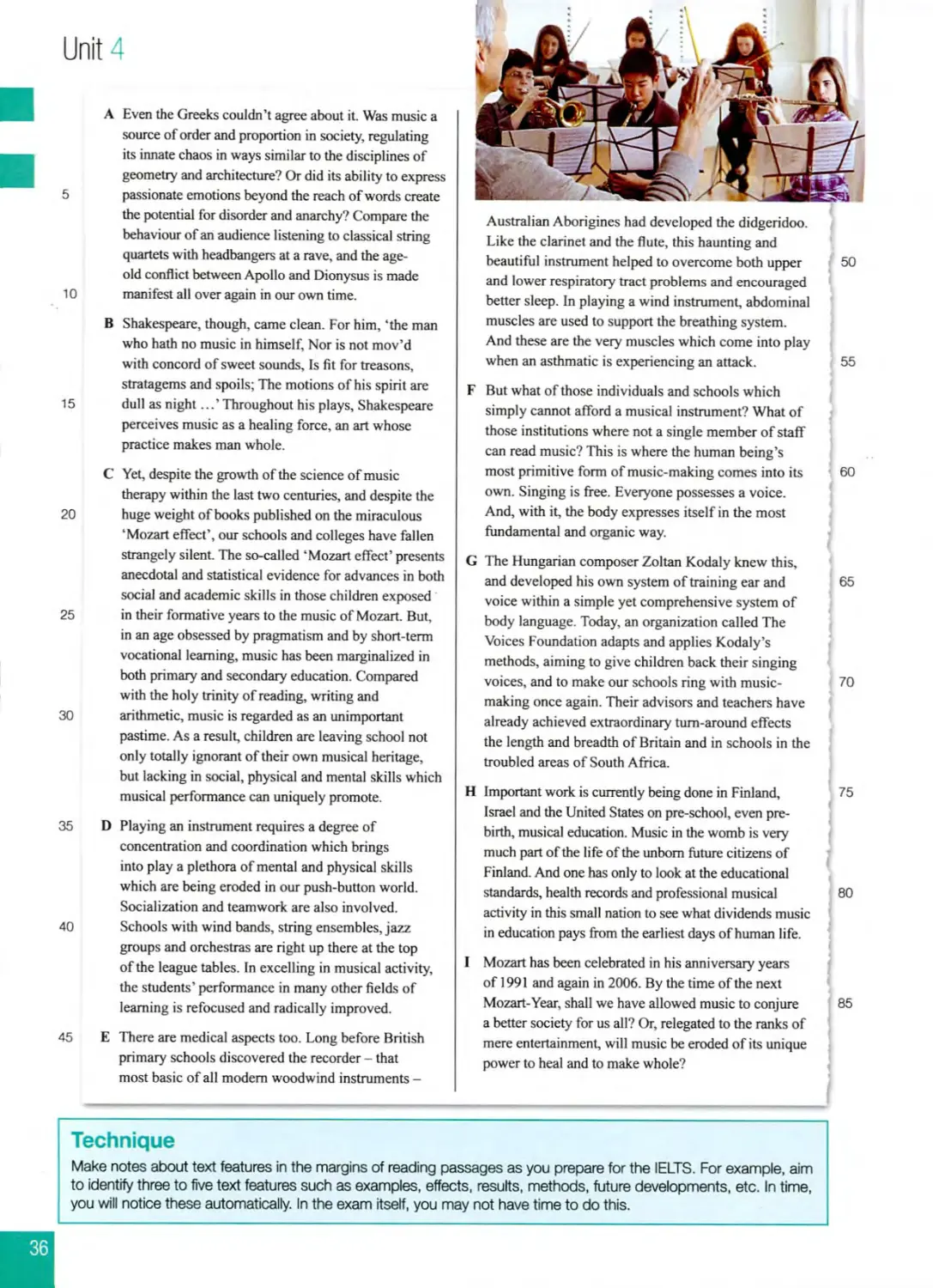
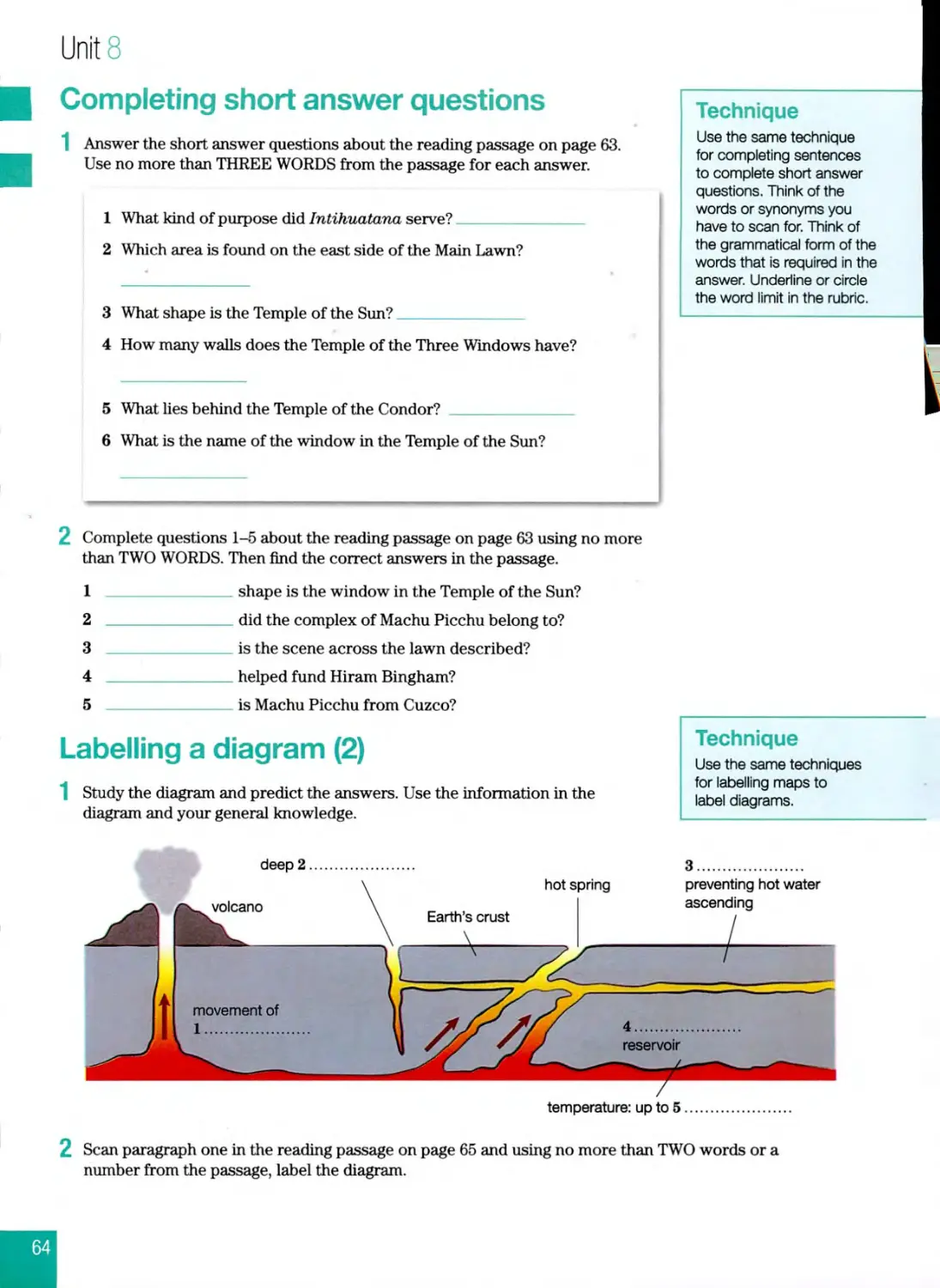
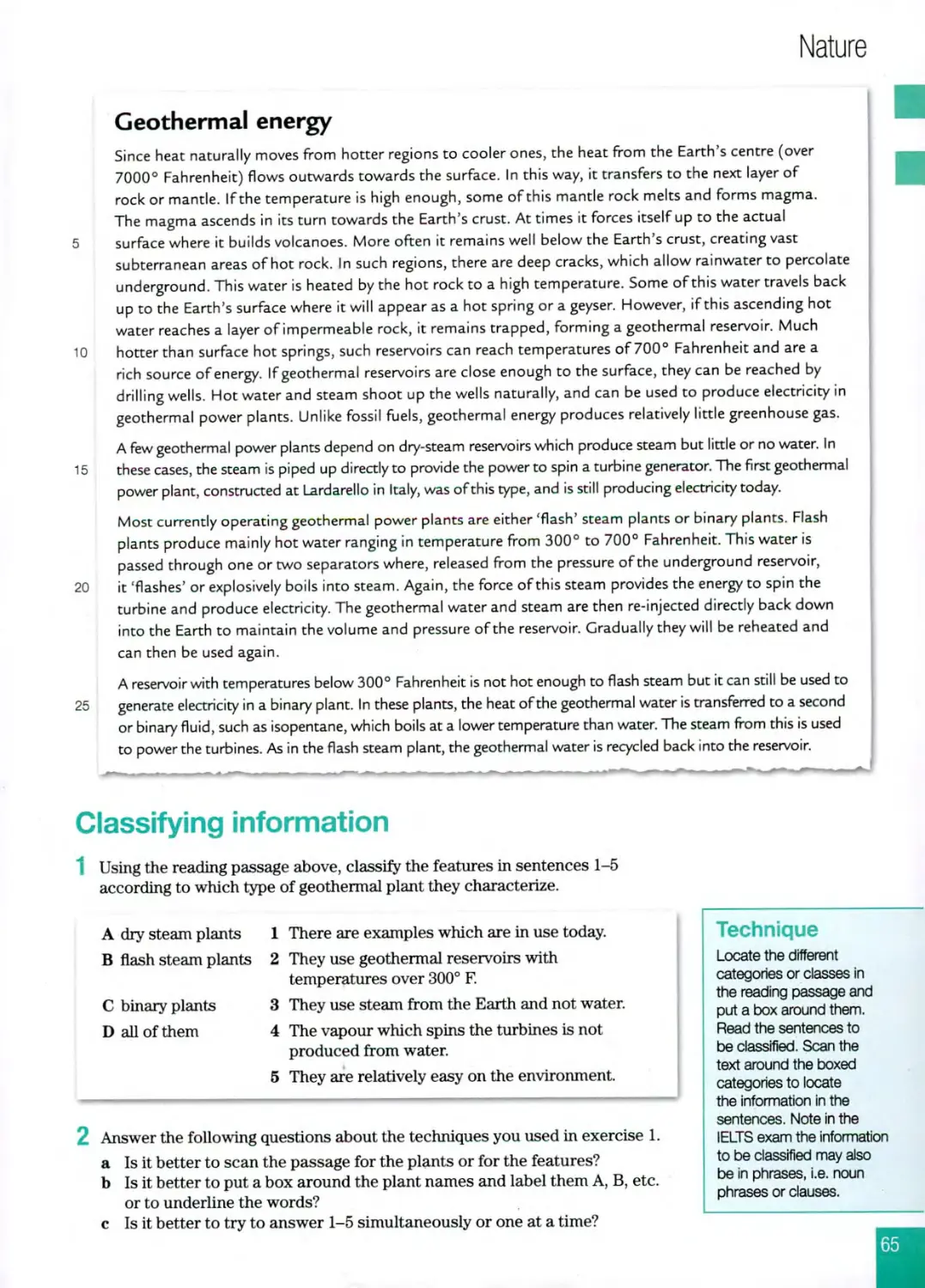
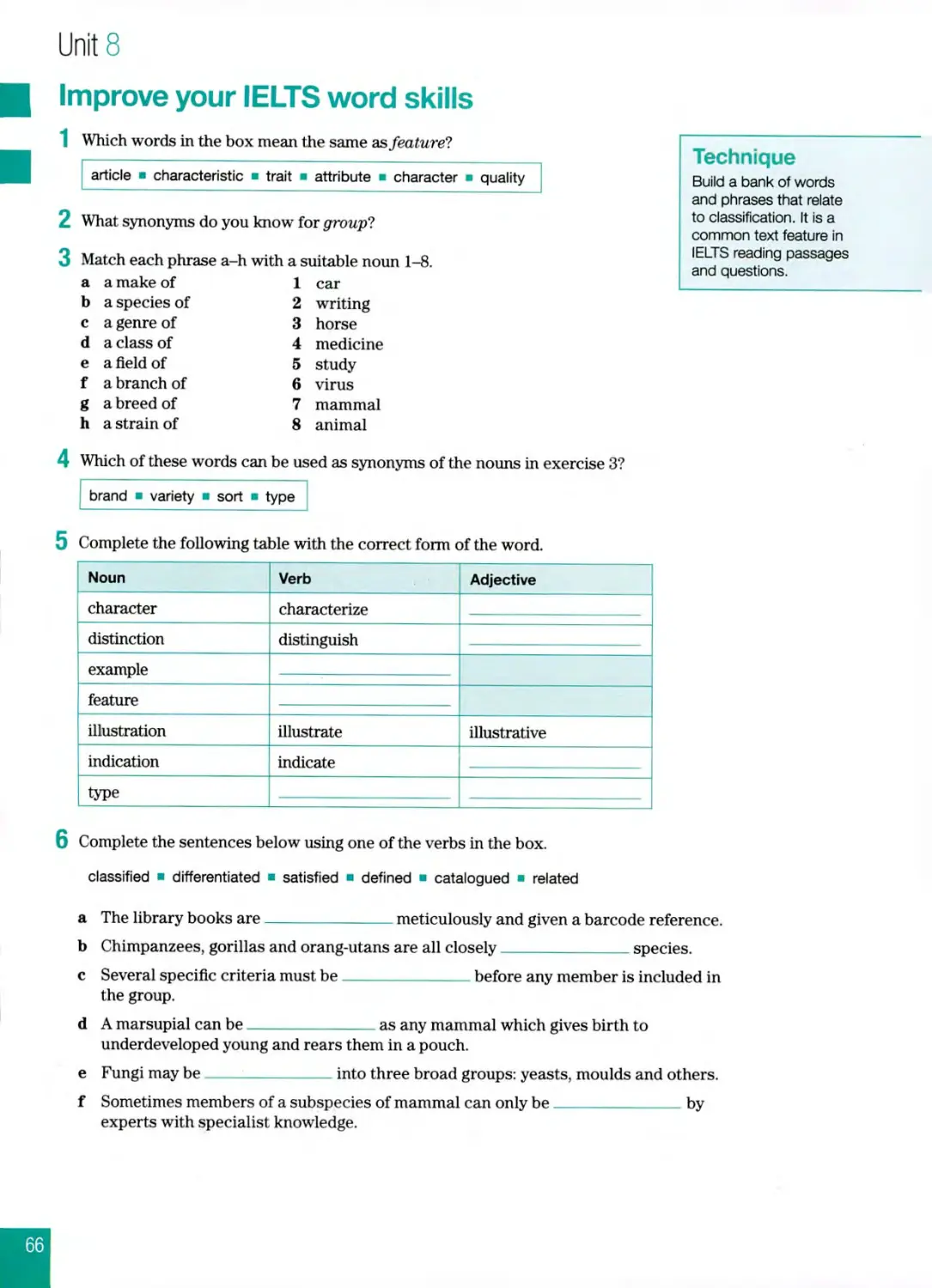
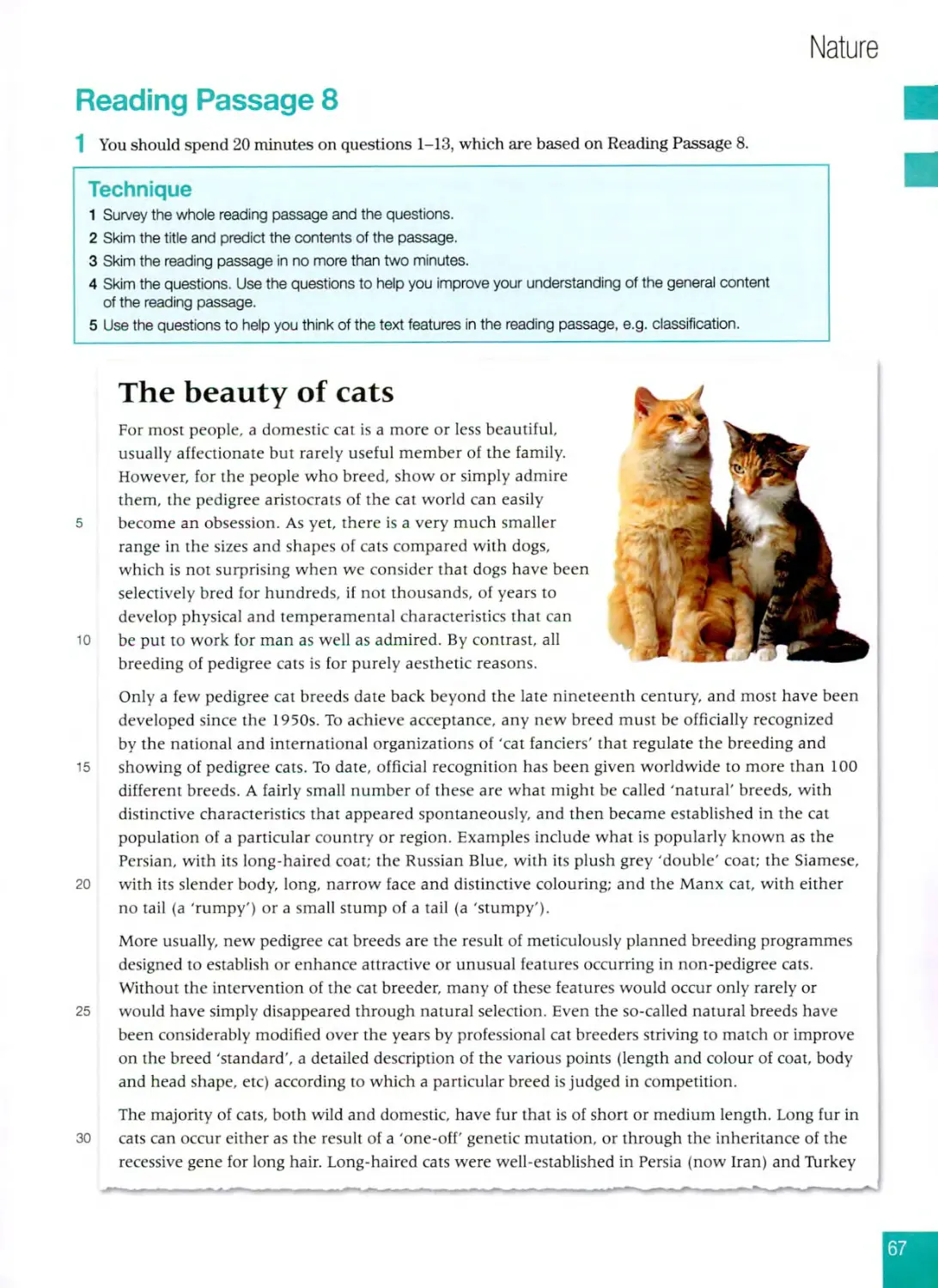



Текст
                    Improve your Skills
with Answer Key
Sam McCarter • Norman Whitby
004
0914
MACM I LLAN

Improve your Skills
Reading for IELTS
with Answer Key
4.5-6.0
Sam McCarter Norman Whitby
MACMILLAN

Macmillan Education
4 Crinan Street London Ni 9JCW
A division of Macmillan Publishers Limited
Companies and representatives throughout the world
ISBN 978-0-2304-6214-4 (with key)
ISBN 978-0 -2304-6220-5 (without key)
ISBN 978-0 -230-4 -6217-5 (with key + MIND pack)
ISBN 978-0 -230-4-6219-9 (without key + MPG pack)
lbxt © Sam McCarter and Norman Whitby 2014
Design and illustration Macmillan Publishers Limited 2014
The authors have asserted their rights to be identified as the authors
of this work in accordance with the Copyright, Design and Patents Act 1988.
First published 2014
All rights reserved; no part of this publication may be reproduced, stored in a
retrieval system, transmitted in any form, or by any means, electronic, mechanical,
photocopying, recording, or otherwise, without the prior written permission of the
publishers.
Designed by Kamae Design, Oxford
Illustrated by Kamae Design, p8, 15, 22, 28, 64. Ed McLachlan, p32.
Cover photograph by Getty Images/Nick Daly
Picture research by Susannah Jayes
Sam McCarter and Norman Whitby would like to thank the editors.
The publishers would like to thank all those who participated in the development of
the project, with special thanks to the freelance editors.
The authors and publishers would like to thank the following for permission to
reproduce their photographs:
Alamy/Susan E. Degginger p27, Alatny/Ray Roberts p38, Alamy/Tony West p78(c1), Ala-
my/Rob Whitworth p22(d); Bananastock pp43,78(cm); Corbir3/Mdstock/Blend Images
p36, Corbis/Keith Levit/*/Design Pica p75, Corbis/Peter M. Fisher p54(b1), Corbis/Hero
Images/Hero Images p55, Corbis/Egrnont StriglAmagebroker p6, Corbis/moodboard
p59(tr), Corbis/Nicolas libaut/Photononstop p7, CorbisNStock LLCM:taus liedge/Ibtra
Images p59(cr); DigitalStock/Corbis p14(cm); Getty Images p63, Getty Images/zhang
ho p54(c1), Getty Images/Austin Bush p78(cr), Getty Images/Robert Churchill p46(cr),
Getty Images/Sam Edwards p40, Getty Images/Jose Luis Pelaez Inc p30(cr), Getty Im-
ages/Stock4B p22(c1), Getty Images/Brent Winebrenner p48; MACMILLAN NEW ZEA-
LAND p22(b1); Macmillan Publishers Ltd p15(c1); PHOTODISC p67; Photoshot/
EFE p46(c1), Photoshot/NHPA pll; Jos4 V. Resin° p52; Superstock/Blend Images p71,
Superstock/Corbis p30(c1), Superstocic/Photononstop p80, Superstock/lips Images p54
(bet); Thinkstock/Lstockphoto pp15,70.
Although we have tried to trace and contact copyright holders before publication, in
some cases this has not been possible. If contacted we will be pleased to rectify any
errors or omissions at the earliest opportunity
Printed and bound in Thailand
2018 2017 2016 2015 2014
10987654321

Exam practice
Reading sIdlls
Topic
Unit 1 Change and
page 6
consequences
Scanning
Completing sentences (gapped)
Answering True/False/Not Given
statements
Answering True/False/Not Given
statements
Completing sentences (gapped)
Completing multiple-choice questions
The importance
of the past
Unit 2
page 14
Labelling a diagram (1)
Completing tables
Completing flow charts
Unit 3 Processes and
page 22 cycles
Labelling a diagram
Completing multiple-choice questions
Completing sentences (matching endings)
Unit 4 Education
page 30
Predicting
Answering Yes/No/Not Given
statements (writer's claims)
Matching headings (1)
Matching headings
Answering Yes/No/Not Given
statements (writer's claims)
Completing multiple-choice questions
Unit 5 Youth
page 38
Completing summaries with wordlists
Completing multiple-choice questions
Completing summaries with
wordlists
Selecting statements from a list
Answering global multiple-choice questions
Unit 6 Culture
page 46
Matching headings
Matching information to names
Completing multiple-choice questions
Completing global multiple-choice
questions
Using general nouns
Matching headings (2)
Matching information to paragraphs (1)
Matching information to names
Unit 7 Arts and
page 54 sciences
Completing summaries without
wordlists
Classifying information
Completing multiple-choice questions
Completing sumrnaries without
wordlists
Completing multiple-choice questions
Analysing questions
Unit 8 Nature
page 62
Labelling a map
Completing short answer questions
Labelling a diagram (2)
Classifying information
Completing a table
Completing short answer questions
Completing multiple-choice
questions
Unit 10 The individual
page 78 and society
Dealing with opinion
Answering Yes/No/Not Given
statements (writer's opinion)
Answering Yes/No/Not Given
statements (writer's opinion)
Completing short answer questions
Completing multiple-choice questions
Skimming
Answering True/False/Not Given
statements
Completing sentences (matching endings)
Completing sentences (matching endings)
Matching names
Completing multiple-choice questions
Scanning for meaning
Identifying sentence function
Matching information to paragraphs (2)
Matching information to paragraphs
Answering Yes/No/Not Given statements
Completing multiple-choice questions
Unit 9 Health
page 70
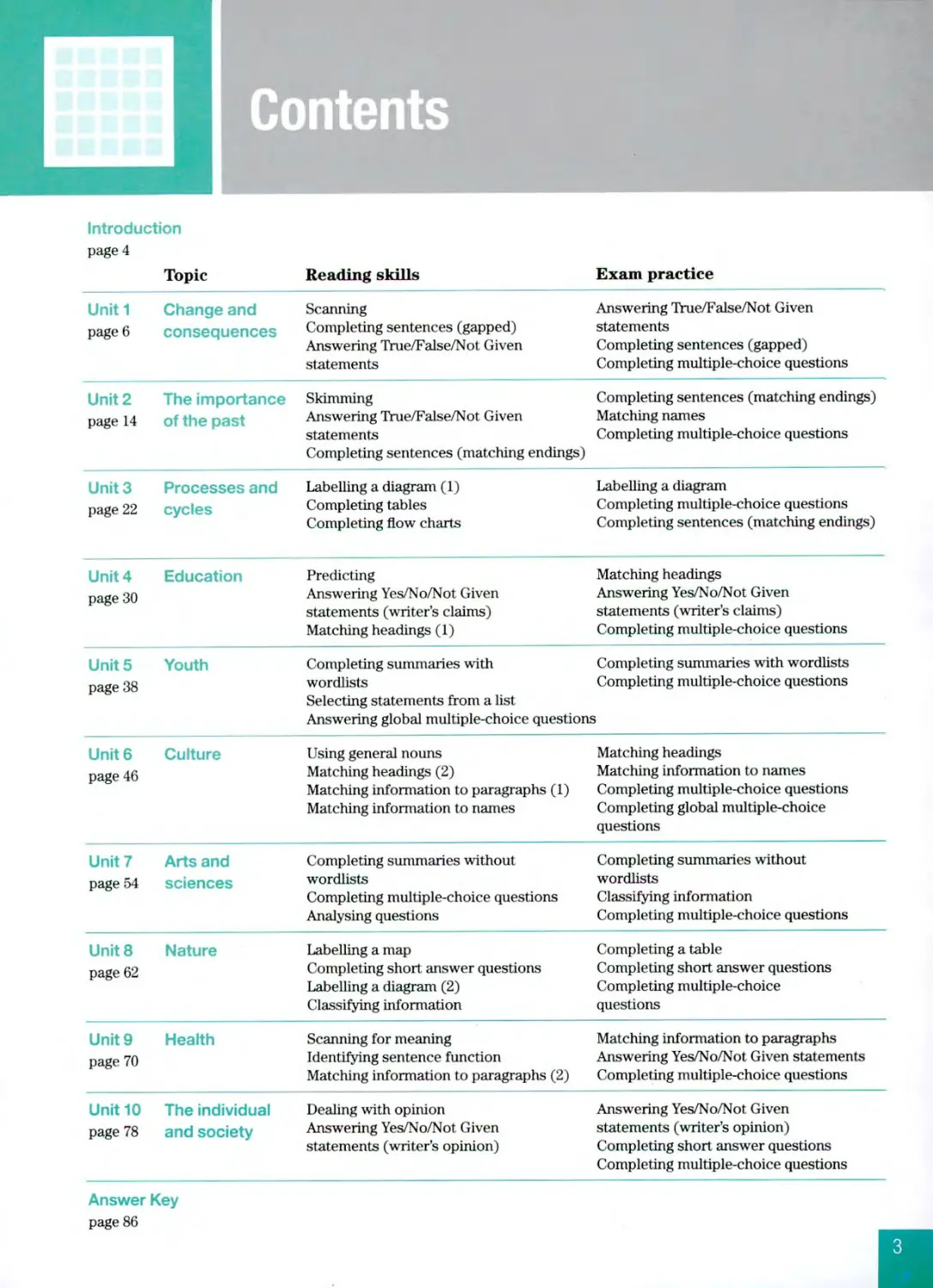
Contents
Introduction
page 4
Answer Key
page 86
3

Introduction
What is Improve your IELTS Reading Skills?
Improve your IEL7S Reading Skills is a complete preparation course for students at score bands
4.5-6.00 preparing for the Academic Reading component of the International English Language
Testing System (IELTS). Through targeted practice, it develops skills and language to help you
achieve a higher IELTS score in the Academic Reading component. The course can be used with
Improve your IELTS Writing Skills and Improve your IELTS Listening & Speaking Skills.
How can I use Improve your IELTS Reading Skills?
You can use Improve your IELTS Reading Skills as a book for studying on your own or in a class.
If you are studying on your own, Improve your IELTS Reading Skills is designed to guide you
step by step through the activities. The book is also completely self-contained: a clear and
accessible key is provided, so you can easily check your answers as you work through the book.
If you are studying as part of a class, your teacher will direct you on how to use each activity.
Some activities can be treated as discussions, in which case they can be a useful opportunity
to share ideas and techniques with other learners.
How is Improve your IELTS Reading Skills organized?
It consists of ten units based around topics which occur commonly in the real test.
Each unit consists of three sections:
Skills- exercises and examples to develop reading skills and build confidence for the exam.
The skills section is subdivided further into sections. These focus on specific types of questions
that occur in the exam.
Word skills for IELTS: practice of useful vocabulary for the Academic Reading.
Reading Passage: a practice test with questions to develop skills for reading.
In addition, there are Technique boxes throughout the book. These reinforce key points on how
to approach Academic Reading tasks.
How will Improve your IELTS Reading Skills improve my score?
By developing skills
The skills sections form a detailed syllabus of essential IELTS reading skills. The full range of
question types is covered. For example, key IELTS tasks like Matching headings and dealing
with True/False/Not Given statements are dealt with clearly and then practised in a reading test.
By developing language
Each unit also contains a resource of useful phrases and vocabulary to use in each reading test.
Over the course of Improve your IELTS Reading Skills, you will encounter a wide range of ideas
to ensure that you are well prepared when you reach the real test. These include concepts such
as recognizing general nouns, recognizing organization, analysing questions and understanding
meaning to increase your speed so that you can approach the Academic Reading component with
confidence.
4

Introduction
By developing test technique
The Technique boxes contain procedures which can easily be memorized and used as reminders
in the real test. These include quick and easy advice about how to tackle particular types of
questions and how to use the skills you have learned effectively.
How is the IELTS Academic Reading component organized?
The Academic Reading component of the IELTS lasts one hour. In the test, there are three
reading passages of different lengths and increasing difficulty with 40 questions.
What does each task consist of?
The passages are taken from a range of sources: books, magazines, newspapers and journals.
At least one of the articles contains a detailed argument. The range of questions used in the exam
are as follows:
multiple-choice questions
short answer questions
sentence completion
notes, flow chart, table completion
labelling a diagram/map
summary completion with and without wordlists
classification
matching information to paragraphs
matching paragraph/section headings
identification of information - True/False/Not Given
identification of writer's views/claims - Yes/No/Not Given
In the exam, you will probably only have a selection of the above types of question, but you need
to be familiar with all of them.
How will I be assessed?
The Academic Reading component is weighted. This means that the standard for each exam is
the same, but the number of correct answers required to achieve that standard will vary from
exam to exam. For example, in order to achieve a score band 7, you should aim to have
a minimum of 29 or 30 correct answers.
Therefore, keep in mind that as you do different reading passages in the book, the number of
correct answers in each will probably be different. This reflects the nature of the IELTS exam
as some passages may appear to be easier or more difficult than others.
If you are aiming for a score band 7, for example, we would expect you to answer approximately
9 or 10 correctly from each passage over three passages. In the real test, this is equal to 29 or 30
over three passages, but remember that in exam conditions your performance may not be the same.
How much time should I spend on each reading passage?
It is advisable to spend twenty minutes on each reading passage and to write your answers
directly onto the answer sheet. You do not have time at the end to transfer your answers from
the test booklet.
If you cannot answer a question quickly, leave it and move on to the next question. Then come
back to it if you can. As a rough guide, you will have a maximum of one and a half minutes to
answer each question.
Since the passages become progressively more difficult, do each passage in order.
Note that your spelling in the answers needs to be correct
5

READING SKILLS
Completing sentences (gap
Answerin True/False/Not Given•
,„,„„
„
EXAM PRACTICE
Comp e ufg Son encesigaripe
*
-
Completing multiple-choice questions
Scanning
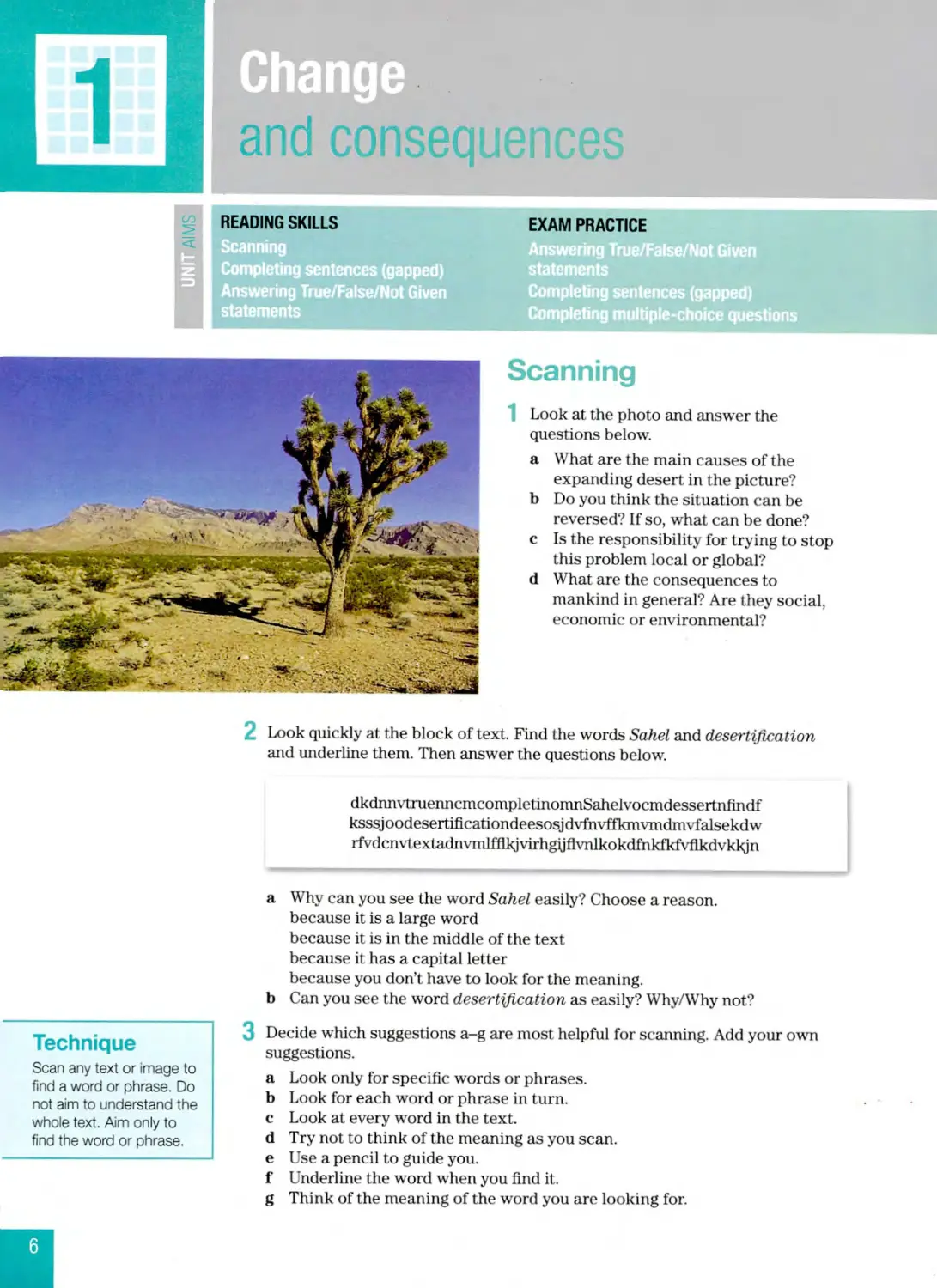
1 Look at the photo and answer the
questions below.
a What are the main causes of the
expanding desert in the picture?
b Do you think the situation can be
reversed? If so, what can be done?
c Is the responsibility for trying to stop
this problem local or global?
What are the consequences to
mankind in general? Are they social,
economic or environmental?
a_ Look quickly at the block of text. Find the words Saha/ and desertification
and underline them. Then answer the questions below.
dkdniwtruenncmcompletinomnSahelvocmdessertnfindf
ksssjoodesertificationdeesosjdvfnvffkmvmdmvfalsekdw
ilvdcnvtextadnvnilffikjvirhgijilvnlkokdfnkficfvfilcdvkkjn
a Why can you see the word Sahel easily? Choose a reason.
because it is a large word
because it is in the middle of the text
because it has a capital letter
because you don't have to look for the meaning.
b Can you see the word desertification as easily? Why/Why not?
Decide which suggestions a-g are most helpful for scanning. Add your own
suggestions.
a Look only for specific words or phrases.
b Look for each word or phrase in turn.
c Look at every word in the text.
Try not to think of the meaning as you scan.
Use a pencil to guide you.
f Underline the word when you find it.
Think of the meaning of the word you are looking for.
Technique
Scan any text or image to
find a word or phrase. Do
not aim to understand the
whole text. Aim only to
find the word or phrase.
3
6

Change and consequences
•
4 Scan the text to find the words below and underline them. The first word has been
underlined for you.
zone • marginal • steadily crept • Botswana • increasing population • overcultivation
plant species • management
DEFORESTATION AND
DESERTIFICATION
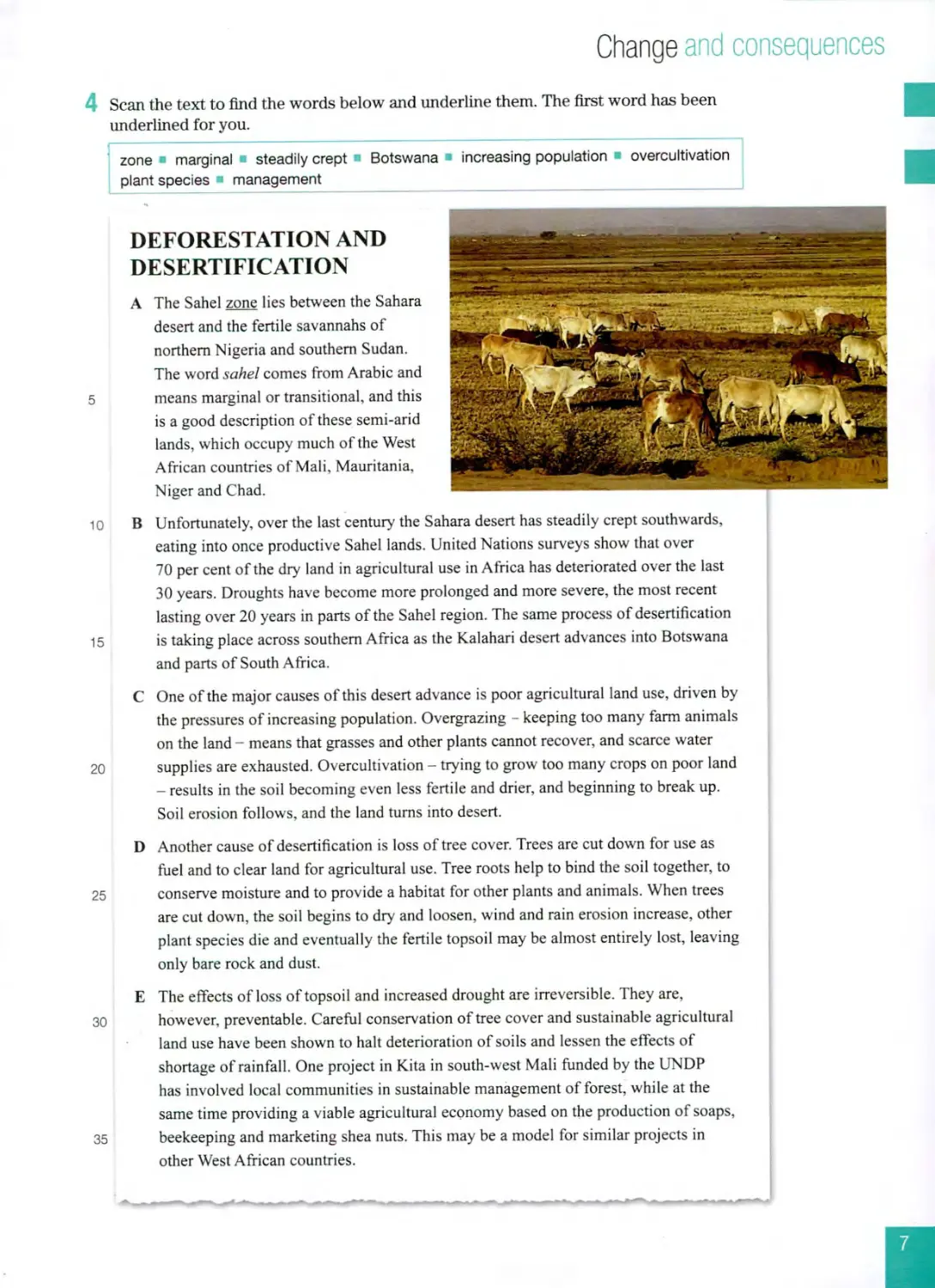
A The Sahel zone lies between the Sahara
desert and the fertile savannahs of
northern Nigeria and southern Sudan.
The word sahel comes from Arabic and
5
means marginal or transitional, and this
is a good description of these semi-arid
lands, which occupy much of the West
African countries of Mali, Mauritania,
Niger and Chad.
10 B Unfortunately, over the last century the Sahara desert has steadily crept southwards,
eating into once productive Sahel lands. United Nations surveys show that over
70 per cent of the dry land in agricultural use in Africa has deteriorated over the last
30 years. Droughts have become more prolonged and more severe, the most recent
lasting over 20 years in parts of the Sahel region. The same process of desertification
15
is taking place across southern Africa as the Kalahari desert advances into Botswana
and parts of South Africa.
C One of the major causes of this desert advance is poor agricultural land use, driven by
the pressures of increasing population. Overgrazing - keeping too many farm animals
on the land - means that grasses and other plants cannot recover, and scarce water
20
supplies are exhausted. Overcultivation - trying to grow too many crops on poor land
- results in the soil becoming even less fertile and drier, and beginning to break up.
Soil erosion follows, and the land turns into desert.
D Another cause of desertification is loss of tree coven Trees are cut down for use as
fuel and to clear land for agricultural use. Tree roots help to bind the soil together, to
25
conserve moisture and to provide a habitat for other plants and animals. When trees
are cut down, the soil begins to dry and loosen, wind and rain erosion increase, other
plant species die and eventually the fertile topsoil may be almost entirely lost, leaving
only bare rock and dust.
E The effects of loss of topsoil and increased drought are irreversible. They are,
30
however, preventable. Careful conservation of tree cover and sustainable agricultural
land use have been shown to halt deterioration of soils and lessen the effects of
shortage of rainfall. One project in Kita in south-west Mali funded by the UNDP
has involved local communities in sustainable management of forest, while at the
same time providing a viable agricultural economy based on the production of soaps,
35
beekeeping and marketing shea nuts. This may be a model for similar projects in
other West African countries.

1
Technique
Keep revision cards of
reading techniques such
as those for scanning.
Remember to use and try
a range of techniques for
all reading skills and not
just one.
3
v\7\
2
it
Technique
Look out for the answers
to the Gapped sentence
completion in the text. New
and important information is
often at the end or towards
the end of the sentence.
Notice where answers to
questions are in the reading
passage, e.g . questions 2
and 3. This will help your •
scanning and prediction
techniques.
Unit 1
In 5 When you scan for a word or phrase, avoid looking at other words. Diagrams
1-5 show five techniques for doing this. Match each diagram with the correct
description a-e .
1. a Scan the text in a zigzag from right to left. Look at either side of the
zigzag line.
b Scan from the bottom right to left, then left to right.
c Scan from the bottom. Move right to left, right to left.
cl Scan vertically from the bottom to the top. Look at either side of the line.
e Scan from the bottom right of a paragraph to the top left. Look at either
side of the diagonal line.
6 Use the scanning technique in diagram 4, exercise 5 to find the following
words in the Deforestation and Desertification passage. Then underline them.
transitional • unfortunately q surveys • severe • exhausted • bind
eventually • shea
7 Use the scanning technique in diagram 2, exereke 5 to find words and phrases
with these meanings. Use the paragraph reference and the first letter to help you.
a It begins with o and means cover. (Paragraph A)
b It begins with t and means happening. (Paragraph B)
c It begins with s and means limited. (Paragraph C)
d It begins with e and means completely. (Paragraph D)
e It begins with h and means stop. (Paragraph E)
8 Choose a scanning technique from the options given in exercise 5. Scan the
whole text for words or phrases with these meanings. The words are not
necessarily in the order of the text.
a It begins with p and means long.
b It begins with p and means fertile.
c It begins with e and means wearing away.
Build up a revision list of scanning techniques on a card or in your notebook.
Completing sentences (gapped)
1 Read sentences 1-6 taken from a Sentence completion task. Decide whether
the missing words are adjectives or nouns/noun phrases.
1 The climate of the Sahel is described as
2 In some areas of the Sahel, there has been no rainfall for more than
3 Desertification is caused by overgrazing, but this in turn is due to the
pressure from
4 When trees are cut down, the soil is affected, which leads to the death of
the surrounding
5 The consequences of the loss of topsoil cannot be reversed, but they are
6 Looking after trees reduces the consequences of a lack of
2 Scan the reading passage on the previous page using one of the techniques in exercise 5 and complete
the sentences in exercise 1. Choose NO MORE THAN TWO WORDS from the passage for each answer.
8

Change and consequences
Answering True/False/Not Given statements
1 Statements 1-7 in exercise 2 are taken from a True/False/Not Given task. Underline words
which could be used to scan the passage. Explain your choices.
Example
The semi-arid land of the Sahel is found only in Mali.
Scan for Mali because it is ea cy to see (capital letter) and cannot be expressed in another way.
2 Look again at the statements in 1-7 below. Underline words that qualify or limit each
statement, especially adverbs and adjectives.
Example
The semi-arid land of the Sahel is found only in Mali.
1 The Sahara has spread slowly northwards into the Sahel region.
2 Just over 70 per cent of the dry land in agricultural use in Africa has
deteriorated over the last 30 years.
3 Desertification is taking place faster in southern Africa than in the Sahel.
4 The advance of the desert is not the result of poor agricultural land use.
5 The loss of tree cover is a minor cause of desertification.
6 If there is a loss of tree cover, the deterioration in the soil is halted.
7 Tree conservation is more effective than sustainable agricultural land use
in reducing the consequences of lack of rain.
3
4
Decide whether the statements in exercise 2 are False or Not Given according
to the passage.
Explain why each statement 1-4 below is Not Given in the text Use the
example to help you.
Example
The Sahel covets more of the land in Mali than it does in Chad.
Not Given because there is no comparison in the text. We know that it covers
much of Mali and Chad, but we do not know which country has more.
Technique
Keep a list of the common
grammatical structures you
come across in True/False!
Not Given sentences with
examples, e.g . comparison
and contrast (The Sahel
covers more of the land
in Mali than it does in
Chad), cause and effect,
present simple for general
statements, time phrases
1 Agricultural land in Africa could deteriorate further in the coming
years.
2 There could be another severe drought in the Sahel over the next
three decades.
3 In some areas, the UNDP may provide financial support for forestry
management to local communities in the future.
4 A second project has been planned in Mali to develop sustainable
forestry management.
9

Technique
Make a list of general nouns
like the ones in the box
above. Write a phrase to go
with each one to put it in
context. General nouns are
useful in all parts of
the exam.
Technique
Keep lists of general nouns
with possible adjective
collocations. Use the
Macmillan Collocations
Dictionary. This will help to
build your vocabulary range
for the other skills as well
as reading.
Unit 1
Improve your IELTS word skills
1Identify the type of words in the box below. Are they (a) general nouns which
need a context for their meaning or (b) nouns which have specific meaning?
consequence • factor • change • result • impact • effect • cause • role
Complete the sentences with a word from the box above. Some will need to
be put in the plural form.
a Technology has had a huge
on our lives.
b The area has undergone many
in recent years.
c Planting trees can have a knock-on
on the economy of
arid areas.
Deforestation can have unforeseen
for the ecology of
a region.
It is sometimes difficult to discover the exact
of a problem.
f To achieve the best
it is important to initiate change at a
local level.
The main
contributing to success in any organization is a
happy workforce.
The climate has played a major
in this region's economic
history.
2
3 Complete the sentences with a phrase from the box.
gradual development • limited impact • far-reaching consequences
dramatic changes • favourable outcome • underlying cause • profound effect
for regional growth.
Shock tactics can bring about
in people's behaviour.
is much more acceptable than rapid change.
The introduction of new farming practices has had a
people's lives.
To achieve the most
the countries involved need to negotiate.
I The
in this particular case is not easy to find.
g The huge sums invested had only a
on the neighbourhood.
4 Decide whether the words in brackets have the same or opposite meaning to
the words in italics.
Example
Tourists have changed the coastline dramatically. (slightly) Opposite meaning
a The wasteland was completely transformed. (totally)
b The governinentfully accept the consequences of their actions. (partially)
c The marine life in the coral reef is highly sensitive to temperature fluctuations. (exceedingly)
Alternative sources of energy like solar power can vastly improve life in remote communities.
(marginally)
The rising sea level will greatly affect the livelihoods of people on some Pacific islands.
(considerably)
a Government intervention has had
on
10

ot.
`, I' '1,
"
,..
qt-vc.
n.
<
x
kr n.
,••
Axe •••ige-
qvA,
01-1'1/ 2
LAKN
1/42-1
x
^Itn"l
it,C•sx
r /,‘
rt
to.
F-
4
fat'
„c3/44::
ZeZy• t- ific iraffi,
rt:•
Kr -PC '>
" tv.../.-
. .b ,t‘ ,a144X.., Ayr,'
?+-j•
-4 sr
"Op
Apt
-e
42.
- 4%1
Iv
*v
.
le lg. frie
4
-1k c"1+
/91
4.44"
"6"-
te-
st-
-
r.
>•,•fr
„e
vx•
.c.,* f .-c
_,eir
.04
1 tic" sa- ;tact
‘C ita
e- ft)
n'n
n-A
out
"kr
_
g3/4-
_
4-74
gik
is-
•
pu
" Ure
etu
Change and consequences
Reading Passage 1
You should spend 20 minutes on questions 1-14, which are based on Reading Passage 1 below.
Technique
Follow these stages when you look at a reading passage and the associated questions:
1 Survey the title, text and questions in three or four seconds.
2 Use the title to think of the contents of the text.
3 Skim the text and questions. You should aim to eventually do this in two minutes.
4 Use the information from the question to help you to scan and locate the answers in
the reading passage.
Swallows in Migration
Every April, along with many other species
of birds, the swallow arrives to spend the
summer months in northern Europe, in
Russia, Iran and parts of Siberia. Here it will
5
breed and raise its young.
The swallow is well known for several
reasons Firstly, it is very distinctive, with
its forked tail and characteristic acrobatic
swooping flight. Secondly, it is very
10
common, and, like its near relative the
house martin, lives in close proximity to
Human habitation, at least in rural areas.. •
It is, however, rarely to be encountered in
towns or cities.
For centuries, people have observed
swallows, noted their arrival and their
patterns of feeding. In several countries,
these observations have passed into
the language as proverbs or sayings. In
England, people comment on unpredictable
late spring weather by saying, 'one swallow
does not a summer make'. Similarly, 'the
swallows are flying low' was held to predict
rainy, even stormy weather. There may be
I15
20
11

Unit 1
25 some truth in this observation, though it
is the insects the swallows feed on that
seem to be more susceptible to the fall in
barometric pressure that heralds a storm.
Insects keep low in these conditions, and so
30 do the swallows that hunt them. At the end
of the summer season, when the swallows
are about to leave, they frequently flock
together in large numbers on convenient
high open perches, like roof ridges and
35 telegraph wires. When people remark that
'the swallows are gathering', they mean that
autumn has arrived.
At some point in mid-September the
swallows leave together, usually all on the
40 same day. One day there are thousands,
the next there are none, and none will be
seen again until the following spring. For
centuries, this was a complete mystery to
people. The Hampshire naturalist Gilbert
45 White, writing in the late eighteenth century,
believed that the swallows dived into ponds
and rivers in autumn and remained in the
bottom mud the whole winter, re-emerging
the following spring. This idea seems
50 extraordinary to us, but White was not a
stupid man: many of his other observations
of natural life were informed and accurate.
In this case, however, he simply had no
means of determining the truth and was
55 forced to make a random guess. The idea
that swallows migrate to central or southern
Africa would have seemed as fanciful to him
as his theory seems to us.
Although we now know that swallows
60 migrate, there are still unanswered
questions. Why do they go so far? Why not
stay on the shores of the Mediterranean?
The majority continue to equatorial Africa,
and some even further south. Also it
es
appears that populations of swallows that
have bred in different countries also spend
the winter in different areas. Those from
France, Germany and much of western
Europe have mostly been traced to East
70
Africa, Kenya or Tanzania for example.
Above all, how does a bird weighing
approximately twenty grams find its way
across mountain ranges, ocean and desert
to winter in the south, and then return the
75
following year to the very location it was
born, in some cases to the very same nest?
Birds can navigate by the Sun, and are also
able to detect the magnetic field of the
Earth. Species that migrate at night are
80
also able to navigate by the stars. By these
means, they travel long distances. The close
navigation that brings them back to the
same field or nest appears to be related to
memory of local landmarks imprinted on the
85
minds of young birds as they crisscross the
area in the weeks before departure.
Nevertheless, the journey is very dangerous.
Long sea crossings, where there is little
available food or water, are generally
90
avoided. In western Europe, most swallows
cross to Africa via the Straits of Gibraltar,
or fly the length of Italy before tackling the
relatively short crossing to Tunisia in North
Africa. However, in storms they may be
95
blown hundreds of kilometres off course.
Exhausted swallows sometimes come to rest
on ships way out in the Atlantic Ocean. They
have to cross mountain ranges too, where
again the weather may be unpredictable and
100
food scarce. Along the coast of North Africa,
many young swallows become the prey of
Eleonora's falcons, which time their breeding
to coincide with the migration of young
birds southwards. But the most dangerous
105
part of the journey is the crossing of the
Sahara desert. Here, there is little food or
water, sandstorms may delay and exhaust
the already weakened birds, and many die.
It is estimated that around 50 per cent of
110
adult birds die, and up to 80 per cent of
young birds, but enough survive to ensure
the continuation of the species.
•
•
12

Questions 13 and 14
Choose TWO letters, A—F.
Which TWO of the following dangers faced by swallows during migration are
mentioned in the text?
A The Sahara desert
D Hungry sailors
B Long sea crossings
E Eleonora's falcons
C Lack of nesting places
F The crossing to Tunisia
Technique
True/False/Not Given
1 Look for words n each
statement to help you
scan.
2 Identify comparisons or
qualifying expresgions
in the statements.
3 Try to predict some
answers.
4 And your scan words
in the text then read
around them closely
to locate the answers.
Remember that the
answers follow the
order of the reading
passage.
Technique
Sentence completion
1 Remember that the
answers follow the
order of the passage.
2 Note the word limit for
each gap.
3 Look for words in each
sentence to help you
scan.
4 Find your scan words
in the text. Think of the
part of the sentence the
answer might be in: the
beginning or the end.
Then read around them
to locate the answers.
Note in the sentences
for completion: 'a'
before the gap =
singular countable
noun, no article = plural
or uncountable noun,
the = any noun.
Change and consequences
Questions 1-6
Do the following statements agree with the information given in the passage?
Write
TRUE
if the statement agrees with the information
FALSE
if the statement contradicts the information
NOT GIVEN if there is no information on this
1 The swallow is the only species of bird that migrates to spend the
summer in northern Europe.
2 The swallow is easily noticeable because of its tail and the way it flies.
3 The swallow is frequently seen in cities.
4 The insects, not the swallows themselves, appear to predict stormy
weather.
5 Swallows form larger flocks than other birds when they depart in the
autumn.
6 White's theory seems strange to people now.
Questions 7-12
Complete the sentences.
Choose NO MORE THAN TWO WORDS from the passage for each answer.
7 In the past, the destination of the swallows in autumn was a
8 As White could not verify what happened to the swallows, he made a
9 Despite knowing that swallows migrate, we are still left with
10 Sometimes, swallows have been known to return not just to the same
area, but even to the
11 Birds that travel by night can find their way using the
12 Bird navigation appears to be connected with the memory of
13

READING SKILLS
Answering True/False/Not Given
statements
Completing sentences (matching
endings)
EXAM PRACTICE
omp qs
nces (matching
endings)
Matching names
Completing multiple-choice
questions
Skimming
1Look at the photos and answer questions a—d below.
a Where are the places shown in the photos? Can you think of other famous
historical monuments around the world?
b Are places like these relevant in any way to the modern world? How?
c Do you think knowing the past helps us to define the future? Or do you
think studying history is not important?
Is there a historical place in your home country which is special to you?
2 Which alternative (a—d) below best explains how to skim?
a You extract the meaning or topic of a text without
looking at all of the words.
b You read every word as fast as you can.
c You look for one word or phrase only.
You look at a text in detail.
Read the lists of words 1-5 and answer questions a—d .
1 architect building skyscraper construct design
2 train travel passenger ticket luggage
3 nostalgia past memories read former times history
4 airport luggage air steward fly aeroplane boarding pass
5intheuptotheofaoftheenormousandthatwewiththein
a Which list is connected with the topic of air travel?
b Which list refers to no clear topic?
c What do you think is the topic of each of the other three?
What types of words are in lists 1-4? How is 5 different?
Technique
Learn to skim reading
passages quickly. In the
exam you should skim
3
the reading passage in
two minutes or less and
then skim the questions.
Remember in the IELTS
exam you are not meant to
study all the text in detail,
but to understand and
extract information quickly,
so you need to learn to
skim quickly.
14

The importance of the past
4 Read the title of the passage below. Underline the words in the box which you would expect to see in
the passage. How do the words relate to the title?
football • construction • bridges • hairdressing • engineers • dictionary • industrial • projects • railway
The greatest of Victorian engineers
A In the hundred years up to 1860, the work of a small group of
construction engineers carried forward the enormous social and
economic change that we associate with the Industrial Revolution in
Britain. The most important of these engineers was Isambard Kingdom
5
Brunel, whose work in shipping, bridge-building and railway construction,
to name just three fields, both challenged and motivated his colleagues.
He was the driving force behind a number of hugely ambitious projects,
some of which resulted in works which are still in use today.
B The son of an engineer, Brunel apprenticed with his father at an early
10
age on the building of the Thames Tunnel. At the age of just twenty, he became the engineer in charge of
the project. This impressive plan to bore under the Thames twice suffered major disasters when the river
broke through into the tunnel. When the second breach occurred in 1827, Brunel was seriously injured
during rescue operations and further work was halted.
C While recovering from his injuries, Brunel entered a design competition for a new bridge over the
15
Avon Gorge near Clifton, Bristol. The original judge of the competition was Thomas Telford, a leading
civil engineer of his day, who rejected all entries to the competition in favour of his own design. After
considerable scandal, a second contest was held and Bruners design was accepted. For reasons of funding,
however, exacerbated by social unrest in Bristol, the project was abandoned in 1843 with only the towers
completed. After Brunel's death, it was decided to begin work on it again, partly so that the bridge could
20
form a fitting memorial to the great engineer. Work was finally completed in 1864. Today, the well known
Clifton Suspension Bridge is a symbol of Bristol, just as the Opera House is of Sydney. Originally intended
only for horse-drawn traffic, the bridge now bears over four million motor vehicles a year.
•
Technique
Skim a reading passage
using only words like nouns,
noun phrases and verbs.
These are the words that
give you meaning. They give
you the gist of the passage.
You can look at the other
function words like a, the,
in, of, etc. when you read
a passage more closely.
Remember skimming is
a stage in the reading
process. Close reading
comes later.
5 Read the title again and skim paragraph A. Look only at the words that are
connected with the word engineer. Ignore the other words as in the diagram.
Which words would you skim?
1 Skim words like nouns and verbs
Jr
12Donotgodeepintothetext
3 Ignore words like a, the, in, of, etc.
6 Skirn the whole text in exercise 4 and match each title below with a paragraph.
Which words in the text help you match the title?
1 The contest for and construction of a suspension bridge
2 An inspiring engineer
3 The construction of a tunnel under a river
Text —I .
15

Unit 2
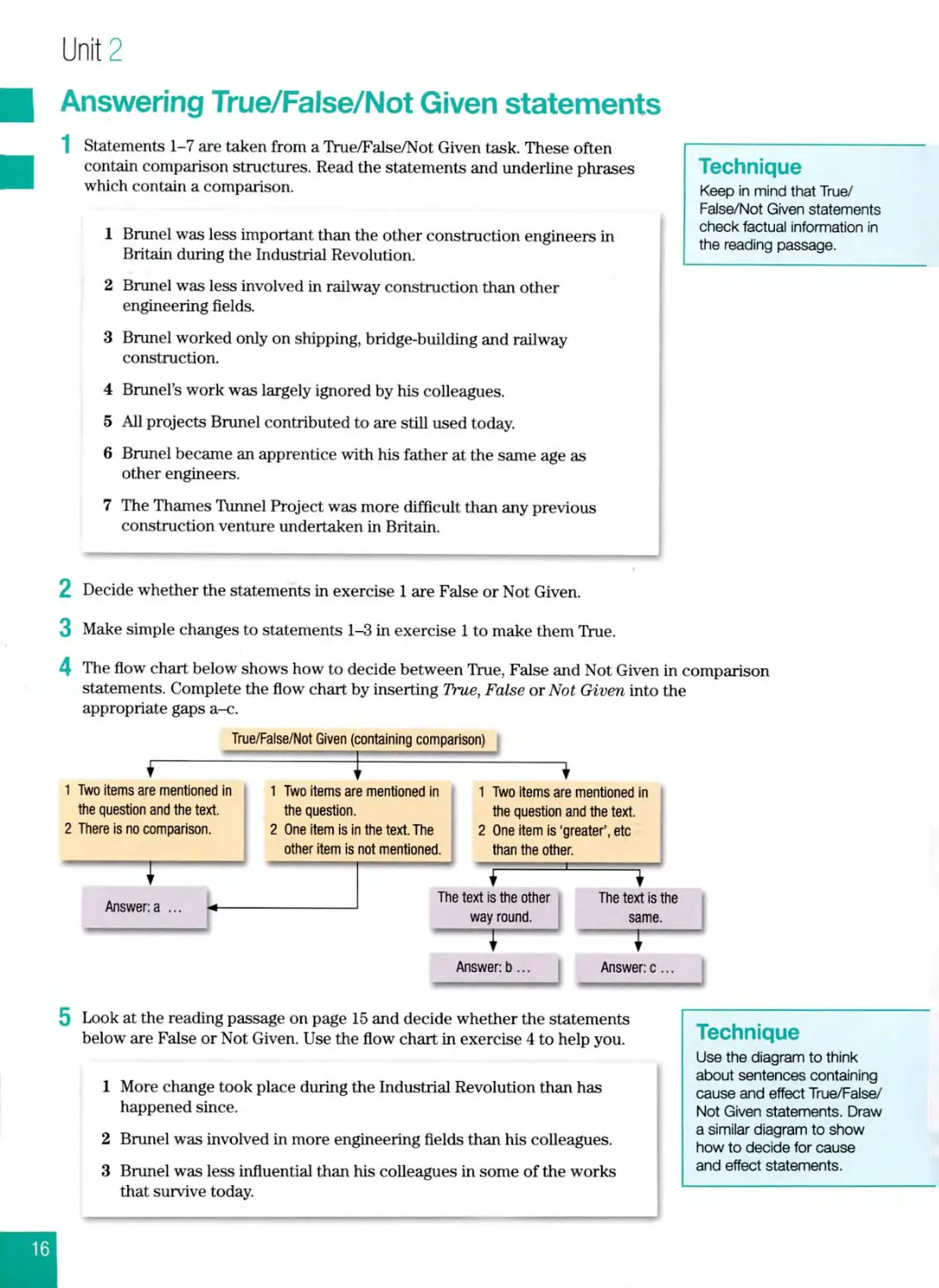
Ill Answering True/False/Not Given statements
1 Statements 1-7 are taken from a True/False/Not Given task. These often
contain comparison structures. Read the statements and underline phrases
which contain a comparison.
1 Brunel was less important than the other construction engineers in
Britain during the Industrial Revolution.
2 Brunel was less involved in railway construction than other
engineering fields.
3 Brunel worked only on shipping, bridge-building and railway
construction.
4 Brunel's work was largely ignored by his colleagues.
5 All projects Brunel contributed to are still used today.
6 Brunel became an apprentice with his father at the same age as
other engineers.
7 The Thames Tunnel Project was more difficult than any previous
construction venture undertaken in Britain.
Technique
Keep in mind that True/
False/Not Given statements
check factual information in
the reading passage.
2 Decide whether the statements in exercise 1 are False or Not Given.
3 Make simple changes to statements 1-3 in exercise 1 to make them True.
4 The flow chart below shows how to decide between True, False and Not Given in comparison
statements. Complete the flow chart by inserting True, False or Not Given into the
appropriate gaps a—c.
True/False/Not Given (containing comparison)
1 Two items are mentioned in I
the question and the text.
2 There is no comparison.
1 Two items are
the question.
2Oneitemisin
other item is
mentioned
the text. The
not mentioned.
in
1 Two items are mentioned in
the question and the text.
2 One item is 'greater', etc
than the other.
Answer: a ...
The text is the other
way round.
The text is the
same.
Answer: b
Answer: c
5 Look at the reading passage on page 15 and decide whether the statements
below are False or Not Given. Use the flow chart in exercise 4 to help you.
Technique
Use the diagram to think
about sentences containing
cause and effect True/False/
Not Given statements. Draw
a similar diagram to show
how to decide for cause
and effect statements.
1 More change took place during the Industrial Revolution than has
happened since.
2 Brunel was involved in more engineering fields than his colleagues.
3 Brunel was less influential than his colleagues in some of the works
that survive today.
16

The importance of the past
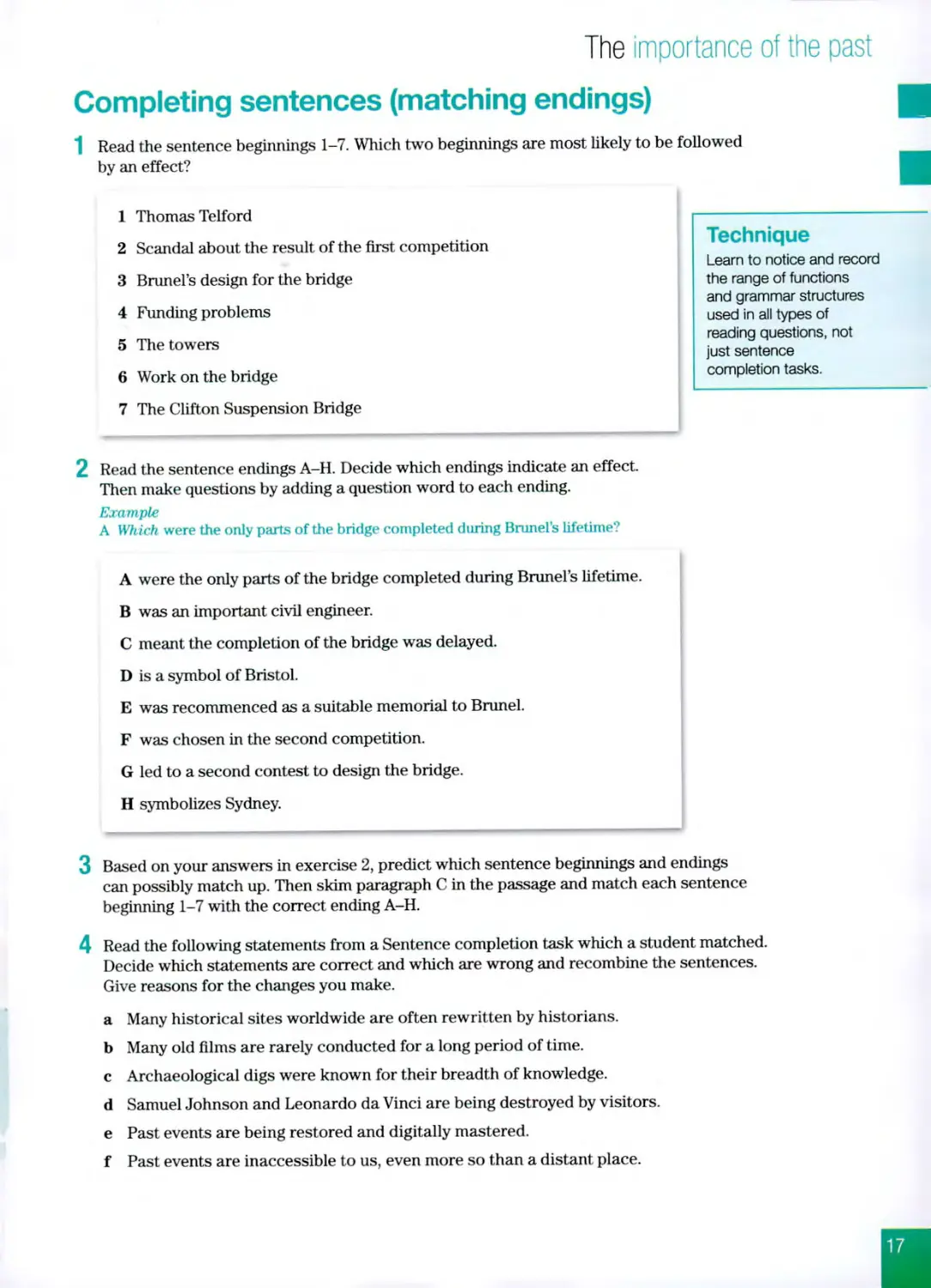
Completing sentences (matching endings)
•
1Read the sentence beginnings 1-7. Which two beginnings are most likely to be followed
by an effect?
1 Thomas Telford
2 Scandal about the result of the first competition
3 Brunel's design for the bridge
4 Funding problems
5 The towers
6 Work on the bridge
7 The Clifton Suspension Bridge
Technique
Learn to notice and record
the range of functions
and grammar structures
used in all types of
reading questions not
just sentence
completion tasks.
2 Read the sentence endings A-H. Decide which endings indicate an effect
Then make questions by adding a question word to each ending.
Example
A Which were the only parts of the bridge completed during Brunel's lifetime?
A were the only parts of the bridge completed during Brunel's lifetime.
was an important civil engineer
C meant the completion of the bridge was delayed.
is a symbol of Bristol.
was recommenced as a suitable memorial to Brunel.
F was chosen in the second competition.
led to a second contest to design the bridge.
H symbolizes Sydney.
3 Based on your answers in exercise 2, predict which sentence beginnings and endings
can possibly match up. Then skim paragraph C in the passage and match each sentence
beginning 1-7 with the correct ending A-H.
4 Read the following statements from a Sentence completion task which a student matched.
Decide which statements are correct and which are wrong and recombine the sentences.
Give reasons for the changes you make.
a Many historical sites worldwide are often rewritten by historians.
b Many old films are rarely conducted for a long period of time.
c Archaeological digs were known for their breadth of knowledge.
Samuel Johnson and Leonardo da Vinci are being destroyed by visitors.
Past events are being restored and digitally mastered.
f Past events are inaccessible to us, even more so than a distant place.
17

Unit 2
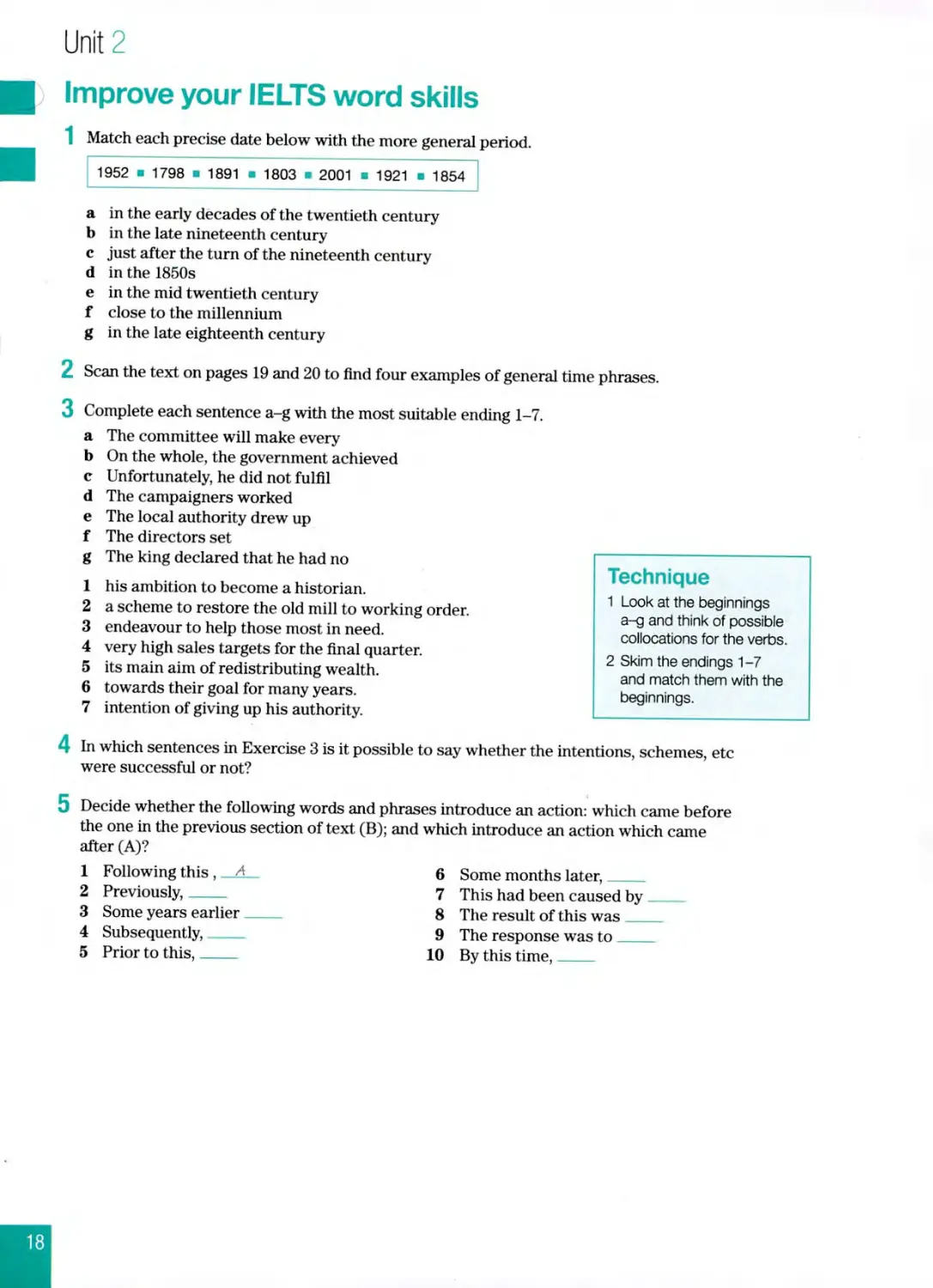
11, Improve your IELTS word skills
1 Match each precise date below with the more general period.
1952•1798•1891•1803•2001•1921•1854
a in the early decades of the twentieth century
b in the late nineteenth century
c just after the turn of the nineteenth century
in the 1850s
in the mid twentieth century
f close to the millennium
in the late eighteenth century
2 Scan the text on pages 19 and 20 to find four examples of general time phrases.
3 Complete each sentence a-g with the most suitable ending 1-7.
a The committee will make every
b On the whole, the government achieved
c Unfortunately, he did not fulfil
The campaigners worked
The local authority drew up
The directors set
The king declared that he had no
1 his ambition to become a historian.
2 a scheme to restore the old mill to working order.
3 endeavour to help those most in need.
4 very high sales targets for the final quarter.
5 its main aim of redistributing wealth.
6 towards their goal for many years.
7 intention of giving up his authority.
4 In which sentences in Exercise 3 is it possible to say whether the intentions, schemes, etc
were successful or not?
5 Decide whether the following words and phrases introduce an action: which came before
the one in the previous section of text (B); and which introduce an action which came
after (A)?
1 Following this, A
6 Some months later,
Previously,
This had been caused by
2
7
Some years earlier
The result of this was
3
8
4 Subsequently,
9 The response was to
Prior to this,
By this time,
5
10
•
Technique
1 Look at the beginnings
a-g and think of possible
collocations for the verbs.
2 Skim the endings 1-7
and match them with the
beginnings.
18

The importance of the past
Reading Passage 2
1 You should spend 20 minutes on questions 1-14 which are based on Reading Passage 2.
Technique
Survey the title, the reading passage and the questions within about 8-10 seconds to
understand what your task is. Read the title and skim the text then the questions. Decide
what type of passage it is: mainly historical, problem and solution or argumentative?
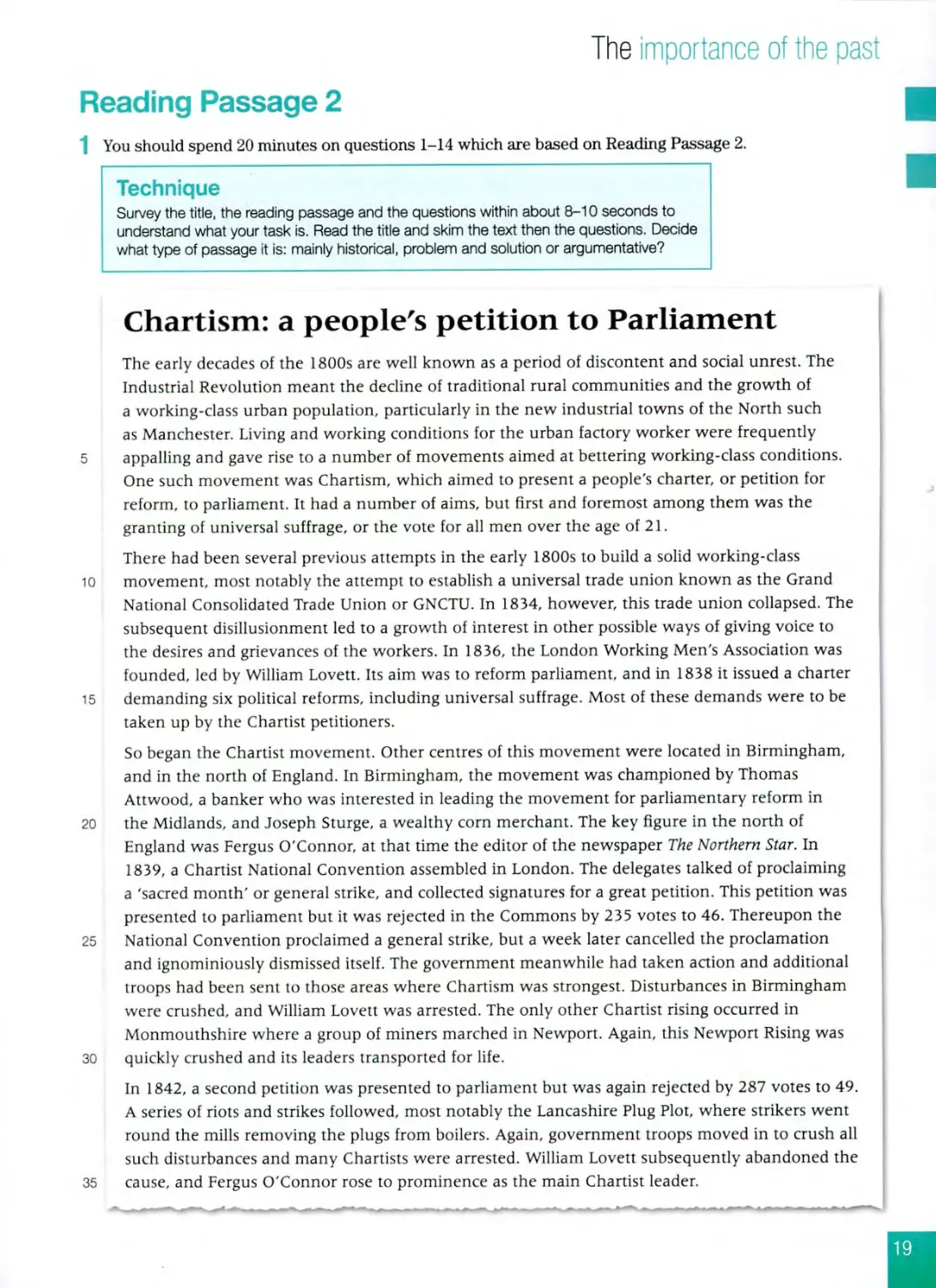
Chartism: a people's petition to Parliament
The early decades of the 1800s are well known as a period of discontent and social unrest. The
Industrial Revolution meant the decline of traditional rural communities and the growth of
a working-class urban population, particularly in the new industrial towns of the North such
as Manchester. Living and working conditions for the urban factory worker were frequently
5 appalling and gave rise to a number of movements aimed at bettering working-class conditions.
One such movement was Chartism, which aimed to present a people's charter, or petition for
reform, to parliament. It had a number of aims, but first and foremost among them was the
granting of universal suffrage, or the vote for all men over the age of 21.
There had been several previous attempts in the early 1800s to build a solid working-class
10 movement, most notably the attempt to establish a universal trade union known as the Grand
National Consolidated Trade Union or GNCTU. In 1834, however, this trade union collapsed. The
subsequent disillusionment led to a growth of interest in other possible ways of giving voice to
the desires and grievances of the workers. In 1836, the London Working Men's Association was
founded, led by William Lovett. Its aim was to reform parliament, and in 1838 it issued a charter
15 demanding six political reforms, including universal suffrage. Most of these demands were to be
taken up by the Chartist petitioners.
So began the Chartist movement. Other centres of this movement were located in Birmingham,
and in the north of England. In Birmingham, the movement was championed by Thomas
Attwood, a banker who was interested in leading the movement for parliamentary reform in
20 the Midlands, and Joseph Sturge, a wealthy corn merchant. The key figure in the north of
England was Fergus O'Connor, at that time the editor of the newspaper The Northern Star. In
1839, a Chartist National Convention assembled in London. The delegates talked of proclaiming
a 'sacred month' or general strike, and collected signatures for a great petition. This petition was
presented to parliament but it was rejected in the Conunons by 235 votes to 46. Thereupon the
25 National Convention proclaimed a general strike, but a week later cancelled the proclamation
and ignominiously dismissed itself. The government meanwhile had taken action and additional
troops had been sent to those areas where Chartism was strongest. Disturbances in Birmingham
were crushed, and William Lovett was arrested. The only other Chartist rising occurred in
Monmouthshire where a group of miners marched in Newport. Again, this Newport Rising was
30 quickly crushed and its leaders transported for life.
In 1842, a second petition was presented to parliament but was again rejected by 287 votes to 49.
A series of riots and strikes followed, most notably the Lancashire Plug Plot, where strikers went
round the mills removing the plugs from boilers. Again, government troops moved in to crush all
such disturbances and many Chartists were arrested. William Lovett subsequently abandoned the
35 cause, and Fergus O'Connor rose to prominence as the main Chartist leader.
•
19

Unit 2
30 In 1848, under the leadership of O'Connor, a third Chartist petition was drawn up known as the
'Monster Petition'. It was intended to be taken to parliament in a large procession, but the government
took elaborate military precautions, and the procession was forbidden to cross the Thames. It was
therefore taken to parliament in three cabs instead. O'Connor had claimed that the petition contained
five million signatures, but in the event it was found to contain less than two million, and a great many
35 of these were false. Parliament refused to discuss it, and the Chartist movement was discredited.
Despite the fiasco of the third petition, the Chartist movement gave expression to a number
of proposals which were later adopted to produce a reformed parliamentary system. Universal
manhood suffrage, the abolition of the property qualification and a secret ballot all featured
among the Chartists' demands and all of them were eventually granted, but the process of reform
40 was slow and was not fully achieved until the early 20th century. In essence, the demands of the
Chartists were too far ahead of the times, and consequently the government took very resolute
action to control and suppress their actions. Doubtless the essayist Thomas Carlyle, writing in
the mid 19th century, expressed the fear of many MPs when he wrote, 'These chartisms are our
French Revolution. God grant that we, with our better methods, may be able to transact it by
45 argument alone.'
Questions 1-7
Complete each sentence with the correct ending A—H.
1 The GNCTU
2 The London Working Men's Association
3 The Chartist National Convention
4 The first Chartist petition
5 The Newport Rising
6 The Lancashire Plug Plot
7 The third Chartist petition
A was not debated in parliament.
was a response to the government's rejection of the 1842
Chartist petition.
was a failed attempt to establish a universal workers'
movement.
was an example of the unrest following the rejection of the
1839 petition.
was a response to the transportation of a number of
Chartist leaders.
made an empty threat of industrial action.
was rejected in parliament by a large majority
anticipated many of the demands of later Chartist petitions.
Technique
Sentence completion (matching
endings)
1 Look at the beginnings. Put a box
around any scanning words such
as names or places.
2 Skim the endings. Look for relationships
like examples, or cause and effect.
3 Predict the answers by deciding
what is likely to go together.
4 Eliminate endings which cannot match.
Think about collocations and meaning.
5 Use the scan words to find the right part
of the text and check your answers.
20

The importance of the past
Questions 8-11
Look at the following statements (Questions 8-11) and the list of people in the box below.
Match each statement with the correct person A-C.
NB You may use any letter more than once.
8 He led the Chartist movement in the North of England.
9 He was head of the London Working Men's Association.
10 He campaigned for parliamentary reform in the Midlands.
11 He was the movement's figurehead when the third 'Monster' petition was compiled.
List of people
A William Lovett
Thomas Attwood
C Fergus O'Connor
Questions 12-14
Do the following statements agree with the information in the reading passage?
Write
TRUE
if the statement agrees with the information
FALSE
if the statement contradicts the information
NOT GIVEN
if there is no information on this
12 The 1848 Chartist procession was halted due to government intervention.
13 The third Chartist petition contained more signatures than the 1842 petition.
14 All of the Chartists' demands had been granted by 1900.
2 Make a checklist of the skills that you have learnt in Units 1 and 2. Put them
into a table and keep your own notes and examples for reference.
Reading Skills Checklist
Reading Skills
Notes: comments and examples
1 Surveying a reading passage
Looking at the heading, reading passage and the
questions very quickly before skimming for gist
21

READING SKILLS
EXAM PRACTICE
Completing tables
Completing flow charts
a e ing a diagram
Completing multiple-choice questions
Completing sentences (matching endings)
nrrin?
Labelling a diagram (1)
1Describe how each energy source in the photos has had an impact on human history.
Thomas Newcomen's steam engine was one of the first devices to use the power of
steam for mechanical work. It was originally used to pump water from mines. A boiler,
encased in brick and sitting over a coal fire, generated steam, which drove the piston
in the open top cylinder above the boiler. When the steam built up, the pressure
opened a valve allowing the steam to fill the cylinder and push the piston up. When
the piston reached the top of the cylinder, the first valve was closed and the second
valve opened. This second valve sprayed cold water into the cylinder from a cistern,
condensing the steam and creating a vacuum. The air pressure from the open-top
cylinder pushed the piston down again, thus pulling the rod down with it. The cycle
then repeated itself all over again.
2 Answer the questions
a-c below.
a What other energy
sources can you think
of? How has each one
had an impact on
human history?
b Which sources do you
think have a future?
c What types of energy
have you used so far
today?
3 Look at the diagram and
answer questions a and b.
a What does the diagram
show?
b What types of words
are needed to label the
diagram? Make some
predictions.
4 Label the diagram using no
more than TWO words from
the passage below for each
blank space.

Machines, processes and cycles
5 Look again at the text in exercise 4. In which order does the text refer to the following?
the source of power • the use of the engine • the effect of the power and following actions
Find and underline the following in the text
a an infinitive to express purpose
b a relative clause to introduce the next action
c a word used at the beginning of a sentence to link two actions
a gerund clause to refer to the effect of the previous action
a word meaning 'in this way' followed by a gerund.
Decide if the following sentences about machines are true or false. Use a dictionary to help you.
•
a A washing machine contains a pump and a motor.
b An air conditioning unit contains a coil and a fan.
c A photocopier has various components, including rollers and a piston.
A filter and a tube can be found in a television.
A lever and a spring are component parts of a toaster.
A valve and a switch can be found in an aerosol spray.
Inside a vacuum cleaner, there is a filter and rotating brushes.
Technique
Keep a record of the various
components of machines and
devices and update your list
regularly. Also record the purpose
of the machine or device.
Match these verbs to the machines in exercise 6: spray, wash, blow, vacuum, rotate, clean,
cool, copy, show, toast. Then describe the purpose of each machine using the verbs: it is used to ...
Name one device or machine for each of the following components. Decide what the purpose
of the component is in each case.
battery • axle • blade • handle • lens • turbine • switch
10 Think of a device or machine, e.g . a wind turbine, a mobile phone or a tablet, and describe briefly
how it works and what the purpose of the various components is.
Completing tables
1Before you look at the passage below, decide which of the following words are associated
with advantage and which with disadvantage.
downside • benefit drawback • stumbling block • problem • upside • plus • handicap
The future of energy sources
A The future for petroleum use at the moment looks
atmosphere. In addition, as it is a non-renewable
rather uncertain, despite enjoying the major benefit
energy source like petroleum, in coming years
of a very advanced infrastructure already in place.
natural gas will not be in use. But in the short term
The downsides from the environmental point of
at least, the situation looks rosy.
20
5
view are patently obvious: harm to public health
through carbon dioxide emissions in exhaust fumes.
B The picture for natural gas is similarly mixed. While
its main strength lies in it's being a relatively clean
D Ethanol, despite the drawback of a dearth of
commercial outlets, heralds a new dawn for the
energy market. But, before we consider ethanol in
depth, let us look at hydrogen. It is perhaps the most
fuel involving little processing and being easily
attractive of all renewable fuels. Its greatest appeal is 25
10
transportable via pipelines, natural gas requires
compression or low temperatures if it is to be used
for cars or other vehicles.
C Yet there is another problem with natural gas. It
that it is readily available everywhere in the form of
water (H20). Solar energy is used to split the water
into hydrogen and oxygen and then recombine it,
with water being the waste by-product Perhaps its
may produce less carbon dioxide than other fossil
main drawback is making the hydrogen production
30
15
fuels, but the major stumbling block to its use is
that the methane released lives for a long time in the
units small enough to fit cars. But once this happens,
the future of hydrogen is bright indeed.
23
6
7
8
9

Unit 3
III 2 Scan the passage for the words in exercise 1, or other
words with similar meanings, and underline them.
3 Study the table about the reading paanage in exercise
1 and decide what kind of words are needed for each
blank space
Technique
Look at the headings at the top and side of tables. The
headings can give you the topic of the passage (Types
of fuel) and help you with the organization (advantage,
etc). In the IELTS exam the answers in the table may
not be in the same order as in the reading passage.
Type of fuel Main advantage
Main disadvantage
Future
Petroleum Very advanced
infrastructure
1
Uncertain
Natural
Gas
Relatively clean
Produces
2
3
Ethanol
Lack of
4
Signals a 5
Hydrogen
6
Hydrogen production units
for cars not small enough
7
4 Complete the table. Use no more than TWO words from the reading pacange in exercise 1.
5 Look at the table below and insert four headings from the list in spaces 1-4.
Method • Types of power • Types of organization • Types of environmental risks
Location • Homes supplied • Environmental impact
1
2
3
4
south coast
wave
high
sufficient for 26,000
mouth of river
tidal
low
sufficient for 15,000
at sea
wind
low
sufficient for 31,000
6 What other words do you know for the nouns method, types, and impact?
7 In your own words, briefly describe the information relating to the table in exercise 5 above.
Completing flow charts
1 Flow chart tasks normally relate to processes or sequences. Match each linking device below with a
stage from the flow chart in exercise 2 opposite. Which can relate to any stage? Which cannot relate to
any stage? The first one has been done for you.
firstly
tage atte
finally
thirdly
at first
after that
in the next phase
subsequently
following that
simultaneously
24

Machines, processes and cycles
2 The flow chart below is taken from a Flow chart completion task. Skim the chart, predict
the type of word and where possible the words themselves to complete the chart.
The production of ethanol for fuel _}
field planted with 1
grain transported to 2
Stage one
before 3
the corn prepared by grinding and then cooking
Stage two
4
to remove solid matter
Stage three
5
takes place
liquid transported to 6
Stage four
7
of ethanol and petroleum to form E-10 or E-15
liquid then into 8
before 9
3 Now complete the chart using no more than TWO WORDS from the passage below.
The production of fuel-ethanol or 'grain spirit' from grain is relatively straightforward. It is
made from harvested crops. As the demand for alternative 'clean' fuels increases, farmers are
switching from planting crops for consumption to fuel crops like corn, barley, wheat or others
that produce oil like palm and rape seed. The growing process is no different from that of any
5
crop. A farmer simply plants a field of corn, which is then harvested. Instead of being taken to a
mill to produce flour, the corn is delivered by lorry to a distillery where it goes through four main
stages before it can be used as fuel. First, during a preparation phase, the grain is ground and
then cooked prior to the fermentation process commencing. Then, before the distillation of the
liquid to produce the ethanol takes place, solid matter has to be removed by filtration. At a fuel-
10
ethanol plant, the blending of ethanol and petroleum is carried out to produce E-10, a mix of 10
per cent ethanol and 90 per cent petroleum, or E-15, which is 15 per cent ethanol and 85 per cent
petroleum. The liquid is then put into storage and the distribution process is ready to begin.
4 Turn sentences a-e into notes as in the flow chart above.
a Diamonds are formed deep below the surface of the Earth.
b Filtration is followed by fermentation.
c Heat is generated by the waste buried in the ground.
d Electricity is generated by the rotating blades.
e The recording is published, sold and played on the radio.
Technique
Notice the form of the words in flow charts.
Stages in a flow chart are often expressed
in note form. Example: Ethanol is produced
once the filtering is completed. -i i Ethanol
produced once filtering completed.
1.1
•
25

Firstly, plant seeds are crushed 1
the oil Then this oil 2
to take out the
impurities. Next, hydrogen is added to it under high pressure. This hydrogen 3
with the
oil and makes it hard. Following this, the oil 4
margarine 5
in tubs until it 6
with other vegetable oils. Finally, the
to the shops.
Unit 3
Improve your IELTS word skills
1 Complete the following descriptions by inserting the verbs in the correct tense. Choose from
present active, present passive or infinitive with to.
I store • react • filter • distribute • extract • blend
fix • carry • grow • fall • spread
Aseed7
from a tree to the forest floor or 8
along by the wind, or by a bird or
other animal. Lying dormant until the arrival of spring, the seed then sprouts roots 9
it to
the ground. The seed begins 10
and in time develops into a fragile sapling. Eventually, the
sapling grows into a tree, whose seeds in turn 11
by the wind.
I emerge (x2) • live • lay • grow • become
An adult mosquito 12
its eggs in water. Larvae 13
from the eggs after 48
hours. They 14
and 15
in the water. Eventually each larva 16
a pupa. An adult mosquito 17
from each pupa within about two days.
cool • destroy • heat • gain
In the process known as pasteurization, milk 18
to a temperature of about 72°C. Then it
19
immediately. In this way, bacteria in the milk 20
and the milk
21
a longer shelf life.
2 Which texts describe a life cycle and which describe a production process? Create a suitable
title for each text.
3 Change the verbs in the first two passages of exercise 1 into nouns. Be careful with the spelling.
•
U
26

r" . etk:Va"
,
aer0re.
, 1".4 Akin
Machines, processes and cycles
Reading Passage 3
1 You should spend 20 minutes on questions 1-14 which are based on Reading Passage 3.
Technique
Survey the title, the reading passage and the questions. Read the title and skim the text and
then the questions. Decide what features the reading passage contains: historical information,
description, problem, solution. Notice the order of these features. For example do you expect
to find the description of something at the end or do you expect to find (a) solution(s) there?
This helps you to navigate the reading passage.
Coffee rust
Why do the British drink so much tea? The answer
to this question can be traced back, unexpectedly,
to a humble fungus, hemileia vastatrix, which
attacks the leaves of coffee plants causing a disease
5 popularly known as coffee rust. The appearance of
this disease was first reported in the British colony
of Ceylon (now Sri Lanka) in 1867. Over the next
twenty years, coffee production in Asia and Africa
was virtually wiped out Following a period of severe
to economic and social upheaval, planters in British
colonies shifted to planting tea, and the British were
gradually transformed into a nation of tea drinkers.
Under British rule, the island of Ceylon was stripped of its forests to turn over every available acre
to coffee production. By the 1870s, Ceylon was exporting nearly 100 million pounds of coffee a year;
15 much of it to England. This empire, however, was swiftly devastated by the arrival of the coffee
rust fungus. The rust organism can be recognized by the presence of yellowish powdery lesions
on the undersides of the leaves of the coffee plant. Occasionally, green shoots and even the green
coffee berries can be infected. The infected leaves drop prematurely, leaving long expanses of bare
twigs. This defoliation causes shoots and roots to starve and consequently to die back, reducing the
20 number of nodes on which coffee can be produced the following season.
The rust fungus is dispersed by both wind and rain. By observing the patterns of infection on individual
leaves, it can be deduced that splashing rain is the most important means of local, or short-range
dispersal. Dispersal over wider areas is primarily by wind, although insects such as flies and wasps may
also play a small part How the fungus first made its way from its native Ethiopia to Ceylon is unknown,
25 but human intervention seems to be the only plausible explanation. Insects as carriers can be ruled out,
and it is doubtful whether the fungus could have been blown so far.
The coffee growers probably hoped at first that the disease would disappear as quickly and
unaccountably as it had begun. By 1879, however, it was clear that it was not going away, and the Ceylon
government made an appeal for someone to be sent to help. The British government responded by
30 sending Harry Marshall Ward, whose brief was to investigate the coffee rust phenomenon and hopefully
come up with a cure.
Ward recommended that to effectively protect the plant from invasion, the leaves should be treated
with a coating of fungicide (lime-sulfur). Unfortunately; in the case of the Ceylon plantations, the rust
epidemic was too well established for this prcitective measure to save the coffee trees. He also pointed
35 out the risks of intensive monoculture. The continuous planting of coffee trees over the island, without
27

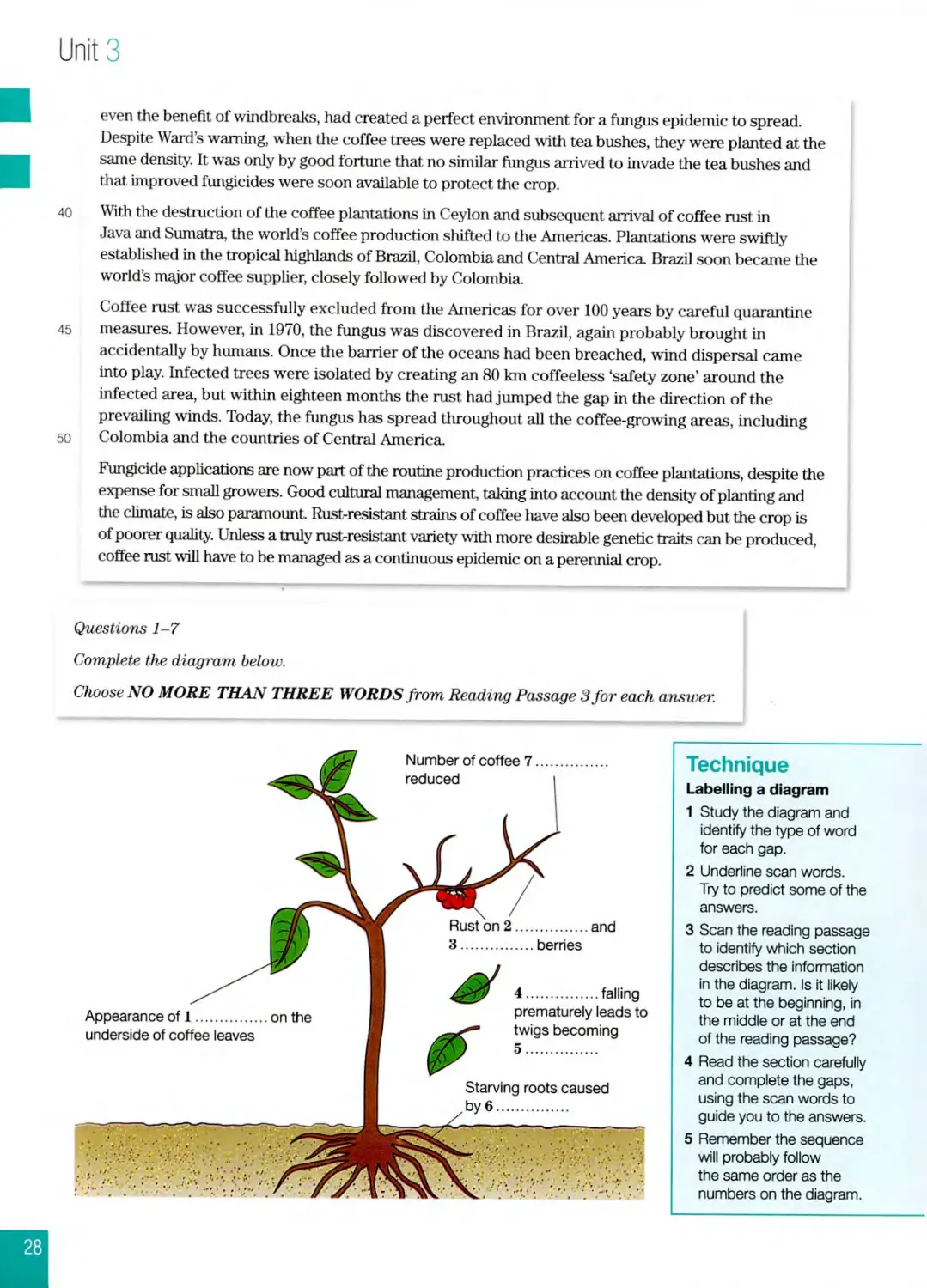
4
falling
prematurely leads to
twigs becoming
5
Appearance of 1
on the
underside of coffee leaves
Starving roots caused
by6
Number of coffee 7
reduced
Rust on 2
and
3
berries
Unit 3
even the benefit of windbreaks, had created a perfect environment for a fungus epidemic to spread.
Despite Ward's warning, when the coffee trees were replaced with tea bushes, they were planted at the
same density. It was only by good fortune that no similar fungus arrived to invade the tea bushes and
that improved fungicides were soon available to protect the crop.
40 With the destruction of the coffee plantations in Ceylon and subsequent arrival of coffee rust in
Java and Sumatra, the world's coffee production shifted to the Americas. Plantations were swiftly
established in the tropical highlands of Brazil, Colombia and Central America. Brazil soon became the
world's major coffee supplier, closely followed by Colombia.
Coffee rust was successfully excluded from the Americas for over 100 years by careful quarantine
45 measures. However, in 1970, the fungus was discovered in Brazil, again probably brought in
accidentally by humans. Once the barrier of the oceans had been breached, wind dispersal came
into play. Infected trees were isolated by creating an 80 km coffeeless 'safety zone' around the
infected area, but within eighteen months the rust had jumped the gap in the direction of the
prevailing winds. Today, the fungus has spread throughout all the coffee-growing areas, including
so
Colombia and the countries of Central America
Fungicide applications are now part of the routine production practices on coffee plantations, despite the
expense for small growers. Good cultural management taking into account the density of planting and
the climate, is also paramount. Rust-resistant strains of coffee have also been developed but the crop is
of poorer quality. Unless a truly rust-resistant variety with more desirable genetic traits can be produced,
coffee rust will have to be managed as a continuous epidemic on a perennial crop.
Questions 1-7
Complete the diagram below.
Choose NO MORE THAN THREE WORDS from Reading Passage 3 for each answer
Technique
Labelling a diagram
1 Study the diagram and
identify the type of word
for each gap.
2 Underline scan words.
Try to predict some of the
answers.
3 Scan the reading passage
to identify which section
describes the information
in the diagram. Is it likely
to be at the beginning, in
the middle or at the end
of the reading passage?
4 Read the section carefully
and complete the gaps,
using the scan words to
guide you to the answers.
5 Remember the sequence
will probably follow
the same order as the
numbers on the diagram.
28

Machines, processes and cycles
Questions 8 and 9
Choose the correct letter, A, B, C or !).
8 The most important means of long-range dispersal is
A rain.
wind.
C wasps.
flies.
9 Coffee rust spread easily in Ceylon
A due to the density of the coffee trees.
due to the windbreaks.
C because the fungicide didn't work.
because it was well established.
Questions 10-14
Complete each sentence with the correct ending, A-G .
10 The move of coffee production to the Americas was triggered by
11 Before 1970, American plantations were protected through
12 Attempts in the Americas to isolate the infected trees failed due to
13 The coffee trees now have to be protected continuously by
14 In the management of the coffee crops, it is also important to consider
A the density of planting and the climate.
the application of fungicide.
C the coffee rust devastation in Ceylon.
the increased demand for coffee in Europe.
careful quarantine measures.
F the genetic traits of the coffee tree.
the prevailing winds.
•
Technique
Choose 5-7 words or
phrases from the reading
passage and the questions
for future use in all skills.
Record the words according
to theme and/or function
and with a context, e.g.
Question 10 was triggered
by, which can be recorded
under cause and effect.
2 Choose 5-7 words or phrases from the reading passage and the questions that you think
will be useful to remember. Keep a record of them.
3 Make a list of the text features in this reading passage, e.g . description, historical
information and problem. Then do the same with Reading passages 1 and 2.
29

Predicting
Answering Yes/No/Not Given statements
(writer's claims)
Matching headings (1)
Matching headings
Answering Yes/No/Not Given statements
(writer's claims)
Completing multiple-choice questions
Education
Predicting
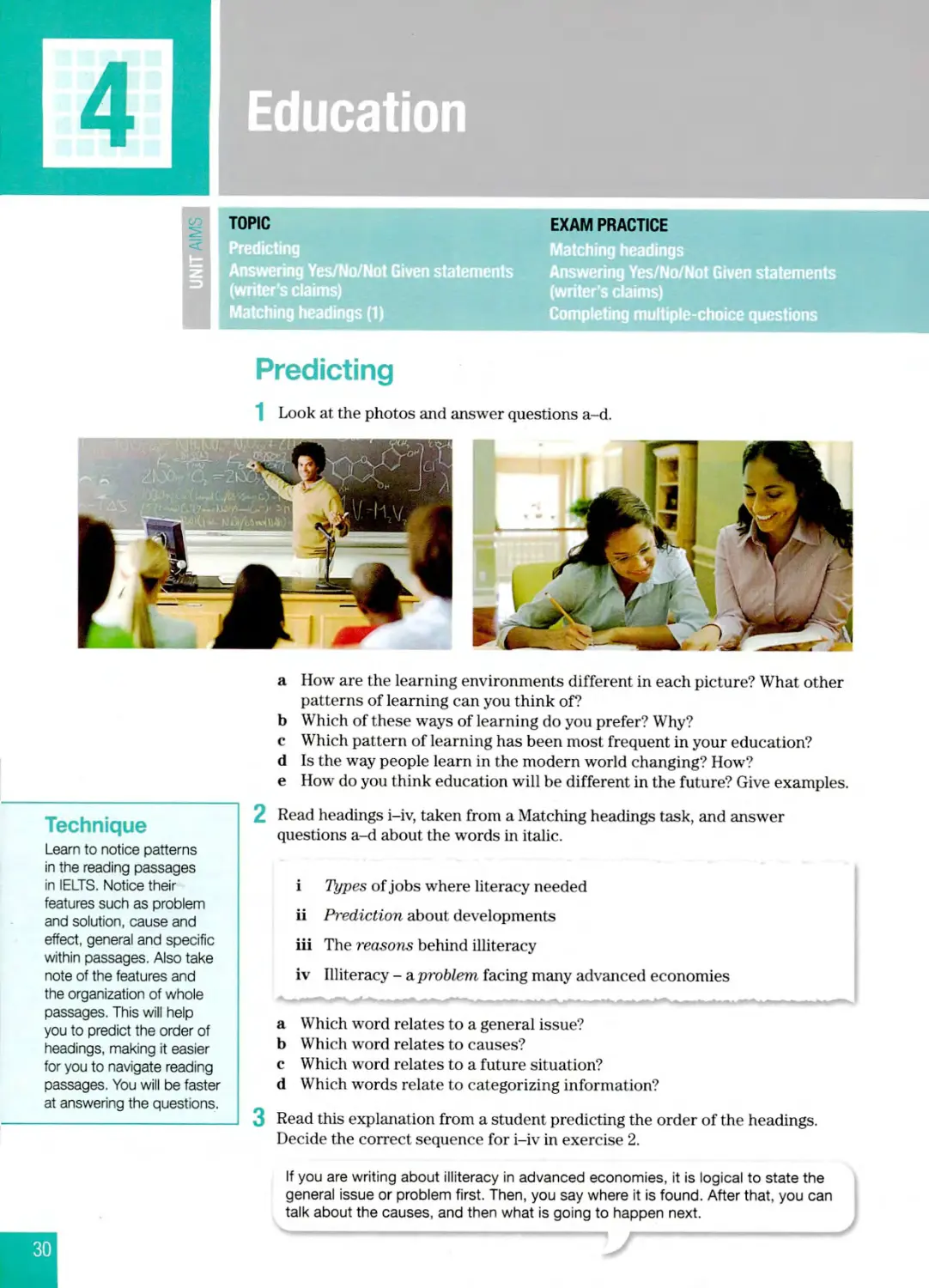
1Look at the photos and answer questions a-d .
a How are the learning environments different in each picture? What other
patterns of learning can you think of?
b Which of these ways of learning do you prefer? Why?
c Which pattern of learning has been most frequent in your education?
d Is the way people learn in the modern world changing? How?
e How do you think education will be different in the future? Give examples.
Read headings i-iv, taken from a Matching headings task, and answer
questions a-d about the words in italic.
i Types of jobs where literacy needed
ii Prediction about developments
ill The reasons behind illiteracy
iv Illiteracy - a problem facing many advanced economies
a Which word relates to a general issue?
b Which word relates to causes?
c Which word relates to a future situation?
d Which words relate to categorizing information?
Read this explanation from a student predicting the order of the headings.
Decide the correct sequence for i-iv in exercise 2.
Technique
Learn to notice patterns
in the reading passages
in IELTS. Notice their
features such as problem
and solution, cause and
effect, general and specific
within passages. Also take
note of the features and
the organization of whole
passages. This will help
you to predict the order of
headings, making it easier
for you to navigate reading
passages. You will be faster
at answering the questions.
2
3
If you are writing about illiteracy in advanced economies, it is logical to state the
general issue or problem first. Then, you say where it is found. After that, you can
talk about the causes, and then what is going to happen next.
30

1 Some journalists take the view that more British schoolchildren
should study languages.
2 The number of English speakers worldwide makes it unnecessary for
British tourists to learn languages.
3 .Only British teenagers find languages boring.
4 British teenagers' reluctance to learn languages is linked to the
availability of films and music in English.
5 In the past, studying French made it easier for British people to learn
further languages.
6 The lack of linguistic skills within British companies has resulted in
business being lost.
7 American businesspeople are less interested in learning languages
than British businesspeople.
Education
4 Read headings i-iv taken from a Matching headings task and answer questions a-d.
1111
i A problem faced by education systems in advanced nations
ii The importance of the state in providing education
ffl The influence of private enterprise
iv The impact of recent change
•
a Which heading relates to an effect or consequence?
b Which headings relate to causes?
c Which heading contains an indefinite article? Why?
d What does the heading containing an indefinite article relate to?
5 Based on the headings in exercise 4, which of these descriptions best fits the
likely pattern of the article?
a The writer begins by stating the effects of a problem. Then the writer
gives a description of the problem. Finally, the writer details its causes.
b The writer begins by stating the problem. Then the writer gives details
of the factors which contribute to this problem. Finally, the writer
describes the consequences.
6 Find an example of a text which contains a problem and solution(s). Use the
Internet or look in magazines or books.
7 Make a list of the benefits of prediction and add to the list as you prepare for
the IELTS exam.
Answering Yes/No/Not Given statements (writer's claims)
1 Statements 1-7 below are taken from a Yes/No/Not Given task. Read the
statements, and then answer questions a-d .
a Which statements contain a comparison?
b Which contain a cause and effect?
c Which contain words with negative connotations? Underline them.
d Using the title of the passage in exercise 2 on page 32 and the information
from your answers to questions a-c above, can you predict which
statements are True/False/Not Given? Make a note of your predictions.
Technique
Keep a checklist of text
features, especially those
that fit together: problem
and solution, cause and
effect, classification,
examples, explanation,
description, process. Skim
your checklist before you
look at reading passages
as you prepare for the
exam.
Technique
Yes/No/Not Given
questions are similar to
True/False/Not Given,
but they are used in
passages where the
writer is presenting a
claim or opinion. Collect a
list of different examples
of statements that relate
to claims. This will help
you to see the type of
language that is used
31

Unit 4
2 For each of the statements 1-7 in exercise 1, decide if they agree with the writer's claims
(Yes) or contradict (No) the writer's claims in the following reading passage. Write 'Not
Given' if it is impossible to say what the writer thinks about this.
An answer to the belief that British people
cannot learn languages
A Every so often, the educational supplements
of our broadsheets devote an entire issue to
the danger the British face of falling behind
in Europe because so few of our schoolkids
5
speak foreign languages. Most recently, the
German ambassador lambasted us for only
ever speaking English, a rebuke echoed by
his French and Spanish counterparts.
The truth is that foreign languages are
10
phenomenally unpopular in secondary
schools. Poor teaching and the late
introduction of the subject are often cited
as the main reasons youngsters are so
loath to study them. Another factor for our
15
notorious laziness vis-A -vis other tongues
has to be that we are brought up to believe
that the whole world speaks English, so why bother? Why indeed? Struggling to communicate in another
language is, for all but the committed and enthusiastic linguist, a frustrating experience, which, if not
necessary, is best avoided. And yes, when millions of Brits take their annual holidays abroad, local
20
tourism, travel, catering and retail staff are all trained in at least rudimentary English. So, again, there is
little motivation to learn more than a couple of words.
All this is true, and yet illuminates only part of the picture. British teenagers are generally bored by
French or German verbs, but the underlying reasons are more complex than a vague assumption that they
only need to speak English because everyone else does. Their leisure activities revolve around pop music,
25
sport, computers, television and films. These things are already in English; translations and subtitles are
the exception. Furthermore, the most powerful country in the world happens to speak our language, and
we absorb its cultural exports easily and readily. So, for us, language is not a major issue.
C Of course, should the world situation change, and the United States become a Hispanic country, as some
boffins have predicted, the British would see the benefit of learning Spanish and do so. Not so long
30
ago, knowledge of French was more widespread here, and eagerly acquired, when that language was of
paramount international importance.
The belief that we will lag behind our European business partners also needs to be dissected. The canard
here is that we lose out because our businessmen and women can't keep up with the local lingo. But
surely, it is competitiveness and the attraction of lucrative offers that count. After all, American executives
35
don't wring their hands at their lack of linguistic skills.
3 Check if any of your predictions in exercise Id were correct.
32

Education
Matching headings (1)
1Decide which three nouns are the odd ones out in the list below and explain why.
doctor • effect • impact • table • problem • consequence • benefit • solution • prediction
skyscraper • example • description • factor • reason • argument
2 Match the general nouns 1-4 with sections A-D in the reading pacsage opposite.
•
1 The belief
2 The consequence 3 Reasons
4 A criticism
3 Complete the headings in exercise
2 above by choosing an appropriate
ending from a-f below.
a that business lost due to lack of
linguistic ability disproved
b why young British people learn
languages
c why young people don't learn
languages
of English not being a major
language
why foreign language learning
disliked
I of British attitudes to learning
languages
4 Sentences a-f give techniques for doing Matching
headings tasks. These were listed by a student revising
for the IELTS reading. Which do you think is the most
important? Why?
a Skim the headings for a summary of the passage.
b Scan the text using the general nouns like effects,
problem, etc and also synonyms of these nouns.
c Scan for words in the heading which help locate the
information.
d Predict the likely position in the passage for some of
the paragraph headings.
Read and match each paragraph in turn, thinking of
the writer's overall purpose.
I Check that the sequence of paragraphs makes sense.
5 A student skimmed three paragraphs 1-3, paying attention only to the words which give meaning.
Quickly skim the words he looked at below, and decide which title, a or b, is better in each case.
1 Formal education - academic or vocational - obviously of value - however
-
education outside formal school - greater impact on individual - main
criticism of schools/universities: don't prepare students for work -
many people successful without formal education - informal education
influences countless businessmen/women - Einstein, left school when
sixteen - other self-taught people - formal education considered as
stifling entrepreneurs - not providing skills in all fields - no problem going
straight into work even after basic education - learn on the job.
a The importance of academic education
b The impact of education outside formal settings
2 Education - different forms - formal from primary to university -
vocational - students learn work-related skills, e.g. construction/
engineering/catering or apprentices - trainees learn while working -
e.g . with experienced plumbers, etc. - in UK/many other countries latter
generally considered inferior - but now apprenticeships important - lack
of skilled workers in construction driving up demand.
a Different types of education
b A skills-based approach to education
3 Education radically different in future: autonomy of the learner will
be central - teachers disappear - replaced by robots/machines -
transmit knowledge and skills directly to the brain - languages/musical
instruments - data transmission via satellite to human brain.
a Future developments in education
b Learning languages in the future
Technique
Notice that by looking
atafewwordsitis
possible to select
a heading for the
paragraph. The
skimmed words help
to give the theme and
gist of the paragraph.
The other words you
use for close, careful
reading. Look again at
page 14 in Unit 2.
33

Unit 4
I. Improve your IELTS word skills
1Make the following adjectives negative by adding the prefixes un-, in-, dis-, im-,
1.1
ir-, a-.
ambitious • conscious • accurate • literate • mortal • replaceable • relevant
similar • satisfied • symmetrical • political
2 Complete the following sentences using the negative form of one of the
above adjectives.
a Coral reefs are
Once they are destroyed, they are gone
forever.
b If the patient remains
, he should be put in the recovery
position.
c Some students do not see the point of studying history as they find it
to the modern world.
d The two students' background was not
working-class families.
Unfortunately, the data was wrongly analysed and some of the figures were
Technique
Academic texts may
use a number of words
that you have not seen
before. If the word
contains a prefix, you
can often work out the
meaning, for example:
an unimportant (= not
important) pastime, the
unborn (= not yet born)
citizens.
as they both came from
Although doctors and nurses generally prefer to be
,all of them are
united against the government in this matter.
No form of life on this planet can be
since our Sun's lifespan will
end in a few billion years.
Low status jobs tend to attract
workers, which makes it difficult to
raise the skills level among the staff.
The regularity of the layout of the 16th century garden was replaced by more
shapes.
3 Use your knowledge of prefixes to work out the meanings of the words in italics in
sentences a—k .
a 'Awkward' is one of the most frequently misspelt words in English.
b The health service has been drastically underfunded for the last ten years.
c There are plans for the rail industry to be denationalized.
Some environmentalists are concerned about the effect of overfishing
on our oceans.
Students who fail the exam will have a chance to resit the following year.
f The growth in obesity among young people means that a significant number of
parents will outlive their children.
By 1950, sales had reached almost three times the pre-war level.
Pericles was perhaps the first Greek leader who was truly pro-democracy.
i The drug is believed to have a strong anti-aggressive effect.
j Investments reached a post-crisis peak last month.
k The machine was badly damaged in the storm and is now unusable.
34

Technique
1 Skim the headings to
form a general idea of
the topic. Note repeated
words.
2 Skim the reading passage
and the other questions.
Why is there no heading
for the reading passage?
3 Identify and underline
the general nouns in
the headings. Look for
connections and logical
orderings between the
nouns.
4 Read any examples given
and make sure you do
not cross them out.
Make a note that they
are already used.
4 Make predictions about
which paragraph each
heading relates to
5 Skim the paragraphs to
check your predictions
and complete the
matching exercise.
6 Check your answers by
reading your headings
in order.
Technique
Always read examples
and skim the relevant
paragraphs for the
examples. They help you
with the organization of
the reading passage.
Education
Reading Passage 4
111
1 You should spend 20 minutes on questions 1-13 which are based on Reading Passage 4.
•
Questions 1-7
The reading passage has nine paragraphs, A-I .
Choose the best headings for paragraphs B-H from the list of headings
below.
List of headings
The effect of emphasis on short-term educational goals
ii The limited effects of music
iii The future of music
iv Benefits for health
The effects of early exposure to music
vi The skills involved in musical activity
vii A playwright's perception of music
viii Early exposure to music in the USA
ix Music without instruments
The 'Mozart effect'
xi Order or chaos
xii The creation of The Voices Foundation
xiii A method for training singers
xiv The use of music in Shakespeare's plays
Example Paragraph A xi
1
Paragraph B
2
Paragraph C
3
Paragraph D
4
Paragraph E
5
Paragraph F
6
Paragraph G
7
Paragraph H
Example Paragraph I iii
35

Australian Aborigines had developed the didgeridoo.
Like the clarinet and the flute, this haunting and
beautiful instrument helped to overcome both upper
and lower respiratory tract problems and encouraged
better sleep. In playing a wind instrument, abdominal
muscles are used to support the breathing system.
And these are the very muscles which come into play
when an asthmatic is experiencing an attack.
F But what of those individuals and schools which
simply cannot afford a musical instrument? What of
those institutions where not a single member of staff
can read music? This is where the human being's
most primitive form of music-making comes into its
own. Singing is free. Everyone possesses a voice.
And, with it, the body expresses itself in the most
fundamental and organic way.
The Hungarian composer Zoltan Kodaly knew this,
and developed his own system of training ear and
voice within a simple yet comprehensive system of
body language. Today, an organization called The
Voices Foundation adapts and applies Kodaly's
methods, aiming to give children back their singing
voices, and to make our schools ring with music-
making once again. Their advisors and teachers have
already achieved extraordinary turn-around effects
the length and breadth of Britain and in schools in the
troubled areas of South Mica.
Important work is currently being done in Finland,
Israel and the United States on pre-school, even pre-
birth, musical education. Music in the womb is very
much part of the life of the unbom figure citizens of
Finland. And one has only to look at the educational
standards, health records and professional musical
activity in this small nation to see what dividends music
in education pays from the earliest days of human life.
I Mozart has been celebrated in his anniversary years
of 1991 and again in 2006. By the time of the next
Mozart-Year, shall we have allowed music to conjure
a better society for us all? Or, relegated to the ranks of
mere entertainment, will music be eroded of its unique
power to heal and to make whole?
50
55
60
70
75
85
Unit 4
A Even the Greeks coulcht't agree about it Was music a
source of order and proportion in society, regulating
its innate chaos in ways similar to the disciplines of
geometry and architecture? Or did its ability to express
5
passionate emotions beyond the reach of words create
the potential for disorder and anarchy? Compare the
behaviour of an audience listening to classical string
quartets with headbangers at a rave, and the age-
old conflict between Apollo and Dionysus is made
10
manifest all over again in our own time.
B Shakespeare, though, came clean. For him, 'the man
who bath no music in himself, Nor is not mov'd
with concord of sweet sounds, Is fit for treasons,
stratagems and spoils; The motions of his spirit are
15
dull as night ...' Throughout his plays, Shakespeare
perceives music as a healing force, an art whose
practice makes man whole.
C Yet, despite the growth of the science of music
therapy within the last two centuries, and despite the
20
huge weight of books published on the miraculous
` Mozart effect', our schools and colleges have fallen
strangely silent The so-called `Mozart effect' presents
anecdotal and statistical evidence for advances in both
social and academic skills in those children exposed
25
in their formative years to the music of Mozart. But,
in an age obsessed by pragmatism and by short-term
vocational learning, music has been marginalized in
both primary and secondary education. Compared
with the holy trinity of reading, writing and
30
arithmetic, music is regarded as an unimportant
pastime. As a result, children are leaving school not
only totally ignorant of their own musical heritage,
but lacking in social, physical and mental skills which
musical performance can uniquely promote.
35 D Haying an instrument requires a degree of
concentration and coordination which brings
into play a plethora of mental and physical skills
which are being eroded in our push-button world.
Socialization and teamwork are also involved.
40
Schools with wind bands, string ensembles, jazz
groups and orchestras are right up there at the top
of the league tables. In excelling in musical activity,
the students' performance in many other fields of
learning is refocused and radically improved.
45 E There are medical aspects too. Long before British
primary schools discovered the recorder — that
most basic of all modem woodwind instruments —
Technique
Make notes about text features in the margins of reading passages as you prepare for the IELTS. For example, aim
to identify three to free text features such as examples, effects, results, methods, future developments, etc. In time,
you will notice these automatically. In the exam itself, you may not have time to do this.
36

Questions 8-10
Do the following statements agree with the claims of the writer in the
reading passage?
Write
YES
if the statement agrees with the writer's claims
NO
if the statement contradicts the writer's claims
NOT GIVEN
if it is impossible to say what the writer
thinks about this
8 In Shakespeare's dramas, music is seen in a positive light.
9 Schools lack the funds to buy luxury items like musical instruments.
10 Musical activity can only lead to a slight improvement in children's
social, physical and mental skills.
Questions 11-13
Choose the correct letter, A, B, C or D.
11 According to the writer, studying music
A may not help all students to improve in other areas of their studies.
means that students spend less time on reading, writing and arithmetic.
C helps students to improve enormously in other areas of their studies.
means that students will excel as professional musicians.
12 The didgeridoo is an instrument that
A has a negative effect on those suffering with breathing problems.
benefits those suffering with breathing problems.
C tends to send those who listen to it to sleep.
D sounds sad to most people.
13 Which of the following is the most suitable heading for Reading Passage 49
A The growth of music in the school curriculum
Music throughout the ages
C Music for everyone
The beneficial effects of a musical education
Education
•
Technique
Think about the words
that help you to focus on
the meaning of the claims,
not just words that help
you scan: 8 positive 9 lack
10 only/slight. Each of
these words qualifies the
statement in some way.
To see how important
thmo words are, turn the
statements into questions.
These words carry the
main stress.
2 Answer these questions.
a Which type of music do you prefer? Do you play an instrument? Which/Why?
b Do you like classical music? Why/Why not?
c Is it important to listen to different types of music?
d Do you think young people listen to music rather than play an instrument nowadays?
Why/Why not?

Technique
Learn to work out whether
the summary relates to part
of a reading passage or a
whole reading passage.
For example, a summary
with a heading is likely to
relate to part of a passage.
The rubric may also tell
you which paragraphs
the questions relate to, so
always check the rubric.
READING SKILLS
EXAM PRACTICE
Completing summaries with wordlists
1Look at the photo and answer questions a—d.
a What aspect of modern life does the photo suggest?
b To what extent is the gap between the capabilities of older and younger
people real?
c Do young people take on responsibilities at an earlier age than they did
in the past? If so, is this a good development?
d Which age group — young adult, middle aged, elderly — would you
associate the adjectives below with? Explain why.
analytical responsible
ble spontaneous sensl
Skim the title of the reading passage on page 39.
What can you predict about the topic of the reading
passage from the title?
Read the summary, which is taken from a Summary
task with a wordlist. Then answer questions
a and b below.
a Which words in the summary will help you scan
for the beginning and the end of the relevant
section of the text?
b Skim the reading passage and decide where the summary begins and ends.
According to a recent report, young people aged 8-18 are wasting
1
of time by multi-tasking. In fact, they are spending as much
as 50 per cent longer than if they did the same tasks 2
Some
young people are juggling a larger and larger array of 3
as
they study, while surfing the net, sending 4
, answering the
phone and listening to music simultaneously. Other studies have shown
that this 5
is affecting the way families operate, with young
people too self-absorbed to talk to other family members or to eat at the
family table. The electronic 6
is also apparently having a
7
on young people's studies and work.
2
3
38

Youth
10
15
20
25
30
Excessive demands on young people
Being able to multi-task is hailed by most people as a welcome skill, but not according
to a recent study which claims that young people between the ages of eight and
eighteen of the so-called 'Generation M' are spending a considerable amount of their
time on fruitless efforts as they multi-task. It argues that, in fact, these young people are
frittering away as much as half of their time again as they would if they performed the
very same tasks one after the other.
Some young people are juggling an ever larger number of electronic devices as they
study. At the same time as they are working, young adults are also surfing the Internet,
or sending out emails to their friends, and/or answering the telephone and listening to
music on their iPods or on another computer. As some new device comes along, it too is
added to the list rather than replacing one of the existing devices.
Other research has indicated that this multi-tasking is even affecting the way families
themselves function as young people are too wrapped up in their own isolated worlds
to interact with the other people around them. They can no longer greet family
members when they enter the house, nor can they eat at the family table.
All this electronic wizardry is supposedly also seriously affecting young people's
performance at university and in the workplace. When asked about their perception of
the impact of modern gadgets on their performance of tasks, the overwhelming majority
of young people gave a favourable response.
The response from the academic and business worlds was not quite as positive.
The former feel that multi-tasking with electronic gadgets by children affects later
development of study skills, resulting in a decline in the quality of writing, for
example, because of the lack of concentration on task completion. They feel that many
undergraduates now urgently need remedial help with study skills. Similarly, employers
feel that young people entering the workforce need to be taught all over again, as they
have become deskilled.
While all this may be true, it must be borne in mind that more and more is expected
of young people nowadays; in fact, too much. Praise rather than criticism is due in
respect of the way today's youth are able to cope, despite what the older generation
throw at them.
4 Complete the summary in exercise 3 as far as you can without looking at the passage again. lb what
extent is it possible to predict the meaning of the missing words in the summary without reading the
passage? Give reasons for your answer.
•
•
39

5 Complete the summary in exercise 3 using items A-M from the wordlist below.
Wordlist
A in sequence
B revolution
C beneficial effect
D much
E messages
F letters
G electronics
H negative impact
I electronic gizmos
J behaviour
K development
L significant amounts
M all together
Unit
6 Using the following notes to help you, check the items you have selected from the wordlist
for questions 1-7 .
1 something to do with quantity
2 something to do with order
3 something to do with electronic things
4 something to do with things you send electronically
5 something to do with the way of doing things
6 something which has happened to do with electronics
7 something to do with the effect of 5 and 6
7 Underline the words in the reading passage which are paraphrases of the answers 1-7 above.
8 Make a checklist of techniques to help you complete summaries. Revise the checldist as you
continue to prepare for the exam.
Selecting statements from a list
1In the IELTS exam, you may be asked to select True statements from a list about a passage.
Skim the statements about the reading passage on page 39 and answer questions a-c.
a Which part of the passage do you think the answers are likely to be in?
b Which statements can you predict to be true?
c Which words can you use to scan? Can you use electronic gadgets? Why/Why not?
40

Youth
•
•
Technique
Skim all of the statements
when you have to select
statements from a list. Try
to predict possible answers
after skimming the reading
passage. Work out which
part of the passage the
statements relate to - the
whole passage or just
part of it. Use nouns/noun
phrases to help you with the
organization and functions
of the reading passage.
The list below gives some opinions about electronic gadgetry.
Which THREE opinions are mentioned by the writer of the text?
A According to students, electronic gadgets are now an inevitable part of
the university landscape.
Academics feel multi-tasking with electronic gadgets affects children's
subsequent acquisition of study skills.
C Academics feel students are offered help with their writing and study skills.
Most young people see no problems related to using electronic gadgets.
Computer use at school fails to prepare students for academic life at
university, according to academics.
F Employers feel that the use of electronic gadgets among children affects
rapacity to perform in the work environment
Employers think that overuse of computers and other gadgets definitely
affects job prospects later in life.
2 Choose three opinions A-G mentioned by the writer in exercise 1. Use your predictions
to help you.
Answering global multiple-choice questions
1The question below is a Global multiple-choice question. Read the question
and then answer questions a-c.
Choose the correct letter A, B, C or D.
The writer concludes that
A the use of electronic gadgets at school is affecting academic study
more is required of young people today and they cope well in the
circumstances.
C the use of electronic gadgets at school needs to be controlled.
D electronic gadgets should be totally banned as they harm young
people's job prospects.
a Look at the stem of the multiple-choice question. What does it tell you
about the location of the answer?
b What does the title of the passage tell you about the writer's opinion?
c Which alternatives can you eliminate?
2 Using your answers to question 1, complete the Global multiple-choice
question.
Technique
1 Global multiple-choice
questions can ask: about
the purpose of the text, its
source, about the writer's
overall opinion, to choose
the best title or to select
the writer's conclusion.
2 Read the stem and the
alternatives, remembering
that the question refers
to the whole text and not
just a part of it, unless it is
a conclusion.
3 Do not start re-reading
a specific part of the
text, as this may confuse
you, again unless it is
the conclusion. If you are
really stuck, for all types
of global questions, look
at the conclusion.
4Donotdothistypeof
question before you have
answered all the others.
41

A workforce made up entirely of young people is not necessarily the key to success and there is a
growing 1
(aware) among employers of the special 2
(contribute)
that older people can make. Yet while attitudes in the workplace may have changed, it seems that the
3
(advertise) industry continues to look the other way. TV advertisements still often
show older people in a negative or 4
(stereotype) way and tend to feature younger
users.
This, however, makes no sense. Older people usually have a higher income than the young and it is
fairly easy to adjust the image of a product to make it more 5
_
(attract) to them.
For example, mobile phones can be presented as a way to maintain 6
(friend) across
distances, a welcome 7
(propose) to older people who often fear
8
(lonely) in their later years. Showing more older people using a product not only
makes good 9
(finance) sense but it can also play a wider role in society in general
by challenging age 10
(discriminate).
Unit 5
II Improve your IELTS word skills
•
1 Which of the following suffixes are used to form nouns and Which are used to form adjectives?
-al•-ic•-ion•-ment•-ing
2 Find words in the reading passage on pages 43 and 44 that end with the suffixes listed in exercise 1.
3 Add the suffixes in exercise 1 to the following words to form nouns. You may need to make some
small spelling changes.
act • detect • fulfil • train • compete • produce • settle
4 Add the suffixes in exercise 1 to the following words to form adjectives. You may need to make some
small spelling changes.
strategy • energy • democracy • habit • benefit • Influence
5 Add the correct suffix to the words below. Decide if the words become nouns or adjectives.
flit -less -al -ous
courage • deny • price • use • survive • wonder • worth
6 Complete the text by adding suffixes to the words in brackets.
42

Youth
Reading passage 5
•
1 You should spend 20 minutes on questions 1-13, which are based on Reading Passage 5.
Youth: The Future of Travel
Young people are invariably at the leading edge of change and innovation -
and the travel industry is no exception. Young people think outside the box,
push boundaries and experiment with the new. In an era of unprecedented
challenge for the travel industry, youth travel represents not just an important
5
market segment, but also a vital resource for innovation and change.
The travel industry is itself undergoing rapid change. Traditional vertical
distribution chains are giving way to a more complex value network
involving a wide range of different suppliers from within and beyond the
travel sector. Travel is no longer solely dependent on the infrastructure of
10 the old economy - airline seats, hotel beds and travel agents' shelves. We
are entering a new, flexible, networked economy in which information and
communications technology (ICT), local culture and society, education,
work and play have become part of the tourism value chain. In fact, the
inter-relationships between travel, other economic sectors and society as a whole have become
15 so integrated that we might conceive of a 'value web' rather than the old value chain.
New value web
In the new tourism value web, value is created by linking actors inside and outside the tourism sector in
different combinations to create and exploit new opportunities. Young people are often at the forefront
of such innovation, because they are willing to cross boundaries and make new links. As early-adopting,
20 heavy users of new technology, young people are pioneering the use of social networking sites and mobile
media in searching for travel information and purchasing products.
Young people are the future of travel
Youth travel has grown rapidly in recent decades as living standards have risen and the populations
of developing countries are starting to travel for the first time. Indeed, these first-time travellers are
25 often characterized by being young and comparatively affluent. The global youth travel industry is now
estimated to represent almost 190 million international trips a year, and the youth travel industry has
grown faster than global travel overall. By 2020 there will be almost 300 million international youth trips
per year, according to UNWTO forecasts.
The youth market therefore represents a major opportunity for future growth in the travel industry. With
30 effective development and marketing, the potential of the youth market can be increased still further.
Why youth travel is important
Youth travel is important because it is a market for the future - not just for the future development of the
young people themselves, but also the places they visit. VVYSE Travel Confederation research shows that
young travellers often spend more than other tourists and they are likely to return and give more value
35 to the destination over their lifetime. Moreover, young travellers are a growth market globally, while the
spending power of older generations in Western economies may decline in the long term. Another reason
why young people are important is that they are less likely to be discouraged from travelling by factors
such as disease or natural disasters. They are also the pioneers who discover new destinations and are at
the cutting edge of using new technology. Last but not least, young travellers gain cultural benefits from
40 their travel, and contribute to the places they visit.

UNWTO and WYSE Travel Confederation are convinced that youth travel has moved far beyond its
original status as a specialized travel niche to become an important element of the travel mix in any
tourism destination. One of the reasons for this is that travel underpins many different aspects of youth
lifestyles. For young people:
45 • Travel is a form of learning
Travel is a way of meeting other people
Travel is a way of getting in touch with other cultures
Travel is a source of career development
Travel is a means of self-development
50 - Travel is part of their identity - you are where you've been.
Young people see travel as an essential part of their everyday lives, rather than just a brief escape from
reality. This has far-reaching consequences for the places they visit. Because of the way they travel, the
social and cultural consequences of hosting young people are becoming even more important than the
economic effects. So the added value to be extracted from youth travel lies in innovation, positioning,
55 cultural links, international trade and exchange, social support, education, learning support for local
communities, and so on.
Questions 1-7
Complete the summary below using the list of words, (A-0) from the
box below.
Youth travel: a force for change
In all fields, including the travel industry, young people are usually at the
forefront of any new 1
They set trends and so are a 2
for innovation and change. This is important as the travel industry is also
experiencing its own 3
The modem travel industry is not about
airline seats and hotel beds any more, but a new more open economy where
factors such as local culture and society have a 4
in tourism.
Indeed, the 5
of travel and other parts of the economy and society
means that traditional vertical distribution chains have been replaced by a
6
, or value web. Due to increased numbers of fairly rich young
travellers from developing countries, 7
now accounts for nearly
190 million trips annually.
A transformation
B impact
C developments
D transforming
E crucial force
F conflict
G interest
11 block
1 role
J network
K link
L older travellers
M integration
N circumstances
0 youth travel
Unit 5
Technique
Summary with wordlist
1 Scan the reading passage
for the section which
relates to the summary.
2 Skim the summary and try
to complete the spaces
with your own words.
3 Look for words/ideas from
the list that collocate with
words in the text.
4 And word phrases in the
list which are opposites.
Find words that you can
eliminate from the list.
5 Read the relevant section
of the text and complete
the answers.
6Lookattheendofthe
summary for clues about
where the summary
might end in the reading
passage
7 Note that some of the
words in the summary
answers may be the same
as in the passage.

Youth
111
Questions 8-10
Choose three letters, A-G.
Which THREE of the following reasons for the importance of youth travel are given by
the writer of the text?
A They make use of the latest technology that is available.
They spend a large proportion of their money on travelling worldwide.
C They avoid conflicts with local people more than older people.
They will probably return to the places they have visited later in their lives.
They are more likely to learn the local language than older people are.
F They are experiencing a rapid increase in their disposable income.
They give something back to the destinations they have been to.
Questions 11-13
Choose the correct letter, A, B, C or D.
11 Travel is central to young people's lifestyle, partly because
A it helps them to relax.
it is an educational experience.
C it improves their confidence.
it makes them more mature.
12 According to the writer, the economic impact of hosting young people is
A of no consequence compared to the social and cultural effects.
of greater consequence than the social and cultural effects.
C of lesser consequence than the social and cultural effects.
just as valuable as the social and cultural effects.
13 The writer concludes that
A youth travel is not an important area for the travel industry.
the main contribution of young people to the travel industry is
in innovation.
C young people value the cultural links gained from travelling more than
anything else.
there is a wide range of additional benefits to be derived from
youth travel.
2 What is your reaction to the contents of the reading psigcsige? Do you agree with the reasons
given for why travel is important for young people? Why/Why not?

READING SKILLS
EXAM PRACTICE
I
Matching headings (2)
Matching information to names
Matching information to paragraphs (1)
Completing multiple-choice questions
Matching information to names
Completing global multiple-choice questions
Using general nouns
1Look at the photos and answer questions a—c .
a What aspects of culture do the pictures reflect?
b Do you associate the word 'culture' with the activities shown? Why/Why not?
c Which factors in the box are important in making your culture different
from other people's? Give examples for each item you choose.
food • sport • music • family • art • work
2 Divide the following general nouns into pairs with similar meanings.
advantage • aim • benefit • consequence • difference
difficulty • discrepancy • factor • hazard • influence
outcome • problem • purpose • risk
3 General nouns are common in matching tasks. Complete each of the paragraph
headings below with a suitable word from the box.
action • reservations • role • strategies • outline • problem
a The
played by the individual in maintaining traditions
b The
of protecting culture from outside influences
c Different
to combat vandalism of historical sites
about the benefits of globalization
taken to improve historical sites of international importance
fAn
of various strategies to promote the speaking
of Chinese
4 Describe in your own words the possible paragraph contents of three headings
in exercise 3.
Technique
Learn to notice and
collect general nouns as
IELTS reading questions
often contain such
words. These nouns
belong to a limited set.
By identifying these,
it is easier to find the
answer.
46

Culture
Matching headings (2)
1Read the paragraph headings i-vi and answer questions a—d below.
Various interpretations of culture based on meaning
ii The problem of explaining what culture means
iii A definition of culture based on shared behaviour
iv Defining a culture is not only a matter of observation
v The main reason for difficulty in investigating culture
vi The discrepancy between personal explanations and the real reasons
for cultural behaviour
a What do you think the topic of the text is?
b Which general nouns are used in the headings? Underline them.
c Based on your answers to a and b, which is the most likely heading for
paragraph A on page 48?
d What does the plural in the word interpretations indicate?
2 Skim the passage on page 48 and match each paragraph A—D with a heading
from i—vi above. Decide why the remaining two headings are not suitable.
3 The diagram shows the plan of a paragraph. Decide which paragraph from the
passage it relates to. Underline the three examples mentioned.
Various ways of defining
Example 1
Example 2
Example 3
Matching information to paragraphs (1)
1 Underline the general nouns in each phrase 1-4 below. Then decide which
phrase is most likely to relate to a whole paragraph and explain why.
1 the idea that researching a culture is not just about observation
2 the fact that countries close to each other can be dissimilar
3 the fact that theories about culture can take a long time to develop
4 various anthropologists' ways of looking at the concept of culture
Technique
Notice and collect general
nouns in Matching
information to paragraph
tasks. Compare these
nouns to those used in
Matching headings to
paragraphs and sections
in a reading passage.
They are very similar.
47

Unit 6
• 2 Which paragraph (A—D) in the reading passage contains the information in 1-4?
The meaning of culture
A Culture is a term for which it is very
difficult to give a precise meaning.
The word means so many different
things to different people, so devising
5
a single acceptable definition is more
problematic than may be first thought.
The idea of culture as something shared
is inherently complex. Even people
neighbouring each other, or sharing a
10
common language, or possessing certain
common core values may actually have
as many differences as similarities.
B Anthropologists have proposed over one
hundred different definitions. A number
15
of these are variations on the idea that
culture consists of 'shared patterns of
behaviour' as may be observed by the
researcher. This is the definition put
forward by Margaret Mead, for example,
20
in her study of indigenous ritual in
Samoa. This kind of definition, however,
does not take account of the fact that
studying culture is not just a question of
observation. It also involves studying the
25
meaning of this observed behaviour.
C Accordingly, other anthropologists, such as
Max Weber, speak of culture as consisting
of systems of shared meaning; as he puts
it, 'man is an animal suspended in webs of
30
significance he himself has spun.' Similarly,
Claude Levi-Strauss also speaks of
culture as a product of the implicit beliefs
which underlie it. The problem with this
approach is that the meaning of cultural
35
behaviour is not always easy to establish.
Explanations may be offered up to a point,
but the underlying assumptions often
remain obscure. Indeed, they are often not
understood by insiders. As Chris Argyris
40
and Donald Schon point out, what people
say to explain their cultural behaviour and
what really drives this behaviour are often
widely different The search for meaning
can therefore be a long and painstaking
process, invoking long periods of
45
observation and interviews in order to
build possible theories.
D While there are some cultures which
have remained isolated for long periods
of time, many others have built up
50
commercial links with other groups.
Eventually, this may lead to adopting
elements of the other group's rituals
and behaviour which then become
integrated into those of the original
55
group. Some cultures have clashed with
less powerful neighbours only to find
that over time their culture became
heavily influenced by these subordinates,
like the Romans by the Greeks. In this
60
way, the original meaning of an aspect of
cultural behaviour may be lost in history
and may originally have been part of a
belief system very different from that
which prevails in the culture today. This
65
dynamism is, perhaps, the major reason
why researching the meaning behind
cultural behaviour is far from easy.
4•••••••••••••

1 Culture is something which is embodied in the way groups behave.
2 The reasons people give for their behaviour are often different from why
it originally developed.
3 Societies create networks of meaning within which their members live.
4 Culture is something which arises from a group's beliefs.
List of people
A Margaret Mead
Max Weber
C Claude Levi-Strauss
Chris Argyris and Donald Schon
Culture
3 Read this additional extract from the reading passage and answer the questions.
The study of a different culture can be carried out in different ways. It can
be compared to the study of a new planet or terrain. We can study what is
immediately observable: the valleys, mountains and different geographical
features, or, in the case of a culture, the various rituals and patterns of
behaviour. Alternatively, we can ask what values and beliefs underlie these
behaviours or what past events have shaped them, just as we may ask what
geological events have shaped the landscape. This deeper level of enquiry
may often lead on to a third stage in which we not only assess the new
culture, but we also become increasingly aware of the different factors
which have created our own culture as well.
a What general noun in the first sentence means 'method'?
b What three methods are mentioned in the text?
4 Which of the phrases below relates to a part of the paragraph and which to the whole?
Use the general nouns to help you decide.
i various strategies for studying another culture
ii a comparison between the study of a planet and a new culture
ifi a cause of geographical features
Matching information to names
1 The lists below are taken from a task where you have to match infonnation to names. Scan
the previous reading passage on page 48 for the names and draw a box around each one.
2 Match each statement 1-4 with the correct person A-D.
•
49

Unit 6
Improve your IELTS word skills
1Decide which general nouns in the box below could replace the word in italics in this
11.1
paragraph heading.
The connection between body language and environment.
link • bond • relationship • correlation • relation • strategy • association
2 The heading can also be rewritten in the form below. Which other verbs could be used?
Use the list of nouns above to help you.
Example
How body language and environment are connected.
3 Divide the general nouns below into five groups with similar meanings.
aim • analysis • characteristic • consequence • difficulty • effect • explanation
feature • goal • interpretation • objective • obstacle • outcome • problem
4 Change the following sentences into paragraph headings using an appropriate general
noun. Make the headings as short as you can.
Example
The paragraph exemplifies various subcultures in Brazilian society.
Various examples of' Brazilian subcultures.
a The paragraph describes the outcome of the research on stem cells.
b The paragraph details how hydrogen is produced from water for energy.
c The section explains how culture and wealth are linked.
d The paragraph provides a list of the different factors involved in the production
of a film.
e The paragraph sets out the part played by the United Nations in protecting cultures
under threat.
5 What synonyms can you find for the general nouns you used in a-e in exercise 4?
6 Using the nouns below, make headings that reflect aspects of a university student's life.
Example
Connection: The connection between studying and achievement
1 Benefit:
2 Aim.
3 Problems:
4 Ways.
5 Examples:
6 Factors.
7 Effect:
50

Culture
1 You should spend 20 minutes on questions 1-13, which are based on Reading
Passage 6.
Reading Passage 6
Questions 1-4
Reading Passage 6 has five sections, A—E.
Choose the correct heading for sections B—E front the list of
headings below.
List of Headings
i Research into African community life
ii Views about intelligence in African societies
ffl The limitations of Western intelligence tests
iv The Chinese concept of intelligence
v The importance of cultural context in test design
vi The disadvantages of non-verbal intelligence tests
vii A comparison between Eastern and Western understanding
of intelligence
viii Words for 'intelligence' in African languages
ix The impossibility of a universal intelligence test
Example Section A Ili
1 Section B
2 Section C
3 Section D
4 Section E
Technique
1 Survey the whole
reading passage and
the questions.
2 Skim the title and
predict the contents
of the passage.
3 Skim the reading
passage in no more
than two minutes.
4 Skim the questions.
Use the questions to
help you improve your
understanding of the
general content of the
reading passage.
Technique
1 Do not just cross out
the example heading.
2 Skim the relevant
paragraphs for the
example(s), as this can
help you find the other
headings.
3 Skim the headings,
noticing the general
nouns such as views,
comparison, etc and
the words which help
you scan the text. Also
think of synonyms.
4 When you have
finished, check the
order of the headings
you have chosen and
see if they am logical.
Views of intelligence across cultures
A In recent years, researchers have found that
people in non-Western cultures often have
B For example, Richard Nesbitt of the University
of Michigan concludes that East Asian and
ideas about intelligence that are considerably
different from those that have shaped Western
Western cultures have developed cognitive
styles that differ in fundamental ways, including
15
5
intelligence tests. This cultural bias may
therefore work against certain groups of
people. Researchers in cultural differences in
how intelligence is understood. People in
Western cultures tend to view intelligence as
a means for individuals to devise categories
intelligence, however, face a major dilemma,
namely: how can the need to comparg people
and engage in rational debate, whereas
Eastern cultures see it as a way for members
20
10
according to a standard measure be balanced
with the need to assess them in the light of their
own values and concepts?
of a community to recognize contradiction
and complexity and to play their social roles
successfully. This view is backed up by
46.1•1111.110141•1•••••••••Par
51

Unit 6
52
25
Sternberg and Shih-Ying, from the University
of Taiwan, whose research shows that Chinese
conceptions of intelligence emphasize
understanding and relating to others, and
knowing when to show or not show one's
30
intelligence.
C The distinction between East Asia and the West
is just one of many distinctions that separate
different ways of thinking about intelligence.
Robert Serpell spent a number of years studying
35
concepts of intelligence in rural African
communities. He found that people in many
African communities, especially in those where
Western-style schooling is still uncommon,
tend to blur the distinction between intelligence
40
and social competence. In rural Zambia, for
instance, the concept of nzehi includes both
cleverness and responsibility. Likewise, among
the Luo people in rural Kenya, it has been
found that ideas about intelligence consist of
45
four broad concepts. These are named paro or
practical thinking, Iuoro, which includes social
qualities like respect and responsibility, winjo
or comprehension and rieko. Only the fourth
corresponds more or less to the Western idea of
50
intelligence.
D In another study in the same community,
Sternberg and Grogorenko have found
that children who score highly on a test of
knowledge about medicinal herbs, a test of
55
practical intelligence, often score poorly on
tests of academic intelligence. This suggests
that practical and academic intelligence can
develop independently of each other, and the
values of a culture may shape the direction in
which a child's intelligence develops.
60
It also tends to support a number of other studies
which suggest that people who are unable to
solve complex problems in the abstract can
often solve them when they are presented in a
familiar context Ashley Maynard, for instance,
65
now professor of psychology kt the University
of Hawaii, conducted studies of cognitivt",
development among children in a Mayan
village in Mexico using toy looms, spools of
thread and other materials drawn from the
local environment. The research suggested that
the children's development could be validly
compared to the progression described by
Western theories of development, but only by
using materials and experimental designs based
on their own culture.
E The original hope of many cognitive
psychologists was that a test could be developed
that was absent of cultural bias. However,
there seems to be an increasing weight of
evidence to suggest that this is unlikely.
Raven's Progressive Matrices, for example,
were originally advertised as 'culture free'
but are now recognized as culturally loaded.
Such non-verbal intelligence tests are based on
cultural constructs which may not appear in a
particular culture. It is doubtful whether cultural
comparisons of concepts of intelligence will
ever enable us to move towards creating a test
which encompasses all aspects of intelligence
as understood by all cultures. It seems even less
likely that such a test could be totally free of
cultural imbalance somewhere.
The solution to the dilemma seems to lie
more in accepting that cultural neutrality is
unattainable and that administering any valid
intelligence test requires a deep familiarity with
the relevant culture's values and practices.
•
•
70
75
80
85
90
95

Questions 5-9
Look at the following findings (Questions 5-9) and the list of reserarchers
below.
Match each finding with the correct researcher, A-E.
List of findings
5 There is a clear relationship between intelligence and relationships with
others in Chinese culture.
6 The difference between intelligence and social competence is not distinct
in many African communities.
7 Children frequently scoring well in practical tests score less well in
academic tests.
8 In experiments to measure cognitive development, there is a link between
the materials used and the test results.
9 The way cognition is viewed in East Asian cultures differs fundamentally
from those in Western cultures.
List of researchers
A Richard Nesbitt
B Robert Seri:tell
C Ashley Maynard
D Sternberg and Shih-Ying E Sternberg and Grogorenko
Culture
Technique
Matching names
1 Scan the passage for
each name in the list.
2 Draw a box around
each name. This limits
where you need to
look for their findings
(opinions, claims, etc).
3 Skim to see whether
the person's findings
occur before or after
their name. Then read
the findings.
4 Read through the list of
statements to find the
correct match.
Question 10-12
The list below gives statements about non-verbal intelligence tests.
Which THREE statements are mentioned by the writer of the pa wage?
A Raven's Progressive Matrices are widely considered to be culturally free.
Cultural comparisons will allow the development of culturally neutral tests.
C The development of culturally neutral tests is unlikely.
Raven's Progressive Matrices are culturally specific.
The creation of culturally-free tests is sometimes possible.
F Many cognitive psychologists originally hoped tests could be developed free of cultural bias.
Question 13
Choose the correct letter, A, B, C or D.
Which of the following is the main argument of the article?
A Intelligence tests should include tests of social skills and responsibility.
Test takers from any culture can learn the cognitive style required by Western intelligence tests.
C Intelligence tests cannot be free of cultural bias.
More research is needed to develop an intelligence test which is valid for all cultures.
411111•1111•1•M•••11011•••••..- -
2 Write down ways that (a) you (b) your friends (c) your family (d) people in your home
country or a country you are familiar with use to measure intelligence in other people.
53

READING SKILLS
Completing multiple-choice questions
Analysing questions
EXAM PRACTICE
mp mg summaries without wordlists
Classifying information
Completing multiple-choice questions
?nd sciences
111
Completing summaries without wordlists
1Describe the photos and say which reflects your reading habits.
2 Answer the following questions about reading.
a How often do you read?
b What have you read today so far?
c Which types of books below do you like most? Give reasons.
Romance • Crime • War • Historical • Biography • Travel books
Sci-fi • Art books • Science
Some people think reading books will soon be a thing of the past.
Do you agree?
3 Decide which are the best techniques from a—g to complete a Summary
task without a wordlist.
a Skim and decide whether the missing words are adverbs, adjectives,
nouns/noun phrases or verbs.
b Avoid thinking of your own words.
c Predict the meaning of the word in the blank space.
Skim and ignore the blank space.
Skim and say the word 'blank' for each missing word.
Don't check your answers in the passage.
Skim the summary first before you look at the passage.
4 Read the summary which relates to the reading passage on page 55. Using
ONE word only from the passage, complete each space in the summary.
Most people join book clubs for 1
reasons. The official
reason is to discuss books, but members principally enjoy interacting
with others in a 2
atmosphere. Another reason for the
popularity of book dubs is that reading is a 3
pastime
compared with cinema or theatre going. Some book clubs may
4
on a particular genre, or they may decide to be
5
in their choice of reading material. It all depends on
the interest of the participants. Research suggests that the popularity of
reading has remained 6
since 1996, and it seems likely
that the number of clubs will 7
in the future.
54

Arts and sciences
Book clubs — from strength to strength
A The proliferation of book clubs, some 50,000 in the UK alone and
who knows how many more worldwide, is quite a remarkable literary
phenomenon. Participants of different ages and backgrounds gather on
a weekly or monthly basis ostensibly to discuss books chosen by the
5
members, but the primary attraction for most people, and the factor
behind the explosion in the number of groups, is not literary, but social.
Human interaction with some added mental stimulation in a relaxed
environment is integral to their success.
B The social aspect apart, the spread of book clubs can also be attributed to the low cost and the availability
10
of books, and the fact that compared to, say, the cinema or theatre, the clubs provide cheap entertainment.
The Internet has played its part as well. Once seen as foreshadowing the end of reading, not only does
the Internet allow people even cheaper access to books, but it also acts as a conduit for readers hungry to
join a particular reading club. A further draw is the number of people who read for pleasure. With reading
being listed as the most popular major leisure activity, according to a survey carried out over a four-week
15
period in 2002 in the UK (65% constant since 1996), there is no shortage of willing participants.
C The clubs vary, ranging from cosy get-togethers in friends' houses, with or without set rules and with or
without food and drink, to more formal, official set-ups in educational-clun-literary establishments like
libraries, sometimes with literary functions with guest speakers. The overwhelming majority are of a more
unthreatening, easy-going nature. People come and go, but the cohesion of the groups seems to live on
20
with new ones springing up to replace those which have faded away.
D From the literary point of view, the focus of each group is different as it depends solely on the make-up
of the members and their predilections. There are reading clubs which specialize in football, romance,
horror, science fiction and so on. Groups can focus on one type or they can be eclectic, combining
different types of fiction like romance with, for example, cricket. Some may even dress up in the style of
25
the characters or the time that a story took place to bring a mystery or an old classic to life. With such a
variety of choice, book clubs are sure to survive and expand.
Technique
Use context and your
own knowledge as well
as the reading passage
to complete summaries.
Build up your own
picture of the summary
as you skim it. This
picture building is called
'activating schemata'.
5 Complete the summary below using the comments made by a student to help you.
1
for most people is a very relaxing 2
, which
can, however, mean that a lot of time is spent on one's own. Yet, it does
have compensations. Reading allows one to 3
from the
real world, which is not a bad thing these days. There is nothing like
losing yourself in a 4
, whether it be a serious work like a
scientific article, or something like a romantic 5
1 I think it's an activity related to books.
2 It's a noun to do with something you do or like.
3 I am sure it's a verb here. The real world is like a prison. So?
4 This one is clear! What are we talking about?
5 This must be another word for a book.
55

Question 4
a Which options describe
who chooses the books?
b Which options describe
the limitations on book
choice?
c Which option here is
definitely false and
which two are not given?
Question 3
a What kind of words are
options A-D?
I, Which similar words in
paragraph C describe
the different types of
groups?
c Which phrase in
paragraph C indicates
most of the clubs?
Question 1
a Is the question
about reasons or
consequences?
I, Which word in the
question indicates
that you should look for
the most important
option?
Question 2
a Are you looking for the
cause or the effect of
the number of people
reading?
In the passage, what
reason is given for the
spread of book clubs?
Which option refers
to something not
mentioned in the text?
Unit 7
Completing multiple-choice questions
1Look at the multiple-choice questions. Answer the hint questions next to them.
Technique
Study the structure of multiple-choice questions as you prepare for the exam.
Notice the relationship between the stem and the alternatives. Is it a cause and
effect relationship? Is it one of action and purpose? Or do the alternatives contain
an evaluation of something?
•
1 The increase in book clubs has occurred mainly because they
A perform a social function.
fulfil an intellectual need.
C cater for people from a variety of backgrounds.
solve the social problems of the participants.
2 The number of people who read for pleasure in the UK
A shows that the Internet has some benefits.
means that the cost of books will be kept down.
C ensures there will always be a pool of readers to supply
book clubs.
I) means that cinemas and theatres are losing money.
3 Which of the following best describes most book groups
mentioned by the writer?
A restrictive
formal
C small
informal
4 Books for discussion in groups are
A restricted to one type.
dependent on member preference.
C limited to several different authors.
dependent on the chairperson's reading list.
56

Question 5
a Is the question asking
about the writer's
opinion or the writer's
purpose?
Which option accurately
paraphrases this
opinion?
Which wrong option
is the opposite of the
writer's opinion, and
which two are not given?
5 The writer of the article thinks that
A book clubs have a certain future.
book clubs will expand slowly but surely.
C book clubs may not survive.
1) the variety of book clubs will increase.
2 Answer the multiple-choice questions.
Arts and sciences
Analysing questions
1 lb some extent, the language and structure in multiple-choice questions are predictable.
Match the lists of language 1-7 which may be found in multiple-choice stems with the
correct category from a—g.
a Choose the correct effect/outcome/consequence.
b Choose the cause or reason for something.
c Identify questions relating to qualifying words.
Identify the purpose of an event or item.
Identify the best action/tool for a particular purpose.
I Explain what general point a specific example relates to.
Give the writer's main conclusion/purpose/opinion for the whole text.
1 mainly
usually
the majority
the most
2 ... leads to ...
. .. e nsures that ...
... means that ...
... resulting in ...
3 ... is used for ...
The main use/purpose of is
anumi
4 The writer refers to ... to show/ illustrate ...
.. . is an example of ...
5 In order to achieve/do something, ...
6 ... because ...
... as a result of ...
. .. is caused by ...
7 The writer's conclusion/opinion/purpose is
best summarized as ...
The writer concludes that ...
The writer believes that ...
The writer's main point is that ...
Technique
Make a checklist of the features
of all question types in the exam
such as True/False/Not Given or
paragraph and section headings.
You can use these checklists
for revision purposes. Update
the checklists as you notice
more features.
2 Make a checklist of the language features in True/False/Not Given
statements, paragraph and section headings. Use exercise 1 to help you.
57

Unit 7
1.1 Improve your IELTS word skills
•
1Divide the following verbs into three groups with similar meanings.
assess• condemn • disapprove • appraise • censure • endorse • condone
criticize • appreciate
2 Write the corresponding nouns for the verbs in exercise 1.
3 Choose the most suitable noun from exercise 2 to complete the sentences below.
a The team carried out a detailed
of the risks involved.
b The professor has published several works of literary
c The results of the election are a clear
of the government's policies.
At the end of the opera, the audience showed their
by clapping
enthusiastically.
In his very critical article, the author expresses his strong
of reality TV.
4 Make a noun from each of the following verbs to complete the sentences below.
judge • perceive • believe • think • analyse • condemn • conceive • discriminate
a Public
of the use of money for arts promotion was very harsh.
b He carried out an in-depth
of the extent of progress in this area.
c There was obvious
in favour of funding for science.
We need to reserve
until we are in possession of all the facts.
The general
appears to be that artists are somehow superior to
scientists.
f News about current issues barely affects the public's
generally.
Some artists seem to have no
of the way science is changing our view of
the world.
5 Contradict the verbs in italics in each sentence below. In most cases you can do this by
adding a prefix to the existing verb.
Example
The government defended the main arguments advanced. (opposed)
a The government undervalued the contribution made by various people.
b The effects of lack of light on humans are understood by most people.
c The local residents strongly approved of the building of the arts complex.
The various publications praised the contents of the book.
The company judged the timing of the film's release for maximum coverage.
f It is clear that the scientific community believed the results of the research.
Technique
When you record a new
vocabulary item, check
if you can add prefixes
or suffixes to it. Witte the
new item together with
any other words you can
form from it. This helps you
to create 'word families',
e.g. approve/disapprove/
approvaVdisapproval.
58

Arts and sciences
Reading Passage 7
1 You should spend 20 minutes on questions 1-13, which are based on Reading Passage 7.
Schad - connections between two cultures
Sciart was originally established to fund 'visual arts projects which involved
an artist and a scientist working in collaboration to research, develop
and produce work which explored contemporary biological and medical
science'. Over time, the programme expanded to cover a wider range of
5
arts and science activity. In total, Sciart supported 118 projects with nearly
£3 million of funding to increase interest and excitement in biomedical
science among adults; to encourage collaborative creative practice between
disciplines in the arts and science; and to create a group of artists looking at
biomedical science and build capacity in this field.
10 Interview evidence from those involved in Sciart projects suggested that the
collaborations between artists and scientists had helped to raise awareness
among project participants and the wider public of connections between aspects of the arts
and of the sciences. An effect of this had been to encourage, at policy making and funding
levels, more interest to be taken and more resources to be devoted to encouraging interactions
15 between the two. As one participant who was interviewed commented:
Connecting the sensory with the conceptual is something that is fundamental
to artistic and scientific method. That awareness has got lost at a public
level. And Sciart collaborations and the publicly visible outcomes help to
demonstrate those connections, which have tended to become ignored.
20
Sciart has made the similarities between science and art more evident.
Interviews with a significant number of artists and scientists who had
participated in Sciart-funded projects revealed that the process of
collaboration and of observing each other's professional practices and
cultures had led to previously unnoticed similarities between the 'two
25
cultures' being recognized. The process of recognition provided a point of
familiarity that generally seemed to encourage or reassure those concerned.
The combination of strangeness and familiarity was perceived by some as a
basis on which to engage in collaboration across disciplines.
Scientists' testimonies:
30
It has made me think more about the coming together of art and science. At the centre of
scientific and artistic thinking there are acts of creativity, and I don't think that those acts
of creativity necessarily differ, although the content may differ. In designing an experiment,
a thought will come to you that 'something is worth looking at, and I have to be able to
recognise what the value is within that'.
35
There are surprising parallels with being a scientist. You spend a lot of time getting funding
and writing reports, and only a small proportion doing the actual science. Each grant is for
time-limited funding, so like the artists we are always thinking about where the next funding is
going to come from.
Artists' testimonies:
40
I was intrigued by the radical differences between the artistic process and the scientific
method, but also by the overlaps, such as the opening up of new ideas, the creative
manipulation of materials and the process of experimentation. Both science and art require
•
59

Unit 7
•
creative thinking in their own ways, and they both require observation of the natural world. As
an artist, as well as a scientist, you also need to pay attention to detail. There seems to be a lot
45
in common but also a lot that is very different, and that seemed like a nice basis to form new
relationships on ...
The main thing is the similarities not the differences. You spend 75 per cent of your time applying
for funding, and 20 per cent writing reports, and just 5 per cent actually doing the work. That is
the same in both fields. Also there is that commercial lure in science to make money by working
50
on cures for things like obesity, which means that if you remain within the academic research you
effectively take a pay cut to do that. That is the same in the art world as well.
It was very clear from the testimonies of interviewees from both sides of the art-science divide, and
from those participating in projects as well as those observing them, that a great deal of mutual
respect between the 'two cultures' had grown up as a consequence of Sciart-funded collaborations.
55
I've seen plenty of evidence that artists and scientists now view each other's cultures differently.
There is a lot of anecdotal evidence ofscientists being astonished by the level of both skill and
hard labour that goes into the creation of artwork, and similarly a degree of astonishment amongst
the artists about the ability and excitement of scientists in dealing with ideas and with imaginative
concepts. So, there was I think a process of mutual eye-opening ... (Scientist)
60
A strength is that it has enabled people from both sides of the Sciart divide to gain access to
different ways of doing things, and that it has begun to break down some of the prejudices in the
two camps. (Arts expert)
Technique
1 Survey the whole reading passage and the questions.
2 Skim the title and predict the contents of the passage.
3 Skim the reading passage in no more than two minutes.
4 Skim the questions. Use the questions to help you improve your understanding of
the general content of the reading passage
Questions 1-6
Complete the summary.
Choose NO MORE THAN TWO WORDS from the passage for each answer.
Background to the Sciart projects
The Sciart prograrnme was basically launched to encourage 1
between
scientists and artists, eventually covering 118 projects that were not just involved
in art and biomedical science. When participants were interviewed about the Sciart
projects, they felt the project increased 2
of the connections between the
3
and
among themselves and the general public. The result
of this was that attempts were made to increase 4
between both cultures.
One interview comment was that Sciart had made the 5
between science
and art 6
60

Questions 7-10
Classify the following comments about Sciart according to whether they
were made by:
A Scientists
Artists
C Both scientists and artists
7 Detail is important in both art and science.
8 The funding of projects takes up a lot of time.
9 Making money is attractive to both artists and scientists.
10 While the content may be different, the creative process isn't.
Questions 11-13
Choose the correct letter, A, B, C or D.
11 In both the artistic and scientific fields
A a majority of the time is devoted to work.
only a small amount of time is spent working.
C funding applications require less time than writing reports.
networking takes up a lot of valuable time.
12 The programmes funded by Sciart have resulted in
A a fall in respect between artists and scientists.
government funding for similar collaborative projects.
C an increase in the divide between artists and scientists.
an increase in respect between artists and scientists.
13 The amount of work involved in creating a piece of art
A made little impression on scientists.
made scientists a little surprised.
C surprised scientists a lot
only impressed imaginative scientists.
Arts and sciences
Technirm
Multiple-choice questions
1 Predict the likely location
of the answer in the
passage.
2 Predict answers by using
what you know from
previous questions.
3 Identify the relationship
between the options and
the stem (e.g . cause and
effect).
4 Identify scan words in the
stem and use them to
locate the correct section.
5 Read around this section
and match the meaning
in the text with the correct
paraphrase from the
options.
2 Answer these questions.
a Should more arts than science subjects be taught in schools? Why/Why not?
b Do you think people should be worried about future developments in science? Should
the work of scientists be controlled and restricted by governments? Why/Why not?
c Do people have the knowledge to understand scientific developments? Why/Why not?
61

READING SKILLS
EXAM PRACTICE
Completing short answer questions
Labelling a diagram (2)
Classifying information
Completing short answer questions
Completing multiple-choice
questions
Labelling a map
1 Complete each paragraph with the name of the correct civilization and answer
the questions below.
Inca Norse
1
mythology provides a typical
example of how natural processes are
dramatized in early cultures. People
believed that Thor, son of the god Odin,
rode across the sky in a chariot. When he
swung his hammer, it made thunder and
lightning, and of course also rain which
was necessary for growing crops.
2 The
mythology personified
a number of natural forces, the most
important of which was Inti, the sun god.
The
emperors were believed
to be descended from him.
a People today often prefer to find scientific rather than divine explanations
for natural processes. What have we gained or lost by this?
b What lessons could modern society learn from our ancestors in order to
improve our relationship with the environment?
62
2 Study the map of Machu Picchu.
Answer the questions about the
map.
a Where is the main reference
point for the map?
b What lies north of the Quarry?
c What types of words are
missing in each blank space?
d What type of place do you think
7 is?
e How would you describe the
location of each place 1-6 in
relation to 7?

Nature
3 Skim the extract below from an article on the nature reserve around Machu Picchu and label the
map in exercise 2.
Nature, gods and man in harmony
Discovered in 1914 by Hiram Bingham with partial backing from The US Geographic Society,
Machu Picchu is situated in a natural reserve famed as much for its spectacular flora and fauna
as the majesty of its buildings in perfect harmony with its natural surroundings.
The complex stands more than two thousand metres above sea level, 120 kilometres from
5
Cuzco, in Peru. On the terraces above and to the west of the Main Lawn stand three temples.
On the left, just north of the Quarry, stands the Temple of the Three Windows. This three-walled
structure commands a spectacular view down across the Main Lawn to the mountain peaks in the
east. Just north-west of this building is situated the Principal Temple with Intihuatana (the Sun's
hitching stone) at the top of a flight of steps beyond the Temple. The purpose of this stone was
10
principally astronomical. East of the Lawn and on the same level are the ruins of the Common
District where the workers who looked after the complex for the Emperor lived. Other notable
locations at Machu Picchu are the Royal Sector, which is situated on the same level as the Main
Lawn to the south and just east of the Quarry. Just south of this sector stands the Temple of
the Sun, Machu Picchu's only circular building. Inside there is an altar and a trapezoidal window
15
known as the Serpent Window. At the south-east corner of the Main Lawn, just south of the
Common District, is the Temple of the Condor, with a prison complex directly behind it.
4 Which of the following techniques do you think are useful to help you label the map?
a Reading the whole passage first and underlining all the names and directions and then
looking at the map.
b Numbering the names in the text according to the map.
c Underlining the directions: north, etc.
d Putting boxes around the names.
e Trying to complete several items in the map at the same time.

Technique
Use the same technique
for completing sentences
to complete short answer
questions. Think of the
words or synonyms you
have to scan for. Think of
the grammatical form of the
words that is required in the
answer. Underline or circle
the word limit in the rubric.
deep 2
3
preventing hot water
ascending
hot spring
Earth's crust
movement of
Unit 8
Completing short answer questions
•
1Answer the short answer questions about the reading passage on page 63.
Use no more than THREE WORDS from the passage for each answer.
1 What kind of purpose did Intihuatana serve?
2 Which area is found on the east side of the Main Lawn?
3 What shape is the Temple of the Sun?
4 How many walls does the Temple of the Three Wmdows have?
5 What lies behind the Temple of the Condor?
6 What is the name of the window in the Temple of the Sun?
2 Complete questions 1-5 about the reading passage on page 63 using no more
than TWO WORDS. Then find the correct answers in the passage.
1
shape is the window in the Temple of the Sun?
2
did the complex of Machu Picchu belong to?
3
is the scene across the lawn described?
4
helped fund Hiram Bingham?
5
is Machu Picchu from Cuzco?
Labelling a diagram (2)
1Study the diagram and predict the answers. Use the information in the
diagram and your general knowledge.
Technique
Use the same techniques
for labelling maps to
label diagrams.
temperature: up to 5
2 Scan paragraph one in the reading passage on page 65 and using no more than TWO words or a
number from the passage, label the diagram.
64

Nature
Geothermal energy
Since heat naturally moves from hotter regions to cooler ones, the heat from the Earth's centre (over
7000° Fahrenheit) flows outwards towards the surface. In this way, it transfers to the next layer of
rock or mantle. If the temperature is high enough, some of this mantle rock melts and forms magma.
The magma ascends in its turn towards the Earth's crust. At times it forces itself up to the actual
5
surface where it builds volcanoes. More often it remains well below the Earth's crust, creating vast
subterranean areas of hot rock. In such regions, there are deep cracks, which allow rainwater to percolate
underground. This water is heated by the hot rock to a high temperature. Some of this water travels back
up to the Earth's surface where it will appear as a hot spring or a geyser. However, if this ascending hot
water reaches a layer of impermeable rock, it remains trapped, forming a geothermal reservoir. Much
10 hotter than surface hot springs, such reservoirs can reach temperatures of 700° Fahrenheit and are a
rich source of energy. If geothermal reservoirs are close enough to the surface, they can be reached by
drilling wells. Hot water and steam shoot up the wells naturally, and can be used to produce electricity in
geothermal power plants. Unlike fossil fuels, geothermal energy produces relatively little greenhouse gas.
A few geothermal power plants depend on dry-steam reservoirs which produce steam but little or no water. In
15 these cases, the steam is piped up directly to provide the power to spin a turbine generator. The first geothermal
power plant, constructed at Lardarello in Italy, was of this type, and is still producing electricity today.
Most currently operating geothermal power plants are either 'flash' steam plants or binary plants. Flash
plants produce mainly hot water ranging in temperature from 300° to 700° Fahrenheit. This water is
passed through one or two separators where, released from the pressure of the underground reservoir,
20 it `flashes' or explosively boils into steam. Again, the force of this steam provides the energy to spin the
turbine and produce electricity. The geothermal water and steam are then re-injected directly back down
into the Earth to maintain the volume and pressure of the reservoir. Gradually they will be reheated and
can then be used again.
A reservoir with temperatures below 300° Fahrenheit is not hot enough to flash steam but it can still be used to
25 generate electricity in a binary plant. In these plants, the heat of the geothermal water is transferred to a second
or binary fluid, such as isopentane, which boils at a lower temperature than water. The steam from this is used
to power the turbines. As in the flash steam plant, the geothermal water is recycled back into the reservoir.
•
•
Classifying information
Using the reading passage above, classify the features in sentences 1-5
according to which type of geothermal plant they characterize.
A dry steam plants
flash steam plants
C binary plants
ail of them
1 There are examples which are in use today.
2 They use geothermal reservoirs with
temperatures over 300° F.
3 They use steam from the Earth and not water.
4 The vapour which spins the turbines is not
produced from water.
5 They are relatively easy on the environment.
2 Answer the following questions about the techniques you used in exercise 1.
a Is it better to scan the passage for the plants or for the features?
b Is it better to put a box around the plant names and label them A, B, etc.
or to underline the words?
c Is it better to try to answer 1-5 simultaneously or one at a time?
Technique
Locate the different
categories or classes in
the reading passage and
put a box around them.
Read the sentences to
be classified. Scan the
text around the boxed
categories to locate
the information in the
sentences. Note in the
IELTS exam the information
to be classified may also
be in phrases, i.e. noun
phrases or clauses.
65

1 Which words in the box mean the same as feature?
article • characteristic • trait • attribute • character • quality
Unit
II Improve your IELTS word skills
•
2 What synonyms do
3 Match each phrase
aamakeof
b a species of
cagenreof
a class of
a field of
f a branch of
a breed of
a strain of
you know for group?
a—h with a suitable noun 1-8.
1 car
2 writing
3 horse
4 medicine
5 study
6 virus
7 mammal
8 animal
Technique
Build a bank of words
and phrases that relate
to classification. It is a
common text feature in
IELTS reading passages
and questions.
4 Which of these words can be used as synonyms of the nouns in exercise 3?
brand • variety • sort • type
5 Complete the following table with the correct form of the word.
Noun
Verb
Adjective
character
characterize
distinction
distinguish
example
feature
illustration
illustrate
illustrative
indication
indicate
tYPe
6 Complete the sentences below using one of the verbs in the box.
classified • differentiated • satisfied • defined • catalogued • related
a The library books are
meticulously and given a barcode reference.
b Chimpanzees, gorillas and orang-utans are all closely
species.
c Several specific criteria must be
the group.
A marsupial can be
as any mammal which gives birth to
underdeveloped young and rears them in a pouch.
Fungi may be
f Sometimes members of a subspecies of mammal can only be
experts with specialist knowledge.
before any member is included in
into three broad groups: yeasts, moulds and others.
by
66

Nature
Reading Passage 8
1You should spend 20 minutes on questions 1-13, which are based on Reading Passage 8.
Technique
1 Survey the whole reading passage and the questions.
2 Skim the title and predict the contents of the passage.
3 Skim the reading passage in no more than two minutes.
4 Skim the questions. Use the questions to help you improve your understanding of the general content
of the reading passage
5 Use the questions to help you think of the text features in the reading passage, e.g . classification.
The beauty of cats
For most people, a domestic cat is a more or less beautiful,
usually affectionate but rarely useful member of the family.
However, for the people who breed, show or simply admire
them, the pedigree aristocrats of the cat world can easily
5 become an obsession. As yet, there is a very much smaller
range in the sizes and shapes of cats compared with dogs,
which is not surprising when we consider that dogs have been
selectively bred for hundreds, if not thousands, of years to
develop physical and temperamental characteristics that can
10 be put to work for man as well as admired. By contrast, all
breeding of pedigree cats is for purely aesthetic reasons.
Only a few pedigree cat breeds date back beyond the late nineteenth century, and most have been
developed since the 1950s. To achieve acceptance, any new breed must be officially recognized
by the national and international organizations of 'cat fanciers' that regulate the breeding and
15 showing of pedigree cats. To date, official recognition has been given worldwide to more than 100
different breeds. A fairly small number of these are what might be called 'natural' breeds, with
distinctive characteristics that appeared spontaneously, and then became established in the cat
population of a particular country or region. Examples include what is popularly known as the
Persian, with its long-haired coat; the Russian Blue, with its plush grey 'double' coat; the Siamese,
20 with its slender body, long, narrow face and distinctive colouring; and the Manx cat, with either
no tail (a Irumpys) or a small stump of a tail (a 'stumpy').
More usually, new pedigree cat breeds are the result of meticulously planned breeding programmes
designed to establish or enhance attractive or unusual features occurring in non-pedigree cats.
Without the intervention of the cat breeder, many of these features would occur only rarely or
25 would have simply disappeared through natural selection. Even the so-called natural breeds have
been considerably modified over the years by professional cat breeders striving to match or improve
on the breed 'standard', a detailed description of the various points (length and colour of coat, body
and head shape, etc) according to which a particular breed is judged in competition.
The majority of cats, both wild and domestic, have fur that is of short or medium length. Long fur in
30 cats can occur either as the result of a 'one-off' genetic mutation, or through the inheritance of the
recessive gene for long hair. Long-haired cats were well-established in Persia (now Iran) and Turkey
•
67

Questions 1-6
Complete the table below
Choose NO MORE THAN THREE WORDS from the reading passage for each answer
Features
Coat
Body
Legs
Head
Nose
Eyes
Persian
longhairs
luxuriant
and long
cobby
1
round
very short
round
orange or
blue
British
shorthairs
dense and
plush
2
short
round
rather short large and
round,
designated
colour
American
shorthairs
dense and
plush
larger
and less
rounded
slightly
longer
less round
3
Foreign
shorthairs
4
slim and
supple
long
5
long
6
Unit 8
long before the ancestors of most modem long-haired show cats were taken to Europe and America
towards the end of the nineteenth century. Today's pedigree longhairs of Persian type have a cobby
(sturdy and rounded) body, a very luxuriant long coat, short, thick legs, a round head, round face,
35 very short nose and large, round, orange or blue eyes. There are separate show classes for Persians
of different colours. Also shown in their own classes are various non-Persian longhairs, including
Chinchillas, Himalayans (also called Colourpoint Longhairs) and the Turkish Van.
Short-haired pedigree cats can be divided into three main categories: the British Shorthair,
the American Shorthair and the Foreign or Oriental Shorthair. To the uninitiated, British and
40 American Shorthairs appear to be no more than particularly fine examples of the non-pedigree
family cat. The reality is that selective breeding programmes have achieved a consistency of
conformation and coat characteristics in the different pedigree lines that could never be achieved
by chance. Pedigree British Shorthairs have a cobby body, a dense, plush coat of a specified
colour, short legs, round head, a somewhat short nose and large round eyes of a designated
45 colour. By comparison, pedigree American Shorthairs have larger and less rounded bodies,
slightly longer legs and a less round head with a square muzzle and medium-length nose.
The third main group of pedigree cats are the Foreign or Oriental Shorthairs. Some of these
breeds, notably the Siamese, Korat and Burmese, did indeed originate in the East, but today these
terms are used to describe any breed, of whatever origin, that displays a range of certain specified
50 physical characteristics. Foreign and Oriental cats have a slim, supple body, a fine, short coat, long
legs, a wedge-shaped head, long nose, large, pointed ears and slanting eyes. Finally, also included
within the pedigree short-hairs, are various miscellaneous breeds which have been developed
to satisfy a perhaps misplaced delight in the unusual. Examples include the Scottish Fold, with
its forward-folded ears, the Munchldn, with its short, Dachshund-like legs and the apparently
55 hairless Sphynx.
•
68

\ature
Questions 7-11
Answer the questions below using NO MORE THAN THREE WORDS
from the passage for each answer.
7 What name does the writer give to breeds such as the Persian, Russian
Blue and Siamese?
8 What is the name given to the description of physical features by which
a pedigree cat is judged?
9 In which century were long-haired cats first exported from Persia?
10 What class of cat does the Chinchilla belong to?
11 What remarkable characteristic do Scottish Fold cats have?
Questions 12 and 13
Choose the correct letters, A, B, C or D.
12 The distinctive features of most pedigree eats are the result of
A enhancing characteristics that appear naturally in cats from a
particular region.
using breeding schemes to promote features which are found in
non-pedigree cats.
C genetic changes which occurred spontaneously in some cats in
the late nineteenth century.
a misplaced pleasure in producing unusual looking cats.
13 The writer's main purpose in this article is
A to outline the history of breeding pedigree cats.
to criticize the practice of producing odd characteristics in eats.
C to classify the different breeds of pedigree cats.
to compare the respective practices of cat and dog breeders.
2 Answer these questions.
a Are cats and other animals common pets in your family? Why/Why not?
b What other kinds of pets are popular in your country?
c What are the benefits of keeping pets for young people? For old people?
Technique
Short answer questions
1 Look for a scan word
in each question.
2 Locate where the
answers begin and end
in the reading passage
using the scanning words.
Look at the names in
questions 7 and 11.
3 In the passage, put a box
around all the names from
the questions.
4 Number the names in
the text according to the
question.
5 Read around the names
to find the answers. Try to
complete several items at
the same time.
69

Technique
Practise scanning for synonyms
of words and phrases. Atways
think of passible synonyms and
paraphrases in exam questions.
This will also help you build your
vocabulary. You can, for example,
keep lists of words and structures
to reflect cause and effect, e.g.
impact, influence, cause as a
result of, etc. Also record words
and phrases with examples and
practise transforming them into
different word types.
3 Look at phrases a-e and think of a noun with a similar meaning for
each. Then scan paragraph A on page 71 for nouns with a similar
meaning and underline them.
a best period of their life
b period
c highest point
difficulty
benefits
2 Look at phrases a-f and think of your own synonyms or phrases with
similar meaning. Then match each one with a phrase 1-6.
a negative consequence
1 vital role
b non-conventional medicine
2 unfortunate outcome
c indispensable part
3 good mental health
psychological well-being
4 pleasant environment
congenial surroundings
5 considerable improvement
I enormous progress
6 alternative therapy
Scanning for meaning
1Read the table which gives the average lifespan
for humans in different periods of history Then
answer questions a-c .
a What reasons can you think of for the
increase in lifespan?
b Some people in Classical Greece lived to a
ripe old age. For example, Sophocles, the
writer, died at the age of 91. Why do you think
the average was so low?
c What are the disadvantages of the average
person living so much longer than in the past?
Period
Average Weapon
Bronze age
18
Classical Greece
28
Medieval England
33
Late nineteenth century 37
Early twentieth century 50
Early twenty-first century 68
READING SKILLS
aning
Identifying sentence function
Matching information to paragraphs (2)
EXAM PRACTICE
ac I g in onnation to paragraphs
Answering Yes/No/Not Given
statements
Completing multiple-choice questions
70

Health
Prime time rules
A People were not that long ago considered as
entering their prime at 40. This was the age
at which the peak of their wisdom and power
was likely to be reached. Not any more. For an
5
increasing number of people, it is now much
later, between 50 and 65, which is effectively
when people are thinking of retiring. And so,
far from being the major problem that has
been exercising politicians and individuals in
10
recent years, the increasing numbers of active
over fifties with a later and longer prime should
be seen as assets to society, economically and
socially. Provided, that is, that they are allowed
to contribute to the community.
15 B Anxiety about funding 'older people' in general
is based on a view of the over fifties and sixties
living a life of decrepitude with costly nursing
home care, and being a drain on the country's
wealth. Stereotypical images of senior citizens
20
haunt the general population. Perception
tests in studies have shown that people who
expect the so-called age-related illnesses like
deafness and mental decline to happen in
their old age conform to the stereotype and
25
fulfil the prophecy. Thus, it is not surprising
that negative images permeate society. More
positive images of people in their prime or
older in the media, etc would be a good
start. There are encouraging signs that the
30
boundaries of this stereotype are already being
challenged. There are already TV programmes,
for example, about people in their seventies
and eighties involved in sports like sky-diving
more often associated with the young. Some
adverts are pushing the boundaries further by
using older models to target beauty products
at older sections of the population. After all,
who has the accumulated wealth?
C Before looking at what, if anything, can be
done to make sure that people can enjoy their
40
prime and feel they can make a contribution
to society, we should look at the causes of
longevity. Technological advances primarily
in medical science are often held up as
the principal cause. However, education,
wealth and the wide range of leisure pursuits
available, along with a host of other factors,
have led to a marked improvement in living
standards throughout the world. People
are, as a result, arriving at the threshold
of retirement more active, physically and
mentally, than any previous generations and
in greater numbers, challenging the view that
being 50 or even 60 is old.
D And the magic recipe to enhance our prime?
It's all very basic stuff and not really magic at
all. It does not need government committees
or armies of bureaucrats to devise training
packages. People are enhancing their 'prime'
time without unnecessary interference.
Government and planners should seek to
inform themselves of what is happening rather
than imposing some clumsy 'innovation'.
Research has shown that physical exercise
causes changes in the structure of the brain.
MRI scans on a cohort of patients aged 58 to
77 have shown increases in the substance of
the brain itself are brought about by exercise.
There is evidence that the areas of the brain
involved in memory and attention benefit from
70
exercise - the areas that show the greatest
age-related decline in humans.
71

Unit 9
111 4 Look at phrases a-e and think of a word or phrase with a similar meaning for each. Then scan
paragraphs B-D in the passage for phrases with a similar meaning and underline them.
a a waste of the nation's money
b main factor
c questioning the notion
secret formula
introducing an unwanted new measure
5 Think of synonyms for the key words in the sentences below.
a People in general are surrounded by conventional images of old people.
b Makers of beauty products could launch cheaper cosmetics aimed at older people.
c Research indicates that those who expect to be hard of hearing or senile when
they grow old actually go on to become so.
Administrative workers or government bodies have no need to put together
guidelines to educate people.
Studies have revealed that the brain continues to develop well into old age,
regardless of how much exercise is taken.
_
6 Three of the sentences in exercise 5 match sentences in the passage on page 71. Scan to
find the three sentences and underline them.
Identifying sentence function
1Paragraph A on page 71 contains a suggestion made by the author and a sentence with a
conditional meaning. Answer questions a-e below. Then scan to find the sentences.
a Are the words suggestion and condition likely to be in the text?
b Will you scan the passage for meaning or words?
c Which words do you associate with suggestion?
Which words do you associate with a condition?
Is it efficient to read the whole paragraph?
2 Scan the passage to find examples of functions a-e below, using the same techniques as
you did for exercise 1.
a a claim (paragraph A)
d a recommendation (paragraph B)
b a problem (paragraph B)
e examples (paragraph B)
c a conclusion (paragraph B)
3 Are the ideas in paragraph C organized around problem and solution, or cause and effect?
Which phrases indicate this?
4 Make a checklist of techniques of your own to scan for meaning for revision purposes.
Revise the list as you prepare for the IELTS exam.
1 Think of words with the same meaning as those in a question.
2
3
4
5
•
72

E The benefits of diet - as well as exercise -
healthy diet - avoiding junk perhaps also
staves off mental decline - studies in children
learning difficulties - so-called Durham trial
5
-
fish oil beneficial - effective on sizeable
proportion of children - improves attention,
etc, so not old wives' tale - sale of foods/
supplements containing Omega 3 increased
intelligence attention span - not sure if
10
benefit adults.
F How people can keep mentally active -
greater interest now in mental stimulus to
combat/slow down dementia - exercises
-
'brain food' puzzles like sudoku, chess,
crossword puzzles, mental arithmetic,
subtracting backwards seven at a time from
1,000 to zero, showering with your eyes
closed - some connection with left brain
function as opposed to right brain - latter
concerned with the creative side. Maybe more
research needed: how opening up use of right
brain might enhance mental ability.
G A conclusion - irony - general population
30 per cent obese - young people especially
-
older people now more active - interest in
third age long may it continue - older people
show young people the way.
1 various methods to improve mental ability
2 the fact that fish oil supplements may not benefit adults
3 a comparison between older people and less active young people
4 how diet helps improve mental activity in children
5 a recommendation that research into right-brain function should be carried out
411•••••••••••••••••••••••••SINOMII•se• • •• • •• • • •• • •• • '
Health
Matching information to paragraphs (2)
1Think of at least three strategies you have used before to match information to paragraphs
and note them in your checklist.
2 Scan the previous passage and match phrases 1-5 to paragraphs A-D.
1 the fact that skydiving is more often seen as a pursuit for the young
2 a reference to research on exercise and brain function
3 the belief that being elderly means being infirm
4 the reasons why people live longer
5 the idea that the over fillies can be of use to society
3 Do the phrases 1-5 match whole paragraphs or parts of paragraphs?
4 Paragraphs E-G below in note form are a continuation of the reading passage on page 71.
Match phrases 1-5 below with the relevant paragraph E-G.
15
20
25

Match the words below with their function from the box.
1
Technique
Remember to think of
the meaning of whole
sentences, not just words,
as you read.
Because
Consequently
For instance
Thus
Moreover
Yet
Although
In order to
Provided that
Unit 9
III Improve your IELTS word skills
condition • concession • example • additional information • conclusion • reason
contrast • purpose • result
2 Which is the odd one out in the following sequences and why?
a furthermore/in addition/similarly/therefore/also
b meanwhile/but/however/though/even so
c firstly/secondly/finally/at first/first of all
initially/at the beginning/firstly/at first
consequently/as a result/subsequently/as a consequence
f recently/some time ago/lately/not long ago/a short time ago
when/before/once/after/as soon as
3 lb help you find your way around a paceage, you can look out for linking words and phrases.
In the following sentences, find and underline examples of the functions in the box.
Example
Although I agree with the proposed increase in time, it is more important for the course to be
updated. (concession)
result • reason • condition • concession alternative • comparison • purpose
a Unless more funds are put into the health service soon, people will suffer.
b Because a record number of heart operations were successful, the programme
was expanded.
c The funding dried up, which then led to a major crisis at the health clinic.
More administrative staff could be employed or more nursing posts created.
The first drug was pronounced safe to use whereas the second caused a number of
serious side effects.
I The government opened three new hospitals so that they would be able to meet
their targets.
Although they may need to slow down a little, people continue to benefit from physical
exercise well into old age.
74

Health
Reading Passage 9
•
1 You should spend 20 minutes on questions 1-14, which are based on Reading Passage 9.
•
Professional strangers: medical anthropology in action
A Back in the 1970s, I was an anthropology student
sitting in the library doggedly reading books and
articles about the social lives of people in Africa,
Asia, and the South Pacific. Why doggedly? The
5
scholarly reading matter covered kinship systems,
clan alliances, land tenure and farming and political
systems. Rarely did the reader of these texts catch
a glimpse of the day-to-day lives of the people
written about or what it was like to live amongst
10
them. However, some books started with a preface
describing how the anthropologist arrived in the
distant village or town of study, found somewhere to
live, and started engaging with local people. These
accounts were often the most interesting part of the
15
book and whetted my flagging appetite for medical
anthropological research.
B Since graduating, 1 have applied my anthropological training to health-related projects across Africa and
Asia. Some contracts have lasted two years and some two weeks. The short-term research I have done is
sometimes called 'quick and dirty'. 'Quick' means that surveys are carried out and people interviewed in
20
a matter of weeks rather than years; 'dirty' means that the findings are analysed rapidly without too much
concern for 'cleaning' the data so that exact percentages can be calculated and any inconsistencies in what
people said can be accounted for. Quick and dirty research elicits the voices of the people for whom a
development project is intended. The approach provides facts and figures that guide project design, but
may not satisfy purist academics.
25 C A lot of books discuss the ethics and methods of research in more detail than in the past. Such accounts
of fieldwork contain useful ideas and guidance, usually in the introductory chapters. There are a number
of particularly sensitive areas that people interviewed may be reticent about, notably personal finance,
sex and illegal activities. Yet, research of sensitive topics with people considered 'hard to reach' can be
interesting and rewarding. There are some basic rules and approaches that should keep the researcher,
30
especially in the medical field, safe and the data collection ethical and effective.
D Anybody going to do fieldwork should dress carefully. It is important to try and wear clothes that do not
draw attention to yourself. You do not want to be more conspicuous than you need by being more smartly
or formally attired than the people you are going to talk to. Equally, it may be inappropriate to copy the
dress code of interviewees, as you risk looking ridiculous.
35 E It is always useful to work with local guides or gatekeepers who can help you reach people who are not
part of mainstream society. For example, if you want to study the world of illegal drug users it is best
to work with an insider. If you already know any drug users, ask one of them to introduce you to other
people in his or her network and to vouch for you. Alternatively, you could approach drug or social
service agency workers and ask them to make introductions.
75

Unit 9
40 F When you interview people, it is important that they are not worried about confidentiality. Often people
will not tell you anything of great interest unless they receive assurances that you will not reveal their
private business or their full names. When you ask sensitive questions, interviewees may want you
to answer similar questions in return, so researchers should be prepared to disclose some personal
information. It is important that you do not lie about yourself and what you are doing: this is unethical
45
and you risk being caught out and losing credibility.
G Sensitive questions should be asked in a matter-of-fact manner because, if you appear embarrassed,
the respondent will also be embarrassed and will 'clam up'. Do not be, or appear to be, judgemental
or shocked, no matter what you hear, as the interviewee will sense your reaction and stop talking.
In addition, you should not contradict people even if they have said something that you know to be
50
incorrect. You are there to listen and collect data, not to enter into argument or discussion. When the
interview is over you can correct any potentially harmful misconceptions that the interviewee holds. But
the most important rule to remember is: if you get nervous or scared, leave the situation.
H Recently, I have started saying to colleagues that there are three qualities required in the anthropologist
working in 'the field': liking people; respecting people; curiosity about people's lives. If you cultivate
55
these qualities, the tips I have outlined will come naturally to your work.
Technique
1 Survey the whole reading passage and the questions.
2 Skim the title and predict the contents of the passage.
3 Skim the reading passage in no more than two minutes.
4 Skim the questions. Use the questions to help you improve your understanding of the general content of the
reading passage.
5 Use the questions to help you think of the text features in the reading pas-cage, e.g . classification.
Questions 1-6
Which paragraph, (A—H) contains the information in 1-6 below?
NB You may use any paragraph more than once.
1 ways to make contacts with interviewees
2 the fact that the interviewer should appear not to react to what the interviewee says
3 how to dress when talking to interviewees
4 how a deep interest in anthropological research commenced
5 the fact that the interviewer should not argue with the interviewee
6 research that is a rough estimate of a situation
Technique
Matching phrases
1 Identify which phrases refer to a part or the whole of a paragraph, where possible.
2 Decide where the information is likely to be: the beginning, middle or end.
3 Scan for the words in the phrases or synonyms of them.
•
•
76

Health
1111
Questions 7-13
Do the following statements agree with the views of the writer in
Reading Passage 9?
Write
YES
if the statement agrees with the opinion of the writer
NO
if the statement contradicts the opinion of the writer
NOT GIVEN
if it is impossible to say what the writer thinks about this
7 Accounts of anthropologists arriving in distant villages were frequently more
interesting than any other book contents.
8 More research should be carried out in the field.
9 'Quick and dirty' research is necessary for planned development projects.
10 Contacts with people who are on the fringes of society should only be made through
local guides or gatekeepers.
11 Researchers should never answer questions about themselves when they are
interviewing.
12 It is better for researchers to continue with an interview even if they are frightened.
13 Researchers need to elicit information without making any apparent judgement on it.
Questions 14
Choose the correct letter, A, B, C or D.
14 Which of the following statements best summarizes the
writer's conclusion?
A Anthropologists who cultivate certain traits will find that good practice becomes
instinctive.
B Anthropologists working in the field will acquire certain interpersonal skills
naturally.
C Anthropologists' acquisition of the advice given depends on the cultivation of a
wide range of qualities.
D Anthropologists working in the field can easily acquire good habits.
2 Answer these questions.
a Do you think research into people's behaviour is useful? How?
b Who would benefit most from such research, e.g. medical professionals?
c Are we too concerned about research into people's behaviour nowadays,
e.g. doing surveys about people's eating and exercise habits?
77

READING SKILLS
EXAM PRACTICE
Dealing with opinion
1 Describe the photos and answer the questions below.
rreggnillP IlmIPTIT
a Which people are likely to form a group? How do you know?
b Which person is alone?
c Which people are probably not part of a group?
d Is it becoming easier or more difficult to find places to be alone in the
modern world? Is privacy becoming impossible to achieve?
e What factors in the modern world are having an impact on our private
lives? Can these developments be stopped?
2 Match statements 1 and 2 with descriptions a and b.
1 Governments could do more to help vulnerable people in society.
2 Governments help vulnerable people in society.
a The statement is reporting a fact.
b The statement is giving an opinion.
3 Read the pairs of sentences below. Decide which is a fact and which states
an opinion.
1 a The government spent less money last year on vulnerable people in
society.
b Governments should do more to help vulnerable people in society.
2 a The encroachment of digital control in all people's lives is inevitable.
Ii The survey revealed that sales of digital technology are increasing.
3 a Practical skills in many traditional societies are under threat because
technology is making them redundant.
Ii The research showed a range of practical skills were practised in
ancient Greek society.
4 a Foolishly, some employees choose not to be a member of a trade union.
b Some employees choose not to be a member of a trade union.
78

The individual and society
4 Find examples of strictures a—d in the sentences in exercise 3 on page 78.
1111
Why are these structures used in the sentences?
a a qualifying adverb
b a qualifying adjective
c a cause and effect relationship
a modal verb
5 Read statements a—g and decide whether they are opinions or not.
a A minimum of two players are required to play tennis.
b The results of the social survey are clearly mistaken.
c Unfortunately, the tendency to seek fame for its own sake seems to be growing in
our society.
Sports like football, netball, rugby, etc are taught in schools.
It would, I feel, be a good idea to make citizenship classes compulsory in schools.
f If young people engaged in different activities after school, unsociable behaviour
would certainly decline.
Formal education fails miserably to meet the needs of the business world and society
in general.
6 Underline the words in the statements in exercise 5 which show that they are opinions.
Example
It is better to spend money on social housing than new theatres.
Answering Yes/No/Not Given statements
(writer's opinion)
1Statements 1-6 below relate to paragraph A of the reading passage on page 80. For each
statement below, decide if it agrees (Yes) or contradicts (No) the writer's opinion. Write
`Not Given' if it is impossible to say what the writer thinks.
1 Having more choice is good because it helps the economy to grow.
2 Making decisions about minor issues is irritating.
3 People should seek the help of professionals when making a decision
which can have adverse consequences.
4 If people in poor countries had the same range of choices as those in
rich countries, their lives would be easier.
5 Only people in poor countries do not have any real choices.
6 Advertisers encourage the mistaken idea that more choice is beneficial.
2 lb check your answers to the questions in exercise 1, ask yourself the
following questions about the passage. Does the writer
1 mention a reason why having more choice is good?
2 describe the effect of making decisions about minor issues?
3 say when people need to consult professionals?
4 state a comparison between poor and rich countries?
5 state a restriction about people in poor countries?
6 give an opinion about what advertisers do?
•
79

Lint
Spoilt for choice
A Choice, we are given to believe, is a right. In
daily life, people have come to expect endless
situations about which they are required to
make decisions one way or another. In the main,
5
these are just irksome moments at work which
'demand some extra energy or brainpower, or
during lunch breaks like choosing which type of
coffee to order or indeed which coffee shop to
go to. But sometimes selecting one option as
10
opposed to another can have serious or lifelong
repercussions. More complex decision-making
is then either avoided, postponed or put into
the hands of the army of professionals, lifestyle
coaches, lawyers, advisors, and the like, waiting
15
to lighten the emotional burden for a fee. But
for a good many people in the world, in rich and
poor countries, choice is a luxury, not a right.
And for those who think they are exercising
their right to make choices, the whole system is
20
merely an illusion, created by companies and
advertisers wanting to sell their wares.
B The main impact of endless choice in people's
lives is anxiety. Buying something as basic as
a coffee pot is not exactly simple. Easy access
25
to a wide range of consumer goods induces
a sense of powerlessness, even paralysis, in
many people, ending in the shopper giving up
and walking away, or just buying an unsuitable
item that is not really wanted in order to solve
30
the problem and reduce the unease Recent
surveys in the United Kingdom have shown
that a sizeable proportion of electrical goods
bought per household are not really needed.
The advertisers and the shareholders of the
35
manufacturers are, nonetheless, satisfied.
C It is not just their availability that is the
problem, but the speed with which new
versions of products come on the market.
Advances in design and production mean that
new items are almost ready by the time that
goods hit the shelves. Products also need to
have a short lifespan so that the public can
be persuaded to replace them within a short
time. The classic example is computers, which
are almost obsolete once they are bought.
At first, there were only one or two available
from a limited number of manufacturers, but
now there are many companies all with not
only their own excellent products but different
versions of the same machine. This makes
selection a problem. Gone are the days when
one could just walk with ease into a shop and
buy one thing; no choice, no anxiety.
D The plethora of choice is not limited to
consumer items. With the greater mobility of
people around the world, people have more
choice about where they want to live and work -
a fairly recent phenomenon. In the past, nations
migrated across huge swathes of the Earth in
search of food, adventure and more hospitable
environments. Whole nations crossed continents
and changed the face of history. So the mobility
of people is nothing new. The creation of nation
states and borders effectively slowed this process
down. But what is different now is the speed at
which migration is happening.
40
50
55
3 Decide why the following statements about the passage are Not Given.
1 Increased choice makes customers more anxious about overspending.
2 It is important for customers to complain when they are dissatisfied with the
electrical goods that they buy.
3 More unnecessary goods tend to be bought in the UK than in the rest of Europe.
4 There should be iestrictions on the range of products that can be advertised.
80

The individual and society
4 Read paragraph C and underline the parts of the passage which the following sentences
contradict.
1 It is a good thing that new products are so widely available.
2 Products can be kept and used for longer than in the past.
3 People don't need to replace computers very often nowadays.
4 There has always been too much choice for the consumer.
5 Read the following pairs of statements. Decide which one agrees with the writer's opinion
in paragraph D.
1 a The phenomenon of migration barely changed the course of history.
b The phenomenon of migration changed the course of history.
2 a People migrated less after the establishment of frontiers between countries.
b People migrated more after the establishment of frontiers between countries.
3 a Migration is happening more rapidly than in the past due to modern aviation.
b Migration is happening more rapidly than in the past.
6 A class of students studying for IELTS were asked to choose four more techniques for
Yes/No/Not Given tasks. Which four techniques from a—f do you think they added to the
list below?
1 Identify cause and effect statements, then scan for this relationship in the passage.
2 Identify qualifying adverbs such as always and adjectives such as important, crucial,
well suited. Then scan the passage for words with similar/opposite meaning.
3
4
5
6
a Check that comparisons in the statements are actually made in the text.
b Try to predict answers before you check the text.
c Look for words that you know in the statements and underline them.
d Check that the statements are in the same order as in the passage.
e Identify modal verbs like must, should, can, could and look for similar expressions in
the passage.
f Notice phrases such as It is important, It is easier to, It is possible to, etc.
81

Unit 10
• Improve your IELTS word skills
1 Decide if the expression in italics means that the item is part of the larger group or an
exception to it.
a All members of the board were in agreement, apart from Mr Blake.
b Some people, myself included, believe that school exams are too easy.
c All of the books were translated into Spanish, with the exception of the last.
Many gifted musicians have come from musical families, and Mozart and Beethoven
were no exception.
All societies, including technologically advanced ones, retain certain taboos.
F All employees took part in the strike, save the director's PA.
All of the furniture was designed specially, bar the lecturer's desk.
These essays can be subsumed under the wider category of existentialist tracts.
2 Write the noun forms of these adjectives.
lonely • solitary • remote • distant • isolated • secluded
3 Which two of the three adjectives can combine with the given noun to make common
collocations?
a remote/solitary/secluded area
b lonely/solitary/distant existence
c isolatedIrentote/distant past
lonely/solitary/secluded person
remote/solitary/isolated community
4 Complete sentences a—h with the adjectives in exercise 2 above or with a coiiesponding
noun form.
a Thereisa
chance that the hurricane could wipe out the village.
b The new marlager was disliked for his cold and
manner.
c Unlike wolves, bears are
animals and do their hunting alone.
He experienced feelings of great
after the death of his wife.
There were a few
incidents last night but no serious rioting.
F Thereisa
possibility that he has managed to escape the country.
After their refusal to withdraw their troops from the area, the country was left
diplomatically
Ii These days, many universities offer
learning programmes.
5 Which of the collocations below imply something usual and which imply something unusual?
popular opinion • standard formula • peculiar idea • eccentric behaviour
odd characteristic • conventional wisdom • orthodox theory • deviant personality
6 Think of other adjectives which can collocate with the nouns in exercise 5 to give a similar
meaning. You can recombine some of the ones above.
82

The individual and society
Reading passage 10
1111
1 You should spend 20 minutes on questions 1-13, which are based on Reading Passage 10.
•
Animal personalities
A Any cat or dog owner will tell you that their pet has an individual personality, different from
other people's pets. But recent research has indicated that different types of personalities are
found amongst a far wider range of species than was previously supposed, including not only
mammals, but also birds and fish.
5
B It was formerly believed that if behaviour varied between members of the same species,
this was the result of adaption to different circumstances. Different animals within the same
species might show different degrees of readiness to explore unknown territory, but this was
just a response to the availability of food or potential mates. If an animal was lucky enough
to be in a place where food was plentiful, it would not venture far, whereas in a different
10
environment, it would develop a bolder personality. One early piece of research to question
this was published by Huntingford in 1976. She noticed that sticklebacks* often displayed the
same degree of aggression or sociability towards others in their group at all stages in their
life cycle. Such factors as whether they were seeking mates did not affect their behaviour.
This seemed to imply that some sticklebacks were more bold and others less so, not because
15
of their circumstances or a predictable stage in their life but because of something more
mysterious called 'personality'; they were simply made like that.
C Of course, there can be other reasons besides personality or environment which cause
members of the same species to act differently. In the case of ants, individuals follow different
developmental paths so that they take on different roles within the colony, such as soldiers or
20
workers. In some species of insects, an individual may even change its function over time, as
in bees, some of whom start out as workers and later become food hunters. But these kinds of
roles are not the same as personality. They exist within a large social organism so that it runs
smoothly. Personality, on the other hand, is not aimed at maintaining any kind of larger whole.
D Personality differences are difficult to explain from an evolutionary point of view. Different
25
traits have both good and bad consequences, so there is no reason why evolution should
favour one over another. Bolder individuals do better when it comes to searching for food but
they are also more likely to be eaten by a predator. They may have more success in attracting
mates but they are also more likely to fight with rivals and be injured.
83

Unit 10
E The presence of one trait will often go hand in hand with another, creating clusters of traits
30
known in psychology as behavioural syndromes. For example, studies show that in the case
of birds, adventurous individuals are also likely to be less effective at parenting and that their
offspring are less likely to reach maturity, a further instance of how personality traits may work
against the preservation of the species. In one study of sheep by Denis Reale, it was found
that the male animals who showed more aggression reproduced earlier in life whereas the less
35
aggressive ones bred later. At the same time, the first group tended to die at a younger age.
The more docile rams did not start breeding until later, but they generally lived longer, so in
the end they produced the same number of young as their more aggressive peers.
F How exactly these complex syndromes come about is difficult to determine. One theory is that all
personality traits arise from a choice between a small number of fundamental preferences, such as
40
whether an animal tends to seek or avoid risk. It is an open question, too, as to what extent these
choices might be the same for human personalities. The two types of ram as outlined in Reale's
study could be said to reflect two different lifestyles that we also see in humans, something like
'live fast and die young' versus 'slow but sure wins the race'. Certainly the idea that personality is
based on a limited number of basic preferences seems to be supported by many psychologists.
45
It is an interesting possibility that these oppositions may be the same across much of the animal
kingdom, and only vary in the way they manifest themselves.
*stickleback: a type of small fish
Technique
Read the title and skim the reading passage and questions. Remember you can use the
information from the questions to help you predict the content of the reading passage.
Questions 1-5
Which paragraph, (A—F) contains the following information?
NB You may use any letter more than once.
1 Examples of creatures which carry out specific jobs in a social structure
2 A link between personality and average lifespan
3 The claim that one personality trait will imply certain others
4 A reference to the theory that personality traits are the result of differences
in environment
5 Possible dangers associated with boldness as a personality trait
84

The individual and society
Questions 6-11
Compete the sentences below. Use NO MORE THAN TWO WORDS from the passage for
each answer
6 Huntingford's study showed that the sticklebacks' personalities remained the same
throughout their
7 Ants become soldiers or workers as a result of the
that they take.
8 The roles within an ant colony are aimed at maintaining a complete
9 In Reale's study of rams, a tendency to start breeding earlier was linked with
greater
10 One basic choice in determining personality may involve an animal's attitude
to
11 It is possible that the same basic preferences create personalities throughout
the
Questions 12 and 13
Choose the correct letter, A, B, C or D.
12 According to the writer, a personality trait
A is usually the result of either good or bad parenting.
can work both for and against an animal's chance of survival.
C can help an animal to live effectively in a large social group.
is probably the result of a process of natural selection.
13 Which is the writer's main idea in this text?
A Animal personality traits develop as a response to their environment
Individual personalities are not found in animals who live in social groups.
C Animals can have individual personality traits rather like humans do.
Individual personality traits are a uniquely human phenomenon.
2 Answer these questions.
a Do you think personality is mainly the result of your environment or is it
mainly something you are born with?
b Do you enjoy doing personality tests? In what fields of work could
personality tests be useful?
85

_Answer
U
Unit
Scanning
1
Possible answers
a The main causes are changing
climate or poor land management.
b If the causes are man-made,
then possibly the situation could
be reversed Irrigation could
help in the short term. Measures
to combat climate change are
probably required in the long term.
c Both. Global as the causes involve
global issues such as climate
change and the world economy.
There may also be local causes
such as people culling down trees
for firewood.
d There are environmental
consequences such as less
farmland or habitable land,
and water shortages. There are
economic consequences in that it
deprives people of their livelihood.
There are social consequences
such as increased migration to
cities.
2
a You can see Sahel because it is a
proper noun and therefore written
with a capital letter. Anything
written with a capital letter is easy
to find.
b Desertification is easy to see
because it is a longer word and
therefore stands out more.
3
The most helpful suggestions are
probably a, band d. Suggestions e
and f might also be helpful.
4
marginal (line 5)
steadily crept (line 10)
Botswana (line 15)
increasing population (line 18)
overcultivation (line 20)
plant species (line 27)
management (line 33)
5
a Diagram 3
b Diagram 5
c Diagram 4
d Diagram 2
e Diagram 1
6
transitional (line 5)
unfortunately (line 10)
surveys (line 11)
severe (line 13)
exhausted (line 20)
bind (line 24)
eventually (line 27)
shea (line 35)
7
a occupy (line 7)
b taking place (line 15)
c scarce (line 19)
d entirely (line 27)
e halt (line 31)
8
a prolonged (line 13)
b productive (line 11)
c erosion (line 26)
9
Possible answers
Covering the left-hand side of
the paragraph and scanning then
covering the right-hand side; using
peripheral vision by concentrating on
one word and then moving around
a paragraph; jumping at random
through a paragraph, and so on.
Completing sentences (gapped)
1
1 adjective
2 noun
3 noun
4 noun
5 adjective
6 noun
2
1 semi-arid (line 6)
2 20/twenty years (line 14)
3 increasing population (line 18)
4 plant species (line 27)
5 preventable (line 30)
6 rainfall (line 32)
Answering True/False/Not Given
statements
1
Suggested scanning words:
1 Sahara/Sahel - they are easy to find
because they have a capital letter.
2 70 per cent, 30- they are numbers.
Also look for the number in words.
3 southern Africa/Sahel - the name
has a capital letter.
4 agricultural land use - agricultural
is a long word.
5 desertification - it is easy to find
because it is long.
6 tree cover - use desertification in
numbers to help you.
7 tree conservation, sustainable
agricultural land use - long
phrases are easy to find.
2
1 slowlry northwards
2 just over, over the last 30 years
3 faster, than in the Sahel
4 not
5 minor
6if,alossof
7 more ... than sustainable
agricultural land use
3
1 False
2 Not Given
3 Not Given
4 False
5 Not Given
6 False
7 Not Given
Common features in True/False/
Not Given statements include action
and purpose, action and method,
present perfect for present result,
future prediction, obligation and
necessity, inclusion (e.g . all, both)
and limitation/exclusion (e.g . only).
4
1 The passage does not give a future
prediction. We may think this is
likely, but it is not in the passage.
2 Again, the passage does not talk
about possible future droughts.
It only talks about what has
happened up to now (note the use
of present perfect in paragraph E).
86

Answer Key
3 The passage only talks about
what has been done up to now.
The last sentence, which suggests
possibilities for the future, does not
mention the UNDR
4 There is no mention of a specific
second project.
Improve your IELTS word skills
1
a general nouns which need a
context for their meaning
2
a impact/effect
b changes
c effect
d consequences
e cause
f results
g factor
h role
3
a far-reaching consequences
b dramatic changes
c Gradual development
d profound effect
e favourable outcome
f underlying cause
g limited impact
4
a same meaning
b opposite meaning
c same meaning
d opposite meaning
e same meaning
Reading passage 1
Questions 1-6
1 False
2 True
3 False
4 True
5 Not Given
6 True
Questions 7-12
7 (complete) mystery (line 43)
8 (random) guess (line 55)
9 unanswered questions (lines
60-61)
10 same nest (line 77)
11 stars (line 81)
12 local landmarks (line 85)
Questions 13 and 14
A,E
Unit 2
Skimming
1
a Forbidden City, Beijing; St. Basil's
Cathedral, Moscow; Petra, Jordan
b Students' own answers.
c Students' own answers.
d Students' own answers.
2a
3
a4
b5
c List 1 relates to architecture/
building; list 2 relates to travelling
by train; list 3 relates to history.
d 1-4 contain nouns and verbs;
5 contains an adjective, a
conjunction, prepositions, and
pronouns, but no nouns or verbs.
4
The words, which are all associated
with engineering, are construction,
bridges, engineers, industrial,
projects, and railway.
5
The words associated with
engineering are construction
engineers, Industrial Revolution,
engineers, shipping, bridge-building,
railway construction, projects and
works.
6
1 C; the words which help are design
competition, original judge of the
competition, rejected all entries to
the competition, second contest.
2 A; the words which help are given
in the answer to 5 above, and the
phrase challenged and motivated
his colleagues relates to the word
inspiring.
3 B; the words which help are
Thames Tunnel, bore under the
Thames, river broke through into
the tunnel, second breach.
Answering True/False/Not Given
Statements
1
1 less important ... than
2 less involved ... than
6atthesameageas
7 more difficult than
2
1 False
2 Not Given
3 False
4 False
5 False
6 Not Given
7 Not Given
3
1 Change less to more.
2 Remove the words less ... than
other engineering fields.
3 Remove the word only.
4
a Not Given
b False
c True
5
1 Not Given
2 Not Given
3 False
Completing sentences
(matching endings)
1
2and4
2
Endings C and G indicate effects.
Questions
Who was an important civil
engineer?
C What meant the completion of the
bridge was delayed?
What is a symbol of Bristol?
What was recommenced as a
suitable memorial to Brunel?
F What/who was chosen in the
second competition?
What led to a second contest to
design the bridge?
What symbolizes Sydney?
3
1B
2G
3F
4C
5A
6E
7D
4
Statements a-e are wrong. The
correct sentences are:
a Many historical sites worldwide/
are being destroyed by visitors.
The word rewritten does not
collocate with sites. The word sites
collocates with destroyed.
•
87

b Many old films/are being restored
and digitally mastered.
The words films and conducted
do not collocate. The words films
and restored and digitally mastered
collocate.
c Archaeological digs/are rarely
conducted for a long period of
time. The words digs and known
for their breadth of knowledge do
not collocate. The words digs and
conducted collocate.
d Samuel Johnson and Leonardo da
Vinci/were known for their breadth
of knowledge. The names Samuel
Johnson and Leonardo da Vinci
do not collocate with destroyed/
visitors, but they collocate with
known.
e Past events/are often rewritten by
historians. The words past events
do not collocate with restored
and digitally mastered. The words
events and rewritten collocate.
Improve your IELTS word skills
1
a1921 b1891 c1803 d1854
e1952 f2001 g1798
2
the early decades of the 1800s,
in the early 1800s, the early 20th
century, in the mid 19th century
3
a3b5c1d6e2
f4g7
4
b (successful)
c (unsuccessful)
5
lA263B4A5B
6A7B8A9A10B
Reading Passage 2
1
Questions 1-7
1C2H3F4G5D6 B
7A
Questions 8-11
8C 9A10B11C
Questions 12-14
12 True
13 Not given
14 False
Unit 3
Labelling a diagram (1)
1
The movement of people/
development of agriculture/trade; the
development of agriculture and how
people eat; the settling of people in
cities; the growth of industries/cities.
2
Possible answers
a Wood has been used for fuel
for cooking, etc. for centuries.
Wind has been used to generate
power in windmills for grinding
grain. Now, the energy of the wind
is being harnessed to provide
energy through wind farms.
Water has been used to drive
mills for grinding corn and for
generating electricity. Energy from
waves, rivers and the tides of the
seas are now being harnessed.
Nuclear energy is used to provide
electricity and for transportation.
Coal has been used for centuries
to provide energy for domestic
and industrial purposes. Human
power has been used for tasks
such as building, and pulling,
pushing, and carrying. Animals
have been used for millennia for
pulling and carrying goods and for
human transport. Gas has been
used for lighting and cooking. Oil
has been used for transport and
the production of electricity for
domestic and industrial purposes.
b Students' own answers.
c Students' own answers.
3
a The diagram shows an early steam
engine.
b All the missing words are nouns.
4
1 boiler 2 steam
3 piston 4 cylinder
5 first valve 6 second valve
7 cold water 8 cistern
5
the use of the engine
the source of the power
the effect of the power
and following actions
6
a It was originally used to outdo
water from mines.
b generated steam which drove the
piston
c When the steam built up, the
pressure opened a valve; when
the piston reached the top of the
cylinder, the first valve was closed
d sprayed cold water.... oricsitIg_
the steam and creating a vacuum
e thus pulling the rod down with it
7
a True
b True
c False
d False
e True
f False
g True
8
spray - aerosol spray; it is used to
spray gases such as deodorant
wash - washing machine; it is used
to wash clothes
blow - air conditioning unit; it is used
to blow cool (or hot) air
vacuum - vacuum cleaner; it is used
to vacuum floors
rotate - photocopier, vacuum
cleaner; it is used to rotate the
sheets of paper/brushes
clean - washing machine, vacuum
cleaner; it is used to clean clothes/
clean surfaces
cool - air conditioning unit; it is used
to cool a room down
copy - photocopier; it is used to
make copies of documents
show - television; it is used to show
films and documentaries
toast - toaster; it is used to toast bread
9
Possible answers
battery - torch
axle - car
blade - propeller
handle - door
lens - camera
turbine - engine
switch - light
10
Students' own answers.
2
Students own answers.
88

Answer <ey
Completing tables
1
Advantage
benefit
upside
plus
Disadvantage
downside
drawback
stumbling block
problem
handicap
2
The text includes:
benefit (line 2)
downsides (line 4)
strength (line 8)
problem (line 13)
stumbling block (line 15)
drawback (line 21, 32)
3
Students' own predictions.
4
1 public health
2 methane
3 rosy
4 commercial outlets
5 new dawn
6 readily available
7 bright
5
1 Location
2 Types of power
3 Environmental impact
4 Homes supplied
6
method: strategy, technique
means, way, approach, manner
types: kinds, sorts, classes, groups
category, nature, brand, style
impact: consequence, result,
effect, outcome, upshot,
impression, product
7
Possible answer
The table shows which types of
power are available at different
locations, e.g. mouth of the river. The
environmental impact of these types
of power shows wave power has
a high impact while tidal and wind
power have a low impact. In terms
of homes supplied, wind power is
top, with sufficient energy for 31,000
homes. Wave power comes second
with 26,000 homes supplied with
power while tidal energy has the
lowest energy output with 15,000
homes provided for. This amounts to
around 50% less than wind power
Completing flow charts
1
thirdly - stage three
after that - any stage
subsequently - any stage
simultaneously - no stage
finally - stage four
at first - no stage
in the next phase - any stage
following that - any stage
2
Students' own answers.
3
1 corn
2 distillery
3 fermentation
4 filtration
5 distillation
6 fuel-ethanol plant
7 blending
8 storage
9 distribution
4
a Diamonds formed deep below
Earth's surface.
b Filtration followed by fermentation.
c Heat generated by buried waste.
Electricity generated by rotating
blades.
Recording published, sold and
played on radio.
Improve your IELTS word skills
1
1 to extract
12 lays
2 is filtered
13 emerge
3 reacts
14 grow/live
4 is blended
15 grow/live
5 is stored
16 becomes
6 is distributed 17 emerges
7 falls
18 is heated
8 is carried
19 is cooled
9tofix
20 are destroyed
10 to grow
21 gains
11 are spread
2
The first and fourth text describe a
production process. Titles:
'The production process for
margarine', 'How bacteria are
removed from milk'.
The second and third texts describe
a life cycle. Titles: 'The life cycle of a
tree', 'The life cycle of a mosquito'.
3
1 extraction
7 fall
2 filtration
8 carrying
3 reaction
9 fixing
4 blending
10 growth
5 storage
11 spread
6 distribution
Reading Passage 3
Questions 1-7
1 (yellowish powdery) lesions
2 (green) shoots
3 (green) coffee
4 leaves
5 bare
6 defoliation
7 nodes
Questions 8 and 9
8B 9A
Questions 10-14
10C11E12G13B14A
2
Students' own answers.
3
Students' own answers.
Unit 4
Predicting
1
Possible answers
a Picture one shows students
learning as a class as they listen to
a lecture and picture two shows a
student receiving individual tuition.
Students can also learn in small
groups in tutorials or take part in
seminars. They can also learn by
living with families or by video-
conferencing or over the Internet
by distance learning.
b Students' own answers.
c Students' own answers.
Possible answer
Learning is becoming more
sophisticated as technology
slowly moves into the classroom.
For example, computers are
now common in some parts
of the world, as are electronic
whiteboards.
Students' own answers.
2
a problem
b reasons
c prediction
types (and reasons)
89

3
The sequence is iv, i,
4
aiv
biiandhi
c i - the heading is stating a general
idea for the first time
d i relates to a general issue
5
6
Students' own answers.
7
Students' own answers.
Answering Yes/No/Not Given
(writer's claims) statements
1
a1,5and7
b2,4,5and6
c 2 unnecessary; 3 boring; 4
reluctance; 6 lost; 7 less interested
d The title tells you the writer
is defending British people.
Statements 2 and 4 are good
arguments for this, but you need to
check the answer in the passage.
Statement 3 appears not to fit with
the title. Students make their own
predictions here.
2
1Yes2Yes3NotGiven4Yes
5NotGiven6No7NotGiven
3
Students' own answers.
Matching headings (1)
1
Doctor, table and skyscraper are
the odd nouns out. You can picture
these three words in your head. The
other nouns are more general and
often require an adjective, noun or a
prepositional phrase or a context to
give them meaning, e.g. the impact
of a university education, Internet
problems.
2
1D2C3B4A
3
la2d3c4f
4
These are all very important, but the
most important is b.
5
lb2b3a
Improve your IELTS word skills
1
unambitious
unconscious
inaccurate
illiterate
immortal
irreplaceable
irrelevant
dissimilar
dissatisfied
asymmetrical
apolitical
2
a irreplaceable
b unconscious
c irrelevant
d dissimilar
e inaccurate
f apolitical
g immortal
h illiterate
I asymmetrical
3
a spelt wrongly
b not funded enough
c nationalization to be put into
reverse
d fishing too much
e sit the exam again
f live longer than
g the level it was before the war
h in favour of democracy
i reducing aggression
j after the crisis
k cannot be used
Reading Passage 4
1
Questions 1-7
1vii2i3vi4iv5ix
6 xiii 7v
Questions 8-10
8Yes9NotGiven10No
Questions 11-13
11C12B13D
2
Students' own answers.
Unit 5
Completing summaries with
wordlists
1
Possible answer
a A younger person teaching older
people how to use a computer
b Younger people appear to be much
faster using new technology. Older
people can use it easily as well. It
may just be a question of interest.
c Students' own answers.
d Students' own answers.
2
We can predict that the passage is
about young people and possibly
the fact that too much is expected
of them by other people - parents,
schools, employers.
3
a The word report helps to find
the beginning. The words family
members and studies and work
help to locate the end.
b The beginning of the summary is
the start of the passage. The end is
the first sentence of paragraph 4.
4
It is possible to predict the meaning
of most words, even if you cannot
predict the words themselves, by
using the information in the summary
and the collocation of words. For
example, in 1, the words wasting
and time help you. In 3 and 4, the
answers are at the end of the same
sentence. In 7, it is clear by now
whether the answer is positive or
negative.
5
1 L (significant amounts)
2 A (in sequence)
3 I (electronic gizmos)
4 E (messages)
5 J (behaviour)
6 B (revolution)
7 H (negative impact)
6
Students' own answers.
90

Answer <ey
7
1 a considerable amount of ... time
Dine 3]
2 one after the other [line 6]
3 electronic devices [line 7]
4 sending out emails to their friends
Dine 9]
5 multi-tasking [line 12]
6 ever larger number of electronic
devices/electronic wizardry
[line 7/16]
7 seriously affecting [line 16]
8
Possible answer
Read the gapped paragraph or
sentences before you look at the
text.
Use the grammar to decide what
kind of word is missing.
If it is a noun, use the presence or
absence of the article to decide what
kind of noun it could be.
Use the meaning to predict what the
word might be.
If the words are given to you in a
box, try to narrow it down to two or
three possibilities only for each gap.
Scan the reading passage to identify
which section the gapped paragraph
or sentences refer to.
Read that section carefully, choosing
the answers as you go through. The
information will be in largely the same
order.
At the end, read your completed
answer again to check it makes
sense.
Check that your answers are missing
information and you have not just
repeated an idea that is already there
in the sentence.
Selecting statements from a list
1
a The statements are probably found
after the end of the summary.
b Treat this like a multiple-choice
question. We might ekpect A or D
to be true from the point of view
of students. We might expect B to
be true from the point of view of
academics. We might expect F or
G to be true from the point of view
of employers.
c A electronic gadgets; B multi-
tasking/electronic gadgets; C
study skills; D most young people/
electronic gadgets; E computer
use/school; F electronic gadgets/
capacity to perform/work; G
overuse/computers/definitely.
Electronic gadgets is a long phrase
which should be easy to scan for,
but, since it comes up often, other
scan words are needed.
2
B,D,F
Answering global multiple-choice
questions
1
a The word concludes suggests the
answer is at the end.
b The writer is against the pressure
on young people.
c Statement A is a specific criticism
mentioned earlier in the text, so
can be eliminated.
2
Improve your IELTS word skills
1
- al and -ic form adjectives
- ion, -ment and -ing form nouns
2
global, cultural, economic,
exception, innovation, distribution,
combinations, development,
travelling, marketing, positioning
3
action
detection
fulfilment
training
competition
production
settlement
4
strategic
energetic
democratic
habitual
beneficial
influential
5
courageous - adjective
denial - noun
priceless - adjective
useful - adjective
survival - noun
wonderful - adjective
worthless - adjective
6
1 awareness
2 contribution
3 advertising
4 stereotypical
5 attractive
6 friendship
7 proposal
8 loneliness
9 financial
10 discrimination
Reading Passage 5
Questions 1-7
1
1 C developments
2 E crucial force
3 A transformation
4Irole
5 M integration
6 J network
7 0 youth travel
Questions 8-10
8-10A,DandG
Questions 11-13
118 12C 13D
2
Students' own answers.
Unit 6
Using general nouns
1
Possible answers
a carnival/festival and work culture
b Students' own answers.
c Students' own answers.
2
advantage - benefit
aim - purpose
consequence - outcome
difference - discrepancy
difficulty - problem
factor - influence
hazard-risk
3
a role
b problem
c strategies
d Reservations
e Action
f outline
4
Students' own answers.
•
91

•
Matching headings (2)
1
a Different definitions of culture and
research into it.
b 1 interpretations
ii problem
Hi definition
iv no organizing words used
v reason
vi discrepancy
Cii
d It indicates that this heading
matches a paragraph containing
more than one main idea.
2
Paragraph A H
Paragraph B Hi
Paragraph C
Paragraph D v
Heading iv appears in paragraph B
but it is not developed. It is really a
lead-in to paragraph C. Heading vi
appears in paragraph C, but it is not
the topic of the whole paragraph. It
is only there as further evidence that
the meaning of cultural behaviour
can be difficult to investigate.
3
The plan relates to Paragraph C.
Example 1: ... such as Max Weber ...
culture as consisting of systems of
shared meaning
Example 2: Claude Levi-Strauss ...
culture as a product of the implicit
beliefs which underlie it
Example 3: Chris Argyris and Donald
Schon ... what people say to explain
their cultural behaviour and what
really drives this behaviour are often
widely different. [...] The search for
meaning can therefore be a long
and painstaking process, involving
long periods of observation and
interviews in order to build possible
theories.
Matching information to
paragraphs (1)
1idea2fact3fact4ways
Phrase 4 is most likely to refer to
a whole paragraph as it does not
just refer to one fact or idea but
compares different ideas.
2
162A3C4C
3
a ways
b Method 1: studying what can be
observed
Method 2: asking what beliefs
cause this observed behaviour
Method 3. assessing both the other
culture and our own
4
i whole (the phrase refers to various
strategies, not just one)
ii part
iii part
Matching information to names
1
Margaret Mead (line 19), Max Weber
(line 27), Claude Levi-Strauss (line
31), Chris Argyris and Donald Schon
(lines 39-40)
2
1A2D364C
Improve your IELTS word skills
1
link, relationship, association
2
Possible answers
How body language and environment
are linked/related/associated.
3
1 aim, goal, objective
2 analysis, explanation, interpretation
3 characteristic, feature
4 consequence, effect, outcome
5 difficulty, obstacle, problem
4
Possible answers
a The outcome of the research on
stem cells
b A process of producing hydrogen
from water for energy
c The link between culture and
wealth
d Factors involved in the production
of a film
e The part played by the United
Nations in protecting cultures
under threat
5
Possible answers
a result/consequence
b way/method/procedure
c relationship/connection/
correlation/association
d elements/steps
e the role of/contribution of
6
Possible answers
1 The benefit(s) of studying abroad
2 The aim of choosing a particular
field of study
3 The problems of studying in
another language
4 Ways to study efficiently
5 Examples of good lectures
6 Factors behind choosing a
university/field of study
7 The effect of working hard at
university
Reading passage 6
1
Questions 1-4
1vii2i3v4ix
Questions 5-9
5D667E8C9A
Questions 10-12
C,D,F
Question 13
13C
2
Students' own answers.
Unit 7
Completing summaries without
wordlists
Students' own answers.
2
a Students' own answers.
b Students' own answers.
c Students' own answers.
Possible answer
d Books don't seem to be going out
of fashion, even though there are
different media for reading, like
ebooks and books that can be
downloaded onto iPods.
3
Techniques a, c, e and g are all good
techniques.
4
1 social
2 relaxed
3 cheap
4 focus
5 eclectic
6 constant
7 expand
92

Answer Key
5
Possible answers
1 Reading
2 hobby/pastime
3 escape
4 book
5 novel
Completing multiple-choice
questions
1
Question 1
a reasons
b mainly
Question 2
a effect
b the low cost of books
c D: cinemas and theatres losing
money is not mentioned
Question 3
a adjectives
b cosy, formal, official,
unthreatening, easy-going
c The overwhelming majority
Question 4
aBandD
bA,CandD
c A is false. C and Dare not given.
Question 5
a the writer's opinion
bA
cCistheopposite.BandDarenot
given.
2
1A
2C
3D
4B
5A
Analysing questions
1
1c
2a
3d
4f
be
6b
7g
2
Students' own answers.
Improve your IELTS word skills
1
assess, appraise
condemn, disapprove, censure,
criticize
endorse, appreciate, condone
2
assessment
condemnation
disapproval
appraisal
censure
endorsement
condoning
criticism
appreciation
3
a assessment
b criticism
c endorsement
d appreciation
e condemnation
4
a condemnation
b analysis
c discrimination
d judgement
belief/perception
f perception/thinking
g concept
5
a valued/overvalued
b misunderstood
c disapproved
d condemned/disapproved of
misjudged
f disbelieved
Reading Passage 7
Questions 1-6
1
1 collaboration
2 awareness
3 arts, sciences
4 interactions
5 similarities/connections
6 more evident
Questions 7-10
713SC9B10A
Questions 11-13
11B12D13C
2
Students' own answers.
Unit 8
Labelling a map
1
1 Norse
2 Inca
Possible answers
a We have gained many scientific
benefits for the human race as
we look for the answer to natural
phenomena like the movement of
the stars and the Earth. However,
we have also lost something,
because scientific explanations
can take away the mystery from
our lives.
b In many respects, our ancestors
treated the environment better.
They tried not to disturb the
balance between the human race
and nature. We could therefore
learn to only take what we need
from the environment, e.g . planting
more trees if we cut trees down.
2
a The Quarry
b Two places to be named (1 and 2),
then some steps and Intihuatana.
c Names of places.
d Some kind of open space or large
building.
e1and2arewestof7;
3and4aresouthof7;
5 is south-east of 7;
6iseastof7.
3
1 Temple of the Three Windows
2 Principal Temple
3 Royal Sector
4 Temple of the Sun
5 Temple of the Condor
6 Common District
7 Lawn
4
The most useful are: b, c and d.
Completing short answer questions
1
1 (principally) astronomical
2 the Common District
3 circular
4 three
5 a prison complex
6 the Serpent Window
93

2
1 What ...? Trapezoidal
2 Who ...? The Emperor
3 How ...? spectacular
4 Who/Which organization ... ?
The US Geographic Society
5 How far...? 120 kilometres
Labelling a diagram (2)
1
Students' own answers
2
1 magma
2 cracks
3 impermeable rock
4 underground/geothermal
5 700 Vdegrees Fahrenheit
Classifying information
1
1D2B3A4C50
2
a The plants.
b Put a box around the plant names
and then underline the features.
c One at a time is better.
Improve your IELTS word skills
1
characteristic
trait
attribute
quality
2
Possible answers
category
class
sort
grouping
type
kind
subdivision
3
alb8c2d7e4and5
f4g3h6
4
brand can replace make;
variety can replace genre;
sort and type can replace all.
5
characteristic
distinctive
exemplify
feature
indicative
tYPIfY, typical
6
a catalogued
b related
c satisfied
defined
classified
f differentiated
Reading Passage 8
Questions 1-6
1
1 short, thick
2 cobby
3 medium-length
4 fine, short
5 wedge-shaped
6 slanting
Questions 7-11
7 natural
8 the breed 'standard'
9 the nineteenth century
10 non-Persian longhairs
11 forward-folded ears
Questions 12 and 13
12B 13C
2
Students' own answers.
Unit 9
Scanning for meaning
1
Possible answers
a There are several reasons for
example, advances in medicine,
better sanitation, improved living
standards and greater wealth.
b The number of deaths in childbirth
was probably very high, as was
the mortality from plagues and
diseases. Mother reason is the
lack of medicines like vaccines
available for illnesses like measles
which are no longer life-threatening
if prevented.
c There are several disadvantages.
If an elderly person is chronically
ill, it can affect their quality of life.
Moreover, it can cost the family
and the country more to look after
someone.
2
a disappointing result
b unorthodox treatment
c key figure
d mental fitness
attractive setting
f significant development
a2b6cld3e4f5
3
Possible answers
a peak/pinnacle
b time
c zenith
d crisis
advantages
Answers from the passage
a prime (line 2)
b age (line 2)
c peak (line 3)
problem (line 8)
assets (line 12)
4
Possible answers
a a misuse of a country's budget
b major reason
c querying the idea
d hidden method
bringing in an unwelcome new
development
Answers from the passage
a a drain on the country's wealth
(lines 18-19)
b principal cause (line 45)
c challenging the view (line 53)
d magic recipe (line 55)
imposing some clumsy 'innovation'
(line 63)
5
Possible answers
a conventional images: typical/
stereotypical portraits/portrayals
old people: senior citizens, the
elderly
b beauty products: cosmetics,
older people: senior citizens,
the elderly
c hard of hearing: deaf,
senile: suffering from dementia
d administrative workers:
bureaucrats
government bodies: committees,
think tanks,
brain: mind
old age: advanced years
exercise: physical activity
6
a Stereotypical images of senior
citizens haunt the general
population. (lines 19-20)
c Perception tests in studies have
shown that people who expect the
so-called age-related illnesses like
deafness and mental decline to
happen in their old age conform
to the stereotype and fulfil the
prophecy. (lines 20-25)
94

Answer Key
d It does not need government
committees or armies of
bureaucrats to devise training
packages. (lines 57-59)
Identifying sentence function
1
a No, it is unlikely.
b meaning
c Words like measure, proposal,
recommendation or modal
structures like should or could, is/
would be a good idea.
d Words like if, if not, unless, as long
as, providing, provided that.
e No. Try to look for words that
indicate the meaning and read
around them. (suggestion: lines
7-13, condition: line 13-14)
2
a For an increasing number of
people, it is now much later,
between 50 and 65, which is
effectively when people are
thinking of retiring. (lines 4-7)
b Stereotypical images of senior
citizens haunt the general
population. (lines 19-20)
c Thus, it is not surprising that
negative images permeate society.
(lines 25-26)
d More positive images of people in
their prime or older in the media,
etc would be a good start. (lines
26-29)
e Them are already TV programmes,
for example, about people in their
seventies and eighties involved in
sports like sky-diving more often
associated with the young. (lines
31-34)
(lines 34-37) Some adverts are
pushing the boundaries further
by using older models to target
beauty products at older sections
of the population. After all, who
has the accumulated wealth?
3
The ideas are organized around
cause and effect. The phrases from
the passage which indicate this are:
make sure that, the causes of, the
principal cause, factors, have led to
and as a result.
4
Students own answers.
Matching information to
paragraphs (2)
1
Students' own answers.
2
182038405A
3
1-3 refer to parts of paragraphs,
whereas 4 and 5 refer to whole
paragraphs.
4
1F2E3G4E5F
Improve your IELTS word skills
1
a reason
result
example
conclusion
additional information
contrast
concession
purpose
condition
2
a therefore indicates result, whereas
the others indicate additional
information
b meanwhile indicates at the same
time, whereas the others indicate
contrast
c at first relates to time, whereas
the others relate to numerical
sequence
d firstly relates to numerical
sequence, whereas the others
relate to time
e subsequently relates to time,
whereas the others relate to result
f some time ago indicates distant
time, whereas the others indicate
recent time
g before indicates earlier than when,
whereas the others all relate to the
time when
3
a Condition: Unless more funds are
put into the health service soon ...
b Reason: Because a record
number of heart operations were
successful ...
c Result: which then led to a major
crisis at the health clinic ...
d Alternative: More administrative
staff could be employed or more
nursing posts created.
e Comparison: whereas the second
caused a number of serious side
effects.
f Purpose: so that they would be
able to meet their targets.
g Concession: Although they may
need ...
Reading passage 9
1
Questions 1-6
lE203D4A5068
Questions 7-13
7 Yes 8 Not Given 9 Not Given
10No11No12No13Yes
Question 14
14A
2
Students' own answers.
Unit 10
1
Possible answers
a The schoolchildren
b The mountain walker
c The people on the boat
d Students' own answers
e Students' own answers
2
lb 2a
3
1 a fact b opinion
2 a opinion b fact
3 a opinion b fact
4 a opinion b fact
4
a Foolishly in 4a
b inevitable in 2a
c because in 3a
d should in lb
The words are used to indicate the
writer's opinion.
5
a not an opinion
an opinion
an opinion
not an opinion
an opinion
an opinion
an opinion
6
clearly mistaken
Unfortunately
It would, I feel, be a good idea.
If..., would certainly decline.
fails miserably
•
95

Reading passage 10
Questions 1-5
1
1C2E3E4B5D
Questions 6-11
6 life cycle
7 developmental paths
8 social organism
9 aggression
10 risk
11 animal kingdom
Questions 12 and 13
12B
13C
2
Students' own answers.
Answering Yes/No/Not Given
statements (writer's opinion)
1
1 Not Given
2 Yes
3 Not Given
4 Not Given
5No
6 Yes
2
1No2Yes3No4No5No
6 Yes
3
1 There is no mention of
overspending.
2 The passage doesn't mention
whether they are dissatisfied or not.
3 There is no comparison between
Europe and the UK. Only the UK is
mentioned.
4 The writer does not suggest that
restrictions should be placed.
4
1 It is not just their availability that is
the problem ...
2 Products also need to have a short
lifespan so that the public can be
persuaded to replace them within
a short time.
3 Products also need to have a short
lifespan so that the public can be
persuaded to replace them within
a short time. The classic example
is computers, which are almost
obsolete once they are bought.
4 Gone are the days when one could
just walk with ease into a shop
and buy one thing; no choice, no
anxiety.
5
1b2a3b
6
a,b,eandf
2
loneliness
solitude
remoteness
distance
isolation
seclusion
3
a remote/secluded
b lonely/solitary
c remote/distant
d lonely/solitary
remote/isolated
4
a remote
b distant
c solitary
d loneliness
isolated
f remote
g isolated
h distance
5
Usual
popular opinion
standard formula
conventional wisdom
orthodox theory
Unusual
peculiar idea
eccentric behaviour
odd characteristic
deviant personality
6
Possible answers
public opinion
usual formula
odd idea
unconventional behaviour
bizarre characteristic
received wisdom
conventional theory
peculiar personality
Improve your IELTS word skills
1
a exception
b part
c exception
part
part
f exception
g exception
h part
96

9
ISBN 978023046 144
111
80230 462144
es Macmillan
m Practice Online
DIFINARY—
,
I
Improve your Skills
Reading for IELTS 4.)--6.(
Improve your IELTS Skills 4.5-6 .0 is a three book series for students preparing
to take the IELTS exam. The series aims to develop the skills, language and
test techniques required to achieve an IELTS band score of 6.
The series can be used for self-study or in class. Each of the ten topic-based
units guides you through the activities step by step.
Improve your Reading Skills for IELTS offers complete preparation for the
Academic IELTS Reading paper.
Each unit includes:
Skills focus with exercises and examples to develop key reading skills
Word skills for IELTS with useful vocabulary for academic reading
Technique boxes with ideas on how to approach the IELTS Reading tasks
Exam reading texts with authentic test questions
COM ON FUROPIAN FRAMFMNORK
Al A2 BI 11113112
OW4
MACMILLAN
www.macmillanenglish.com