/
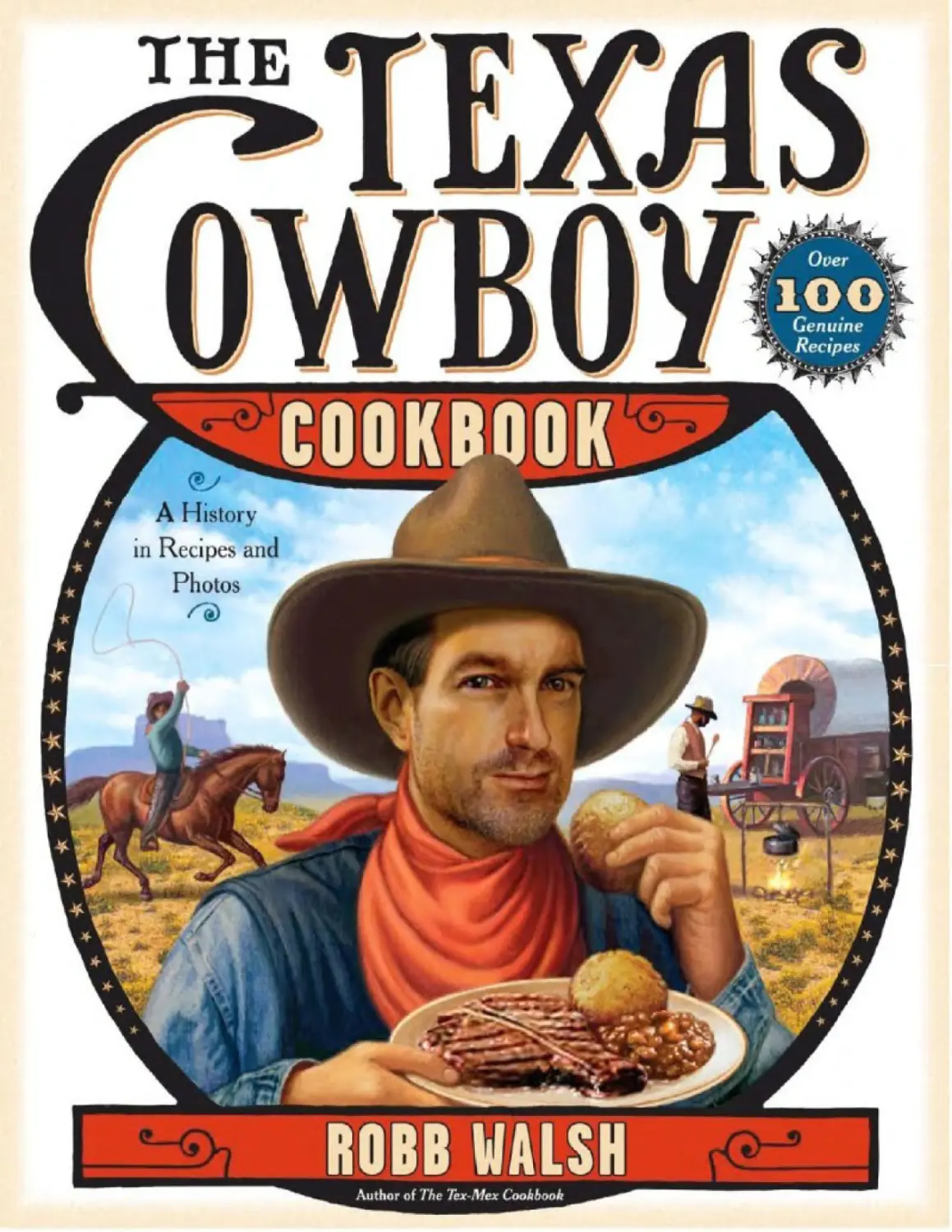





Текст
                    ALSO BY THE AUTHOR
The Tex-Mex Cookbook

Are You Really Going to Eat That?
Legends of Texas Barbecue Cookbook

A Cowboy in the Kitchen (with Grady Spears)
Nueuo Tex-Mex (with David Garrido)

To Kelly, with love and kisses

Contents

Acknowledgments
Chapter 1 The Texas Cowboy Myth: Legendary Groceries
Chapter 2 West of the Pecos: Sourdough and SOB

Chapter 3 Chuck Wagon Cook-o s: Biscuits, Beans, and Cobbler

Chapter 4 Los Vaqueros: Sirloin Guisada and Fideo
Chapter 5 East Texas and the Gulf: Corn Dodgers and Cat sh
Chapter 6 Black Cowboys: Pork, Sweet Potatoes, and Cane
Chapter 7 Pecos Bill and the Rangerettes: Cowboy Barbecue
Chapter 8 Powder Pu s & Spurs: Cowgirls in the Kitchen
Chapter 9 Urban Cowboys: Honky-Tonks and Hamburgers
Chapter 10 The New Cowboy Cuisine: Dr Pepper Tenderloin and
Poblano Mac and Cheese
Resource Guide
Bibliography
Photo Credits

Acknowledgments

Thanks to all the Texas cowboys and cowgirls who provided the recipes,
photographs, and stories that appear in this book.

Thanks to my daughter, Katie Walsh, for the recipe testing, sourdough

oversight, and pie-eating help.

Thanks to my daughter, Julia Walsh, for lending her photography, typing, and

kitchen-cleaning skills.

Thanks to my wife, Kelly Klaasmeyer, for her love and support.
Thanks to my agent, Nina Collins, and my editor, Jennifer Josephy, for making

the project possible.

Thanks to Erin Mayes and the Em Dash design team in Austin for all the great

ideas.

Thanks to Anna Ossenfort for her editing help.
Thanks to archivist Tom Shelton at the University of Texas at San Antonio's

Institute of Texan Cultures for his tireless assistance in nding images.
Thanks to Cli Teinert and Tom Perini for all the Dutch oven tips.

Thanks to Western history scholars Sara Massey and Patrick Dearen for their

advice and suggestions.

Thanks to the Cowgirl Hall of Fame, the Texas State Library, The LBJ Library,

and the Ransom Center in Austin for research assistance.

Thanks to the Houston Press and Village Voice Media for a real job with dental

insurance.

Picture a bunch of cowboys sitting around a camp re eating from
tin plates and drinking black co ee from tin cups. Beside them is the
iconic horse-drawn kitchen called the chuck wagon, stocked with
everything they will need to eat for several months. This is the
image of cowboy cooking that became a part of the history of Texas
and the Old West.
Modern scholars have pointed out that much
of what we
mistake for history is actually part of “the myth of the West.” a
jumble of fact and fantasy derived from pulp ction, Wild West
shows, television westerns, and cowboy-and-lndian movies. The
reexami-nation of cowboy history currently taking place in Texas
colleges and universities is giving us some startling new views of
cowboy culture.
Of course, there really were chuck wagons in the Old West. There
really were gun ghts at high noon and poker games played in
saloons with swinging doors, too. It's just that these well-dramatized
cliches were actually only a small part of a much more complex
story.
After the Civil War, Texas was, in fact, a defeated slave state with
a sizable minority population and a serious problem with the
Comanches. But thanks to dime novels and Wild West shows, the
rest of America thought of the Lone Star State as one big Wild West
town populated entirely by white, pistol-packing cowboys.

The image of the Texas cowboy and cowboy cooking that is
forever locked in the public imagination comes from the twentyyear heyday of the trail drives, between 1866 and 1886. The
cowboys who rode the trail were a tough breed. They included
former Confederate soldiers, freed slaves, and Hispanic vaqueros—
men without a lot of other prospects at the end of the Civil War. For
as little as a dollar a day, they were willing to risk the trip through
Indian territory, protecting a herd of cattle.

Wild cattle that were free for the taking in the South Texas brush
country could be sold for thirty or forty dollars a head in Abilene,

Kansas, and other railhead towns that served the beef-starved
northern markets. In a few decades, millions of longhorns were
driven from Texas across the prairies.
Scenes from this short-lived “cattle rush” era—including the
stampede, the Indian attack, the singing cowboy, and dinner around
the chuck wagon—became cliches as they were endlessly repeated
in cowboy dime novels, and later in cowboy movies and comic
books.
Dime novels were cheap booklets printed on newsprint. Their
authors cranked them out by the dozen. The writers roamed the
West looking for real-life heroes and villains to give their stories
credibility. Two of the most famous good guys were Bu alo Bill and
Texas Jack.
After they became famous in print, the real Bu alo Bill and Texas
Jack made a lot of money by going east and blurring the line
between ction and history by playing their exaggerated Western
characters in eastern theaters. Dressed in fanciful costumes, they
told stories, threw lariats, and rescued damsels by killing dozens and
dozens of “savages” onstage.
But the hokey battle scenes had a grisly basis in reality. Colonel
William “Bu alo Bill” Cody was indeed a real Indian ghter. He
took part in sixteen battles, including the Cheyenne defeat at
Summit Springs, Colorado, in 1869, and was awarded the
Congressional Medal of Honor in 1872.

In June 1876, Bu alo Bill Cody was staging a play in New York
when news of General George Armstrong Ouster's death reached
him. On the last night of the run, Cody, who was still working as an
Army scout, promised the audience he would avenge Custer's honor
as soon as he returned west.
On July, 17, 1876, while scouting for the Fifth U.S. Calvary, Cody
killed a well-known Cheyenne warrior named Yellow Hair at the
Battle of Indian Creek in Nebraska. According to his own account,
Cody rst shot the Indian with a ri e, then stabbed him in the heart,
and then scalped him. Some witnesses described the encounter as

hand-to-hand combat, while others alleged that Cody took the scalp
after Yellow Hair was already dead.

Cody promptly returned east and relived the episode nightly
during the fall theater season in a melodrama titled, Bu alo Bill's
First Scalp for Custer. Bu alo Bill Cody was hailed as an American
hero. And he created a version of Western history that blended
ction and reality so convincingly that most of us still can't tell
them apart.
By 1883, Bu alo Bill had quit the scouting business and created
the spectacular Wild West shows that became the most famous
entertainments of the late nineteenth century. Eventually the Wild
West productions came to include trick riding, staged bu alo hunts,
and, of course, ever more convincing Indian attacks.

Along with famous cowboys like Texas Jack and Wild Bill Hickok,
the Wild West shows included recently defeated Indian warriors,
such as Sitting Bull and Geronimo. Some of the theatrical inventions
created by Bu alo Bill's Wild West Show, like “circling the wagons”
to defend against an Indian attack are myths that people still assume
to be true history in the twenty- rst century.

The shows were also hugely successful in Europe, where Bu alo
Bill's history of the American West is still considered accurate. A
leading attraction at Disneyland Paris is “Bu alo Bill's Wild West
Show,” a dinner show that features a re-creation of one of Bu alo
Bill's original performances, followed by an authentic cowboy
supper at a real chuck wagon.
“Cowboys read pulp

cowboy stories as avidly
as any Western dude.

Thus, almost at the outset
cowboys began to try

to cultivate an image that
the media told them was
theirs—they began to

play to the camera….”
LARRY McMURTRY,

Waller Benjamin at the Dairy Queen

Nearly every history of the Old West has attempted to explain
that the romanticized cowboy life bears little relation to the harsh
realities of cattle herding. But as writer Larry McMurtry has
observed, the cowboy myth is “unassailable.” Readers simply don't
want to hear about the ugly realities of the Old West. They want the
myth.
And as McMurtry discovered when he attempted, in his words, to
“demythicize” the cowboy in Lonesome Dove, you can't kill a myth.
Despite the fact that McMurtry's cowboys were depicted as racists
who killed Indians on sight, stole cattle from the Mexicans, and
enjoyed the occasional lynching party, the public loved them.
Historical accuracy, even of the derogatory variety, can't sully our
image of the cowboy—it only makes it more believable.

Cowboy cooking is part of the same mythology, and it enjoys the
same romantic reputation. In reality, the cuisines of the Texas cattleraisers come from a wide variety of ethnicities and a time line that
crosses four centuries. But in the popular view, cowboy food will be
forever denned by the chuck wagon and the camp re scene from
westerns—no matter what food historians have to say.

Cowboy Groceries
Thanks to Hollywood westerns, Americans picture cowboys as
rugged Anglos who look like John Wayne. There were plenty of
Anglo cowboys, of course, but Texas cattle-raisers also included
Spanish vaqueros, black slaves, former slaves and free people of
color, Cajuns. Creoles, and immigrants freshly arrived from Mexico,
England, Ireland, and Scotland, as well as other parts of the United
States.

And so the history of Texas cowboy cooking includes the wild
game and goats preferred by the Spanish herders of the 1700s, the
black Southern cooking of slaves and free people of color who
worked as cowboys on East Texas ranches beginning in the early
1800s, and the food of every other bunch of immigrants that came
along later. But no matter who they were or what kind of food they
preferred, what the cowboys actually ate was determined mainly by
what groceries were available.

Before the Civil War, the foods available were limited to what was
locally grown and what could be obtained by trade. The Spanish
government forbade Texans from trading with French Louisiana and
the United States. While there was certainly some smuggling, the
majority of imported foodstu s came from distant markets in
Mexico. Dried corn, beans, dried chiles, and popular spices, such as
cinnamon and cumin, were among the common imports.
After the Civil War, when Texas joined the United States, there
was a change in food imports. Non-perishable supplies that had
been mass-produced for the mess tents of the Civil War armies—
such as 25-pound sacks of our, sacks of co ee, and cans of lard—
were cheap and easy to come by.

On trail drives, the chuck wagon supplies were occasionally
supplemented by whatever sh, game, bird eggs, or wild plants the
cowboys and their cook might stumble across along the way. Such
wild plants and game were rare on early cattle drive routes like the
Goodnight-Loving Trail, which followed the Pecos River across the
desert of New Mexico. But the Chisholm Trail, which ran north
along the edge of fertile East Texas, provided plentiful wild foods.
Wild fruits, such as pawpaws, mayhaws, muscadine grapes, and
dewberries—a large variety of blackberry—all grow wild in that
part of Texas. Wild greens, including lamb's quarter, dandelions, and
poke salat, which pop up after the rst spring rains, were an
important source of vitamin C in the days of the earliest pioneers.
The wild chile peppers called chile pequins were the native hot
seasoning. The wild chiles, which are spread by birds, are still found

all over South Texas. They are preserved by drying or by storing in a
bottle with vinegar.

The same supplies were used in the cookhouses and on the chuck
wagons of ranches in South and East Texas, only there they were
combined with cheap and easily obtained farm products, such as
corn, sweet potatoes, greens, and fresh peas.

The following list of staples purchased in 1887 for the two chuck
wagons of the George Ranch in Fort Bend gives us a good idea of
what Texas cowboys were eating at the turn of the nineteenth
century. The George Ranch was white-owned, but all of the cowboys
and cooks were black.

COW WAGON SUPPLIES
Axle grease

1 box

Bacon

50 pounds

Beans

15 pounds

Butter oil (margarine) 2½A gallons
Chow-chow

3 bottles

Co ee

10 pounds

Co ee pot
Cornmeal

1 sack

Flour

1 sack

Kerosene oil
Knives and forks

6

Lard

10 pounds

Lard, leaf

Five 10-pound cans

Mackerel
Matches
Oil

Gallon can

Onions
Pan
Peaches

4 cans

Pepper

1 pound

Potatoes

Bushel

Potatoes, Irish

Bushel

Rope

5½pounds

Sauce

2 bottles

Sifter
Skillet
Soap

2 bars

Soda

3 pounds

Sugar

10 pounds

Syrup, molasses

2 gallons

Tin plates

6

Tobacco

1 pound

Wash pans

2

Chile Peppers, Chili Powders, Chile Sauces, and Salsas
Chile peppers are emblematic of cowboy cooking in all its versions.
Before you start cooking cowboy-style, consider making your own
spice mixes and chile sauces.

Why? Because there is a big di erence between fresh-ground
ancho chile powder and the ground chiles used in commercial chili
powder. It takes only a few minutes to grind up a couple of chile
pods. But once you do, you not only have your own powdered
peppers, you also have the ingredients for your own grill rub.
barbecue seasoning, and chili powder.
A note on spelling: In Texas, chili is a dish and chiles are pepper
pods, so in this book we will depart from the standard spellings used
in Merriam-Webster's. We will use “chile” or “chile pepper” to refer
to the pods, and “chili” or “chili con carne” to refer to the dish.

FRESH CHILES

Chile peppers were part of cowboy cooking from the earliest days of
the Spanish vaqueros. Fresh chile peppers were eaten avidly,
although they were available for only a brief period in the late
summer and early fall.

The following fresh chile peppers, listed from mildest to hottest,
appear in this book.

ANAHEIM OR NEW MEXICAN West Texas cowboys are
extremely fond of the “long green chile” or Anaheim. These are
roasted and peeled before use. New Mexico is the leading source,
and green chiles there are further subdivided by region. Hatch chiles
are grown in the southern part of New Mexico, just north of El Paso,
from certi ed seed sources and are graded according to heat. Mild
green hatch chiles are often roasted and peeled, then eaten like a
vegetable.

POBLANO (ALSO CALLED ANCHO OR PASILLA) Some of
the most commonly used chiles in central Mexican cooking, both in
their fresh and dried forms, poblanos are named after the Mexican
city of Puebla, where they probably originated. They are generally
slightly hot and are usually roasted and peeled before use.
JALAPENO Hot, green, and bullet-shaped, the jalapeho is the
classic Texas hot pepper and one of the world's best-known chiles.
The jalapeno is most widely consumed in its pickled form.
SERRANO Although similar to the jalapeno, the serrano is
hotter and smaller. Since the vast majority of jalapenos are pickled,
the serrano is the most widely used fresh chile pepper in Mexico and
Texas.
PEQUIN (ALSO KNOWN AS CHILE PIQUIN, CHILIPIQUIN,
OR CHILTEPIN) The most common chile in early cowboy cooking
was the chile pequin. Spread by birds to the full extent of the plant's
range some 10,000 years ago. these are the oldest chile peppers in
North America and the likely progenitor of nearly all domesticated
Capsicum annum varieties.

A pequin bush can be found in almost any backyard or vacant lot
in South Texas, and pequins are very common in home cooking.
Because they are not grown commercially, they are seldom found in
restaurant cooking or in grocery stores. If you nd some, you can
substitute three or four fresh pequins for one serrano or half a
jalapeno.

DRIED CHILES

Dried chiles were imported to Texas from Mexico.

ANCHO The popular cowboy dish chili con carne was made
from the dried Mexican ancho chile. But the chile was available only
once a year, after the harvest and drying season. In the late 1800s,
several entrepreneurs, including William Gebhardt of San Antonio,
marketed bottles of chili powder that contained powdered ancho
chiles along with comino (cumin) and other spices.
Anchos are the eshiest of the dried chiles, and their pulp
combines a little bitter avor with a sweetness reminiscent of
raisins. They are usually mild, although occasionally one will
surprise you with its heat.

CHILE COLORADO (RED CHILES) When the long green chile
turns red, it is picked and strung in a bunch called a ristra. The
rislras are hung in the sun until the chiles are dried. The chiles are
then sold whole or ground up in a red chile powder. Chimayo chiles,
the traditional chiles of northern New Mexico, are the most prized
of the red chiles. It is also common to nd the Mexican dried chiles
called guajiltos sold as red chiles.

PASILLA Long and skinny, with a slightly wrinkled black skin,
the pasilla has a strong, satisfying avor and can range from
medium-hot to hot. It is much more common in modern-day cowboy
cooking than il was in the Old West.

CHIPOTLE Small, wrinkled, and light brown, chipotles are
smoked jalapenos with an incredibly rich, smoky avor. They are
usually very hot. Smoking jalapenos to preserve them has been
common in Mexico since long before the Spanish arrived. You can
buy chipotles dry or canned. Obviously, you can't make chile
powder from canned chipotles, but you can use them for purees.
Canned chipotles are already soaked in sauce, usually a vinegary
adobo. Just stem and seed the chiles and puree them with some of
the sauce from the can. Seal leftovers in a plastic container and
store in the refrigerator.

Roasted Chiles
In late August and early September, chile sellers set up their giant
propane- red rolling drum roasters at grocery stores and farmers’
markets in West Texas and New Mexico. Many people buy a whole
year's supply of roasted peppers and freeze them. If you don't have a
cache of roasted peppers in your freezer, it's easy enough to roast your
own. You can use this technique for roasted poblanos, too.
1 teaspoon vegetable oil
5 to 6 fresh green chiles

Oil the chile skins and place the chiles over a high gas ame,
turning as needed to blister the skin on all sides. Don't allow the
ame to burn too long in one place or you'll burn through the chile.
After most of the skin has been well blistered, wrap the warm chile
in a wet paper towel, place it inside a plastic bag, and set it aside to
steam gently for 10 to 15 minutes. When you remove the towel,
most of the skin should come o easily. Scrape o the rest of the
skin with a butter knife. If you are making chile rellenos, remove
the seeds carefully and try to keep the pepper intact (it's not easy).
Otherwise, cut the chile into strips or chop it up, depending on the
recipe.
If you don't have a gas range, put the oiled chiles in a skillet and
blister them over high heat or put them under a broiler, turning
often. Proceed as directed.

Ancho Powder
Anchos are the customary chiles in chili con came, so your stock of chile
powders probably ought to start with them. But you can also make
guajillo powder, pasilla powder, or chile pequin powder from those dried
peppers, too.
If your chiles are Very dry and crispy, you can skip the toasting step
and just grind them. It's important to toast moist, softer chiles so that
they grind easily into a powder. MAKES I CUP
5 ancho chiles (about 2 ounces)

Remove the stems and seeds from the anchos. Tear the chiles into
small pieces and toast in a skillet over medium heat until crisp,
about 5 minutes. Process the toasted peppers in a co ee grinder
until they become a ne powder.

OTHER CHILE POWDERS Substitute 2 ounces of other dried chiles
for the anchos and proceed as directed.

Cowboy comic books followed in the tradition of cowboy dime
novels; the rst Lone Ranger comic was issued in 1948

Cowboy Barbecue Rub

This is a great all-purpose rub for barbecuing and grilling. After you
sprinkle it on and rub it in, give the meat time to marinate. Letting it sit
overnight in the refrigerator is your best bet.

MAKES ABOUT ⅓ CUP

2 tablespoons sea salt
2 teaspoons Ancho Powder (page 18)
2 teaspoons dried granulated garlic
2 teaspoons coarsely ground black pepper
2 teaspoons ground dried thyme

Combine all of the ingredients in a small mixing bowl and stir
until thoroughly blended. Store the dry rub in an airtight container.

Homemade Chili Powder
When you combine powdered chiles with cumin and other ingredients to
make a spice mix for chili con came, you are turning chile powder into
chili powder. MAKES I CUP
1 cup Ancho Powder (page 18)
1 teaspoon dried Mexican oregano
½teaspoon garlic powder
½teaspoon ground cumin

Combine all of the ingredients in a small mixing bowl and stir
until thoroughly blended. Store the chili powder in an airtight
container.

Red Chile Sauce
New Mexican dried chiles produce a bright red colored sauce, and the
anchos make a raisiny sauce. You can use a single type of chile for this
sauce, but a combination of several makes for a wonderfully complex
avor. Use as a base for other sauces or in chili con came. MAKES
ABOUT 4 CUPS
3 cups chicken stock or broth
½ onion, diced
3 garlic cloves, minced
10 assorted dried chiles, seeded

Bring all of the ingredients to a boil in a large saucepan over high
heat. Decrease the heat and simmer for about 15 minutes, or until
the chiles are soft. Put the chile mixture and cooking liquid into the
container of a blender. Blend on low, increasing to high speed until
pureed. The sauce will keep in the refrigerator for up to a week.

Pequin “Sport Peppers”
If you don't have your own pequin bush, you can substitute cayenne.
Tabasco, serrano, or just about any other fresh hot pepper in this recipe.
In the Caribbean they make a sauce just like this with habaneros—
instead of a shaker bottle, they use a syrup dispenser. AKES I CUP
½ cup chile pequins (or other fresh peppers)
½ cup white vinegar

Clean a previously used pepper shaker bottle with boiling water.
(For larger peppers, such as serranos or habaneros, double the

ingredients and use a syrup dispenser.) Pack the bottle with chiles.
Heat the vinegar in a small saucepan over low heat until it steams
slightly. Pour the vinegar over the chiles to the top of the jar. Allow
the mixture to sit for a day before using.
You can use the vinegar as a pepper sauce, or open the bottle to
take out a few chiles. The bottle can be re lled with vinegar about
three times and kept in the refrigerator for a year. When the next
year's peppers are ripe, dump the bottle and start over.

Green Chile Sauce
Green chiles were once a seasonal treat in West Texas and New Mexico.
While red chiles can be dried in ristras and pulverized for year-round
use, green chiles were eaten only around the time of the harvest. Of
course, canning and freezing have made green chiles available all year.
But they still taste best when they are freshly roasted at the end of the
summer. Serve hot as an enchilada sauce. MAKES ABOUT 6 CUPS
5 tomatillos
4 cups chicken stock or broth
2 cups chopped roasted green chiles (Anaheims, see page 16)
2 teaspoons minced onion
1 teaspoon dried Mexican oregano, or 2 teaspoons chopped fresh
1 garlic clove, minced
½teaspoon salt
¼ teaspoon white pepper
2 tablespoons cornstarch dissolved in 2 tablespoons water

Remove the husks from the tomatillos and rinse them well. In a
small saucepan, heat water to boiling, add the tomatillos, and
decrease the heat. Allow the tomatillos to cook until softened, about
5 minutes. Puree in the blender until smooth.

Combine the stock, chiles, tomatillos. onion, oregano. garlic, salt,
and white pepper in a saucepan. Bring to a boil over medium-high
heat, then decrease the heat and simmer for 10 minutes. Add the
cornstarch mixture and stir well. Cook for 5 to 10 more minutes,
until the sauce is well thickened. The sauce will keep in the
refrigerator for up to a week.

Picante Sauce
This is the ubiquitous Tex-Mex table sauce and tortilla chip dip; it also
tastes great on eggs, tamales, and nachos. Roasting the Vegetables adds
depth to the avor of the sauce. Soaking the onions in the lime juice and
salt “cooks” them and removes some of their bitterness. Before the
blender was invented, this salsa was made in the three-legged stone
grinding bowl called a molcajete.
MAKES 3 CUPS

½onion, nely diced
1½tablespoons fresh lime juice
6 plum tomatoes
2 jalapenos, seeded and halved lengthwise
1 garlic clove, peeled

1 cup chopped fresh cilantro
Salt

Soak the onion in the lime juice for at least 10 minutes. Roast the
tomatoes, jalape o halves, and garlic clove in a hot skillet until
slightly charred. Remove the tomato skins. Puree in the blender for
about 10 seconds so the mixture remains chunky. Transfer to a bowl
and add the onion and lime juice and the cilantro. Season with salt
to taste. The sauce will keep in the refrigerator for up to a week.

Pico de Gallo
This fresh salsa is a must for fajitas. It's also a favorite on Barbacoa
(page 97) and Lengua (page 99), or for any kind of meat served on a
tortilla. MAKES ABOUT 2 CUPS
5 jalapenos, seeded and minced
1 cup diced tomatoes
1 cup chopped onion
2 cups cilantro leaves, coarsely chopped
1 tablespoon fresh lemon juice
Salt and freshly ground black pepper

In a bowl combine the jalapenos, tomatoes, onion, and cilantro.
Add the lemon juice, salt, and pepper and mix. Serve at once.

Cli Teinert was the ranch manager at the Kent division of the Long
X Ranch in Je Davis County when I stopped by to visit the ranch
and its working chuck wagon. Teinert gave me a tour and
introduced me to a cowboy cook named Brad Whit eld, who was

cooking lunch.
Teinert started the chuck wagon revival when a
rancher gave him a broken-down wagon to fool around with. “Walt
Matthews gave me the shell of an old wagon that I rebuilt, and in
1970 I began a catering business called Texas Trails Chuck Wagon
Catering Co.,” Teinert said. Thanks to the novelty of his chuck
wagon, and the high quality of the food, Teinert's business took o .
He has catered a airs for several American presidents, as well as the
president of Mexico.
Teinert's success encouraged others to get interested in chuck
wagons. Teinert helped start the Western Chuck Wagon Association,
one of the organizations that sets guidelines for building authentic
chuck wagon replicas. He is also the coauthor of the cowboy
cookbook Barbecue, Biscuits & Beans. “The locals around here are
dedicated to preserving history,” he said.
Je Davis County is in the Trans-Pecos region of West Texas,
which includes Big Bend National Park. The history of the Texas
cattle industry is often divided into four periods: the Spanish era,
the East Texas era, the trail-drive era, and the West Texas era. The
days of the cowboys are most vividly recalled in West Texas,

including the Panhandle and the Trans-Pecos, because, to some
extent, they are still going on there.

The Spanish era began when explorer Francisco Vasquez de
Coronado rst introduced cattle to Texas in 1540. Huge herds of
longhorns roamed free in South Texas during the Mission era, when
Franciscans taught Native Americans the Spanish system of
agriculture. The East Texas era began when Southern cattlemen and
their slaves arrived in the Piney Woods of East Texas with their
English cattle breeds and Southern agricultural crops in the early
1800s, hybridizing their cattle-raising style and their culture along
the way.

The trail drives of the post-Civil War era, during which millions of
longhorns were driven north to market, were brief but colorful. The
West Texas era began in the 1890s. when barbed wire began to
close the free range. With the bu alo wiped out. the Comanches
subdued, and windmills solving the water problem, ranching was
possible in West Texas for the rst time.

Land-hungry East Texas and South Texas ranchers relocated to the
prairie of West Texas in two waves. The Anglo cattle-raisers of East
Texas migrated to the Panhandle, the Palo Duro Canyon area, and
other northern parts of West Texas. Meanwhile, the ranchers of
South Texas claimed the land around Big Bend.

Teinert explained that although the Long X, which was founded
by the Reynolds family in 1885, is one of several Texas ranches that
has had chuck wagons in continuous use since the horse-and-buggy
era, somebody convinced him that the original Long X chuck
wagons belonged in a Western heritage museum. The ones they
cook from now are authentic replicas, Teinert explained.

The chuck wagon that I inspected at the Long X hunting lodge
was set up to provide a large working and congregating area.
Teinert had it rigged with several large canvas ies spread out to
form a huge tentlike shelter. The food could be grilled or cooked
over coals in Dutch ovens. So every meal was a Western heritage
cooking demonstration.
The three-footed cast-iron pots called Dutch ovens come in
diameters of 8, 10, 12, 14, and 16 inches. They got their name from
the Dutch peddlers of the East Coast who introduced them to this
country. They have long been favored for outdoor cooking because
you can use the same pot to fry. bake, or simmer.
You can buy aluminum foil liners that are designed to t perfectly
inside the various sizes of Dutch ovens. These are often used for
cobblers or sweet dishes, to prevent them from sticking or burning.
It is important to season and maintain the patina of a Dutch oven.
You care for one by scrubbing it out with ashes, sand, or salt and
keeping it oiled, just like any seasoned cast-iron skillet.

“When I started entering chuck wagon competitions, I was just in
it for the beer drinking,” Brad Whit eld told me while he cut
sourdough biscuits with a well- oured topless and bottomless tin
can. He crowded the biscuits in the bottom of a Dutch oven.
About his recipe. Whit eld said, “I mix sourdough starter, our,
salt, and sugar, and then I add a little baking soda for insurance. I
never measure anything.

In the desolate Trans-Pecos region, cattle ranching has changed little over
the last century
It comes out di erent every time. I've been competing for six or
seven years. But I won the bread-baking category in Fort Worth,
Midland, and Lubbock—so now I'm stuck with the cooking all the
time,” he moaned. “I'd rather be out punching cows.”
J. Frank Dobie observed that South Texas cowboys hardly ever
saw sourdough bread. “Yaller bread” was the catchall phrase
English-speaking cowboys used to describe the corn bread, corn
dodgers, and hoecakes they ate in East and South Texas.

Sourdough baking is a West Texas phenomenon, according to
historians. It developed on the High Plains during the era of chuck
wagons and trail drives after the Civil War, which is why it is such
an important part of the chuck wagon cooking contests and
demonstrations that have become popular there. The Western
heritage movement sparked a revival in old-fashioned sourdough
baking.

That's why sourdough is also on the menu at historic West Texas
ranches like the Long X during deer season, when the hunting camp
is full. Hunters pay top dollar to come and hunt on the Long X, and

the food is part of the appeal. Whit eld cooks for the gang from a
chuck wagon that is set up in the center of the hunting lodge area.

When Whit eld's biscuits had risen enough to bake, he got a
shovelful of hot coals from the re and put them in a pile on the
dirt. I asked him about his Dutch oven as he lowered it onto the
coals. “I keep mine as slick as glass,” he told me. “When I start one
out, I put Crisco on it in between uses. When you're done baking in
it, you just wipe it out and grease it up heavy.”
Whit eld got a second shovel load and poured it on top. The dishshaped lid of a Dutch oven is designed to hold hot coals—with heat
coming from both above and below, you can achieve the even heat
required for baking. But the lid is on a swivel handle, so it has a
tendency to tip to one side and dump the coals into the food. The
trick to baking in a Dutch oven is in handling the pothook.

A pothook is a metal rod with a hook designed to lift the lid of the
Dutch oven.
I asked Whit eld if he ever dumps the coals on the biscuits.
“Yeah, I do,” he admitted. “And any sumbitch tells you he never has
is a damn liar. I made my own pothook in a forge. It's short and it
has a thumb depression that ts me. But thai lid still gets away
sometimes.”

The problem with baking in aDutch oven, Whit eld con ded, is
that the bottom of the pot. which is sitting directly on the coals,
bakes a lot hotter than the top. When he detected a strong bread
yeast smell, he moved the pot o of the bottom coals. “You got to
let the top of the biscuits catch up to the bottom,” he said, adding
more hot coals to the lid.
We stood waiting for the biscuits to be clone—the temptation is to
lift the lid and take a peek. But Whit eld was waiting for a telltale
toasty smell. I suspect he was also looking at his watch. Finally he
took o his cowboy hat and used it to fan the coals on the Dutch
oven lid. “We need to turn this oven up a little,” he said.
Then he expertly removed the lid. His crusty, yeasty sourdough
biscuits were the best I had ever tasted.

Starting Sourdough
There are many “sure re” sourdough starter recipes in the folklore
of Western cooking. But recipe testers get mixed results in modern
kitchens. In Je rey Steingarten's piece “Primal Bread” in The Man
Who Ate Everything, he describes his e orts to get a starter going in

his New York kitchen. After reading stacks of books on yeast and
bread baking, Steingarten attempted to create atmospheric zones in
his apartment to encourage his starter. He pondered the chlorine in
the water, bought organic our, consulted with famous chefs, and
considered every variable he could imagine. He eventually
succeeded, but it was no easy process, according to his description.
Jay Francis, a friend of mine who tests recipes and teaches
cooking classes, told me that he'd had terrible luck with sourdough
starters, too. “I found all of these con icting sources,” he told me.
“Some say that you can start your yeast culture with grapes, which
have naturally occurring wild yeast. But other sources say that those
are distinctly di erent yeasts and are not suitable for bread baking.
Then I saw a demo on Julia Child's show with a master baker. She
used the process with the grapes and it seemed to work ne.”

Francis never got growth with our and water, or with potato
our. He swears by a Beth Hensperger recipe that she starts with
our and a little bit of regular bread yeast.

Sourdough Made Easy
Cowboy cooks weren't Harvard-trained lawyers like Je Steingarten.
So how is it that these simple country folks started sourdough
without a trip to the library, shipments of organic our, and advice
from master chefs? The answer occurred to me as I was changing
my micromesh hypoallergenic air-conditioner lter.
Cowboys lived outside. And they cooked outside, And they
obviously started their sourdough outside, where there are lots of
wild yeasts in the air. Modern life has managed to obscure a simple
principle, as this quote from the John O. West Collection of Texas
Folklore illustrates: “The air is full of yeast, we refrigerate to keep
yeast from spoiling our foods. To get a starter, mix equal amounts of
our and water to a soft paste and set in the sun in hot weather, and
it will soon begin to ferment and rise.”

My daughter Katie, a student at the University of Texas, was
working as my recipe tester for the summer, and together we
tackled what Katie called “The Sourdough Project.” 1 am pleased to
report we had a much easier time of it than expected, thanks to a
simple insight about wild yeast and air-conditioning.

It was June in my hometown of Houston, and the temperature
was uctuating between a high of 90°F during the day and a low of
80°F overnight. Yeast thrives at this temperature. In fact, it does
well at up to 115”F. But it is slow-acting at 70”F or lower, which is
where we usually keep our home thermostat. And I have to assume
the air lters we use to take pollen, dust, and allergens out of the air
in our houses are also removing some, if not most, of the wild yeast
spores.

My backyard, on the other hand, enjoys both high temperatures
and extremely high humidity. Thanks to the proximity of the Gulf of
Mexico, the hot, wet atmosphere of Houston is ripe with molds,
mildews, and yeasts. A table next to my back door proved to be an
ideal spot for sourdough inoculation.
But a close call with the mosquito-spraying truck reminded me
that while cowboys may have lived outside, they did not live
outside in a big city. If you are going to inoculate sourdough starters
outside, 1 will warn you to bring them inside if necessary during
street sweeping, spraying, high-pollution alerts, lawn mowing, and
to avoid anything else that might contaminate them. But your vigil
doesn't need to be long. Once the sourdough starter is inoculated,
there is no reason to keep it outside, except to speed up the rising
process during baking.

SOURDOUGH FLAVOR AND AROMA

It usually takes a few weeks, or even a month, for a starter to
acquire a rich sourdough avor. Our yeast-based starter had very
little sourdough aroma after two weeks. The simple our and water
starters inoculated outdoors, on the other hand, were much more
aromatic.

Most of us bake with sourdough for the avor, rather than as a
primary leavening agent, and for that reason I recommend the
outdoor approach. It yields an aromatic sourdough in much less
time, .lust put a bowl of our and water outside in the sun and
catch yeast out of the air.
Then, once you have the avor and aroma of cowboy sourdough,
you can add fast-acting active dry yeast and/or baking powder to
the starter whenever you use it. The recipes in this chapter use
various combinations of sourdough starter, yeast, and baking
powder. Feel free to experiment.

COOKING WITH SOURDOUGH
To cook with the starter, measure out the amount called for In a
recipe and let the dough stand at room temperature until it starts to
bubble, about an hour. Feed the remaining starter by adding a cup
of our and a cup of water, stirring to mix well. Store covered with
plastic in the refrigerator to slow growth, on the kitchen counter for
steady growth, or outside on a warm day covered with cheesecloth
to speed growth. Sourdough starter keeps inde nitely and improves
with age as long as you keep feeding it and don't let it freeze.

KEEPING THE STARTER GOING
You have to feed the sourdough every 3 or 4 days. If you aren't
cooking with the sourdough, you will need to discard some of it

before feeding, to avoid over owing the bowl.

Sourdough Starter No. 1 “Yogi”
Katie and I experimented with four sourdough starters. It is a cowboy
custom to give every new starter a name. Yogi and Cheater were made
according to the same recipe, except that Cheater (Sourdough Starter No.
2) had an added pinch of active dry yeast. We suggest you follow the
basic recipe (Yogi) and, if you don't get any results by day two, add the
yeast (see Variation below). These two recipes arc recommended if you
can't get outside, it's winter, or you are impatient.
2 cups lukewarm water (100°F)
½cup plain yogurt
2 cups all-purpose our, plus 1 cup to feed starter
¼cup dry milk powder

Whisk together the water and yogurt, then add the 2 cups our
and the dry milk powder, blending until smooth. Transfer the
mixture to a 1-quart bowl, ceramic crock, or plastic container. Cover
with a double thickness of cheesecloth and let stand in a draft-free
spot indoors for 48 hours. When it bubbles and a gray or yellow
liquid forms on the top, stir it back in. (If the liquid is red or green,
throw the starter away and start over.)
After stirring back the liquid for 2 days, add 1 cup
the starter.

our to feed

SOURDOUGH STARTER NO. 2 “CHEATER” If you are impatient,
or you have no fermentation after 2 days, be a “Cheater” and add a
pinch of active dry yeast on the second day.

Sourdough Starter No. 3 “Ham-On”
No. 3 Ham-On was a rye- our starter based on the recipes in Peter
Reinhart's book The Bread Baker's Apprentice. No. 4 Mighty Whitey
was nothing but white our and Water, as speci ed in cowboy recipes.
2 cups rye our, plus 1 cup to feed the starter
2 cups lukewarm water (100°F)

In a large bowl, mix 2 cups our with water to make a pancake
batter consistency. Cover loosely with cheesecloth and set in the sun
when the temperature is above 75°F outside. When it bubbles and a
gray or yellow liquid forms on the top, stir it back in. (If the liquid
is red or green, throw the starter away and start over.)
After stirring back the liquid for 2 days, add 1 cup
the starter.

our to feed

SOURDOUGH STARTER NO. 4 “MIGHTY WHITEY” Substitute 2
cups all-purpose our for the rye our. Proceed as directed.

Sourdough Biscuits
Sourdough is notoriously stubborn when it comes to rising. Every cooko contestant we've met adds yeast or baling powder or both to speed
things up. If you want to be a purist and see what it's like to use nothing
but sourdough for leavening, you will need to allow as much as an entire
day of rising time. If the temperature outside is higher than 70 °F, put the

sourdough outside to rise with a clean kitchen towel over the top of the
bowl or loaf pan to keep the ies away.

MAKES 12 TO 15

3 cups sourdough starter (page 35)
1 tablespoon active dry yeast (optional)
3 tablespoons sugar
3 tablespoons baking powder
2 teaspoons salt
5 tablespoons vegetable oil
3 cups all-purpose tlour 1 tablespoon butter, melted

Lightly grease a Dutch oven or cookie sheet.

In a large mixing bowl, stir together the sourdough and the dry
yeast (if using) and let them sit for 5 minutes. Add the sugar, baking
powder, salt, and oil and mix well. Add the our, 1 cup at a time,
and mix until the dough becomes too sti to stir. Turn the dough
out onto a lightly oured surface and sprinkle some our on top.
Roll it out until it is about ‘/4-inch thick. Using a circular cookie
cutter, a tin can with both ends removed, or a water glass, cut
circles from the dough and place them on the bottom of the Dutch
oven or cookie sheet. Brush the tops with the melted butter and
cover with a clean cotton cloth.
Set the biscuits aside and let them rise until they double in size.
Preheat the oven to 325°F.

Bake until golden brown, about 15 minutes. Allow to cool for a
few minutes; serve when they don't burn your ngers.

Sourdough Pancakes

Once you get a sourdough culture going, you have to remove some every
couple of days so you can feed it. This is one of the quickest, easiest, and
tastiest Ways to use your sourdough when you don't feel like baking
bread. MAKES 12 TO 18
2 cups bread our
2 tablespoons sugar
1 tablespoon baking powder
1 teaspoon salt
2 eggs, lightly beaten
2 cups milk
¼cup butter, melted
¾cup sourdough starter (page 35)
2 teaspoons vanilla extract

Combine the our, sugar, baking powder, and salt in a large
mixing bowl and stir well. In another bowl, mix together the eggs,
milk, butter, sourdough, and vanilla. Gradually add the liquid
mixture to the dry mixture, using a whisk to blend just until smooth.

Lightly oil a frying pan or griddle and turn the heat to mediumhigh. When a drop of water sizzles on the pan or griddle, pour on a
small amount of batter (you can decide how much depending on
how large you'd like the pancakes) and cook until bubbles appear on
the top. Flip the pancake and cook until both sides are golden
brown, about 3 minutes. Repeat with the remaining batter,
transferring the cooked pancakes to a cloth-covered plate. Serve
immediately or hold in a 250°F oven.
EASY SOURDOUGH PANCAKES Add 1 cup sourdough starter to
your favorite pancake mix and follow the directions on the box.

Sourdough Hamburger Buns
To really liven up your hamburgers, try wedging them between these
buns. The hearty taste of sourdough is a great match for a Gilley's Texas
Cafe Burger and all the variations (see page 213).

MAKES 12 MEDIUM OR 8 LARGE

2 cups sourdough starter (page 35)
½cup sugar

¼cup vegetable oil
1 egg, lightly beaten
1 teaspoon salt
3 to 5 cups all-purpose tlour

Preheat the oven to 375T. Lightly grease two cookie sheets.

Mix the sourdough. 1 cup water, the sugar, oil, egg, and salt in a
large bowl. Add the our, 1 cup at a time, until the dough becomes
too sti to stir. Turn out onto a lightly oured surface and knead
until smooth, adding additional our as necessary.

Form the dough into a ball and place it in a greased bowl. Turn
the dough once to coat lightly, and place a clean cotton cloth over
the bowl. Let the dough rise until doubled in size.

Once the dough has risen, punch it down and then let it rest for
15 minutes.
Pinch o pieces about the size of golf balls, shape, smooth, and
atten until each is about M-inch thick. Place the buns 2 inches
apart on cookie sheets and let them rise until almost the desired
size.
Bake until the edges and tops are golden brown, 15 to 20 minutes.

Pan del Campo
This sourdough atbread resembles a pizza crust. Mexican cocineros
made their sourdough bread this way until our tortillas became popular.
MAKES I FLATBREAD LOAF
2 cups all-purpose our
2 cups sourdough starter (page 35)
2½teaspoons baking soda

1 teaspoon salt
½teaspoon sugar
¼cup vegetable oil

Pour the our into a large mixing bowl and make a well In the
middle. Pour the sourdough into the well and stir in the baking
soda, salt, sugar, and oil. Mix the dough with a wooden spoon or
your hands until it holds together well. Form the dough into a ball
and place it in a greased bowl, turning once to coat lightly. Cover
the bowl with a clean cotton cloth. Let the dough rise for 30 to 60
minutes, until doubled.
Preheat the oven to 325’F. Grease a large round baking dish or
pizza pie pan.

Remove the dough from the bowl and atten it into a wide disk.
Being careful not to tear it, rotate it on your ngertips, stretching it
like a pizza crust. When the dough has reached the desired size,
place it carefully in the bottom of the baking dish.
Bake on the bottom shelf of the oven for about 20 minutes, until
golden brown and pu ed. Serve hot in wedge-cut slices.

Picadillo
Cowboys love this stu with sourdough biscuits. You can also use this
seasoned meat mixture as a stu ng for soft tacos, in chile rellenos, as a
topping for tostadas, or mix it half and half with chilecon queso as a dip
for tortilla chips. MAKES 2 CUPS
2 tablespoons vegetable oil
¾ pound ground beef

2 garlic cloves, minced
½onion, chopped
1 jalapefto, seeded and chopped
1 tomato, chopped
1 tablespoon Homemade Chili Powder (page 20)

Heat the oil in a large skillet over high heat. Add the ground beef,
garlic, onion, and jalapefto. Cook for 6 minutes, or until the meat is
browned. Add the tomato and chili powder and cook for 4 minutes,
until the mixture thickens slightly. Serve hot.

Sue Cunningham's Sourdough Cinnamon Rolls
Chuck wagon cook-o competitor Sue Cunningham is the author of
several chuck wagon cookbooks. Her fabulous sourdough cinnamon rolls
are in high demand at breakfast time at chuck wagon gatherings.

MAKES 16

FOR THE ROLLS
4 cups sourdough starter (page 35)
One ¼-ounce package active dry yeast
¼ cup sugar
1 teaspoon salt
¾ cup vegetable oil
4 cups all-purpose our
FOR THE FILLING

2½ tablespoons ground cinnamon

½ cup granulated sugar
¼ cup brown sugar
6 tablespoons melted butter
6 ounces pecans, chopped (about 1½ cups)
FOR THE ICING

1 pound confectioners’ sugar
2 tablespoons melted butter
1 teaspoon vanilla extract
4 ounces cream cheese, softened Milk

Preheat the oven to 350’F. Lightly grease a large glass baking dish
or Dutch oven.

To make the rolls, in a large mixing bowl, stir the sourdough and
dry yeast together, and let the mixture sit for 5 minutes. Add the
sugar, salt, and oil and mix well. Add the our. 1 cup at a time,
until it becomes too sti to stir (this may not require all 4 cups).
Turn the dough out onto a lightly oured surface, our the top, and
roll it out into a rectangle about 16 inches wide, 10 inches long, and
⅛ inch thick.
To make the lling, in a small bowl, combine the cinnamon and
white and brown sugars and mix well. Brush the top of the dough
with the melted butter and sprinkle the cinnamon-sugar over it,
making sure the entire rectangle is well coated. Pour the chopped
pecans over the sugar and spread evenly. Starting with the wide side
facing you, pinch the dough over and begin to roll it tightly, taking
care to keep it rm from one end to the other. Cut the rolled dough
into 1-inch slices and place the slices close together in the baking
dish or Dutch oven. Cover the rolls with a clean cotton cloth and let
them sit for 1 to 2 hours, until they have risen visibly and are
touching one another.

Bake until the tops are golden brown, 15 to 20 minutes.
Meanwhile, prepare the icing.

To make the icing, combine the confectioners’ sugar, butter,
vanilla, and cream cheese in a medium mixing bowl and stir until
smooth. Gradually add milk until the icing pours easily. Pour the
icing over the hot rolls and allow it to melt down into the middles
and sides. Serve hot.

Sourdough Chicken-Fried Shrimp
The classic taste of sourdough makes an awesome batter for chickenfried steak’ chicken-fried chicken, or chicken-fried shrimp. Keep an eye
on these, they cook quickly.

MAKES 20 TO 2 5

¾ cup all-purpose our
1 teaspoon kosher salt
1 teaspoon freshly ground black pepper

1 tablespoon paprika
1 tablespoon Ancho Powder (page 18)
1 egg, beaten
2 tablespoons milk
2 tablespoons sourdough starter (page 35)
¼ cup beer
Peanut oil
2½ pounds jumbo shrimp, peeled and deveined

In a large shallow dish, combine the our, salt, pepper, paprika,
and Ancho Powder. Stir until well mixed and set aside.
In a large mixing bowl, whisk together the egg, milk, sourdough,
and beer until smooth. Set aside.

Pour the oil into a deep pan to a depth of 1 inch and turn the heat
to medium-high. While the oil is heating, dredge each shrimp in the
our mixture until thoroughly coated. Dip the shrimp into the egg
mixture, and then again in the our, evenly coating the batter so it
is dry on the outside.

Heat the oil to 350’F, or to test the oil. drop a small piece of
batter into the pan. If it sizzles and browns quickly, the oil is ready.
Taking care not to splash yourself, slowly slide the shrimp, 8 to 10
at a time, into the oil. Let the shrimp fry until the batter is crisp and
brown, about 1 minute. Drain the cooked shrimp on paper. Continue
frying until all the shrimp are cooked. Serve hot.

Son-of-a-Bitch
What to eat with your sourdough biscuits? How about Cli Teinert's
Version of son-of-a-bilch, the most infamous dish in cowboy cooking.

Teinert told me that the dish has more delicate nicknames, including
son-of-a-gun, SOB, and gentleman from Odessa. Why gentleman from
Odessa? “Because anywhere else a gentleman from Odessa would be
called a son-of-a-bitch,” Teinert said with a laugh. SERVES 8
FROM A SUCKLING CALF
Tongue
Marrow guts (chitterlings)
½ liver
Heart
1 kidney
Skirt steaks
Brains
FLAVORINGS
1 large onion, chopped
2 garlic cloves, minced
Salt and freshly ground black pepper

Boil the tongue until the skin loosens, and peel o the outer skin.
Chop all the meats and innards, except the brains, into ‘/S-inch
cubes. Cover with water to 2 inches above the meat. Add the rest of
the ingredients and simmer for 2 hours, until good and tender,
adding more water as needed. Stir in the brains 15 minutes before
serving, and break them up to thicken. Serve hot with Sourdough
Biscuits (page 36).

The 25 chuck wagons were only occasionally visible through the
thick cloud of smoke that oated up from the Tri-State Fairgrounds
in Amarillo that sunny Saturday morning. It was June 4, 2005, and
The World Championship Chuckwagon Cook-o and Cowboy
Round-up had just gotten under way. The fact that it had rained all
Friday night gave the competition a higher degree of di culty—and
historical accuracy.
Wet rewood was one of the problems old-time chuck wagon
cooks faced frequently. And they didn't have lighter uid or tanks of
propane handy to hurry up the process like these folks did.
It was around seven in the morning, and the food was due to be
delivered to the judges at noon. Wandering through the smoke from
camp to camp with a camera and a notebook. I introduced myself as
a food writer, a student of cowboy cooking, and a judge at this
year's cook-o . Some of the frenzied competitors stared at me
menacingly until 1 went away. But most were extremely friendly.
When 1 stopped by Wayne and Bobbie Walker's Walking F Ranch
chuck wagon to see how things were going, they asked if I wanted
breakfast. I was handed an egg sandwich from a nearby hamburger
franchise. “We ain't got time to mess with cooking bacon and eggs
this morning.” Wayne said with a shrug, apologizing for the fast
food. His re was already burning, his beans were cooking, and he

had plenty of co ee, so he was ahead of the folks who were still
trying to get their res lit.

The acrid mesquite smoke was making my throat dry, so I
grabbed a tin cup with a blue speckled nish and held it out when
one of Wayne's hands came around with the co eepot. A minute or
so later, when I tried to take a sip of the hot co ee, I jerked my
head back from the cup and winced. This produced a gale of
laughter from the other hands sitting around under Ihe wagon's
canvas ies.

“Those old tin cups burn the hell out of your lips, don't they?”
Wayne chuckled. That's when 1 noticed that everybody else was
drinking from Styrofoam cups or ceramic mugs — the old-timey tin
cups were just for looks. Authentic cookware and plates, along with
having a co eepot going at all times, are the kinds of things that
judges look for at chuck wagon cook-o s.
The strange blend of anachronisms—propane tanks and Egg
McMu ns alongside old cooking implements like Wayne's 100-yearold pressure cooker—reminded me that while chuck wagon
competitions are helping to preserve the culinary heritage of the Old
West, they are colored by modern-day sensibilities. Beans,
sourdough biscuits, and co ee are the authentic items competitors
would prepare today. But some of the menu items, like peach
cobbler, were hardly the sort of grub cowboy cooks prepared on the
open range.
“Ants in the butter, ies
in the meat, if you
bastards are hungry, get
up here and eat.”
-COWBOY CHOW CALL

“If some of the old trail cooks could see what we were doing here
they would shake their heads in amazement,” one cook said with a
laugh. Biscuits, beans, and black co ee are what trail-drive cowboys
lived on most of the time, historians agree.

“But if we cooked like they really cooked, no one would pay to
eat it,” another cook wisecracked. After the competitors send their
compulsory dishes to the judge's table, spectators pay ten dollars a
head to wander around the fairgrounds sampling the leftovers. And
there's no doubt ticket sales would wane if beans and biscuits were
all that was available. And so the cook-o organizers have struck a
compromise between modern tastes and historical accuracy.
Awards are given to winners in each category of the cooking
contest, and for authenticity of the chuck wagon, as well as to
overall winners. The Walkers were under the impression that the
seasonings used in this cook-o also had to be authentic to the
1880s. But it turned out that these rules had been changed. At the
Amarillo chuck wagon cook-o , the organizers supply each
competitor with identical cuts of beef, sacks of our, vegetables,
milk, sugar, butter, and other ingredients. The competitors are then
required to prepare a xed menu using authentic cowboy-era
equipment and techniques. No gas or electric appliances are allowed
—once the res are lit.
Additional seasonings and ingredients always have been allowed,
but this cook-o used to limit the competitors to items available to
cowboys in the 1880s. This rule inspired all sorts of creative
cheating, several competitors told me. One bragged of winning the
potato category with potatoes heavily dosed with garlic powder and
Parmesan. And I heard all kinds of strategies for sneaking some pork
into the beans.

Although 1 could nd no mention of it in the o cially posted
rules, everyone seemed to agree that the cowboy beans could not
contain any meat. “Not visible meat, anyway,” Bobbie Walker
chuckled. Bacon grease was another story. One savvy competitor
made a stock from ham hocks and used the stock instead of water
when cooking the beans.
Jalape os. anchos, and other chiles were another gray area. What
if an ingredient was available to South Texas cowboys in 1880, but
not West Texas cowboys? If a trail drive started in South Texas, they
certainly had Mexican-style provisions. Given the historical hair-

splitting, it's easy to see why the rules were eventually thrown open
to whatever seasonings the competitors cared to bring along.

The chuck wagon is symbolic of the free-wheeling, nomadic
cowboy life of the trail-drive era. The costumed participants in a
chuck wagon cook-o are re-enacters of that mythologized period.
Like the actors in a Hollywood western, they are re-creating a
romanticized version of Western history.
To see a historical chuck wagon in action is a great educational
experience, regardless of how ne a point we may put on the
authenticity of the fare. Most of the competitors I talked to in
Amarillo felt that if chuck wagon cook-o s led to an interest in
preserving Western heritage, then their hobby had served a greater
good.

“The trail-drive era was very short, maybe 20 years.” said
Anthony “Sam” Bass, who headed the Adamah Ranch chuck wagon
team. But it's a mistake to think that what cowboys ate in West
Texas during a couple of decades in the late 1800s tells the whole
story of this culinary culture. “This is a very narrow de nition of
cowboy cooking,” said Bass.

In the last 20 years, the history of the Old West has undergone
some re-examination. Revisionist historians tell us that the Texas
cowboy culture is actually a complex aggregation of cattle-raising
traditions.
While the story of Charles Goodnight and the trail-drive era has
held our interest for more than a century, there's a new cowboy
story emerging. It's an epic that takes place over centuries, as the
vaqueros of Mexico moved northward, and the Anglo cattle-raisers
of the Carolinas headed west. And its climax came when the two
cattle cultures collided in Texas.

Wayne Walker's Cowboy Co ee
Wayne Walker's technique for settling the grounds is to drop a whole raw
egg into the co ee and stir it gently. It's actually similar to the technique
used by French chefs to clarify stock. Just don't eat the egg.

MAKES 8 CUPS

8 heaping teaspoons medium-ground 100 percent Arabica co ee
8 cups spring water

1 raw egg

In a metal co eepot over medium heat, add the co ee to the
water. Bring just to a boil and then reduce to a simmer (or move the
pot to the side of the camp re) for a few minutes, or until strong
enough. Break the egg into the pot and stir gently, being careful not
to break the yolk. Wait at least 5 minutes without disturbing the
pot. Pour carefully.

Calvin Daugherty's
Chicken-Fried Steaks
Sixteen-year-old Calvin Dougherty of the T-HalfCircle Ranch is the coowner of a 90-year-old chuck wagon. He Was working as an assistant
cook at the Amarillo chuck wagon cook-o , and he gave us his personal
recipe for chicken-fried steaks. Serve with the gravy of your choice.

SERVES 12

12 tenderized eye-of-round steaks (about 6 pounds; see Note)
¼ cup Cowboy Barbecue Rub (page 20)

l½ cups all-purpose our
2 teaspoons salt
2 teaspoons freshly ground black pepper
2 eggs, beaten
1 cup milk
Peanut oil

Season the steaks with the barbecue rub and set aside at room
temperature (or at least V/i hours.
In a large shallow dish, combine the our, salt, and pepper. Stir
until well mixed and set aside.
In a large mixing bowl, whisk together the eggs and milk until
smooth. Set aside.

Pour oil into a deep frying pan to a depth of 1 inch and turn the
heat to medium-high. While the oil is heating, dredge each steak in
the our mixture until thoroughly coated. Dip the meat into the egg
mixture, and then again in the our, evenly coating the batter so it
is dry on the outside.

The ideal oil temperature is 350°F. If you don't have a
thermometer, test the oil by dropping a small piece of the steak
batter into the pan. If it sizzles and browns, the oil is ready. Taking
care not to splash yourself, slowly slide the steaks two or three at a
time into the oil. The steaks are done when the batter is crisp and
brown and the meat is cooked through. Cooking time averages 3 to
5 minutes. Maintain the temperature of the oil carefully; if it gets
too hot, the steaks will burn before they are cooked through. Drain
the cooked steaks on paper towels and serve hot.

If you are making chicken-fried steaks at home, you can hold the
cooked steaks in a 250T oven to keep them warm while you nish
the rest.

NOTE To tenderize, pound a steak with a tenderizing mallet. Some cooko competitors liked their steaks thin and well tenderized, but most of
the judges preferred the meal that was lightly tenderized and still thick.

Onion Cream Gravy
The sweet avor of this cream gravy comes from slowly caramelizing the
onions, which takes patience, but pays o .

MAKES 3 CUPS

¼ cup butter
1 large onion, thinly sliced
5 tablespoons all-purpose our
2½ cups milk
2 teaspoons salt
1 tablespoon Worcestershire sauce

Melt the butter in a heavy saucepan over medium heat. Add the
sliced onion and cook, covered, until the onion has softened, about
15 minutes. Remove the lid and continue to cook the onion until
most of the liquid evaporates and it caramelizes, about 15 more
minutes.
When the onion has reduced and browned, whisk in the our.
Continually whisk until the mixture is a smooth light brown. Slowly
add the milk and stir until smooth. Season with the salt and
Worcestershire sauce. Simmer the gravy until it is thick and
reduced, about 10 minutes. Serve hot.

Black Pepper Gravy
This traditional cream gravy is the ultimate topping for chicken-fried
steak and mashed potatoes.
MAKES 3 CUPS
¼ cup unsalted butter
5 tablespoons all-purpose our
2½ cups milk

2 teaspoons kosher salt
4 teaspoons coarsely ground black pepper

Melt the butter in a heavy saucepan over medium heat. Whisk in
the our until you have a smooth, light brown paste. Slowly add the
milk and stir until smooth. Season with the salt and pepper. Simmer
the gravy until it thickens and reduces, about 10 minutes. Serve hot.

Mashed Potatoes
Grated Parmesan cheese, garlic powder, and onion powder are among
the secret ingredients that cook-o competitors add lo their mashed
potatoes to wow the judges. Feel free to experiment.

SERVES 4

2 pounds russet potatoes
6 tablespoons butter
¾ cup whole milk or half-and-half
Salt and freshly ground black pepper

Peel the potatoes and cut into 1½-inch pieces. Place in a large
heavy saucepan and cover with cold water by 1 inch. Bring to a boil
over high heat. Decrease the heat to medium, cover, and cook until
the potatoes are just soft when tested with the tip of a knife, about
20 minutes.
While the potatoes are cooking, melt the butter in the milk in
another saucepan and simmer.

When the potatoes are cooked, drain them and return them to the
pot. Cook over medium heat for 1 minute, shaking the potatoes to
cook o any remaining water. Add the milk and butter and mash

with a potato masher to the desired consistency, seasoning to taste
with salt and pepper. Serve immediately.
SCALUON MASHED POTATOES Mince 3 scallions. Melt the butter
in a saucepan, add the scallions, and cook for 1 to 2 minutes to
soften. Add the scallions and butter to the milk and proceed as
directed.

Dutch Oven Scalloped Potatoes
These cheesy potatoes make a great main dish all by themselves, but
they're also an excellent side with grilled meats.

SERVES 6 TO 8

2 pounds potatoes, scrubbed
3 tablespoons butter

1½ cups grated Cheddar or Monterey Jack cheese
Salt and freshly ground black pepper
½ large onion, thinly sliced
2 cups milk

Preheat the oven to 350T.

Remove any bad spots from the potatoes and slice very thinly
(‘/i6 inch).

Butter a small Dutch oven or 8 by 8-inch baking dish and layer
half the potatoes on the bottom. Sprinkle 1 cup of the grated cheese
and chunks of the remaining butter on the potatoes. Sprinkle with
salt and pepper. Layer with the other half of the potatoes and the
onion slices. Add the milk. Sprinkle more salt and pepper over the
top.

Bake the potatoes, covered, for about 1 hour, or until very tender.
Remove the cover, sprinkle with the remaining ½ cup cheese, and
bake, uncovered, for 30 minutes, or until the potatoes are browned.
Serve hot.

Texas Chili

In the days of the Chili Queens of San Antonio, chili con came Was a
stew cooked in the Mexican clay pot called a casuela. Texas cowboy
cooks began preparing this browned and simmered Version of chili con
came when the Dutch oven appeared after the Civil War. Spicy canned
tomatoes with roasted green chiles added are a modern convenience.
Serve with rice or tamales, over tortilla chips, on hamburgers, or eat it
out of a bowl with crackers.

SERVES 8

4 pounds chuck, cut into ½-inch cubes or ground through a ½-inch plate
1 large onion, chopped
2 garlic cloves, minced
1 teaspoon dried Mexican oregano
1 teaspoon ground cumin
2 tablespoons Homemade Chili Powder (page 20)
1 can Rotel tomatoes with chiles (page 81)
2 to 6 generous dashes of Tabasco sauce
Salt
2 tablespoons masa harina (optional)

In a large skillet over medium-high heat, saute the meat, onion,
and garlic until lightly colored. Add the oregano, cumin, chili
powder, tomatoes, Tabasco, and 2 cups hot water. Bring to a boil,
lower the heat, and simmer for about 1 hour. Skim o the fat while
cooking. Salt to taste. If you wish to thicken your chili, add a little
warm water to the masa harina in a mug until it forms a lump-free
slurry. Add this a little at a time, stirring vigorously, until the chili
reaches desired thickness. Serve hot.

RED CHILE SAUCE CHILI Substitute 2 cups Red Chile Sauce (page
21) for the Homemade Chili Powder and decrease the hot water to a
splash.

Cowboy Beans
It's best to cook beans slowly so they become completely tender without
burning. At a cook-o , beans are cooked over a slow re. At home, the
easiest way to cook them is in a slow-cooker. Many people like to cook
the beans plain, then add seasonings at serving time. The unseasoned
beans keep longer.

MAKES 6 CUPS COOKED BEANS AND 4 CUPS BEAN BROTH
1 pound dried pinto beans (2 cups)
¼ pound salt pork
2 to 3 garlic cloves, lightly crushed
1 tablespoon Homemade Chili Powder (page 20)
Salt

Sort the beans to remove any stones or grit and rinse in a
colander. Cut the salt pork into thin slices. Place the beans, garlic,
and salt pork in a pot with 8 cups water, bring to a boil, and cook
over low heat for 6 hours, or until the beans are tender, stirring
occasionally so that the beans cook evenly. Add water as necessary
to maintain an inch of water above the beans. Season when tender
with the chili powder and salt.
SLOW-COOKER COWBOY BEANS Cook for 2 hours on High and 6
hours (or longer, if desired) on Low. Add water as necessary.

COOK-OFF WINNING BEANS Bring the water to a boil in a separate
pot, add 6 smoked ham hocks, and simmer for several hours to give
the water extra pork avor. Reserve the ham hocks for another use
and use this stock instead of the water.

Paige Denison's Deep-Dish Peach Cobbler
Paige Denison is known as the “Cobbler Queen” on the Adamah Ranch
cook-o team. She makes a lattice-crust peach cobbler that may not be
historically accurate, but tastes sensational.

SERVES 12 TO 15

FOR THE FILLING

6 cups peeled and sliced peaches (about 8 peaches)
¾ cup granulated sugar
¾ cup brown sugar
¼ teaspoon grated nutmeg
⅛ teaspoon salt
½ teaspoon ground cinnamon
2 teaspoons fresh lemon juice
3 tablespoons butter
¼ cup all-purpose our
FOR THE DOUGH
6 cups all-purpose our
2 teaspoons salt
2 cups Crisco
2 eggs

In a deep, covered pan, combine all of the lling ingredients. Add
½ cup water and mix well. Cook over medium-high heat until the
mixture begins to thicken, about 10 minutes. Decrease the heat to a
simmer and cover.
Preheat the oven to 400°F.

To make the dough, in a large mixing bowl, combine the our
and salt. Cut the Crisco into the mixture with a fork or pastry
blender until it has the texture of coarse meed. Add the eggs and ¾
cup water. Mix well until the dough holds together in a ball and
divide it into two equal parts. Turn one part out onto a lightly
oured surface and roll into a rectangle about ¼ inch thick and
shaped to t a 9 by 13-inch baking dish with enough overlap to

form the side crust. Transfer the dough to a 9 by 13-inch baking
dish and trim the edges to t the pan. Press the dough into the pan,
making sure to get the corners.

Pour the warm peach mixture into the pan, spreading evenly. Roll
the second part of the dough into a rectangle the same size as the
rst. Using a sharp knife, cut four ‘/4-inch strips lengthwise. Lay
each strip evenly apart on top of the peach mixture, trimming the
edges and tucking them underneath the bottom crust. Re-roll the
dough if needed, and cut four more ‘^-inch strips widthwise. Lay the
strips across the rst four, creating a lattice pattern. Trim any
overhang and tuck the strips underneath the bottom crust.

Bake the cobbler in the lower portion of the oven for about 30
minutes, until the peach mixture bubbles and the dough is golden
brown. Cool until the cobbler sets, about 20 minutes.

Frying Pan Ranch Old-Fashioned Peach Cobbler
Chuck u)agon cooks had only canned or dried peaches, but because the
biscuits are baked on top of the peaches in this recipe, the crust will
never get too soggy.

SERVES I 0 TO 12

FOR THE FILLING
6 cups peeled and sliced peaches (about 8 peaches)
¾ cup granulated sugar
¾ cup brown sugar
¼ teaspoon grated nutmeg
⅛ teaspoon salt
½ teaspoon ground cinnamon

¼ cup bourbon (optional)
2 teaspoons fresh lemon juice
3 tablespoons butter
¼ cup all-purpose our
FOR THE DOUGH
1¼ cups Crisco
3 cups all-purpose our
2 tablespoons sugar
1 teaspoon salt
1 teaspoon ground cinnamon
½ teaspoon baking powder
1 cup sourdough starter (page 35)

In a Dutch oven or deep saucepan, combine all of the lling
ingredients. Add ½ cup water and mix well. Cook over medium-high
heat until the mixture begins to thicken and stick to the sides of the
pan, about 15 minutes. Remove the pan from the heat and scrape
the sides and bottom until all of the lling has been loosened. Pour
the mixture into a 9 by 13-inch baking pan and set aside.
Preheat the oven to 350°F.

To make the dough, in a large bowl, cut the Crisco into the our
using a fork or pastry blender until it has the texture of coarse meal.
Add the sugar, salt, cinnamon, and baking powder and mix well.
Add the sourdough and ¼ cup water and form the dough into a ball.
Turn the dough out onto a lightly oured surface and roll it out
about ‘/i-inch thick. Use a circular cookie cutter or a water glass to
cut the dough into circles. Fit the biscuits as close together as
possible on top of the peach mixture.

Bake on the bottom shelf of the oven for about 30 minutes, until
the biscuits begin to brown and the peach mixture is lightly
bubbling. Cool until the cobbler sets, about 20 minutes.
SOURDOUGH BISCUIT BLACKBERRY COBBLER Follow the above
recipe, substituting 4 cups blackberries, ½ cup sugar, ½ teaspoon
ground cinnamon, 1 tablespoon fresh lemon juice, 3 tablespoons
cornstarch, and ½ cup all-purpose our for the lling.

Driving down a dirt road on part of the Moody Ranch, I see why
they shot the South Texas scenes for the Lonesome Dove mini-series
here. This is exactly the landscape that Larry McMurtry described. I
also understand the debate between Woodrow and Gus about how
far you would have to go to nd some decent shade. The treeless
landscape of dust-gilded weeds and cactus stretches out beyond the
limits of my eyesight. You feel lost even when you know where you
are going.
A pickup truck coming from the other direction stops, and the
driver rolls down his window. His name is Bubba and he works for
the USDA. He tells me lunch is still being served, but I better hurry
up.
We are so far out in the middle of nowhere in this dry country
alongside the Rio Grande that it's hard to nd anything to eat. You
could drive to Del Rio about 25 miles north of here, or turn around
and go back to Eagle Pass about the same distance in the other
direction — but you'd have to take more than an hour for lunch.
Because of this inconvenience, this division of the Moody Ranch
serves a cookhouse lunch at a cattle camp a few miles down this dirt
road. And they welcome those with business in the area to stop by
and have a bite.
I make my presence known to the ranch manager, then drive over
the low water crossing and head for the cookhouse. It's almost one

o'clock, so I've missed the rush. The cookhouse is a rough building
with a concrete oor and a big replace that looks like it gets a lot
of use in the winter. A big table with picnic benches on either side
and a Formica top dominates the middle of the room. There is a
rusty triangle hanging outside to call the cowboys to dinner.
There's nobody else here, but luckily for me, lunch is still on the
stove. I ll my plate with a stew that includes beef chunks, corn,
onions, green beans, and rice. I grab a couple of homemade tortillas
and a big spoonful of smooth refried beans, and pour a cup of co ee
from a giant blue speckled co eepot.

Communal lunch at the Rio Grande cattle camp on the Moody Ranch

Cocinero Juan Antonio Nava
Then I sit down at the large table and dig in. I take a big bite of
tortilla dipped in beans and wash it down with some black co ee.
The tortilla is sti but tasty, the creamy beans are loaded with
grease, and the co ee is stick-to-your-ribs strong. This is real
cowboy food. Not a romanticized take on what some mythical
cowboys used to eat, I'm thinking.

Then I take a bite of stew. Every bite crunches with gristle. It is
horri c—completely inedible. I can barely choke down one
mouthful of the stu .
Which brings up a sad fact that any history of cowboy cooking
needs to address: Real cowboy food can be pretty awful. You can
gure this out just by reading the lore about cowboys and cooks.
There are stories about biscuits that were so burned the ants
wouldn”t eat them, and stories about beans that were as hard as
pebbles. Then there are the stories about cooks getting even with
foul-mouthed cowboys by putting rodents, cotton, red pepper, and
other little surprises in their food.
Of course, there were also great cowboy cooks, and it was just as
possible to make sensational food using cowboy tools and
techniques then as it is now. But much depends on the ingredients.

Wondering what they have to work with in this cowboy kitchen. I
decide to do an inventory. I look in the freezer rst to see what kind
of meat they are using. I nd a lot of frozen shoulder steaks. That's
not a cut I would want to use in any dish that didn't get some long,
slow cooking. There is also quite a bit of venison in the freezer; too
bad we aren't having that for lunch.

In the refrigerator, 1 nd lots of hot sauce, big blocks of Cheddar,
potatoes, onions, serranos, and some leftover potato and bean soup.
There are also chorizo, lettuce, and tomatoes. The spice rack over
the stove holds chili powder, cumin. Tony Cachere's Creole
Seasoning, Mexican oregano, Lawry's Lemon Pepper, and salt.

In the pantry, I nd rice, pinto beans, evaporated milk, and cans
of corn, tomatoes, green beans, and Crisco. There is also a lot of
Folger's co ee, some jars of peanut butter, and bottles of Kraft ranch
dressing. Big sacks of our and corn-meal are stored on the oor.
The cocinero, whose name is Juan Antonio Nava, stops by in his
pickup around two o'clock to clean up the lunch dishes. He is 31
and a native of Jimenez, in the Mexican state of Coahuila. He says

he'd been cooking 10 years on the Moody. He only cooks for the
cowboys. El patron (the boss) has another cook who works at his
house, he says.
Every day between 20 and 25 people show up at the camp for
lunch. All the supplies come from the nearest grocery store, except
the venison. He likes to cook venison milanesa, pounding the
venison steak thin and breading it. On the weekends, he makes a
modern version of barbacoa in the oven with the water bath called a
bano maria (bain marie).

Nava cooks three meals a day, but the only people who eat
breakfast and dinner are the four cowboys who live in the camp
house. Their bunkroom is in the same building as the kitchen. The
Rio Grande is a few hundred yards from the gate on the main road.
Like the characters in Lonesome Dove, people around here cross back
and forth between Texas and Mexico without any formalities. In
fact, Border Patrol o cers and undocumented Mexican cowboys sit
down and eat lunch together.
Nava takes me outside to show me his triangle. On a window
ledge outside on the concrete porch, I spot a novella in Spanish that
one of the Mexican cowboys was reading. It is part of a series called
“Rurales de Texas” (the rustics of Texas), and its cover illustration
shows a cowboy hiding from a group of Indians.
The cowboy myth knows no borders.

Over on the Other Side
Across the Rio Grande from the Moody Ranch, Mexican cattle
ranches of enormous proportions stretch across the desert. The
American town of Eagle Pass is the gateway to these ranchlands,
which are clustered around the Mexican town of Muzquiz. I wanted
to talk to someone about food traditions on the ranches across the

river. Ranchers in Eagle Pass told me about a woman who lived in
San Antonio, so I called and asked her to meet with me.

“My full name is Blanca Margarita Montemayor Trevino de
Laborde, and I am a fourteenth-generation descendant of Diego de
Montemayor, the founder of Monterrey, Mexico,” the striking
woman across the table began. Her life story o ered an insight into
the Mexican and Spanish roots of Texas cowboy culture and cuisine.
“In my house, when I was growing up, we made our tortillas
with goat cream (instead of lard). It's a by-product of making goat
cheese,” she said. “There is nothing so delicious.”

Blanca, as she is known to her friends, grew up in Muzquiz. As
she lives in San Antonio now, I asked her to meet me at a favorite
lunch spot there, the Liberty Grill. Before we met, 1 brushed up on
my Spanish history. 1 always thought the cowboy culture of Texas
came from the vaquero culture of Mexico.
But 1 hadn't gone back far enough in my research to see the big
picture. In fact, nearly all the customs of cattle ranching practiced in
Mexico, South Texas, and the rest of Latin America originally came
from Spain.

In the eleventh century, when Spanish Christians began pushing
the Moors south across the peninsula during the centuries-long
con ict called the reconquista, or reconquest, they entered the arid
tableland called the Meseta Central. Huddled together for protection
in small settlements separated by vast distances of despoblado, or
arid desert, the advancing peoples were forced to abandon
traditional European agriculture.

Cereal grains were the mainstay of the European diet during the
Middle Ages; meat was an occasional luxury. But the climate and
the danger of attack by the Moors made farming di cult. Hence the
Iberians became increasingly dependent on sheep- and cattle-raising
as their main livelihood, and meat became more important as a
form of sustenance.
Wild boars and other beasts that threatened the settlers and their
livestock were the preferred source of meat; they were killed and
eaten whenever possible. Mutton was the favored meat of the
Moors, while the Iberians preferred beef. But among all ethnic
groups, goat was the most common meat of all.

Blanca Margarita Montemayor Trevino de Laborde
As the advancing Christians overtook the former Moorish
strongholds, they learned to manage the irrigation systems that the
Berbers had created in the desert. The Iberians also inherited groves

of olive, date, and
spices.

g trees, as well as Arabian vegetables and

To take advantage of the sparse pasturage in the region, new
herding practices arose. Thanks to the horse-raising prowess of the
Moors, there were enough horses on the Iberian peninsula to make
mounted herding practical. And since the ownership of the arid land
was not established, the cattle were allowed to range freely. The
herds were gathered once a year at the spring rodeo (from the
Spanish verb rodear, to round up). At that time, new calves were
identi ed with the Spanish systems of brands.

Legal records show that this new cattle industry was formally
organized on the meseta starting in the eleventh century. By the
thirteenth century, the Spanish cattle culture had found a
permanent home on the plains of Andalusia, and a strict set of rules
evolved including the rst registry book of approved cattle brands.
Small herd owners shared the open range under these rules, while
wealthy landholders raised cattle on their own private lands.
Freelance Spanish vaqueros sold their services on a yearly basis and
were paid in either cash, cattle, or a combination of the two.

Pancho Villa
But the Spanish vaqueros of this era had to be more than
cattlemen. They were also warriors of the reconqulsla. Clashes with
bands of Moors occurred on a regular basis. Vaqueros carried lances,
the weapon of the knights, which they also used in herding. And
although few of the mounted herdsmen were of noble birth, they
called each other caballeros, which means both horsemen and
knights in Spanish.
The laws, the language, the costume, and the cuisine of the
Aiidalusian vaqueros as well as their cattle, sheep, goats, and the
Spanish ranching system, were transplanted to the grasslands of
North and South America. The traditions of the llaneros of
Venezuela, the gauchos of Argentina, the sertanejos of Brazil, the

vaqueros of Mexico, and the buckaroos of South Texas all can be
traced back to Spain—as can the lineage of the Texas longhorn.
The year of Columbus's rst voyage, 1492, was also the year that
the Moors were nally banished from Spain. As the sixteenth
century dawned, Spain found itself with a surplus of experienced
warriors who no longer had an enemy to ght. Tales of Indian gold
and unlimited land lured many Spanish caballeros to seek their
fortunes in the Americas.

Others left Spain eeing religious persecution. Some of Blanca's
ancestors were Sephardic Jews who ed Spain in the 1500s to avoid
the Spanish Inquisition, she told me. Remote northern Mexico was a
haven for displaced people of many ethnicities.
“Our neighbors in Muzquiz were Lebanese, and they taught me
how to make cabbage rolls,” Blanca said. “I still make them the
same way today. They used ground meat, rice, lots of garlic, and
curry—which is odd, since curry isn't really Lebanese. I serve the
nished cabbage rolls with limes and serrano-tomato salsa.”
Blanca married an American from San Antonio whose family
owned a ranch in Muzquiz. “We lived between two cultures. For
seven years, I lived on the ranch. Then I started taking the children
to San Antonio to go to school,” she said. “In Muzquiz we had
kerosene lamps, and we had to turn on the generator when we
wanted electricity.”
They had plumbing, but no phone, and no washer and dryer, she
told me. There is a paved road to Piedras Negras and Eagle Pass, but
dirt roads in every other direction.

There were two di erent cuisines on the ranch. “We had a cook
named Gustavo at the ranch house,” Blanca said. “My mother-in-law
trained him. He could make pot roast, biscuits, bacon and eggs, all
done American-style. Our came guisada was made with sirloin.
Gustavo served us from a silver tray.” The cowboys followed older
traditions.
“The vaquero families, they killed a steer once a month and made
dried meat, came seca, and cecinas from it. And then they made

chicharrones from the fat. There was menudo and barbacoa on the
day they killed la vaca.

“We had a lot of di erent cocineros for the vaqueros,” Blanca said.
“During roundup we needed a great cook. One of the early ones was
named Lencho Castro. He introduced our tortillas instead of the
pan campo. They were huge our tortillas, and the cowboys all
loved them.

“Then 1 remember there was one cocinero named Tino Palau, who
wore a white apron. He was very clean and very neurotic. He made
the cowboys wash their hands before they ate. They thought he was
crazy.
“Every morning there was co ee de olla in a big blue pot,
sweetened with piloncillo. The cowboys liked to cook their own eggs.
Some would simmer them in the co ee.
“Lunch was deo or conchitas or some other kind of macaroni,”
Blanca said. “The cook would brown some beef in tallow or lard,
add the pasta and some onions. In a molcajete, he would grind
tomato and garlic and add that, too. In the 1960s, it was always
canned tomatoes. He would also add serrano chiles, unless we had
some chile pequins. And he used the Mexican oregano, which grew
wild down by the river.

“When the beef ran low, they would make pasta with chorizo.
Most of the time, they ate deo mixed with beef. They never ate
steaks—never really ate any meat by itself. In the evenings, they
had potatoes—papitas and chorizo or papitas and came. Sometimes
they ate frijoles and huevos mixed together. They always ate with a
spoon.

“For a special treat they had a corn bread batter spooned into hot
lard. It was kind of like a hush puppy, but it had a little beak on top,
so they called them periquitos, parakeets. They sometimes cooked
sweet potato or pumpkin in a syrup made from piloncillo, but that
was about the only dessert. Except for pan campo with fruit in it.
“My grandfather on my mother's side, Francisco Trevino, had a
ranch and owned the general store in Muzquiz. He had

sharecroppers who he gave credit in the store. The town of Muzquiz
itself was quite elegant; we even had a bowling alley.”

Named in memory of former president Melchor Muzqui, the town
enjoyed a brief spurt of prosperity. It boasts surprisingly beautiful
municipal buildings. But then it went into decline, said Blanca.

“My grandfather on my father's side came west from Nuevo Le6n
during the revolution with all of his cattle. He started a ranch on the
other side of the Sierra,” Blanca said. “Workers took the lands away
from rich families during the revolution. The cattle were hidden in
the unpopulated and desolate western mountains around Muzquiz.
And the money went to San Antonio.

“My husband's family got the John Laborde Ranch in the 1800s,”
Blanca told me. Many of the ranches in Muzquiz were sold to
foreigners, including Englishmen and Americans, when Pancho Villa
started raiding. Pancho Villa relied on foreign assistance. And to
maintain goodwill, he didn't seize the ranches of Americans or other
foreigners.

In the 1930s, a scientist from the National Park Service crossed
the border into Mexico with the permission of the Mexican
government to survey the ora and fauna of the Carmen mountain
range. It took him 17 hours to reach Muzquiz from Eagle Pass. And
from Muzquiz he had to use pack mules to explore farther. Unlike
much of the land in Big Bend National Park, which had been
overgrazed, most of the natural habitat on the Mexican side of the
river was pristine. There were fenced ranchlands, but some areas
hadn't been grazed in 20 years.
“There is so much land, and it's so far from one place to the
other,” Blanca said.

In Texas, the cowboy lifestyle has been best preserved in the
desolate Trans-Pecos. People take Western heritage seriously on the
huge cattle ranches there, and cowboy cuisine, cowboy poetry, and
the other aspects of American cowboy culture are subjects of serious
study.
Meanwhile, on the other side of the border, the enormous cattle
ranches of the Mexican mountain wilderness across the river are
even more desolate, and the life of the cattlemen and the vaqueros
there is even more unchanged.

Fideo con Carne
This one-pot meal and its many variations have been common cowboy
choW on the ranches of northern Mexico and South Texas for many
years.

Fideo is vermicelli that has been broken into pieces. Q<§-Q Fideo,
which is manufactured in Fort Worth, is the standard among Tejanos. It's
made with regular wheat and comes in 5-ounce packages. Mexicans
prefer Ganesa, which is made of semolina wheat and comes in 7-ounce
packages. SERVES 4

3 tablespoons vegetable oil
1 pound beef shoulder, cut into ¼-inch cubes (or substitute ground beef)
½ onion, chopped
2 garlic cloves, minced
15 chile pequins or 2 jalapenos, chopped
One 15-ounce can tomato sauce
1 tablespoon Homemade Chili Powder (page 20)
1 teaspoon dried Mexican oregano
5 to 7 ounces deo

Heat 2 tablespoons of the oil in a large skillet over medium-high
heat. Add the meat and brown on all sides, about 5 minutes. Add
the onion, garlic, and chiles. Continue cooking for 5 to 7 minutes, or
until the onion is soft. Add the tomato sauce, the chili powder, and
the oregano, and stir well. Reduce to a simmer. Heat the remaining
tablespoon oil in a skillet over medium-high heat. Add the deo to
the skillet and stir until nicely browned, about 5 minutes. Combine
the browned deo and the meat mixture. Add ½ cup water and stir
well. Cover and simmer for 5 minutes, stirring often, until the deo
is soft. Add more water if the mixture becomes too dry. Serve
immediately.
CONCHITAS CON CARNE Substitute small shell pasta for the deo.
MACARONI CON CARNE Substitute small elbow macaroni for the
deo.

Gustavo's Sirloin Guisada
While the cowboys were eating deo, the patron and his family were
eating “sirloin stew” at the ranch house. This simple and elegant guisada
tastes lue a good steak simmered in ranchero sauce. Gustavo didn't use
garlic and he didn't thicken the stew with our like the cowboy
cocineros do, Blanca told me.

Two whole serranos make this stew pretty spicy. For a milder version,
split the chiles in half and clean out the seeds and the white pith before
roasting. Or, if you are cooking for small children, you can substitute
green peppers. Serve the stew with warm our tortillas.

MAKES 6 LARGE SERVINGS

8 ripe plum tomatoes (about 1½ pounds)
2 to 3 serrano chiles
1 teaspoon salt
1 teaspoon freshly ground black pepper
1 teaspoon dried Mexican oregano
3 tablespoons oil
2 pounds sirloin steak, trimmed of all fat and gristle and cut into ½-inch strips
1 medium onion, chopped 1 tablespoon all-purpose our (optional)

With a paring knife, nip the stem end out of the tomatoes and cut
the stems o the serranos. Place the tomatoes and chiles in a dry

skillet over medium heat. Roast for 10 minutes, until well charred.
Place the tomatoes and chiles in a bowl and cover with a clean,
damp cotton cloth to steam for 10 minutes, or until the skins slip o
the tomatoes easily. Remove the tomato skins. (Don't worry if all of
the skin doesn't come o .) Place the tomatoes and chiles in a food
processor and blend for about 20 seconds, until they form a chunky
puree. Add the salt, pepper, and oregano to the tomato-chile sauce
and set aside.
In a large skillet, heat the oil over high heat. Add the meat and
brown for 10 minutes. Do not drain the liquid. Add the onion and
continue cooking for 10 minutes. Add the tomato sauce mixture to
the meat and stir well. Decrease the heat to low. cover, and simmer
for 1 hour, or until the meat is very tender. Add water as needed, to
maintain a gravylike consistency. Season to taste.
For a thicker sauce, in a small cup combine 3 tablespoons of
cooking liquid with the our. Stir to remove any lumps, then add to
the stew, mixing well until evenly thickened. Serve hot.

Venison Tamales
Seasoned tamale makers put a penny in the bottom of the pot of boiling
water while they steam tamales. When they don't hear the penny rattling,
they know it's time to add more water.

MAKES 2 DOZEN

24 corn husks
FOR THE MEAT FILLING

1 pound venison, trimmed of fat and silverskin
1 pound boneless pork shoulder
1 medium onion, quartered
1 tablespoon Homemade Chili Powder (page 20)
1 teaspoon cayenne
½ teaspoon ground cumin
½ teaspoon garlic powder
1½ teaspoons salt
FOR THE TAMALE DOUGH
1 teaspoon salt
4 cups dried masa harina
1 teaspoon baking powder
3½ cups warm broth reserved from lling
1 cup lard, at room temperature

Soak the corn husks overnight with a weighted plate on top, or
simmer in hot water for 15 to 20 minutes, or until softened, and
then let stand in warm water for a few hours until pliable. Drain the
husks and keep covered with a clean, damp towel.
To make the lling, put the venison and pork in a large slowcooker with the onion, chili powder, cayenne, cumin, garlic powder,
and salt and cover with 4 cups of water. Cook on low for 8 hours or
overnight.
Remove the meat and reserve the broth for the tamale dough.
Shred the meat by pulling it apart with your ngers and set aside for
lling the tamales. If large pieces of onion remain, chop them up
and add to the shredded meat.

To make the tamale dough, combine the salt, masa harina, and
baking powder in the bowl of an electric mixer. With the mixer on
low, slowly add the broth to make a moist dough. Increase the
mixer speed to medium and begin adding the lard, spoonful by
spoonful. Beat the mixture for at least 10 minutes, until the masa
has a spongy, light texture. Drop a spoonful of masa into a glass
lled with water. It should oat. If it doesn't, add additional lard
and test again.
To make the tamales, spread 2 heaping tablespoons of masa
dough into the middle of each wrapper. Put 1 heaping tablespoon of
venison lling in the center of the dough. Pick up the sides of the
husk and bring them together so that the masa closes around the
meat. Roll the loose ends together and fold the bottom over. If the
husk proves too small, wrap it in another corn husk.
Crowd the tamales together so they stand up in a steamer basket
over boiling water, sealed ends down, and steam for 60 to 90
minutes, or until cooked through, keeping a careful eye on the water
level. Add more water when necessary, but don't over ll. Serve hot.

Charro Beans (Mexican Bean Soup)

This ranch-style bean soup is a traditional rst course in northern
Mexico. Charro is another Word for cowboy in Spanish.

SERVES 6

1 teaspoon lard or vegetable oil
1 onion, nely chopped
4 slices bacon, minced
1 cup chopped celery
1 cup thinly sliced carrots
1 jalapeno, minced
½ pound ham, diced
6 cups cooked Cowboy Beans and 4 cups bean broth (page 63)
1 tablespoon salt, or more to taste
½ teaspoon dried Mexican oregano
½ teaspoon ground cumin

Heat the oil in a large skillet over medium-high heat. Add the
onion, bacon, celery, and carrots and fry until the onion is soft,
about 10 minutes. Add the jalapeno and ham and cook for another
minute.
Put the beans and broth in a soup pot. Using a submersion mixer
or potato masher, break up some of the beans to create a thick,
chunky-textured soup. Acid the cooked bacon mixture (including
some or ail of the bacon grease) and stir well. Add the salt, Mexican
oregano, and cumin. Cook the soup for another 10 minutes to blend
avors, adding more water if needed. Serve hot.

Conejo Colorado
(Rabbit Stewed in Red Chile Sauce)
This spectacular rabbit recipe makes it worth the bother of looking for
rabbit in a meat market or ethnic grocery. Serve in a bowl with our
tortillas on the side.

SERVES 4

1 rabbit (about 2 pounds)
Salt and freshly ground black pepper
½ cup all-purpose our
1 teaspoon dried Mexican oregano
1 teaspoon ground dried thyme
¼ cup lard or vegetable oil
1 onion, chopped
2 garlic cloves, minced
2 cups Red Chile Sauce (page 21)

Rinse the rabbit and cut into 6 pieces (2 legs, 2 breasts, 2 loin
pieces). Season the pieces with salt and pepper. Combine the our,
oregano, and thyme in a shallow dish. Dredge the rabbit pieces in
the our mixture.

Heat the lard in a large skillet or Dutch oven over medium-high
heat. Brown the rabbit pieces for 5 minutes, or until nicely colored
on all sides. Add the onion. Cook for 3 minutes, then add the garlic.
Cook for another 3 minutes, or until the onion is soft, stirring often.
Add 2 tablespoons of the remaining seasoned our and stir
continuously for 3 minutes, or until the our is cooked. Add the Red
Chile Sauce and stir well. Simmer over very low heat, stirring
occasionally, for an hour, or until the rabbit falls from the bone.

(Alternatively, you can transfer the rabbit to a slow-cooker or put
the pot in a slow oven.) Serve hot.

Venison Chili
If you Want to taste a real old-fashioned chili, make it with wild game
the way the Indians did. In fact, it's a great Way to use tougher wild
game cuts like venison shoulder. Whether you use beef chuck or wild
game, be sure lo cut the meat into Very small chunks about the size of
the last joint of your little nger.
This chili recipe is fairly mild; if you Want lo heat it up, add a pureed
pasilla or chipotle chile.

MAKES 10 CUPS

2 pounds venison shoulder, antelope, or beef chuck, cut into ½-inch chunks
⅓ cup peanut oil
1 large onion, chopped
3 garlic cloves, minced

2 large tomatoes, chopped (or one 16-ounce can, with juice)
1½ cups Red Chile Sauce made from ancho chiles (page 21)
12 ounces beer
1 tablespoon ground cumin
1 tablespoon dried Mexican oregano
Salt
1 tablespoon masa harina (optional)

Remove any gristle from the meat. Heat the oil in a Dutch oven or
large heavy pot over high heat. Add the meat and saute for 5 to 7
minutes, or until lightly brown. Add the onion and garlic and cook
for 5 minutes, or until the onion is translucent. Add the tomatoes
and their juices, the Red Chile Sauce, beer, cumin, Mexican oregano.
and salt. Add water to almost cover. Cook for 1 hour, adding water
to keep the chili at a stewlike consistency. It will be done after an
hour, but it will keep getting better as it simmers.

When the meat is cooked to your desired tenderness, you may opt
to thicken the chili. To do so, mix the masa harina with 2
tablespoons warm water, add to the chili, and cook another 10
minutes. Serve hot.

Calabacitas con Carne
Calabacilas means summer squash. You can use zucchini or yellow
crookneck squash for this dish, but the Mexican tatuma is the usual pick
‘“ Texas. Taluma is the green and while summer squash that looks like a
miniature watermelon. Some people like to cook calabacitas so that the
squash stays rm. But in this traditional version of the dish, you slowcook the mixture until the squash breaks down and then stir it vigorously

to make a thick sauce. Then you spoon the rich, gooey stew onto hot
our tortillas.

MAKES ABOUT 12 CUPS

2 tablespoons vegetable oil
2 pounds pork loin chops, cut into ½-inch cubes
2 cans Rotel tomatoes with chiles (see page 81)
1 cup diced onion
1 medium bell pepper, diced
2 garlic cloves, minced
1 teaspoon ground cumin
2 cups fresh sweet corn kernels, cut from the cob (about 2 ears)
2 pounds summer squash, cubed
1 teaspoon salt
1 teaspoon freshly ground black pepper
1 teaspoon dried Mexican oregano

Heat the oil in a large deep pan over medium-high heat. Add the
pork and cook until browned, about 5 minutes. Drain the fat and stir
in the tomatoes, onion, bell pepper, garlic, and cumin. Cover the
pan, decrease the heat, and simmer for about 30 minutes, until the
pork is tender. Stir in the corn, squash, salt, pepper, and Mexican
oregano. Cover the pan again and let the squash simmer for another
45 minutes. Using a wooden spoon, work the mixture forcibly to
break up the squash and create a thick sauce. Serve hot.

Cowboy Cactus Salad
Nopalitos are young, tender prickly pear cactus pads. Prickly pear pads
Were a major food source for the indigenous peoples of Texas and
northern Mexico in the pre-Columbian era, and they are still considered
the most traditional food of the region today.

Nopalitos taste like tart green beans and have a wonderful crunch.
But removing the thorns from the pads is a daunting task- You have to be
really careful or else you 7/ be picking thorns out of your ngers all day.
It is imperative to Wear rubber gloves if you're going to give it a shot. But
you can save yourself a lot of trouble by buying bags of cleaned, chopped
nopalitos in the produce section of a Mexican market.

MAKES ABOUT 4 CUPS

3 large cactus pads (about 3 cups cleaned and chopped)
3 medium tomatoes, chopped
3 tablespoons olive oil
4 teaspoons red wine vinegar
¼ teaspoon dried Mexican oregano
⅓ onion, nely chopped
½ teaspoon salt, or to taste

6 sprigs fresh cilantro, chopped
¼ teaspoon freshly ground black pepper
FOR GARNISH
2 medium tomatoes, sliced
2 medium avocados, sliced

To clean a cactus pad, turn it on its edge and carefully slide a
sharp knife around the outside of the oval, trimming the pad all the
way around. Be sure to cut away the outermost row of thorns while
trimming the edge. Then, lay the pad at on a cutting board and
carefully skim the knife over its surface, trimming away the
protruding thorns. If the thorns aren”t slicing away easily, try
rotating the knife a bit after cutting into the pad. To ensure that all
of the thorns have been removed, run the pad under cold water and
use the tip of the knife to cut away any hanging thorns. Be aware
that when the pad comes into contact with the water, it will begin
to produce a slimy substance. Use paper towels to dry the pad and
soak up the slime.
Cut each pad into 1-inch cubes or long, skinny, green-bean-sized
strips. In a large bowl, combine the cut-up nopalitos, chopped
tomatoes, oil, vinegar, Mexican oregano, onion, salt, cilantro. and
pepper. Stir well, ensuring that all of the vegetables are evenly
coated with the oil and vinegar. Refrigerate for 1 hour to allow the
salad to marinate.
Serve with a garnish of sliced tomatoes and avocados.

Herbed Rice
Next to beans, rice was the most common staple of cowboy cooking.
Beans and rice kept almost inde nitely, as long as they stayed dry, while
potatoes Went bad quickly. Mexican cocineros sauteed the rice rst with
whatever herbs or avorings they had on hand.

MAKES ABOUT 6 CUPS

5 tablespoons butter

½ onion, minced
2 garlic cloves, minced
2 cups long-grain rice
2 bay leaves
2 teaspoons dried Mexican oregano
2 teaspoons chopped fresh thyme
4 cups chicken stock or water
Salt and freshly ground pepper

Melt the butter in a deep pot over medium heat. Add the onion
and garlic and saute. Add the rice, bay leaves, Mexican oregano, and
thyme. Cook over low heat until the rice becomes opaque, about 10
minutes. Add the chicken stock, salt, and pepper. Cover and simmer
until all of the liquid has been absorbed, about 30 minutes. Remove
the bay leaves before serving.

Arroz con Leche
An easy dessert to cook over a camp re, this rice pudding also tastes
great for breakfast. Medium-grain rice is the best bet because it softens
easily. Cook the rice very slowly until it's extremely soft.

SERVES 10

½ cup medium grain rice
4 cups milk
2 eggs

2 teaspoons vanilla extract
⅛ teaspoon salt
¾ cup sugar

In a saucepan over medium heat, cook the rice in the milk until
soft, about 45 minutes, stirring occasionally.

In a medium mixing bowl, combine the eggs, vanilla, salt, and
sugar. Pour the hot rice and milk into the egg mixture and stir well.
Pour everything back into the pan and bring to a boil. Remove from
the heat, pour the pudding into serving dishes, and refrigerate until
rm. Serve chilled.

Barbacoa
Old-fashioned barbacoa is still made in the Lower Rio Grande Valley of
Texas. To make it, you Wrap a cow head in Wet burlap, seal it inside a
5-gallon lard can, bury the can in a mound of dirt, and build a re on
top.
Since the health department frowns on cooking food in a hole in the
ground, the restaurant version of barbacoa is generally made in an oven
with a Water bath (ba o maria) these days. Home cooks nd that an
18-quart electric turkey roasting oven is ideal for the job. You can even
use it to cook your barbacoa outdoors if the sight of a cow head
frightens your children.
Serve with fresh corn tortillas, lime quarters, chopped onion, cilantro,
and Green Chile Sauce (page 22), Picante Sauce (page 23), or Pico de
Gallo (page 23).

MAKES ABOUT 2 POUNDS. ENOUGH FOR 12 TACOS
1 cow head, 20 to 25 pounds, skinned and cleaned
Salt and freshly ground black pepper

Garlic powder
Homemade Chili Powder (page 20)
2 onions, peeled and halved

Rinse the head out with a hose. Cut out the tongue and save for
another use (see Lengua recipe, page 99). Sprinkle salt, pepper,
garlic powder, and chili powder all over the head (not yours, the
cow's). Put the head forehead down in an 18-quart electric roaster
oven. (You may need to angle it or cut it a little to get it to t.) Add
8 cups water and put the onions in the water. Cover. If the lid won't
t, take two sheets of 18-inch-wide heavy-duty aluminum foil cut
long enough to cover the top of the roaster with plenty to spare.
Combine the two sheets by overlapping and folding them to make
one 32-inch-wide piece of foil, and seal the roaster with it by
tucking and folding the foil to the roaster pan.
Turn the roaster oven to 350°F and heat for 1 hour, or until the
water is boiling vigorously. Decrease the heat to 250”F and allow to
steam for 12 hours, or until the cheek meat pulls away from the
bone.
When the barbacoa is done, pull the cheek meat o , then remove
the jaw bones. You'll nd another large piece of meat inside.
Remove any other nice chunks of meat you can nd.

Cut away excess fat, blackened meat, and cartilage, but don't
clean the meat too thoroughly. It is the little bits of fat and mucilage
that give barbacoa its distinctive texture. Chop the meat and put it
in a bowl. Wet the meat with some of the cooking liquid to keep it
moist. You should end up with about 2 pounds of meat.
Serve immediately.

SESOS: Crack the skull with a meat cleaver and remove the sesos
(brains), if desired.

Lengua
If you put the tongue in a slow-cooker on Saturday night, you can have
lengua tacos on Sunday morning. Serve with fresh corn tortillas, lime
quarters, chopped onion, cilantro, and Green Chile Sauce (page 22),
Picante Sauce (page 23), or Pico de Gallo (page 23). MAKES ABOUT
2Vi CUPS
Beef tongue
3 garlic cloves, minced
Salt and freshly ground black pepper

Rinse the tongue well and put it in a slow-cooker with 1 ½ cups
water. Add the garlic to the water. Cut the tongue in half if
necessary to get the lid closed. Turn the slow-cooker on high until it

comes to a boil. Stir the pot, add salt and pepper and more water if
needed, to maintain the same level. Decrease the heat to low and
cook until the skin comes away easily, about 3 hours. Peel and
discard the skin. Shred the meat, moistening it with some of the
cooking liquid if necessary and correct the seasonings. Serve
immediately.

Mexican Pot Roast
The pot roast should be cooked until it is absolutely falling apart. The
soft meat in the thick chile sauce wrapped in our tortillas is comfort
food at its nest.

MAKES 12 TACOS

One 4-pound bone-in chuck roast
1 tablespoon salt
1 teaspoon freshly ground black pepper
2 garlic cloves, cut in slivers
2 tablespoons vegetable oil
2 onions, coarsely chopped
1 cup beef broth
1 cup tomato sauce
1 teaspoon dried Mexican oregano
½ teaspoon ground cumin
2 ancho chiles, seeded
2 pasilla chiles, seeded (optional)

12 our tortillas, warmed

Season the roast with salt and pepper. Pierce the meat with a
knife in several places and insert the garlic slivers. Heat the oil in a
large braising pan over high heat. Brown the roast for 3 minutes on
each side, then add the onions. Cook until the onions are tender,
about 5 minutes. Add the broth, tomato sauce, oregano, and cumin.
Reduce the heat to low.
Add the chiles and allow to simmer for 10 minutes, or until soft.
Remove the chiles and 1 cup of the braising liquid and transfer to a
blender. Puree the chiles and return to the pot. Cover and simmer
for 3 to 4 hours, until the meat falls completely from the bone and
shreds easily with a fork.

Transfer the meat to a cutting board. Remove the gristle and
bones. Shred the meat and put it on a serving plate. Pour the
braising liquid into a gravy boat or small bowl. Serve with the warm
tortillas.

Mesquite Piloncillo Cookies
Mesquite our is made by drying and grinding the beans of the mesquite
tree (see Resource Guide, page 244). It has a sweet malted avor that
tastes Wonderful with the raw brown sugar avor of Mexican piloncillo
(page 81).

MAKES 3 DOZEN

¾ cop butter
¾ cup sugar
½ cup packed brown sugar
¼ cup corn syrup
2 teaspoons vanilla extract

¼ teaspoon grated nutmeg
1½ teaspoons baking powder
½ teaspoon baking soda
½ teaspoon salt
1 egg
2½ cups all-purpose our
3 tablespoons mesquite our
1 cone piloncillo, chopped into chocolate chip-sized pieces (2 cups or 8 ounces)

Preheat the oven to 375°F. Lightly grease two cookie sheets.

In a large mixing bowl, beat together the butter, sugars, corn
syrup, vanilla, nutmeg, baking powder, baking soda, salt, and egg.
Stir in the ours.

Divide the chopped piloncillo into three equal parts. Crush one
part into coarse particles and pour in a shallow dish. Stir another
part into the cookie batter, and retain the third part for garnish.

Drop the dough by the tablespoon into the shallow dish, rolling
the cookies to coat them lightly. Place them on the prepared cookie
sheets an inch apart and push three or four chunks of chopped
piloncillo into the tops.
Bake the cookies for 10 minutes, until the edges are just barely
beginning to brown. Remove from the oven and cool on the cookie
sheets for 5 minutes, then transfer to a rack to cool completely.

From the second we turned into the entrance of the C-R Ranch in
Trinidad, a small dog began to herd our pickup truck toward the
house and the main o ce. He's a border collie and his name is Fly,
owner Kendale Hamlin told us as he limped down the stairs from his

porch to meet us.
“Some people like leopard dogs for cattle, but
I think they're too aggressive,” Hamlin said. A lifelong cowboy,
Hamlin got his rst job at the age of sixteen. He worked a couple of
years on the Matador Ranch in West Texas and now operates this
small spread not far from Corsicana in East Texas. He recently
su ered some serious injuries, and he was trying to take it easy here
on his own place and let his bones mend.
“They never use cow dogs in West Texas,” Hamlin said. “They
don't have to—there isn't any brush.” But here in East Texas, where
the thickets down by the river are too thick for a man on horseback
to negotiate, a good cow dog like Fly can go into the thick stu and
bark the cattle out of the briars for you, Hamlin said.
The Iberian peninsula did not give birth to the only cattle-raising
culture in the world. The English and Irish raised cattle, too,
sometimes on private land and sometimes on shared ranges. But
their methods di ered signi cantly from those of the Spanish.
The British herded cattle on foot, relying on whips, salt licks, and
cow dogs to move the animals from place to place. The British
breeds of cattle were more docile than the practically feral
longhorns, and they were generally kept in cow pens when they
weren't grazing.
The English cattle-raising system was transplanted to Jamaica, the
Bahamas, and other British islands of the West Indies, where it

evolved further. In the lush tropical vegetation, the slash-and-burn
technique was adopted.

Brush was burnt back, and the cattle were pastured on the tender
grass that grew back from the scorched earth.
From the Caribbean, the British system was transferred to the
Carolinas and the American South. Anglo Southerners were raising
cattle in the Carolinas as early as the 1600s. As the coastal grazing

areas of the East Coast became cultivated and populated, these
Southern cattle-raisers moved west in search of uninhabitated
grazing lands. They followed the belt of pine forests that runs
through Georgia, Alabama, Mississippi, and Louisiana, and
eventually reached the coastal prairies of western Louisiana and
East Texas.
The earliest version of the history of the Texas cowboy was
written by two seminal Texas literary gures, J. Frank Dobie and
Walter Prescott Webb. They traced the origins of Texas cattle-raising
to the Mexican cattlemen of the South Texas triangle, a diamondshaped area with a top point at San Antonio and a bottom point at
Brownsville. The Texas cowboy learned his trade and much of his
lingo from the vaqueros of South Texas, they wrote.
Old-time historians theorized that the vaqueros faded away and
the Anglos took over the cattle business when English cattle breeds
such as the Angus, Durham, and Hereford replaced the Spanish
longhorns, and the open range was fenced o into privately owned
ranches. And since the same sort of Anglo takeover occurred in
Texas politics and culture, the theory made a lot of sense.

But history is never quite that neat and tidy.
After taking a class from Webb, a young Texas historian named
Terry G. Jordan set out to prove that the accepted theories were
mistaken. Jordan was a sixth-generation Texan, and his family,
which had always raised cattle, came from South Carolina.

In 1981, Jordan published a revisionist history of the Texas cattleraising industry titled Trails to Texas: Southern Roots of Western Cattle
Ranching. As Jordan would prove in his books, Southern cattleraising families and their black slaves started moving into East
Texas as early as the 1820s. These cowboys also raised hogs, from
which they smoked bacon and ham, and grew corn, which they used
to make cornmeal and grits. Corn bread, and the small corn cakes
called corn dodgers, were their most common breads.
But their diet, their way of life, and their cattle-raising techniques
would all be altered when they moved their cattle to the grasslands

of the Gulf Coast.

The Gulf Coast
Three hundred and sixty-seven miles of Texas coastline arch along
the Gulf of Mexico from the Sabine River, the border with Louisiana,
to the Rio Grande, the border with Mexico. Alongside the warm
waters of the Gulf, there was once a sea of grass. And these treeless
coastal plains proved ideal for raising cattle.

In Florida, the term “crackers” originally described cowboys who loudly
cracked their bullwhips to keep cows and horses on track
It was here that Mexican ranching and Anglo-Southern cow-pen
culture met and blended, producing what is now known as the
Texas cattle-ranching system. And it was here that Mexican.

Southern, and Louisiana-French foodstu s began to be inno-vatively
intermixed.
The Spanish cattle-raising system had ourished in the prairie
south of San Antonio during the Mission era of the 1700s, But at the
end of the eighteenth century, after major defeats by the Apache
and Comanche, the Spanish left Texas and abandoned the missions.
Relatively few private Spanish cattle ranches continued to operate
in sparsely populated South Texas and across the border in northern
Mexico.
In the early 1800s. Mexican cattle-raisers began to gravitate
toward the Texas Gulf Coast. Mexican rancher Martin De Le6n, the
founder of Victoria, came north in 1805 looking for wild horses.
Intrigued by the expansive grasslands he encountered, he
established a headquarters complex at the site of the present-day
city of Victoria.
Meanwhile, the French-speaking Cajuns, Anglos, and blacks of
western Louisiana had developed their own cattle-raising system,
mixing Mexican techniques like throwing the lasso and tending
cattle from horseback with Southern cow dogs and cow pens.

Webb taught that South Texas was the place where Anglo
cattlemen rst learned to tend their cattle from horseback Mexicanstyle. But revisionist historian Jordan argued otherwise. He wrote
that the “Texas system” of ranching would be more accurately
called the “hybrid Carolinian-Tamaulipan system of ranching,” a
cross between the cattle culture of the Carolinas and the Mexican
border state of Tamaulipas. And its actual birthplace wasn't really
Texas, Jordan claimed, it was Louisiana.
The Cajuns, who began arriving in western Louisiana around
1765, took immediately to cattle-raising. Intermarrying with Anglos,
French-speaking blacks, and Indians, they spread the ownership of
cattle across ethnic lines. By the time of the American Revolution,
the Cajun parishes of the Louisiana coastal prairie were home to ve
to seven times as many cattle as people, Jordan reports.

“About 1820, Cajun, Anglo, African, and assorted mixed blooded
cattle-raisers and cowboys began crossing the Sabine into the
prairies of southeastern Texas bearing a herding system well preadapted for the western grasslands,” wrote Jordan. These Southern
cowboys settled in the coastal plains between the Sabine and Trinity
rivers east of Houston. While the Anglos continued their expansion
westward, the Cajuns and Creoles (French-speaking blacks) never
ventured past the Trinity, preferring to remain close to their fellow
French-speakers.

The Cajuns and black Creoles brought a French accent to cowboy
cooking, and their love of game birds and seafood added such
delicacies as wild duck and shrimp gumbo to Texas cowboy cuisine.
But the biggest change in the diet of the coastal cowboys was a
decrease in pork consumption. Pigs didn't do well in the coastal
grasslands of Texas, and the Southern practice of raising hogs
alongside cattle had to be abandoned.

“The universal food of
the people of Texas,

both rich and poor, seems
to be corn-dodgers
and fried bacon.”

FREDERICK LAW OLMSTED (ABOVE),
A JOURNEY THROUGH TEXAS, 1856

Meanwhile, the advance of the Mexican ranchers spread the
popularity of goat meat, beans, tamales, tortillas, and other Mexican
food traditions to the north.

Historians may never resolve their hair-splitting contest about
which side of the Sabine was its exact birthplace, but we can all
agree that the Texas cowboy culture which eventually emerged
included Spanish, Tejano, Mexican, Southern Anglo, AfricanAmerican, Native American, and Cajun in uences—and that its
childhood home was the Texas Gulf Coast.

A cattle drive through downtown Seguin, late 1800s

Cowboy Slaves
Slavery was illegal in Mexico, though during the years that Texas
was a Mexican state, the government in Mexico City and the state
government of Coahuila never managed to enforce the law
e ectively. But the dubious legal status of slaves slowed the in ux
of slave-owning cattlemen and planters from the Old South, In 1836,
when Texas won its independence from Mexico, there were 38,500
people in the state, and 5,000 of them were slaves.
The constitution of the Republic of Texas, which was enacted in
1836, made slave ownership legal. By 1845, when Texas joined the
union, there were 30,000 slaves in the state. After the Compromise
of 1850, in which Texas ceded its northernmost territories in
exchange for slave-state status, slave ownership grew exponentially.
By 1860 more than 30 percent of the state's people were slaves.
Southern planters in the Brazos River region raised cotton and
cattle on the same plantations. Farther north, Southern cattlemen
and their slaves started ranches and farms in the Piney Woods
region. Seeking more grazing land, the Southerners eventually
reached their western limit in the Cross Timbers region, beyond
which were the bu alo plains and the homeland of the Apaches and
Comanches.

After the Comanches were subdued, the bu alo killed o , and the
Trail Drive era concluded, a land rush erupted in West Texas as
cattlemen from other parts of the state clamored to claim the empty
prairie. The Southern in uence is especially felt in the Panhandle
and the northern parts of West Texas, which were rst settled by
Carolina-descended cattlemen of East Texas and their black
cowboys.

“Are there any black cowboys working around here?” I asked
Kendale Hamlin.
“Not anymore,” he said. “Most of the hired hands in the north of
East Texas are from Mexico these days.”

Corn Dodgers (Hush Puppies)
It's di cult to say what the original corn dodgers were like because there
are hundreds of recipes. Essentially you mixed up cornmeal with Water
or whatever else you had on hand that might improve the taste—eggs,
milk, wild onions, or bacon grease, for instance—then you fried it or
baked it in a small oval cake.
The variations all had names depending on how they were shaped or
prepared. These included corn dabs, hoecakes, and hush puppies, but
sources disagree about which one was which.
My experiments with historical recipes for fried and baked cornmeal
and water cakes (often called corn pone or johnnycakes) convinced me
that these disappeared for good reason.
Hush puppies are the surviving example of the corn-cake genre, and
they are extremely popular in East Texas. Consider making hush puppies
when you are already heating oil for fried cat sh or fried chicken.

MAKES ABOUT 20

2½ cups yellow cornmeal, plus more if needed
2 tablespoons sugar
2 tablespoons all-purpose our
1 teaspoon baking soda
1 teaspoon salt
1 tablespoon baking powder

2 cups buttermilk
1 egg, beaten
3 tablespoons chopped onion
Peanut oil for deep-frying

Mix the cornmeal, sugar, our, baking soda, salt, and baking
powder in a bowl. Beat the buttermilk and egg together and
combine with the dry ingredients and onion. The batter should be
sti enough to hold its shape. If the batter is too soft, add more
cornmeal until it is rm enough to hold shape. In a deep frying pan,
pour peanut oil to a depth of 2 inches and heat to 350°F.
Drop heaping tablespoons of batter into the hot oil and fry for 3
to 4 minutes, until golden brown. Maintain the oil temperature and
fry in batches of four or ve. Drain on paper towels and hold in a
warm oven until all the hush puppies are nished. Serve hot.

WILD ONION CORN DODGERS: Substitute 3 tablespoons chopped
wild onions or scailions for the chopped onion and proceed as
directed.
JALAPENO CORN DODGERS: Add a tablespoon of minced fresh
jalapeno chiles and proceed as directed.

Creole Corn Bread
Here's a deluxe version of corn bread with Creole seasonings. Chile
peppers make it spicy, and the creamed corn and onions keep it extramoist.

SERVES 8 TO 10

1 cup all-purpose our
2 tablespoons sugar
1 tablespoon baking powder
½ teaspoon salt
1 cup yellow cornmeal
2 eggs, slightly beaten
¼ cup lard, melted
1 cup creamed corn
¾ cup buttermilk or whole milk
½ cup nely diced onion
3 fresh jalapenos, seeds and veins removed, minced
1 medium red bell pepper, nely diced

Preheat the oven to 425°F. Grease a large cast-iron skillet and
place it in the oven while mixing the batter.
Combine the our, sugar, baking powder, and salt in a large
mixing bowl and stir in the corn-meal. Add the eggs, lard, creamed
corn, buttermilk, onion, jalapenos, and bell pepper to the bowl and
mix well. Pour the batter into the hot pan, lling it about two-thirds
full. Bake until rm and golden brown, about 20 minutes. Cool for
10 minutes and cut into wedges. Serve warm.

Maque Choux
Pronounced “mock shoe,” this spicy Version of Indian succotash became
popular in Cajun Louisiana. The word “maque” comes from the Choctaw
Indian word for corn. Choux is French for cabbage. In East Texas, this
dish is often confusingly called “corn pone.” SERVES 6
12 ears fresh corn, husked 3 tablespoons bacon grease
1 large onion, chopped
1 red bell pepper, chopped
3 fresh jalapenos, chopped
2 teaspoons freshly ground black pepper
2 teaspoons salt

Cut the corn kernels o each cob into a bowl. Then scrape each
cob with the back of the knife, catching the “corn milk” in the bowl.

In a Dutch oven, heat the bacon grease over medium heat. Add
the onion, bell pepper, and jalapenos and cook for 3 to 5 minutes,
until soft. Add the corn and liquid, black pepper, and salt. Cook over
low heat for 20 to 25 minutes, stirring as needed to keep the corn
from sticking. Serve hot.

Jerry Conrad's
Sunday Roast Beef Dinner
Jerry Conrad does the cooking on her family's ranch in East Texas. It's
not a big ranch, so both her husband and son work, as cowboys for other
larger cattle operations nearby. The Conrad family's favorite Sunday
dinner is roast beef. Here's Jerry's recipe.

SERVES 8

One 3½-pound beef rump roast (USDA Choice)
3 tablespoons all-purpose our
1 tablespoon dried granulated garlic
1 teaspoon salt
1 teaspoon paprika
½ teaspoon ground dried thyme
2 tablespoons vegetable oil or bacon drippings
5 celery ribs, chopped into 4-inch lengths
1 large onion, quartered
5 carrots, chopped
6 red or white potatoes, quartered
FOR THE GRAVY
1 tablespoon Dijon mustard
1 tablespoon Worcestershire sauce
Salt and freshly ground black pepper

Rinse the roast and allow to come to room temperature. Preheat
the oven to 350°F. Combine the our, garlic, salt, paprika, and

thyme in a shallow dish and roll the roast in it, coating all sides.
Reserve the leftover seasoned our.

Heat the oil in a Dutch oven or roasting pan over medium-high
heat and brown the roast on all sides. Remove the roast from the
pan and spread the celery on the bottom of the pan instead of a
roasting rack. Add the onion and carrots. Place the roast on top of
the vegetables so it doesn't touch the bottom of the pan. Put the
potatoes around the sides of the beef. Roast for 1½ hours, until the
internal temperature reaches 140”F for medium, or until it reaches
your desired temperature.
Remove the roast from the pan and place it on a platter to rest for
15 minutes. Stir the vegetables so that they are evenly coated in the
grease on the bottom of the pan, and return to the oven to continue
cooking until tender, about 15 minutes.

Spoon the vegetables into a serving dish. Combine the reserved
seasoned our with 2 tablespoons warm water, stirring to form a
slurry without lumps. Pour VA cups water (or broth) into the
roasting pan and scrape up the browned bits. Place the pan over
medium-high heat. Add the our slurry, stirring continuously until
the gravy reaches the desired thickness. Season with mustard,
Worcestershire sauce, and salt and pepper. Slice the roast and serve
with the roasted vegetables and gravy.

Fresh Field Peas
Field peas are a summer treat in Texas. You nd them at farmers’
markets and roadside stands from Memorial Day until the Fourth of
July.

SERVES 6

1 pound black-eyed, purple hull, lady creamer,

or other fresh eld peas, shelled (about 3 cups)
2 slices bacon, cut into ¼-inch pieces
1 small onion, chopped
2 cups chicken stock
Salt and freshly ground black pepper
Tabasco sauce

Rinse and drain the peas. In a large skillet over medium heat, fry
the bacon until it begins to brown, about 4 minutes. Add the onion
and cook until it softens, about 3 minutes. Add the stock and 2 cups
water and bring to a boil. Add the peas to the stock and decrease
the heat to a simmer. Cook for about 15 minutes, or until the peas
are tender. Add salt and pepper to taste and serve hot with Tabasco
sauce.

Pole Beans and Bacon
Kentucky wonder beans are the favorite green beans these days, but in
pioneer times, pinto pods were common green beans. To plant them, you
would stick dried pinto beans in the ground, let them sprout, and tie the
vines up on a pole or a fence.
SERVES 8

2½ tablespoons vegetable oil
4 slices bacon, chopped
1 large onion, chopped
10 cups fresh green beans, trimmed (about 2 pounds)

One 14-ounce can chicken broth
Salt and freshly ground pepper

Heat the oil in a large pot over medium-high heat. Add the bacon
and onion and fry until soft, 5 to 10 minutes. Stir in the green beans
and chicken broth and add salt and pepper to taste. Reduce the heat
to low and cook the beans until soft, 30 to 45 minutes. Serve hot.

Green Gumbo with Fish
Green gumbo is a traditional Friday soup among the Catholic Cajuns of
East Texas and western Louisiana. Feel free to add other greens, such as
radish tops, turnip greens, or chicory to the mix. Pan sh, like bluegill,
perch, or crappie, make a wonderfully sweet base for soups, or use a
red sh or a sea trout if you ride herd near saltwater.

SERVES 4

1 big or 2 small bluegill, perch, or crappie (or substitute any small whole tish)
2 carrots
1 onion
2 celery ribs
2 tablespoons vegetable oil
1 teaspoon ground dried thyme
1 teaspoon freshly ground black pepper
½ teaspoon white pepper
¼ teaspoon cayenne
2 bay leaves

Salt
1 potato
1 bunch mustard greens, washed and chopped
1 bunch collard greens, washed and chopped
1 cup chopped fresh parsley
Tabasco sauce

Fillet the sh and reserve the meat. Clean, peel, and chop the
carrots, onion, and celery into small dice, reserving the peelings and
trimmings. Combine the sh bones with the vegetable peelings in a
stockpot with 6 cups water. Bring to a boil, decrease the heat, and
simmer the sh stock for 30 to 45 minutes, until the sh heads
disintegrate.
Heat the oil in a skillet over medium heat and saute’ the diced
carrots, onion, and celery for 10 minutes, or until soft.
Strain the stock and discard the
trimmings.

sh bones and vegetable

Combine the stock, saut6ed vegetables, thyme, black pepper,
white pepper, cayenne, and bay leaves in a soup pot. Salt to taste.
Add the potato, mustard greens, collards, and parsley, and simmer
for 20 minutes over low heat. Dice the reserved sh and add to the
pot; cook for 10 more minutes. Remove the bay leaves. Serve piping
hot with Tabasco sauce on the side.

Wild Duck Gumbo
Today, wild ducks and geese are plentiful in the saltwater marshes of the
Texas and Louisiana Gulf Coast. But a hundred years ago, there Were so
many of them that they darkened the skies during migration season. The
Indians thickened their gumbo with ground sassafras powder, which the

French called le. Some folks still like to add a little
seasoning (see Resource Guide, page 245).

le powder as a

4 wild ducks, quartered, plus 1 chicken, quartered
(or substitute 2 domestic ducklings or 2 chickens, quartered)
3 garlic cloves, lightly crushed
1 small onion, peeled, plus 3 cups diced onion
½ cup plus 2 tablespoons unsalted butter
½ cup all-purpose our
2 cups diced red bell pepper
2 cups diced green bell pepper
2 celery ribs, diced
5 tablespoons Worcestershire sauce
2 tablespoons Tabasco sauce
1 bay leaf
2 teaspoons dried thyme leaves
2 teaspoons dried oregano
1 teaspoon cayenne
1 teaspoon white pepper
1 pound andouille sausage, sliced
2 cups sliced fresh okra
Sea salt
Freshly ground black pepper

SERVES I 2

6 cups cooked rice
File powder

Simmer the ducks and chicken in 8 cups water with the garlic and
small onion for about 1 hour. Remove the duck and chicken parts
from the pot and discard the garlic and onion. Skim all the fat from
the stock and reserve the stock. (If you have the time, the easiest
way to do this is to put it in the refrigerator overnight and lift o
the solidi ed fat in the morning.) When the duck and chicken have
cooled, remove the meat from the bones and discard the bones and
skin.
In a large Dutch oven, make a roux by melting the butter over
medium heat and stirring in the our. Whisk or stir constantly over
medium-high heat for about 20 minutes (or longer), until the roux
becomes a very dark brown color. (If black ecks appear in the
roux, you have burned it. Throw it away and start over.)

When the roux is the desired color, turn o the heat and add the
bell peppers, diced onion, and celery, stirring until the vegetables
are wilted, about 5 minutes. Add the Worcestershire, Tabasco, bay
leaf, thyme, oregano, cayenne, and white pepper. Stir to blend.
Slowly whisk in the reserved stock a little al a time, making sure
there are no lumps. Add the sausage. Cook the gumbo over medium
heat for 30 minutes. Add the okra and duck and chicken meat and
continue cooking for another 30 minutes. Season with salt and
pepper. The gumbo should be fairly thick. Remove the bay leaf.
To serve, mound ½ cup of rice in the middle of each bowl. Ladle
the gumbo around the rice. Serve with le powder and more
Tabasco sauce, if desired.

Smith Point Fried Oysters
The secret is to knock o the excess cornmcal before you fry the oysters.
This ^eeps the grease content to an absolute minimum. Serve with fried
shrimp and french fries, or scram bled eggs and bacon.

SERVES 4

Peanut oil
1 teaspoon salt
1 teaspoon freshly ground black pepper
½ teaspoon cayenne
2 cups shucked oysters
1 cup ne-ground cornmeal

Fill a deep-fat fryer with peanut oil and heat to 375°F.

Combine the salt, black pepper, and cayenne in a cup or bowl and
mix well. Pour the oysters into a large bowl, draining o most of the
liquid. Season the oysters, a handful at a time, by sprinkling with
the salt and pepper mixture. Toss the oysters, a few at a time, into a
bowl of cornmeal, turn them to coat, and then shake in a colander
to remove excess cornmeal. Drop the oysters into the hot oil and
cook in small batches for 3 to 5 minutes, or until done to your taste.
Drain on paper towels. Serve immediately.

Jeri's Oyster Stew
A rich, satisfying soup that tastes best on a cold, damp night. Don't skimp
on the oysters. SERVES 4

1 quart shucked oysters and their liquor
1 teaspoon salt
1 teaspoon freshly ground black pepper
½ teaspoon cayenne
1 cup cream or evaporated milk, or more to taste
3 tablespoons butter, cut into pieces, plus butter pats for garnish
Soda crackers
Tabasco sauce

Pour the oysters, including all of the liquid, into a large soup pot,
and add about 2 cups pure spring water. Season with salt, black
pepper, and cayenne. Bring nearly to a boil and decrease the heat to
a simmer. Cook until the oyster gills curl, about 3 minutes. Add the
cream and cook over medium heat until hot, but do not allow to
boil. Stir in the butter. Serve in a soup bowl with an extra pat of
butter on top. Have lots of soda crackers and Tabasco sauce on the
table.

Irish Stew
This Irish delicacy was an ideal one-pot meal to cook in a Dutch oven.
Lamb is the traditional stew meat in Ireland. But most cowboy cooks
made their Irish stew with beef. SERVES 6
½ cup all-purpose our
1 tablespoon salt, plus more to taste
1 tablespoon freshly ground black pepper, plus more to taste
2 tablespoons vegetable oil

2½ pounds lamb stew meat (or substitute beef stew meat)
1 medium onion, chopped
8 garlic cloves, minced
2 cups beef stock
2 teaspoons fresh thyme leaves
1 tablespoon Dijon mustard
3 carrots, cut into 1-inch chunks
1 large turnip, peeled and cut into 1-inch dice
1 pound white potatoes, peeled and cut into 1-inch dice
1 pound portobello mushrooms, cut into strips
3 tablespoons chopped fresh parsley

Preheat the oven to 300°F.

Mix the our with the salt and black pepper.

Heat the oil in a Dutch oven or an ovenproof stewpot over
medium-high heat. Dredge the meat in the seasoned our. Add the
meat to the stewpot, along with the onion and garlic. Stir until well
browned, 7 to 10 minutes. Pour in the beef stock and add the
thyme, mustard, carrots, turnip, and potatoes, and stir well. Bring to
a boil, then decrease the heat to a simmer. Cover and place in the
oven. After 10 minutes, remove from the oven and stir well to
incorporate the browned our on the bottom of the pan. Return to
the oven and cook for 30 minutes.

Remove the stewpot from the oven and place on a burner over
medium heat. Add the mushrooms and cook for 10 minutes, or until
the mushrooms are tender. Season with salt and pepper to taste.
Serve in large bowls garnished with parsley.

King Ranch
Casserole
King Ranch Casserole has little or nothing to do with the South Texas
ranch of the same name, but it was the comfort food and potluck

companion of a generation of Texans. No one knows who actually
invented it, but me canned soups seem to suggest that it came from the
post-World War II era. SERVES 6 TO 8
4 to 6 chicken breasts
2 garlic cloves, crushed
2 bay leaves
1 tablespoon vegetable oil
1 large onion, diced
1 green bell pepper, diced
Two 10¾-ounce cans condensed cream of
chicken soup
One 10¾-ounce can condensed cream of
mushroom (or celery) soup
1 can Rotel tomatoes with chiles (see page 81)
12 corn tortillas, torn into quarters
1 pound Cheddar cheese, shredded

In a soup pot, barely cover the chicken with water and bring to a
boil. Add the garlic and bay leaves and decrease the heat to a
simmer. Cook for 20 minutes. Remove the chicken from the broth.
Allow the chicken to cool, then shred the meat into pieces, reserving
the broth.
Heat the oil in a large saucepan over medium-high heat. Add the
onion and green pepper and saute for 5 to 7 minutes, until soft. Add
the soups, tomatoes, and ½ cup of the reserved broth. Add the
shredded chicken to the soup mixture.
Preheat the oven to 375°F. Butter a 9 by 13-inch baking dish.

Arrange the tortillas to cover the bottom of the prepared baking
dish. Pour half the chicken mixture over the tortillas. Sprinkle half
the shredded cheese over the chicken mixture. Repeat the layers.
Bake the casserole for 30 minutes. Allow to cool until set, about 20
minutes. Cut into squares like lasagna and serve warm.
Perini Ranch Fried Cat sh

Finely ground cornmeal will give you a nice crunchy texture; coarsely
ground cornmeal tastes gritty. If you prefer a lighter texture, try 2 cups
of cornmeal and 2 cups of our. This recipe is adapted from Texas
Cowboy Cooking by Tom Perini.

SERVES 6

Vegetable oil
6 cat sh llets (about 2 pounds)
FOR THE EGG DIP
1 cup milk
1 egg, beaten
2 teaspoons seasoning salt
FOR THE SEASONED CORNMEAL
3 cups yellow cornmeal
1 cup all-purpose our
1 teaspoon cayenne
1 teaspoon freshly ground black pepper
1 teaspoon salt
1 teaspoon garlic powder

Pour 2 inches of oil into a large skillet and heat to 325°F.

Cut the llets lengthwise into manageable pieces. In a shallow
bowl, combine the milk, egg, and seasoning salt. Combine the
cornmeal, our, cayenne, black pepper, salt, and garlic powder in a
pie plate or cake pan. Dip each cat sh llet in the egg mixture, then
coat with the seasoned cornmeal. Shake the excess meal from the
sh, then slowly slide the llets into the hot oil and fry for about 6
minutes, or until the cat sh oats. Cut into a thick piece to test for
doneness. The sh should be aky white and cooked all the way
through. Drain on paper towels and serve immediately.

Perini Ranch Bread Pudding
with Whiskey Sauce
Bread pudding is a popular cowboy dessert because it's a good way to
use up leftover sourdough bread or biscuits.

SERVES8TOI0

2 eggs
2 tablespoons butter, melted
2 tablespoons vanilla extract (Mexican, it available)
2½ cups milk
2 cups sugar
2 cups cubed sourdough bread or biscuits (1-inch pieces)
⅓ cup chopped pecans
FOR THE WHISKEY SAUCE
½ cup sugar
½ cup butter
½ cup cream
½ cup Jack Daniel's whiskey

Preheat the oven to 325°F.

Beat the eggs and add the butter, vanilla, and milk. Gradually add
the sugar and mix thoroughly until the sugar is dissolved.

Place the bread cubes in the bottom of a 9-inch round buttered
baking dish. Pour the egg mixture over the bread, making sure all
the pieces are fully saturated. Sprinkle the pecans over the bread
and push them down into the bread.

Bake for 50 to 60 minutes, or until crusty. Allow to cool for 10
minutes or more.

While the bread pudding is cooling, make the whiskey sauce.
Combine the sugar, butter, cream, and whiskey in a medium
saucepan. Stir constantly over low heat until the mixture reaches a
low rolling boil. Pour a small amount over the individual servings of
bread pudding.

West Texas Fried Chicken
Grocery store chickens are pretty avorless. To get an old-lime
homemade fried chicken avor, try starting with a free-range chicken.
This is another recipe adapted from Texas Cowboy Cooking by Tom
Perini.

SERVES 4 TO 6

Vegetable oil
1 frying chicken, cut into pieces
¾ cup milk
1 egg, beaten
2 teaspoons seasoning salt
½ teaspoon white pepper
All-purpose our

Pour 3 inches of oil into a heavy skillet or Dutch oven and heat to
325°F.

Combine the milk, egg, salt, and white pepper in a shallow bowl.
Pour some our into a second bowl. Dip the chicken pieces in the
egg mixture, then roll in the our so that each piece is thoroughly
coated. Shake o the excess our. Slide the chicken pieces into the

hoi oil and fry until the chicken oats to the top, 15 to 20 minutes.
Remember, thighs and legs take a little longer to cook. Drain on
paper towels and serve immediately.

“Mama Sugar” Sanders is cooking dinner for her trail-riding club,
the Sugar Shack Trail Blazers. The horseback riders and their
distinctive covered wagon, which is painted bright yellow, turn into
the driveway. Mama Sugar takes a break to greet them, then she
and I sit and talk for a few minutes while her assistants take over
the cooking. Along with dozens of other African-American trailriding clubs, the Sugar Shack Trail Blazers make up the Southwestern Trail Drive Association. Most of the riders and their horses
are camping for the night in a large eld across the street from
Mama Sugar's ranch.
The saddle clubs associated with the Houston Livestock Show and
Rodeo take a serious interest in Western history. Riders dress in
period cowboy costumes and are accompanied by oxcarts, chuck
wagons, and other authentic replicas of Western trail-drive vintage.
The trail-riders are three clays from their ultimate destination.
Houston's Memorial Park. Southwestern is one of 13 trail-ride
associations participating in the 2006 Houston rodeo trail drives.
Altogether, there are more than 5.000 riders this year.
There are several African-American trail-ride groups and also
some Hispanic ones. For African-Americans with rural roots, the
trail-riding clubs are a way to both teach their children about their

heritage and remind the rest of the community that blacks were part
of the history of the Old West.

How big a role blacks played in Texas cattle culture is the subject
of an ongoing debate. The contention has been made that as many
as 40 percent of all Texas cowboys were black. But much depends
on who is doing the counting.
From around 1820, a few cattle-raisers brought black slaves
across the border from Louisiana, despite the fact that slavery was
technically illegal in Mexican Texas. Stephen F. Austin's colony
allowed slaves with the quiet acquiescence of the Mexican
government. But after Texas won its independence from Mexico in
1836 and legalized slavery, the trickle became a ood. By 1860
there were 180,000 slaves in Texas, 30 percent of the state's
population.

“The Civil War in Texas had the unexpected e ect of creating the
African American cowboy,” wrote Sara R. Massey in her book Black
Cowboys of Texas. Left to take care of the cattle when white
landowners went o to ght for the Confederacy, blacks managed

every aspect of the cattle business. There were probably more black
cowboys than white cowboys in Texas at the time.

But there was no barbed wire, and there were too few hands to do
the work. As the war dragged on, many slaves abandoned the cattle
ranches and plantations and sought their freedom in the wilds of
West Texas or across the border in Mexico.
When the war ended, the returning former soldiers who
attempted to round up cattle to create ranches needed skilled labor,
so there was plenty of demand for experienced black cowboys.
Meanwhile, the trail-drive era had begun. Rounding up the millions
of feral cattle that now roamed South Texas and driving them to the
railhead in Kansas for shipping to the northern markets became a
lucrative venture.

Some historians use a census of Texas cowboys herding cattle on
trail drives after the Civil War to track race. There were 8,700 black
cowboys counted on the trails between 1866 and 1895, around 25
percent of the total. Of the cowboys working in West Texas after the
Comanches were subdued, only about 4 percent were black.
But others contend that you can't use these numbers as indicative
of the total. There are no rm gures to prove it, but observers
reported that between the Sabine and Guadalupe rivers along the
Gulf Coast, most of the cowboys were black. One thing is certain:
Texas had more black cowboys than any other part of the country. It
has been estimated that in 1910 two-thirds of the black cowboys in
the United States lived in Texas.
There are also revisionist historians who believe that Africans
played a larger role in the early formation of the Southern cattleraising system than has been acknowledged. There is no doubt that
the Southern cattle system was shaped by black slaves. But the
system of raising cattle in lush grass using slash-and-burn techniques
was originally developed in the Caribbean before it migrated to
South Carolina. It was a version of the British cattle-raising system
adapted to the tropics.

Freed slaves assist Union soldiers by herding cattle with sticks in North
Carolina, 1862
Historian Terry Jordan points out that the brush-burning adopted
in the Caribbean is similar to the technique used by the Fulani tribe,
a cattle-raising people of West Africa. Jordan speculates that some
of the slaves brought to the Caribbean from Ghana and Gambia may
have been Fulani tribesmen, and their cattle-raising techniques
might have contributed to the tropical herding system in its
Caribbean infancy.
Revisionist historians have also suggested African etymologies for
such cattle herders’ terms as corral and buckaroo. The debate about
African in uences on cattle-raising will no doubt rage on for years.

But everyone acknowledges that African-Texans had an enormous
impact on cowboy culture in the Lone Star State.

Fulani tribesman herding cattle with stick
Back at the ranch, the Sugar Shack Trail Blazers are getting
hungry, and Mama Sugar's assistants, Lisa and Gina, are shifting into
high gear. Dinner is pork chops, pinto beans, and sweet potatoes.
One of Mama Sugar's “ram-rodders,” an elderly black cowboy who
calls himself “Rundown,” starts some charcoal in the barbecue
smoker. He is putting the coals in the long smoke chamber rather
than the rebox, which means they are planning to grill the pork
chops rather than smoke them.

Black slaves on Texas cattle plantations were given meat scraps,
corn, molasses, and sweet potatoes to eat. They grew other
vegetables in their own gardens. Wild game was abundant in most
of Texas in the late nineteenth and early twentieth centuries. During
harvest festivities and at other celebrations, black slaves barbecued
sheep, goats, and wild game in the traditional Southern open-pit
style.
After the Civil War, many freed slaves became sharecroppers,
farming the land of others and paying with a percentage of the crop.

Those with cattle-raising skills sought employment on ranches
where they found a little less discrimination than elsewhere, though
they usually drew the least-desirable jobs, including horse-breaking
and cooking.

Many black cowboys earned enough to buy their own ranches and
farms. Historians recently identi ed a former ranch called “The
Settlement” in Galveston County that was founded in 1870 by four
black cowboys. The four were employees of the white-owned Butler
Ranch near present-day League City. They bought the land with the
pay they received on one of the ranch's cattle drives up the
Chisholm Trail.

Another black trail-rider, Daniel Wallace, who worked for
cattlemen Win eld Scott and Gus O’Keefe, saved his money and
bought 1,200 acres near Loraine, where he ran 500 to 600 cattle. He
was a member of the Texas and Southwestern Cattle Raisers
Association for more than 30 years. Other black cowboys went on to
become rodeo performers, gun ghters, and trail-drive hands, but
few were ever promoted to jobs as ranch foreman

Mama Sugar Sanders isn't sure how her family came to own their
farm in County Line, a very small town in the East Texas woods near
Nacogdoches, but she has spent some time in the courthouse looking
up their records. Her family raised cattle and a few crops such as
watermelon and tomatoes for income. They also raised pigs and
chickens and grew garden vegetables for themselves.
The Sanders family bought the 5 Bar S Ranch on the outskirts of
Houston in 1980 as a place for Mama Sugar to spend her retirement
years and for her daughters to enjoy their hobby of trail riding. The
small spread, with its livestock and gardens, helps Mama Sugar, her
children, and grandchildren keep in touch with their roots.

Cowboy cooking is di erent from home cooking, Mama Sugar
tells me. “When you're out on the trail, you have less to work with,”
she says. There are fewer pots and pans, fewer vegetables, and fewer
spices, for instance. But somehow the addition of fresh air improves
the avor.
“Things taste better when you cook them outside. I don't know
why,” Mama Sugar says with a laugh. “You know, I cook a lot of the
same stu in the house, but it never comes out as good.”

She starts o 4 pounds of pinto beans without any soaking and
boils them on high heat with some ham bones for 2 hours. Then she
adds the entire 4(4 ounces of a commercial bottle of “pinto bean
seasoning,” a chili powder-type blend with garlic powder, sugar,
and a few other spices added. Then she browns 5 pounds of
hamburger meat and uses a slotted spoon to add the meat to the
beans. The nished product tastes a lot like chili.
“In Louisiana, we call those chili beans,” Gina tells me.

“Well, I just call them pinlo beans.” Mama Sugar retorts.

Mama Sugar is turning her pork chops in a marinade of cane
vinegar while 1 watch. “It makes them tender,” she tells me. “And
the avor of cane vinegar is very special.” Cane vinegar and cane

syrup are two of the ingredients that make Mama Sugar's version of
cowboy cooking unique.

“We always had cane syrup. We used to grow ribbon cane. There
were little cane mills all over East Texas where you could take your
cane,” Mama Sugar remembers. The mill looked like a stone well. A
mule would walk around it in circles, turning stone rollers inside
that crushed a pile of sugar cane.

The cane juice ran into a barrel with a bottom spout. From there
it was drawn into a large at metal pan. The pan was channeled to
send the juice owing back and forth across its surface while a re
burned underneath. By the time the juice passed through the entire
hot pan. it had cooked down to syrup. Ten gallons of juice boiled
down to about a gallon of syrup. Then it was skimmed to remove
any oating cane bits and poured into containers.

Ribbon cane was the best variety of cane for syrup, Mama Sugar
says. “It was a di erent strain than regular sugar cane. It has a
avor of its own.” She makes her own cane syrup these days by
browning cane sugar in a large pot and adding a little allspice and
water. Two pounds of cane sugar makes about a pint and a half of
extra-thick cane syrup.
To cook sweet potatoes. Mama Sugar cuts up the potatoes and
puts them in a baking pan with butter and cane syrup. “If I have
time. 1 brown the sweet potato slices in a frying pan rst.” she says.
The amount of syrup she uses depends on the sweet potatoes.

“We grew our own sweet potatoes at home. You keep sweet
potatoes in a bed covered with hay. That keeps the frost o of them.
Sweet potatoes make a lot of water when you cook them. If they're
dry, the potatoes might give up just a little water, so you need extra
syrup. If they're wet, they might make too much. If they're too wet,
they won't candy. Then you have to put some more sugar on top,”
says Mama Sugar.

The famous black cowboy Nat Love, also known as “Deadwood Dick”

Cane Vinegar Pork Chops

The cane vinegar gives these chops a fabulous avor and a lender
texture. Cane vinegar from the Philippines is available is some ethnic
groceries. (See Cane Syrup and Cane Vinegar, page 155.)

SERVES 4

2 pounds bone-in pork chops
½ cup cane vinegar (or substitute cider vinegar)
1 teaspoon Worcestershire sauce
1 teaspoon onion salt
1 teaspoon garlic powder
1 teaspoon Lawry's lemon pepper
1 tablespoon paprika

Place the pork chops in a baking dish and sprinkle with the cane
vinegar and Worcestershire sauce. Turn each pork chop in the liquid
at the bottom of the dish until coated. Combine the onion salt, garlic
powder, and lemon pepper and sprinkle over the chops, turning to
coat. Allow to marinate for an hour or longer.
Start a charcoal re in a covered grill or barbecue smoker. When
the coals are all white, dust the chops with paprika for color, place
them on the grill, and cover. Turn the chops from time to time,
rotating them from hotter to cooler spots so they cook evenly. Cook
to desired doneness, 15 minutes for medium to 30 minutes for well
done.
NOTE Cooking time will depend on the heat of the re and the height of
the grill. If your barbecue has a separate smoker chamber, you can nish
the chops in the smoker.

Sweet Potatoes Baked in Cane Syrup
How long you bake it depends on how wet the potatoes are, Mama Sugar
Sanders cautions. If the sweet potatoes give o a lot of water, increase
the baking time until the liquid is reduced.

SERVES 8

2 tablespoons butter
3 pounds sweet potatoes, peeled and cut into ¼-inch slices
1 cup cane syrup
½ cup sugar

Preheat the oven to 350°F. Butter a medium baking dish.

Layer the sweet potato slices in the prepared baking dish. Pour
the cane syrup over the top and dot with the remaining butter. Bake
for 30 minutes. Remove the baking dish from the oven and turn
with a spatula so the top slices are on the bottom and the bottom
slices are on top. Sprinkle with the sugar and return to the oven.
Bake for 20 to 30 minutes more, until the juices have thickened into
a syrup. Remove the pan from the oven and press down on the
potato slices with a spatula so they are submerged in the juices.
Allow to cool for 30 minutes before serving.

Sweet Potato Pone
Old-fashioned mashed sweet potatoes like these are a Thanksgiving
tradition for many Texans.

SERVES 6

2½ pounds sweet potatoes

¼ cup backstrap molasses or cane syrup
½ teaspoon salt
½ teaspoon ground cinnamon
1 cup pecans, chopped
½ cup butter

Boil the sweet potatoes in water to cover until soft. Remove from
the water and allow to cool until easy to handle; remove their
jackets. Cut o any spoiled parts.

In a mixing bowl, combine the sweet potatoes, molasses, salt,
cinnamon, and pecans and mash to combine. Melt the butter in a
large skillet over medium heat. When the butter is hot, add the
sweet potato mixture. Fold the sweet potatoes into the butter
thoroughly and cook until hot. Serve immediately.

Stewed Baby Okra
Buy little bitty pods for this recipe. Don't cut them. Don't boil them. Just
rinse them o and stew them in the tomato sauce. And don't overcook
them. If you follow the recipe, you will convince doubters they are wrong
about okra.
SERVES 4

2 tablespoons bacon grease, strained

1 yellow onion, halved and sliced
½ pound small okra pods (2 to 3 inches), rinsed
2 large tomatoes, sliced, or one 14-ounce can crushed, stewed tomatoes with their juice
1 teaspoon salt
1 teaspoon freshly ground black pepper
Pinch of sugar

In a heavy saucepan over medium heat, warm the bacon grease.
Add the onion and saute until soft, about 5 minutes. Add the okra,
stir, and saute for 2 minutes, or until the pods sizzle a little. Layer
the tomato slices on top or add the canned tomatoes and their juice
and season with salt, pepper, and a pinch of sugar. Bring to a boil
and decrease the heat. Cover and simmer for 20 to 25 minutes, until
the pods are tender but intact. Serve immediately.

Fried Green Tomatoes
Try these with fried eggs and bacon for breakfast. They also make a
great side dish with pork roast.

MAKES ABOUT 12 SLICES. ENOUGH FOR 4 TO 6 PEOPLE
2 cups peanut oil
4 to 5 green tomatoes, thickly sliced
2 eggs, beaten with 2 tablespoons water
1 cup cornmeal
Salt and freshly ground black pepper

In a heavy-bottomed pot, heat the oil to 350°F. Drop the green
tomato slices in the egg wash and then pat in the cornmeal. Slide
the tomatoes into the hot oil in batches and fry for 2 to 3 minutes,
turning over once during the frying. Remove the slices from the
fryer and allow to cool slightly on a wire-mesh rack. Season with
salt and pepper and serve immediately.

Collard Greens
and Fatback
Like okra, black-eyed peas, and watermelon, collard greens were
imported to the New World from Africa and were originally cultivated by
black slaves in their gardens. The traditional African-American recipes
for greens call for long, slow cooking—not the modern stir-fry technique.
The liquid left after the greens are cooked is called pot liquor. It s served
with the greens—you dip your corn bread in it.

SERVES 8

6 ounces cured fatback (or substitute bacon)
1 teaspoon vegetable oil
1 onion, chopped
2 bunches collard greens, washed, tough stems removed, and sliced into 2-inch pieces
1 smoked ham hock or leftover ham bone
2 tablespoons cane vinegar (see Resource Guide, page 245)
Pinch of cayenne, or more to taste
Salt and freshly ground black pepper

Remove the rind from the fatback and cut into dice. In a Dutch
oven, heat the oil over medium-high heat and add the fatback. Fry

until lightly brown, about 5 minutes. Add the onion and cook until
soft, 3 to 5 minutes. Add the greens, stirring to coat with the fat.
When the greens have wilted, add water to cover and the ham hock,
vinegar, cayenne, and salt and pepper to taste. Bring to a boil and
decrease the heat to a simmer. Cook, stirring occasionally, for 60 to
90 minutes, or until the greens are soft. Serve in a bowl with pot
liquor.

Jalapeno Corn Bread
Three jalapenos makes a slightly spicy corn bread; you can increase the
number of chiles if you want it hotter. This kind of corn bread is great
for dipping in the pot liquor from Collard Greens and Fatback (page
149).

MAKES 8 WEDGES

1 teaspoon vegetable oil

l⅓ cups cornmeal
1 cup all-purpose our
3 tablespoons sugar
4 teaspoons baking powder
½ teaspoon salt
1 cup buttermilk
½ cup butter, melted
2 large eggs
3 jalapenos, seeded and minced
1 teaspoon freshly ground black pepper

Preheat the oven to 375°F. Lightly grease a 10-inch cast-iron
skillet with vegetable oil and place it in the oven.

In a large bowl, mix the cornmeal, our, sugar, baking powder,
and salt. In a small separate bowl, beat the buttermilk, butter, and
eggs together. Pour the egg mixture into the center of the dry
mixture along with the jalapenos and black pepper. Stir with a fork
until well blended. Carefully remove the hot skillet from the oven
and pour the batter into it.
Bake in the center of the oven for 35 minutes, or until the edges
pull away from the sides of the skillet and the top is lightly
browned. Remove the corn bread from the oven and cool for 10
minutes before slicing.

BREAKFAST CORN BREAD Omit the jalapenos and black pepper
and proceed as directed. Serve with cane syrup or molasses.

Creole Rice
Onions, celery, and green peppers are the “holy trinity” of Creole
cooking. Mama Sugar chops a large batch of the three vegetables in the
food processor and then freezes it in plastic bowls, thawing it a little at a
time as needed.

MAKES ABOUT 5 CUPS

1 onion, coarsely chopped
3 celery ribs, chopped
1 green bell pepper, seeded and chopped
2 tablespoons oil or lard
4 cups cooked rice

Combine the onion, celery, and pepper in a food processor and
pulse several times to make a nely chopped vegetable paste.

Heat the oil in a large skillet and fry the paste for 5 to 7 minutes,
until soft. Add the hot rice and blend well. Serve hot.

Cane Syrup Pecan Pie
If you like regular pecan pie made with corn syrup, wait until you taste
old-fashioned pecan pie made with cane syrup — the di erence is
astonishing! MAKES 6 TO 8 SLICES
One 9-inch pie shell
⅓ cup butter
½ teaspoon salt
1 cup pure cane syrup (see Resource Guide, page 245)
1 cup brown sugar
3 eggs, beaten
1 teaspoon vanilla extract
2½ tablespoons rum or bourbon
½ cup chopped pecans
1 cup pecan halves

Preheat the oven to 450°F. Bake the pie shell for 5 minutes. Set
aside. Decrease the oven temperature to 375°F.

In a saucepan over low heat, melt the butter, salt, cane syrup, and
brown sugar, stirring together until smooth, about 5 minutes.
Transfer to a mixer bowl and allow to cool thoroughly (so the eggs
don't cook in the next step). Add the eggs, vanilla, and rum and beat
for 10 minutes at medium-high until u y smooth. Add the
chopped pecans and pulse a few times until well mixed. Pour the
lling into the pie shell and arrange the pecan halves over the top.
Bake for 50 minutes. Cool on a pie rack until well set before
slicing.

In 1923, the same year that Pecos Bill rst appeared in print, a New
York adman named Theodore H. Price spoke at a convention in
Corsicana on the topic of how Texas ought to advertise itself. For
the 100-year anniversary of Texas independence in 1936, he
proposed an elaborate world's fair and an advertising campaign
employing the state's romantic Western history. His speech set in
motion a remarkable chain of events, according to Kenneth B.
Ragsdale's book The Year America Discovered Texas: Centennial ‘36.
By the time 1936 rolled around, the nation was in the grips of the
Depression, and Texans became convinced that their Centennial
celebration would re up the economy and bring new respect to a
poorly thought-of state. The cowboy mythology and such cultural
icons as ten-gallon hats, cowboy boots, and Texas Rangers were
central to the promotional campaign.
On New Year's Day 1936. the governor of Texas addressed the
nation by radio from the halftime festivities of a college bowl game
(TCU won) and invited everyone to come to the party. For the six
months before the fairgrounds in Dallas opened in June, a team of
promotional hucksters traveled all over the country, giving away
special-issue Texas Centennial cowboy hats to celebrities from
Ginger Rogers to New York mayor Fiorello LaGuardia.
But the most successful part of the campaign was called the Texas
Centennial Press Train. The Texas newspaper industry put together
a trainload of colorful characters, celebrities, and dignitaries that

visited 17 cities in ten days. And they arranged publicity stunts for
newspaper reporters and photographers wherever they went.

On the train were 32 members of the University of Texas
Longhorn marching band, who played in a parade at every stop.
Texas Ranger Captain Leonard Pack, who was also on the train,
joined the parade on his horse “Texas.” He would ride the horse into
hotel lobbies for a laugh. The parade was led by the governor of
Texas, James Allred, a young, charismatic politician who gave a
radio address at every stop.

Texas Centennial Poster, 1936

At the Centennial grounds in Dallas, a huge world's fair-size
exhibition was held. Beautiful young women called Texas
Centennial Rangerettes greeted visitors to the Centennial. A troupe
of sexy goodwill ambassadors in cowboy hats, boots, and leather
chaps, the Rangerettes were a national sensation. Photos of
Rangerettes posing with visiting celebrities, such as Clark Gable and
Robert Taylor, appeared in newspapers all over the country.
During the Centennial, showing o Texas to out-of-state visitors
was seen as a patriotic duty. Texans who didn't already own them
bought ten-gallon hats and cowboy boots to play their parts.
Dressing up as cowboys became a show of civic pride in Texas, and
local governments still encourage it during special events like
“pioneer days” or the rodeo.
In the years following the Centennial. Texans became so
enamored of cowboy stories that the real history of Texas began to
get mixed up with the myths. Historical accounts that touched on
unpleasant subjects like slavery and the Civil War were replaced
with tall tales. Food history was no exception. Consider for example
the cowboy genesis story of barbecue that made its way into many
cookbooks.

“A couple of hundred years ago (or so) a wealthy man named
Bernard Quayle” routinely fed a couple hundred of his friends a
special feast, goes a version of the story told in Jane Butel's 1982
cookbook, Finger Lickin‘ Rib Slickin’ Great Tastin‘ Hot & Spicy
Barbecue. The Texas rancher roasted whole sheep, hogs, and steers
over open pits and sat everybody outside. His ranch became famous
for pit-cooked meat and outdoor eating. The branding iron of this
ranch was formed by the initials of the owner, B.Q., with a straight
line underneath. Texas ranches are named for their brands, and in
the language of brands, a straight line is called a bar. Thus, the “bar
B.Q.” became synonymous with ne eating. The same tale from
another source names the rancher Bamaby Quinn.

I always dismissed such fables as harmless fabrications on a par
with Pecos Bill stories. But then I came across a disturbing passage
on Texas barbecue in America Eats, a book that I always assumed to
be a serious work of food history. And I realized that in the 1930s,
even educated Texans had come to believe the cowboy myths.

America Eats is an uncompleted, unpublished book of food
folklore from around the country compiled by the WPA during the
Great Depression. The Texas chapter, which was authored by the
writers of the Texas Writers Project in the early 1940s, can be found
in the Library of Congress. On the subject of barbecue it says:

Precisely when and where a barbecue was

rst served in anything like its present form

falls within the realm of folklore. Texans concede that some simple form of barbecuing

meat doubtless came from below the Rio Grande—or perhaps from French Louisiana—but
believe that its present form is a Texas development.

Wherever it came from, and whatever in the beginning may have been its recipes and

customs, the barbecue fell into friendly hands when it met the Anglo-American pioneers
who were settling in the Southwest.

In fact, barbecue was brought to East Texas by Southerners—and
especially their slaves. And we know this because there are several
mentions of barbecue in The Slave Narratives, a series of interviews
with more than 2,300 former slaves conducted in the late 1930s by
the same WPA writers. So how could the Texas Writers Project call
barbecue “a Texas development”? And how is it that they didn't
even seem to know barbecue existed in the Old South?

I called University of Texas history professor Neil Foley for some
help. He explained that the Texans of the 1940s had developed a
selective memory about their past with help from the historians of
the day. “You want to hang your mythological hat on something
you can be proud of. The image of the rest of the South was cotton,
the Confederate ag, overalls, and mules,” Foley says. Meanwhile,
Texas cowboys were starring in sensational cowboy dime novels and
Wild West shows at the turn of the century.
“So in the early twentieth century,” Foley says, “Texas started to
consciously reshape its history.” The melancholy Confederate
symbolism was swept away in favor of the mythology of the
cowboy.
College-educated people from all over the country still see Texas
as the Wild West, and the Texas cowboys as the guys who beat the
Mexicans on the battle eld. Black slaves and cotton and mules don't
t into the myth, so they have been left out of the historical
narrative. “Tourists come to Texas to see San Antonio and the
Alamo. There are no African-Americans in the Alamo scene.”
The tradition of huge civic barbecues that were once popular in
Texas and the open-pit cooking style used at these events came to
Texas with the cotton culture. And the people who actually did the
cooking, in the Old South, in East Texas, and later in West Texas,
were often black.

Governor Lee “Pappy” O’Daniel hogs the spotlight at his inauguration
party and barbecue, 1941
Few Texans think of the state as part of the former Confederacy or
the Old South. The states history has been recast to t the cowboy
myth. And as a result, African-Texans don't get credit for their
accomplishments—including their role in popularizing Southernstyle barbecue in Texas. That wasn't the intent of the mythologizers;
it was an unforeseen consequence.
“Once the myth becomes accepted history,” Foley tells me.
“nobody questions it anymore.”
The great burst of Texas pride kindled by the Texas Centennial
had many positive in uences. The ten-gallon hats, cowboy boots,
and Texas swagger immortalized by the national publicity campaign
gave Texans a unique status across the country and throughout the
world. There is no doubt that the community spirit fostered by
Centennial enthusiasm in the 1930s helped jump-start the Texas
economy in the middle of the Depression and gave Texans a new
sense of pride.
But there was a downside to the Centennial spirit, too. The racism
of the era demanded that only white cowboys and cowgirls could

represent Texas in publicity events. And the “pretti ed” version of
Texas history that was created during this era is only now beginning
to be debunked.
But whatever Texans think about it, they know there is no turning
back. The cowboy mythology that was embraced with such fervor in
the rst half of the twentieth century still shapes Texas culture
today.

Beef Barbecue
Thanks to the trail drives, Texas meat markets were ooded with
beef in the late nineteenth century. In 1873, hindquarter cuts were
selling for four cents a pound in Austin. Homemakers and
restaurants didn't buy the forequarters (chuck and shoulder cuts), so
these were used for barbecue.

The shoulder cuts were typically cut into six- to eight-pound joints
and cooked over hot coals in an open pit, but the lean range-fed
beef became dried out unless it was continuously basted during a
cooking period that took up lo 24 hours. A full-size cotton mop was
the basting brush, and the basting liquid was usually cooking oil
with spices and a little vinegar, all mixed up in buckets.

Chuck wagon cooks simmered beans and other long-cooking foods
in cast-iron Dutch ovens. Meat was barbecued on a grate over an
open pit in the old-fashioned style. While cooking in trenches was
outlawed for restaurants, it remained common for large catered
barbecue events in West Texas until the 1960s.

Walter Jetton was the most famous of the cowboy-style
barbecuers. He astounded would-be home barbecuers in magazine
interviews by insisting that to make real Texas barbecue, you had to
dig a hole. “To barbecue, you need a pit… and it de nitely shouldn't
be one of those backyard creations with a chimney,” he said.
Eventually Jetton, like most Texas barbecuers, abandoned other
beef cuts in favor of brisket. The fat layer attached to a brisket melts
slowly as the meat cooks. Jetton called brisket a “self-basting cut.”
The state dinner he catered for LBJ at the Pedernales White House
may be the most prestigious barbecue of all time.

Cowboy barbecue, like whole-hog barbecue in the Carolinas, is a
direct-heat method. The meats are placed right over the coals. For
home barbecuers, this kind of cooking is especially well suited to
high-quality beef and pork cuts, like steaks and chops.
A pork shoulder or a brisket is very di cult to barbecue cowboystyle because the heat of the direct coals tends to burn the outside
before the interior is cooked. But a thin-cut steak or pork chop will
cook so quickly that it won't acquire much smoky avor.
The best meat to barbecue cowboy-style is somewhere in between
a roast and a chop. A 2½-inch-thick bone-in rib-eye steak or a
double-cut pork chop is perfect.

Cowboy Barbecue
Like open-pit cooking, the cowboy barbecue style calls for cooking
meat directly over hot coals. You set the meat a good 18 inches
above the coals so there is little danger of burning. It's an easy way
to cook a lot of meat at one time, and it doesn't take up much space.
The biggest problem with direct-heat cooking is that you need a
second re so you'll have hot coals when you need them. (You can
also use a chimney for this.)
It's easy to do at home. You start the meat over the coals and
move it when the color is right—then nish cooking it in a cooler
spot on the grill.

Legendary barbecuer Waller Jetton mops the beef at the LIU Ranch

Barbecued Cowboy Steaks
Some meat markets sell bone-in rib-eye steaks, but you can make your
own by buying a bone-in standing rib roast and cutting between the ribs.
It's a monster sewing, but remember there's a lot of bone. Any
hardworking cowboy can eat the whole thing. But for smaller appetites,
you can carve each steak into thin slices and serve the slices with Dutch
Oven Scalloped Potatoes (page 61) and Pole Beans and Bacon (page
118).

SERVES 4 TO 8

One 4-pound, 4-bone standing rib roast (USDA Prime or Certitied
Black Angus preferred), or four 1-pound, 2-inch-thick, bone-in rib-eye steaks
Cowboy Barbecue Rub (page 20)

Divide the roast into four very thick (2-inch minimum) bone-in
rib-eye steaks by cutting at equal distances between the bones. The
bone should protrude from the middle of each steak. Cut the fat
away from the part of the bones that protrude beyond the steak, and
scrape them clean for an appetizing presentation. (Or have your
butcher french the bones.)
Season the steaks with the barbecue rub by sprinkling it all over
and then pressing it in. Allow the meat to sit for 30 minutes to come
to room temperature.

Light charcoal or mesquite chunks in a starter chimney. Pour the
hot coals into your grill. Maintain a hot re (around 350°F) and
place the meat as far above the coals as possible until it's nicely
browned. Douse are-ups with a squirt bottle.

When the steaks are nicely marked by the hot grill, move them
away from the coals to a spot in your barbecue pit where they can
cook indirectly until they reach the desired doneness. Remove them
from the grill when they are slightly rm to the touch, or between
135°F and 140°F for medium rare, 145°F for medium, and 155°F for

medium well. The meat will continue to cook after it is removed, so
allow it to rest before carving.

Tex-Mex Sirloin Tacos
For a smoky Tex-Mex avor, start the meat over the coals and then
move it to a cooler spot on a covered grill to smoke until it reaches the
desired internal temperature. The thicker the steaks, the longer you can
smoke them.

MAKES 12 TACOS

2 pounds sirloin steaks (USDA Prime or Certi ed Black Angus preferred)
Cowboy Barbecue Rub (page 20)
FOR THE TACOS
12 our tortillas, warmed
Smoked Tomatoes, Onions, and Peppers (page 179)
Picante Sauce (page 23) or Green Chile Sauce (page 22)

Season the steaks with the barbecue rub by sprinkling it all over
and then pressing it in. Allow the meat to sit for 30 minutes to come
to room temperature.

Light charcoal or mesquite chunks in a starter chimney. Pour the
hot coals into a covered grill so that the coals are to one side.
Maintain a hot re (around 350’F) and place the meat as far above
the coals as possible to sear. Douse are-ups with a squirt bottle.

When the steaks are nicely marked by the hot grill on both sides,
move them away from the coals so they can cook indirectly. Add
more charcoal or mesquite chunks if needed and cover the grill.
Remove the steaks from the grill when they are slightly rm to the
touch, or between 135°F and 140°F for medium rare, 145°F for
medium, and 155°F for medium well. The meat will continue to
cook after it is removed, so allow it to rest before carving.

To make the tacos, trim away the fat and ligament from the steaks
and slice the meat on the diagonal into thin strips. Serve with
tortillas. Smoked Tomatoes, Onions, and Peppers, and Picante Sauce
or Green Chile Sauce.

Smoke-Fried Beef Ribs
The grease collects in the pan and the ribs fry up crispy while they're
smoking. The meat comes out tender, crunchy, and smoky all at the
same time. Unfortunately, the pan becomes very hard to clean. Consider
setting it aside to be your barbecue pan. SERVES 4
Cowboy Barbecue Rub (page 20)
2 to 3 pounds beef short ribs

Black Co ee-Molasses BBQ Sauce (page 179)

Sprinkle the barbecue rub on the ribs and rub it in well. Allow to
marinate for several hours or overnight in the refrigerator. Bring the
ribs to room temperature before cooking.
Start a charcoal re. Use wood chips, chunks, or logs, and keep up
a good level of smoke. Maintain a temperature between 275°F and
325°F.

Put the short ribs in a metal baking pan over direct heat. Smoke
for 3 hours, turning often to crisp all sides. Beef ribs are done when
they are falling apart. Serve with Black Co ee-Molasses BBQ Sauce.

Bull's-Eye BBQ Pork Tenderloins
There's a colorful bull s-eye of green chile and crushed garlic in the
middle of every slice of this barbecued pork tenderloin. Select scrranos
that are straight, not curved. Serve fanned across a serving platter with
sandwich xin's, including buns, pickles, onions, and heated Black
Co ee-Molasses BBQ Sauce (page 179).

SERVES 4

1½ pounds pork tenderloin
Cowboy Borbecue Rub (page 20)
10 garlic cloves

4 large fresh serrano chiles

Sprinkle the meat with the barbecue rub, rub it in, and allow the
meat to marinate at room temperature for 30 minutes.

Crush the garlic cloves with the side of a knife blade until they
are attened, and remove the skin. Cut the stems and tips o the
peppers to form tubes. Carefully slit the peppers along one edge
lengthwise and, without breaking them in half, gently remove the
seeds. Lightly stu the hollow pepper tubes with the crushed garlic.
Transfer the meat to a cutting board. Cut o the large ragged end
and the small point at the tip so you have a regular cylinder of
meat. (Reserve the scraps.) Measure the meat with peppers and cut
the cylinder into pieces that are two peppers long. With a skewer,
make a tunnel in the middle of the pork pieces from one end to the
other. Widen the hole with your nger. Gently insert the stu ed
peppers into the tunnel so that they run the length of each piece of
meat. Secure by running a toothpick through the meat and into the
pepper at each end.
Start a charcoal re in your barbecue unit. Use wood chips,
chunks, or logs, and keep up a good level of smoke. Maintain a
temperature between 275°F and 325°F.

Allow the pork to smoke for 1½ hours, rotating to expose all sides
to the heat. Continue cooking until the pork reaches an internal
temperature of around 145°F for medium. Allow the meat to rest for
15 minutes before slicing. (The USDA recommends cooking pork to
160°F for safety's sake.)
Slice ½-inch-thick circles, being careful to keep the bull's-eye
center intact. Serve hot.
NOTE Cook the pork scraps and serve as appetizers on tacos with
guacamole.

Brady Barbecued Goat
Miles Messenger Messy Cookers, a barbecue team from Miles, Texas,
headed by Lonnie Rankin, Won their rst Brady Goat Barbecue Cook-o
in 1983. Since then, they Won the Brady Superbowl (open only to
precious winners) in 1991 and again in 1999. This is a simpli ed recipe
for people who want to try to barbecue goat in the backyard. SERVES 6
TO 8
Goat hindquarter, cut into 1-inch steaks (2½ to 3 pounds)
Cowboy Barbecue Rub (page 20)
1 cup butter, melted
Flour tortillas, warmed
Pico de Gallo (page 23)

Sprinkle the meal with the barbecue rub, rub it in, and allow the
meat to marinate overnight in the refrigerator.
Set up your smoker (or indirect heat with a water pan. Use wood
chips, chunks, or logs, and keep up a good level of smoke. Maintain
a temperature between 27ST and 325’F.
Place the steaks in the smoker. Turn and brush the steaks with
butter every 30 to 45 minutes. If the re gets hot, turn them sooner.
Keep tasting the meat—it should be tender after 3 or 4 hours, but if
you cook it too long, it will dry out. Great barbecued goat is all a
matter of timing.
Serve on tortillas with Pico de Gallo.

Black Co ee-Molasses BBQ Sauce
This old-fashioned barbecue sauce starts with leftover breakfast co ee
and “lick,” which is what cowboys called any kind of syrup.

MAKES ABOUT 4 CUPS

1 tablespoon vegetable oil
1 large onion, diced
8 garlic cloves, minced
1 cup strong brewed black co ee
½ cup molasses
1 cup ketchup
1 cup Red Chile Sauce (page 21)
¼ cup Worcestershire sauce
¼ cup cider vinegar
¼ cup fresh lemon juice

1½ tablespoons Dijon mustard
2 teaspoons kosher salt

In a saucepan, heat the oil over medium heat. Add the onion and
garlic and saute until softened. Add the co ee, molasses, ketchup,
Red Chile Sauce, and Worcestershire sauce and simmer, stirring
gently, for 10 minutes. Add the vinegar, lemon juice, mustard, and
salt. Stir and simmer for 20 minutes, being careful not to scorch.
Puree in a blender and refrigerate in a clean container. The sauce
will keep for up to 2 weeks.

Smoked Tomatoes, Onions,
and Peppers
The steaks are done, the coals are perfect — but there's nothing left to
cook- Well, here's a way to take advantage of those leftover coals. These
smoked vegetables can be served as a garnish or be used to make a great
salsa.
Quartered tomatoes or whole plum tomatoes
Onions sliced in ¼-inch-thick rings
Jalapenos, halved lengthwise and seeded
Vegetable oil

Lightly brush the tomatoes, onions, and jalapenos with oil to
prevent sticking, then place on a hot grill, a good distance from the
direct re, and let them smoke or roast for at least 15 minutes,
turning several times. Remove loose skin. Keep in the refrigerator
for up to 2 weeks or use to make salsa.

America's most famous cowgirls were never really cowgirls — they
just played the role on stage and screen. Ohioan Annie Oakley had
never been to the West when she joined Bu alo Bill's Wild West
Show. Her rival, “Texas Girl” Lillian Ward, wasn't from Texas—she
was from Brooklyn. But then again, Roy Rogers’ wife, Dale Evans,

wasn't a real cowgirl either, though she was born in Uvalde.?
The
archives of the Cowgirl Hall of Fame in Fort Worth suggest that the
rst real Texas cowgirl, or more accurately, “cattle woman,” was a
Mexican pioneer named Rosa Maria Hinojosa de Balli, who was
born in 1752. Her family had moved to Reynosa in 1767, where
they became part of the provincial aristocracy.
After the deaths of her husband and father, Rosa Maria Hinojosa
de Balli inherited their land grants in Nuevo Santander, the area of
Texas between the Nueces River and the Rio Grande. She nanced
more land in the name of her male relatives and made a joint
application with her son Padre Nicolas for 11 leagues of present-day
Padre Island.
Known as La Patrona. she ran her enormously successful livestock
operations from the La Feria ranch in what is now Cameron County.
She was the most in uential woman in the region until her death in
1803.

La Patrona didn't contribute much to cowboy cooking, however. It
is doubtful she ever peeled a potato or chopped an onion in her
entire life.

But in an era when women had few rights, La Patrona took
advantage of the tremendous respect accorded widows in Spanish
society to build a cattle empire. At the time of her death, she owned
more than a million acres of land in the lower Rio Grande Valley.

West Texas Pioneer Women
Hallie Stillwell was one of the pioneer cowgirls of West Texas. She
came to live on her husband Roy's ranch in the Trans-Pecos in 1918.
Hallie rode with the rest of the cowboys most of the time because
her husband wouldn't let her stay home—Pancho Villa and his band
were raiding in the area at the time.

As the only female in a cattle camp, she had her share of
problems. In her book, /’// Gather My Geese, Hallie recounts the
time she tried to do some housecleaning. One day, while the
cowboys were elsewhere, she scrubbed the scribbles o the walls
and scoured the co eepot. When her husband returned, she
expected him to be grateful. But he was furious. The scribblings
were the ranch's accounting ledgers. And in the opinion of most
cowboys, you never clean a co eepot—it ruins the taste of the
co ee.
But some of Hallie's other imports from the civilized world were
eagerly devoured. She found a peach tree, and the preserves she

made from it went fast. And she cooked the cowboys their rst
Thanksgiving turkey, too. Hallie was prouder of her horseback
riding than her cooking. She was far more likely to brag about the
time she shot a mountain lion than about her pie-baking prowess.

Once the range was fenced and a cattle-raiser's life revolved
around a headquarters, cowboy life began to take on the trappings
of domesticity. Hallie Stillwell's cowgirl days ended when she got
pregnant. She says she never wanted to grow vegetables in the
garden or gather eggs from the chicken house, but she had to do
something to stave o boredom while staying home with the kids.
Cooking was just something to do to stay sane during all those long,
lonely days while the men were gone.
Hallie Stillwell's life story explains a lot about the transition from
the pioneer cattle-raising era to the more civilized modern times in
West Texas. As women came to live on the desolate West Texas
ranches, cowboy cooking came to include fresh eggs, more
vegetables, fruit preserves, salads, and soups. By churning fresh
butter, the women made it possible to bake pies and cookies. The
West Texas cowboys thought that some jobs, like making co ee and
“tanning a steak,” were better left to men. Men and women sharing
cooking duties seems like a modern idea, but it was common in
Hallie Stillwell's day.
Of course, women had been doing the cooking on cattle ranches
in East Texas for a long time. So the pickles, preserves, pies, cookies,
and other re nements that cowgirls introduced to West Texas came
from recipes that were familiar to cattle-raisers in other parts of the
state. But the lack of fruit trees and the scarcity of gardens in West
Texas forced some changes in the menu.

Buttermilk, or clabber, was a lot more common than fruit, so
buttermilk llings were popular. And the buttermilk salad dressing
that came to be known as “ranch dressing” has become ubiquitous
in West Texas. Residents of that region dip their pizza, biscuits, and
french fries in it. The sourdough that was part of West Texas
cowboy cooking also remained as a favorite avor. Sourdough bread
was still found in ranch houses until World War I. With the rise of
the Western heritage movement, it has recently enjoyed a revival.

Mollie Stevenson and Mollie Stevenson, Jr. the rst two AfricanAmerican women inducted into the National Cowgirl Hall of Fame

East Texas Black Cowgirls
Mollie Stevenson, Sr., and her daughter, Mollie Stevenson, Jr., grew
up herding cattle on the Taylor-Stevenson Ranch, located within the
Houston city limits. The ranch was established by E. R. Taylor and

his slave Ann, who together raised six children. It has been occupied
by the same family for seven generations.

Today the ranch is home to the American Cowboy Museum and is
dedicated to educating minority communities about the role that
blacks and Hispanics played in the history of the West. The museum
brings inner-city Houston children to the country and presents
programs in which lecturers in historical costumes explain artifacts,
photos, and videos about cowboy folklore. It also provides
horseback rides, hayrides, nature walks, and other activities
designed to bring minority Texans in touch with their culture.

Homemade Ranch Dressing
Texas cowboys and cowgirls dip their egg sandwiches in this stu for
breakfast, they dunk their fried onion rings in it at lunch, and they cover
their broccoli with il at dinner. It's the ultimate dipping sauce for cold
pizza, the perfect accompaniment to crudites, and—oh, yeah — it's also
a salad dressing.
Once you learn how to make your own ranch dressing, you'll save
yourself a fortune on the stu . And it's really easy. You can even use

yogurt instead of sour cream to make a low-fat version. Add some
minced herbs from your garden if you like. Chives are another great
addition.
MAKES ABOUT 3 CUPS
½ cup mayonnaise
1 cup sour cream (or substitute plain yogurt)
¾ cup buttermilk
3 tablespoons minced red bell pepper
2 tablespoons minced onion
2 tablespoons minced fresh cilantro
1 tablespoon minced garlic
½ teaspoon freshly ground black pepper
½ teaspoon salt

Combine the mayonnaise, sour cream, and buttermilk in a mixing
bowl and stir until smooth. Add the bell pepper, onion, cilantro,
garlic, pepper, and salt and mix well. The dressing will keep for a
week in a sealed container in the refrigerator.
ANCHO RANCH DRESSING Add 3 tablespoons Ancho Powder
(page 18) to the ranch dressing and stir well.

Bread-and-Butter Pickles
Pioneer women like Haliie Stillwell started gardening and putting up
pickles and preserves after they'd had children and couldn't go out riding
with the cowboys anymore. Here's one of the homemade classics.

MAKES 2 QUARTS

8 pickling cucumbers diagonallly sliced Va inch thick (8 cups)
1 Texas 1015 or other sweet onion, sliced
6 garlic cloves, thinly sliced
4 cups cider vinegar
2 cups packed brown sugar
4 serrano chiles
l½ tablespoons whole black peppercorns
1½ tablespoons yellow mustard seeds
1 tablespoon dried dill
1 tablespoon whole allspice
1 teaspoon whole cardamom
1 tablespoon kosher salt
½ teaspoon whole cloves
½ teaspoon ground turmeric

Put the cucumbers, onion, and garlic in a 2-quart glass jar. Pour
the vinegar into a medium saucepan and add the brown sugar,
chiles, peppercorns, mustard seeds, dill, allspice, cardamom, salt,
cloves, and turmeric. Bring the mixture to a boil, pour it over the
cucumbers, and allow them to cool to room temperature. Screw the
lid onto the jar and set the pickles in the refrigerator for 24 hours

before serving. The pickles will keep in the refrigerator for about 6
months.

Pickled Jalapenos

The most popular condiment in Texas, the pickled jalapeno is a must on
hamburgers, tacos, andnachos.

MAKES 1 ½ QUARTS

15 jalapenos
10 garlic cloves
2 carrots, sliced on the diagonal
1 red onion, cut into wedges
4 cups white vinegar
1 tablespoon whole black peppercorns
1 teaspoon kosher salt

Combine all of the ingredients in a large saucepan and bring to a
boil over high heat. Decrease the heat and simmer until the
vegetables are softened, about 15 minutes. Remove from the heat
and allow to cool to room temperature. Transfer the contents to a
l’/4-quart jar with a lid. Set aside in the refrigerator for 24 hours
before serving. Pickled jalapenos will keep in the refrigerator for up
to a year.

Roasted Ancho Pecans
These pecans have a sweet and spicy coating that makes them a great
garnish. But you'll probably eat them all up before you get a chance to
use them on a salad. MAKES 4 CUPS
4 cups pecan halves (about 1 pound)
6 tablespoons butter, melted

4 teaspoons Ancho Powder (page 18)
½ cup packed brown sugar

Preheat the oven to 350°F.

In a large mixing bowl, toss the pecans with the melted butter
until they're thoroughly coated. Sprinkle the chile powder and sugar
over the nuts and toss with your hands until evenly dispersed. Pour
the coated nuts onto a sheet pan and spread out in a single layer.
Bake until the coating browns and the sugar melts, about 20
minutes. The coating will harden as the nuts cool. Store in a
canister. The nuts will keep for up to a month.

Cucumber Salad
You may be accustomed to making your cucumber salad with
mayonnaise, yogurt, or vinegar, but once you gel addicted to ranch
dressing, you ‘II realize that it's the ultimate cucumber salad dressing,
too. And if you already have a container of Homemade Ranch Dressing
in the refrigerator, what the heck?

MAKES 4 CUPS

2 cucumbers
¼ onion
1 teaspoon salt
1 cup Homemade Ranch Dressing (page 189)

Peel the cucumbers and slice very thinly. A mandoline works best.
Slice the onion very thinly and combine it with the cucumbers in a
bowl. Add salt, cover, and allow to sit in the refrigerator for 20 to
30 minutes. Drain o the water and pat dry with a paper towel. Add
the dressing and mix well. Serve cold.

Pickled Watermelon Rind
It's easier to remove the rind from the esh if you cut the Watermelon
into Wedges and then cut it o . Make sure to leave enough of the
pinkjlesh on the rind (about ‘/s inch) so that both colors are Visible in
the jar.

MAKES 2 QUARTS

4 cups peeled 1-inch-thick spears watermelon rind
1 cup white vinegar
2½ cups sugar
3 cinnamon sticks
½ teaspoon whole cloves
1 tablespoon mustard seeds
½ teaspoon whole allspice
1 tablespoon salt

In a large pot, combine 8 cups water and the watermelon rind and
bring to a boil over high heat. Continue to boil until the rind is
tender but still crisp, about 15 minutes. Drain the rind and then
return it to the pot. Add 1 cup water and the vinegar, sugar,
cinnamon, cloves, mustard seeds, allspice, and salt. Bring to a boil
over high heat. Decrease the heat to medium and cook until the
liquid has slightly thickened, about 20 minutes, stirring frequently.
Remove the pot from the heat and allow the pickles to cool.
Transfer to a 2-quart jar and chill overnight before serving. The
pickles will keep in the refrigerator for up to a month.

Texas Tomato Soup
This fresh, chunky soup is a nice break from the smooth Campbell's—
style tomato soup. If you like it smoother, just put more soup in the food
processor. Adding a pinch of baking soda reduces the acid level and gives
the soup a smoother avor. MAKES ABOUT 12 FIRST-COURSE
SERVINGS
2 tablespoons butter
6 cups chopped onion (about 2 large onions)
3 garlic cloves, minced
4 fresh jolapenos, seeded and sliced
8 cups chicken broth
4½ pounds tomatoes,
chopped (about 10 cups)
Pinch of baking soda
2 tablespoons chopped fresh parsley
2 tablespoons chopped fresh basil
2 tablespoons chopped fresh oregano
1 tablespoon chopped fresh thyme
Salt and freshly ground black pepper

Melt the butter in a large soup pot over low heat. Add the onion,
garlic, and jalapenos and saut6 until the onion softens, about 10
minutes. Cover the pot, decrease the heat to low. and cook for
another 10 to 15 minutes, until the onion has reduced somewhat.
Add the chicken broth and tomatoes and bring to a boil. Decrease
the heat and simmer until the tomatoes are very soft, about 15
minutes.

Pour 4 cups of the soup into a food processor and puree until
smooth. Pour the puree back into the pot and bring to a boil.
Decrease the heat, add the baking soda, and mix well. Stir in the
parsley, basil, oregano, and thyme, and add salt and pepper to taste.
Simmer for 20 minutes. Serve hot.

Hill Country Peach Pie
In Texas, we prefer the intensely avored peaches grown in the orchards
of the Hill Country. But because of the small size, and because there
aren't enough produced to satisfy local demand, they aren't marveled
outside of the state. Use the sweetest, ripest peaches you can nd—
preferably freestones.

MAKES 6 TO 8 SLICES

6 cups peeled, sliced ripe peaches (about 8 peaches)
3 tablespoons quick-cooking tapioca
2 teaspoons tresh lemon juice
⅛ teaspoon salt
¾ cup sugar
3 tablespoons butter, cut into ¼-inch cubes
¼ teaspoon freshly grated nutmeg
¾ cup packed brown sugar
Pastry for 2 pie crusts (page 197)
1 egg white

Toss the peaches in a large mixing bowl with the tapioca, lemon
juice, salt, sugar, butter, nutmeg, and brown sugar. Cover the fruit
mixture with a sheet of plastic wrap pressed against its surface to
prevent oxidation and refrigerate for 30 minutes.

Preheat the oven to 400°F. Roll out each piece of pastry dough
into a 13-inch circle about ⅛ inch thick. Line a 10-inch pie pan with
one piece and trim the excess to the edge of the pan. Brush the
bottom and sides of the crust with the egg white. Pour the fruit
mixture into the pie pan, being careful not to ll the crust more
than even with the edge of the dish. Cover the fruit with the second
piece of dough and tuck the overhang underneath the edges of the
bottom crust. Use your ngers or a fork to crimp the edges, and
brush with the leftover egg white. Cut 3 or 4 steam vents in the top
crust with a sharp knife. Bake on the bottom shelf of the oven until
golden-brown, about 1 hour. Let the pie cool on a rack before
cutting.

Pie Pastry
This is a relatively easy pie pastry recipe that comes out nice and aky if
you chill the dough well before you roll it out.

MAKES PASTRY FOR 2 PIE CRUSTS

2 cups all-purpose our
¼ teaspoon salt
⅔ cup Crisco

Combine the our and salt in a medium mixing bowl. Cut the
shortening into the our mixture using a fork or pastry blender until
it has the texture of coarse meal. Add ¼ cup ice water, 1 tablespoon
at a time, and mix well. The mixture should be only moist enough to
hold together in a ball. Refrigerate for at least 30 minutes before
rolling out.
PASTRY FOR 1 PIE CRUST Use ½ cups all-purpose our, ⅛
teaspoon salt, ½ cup Crisco, and 3 tablespoons ice water. Proceed as
directed above.

Homemade Vanilla Ice Cream
Cowboys used old-fashioned hand-cranked ice cream freezers — We use
modern contraptions that take all the hard Work, out of it. But the avor
is the same. And nothing they sell in the supermarket tastes as fresh and
pure as homemade vanilla ice cream. You can put it on your peach pie,
cover it with chocolate sauce, or make sundaes with it if you Want. But
rst, eat a big bowlful all by itself.

MAKES ABOUT 2 QUARTS
2½ cups half-and-half
1 cup sugar
4 eggs, beaten
2½ cups whipping cream
4 teaspoons vanilla extract
⅛ teaspoon salt

In a medium saucepan over medium-high heat, heat the half-andhalf until it becomes steamy, stirring often. Remove it from the heat.
Gradually add the sugar, stirring until it has all dissolved. Stir in the
eggs and heat the mixture until steamy, stirring constantly. Transfer
the half-and-half mixture to a bowl or pitcher with a spout. Stir in
the whipping cream, vanilla, and salt. Cover and chill the mixture
completely, for at least 3 hours.
To freeze the ice cream, follow the manufacturer's directions for
your ice-cream maker. If the ice cream is still loose, nish freezing
in your home freezer.

Butter Pecan Ice Cream
Texas is one of the nation's largest producers of pecans. In the 1880s,
Mexican families around San Antonio made a living picking up free
native pecans, turning them into pralines and other candies and selling
them on the street. The avor of this easy uncooked version of butter
pecan ice cream may remind you of Tex-Mex pecan pralines. MAKES
ABOUT 9 CUPS
One 14-ounce can sweetened condensed milk

1½ cups chopped pecans
3 tablespoons butter, melted
1 tablespoon maple syrup
3 tablespoons cajeta (bottled caramel sauce)
2 cups half-and-half
2 cups whipping cream

In a bowl or pitcher with a spout, combine the condensed milk,
pecans, butter, and maple syrup and mix well. Stir in the cajeta,
half-and-half, and whipping cream. Cover and chill the mixture
completely, for at least 3 hours.
To freeze the ice cream, follow the manufacturer's directions for
your ice-cream maker. If the ice cream is still loose, nish freezing
in your home freezer.

Marilyn Johnson's
ButtermilkLemon Pie

Buttermilk pie is an old favorite in West Texas where they never had
much fresh fruit. The creamy tartness of buttermilk and the citrus tang of
lemon combine to make a wonderfully light, tasty pie.

ONE 9-INCH PIE

1¾ cups sugar
1 tablespoon all-purpose our
4 eggs, lightly beaten
½ cup butter, softened
1 cup buttermilk
1 tablespoon fresh lemon juice
2 teaspoons vanilla extract
l½ teaspoons freshly grated nutmeg
1 teaspoon lemon zest
1 pre-made baked 9-inch pie crust

Preheat the oven to 350°F.

In a medium mixing bowl, combine the sugar, our, and eggs.
Blend in the butter and the buttermilk with a whisk. Add the lemon
juice, vanilla, nutmeg, and lemon zest and mix well. Pour the lling
into the crust.

Set the pie on a baking sheet and bake it for 60 to 75 minutes,
until a knife inserted in the center comes out moist but clean.
Remove the pie and let it cool on a rack before cutting.

Mickey Gilley was playing gigs with his country-and-western band
in the odiously fragrant petroleum-processing town of Pasadena just
outside Houston when a wealthy eccentric named Sherwood Cryer
o ered to make Gilley a partner in a nightclub. Opened in 1971, the
Pasadena honky-tonk was called Gilley's, and based on its massive
square footage, the Guinness Book of World Records named it the
world's largest nightclub.
Gilley's served hamburgers, steaks, and Tex-Mex dishes, but food
was never the main attraction. “You took your health in your hands
when you ate there,” Mickey Gilley told me on the phone. “The
place was a dust bowl.” Besides two-stepping to country music, the
real entertainment at Gilley's revolved around the antics of those
who tried to ride the mechanical bull.
In 1978. Aaron Latham, a magazine writer who had grown up in
West Texas, wrote an article for Esquire titled “The Ballad of the
Urban Cowboy: America's Search for True Grit,” which lampooned
the city kids who acted like cowboys at Gilley's. His story focused on
a real-life Gilley's patron named Betty Helmer and her ex-husband,
Dew Westbrook.
“Dew met Betty at Gilley's. twang-twang,” the Esquire story read.
“Dew fell in love with Betty at Gilley's, twang-twang. They had their
wedding reception at Gilley's. twang-twang. But they quarreled over

the bull at Gilley's, twang-twang. And then Dew met somebody new
at Gilley's, twaaaang.”

Latham also co-wrote the script for the movie Urban Cowboy,
starring John Travolta and Debra Winger, which was lmed on
location at Gilley's. The movie premiered in Houston in 1980,
during a high- ying economic boom. The glitzy event drew such
unlikely cowboys as art-world doyenne Dominique de Menil,
designer Diane von Furstenberg, and pop artist Andy Warhol. The
aiter-party was held at Gilley's.

From then on, everybody who was anybody in Houston had to
learn the Texas two-step, and Gilley”s became a local tourist
attraction. The new crowd ruined the place for the Pasadena hardhat set, and although the tourists eventually stopped coming, the
regulars never returned. Gilley and Cryer began feuding and ended
up in a lawsuit. The doors of the club were welded shut in 1989,
and the place burned down in 1990. It was later bulldozed. Today,
only the concrete oor remains in an enormous vacant lot.
The movie was successful, but not a blockbuster, grossing $54
million in the United States and an additional $24 million in video
rentals. But the “Urban Cowboy” phenomenon had lasting e ects on
American culture. The movie rst articulated the then-novel idea
that cowboys were just as likely to be found driving pickup trucks
on urban highways as country roads. It validated the lifestyles of
millions of Westerners who thought of themselves as country folk,
despite the fact that they now lived and worked in big cities.
The lm's sound track by Mickey Gilley and Johnny Lee sold four
million copies, a record for a country music album at the time. It relaunched the career of Anne Murray and made Charlie Daniels more
famous. By making the cowboy culture relevant to a new set of
urban listeners, Urban Cowboy changed the formerly rural
demographics of country music and triggered the 1980s boom in the
category.

In the early 1980s, Gilley's-style honky-tonks popped up around
the country, and the sales of cowboy hats and boots took o .
Sherwood Cryer tried to take advantage of the fad by selling
mechanical bulls. But, unfortunately, he was stymied by lawsuits
led by people who were injured on them. Formerly a millionaire,
he went broke.

His name forever attached to the cowboy movie, Aaron Latham
went on to write a string of cowboy novels. In Code of the West, he
recast two characters named Goodnight and Loving as 1880s-era
versions of King Arthur and Sir Lancelot. After that book was well
received, he went on to write a sequel titled The Cowboy with the
Ti any Gun, which was not as successful. Latham now lives in New
York with his wife, CBS news reporter Lesley Stahl. And he still
believes the cowboy is the modern version of the knight in shining
armor.
“When the movie [Urban Cowboy] came out, I heard myself saying
in lots of interviews that the cowboy is the only truly mythic gure
that America had created so far. He comes to the fore in the culture,
then he recedes for a time, but he always seems to reemerge when
we're uncertain about the future,” wrote Latham in New York
magazine in 2000.

The mythic gure of the cowboy certainly came to the fore in
American culture when Urban Cowboy premiered in 1980. And if
there was an uncertainty about the future that summoned him, it
had to be a result of the uneasiness Texans and other Westerners
were feeling about shifting from rural to urban lifestyles.

Gilley's Texas Cafe Burgers
At his restaurant in Branson, Missouri, Mickey Gilley serves an authentic
Texas hamburger with all the traditional garnishes. When it comes to
cheeseburgers, Gilley Uk.es Colby cheese. Some Texans also like the tang
of pepper Jack- But American cheese singles are best at holding jalapeno
slices in place if you are making a jalapeno cheeseburger. Serve with with
jalapeno Cheese Fries (page 215) and ice-cold beer.

SERVE S 2

1 pound ground beef
Salt and freshly ground black pepper
1 teaspoon garlic powder
2 Sourdough Hamburger Buns (page 40) or kaiser rolls
2 pats of butter
1 tablespoon Creole or Dijon mustard
1 tablespoon mayonnaise
6 dill pickle chips
2 thin slices from a large sweet Texas 1015 onion or other sweet onion
2 thick slices from a large ripe tomato
2 iceberg lettuce leaves

Season the beef with salt and pepper, sprinkle with the garlic
powder, and knead to mix. When the spices are evenly mixed in,
divide the meat into two equal portions and form into patties. Cook
the meat patties over medium heat on a griddle or gas grill or in a
frying pan. turning several times. Resist the temptation to press
down on the patty with the spatula—this squeezes out all the juices
and results in a dry hamburger.

When the burgers are halfway done, split (he buns and butter
both sides. Lay the buns on the griddle or grill, and toast them until
they are nicely browned along the edges. Then place the buns on
top of the burgers to steam. Half-pound burgers should be cooked to
medium (140°F) after 12 to 15 minutes. Check the level of doneness
with a meat thermometer.
When the patties are done to your liking, spread half a tablespoon
of mustard on each bottom bun and half a tablespoon of mayonnaise
on each top bun. Place three pickle chips and an onion slice on each
bottom bun and add the burger patties. Then put the tomato and the

lettuce on top of the patties and nish with the crown halves of the
buns. Serve immediately.
NOTE The USDA recommends that ground meat should be cooked well
done (160°F) for safety's sake.
CHEESEBURGERS Place American, pepper Jack, or Colby cheese
slices on top of the patties after you turn them for the last time, and
cook until the cheese melts. Proceed as above.
BACON BURGER WITH CHEESE Follow the directions for a
cheeseburger, then place two strips of bacon, fried crisp and cut in
half, on top of the tomato.
JALAPENO CHEESEBURGERS Place pickled jalapeno slices and
American cheese slices on top of the patties after you turn them for
the last time, and cook until the cheese melts. Proceed as above.

Gilley's Chili Cheeseburgers
They use Gilley's own Wild Bull Chili seasoning (see Resources Guide)
when they make chili up in Branson. You can make Texas chili any Way
you Want—as long as you don't add beans. You can also try Wolf brand
canned chili.

SERVES 2

1 pound ground beef
Salt and freshly ground black pepper
1 teaspoon garlic powder

2 Sourdough Hamburger Buns (page 40) or kaiser rolls
2 pats of butter
2 slices Colby, American, or other cheese
2 thin slices from a large sweet onion
1 cup Texas chili

Season the beef with salt and pepper, sprinkle with the garlic
powder, and knead to mix. When the spices are evenly mixed in,
divide the meat into two equal portions and form into patties. Cook
the meat patties over medium heat on a griddle or gas grill or in a
frying pan. turning several times. Resist the temptation to press
down on the patty with the spatula—this squeezes out all the juices
and results in a dry hamburger.

When the burgers are halfway done, split the buns and butter
both sides. Lay the buns on the griddle or grill, and toast them until
they are nicely browned along the edges. Then place the buns on
top of the burgers to steam. Half-pound burgers should be cooked to
medium (140°F) after 12 to 15 minutes. Check the level of doneness
with a meat thermometer. When you have ipped the burgers for
the last time, put the cheese slices on top.
When the meat patties are done and the cheese is melted, place an
onion slice on each bottom bun and put the cheeseburger patties on
top. Then put the chili on top of the patties and nish with the
crown halves of the buns. Serve immediately.
NOTE: The USDA recommends thai ground meat should be cooked well
done (WOT) for safety's sake.

Jalapeno Cheese Fries

A quintessential Texas side dish that combines classic American fries
with Tex-Mex chile con queso and jalape os. Serve with extra napkins.

SERVES 4

2 pounds russet potatoes
2½ cups peanut oil
2 jalape os, seeded and sliced
1 onion, sliced
Salt
1 cup Chile con Queso (page 219), or substitute one 15-ounce jar Cheez Whiz
½ cup pickled jalapeno slices

Peel the potatoes and cut into ½-inch sticks. Rinse and then pat
dry with paper towels. Pour the oil into a 12-inch skillet. Add the
potatoes, packing them in tight until the cold oil almost covers
them.

Turn the heat to medium and cook the potatoes, shaking the pan
to keep them from sticking, until they start to turn a pale golden
color, about 10 minutes. Quit shaking the pan and cook for another
8 to 10 minutes. Sprinkle the jalape os evenly over the top of the
potatoes. Wait 3 minutes and then do the same with the sliced
onion.
Increase the heat to medium-high and start turning the potatoes,
constantly moving them around to ensure even browning. Continue
until the potatoes are golden brown. Drain and place on a wire rack.
Sprinkle with salt. Divide among four bowls and drizzle each with
the desired amount of Chile con Queso. Garnish with pickled
jalapeno slices. Serve immediately.

Onion Rings
You can serve them with ketchup if you want, but real cowboys dip their
onion rings in ranch dressing.

SERVES 4

2 large Texas 1015 onions or other large sweet onions
FOR THE FLOUR MIX
1½ cups all-purpose our

1 tablespoon paprika
2 teaspoons salt
2 teaspoons freshly ground black pepper
FOR THE EGG MIXTURE
4 eggs
1 cup buttermilk
1 cup beer 1 teaspoon salt
FOR FRYING
5 cups peanut oil

Slice the onions to make rings about 1½ inches thick. Remove the
very center of the onion and the ends and discard (or use in a
stock). Separate the rings and set aside.
Combine the our with the paprika, salt, and pepper in a shallow
bowl. Prepare the egg mixture by whisking together the eggs,
buttermilk, beer, and salt.

Heat the oil in a heavy, deep saucepan or deep-fat fryer to 350°F.
(Use a thermometer to monitor the temperature.) Preheat the oven
to 200°F

Dip each ring into the egg mixture, dredge in the our, place back
into the egg, and again into the our. Gently slide 5 or 6 of the
battered rings into the hot oil. Fry for 5 minutes, adjusting the
temperature when necessary, until the rings are golden-brown.
Remove the rings with a skimmer or slotted spoon and drain in a
baking dish lined with paper towels. Keep the baking dish full of
nished rings warm in the oven until all of the rings are done. Serve
immediately.

Chile con Queso
You can use a double boiler or a microwave, but the best way to make
chile con queso is in a slow-cooler. You can leave it therefor hours,
ladling small amounts into serving bowls as needed while the rest stays
Warm. Use as a dip for tortilla chips, or as a topping for tacos, chalupas,
or Frito pie.

MAKES ABOUT 2 CUPS

1 pound Velveeta cheese, cut into 1-inch cubes
1 can Rotel tomatoes (see page 81)

Melt the Velveeta in a slow-cooker or double boiler and stir in the
tomatoes. Serve warm.
SALSA CON QUESO Melt 1 pound chopped Velveeta chunks in a
slow-cooker or double boiler and stir in 2 cups Picante Sauce (page
23) or one 16-ounce jar picante sauce.

If cowboys are dirty, rugged, and live outdoors, then how do you
create a white-linen tablecloth cuisine based on their cooking? Isn't

haute cowboy cuisine an oxymoron?
“Of course it is,” Robert
Del Grande told me. “And so what?” Look at Chaps, Ralph Lauren's
“cowboy couture.” Not exactly the clothes you wear to bust broncos,
are they?
Giving “peasant” an upscale twist that elevates it to
“haute” is the oldest trick in the cultural book.
Houston celebrity che(Robert Del Grande coined the term
“cowboy cuisine” in 1991 to describe what he was serving at a new
restaurant called Rio Ranch. The food was a simpler, heartier take
on the Southwestern cuisine Del Grande had made famous. “1 tried
to keep it rustic,” Del Grande explained.
At his agship restaurant, Cafe Annie, Del Grande served
Southwestern cuisine dishes like wood-grilled quail and seared
Sonoma foie gras with cinnamon toasted corn bread. At Rio Ranch,
his cowboy cuisine included cinnamon chicken with pan gravy.
The restaurant style caught on because it was unpretentious and
fun. It's also well adapted to home kitchens and backyard barbecue
grills. There's a giddy shock value to buying the most expensive cut
of beef in the butcher shop and “cowboying it up” with a recipe like
Grady's Dr Pepper Tenderloin (page 235).
Real cowboys might nd “the new cowboy cuisine” ridiculous.
And critics who complain that this stu has nothing to do with
chuck wagon fare served in West Texas in the 1880s are quite right.

But by now most of us have realized that the cowboy myth is far
more important to American culture than the history of real
cowboys.

It's the cowboy myth that fuels the movie industry, the music
industry, and the book business, and keeps Western art, Western
fashion, and the West Texas real estate market alive. And it's the
cowboy myth that inspires modern cowboy cuisine. Real cowboys
have all but disappeared, but the cowboy myth is stronger than
ever.

Cowboy clothing magnate Ralph Lauren was born Ralph Lifshitz in the
Bronx in 1939
Insofar as the cowboy myth has given Texans and Westerners a
reason to celebrate their heritage, it's been a positive source of
community pride. And selling the cowboy myth has certainly been a
powerful engine of economic development.

But the cowboy myth has a dark side that most of us choose to
ignore. And no one has wrestled with the subject more poignantly
than Larry McMurtry. As a bookish boy born into a cowboy family
in remote Archer County. McMurtry came to despise cows and
riding horses. He wasn't good at cowboying, and in the region
where he lived, it was di cult to excel at anything else.

“What rodeos, movies. Western art and pulp ction all miss is the
overwhelming loneliness …,” McMurtry wrote. He believed that the
distances and the lack of human contact in desolate West Texas
ranching communities resulted in a strain on domestic and social
relations. Cowboys were famously inept at communicating,

especially with women. No wonder the outlaw, a killer with no ties
to anyone, came to symbolize the solitary Westerner, he observed.
Moreover, McMurtry pointed out, his father remained in debt
through 55 years of cattle ranching. He blamed the romanticization
of the cowboy way of life for keeping his family and other small
landowners in West Texas devoted to an industry that everybody
knew was doomed.

In 1981, McMurtry wrote an essay in The Texas Observer about
Texas letters in which he said that “the cowboy myth” had become
“an inhibiting, rather than a creative, factor in our literary life.” and
that “there was really no more that needed to be said about it.” He
even accused Texas writers who were still writing about cowboys of
“intellectual laziness.” A few years later, in 1985, he published the
ultimate cowboy book, Lonesome Dove, and won a Pulitzer Prize for
it.
“I thought of Lonesome Dove as demythicizing…,” McMurtry
wrote. But despite his portrayal of brutality and ignorance in the
Old West, the book, along with its prequels and sequels, only spread
the Texas cowboy mythology to a broader audience. In other novels,
such as Anything for Billy and Bu alo Girls, McMurtry said he “tried
to subvert the Western myth with irony and parody, with no better
results.”
The core of the cowboy myth, McMurtry concluded, is
unassailable. “Readers don't want to know and can't be made to see
how di cult and destructive life in the Old West really was.” The
lie had become more important than the truth, he nally realized.
In 2006. Larry McMurtry won the Oscar for Best Adapted
Screenplay for the movie Brokeback Mountain, the story about a
homosexual love a air between two cowboys. It took McMurtry and
his writing partner, Diana Ossana, seven years of persistent e ort to
get the controversial lm made. As a celebrity being interviewed on
the red carpet on her way into the Oscars said, Brokehack Mountain
was a cultural benchmark. People loved it or hated it.

My mother, a religious conservative who lives in Georgetown,
Texas, was disgusted by the idea of the movie. (She didn't see it.) It
was yet another attempt by Hollywood to advance its morally
bankrupt liberal agenda, she told me. I saw an entirely di erent but
equally subversive agenda at work.

Brokeback Mountain was Larry McMurtry's latest shot at
subverting the cowboy myth. Whether or not they saw the movie, it
made Americans stop for a second and think about the words “gay”
and “cowboy” and try to gure out why they were mutually
exclusive. Brokeback Mountain challenged our stereotypes.
As usual, the cowboy myth survived—not only intact but
strengthened by the “demythicizing.” Historians had already shown
us that blacks, Hispanics, and women all played major roles in the
history of the West. And as each minority group has staked a claim
on its section of the cowboy myth, the myth has become stronger.
And that's why cowboy fashion, cowboy movies, and cowboy
cuisine are all cooler than ever.
We're all a bunch of cowboys now.

Robert Del Grande got out of the cowboy cooking business when
Rio Ranch was sold to a hotel chain. But a new generation of
cowboy (and cowgirl) chefs have lately grabbed the reins. In Texas,
the posse includes Grady Spears, Robert McGrath, Tim Love, and
Paula Disbrowe, among many others. These young chefs are taking
Texas cowboy cooking to new frontiers.

Robert Del Grande's Co ee-Rubbed
Beef Tenderloin
Cowboy cooks were famous for pulling co ee in the gravy and co ee in
the barbecue sauce, so it's easy to see where chef Robert Del Grande got
his inspiration. This Southwestern classic has been on the menu of
Houston's Cafe Annie for decades. And the idea has been imitated all
over the country.
SERVES 4
2 pounds beef let (preferably cut from the large end of a whole tenderloin), tied with
butcher twine in ½-inch intervals
2 teaspoons coarse salt
1 teaspoon freshly ground black pepper
2 tablespoons olive oil
2 tablespoons nely ground co ee beans (preferably espresso)
1 tablespoon unsweetened cocoa powder
⅛ teaspoon ground cinnamon
Cafe Annie's Pasilla Sauce (page 229)

Rub the meat well with 1 teaspoon salt, the pepper, and olive oil.

In a bowl, combine the co ee, cocoa, and cinnamon and mix well.
Spread the mixture out over a work surface, such as a exible
plastic cutting sheet, and roll the beef in it, rubbing to coat it
evenly. Marinate the beef for 30 minutes at room temperature.
Preheat the oven to 400°F.

Place the beef on a roasting rack in a roasting pan. Roast for 10
minutes. Decrease the oven temperature to 250°F and roast for
another 20 minutes. Check the beef's internal temperature with a
meat thermometer (125°F for medium rare, 135°F for medium). If

further cooking is necessary, return the beef to the oven (still set at
250°F) until it reaches the desired temperature. Let the meat rest for
10 minutes. Before carving, remove the string.
To serve, slice the let into ‘4-inch-thick slices. Top with the rest
of the salt and the pasilla sauce.

Cafe Annie's Pasilla Sauce

They use this sauce on the co ee-rubbed lets at Cafe Annie, but it tastes
good on fried pork chops, grilled quail, and venison backstrap, too.

MAKES ABOUT ½ CUPS

1 tablespoon butter
½ large white onion, roughly chopped
4 to 8 garlic cloves, peeled and left whole
2 dried pasilla chiles, seeded and torn into large pieces
1 thick white corn tortilla, torn into pieces
2½ cups chicken stock
Salt
1 teaspoon brown sugar
¼ cup heavy cream, at room temperature

Melt the butter in a saucepan over medium-high heat. Add the
onion and garlic and saute until soft, 5 minutes. Add the chiles and
tortilla pieces and lower the heat, stirring while they toast. When
the tortilla is lightly browned, add the chicken stock. Bring the
mixture to a boil, then simmer for 10 minutes. Remove from the
heat, add salt to taste and brown sugar, and stir to dissolve. Allow to
cool.

Transfer the saucepan ingredients to a blender and puree for 30
seconds, or until smooth. Pass the sauce through a sieve to remove
any coarse pieces. Add the cream and stir. The sauce should be the
consistency of a thin gravy. If it is too thick, add some more chicken
stock. Serve immediately.

New Potato Salad with Grilled Onions
Caramelized onions and crispy bacon make this one o) the most savory
potato salads you ‘11 ever taste.

SERVES 8 AS A SIDE DISH

3 pounds small red potatoes 1 onion, cut into thick slices
1 tablespoon coriander seeds
½ teaspoon cumin seeds
2 serrano chiles, thinly sliced
3 slices bacon, cooked until crisp, coarsely chopped
1 bunch fresh cilantro, thick stems discarded, coarsely chopped
2 tablespoons chopped fresh oregano
¼ cup olive oil
1 tablespoon red wine vinegar
1½ teaspoons salt
½ teaspoon freshly ground black pepper

Cook the potatoes in boiling water for 20 to 25 minutes, or until
tender. Drain and cool to room temperature. Quarter the potatoes
and set aside.
Grill the onion slices over high heat until lightly caramelized, 5 to
7 minutes.
In a hot, dry skillet, toast the coriander and cumin seeds until
aromatic, about 30 seconds. Add the chile slices and lightly roast for
about 20 seconds. Transfer from the skillet immediately to a large
bowl. Add the potatoes, onions, bacon, cilantro, oregano, oil,
vinegar, salt, and pepper.
Lightly toss. Let stand for 30 minutes to let the avors develop.

Cowboys & Aliens comic

Rio Ranch Texas Gazpacho

The Texas 1015 onion has beaten Vidalias, Mauis, and Walla Wallas in
taste tests. It really shines in this Southwestern-style gazpacho.

SERVES 12

¼ bunch celery
2 carrots
1 large (14- to 16-ounce) Texas 1015 onion or other sweet onion
1 red bell pepper, seeded
2 green bell peppers, seeded
2 zucchini
½ pound red plum tomatoes
2 serrano chiles
⅓ cup red wine vinegar
8 cups vegetable juice cocktail
1½ teaspoons salt
1½ teaspoons white pepper
¼ teaspoon sugar

Chop the celery, carrots, onion, bell peppers, zucchini, tomatoes,
and chiles into 1-inch pieces. Process the vegetables in a food
processor into a small rough dice, being careful not to puree.
In a large bowl, combine the vinegar and vegetable juice cocktail.
Add the chopped vegetable mixture to the liquid. Add salt, white
pepper, and sugar. Cover and chill for several hours before serving.

Rio Ranch Cinnamon Chicken with Pan Gravy
Cinnamon is a popular seasoning for poultry in many Middle Eastern
cuisines. Here it adds an intriguing avor twist to a hot and spicy chile
pepper rub. SERVES 4
1 whole chicken
Salt and freshly ground black pepper
1 tablespoon ground cinnamon, or more as needed
1 teaspoon chili powder, or more as needed
1 white onion, quartered
2 whole plum tomatoes, quartered
1 head garlic, peeled
1 cup sliced shiitake mushrooms 3 tablespoons olive oil, or more as needed
2 cups chicken stock

Preheat the oven to 325°F.

With a chef's knife or cleaver, split the chicken along the
backbone. Crack the breast bone and lay the split chicken, skin side
up, on a cutting surface. Tuck the wing tips under the rest of the

chicken. With a sharp knife, poke one small hole in the ap of skin
on each side of the tail. Tuck the leg ends through the holes.

In a small bowl, combine the salt and pepper, cinnamon, and chili
powder. Rub the spices into the chicken, inside and out. Put the
onion and tomato quarters, the garlic, and the mushrooms in a
Dutch oven or deep ovenproof skillet. Drizzle with the olive oil.
Place the chicken on top of the vegetables.

Roast for 1 hour, uncovered, or until the chicken is done to your
liking.
When the chicken is done, remove everything from the Dutch
oven and place the Dutch oven over medium-high heat. Deglaze the
pan with chicken stock. Blend the pan contents in a blender and
return to the Dutch oven. Simmer until it reaches a desired
consistency.

You can serve the chicken and vegetables on a platter, with the
gravy on the side, or make 4 plates by placing the cooked chicken
on a clean cutting surface and cutting it into 4 serving pieces, then
dividing the vegetables among the 4 plates. Season to taste with salt
and pepper, and serve with the gravy.

Grady's Dr Pepper Tenderloin
Invented in 1885 in Waco, Dr Pepper is an old Texas tradition. No, it
doesn't contain any prune juice, but whatever they put in it makes a
great marinade for beef. Don't substitute diet Dr Pepper—you need to
caramelize the sugar. Serve with Grady's Jicama and Carrot Coleslaw
(page 236), Robert Del Grande's Poblano Mac & Cheese (page 237), or
your favorite sides SERVES 4

2 pounds beef let (preferably cut from the large end of a whole tenderloin), tied with
butcher twine in 1-inch intervals
1 liter Dr Pepper (not diet)
½ cup soy sauce
Juice of 3 lemons
1 tablespoon peppercorns
1 tablespoon kosher salt
3 garlic cloves, crushed

Place the whole tenderloin in the container you will marinate it
in. Add a little Dr Pepper and the soy sauce, lemon juice,
peppercorns, salt, and garlic and mix well. Add more Dr Pepper to
cover. Seal the container and place it in the refrigerator for at least
5 hours, or overnight.
Place the marinated tenderloin under a hot broiler or over hot
coals on a grill and cook it, turning to brown all sides. It will be rare
when it registers 130°F on a meat thermometer, medium rare at
around 135”F, and medium at 140°F. Allow to rest for 15 minutes
before carving into serving slices. Serve immediately.
NOTE If you wish to use the remaining marinade as a basting sauce,
heat it to boiling in a saucepan and reduce slightly before brushing on the
tenderloin.

Grady's Jicama and Carrot Coleslaw
When Martha Stewart Living magazine did a story on Grady Spears
and Reata Restaurant, they featured this crunchy slaw with grilled

steaks.

SERVES 12
1 cup pineapple juice
¼ cup fresh lime juice
¼ cup olive oil
½ teaspoon ground coriander
Kosher salt
Freshly ground black pepper
1 large jicama (about 2 pounds)
8 carrots (about 1½ pounds)

In a bowl large enough to hold the completed salad, mix the
dressing by whisking together the pineapple juice, lime juice, olive
oil. coriander, and salt and pepper to taste. Set aside.
Cut o the rough outer skin of the jicama and peel the carrots.
Julienne the vegetables by cutting or shredding the vegetables into
matchsticks using a sharp knife, a food processor, or a mandoline.
The vegetables should be about 3 inches long and ⅛ inch thick.

Whisk the dressing again and toss gently with the prepared jicama
and carrots. Adjust the seasoning with salt and pepper as needed.
Chill for a short time or serve immediately.

Robert Del Grande's
Poblano Mac & Cheese
Roasted chiles and crumbled corn tortillas add a surprising chilaquilelike avor and texture to this Texas rendition of macaroni and cheese.
Serve it as a main dish with a salad, or as a side dish with a sauceless
meat entree, such as Grady's Dr Pepper Tenderloin (page 235) or
Smoked Hens with Red Spices (page 239).

SERVES 6

1 tablespoon butter
6 corn tortillas
5 poblano chiles, roasted, seeded, and chopped (see Roasted Chiles, page 18)
2 cups half-and-half or heavy cream
3 large eggs
Salt and freshly ground black pepper
8 ounces elbow macaroni
½ pound Monterey Jack cheese, grated
½ pound sharp Cheddar cheese, grated
1 cup fresh cilantro leaves

Bring a large pot of salted water to a boil. Preheat the oven to
350°F. Butter a 2-to 3-quart baking dish. Combine the tortillas and
roasted poblanos in a food processor and pulse lightly to nely
chop, but do not puree.
In a large bowl, whisk the half-and-half, eggs, and salt and pepper
until well mixed and slightly u y. Stir in the tortillas and chiles.
Cook the macaroni until al dente, following the directions on the
package. Drain well. Add the pasta to the tortilla, chile, and egg
mixture, along with two-thirds of the cheeses. Stir well. Pour the

mixture into a buttered baking dish. Spread the remaining cheeses
evenly over the top.

Bake for about 40 minutes, until bubbling and browned. Allow to
set for 15 minutes before serving. Garnish each serving with cilantro
leaves.

Smoked Hens with Red Spices

Paula DisbroWe served these spicy smoked hens with chard and mustard
greens tossed in red chile sauce and oven-roasted pumpkin slices. Dessert
Was cayenne ginger snaps. SERVES 4
2 Cornish game hens
1 teaspoon pimenton (Spanish smoked paprika)
½ teaspoon ground cumin
1 teaspoon Ancho Powder (page 18)
1 teaspoon New Mexican red chile akes
1½ teaspoons salt

With a sharp knife or poultry shears, split the hens in half, then
rinse and drain. Combine the piment6n, cumin, Ancho Powder, chile
akes, and salt in a bowl and mix well. Sprinkle the hens with the
spice mixture and rub it in as much as possible. Allow them to
marinate in the refrigerator for at least 3 hours or overnight.
Start some charcoal in a covered grill or smoker. When the coals
are white, put the hens over the coals bone side down and grill for
10 minutes, or until they have begun to brown. Move o the coals
and allow the hens to smoke for 30 minutes, or until they reach
desired doneness. Serve immediately.

Tim Love's Seared Venison Asada
Everybody loves the tender venison backstrap, but cooking other venison
cuts like the ank steaks presents more of a challenge. Seasoning them
well and cutting them thinly on the bias is the trick here.

SERVES 4

Four 6- to 8-ounce venison ank steaks

2 tablespoons olive oil
2 tablespoons salt
2 tablespoons freshly ground black pepper
⅓ cup commercial jerk seasoning, such as Walkerswood (see Resource Guide, page 245)
1 tablespoon guajillo powder (page 18)
Herbed Rice (page 96)
Retried black beans (for serving, about 2 cups)
⅓ cup Lonesome Dove Lime Sour Cream (recipe follows)

Trim any silverskin from the venison and tenderize the steaks
with a mallet.

Heat the oil over medium-high heat in a large skillet. Season the
four steaks with salt and pepper, then spread jerk seasoning over
both sides. They should be a little sticky. Next, dust both sides of
each steak with the chile powder and place in the hot skillet. Cook
the steaks for l’/4 minutes for medium rare or to desired doneness.
(They will be tenderest if cooked medium rare.) Serve hot on a plate
with the rice and beans, drizzled with lime sour cream.

Lonesome Dove Lime Sour Cream
This quickie Version of creme fraiche tastes a little like ranch dressing
without the mayo.
MAKES 1¼ CUPS

1 cup sour cream
¼ cup buttermilk

1 teaspoon lime zest
1 tablespoon salt
1 teaspoon white pepper

Combine all of the ingredients and mix well. Use as a garnish. Can
be stored in the refrigerator for up to a week.
RED ONION SOUR CREAM Replace the lime zest with ¼ cup
minced red onion.

Resource Guide

Here's a list of sources for some of the more unusual ingredients and equipment used in
this book, as well as some Web sites that provide more information.
www.texcowboy.com
Glenn Moreland
TEXAS COWBOY OUTFITTERS
P.O. Box 594
Fort Davis, TX 79734
E-mail: moreland@texcowboy.com
800-915-3793; 432-426-3793
fax: 432-426-2109
Ready to buy a chuck wagon registered with the American Chuck Wagon Association? Or

do you just need a mini-branding iron that will sear your company logo onto a steak? Or
how about some new wagon wheels or a Dutch oven? Glenn Moreland is your man. This is
the place where real cowboys do their shopping.
www.periniranch.com
P.O. Box 728
FM89
Bu alo Gap, TX 79508
800-367-1721; 325-572-3339
fax: 325-572-3634
Perini Ranch Steakhouse is a real cowboy cooking restaurant. Stop by when you are in

the Abilene area. And if you ever want a unique catering job done, call Tom Perini. One of
America's foremost authorities on chuck wagon cooking, he will bring a chuck wagon to

your event and cook for your group on the spot. Better reserve well in advance before all
the presidents and foreign dignitaries book him up.
www.chuckwagon.org

The o cial Web site of the American Chuck Wagon Association posts a schedule of

chuck wagon cook-o events and links to other sites of interest.
www.dutchovencookware.com

Lodge is the leading name in Dutch oven cookware. Their Web site o ers a wide range of

Dutch ovens and cast-iron skillets along with care instructions and recipes.
www.idos.com

The International Dutch Oven Society provides tips for seasoning, cleaning, cooking in.

and caring for Dutch ovens. They also have an annual competition.
www.texas-spice.net
800-880-8007; 512-260-1712

The Texas Spice Company carries chiles, spice blends, salsas, and barbecue sauces along

with other Texas specialty products. Call for a catalog.
www.goodecompany.com
800-627-3502

Spice mixes and seasonings, charcoal starter chimneys, all kinds of barbecue tools, and

Texas gifts are available here. Call for a catalog.
www.kitchenmarket.com
KITCHEN MARKET
218 Eighth Avenue
New York, NY 10011
888-468-4433

Chiles, Mexican spices, piloncillo, cajeta, Mexican vanilla, and lots more cooking and

baking ingredients can be found here. New York cowboys can visit the store on Eighth
Avenue.

www.casadefruta.com
800-543-1702

You can

nd mesquite

our and other oddities at Casa de Fruta, a California fruit and

nut concern. Call for a catalog.
www.steensyrup.com
800-725-1654

Steen's Cane Syrup is slow-cooked in giant kettles for an old-time cane syrup avor. They

are also one of the only sources in the U.S. for cane vinegar. (Look for it on their Web site
in the gift-box section.)

www.thespicehouse.com
THE SPICE HOUSE
1512 N. Wells Street
Chicago, IL 60610
312-274-0378
fax: 312-274-0143
File powder, chiles, chili powders, barbecue seasonings, and other exotic spices are

available from this outstanding spice merchant. Chicago, Evanston, and Milwaukee
cowpokes can visit the stores in their towns.
www.mohotta.com
MO HOTTA MO BETTA
The “world headquarters of hot sauce” has thousands of varieties of hot sauces, pepper

sauces, barbecue sauces, salsas. wing sauces, jerk sauces, and more. Note that real

Jamaican jerk sauce isn't a liquid that pours from a bottle. It's a thick herb paste that comes

a jar. Walkerswood and Vernon's Jamaican jerk sauce are recommended and both are
available here.

www.cajuncowboyseasoning.com
CAJUN COWBOY SEASONING
210 West Main Street
Ville Platte, LA 70586
337-363-2627

E-mail: info@cajuncowboyseasoning.com
Jared Lavergne, a professional bareback rider in the Professional Rodeo Cowboys

Association, sells his own blend of Louisiana seasonings. Great for cowboy gumbo.
www.allensboots.com
ALLENS BOOTS
1522 S Congress Avenue
Austin, TX 78704
512-447-1413
For boots, hats, belt buckles, and all the rest of your cowboy couture needs.
www.gilleys.com
MICKEY GILLEY INTERESTS, INC.
P.O. Box 1242
Pasadena, TX 77501
1-800-GILLEY-l
For Wild Bull Chili mix.

Bibliography

American Chuck Wagon Association. Cookbook of the American
Chuck Wagon Association. Audubon: Jumbo Jack's Cookbooks.
2003.
Andrews, Jean. Peppers: The Domesticated Capsicums. Austin:
University of Texas Press, 1984.
Cauble. Bill, and Cli Teinert. Barbecue, Biscuits & Beans: Chuck
Wagon Cooking. New York: Bright Sky Press. 2002.
Cunningham. Sue. and Jean Cates. More Chuckwagon Recipes and
Others. Lenexa: Cookbook Publishers Inc. 1999.
Denker, Joel. The World on a Plate: A Tour through the History of
America's Ethnic Cuisine Boulder: Westview Press, 2003.
Edge, John T. Hamburgers & Fries: An American Story. New York:
G. P. Putnam's Sons, 2005.
Fehrenbach. T. R. Lone Star: A History of Texas and the Texans.
New York: American Legacy Press, 1983.
Fernandez-Armesto, Felipe. Near A Thousand Tables: A History of
Food. New York: The Free Press. 2002.
Flemmons, Jerry. More Texas Siftings: Another Bold and
Uncommon Celebration of the Lone Star State. Fort Worth: Texas
Christian University Press, 1997.
Foley, Neil. The White Scourge: Mexicans, Blacks, and Poor Whites
in Texas Cotton Culture. Berkeley: University of California
Press, 1997.
Gabaccia, Donna. We Are What We Eat: Ethnic Food and the
Making of Americans. Cambridge: Harvard University Press,
1998.
Graham, Don. Kings of Texas: The 150-Year Saga of an American
Ranching Empire. New York: John Wiley & Sons, Inc., 2002.

Groves, Helen Kleberg. Bob and Helen Klebergof King Ranch.
Austin: Pentagram, 2004.
Hidalgo County Historical Museum. Mesquite Country: Tastes and
Traditions from the Tip of Texas. Memphis: Wimmer Cookbooks,
1996.
Jordan. Terry G. North American Cattle-Ranching Frontiers: Origins,
Di usion and Di erentiation. Albuquerque: University of New
Mexico Press, 1994
——. Trails to Texas: Southern Roots of Western Cattle Ranching.
Lincoln: University of Nebraska Press, 1981.
Koock. Mary Faulk. The Texas Cookbook: From Barbecue to
Banquet—an Informal View of Dining and Entertaining the Texas
Way. Denton: University of North Texas Press, 1965.
Landrey, Wanda A. Boardin‘ in the Thicket: Recipes and
Reminiscences of Early Big Thicket Boarding Houses. Denton:
University of North Texas Press, 1998.
Lanning, Jim and Judy. Texas Cowboys: Memories of the Early
Days. College Station: Texas A&M University Press, 1984.
Linck. Ernestine Seweil, and Joyce Gibson Roach. EATS: A Folk
History of Texas Foods. Fort Worth: Texas Christian University
Press. 1989.
Love, Tim. Tim Love on the Lonesome Dove Trail: Recipes of Urban
Western Cuisine. Dallas: Dockery House Publishing, 2002.
Luchetti, Cathy. Home on the Range: A Culinary History of the
American West. New York: Villard, 1993.
Massey, Sara R. Black Cowboys of Texas. College Station: Texas
A&M University Press, 2000.
McMurtry, Larry. Lonesome Dove. New York: Simon & Schuster,
1986.
——. Walter Benjamin at the Dairy Queen. New York: Simon &
Schuster, 2001.

Perini, Tom. Texas Cowboy Cooking. Bu alo Gap: Comanche
Moon Publishing, 2000.
Peyton, James W. El Norte: The Cuisine of Northern Mexico. Santa
Fe: Red Crane Books, 1995.
——. La Cocina de la Frontera: Mexican-American Cooking from the
Southwest. Santa Fe: Red Crane Books, 1994.
——. New Cooking from Old Mexico. Santa Fe: Red Crane Books,
1999.
Price, B. Byron. National Hall of Fame Chuck Wagon Cookbook:
Authentic Recipes from the Ranch and the Range. New York:
Hearst Books, 1995.
Ragsdale, Kenneth B. The Year America Discovered Texas:
Centennial 36. College Station: Texas A&M University Press,
1987.
Reinhart, Peter. The Bread Baker's Apprentice: Mastering the Art of
Extraordinary Bread. Berkeley: Ten Speed Press, 2001.
Root, Waverly. Food: An Authoritative and Visual History and
Dictionary of the Foods of the World. New York: Smithmark,
1996.
Root, Waverly, and Richard De Rochmont. Eating in America: A
History. Hopewell: The Ecco Press, 1976.
Stephenson, Patricia, and Alice Young. Discovering Mexican
Cooking. San Antonio: The Naylor Company, 1958.
Thames, Delma Cothran, ed. A Pinch of This and a Handful of
That. Austin: Eakin Press, 1988.
Thorne, John. Serious Pig. New York: North Point Press, 1996.
Tijerina, Andres. Tejanos and Texas under the Mexican Flag, 18211836. College Station: Texas A&M University Press, 1994.
Tolbert, Frank X. A Bowl of Red. New York: Doubleday, 1967.

Wagner, Candy, and Sandra Marquez. Cooking Texas Style: A
Heritage of Traditional Recipes. Austin: University of Texas
Press, 1983.
Weatherford, Jack. Indian Givers: How the Indians of the Americas
Transformed the World. New York: Fawcett Columbine, 1988.
Wilson, Eddie. Threadgill's: The Cookbook. Marietta: Longstreet
Press, 1996.
Zamora, Emilio, Cynthia Orozco, and Rocha Rodolfo. Mexican
Americans in Texas History. Austin: Texas State Historical
Association, 2000.

Photo Credits

ii-iii Erwin E. Smith Collection of the Library of Congress on Deposit at the Amon Carter
Museum, Fort Worth, Texas

vi-vii Erwin E. Smith Collection of the Library of Congress on Deposit at the Amon Carter
Museum, Fort Worth, Texas

x Frank Sherman; from the Collection of Chuck and Sheri Bowen
xii-xiii Erwin E. Smith Collection of the Library of Congress on Deposit at the Amon Carter
Museum, Fort Worth, Texas

xiv Harry Ransom Humanities Research Center. University of Texas at Austin
xvi-1 Joseph E. Stimson, Wyoming State Archives, Department of State Parks and Cultural
Resources.

3 Erwin E. Smith Collection of the Library of Congress on Deposit at the Amon Carter
Museum, Fort Worth, Texas

5 Bu alo Bill Historical Center. Cody, Wyoming; 1.69.4433
6-7 Courtesy Scout's Rest Ranch
8 Bu alo Bill Historical Center, Cody, Wyoming; P.69.2125
11 Bu alo Bill Historical Center, Cody. Wyoming; Gift of The Coe Foundation; 1.69.172
12 George Ranch Historical Park
13 Erwin E. Smith Collection of the Library of Congress on Deposit at the Amon Carter
Museum, Fort Worth, Texas

14-15 Courtesy San Antonio Light Collection, Institute of Texan Cultures. University of
Texas at San Antonio

24-25 Erwin E. Smith Collection of the Library of Congress on Deposit at the Amon Carter
Museum, Fort Worth, Texas

27 S. A. Morton, National Cowboy & Western Heritage Museum, Oklahoma City. OK
29 Institute of Texan Cultures, University of Texas at San Antonio
30-31 Erwin E. Smith Collection of the Library of Congress on Deposit at the Amon Carter
Museum, Fort Worth, Texas

38-39 Roger Fleming, Institute of Texan Cultures, University of Texas at San Antonio

46-47 Erwin E. Smith Collection of the Library of Congress on Deposit at the Amon Carter
Museum, Fort Worth, Texas
49 Robb Walsh
50-51 Erwin E. Smith Collection of the Library of Congress on Deposit at the Amon Carter
Museum, Fort Worth, Texas
52 Robb Walsh
54 Panhandle Plains Historical Museum
55 Robb Walsh
57 Robb Walsh
60 Robb Walsh
64 Robb Walsh
67 Robb Walsh
68-69 Courtesy of Leon Levy. Vintageworks
71 UTSA's Institute of Texan Cultures. Zintgra
White

Collection, courtesy of John and De!a

72 Robb Walsh
75 Robb Walsh
76 Institute of Texan Cultures, University of Texas at San Antonio
78-79 Texas State Library and Archives
81 UTSA's Institute of Texan Cultures
84 Robb Walsh
86-87 UTSA's Institute of Texan Cultures, courtesy of the John Wildenthal Family
90-91 UTSA's Institute of Texan Cultures. University of Texas at San Antonio, courtesy of
Mary Joe Reynolds

95 UTSA's Institute of Texan Cultures, San Antonio Light Collection, courtesy of the Hearst
Corporation

98-99 UTSA's Institute of Texan Cultures, courtesy of Estate of Roger Fleming
102-03 Frederick Remington, Harper's New Monthly Magazine, Harper & Bros., New York;
courtesy of Cornell University Library, Making of America Digital Collection
105 © Tina Gar eld. www.browncowphoto.com
108 Frederick Remington

109 National Park Service. Frederick Law Olmstead National Historic Site
110 Texas Parks and Wildlife Department
111 Gesick Tree Illustrations
116-17 Frederick Remington. Trailing Cattle
122 Robb Walsh
126-27 UTSA's Institute of Texan Cultures, courtesy of Mrs. Bennie Gallagher
129 Robb Walsho
132-33 George Ranch Historical Park
135 Robb Walsh
136-37 Institute of Texan Cultures. University of Texas at San Antonio
138 Center for American History. University of Texas at Austin. From Report of the services
rendered by the treed peopole to the United States Army.
139 Jill and Wes Walls. Fullpassport.com
140 George Ranch Historical Park
141 San Antonio Express-News
144 Center for American History University of Texas at Austin. From The Life and
Adventures of Nat Love, 1907

147 Institute of Texan Cultures, University of Texas at San Antonio
150-51 Institute of Texan Cultures, University of Texas at San Antonio
156-57 Texas State Library and Archives
159 Texas State Library and Archives
161 Courtesy Dallas Historical Society. Used by permission.
162-63 Texascentennial.com
165 Texascentennial.com
166-67 Texas State Library and Archives
167 LBJ Library & Museum
168 Texas State Library and Archives
169 Atha Marks Dimon, for “The History of the Salt Grass Trail Ride,” a Texas Local
Legacies project; the Library of Congress
170-71 LBJ Library & Museum

174-75 Texas State Library and Archives
180-81 Erwin E. Smith Collection of the Library of Congress on Deposit at the Amon Carter
Museum, Fort Worth, Texas

183 National Cowgirl Museum and Hall of Fame, Fort Worth, Texas
184 National Cowgirl Museum and Hall of Fame, Fort Worth, Texas
185 Courtesy of National Cowgirl Museum and Hall of Fame, Fort Worth, Texas
186 Courtesy of Texas Highways magazine
187 Rufus Lovett
191 Bu alo Bill Historical Center, Cody, Wyoming; Gift of The Coe Foundation; 1.69.73
194-95 Institute of Texan Cultures, University of Texas at San Antonio
198-99 Institute of Texan Cultures, University of Texas at San Antonio
202-03 James Cathey, Institute of Texan Cultures, University of Texas at San Antonio,
courtesy of Katherine Doell

204-05 Harry Ransom Humanities Research Center, University of Texas at Austin
207 Harry Ransom Humanities Research Center, University of Texas at Austin
212 Robb Walsh
216-17 Harry Ransom Humanities Research Center, University of Texas at Austin
223 Associated Press
226 Bill Olive
228 The Andy Warhol Foundation, Inc./Art Resource, NY
231 Cowboys & Aliens¯ is a registered trademark of Platinum Studios, Inc. All Rights
Reserved.

234 Courtesy of Grady Spears
238 Courtesy of Paula Disbrowe
241 Robb Walsh
242-43 Institute of Texan Cultures, University of Texas at San Antonio
Illustrations H. C. and Lucille Holling

PUBLISHED BY BROADWAY BOOKS
Copyright © 2007 by Robb Walsh
All Rights Reserved
Published in the United States by Broadway Books, an imprint of The Doubleday Broadway
Publishing Group, a division of Random House. Inc., New York.
www.broadwaybooks.com
BROADWAY BOOKS

and its logo, a letter B bisected on the diagonal, are trademarks of Random

House, Inc.
Library of Congress Cataloging-in-Publication Data
Walsh. Robb. 1952-

The Texas cowboy cookbook / by Robb Walsh.
p. cm.

1. Cookery, American—Southwestern style. 2. Cookery—Texas. 3. Cowboys—Texas. I.

Title.

TX715.2.S69W362 2007
641.5’9764—dc22

2006022812

eISBN: 978-0-307-49176-3
v3.0