/




Текст
                    ;;7'
THE UKRAINE,
BYELORUSSIA
AND MOLDAVIA
FOLK TALES
FROM
THE SOVIET
UNION
Compiled by R. Babloyan and M. Shumskaya
Designed by M. Anikst

THE UKRAINE, BYELORUSSIA
AND MOLDAVIA
RADUGA PUBLISHERS
MOSCOW
CONTENTS
UKRAINIAN FOLK TALES
The Flying Ship 6
The Poor Man and the Tsar of the Crows 27
BYELORUSSIAN FOLK TALE
Teeny-Tiny 48
MOLDAVIAN FOLK TALES
How lonike Fet-Frumos Freed the Sun 102
The Pot of Gold 131
English translation © Raduga Publishers 1986. Illustrated
ISBN 5-05-001559-6
ISBN 5-05-001561-8
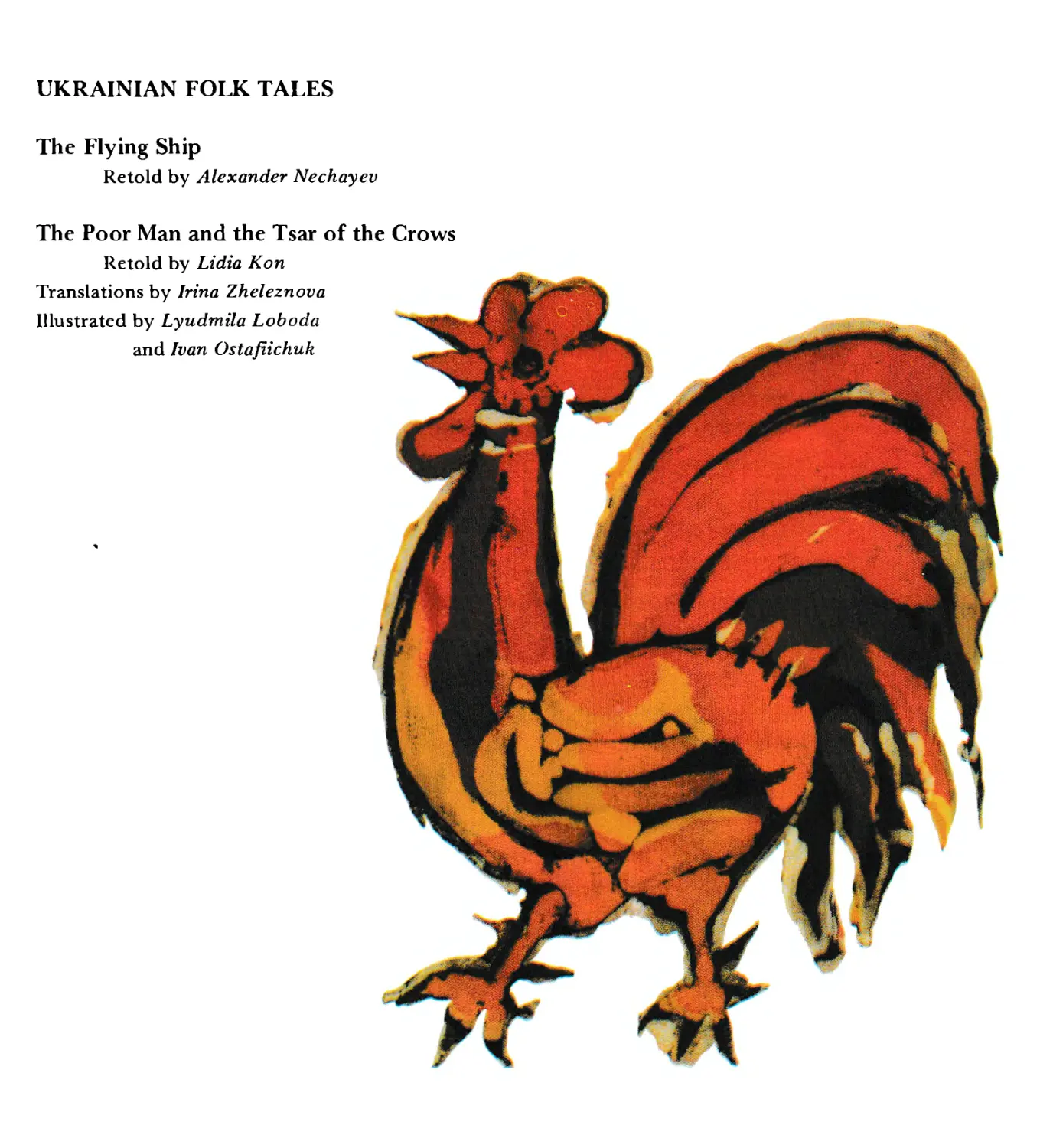
UKRAINIAN FOLK TALES
The Flying Ship
Retold by Alexander Nechayev
The Poor Man and the Tsar of the Crows
Retold by Lidia Kon
Translations by Irina Zheleznova
Illustrated by Lyudmila Loboda
and Ivan Ostafiichuk
THE FLYING SHIP
sj here once lived an old man and an old woman who had
I three sons, two of them clever young men and the
third, a fool. The two old people loved their two clever
sons dearly, and not a week passed but the old woman would
give them each a fresh shirt to wear. But as for the fool,
everyone was always mocking and scolding him. He would
sit on the stove in his rough linen shirt and if the old woman
gave him nothing to eat, hungry he would stay.
One day the news reached the village that the tsar was
to hold a feast to which all of his subjects were invited and
that the princess would marry him among them who built
a flying ship and came flying to the palace in it.
The two clever brothers went to the forest, cut down a
tree and began to think how they could build a flying ship out
of it when an old man, one as old as old can be, came up to them.
“More power to your elbow!” said he. “And do give me
a light, for I want to smoke my pipe.”
6
“We have no time to bother with you, old man!” the
brothers replied and began thinking what they were to do
about the ship again.
“You’ll have a fine trough there for the pigs to eat out
of,” said the old man, “but you’ll no more see the princess
than you can see your own ears.”
With that he vanished, and as for the two brothers, they
tried hard to build the ship and tried again but nothing came
of it.
“Let us mount our horses and go to town,” said the elder
of the two. “We might not marry the princess, but we’ll at
least take part in the feast.”
And the two old people blessed them and helped them to
get ready for the journey, the old woman baking them some
fine white bread, roasting a whole suckling pig for them
and giving them a flask of good Ukrainian vodka to take along
with them.
The two brothers mounted their horses and set off on their
way, and when the fool learnt about it he began begging his
parents to let him follow them.
“I want to go where my brothers went!” said he.
“Do you, you fool!” his mother said. “Why, the wolves
will eat you up in the forest.”
“No, they won’t!”
7
And there was no doing anything about it, for go he would.
So the old woman got out some stale black bread and
filled a flask with water, packed them in a bag, gave the
bag to him and sent him on his way.
The fool set off for the forest, and it was when he was
nearing it that he saw, coming toward him, an old man,
who was as old as old can be and had a snow-white beard that
reached to his waist.
“Greetings, Grandpa!” the fool said.
“Greetings to you, my son!”
“Where are you going, Grandpa?”
“I walk all over the earth helping people who are in trouble.
And where are you off to?”
“To the tsar’s palace where a feast is being held.”
“Can you make a ship that can fly of itself, then?”
“No, 1 can’t.”
“Then why do you go there?”
“My brothers did, so why shouldn’t I! I might make my
fortune there.”
“Oh, very well. Sit down and let’s have a rest and some-
thing to eat. Show me what you have in that bag of yours.”
“But, Grandpa, all I have there is some stale black bread,
you won’t like it.”
“Never you mind, just take it out.”
8
The fool reached into the bag and brought out some bread,
and lol—it wasn’t stale or black at all but very light and
fresh and made of the finest wheat, the kind of bread the
lords eat on holidays. The fool wondered at the sight of it,
but the old man only laughed.
They had a good rest and ate their fill, and the old man
thanked the fool and said:
“Listen to me, my son, and do as I say. Go to the forest
and find the biggest of the oak-trees there, one whose branches
grow crosswise. Strike it three times with your axe and your-
self drop to the ground and don’t get up till you hear someone
calling you. By that time the flying ship will have been built
for you, and you can get into it and go wherever you have
a mind to. But there is one thing you must do and that is to
take along with you whoever it is you meet on your way.”
The fool thanked the old man and bade him goodbye.
He then went into the forest, found the oak-tree whose
branches grew crosswise, struck it three times with his axe,
dropped to the ground and fell asleep. By and by he heard
someone calling him.
“Get up, for great good fortune has come to you!” the
voice said.
The fool jumped up, and lol— what did he see before him
but a flying ship that was made of gold and had masts of
9
silver and sails of silk. All he had to do was to climb into it
and go wherever it was he had a mind to.
So in he climbed without another thought, hoisted the
sails and was off and away!
And, oh, how fast went the ship and how smoothly!
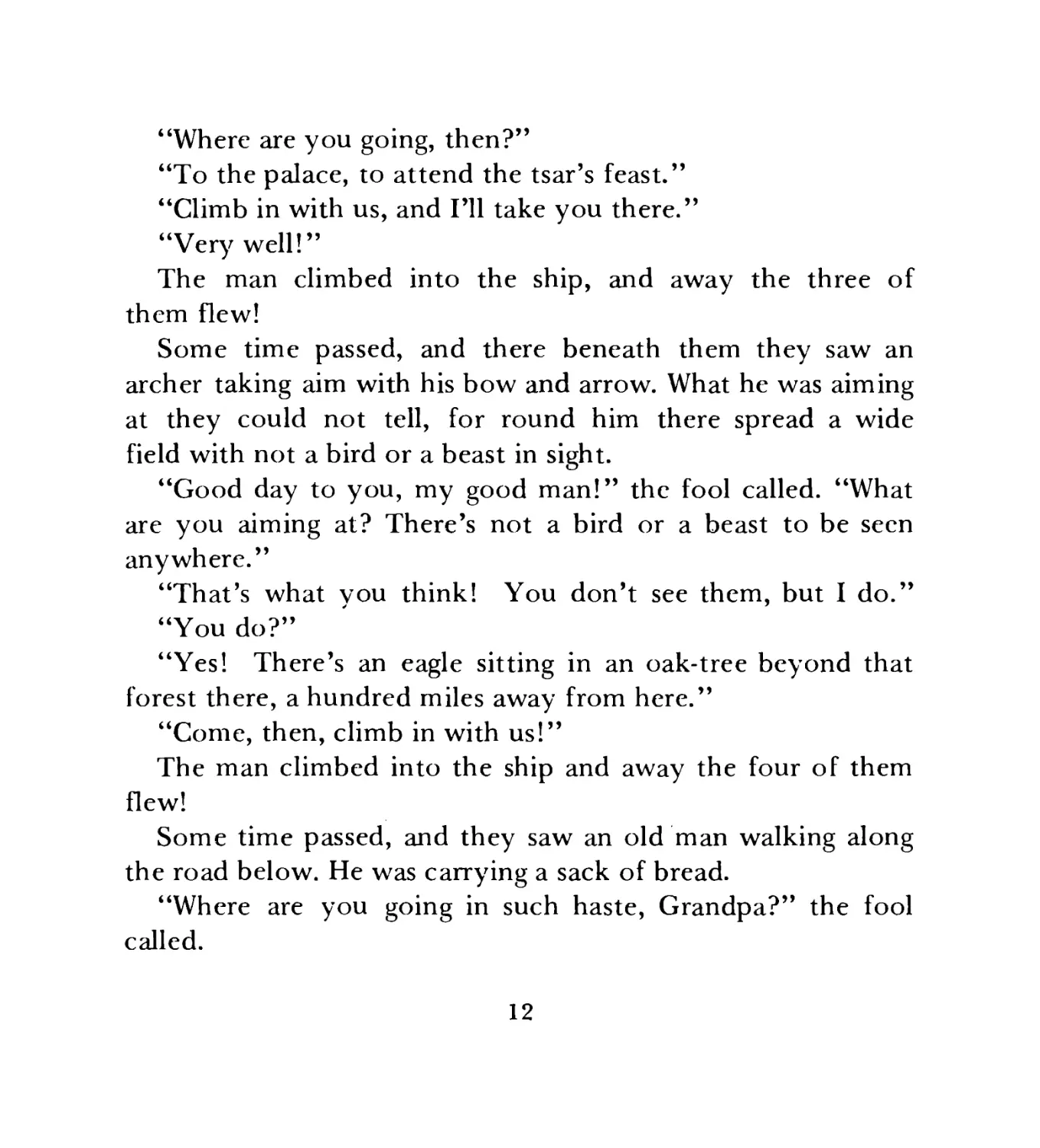
On and on flew the fool, and when some time had passed,
there below him, stretched out on the ground and with one of
his ears pressed close to it, he saw a man.
“Good day to you, my good man, and what are you doing
there?” the fool called.
“I am listening hard, for I want to hear if the tsar’s guests
have all gathered at the palace.”
“Is that where you are going?”
“Yes!”
“Climb in, then, and I’ll take you there.”
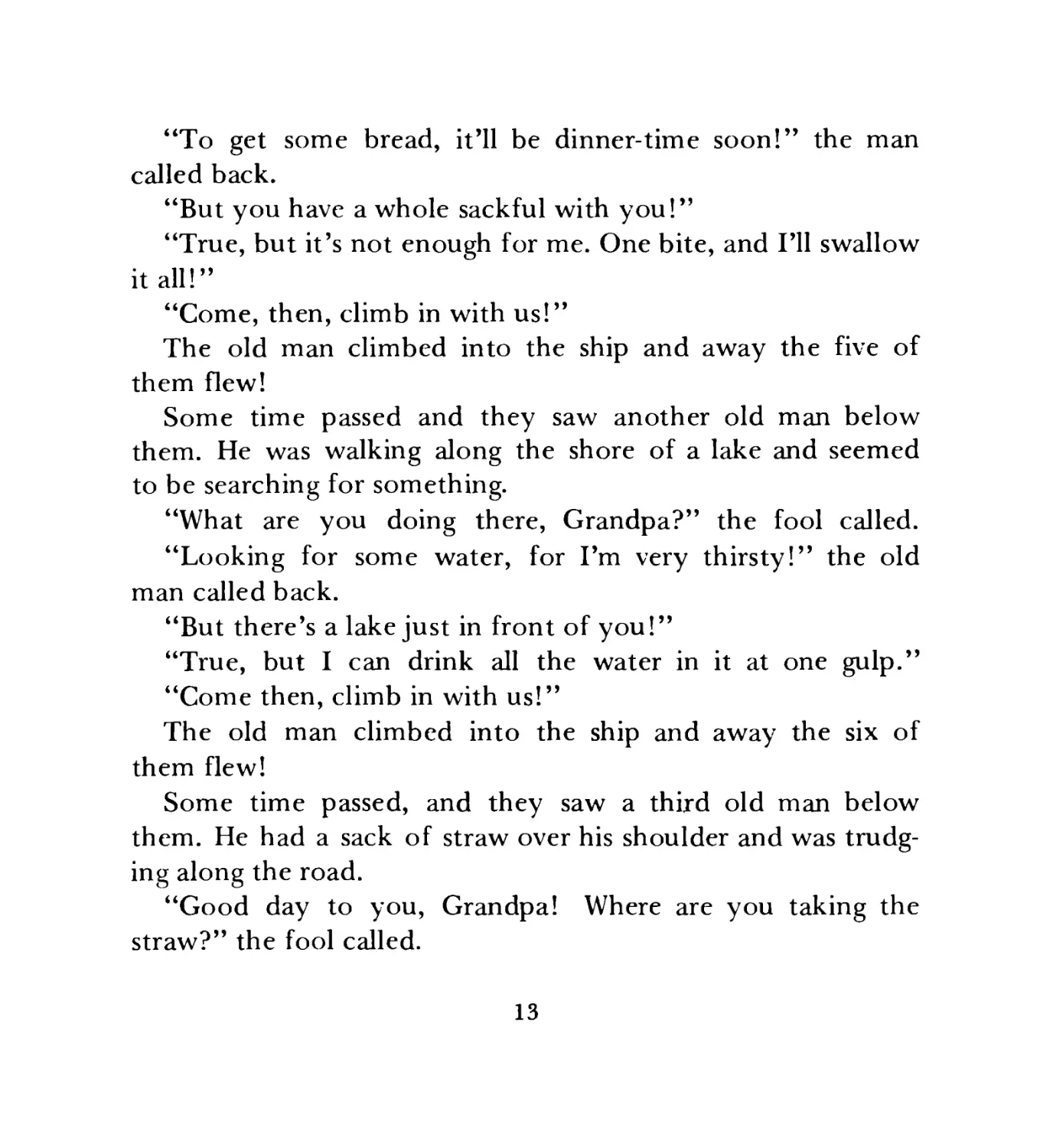
The man climbed into the ship and away they flew together!
Some time passed, and there below them they saw a man.
He was hopping along on one leg and had his other leg tied
to his ear.
“Good day to you, my good man!’ ” the fool called. “Why
are you hopping along there on only one leg?”
“If I were to use both legs one step of mine would take
me all the way round the earth, and I don’t want that!”
the man called back.
10

“Where are you going, then?”
“To the palace, to attend the tsar’s feast.”
“Climb in with us, and I’ll take you there.”
“Very well!”
The man climbed into the ship, and away the three of
them flew!
Some time passed, and there beneath them they saw an
archer taking aim with his bow and arrow. What he was aiming
at they could not tell, for round him there spread a wide
field with not a bird or a beast in sight.
“Good day to you, my good man!” the fool called. “What
are you aiming at? There’s not a bird or a beast to be seen
anywhere.”
“That’s what you think! You don’t see them, but I do.”
“You do?”
“Yes! There’s an eagle sitting in an oak-tree beyond that
forest there, a hundred miles away from here.”
“Come, then, climb in with us!”
The man climbed into the ship and away the four of them
flew!
Some time passed, and they saw an old man walking along
the road below. He was carrying a sack of bread.
“Where are you going in such haste, Grandpa?” the fool
called.
12
“To get some bread, it’ll be dinner-time soon!” the man
called back.
“But you have a whole sackful with you!”
“True, but it’s not enough for me. One bite, and I’ll swallow
it all!”
“Come, then, climb in with us!”
The old man climbed into the ship and away the five of
them flew!
Some time passed and they saw another old man below
them. He was walking along the shore of a lake and seemed
to be searching for something.
“What are you doing there, Grandpa?” the fool called.
“Looking for some water, for I’m very thirsty!” the old
man called back.
“But there’s a lake just in front of you!”
“True, but I can drink all the water in it at one gulp.”
“Come then, climb in with us!”
The old man climbed into the ship and away the six of
them flew!
Some time passed, and they saw a third old man below
them. He had a sack of straw over his shoulder and was trudg-
ing along the road.
“Good day to you, Grandpa! Where are you taking the
straw?” the fool called.
13


“To the village yonder.”
“Isn’t there any straw there?”
“There is, but not the kind I have!”
“And what kind is that?”
“A special kind. No matter how hot the day and how
strong the sun, all I have to do is scatter it over the ground
and it’ll turn to snow.”
“Come, then, climb in with us and we’ll go to see the
tsar together!”
“Very well.”
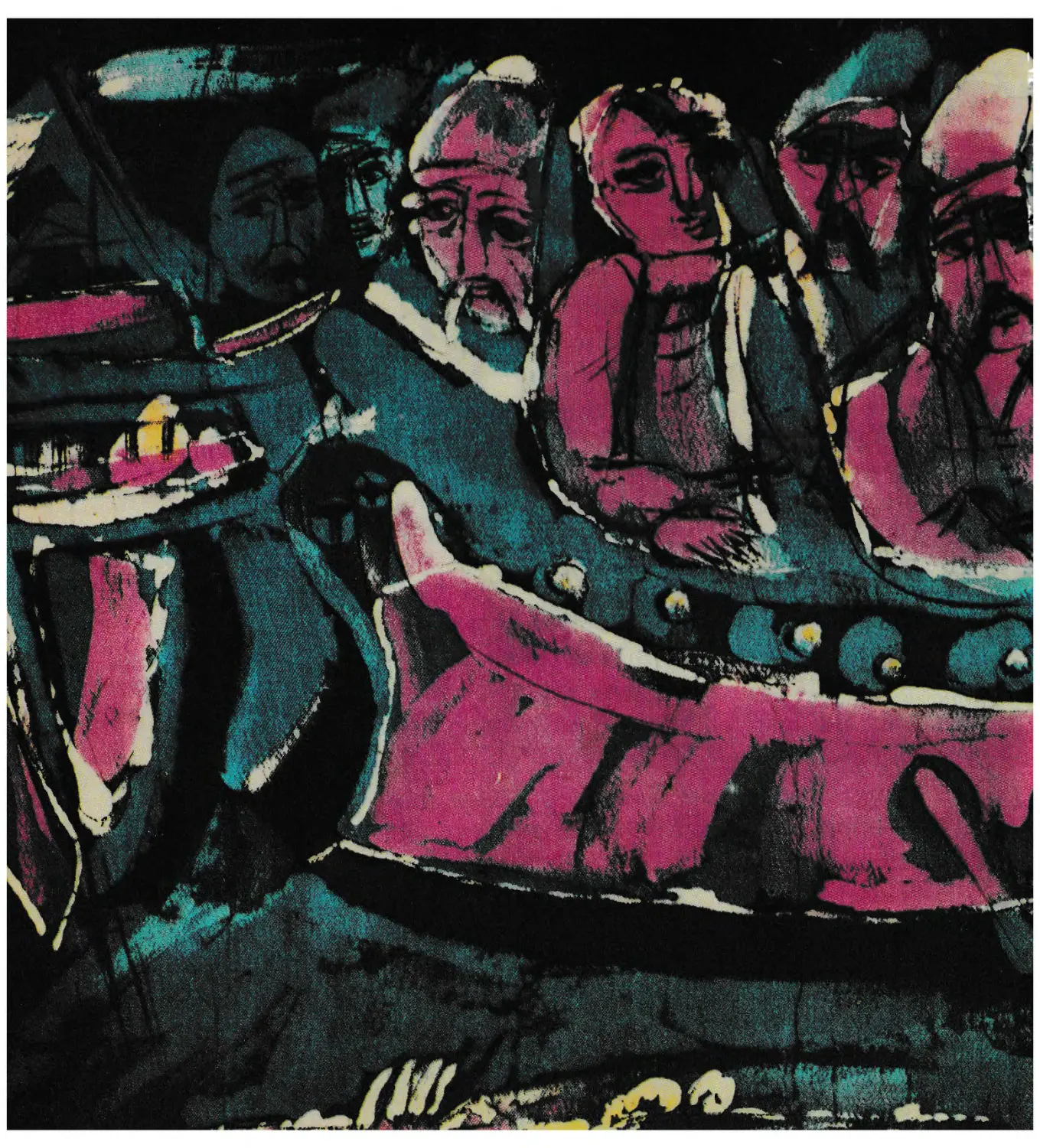
The old man climbed into the ship and away the seven
of them flew!
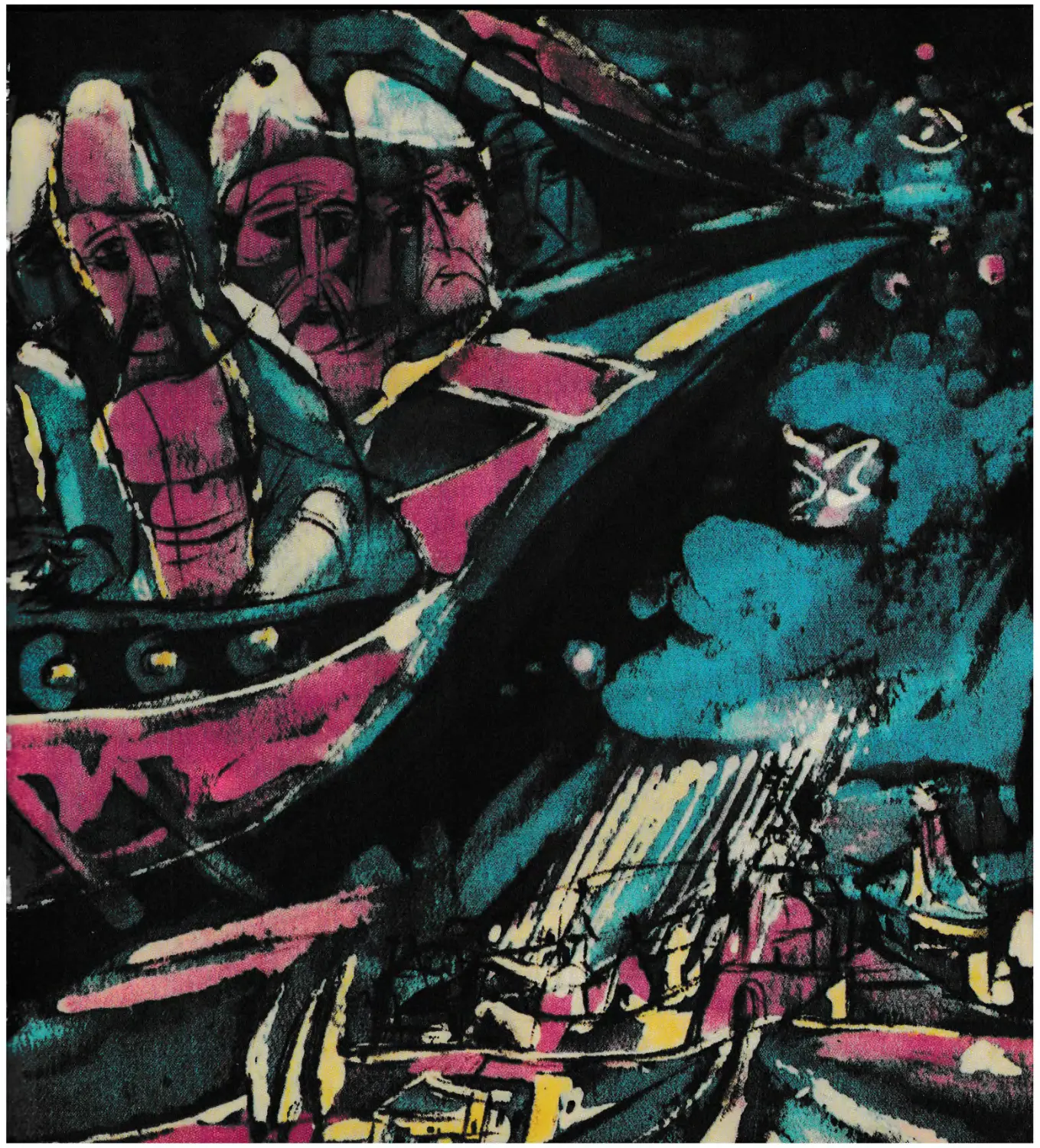
Whether they flew for a long or a short time nobody knows,
but they got to the palace and were just in time for the feast.
Kegs of ale and beer had been rolled out into the courtyard,
and set up in front of the palace were tables groaning with
food: oxen just off the spit, sausages and hams, roasted fowl,
gruel and milk, and other good things as well. The kegs stood
open, and you could eat and drink your fill!
Present at the feast was half the tsardom: lords and
peasants, rich and poor, young and old! And the fool’s two
clever brothers were there too, sitting side by side at one
of the tables.
The fool and his friends came flying up in their golden
16
ship, they landed just under the tsar’s windows, and climbing
out of the ship, joined the feasters.
The tsar was much surprised, for never did he think to
see a simple peasant step out of the ship! The man was
barefoot and had on a pair of pants made of some rough
cloth and a shirt with patches all over it.
The tsar clutched his head in horror.
“Never will I let a daughter of mine marry a peasant!”
said he to himself.
He began to think how to get rid of the fool and at last
decided to give him a number of tasks to do.
“Go and tell that man there,” said he to one of his servants,
“that he’ll not get my daughter in marriage unless he brings
me some living water before this feast is over. And if he
fails to do it, it’ll be out with my sword and off with his
head!”
Off went the servant to do the tsar’s bidding, but Big-Ear,
who heard what the tsar said, passed it all on to the fool.
The fool felt sad and crestfallen. He sat there on the bench
with hanging head and could not eat or drink.
“Why so sad?” Fleet-Foot asked him.
“The tsar wants me to bring him some living water before
this feast is over, and how am I to do it!”
“Do not grieve, I’ll get it for you.”
17
“Well, see that you do!”
The tsar’s sen-ant now came up to him and told him what
the tsar’s orders were, but the fool never turned a hair.
“Tell His Majesty that I will get the living water for him,”
said he.
He looked at Fleet-Foot who at once untied his leg, the
one that was bound to his ear, and was off like a shot! But
when he had filled a flask with some living water, which
only took him a moment to do, he felt very tired.
“The feast is still in full swing, so I think I’ll sit down
under this bush here and rest for a bit,” said he to himself.
And with these words he dropped down on the grass and
fell fast asleep. The feast was all but over, and seeing that he
had not come back, the fool sat there more dead than alive.
“This is the end of me!” said he to himself.
Big-Ear put his ear to the ground.
“Fleet-Foot is a good-for-nothing if I do say so myself,”
said he. “He is lying under a bush, fast asleep.”
“How’ll we wake him?” the fool asked.
The Archer got to his feet.
“I’ll do it!” he said.
He drew his bow and shot an arrow straight at the bush,
and the branches swayed and scratched Fleet-Foot who
jumped up, took one step, and was back at the palace with
18
the living water before the guests had finished eating.
The tsar was much surprised but said nothing. He turned
to his servant and bade him tell the fool that he could marry
the princess if he and his friends ate up two dozen roasted
oxen and a dozen ovenfuls of bread at one swallow. “If
they fail to do this,” said he, “it’ll be out with my sword and
off with the fool’s head!”
Big-Ear heard this and passed it all on to the fool.
“What am I to do!” the fool cried. “Even one loaf is too
much for me to swallow!” And he hung his head and was
very sad and crestfallen.
“Don’t you grieve, my friend,” said Eat-All. “I’ll eat it
all up by myself and ask for more.”
The tsar’s servant now came up to the fool and was about to
give him the tsar’s message, but the fool stopped him, saying:
“I know what the tsar wants me to do. Go and tell the
cooks to prepare the food.”
The two dozen oxen were soon roasted and a dozen oven-
fuls of bread baked, and Eat-All set to with great gusto,
polished off all of the food and asked for more.
“I could have done with twice that much!” said he.
Now, this made the tsar very angry, and he ordered the
fool and his friends to drink a dozen kegs of beer and a dozen
of wine at one gulp.
19
“If this is not done, it’ll be out with my sword and off
with the fool’s head!” said he.
Big-Ear heard him and passed it all on to the fool again.
This time it was Drink-All who came to the fool’s aid.
“Never fear, my friend, I’ll drink it all up and ask for
more,” said he.
The tsar’s servants rolled out a dozen kegs of beer and a
dozen of wine, and Drink-All drained them all at one gulp
and left not a drop.
“A meagre treat that!” said he. “I could have drunk twice
as much.”
The tsar saw that it was not easy to get the better of the
fool.
He bade his iron bath-house to be heated till it was red-hot
and then ordered the fool to bathe in it.
The fool made for the bath-house together with Freeze-All.
They came up to it, and it was as though it was on fire, for
the heat fairly took their breath away! But Freeze-All scat-
tered the straw he had with him over the bath-house floor,
and it became so cold there that it was all the fool could do to
bathe himself at all. He climbed up on to the stove and sat
there, trying to warm himself.
And the tsar, thinking that the fool had been burnt to death,
sent his servants to the bath-house to see what was left of him.
20
The servants came inside, and lol—there was the fool
sitting on the stove.
“A poor bath-house this!” said he. “So cold is it here that
it’s as if it hadn’t been heated all winter.”
The tsar was quite taken aback, for what was he to do
with the fool now!
He thought long and he thought hard and at last he thought
of a way of doing away with him.
“The king of the neighbouring land is marching his armies
against us,” said he, “and not only will I fight him but will
test my daughter’s suitors at the same time. She shall marry
the bravest of the brave among them!”
Many knights now gathered together and went off to
fight, and the fool’s two elder brothers mounted their horses
and joined them, but the fool had no horse and could not
do this. He begged the tsar’s groom for one, and the groom
gave him a dock-tailed nag that could hardly drag itself along
the road so very old was it. All the knights had gone on
ahead and left him behind them, and there he was unable to
get the nag to so much as move from the spot!
All of a sudden whom should he see coming out of the
forest and toward him but the old man who had helped him
to get the flying ship.
“Do not grieve, my son, I will help you,” said he. “As
21
you will be riding through a large forest you will see a great,
spreading lime-tree to the right of you. Tell the lime-tree
to open, it will do so, and a saddled horse with a bag tied
to the saddle will run out of it. After that if ever you are in
need of help just say ‘Come, now, out of the bag!’ and you’ll
see what you shall see. And now goodbye.”
The fool was overjoyed. He climbed down from his nag’s
back and ran to the forest where he soon found the great,
spreading lime-tree.
“Open, lime-tree!” he cried.
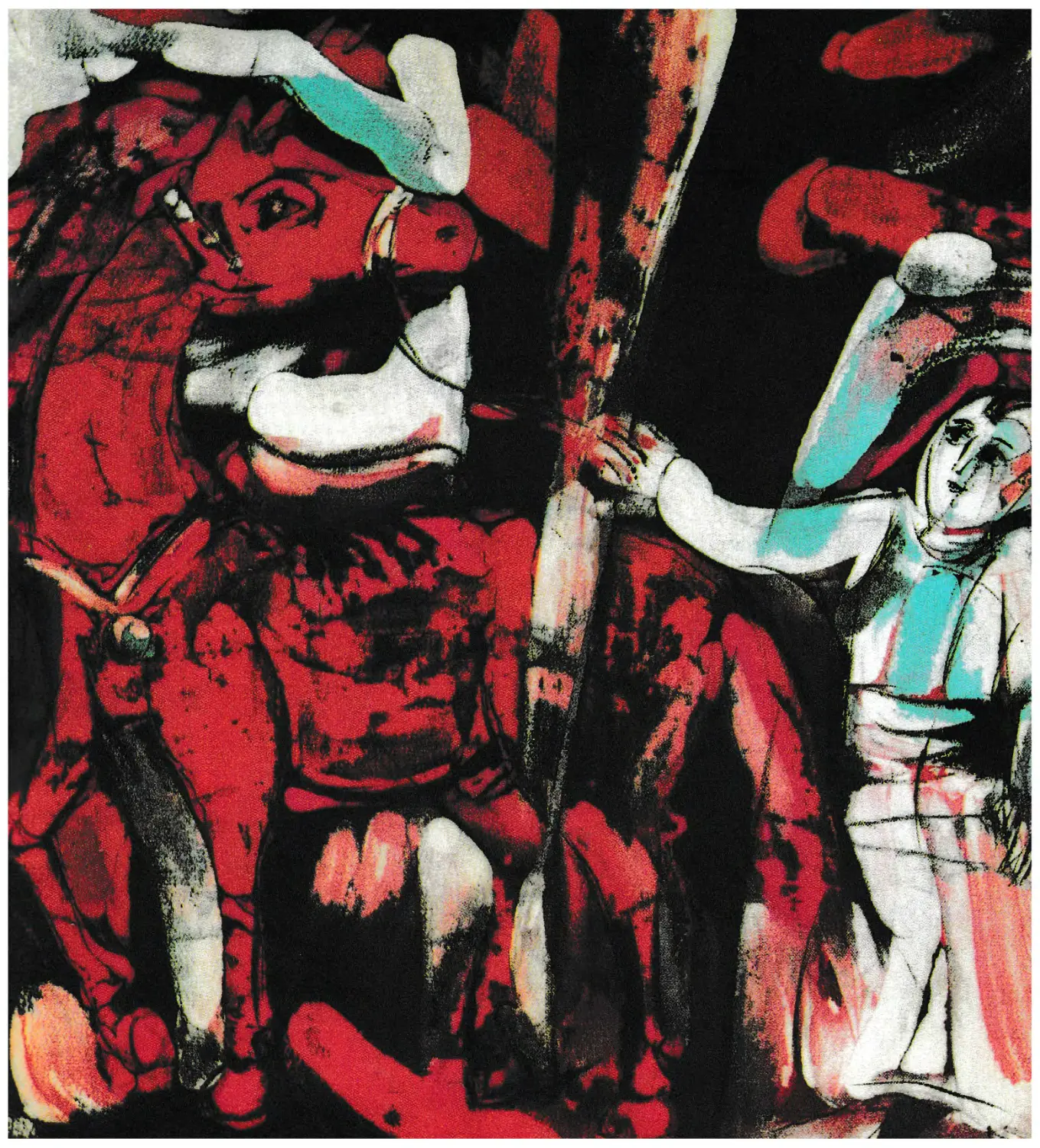
The lime-tree did as he asked, and a most wonderful steed
with a mane of gold and a harness so well furbished that it
blazed like fire ran out of it. Tied to the saddle was a bag
and across it hung a coat of mail, a helmet, a sword and a
shield.
The fool put on the helmet and the coat of mail.
“Come, now, out of the bag with you!” he called.
And lo and behold!—huge numbers of men, a whole army,
came pouring out of it.
The fool jumped on the steed’s back, and riding at a gallop
at the army’s head, made straight for the enemy. And so
well did he fight, hacking away right and left with his sword,
that he vanquished one and all. However, towards the battle’s
end he was wounded in the leg, and it was then that the tsar
22

and his daughter came riding up on horseback toward him.
Seeing that the knight who had been fighting so bravely
was wounded, the princess brought out her kerchief, tore
it in two, and bandaged his wound with it.
The fighting over, the fool rode away into the forest and
only stopped when he saw the great, spreading lime-tree
before him.
“Open, lime-tree!” he cried.
The lime-tree did as he asked, and he hid his horse, his
bag, his coat of mail, helmet, sword and shield inside it and
put on his patched shirt and worn pants again.
As for the tsar, he now sent his servants to all the corners of
the land bidding them find the brave knight whose wound
the princess had bandaged with her own kerchief. The servants
searched for him among the rich, but could not find him, so
the tsar ordered them to search for him among the poor
as well. From house to house went the servants, and it was
when they had almost given up the search that they came to
the fool’s hut. It was a poor little place standing at the very
edge of the town, and when two of the servants came inside
they found the fool’s two elder brothers there having their
dinner and the fool baking flat-cakes for them. One of his
legs was bandaged with the princess’s kerchief, and seeing
this, the tsar’s servants wanted to take him away with them,
24

but the fool begged them not to, saying that he was much
too dirty and unkempt to be shown into the tsar’s presence.
“Let me at least go to the bath-house and bathe first,”
he said. “And you wait for me here and have some dinner.”
“Oh, very well, only don’t take too long!” said they.
They sat down at the table and began eating the flat-cakes,
and the fool ran to the forest and up to the great, spreading
lime-tree.
“Open, lime-tree!” he cried.
Th.e lime-tree did as he asked, and the fool’s horse ran
out of it and waited for the fool to mount him.
The fool now took out the chain-mail and helmet and put
them on, and so handsome did he look that none could
compare with him. He jumped on the horse’s back and rode
to the palace, and when the tsar and the princess saw him they
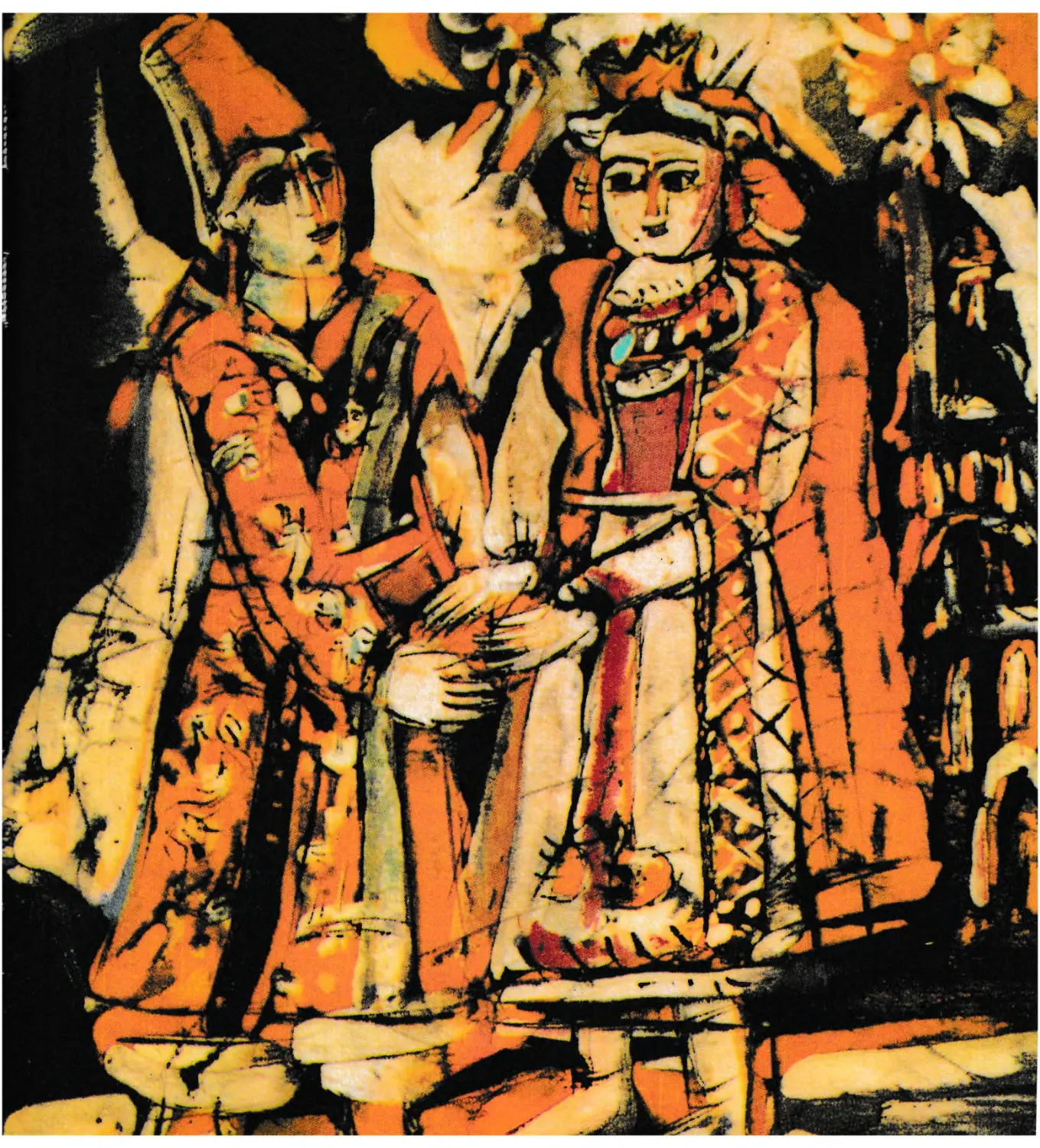
were as glad as glad can be! They showered many honours
upon him, and he and the princess were married then and
there.
THE POOR MAN AND THE TSAR
OF THE CROWS
ence upon a time there lived a poor man who had
nothing to his name save a tiny little hut, a strip
of land and two small, shaggy' bullocks.
And he also had a wife and a whole brood of children
who wailed and cried and begged for something to eat from
morn to night.
One day the poor man went to the field and he took his
youngest son with him. Once there, he began to plough,
and he had only finished ploughing two furrows when all
of a sudden the sky above him grew very dark just as if night
had set in.
He looked up to see if it was a cloud that had hidden
the sky from him, and lol— it was not a cloud but a bird
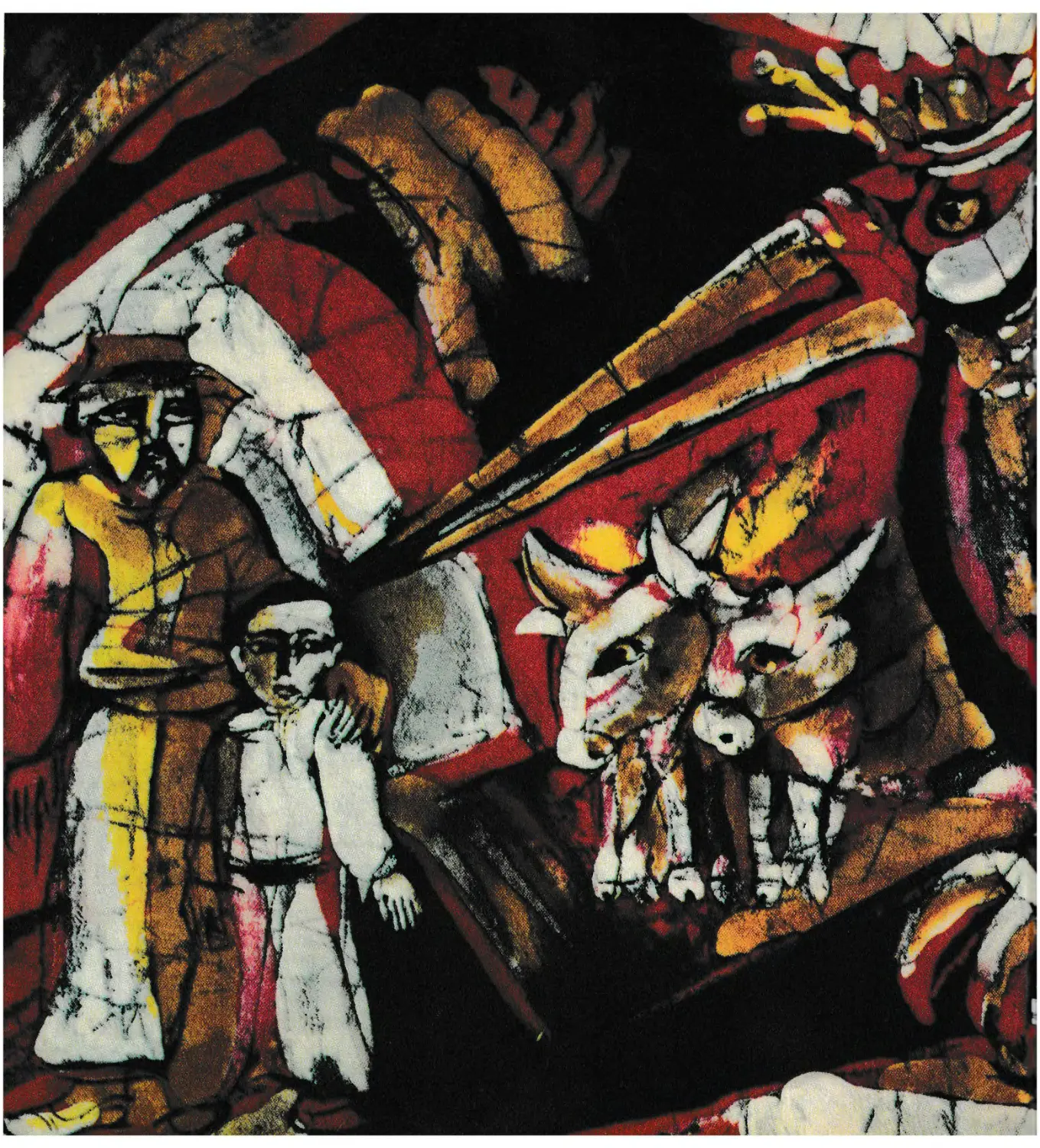
of a kind he had never seen before. Its beak was as sharp as
the sharpest of pikes, its claws were as crooked as hooks,
and each of its wings was as large as the roof of a house.
The poor man was frightened, as well he might be, for
27
the bird lighted on the ground and covered him, his son,
the two bullocks and the plough with its wings. But he was
more frightened still when it spoke to him, saying in a human
voice:
“Tell me, my good man, whom shall I take from you,
your son or your bullocks? My children are hungry and I
must feed them.”
“Take neither, take me instead!” the poor man said. “I
am old and have had enough of this poor life of mine.”
“No,” said the bird, “I don’t want you. You have smoked
far too much in your time, and your flesh is fairly cured by
it and might make my children ill if they eat of it. Give me
either your son or your bullocks!”
The poor man turned the bird’s words over in his mind.
What was he to do? He had many children and if he gave
up his son to the bird he would still have many left. On the
other hand, he had only two bullocks and with them gone
he could not hope to finish ploughing his field, bring firewood
from the forest or earn any money.
“Don’t take so long thinking it over,” said the bird. “Tell
me who I am to have, your son or your bullocks.”
It scratched at the ground with its claws, and seeing how
large they were, the poor man felt sorry for his son.
“Come what may, I shall not give up my child!” he told
28
$4
himself, and turning to the bird, said that it could have the
bullocks.
“It’s lucky for you that you arc giving me the bullocks
and not your son,” said the bird, “for had it been the other
way round I would have done you to death together with
them. And know this: I will pay you well for the bullocks.
Have one of your sons come to my palace, and I will give
him whatever he desires.”
“Where is your palace to be found?” the poor man asked.
“In a silver glade that lies beyond the steep hills and the
dense forests,” the bird replied. “Your son must ask of those
he meets on the way where the Tsar of the Crows lives, and
he will find it.”
And with these words it snatched up the two bullocks
together with the plough and flew away.
The poor man came back home as sad as sad can be.
“Where are the bullocks?” his wife asked.
He told her of all that had happened and she burst into
tears.
“What is to become of us!” she cried. “You haven’t
ploughed the field or sown it either, so we won’t even have
any bread.”
“Do not cry, Mother,” their eldest son said. “I will go
to see the Tsar of the Crows and make him pay me for the
30
bullocks. And if 1 don’t come back, my share of the food
will be left to the others.”
At this the mother began weeping even more bitterly
than before.
“Don’t go anywhere, son,” she said, “we’ll find something
in the house for you to eat. Why, this terrible bird might
eat you up!”
But the boy would not listen to her.
The mother baked him a flat-cake, put the flat-cake and
an onion in a bag, gave the bag to him, and bidding him
goodbye, sent him on his way.
Off went the eldest son to seek the silver glade where
stood the palace of the Tsar of the Crows. He climbed one
steep hill and then another, and having crossed two mountain
meadows, found himself in a dense forest. Feeling hungry,
he seated himself under a bush and took the flat-cake and
the onion out of the bag. He had only taken his first bite
when there before him, hopping on one leg, he saw a lame
crow.
“Greetings, my lad!” the crow said.
“Greetings to you, Crow!” said the elder son.
The crow hopped up a little closer to him.
“I’m very hungry. Won’t you give me a piece of your
flat-cake?” it said.
31
“No, I can’t do that, find something to eat for your own
self,” the eldest son replied. “I’m hungry too, and I have
a long way to go.”
“Where are you going?” the crow asked.
“I am looking for the silver glade where stands the palace
of the Tsar of the Crows.”
“I am going there too, only my wings and legs are too
weak to carry me any further. Let me perch on your shoulder,
and I’ll show you the way.”
“How can I carry you when I can hardly move myself!”
the eldest son replied.
At this the crow gave a little hop, flapped its wings and
flew away.
This made the eldest son very angry.
“Now, isn’t that crow sly!” said he to himself. “It pretend-
ed it was lame just so I would carry it.”
He put what was left of the flat-cake in his bag and set off
again to seek the silver glade where stood the palace of the
Tsar of the Crows.
But neither the silver glade nor the palace could he find.
He strayed off the path and lost his way in the forest.
The poor man and his wife waited a long time for him to
come back, but all in vain. Day followed night and night
followed day and there was not a sight or a sign of him.
32
Said the middle son:
“Bake me a flat-cake, Mother, put the flat-cake and an
onion in a bag, give me the bag and a staff, and I’ll go in
search of my brother. Perhaps I will find the silver glade
and the palace of the Tsar of the Crows, and if I do, I’ll
make the Tsar pay me for the bullocks.”
“Don’t go anywhere, son,” the mother begged. “We’ll get
on well enough without the Tsar’s money. As for your brother,
he’ll come back without your help if only fate so wills.”
But the middle son would not listen to her, and she packed
his bag for him and saw him off on his way.
The middle son crossed many green meadows and many
dense forests, and one day, as he was walking along, he saw
some crows wheeling in the air above him.
“The palace of the Tsar of the Crows must be near here
somewhere,” said he to himself.
Now, he was in a forest then, a dense one, and feeling
hungry, he seated himself under a bush, took the flat-cake
and the onion out of his bag and began to eat. All of a sudden
a lame old crow appeared before him and began begging him
to give it a piece of his flat-cake.
“Your Tsar took away our bullocks, so let him feed you!”
the middle son said.
“Well, then, let me at least perch on your shoulder so
33


that hungry and lame as I am I might not die in the forest,”
said the crow.
“You can perch on your Tsar’s shoulder and let him carry
you!” the middle son said.
At this the crow gave a little hop, flapped its wings and
flew away.
The middle son looked after it in surprise, and getting
to his feet, set out on his way again. But neither the silver
glade nor the palace of the Tsar of the Crows did he find.
For he strayed off the path and lost his way in the forest.
The poor man and his wife waited for their two sons for
a long time, but there was not a sight or a sign of them.
Said the youngest son to his mother:
“Please, Mother, pack me a bag of food. Perhaps I will
find my brothers and get the Tsar of the Crows to pay us
for the bullocks.”
The mother burst out crying. She tried to make her son
think better of what he meant to do, but all in vain, and in
the end she had to let him go.
On and on walked the youngest son and he passed over
many green hills and crossed many dense forests. Then,
feeling hungry, he seated himself under a bush, the very one
under which his two brothers had sat, and began to eat.
He had only just taken his first bite of the flat-cake when
36

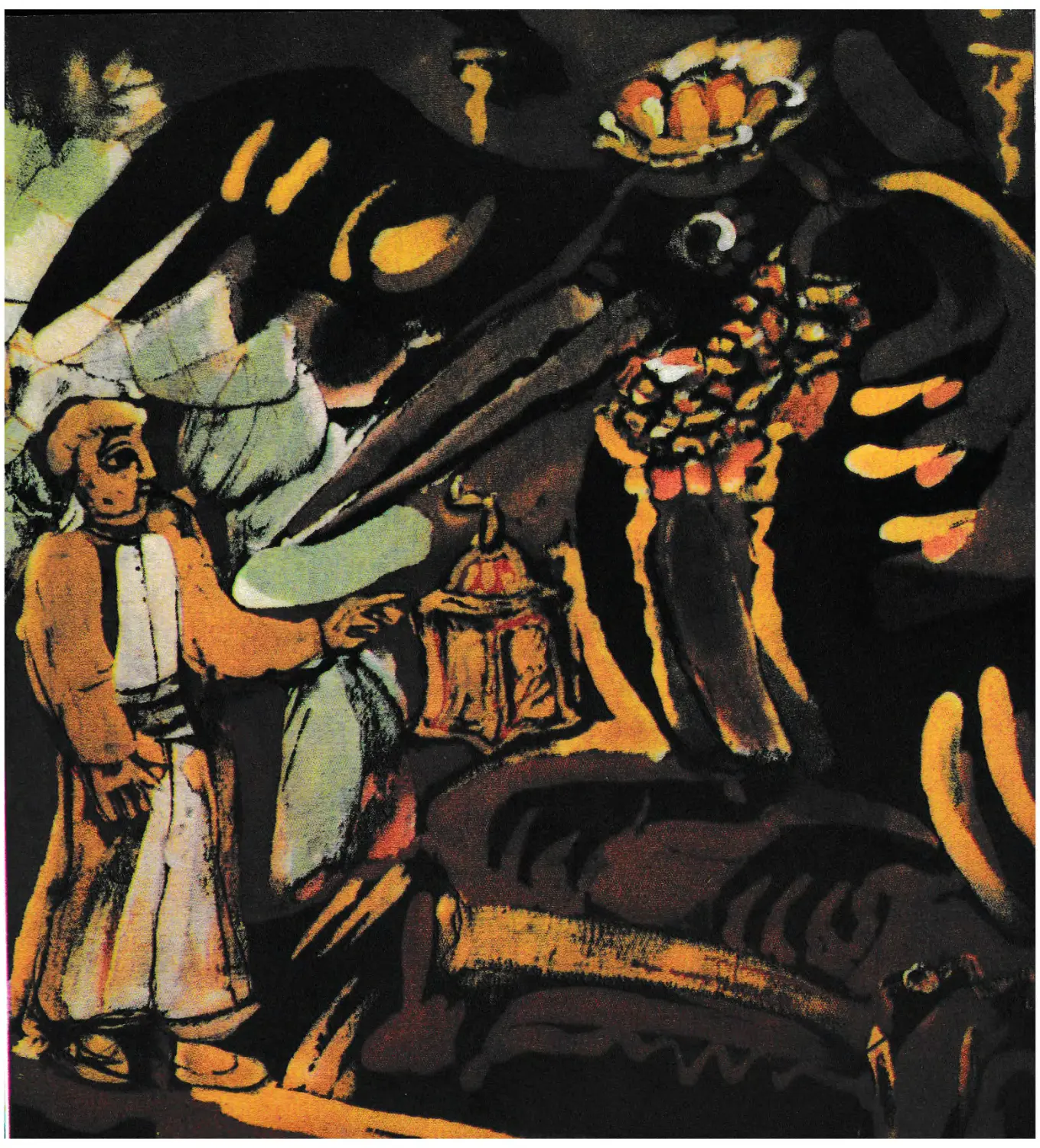
a lame crow appeared before him.
“Do give me a piece of your flat-cake!” it begged, hopping
about on one leg.
The youngest son at once broke off a large piece and
gave it to the crow.
“Here, eat your fill, you poor thing!” said he. “There’s
enough here for both of us. And it’s a bore to eat by oneself
anyway.”
“Can I have some of your onion too?” the crow asked.
“Of course you can! I’ll be only too glad to share it with you.”
The crow ate up the piece of flat-cake and one of the
onion and thanked the boy.
“Where is it you are going?” it asked. “Do you know
that no one ever found his way out of this forest?”
“I must find the palace of the Tsar of the Crows,” said
the youngest son. “My brothers must be there.”
“Let me perch on your shoulder, for I am lame and my
wings are weak,” the crow said.
“Why not! I never carried a crow on my shoulder before!”
laughed the boy, and he put the crow on his shoulder.
On and on he walked, and the crow pointed out the way
for him.
“Turn right! Now turn left! And now go straight ahead!”
it told him.
38

They were on their way for two days and two nights, and
they crossed one dense forest and then another. All of a
sudden something bright showed ahead and they found
themselves in a wide glade. And oh, what a wonderful glade
it was, for everything in it, the grass, the flowers and even
the stones were of silver.
In the middle of the glade rose a high silver cliff and on
the cliff’s very top, a palace.
The youngest son stopped and stood there looking at
it like one in a trance, for never, not even in his dreams,
had he seen anything so beautiful!
He and the crow seated themselves on the edge of the
glade and ate up all that remained of the food in the bag.
“That palace you see there is the palace of the Tsar of
the Crows,” the crow said, “and I’m sure you can find your
way to it alone. But you were very kind to me and to repay
you for it I will give you a piece of advice. When the Tsar
asks you what it is you want him to give you in return for the
bullocks, tell him that you want nothing save that which he
puts under his pillow before he goes to bed at night.”
And with these words the crow vanished.
The youngest son climbed up on to the cliff top, and the
palace guards stopped him and led him straight to the silver
throne on which sat the Tsar of the Crows.
40
“How did you find your way here?” the Tsar asked.
The youngest son did not want to let down the crow.
“Some kind people showed it me,” he said.
“Well, since you have found your way here I must keep
my word. Look over my palace, and you shall have whatever
it is you like best of all you see in it.”
The youngest son walked over the palace for three days
and three nights, but he had hardly seen a tenth of it when
he decided that it was time to go back to see the Tsar again.
“Yours is a most beautiful palace, Your Majesty,” said he
to him, “and there is much in it that I liked. But what would I
do with such riches? I don’t want them. Just give me that
which you put under your pillow before you go to bed at night.”
The Tsar of the Crows flew into a rage.
“How did the lad get to learn about it?” he cried. “One
of the crows must have told him about it!” And he gave
orders for all the crows who had been showing the youngest
son around the palace to have their heads cut off. Then,
turning to the youngest son, he began trying to get him
to change his mind about what it was he had asked for.
“Do not ask me for that which you cannot have,” he
said. “I will give you many bullocks and a wagonload of
gold if you like.”
“No, I want nothing save that which you put under your
41


pillow before you go to bed at night!” said the youngest son.
“That you cannot have. Take everything I have in this
palace instead!” the Tsar said.
But the youngest son stood his ground, and there was
nothing the Tsar could do.
He took a little coffee-grinder from under his pillow,
and giving it to the boy, cried:
“Here, take it, only get out of my sight before I have
you pecked to death!”
The youngest son put his grinder in his bag and ran out
of the palace, and he only stopped when he found himself
in the forest again.
He sat down for a rest, brought out the grinder and reached
into the bag again to see if there was a piece of the flat-cake
left there. But the bag was empty, and the boy told himself
that it was a poor counsel the lame crow had given him.
“What do I need this grinder for!” thought he. “I should
have asked for some gold or for some food even. This way
I’ll starve to death and never get back home at all.”
But then, remembering that the Tsar of the Crows had
been willing to give up all his riches to him if only he left
him the coffee-grinder he began looking it over. It seemed
a simple enough thing and had a handle on one side of it
like any coffee-grinder.
44

“I wish I had a table before me laden with food and drink, like
the one the Tsar of the Crows had in his palace!” said he to
himself, and without thinking about it, gave the handle a twist.
The same moment a table covered with a rich cloth and
groaning with food and drink appeared before him.
The boy was overjoyed.
“Just see what this grinder can do!” he cried.
But he felt sad again the next moment, saying to himself:
“This won’t do at all! Here I am sitting at this table and
eating and drinking all by myself while my mother and father
and my bothers and sisters go hungry.”
And turning the handle again, he said aloud:
“Let my mother and father and all my brothers and sisters
appear before me!”
And no sooner were the words out of his mouth than
his whole family, mother, father, sisters and brothers, were
there before him. They began eating and drinking and they
never stopped till they had polished off everything!
After that they all went back home together and lived
together very happily ever after, for the grinder gave them
everything they needed.
Now, if you don’t believe me, pay them a visit, and they’ll
tell you all about it if they want to.
THE BYELORUSSIAN FOLK TALE
Teeny-Tiny
Retold by Alexander Yakimovich
Translated by Irina Zheleznova
Illustrations by Vladimir Savich
TEENY-TINY
Оз here once lived an old man and an old woman who had
Г no children. One day the old man dreamt that someone
told him to go to the forest, gather some birds’ eggs
there and hatch babies out of them.
The old man told the old woman about it.
“Why don’t you do it, then, old man!” the old woman
said. “Go to the forest and gather some eggs, and then
we’ll put the eggs in a sieve and I’ll sit on them till they
are hatched. The baby birds will start to chirp and to twitter
and we’ll think them to be our children and feel the happier
for it.”
The old man did as his wife said. He went to the forest
and climbed a birch-tree, but when he looked in the nest
that he found there he saw that there was only one egg in
it. He climbed a second birch-tree and found a second nest,
but in it too there was only one egg. All in all he climbed
thirty birches and found one egg in each of the nests save the
48
last which held two. He now had thirty-one eggs and told
himself that that was enough. He brought the eggs home
and put them in a sieve, and the old woman sat down on them
just as though she were a hen.
Three weeks or so went by, and not baby birds but baby
boys were hatched out of them.
“Look, old man, you and I have sons, thirty-one of them!”
the old woman said.
The old man was overjoyed. He invited two of his friends
and their wives over to his house, and, setting a jug of wine
on the table before them, harnessed a horse and set out for the
priest’s house to ask him to baptize his children.
He was soon back, bringing the priest, who baptized all
thirty-one of the boys and gave a name to each save the
youngest and weakest of them. He told the old man and the
old woman that he could think of no name for him and that
they could give him any name they chose, and seeing that the
boy was so very small, the old man and the old woman named
him Teeny-Tiny.
The boys grew very fast, not by the day but by the hour,
and they were quite grown up by the time a year had
passed.
“Why do we only play games and do nothing else, Father?”
asked they. “It’s time for us to do some work. Go into town
49


and buy scythes for us, and we’ll cut the grass!”
The old man rode off to town and bought thirty scythes,
but though he looked all over he could not find a scythe
small enough for Teeny-Tiny to handle. He rode home and he
called his sons.
“Here, my sons, choose a scythe for yourself, each of
you!” said he.
The sons each chose a scythe for himself, but when Teeny-
Tiny came up to his father there was none for him:
“Where’s my scythe, Father?” he asked.
“I couldn’t find one for you, my son,” the father said.
“I’m old and you’re very young, so the two of us will stay
at home and not do any work.”
“Oh, well, let it be as father bids,” the thirty elder brothers
said, and off they went to cut the grass.
They came to their father’s meadow, which lay three miles
or so away from their house, and finding it to be quite large,
divided it up into plots in such a way that each of them
now had a plot of his own and two were left for their father
and for Teeny-Tiny.
Some time passed, and Teeny-Tiny, who had stayed at
home with his father, said to him:
“I think I’ll go and see how my brothers are making out
with their work, Father.”
52
“Very well, my son, but see that you don’t lose your way,”
the father said.
“I’ll try not to.”
But no sooner had he left the house than he strayed off
the path, found himself in a forest and could not find his way
out of it.
He climbed an oak-tree and looked all about him, and he
saw his brothers, all thirty of them, wielding their scythes
quite close to where he was. He seized the oak-tree by its
crown and bent it to the ground, and lo!—it split in two.
Then, tearing off the branches, he threw the tree over his
shoulder and made straight for the meadow where his brothers
were.
“Work away, and may God be with you, my brothers!”
he said. “Only why have you left two of the plots untouched?
Do they belong to someone else?”
“We left the two plots for you and father to work on,” the
brothers said.
“But didn’t father say I was too young and he was too old
to work!”
“If you can’t work yourselves you can hire someone else
to do the work for you!”
“Oh, very well, then!” said Teeny-Tiny.
He took off his hat, and set to work.
53
He used the oak-tree he had with him to cut the grass and
rake it, and he had the two plots, his and his father’s, mowed
and the stack made before his brothers had finished mowing
their plots or made their stacks.
The brothers, Teeny-Tiny among them, came back home
together, and their father asked them if the grass was all
cut.
“Yes, Father, all of it!” the thirty elder brothers said.
“Not all of it!” said Teeny-Tiny.
“What do you mean?” the father asked.
“Just that my brothers left two of the plots for you and me
to mow,” said Teeny-Tiny.
“Didn’t I say that I was too old to work!” the father said.
“Don’t you grieve, Father, for I mowed the two plots
myself and made a stack of the hay.”
The father turned to his thirty elder sons.
“What about you, did you make only one stack too?”
he asked.
“No,” said they. “We each of us mowed one plot and we
have thirty stacks to show for it.”
У
“You had better watch over them if you don’t want the
hay to be stolen,” the father said.
Evening came, and ten of the brothers went to the meadow
to watch over the hay. They stayed there all night long, but
54
when morning came found that one of the stacks was
gone.
They came home, and their father asked them if the hay
was safe.
“Not all of it,” said they. “One of the stacks has been
stolen.”
The father flew into a temper.
“Fools, all ten of you!” he cried. “How could you let this
happen!”
On the second evening ten other of the brothers went
to the meadow. They watched over the hay all night, but
when morning came found that another of the stacks was
gone.
On the third evening the last ten of the brothers went
to the meadow. They watched over the hay all night, but
when morning came found that yet another of the stacks
was gone.
On the fourth evening it was the turn of the first ten
brothers to watch over the hay again, but they did not want
to do it and told Teeny-Tiny that there w’as a hay stack of
his in the meadow and that he should be the one to keep
watch over the hay for a change.
“Very well,” said Teeny-Tiny, “Г11 do it if 1 must,” and,
turning to his father, he added: “Please, Father, go to the
55
blacksmith and ask him to forge me an iron cudgel weighing
thirty poods.”
The father did as Teeny-Tiny asked, and the blacksmith
forged Teeny-Tiny the cudgel.
And Teeny-Tiny seized the cudgel and hurled it up so high
that it vanished from sight. Then, seeing it come flying down
again, he lifted his head, and the cudgel struck his forehead
and broke into four pieces.
Teeny-Tiny called his father.
“Please, Father, have the blacksmith forge me another
cudgel, one weighing forty poods,” said he.
The blacksmith forged another cudgel, and Teeny-Tiny took
it and hurled it up again, but, unlike the first one, it did not
vanish from sight. He lifted his head as it came flying down,
but when it hit his forehead it did not break and was only
dented a little.
“This one will do!” said Teeny-Tiny, and picking up
the cudgel, he set out for the meadow to watch over the
hay.
He came up to his haystack, climbed to its top and sat
there. All of a sudden he heard a clatter so great that it made
the earth quake. He sprang to his feet and saw a mare followed
by thirty-one colts come running toward him.
They ran up to Teeny-Tiny’s haystack, and standing round
56

it in a circle, began eating the hay. Teeny-Tiny waited till
only a little of the hay was left and then he seized the mare by
the mane and sprang on her back. Away ran the mare, carrying
Teeny-Tiny, who goaded her on with his cudgel, over fields
and forests, and it was only when she was quite spent and
worn that she stopped at last.
“Do let me go free, Teeny-Tiny,” she begged, “and I will
give you whatever you ask for.”
“I want those colts of yours!” said Teeny-Tiny.
“Take them, then, only set me free!”
“You won’t try to trick me, will you?”
“No.”
She carried him back to the haystack, and there were the
colts still, eating what was left of the hay.
“Get on the back of the biggest of the colts,” said the mare,
“The other thirty will follow it.”
“Even if all thirty of them run away, I’ll still have one left,
and it will be enough to pay for the hay!” said Teeny-Tiny
to himself.
He got on the back of the biggest of the colts and rode
away, and the other colts ran after them.
He came back home and rode into the yard, but the yard
was small and there wasn’t enough room in it for all of the
colts.
58
Teeny-Tiny called his brothers.
“Come here, brothers, and each of you choose a colt for
yourself!” he cried. “I caught them when I saw them eating up
our hay.”
Each of the brothers chose a colt for himself, and fine colts
they were, but there was only a poor little lame one left, who
had come dragging himself along after the rest, for Teeny-
Tiny.
“There’s my colt!” said Teeny-Tiny, and his brothers stood
there laughing at him, for wasn’t he a fool to have caught all
those colts and been left with the worst of them!
“There’s nothing I can do with you, you ninnies!” said
Teeny-Tiny. “You have taken the best colts for yourselves,
yet you stand there laughing! But never you mind, this one
is good enough for me.”
The brothers all took good care of their colts, and when
the colts had grown they got collars for them and bought
some wagons and then set to work ploughing the fields and
carrying firewood from the forest.
After a time they built themselves a farmhouse and a yard
and had as good a life as anyone could wish for.
But when three or four years had passed, they began to feel
bored and restless and decided that it was time to leave home
and go travelling. And as to what might happen later, well,
59
that was in fate’s hands: some of them might marry, some
take up service with someone.
“You must go without me, for I’m staying home, brothers,”
said Teeny-Tiny. “Mother and father are no longer young, and
who will there be to lay them to rest if all of us leave home!”
“Very well, stay home if you wish!” the brothers said.
“Only you’ll never catch us up if you do!”
“Oh, yes I will!” said Teeny-Tiny.
The brothers set out on their way, and Teeny-Tiny stayed
at home.
A year passed, the father died, and Teeny-Tiny put him to
rest.
Another year passed, and the mother died, and Teeny-Tiny
put her to rest too and held a wake in both his parents’
memory. After that he called together the men from his village
and asked if there was anyone among them willing to rent
his farm. “If I return I’ll want it back,” said he, “but if I don’t,
I won’t.”
Now, the farm was a big farm and richer than those of many
of the rich landowners, and none of the peasants wanted it.
So then he spoke to one of the landowners and left his
house and lands to him, asking no rent for them and with
only a receipt in return and a promise that they would be
taken good care of.
60
As for his colt, what with the care he lavished on it and the
good food he gave it, sharing with it whatever it was he ate
himself, it had grown into a fine horse, finer by far than those
of his brothers. He had even taught it to speak which was a
marvel if ever there was one.
The farm off his hands, Teeny-Tiny sold his grain, and
taking the money he got for it with him, rode after his
brothers.
The brothers had been on their way for three years, but
Teeny-Tiny caught them up in only three months.
“Greetings, brothers!” he called.
“Greetings to you, Teeny-Tiny!” the brothers called
back. “How are things back home? Are mother and father
well?”
“They are both dead, alas, but I hope and trust that
you are all well and have had a good journey. Do tell me
about it.”
“We have had a very good journey indeed,” the brothers
said. “But why don’t you take the lead and ride at the head
of us now?”
Teeny-Tiny did as they said, and on they all rode. A whole
day passed but there were only forests and fields about them
and never a village in sight.
The sun had just set when they came to a forest where,
61
turning round and round, stood a little hut on chicken
feet.
“Please, hut, stop and turn no more, let me enter through
the door!” Teeny-Tiny cried.
The hut stopped turning, and Teeny-Tiny went inside. And
lo!—whom should he see there but Baba-Yaga the Leg of
Stone, a very, very old and wicked crone. She was stretched
on the floor, her head near the door, and so twisted was she
that she seemed to be kneeling, for her nose reached the garret
and her mouth touched the ceiling!
“Greetings, Baba-Yaga!” said Teeny-Tiny.
“Greetings to you, Teeny-Tiny! What are you after? Where
are you going?”
“I am travelling round the world with my brothers, and
what is to be will be. Some of us may marry, some take up
sendee with someone.”
“Are there many of you?”
“Thirty-one, all told.”
“A pity I have only twenty-nine daughters and not thirty-
one, for then you could have married them. But never mind!
Just ride on farther and go to see my sister.”
Teeny-Tiny left the hut and he and his brothers rode
on.
They rode and they rode, and some ten hours had passed
62
when they came to a second hut. It too had chicken feet and
was turning round and round.
“Please, hut, stop and turn no more, let me enter through
the door!” Teeny-Tiny cried.
The hut stopped turning, Teeny-Tiny went inside, and
whom should he see there but Baba-Yaga the Leg of Stone, a
very, very old and wicked crone. She was stretched on the
floor, her head near the door, and so twisted was she that she
seemed to be kneeling, for her nose reached the garret and her
mouth touched the ceiling.
“Greetings, Baba-Yaga!” said Teeny-Tiny.
“Greetings to you, Teeny-Tiny! What are you after? Where
are you going?”
“I am travelling over the world with my brothers, and what
is to be will be. Some of us may marry and some take up
service with someone.”
“Are there many of you?”
“Thirty-one, all told.”
“A pity I have only thirty daughters and not thirty-one, for
then you could have married them. But never mind! Just ride
on farther and go to see my sister. ”
They rode on and soon came to a third hut. It had
chicken feet like the first two and was turning round and
round.
63
“Please, hut, stop and turn no more, let me enter through
the door!” Teeny-Tiny cried.
The hut stopped, Teeny-Tiny went inside, and whom
should he see there but Baba-Yaga the Leg of Stone, a very,
very old and wicked crone. She was stretched on the floor, her
head near the door, and so twisted was she that she seemed to
be kneeling, for her nose reached the garret and her mouth
touched the ceiling!
“Greetings, Baba-Yaga!” said Teeny-Tiny.
“Greetings to you, Teeny-Tiny! What are you after? Where
are you going?”
“I am travelling over the world with my thirty brothers,
and what is to be will be. Some of us may marry and some
take up service with someone.”
“A good thing you came here! I have thirty-one daughters,
and they’ll make good brides for you. So ride into the yard
and unharness your horses, and I’ll have oats and hay given
them.”
They rode into the yard and unharnessed their horses, and
there were the oats and the hay all ready and waiting for
them!
They came into the hut, and Baba-Yaga gave them food and
drink and then called her daughters who turned out to be
very comely maids indeed, each more beautiful than the other.
64

“Well, my lads,” said Baba-Yaga, “now each of you must
choose the one you like best of my daughters and wish to
marry!”
This the brothers did, and Baba-Yaga told them to go to
bed.
“We are going to have the wedding tomorrow!” said she.
The brothers did as she said and were soon asleep, all
save Teeny-Tiny who went out into the yard to talk to his
horse.
“Tow think to be wed, but you'll all die instead, Teeny-
Tiny!” said the horse.
“How is that?” Teeny-Tiny asked.
“Baba-Yaga means to kill you,” the horse replied. “Listen
to me and do as I say. Before going to bed you must exchange
your own and your brothers’ hats for her daughters’ kerchiefs.
Let the maids wear the hats and your brothers and you, the
kerchiefs. Baba-Yaga has a sword that smites of itself. She will
get up at midnight and send it at those of you who will be
wearing hats. Do not sleep but watch and see where she keeps
the sword, and as soon as it cuts off the maids’ heads run away
together with your brothers.”
Teeny-Tiny did as the horse said. No sooner was everyone
asleep than he exchanged the hats for the kerchiefs, and lying
down again, waited to see what would happen.
66


By and by Baba-Yaga sniffed and cocked an ear, and think-
ing that everyone was asleep, took the sword that smote of
itself from the stove ledge.
“Cut off the heads that have hats on them, my sword!”
said she in a whisper.
The sword cut off her daughters’ heads, but not knowing
this and telling herself that she would take the heads away
in the morning, Baba-Yaga went back to bed again and was
soon sound asleep.
Seeing her, Teeny-Tiny woke his brothers and they all
crept out of the hut.
“Let’s not tarry but be off at once!” said Teeny-Tiny.
“How is that! Aren’t we going to get married?” his
brothers asked.
“Get married indeed! You can thank your stars that you
aren’t all dead!” Teeny-Tiny said.
They got on their horses* backs and urged them on, and
they were some two hundred miles away from her hut when
Baba-Yaga woke. She looked at her daughters and saw that
they were all dead.
“You are a sly one, Teeny-Tiny!” she cried. “But you won’t
get away from me, I will catch you up all the same!”
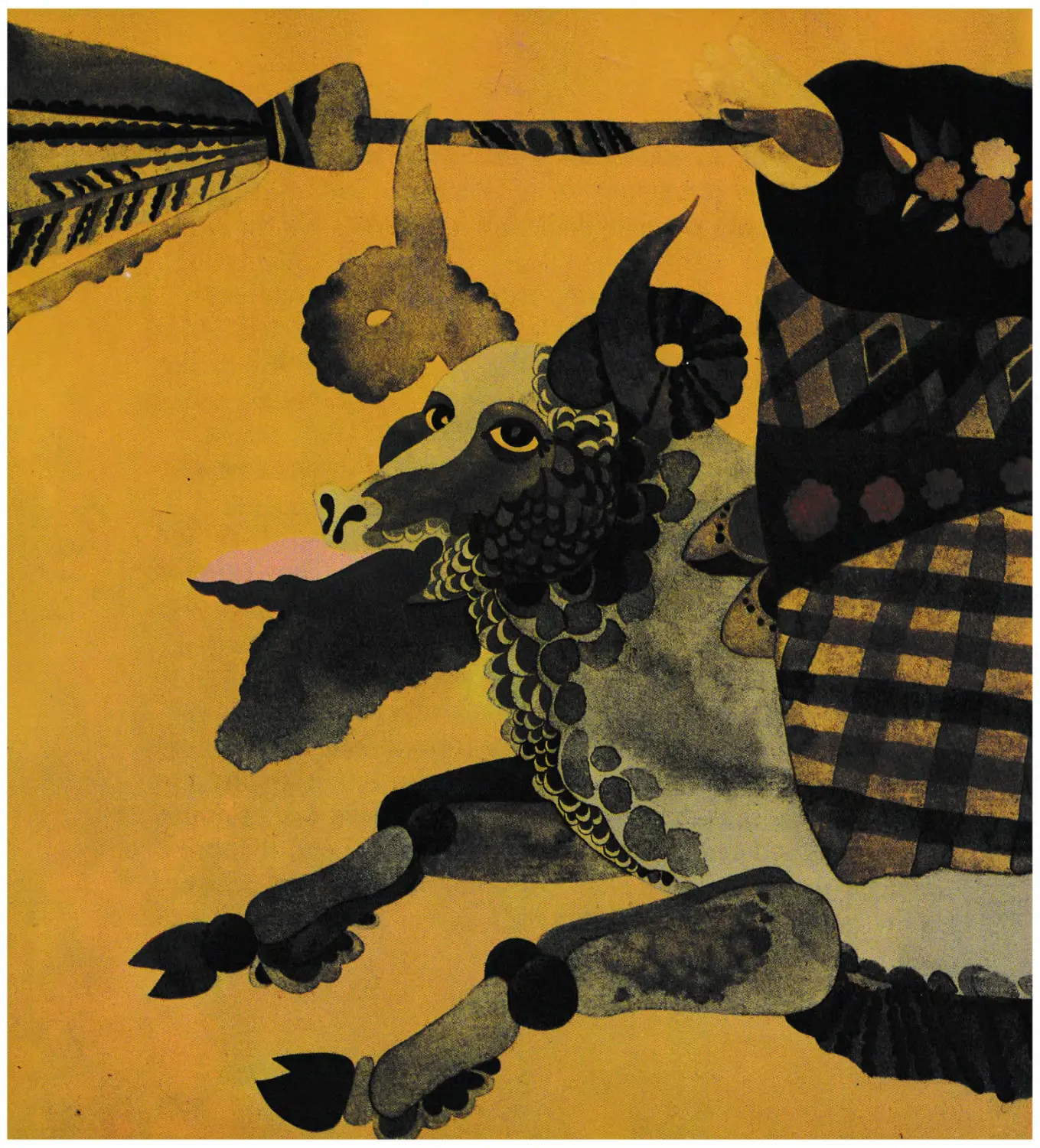
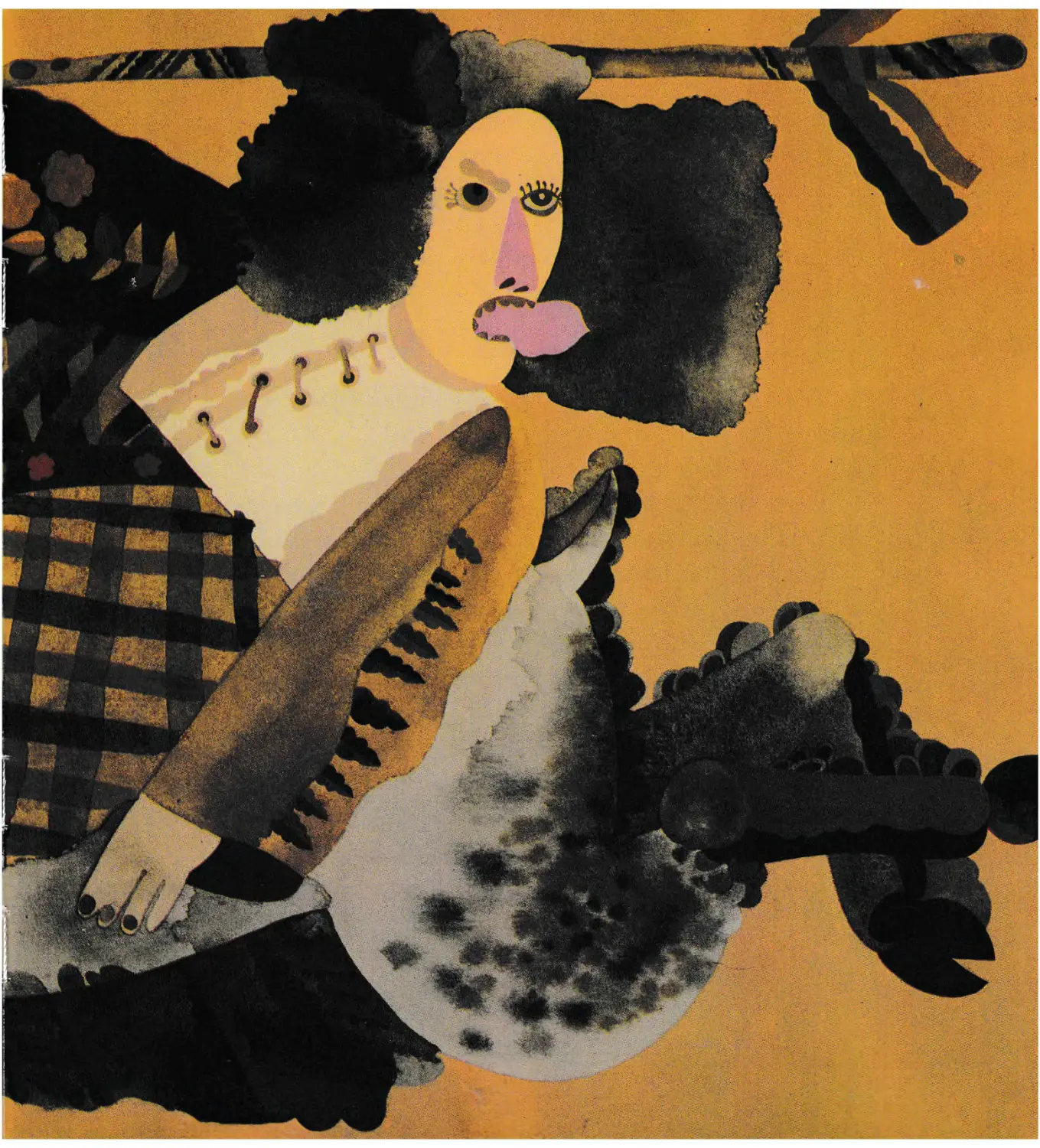
Now, she had three goats in her stable, so she led out
one of them, got on its back and began goading it on
70
with her iron pestle.
She was out to catch up Teeny-Tiny, and lo!—she had
caught him up in three hours or so.
“You could not get away from me, could you, Teeny-Tiny!”
she cried.
They began to fight, they fought for three hours, and at
the end of them Teeny-Tiny killed Baba-Yaga’s goat.
“You wait, I’ll get my hands on you yet!” Baba-Yaga
cried.
“We’ll see about that!” said Teeny-Tiny.
Baba-Yaga said no more but turned away and went home on
foot, and he and his brothers rode on.
All round the world they travelled, but to turn back and
go home seemed silly, so they became soldiers. They told the
tsar whose army they joined, who they were and where they
had come from and they served him faithfully.
Some time passed, and the tsar promoted Teeny-Tiny to
corporal and put him in charge of his brothers.
Now, the brothers did not like this at all, for was not
Teeny-Tiny the youngest of them, so they went to the tsar
and told him that there was one Baba-Yaga the Leg of Stone,
a very very old and wicked crone, who lived beyond the thrice-
nine lands in the thrice-tcn tsardom, that she had a sword
that smote of itself and could even gather together the heads
71


it chopped off and that none save Teeny l iny could get the
sword for him.
The tsar sent for Teeny-Tiny.
“Is it true that beyond the thrice-nine lands, in the thrice-
ten tsardom there lives Baba-Yaga the Leg of Stone, a very
very old and wicked crone and that she has a sword that
smites of itself?” he asked. “If it is, then you must get the
sword for me.”
“It’s true enough that there is such a sword, but to get it
is something no one can do,” Teeny-Tiny said.
The tsar flew into a temper.
“How dare you refuse to do what I tell you to!” he cried.
“Why, I’ll have your head cut off this minute!”
“Very well, I’ll try to get the sword for you,” said Teeny-
Tiny. “Only give me three hours to think over how I am to
go about it. ”
He went to the stable and told his horse that he was very
unhappy.
“And why would that be?” the horse asked.
“Oh, it’s just that the tsar wants me to do something I
cannot do,” Teeny-Tiny said.
“And what is that?”
“I am to get him the sword that smites of itself.”
“That’s nothing, there are harder things to come! So
74

say your prayer and go to bed, for night is the mother of
wisdom.”
Teeny-Tiny did as the horse said. He went to the tsar, told
him that he would get the sword for him, said his prayers and
went to bed. And on the following morning he rose very early,
washed, said his prayers again, got on his horse and set out at a
gallop for Baba-Yaga’s house.
He was there on the stroke of midnight.
“Do you know where the sword that smites of itself is
kept?” the horse asked.
“I do!” said Teeny-Tiny.
“Well, then, go and get it. But don’t waste time and mind
that Baba-Yaga doesn’t hear you, she’s asleep now!”
Teeny-Tiny went into the hut, took the sword that smote
of itself from its place on the stove ledge, slipped out through
the door, and getting on his horse, rode back to the tsar’s
palace.
It was dawning when Baba-Yaga woke, and she at once felt
that someone had been in her house. She looked at the stove
ledge, and seeing that the sword was gone, guessed that it
was Teeny-Tiny who had taken it. So she got on her goat’s
back, and goading it on with her iron pestle, rode after
Teeny-Tiny.
“You won’t get away from me this time!” she cried,
76
seeing him ahead of her.
She caught him up and went at him, and they began to
fight. Long and hard they fought and only stopped when
Teeny-Tiny killed Baba-Yaga’s goat.
Off went Baba-Yaga home on foot, saying over and over
again:
“You wait, Teeny-Tiny, I’ll get my hands on you yet! Then
we’ll see what we shall see!”
Teeny-Tiny brought the sword that smote of itself
to the tsar who was so pleased that he promoted him to
sergeant.
Teeny-Tiny’s brothers were more envious than ever. They
went to see the tsar and told him that that same Baba-Yaga
the Leg of Stone who lived beyond the thrice-nine lands in
the thrice-ten tsardom had a gusli* that played of itself and
that could dance and sing songs as well.
“None save Teeny-Tiny can get that gusli for you, Your
Majesty,” said they.
The tsar sent for Teeny-Tiny.
“Is it true that Baba-Yaga the Leg of Stone, a very, very
old and wicked crone, has a gusli that plays, dances and sings
of itself?” he asked.
*
Gusli—an ancient Russian string instrument.—Tr.
77
“This is the first I hear of it, Your Majesty!” said Teeny-
Tiny.
“Go and fetch the gusli and don’t refuse or I’ll have your
head cut off!” said the tsar.
It could not be helped, so Teeny-Tiny went to see his
horse again and told him that he was very, very unhappy.
“Why would that be?” the horse asked.
“It’s just that the tsar wants me to do something I cannot
do,” Teeny-Tiny said.
“And what is that?”
“I am to get him the gusli that belongs to Baba-Yaga the
Leg of Stone and that plays, dances and sings of itself, and
I never even heard of such a thing.”
“Well, there is such a thing, and get it we will!” said the
horse. “Just jump on my back and hold tight! We’ll be at
Baba-Yaga’s house in no time at all.”
Away they went at a gallop and were soon at the door of
Baba-Yaga’s house.
Said the horse to Teeny-Tiny:
“Go into the house and you’ll see the gusli lying on the
stove ledge. Be careful how you handle it, for it might start
to play and Baba-Yaga will hear it and kill you! She has gone
out, but she can’t be far.”
Teeny-Tiny came into the house, climbed up on the stove
78
ledge, and taking the gusli that played of itself, hurried out
with it. But when he got on his horse’s back, he began to sing,
and this made the horse very angry.
“Hush now or Baba-Yaga will kill you!” he said, and away
he galloped.
They were some two hundred miles away from her hut
when Baba-Yaga saw that her gusli was gone. She did not wait
but got on her third goat, and waving her iron pestle, goaded
it on with it.
She caught up Teeny-Tiny, and they began to fight. They
fought for a day and they fought for a night, and Teeny-Tiny
killed the goat.
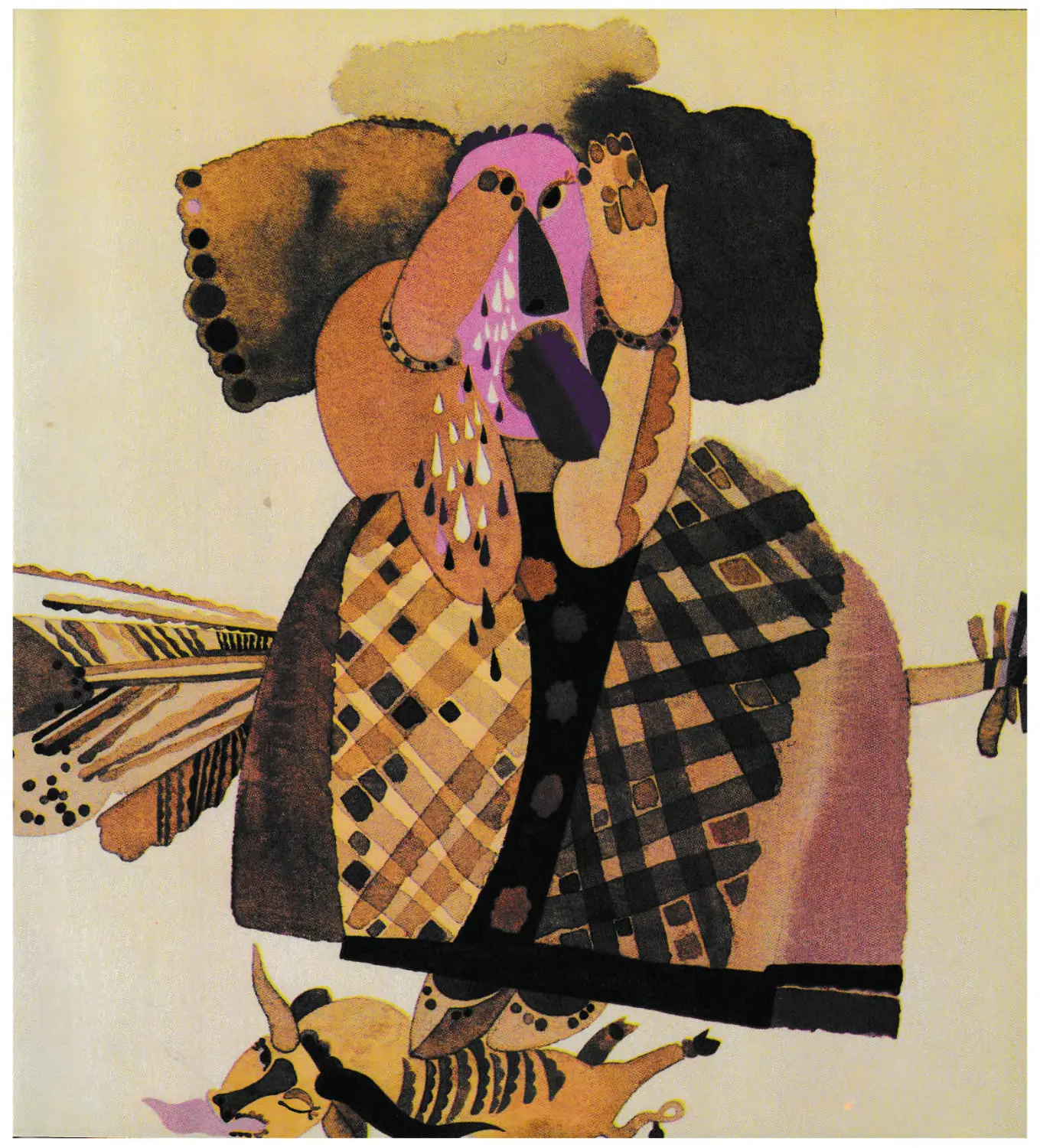
“Г11 never forgive you for this, Teeny-Tiny!” Baba-Yaga
cried, tears of rage running from her eyes.
And Teeny-Tiny went back to the palace and gave the gusli
that played of itself to the tsar. The tsar took it and touched
the strings, and the gusli at once began to play, to dance
and to sing. And so loudly did it play and sing that the sound
of it carried all over the tsardom.
The tsar was pleased and promoted Teeny-Tiny again, and
Teeny-Tiny, who was very angry with his brothers for having
twice done him an ill turn, was even more strict with them
now than before.
Now, it was then or a little while later that the sun was
79
seen to stand still and not move from its place in the sky for
a full three hours. And Teeny-Tiny’s brothers, who thought
to profit by this, at once went to see the tsar and told him
that none save Teeny-Tiny could find out why this had
happened.
The tsar sent for Teeny-Tiny.
“I want you to find out why the sun stood still and did
not move from its place in the sky for three whole hours!”
said he.
Teeny-Tiny was quite taken aback.
“I can’t do that, Your Majesty, no one can!” said he.
“You must all the same or I’ll have your head cut off!”
the tsar cried.
“Oh, very well, only give me three hours to think over how
I am to go about it, Your Majesty,” Teeny-Tiny said.
Off he went to see his horse and told him with tears in
his eyes that his end had come.
“What makes you say that, Teeny-Tiny?” the horse asked.
“The tsar bids me do something I cannot do!” Teeny-Tiny
said.
“And what is that?”
“I am to find out why the sun stood still for three
hours.”
“That’s nothing, there are harder things to come!” said
80
the horse. “Get on my back and let us be off!”
They rode for a day and a night and for another day and
another night, and they came to the seashore. And lo!—there
before them, stretched across the sea, was a huge Whale-Fish,
a thing of wonder if ever there was one. People were using
him for a bridge, and Teeny-Tiny told his horse to do the
same.
“Where are you going, Teeny-Tiny?” the Whale-Fish asked.
“I want to see the sun and ask it why it stood still for
three hours,” said Teeny-Tiny.
“Well, then, you can ask it at the same time why I have
been forced to lie on my side, with people walking and riding
across me, for three whole years now. Do this for me, and I
will help you out too some day.”
“Very well, I’ll see what I can do!” said Teeny-Tiny.
On he rode across the Whale-Fish and only stopped when
he came to the place where the sun was known to set. Before
him stood a mud hut, he went inside, and whom should he
see there but the half-moon! The sun was out, and the half-
moon was waiting for it to come back.
Teeny-Tiny greeted the half-moon who asked him why he
had come so far.
“I want to ask the sun why it stood still for three whole
hours,” Teeny-Tiny explained.
81
“Well, then, Teeny-Tiny, take this coat, it is lined with fur,
as you can see, turn it inside out, put it on and hide behind
the stove,” the half-moon said. “And mind you do it quickly!
For the sun will soon come and it might burn you to death
if you don’t. Just stay hidden, and I will keep it busy talking
until it cools. ”
Teeny-Tiny did as the half-moon said, and lol—there was
the sun on the doorstep. The whole of the hut was lit up
by its rays, and it became so hot that Teeny-Tiny would
have been burnt to a cinder if it wasn’t for the coat he
had on.
“There’s someone here come to see you,” said the half-
moon to the sun. “He wants to know why you stood without
moving for three whole hours.”
“Where is he?”
“Behind the stove.”
“Behind the stove?” said the sun, and shouted: “Climb
out, whoever you are, and let me see you!”
Teeny-Tiny climbed out from behind the stove and bowed
low to the sun who asked him who he was and where he had
come from. Teeny-Tiny told it all it wanted to know, and
the sun said:
“There is a maid named Volinka living by the sea. She has
a golden boat and a golden paddle, and she paddles the boat
82
herself and steers it too. There is not another maid in the
world so beautiful, and it was because I could not take
my eyes off her that I stood without moving for three
hours.”
Teeny-Tiny stared at the sun round-eyed.
“Who could have thought it!” said he. “And now, sun,
do tell me why the Whale-Fish has been made to lie on his side
for three whole years. How long is he to lie so?”
“Let him spit out the forty ships he swallowed and never
swallow another, and he will be free to roam the seas again,”
the sun said. “Only don’t tell him this until you have crossed
him, for he might turn over, and you’ll be drowned.”
Teeny-Tiny bowed low to the sun and rode back to his
tsardom and up to the Whale-Fish who asked if he had spoken
to the sun about him.
“I’ll tell you that when I’m on the other side of the sea,”
Teeny-Tiny said, and he rode across the Whale-Fish.
“The sun told me that you will only be able to roam the
seas in freedom again when you spit out the forty ships and
everything else you swallowed!” he shouted.
The Whale-Fish was overjoyed.
“Hurry and ride away!” he cried. “For I am going to turn
over and shake myself, and the waves might carry you off
to sea.”
83
He did as the sun bade, and having thus atoned for his
sins, went roaming the blue seas again.
And Teeny-Tiny went back to the tsar’s palace and told the
tsar about Volinka, the beautiful maid who sailed the seas in
a golden boat and paddled and steered it herself.
“There is none to compare with her,” he said. “And it was
because the sun could not take its eyes off her that it stood
still for three whole hours.”
The tsar was pleased with Teeny-Tiny and promoted him
yet again.
Whether a long or a short time passed nobody knows
but the tsar began thinking about Volinka and about how
he was to get a look at her. He ordered Teeny-Tiny to
fetch her, and remembering that the Whale-Fish had
promised to repay him for what he did for him, Teeny-Tiny
said that he would think it over and would perhaps be able
to do it.
He went to see his horse, and as he came into the stable,
the tears poured from his eyes.
“Why so sad, Teeny-Tiny?” the horse asked.
“How can I help it! The tsar wants me to do something
I cannot do again. ”
“And what is that?”
“He bids me fetch Volinka, a maid fair beyond compare,
84

who sails the seas in a golden boat and paddles and steers
it herself.’*
“That’s nothing! Go to the tsar, ask him to give you all
sorts of fruits and delicacies from overseas, and we’ll set out
on our way.”
Teeny-Tiny went to see the tsar.
“Please, Your Majesty, do not punish me but let me have
my say,” said he. “I must have three hundred rubles worth
of fruits and delicacies from overseas.”
The tsar gave him all he asked for, and Teeny-Tiny took
it all and went back to his horse.
“The tsar gave me everything you told me to ask him for,”
said he.
“Take a tent, and we’ll go to the seashore,” the horse
said.
They came to the seashore, and the horse told Teeny-Tiny
to set him free and let him roam the green fields.
“And you must set up a tent and bring out the fruits and
delicacies,” he said. “And when you see Volinka sailing past,
knock one spoon against another. Volinka will hear the sound
of it, and she will sail up close to the tent and ask you who
you are and when it was you came there. Be nice to her and
try to please her, and don’t forget to offer her the fruits and
other good things.”
86
Teeny-Tiny did as the horse said. He set up his tent on the
seashore and brought out all the fruits and delicacies he had
with him. After that he seated himself and settled down to
wait.
All of a sudden he saw something gleaming on the water
and at once knew it to be Volinka’s boat. The maid had a
golden paddle in her hand and she was plying it and steering
the boat to shore. And as she did so she kept glancing at the
tent.
“Who are you? When did you come here?” she called,
paddling up close. “I have sailed past many a time, but I
never saw a tent here before.”
“I only came here a little while ago,” said Teeny-Tiny.
“But do sail up nearer and try some of my fruits. They are
very good.”
Volinka sailed up nearer and held out her paddle, and
Teeny-Tiny put a great, juicy peach on it.
Volinka ate it and began plying her paddle again, but she
had not sailed far before she decided that she would like
another. She sailed back to shore again, asked Teeny-Tiny
for another peach and held out her paddle, and Teeny-Tiny
put a peach on it. This she ate, but instead of sailing away,
told Teeny-Tiny that she was very thirsty.
“Would you care for some juice?” Teeny-Tiny asked.
87
“Yes, please!” Volinka said, holding out her paddle.
Teeny-Tiny poured her a cup of grape juice.
“You would make me very happy if you took the cup from
my hands,” he said.
Volinka paddled up closer still and stretched out her hand
for the cup, and Teeny-Tiny seized her hand and held it.
“I’ve caught you, my fair one!” he cried.
He whistled to his horse, who at once came running up to
him, took all he had brought with him, placed the maid in
front of him on the horse’s back and set out on his way
back to the palace.
The tsar met them at the door, and when he saw how
beautiful Volinka was, he fell head over ears in love with her.
In his joy he promoted Teeny-Tiny to captain, and was so
eager to marry the maid that he could hardly wait.
“Surely you don’t think that I can get married in this
gown!” the maid said. “My trousseau is in an iron chest which
weighs all of three hundred poods and lies at the bottom of
the sea. Have the chest brought to me, and I’ll dress as
becomes a bride!”
It could not be helped, so the tsar sent for Teeny-Tiny
and ordered him to fetch the chest.
“But, Your Majesty, it can’t be done, no one can do it,”
said Teeny-Tiny.
88
“You had better do it, though, or I’ll have your head cut
off!” the tsar said.
“Give me a little time to think how to go about it, then.”
“You can think all you like just so you fetch the chest!”
Teeny-Tiny went to see his horse again.
“You don’t know how unhappy I am!” he said.
“And why is that?” the horse asked.
“Because the tsar bids me fetch him an iron chest weighing
all of three hundred poods which lies at the bottom of the sea,
that’s why.”
“Oh, is that all!” the horse said. “Just you go to the tsar
and ask him for the sword that smites of itself.”
Teeny-Tiny did as the horse said. He went to the tsar, got
the sword, and coming back again, climbed on the horse’s back
and rode off at a gallop for the sea.
They were there soon enough, and the horse told him to
cast the sword into the sea and let it cut off the heads of the
smaller of the fishes.
Teeny-Tiny cast the sword into the sea.
“Cut off the small fishes’ heads, sword, and gather them
together!” he cried.
The sword set to cutting off the small fishes’ heads, and
the Whale-Fish saw it and came swimming up to Teeny-
Tiny.
89
“Stop, Teeny-Tiny, spare my kin, and I will do whatever
you ask of me!” he cried.
“I want the iron chest that weighs three hundred poods
and lies at the bottom of the sea!” said Teeny-Tiny.
The Whale-Fish sent some fish for the chest, and they
brought it up from the bottom of the sea and gave it to him.
“And now, Teeny-Tiny,” said the Whale-Fish, “make off
on your horse and do not stop till you are two hundred miles
away from here. I will then throw the chest to you and you
must try to catch it. If you don’t, it will fall through the
ground, and none will ever be able to find it.”
Teeny-Tiny took the sword that smote of itself and away
he rode!
He made good time and had left two hundred miles between
himself and the Whale-Fish when he heard a great clanging
and thumping and knew that it was the chest flying through
the air toward him. He held out his arms and caught it, and
before he knew where he was, found himself in the tsar’s
palace again.
The tsar promoted him to major and then asked Volinka
to marry him again.
“I can’t do that, I must unlock the chest first!” Volinka
said. “Have them fetch me the golden key that weighs all of
five hundred poods and lies at the bottom of the sea!”
90


The tsar sent for Teeny-Tiny and bade him fetch the key.
This time Teeny-Tiny did not argue. He took the sword
that smote of itself and away he rode for the sea! And no
sooner was he there than he cast the sword into the sea and
told it to cut off the middle fishes’ heads.
The sword did as he said, and lo and behold!—there was
the Whale-Fish swimming up to him.
“What would you have me do, Teeny-Tiny?” he asked.
“I want you to fetch me the golden key that lies at the
bottom of the sea.”
“Tell your sword to spare my kin, and you shall have it!”
the Whale-Fish said, and he sent some fish to look for the key.
Off swam the fish, but though they searched and searched
for it they could not find the key and came back without it.
“It isn’t there!” said they.
At this Teeny-Tiny flung the sword that smote of itself
into the sea again, and the sword began cutting off the heads
of the big fishes.
“Tell your sword to spare my kin, you shall have your
key!” the Whale-Fish cried.
He summoned crabs and lobsters and other such creatures
and ordered them to look for the key. But though they
searched and searched for it they could not find the key and
came up without it.
92
The Whale-Fish looked at them and saw that all of them
were there save for one lobster; he looked again, and there was
the lobster crawling up to him!
“Here is the key!” said he. “It was stuck deep in the sand.”
The Whale-Fish turned to Teeny-Tiny.
“Get on your horse!” he cried. “I will throw you the key
when I know you to be three hundred miles away from here.”
Away rode Teeny-Tiny, and when he had left three hundred
miles behind him he heard the key swish through the air as
it flew toward him. He stretched out his arms and caught it,
and lo!—there he was back in the tsar’s palace again.
The tsar was overjoyed. He promoted Teeny-Tiny to colonel
and then asked Volinka to marry him and not to put the
wedding off any longer.
“I will not be married in that old church of yours!” Volinka
said. “Have another, made of gold and silver and with a gold
and silver bridge leading to it built on the river’s opposite
bank. A vineyard must be planted around it, and you must
see to it that it is in bloom when we are on our way to church
and the grapes ready to be picked when we are on our way
back. In front of the church a ditch twelve metres deep and
twelve wide must be dug, a fire made up in the ditch, and a
cauldron filled with tar hung over the fire. And inside the
church candles must be lit and a choir must sing. And mind,
93
I will only marry you if all this is done in the space of one
night!”
It could not be helped, so the tsar sent for Teeny-Tiny
again and ordered him to do as Volinka bade.
“I will never be able to do it, Your Majesty!” Teeny-Tiny
said.
“Don’t refuse or your head you’ll lose!” the tsar cried.
Teeny-Tiny hung his head.
“Give me two days to think how I am to go about it, Your
Majesty,” he said, and the tears pouring from his eyes, off he
went to see his horse.
“Why do you weep, Teeny-Tiny?” the horse asked.
“How can I help it when I am soon to die!”
“To die?”
“Yes. For never can I do what the tsar wants me to do.”
“And what is that?”
“I am to build a church of gold and silver on the river’s
opposite bank, to plant a vineyard round it and to dig a ditch
twelve metres deep and twelve wide in front of it. In the
church candles must be lit and a choir must sing, and a caul-
dron filled with tar must be hung over a fire made up in the
ditch. And all this is to be done in the space of one night.”
“Now, that is not an easy task, I must say, and I cannot
help you with it,” the horse said. “I can only give you this
94
counsel: go to see Volinka and beg her to come to your aid.
Who knows!—she may well take pity on you.”
It could not be helped, so Teeny-Tiny went to see Volinka,
and bowing low to her, begged her to help him.
Volinka felt sorry for Teeny-Tiny.
“Don’t you grieve, Teeny-Tiny,” said she. “Say your
prayers and go to bed, and everything will be done for you.
And when morning comes make yourself a broom, sweep
the bridge and then go and tell the tsar that everything is
ready.”
Teeny-Tiny thanked Volinka, went to his chamber, said
his prayers and got into bed. But he kept thinking of what was
in store for him and could not sleep.
Morning came, he went to the river bank, and lol—every-
thing had been done. The church was there, and the bridge,
and the vineyard, and the ditch.
So he went to see the tsar and told him about it.
“I did as you bade me do, Your Majesty,” he said. “The
church has been built, and you can get married in it.”
The tsar was overjoyed and had Teeny-Tiny made prince.
And Teeny-Tiny took a broom and spent the morning
sweeping and cleaning the bridge.
As for Volinka and the tsar, they put on their finery and
set out for the church from whose open doors came the sound
95
of the choir singing. Around the church the grapevines were
in bloom and in front of it a fire was burning with a tar-filled
cauldron hanging over it.
They came up to the ditch, and Volinka told the tsar to
cross it.
“I will go after you,” said she. “The goose always follows
the gander.”
The tsar did not do as she said. Instead, he called Teeny-
Tiny and ordered him to cross the ditch. This Teeny-Tiny did,
but the tsar, who went after him, fell into the cauldron and
was boiled to death!
As for Volinka, she crossed the ditch, took Teeny-Tiny by
the hand and led him into the church. They were married
then and there and went back to the palace together.
And as they walked on they could only stare, for the
grapes had all ripened and the vines were picked bare. Teeny-
Tiny was happy and held a grand feast, one to startle the
world at the very least, and the two lived together in good
health and good cheer and prospered the more with each
passing year. I attended the feast and I drank ale and wine,
and it ran fast as fast can be down this beard of mine.
As I was leaving for home they gave me a horse made of
tar for a present, a saddle made of burdock and a whip made
of peas.
96


I started on my way, and there, just ahead, was a threshing
floor in flames! I began trying to put out the fire, but my
horse melted away, my saddle was eaten by pigs and my whip
pecked by crows. So then I began to trade in wood, but for
all I tried I never made good.
MOLDAVIAN FOLK TALES
How lonike Fet-Frumos Freed the Sun
Retold by Natalia Gesse and Zoya Zadunaiskaya
The Pot of Gold
Retold by Mikhail Bulatov
Translated by Irina Zheleznova
Illustrations by Isai Kirmu
HOW IONIKE FET-FRUMOS FREED THE SUN
I/ у // hen it all happened my tale will not tell you,
I Д // but I know it did long, long ago, for the sun
Ч_/ х_/ never rose then nor gave of its warmth and light,
a pall of darkness lay over all, and sorrow reigned on earth.
But the old people spoke of an even earlier time when
night had been followed by day which brought with it blue
skies and bright sunshine. They said that it was only later
that the dragons had come and stolen the sun, hiding it none
knew where.
Now, it was in the time of darkness that there lived on the
edge of the forest a man and his wife. The man worked very,
very hard, but the couple were very poor, and there were
days when there was nothing to eat in the house, not even
a crust of bread.
One day the man came home and said to his wife:
“The people of this land, those who are as poor as you
102


and me, are going to try to find the sun and free it. I am
joining them.”
And though his wife wept and cried she could not stop
him. He went away and never came back, and it was as if
the earth had swallowed him.
The woman was left all alone, but soon a son was born
to her, and she took joy in the sight of him and was happy.
The boy was given the name of Ion, but she always called
him lonike Fet-Frumos, Fet-Frumos being Moldavian for my
lovely little son.
lonike was a boy like no other. He was not yet three when
he began helping his mother with her chores in the house and
in the fields. But though they both worked very hard they
were as poor as ever.
One day lonike asked his mother to tell him about his
father.
“Maybe I can do what my father did and follow in his
footsteps,” said he.
The mother, who feared for her son, burst into tears,
but lonike kept asking about his father again and again, and
there came a day when she could not keep the truth from
him any longer.
lonike was deeply moved by what his mother told him.
Never again after that could he forget that there had once been
105
a time when the sun gave the earth of its light and warmth.
He would think of the sun as he worked, he would see it in
his dreams, and he even made a song about it which he would
sing wherever it was he went and whatever it was he was doing.
This was the song:
“It was the dragons that stole the bright sun
And carried it far away.
One who is brave, one who is strong
Will come and free it some day.
Then will the earth know gladness anew,
For sunshine will banish night;
Then will the fields be golden with wheat,
Pleasing the heart and sight.
When I grow up, when in wisdom I gain,
When myself to be strong I know,
A sword I will take and a cudgel as well
And in search of the bright sun go. ”
One day lonike was in the forest gathering brushwood
and singing his song when the ruler of the realm who went
by the name of the Black Tsar because he was blind happened
to be driving by there in his coach.
106
“I have everything my heart desires, everything save the
sun,” said he to himself when he heard the song. “Now, if
only I could get the sun for myself too, I would have the
whole of the earth in my power.”
He ordered his servants to stop the horses and to fetch
the singer.
The servants seized lonike Fet-Frumos and brought him to
the tsar who asked him if it was he who had been singing
about the sun.
“Yes indeed,” said lonike. “I made up the song myself.
I sang about something I mean to do.”
The tsar knew by lonike’s voice that he was very young.
“What is your name, lad?” he asked.
“lonike. But they call me lonike Fet-Frumos,” lonike
told him.
“Listen to me, lonike,” the tsar said. “If you really want
to free the sun, then I will be only too glad to help you.
You will live with me in my palace where you will have
all you need to make you very strong. And when the time
comes for you to set out on your journey you shall have
a good sword and a fine horse. Now, are you coming with
me?”
“I would if only I did not have to leave my mother all
alone,” lonike said.
107


“That needn’t stop us!” said the tsar. “She can live in the
palace too.”
After that there was nothing more lonike could say, and
the tsar took him with him to his palace. But when the tsar’s
servants came for lonike’s mother, she refused to go with
them and asked them to give lonike her love and to tell him
that she would await his return in their house.
lonike Fet-Frumos lived in the palace for a number of
years, and with every day that passed he grew stronger and
stronger. He had only to strike a rock with the side of his
hand for it to split in two, and he had only to squeeze a
stone for it to break up into tiny pieces.
At last came the day when lonike decided that it was time
to set out on his journey, and when he heard about it the
tsar sent for him and told him to choose a sword and a cudgel
for himself and a horse as well.
lonike chose a sword that was the sharpest and a cudgel
that was the heaviest of any that were offered him and then
went to the stable. The horses there were all handsome and
sleek, but he had only to touch one for it to fall to the ground.
This made lonike very angry.
“I don’t want any of these horses!” he said.
He looked round him and saw a colt he had not noticed
before in the far corner of the stable. The colt was small and
110
skinny and his mane was dirty and matted, and as he came
up to him he stamped his hooves and whinnied.
“A pitiful little thing, never would I take it for myself!”
said lonike, slapping the colt’s back.
But unlike the other horses the colt did not fall and only
stretched out his neck to him as if asking him to bridle him
and promising to serve him faithfully.
lonike bridled him, and lo!—the colt shook himself and
turned into a handsome stallion, one whose like could not
be found anywhere! lonike saddled him and jumped on his
back, and he at once set off at a trot, the sparks flying from
under his hooves and lighting the way as he ran and the earth
quaking and rumbling beneath him and starting an echo in
the mountains.
Whether lonike was on his way for a short or a long time
nobody knows, but he and his horse were tired, so, seeing
a bridge spanning a river before him, he stopped the horse,
set him free to graze on the bank and himself lay down there
for a sleep.
He closed his eyes and was dozing away when he heard
the pounding of a horse’s hooves on the river’s opposite
bank. The sound grew louder as the horse galloped up to
the bridge, and lonike opened his eyes just in time to see
it start and back away with a snort. The man mounted on
111
the horse struck it with his whip.
“You old nag you, may the wolves eat you up, what are you
scared of? You boasted that you feared none save that great
hero, lonike Fet-Frumos!” he cried.
lonike sprang to his feet.
“I am lonike Fet-Frumos! No wonder your horse is
frightened,” said he loudly.
At this the man let out a bellow of laughter, and so loud
was it that the river was furrowed by waves.
“Brave, aren’t you!” he cried. “Don’t you know me? I am
Dusk, the dragon who carried away the sun and locked it in
a dungeon. Be off with you!”
“I’ll not go away, let us fight, Dusk!” lonike returned.
Dusk jumped from his horse’s back and came at lonike.
He lifted him high and then threw him down so that lonike
was driven up to his ankles into the ground. But lonike fought
back and had soon driven the dragon into the ground up to
his knees. Both of them were flushed now and breathing
hard, and Dusk grabbed lonike, and raising him high over
his head, swung him round and round and then drove him into
the ground up to his waist. But this only angered lonike
the more. He gathered all of his strength and flung the dragon
over his shoulder, driving him into the ground up to his neck.
Then, pulling his sword from its scabbard, he smote off the
112

да?

dragon’s head. After that he mounted his horse and rode away.
On and on he rode till he came to another bridge spanning
another river. He stopped his horse, and saying to himself
“I think I’ll take a rest, for who knows what is in store for
me!” set him free to graze on the bank. Then, sitting down
by the side of the road, he began singing his song.
“7/ was the dragons that stole the bright sun
And carried it far away.
One who is brave, one who is strong
Will come and free it some day!” he sang.
And he had only just sung the last line when he heard
the clatter of a horse’s hooves—clip-clop!—coming from the
river’s opposite bank. The horse galloped up to the bridge,
but instead of crossing it, started and backed away with a
snort.
“A bait for the wolves and a treat for the ravens, that’s
what you are, you old nag you!” the rider cried. “Why do
you back away? You told me that none could frighten you
save lonike Fet-Frumos!”
“I am lonike Fet-Frumos!” lonike Fet-Frumos ciicd.
“And who may you be?”
“I am Evening, the brother of Dusk, and you are as nothing
115
compared to me!” the dragon told him. “I have only to
blow once, and every living thing on earth will drop dead.
So let us fight if you won’t make way for me!”
They began to fight, they fought long and hard, and in the
end it was lonike Fet-Frumos who vanquished Evening. He
drove him up to his neck into the ground and then he smote
off his head.
After that he had a drink of water, watered his horse
and rode on.
Over hills and dales he rode and over fields and forests
and he only stopped when he came to a third bridge spanning
a third river. And no sooner had he jumped to the ground than
he saw a horse and a rider galloping up to the bridge on the
river’s opposite bank. But the horse stopped short when it
reached the bridge and would go no further.
Seeing it, lonike’s own horse turned his head and looked
at him.
“The two battles you fought are as nothing compared to
the one you now face,” said he in low tones, “for Midnight
the Dragon himself is there before you. But fear nothing,
for you will vanquish him!”
lonike and Midnight began to fight, and never had there
been a fiercer battle. Midnight came at lonike and with his
first blow drove him up to his chest into the ground. But
116

this did not stop lonike who seized the dragon and drove
him into the ground up to his neck. He pulled out his sword
and was about to smite off the dragon’s head, but the dragon
scrambled out of the pit and came at him again! They fought
for a long time, but neither could overcome the other,
and so weak were they now that they dropped to the
ground, both of them, and lay there, hardly being able to
take breath.
All of a sudden what should they hear but the whirring
of wings coming from overhead! They looked up, and there,
wheeling just above them, was a kite!
“Please, kite, sprinkle some water over me and give me
back my strength!” Midnight cried. “I will kill lonike Fet-
Frumos, and you will cat your fill of his flesh.”
“Please, kite, my brother, sprinkle some water over me and
give me back my strength!” lonike cried. “I will free the sun,
and you will bask in its rays and warm yourself!”
The kite made no reply. He dropped down on to the river,
and scooping up some water with his wing, sprinkled lonike
with it. Then he dropped down a second time, and drawing
some water into his beak, gave it to lonike to drink.
lonike was filled with fresh strength. Up he jumped, and
falling on the dragon, cut him in two with his sword.
“Thank you for helping me, kite!” he cried. “And now
118
tell me where I am to find the sun. You fly everywhere and
must know where it is!”
“Ride straight on and don’t stop till you reach the forest,”
the kite said. “The dragons’ castle is just beyond it, and I
think you will find the sun in one of the castle dungeons. But
you are much too trustful. Strength is no match for cunning.”
“I have enough cunning for both of us!” said lonike’s
horse.
“Well, then, be off with you, and may good luck attend
you!” the kite cried.
lonike rode on, and whether a short or a long time passed
nobody knows, but he came to a forest, and so dense was it
that he could neither ride through it nor pass through it on
foot.
lonike’s horse stopped.
“Only a fly can hope to pass through this forest,” he
said. “Pluck a hair from my mane and tie it round your waist,
and you will turn into one. After that fly to the castle and
try to find out where the sun is kept, the dragons will be
sure to talk about it. And if you want to get back your
proper shape, just light on the ground. I will wait for you
here.”
lonike did as the horse said, and turning into a fly, made
his way to the castle. He flew all around it, trying to find an
119


opening or a crack in the wall through which to fly inside. In
the end he got into the castle through the chimney flue, and
lo!— sitting at a table there and talking were the mother
of Dusk, Evening and Midnight and their three wives.
lonike remembered his horse’s warning and kept very quiet.
“Where can my sons be, I’m worried about them,” said
the dragons’ mother. “I could always hear the clatter of their
horses’ hooves before, but now there’s not a sound. Could
they have met with some misfortune?”
“Nonsense, Mother, whom have they to fear!” said her
daughter-in-law.
“lonike Fet-Frumos, that’s whom! He was destined from
birth to free the sun.”
“A curse on this lonike Fet-Frumos!” said Dusk’s wife.
“Even if he should succeed in freeing the sun, he will not
feast his eyes on it long. When he sets out on his journey
home, I will turn into a well, and he will drink some of my
water and die.”
“And I will turn into an apple-tree,” said Evening’s
wife. “He will take a bite of an apple of mine and drop
dead.”
“Good!” said Midnight’s wife. “As for me, I will turn
into a grapevine. He will cat a grape of mine and drop
dead. ”
122
“You mustn’t boast, my dears, for it will lead to nothing
good,” said the dragons’ mother. “Better go and see if the sun
is safely in the dungeon still.”
The dragons’ wives went down into the dungeon, and lonike
flew after them.
Standing in the dungeon was a chest bound with iron,
and when they saw a sun ray stealing through a chink in it,
the dragons’ wives did not even lift the lid.
“It’s just as we thought, the sun is in the chest!” said
they. “Our mother-in-law is always imagining things!” And
with that they left the dungeon.
No sooner were they gone than lonike got back his proper
shape and lifted the chest lid, and the sun floated out of the
chest, burnt its way through the dungeon’s oaken doors
and soared up to the sky. It lit up the earth with its rays, and
lo!—the birds began to sing, and the people to smile and
embrace one another. Never before had there been such
rejoicing!
The Black Tsar alone did not rejoice. He had wanted the sun
to be his alone, and that was why he had had lonike live in
his palace. Dark with fury, he climbed up on to the palace
roof, and wanting to seize the sun, reached for it with both
hands.
But he misstepped and fell to the ground, and that was the
123
end of him. And if you think that anyone grieved for him,
you are mistaken.
As for lonike Fet-Frumos, he followed the sun out of the
dungeon, got on his horse and set out on his journey home.
The sun shone overhead, and not being used to this, he felt
hot and uncomfortable despite his joy. And oh! how thirsty
he was, so thirsty that he could hardly bear it! He looked
about him and saw a well by the wayside. The water in it was
as clear as crystal, and he was about to take a drink when he
remembered what Dusk’s wife had said. So he struck the side
of the well with his sword, and when a stream of black blood
ran out of it, he knew that Dusk’s wife was dead.
lonike rode on, and he was as thirsty as ever. He looked
about him, and he saw an apple-tree growing by the wayside,
the apples on it rosy and fresh and fairly asking to be eaten,
lonike struck the apple-tree with his sword, and there, on the
road before him, lay Evening’s wife, dead.
lonike rode on again, looking about him for a sight of the
grapevine with the poisoned grapes. He saw it soon enough and
struck it with his sword, and now Midnight’s wife was dead
too.
Of the dragons* whole family their mother alone was
still alive, and what she might have turned herself into lonike
could not guess. He looked up at the sky, and he saw a black
124


cloud cut by zigzags of lightning moving swiftly across it.
The thunder crashed, and lonike knew that the cloud was the
dragons’ mother. She was almost upon him now, and as she
opened wide her jaws, the upper part touching the sky and
the lower, the earth, flame poured out of them.
lonike spurred on his horse, and the horse turned off the
road and carried him into a smithy which stood by the
wayside. lonike shut and bolted the door, and he was just
in time, for the dragons’ mother was very close. She tried to
smash the roof and to break down the door, but not being
able to do it, decided to use cunning.
“Please, lonike Fet-Frumos, let me take a look at you,
for never have I seen anyone so brave!” said she in the sweet-
✓
est of voices.
“Why not! Just wait a moment!” lonike told her.
He fanned the flames in the forge, held his cudgel with
its steel pins over it till it was red-hot and then made a hole
in the wall. The dragons’ mother put her head through it,
lonike sprang aside and held out the red-hot cudgel, and
she swallowed it and dropped dead.
There was nothing more to fear, so lonike opened wide
the smithy door, and Io! —the black cloud was gone, and the
sun shone overhead.
lonike got on his horse and rode on till he reached
129
his own realm where he was welcomed by all. He came
to his village and stopped his horse in front of his hut,
and his mother ran out, weeping, and threw her arms
about him. And those were her last tears, for she knew
only joy and happiness and never had cause to weep any
more.
THE POT OF GOLD
//") )\ nee upon a time there lived a man who had three
( I?J J sons. He was a hardworking man and laboured from
mom till night. But his sons did not take after their
father. They were strong and healthy lads, all three, but
terrible loafers who did not want to do anything at all.
The father worked in the field, in the garden and in the
house, but his sons sat chatting in the shade under the trees
or went to the Dniester for a day’s fishing.
“Why do you never help your father?” their neighbours
asked.
“Why should we!” the sons replied. “Father takes good
care of us and does all the work very well by himself.”
And so it went from year to year.
The sons grew to manhood, and the father aged and could
no longer work as before. The garden round the house ran
wild and the field was overgrown with weeds. The sons saw
this, but were so lazy that they would do nothing about it.
131
“Why do you sit there, my sons, idling the hours away?”
their father would ask them. “I worked hard all my life,
and now your turn has come to do the same.”
But no matter what he said, his sons would not listen
to him and did nothing but twiddle their thumbs.
So troubled was the old man that his sons were such
loafers that he fell ill and took to his bed.
By now the family were in the direst need. Nettles and
thistles grew so thick around the hut that it was barely visible.
One day the old man called his sons to his bedside.
“My end has come, my sons,” said he. “How are you going
to live without me, loafers that you are?”
The sons burst into tears.
“Give us your last counsel, Father,” the eldest son begged.
“Tell us what we are to do.”
“Very well!” said the father. “I’ll tell you a secret. You
know that your mother and I toiled hard and ceaselessly.
Over the years, bit by bit, we were able to put aside what
we earned till we had a potful of gold. I buried the pot near
the house, only I don’t remember just where. Find it, and
you will be rich and never know need.”
With that he bade his sons goodbye and breathed his last.
The sons were deeply grieved and they wept and sorrowed
for a long time. One day the eldest of them said:
132

умГГЩиМЙЙ


“Well, brothers, we are poor indeed, we haven’t even money
enough to buy bread with. Let us do as our father bade
before he died and look for the pot of gold.”
They took their spades and began digging near the hut, they
dug and they dug, but they could not find the pot of gold.
Said the middle brother:
“If we dig like this, my brothers, we will never find the pot.
Let us dig up the ground all around the hut!”
The brothers agreed. They took up their spades again and
they dug up the ground all around the hut, but no pot of
gold did they find.
“Let us dig some more, but deeper,” said the youngest
brother. “Perhaps father buried the pot of gold deep down.”
Once again the brothers agreed: they were very eager to
find the pot.
They set to work, and the eldest brother, who had been
digging a long time, suddenly felt his spade strike something
quite big and hard. His heart pounding wildly, for he thought
that he had found the pot of gold, he called to his brothers,
to come to him quickly.
The two brothers came running and began helping their
elder brother dig.
They worked very, very hard, but what they dug up from
the ground was not a pot of gold, but a large stone.
137
The brothers were disappointed.
“What shall we do with the stone?” said they. “It’s no use
leaving it here. Let us carry it away and throw it in a gully.”
No sooner said than done. They got rid of the stone and
began digging again. They worked all day long, never stopping
to eat or rest, and they dug up the whole of the garden. The
soil under their spades became nice and soft, but for all their
efforts no pot of gold did they find.
“Now that we have dug up the garden, it’s no use leaving
things as they are, let us plant grapevines here!” said the eldest
brother.
“That’s a good idea!” the two younger brothers agreed.
“At least our labours will not have been wasted.”
So they planted some grapevines and began tending them
carefully.
A short time passed, and they had a fine, large vineyard
where ripened good, juicy grapes.
The brothers gathered a rich harvest. They put aside the
grapes they needed for themselves and sold the rest at a
profit.
Said the eldest brother:
“It was not in vain, after all, that we dug up our garden for
we found the treasure of which father spoke before he died.”
Lyudmila Loboda and Ivan Ostafiichuk illustrat-
ed the two Ukrainian tales in this book, “The Poor Man
and the Tsar of the Crows” and “The Flying Ship”.
Both artists won diplomas at exhibitions of book
illustrations at home and abroad. Some of Lyudmila
Loboda’s and Ivan Ostafiichuk’s drawings are in the pos-
session of the Tretyakov Gallery, the State Museum of
Art of the Ukrainian Republic and in the art museums
of Lvov, Voronezh and Dnepropetrovsk.
The young Byelorus-
sian artist Vladimir Savich
is a graduate of the
Academy of Arts of
the USSR. His works
were exhibited many
times both at home and
abroad and won him a
number of prizes and
diplomas.
Vladimir Savich il-
lustrated the one Byelo-
russian tale in this book,
“Teeny-Tiny”.
* English translation © Raduga Publishers 1986
Winner of sixty diplo-
mas of All-Union and
Republican competitions
of book illustrations, Isai
Kirmu designed and il-
lustrated over two hun-
dred books, and took
part in a number of inter-
national exhibitions.
Isai Kirmu illustrated
the two Moldavian tales
in this book, “How
lonike Fet-Frumos Freed
the Sun” and “The Pot
of Gold”.
UNION OF SOVIET SOCIALIST REPUBLICS
The peoples of the Ukraine, Byelorussia and Moldavia are known for their industry,
hospitality and their love for their native land. Their traditional ties with the Russian
people were greatly strengthened after the Great October Socialist Revolution of
1917 when the three backward provinces of tsarist Russia became socialist republics.
In the years that have passed since, each of these republics has attained an economic
and cultural progress that could never have been dreamt of before.
There is much that the Ukrainian, Byelorussian and Moldavian peoples have in
common. This is manifested in their love of art, their colourful songs and spirited
dances, the brightness of their national costumes, their ways and habits.
141
The folk talcs of the three peoples bear signs of having had identical sources with
those of the Russian folk tales. There are any number of migrant themes that have
found their way into them and that lead to a similarity of subject matter. At the
same time their national characteristics remain preserved. Baba-Yaga the Witch and
Zmei Gorinich, the Dragon of the Russian tales, have their counterparts in Ukrainian,
Byelorussian and Moldavian tales. It is not always easy to determine the origins of
that or the other tale so old and so strong are the cultural ties linking the three or,
rather, the four peoples.
The tales in this book, each having its own national flavour, will introduce readers
to the rich folklore of the three republics.
Сказки народов Украины, Белоруссии и Молдавии
СКАЗКИ НАРОДОВ СССР
На английском языке
©Состав, иллюстрации, аппарат. Издательство ’’Радуга”, 1986 г.
Printed in the Union of Soviet Socialist Republics
c 4803000000-155
031(01)-“87
без объявл.
Перевод сделан по книгам:
’’Голубая птица”, М., ’’Малыш”, 1982 г.;
’’Летучий корабль”, М., ’’Малыш”, 1970 г.
Для младшего школьного возраста
ИБ № 3368
Редактор русского текста М. Шумская
Контрольный редактор А. Буяновская
Художественный редактор М. Трубецкой
Технический редактор В. Гунина
Сдано в набор 16.01.86. Подписано в печать 5.11.86. Формат 84x90/16. Бумага мелованная.
Гарнитура Баскервиль. Печать офсетная. Усл. печ. л. 12,60. Усл. кр.-отт. 65,63. Уч.изд. л. 10,12.
Тираж 51300 экз. Заказ № 3714 Цена 1 р. 61 к. Изд. № 2739. Издательство ’Радуга” Государ-
ственного комитета СССР по делам издательств, полиграфии и книжной торговли. Москва,
119859, Зубовский бульвар, 17. Ленинградская фабрика офсетной печати № 1 Союзполиграф-
прома при Государственном комитете СССР по делам издательств, полиграфии и книжной
торговли. Ленинград, 197101, ул. Мира, 3.
5ЖЖ&
61 К.
RADUGA
PUBLISHERS
MOSCOW