/

























Текст
A NEW SYSTEM
OF
SWORD EXERCISE FOR INFANTRY.
BY
RICHARD F. BURTON,
AUTHOR OP * A SYSTEM OF BAYONET EXERCISE * (1863).
LONDON:
PBINTED AND PUBLISHED B¥
WILLIAM CLOWES AND SONS, 13, CHARING CROSS.
1876.

THESE PAGES
ARE DEDICATED (WITH PERMISSION)
TO
^iis lfig{puss |fuDr-^lars^aI ffjt guh of dambriirgt,
COMMANDER-IN-CHIEF OF THE ARMY,
ETC., ETC., ETC.,
WHO HAS GRACIOUSLY ENCOURAGED THIS ATTEMPT TO EXTEND
THE ‘ INFANTRY SWORD EXERCISE,’
BY
HIS ROYAL HIGHNESS’S
MOST HUMBLE AND DEVOTED SERVANT,
THE AUTHOB.

CONTENTS.
PAGB
Introductory Remarks ............................... 11
Sect. I. Preparatory Instruction without the Sword.. 20
П. Preparatory Instruction with the Sword ...... 26
Ш. The Manchette, or Fore-arm Play............... 45
Conclusion.......................................... 56
Appendix (Note on Sabre handles).................... 57


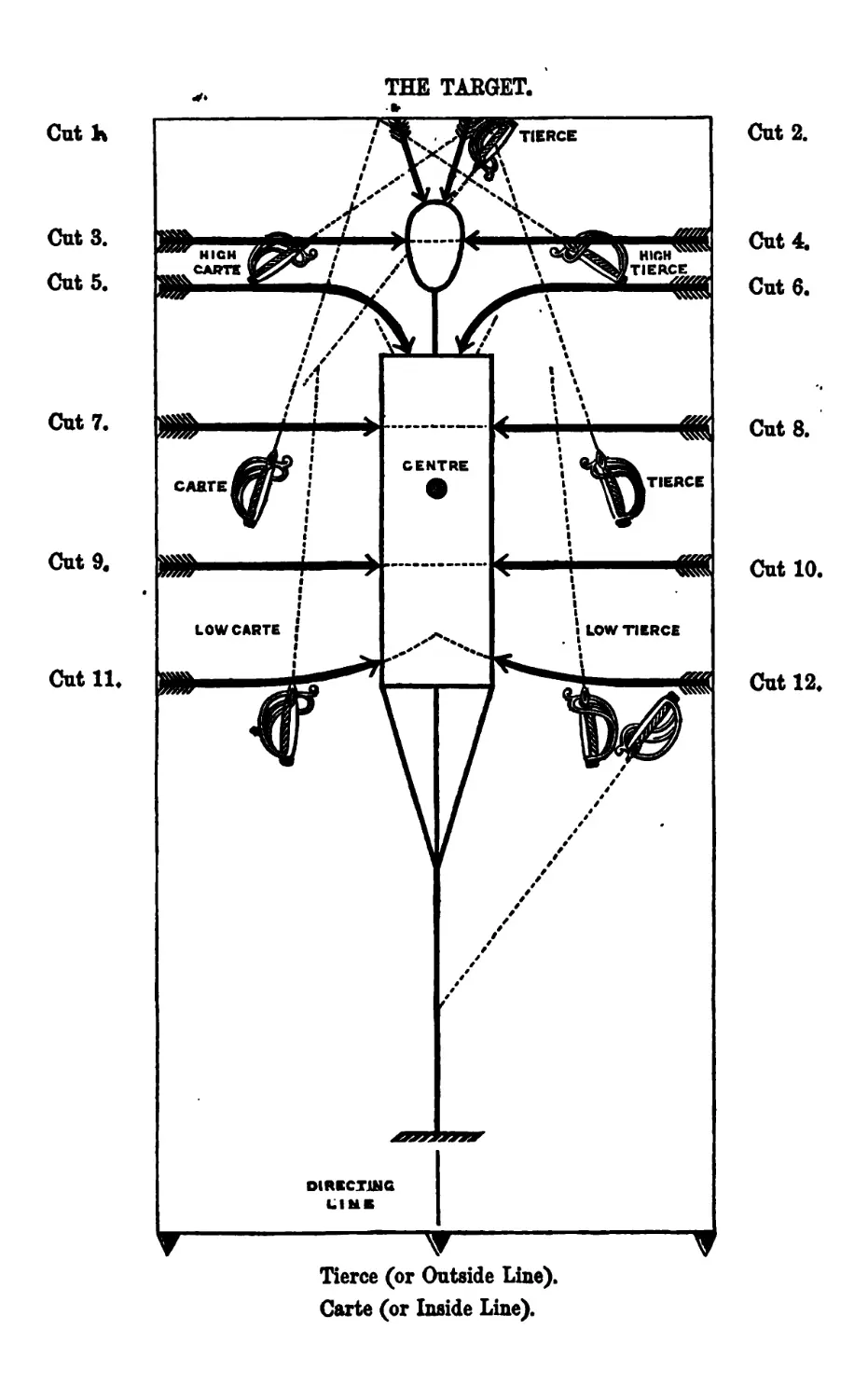
Cut h
Cut 3.
Cut 5.
Cut 7.
Cut 9.
Cut 11.
THE TARGET.
Cut 2.
Cut 4.
Cut6.
Cut8.
Cut 10
Cut 12
DIRECTING
▼----------——V-------------------f
Tierce (or Outside Line).
Carte (or Inside Line).
A NEW SWORD EXERCISE FOR
INFANTRY.
INTRODUCTORY REMARKS.
Before proceeding to develop my New Sword Exercise for
Infantry, I would offer a few remarks upon the changes pro-
posed in these pages. Whilst the last half century has wit-
nessed an immense improvement in the projectile weapons of
the civilized world, the theory and practice of the sabre or
cutting arm have remained in statu quo ante; indeed, if
there has been any change it is for the worse. The two
systems authorized in the British army are completely behind
their time. First and senior is the * Infantry Sword Exercise’
(with plates) : Revised Edition, Adjutant-General’s Office,
Horse Guards. London : Printed under the superinten-
dence of H.M. Stationery Office: 1874. The second is the
* Instructions for the Sword, &c. (without plates), for the
use of Cavalry.’ Adjutant-General’s Office, Horse Guards.
June, 1871.
The latter can be despatched very briefly. Despite the
late date, it is as obsolete as the older system ; it is, in fact,
only the ‘ Infantry Exercise ’ with the addition of “ pursuing
practice,” and “ post practice ”—the latter upon a sort of
modern Quintain not made to revolve. So far, so good.
The practised swordsman has little to learn when mounted,
except the few modifications which he can teach himself.
His real study is on foot. But some of the remarks appear
not to have been written by a practical hand. For instance,
we read (p. 27): “In delivering a forward thrust, very
little force is necessary when the horse is in.
12
A NEW SYSTEM OF
as the extension of the arm, with a good direction of the
point, will be fully sufficient.” “ Fully sufficient ”—I should
think so! The recruit must be carefully and sedulously taught
when meeting the enemy, even at a trot or canter, to use no
force whatever, otherwise his sword will bury itself to the
hilt, and the swordsman will either be dragged from his
horse, or will be compelled to drop his weapon—if he can.
Upon this point I may quote my own ‘ System of Bayonet
Exercise ’ (p. 27) :—
“ The instructor must spare no pains in preventing the
soldier from using force, especially with the left or guiding
arm, as too much exertion generally causes the thrust to
miss. A trifling body-stab with the bayonet (I may add with
the sword) is sufficient to disable a man; and many a pro-
mising young soldier has lost his life by burying his weapon
so deep in the enemy’s breast that it could not be withdrawn
quickly enough to be used against a second assailant. To
prevent this happening, the point must be delivered smartly,
with but little exertion of force, more like a dart than a
thrust, and instantly afterwards the bayonet must be as
smartly withdrawn.” In fact the thrust should consist of
two movements executed as nearly simultaneously as possi-
ble; and it requires long habit, as the natural man, especially
the Englishman, is apt to push home, and to dwell upon his
slouching push.
The ‘ Infantry Sword Exercise ’ is nought but a snare and
a delusion. Except in pagination, it is the same as the
иRevised Edition” of 1845—the only difference or revision
that I can detect is the omission of a short sentence in p. 26
of the older issue; it even retains the General Order of
Lord Hill, 23rd April, 1842. Thus “ Revision ” is con-
fined to the plates. In 1845 the figures wear the milk-pail
shako widening at the top, the frock coat and the scales;
the last edition, dated April, 1874, dons the tall modem
chimney-pot, the tightly buttoned tunic with stiff collar
and, like its predecessor, the sash and the scabbard. It is
SWORD EXERCISE FOR INFANTRY.
13
no wonder that the figures display an exceeding gene, the
stiffness of pokers, as the phrase is: here we might with
profit borrow from the French or Italian artist.
I am opposed to almost every page of this unhappy bro-
chure, especially to the “ Seven Cuts and Guards ” of the
target; to the shape of the target—I never yet saw a man
absolutely circular; to the grip of the sword; to the position
in guard ; to the Guards or Parades, especially the inside
engaging guard (Carte); to the Lunge; to the angle of the
feet, and to the system of “ loose practice.”
The a Cuts ” will be noticed in a future page. Of the
grip I may remark that the one essential, the position of the
thumb, both in attacks and parries is, as a rule, neglected by
the ‘ Sword Exercise.’ * As early as 1828, Muller made his
point dfappui a grasp of the handle with the four fingers, the
thumb being stretched along the back, in order to direct
the edge, and to avoid the possibility of striking with the
“flat.” The only exception to this universal law is when
doing the “ Moulinet ” movements, which will be explained
farther on. Some professors, both with broadsword and
small-sword, would stretch the index, when pointing, along
the right of the handle. I have objected to this practice in
the rapier and the foil: except when done to change position
for relief, it serves merely to fatigue the wrist. But the
proper use of the thumb, “ le ponce allonge eur le doe de la
poignte” which is troublesome at first, and which demands
some study, especially from those who have acquired bad
habits, is the base of all superior “ counterpoint.” f
The position on guard is a debated point. Many, indeed
I may say most, of the moderns follow the rule of all the
older swordsmen, namely, reposing two-thirds of the body-
weight (as in p. 19 of the ‘ Exercise,’ which, however, is an
♦ The exceptions are inlt Right Prove Distance ” (p. 13) and No. Seven
Cut (p. 16). In the other Cuts the thumb “ grasps the handle.”
f The French divide V Escrime into two parts: (1) Escrime a V€p€e,
or Escrime pointe; and (2) Escrime au sabre, or Escrime
14
A NEW SYSTEM OF
exaggeration) upon the left leg. The reasons usually given
are that in this position the person is not so much exposed;
moreover, that the centre of gravity being thrown back adds
spring and impetus to the Lunge. We may remember how
Cordelois (1862) made a step towards change in his fencing-
schools at Paris. My objection to the old style is that the
farther you are from your opponent, the longer and slower
will be your attack; moreover, I have ever found, in personal
practice, that it is easier and more convenient to “ sit on
guard” with the weight equally distributed on both haunches
and legs. In fact, that the backward position is not natural
any pair of thighs can ascertain for itself after trying it for
five minutes: whilst the muscles of the tight or forward
limb are relaxed as much as possible, those of the left are
tight strung, so as to do double work and threaten cramp.
This single objection is serious enough to counterbalance
any other claims to superiority.
Again, there is no excuse for the guards in the ‘ Exercise. ’
The “Hanging guard” (p. 18, in the older issue p. 21) is
the worst that can be imagined—a painful spectacle, a lesson
of “ what to avoid.” The head ignobly cowers, and the eyes
look up, in a forced and wearying position, when the former
should be held upright, and the glance should be naturally
fixed upon the opponent’s eye and blade-point; the body is
bent so as to lose our national advantage of height and
strength, and the right fore-arm in such a position is, and ever
must be, clean uncovered. Let the recruit, however strong
may be his haunches, stand a few minutes in this “ Hanging
guard,” and he will soon feel by his fatigue how strange,
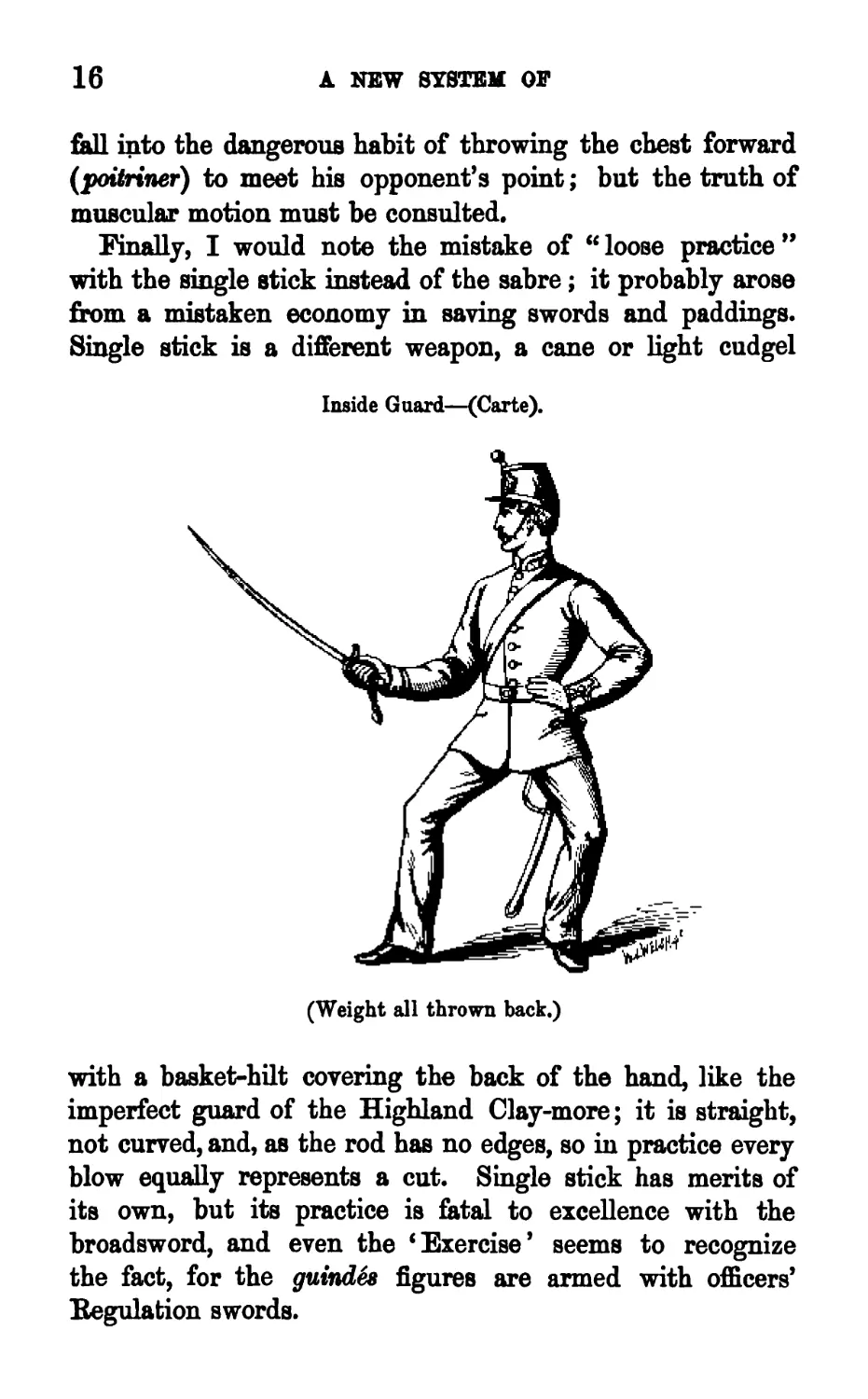
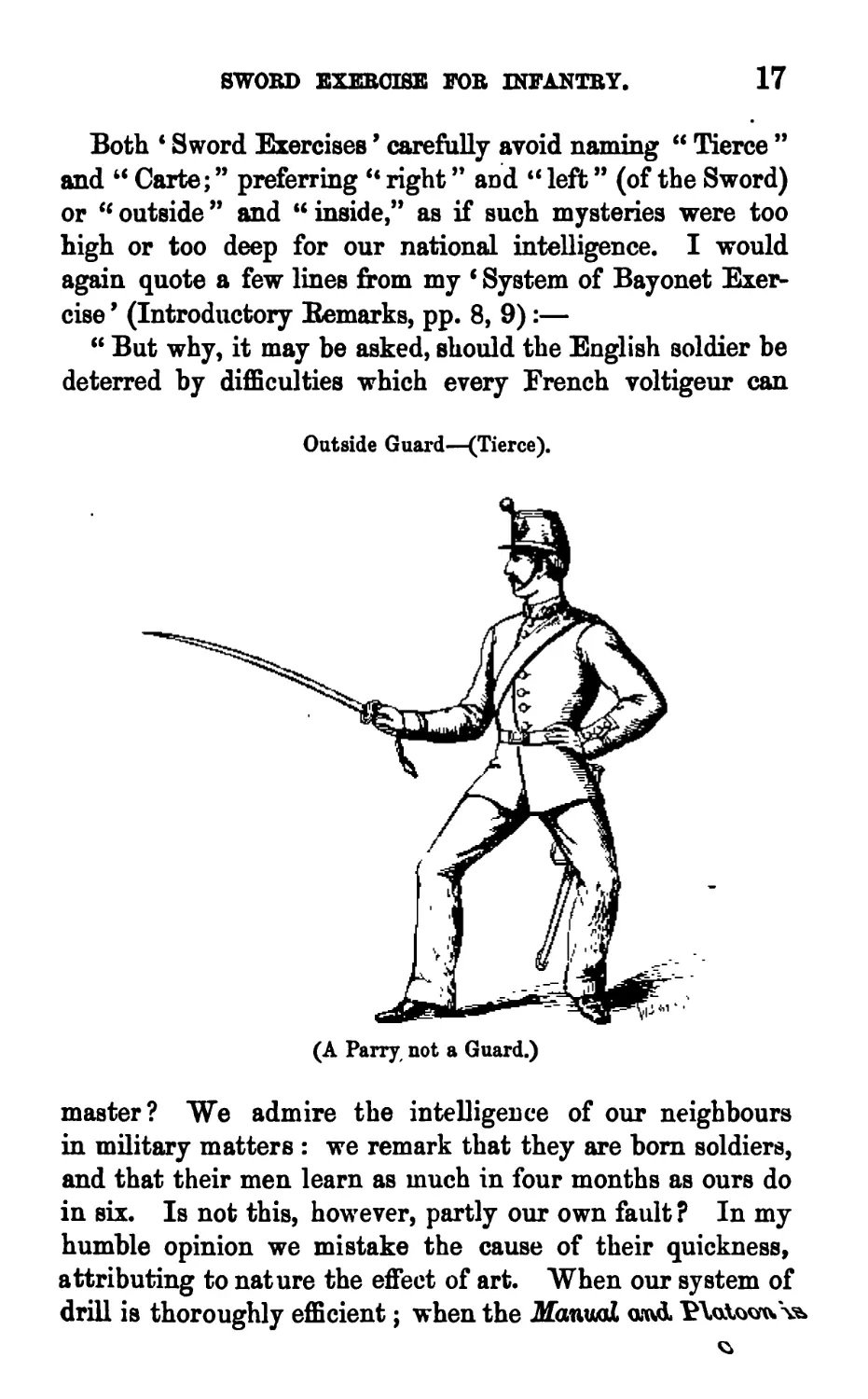
awkward, and strained it is. The Carte or inside Engaging
Guard (pp. 19, 22), again, endangers the fore-arm. The Tierce
or outside Engaging Guard (pp. 20, 23) holds the hand too
low, and unduly shortens the arm, thus offering an undesir-
able amount of exposure; it is in fact not a Guard, but a bad
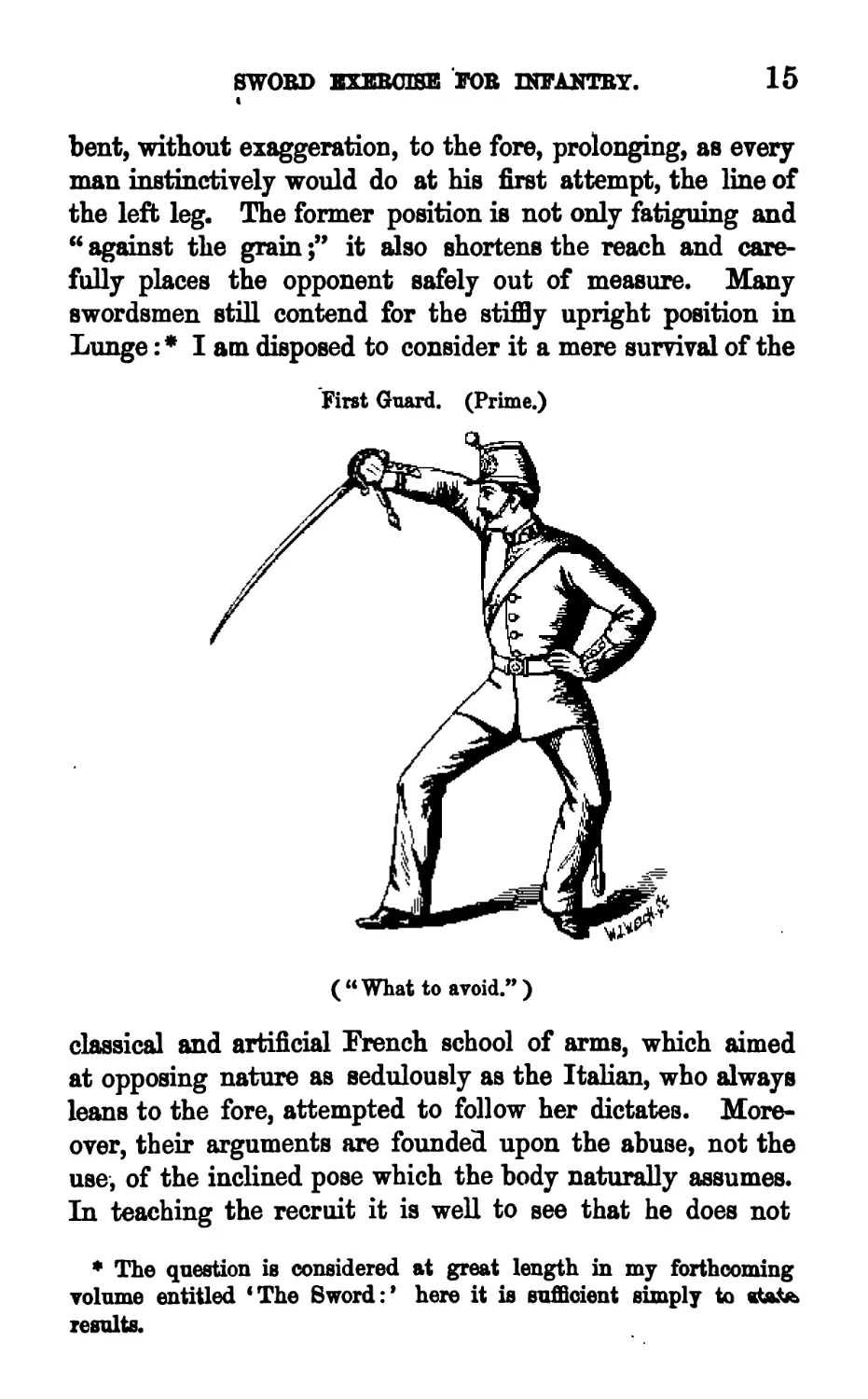
parry in“ low Tierce.” Worse still is the Lunge (pp. 14,17):
here the body is placed bolt upright, instead of being easily
SWORD EXERCISE FOR INFANTRY.	15
bent, without exaggeration, to the fore, prolonging, as every
man instinctively would do at his first attempt, the line of
the left leg. The former position is not only fatiguing and
“ against the grainit also shortens the reach and care-
fully places the opponent safely out of measure. Many
swordsmen still contend for the stiffly upright position in
Lunge: * I am disposed to consider it a mere survival of the
First Guard. (Prime.)
( “ What to avoid.” )
classical and artificial French school of arms, which aimed
at opposing nature as sedulously as the Italian, who always
leans to the fore, attempted to follow her dictates. More-
over, their arguments are founded upon the abuse, not the
use, of the inclined pose which the body naturally assumes.
In teaching the recruit it is well to see that he does not
* The question is considered at great length in my forthcoming
volume entitled ‘The Sword:’ here it is sufficient simply to slate
results.
16
A NEW SYSTEM OF
fall into the dangerous habit of throwing the chest forward
(poUriner) to meet his opponent’s point; but the truth of
muscular motion must be consulted.
Finally, I would note the mistake of “loose practice”
with the single stick instead of the sabre; it probably arose
from a mistaken economy in saving swords and paddings.
Single stick is a different weapon, a cane or light cudgel
Inside Guard—(Carte).
(Weight all thrown back.)
with a basket-hilt covering the back of the hand, like the
imperfect guard of the Highland Clay-more; it is straight,
not curved, and, as the rod has no edges, so in practice every
blow equally represents a cut. Single stick has merits of
its own, but its practice is fatal to excellence with the
broadsword, and even the ‘Exercise’ seems to recognize
the fact, for the guindes figures are armed with officers’
Regulation swords.
SWORD EXERCISE FOR INFANTRY.
17
Both ‘ Sword Exercises ’ carefully avoid naming “ Tierce ”
and “ Carte; ” preferring “ right ” and “ left ” (of the Sword)
or “ outside ” and “ inside,” as if such mysteries were too
high or too deep for our national intelligence. I would
again quote a few lines from my ‘ System of Bayonet Exer-
cise ’ (Introductory Remarks, pp. 8, 9):—
“ But why, it may be asked, should the English soldier be
deterred by difficulties which every French voltigeur can
Outside Guard—(Tierce).
(A Parry, not a Guard.)
master? We admire the intelligence of our neighbours
in military matters : we remark that they are bom soldiers,
and that their men learn as much in four months as ours do
in six. Is not this, however, partly our own fault ? In my
humble opinion we mistake the cause of their quickness,
attributing to nature the effect of art. When our system of
drill is thoroughly efficient; when the Jfanwxl awl РкйжлЧ
Ok
18
A NEW SYSTEM OF
much simplified, when a salle d'armes is established in every
corps, and when the bayonet exercise becomes a recognized
branch of instruction; then, I believe, we shall find our
soldiers equal in intelligence to any others.” These words
were written in 1853; in 1875 I add, “When we enlist
thp right kind of recruit either by improving his condition
and his prospects, not his pay, or better, far better, by se-
curing a superior man through the conscription of modern
Europe.” We Britons are no longer physically divided
from the total orb; nor can we afford to remain morally
insulated and isolated. The logical effect of union with
the outer world will be to make us do as the world does,
and all our exceptional institutions, such as the system
of volunteer recruiting, must sooner or later go by the
board.
Nor is the most modem French Treatise (pp. 229-256,
Manuel de Gymnastique et d'Escrime, officially published by
the Ministre de la Marine et des Colonies; Paris, Dumaine,
1875) “Escrime au Sabre91 much superior to our home
growth. The position of the left hand (pp. 232, 233) is bad
throughout: it must slip during the Lunge and make the
play loose. The retreat of the left leg (Fig. 5, p. 235) is
carried to an extreme of caution. The body is always per-
pendicular in the Lunge, whereas the same volume shows
(Fig. 16, p. 20) the trunk naturally inclining forwards. The
Cuts are not double nor continuous, as they should be.
The “ Hanging Guards ” (pp. 240, 244, 245) are deplorable.
On the other hand, the Manuel (p. 231) places the thumb
along, not around, the handle; the moulinets, the enleves,
and the briees (presently to be explained) are good stuff,
and, moreover, they are applied to the Cuts (p. 239).
Finally, nothing can be better than the advice (p. 249),
“Аргёв avoir touche, retirer vivement le sabre en агйёге
en lui imprimant une direction oblique dans le sens du
tranchant, de ташёге a scier.”
Of the points or thrusts with broadsword nothing will
SWORD EXERCISE FOR INFANTRY.
19
here be said: they belong to another order of things, and
they should be studied in the fencing school.* But the
soldier must be taught that if his adversary attempt a thrust,
the broadsword is easily disarmed. When the opponent
comes to the position of pointing, that is, extends his blade,
a sharp glissade along its length will make the grip fly out
of his grasp. Another way of embarrassing the attack is to
cut right and left at the hand, the wrist, or the fore-arm,
when the adversary begins to present point.
General Lamoriciere was a firm believer, as we all are,
in the thrust, and the French Sword Exercise for Cavalry
(p. 178 Reglement Provisoire sur lee Exercises de la Cavalerie,
officially published at the Ministere de la Guerre; Paris,
Dumaine, 1873) justly remarks : “ Les coups de pointe doivent
toujours etre employes de preference, comme exigeant moins de
force et ayant un resultat plus prompt, plus certain et plus
decisif” The reason of its confessed superiority to the
Cut is as old as the axiom, “ a straight line is the shortest
way between two points.” The Thrust describes a diameter,
the Cut, a segment, of a circle and, with equal velocity,-
the Cut will traverse a distance occupying some two-thirds
more of time than the Thrust. The French tactician there-
fore proposed to abolish the use of the edge for cavalry, thus
traversing the instinct of the man-at-arms who, especially
on horseback, loves to slash at his enemy, and who runs far
less risk of entangling his blade. But he of course advocated
a straight and tapering sword with no edge to speak of;
indeed the cuirassier’s latte is still a kind of rapier, but it is
♦ When every regiment shall have its salle tfarmes, the fencer will
modify his own fencing thrusts to suit the clumsier weapon. I do not,
however, see any reason why the three Points of the Infantry Sword
Exercise should not be delivered in the posizione media of the Italian
school, with the thumb upwards and extended along the back of the
sword-handle: nor why, as in the French Manuel, they should not be
reduced to a single Coup de Pointe (p. 239), which is thus described.
“ Baisser la pointe du sabre a hauteur de la poitrine et dtyloyer le bras en
toumant la main, le рейсе en dessous, le tranchant du sabre eiv dessa»?
20
A NEW SYSTEM OF
rendered useless by prodigious length and by the weight of
the handle. The modern Italian School of Sabre uses, espe-
cially in single combat, all the d&gagements of the ealle
d’armee: this is thoroughly illogical; the weapon is chosen
because it is supposed to be less fatal than foil or rapier,
and yet it is so used as to become even more deadly. I need
hardly say that the weight and shape of the broadsword,
together with the positions of guard, render pointing with
it awkward in the extreme.*
I have now finished with the ungrateful task of criticizing,
and I proceed to propose a system which it is hoped will be
as severely criticized by others. It is only candid to state
that its pretensions are high, that it contains two distinct
novelties, the Manchette System and the Reverse or Back-
cut ; and, finally, that it aspires to be the first Treatise in
which the broadsword is scientifically taken in hand.
Section I.
PREPARATORY INSTRUCTION WITHOUT THE
SWORD.
§ 1.	Preliminary.
Nothing will here be said concerning the u goose step of
the sword,” the “ Balance Motions,” and the “ Extension
Motions,” of the official ‘ Infantry Sword Exercise.’ They
are essentially a part of ‘ Squad and Setting-up Drill,’ and
♦ As Mr. John Latham justly says (“ The Shape of Sword-blades,”
‘Journal of the Royal United Service Institution/ vol. vi.):—“The
proper shape for a thrusting sword is pre-eminently straight.” The
Clay-more, for instance, moving in a direct line, cuts a hole exactly
the size of the blade; the Regulation sword, slightly curved, widens
it to about double, and the bent scimitar and the Talwar, to five or
six times, thus meeting with five or six times the resistance to its pene-
tration. Mr. Latham is again quoted in another part of this System.
SWORD EXERCISE FOR INFANTRY.
21
as such they have been treated in several good manuals,
especially by Seijeant-Major S. Bertram Brown : A ‘ Prac-
tical Guide to Squad and Setting-up Drill, in accordance
with the Principles laid down in Part L, Field Exercise
of the Army.’ Adapted for the use of Recruits, Rifle Volun-
teers, Militia, Police Force, Schools, and Families: Illustrated
with sixty-eight figures, representing each Stick and Club
Exercise, Extension Motions, and Sword Exercise Positions.
London: Allen and Co., 1871. 2nd Edition.* Considered
in a wider sense they belong to the Branch of Science so
thoroughly developed in ‘ A Military System of Gymnastic
Exercises for the Use of Instructors: Adjutant-General’s
Office, Horse Guards, 1862; Physical Education,’ Clarendon
Press Series, Oxford, 1869; and in ‘ Training in Theory
and Practice’ (London, Macmillan, 1874), by Archibald
MacLaren,f whose excellent code for the army, and whose
♦ My only objections to this volume are the two following:—
(a)	The author will “ throw the whole weight of the body on the left
leg.” (Fig. 2, p. 69.) Yet in his Introductory Remarks (p. 5) he sensibly
says, “ To the haunches, as to the common centre of motion of the
human figure, are ultimately referred all the movements performed in
military tactics” (and swordsmanship); “as just poise is important to
the correct exertion of action, whatever it may be, it is necessary that
poise or balance be studied, understood, and tried in all positions. It
is clear that bodily action cannot possess compass, power, and ease,
unless the movement be made justly and correctly upon the haunches,
as on a central pivot. If the movement have not compass, power, and
ease; force and endurance will not be found in the Military act.”
(6)	In the Lunge our author not only keeps the body “perfectly
erect,” he even inclines it backwards whilst he allows both feet to
abandon the perpendicular in the most slovenly way: see Fig. 2, p. 70,
and Figs. 1 and 2, p. 71. The same is the case with the official
‘ Infantry Sword Exercise.’
+ My old friend and instructor set out upon a thoroughly scientific
principle, and the able way in which he has worked out his system
will entitle him to the gratitude of the posteri. Having established the
fact that in all our popular athletic, as opposed to gymnastic, exercises,
our walking and running, cricket and football, fives, tennis, and racquets,
and especially rowing—which has advanced as an art but has declined,
as an exercise—we circumscribe the line of тавдкйах
22
A NEW SYSTEM OF
influence with successive war ministers, as some one truly-
said, have aided largely in introducing that admirable
training which is transforming the stiff, slow-moving grena-
dier of past times into the vigorous, rapid, and enduring
soldier of the present day.
Squad drill is not likely to make a good swordsman, yet
economy of time renders it a necessity. It must be prac-
tised first without, then with, weapons, after which those
who show unusual capabilities should be taken individually
in hand by the master. The latest French system (Manuel,
etc.) divides the four lessons into two degrees: 1. Prepara-
tory Movements; moulinets and simple attacks and parries.
2. Compound attacks and parries.
The formation of the squad is in the usual line, with open
order at arm’s length from the right or left. The men are
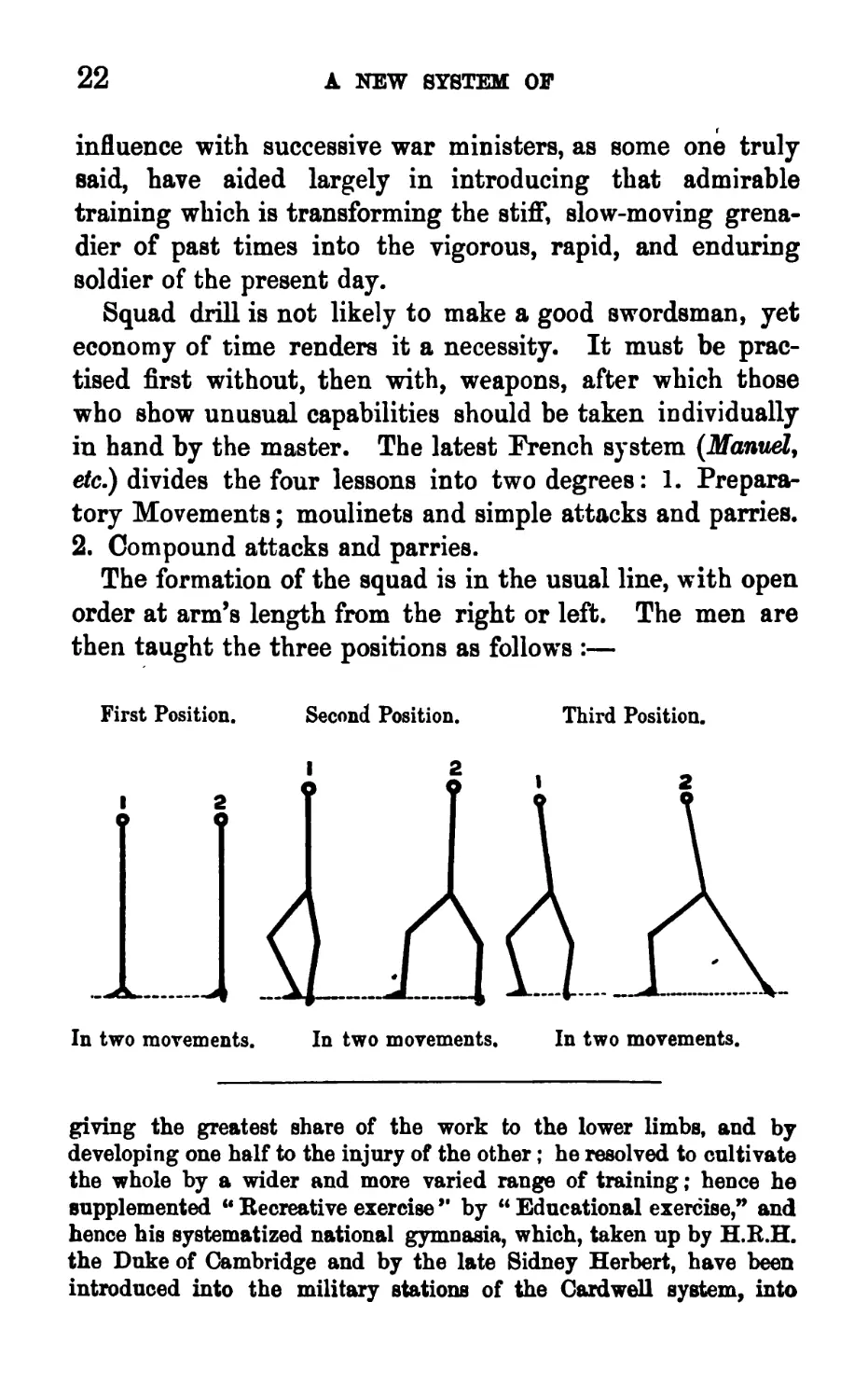
then taught the three positions as follow-s :—
First Position. Second Position.
Third Position.
In two movements. In two movements. In two movements.
giving the greatest share of the work to the lower limbs, and by
developing one half to the injury of the other; he resolved to cultivate
the whole by a wider and more varied range of training; hence he
supplemented “ Recreative exercise ” by “ Educational exercise,” and
hence his systematized national gymnasia, which, taken up by H.R.H.
the Duke of Cambridge and by the late Sidney Herbert, have been
introduced into the military stations of the Cardwell system, into
SWORD EXERCISE FOR INFANTRY.
23
§ 2.	First Position in Two Motions.
One.—Place the hands smartly behind the back, the left
grasping the right arm just above the elbow, and the right
similarly supporting the left elbow.
Two.—Make a half-face right by pivoting smartly on both
heels, which must be kept close together; the feet at right
angles; the left pointing to the front, the face looking
towards the opponent, or the right-hand man, and the weight
of the body balanced equally upon both haunches and legs.
Second Position in Two Motions (Guard).
One.—Bend the knees gradually till they are perpendicular
to the instep, keeping the head and body erect, and both
feet firm on the ground. The instructor must be careful
that the knees do not incline inwards—a general fault.
Two.—Advance the right foot smartly about 20 inches in
front of and in line with the right heel, and rest the whole
weight of the body upon both haunches and legs.*
In the second position, that of Guard for the feet, care
must be taken that the left foot remains firm on the ground,
without shuffling or turning inwards or outwards. Many
swordsmen find a better balance when the right heel is on a
line with the hollow of the left foot.
Third Position in Two Motions (from Guard to Lunge).
One.—Advance the body slightly forward, and bring the
Oxford and Cambridge,and into all our public schools, with one “base
exception ”—Eton.
Mr. MacLaren, in his * System of Fencing/ &c. (p. 9), sensibly advo-
cates “ resting the weight of the body equally upon both legs.” He
also lowers the right band in the Lunge (p. 11), and (iW.)he throws
the trunk forward, perhaps with a little exaggeration.
♦ The ‘Infantry Sword Exercise (see the figures over the Target
representing the “Preparatory Positions”), “Second Position in 2
Motions,” makes Ko. 2 turn the left knee out instead of carrying it
square to the front; the same may be remarked in “ Balance Motions ”
(No. 4).
24
A NEW SYSTEM OF
right shoulder and knee perpendicular to the point of the
right foot.
Two.—Advance the right foot smartly, about 20 inches,
or double the distance of No. 2, Second Position (Guard),
taking care that the foot does not overhang the instep;
extend the left leg with a spring, the left foot remaining
true and firm, and the left knee perfectly straight; let the
shoulders expand and the body be profiled and slightly in-
clined forwards, or towards the opponent.
This is the position of the legs in the Lunge, and the
greatest care must be taken to prevent the recruit learning
it in a careless, shuffling way. Above all things he must
accustom himself to separate the action into its two com-
posing parts, otherwise the lower limbs will often take
precedence of the upper (shoulder, arm, and hand), and the
Lunge become worse than useless. When recovering guard
the contrary is the case ; the left knee must be bent before
the right foot is moved, and the latter should exert a slight
pressure on the ground; at the same time the body must be
drawn backwards, not jerked upwards.
These measures of Guard (20 inches) and of Lunge (40
inches) are best fitted for average-sized men; in exceptional
cases they must be shortened or lengthened according to the
stature’ and stride of the recruit. The rule for guard is the
measure of two foot-lengths ; the Lunge doubles that span;
and the least vigorous men require the greatest distances.
These movements must be learned, first in slow, and after-
wards in quick and in double-quick, time; the same may
be said of all practice with and without the sword. Squad
attention! and Stand at Ease! need hardly be explained.
The recruits’ muscles soon become fatigued by the unusual
and monotonous exercise, causing them to remain too long
in one position; the easiest way to relieve them is to change
front, making the left leg stand on guard and lunge, as a left-
handed fencer would do. This double practice is as useful
and recommendable in fencing and broadsword play as
SWORD EXERCISE FOR INFANTRY.
25
in bayonet exercise : it gives additional balance to the body,
it equalizes the muscular strength of both sides, and it
makes the soldier feel that if his right arm be disabled he
can still depend upon his left.
The word Steady must not be used as a command: it
should be a caution given at the completion of any part of a
practice with the view of correcting faults.
§ 3.	Attacking, Advancing, and Retiring.
Single Attack.—Raise the right foot well off the ground
and beat smartly with the whole sole, the greatest force being
upon the ball of the foot, and the least upon the heel.
Double Attack.—The same movement made twice. The
instructor should carefully avoid the directions of the
‘ Infantry Sword Exercise,’—first with the heel, then with the
flat of the foot. Nothing jars the leg more than this use of
the heel; it is a bad habit to use it for anything but
“ pivoting.”
Advance.—Smartly advance the right foot about six inches
and bring up the left as nearly as possible to the same
distance. The soles must just clear the ground, and the
toes be kept on a straight line with the knee, and never
turned inside or outside. Neglect of the latter precaution
leads to a loose, unsteady, and slovenly style which, easily
learnt, is hardly to be unlearnt.
Single Attack.—As before.
Retire.—Move the left foot lightly to the rear about six
inches, and let the right foot follow it. Recruits are un-
commonly apt to “step short,” and this can be remedied
only by making them retire for considerable distances. The
weight and balance of the body must be equally distributed
on both haunches and legs, not resting upon the left, which
can serve only to give cramp.
Double Attack.—As before.
Front.—Resume the position of “ Attention^*
26
A NEW SYSTEM OF
Section II.
PREPARATORY INSTRUCTION WITH THE
SWORD.
§ 1.	Explanation and Use of the Target.
The Target prefixed to these pages explains itself. The
shape is oblong, the frame measuring 6 feet by 3, and
the figure 5 feet 8 inches by 1 foot. As the latter re-
presents the opponent, the centre should be about 4 feet
from the ground, the height of the recruit’s breast. Perpen-
dicular to the foot of the figure in each Target a horizontal
line is drawn, forming for the feet, the legs, the body, and
the arms, the “ directing line ” of the scientific schools. At
a distance of 10 feet the recruit is placed in the position of
“ Attention,” with his left heel on the line, so that at the
command “ First Position ” his right foot may cover it.
The parallelogram shows the direction and the numbering
of the Cuts, concerning which further details will presently
be given. They should be regulated according to the lines
described upon the Target; nor should the recruit be
practised in any other mode until he has gained the proper
direction of the blade.
Nothing need be added to the directions of the ‘ Infantry
Sword Exercise ’ (pp. 12, 13,14), as regards the movements
subject to the following words of command: much, on the
other hand, with great advantage, might be taken away, and
the result would be the increased efficiency that results from
simplicity.
Draw Swords (should be much abridged; after the modern
French School, pp. 165, 166 : Reglement Provisoire, &c.);
Slope Swords ;
Return Swords (should be simplified);
SWORD EXERCISE FOR INFANTRY.
27
Stand at Ease ;
Attention ;
Prepare for Sword Exercise ;
Eight prove Distance ;
Slope Swords ;
Front prove Distance ; and
Slope Swords.
At the order, Stand on Guard, the recruit having assumed
the Second Position, No. 2, falls on Guard: the pommel of
the sword fronts his right breast; the point is directed at
his opponent’s right eye; his right arm is extended with an
easy bend at the elbow; the wrist is inclined, with the
knuckles slightly turned upwards, to his own right, so as to
cover him in case of a straight thrust, and the left hand is
placed upon the left flank just below the ribs, with the
fingers to the front and the thumb to the rear.
The several guards (parries) are learned by holding the
sword opposite to and in the inclination of the dotted lines
which have sword-hilts attached to them; the recruit is
thus taught from the Target the angle of the blade and the
position of the wrist.
The Target directs the recruit how to make the Cuts and
to form the Guards, but not exactly where; this must depend
upon how the opponent acts during the attack and the
defence. Cuts 1, 3, 6, 7, 9, and 11 (odd numbers) are all
from Carte, which the ‘Infantry Sword Exercise’ calls
Inside. The corresponding even numbers (2, 4, 6, 8, 10, and
12) are from Tierce, or Outside. The same nomenclature
applies to the Guards or parries.
When the recruit thoroughly understands the use of the
Target he need no longer be practised in front of it; but the
instructor (sword in hand) should consider it a sure guide
and reference for correctly forming the Guards and for
giving a suitable direction to the edge when making the
Cuts.
28
A NEW SYSTEM OF
§ 2.	The Moulinet.*
This rotation movement should be learnt before the recruit
proceeds to the Cut.
♦ The Moulinet (Ital. Molinetto) is even on horseback a favourite
movement with French sabrers (See Reglement Provisoire, &c., Tome I.
Titres i. et n.). It is divided into—
1.	“ A gauche Moulinet ” (I temps, 2 mouvements). The directions
are: “ A la demibre partie du commandement, qui est Moulinet,
Itendre le bras droit en avant de toute sa longueur, le poignet en
tierce et h hauteur des yeux.”
“ Baisser la lame en arribre du coude gauche pour d&rire un circle
d’arriere en avant . . . . et se remettre en garde.*’
2.	“ A droite Moulinet ” (1 temps, 2 mouvements). “ A la demibre
partie du commandement, qui est Moulinet, 6tendre le bras droit en
avant de toute sa longueur, le poignet en quarte et h hauteur des
yeux.”
il Baisser la lame en arribre du coude droit pour decrire un circle
d’arribre en avant . . . . et se remettre en garde.”
3.	“ A gauche et a droite Moulinet ” (1 temps, 2 mouvements). “ A la
demiere partie du commandement, qui est Moulinet, ex&uter le
premier mouvement de a gauche Moulinet'*
‘‘Executer alternativement et sans s’arreter sur aucun mouvement
le Moulinet h gauche et le Moulinet h droite.”
“ A gauche et h droite = Moulinet.”
4.	“A droite et a gauche Moulinet (1 temps, 2 mouvements). A la
dernifere partie du commandement, qui est Moulinet, executer le
premier mouvement de a droite Moulinet.
“ Executer altemativement et sans s’arreter sur aucun mouvement,
le Moulinet h droite et le Moulinet h gauche.”
“ A droite et a gauche = Moulinet.”
5.	“ En arriere Moulinet (1 temps, 2 mouvements Y A la demibre
partie du commandement, qui est Moulinet, £lever le bras en arribre
h droite de toute sa longueur, la pointe du sabre en Fair, le trenchant h
droite, le pouce allongd sur le dos de la poign£e, le corps l£gferement
to*urn€ h droite.”
“ Decrire un circle en arrifere de gauche h droite, le poignet eloign^
du corps le plus possible, et se remettre en garde.”
“ En arriere = Moulinet.”
“Les cavaliers, executant bien les Moulinets, on leur en fait faire
SWORD EXERCISE FOR INFANTRY.
29
There is nothing better for * breaking,” as the French say,
the recruit’s wrist than this sweep of the sword; and the
style of a swordsman may always be known by his Moulinet.
We will divide it into three kinds, viz. (1) horizontal,
(2) diagonal, and (3) vertical; the latter again may be either
(a) ascending or (b) descending; but as the second (diagonal)
is a mere modification of the first and the third, it will be
sufficient to notice only two; these are:—
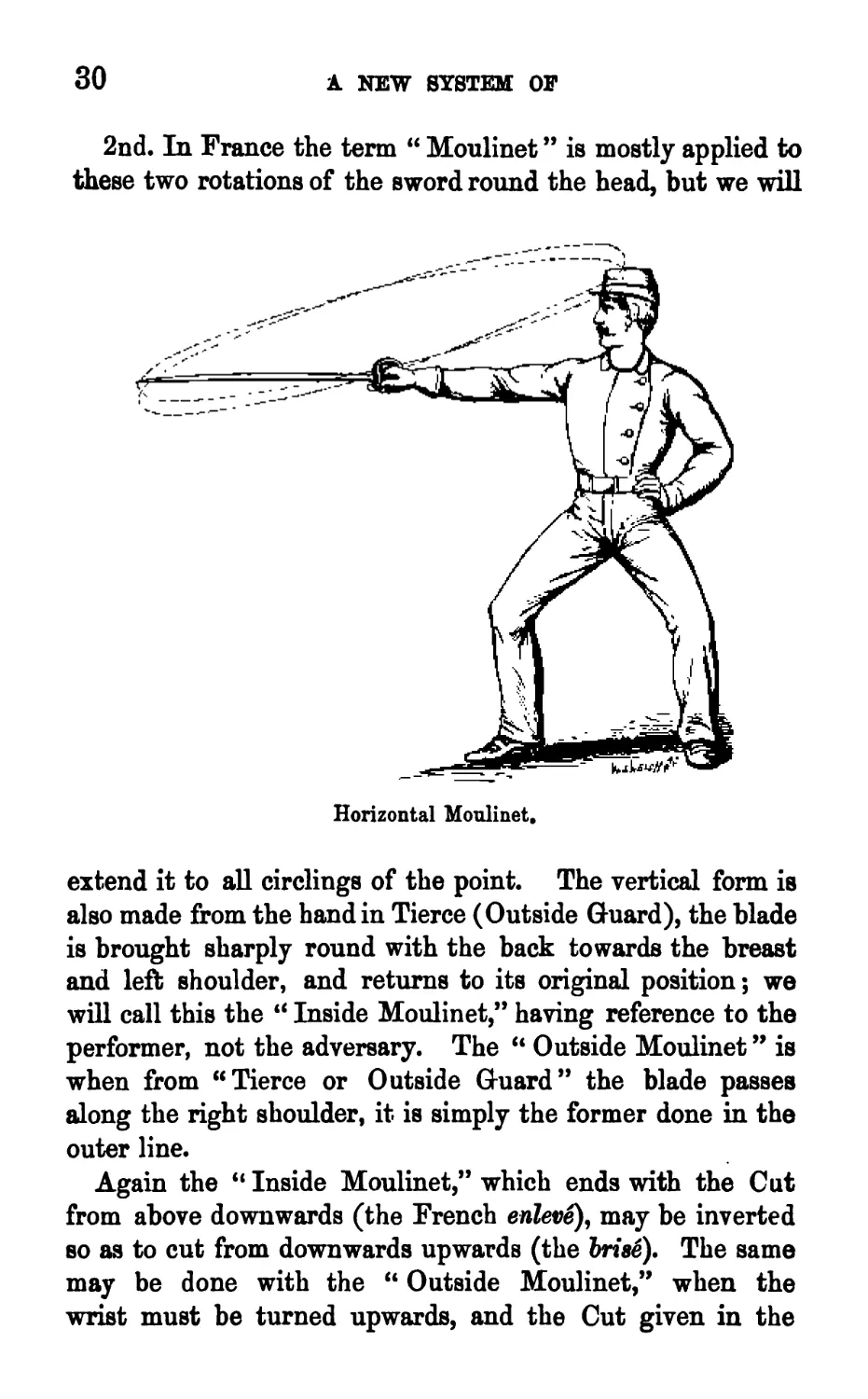
1st. The horizontal movement, or Moulinet proper, circling
the sword round the head. The grip is held as lightly as
possible, chiefly with the thumb and the first finger, resting
the pommel upon the palm, and carrying the nails upwards.
The blade should be moved as horizontally as it can be,
with the back just clearing the swordsman’s crown: it
should describe, not a true circle, but an oval with a long
diameter in the directing line to the centre of the Target
through the heels or ankles of the recruit. Finally, the
point should be lanced or thrbwn out, as it were, towards
the opponent’s face. Evidently it may be done in two ways,
first, from right to left, which I will call the “Tierce
Moulinet” (Moulinet a gauche); this is by far the easiest
and the more habitual, corresponding with Tierce “ Counter,”
opposition, or describing with the blade a circle round the
adversary’s blade, in the fencing school. The reverse move-
ment (“ Carte Moulinet,” Moulinet a droite), from left to
right, requires, like the Counter of Carte, much more
practice.
plusieurs de suite, en faisant precede? cet exercice de Vindication; les
Moulinets continueront jusq'au commandement: en garde.
“ Les Moulinets ayant pour objet d’assouplir les articulations du bras et
du poignet, il faut que les cavaliers у soient exerces comme preparation
aux autres mouvements; on commence et on finit done chaque le^on par
des Moulinets exdcut£s a un degre de vitesse proportionne aux progrfes des
cavaliers.”
In these directions “ right and left” apply to the right and left of
the swordsman’s wrist.
30
A NEW SYSTEM OF
2nd. In France the term “ Moulinet ” is mostly applied to
these two rotations of the sword round the head, but we will
Horizontal Moulinet.
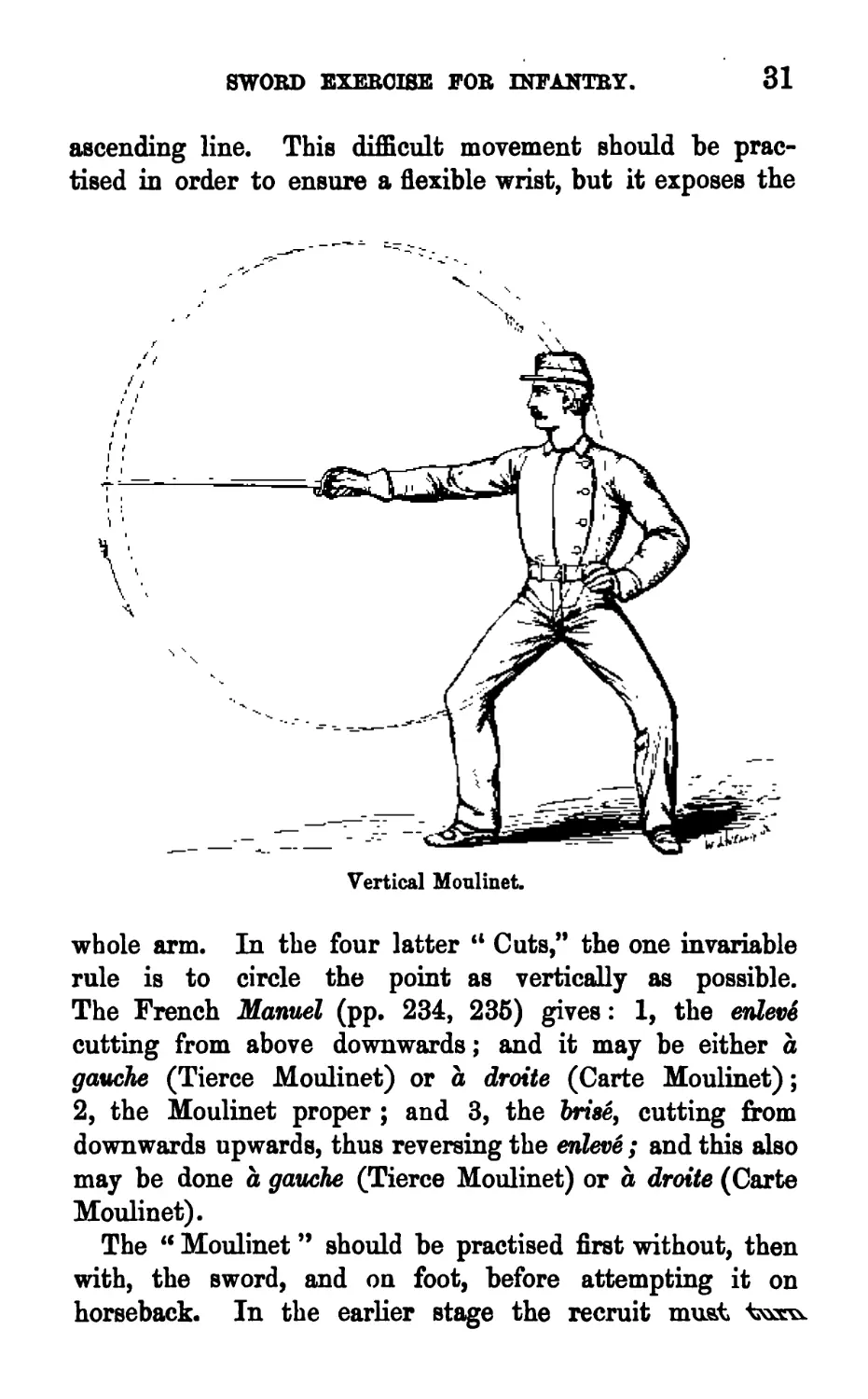
extend it to all circlings of the point. The vertical form is
also made from the handin Tierce (Outside Guard), the blade
is brought sharply round with the back towards the breast
and left shoulder, and returns to its original position; we
will call this the “ Inside Moulinet,” having reference to the
performer, not the adversary. The “ Outside Moulinet ” is
when from “Tierce or Outside Guard” the blade passes
along the right shoulder, it is simply the former done in the
outer line.
Again the “ Inside Moulinet,” which ends with the Cut
from above downwards (the French enZeve), may be inverted
so as to cut from downwards upwards (the brise). The same
may be done with the “ Outside Moulinet,” when the
wrist must be turned upwards, and the Cut given in the
SWORD EXERCISE FOR INFANTRY.
31
ascending line. This difficult movement should be prac-
tised in order to ensure a flexible wrist, but it exposes the
whole arm. In the four latter “ Cuts,” the one invariable
rule is to circle the point as vertically as possible.
The French Manuel (pp. 234, 236) gives: 1, the enleve
cutting from above downwards; and it may be either a
gauche (Tierce Moulinet) or a droite (Carte Moulinet);
2, the Moulinet proper ; and 3, the brise, cutting from
downwards upwards, thus reversing the enleve ; and this also
may be done a gauche (Tierce Moulinet) or a droite (Carte
Moulinet).
The “ Moulinet ” should be practised first without, then
with, the sword, and on foot, before attempting it on
horseback. In the earlier stage the recruit must
32
A NEW SYSTEM OF
the hand, with the arm nearly extended, in the horizontal
and vertical movements, without stiffness and displacement
of the elbow. In the second he may, if no Target be pro-
curable, work before a cross chalked on the wall so as to
secure horizontality and verticality. Finally, the soldier
will combine the two, Tierce and Carte, by passing rapidly
from one to the other.
Whilst practising the Moulinet the recruit must be taught
the two main divisions of the sword-blade. Fencers have
introduced an immense complication into this simple matter;
and some have proposed eight parts: for broadsword it is
sufficient to divide the length. The “ Feeble,” or weak half,
is that contained between the point and the centre; this,
the proper part for the Cut or attack is ground to a thinner
edge, and consequently is more liable to an injury from
another sword if the Cut be not very true. The “ Fort,” or
strong half, is from the centre to the hilt, and upon this we
must rely for defence.
A few hours’ practice and a few pressings upon the dif-
ferent parts of the blade under the surveillance of the
instructor will teach the recruit the high importance of this
lesson. He will learn that in opposing the adversary’s sword
the strength of the defence decreases from the hilt upwards
in proportion as the Cut is received towards the point; and
that, vice versa, it increases from the point downwards to the
hand. The strongest man cannot “force in” the opponent’s
Guard if the Cut or Thrust be received upon the part near
the handle. With a true Guard the ordinary fencing foil can
turn off the thrust of a musket and bayonet weighing 10 lbs.
The practised swordsman always attempts, when attacking,
to gain with his “ Fort ” the “ Feeble ” of the opponent’s
weapon, in which case the superior leverage will often beat
down the parry ; and this manoeuvre should be carefully
practised by men of superior muscular strength. The Cuts
must, as a rule, be delivered within eight inches of the point
SWORD EXERCISE FOR INFANTRY.
33
and at the “centre of percussion,”* so that the sword may-
clear itself and the arm escape a “jar.”
The two virtues of the Cut are its trueness and its velo-
city. Unless true it will become a blow with the flat that
would shiver to pieces any brittle Eastern blade. Assuming
the ms mva or force of a moving body to be its weight
multiplied by the square of the velocity, let us suppose a
strong man cutting with a sword weighing 4 lbs., to which
he can give a velocity which we will call 1, or 4 X 1 = 4:
a weaker man who applies double the velocity to a 2 lb.
sword will thus produce a momentum of 8, doubling the force
of the blow. But let the stronger man take the lighter sword,
evidently he will obtain a higher velocity, which we will
assume at 3: in this case the effect will be 18. Thus the
power of the Cut is enormously increased by increased ve-
locity, but much less by increased weight in the moving
body.
§ 3. The Cuts.
The Target prefixed to the ‘Infantry Sword Exercise’ gives
Seven Cuts, an insufficient number. The German systems
add an eighth blow perpendicularly upwards, when the
whole of the swordsman’s arm from wrist to shoulder would
be completely at the opponent’s mercy.
The French Manuel has only seven, viz. the Coup de
Tele; 2, the Coup de Banderole; 3, the Coup de Figure
a droite; 4, the Coup de Figure a gauche; 6, the Coup
♦	In the Regulation sword the u centre of percussion ” is about one-
third from the point; here there is no vibration, and consequently the
Cut exercises its whole force. The “ centre of gravity ” is in the third
nearest the hilt, and the “balance” of the sword results from the
relative positions of the two centres. In light swords these points may
be farther apart than in heavy blades; they should be closer in straight
than in curved swords, and nearer in thrusting than in cutting
weapons.
34
A NEW SYSTEM OF
de Plane; 6, the Coup de Ventre; and 7, the Coup de
Manchette.
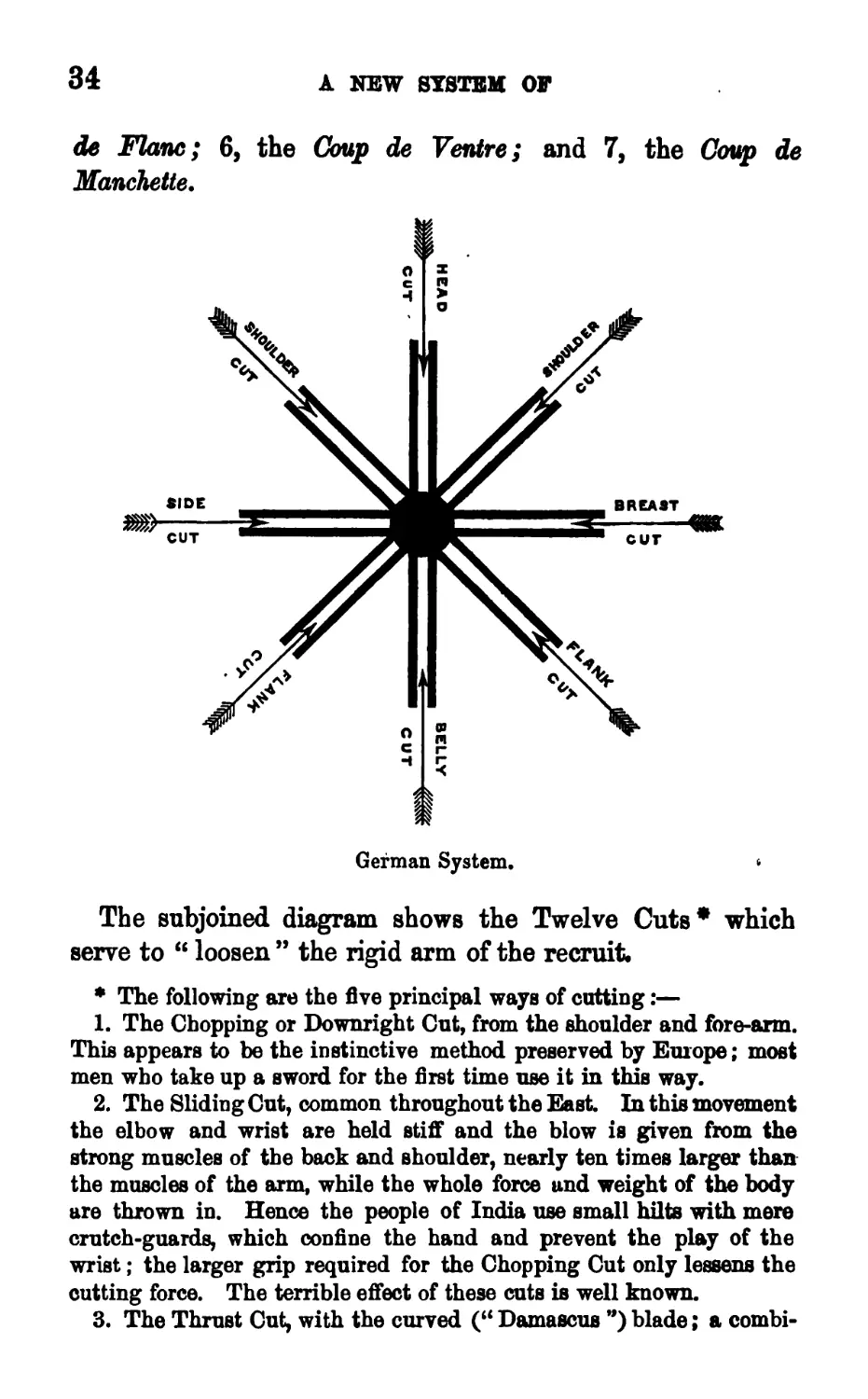
The subjoined diagram shows the Twelve Cuts* which
serve to “ loosen ” the rigid arm of the recruit.
♦	The following are the five principal ways of cutting:—
1.	The Chopping or Downright Cut, from the shoulder and fore-arm.
This appears to be the instinctive method preserved by Europe; most
men who take up a sword for the first time use it in this way.
2.	The Sliding Cut, common throughout the East In this movement
the elbow and wrist are held stiff and the blow is given from the
strong muscles of the back and shoulder, nearly ten times larger than
the muscles of the arm, while the whole force and weight of the body
are thrown in. Hence the people of India use small hilts with mere
crutch-guards, which confine the hand and prevent the play of the
wrist; the larger grip required for the Chopping Cut only lessens the
cutting force. The terrible effect of these cuts is well known.
3.	The Thrust Cut, with the curved (“ Damascus ”) blade; a combi-
SWORD EXERCISE FOR INFANTRY.
85
The figure represents the opponent; the thick lines show
the direction of the edge when cutting; and the dotted con-
The Twelve Cute (shown by the thick strokes), the dotted lines denoting
the course of the blade in “ Moulinet ”, or rather in “ Semi-Moulinet.”
Carte.
Cut 1.
Cut &.
Cut 5.
Cut 7.
Cut 9.
Cut 11.
Tierce.
Cut 2 (Head Cuts).
Cut 4 (Face Cuts).
Cut 6 (Shoulder Cuts).
Cut 8 (Breast Cuts).
Cut 10 (Stomach Cuts).
Cut 12 (Groin and Thigh
Cuts).
nation of point and edge, the latter being obliquely thrust forward and
along the body aimed at This movement is a favourite on horseback,
when speed supplies the necessary force, which can hardly be applied
on foot. It must be parried like a Point.
4.	The Whip Cut; in which the arm and elbow are
motionless, and the blow is delivered from the vrrveX.. Tfcaa
36
A NEW SYSTEM OF
tinuations denote the course of the blade when describing
the several “ Moulinets.”
The Cuts should be continuous, the regular succession
always beginning from Carte or the Inside, that is, from the
rear of the left shoulder. As in the “ Moulinet,” the less
the arm is bent and the sword-hand is moved from the line
of direction (to the front), the greater is the value of the
movement. The recruit, who must walk before he runs,
should deliver the whole dozen in continuous sweep without
pause, but at first very slowly, till, by the proper and timely
use of the wrist, the Cuts lead into one another. The more
advanced swordsman, whose pliability of strength is free from
contractions and other vicious habits, should practise the
series of twelve with increased rapidity till the blade whistles
through the air. All the Cuts should be given strong, with
the edge leading well forwards and with the arm extended to
its utmost in the delivery.
The following are the Twelve Cuts:—
I. and II. These Cuts are made, after falling into Tierce
or Outside Guard, from above downwards at the opponent’s
head. In No. I. the point, beginning as usual from the left
shoulder (Carte), describes a full circle (“ Inside Moulinet,”
the brise a gauche of the French Manuel), the hand moving
as little as possible so as to cover the body; the knuckles
turned up and the blade passing close to the breast: it
finishes by delivering a vertical Cut, with the “Feeble” close
to the point, at the right half of the adversary’s crown.
No. II., which follows without interruption, reverses the
process; the knuckles are turned down and the blade sweeps
past the right shoulder (brise a droite); ending with the left
half of the opponent’s head. The latter Cut is by far the
principal Cut allowed in my system; it is capable of sufficient effect
upon the opponent whilst it does not uncover the swordsman who
uses it.
5.	The Drawing or Reverse Cut, which will be explained in the
following pages; it is the reverse of the “ Thrust Cut.”
SWORD EXERCISE FOR INFANTRY.
37
more difficult to make without moving the hand, but it is
good practice for “ breaking ” the wrist.
III. and IV. The horizontal face-cuts, also beginning from
the left (Carte), an invariable rule, and ending with the right,
that is, at the adversary’s left cheek. The reason of this
practice is to make the movement habitual to the recruit;
cutting from left to right always causes less exposure of the
inner wrist than cutting from right to left.
V. and VI. The slanting shoulder-cuts, also from above
downwards (Nos. 1 and 2, or rather 2 and 1, of the ‘ Infantry
Sword Exercise,’ pp. 14,17, and the Coupe de Banderole of
the Manuel); describing two diagonal Moulinets, first from
left to right, and then from right to left. The sword again
makes a double “ Moulinet ” with the edge downwards, and
descends first upon the opponent’s right and then upon his
left shoulder.
VII. and VIII. The horizontal breast-cuts, parallel with
the face-cuts, and, like them, delivered with the blade as
horizontal as possible.
IX. and X. The horizontal stomach-cuts, parallel with,
and lower than, the breast-cuts.
XI. and XII. The slanting groin or thigh-cuts, diagonally
from downwards upwards; in fact, the reverse of the shoulder-
cuts (Nos. 4 and 3 of the ‘Exercise,’ and the brises of the
Manuel). In these diagonal Moulinets, the elbow must not
be bent; the hand should deviate as little as possible from
the directing line under pain of dangerous exposure; and
the two movements should follow each other without a
break.
Whenever the recruit fails to carry the edge well forward
in making the attack, he should be practised slowly and re-
peatedly in combining the opposites, as Head-cut (No. 1)
and Thigh-cut (No. 12), Head-cut (No. 2) and Thigh-cut
(No. 11), and so forth. The instructor must see that the
edge leads on to the respective lines of the Target, the point
being darted out at the end of each cut.
38
A NEW SYSTEM OF
The Cuts will be practised first in No. 2 “Second
Position ” (Guard), and afterwards in No. 2 “ Third Posi-
tion” (Lunge).
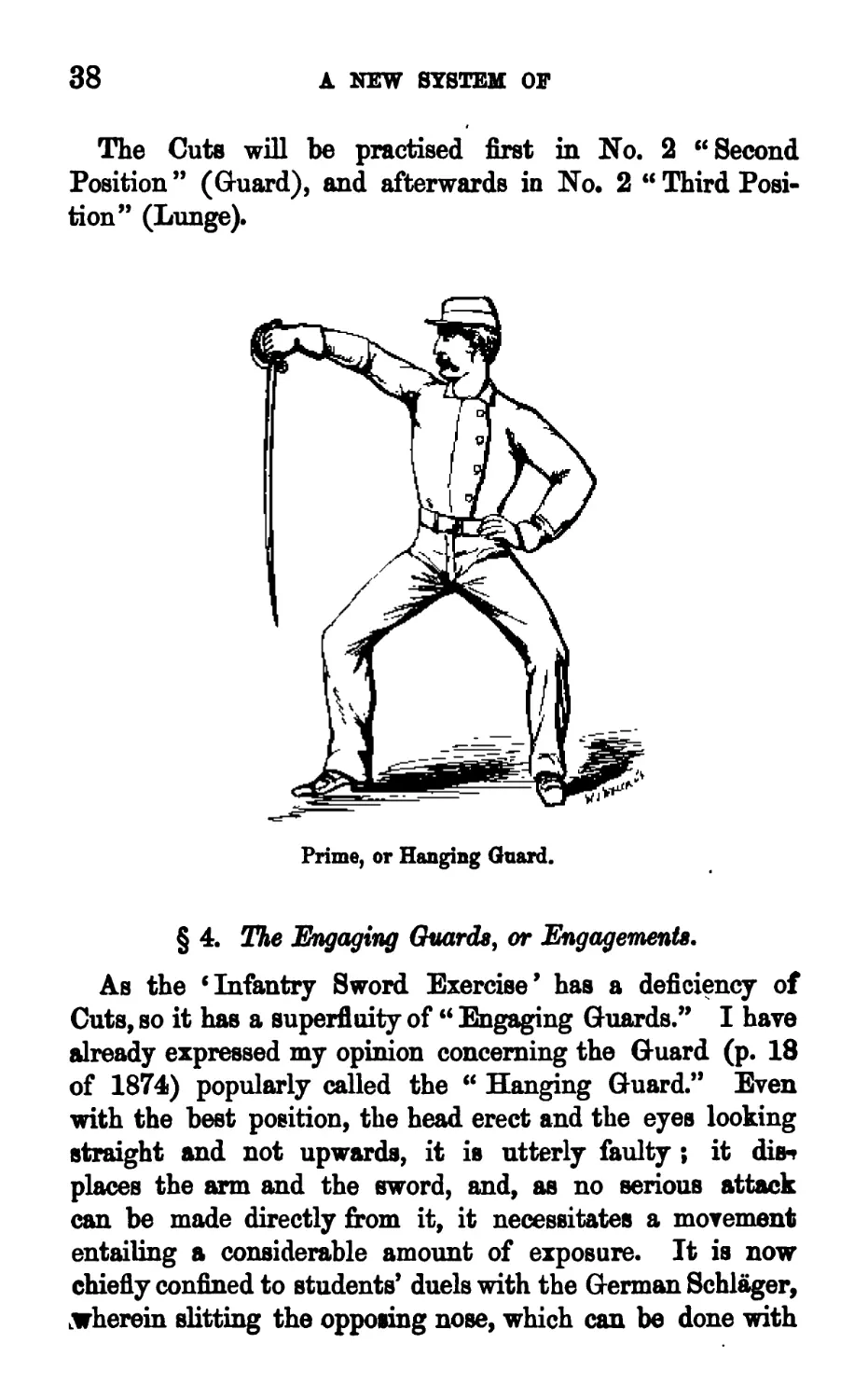
Prime, or Hanging Guard.
§ 4. The Engaging Guards, or Engagements.
As the ‘Infantry Sword Exercise’ has a deficiency of
Cuts, so it has a superfluity of “ Engaging Guards.” I have
already expressed my opinion concerning the Guard (p. 18
of 1874) popularly called the “ Hanging Guard.” Even
with the best position, the head erect and the eyes looking
straight and not upwards, it is utterly faulty ; it dis«?
places the arm and the sword, and, as no serious attack
can be made directly from it, it necessitates a movement
entailing a considerable amount of exposure. It is now
chiefly confined to students’ duels with the German Schlager,
wherein slitting the opposing nose, which can be done with
SWORD EXERCISE FOR INFANTRY.
39
a mere jerk upwards, is the swordsman’s highest aim and
ambition.
The “Engaging Guards” are thus reduced to the two
following:—
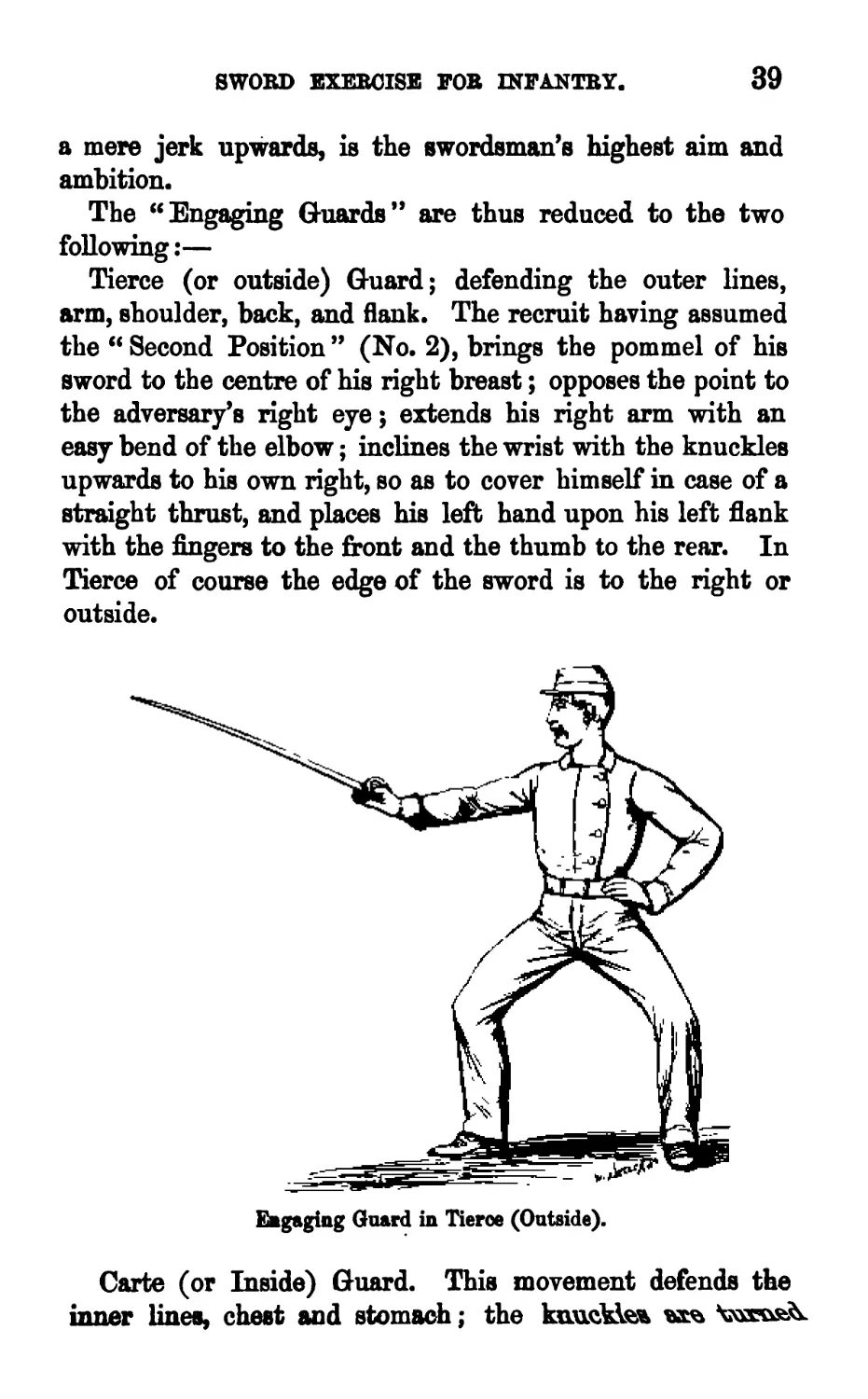
Tierce (or outside) Guard; defending the outer lines,
arm, shoulder, back, and flank. The recruit having assumed
the “ Second Position ” (No. 2), brings the pommel of his
sword to the centre of his right breast; opposes the point to
the adversary’s right eye; extends his right arm with an
easy bend of the elbow; inclines the wrist with the knuckles
upwards to his own right, so as to cover himself in case of a
straight thrust, and places his left hand upon his left flank
with the fingers to the front and the thumb to the rear. In
Tierce of course the edge of the sword is to the right or
outside.
Engaging Guard in Tieroe (Outside).
Carte (or Inside) Guard. This movement defends the
inner lines, chest and stomach; the knuckka «ха
40
A NEW SYSTEM OF
down; the opposition is made to the left, and the edge is
carried in the same direction.
Engaging Guard in Carte (Inside).
When engaging in guard (joining weapons), the swords
should meet each other about eight inches from the points.
If the distance is diminished the opponents are “ out of mea-
sure ” (or distance); if increased, they are “ within measure.”
The recruit must be taught slightly to press upon the oppo-
nent’s blade, but not to rest upon it; by this “ opposition ”
his hand and wrist will be more ready to follow the weapon
during the attack. Thus also the “ Engaging Guards,”
Tierce, and Carte (outside and inside) afford protection pre-
paratory to the movements for offence and defence. The
eye must be fixed upon the eye and the hand or the blade-
point of the opponent, not upon the eye only.
Guard may be partly defensive when the bust is advanced
SWORD EXERCISE FOR INFANTRY.
41
and the point approaches the opponent, or it may he pilrely
protective when its sole object is the “ parry.”
The right-handed recruit must be taught always to
attempt Engaging in Tierce,* with his opponent’s blade in
the outer line (sur les armes). The reason is simply that in
the reverse position (dans les armes), the fore-arm, from the
elbow to the wrist, is comparatively unguarded; whereas
Tierce facilitates the defence of the “ low lines ” (i. e. those
below the wrist). Tierce therefore has invariably the advan-
tage with the sabre, as Carte carries off the palm with the
small-sword, the foil, and the rapier, f But the right-handed
man engaging in Tierce puts his left-handed opponent in
Carte; and the latter, if a skilful sworder, will manoeuvre,
by withdrawing his blade, by coupSs or degagements over
the point, and by other feints, to regain the ground of vantage.
The best treatment of this case is to make a time-cut
in Seconde (“inner Moulinet,” or brise a gauche) at the
adversary’s knuckles, a movement which will presently be
explained.
§ 5. The Guards or Parries.^
The ‘ Infantry Sword Exercise ’ proposes Seven Guards, a
number which can hardly be reduced for practice on the
drill-ground or in the schools: the Manuel contains the same
* This fact is well known to the Manuel, which says, “ Des deux
engagements celui de droite par la position de la main a le plus (Гapplica-
tion." It therefore makes all the Cuts and Parries begin from Tierce.
This elementary rule is not recognized by the ‘ Infantry Sword Exer-
cise ’ (p. 32); “ your defence is always more effective in the left (Carte)
than in the right (Tierce).” Such I assert is the case with the foil and
rapier, certainly not with the sabre or broadsword. On horseback the
left is of course the weak side.
t Used in this sense the “small-sword” is the triangular weapon,
the rapier is the flat, or rather the bi-convex blade.
| In p. 29 of the ‘ Infantry Sword Exercise ’ we read of “ a circular
motion of the blade, termed the Parry; ” but the latter word must not
be limited to this sense.
42
A NEW SYSTEM OF
number, including one for the Point. But of the seven no
less than five are a Hanging Guards,” and Nos. 3 and 4 serve
only to defend the inside and the outside of the advanced
leg. This limb requires no assistance of the kind: an able
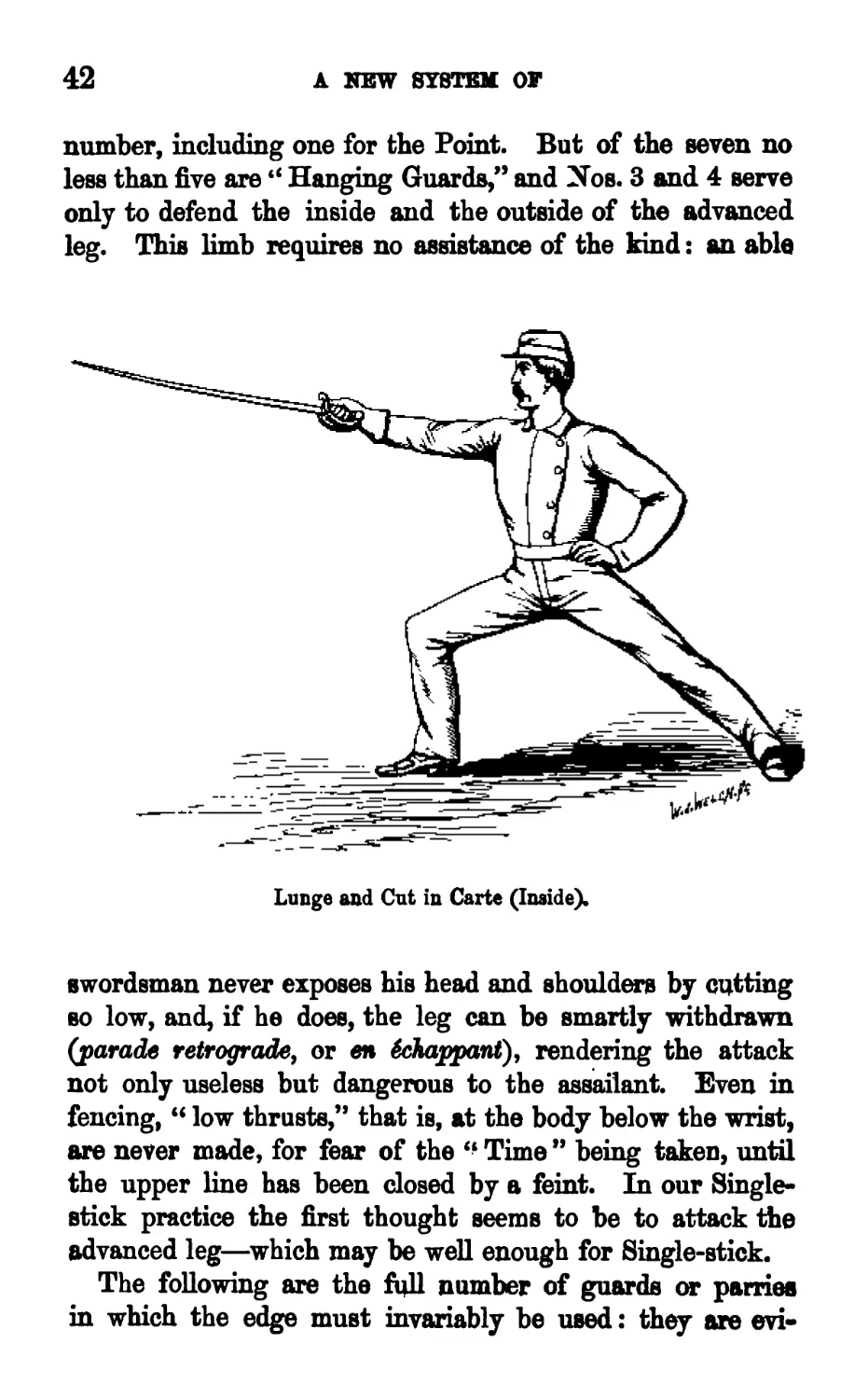
Lunge and Cut in Carte (Inside).
swordsman never exposes his head and shoulders by cutting
so low, and, if he does, the leg can be smartly withdrawn
(parade retrograde, or en ^cKappant), rendering the attack
not only useless but dangerous to the assailant. Even in
fencing, “ low thrusts,” that is, at the body below the wrist,
are never made, for fear of the “ Time ” being taken, until
the upper line has been closed by a feint. In our Single-
stick practice the first thought seems to be to attack the
advanced leg—which may be well enough for Single-stick.
The following are the full number of guards or parries
in which the edge must invariably be used: they are evi-
SWORD EXERCISE FOR INFANTRY.
43
dently dividable into two; (1) Head (with face) Guards, and
(2) Body Guards:—
I. Prime (p. 38), so called because it is the “first” posi-
tion of defence after drawing the blade, that which the un*
practised man would naturally assume to defend his head.
It is the 7th Guard of the ‘ Infantry Sword Exercise.’ In
practice the point is more inclined to the horizontal line than
when the blade is unsheathed; the edge is carried somewhat
inside or to the left; the arm is shortened and so raised that
the eyes look under it, but the head remains upright. The
recruit must be careful not to “bend the body;” not to
“ draw in the chest and neck;” and not to “ bring the left
shoulder a little forward.” The defect of Prime is its being
a w Hanging guard,” rendering the riposte or reply difficult,
and modern practice prefers ‘^High Tierce.”
IL Seconde (4th Guard), so termed because following
Prime: the arm is extended, the edge is carried to the outside
or to the right; in practice the hilt is lowered, and the point,
threatening the opponent’s loins, is depressed to the half of a
right angle. This position must be learned for the sake of
feinting: as a parade it is not much used, because it defends
only the hip and leg, and a good swordsman will never
expose himself to exceeding danger by making low cuts.
Modem practice prefers “low Tierce.”
III.	Tierce (2nd Guard) has been described (p. 39) under
Standing on Guard ” and “ Engaging Guards; ” it defends the
outer lines, arm, shoulder, and back.
IV.	High Tierce is a head-guard: the hand is raised to
above the shoulder to the maximum level of the swordsman’s
right eye, and the blade is carried at an angle of 45° with
the edge up and the point to the left.
V.	Low Tierce is a flank-guard; the arm is shortened, the
hand is depressed six inches; the opposition is to the out-
side, and the point is held vertically or almost vertically, as
the attack demands.
VI.	Carte (1st Guard) has been described (p. 40) under
44
A NEW SYSTEM OF
“Engaging Guards,” as defending the inner lines, chest and
stomach. For the purposes of parrying, the arm is with-
drawn till the elbow, almost touching the belt, forms an
equilateral triangle with the hilt and the left side.
VII.	High Carte is a head-guard like high Tierce: the
hand is raised to the left of the left eye, and the blade,
crossing the face at an angle of 45°, carries the edge up,
and the point to the right.
VIIL	Low Carte is a stomach guard. As in Low Tierce
the arm is shortened, the hand is depressed six inches; the
opposition is to the inside, and the point is held vertically
or almost vertically, as the attack demands.
In practice the advanced swordsman will confine himself
to Tierce and Carte with their natural modifications. He
will consult his own feelings about the head-guard, abolishing
Prime in favour of High Tierce or High Carte, and he will
prefer Low Tierce or withdrawing the leg (raesembtemenf)
to using Seconde. Of these movements the simplest are
always the best. When parrying, the sword-arm must in-
variably be drawn for defence nearer the body, and the
grip should be sensibly tightened to receive the cut. No
strength is necessary when making the parries: I cannot
accept the “Sforzi” or guard-forcings of the nep-Italian
broadsword school, dry blows upon the blade, which, in-
tended to disarm, are essentially dangerous.
The Guards or Parries will be practised like the Cuts, first
in the " Second Position ” (Guard), and afterwards in the
" Third Position ” (Lunge).
SWORD EXERCISE FOR INFANTRY.
45
Section III.
THE MANCHETTE OB FOBE-ABM PLAY.
§ 1.	Preliminary.
The recruit is now sufficiently advanced to begin the
system of Manchette, which, as it is the most valuable part
of sword-drill, has been practised the least, and should be
practised the most. A swordsman thoroughly trained in
this section does not allow the opponent to deliver a cut.
It is certain that hand and wrist, short-arm and elbow, are
capable of as many different attacks and defences as the
whole body: these are the parts moat prominent, most ex-
posed, and consequently most readily made the point de
mire. Yet this true and simple secret of the broadsword has
been universally neglected, or rather not worked out: in
England we content ourselves with the parades technically
called retrogrades, that is, withdrawing the limb from the
assault, by shortening, the arm and, sometimes, by retiring
the right foot either near to, or up to, or behind the left
heel: even this evasion which cannot expect to pass for a
Guard, is not described nor figured in the official ‘ Infantry
Sword Exercise.’* In France, and even in Italy where most
subjects are exhaustively treated, Manchette is dismissed
with a few careless words. The Manuel gives to the Coup de
Manchette only these few lines: ° Executer un enleve (vertical
Moulinet from above downwards) en arriere a droite, et arreter
le sabre vis-a-vis le milieu du Corps, le tranchant en dessus, le
poule legerement a droite ; diriger T enleve de maniere a empecher
en arretant Vavant bras, Г execution d'un coup de tete. Capitano
Settimo del Frate (p. 50, Istruzione sul Maneggio e Scherma
della Sciabola) in one of the latest works on swordsman-
* The only allusion to it is the “ shifting of the leg/’ in p. 30. *
46
A NEW SYSTEM OF
ship contents himself with the following desultory obser-
vations :
“ Manchett ” (sic) “ can attack the fore-arm either above
or below, according as the opponent gives an opening.
“ Manchett is generally used against an adversary whose
guard is defective. By merely extending the arm with a
turn of the wrist, this attack may readily succeed should
the opponent neglect to provide against it.
“ One of the most dangerous guards against Manchett
is Tierce; the surest is High Seconde, which indeed is also
the best parry adapted to this system of attack.”
The first member of the last paragraph is sensible; the
second is thoroughly fallacious. As has been stated, the
right-handed man must always engage in Tierce, and, as will
presently appear, Tierce is the safest, indeed the only safe
guard against Manchette cuts. Another Italian writer of our
day describes and figures the “ Position of the weaponed arm
to escape the arm-cut ” (Colpo di braccio), with the elbow-
joint left clean open. The ‘ Infantry Sword Exercise ’ limits
itself (p. 30) to these few lines: “ If opposed to the Small
Sword (лс, meaning straight sword or rapier) have recourse
to Cuts Three (No. 13 of this system) and Four (No. 11),
directing them at the arm, by which means there is every
probability of the cuts taking effect, as it must always
come within range of the edge, before the point can be
sufficiently advanced to reach your body: if the above
cuts are quickly given and continued, they will also be
found advantageous in advancing against the Small Sword,
as they constitute an attack and form a defence at the same
moment; but should the opponent be the most skilful and
quickest (sic) in his movements, then it is best to retire
whilst giving them, cautiously preserving the proper dis-
tance, so that each cut may just reach the fore part of his
arm.” The French content themselves with single opposi-
tions of Tierce and Carte. But why multiply instances of
ignorance ?—they would fill many a useless page.
SWORD EXERCISE FOR INFANTRY.
47
Finally I meditated upon the comparative humanity of
“Manchette,” of disabling the opponent by an arm-cut,
rather than laying open his flank or his head. During
single rencontres in the field, especially at the end of Indian
battles, it is so often necessary to put hors de combat some
unfortunate, whose pluck or sense of honour induces him to
prolong the hopeless attack.
These considerations led me to reflect seriously for a
number of years upon the Jeu de Manchette, the Colpi all’
avambraccio, or fore-arm play, which has been so much
neglected by master-swordsmen. At last an unlooked-for
opportunity, a short study in the Salle d'armes of Herr
Balthasar Reich of Trieste, enabled me to reduce it to a
system, and present it to the public.
I should premise, however, that the following observations
are intended for professional men. It is therefore necessary
only to name and number the Direct Cuts, the Guards and
the Feints, the Reverse Cuts, and the Time Cuts of Man-
chette, as in most cases the simplest mention will suffice.
The proficient will at once perceive that I offer a mere
outline of the system whose many details must be learned
by long practice. It is enough to give first principles: the
minutise could not even be noticed without stretching
description to a wearisome length.
There is no objection, I have said, to teaching squads of
recruits all the simpler preparatory matter: the Three Posi-
tions ; the Moulinet; the Engaging Guard, and the Guards
or Parries. At a certain stage of progress, however, espe-
cially when beginning Manchette, the quick and intelligent
soldier, who is likely to qualify himself as a master, must be
instructed singly.
§ 2.	The Direct Cuts in Manchette,
The following are the direct attacks in Manchette, simple
and compound; all are done from the “ Engaging Guard,” the
Lunge being here inadmissible.
48
A NEW SYSTEM OF
L Carte de Manchette.—Extend the sword-arm to the full
length and deliver the cut, with a flip as it were, at the
opponent’s fore-arm, between the elbow and the wrist. This
can be done with the back of the blade (Eeverse Cut) under
circumstances presently to be described. No. I. is useful
if the adversary unwisely engages you in Carte otherwise
(from Tierce) it must be avoided, as he easily parries by
withdrawing the arm and replies with a Tierce Cut.
II.	Carte de Manchette and Cut Tierce.—This movement is
No. I. followed by a close rotation of the point (“ Tierce
Moulinet ”); if, however, the circle be too small, it will not
clear the sword-guard.
III.	Double Carte de Manchette and Cut Carte.—No. III. is
to be done' when the opponent, as he generally will after an
attack of No. II., successively parries Carte and Tierce. It
is simply the double of No. I., and thus the “Tierce Mou-
linet ” cuts, of course, inside the arm.
IV.	Double Carte de Manchette and Cut Tierce.—Useful
when the adversary parries Carte, Tierce and Carte; it is
the double of No. II. and thus cuts outside the arm.
No. II. guards the arm and is therefore unexceptionable.
Nos. III. and IV. are dangerous, because, like No. I., when
opposed to an agile hand, they may lay the wrist open to a
Time Cut.
The two first and all four against a slow unready swords-
man may be varied by combinations with coupes, or passing
the blade sharply over the adversary’s point. For instance,
if the adversary come too wildly to the Tierce parade of your
double Carte and Tierce (No. III.), а соирё will reach his
arm in Carte.
A golden rule which cannot be repeated too often is that
all the Manchette-Cuts in Tierce (outside), either from above
or from below, must be as nearly vertical as possible, whilst
all the Cuts in Carte (inside) should be as horizontal as they
can be made. The reason is simply that these positions
cover the arm and render the attack less dangerous.
SWORD EXERCISE FOR INFANTRY.
49
§ 3. The Guards (Parries) and Feints in Manchette.
The Guards of the Target will be found sufficient for
parrying all attacks in Manchette. The soldier, however,
should especially practise the retrograde parades, that is
withdrawing the right fore-arm with and without the right
leg.
Feinting with the broadsword is necessarily more simple
than with the foil, being generally confined to Coupes
and Secondes. The neo-Italian school of sabre uses, I have
said, the fencing movements, but it is at best a bastard style.
If the . opponent attempt to “ degage,” that is to pass his
point under your blade from Tierce to Carte, or vice versd,
retire by withdrawing the right heel to the left, and cut at
the arm which his movement has exposed.
The Соирё, the reverse of the degagement, passes the point
over, not under, the opposing blade; this legitimate feint,
used in every school, may be effected in four several ways.
I.	One. From the usual engagement in Tierce pass the
blade over the opposite point, just clearing it, and cut inside.
The two movements raising and dropping the point should
be as rapid as possible.
II.	One, Two, a double Соирё, with the cut in Tierce.
III.	One, Two, Three: as with the foil; against a nervous
opponent the cut should be made at the face with a dart and
a jerk (the Italian Slancio); against a slow player the cut
may be Carte de Manchette.
IV.	One, Two, Three, Four; like the former, but cutting
in Tierce: to be attempted only with the most unready of
opponents.
The two latter may be combined with a breast (inside) or
shoulder (outside) “Moulinet” between the penultimate
and the last (cut) movement; but these long feints are
radically vicious, because they lay the swordsman open to
Time Cuts. They are, however, useful, as will appear in
making the Reverse Cuts.
50
A NEW SYSTEM OF
Perhaps the Seconde-feints are better than the Coupes.
I.	One: the simple Seconde Cut.—Make a little more
opposition in Tierce, sweep the blade past and along the
breast; (inside Moulinet, or the brise a gauche) and, lowering
the hand a little, cut upwards with a jerk and a flip. The
nearer the swordsman’s own body his blade circles the better,
because the cut will be more in the vertical line: if it be
much out of the perpendicular the opponent can “ take a time ”
in Carte. The Moulinet serves also to embarrass the adver-
sary and to add strength to the cut. This simple and most
valuable movement must not be confounded with the old-
fashioned Seconde cut at the leg: the latter is objected to,
as I have said, by swordsmen; the parry is too easy, and
the ripost far too dangerous.
II.	Feint Seconde.—From Tierce make a short and sharp
movement to Seconde with the knuckles turned upwards;
the opponent will probably come to the Seconde-parry,
thereby exposing the fore-arm. You then cut Tierce perpen-
dicularly as usual, from above downwards (the enlevS), either
without or with a breast “ Moulinet.”
III.	Feint Seconde, Feint Tierce and Out Carte, with two
short, sharp movements, and deliver the horizontal cut in
Carte.
IV.	Feint Seconde, feint Tierce and Cut Seconde, from
downwards upwards, always with a breast “ Moulinet.”
At times the two first feinting movements in Nos. III.
and IV. may be done more emphatically: this of course
makes the movement slower, but it is a variety which
embarrasses an adversary accustomed only to short, quick
action.
§ 4. The Reverse or Back Cuts in Manchette.
As the Manchette system has been strangely neglected,
so the Reverse or Back Cut may be pronounced unknown
to the majority of the profession: the latter, instead of utili-
SWORD EXERCISE FOR INFANTRY.
51
zing the “ false edge ” of the blade, still lose time and incur
great danger by turning hand and wrist in using the true edge,
especially when “ Cutting within the Sword.”* More extra*
ordinary still, although almost all the civilized world pre-
fers what is technically called the “ flat-backed and spear-
pointed ” sabre, yet no one seems to think of employing, or
even of sharpening one of the most important parts of the
weapon.
The Regulation blade with the false edge, that is to say,
the blade sharpened from the point to the Centre of Percus-
sion, about one-third of the length, was introduced into
England about 1844, and the first specimens were made by
the late Henry Wilkinson, acting with the late Henry
Angelo, then Superintendent of Sword Exercise.f This
back-edge of the blade should be ground to the sharpness
of a razor. When practising the Reverse Cuts (Revere or
Roveecib), the handle is held loosely with the thumb and
the two first fingers, and the wrist and fore-arm should
bring the blade up with a jerk, the grip being at the same
time sharply tightened. Practice will soon enable the
swordsman to deliver a strong “ drawing ” cut, equal to the
Thrust-cut of the so-called “ Damascus” blades. This valuable
movement has the immense merit of not uncovering the
swordsman, and what makes the sabre so rude a weapon
is that every movement of attack, in the old systems, lays
the body open by raising hand and point when a blow is to
be given. With the Reverse Cut no such dangerous pro-
cess is necessary ; the point is still directed at the opponent
whilst the cut is being delivered. Finally, it is always
unexpected by the opponent who has not practised it, and
although it rarely begins an assault, except against the
* See the ‘ Infantry Sword Exercise,’ p. 31.
t In France the false edge is hardly known; such blades are called
a deux tranchants; it is the Italian schiena or chine, mezzo-filo, or
falso opposed to vero taglio, and the German, riickschneide or kurze-
schneide, thus distinguished from the lange-schneide.
52
A NEW SYSTEM OF
inexperienced, nor should it be done alone as a rule, it may
either follow or conclude every attack, feint or “ time.”
I.	The Half-Feint (Revere de deeeoue, Roveecio di eotto, qt
Revere von unten) is done thus.—When in Tierce extend the
arm as if intending to cut Tierce; the opponent makes an
opposition of Tierce ; drop the point, and cut sharply up-
wards with the false edge at his fingers, wrist, or fore-arm,
drawing the blade towards you and keeping the point oppo-
site the adversary’s breast. This movement is one of the
neatest known, and it is sure to succeed with one who does
not expect it. The first part of the feint, or dropping the
point, may lead to a cut with the true edge, but this move-
ment, which is still practised in the schools, involves delay
by turning the hand. Again, it may be combined with the
inside (breast) or outside (shoulder) Moulinet.
II.	Feint Seconde and Cut upwards.—This movement may
be varied by feinting Tierce and cutting upwards.
III.	One-two-three.—This is not the succession of simple
Coupee, the dangerous movement before described. No. 1
Соирё shifts the hand from Tierce to Carte with the nails up;
No. 2 turns the nails down, still remaining in Carte; and
No. 3 delivers the Reverse Cut, of course in Carte, where it
is least expected.
When the point is passed well under and within the
sword-arm it is very difficult to parry the horizontal Reverse
Cut in Carte. The true edge may be used, but again it
wastes time by turning the hand.
IV.	The Paee, properly called “ en passant.”—From Tierce
make a feint-movement in Seconde, and, when the adversary
attempts to parry it by lowering the point, turn the knuckles
up (in old Tierce), sweep the blade over his sword-arm and
as close as possible to your right leg from left to right with
the arm well raised, and, returning from right to left with a
similar sweep, but with the blade held higher, cut, in Carte,
with the false edge and close to the point, inside his wrist.
SWORD EXERCISE FOR INFANTRY.
53
Unskilfully attempted, this feint is equally dangerous to
both, but it will do yeoman’s service in the hands of a prac-
tised swordsman. The true edge may be used, blit that
involves a change of position and the delay of turning the
hand with the knuckles downwards. Some make a double
sweep, and, after the second movement, cut outside or in
Tierce—the exposure is too great, unless confronted by an
unusually phlegmatic temperament.
§ 5. The Time Outs in Manchette.
The Time Cut is the flower of the Manchette system, as
the Manchette is of the broadsword; and it is, perhaps, the
part least capable of being taught in books. When well
mastered it never allows the opponent to raise his arm with-
out imminent risk, and, even if it fail, the intention, once
recognized, tends greatly to cramp and embarrass the adver-
sary’s play. The natural man cuts as if he were using a
stick or a club, and the preliminary movement lays open
the whole of his body; indeed, exposure, I have said, is the
main danger of every attack with the sabre, however closely
and skilfully conducted. A cut through the muscles of the
fore-arm, either inside or outside, causes the sword instantly
to be relaxed and dropped; the man in fact is hamstrung in
the upper works.
I. Carte de Manchette.—When the opponent from Tierce
makes a Coupt or any attack in Carte, stop further move-
ment by a Carte de Manchette, a horizontal Cut in Carte.
The same may be done with the false edge, in which case the
blade should be advanced as far as is possible; and this is to
be preferred because it loses less time.
П. Parade Retrograde and Cut Tierce.—When the oppo-
nent from Tierce attempts a Manchette in Carte withdraw
the arm (parade retrograde) and deliver the vertical Cut in
Tierce downwards at his extended arm ; both movements
54
A NEW SYSTEM OF
being combined in one. It is not necessary even with the
tallest man to withdraw the right leg; the Cut will amply
suffice. This Tierce Cut serves to defend from all attacks
when the Guard does not cover the adversary; and it has
lopped off many a careless arm. If slowly done it becomes
a mere parade and ripost.
III. The Reverse Cut-upwards, Revers en montant, Rovescio
montante, Ger. Revers mo nt ant.—You feint in Seconde; the
opponent comes to its parry and replies in Tierce; you with-
draw the arm, leaving the heels as they were, and cut upwards
with the false edge, tightening the grasp of thumb and fore-
fingers as much as possible. This movement is especially
useful; it is one of the best of Time Cuts, when the adversary
indulges in long and complicated feints and false attacks.
It may be dtme with the true edge, but the latter is less
safe.
IV. The Time Pass ; which is merely “ The Pass ” turned
into a Time Cut. When the opponent attempts a “ Man-
chette ” or any movement in Seconde, and expects you to
reply by a time Cut in Tierce with the true edge, turn the
knuckles up (in old Tierce), sweep the blade over his sword-
arm as close as possible to your right leg, from left to right,
with the arm well raised, and returning from right to left
with a similar sweep, but with the blade held higher, cut in
Carte with the false edge and close to the point inside his
wrist. The true edge may be used, but, again, it wastes
time. The double sweep possible as in “ The Pass,” but it
causes too much exposure.
This Time Pass may also be done with the band held high
in Prime or rather “ demi-circle ” with the nails turned up,
the arm. outstretched, and the point lowered. In this case
the leg must be shifted till the fore heel touches the rear
heel, so as to give additional height to the hand. This is not
a Reverse or Back Cut as you use the true edge; it is in
fact one of the old movements called “ Cutting within the
Sword.”
SWORD EXERCISE FOR INFANTRY.
55
§ 6.
The following is a synoptical table of Manchette or Fore-
arm play, showing the Cuts, the Guards (Parries) for the
Cuts, and the Biposts or replies that should follow each
Parade. The Instructor will remember that instead of
Prime we use High Tierce or High Carte, and for Seconde
Low Tierce or withdrawing the leg.
Direct Cuts.
CUT.	PARRY.	RIPOST.
1. Carte de Manchette.	IV. (Carte).	II. (Seconde).
2. Ditto and cut Tierce.	IV. and 1И. (Tierce).	III.
3. Double Carte de Man-) chette and cut Carte. J	IV., III. and IV.	П.
4. Double Carte de Man-) chette and cut Tierce. J	Parade Retrograde by) withdrawing arm. /	III. or IV.
Reverse Cuts.
1. Half-feint.	П. or III.	П1. or IV.
2. Feint Seconde and cutl upwards.	|	П.	।	Cut with false edge up- wards.
3. Feint Tierce and cut up-) wards.	J	HI. and П.	П.
4. One-two-three, and cut) upwards.	f	Parade Retrograde.	III. or IV.
5. The Pass.	II. and I. (Prime).	III.
	Time Outs.
	(Parry with time in IV.)
1. On all Cuts in Carte.	< (Carte de Man- > ( chette).	J	IV.
2. On feints in Carte ending) with Cuts in Tierce. J	Parade Retrograde.	HI. or IV.
3. On Cuts in Tierce.	Reverse Cut upwards.	III.
4/ On Reverse Cut upwards. 5. On Cuts in Seconde.	И. and Ш.	IV.
	The Time Pass.	Ш.
Feints of Coupe in Manchette.
1. Single Coup#	HI. or IV.	П.
2. One-two ( „ ).	IV. and Ш.	Ш.
3. One-two-three.	II., III. and II.	III. or IV.
4. One-two-three-four.	Parade Retrograde.	UL.
56
A NEW SYSTEM OF SWORD EXERCISE.
Feints of Seconde in Manchette.
1. Simple Seconde.	II.
2. Feint Seconde and ent) тт
Tieroe.	f П- and nL
S F,T^Stlo.5‘) П., Ш. and II
III.
III. or IV.
Ш. or IV.
Ш. or IV.
CONCLUSION.
I will end this system of Manchette with the words of
old Achille Marozzo, written some three centuries and a
half ago: “ I would that ye swear upon your sword-hilts
never to use this knowledge against me, your master.” But,
in lieu of insisting that my readers never teach it without
obtaining formal permission, I only hope that they will
favour me by spreading it far and wide.
( 57 )
APPENDIX.
In p. 26 allusion has been made to an improved form of sabre
handle; it was first attempted by the Capitano Settimo del
Frate in the work before alluded to. The gallant officer’s
Plates show that in the Italian cavalry-sword the upper por-
tion of the handle is at least horizontal, whereas in ours it
droops backwards and downwards, giving the grip additional
facility for slipping out of the swordsman’s grasp. The
author’s remarks * being even more applicable to the English
military sabre; I give them at full length.
“ The equilibrium of the sabre, and the facility of firmly
grasping the handle, are the two prime requisites for a good
weapon.
“ When properly balanced and easily held, the sword calls
for less exertion of strength; and the quickness and true
direction of the Cuts are greatly facilitated. In direct pro-
portion to the economy of force, we find the swordsman
enabled to continue his exertion.
“However well made and scientifically poised be the
blade, it is subject to several variations of equilibrium
according to the position in which it is held.
“ The nearer the centre of gravity approaches the hilt, the
lighter and the better balanced will be the weapon, and vice
versa.'f Therefore:
“ It should be our principal object to effect this improvement
♦ See his Appendix, entitled “ Modiflcazione all’ impugnatura e
guardia delle Sciabola di cavalleria per facilitame I’equilibrio ed
avantaggiare la fermezza della mano sull’ impugnatura.”
t A notable instance of this is the old Highland Clay-more.
58
APPENDIX.
without changing the proper centre of percussion and the other
requisites for offence and defence.9'
The following Plates fully explain the author’s meaning.
Fig. 1.	Fig. 2.
Sabre handle actually used by Ca Frate>a impr0Tement.
Italian cavalry.	r	r
Fig. 3.	Fig. 4.
Capt. Del Frate’s last modification. Improved handle with thumb-guard.
(R. F. Burton.)
a.	Thumb-plate.
b.	Rest for the little finger.
c.	Support for the index finger.
APPENDIX.
59
The hand grasping the modified
handle.
I would further modify his Fig. 1, so as to give more
fulcrum to the hand. The thumb-plate should be made
weighty and the guard light, otherwise the blade will be
over-balanced, that is, heavier on one side than on the
other. It need hardly be said that the grip before going
into battle should be whipped round with thin whipcord, or
better still, with web-cloth.
LONDON: PRINTED ВТ WM. CLOWES AND SONS, STAMVOBD STREET AND GHABD№