/







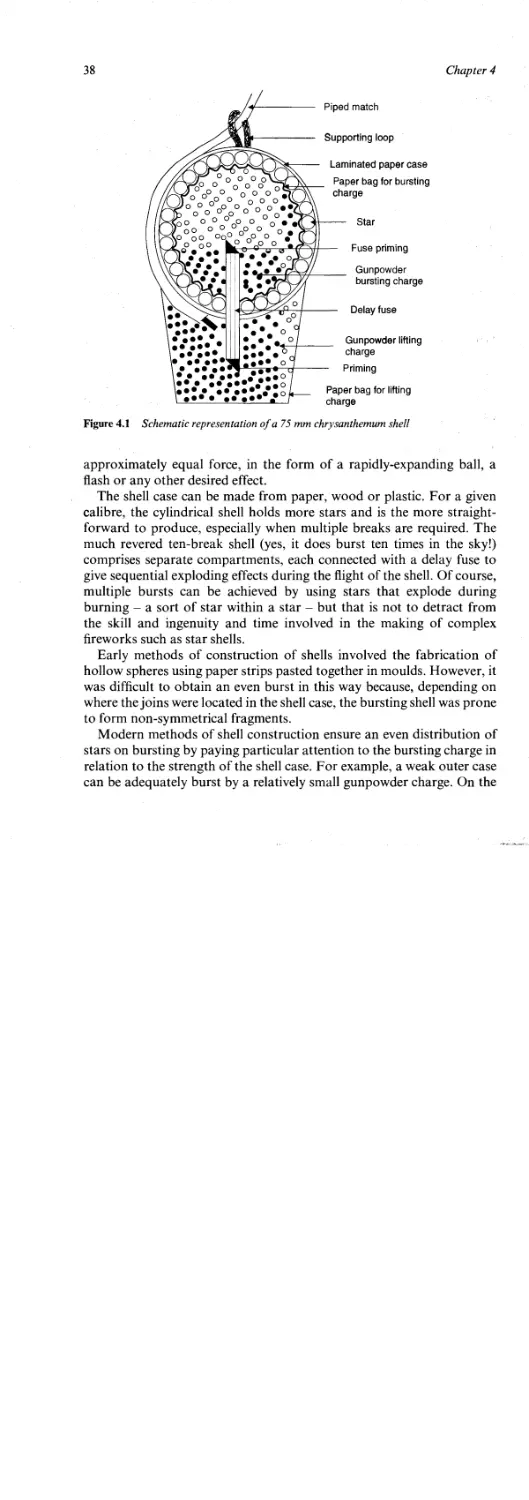
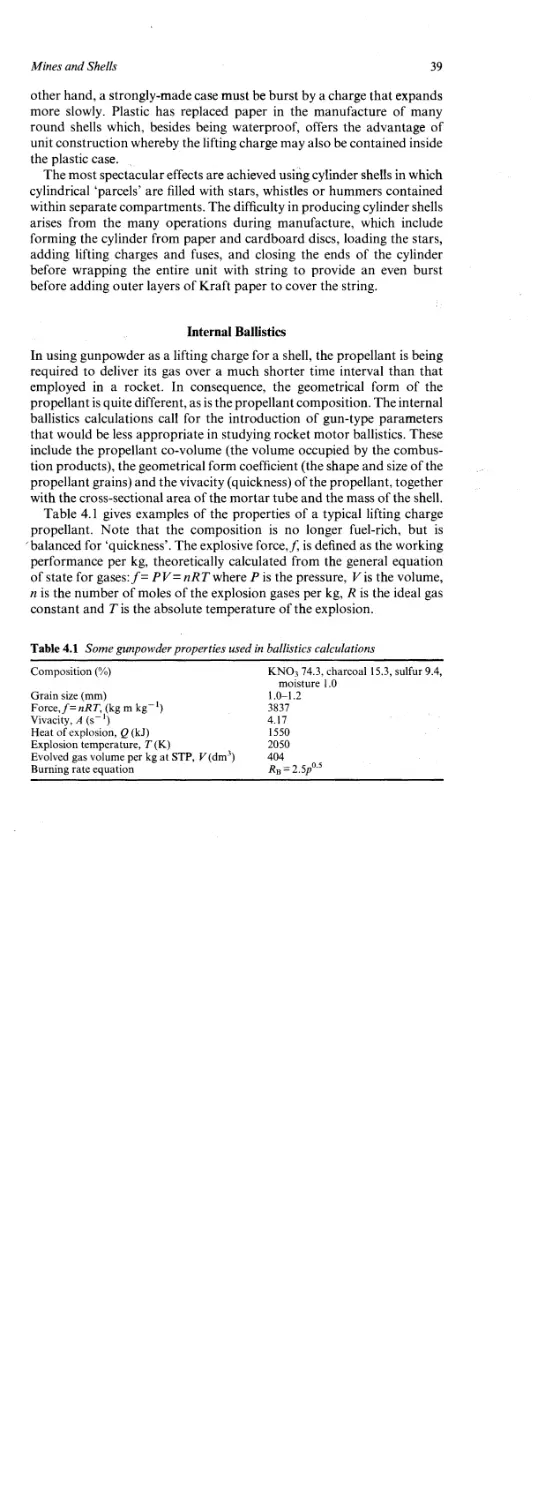
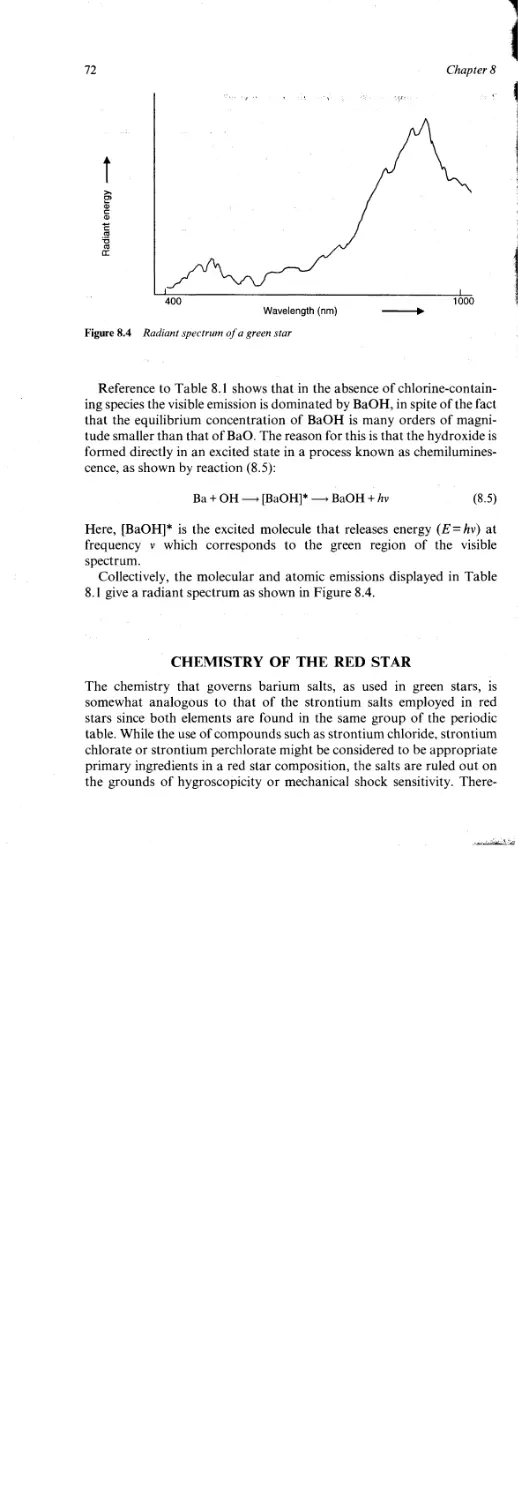
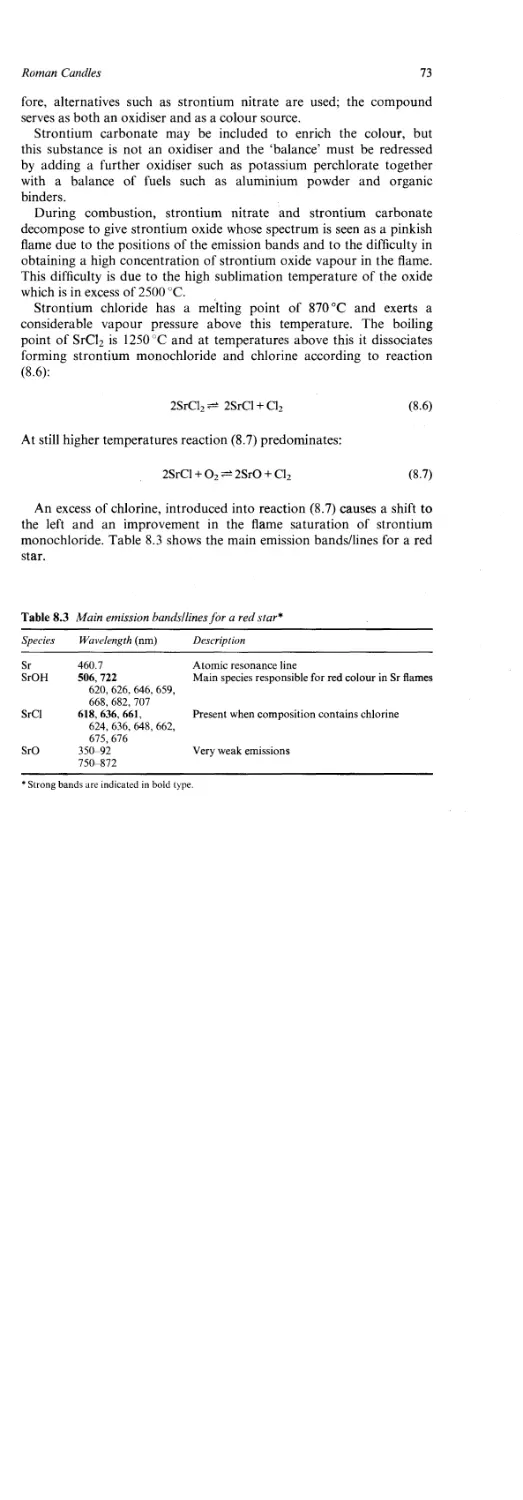
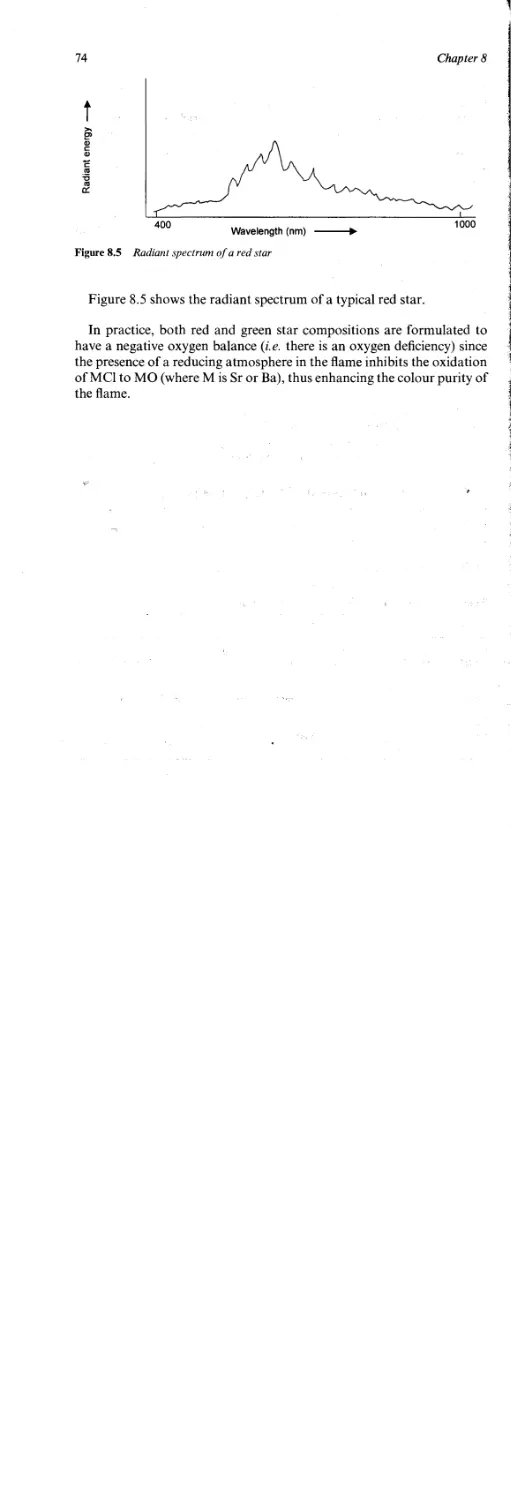
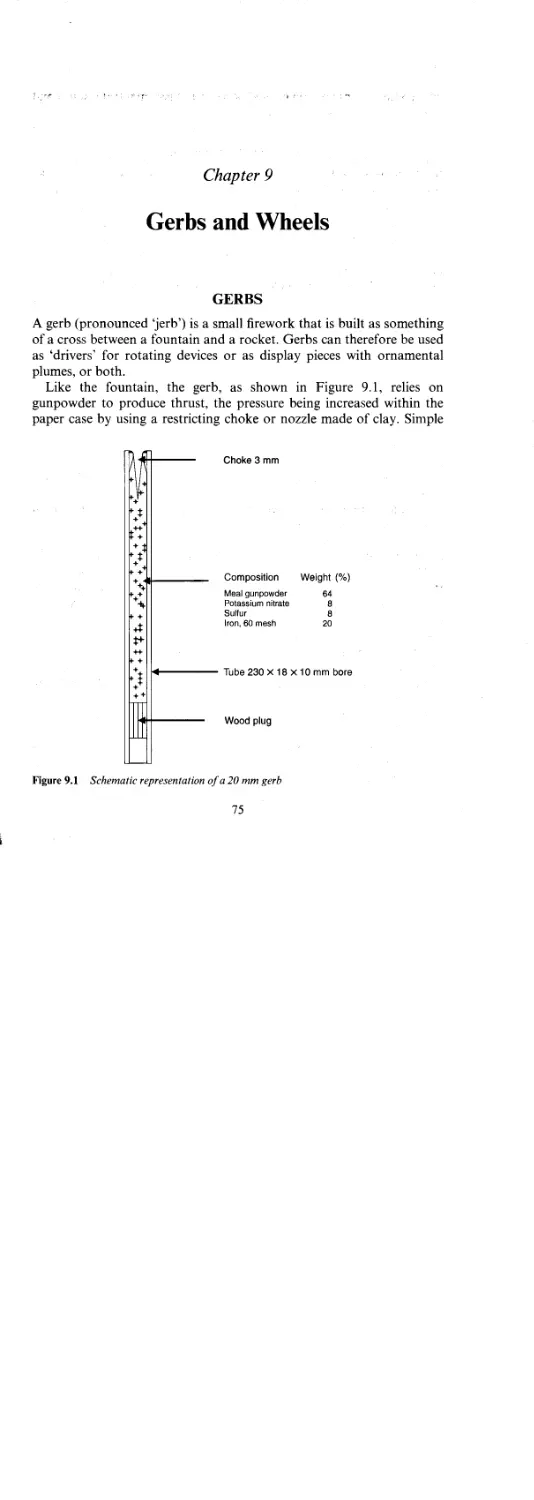









Текст
                    RSC PAPERBACKS
ROYAL SOCIETY OF CHEMISTRY
MICHAEL S. RUSSELL
THE CHEMISTRY OF FIREWORKS
RSC Paperbacks
RSC Paperbacks are a series of inexpensive texts suitable for teachers and students and
give a clear, readable introduction to selected topics in chemistry. They should also
appeal to the general chemist. For further information on available titles contact:
Sales and Customer Care Department, Royal Society of Chemistry,
Thomas Graham House, Science Park, Milton Road, Cambridge CB4 OWF, UK
Telephone: +44 (0) 1223 432360; Fax: +44 (0) 1223 426017; E-mail: sales@rsc.org
New Titles Available
The Chemistry of Fragrances
compiled by David Pybus and Charles Sell
Polymers and the Environment
by Gerald Scott
Brewing
by Ian S. Hornsey
The Chemistry of Fireworks
by Michael S. Russell
Water (Second Edition): A Matrix of Life
by Felix Franks
The Science of Chocolate
by Stephen T Beckett
The Science of Sugar Confectionery
by W. P. Edwards
Colour Chemistry
by R. M. Christie
Understanding Batteries
by Ronald M, Dell and David A, J. Rand
Future titles may be obtained immediately on publication by placing a standing order for
RSC Paperbacks. Information on this is available from the address above.
RSC Paperbacks
THE CHEMISTRY OF
FIREWORKS
MICHAEL S. RUSSELL
R.S»C
ROYAL SOCIETY OF CHEMISTRY
ISBN 0-85404-598-8
A catalogue record for this book is available from the British Library
© The Royal Society of Chemistry 2000
Reprinted 2002
All rights reserved.
Apart from any fair dealing for the purpose of research or private study, or
criticism or review as permitted under the terms of the UK Copyright, Designs and
Patents Act, 1988, this publication may not be reproduced, stored or transmitted,
in any form or by any means, without the prior permission in writing of The Royal
Society of Chemistry, or in the case of reprographic reproduction only in
accordance with the terms of the licenses issued by the Copyright Licensing
Agency in the UK, or in accordance with the terms of the licences issued by the
appropriate Reproduction Rights Organization outside the UK Enquiries
concerning reproduction outside the terms stated here should be sent to The Royal
Society of Chemistry at the address printed on this page.
Published by The Royal Society of Chemistry,
Thomas Graham House, Science Park, Milton Road,
Cambridge CB4 0WF, UK
Registered Charity Number 207890
For further information see our web site at www.rsc.org
Typeset by Computape (Pickering) Ltd, Pickering, North Yorkshire, UK
Printed in Great Britain by TJ International Ltd, Padstow, Cornwall
Preface
This book does not claim to be a definitive text on fireworks and the
fireworks industry. It is primarily an introduction to the basic science of
fireworks with particular emphasis on the underlying chemistry and
physics.
The historical material - stemming from several well known sources -
is valuable for its technical content. The subject matter then advances to
a presentation on the characteristics of gunpowder, whose unique
properties cause it to be the mainstay of the fireworks industry, even
today.
Succeeding chapters describe the manufacture and functioning of the
most popular fireworks, including rockets, shells, fountains, roman
candles, bangers, gerbs and wheels in what is hoped is a stimulating and
easily assimilated way for those approaching the subject for the first time.
Whilst the book is aimed at students with А-level qualifications, or
equivalent, it is also intended to be useful background material and a
source of reference for anybody engaged in a study of pyrotechnics as
applied to fireworks. Chapters on fireworks safety and legislation
complete the book and deserve special mention.
None of this book could have appeared - at least as a commercial
project - without the enthusiastic advice and very willing co-operation of
Mr John Stone and the late Gordon Curtis of Pains-Wessex Ltd. I am
also indebted to Bill Deeker of Pains Fireworks for permission to
reproduce the black and white photographs, and to David Cox who
gave advice on their selection and indeed took many of the pictures.
Probably the most comprehensive general text on fireworks is the
book by the Rev. Ronald Lancaster and co-contributors {Fireworks -
Principles and Practice, 3rd Edition) and I am grateful to him for
discussing my book with me and for giving permission to quote some of
his formulae.
I must also acknowledge the many friends and display operators with
whom I have enjoyed sharing my passion for fireworks over the years.
These include Ray Harrison, Henry Dunlop, Campbell Wilson, Chris
Wilson, Ken Norton, Dave Laurence, Andy Goodwin and Debbie,
Jonathon Webb, Steve Cornall, Dale Sullivan, Roly Harrison, the late
v
vi	Preface
Wally Betts, Kevin Russell, Robert Stevens and my number two
daughter, Jane.
My grateful acknowledgements also go to Kay, Carol and Peter who
worked wonders on the computer.
Finally, I would like to thank my dear wife, Lyn, who sat through
countless evenings of researching, writing and re-writing.
But having a degree in chemistry and a birthday on the 5th November,
what else could a person choose to write about?
Michael S. Russell
Contents
Glossary	xi
Chapter 1
Historical Introduction	1
Early Incendiary Devices	1
Development of Black Powder	1
Application of Black Powder to Fireworks	7
Further Uses of Black Powder	8
Chapter 2
The Characteristics of Black Powder	10
Influence of Pellet Density on Burning Time	10
Influence of Moisture on Burning Time	11
Thermal Decomposition	11
Thermal Ignition of Black Powder	13
Thermal Analysis of Black Powder	16
Analysis by TG	17
Analysis by DTA	18
Analysis by DSC	19
Stoichiometry	20
Volume of Evolved Gases	20
Heat of Reaction	21
Temperature of Reaction	25
Chapters
Rockets	27
Propellant	27
Internal B	allistics	27
External B	allistics	31
vii
viii	Contents
Rocket Design and Manufacture	32
Recent Developments	34
Chapter 4
Mines and Shells	37
Calibres	37
Construction of Shells	37
Internal Ballistics	39
External Ballistics	42
Mortar Tubes	44
Energy Transfer Efficiency	45
Mines	46
Chapter 5
Fountains	48
Compositions	48
Atomic Theory	49
Quantum Theory	50
The Colour of Sparks	52
The Brightness of Sparks	54
Particle Combustion	54
Chapter 6
Sparklers	59
Wire Sparklers	59
Tubed Sparklers	60
Chapter 7
Bangers	62
Method of Construction	62
Volume of Evolved Gases	63
Theoretical Maximum Gas Pressure	63
Airblast and Sound	64
Contents	ix
Chapter 8
Roman Candles	66
Method of Construction	66
Emission of Radiation by Stars	68
Chemistry of the Green Star	70
Ionisation in Flames	71
Chemistry of the Red Star	72
Chapter 9
Gerbs and Wheels	75
Gerbs	75
Method of Construction	76
Wheels	77
Method of Construction	77
Chapter 10
Special Effects	80
Quickmatch	80
Piped Match	81
Plastic Fuse	82
Lances	83
Set-pieces	85
Devices	86
Flash and Noise Effects	87
The Whistle Effect	89
Smoke Puffs	90
Coloured Smokes	91
Firing Electrically	94
Chapter 11
Fireworks Safety	97
Radio Hazard	97
Public Safety	97
Organised Displays	98
x	Contents
Chapter 12
Fireworks Legislation	‘ .	103
The Explosives Acts	103
The Heath and Safety Commission	103
The Health and Safety Executive	103
British Standard for Fireworks	104
UK List of Classified and Authorised Explosives	106
Recent Legislation	108
Bibliography	110
Subject Index	112
Glossary
afterglow The glowing remains produced by the firing of gun-
powder-based products such as quickmatch. It is very important that
any afterglow is extinguished, especially when reloading shells or
mines into mortar tubes.
amorce A toy cap that consists of a paper envelope containing
explosive composition and which forms part of a roll.
apogee The point at which a projectile, such as a rocket, is at its
greatest height above the Earth.
banger A small tube containing gunpowder that is ignited from a
simple fuse.
battery A group of Roman candles or a set of similar or connected
fireworks.
binder A substance such as varnish, shellac or gum arabic that is used
to bind together the components of a pressed composition.
black powder (synonymous with Gunpowder) An intimately milled
mixture of potassium nitrate, sulfur and charcoal that has propellant
or explosive properties.
bombette A combination of candles and/or shells packed in a box and
fired by interconnecting fuse or a mini shell found as a component of a
roman candle, mine or shell.
bouquet Simultaneously ejected coloured stars from rockets or shells.
British standard (Fireworks) BS7114: Part 1 Classification of Fire-
works, Part 2 Specification for Fireworks, Part 3 Methods of Test
for Fireworks (BSI Sales Dept, Linford Wood, Milton Keynes
MK14 6SL, UK).
xiv
Glossary
firework An article containing an explosive composition which, upon
functioning, will burn and/or explode to produce visual and/or aural
effects which are used for entertainment or signalling.
flash powder A mixture of fuels, oxidisers and other additives that is
capable of being initiated to undergo fast deflagration which is usually
accompanied by smoke and a bright flash.
flitter (colloquial) A spark that gives a transient but twinkling
effect.
fountain A long, tubular firework from which a jet or spray of sparks
issues, sometimes accompanied by stars.
fuel Any substance capable of reacting with oxygen and oxygen
carriers (oxidisers) with the evolution of heat.
fuse An item with pyrotechnic or explosive components that is
intended to be ignited in order to start the firework functioning or to
transmit ignition from one part of a firework to another.
fusee An article resembling a safety match but which has additional
pyrotechnic composition that glows after ignition and is essentially
wind-proof and weather-proof. Used for lighting fuses.
gerb A small tubular firework from which a jet or spray issues.
grain The particulate matter of a granulated composition, or a charge
of solid rocket propellant, or a unit of mass, where one
grain = 0.0648 g.
GUNPOWDER See BLACK POWDER.
hse Health and Safety Executive. (Explosives Inspectorate. Magdalen
House, Bootle, Merseyside L20 3QZ, UK).
ignition Initiating combustion by raising the temperature of the
reactants to the ignition temperature.
incandescence The emission of light caused by high temperatures;
white or bright red heat.
initiator The first component in a pyrotechnic or explosive train.
Glossary
xv
lance Small, tubular firework designed to emit a coloured flame for
about 90 seconds. Used for a visual effect in set-pieces.
lattice A framework of crossed laths used for supporting lances or
other fireworks.
locae List of Classified and Authorised Explosives. (HSE Books, PO
Box 1999, Sudbury, Suffolk, CO 10 6FS, UK).
maroon A firework that is fired from a mortar and explodes with a
loud report. Usually used to signal the start of a display.
meal powder A very fine particle-size gunpowder that is used for
priming and making quickmatch.
mill The apparatus for reducing the particle size of pyrotechnic
ingredients and/or intimately mixing the said ingredients.
mine A firework that is fired from a mortar and which contains a single
propellant charge and pyrotechnic units or a firework in which the
case of the firework serves as the mortar.
mis-fire The failure of any firework or pyrotechnic unit to function
within the expected time. In the event of a mis-fire, at least 20 minutes
should be allowed before approaching the firework.
mortar A tube from which a mine or shell may be fired.
nec Net Explosive Content. The mass of explosive composition within
a firework.
operator A person who operates fireworks or pyrotechnic displays
(usually in conditions of darkness, cold and damp, with little financial
reward, but inestimable dedication).
party popper Small hand-held firework operated by a pull-string.
payload The total mass of pyrotechnic effects carried by a rocket, etc.
pec The Packing of Explosives for Carriage Regulations 1991 (SI 1991/
2097) HMSO, ISBN 0 11 015 197 X.
pic Plastic Igniter Cord. A fuse burning with an intense flame progress-
ively along its length. Used for igniting the match attached to shells,
xvi
Glossary
etc. Different burning speeds are available from 49 s m 1 to
3.3 s m-1.
piped match A fuse consisting of quickmatch enclosed in a paper pipe
that serves to increase the burning speed.
portfire A hand-held tubular appliance containing slow-burning
explosive composition which will emit a small flame. Commonly used
for lighting fuses.
priming A layer of readily ignited explosive composition that is applied
to the surface of the main composition in order to facilitate ignition.
propellant An explosive composition that burns with the character-
istics necessary for propelling shells and rockets, etc.
pyrotechnic Of, like, or relating to fireworks.
pyrotechnist A person skilled in the art of making or using fireworks.
quickmatch A fuse consisting of gunpowder coated onto cotton yarn
using an adhesive such as gum arabic.
rad haz Radio Hazard. The hazard associated with the use of
electro-explosive devices (EEDs) such as wirebridge fuseheads in the
vicinity of radio-frequency transmitting equipment (BS 6657: Pre-
vention of Inadvertent Initiation of Electro-explosive Devices by
Radio-frequency Radiation).
rocket A self-propelled firework with stick for stabilisation of flight.
rocket launcher A tube, frame, box or base from which rockets may
be launched.
roman candle A tubular firework usually containing a plurality of
alternate pyrotechnic units and propellant charges.
saxon A tubular firework containing a pair of opposing nozzles that is
designed to rotate by virtue of a central pivot.
series ring A method of firing fireworks electrically by connecting
wirebridge fusehead igniters in series, i.e. one after the other, so that
the current flows through each in turn.
serpent The preformed shape of explosive composition or an integral
Glossary
xvii
container of explosive composition that functions with the emission of
expanded residue.
set-piece An assembly consisting of lances and other fireworks linked
together to form images and other pyrotechnic effects with a single
point of ignition.
shell A firework designed to be projected from a mortar tube and
containing propellant charge, delay fuse, burster and pyrotechnic
units.
sparkler Wire coated along one end with explosive composition, and
designed either to be non-hand held (i.e. free-standing or fixed to a
support) or to be held in the hand.
star A compressed pellet of explosive composition designed to be
projected as a pyrotechnic unit, with visual effects. Used in mines,
shells, rockets and roman candles.
squib A small tubular firework, containing gunpowder, that makes a
hissing sound and then explodes.
stoichiometric mixture A balanced mixture which, on reaction, will
yield a stoichiometric compound. For example, two molecules of
hydrogen and one molecule of oxygen constitute a stoichiometric
mixture because they yield exactly two molecules of water on combus-
tion. Such a balance is important when formulating pyrotechnic
compositions.
throwdown An article containing an impact-sensitive explosive com-
position.
tourbillions Fireworks designed to revolve on the ground and then
ascend. They consist of tubes with opposing nozzles and small wings.
They used to be known as ‘aeroplanes’ in the UK.
wheel Any firework that is designed to rotate about a fixed point.
whistler A firework designed to whistle by virtue of an explosive
composition containing gallic acid or similar.
wirebridge fusehead An electric igniter containing a bridgewire
surrounded by a small bead of explosive composition designed to
emit a short burst of gas and flame.
Chapter 1
Historical Introduction
EARLY INCENDIARY DEVICES
Working with fire probably began about half a million years ago when
patriarchal cavemen realised that they felt the cold and began rubbing
pieces of wood together until the friction caused an ignition. In fact, it is
none too easy to generate fire in this way but we have all seen
contrivances driven by coils of leather that spin a pointed stick against a
wooden notch until it smokes and eventually bursts into flame.
Now it was originally thought that fire was a kind of substance and
that this substance generated flames when it met the air. It is only within
the last 200 years or so that fire was correctly interpreted as being a form
of energy where the flames are defined as regions of luminous hot gas.
To find evidence of the first application of fire in the creation of
‘special effects’ it is necessary to go back some 1400 years when the
naturally-occurring substances petroleum and naphtha were employed
by the Greeks as an early form of napalm. In the characteristically
unfriendly practices of those times, one Kallinikos from Heliopolis of
Syria set forth in armed conflict against the Arabs. He had equipped fast-
sailing galleys with cauldrons of what amounted to burning crude oil and
proceeded to set the boats of the enemy ablaze, with the men still aboard.
The incendiary was called ‘Greek Fire’.
The ploy must have worked because the subsequent narrative tells us
that the Byzantines then capitalised on their secret weapon by the
wholesale destruction of the Moslem fleet at Cyzicus and continued to
win naval battles in this way for several centuries afterwards.
DEVELOPMENT OF BLACK POWDER
By about the eighth century ad, Chinese alchemists, amongst others,
were preoccupied with discovering the elixir of life. Concoctions were
made containing all manner of substances including oils, honey and
1
2
Chapter 1
beeswax, but among the most significant, so far as future firework
makers were concerned, were the ingredients sulfur and saltpetre.
Unbeknown to the ancients, their brew of honey, sulfur and saltpetre
(potassium nitrate) was special in that, on evaporation over heat, the
contents would suddenly erupt into a wall of flame. By chance, the
experimenters had produced the exact proportions by which the molten
sulfur and what was left of the honey were acting as fuels that were
subsequently oxidised by the oxygen from the potassium nitrate in what
is now known as an ‘exothermic chemical reaction’, and a fairly vigorous
one at that! In purified form, the chemicals sulfur and saltpetre are used
to this day in what is without doubt the most important tool of the
firework makers, i.e. gunpowder.
These dangerous early experiments led to many secret or banned
recipes, but enough information was disseminated to enable the details
of the discovery to be brought to Europe. However, the place and date of
the invention of true gunpowder are still unknown and have been the
subject of extensive but inconclusive investigation.
Once the reactive tendencies of potassium nitrate were unleashed it
was simply a matter of time before the third vital ingredient, charcoal,
was added to complete the famous gunpowder recipe of charcoal, sulfur
and potassium nitrate. Needless to say, much time and effort were
expended before the alchemists produced a successful product.
As with many notable inventions, the credit for the discovery is usually
coloured by patriotism, each country putting forward its own ‘inventor’.
What is significant, however, is that by about 1000ad the Chinese were
using a propellant similar to gunpowder in crude forms of rockets
(Flying Fire), together with grenades and even toxic smokes. For
example, a recipe in the Wu Ching Tsung Yao dated 1044 describes a
mixture containing sulfur, saltpetre, arsenic salts, lead salts, oils and
waxes to give a toxic incendiary that could be launched from a catapult.
More peaceful uses of these crude articles appeared in the form of ‘fire
crackers’ - the first fireworks? One mixture corresponded quite closely to
modern gunpowder in that it contained saltpetre, sulfur and willow
charcoal. The ‘fire cracker’ was said to consist of a loosely-filled
parchment tube tied tightly at both ends and with the introduction of a
small hole to accept a match or fuse. All of these incendiary mixtures,
presumably containing saltpetre, are mentioned in Chinese work dating
from the eleventh century ad. Thus, in theory at least, the Battle of
Hastings could have been one of ‘Greek Fire’, incendiary rockets and
grenades.
Skipping about two centuries, the activities of one experimenter typify
the development of early black powder. His work took place between
about 1235 and 1290ad and he is reputed to have been the first scholar in
Northern Europe who was skilled in the use of black powder. In essence,
Historical Introduction
3
his work provided the backbone of all early chemical purification and
formulation, without which the development of true gunpowders would
not have been possible. His name was Roger Bacon (Figure 1.1).
Bom in about 1214, Bacon became a monk but was educated at
Oxford before gaining a doctorate in Paris. His subjects included
philosophy, divinity, mathematics, physics, chemistry and even cosmol-
ogy. He carefully purified potassium nitrate (by recrystallisation from
water) and went on to experiment with different proportions of the other
two ingredients (sulfur and willow charcoal) until he was satisfied that,
By the flash and combustion of fires, and by the horror of sounds, wonders
can be wrought, and at any distance that we wish, so that a man can hardly
protect himself or endure it.
Of course, ‘The Church’ was not wildly enthusiastic with the prospect
of one of its disciples practising such fiendish alchemy, and Bacon served
ten years’ imprisonment. But he preserved his most famous recipe of ca.
1252ad in the form of an anagram, which on deciphering reads ‘of
saltpetre take six parts, five of young hazel (charcoal) and five of sulfur
and so you will make thunder and lightning’. In percentage terms, the
6:5:5 formula translates as saltpetre 37.50 parts by weight, charcoal
31.25 and sulfur 31.25 parts.
In fact, Roger Bacon’s formula was not too dissimilar from early
Chinese recipes. But being natural products, all three ingredients were
Figure 1.1 Roger Bacon
4
Chapter 1
of variable purity. For example, the crude Indian dr Chinese saltpetre
was richer in true saltpetre than the European material, but all
required recrystallisation. The preferred process seems to have
involved wood ashes, containing potassium carbonate, which precipi-
tated deliquescent calcium salts from the saltpetre solution. The
solution was then passed through a filter, boiled to reduce the volume
of water and then left until the transparent plates of purified saltpetre
were formed.
Sulfur occurs widely in nature as the element and was thus easily
obtainable by the ancients. The Chinese had rich natural deposits, and
the substance is readily purified by sublimation, a process in which the
native sulfur is heated and the evolved vapour collected directly as a pure
solid.
Charcoal was made from common deciduous woods such as birch,
willow or alder, the last two being preferred.
The wood is simply carbonised at relatively low temperatures in a
restricted air supply to form an amorphous, quasi-graphitic carbon of
very fine particle size. Although of reasonably high purity, it is the
enormous surface area per unit mass of the charcoal which makes it very
adsorbent to water vapour, and this property is conferred to the black
powder mix, as Roger Bacon would have soon realised.
Guns were invented shortly after Bacon’s death in about 1292 and so
he never used the term ‘gunpowder’. However, he had certainly had
experience of fireworks for which his early black powder recipe would
have been perfectly suitable. In the Opus Majus he wrote:
We have an example of this in that toy of children which is made in many
parts of the world, namely an instrument as large as the human thumb. From
the force of the salt called saltpetre so horrible a sound is produced at the
bursting of so small a thing, namely a small piece of parchment that we
perceive it exceeds the roar of sharp thunder, and the flash exceeds the
greatest brilliancy of the lightning accompanying the thunder.
In experimenting with fireworks, Roger Bacon and other medieval
chemists discovered that a loose, open tray of powder was all that was
needed to produce a flash, but in order to produce the bang the powder
needed to be confined, and this has great significance. And even with his
unbalanced 6:5:5 formula, Bacon was able to deduce these fundamental
ballistic effects.
This short introduction to gunpowder would not be complete without
reference to its final development and one or two subsequent events that
were to change the course of history.
In lighting a firework we are going back at least 1000 years. The
potassium nitrate in the blue touch-paper or the match burns in much the
Historical Introduction
5
same way as it did when the Arabs or the Chinese played with their fire
crackers. The smell of the sulfur when it forms hydrogen sulfide on
combustion would have been much the same, as would the dense white
smoke that is so characteristic of gunpowder. But modem fireworks are
reliable products. The gunpowder has a consistent burning rate and is
less affected by moisture than it would have been in the eleventh century'.
Obviously it was in the interests of the future markets that the
experimenters persevered, and their pioneering work was by no means
trivial.
First, true gunpowder is not just a ‘loose’ mixture of unground
potassium nitrate, sulfur and charcoal. Indeed, if the three ingredients
are mixed in this way then a greyish powder results that is almost
impossible to light. If ignition does occur the burning is fitful and prone
to extinguishment. In order to overcome these deficiencies the ingredi-
ents must be brought into intimate contact. The charcoal and sulfur are
milled together with 2-3% of water in a tumbling barrel, then the
potassium nitrate is added and the damp mixture is further milled under
rollers before being pressed into a cake using a hydraulic press at a
pressure of about 2 tonnes.
As with the modern fireworks industry, pressing is preferred over more
forceful techniques, but even so, fires regularly break out in presses.
Milling is not without hazard either, especially when the large wheel mills
weigh several tonnes and the powder batch is around 150 kg.
After pressing, the gunpowder cake is broken and this corning or
granulating is the most dangerous of all manufacturing operations.
It is necessary to crack the cake between crusher rolls to form the
grains (see Figure 1.2) which are subsequently graded by sieving. The
Figure 1.2 Gunpowder
6
Chapter 1
‘finishing’ process involves tumbling and drying the granulated powder
in wooden barrels in the presence of graphite to give a polished or
glazed appearance. The granulated and glazed gunpowders were found
to be more moisture-resistant than the early fine powders and the
ignition and burning consistency was also much improved. It is the
‘fines’ or coming mill dust that is used in fuse powder and by the makers
of fireworks.
Of course, in the Middle Ages the emerging gunpowder industry relied
on mortars and pestles to do the mixing, and the recipes were changed in
what was, in reality, an enrichment of the saltpetre content to give faster
burning and ever more powerful powders for yet another historically
important invention - the gun.
Thus, in Arabic work dating between perhaps 1300 and 1350ad,
gunpowder is described as a propellant. Cannon were also known in
Europe by that time and were used in the defence of castles and
villages. In 1338, cannon and powder were provided for the protection
of the ports of Harfleur and L’Heure against Edward III. From about
1340 onwards there is frequent mention of the use of guns, and by
1400 the Crown in England possessed a stock of guns and gunpowder.
It is interesting to record how the composition of gunpowder changed
as history progressed (Table 1.1) and how the 75:15:10 mix of 1781
remains in use to the present day.
In fact, most of the improvements to gunpowders after about 1600ad
concerned the methods of manufacture, there being no question that the
proportions of the three components were correctly balanced for
chemical reaction, that is to say ‘stoichiometric’.
An approximate equation for the burning of black powder has been
given as in reaction (1.1).
74KNO3 + 96C + 30S + 16H2O —> 35N2 + 56CO2 + 14CO + 3CH4
+ 2H2S + 4H2 + 19K2CO3 + 7K2SO4
+ 8K2S2O3 + 2K2S + 2KSCN
+ (NH4)2CO3 + C + S	(1.1)
The above reaction corresponds to a composition containing saltpetre
(75.7%), charcoal (11.7%), sulfur (9.7%) and moisture (2.9%).
Table 1.1 Examples of gunpowder compositions^
Date	ca. 1252	ca. 1350	ca. 1560	ca. 1635	ca. 1781
Saltpetre	37.50	66.6	50.0	75.0	75
Charcoal	31.25	22.2	33.3	12.5	15
Sulfur	31.25	11.1	16.6	12.5	10
a Compositions given in parts by weight.
Historical Introduction
7
APPLICATION OF BLACK POWDER TO FIREWORKS
The fireworks industry also benefited from these improvements, which
was reflected in the growing popularity of organised displays and the
diversity of the pyrotechnic effects so presented.
Historically, it is generally accepted that the first fireworks were
developed in far-eastern countries, notably India or China, for display
at religious festivals, and that knowledge of the art subsequently spread
to Europe, probably via the Arab kingdom. The Italians are credited
with introducing the firework industry in Europe, again promoting their
use for public occasions before the manufacture was adopted by
neighbouring countries such as France and Germany. By the sixteenth
century, fireworks displays were being given in England, and it is
documented that Elizabeth I witnessed such an event in August 1572.
Although the early displays in England were enthusiastically received,
it must be admitted that most of the pyrotechnic art, and indeed the
operators and equipment, originated from Europe - foreign workers
were still giving displays in England as late as 1775. It may also be noted,
in passing, that in the early seventeenth century the making, purchasing
or keeping of fireworks was ruled to be illegal; this was due, in no small
measure to the famous (or infamous) attempt to blow up the Houses of
Parliament in 1605 by a certain Mr Guy Fawkes using 36 barrels of
gunpowder.
The conspiracy is alleged to have begun in 1604 during the second year
of the reign of James I, when a group of Catholic fanatics decided that
the Establishment must go. Five conspirators, including Guy Fawkes,
commenced digging under the main parliamentary building in an
attempt to undermine it, and in doing so came across a cellar which was
being used by a coal dealer. This they duly filled with ‘powder, faggots
and billets’. Timing the event to coincide with the State Opening of
Parliament on the 5th of November 1605 meant that the conspirators
could also claim the life of the King. However, a warning letter was sent
to some members of parliament beforehand, and this was read not only
by the Secretary of State but also by James I who, with amazing insight,
correctly interpreted it as meaning an explosion on November 5th.
The vaults under the main chamber were visited by the Lord
Chamberlain on the 4th November and there they found ‘a tall and
desperate looking fellow’ who identified himself as Guido Fawkes. On
the 5th of November, magistrates examined the neighbouring house and
cellar where they arrested Fawkes who was ‘just leaving’.
Guy Fawkes was tortured and his accomplices arrested, tried and
executed. The Establishment was clearly not ecstatic about the fact that
the plot had so nearly succeeded, and Fawkes was tried at Westminster
on 27 January and ceremoniously executed on 30 January 1606.
8
Chapter 1
All of this was subsequently of great benefit to the British fireworks
industry, of course, which has capitalised on the 5th of November
celebrations ever since. However, any other country in the world might
have bent the truth a little and claimed in the history books that the plot
took place on a nice, warm day in August rather than in cold and damp
November - even if only for the sakes of the fireworks operators!
By the nineteenth century, English firework makers including Brock,
Pain and Wells had established themselves in the London area to be later
followed by Standard Fireworks and others in the North. Thus the
availability of locally-produced gunpowder and fireworks was enough to
eschew any drift towards European suppliers.
Although the Explosives Act of 1875 expressly forbids the manufac-
ture of gunpowder or of fireworks outside a licensed factory there have
been tales of the Yorkshire miners who, amongst others, produced
squibs (small exploding fireworks) by packing gunpowder into rolled
paper cases. These were used for blasting but were also said to be
effective in clearing the soot from the flues of domestic homes. Under
these circumstances it is not difficult to imagine a cottage industry
springing up whereby the squibs were turned into crackers or any other
simple form of fireworks which were then sold locally.
And so on to the twentieth century when the emergence of free trading
between nations once again meant that fireworks, and more importantly,
gunpowder, were available from around the world. Gunpowder is no
longer manufactured in the United Kingdom and supplies are procured
from Spain, Germany, South America and the Far East, as are fireworks.
Of the original esteemed group of factories, few survive today and even
fewer make any fireworks, relying instead on the magazine storage of
imported products to effect their displays, just as they did 300 years ago.
FURTHER USES OF BLACK POWDER
Of gunpowder itself, although it has a long and colourful history, its use
as an explosive dwindled into insignificance after the domination enjoyed
by the much more powerful high explosives that succeeded it. But besides
fireworks, there are still a few ‘niche’ applications where the unusual
burning properties of gunpowder and kindred substances may be
exploited. For example, as a ‘low explosive’ it is suitable for controlled
blasting in which the treatment of the stone must be mild. It is therefore
used in the manufacture of roofing slates and in quarrying for paving
stones, the powder grains being freely poured into boreholes.
It is also employed by the military in making priming charges for
smokeless powders. In the largest calibres the gunpowder grains are sewn
into quilted silk bags that fit over the ends of the cordite charges to
promote ignition. It also finds use in the production of fuses, pyrotechnic
Historical Introduction
9
Table 1.2 Examples of application of black powder
Composition
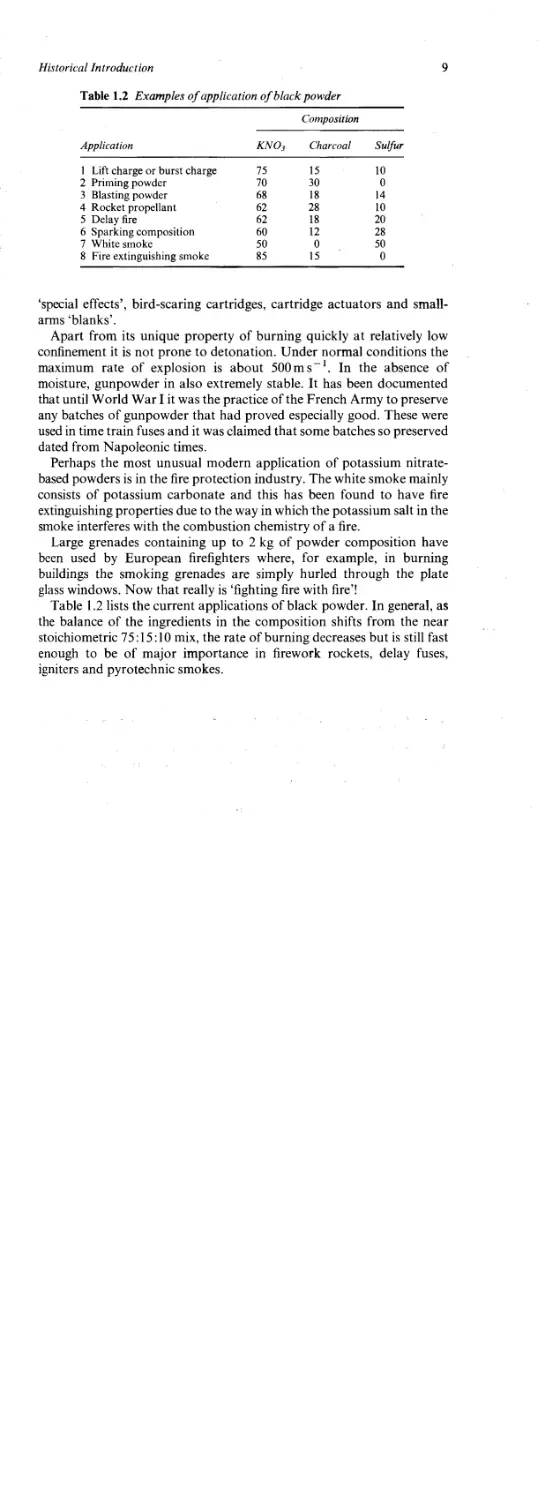
Application	KNO3	Charcoal	Sulfur
1 Lift charge or burst charge	75	15	10
2 Priming powder	70	30	0
3 Blasting powder	68	18	14
4 Rocket propellant	62	28	10
5 Delay fire	62	18	20
6 Sparking composition	60	12	28
7 White smoke	50	0	50
8 Fire extinguishing smoke	85	15	0
‘special effects’, bird-scaring cartridges, cartridge actuators and small-
arms ‘blanks’.
Apart from its unique property of burning quickly at relatively low
confinement it is not prone to detonation. Under normal conditions the
maximum rate of explosion is about 500 m s~*. In the absence of
moisture, gunpowder in also extremely stable. It has been documented
that until World War I it was the practice of the French Army to preserve
any batches of gunpowder that had proved especially good. These were
used in time train fuses and it was claimed that some batches so preserved
dated from Napoleonic times.
Perhaps the most unusual modern application of potassium nitrate-
based powders is in the fire protection industry. The white smoke mainly
consists of potassium carbonate and this has been found to have fire
extinguishing properties due to the way in which the potassium salt in the
smoke interferes with the combustion chemistry of a fire.
Large grenades containing up to 2 kg of powder composition have
been used by European firefighters where, for example, in burning
buildings the smoking grenades are simply hurled through the plate
glass windows. Now that really is ‘fighting fire with fire’!
Table 1.2 lists the current applications of black powder. In general, as
the balance of the ingredients in the composition shifts from the near
stoichiometric 75:15:10 mix, the rate of burning decreases but is still fast
enough to be of major importance in firework rockets, delay fuses,
igniters and pyrotechnic smokes.
Chapter 2
The Characteristics of Black Powder
For about 500 years black powder enjoyed dominance as a propellant,
explosive and igniter, and as the major firework ingredient its use
remains unsurpassed. The prime reason for the longevity of black
powder is its ‘quickness’, even at relatively low pressures, and this is
brought about by manufacturing techniques (as described earlier) and
the chemical reactivity of the constituents.
For example, the KNO3 crystals undergo a sharp solid-solid (rhombic
to trigonal) transition at 130 °C which has the effect of ‘loosening’ the
solid structure, making the substance more reactive and easier to ignite.
This well known transition is referred to as the ‘nitrate spin’ where the
anion has been likened to a three-legged stool, spinning on its vertical
axis. The oxygen ions in the nitrate cluster are indistinguishable from
each other and this makes rotation easier.
Besides acting as a fuel, the finely-divided charcoal has a very high
surface area which means that the substance can absorb appreciable
quantities of sulfur dioxide (SO2) produced during combustion
whilst allowing the remaining sulfur to perform more effectively as a
fuel.
Sulfur exhibits pseudo-plastic behaviour, especially under pressure,
with the result that the compaction of gunpowder during manufacture
produces considerable plastic flow forming a conglomerate of intercon-
necting passageways to the extent that the internal free volume can fall to
a few percent. It is this reduced porosity that gives black powder its
unique burning properties and makes the material perform almost as a
compound rather than as a composite mixture.
INFLUENCE OF PELLET DENSITY ON BURNING TIME
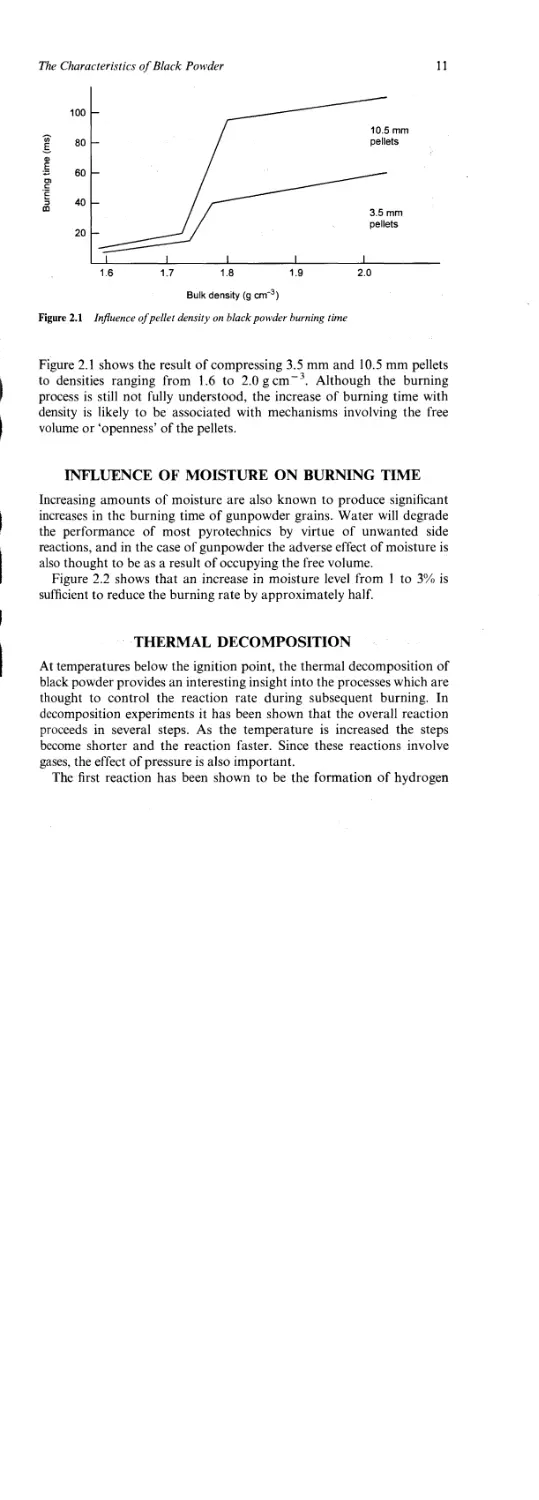
The plastic flow of sulfur is thought to be responsible for the increase in
the burning time that is experienced with black powders of various pellet
sizes as the pellets (or grains) are compressed to higher bulk densities.
10
The Characteristics of Black Powder
11
Figure 2.1 Influence of pellet density on black powder burning time
Figure 2.1 shows the result of compressing 3.5 mm and 10.5 mm pellets
to densities ranging from 1.6 to 2.0 gem-3. Although the burning
process is still not fully understood, the increase of burning time with
density is likely to be associated with mechanisms involving the free
volume or ‘openness’ of the pellets.
INFLUENCE OF MOISTURE ON BURNING TIME
Increasing amounts of moisture are also known to produce significant
increases in the burning time of gunpowder grains. Water will degrade
the performance of most pyrotechnics by virtue of unwanted side
reactions, and in the case of gunpowder the adverse effect of moisture is
also thought to be as a result of occupying the free volume.
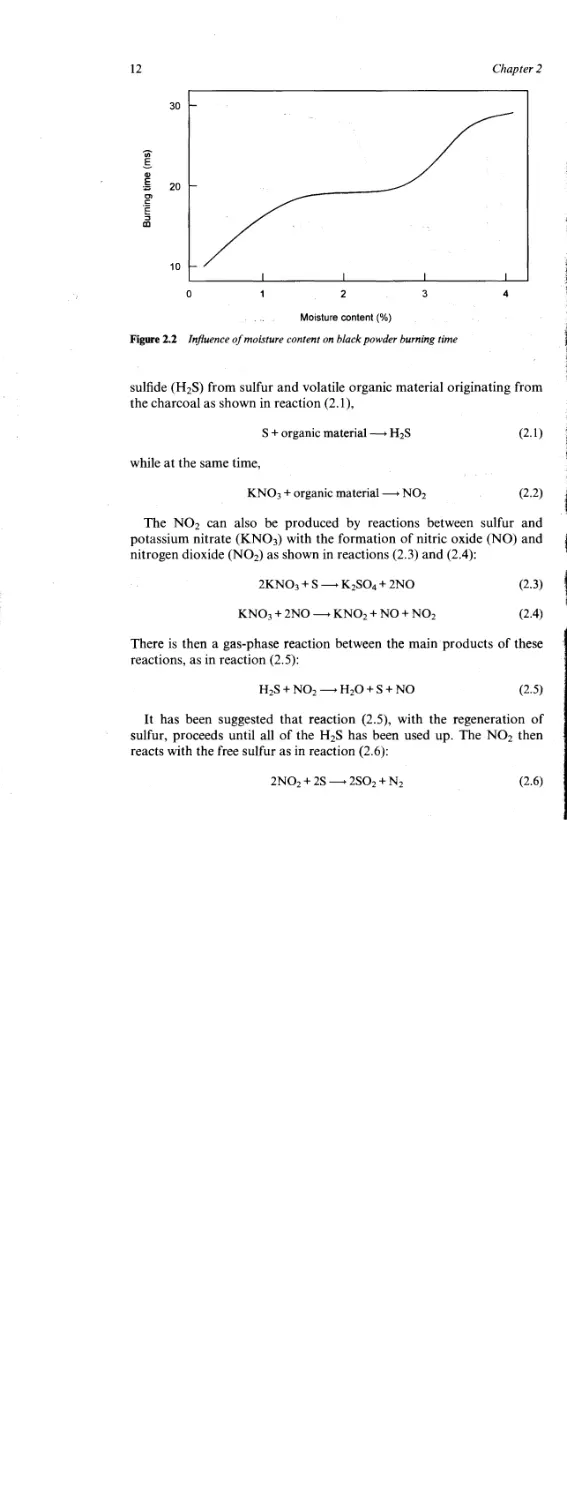
Figure 2.2 shows that an increase in moisture level from 1 to 3% is
sufficient to reduce the burning rate by approximately half.
THERMAL DECOMPOSITION
At temperatures below the ignition point, the thermal decomposition of
black powder provides an interesting insight into the processes which are
thought to control the reaction rate during subsequent burning. In
decomposition experiments it has been shown that the overall reaction
proceeds in several steps. As the temperature is increased the steps
become shorter and the reaction faster. Since these reactions involve
gases, the effect of pressure is also important.
The first reaction has been shown to be the formation of hydrogen
12
Chapter 2
Moisture content (%)
Figure 2.2 Influence of moisture content on black powder burning time
sulfide (H2S) from sulfur and volatile organic material originating from
the charcoal as shown in reaction (2.1),
S + organic material —» H2S	(2.1)
while at the same time,
KNO3 + organic material —► NO2	(2.2)
The NO2 can also be produced by reactions between sulfur and
potassium nitrate (KNO3) with the formation of nitric oxide (NO) and
nitrogen dioxide (NO2) as shown in reactions (2.3) and (2.4):
2KNO3 + S —> K2SO4 + 2NO	(2.3)
KNO3 + 2NO—► KNO2 + NO + NO2	(2.4)
There is then a gas-phase reaction between the main products of these
reactions, as in reaction (2.5):
H2S + NO2—>H2O + S + NO	(2.5)
It has been suggested that reaction (2.5), with the regeneration of
sulfur, proceeds until all of the H2S has been used up. The NO2 then
reacts with the free sulfur as in reaction (2.6):
2NO2 + 2S—>2SO2 + N2
(2.6)
The Characteristics of Black Powder
13
The SO2 produced in this way then immediately reacts with the KNO3 as
shown in reaction (2.7):
2KNO3 + SO2—>K2SO4 + 2NO2	(2.7)
The NO2 is not liberated at this stage but continues the chain. Reactions
(2.5) and (2.6) are endothermic (absorb heat) but reaction (2.7) is
strongly exothermic and produces the heat necessary to promote further
decomposition and leads to burning.
When burning is established, an overall (but over-simplified) equation
can be written as shown in reaction (2.8):
4KNO3(s) + 7C(s) + S(s) —►
3CO2(g) + 3CO(g) + 2N2(g) + K2CO3(s) + K2S(s) (2.8)
where (s) = solid and (g) = gas phase.
At this stage, the spread of combustion from grain to grain is by a hot
spray of molten potassium salts.
The important point to note here is that nearly all of the pre-ignition
steps, including two endothermic reactions, take place in the vapour
phase. Thus, if ignition is to occur at low pressures, sufficient heat energy
must be available for a sufficient time period:
(1)	to volatilise the initial reactants;
(2)	to build up a local concentration of sufficient density to react;
(3)	to supply the heat needed to take the reactions to the point where
they become exothermic.
THERMAL IGNITION OF BLACK POWDER
It will be appreciated from the previous paragraphs that the ignition of
explosives such as black powder is not an instantaneous process.
Classically, as the temperature of the black powder is raised, slow
decomposition sets in according to the process:
Black powder -—> gaseous products + solid products + heat
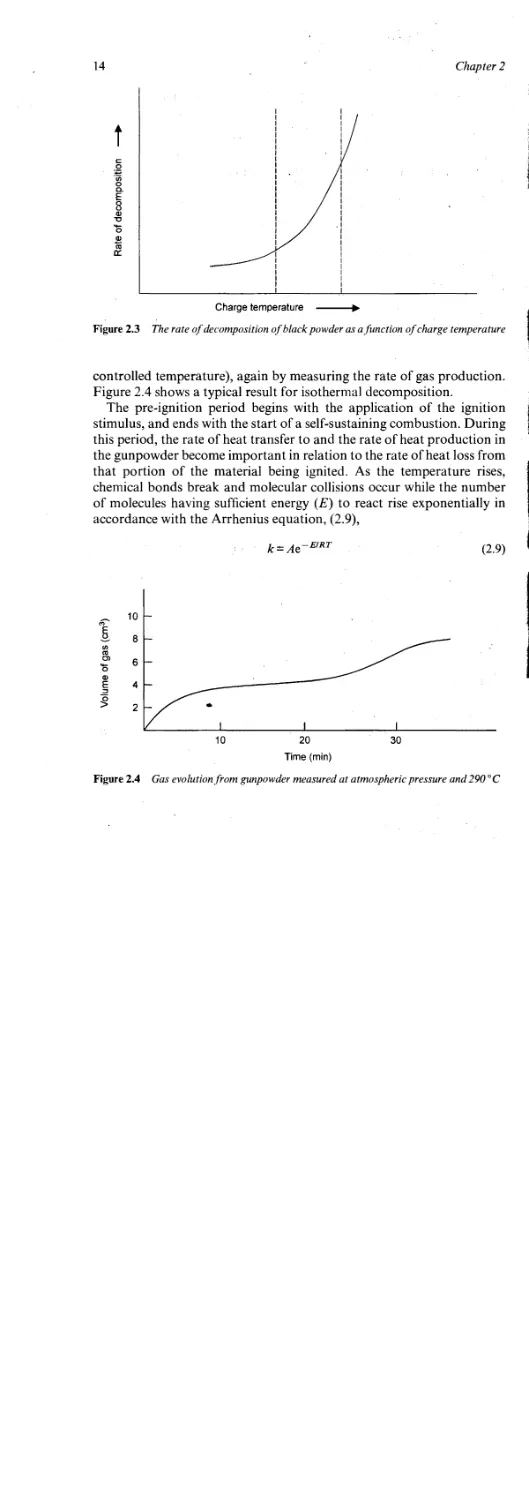
The rate of decomposition can be followed (for example) by measuring
the volume of gas produced as a function of charge temperature as
shown in Figure 2.3.
The dashed lines in Figure 2.3 represent the ignition temperature range
for black powder which, depending on the conditions of the experiment,
typically falls between about 280 and 400 °C.
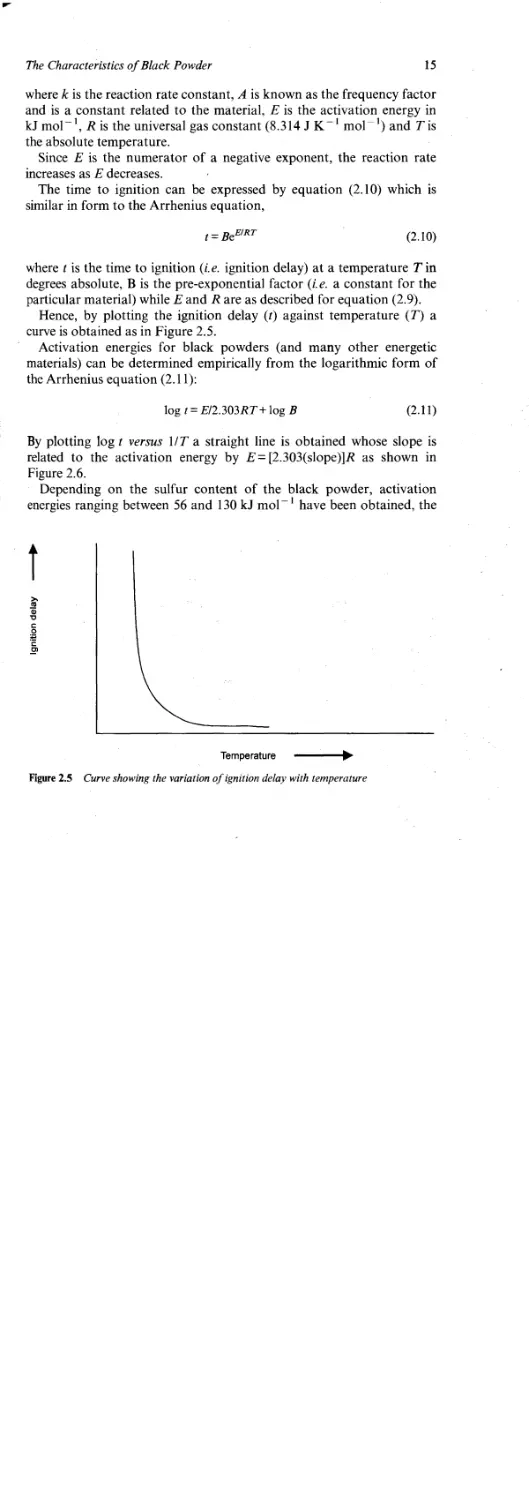
Alternatively, the decomposition can be followed isothermally (at a
14
Chapter 2
Figure 2.3 The rate of decomposition of black powder as a function of charge temperature
controlled temperature), again by measuring the rate of gas production.
Figure 2.4 shows a typical result for isothermal decomposition.
The pre-ignition period begins with the application of the ignition
stimulus, and ends with the start of a self-sustaining combustion. During
this period, the rate of heat transfer to and the rate of heat production in
the gunpowder become important in relation to the rate of heat loss from
that portion of the material being ignited. As the temperature rises,
chemical bonds break and molecular collisions occur while the number
of molecules having sufficient energy (E) to react rise exponentially in
accordance with the Arrhenius equation, (2.9),
k = Ae~E,RT	(2.9)
Figure 2.4 Gas evolution from gunpowder measured at atmospheric pressure and 290 °C
The Characteristics of Black Powder
where к is the reaction rate constant, A is known as the frequency factor
and is a constant related to the material, E is the activation energy in
kJ mol-1, R is the universal gas constant (8.314 J K-1 mol1) and Tis
the absolute temperature.
Since E is the numerator of a negative exponent, the reaction rate
increases as E decreases.
The time to ignition can be expressed by equation (2.10) which is
similar in form to the Arrhenius equation,
t = SeF/*r
(2.Ю)
where t is the time to ignition (i.e. ignition delay) at a temperature T in
degrees absolute, В is the pre-exponential factor (i.e. a constant for the
particular material) while E and R are as described for equation (2.9).
Hence, by plotting the ignition delay (/) against temperature (T) a
curve is obtained as in Figure 2.5.
Activation energies for black powders (and many other energetic
materials) can be determined empirically from the logarithmic form of
the Arrhenius equation (2.11):
log z = Е/2.303ЛТ+log В
(2.П)
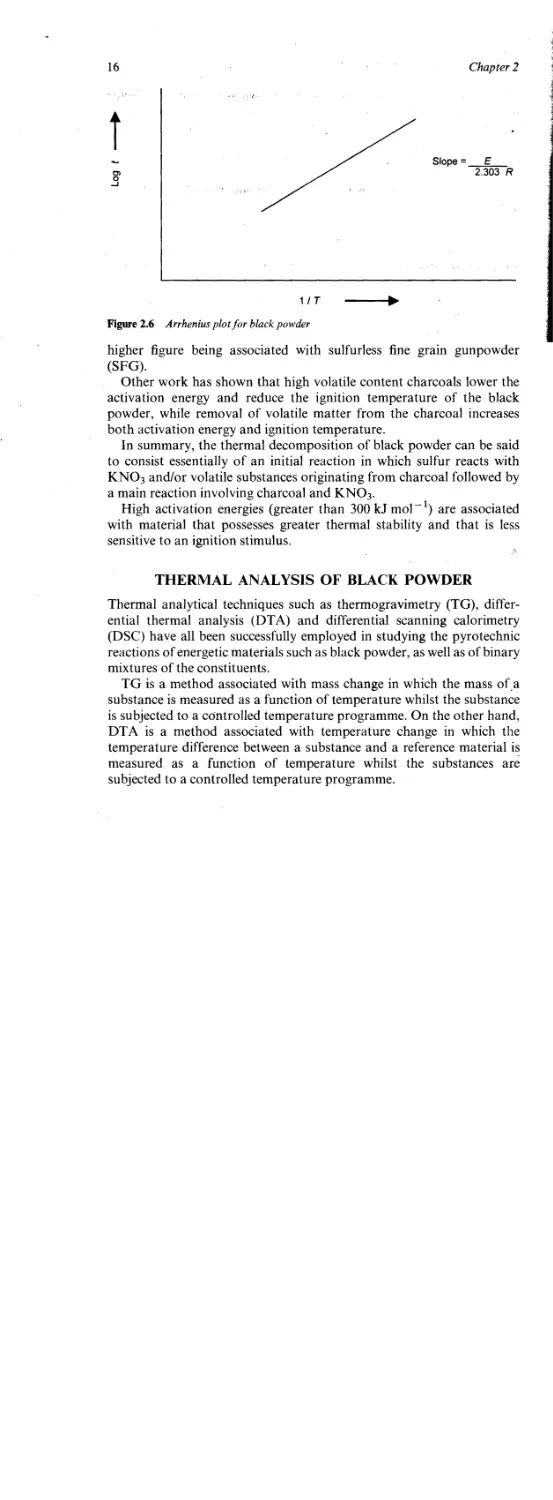
By plotting log t versus 1/T a straight line is obtained whose slope is
related to the activation energy by E - [2.303(slope)]J? as shown in
Figure 2.6.
Depending on the sulfur content of the black powder, activation
energies ranging between 56 and 130 kJ mol-1 have been obtained, the
8
Temperature
Figure 2.5 Curve showing the variation of ignition delay with temperature
16
Chapter 2
Figure 2.6 Arrhenius plot for black powder
higher figure being associated with sulfurless fine grain gunpowder
(SFG).
Other work has shown that high volatile content charcoals lower the
activation energy and reduce the ignition temperature of the black
powder, while removal of volatile matter from the charcoal increases
both activation energy and ignition temperature.
In summary, the thermal decomposition of black powder can be said
to consist essentially of an initial reaction in which sulfur reacts with
KNO3 and/or volatile substances originating from charcoal followed by
a main reaction involving charcoal and KNO3.
High activation energies (greater than 300 kJ mol-1) are associated
with material that possesses greater thermal stability and that is less
sensitive to an ignition stimulus.
THERMAL ANALYSIS OF BLACK POWDER
Thermal analytical techniques such as thermogravimetry (TG), differ-
ential thermal analysis (DTA) and differential scanning calorimetry
(DSC) have all been successfully employed in studying the pyrotechnic
reactions of energetic materials such as black powder, as well as of binary
mixtures of the constituents.
TG is a method associated with mass change in which the mass of a
substance is measured as a function of temperature whilst the substance
is subjected to a controlled temperature programme. On the other hand,
DTA is a method associated with temperature change in which the
temperature difference between a substance and a reference material is
measured as a function of temperature whilst the substances are
subjected to a controlled temperature programme.
The Characteristics of Black Powder	17
Multiple techniques are also possible such as TG-DTA whereby the
mass loss of a sample and the DTA curve may be obtained simultaneously.
DSC is a method associated with enthalpy (heat content) change in
which the difference in energy inputs into a substance and a reference
material are subjected to a controlled temperature programme. By
convention, the enthalpy change is regarded as negative when a reaction
produces heat.
Analysis by TG
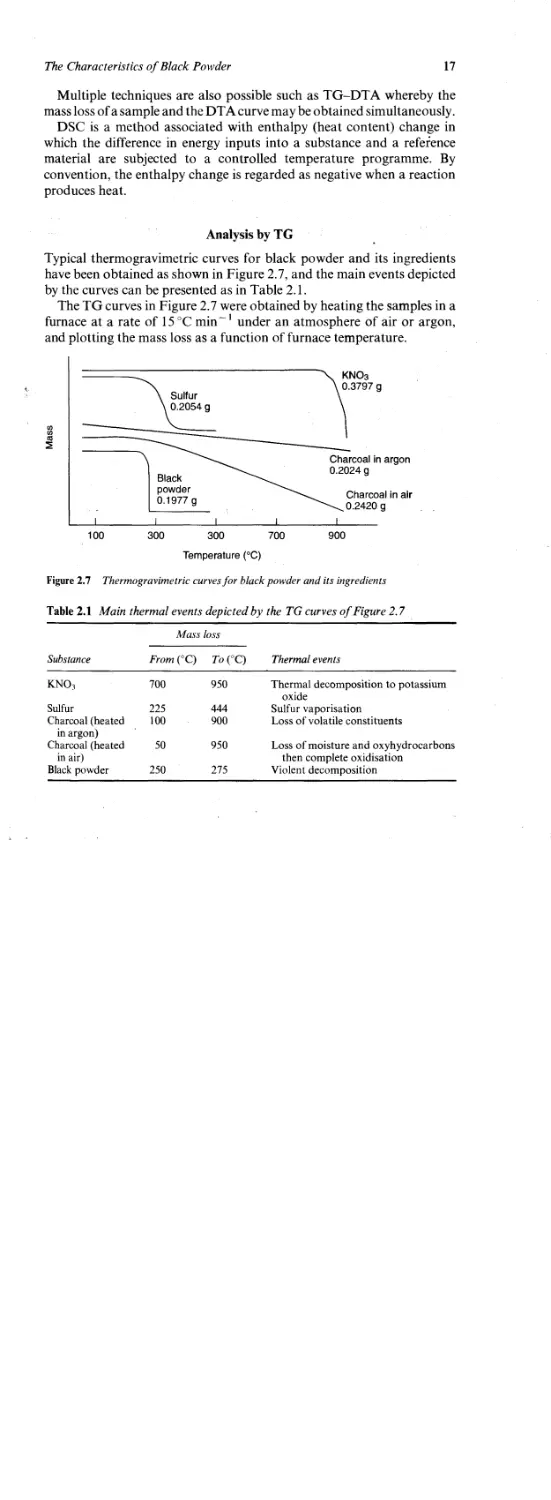
Typical thermogravimetric curves for black powder and its ingredients
have been obtained as shown in Figure 2.7, and the main events depicted
by the curves can be presented as in Table 2.1.
The TG curves in Figure 2.7 were obtained by heating the samples in a
furnace at a rate of 15 °C min -1 under an atmosphere of air or argon,
and plotting the mass loss as a function of furnace temperature.
Figure 2.7 Thermogravimetric curves for black powder and its ingredients
Table 2.1 Main thermal events depicted by the TG curves of Figure 2.7
Mass loss
Substance	From (°C)	To (°C)	Thermal events
KNO3	700	950	Thermal decomposition to potassium oxide
Sulfur	225	444	Sulfur vaporisation
Charcoal (heated in argon)	100	900	Loss of volatile constituents
Charcoal (heated in air)	50	950	Loss of moisture and oxyhydrocarbons then complete oxidisation
Black powder	250	275	Violent decomposition
18
Chapter 2
Analysis by DTA
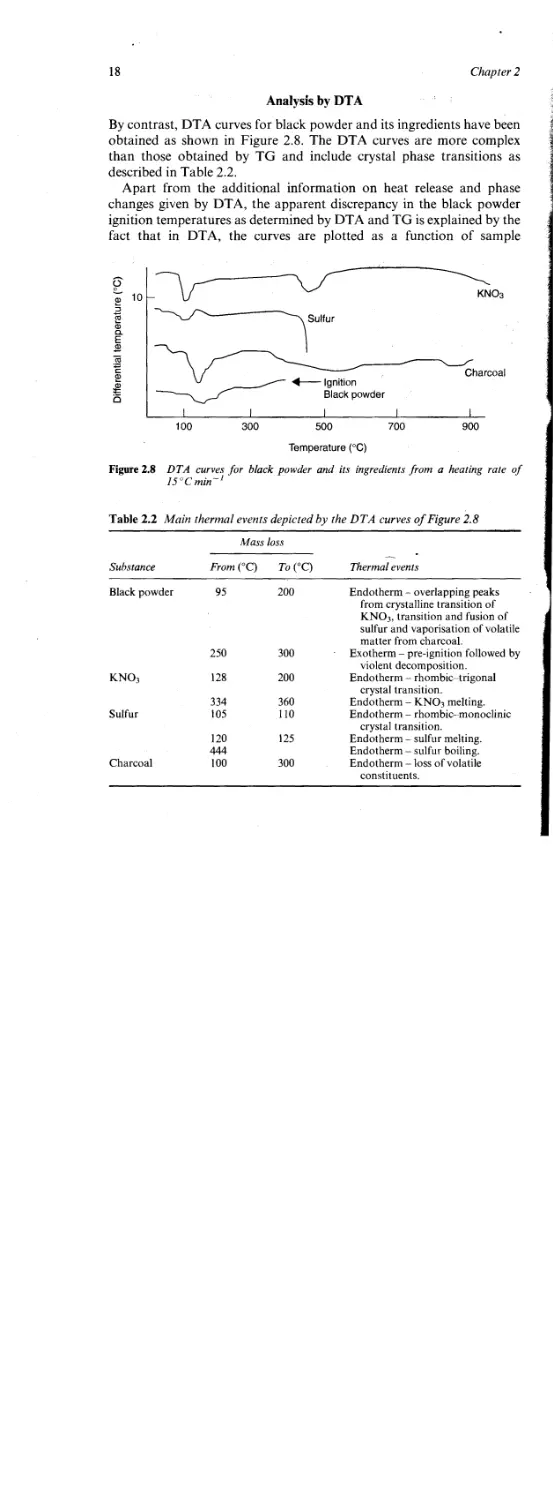
By contrast, DTA curves for black powder and its ingredients have been
obtained as shown in Figure 2.8. The DTA curves are more complex
than those obtained by TG and include crystal phase transitions as
described in Table 2.2.
Apart from the additional information on heat release and phase
changes given by DTA, the apparent discrepancy in the black powder
ignition temperatures as determined by DTA and TG is explained by the
fact that in DTA, the curves are plotted as a function of sample
Figure 2.8 DTA curves for black powder and its ingredients from a heating rate of
15°Cmin~1
Table 2.2 Main thermal events depicted by the DTA curves of Figure 2.8
Substance	Mass loss		Thermal events
	From (°C)	To (°C)
Black powder	95	200	Endotherm - overlapping peaks from crystalline transition of KNO3, transition and fusion of sulfur and vaporisation of volatile matter from charcoal.
	250	300	Exotherm - pre-ignition followed by violent decomposition.
KNO3	128	200	Endotherm - rhombic-trigonal crystal transition.
	334	360	Endotherm - KNO3 melting.
Sulfur	105	110	Endotherm - rhombic- monoclinic crystal transition.
	120 444	125	Endotherm - sulfur melting. Endotherm - sulfur boiling.
Charcoal	100	300	Endotherm - loss of volatile constituents.
The Characteristics of Black Powder	19
temperature, while with TG the curves are plotted as a function of the
furnace temperature. If the sample in the TG thermobalance undergoes
an exothermic reaction, its temperature will increase at a faster rate than
that of the furnace temperature, while during an endothermic reaction
the sample temperature will lag behind that of the furnace.
Analysis by DSC
DSC curves are represented in much the same form as DTA curves
except that the integral of (the area beneath) the resulting peak is
calculated by computer and is equivalent to the internal heat energy
(enthalpy) change. In fact, the instrument has two separate control
loops - one for average temperature control and the other for differential
temperature control. The DSC response is based on the amount of power
needed to correct any difference in temperature between the reference
and the sample.
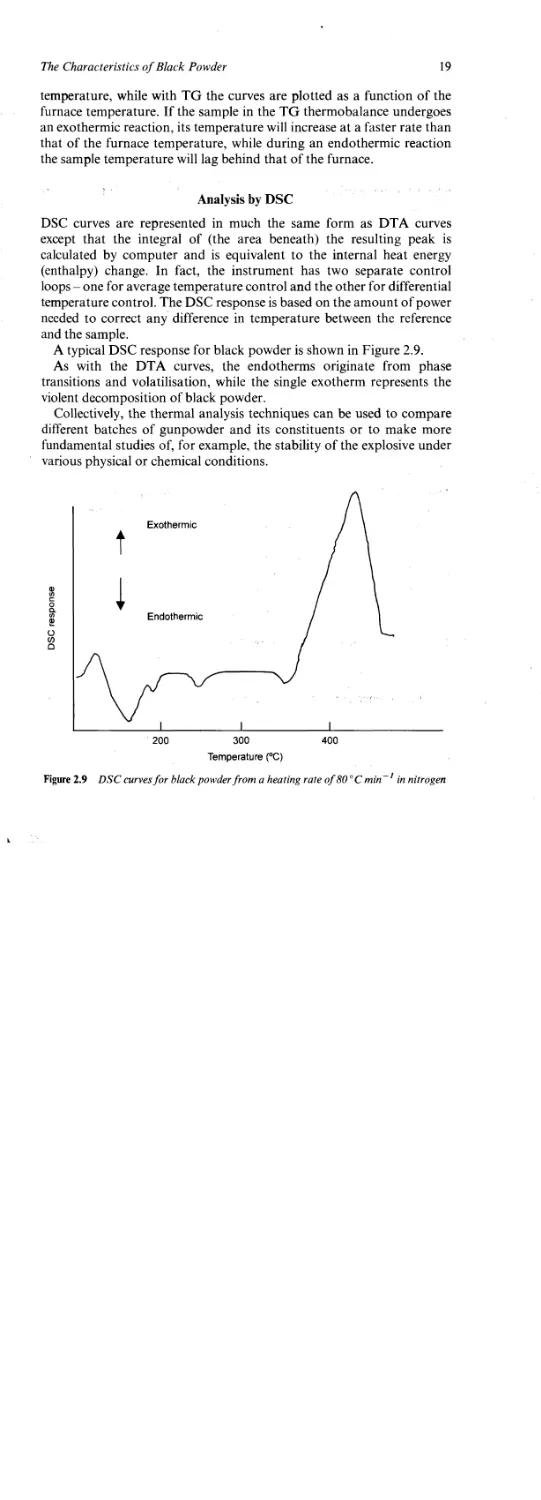
A typical DSC response for black powder is shown in Figure 2.9.
As with the DTA curves, the endotherms originate from phase
transitions and volatilisation, while the single exotherm represents the
violent decomposition of black powder.
Collectively, the thermal analysis techniques can be used to compare
different batches of gunpowder and its constituents or to make more
fundamental studies of, for example, the stability of the explosive under
various physical or chemical conditions.
Figure 2.9 DSC curves for black powder from a heating rate of 80 °C min 1 in nitrogen
20
Chapter 2
As well as calculation of the temperatures and heat releases of the
relevant exotherms, DSC data can be fitted to a differential equation
(2.12) of the form,
g = fc(l-/)"	(2.12)
where /is the fractional degree of conversion of the sample to products
(i.e. /= 0 at the start and 1.0 at the end of the exotherm), t is the time in
seconds, the exponent и is a constant and к is the reaction rate constant
(in units of s-1). The rate constant varies during the course of the
exotherm because of its strong dependence on temperature as shown
earlier by the Arrhenius equation (2.9).
Such kinetic information can be used to estimate the thermal runaway
times for the exotherm. This is the time taken for the explosive (under
adiabatic conditions and considering a particular exotherm) to react at
various initial temperatures.
The analysis of the kinetics of reacting solids is an area fraught with
problems. This is because chemical kinetic theory strictly applies only to
reactions of gases and liquids, and therefore absolute values of kinetic
parameters derived from DSC must be treated with caution. However, it
is quite reasonable to use the data in a comparative manner where this is
derived from similar systems studied under the same conditions.
STOICHIOMETRY
The thermal analysis of black powders used for different purposes and
containing differing proportions of ingredients can give an indication of
the system stoichiometry by virtue of the rate and magnitude of
measured exothermic events.
For example, the stoichiometry of a typical black powder containing
KNO3 (77%), charcoal (17%) and sulfur (6%) can be represented by the
simplified equation (2.8), seen earlier as:
4KNO3 + 7C + S — 3CO2 + 3CO + 2N2 + K2CO3 + K2S (2.8)
This ignores the water gas reaction (2.13)
C + H2O->CO + H2	(2.13)
and the presence of trace species such as water and minor solid products.
VOLUME OF EVOLVED GASES
From equation (2.8), the gaseous reaction products are seen to be 3CO2,
3CO and 2N2. Therefore, the reaction produces 8 moles of product gases
The Characteristics of Black Powder
21
from 4 moles of KNO3 (404 g) plus 7 moles of charcoal (84 g) plus
1 mole of sulfur (32 g) which is equivalent to a total of 520 g of black
powder.
To calculate the number of moles of gas produced per gram of black
powder burned,
2
— = 0.015 mol g”1
and the volume of gas produced at standard temperature and pressure
(STP) per gram of black powder burned is given by the Ideal Gas Law,
equation (2.14).
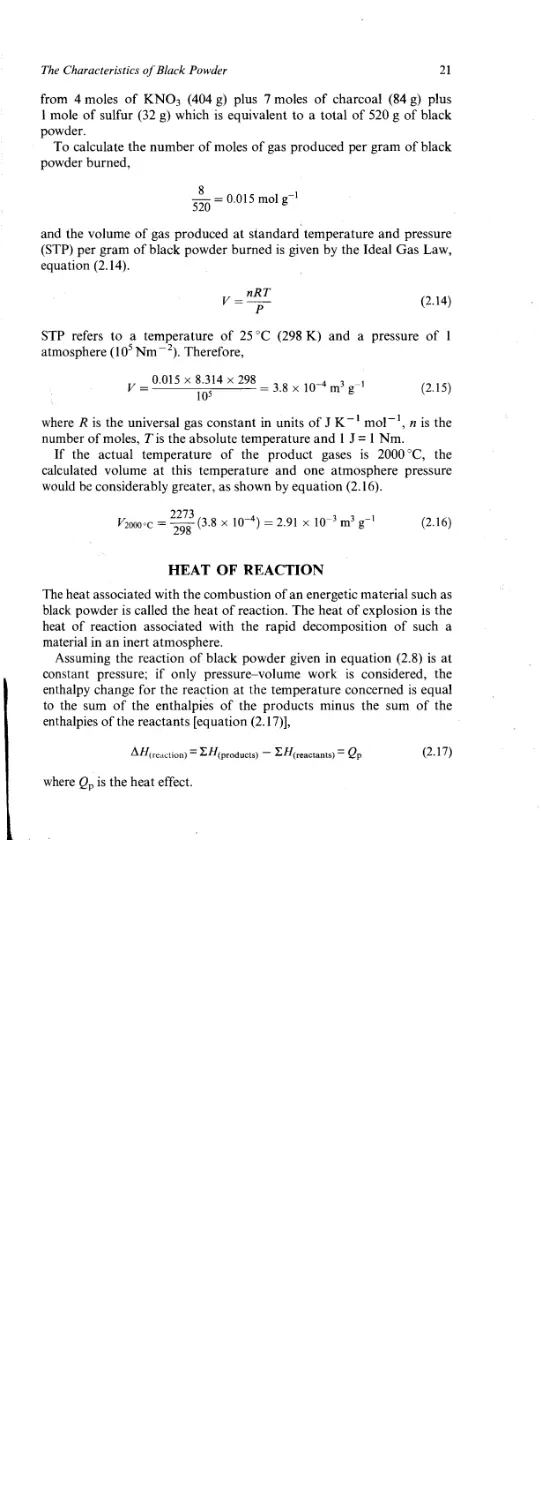
v = n-^-
P
(2-14)
STP refers to a temperature of 25 °C (298 K) and a pressure of 1
atmosphere (105Nm-2). Therefore,
0.015 x 8.314 x 298
105
= 3.8 x 10“4 m3 g"1
(2.15)
where R is the universal gas constant in units of J K-1 mol-1, n is the
number of moles, T is the absolute temperature and 1 J = 1 Nm.
If the actual temperature of the product gases is 2000 °C, the
calculated volume at this temperature and one atmosphere pressure
would be considerably greater, as shown by equation (2.16).
Игооо -с = -^-(3.8 x IO’4) = 2.91 x 10’3 m3 g-1
(2.16)
HEAT OF REACTION
The heat associated with the combustion of an energetic material such as
black powder is called the heat of reaction. The heat of explosion is the
heat of reaction associated with the rapid decomposition of such a
material in an inert atmosphere.
Assuming the reaction of black powder given in equation (2.8) is at
constant pressure; if only pressure-volume work is considered, the
enthalpy change for the reaction at the temperature concerned is equal
to the sum of the enthalpies of the products minus the sum of the
enthalpies of the reactants [equation (2.17)],
reaction) — ^7f(pr(xjucts)	S//(reactants) ~ Qp	(2-17)
where OD is the heat effect.
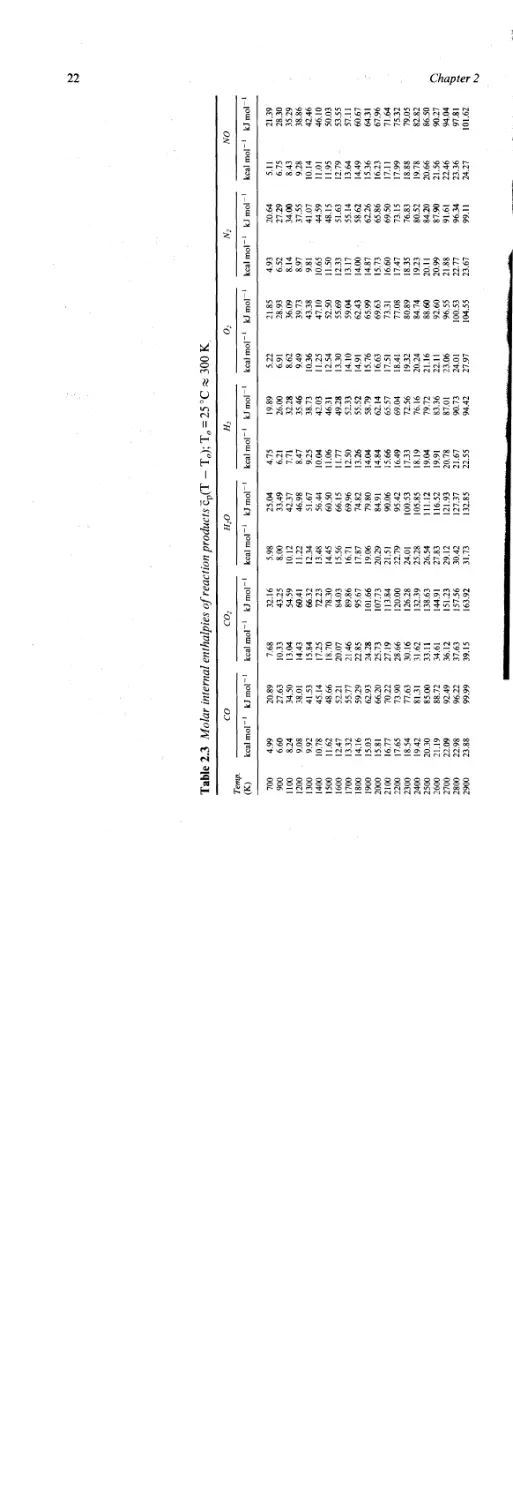
Table 2.3 Molar internal enthalpies of reaction products cp(T — TJ; To = 25 °C % 300 К
co	co2	h2o	h2	o2	n2	no
Temp. (K)	kcal mol 1	kJ mol 1	kcal mol 1	kJ mol 1	kcal mol 1	kJ mol 1	kcal mol 1	kJ mol 1	kcal mol 1	kJ mol 1	kcal mol 1	kJ mol 1	kcal mol 1	kJ mol
700	4.99	20.89	7.68	32.16	5.98	25.04	4.75	19.89	5.22	21.85	4.93	20.64	5.11	21.39
900	6.60	27.63	10.33	43.25	8.00	33.49	6.21	26.00	6.91	28.93	6.52	27.29	6.75	28.30
1100	8.24	34.50	13.04	54.59	10.12	42.37	7.71	32.28	8.62	36.09	8.14	34.00	8.43	35.29
1200 .	9.08	38.01	14.43	60.41	11.22	46.98	8.47	35.46	9.49	39.73	8.97	37.55	9.28	38.86
1300	9.92	41.53	15.84	66.32	12.34	51.67	9.25	38.73	10.36	43.38	9.81	41.07	10.14	42.46
1400	10.78	45.14	17.25	72.23	13.48	56.44	10.04	42.03	11.25	47.10	10.65	44.59	11.01	46.10
1500	11.62	48.66	18.70	78.30	14.45	60.50	11.06	46.31	12.54	52.50	11.50	48.15	11.95	50.03
1600	12.47	52.21	20.07	84.03	15.56	66.15	11.77	49.28	13.30	55.69	12.33	51.63	12.79 -	53.55
1700	13.32	55.77	21.46	89.86	16.71	69.96	12.50	52.33	14.10	59.04	13.17	55.14	13.64	57.11
1800	14.16	59.29	22.85	95.67	17.87	74.82	13.26	55.52	14.91	62.43	14.00	58.62	14.49	60.67
1900	15.03	62.93	24.28	101.66	19.06	79.80	14.04	58.79	15.76	65.99	14.87	62.26	15.36	64.31
2000	15.81	66.20	25.73	107.73	20.29	84.91	14.84	62.14	16.63	69.63	15.73	65.86	16.23	67.96
2100	16.77	70.22	27.19	113.84	21.51	90.06	15.66	65.57	17.51	73.31	16.60	69.50	17.11	71.64
2200	17.65	73.90	28.66	120.00	22.79	95.42	16.49	69.04	18.41	77.08	17.47	73.15	17.99	75.32
2300	18.54	77.63	30.16	126.28	24.01	100.53	17.33	72.56	19.32	80.89	18.35	76.83	18.88	79.05
2400	19.42	81.31	31.62	132.39	25.28	105.85	18.19	76.16	20.24	84.74	19.23	80.52	19.78	82.82
2500	20.30	85.00	33.11	138.63	26.54	111.12	19.04	79.72	21.16	88.60	20.11	84.20	20.66	86.50
2600	21.19	88.72	34.61	144.91	27.83	116.52	19.91	83.36	22.11	92.60	20.99	87.90	21.56	90.27
2700	22.09	92.49	36.12	151.23	29.12	121.93	20.78	87.01	23.06	96.55	21.88	91.61	22.46	94.04
2800	22.98	96.22	37.63	157.56	30.42	127.37	21.67	90.73	24.01	100.53	22.77	96.34	23.36	97.81
2900	23.88	99.99	39.15	163.92	31.73	132.85	22.55	94.42	27.97	104.55	23.67	99.11	24.27	101.62
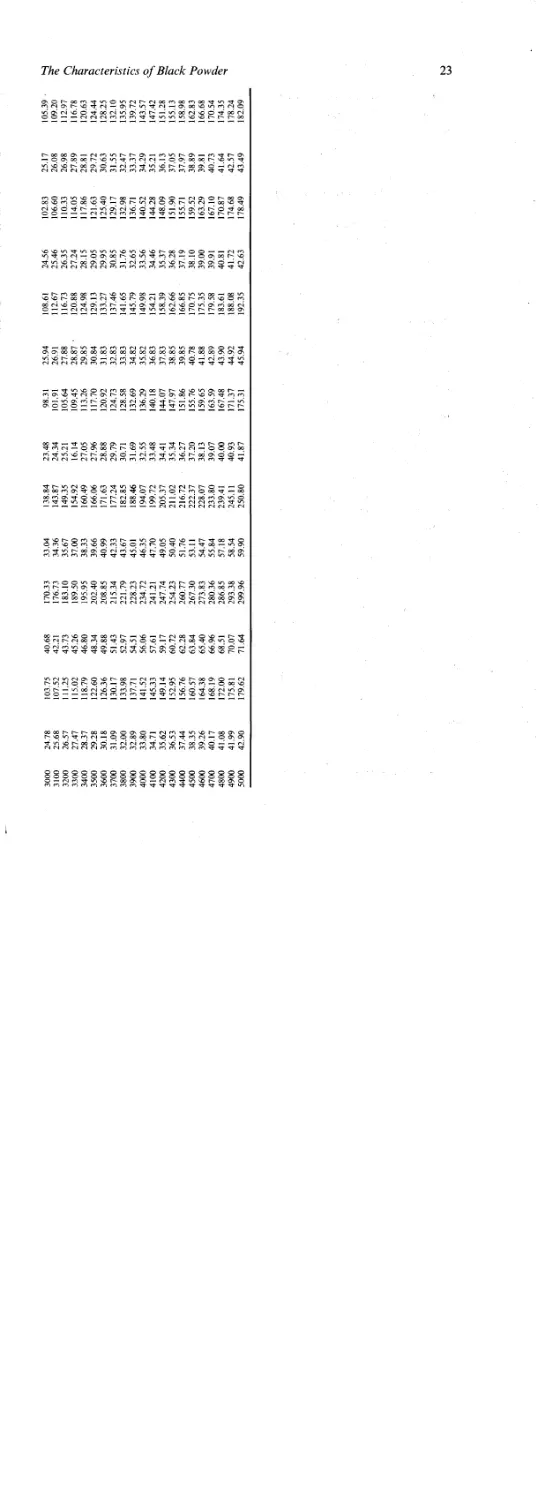
Chapter 2

3000	24.78	103.75	40.68	170.33	33.04	138.84	23.48	98.31	25.94	108.61	24.56	102.83	25.17	105.39
3100	25.68	107.52	42.21	176.73	34.36	143.87	24.34	101.91	26.91	112.67	25.46	106.60	26.08	109.20
3200	26.57	111.25	43.73	183.10	35.67	149.35	25.21	105.64	27.88	116.73	26.35	110.33	26.98	112.97
3300	27.47	115.02	45.26	189.50	37.00	154.92	16.14	109.45	28.87 •	120.88	27.24	114.05	27.89	116.78
3400	28.37	118.79	46.80	195.95	38.33	160.49	27.05	113.26	29.85	124.98	28.15	117.86	28.81	120.63
3500	29.28	122.60	48.34	202.40	39.66	166.06	27.96	117.70	30.84	129.13	29.05	121.63	29.72	124.44
3600	30.18	126.36	49.88	208.85	40.99	171.63	28.88	120.92	31.83	133.27	29.95	125.40	30.63	128.25
3700	31.09	130.17	51.43	215.34	42.33	177.24	29.79	124.73	32.83	137.46	30.85	129.17	31.55	132.10
3800	32.00	133.98	52.97	221.79	43.67	182.85	30.71	128.58	33.83	141.65	31.76	132.98	32.47	135.95
3900	32.89	137.71	54.51	228.23	45.01	188.46	31.69	132.69	34.82	145.79	32.65	136.71	33.37	139.72
4000	33.80	141.52	56.06	234.72	46.35	194.07	32.55	136.29	35.82	149.98	33.56	140.52	34.29	143.57
4100	34.71	145.33	57.61	241.21	47.70	199.72	33.48	140.18	36.83	154.21	34.46	144.28	35.21	147.42
4200	35.62	149.14	59.17	247.74	49.05	205.37	34.41	144.07	37.83	158.39	35.37	148.09	36.13	151.28
4300	36.53	152.95	60.72	254.23	50.40	211.02	35.34	147.97	38.85	162.66	36.28	151.90	37.05	155.13
4400	37.44	156.76	62.28	260.77	51.76	216.72	36.27	151.86	39.85	166.85	37.19	155.71	37.97	158,98
4500	38.35	160.57	63.84	267.30	53.11	222.37	37.20	155.76	40.78	170.75	38.10	159.52	38.89	162.83
4600	39.26	164.38	65.40	273.83	54.47	228.07	38.13	159.65	41.88	175.35	39.00	163.29	39.81	166.68
4700	40.17	168.19	66.96	280.36	55.84	233.80	39.07	163.59	42.89	179.58	39.91	167.10	40.73	170.54
4800	41.08	172.00	68.51	286.85	57.18	239.41	40.00	167.48	43.90	183.61	40.81	170.87	41.64	174.35
4900	41.99	175.81	70.07	293.38	58.54	245.11	40.93	171.37	44.92	188.08	41.72	174.68	42.57	178.24
5000	42.90	179.62	71.64	299.96	59.90	250.80	41.87	175.31	45.94	192.35	42.63	178.49	43.49	182.09
The Characteristics of Black Powder
24
Chapter 2
If the reaction is a standard state reaction where the starting materials
in their standard states react to give products in their standard states,
and the standard heats of formation (AJ/fj) of the elements are assumed
to be zero at any given temperature, then the standard heat of reaction,
A//T (reaction), is expressed as in equation (2.18):
АЯ r (reaction) = AH^fproducts) — AT/fjfreactants) (2.18)
For example, the enthalpy of formation of CO2 from combustion of the
black powder constituent, charcoal, is given by reaction (2.19):
C(s) + O2(g) —> CO2(g)
АЯ^298=-392.8 kJ mol-1	(2.19)
Normally, the standard state is the most stable state at one atmos-
phere pressure and at the given temperature. Most tabular data, as
used for the calculation of reaction temperatures, are given at 0°C or
298 K. The overall calculation for the heat of reaction of black
powder at different temperatures is simplified by using tabulated data
of the enthalpy function, H r — for the reaction products, since
no enthalpy measurements can be made in the sense of an absolute
quantity.
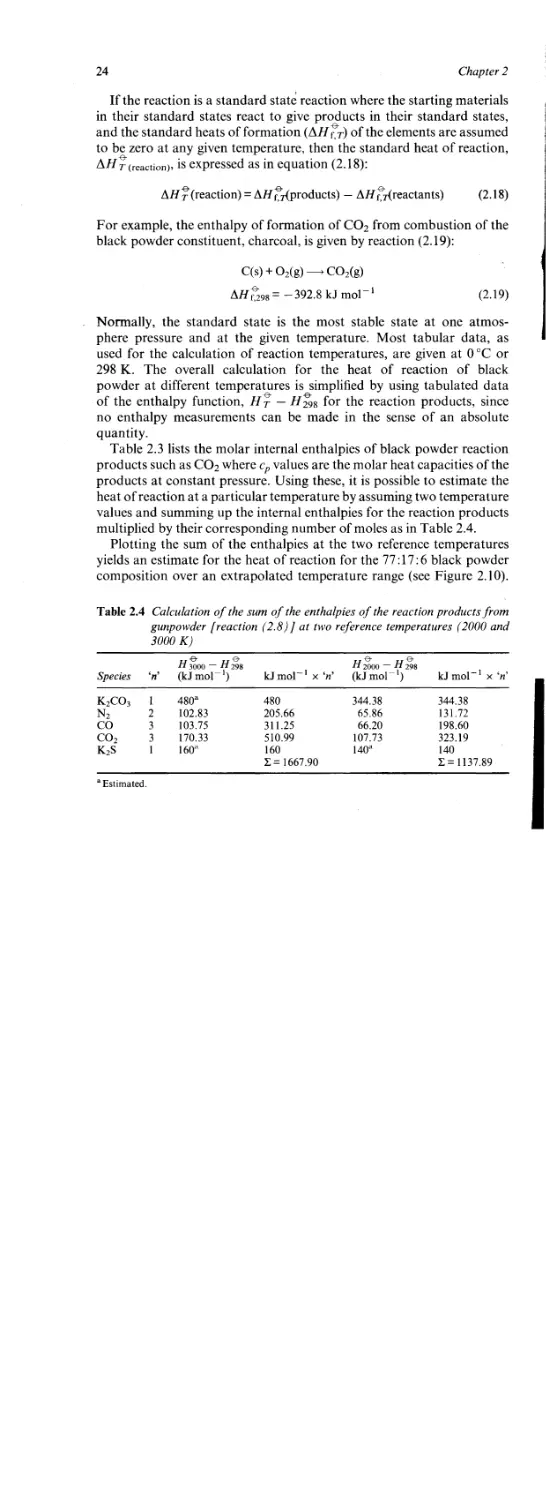
Table 2.3 lists the molar internal enthalpies of black powder reaction
products such as CO2 where cp values are the molar heat capacities of the
products at constant pressure. Using these, it is possible to estimate the
heat of reaction at a particular temperature by assuming two temperature
values and summing up the internal enthalpies for the reaction products
multiplied by their corresponding number of moles as in Table 2.4.
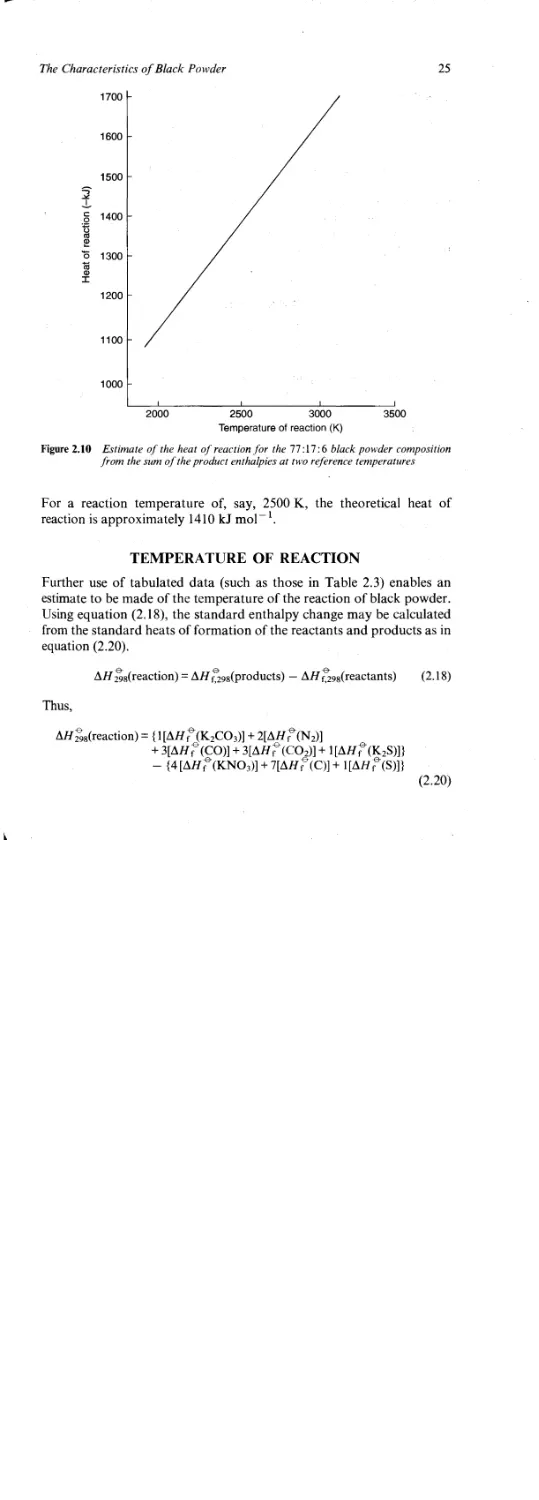
Plotting the sum of the enthalpies at the two reference temperatures
yields an estimate for the heat of reaction for the 77:17:6 black powder
composition over an extrapolated temperature range (see Figure 2.10).
Table 2.4 Calculation of the sum of the enthalpies of the reaction products from
gunpowder [reaction (2.8)] at two reference temperatures (2000 and
3000 K)
Species	‘л’	n 3000 — H 298 (kJ mol-1)	kJ mol 1	x ‘л’	H 2000 ~ H 298 (kJ mol-1)	kJ mol 1	[ x ‘л’
K2co3	1	480a	480		344.38	344.38
N2	2	102.83	205.66		65.86	131.72
co	3	103.75	311.25		66.20	198.60
co2	3	170.33	510.99		107.73	323.19
K2S	1	160a	160 1= 1667.90		140a	140 1 = 1137.89
Estimated.
The Characteristics of Black Powder
25
Figure 2.10 Estimate of the heat of reaction for the 77:17:6 black powder composition
from the sum of the product enthalpies at two reference temperatures
For a reaction temperature of, say, 2500 K, the theoretical heat of
reaction is approximately 1410 kJ mol-1.
TEMPERATURE OF REACTION
Further use of tabulated data (such as those in Table 2.3) enables an
estimate to be made of the temperature of the reaction of black powder.
Using equation (2.18), the standard enthalpy change may be calculated
from the standard heats of formation of the reactants and products as in
equation (2.20).
ДЯ 29«(reaction) = Д/f ^«(products) — SH f,29e(reactants)	(2.18)
Thus,
AHg8(reaction) = {1[ДЯГ(К2СО3)] + 2[ДЯГ0Ч2)]
+ 3[ДЯГ(СО)] + 3[ДЯГ(СО2)] + 1[ДЯ^(К28)]}
- {4 [ДЯГ(КЬЮ3)] + 7[ДЯГ(С)] + 1[ДЯГ(8)]}
(2.20)
к
Chapter 2
26
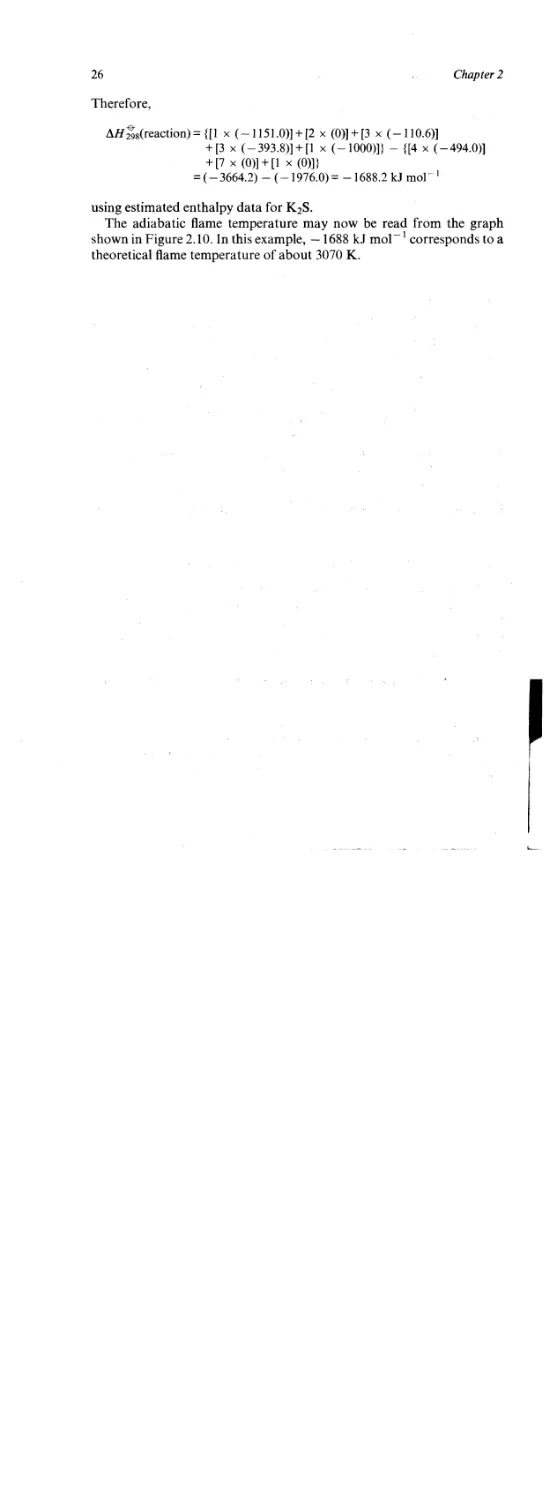
Therefore,
AH ^(reaction) = {[1 x (-1151.0)] + [2 x (0)] + [3 x (-110.6)]
+ [3 x (—393.8)] + [1 x (-1000)]} - {[4 x (-494.0)]
+ [7 x (0)] + [l x (0)]}
= (-3664.2) - (-1976.0)= -1688.2 kJ mol"1
using estimated enthalpy data for K2S.
The adiabatic flame temperature may now be read from the graph
shown in Figure 2.10. In this example, —1688 kJ mol-1 corresponds to a
theoretical flame temperature of about 3070 K.
Chapter 3
Rockets
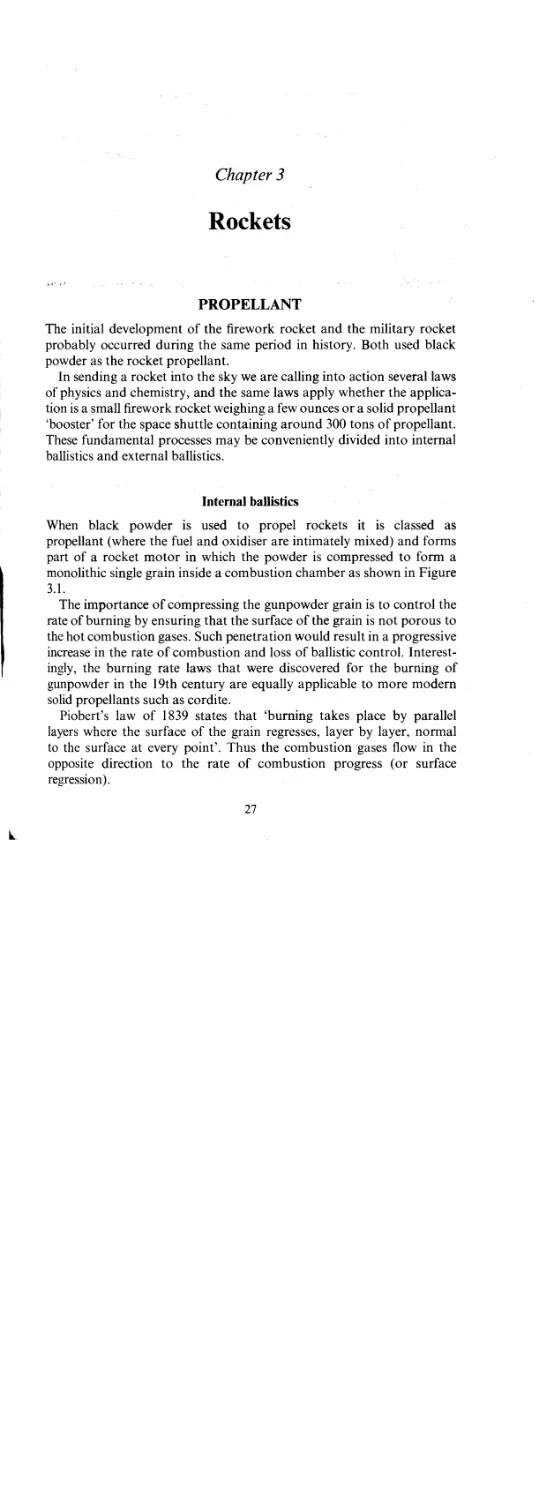
PROPELLANT
The initial development of the firework rocket and the military rocket
probably occurred during the same period in history. Both used black
powder as the rocket propellant.
In sending a rocket into the sky we are calling into action several laws
of physics and chemistry, and the same laws apply whether the applica-
tion is a small firework rocket weighing a few ounces or a solid propellant
‘booster’ for the space shuttle containing around 300 tons of propellant.
These fundamental processes may be conveniently divided into internal
ballistics and external ballistics.
Internal ballistics
When black powder is used to propel rockets it is classed as
propellant (where the fuel and oxidiser are intimately mixed) and forms
part of a rocket motor in which the powder is compressed to form a
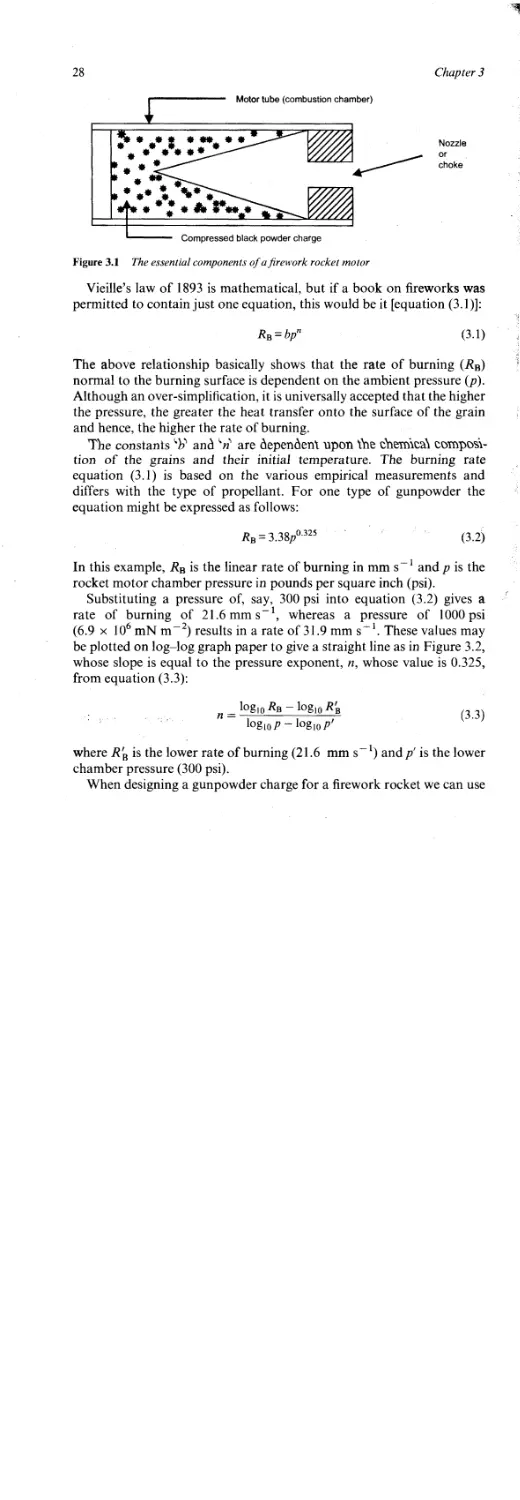
monolithic single grain inside a combustion chamber as shown in Figure
3.1.
The importance of compressing the gunpowder grain is to control the
rate of burning by ensuring that the surface of the grain is not porous to
the hot combustion gases. Such penetration would result in a progressive
increase in the rate of combustion and loss of ballistic control. Interest-
ingly, the burning rate laws that were discovered for the burning of
gunpowder in the 19th century are equally applicable to more modern
solid propellants such as cordite.
Piobert’s law of 1839 states that ‘burning takes place by parallel
layers where the surface of the grain regresses, layer by layer, normal
to the surface at every point’. Thus the combustion gases flow in the
opposite direction to the rate of combustion progress (or surface
regression).
27
28
Chapter 3
Vieille’s law of 1893 is mathematical, but if a book on fireworks was
permitted to contain just one equation, this would be it [equation (3.1)]:
R* = bpn	(3.1)
The above relationship basically shows that the rate of burning (J?B)
normal to the burning surface is dependent on the ambient pressure (p).
Although an over-simplification, it is universally accepted that the higher
the pressure, the greater the heat transfer onto the surface of the grain
and hence, the higher the rate of burning.
The constants 4? and ''n are dependent upon the chermcaX composi-
tion of the grains and their initial temperature. The burning rate
equation (3.1) is based on the various empirical measurements and
differs with the type of propellant. For one type of gunpowder the
equation might be expressed as follows:
Лв = 3.38/ 325	( 3.2)
In this example, is the linear rate of burning in mm s -1 and p is the
rocket motor chamber pressure in pounds per square inch (psi).
Substituting a pressure of, say, 300 psi into equation (3.2) gives a
rate of burning of 21.6 mm s-1, whereas a pressure of 1000 psi
(6.9 x 10⁶ mN m-2) results in a rate of 31.9 mm s-1. These values may
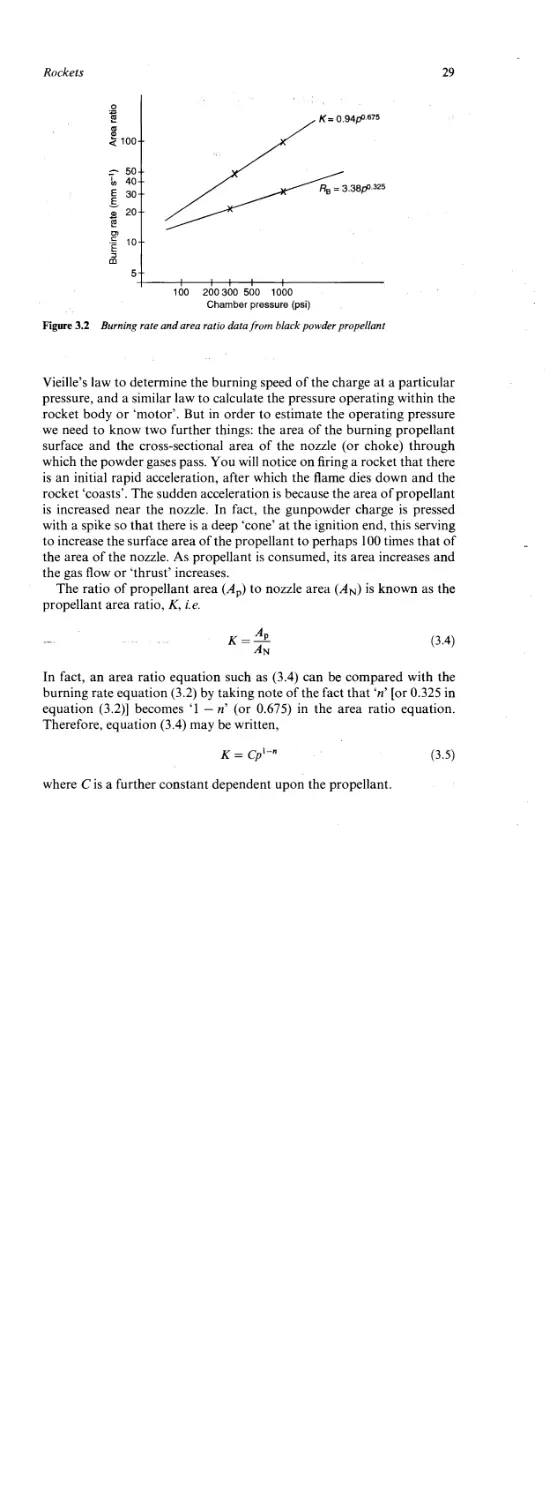
be plotted on log-log graph paper to give a straight line as in Figure 3.2,
whose slope is equal to the pressure exponent, n, whose value is 0.325,
from equation (3.3):
logio^B-logio^B	-ч
 : :	- -	log10p-log10p'
where 7?B is the lower rate of burning (21.6 mm s- *) and p' is the lower
chamber pressure (300 psi).
When designing a gunpowder charge for a firework rocket we can use
Rockets
29
Figure 3.2 Burning rate and area ratio data from black powder propellant
Vieille’s law to determine the burning speed of the charge at a particular
pressure, and a similar law to calculate the pressure operating within the
rocket body or ‘motor’. But in order to estimate the operating pressure
we need to know two further things: the area of the burning propellant
surface and the cross-sectional area of the nozzle (or choke) through
which the powder gases pass. You will notice on firing a rocket that there
is an initial rapid acceleration, after which the flame dies down and the
rocket ‘coasts’. The sudden acceleration is because the area of propellant
is increased near the nozzle. In fact, the gunpowder charge is pressed
with a spike so that there is a deep ‘cone’ at the ignition end, this serving
to increase the surface area of the propellant to perhaps 100 times that of
the area of the nozzle. As propellant is consumed, its area increases and
the gas flow or ‘thrust’ increases.
The ratio of propellant area (Лр) to nozzle area (?1N) is known as the
propellant area ratio, K, i.e.
........	K = ^-	(3.4)
Ли
In fact, an area ratio equation such as (3.4) can be compared with the
burning rate equation (3.2) by taking note of the fact that ‘n’ [or 0.325 in
equation (3.2)] becomes T — n (or 0.675) in the area ratio equation.
Therefore, equation (3.4) may be written,
К = Cpx~n	(3.5)
where C is a further constant dependent upon the propellant.
30
Chapter 3
For example, if the initial propellant surface area is 100 cm2 and the
nozzle area is 1 cm2, the area ratio is expressed by equation (3.6):
The constant, C, can be found by empirical measurements in much the
same way as the burning rate constants are determined, to give a value of
0.94 in the area ratio equation (3.7):
К = O.94p0,675	(3.7)
The complete pressure-time profile for the firework rocket motor as
depicted in Figure 3.1 can be obtained if we assume that the propellant
surface increases in area during burning inwardly in parallel layers
(according to Piobert’s law).
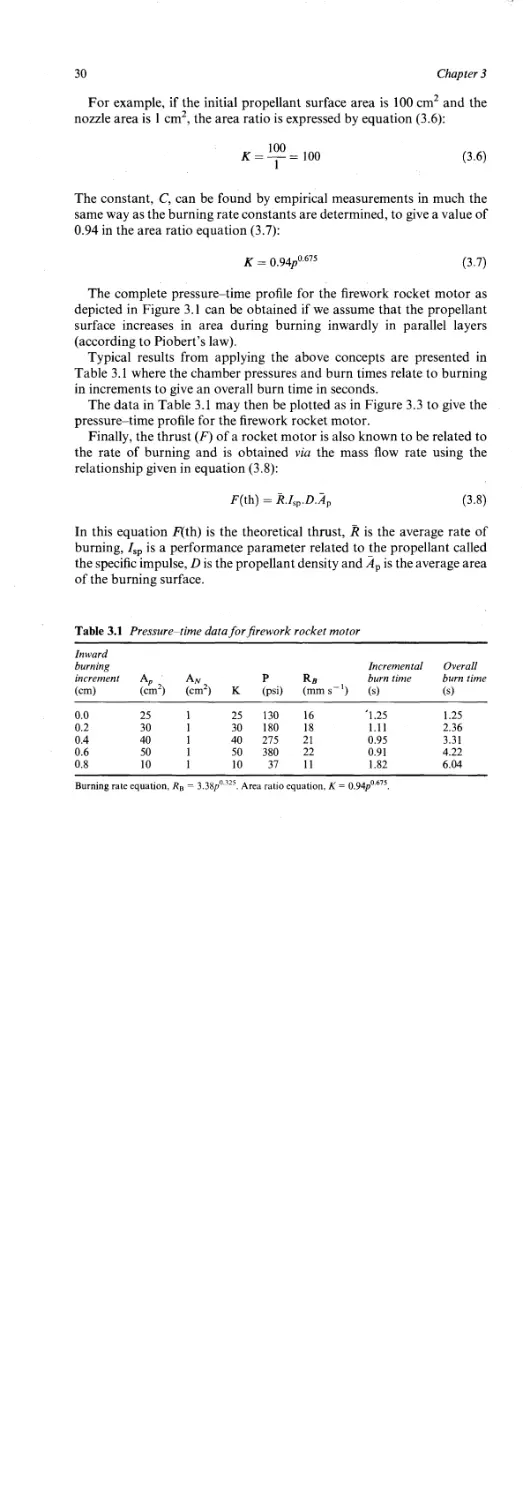
Typical results from applying the above concepts are presented in
Table 3.1 where the chamber pressures and burn times relate to burning
in increments to give an overall burn time in seconds.
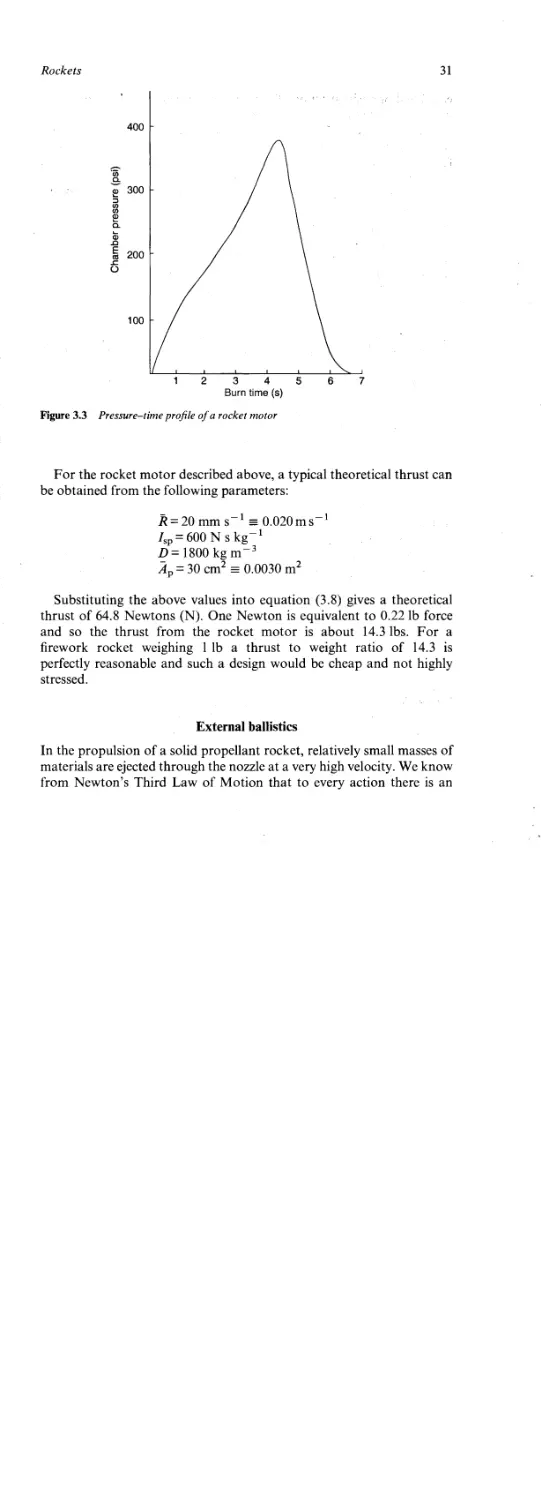
The data in Table 3.1 may then be plotted as in Figure 3.3 to give the
pressure-time profile for the firework rocket motor.
Finally, the thrust (F) of a rocket motor is also known to be related to
the rate of burning and is obtained via the mass flow rate using the
relationship given in equation (3.8):
F(th) = R.Isp.D.Ap	(3.8)
In this equation F(th) is the theoretical thrust, R is the average rate of
burning, /sp is a performance parameter related to the propellant called
the specific impulse, D is the propellant density and Ap is the average area
of the burning surface.
Table 3.1 Pressure time data for firework rocket motor
Inward burning increment (cm)	2 (cm2)	(cm2)	к	p (psi)	Ra 1 (mm s )	Incremental burn time (s)	Overall burn time (s)
0.0	25	1	25	130	16	*1.25	1.25
0.2	30	1	30	180	18	1.11	2.36
0.4	40	1	40	275	21	0.95	3.31
0.6	50	1	50	380	22	0.91	4.22
0.8	10	1	10	37	11	1.82	6.04
Burning rate equation, Лв = 3.38p° 325. Area ratio equation, К = O.94p0,675.
Rockets
31
Burn time (s)
Figure 3.3 Pressure-time profile of a rocket motor
For the rocket motor described above, a typical theoretical thrust can
be obtained from the following parameters:
Я = 20 mm s-1 = 0.020 ms-1
/sp = 600 N s kg-1
D =1800 kg m-3
Ap = 30 cm2 = 0.0030 m2
Substituting the above values into equation (3.8) gives a theoretical
thrust of 64.8 Newtons (N). One Newton is equivalent to 0.22 lb force
and so the thrust from the rocket motor is about 14.3 lbs. For a
firework rocket weighing 1 lb a thrust to weight ratio of 14.3 is
perfectly reasonable and such a design would be cheap and not highly
stressed.
External ballistics
In the propulsion of a solid propellant rocket, relatively small masses of
materials are ejected through the nozzle at a very high velocity. We know
from Newton’s Third Law of Motion that to every action there is an
32
Chapter 3
equal and opposite reaction. The rocket flies because of the momentum
of matter ejected through the nozzle. In essence, the rocket is propelled
by the conversion of the thermal energy of the gunpowder reaction into
the directed, translated energy of the combustion products. The primary
function of the nozzle is to convert the gunpowder heat energy into
thrust with the minimum conversion loss.
In external ballistics there is a range of equations associated with the
flight of the rocket. Each equation contains certain parameters that,
collectively, may be used to predict the flight path. For firework rockets,
the most important factors include the weight of the rocket, the weight of
the propellant, the specific impulse of the propellant and the shape and
size of the rocket in accordance with equation (3.9),
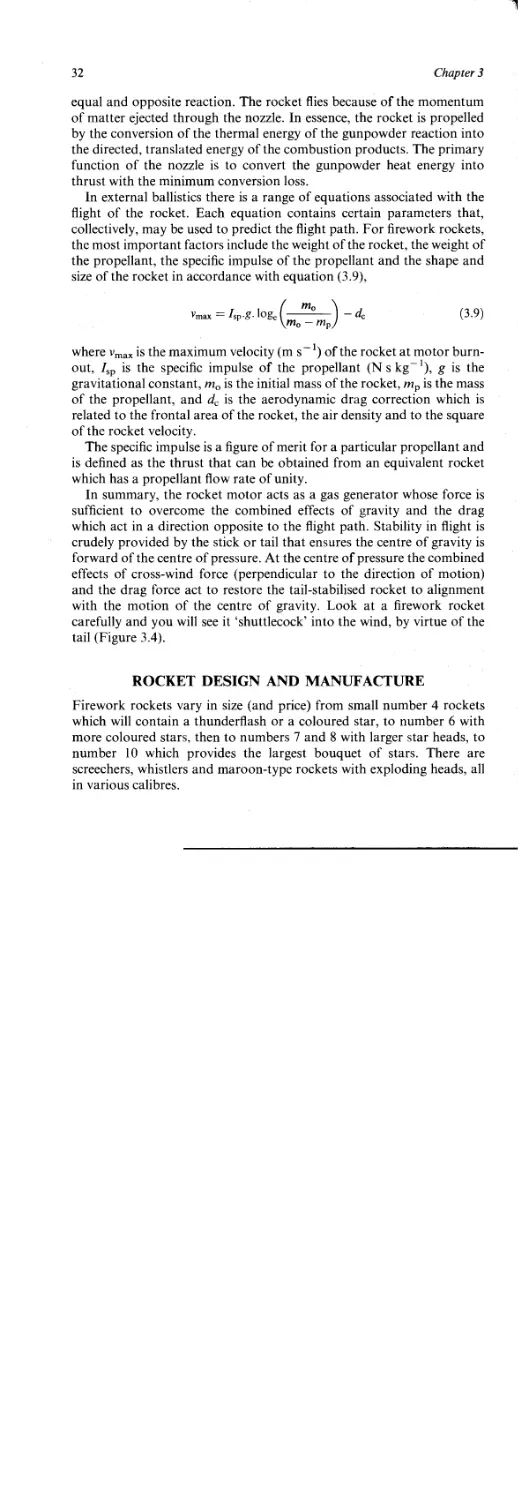
Гщах ~ Др-Я- loge (	)	~	(3-9)
where vmax is the maximum velocity (ms'1) of the rocket at motor burn-
out, Zsp is the specific impulse of the propellant (N s kg-1), g is the
gravitational constant, mo is the initial mass of the rocket, mp is the mass
of the propellant, and dc is the aerodynamic drag correction which is
related to the frontal area of the rocket, the air density and to the square
of the rocket velocity.
The specific impulse is a figure of merit for a particular propellant and
is defined as the thrust that can be obtained from an equivalent rocket
which has a propellant flow rate of unity.
In summary, the rocket motor acts as a gas generator whose force is
sufficient to overcome the combined effects of gravity and the drag
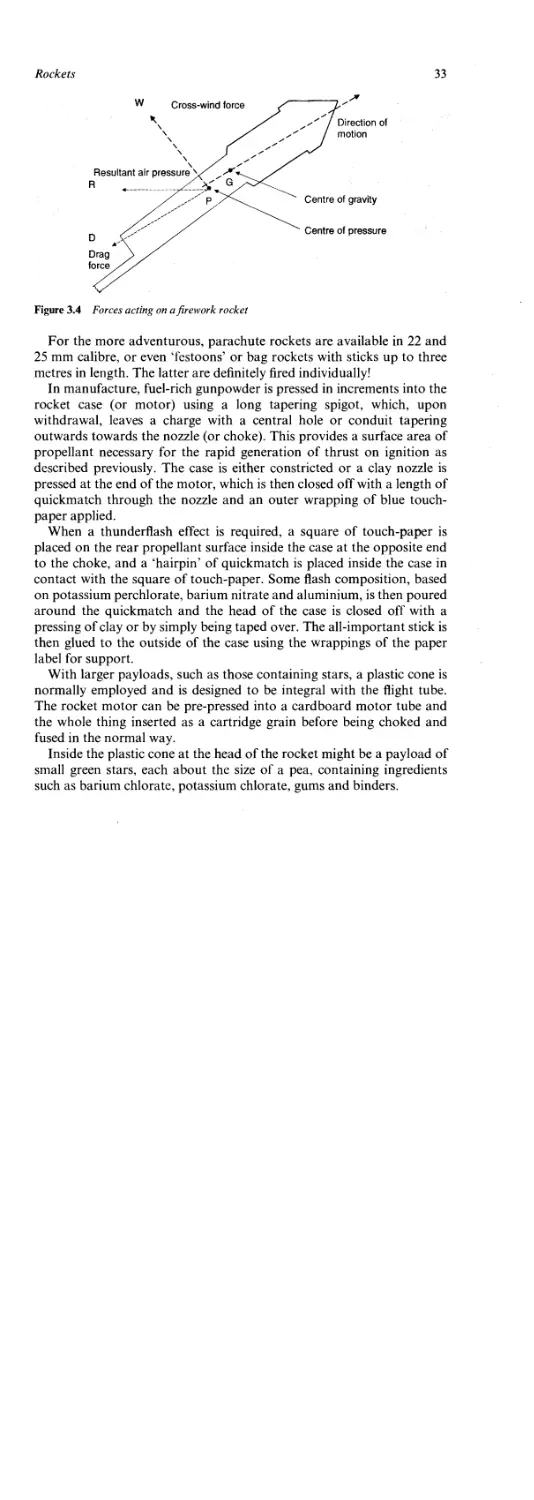
which act in a direction opposite to the flight path. Stability in flight is
crudely provided by the stick or tail that ensures the centre of gravity is
forward of the centre of pressure. At the centre of pressure the combined
effects of cross-wind force (perpendicular to the direction of motion)
and the drag force act to restore the tail-stabilised rocket to alignment
with the motion of the centre of gravity. Look at a firework rocket
carefully and you will see it "shuttlecock’ into the wind, by virtue of the
tail (Figure 3.4).
ROCKET DESIGN AND MANUFACTURE
Firework rockets vary in size (and price) from small number 4 rockets
which will contain a thunderflash or a coloured star, to number 6 with
more coloured stars, then to numbers 7 and 8 with larger star heads, to
number 10 which provides the largest bouquet of stars. There are
screechers, whistlers and maroon-type rockets with exploding heads, all
in various calibres.
Rockets
33
Figure 3.4 Forces acting on a firework rocket
For the more adventurous, parachute rockets are available in 22 and
25 mm calibre, or even ‘festoons’ or bag rockets with sticks up to three
metres in length. The latter are definitely fired individually!
In manufacture, fuel-rich gunpowder is pressed in increments into the
rocket case (or motor) using a long tapering spigot, which, upon
withdrawal, leaves a charge with a central hole or conduit tapering
outwards towards the nozzle (or choke). This provides a surface area of
propellant necessary for the rapid generation of thrust on ignition as
described previously. The case is either constricted or a clay nozzle is
pressed at the end of the motor, which is then closed off with a length of
quickmatch through the nozzle and an outer wrapping of blue touch-
paper applied.
When a thunderflash effect is required, a square of touch-paper is
placed on the rear propellant surface inside the case at the opposite end
to the choke, and a ‘hairpin’ of quickmatch is placed inside the case in
contact with the square of touch-paper. Some flash composition, based
on potassium perchlorate, barium nitrate and aluminium, is then poured
around the quickmatch and the head of the case is closed off with a
pressing of clay or by simply being taped over. The all-important stick is
then glued to the outside of the case using the wrappings of the paper
label for support.
With larger payloads, such as those containing stars, a plastic cone is
normally employed and is designed to be integral with the flight tube.
The rocket motor can be pre-pressed into a cardboard motor tube and
the whole thing inserted as a cartridge grain before being choked and
fused in the normal way.
Inside the plastic cone at the head of the rocket might be a payload of
small green stars, each about the size of a pea, containing ingredients
such as barium chlorate, potassium chlorate, gums and binders.
34
Chapter 3
Plastic nosecone and body
Stars
Ejection charge
Fireboard motor tube
Propellant composition
Weight (%)
Potassium nitrate	61
Sulfur	5
Charcoal 150 mesh	20
Charcoal 40 mesh	14
Clay choke
Quickmatch fuse
Rocket stick 450 mm long
Figure 3.5 Bouquet rocket
A length of match or a pressing of delay fuse connects the rocket
motor with the payload so that when the motor burns-out the fuse is lit
and communicates with an ejection charge of gunpowder which ignites
and ejects the stars.
A schematic diagram of a 35 mm bouquet rocket is presented in Figure
3.5.
Parachute rockets work on much the same principle, except that the
ejection charge pushes out a tube of flare composition, or any other
composition, which is connected to the parachute which itself is folded
beneath the end-cap at the top of the rocket.
RECENT DEVELOPMENTS
Obviously, solid rocket propellant compositions have advanced con-
siderably since the days of gunpowder, and it might be mentioned, in
passing, that even as late as the Second World War, the Allies held the
Rockets
35
deluded belief that the large rockets being developed by the Germans
were based on solid propellant. However, if one calculates the amount of
solid propellant required to lift a payload consisting of one ton of high
explosive plus all of the hardware associated with the rocket, one arrives
at an impossibly high all-up weight. It was therefore (incorrectly) argued
that the V2 must either have a trivial payload or that the range must be
insufficient for the weapon to reach London.
The firework mentality also decreed that even if the range was
achievable, in order for an unguided rocket to follow a rainbow
trajectory across the English Channel and fall, under gravity, onto
London, the launch angle would have to be impossibly precise - about
half a degree from the vertical, in fact.
Both arguments were flawed, of course, and Allied Intelligence later
showed that the 14 ton V2 rocket bomb was in fact powered with liquid
propellant, was guided using gyroscopes, and did indeed carry one ton of
explosive. And on the 3rd September 1944 the first V2 fell on London.
Some ‘firework’!
There is nothing to prevent the firework manufacturers from using
military-type propellants, of course, and this is exactly what the Russians
do when making rockets to reach astonishing heights in firework displays
above the tall buildings in Moscow.
Military propellants are based on relatively powerful oxidisers and
fuels of high calorific value in order to develop an improved thrust or
impulse. Thus the most commonly-used oxidisers are potassium per-
chlorate, ammonium perchlorate or more esoteric compounds such as
Table 3.2 Examples of ingredients used for composite propellants
Oxidiser
Ammonium perchlorate
Ammonium nitrate
Potassium perchlorate
Nitronium perchlorate
Formula
NH4CIO4
КСЮ4
NO2CIO4
Binder
Polysulfide	(C2H4S4)„
Poly(vinyl chloride)	(C2H3C1)„
Polyurethane [O.(CH2)4OOCNH.(CH2)6NHCOO.(CH2)4O]	(C16H30N2O6)„
Curing or bonding agents
T oluene-2,4-diisocyanate
Triethanolamine N(CH2CH2OH)3
Metal fuel
Aluminium
Magnesium
Beryllium
c9h6n2o2
c6h15no3
Al
Mg
Be
36	Chapter 3
hydrazinium nitroformate. Metallic fuels include aluminium, magne-
sium and beryllium, while binders are mainly hydrocarbons such as
polybutadiene, polyisobutylene, polyurethane or poly(vinyl chloride)
(PVC) as presented in Table 3.2.
If smokelessness is required, then a double-base propellant such as
cordite (nitrocellulose/nitroglycerine) can be used. Most of the military
propellants enjoy about three times the specific impulse of gunpowder
and are deliberately formulated to be fuel-rich so that the exhaust tends
to contain carbon monoxide in preference to carbon dioxide, which is a
heavier gas. Lighter gases are preferred because they can be accelerated
to higher velocities through the nozzle and this factor contributes to a
higher value of specific impulse. On the other hand, solid propellants
based on gunpowder produce carbon dioxide as well as large quantities
of smoke, neither of which are conducive to high values of thrust or
impulse.
But who wants to see a supersonic rocket full of smokeless propellant
disappear into the heavens like a flash of light when one can witness the
leisurely ascent of a firework rocket as it climbs leaving a graceful trail of
sparks?
Chapter 4
Mines and Shells
CALIBRES
Without doubt, mines and shells are the most important of the display
fireworks in the operator’s arsenal: shells give the well known spectacular
aerial effects, while mines operate from ground level often as a supple-
ment to the shells.
Although the most common calibres of the mortar tubes associated
with these fireworks are 50, 75 and 100 mm, the size of shells seems to
know no limit - the record at the moment stands at a calibre in excess of
1 metre or 1000 mm. Obviously, where such astonishingly large devices
are concerned, the mortar tubes are no longer made from simple
overlapping spirals of Kraft paper but preferably of stainless steel!
CONSTRUCTION OF SHELLS
The shell itself is a clever arrangement of stars built inside a spherical or
cylindrical cavity, at the centre of which is a bursting charge of
gunpowder or similarly forceful powder. A further quantity of gun-
powder, held in a paper pouch, is located outside the base of the shell,
and this acts as the lifting charge when ignited by a length of piped match
that projects out of the pouch to run from the bottom of the mortar tube,
where the shell lies, to the top of the tube where it can be lit using a fuse
extension. When the match is lit, the gunpowder in the pouch is caused to
explode, thereby driving the shell out of the mortar tube and up into the
sky. Figure 4.1 shows the construction of a typical 75 mm shell.
A length of delay fuse connects to the inside of the shell and this fuse is
lit from the primary explosion. After a delay of several seconds, and
ideally when the shell has reached maximum height, the connecting fuse
delivers its flame to the gunpowder bursting charge, which promptly
explodes, igniting the ball of stars and driving them outwards, with
37
38
Chapter 4
о
•• eo
e e®o
• •°
о о
DO
OO
О О
°0oo0oo„°0%;o
о O O	°
О О °
°о°о00о О
О °
е—е
о и
• о
Piped match
Supporting loop
Laminated paper case
Paper bag for bursting
charge
Star
Fuse priming
Gunpowder
bursting charge
Delay fuse
Gunpowder lifting
charge
Priming
Paper bag for lifting
charge
Figure 4.1 Schematic representation of a 75 mm chrysanthemum shell
approximately equal force, in the form of a rapidly-expanding ball, a
flash or any other desired effect.
The shell case can be made from paper, wood or plastic. For a given
calibre, the cylindrical shell holds more stars and is the more straight-
forward to produce, especially when multiple breaks are required. The
much revered ten-break shell (yes, it does burst ten times in the sky!)
comprises separate compartments, each connected with a delay fuse to
give sequential exploding effects during the flight of the shell. Of course,
multiple bursts can be achieved by using stars that explode during
burning - a sort of star within a star - but that is not to detract from
the skill and ingenuity and time involved in the making of complex
fireworks such as star shells.
Early methods of construction of shells involved the fabrication of
hollow spheres using paper strips pasted together in moulds. However, it
was difficult to obtain an even burst in this way because, depending on
where the joins were located in the shell case, the bursting shell was prone
to form non-symmetrical fragments.
Modern methods of shell construction ensure an even distribution of
stars on bursting by paying particular attention to the bursting charge in
relation to the strength of the shell case. For example, a weak outer case
can be adequately burst by a relatively small gunpowder charge. On the
Mines and Shells
39
other hand, a strongly-made case must be burst by a charge that expands
more slowly. Plastic has replaced paper in the manufacture of many
round shells which, besides being waterproof, offers the advantage of
unit construction whereby the lifting charge may also be contained inside
the plastic case.
The most spectacular effects are achieved using cylinder shells in which
cylindrical ‘parcels’ are filled with stars, whistles or hummers contained
within separate compartments. The difficulty in producing cylinder shells
arises from the many operations during manufacture, which include
forming the cylinder from paper and cardboard discs, loading the stars,
adding lifting charges and fuses, and closing the ends of the cylinder
before wrapping the entire unit with string to provide an even burst
before adding outer layers of Kraft paper to cover the string.
Internal Ballistics
In using gunpowder as a lifting charge for a shell, the propellant is being
required to deliver its gas over a much shorter time interval than that
employed in a rocket. In consequence, the geometrical form of the
propellant is quite different, as is the propellant composition. The internal
ballistics calculations call for the introduction of gun-type parameters
that would be less appropriate in studying rocket motor ballistics. These
include the propellant co-volume (the volume occupied by the combus-
tion products), the geometrical form coefficient (the shape and size of the
propellant grains) and the vivacity (quickness) of the propellant, together
with the cross-sectional area of the mortar tube and the mass of the shell.
Table 4.1 gives examples of the properties of a typical lifting charge
propellant. Note that the composition is no longer fuel-rich, but is
balanced for ‘quickness’. The explosive force,/, is defined as the working
performance per kg, theoretically calculated from the general equation
of state for gases:/= PV= nRT where P is the pressure, Vis the volume,
n is the number of moles of the explosion gases per kg, R is the ideal gas
constant and T is the absolute temperature of the explosion.
Table 4.1 Some gunpowder properties used in ballistics calculations
Composition (%)	KNO3 74.3, charcoal 15,3, sulfur 9.4, moisture 1.0
Grain size (mm)	1.0-1.2
Force, f-nRT, (kg m kg-1)	3837
Vivacity, A (s-1)	4.17
Heat of explosion, Q (kJ)	1550
Explosion temperature, T (K)	2050
Evolved gas volume per kg at STP, V (dm3)	404
Burning rate equation	/?в = 2.5р°-5
40
Chapter 4
Pressure in the Mortar Tube
The maximum pressure generated in the mortar tube has been shown to
be related to the ballistic parameters presented in equation (4.1),
= <41>
where Pm is the maximum pressure generated (kg dm-2), A is the
vivacity or ojiickness of the tjrotjeilant	lY. A. is the loading density of
the propellant (kg dm-3), f is the explosive force of the propellant
(I 1 = 1) a: и : i at t i «	<
(kg m kg j, G is the grain shape function, rj is the propellant co-volume
(dm3) and	is the pressure function for maximum pressure (kg dm-2).
Substituting typical values into equation (4.1) enables an estimate of
the maximum mortar tube pressure to be made [equation (4.2)],
_ 4.17 x 3837	1
— 4.17 x 0.051 X (1/0.104) - 0.55 °’
from which Pm = 1750 kg dm 2, or 17.5 kg cm 2, or about 250 psi.
Burning Time of the Propellant
At a maximum generated pressure of 250 psi, the burning time of the
propellant can be estimated from the linear burning rate, equation (4.3):
7?B - 2.5/5
(4-3)
Thus,
/?в = 2.5 x 2500 5
(4-4)
and therefore
/?в = 39.5 mm s
If the propellant grain size averages 1.1 mm, then the average radius
(or web size) = 0.55 mm. At a rate of burning of 39.5 mm s-1, the
average burning time, TB, will be given by equation (4.5):
m web size 0.55	„
TB = —5--------= tt-z = 0.014 s or 14 ms	(4.5)
Кв зу.з
Therefore, the pressure-time curve for the combustion of the gunpowder
lifting charge will be approximately as illustrated in Figure 4.2.
When ignited, the lifting charge causes the gas pressure behind the
shell to rise and the rate of rise increases rapidly as the burning of the
charge progresses. The maximum rate of rise of pressure is about
Mines and Shells
41
Figure 4.2 Approximate pressure-time curve for combustion of lifting charge within a
mortar tube
30000 psi s-1. About 14 ms after initiation of the charge, the pressure
reaches its maximum value when the rate of increase of pressure due to
the burning of the charge is equal to the rate of pressure reduction due
to the movement of the shell and ‘leakage’ of gases past the shell
providing an increasing volume into which the gases can expand. After
this, the pressure gradually decreases as the shell travels towards the
muzzle of the mortar tube and then falls to zero after the shell leaves
the tube.
Muzzle Velocity of the Shell
A further equation based on gun ballistics has been proposed that allows
an estimation to be made of the muzzle velocity of a shell [equation (4.6)],
F = ^x-(1F)
AG ft
(4-6)
where Vis the estimated muzzle velocity (dm s“ *), о is the cross-sectional
area of the mortar tube (dm2), ц is the assumed mass of the shell (kg),
PF is the velocity function (kg1 s-2) and A and G have the definitions as
listed for equation (4.1).
Substituting appropriate values into equation (4.6) gives the muzzle
velocity of the shell as in equation (4.7):
0.213
1 81
X 00132 X 1 97 = 1270 dm S~]
(4.7)
or
F = 127 ms-1
42
Chapter 4
External Ballistics
The simplest external ballistics calculation is that in which a shell is fired
vertically. This type of calculation has also been extended to include the
case where a ‘dud’ shell falls back to earth.
Equations (4.8)-(4.15) show how the altitude attained and time of flight
can be estimated from basic parameters and Newtonian Laws of Motion.
Altitude Attained
First, the surface area (S) of the shell cross-section is calculated using
equation (4.8),
S = 7Г 4/4
(4-8)
where dB is the diameter of the shell (m). Hence,
S = 3.142(0.136)2/4 = 0.0145 m2.
Secondly, the ballistic parameter, a, is determined from equation (4.9),
a = д/рв/KS
(4-9)
where pB is the mass of the shell (kg) and К is the coefficient of air
resistance (kg s2 m-4). The latter is proportional to the mass of air which
the projectile must displace per unit of time.
Substituting values into equation (4.9) enables the ballistic parameter
to be calculated:
a = ^/1 252/0.031 x 0.0145 = 52.8 m s-1
(4.Ю)
Thirdly, the altitude parameter, x, is calculated using equation (4.11),
x— V[la
(4.И)
where V\ is the muzzle velocity of the shell from equation (4.7) and a is
the ballistic coefficient from equation (4.10). Therefore,
x = 127/52.8 = 2.40
(4-12)
We must now turn to ballistics tables such as Table 4.2 to determine
the ratio of altitude:muzzle velocity squared.
From Table 4.2 it can be seen that a value of x of 2.40 corresponds to a
H/V\ ratio of 0.0169. Knowing the muzzle velocity of the shell
(127 m s“ ’) enables an estimate of the maximum altitude to be made as
in equation (4.13):
H = 0.0169 x F2 = 0.0169 x 1272 = 273 m
(4.13)
Mines and Shells
43
Table 4.2 The ratio of altitude:muzzle velocity
squared for the altitude parameter, x
X	77/Kf(m-1s2)	X	H/V2i (m-1 s2)
0.20	0.0500	2.20	0.0186
0.40	0.0473	2.40	0.0169
0.60	0.0438	2.60	0.0155
0.80	0.0394	2.80	0.0142
1.00	0.0354	3.00	0.0131
1.20	0.0316	3.20	0.0121
1.40	0.0283	3.40	0.0112
1.60	0.0253	3.60	0.0104
1.80	0.0228	3.80	0.0097
Time of Flight
The time of flight (T) of the shell is determined from equation (4.14),
T =
H
arctan
K2
(4-14)
where g is the acceleration due to gravity (dm s 2) and a, Hand V\ are as
defined previously. Hence:
/52 8\
T = I ) arctan 0.0169
\9.80 /
(4-15)
or
T = 5.39 x 0.97 = 5.2 s
Descent of a ‘Dud’ Shell
Approximate estimates for the rate of descent if a shell fails to explode
can be found by extending the data obtained in the previous section, i.e.\
H = 273 m and a = 52.8 ms-1
Three equations (4.16)—(4.18) govern the rate of descent,
-^ = ^|«|2log(l-z2)	(4-16)
— Vi — az	(4-17)
T 2.303	/l-z\	.	. T2= 2g |a|log(^1+J,	l<z<0	(4-18)
44	Chapter 4
where H is the fall height (m), z is a ballistic parameter, V2 is the falling
velocity at the ground (ms-1) and T2 is the fall time (s).
Therefore, from equation (4.16),
in Л _ ~2SH _ -2 x 9.80 x 273 _ n
°g(	) 2.303a2	2.303 x 52.82
(1 - z2) = 0.147, i.e. z — -0.924
and from equation (4.17),
-V2 = az = 52.8 x (-0.924) = -48.8 ms-1
Finally, the fall time is estimated by applying equation (4.18),
2 303	1 4- 0 924
which tells us that if a 150 mm shell fails to explode, we have rather less
than ten seconds in which to get out of the way!
Mortar Tubes
For display shells of 200 mm and above, reinforced fibreglass mortar
tubes are invariably used. Welded iron tubes have long been con-
sidered to be amongst the safest because, in the event of a pressure-
burst, the tube will split in the vicinity of the weld, thus creating a
predictable danger zone. With seamless tubes the fragmentation is
completely random and creates a shrapnel hazard for the fireworks
operator.
Recent work in the USA has demonstrated that a high degree of safety
can be achieved by using a tube within д tube, the concentric gap being
filled with high-impact, expanded foam. Placing these tubes in a
staggered formation in a metallic firing crate shows the assembly to be
surprisingly resistant to damage, even when shells are deliberately
exploded inside the tubes. The staggered arrangement prevents the
explosion from communicating its effects with neighbouring tubes and
shells.
Table 4.3 gives some estimates of the results to be expected from firing
shells from 50, 75, 100 and 150 mm mortars.
In practice, a 120 mm shell can attain an altitude in excess of 200
metres in approximately five seconds and burst to give a spectacular
effect stretching for perhaps 80 metres across the sky.
Mines and Shells
45
Table 4.3 Estimates of shell performance
	Shell size (mm)
	50	75	100	150
Mortar fibreboard
Inside diameter (mm)	52	76	104	155
Length (mm)	350	420	600	1050
L: D ratio	6.73	5.33	5.76	6.77
Wall thickness (mm)	5	10	10	15
Shell
Diameter (mm)	46	70	94	142
Weight (kg)	0.065	0.210	0.390	0.950
Lift charge (black powder)
Weight (kg)	0.004	0.013	0.025	0.075
Weight ratio (powder: shell)	0.061	0.062	0.064	0.079
Muzzle velocity (ms-1)	93	105	125	130
Maximum altitude (m)	90	110	130	275
Rise time (s)	3.7	4.0	4.1	5.4
Energy Transfer Efficiency
Finally, an estimate can be made of the amount of energy expended by
the gunpowder lifting charge in aspects such as warming up the mortar
tube and overcoming the friction of the shell.
Assuming that a 75 mm shell is fired by a 13 g lifting charge to give a
muzzle velocity (V) of 105 m s-1 for a shell of mass (m) 0.21 kg, the
kinetic energy (KE) of the shell is given by equation (4.20).
KE =
2
(4.20)
Therefore, the kinetic energy of the shell at the muzzle will be:
| x 0.21 x 1052 = 1158 Joules or 1.16 kJ	(4.21)
The muzzle energy can be compared with the overall explosion energy
from the gunpowder lifting charge, which is typically about
2000 kJ kg-1, and hence the available energy from the 0.013 kg lifting
46	Chapter 4
charge is 2000 x 0.013 = 26 kJ. The energy transfer efficiency in firing
the shell is therefore:
x 100 - 4.5%
26
An efficiency of 4.5% might seem surprisingly low but it should be
remembered that the shell is never a good fit in the bore of the mortar
tube, there are no gas-tight seals around the shell, and that the shell is not
perfectly spherical (or cylindrical).
MINES
Mines, on the other hand, are essentially shells that burst at ground level,
the mortar tubes being used to give the projectiles height and direction.
They are available in the common shell calibres such as 75 mm (Figure
4.3) and can therefore be fired from a common set of mortar tubes.
Indeed, if a shell does, for any reason, explode prematurely in its mortar
tube the effect is known as ‘mining’.
Obviously, with no lifting charge and fewer compartments, the mine is
a little simpler in construction than the shell, but the range of effects is
Piped match fuse
Stars
Bag or case
Gunpowder
bursting and
propelling charge
Figure 4.3 Schematic representation of a 75 mm mortar mine
Mines and Shells
47
Figure 4.4 Shells and mines light up the night sky above the River Thames in London to
celebrate the Spice Girls-Virgin Records contract
(Courtesy of Pains Fireworks Ltd.)
equally varied and interesting and includes comets, stars, whistlers,
hummers, fountains and serpents.
The modest height achieved with the above effects is especially
effective when used in conjunction with salvos of shells or as an
alternative to shells in display venues (Figure 4.4) where the height is
restricted for any reason.
Chapter 5
Fountains
COMPOSITIONS
Fountains are popular fireworks and range from small devices of only
approximately 15 mm in diameter up to professional fireworks of
125 mm or more. They may be fired singly or in groups to provide, as
the name suggests, a bright fountain of sparks. If a string of fountains is
hung from a rope and fired in the inverted position, as is common
practice in the UK, the plumes produce a waterfall effect which can last
for several minutes. Similarly large devices can be angled on lofting poles
up to eight feet tall or even mounted on revolving blocks to give an
interesting spatial distribution of sparks. With the larger fireworks the
blue touch-paper is replaced with a fuse or match that terminates in a
depression pressed into the surface of the composition. While waterfall
effects can be achieved with fountains, other waterfall units have thin
cases which are designed to burn away as propellant is consumed.
Although the compositions used in fountains are usually based on
black powder propellant, the sparks that are responsible for the fountain
effect originate from other substances within the composition. These
substances are known as ‘emitters’ and it is the physical and chemical
properties of the emitters that determine the characteristics of the
fountain. Various additives are also used to promote the visual effects
or to cheapen the composition.
Broadly speaking, the components of the propellant react to produce
hot combustion gases which heat up the particles of the emitter and eject
them from the body of the firework. On contact with the air, the hot
emitter particles ignite to produce the well known fountain effect as
illustrated in Figure 5.1. Typical emitters used in such fireworks include
carbon, titanium, aluminium, iron or a magnesium/aluminium alloy.
Antimony trisulfide (Sb2S3) is also commonly used to enhance the
‘glittering’ effect in a series of chemical reactions with the gunpowder
and aluminium.
48
Fountains
49
Reaction zone
Unburnt composition
Burnt out
particles
Smoke from
combustion of
propellant
Hot gases heating
emitter and ejecting
from device
Figure 5.1 Diagrammatic representation of fountain combustion
Hot particles of
emitter ignite on
\ contact with air
But in order to gain a deeper understanding of how fountains work it
is necessary to grasp the nettle of atomic theory and also of the electron.
Atomic Theory
Imagine an atom magnified to an immense size (like the Millennium
Dome). If you had the magical and perceptive powers of Alice in
Wonderland you might penetrate the outer cover of the empty dome
and wander through its atmosphere which, upon closer inspection,
would be seen to be ‘not quite empty’.
Fuzzy little clouds of electrons would make blurred impressions on
your imagination and you would feel powerful forces emanating from
them. As you got closer to the centre of the dome the forces would
continue, until at the centre you would discover the nucleus - a quivering
concentration of matter and energy about the size of a grape. On this
scale the pips would represent the sub-atomic particles (including
protons and neutrons) held together by enormous energy.
Now the protons carry positive charges, while the neutrons are
electrically neutral. But nature has arranged things so that the negative
50	Chapter 5
charges of the electrons are exactly balanced by the positive charges of
the protons, thus keeping the atom ‘whole’.
In this magnified perspective the dome is like a vast bubble with the
nucleus in its centre. The rest of the atom is sparsely populated but also
vibrant and dynamic. The ghostly electrons are arranged in vague clouds
and have no clearly defined position. Heisenberg’s Uncertainty Principle
(1927) tells us that we can’t pin-point their positions. Instead, we have to
talk in terms of the ‘probability’ of there being electrons of a certain
energy in certain positions (or orbits) around the nucleus at certain times.
The most significant feature from a firework maker’s point of view is
that the outermost electrons (furthest from the nucleus) posses higher
energies than their innermost cousins and are also reactive. In fact, they
are so reactive that they can be made to rearrange their positions in the
hierarchy of the atom.
Quantum Theory
Profound and astonishing discoveries from the early parts of the 20th
century also tell us that the classical laws of physics break down under
two extreme conditions:
(1) when things are viewed on the scale of the universe; and
(2) when things are viewed on an atomic scale.
So far as atoms are concerned, the quantum theory (as it is called)
dictates that the electrons are arranged in groups (starting with pairs)
around the nucleus in discrete energy levels, or shells. As the distance
from the nucleus increases, the number of electrons in each shell
generally increases, as does the energy.
But there is a limit to the number of electrons in each shell; for
example, the first shell can hold up to two electrons, the second has eight,
and so on.
Also, the amount of energy ascribed to each shell is fixed in an orderly
fashion. The electrons in the first shell may have an amount of energy, x,
but no more and no less. Similarly, for succeeding shells, the energy
increases by a series of fixed amounts. There is no ‘shedding’ or gaining
of energy in arbitrary or indiscriminate amounts.
When an atom becomes excited (for example, under the influence of
heat) an electron might ‘jump’ to a higher energy level or shell within the
atom, but only to a precise energy level or ‘step’. Similarly, when an atom
‘relaxes’, the electron has a natural tendency to occupy the lowest
available shell. In doing so it ‘steps down’ to the lower energy level,
shedding a ‘quantum’ of energy as it does so.
The emission of radiation due to redistribution of electrons among the
Fountains
51
permitted molecular energy levels follows the same pattern as with
atomic emissions.
But for any absorption or emission process, the total energy must be
conserved. This leads to the relation given by equation (5.1),
E' - E11 = SE=hv	(5.1)
where E1 is the energy of the higher energy state, Eu is the energy of
the lower energy state, and v is the frequency of radiation that is related to
the energy difference, AE, by a constant, h, known as Planck’s constant.
Thus, a molecule may exist in many states of different energy. The
internal energy in a certain state may be considered to be made up of
contributions from rotational energy, Erot, vibrational energy, Evib and
electronic energy, Eei as described by equation (5.2):
E - Emt + Eyjb + Ел
(5.2)
Electronic, vibrational and rotational changes all contribute to the
emission (or absorption) of a single photon but, as will be seen
from Figure 5.2, electronic energy levels are widely separated. For
a diatomic molecule such as TiO, the electronic energy levels are
separated by about 400 kJ mol-1, while the vibrational and rota-
tional energy levels are separated by about 20 kJ mol-1 and 0.12
kJ mol-1 respectively.
Figure 5.2 Energy levels of a diatomic molecule (e.g. TiO). Two electronic states are
shown, together with some vibrational and rotational levels
52	Chapter 5
THE COLOUR OF SPARKS
As well as emitting at characteristic frequencies due to specific energy
transitions, an emitting species such as a hot metal oxide will also possess
a component due to black body radiation, which occurs at all frequencies
and is a function of temperature only.
Therefore, the emissivity or radiance of a hot oxide particle will
comprise contributions from both black body radiation and molecular
energy transitions as illustrated in Figure 5.3.
Although it is known that the colour of black body radiation is only
dependent upon temperature, sparks have colours that are also depen-
dent upon the type of emitting material. However, the form of the
radiance curves does not relate exactly with known molecular energy
transitions. This suggests that the mechanism of emission in excess of
black body radiation is not yet fully established. It is possible that some
emission bands only become active when the metal oxide particle is
molten, or that the energy is dissipated simply via collisions with other
molecules rather than the emission of photons.
Thus, although the colour of sparks is dependent upon flame tempera-
ture and may be similar to that of black body radiation, the overall
colour effect can include contributions from atomic line emissions, from
metals (seen in the UV and visible regions of the electromagnetic
spectrum), from band emissions from excited oxide molecules (seen in
the UV, visible and IR regions) and from continuum hot body radiation
and other luminescence effects. So far as black body radiation is
concerned, the colour is known to change from red (500 °C; glowing
cooker element) to reddish orange (510 1150 °C), to orange (1150-
2250 °C) and finally to white (above 2250 °C). In comparison, the
Frequency ---------
Figure 5.3 Schematic representation of firework fountain radiance based on titanium
emitter
Fountains
53
Table 5.1 Adiabatic flame temperatures for various elements
Material	Adiabatic flame temperature (°C)
Be	4000
В	2600
Mg	3200
Al	3500
Si	2300
Ti	2900
V	3100
Mn	3100
Fe	2200	:
Zr	4200
Mo	2600
W	2700
adiabatic flame temperatures for various elements are as listed in Table
5.1.
Table 5.2 lists some of the common active materials present in
fountains. It shows that ‘pure’ metals such as aluminium or titanium
have boiling points that are high enough to enable the particles to survive
passage through the flame of the fountain (which is typically around
2700 °C). On the other hand, magnesium has a relatively low boiling
point (about 1120 °C) with the result that the metal is volatilised in the
flame and good sparks are not produced.
However, on the grounds of cost, availability, reactivity and safety, the
list of metal powders used by the firework maker reduces to Al, Ti, Fe
and Mg/Al alloy (magnalium).
Table 5.2 Some active materials present in fountains
Material	Iron	Aluminium	Titanium	Potassium sulfide
Origin	Metal or	Metal	Metal	Chemical
	chemical reaction			reaction
Composition	Fe (+C)	Al	Ti	K2S - K2S7
Melting point (°C)	1536	662	1660	143-840
				(approx.)
Boiling point (°C)	2872	2493	3318
Oxide melting point (°C)	1377	2042	1870
	(FeO)	(A12O3)	(TiO2)
Oxide boiling point (°C)	3417	3527	3827
	(FeO)	(Al2o3)	(TiO2)
Oxygen required for	0.289	0.890	0.667
burning (g g-1)	(FeO)	(A12O3)	(T1O2)
Heat of combustion	4.9	31.0	19.7
(kJ g-')	(FeO)	(A12O3)	(TiO2)
54
Chapter 5
Depending on the firework composition, the sparks due to an
aluminium-based emitter can range from silver to gold, whereas titanium
gives silver to white sparks and iron powder gives a gold effect. For
orange-red sparks, potassium sulfide is preferred, the emitter being
formed from chemical reactions in a gunpowder type of composition as
previously detailed in Table 1.2.
THE BRIGHTNESS OF SPARKS
A further factor that contributes to the overall appearance of a firework
fountain is the brightness of the sparks. As with colour, the brightness is
dependent upon the temperature and characteristics of the material used.
The brightness of black body radiation varies with temperature as shown
in Figure 5.4.
This figure shows that the brightness at 1000 °C is assigned the arbitrary
value of unity while the scale is normalised to it. Thus the brightness at
2000 °C is 5000 times greater than the brightness at 1000 °C. Conversely,
the brightness at 600°C is only 1/10000th the brightness at 1000°C.
PARTICLE COMBUSTION
The primary consideration in the burning of a metal particle in air is the
limitation of the temperature attained by the boiling of the resultant
oxide.
Two schemes for particle combustion have been proposed which differ
mainly in the consideration of the condensed oxide formed by the
combustion reaction.

1000
2000
3000
Black body temperature (°C)
Figure 5.4 The brightness of black body radiation as a function of temperature
Fountains
55
In the first scheme the metal boiling point is less than the oxide boiling
point and the model consists of a vaporising droplet of metal surrounded
by a detached reaction zone where condensed oxides appear as fine
droplets. The reaction rate is said to be controlled by the vapour phase
diffusion of metal and atmospheric oxygen into the reaction zone as in
Figure 5.5.
For vapour phase combustion, the burning rate of spherical droplets
can be expressed as in equation (5.3):
W = Ki”	(5.3)
where W is the burning rate, К is a constant involving the latent heat of
vaporisation, r is the droplet radius and n is a constant (approximately
1).
In the second scheme, the metal boiling point is greater than that of the
oxide and the model suggests that reaction occurs at the metal droplet
surface when the vaporised droplet is said to be surrounded by a bubble
of molten metal oxide, as in Figure 5.6.
For example, titanium is a non-volatile metal with a melting point of
about 1660 °C and boiling point approaching 3320 °C. The oxide TiC>2
has melting and boiling points of 1870 and 3827 °C, respectively. In the
fountain, large ‘flitters’ build up a brittle oxide layer on the surface
before any melting occurs. Oxidation continues with heat feedback to the
metal until the ‘flitter’ melts, shattering the oxide shell and fragmenting
into small droplets which bum by diffusion at around 3000 °C.
The kinetics that control the small droplet reaction are characterised
by the dissolution of titanium oxide which, in turn, exposes further,
unoxidised metal. Interestingly, this process appears to be independent
Zone of condensed oxides
Meta surface
Meta
Diffusion of oxygen
High temperature reaction zone
Figure 5.5 Combustion mechanism for vapour phase diffusion flame
56
Chapter 5
High temperature
reaction zone
Figure 5.6 Combustion mechanism for surface burning
of the type of oxidant, whether it be potassium perchlorate, potassium
nitrate or atmospheric oxygen.
Titanium is therefore an important ingredient in fountain composi-
tions. It is characterised as a non-volatile metal with non-volatile oxides.
The particles are easily ignited, even in the form of large ‘flitters’, and
once ignited they grow progressively brighter and finally explode in a
spectacular star formation.
The fragmentation of sparks has been observed in several metals
(including magnesium, aluminium and titanium), and where such frag-
mentation occurs violently it is termed ‘popcorning’. In order to account
for this phenomenon, several mechanisms have been suggested.
The first mechanism proposes that metal volatilisation causes rupture
of molten droplets (as with magnesium), whereas the second considers
the production of a volatile oxide such as CO inside materials such as
steels that contain an excess of 0.1% carbon. The third mechanism
involves the formation of oxy-nitride compounds which decompose at
high temperatures, liberating nitrogen (as with titanium).
The easy ignitability and uninhibited combustion of titanium is largely
due to its ability to dissolve sizeable amounts of oxygen as a solid
solution without the formation of a second phase. Data have also been
published on the size dependence of the burning time of titanium
particles in an ‘oxygen-rich’ medium according to equation (5.4),
log T = 1.59 log Z> — 1.30	(5.4)
where Tis the burning time (ms) and D is the particle diameter (pm).
Thus for a life of three seconds for a burning particle travelling
through air, a particle size in the region of 1000 pm (or 16 BSS mesh) is
required. In this respect titanium would be the metal of choice because of
its ignitability. On the other hand, aluminium might well prove hard to
ignite in such large particle sizes.
Fountains
57
The chemical composition as given for the 38 mm fountain shown in
Figure 5.7 relies on the gunpowder ingredients potassium nitrate, sulfur
and charcoal to provide heat and gas while antimony trisulfide and fine
aluminium act as emitters. Barium nitrate is effective in producing
intermittent burning and enhances the flickering effect when used in
conjunction with Sb2S3. The organic substance, dextrin is used as a
binding ingredient which helps to consolidate the pressed composition.
Charcoal is used in excess because the decomposition of the extra
charcoal is endothermic, the overall effect being to lower the exothermi-
city of the fountain composition and so reduce the burning rate.
However, the main advantage in using extra charcoal is that a reducing
atmosphere is produced within the fountain such that the possible
reaction of the emitter prior to ejection is greatly reduced.
More exotic effects call for more exotic materials, and considerable
effort has gone into formulating compositions that are both spectacular
in effect and safe to produce and handle. Thus a 30 mm fountain might
contain mealed (or fine) gunpowder, potassium nitrate, sulfur, charcoal,
antimony trisulfide, barium nitrate, fine aluminium and flitter aluminium
with a dextrin binder. This composition is certainly a good deal more
complicated than that used for sparklers but is relatively safe to produce
and gives a good burst of white sparks.
The charcoal, or rather the coated charcoal, contributes to the
fountain effect as does the gunpowder and aluminium by processes such
as those described above. The flitter aluminium has a rather coarser
Blue touch-paper
Millboard choke 6 mm hole
Clay
Priming sulfurless
mealed powder
Composition
Meal gunpowder
Sulfur
Charcoal
Antimony trisulf ide
Fine aluminium
Barium nitrate
Dextrin
<— Tube
115 x 38 x 30 mm bore
Figure 5.7 38 mm fountain
58
Chapter 5
particle structure than does the fine aluminium so that sparks from the
former are longer lived and can survive a greater drop-height. Antimony
trisulfide is commonly used to enhance the ‘glittering’ effect in a series of
chemical reactions with the gunpowder and aluminium.
Thus, in summary, the composition can be divided into propellant,
emitter and additives. The propellant is invariably gunpowder, whilst the
emitter might be carbon, steel, iron, aluminium, magnesium/aluminium
alloy or even titanium. Additives are often used to promote the visual
effects and to cheapen the composition.
Some fountain compositions tend to be oxidant-rich due to the
presence of excess potassium nitrate or sometimes various oxalates. The
reason for this is to reduce the burning rate and/or to enhance the visual
effects. Certainly if gunpowder is considered to be a mixture of fuels
(charcoal and sulfur) and oxidant (potassium nitrate) then the maximum
rate of burning should coincide with a slightly under-oxidised system.
The burning rate is therefore reduced by adding excess nitrate to the
system.
Varying the ratios of the components must be exercised with a degree
of caution however. With titanium compositions in particular there is a
definite limit to the gunpowder/titanium balance beyond which the
composition can explode during pressing; the titanium ‘flitters’ act as
tiny razor blades which can friction ignite the gunpowder.
Fountains are particularly suited to festive occasions such as wed-
dings, where silver and gold can be produced alternately from the same
fireworks to give graceful arches and fans, or they may be used to
supplement other effects such as personalised messages with hearts and
flowers. Alternatively, the larger fountains can make successful contri-
butions to daylight pyrotechnics displays.
Chapter 6
Sparklers
There are two main types of sparkler: wire sparklers that are sold in
many shops for most of the year and tubed sparklers that resemble
pencils in shape and size.
WIRE SPARKLERS
The wire sparkler might look the simpler of the two types but it can in
fact be the more difficult to make. First, a good quality wire must be used
that will not corrode during the subsequent dipping operations or on
storage.
If iron or steel is used as the spark source it too must be protected from
corrosion by coating with a low-viscosity oil such as paraffin. A typical
gold sparkler composition contains iron filings, aluminium powder,
barium nitrate and dextrin or gum arabic as a binder. The mixture must
be of the correct consistency for repeated dipping, and the final drying
operation, in currents of warm air, must also be carefully controlled. Just
to make things more interesting, the sparklers are not made one at a time,
but in huge bundles that are dipped together and then dried. In order to
make ignition easier, a priming mix can afterwards be painted onto the
tip of the sparkler.
As well as acting as a support for the pyrotechnic composition, the
steel wire serves as a heat conductor, promoting the smooth propagation
of the pyrotechnic reaction along the sparkler.
A common problem in the production of gold sparklers is the tendency
for the Ва(ЬЮз)2 and Al to react in the wet slurry according to reaction
(6.1):
16A1 + 3Ba(NO3)2 + 36H2O —-> 3Ba(OH)2 + 16A1(OH)3 + 6NH3 (6.1)
This decomposition evolves heat which further accelerates the reaction
which is detectable by the smell of ammonia. The reaction rate is
59
60
Chapter 6
increased at high pH and can be effectively controlled by maintenance
of a suitable pH using a weak acid such as boric acid (H3BO3).
Stronger acids would attack the Al powder and Fe filings in the
composition.
On ignition, barium nitrate and aluminium react exothermically as in
reaction (6.2):
10A1 + 3Ba(NO3)2	3BaO + 3N2 + 5A12O3	(6.2)
The above reaction produces heat and a slight gas pressure which
ejects the glowing iron filings to form gold sparks which then cool
quickly.
Barium nitrate is superior to either sodium or potassium nitrate with
regard to physical stability, while the heat concentration is also higher
because barium oxide has better refractory properties than does either
potassium or sodium oxide.
A potential disadvantage in large fireworks is the high equivalent
weight of barium, but for small fireworks such as sparklers the mass of
the composition is not an issue.
TUBED SPARKLERS
For the tubed sparkler the main composition is filled loosely and hence
there is no need for a binder. A gold sparkler might be based on
potassium nitrate, sulfur, charcoal, steel grit and mealed powder (fine
gunpowder) as in Figure 6.1. Again, large batches are made - a typical
filling box contains 100 rolled paper tubes packed in square formation
for the powder to be charged in. Obviously, each tube must first be
plugged in order to prevent the powder charge from falling straight
through, and this is achieved by using wooden plugs which are inserted
to about halfway down the tubes. During filling, the bundles of tubes
are shaken and more powder is charged in until each is filled. A priming
mix based on grain gunpowder, sulfurless mealed powder and gum
arabic is then painted across the mouth of each tube which, when dry,
can be finished with a wrapping of blue touch-paper and a label
applied.
The ignition process is basically the same for any tubed firework, but
when the sparks start to fly, the chemistry becomes very different. Sparks
are self-luminous but they need atmospheric oxygen to sustain the high
temperature oxidising reaction with the steel particles or other emitters
that are present, as described in the previous chapter.
In operation, the mealed gunpowder provides the gas and heat
necessary for the combustion of the other fuels and oxidisers that
Sparklers
61
— Blue touch-paper
Priming sulfurless
mealed powder
Composition
Meal gunpowder	20
Potassium nitrate, 150 mesh 40
Sulfur	5
Steel grit, 20-40 mesh	20
Charcoal	15
Weight (%)
Wood plug
Tube 150 x 4 mm bore
Figure 6.1 Schematic representation of a tubed sparkler
are present. The potassium sulfide that is formed produces orange-
red sparks, whereas the steel particles contribute with gold ones.
Pine needle-shaped sparks may also be seen when a spark suddenly
breaks up into smaller particles. This phenomenon is said to be the
result of residual carbon particles exploding in a glowing, active
material.
Chapter 7
Bangers
METHOD OF CONSTRUCTION
Although no longer available to the general public, the modest banger
has changed little since Roger Bacon first made his exciting discoveries
more than 700 years ago.
One of the simplest of fireworks, the penny banger, is produced in
large quantities using bundles of small paper tubes where the first
operation is to glue a length of Bickford-type safety fuse into each tube.
This fuse contains a train of gunpowder grains enclosed within a rope-
like casing which burns from end-to-end without releasing any smoke or
flame through the sides of the casing.
The bundle of tubes is then inverted and the explosive charge
consisting of fine grain gunpowder and mealed gunpowder is loaded in.
Finally, a clay plug is compressed on top of the gunpowder and a mealed
powder primer and blue touch-paper are applied to the fuse end.
When the touch-paper is lit, the potassium nitrate, with which it is
impregnated, causes the paper to smoulder until it reaches the mealed
powder priming. This priming rapidly ignites, which in turn ignites the
first grains in the delay fuse which then burn progressively, from grain-
to-grain.
The 40 mm or so of delay fuse burns noisily for several seconds and
when the end of the fuse is reached, smoke, flame and hot particles are
showered onto the main gunpowder filling which promptly explodes.
The explosion creates a pressure pulse which operates over a few
thousandths of a second but which is enough to shatter the paper tube
and enter the air as a blast wave.
It is possible to estimate the pressure that would be reached if the
banger as depicted in Figure 7.1 did not explode but remained intact as a
‘closed vessel’.
62
Bangers
63
 Blue touch-paper
Priming sulfurless
mealed powder
Composition Weight (%)
Meal gunpowder	10
Grain gunpowder	90
Clay
Tube 80 x 8 x 5 mm bore
Figure 7.1 Schematic representation of a ‘penny’ banger
Volume of Evolved Gases
At standard temperature and pressure (STP) one mole of an ideal gas
occupies a volume of 22.4 dm3. Therefore, if the number of moles of
gaseous products originating from the gunpowder charge is calculated,
an estimate can be made of the ‘closed vessel’ pressure.
First, a simplified reaction for the gunpowder decomposition can be
written as in reaction (7.1):
4KNO3(s) + 7C(s) + S(s)
3CO2(g) + 3CO(g) + 2N2(g) + K2CO3(s) + K2S(s) (7.1)
From the above reaction the molar quantities associated with the
combustion of a 2 g charge of gunpowder can be listed as in Table 7.1.
The gaseous products of reaction are CO2 (0.012 moles), CO (0.012
moles) and N2 (0.008 moles). The total number of moles is therefore
0.032 which corresponds to an ‘ideal’ STP gas volume of
22.4 x 0.032 dm3 or 0.717 dm3.
Theoretical Maximum Gas Pressure
The equation of state (7.2) can now be applied in estimating the
maximum pressure in the firework body, assuming the internal volume
to be 4 cm3.
64
Chapter 7
Table 7.1 Molar quantities associated with the combustion of a 2 g charge of
gunpowder
	Molecular mass (M)	Number of moles (n)	Mass (M x n)	Moles per kg	Moles per 2 g charge
Reactants KNO3	101.11	4	404.44	7.68	0.015
Carbon	12.01	7	84.07	13.45	0.027
Sulfur	32.06	1	32.06 520.57 g	1.92	0.004
Products CO2	44.01	3	132.03	5.76	0.012
CO	28.01	3	84.03	5.76	0.012
n2	28.02	2	56.04	3.84	0.008
K2CO3	138.21	1	138.21	1.92	0.004
K2S	110.26	1	110.26 520.57 g	1.92	0.004
Неге, P is the maximum pressure (atm), n is the number of moles of gas,
R is the universal gas constant (0.08205 dm3 atm deg -1 mol - ’), T is the
estimated flame temperature (K) and Vis the volume (dm3). Therefore,
0.032 x 0.08205 x 2500
“	0.004
= 1640 atm, or 23 800 psi
Of course, the construction of the firework dictates that such out-
rageously high pressures can never be reached and in the normal course
of events the firework body ruptures at a pressure of about 20 atm
(300 psi).
Airblast and Sound
On bursting, the banger releases some 5 kJ of energy to the outside
world. The noise (or airblast) is perceived as a result of sound waves
which originate as an overpressure at the source of the explosion. Sound
waves are longitudinal and pass through the air by a rapid interchange
between potential energy (pressure) and kinetic energy (motion). Thus
the to-and-fro movement of the air molecules is in the same direction as
the movement of the waves.
The airblast associated with fireworks can be measured in decibels
(dB), since the overpressures involved are comparatively low. The
Bangers	65
relationship between decibels and bar (or atm) is given by equation
(7.3):
, ч ,	overpressure, in bar
Pressure in decibels = 20 log. n — ----------—;—	(7.3)
reference pressure, in bar
The reference pressure is usually taken as 20 x 10“11 bar. Thus, for
example, if an exploding firework produces an overpressure in the wave
front of 0.02 bar (about 0.3 psi), the equivalent in decibels is:
20logl° (20 xW-ч) = or 160 dB
As a rough guide, the most vulnerable windows can be broken by
0.1 bar (about 1.5 psi), and so the output by fireworks such as penny
bangers is always designed to be less than this.
When we pay two pence instead of one penny for our bangers we
expect a bigger bang for our money. One way of achieving this is to
include an extra fuel in with the powder mix in order to produce more
heat. Commonly, aluminium is used and a typical composition might be
based on potassium nitrate, sulfur and pyrotechnic fine aluminium. If the
composition is also packed into a larger tube to give, say, double the
weight of explosive then the louder bang will be quite noticeable.
In fact, most of the reactions involving the oxidation of aluminium are
highly exothermic. The optimum amount of aluminium added to the
composition will vary depending upon the amount of available oxygen,
but the extra heat generated will more than compensate for the non-
gaseous solid aluminium oxide which is formed.
Chapter 8
Roman Candles
METHOD OF CONSTRUCTION
The fireworks that operators refer to as ‘candles’ or ‘Romans’ originated
in Rome at the time of the Renaissance in the 14th century. Every person
in the audience is familiar with these fireworks that eject a succession of
stars, mini-shells and hummers into the sky, the projectiles reaching
greater heights with every shot while the fireworks send great columns of
sparks skywards between those shots.
As with rockets, Roman candles may be fired individually or in fans or
bouquets to give a multiple effect (Figure 8.1).
Although candles appear to be among the most simplistic of fireworks
they can be quite tricky to produce. The characteristically long paper
tubes have very thick walls in order to withstand the high temperatures
and internal pressures that operate during firing. A 35 cm long tube, as
Figure 8.1 Perfectly synchronized bouquets of Roman candles
(Courtesy of Pains Fireworks Ltd.)
66
Roman Candles
67
depicted in Figure 8.2, has typically a bore of 15 mm and walls 6 mm
thick. It contains up to seven stars that are cylindrical in shape and
varied in composition to give, for example, alternate red, green and
snowflake effects.
Cylindrical stars are commonly ‘pumped’ using hand-operated pumps
that are forced into the tray of composition. The pump comprises a line
of brass or copper tubes, each fitted with a spring-loaded plunger to eject
the compressed composition in the form of a star that is of the same
diameter as the tube.
A red star might be based on potassium perchlorate, strontium
carbonate and charcoal together with various binders and solvents to
facilitate the pumping of solid stars. The composition for a green star
could contain barium chlorate, potassium chlorate and charcoal together
with binders, while the snowflake star is commonly made from potas-
Blue touch-paper
Priming sulfurless
mealed powder
Delay composition
Potassium nitrate
Soft grain gunpowder
Charcoal, 40 mesh
Red gum
Star
Gunpowder lifting charge
Delay
Pressed star (green)
Barium chlorate
Potassium chlorate
Acaroid resin
Charcoal, 150 mesh
Dextrin
Delay
Star
Lifting charge
(Fine grain
gunpowder)
Clay
Tube 355 X 27 X 15 mm bore
Figure 8.2 Representation of a 27 mm Roman candle
Weight (%)
52
22
21
5
Weight (%)
53
28
10
5
4
68
Chapter 8
sium nitrate, barium nitrate, sulfur, charcoal, aluminium and binders. It
is important that the stars are neither too loose nor too tight in the bore
of the tube because a loose fit will allow too much gas to escape during
ejection and the stars will fail to gain height. Conversely, a very tight fit
can result in misfires or explosion within the tube.
In filling, each tube is set on a supporting stud and a quantity of clay is
pressed at the bottom using a drift to form a solid plug. A predetermined
amount of fine grain gunpowder is then placed into the tube followed by
a star. Further gunpowder is then poured into the gap around the side of
the star. Delay composition (based on potassium nitrate, sulfur and
charcoal) is loaded in and lightly tamped. The process is then repeated,
using increasing quantities of lifting charge, followed by a star and delay
composition until the tube is full. The filled firework is retained in the
upright position for priming, followed by the application of blue touch-
paper and a label.
The larger Roman candles are fitted with plastic end-caps in the
obvious interest of waterproofing, and the fuses are extended to include
a piped match and a delay fuse. Display fireworks are often arranged as
fans on a wooden framework or wrapped as bundles with an inter-
connecting fuse.
As with most modern fireworks, the manufacturing process is as
automated as possible, with waterproof materials being used in the
construction where appropriate.
EMISSION OF RADIATION BY STARS
Burning stars, such as those originating from Roman candles or shells,
emit radiation in the ultra-violet, the visible, near-infrared and mid-
infrared regions of the electromagnetic spectrum, as displayed in Figure
8.3.
In the near-UV, visible and near-IR regions of the spectrum, emission
is due to electronic transitions in excited atoms and molecules, while in
the near- and mid-IR it is due to vibrational transitions within molecules.
As outlined in Chapter 5, radiant emission from atoms and molecules
occurs when an electron in a higher energy orbital around the nucleus of
an atom (or nuclei in the case of molecules), drops into a lower energy
orbital, usually closer to the nucleus. The difference in energy between
the two states of the electron appears as energy according to the Planck
relationship (1900) given by equation (8.1),
he
AE = hv = —	(8.1)
z
where ЛЕ is the difference in energy, h is Planck’s constant, v is the
Gamma
rays
Ill	I
I	I—I	I
X-Rays i UHra- 1^1 Infrared
i	violet	|>|	।
I	II	I	EMF
Radio
SHF (JVF VHF HF MF LF VLF
ЗхЮ7
1 km 10 km 100 km
Зх1О5	ЗхЮ3
10 pm 100pm 1 nm 10 nm 100 nm
ЗхЮ19	3x10¹⁷	z3x1015
10 gm 100 gm
ЗхЮ13	ЗхЮ11
10 cm
%3x10⁹
Wavelength
Frequency (Hz)
Ultra-violet 1 Vis. 1 . ^ear'
i i infrared
iVBGYORl
Middle-
infrared
Far-
infrared
100 nm 200	400 600 800 1 gm
8 10 gm 20
до 60 во Wavelength
Electronic transitions	Vibrational transitions
in atoms and molecules	in molecules
--------Y-------'
Lattice vibrations
in solids
Molecular rotation
in gases and liquids
Figure 8.3 The electromagnetic spectrum
Roman Candles
70
Chapter 8
frequency of the radiation, 2 is the wavelength of the radiation and c is
the velocity of light. The reverse process occurs when the atom or
molecule absorbs radiation.
In general, excited atoms emit spectral lines, i.e. the radiation lies in
very narrow wavelength ranges of width 10-3 to 10-1 nm. In practice,
atomic resonance lines from species, such as strontium in a red star,
contribute little to the visual effect since the emission falls in the short
wavelength part of the spectrum (this line may be observed in a Bunsen
burner flame at 461 nm).
On the other hand, for molecules, the electronic transitions result in
bands 10-50 nm in width due to the changes in vibrational energy
levels which also occur. A third type of radiation emitted by stars in
the near-UV-visible-near-IR region is a continuum emission origina-
ting from hot particles (e.g. hot A12O3 particles) but this is considered
to be grey body radiation and does not contribute to the colour of the
star.
CHEMISTRY OF THE GREEN STAR
Under the influence of heat, oxidisers such as potassium perchlorate
decompose into the chloride and oxygen as in reaction (8.2):
KC1O4 —> KC1 + 2O2	(8.2)
At higher temperatures (> 2500 °C) the KC1 ionises and the chlorine that
is liberated reacts with fragments from barium compounds to form light-
emitting species such as BaCl in accordance with reaction (8.3):
KC1—>K+ + C1“
Cl-+ Ba2+—> BaCl+	(8.3)
The main species responsible for the green colour of barium flames is
BaCl, while contributions are also made from BaO and BaOH as shown
in Table 8.1.
Although the use of barium chlorate, Ba(ClO3)2, provides an oxidising
species directly combined with a flame colouring species, barium chlorate
greatly sensitises the firework composition towards shock and friction
and its use has been substantially phased out. When barium nitrate is
used instead, a chlorine source such as potassium perchlorate or PVC
[poly(vinyl chloride)] must be added. Hence, a green star composition
might contain barium nitrate, potassium perchlorate, aluminium powder
and organic binders.
Roman Candles
71
Table 8.1 Main emission bandsllines for a green star*
Species	Wavelength (nm)	Description
Ba	553.6	Atomic resonance line
Ba+	455.4	Resonance line of first ionised state of Ba
BaOH	487, 512, 740, 828, 867	Species responsible for green colour in Ba flames
BaO	535-678	Much weaker than BaOH lines
	549, 564, 604, 649
BaCl	507-532	Present when composition contains chlorine, and
	514, 524	is main species responsible for green colour
* The wavelengths in bold type indicate the strong emission lines of a green star.
When potassium perchlorate is included in the composition, potas-
sium ions are formed as seen in reactions (8.2) and (8.3). However,
potassium emits in the near-IR region of the electromagnetic spectrum
and so has little effect on the colour. On the other hand, the ionised form
of Ba is undesirable since it emits in the blue region, and potassium salts
are often added to Ba stars to suppress ionisation.
Ionisation in Flames
Ionisation of elements in flames is very temperature-dependent, as shown
in Table 8.2.
Adding an element of lower ionisation energy can therefore suppress
the ionisation of the desired emitting species so that, say, for Ba stars,
potassium salts may be added to bring about the change described by
reaction (8.4):
Ba+ + K^Ba + K+	(8.4)
Table 8.2 Ionisation of elements in flames
% Ionisation at
Ionisation energy ------------------------
Element (kJ mol-1)	2200 К 2800 К
Li	519.6	<0.01	16.1
Na	494.9	0.3	26.4
К	418.0	2.5	82.1
Rb	402.5	13.5	89.6
Cs	374.9	28.3	96.4
Mg	736.4	0	<0.1
Ca	588.9	<0.1	0.2
Sr	548.4	<0.1	17.2
Ba	502.0	1.0	42.8
72
Chapter 8
Figure 8.4 Radiant spectrum of a green star
Reference to Table 8.1 shows that in the absence of chlorine-contain-
ing species the visible emission is dominated by BaOH, in spite of the fact
that the equilibrium concentration of BaOH is many orders of magni-
tude smaller than that of BaO. The reason for this is that the hydroxide is
formed directly in an excited state in a process known as chemilumines-
cence, as shown by reaction (8.5):
Ba + OH [BaOH]* —> BaOH + hv	(8.5)
Here, [BaOH]* is the excited molecule that releases energy (E = hv) at
frequency v which corresponds to the green region of the visible
spectrum.
Collectively, the molecular and atomic emissions displayed in Table
8.1 give a radiant spectrum as shown in Figure 8.4.
CHEMISTRY OF THE RED STAR
The chemistry that governs barium salts, as used in green stars, is
somewhat analogous to that of the strontium salts employed in red
stars since both elements are found in the same group of the periodic
table. While the use of compounds such as strontium chloride, strontium
chlorate or strontium perchlorate might be considered to be appropriate
primary ingredients in a red star composition, the salts are ruled out on
the grounds of hygroscopicity or mechanical shock sensitivity. There-
Roman Candles
73
fore, alternatives such as strontium nitrate are used; the compound
serves as both an oxidiser and as a colour source.
Strontium carbonate may be included to enrich the colour, but
this substance is not an oxidiser and the ‘balance’ must be redressed
by adding a further oxidiser such as potassium perchlorate together
with a balance of fuels such as aluminium powder and organic
binders.
During combustion, strontium nitrate and strontium carbonate
decompose to give strontium oxide whose spectrum is seen as a pinkish
flame due to the positions of the emission bands and to the difficulty in
obtaining a high concentration of strontium oxide vapour in the flame.
This difficulty is due to the high sublimation temperature of the oxide
which is in excess of 2500 °C.
Strontium chloride has a melting point of 870 °C and exerts a
considerable vapour pressure above this temperature. The boiling
point of SrCl2 is 1250 °C and at temperatures above this it dissociates
forming strontium monochloride and chlorine according to reaction
(8.6):
2SrCl2^ 2SrCl + Cl2	(8.6)
At still higher temperatures reaction (8.7) predominates:
2SrCl + O2^2SrO + Cl2	(8.7)
An excess of chlorine, introduced into reaction (8.7) causes a shift to
the left and an improvement in the flame saturation of strontium
monochloride. Table 8.3 shows the main emission bands/lines for a red
star.
Table 8.3 Main emission bands/lines for a red star*
Species	Wavelength (nm)	Description
Sr	460.7	Atomic resonance line
SrOH	506, 722 620, 626, 646, 659, 668, 682, 707	Main species responsible for red colour in Sr flames
SrCl	618, 636, 661, 624, 636, 648, 662, 675,676	Present when composition contains chlorine
SrO	350-92 750-872	Very weak emissions
* Strong bands are indicated in bold type.
74
Figure 8.5 Radiant spectrum of a red star
Figure 8.5 shows the radiant spectrum of a typical red star.
In practice, both red and green star compositions are formulated to
have a negative oxygen balance (i.e. there is an oxygen deficiency) since
the presence of a reducing atmosphere in the flame inhibits the oxidation
of MCI to MO (where M is Sr or Ba), thus enhancing the colour purity of
the flame.
Chapter 9
Gerbs and Wheels
GERBS
A gerb (pronounced ‘jerb’) is a small firework that is built as something
of a cross between a fountain and a rocket. Gerbs can therefore be used
as ‘drivers’ for rotating devices or as display pieces with ornamental
plumes, or both.
Like the fountain, the gerb, as shown in Figure 9.1, relies on
gunpowder to produce thrust, the pressure being increased within the
paper case by using a restricting choke or nozzle made of clay. Simple
Figure 9.1 Schematic representation of a 20 mm gerb
75
76	Chapter 9
gerb compositions contain mealed powder, potassium nitrate, sulfur and
charcoal - this gives a gold effect.
Method of Construction
In production, gerbs are pressed to varying degrees depending on the
thrust required, and have a depression within the choke to produce a
rapid pressure rise on ignition. Antimony trisulfide can be used in place
of charcoal when a more compact, whitish flame is required.
A vertical rotating device like a windmill might have four sails with
driving gerbs at the end of each sail, the central pivot being located at the
point where the sails cross. Each gerb is connected via a circuit of piped
match, which when lit provides more or less simultaneous ignition. For
added effect, lances (small flares) can be used to highlight the outline of
the sails and these are also simultaneously ignited by inter-connecting
piped match. Obviously there is a fair amount of smoke and flame as well
as debris generated from the larger devices such as windmills, and the
golden rule is to light the fuse (which enters the match) at arms length
and then stand well clear.
The effects from gerbs can be enhanced by introducing further
ingredients such as steel filings, antimony trisulfide or aluminium to the
composition. Small, pressed stars (which are solid pellets containing
pyrotechnic composition and binders) can be utilised to add colour to the
jet of fire, or a small gunpowder charge might be included on top of the
clay in the base of the paper tube to make the gerb finish with a loud
report.
‘Drivers’ are basically gerbs in which the composition has been
adjusted to give an increased speed of burning, thereby increasing the
thrust. Again, they are used to provide impulse for rotating devices such
as wheels and are again connected by lengths of piped match.
The saxon is yet another small firework displaying gerb technology; in
this case showing even greater ingenuity in the method of construction
and the effects produced. To make this firework, a long tube is filled with
gerb-type composition, but plugged at both ends and in the middle using
clay. The central, inert portion is then drilled through from the outside to
create a pivot hole through which a nail can pass, thus enabling the saxon
to revolve like a propeller.
Now if a second hole is drilled in the side of the tube, just beneath one
of the end plugs and at right angles to the pivot hole, gas will be released
from this second hole on ignition, causing the saxon to rotate.
The other end of the firework is drilled similarly, but making sure that
the third hole is on the opposite side of the tube to the second so that the
thrust is from the opposite side, as required for circular motion.
In order to achieve simultaneous ignition both holes are connected
Gerbs and Wheels
77
using match, but the operation time of the firework may be doubled by
arranging for one half of the saxon to be ignited first, and then before
burning ceases in the first half, a connecting match provides ignition in
the second half.
Alternatively, both outlet holes can be bored on the same side of the
tube so that as one half burns out, the second portion can be ignited but
the saxon will reverse direction, throwing out an astonishing array of
sparks.
When used in combination with gerbs, saxons can contribute to
spectacular set-pieces such as lattice poles and mosaics, with the gerbs
providing overlapping crosses of fire while the saxons fill in the gaps with
vivid circles of flame and sparks.
WHEELS
The name Catherine occurs fairly regularly throughout history, most of
these ladies being associated with royalty. However, in the third or
fourth century there was apparently a virgin martyr of Catholic origin in
Alexandria. Legend represents her as being condemned to torture on a
toothed wheel; hence the evolution of the firework known as ‘St
Catherine’s Wheel’.
Method of Construction
In the manufacture of Catherine wheels (pin wheels), paper pipe of the
length required to make a spiral is closed at one end by twisting or
folding it over. Depending on the desired effects, gunpowder with added
charcoal and steel is used as a filling to give a glittering shower of sparks
of various intensities, while aluminium or titanium can be added to boost
the effects. In order to colour the flame, oxidising salts of appropriate
metals can be incorporated, but the proportion of gunpowder or mealed
powder is usually kept high because, in the absence of any other thrust-
producers, the wheel will fail to turn.
After filling, the ends of the tubes are closed and moisture is applied in
order to soften the said tubes which are then passed between rollers and
partially flattened. Each tube is wound into the well known spiral
configuration around a wooden or cardboard disc before placing it in a
frame so that the firework can be glued without uncoiling and then being
allowed to dry.
A blue touch-paper is applied to the end of the spiral and the central
disc drilled to accept a nail or a pin. It is important that anything used to
pin the wheel to a post is a good fit in the pivot hole because a tight fit will
inhibit rotation, whereas a loose fit will allow the wheel to tip forwards
and perhaps catch on the post.
78
Chapter 9
Always a popular firework, Catherine wheels with diameters of up to
50 cm are readily available. Other wheels are more complicated in
construction and combine the effects of gerbs, saxons, fountains, lances
and rockets in ways that are always attractive to the eye, as well as being
dramatic (Figure 9.2).
Giant wheels of fire driven by gerbs are effected by binding the
fireworks to the rim of rotating wooden frames. Alternatively, drivers
can be sited at the ends of a pair of wooden arms, pivoting from a central
block. For added effect, a smaller, contra-rotating pair of arms can be
suspended from the same pivot point to provide an inner circle of fire.
Perhaps one of the most ambitious devices is the rocket wheel, which
consists of two wheels, each up to one metre in diameter. These are
arranged to spin horizontally, rather than vertically, on a specially
designed spindle that holds the wheels one above the other, about one
metre apart and at a suitable height above the ground.
The rims of the wheels are fitted with eyelets to accept rockets whose
sticks are supported by the lower wheel. These are matched to fire at
intervals as the wheels revolve, while a battery of Roman candles fires
from the centre of the top wheel. Both wheels are fitted with gerbs and
drivers to effect rotation, the complete device being appropriately
matched such that the overall effect includes two revolving circles of
fire, each throwing out glittering arrays of sparks, while candle stars
Figure 9.2 Catherine wheel in action
(Courtesy of Pains Fireworks Ltd.)
Gerbs and Wheels	79
emanate from the centre and rockets fly off in a mad dash in all
directions.
By contrast, a crown wheel is one of the simplest fireworks to set up. It
resembles a flying saucer and rests, without ceremony, on a nail fixed in
the top of a post. Although it spins at about the same speed as a
Catherine wheel and uses a similar pyrotechnic composition, the crown
wheel is not fixed in any way.
Upon ignition, the firework spins like a Catherine wheel, but in the
horizontal plane. This effect is pleasing enough, but the audience is even
more impressed when the wheel suddenly takes off like a flying saucer,
throwing out a shower of sparks as it goes. The firework has further
tricks to play, however, for depending upon the construction, it can dip
and rise in the sky once or even twice more before finally burning out.
Chapter 10
Special Effects
Having introduced the basic types of firework, from rockets to gerbs and
wheels, it remains to consider the special effects that are essential features
of large display fireworks and, indeed, of many of the smaller ones.
Aspects of special effects described in this chapter include fuses
(quickmatch and plastic fuse), lances (small coloured flares), set-pieces
and devices (assemblies consisting of various types of fireworks linked
together), flash, bang and whistle compositions and daylight fireworks
(smoke puffs and coloured smokes). Finally, the electrical firing of
firework displays is discussed.
QUICKMATCH
Early fuse trains consisting of loose trials of gunpowder were dangerous
in that a spark could jump ahead of the advancing flame front and create
a second flame front, thus shortening the fuse. The use of quickmatch
overcomes this problem somewhat, the gunpowder simply being glued
onto a supporting cotton yarn using an adhesive, such as gum Arabic, to
form a string-like fuse.
The speed of burning of quickmatch is related to the chemical
composition and the mass of the composition on the string. The linear
burning rate equation enables a crude estimate of the speed of burning to
be made. For example, a typical relationship already seen for gunpowder
is given by equation (10.1),
7?в = 3.5/-5	(10.1)
where R& is the rate of burning in mm s“1 and p is the ambient pressure
in psi. Assuming a pressure of one atmosphere or 14.7 psi gives a linear
rate of burning of 13.4 mm s-1. This translates to a theoretical burning
time of 74 s m-1. In fact, the burning of a typical quickmatch fuse is
faster, at around 40 s m-1, this being due to heat effects associated with
80
Special Effects
81
the construction of the fuse where all three types of heat transfer
(radiation, conduction and convection) are present and superimposed
on each other.
PIPED MATCH
Whilst quickmatch can be used to form simple fuses for fireworks, both
internally and externally, a burning time of some 40 s m -1 is too long in
instances when a more or less ‘instantaneous’ ignition is required. Also,
quickmatch is rather fragile and tends to kink or lose powder unless it is
coated in some way.
Piped match is merely quickmatch that has been enclosed within a
paper pipe (Figure 10.1). The paper pipe serves to trap some of the
evolved gases and increases the ambient pressure, thereby significantly
increasing the rate of burning as well as affording the fuse some
protection against mechanical damage.
If one recalculates the rate of burning using equation (10.1) with a
revised ambient pressure of, say, 100 psi to reflect conditions inside the
paper pipe, a rate of 35 mm s-1 is obtained which corresponds to a
theoretical burning time of 28 sm-1. But as with quickmatch, other
effects play an important role, and the actual burning rate rises to at least
4ms'1 (0.25 sm-1), this high velocity being brought about by the
chemical composition of the gunpowder, and the fact that the ‘pipe’
serves to confine the flame and provides a ‘fire path’ whereby hot gases
and sparks are forced along the surface of the match. It has also been
shown that a tightly fitting match will result in burn rates that are no
quicker than quickmatch in free air. Similarly, slow burn rates are seen if
the match is too loose a fit or if the pipe is fired with its ends closed.
Figure 10.1 Wirebridge fusehead (bottom), quickmatch (middle) and piped match (top)
82
Chapter 10
Figure 10.2 Diagram showing the variation of the burning rate of quickmatch with fuse-
to-wall distance
Obviously, the flame must be free to travel within the confines of the pipe
but at a rate which produces an acceptable pressure increase without
bursting the pipe.
Experiments have confirmed that there is an optimum fuse-to-wall
distance in piped match where the burning rate is at a maximum, and this
effect is presented graphically in Figure 10.2.
PLASTIC FUSE
Plastic Igniter Cord (PIC) is a modern version of quickmatch in which
the gunpowder is replaced by a delay composition, consisting essentially
of lead dioxide and silicon, while the support material is aluminium or
iron wire. A plastic tube encloses the fuse, as in the manner of electrical
wiring, but in this case the outer tube has no influence upon the burning
rate. The outer plastic serves to colour-code the fuse and contain the
pyrotechnic composition, while at the same time imparting flexibility,
mechanical strength and waterproofing.
The rate of burning of plastic igniter cord is primarily governed by the
chemical composition of the pyrotechnic and the rate of heat transfer
along the support wire.
A typical fuse composition reacts exothermically according to reaction
(10.2):
PbO2 + Si —> Pb + SiO2	(10.2)
The above reaction produces little gas and the rate of burning is
relatively free from the effect of gas pressure. However, at high
83
Special Effects
Table 10.1 Grades of plastic igniter cord that are commercially available
7>pe	Colour code	Burning speed (s m )	Carcase strength
Slow	Green	30	High - iron support wire
Slow	Yellow	33	Nil - no support wire
Slow	Blue	49	Low - aluminium support wire
Fast	Brown	3.3	Nil - no support wire
temperatures it is quite surprising how much gas can be produced by a
composition which is, at first glance, considered to be gasless. The
products of reaction in equation (10.2) are both solids at room tempera-
ture, but at the reaction temperature of around 2000 °C, significant
amounts of vapour are produced.
Plastic fuse is routinely used as a fuse extension to quickmatch or
piped match, especially when firing rockets, mines or shells. In the latter
case, the piped match fuses from a crate of, say, ten shells connected via a
single length of plastic fuse which will burn progressively to ignite each of
the ten shells in turn.
On the other hand, if a salvo of rockets is required, a fast-burning PIC
can be uncoiled into the bottom of a flight-box (which is a box with a
wire mesh floor containing rockets, whereby the sticks or tails protrude
downwards). On ignition, the plastic fuse rapidly ignites each of the
quickmatch fuses protruding from the nozzles of the rockets.
The timing of the above effects is achieved by selecting an appropriate
grade of PIC according to types listed in Table 10.1.
LANCES
Lances may be used in conjunction with any of the aforementioned fuses.
A lance is a firework that is about the size of a small pencil that
functions in the manner of a flare (Figure 10.3). Thus, the theory of
coloured flame production, as presented in Chapter 8, applies equally to
the lance.
In a firework lance (for example with a blue flame), we are observing
the collective effects of electrons gaining energy and then returning to
lower energy levels, shedding energy in the form of photons (coloured
light) of certain discrete wavelengths.
Blue is always a difficult colour to produce pyrotechnically because
impurities in the chemicals present in the firework tend to produce yellow
flames which detract from the blue.
The best blue flames are achieved from compositions based on
potassium perchlorate, cuprous chloride, hexachloroethane, polyisobu-
tylene, pyrotechnic copper powder and cellulose dust.
84
Chapter 10
Figure 10.3 Portfires and lances
In terms of chemistry, the potassium perchlorate is the oxidiser that
oxidises the organic fuels (polyisobutylene, etc.) in an exothermic (heat-
producing) reaction.
The main species responsible for the blue colour in copper flames is
cuprous chloride, CuCl; hence the use of this salt in the composition,
together with the chlorine producer (hexachloroethane) and a source of
extra copper (pyrotechnic copper powder). The cellulose dust acts as a
moderator to control the burning rate of the composition.
Because of the low dissociation energies of copper compounds the
flame tends to contain free copper atoms. These emit weakly in the green
region of the spectrum, but on the addition of a halogen (such as
chlorine) the colour of the flame changes from green to blue. This
change is mainly due to band spectra (of several wavelengths) from
gaseous CuCl molecules; (a molecule is a combination of atoms but the
processes of excitation are essentially similar).
Initially, the solid CuCl is vaporised. If the resulting gaseous CuCl
molecules remain undissociated they will emit the required band spec-
trum in the blue region.
Increasing the temperature causes dissociation of the CuCl molecules
into neutral atoms which, in turn, emit an atomic spectrum composed of
atomic (arc) lines. In this state, one of two things can occur. The atoms
can combine with hydroxide radicals (charge-carrying ’OH species
commonly found in flames) or oxygen atoms to form CuOH or CuO.
These gaseous molecules emit a band spectrum and behave like CuCl.
Alternatively, the atoms can be heated further until ionisation occurs
(loss of electrons). These ionised atoms emit ultra-violet light and hence a
colourless ionic spectrum.
Special Effects
85
Table 10.7 Commonly-used colour ag^tls
Name	Formula	Effect
Barium carbonate	ВаСОз	Green, neutraliser
Barium nitrate	Ba(NO3)2	Green
Barium sulfate	BaSO4	Green
Calcium carbonate	CaCO3	Reddish orange
Calcium sulfate	CaSO4	Reddish orange
Copper(II) carbonate	CuCO3	Blue
Copper(I) chloride	CuCl	Blue
Copper(II) oxide	CuO	Blue
Copper(I) oxychloride	CuCl2-3Cu(OH)2	Blue
Cryolite	Na3AlF6	Yellow
Sodium disilicate	Na2Si2O5	Yellow
Sodium nitrate	NaNO3	Yellow	'
Sodium oxalate	Na2C2O4	Yellow
Sodium sulfate	Na2SO4	Yellow
Strontium carbonate	SrCO3	Red
Strontium nitrate	Sr(NO3)2	Red
Strontium sulfate	SrSO4	Red
It is therefore obvious that the blue lance (in common with other
systems) is temperature-dependent. In order to produce a good blue, the
temperature must be controlled to ensure that the largest possible
amount of vaporised CuCl is present in the flame. A typical spectrum
contains wavelength peaks in the region 420 500 nm attributable to
CuCl band spectra, a peak at 770 nm due to atomic potassium from the
oxidiser, together with CuOH band spectra between 535 and 555 nm.
Other coloured flames follow similar physico-chemical phenomena
but operate in different regions of the spectrum. Consequently, the
maker of the coloured lance has at his disposal copper salts for blue,
strontium salts for red, sodium salts for yellow and barium salts for
green, as shown in Table 10.2.
SET-PIECES
The most common set-piece involving lances that one is likely to
encounter at a fireworks display consists of a wooden frame measuring
about 2 m x 1 m with latticework to support the lances. In fact, the
lances are not fixed directly to the lattice but are instead attached to a
special form of bamboo that can be softened by soaking it in water and
then shaping it to form letters of the alphabet. The bamboo letters are
held in position by nailing them to the lattice, after which the letters are
picked out using lances that are pinned and glued to the bamboo at
intervals. Ideally, the spacing of the lances is about 10 cm. At closer
spacing, smoke obscuration and flame overlap can become a problem,
whilst more open spacing results in poorly-depicted letters.
86
Chapter 10
Figure 10.4 Set-piece constructed by the author for the occasion of his daughter’s wedding
The lances are then ‘matched’ using interconnecting piped match and
plastic tape or wire, taking care to ensure that each section of piped
match directly above a lance is pricked to create a vent-hole. Otherwise,
the force from the ignition of the match can blow it clear of the lance
before the firework has been successfully ignited.
Finally, the piped match is fitted with a plastic fuse extension for ease
of lighting. In operation, the set-piece is positioned above the ground by
lofting on poles 2 m in height. Usually reserved for the end of the display,
the set-piece being described here is ignited in a prominent position to
display the words ‘GOOD NIGHT!’.
Obviously, the number of fire messages and designs achievable in this
way is almost infinite - an example is given in Figure 10.4 - and for
romantic or other special occasions, outlines depicting hearts and flowers
can be set against a lucky couple’s initials, while the frame of the set-piece
is adorned with gentle glitter fountains of floral bouquets of silver and
gold.
For children who are too young to appreciate (or read) love letters in
fire, a set-piece called ‘the skeleton’ might be more entertaining. This
firework features the outlines of a skeleton and delights the audience by
waving its arms and nodding its head. In this particular case, the lattice
work is hinged so that animation can be produced by the pulling of ropes
attached to the hinged sections by (unseen) operators.
DEVICES
If the lances are supplemented by other special effects, exotic devices can
be made that provide a theme or highlight to a firework display. ‘The
Special Effects
87
Battle’ is always a popular device and, as the name suggests, the audience
can thrill to the spectacle of ships, tanks or aircraft doing battle across a
40 metre ‘no man’s land’. The device is, in reality, two devices set the
required distance apart with the ‘guns’ facing each other and the
audience watching from one side. Timing of the ignition is critical and
two operators must simultaneously ignite the piped match on the two
devices. Then it is a case of retiring to a safe distance while the
adversaries lob stars and shells and bombs at one another amidst a
glorious racket of gunfire and explosions. Usually, the opponent who
burns the longest is deemed to be the winner.
Another device that requires a lengthy operating distance is called the
‘flying pigeon’. Not too popular with firework operators because of the
potential for getting it wrong, a successful firing sees a demented ‘pigeon’
flying at racing speed across a 40 metre void, shrieking and whistling
emphatically until it reaches the other end. The surprise comes when the
‘bird’ reverses direction and repeats the performance. The errors come if
the rope that carries the firework between stout posts becomes too slack
or if the firework is lit at the wrong end (the end with the blue dot on it
being the ‘driver’ end).
FLASH AND NOISE EFFECTS
Although gunpowder and its congeners can be successfully used to
produce the noise effects of a device such as ‘The Battle’, there are
occasions when a more pronounced flash and bang are required such as,
for example, during daylight or when firing a maroon to signal the start
(or finish) of a firework display.
In order to produce satisfactory effects a more powerful oxidiser
than potassium nitrate is used together with more calorific fuels than
sulfur or charcoal. In general, for a given oxidation reaction the heat
evolved depends upon the oxidiser anion in the following decreasing
order.
C1O4~ > C1O3“ > NOf > MnO4" > SO5 > Cr?O| > CrOj
Also, for a given oxidiser anion, copper salts yield more heat than lead
compounds, which in turn yield more than sodium, potassium, calcium
or barium compounds. In practice, copper salts are not commonly used
because of the difficulty involved in their ignition. However, the choice of
oxidants and fuels for pyrotechnic effects is extensive, as shown in Tables
10.3 and 10.4.
Most flash and loud report effects are produced by using a relatively
powerful oxidiser such as potassium perchlorate (which has a high

00
00
Table 10.3 Properties of inorganic oxidants
Name	Formula	Molecular weight	Density (gem-3)	Mp (°C)	дн/- (kcal mol-1)	Total oxygen (% wt)	Available oxygen (% wt)	Reaction
Ammonium	NH4C1O4	117.50	1.95	d	78.3	54.4	34.2	2NH4CIO4 -> 3H2O + N2 +
perchlorate								2HCl + 2iO2
Ammonium nitrate	nh4no3	80.05	1.73	170	87.93	60	19.5	2NH4NO3->4H2O + 2N2 + O2	‘
Lithium chlorate	LiClO3	90.40		125	87.36	53.1	53.1	2LiClO3 -> 2LiCl + 3O2
Lithium perchlorate	LiClO4	106.40	2.43	236	106.13	60.1	60.1	2LiClO4->2LiCl + 4O2
Potassium chlorate	KC1O3	122.55	2.32	368	89.87	39.2	39.2	2KC1O3 -> 2KC1 + 3O2
Potassium perchlorate	KC1O4	138.55	2.52	610	99.24	46.2	46.2	2КСЮ4-> 2KC1 + 4O2
Potassium nitrate	KNO3	101.10	2.11	334	118.78	47.4	23.7	4KNO3 - 2K2O + 4NO + 3O2
Sodium chlorate	NaClO3	106.45	2.49	250	82.34	45.1	45.1	2NaC103 -> 2NaCl + 3O2
Sodium perchlorate	NaClO4	122.45		d482	100.60	52.2	52.2	2NaC104 -> 2NaCl + 4O2
Sodium nitrate	NaNO3	85.01	2.26	307	106.6	56.4	28.2	4NaNO3 -> 2Na2O + 4NO + 3O2
d = decomposes.
Chapter 10
Special Effects
89
Table 10.4 Fuels commonly used in fireworks
Name	Formula	Notes
Aluminium	Al
Antimony trisulfide	Sb2S3
Charcoal	c	ca. 85% carbon
Graphite	c
Hexamine	c6h12n4	Hexamethylene tetramine
Iron	Fe
Lactose	С12Н22ОцН2О
Lamp black	C
Magnesium	Mg
Magnalium	Mg/Al	Typical alloy 50 :50
Silicon	Si
Sodium benzoate	NaC7H5O2
Sodium salicylate	NaC7H5O3
Stearic acid	Ci8H36O2
Sulfur	S
Titanium	Ti
available oxygen content), together with a finely-divided metal fuel (M)
that can react according to reaction (10.3).
KC104 + 4M —> KC1 + 4MO	(10.3)
Such a reaction is capable of producing over lOkJg1 in terms of
evolved heat.
If one fills the flash composition in a loosely-packed condition into a
strong container it will explode violently on ignition, producing a bright
flash of light lasting for about a second and accompanied by a loud bang.
Pressure build-up accelerates the reaction while rapid energy release
produces the flash.
However, a word of caution is needed here because some of the best
flashes and bangs are the results of the careful use of some quite powerful
and hazardous compositions. For example, the maroon that is often used
to signal the start or finish of a fireworks display is loaded with a ‘flash’
composition containing oxidisers and metallic fuels that must be mixed
using remote-controlled machinery.
THE WHISTLE EFFECT
The ‘active’ ingredients in pyrotechnic whistle compositions are invari-
ably based on aromatic compounds such as gallic acid (10.1) or the salts
of aromatic acids including sodium salicylate (10.2) and potassium
benzoate (10.3).
90
Chapter 10
COONa
(Ю.З)
(10.1)	(10.2)
Originally, salts of picric acid (10.4) were used.
OH
no2
(Ю.4)
All whistle compositions are hazardous to handle, but those contain-
ing picrates are also shock-sensitive with a tendency to explode. Picric
acid (2,4,6-trinitrophenol) is, in fact, classed as a high explosive.
In forming whistling fireworks, the aromatic compounds described
above are mixed with oxidisers such as potassium nitrate or potassium
perchlorate and pressed into tubes. On combustion, a loud whistling
sound is produced, whose pitch is related to the length and diameter of
the tube.
It is generally agreed that the sound originates from oscillations during
burning, when the aromatic compounds create small ‘explosions’ or
‘decrepitation’ on the burning surface which results in a change in
pressure of the out-streaming gases. A resonating standing wave is
created inside the tube whose wavelength increases as the length of tube
above the burning surface increases. An increase in wavelength is
associated with a lowering of the frequency of the whistle, the effect
progressing as the burning composition is consumed and free space
increases within the confines of the tube.
SMOKE PUFFS
Bursts or puffs of smoke are produced by explosively-dispersing very fine
particles (aerosols), either in the form of combustion products or as inert,
solid ingredients. These effects are seen in daylight pyrotechnics displays
or when firing ‘blanks’ from artillery pieces. In the latter instance, a brass
case loaded with grain gunpowder is fired from the breech to give white
smoke, which is in fact an ‘aerosol’ of mainly potassium carbonate
particles. Alternatively, if a bag of fine powder such as charcoal dust is
Special Effects
91
inserted into the muzzle, together with a small bursting charge of ‘flash’
powder, a black smoke is discharged.
For coloured smoke puffs, pigments based on metal chromates are
utilised, the pigment being intimately mixed with a fuel such as
magnesium. On combustion in free air, a smoke cloud is produced that
has residual colour due to the chromate.
COLOURED SMOKES
As well as using inorganic pigments in the production of transient smoke
effects, a more sustained release can be brought about by using
compositions based on gas-producing pyrotechnic ingredients together
with readily sublimable organic dyestuffs. In this way, slow-burning
‘candles’ are produced whose range of colours is limited only by the
number of heat-resistant dyestuffs that are commercially available.
One of the simplest, and hence cheapest smoke colouring agents is an
azo dye known as l-(phenylazo)-2-naphthol which is bright orange in
colour and also used as a pyrotechnic ‘distress’ signal. The dye is made by
a diazotisation process involving aniline and l-amino-2-naphthol as
shown in Scheme 10.1.
Aniline	1-Amino-2-naphthol 1-(Phenylazo)-2-naphthol
Scheme 10.1
Any gas-producing pyrotechnic compositions must be both hot
enough to melt and volatilise the dye and gassy enough to disperse the
dye particles. Commonly, a mixture of potassium chlorate (oxidiser) and
lactose (fuel) is used in a reaction represented in a simplified form by
reaction (10.4):
C12H22O11 'H2O + ЗКСЮ3 + dye(S) —►
dye(v) + 3KC1 + 11H2O + 4CO + 5C + 3CO2 + H2 (10.4)
For example, the dye, Solvent Yellow 14 has a sublimation tempera-
ture of about 125 °C whereas its melting point is 134 °C. The reaction
temperature of the chlorate-lactose composition is in excess of 500 °C,
which often results in chemical reactions bringing about the destruction
of a large proportion of the dye. For example, strong reduction brings
about cleavage as shown in Scheme 10.2,
92
Chapter 10
Solvent Yellow 14
Amine
(colourless)
Amine
Scheme 10.2
whereas pyrolysis leads to decomposition as in Scheme 10.3:
Hence, a typical orange smoke composition contains up to 50% of
dyestuff in order to offset losses due to the above reactions.
The loss in colour is due to a loss in conjugation of the aromatic
molecule. Dyes absorb light in the visible region of the electromagnetic
spectrum by virtue of transitions between electronic energy levels.
A dye appears coloured because one or more components of the light
falling upon it are absorbed so that the reflected light is deficient in
certain colours. The wavelength of absorption is dependent upon the
degree of conjugation (i.e. the number of alternate single and double
bonds within the molecule).
It can be shown that increasing conjugation causes a shift to longer
wavelengths. For example, dyes from orange to green can be made from
increasingly conjugated anthraquinones, as presented in Table 10.5.
Although blue dyes usually appear to be blue-black in bulk, a blue
colour is seen when they are viewed at the edge of a smoke cloud. This is
related to the spectral characteristics, concentration and particle size of
the dye.
A cooler-burning pyrotechnic composition based on cellulose nitrate
and guanidine nitrate has been developed which produces reaction
temperatures of less than 500 °C, thus causing less destruction of the
dye.
Cellulose nitrate (10.5) is a common component of propellant com-
positions because the fuel and oxygen are combined within the same
Special Effects
93
Table 10.5 Variation of colour with increasing conjugation of anthra-
quinone dyes
Material
Colour absorbed Colour seen
Anthraquinone (colourless)
Greenish blue
Orange
Blue-green
Red
Yellowish orange
Blue
Red
Bluish green
94
Chapter 10
CH2ONO2	H Ono2
i	i	i
H	ono2	ch2ono2
(Ю.5)
molecule, whereas guanidine nitrate (10.6) is rich in nitrogen and is an
efficient gas producer.
hn=c,nh2 hno3
NH2
(10.6)
The reaction of the two compounds can be expressed in a simplified form
by reaction (10.5):
C12H14N6O22 + 7CH6N4O3 + dye(S) —>
dye(i) + 16CO + 25H2O + 17N2 + 3H2 + CO2 + 2C (10.5)
The pyrotechnic composition described above will also contain plasti-
cisers, stabilisers and combustion moderators, thus complicating the
overall reaction.
FIRING ELECTRICALLY
Most fireworks can be initiated electrically, and moving to the subject of
electric igniters brings us into the 20th century with regard to explosives.
The wirebridge fusehead (or electric match as it is more commonly
known) consists of a small bead of explosive held on a support which is
essentially a pair of conducting foils separated by an insulating wafer as
shown in Figure 10.5 (and earlier in Figure 10.1). The foils terminate in a
bridgewire (or fusewire) that is embedded in the explosive bead. Rela-
tively few explosives function satisfactorily from the transient hot glow of
a bridgewire and the one most commonly employed is the lead salt of an
organic substance known as lead mononitroresorcinate (LMNR) (10.7).
Lead mononitroresorcinate (LMNR)
fusehead initiating substance
(Ю.7)
Special Effects
95
Insulating wafer
Figure 10.5	Wirebridge fusehead
When used in conjunction with more conventional oxidisers and fuels the
fast deflagration (burning) from the LMNR ignites the surrounding
composition to produce a spurt of flame. Thus the 20 mg or so of
explosives in a typical wirebridge fusehead ignite within about 4 ms
(depending upon the applied current) and may be used against conven-
tional piped match to ignite shells or any other ‘matched’ firework.
96
Chapter 10
Provided that the operator has enough connecting wire, a plentiful
supply of fuseheads and a firing box, the fuseheads can be connected in
series (like the lights on a Christmas tree), each fusehead being securely
taped inside a length of piped match to form an ignition train leading to
the firework.
Connecting in series has the advantage that the electric circuit can be
tested for defective fuseheads or loose connections by doing simple
resistance checks. Obviously the current needed to operate a number of
fuseheads connected in series is greater than that required for a single
device. However, if the applied current is above a certain minimum
value, the collective excitation time (during which the bridgewires heat
up to the ignition temperature of the LMNR) is shorter than the lag time
(when the fusehead ignites and the bridgewire breaks) and a successful
multiple firing will result.
The rather complicated setting up of electrically-fired displays is more
than compensated for the split-second timing that is achievable. This is
especially important when large displays are fired to accompany music,
which might be the way of all firework displays in the future.
Chapter 11
Fireworks Safety
The subject of safety is obviously of paramount importance, and this
chapter might be used as reference long after the history of fireworks and
Vieille’s Law have been forgotten.
Fireworks, when not properly handled, can result in injury, loss of life
and property damage. The problems of safety are in many ways different
from those of most explosives and propellants. In general, the sensitivity
of fireworks to shock and impact is considerably less than that of many
explosives and propellants. On the other hand, most fireworks are more
sensitive to sparks and flame than most other explosive materials.
RADIO HAZARD
When fired electrically, fireworks are connected to wirebridge fuseheads.
The fuseheads can inadvertently ignite if subjected to radio hazard
(RAD HAZ) when in the vicinity of radio frequency sources such as
cellular (mobile) telephones or walkie-talkie radios. Further advice on
this should be sought from the makers of the wirebridge fuseheads and of
the communication equipment because the characteristics of all these
items can vary to some extent.
PUBLIC SAFETY
It can be taken as axiomatic that every person in the fireworks industry
recognises that they are dealing with potentially dangerous substances
and articles, and that in this regard they will strive to reduce the hazard
to themselves and the general public to the absolute minimum.
While it is recognised that there is a continuing emphasis towards
large, organised displays, in any free country the inhabitants have the
freedom of choice between purchasing and lighting their own fireworks
or leaving it to the professionals. It must be said that where fatalities do
occur, they tend to be at the hands of private individuals who are
97
98	Chapter 11
handling powerful fireworks recklessly or who are unaware of the
dangers.
So far as public safety is concerned, the fatalities due to fireworks in a
typical year amount to fewer than 1 in 10 000000 of the population. On
the same terms, this statistic can be contrasted with deaths from infection
in hospital (1996) 1000; road deaths (DoT, average 1995-96) 660;
accidents in the home (average 1990s) 650; drug-related deaths ca. 2000;
suicide 86; arson 14; and homicide 130 per 10000000 of the population.
Thus, in perspective, the journey by road to any firework display
might well be significantly more dangerous than the display itself.
However, in order to maintain this high standard of safety it is important
to educate, so far as is possible, anybody who is even remotely associated
with the handling of fireworks.
First, it must be understood that all fireworks and pyrotechnic
compositions are classed as explosives. It is both dangerous and illegal
(a) to manufacture gunpowder or pyrotechnic compositions, (b) to
assemble such compositions into fireworks, (c) to dismantle (unmake)
fireworks or (d) to import fireworks without the appropriate certificate
or licence.
Anybody who has responsibility for the handling of fireworks, either
privately with a modest sparkler or professionally with gigantic shells,
should be aware of the safety aspects as they relate to a particular
situation. Generally, if a box or a packet of fireworks is purchased
privately there is a list of safety instructions included, or at worst there
will be instructions on the paper label of each firework. You should read
them because the first line of defence against accidents is information and
education. This can be enhanced by adopting a safety philosophy,
attending firework operator training courses where necessary, communi-
cating with others, and by planning, example, thought and deed.
In the case of sparklers they should not be handled by small children
who might chew at the live composition, poke the wires into their eyes,
burn themselves with sparks or pick up the burnt-out wires while still
hot. Sparklers should not be handed around while burning, they should
not be used near animals, the eyes, flammable materials or other
fireworks.
Any remaining sparklers should be kept covered and away from
burning fireworks. Anybody who takes all these precautions will have
made a safety assessment, either consciously or sub-consciously, and the
risk of accident will be minimised.
ORGANISED DISPLAYS
In the broader context we must consider safety as it applies to a long list
of topics. For every firework display there is the safety of the general
Fireworks Safety
99
public to consider. Equally important is the safety of the spectators,
stewards and attendants, not forgetting the operators themselves. The
list should also take account of the safety of animals and property,
including buildings, vehicles and personal effects. An ill-aimed rocket
can quite easily penetrate a bathroom window and continue burning
once inside the room.
A diligent operator must also be concerned with the quality of the
fireworks and equipment; that there are no obvious flaws or deficiencies.
The frames and timber should be given close scrutiny, as should the
conveying vehicle.
Once on-site, the operator must judge the weather. Is it too wet or
windy and is the wind in the right direction? Will the sparks from the
bonfire blow onto the assembled fireworks? Will the smoke and fall-out
be taken towards the spectators?
Communication with the display organiser, hereafter known as the
‘customer’, should clarify the situation with regard to crowd control,
emergency services, first-aid and other amenities. The site must be
inspected for obstacles, ground condition, power lines, animals, neigh-
bouring buildings and the fall-out area. If any of these aspects are not
acceptable on safety grounds, then the operator has every right to modify
or to cancel the display. Obviously, it is helpful if an inspection of the site
can be made before the display day, but this is not always possible.
The operator’s first point of contact is the customer. After providing
proof of identity, essential questions must be asked such as what are the
arrangements with stewards, security and emergency services? Are the
police and near neighbours aware of the display? Where is the nearest
telephone and emergency exit? Are there any first-aid or other facilities?
Inspection of the site and an assessment of the wind direction enables
an informed judgement to be made regarding the position of the
fireworks in relation to the spectators. If necessary, the positions must
be adjusted (or even reversed) so that members of the audience have their
backs to the wind so far as is possible. It is absolutely vital that smoke
and debris do not drift towards the audience.
Rockets fired vertically will track into the wind and can be carried
hundreds of metres down-range before the burnt-out motors and sticks
return to earth. Similarly, in high winds, the debris from shells can carry
considerable distances and scatter over a wide area. The fall-out area
must therefore be inspected, as must the positions of any bonfires on the
site.
Assuming that the operator and his colleagues have permission to take
their vehicles across the site and that the ground is suitable for vehicular
access, an approach can now be made to the firing area.
When the operator looks at the firing area, one of the factors to be
considered is the safety distance from the spectators to the first line of
100
Chapter 11
fireworks. This is dependent upon the type and size of the fireworks of
course, but as an absolute minimum the distance should be between 25
and 50 metres. Ideally, the ground should be soft enough to accept stakes
or digging in of the largest mortars, but if not, sandbags must be used. If
the ground is not level, the degree of slope must be taken into account
when the frames are erected and when the crates of mines and shells are
set up. Rough ground can present problems if the display is to be fired
electrically when smooth runs of wire are required.
Having inspected the firing area, the fall-out area and the spectators’
enclosure, it is time to consult the check-list and to commence the
unloading of the fireworks. It is prudent to place ‘NO SMOKING’
signs within 50 metres of all fireworks, and mobile communication
equipment should be banned from the vicinity because of the radio
hazard if the display is to be fired electrically.
Trained operators know that the fireworks should be unloaded in
small quantities at a time. This not only prevents human ruptures but
minimises the danger from inadvertent ignition. Similarly, the ‘matching’
of shells should be done well away from the main supply of fireworks.
Mines and shells are especially dangerous and accidents have been
caused by joining pieces of piped match using metallic staples. The
correct procedure is to tie the match or fuse in place using string and then
to lap the join with tape in order to protect the match against sparks
from other fireworks. The shell should be carefully lowered into its
mortar tube only after the tube has been positioned ready for firing. Once
inside the tube, the head and other parts of the human body should be
kept well clear of the muzzle. In the event of a misfire, shells, and indeed
all fireworks, should be left for at least 15 minutes before dousing with
water. Fuses should never be re-struck if there is the slightest possibility
of injury to the operator or others from an uncontrolled ignition.
If a mine or shell is too tight for the mortar tube (assuming that it is of
the correct calibre), it should on no account be hammered or crushed to
make it fit. Gunpowder is friction-sensitive and it is better to omit the
firework from the display rather than have it explode in one’s face.
Although professional operators tend to use the same set of mortar
tubes on more than one occasion, it is safer to use them once only,
particularly during a display because the act of reloading is hazardous if
there is any smouldering debris or ‘afterglow’ from the previous shots
within the tube into which a fresh shell is inserted.
In the absence of crates or sandbags, each mortar tube should be
partially buried in the ground. In this event, care must be taken that there
are no stones or other loose objects in the vicinity that might become
missiles in the event of an unscheduled explosion. Having placed all
mines and shells at the extreme rear of the firing area it is necessary to
ensure that any racks or crates of mortar tubes are positioned perpen-
Fireworks Safety
101
dicularly or end-wise to the audience so that, in the event of a container
tipping over, the contents are not left pointing towards the audience.
Rockets should similarly be located at the rear of the site, along with
other aerial fireworks such as crown wheels and maroons, again in
positions of safety with respect to the spectators.
Roman candles, set-pieces, wheels and other devices are normally
secured to stakes placed in the ground. This is a safe practice so long as
the stakes are positioned between the firework and the audience,
whereby any loosely-held firework cannot tip towards the audience.
The most favoured knot when tying posts to stakes is the clove hitch.
With practice, this knot is quickly effected and easy to undo. However,
when tying candles, care should be taken so that the knot is not over-
tightened, otherwise crushing of the firework tube might occur which
could interfere with the ejection of the stars.
The use of nails in place of rope or string poses additional hazards.
Although wooden frames can be securely fixed to posts using nails there
is always the problem of protruding nails on dismantling after the
display. Perhaps more serious is the danger from flying sparks if a
hammer and nails are used, because fireworks are sensitive to sparks as
mentioned at the beginning of this chapter.
Bundles of miniature candles packed into circular or square boxes are
known as ‘cakes’ for obvious reasons. They are the simplest of fireworks
to set up because one merely places them on level ground, on a
waterproof sheet if necessary. However, the fuse that connects all of the
tubes runs in a spiral inside the base of the box, and the end that
terminates on the outside wall of the box can be difficult to locate
(especially in the dark) and be rather slow in operation. Some tens of
seconds might elapse before the first tube ignites, but do not be tempted
to return to the firework once the fuse is lit. As always. It is a matter of
‘light the blue touch-paper’ and ‘retire immediately’.
Finally, the question of safety can be addressed to portfires. These are
the long, pencil-like fireworks that emit a shaft of flame for a few minutes
in order to light the fuses of the display fireworks. Obviously, for any
display lasting for more than a few minutes, a number of portfires are
required. It might be tempting to carry these spares in a pocket but
remember the sensitivity hazard. A flying spark could set them off. The
correct procedure is to carry one portfire at a time in a gloved hand,
along with a box of matches to provide a re-light if necessary. Spares
should be stored under cover, at some convenient position in the firing
area. The composition inside a portfire is somewhat loosely pressed
which means that, on occasion, an air gap can develop in the column of
burning ingredients that will be enough to put the flame out. In order to
guard against this the portfire is tapped (gently) in a ‘nose down’ position
to close any gaps before lighting.
102
Chapter 11
After the display, any burning embers should be doused with water,
while fireworks that have failed in any way should be segregated from
spent fireworks, labelled as MISFIRES and packaged separately. On no
account should spent cases or live or faulty fireworks be thrown onto the
bonfire. Mortar tubes should be inspected for glowing embers, which
should be extinguished before transporting.
Any remaining portfires or other live fireworks should be returned to
their original packaging, and ideally packaged so that they cannot rattle
or shift about in transit. Any spilled powder should be washed away with
copious quantities of water.
Enjoy your fireworks but remember that failure to act safely and
responsibly can lead to accidents; just as it will with the ubiquitous
garden barbeque. The motor vehicle is still ahead on points though - in
1997 there were over 65 000 fires in vehicles resulting in some 100 deaths.
Chapter 12
Fireworks Legislation
THE EXPLOSIVES ACTS
The important subject of legislation applied to the explosives industry,
including fireworks, commenced in the form of the Explosives Acts of
1875 and 1923.
Nowadays, regulatory provisions are also applied, and those govern-
ing health and safety fall into four categories: (a) Acts of Parliament,
(b) Regulations made under those Acts, (c) Codes of Practice, and
(d) Guidance Notes.
When a Bill has been debated in Parliament and received Royal Assent
it becomes law. Regulations made under the Acts also become law, and
so the Factories Act of 1961 and the Health and Safety at Work Act of
1974 must be obeyed because they are part of criminal law.
The fireworks industry in the UK is too small to warrant continuous
attention by Parliament, but two corporate bodies have been established
in accordance with the Health and Safety at Work Act that control safe
practices within factories, including fireworks factories, and this, in turn,
ensures a safe standard of products that reach the general public.
THE HEALTH AND SAFETY COMMISSION
The Health and Safety Commission (HSC) consists of a Chairman
appointed by the Secretary of State for Employment, and not less than
six and not more than nine other members drawn from industrial
organisations, local authorities and professional bodies.
THE HEALTH AND SAFETY EXECUTIVE
The Health and Safety Executive (HSE) is a statutory body co-ordinated
by a Director General and two other people appointed by the Com-
mission.
103
104
Chapter 12
Health and Safety Inspectors (including Explosives Inspectors) are
appointed by the HSE to ensure compliance with the relevant statutory
provisions. The inspectors have very wide ranging powers, and this is
another factor that contributes to fireworks safety.
A welcome addition to the controls imposed by the HSE which relate
to the manufacture, keeping, safe conveyance and importation of
explosives, including fireworks, is the British Standard BS7114. This
standard applies specifically to fireworks and was promulgated in 1988 in
order to deal with aspects such as the categorisation, performance
testing, quality control and labelling of all types of fireworks.
Amazingly, no such protocol existed in the UK before 1988, when it
was difficult to prevent dangerous, imported fireworks from reaching the
shop shelves. Thus, unsuspecting consumers could, in theory at least,
purchase items containing prohibited mixtures of, say, sulfur and
potassium chlorate and drop them onto the back seat of the family
saloon where they could ignite without warning.
Anybody who studies the legislation will see that BS7114 makes a
notable addition to the Explosives Acts of 1875 and 1923, the Fireworks
Act of 1951, the Health and Safety at Work Act of 1974, the Consumer
Protection Acts of 1978 and 1987, and the Classification and Labelling of
Explosives Regulations of 1983.
Hitherto, imported fireworks were subject to licensing and a ‘spot
check’ by the HM Explosives Inspectors, while labelling was evaluated
on the basis of common sense and past experience.
On the other hand, fireworks manufactured within the UK were
controlled by factory licensing and statutory inspections by the Explo-
sives Inspectors.
In the absence of any approved official standard, procedures for
quality control, overseas manufacture and importation were tenuous to
the extent that it was often unclear as to whether some fireworks were
suitable for sale to the general public or whether they should be used by a
licensed importer or manufacturer.
A published specification was thus called for in the form of a British
Standard.
BRITISH STANDARD FOR FIREWORKS
British Standards are created by a committee that includes representa-
tives from those involved in the manufacturing industry, and in this case
the result was BS7114 which is divided into three parts: Part 1,
Classification of Fireworks; Part 2, Specification of Fireworks; and Part
3, Methods of Test of Fireworks.
In Part 1, fireworks are divided into four categories that relate to
where the products are used and the level of associated hazards.
Fireworks Legislation
105
—Category 1 fireworks are suitable for use inside houses and include toy
caps, party ‘poppers’, cracker snaps, throwdowns, smoke devices and
sparklers (both hand-held and non-hand-held). They are often used by
children under adult supervision and are either hand-held or designed
to function quite close to a person. Factors such as the flammability of
clothing materials and other household effects and the possible injury,
particularly to the eyes, face and hands, are taken into account when
assigning a firework to Category 1. The potential hazards to consider
include excessive flame or explosion, hot particles, hot slag and sharp
fragments.
—Category 2 fireworks are intended for outdoor use in confined areas,
such as small gardens, where spectators are expected to be at a distance
of at least five metres when the firework is functioning. The person
lighting the firework is also expected to retire to a safe distance and so
the fusing of the firework (blue touch-paper) becomes important.
Examples of fireworks in this category include fountains, Roman
candles, mines, wheels, rockets and large sparkers (both hand-held
and non-hand-held). The main hazards associated with Category 2
fireworks are ejected debris, burning matter and erratically-flying
rockets.
—Category 3 fireworks are designated for outdoor use in large open
spaces such as parks, sports fields and open land, and spectators are
expected to be at least 25 metres away when the firework is function-
ing. This category includes the proportionately larger fountains,
Roman candles, mines, wheels, rockets, non-hand-held sparklers and
combinations such as devices. Again, the main hazards are ejected or
burning matter and erratically-flying projectiles.
—Category 4 fireworks are of such size that they are not intended for use
by the general public and therefore do not feature significantly in
BS7114.
Part 2 of the British Standard lists all of the main types of firework
within Category 2 and Category 3, and provides specification require-
ments by which the construction and performance of these fireworks can
be controlled. Aspects that are addressed include means of ignition,
projection of burning matter, projection of debris, principal pyrotechnic
effects and the angle of flight of rockets.
The important subject of labelling is addressed in some detail because
Categories 1, 2 and 3 all have labelling requirements that apply to
the packaging as well as to individual fireworks. In general, the phrases
on the label are selected from standard lists that ensure conformity
and unambiguity. Thus, the labelling must be in English, in letters
of a specified type and size, and all fireworks must be labelled with
their intended use and type name. The auxiliary verb ‘must’ is
106
Chapter 12
chosen deliberately here to express necessity or obligation. A correctly
labelled fountain in Category 2 will have ‘GARDEN FIREWORKS’,
‘FOUNTAIN’, together with the appropriate warnings, instructions and
effects, followed by the name and address of the manufacturer or
importer. Any fireworks that are deficient as regards labelling should
not be purchased. The words ‘complies with BS7114: Part 2, 1988’ may
also be present on the label.
Part 3 of BS7114 is concerned with the methods of testing of fireworks
and certain items of auxiliary equipment such as rocket launchers. In
essence, the standard calls up chemical and physical test methods that are
applied to all types of firework, from toy caps to large rockets. Fireworks
that are incomplete or not intended for sale to the general public are
excluded.
Physical testing includes a primary examination of the packaging and
the fireworks within. A note is made of the general condition of the
firework and the presence of any defects such as loose powder. The
firework is weighed and, if required, the weight of explosives inside is also
determined. In performance testing, the firework is made to function and
a note is made of effects such as the fuse burning time, the number of
explosions, the ejection of incandescent matter or debris and the attitude
of the firework whilst functioning.
Chemical testing is carried out in an approved laboratory because the
firework must first be dismantled. ‘Wet’ methods of analysis are applied
that involve analytical grade reagents to detect, in particular, the
presence of chlorates in admixture with elemental sulfur. Sulfur-chlorate
mixtures are banned in the UK, and a major use of sulfurless gunpowder
is in fireworks where chlorates are also present.
UK LIST OF CLASSIFIED AND AUTHORISED
EXPLOSIVES
Fireworks that meet the requirements of BS7114 must also be included in
a publication called the UK List of Classified and Authorised Explosives
(LOCAE). This list originates from the Explosives Acts and relates to
civilian rather than to military explosives (details of the latter are UK-
restricted). Thus, the 1994 edition of LOCAE contains articles ascribed
to Astra, Kimbolton, Pains, Standards, Wells, Hunts, Le Maitre and
Nationwide. For example, included in the FIREWORKS columns, will
be found STANDARD - SET PIECE. For this particular entry, the
United Nations Serial Number is given as 0336, the Hazard Code is
1.4G, the UK Class and Division is 7.2, while the Competent Authority
(HSE) Reference is GB 72411.
What do all of these terms mean? Well, the UN serial number 0336
applies to a particular group of fireworks, and acts as an aid to
Fireworks Legislation
107
international identification. The HSE or MoD, as part of the process of
classification of a product, selects the most appropriate of these four-
digit numbers, taking cognisance of the hazard classification code and
security requirements.
Upon classification, all explosives (including fireworks) are assigned to
dangerous goods Class 1 in accordance with the Classification and
Labelling of Explosives Regulations 1983 (CLER). Class 1 explosive
substances and articles are then further classified according to their
respective hazards. There are five sub-divisions (Division 1.1 to Division
1.5) running from ‘mass explosion’ to ‘no significant hazard’. Fireworks
are mainly classified as Hazard Division 1.4 (meaning substances and
articles that present no significant hazard, e.g. small displays) or Hazard
Division 1.3 (meaning substances and articles which have fire hazard and
either a minor blast or minor projection hazard but not a mass explosion
hazard, e.g. large displays). This explains the 1.4 Hazard Division of the
STANDARD - SET PIECE, but what does the ‘G’ mean?
Well, the UN also acknowledge that the safety of substances and
articles is best assured by keeping each generic type separate. This is not
always practicable, however, and if there has to be a degree of mixing of
various explosive substances and articles, then the extent of such mixing
is determined by the compatibility of the explosives. Explosives are
considered to be compatible if they can be transported (or stored)
together without significantly increasing either the probability of an
accident or, for a given quantity of explosives, the magnitude of the
explosion.	s
The UN Compatibility Groups are represented by letters from A to S,
but omitting I, M and O.
Compatibility Group G comprises any substance which is an explosive
substance because it is designed to produce an effect by heat, light, sound,
gas or smoke, or a combination of these as a result of non-detonative, self-
sustaining, exothermic chemical reactions, or an article containing such a
substance or an article containing both a substance which is explosive
because it is capable by chemical reaction in itself of producing gas at such
a temperature and pressure, and at such a speed, as could cause damage to
surroundings and an illuminating, incendiary, lachrymatory or smoke produ-
cing substance (other than a water-activated article or one containing white
phosphorus, phosphide or a flammable liquid or gel).
That is what ‘G’ means, and I hope you will agree that it applies to
fireworks!
The UK Class and Division for fireworks is 7.2. This should not be
confused with the UN dangerous goods Class 1 to which all explosives
are assigned.
108
Chapter 12
Class 7, Division 2 relates to manufactured fireworks consisting of any
classified explosive and any classified firework composition, when such
explosive or composition is enclosed in any case or contrivance, or is
otherwise manufactured to form a squib, cracker, serpent, rocket (other
than a military rocket), maroon (including signalling maroons), lance,
wheel, Chinese fire, Roman candle, or other article specially adapted for the
production of pyrotechnic effects, or pyrotechnic signals or sound signals.
Provided that a substantially constructed and hermetically closed metal case
containing not more than 1 lb of coloured, fire composition of such a nature
as not to be liable to spontaneous ignition shall be deemed to be a
manufacturedfirework.
Class 7, Division 1 relates specifically to firework compositions (such
as flash powder) and these are referred to as ‘substances’ rather than
manufactured ‘articles’.
Other regulations control the packaging and storage of dangerous
goods, the transportation by sea, air, rail and road, the training of
drivers, the licensing of explosives factories and magazines, and limita-
tions on quantities. Thus the general public are free to purchase certain
types of fireworks or do-it-yourself display kits, without licence, from
reputable suppliers.
In summary, fireworks legislation is necessary and is designed to
prevent accidents and to reduce risk to the absolute minimum. To this
end, the HSE helps to ensure:
(1)	sufficient knowledge of the properties of compositions being
manufactured and hence of the precautions which should be taken;
(2)	adequate working instructions and safe systems of work;
(3)	planned maintenance of equipment, facilities and buildings;
(4)	compliance with advice given by HSE inspectors.
While compliance with a British Standard does not of itself confer
immunity from legal obligations, the net effect to the consumer or
spectator has been a reassuring increase in the standard of safety of
both the fireworks and the people responsible for them. The current
trend towards organised displays has not been at the expense of the
availability of garden or indoor fireworks, however,, and the increasing
legislation is mainly the concern of those in the industry who are
involved with the importation, manufacture, retail or safe operation of
fireworks.
RECENT LEGISLATION
More recently, the Fireworks (Safety) Regulations of 1997, on Consumer
Protection, has prohibited the supply of certain fireworks to the general
Fireworks Legislation	109
public. These include bangers, fireworks containing bangers, aerial shells
and maroons, and shells- or maroons-in-mortars. However, such fire-
works are still available to professional operators for firing at organised
displays.
The Carriage of Dangerous Goods (Amendment) Regulations of 1999
provide an update on the Classification, Labelling, Packaging and
Carriage of Dangerous Goods Regulations (including explosives) pub-
lished between 1983 and 1997.
Further details of the current legislation are included in the Bibliog-
raphy that follows this chapter, while full details are available from
HMSO Books.
Bibliography
T.L. Davis, Chemistry of Powder and Explosives, John Wiley and Sons
Inc, New York, 1943.
G.W. Weingart, Pyrotechnics, Chemical Publishing Co Inc, New York,
1947.
H. Ellem, Military and Civilian Pyrotechnics, Chemical Publishing Co
Inc, New York, 1967.
J.H. McLain, Pyrotechnics, The Franklin Institute Press, Philadelphia,
1980.
R. Meyer, Explosives, Verlag Chemie, Weinheim, 1981.
T. Shimizu, Fireworks from a Physical Standpoint, Pyrotechnica Publica-
tions, Austin, TX, 1981.
Fireworks, British Standard Parts 1, 2 and 3, BS 7114, British Standards
Institution, Milton Keynes, 1988.
J. Quinchoun and J. Tranchant, Nitrocelluloses, Ellis Horwood Limited,
Chichester, 1989.
K.A. Brauer, Handbook of Pyrotechnics, Chemical Publishing Co Inc,
New York, 1974.
D.R. Stull and H. Prophet, JANAF Thermochemical Tables, Second
Edition, US Bureau of Standards, US Dept, of Commerce, Washing-
ton, 1971.
G. Hussain and G.J. Rees, in, ‘Proceedings of the 14th International
Pyrotechnics Seminar’, Jersey, Channel Islands, 1989.
R.J. Rapley and B.J. Thomson, in, ‘Proceedings of the 14th Inter-
national Pyrotechnics Seminar’, Jersey, Channel Islands, 1989.
Engineering Design Handbook, Military Pyrotechnics Series, Part 1 -
Theory and Application, US Army Material Command, AMCP 706-
185, 1967.
J.C. Cackett, T.F. Watkins and R.G. Hall, Chemical Warfare, Pyrotech-
nics and the Fireworks Industry, Pergamon Press Ltd, London, 1968.
J.D. Blackwood, ‘The Initiation, Burning and Thermal Decomposition
of Gunpowder’, Proc. Roy. Soc. London, 213, 1952.
M.E. Brown and R.A. Rugunanan, ‘A Thermo-analytical Study of the
Pyrotechnic Reactions of Black Powder and its Constituents’,
Thermochim. Acta, 1988,134,413.
110
Bibliography	111
R.A. Whiting, Explosives and Pyrotechnics, Franklin Institute Research
Laboratories, Philadelphia, 1971, vol. 4, nos. 1, 2 and 3.
R.A. Sasse, The Influence of Physical Properties on Black Powder
Combustion, US NTIS Report AD-A100273/2, 1981.
M.A. Williams, ‘Modern Rack and Mortar Designs for Professional
Fireworks Displays’, J. Pyrotechnics, Issue No. 2, 1995.
Rev. Ronald Lancaster, MBE, Fireworks Principles and Practice,
Chemical Publishing Co Inc, New York, 3rd edn., 1998.
A.A. Shidlovskiy, Principles of Pyrotechnics, Mashinostroyeniye Press,
Moscow, 1964.
J.A. Conkling, Chemistry of Pyrotechnics, Marcel Dekker, New York,
1985.
Subject Index
Activation energy, see Arrhenius
equation
Active materials, see Fountains
Adiabatic flame temperature, 26, 53
Alchemists, 1-3
Altitude parameter, see Shells
Aluminium, 35,48, 53, 59, 60, 65, 70,
89 "
adiabatic flame temperature, 53
boiling point, 53
heat of combustion, 53
-melting point, 53
oxide boiling point, 53
oxide melting point, 53
oxygen required for burning, 53
Ammonium dichromate, 88
available oxygen, 88
density, 88
heat of formation, 88
melting point, 88
molecular weight, 88
reaction for decomposition
products, 88
total oxygen, 88
Ammonium nitrate, 35, 88
available oxygen, 88
density, 88
heat of formation, 88
melting point, 88
molecular weight, 88
reaction for decomposition
products, 88
total oxygen, 88
Ammonium perchlorate, 35, 36, 88
available oxygen, 88
density, 88
heat of formation, 88
melting point, 88
molecular weight, 88
reaction for decomposition
products, 88
total oxygen, 88
Analysis, see British Standard for
Fireworks
Antimony trisulfide, 48, 57, 76, 89
Apogee, xi
Arrhenius equation, 14-16
Atomic theory, 49, 50
Bacon, Roger, 3,4
Ballistics, 27, 39
external,
rockets, 31, 32
shells, 42-44
internal,
rockets, 27-31
shells, 39-41
Bangers, 62
construction, 62, 63
gas pressure, 63, 64
sound pressure, 64, 65
volume of evolved gases, 63
Barium carbonate, 85
Barium chlorate, 67, 70
Barium nitrate, 67, 70, 85
Barium sulfate, 85
Binders, xi, 33, 35
Blackpowder, 1-9
burning rate, 27-29
burning time, 10, 11, 30, 31
characteristics, 10
corning process, 5
112
Subject Index
113
development, 1, 4—6
gas volume, 20, 21
heat of reaction, 21-25
milling process, 5
moisture content, 11
pellet density, 10, 11
reaction for decomposition
products, 6
stoichiometry, 20
temperature of reaction, 25, 26
thermal analysis, 16-20
thermal decomposition, 11
thermal ignition, 13-15
time to ignition, 15
Black smoke, 90, 91
Blue flames, 83-85
Blue flame composition, 83
Blue touch-paper, 57, 60-63, 67, 68,
77, 105
British Standard for Fireworks,
104
classification of fireworks, 104
specification of fireworks, 105
methods of test of fireworks, 101
Burning rate equation, see Vieille’s
Law
Burning rate of propellants, 28-31,
40
Calcium carbonate, 85
Calcium sulfate, 85
Carriage of Dangerous Goods
(Amendment) Regulations,
109
Categories of fireworks, 105
Category 1, 105
Category 2, 105
Category 3, 105
Category 4, 105
Catherine wheels, 77-79
construction, 77
Cellulose dust, 83
Cellulose nitrate, 92
structural formula, 94
Charcoal, 2-6, 9, 10, 57, 58, 61
Chemiluminescence, 72
Choke, see Nozzle
Classification and Labelling of
Explosives Regulations
(CLER), xi, 104, 107
Clove hitch, xii, 101
Colour agents (flame), 85
Coloured light, see Special effects
Coloured smokes, 90-94
Compatibility, see Fireworks
legislation
Composite propellant, 27, 35
Consumer Protection Acts, 108
Copper(II) carbonate, 85
Copper(I) chloride, 83-85
Copper(II) oxide, 84, 85
Copper(I) oxychloride, 85
Cracker snaps, xii, 105
Crown wheels, 79
Cryolite, 85
Curing agents, 35
Dangerous goods regulations, 107
Daylight fireworks, 90
Debris, 99, 105
Decomposition reaction, 13, 59
Deflagration, xiii
Devices, 86
construction, 87
Dextrin, 67
Differential Scanning Calorimetry
(DSC), 16, 17, 19, 20
Differential Thermal Analysis
(DTA), 16-19
Drivers, 76
Dyestuffs, 91-93
Electric match, see Wirebridge
fusehead
Electromagnetic spectrum, 69
Emission of radiation, 68
green star, 70
red star, 72
Emitters, see Fountains
Enthalpy, see Black powder, heat of
reaction
Evolved gas volume, 63, 64
Exothermic reactions, xiii, 2, 13
Explosives Acts, 103
114
Factories Act, 103	'1
Fire cracker, 2
Fire extinguishing smoke, 9
Fireworks Act, 104
Firework displays, 7, 97 -102
operators, xv, 99, 100
Fireworks industry, 7, 8
Fireworks legislation, 103
Fireworks safety, 97
assessment, 98
categorisation, 105
classification as explosives, 106
compatibility groups, 107
fall-out area, 99
fuses, 80 83
hazard code, 107
labelling, 104, 105
legislation, 103
misfires, 100, 102
mortar tubes, 37, 44, 45
organised displays, 98
performance testing, 105, 106
portfires, 84, 101
public safety, 97, 98, 108
quality control, 106
safety distances, 105
sensitivity,
shock and impact, 97
spark and flame, 97
sparklers, 59, 60
training courses, 98
transportation, 108
wind direction, 99
Fireworks (Safety) Regulations on
Consumer Protection, 108
Firework stars, 33, 34, 38, 67
Flame colour, see Colour agents
Flash effects, 87
powders, 89
Flying fire, 2
Flying 'pigeon’, 87
Fountains, 48
active materials (emitters), 48, 53
calibres, 48
combustion, 49, 54-56
compositions, 48, 57, 58
construction, 57
Subject Index
Fuels, 35, 89
Fuse, see Special effects
Gallic acid, 89
structural formula, 90
Gerbs, 75
construction, 75, 76
composition, 75, 76
Grains, see Propellant
Graphite, 6
Greek fire, 1
Green stars, 67
composition, 67
emission spectrum, 71, 72
Guanidine nitrate, 94
Gum Arabic, 80
Gunpowder; see also Black powder,
2-9
combustion products, 6
compositions, 6, 9
manufacture, 5, 6
Gunpowder plot, see Guy Fawkes
Guy Fawkes, 7
Health and Safety Commission
(HSC), 103
Health and Safety Executive (HSE),
103, 104
Health and Safety at Work Act, 103
Heat of explosion, 21
Heat of reaction, see Black powder
Hexachloroethane, 83
Hexamine, 89
Hydrazinium nitroformate, 35, 36
Igniter cord, see PIC
Ignition, see Black powder
Indoor fireworks, 105
Inorganic oxidants, 88
Ionisation in flames, 71
Iron, 53, 59
boiling point, 53
heat of combustion, 53
melting point, 53
oxide boiling point, 53
oxide melting point, 53
oxygen required for burning, 53
Subject Index
115
Iron filings, 59	. .
Iron wire, 59
Kraft paper, 39
Labelling of fireworks, see CLER
Lactose, 89, 91
Lamp black, 89
Lances, 83
construction, 84
chemistry of blue flame, 83, 84
Lattice poles, 77
Lead mononitroresorcinate
(LMNR), 94, 95
structural formula, 94
Legislation, see Fireworks legislation
Lifting charge, 37-39, 45
Lithium chlorate, 88
available oxygen, 88
density, 88
heat of formation, 88
melting point, 88
molecular weight, 88
reaction for decomposition
products, 88
total oxygen, 88
Lithium perchlorate, 88
available oxygen, 88
density, 88
heat of formation, 88
melting point, 88
molecular weight, 88
reaction for decomposition
products, 88
total oxygen, 88
LOCAE (UK List of Classified and
Authorised Explosives), 106,
107
Magnalium, 89
Magnesium, 53, 89
Maroon, 87
Maximum altitude (shells), 42, 45
Meal powder, xv
Mines, 46
calibres, 37, 46
Mortar tubes, 37, 44, 45
Mosaics, 77
Muzzle velocity (shells), 41
Nitrate "spin’, 10
Nitrocellulose, see Cellulose nitrate
Nitronium perchlorate, 35
Noise effects, 87, 89
Nozzle (rockets), 28-32
Oxidants, see Inorganic oxidants
Pains Fireworks, 8, 106
Party ‘poppers’, 105
Payload (rockets), 33, 35
PIC (plastic igniter cord), 82
burning rate, 83
Picric acid, 90
structural formula, 90
Pinwheels, see Catherine wheels
Piobert’s Law, see Rockets, internal
ballistics
Piped match, 81
burning rate, 81, 82
Plastic fuse, see PIC
Polyisobutylene, 83
Poly(vinyl chloride) (PVC), 70
Portfires, 84, 101
Potassium benzoate, 89
structural formula, 90
Potassium chlorate, 88
available oxygen, 88
density, 88
heat of formation, 88
melting point, 88
molecular weight, 88
reaction for decomposition
products, 88
total oxygen, 88
Potassium nitrate, 88
available oxygen, 88
density, 88
heat of formation, 88
melting point, 88
molecular weight, 88
reaction for decomposition
products, 88
total oxygen, 88
116
Subject Index
Potassium perchlorate, 88
available oxygen, 88
density, 88
heat of formation, 88
melting point, 88
molecular weight, 88
reaction for decomposition
products, 88
total oxygen, 88
Potassium sulfide, 53
Priming powder, xvi, 9
Propellant, xvi, 6, 27, 35, 36, 39
grain, xiv, 5, 27
Pyrotechnic copper powder, 83
Pyrotechnic effects, see Special
effects
Quantum theory, 50, 51
Quickmatch, 80
burning rate, 80
RAD HAZ (radio hazard), 97
Radiant spectrum, 72, 74
green flames, 70
red flames, 72
Radiation, 68
absorption, 92
black body, 52
electromagnetic spectrum, 69
emission, 68, 70-73
Radio hazard, see RAD HAZ
Reaction rate, 14, 15, 20
Red stars, 72
composition, 72
emission spectrum, 73, 74
Repeating shell, 38
Rise time (shells), 43, 45
Rockets, 27
construction, 33
design, 32
development, 34
external ballistics, 31
fuels, 35
internal ballistics, 27
motor, 28
nozzle, 28
oxidisers, 35
payload, 33
propellant, 35
size, 32	- ( !	,
Rocket bomb, 35
Roman candles, 66
composition, 67
construction, 67
origin, 66
Safety, see Fireworks safety
Saxons, 76, 77
Sensitivity, see Fireworks safety
Series firing, 96
Set-pieces, 85, 86
Shells, 37
altitude parameter, 42, 43
bursting charge, 37
calibres, 37, 45
case, 39
construction, 37-39
external ballistics, 42-44
fuse, 37, 38
internal ballistics, 39-41
lifting charge, 37
maximum altitude, 42, 44, 45
performance, 45
Silicon, 82, 89
Smoke devices, 90-94
Smoke puffs, 90
Sodium benzoate, 89
Sodium chlorate, 88
available oxygen, 88
density, 88
heat of formation, 88
melting point, 88
molecular weight, 88
reaction for decomposition
products, 88
total oxygen, 88	'
Sodium disilicate, 85
Sodium nitrate, 88
available oxygen, 88
density, 88
heat of formation, 88
melting point, 88
molecular weight, 88
Subject Index
117
reaction for decomposition
products, 88
total oxygen, 88
Sodium oxalate, 85
Sodium perchlorate, 88
available oxygen, 88
density, 88
heat of formation, 88
melting point, 88
molecular weight, 88
reaction for decomposition
products, 88
total oxygen, 88
Sodium salicylate, 89
structural formula, 90
Sodium sulfate, 85
Solvent yellow, 91
structural formula, 92
Sparklers, 59
tubed, 60
wire, 59
Sparks, 52-54, 60, 61
brightness, 54
colour, 52
Special effects, 80
Specific impulse (rockets), 30-31
Stars, see Firework stars
Stearic acid, 89
Steel grit, 61
Stoichiometry, xvii, 6, 20
Strontium carbonate, 73, 85
Strontium nitrate, 73, 85
Strontium sulfate, 85
Sulfur, 2-4,10,12,15,16, 89
Sulfur-chlorate mixtures, 104,
106
Sulfurless gunpowder, 16, 67,
106
Temperature of reaction, 25, 26
Testing of fireworks, 106
Thermogravimetry (TG), 16, 17
Thermal analysis, see Black powder
Thermal decomposition, see Black
powder
Thermodynamic calculations, 21-26
Throwdowns, 105
Thrust (rockets), 30, 31
Titanium, 53, 54
boiling point, 53
heat of combustion, 53
melting point, 53
oxide boiling point, 53
oxide melting point, 53
oxygen required for burning, 53
Titanium fountain, 54, 56
Titanium oxide, 53
Tourbillions, xvii
UK List of Classified and
Authorised Explosives, see
LOCAE
United Nations Serial Number, 106,
107
Velocity equation (rockets), 32
Vieille’s Law, 28
Vivacity (gunpowders), 39
Waterfalls, 48
Wheels, 75, 77-79
Whistle effect, 89, 90
Wirebridge fusehead (electric
match), 94, 95
White smoke, 90
Yellow flames, 85
or centuries, fireworks have been a source of delight and
amazement in cultures around the world But what produces
their dazzling array of effects? This book takes you behind
the scenes to explore the chemistry and physics behind the
art of pyrotechnics.
Topics covered include:
•	history and characteristics of gunpowder
•	principles behind each of the most popular firework
types: rockets, shells, fountains, sparklers, bangers,
roman candles and wheels
•	special effects, including sound effects, coloured
smokes and electrical firing
•	firework safety for private use and displays
•	firework legislation
The Chemistry of Fireworks is aimed at students with A*
level qualifications or equivalent. The style is concise and
easy to understand, and the theory of fireworks is discussed
in terms of well-known scientific concepts wherever possible.
Ir will also be a useful source of reference for anyone studying
pyrotechnics as applied to fireworks.
isbn о-аьчач-Бпа-а
Michael Russell n a research chemist whose badcgro
research into military and marine pyrotechnics (flares, routers
and smokes). He is currently working for an international fire
protection organisation on the design of pyrotechnic gas
generators He also gives training courses in the safe handling
of explosives, and has worked as a display operator for a majoi
firework company. His passion for fireworks is perhaps not
surprising: he was born on November Sth!
9 780854 045983 >