/


Теги: military affairs military equipment aircraft fighters military hardware
ISBN: 978-1-84603-169-4
Год: 2007



Текст
                    №

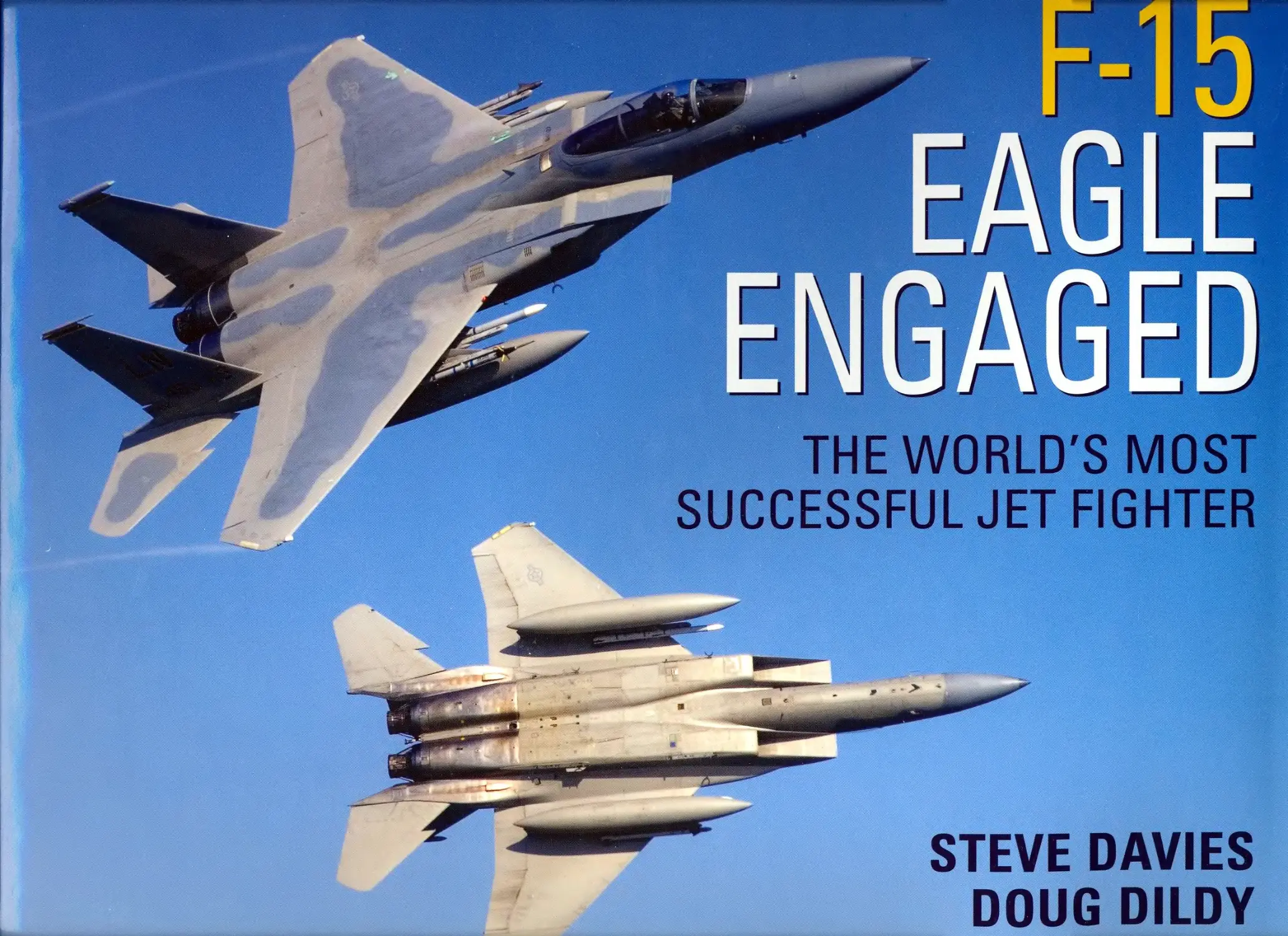
THE WORLD'S MOST
SUCCESSFUL JET FIGHTER
* J
STEVE DAVIES
DOUG DILDY
F-15 Eagle Engaged superbly captures the "true personality" of the F-15
by not only detailing the four decades of technologies that have given it unmatched
combat performance, but also letting you meet the men and women who designed,
flew, and maintained this magnificent jet, allowing it to be called
"The World's Most Successful Jet Fighter."
BRIGADIER GENERAL (RET.) DICK "UPS" BANHOLZER,
DIRECTOR, BUSINESS DEVELOPMENT,
USAF FIGHTERS AND WEAPONS, THE BOEING COMPANY
/
Osprey
PUBLISHING
www.ospreypublishing.com
F-15 EAGLE ENGAGED
THE WORLD'S MOST SUCCESSFUL JET FIGHTER
The F-15 Eagle is undoubtedly the most successful
jet fighter of all time: with a kill ratio that exceeds
105: 0, the Eagle has never lost an air-to-air
dogfight.
Flown not only by the US Air Force but by the air
forces of Israel, Saudi Arabia and Japan, and with
over 30 years of service, the F-15 is the world's
foremost operational air superiority and intercept
warplane.
In this book, the authors draw on a vast array
of sources including combat records, technical
documents, and unpublished first-hand accounts
from the pilots themselves to tell the story of this
amazing plane. Comprising detailed technical
information alongside fascinating combat stories
and accounts, this is the definitive history and
guide to the world's most successful jet fighter.
STEVE DAVIES has written five books on the F-15.
He is a full-time freelance aviation photojournalist,
and is widely recognized as a leading expert on modern
military aviation matters. He writes for leading aviation
monthly magazines. In addition to his writing, Steve
works as an advisor for a number of television
production companies, and he has also appeared in a
series of documentaries. Steve has been working for a
major part-work publishing house for over two years,
during which time he has filmed interviews, written
scripts, and created a series of 52 combined
part-work/DVD products.
DOUG DILDY is a retired US Air Force (USAF) colonel
who spent nine years of his 26-year career in Western
Europe and retired with 3,200 hours flying fast jets,
almost half of that as an F-15 Eagle pilot.
As commander of the 32d Fighter Squadron,
Soesterberg AB, NL, he enforced the No-Fly Zone over
Iraq, acquiring over 100 hours of combat time in the
F-15. Doug is a USAF Academy graduate with a degree
in history. He attended the US Armed Forces Staff
College and USAF Air War College and has a Master's
Degree in Political Science. A student of modern
European military history, he has written several
campaign studies. He has also authored a number of
articles for notable US aviation history magazines and
is a regular contributor to the amateur modelling
magazine Small Air Forces Observer. In his spare time
be continues to fly McDonnell Douglas/Boeing planes,
including the DC-10.for a major cargo airline.


F-15 EAGLE ENGAGED
THE WORLD'S MOST SUCCESSFUL JET FIGHTER
Osprey
PUBLISHING
This book is dedicated to Capt Jeff "Wedge" Roether and Capt Rich "Hub" Kendel,
two of the 32 USAF pilots who gave their lives in the defense of their nation
while operating the F-15 Eagle.
F-15 EAGLE ENGAGED
THE WORLD'S MOST SUCCESSFUL JET FIGHTER
STEVE DAVIES - DOUG DILDY
First published in Great Britain in 2007 by Osprey Publishing
Midland House, West Way, Botley, Oxford 0X2 OPH, United Kingdom.
443 Park Avenue South, New York, NY 10016, USA.
Email: info@ospreypublishing.com
© 2007 Osprey Publishing Ltd
All rights reserved. Apart from any fair dealing for the purpose of private study,
research, criticism or review, as permitted under the Copyright, Designs and Patents
Act, 1988, no part of this publication may be reproduced, stored in a retrieval system,
or transmitted in any form or by any means, electronic, electrical, chemical, mechanical,
optical, photocopying, recording or otherwise, without the prior written permission of
the copyright owner. Enquiries should be addressed to the Publisher.
Every attempt has been made by the Publisher to secure the appropriate
permissions for materials reproduced in this book. If there has been any oversight
we will be happy to rectify the situation and a written submission should be made
to the Publisher.
A CIP catalog record for this book is available from the British Library
ISBN 978 1 84603 169 4
Index by Alan Thatcher
Typeset in ITC Stone Serif, Sabon, Gill Sans, New Baskerville and Univers
Originated by PDQ Media, Bungay, UK
Printed and bound in China through Bookbuilders
07 08 09 10 11 10 9 8 7 6 5 43 2 1
For a catalog of all books published by Osprey please contact:
NORTH AMERICA
Osprey Direct c/o Random House Distribution Center
400 Hahn Road, Westminster, MD 21157, USA
E-mail: info@ospreydirect.com
ALL OTHER REGIONS
Osprey Direct UK, P.O. Box 140, Wellingborough, Northants, NN8 2FA, UK
E-mail: info@ospreydirect.co.uk
www.ospreypublishing.com
Front cover and p.287 and 288 images © Steve Davies: www.fjphotography.com
Endpaper image © Tyson V. Rininger: www.tvrphotography.com
01
02
03
04
05
06
07
08
09
10
11
12
13
14
THE F-X COMPETITION	6
THE MCDONNELL DOUGLAS 199-B DESIGN	22
TEST & EVALUATION	36
F-15 SERVICE ENTRY	52
HAPPINESS IS... GEASLES AND A SWEATY G-SUIT	72
ACTIVE DUTY EAGLE UNITS IN THE COLD WAR	92
DEFENDING THE HOMELAND: AIR DEFENSE AND ALASKAN EAGLES	118
AIR NATIONAL GUARD EAGLES	130
FOREIGN MILITARY SALES EAGLES	142
IMPROVED EAGLES	158
WHEN EAGLES FLY, MIGS DIE!	170
BURNING DEAD DINOSAURS: ENFORCING THE NO-FLY ZONES OVER IRAQ	202
BALKAN KILLS	214
THE EAGLE'S FUTURE	228
APPENDICES	236
ABBREVIATIONS & ACRONYMS	263
ENDNOTES	266
INDEX	277
ACKNOWLEDGMENTS
STEVE DAVIES
There are few fighters that capture my imagination in the same way
that the Eagle does, and while I have written a lot about the F-l 5 and
have oodles of enthusiasm for it, nothing prepared me for the long
journey that this book would take me on. The changing tones of Doug
“Disco” Dildy’s e-mail signatures as every day we were consumed
more and more by this book said it all: they started with the Churchill
quote, “Writing a book is an adventure. It begins as an amusement,
then it becomes a mistress, then a master, and finally, a tyrant”; then
changed to the Hemingway quote, “Actually, I hate writing. But I love
being published”; before finally becoming the self-quote, “There’s
nothing wrong with this book that six more weeks of work can’t fix!”
All joking aside, I hope that you enjoy reading this book - there’s
something in it for everyone, whether you’re an enthusiast, historian,
engineer, aviator or simply curious. I believe that the most significant
aspect to this book is that it has been co-authored by an Eagle Driver
of some experience. Disco’s input will let you see further inside the
Eagle community, better understand the inner thinking of an F-l5
pilot, and more readily grasp the importance of the Eagle than any
text I could have written; I thank him for giving this book an integrity
that you will find in few others. Thanks are also due to Anita Baker
at Osprey, for it was her belief in this book that took it from a
synopsis to a reality. Several F-l5 units provided assistance to me as I
zipped around the US researching and interviewing, but none more so
than the great men and women of the 33rd FW at Eglin, the 48th FW
at RAF Lakenheath, and the Missouri ANG’s 131st FW at St. Louis.
Col Moss “MOS” Mohr, Capt Brent “Stagger” Bak, Capt Kristy
Beckman, Capt Beth Horine, Lt Aaron Henninger, Sgt Michelle Motz
and Jenna McMullin deserve special mention for their help. Boeing
also deserves thanks, as once again it pulled out all the stops to make
things happen, and I owe much to its encyclopedic historian, Larry
Merritt. Paul “Two Drones” Eden, freelance aerospace editor
extraordinaire, took our rough ’n’ ready manuscript and carefully
extracted and corrected the inconsistencies and errors with his usual
good humored style - I want to extend my thanks to him for taking
the project on and seeing it through to completion, no less! Finally,
I want to thank Caroline, my long-suffering partner, for not
complaining when I spent hours in the study consumed by the book,
and for putting up with the sleep deprivation that resulted from my
many late night telephone conversations with Disco - she and I
both knew that Disco’s “10-percent true” fighter pilot stories couldn’t
go on forever, but God knows that some nights he tried! With
any work of this size there are bound to be small errors that creep in,
for these I apologize in advance (or simply blame Disco, depending
upon how unforgivable the error is). I can be contacted via
www.eagleengaged.com.
THE AUTHORS WOULD ALSO LIKE TO THANK:
BrigGcn (Ret) Dick “Lips” Banholzer, George Graff, Capt Brooke Brander, Mary Ann Brett, Paul Homsher, Chris Haddox, Richard Noyes,
Irv Burrows, Maj (Ret) Craig “Quizmo” Brown, TSgt Kathleen Cordner, Col (Ret) C. R. “Dick” Andercgg, Col (Ret) Marshall L. Michel III,
aviation historians Robert F. Dorr and Warren Thompson, F-105 historian W. Howard Plunkett, BGen (Ret) Mark “Magic” Beesley, LtCol
Michael “Dozer” Shower, Col Anthony “ET” Murphy, Col Larry “Cherry” Pitts, LtCol Tony “Kimo” Schiavi, LtCol Tim “Sweet Lou” Kline,
2
DOUG DILDY
There are vast numbers of books about specific airplane types and
several very good ones about the F-15 itself. But no book about
airplanes is truly a complete story unless it also features the men
(and now women) who flew them. Without pilots, single-seat
fighters are just “iron on the ramp” - or in the case of the only
fighter I ever flew, increasingly becoming exhibits in museums or
stuck on a pole outside the main gate of a station. So my goal in
this tome was to make it as much about the men who flew the jet
as it was about the jet itself. I am proud to have served my country
flying the F-15 Eagle with every one of the men named in this
book. We fighter pilots are banded together into small units called
“squadrons” and these too have a life cycle of their own - a birth,
a heritage, an exciting life, and ultimately, a death. Squadrons are
the context into which the men and the machines are fitted to do
their job - in this case to gain and maintain air superiority so that
all other missions, both airborne and on the surface, can be
enabled and protected. So the squadron, that band of Eagle
Drivers who live, work, fly and fight together, features in this work
almost as much as the individual men and the technical details of
the machine. Hopefully this depth of detail will provide the
framework and background that puts the actions of the men at the
controls of this most awesome air-to-air fighter of the 20th century
into the proper context. Finally, I have to agree with Steve: I spent
countless hours editing his work and correcting his errors. One or
two may have slipped through, for which I apologize. But to Steve
Davies, 1 owe a great debt of gratitude for launching this project
and inviting me to join in, and for putting up with my many
redirects and alterations as we strove for accuracy - a difficult task
as the history of the Eagle is an expansive story rife with myths and
misinformation. Steve is an expert on the technical aspects of the
F-15 and 1 must admit I learned more about the jet that I flew by
researching it with Steve than 1 ever knew as a pilot flying it! Also
I would like to express my thanks to Paul Eden, our editor, who
made this fighter pilot’s ramblings make sense and who made the
editorial process a joy to participate in - this book is tremendously
better for his efforts. Finally, but most important, I thank my wife
Ann who encouraged me to participate in this work and gallantly
put up with my absences (sometimes mentally even though I was
present physically) to complete it. Being an Air Force spouse for 24
years was hard enough, but to put up with that again in
“retirement” was a burden no wife should have to bear. To her go
my great admiration, my deep gratitude, and all my love. Lastly,
(since I’ve already used “finally”), as a self-respecting former
fighter pilot, I guarantee that everything written in this book is at
least 10 percent true! Contact me via www.eagleengaged.com.
LtCol Matt “Boz” Beals, LtCol Bill “Turf” Murphy, LtCol Steve “Daihatsu” Dastuta, LtCol Mike “Father” Flanagan, LtCol Joe “Corn”
Hruska, LtCol Brian “Spiderman” Kamp, Rick “Kluso” Tollini, Crag Luther, LtCol John “Clam” McNeil, Maj Justin “Ringo” Fletcher, LtCol
(Ret) Gary “Reverend” Klett, Capt Greg “Lava” Moulton, Capt Jason “Digger” Zumwalt, FedEX Capt Gary “Yoda” Byrd, Nir
Ben-Yosaf, Rob Tabor, Tyson V. Rininger, Erik Sleutelberg, Andreas Zeiltcr, Skip Prestridge, LtCol Mike “Boa” Straight, Bob Whetton of
www.graphic-artwork.co.uk, and Stefan Goossens, Jurgen van Toor and the Dutch Aviation Society’s (“Scramble”) excellent F-15 database.
3
FOREWORD
BY LTCOL MICHAEL “DOZER” SHOWER
F-22A RAPTOR SQUADRON COMMANDER
AND F-15 MIG KILLER
Steve and Doug have given me a unique opportunity, the chance to
write about their book and the mighty F-15 Eagle. I’ll try to fulfill
their request to go full circle from the F-15 to the F-22; it’s a risky
proposition since fighter pilots aren’t known for their prose. 1 am a
very lucky pilot (in more ways than I have time to write about),
mostly because I had the great fortune to fly the F-15, in peace and
war. Membership of the Eagle pilot club is not big in relative terms.
In fact, more people have played professional football over the
years than have flown F-15s. One certainly has to work hard, be a
decent pilot, and have a little luck to get a chance to strap into an
Eagle. Luck I hear you say? Any honest pilot will tell you luck and
timing always play a part. You just hope your luck and timing last
longer than your flying career. Some pilots only flew an assignment
or two in the Eagle and others were lucky to fly it their entire career.
I would have been one of those lucky few until my life took a twist
into the world of the F-22. (1 still consider myself to be extremely
lucky with unconscious timing though.)
I believe the Eagle may well end up in history as the most feared
and respected fighter of all time - and why not? What other aircraft
has an air-to-air combat ratio of 104 to 0? What other aircraft
dominated the skies for over 30 years (and still counting), and
never lost its reputation? There have certainly been other great
aircraft, so why does the Eagle seem to be in a class by itself? Is it
just a lucky jet? This is hardly the case. In fact, there are many very
tangible reasons which explain the phenomenon of the Eagle
legend. First, the Eagle has an incredible design: fast, powerful,
maneuverable, with long range to top it off. Its avionics were, and
with various upgrades continue to be, state of the art and
revolutionary. Combined with the introduction of HOTAS, a user
friendly HUD, and cockpit ergonometrics, the F-15 enabled pilots
to do things they simply couldn’t before. The Eagle is an absolute
joy to fly, easy and forgiving, a fact which doesn’t change even
when flying it aggressively; it’s almost as if the jet knows when to
be calm and when to rage. To me it almost feels as if the jet
somewhat comes alive once you’re in it.
The design and layout were meant to enable one pilot to
efficiently hunt and kill other airplanes, and was it ever successful!
Not long after its initial operational debut, and in the hands of the
Israelis very early on, the F-15 climbed to the top of the hill not just
in training, but in actual combat. You can almost hear the jet daring
anyone to knock it off the top of the heap. As the combat record
attests, many have tried and all have failed. However, you can’t tout
the jet in a vacuum. Without pilots and maintainers it’s just a hunk
of metal - a beautiful hunk of metal - but a hunk nonetheless. Pilots
are the soul of the Eagle once the JFS handle is pulled and until
the motors are shut down.
There has never been a shortage of incredibly intelligent, hard
working, and dedicated F-15 pilots. In fact, many Eagle pilots have
become icons in the various air forces which employ it. Over the
years their efforts to establish a solid building block approach to
training in, and employing, the Eagle have helped make it such a
success. The Eagle community became known for its rigid adherence
to high briefing and debriefing standards. This focused Eagle
Drivers on getting the most out of each invaluable sortie. Of course,
it helps when you have one primary mission (air combat); it’s easier
to be a master of one thing than a jack of all trades. Any mention of
how great the Eagle is (or its pilots!) fails miserably to convey the
full story unless it mentions those who toiled in the heat, cold, rain
and snow, day or night around the globe, to keep F-15s in the air.
4
Without the thousands who supported it, from turning wrenches to
loading weapons to driving fuel trucks, pilots would have never left
the ground to achieve such a phenomenal record. Don’t think a crew
chief isn’t as finicky, or in love with his jet, as any pilot ever was.
Every Eagle pilot who ever took to the air owes their gratitude, and
in fact their life, to those who keep Eagles flying.
So where does that leave us today? The sun surely hasn’t set on
the F-15 by a long shot. The world’s “Greatest Air Superiority
Fighter” has a lot of fight left in it. Through upgrades it’ll remain
viable and deadly well into the 21st century, fighting right alongside
the new kid on the block, the F-22 Raptor. As the next generation
F-22 continues to cut its teeth and grow its own “urban legend,” in
some ways it may always be overshadowed by its older big brother,
as such an incredible combat record will be hard to beat. Having
had the unique luck to fly both amazing aircraft, I’ll never forget
where my roots are. I don’t see how anyone who has flown the F-15
ever could. Of course, if any fighter can hope to be worthy of such
a record as the Eagle’s, the F-22 is certainly it. It’s a monumental
leap forward with its stealth and supercruise, two features we’d
never be able to achieve with an F-15. Combined with its integrated
avionics and situational awareness it’s a truly revolutionary aircraft
in the realm of air-to-air combat (and it’s no slouch in a dogfight
with its super maneuverability and thrust vectoring either). There is
significant proliferation around the globe of modern integrated air
defense systems (surface-to-air missiles and advanced fighter
aircraft). The F-22 ensures, for many decades to come, our ability to
operate freely and protect our forces from enemy attack, even in
places where our older fighters can’t go - one of its true advantages.
In a final irony the F-15 and F-22 aren’t competing against each
other as you might expect. Instead, we’ve discovered the F-15 and
F-22 work much better together as a team. Both bring synergistic
effects to the battlefield which makes us more lethal working
together than we could be working separately. Expect to see F-l5s
in the battle for many years to come - their work isn’t over!
The mighty Eagle brought many revolutionary aspects to air
combat when it was introduced. It set a record unmatched in the
history of air warfare. It has deservedly become a legendary
airplane. To those who paved the way we are indebted to your
efforts and awed by your achievements. To those who, even as I
write this, continue to preserve and fight for freedom flying,
maintaining and supporting the Eagle, we say with all sincerity
thank you! And to those still to come, who will inherit the legacy of
the Eagle, you have big shoes to fill. I have no doubt that you’ll live
up to every aspect of the challenge. After all, you’re about to fall in
love with one of the best aircraft the world has ever known!
5

THE F-X COMPETITION
LESSONS IN HISTORY
On June 25, 1950 South Korea was invaded by communist North
Korea. The recently created United Nations (UN) established a force
in response, which comprised assets from a number of nations,
including Great Britain, Canada and Australia, and, led by US
forces, it spent the next three years driving back North Korean
forces and restoring the status quo.
From a military aviation perspective the Korean War marked the
first true encounter between American jet fighters and those built
by the Union of Soviet Socialist Republics (USSR). Using the fast,
maneuverable and powerfully armed North American F-86 Sabre
against the Mikoyan-Gurevich (MiG) design bureau’s much touted
and far more numerous MiG-15, the US Air Force’s (USAF’s)
kill ratio at the end of the conflict stood at 7:1. The MiG-15
(NATO/ASCC [North Atlantic Treaty Organization/Air Standards
Coordinating Committee] codename “Fagot”) was the latest Soviet
jet fighter and established the mold for the country’s future fighter
designs: it was simple, rugged, maneuverable, straightforward to
operate and easy to replace. Moscow had provided examples of the
“Fagot” to North Korea and China - and even supplied seasoned
fighter pilots/instructors - during the conflict to help even the
balance between its communist allies in the north and the capitalist
UN forces to the south.
Memories from World War II were still fresh in the minds of
many US pilots. Taking the F-86 into combat was simply an
extension of what they had been doing only five years before in
Europe and the Pacific, flying P-51 Mustangs, P-47 Thunderbolts
and P-38 Lightnings against Messerschmitts, Focke-Wulfs and
Zeros. The kill ratios that these men recorded in the skies over
Korea came because they were intimately versed in the art of aerial
maneuver and combat, because they were largely free to pick and
choose the battles they fought and the terms on which they did so,
and because their Sabres were fast, maneuverable and armed with
simple and reliable weaponry that had not changed greatly since the
beginnings of air combat in 1915. They could not possibly have
known that by the time the US next engaged in sustained combat
operations, all of this would have changed.
However, change it did. Following the Korean War, US and Soviet
fighter designers took increasingly divergent paths in developing their
products. In fact, US fighter designers embarked upon two distinctly
different, though seemingly complementary, tracks as well -
designing aircraft to either defend against or deliver nuclear
weapons. During the final half of the 1950s Strategic Air Command
(SAC) ruled the USAF1 and it decreed that any fighter would be
justifiable only if it delivered atom bombs or defended against any
attack using them. Consequently, the Century-series fighters (F-100
through F-106) evolved along either of these two tracks, culminating
OPPOSITE
The slatted F-4E gave the Phantom II a boost in low-speed performance and made it more capable in the
dogfight. With its built in M61A1 gun below the nose, it was a much better air-to-air platform than
previous F-4 variants. (USAF)
7
in the Convair F-106 as the ultimate air defense interceptor, and the
Republic F-105 as the primary nuclear-delivery tactical fighter.
When the Kennedy Administration brought Robert S. McNamara
to the head of the Department of Defense (DoD), the forced uniformity
- ostensibly in the interest of cost savings and reducing the influence of
the military-industrial complex - between the US Navy (USN) and
USAF (exemplified by the September 18, 1962 DoD-directed
unification of the military aircraft designation systems using the USAF
model) led to two unanticipated negative consequences.
One was the fabled and ill-fated TFX (Tactical Fighter
Experimental) program, which produced the bi-service F-l 11, the
А-model being for the USAF and the В-model being intended for the
USN. The F-l 1 IB proved unworkable as a carrier-based fighter and,
in May 1968, the Navy canceled it after having spent millions of
dollars developing it. Instead, the Navy bought the Grumman F-14
as its follow-on fleet defender, retaining the McDonnell Douglas
F-4B as a multi-role fighter.
BELOW
The F-86 was one of the last truly simple jet fighters that the US built. While the Soviets retained the
core principles of simplicity with the MiG-17, MiG-19, and MiG-21, America was developing ever more
complex designs. (USAF)
8
The other was the adoption of the Navy’s F-4 as the Air Force’s
follow-on tactical fighter. In fairness, the McDonnell F-4 Phantom II
was a great performing aircraft for the 1960s. First flown for the
USN on May 27, 1958, the Phantom was designed primarily as a
fleet defense fighter, with a secondary ground attack capability.
Consequently it had a superior (for its day, and working over water)
Westinghouse APQ-72 radar operated by a second crewmember,
freeing the pilot to fly the aircraft. It was armed with four semi-
active radar homing (SARH) AIM-7 Sparrows and four heat-seeking
AIM-9 Sidewinders, both of which were superior to the USAF’s
AIM-4 Falcon, which came in both varieties. Plus, it could carry
11,0001b of air-to-ground ordnance.
However, it was optimized for fleet defense, meaning that it was
specifically designed to shoot down Soviet Naval Aviation Tu-95
“Bear”2 (fielded in 1955) and Tu-16 “Badger” (1961) bombers
attempting to launch AS-1 “Kelt” and AS-3 “Kangaroo” stand-off
missiles against the USN’s Carrier Battle Groups. For this role the
gun - that legendary, simple and reliable weapon of the traditional
BELOW
The MiG-15 typified Soviet-built jet fighters - it was rugged, simple and reliable. This one was test flown
by the USAF after a North Korean pilot defected to Japan in it. (USAF)
I ПС Г-Л CUIVITE I I I IUIX1
fighter aircraft - was superfluous and only added weight and size to
an already large and heavy carrier aircraft.
Because the Phantom was designed as a “bomber destroyer” it
had a great appeal to Tactical Air Command (TAC), which was now
under the command of General Walter C. Sweeney, Jr.,3 a dyed-in-
the-wool bomber general from before WWII. Thus the F-4 fulfilled
both the SAC-driven demand that all new fighters be “nuclear
bomber killers” and it provided a greatly increased “iron hauling
capability” (carrying conventional bombs to tactical targets) over
that of the small F-100 Super Sabre and specialized, nuclear-delivery
F-105 Thunderchief. Also, it had the political plus of playing to
McNamara’s desire to create DoD cost savings by adopting a multi-
service fighter aircraft.
The Navy’s new F4H-1 had set some spectacular records in
Projects Sageburner (a low altitude speed record of 902.79mph'),
Skyburner (a high altitude speed record of l,216.76mph) and High
Jump (time to climb records to eight different levels up to
30,000m/98,425ft) between August 1961 and April 1962, and in
the USAF’s Operation Highspeed it was tested against the F-106
Delta Dart. It was found to have better overall speed, altitude,
range, load-carrying capability and radar. A “complete package”
when, in 1962, the USAF adopted the Phantom as its fighter for the
1960s, it was accepted “as is.” In fact, the first 29 examples of the
Air Force’s Phantoms were Navy F-4Bs leased in 1962 as F-llOAs.
The first USAF-specific model was the F-4C, which differed very
little from the Navy’s В-model.
More versatile than TAC’s mainstay, the F-105 “Thud,” and able
to engage enemy air threats on the way to bombing targets, the
Phantom was eagerly accepted (even though it was a Navy airplane)
despite the fact that it lacked a gun and required a second
crewmember to work the radar. In fact, USAF leaders in the early
1960s planned to have a tactical force composed of F-llls in the
air-to-ground and nuclear delivery roles and the F-4 in the air
defense and conventional bombing (as well as a tertiary nuclear
delivery capability) roles through the decade.
Indeed, the Phantom II proved to be a powerful and effective
tactical performer, shooting down 107 MiGs in the skies of North
Vietnam (NVN), carrying the brunt of the tactical air offensive into
NVN during Operations Linebacker I and II, and conducting
extraordinary numbers of close air support missions in the more
permissive South Vietnam and Laotian environments. But being a
jack-of-all-trades frequently means being the master of none.
Consequently, the F-4 could be faulted as being not particularly
accurate as a bomber5 until the arrival of laser- and optically- (TV)
guided bombs in 1970, and its air-to-air capabilites were lacking.
In fairness to the Phantom and its designers, at this time the
USAF’s fighter pilots lacked air-to-air skills as well. This was
primarily because TAC had experienced a very high accident rate
with the new F-4 due to its proclivity to depart controlled flight
during heavy (high-g) maneuvering. This was caused by a severe
adverse yaw problem resulting from the sharply swept wing design,
which required the aircraft to be rolled with rudder, rather than
aileron, during high-g turns. At the time TAC was not a combat
command but a training command providing qualified aircrews and
units to the combat commands overseas. Consequently, General
Sweeney was not as concerned with the air-to-air proficiency of
his “products” as much as he was with correcting the alarming
mishap/aircraft loss rate. He did so by discontinuing the training
that resulted in the vast percentage of these losses. The rationale
was: why practice something dangerous when we’re never going to
use it anyway; we’re going to kill them all beyond visual range
[BVR] with the radar missile.
With little air-to-air training to compensate for the F-4 weapons
systems’ design deficiencies, the Phantom’s flaws as an air
superiority fighter became glaringly apparent when it was put up
against the current products from the MiG design bureau. In
comparison to the MiGs it was large and heavy. Its engines smoked
when not in afterburner and they consumed fuel at alarming rates
when they were. Its radar6 was longer ranged but could not see
MiGs waiting in ambush by “hiding in the weeds” (below the F-4’s
altitude, over land); its longer-ranged missiles were hobbled by
visual identification (VID) requirements; and it had no gun for
close-in combat. However, most of all, the F-4 lacked the
maneuverability needed to deal effectively with the more nimble
MiGs. Compared to the MiG-17, -19 and -21, the powerful, yet
heavy Phantom lacked the agility needed to bring weapons to bear
in a classic turning dogfight. As a consequence, the 7:1 kill ratio
enjoyed over Korea dwindled to less than 2:1 over NVN.7
9
Aerial Superiority over North Vietnam, A Primer
Overshadowed by the painful toil and bitter losses experienced in the
Vietnam War is the fact that the USAF and USN entered the air
campaign over NVN with a decided edge and excellent initial results
using the all-purpose McDonnell F-4 Phantom II. At the outset the
Vietnam People’s Air Force (VPAF) only had three dozen MiG-17s at
two jet-capable bases, no GCI and no SAMs. However, all this would
change with the arrival of Soviet-supplied GCI radars and SAMs, two
dozen more MiG-17s and the first supersonic MiG-21 “Fishbeds.”
Because the VPAF had to train a modern air defense force from
scratch, at first MiG encounters were sporadic. In 1965 one ambush by
MiG-17 “Frescos” cost two F-105s lost. This proved that the North
American F-100C was inadequate in range, endurance, radar and
weapons to provide effective MiG Combat Air Patrol (MIGCAP) and
the USAF responded by bringing in Phantoms. Later that year four
F-4Cs tricked a couple of “Frescos” into believing they were a delayed
flight of “Thuds” and shot down both of them with AIM-7 Sparrows.
This auspicious beginning continued to bear fruit through the
following year, with USAF fighters shooting down 12 “Frescos” as the
VPAF brought its new MiG-21 “Fishbeds”8 up to operational standard
(losing five in the process). This string of successes culminated on January
2, 1967 in Col Robin Olds’ famous Operation Bolo in which a MiG
sweep by 32 F-4s simulating a full strike package of F-105s, masquerading
by using “Thud” callsigns, tanker tracks, and ingress routes and altitudes.
Eleven MiG-21s challenged the “raid” and seven were “splashed” for
no losses. (The VPAF admits the loss of five.) The successes continued
through the first half of 1967, resulting in a total kill-versus-loss tally thus
far of 66:18. Counting 30 MiGs destroyed by bombing attacks on their
airfields, the VPAF had lost almost its entire initial fighter inventory.
However, in the last half of 1967 the tables slowly began to turn.
According to Col Marshall L. Michel III, in his excellent Clashes: Air
Combat over North Vietnam 1965-1972, this occurred primarily for two
reasons. The first was that the learning curve of the VPAF MiG drivers
had arrived at an operational level. NVN pilot aggressiveness increased
with experience, and tactics perfected by GCI controllers began to place
the MiGs at the “six o’clock” of the ingressing USAF formations instead
of setting up intercepts in the face of oncoming AIM-7 missiles.
10
The second reason was not the Phantom itself, but the ill-advised -
but ostensibly “fair” - USAF pilot management policy of not forcing
any aviator to return to Southeast Asia (SEA) until all had served a tour
there. This policy was based on the fallacious belief in the “universally
assignable pilot,” that is the notion that all graduates of Air Training
Command’s pilot training program had achieved the same level of
proficiency, the minimum requirements to fly fighters. This concept
failed to consider the wide spectrum of individual talent, intelligence,
adaptability, judgement and follow-on experiences of the AF-wide pilot
base. So when those pilots initially manning the F-105 and F-4
squadrons in SEA - most of them highly experienced Korean War
veterans who had flown nothing but fighters - “rotated home,” they
were replaced by interceptor, trainer, transport and bomber pilots whose
proficiency in the dynamic and demanding air-to-air environment had
entropied to nothing, or by recent UPT (Undergraduate Pilot Training)
graduates with no experience whatsoever and no appreciable air-to-air
training in their TAC replacement training units (RTUs). Collectively
these new wingmen were much less proficient and had more difficulty
employing their fighters successfully against a now highly trained and
increasingly experienced enemy.
The result was that through the second half of 1967 the MiGs (ably
assisted by their canny, all-seeing GCI controllers) increasingly avoided
contact when at a disadvantage and caused a mounting loss rate among
USAF fighters by engaging in high-speed stern attacks that reduced the
F-4’s killdoss ratio to 3:1 during that period. Worse, it plummeted to
0.85:1 - more F-4s were lost than kills achieved - in the first two
months of 1968. One can only imagine the heavy collective sigh of
relief in Phantom and “Thud” units when President Johnson called for
the bombing halt in March 1968. Now at least the USAF could “go to
school” on its deteriorating performance and hopefully do better the
next time it was called upon to “go North.”
The USAF’s answer to the problem, unfortunately, was not training
(which was the USN’s answer9 when faced with much the same initial
experience) but technology. Blaming its equipment, the USAF highly
modified its Phantoms to include an internal gun, significant sensor
upgrades, and switchology improvements, and greatly enhanced the
AIM-7E to the “E-2” variant which included a “dogfight mode.” Still,
the older F-4D bore the brunt of the renewed combat when the USAF
was ordered to “go North” again in Operation Linebacker, instigated
by President Nixon to finally pressure the NVN leadership to begin
negotiating terms for ending the war.
In the hands of the most experienced and proficient F-4 pilots in the
USAF - gathered together in the rather elite 555th TFS at Udorn RTAFB
- the kill tally only rose to 20 victories for 4 losses, but the MiG-2 Is’
heavy attrition of strike forces kept the overall ratio to less than 2:1.
Once B-52s were finally used against NVN in Linebacker II (after the
North Vietnamese leadership had once again left the peace talks) and
employed as they were intended to be - against strategic targets to affect
the adversary’s will to continue the fight in the “Pleven Days of
Christmas” (the title of Col Michel’s other excellent treatise on the air
war over NVN) - the long, grueling and unsatisfactory conflict was
finally brought to an acceptable conclusion.
For a myriad of reasons, the Vietnam War left a lasting, bitter taste
in the mouths of USAF officers at all echelons. With regard to air
superiority, the solution was now seen as two-fold: technology - as
demonstrated by the huge advances in capability built into the F-15
Eagle - and (finally) training. It was no longer enough to merely “build
a better mousetrap,” but pilots had to be taught how to use it in the
intense and unforgiving arena of air-to-air combat. Following SEA the
USAF vastly increased its air-to-air training programs in all fighter
types, formed aggressor squadrons flying T-38 Talons and F-5 Tiger ILs
as adversaries (effectively simulating the small, nimble “Fishbed”) and
began the famous Red Flag exercises that put it all together in heavily
opposed, large-force training experiences for the USAF’s fighter crews.
THE AIR-TO-AIR “BOX SCORE” OVER NVN
1965-72’“
Operation Rolling Thunder. March 2, 1965-April 1, 1968
Victories		Losses
By F-4 Phantoms	33.5 MiG-17s	To MiG-17s	8 F-4 Phantoms
25 MiG-21s		8 F-105 Thunderchiefs
By F-105	27.5 MiG-17s	To MiG-21 s	10 F-4 Phantoms
		14 F-105 Thunderchiefs
By F-102 Delta Daggers	None	1 F-102 Delta Dagger
Subtotal	86 MiGs	41 USAF Fighters
Operations Linebacker I/II: May 8-December 29, 1972
Victories By F-4 Phantoms 8 MiG-19s	Losses To MiG-19s 3 F-4 Phantoms
41 MiG-21s	To MiG-21 s 24 F-4 Phantoms
By F-105	None Thunderchiefs	1 F-105G Thunderchief
Subtotal	49 MiGs	28 USAF Fighters

Grand Total	135 MiGs11	69 USAF Fighters
ENTER THE F-X
In late February 1 965, however, the first Phantoms had not even
arrived in SEA and these deficiencies were not yet apparent when
the Air Staff began studying the need for developing the successor to
the Phantom. LtCol John W. Bohn, Jr. examined the issue and
authored a paper entitled Force Options for Tactical Air that
proposed a “high-low mix” future force structure. Prompted by
intelligence estimates that suggested that Soviet interceptors posed a
greater threat than had originally been envisaged, LtCol Bohn’s
paper proposed the combination of a few high-tech (and high dollar)
air-to-air fighters to sweep the Soviet defenders from the sky and a
host of low-tech (ie cheap) air-to-ground fighter-bombers to pound
the enemy into submission. Bohn originally suggested that the
Northrop F-5 fulfill the latter role (in reality it was the Vought A-7
that did so) but since the F-l 1 1 had by this time disqualified itself
as a fighter (and would serve only as a bomb-dropper with an
“F”-designation) Bohn recommended that a new high technology
11
F-15 EAGLE ENGAGED
fighter specifically designed to achieve aerial superiority - placing
emphasis on maneuverability instead of speed - be developed in the
near future.12 CSAF (Chief of Staff of the Air Force) Gen John P.
McConnell endorsed the study and Eugene M. Zuckert, Secretary of
the Air Force (SECAF), allocated $10m for FY66 (Fiscal Year 1966)
for further studies leading to the design of the ultimate US fighter.
These studies were both in-house evaluations by various
branches of the USAF Headquarters (HQ, known as the Air Staff)
in the Pentagon, the Air Force Systems Command’s (AFSC’s)
Aeronautical Systems Division, and aerospace contractor studies,
the latter prompted by a series of requests for proposal (RFP). The
first was for a general “Tactical Support Aircraft” and was sent out
on December 8, 1965 to 13 different companies. Eight responses
were received and in April 1966 HQ USAF selected Boeing,
Lockheed and North American Aviation to take part in a four-
month Concept Formulation Study (CFS), requiring them to submit
a range of designs tailored to the USAF’s needs.
BELOW
The F-4D was introduced to units in Vietnam in May 1967. It was the second version of the Phantom II built
for the USAF and incorporated more USAF-specific capabilities. One of these was the ability to employ the
AIM-4D. This missile proved even less capable than the troubled AIM-9B. (USAF)
12
Of the 500 designs submitted in October the following year, the
USAF rejected all of them. None of them offered an airframe that
would be optimized for the air-to-air role. Caving to the prevailing
mantra of multi-role cost-effectiveness, and the prospects of selling
the resulting product to both the Navy and AF, all had made
concessions for the air-to-ground mission, compromises which the
Air Staff deemed counter to the goal of an air superiority fighter.
Significantly, all of the designs conformed to similar proposals
offered for the TFX program only a few years before: each
employed variable geometry (VG, or “swing”) wings, each toted
two high-bypass ratio turbofan engines, and they shared avionics
compatibility with the F-lll. Expanding on the TFX model that
bigger is better, weight figures of some of the proposals had
ballooned to nearly 60,0001b!
In July 1967 the Soviets unveiled the MiG-25 “Foxbat” at the
Domodedovo air show. It was a high-flying Mach 2.8 interceptor
designed to counter the A-12 series of high-fast spyplanes and the
XB-70 bomber.13 The “Foxbat” sent shockwaves through the upper
echelons of the USAF. In a two-year period, the MiG-25 was to
further shock the West by breaking a number of world speed and
time-to-altitude records. Although it was learned much later that the
MiG-25 was far less capable than the Soviets had intimated, at the
time it provided the final impetus needed to spur the Pentagon and
the American aerospace industry to produce what would ultimately
become the F-15. The unveiling of the “Foxbat” paved the way for
a second RFP on August 11, 1967. This request specifically asked
for concept development of a “Fighter” and went to all the
contractors that had responded to the first RFP. By this time the
conceptualized air-to-air fighter - ostensibly needed to beat the
MiG-25 - was referred to as the “F-X,” meaning “Fighter-Unknown
Number Designation” (not “Fighter Experimental”) and it was clear
that F-X was to replace the F-4 Phantom.
The second RFP opened the door for unauthorized and initially
unpopular work carried out by Maj John R. Boyd to take center
stage in the future of fighter aircraft design. Boyd, a test pilot and
Korean War veteran (122 combat missions in the F-86 Sabre), had
developed a mathematical formula for defining the hypothetical
performance, and hence, design of the modern jet fighter. It was
called the Energy-Maneuverability Theory. This concept, first
published in May 1964, had been given little attention to date. It
argued that a fighter’s performance should be characterized by its
potential and kinetic energies, each of which could be changed by
maneuvering the aircraft around the sky. It was this theory that
would later mature into the Energy Maneuvering (EM) graph that
fighter pilots now study to determine how many gs they can pull and
BELOW
The Phantom's radar operated reasonably well in the look-up environment, but in look-down scenarios was
blinded by ground clutter. The radar was ideal for targeting high-altitude nuclear bombers, but for detecting
small, nimble MiGs in the weeds of Vietnam, however, it was inadequate. (USAF)
how fast they can turn their nose towards an opponent during
combat. The EM graph allowed designers to take an aerodynamic
shape and plot what energy state, lift, drag and other criteria would
be placed upon it at a range of altitudes and airspeeds. Armed with
this information, and using expensive mainframe computers, they
were able to determine how well it would maneuver and,
importantly, which portion of the flight envelope it would perform
in best. The key advantage this system afforded was the ability to
define tactics by studying a relatively straightforward graph, and
identifying which flight regime offered the best performance
13
advantages; it also predicted how well one jet might operate against
another by comparing graphs for both aircraft. Thus, for the first
time, aircraft designers could identify the weak spots of a potential
adversary and design an aircraft that could exploit them.
DEVELOPING THE DESIGN
Prompted by the dramatic appearance of the “Foxbat,” the August
1967 RFP was a request for selected aerospace companies to
produce a Concept Development Package (CDP) and Technical
Development Plan (TDP). To counter the MiG-25 the concept
fighter to be proscribed by this iteration would need to have a
fantastic rate of climb (it therefore needed very high thrust) to get
near the “Foxbat’s” altitude quickly and a powerful radar able to
detect it at long range, yet it should retain the ability to counter
more numerous light and nimble MiGs of the older generation.
The CDP consisted of four main areas for specific consideration:
ensuring through wind tunnel tests that the aerodynamics worked;
identifying suitable engines which would propel the F-X to its target
top speed of Mach 2.5 and offering enough excess thrust to power
the aircraft through combat maneuvering; determining a good
armament combination and avionics suite; and finally, deciding
whether it should be crewed by one or two individuals. The TDP
BELOW
Little was known about the MiG-25 "Foxbat" when it was revealed in July 1967. As US intelligence
analysts clambered over each other to warn of the threat it must surely pose, extra urgency was instilled
in the F-X program. (USAF)
14
was to detail the development schedule for the contender’s airframe.
The request to provide these two products was sent to all seven
companies14 that had responded to the initial RFP in 1966.
The wind tunnel testing mentioned in the CDP was undertaken
by the National Aeronautics and Space Administration’s (NASA’s)
Langley Research Center, which had five different wind tunnels,
including a supersonic one, to assess various aspects of the
prospective designs. The Langley facility had been closely involved
with the development of VG-wing technology for the TFX program
and following the advent of the “Foxbat” the facility undertook an
in-house evaluation of various wing, fuselage and engine location
configurations. Some 41 NASA researchers and engineers studied
four basic configurations: the popular VG wing; a conventional
layout with fixed wing and fuselage-embedded engines; fixed wing
with wing-mounted engines; and one that imitated the layout of the
“Foxbat.” The results were made available to the prospective
contractors for their own F-X design development. While NASA
determined that VG-wings were the most appropriate for carrier-
based fleet defense fighters (thus these were adopted for the
contemporary F-14), the fixed sweep wing made a strong impression
on the McDonnell Douglas15 design team. Doing without the
extremely heavy wing pivot structure and actuating mechanisms
meant significant weight savings which, paired with the right
engines, could achieve a thrust-to-weight ratio of nearly 1:1 and
thus produce an extremely high performance dogfighter.
Finding “the right engines” was AFSC’s responsibility, and it
was looking for a large afterburning turbofan. Afterburner (A/B)
augmentation is what gives a military jet engine powerful additional
thrust for maneuvering and acceleration, but at the expense of
hugely increased fuel consumption. High-bypass turbofans - the
major engine development of the 1960s - used a second set of
exhaust turbines to spin large diameter multi-stage fans to push
huge volumes of cool air past the “core” turbojet encased within,
vastly increasing the basic engine’s steady-state thrust and fuel
efficiency. The concept of mating the great cruise economy of a
turbofan and the high thrust on demand of the afterburner,
promised economical cruise over long distances into the target area
and great power available for acceleration (to engage) and
maneuvering (to kill).
AFSC’s first proposal was for an augmented (A/B-equipped)
turbofan with a bypass ratio of 2.2:1 (2.2 volumes of air via the fan
bypass for each equivalent volume of air through the core turbojet).
However, knowledgeable pilots such as John Boyd opposed it
saying that a 0.9:1 (almost equal flow of cool fan air and hot jet
exhaust into the A/В section) was preferred because it made for
more efficient afterburner operations. In combat, Boyd argued,
an efficient afterburner was more important than fuel economy.
Initially a compromise of 1.5:1 was agreed and studies were sourced
to General Electric (GE) and Pratt & Whitney (P&W) while AFSC’s
Aeronautical Propulsion Laboratory undertook its own evaluation.
At this stage (1967), Dr. Harold Brown, the DoD Director of
Defense Research and Engineering and author of the notorious TFX
fiasco, stepped in and directed that both the Navy and AF use
the same compressor/turbine core for their future afterburning
turbofans (for the improved, re-engined F-14B and F-X) eliminating
the opportunity for further optimization and setting the ratio for the
F-X’s concept motor at 0.7:1, increasing operating temperatures,
compression ratio, weight and cost in so doing. While 0.7:1 was
better than 1.5:1, by this time further studies had determined that
0.6:1 was best.
The two contractors’ studies were completed in September
1967 and the USAF was given the lead to develop the common
engine core the following April. The joint program went by the
name Advanced Turbine Engine Gas Generator (ATEGG), and
drew on experiences learned through the P&W TF30, the engine
which powered the troubled F-lll bomber and the F-14A. It
included design goals to improve thrust output, reduce weight and
achieve a minimum thrust to weight ratio of 9:1. GE, General
Motors (GM) and P&W were sent RFPs in April 1968. GM was
eliminated from the program four months later, leaving P&W
and GE to complete a $118m contract for the initial engineering
development of the F-X engine.
Although the F-X would initially utilize newer, improved
versions of the AIM-7 and AIM-9 missiles, a powerful new radar
was needed that could see small radar-cross-section (RCS) targets,
such as the MiG-21, at great ranges and be able to look below the
altitude of the F-X fighter to find such targets against the heavy
electronic clutter known as “ground returns.” As the USAF had
I I 11_ I
OUIVir L I I I IUIXJ
experienced in SEA, opposing fighters could “hide” among this
clutter and be almost impossible to differentiate from the many
extraneous returns.
The solution to this problem was in the development of Doppler
radars. Since its invention, radar had worked on the concept of
sending out a pulse of energy. By measuring the time for that pulse
to be reflected back to the radar, the range to the target could be
determined. Doppler radars worked on the theory (devised by Dr.
Christian A. Doppler, in 1842, to measure the movement of stars
and other celestial bodies) that returns from approaching targets
would be compressed by the closing speed of the target, increasing
the frequency of the returning pulse. Conversely, a target that was
going away would reflect back a pulse that would be expanded -
and thus at a lower frequency - than its original form.16 By
measuring the changes in the frequency in the returning pulse it is
possible to determine whether the target is approaching or departing
and at what speed.
BELOW
Just the size of the MiG-25's exhaust nozzles implied that the aircraft was very powerful and capable of
extreme performance. (USAF)
15
But, like all radars a Doppler unit also has a ground return, that
is the return of radar energy whose frequency has been compressed
by contact with the ground commensurate with the speed of the
aircraft carrying the radar. However, computers - even at that early
BELOW
There were many factors that influenced the disappointing overall performance of the USAF's, USMC's
and USN’s F-4s against MiGs in Vietnam, but one of the most obvious was the poor performance of the
AIM-7E Sparrow missile. It ended the war with a success rate of less than 10 percent, and 66 percent of
the 612 actually launched had not functioned properly. (USAF)
stage of development - could apply filters to the radar receiver so that
all returns in the frequency band related to the fighter’s speed would
be ignored, effectively blinding the radar to the ground return. Using
this filtering, the Doppler radar could see targets below the fighter’s
altitude if they were approaching or going away, but not those
passing 90 degrees to the fighter’s flight path and hence showing up
with the same Doppler frequency shift as the earth beneath it.
The problem with Doppler was that while a target could be seen
at a certain azimuth (generating a shifted-frequency return at that
16
angle) there was no inherent range information provided by the
return. However, emerging computer capabilities provided a means
of encoding each pulse with an identifying electronic signature and
the ability to read that code and thus be able to time the transmit-
and-return (and thereby measure range) of each pulse, even if its
frequency had been shifted by the opening or closing velocities of
the target. Additional electronic technologies provided much greater
transmission efficiency, allowing the radar to emit a high-power
(long range) pulse in a brief instant and then “listen” for a much
longer duration. The combination of pulse coding (providing range
data) and Doppler shifting (providing look-down capability)
resulted in the concept of the pulse-Doppler (PD) radar sought by
the Air Force for its new fighter.
In the meantime, both Hughes and Westinghouse had developed
Doppler radar technology for practical application and were poised
to work it into the sophisticated fighter-size package needed for the
F-X. In March 1968 they were issued competitive awards to provide
a useable long-range, look-down radar.
The decision to make the F-X a single-seat fighter is credited to
Col John J. Burns, Director of Operations (DO) of the 8th TFW
“Wolfpack.” Col Burns was a WWII and Korean War veteran,
having flown the P-47 Thunderbolt in 106 combat missions in the
European Theater of Operations (ETO), 102 missions in the F-84E
Thunderjet in Korea, and commanded the first McDonnell F-101A
(single-seat) squadron and later F-100 Super Sabre units at RAF
Bentwaters. Most recently he had been the Chief of Requirements
(DOR, or, more formally, Director of Requirements) at HQ TAC
after flying the F-105 with the 4th TFW at Seymour Johnson Air
Force Base (AFB), NC, and being the head of Category II testing of
the F-4 at Edwards AFB. He arrived at Ubon Royal Thai Air Force
Base (RTAFB) in May 1967 when the MiGs were beginning to
effectively counter American aerial superiority over NVN with stern
pop-up attacks from low altitude.
Col Burns maintained that the two-seater was an unsuccessful
aberration in US fighter development. The USAF had not had a
dedicated radar operator in its cockpits since the F-94 Starfire was
replaced by the single-seat Convair F-102 and F-106s in the air
defense role and he felt that with sufficient automation, the radar
and aircraft could both be operated by a single person.
Additionally, in recent combat in SEA the “second set of eyes”
(which were usually those of a new pilot freshly graduated from
pilot training and not a dedicated Weapons System Operator
|WSO] at this stage) had proven to be of little benefit, while the
high intra-cockpit coordination and communication requirements
“in the heat of battle” most often resulted in confusion and missed
shots. Usually it was ground controlled intercept (GCI) radar
controllers, not the “back-seater,” who saw the MiGs pop up
behind the F-4s and gave the warning that they were “at ‘six
o’clock’ and closing fast,” necessitating a sudden, high-g “break
turn” to come about to face the threat. The sudden surprise, the
high-gs and the very short time available for the back seat
pilot/radar operator to find the attacker and get a radar lock
resulted in confusion and poor intra-cockpit communications at a
very critical time. Some 50 AIM-7 misses had been reported due to
these factors since the beginning of the air campaign over NVN.
Therefore, Col Burns felt strongly that the USAF should return to a
single-seat fighter if sufficient automation in operating the radar
was technologically feasible.17
Engineers at AFSC’s Aerospace Systems Division agreed with Col
Burns, estimating that as much as 5,0001b weight saving could be
realized by eliminating the additional systems and structure required
by the second crew position.18
The winning bid would be the one which combined these
primary components - airframe, engines and radar - into the most
efficient (in terms of cost), effective and maneuverable combination.
The process was very much aided by the use of Boyd’s EM theory
and it proved instrumental in the second round of proposals. For
one thing, it showed that the projected weight of the F-X could be
reduced to 40,0001b. Boyd argued that it should be even lighter.
Fortunately for McDonnell Douglas, the company had continued
to develop its initial F-X design study with in-house funding, despite
not being selected to participate in the CFS the year before. Because
of this, its team was well placed to pick up the gauntlet even at this
late stage. Once it realized from the NASA tests that the weight
savings achieved by discarding the heavy VG-wing apparatus19 made
it possible to build a very robust airframe-engine combination in the
40,0001b category, “McAir” (as the company was called in the
industry and the USAF) was onto the winning formula.
/7
Meanwhile, Lockheed, Grumman and General Dynamics
continued their preference for a VG-wing. Fairchild Hiller and
North American were the only others who departed from this
configuration, the first favoring the engines-in-the-wings
configuration, the second adopting an advanced blended wing-body
layout. Consequently, on December 1, 1967 the USAF chose one
contender from each of the two schools of configurations:
McDonnell Douglas with the fixed-wing design, and General
Dynamics (GD) using VG technology from its experience with the
F-l 11. Contracts were awarded to these two for a second six-month
CFS for them to refine their F-X proposals.20
The major issue muddling the continuing process of design
development was the fact that by now the “blue suit” Air Force
(Strategic Air Command) wanted a specialized air-to-air fighter but
BELOW
Some of the F-X requirements were less about technology and more about common sense. This photograph
demonstrates the limited rearwards visibility from the F-4. This was fine when intercepting Tu-95 "Bears"
as shown here, but ill-suited to "checking six" and dogfighting MiGs. (USAF)
18
the AF’s civilian masters (SECAF and his staff) wanted to retain
the multi-role capability. So, despite repeated attempts to have rhe
air-to-ground requirement removed from the CDP request, the
USAF was compelled to retain it, much to the dissatisfaction of
those USAF officers who felt that a compromise could never
adequately provide the kind of fighter needed to combat current and
future Soviet opponents.
At this stage the true customer, HQ TAC, weighed in to make its
preferences and requirements known. By this time TAC had changed
into a combat (versus training) command, responsible for providing
units (as well as training aircrews) to the overseas commands in
Europe and the Pacific. Following a series of conferences hosted by
TAC at Langley AFB, Virginia, TAC could speak for all three tactical
combat commands (TAC, United States Air Forces in Europe
[USAFE], and Pacific Air Command [PACAF]; collectively known as
the Tactical Air Forces or TAF) in ordering its next generation
fighter. By this time the lessons learned the hard way by TAC and
PACAF F-4 units in the skies over NVN had filtered back to the
halls of their HQs and the multiple needs for change were
recognized and being worked on. Fighter aircrew training changed
dramatically; the next variant of the F-4 included wing leading edge
slats to increase maneuverability and a nose-mounted 20mm cannon
for close-in combat. But most importantly, the warfighters of the
TAF recognized the need for a dedicated air-to-air fighter to sweep
the opposing MiGs from the skies and allow the bomb-droppers to
do their job effectively and with impunity. In February 1968, TAC
completed the TAF’s Required Operational Capability (ROC-9-68)
statement affirming that any F-4 replacement would have to be an
air superiority fighter.
TAC’s requirement was for a high performance fighter optimized
to engage and kill its adversaries BVR. Once they closed to the
“visual arena” it should be able to outmaneuver the enemy to gain
a shooting advantage. Although the inclusion of an internal gun was
not specified, it went without saying that the lack of one would
disqualify the competing contractor. Gen Gabriel P. Disosway,
Commander in Chief (CinC) TAC, signed ROC-9-68 - a document
that was largely a product of Col John Burns’ requirements office
when he was TAC/DOR - and forwarded it to HQ USAF for
inclusion in the F-X design process. Three months later, in May
F-X Design Requirements
The September 1968 RFP required the F-X design submissions to
provide a fighter with:
1.	Wing optimized for high load factor (g) and buffet-free
performance at Mach 0.9 at 30,000ft altitude;
2.	High thrust-to-weight ratio to achieve very high energy
maneuverability throughout the flight envelope;
3.	Mach 2.5 maximum speed at altitude;
4.	Long-range pulse-Doppler radar with look-down capability;
5.	One man operation of the weapons system for all missions;
6.	Advanced cockpit layout, displays, and controls, which would
allow heads-up operation during close-in combat;
7.	Airframe fatigue spectrum with a life of 4,000 hours;
8.	360 degree cockpit visibility;
9.	High maintainability: 11.3 maintenance man hours per flight hour
(similar to WW2 fighter requirements);
10.	Significant increase in avionic and airframe subsystem component
mean time between failure (MTBF);
11.	Highly survivable structure, fuel, hydraulic, flight control and
electrical subsystems in a combat environment;
12.	Self-contained engine starting without need for ground support
equipment;
13.	Global (intercontinental) ferry range with or without aerial
refueling;
14.	Maximum air superiority mission gross weight in the
40,0001b class;
15.	Low development risk components (engine and radar) and
airframe subsystems which had been proven in prototype,
pre-production, or production applications.
Source: Stevenson, James Perry McDonnell Douglas F-15 Eagle, Aero
Publishers, Fallbrook, GA, 1978.
19
1968, CSAF Gen John P. McConnell endorsed TAC’s КОС and
assigned the F-X the Air Force’s highest priority. The USAF would
have air superiority and it would have it as soon as possible.
FROM F-X TO F-15
In June 1968 the USAF took the results of the contractors’ proposals
for evaluation. Several factors caused considerable disagreement
among the 100 or so individuals assigned to the review board, but
none more so than the avionics suite. The disagreement stemmed
from the rather schizophrenic concept still being pursued by the
USAF. While the TAF were convinced that only a specialized air
superiority fighter would do (and the CSAF endorsed that
requirement), the Air Force’s civilian masters had ensured that the
ground attack requirements were retained in the CDP. Therefore,
the review initially hung up on something the TAF warfighters did
not want anyway: whether or not the design should retain a terrain
following radar (as in the F-111) and related all-weather bombing
systems. These would allow the aircraft to bomb targets when they
may not be visible to the pilot and to fly at low level at night and in
poor weather. Advocates argued that it should, especially given the
fact that technology was advancing rapidly enough to allow the
carriage of such systems with only a small weight penalty. Those
against the idea argued that there were unacceptable risks in making
such assumptions and that, in any case, these items were not
essential and were costly overall.
There were also strong voices among the ranks of the SEA-
experienced fighter pilots on the Air Staff, who reasoned that the
high-tech, yet maneuverable, 40,0001b missile-shooter was never
going to succeed and that a smaller 25,0001b fighter with simple
avionics and super-maneuverability was the way forward. Boyd
was one of those to argue this point. Many of these veterans had
witnessed the devastating effectiveness of NVN MiG-21s against
the heavier and visually more discernible F-4. Indeed, this had been
confirmed by secret USAF and USN projects in remote ranges in
Nevada, where secretly acquired MiGs had been flight tested
and evaluated against nearly every fighter in the US inventory. In
many respects, this band of dissidents - known infamously as the
“Fighter Mafia” - was right to be skeptical of the success of what,
to them, looked like just another F-4.21
The review, with inputs from TAC, the Air Staff, NASA and
the American aerospace industry, culminated in the Development
Concept Paper (DCP) signed by the (now) SECAF Harold Brown
in September 1968. The DCP had determined that the aircraft
was to be a single seat, twin turbofan powered fighter of not
more than 40,0001b. It would have a thrust-to-weight ratio
approaching 1:1 at combat weight; a maximum speed of Mach
2.5; 360° view outside the pilot’s cockpit and advanced display
and controls layout inside; be capable of flying a 260nm mission
on internal fuel and able to deploy to Europe without inflight
refueling (with external fuel tanks); and have a long range pulse-
Doppler radar with a look-down capability. In plain English, the
USAF finally stated unequivocally that it wanted a single seat
fighter with twin-engine survivability which could outmaneuver
and out-gun any enemy fighter in the world, either BVR or in the
visual arena. In addition, the USAF decreed that the engine, radar
and other major components would be tendered for on a
prototype basis - a move designed to attract the best systems at
the least risk to the Air Force. The fly-away cost was estimated at
around $5.3m per aircraft. The F-X airframe, once chosen, was to
be designated F-15.
The DCP resulted in the third RFP, this one for contract
definition, being released on September 30 to the seven original
contractors, plus LTV (Ling-Temco-Vought). Evaluating the
responses three months later the USAF awarded $15.4m contracts
to McDonnell Douglas, North American Rockwell and Fairchild
Hiller for the final stage of development. These three contractors -
none of which used the VG configuration - were to determine the
definitive layout and provide prospective performance figures for
each of their preferred designs. The RFP called for each of the three
companies to provide their final design by June 30, 1969.
Under the headline banner F-15 Program in High Gear,
McDonnell Douglas’ February 1969 edition of Airscoop reported
that there were already 600 engineers working on the company’s
design, a figure set to rise to 1,000 by March that year. This was
significant, as was the company’s decision to centralize the F-15
workforce into Building 1 at St. Louis, because McDonnell Douglas
20
had until that point been more focused on tendering for the Navy’s
VFX competition. This was more telling than it might at first
appear. According to Paul Homsher, deputy general manager of
McAir’s F-X contender, the company had such a strong tradition as
a Navy contractor that it had formed the view it was more likely to
win the VFX competition than the F-X campaign. As such, most of
the company’s efforts had been channeled into meeting the Navy’s
requirements. Donald Malvern, the general manager of the F-15
program and Homsher’s boss, was somewhat irritated and a touch
dejected by his own bosses’ infatuation with the VFX jet, Homsher
recalled, and one gets the impression that McDonnell Douglas had
somewhat neglected the F-X competition in the early days, with a
low of fewer than 200 people working on the proposal.22 Equally as
telling, James S. “Sandy” McDonnell, then president of the
McDonnell Douglas Corporation, in the same issue of Airscoop
wrote in an open letter to “All Temmates [sic]” that: “we have
assigned our top engineering, management and production talent to
the team that will devote its full time and energies to this most
important task.23 This F-15 team will need the support of everyone
if we are to win the Air Force competition.” “Mr Mac” was cutting
things finely.
The three responses - from McDonnell Douglas, North
American Rockwell and Fairchild Hiller - to the final RFP were all
received on time in June. McAir’s proposal was the most
comprehensive it had ever prepared, consisting of 37,000 pages that
stood 11ft tall. McDonnell Douglas went with the conventional
layout with twin fins. North American Rockwell’s was an advanced
blended wing-body proposal with fuselage-embedded engines and a
single fin, and Fairchild Hiller’s design had wing-mounted engines,
a “cranked” wing and a single fin. For the next six months the
USAF’s F-15 Systems Project Office (SPO) evaluated the proposals.
McDonnell Douglas’ effort, and 2,500,000 man hours of
work, paid off at 16:20 hours, Tuesday, December 23, 1969, when
(BrigGen) Benjamin N. Bellis, the Air Force’s system program
manager for the F-15, telephoned “Sandy” McDonnell in St. Louis
- McAir had won the F-X competition.
BELOW
This McAir general arrangement diagram shows that the F-15 was to be an impressively big fighter.
(Boeing via Steve Davies)
21

THE MCDONNELL DOUGLAS 199-B DESIGN
The Aircraft Company division of McDonnell Douglas - the famous
McAir - was to prepare for an eventual production run of 749
airframes, provided, of course, that its winning design could be
produced within given financial guidelines.' The company was
tasked by the Air Force to produce 20 test aircraft and then to
deliver: “a first wing of 107 F-15 aircraft at a not-to-exceed ceiling
price of $936,591,000.”2 The test aircraft were to be manufactured
at a cost of some $1,146,385,000.
McDonnell Douglas’ design would incorporate avionics, flight
controls, electronic warfare systems, weapons delivery capabilities
and levels of maintainability never before seen. The Eagle would
boast a large number of “firsts” and would be developed in such a
way that these facets would all combine to make the ultimate air
superiority fighter.
CONSTRUCTION
McDonnell Douglas had spent more than 23,000 hours wind
tunnel testing over 100 different wing/body combinations before it
felt it had the best wing shape for what it now termed its
199-B design. Considerable time was spent optimizing the airfoil
for minimum drag in both low- and high-altitude flight regimes.
What resulted was a sophisticated, highly cambered wing shape
devoid of any high-lift devices as seen on the slatted F-4E, and one
which conferred excellent maneuverability, even under high
g-loading. Because the Eagle had only a simple flap and aileron on
each wing, assembly and maintenance were straightforward. Less
obvious, though, was that McAir engineers had built a three-spar
wing with redundant load paths that would allow the Eagle to
sustain significant battle damage to its wing without losing the
capacity for control throughout the basic maneuvering necessary to
limp home and land. Joe Dobronski, Irv Burrow’s boss, concluded
that: “agility throughout the flight envelope of the F-15 belies its
size. Its light and responsive control system, along with low wing-
loading’ and high thrust-to-weight ratio, result in exciting flight
control characteristics for air combat maneuvering.”4 They also
allowed a 16 degree per second instantaneous turn rate and a
refreshingly slow landing speed of around 120 knots.
From the outset, McAir’s F-X contender had been designed to
be easier to manufacture and maintain. New manufacturing
techniques and materials would allow it to be built in a shorter
time period and with less production effort. The fuselage was
simple in construction, built from a mere three sections assembled
to form a whole, and had a 4,000-hour fatigue life (300 percent
more than the F-4). This was a stark contrast to the F-4, where
OPPOSITE
Two of the "Queen's Finest" on NATO air defense patrol over the Dutch coast. These two brand new
F-15As, of the 32nd TFS, Soesterberg AB, Netherlands, carry a full war load of early (white) AIM-7Fs and
(then) new AIM-9Ls. Both were delivered in late 1978 and served with the 32nd until May 23,1980, when
they were replaced by new F-15Cs. In late 2006, 77-0082 was stored at the Aerospace Maintenance and
Regeneration Center, Davis-Monthan AFB, Arizona, while 77-0091 was still active with the Louisiana Air
National Guard's 123rd FS. (USAF)
23
lots of small pieces combined to make a heavy, awkward and
labor intensive fuselage section. By way of illustration, 690,000
production hours had been set aside to build the first six airframes;
McAir managed it in 466,000 hours. Despite being of similar
dimensions to the F-4 it was due to replace, simpler manufacturing
techniques and lighter materials (such as titanium and composites)
made it 6,0001b lighter.5
The team effort required to build the F-15 would eventually
involve no fewer than 4,000 other subcontractors. Fabrication was
first on the list. Aluminum, titanium, steel, fiberglass, and
composites materials, such as boron epoxy and honeycomb, were all
used by the “tin benders”6 to create the many pieces that made up
what had now been named the “Eagle.” Titanium was particularly
important - although tough to work with - because it was key to
allowing the “big bone” parts of the F-15, such as bulkheads, to be
strong and light-weight at the same time. Working with this tough
BELOW
The overwhelming majority of the F-X would be constructed from aluminum and titanium. Titanium would
make up 25.8 percent of the airframe compared to 9 percent in the F-4. (Boeing via Steve Davies)
MATERIAL DISTRIBUTION
metal required the use of multi-axis, multi-spindle, computer-
controlled profilers, which could machine a 1,2501b billet of
titanium into a complex 1451b bulkhead. Titanium would make up
25.8 percent of the airframe (versus 9 percent in the F-4), forming
the full-depth fuselage keel, wing spars, stabilizer frames, torque
boxes and individual engine bays.
To cater to the extensive avionics and electronics built into the
airframe, miniature compact wire bundles - which were another
weight-saving innovation - had to be braided by hand across long
tables that had pegs hammered into them to allow the technicians to
lay out the cabling neatly. In all, the F-15 required nearly 19 miles
of cabling, but its wire bundles weighed 45 percent less than those
of comparable length installed on the F-4.”
Come October 1971, McAir had more than 4,800 people
working for Malvern on the F-15 program. The company was on
track to get the F-15 into the air for the first time in July 1972, and
BrigGen Bellis was pressing McDonnell Douglas to stay on track
with the Air Force’s urgent requirement to get the F-15 into service
as soon as possible. 199-B was on schedule, on performance and on
cost. For reasons beyond the control of Malvern and his team, it
would not stay that way for much longer.
THE CENTRAL COMPUTER
The F-15’s avionics and weapons systems were to be the most
sophisticated fielded in any fighter at that time. They would be tied
together and controlled by an IBM CP-1075/AYK central computer
(CC), a 48.51b high-speed, general-purpose, analog computer of a
kind never before seen. It had a “hard-wired” memory of 16.3K -
34-bit - words, expandable to 24.6K, to “remember” the weapons
envelopes (for both air-to-air and air-to-ground ordnance, the latter
to satisfy Congress) and aircraft flight performance data. Its
computation speed of 340,000 instructions per second was used to
convert the data sent from subsystems onboard the aircraft into
useful and readable information displayed to the pilot on the heads
up display (HUD), vertical situation display (VSD, or “radar
scope”) and horizontal situation indicator (HSI, the primary
navigation instrument).8
24
The concept of the CC was an innovation of McAir in response
to the USAF’s requirement that the F-15 be more deadly with just
one occupant at the controls than the F-4 Phantom 11 had ever been
with two men dividing the workload. The CC contained the
complete weapons engagement zone (WEZ) data for the AIM-7
Sparrow and continuously calculated the dynamic launch zone
(DLZ) on a real-time basis. In addition, at the insistence of the Air
Force’s civilian masters, it also contained the ballistics and release
parameters for all possible air-to-ground ordnance the F-15 could
carry. That left little memory to store AIM-9J/P WEZ data, but since
these versions of the Sidewinder were rear-aspect (“stern-only”)
missiles in the early days, this was not a problem. For example, the
memory capacity of the earliest CC was so limited that the F-l 5s
used in the AIMVAL/ACEVAL (Air Intercept Missile Evaluation/Air
Combat Evaluation) tests in 1977 had to have their CCs “rewired”
to replace the air-to-ground data with WEZ information to simulate
the AIM-91, or other front-aspect IR-missile concepts under
evaluation. This amounted to an “electronic lobotomy,” excising
from the CC’s memory the unwanted air-to-ground information and
replacing it with a much more dynamic - and therefore more
memory-intensive - front-aspect WEZ information. When the
AIM-91, came into service as the final F-15A/Bs were rolling off the
production line, the CCs were given an upgrade to 24.6K bulk
memory (essentially by soldering in an additional 8K memory card)
to cater for the additional WEZ data for the “Lima.”
Only the successful integration of the CC into the heart of the
aircraft would make it possible for a single pilot to harness the
Eagle’s full potential and by the time McAir was done, the CC
would interface with a total of 14 different onboard systems,9
RIGHT
The symbology generated by the radar gave the Eagle pilot a "clean" scope that was devoid of clutter
and false radar returns. Around the edge of the scope were readouts relating to the radar parameters,
the target's parameters, and to the right, the dynamic launch zone for the selected missile. An azimuth
steering error (ASE) circle in the middle showed the pilot how far off boresight he could launch the
missile, although in an ideal world he would steer to place the steering dot in the middle to give the
missile the best chance of success. In this image, the locked target is the small square at the bottom of
the ASE. The rate of closure is 184 knots and the target is 8 miles distant. The "IN RNG" cue tells the
pilot the target is within lethal range of the missile, and the two tick marks on the right show the
maximum and minimum range of the missile. As time progressed, the Eagle's CC was upgraded to allow
the VSD to display ever more complex information, and today's Eagle VSD is a far cry from this simple
picture (see image on page 178). (Boeing via Steve Davies)
freeing up the pilot to manage and employ the Eagle’s weapons. In
developing the CC, it had become apparent in the mid-1960s that
computing technology had matured to a stage where it could be
applied to the Eagle. Don Malvern cited this maturing of
technologies, and, notably, that so many became practical at the
same time, as one of the key factors that allowed the F-15 to develop
into what it would become. Integrating a computer into the Eagle to
do the job of a human was no small task, but the ever diligent
engineers at McAir managed it with style.
The CC communicated with the rest of the aircraft’s systems via
an H009 multiplex bus (called a MUX), which provided both the
means of data transfer and the scheduling of that transfer to two
aircraft avionics interface units (AIUs). These AIUs operated as
interfaces between aircraft systems and the MUX. Key among those
systems interfaced by the CC were the radar and Tactical Electronic
Warfare Suite (TEWS), the ears of the Eagle, in a sense. Without a
computer to interpret all of these many sources of data, the Eagle’s
potency would be seriously degraded.
25
THE RADAR AND HUD
While the CC was effectively the brains of the jet and allowed
automation of systems that were formerly operated by the
Phantom’s weapons systems officer (WSO), the “eyes of the Eagle”
was its extremely sophisticated pulse-Doppler radar. Hughes had
been awarded the tender to build a radar for the F-X program in
1968. There had been several design options, but the one eventually
chosen encompassed the aim of producing an advanced radar with
a limited capability against ground targets, an all-weather capability
against airborne threats, and provisions for cueing optical tracking
systems which may be installed at a later date. Chosen by McAir
and approved by the USAF, Hughes received an $82m contract
on September 30, 1970 to build what was to become known as the
AN/APG-63 radar.
The APG-63 was a coherent PD radar (the signal source
remained running all the time and the amplifier was turned on and
off to transmit a signal from the antenna) that held numerous
advantages over the older Westinghouse APQ-100/109A pulse radar
AUTO ACQ MODES. HUD DISPLA YS
1. SUPERSEARCH, SRM SELECTED
housed in the nose of the F-4C/D. While the Phantom radars used
low pulse repetition frequencies (PRFs), the APG-63 employed high
PRF (HPRF) to locate and track targets in ground clutter using
Doppler shift, and medium PRF (MPRF) to fine tune range data for
weapons employment. Thus it could track targets at different
ranges, formations, closing speeds and altitudes relative to it. It
could also interrogate a contact, using the Hazeltine APX-76 IFF
(identification friend or foe) interrogator and Litton reply evaluator,
in order to determine if it was friendly or not. Early PD radars had
been good in the head-on, look-down environment, but had been
weak in tail-on and maneuvering situations. The APG-63 addressed
these two weaknesses by automatically interleaving high- and
medium-PRFs.10 Whereas the F-4’s radar historically had a
40nm search and lOnm lock on range and could not look down at
all, the F-15’s system would be able to detect fighter-size targets in a
look-up environment at around 80nm, with a look-down capability
of about half that. Overall the Eagle’s radar search volume was
4.3 times larger than the Phantom’s.
For the first time the radar displayed a “clean” synthetic image
to the pilot. This meant that the pilot looked not at the raw echoes
detected by the radar, but at clear and easily-interpreted symbology
on the VSD. This was made possible because the radar was
interpreting the unprocessed data through two small computers
(with a combined capacity of 24K) of its own. One was a digital
signal processor (DSP), the other a radar data processor (RDP)."
The DSP interpreted the raw radar returns detected by the antenna,
and then passed them to the RDP, which determined whether a
return was in fact a valid contact. By positioning filters - electronic
“blank spots” in the radar’s downward coverage - at every
combination of azimuth, elevation angle and closure rate that would
generate Doppler shift returns close to, or equal to, the ground
speed of the F-15, the radar was effectively programmed to “ignore”
returns from the ground below. This made the APG-63 “blind” to
all ground returns (and any targets at those locations if they were
LEFT
The radar would enter different scan patterns depending upon the Auto Acq mode selected, but whichever
pattern was employed the HUD would provide the Eagle pilot with a visual representation of where
the radar was looking. All he had to do was place the target within the scan volume indicated in the
HUD. (USAF)
26
1ПС IVIbUUlVIMLLL UUUULHO I 33" D U Cd I U l\l
ABOVE
Previously said to depict an AIM-7 en route to its target, this look through an Eagle's HUD actually shows
what the wingman sees while doing a high altitude (in the contrails) straight ahead rejoin on his flight
leader. On the left is the airspeed scale (360kt), the heading scale is at the top (098 degrees), the altitude
scale to the right (33,000ft), and to the far right the DLZ for the AIM-7. The flight leader is very helpfully
framed by the target designator (TD) box to the left of the HUD. The red symbology is the back-up gun sight,
which is not usually activated unless the HUD experiences a failure of some sort. (Boeing via Steve Davies)
flying perpendicular to the flight path of the F-15, and thus had the
same relative motion as the ground beneath the F-15) at the F-15’s
ground speed, and it effectively eliminated the clutter reflected by
the ground thus the radar’s computer decided which echoes came
from other aircraft. The RDP then built track files, histories of each
radar contact that allow the radar to extrapolate the target’s
changing position when signal loss is experienced, and aid the radar
in knowing where to look to reacquire the lost contact, it then
passed these track files to the CC, which generated symbology for
the VSD to represent the radar contacts.
Whereas fighter pilots of the past - and interceptor pilots, in
particular - had spent a long time “heads down” into the cockpit,
looking at their radar scopes and doing their best to distinguish
contacts from clutter, seeing contacts briefly appear and then
disappear as the radar beam swept past them, the pilot could now
spend more time heads up, looking outside the aircraft while
glancing down to observe track files on the VSD. It made the one
man mission concept a reality and, as Larry Walker, an experimental
test pilot at McDonnell Douglas, concluded: “has done so much to
eliminate the hours of practice required to attain the right radar gains
27
for the salt and pepper effect [the contrast between bright returns
where radar energy is reflected back and dark areas where its energy
has been dissipated] needed with earlier generation weapon systems.”
While the radar eliminated ground returns and provided
synthetic symbology for display on the VSD, the CC overlaid the
DLZ/WEZ information for the weapon selected and computed a
myriad of details useful to the pilot in prosecuting the attack. These
included the target’s altitude, heading, airspeed, closure rate, aspect
angle12 and g-loading.
Vought A-7 Corsair Ils were the first tactical jets to feature a
HUD. It presented airspeed, altitude, heading, gun sight and air-to-
ground (A/G) weapons release cues by looking directly outside,
through the windscreen. The Eagle’s HUD went another step further
to assist with a visual pick up of the target. To do so, the CC created
a target designator (TD) box on the direct line-of-sight through the
HUD to the target. The TD box was superimposed over the target
and cued the pilot’s eyes to his quarry. Further, the F-15 HUD
displayed DEZs; weapons steering cues; maximum, optimum and
minimum missile launch range indicators; jamming cues from the
radar; shoot cues; and a host of other mission-specific data.
HOTAS
By the time Operation Rolling Thunder ended in 1968, 22 percent
of US fighters being lost in combat over NVN were attributed to
MiGs. Consequently, at the very time that design options for the
USAF's future air-to-air fighter were being finalized, the Navy
The “Eyes of the Eagle”: The Hughes AN/APG-63 Radar
The Hughes AN/APG-63 is a high-frequency, X-band (8-12 GHz) PD
radar designed primarily for air-to-air combat. The original APG-63’3
consisted of a planar array (flat faced) antenna, an analogue [sic]
processor, digital signal processor, radar data processor, power supply,
exciter, transmitter, receiver and radar set control panel in the cockpit.
It provided target range, range rate (closure), antenna angles (azimuth
and elevation) and angular rates (antenna movement to track the
target) to the CC for computation of selected weapon attack
parameters. The CC presented the results as synthetic symbology to the
pilot on the VSD in “В-Scope” format, which was a top-down view that
showed range versus azimuth, with digital information displayed near
the target “blip” and along the “range bar” at the edge of the scope.
The original “vanilla” APG-63 offered a variety of radar modes broken
down into search, acquisition and special modes.
The primary “radar look” was Long Range Search (LRS) which was
optimized by using alternating sweeps (interleaved “bars”) of high- and
medium-PRFs while scanning as far out as 160nm (displayed on 160,
80, 40, and 20nm scopes). Use of both PRFs improved the capability to
detect targets in a look-down situation as well as in tail-aspect and
maneuvering target acquisition. There was also a Short Range Search
(SRS) which used MPRF only, expanded vertical volume and shorter
range (lOnm scope) to find targets which may have slipped in close or
were suddenly “handed off” from another formation member due to a
weapons launch failure or higher-priority threat. Velocity Search was a
long-range surveillance mode that used HPRF exclusively and presented
targets in a closure-versus-azimuth format. It was optimized for early
detection of very fast targets such as the MiG-25. Finally, Pulse was
originally a low-PRF back up to all air-to-air modes (except
SuperSearch), but was useable only in a look-up environment.
There were two types of acquisition mode available: manual and
automatic, both of which placed the radar in Single Target Track (STT).
In manual mode, the pilot used rhe Target Designator Control (TDC)
under his left middle finger to position the acquisition symbol on the
VSD over the target of interest, and then pressed and released the TDC
to enter STT.
There were four automatic acquisition (Auto Acq) modes: Auto-
Guns, SuperSearch (SS), Boresight (BST), and Vertical Scan (VS), all of
which used a lOnm display. The Auto Acq modes would, as the name
suggests, automatically lock on to the first target they detected in their
scan pattern and were therefore extremely valuable in close-in, visual
maneuvering against an enemy fighter. Auto-Guns was commanded by
moving the Weapons Select Switch on the side of the throttle aft into
GUN; if the radar was not in STT or another Auto Acq mode, it would
28
commissioned Commander Frank Ault (although a bomber pilot
with experience in the North American AJ-2 Savage, he was a
consummate analyst) to investigate. His team personally visited
several fighter units in SEA and interviewed commanders and
aircrew. His resulting report highlighted no fewer than 242 reasons
why things were going wrong over NVN. Among many other
things, Ault’s report found it took an average of 5.2 seconds and
12 switch actuations in the cockpit to actually fire a Sparrow
missile. By this time the target had usually closed from the point
where it had been visually identified (VIDed) as a MiG, to inside
the AIM-7’s minimum range. Thus the MiGs were being allowed
to come to the merge - the point where two fighters pass each
other and begin visual maneuvering (or “dogfighting”) - with
relative impunity, and the short-range, stern-aspect-only AIM-9B
Sidewinder heat seeking missiles were almost useless because the
Phantom could rarely get behind its more nimble opponent.
Through Ault’s report in January 1969, it had become crystal
clear that one factor responsible for the Air Force’s poor kill ratios
was the chaotic cockpit ergonomics of the F-4. This finding was not
lost on the cockpit designers at McAir and the 199-B design would
eventually benefit from over two years’ worth of input from Air
Force and McDonnell Douglas pilots, plus the thoughtful concern of
ergonomics experts. The F-15 cockpit was thus designed with
maximum armament delivery capability in mind and specifically to
allow the pilot to look for, detect (and VID through the TD box in
the HUD), acquire and fire at an approaching target without ever
having to take his hands off the throttle and stick. Hands On
Throttle And Stick - HOTAS - was born.
immediately start searching a designated volume of airspace - a
60 degree azimuth and 20 degree elevation scan pattern out to lOnm -
which was slewable using the TDC to position the scan somewhere
ahead of the aircraft. Sometimes it was preferable to scan in the
direction of a turn to get an early lock on a target believed to be in that
direction (before having to resort to SRS and acquire the target
manually). Other times Auto-Guns was used to scan “outside the turn”
(under the nose, or to the “belly side” of the turn) to pick up anyone
attempting to attack from the “blind side.”
The other Auto Acq modes were used when the pilot was already
visual with the target and needed to get the radar on it to employ
ordnance (the preferred method of shooting). If the target was visible
out ahead, the pilot simply pointed the nose at it, put it in the
20-degrec SuperSearch reference circle on the HUD and thumbed
forward on the Auto Acq switch to command an SS lock on. If
the target was maneuvering against a friendly aircraft and a very
discriminating lock on was required in order to ensure the radar
locked up the enemy and not the friendly, the pilot double-thumbed
forward on the Auto Acq switch to command the radar to enter BST
mode, and placed the much tighter (4 degree) circle over the target to
lock it up. Finally, if maneuvering against an adversary, VS was used
to search vertically (in reference to the aircraft’s wings) up and down
5 degrees to 55 degrees above the aircraft’s nose to acquire the enemy
“across the turning circle.”
Special modes included Manual Track, Visual Identification (VI),
Beacon, Sniff and Flood. Manual Track allowed the pilot to observe a
target detected in a search mode, but used a much tighter scan pattern
(З'Л-Ьаг) that hopefully would not trigger the enemy’s EW (electronic
warfare) gear. VI mode was the antithesis of this, as it locked-up the
contact and then guided the pilot through HUD and VSD displays to
fly an intercept profile which ended low and just off the target’s wing,
facilitating a VID of the target. Beacon was a receive-only mode that
allowed vectoring to an aircraft, such as a tanker, or a ground position
with an electronic beacon transmitting on a certain frequency. Sniff was
a listen-only mode that minimized F-15 radar emissions in order to
improve detection of jamming platforms and other airborne radars.
Flood provided range-only information out to 2nm by “dumping” the
radar antenna (tipping it forwards) and transmitting HPRF using the
“flood horn” for firing an AIM-7.
A/G modes were the pulse-only Ground Mapping Mode and the
PD Plan Position Indicator (PPI) Ranging mode for determining slant
range (up to lOnm) to a ground target. The latter, fed into the CG
automatically, resulted in the A/G display on the HUD telling the pilot
when to release the A/G weapon.
29
CONTROL STICK
{DOWN) ▼
AIR REFUELING
RECEPTACLE
RELEASE
(DOWN)
AUTO PILOT/STEERING DISENGAGE
(PADDLE SWITCH)
♦------------►©
OFF	(REAR)
DISENGAGES NOSE GEAR STEERING (GROUND)
DISENGAGES AFCS (AIR)
LEGEND
(m) MOMENTARY-MUST BE HELD FOR CONTACT
15A-1-(5-1)99-CATI
ABOVE
This schematic depicts the first stick grip installed in the Eagle. In later years the Eagle would be upgraded
to include a new grip and throttles with even greater HOTAS functionality. (USAF)
30
By having all the necessary switches and buttons on the throttles
and stick, immediately under the finger or thumb used to actuate
them, there was no requirement to look down into the cockpit.
Thus HOTAS comprised a collection of switches and buttons
that controlled the Eagle’s radar, weapons systems and, later, the
self-defense countermeasures dispensers (CMDs). The controlling
switch was the Weapons Selection Switch, located under the left
thumb (on the inboard side of the No. 2 throttle), below the
microphone, EWWS (Electronic Warning Warfare Set) and speed
brake switches. There were three settings: MRM (AIM-7 missile
selected and LRS on the radar), SRM (AIM-9 selected and SRS on
the radar) and GUN (М6ТА1 gun selected and Auto-Guns for the
radar if no lock on already). Thus this switch dictated not only
which weapon was being selected, but also it controlled the radar
through two manual and one auto settings, and thus enabled other
switches on the throttles and stick.
On the front facia of the inboard (No. 2) throttle under the
left middle finger was the TDC to manually control the
acquisition symbols on the radar in LRS and SRS and slew the
Auto-Guns search volume in GUN. Beside it was a button which
interrogated IFF (identification friend or foe) equipment (all
modes whether in search or track) and, in SRM, boresighted the
AIM-9L/M (once it was added to the weapons mix). The
outboard (No. 1) throttle carried the gun sight reticule stiffen
(button) for short-range, no lock on “snapshots” under the left
ring finger and the radar antenna elevation rotary wheel under
the “pinkie finger.” Later, on the outboard side of the throttle the
CMD activation switch was added, to be hit by the edge of the
hand “karate-style” whenever chaff and flares were needed to
spoil an enemy shot.
On the stick, the primary switch - Auto Acquisition - was under
the right thumb. No matter which search mode was employed (with
no lock on) pushing forward once selected Super Search (SS) and
twice gave Boresight (BST) to lock up a target visible in the HUD.
Pulling it back sent the radar into Vertical Scan (VS) and pushing
down on it sent the radar into Return to Search (RTS), giving it back
to the search mode commanded by the Weapons Select Switch
(MRM, SRM or GUN). When the radar was off and the aircraft was
air-to-air-refueling (AAR) this switch released the boom from the
THE MCDUNNELL UUUb’LAS 1УУ-В UtblUN
AAR receptacle. On the forward side of the switch was the nose
wheel steering button which, on the ground, did just what its name
says. However, when the gear was up and SRM was selected, it
uncaged the AIM-9L/M seeker head to confirm a “self-track” before
shooting. Atop the switch was the USAF-standard trim button, gun
trigger14 and weapons release, or “pickle,” button. Whichever
weapon was selected (MRM, SRM, or specific A/G ordnance), it
was released with the push of this button if the Master Arm Switch
was in ARM.
While involved, the various switch actuations needed to lock up
the enemy target and fire the most appropriate weapon soon became
second nature, as in learning to play the piano, knowing through
practice just which switch was under each finger. However, in the
heat of battle, many of the manipulations were required to be
accomplished in such a “rapid-fire” manner that the flurry of finger
motions was sometimes known as “playing the piccolo.” A good
piccolo player made for a deadly Eagle Driver.
MOTORS
On February 27, 1970, a $448m contract was awarded to P&W
to produce the “common compressor/turbine core” afterburning
turbofan going by the cumbersome and confused DoD-directed
name of Advanced Turbine Engine Gas Generator (ATEGG). The
proposed ATEGG had its roots in three engines already produced
by P&W: the TF30-P-1 for the F-lll, the TF30-P-412 for the
F-14A and the J58 for the SR-71. P&W planned to accommodate
the differing needs of the USN and USAF by building a “standard
core” but substituting larger fans, fan ducting and a different
afterburner to provide the increased thrust required by the Navy.15
The contract called for P&W to produce 90 F100-PW-100 (USAF
designation) and F401-PW-400 (USN designation) engines for
test and evaluation. A Joint Engine Project Office (JEPO) was
established to iron out the differences that naturally arose as a
result of the Navy having requirements of the engine that differed
from those of the Air Force.
The charade of “jointness” did not last long; soon the USN again
went its own way. According to James P. Stevenson, who extensively
researched the Grumman F-14A Tomcat and wrote McDonnell
Douglas F-15 Eagle (Aero Publishers, 1978), the Navy had run
into funding problems in other programs and since it already had
a fully developed airplane with a mature engine (F-14A with the
TF30-P-412), it siphoned money from the ATEGG account. As it did,
the Navy reduced its proposed F401 order, in stages, down to only
58 engines before finally, in June 1971, canceling its order altogether,
deciding instead to make more F-14As and continue using the TF-30.
Project costs escalated - caused mostly by the more complex
development cycle for the Navy version of the engine - and as the
Navy backed out of the program these had to be borne by the USAF.
It cost the Air Force $110m for the Navy to leave the program.
The engine was to be developed under the DoD’s milestone
concept. Under this program the Fl00 would have to meet eight
milestones (MS) and each would have to be successfully passed for
funding to be awarded for further development. The two most
significant milestones were the preliminary flight rating tests
BELOW
The Eagle's motors sit well toward the rear of the aircraft, behind a very sophisticated air inlet system that
consists of an array of ramps that move to maintain subsonic airflow to the engine compressor face
regardless of the speed at which the aircraft is traveling. (Boeing via Steve Davies)
(MS6) set for March 31, 1972 and the endurance qualification test
one year later. By February 1972 the prototype Fl00 was running
and had completed 60 hours of testing and passed MS6 ahead of
schedule, allowing the Eagle’s flight test program to begin.
However, the DoD noted that problems existed, primarily with the
CMD CONTROLS, INDICA TORS » DISPLA YS
BIT CONTROL PANEL
32
compressor section’s efficiency. It approved the first production
FIDOs (actually prototype motors designated YF100 Series I) on
the condition that the engine meet its 150-hour endurance
qualification test by May 1973.
With the specific requirements of the USN now out of the
way, the Fl00 obtained an advanced aerodynamic compressor that
had been too heavy for the Navy’s requirements. The advanced
compressor redressed performance problems and deficiencies that
had plagued the “standard” compressor section and had
contributed to delaying the completion of the 150-hour endurance
qualification test.
The production F100-PW-100 would lead a troubled life from
start to finish and it would be only in the years ahead, as improved
versions of the Fl 00 (PW-220 and PW-220E) became available, that
the Eagle would start to offer the carefree throttle movements that
a pilot in combat required.
TEWS
Tactical Electronic Warfare Suite (TEWS) was the title given to the
complete defensive aids system that would be installed in the Eagle.
TEWS represented a leap in capability because of the manner in
which all (eventually) of its four main components shared
information and resources, but it was also unique in that it would
be the first integrated and almost completely independent and
automatic system of its kind installed in a fighter. Of the four main
components, the Eoral ALR-56A radar warning receiver (RWR)
warned the pilot of surface (SAM or AAA) and airborne (other
fighters) radar threats looking at his aircraft. The Northrop
ALQ-135 Internal Countermeasures Set (ICS) automatically
jammed these threats. The Tracor ALE-40/45 Countermeasures
Dispenser (CMD) was added later (with MSIP, the Multi-Stage
Improvement Program) to provide active means of defeating a
“missile in the air.” The fourth component was the radar itself.
LEFT
The CMD was interfaced via the throttles and stick grip and could be programmed to activate
automatically, semi-automatically or manually. (USAF)
“EARS OF THE EAGLE”: TEWS
Component AN/ALQ-135	Manufacturer Northrop	Description Internal Countermeasures Set (ICS)
AN/ALR-56A	Loral	Radar Warning Receiver (RWR)
AN/ALE-40/45 Tracor (with MSIP Modifications)		Countermeasures Dispenser (CMD)
AN/APG-63	Hughes	Radar
The Northrop ALQ-135 ICS offers active electronic protection in the
form of deception and noise jamming. The ALQ-135 is designed to
counter a range of SAM and AAA systems and selected airborne
threats, such as the MiG-25’s “Fox Fire” airborne intercept (Al) radar.
Key to its long-term utility is its capacity for re-programming, allowing
software updates in response to changing threat parameters and
mission requirements. This Pre-Flight Message threat library is
software coded and uploaded into the ICS LRUs.
The ALQ-135 covers the three frequency bands H, I and J in the
6-20 Ghz range and shares its high-band antennas with the RWR,
mounted at four locations on the airframe; two on the wing tips, two
rear-facing at the top of the vertical stabilizers and one beneath the
forward fuselage, all of them time shared between the two systems. A
preamplifier boosts incoming signals prior to them being sent to the CC
for analysis, prioritization and interference analysis. ALQ-135 Control
Oscillator boxes and software then create jamming routines and send
them to the radio frequency (RF) amplifier. These boosted jamming
signals are then transmitted back toward the threat emitter via two
wing-root mounted forward antennas, or rhe rear right tail boom
mounted antenna. ICS status indications are provided on the TEWS
display in the cockpit.
The Loral AN/ALR-56A (and the later, digital “G” version) RWR
provides threat emitter location and identification via the TEWS
scope in the cockpit, giving approximate azimuth and distance from
the threat. Audio tones serve as aural cues at times when the pilot is
busy heads-up and unable to consult the display. The RWR comprises
a power supply, an analog system computer, a signal processor which
measures the parameters of incoming signals, and the antennas it
shares with the ICS. A software library provides the RWR with its
threat library and response logic. The ICS was not installed in the
Eagle until 1977.
The Magnavox AN/ALQ-128 Electronic Warning Warfare Set
(EWWS) falls outside of the TEWS “family,” but is nonetheless an
important EW system which covers frequencies outside those detected
by the RWR. The EWWS is derived from the APX-80 Combat Tree of
SEA16 and consists of a left sector antenna; a right sector antenna (both
flush mounted forward and slightly below the cockpit windshield); rear
sector antenna (pod mounted on the top of the left vertical stabilizer);
fire control radar dipole antennas (attached to the radar dish); a
diplexer assembly; a receiver/transmitter; and an electronic video
switch. A guarded “enable” switch in the cockpit prevents inadvertent
use of this classified system.
While the RWR would be the most important component to the
pilot because it informed him of threats and allowed him to
maneuver his aircraft to help counter, defeat, or kill them, the ICS
working silently “behind the scenes” was truly the most significant
part of the TEWS system. The ICS “jamming boxes” were located
in the expansive Bay 517 behind the pilot’s ejection seat. Whereas
USAF fighters in SEA had to carry externally mounted electronic
countermeasures (ECM), the F-15A would carry a much more
sophisticated system internally.18 Bay 5 also provided a convenient
position in which to mount the second seat for the F-15 trainer,
initially designated TF-15A. The TF-15 was a fully combat capable
version of the basic airframe, losing no fuel or internal gun
ammunition capacity (as the F-16B did) to the second seat. For its
electronic self-protection, the TF-15A would mount a Westinghouse
ALQ-119 ECM pod on Station 1 or 9, between the wing pylons and
wingtips (it was the only external store which could be mounted
there), or on the centerline station (No. 5) with no loss of combat
potential.14 Because of this fact, the USAF redesignated all TF-15As
as F-15Bs on December 1, 1977.
For the F-15A the TEWS would provide a holistic EW capability
that was largely automated and required little user input to function
properly. From the outset, TEWS was developed to allow
33
communication between the four subsystems. The RWR and ICS
would share data between themselves and the radar. If the ICS
detected a threat, it could commence the appropriate jamming
routine, inform the radar of this (so that radar desensitization
BELOW
The SPO's "Not a Pound for Air to Ground" slogan was one that would reverberate through future
generations of Eagle pilots to follow. Indeed, aside from some very low-key and limited scope air-to-ground
continuation training in the Eagle's very early days, USAF pilots in the three decades that followed would
employ the jet exclusively in the air-to-air arena. (Steve Davies: www.fjphotography.com)
[making the radar less sensitive to jamming] could be initiated), and
inform the RWR so that it too could factor own-ship emissions into
its analysis of the electromagnetic spectrum surrounding the jet.
Similarly, if the RWR detected a threat before the ICS, it too could
initiate jamming. Finally, if the RWR or ICS were “slow” to detect
a threat, the radar could pass detected radar activity to either
subsystem. An interference blanker system was provided to allow
each subcomponent to operate with minimal impact on the
performance of another. Gary Jennings, a McAir test pilot, recalled
34
I П1_ IVIUUUI41\JLLL UUUULHO 133‘D UCOIUIV
that this blanker system was extremely effective: “the F-15 has
always done a good job of making sure that the aircraft’s
transmitters have had minimal impact on the radar’s
performance.”20 Calibration was also used to prevent the RWR/ICS
antennas from processing ICS transmitted pulses.
What this meant was that the Eagle pilot could leave the
TEWS suite to its own devices and concentrate on attacking or
defending against an enemy airborne or ground target. Once
again, the TEWS was a critical device built with a one man
cockpit in mind.
AIR-TO-AIR VS AIR-TO-GROUND -
COMPETING INFLUENCES
With the ultimate objective of designing an aircraft whose avionics
were to be optimized for air superiority, and with the SPO’s catchy
slogan “Not a Pound for Air-to-Ground” ringing in their ears, the
F-15 engineering design team faced the unenviable task of creating
a suite of avionics that left the Eagle’s air-to-air potential
uncompromised, but also met basic air-to-ground specifications.
The problem was a complex one primarily because there was a
palpable fear of - and an equally tangible resistance to - allowing
Model 199-B to balloon in weight. Were it to prove to be the case
that fulfilling both air-to-air and air-to-ground obligations meant
installing black boxes, or LRUs, that served only one mission or the
other, then this was a very real possibility. “Maximum power and
maneuvering capability with minimum weight and complexity,”21
were assets of the Eagle that simply could not be compromised,
wrote a reflective Don Stuck, Advanced Design Project Engineer, in
1975.
Stuck, wearing what one can only imagine to have been a trace
of a smile, elucidated: “Every time the multi-mission ‘attackers’
stormed the Project Design castle with features to enhance air-to-
ground or other capabilities, the air superiority ‘defenders’ met and
repulsed them.” The solution was simple. The air-to-ground troops
sold the concept of “helping” the air-to-air advocates with the
design of their hardware, with the goal of producing software code
and LRUs that could be used for both missions without adversely
affecting the primary mission. The theory was simple, but making it
happen involved, “an extraordinary amount of time, coordination
and gnashing of teeth,” recalled Stuck.
The Eagle’s power and superb aerodynamics permitted the
carriage of some 15,0001b of ordnance on 18 stations littered about
the airframe and wings. Not only that, but this could be achieved
without removing air-to-air weaponry from the underwing pylons.
With the APG-63 radar, CC, VSD and HUD working in unison, it
would also be able to maximize accuracy against ground targets.
Moreover, the Eagle would be wired to support the latest generation
of guided air-to-ground bombs and missiles, without losing any
air-to-air weapons or avionics capability.
35

TEST & EVALUATION
THE FIRST EAGLE
F-15A-1-MC, tail number 71-0280, rolled out of McAir’s St. Louis
plant on June 26, 1972. Even as more than 1,000 government
dignitaries, and too many McAir employees to count, watched
General William Momyer, CinC TAC, and McDonnell Douglas
Chairman, “Sandy” McDonnell, push forward a set of Eagle throttles
to symbolize the rollout of the first F-15, Eagles number 2 and 3 were
being fabricated adjacent to the F-4E final assembly line nearby.
Testing was broken down into three phases, or categories:
Category I, Contractor Development Test & Evaluation (CDT&E),
received 12 aircraft (71-0280 to -0291); Category II, Air Force
Development Test & Evaluation (AFDT&E), with eight aircraft
(72-0113 to -0120); and Category III, Follow-on Operational Test
& Evaluation (FOT&E). The last mentioned was conducted by
pilots from TAC’s 422nd Fighter Weapons Squadron (EWS; now
Test and Evaluation Squadron, or TES), part of the 57th Fighter
Weapons Wing (FWW), initially based at Luke AFB, Arizona, using
seven aircraft (from the FYI973 batch 73-0085 to -0114)?
Category I and 11 testing were conducted at Edwards AFB,
California, by the F-15 Joint Test Force (JTF)2 which was made up
of McDonnell Douglas and USAF test pilots, maintenance and
support personnel. The JTF director was Col Wendell Shawler who
led a cadre of 11 McDonnell Douglas and ten USAF test pilots. The
USAF pilots were from Air Force Systems Command’s (AFSC’s)
6512th Test Squadron, 6510th Test Wing, stationed at Edwards
AFB. The team from McAir were highly experienced and between
them had amassed an impressive 81 man years of experience in
experimental test flying, some of them having been responsible for
flying full scale development (FSD) on three or four different types.
These were the men who would first put the Eagle through its paces.
As director of the JTF, Shawler reported to several commands:
AFSC, TAC, AFLC (AF Logistics Command) and АТС (Air Training
Command). It was his job to monitor the contractor’s ongoing
progress and report it to HQ USAF and the commands, as well as
take the inputs from these commands and communicate them to
McAir for integration into the jet.
CATEGORY I CDT&E TESTING
Shipped to Edwards in a Lockheed C-5 Galaxy, ’280 - also known
as F-1 - made its first flight wearing high-conspicuity Day-Glo
orange and white markings a month later on July 27, remaining
airborne for 50 minutes with McAir’s test pilot, Irving L. Burrows,
at the controls. Within a week F-1 had already made another four
flights, Burrows taking it to Mach 1.5 and to 45,000 feet. Two
months later and with another 40 hours of flying logged, milestones
of Mach 2.3 and an altitude of 60,000 feet had been reached.
OPPOSITE
This McDonnell Douglas artist's concept shows how the finished F-X article would look. (Boeing via
Steve Davies)
37
Burrows’ first flight had been uneventful, save for an
undercarriage door problem that persisted for a couple more flights
and delayed the Eagle’s first foray into supersonic flight. Burrows had
been planning the first flight for more than six months, ever since Joe
Dobronski noticed he was experiencing mild dizzy spells and deferred
the honor of this maiden flight to him. His preparations consisted of
many hours of simulator flights and he maintained currency by flying
F-104, A-4, T-38 and F-4 fast jets in the meantime.3
His early impressions of the Eagle were very favorable. He’d
described the slatted F-4E as the “best yet” the year before he took
the F-15 to the skies for the first time, and it was quickly evident
that the Eagle would be far superior to the F-4E in every respect. He
stated that the jet “felt like a fighter,” and was light to the touch and
BELOW
Pictured in April 1972,71-0280 nears completion. The fuselage of 70-0281 awaits the mating of its forward
fuselage, and wing and tail assemblies. (Boeing via Steve Davies)
38
very responsive. Moreover, he wrote, “Maneuvering qualities are in
excess of anything ordered by our customer. It’s a genuine pleasure
to suck the Eagle into a turn that leaves any chase airplane
staggering around unable to hold either the g or the speed.”4 As if
this were not enough, the Eagle was fast establishing itself, even at
this early stage, as an aircraft of reliability. Each test aircraft was
averaging something in the region of an “outstanding” 15 flights per
month, whereas the F-4 Phantom II had averaged eight over the
course of its flight test history.
Burrows also assessed that the F-15 flew “just like the
simulator.” This must have been music to the ears of Bob Little, a
McAir test pilot who had recognized the value of using flight
simulators to validate and demonstrate complete aircraft systems to
customers before an aircraft had even been built. Indeed, it was
Little who had secured $350,000 (FYI 969 dollars) from “Sandy”
McDonnell to build McAir’s first simulator in 1969. Fifteen years
later, Little said: “George Graff and I had been sizing-up what we
needed to do to win the FX [sic] program. We agreed that McAir
BELOW
F-1 (71-0280), with Irv Burrows at the controls, taxis towards an expectant crowd at McAir's St. Louis plant
in June 1972 following taxi trials. A month later the aircraft was shipped to Edwards AFB and undertook
its maiden flight. (Boeing via Steve Davies)
had to come up with the most advanced air-to-air combat flight
simulation facility available anywhere. We had to invent a ‘grabber’
and we had to do it right.”5 In doing so, Graff and Little created a
product that McDonnell Douglas later claimed “was used
successfully to win the US Air Force’s F-15 program.”
In a 1973 edition of McDonnell Douglas’s Product Support
Digest, a restricted distribution document provided to its
customers, Irv Burrows gave details of the CDT&E program at
Edwards: “Our number 1 airplane has carried most of the stability
and control and handling qualities work. We used it to get our
initial look at engine characteristics, and to expand the
speed/altitude/g envelope. We examined (and are still examining)
such things as buffet levels at increasing AoA fangle of attack];
stick forces during maneuvering; adverse or proverse yaw; pitch
transients with gear, speed brake and flap extension/retraction;
external tank handling characteristics; etc. We are currently
clearing the flutter envelope (assuring that none of the control
surfaces will tend to vibrate to destruction at any speed/altitude
BELOW
F-1, in the foreground, is flanked by six other Cat I Eagles on the hot Edwards ramp. Photographed less
than a year after Burrows took the Eagle aloft for the first time, the sun-faded Day-Glo panels on F-1's
wings betray the intensity of the evaluation process. (Boeing via Steve Davies)
39
point within the advertised envelope).”6 Burrows concluded that in
nine months F- l had been flown in the region of 200 times.
One of the most pleasantly surprising attributes discovered
during Category I testing was the harmony of the flight controls.
The secret lay beneath the new fighter’s skin. In addition to the
conventional hydro-mechanical flight control system, consisting of
rods and pulleys which connected directly to hydraulic actuators
attached to the ailerons and horizontal stabilizers and twin rudders,
a control augmentation system (CAS) cleverly provided additional
subtle control inputs.
The hydro-mechanical system worked through a longitudinal
“pitch ratio” and a lateral “roll ratio” to compensate for factors
such as altitude and airspeed, to provide protection from adverse
yaw and excessive rates of roll at supersonic speeds. Longitudinal
stick movements (pilot commands to raise or lower the aircraft’s
nose) were processed through a ratio of gears that elicited a constant
pitch response from the jet for a given movement of the control
stick, regardless of the airspeed being flown. Additionally, the pitch-
trim compensator (PTC) kept the aircraft trimmed to 1-g flight and
would very precisely and rapidly drive the stabilators (all-moving
tailplanes) without the pilot noticing. This was a useful feature
which obviated the need to trim the jet when accelerating,
decelerating, deploying flaps, extending speed brake, jettisoning fuel
tanks or firing heavy missiles. If required, mechanical trim could be
applied by the pilot through a small “coolie hat”-shaped switch
mounted atop the control stick.
The CAS was a dual-channel, three-axis (pitch, roll and yaw)
system that took electrical signals generated by a stick force sensor
mounted at the base of the pilot’s control stick grip, and rudder
pedal movement, and translated these into control surface
deflections.7 It offered the advantage of dampening out small
stick movements caused by turbulence or other atmospheric
phenomena, and also provided better control authority and
stability at high AoA. Burrows recounted that there was some
heated debate about whether the first flight should be conducted
with the CAS turned on or off, and that the doubters were
concerned that the stability system - so far tested only on
computers - could cause the one and only Eagle to crash. In the
end CAS was used without any ill effects.8
The CAS immediately proved both its effectiveness and the
immense importance of the redundancy it provides, when Pat
Henry, one of the McAir test pilots, took to the sky and heard a loud
thump. The sortie’s intention was to test CAS-off handling qualities,
and Henry, unable to establish the cause or effect of the thump,
switched off the CAS to discover that he had absolutely no pitch
authority. He re-engaged the pitch CAS, whereupon pitch authority
was restored. Continuing with the scheduled test sortie as best he
could, it was only following inspection of the flight controls upon
landing that it was learned that the mechanical pitch controls had
failed. No one needed reminding that such a failure in any fighter
prior to the F-15 would have resulted in loss of the aircraft, but the
CAS had permitted the machine to continue to fly without the pilot
noticing any difference.
Two months after F-l took to the air Eagle Number 2 (71-0281
or F-2) flew for the first time. It was used as a “propulsion
development vehicle,” while “engine transients are examined under
all conditions, as are A/В afterburner lights and shut-downs,”
reported Burrows.9 There were two series of YF100-PW-100 engines
available to the test force, but early on in the CDT&E cycle this was
the only aircraft to feature Series II YFlOOs capable of producing
rated thrust. Additional Eagles arrived at the CTF at two-month
intervals, with F-7 (71-0286) being the first to be flown non-stop
from St. Louis to Edwards AFB, by McAir test pilot Jack Knights on
June 29, 1973. The eighth Eagle off the preproduction assembly line
was the first TF-15A, known as TF-1 and was delivered only nine
days later. The specific areas evaluated by these and the additional
three F-15As and one more TF-15A, are outlined on page 41.
Overall, the test flying by the team from McAir went very well.
They had between them what amounted to an aggregate flight
time of 30,000 hours, including 12,000 in McDonnell products,
the F-4 Phantom II and F-l01 Voodoo. They were confident that
they were doing a good job in their tests and evaluations. So
it came as some surprise when AFSC conducted no-notice
inspections of their operations, subjecting them to the same
standardization and evaluation (Stan/Eval) tests that squadron
pilots in the USAF endured annually. These written exams and
flight evaluations put out of joint the noses of the experienced
cadre of test pilots, and they even briefly sought legal advice on the
40
CATEGORY I EAGLES10
Serial 71-0280	Block 1	Eagle F-1	First Flight July 27, 1972	CDT&E Role Flight envelope and handling qualities, external stores tests.	Later Dispositions11 To 6512th Test Sqn (TES) in 1975; last flight 1979; to Lackland AFB as static display (marked "EG"/85-114) in USAF History and Traditions Museum for basic airman indoctrination.
71-0281	1	F-2	September 26,1972 Primary engine test airframe.		To 6512th TS in December 1974; NASA 1975-83; to Langley AFB as gate guardian in September 1984.
71-0282	2	F-3	November 4,1972	No. 1 avionics test bed, first with APG-63 radar, calibrated airspeed tests.	To 6512th TS 1973-77; AMARC 1977-79; to 2955th CLSS, Warner-Robins Air Logistics Center, Robins AFB 1979-86.
71-0283	2	F-4	January 13,1973	Structural integrity tests.	To 6512th TS in May 1973; McAir 1978-98; displayed at Defense Supply Center, Richmond, VA.
71-0284	2	F-5	March 7,1973	No. 1 armament test bed, first with M61 gun, external fuel tank jettison tests.	To 6512th TS in October 1975; rebuilt as GF-15 ground trainer, assigned to 82nd Training Wing (TW), Sheppard/17th TW, Goodfellow AFBs, TX.
71-0285	3	F-6	May 23,1973	No. 1 avionics test bed, missile fire control tests and flight control tests.	To 6512th TS 1973-81; displayed at AF Personnel Recruiting Office, St. Louis, MO, 1982-84; McAir 1984-92; displayed at Lambert Field.
71-0286	3	F-7	June 14,1973	No. 2 armament test bed, external fuel tank tests.	To 6512th TS in 1973; rebuilt as GF-15; assigned to 3330th TTC, Chanute AFB, IL, 1982-90; displayed at Octave Aerospace Museum, Rantoul, IL.
71-0287	4	F-8	August 25,1973	High angle of attack and spin tests, fuel system tests.	To 6512th TS in 1973; to NASA January 1976; registered as N835NA November 1986; actively flying.
71-0288	4	F-9	October 2,197312	Aircraft/engine performance tests.	To 6512th TS 1973 until 1982; current status unknown.
71-0289	4	F-10	January 16,1974	TEWS, radar and avionics tests.	To 3247th TS 1974 until 1990; reassigned 586th TS/46th TW, Holloman AFB, NM, actively flying.
71-0290	3	TF-1	July 7,1973	No. 1 Two-Seat Stability, Control and Performance Tests.	To 6512th TS 1973 until 1979; AFSC in 1980; McAir in 1984; STOL/Maneuver Technology Demonstrator September 1989; to NASA as N837NA December 1994; actively flying.
71-0291	4	TF-2	October 18,1973	No. 2 Two-seat stability, control and performance tests.	To 6512th TS in 1974; McAir September 1976 for numerous FMS sales promotions; F-15E Strike Eagle test bed, first flight July 8,1980; currently airframe battle damage repair (ABDR) trainer, Robins AFB, GA.
41
feasibility of forming a union that would protect them from such
unwanted and, as they saw it, unwarranted attention. In the end
the idea was dropped, and the close-knit team of test pilots
accepted that although the Navy had never treated them so
patronizingly, the Air Force had good reasons for wanting to
standardize this large-scale operation. Perhaps this was due to the
political scrutiny the USAF’s F-15 program was getting from
Washington, DC.
THE F-15 PROGRAM AS A
POLITICAL FOOTBALL
While flying continued unabated at Edwards, DoD officials of
the Republican (Nixon) administration in Washington and, more
specifically, USAF officers in the Pentagon, were having to fend off
ever increasing media speculation about the cost of the Eagle
program, and the manner in which the Air Force’s projected costs
were being calculated. While the USAF was eager to vocalize its
optimism that the total program cost would hold at $7,835 billion
for 729 operational Eagles, it was less keen on admitting that certain
F-15 project costs were being withheld from the accounting sheets
that were required under new laws passed by Congress. Thus, the
General Accounting Office estimated in March 1973 that the Eagle
program was actually $1 billion over budget, primarily because of
problems developing the FlOO-PW-lOO, but also because of issues
associated with manufacturing spares and specialized ground
support equipment.
There was some creative accounting going on too, claimed the
press. The Air Force was not including the cost of the APG-63
in the budget and for some peculiar reason it was including only
one-quarter of the total cost of the Eagle’s navigation equipment.
It was with some embarrassment that the Air Force announced the
same month that the F-15 program would slip slightly because of
the F100-PW-100’s problems. At the same time the Air Force
missed the opportunity to correct a press report citing a secret
Pentagon report that rather than the three engine failures so far
declared to the public, the engine had been the victim of a
jaw-dropping 52. Les Aspin, the new Democrat congressman for
Wisconsin, accused the Pentagon of “monkeying around” with the
figures, and of “book juggling,” when he claimed that the Air
Force had cut the cost of the Eagle program by $491m when it
learned the F100-PW-100 cost had gone up to $493m! Aspin was
equally incensed that the USAF also failed to include the costs
of the M61A1 Vulcan cannon on the grounds that it was being
used on other aircraft.13 Of course, as the man heading the
Eagle program for the Air Force, BrigGen Bellis had to field this
often-fierce criticism with cautious optimism.14
The enhanced serviceability and reliability of the Eagle saw the
completion of five Air Force Preliminary Evaluations (AFPEs) by
October 31, 1973, using the 11 F-l5s available for testing by that
time. In all, the Eagle had so far amassed 1,010 flight hours;
exceeded Mach 2.5; flown a maximum calibrated airspeed of
800 knots, a minimum non-stalled airspeed of 104 knots, and a
maximum altitude of 66,900 feet; and pulled to 6.3 gs, which was
the design g limit at that time. The Eagle’s 1,000th test flight had
occurred the day before.
A number of engineering change proposals (ECPs) were now
acted upon, but few of their changes were visible from the
exterior (some specified the re-routing of internal wire bundles,
for example). The production F-15 would feature raked wingtips
to improve load distribution on the wing, reduce high-AoA
buffet and improve transonic performance. This raked wingtip
had the added benefit of increasing specific excess power during
supersonic, maximum power accelerations and maneuvers, and
was therefore especially welcomed. A small portion of each
horizontal stab’s (stabilator’s) leading edge would be cut out,
introducing dogtooth notches to eliminate stab flutter problems.
The speed brake would be enlarged and re-tailored to introduce
higher levels of drag at lower extension angles, decreasing
airflow disturbance over the vertical stabilizers accordingly and
allowing McAir to meet the Air Force’s deceleration requirements.
The new speed brake was now 31.5sqft in area, versus the
original 20sqft. The stroke characteristics of the main landing gear
on touchdown would be improved in the future, allowing the
aircraft to settle onto the gear more quickly at the high speeds
immediately following touchdown. This modification was
42
accomplished in concert with changes to the nose steering gain
and the manner in which the aileron rudder interconnect (ARI)
behaved on touchdown (it was effectively turned off once
weight was on the wheels). This permitted the aircraft to land in
higher crosswinds.
Impressively, and despite the complications the Air Force was
having with press analysis of its accounting methods, McDonnell
Douglas was bringing its elements of the Eagle program in below
budget and was meeting, or exceeding, each of the 14 project
milestones designed to measure the progress it was making.
Comparing the new F-15 with the venerable F-4, Burrows and
Shawler both noted that the Eagle was well ahead of its predecessor
in testing. Category II testing would begin within 20 months of first
flight, versus 26 months for the F-4. The F-15 was scheduled for
delivery to the first USAF squadron within 28 months, whereas the
Phantom II took 31 months.15
Air Force involvement in these CDT&E test flights was constant
throughout, USAF test pilots flying 51 flights (excluding those in the
TF-15) to accomplish the first five AFPEs and 37 other participation
flights. In a presentation to the Society of Experimental Test Pilots
in 1973, Col Shawler spoke positively about the test program,
observing that the engines, radar and gun had all already been
subject to competitive evaluations, and that the F-15 evaluation
program was designed with: “what I call a semi try-before-you-buy
system,”16 on account of the delivery schedule being slow enough to
allow the USAF to evaluate the complete weapon system and request
changes without impacting the first production-standard Eagle to
roll out of St. Louis.
Shawler praised the Eagle’s radar, flight control system, handling
qualities and a host of other aspects. He was pleased, too, with
accomplishing without adverse effects weapons separation trials -
AIM-9 and AIM-7 firings from wing pylons and fuselage stations,
and external drop tank jettisons - under critical conditions. The
majority of his negative observations centered on the YF100 engine,
although he was pleased overall with the progress made in its
development. He reported that the F100-PW-100 was slow to
develop thrust in certain portions of the flight envelope and that the
A/В was prone to blow-outs, or simply failed to light in other
portions of the envelope.
ABOVE
F-8 (71-0287) was used for high AoA and spin testing, but also took on the role of testing fuel systems and
air-to-air refueling characteristics. It is seen here guzzling gas from a KC-135 Stratotanker. (Boeing via
Steve Davies)
ENGINE, CC AND GUN TESTING
P&W’s Fl00 passed its MS6 (preliminary flight rating tests) in
February 1972, allowing the Eagle to take to the air with its
prototype (YF100 Series I) engines. Because of problems developing
the powerful afterburning turbofan, DoD allowed a two-month slip
- to May 1973 - for the engine endurance qualification to be passed.
This involved running at various simulated altitudes and Mach
numbers. That February, seven months after the F-l’s maiden flight,
an engine shed a fan and turbine blade in a test chamber, effectively
failing the milestone requirement as written.
However, the F-15 SPO Director, BrigGen Bellis, stepped in and,
within his authority under the JEPO, evaluated and modified the
milestone requirement. Investigation into the fan and turbine blade
failures showed that they were caused by rust on the walls of the
43
ABOVE
F-7 (71-0286) was the armament test bed among the Cat I Eagles. It is seen here in October 1973, shooting
a live AIM-7 Sparrow. (Boeing via Steve Davies)
engine test chamber. The phenomenal thrust of the Fl 00 at
maximum power rattled and shook the test cell so much that the
rust flaked from the metal structure and was ingested into the
engine. Rust coating the blades affected their cooling and
aerodynamic qualities, resulting in the “liberations.” Since the
problem was with the test cell and not the engine, rather than accept
delays which would have meant missing the endurance test
milestone and halting the flight testing, Gen Bellis modified two
parts of the requirements. He reduced the very high Mach and high
altitude phase requirements because these required full afterburner
operation and thus were the highest stress points in the profiles.
They held the greatest potential for further failures in the
contaminated test facility.
While the program’s detractors cried “foul” and “subterfuge”
the decision was made to keep the engine testing on track. Although
the public relations debacle resulted in Gen Bellis being assigned a
personal public affairs officer, the matter was truly a technical one
and the SPO made the correct decision in the situation. In the final
analysis the reduced testing standards had no effect on the FIDO’s
ability to perform in the high altitude, high Mach regime. In fact, the
engine’s problems were not in that area, but in the upper left part
(slow speed, medium-to-high altitude) of the “heart of the envelope”
where a fighter pilot needed afterburner, and needed it now! But
that would only be discovered later.
Owing to all the PR hoopla attending Gen Bellis’ decision, a
new test program was developed, delivering a successfully tested
F100 engine on October 12, 1973 - five months late. With this
achievement, the DoD approved FSD for the FIDO engine.
Even from the outset of testing P&W realized it had a
temperamental and sometimes unpredictable engine on its hands.
Consequently the P&W representatives hovered about the McAir
and USAF engine and flight tests like a colony of army ants in white
coats, ready to fix anything going wrong. To do so P&W developed
excellent ground diagnostic, engine servicing and engine handling
(for rapid engine changes) equipment. This helped ensure that
44
problems were addressed and often fixed - even if it required an
engine change - as quickly as humanly possible.
The problem was that the JEPO had not required P&W to
develop the same diagnostic, servicing and handling equipment
for the Air Force. Further, the JEPO had not required P&W
to demonstrate performance reliability and maintainability of
the proposed ground diagnostic and servicing equipment.
Therefore, while the company developed its own highly
sophisticated test and diagnostic gear to ensure its product passed
its ongoing evaluations, it was designing and developing much
more rudimentary and largely untested equipment for the USAF
technicians. At first there was no developer/supplier/user
agreement on what constituted “on condition” maintenance and
consequently the engine maintenance ground equipment was
inadequate. Thus the troublesome Fl00 was to be fielded without
the Air Force maintainers having the proper tools to keep it
running at maximum efficiency.17
Meanwhile P&W, knowing it was breaking much new ground
with the F100, had requested, in a June 1971 letter to the JEPO,
that the new engine be subjected to evaluation flights aboard the
USAF’s North American B-45 Tornado flying test bed. It was
desired to put the motor through its paces airborne before ever
fitting it into the F-15, as had been done with most previous jet
BELOW
This rear view of F-5 (71-0284) shows to good effect the turkey feathers adorning its exhaust nozzles.
P&W's engines were plagued with problems, and McAir’s inlet ramp design exacerbated these in some
flight regimes. The USAF would eventually delete the Eagle's turkey feathers. The spin parachute was used
by some Cat I jets. (Boeing via Steve Davies)
45
powerplants. The company said: “We believe very strongly that
the availability of such a vehicle as the B-45 for the investigation
and correction of flight associated problems is imperative to
the timely operational suitability and readiness of the... F-15
weapons system.”
However, at that time the JEPO was confronted by serious cost
overruns from the Navy’s participation in and abandonment of the
F100/F401 program and sought to reduce its costs by denying the
request, saying: “The increased engine testing hours and the lower
cost by not utilizing the B-45 are considered dominant factors...
[Therefore, use of] the test bed is considered inappropriate.”
Ironically the B-45’s flight envelope would have ensured tests in the
upper left portion of the F-15’s engine operating envelope, just the
area where the most critical engine problems would later develop.
Meanwhile, CC development was going much better. IBM ground
tested the CP-1075 from November 1972 to June 1974, during
which time it experienced a failure of a “relevant nature” only three
times throughout its 4,280 hours of testing. To ensure that the impact
of the integration of the CC and avionics suite on flight testing would
be reduced, McDonnell Douglas installed the entire F-15 avionics
suite in a Douglas WB-66 Destroyer to iron out bugs and make the
necessary changes. When the time came to flight test the first Eagles
at Edwards AFB, the suite was performing almost completely as per
customer specification and it exhibited excellent reliability as a result.
Pratt &c Whitney F100-PW-100 Afterburning Turbofan
Until the latter part of the 20th century, the Fl 00-PW-100 was the most
complex engine ever developed for a fighter and it provided enormous
capability for the Eagle. The F100 could produce 23,8201b of thrust at
sea level in full ’burner and weighed only 3,0201b, giving it a thrust-to-
weight ratio of 8:1. This was significantly greater than P8cW’s earlier
J75 turbojet (powering both the F-105 and F-106) with 4.1:1, the
Phantom GE J79’s 4.6:1, and the contemporary TF30’s 6.2:1.
It was designed to be installed into cither the left or right engine bay
of the F-15 and comprised five major modular components. Any
module could be mounted to any other engine, maximizing flexibility
in engine maintenance. The main engine consisted of a “core turbojet”
(providing the essential compressor/combustion/turbine sections to run
the engine) and a second set of turbines in the rear turning a series of
fan disks in the front, encased in a large diameter shroud. These formed
the Inlet Fan Module, Core Module and Fan Drive Turbine Module
respectively. The others were the Auginentor and Exhaust Nozzle
Module and the Gearbox Module (containing the fuel pump and
control, oil pump and accessory drive).
The secret behind the immense power and efficiency of the Fl00
was the mating of a powerful afterburner to a strong turbofan jet
engine. The latter was formed by a three-stage fan assembly (Inlet Fan
Module) driven by a two-stage fan turbine (Fan Drive Turbine Module)
by way of a shaft passing through the hollow turbine-to-compressor
shaft of the “core turbojet,” pushing large volumes (8:1 compression
ratio) of cool, dry air past the Core Module at a bypass ratio of 0.72:1.
This whole fan-connecting shaft-turbine assembly was completely free
spinning and turned only by the pressures exerted upon it by the
extremely hot, high pressure air exhausted through the “core engine’s”
turbine section. Thus the pilot had no direct control over the fan, but
indirect control by adjusting the thrust of the “core.”
The Core Module consisted of a ten-stage compressor section
crushing the incoming volume of air by a ratio of 23:1 then pushing it
into the combustion chamber where 16 fuel nozzles added JP-4 (Jet
Propellant 4, later JP-8 fuel) at a rate of lOOpph (pounds per hour) at
idle. The resultant inferno (2,500°F) turned a two-stage compressor
turbine as it exited into the fan turbine.
The explosive end of the Fl00 was its huge afterburner with
its counter-balanced (also known as “balance-beam”) convergent/
divergent nozzle. The overlapping “iris”-typc nozzle leaves, or petals,
were powered by engine bleed air and were driven (“dilated”) closed by
advancing the throttles, to the point where the internal temperatures
(especially the critical fan turbine inlet temperature or FTIT) and
fan speed reached their limits. At that point the engine’s Unified Control
(UC; early on called a unified fuel control, or UFC) would open the
nozzles to maintain operating temperature limits and control fan
speed. At “MIL” (short for “military,” that is, full power without
afterburner) the Fl 00 produced 14,6701b of thrust. Pushing the throttles
46
TEST & EVALUATION
In a $100m contract, Philco-Ford was to provide the internal
gun for the F-15. Like everything else in the airplane, it was to be
all-new: a 25mm weapon, designated GAU-7A, firing caseless
ammunition. While the use of such a weapon had some merit, the
caseless rounds proved unreliable, having poor muzzle velocities,
inconsistent trajectories and premature discharges, requiring the
whole ammunition storage area to be armored to keep the
weapon from “shooting down” its own aircraft, a weight penalty
McAir would not accept. These problems were not solved by
the December 1971 evaluation and the tried-and-true M61A1
20mm Vulcan cannon, a Gatling-type gun, was selected in
November 1 972.18
CATEGORY II AFDT&E TESTING
The early 1970s was a period of transition in the USAF weapons
system procurement process. Changes were driven largely by the
lessons of, and Congressional legislation resulting from, the C-5A
Galaxy and F-111 fiascos. While the titles “Category I” and
“Category II” testing were familiar terms in the 1960s, they
progressively gave way to the “DT&E” acronyms by the time
testing was concluded. Category I, or CDT&E, began with the
Eagle’s first flight on July 27, 1972, to the end 1974. By September
that year the F-15 had been flying for 30 months, had accumulated
over 2,700 hours in the air, and had seen eight AFPEs met.
through the “gate” and into afterburner progressively lit off five stages of
A/В, adding 9,1501b of thrust. The first sign of an A/В light was the
nozzles swinging open to prevent spiking the internal temperatures and
pressures well past their limits (and blowing the A/В section off the
airplane). Then there would be a sudden, powerful push against the
pilot’s backside.
Initially the convergent/divergent nozzles were streamlined with
overlapping plates called “turkey feathers” that efficiently blended the
external air flowing around the fuselage of the aircraft with the
powerful jet of hot air exhausted from the engines. However, the
complicated mechanism was prone to failure and after Eagles had
littered turkey feathers across Virginia and West Germany, they were
removed. The lack of the feathers was said to increase the drag of the
aircraft by 3 percent.
While we pilots thought we “selected afterburner,” actually the A/B
light was controlled by the UC and we were only “voting for
afterburner.” If all the other components of the system also voted
affirmative, the A/В would light and we were off to the races. The
primary other voter was the Electronic Engine Control or EEC
(pronounced “eek”), which “supervised” the UC. The EEC took over
as the fan speed and internal temperature approached their limits and
opened the nozzles 5-10 percent at MIL. When A/В was selected (and
“approved”) the EEC regulated the massively increased fuel flow
(including A/В) through the UC to control ETIT, scheduled the variable
fan inlet guide vanes, and operated the nozzles to maintain proper
internal temperatures, pressures and fan speed.
The EEC performed other subsidiary functions, such as opening the
nozzles to 80 percent at idle with the landing gear down (to reduce
thrust so you could actually decelerate and land the aircraft), increasing
idle rpm at higher altitudes and locking out the fifth stage A/В at high
altitude/low speed (prime stall/stagnation territory). Additionally it
prevented overspeeding of the engine at high Mach numbers. Above
Mach 1.4 in “full grunt” (maximum A/В), you could pull the throttles
to idle, but the engines would keep running at MIL until you put out
the speed brake and slowed down. Once down to .8 Mach, the EEC
provided normal idle speed for the engine.
As can be seen from this description, the Fl 00 was - and remained -
a complex engine dealing with sudden and extreme increases in pressure,
temperature and speed with each afterburner use. Often these happened
so fast the EEC did not have time to react to, correct and control them.
These problems were at the limits of P&W’s ability to corral. In fact, in
late 1973, SecDef (Secretary of Defense) James R. Schlesinger visited
McAir to see one of the first ten F-15s undergoing CDT&E. Going into
A/В the jet experienced a violent compressor stall with a huge sheet of
flame erupting from it. Mr. Schlesinger commented to his McAir host
that the huge flame would make a good target for a heat-seeking missile.
The McAir representative responded by saying: “Pratt & Whitney is
working on that.”
ABOVE
August 1974 and gun testing follows the November 1972 selection of the tried-and-tested six-barreled
M61A1 Vulcan over the caseless ammo GAU-7A. (Boeing via Steve Davies)
On March 14, 1974, Col Shawl er’s JTF transitioned to AFDT&E,
with the USAF test pilots moving to the fore, taking over seven of the
Category I jets as well as beginning to receive their own Category II
aircraft. While the McAir team, continuing its CDT&E with five
aircraft in 1974 and three in 1975, focused on translating the
McDonnell Douglas-designed performance into actual aircraft
handling qualities and marrying various components from the myriad
of subcontractors, the USAF team focused on melding the components
into a single weapons system and evaluating the aircraft against the
contractual requirements. The USAF team strove to operate the aircraft
with a minimum of contractor support while the McAir team focused
on incorporating Air Force directed changes into the production
cycle and refining the manufacturing process for the first batch of 30
production airframes. Category II testing upped the ante somewhat
and over 800 hours were flown in the first seven months, including
six AFCF&E (Air Force Contractor Test &c Evaluation) 1 hour plus
evaluation flights on the same day with the same aircraft.
During AFDT&E the Eagle was cleared to carry AIM-7F and
AIM-9E missiles. McAir had been looking closely at the impact on
reliability by carrying19 AIM-7F Sparrows. Its research saw the
firing of 59 of the missiles, and they forecast that the new AIM-7F
would confer a mean time between failure (MTBF) of better than
500 hours.
Static fatigue testing of the airframe through the equivalent of
four airframe lifetimes had been completed satisfactorily. So too had
the aerodynamics, stability and handling tests. Series III operational-
specification Fl00 engines had been tested and were found to have
satisfactory performance in those areas of deficiency uncovered
during Category I evaluation. In areas of maintenance and
maintainability, the Eagle was excelling. In one demonstration at
Edwards during AFDT&E, an engine change was accomplished in
18 minutes and 55 seconds in order to satisfy a 30-minute
requirement. A combat turnaround - loading missiles, fuel, liquid
oxygen, oil and performing cursory inspections - had taken just
5 minutes and 50 seconds from the moment the pilot had opened
the canopy and shut down the engines. The actual requirement for
this latter test was a full 12 minutes.
48
By the time the production configuration F-15 was ready to be
built, the Eagle had increased in weight by a mere 4601b, which was
something of an astonishment to the critics who had forecast a
bloated Eagle by the time testing was complete. It was common to
see aircraft balloon in weight as they progressed through their test
programs, mostly as a result of airframe modification or the
correction of defects. However, the Eagle had remained trim. Only
1001b of that extra weight was accountable to changes made to the
actual airframe. Additionally, because McAir had focused on
extensive ground testing and placed heavy emphasis on proof testing
prior to building the Eagle, there were only 36 Class I ECPs20 to be
implemented to produce the production configuration F-15 that the
Air Force wanted. Of these only 21 actually applied to the aircraft
itself. These are measures of great success and were testimony to
McDonnell Douglas, the soundness of the 199-B design and,
considering that the Eagle could serve well as a strike asset too, it
was testimony to Don Stuck and his colleagues in the Advanced
Design team.
BELOW
Devoid of the colorful Day-Glo markings of previous years, and now wearing a two-tone gray camouflage
scheme representative of all operational USAF Eagles, '280 taxis away from the Edwards ramp. (Boeing
via Steve Davies)
FEST & EVALUATION
CATEGORY III OR, MORE
ACCURATELY, OPERATIONAL TEST
AND EVALUATION
With changes in USAF testing processes, on February 11, 1971 the
Deputy Secretary of Defense required that the future operator also
be involved in the evaluation of any new aircraft to ensure it fulfilled
mission requirements. So, in addition to having test pilots wring out
the new jet, it would be flown by TAC pilots. They evaluated it on
how it would be employed, not on just how well it flew. Sometimes
referred to as “Category III Testing,” by the time it came about, it
was a two-phase program known as Initial Operational Test and
Evaluation (IOT&E) and Follow-on Operational Test and
Evaluation (FOT&E). The Operational Test Force (OTF) was
composed of five TAC fighter pilots, an Aerospace Defense
Command (ADC) interceptor pilot and one AFSC test pilot, all
under the direction of LtCol Art Bergman.
IOT&E took place at Edwards and introduced OTF pilots to the
F-15. No specific IOT&E sorties were flown, but instead the OTF
pilots were integrated into scheduled AFDT&E missions beginning
49
in January 1975. These were designed to provide HQ USAF and
HQ TAC with “estimates of system operational effectiveness and
suitability and identify the need for modifications early in the
acquisition process.” Emphasis was placed on basic aircraft
BELOW
The F-15 Eagle would be America's frontline of defense against high, fast-flying Soviet fighters and
bombers. The jet's success against the BOMARC drones showed that technology had come a long way
since the days when the F-4 Phantom's primitive beyond visual range capability was limited to dealing only
with lumbering subsonic bombers. The Eagle represented a shift to a new era where an F-15 pilot could
take on anything that was thrown at him - multiple bandits in any combination of high, fast, slow, or low
formations. (Steve Davies: www.fjphotography.com)
handling, flying and operational qualities, to include offensive and
defensive maneuvers and tracking performance.21
Because the test program was already determined by the time
1OT&E was developed and there was a strong reluctance to add any
costs, such as by adding dedicated flying evaluations, this phase was
“add on” in nature and in retrospect seems like a mere afterthought.
However, it served the purpose of acquainting the OTF pilots with
the aircraft, its capabilities and its potential for the far more
important FOT&E, which formally began in March 1975 when
AFSC ended AFDT&E and “handed off” the F-15 to its operators.22
50
Since the first 30 production F-15s had begun to be delivered to
the new Eagle Replacement Training Unit (RTU) at Luke AFB,
Arizona, FOT&E was conducted there, the OTF sharing aircraft
with the 58th Tactical Fighter Training Wing (TFTW). Six F-15As
and one TF-15A - the first operational two-seat Eagle, TF-3, also
known as TAG 1 at the TAG F-15 acceptance ceremony four months
before - were used, flying some 1,111 sorties. The purpose of this
phase was to: “verify the operational effectiveness and operational
suitability of the production F-15A weapons system.”23 Even though
the training of the initial cadre of Eagle instructors had already
begun at Luke, the OTF’s mission was to prepare the aircraft for
operational service by firing its weapons, dropping bombs,
evaluating reliability and maintenance, determining operational,
logistical and manpower planning factors, and reporting to the
CSAF any operational deficiencies noticed.
While the OTF operated out of Luke for ease of maintaining the
58th TFTW jets, missions were flown all over the USA in order to
really wring out the jet. The APG-63 was tested against multiple
targets at Nellis AFB. Dissimilar Air Combat Training (DAGT) was
flown during some 900 adversary support sorties against F-5E
aggressors, ADC F-106s, and the Navy’s “Top Gun” fighter
weapons school F-14As (deployed to Yuma Marine Corps Air
Station, south of Luke). The M61A1 Vulcan cannon was fired at
Eglin AFB and AlM-7Fs and AIM-9s were shot at White Sands
Army Missile Range, NM, and China Lake Naval Weapons Test
Center, CA.24
In one of the more dramatic tests, the Eagle/APG-63/Sparrow
combination was sent up against a surrogate MiG-25, ostensibly the
primary real world adversary for the F-15. In two separate tests
conducted out of Edwards AFB, ramjet-powered Boeing CQM-99B
BOMARC25 surface-to-air missiles were launched toward a waiting,
armed F-15. In the first test, with the BOMARC streaking towards
the Eagle at Mach 2.7 and 71,000ft, the F-15 launched an AIM-7F
with a telemetry warhead that showed it passed within a lethal
distance of the target. On the following test, the BOMARC was
flying at Mach 2.7 and 68,000ft and a live Sparrow missile blasted
it from the sky.26
FOT&E formally concluded in July 1976, but the biggest test
and evaluation of the F-15, its missiles and its tactics - and to some,
even the whole concept of a large air superiority fighter - was yet to
come, in a six-month test known as AIMVAL/ACEVAL. This was an
event that the 422nd FWS would participate in heavily, hut that
would have to wait until the latter half of 1977. Three years before,
the first production F-l5s had been delivered to Luke AFB to begin
training a new breed of air warrior, the Eagle Driver.
51
£11»
S909
6809
. " : :


F-15 SERVICE ENTRY
THE EAGLE HAS LANDED
The arrival of the first production specification F-15 was conducted
with more fanfare and glitz than had accompanied McAir’s
celebrated roll out of the first pre-production example in June 1972.
Two years and five months later, on November 14, 1974, no less a
personage than the president of the United States, Gerald R. Ford,
was on hand to welcome the newest USAF fighter aircraft, the
McDonnell Douglas Eagle, to its first flying unit.
Even the selection of the aircraft’s name, “Eagle,” was meant to
convey to those present everything positive, powerful and
purposeful, not only about the aircraft, but about the Air Force and
the United States of America. Haliaeetus leucophalus, the bald eagle,
is the majestic symbol of a proud and powerful nation that had
recently, seemingly, been bettered by a backwater, third world
country. However, that conflict was ended now. Some 527 USAF
and USN prisoners of war (PoWs)1 had returned home and the Air
Force wanted to close that hard-fought but extremely painful
chapter in its history. It wanted to do so in part by demonstrating,
in a highly public ceremony, that a new day was at hand and that
the USAF would never again go into hostile airspace without first
sweeping it clear of enemy defenders. The F-15 was a highly visible
point of departure for the US Air Force and its arrival at Luke AFB
represented the beginning of all things new in the TAF.
The aircraft present on the ramp that day was the 21st Eagle
built, two-seat TF-15A-7-MC 73-0 1 082 (also known as TF-3) with
“TAC 1” emblazoned on its nose. It was being delivered to 555th
Tactical Fighter Training Squadron (TFTS, popularly known as the
“Triple Nickel”). The “Triple Nickel” was the single most
appropriate USAF squadron to begin operations with the new air
superiority fighter. During the war in SEA it was an F-4C Phantom
unit initially based at Udorn and Ubon Royal Thai Air Force Bases
(RTAFBs) as part of the 8th Tactical Fighter Wing (TFW) from
Kadena Air Base (AB), Okinawa.3 As a part of Col Robin Olds’
“Wolfpack,” the aircrew of the “Nickel” shot down 19 MiGs (seven
MiG-21s and a dozen MiG-17s), including four MiG-21s on
January 2, 1967 during Operation Bolo. It was soon touted as the
“largest distributor of MiG parts in Southeast Asia!”
The unit really came into its own flying the improved F-4D and
the new, more maneuverable, slatted E-model with the internal
M61A1 Vulcan 20mm cannon as part of the 432nd Tactical
Reconnaissance Wing (TRW). Flying out of Udorn from May 28,
1968 until well after the end of US participation in the Vietnam War,
the squadron was home to such outstanding tactical aviators as Maj
Robert A. Lodge (three kills), Capts Charles B. DeBellevue (six
kills), Robert “Steve” Richie (five kills), Roger C. Locher (three
kills) and John A. Madden (three kills). In total, during Operations
Linebacker I and II, the fighter aircrew of the 555th TFS downed
OPPOSITE
Three Luke Eagles enjoy flying across the Painted Desert in northern Arizona. Nearest the camera, 76-089
was at Luke for ten years (1979-89) before being sent to the 101st FIS, 102nd FIG, Massachusetts ANG. It
returned to Arizona for the "boneyard" at AMARC, Davis-Monthan AFB, Tucson AFB. (USAF)
“The Great White Hope”: The AIM-7F Sparrow
The main reason for the “Triple Nickel’s” success in Linebacker was
not the internal 20mm cannon in the new F-4Es that recently joined the
squadron, but the improved AIM-7E-2 (it scored 14 of the 20 kills, as
opposed to one scored by the gun) and the ability to employ it beyond
visual range (BVR). While the Sparrow was always intended to be used
BVR the environment over NVN tended to be cluttered with friendlies
and adversaries alike, usually requiring a VID of the target before it
could be fired. But, unfortunately, the Sparrow usually failed to do its
job. Out of 612 launches (USAF and USN combined) it shot down only
56 NVN MiGs, an effectiveness of only 9.15 percent. The 12ft-long
body of the missile was painted white to blend with the underside color
of the Phantom. This, coupled with the pathetic ineffectiveness of the
weapon, resulted in it being referred to as the “Great White Hope.”
Nevertheless, until the development of an all-new design - the
AIM-120 Advanced Medium Range Air-to-Air Missile (AMRAAM) -
the AIM-7 Sparrow, modified to home in on the APG-63 radar’s
reflected energy and enhanced by other changes, would have to do.
The 1972 AIM-7F was an adaptation of the Phantom’s AIM-7E-2,
which was significant in its inclusion of a “dogfight” launch mode.
This halved minimum range to 1,500ft by reducing the arming time
and had the missile roll one-eighth of a rotation to fly in an
X-configuration instead of the normal horizontal configuration/ This
provided more lifting surface (four wings at 45 degrees versus two at
90 degrees) for higher-g maneuvering. Additionally, the F-model had
a longer-ranged Hercules Mk 58 boost-sustain rocket motor instead
of the E-model’s boost-only motor. Furthermore, development of the
solid state AN/DSQ-35 electronic guidance and control system (GCS)
increased the missile’s reliability to 4-5 times that experienced in
combat in SEA.5
The 5101b missile consisted of four major sections: guidance,
warhead, control, and rocket motor. The guidance section enclosed a
small, electrically driven, fully gimbaling radar receiver antenna behind
an ogive radome that received reflected HPRF energy from the
illuminated target, while a wave guide mounted along the side of the
rocket motor channeled radar energy from the F-15 for logic, anti-jam
and comparative (speed reference) purposes. In addition to the receiver
54
antenna, radome and rear waveguide, the guidance section included an
embedded Missile Borne Computer (MBC) and radar fuse unit.
The WAU-IO/B warhead section used an 861b Mk.71 explosive
charge surrounded by a continuous rod destructor device. Fusing was
by radar proximity using four length-wise antenna strips along the
warhead body. The missile was armed by the gs of rocket acceleration
and detonation was triggered by an electrical pulse activated when the
RF energy from its four antennas was reflected back at peak return,
that is, the nearest point of intercept, by the target - or the ground.
There was also an impact switch (contact fuse) in the control section,
which detonated the warhead in the case of a direct hit. Upon
detonation the blast would blow the continuous rods outward. These
were steel rods with their ends welded to one another in a zigzag, or
accordion fashion, so that the entire structure would remain connected
as they expanded outward, forming a ring around the initial blast. At
maximum extension they would break apart and begin tumbling
through space to slash through the soft skin of the target aircraft and
cut vital fuel cells, fuel lines, hydraulics and other systems underneath.
The control section was the center section to which were mounted
the four moveable, clipped-delta wings. It contained the missile’s
battery, gyros, autopilot, and hydraulic controls for the wings.
Electrical power was introduced by the “fire signal” from the F-15,
which energized the battery and activated the hydraulic accumulator to
move the wings. Upon self-power, the gyros were spun up, ensuring
inflight stabilization and the control section began to receive active
guidance signals from the seeker section in the nose. The missile used a
speed-based proportional guidance logic. It would intercept the
anticipated flight path of the target by steering to a point in front of the
target a distance proportional to the relative speed of the missile to the
target. If both were going the same speed, say Mach 1, the angle of
intercept ratio would be 1:1 (every degree of offset by the target would
create a degree of cut-off by the missile). If the missile had accelerated
to twice the speed of the target, the missile cut-off angle would be half
that of the original vector.
The Hercules Mk 58 solid-fuel rocket motor assembly contained
separate boost and sustain propellants in a side-by-side configuration
and mounted four fixed tail fins. The motor’s boost section was said to
accelerate the missile to 1 Mach over the speed of the launching aircraft
and the sustain section would keep it at that speed until burn out. Thus
an AIM-7F launched by an F-15 at Mach 1 would accelerate to Mach 2,
hold that speed until motor burn out and then begin to decelerate.
Maximum range varied greatly due to the geometry of the missile
intercept, the altitude of the engagement and the amount of maneuvering
the missile had to do prior to detonating. Thus an exact number for
range cannot be given and any seen in print are without basis. Since the
missile’s guidance logic was to “meet the target” part way, some of the
missile’s range was on the assumption that the target continued straight
ahead to its own destruction, and thus depended largely on the geometry,
speed and altitude of the target. The real maximum range of the missile
was whatever the CC computed for that particular engagement.
BELOW
Half an Eagle's load of four AIM-7s and four AIM-9s is shown here loaded on a 12th TFS "Dirty
Dozen" F-15C at Kadena AB, Okinawa, in the early 1980s. Earlier versions of the Sparrow and
Sidewinder had both been lambasted for their poor performance in Vietnam, and the 1991 Gulf
War would demonstrate that while improvements had been made, the Sparrow in particular still
had a worrying tendency not to work as advertised. (USAF)
Four of the missiles were mounted to the corner of the F-15 fuselage
and held there by two ejection shoes each. Upon “pickle push” the
Eagle’s CC would “squirt” the target angular location and vector into
the missile’s MBC, which would position the seeker in the radome to
look in the proper direction to “see” the reflected HPRF. The “fire
signal” would also activate the battery, spin up the gyros and activate
the hydraulics. These processes took time and there was a built-in
1.4-sccond delay between “pickle push” and the activation of the launch
cartridges (similar in size and explosive power to shotgun shells) which
extended the “ejection shoes” in a quick, powerful stroke, “kicking” the
missile out and down to clear the airframe and underwing fuel tank. A
lanyard connected the missile to the body of the aircraft and at full
extension it was supposed to be jerked from the missile, initiating the
firing of the rocket motor. Once the missile was away, the rocket
motor ignited and if the seeker head “saw” the target, the AIM-7F
would accelerate out in front of the Eagle and begin taking a cut-off
vector to intercept the target. If all the other components of the Sparrow
worked as designed, it would blow up at the point nearest the enemy
aircraft, thus eliminating it from further
participation in the competition.
As one can visualize, the vast and
intricate complexity of the Sparrow made
for many possible types of component
failures. The AIM-7F was painted a
medium gray color to blend with the
fuselage of the F-15. Even though its
Pk (probability of kill) was increased by
four or five times (to 36-45 percent
effectiveness) over the E-model’s SEA
record, it was still not trusted to destroy
the enemy and every Eagle Driver planned
on following the missile to the enemy and
unleashing an AIM-9L or maneuvering to
guns to complete the kill. Consequently,
even though the F-model was a different
color, it was still regarded as the “Great
White Hope.”
55
ABOVE
Three Luke AFB Eagles ("LA" tailcode) from the "Highly Renowned and World Famous Triple Nickel"
Tactical Fighter Training Squadron formate high above the Arizona desert. Note that the nearest F-15A
carries a blue AIM-9P practice training missile (PTM) on Station 2A. (USAF)
another 20 NVN MiGs, all but one of them the high-performing
MiG-21. Having created the first USAF aces of the war, it was little
wonder that the squadron soon came to be known as the “World
Famous and Highly Renowned Triple Nickel.”
With 39 MiG kills to its credit - more than any other unit in SEA
- the squadron was specifically moved from Udorn RTAFB,
Thailand, to Luke AFB, Arizona, on July 5, 1974 to become the first
training squadron for the USAF’s first air superiority fighter since
the F-86 Sabre and the air-to-air heyday of the Korean War. Stocked
with some of the most seasoned, SEA-experienced F-4 instructor
pilots (IPs), the unit set about developing a training program to
bring as many pilots as possible quickly up to speed in the new
Eagle. The first “students” to go through the “Nickel” - known as
the Initial Cadre - were also experienced fighter pilots, many of
them IPs, and some of them F-4 weapons instructors, who had been
recommended by their commanders from Phantom units all over the
TAF. Therefore, the “Nickel’s” job initially was just to teach these
veterans how to fly the new airplane. This was Phase I of the
early F-15 RTU program. Once they were checked out, they would
be going to Langley AFB to set up Phase II, which was to teach
follow-on students how to employ the jet in combat.
NEW EAGLE DRIVERS
As with determining the actual purpose and configuration of the jet,
there was much discussion and debate on the early pilot selection
criteria. At first it was thought to limit the cadre to hand-picked
F-4 pilots with extensive air superiority experience6 since the need
for a rapid build up in pilots and the limited numbers of aircraft
available at first dictated as short a conversion course as possible. It
was anticipated that familiarity with the air-to-air mission in general
and the experience with radar intercepts and air combat tactics in
particular would be an advantage. As it turned out, an individual’s
adaptability and learning capacity proved to be more important
than the type of airplane flown or how much air-to-air experience
56
the candidate had.7 Consequently, the criteria soon became a
minimum of 250 hours’ fighter time (type not specified), quality of
job records and a personal recommendation from the commander.
Regularly timed panels were convened to determine the relative
merits of the candidates. They were ranked by qualifications and
selections were made from the top down.
At one point, even the Air Force’s Surgeon General (SG) office,
the branch that includes the USAF’s flight surgeons, tried to get
into the Eagle Driver selection process by recommending that
sitting height - that is the height of an individual when he is
sitting in a chair/cockpit - be included in the selection criteria.
This was because, in the flight doctors’ considered opinion, the
shorter individuals had less distance between heart and brain.
Physiologically then, it stood to reason that when subjected to
BELOW
The 555th TFTS had a large number of two-seat "tubs" or "family models" for initial transition training,
learning aircraft handling, patterns and landings, and instrument procedures. Aircraft 76-130 was delivered
on September 26,1977 and flew as an RTU trainer at Luke and Tyndall AFBs until July 1991, when it was
transferred to the 445th Test Squadron, 412th Test Wing at Edwards AFB, California. (USAF)
high-gs (the early F-15 could sustain 7.33gs instantaneously and
6gs for long durations) the shorter the distance from the blood
pump to the brain, the easier it would be to maintain adequate
blood volume and pressure in the cranium and maintain
consciousness in a hard turning fight. Like time in a specific
aircraft, this proved to be a fallacious argument because physical
fitness, experience and anticipation proved to be far more
predominating factors.8
In any event, through this selection process the F-15 Initial
Cadre was chosen and soon fighter pilots from TAC, PACAF and
USAFE were arriving at Luke AFB for RTU training. These were, in
an all-round sense, the “best of the best” chosen from across the
TAF and one historian suggests that they represented the top five
percent of USAF fighter pilots worldwide? However, while you can
build a unit on experienced pilots, very soon the unit will become
top heavy with senior Captains and Field Grade Officers (Majors
and LtCols). Lieutenants (Lts) are historically the lifeblood of
fighter squadrons and new Lts were soon desperately needed in the
new F-15 squadrons.
57
This said, there were serious concerns about whether a pilot fresh
out of Undergraduate Pilot Training (UPT) could handle the power,
speed and agility of the Eagle. To test UPT pilots, the Air Force’s
Military Personnel Center (MPC) established an experimental group
of ten F-15 trainees, five brand-new Lts10 and five Captains who had
formerly been WSOs in the F-4 or had flown T-33s/F-106s in ADC.
This unnumbered “class” passed its F-15 RTU with flying colors
and opened the door for subsequent UPT classes to have brand-new
lieutenant pilots assigned to the almighty Eagle.
Clearly, however, only the very best UPT graduates would do. At
that time the UPT graduate assignment selection process allowed the
top 10 percent of each class to select from a list of available aircraft
assignments and the rest were randomly placed in various cockpits
by the computers at MPC. The first UPT class to have the F-15
cockpit offered to those in the top 10 percent was Class 76-11.
Traditionally - and at this time and for some time to come - the top
graduates, aggressive, self-assured individuals who had succeeded at
one of the most intense training programs on the planet, naturally
desired to go to fighter cockpits. It was no surprise then that nine
top graduates from the UPT bases chose the F-15.
Additionally, at this time TAC allowed an АТС T-38 IP to be
considered for the F-15. UPT graduates who had elected to remain
in АТС as flight training IPs were known as “plow-backs” or First
Assignment IPs (FAIPs) and generally these individuals were treated
by TAC and its units with disdain because they came to a TAC (or
USAFE or PACAF) unit as captains very experienced in flying but
totally lacking in combat skills. This upset the rank structure in
many F-4 units by having an officer who was senior enough to be
a flight commander (in charge of six to eight other pilots on the
ground administratively and supposed to lead four-ship formations
in the air) but had no experience, credentials (they all started out as
wingmen in the four-ships, not the leaders) or credibility to be in a
leadership position in the air or on the ground. However, HQ АТС
prevailed upon the powers that be in TAC to include a FAIP in this
FNG (Fucking New Guy) selection process. To exclude a FAIP but
take a brand new UPT graduate with only 210 or so hours of flying
time in military jets would have a decidedly negative impact on the
morale among the IPs in АТС, and thereby hurt FAIP recruitment.
Reluctantly TAC acquiesced and, in December 1976, nine recent
UPT graduates" and one FAIP formed the first FNG class to appear
at the doors of the “Triple Nickel.”
It took longer than anticipated for these new guys to reach their
designated units. This is because the 555th quickly experienced a
slowdown in sortie generation capability. It seems McDonnell
Douglas had been overly optimistic about the maintainability and
reliability of the advanced systems included in the F-15. At that time
the prescribed sortie rate of the TAC RTU squadron was 1.13 sorties
per aircraft per day. This meant that a 24 Primary Assigned Aircraft
(PAA) unit - having two dozen jets on the ramp - was required to
generate and fly 27 sorties each training day. However, the F-15’s
advanced avionics and Fl 00 engines were failing at an alarmingly
rapid rate. With only limited initial spare LRUs available and a long,
tedious and costly LRU repair cycle, this meant that half the time
there was not a replacement black box to swap out with one that
had just failed. Only 48 percent of the LRUs could be tested and
repaired at base level; the rest had to be sent back to the contractor
for the fix. A similar situation existed with the Pratt & Whitney
turbofans. The afterburners frequently failed to light off properly,
often requiring an engine change and resulting in a workload of
15 maintenance man-hours of work for every flying hour.12 While an
engine change was a relatively easy operation (compared with the
F-4) it still took considerable time and effort and required a spare
engine to be on hand to complete. While the unit’s maintenance
personnel struggled mightily and worked overtime to create training
sorties, the lagging logistics channels hobbled their efforts
considerably. Consequently, during the first year of operations the
best sortie production rate (SRP) achieved was only 0.61, less than
half of that advertised by the contractors.
RTU Phase I at Luke consisted of 18-21 sorties for each pilot,
flying a combination of transition, instrument/navigation and
formation missions. Transition sorties were initially flown in single
TF-15As to practice and gain proficiency at various airborne
maneuvers designed to instill a feel for, and confidence in the aircraft,
traffic patterns and landings from normal, single-engine and no-flap
approaches. Once proficiency was demonstrated in these, the new
F-15 pilot soloed the Eagle with his instructor flying on his wing to
evaluate his maneuvers and landings. Dedicated instrument,
navigation and formation sorties were also flown to build proficiency
58
in flying the aircraft in the weather and practicing various formation
maneuvers. Additionally, to familiarize the new pilot with the
onboard systems for air-to-air and air-to-ground employment, a
handful of basic fighter maneuvers and bombing range sorties was
flown. Phase I culminated with a Proficiency Qualification check
ride, flown two-ship to demonstrate proficiency in landings,
instrument approaches and a cross-section of formation work, and
pronouncing the new “Eagle Driver” BP (Basic Proficiency), now
qualified to fly the airplane of his dreams without an IP’s supervision.
Because of the logistics problems and maintenance difficulties
experienced by the “Nickel,” the required SPR was cut to 0.7, but
there was no way to crank out the required numbers of new F-15
pilots at that sortie rate. Therefore, in November 1975 the decision
was made to eliminate the three-sortie A/G portion of the syllabus
BELOW
F-15As of the 27th, 71st and 94th Tactical Fighter Squadrons formate on the 1st Tactical Fighter Wing's
flagship over Fort Monroe, Virginia, in this very early 1980s photograph. All four jets carry live AIM-7
and AIM-9 loads. (USAF)
beginning with RTU Class 76 BCL. At that time the F-15 was
experiencing problems with its A/G weapons compatibility in the
Seek Eagle Program and these two factors conspired together to
make the F-15 the first USAF fighter (as opposed to pure interceptor)
to have no ground attack role. Additionally, the deletion of all A/G
training allowed the SRP goal to be trimmed further to 0.65 (much
closer to what was actually achievable) and had the added benefit of
pleasing the “Fighter Mafia,” living up to their motto (repeated by
the SPO) of “not a pound for air-to-ground.”
THE "ILLUSTRIOUS" FIRST TFW
The newly minted Eagle Drivers graduating from the 555th TFTS -
whether seasoned fighter pilots or fresh out of АТС - were destined
for Langley AFB, Virginia, to form the first operational Eagle unit,
the “illustrious” 1st TFW. Known today as simply “The First Wing,”
the 1st TFW traced its lineage and heritage back to the 1st Pursuit
Group of World War One (WWI) fame. Flying French-built SPAD
XIIIs over the Western Front against the German Fokkers, Albatroses
and Pfalzs, this unit became known for its air-to-air expertise, its kill
scores, and its aces, such as America’s WWI ace-of-aces, Capt Eddie
V. Rickenbacker, commander of the 94th Pursuit Squadron, and Lt
Frank Luke, the “Arizona Balloon Buster” of the 27th Pursuit
Squadron. In the sparse days following WWI and into the depression
years, the 1st Pursuit Group was based primarily at Selfridge Army
Air Field, Michigan. It was the US Army Air Service’s only pursuit
group for 12 years, until the establishment of the 8th Pursuit Group
in April 1931. During WWII the unit was designated as the 1st
Fighter Group (after May 1942) and fought mainly in North Africa
and the Mediterranean using the twin-engined, twin-tailed Lockheed
P-38 Lightning in the air-to-air and air-to-ground roles. The unit
amassed 440 confirmed aerial victories and created 19 aces in two
and a half years of almost continuous combat operations.
After the war, the US Army Air Force seemed to have lost the
value of retaining a unit with such a long and distinguished career,
and on October 16, 1945 it was deactivated. After a short existence
in the late 1940s/early 1950s, mainly at Californian air bases, it was
reactivated again on August 18, 1955 as an air defense group
equipped with F-86D Sabres. Assigned to ADC and based at its old
home of Selfridge AFB, Michigan, the group was redesignated as the
1st Fighter Wing (Air Defense) in October 1956. With the rapid
advances in aviation technology through the latter half of the 1960s,
the Wing’s squadrons flew the North American F-86L (equipped to
work within ADC’s Semi-Automatic Ground Environment [SAGE]
computer and datalink network), the Lockheed F-94 Starfire and
Convair F-102 Delta Dagger, and finally received the Convair
F-106A Delta Dart in 1960. By this point the unit’s traditional
squadrons were spread out - the 27th Fighter Interceptor Squadron
(FIS) at Loring AFB, Maine; the 71st FIS at Griffiss AFB, New York;
and the 94th FIS at Selfridge. Due to the exigencies of the Vietnam
War, and the eclipsing of the Soviet bomber threat by
intercontinental ballistic missiles (ICBMs), the units were now run
down and one by one were closed, with the 1st Fighter Wing (Air
Defense) being deactivated in December 1969.
At the time the Commander in Chief (CinC) TAC was Gen
William W. “Spike” Momyer, a leader who was very cognizant of
the positive influence of rich heritage in Air Force units. He did not
hesitate to acquire the “unit flag” with all its history, lineage and
legacy for his combat command, saying it was important to: “retain
illustrious designators for the active tactical air forces.”13 After six
months to organize the transition, on July 1, 1971, the 15th TFW at
MacDill AFB, Florida - a replacement training unit (RTU) for the
F-4E Phantom - was redesignated as the 1st TFW with its 45th,
46th and 47th TFSs becoming the historic 71st, 27th and 94th TFSs
respectively. By that date the 1st TFW was organized so as to evoke
the memories, glory and the legacy of the “illustrious” 1st Pursuit
Group of WWI fame.
This was just the first step in setting up the 1st TFW as the first
operational Eagle unit. The second step was Momyer’s May 2, 1972
decision that TAC would base the first Eagle wing at Langley, home
of HQ TAC since its inception in 1946. His rationale was that
Langley was the “traditional home of tactical fighters.” While not
necessarily historically accurate,14 this in turn set the stage for the
next step, which was to determine the designation for the first TAC
unit to be equipped with the F-15 Eagle. For this Momyer ordered
a study to pick the wing designation by having his staff “identify
and rank fighter wings by historic illustriousness.” It was no
surprise that the 1st TFW ranked ahead of all others in the outcome
of the study. Now it was only necessary to make it so and thus
create, from scratch, a heritage-rich unit in which to showcase the
Air Force’s latest and highest technology fighter jet.
While knowing the value of history, Gen Momyer also
recognized the importance of staying on the best of terms with the
Air Force’s patrons in Congress. The long air war in Southeast
Asia marked the slow transition from a SAC-dominated Air Force
to one led by Tactical Air Command. When SAC B-52s were
conducting “close air support” missions bombing the Viet Cong
and NVN units in the jungles of South Vietnam and tactical fighter
squadrons flying F-4s and F-105s were bombing “strategic
targets” in NVN, the turn around from the days of LeMay
appeared at hand. With TAC now leading the Air Force, what
better way to impress Congress and the administration than by
basing the USAF’s “top of the line” high-tech fighter within a
limousine drive from the halls of Congress and the Pentagon? The
proximity of Langley AFB, only 90 miles south of the Beltway
60
around Washington, DC, made it a great location to show off
the “new toys” that Congress had just bought for the Air Force
and Momyer did not pass on the opportunity to set it up.
Consequently, the squadrons of the 1st TFW were to be pristine,
showcase units, rarely reflecting the norm throughout the TAF and
shouldering the burden of hosting VIPs liberally, often at the
expense of flying training (by providing numerous VIP orientation
flights in the rear cockpit of TF-15As/F-15Bs and Ds).
BELOW
The 71st TFS "Ironmen's" flagship, F-15A 76-071, flies over the harbor of Hampton, Virginia. This "boss's
jet" had the ignominious distinction of being badly damaged when another 71 st TFS F-15A (76-076) jumped
its chocks during an engine run on the ramp and rammed it on November 12, 1983. Both aircraft were
subsequently repaired. Aircraft 76-071 went to AMARO, while 76-076 went for permanent display in a park
near DeBary, Florida. (USAF)
So with the coming of the F-15 everything was being created
new again, and once these three steps were complete, it was a fait
accompli that the 1st TFW would move to Langley and become
the first operational unit to fly the F-15 Eagle. The first
commander of the Eagle-flying 1st TFW was BrigGen Larry D.
Welch (future CSAF) and he and his staff had a monumental task
to make the flight line at Langley ready to receive the new air
superiority fighter and its units. Infrastructure construction,
maintenance training, and establishing operations were
fundamental issues for the creation of a whole new unit “from
scratch” so that the Wing’s facilities were complete when the “unit
flag” was moved up from MacDilL That coincided with the arrival
of the first operational Eagle.
61
The movement of the “unit flags” for the 1st TFW and its three
traditional squadrons created no small stir, animosity and
resentment amid the F-4 drivers and WSOs at MacDill. While the
MacDill units had had almost six months to assume the historic
mantle of the old 1st Pursuit Group, they lost it in one weekend. The
“new First Wing” members, recently graduated from their training
in the “Nickel,” were anxious to assunie their new identity and flew
down to MacDill to raid and rape the F-4 units of everything that
represented their heritage and lineage. The “old First Wing” in turn
became the 56th TFW, a designation that had an outstanding history
and rich heritage itself.15 However, that could not make up for the
manner in which the new Eagle Drivers - the arrogance of being the
“best of the best” showing through in an unflattering way - had
treated them. Thus was the start of a fairly deep and emotional
schism among tactical aircrews, where the imperious F-15 pilot was
soon known as “Ego Driver,” and the F-15 was similarly derided as
the “Ego Jet” by those unfortunate enough to never fly it. Because
the 56th TFW instructor pilots and WSOs continued to teach
aircrews coming through training before going to operational
assignments in all three TAF commands, what started at MacDill
soon permeated the entire Air Force.
Impervious to the feelings of the “Phantom Phlyers,” the new
Eagle Drivers stood up the 1st TFW (tailcode “FF” for “First
Fighter”) and its three attendant squadrons on June 30, 1975. The
first operational F-15 (74-0083)16 arrived on January 9 the next
year,17 and was flown to its new base by LtCol Richard L. Craft,
commander of the 27th TFS. The 27th “Fighting Eagles” - a distinct
change from the “striking falcon” emblem that the unit wore
through both World Wars - received their new aircraft at a rate of
eight per month, working up on the new jets to achieve their Initial
Operational Capability (IOC) later that year. The 71st TFS
“Ironmen” followed suit, receiving their first Eagle in May 1976.
In addition to being the first operational F-15 units, the
“Fighting Eagles” and “Ironmen” provided Phase II of the Eagle
RTU. This was planned to consist of 22-30 sorties over a 75-day
period. Since the trainees arrived from Luke already checked out in
the airplane (BP qualified), the IPs at Langley went straight to work
teaching them how to employ the new aircraft in combat. First there
were three sorties of offensive basic fighter maneuvers (BFM) where
the new F-15 pilot practiced attacking his IP from an offensive
“perch” position about a mile behind him and offset to one side
about 30 degrees. There was also one defensive BFM mission where
the IP assumed the “perch” position and the trainee had to
successfully defeat his attacks. The bulk of the program included six
air combat maneuvering (ACM) sorties where the trainee and his IP
engaged a single adversary (usually a third F-15 flown by another
IP), both offensively and defensively, the pair working together to
kill the enemy in minimum time, even if they started out defensive
(adversary behind them). The trainee then graduated to flying three
two-versus-two (2 v 2) dissimilar air combat tactics (DACT)
missions, usually against the newly established F-5E/T-38 aggressors
who flew in from Nellis AFB, and the proficient and very capable
F-4E Phantoms from Seymour Johnson AFB, NC, plus local USN
A-4s and USMC F-4Js. (The outcomes of these training engagements
were never really in doubt.) There were also four air defense
(intercept) missions using ground control intercept (GCI) units
based in the Langley area and flown against targets such as SAC
B-52 bombers and ADC EB-57 electronic jammers. At least one of
these was flown at night and included night air-to-air refueling
(AAR) from SAC KC-135 Stratotankers. Throughout this training,
special emphasis was placed on the tactical scenario expected in the
European theater, where it was expected that the new Eagle Drivers
would be engaging swarms of Soviet MiGs.
If the trainee exhibited proficiency in any phase, he could
advance to the next phase of training. This was helpful in cutting
the sorties required to graduate him, which was particularly
appreciated since the 1st TFW at Langley was having just as hard
a time producing sorties as the “Nickel” was at Luke. Phase II
training culminated with a check ride that qualified the F-15 pilot
as Mission Ready, fully prepared by TAC’s standards and with
expectations to be immediately placed into combat in the air
superiority or air defense roles.18
The first class of six trainees started flying with the 27th TFS on
June 28, 1976 and graduated five months later, on November 23.
New classes showed up every 30-60 days depending on Luke’s
hobbling sortie production rate. As the training load increased,
some of the trainees became new Eagle IPs by passing a seven-sortie
local instructor checkout. Because the 1st TFW needed to keep one
62
!
I " I J OLI1VIUL С1М1ПТ
of its squadrons fully operational in order to deploy to meet any
crisis/contingency needing air superiority, the new members of the
27th were not dispersed to the other two squadrons as originally
envisaged. Instead the 71st TFS picked up the training load to build
itself to IOC by the end of the year. Meanwhile, the “Fighting
Eagles” deployed to Nellis AFB for Red Flag on July 6, 1976, only
58 days after receiving their 24th jet.
BELOW
This 433rd FWS F-15A (77-092) moves away from the tanker after getting gas over the Nellis ranges. The
squadron was tasked with training F-15 weapons instructors and the badge on the aircraft's right intake is
the emblem of the F-15 Weapons Instructor Course. Following its time as a weapons school jet (1981 to
1983) this aircraft was relegated to the training role at Luke, then Tyndall, before being retired to AMARC
in 1997. (USAF)
While the 27th and 71st were becoming operational and
conducting RTU Phase II training, the 1st TFW’s third component,
the fabled 94th “Hat in the Ring” Squadron, experienced an
agonizing delay between receiving its jets and achieving IOC.
Although its first jets arrived on August 1, 1976, the 94th had to
wait until December 1977 to be declared operational. This was
mainly because the “Hat in the Ring” Squadron found itself in
charge of preparing USAFE’s new Eagle squadrons for deployment
to Bitburg AB, West Germany, and Soesterberg AB, Netherlands,
under a project called Ready Eagle.
Thus by January 1977, TAC had two operational F-15 fighter
squadrons ready to go to war, with a third forming. McAir had
delivered 143 aircraft, one of which had been lost in an accident, and
63
“Corn’s” Midair by Joe “Corn” Hruska
This event happened years later (early in 1999). 1 was assigned to the
85th Test and Evaluation Squadron (TES) and “Disco” was assigned to
the 33rd Fighter Wing. Both units were located at Eglin AFB, FL.
I was on a 2 v 3 DACT mission when I had a midair with my flight
lead. I’ll skip through all the preliminaries in the interest of keeping this
story short, but the bottom line is we hit at 35,000 [feet], line abreast,
just under the speed of sound. When I say line abreast, I mean just that.
My jet was about six feet higher than his and about two feet aft. If you
took two F-15 models and lined them up facing the same direction with
one slightly higher than the other with about 30 degrees of crossing
vectors, you have the picture.
I saw the collision occur with enough time to start a full aft stick
pull. As anyone can tell you who’s witnessed a significant event,
temporal distortion takes effect and things seem to happen a lot slower
than they are really occurring. I remember watching the two aircraft
about to collide with my jet slightly higher, and having a faint hope that
I’ll pass over the top of his jet. About the time I’m watching his cockpit
and turtle deck disappear underneath me (still with full aft stick), I hear
a tremendous thud (like hitting a 50 gallon barrel with a baseball bat)
followed by a sound of “Ugh” from yours truly.
The next thing that I can recall is sitting in a white fog watching my
hands flailing around in front of me. The jet was in some type of
corkscrewing rolling maneuver and I was getting tossed around pretty
good. The white fog was most likely caused by the rapid decompression
at high altitude. About the only thing I could sec were my hands, the
view outside was pretty blurry.
At this point I made an attempt to reach the ejection handles, 'rhe
handles sit up near your knees, but 1 can remember looking straight
down at them. The gyrations of the aircraft made it difficult to reach
the handles. Imagine being tossed around on a carnival ride under
varying gs and trying to position your hands to a specific spot in
space, then holding them there. I finally gave up on trying to reach
with both hands, and let my right arm flail wherever it wanted,
focusing instead on my left hand trying to reach the ejection handle.
After several attempts my left hand finally gripped the handle and I
was able to pull it.
64
There is often a lot of interest in what it feels like to eject out of an
aircraft. Pilots are curious about the experience, even though we all hope
we never have to do it. When it happens to you, some details are branded
in your mind and others you have no recollection of. For example, I can
recall seeing the canopy leave the aircraft out of the corner of my eye,
feeling my calves hit the seat as it started to go up the rails, and watching
the floor of the aircraft fall away, but I cannot remember anything that
happened in the seconds following that sequence.
I must say at this point I owe a debt of gratitude to everyone who
ever taught me anything about survival in an ejection situation. The
training automatically takes over, and despite all the chaos around you,
you go through the steps you were trained to do.
I knew I had ejected from the jet and the first thing you’re taught is
to check for a good parachute. As I looked up for the canopy, I thought
it was odd how small the ’chute was, and it seemed the wrong color. No
bother, it seemed to be working okay, and although very small it was
fully deployed. It wasn’t until I began to go through the other steps I
realized I was still sitting in the ejection seat and basically free-falling
with a drogue ’chute to stabilize the seat. At first it was very windy and
I felt as though 1 was struggling with my equipment, but the ride soon
stabilized and became very smooth. (So smooth in fact, that I had the
impression that in the event I never got a real parachute, I could ride
the seat to the water with no problems.)
There is no explanation for some of the things you do in such a
situation, but around this time I figured I better help out the accident
board that was bound to convene. I checked my watch and noted the
time for accurate reconstruction. My line-up card was also still attached
to my knee-board which was still attached to my leg. However, it was
blowing in the wind and appeared to be coming loose. Don’t ask me
why, but I became very concerned that the card would blow away and
the investigation board would not have access to it. I began to toy with
the damned thing to preserve it, until common sense finally took over
and I let it blow away in the wind.
As I said, the seat became very smooth and I settled in for a nice ride
from 35,000 to about 14,000, where the seat is supposed to separate
and you get a main ’chute. I was told later that the free-fall lasted about
one and a half to two minutes. If you’re curious, the seat, when falling
with the drogue ’chute, sits pretty much upright with a small amount of
forward tilt to it. The water below was looking as though more and
more detail could be seen (3-4 foot seas that day), and I began to worry
about getting a main ’chute. It wasn’t long before I could hear some
clicking in the seat and the next thing I knew I was looking at the seat
in front of me. In the next instant my main ’chute opened and I saw the
seat zip away below me. That removed all doubts about my ability to
ride the seat to water by rhe way.
This was the chance to follow through with the rest of the steps for
ejection. When checking for my visor, I found that it was already gone.
I pulled off my mask, but thought it too valuable to just throw away
into the Gulf of Mexico (never mind the nice expensive F-15 that was
now going to be a reef in the Gulf of Mexico). The seat kit was already
deployed, and I released the four-line jettison to stop the swaying of the
’chute and air spilled out of it. By the way, if you’re not used to that it
can be very disconcerting. If you’re still wondering about the mask, I
eventually realized I was being stupid by trying to preserve it (as though
it were the most expensive part of the jet), and just did an over-hand
toss with it and flipped it away, watching with interest until it
disappeared from sight.
About this time I began to take inventory of what had happened. 1
wiggled all my fingers and toes just to be sure they were still attached.
I didn’t inflate the LPUs life preserver units right away, as I became
concerned for my flight lead and began to search the sky for him. At
this point I was convinced he was dead, as I thought I had taken the
entire top of his jet off. I said a few prayers to the good Lord for him,
and was then interrupted by the sight of falling debris all around me.
The most noticeable piece floating down nearby was a wing, I
believe the right one. (One of those sights that is branded into your
brain.) It was fluttering end over end like a leaf in the wind and I could
clearly see fuel lines sticking out of one end. It must have been no more
than 100 feet below me. How it missed me and the parachute, I’ll never
over 25,000 hours had been flown in the type. In addition to the
20 test and evaluation airframes, some 51 of these jets were stationed
at Luke AFB where a second RTU squadron - the 461st TFTS
“Deadly Jesters”19 - would be formed on July 1, 1977. Another 63
F-15 SERVICE ENTRY
know. There were all sorts of dark green objects in the air around me
as well. I never figured out what those were.
Sometime during the fall in the ’chute I finally caught sight of my
flight lead. He had ejected as well, and I could see him hanging from his
parachute. He was a little lower than I was, and the first I knew for sure
he was alive and kicking was when 1 saw him crawl into his raft. There
is no description for the relief felt at such a sight. You have to
experience it to appreciate it.
While in the parachute I started to notice a lot of splashes in the
water below me from pieces of falling aircraft. I distinctly remember
seeing the seat make quite a splash, and being thankful I wasn’t riding
it anymore. The wing I saw was now further away and also made quite
a splash in the water.
The adversary aircraft we were fighting were now on the scene and
they quickly spotted both of our parachutes. Flying by and giving us
each the obligatory once over, they could see we were okay. 1 tried to
wave my legs and arms but succeeded in looking like a deranged man
trying to do jumping jacks. They got the message though.
After watching lead get into his raft, it was time to prepare for the
splashdown. The landing was smooth with the seas about 3-4 feet with
big rolling swells. I quickly got into the life raft prepared for a long stay.
However, rescue forces were already on the way. (We were in the rafts
for about 45 minutes, no time to even get bored.)
The rescue has a few good stories in itself, but I’ll save those for
another day. Suffice it to say 1 owe a debt of gratitude to the crew of
COWBOY 22, an MH-53 from Hurlburt Field which happened to be
out on an instrument check-ride when the call came for a search and
rescue. They, as well as the F-16s who ran the SAR CAP, executed a
flawless recovery and there are two happy F-15 pilots to prove it. By
the way, if you’re wondering what this has to do with “Disco,” he was
the Board President for the investigation. 1’11 have to learn to avoid
being stationed at the same base as he is!
Eagles were on the ramp at Langley with the three squadrons of the
1st TFW. Two other TAC airframes had been delivered to Nellis AFB,
where the 57th Fighter Weapons Wing had decided to set up a
separate squadron to develop new tactics to take advantage of the
65
quantum leap in lethality that the Eagle represented. Six more were
in the process of being taken on strength.
While the 555th TFTS at Luke and 27th TFS at Langley trained
their students - both old hand F-4 pilots and FNG UPT graduates
and FAIPs - through 1975, 1976 and into 1977, the brand new
433rd Fighter Weapons Squadron20 of the 57th Fighter Weapons
Wing (tailcode “WA,” although initially the 433rd’s aircraft carried
Luke’s “LA” on the tail) began exploring just what could be done
with this advanced new fighter. The squadron was activated -
formalizing the pre-existing F-15 section as a full-fledged fighter
weapons unit at Nellis AFB, Nevada - on November 1, 1976.
Eleven days later, the squadron commander, LtCol David “Jake”
Jacobsen21 flew in the new squadron’s first F-15A, serial
75-0042.22 The unit received five more Eagles, including two
TF-models, by January 1, 1977 to complete its initial complement.23
Tasked with training the weapons instructors for the new
squadrons of the First Wing, the “Satan’s Angels” spent more than a
year establishing their unit as a flying organization and participating
in various F-15 weapons tests before starting the first class. The
extremely dynamic, high-g air-to-air combat training quickly proved
to be a very risky business with very high potential for midair
collisions as the two - or more - fighters merged at speeds in excess
of 1,000 knots and then maneuvered aggressively against each other
to get into a “killing position” on the other. Even momentary loss of
sight in a maneuvering engagement - looking away to keep track of
another adversary in the fight, or to “check six” - especially at the
moment the opponent was changing his flight path to counter the
most recent move by the Eagle, could be a fatal lapse.
The first loss suffered by the squadron was the first example of
this hazard. F-15A 74-0129 collided almost head-on with an F-5E
aggressor on the Nevada ranges on February 28, 1977. The
damaged Eagle proved uncontrollable and its pilot safely ejected.
Amazingly the F-5E was able to return to Nellis. This high-risk
hazard would eventually (up until 2004) result in a total of
20 collisions, destroying 26 USAF F-15s and claiming the lives of ten
Eagle pilots.24 One of the pilots to whom this book is dedicated,
Capt Rich “Hub” Kendel, was one of those ten.
The first class of the F-15 fighter weapons instructors course
(FWIC, now simply WIC) started in January 1978. The classes
were small, usually only four to six trainees each, and each took
four months, but they produced absolute experts on the F-15’s
physical and aerodynamic characteristics, its weapons systems and
the tactics to best employ the new jet. When these weapons and
tactics experts graduated, one would be placed in each of the new
Eagle squadrons as they were activated. Their job was to transfer
their knowledge to the newer and less experienced Eagle Drivers in
these new units.
During that time, the weapons instructors of the “Satan’s
Angels” and their students quickly realized that they had an
extremely capable aircraft on their hands. Col Dick Andercgg,25 in
his book Sierra Hotel: Flying Air Force Fighters in the Decade After
Vietnam, stated: “When I checked out in the F-15 I had over 2,000
hours in the F-4, 365 combat hours, and two tours as a fighter
weapons school instructor. On my seventh or eighth F-15 flight I
remember thinking, ‘Damn! I’m just learning how to fly this jet, and
I’m already more lethal in it than I ever was in the F-4!’”
"THE TOWERING INFERNO":
AIMVAL/ACEVAL TESTS
Like eight Old West gunfighters at high noon at the OK Corral, four
Eagles and four aggressors squared off and faced each other,
40 miles apart, high above the Nevada desert. The “corral” was
the circular Cubic Corporation Air Combat Maneuvering
Instrumentation (ACMI) range and they closed at a combined
velocity of over 1,200 miles per hour, hell-bent on killing the
members of the other side. The aggressors came at the Eagles in two
pairs, each close together. The Eagles advanced against them in a
ragged line abreast formation, radars ranging way out in front.
But the Eagles “missed the ‘sort’”26 and all four targeted two
F-5Es, calling them “dead” with simulated radar-missile shots
before the merge. The two “live” aggressors saw the large F-15s at
a long distance and as they merged, called two of them “out” with
simulated front-aspect IR-missile shots. The pair of “live” Eagles
saw the pair of “live” aggressors at the merge and the four began
hard, fast and confused maneuvering to bring their noses to bear.
66
г- io ocnviuc С1\1 I пт
ABOVE
AIMVAL was designed to determine the USN's and USAF's needs for a modern heat-seeking missile for
the new F-14 and F-15. The result was the all-aspect AIM-9L, the improved "Mike"-version of which is
seen here being carried by a 94th TFS F-15C (81-040) on patrol over Washington, DC, after the 9/11
terrorist attacks. (USAF)
Thanks to HOTAS and Auto Acq radar modes the Eagles got radar
locks and quickly had simulated radar-missiles in the air at both
opponents. Thanks to the F-15’s large size, the F-5s put their noses
on the two Eagles and unleashed their front-aspect “heaters.”
The Eagles’ missiles “destroyed” the F-5s but almost immediately
thereafter, the aggressors’ missiles - according to the ACMI
computer model “fly outs” - “impacted” both F-l 5s. They had been
“killed” by “dead men.”27
The simulated air battle, flown with real pilots in real airplanes,
had taken 1 minute and 52 seconds from the first simulated missile
shot to the last simulated kill and all eight players had “died.” This
sensational, watershed event was known as the “Towering Inferno,”
named after an epic Irwin Allen disaster movie of the day, and
was widely billed as one of the most dramatic - and telling -
engagements of AIMVAL/ACEVAL,2S the DoD-directed Air
Intercept Missile Evaluation and Air Combat Evaluation.
While not a valid AIMVAL/ACEVAL event, but a practice “work
up” for the actual tests, “Towering Inferno” and the tests themselves
became misconstrued and misinterpreted to fit the agendas of those
who argued either for or against “big fighters” (F-15 and F-14) and
the sophisticated, but not yet mature, weaponry they represented.
67
AIMVAL began as a test to evaluate five different IR-missile
concepts, each of the “virtual missiles” being able to be
programmed into the software of Cubic’s mainframe ACMI
computers and thus be replicated in actual aerial engagements.
These included the USN’s proposed off-boresight, vectored-thrust
missile; the USAF’s electronically cooled front-aspect IR-missile;
BELOW
The complete package: a 94th FS "Hat in the Ring Squadron" F-15C with AIM-9Ms and AIM-120
AMRAAMs. Improvements in the aircraft, IR and radar missiles were presaged by the AIMVAL/ACEVAL
results. Aircraft 81-040 was delivered December 22,1982 and remained with the 1st TFW throughout its
service life. It was replaced by an F-22 Raptor in 2006. (USAF)
and Raytheon’s AIM-9L Product Improvement Program.
ACEVAL grew out of AIMVAL as an opportunity to take
advantage of the large forces gathered for the missile tests in
evaluating the best possible tactics for the new high-technology
fighters of the US Navy and Air Force.
Red Force was played by USN and USAF F-5E aggressors using
similar front aspect IR-missile capabilities on the assumption that by
the mid-1980s the Soviets would also have this same technology
(plus this would add more data for the missile evaluations).
Additionally, the aggressors had GCI control just as the communists
used in SEA.
68
г- !□ ocnvibE С1\1 I ПТ
Blue Force was played in part by the 422nd FWS which
borrowed an additional six new F-15s from the 555th TFTS (and in
doing so cost the RTU 262 training sorties, delaying the graduation
of some 14 new Fagle Drivers headed for the 1st TFW) and had
their CCs reconfigured to present front-aspect missile WEZs.29 The
Navy’s VX-4 (similarly bulked up with VF-1 and VF-2 aircraft)
from NAS Point Mugu, California, flew Tomcats. For ACEVAL the
“big fighters” were allowed to use standard AIM-7Fs, AIM-9E
simulations and their guns.
To successfully evaluate possible IR-missile characteristics, the
planners, programmers and staff officers limited the Blue Force
Eagles and Tomcats to requiring a positive VID of the enemy Red
Force, hobbling the good guys’ ability to use their primary weapon,
the AIM-7 (simulated by a generic radar-missile, designated SS-1 for
AIMVAL). This was supposed to effectively limit the players to a
“heater and guns” scenario for the best evaluation of the five
variants of the virtual IR-missiles (known generically as SS-2s).
However, the evaluators failed to take into account the nature of the
fighter pilots flying the jets.30 Fighter pilots, like all warriors, are
wont to throw away their longest range weapon or fight on “equal
terms” and various means (such as the “Eagle Eye” rifle telescope)
and changing tactics were adopted to optimize the SS-1 under the
VID-required stipulations.
Likewise, using police radar detectors (called “fuzzbusters” back
then) duct-taped to their glare shields to alert them that the
APG-63s and AWG-9s were “lighting them up,” aggressor pilots
learned to dive into the “notch” and stay in the “beam” (both terms
referring to that area of Doppler frequency shift represented by the
fighters’ speed over the ground and therefore filtered out by the
radars’ computers).31 They would hide there until hopefully they
were underneath the Blue fighters’ radar coverage, and on a call
from their all-seeing GCI would attempt to ambush the big fighters
from “out of the weeds.”
The acute sense of competition of these Type-А fighter pilot
personalities on both sides saw trickery employed as well as tactics
and simulated missiles. For instance, one F-14 pilot going against a
USN aggressor in a 1 v 1 scenario indicated the engagements would
be “guns only.” He VIDed and killed his opponent with a Fox
One (AIM-7) on both passes. In the debrief, the angry aggressor
pilot challenged the Tomcat driver’s “cheating” by asking “Hoser,”
LtCmdr Joe Strapa, “what the hell happened to credibility?”
“Hoser,” with appropriate thumb gestures accompanying his
response, replied: “Credibility is down, kill ratio is up!”32
AIMVAL began in June 1977 with 540 valid engagements
required, involving over 1,800 sorties. These engagements
graduated from simple 1 Eagle versus 1 aggressor (1 v 1), to 1 v 2,
2 v 2 and 2 v 4. ACEVAL explored tactics and other factors affecting
air combat outcomes such as force size, force ratios, and initial
conditions (Blue advantage, neutral, or Red advantage). To do so it
added 2 Eagles v 1 aggressor, 4 v 2 and 4 v 4, so that all pairs
combinations of up to eight engaged aircraft were observed. It
required 360 valid engagements and took another 1,488 sorties to
get them. Additionally, hundreds of other sorties were used to work
up to the required level of proficiency so that all the players had
about the same skills in multi-bogey (4 v 4) as well as individual
(1 v 1) engagements.33
By the time ACEVAL concluded in November, the missile tests
had shown that the new IR-seeker heads on the other four concept
missiles were no better than that of the AIM-9L and the other
programs were canceled. The results from ACEVAL were far more
contentious. The trials showed that the F-15 performed well in the
1 v 1 environment, with a kill ratio of 18:1 when beginning from
a Blue Advantage position, and averaging higher than 3:1 overall,
regardless of set-up. However, as more and more players were
introduced into the scenario, the fact that the APG-63 radar was
tied to a single adversary, denying the pilot of situational
awareness of all others - plus the large size of the Eagle making it
almost a beacon for Red Force to home in on - reduced the ratio
to 1.5:1. When the Eagles were outnumbered (1 v 2 and 2 v 4) it
was barely above 1:1.34
These results, however, were unscientific, incomplete and tainted
by the “players’” individual performances, yet they were interpreted
to “prove” different things to different people, depending on the
preconceived notions or political agendas of the beholder. Even John
Boyd, now a retired colonel and consultant to the Office of the
Secretary of Defense (OSD), stated that the results would “be
incorrectly interpreted,” and he was right.35 While the advocates of
small, unsophisticated but highly maneuverable fighters hailed the
69
“Eagle Eye:” The Poor Man’s Long-Range VID and other
Innovations from AIMVAL/ACEVAL
During F-15 FOT&E, the limitation of a VID requirement severely
restricted the use of the improved-performance AIM-7F, a fact
significantly underscored during ACEVAL tests that followed. This led
many to conclude that an unaided VID would put the Eagle within the
enemy’s weapons engagement zones (WEZ) before the Eagle’s longer-
ranged weapon could be used. Since the F-15 would not be fitted with
the F-4E Phantom’s TV-like, long range TISEO (Target ID System -
Electro Optical) because strict weight limitations and cost milestones
would be exceeded, an alternative solution was required.
In 1976, as FOT&E was being concluded, Maj Jim Postgate had
observed the accuracy with which the CC computed the direct line-of-
sight to the target in the HUD and thought that if a simple optical
device could be mounted to the HUD, a VID might be obtained at
much longer ranges than with the naked eye. The idea was to align
the device - such as a common 4 x 12 variable-power hunting rifle
telescope - with the centerpoint of the HUD (where the “W”-shaped
“waterline” symbol was displayed) and once the adversary aircraft
came into view in the TD box, pull the nose of the F-15 to put
the opponent on the “W,” then peer through the rifle ’scope to ID
the target.
Convinced that this was a practical and low-cost solution to the
problem that had plagued BVR employment since its inception, Maj
Postgate formally recommended to the F-15 SPO that such a
device be tested. The device - nicknamed “Eagle Eye” - and its
HUD mountings were tested by AFSC at Edwards AFB and judged
to be only “partially successful,” with significant vibration and
harmonization issues. However, the test pilots at Edwards were not
being “shot at” in AIMVAL/ACEVAL and a Rube Goldberg/Heath
Robinson solution’6 was better than none for the Eagle Drivers
participating in the Nellis evaluations.37
1 here were indeed problems with using “Eagle Eye,” such as
attempting to hold the target on the “W” while leaning forward (and
moving your upper body towards the stick, changing the angular
relationship of your shoulder and elbow to fly the airplane) to peer
through the rifle scope. It was as if you were looking at the world
70
through a soda straw. With closing velocities of over l,000mph, you
did not have many opportunities to sight the guy in the scope. However,
if you did, a VID on an F-5E could be had at 5nm (usually by discerning
the distinguishing wingtip-mounted missile rails) instead of the usual
1.5nm. With necessity being the mother of invention and ACEVAL
hobbling the Eagle Drivers with the VID restriction for AIM-7
employment, any means were sought in an effort to realize the “first
look; first shot” capability of the “Fox One.”
As a result of the “Eagle Eye’s” qualified success, nine-power
Bushnell ’scopes were issued to every F-15 squadron. When we “hot
tuned” our jets on Air Defense Alert we sighted-in (boresighted) the
’scope on whatever object was in the distance under the “W” in the
HUD. When flying DACT in VID-required scenarios, we would “check
out” an “Eagle Eye” from the squadron weapons shop, mount it on the
HUD, boresight it and then could use the AIM-7 in the manner for
which it was designed.38 In January 1991, F-15s flew into combat
against the Iraqi air force with “Eagle Eyes” mounted to their HUDs,
vindicating Postgate’s concept from 15 years before.
An even better tool developed during AIMVAE/ACEVAL was the
“Lock/Shoot Lights” mounted to the canopy bow. The CC generated
“shoot cues” on the HUD and VSD whenever a target was in range
and the nose of the Eagle was pointed in a direction allowing the use
of an AIM-7 or AIM-9 against it. However, the Eagle pilot had to be
staring at the VSD, or looking through the HUD (only 20 degrees of
the 360-degree visibility and arena of an aerial engagement) to see
them. In the high intensity of dynamic visual air combat
maneuvering, if the radar “snagged” a lock on through one of its
Auto Acq modes, the F-15 pilot would not notice it until afterwards
because he was looking outside. To remedy this the 422nd FWS had
maintenance mount two unmarked (2cm) square amber lights on the
canopy bow at ten and two o’clock and wire them to the CC shoot
cue generator. If the radar locked onto a target, the lights would
glow steady. If the CC generated a shoot cue to the HUD and VSD,
the lights would flash. They were controlled by the caution/warning
lights rheostat and were bright enough to get the pilot’s attention
even in broad daylight. These of course proved extremely useful in a
multi-bogey environment where an F-15 was maneuvering against
one adversary and another one (usually unseen) was attempting to
enter the fight. Soon this simple modification was made to the entire
fleet of Eagles.
Other innovations from AIMVAL/ACEVAL included the Sierra
Engineering Company’s Lightweight Helmet (LWH), to relieve the
stress and strain on the pilot’s neck when maneuvering at 7+gs. Some
20 test examples were provided to AIM/ACE participants on both
sides for evaluation and it proved to have improved peripheral vision
(indispensable in visual maneuvering) and excellent stability under
high g. However, it still required work from a fit and comfort
standpoint and was unacceptable at that point in development. In the
early 1980s the gray form-fit Gcntcx HGU-55 LWH became standard
for the Eagle force.
Another was the Visual Identification Target Acquisition System
(VITAS). This was a helmet-mounted sight (HMS) that when placed
over an opposing aircraft was supposed to activate the weapons system
to destroy it. Well before its time - and termed an “1 wish you were
dead” HMS - the system was bulky, heavy and required a significant
portion of the aircraft’s CC capacity. However, today the concept is
being brought to fruition with the Joint Helmet Mounted Cueing
System (JHMCS) currently being fielded for use in the F-15C, F-16, F/A-
18 and F-35 in order to fully employ the high off-boresight AIM-9X.
results as vindication of their position on the basis of aircraft cost
per loss,39 more objective observers went away with significantly
different lessons learned.
The most significant issue to be resolved was that the F-14 and
F-15 needed a faster and longer-ranged, point-and-shoot, launch-
and-leave, active radar missile that did not tie the “big fighters’”
radars to a single target. This was the genus of the Advanced
Medium Range Air-to-Air Missile, or AMRAAM. Additionally, to
employ it properly Eagles and Tomcats needed means to ID not-yet-
visual targets at optimum missile ranges, allowing them to shoot and
depart before entering an enemy WEZ. This would result in both
technical (Non-Cooperative Target Recognition - NCTR40) and
electronic (EWWS) means being developed for the F-15.
Furthermore, a radar that would track known targets while
scanning for others (track while scan or TWS) and could engage
multiple targets simultaneously (with AMRAAM) was needed.
Interestingly, all of these would come together as the Eagle matured
through the Multi-Stage Improvement Program (MSIP) in the mid-
to-late 1980s and in doing so, the days of any adversary’s simple,
light and cheap clear-air day fighters were truly numbered.
71

HAPPINESS IS... GEASLES AND A
SWEATY G-SUIT
This chapter was written by the retired fighter pilot member of the
Davies-and-Dildy team and as a result is intended to give the reader
an appreciation for what it was like to fly the F-15, to be in an
F-15 squadron and to fight other fighters of the day. For this
exposition, I rely on my background of three tours in the Eagle - as
a member of the 36th TFW’s 53rd TFS “Tigers” at Bitburg, as
Commander of the 32nd FS at Soesterberg, and as Vice
Commander of the 33rd FW “Nomads” at Eglin - and well over
1,000 hours of flying the jet. My operational experiences range
from intercepting Soviet “Bear” bombers shadowing NATO naval
task groups in the North Sea to chasing (but not “bagging” one of)
Saddam’s MiGs over northern Iraq. For training, I’ve participated
in five Red Flags and a Maple Flag, two WSEP missile shoots,
AAFCE/AIRCENT’s Tactical Leadership Program and numerous
DACT deployments. (Additionally I served as the F-15 Evaluator
on the NATO Air Defence Tactical Evaluation Team which gave me
a broad understanding of how the Eagle fits into NATO’s air
defense network, and as the F-15 Inspector on the USAF IG Team
(formally titled the AF Inspection Agency), although in three years
in that role I never laid eyes on an F-15, such are the incongruences
of the US Air Force.
These experiences are entirely common for any USAF pilot with
three tours of duty in the F-15 and there is nothing exceptional
about them, or me. However, they do provide the background to
help explain a bit about what it was like to be an Eagle Driver and
fly the most powerful operational fighter known to man (at least
during the last quarter of the 20th century). In doing so, these
experiences have created the assortment of recollections,
impressions, observations1 and opinions that are presented here.
A LOOK AT "GOD'S JET"
“Awesome!” The word leaps to mind the first time a new Eagle
Driver walks out to the F-15. It is an imposing machine, standing
tall and proud on its landing gear, the long tapered nose pointing
purposefully out into the air, the twin, dark, gaping tunnels of the
afterburners waiting patiently to be fired up. The pilot carries a
helmet bag and “brain bag” and strapped across the tops of his
thighs, atop the leg sheaths of the g-suit, is a small pad containing
the day’s mission data card.
Approaching the jet - these days called “God’s jet” in honor of
its immense and awesome power - the aircraft’s crewchief comes to
attention and renders a salute. Returning it, the Eagle Driver,
whether he be a lieutenant on the ramp at the F-15 Flying Training
Unit, or a full colonel commanding a wing of Eagles, is handed the
maintenance (known as AFTO 781) book and the crewchief begins
OPPOSITE
Headed by the 555th TFTS F-15A 76-063, a formation representing all four squadrons of the 405th TTW
flies high above the Arizona desert in the early 1980s. The wingmen jets are from the 426th TFTS (red tail
stripe) "Killer Claws," the 461st TFTS (yellow stripe) "Deadly Jesters" and the 550th TFTS (silver on black
stripe) "Silver Eagles." (USAF)
-1Э EMULE EIVUMULU
ABOVE
Sometimes it was hard to believe they were paying us to do this: fly (and fight in) the most awesome air
superiority fighter known to man. Loaded with "wall to wall missiles," mounting an internal gun, and able
to sustain its maximum performance gs, the F-15 was the ultimate air-to-air killing machine of the
20th century. Here 77-117, of the 49th TFW's 8th TFS "Black Sheep," shows off its armament suite high
over the mountains and desert of New Mexico. This aircraft was destroyed in a crash on June 12, 1993
when on strength with the 122nd FS Louisiana ANG. The pilot ejected safely. (USAF)
to brief him on the status of the jet and on any particular subsystem
that has had a problem recently. Satisfied that he knows as much as
he needs to, the pilot begins his walk around - the visual inspection
of the jet, its missiles and external tanks - while the crewchief
mounts the ladder to place the helmet on the canopy rail and the
“brain bag” in the map case.
The pilot begins his inspection by checking the pitot tubes and
AoA probes and ensures that the forward panels covering the
numerous radar LRUs are securely locked down. Rounding the
immense nose, behind which resides the APG-63’s three-foot
diameter planar array radar antenna, he gives a shove to be sure the
radome is latched shut.
The F-15 is large for a fighter and it is immense, even imposing,
as a dogfighter. In it McDonnell Douglas corrected all of the faults
of the F-4 Phantom and created few new ones. The jet stands
high on its landing gear, enabling munitions personnel to get
beneath it easily to mount the four AIM-7s (now AIM-120s) on the
four fuselage stations, fill the Vulcan’s ammunition drum with
940 rounds of 20mm shells (through a hatch in the belly) and attach
the 610 US gal external fuel tank to the centerline pylon. This
arrangement eliminated what were known as “Phantom Bites” by
the F-4 maintenance and munitions personnel who were constantly
being nicked by the low-hanging pylons, rails, racks and gear doors
of McAir’s previous fighter. The Eagle Driver dives below the belly
to open the gun hatch and ensure that “rounds limiter” is set;
training missions are normally flown with a fully loaded gun,2 so we
just want to be sure that none of the bullets actually shoot when we
pull the trigger on practice gun shots.
Similarly, beneath the right wing root the Vulcan’s breech hatch
is opened - and many Eagle Drivers have to tiptoe, stretch and
maybe even jump a bit to open it, the jet is that tall - and the gun
safing pin and cam holdback tool are inserted, to further ensure that
the gun is safe and will not actually fire when the trigger is squeezed.
On the wing pylon rails, the AIM-9 practice training missile
(PTM) and any other stores are inspected. The yellow rubber seeker
cover is removed and the missile’s little “eyeball” is examined for
defects. Moving down the body of the missile, the argon bottle
quantity - argon cools the missile’s seeker head enabling it to see
and discriminate lower spectrum heat sources - needs to be “in the
green” (a band on the pressure gage), the missile should be securely
mounted on the rail, the umbilical must be attached and the
rollerons seated in the fins and able to spin freely. The inspection of
a PTM varies little from the inspection of a real missile.
Around the wingtip and back to the tail, the eyes of the Eagle
Driver look over the flight control surfaces for any deformations or
abnormalities and, standing between the tails, his hands play a bit
with the moveable nozzles, ensuring there is no binding. Rounding
the left wing, looking at the same things on the other side, the pilot
makes his way to the cockpit ladder. Eagle Drivers rarely carried
their checklists with them (although in TAC/ACC this was required,
so we would do it on check rides and during stan/eval
[standardization/evaluation] visits and IG [Inspector General!
inspections) for these inspections since there was so little written
under the Exterior Inspection section, and it was all plainly obvious
by just looking at the jet.
Usually the crewchief awaited your arrival topside by standing
on the left intake. The only thing to check when you got to the top
of the ladder was that he had remembered to remove the heat
exchanger exhaust cover (the exhaust vent was located immediately
74
HAFFINtSS IS... GEASLES AND A SWEATY G-SUIT
aft of the canopy hinge). Atop the ladder you are easily 12 feet off
the ground and, swinging one leg over the rail and into the cockpit,
you “mounted” the beast, dropping down into the saddle of the
ACES II ejection seat. With the crewchief’s assistance, you then
buckled the Koch (pronounced “coke”) fittings of your harness into
the risers of the parachute mounted in the headrest of the ACES II.
You also clipped the buckles of the survival kit, mounted in the seat
bottom beneath the cushion, to the sides of your harness, and
connected the hose from your g-suit “chaps” into the receptacle in
the left console. On the right side of your harness you snapped the
CRU-60 oxygen and communications assembly into place on your
chest. Connecting the oxygen hose and communications cord of
your helmet there, it was now time to don the “brain bucket” and
get on with the business of “firing the mother up.”
From atop the F-15, the pilot has a commanding view of all
about him, not only because of the height of the jet, but also because
the seat sits very high in the cockpit. With the canopy lowered, as is
normally done immediately after engine start, your arms rest
naturally along the canopy rails in a relaxed and comfortable
position. You definitely feel in charge.
There were a lot of switches to check before you started the
engines but mainly you had to be sure that they were all “OFF” so
that any electrical surges associated with the generators coming on
line did not damage any of the subsystem components. As with the
external inspection, this was usually done without a checklist
because simply looking at each switch and ensuring it was in the
proper position for engine start was sufficient. There was a short,
13-item “Verify” checklist of the critical items to be checked to
avoid component damage. If we were rushed, most of us would at
least look at that, or potentially face some embarrassment in the
debrief, or from maintenance.
Unlike the F-4, there was no battery in the F-15,3 so nothing
came to life until the jet fuel starter (JFS) was running and even its
items were limited to only those necessary to safely start the engines
(engine instruments, fire warnings, etc.). Starting the JFS was very
straightforward; you just made sure the switch was “ON” and
pulled the “T”-handle. It discharged an accumulator that spun up
the little turbine located between the engines above/aft of the
centerline pylon. When the JFS started it made a distinctive wailing
noise and when that rising sound leveled off, it was ready to crank
an engine. (There was a starter “READY” light, which came on
when it was “up to speed,” usually within ten seconds of pulling the
T-handle.)
The start levers for the engines were located on the front of the
throttles, beneath the HOTAS switches and thus required a reach of
the fingers to touch and pull. Called “fingerlifts,” pulling one up
would engage the JFS to that engine and it would spin it up to
starting RPM, usually 18 percent. At that point the throttle would
be moved up “over the horn” to “IDLE” and the engine instruments
(and fire warnings) monitored for a normal and proper engine start.
The crescendo of JFS whine and it audibly dropping back to its
steady-state idle wail was the sign of successful disengagement and
now it was ready to crank the other engine. Normally we started
No. 2 first to check its utility hydraulic pump pressure since it was
slightly lower (2275psi) than the left (3000psi) and both (actually
the higher of the two) were indicated on the same tiny gage (called
a “peanut” gage because of its diminutive size).
Once the engines were running at IDLE, the JFS would shut itself
off automatically (which we would check by ensuring the READY
light was out - by now the engine noise was so loud you couldn’t
hear the JFS whine to verify it audibly). The canopy would be
lowered to check ECS (environmental control system) air flow
(more for avionics and electronics cooling, but on a hot day at Luke,
Tyndall, Eglin, Tabuk, or PSAB, the cockpit air conditioning was
more than welcomed), and the pilot would cycle the EEC switches
to exercise the nozzles and it was then time to start setting switches
for flight.
Since the F-15 was designed at the outset as a single-seat fighter,
McAir went to great pains to reduce the pilot’s workload to the
minimum possible by automating almost all the aircraft’s
subsystems so the pilot could concentrate on flying the jet and
fighting the enemy. Hence most switches had three positions:
“OFF,” “ON/AUTO,” and “MANUAL/RESET.” Naturally it was a
quick and easy process to go around the cockpit from left to right
and move all the switches to the AUTO position. AUTO engaged
that particular subsystem’s own little computer to program its
activities, relieving the pilot of any need to do so, or even to monitor
it. To be sure we’d gotten them all in AUTO, we’d just check the
75
г-13 tAULC tIMUHUCU
caution light display (called a “tele-light panel”) in the lower right
corner of the instrument panel and if one of the systems was still
showing off, we’d be sure that switch had gotten moved properly. If
rushed, as when you’d have to “jump to a spare [jet]” after ground
aborting or if you had been assigned one due to a malfunction of
some sort, the idea was just to keep moving switches until all the
caution lights on the panel went out.
This OFF/AUTO/MANUAL concept worked very well in flight
should a particular subsystem fail. If something showed up on the
tele-light panel, we would simply cycle the switch from AUTO to
OFF or RESET to reengage (ie reboot) the system. If this failed to
reset the component, we would just put the switch in MANUAL or
OFF and continue flying, usually returning to base. In MANUAL
the subsystem’s controlling computer was cut out and the system
worked in a “degraded mode” for an uneventful recovery to base.
In MANUAL, most components’ back-up systems gave you
essentially “a Big T-38” which most of us had flown recently
anyway, so it was no big deal.
More critical to our business was starting the radar and
programming the INS. Again McAir had arranged the cockpit for
ease of operation by a single pilot member. The subsystems basically
fell into two distinct categories: those that you needed to access in
flight, and those you needed to program while on the ground. Since
it was inconvenient in the midst of a furball to take your right hand
off the stick to flick a switch in the cockpit, all those items requiring
manipulation in flight - changing radio frequencies, IFF mode/code
settings,4 radar channels and band settings, opening the air-to-air
refueling door, etc. - were on the left console so that a short reach
by your left (throttle) hand could move them to the right position.
Correspondingly those items that required manual actions while still
on the ground - starting JFS/engines, checking the oxygen system,
activating the internal countermeasures set, adjusting cockpit
lighting, and programming the INS - were located on the right
console. Until the advent of the digital transfer module (DTM), most
of the pilot’s time between engine start and taxi was taken up with
programming the INS for the mission.
After the INS was programmed, and while waiting for it to align
itself, usually a check of the radar’s BIT features was called for to
ensure that it would work in all the HPRF, MPRF and interleaved
modes, and that the tracking data would be stable when locked on.
While the radar finished running its BITs and the INS completed its
alignments, the pilot moved on to checking those things which
actually made the jet fly: the flight controls.
We’d “fan” the speedbrake to be sure it worked, then set the
flaps. In another McAir innovation, the flaps had only two settings:
UP or DOWN (most jet aircraft of 1950-60s vintage had multiple-
position flaps). In fact, in training we were told that the F-15 didn’t
really need flaps5 and that originally McAir had designed the jet
without them. However, when the engineers at AFSC saw that the
design lacked flaps they responded with: “Oh no, the Air Force
cannot have an airplane without flaps!” So the McAir engineers put
a hinge on the aftmost spar in the wing and made some flaps.
Reportedly, the flaps lower the landing (and stalling speed) of the
F-15 only 3-5 knots. It was so unnoticeable that if a pilot forgot to
lower the flaps for landing he (or she) generally did not realize it
until he went to raise the flaps to UP to taxi back to the ramp and
found that the flap lever was already there!
However, the most important thing was to be sure that the flight
controls were connected properly and that the CAS worked as
designed. One of the few flaws in the Eagle, and something it shared
with many aircraft, was the possibility that a mechanic could connect
the linkages of the flight controls backwards. The long linkage
running from beneath the cockpit to the tails was in the form of two
identical, long titanium rods. Because it was difficult to see down the
long tunnel that they were in, they could be connected properly to the
cockpit controls at one end but crossed unseen in the tunnel and
connected in reverse to the flight controls. This caused the loss of at
least three F-l5s and the lives of two great Eagle Drivers.
To ensure that they were connected correctly a flight controls
check was made before pulling the chocks. The stick would be
pulled back and the pilot looking in the mirror would see the two
“barn door”-size stabilators (stabs) kick up in his mirrors. Moving
to and pausing in each corner of the cockpit, the pilot would check
to see that the stabs and ailerons and rudders would change to the
position appropriate for the control input. This would be done
twice, a second time after resetting the CAS switches.
The CAS was another (at that time) novel McAir innovation. The
F-4 had a terrible propensity to depart controlled flight due to the
76
MArriNtbb lb... UtAbLtb ANU A SWhAI Y b-SUI I
adverse yaw created by inducing high angle of attack and aileron
input in the swept wing fighter. The F-15 eliminated the adverse yaw
with the aileron-rudder interconnect (ARI) that kicked in a little
rudder (varying as programmed for the airspeed being flown) when
BELOW
The "front office" of the F-15A. Note the ancient 8mm gun camera film controls (silver vertical panel to the
right of the HUD and Main UHF controls), which predated VCR tape recorders. Radar scope (VSD) is to the
left, RWR to the right. Note the proximity of the landing gear handle (lower left) to the red Jettison button,
which, if not careful, could be pushed in by your thumb (or a pencil in your left hand) when raising the gear.
Also note the two engine fire light/shutoff buttons in the upper left that were occasionally depressed
(shutting down the engine!) when pilots grabbed the left glare shield edge to push/twist to the right to
maintain a tallyho on some bandit sliding into the six o'clock. (USAF)
the ailerons were deflected, the rudder keeping the nose tracking
true while the aileron rolled the aircraft. In addition to the
hydraulically powered flight controls, just beneath the stick grip
was a stick force sensor6 which provided electrical commands to the
rudder and stabilator actuators. This was called the control
augmentation system and it adjusted the stab deflection to give the
pilot just what he wanted based on how hard he was pulling on the
stick grip. Additionally, it ensured that the rudder and stabs backed
up the ailerons for rolling at high AoA or high g loadings. At high
AoA, the wing’s lift was “washed out” by the separation of the
boundary layer of air, rendering the ailerons less and less effective as
77
airspeed decreased as it usually did in a hard turning fight. The CAS
compensated for this by deflecting the stabs in opposite directions
when the pilot was trying to roll under high AoA load, giving the
aircraft a “corkscrewing” effect through the air, allowing the jet to
be rolled quickly under g, with no worries about departing
controlled flight while doing so.7
After starting the engines, firing up the radar and INS, turning on
the systems and checking the flight controls, it was time to taxi out
for take-off. The P&tW F100s were powerful motors and even at
“IDLE” on the ground they produced significant amounts of thrust.
Care had to be taken over which way you swung the tails and the
power setting when you did so, because many an Eagle Driver has
blown over a security police checkpoint hut, or a maintenance
person (or in one case, the windows out of an automobile) by
overzealous use of the throttles. In fact, once the jet was rolling, on
flat concrete, an occasional pump on the brakes was needed to keep
the taxi speed under control.
At the “last chance” (also known as EOR, for “end of runway”)
area, maintenance personnel inspected the jets for any leaks, tire
cuts or other abnormalities, armed the missiles and watched while
So-To-Speak A recent study showed that American males from 15 to 26 years of age think of sex once every 52 seconds. For American fighter pilots it must	Real word: Ahead	Fighter pilot substitute: Acranium	Meaning: To move in front of something
be twice that frequency. Consequently, seemingly everything about	Box	Container	A box
flying fighters - from “heat seeking missiles” to “put the dot in the ASE circle hole and shoot” - has a sexual connotation. This was all well and	Came or Come	Arrived or arrive	To arrive at some place
good until women began to show up in tactical debriefs. It began,	Head	Cranium, skull, or noggin	The top of something
reportedly, when female AWACS controllers first attended a particular Red Flag mission debrief. When the first mission debriefer took the	Heading	Skulling	To go in a certain direction
stage, he began by saying something like: “The Wild Weasels started at	Job	J-O-B (spelt out)	Function, or occupation
the head of the package...” at which point a group of lusty pilots down front (reputedly from a visiting ANG unit) yelled in raucous chorus,	Period	Period, dot	The end of sentence, full stop
“Head? Head! Who said ‘head’? I’ll take some of that! Don’t say it unless you mean it!” From that point on the US Air Force sold its soul to purchase large quantities of political correctness and ran scared from	Seeker head	Seeker Noggin	The part of an IR missile that sees the target
potential sexual harassment lawsuits. However, in the usual exaggerated fighter pilot response to	Warhead	Warcranium	The part of a missile that blows up
unwanted HHQs’ (higher headquarters) directives forbidding such references to human sexuality, the fighter force began to develop their own lexicon of substitute words and phrases. Ostensibly intended to avoid even the hint of sexual impropriety and conform to the very letter of the law, the substitute words, phrases and qualifiers only drew stark attention to the word at hand (so to speak), their possible sexual meaning and the fact they’d been used at all. In other words, without the use of hyperbolic substitutes, the reference would have otherwise gone totally unnoticed. Some of the more common substitutes are:	There arc some words or phrases which immediately conjure up a sexual image if they are not immediately qualified to ensure that, in context, they are not misconstrued by the listener. In these cases the self-respecting fighter pilot has the verbal equivalent of a wild card to keep him out of trouble: so-to-speak. In writings, as is occasionally observed in this book, it is qualified by its initials in brackets (sts). For example, a person might be referred to as being an “upstanding member (sts) of his community.”
78
the pilot did another flight control check. Once they were clear the
radar was turned on, the ejection seat armed, take-off trim checked,
and we were ready to go.
Lined up on the runway for take-off, the engines were run up to
80 percent rpm (revolutions per minute) to check that they were
operating normally at a higher power setting. Previous jets ran the
engines up to “MIL” (military, or 100 percent rpm) power for this
check, but the FlOOs were so powerful the F-15’s brakes could not
hold it above 80 percent and it would begin to slide down the
runway. If everything was “in the green” on the engine gages, we’d
release brakes and begin to roll. While second generation jets such
as the F-4 and T-38 required afterburner for take-off, the F-15 did
not. Because it took some time to spin up the huge, heavy turbofans
and get them to begin to add thrust to that produced by the
core engines, acceleration at first (in MIL) was not particularly
exciting, the jet accelerating smoothly through the rotation speed of
120 knots. By bringing the stick back about halfway the nose would
come up to 10 degrees (done looking through the HUD). You’d feel
the lift-off and raise the gear and flaps. (In yet another McAir
innovation the flaps had a “blow up” feature so that if the pilot
forgot to raise them, or missed the lever, they would be forced into
the UP position by the airstream. Some F-15 pilots didn’t realize
they’d forgotten to raise the flaps until on final, when they went to
lower them for landing and found the flap lever still in the
“DOWN” position.)
The F-15 was truly well engineered by its McAir designers. For
example, the radar control panel (RCP), set just outboard of the
throttles, had a myriad of knobs (sts), each with a different function.
One might be round, another knurled, another three-sided, another
X-shaped. This was so the Eagle Driver, by memorizing the shape of
the knob, could adjust the mode (LRS, SRS, Velocity Search, Pulse,
etc.), special modes, frame store, elevation (bar) scan (these things
were not originally adjustable on the scope using the TDC button)
and other functions without having to look down to see what knob
Also, numerical values are subject to the same consideration as
certain words. Thus any arbitrary, made-up or random numerical value
is always given as a combination of “6” and “9,” in that order, such as
“it’s about 69 miles away,” “It takes about 6.9 seconds,” “We have
enough gas for six to nine touch and gos,” “I have about five hundred
and 69 hours in the jet.”
Additionally, shortly afterwards there arrived from Nellis, the scat
of all fighter knowledge and mecca of all American land-based fighter
pilots, disciples of the un-word whose duty it was to focus the
brethren (and sistern when they arrived) of the fighter squadron
strictly, solely, and completely upon weapons and tactics. These
disciples were known as Weapons Officers, graduates of the
FWIC/WIC, and to keep the squadron members (sts) focused on the
j-o-b at hand (sts) they required absolute abstinence from any word
which might prove a temptation or distraction from flying fighters
and killing MiGs. Such temptations included the lure of the
high-paying airline j-o-b or the flying clubiness of a Guard j-o-b.
Unacceptable distractions to a proper fighter pilot career were things
like staff j-o-bs or “professional military education schools.” Worst of
all for an air-to-air unit, whose sole purpose for existence was to kill
MiGs, was the utterance of the b-word. If such subjects must be
addressed in the course of conversation, the disciples ordained that
they could only be addressed by an oblique reference, such as:
Subject Airline	WIC Approved Reference: Seven letter A-word
Bomb	Never, ever said by Eagle pilots. Usually "В-word" is substituted instead
Guard	"G-word," for the mass-exodus to the ANG that took place in the 1990s
Wife	"Frow" (for "frau"), or CINCHOUSE
School (ACSC, AWC, etc.)	Seven-letter S-word
Staff	Five-letter S-word
Failure to follow these guidelines would result in the fine of one
dollar if said during a flight briefing or debriefing. In the squadron
bar, or officers’ club, the offender would have to buy a round of
drinks for all present.
79
he had in his hand (sts). Hours were spent in the squadron’s cockpit
procedures trainer (CPT) practicing reaching for a specific knob.
Before the first (solo) intercept training mission, the IP tested the
student’s tactile memory by calling out certain knobs and directing
setting changes. The student had to be able to accurately locate the
proper knob and make the directed adjustment. This was known as
the “touch test” or “blindfold test” and the student was allowed
only one mistake. Successful completion of this test enabled him to
go on his first intercept training mission knowing where to reach for
the right knob without having to look down.
This was also important during rejoins after take-off. When
taking off individually (five second spacing) and rejoining to
fingertip (close) formation, the wingman was required to narrow the
azimuth scan to 20 degrees (settable only on the RCP) and position
it down and away from the flight leader (with the TDC) so as not to
radiate the IP with high powered electrons from the APG-63. Early
on there was serious concern that this caused cancer and several
F-15 pilots are known to have battled testicular cancer during their
careers, probably because of it.
Another McAir innovation - actually an “invention” - was the
Vmax switch. Located on the left cockpit sidewall just outboard of
the throttles, a switch was covered with a red plastic guard that was
safety-wired in the down, closed and OFF position. The Vmax
switch was provided because of the initial AFSC requirement for the
jet to reach 2.5 Mach. However, at 2.3 Mach bad things began to
happen: the windscreen began to overheat and melt, threatening to
cave in under the excessive airstream pressures, the engine intakes
began to have a disturbing harmonic vibration as the massive
volume of air built up and sonic pressure waves came together (sts),
and the Fl00 engines required a fuel mixture so rich that they
literally would burn themselves out attempting to push the aircraft
at the required speed for long durations. Consequently, the AF
wisely decided that the 2.5 Mach requirement was not that critical
after all. However, should it ever be needed the capability to enrich
RIGHT
Demonstrating just how good the Eagle looks on the ground or in the air, a couple of Luke Eagles wait on
the ramp for DACT training with F-16s. F-15A 76-078 became a 550th "Silver Eagles" training jet after a
brief stint with the 49th TFW's 7th TFS "Bunyaps." In 2006 it was on strength with the 110th FS Missouri
ANG. (Warren Thompson via Doug Dildy)
80
the fuel mixture to the Fl00s was provided with the Vmax switch.
Breaking the safety wire, raising the guard and flipping the switch
(above Mach 1.1) would increase the fuel flow by 4 percent to the
engine core and afterburner to generate 2 percent more rpm and
raise the FTIT by 22°C. The thrust increase would also be
approximately 4 percent. While not enough to help you escape a
“Flogger” trying to run you down or separate from a furball with a
“Fishbed,” it would provide the extra “umph” to get high and fast
and get to the “Foxbat” using the high-fast flyer profile. Thus, its
tactical utility was very limited and use of it was restricted to six
minutes on each occasion (the time it took for the windscreen to
melt and begin to sag inwards), and 60 minutes overall (the time it
took to burn out the core of the engine). It was never used in
training, just activated in the simulator during the high-fast flyer
intercept profile.
FLYING THE "MOST POWERFUL
FIGHTER KNOWN TO MAN"8
The Eagle was a dream to fly. With the large cambered wing it was
both stable and responsive. This was intentional because McAir
(and the Air Force) wanted the pilot not to have to worry about
flying the jet while he was working the radar looking for, and
launching missiles against, adversary aircraft. In that way, the F-15
was as stable as a Cessna, the nose staying just where the pilot put
it while he looked away to work the radar. The flight controls were
“neutral” so that no stick pressures were exerted at 1g and the
same amount of stick deflection produced the same amount of g
(increasing AoA) at any airspeed. Thus the perceived resistance to
pulling on the stick was the same (to get the same g-loading)
whether you were maneuvering at the merge at 450 knots or had
slowed to 250 knots. This capability helped the pilots “program”
or “condition” their “pulls” (muscle memory) to be consistent for
the same g regardless of airspeed. After only a few basic fighter
maneuver (BFM) engagements you generally knew what point to
pull the stick to in order to get the desired g (usually the maximum
allowable).
The Fl00 turbofans were awesome in afterburner (although
some care had to be taken lighting the A/Bs and manipulating the
throttles with the “burners cooking”), but getting or being slow
complicated their use and compromised their performance. On
one of the RTU training missions in the early days, DACT and
“shooting the dart” included a comparison of the acceleration
capabilities of the F-4 Phantom and the F-15 Eagle. We would join
up on the Phantom at 250 knots and once in the work airspace,
the IP would give the signal and both pilots would plug-in the
afterburners. The F-4’s J79s lit right away and the Phantom would
immediately begin to move out in front in an old fashioned drag
race. The Fl00s’ A/Bs would light, but because of the low airflow
through the fan section, thrust would not be dramatically increased
at first. As with take-off, once the airflow through the turbofan
increased, the acceleration not only picked up but the rate of
acceleration accelerated exponentially, with the Eagle passing
through 300 knots, then 350 knots, passing the F-4, and blowing
through 400 knots with mounting rapidity. This phenomenon was
known as “the faster you go, the faster you go faster.”
So the trick was - once maneuvering began - to stay fast and
only slow down when you were ready to make the kill. The
instantaneous “corner velocity” (simply said, the quickest, tightest
turn of a fighter) for the F-15A at a combat load (half fuel and all
the missiles) was given as 385 knots at medium altitude
(10-20,000ft) and would generate about 15 degrees per second turn
rate. In other words, at 385 knots and maximum g (7.33 at the
rime), the F-15 could turn a full 360 degrees in 24 seconds, about
half the time and two-thirds the turn radius of an F-4. However, at
this airspeed maximum g also generated so much induced drag9 that
even with the “burners cooking,” airspeed would deteriorate. You
could feel this in the stick if you flew it with your fingertips: first a
subtle rumble, then a more generous rumbling. As airspeed dropped
(and you hung onto the stick in its maximum g position) the
airframe would begin to shake in a shuddering manner and it would
take on an increasing amplitude/decreasing frequency as airspeed
decreased. (With the stick full back “in your lap” and the airspeed
decelerating through 250 knots it felt like elephants were dancing on
your wings.) Thus the airplane continually “talked to you” about its
airspeed, especially as it decayed through 250 knots. At that point
the turn rate fell off dramatically and the turn radius opened up
widely, making the Eagle “a grape” (ripe for the picking) for any
adversary with better performance at that moment.
The HUD was an excellent tool to help fine tune airspeed
control. A quick glance at the HUD - and not having to look down
into the cockpit to the airspeed indicator - would confirm what the
jet was telling you with its airframe buffet. Specific markers were
looked for: 425 knots, 385 knots, 350, 300, 250, etc. At 350, if you
didn’t do something to stop the airspeed decay, such as lessening the
g/AoA, the loss of knots continued with the rush of a waterfall off
the wings. One solution was to roll the aircraft more inverted and
use gravity (“God’s g”) to help turn the aircraft tighter and the
descent would give respite to the unwinding airspeed indicator... at
least momentarily. At the bottom there was always a “pull out”
required and this needed to be planned to put you in the killing
position, because you’d be cashing in the rest of your knots to get
there, so you’d best bet correctly.
The preferred solution to the problem, however, was known as
sustained corner velocity. This is a higher airspeed - approximately
425 knots for an F-15A at combat weight - in which the thrust
produced by the engines (recalling that the faster an afterburning
turbofan goes, the more thrust it produces) exceeds the induced drag
generated by the g/AoA. Because it is a higher speed, the turning
circle is slightly larger and the rate at which the F-15 goes around it
(turn rate) is correspondingly reduced to about 12.5 degrees per
second. The good news, however, is that because the thrust to drag
81
ratio is 1:1 (or better in some cases) this performance can be
sustained until we run out of fuel (or by our human body’s ability to
sustain 7.33 - or now 9 - gs). Thus an F-15 flying at 385 knots
meeting at the merge another one flying at 425 knots will have
an initial turn rate/radius advantage, but as its airspeed deteriorates,
it slows down and widens its turn allowing the now superior-
performing Eagle to progressively move into a shooting position
by going around the now smaller turning circle faster than its
decelerating adversary. This is the heart of John Boyd’s “energy
maneuvering” concepts and the main BFM lesson taught repeatedly
at Luke and, later, Tyndall.
In almost all regards, in maneuvering flight the F-15 was a very
safe and forgiving jet fighter. The exception to that was when it had
a lateral weight imbalance. This was usually caused by the two
internal wing fuel tanks not feeding at the same rate (due to differing
“A ‘Lima’ in the Lips:” The AIM-9L Sidewinder
The IR-guidcd AIM-9 Sidewinder was one of the simplest of the early
generation of US air-to-air missiles. Originally designed by the Naval
Ordnance Test Station (NOTS - later known as the Naval Weapons
Center) at NAS China Lake, California, in 1950-52, it was built by GE
and Ford Aerospace (Philco) and adopted by the USAF in 1956. Its
heat-seeking sensor (a lead-sulfidc PbS photo-electric cell) provided
data that drove a set of delta-shaped canards that initially
overcontrolled it, giving it a characteristic snaking flight path as it left
the launching rail and earning it the nickname “Sidewinder,” after the
vicious rattlesnake of the southwest American desert.
However, the earliest operational variants, the AIM-9B/D/E/G,
were anything but vicious. These experienced a disappointing record
in SEA: 454 firings resulting in only 81 kills over NVN aircraft, a 17.8
percent effectiveness,’0 not even twice that of the far more complex
radar-guided AIM-7. Incorporating changes from combat experience,
improvements were made resulting in the faster, longer ranged and
more maneuverable AIM-9J/P (the “P” being originally intended as an
improved “J” for export) which began production in 1972. However,
the missile’s chief limitation was that the shooter had to maneuver to
a rather restricted “vulnerable cone” of about 30 degrees off the
82
fuel pump flow pressures, fuel pump failure, or a prolonged turning
engagement in one direction - in this case the “high wing” would
feed more since it had gravity helping the pump in that wing pass
gas to the fuselage tanks while the “low wing”’s pump had to fight
gravity and its flow was somewhat reduced). With the heavy
M61A1 20mm in the right wing root, an imbalance was already
built into the jet and it only took about 2001b of fuel in that wing to
make the imbalance critical. At that point, as the AoA limits of the
wing were approached, one side would stall out and flip the jet
abruptly and violently into a spin. While normally the jet was very
spin resistant, when a fuel imbalance occurred it became spin-happy
and would do so viciously and show no interest in coming out of it.
For this reason there was a requirement to check our fuel state -
specifically looking for a fuel balance between the wings of within
2001b - before beginning each and every engagement.
target’s tail for the missile to work properly. At higher (known as
“aspect angle”) angles off the tail, the IR seeker could not see the heat
source because it was not looking up the tailpipe into the jet engine
and the fuse was not quick enough to detonate the small 101b
warhead unless it was overtaking from the rear, as opposed to passing
at extremely high angles and velocities.
Simultaneously the Air Force was developing the AIM-82A, a
proposed front-aspect 50 degrees off-boresight heat-seeking missile,
for the F-15, issuing an RFP for development in February 1970.
However, the DoD canceled this effort on August 271970, ordering
the USAF to adopt the AIM-95 being developed by the Navy for the
F-14. Meanwhile, Raytheon proposed a much cheaper way of
obtaining the desired capabilities by modifying the Sidewinder with
a new cooled seeker head and laser fusing. On June 8, 1971 the two
services signed a joint agreement to develop the A1M-9L for both the
Tomcat and Eagle.
The 1911b AIM-9L, known as the “Lima,” consisted of four
components: guidance, fuse, warhead and rocket motor. The most
noteworthy advance was the development of the high-discrimination
Indium Antimonide (InSb) seeker head which could “see” the heat of a
jet engine through the aircraft skin even with a warm (ground, sunlit
ПАГГПМСЭЭ IO... UtAOLtO AND A SVVtAI Y U-5UI
Wc lost several F-15s due to this problem. In fact, after midair
collisions it was the second greatest cause of F-15 losses. It was
almost always caused by the pilot not noticing a fuel imbalance
developing because he was rushing to set up the next engagement and
not waste precious training fuel “just driving around” and thus might
give “lip service” to the required fuel balance check. This was largely
driven by the emphasis to maximize training experience because the
enemy (the Soviet MiG drivers) were seen as such formidable foes,
and several of these otherwise excellent Eagle Drivers paid for the
error with their lives when they tried to save a jet that was bent on
falling to the ground in a spin, taking them with it.
The physical demands of high-g BFM were completely draining
on the new Eagle Drivers. The hard breathing under high-g
loading - sucking in a breath and holding it, explosive exhalations
and rebreathing - twisting in the cockpit to look back over your
shoulder when your head weighed seven times its normal mass,
weighted arms supporting hands manipulating stick and throttles
under heavy loads, abdominal and thigh muscles clenched to try to
hold the blood in the upper torso, and especially your brain, all of
it was both invigorating and tiresome work. Perspiration soaked
through the flight suit until it was wringing wet, even through
the fabric of the g-suit. Small capillaries in the undersides of the
arms would swell to the point of bursting, creating splotches like
an outbreak of the measles. These were called “geasles” and were
generally worn as a badge of honor for a hard fought BFM
engagement. (In defiance of TAC/ACC dress and appearance
regulations, many of us wore our flight suit sleeves pushed up above
the elbows to show off our “geasles.”)
Training at Luke, and later Tyndall, taught three basic things:
how to fly the jet and be pilot-qualified (P-Qual) as an F-15 pilot,
cloud tops, etc.) background. This was enabled by cooling the InSb
seeker by 5,000psi of argon from a softball-size bottle (TMU-72/B)
inserted into the guidance and control unit (GCU) section." The
AN/DSN-29 solid state GCU was powered by electricity from a gas
grain generator, which also drove the long-span double-delta canards
using proportional pursuit logic. This caused the missile to actually pull
“lead” on the target rather than fly pure pursuit (continually point at
the target) or slide (lag) into a “tail chase.” By doing so the missile “cuts
off” the target, increasing its effective range and optimizing the
intercept geometry to optimize the active optical target detector fuzing.
The secret of the DSU-15/B proximity fuse was its laser technology,
which used four IR emitters located just behind the canards. Each of
these was paired with a similar detector window. The beam was
transmitted in about a 45-degree forward angle in order to detect the
target before passing it. The 20.81b Argotech WDU-17/B annular blast-
fragmentation warhead was composed of spirally wound spring steel
filled with 81b of PBXN-3 tritonol. The warhead was armed by five
seconds of 20g acceleration and was detonated at the rapid rise of
reflected laser energy. Thus the warhead was triggered by the approach
of the target rather than by passage of it. This was backed up by a
contact fuse.
The Herculcs/Bermite Mk 36 was a reduced-smoke, solid-fuel
rocket motor which accelerated the missile up to 2.5 Mach above the
speed of the launching aircraft. Mounted at the nozzle end of the motor
were four large fixed fins, each fitted with a rolleron for stabilization.
This simple device featured a ram-air-spun wheel which acted as a
gyroscope that deflected the device into the airstream to correct the
missile back to its launch orientation. Because the seeker head tracked
its target through a nutating (spinning) motion, it would lose the
direction of motion if the missile fuselage was rolling about in the air.
While the Lima was composed of a series of sophisticated
components, they worked together in simple functions. Consequently,
testing the Lima in 1978-82 showed that its reliability was greatly
improved over the earlier versions, with an 80 percent effectiveness
giving it a virtual one-shot-one-kill and short-range fire-and-forget
capability, as Argentine (vs the British) and Syrian (vs the Israelis) pilots
soon discovered. With the Lima on the Eagle, the F-15 became a
two-kill prior to the merge air superiority fighter. As Eagle Drivers said
to their opponents during DACT: “If you come straight down the snot
locker nose on I will shoot two Sparrows at you and call you dead. If I
am out of Sparrows I will rip your lips off with a Lima before you can
get to the merge. Questions?”12
83
basic intercept principles and techniques, and BFM. Although much
more was instructed, the RTU’s primary job was to train an Eagle
Driver to fly the airplane, and intercept an enemy and kill him (by
BFMing to a gun or AIM-9 attack). In the early days BFM was
taught to arrive in the rather restricted “stern only” AIM-9P
weapons engagement zone (WEZ), a 30-45 degree around the tail
of the adversary aircraft, or, if the enemy denied that by turning
hard into the missile attack, to close for a gun shot. In the mid-to-
late 1970s it was at the operational unit that the training stepped up
to qualify the new Eagle Driver as mission ready (MR) to fly and
fight as a wingman in a two- or four-ship mission against enemy
formations. It was also at the operational units that the new Eagle
Driver learned about the ICS13 and the newest arrow in the Eagle’s
quiver, the all-aspect AIM-9L. While initially thought by the
program managers to eliminate BFM, it only made the BFM begin
at much longer ranges.
LIFE IN AN EAGLE SQUADRON
Being in an F-15 squadron was like being in the Boy Scouts only
without the adult supervision. You can’t gather a bunch of young,
aggressive, high-energy, goal-oriented Type A personalities into
a single group and not have a recipe for both a dynamic killing
organization and one whose non-flying shenanigans are fraught with
all manner of excesses. Fighter pilots historically, even from the earliest
days of WWI, have been stridently individualistic, even arrogant, and
fiercely independent. This is especially true of the pilots of single-seat
fighters because their life in the air is “kill or be killed” and this
depends almost entirely upon their own individual abilities. Only the
results matter, how you get them is up to you - your proficiency, your
skill, your imagination and your innovation. A common fighter pilot
statement is “if you’re not cheating, you’re not trying.”14
Air-to-air training was incredibly intense, the results indisputable
and the risks of getting killed very real. Looking back on the
experience, sometimes this author feels that we tried too hard. Intel
presented the Soviet foe as “10 feet tall and bullet proof” and we
strove ardently, sometimes violently, to reach that same standard. At
Bitburg’s 36th TFW, on the frontlines of freedom in the Cold War
facing the Soviets and outnumbered 2:1 by their MiGs, we often
pushed ourselves, our wingmen and our jets to the limits of
capabilities or endurance. In the initial cadre of the 36th TFW (1977
through 1981) we lost eleven F-15s, several of them with their
pilots. Some of these loses were due to the mechanical idiosyncrasies
of the jet15 initially being learned under the stresses of air-to-air
combat training, but others were due to spatial disorientation,
g-induced loss of consciousness (G-LOC), spins caused by fuel
imbalances, and midair collisions. The all-consuming desire to be
the best we could be - and certainly be better than our potential
adversaries - underscored the intensity of our training in each of us,
sadly to the point where we killed some very good men. It is to these
men in general, and two in particular, that this book is dedicated.
There are a few common and remarkable traits that tend to make
up the most successful fighter pilots. These are men and women who
are intensely motivated, aggressive self-starters who have the ability
to recognize “what needs to be done” and the willingness to do it,
even without - or especially without - supervision. These factors are
valued in the air because they result in quick kills and survival, and
are usually also appreciated on the ground by squadron and wing
leadership. Initiative is highly prized and calculated risk-taking is
accepted as part of the “cost of doing business.” Whereas the
oppressive top-down decision-making in SAC resulted in a “Mother
may I?” mentality among aircrews, in fighters the adage was to go
ahead and do whatever was thought needed to be done, because
waiting for approval might result in a missed opportunity. Besides,
it was often said, “it was easier to get forgiveness than it was to get
permission.”
However, the individual initiative, focused aggressiveness and
fierce independence which were so highly regarded on the ground
and so finely honed in the air, could lead to insensitivity to
feelings, manifestations of superiority, scoffing at buffoonery, and
indifference to authority. When it comes to an Air Force or
Command regulation that is deemed silly, frivolous or superfluous,
we have what’s known as the “selective non-compliance.” That is to
say that ground regulations and directives16 that are viewed as petty
and have no basis in common sense are casually ignored. These
generally include uniform guidelines (“ohmigod” we can’t have
white socks under our flight suits when the regs specify black or
84
navy blue), carrying unneeded checklists solely for the sake of
appearances, and the like. In this regard, the F-15 fighter pilots were
normally seen as free-ranging “cowboys” and the job of an Eagle
squadron commander as that of “herding cats.”
While seemingly cavalier and insensitive on the ground, in the air
F-15 pilots are almost universally deadly serious about their flying and
there is no tolerance for any misstep or buffoonery in flying the
jet. The most heinous examples would incite flaming acid-lipped
debrief, and sometimes be underscored with an embarrassingly
hysterically hilarious recounting at the Friday afternoon squadron
“beer call.”17 Despite the extent to which we prided ourselves on being
perfectionists in pursuit of our air superiority skills, there occasionally
would be cause for a laugh. For instance, there was one time when
a Stateside squadron did a complete “load out” (loading four live
AIM-7s, four AIM-9s and 940 rounds of HEI, high explosive
incendiary bullets) and deployment launch as if heading en masse to a
forward base to begin combat operations. The route of flight, after
BELOW
The AIM-9L and M provided the F-15 with its first true front-aspect single-shot kill capability. This allowed
the Eagle Driver to target one adversary with his AIM-7F Sparrow and upon acquiring another bandit
visually, destroy it with a "Lima in the Lips." The "Mike," shown here, incorporated flare-rejection
capability. (USAF)
85
“A Rose by Any Other Name is... A ‘Logger,’ or a ‘Tonka,’
or a ‘Stinky’”
One of the hallmarks of fighter pilots is the individual “tactical
callsign” or nickname. This is not just a manifestation of the
stereotypical fighter pilot bravado, but became an institution during the
air war in SEA because the stresses of combat - being shot at by MiGs
and SAMs and AAA - often stretched a pilot’s mental abilities to the
point where it inhibited recognition of the arbitrarily assigned callsign
for that mission. While it became difficult in these life-or-death
situations to remember if today you were to be called CHEVY or
FORD, or whether you were TWO, THREE or FOUR, you always
knew who you were. More importantly, the flight member who saw the
missile or the MiG approaching and needed to tell you to “Break!”
knew who you were, even if he couldn’t remember your assigned flight
callsign. It was much easier to say “‘Disco,’ break right, MiG at six...”
than it was to remember and say, “BUICK THREE...” Consequently,
individual tactical callsigns for each pilot came into being.
With the advent of the F-15, the volume of radio communications
required to exchange targeting information, ensure a good sort and
direct the engagement in - and disengagement from - a “furball” made
the tac callsign even more vital. While the use of tac callsigns airborne
was discouraged by “mother TAC,”18 it flourished in the overseas
commands. In USAFE, this was because the NATO callsign system
generated a cumbersome double alpha, double numeric radio callsign
for use with GO. For example, at Bitburg it was “Lima Alpha (and a
two digit number)” and at Soesterberg it was “Alpha Kilo (plus two
digits),” altogether too long and unusable in a fast-flowing, hard-turning
fight. So these NATO callsigns were used in the Main UHF for talking
with GCI, and our individual tac callsign was used in the second, or Aux
radio for interflight communications in the fight: “‘Disco’ tally both,
‘Dallas’ take the high guy to the right, I’m engaged on the low left
Viper...” Imagine the mouthful of syllables that had to be spewed out if
“Dallas” were flying as “LIMA ALPHA SEVEN TWO.”
To be effective a tac callsign needed to be short (no more than two
syllables), distinctive (could not be a word commonly used in flight
such as “Fox” or “Guns,” etc.) and memorable. They were normally
selected by the squadron and bestowed upon the individual during rhe
86
sacrosanct MR (also called a “naming”) Ceremony and chosen more
for the ability of the other members of the squadron to recall instantly
(especially in the intensity of a fight) than for any other reason. It was
“how they knew you.” Consequently there were three broad categories
(and many exceptions to these guidelines) of how the squadron came
up with a “handle” to remember and call you by.
The first category was if you had highlighted yourself by
committing some heinous or hilarious error during your MR training.
For example, a new pilot at Bitburg had completed all the requirements
of his MR check ride when he led the check pilot back to base and after
an instrument approach he “pitched out” to land, his check pilot
delaying a few seconds to take spacing for landing. Rolling out
alongside the runway and breathing a sign of relief that it was finally
over (and thus far all had gone well), he reached up to grab and lower
the landing gear handle and the pencil he held in his left hand (he was
left handed and had been using it to write down frequencies and other
data during the instrument approaches) pushed the red “JETTISON”
button located just above the gear handle. There was a loud “thunk”
and the external fuel tank dutifully dropped from the centerline pylon
and fell into the fuel tank storage area near the base perimeter. The
good news was that he had returned the tank to where it had come
from... The bad news was that after hitting the ground it was no longer
useable again. Thereafter he was known as “Tank” - no one could
forget that episode.
A more common tac callsign arose if a pilot went over the Mach
during training in subsonic airspace. He might be tagged as “Boomer,”
especially if there were complaints about the noise (or broken windows)
from the local populace. More specific to the F-15 was the fact that
after landing we were to pull the nose up to 12 degrees on the roll out,
putting the maximum frontal area into the wind in what was known as
the “aerobrake” to slow the aircraft to taxi speed (the F-15 needed no
braking parachute). At 14 degrees of pitch the HUD started flashing,
indicating “too high, too high;” for at 15 degrees or so the tips of the
two tail booms mounting the stabilators would be dragged on the
runway pavement and ground down considerably. New Eagle Drivers
who were overzealous in their aerobrakes and damaged the tail cones
might become “Tips” or “Grinder.”
A second category, if the squadron did not have some embarrassing
episode to pin on you, would be related to the new pilot’s physical
appearance. A particularly large guy might be (as big as) a “Bus” or a
“Lurch” (the Frankenstein-like butler in the TV show The Addams
Family) or a “Jumbo.” Someone who resembled the Star Wars
movie character “Yoda” would become, of course, “Yoda.” One who
resembled actor Peter Sellers’ “Inspector Clouseau” character was
named “Kluso.” USAF Academy football player and now Hawaii ANG
F-15 pilot Matt “Boz” Beals was so named because of his uncanny
resemblance to the American collegiate and professional football star
(and actor in the action movie Stone Cold) Brian Bosworth. “OP”
Denney looks like a grown up version of “Opie” (a child actor, now
movie director Ron Howard), Andy Griffith’s son on the TV series
May berry RFD.
The third general category - if you made no bone-cranium errors in
training and had no distinguishing physical features - would be a play
on your name. Hence we have “Lava” Moulton (saying the words in
reverse order makes it make sense), “Taco” Bell (in fact we have at
least a half dozen “Taco” Bells), “Dusty” Rhoades, “Corn” Hruska
(think “Husker”), “Muddy” Watrous, “Cheese” Graeter, “Cherry”
Pitts, “Gigs” (as in “Giggles”) Hehemann, and “Mole” Underhill. One
of the more difficult to decipher might be “Kimo” Schiavi who was
named after the phrase “Kemo Sabe,” the title (reportedly meaning
“Trusted Friend”) that “Tonto,” the Indian sidekick, used to call the
“Lone Ranger,” in a 1960s’ TV western of the same name.
While there are many tac callsigns that do not figure into any of
these three broad categories - such as “Skeet” Frasier, “Magic” Beesley,
“Log” Randolph, “Boa” Straight, “Dallas” Thompson, “Vegas” Cox,
“Rowdy” Lewis - most do. And knowing this it may be easier to divine
the origin of an Eagle Driver’s tac callsign as you see others mentioned
in this book. Where does “Disco” come from? It’ll take a few beers or
half a bottle of Jeremiah Weed before that story comes out!
several air-to-air refuelings, took the formation (a string of four ships)
out over the Pacific Ocean before turning back and landing. At a
certain point out over the Pacific one of the new Eagle Drivers decided
on his own to simulate “crossing the fence” (entering “bad guy
territory”) and moved the master arm switch to ARM. Toying with
the pickle button atop the stick, he inadvertently shot off an AIM-9.
The whoosh! of the missile rocketing off the rail beside him made him
flinch and he pushed the pickle button again and a second Sidewinder
followed the first out into the Pacific Ocean. Obviously this was an
event that could not be concealed. Afterwards the pilot, who will
remain nameless but has been introduced in this book before, was
renamed “Two Shot” in honor of his $250,000 buffoonery.
DACT: A SUBJECTIVE COMPARISON
OF CONTEMPORARY FIGHTERS
Since the mission of the F-15 and the men (and now women) who
flew it was air superiority - the efficient, remorseless killing of any
aircraft that dared stand in our way - we took great pains to know
our potential foes very well, to learn their weaknesses, know how to
combat them, and how to survive and live to fight another one. In
doing so, the variety of Western fighters provided some basis for
emphasizing certain maneuvers and engagement techniques that
could be used against Soviet (or other foreign) equipment that had
similar capabilities. Thus we were always comparing the Eagle’s
abilities against those we trained against and those we might have to
fight come that day. Below is this author’s assessment of the
capabilities of those fighters that were flying during the timeframe
he flew the F-15.
GRUMMAN F-14A TOMCAT
Sometimes referred to as the “ lomkitty” due to its relatively docile
nature compared with the Eagle, it was more commonly known to
us Eagle Drivers as the “Turkey.” This is because from above and
behind the broad back and tailfeathers, the skinny wings sticking
out and the long neck (housing its two-member [sts] crew) made it
resemble the near-flightless bird which usually shows up on the
dinner table for Thanksgiving. The reason this vantage point
87
evoked the Navy fighter’s nickname is that it was the one that
the F-15 pilot would find himself in most often in a DACT
engagement with F-14As, looking down at the “Turkey” from the
killing position.
The F-14A was a transitional aircraft, a third generation
airframe19 with third generation avionics and engines. Its radar was
the AWG-9, standing for Airborne Weapons Group, a combination
of off-the-shelf electrical components cobbled together to make a
long-range, pulse/Doppler radar capable of detecting targets
approaching to attack the fleet. The AIM-54 Phoenix was
specifically developed to be a very long range “bomber destroyer”
missile and Hughes made the AWG-9 and AIM-54 capable of
multiple target engagements. The AWG-9 did this by using a “spot
lighting” technique. That is, the radar would shift its beam from one
target to another, highlight and track the new target for a short time,
then move on to another; finally (after up to six) it would return to
spotlight where its small analog computer calculated the original
target would be, update and begin the cycle all over again. In the
meantime, if the target had changed its flight path and wasn’t in the
“spotlight volume” when the AWG-9 looked there, the radar and
the AIM-54 assigned to that target went stupid. So in a BVR
engagement a mere 30-degree “check turn” and ramp down to a
lower altitude was usually enough to break lock and negate the
otherwise “dreaded” Phoenix.20
By accepting TF30s from the F-lll program the “Turkey” was
terminally underpowered as a dogfighter. This was mitigated
somewhat, especially for acceleration and top speeds, with the
variable geometry (VG) wings. At .9 Mach and above these would
be fully swept and in order to maximize lift at lower speeds they
were programmed to swing out progressively as airspeed decayed
(if the wing sweep switch on the right throttle was in the AUTO
position, which was the normal dogfight mode). For the Eagle
Driver turning at the merge on an F-14, this became a huge airspeed
indicator, the wing swinging like the needle on a dial indicating:
“I’m doing Warp 9,” “I’m slowing down now,” “I’m getting
slower...” “... slower...,” wings now fully extended almost straight
out “I’m out of knots, come on in and shoot me!”
At that point it was no problem for the more powerful and more
agile F-15 to swoop in and put the gunsight pipper on the RIO (radar
intercept officer) in the back seat and, simulated of course, fire a
burst through his helmet, eliminating him from any further inter-
cockpit discussions of their situation, then drill the pilot himself.
DACT with F-14s was invariably a viscerally gratifying
experience. The fact that the Iranians had 79 of them made us take
them seriously in case we ever needed to eliminate the top fighter in
the Ayatollah’s air force.
DASSAULT MIRAGE F1C
Historically, the Mirage F1C was developed at the very same time as
the F-15, becoming operational in 1974. It was a single-engined
fighter built around the powerful - but huge and heavy - SNECMA
Atar 9K-50 turbojet engine that occupied most of the volume of the
airframe. It had small wings and normally carried a single Matra
R530 radar missile on the centerline and a pair of Matra 550
Magics on the wingtips. Its Thompson-CSF Cyrano IV radar was
pulse/Doppler, in the sense that it could be either pulse (for look up)
or Doppler (no range information) in the look-down mode.
The Bitburg Eagle squadrons periodically deployed to Orange
in the south of France to train against the F1C RTU, weapons
school and operational squadrons based there. The capabilities of
the F1C in the air-to-air arena replicated those of the MiG-23
“Flogger” very closely, except of course flat out acceleration and
top end speed. The radar was assessed to have similar search and
track ranges and the MiG was “given” (by Intel) a depressed angle
capability that approximated the Cyrano’s look down capability.21
The R530 was designed as a bomber destroyer missile and the IPs
and weapons officers of the unit taught that if they became aware
they were encountering enemy fighters instead of bombers, they
were to jettison (rather than fire) the big missile.
Nevertheless, the F1C was fast and had strong acceleration.
However, its extremely heavy wing loading made it a very poor
turning fighter, akin to the “hard-wing” F-4D. One day during a
DACT deployment to Orange we flew 20 1 v 1 BFM missions, half
with the F-15 starting out defensive, and half with the F-15 on the
offensive perch. In the latter the Eagles got in killing shots (two
AIM-9s or one full second of tracking gun video) within 180-270
degrees of turn in all ten engagements. In the ten cases where we
started off defensive, there were seven instances where the F-15 pilot
88
ABOVE
The AIM-120 AMRAAM, informally called the "Slammer," provided the mature MSIP F-15C with its most
awesome capability: the ability to simultaneously target as many individual adversaries as "Slammers" on
board, without tying the radar specifically to any of them. Here the 71st FS "flagship" unleashes an
AMRAAM on an unsuspecting target drone during a WSEP shoot. (USAF)
used his jet’s superior thrust to weight ratio, turn rate capability and
visibility to overshoot the Mirage, reverse roles and gun the F1C.
There were two instances of a neutral outcome and in the last a new
Eagle Baby learned some valuable lessons.
It perhaps goes without saying that the 2 v 1 (single Eagle)
engagements on the second day were much more demanding. This
was primarily because the Magic missile (which in several ways
was similar to the AA-11 “Archer”) was well respected for its high
off-boresight capability and its circilincar flight path. The latter
sometimes took it outside the turning circle of the defending
airplane and just when you thought you had overshot the missile it
would complete its arc back towards you and “spear you” in the
belly. Consequently much effort was made to stay out of its launch
parameters altogether. In offensive set-ups for the F-15, we had to
“kill” one Mirage quickly (as in the BFM engagements) before the
second could get his nose around to get a lock on with his Magic,
and then fight 1 v 1 if we had an advantage, or separate to survive.
On the third day of the training deployment 2 v 2 tactical
intercepts to full maneuvering visual combat were flown and due to
the limitations of their radar and lack of an effective BVR missile, it
was an absolute massacre for the French.
Because of its performance similarities to the MiG-23 and the fact
that the Iraqi air force (and others not so friendly to the US) had ample
quantities of Mirage F1Cs this was one airplane we studied very
thoroughly and we worked hard on BFM and 2 v 2 tactics so as to
defeat it consistently.
BRITISH AEROSPACE HARRIER GR.MK 3
The RAF (Royal Air Force) Harrier pilots prided themselves on their
VIFFing defensive maneuver. VIFF stood for “vectoring thrust in
forward flight” and entailed rotating the variable angle jet nozzles
89
mounted to the sides of the fuselage downward. This would
substantially increase the nose (turning) rate of the little “jump jet”
for an instant, but we’re getting ahead of ourselves.
The RAF Harrier GR.Mk 3s were tremendous ground attack
jets and the FAA (Fleet Air Arm) Sea Harriers did an admirable
and highly respected job against the Argentines in the Falklands
conflict. The GR.Mk 3 lacked radar so it was a visual-only fighter
employing the AIM-9L with a fixed (called an “iron” sight).
Nevertheless, for DACT we would begin BVR so they could
practice defeating radar missiles (we wouldn’t call them “dead” on
AIM-7 shots), and when we arrived at the merge we were more or
less equal since both of us were “slinging Limas” (I’m being kind
now, actually they were never equal to us).
The Harriers invariably took the “low block” of altitudes since
their engine performance was better where the air was thicker (they
BELOW
"Guns Tracking Kill the F-5 in the descending left-hand turn!" High over the Nevada desert during a Red
Flag exercise, the co-author eliminates one of the aggressors from the day's competition. It is noteworthy
that even at 23,600ft MSL the Eagle can pull almost 5g to track the "'Fishbed' simulator." The hard turning
fight has slowed down to 305 knots with the F-5 even slower (note 105 knots of overtake). The "XXX" in
the lower left means the M61A1 gun is SAFE and the bright light in the upper right (called a "witness
mark") means that the trigger is fully depressed. (Author's Collection)
90
had no afterburners). This preference resulted in the Harrier’s
high-mounted wing masking its hot exhausts and while the Harrier
pilot rarely spotted us arriving at the merge in time to shoot an
AIM-9L, we were usually denied a pre-merge AIM-9L kill because
of the wing/exhaust arrangement. Immediately a turning fight
would ensue with the Eagle using its power and turn capabilities to
twist in the vertical, pirouette and descend into the guns envelope.
As the Harrier Driver saw the Eagle swooping down, he would
carefully time his VIFFing maneuver to rotate the GR.Mk 3
broadside in front of the F-15. The sudden loss of thrust from
rotating the nozzles downward also acted as a powerful speedbrake
and the Harrier seemed to stop in space. If - and this is a big if - the
Eagle Driver was not paying attention, hadn’t done his homework,
or “had his fangs out” going for the kill, an embarrassing overshoot
could result. As the Eagle zoomed by, the Flarricr would tuck the
nozzles in, put the “iron sight” on the glowing F100 afterburners
and shoot a Lima up his tailpipes.
Far more often the sudden rotation of the Harrier in front of us
and the appearing to come to a complete stop in the air was warning
enough that there was some VIFFing going on. In this case, the Eagle
Driver simply went to idle and pulled on the pole to exchange knots
for altitude and zoom up and out of the Harrier’s WEZ. Rolling
over on our backs, we’d chuckle to ourselves as we began to
compute the trajectory needed to return to guns parameters. He was
now out of knots and “dead in the water.”
This is because airflow over the wings is what generates lift at
10,000 feet, and after VIFFing the Harrier had none. The vectored
thrust at that altitude (since thrust coming out the exhaust is
proportional to the air being gulped in the front; no knots: no air)
was only a fraction of the weight of the aircraft and consequently
the Harrier would have to roll off to one side, put its nose down and
begin accelerating again as it descended to the floor of the DACT
airspace. Tipping its tail up to dive, it frequently offered an
attractive heat source to the AIM-9L’s seeker head since now the
wings no longer provided a cover over the exhausts - “Fox Two kill
the Harrier diving through 7,000 feet.”
Because of supposed similarities with the Soviet Navy’s Yak-36
“Forger” carrier-borne fighter, fighting the Harrier was more than
just “fun over the Mediterranean.”
IIHI riNLDO IO... UEMOLCO HI\1U M OVVtAI Y U"bUI I
MIKOYAN-GUREVICH MIG-23 “FLOGGER”
It has recently been revealed and declassified that the USAF was
operating a squadron of MiG fighters from Tonopah airfield,
Nevada, in a unit known as the 4477th Test and Evaluation
Squadron “Red Eagles,” in a program codenamed Constant Peg.
The 4477th TES was made up of aggressor pilots, weapons school
instructors and USN “Top Gun” school graduates who flew 12 to
16 MiG-21 “Fishbeds” and four to eight MiG-23 “Floggers”
against the F-15 FWIC, Red Flag forces and F-15 units visiting
Nellis AFB to participate in Red Flag exercises. Consequently,
almost all F-15 pilots from the 1978-88 timeframe were provided
an opportunity to fly against the Soviets’ most capable fighters of
that time.
The MiG-23 was highly touted by Intel for its high acceleration
and maximum speeds, and was credited with a medium-range
“depressed angle” (“High Lark”) pulse radar and SAR (AA-7
“Apex”) missile. The aircraft was most similar to a single-seat F-4
with VG wings. The radar was similar, the AA-7 was almost
identical to the AIM-7E, and some features were uncanny twins of
parts of the Phantom. However, tasked, among other things, to “run
down” swing-wing F-lll bombers, it had only a minimum
dogfighting capability.
To practice against it, we would brief with the “Red Eagle” pilots
in a trailer on a seemingly vacant lot off in one corner of the Nellis
air base and they would fly up to Tonapah to hop in their jets.
Meanwhile, we would brief, step to our jets and start engines, taking
off to head out to their work area in the northeast corner of the
Nellis ranges.
When we reported in, they would fire up their Tumansky R-29B
turbojets, taxi out and take off. Their fuel was so limited, this was
the only way they could provide enough training time. Once the
fight was on, we would lock them up and accelerate to try and get
a missile into the air first. Usually the “Floggers” would split to
execute a “pincer” type attack22 or one MiG would “beam” or
“drag” while the other pressed in towards the merge attempting to
light us up with his “High Lark,” hoping to force one of us defensive
at the outset. At the right time (determined by their GCI controller),
the second “Flogger” would point back into the fight hoping to get
close enough to use the “Apex.”23
For us, the normal tactic would be to shoot and crank (angling
off to one side approximately 45 degrees) while the first “Flogger”
came down the “snot locker” to meet the Sparrow halfway. If the
MiG was persistent we would dive sideways “into the notch” and
descend below the “Flogger’s” altitude, which would invariably
cause a break-lock. (4 he AIM-7F out-ranged the AA-7 but the latter
still had to be taken seriously.) Then it would be a matter of pitching
back towards the incoming target, using Auto-Guns to get an early
lock and a Lima in the air.
Meeting the MiG at the merge, the wings (like those of a Tomcat)
indicated the pilot’s intentions. If they were all the way back, he was
planning on “blowing through”; if they were out, he’d be wanting
to try and maneuver with you. If we saw the wings full back, we
would start a “no respect” lead turn at maximum g, willing to give
up all the knots to be pointing at him when he went by and stuff a
Lima up his tailpipe and follow that with a “fade away jump shot”
AIM-7 to be sure of the kill.
If his wings were out you had to give him a little more respect,
delaying the lead turn to ensure you wound up behind his “wing
line” and maintained sight of him always. Then you’d be on the
inside of his turning circle with him going defensive in a hard turn
immediately. A quick Vertical Scan radar lock, thumb to SRM,
uncage the Lima’s seeker head, get a good tone and shoot, and you
could get an AIM-9L airborne during BFM before the min-range
“Break X” (a symbol in the HUD for minimum missile range)
negated the shot. Then it would just be a matter of taxiing into gun
range, putting the pipper on the Gomer’s (bad guy’s) head and
letting a few seconds of Vulcan fire take his MiG apart.
Constant Peg did wonders for our understanding of the Soviet
fighter technology, its capabilities and its limitations. It made us so
much better at our “game” that when Eagle Drivers actually had to
fight guys flying these things they were absolutely dominating - 92
kills to no losses. It showed us that the F-15 we were flying was
indeed truly “awesome!”
91
"Ж
ж
06
ACTIVE DUTY EAGLE UNITS IN THE
COLD WAR
READY EAGLE PROGRAM
While the USAF was suffering mounting attrition in SF.A, from 1965
to 1972 the Soviets were strengthening their forces in Eastern
Europe and making alarming advances in fighter technologies. With
“Foxbats” and “Floggers” being fielded in large quantities at bases
in East Germany (the German Democratic Republic or GDR; DDR
in German), Czechoslovakia, and Poland, the USAF was anxious to
counter with the new F-15 Eagle as quickly as possible. By 1975
USAF intelligence staff estimated that the Soviets and their Warsaw
Pact allies outnumbered NATO air forces 2:1 in Western Europe. If
there was going to be another shooting fight in the otherwise Cold
War between the Communist East and Western democracies, it
would be in Western Europe, a battleground absolutely critical to
the US and its survival and prosperity. It was imperative to upgrade
USAFE’s air defense forces as rapidly as possible.
Therefore, while the 1st TFW had generated two combat-capable
F-15 squadrons at Langley AFB in 1976, the next year it was to
deploy to West Germany (the Federal Republic of Germany) three
battle-ready Eagle squadrons and bring its third squadron up to
operational status. McDonnell Douglas was now delivering F-l 5s at
the rate of nine per month and the vast majority of these were going
to Langley to fill out the new Eagle squadrons of the 36th TFW,
based at Bitburg Air Base (AB), West Germany.
The 36th Fighter Group had been a 9th Air Force P-47
Thunderbolt fighter-bomber unit during WWII, slugging it out
against Nazi flak units as it covered Patton’s Third Army driving
across France to topple the Third Reich. Consequently it did not
have a strong heritage as an air-to-air unit, having destroyed only
42 German aircraft in the air, but in 6,947 combat sorties in less
than a year of combat its pilots had destroyed 262 armored
vehicles - many of them during the famous Battle of the Bulge -
and 420 locomotives. Following the war the unit re-equipped
with the Lockheed P-80 Shooting Star, the USAF’s first jet fighter
and in 1948 it became the first jet unit in USAFE when 16 F-80Bs
arrived at Furstenfeldbruck AB near Munich in August 1948 after
flying (via several refueling stops) all the way “across the
pond.” The unit returned to its roots as a fighter-bomber wing in
1950 and transitioned through the Republic F-84E1 (under Col
Robert Scott, WWII fighter pilot, commander and author of
God Is My Co-pilot), North American F-86F Sabre (as a Fighter
Day Wing), North American F-100C Super Sabre (as a TFW),
Republic F-105D Thunderchief, and McDonnell Douglas F-4D
Phantom II. It moved to Bitburg, a base built by the French (under
an American contract), in the Eifel region, near the Luxembourg
border, in 1952.
OPPOSITE
This four-ship of "Wolfhounds" is loaded for Bear. The 32nd TFSs initial batch of F-15As was replaced
by the much improved - but visually indistinguishable - F-15C, seen here early in the 1980s (note the white
missiles). After 10 years guarding NATO's skies, three of these jets were sent to the Royal Saudi Air Force
in September 1990 after Saddam Hussein occupied Kuwait. Aircraft 79-0027 was transferred two years
later to the 325th TTW at Tyndall AFB, Florida, where it was lost in an accident on March 15, 1993. The
pilot ejected safely. (USAF)
мявннмммвнмнн
CHULE CIMUHUEU
By this time the 36th TFW (tailcode “ВТ”) was composed of
three squadrons: 22nd TFS “Stingers,” 53rd TFS “Tigers” and
525th TFS “Bulldogs.” The last mentioned was the wing’s primary
air-to-air squadron, having arrived at Bitburg as an interceptor
unit with Convair F-102A Delta Daggers in 1959. It provided air
defense with the “Deuce” while the rest of the wing flew “Thuds”
in the nuclear strike and air-to-ground roles, and when the wing
re-equipped with Phantoms it was the unit with the primary air-to-
air DOC. Thus it was natural that the “Bulldogs” would be the first
of the 36th’s squadrons to transition to the USAF’s newest air
superiority fighter.2
BELOW
525th TFS F-15Cs stand ready to launch outside the Roether Memorial Zulu Alert Facility at Bitburg AB,
West Germany. Note the HGU-55 helmets ready to be donned quickly as soon as the jet fuel starter handle
was pulled and the Eagle growled into life. F-15 80-019 was a "Bulldog" jet for most of its career in USAFE.
It is now on strength with the 57th FW at Nellis AFB, Nevada. (USAF)
In December 1976 the 525th TFS stood down at Bitburg
and went to Langley to convert to the Eagle. As with all the
36th’s squadrons, half of the F-4 pilots were selected to convert to
the F-15, the rest of the reconstituted unit being made up of
now-experienced Eagle Drivers from the 27th and 71st TFSs and
Eagle instructors from Luke. The 94th also trained Bitburg’s new
Eagle keepers, beginning in late September 1976, and by mid-April
the next year the required 522 qualified technicians were trained
and in place at “The Bush.”3 Additionally, on January 7, 1977 two
F-15Bs (75-0049 and -0050) were ferried non-stop in a 7.5 hour
flight directly from Langley AFB to become maintenance trainers in
anticipation of the arrival of the whole squadron.
Meanwhile the 36th Wing Commander, Brigadier General Fred
Kyler, the “Bulldog’s” boss and 30 other pilots were brought up to
mission ready (MR) or mission capable (MC) in the case of wing
staff pilots,4 the first passing his MR check ride on January 14,
94
1977. However, training individuals was only the first part of
building a combat ready unit and in the three months that followed,
25 “Bulldogs” participated in a Red Flag exercise before readying
for their deployment to Germany.
While the pilots were ready, the jets were not. The PScW Fl 00
turbofan had begun to plague the Eagle, as it would do throughout
the engine’s service life. Langley experienced a rash of catastrophic
BELOW
Two 53rd TFS "Tigers" F-15Cs taxi out for take-off at Bodo, Norway. The "Tigers" deployed to Bode for a
one-off TOY (temporary duty assignment) to fly cover for a NATO Naval Task Force operating off the
Norwegian coast, intercepting Soviet Naval Aviation Tu-95 "Bear-Ds" and "Es" shadowing the NATO
warships. The Squadron served TDY because the aircraft carrier that would normally have provided air
cover was engaged with Libyan forces in the Gulf of Sidra. Aircraft 79-073 was delivered to Bitburg on May
5,1982 and spent 11 years there before being transferred to the 1 st FS, 325th FW at Tyndall AFB, Florida,
as a training jet. (USAF)
AL I IVt UU I Y tAULt U IM I I b ИМ I Mt LULU WAN
failures of Fl00 fuel pumps and by March HQ TAC declared them
unsatisfactory for a seven-hour-plus over-water deployment flight.
Additionally, delivery of aircraft from the depot installing the
ECM equipment (supplied by the AF, not McAir or one of its
subcontractors) was slow. However, with the arrival of redesigned
fuel pumps and sufficient jets, the complex night launch and tanker
rendezvous for the deployment to Germany was finally practiced on
the night of April 20/21.
Following the successful dry run, at 03:53 EST on April 27,
BrigGen Kyler led the first cell of three F-15s (one ground abort)
and two air spares into the air and they headed north to join up
with the first of a total of nine КС-135s used to make the flight
possible. The three remaining cells launched from Langley
following at 30 minute intervals. In a deployment reminiscent of
95
the 36th’s first jet flight to Europe in 1948, the wing’s first 23
F-15s were all on the ground5 at Bitburg by 17:30 hours GET
(central European time) that afternoon and four of them were
being “cocked” for air defense alert.
"ZULU WARRIORS"
The 36th TFW had three missions to fly for NATO. In peacetime it
was Air Policing of NATO - specifically FRG - airspace. In wartime
it was Air Defense on our side of the front, and going “across the
fence” it was Air Superiority on the other side.
The three squadrons6 of the 36th TFW fit easily into NATO’s
Central Region integrated air defense system (IADS). When the
Eagles joined USAFE, NATO had recently reorganized its Central
Region to meet the increasingly capable threat from the East. Allied
Air Forces Central Europe (AAFCE) was headquartered, along with
HQ USAFE, at Ramstein AB and its command was divided between
the British-run 2ATAF (Allied Tactical Air Force) - which protected
northern West Germany and the Benelux nations and included units
from five nations - and the American-led 4ATAF, which defended
southern FRG together with units from the Luftwaffe, Canadian
Armed Forces and USAF. The air defense forces “chopped”
(CHange of Operational Control) to AAFCE by all the nations
included SAM batteries and GCI radar sites (called control and
reporting posts, or CRPs, in NATO parlance) as well as flying units.
Operationally they were controlled by NATO control and reporting
centers (CRCs) which would meld the data from CRPs and E-3
AWACS (Airborne Warning And Control Systems) platforms to
build an “air picture” and attempt to manage the air battle by
feeding in fighters or calling them off and unleashing SAMs in the
area under attack. The CRCs were, in turn, under the Sector
Operations Centers (SOCs),x which coordinated offensive and
defensive operations and, in peacetime, retained centralized control
over air defense units and the exercise of Air Policing actions.
Through the 1960s and most of the 1970s USAFE’s basing
scheme for its air defense fighters was to spread the dedicated AD
units at various bases in the region. This was because the range,
radar and weapons limitations of Sabres, Super Sabres and Delta
Daggers generally restricted them to a point defense of vital targets
rather than a comprehensive defense of the whole region. Even when
the more capable F-4E arrived in-theater, the basing arrangements
remained unchanged, with one Phantom squadron in each wing
providing air defense for its base area and air-to-air escort for its
wing’s other squadrons. But the quantum increase in capability
brought to NATO’s Central Region by the F-15 changed all that.
With the ability to range all across the FRG imparted by the
F-l 5’s economical F100 turbofans, it was now possible to concentrate
USAFE’s air defense fighters at just a couple of main bases. Backed up
by two squadrons of F-4Es (the 86th TFW’s 512th and 526th TFSs)
stationed at Ramstein AB, the three squadrons of Eagles at Bitburg
provided the primary air defense force for the whole of 4ATAF. For
peacetime Air Policing operations - the interception, interrogation
and intervention of any unknown aircraft entering 4ATAF’s airspace
- each of these two bases kept two two-ships armed and ready to go
on what was called Quick Reaction Alert (Interceptor) or QRA(I),
but better known as “Zulu Alert” after the title of that portion in
NATO’s extensive catalog of war plans.
At Bitburg the four alert birds were housed in the Zulu barn, a
large alert facility formerly used by the 36th TFW’s nuclear-armed
Phantoms sitting “Victor Alert.” The barn was located at the north
end of the air base, just off the approach end of Runway 24, and
consisted of a two-story “alert shack” flanked on each side by a
huge bay, each housing a pair of Eagles sitting side-by-side, cocked
and ready. These four F-15s were on 5-minute QRA(I) status with
two spares loaded but not cocked in individual Tab Vee hardened
hangarettes nearby. Normally each pair of jets was provided by a
different squadron, so all three units on base were equally tasked
and represented on alert. They were worked by an independent
(answering directly to the 36th TFW Director of Maintenance) and
dedicated Zulu Alert crew.
Two pairs of pilots - each element from a different squadron -
cocked the jets each morning and lived in the “alert shack” for 24
hours, taking to the air at the blaring sound of the klaxon. Normally
a squadron was tasked to provide the primary element (including
“Zulu Commander”) for a month, the secondary element the next
month and was off alert duty the third month before returning at the
start of the next cycle.
96
AL I I Vt UUIT tAULt UIXII I d IN I lit LULU VVAH
There were two types of scrambles: Alpha scrambles were actual
launches to intercept and investigate any unknown radar track, such
as a lost aircraft, known as a “zombie.” Tango scrambles were
practice, or training scrambles used to exercise the entire IADS
network and provide training for the launch crews and pilots.
Normally Tango scrambles were launched two to three times a
week, mostly during daylight hours.
Tango scrambles would often be launched to a designated Tow
Fly Area, of which there were eight spread across relatively sparsely
BELOW
F-15As from Kadena's 18th TFW sit on the ramp behind a pair US Navy Grumman C-1 Traders in the late
1970s. Japan was host to a single wing of Eagles and would later itself become an Eagle operator. (USAF)
populated terrain in the FRG. Simulating ordnance deliveries (firing
missiles) was forbidden in an armed fighter, so low altitude
intercepts would be flown - either against each other, or as a
two-ship against “strangers” in the area - to visual identification
parameters. The master arm switch could not be moved to ARM
without authenticated authorization from GCI (on an Alpha) and
even “calling shots” on the radio was prohibited.
For a variety of factors the “Zulu Warriors” might be sent into
the high altitude structure (above Flight Level 360 supersonic flight
was sometimes authorized by GCI) for Practise Intercepts, or Pls.
Pls were also known as “Pigs In Space” after the skits involving the
misadventures of the porcine-shaped spaceship on the children’s
ВИНЙММНИВЖШЯНИЙЯИЯИВМНИК1ПМММВМЯ1
ммпнкавмиианшнйшнмкгкммшяшянмянвишввннямвйнммм
97
“LIMA ALPHA ZERO ONE, Tango Scramble Two!” - Sitting
Hot Alert in the Cold War by Doug Dildy
For 15 years (1977-92) sitting 24-hour air defense - codenamed Zulu
- alert was a fact of life for an Eagle Driver at Bitburg. When scheduled
for Zulu the pair of pilots would show up at their squadron, frequently
before any other members, and using the 36th TFW Zulu Briefing
Guide discuss how they would conduct the launch, intercept and
recovery. Gathering their flight gear from Squadron I.ife Support
Section, they would drive over to the Zulu barn and check in with the
element they were replacing. There would be a quick brief by the
outgoing Zulu Commander on the status of the jets and any intelligence
regarding Warsaw Pact air activity. The oncoming pilots would then
order breakfast (provided by the 36th TFW support group) and walk
out to their jets, inspect, start and cock them.
Cocking the jet consisted of starting the aircraft, testing all the
functions that would be needed on a QRA(I) scramble and intercept,
and setting the switches so that the systems would come to life in the
mode needed. These included firing up the radar and doing all of the
BIT checks, tuning the AIM-7s to the radar’s frequency and checking
that the AIM-9Ls each slaved to the radar and had a good tone. The
INS was given a complete GC (for gyrocompass) alignment, usually
about a nine-minute process, and the data in its memory was checked
for accuracy. Once the amber “ALN” (alignment complete) light was
flashing, the control knob was rotated to OFF to save, or “store,” the
alignment. All aircraft checklist items were accomplished through
Before Taxiing Checks - including lowering the flaps to take-off setting
- to be sure the jet was ready to launch. The radios were set on the
frequencies for Bitburg tower in the “main” (No. 1 radio) and Bitburg
command post (GP or BARON) in the “aux” (No. 2 radio). After
engine shutdown, the INS knob was rotated to “STOR” so that when
the engines started and the generators kicked in the system would
immediately access the saved or stored alignment (a three-minute
process and usually the limiting factor in a timely launch).
Once the jets were cocked and the pilots and ground crew were back
in the “shack,” breakfast would be served and everyone would sit
down for a relaxed meal. With everyone together the Zulu Commander
would announce he was doing a “horn and lights check” (to keep from
98
interrupting breakfast with a dash to the jets), and call the CP to get a
test on the klaxon and lights. To back up any contingency of lost comms
with rhe CP, a set of three lights was mounted to the wall of the
Zulu hangar bay: green for “Go,” yellow for “start engines and await
instructions” (known as “Slingshot” status) and red for “Don’t Go”
(which of course would have to be authenticated). With all checks done,
the Zulu Commander would report four jets “on status” and the Zulu
crew would settle into the dullness of another 24 hours in the barn.
The barn’s living accommodations consisted of a kitchen, small
dining area, and relaxation/ready room containing sofas, books,
magazines and television on the ground floor. Upstairs was the sleeping
area with the four pilots’ beds in line abreast near the brass fireman’s
pole and the “battle cab” at the forward end of the upper floor.
The “battle cab” was wired into 4ATAF’s AD and Bitburg’s CP
communications network and frequently, if something was up, the Zulu
Commander would “hang out” there monitoring the discussions on the
net and get (or give to his crew) a head’s up that a launch might be
imminent. (If the words “Three Six, COPPER RING...” were ever
heard coming in over the net, we knew a scramble was imminent and
immediately began stumbling over each other to get to our jets.)
Regardless of any notification, when the klaxon blared the pilots
and Zulu ground crew would scramble. If it occurred during sleep, the
pilots would literally jump out of bed and into their flight suits and
boots (left properly positioned for the jump when retiring), tighten their
boots, zip up their suits and head for the pole. Adrenalin would be
pumping but we had to pause long enough to allow the preceding pilot
to clear the bottom of the pole (lest a collision at the base of the pole
knock out 50 percent of the alert force). On the ground we would dash
out to our respective jets. Our g-suits would be hanging from the ladder
and zipping them on - while the ground crews opened the hangar
doors, pulled on their headsets and moved into position for engine start
- we’d clamber up the ladder and drop into rhe seat, pulling the JFS
start handle as we did so. As the JFS wound up to ear splitting scream
one of the maintainers would buckle us into our harness and exit,
remove the ladder and move to be ready to pull the chocks.
As this blur of motion was progressing, as soon as the rising sound
of the JFS cranking leveled off, we would raise the finger lift (on the
front of the throttles) to start the first engine. As soon as the first
generator was online we’d turn the radar on and the INS would start
“cooking” in its alert alignment and the radios would click on.
Raising the finger lift to start the second motor, now only two to three
minutes into this well-practiced drill, the four ship flight lead would
pull out his pencil and, getting a nod from his wingman alongside
him, would press the mike button to the rear to check in and contact
Bitburg CP.
“LIMA ALPHA ZERO ONE, check.”
“Twoop.”
“Three.”
“Fourp.”
“BARON, LIMA ALPHA ZERO ONE with four, ready to
copy words.”
“LIMA ALPHA ZERO ONE, Tango Scramble Two9 to Low Fly
Seven. Contact STRAWBASKET GCI center on TAD 631 [tactical
air defense frequency 631], back-up 635. Time now 03:00Zulu,
Authentication Sierra Hotel.”
“LIMA ALPHA ZERO ONE copies.”
“Twoop.”
“Three.”
“Fourp.”
Checking to be sure the engines were running in limits at idle, the
radar had timed in, the ALN light was flashing, and his wingman was
ready (helmet nod), the flight lead would give the pull-chocks signal.
Getting a thumb’s up from the crewchief that they were clear, and a
salute, he would push the throttles forward and press the mic button
forward as well. After a quick check in, he would call, “Bitburg
tower, LIMA ALPHA ZERO ONE, Tango Scramble Two.”
“LIMA ALPHA ZERO ONE, cleared for take-off, runway 24.”
Swinging onto the runway, we’d push the throttles into afterburner,
wait for the first punch in the ass signaling a light off, then shove them
all the way forward into “full blower.” The sidelines would become a
streaking blur and the airspeed needle started winding rapidly around
the dial. A quick pulse on the stick to get the nose up, airborne, get the
gear up, flaps up, accelerating the jet to match our rushing heartbeats.
At the end of the runway, we’d give a strong pull on the “pole,”
condensation streamers wafting from the wingtips as the jet rotated
skyward, blasting like a space rocket into the air. Behind lead, the
wingman would complete the same process, ripping his jet back on its
tail to put LA01 into the large green SuperSearch circle on the HUD,
get a lock and call “Tied.”
Approaching 7,000 feet, at the top of the near vertical climb, the
leader would roll off to the east and send his wingman to the TAD
frequency. As he saw the wingman roll out of his climb in tactical
formation alongside him, the leader would check in, “STRAWBASKET,
LIMA ALPHA ZERO ONE, check.”
“Twoop.”
A distinctly German accent would then respond, “LIMA ALPHA
ZERO ONE, vector one-one-zero, climb angels two-five [25,000ft|.”
With that call we were headed for the low altitude training area
called “Low Fly Seven,” probably to meet Neuburg’s {Luftwaffe)
F-4E Phantoms over “Hasselback Ridge” for 2 v 2 low altitude
intercepts. By the time we’d get there, our heart rates would back off
to inflight normal and our brains would catch up with the jet and
begin doing what we’d been drilled to do, working the radar, comms,
and weapons parameters (master arm switch stayed in “SAFE”) to
intercept any potential “bad guy.” We did so knowing that with their
own radars, the real “bad guys” were sitting on the other side of the
fence watching and listening to us. We did all this to convince them
that they would be met with the same fast and lethal response should
they put so much as a toe over the line.
Muppets TV show. Even with both Fl 00s cooking in A/B,
maneuvering a fully loaded F-15 - eight missiles and a centerline fuel
tank - in the very thin atmosphere near the tropopause (also known as
the “Bozosphere” after a certain circus clown), made the magnificent
Eagle feel as if it had all the aerodynamic qualities of “Miss Piggy.”
Cute nicknames aside, QRA(I) was an intensely serious business
because Eagle Drivers were piloting fully armed jets over the length
and breadth of a nation at peace. Airborne errors could result in
damage to property and injury to, or the death of individuals.
Consequently any miscue was taken very seriously, at least until
99
the “dust had settled” and the debriefing was over. Then maybe
we could laugh about it.
For instance, one time two 53rd TFS pilots - with the unlikely,
but telling, combination of callsigns of “Hammer” and “Nail” -
were Tango scrambled to the “Black Forest High” area for Pls. With
only themselves “to play with,” “Hammer” split the flight and in
accordance with the usual practice began to alternate “target” and
“fighter” so each would get about the same number of Pls. On what
BELOW
A "Bulldog" jet (F-15A 75-049) emerges from its secure parking area. Noteworthy are the black wheel hubs
(a common feature on early А-models) and the pilot's customized red HGU-36 "bonedome." After serving
with the 525th TFS, 75-049 was used by the 461st TFTS (1981-87), 95th TFTS (1988-92), 128th FS of the
Georgia ANG and finally by the 159th FS, Florida ANG. (USAF)
would be the last PI, “Hammer” headed in as the target and “Nail”
quickly got a lock, called “Judy” (a radar contact on the correct
target) and offset to one side to run his wide, high altitude
conversion to the stern. Seeing “Nail” correctly lock him up (on
RWR) and monitoring him on radar to be sure he stayed in the work
area high above the Schwarzwald, “Hammer” looked down at the
INS to begin programming it for the recovery into Bitburg.
At that moment, he was surprised by a sudden “Whoosh!” and
jerking his head up, he saw a missile flying straight out in front of
him. His instinctive reaction was to check six because his first
thought was that someone was “hot nosing” him (shooting missiles
at him from astern). No one there. Looking down at his armament
control panel, he saw that one AIM-9 had abruptly and
100
autonomously left its rail. Shocked, he ensured that the master
arm switch was still in SAFE and then went to work recording the
data. He captured the aircraft’s position in the INS (in latitude
and longitude), altitude, and heading, and even thought to check
the INS for the winds aloft at that position and altitude. As
“Nail” completed the intercept “Hammer” explained what had
just happened and had “Nail” conduct a hattie damage assessment
(BDA). “Nail” reported that indeed, one of his AIM-9s was missing.
LA01 and 02 immediately RTB’d (returned to base) and
“Hammer” had a host of people waiting to talk to him. As is (sadly)
typically, the case in events such as this the pilot was immediately
blamed for the event. “Guilty until proven innocent,” “Hammer”
was intensely debriefed by safety, security, and commanders, and
was grounded until the outcome of the investigations. His video tape
recorder (VTR), which was supposed to be set to “STBY” (standby:
the VTR was energized and tape threaded, ready for recording),
“TRIG” (for trigger, meaning the VTR would come on when a fire
signal was sent to the weapons system by pressing the weapons
release switch or pulling the trigger) and HUD (when the camera did
come on it would be recording the scene through the HUD) showed
nothing. Naturally those who blamed pilots assumed he had turned
the VTR off and got trigger happy to see what an AIM-9 launch
would look like. However, what it really meant was that there was
never a fire signal sent from the control stick to launch the missile,
it just shot off the rail on its own.
Sure enough, a complete tear-down of the aircraft’s fire control
system showed a fault in one of the components of the AIM-9 firing
system, the small box mounted in the underwing pylon that sent the
electrical impulse that ignites the missile’s rocket motor. A static
electrical charge had built up in the box and when it had sufficient
energy to overcome its internal resistance it fired the ignition
circuitry and the missile shot off the rail just as it was designed.
Formerly the whipping boy for this incident, “Hammer” soon
became the hero for having noted all the data at the moment of
missile launch. The smart guys in the weapons shop plotted LAOl’s
location and altitude, the ballistics of the missile fired straight and
level and then, after rocket motor burnout, arcing over into a dive
and even applied the winds. The result was a narrow fan-shaped
area spread across a small part of the Black Forest - most probably
the point of impact lay within that area. Armed with that
information, USAFE mobilized battalions of searchers to scour the
heavily forested area looking for the remains of a spent AIM-9.
Meanwhile, in a barn in the Schwarzwald, a German farmer
walked in to milk his cows and noticed a hole in the roof. He didn’t
think much of it at the time, but with all the hoopla associated with
the inadvertent missile firing, when questioned by the searchers, he
dutifully reported the hole in his barn’s roof. Inside, directly beneath
the hole, the searchers found nothing, just a pile of manure covered
with straw. Upon further, deeper investigation - by lifting the straw
off the manure and pushing the poop aside - a matching hole was
discovered in the concrete foundation to the barn. Deep in the hole,
and having broken up into three components - rocket motor,
guidance unit and warhead - was the shattered remains of the only
AIM-9 to be fired by an F-15 on a Zulu scramble.
In retrospect, once the missile pieces were recovered and
everyone had a chance to breathe easier and maybe even laugh
about it a little, the entire episode was a telling and reassuring
experience. It showed that yes, indeed, the new AIM-9L could, in
fact, “hit the broad side of a barn,” and that the US Air Force could
actually find a needle in a haystack.
Not all events during a Zulu launch proved to be funny, no
matter how much time has passed. In fact we lost several good men
on Tango scrambles. Capt Jeff “Wedge” Roether, one of the Tigers
to whom this book is dedicated, lost his life when doing Pls over the
Eifel. His F-15 had previously experienced a chronic series of cabin
pressurization failures that were never fully corrected, and on the
occasion of his last Zulu Scramble his jet’s oxygen system failed him
also, allowing him to breathe the thin, oxygen-starved air of higher
altitudes. It was not enough to sustain consciousness and he was
killed in the ensuing crash.
Flying off Zulu was indeed a very serious business. It was
something that the Eagle Drivers of the 36th FFW at Bitburg and
the 32nd TFS at Soesterberg did as a fundamental part of their jobs,
a mission repeated by the 18th TFW’s alert detachment in South
Korea and later by Alaskan, Stateside air defense and Air National
Guard (ANG) units. Having a real world mission set these units
apart from those that merely occasionally practiced these
procedures as part of their training or some exercise deployment.
101
READY EVERYBODY ELSE
By the end of FYI 977 some 245 F-15s had been delivered and TAC
had met its objective of providing two fully equipped combat ready
wings - 76 jets were at Langley with the “First Wing” and 73 were
on the frontlines of the Cold War at Bitburg (six more were received
by December for the wing’s full complement). Fifty more were at
Luke with the 58th TTW’s10 training squadrons and the 57th FWW
had another 14 at Nellis. As shiny new Eagles continued to roll off
the production line at a rate of nine per month, the third USAF
Eagle wing began its conversion to the F-15. It was the “dual based”
49th TFW (tailcode “HO”) stationed Stateside at Holloman AFB,
Alamogordo, New Mexico.
The 49th TFW was a historic air-to-air fighter unit having
dominated its Japanese adversaries after tenuous beginnings in the
South Pacific. It was activated at Selfridge Field, Michigan, in
January 1941, and trained on the Curtiss P-40 Warhawk, in the
dark days following Pearl Harbor. The 49th Pursuit Group was the
first complete fighter outfit to deploy into combat, arriving in
Australia in February the next year to face the aggressive, combat
experienced Japanese army and naval air forces. Fighting its way
across the Pacific, the 49th Fighter Group ended the war with
667 aerial victories, having spawned 36 aces, the most notable of
which was America’s ace-of-aces, Maj Richard I. Bong, who was a
member of the unit during the first of his three tours of duty and
scored 21 of his 40 victories with the 49th.
In the Korean War the group found itself as a ground attack unit
using F-80s and F-84s. With the advent of NATO in 1949 and the
Cold War build-up, the unit was moved ail the way around the
world to Europe and upgraded to the F-100C Super Sabre in the
nuclear strike role, being stationed at Etain, France, until De Gaulle
pulled his nation out of active participation in NATO. Then it
moved to Spangdahlem AB - across the Kyle River valley from
Bitburg - in 1959. From Spangdahlem it flew the F-105D until being
withdrawn eight years later to provide 7th Air Force with more
Thunderchiefs, backfilling SEA units being rapidly depleted in the
air war over NVN.
The 49th TFW moved to Holloman AFB, New Mexico, where it
re-equipped with the multi-role F-4D Phantom II and trained for
quick reaction “cross the pond” deployments back to Spangdahlem
(which now was used by an expanded 36th TFW to house its
23rd TFS, 39th TEWS (with EB-66s) and other assets) under the
Crested Cap concept. In concert with the US Army’s annual Reforger
event (REturn of FOrces to GERmany) the 49th would return to
Ramstein or Hahn each year for several weeks of intensive exercises.
Consisting throughout its history of the 7th TFS “Bunyaps,”"
8th TFS “Black Sheep,” and 9th TFS “Iron Knights,” the 49th TFW
upgraded to the Eagle through the Ready Holloman program
(formally called Ready Eagle II) conducted at the relatively close by
Luke AFB, Arizona. The 461 st TFTS assisted the squadrons12 of the
49th in becoming mission ready much as the 94th TFS prepared the
squadrons of the 36th TFW for their wartime mission.
The “Holloman Eagles” would lead a rather undistinguished
career with the F-15, partially due to the dual-basing nature of their
existence. The Wing completed conversion to late production
F-15As by December 1977, the last active duty USAF unit to operate
this early model. The 49th made history when two of its Eagles flew
6,200 miles in just over 14 hours, establishing a record for the
longest flight of a single-seat fighter aircraft.
Always the bridesmaid, never the bride, it continued to
participate in annual trips to Europe, trading its Crested Cap role
for Crested Eagle deployments to Alborg, Denmark, to reinforce the
air defense of NATO’s BALTAP (Baltic Approaches) region. Its only
wartime deployment was to Tabuk, Saudi Arabia, to relieve the
33rd TFS “Gorillas” (58th TFS) following their victorious air
superiority campaign in Operation Desert Storm. Afterwards the
7th TFS “Bunyaps” was deactivated on September 30, 1991, its
final F-15A sortie being flown by the 49th TFW commander, Col
Frank “Ted” Campbell, with the Wing’s other two squadrons
following the next year. The last F-15 departed Holloman on June
5, 1992, ending 14 years of Eagle operations.
While the 49th TFW “flag” was transferred to the unit of
Lockheed F-117A “Stealth Fighters” which, following their very
successful employment in Desert Storm, moved from their secret
base at Tonopah, Nevada, to be stationed at Holloman, the by now
quite dated F-15As were still needed in the USAF inventory.
Although external appearance changed little, they were being highly
modified internally with the extensive Multi-Stage Improvement
102
Program (MSIP) and were being delivered to the 32nd Fighter
Squadron at Soesterberg and various Air National Guard units.
Initially it was planned for USAFE to have two full wings of
F-15s, but the 86th TFW remained equipped with the F-4E and
only one squadron, the 32nd TFS “Wolfhounds,” upgraded to the
Eagle. The “Wolfhounds” had a unique role in the history of the
USAF. It began its history as a WWII P-36 and P-40 fighter unit
(curiously as part of the 36th FG until its parent unit departed for
France) guarding the Caribbean, from bases on the Dutch West
Indies islands of Aruba and Curacao. This Dutch connection
resulted in the USAF deciding to use this designation for its sole
fighter unit stationed in the Netherlands. Arriving at Soesterberg
(also called Camp New Amsterdam after Holland’s American
colony that eventually became New York City), a Koninklijke
Luchtmacht (Royal Netherlands Air Force, KEu) base near Utrecht,
as a day fighter squadron13 with F-86Fs, in late 1.954, the unit was
renumbered as the 32nd the next September and transitioned to
F-100Cs the year after. In 1959 the unit was re-roled as a Fighter
Interceptor Squadron and was attached to USAFE’s air defense HQ,
the 86th Air Division. It re-equipped with the F-102A the next year
and transitioned to the F-4E in 1969.
A tenant unit on a Dutch base operating in British-controlled
2ATAF, this squadron had a unique NATO experience, semi-
autonomous from its American command (the 17th Air Force) and
infused with a more cosmopolitan perspective of its role. This was
reflected in its unit patch which took the WW11 Disney image of the
“Big Bad Wolf” (from the Three Little Pigs cartoon) and, with the
approval of its hosts, surrounded it with the KLu royal wreath and
capped it with the crown of the House of Orange as if it were any
other Dutch fighter unit. For years this patch was worn on the left
breast of the pilots’ flight suits - the spot reserved, according to
USAF uniform and appearance regulations, for the emblem of the
unit’s major command (TAC, USAFE or PACAF) affiliation.
Additionally the unit’s off-duty “bar patch” was a rendition of the
Heineken beer label with the title: “32nd D.A.N.G.” (Dutch Air
National Guard).
Early in the summer of 1978 selected 32nd F-4 pilots were posted
to Langley AFB to train on the F-15. This time the 71st TFS, under
LtCol Jon I. Lucas,14 was tasked with the upgrade of a USAFE unit
and on September 13 - in a deployment dubbed Operation Coronet
Sandpiper -he led 16 “Ironmen” and two “Wolfhounds” “across the
‘pond.” The conversion was completed in November when Col
Neill Eddins (1st TFW commander) and Col Albert L. Prudcn, Jr.,
(32nd TFS commander) taxied their “CR”-coded F-15s over to the
ceremonial area at Soesterberg and turned their aircraft over to (now)
LtGen Benjamin N. Beilis, now the Vice Commander of USAFE.
THE 32ND TFS AND THE FOURTH OF
JULY ALPHA SCRAMBLE
The Fourth of July - Independence Day - has historically been one
of America’s greatest holidays every year. It is a time when
Americans gather together to celebrate the freedoms they enjoy and
honor the price paid to obtain and defend them. It is a time of
parades, picnics, ballgames and fireworks. It is a Federal Holiday
and, at overseas military bases, routine operations are shut down
and the populace is invited to join in the base celebrations, which
frequently include picnics, ballgames and fireworks.
It was thus on July 4, 1989, when Captains J. D. “JD” Martin
and Bill “Turf” Murphy checked in at the temporary Zulu facility15
to assume the duties of ALPHA KILO ZERO ONE and ZERO
TWO. They were looking forward to a quiet day (no Tango
scrambles) and as the 32nd TFS Zulu log recounts, “a good view of
the fireworks.” “A good view of the fireworks” they got, “a quiet
day” they did not.
While most of the men, women and children associated with the
32nd TFS gathered at the “infield” between Soesterberg’s runway
and the “Wolfhounds’” squadron area to enjoy carnival rides, hot
dogs and Heinekens, and a baseball game between Ops (the pilots)
and Maintenance (the maintainers), some 500nm to the east a
Soviet MiG-23M “Flogger-B” was lifting off from Runway 23 at
Kolobzreg, near Gdansk, Poland, its wings out at the 18.5-degree
take-off setting and the 1 umansky R-29-300 turbojet roaring in
full afterburner. At the controls was Colonel Nikolai Skurigin,
taking off for an intercept training mission over the Baltic Sea. His
“Flogger” was loaded only with 200 rounds of 23mm ammunition
103
and full fuel tanks. Suddenly, just after raising the landing gear, at
only 130-150m (about 400ft) above the ground the afterburner
abruptly quit and, in his mirrors, Skurigin noticed smoke trailing
his aircraft. The MiG settled into a descent and, convinced that he
had an engine failure, the Russian colonel quickly ejected from his
disabled aircraft.
As Col Skurigin descended safely to the ground via parachute,
the MiG - its load lightened and CG shifted aft by the sudden
BELOW
At the sound of the horn, the Eagle pilots race to their jets for a Zulu scramble. During the Cold War this
scene was repeated frequently to ensure practiced readiness of the pilots and ground crews. In this case
it takes place at Elmendorf AFB, Alaska, as Maj Tom Oberg dashes to his F-15C, which is loaded with two
AIM-120 AMRAAM, two AIM-9X and two external fuel tanks. (USAF)
absence of the pilot and heavy ejection seat and its Tumansky still
running at a reduced power setting - pitched up slightly and began
a climb. Pointed southwest the “Floggcr” climbed resolutely at its
trimmed airspeed of 170 knots (take-off speed), flying across the
northern part of East Germany, and arrowed into NATO airspace at
35,000ft, on a heading of 230 degrees.
At this time 2ATAF had four units on QRA(I) - Soesterberg’s
Eagles, Dutch F-l6s at Leeuwarden, Belgian F-l6s at Beauvechain,
and RAF Phantom FGR.Mk 2s at Wildenrath, West Germany.16
Through the NATO E-3 AWACS (callsign MAGIC) airborne at the
time, and its CRCs, the northern Sector Operations Center (SOC)
saw the MiG approaching and when it crossed the Intra-German
Border (IGB) the commander scrambled AK01 and 02.
104
When the “Bee Bop”17 sounded, “JD” and “Turf” initially
thought that the only other “Wolfhound” on duty that day - the
supervisor of flying (SOF) - was playing a trick on them, but they
responded anyway and upon cranking engines, they learned from
NIGHTCLUB (the Dutch Wing Operations Center or WOC) they
had on their hands the launch all Eagle Drivers yearned for — an
Alpha scramble. When “JD” blasted down Runway 13, with “Turf”
only 15 seconds behind, the crowd of “Wolfhound” families eating,
drinking and playing in the infield thought they were being given an
impromptu air show in honor of the holiday!
We pick up the event from “Turf” Murphy’s perspective:
What made the 4th of July scramble different apart from the fact that it
was an “enemy” MiG-23 in our airspace(l), was the extensive amount of
unintentional communications jamming by our own friendly GCIs. The
standard drill was: you get airborne, you contact your GCI on the TAD
frequency assigned in the scramble order; you authenticate; they respond
correctly; and all is well. Not that day. When we got airborne and checked
in on the assigned TAD, we could not get a word in edgewise. There were
at least three other GCI agencies each thinking they had control of our
flight, and all four of them not hearing each other on the ground. The
problem was that at our high altitude, we heard every transmission from
all of them. But since all transmissions were all being “stepped on,” it was
very effective jamming - better than any Red Flag I ever participated in.
So, due to the jamming, we were airborne for quite some time
before we even knew the actual vector toward our bogey. The initial
vector from the scramble order told us to go on a standard
northeasterly vector (060) toward what we used to call the “Beak,” on
the border of East and West Germany (some 100+ miles away).18 In
fact, wc had already leveled off at 35,000 and accelerated to supersonic
speed on that northeasterly vector when we received our first piece of
intelligible instructions from GCI. That’s when were told to “snap” to
the right about 60-70 degrees (off gimbals right side). Prior to the snap,
our noses were pointed such that our radars were not even looking at
the bogey. After snapping right, wc immediately grabbed radar locks at
about 17nm. Mind you, we are now going supersonic, as seconds
earlier we believed we needed to be ‘beating feet’ to the Intra-German
Border. Based on our short-range contact and incredibly fast speed, we
were tally-ho our bogey in less than a minute. A short-range intercept
while going supersonic, fully loaded with fuel and missiles, and being
mesmerized at the sight of a Russian “Flogger” in German airspace,
all combined with the “Flogger” traveling at only 170KCAS [knots
calibrated airspeed) made for a challenging stern conversion!
That’s where the eyes play tricks on you - you know, you’re looking
at a MiG-23 just like the pictures you’ve studied your entire fighter pilot
life, but it just doesn’t add up. What’s he doing here? Why is he alone?
And why is he travelling at 170 KCAS? Meanwhile, the comm jamming
just would not end! Wc were continually bombarded by four different
agencies, unable to make out any one of them clearly. Finally, “JD” had
had enough, and as boldly as he could holler into the radio, he said he
would talk to only one agency (BANDBOX - the trusty Dutch GCI),
and for the rest to “shut up!” Finally, the comm jamming stopped.
However, the fun only intensified after IDing the jet as a “Flogger.”
Initially, wc converted to about 2nm in trail. At that range, we could
not see that the canopy, as well as the pilot, were missing. When we
told GCI that we had just intercepted a “Flogger,” in disbelief they
responded back to us with “Say again!” And this went on at least a
dozen times. “JD” would say it was a “Flogger” and they would say
“Say again!” On about the twelfth attempt, I think they finally believed
us. Briefly, after their finally believing the existence of a “Flogger” in
their airspace, they told us to intervene19 him into Laarbruch, an RAF
Germany base which was essentially right below us at that time.
Shortly after this, the “say again” routine began again with even
more fervor. I stayed back at Inm trail, heater uncaged on him, and
“JD” went in for the intervention. When he got into route formation or
so, only then did he know something was really wrong. The expression
“Houston, wc have a problem!” would fit perfectly here. “JD”
explained that there is a problem - no pilot! This is when the numerous
iterations of “Say again!” began again. He told them, they would not
believe him, so he told them again, and they still didn’t believe him, and
so on. It must have taken 15 to 20 iterations of “JD” explaining that we
had a canopy-less, ejection-seat-less, pilotless “Flogger” on our hands
until they finally believed us. Then, and only then, did it all get eerily
quiet. It was as if down below us, they were frantically looking through
their QRA(I) manuals for what to do now. I suspect they found nothing!
All they said was to continue to stay with him. At our initial intercept,
the “Flogger” was at 35,000ft. At this point though, it had continued to
climb shallowly, obviously approaching its service ceiling for the thrust
105
106
setting, and only climbing at a rate commensurate with his fuel burn. It
topped out at 39,500ft, then 1 saw a puff of smoke and a vapour trail: it
had obviously run out of gas. Then the shallow descent began.
It was at that point that GCI knew they had a problem developing
real soon - a jet was going to crash somewhere in front of us - and
pretty quickly. At that point we were given clearance to arm hot and to
engage. However, the engage clearance was qualified with something
to the effect of “only engage if you believe doing so will result in
less damage on the ground than simply letting the aircraft crash on its
own.” “JD” and I had plenty of time to inter-flight chat on the Aux
UHF. We went through several iterations of “should we or shouldn’t
we?” Our main concern was, “where will all the pieces go?” Would it
actually make more sense to let the jet fall down to earth predictably in
one piece than to break it into many unpredictable pieces by shooting
it? At approximately 15,000ft, wc began to finalize our assessment. The
“Flogger” was heading for a city, which we later determined to be Lille,
France, on the border of France and Belgium. Our conclusion was this:
we had decided if we believed the jet would reach Lille, wc would fire
on it prior to the city limits in order to at least keep the wreckage on
the outside of the city. We began to take particular note of the VV1
vertical velocity indicator - measuring the rate of descent and mileage
covered, and wc concluded the “Flogger” would not reach Lille. It
looked like it would crash in a relatively sparsely populated region
short of the city. So, we armed safe and watched it crash into what
looked to me like an empty field. As wc got lower, we began to lose
radio reception. So I stayed higher to act as a radio relay. From my
vantage point at 6,000-10,000 or so, I did not even see it hit the house.
“JD” went much lower and he did sec the impact with the roof of the
house - with the “Flogger” in a perfect gear-up landing attitude. The
wreckage crossed the road and settled into the field beyond. Not much
of a fire since it was empty of fuel. We stayed on scene another 10-15
minutes or so until reaching Bingo fuel and RTB’d.
LEFT
The zoom climb, though perhaps not quite as spectacular as this Holloman F-15A would have you think,
was the best way to intercept high- and fast-flying Soviet interceptors, usually with a volley of AIM-7s.
The white AIM-9s are left over from the days when the F-4's belly was painted the same colour. Like the
gray AIM-7s seen here, the Sidewinders would also eventually be painted gray to better blend in with
the Eagle. Aircraft 77-117 was an 8th TFS "Black Sheep" jet. It was passed to the 122nd FS, Louisiana
ANG, in September 1991. It crashed on June 12, 1993, 30 miles east of New Orleans. Its pilot ejected
safely. (USAF)
AL I IVt UU I Y lAULl U IM I I b ИМ I lit LULU VVAH
The day after his “Flogger” crashed into a farmhouse near Kortrijk,
Belgium, tragically killing the 18-year-old Belgian man in the house,
Col Skurigin publicly apologized, saying: “If I could have foreseen
such tragic consequences to this pilotless flight, I would have stayed
in the plane to the end.”
BELOW
Fully armed on a Tango scramble, the 32nd TFS "Wolfhounds”' flagship patrols the skies of Holland and
northern Germany sometime in the 1980s. F-15 81-049 was one of the very few Eagles with authorized
nose art, in this case a stylized version of the unit's Walt Disney "Big Bad Wolf" cartoon character. Eagle
81-049 was the only 32nd TFS Eagle lost, crashing into the North Sea, 9 miles off Spurn Head, UK, on April
25,1990. The pilot ejected safely. (USAF)
The sadness of the innocent’s death notwithstanding, the 32nd
TFS Zulu log - usually the source of lurid details of ALPHA KILO
activity - entry for the day is succinct: “Nice Alpha scramble today;
but, we’re under orders to kill you if we talk about it. ‘JD.’”
"HOLES IN AIRCRAFT"
Following the 49th, the 33rd TFW (tailcode “EG”) at Eglin AFB,
Florida, was the next wing to receive the F-15. During WWII the
107
33rd Fighter Group had been formed in January 1941 and trained
on the P-40 Warhawk. It took part in Operation Torch, the Allied
invasion of French North Africa, and fought across North Africa
and through the Mediterranean. The Group soon earned the
nickname “Nomads” because of its frequent moves, transferring to
the China, Burma, India (CBI) Theater in February 1944. Its pilots
shot down 139 German, Italian and Japanese aircraft in these
campaigns. Afterwards it had a checkered existence as an air defense
unit, moving to Otis AFB, Cape Cod, Massachusetts, in 1948, and
flying F-86 Sabres, F-89 Scorpions and F-94 Starfires before being
deactivated in 1957.
In 1965, the wing was resurrected at Eglin to become the
“surrogate mother” of squadrons headed to combat in SEA with the
latest technologies the AF was developing at the Eglin Test Ranges.
The wing consisted of the 4th TFS, 16th TFS, 25th TFS and 40th TFS
and was in the business of birthing special-qualification F-4 units,
training the first squadrons to employ electro-optical (EO or
television-guided) and laser-guided bombs. The three squadrons of
the 33rd TFW “gave birth” to a total of eight combat squadrons for
SEA. For example, the 40th TFS deployed to SEA three times, upon
arrival becoming the 55th TFS (in 1967), 469th TFS (in 1968) and
34th TFS (in 1969). In September 1970 the “Nomads” regained
their original three squadrons - the 58th TFS “Gorillas,” 59th TFS
“Golden Pride” (aka “Proud Lions”) and 60th TFS “Fighting
Crows” - flying the F-4E Phantom II. The 58th TFS - which was to
become the highest scoring USAF squadron with the F-15 - deployed
to SEA during Linebacker I and got two MiG kills on F-4s.
The first F-15B “maintenance trainer” (77-015620) was delivered
to the “Nomads” on September 21, 1978 with the official Eagle
arrival ceremony on December 15 that year. In the following six
months the wing received its full complement of Eagles, the last -
another F-15B (77-0168) - arriving on June 21, 1979. While the
number of aircraft remained stable, the 33rd TFW21 proved to be a
conduit through which new F-15As passed on their way to other
units. For instance, of its initial complement, on average most of the
“Nomads’” Eagles were passed on to the 49th TFW at Holloman
AFB, NM, within six months of arrival at Eglin.
The reason for this constant state of flux was that the Air Force
had to play a continuous “shell game” because of an acute lack of
operable F100 engines. The stall/stagnation problem and even more
significant engine maladies had reached epidemic proportions, with
motors being removed for overhaul faster than they could be
repaired. By spring 1979, some 1,100 of the $2m engines had been
produced, yet the USAF was 90-100 motors “below zero spares.”
“Below zero spares” was the Air Force euphemism for having
more aircraft than engines in them, spawning the phrase “holes in
aircraft” rather than “engines in aircraft.”
By November that year the situation was so bad that the AFSC
commander, Gen Alton D. Slay, was called in to testify before the
Senate Armed Services Committee. The 1st TFW was down to
35 percent fully mission capable (FMC) and consequently had
failed its most recent Operational Readiness Inspection (ORI). The
FMC rate TAC-wide was only 56 percent. In other words, only
half of the 450 F-15s delivered to date could fly and perform
their air superiority mission. Obviously, this situation required
Congressional inquiry to correct.
While the 755 stall/stagnations thus far contributed to the
problem, the more significant issue was that the Fl 00 was
experiencing an exceptional amount of thermal fatigue of its turbine
blades due to intense heat stress associated with the rapid throttle
transients and afterburner use. The logistics support for the Fl 00 was
based on the AF’s traditional measure of engine life - flight hours -
and its recent experience with its other afterburning turbofan, the
TF30. However, the thermal stresses associated with the initiation
and shutdown of afterburner was causing a lot more damage than
time airborne (the traditional yardstick for measuring engine wear).
Going from idle (below 73 percent power) to maximum (above 89
percent power) and back to idle was one “transient cycle” and the
F100 was designed to withstand 3,530 cycles per 1,000 flight hours.
What no one foresaw, however, was the fact that in air combat
training (and actual air combat if need be) with engines that had an
extreme power advantage over those of the adversary, frequent
throttle modulation (in and out of A/В) was required to control
airspeed and overtake to get the kill. As a result, the Eagle’s Fl 00
engines were averaging 12,500 cycles per 1,000 hours, or almost four
times the abuse P&W had anticipated. Consequently, when the
engines were being removed for their 100-hour inspections, instead of
the expected 20 percent condemnation rate for the first stage turbine
108
IM I I О ИМ I HL bULU VVHD
ABOVE
Four 58th FS "Gorillas" F-15Cs transit back to their home at the base of the Florida panhandle. The 33rd
Fighter Wing's status as a tenant unit on an AF Systems/Materiel Command base sometimes made life
difficult for the three fighter squadrons. Just under the nose of the third jet (the 58th FS flagship) can be
seen the long "Nomads'" runway at Eglin AFB. (Steve Davies: www.fjphotography.com)
blades, 60 percent of the blades were distressed beyond limits. Since
the spare parts supply was planned based on the much more tamely
operated TF30 (1,500 cycles per 1,000 hours in the F-l 11), the
stockpiles of spares were soon exhausted.
To make matters worse, two of P&W’s parts vendors - one bearing
manufacturer and a forging supplier — went on strike, slowing the
production line to the point where replacement engines were not
delivered in time. Consequently, when brand new F-15s were rolled
out of the St. Louis factory and flown to the Warner-Robins Air
Logistic Center, the Fl00s were pulled out and shipped back to
St. Louis to be put in the next Eagle off the assembly line so it too
could be flown out and placed in temporary storage. In the summer of
1980 some 43 F-15s (and 53 brand new F-l 6s) were without engines.
109
“Knock It Off, Knock It Off - Stall/Stag!” The Achilles Heel
of the Eagle
On June 15, 1978, a 53rd TFS F-15A, 75-0059, from Bitburg was
wrapped up in ACT over the North Sea when first one F100 engine, then
the other “burped” into a stall and progressed into a full-blown
stagnation. With both engines’ RPMs rolling back and FTIT
temperatures going through the redline, the pilot knocked off the
engagement and began the procedures to recover the engines, essentially
now having found himself in a 20-ton glider over the open sea.
Unfortunately, neither engine was able to restart before he reached the
“uncontrolled ejection altitude” and pulled the handgrips of his Douglas
Aircraft Corp ESCAPAC IC-7 ejection seat. It was the first time the
malady of Fl 00 stali/stagnation had caused the loss of a $20m jet.
The Eagle’s exceptional performance was derived from the Pratt &
Whitney Fl00, which employed a strong, fuel-efficient, high-bypass
turbofan and an explosive, high-thrust afterburner. This mating also
had the potential to literally tear the union asunder. On occasion, the
phenomenon of stali/stagnation attempted to do just that.
While the Fl00 experienced other difficulties, such as slow
acceleration while trying to “spin up” the heavy multi-stage set of fan
disks, it was the afterburner that was prone to a host of difficulties, such
as A/В blowouts (initially lighting but the power of the eruption actually
110
blowing the fire out the nozzles and simply leaving a trail of jet fuel vapour
behind it) at slow speed, unpredictable and unreliable A/В lights at other
speeds and “hard starts” at higher altitudes and low speeds. The last
mentioned accounted for 75 percent of the stall/stagnations up to 1980.
The cause of the initial stall condition was usually the combination
of turbulent, slow speed air entering the face of the engine (commonly
at high AoA and low speed in “knife fight” kind of maneuvering with
an adversary) and an eruption of backpressure in the A/В section (from
the “hard light off”). The VG inlets, lagging the dynamic and dramatic
airflow changes of the vicious maneuvering contributed to the former,
while the EEC’s inability to open the A/В nozzles fast enough to prevent
the explosive rise in backpressure from A/В ignition most often resulted
in the latter. Thus, most stall/stags were caused by both a disruption of
airflow on the face of the engine (which, of itself a severe case, would
rarely cause more than a temporary compressor stall) and a sudden and
intense “pressure spike” coming from the rear. Unfortunately the fan
bypass ducting around the “core engine” provided a convenient path to
transmit this sudden high-pressure pulse against the backside of the fan
blades. Once this hot pressure spike entered the fans from the rear, it
mingled with the air coming through the fans to enter the compressor
section of the “core engine,” feeding violently disrupted, intensely hot
air into the combustion chamber. In this circular path from A/В back
into core engine, the Fl00 began to “eat itself” slowly winding down
in RPM while temperatures rose dramatically.
Normally below 25,000ft, at all speeds, the engine would operate
correctly, provided the EEC was “trimmed” properly. Above 25,000ft
and below 250KCAS, the Eagle Driver had to be careful shoving
the throttles into A/В, pushing it into the first stage, hesitating while it
lit off, then adding power slowly (using about one inch per second
throttle advance), if not, “failure to light, rumble or blowouts may
occur.” Above 30,000ft and below 170KCAS (about .6 Mach or less),
“failure to light, rumble and blowouts are probable.”
LEFT
During late 1979 and all of 1980, the Eagle force was hamstrung by a lack of F100 engines. Some
two squadrons’ worth of new F-15s were stored at Warner Robins Air Logistics Center and since
they looked like this - you could see all the way through them - they prompted the phrase "holes
in aircraft." (USAF)
If we heard an engine “cough” or “burp,” fast action was required.
First, we looked at the nozzle gauges to see which engine had the
problem (and hoped it was only one), then, if in A/В, immediately
brought the throttle back to MIL. Many times, just terminating A/B
use would clear the stall. Then we checked the FTIT gage. If the
temperature were rising the stall had progressed into the combustion
section, and the resulting unstable burning would cause rising
temperatures while the RPM “rolled back” to less than 60 percent. In
this case, we would chop the throttle to IDLE. If the FTIT continued
upwards, it was throttle OFF and wait to perform a restart.
Meanwhile, the pilot would dump the nose and dive down to
increase airspeed (250KCAS minimum, 350KCAS desired) and
correspondingly the airflow through the engine. Once the engine had
cooled off a bit (FTIT below 700°C) and with the “windmilling” rpm
between 25 and 40 percent, he would bring the throttle back to above
IDLE and watch for an RPM increase.
If things went really badly and the engine refused to restart, the JFS
could be started (after jettisoning any external stores or pylon on the
centerline station to open the inlet for better airflow) and a normal
“engaged” start could be attempted. The pilot of 75-0059 did not have
this option, since the McAir designers never expected both engines to
have problems at the same time. Following this expensive loss, the JFS
circuitry was modified to allow its use in flight.
As a result of the rash of stall/stags in the first few years, P&W
attempted several “fixes” to alleviate the debilitating malfunction.
1 hese included a slight hesitation in the A/В light, giving the EEC time
to open the A/В nozzles in anticipation (relieving the sudden pressure
spike) and reducing the initial fuel flow for light off (which minimized
the extent of the A/В eruption). Additionally a sensor loop was
established that would change the afterburner settings upon sensing a
stall. These were incorporated in all subsequent production engines
and retrofitted in existing FIDOs during depot maintenance.
There was one other change to the P&W motors, at least at Bitburg.
Since 1925 Pratt & Whitney had proudly affixed a medallion
(originally bronze, now ceramic) to its products, displaying the
company name above a soaring eagle, wings spread in flight, below
which was its slogan: “Dependable Engines.” At Bitburg in the early
1980s these were removed wholesale.
P&W eventually solved these issues, accelerating F100
production by 75 units in 1980, and the number of sidelined
Eagles was reduced to 31 by November that year and was
eliminated entirely in 1981. Meanwhile, the AF, for its part,
extended the life of its operable motors by reducing operating
temperatures by 80°C (and significantly reducing the engine’s thrust
in the process). This huge problem - though temporary - had a
deleterious result on the F-15 force at unit levels during 1979-81,
effectively reducing the USAF’s complement of Eagles by two
squadrons’ worth of fighters.
As a consequence, it was decided that the most recently
equipped unit, the 33rd TFW “Nomads” would return to its
former role as the “birth mom” to the next Eagle wing, this time
Kadena’s 18th TFW. While the 58th and 59th TFSs maintained the
Wing’s combat capability, the 60th TFS “Crows” began to receive
the new and far more powerful C-model, but only to get another
unit operational on the type.
READY EAGLE III AND A BETTER
EAGLE-THE F-15C
PACAF’s 18th TFW (tailcode “ZZ”) was the only wing to receive
C-models as its first - and only - version of the Eagle. The first
F-15C delivered to an operational unit (78-0470) was accepted on
July 3, 1979 by the 60th TFS at Eglin, the squadron tasked with
preparing the Kadena squadrons to operate their new jets. Having
begun training 18th TFW aircrews and maintenance personnel
18 days earlier, the “Crows” got the first squadron - the 67th TFS
“Fighting Cocks” - ready to deploy 16 F-15C/Ds (three were
already there as maintenance trainers) to Okinawa on September 26
that year. By April 16, 1980 the 33rd TFW had sent two more fully
equipped squadrons to Kadena, having trained 55 MR Eagle Drivers
(and two MC pilots), transferred 54 F- 15C/Ds to Kadena and begun
reverting back to the older, less capable F-15A.22
111
ABOVE
The 58th TFS "Gorillas" was the first 33rd TFW squadron to convert to the F-15A/B. Having deployed to
the Netherlands to become acquainted with NATO procedures, here two 58th TFS jets rest in a revetment
at a Dutch base. F-15B 76-126 had originally been a Bitburg Eagle and was transferred to Eglin when the
36th TFW received its new C-models. In 1985 this jet went to the 48th FIS, then in 1992 to the 110th FS,
131st FW, Missouri ANG. (USAF)
The 18th TFW had been assigned to the Pacific since its
establishment in Hawaii in 1927. As the 18th Fighter Group, the unit
fought the Japanese in the Solomons using the out-classed Curtiss P-
40 Warhawk, and over New Guinea with the twin-engined Lockheed
P-38 Lightning, eventually moving into the Philippines where it
OPPOSITE
While the various frontline Eagle squadrons and wings continued to hone their skills in employing the
Eagle to the maximum effect, the Fighter Weapons School was busy taking Eagle pilots and training
them in the minutiae of the Eagle's capabilities and weapons, and the latest in tactics. These "WA"
tailed F-15As wear the revered yellow/black checkered tail flash that is synonymous with the very best
the USAF has to offer. Both of these jets were passed on to the 110th FS, Hawaii ANG. (USAF)
remained after the war. The Group, in combat from Pearl Harbor to
V-J Day, had accounted for 237 Japanese aircraft destroyed. In July
1950 the 18th found itself in combat once again, in Korea, flying
North American F-51 Mustangs in the close air support role until
receiving F-86 Sabres early in 1953. Becoming the 18th FBW, the unit
112
I
МЫ I Vt UU I T CMULt Ul\l I I О I l\l I Ht UULU VVMh
113
"IJ L_/“\ VJ I—L_ LIVUHULU
moved to Kadena AB, Okinawa, in November 1954, transitioning
through the F-100, F-105 (which it flew extensively from RTAFBs
during SEA), and F-4D Phantom Ils. The Wing consisted of the
12th TFS “Dirty Dozen” (until November 1999, by which time it
was the 12th FS), 44th TFS “Vampires” and the 67th TFS “Fighting
Cocks” and remained largely equipped with the early C-model (with
the MSIP upgrade) Eagles it was initially assigned.
The new F-15C, for the first half of its service life, was the
definitive version of the mighty Eagle. While externally it appeared
very little different, there were significant interior modifications
making a powerful air-to-air fighter even stronger. McAir engineers
had built in significant room for growth and the C-model took
advantage of that available space. One of the most significant
differences was in internal fuel capacity and the ability to carry
conformal fuel tanks. Internally, the two wing and main fuselage tanks
were increased to hold an additional 1,9501b (300US gal), upping total
capacity to 25,3501b. Also, while it did not prove significant for most
US units, the C-model came equipped with the plumbing, pneumatics
and electrical connections to carry Conformal Fuel Tanks (CFTs),
called “saddlebags” because of the way they hung on the flanks of the
BELOW
Two 18th Wing F-15Cs formate over the Pacific. The "Wing King's Jet" (wing commander's aircraft) is
78-543. Aircraft 78-500 served with all three F-15C squadrons at Kadena and was on strength with the
67th (red tail) FS in 2006. Both aircraft are shown carrying AIM-120s and the KITS training pod. (USAF)
114
jet. These added the potential to carry an additional 9,8001b and fly
for 5 hours and 20 minutes - and a truly significant distance - without
external tanks or air-to-air refuelling (AAR).
The total fuel carriage capability of the F-15C was 35,1001b.
In order to lift this much gas, most of the airframe structure
required beefing up, increasing the empty weight of the aircraft by
1,5001b to 29,0001b total. This in turn required a much more
robust landing gear to support it on the ground. The F-l5A was
limited to a maximum gross weight of 56,0001b. This meant that
the А-model could carry a full armament load, but with only
two external fuel tanks - or it could leave behind a couple of
AIM-7s and fly further using three “bags of gas.” In order to carry
a full armament load, CFTs and three fuel tanks, the airframe and
landing gear of the “C” were beefed up to allow a maximum gross
weight of 68,0001b.
Additionally, the landing gear was mounted slightly differently
on the C-model. The vertical alignment of the А-model’s gear made
it tricky to land in high crosswinds since the breeze could easily lift
the upwind wing, tipping the aircraft to one side and causing it to
drift towards the runway edge. The C-model’s legs were angled
outward about 4 degrees, barely enough to be discernible but
enough to keep the jet from “tipping over” in crosswinds. Thus
the most significant visual difference in the early model and
the definitive version was in the landing gear. Additionally, early
А-models initially had black-painted hubs on all three wheels, but
they reverted to white ones when the C-model wheel and brake
assemblies were retrofitted to the entire Eagle fleet.
Other internal differences could only be appreciated from the
cockpit. Beginning with the radar in the nose, the APG-63 was
provided with a programable signal processor (PSP), enabling the
upgrading or modification of the radar’s search and tracking logic
by means of changing a computer tape. Additionally the radar data
processor (radar’s internal computer) memory was increased from
24.6K to 96K. This allowed the radar to “remember” the location
and vector of one target while the pilot locked up another and could
transfer the lock back and forth between two targets.
Other enhancements included Doppler beam sharpening (DBS), a
high-resolution Raid Assessment Mode (RAM), selectable ground
moving target indicator (GMTI) and improved electronic counter-
countermeasures (ECCM) features. DBS allowed the radar to see
more detail in the air-to-ground mapping mode. RAM theoretically
allowed the pilot to see the formation of an incoming raid. GMTI
was a speed threshold set by the pilot to eliminate ground targets that
were moving at velocities significant enough to generate a target,
such as German BMWs and Mercedes scorching up the autobahns.
Behind the radar, the CP-1075 CC was also significantly
upgraded to a 34K high-speed digital “general purpose” computer
over the original “hard wired” 24.6K analog computer. In addition
to the weapons envelopes permanently stored in this expanded
memory, it could be reprogrammed using operational flight program
(OFP) updates. Thus changes in the weapons envelopes, anticipating
the arrival of the AIM-7M and AIM-9M, could be accommodated
with minimum effort.
The new CC also enabled the overload warning system (OWS)
that gave the pilot an aural tone to indicate how close to
maximum g he was pulling. The more robust F-15C airframe was
rated to 9gs, with the exception of one small spot in the flight
envelope, known as the “thumbprint” because of its size and shape
on the flight performance graph. Because of certain flex and
BELOW
Here a 67th TFS F-15C (78-527) visits a JASDF air base, most likely Nyutabaru, the main JASDF training
base, as evidenced by the mix of Japanese F-104J, F-4EJ and F-15J fighters, and a T-33A. (Warren
Thompson via Doug Dildy)
115
ABOVE
When the Eagle finally entered service, the Air Force prioritized its introduction to West Germany to
play a key role as protector of NATO from the Communist Soviet Union and the Warsaw Pact in general.
With the Cold War over by 1989, USAFE's F-15s were eventually sent to RAF Lakenheath to replace the
F-111F Aardvark bomber. Retracing the steps of their forefathers, a three ship of F-15Cs belonging to the
493rd FS, 48th FW, formate over the white cliffs of Dover. It was over this iconic landscape in the summer
of 1940 that volunteer American Eagle" pilots took to the skies to help fend off the German Luftwaffe's
attack on the UK mainland - The Battle of Britain. (Steve Davies: www.fjphotography.com)
torsional loads on the wings, the maximum g in the thumbprint
was 7.33. The inability to know when the aircraft was in the
thumbprint versus when it was in the larger part of the envelope
had previously limited the F-15A to 7.33g at all points in the flight
envelope. Now the CC, by knowing the flight dynamics (from the
air data computer) and g-being pulled, and comparing these to the
116
envelope parameters stored in its memory, could tell the pilot how
he was doing relative to the maximum allowable g, even in the
dynamic and rapidly changing environment of air-to-air
maneuvering. No matter what the speed, at 85 percent of the
allowable g a “slow-rate beeper” (four beeps per second) would
begin to sound in the pilot’s headset. Pulling a little more, through
92 percent the beeper would go to “high rate” (10 bps). If the
allowable g limit for that flight condition were exceeded, “Bitchin’
Betty” would announce “Over g, Over g” and continue to do so
until the gs were released back below the limit. OWS was an
exceptional BFM tool, telling the pilot near-exactly how many gs
he was pulling and thereby aiding him at maneuvering at near
maximum g - now increased to 9 - all the time.
Also included were two new UHF radio modifications. First
was the jam-resistant, frequency-hopping RT-1145C/ARC-164
Have Quick (beginning with 80-002 and retrofitted to all previous
C-models). Synchronized with other flight members’ (and AWACS)
radios, the UHF hopped around a net of selected frequencies to foil
most conventional communications jamming techniques. The
second was the encrypted KY-58 secure speech radio (installed in the
same jets as Have Quick). The KY-58 scrambled voice transmissions
and unscrambled radio calls from other KY radios so that critical,
exploitable information could be exchanged without worry of being
compromised by the bad guys eavesdropping on the conversation.
For improved training a 30-minute VTR system was built in to
record audio, VSD and/or HUD to allow debriefing of flight
maneuvering, tactical communications and weapons parameters of
engagements. There were many other minor improvements and a
few more major ones hardly noticed by the pilot such as improving
the fuel transfer system and improved braking, to handle the higher
weights of the C-model.
While the 18th TFW was the first USAF wing to be equipped
with the improved Eagle, in Europe, the 32nd TFS was the first unit
to upgrade to the F-15C, its first three jets arriving on June 13,
1980. The 36th TFW’s “Bulldogs” quickly followed suit, beginning
the conversion in December 1980, the last А-model departing
Bitburg in January 1981. Stateside, the 94th “Hat in the Ring”
Squadron was the first TAC unit to receive the C-model, attaining
IOC on November 4, 1981.
I I LMULL UI4II О ll\l I f IL
117

DEFENDING THE HOMELAND:
AIR DEFENSE AND ALASKAN EAGLES
TOP COVER FOR AMERICA
Once the tactical commands were fleshed out with Eagles - three
operational wings Stateside in TAC, one wing and a squadron in
USAFE, and a wing in PACAF - and early А-models came available
as the new, more powerful C-model rolling off the St. Louis
assembly line replaced them in the TAF, the USAF could finally turn
to increasing its air defense capabilities at home. Even until the early
1980s, Continental US air defense was provided by NORAD’s fleet
of obsolete Convair F-106 Delta Darts on what was known as the
Northern Tier and two squadrons of dated F-4E Phantoms on the
forward flanks in Alaska and Iceland.
Since Alaskan Air Command (AAC) was the force that would
first meet Soviet bombers coming over the North Pole from their
bases in Siberia, it was slated first for upgrade to the Eagle. The first
AAC Eagle unit was the 43rd TFS, an F-4E air defense unit that had
been a part of the 21st Composite Wing since 1970.' On March 1,
1982 the squadron received its first F-15As (mostly FY74 models,
many of them from the 1st TFW as Langley received its new
C-models) and converted to the Eagle over the next six months
while maintaining alert detachments at Galena and King Salmon Air
Force Stations (AFSs) as well as Eielson (Fairbanks) and Elmendorf
(Anchorage) AFBs. The last Phantom departed Alaska on November
16, 1982 and eight days later two F-15s scrambling from King
Salmon intercepted a Soviet Tu-95KM “Bear-C,” the first meeting of
the Eagle and the “Bear.”
For several years the 43rd TFS was solely responsible for the
defense of airspace from the North Pole to the end of the Aleutian
Islands chain, a territory of some 586,000 square miles. To assist, in
1987 there was both a quantitative and qualitative upgrade to the
northern air defense of the US. On May 8, the 43rd was joined by
the 54th TFS “Leopards.”2 This additional unit was made possible
by the availability of much more capable F-15Cs from Langley’s
1st TFW as the “First Fighter” upgraded to the new MSIP-C. About
this time the 43rd also received its first C-modcls from Langley and
transferred its old А-models to the 199th FIS of the Hawaii Air
National Guard.
On December 19, 1991 the 21st Control Wing (CW) was
redesignated as the 3rd Wing as General Merrill A. “Tony” McPeak,
CSAF, sought to retain “the most historic” unit designations during
the post-Cold War drawdown.3 A little more than two years later,
on January I, 1994, the 43rd FS designation was changed to the
19th FS “Gamecocks.”4 This coincided with the receipt from Eglin
of the 33rd TFW’s “special MSIP-Cs” which had the more
advanced APG-63(V)1 radar and improved PW-220 engines.5 For
less substantial reasons, six years later the 54th FS “Leopards” was
also renumbered. On April 28, 2000 it became the 12th FS “Dirty
Dozen” (historically one of Kadena’s 18th FW squadrons) and was
OPPOSITE
The "three bag" configuration gave intercept Eagles the ability to escort a probing Soviet bomber for as
long as was usually needed. Maneuverability was diminished in such a configuration, but the Eagle was
still pretty sporty. This 43rd TFS F-15A was up from Elmendorf AFB, Alaska. (USAF)
119
ABOVE
The 43rd TFS "Polar Bears" was the first squadron in Alaska to fly the Eagle. The unit received most of its
early F-15As from the 1st TFW when Langley received its new F-15Cs. Both these jets were transferred to
the 199th FIS, 153rd FIG, Hawaii ANG in November 1990. Both subsequently went to AMARC. The F-15A
was unable to take-off with "wall to wall missiles" (four AIM-7 and four AIM-9) and "three bags full" (of
fuel). If such a stores configuration were required, the jets would blast off from Elmendorf AFB with one
or more empty external tanks, hit a tanker to top off, and then range out to intercept the Tu-95 "Bears"
probing the USAF's Alaskan defenses. (USAF)
re-equipped with the new APG-63(V)2 Active Electronically
Scanned Array (AESA) radar, a big improvement over the standard
APG-63. By this time, the 3rd Wing had grown to also include two
E-3B AWACS (962nd AW&CS [Airborne Warning & Control
Squadron]), 21 F-15Es (90th FS “Pair o’ Dice”), a squadron of
18 C-130H transports (517th AS [Airlift Squadron]), and three
C-12F/J HQ liaison and communications aircraft.
When asked what it was like to fly Eagles in Alaska, Capt Greg
“Lava” Moulton responded,
I remember my first flight, on December 6, 2004, a local area
orientation ride to Eielson AFB with a stop in Susitna MOA on the way
home for some BFM. The entire trip to Eielson I couldn’t keep from
staring at the vast mountain ranges that stretched farther than I could
see at 31,000ft, and then there was Mt McKinley. When you fly an
Eagle you feel pretty commanding sitting in rhe cockpit, but with Mt
McKinley as the backdrop it feels like you’re on top of the world. And
120
UtirriWINU I ПГ nUIVI CLAIM U. AIM UCrCIMdC AIMU ALAdlxAIM CAULtd
ABOVE
The most important acquisition TAC obtained when it took over the USAF's air defense assets was Tyndall
AFB in Florida. It quickly established the 325th TTW there and began moving the Eagle RTU to the Gulf
Coast base. Here 1st FS "Fightin' Furies" (later called "Griffins") F-15D 80-060 (formerly an "FF," "ВТ" and
"CR" jet) shows off its new Mod Eagle paint scheme and Gunship Gray. (F.S.36118) radome. (USAF)
doing BFM with Mt McKinley as the backdrop puts everything into
perspective. From that first flight, I knew that flying Eagles in Alaska
would be a lifetime experience, and every flight thereafter I have seen
more and more of Alaska; to include glaciers, volcanoes, icebergs,
moose, bear, and the Arctic Circle.
Any fighter pilot flying in Alaska can attest to the sights, but when
it comes to the equipment you fly, nothing holds a candle to the Eagles
flown by the 12th and 19th FS. From day one when I walked in the
door to start my MQT (mission qualification training) I was flying
the best Eagles in the USAF inventory with the newest toys. On the
outside, all Eagles look the same, but “Elmo” Eagles had every
upgrade available, -220 engines, JHMCS, AIM-9X, FDL, and a mix of
V(l) and V(2) radars. Coming from Tyndall and having only flown
with -100 engines and V(0) radars it was definitely a big step up. I was
just a brand new wingman with all of 70 hours in the Eagle, but I felt
there was nothing we couldn’t handle with this mix of jets.
Despite the capability of our jets, we still practice and employ like
every other Eagle squadron in the CAF |Combat Air Forces, the follow
on name for the Tactical Air Forces]. We plan our training in cycles,
upgrades aside, to prepare for large force exercises [LFEs] like Red Flag
or Cope Thunder. We would usually start with BFM of all varieties
during one of our surges. During the surge I usually get three flights in a
day and usually fly two or three days in a row. When you fly nine times
in three days you get really good at BFM. Next wc would move to ACM
to practice two-ship visual maneuvering against a single bandit, going
for the quickest kill. After we have mastered ACM, we would shift our
attention to tactical intercepts, the bread and butter of being an Eagle
Driver. We culminate our training by flying DCA (Defensive Counter
Air] and OCA (Offensive Counter Air] missionized scenarios.
121
Elmendorf is lucky when it comes to flying in LFEs because
there are three fighter squadrons here and our own AWACS on base
with two more fighter squadrons (18th FS “Vipers” and 355th FS
“Warthogs”) and a dozen Alaska ANG KC-135s up north at Eielson.
Combine all of these assets in an airspace that rivals the Red Flag
ranges with our own threat emitters (SA-2, SA-3, SA-6), and you can
understand why Red Flag North is the new rage for the Chief of Staff
of the Air Force.
Pushing out on an OCA strike as an eight-ship of Eagles walled up
a “wall of Eagles” with 1.5 to 3 miles between jets making a “wall” as
much as 16 miles wide with a dozen or more strikers depending on us
to clear a path to the target is one of my favourite missions (that and
flying a clean BFM surge). You look left, you look right and all you see
is Eagles, glance at the radar and see the bandits massing to attempt to
repel your attack. This is the last few seconds of calm before the
fighting starts. As long as everybody got their group sorted and
targeted and made them go away or die it would be a good day,
otherwise wc would have a lot of mopping up to do in the target area.
Either way it is a rage and you are going a mile a minute (mentally)
until all the strikers have called “safe.” Words can only begin to
describe what an OCA mission is like.
In addition to the standard Eagle squadron responsibilities, the 12th
and 19th are tasked with cruise missile defense and alert (NORAD and
Operation Noble Eagle). To guard the Northern Tier the 3WG has
three Eagles and two pilots on 15-minute alert. Sitting alert put a new
twist on my short Eagle career. Until my first alert tour, I had never even
seen a live missile, let alone flown with four of them loaded on my jet,
and 940 rds of 20mm. When the klaxon went off for the first time my
heart was racing fast as I struggled to zip up my g-suit and sprint out
to the jets waiting in the hangar. It was like nothing I had ever done,
because this was real world, real mission, real weapons. From the time
the klaxon sounded and my landing gear was in the well, was only
seven minutes! Talk about hanging on by the tails! But it was a blast!
Jets were breaking out of the pattern and going around on short final
as wc rolled onto the runway lit the blowers and blasted off in two mile
trail. As wc got our orders it turned out to be just a practice scramble,
but to me it was as real as it got. As much as everyone complains about
sitting alert, I always felt important and proud because we arc the first
line of defense.
122
GUARDING THE NORTHERN TIER
For most of the Cold War the air defense of the United States - at least
for the contiguous (from Alaska, called the “lower”) 48 states - was
entrusted to the able air and ground crews of Aerospace Defense
Command. As mentioned earlier, considerable effort and aviation
technology was invested in providing ADC with the most advanced
interceptors developed in the 1950s, culminating in the supersonic
Convair F-106 Delta Dart. They were assigned to various FISs which
were strung out across the breadth of the nation at bases just south of
the Canadian border. Primarily SAC bases, these were collectively
known as the Northern Tier and were well-sited for intercepting
Soviet bombers penetrating the Distant Early Warning (DEW) line of
remote radar stations strung across the far north of Canada.
However, with the Soviets’ increasing reliance on ICBMs in the
1960s and from having only a modest (and gradually decreasing)
long-range nuclear bomber force (known as Long Range Aviation or
LRA), the need for a host of interceptor bases dwindled and ADC
lost its relevance as a separate command. On October 1, 1979 - still
flying F-106s - it was subsumed by TAC, its Colorado Springs,
Colorado, HQ (co-locatcd with NORAD) being retitled Air Defense
Tactical Air Command (ADTAC). As this ambivalent name would
suggest, it was a confusing period when TAC was incorporating
ADC assets into its own fold. This began by moving ADTAC HQ to
Langley on June 1, 1981.
One of the next moves was to give ADTAC an Eagle squadron
and base it - where else - at Langley AFB, Virginia. The 48th FISft
had been stationed at Langley since January 14, 1953, operating
F-84 Thunderjets initially, F-94 Starfires (1953-57), F-102 Delta
Daggers (1957-60) and finally F-106 Delta Darts. With this series of
jets, it was responsible for intercepting intruders approaching the US
Air Defense Identification Zone (ADIZ) from out in the Atlantic.
The 48th FIS received its first Eagle (76-0087) on August 14, 1981
and officially converted to the F-15A (aircraft being relinquished by
the co-located 1st TFW) on April 5, 1981, the last Delta Dart having
departed for the “boneyard” four weeks previously. While the
“orange flight suits”7 missed their beloved “Sixes” they were soon
impressed with their new mount. LtCol Garth Granrud, a veteran of
almost 800 combat hours in Vietnam (as a forward air controller and
F-4D pilot), and experienced in both the F-102 and F-l 06, was the
48th FIS Operations Director in the 1980s. He recalled that,
the biggest difference between the F-l 06 and F-15 was the fire control
system ... The weapons system in the F-l 06 was labor intensive. We had
a semblance of HOTAS to help out, but it really wasn’t as good as the
BELOW
ADC Eagles were the most colorful of USAF jets as these two 48th FIS F-15As clearly show. They are
76-117 (48th FIS flagship) and -118, both received from the co-located 1st TFW. After their stint at Langley,
both went to Holloman, thence to the 110th FS, Missouri ANG. They were in the air together again on a
training mission on August 19, 1999, when they collided. Aircraft 76-117 was lost, crashing about
100 miles southwest of St. Louis, its pilot ejecting safely. 76-118 was able to land. (USAF)
F-15’s. Wc had no auto-lock modes; everything was done manually and
required a lot of ‘heads down time.’
Granrud added,
The APG-63 was a real revelation. When we locked up a target we now
had all this information which previously had not been available to
us: speed, altitude, heading, closure velocity, etc. In the F-106
I’d have had to have figured this all out in my head, based on raw
data appearing on my radar scope. Now that we have vector sticks and
such, radar interpretation is pretty easy. Prior to the APG-63 I had to
manually tune my radar or it was useless, it would not discriminate
123
between a large flock of birds, a thunder cell or a contact; I had to do that
myself. Now we have multiple target track, etc.
The 48th FIS, like all ADC and ANG interceptor units, was
required to maintain two fighters on alert at all times. According to
Granrud:
We would usually have two aircraft sitting in the alert barn at the
end of the runway. We’d cock the jets and wait for the signal to go. When
the call came, we would start the jet, align the INS, taxi and make a
priority rolling take-off in as short a time as possible. We’d carry four
AIM-9s and four AIM-7s, and once airborne, usually flying in
prearranged corridors where we’d be cleared and climb unrestricted,
we’d be passed from departure control to the air defense unit [ADU -
Vought ASM-135A Anti-Satellite Weapon
The Vought ASM-135A ASAT was a kludge of various components
which made an air-launched, IR-guided “hittile” (meaning it had to
actually hit the target satellite to destroy it, the ASAT carried no
warhead). The first stage was that of a Boeing AGM-69 SRAM-A
(Short Range Attack Missile - used by SAC bombers to suppress
enemy SAMs on ingress). To this was bolted a variant of the Altair III
rocket, upon which was mounted a small IR-guided “homing kinetic
kill vehicle,” designed to zero in on the heat source of an oncoming
satellite and smash into it.
For a successful engagement, the ASAT had to be launched from an
extremely high altitude (8O,OOOft) and high angle (60-65 degrees),
exactly on the predicted track of the oncoming satellite. Prior to the
satellite appearing over the horizon, the F-15 would be positioned in a
holding pattern along this path by NORAD controllers, using their
satellite tracking data of the target to ensure exact placement. On
NORAD’s command, the satellite interceptor pilot would head
towards the target, accelerate to high Mach and then zoom upwards
in a steep climb angle to launch the missile.
After numerous captive carry and zoom climb tests by two
different 6512th Test Squadron F-15As, the first launch of the
ASM-135A was made in January 1984 with the missile aimed at a
124
ADC-speak for GCI]. They’d give us our target or intercept co-ordinates.
For practice, which usually happened about twice a week, they’d give us
CAP stations and then vectored targets in towards us. When a real alert
came, as it often did when the Soviets flew large scale exercises, we’d be
required to make sure they did not penetrate the ADIZ. During the
daytime the intercepts were quite routine. We’d fly up to them and keep
them away from the ADIZ. Sometimes they would wave and we would
wave back. More often than not we’d fly most of our intercepts in
October - the Soviets would fly down to Cuba for the winter! On the
way there they would fly straight in as they were low on fuel, but once
there, they would test our defenses and reaction times. We knew from
their flight profile where they were going to go; sometimes low and up
the East Coast, sometimes higher and along to the West. We’d shadow
them all the way - one ADU would hand them off to another.
pre-determined point in space. This was followed, over the course
of the next year and a half, by three launches with the IR-seeker
locked on to the IR-signature of a “celestial IR source” (more
commonly known as a star). Finally, on September 13, 1985, F-15A
77-0084 was used for the first and only launch against an orbiting
satellite, the Solwind P78-1. This 2,0001b, lift gamma-ray
spectrometer satellite had been launched in February 1979 and by
late 1985 had officially outlived its useful life, although it was still
sending data from its circular polar orbit. Since Soviet reconnaissance,
maritime surveillance and electronic intelligence (Elint) satellites
were normally placed in polar orbits, Solwind P78-1 made a perfect
target simulator.
The launch went flawlessly and 320 miles above the earth the
speeding satellite - whistling along at 17,000mph - was impacted by
the ll,000mph ASAT and the combined velocities smashed the
Solwind satellite into smithereens. However, the celebrations were
soon drowned out by the indignant outcry of the solar scientists still
receiving and using the data from the satellite and by arms control
activists. The latter soon convinced Congress that the test was in
violation of the recently signed US-USSR ban against the testing of or
use of weapons in space and Congress cut the funding to the program,
the USAF officially terminating it in 1986.
UCI CIMUIIVU I ПС П U IVI L LH l\J U . Min UCrCIMOE HIMU HLHORHIM CHULEO
ABOVE
Occasionally the FTU instructor pilots are deployed for their own training. Bringing this chapter full circle,
95th FS "Mr Bones" F-15C 78-505 takes off with two "bags of gas" and an ACMI pod from Elmendorf AFB,
Alaska. This F-15C started as a 12th TFS jet that went to Tyndall when the 18th Wing drew down to 18PAA
(primary assigned aircraft) squadrons in 1993. (USAF)
The first Northern Tier base to convert to the F-15 was McChord
AFB, near Seattle, Washington, a Military Airlift Command Base.
The FIS there was the 318th8 and it officially completed its
conversion to the F-15 on December 30, 1983. In addition to sitting
air defense alert, the 318th maintained an alert detachment at Castle
AFB, Merced, California, frequently using the host base’s B-52
Stratofortresses as simulated “Bear” bombers on practice missions.
These two ADTAC units were also unique in the adoption of
the anti-satellite (ASAT) role. Each squadron had three or four
airframes modified to support carriage of the ASAT missile. This
missile was a 17.8ft-long, 2,7001b two-stage IR-guided projectile
hauled on the Eagle’s centerline station. The modification to the
F-15s included a battery (the Eagle otherwise never had a
battery, relying on the JFS-mounted generator for internal electrical
power when the engines were not running), an independent
microprocessor, datalink for mid-course guidance to the missile, and
separate wiring to launch the missile from the centerline pylon.
The second Northern Tier Eagle unit was the 5th FIS “Spirtin’
Kittens” stationed at Minot AFB, North Dakota, a SAC base. The 5th
FIS’s last ’106 departed on April 5, 1985. About the time the “Spiffin’
Kittens” came “on board,” both the US and USSR had begun to
perfect the cruise missile in its air-, sea- and ground-launched
versions. Most worrisome to ADTAC was the threat of Soviet
bombers - now including supersonic Tu-22M “Backfires” - coming
“over the Pole” crossing northern Canada and unleashing numbers of
125
AS-4 “Kitchen” nuclear-tipped air-launched cruise missiles against
the northern US cities. Therefore, the “Kittens” trained hard against
multiple, fast, small radar cross section (RCS) targets crossing the
Canadian tundra, and practiced short-notice deployments to
Canadian bases in order to meet the threat as far out as possible.
The amalgamation of ADC into TAC occurred on December 6,
1985 with the redesignation of ADTAC as the 1st Air Force, moving
to Tyndall AFB, Florida, the traditional home of ADC interceptor
training. There, the only other major flying component of the old
ADC, the Air Defense Weapons Center (ADWC), had been training
interceptor pilots on the Convair F-102 and F-106 for two decades
when, on July 1, 1981 TAC redesignated it the 325th TTW and
announced that it would be moving all F-15C pilot training to the
new (for TAC) base. Back at the Luke “schoolhouse,” the 58th
TTW had become, on August 29, 1979, the 405th TTW and the
58th “flag” went to the new RTU for the newly arriving General
Dynamics F-l6 Fighting Falcon. Once the 325th TTW stood up, it
began to receive F-15s from Luke as the 405th began to transfer
F-15C training responsibilities to Tyndall.9
The 325th TTW (later 325th FW) was another historic fighter
group from WWII, known then as the “Checkertail Clan” for its
yellow and black checkerboards on the tails of its P-40Fs, P-47Ds
and P-51B/C/Ds. During WWII the 325th consisted of the 317th,
318th and 319th Fighter Squadrons, and was involved in combat
from Operation Torch until the Nazi surrender. After WWII the
group was moved about the US West Coast as an interceptor unit
flying Northrop P-61 Black Widow night fighters, radar-equipped
F-82F Twin Mustangs, and F-94A Starfires until being inactivated in
February 1952. It was resurrected in August 1955 as the 325th
Fighter Group (Air Defense) at McChord AFB, Seattle, Washington,
its three traditional squadrons flying the radar-equipped North
American F-86D interceptor. However, as technology advanced, the
group was broken up and eventually was disbanded as the
squadrons became autonomous FISs. Only the 318th “Green
Dragons” received the F-15.
The first F-15A (74-0103) arrived at Tyndall on December 7,
1983. The 2nd TFTS “Unicorns”10 began converting from the F-106
Delta Dart the next month. At the same time the 1st TFTS “Fightin’
Furies” was activated on January 1, 1984 and together these two
squadrons took six months to achieve the operational standard
to instruct F-15 students. The first Tyndall RTU class began that
August. Meanwhile, the 95th Fighter Interceptor Training
Squadron" (nicknamed “Mr Bones” after its dashing, top-hatted
and monocled skull motif) gave up its ancient Lockheed T-33A
Shooting Stars for Eagles beginning April 1, 1988, becoming a TFTS
in the process.
Except for the 325th TTW, the former ADC units had a short
lifespan in TAC. The 5th FIS was inactivated on July 1, 1988, after
only three years flying the F-15. Its Eagles went to the 101st FIS of
the 102nd Fighter Interceptor Group (FIG) located at Otis ANGB,
on Cape Cod, as part of the Massachusetts Air National Guard
(ANG). The mission of guarding America’s Northern Tier was
passed to the 119th FIG, flying the F-l6A Block 15 Air Defense
Fighter (ADF) variant from Fargo, North Dakota.
Similarly, the 318th was closed on Pearl Harbor Day (December 7)
1989 after less than six years as an Eagle unit. Its F-15As were
transferred south to Portland, Oregon, to equip the 123rd FIS of the
Oregon ANG’s 142nd FIG, which assumed the alert commitment at
McChord. The 48th FIS was the longest lived of all the former ADC
units, lasting until September 30, 1991 when it was closed and its jets
transferred to the 110th FS of the Missouri ANG’s 131st FW at St.
Louis’ Lambert Field. On a rotational basis, F-16s also began to sit
alert guarding the US’s Eastern Seaboard from the former ADC alert
facility at Langley AFB.
... AND THEGIUK GAP
The Greenland-Iceland-UK Gap (G1UK Gap) was a highway for
Soviet LRA bombers and Soviet Navy maritime reconnaissance
aircraft (MRA) from the earliest days of Castro’s affiliation with
the USSR. Ultra-long-ranged Tu-95/14212 “Bears” would frequently
depart air bases around Archangel and Murmansk and after
rounding the North Cape (of Norway) head down through the GIUK
Gap on their way into the North Atlantic to either monitor shipping
and NATO naval formations, or to probe US air defenses during
their rotational flights to Cuba. Therefore, it was critical to
demonstrate to the Soviets that approaching this strategic passage
126
U LI LN U I IM и I ПЕ nUIVILLHIW. Н1П ULI LNJL HIW M Lrt О Ixrnl M LHULCO
ABOVE
The Keflavik alert commitment was last filled by Air National Guard jets such as these Hawaii ANG F-15As.
Aircraft 77-074 and -077 came from the 49th TFW at Holloman, while 77-114 is a former 122nd FS
Louisiana Guard jet. All are sporting fresh Mod Eagle paint jobs as they cross-country over the "Mainland."
Leaving their tropical paradise for the arctic conditions of Keflavik must have been tough for the
"HANGmen!" (Rob Tabor via Steve Davies)
they were sure to be intercepted, monitored and shadowed
throughout their transit flights. The best opportunity to do this was
when they flew through the relatively narrow gap between
Greenland and the UK. Conveniently placed in the middle of this gap
was the small NATO nation of Iceland and its modern air base at
Keflavik had been the home of the 57th FIS’3 since November 1954.
Iceland had joined NATO in 1949, but lacked a military of its own
and initially refused to allow foreign military units on its territory.
However, the Soviet’s development of long range nuclear bombers
prompted a policy change and on May 5, 1951 an agreement was
signed that permitted NATO to base aircraft there to defend the small
island nation. Things changed again 11 years later when Cuba became
a Communist country and the USSR began conducting long-range
flights through the North Atlantic to its new ally.
To meet this challenge - and the threat it represented to NATO
North Atlantic sea lanes in general, and the US Eastern Seaboard in
particular - the 57th FIS upgraded to the F-102 in 1962, the F-4C
in 1973 and the F-4E in 1978. By the mid-1980s the Soviets had
established a considerable submarine-launched ballistic missile
(SEBM) capability to complement their ERA and ICBM forces.
Most of the Soviets’ SEBM submarines (called “boomers” or
“missile boats” in the submarine service) were based at Archangel
and Murmansk and had patrol/launch stations in the far north
White Sea. It was the job of the USN nuclear-powered attack
submarines to locate these, shadow them and be prepared to
torpedo them if World War Three began. Since the US submarines
had to pass through the GIUK Gap to get to their charges, the Soviet
127
navy began to send increasing numbers of “Bear-Fs” to seed it with
sonar-buoys in order to discover and track the attack boats as they
headed north to hunt the boomers.
Thus, in November 1985, the 57th FIS “Black Knights” received
their 12 F-15C/Ds (having never operated the earlier A/B-models).
Keflavik’s Eagles were different, however, in that they came with
CFTs mounted. While not technically a permanent fixture to the
airframe, the 9,800 extra pounds of fuel in each CFT allowed the
“Knights” to intercept the “Bears” much further out and shadow
them for a much longer duration than ever before, and thus the
CFTs were a standard feature of the Iceland jets. Because the CFT
design was so well integrated into the airframe of the F-15C, it
added only a little cruise drag and had no adverse center of gravity
problems (as long as the CFTs’ internal fuel tanks all functioned
properly). Normally the 57th flew its intercepts with CFTs and no
external tanks. Because of the added fuselage girth imparted by
strapping the CFTs to the Eagles’ sides, these jets were known in the
community as “the wide bodies.”
Between 1962 and 1991 the “Black Knights” intercepted over
3,000 Soviet LRA and MRA aircraft. During the heyday of the
Cold War (1985-86), the Icelandic Eagles logged a total of 340
intercepts. Assisted by knowledge from NATO (primarily
Norwegian and RAF) air defense centers “up track” that “Bears”
were headed down towards the GIUK Gap, and by the Boeing
E-3A AWACS aircraft from the 552nd Airborne Warning and
Control Wing,14 the “Black Knights” generally had fair warning
that the Soviet bombers were headed their way. Upon notification
that tracks were inbound, the E-3 would take off first and the
F-15 crews were placed on a heightened readiness, allowing them
to get into their cumbersome anti-exposure “poopy suits.” With
notification that “the ‘Bears’ should be in range by now,” two
F-15s15 would be launched to meet them well prior to their
approach to the Iceland Military ADIZ (MADIZ), followed by a
KC-135 to keep the Eagles topped off with fuel and maintain an
ability to divert to alternate bases.
LtCol Tim “Sweet Lou” Kline16 was a member of the “Black
Knights” from January 1987 through February the next year and
flew more than a dozen intercepts against the “Bears” during that
time. He recalled:
128
They were long intercepts. Usually we’d blast off - AWACS would
already be airborne - and they’d give you an INS point to run out to
and set up a CAP and some coordinates where they expected the “Bear”
to come down to. 'Then they would act as a radio relay back to
Keflavik. These points could be 450 miles away from Kef.
And we’d be sitting there waiting, looking down at the water - the
icebergs in the cold water - and getting our gas from the tanker while
we waited, hoping our refueling equipment worked because we were
far away from Keflavik. Sometimes we could be out there six hours. If
we got launched and went out and the “Bears” didn’t come down, we’d
call it a “heave.”
Early in the “game” the “Bears” were very predictable targets. They
normally flew in the mid-20s (24-27,000ft altitude) and at a
sedate, economical cruising speed, saving their fuel for probing
the US ADIZes, or the low altitude work of dropping sono-buoys.
The four sets of large-diameter, contrarotating propellers on the
massive Kuznetsov NK-12MV turboprop engines made huge radar
reflectors17 and it was not uncommon to “get a hit” (a raw radar
return) in excess of 80nm.
Kline continued:
But when they did show up, they’d still be at altitude. Oftentimes we
would simply go “pure pursuit” on the raw return because to obtain a
lock on would not only give away our presence but also allow the
“Bear’s” EWO (electronic warfare operator) to begin tuning in his EW
gear and start “dueling electrons” with the APG-63. It was important
to not let them know what range we could actually get a lock on at and
other information that would prove valuable intelligence to them. So
usually, we’d just stay in search LRS. It was easy to estimate the altitude
of the “Bear” by noting what bar in the scan pattern the hit “lit up on”
and using the “60 to 1 rule” [1 degree equalling Inm - or 6,000ft - at
60nm| doing a simple math problem involving F-15 altitude, degrees up
or down look angle, and range to the target to calculate the altitude of
the “Bear.” Once we knew that, it was a simple task to keep the radar
search volume centered over the target altitude and continuing to
highlight it as we approached within visual range.
Once the “Bear” was picked up visually it was a simple “conversion
turn” to swing up alongside, being careful to avoid the fire cone of the
twin 23mm cannon in the tail turret. We’d have the wingman stay back
in a cover position, out of range of those guns, but he would get locked
up by the tailgunner’s radar. The flight lead would get up on the
“Bear’s” wing and pull out the old Nikon camera and get the pictures
- and copy down the tail number - for Intel. Then when they got into
their dropping area, they’d ramp down to about 300-500ft altitude and
slow down to about 230 knots to start dropping the sonobuoys and we
would “call the drops” so AWACS could plot their locations for Intel.
When they were done they would turn around and go back northeast
to Russia.
Sometimes things got real sporty. Lots of times in bad weather we’d
have to inch up on the guy from behind very slowly until we could see
him. If they were low, they seemed to enjoy making turns into you,
trying to scrape you off into the water. The F-15 is not real responsive
slow and heavy like that so sometimes we’d have to reposition. In doing
so, if we lost sight of the guy, we’d have the wingman come up on the
wing while we dropped back, reacquired the guy on radar and assumed
the cover position.
At night the “Bear-F” would sometimes use its powerful spotlight,
mounted on the empennage, to disorient an intercepting Eagle pilot.
One “Black Knight” took great umbrage at having such a powerful
light shined into his eyes while in close formation and retaliated.
Racing out ahead of the “Bear,” he turned around, pointing at the
bomber nose-to-nose, and lowered his gear, which shined his
landing light in the faces of the “Bear” pilots as the two aircraft
closed at a combined speed of over 500 knots in the pitch darkness.
It had to look like a locomotive approaching at phenomenal speed!
While the Eagle Driver was chastised severely for his tactic (some
say “antic”), the “Bears” never did that again!
On another occasion, at the very height of the Cold War tensions,
the creative minds at Keflavik18 decided to give the Russian Intel
officers something new to ponder. They had the squadron’s
mechanics fabricate a fictitious EW pod by taking a normal MXU-
648/A baggage pod and affixing various disused UHF, automobile,
and other sorts of antennae to its surface at odd angles. The pod was
then mounted in its usual position beneath one of the underwing
pylons of an alert jet and soon enough the crew scrambled to meet
an incoming “Bear.” Once the intercept was complete, the pilot made
IMUIIMU I ПС П U IVI ELMIM и. М1П ULCCIMOC MIMU MLMOIXMIM EHULtd
certain to roll out alongside the “Bear” with the pod fully visible to
the Russian crewmen who gathered in the rear observation blister for
a look at their interceptor. Immediately upon seeing the “new EW
pod” a battery of cameras was pulled out and film was repeatedly
exposed. Later, back at the bar at Kef, the “Black Knights” shared
the laugh, wondering just how much work and time some Soviet AF
intelligence officer would waste in his effort to discern the purpose
and frequency bands used by this new USAF jamming pod.
Occasionally other humorous exchanges took place. For
instance, more than once the liberty-loving young Eagle Drivers of
the “Black Knights” would attempt to share one of the many joys of
our Western freedoms by spreading a Playboy nude centerfold
across the expansive side of the Eagle’s long bubble canopy, for the
appreciation of the more cloistered and deprived fellow aviators.
Usually this would elicit grins from the small crowd gathered in the
glass blister. The “Bear,” of course, was air-to-air refuelable using
the probe-and-drogue system similar to that of the RAF and USN.
The “Bear’s” probe was encased in a long cylindrical tube extending
from atop the nose (from just forward of the base of the aircraft’s
windscreen) and would be run out to plug into the drogue basket.
In at least one instance, when the “Bear” pilots saw the Playboy
nude spread in full view for them, they responded by running the
probe in and out, and in and out of its protective sleeve.
But the “fall of the wall” in Berlin signaled the end of the Cold
War and after 1991 “Bears” no longer approached the Iceland
MADIZ.19 The “Black Knights” maintained their vigil for another
three years before drawing down to four F-15Cs in 1994. On
March 1 the next year the squadron passed into the history books,
the alert commitment being passed to rotations of various active
duty and ANG F-15 units. Over the past ten years even this has
proven unnecessary and the USAF alert detachment at NAS
Keflavik has closed.
129

AIR NATIONAL GUARD EAGLES
FIRST DELIVERIES
The 122nd TFS, 159th Tactical Fighter Group (TFG), of the
Louisiana Air National Guard became the first Guard unit to
equip with F-15s, in August 1985, replacing its F-4C Phantom Ils
with 18 F-15As and two F-15Bs transferred from the 405th TTW.
In a ceremony held to mark the event, MajGen Ansel Stroud,
adjutant general of the Louisiana ANG, received a giant “key” to
the Group’s first Eagle from Denver Clark, McAir’s vice-president
of marketing at the time.1 Delivery of the Eagle to the 122nd TFS
was followed in October 1986 by the acquisition of 24 Eagles
by the 128th TFS, 116th TFW, Dobbins AFB, Georgia - home of
the Georgia ANG.
The Louisiana ANG - or as it was known at the time, the
“Coonass Militia” - was as much of a proving ground for the
concept of giving the F-15 to “part-time” aviators as anything else.
There was much muttering in the Active Duty (AD) world that the
jet would not be effectively employed by a band of “weekend
warriors” for whom maintaining currency would be an issue. As it
was, these doubters were proved to be wrong, and the squadron led
the way with its Eagles, not only proving itself a worthy recipient of
the jet, but also innovating as it went along. For a start, its base at
NAS New Orleans gave it access to an unprecedented training area
over the Gulf of Mexico that was unrestricted from the surface to
50,000ft, and which took less than 10 minutes to reach from the
moment of brake release. It used its considerable experience in the
Phantom to quickly get to grips with actually flying the jet, and was
then able to learn the new tactics for the Eagle. In a move that would
later be adopted by the Air Force for all its Eagle units, the squadron
also self-funded 8mm video recorders to film its VSDs and HUDs
for debriefing purposes.
There were some problems initially, but most came about as
a result of the different maintenance standards that the ANG
upholds when compared to the AD Air Force.2 The old 1973-build
A/B-model jets that the “Coonass Militia” received were in bad
shape, and so the unit had to strip them down and conduct remedial
work to ensure they would operate with maximum reliability. An
even more time-consuming problem was related to fuel. The jet fuel
available at NAS New Orleans was of the navy’s JP-5 type, whereas
their Eagles had been fed on JP-4 up until now. The change of gas
led to corrosion of the fuel tank seals, and the squadron had to have
its entire fleet of Eagles undergo fuel tank resealing at enormous
expense and consumption of maintenance man-hours.3 In 1991 all
of the 122nd TFS’s 1973 jets were replaced by 1977 jets from the
49th FW at Holloman AFB, which were in turn replaced by MSIP
F-15As in 1993; the same year the squadron adopted the more
politically correct “Bayou Militia” moniker.
OPPOSITE
Peering back to check his wingman, this "HANGman" sets course for Hawaii. The expanse of airspace
available around the island - just avoiding the airliner corridors east and west of Honolulu International
Airport - is obvious in this view. It is a primary reason why the HI ANG will be the first Guard unit to boast
the F-22 Raptor. (USAF)
131
132
The next Guard Unit to receive the Eagle was also the first to lose
it. Georgia ANG’s 128th TFS, 1 16th TFW was the proud recipient
of its first F-15 (74-128) on March 28, 1986. This F-15A, and many
others, came from the 405th TTW, which was closing as the Eagle
RTU moved to Tyndall. Others were from the 33rd TFW at Eglin
and the new 325th TTW at Tyndall as their A/B-models were
replaced by G/D-model jets released from the 36th TFW at Bitburg
AB, West Germany, when that wing transitioned to the MS1P F-15C.
The 116th TFW operated the Eagle out of Dobbins ANGB, near
Atlanta, for nearly a decade, but when its last F-15 departed on
August 30, 1995 the end of an era descended upon what had
traditionally been a fighter wing, and the 128th Bomber Squadron
stood up to take delivery of its first B-1B.
It was an early deployment to Hawaii by Georgia’s Eagles that
had helped pave the way for the introduction of the jet to the
Hawaii ANG (HI ANG, or more commonly called “the HANG”).
The 1.99th TFS initially received Eagles from the 43rd TFS at
Elmendorf AFB, Alaska, to convert to the F-15 in March 1987.
Settled nicely on the paradise island, the HANG saw its older F-15s
replaced by 26 newer ex-49th TFW MSIP-A Eagles in 1992 and has
since been instrumental in the integration of the Fighter Data Link
and Night Vision Goggles (NVGs) across Guard Eagle units.
LtCol Matt “Boz” Beals, an Operation Desert Storm (ODS)
veteran F-15 IP with all of his 3,400 hours of operational flying in
the Eagle and 154th Wing4 Chief of Stan/Eval, is one of the seven
F-15 “full-time Guardsmen”5 in the unit. As he explains:
The Guard is built on the traditional militiaman concept where citizen-
soldiers are called for duty defending our country. As a full-time
Guardsman, my primary job is to facilitate the part-timers’ training. As
a full-timer I look at my job as being part of the infrastructure of the
squadron. We full-timers are the nuts and bolts, rhe carpenters and
electricians; we keep the squadron going so that the part-timer can
come in here and effectively use their time, because there’s only a
certain amount of duty time available to the part-timer.
LEFT
Two F-15Cs of the 110th FS, 131st FW, Missouri ANG, pull into the vertical and release flares. The ALE-45
CMDs can accommodate MJU-10 and MJU-7 flares, the latter of which is larger and burns brighter (as
here). (Steve Davies: www.fjphotography.com)
A typical week would be for us full-timers to fly three times in a
week, depending on your qualifications and availability. We have two
‘goes’ launches each day, typically an 07:30 briefing and a noon brief.
We schedule that way to help the part-timers and their work schedules.
They may be able to come in and fly in the morning and go to their
civilian jobs in the afternoon or work at their civilian jobs in the
morning and come in and fly in the afternoon. It’s also based on
operating out of a very busy international airport in that there are some
flying windows in the airliners’ schedules of arrivals and departures
that are good for us. Airspace is not an issue. We get as much airspace
as we need whenever we want. It was probably a huge player in the
decision to base the F-22 here in the future.
BELOW
The Louisiana ANG's MSIP F-15A Eagles carry "JZ" tailcodes in reference to the jazz music that is
synonymous with New Orleans. The lack of teardrop ICS fairings above and below the nose is one of the
few external differences that helps distinguish the MSIP А-model from the MSIP C-model. This Eagle is
configured as a target tow for gunnery practice. (Gary Klett via Steve Davies)
During the week the 199th FS will normally fly eight morning
sorties followed by four in the afternoon, or six and six. For night flying
the unit flics four in the afternoon and eight that night (or six turn six).
1 he unit is very big on night flying and pioneered the use of NVGs.
As Beals explained:
Most fighter units just do the minimum when it comes to night flying.
But because of how much we pride our unit in night flying, having done
the initial DT&E for Night Vision Goggles, we take it very seriously.
We will schedule at least two weeks of night flying every other month.
That way the part-timer will never go past the 90/120 [90 days in 120]
day currency requirements for NVG and night flying. Again, it is built
around the part-timer.
Usually the first weekend every month is a “drill weekend” where
the whole unit is on base. The flying is done on Saturday, usually an
133
eight-turn-eight-turn-eight (24 sorties), or a “quad-eight” (32
sorties) surge when there’s an emphasis on intense, short duration
(0.7 hour) BFM training. During these days, the part-timers
typically “double turn” to get in two sorties in one day. Sunday is
reserved for ground school, such as weapons academics, and
ancillary training such as 9mm Beretta hand-gun qualification
and other USAF and ANG requirements. Through the effective
and efficient management of programs given by the full-time
Guardsmen, the worry about maintaining currency and the cutting
edge needed for combat has proven unfounded since the average
ANG Eagle Driver flies between six and twelve sorties per month,
and since they are in a Guard unit, they stay year-on-year. The
average Eagle time for the 199th FS pilot is over 1,700 hours.
These highly experienced Eagle Drivers fly some of the oldest, yet
some of the most advanced F-15As in the ANG inventory. In
addition to being MSIP/AIM-120 upgraded, these jets use Fighter
Data Link (FDL; Link 16), carry AIM-9X and have BOL IR
countermeasures mounted to their underwing pylons. Most
appreciated by the Hawaiian Eagle Drivers is the fact that their
lighter weight F-15As are now powered by the F100-PW-220 engine
making them “awesome BFM machines.” Slated to receive Kadena’s
F-15Cs before transitioning to the F-22 Raptor, neither the pilots
nor the 199th’s maintainers are excited about trading in their
immaculately cared for and extraordinarily capable MSIP-As for the
well-worn F-15Cs of the 18th Wing.
Flying “more vanilla” F-15As and Bs, three ANG units took over
the former ADC interception role: the Massachusetts ANG’s 101st
FS, 102nd FW on the East Coast; the Oregon ANG’s 123rd FS,
142nd FW on the West Coast; and the Florida ANG’s 159th FS,
125th FW in the southeast, guarding against any incursions from
communist Cuba.
The 101st FS received its first F-15A in September 1987 and was
the first ANG air defense unit to receive the Eagle. 76-0058 was the
former 58th TFS “Gorillas” flagship and arrived from the 5th FIS.
By midway through the next year the unit had retired its old F-106s
and was up to its authorized strength of 18PAA. It maintained alert
detachments at both Otis ANGB on Cape Cod, and at Loring AFB,
Maine, taking over the air defense alert responsibility for northeast
America from the 5th FIS and, later, the 49th FW.
The 123rd FS received its first Eagle, an F-15B (76-0139) from
the 318th FIS in October 1989, and took responsibility for
protecting the west coast border from northern California all the
way up to Canada. To make this possible, the “Red Hawks” operate
an alert detachment at McChord AFB, Washington.
Finally, the 159th FS’s first Eagle (F-15B 76-0125) arrived in
October 1995, thus replacing the F-16ADF, whose radar and
weapons reach was seen as inferior to the Eagle’s, making the Eagle
a better platform with which to patrol the southeastern quadrant of
the USA. Alert detachments at Tyndall AFB and NAS Key West
facilitated execution of this mission.
Transitioned to the F-15 from the F-16A/B in 1995, Detachment 1
of the 125th FW is responsible for the maintenance of a NORAD
air defense alert site at Homestead ARB (Air Reserve Base);
providing armed F-15s to intercept, identify and, if necessary, destroy
unknown aircraft which penetrate sovereign US airspace. In the past,
this threat has included Soviet “Bear” bombers, Cuban fighters, and
narcotics traffickers.
These units have kept pace with the AD Eagle operators but
sometimes for non-traditional operations. One such example was
the Massachusetts ANG’s adoption and integration of NVGs in
1998 to aid the visual identification at night of drug trafficking light
aircraft operating lights-out. This was something of a challenge, not
only because of the small size of their targets, but also because the
Eagle’s cockpit was not NVG-compatible, and they were therefore
required to operate without cockpit and external lighting of their
own. The traditional role of these three units has evolved steadily
since the Iron Curtain came down and “Bear” intercepts became less
and less common.
Up until 1998 Guard Eagle pilots were trained by the FTU at
Tyndall, but when the 114th FS, 173rd FW (Oregon ANG’s second
fighter wing) replaced its own F-16ADFs in 1998, its Klamath Falls
base became the new home of Eagle students destined for the Guard;
moreover, it will become the only Eagle FTU and will take
responsibility for AD Eagle students once the F-22A Raptor takes
over at Tyndall. In 1999 the Florida ANG assigned instructors to
Tyndall’s 325th TFW in a move that freed up AD pilots assigned as
IPs at the В-course (basic course at the FTU) to return to their units,
thus alleviating a temporary shortfall in Eagle Driver numbers.
134
AIM IMAI IUIMAL bUAHU tAULtb
THE MOGAR
The Missouri ANG came together in 1923 initially as the 110th
Observation Squadron flying JN-4 “Jennys,” but by the 1940s it
had been redesignated the 110th Tactical Reconnaissance
Squadron and was seeing duty flying P-39, P-40 and P-51 fighters
in Australia, New Guinea, the Philippines and Japan. A short stint
flying the B-26 bomber in the 1950s was followed quickly by the
acquisition of T-33, F-80 and F-84 jets, thus beginning the
Squadron’s association with jet fighters. It was following the
delivery of F-100 fighters to its Lambert Field, St. Louis Airport
ramp that the Squadron adopted the moniker “Lindbergh’s Own”
in the late 1960s, and when the venerable Super Sabre was
superseded by “home grown” McDonnell Douglas F-4D Phantom
Ils in the 1970s the Squadron was just one step away from flying
the world’s greatest fighter.
Hack, or Hero?
“There’s a fine line between Hack and Hero,” says LtCol Moss “MOS”
Mohr, a MOGAR Eagle driver, in regards to two near-identical incidents
in the Eagle that could have turned out very differently. For the first,
which occurred at Nellis AFB in July 1996 and resulted in Mohr being
awarded the AETC Aircrew Safety Award of Distinction that year: “The
background was that two months prior, Capt Fontaine from Langley
AFB had punched out of an Eagle at Nellis for an engine problem on
take-off. Unfortunately, his was an A/В problem that he misdiagnosed.
He pulled the wrong engine, ejected low altitude, landed pretty much in
the fireball, and he was hurt pretty bad. In addition, that summer an
F-16 had jettisoned an ACMI pod over Pensacola following an engine
problem and killed someone when it landed in their home. Both these
incidents were fresh in my mind. The fact that I was the air-to-air mission
commander for this Red Flag mission also played a significant role in my
decision matrix. With these facts in my head, Murphy’s Law and the
standard links in the chain came into play that day,” he recalls.
“On take-off I experienced a left A/В anomaly, but I decided to
press on with the take-off since I knew despite the 107°F air temperature
and the two-bag configuration, the jet could easily take-off with just
one A/В... and after all, 1 was the mission commander and mission
commander sorties arc few and far between. However, when the ‘good’
engine - the right engine - decided to drop to 73 percent well past abort
speed, I now had a problem. My immediate thought was to put the nose
down and get as much airspeed as possible by the end of the runway so
I could maximize the wind available to open my ’chute when I ejected.
When 1 actually got to the end of the runway though, I realized that I was
faster than expected and I might be able to fly this thing away. As I gently
pulled back on the stick, the jet slowly lifted into the air with significant
AoA buffet. Basically, I was using ground effect to stay airborne. As I
crossed the runway departure end, I reached down to punch the tanks
and noticed the line of cars on Nellis Boulevard heading to lunch, and the
housing area on the other side of the road that I was fast approaching.
Remembering the F-16 pod jettison incident, I figured that I didn’t want
to napalm all these people and be on the five o’clock news, so I decided
to keep the tanks as long as I remained level to climbing.
“My next thought was that you’ve always got to sound good on the
radio despite the seat cushion up your ass. I made a call on the Aux
radio to my No. 2 man, ‘CYLON TWO, I’m going to be a little bit low
and slow at the end of the runway so don’t hit me.’ Then I made a call
on the main radio to departure control, ‘Departure, CYLON ONE. I’m
having a slight double engine problem and I’ll be going downtown. I’ll
get back to you in a minute.’ With that I proceeded to fly straight
toward downtown Vegas with about a 1 degree nose-high climb. After
removing the seat cushion from my ass and getting some altitude I
eventually headed back over the desert and started to dump gas, but as
Murphy would have it a piece of tank foam had clogged the dump mast.
I ended up having to burn down gas from the two bag configuration
while my right engine surged from idle to MIL the whole time.
“Being bored during the ensuing minutes, I tried to direct the air war
from the airport pattern, but that didn’t go over too well with the alternate
mission commander. Oh well! Anyway, after reducing fuel I landed from
a straight in, but the right engine basically stuck in MIL power during the
landing roll. I shut off the engine and rolled out uneventfully. Like I said,
there is a fine line between Hack and Hero... just a hair’s difference
between being the goat and winning AF and AETC Safety Awards.”
135


The 110th FS, 131st FW, Missouri Air National Guard (ANG) -
or MOGAR - received its first F-15A (76-0030) in May 1991, and
its final F-4E left in September the same year. Since then, the
Squadron has become the only ANG Eagle unit to operate the
F-15C, which it swapped for its old Eagles in 2004. The opportunity
to get the newer Eagles followed a meeting at which representatives
from each Eagle Guard unit were allowed to select which
improvements from a list of those available they wanted. Included
on the list was the option of one squadron receiving F-15Cs, and for
others the offer of re-engineered Fl 00 motors. Rumor has it that
while the other units debated about which modifications to
purchase, the MOGAR snuck in under the radar and put its name
next to the new Eagles.
The 159th FS from Florida was the first of the remaining six
squadrons to receive the PW-220E, with all of the other Guard units
set to follow suit in the future.
To the outsider, the MOGAR is as close as you can get to a
super squadron: it is home to the most experienced Eagle pilots
and maintainers in the world. At one point in the late 1990s there
were no fewer than 13 Weapons School graduates (including one
Reisener winner for the best graduate) on the Squadron, and the
average number of fighter hours for pilots on the Squadron
currently stands at 2,500. There are three MiG killers on the
Squadron and the average experience of its maintenance troops is
17 years.
The Squadron, still based at Lambert Field, used to look out
across the airfield at the famous McAir factory with its massive,
illuminated “McDonnell Douglas” logo above, but times are
changing and Boeing has now taken the sign down and has plans to
demolish the old building, and the MOGAR is enjoying what time it
has left until its Eagles are gone and the unit formally transfers to the
B-2 Spirit at Whiteman AFB. Until then, the Squadron will continue
to fly five days per week, usually at a rate of eight four-ships of Eagles
each day. Like the “Coonass Militia,” the pilots and maintainers
at the MOGAR have done much to rid the Guard of its reputation
LEFT
Commander of the 110th FS, LtCol Mike "Father" Flanagan's Eagle rests on the ramp at Lambert Field. The
MOGAR is one of the few units that sports nose art on its jets; in this case a bald eagle with American and
PoW flags draped from the tip of each wing. (Steve Davies: www.fjphotography.com)
137
as “weekend warriors” and “a flying club,” and have become a
well-recognized center of Eagle excellence. Typically, they amass
approximately 2,500 sorties each year, ranging from continuation
and combat sorties flown while on deployments, to 1 v 1 dogfights
all the way to 40 v 40 Composite Force war simulations.
BELOW
F-15As from the Otis ANG's 101st FS, 102nd FW fly CAP over New York during Operation Noble Eagle. The
missions involved were long and tedious, but they were essential to ensure that any planned follow-up to
the atrocious September 11 attacks was foiled. (USAF)
OPERATION NOBLE EAGLE
Since 1994, ANG Eagle units have increasingly left their home bases
for temporary deployments to the world’s hot spots. While the
HANG’s Eagles have always played the vital role of deploying to
Kadena AB, Japan to replace either of the 18th Fighter Wing’s two
AD Eagle squadrons when deployed away from Japan, ANG units
had until this time traditionally been associated with CONUS -
Continental US - homeland security missions.
138
М1П IMMI IUIMML оинпи CMULCO
<
ABOVE
Although every ANG unit has been issued with tailcodes, the 123rd FS of Oregon's ANG is one of only
two ANG Eagle units not to use them. Instead, the unit retains its decades-old red hawk logo. The other
is the Florida ANG, which features a lightning bolt painted diagonally across the height of each fin.
(USAF)
On September 11, 2001, the 101st FS sprang into action just
minutes after the terrorist attacks on the World Trade Center in
New York City. The Squadron began flying round-the-clock
combat air patrol (CAP) missions immediately thereafter.6 Eagle
139
Г-IU LHULL LNUHUCU
ABOVE
158th FS, 128th FW F-15As sit quietly at dawn as a maintainer prepares for the rush of the day ahead.
Competition among the Guard Eagle units is tough, but many concede that being hired by the 158th FS is
just about as good as life for an Eagle Driver can get. (USAF)
squadrons - both AD and ANG - began to cycle into the Operation
Noble Eagle (ONE) alert schedule and were tasked to fly armed
GAPs over key US cities in order to fend off further airborne
attacks. In coordination with ground-based radars and AWACS
platforms, they routinely flew nine-hour sorties while carrying a
mixed load of AIM-9, AIM-7 and AIM-120 AAMs. The rules of
engagement in the event that an aircraft was suspected of falling
victim to hijack, or deviating from air traffic control assigned
vectors, are comprehensive. In the first instance, the suspect aircraft
will be intercepted and visual and radio communication is made
with the errant aircraft’s crew. In the event that this contact fails to
elicit the appropriate response, the Eagle pilot will fly in front of
the target and release flares to grab the attention of those on the
flight deck. If a change of course is not made following this, the
F-15 will fire warning shots from its M61A1. The final recourse,
undertaken as a last resort, is to launch a single AIM-9 Sidewinder
140
MID IMMI IUIMML UUHRU EHULCO
Air National Guard F-15 Eagle Units and BRAC 2005
	101st FS, 102nd FW, Massachusetts ANG, Otis ANGB
In BRAC 2005, the DoD recommended closing Otis ANGB. The
102nd Fighter Wing’s F-15s would be distributed to the 125th
FW, Jacksonville, FL (three aircraft) and 177th FW (currently an
F-16 unit), Atlantic City, NJ (12 aircraft). However, the unit itself
is on record as stating that its jets will go to the 104th FW
(currently an A-10 unit), at Barnes Field, Springfield, MA,
sometime around mid-2007.
	110th FS, 131st FW, Missouri ANG, Lambert-St. Louis Airport
The MOGAR will eventually transition to the B-2 Spirit “Stealth
Bomber” at Whiteman AFB, MO. The 110th FS’s 15 Eagles are
planned to go to the 57th FW, Nellis AFB, NV (nine aircraft), to
become aggressors and to the 177th FW (currently an F-16 unit),
Atlantic City, NJ (six aircraft).
	114th FS, 173rd FW, Oregon ANG, Klamath Falls
Remains the ANG F-15 FTU and will begin training AD F-15 pilots
as Tyndall AFB completes the transition to becoming the F-22
Raptor FTLJ.
	122nd FS, 159th FW, Louisiana ANG, JRB New Orleans
To experience some growth - nine F-15As from Portland’s 123rd
FS - and consolidation: “The New Orleans ANG unit has above
average military value for reserve component bases, and realigning
aircraft from Portland would create another optimum-sized fighter
squadron at New Orleans. By relocating the geographically
separated ANG squadron into New Orleans, the Air Force would
best utilize available facilities on the installation while reducing the
cost to the government to lease facilities in the community.”7
	123rd FS, 142nd FW, Oregon ANG, Portland International Airport
Of the unit’s 15PAA, nine F-15s are to go to the 122nd FS at New
Orleans and six to the 177th FW (currently an F-16 unit), Atlantic
City, NJ.
	158th FS, 125th FW, Florida ANG, Jacksonville International
Airport
Slated to receive six 366th FW F-15Cs as that unit distributes its
390th FS Eagles to become an all F-15E wing.
	199th FS, 154th FW, Hawaii ANG, Hickam AFB, HI
To become the first ANG F-22 Raptor unit. In a reversal of policy,
the jets will be “HH”-coded tails flown by an Active Duty associate
squadron as well as the “owning” ANG unit.
at one of the aircraft’s engines. Assuming that the target aircraft is
multi-engined, successive launches will be made at the remaining
motors if necessary.
Given the exceptional condition that the Guard maintains its jets in,
and the huge amount of experience that it boasts, the most impressive
thing about Guard Eagle squadrons is that even though they offer only
40 percent of the airpower that an AD F-15 squadron can, they deliver
it at only 15 percent of the AD unit’s total cost. To be fair though, this
may be a somewhat misleading figure in that the individual state picks
up the tab for the remaining costs of operating the unit.
141
V
ии
FOREIGN MILITARY SALES EAGLES
PEACE FOX F-15A/B/C/D
Israel became the first foreign military sales (FMS) customer to
purchase the F-1 5 when it bought 25 А-model Eagles in 1975. The
purchase was driven not only by the need to obtain new cutting
edge technology, but also because Israel had fought the Six Day
War in 1967, the War of Attrition with Syria and Egypt until 1970,
and the Yom Kippur War in 1973, losing almost 200 aircraft' in
the process.
A number of choices for a new interceptor and air superiority
fighter were on offer when General Beni Paled, the Israeli Air Force
(IAF) Chief of Staff, made the decision to replace these attrited
airframes and find a successor to the lAF’s fleet of F-4 Phantoms.
Iran, just one of Israel’s many potential enemies, had purchased
the F-14A Tomcat which had a similar price tag to the F-15, but
offered superior long-range interception capabilities and better
endurance. The Tomcat’s radar (AWG-9) and weapons (AIM-54
Phoenix) had been designed to work cooperatively with the E-2C
Hawkeye’s AWACS radar and data link system, of which Israel
was due to acquire four. The F-16A was more nimble than the
F-15, but less able to loiter due to fuel constraints, and its APG-65
radar lacked the long-range detection capability of the APG-63. In
truth, the IAF wanted to mix and match a combination of fighters:
to buy either the F-15 or F-14 in limited numbers and then buy
the F-16 in greater numbers, thus ensuring that both “capability”
and “quantity” check boxes could be ticked. The lAF’s priorities
were to be able to fight for, and maintain, air superiority; fly deep
interdiction missions; and provide long-range support. The F-15
could climb to 30,000ft and accelerate to 0.9 Mach for an intercept
in less than one minute 30 seconds; it demonstrated excellent low
speed handling characteristics; and its radar, HOTAS and HUD
were immediate indicators to Paled that the Eagle would outclass
Israel’s opponents, nearly all of which were equipped and trained
largely by the Soviets.
An order for 25 F-15A/Bs was placed in 1975, and the first three
Eagles were delivered under the FMS program name Peace Fox on
December 10, 1976. Although this represented only half of the
quantity that the IAF had wanted, it was an expensive purchase, at
$25m per aircraft. Interestingly, such was the urgency of Israel’s
order that four (eventually five) of the airframes delivered in the first
batch came from the USAF’s Developmental Test & Evaluation
program.2 The first of 19 brand new F-15As and two В models were
delivered in late 1977 as Phase II of Peace Fox, or Peace Fox II, all
arriving in-country by 1978.3 All were operated by 133 Tayeset
(Hebrew for squadron), which was newly established just for Israel’s
Eagles. In Israel, the Heyl Ha’Avir (Israeli Air Force, IAF) modified
all of its F-15s to carry the Israeli-built Shafrir 2 IR AAM, as well as
Rafael Python 34 advanced IR AAMs. The IAF designated the F-15
Faz (Falcon).
OPPOSITE
A JASDF F-15J prepares to take gas from a USAF KC-135. The JASDF's Eagles all feature metallic green
air refueling slipway doors. (Steve Davies Collection)
143
F-15 EAGLE ENGAGED
The IAF initially sent five pilots to Luke AFB in the US to learn
to fly the Eagle, and these men returned to Israel to create an
intensive training program that rapidly brought more pilots up to
speed. These were followed by five more four months later. In all,
the initial cadre of IAF Eagle pilots flew training sorties for eighteen
months before they flew their first combat mission. Four of these
became the first to ever score an air-to-air kill in the F-15.
On June 27, 1979, Israel launched one of a series of air raids
during this period, targeting Palestine Liberation Organization
(PLO) terrorist bases, arms caches and training camps in southern
Lebanon. This day’s strike package included F-4 Phantoms and A-4
Skyhawks and these went north to hit a PLO terrorist base near
Sidon, Lebanon. The Syrian AF challenged the raid by launching
between eight and twelve MiG-21 “Fishbeds,” but had not reckoned
on the lAF’s new F-15 Eagles and IAI Kfir C2s flying top cover for
the raiders.5
The 133 Tayeset provided cover with a four-ship of F-l 5s, led
by squadron commander LtCol Benyamin “Benny” Zinker, and
supported by another formation of two F-l5s and a pair of Kfir
C2s from 101 Tayeset.6 The first formation flew into Lebanon at
15,000ft and established a CAP orbit between Lake Karoun in
the Bekaa Valley and the port of Sidon, with the second, mixed,
formation in the same area, orbiting at 12,000ft about 30 miles
behind the all-Baz formation. Meanwhile, IDF/AF (Israeli Defense
Force/Air Force, the more formal IAF title) ground radar units
and the Grumman E-2C Hawkeye AWACS from 192 Tayeset
reported that two or three formations of MiGs had taken off from
a Syrian base (probably Rayak, Lebanon) to the northeast and
were headed their way. The F-15s picked up the radar contacts, but
were initially ordered to withdraw to the west, luring the MiGs
well away from their base.
When given the order to “commit,” LtCol Zinker turned his
formation around, jettisoned fuel tanks, accelerated and soon
located the approaching MiGs on radar. Zinker and his wingman,
5.5-kill ace Maj Moshe Melnik, both fired A1M-7F Sparrows and,
in shades of Vietnam, neither of them worked and the Israelis were
forced into a visual dogfight. The F-15 proved supreme and Maj
Melnik (in No. 663) quickly got in behind one MiG-21 to shoot it
down with a Rafael Python 3.
According to Melnik:
A pair of MiG-21s crossed my flight path at a slightly lower altitude.
At a certain point they changed the direction of their turn - a sign that
they were paying attention to us. Five seconds passed from the moment
I identified them to the moment I had one of them in my sights. I fired
an accurate missile which split the MiG in two. Barely a minute passed
and four more MiGs found themselves planted firmly in the ground.
The radio was full of our pilots shouting “Hipalti! - I scored a kill!”
The other MiGs started making their getaway and we intended to give
chase, but eventually we had to give up.
One of these calling “Hipalti!” was Yoel Feldsho (in F-15B No.
704), who spotted a MiG-21 maneuvering towards the tail of
Melnik’s fighter and promptly shot it down with an A1M-7F.
Meanwhile his flight leader, LtCol Ben-Eliyahu8 (in No. 689),
spotted two “Fishbeds” attempting to spiral out of the fight and he
closed in for the kill. Following their former squadron commander
into the fray, the mixed CAP, led by Yoram Peled (in No. 672),
destroyed the trailing “Fishbed” with an AIM-9G while Ben-Eliyahu
shifted his aim and destroyed the other MiG-21 with his F-15’s
M61A1 20mm Vulcan cannon.
By this time the surviving “Fishbeds” were all trying
desperately to escape. One Kfir (No. 874 flown by Capt Shai
Eshel) hit a fleeing fifth MiG with a Rafael Python 3 IR AAM;9 the
MiG pilot ejected safely.
Aerial skirmishes such as these continued and by the end of
1980, the IAF Eagles had scored another six Syrian MiG kills with
the F-15. On February 13, 1981, the IAF scored its eleventh victory,
and in so doing made the F-15 the first aircraft ever to shoot down
a MiG-25 “Foxbat.” The highly touted MiG-25 was fairly new in
the Middle East theater and had been challenging (though
unsuccessfully thus far) IAF overflights of Lebanon for some time.
This time a pair of McDonnell Douglas RF-4E reconnaissance
Phantoms had LtCol Zinker (flying No. 672) escorting them on a
run across Lebanon. The RF-4s were at 40,000ft, scorching along at
over Mach 1.0 with Zinker about 20,000ft beneath them in what
appears to have been a pre-arranged “Foxbat” trap. Two “Foxbats”
launched and were quickly at the Phantoms’ altitude and
I UI1LIUIV IVIIL.I 1ЛЛ11 I OHLLJ LHULLJ
approaching at high Mach. The unarmed RF-4Es dumped chaff and
sliced away to return to Israel while Zinkcr locked up the lead
“Foxbat,” zoom climbed to 30,000ft and unleashed three AIM-7Fs.
This time the Sparrows worked as promised and one “Foxbat” was
flamed. The other fled back to its base.10
While the IAF gave the F-15A the Hebrew name Baz, it
named the F-16 (which began to arrive in 1980), Netz, or Hawk.
The two types worked together in 1981 for Operation Opera, an
Israeli strike on the Osirak/Tammuz" nuclear reactor complex at
Al-Tuwaitha, about 12 miles (19km) southeast of Baghdad, Iraq.
Eight F-16 strikers and six F-15A escorts digressed the target on
Sunday afternoon, June 7, 1981, taking off from Etzion, a forward
operating base in the Sinai, and flying at 200ft across Saudi Arabia
BELOW
An IAF F-15A (76-1518) takes to the skies from Tel Nov AB, Israel. Israel routinely operates its Eagles in a
variety of configurations. This jet has a loadout including "three bags," two AIM-7 Sparrows on the right
fuselage station, an AIM-120B AMBAAM on the rear left fuselage station, a Python 3 IR AAM on the
outboard wing pylon, and an Ehud ACMI pod on the inboard wing pylon (Nir Ben-Yosef. (IDF/AF Magazine):
www.xnir.com)
and Jordan. Approaching the target area, the escorting Bazs zoomed
to 20,000ft and split off in pairs to establish three CAPs while the
F-16s popped up, rolled inverted, acquired their target visually, and
each delivered two (sixteen total) Mk 84 LDGP (low-drag general-
purpose, 2,0001b) bombs.12 All fourteen IAF aircraft recovered
safely from the 1,370-mile round-trip mission.
Peace Fox III followed in 1981 with the delivery of eighteen
F-15C and eight F-15D Akevs (Buzzards), to establish 106 Tayeset.
One year later the squadron was declared IOC on the type.
For air-to-ground duties, Israel’s Eagles are equipped with US
and indigenous laser-guided bombs, US-supplied data link pods and
the TV-guided, stand-off GBU-15 2,0001b glide bomb, and it is not
unusual to see CFTs fitted to C- and D-model Akevs for additional
fuel and weapons carriage. To this end, the Israelis have also
modified the fuel plumbing in their A- and В-models to permit
carriage of CFTs, in doing so extending their reach and making
long-distance strikes more feasible. They are the only A/B-model
operator to have undertaken such modifications.
145
Operation Drugstore:’’The sure cure for that IADS Headache
that’s bothering you
By June 1982, the Lebanese Civil War had been going on - off and
on - for seven years. It began as a conflict between Christian Planange
Party militia and various Muslim factions, including the PLO (which
had been in Lebanon since 1970, following its ousting from Jordan). In
May 1976 the Syrians added their troops, tanks and aircraft to the mix,
ostensibly to stabilize the situation but ultimately to support the
Muslim factions and PLO, securing the Damascus-Beirut highway that
stretches across central Lebanon. To provide coverage for its south
flank - facing Israel - the Syrian 1 Oth Armored Division later deployed
across the Bekaa Valley. To protect it from Israeli air raids the Syrians
deployed three brigades - totaling 19 batteries - of SAMs. These
included two batteries of SA-2s, two of SA-3s and 15 of the new and
highly effective SA-6 “Gainful.”14
Believing a Christian government in Lebanon was better than a
Muslim one, Israel supported the former while attempting to “punish”
the PLO for its occasional bombardments and terrorist attacks against
Israeli coastal and northern border settlements. Knowing that it might
eventually have to push the PLO, and their Syrian “protectors” out of
southern Lebanon, the IAF kept up a pattern of reconnaissance missions
that kept watch over PLO bases and movements as well as
photographing Syrian SAM battery positions, and collected “electronic
order of battle” (i.e. radar frequencies, reaction times, etc.) information.
Since overflight of the SAM sites was extremely risky, the Israelis
resorted to using their Ryan Telcdyne Firebee II reconnaissance drones.15
In late May and early June 1982, the PLO conducted a 12-day
artillery/rocket bombardment of northern Israel that caused 60 civilian
casualties, brought life in Galilee to a standstill and saw Israelis fleeing
their homes and settlements for the first time since 1947. On June 3, the
last straw was the PLO’s attempted assassination of the Israeli ambassador
in London. The Israeli government ordered a full-scale ground invasion"’
to remove the persistent PLO threat once and for all. At 11:00 hours on
June 6, elements of seven Israeli mechanized divisions - 60,000 troops and
500 tanks - crossed the border into southern Lebanon in three wide
columns: one up the coastal plain, one through the Lebanese mountains
and the third into the Bekaa Valley to keep the Syrians from intervening.
146
Fighting was heavy and in spite of Israeli picas for the Syrians to
stand aside, the two sides clashed in a series of engagements and Israeli
fighters shot down seven Syrian MiGs in the first three days of the
campaign. On the ground, the western force of the offensive made good
progress up the coastal plain until it stalled in front of Sidon, while the
center force overcame PLO resistance in the ancient Beaufort Castle'-
on June 8, opening the Bekaa Valley to further advances and the clash
of Syrian and Israeli troops and tanks the next day. These began under
the protective umbrella of five SA-6 batteries that had moved south to
fend off IAF air attacks. This in turn necessitated a dedicated campaign
to eradicate the high-threat SAMs so that the IAF could continue to
support the advance and its forces in combat.
The IDF/AF had been planning to do just that for several weeks.
Having plotted the SAM site locations and learned their operating
frequencies and modes, these were loaded electronically into Delilah
SAM decoy drones, Keres truck-launched anti-radiation missiles
(ARMs), and Ze’ev surface-to-surface missiles (SSMs).18 In order to give
the impression of a large raid driving deep into the Syrian SAM
defenses, numerous Delilah decoys were launched. As the SA-6s began
engaging them, at 14:00 hours the Keres ARMs and Ze’ev SSMs were
launched, pummeling the Syrian SAM batteries with repeated hits. In
the first ten minutes, ten batteries were either inoperable due to hits or
because they had fired off all their ready missiles.
Four minutes later the first wave of fighter-bombers - 26 F-4Es and
a number of Kfir C2s - swept in, the Phantoms attacking the batteries
with AGM-65 Maverick TV-guided missiles, and AGM-45 Shrike and
AGM-78 Standard ARMs, while the Kfirs hit SAM control vans and
missile storage areas with “iron bombs.” As the first wave departed, 40
A-4s and Kfirs roared in, spreading cluster bombs across the SAM
missile positions while specially configured F-4Es used 2,0001b laser-
guided bombs against surviving radar sites and control vans. By the
time this wave turned south at 14:35hours, 17 of the 19 SAM batteries
had been knocked out.
The third wave of fighter-bombers swept in and attacked the Syrian
mobile GCI sites, completing the blinding of the Syrian air force IADS in
the Bekaa Valley, while F- 15s and F-16s established CAPs over the funeral
pyres of the destroyed SAM sites. Their timing was good because as
Syrian air force leaders realized that their air defense network was being
methodically dismantled, they scrambled three squadrons of “Fishbeds”
and a number of “Floggers” (the total was estimated at 54 to 60 MiGs)
to attack the Israeli fighter-bombers in the Bekaa Valley. However, what
they found instead were formations of F-15s and F-16s - controlled by
Grumman E-2C AWAGS that spotted the MiGs approaching and had a
very clear picture of air activity in the valley - waiting for them.
The MiG-2 Is and -23s were at an almost total disadvantage against
the Israeli F-l5s and F-16s. While the Israeli fighters had long-range
radars allowing them to position themselves advantageously for the
attack, the MiGs were limited to initial GCI vectors from radar sites
back in Syria, and as they approached rhe Israeli fighters, electronic
jamming rendered their radars useless and disrupted their radio contact
with the Syria-based GCI units. As one Syrian pilot reported: “When
we closed to 10—15km [6-9 miles| to the enemy, our radars would
go black and we would lose all means of detecting them. Heavy
jamming wasn’t concentrated on our radars alone, but also on our
communications with ground control.”1’
Additionally, the Syrian MiGs were armed almost exclusively with
old, stern-only 1R missiles which required maneuvering to firing
positions behind the enemy, whereas the IDF/AF fighters had front-
aspect radar (AIM-7F) and IR (Python 3) missiles. The Syrian tactics
largely employed frontal attacks into these weapons, attempting to
maneuver to the rear quarter only if they survived the initial merge with
the enemy. Many Syrian MiGs were blasted from the sky before they
ever saw or met their adversary at the merge. Without GCI to warn
them that they were being ambushed, ten “Fishbeds”20 were shot down,
half of them by the Akevs and Bazs, which also claimed four
“Floggers” destroyed.21 One F-15A was badly damaged by a MiG-2 Ibis
using a Vympel R-60 (AA-8 “Aphid”) IR AAM; the Israeli pilot landed
his crippled Akev safely at Ramat-David AB.22
The following morning the air battle resumed with Phantoms and
Kfirs destroying the two remaining SAM batteries while F-15s and F-16s
engaged the Syrian MiG-21s and -23s sent in to make up for the lost
missile defenses. The F-15s took on the more capable MiG-23s and
were credited with destroying six of them. Additionally, since Syrian tank
units were being attacked by Israeli armored forces, the Syrian air force
FOREIGN MILITARY SALES EAGLES
attempted to disrupt the Israeli columns with air attacks by Su-22
“Fitter” attack aircraft. Two squadron-size waves, each escorted by a
squadron of MiG-21 s approached, closely packed, one wave right behind
the other in the hope that the F-l5s and F-l6s engaging the first wave
would allow the second wave to pass through relatively unmolested.
Consequently, the first wave suffered grievously, reportedly losing six
“Fitters,” and it was a massacre for the “Fishbeds,” with 14 MiG-2 Is
falling to the advanced US-made fighters, most of their pilots being killed.
Six were shot down by Akevs and Bazs. Additionally, one IAF F-15 shot
down a Syrian SA342L Gazelle helicopter that followed up the “Fitter”
attack by firing HOT anti-tank missiles into Israeli armored units.
June 11 was the last day of continuous combat as a hastily bartered
ceasefire went into effect at noon that day. Nevertheless, both sides
fought with renewed vigor. To help the Syrian ground forces stave off
defeat, the Syrian air force introduced larger numbers of “Floggers”
into the air battle using air-to-air MiG-23MFs and MSs to engage IAF
F-15/16s, while the more limited MiG-2 Is provided close escort to
defend the MiG-23BN air-to-ground “Flogger-Fs.” Additionally Syrian
air force MiG-25s flew high-speed, high-altitude profiles over the Bekaa
Valley in an attempt to lure the Israeli fighters to “look up” with their
radars and thus decoy them away from the strike formations ingressing
at low altitudes.2’
Down low, the Syrians repeated their tactics of the prior day with
two large waves of air-to-ground MiG-23BNs (each squadron sized)
ingressing at low altitudes, each escorted by a squadron (or what
remained of one) of MiG-2 Is. At medium altitudes, the sweep by the
air-to-air “Flogger-Bs” and “Es” failed to keep the F- 15s and F-16s
away from them and again serious losses occurred. Overall, seven
“Flogger-Fs” were lost to IAF fighters and another to an Israeli army
MIM-23B I-Hawk SAM. The MiG-21s providing close escort lost six
of their number in a series of engagements, half to F-15s.
Officially the Israelis claimed that 88 Syrian aircraft24 were shot down
during June 5-12, 1982. IAF F-l5s were credited with 33 victories.
Another 44 kills were claimed by IAF F-l6s and one IAF F-4E was
credited with shooting down a Syrian MiG. The Israeli losses have never
been satisfactorily admitted, but are believed to have totaled 13 aircraft:
including one F-16A, one F-4E, one Kfir, two A-4s and several helicopters.
147
The Eagle’s air-to-ground capability has often been overlooked
since the USAF was never truly interested in utilising the Eagle in
any role other than air-to-air. However, the Eagle was built from the
word go with a modest capability against ground targets. During
AFDT&E in 1974, the F-15 had been cleared to operate in the
air-to-ground role, always with the caution that it should not
impede or influence the Eagle’s progress and capabilities in the
air-to-air role. The process involved establishing that the automatic
BELOW
Israel operates its two-seat "family model” B/D Eagles in combat with equal enthusiasm to its
ICS-equipped A/C-models. This Eagle, F-15B No. 455, boasts CFTs, an lAI/Elta EL/L-8222 ECM pod, a
Python 4 IR AAM, two AIM-7Fs and a single AIM-120A AMRAAM. It carries two Syrian roundels beneath
its windscreen. The forward marking denotes a kill, while the aft marking, a roundel being penetrated
by a bomb, shows that No. 455 took part in the 1985 raid against the PLO headquarters in Tunis.
(Nir Ben-Yosef (IDF/AF Magazine): www.xnir.com)
148
A/G delivery modes25 provided by the radar and HUD were trouble-
free and that they offered a level of accuracy equivalent to that of a
dedicated A/G aircraft.26 More than 100 multi-carriage bomb loads
were jettisoned or separated up to Mach 1.4, and flutter testing had
been completed in three main configurations: clean, external fuel
tanks, and with one Mk 82 5001b LDGP unguided bomb under each
wing. The AFDT&E figures show the Eagle demonstrated an
average miss distance of only 75ft when dropping bombs from
10,000ft in a 45-degree dive.
In what was undoubtedly another “first” for the Eagle, the IAF
used bombed-up F-15B/Ds to strike a PLO headquarters and
barracks in Tunis, flying a 2,560-mile round trip in October 1985.
For this mission six F-15B/Ds were configured with a GBU-15 under
the left wing, the data link (bomb guidance) pod on the centerline
and an external fuel tank under the right wing. The last two strikers
were F-15Cs carrying two external tanks under the wings and a
rack of six Mk 82 5001b LDGP “dumb bombs” each on their
centerlines.27 The long-range raid was enabled by air-to-air refueling
from two lAI-modified Boeing 707 tankers.
Interestingly, Akevs have also been photographed carrying an
unidentified reconnaissance pod on the centerline station. The pod,
which would seem to have been fashioned from a standard fuel
tank, has two windows at 90 degrees from the centerline, and
appears to house an optical sensor payload.
Peace Fox IV delivered an additional five F-15Ds in 1989. These
were F-15E airframes (the F-15C/D production line converted to
F-15E in 1986) with cockpits built to D-standard. Reportedly this was
so that these jets could be modified for use in the Suppression of
Enemy Air Defenses (SEAD, commonly known as Wild Weasel) role.28
The most recent Israeli acquisition of the light gray (fighter) F-15
came following Operation Desert Storm as Peace Fox V, when the
US Government offered the IAF 25 (mostly ex-Air National Guard)
F-15A/Bs at a discounted price. These were base models that had
not received the MSIP upgrade, and they were all 1973/1974-build
airframes. Reportedly they were allocated to 148 Tayeset, but there
is no evidence that 148 Tayeset is an operating unit. More likely,
148 Tayeset is simply a holding or storage unit (called a “reserve”
unit by the IAF) for F-15A/B attrition reserves. Despite being
claimed to be in good condition when they were flown to Israel, by
2001 the Israelis had retired all but one of the Peace Fox V Eagles,
with most being sent into storage at Ovda AFB, or cannibalized for
spares as early as 1992 and 1993.29 This, it has been suggested, was
because the IAF found them to be in poor condition.30
All FMS Eagles are subject to US export laws tailored specifically
to each customer. The Baz and Akev aircraft were delivered minus
some components usually found within the Tactical Electronic
Warfare Set (specifically, the ALQ-128 and ALQ-135). Additionally,
the APG-63 had had its modes “detuned” to offer a reduced
detection and tracking capability when compared to US models.
Similarly, other classified US-only radar modes were deleted entirely.
Israel has installed its own Elisra EW suite to replace the missing US
components, and this includes the installation of indigenous
chaff/flarc dispensers and an internal ECM suite. The initial delivery
of Eagles in 1975 saw the aircraft equipped with the IC-7 ejection
seat, but later deliveries included the ACES II seat. A new EW suite
is due to be installed, and Israeli F-15s are often seen carrying the
lAI/Elta EL/L-8222 ECM pod on the forward, port-side fuselage
weapon station.
Coinciding with the arrival of the strike-optimized F-15I in 1992,
Israel initiated the Baz Meshopar (Improved Falcon) upgrade
program in conjunction with Elbit Systems. A modernized cockpit,
embedded GPS/INS navigation system, and DASH (Display And Sight
Helmet) helmet-mounted cueing system were all crammed into what
has become known as the F-15 AUP (Avionics Upgrade Program). The
first upgraded aircraft returned to service in August 1998.” The USAF
was intrinsically involved in the AUP, supplying hardware and
software modifications and upgrades to incorporate the AIM-120
AMRAAM. The IAF was heavily dependent on the facilities offered
by Eglin AFB, Florida to test the integration of AMRAAM.
To date, all F-15B/D airframes have been brought up to the
Baz Meshopar standard, and the remainder of Israel’s fleet should
have been processed by late 2007. The upgrade sees the installation
of 1760 MUX data bus wiring, a new Elbit-manufactured
multifunction display (MFD) for the front cockpit, and three more
for the rear cockpit of the F-15B/Ds. There is also a new
programable armament control set (PACS) based on that found in
the F-15E, an F-15E stick grip identical to that used by MSIP USAF
Eagles, and support for the Rafael Python 4 air-to-air missile.
The decision to upgrade the Akev and Baz fleet was driven by the
need to optimize the Eagle for future and emerging threats and
opponents, and has paved the way for a second update that
concentrates on the integration of new weapons and a revised EW
suite. The second upgrade validates speculation that the priority
given to upgrading the B/D-models ahead of the A/C-models was
driven by the Israelis’ propensity to regularly use these aircraft as
fighter-bombers. The “family model” Bazs and Akevs occasionally
complement the small contingent of 25 F-151 Strike Eagles
purchased by Israel in the early 1990s, and as such Israel’s
modification to allow the В-model to carry CFTs reflects the need to
allow the types to operate together whenever the need arises.
While the second, as yet unnamed upgrade will no doubt
add Python 5 and Derby air-to-air missiles to Israeli Eagles, the
149
ABOVE
Israel’s Improved Baz program modified the aircraft's cockpit and avionics to bring the Eagle closer in
standard to the F-151. Noteworthy are the new display and the all-black panels that are a feature of IAF
Eagles. The rear cockpit more closely resembles that of a Strike Eagle than a typical "light gray" Eagle.
(Nir Ben-Yosef (IDF/AF Magazine): www.xnir.com)
emphasis is on the integration of the latest Israeli precision
weapons, and in particular those that allow the launch aircraft to
control them after launch. Such weapons are designed with a
second crewmember in mind - hence the emphasis on the B/D Eagle
fleet. One such weapon is the Rafael AGM-142 Popeye stand-off
air-to-ground guided missile, which Israeli F-15B/Ds arc sometimes
seen carrying. Finally, as well as future purchases of the JASSM and
JSOW,32 there is also a new generation of Israeli-made precision
weapons, including satellite-guided bombs based closely on the
150
American JDAM;33 the Spice GPS bomb also has an optical sensor
onboard, permitting a weapons system officer in the back of an
Eagle to guide the weapon onto the target. The new PACS and
MFDs installed under Baz Meshopar are intended to be used
precisely for such a purpose.
The IAF has modified its Eagles to permit covert scrambles. The
two main modifications include the deletion of the weight-on-whccls
(WoW) override switch that prevents the radar from transmitting
while the aircraft is still on the ground, and the installation of a
comm port on the underside of the fuselage into which is plugged a
cable that allows the tower to provide target information without
having to broadcast it over the radio. Removal of the WoW switch
enables Eagles sitting on QRA duty to scan a volume of sky ahead of
them (assuming that they face towards the expected direction of the
target, and that their radars are not “zapping” friendly personnel in
their scan volume); while a “radio-less” scramble denies the enemy
the opportunity to eavesdrop on scramble vectors and commands,
thus allowing the Eagles to operate more discreetly.
To date, the IAF claims to have downed 50 enemy aircraft’4
(including a MiG-25 kill shared with a Raytheon MIM-23B
Improved-Hawk missile battery, a MiG-21 shared with an F-4E, and
two MiG-21 s that maneuverd into the ground while combating
F-15s) with the Eagle, for a loss of not a single aircraft. One F-15A
(No. 686), was badly damaged by an R-60/AA-8 “Aphid” A AM
(fired by a MiG-21 bis at the end of a hard fought 4 v 4 engagement
that saw the destruction of three MiGs) on June 9, 1982. The
Syrians also claimed one F-15 shot down on December 24, 1983 but
this is not confirmed. On the other hand, several IAF Eagles have
scored multiple kills, perhaps the most famous of which is F-15C
No. 840 (80-0129) nicknamed Commando,33 with a total of six
Syrian kill markings emblazoned beneath the windscreen.
While reportedly not losing any Eagles to enemy action, the IAF
had lost nine F-15s in peacetime accidents by late 2006.
PEACE SUN F-15C/D
The Royal Saudi Air Force (RSAF) traditionally relied upon British
hardware for its air defense needs, but the limited capabilities of
its ageing fleet of English Electric Lighting F.Mk 52 and F.Mk 53
aircraft, and the overthrow of the Shah of Iran, left the Kingdom of
Saudi Arabia feeling distinctly exposed in the early 1980s.
RSAF leadership initially wanted to purchase the F-14 Tomcat in
order to provide both a long-range shield with which to deter the
Soviets, as well as to counter the fact that the Iranian Shah’s F-14s
had fallen into potentially hostile hands. It was the F-15, however,
that was eventually selected to complement the purchase of five
E-3A AWACS delivered in 1982: 46 F-15Cs (minus some TEWS
elements and radar modes) and 16 F-15Ds were purchased.’6 The
first of these arrived on August 11, 1981 and 60 jets (two were held
in the US as attrition replacements) were distributed between three
squadrons: No. 5 Squadron at King Fahad AB, Taif; No. 6 Squadron
at King Khaled AB, Khamis Mushayt; and No. 13 Squadron at King
Abdulla Aziz AB, Dhahran.
To placate an agitated Israeli government, US Congress ruled
that supply to the RSAF of the F-15C/D’s range-extending CFTs
would be limited, and that no more than sixty F-15s could be
operated by Saudi Arabia at any one time. This led to two
attrition replacements from the order of 62 airframes being held
in reserve in the US. In 1990, and with some haste, this limit was
lifted when Kuwait was invaded by Iraqi forces. An additional 24
F-15C/D aircraft were rushed to the RSAF that September from
frontline USAFE units (12 each from the 32nd TFS at Soestcrberg
and 36th 1 FW at Bitburg). It is possible that the Iraqi threat also
prompted US Congress to permit the release of the ALQ-135 ICS
already fitted to these aircraft, although this cannot be confirmed.
While the ALQ-128 was deleted prior to delivery, these jets
retained the empty pods atop the left vertical stabilizer. These jets
were used to equip No. 42 Squadron at Prince Sultan AB, Riyadh.
Early in 1989 Saudi Arabia had ordered 12 F-15C/Ds as attrition
replacements, having lost four F-15Cs in the first eight years of
Eagle operations. These materialized as Peace Sun VPs nine
C-models and three D-models, the latter made from F-15E
airframes.37 Between 1996 and 2001 all of the Saudi’s C-models
were converted to MSIP standard, with deliveries to Saudi Arabia of
the VHSIC CC beginning in February 1997. Seventy-nine VHSICs
were ordered in total to replace the existing AP-1R CC.
Saudi Eagles have seen little combat action, and certainly nothing
like the level of use of their Israeli counterparts, yet they have been
used to full effect when necessary. They are credited with destroying
two Iranian F-4E38s (by two No. 13 Squadron jets using AlM-7s)
that crossed the Gulf and attempted to penetrate Saudi airspace on
June 5, 1984, and with the destruction of two Iraqi Mirage FlEQs
(by one No. 13 Squadron jet using AIM-9Ps) during Operation
Desert Storm.39
While no RSAF aircraft have been lost in combat, one F-15C was
used in a Saudi defection to Khartoum, Sudan, on February 14,
1991, towards the end of Operation Desert Storm. The pilot, a
member of No. 5 Squadron, took off from King Fahad AB, Taif,
as one of a two-ship, flying aircraft No. 514 (80-0074) and was
reported to the ODS Coalition Combined Air Operations Center
151
Г-lb tAULt tIMUAUtU
(CAOC) as having crashed on a routine training mission. The
CAOC was about to mount a search and rescue mission to locate
the downed aircraft when a CIA operative monitoring Khartoum
airport called up and asked: “What’s this Saudi F-15 doing on the
ramp here?” The aircraft was later returned to Saudi Arabia - the
pilot alledgedly later stating that he could not fight against his
Muslim brothers - and was confirmed back on strength with No. 5
Squadron in July 1994.
This event, while widely hushed up, does not make it easy to see
the RSAF as a serious belligerent, especially in conflicts with its
Arab neighbours. In fact, the competency of the RSAF has long
been held in question. Those US Air Force, defense contractor and
ex-patriot personnel who have served flying and maintenance
exchanges with the Saudis, or worked directly for them, invariably
return shaking their heads with disbelief. One pilot who returned
from an exchange tour flying the Eagle with the RSAF had two very
mixed messages about their pilots. On the one hand, he described
two of the best Saudi Eagle pilots, each with more than 3,000 hours
in the jet, as being the best “sticks” he’d ever flown with or against,
to include his USAF brethren. On the other, he rated the ability of
the average Saudi fighter pilot as being below par.
In contrast to the air forces of many Western countries, the
Saudi AF has a reported inability to generate sorties. One practice
that serves to highlight this is the predisposition to never launch
sorties that combine a range of flying and tactical skills into a
single exercise. For example, a USAF pilot who needed to maintain
currency in air refueling would most likely plan a four-ship
sortie that would involve going out to the area and flying 2 v 2
engagements until he was out of gas; hitting the tanker and
refueling; splitting into two, two-ship elements and then doing some
1 v 1 work; hitting the tanker once more; and then heading home
for practice in the radar or visual pattern. Typically a Saudi pilot in
the same situation would only fly out to the tanker, refuel once and
then come home and land. There would be no attempt to integrate
the whole set of core skills into one sortie in order to maximize
training potential.
The RSAF had lost seven F-15Cs to peacetime accidents through
2002, and reportedly has lost another three Eagles (two “Cs” and
an S-model) in as many years since 2003.
PEACE EAGLE F-15J/DJ
The Japan Air Self Defense Force (Nihon Koku Jietai, or JASDF) is
the world’s largest export customer for the F-15, with a total of 213
F-15J and F-15DJ - almost identical to USAF F-15C and F-15D,
respectively - aircraft, 14 of which were bought under FMS
program Peace Eagle.
The Japanese first test flew the F-15C and D Eagle in June and
July 1975, respectively, as part of an evaluation of 13 different
airframes to fill their air superiority fighter requirement, and to
replace first the F-104J Starfighter and then the F-4EJ Phantom. The
JASDF selected the F-15J and DJ, albeit with the now-familiar non-
export items deleted and in April 1978 the Japanese government
secured a license for a conglomerate of companies, led by Mitsubishi
Heavy Industries, to manufacture the Eagle at Komaki.
The initial Peace Eagle complement was two F-15J (79-0280 and
0291) and six two-seat F-15DJs (79-0282 through 0287), followed
later by two batches of four (81-0068 through 0071) and two
(83-0052 and 0053). All these were built at McDonnell Douglas’ St.
Louis plant, the first F-15J being delivered to the JASDF on July 15,
1980 (first flight June 4, 1980). Additionally, another eight single-
seat F-15Js were manufactured in St. Louis in large components and
shipped to Japan in kit form for final construction by Mitsubishi.
The remaining 199 examples were produced indigenously.
The first of the Mitsubishi-assembled kits was serial number
12-880340 which first flew on August 26, 1981. Later that year the
first F-15J/DJs went to 202 Hiko-tai (since redesignated as the 23
Flying Training Squadron) at Nyutabaru AB, on the southern island
of Kyushu, which became the Eagle FTU. The infamous KAL007
shoot-down by a Soviet Su-15TM “Flagon” on September 1, 1983
prompted the basing of the first operational squadron, 203 Hiko-
tai, at Chitose AB, on the northern Hokkaido Island, across the
waters from the three Soviet fighter bases on Sakhalin Island,
replacing the extremely limited F-104J Starfighter.
Over the next four years new F-15Js replaced Starfighters in 201
and 204 Hiko-tais and in 1986/87 began to replace F-4EJ Phantom
Ils in the 300-series “heavy fighter” Hiko-tais, the first being 303
Hiko-tai at Komatsu AB, on the west side of Honshu Island.
Altogether there are now two wings (four squadrons) centrally
152
ABOVE
An RSAF F-15C Eagle take-off for a sortie during Operation Desert Storm. During the conflict the RSAF
acted as a border controller in what became known as Goalie CAP. (USAF)
located on Honshu, one wing on Hokkaido, and a single squadron
(304 Hiko-tai) on the southern Kyushu Island. Originally these
JASDF Eagle squadrons were equipped with 18 fighters each, but
very low attrition (just ten losses up until 2000), have allowed the
units to strengthen to 22 jets apiece, with 203 Hiko-tai being the
first to grow (in 1987).
The Japanese F-15s were originally powered by F100-PW-100
engines, but 1992 saw the fleet benefit from a re-engine program to
the PW-220 and, in 1996, to the PW-220E, an improved version of
the PW-220. At the time of writing, most of Japan’s Eagles had been
re-engined, although the Eagle training school operates PW-100
equipped Eagles for the most part.
The F-15J/DJ has the same basic cockpit layout as the F-15C/D,
and all placards are in English. From an avionics perspective,
Japanese Eagles boast a number of key differences to US Eagles.
Some still feature an IMU (inertial measurement unit, an older
version of the inertial navigation unit used now by the USAF), and
every jet has two “old” UHF-capable radios, which are also VHF
capable. The F-15J features an entirely indigenous TEWS suite that
JASDF pilots have been known not to speak highly of, but other
non-Japanese sources have claimed is effective. The external
differences that give away the different EW fit include the J-models’
J/ALQ-8 ICS antennas mounted under the intakes, and the J/APQ-
4 RWR antennas for both “J” and “DJ” Eagles being in the usual
position, but featuring black lenses (as opposed to the A/B/C/D-
models’ white). The F-15J also features an indigenous data link, but
it is not comparable to the Link 16 FDL in USAF Eagles. The data
link is somewhat limited insofar as it acts as a basic two-way link
to a ground control intercept (GCI) station and is not a true
network - to which you can add “players” - like FDL. The device
is used on most intercept sorties, but displays only letters that show
range and azimuth that the weapons controller can send to the pilot
on the radar display, and HUD carats (triangular pointers) that
153
show altitude, heading, and airspeed directions. Approximately
half of Japan’s Eagles have an MPCD, but the display is not used
for either moving map or data link purposes, and is treated as little
more than a sophisticated PACS panel.
Reportedly, basic Japanese F-15 life support equipment is said to
be less comfortable to wear than the US equipment, and includes the
Shoei FHG-2 flight helmet; LPU-H1 and JPCU-3/P life jacket and
parachute harness; and JG-5A anti-g suit.
Like the Royal Saudi Air Force, the Nihon Koku Jietai maintains
an exchange program whereby USAF Eagle pilots with instructional
experience arc assigned to fly a tour with the 23rd Flying Training
Squadron, Nyutabaru Air Base - the Japanese equivalent of the FTU
at Tyndall. One such pilot serving with the 23rd FTS in 2006 was
Maj Justin “Ringo” Fletcher, who had more than 1,700 hours in the
Eagle, including almost 880 hours as an IP.41
BELOW
A JASDF F-15J belonging to the 2nd Коки-dan taxis back to the ramp at Chitose as an A300 takes off from
the opposite runway. The Коки-dan consists of 201 Hiko-tai and 203 Hiko-tai. (Erik Sleutelberg:
www.keymountain.nl)
His first task was to take leave of the cockpit in order to master
the Japanese language:
I spent one year in Tokyo’s Kichijoji Language School learning Japanese
during my first year of the exchange tour. I showed up day one not
really knowing any Japanese other than the basic greetings. That was a
great year as I grew out my facial hair and enjoyed ‘civilian life’ for a
year, but it was truly the “fire hose effect” from day one. The language
school itself was by far the hardest thing I’ve ever undertaken - I had
headaches at night constantly. It was much harder mentally than I
prepared myself for.
This academia-induced trauma was mandatory, Fletcher explained,
because fewer than half of the F-15J/DJ’s manuals are written in
English. “Much of the Dash One pilot’s manual is in Japanese with
some English terms thrown in for good measure. However, all the
flying manuals are in Japanese. The Japanese use Katakana dialect
and a lot of foreign words, and therefore most of the English they
speak is really Japanese-English, or what 1 call ‘Jenglish.’”
Fletcher qualified in the J-model Eagle having attended 30 hours
of ground academics, “flown” three simulator rides and 22 F-15DJ
sorties. “I also rode quite a bit in the backseat to become familiar
with ‘Jenglish’ and Japanese flying terms. Once I started the IP
upgrade I had 26 sorties including both ‘see’ and ‘do’ rides. From
the time I arrived at Nyutabaru and finally finished the program it
lasted seven months,” he added.
The JASDF training pipeline prior to training with the Eagle
includes approximately two years of flying the propeller-driven T-3,
and two phases of T-4 fast jet school, to make a total of about
220 hours flying time. Fletcher reckons that “approximately
90 people start pilot training every year, about 60-70 percent of
those students go to T-4 training [fighter track], and the others go to
T-400 [rescuc/cargo track]. They are then split between F-15 and
F-2 training. Those who graduate from the F-2 can then fly either
the F-2 or go to the F-4EJ Kai, in which case they go through the
F-4 RTU.”
The new Eagle students then arrive at Nyutabaru for training
in the F-15 and fly 79 sorties for 100 hours in approximately ten
months.42 Teaching new Eagle students takes on a quite different
154

ABOVE
The JASDF's aggressor Eagles are most famous for their colorful camouflage schemes. The Hiko
Kyodo-taioperates from Nyutabaru AB, Kyosho Island, and fulfills a test and evaluation mission in addition
to providing aggressor training. (Andreas Zeitler: http://www.flying-wings.com/)
form to that Fletcher had become accustomed to Stateside. “The
В-course here is completely different than the way Tyndall does it. I
look at their training much more like our IFF introduction to fighter
fundamentals43 training in the US. The JASDF philosophy is one that
‘safety is the number one factor,’ and approximately 90-95 percent
of the sorties here are dual, whereas it is just the opposite at Tyndall.”
To this end, the 23rd FTS boasts eight J-models and 16 DJ-models.
This total of 24 jets is more than the JASDF Eagle squadron, which
usually has a complement of around 22 Eagles.
According to other sources, the lack of responsibility afforded
the students and the constant supervision under which they learn,
runtluN IVIILIIAnY bALtb tAULtb
means that they graduate the В-course a long way from being
Mission Ready (MR) when they arrive on their operational
squadron. Instead, the wingmen arrive at their unit in what is
considered a “training ready” status, and after approximately six
months they become “alert ready”; six months later they are eligible
to become “combat ready.”
Fletcher’s working week typically consists of five long days that
stretch beyond 12 hours.
Our typical work week is either an early or late week. The early report
is at 06:30; the late report is 07:30. We will have three flying goes per
day unless night flying, and then we have four. We generally fly nights
on Monday and Tuesday. 1 will fly anywhere from six to eight times per
week with about one to two simulator sorties and three to five assistant
duty officer and mobile officer tours.
155
h-lb bAb’Lb blMUAUhU
The purpose of his exchange with the JASDF is to provide “outside
influence,” although the Japanese are clear that they wish their
students to learn about Japanese flying tactics and doctrine. This
seems somewhat contradictory, but sometimes the exchange’s goals
are readily obvious: “Recently the squadron rewrote their training
handbook for IPs here and I had some pretty good influence in
rewriting the BFM section. So, hopefully down the road we will see
some increase in abilities there.”
Pre-flight briefings are conducted, “almost all in Japanese, and
the ‘flow’ of them is basically the same as in the US,” Fletcher
explains. However, he was surprised to find that many of the
briefers do not stand as they would in the US, and that the briefs are
all conducted in one large, very noisy room. This is also in contrast
to the individual rooms used by US squadrons. “The JASDF work
ethic is unmatchable. It is in their culture to be there before the boss
and not leave until after he leaves. Their professionalism once again
is remarkably the same as regular Japanese lifestyle ... always
professional! As I’ve become better friends with some of the guys
156
they tell me the lifestyle is very hard in the Training Squadron and
that they look forward to getting back to an Operational
Squadron,” Fletcher remarks. In addition, the JASDF does not
employ a mandatory 12-hour crew rest rule between shifts for Eagle
pilots, and, remarkably, nor does it have a bottle-to-throttle rule
prohibiting alcohol consumption to a minimum of 12 hours before
the next sortie. Both of these rules are enforced in the US as a
method of ensuring safety in the jet, so it is- surprising that the
Japanese have not followed suit.
Once a year since 2003 a group of JASDF Eagles has participated
in Cooperative Cope Thunder, a multinational exercise held by
PACAF. Even so, JASDF Eagles are largely insular insofar as
operating with other PACAF units stationed in Japan is concerned.
Thus, F-15Js only occasionally operate with PACAF’s F-15Cs based
at Kadena AB. Fletcher has exerted some “outside” influence in this
regard, however:
I recently took three Japanese IPs down to Kadena for a cross-cultural
exchange which helped the JASDF learn what US wingman duties and
responsibilities entail. Wc were there for three days and each of the
JASDF F-15 IPs was able to fly in an ACM sortie seeing from the back
seat what we had discussed previously. They also sat through a full brief
and KITS [Kadena Interim Training System] debrief.
Although many Japanese Eagle pilots have more hours than
US Eagle pilots of the same number of years, several sources claim
that they are generally not nearly the same caliber as their US
counterparts in either tactical knowledge or flying abilities. Given
the Japanese commitment to excellence and professionalism, this is
probably partly down to the fact that JASDF Eagle Drivers do little
to no BFM at their operational unit, instead concentrating on
intercept training. In addition, Japanese culture dictates that the
more experienced a pilot is, and the more qualifications he has, the
more he gets to fly.
LEFT
The J-model cockpit simulator includes the MSIP MPCD, but uses the pre-MSIP stick grip that is associated
with the quasi-MSIP mod carried out on some JASDF jets. Note the CMD panel in the far right corner,
which can partially obscure the small hydraulic gauges behind it. This panel is common to all FMS Eagles,
including the Israelis'. (Steve Davies Collection)
I U11LIUIM IVIILI 1гЛП I JHLLO CHULL
For live missile firings, Komatsu AB on the west coast of Japan
(Honshu Island) is used. Running along similar lines to WSEP in the
US, it generally involves some testing of weapons capabilities to
ensure that the live missiles are not wasted. Japan employs a range
of missiles for its Eagles: AIM-7, AIM-9L, AAM-3 (IR) and, in the
future,, the AAM-4 active radar missile and AAM-5 IR missile.
Whereas US F-15 pilots rarely fire the gun in practice, JASDF pilots
live fire the M61A1 three to four times each year in sorties that are
flown from their home base.
Although plans were afoot in 2004 to equip the F-15J and
F-15DJ with the APG-63(V)1 to replace the “vanilla” APG-63(V)0,
Fletcher reports that only two aircraft have received the (V) 1 and
that there are no immediate plans to roll the radar out to the rest of
the fleet. Until that changes, Japanese Eagles will continue to use old
radar tapes that pre-dated even the Suite 1 tapes used by the USAF
in the early 1980s.44
The F-15J/DJ utilizes indigenous software upgrades to the EW
and CG that are unrelated to the USAF’s cyclical OFP (Operational
- Flight Program). Approximately 30-40 aircraft have been updated
with MSIP software, including an updated J/TEWS RWR45 suite.
One aircraft has so far also been the beneficiary of an updated ECS.
Reports that the JASDF is considering installing updated IFF, RWR
and CMD on its Eagles could prove to be ill-founded since Japan is
known to be channelling as much money as possible into the F-2
and towards a future replacement fighter. While Japan is testing
JHMCS with a pod-mounted IRST on the F-15J as part of its testing
with the AA-5 missile, there are no plans currently to install either
on the Eagle in frontline units.
Japan has a single squadron of eight F-15DJs and two F-15Js
known as the Aggressor Squadron (Hiko Kyodo-tai). The squadron
has a role similar to the USAF’s 422nd Test & Evaluation Squadron
at Nellis AFB, to develop tactics and evaluate new weapons systems.
At one time the squadron was evaluating night vision goggles, but
these are no longer used and have not been rolled out to the wider
JASDF Eagle fleet. The aggressors, with their distinctively painted
Eagles, have spent much of the last few years developing “new”
tactics to go along with the AAM-4 (active radar missile). They have
then visited the frontline squadrons and taught them how to get
the most from the weapon. The Aggressors use a “DBSS” pod
(Debriefing Support System) that resembles a scaled-down version
of the KITS pod used by Kadena Eagles, but which is reported to
have some problems keeping track during high-g maneuvers. In
intercept- and ACM-type sorties DBSS performs well, but for BFM
it therefore experiences quite a few problems. The Aggressors’
D-models also carry an export version of the ALQ-131(V)5 ECM
pod which features a training mode to allow use in their dedicated
airspace. (The J-model’s J/ALQ-8 ICS is similarly configured to
permit local peacetime use.) It is rare to see an F-15DJ from the
Aggressor squadron with an empty back seat, and since the second
pilot is allowed to claim the flight as pilot in command time, this
goes some way to explaining the large numbers of Japanese Eagle
pilots with more than 3,000 hours under their belts.
157

w
IMPROVED EAGLES
In 1975 the United States and NATO member countries began a
Joint Service Operational Requirement for an Advanced Air-to-Air
Tactical Missile that would be fielded from 1985 and which could
engage aerial threats at anywhere between three and 40 miles. The
missile would replace the venerable, if not revered, AIM-7 Sparrow.
The conceptual phase of development was completed in 1979,
and the program phase was completed in 1981 when Hughes
Aircraft Company’s Missile Systems Group was awarded the
contract to begin FSD. During FSD, Hughes Aircraft completed
missile development and Raytheon was selected as an additional
contractor by the time a production contact was awarded in 1987.
More than 200 test missiles were launched during flight tests
at Eglin AFB, White Sands Missile Range, and Point Mugu,
by combined Developmental Test & Evaluation and Initial
Operational Test & Evaluation programs. The missile that all
these years of conceptualising, designing and testing produced,
was the AIM-120A AMRAAM (Advanced Medium-Range Air-to-
Air Missile).
Nicknamed “Slammer” by those who know it best, AMRAAM
weighs around 3401b and uses an advanced solid-fuel rocket motor
to achieve a speed of Mach 4 and a range in excess of 30 miles
against head-on targets. In long-range engagements AMRAAM
steers toward the target using inertial guidance, receiving updated
target information via a dedicated data link from the launch aircraft
as it does so. It then transitions to a self-guiding terminal mode
when the target is within range of its own monopulse radar set.
With its sophisticated avionics, high Mach speed, and excellent
maneuverability as it closes to the final seconds of the intercept,
AMRAAM’s Pk (Probability of Kill) when fired from optimal range
is said to be phenomenal. The kill occurs when an active-radar
proximity fuse, or impact fuse, commands the detonation of the
401b high-explosive warhead to destroy the target.
By 1987 the other NATO partners had dropped out of the
program, leaving the US Air Force and Navy to pursue the missile
alone. The Air Force had long recognized that AMRAAM offered
superior performance in every respect to the AIM-7, but that its
digital interface was incompatible with the Eagle’s many analog
systems.1 What was more, the increased capability of the AIM-120
- its various modes of operation, its expanded WEZ, the fact that
multiple AMRAAMs could be ripple fired against multiple
bandits, etc. - meant that the Eagle would need more processing
power than its existing CC could provide, as well as the
prerequisite amount of memory in the CC to store the algorithms
and data necessary to compute the missile’s complex DLZ. The
Eagle would also need to have its MUX updated if all of this
information was to be expected to flow back-and-forth from
computers to missiles and vice versa.
OPPOSITE
The small antenna ahead of the windshield belongs to improved ALQ-135B ICS, which gave the Eagle
superior protection against a broader spectrum of threat emitters. Combined with the digital ALR-56C
RWR, it conferred a superior operating capability in multiple, high-density threat environments. A second,
identical antenna is located behind the radome, underneath the fuselage. (Steve Davies:
www.fjphotography.com)
159
Г-IU EMULE ElvUMUEU
ABOVE
They knew they were coming, they just didn't know exactly what they looked like! This 1984 depiction of
the newSu-27 (bottom) and MiG-29 (inflight) showed two of the three major threats to the Eaglethat MSIP
and AMRAAM were designed to counter. By the time MSIP arrived in 1986, "Flanker" and "Fulcrum" had
been in service for two and three years, respectively. (USAF, courtesy of Soviet Military Power)
Underpinning both AMRAAM and the need to update the Eagle,
was the necessity to keep the Eagle as far ahead as possible of
emerging Soviet jet fighters: to “provide maximum air superiority in
a dense hostile environment in the late 1.990s and beyond,” as said
one Eagle pilot involved with implementing MSIP. Also, Russia was
producing fighters that, aside from the misinformation and secrecy
surrounding them, looked very threatening indeed. Potentially the
most capable of these in the interception role was the Sukhoi
Su-27 “Flanker” which had undergone flight testing in various
pre-production guises since 1977. Entering service in 1984, the
“Flanker” was a big fighter that boasted a far-reaching radar,
excellent interception performance in addition to superb dogfight
maneuverability, and an excellent combat radius. Complementing it
was the MiG-2.9 “Fulcrum” - born from the Soviet’s knee-jerk
reaction to the F-X program - which was a point-defense fighter
that could seriously threaten the F-15 at the merge. Although it
carried a smaller weapons load than the “Flanker” and had a
limited combat radius, it promised breathtaking maneuverability.
The “Fulcrum” had also been conducting pre-production test flights
since 1977. It entered service in 1983. Finally, there was the MiG-31
“Foxhound,” a two-seat dedicated interceptor that was essentially
an outgrowth of the MiG-25 “Foxbat,” and which was believed to
feature a look-down radar, multi-target tracking capability and an
improved performance envelope that gave it unmatchable speed
160
ABOVE
MSIP's extensive introduction of digital avionics and components saw the sun set on the Eagle's analog
days. Priority was given to Active Duty F-15C/Ds, but F-15As, like this "Bayou Militia" jet, were also
upgraded with what were essentially the same improvements. (Gary Klett via Steve Davies)
even at low altitude - its combat radius was vast, to boot. The
“Foxhound” had first been flown in prototype form in 1975 and
by 1979 production variants were being manufactured, it finally
entered service in 1982. The Air Force later put it succinctly:
The early 1970s technology of the aircraft in the inventory at the time
did not provide either the efficacy or the adaptability required by the
Tactical Air Forces to maintain air superiority in the future. Managers
conceived a retrofit program as a solution that was at the same time
practical and thrifty and that would ultimately extend the years of
service of the F-15 fleet.2
That program was the Multi Stage Improvement Programme
or MSIP.
MSIP
MSIP was conceived as a two-tiered program that would update
both A/B-models and C/D-models. MSIP I would be used to
upgrade the A/Bs through a fairly restrained depot-level retrofit.
MSIP II was a more aggressive upgrade that would take place at
depot-level for Eagles already in service, and would be built into
new F-15C/Ds rolling out of their plant in St. Louis. Ultimately, the
expense of having two separate MSIP modifications led to the
demise of MSIP I, and MSIP II was thenceforth simply referred to
as MSIP. Despite MSIP I being abandoned, F-15As and Bs still
received MSIP?
The improvement program focused on several key areas: the
CC, the MUX and its associated cabling, a new armament control
set, HOTAS improvements, and modifications to allow provision
for the future addition of a Link 16 data link.
The MSIP modification kits contained nine aircraft kits with
29 separate kit configurations that included 48 sub-kits each, ten
161
-IU LHULL UIMOMULIU
commodity class kits, and nine support equipment kits per
upgraded airframe. MSIP installation took up to 10,000 man
hours so, to save down-time and money, the modification was
planned to coincide with the planned depot maintenance schedules
of the Eagles already in service. Although 75 percent of Eagles
were updated at the Warner-Robins Air Logistics Center (home
of the USAF’s F-15 PDM [planned depot maintenance!), sites at
CASA Getafe, Spain; Israel Aircraft Industries, Israel; and Kim
Hae, South Korea, were also involved in updating USAFE, IAF and
JASDF Eagles, respectively. The modifications commenced in 1986
with 13 Eagles: F-15D 84-0002 was the first ever MSIP Eagle,
followed closely by F-15C 84-0001 which was the first MSIP
C-model off the production line.
The MUX was upgraded to include a faster, MIL-STD-1760
aircraft and weapons interface that supported the digital data
transfer required by the AMRAAM. Supplementing this was
a MIL-STD-1553 digital data bus that enabled the Eagle’s
remaining legacy systems to communicate with its newer digital
systems. The MUX upgrade allowed the jet to take advantage of
the Very High Speed Integrated Circuit CC (VHSIC CC). This
new CC had significantly improved processing speed and memory
capacity when compared to the CCs thus far installed in the
Eagle. The original Eagle had less computer capacity than a
1990s’ car, and the VHSIC would store four times more
information, process data three times faster, and be 20 percent
more reliable.
The main problem in the early 1980s was that the C-model’s CC
was still analog, necessitating MSIP to bring the CC into the digital
world. Since the AMRAAM was a digital missile, and the APG-63
was now also utilising a digital architecture, the CC and the MUX
and its cabling became the limiting factor in getting the radar’s
target information to the missile. The digital VHSIC CC could
include all the AIM-120’s many varied envelopes for its various
modes (in addition to those of the AIM-7M and AIM-9M), and the
1760 MUX provided the bandwidth and data sharing technology
to get it there. These two factors - memory size and speed of data
transfer - required computing power way beyond what the earlier
CC could provide. Dildy’s excellent Star Wars analogy sums up
the evolution perfectly:
It was like getting R2-D2 to run the onboard systems while wc Luke
Skywalkers fought the TIE fighters in our X-Wings. First, we started
with “Rl-Dl” (16KB) in the A-models - a stupid little robot; then we
got the “expanded” “R1-D2” (24.6KB) for the late А-models; then
“R2-D1 ” (34KB) for the early C-models; and finally R2-D2 - the MSIP
mod-ed droid! - with the MSIP upgrade. Whatever its real Air Force
nomenclature, it was always a droid. Radars arrive and go, as do other
systems, sensors, displays, like bricks in a wall or patches on a quilt, but
it is the computer that is the foundation and continuity to all this. This
is why the airplane was designed to operate without a Weapons Systems
Operator: a babbling C3-PO, if you think about it!
MSIP introduced a new programable armament control set (PACS)
that was interfaced by a new multi-purpose colour display (MPCD)
in the cockpit. The new display replaced the old analog armament
panel, and gave expanded weapons control, monitoring, and release
capabilities via push buttons arranged around the screen’s frame.
The MPCD also gave the pilot information on the status of the ICS
- what mode it was in and whether it was jamming - as well as the
quantity of chaff and flare remaining and which release mode they
were in. The MPCD was also set to be the interface for a future
upgrade that would see the introduction of the Joint Tactical
Information Distribution System (JTIDS). While MSIP was
unrelated to the integration of JTIDS, some of the work carried out
during the mod prefaced it by creating internal space, uprating
internal electrical power, and installing new cooling systems
necessary to run it.
Also installed in the cockpit was the receptacle for the data
transfer module (DTM). The DTM used a data transfer cartridge
(DTC), or “brick,” to store sortie information created by flight
planning computers in the squadrons. Whereas historically pilots
had to key steer point and navigation data into the jet’s INS
manually, the brick allowed them to transfer this data direct from
the mission planning software to the waiting Eagle. The pilot
simply saved the data at the computer to the DTC, walked out to
the jet and then inserted it into the DTM receptacle at the
appropriate time. This preprogrammed information then
customized the jet to fly the route the pilot had created. In addition,
the brick was used at the end of the flight to allow the CC to dump
162
any relevant information for nse by the maintainers. This included
failures and over-g information.
The most significant transformation in the cockpit was the
addition of a new stick grip and throttle quadrant. The stick came
straight from the F-15E and gave the pilot two new multi-function
switches (a four-way “castle turret”-shaped switch for the radar and
TDC control, and a three-way, self-explanatory Auto Acq switch).
The new throttles were more subtle in their change, featuring a new
four-way “coolie hat” shaped multi-function switch and a two-way
missile reject switch. The new coolie switch tied all of the AAI
(air-to-air interrogator) and EID (electronic ID) functions of the
jet into one switch, allowing the pilot to initiate combined
interrogations on a target simultaneously by all three of the Eagle’s
EID systems (EWWS, AAI and NCTR), or to simply run the AAI
and air-to-air TACAN (tactical air navigation) on it.
Non-Cooperative Target Recognition - NCTR, pronounced
“nectar” - was a brand-new tool the pilot could use to acquire an
EID on his target, and was an integral part of MSIP.4 It came as a
direct result of the additional processing power made available by
the VHSIC CC, and would in theory enable the pilot to identify
and target the enemy aircraft before he was detected or before an
enemy could employ his weapons. It did so through analysis of the
radar returns emanating from the target’s engine compressor and
turbine blades. Each engine type returns radar echoes that are
distinct enough to allow them to be categorized. The VHSIC CC
does this by comparing them to an onboard library of radar
echoes, and then providing a caption on the radar display to show
what it thinks the target is.5 Thus, if the echoes matched those in
the library associated with the Klimov RD-33 turbofan, NCTR
would display a “MiG-29” caption on the VSD; but if the
engine(s) matched the profile for the Lyulka AL-31F, then “Su-27”
was displayed instead. Although the radar signatures of friendly
aircraft are included into its library, occasionally there are
ambiguities. Even so, it provided another layer to the EID matrix
and would prove very useful during both Operation Desert Storm
and Operation Allied Force in the years ahead.
RIGHT
The F-15C MSIP cockpit as pictured in 2004. Note the additional buttons on the stick grip. (Steve Davies:
www.fjphotography.com)
IMFKUVtU tAULtb
The APG-63 itself received MSIP modifications in the form of a
digital PSP (programable signal processor) to enhance its multiple
target detection, ECCM characteristics. The ALR-56A RWR was
replaced with a digital ALR-56C, which was better suited to
operations in areas where there was a high saturation of threats, and
where multiple threat types existed - the new model’s digital
architecture meant that it was less likely to become overwhelmed
(and thus, slow and confused) when all hell broke loose.
Finally, the newest version of the ICS - the ALQ-135B - was
installed, conferring enhanced threat detection and self-protection
radar jamming capabilities. Externally, the new ICS added two
additional tear drop-shape antennas to the nose (above and below)
as well as a round rear-facing antenna on the starboard fuselage
boom. From a capabilities perspective, the new ICS added greater
coverage to the overlapping Band 1 (E to G frequencies) and
Band 2 (G to I frequencies) coverage already provided. This meant
that the Eagle’s ICS would now cover the J frequency in which some
adversary fighter radars and emerging SAMs operated.
163
г-ID tAbLt tNbAbtU
RADAR SET INSTALLA ПОЫ
DOOR 3L
PROGRAMMABLE
SIGNAL DATA
PROCESSOR
(044)
POWER
SUPPLY
RADOME
ASSEMBLY
RADAR
ANTENNA
(031)
MULTIPURPOSE
DISPLAY
PROCESSOR
RADAR DATA
PROCESSOR
(082)
NULL FILLING
HORN
TRANSMITTER
GLARD HORN
RECEIVER
EXCITER
(025)
WAVEGUIDE
ASSEMBLIES
APG-70
A/A
INTERROGATOR
ANTENNAS
(10)
FLOOD
ANTENNA
(019
0©O
ANALOG SIGNAL
CONVERTER
(038)
15C-34-l-3-(IOO-001-CATI
164
APG-70
The APG-70 was an 1/J-band (8-20GHz) radar that weighed 5531b and
was designed around the APG-63 and APG-65, the latter of which was
installed in the F-16 Viper. It had been in development since McAir and
Hughes had first teamed up to build a strike version of the F-15, and the
first flight with a partial APG-70 radar installed occurred on February 14,
1985. Hughes took the best features of all its radars and integrated them
together to form the APG-70. It was not so much an “upgraded APG-63”
as many called it, but a newer radar that featured commonality with the
APG-63. The power supply was similar and the antenna was identical to
the APG-63 (a high gain, low sidelobe planar array), but the other boxes
were new to the APG-70 and incorporated new technology. Four new
LRUs (referred to as “boxes”) replaced five older ones. They were the
power supply, radar data processor, radar signal processor, analog signal
converter and receiver-exciter. A new power supply was necessary as one
of the other boxes, the receiver-exciter, required a slightly higher voltage
than before. The APG-70 was a coherent radar, which meant that its
signal source remained running all the time; the amplifier was turned on
and off to transmit a signal out of the antenna. The radar data processor
was the brain of the radar, since it was the computer that controlled the
radar. The radar signal processor was another computer which was
optimized for data/signal processing.
The receiver-exciter featured 32 coherent channels of increased
bandwidth, better tracking in ECCM environments, and increased
sensitivity and detection capabilities. Signals received by the antenna were
passed to the receiver, which converted them to a lower frequency and
passed them on to the analog signal converter. This turned the signals into
digital format, following which they were handed off to the signal
processor. The new SP determined the “power levels” received by the
antenna at a speed of over 30 million calculations per second. It was five
LEFT
While 43 F-15Cs received the APG-70 as they rolled off the production line at McAir's St. Louis plant,
the radar was never installed en masse into the Eagle fleet. The APG-70 used the same planar array
antenna as the APG-63, but featured four new LRUs. Contrary to popular reports, the APG-70 was not
an "upgraded" APG-63, but an altogether separate radar system that shared commonality with the
Eagle's APG-63. (USAF)
nvirnuvcu CMULCO
times faster than the APG-63’s SP and had ten times more memory.
Using “modular parallel processing” via a MIL-STD-1750A central
processor unit, the SP passed this information over to the RDP,
another computer which operated five times faster, and which
featured ten times more memory than the APG-63’s (l,024K of
memory - 220K air-to-air modes, 11 OK air-to-ground modes, 200k
for the BIT feature, and the rest reserved for future upgrades). The
RDP determined whether the signal was actually a target and then
passed the information onto the radar MPD page. In total, computer
processing was increased over previous radars. Hughes had built a
radar that could detect targets with more efficiency and with radar
modes that were subsequently enhanced as a result. New hardware
circuitry also allowed Hughes to implement the High Resolution
Mapping mode.
The APG-70 offered a 33 percent increase in reliability over the
APG-63 and featured an 80-hour MTBF (mean time between failure)
rate. Its BI I check had ten times the memory and six times the number
of checks that the APG-63 had. These checks were characterized by
unambiguous fault detection and isolation, allowing the system to
narrow down closely which LRU was at fault.
There is a common belief that the installation of the APG-70
radar was part and parcel of MSIP, but we can find no official
reference, or even anecdote from those pilots or maintainers
involved with MSIP, to support this theory. Indeed, the facts
speak for themselves: while the final 43 MSIP F-15Cs to be
produced by McDonnell Douglas were equipped with the
APG-70, neither were the first MSIP Eagles delivered to Eglin
equipped with it, nor was it retrofitted to other MSIP jets. What
is more likely is that McAir installed the new radar into the final
43 Eagles to allow the Air Force to develop the radar for the
F-15E Strike Eagle. This had the additional benefit of helping the
Air Force to hide the costs of the radar’s development by putting
the expense into the C-model’s AF/DoD budget. In short, it was a
sleight of hand move to get Congress to fund the Strike Eagle’s
radar without knowing it, ensuring that the F-15E would appear
cheaper and that the Air Force was more likely to have it
approved by Congress. The truth of the matter seems to be that
MSIP was all about going digital and not about what piece of gear
was behind the radome.
The new MSIP Eagles rolling off of the St. Louis production
lines were sent to the 60th TFS at Eglin AFB’s 33rd TFW.6 Once
the “Crows” had a full complement of MSIP jets, their sister
squadrons, the 58th TFS and 59th TFS, were next in line. Some
3237 F-15s had been retrospectively MSIP “modded,” and 104
built, toward a total of 526 MSIP aircraft by the time the upgrade
was completed in 1997.
DATALINKS, NAVIGATION AND
COMMUNICATIONS, AND
NEW MOTORS
Such was the multi-stage nature of the MSIP modification that
additional components and systems were added further down the road.
One such system was the inertial navigation system (INS).8 This was
originally a basic analog INS, but it was eventually superseded by a
Litton LN-94 second-generation, ring laser gyro (RLG) INS. RLGs
are inherently more accurate than previous gyros and the LN-94
provides better than 0.8nm/hr drift. Housed in the Inertial Sensor
Assembly are three rate-integrating gyros, each of which consists of
two contrarotating laser beams. The lasers are housed in a ceramic
cavity (the ring laser), which is fitted with mirrors to reflect them.
As the aircraft moves, the reflected laser energy changes frequency
(when static, both lasers radiate at the same frequency). This shift in
frequency is recorded and translated into aircraft velocity in all three
axes by the inertial navigation digital computer. RLG INS makes
more accurate velocity readings possible, and thus improves
navigational performance.
The LN-94 features a Stored Heading fast alignment mode, which
uses the INS coordinates from the previous flight to align in 30
seconds; a Gyro Compass mode, which uses parking data entered via
the INS panel on the right console and requires four minutes of
165
Г-1Э EHULE EIMUHUEU
166
ABOVE
The 493rd FS, 48th FW at RAF Lakenheath is one of several squadrons equipped with the F100-
PW-220 motor. Although it does not offer any additional thrust over the PW-100, it allows for carefree
throttle movements, as well as providing reliability and maintenance gains. (Steve Davies:
www.fjphotography.com)
alignment time; and a “Nav” mode, which is the inflight flight mode
and selected prior to take-off. One clever feature built into the GC
mode is the ability to taxi after 60 seconds of alignment time,
following which the INS will automatically continue to align if the
airplane stops mid-taxi. Up to 12 steer points can be entered
manually, or via the DTC.
OPPOSITE
The new DTM made life much simpler for the Eagle Driver. Whereas in the past he had to manually
program all of the steer points for a given sortie each time he entered the cockpit, now he could allow a
computer to take care of all of this. He simply took his DTC from mission planning, slapped it into the
receptacle in the cockpit and then waited for the CC to extract all the data. Meanwhile, he got on with his
other cockpit tasks. (Steve Davies: www.fjphotography.com)
Although not actually part of the MSIP mod, the JTIDS data link
had been provided for by the mod, and while some examples of the
system did find their way into ADC Eagles, it was never installed in
Eagles en masse. JTIDS was a massive improvement over the basic
data links utilized by ADC F-l 02s and F-l06s of the likes that
Granrud had flown before getting to the Eagle. It was a secure,
jam-resistant, high-capacity data link communications system for
use in a combat environment where multiple forms of jamming
would be encountered. However, the single most important thing
about JTIDS was its innovation. It took raw information from
command and control systems and transformed it into a picture of
the tactical arena displayed on the MPCD. This picture included the
relative position of all known aircraft, and was “worth a thousand
words.” What this achieved was much improved situational
awareness (SA), and a much reduced level of cognitive saturation on
the part of the pilot. By October 1985 JTIDS was undergoing
operational testing in the Eagle and was installed in some ADCTAC
167
THROTTLE QUADRANT
(GRIPS WITH MSIP)
TARGET
DESIGNATOR
CONTROL
SEE VIEW A
(SHEET 1)
MICROPHONE SWITCH
SPEED
(AFT)
EXTEND
(CTR)
RECEIVE
(CTR)
HOLD
(CTR)
OFF
(FWD)
RETRACT
(FWD)
MISSILE
REJECT
(AFT)
TRANSMIT
UHF 2
(AFT)
UNOESIGNATE
ANTENNA DOWN
MANUAL SBR SWITCH
(UP) SPARE
(CTR) OFF
(ON) MANUAL 1
QUICK STEP
(CTR)
SRM
(FWD)
MRM
ANTENNA
ELEVATION CONTROL
ANTENNA UP
(FWD)
TRANSMIT
UHF 1
BRAKE SWITCH
MISSILE
REJECT
SWITCH
WEAPON SWITCH
(AFT)
GUN STEERING
AND A/A MODE
COMMAND
ECM DISPENSER SWITCH
MULTI-FUNCTION SWITCH
("COOLIE HAT")
OUTBOARD
INBOARD
LEGEND
EWWS/NCTR/AAI
AAI, ALSO DISPLAYS
A/A TACAN RANGE IN
HUD WINDOW 4
(ON)
SELECTED POSITION - CONTACT MAINTAINED
IN SELECTED POSITION
MISSILE BORESIGHT/
(m) GUNSIGHT STIFFEN
adi-cage/uncace
THE VELOCITY VECTOR
SYMBOL
ABOVE
Schematic of the MSIP throttle grips and button functionality. (USAF)
168
Operational Flight Program
The software that sits at the heart of the CC is upgraded as tweaks are
made and new capabilities are added to the jet; this is known as the
Operational Flight Program, or OFP for short. OFP also allows
software upgrades to support new hardware installations, and the
version of OFP in use on each jet will quickly allow a crew to determine
what capabilities the aircraft has. OFP versions are typically
characterized as “suites.” OFP suites are common to the whole F.agle
family, and an “E” suffix is given to those upgrades appropriate to the
Strike Eagle (ie Suite 4Е)? To save expenditure on operational testing,
OFP suites are tested and developed by Boeing’s OFP CTF at Eglin AFB,
which is subsidized by the F-15 SPO at Wright-Patterson AFB, Ohio.
The SPO is ultimately responsible for prioritising OFP improvements.
jets thereafter. Despite this, by 1989 US involvement in JT1DS was
halted on grounds of cost in favor of developing more capable data
links. From 1995 the USAF instead pursued the Fighter Data Link
(FDL) multi information distribution system (MIDS) that would
eventually equip all Eagles.
Installed in F-15Cs 85-0095 and up, and F-15Ds 85-0130
and up, was the new F100-PW-220 engine. The -220 was much
anticipated and provided real improvements in operational
capability, maintenance, fuel consumption and overall operating
cost. The PW-220 actually produces slightly less thrust than the
PW-100, developing 23,4501b of augmented thrust (3801b less
compared to the PW-100). What makes the engine significantly
more attractive, however, is the advantage of full authority digital
electronic engine control (DEEC). DEEC has proven to reduce
wear and tear on engine components while increasing engine
performance, fuel consumption and life span. It achieves this
through digital control laws that constantly monitor a range of
operating parameters and makes fine tuned adjustments to them
accordingly. DEEC replaced the PW-100’s slower, analog system,
which often “lags” behind the pilot’s throttle inputs. Testing by
the F-15 Combined Test Force commenced in the second quarter
of 1985 and ran through until the beginning of the third quarter
of 1986.
Beginning in 1997 an upgrade program commonly referred to
as a “-220 equivalent kit,” or simply “E-kit,” began and is still
ongoing today. This takes the F100-PW-100 engine and brings it up
to the equivalent specification in thrust and reliability of a
production model F100-PW-220 engine. In the upgrade process, the
-100 engines are removed from the aircraft and overhauled at the
Air Logistics Center at Tinker Air Force Base. During overhaul
the engines receive upgraded parts and components via an E-kit
supplied by P&W, thus becoming the equivalent of -220 production
engines at less than half the cost of a new engine. It is a cost effective
method of upgrading and from the mid-2000s the 33rd FW at Eglin
AFB has been completing its PW-220E upgrades locally.
READY FOR WAR
With the F-15C fleet beginning to look more lethal than ever as the
MSIP mod began to rollout, the timing could not have been better.
Despite the fact that many of the changes MSIP brought to the
Eagle would not be fully exploited until the AIM-120 AMRAAM
reached IOC in September 1991, the Eagle was about to go to war.
Its new digital avionics, its new NCTR EID capability, and its
improved TEWS suite would play a crucial role in the success that
would follow.
IMPKUVtU tAULtb
169

11
WHEN EAGLES FLY, MIGS DIE!
OPERATION DESERTSHIELD
On August 2, 1990, Iraq acted upon its historical claim to the
small oil-rich country of Kuwait. Its dictator, Saddam Hussein, had
massed a large invasion force north of the Kuwaiti border, and
Kuwait was unprepared for the blitzkrieg attack that followed.
Iraqi armor and infantry, supported by helicopter gunships, entered
Kuwait City against minimal resistance.
The international community’s initial military response was
defensive in nature and was christened Operation Desert Shield.
In mid-January 1991 this defensive posture gave way to Operation
Desert Storm. Where Desert Shield had allowed Coalition forces
to amass while diplomacy took its course, Desert Storm was the
US-led, Coalition effort that would expeditiously decimate the Iraqi
invaders and rid Kuwait of its occupying forces.
At the center of it all was the F-15C, initially patrolling the skies
and safeguarding the Coalition build-up, then later clearing the way
for Coalition aircraft to operate with almost complete immunity
from the Iraqi air force (IRAF).
F-15 DEPLOYMENTS AND ORDER
OF BATTLE
The F-15 was the first aircraft mobilized when news of the Iraqi
invasion reached President George Bush, Snr. The 1st TFW, Langley
AFB, was immediately put on standby to rapidly deploy in a move
intended to curb any attempts by Iraq to attack Saudi Arabia. A
force of 24 F-15Cs and three F-15Ds from the 71st FS arrived fully
armed at Dhahran, Saudi Arabia, on August 7, and, under the
revised title of 1st TFW (P) (Provisional), 14th Air Division (P), it
immediately began flying CAPs along the border between Saudi
Arabia and Iraq. The next day, an additional 25 F-15C/Ds from the
27th TFS arrived, heralding the deployment of 52 1st TFW Eagles
in just two days.
Another 24 F-15Cs and 36 pilots deployed later in August from
the 58th TFS “Gorillas” (augmented by crews and aircraft from the
60th TFS), 33rd TFW, Eglin AFB, Florida. They were sent to King
Faisal AB (a Saudi Arabia F-5 base also known as Tabuk) in the far
northwestern corner of Saudi Arabia in an effort to spread the
placement of Eagles along the border. “We flew as four six-ships
non-stop from Eglin to Saudi Arabia, which is about 15.5 hours
and seven air refuelings. We were quite a way from the Saudi
border [although the closest F-15 unit to Baghdad), which was not
ideal because we had to take off and fly for an hour before we even
got to our tanker. Only then could we think about turning north
and actually doing our mission. During the course of the war
OPPOSITE
Eglin's 58th TFS would end the war as the leading MiG-killer unit. It took a mix of MSIP and non-MSIP jets
to Operation Desert Shield, but as time progressed the 33rd TFW replaced the non-MSIP Eagles with the
mod'ed jets prior to the commencement of hostilities. (Steve Davies: www.fjphotography.com)
171
we routinely flew 10-hour+ missions as a consequence of that,”
recalled Col Larry Pitts.1
The 36th TFW at Bitburg AB, Germany, was earmarked to send
its 24 53rd TFS MSIP F-15Cs - under the operational control of the
14th AD (Provisional), Central Command - to Prince Sultan AB,
Saudi Arabia. Col Jay Denney recalled:
We 53rd TFS knew wc were on tap to deploy from October [1990], but
we were up at Soesterberg AB on the William Tell competition team [an
annual USAF air-to-air competition] on August 2. Eglin and Langley
both deployed and on August 6 we were told to go home to get ready
to go. We eventually arrived at Prince Sultan AB on the December 20
and started flying CAP right away.2
Not wishing to appear superfluous to requirements, USAFE managed
to convince supreme Coalition commander General Schwarzkopf,
that it should also send F-15Cs to the region to assist under its own
command. Schwarzkopf conceded, allowing another Bitburg
squadron, the 525th TFS “Bulldogs,” to deploy ten F-15Cs - a single
aircraft from each of the 22nd TFS and 32nd TFS at Soesterberg was
borrowed by the 525th TFS in order to help make up the numbers -
under USAFE control, to Incirlik AB. The 525th TFS was to patrol
Iraq’s northern territories, but only on the condition that it did
not interfere with the plans Schwarzkopf had already laid down for
the air war.
An additional four “Bulldog” F-15Cs plus six Eagles and ten pilots
from the 32nd TFS “Wolfhounds,” Soesterberg AB, Netherlands,
BELOW
On January 28, Capt Donald "Muddy" Watrous downed an Iraqi MiG-23 that was attempting to flee
to Iran. Watrous destroyed the "Flogger" with an AIM-7 while flying F-15C 79-0022. The Eagle, like many
of those that scored kills in ODS, carries a discrete kill marking to this day. (Gary Klett via Steve Davies)
172
joined the Incirlik-based 525th TFS, arriving on the first day of the
war - January 17, 1991. Together the 20 jets and 30 pilots formed
the equivalent of one fighter squadron and were known as the
“War Dogs.”
ABOVE
The "illustrious" 1 st TFW deployed to Prince Sultan AB, Saudi Arabia, on August 7. This 71 st TFS D-model
sits outside one of PSAB's ultra-modern shelters, armed with four live AIM-9L Sidewinders and four
AIM-7M Sparrows. The "tub" jets were not used in combat, but were relied upon for local area
familiarisation and continuation training sorties. (USAF)
173
r-1 b tAULt tIMUAUtU
IRAF ORDER OF BATTLE
On paper, the Iraqi air threat was portentous. Saddam Hussein had
invested in his Al Quwwat al Jawwiya al Iraqiya (Iraqi air force)
extensively. It comprised a mixed array of aircraft capable of
fighting for air supremacy, repelling ground assaults and attacking
strategic targets. Aircraft were assigned to five major IRAF
commands: the Army-controlled Aviation Corps; Training
Command; Transport Command; Air Defense Command (ADC)
and Air Support Command (ASC).
The last mentioned was the IRAF’s tactical air command
providing interdiction, battlefield reconnaissance, maritime strike
and close air support for army units in combat. The ASC’s most
potent long range striking force was a mixed bomber brigade made
up of three Tu-22 “Blinder” squadrons, two Su-24MK “Fencer”
squadrons and a Tu-16/H-6D “Badger” squadron, the latter of
which was transitioning to the higher-performance “Blinder.” The
“Fencer” was the most respected air-to-ground machine in the IRAF
inventory. Being similar in configuration to the F-lll, it had the
ABOVE
The MiG-29 "Fulcrum" was the chief cause of concern to the Eagle pilots tasked with securing air
superiority over Irag. In the visual arena, the "Fulcrum" was smaller than the Eagle and extremely agile,
and was similarly configured with twin vertical tails and twin engines, making VID problematic except at
fairly close range. (USAF)
capacity to mount devastating attacks against ground and sea
targets. For battlefield interdiction and ground support for troops
in contact, the ASC also maintained ten brigades equipped with
Su-20/22 “Fitters” and MiG-23BN/BK/MS air-to-ground
“Floggers.” Because of high attrition suffered by these units in the
Iran-Iraq War, all were under-strength and incapable of attaining
anything like the sortie generation rates of Coalition squadrons.
The ASC also included a portion of the 40 or so Mirage FlEQs
which remained (of 118 purchased), plus 15 two-seat FIBQs, and
20 FICKs captured in the invasion of Kuwait. The IRAF had a total
of eight Mirage squadrons, each of them equipped with no more
than seven examples and many of those unflyable. For the Iraqis the
F1EQ had proved a very suitable multi-role fighter-bomber,
restricted only by the limited amounts of ordnance that could be
174
wnci\l EMLJ LEO ELI, IVIIOO DIE!
carried. Nevertheless, it was able to carry a wide variety, from “iron
bombs” for use against troops and tanks to AM-39 Exocet anti-
shipping missiles, making it a threat in all arenas. As an air-to-air
fighter, the F1EQ was considered a potential BVR threat because,
unlike the Soviets who provided BVR-capable MiGs of several types
without their BVR missiles, the Mirage had been sold to the Iraqis
by the French complete with its Matra 530D radar-guided missiles.
Although several of these small squadrons were assigned to the Air
Support Command, given the IRAF’s initial defensive posture, all
were allocated to the Air Defense Command for use in blunting the
anticipated initial, heavy Coalition air assault.
In addition to the Mirage squadrons, the Air Defense Command
had five brigades of Soviet-supplied fighters: a large number of
MiG-21 “Fishbeds,” 22 MiG-23ML and 55 MiG-23MS/MF air-to-
air “Floggers,” 22 MiG-25PD (export) “Foxbats,” and 35 of the
formidable MiG-29 “Fulcrums.”3 The highest performing of these
was the “Foxbat” which operated as part of a composite interceptor-
recce brigade, with four squadrons of MiG-25PD interceptors and
MiG-25RB reconnaissance platforms. Because of its superior
performance, the MiG-25PD posed a considerable threat to all
Coalition aircraft, but especially against high-value asset (HVA)
platforms such as AWACS, Rivet Joint, J-STARS and tankers.
The Soviet-supplied MiG-29s were believed to not have been
provided with the R-27R/AA-10 “Alamo” radar missile, or the
advanced, high off-boresight and highly maneuverable R-73/
AA-11 “Archer” IR-missile, but this could not be counted on by the
USAF fighter squadrons. Additionally the NO-193 “Slot Back”
radar was significantly downgraded from those in Soviet or Warsaw
Pact air arms and proved very poor in the look-down/shoot-down
scenario. Thus, as with NVN pilots decades before, Iraqi pilots
required GCI vectors to close with incoming adversaries. However,
even without the BVR capability, the “Fulcrum’s” excellent
maneuverability, very agile short-range R-60/AA-8 “Aphid” IR
missile and GSh-301 30mm gun made it an excellent point defense
interceptor that would have to be swept away from the Coalition’s
high-priority targets so that the strikers could get in and begin to
dismantle and destroy the IRAF’s IADS.
The IRAF Air Defense Command was distributed across four
Sector Commands, each of which was linked to an extensive GCI and
IADS, the central control network that would orchestrate and
control the Iraqi pilots in accordance with the Soviet doctrine in
which they had been schooled. Despite superior training, tactics and
equipment, the USAF conservatively held the view that it would
probably lose a number of F-15s to Iraqi fighters for the simple
reason that IRAF pilots had seen extensive combat action in the
Iran-Iraq War. In contrast to the seasoned ranks of the Iraqi air force,
few pilots among the Eagle squadrons had seen combat before.
THE FRAG AND OPERATION
DESERT STORM
On January 17, 1991, the order to execute the first strikes was given
by President Bush - Operation Desert Storm had begun. The Air
Tasking Order (ATO), which was referred to as the “frag”
(fragmentary order) and was basically the roadmap that charted
each and every planned sortie, focused initially on killing the IADS
that protected Iraq, and on taking out airfields, HASs and aircraft.
With this achieved, Iraqi armor, C3 (Command, Control &
Communications) and logistics supplies could then be struck,
leading to the rapid weakening of the enemy prior to a Coalition
ground assault.
The first three days of the frag were as scripted as possible, with
changes occurring only to accommodate a fickle weather system
that could generate generous blankets of cloud cover for days on
end. The original ATO (as drafted soon after the 1st FW deployed)
saw all F-15Cs providing escort and CAP from the south, but the
decision to deploy USAFE F-15s to Turkey allowed planners to
sandwich the IRAF by attacking it from the north as well.
The three F-15 wings organized themselves in different ways.
The 58th TFS favored a “hard crew” approach that assigned a
cadre of 12 pilots (three four-ships) to the offensive counter air
(OCA) mission for the first ten days of the war, while the rest of
the squadron’s pilots performed defensive counter air (DCA) and
HVACAP missions. HVACAP and DCA were typically about
protecting tankers, AWACS and reconnaissance assets which were
orbiting south of the Saudi Arabia-Iraq border. OCA was, by
175
Г.-IU LHULL LIVUHUEU
contrast, an offensive mission that saw the F-15 push deep into
Iraqi airspace. The “Gorillas,” as the 58th TFS was called, had a
surplus of Fighter Weapons School graduates among its ranks and
was one of the best-trained F-15 units in the Air Force, having
participated in the 1989 and 1990 Red Flag exercises that trained
pilots for war. Rick Tollini, who led the first F-15C sweep into
Iraq, commented that the Squadron had also worked extensively
with the secretive 422nd Test & Evaluation Squadron to develop
high-level tactics.
Rather than assigning pilots according to mission category, the
two 1st TFW squadrons and the 53rd TFS adopted a night/day shift
pattern that split the aircrew into two teams for the entire war. This
offered the advantage that the night team could plan the next day
mission while the day team slept, and vice versa. In the events that
unfolded that first night the USAF scored six kills against the Iraqi
air force, all at the hands of the F-15C.
BELOW
The "ВТ" tailcodes give this jet away as a 53rd TFS bird from Bitburg AB, West Germany. The Squadron
deployed for Desert Storm and adopted a night/day shift pattern with the 71st TFS from Langley. The
"Tigers" would return to Bitburg with 11 kills to their credit. (USAF)
FIRST KILL
Day One of the ATO called for F-15s from Bitburg, Langley and
Eglin to patrol discrete areas of responsibility as defined by lines
of longitude or recognizable geographical features. Col Jon “JB”
Kelk recalled:
There were eight F-15s from the 58th TFS at Tabuk assigned to patrol
the western sector of Iraq; Bitburg’s 53rd TFS at PSAB was supplying
eight airframes to patrol the central zone, and the 1st FW at Dhahran
was supplying four aircraft to cover the very east of Iraq. We planned
to march up the center of our area and clean out the Iraqi air force. If
you take Baghdad and separate it into east and west, then wc were
taking the west sector, with particular attention given to the Iraqi
airfields, I II, H2, Mudaysis, Al Assad and Al Taqaddum. Our job was
to dispense with the air threat along that path while the Langley and
Bitburg guys cleared the air east of Baghdad.4
In the early hours of January 17, 1991, the 58th TFS launched two
flights of four F-15Cs, callsigns CITGO 61-64 and PENNZOIL 61-64.
176
ABOVE
Prewar computer simulations had predicted significant Coalition losses in the first 24 hours of the war.
Although the Eagle Drivers knew that they were the best anywhere in the world, the grim reality of the
situation was that Iraq's air force was not only large, but also manned by seasoned combat veterans whose
recent experience fighting Iran seemed a valuable advantage. (USAF)
I was the No. 3 guy in PENNZOIL flight, with Rick Tollini at No. 1,
flight lead. We were a paired four-ship and the plan was that wc would
alternate the lead role every other night, so he would lead tonight and
I would lead the next mission - both of us were FWS graduates, so it
made sense to alternate the responsibility. At No. 2 was Larry Pitts and
my No. 4 was Mark Williams.
The broad plan was to use F-1 17s and F-15E Strike Eagles to make
a surprise attack at 03:00 local.
vvncixi CHULtd ri_Y, IVIIUO Ult!
This was to take place over Baghdad and over H2 and H3 airfields,
where the Strike Eagles would engage in “Scud” hunting activities at
low level, undetected. As they egressed, we were to take our aircraft and
shoot down all the bad guys - a wall of our eight F-15s to mow down
whoever took off from an Iraqi airfield. So, you had the surprise attack,
then us, then a follow-on attack consisting of everyone else.
Despite the plan’s simplicity, it quickly came apart.
Notwithstanding horrendous weather conditions that presented
some of the toughest air-to-air refueling conditions the men had
ever experienced - towering cumulonimbus up to 30,000ft on a
pitch-black, turbulent night and without any external lights — the
IRAF learned of the F-15Es’ “surprise attack” through some
rudimentary intelligence assets:
777
The problem was that there were listening posts along the border -
physical listening posts where guys listened for the sound of aircraft -
and a flight of 18 F-15Es makes a lot of noise.
Shooting down one of your friends is a mortifying thought, and,
even though we had our own means of identifying a contact and
AWACS was there to help, it’s a much better plan to keep friendlies and
hostiles apart. The key component to the plan, therefore, was to let the
F-117s and F-15Es clear out of the area. That way, when wc went north
into Iraq we knew that anything in front of us was an enemy. However,
at around 03:05, AWACS calls that it has detected Iraqis flying, which
is a problem because we are marshalling 50 miles to the south of the
Saudi-Iraq border and CITGO flight - which planned to marshal up
with us before the push towards Iraq - was about 100 miles behind us.
We should have had plenty more time, but as soon as AWACS called
PENNZOIL flight pushed north regardless.
When the call came to push, Kelk was less than pleased at the
prospect of friendlies and enemies together. “I was thinking to
myself, ‘So much for that great eight-ship wall!’ But we had no
choice but to deal with the hand we were dealt. We got our
formation set at our assigned altitude 30,000ft and headed
north.” CITGO flight was south of PENNZOIL because its lead,
Rob Graeter, had decided to fly south of the poor weather.
PENNZOIL, which cycled onto the tanker as CITGO departed to
the south, may well have followed suit had the call not come from
AWACS to push early.
As the PENNZOIL two-ships turned north the weather began to
clear considerably. The flight assumed a lateral separation of around
5 miles, with each wingman laterally displaced from his lead by
another 2 miles. This 9-mile wall formation was about to initiate the
first contact of the war with the IRAF. From left to right were Pitts,
Tollini, Kelk and Williams.
PENNZOIL was directed by AWACS to engage two groups of
bandits located north east of Radif al Khafi Highway Strip and
southeast of Mudaysis AB. Tollini and Pitts angled off to engage the
western group, while Kelk and Williams were “snapped” - given
short notice radar vectors by AWACS - to the eastern group. Larry
Pitts, flying as Tollini’s wingman on the far left of the formation,
recalled that their worst nightmare had materialized:
178
When I hit the IFF button to try and ID the guys out in front of me I
had 40 or 50 friendly returns come up on the radar scope. I chased
down a single contact because it threatened a strike package, but he ran
and eventually landed. Had I got into weapons firing parameters
though, I’d have really had a hard time deciding whether to shoot - we
really did not want to kill a friendly.
Some 50 miles into Iraq, Kelk picked up the.enemy contacts on
his own radar:
I got a spike radar warning indication that someone had locked onto me
at about the same time as 1 locked onto him. Our formation was now
No. 1 and No. 2 in the west, No. 3 and No. 4 in the east. My contact
range was about 35 miles and, to my knowledge, there was just the one
BELOW
This radar screen shows a single target with the radar locked onto it and a missile in flight. When Pitts,
Kelk's wingman, pressed the IFF interrogate switch on his throttle, the entire display filled with 50 or more
friendly returns! (USAF via Steve Davies)
guy out in front. As I press the attack, Williams is staying in radar sweep
to check for other contacts. We had a thing called a Mode 4 rollover,
where all the encrypted Mode 4 IFF codes changed right at 03:00 in the
morning. But what if a guy is doing other things then? What if he’s trying
to evade, is dropping bombs, forgets to change the code or move the
switch? I don’t want to shoot down a guy just because he forgot to flick
a switch, so I want to get an additional confirmation from AWACS.
There was so much going on that the call is never completed and I
have to use my own onboard systems to determine that he is not
friendly. The bandit climbs from about 7,000 to 17,000 and is clearly
maneuvering in relation to me when I eventually take the shot. I’m in
an advantageous position at 30,000 because I can increase the range of
my weapons against the lower-flying MiG.
As Kelk closed on his target, Tollini and Pitts saw their group turn
away and depart the area, allowing them to head back east in
support of Kelk and Williams. As they made the right turn, Tollini
was also spiked momentarily by the lone MiG.
As Kelk and the bandit hurtled toward each other at a combined
speed of more than l,400mph, he closed his eyes to protect his night
vision and pressed the pickle button on his control stick, unleashing
one of his four AIM-7M Sparrow air-to-air missiles. Simultaneously
he wrenched his F-15C into a high-g turn and enthusiastically
mashed a button on his throttle to release chaff.
I fired the missile from high-altitude and at above the Mach, which gave
me a decided advantage. I distinctly remember feeling the missile
coming off - a 5001b missile leaving the airplane is somewhat hard to
miss - yet inside the cockpit, on the armament status panel, I have an
indication saying that all four missiles are still remaining. I knew what
I’d felt even though there were now conflicting cockpit cues, so I knew
that it had come off.
After I shoot I start dropping chaff, flying defensive maneuvers in
case he’s shooting at me. I also want to get down low to cause him some
RIGHT
The 33rd TFW's flagship was christened GULF SPIRIT after the Gulf of Mexico. The 58th TFS embodied that
spirit and did very well during Operation Desert Storm for a number of reasons; leadership, the vast
experience and talent of its pilots, recent experience training with aggressors in the US, and just a little
bit of luck. (USAF)
VVIILIM LMULLJ I
IVIIUJ UIL!
179
look-down shoot-down problems - it’s time to get lower and maneuver
away. In this case the chaff and maneuvering breaks his lock, and, with
the spike gone, I turn in and point at the guy. I then see him blow up at
co-altitude |the same altitude and, in this case, approximately 10 miles
away]. It was nothing like the red glowing fireballs that you hear about,
it was a bright purplish-white color that lasted three or five seconds.
Then it was dark again.
The MiG-29 pilot went down with his aircraft and was killed. He
is believed to have been Capt Omar Goben, who had previously
flown the MiG-21 and MiG-23 and had two confirmed Iranian
F-5 kills.
During the engagement Kelk had maneuverd defensively to the
west, but Williams had maneuverd to the east,5 separating them by
some distance. To complicate matters, Tollini’s reactions to his own
spike had prompted him to also maneuver to the east - putting him
on a potential collision course with Kelk to his right. As if that
were not enough, in the confusion that followed Tollini locked up
Williams and began the process of identifying him, uncertain of
whether he was Kelk’s original target! He was not sure of the ID and
held his fire. Instead, he made a night visual ID as Willy passed,
“very close, directly underneath me: I could recognize the cockpit
lighting of an F-15C.”6
Williams had also flown a defensive maneuver because he had
been spiked by the same MiG Kelk had just downed:
But wc stuck to the game plan and flew our assigned flow. I was a little
concerned because 1 had ordered that external tanks be jettisoned after
the engagement, but my jettison had failed and I was carrying this extra
weight around that I did not want. I am trying to keep up and build up
speed without using afterburner and I’m playing catch-up with
Williams, trying to rejoin without giving away my position [afterburner
is highly visible at night]. We continued north toward Baghdad and,
when I was no longer spiked, 1 did a radar sanitization and did not find
anyone else in front of me. I eventually rejoined with Williams based on
timings and pre-assigned headings and altitudes - I asked him to give
me a quick flash of his beacons lights and I saw him about 1.5 miles
ahead of me. We got to about 30 to 40 miles south of Baghdad and then
commenced a left turn to the west to clear out the Hl and H2 airfields.
180
We did not sec anyone, so we flowed to the south and across the border
again. 1 had one unnerving spike as we headed southbound. It was at
my six o’clock close, and lasted about 5 seconds before it went away. I
never saw it again.
Kelk’s kill was verified the next morning by Intelligence as a MiG-29
“Fulcrum.” He was the first American to score a kill in the F-15.7
THE FIRST DOUBLE KILL
With PENNZOIL flight approximately 100 miles ahead to the
northeast and committed to intercepting the two groups of bogeys
called out by AWACS, CITGO pushed northwest toward Mudaysis,
a small air base used by forward-deployed IRAF fighters with an
alert component of Mirage FlEQs.
Capt Robert “Cheese” Graeter was leading the flight:
My No. 2 was Lt Scott Maw, No. 3 was LtCol Bill Thiel and No. 4 was
Lt Robert Brooks. The initial push was totally screwed up: I was the
first four-ship to hit the tanker, and getting gas was probably the
scariest part of the whole mission. There were six KC-135s up there in
the weather and we had to find our tanker by coming in laterally
without using the radio, 500 vertical separation, no lights and using
Mode 2 IFF. It took twice as long as usual to get our gas - it was
bumpy; we were in and out of weather; and there was no moon.
PENNZOIL rolled up behind CITGO and awaited its turn on
the tanker. Tollini later told Graeter that he had been so spatially
disorientated while following him and the KC-135, that he could
have sworn on the Bible that they were doing barrel rolls as they
took on fuel. The conditions were so severe that Graeter checked the
time, did some mental calculations and then decided to take his
flight south, out of the weather.
My wingmen had been on the wing in the weather for a better part of
an hour. I wanted them to take a breath and relax for a little, because
the weather, formation and tanking really was a handful. I sent them
out to trail formation to let the radar work for them for a little while.
Nearing the push time, he gathered them in closer once again.
I’d done all of the timing calculations, so as we approached we began
to leave our holding area to hit our push-point at 03:10. AWACS
started having concerns right on 03:00 and called us to commit early,
which is why we ended up in trail to ‘Kluso’s’ PENNZOIL flight. It
takes almost 12 minutes to get to a stage where we can think about
being tactical. As I climb the flight above a cirrus cloud deck, wc get
some star light and I am working the radar trying to find Kluso, which
I eventually do.
Interestingly, Graeter chose not to fly a wall formation that evening.
The relative merits of that formation - namely, its ability to bring
maximum firepower and radar coverage to bear - were outweighed,
in his opinion, by the workload it induced on his wingmen. Maw
and Brooks were young pilots who were new to the jet. Graeter felt
that the wall was an additional burden that he did not want to
place upon his young wingmen. Instead, he chose a more orthodox
night-time formation:
BELOW
Capt Rick "Kluso" Tollini sits in the alert shack awaiting the order to scramble. The Game Boy and
smorgasbord of snacks cluttering the table in front of him helped while away the mind-numbing hours.
(Rick Tollini via Steve Davies)
vvnci\l CHULCd PLY, IVIIUO UIC
Maw is to my right at about 40 degrees, LtCol Thiel is staggered back
to about 15 miles in an offset trail to my left, with Brooks to his left.
The formation provides us with some nose-tail separation so that we
can maneuver without worrying about bumping into one another.
CITGO was tasked to run directly at Mudaysis, then to turn
northwest towards H2 and H3. Once there, Graeter was to set up a
Barrier GAP of two 25-mile legs between H2/H3 and Mudaysis,
with a pair of Eagles on each leg. This would allow them to commit
against IRAE fighters ascending from either base.
As we run towards Mudaysis I can see all of the F-15Es Ion Mode 4
IFF]. We see a CAP of MiG-29s 50 to 60 miles northwest of Mudaysis
and about 85 miles from us, but they are all we can see. I’m pretty
confident that the MiG-29s I can sec are the same ones that AWACS is
talking about because I am not getting a Mode 4 response from them.
We’re closing the distance on them, but we’re not really running an
intercept on them just yet.
As CITGO closed the gap, Graeter began to pick up new contacts
over the top of Mudaysis.
I get a contact at low altitude, which is my search area of responsibility;
I have my radar set to search from ground level upward at about 18
miles in front of me; Maw has the opposite area and is looking from
50,000 and downward. At 25 miles my first contact appears to be at
4,000 - about 1,500 above ground level - and he’s on a departure
heading, going northwest. He starts a left-hand turn to the southeast so
I break the lock and observe additional guys taking off. 1 see three
contacts, all in a few miles trail.
Maw and Graeter melded their radars and sorted their targets in
order to execute a coordinated plan of attack. At 17 miles Graeter
locked the lead target and Maw concentrated on the trailer.
1 still have no idea what type of threat they are, but AWACS is getting
information from Rivet Joint and is calling pop-up threats, which
means that there are hostilcs within 25 miles. I learn later from listening
to the tapes that he’s also referring to them as bandits, although I don’t
181
I IJ UnULL. L.I MU/"\U L-L/
182
hear that at the time. I’m therefore doing my NCTR and IFF EID [tree
matrix], manually dialing in my Mode 3 7600 IFF code to see if
anyone’s squawking a comm failure, but getting no return. In the
meantime I’m having to ramp it downhill from 30,000ft to the mid-20s
because my radar look-angle is getting a bit steep. I finally finish my
EID matrix at about 10 miles or so, but I’m still asking AWACS for
confirmation of this guy [Graeter never heard the original AWACS call
confirming that the target was a bandit], I get no response so I go ahead
and shoot him at 10 miles.
In contrast to Kelk, Graeter watched his AIM-7 come off of the right
side of the jet despite telling himself that he would not.
Our game plan was to shoot and look to see if the rocket motor had
fired and to check that the missile was looking good to intercept. So,
that’s what 1 did. I go back into the cockpit and fly my F-pole offset
maneuver and execute a 40-degree check turn to the left to give the
missile and me some added space. By the time I look back outside I can
no longer see the missile, and, as the computer tells me that the missile
is about to time out, I start to pull my nose back toward the target.
That’s when the missile goes off.
I remember distinctly the missile exploding in a conical shape as the
charge goes off. Everything coming off of it is red-hot, so it’s easy for
me to see this cone of energy. Instantaneously, at four or so miles from
me and around 7,000, debris starts coming from the other direction -
southeast - as the target explodes with a really bright flash. Pieces of it
continue southeast in an arc of flame. I call, “Splash,” and Maw
confirms he can see it.
Maw was still locked to the trail Mirage some 14 or 15 miles
ahead of him. No. 3 and No. 4, who had fallen back into a
20-mile trail, had already been dispatched to the northwest by
LEFT
F-15s in ODS nearly always carried three "bags" to war. At a predetermined range in an engagement
the call to jettison would be made, and all three bags would tumble away. With the killing complete,
the Eagles ran the gauntlet of finding a tanker before their internal tanks ran dry while simultaneously
being locked up by RSAF F-15 Goalie CAPs. Almost out of gas, one Eagle driver told AWACS that if
the Saudi Eagles did not stop locking onto him, he would shoot one of them down. He probably meant
it. (USAF)
ABOVE
Capt Tony "Kimo" Schiavi and Capt Chuck "Sly" Magill smile for the camera. Magill was a Marine Corps
F/A-18 exchange pilot who became the first man to fly an operational AMRAAM sortie at the very end of
the war. (Tony Schiavi via Steve Davies)
Graeter after he directed them to H2 and H3, where they were
to cut off any support that may have launched. Neither found
anything of interest and executed a CAP over the original
BARCAP coordinates.
I check to the northwest, go to Auto-Guns and slew the radar down,
looking for the next guy. I can hear Maw calling his bandit at 330
degrees for 13 miles when there’s another explosion: the guy I’ve just
shot impacts the ground and explodes. Almost immediately afterwards
another aircraft hits the ground at my 2 o’clock and at around 3 miles;
I can see him tumbling and cart-wheeling across the desert floor on
fire. There’s an overcast so all of the explosions bounce off of a cloud
deck and it’s pretty surreal. As best we can tell, the No. 2 guy went
into a hard right turn to the west to get away from us, got spatial
disorientation and then flew into the ground.
Writ IM tAbLtb rLY, Mibb Ult
By now the third Mirage had a fairly good idea that it was
outclassed and in a perilous situation. It headed back north toward
Mudaysis, putting Maw in a 10-mile tailchase situation. Several
factors combined to prevent Graeter - who was closer than Maw by
several miles - from giving chase to the Mirage: Roland SAM
indications were coming from the vicinity of Mudaysis, he was
detecting SAM activity in the H2/H3 airfield complex to the
northwest, an excessive look-down radar angle' was required to
detect the low-flying Mirage; and he did not want to light his
afterburners to give chase lest he attract attention to himself. For the
first time, the odds were stacked in the Mirage pilot’s favour.
Graeter told the author that to this day he’d have been hard-pressed
to have got him, “even with AMRAAM.”
CITGO flight learned from the Wing Intel Chief upon landing
at Tabuk that their quarry had been Mirage FIEQs. Graeter was
officially awarded the second Mirage as a “maneuver kill” a
week later. Like many of the pilots who scored kills in the weeks
that followed, the realization that he had killed made him pause
for thought:
There was no chance if you got hit by a big missile - an AA-10 which the
IRAF used or AIM-7 - you were not going to bail out, you were not going
to make a radio call, you were going to turn into dust. That AIM-7
warhead absolutely shredded that airplane [MirageJ, just shredded it. It’s
designed on a head-on engagement to cut the cockpit into shreds - the
guy never knew what hit him. When I got back wc debriefed with Intel
and then headed to the food hall for breakfast. Chuck Magill [see below],
who had just got up in preparation for his day flight, told me later that
he could tell from my face that this was not all fun and games.
Magill could not possibly have known it, but he too would be
experiencing the same emotions within hours.
“I looked like that because I was thinking, T just killed a guy,
and then 1 watched another die,”’ Graeter reflected. “I am the kind
of person who thought that he probably had a wife and family
like me and that he was just doing his job. It was hard.” Maw
reminded Graeter that the Mirage pilots had taken off to kill the
F-15Es and that they would have done the same to him had they
been given the chance.
183
F-15 EAGLE ENGAGED
THE "GORILLAS'" FIRST DAYLIGHT
MISSION
On what was the 33rd TFW’s first daylight mission of the war,
US Marine Corps Captain, Chuck “Sly” Magill,8 led ZEREX,
PENNZOIL and UNION F-15 flights in protection of a strike force
of 50 other Coalition aircraft.
ZEREX - Magill’s four-ship - consisted of Lt Mark Arriola at
No. 2, Capt Rhory “Hoser” Draeger at No. 3, and Capt Tony
“Kimo” Schiavi at No. 4. PENNZOIL flight, led by Tollini, also
came from the 58th TFS, leaving Langley’s 71st TFS to provide the
eight jets of UNION flight. That made a total of 16 F-15s with
which to protect an entire strike package of 40 F-16s, eight F-4Cs
and two EF-111s. The F-16s’ targets consisted of Al Taqaddum and
Al Assad Air Bases, specifically a biological and chemical warfare
research building located within Al Taqaddum’s perimeter.
The 58th TFS four-ships took off at 14:00 local on January 17,
rendezvoused with the tanker and then pushed north into Iraq.
BELOW
Capt Tony "Kimo" Schiavi (standing), Capt Rhory "Hoser" Draeger (right) and Capt Bruce Till, relax in the
"Gorilla's" crew room. Draeger relaxed by hitting golf balls and his ever-present golf club is to Schiavi’s
right. He was viewed by many as one of the best tacticians and pilots in the Eagle community. Sadly, he
died in a road traffic accident in 1995. (Tony Schiavi via Steve Davies)
184
AWACS initially had problems getting onto the frequency-hopping
Have Quick radio network, but this was eventually resolved, much
to the relief of all.
I had my eight Eglin Eagles in close so that we could provide a
pre-strike BVR sweep of the target area. These airfields had not been
touched so far, so the overall mission commander, the lead F-16 pilot,
had already decided that if we ran into too much opposition the mission
would be scrubbed.9
Al Taqaddum was estimated to have between 50 and 70 Mirage Fl,
MiG-23 and MiG-25 fighters; Al Assad was said to have been home
to 50 more fighters and was believed to have been home to Iraq’s
MiG-29s.
Crossing the border, Magill placed his eight-ship sweep flight
some 80 miles ahead of the main strike force. Pushing from the
30°N 42°E holding point, AWACS advised him over secure radio
that it had two bandits southwest of the target area at medium
altitude.
AWACS gives us clearance to fire on these guys, which is remarkable
given that they are about 160 miles away. The bandits are flying a
north-south barrier CAP south of Taqaddum AB but 1 am not worried
about them at this point. I am going to continue my game plan, which
is to sweep the entire area in a counterclockwise flow: Al Taqaddum, Al
Assad and then on over to H2/H3 before leaving the country.
I have my four-ship on my left, my Nos 5 to 8 PENNZOIL are off
to my right abreast with me, and I am thinking about the number of
bandits more than I am about what they are actually doing over there.
The fact that AWACS has called two bandits is making me think that
there will be closer to 20 by the time we actually get there. I am
thinking that the MiG CAP is probably more of an airborne radar
system to make up for the fact that we have taken out a lot of their
long-range radars the night before.
If faced with overwhelming numbers, Magill planned to execute
long-range AIM-7 shots before disengaging to the south under the
cover of the Langley F-15s, which were positioned directly above the
main strike force, some 13 minutes’ flying time away.
WHEN EAGLES FLY, MIGS DIE!
I do not want to fly directly over Mudaysis AB, where Rob Graeter
scored his kills six hours earlier, so we bypass it to the east by 40 to 50
miles. As we press toward the MiGs, closing to 40 miles, I can see that
they are slow and low, on a max endurance profile in a “gomer”
echelon formation. They are about 360 knots, 1,500 and the trailer is
just swinging left and right behind his lead. As we paint them with the
BELOW
Two 33rd TFW F-15Cs complete a local area continuation sortie with an RSAF F-5E. The RSAF contributed
little offensive capability to the war effort, and was limited for operational and political reasons to
defensive operations. The RSAF's single engagement, which led to a double Mirage kill, is extremely
controversial because not only did AWACS allegedly specifically task the RSAF Eagle instead of better
positioned USAF Eagles and Navy F-14s, but also because the RSAF pilot allegedly very nearly made a
complete mess of what was a simple engagement. (USAF)
radar all we can see is two targets, so I now know that we don’t need
eight Eagles to take these guys on; I send Rick Tollini and his four-ship
to the northwest up toward Al Assad so that they can make sure that
nothing hops out of there.
As Tollini checked northwest, Magill’s flight overflew a large Iraqi
armored battalion, which promptly engaged them with various SAMs:
T he missiles are targeted in what we call an uncorrelated fashion. That
is to say that they are locked on, but we cannot tell who to. We
therefore all break at the same time: I am on the right hand side with
No. 2 east of me and Rhory Draeger and Tony Schiavi are on my left.
185
Г-1Э CHULL LNUMULU
I call, “Combat I!”, to jettison our wing tanks, and we dump chaff and
flare as we maneuver. It is remarkable - we evade these missiles, going
from 30,000 to 18,000 in the process, but as I come out of my break
having lost 12,000 with the noise of the radios, engines and RWR gear
going off, there on my right is my wingman, in perfect position.
Hard-crewing in the build up to ODS had once again worked for the
“Gorillas,” enabling a very talented Arriola to maintain two-ship
integrity in the most demanding of conditions.
We arc now heading east, so too are “Hoser” and “Kimo.” As we clear
the threat and pitch back toward Al Taqaddum 1 look left and there is
No. 3 and No. 4 in perfect position, 5 miles west of me and slightly
below, so we immediately get back to our BRA (Bearing, Range,
Altitude] reports on the MiGs.
The missile launches had severely disrupted the flow of the
engagement, coming as they did at the range at which Magill was
looking to have the MiGs firmly sorted and tracked - 40 miles. “It
was a shock to not know that something was there in the first
place, but more so because it came at the time when I was thinking
about engaging what we believed then to be a very capable fighter,”
Magill recalled.
We regroup and tighten up our wall formation, but my attitude has
now changed and my blood is boiling. The SAM launches really
have made me angry and it’s then that I realize that this is really
happening - there’ll be no, “knock it off!” call today. We get to
about 32 miles from the MiGs when they turn back cold."’ As soon
as they do that 1 call, “Push it up! Push it up!” and all four of us go
into full A/В and ramp it downhill to go as fast as the sucker can
take us. I am thinking that the MiGs will cither land and the whole
fleet will then launch at us, or that they will land and that will be
the end of the story.
But Magill was wrong on both counts. As he closed the range to
26 miles, the MiGs reacted, turning lazily back to the south while
simultaneously accelerating from 360 knots to 560 knots -
fighting speed.
186
We’re doing about 600 knots, so we now have 1,200 knots of closure.
What was happening slowly is now happening very fast, and by the
time we get to a 20 mile separation, they are totally hot, just finishing
their turn to a bearing of 240 degrees. We are on a 030-degree bearing
when Draeger fires first and crosses over my nose above me, telling me
that he’s shot the guy on my side. We usually use an azimuth sort, but
the No. 2 MiG has tucked in real close to his lead and it takes a couple
of sweeps of my radar before I can target him and fire.
Because of the proximity of the two “Fulcrums,” Draeger had
engaged the eastern MiG rather than the western one, forcing him
to cut over the top of Magill as he executed his F-pole.
Consequently, Magill was forced to positively acquire the western
MiG before he engaged.
The contact breakout was eventually forthcoming and Magill
wasted no time in firing.
My first AIM-7 missile looks like it does not have a good flight profile -
it’s headed straight for the deck. I offset to the right to slow down the
engagement, but I don’t like the way the missile is flying so I come back,
center the dot, then fire the second AIM-7 missile. As it comes off time
stopped. I remember vividly the missile’s brown and yellow bands and
the way that it rolls as it flies out in front of me. I then offset once again.
We get a visual on the MiGs, still in the same formation, at about
7 miles. No. 3’s missile hits his MiG square in the canopy: that’s the end
of the story for that one. My first missile comes up from below and hits
the other MiG in the right wing root, tearing a good piece of that wing
off. As he noses down my second missile goes right through the middle
of his fuselage. It looks like a T-bone.
Magill and Draeger called their kills in and were surprised to hear
the radio come alive with cheers of support and appreciation from
the strikers.
It was a surprise because our comm was impeccable up until that point.
I maintained focus though. When you fly the Eagle in a multi-bogey
environment it is highly visible, you can ask anyone and they’ll agree.
We blow through the merge, keep the speed on and use our radars in
case there are any trailers, but all four of us come up clean.
In the post-merge, Magill looked at his fuel state and realized that
he did not have enough fuel to fly the remainder of the planned flow
to Al Assad and H2/H3. He also became aware of the fact that there
was increasingly more green vegetation below him, signifying that
he was getting closer to the Euphrates river and therefore too close
to the target. He converted his airspeed into altitude and called for
an in-place Immelmann turn to rapidly place them at 25,000ft.
It was a good idea to gain the altitude, but a bad idea overall because
it placed us right in the middle of a SAM engagement zone.
Immediately, as I am upside down and heading south, I get multiple
SAM warnings and launch warnings [SA-2 and SA-31. I look at the
RWR and sec that the range is perfect for the SAMs, so 1 look out of
my canopy and roll wings level. Then I see the missiles, like little space
shuttles with booster phases that let them climb up over the top of me
before arching back down, straight at me [having missed].
It was laughable because I’m telling everyone that I’m being
targeted and I hear, “Two’s clean,” “Three’s clean,” and “Four’s clean,”
in response. I am the only guy being targeted! I punch off my centerline
BELOW
Capt Larry "Cherry" Pitts had only 300 hours in the Eagle when he followed Tollini into battle and downed
a MiG-25 "Foxbat." Pitts would go on to become Vice Commandant of the Air Force Academy before
retiring in 2005. (Larry Pitts via Steve Davies)
WHEN EAGLES FLY, MIGS DIE!
fuel tank and break left and right to get away from the threat, then my
fuel gage goes to zero. The missiles are relatively easy to defeat,
although I lose about 15,000 in the process of doing so.
Egressing the area, Magill offset to the west by some 60 degrees to
steer clear of the ingressing strike force (which he worried might
mistake him for an Iraqi fighter and engage him), and then had a
battle damage check to establish whether his faulty fuel gage had been
caused by SAM or AAA debris. There was none, and ZEREX flight
landed back at Tabuk without further incident. The fuel gage fault
was later traced to a faulty “pig-tail” wire on the centerline pylon.
While this sortie would make the history books as the first
daytime raid of the war, it should also be recognized as a missed
opportunity for the IRAF to have made a stand following their
beating on the first night. With many of the SAM systems
overlooking the target area not due for attack by Coalition forces
until later in the war - and therefore operating with relative impunity
- and with both Al Taqaddum and Al Assad bristling with fighters,
the outcome of this mission could easily have been different.
Following the initial wave of attacks in the early hours of the first
day of the war, the IRAF had reacted just as expected, launching
alert fighters and vectoring CAP fighters towards groups of
Coalition strikers. It had quickly been neutralized, forcing it to
consolidate on Day 2. By Day 3 it was once again ready to mount
operations. It was about to lose another seven fighters to the F-15 in
a single 24-hour period.
At Tabuk AB on January 19, it was Tollini’s turn to lead a
mission in support of F-15Es searching for elusive mobile “Scud”
launchers. His four-ship OCA flight, call-sign CITGO, remained
unchanged from the first mission and he launched in the afternoon
with Pitts, Kelk and Williams in tow.
DOGFIGHTING "FOXBATS"
Pitts sets the scene:
By Day 3 wc had realized that they |IRAF] were not the threat that we
thought they were. We flew two missions that day, the first of which
187
188
was canceled due to weather, but still required us to stay on the tanker
for six hours because there was Intel that Saddam Hussein was going to
try and leave the country and they wanted us to shoot that flight down.
Having hung on to the tanker for six hours, we went back thinking
that wc were going to have the day off. As soon as we landed the Ops
Officer told us to get gas and take off again, so we refueled, got
airborne and then rendezvoused with another tanker south of the
border. AWACS called two groups of fighters 55 or 60 miles north of us
just as we were coming off the tanker.
The flight pushed north at 25,000ft to engage the first group, which
was dead ahead and 15,000ft below. “As we pressed closer, another
group appeared about 30 degrees right of us and about 60 miles out
- both groups were closing on us,” Pitts added.
Tollini recalled that AWACS erroneously identified both groups
as MiG-29s, but he was more concerned with the MiGs’ intentions.
It looked to me like they were doing some kind of a decoy tactic to get
us to go after one while the other came in behind us. We got into a
cut-off intercept on the first group from the southwest, pointing
towards Baghdad, while they were headed due south from Al Assad or
Al Taqaddum airfield, northwest of Baghdad. At 35 miles we locked
them up and they started heading east towards Baghdad. As wc chased
them we saw the second group in a 30-mile lead-trail formation with
the first group, in a north-south orientation. That’s what made it look
like a decoy tactic to me.
Tollini continued to monitor the first group as it headed off to the
northeast, then checked his flight to the north to go head on with
the second group as it came south.
Once wc locked the second group up they also maneuvered - this
time to the west - and I remember that as they turned through west
to the north I thought we were going to have to chase them. Fairly
OPPOSITE
From the rear it is easy to see how a MiG-25 could be mistaken for an F-14 in a fast, hard-turning
engagement. When Tollini visually re-acquired his "Foxbat" he had to be absolutely sure of its identity -
particularly since he knew there were Navy F-14s in the area. He called calmly: "Everyone come out of burner,
now!" Only when the aircraft in front of him stayed in afterburner did he press the pickle button. (USAF)
WHEN EAbLES FLY, MIuS DIE!
quickly they do a 270-degree turn to the south, coming straight at us
from 30 miles out in a 3- or 5-mile lead-trail formation, down around
3,000 MSL [mean sea level] - about 2,000 AGL [above ground level]:
my intention is to shoot a couple of AIM-7s and kill these guys BVR,
so I lock the lead and JB [Kelk] locks the trailer.
With their concentration now focused exclusively on the south-
bound MiGs in front of them, Pitts recalls that the MiGs executed a
defensive maneuver:
“Kluso” gets a good lock and is ready to shoot at targeting range when
they go to the beam [perpendicular to Tollini and Pitts] and take it down
low. Wc lose them, “Kluso” never gets his missile off and we totally lose
situational awareness for a little bit. As we keep pushing north we realize
that one guy has come back in hot. He’s coming left-to-right across our
formation, 5 miles out front, at 300 and doing 700 knots. He’s also lost
his SA and doesn’t know we’re there.
Mark Williams is the first to see the “Foxbat” because he’s on the
left-side of the formation when the MiG crosses left-to-right in front
of it. However, it is Pitts who’s in the best position to engage. He
realls:
I call, “Engaged!” and lock him up with my radar in a high-to-low
weapons conversion where I actually pull 12-g and seriously overstress
the jet! He’s going so fast, however, that as soon as I lock him up he
gimbals me - flies off of the radar’s coverage - and I’m thinking that I’ll
never find him again because he is going like stink.
Remember that this is the second mission of the day and that the
weather was bad, he’s now on top of a low overcast and as I do the
conversion 1 see him and re-lock him with Auto Acq. As soon as I do
that he does a defensive turn and breaks into me, going from an easterly
heading through south and then back to west. By the time he turns from
west to north I am in weapons parameters and at fighting speed of
about 420-450 knots, but he’s way above the Mach flying this huge
defensive turn. I get inside his turn very easily and again call,
“Engaged!” because I have not heard “Kluso” clear me to fire. “Kluso”
responds with, “Press!” which makes me flight lead for a short time and
indicates that he’s now supporting me. I’m now 9,000 ft behind the guy,
189
I - I J l_rtUL.IL ElVUrtUCU
close to a tail aspect, and I select an AIM-9, get a good tone [the missile
sees the target], uncage it and still have a good tone |the missile is
tracking the target without the aid of the radar], so I launch. He
immediately decoys it with flares.
The MiG’s timely release of countermeasures had spoofed the
missile into shifting track from its hot exhausts to the even hotter
burning magnesium flare.
As soon as he hits north he stops turning and tries to run, still at 300
and now doing 500 knots. I select an AIM-7, feel the clunk fas it
releases] and then I look to the right and see that it is almost flying in
formation with me. The rocket motor then lights and it accelerates off,
right at him and past his canopy without fusing.
Now at 6,000ft with a pure tail aspect, Pitts re-selected an AIM-9,
got a good tone, and uncaged:
Just as I am about to fire, he puts out more flare and drags [the seeker
head] off before I can take the shot. I re-cage it back to the radar, get a
good tone and shoot, but he decoys it with flares again. He’s fighting
pretty hard and I am thinking, “Man, I am going to have to gun this
guy.” I select another AIM-7 and shoot, and this time the missile goes
right up his tailpipe and explodes. “Kluso” must have been thinking,
“‘Cherry’ needs some help here,” at the same time because he shoots an
AIM-9 which goes straight into the fireball. The guy bails out and his
ejection seat comes right over my canopy - I thought it was going to hit
me - and I start hearing his emergency locator on GUARD [the
emergency radio frequency].
Pitts made his “splash” call and pulled up into a left-hand, climbing
turn. As he did so, he saw the other “Foxbat.” “I call, ‘Two, second
MiG-25, my nose, 5 miles.’” Tollini responded with, “Engaged!”
but struggled to immediately identify the aircraft as a MiG-25,
F-15 or F-14.
Tollini recalls the engagement from his own perspective:
I have “Willie” Williams searching high and “Cherry” Pitts searching low
after the second group of MiGs beamed us and we lost them on radar.
190
Fortunately “Cherry” is able to grab the trailer as he finishes his beam to
the east and then turns due south again, and I actually get the lead back
on radar momentarily before both of them fly off of our radar scopes.
“Cherry’s” guy starts his right-hand turn underneath us, and my guy docs
a high-speed turn through the south and I see him leave the fight.
Tollini transitioned from lead to wingman when Pitts called engaged
on the first “Foxbat,” following Pitts through the split-S maneuver
that placed him behind it.
The MiG is in his right-hand turn and we are at very close range as
“Cherry” camps behind him. I join the fight in a left-hand turn from the
southeast and cut across the circle as the MiG continues his turn from
the west towards the northeast. It’s then that “Cherry” starts shooting
off all of his missiles [laughs]. He’s not having any luck, so I radio,
“Two, come off,” about which he later said to me, “‘Kluso,’ I don’t
remember you saying that!” [laughs again]. My first shot gets there a
split second later than his, and although I do not personally see the guy
punch out, “Cherry” says that my missile got there seconds after the
seat came out of the aircraft.
With the troublesome “Foxbat” dealt with, Tollini began his own
engagement:
As “Cherry” peels off to the west I flew right behind his MiG and
watched it enter the undercast and impact the ground. We had already
dropped our wing tanks and we arc all going really fast, so I puli into
a high-g right-hand-turn through east to south. As I do that I have an
Auto Acq mode slewed out to the south - I think more by accident than
planning - and as I come around the corner to the south the radar grabs
the other guy as he comes back into the fight.
The “Foxbat” re-entered the fight from a northerly heading and,
although both Pitts and Tollini missed the call at the time,
AWACS had made a timely call to advise CITGO flight of the
impending merge.
The instant I snag him, “Cherry” sees him visually and calls him to
me; then it becomes an issue of ID again. When we merged the first
time we had good ID, but having been spit out of the fight I don’t
know who he is when he comes back in again. I don’t know where
“JB” and “Willie” have gone" and I know that there is a Navy
package out there, so I am sitting barely more than a mile behind
him, looking at his tail, but unsure of what he is. What 1 can see is
his two huge burner plumes, so I ask on the radio if anyone is in
burner. Having received various responses I call everyone to get our
of burner - working on the basis that if he’s one of us he’ll comply.
Well, he doesn’t, so I look at him more closely and see that he has
two missile pylons under each wing and I know that it’s not an F-15
or F-14. That’s the moment I know that he is a “Foxbat.” Then I
start shooting.
The spare mental capacity that allowed Tollini to indulge in such
dynamic thinking is a great indicator of how effective USAF F-15
training really was. At a time when temporal distortion, channelized
attention, fear and cognitive saturation can blunt the senses of any
fighter pilot, his efforts to ID the target were characterized as
“outstanding,” by Pitts.
With the MiG positively identified, Tollini closed for the kill.
I am in full burner, camped back there in pure pursuit. He’s not like the
first MiG in that he’s not putting out any chaff or flare - maybe he could
not see me because I was camped in his deep-six, or maybe he’d run out
of flare; I don’t know - but he stays in this high-g turn. My first AIM-7
is at low aspect, maybe 20 to 30 degrees off of the tail, and I hit the pickle
button and wait, but I don’t see the missile flying out in front of me. We
don’t know for sure, but we think the rocket motor failed to light.12 I
thumb forward on the throttle-mounted weapons select switch to select
an AIM-9, at which time what looked like a single flare pops out of the
aircraft, it was not really bright and it could have even been him punching
out, but I think I would have seen more if that were the case. In any case,
I am not that confident that the AIM-9 will get there having seen what
happened to “Cherry’s” missiles, so as soon as I shoot it I thumb back to
AIM-7 again. The AIM-9 flies close to his burner cans - through the
plume - but then sails wide and misses. 1 then shoot the second AIM-7.
In the temporal distortion that many pilots experienced at the time
of their kills, Tollini watched the missile guide in a lag-pursuit mode
wncixi CMULCd PLY, IVHUO UIC!
ABOVE
By the time Tollini and Pitts were done with the engagement they had expended most of their Sparrows
and Sidewinders, and Tollini found himself looking to go to guns. The skill of the "Foxbat" pilots led both
men to ponder the possibility that these MiGs had been flown by other than Iraqi pilots. This was one of
the few engagements of the war where the enemy put up an effective level of opposition. (Gary Klett via
Steve Davies)
for what seemed to him like minutes. It flew up from beneath the
“Foxbat” and then punctured its belly, exploding milliseconds later.
“The explosion is huge, like the Death Star from the Star Wars film!
The “Foxbat” totally disintegrates and I am amazed because that
had not happened to ‘Cherry’s’ MiG.”
Despite the fact that Pitts had flown the visual engagement
extremely well and had employed his weapons properly, the first
“Foxbat” still required a total of five missiles to down it. To illustrate
the point, every one of Pitts’ shots would have been classed as kills in
a peacetime exercise. He credits the “Foxbat” pilot with having put up
a good fight - one of the few IRAF pilots to do so throughout the war.
Tollini’s main concern had been to end the fight as quickly as
possible and that remained the priority. AWACS was warning that
the original group was now headed south again and his flight had
already been sucked into one merged engagement in what had been
a fairly “ugly” intercept. Fortunately Pitts and Tollini exited the area
without any additional complications. I he original group called out
by AWACS never did threaten CI IGO (Eagle callsigns were reused
during the war) flight or the strikers, although Kelk and Williams
were still up high covering if they had.
191
Г" I □ EMULE ENUMUEU
The debrief for this flight was lengthy and intense. The mission
had gone far from according to plan and there was no shying away
from the customarily candid mission debrief; a modus operandi of
every-day peacetime training that, “Kluso” argues, is one of the
reasons that the USAF was so successful in its quest to kill MiGs.
POP-UP "FULCRUMS"
The 58th TFS claimed its 8th and 9th kills on January 19, (Day 3),
when Craig “Mole” Underhill and Cesar Rodriguez received an
airborne re-tasking at 10:00 local, four hours into a six-hour E-3
and КС-10 HVACAP mission in the western sector. The mission
leader, Rodriguez, described the events that followed as, “Iraq’s
ultimate attempt to score an airpower victory.”13
The re-tasking came when Langley F-15s, which were supposed
to provide a post-strike sweep, were unable to take off.
We were rc-roled to provide protection for a strike package that had
not been on the ATO: 36 to 38 strikers made up of F-16s and F-4Gs.
As the tasking came through wc were approaching a refueling decision,
so I sent No. 3 and No. 4 back to the tanker first, they then relieved us
and as we were on our way to the tanker we received the latest briefing
from “Kluso,” who was leading a four-ship ahead of us.
Tollini was leading another CITGO flight in support of the “Scud”-
hunting F-15Es (see above), but acted as a radio relay when the
tasking came through.
Rodriguez received the strike’s grid coordinates, special
instructions and information associated with his mission. He then
left the tanker and instructed No. 3 & No. 4 to remain on the
HVACAP,
knowing that going as a two-ship, and that because the first strikers
would be on their way to the tanker by the time we got there, we’d have
an increased risk factor: there was a fine balance between accepted risk
and mission execution.
1 he original plan was the post-strike sweep which was to fly
behind the strikers, so we were prepared to be the clean-up guys. As
192
it turned out, “Kluso’s” flight was engaged in the same area [that
Rodriguez’s strikers were heading], so we re-roled once again to
change from a post-strike sweep to a pre-strike sweep. That meant
that we had to catch up and get ahead of our strikers so that we were
in position to provide them with protection. We pushed it up and got
high and fast, initially picking up a single contact to the northeast of
the target area.
As Rodriguez continued to speed towards the front of the package,
he handed this contact off to Underhill to keep an eye on while he
went back to a search mode and found a group to the northwest of
the target area:
The biggest threat to the package was the northeastern contact, so I
passed the northwestern group to AWACS in the hope that they would
target them with a two-ship of OCA F-14s that were in the area. We put
both radars into the eastern contact and flew a vanilla intercept: single
contact breaks out into a group of two. We know now that it’s going to
be 2 v 2 and that they are MiG-29s, so we execute the press and the
group flies some anti-Western maneuvers to deny the radar accurate
data and defeat the AIM-7. Prior to that we had intelligence that there
would be pilots other than Iraqis participating in the air picture and this
validated, in my opinion, that possibility. These guys had it together
and knew what they had to do.
The MiGs had beamed to the west, held the beam maneuver until
out of the AIM-7 WEZ and then dragged CITGO 11 and 12 into the
Baghdad “super MEZ,” the expansive missile engagement zone that
covered Iraq’s capital. The maneuver did not fool Rodriguez, but it
was clearly exceptionally well-executed.
Aware of the MiG’s intentions, Rodriguez elected to continue the
pursuit because he knew that it would allow the strikers to place
bombs on target unharassed. “We started to receive RWR indications
that the SAMs were looking at us and getting ready to target us, we
were also being informed that the last set of strikers were coming off
target.” Rodriguez turned his flight southwest, at the same time as
the western AWACS informed him that there were bandits off his
right wing at 13 miles. The mission had been complicated by the need
to transition from rhe western E-3 C&C structure to the central
C&C structure following re-tasking to the post-strike sweep, and it
quickly became clear that communications had broken down.
This group was actually the same one that Rodriguez had handed
off to the central AWACS controller to vector the Navy F-14s onto
at the start of the push towards Baghdad. He recalls:
The central controller was having a hard time just keeping his AOR [area
of responsibility! under control, so the western AWACS called on Guard:
“Pop-up contacts, 330 degrees for 13.” At 13 miles I have no option to
disengage without any SA, so 1 direct an in-place turn to 330 degrees,
jettison wing tanks and put my radar into the location of the target. I lock
onto a target at 8 miles and initiate my ID matrix, at which point I have
an RWR indication that I have a “Slot Back” radar MiG-29 locked onto
me. I notch to the south and pass as much information to “Mole” as 1 can:
“Altitude 8,000, off of my nose.” My concern is self-preservation, so 1
now have 570-580 knots on the jet, Pm well below 500 and I’m trying to
stay on the beam while my ECM and chaff do all that they can.
“Mole” locked the bandit up and used his own onboard systems
and a call to an RC-135 Rivet Joint to secure positive confirmation
that the target was a MiG-29. Although at the time neither “Rico”
nor “Mole” knew it, a second MiG-29 was some 12 miles behind its
leader. Streaking south, Rodriguez looked over his right shoulder to
see if he could spot the MiG.
“Mole” fires a single AIM-7 and as he calls, “Fox I,” I look over my
left shoulder and see his missile come off and fly out over the top of
my tails. As the missile motor burns out, I look to the left of the last
source of smoke, at which point I pick up the silhouette of a MiG-29
roughly 4 miles off of my right wing. Shortly after that the missile
impacts and there is nothing left; it’s one of the embedded memories
in my brain - there was the silhouette and then seconds later there
was literally nothing.
For the duration of the engagement the MiG had sustained a lock
on “Rico,” flying pure pursuit at him but unable to employ his
RIGHT
Capt Caesar "Rico" Rodriguez straps into his Eagle for another combat mission following his first MiG kill
on January 19. He was the only pilot in the war to enter a turning fight with a "Fulcrum." (USAF)
WHEN CHULCd Г1_Т, IVIIUO DIE!
193
Г- !□ LHULL HIM ими L.U
194
weapons. Rodriguez reckons that it was probably a combination of
his ECM, chaff and the efforts of other airborne platforms that
denied the “Fulcrum” the ability to launch a missile at him.
We received another call from the western AWACS: “Second group,
north, 10,” at which point we execute an in-place check turn to the
north. “Mole” and I are about 2.5 miles apart and 1 am visual with him
off my right wing |and slightly ahead]. I look up and sec a smoke trail
- not a missile trail, but engine smoke - so I put my Auto Acq out there
and “Mole” and I simultaneously lock him up.
Underhill later wrote that the MiG initiated a hard turn into him
when his Auto Acq mode triggered its RWR.14
We started going through our ID matrix and the target displays a
friendly electronic return to both of us. 1 direct a break lock and re-lock,
but the same thing happens again. I now direct a VID pass and push
“Mole” out to a 5-milc line-abreast formation. The bogey is closest in
azimuth to my nose, so I fly the pass. I bring the TD box into view and
look at about 8 miles, but it’s just a dot and I cannot tell what it is. I
look again at about 4 miles and I sec a Western-looking silhouette that
looks a lot like an F-15 or an F/A-18, so I don’t declare him hostile. At
about 2 miles I look once again, but I’m no longer thinking about
taking a pre-merge shot, so I plan to merge with this bogey at 50ft off
of his left wing. As I cross his wing-line, I see that he’s a brown- and
green-camouflaged Iraqi MiG-29.
The MiG was flying in the region of 8,000ft and Rodriguez had
flown a low-to-hi VIE) engagement into the sun, constantly staying
below his adversary’s plane of motion.
I declare, “Hostile, MiG-29,” and begin a hard left turn when he starts
his left turn, so that we have what looks like a classic two-circle fight.
LEFT
Capt Anthony "ET" Murphy walks purposefully from F-15C 85-0102 on February 7 having just downed two
Su-22 "Fitters." Legend has it that Murphy also killed a Su-7 in the same engagement, but was allegedly
later pressured into "giving" that kill to his Wing Commander, Col Rick Parsons. When the author asked
Murphy about this in 2005 he was diplomatically evasive, but his paperwork after the mission makes claim
for three kills, and Parsons' for one. When Parsons' was turned down, Murphy's claim was subsequently
"reviewed" and amended and one of Murphy's kills was transferred to Parsons. (USAF)
Initially his turn is level, so rather than stay horizontal with him I
transition into a split-S maneuver to cut across his circle [his turn].
“Mole” is now in the high 20,000 regime, in a cover position, looking
for an option to enter into the fight.
The fight quickly turned into a single-circle flight, where both aircraft
attempt to out-turn each other in what looks like a constant spiral,
but “Rico” held the advantage because he had managed to get
behind the bandit’s 3-9 line15 in the first couple of turns.
He recognizes that I’m there, and I think that he may even have visually
seen “Mole” up there. The fight now turns into a left-hand descending
spiral with me having quite a bit of an energy advantage that I convert
into a WEZ [close to within firing parameters]. I spend time inside his
turn circle with a high heading-crossing angle, then I flush to the outside
of his turn circle before regaining energy, aligning circles, and then
coming back to the inside of his circle looking to employ an AIM-9
against him. As I cut back inside the circle for the AIM-9 there is an
opportunity for “Mole” to come in and take the shot, but I opt to call
him off and continue my own pursuit. We’re now down below 1,000.
He tries to fly a split-S maneuver in what looks to me like a “cobra”
[a high angle of attack pitch-up or pitch-down, the latter in this case,
since the MiG was inverted]. I come out of the fight and dip my wings to
pick up the tally-ho [visual contact], at which point he impacts the
ground. He hits the desert floor and then tumbles with all the momentum
he had for what seems like several miles. Meanwhile “Mole” and I are
getting the hell out of Dodge. “Mole” calls, “Snap south, I’m tactical
right side,” and I look left and there he is, directing our separation.”
Short of fuel and calling for a tanker to come north, the pair
retreated under the cover of CITGO 13 and 14 (Capts Mike “Fish”
Fisher and Pat “Pat-O” Moylan) who had raced north from the
HVA CAP track to provide support.
ESCAPE TO IRAN
January 26 saw Capt Rhory “Hoser” Draeger and his wingmen, Capts
Tony “Kimo” Schiavi and Cesar “Rico” Rodriguez, each down a
MiG-23 “Flogger.” They were Draeger’s and Rodriguez’s second kills,
and came when four “Floggers” attempted to relocate to Baghdad and
the sanctuary of its Super MEZ.
Schiavi recalled:
For this particular day we changed our original paired four-ship of
Draeger No. 1, me No. 2, Chuck Magill No. 3 and Mark Arriola No.
4 to Rhory Draeger and me, Cesar Rodriguez at No'. 3 and Bruce
“Roto” Till at No. 4. We were assigned as a HVA protection mission
north of the border in the western sector between Baghdad and the
H2/H3 airfield complex.16
Fhe weather was good that day, with only a few layers of mid-level
cloud and a low-level overcast. The four took off following
afternoon launch, and received fuel from a tanker refueling south of
the border, Schiavi recalls.
The first part of the mission was uneventful and quiet. It was a mentally
challenging mission from the start because our mission required us to
know where all the friendly aircraft were. We had spent time prior to
the mission learning and studying the ATO. That allowed us to position
ourselves in support of other flights once we got out there.
As CITGO flight cycled to and from the tanker in pairs, there were
overlaps - short periods of time when the whole four-ship was on
the CAP station simultaneously before two aircraft had to leave for
the tanker.
It was just as “Rico” and “Roto” leave to get more gas that AWACS
calls to say that it has MiGs airborne from H2/H3 in western Iraq and
headed towards Baghdad.1 At the time we are headed south and
“Hoser” decides that we needed to get our four-ship back together
again before we go north after these guys. The geometry is such that the
MiGs are some 80 miles in front of us by the time we achieve that, but
“Hoser,” being the talented and smart guy that he was, asks AWACS if
we can follow them anyway. These guys are headed towards the Super
MEZ, which is not a place you want to go flying through, but there’s
plenty of time until we’ll get to that point, and anyway, we don’t know
that these guys will not turn back south at some point. “Hoser” was
195
Г-1Э CHULE DWHULU
one of those guys who was always thinking ahead, “How could this
thing turn out differently?” whereas the traditional view would have
been, “Hey, we’re in an 80-mile tail chase with these guys. Why are we
even wasting the gas?”
As Draeger’s flight approached the SAM rings outside Baghdad,
AWACS called to say that it had another flight of four MiGs taking
off right behind the first group.
That puts us in a geometry situation because we have four MiGs in
front of us at about 70 miles, and now we have another four at out left
7 o’clock - wc could have quickly found ourselves sandwiched between
the two. “Hoser” reacts immediately and orders a delayed four-ship
90-degree left turn to almost exactly 270 degrees, placing the four
MiG-23s right on our nose.
The Eagles bore down on the “Floggers” in a wall formation:
Schiavi was the furthest north in No. 2 position, with Draeger at
No. 1 to his left. Rodriguez at No. 3 was to Draeger’s left and Till
at No. 4 was farthest south.
Aware that the IRAF had lost the will to fight and would turn tail
as soon as a RWR indication showed they were being engaged,
Draeger had briefed that he wanted everyone to stay in raw radar
search mode - RWS - so that the gap could be closed until the MiGs
could not escape.
Wc did not want to get into any turning merges with anyone if we did
not have to, so we get our MiG-23 EID and AWACS clearances out of
the way well before we can shoot. The MiGs are at 500 and we are
flying a cut-off intercept on them. At about 40 miles, AWACS tells us
that one of the MiGs has returned home, so we now have a radar
picture of a three-group “Vic” - one guy out front, the other 2 guys
flying behind and cither side of him.
Rodriguez added that Rivet Joint also confirmed the EID on the
MiG-23s.
Draeger ordered a jettison of wing tanks to allow superior
maneuverability and greater speed with which to increase their
WEZ. “We’re doing about Mach 1.2, coming downhill at the MiGs
196
and initially we don’t think we’ll be able to see them because there’s
a bit of an undercast below us,” recalls Schiavi.
Rodriguez adds, “The first issue is, ‘are we going to be able to
see these guys visually through that undercast?’ At about 25 miles
there is this ‘sucker hole’ that we see through, so we all converge
within a mile of each other to try and squeeze through it. We scare
ourselves doing that. At 18,000 the sucker hole starts to expand and
we now have room to maneuver.” Schiavi says, “‘Hoser’ then calls
a targeting plan - he’s going to take the pointy-end of the Vic, he
targets me on the northern trailer and ‘Rico’ and ‘Roto’ on the other
trailer to the south. We are fortunate that over the desert
environment we are not getting too much ground clutter and we can
break the guys out on the radar with ease.”
Next Draeger ordered No. 3 and No. 4 to execute a check turn
to create separation following the formation’s unintentional
compression as they penetrated the weather. Wary that the AIM-7
likes to pull lead on its target and that the check turn placed his
second element slightly behind him, he also had the presence of mind
to warn Till to be careful not to fire his AIM-7s at a time when they
might fly towards and into him. “No. 4, don’t shoot through me,”
he transmitted. Schiavi continues,
Up until now, things have been very calm: you’d almost think that we’re
flying a training mission over the Gulf of Mexico at our home base in
Florida. “Hoser” shoots an AIM-7 first [at 11 miles], but his missile has
a motor no-fire. He shoots again and the Sparrow heads towards the
lead “Flogger.” By now we are calling tally-ho on the MiGs and we sec
“Hoser’s” missile hit the back end of the aeroplane. There is this little
explosion and a dust cloud, but “Hoser” calls, “Splash 1 from 1.”
When he secs the “Flogger” fly through the explosion, he selects an
AIM-9 and pursues [him].
Trailing smoke, the MiG-23 turned north:
Just as “Hoser” is about to fire an AIM-9 at his “Flogger,” it begins to
fall apart. Its engine catches fire and eventually its fuel cells explode,
leaving another charred streak on the desert floor.
Listening to the cockpit audio tape you can tell that the adrenalin
was now pumping because as soon as airplanes start blowing up,

ABOVE
Bitburg's Eagles were particularly successful in the latter stage of the air war. These "ВТ" jets,
photographed over West Germany just prior to the war, carry the primary weapons load for the Eagle at
the time: four AIM-9M Sidewinders and four AIM-7M Sparrows (USAF)
everyone’s voice goes up about six octaves! I fired about seven or eight
seconds after “Hoscr,” but I use two missiles because I am coming in at
an angle and the guy is low. I also want to be sure that this MiG dies.
We came down very fast through some clouds and moist air, so we were
trailing condensation and wing-tip streamers pretty good - the MiGs
see this and begin a hard right-hand turn into us. At that instant my
first missile hits the front of the second MiG and it basically vaporizes
him. My second missile goes right through the fireball.
Rodriguez and Till had simultaneously engaged the final MiG.
Till shot first but his first AIM-7 hung, another experienced a
motor no-fire and his third impacted only seconds after
Rodriguez’ AIM-7 hit the target. Rodriguez recounts,
I fire two AIM-7s which both proceed inbound toward their targets.
My missile hits at the same time as “Kimo’s” missile hits his target,
“boom!” The MiGs are about 400 off of the ground and the fireball
chars the desert floor [3 or 4 miles south of Draeger’s MiG wreckage].
The charred streaks and scattered remains from the trailing
“Floggers” straddled the main highway from H3 to Baghdad,
197
serving as testimony to the Eagle’s complete dominance for weeks
to come.
Schiavi adds,
We come off north, away from the fireballs, because we just want to get
the hell out of there as fast as we can. We turn south and punch off our
remaining fuel tank, but we are critically low on fuel. The tanker, God bless
him, comes north across the border to meet us, allowing us to get back
home to Tabuk rather than having to divert to another airfield. We went
with “Roto” to an unused area near the base and he jettisoned his hung
AIM-7, then we flew victory rolls over the base and came in for a full-stop
landing with all the maintenance guys on the base there to meet us.
The ability to get the tanker so quickly is in no small part down
to the fact that as CITGO executed the intercept, Draeger and
Rodriguez had told AWACS they would soon be short of fuel.
QUADRUPLE KILL
On January 27, 1991, Captains Jay Denney and Ben “Coma”
Powell conducted what is arguably the most successful single
engagement of the entire war, resulting in the destruction of four
IRAF fighters. The engagement is also noteworthy because it
demonstrates that there remained some form of coherent IADS some
two weeks into the war, and because of the proximity of the
engagement to Baghdad city itself.
“Our four-ship shows up at our CAP station south of the border
and we check in with BULLDOG AWACS who immediately tasks us
to Charlotte CAP [a CAP location], 75 miles southwest of
Baghdad,” Denney told the author:
Once there, an hour or so passes before we get a snap to a pair of bogeys
southeast of Baghdad. “Coma” and I press toward them, past Al Amara
where there were SA-3s, ending up in a 40-mile tail chase against an
adversary who is clearly “husbanding” [pulling back to Baghdad] and
docs not want to fight. With fuel becoming more of a consideration we
pull back to 30 miles southeast of Al Amara and watch them for 15
minutes before No. 3 and No. 4 replace us and we go and get gas. By the
198
time it’s No. 3 and No. 4’s turn to get gas, another snap comes in:
“Bullseye 130 for 80,” which is east of Nazirah and north of Basra. The
bogeys are headed northwest, so we make a hard right turn and press.
Everyone else on frequency starts looking for them too. I call the contact
to BULLDOG and as he hands-off the contacts to us the Aux frequency
is full with all of the other F-15s calling up to say, “good luck!”
Believing that they were dealing with a simple element of two Iraqi
fighters, Denney refined his interception:
They are down at about 5,000 headed northwest going at 350 knots
calibrated, we are castbound trying to cut them off. When we get inside
20 miles they turn out to the northeast toward the Iranian border, so we
stay up at around 30,000, at Mach 1.1, in full A/В, trying to get the
closure [before they cross the border]. As they make their turn northcast,
I tell “Coma,” “break lock, don’t spike them,” because I don’t want to
give them any awareness that we’re chasing them down. We get within
15 miles and they make a turn back toward Baghdad, giving us a
geometry cut-off. The first contact to turn is the western one, and the
eastern one trails in a 4-mile echelon formation to the northwest. I am
to the east, my wingman on the west, and we ramp down on these guys
with about 300 knots overtake. As we continue to close we go through
our ID matrix. AWACS calls, ‘Bandit, bandit, cleared to fire’ and we are
now just trying to get into weapons parameters.
Descending to 3,000ft, Denney and Powell spied their targets’
shadows.
I am a little bit out in front of my wingman and 1 take the first AIM-7
shot at about six miles. I get a good fly-out and lock, the missile goes
right to him but I don’t actually see it fuse. The best guess we have is
that it either did not fuse in time and the warhead exploded into the
sand below him, or, if it did fuse, the warhead damage was not enough
to stop him flying. “Coma” employs an AIM-7 at his target and at this
point in time wc still think that we have two single contacts. I watch his
missile fly out at the same time as my MiG starts a gentle left turn at
about 2g. As he does so I select an AIM-9 and shoot within 2 miles: it
hits him directly and the explosion looks like a Molotov cocktail
because he is low, the desert is flat and he is full of jet fuel.
Denney is down to about 3,000ft when Powell’s first missile also
misses.
He immediately calls, “Tally two.” He’s well above me on my left at
about 12,000 and has a better view than I, but I look over to the
left to see his group: 1 spot one MiG and as I keep scanning left-to-
right I see another on my right. I call, “Confirmed, tally two, I’m
engaging north.”
Unaware that there had been more than two MiGs from the start,
Denney was actually talking at crossed purposes with Powell.
Powell’s “Tally two” call came because he had been able to visually
discern that his single target was actually a MiG-23 and Mirage
Fl EQ in fingertip (extremely close) formation. The call prompted
Denney, however, to re-scan his own horizon, allowing him to
pick-up the dead MiG-23’s wingman.
Powell rolls upside down, shoots a second Sparrow and kills one of
them. I’m now about 3,000ft to the east of this and as the first one
blows up I see the scat come out, the ’chute opens with one swing and
then falls straight into the fireball on the ground. Almost immediately
the third MiG blows up and falls apart. I’m now looking at the fourth
guy to the northcast who has entered a left turn. I order Powell, who is
still off to my left, to come right as I descend to 300 with the MiG at
50. I can’t get a radar lock, so I uncage my AIM-9 and as I go to fire he
reverses, leaving me with a simple, dead-six AIM-9 shot right in the
behind. The missile comes off, hits him and I’m only about half a mile
behind the explosion that follows.
We’re now about 40 miles outside of Baghdad and we can see
some of the buildings of the city from where we arc. We arc starting to
approach ‘SAMPAC-2’ [part of the Super MEZ| but we have not
experienced any SAM indications so far. But the second the fourth
MiG blows up everything comes online and our RWR records a frenzy
of activity - they had been holding off so that they did not shoot
their own guys. We are in their WEZ, so we do a hard right to the
south, stay low, punch off our wing tanks and get the hell out of
there. We eventually get fuel from a tanker who has come 75 miles
north of the border to meet us. We get gas and continue to GAP for a
few hours more.
WHEN EAGLES FLY, MIGS DIE!
ANOTHER QUADRUPLE KILL!
On January 29, Captain David “Logger” Rose, attached to the
“Gorillas” from the 60th TFS “Crows,” scored kill No. 21 when he
downed a MiG-23 during an OCA sortie. This was followed by an
eight-day hiatus where no MiGs were downed. The temporary
drought was lifted in true style by Capt Thomas Dietz and Lt Bob
Hehemann, two of a 53rd TFS paired four-ship from Bitburg who
had flown together extensively in the months leading up to the war.
Moreover, Dietz and Hehemann had already mixed it up with a
couple of MiG-25 “Foxbats” directly over the heart of Baghdad
without success.
By early February the omnipresent F-15 force was no longer
tied to particular packages, but allowed to roam within sets of
coordinates to allow optimum flexibility. The 53rd TFS was tasked
BELOW
It wasn't all hard work! Jay "Opie" Denney and Jethro Miller of the 53rd TFS play guitar with a stand-in
backing singer at PSAB. Denney and Capt Ben "Coma" Powell scored two kills apiece in an incredible
engagement. (Jay Denney via Steve Davies)
199
with providing F-15s to execute 24-hour roving patrols of four F-15
four-ships which encircled Baghdad and cut off the IRAF’s escape
routes to the north and the east. Dietz and Hehemann were on one
of these missions that day.
Said Dietz:
We are on CAP station to the east, right on the edge of the Iranian
border when AWACS tells us that it has Iraqi aircraft just north of
Baghdad, coming at low altitude, east-southeast. We orient ourselves
in that direction and pick them up on our radar; beginning an intercept
to see if we can get them before they reach the border. “Gigs” - who
has only 100 hours in the airplane and is a very young but very
talented guy - and I are No. 3 and No. 4 and are on Cindy CAP while
our squadron commander, Randy “Bigs” Biggum, and Lynn “Boo
Boo” Broome are at the tanker getting gas.18
As they committed against the contacts, AWACS attempted to attain
a positive identification, freeing the Eagles up to inspect the local
airspace with greater scrutiny.
200
We sanitize the airspace around the contacts and then, in accordance
with our training, meld our radars so that we are looking at the same
radar picture. Gigs then takes one group [northern] and I take the other
[southern). We start at 33,000 and descend from 50 miles away, getting
clearance to fire before we get to visual range and having punched
through a cloud deck. We lock them up and take our first shots with
plenty of closure on them. Following our missiles I get a tally on two
guys at low altitude and in close formation - maybe 100 apart. To this
day I have no idea what happened to my AIM-7, so I roll in behind
them somewhere inside of 2 miles and I shoot an uncaged AIM-9 at
each - as the AIM-9s streak away about 2 seconds apart it looks like
they are almost flying formation on each other.
It’s easy in this environment to get temporal distortion and
everything seems to slow down; the missiles guide as advertised, they fly
straight to the aircraft, I sec the warhead detonate and then nothing. It
looks like they have had no effect on these guys. The next thing that I
notice is some flame trickling out of the aircraft on the left, and then
some flame trickling out of the aircraft on the right. A few seconds later
both aircraft impact the desert floor and there are these fireballs that fly
along the desert like napalm. There are no parachutes that 1 can see.
It then occurs to me that this has been too easy and that I need to
look around me and find my wingman and any other aircraft out there.
I look to the left and there’s an aircraft very close to me, with its nose
pointed out in front of me, in the same plane of motion as me, and in
a set-up where he can conceivably shoot his gun at me. As my brain
processes this it becomes clear to me that this airplane is on fire, the
canopy is gone - the guy has ejected - and that “Gigs” has shot him.
Even further to the left I can see the wreckage of another guy who he’s
shot as it hits the ground.
Hehemann narrated the events as seen from his cockpit:
The Iraqis are in a lead-trail formation from our perspective, but are
actually in an echelon formation. I take the northern group and lock
the northernmost guy at the north side of the formation, “Vegas” cuts
LEFT
Surrounded by Air Force and civilian cameramen, Capt Tom "Vegas" Dietz (right) and Lt Robert "Gigs"
Hehemann "high-five" following their February 7 kills. The pair was the war's most successful MiG-killing
duo. (USAF)
underneath me to get to the northern group, and at that point 1 decide
that I don’t need my radar. 1 can see one guy so I thumb back to
AIM-9 and let the first missile rip at him. As the missile is in the air I
pick up another guy to the right, so I point my nose at him and with
about 490 KCAS on the airspeed, inside of a mile, shoot a second
missile. I then pick up a third guy: just as I am about to pickle [third
AIM-9] he turns into a fireball - he turns out to be the second guy that
“Vegas” had targeted.
I look back at the first guy I shot at and it reminds me of someone
taking a cigarette and scraping it along concrete - a trail of burning
embers on the ground. The second guy is still flying, but right then the
AIM-9 impacts the engine and the explosion cuts the airplane in half.
That big straight “Frogfoot” wing just flat-planes in the wind, the tail
comes off, the airplane slows immediately, starts to yaw and ends up
nose pointed at me looking like it could threaten me. I sharpen my right
turn and pick “Vegas” up at my right 3 o’clock.
From the first AIM-9 being fired to the last Iraqi fighter exploding
the time elapsed was no more than 15 seconds.
IN SUMMARY
The next day a section of two F-15Cs was flying BARCAP along the
Iran-Iraq border when it engaged and destroyed a gaggle of four
escaping Su-7/22 “Fitters” in a tail chase. These, plus two other
IRAF aircraft destroyed by F-15Cs following the cease-fire when
they violated the UN mandated No-Fly Zone over southern Iraq,
brought the total of Iraqi aircraft shot down by USAF Eagles to 34
(16 by the 58th TFS, 11 by the 53rd TFS, five by the 525th TFS, one
by the 32nd TFS and one by the 71st TFS), to which may be added
two IRAF Mirages shot down by an RSAF F-15C, for an Eagle
grand total of 36 aircraft destroyed. Other Coalition aircraft
destroyed another five IRAF aircraft,19 meaning that the IRAF lost
41 aircraft in aerial combat. Another 81 aircraft were confirmed
destroyed by bombing attacks and another 20 were captured on
airfields in southern Iraq and in Kuwait. The IRAF lost a total of
142 aircraft20 in combat and only one Coalition loss could be
attributed to IRAF fighters.
VVntIM tAULtd TLY, IVHUd Ult
With 36 kills and no losses, truly the F-15 Eagle had lived up to
the dreams of air superiority advocates and those of its designers
some 20+ years before.
201


BURNING DEAD DINOSAURS: ENFORCING
THE NO-FLY ZONES OVER IRAQ
OPERATION SOUTHERN WATCH
On June 14, 1992, LtCol Dennis G. Kremble led a portion of his
94th Fighter Squadron to Saudi Arabia. His was the first of
14 Langley jets to land at Dhahran that day. Having missed ODS,
the “Hat in the Ring” Squadron was anxious for the chance to
do battle with what remained of Saddam Hussein’s air force.
While victorious, the US had left the victory incomplete and the
reign of Hussein was still in place. He had violently quashed
Kurdish and Shi’ite movements for at least some autonomy and
regional power, and his military, while badly beaten, remained
whole.
In order to preclude IRAF participation in Hussein’s atrocities
against the ethnic minorities in Iraq conducted by the Iraqi army -
such as Su-20/22 bombings of Kurdish populations near Kirkuk -
the UN passed resolutions to prohibit military aircraft from flying
in the southern half (south of the 32nd parallel that stretches across
Iraq), and northern quarter, of Iraq. The southern version was
named Operation Southern Watch (OSW), the northern Operation
Northern Watch (ONW). While the Eagles patrolled the No-Fly
Zones, Wild Weasels (initially F-4G/F-16 hunter/killer teams, later
F-16CJs) were on hand for SEAD should Iraqi AAA or SAMs
threaten, and strike aircraft (F-16s, F-15Es and RAF Jaguars and
Tornados) were armed, airborne and available in the zones for
retaliatory strikes should any component of the Iraqi IADS
challenge Coalition air supremacy.
Integrating all these assets, plus tankers, AWACS, and
reconnaissance platforms, required a centralized command and
control element and thus the heart and brains of OSW air
operations was the CAOC, which resided at the military
headquarters in Riyadh until 2001. The CAOC generated the daily
ATO for all Coalition participants, including those naval aviation
assets and other aviation assets based in Kuwait, Oman, and other
neighboring countries. It was staffed by a representative of each
airframe, and each air force in theater. The F-15 CAOC
representative worked exclusively for CAOC for 90 to 120 days and
was usually a Weapons Instructor Course (WIC, the new name for
the FWIC) graduate. This pilot was assigned to the CAOC
independently of the Eagle squadron in theater and might not,
therefore, hail from a squadron that was actually deployed. WIC
graduates were preferred because they possess a much deeper
understanding of how to coordinate F-15Cs in and among large
strike packages comprised of multiple types. The CAOC often had
to resolve complex tactical problems, which is an art that WIC
graduates receive explicit training in.
All aircraft operating in the southern No-Fly Zone (NFZ) did so
under the watchful eye of an RAF or USAF E-3 AWACS. The
OPPOSITE
The end of the road for the Eagle is drawing near, although its spectacular career is not quite over.
Following Desert Storm, post-war draw downs and heartbreaking tragedy heralded the twilight of the
Eagles time in service. Today, USAFE's only Eagles are those of the 493rd FS at Lakenheath. (Steve Davies:
www.fjphotography.com)
203
F-15 EAGLE ENGAGED
AWACS community fulfilled a number of roles, not only
coordinating the efforts of the strike package and the F-15s
protecting it, but also relaying instructions from the CAOC to the
package; taking instructions from the Mission Commander (MC)
and passing them to the individual elements of the package; and, of
course, watching Iraqi airspace and the No-Fly Zone and warning
of intruders.
The E-3 was key to the successful execution of each ATO because
it acted as a communications relay between the CAOC and the
MC. This was particularly the case after the introduction of a
pre-planned retaliatory strike framework that allowed the No-Fly
Zone enforcers to react to threats or incursions in a coordinated
manner. This framework, later known as Response Options or ROs,
replaced the largely ad hoc system that allowed instant retaliation
but lacked the sophistication and effectiveness of SEAD/striker
assets executing pre-planned attacks against carefully considered
target sets. AWACS allowed the CAOC to action the strikers against
a target or target set as it relayed the radio communications
necessary to communicate the specifics of such a plan. It also
allowed the MC to issue instructions to other aircraft in the package
that were not on the same frequency - a common occurrence.
Transmitting explicit plans in a single transmission to the numerous
fighter controllers on the AWACS allowed them to then disseminate
the relevant portions to the appropriate package elements.
The ATO would typically call for two Coalition strike packages
per day, each as large as 50 aircraft. To protect them, six to eight
F-15Cs would be launched, although the CAOC scheduled as many
as 12 Eagles (out of a typical complement of 18) when IRAF activity
posed a greater threat. Protecting all the strikers represented a
significant challenge for two four-ships of Eagles. The level of threat
posed by the IRAF was not so much in its physical disposition as it
was the tendency to conduct harassment tactics at unpredictable
opportunities.
Normally, the SEAE) assets would accompany or follow the
F-15s into the Area of Responsibility (AOR), and, once they were on
station, the strikers were free to enter and roam the airspace inside
the No-Fly Zone. The Eagle MC coordinated closely with the SEAD
elements while his AWACS shepherded the other package elements.
The Wild Weasels/F-16CJs worked closely with the Eagles in order
to protect the integrity of the entire package, leaving the F-15Es to
actually prosecute attacks against the pre-planned targets or to
simulate such attacks when an RO was not being executed. There
was significant freedom for them to investigate targets of interest
and to engage in simulated weapons releases and attacks.
For the F-15Cs, however, OSW was all about prosecuting Iraqi
aircraft violating the No-Fly Zone while simultaneously protecting all
other friendly aircraft in theater, including tankers, reconnaissance,
AWACS, J-STARS, helicopters, etc. Those who flew the mission
characterized it as “maintaining the status quo,” and that meant that
the F-15C was the first to enter and the last to leave hostile airspace
each day. This required close communication, as discussed, and
careful fuel planning. Although this sounds rather elementary, it is a
complex skill that was spurred by numerous instances in Operation
Desert Storm when Eagles had to leave their CAPs or escortees
because they had insufficient fuel to complete the mission.
Once on station, the F-15Cs would normally split into two-ship
elements, with one going to the tankers to top off with fuel while
the others maintained their CAPs. This would begin a cyclic
sequence of on station time interspersed with visits to the “KCs” for
gas. Meanwhile the E-3 AWACS kept a close watch on Iraq’s major
military airfields. On the rare occasion that an IRAF jet was
observed to take off and turn south, the CAP closest to the Iraqi’s
anticipated penetration track was called upon to commit toward the
would-be intruder.
Generally speaking, it was straightforward for both F-15C and
the AWACS to identify intruders long before they breached the
No-Fly Zone, although low-altitude contacts sometimes threw up
false alarms. On one particular occasion an inexperienced AWACS
controller called “bandits inbound” at “low-altitude and close
range,” precipitating a frantic intercept by the F-15s on the HVA
CAP. Moments later they reported that there were no bogies in sight
and it was later established that the AWACS’ radar had used
software logic to “guess” the position of an Iraqi fighter that it had
lost track of. The fighter had actually landed, but the computer logic
on the AWACS had continued to plot the “estimated path” of the
radar contact over the NFZ and straight at the E-3 at low level. The
controller had failed to recognize the situation and had certainly
caused a few hearts to beat considerably faster.
204
Occasionally the IRAF would probe the No-Fly Zone, testing
the Fagles’ reaction time and observing tactics. The most serious
possibility was that of the high-fast flyer: a MiG-25 that penetrates
into the No-Fly Zone at Mach 2.5 and heads directly at a tanker or
AWACS - both HVAs. This creates several problems and the Eagles
must react quickly if they are to protect the HVA, as a result of
which gaps in the CAP’s protective screen can appear.
A very high value asset to be protected was the USAF U-2R very
high-altitude reconnaissance aircraft operating over Baghdad.
Sometimes the U-2s would originate in the OSW AOR, fly high (and
exceedingly slowly) across Baghdad collecting critically important
intelligence, and pass into ONW airspace in the northern part of
Iraq. U-2 operations would prompt increased CAP missions in both
AORs to protect the aircraft on ingress and egress. The slow speed
of the U-2 made for long missions for both itself and its watchful
Eagle protectors. On those occasions when the U-2 was returning
to an OSW base, the F-15Cs had to remain airborne for periods of
10 hours or more, of which 8.5 were on CAP station.
OPERATION NORTHERN WATCH
On December 2, 1992, LtCol Douglas “Disco” Dildy led a portion of
his 32nd Fighter Squadron “Wolfhounds” to Incirlik AB, Turkey, for
Operation Provide Comfort (OPC). Initially OPC differed from the
concurrent OSW in that the mission was to first provide sustainment
- food, medicines, tents, bedding, warm clothing, etc., - to the Kurdish
population in northeastern Iraq. This was delivered by truck convoy
and NATO C-130/C.160 operations. To protect the convoys and
Hercules flights from interference from the Iraqi army, overflights by
NATO combat aircraft provided cover and an immediate response
capability. Initially it was thought that multi-role F-16s could also
provide protection from interference by Iraqi air force fighters, but
after they missed an intercept the professionals were called in.
RIGHT
Flying a 32nd FS F-15A, LtCol Doug Dildy replenishes its fuel from a KC-135, high over the Iraqi desert.
Tankers were considered high-value assets because they enabled the Eagles to stay on station and often
provided the fuel needed just to get back to base, especially with the more fuel-limited MSIP-A models in
OPC. Notice the pilot’s stylish desert tan flight suit. (USAF)
BUKNINU UtAU UINUBAUH5: tNtUHLIIMb I Mt NU-tLY zCUIMtb UVtH IMALL
205
ONW differed in the means, assets and ROE to achieve the same
aim as OSW. It was an American-led NATO operation and as such
utilized NATO AWACS (as well as USAF), RAF Harriers for close
air support protection for the truck convoys, French Mirage F1CR
recon assets for monitoring Iraqi army locations and movements,
and USAFE Wild Weasels (81st FS from Spangdahlem AB) for SEAD
and F-1 Ils (later F-15Es) and F-16s for prosecution of the ROs
when called for. Fortunately, the West’s almost bloodless victory in
the Cold War had rendered NATO QRA(I) superfluous and USAFE
F-15C units became available to fly the NFZ enforcement and force
protection missions. And of course, it was conducted from Incirlik
AB, Turkey, the base of a NATO member.
Because of host nation constraints, usually the F-15 force was
only six to eight jets. These would launch in two two-ships
separated by two hours. The first two-ship would pass the AWACS
and dedicated tanker en route and take a quick sweep of the AOR.
Once assured that there was no IRAF activity in or approaching the
AOR, they would go to the tanker and top off with gas. It was in
excess of 400nm from “the Lik” (Incirlik) to the entry point of the
NFZ and it would generally take about an hour to get there. The
MSIP F-15As of the 32nd FS were weight-limited and to haul a full
load of missiles were limited to two external tanks, so filling up with
gas before the start of their “vulnerability time” was critical. The
Eagles would then re-enter the AOR and make another sweep, and
take a radar peek at the IRAF airbases closest to the NFZ line and
call the area “clear” for AWACS to allow the SEAD, recce, and
strike assets into the air space.
After about an hour it was time for another ‘top off’ and a quick
visit to the tanker, which by now would have come down into
northern Iraq, would replenish the tanks for the next hour on
station, and the long trip back. The responsibility for the air policing
would be passed to F-16s in the AOR, regardless of their tasked role
in the ATO.
About this time the “Wolfhounds’” second two-ship would be
launching at “the Lik” for the hour-long drive to the AOR. Upon
arrival this formation would relieve the one that had been airborne
for 3 hours and they would begin the long, boring trek back to the
edge of civilization. If the replacement two-ship had a problem and
aborted its mission, a third two-ship could be generated about an
hour later, so the 4-hour ONW sortie would immediately be
extended to 6 hours, and on one occasion, to an 8-hour mission
covering six hour long “vul times” (vulnerability times).
After 165 days at Incirlik, the 32nd FS returned to Soesterberg
on 15 May 1993, replaced by the 53rd FS “Tigers.” The 160 pilots,
maintainers and support folks returned home for a well earned rest,
only to learn within the month that they would be closing the
Squadron. The victory over the Soviets in the Cold War, and over the
Iraqis in the Gulf War had significantly reduced the threat, enough
to allow a major force reduction of US units in Europe, especially
Eagle units.
THE PRICE OF VICTORY
In the early 1990s US Congress was looking for a “peace dividend”
as the nation’s reward for economically driving the Soviets out of
business as a threat to the Free World. The Democratic Clinton
administration harvested that “dividend” by severely reducing the
US military. The USAF share of the drawdown acknowledged the
decreased likelihood of challenging air-to-air opponents by reducing
F-15 units first.
In PACAF, the 18th Wing was reduced from three squadrons to
two with the 12th FS “flag” being arbitrarily moved to the 3rd Wing
to subsume the historically Alaska-based 54th FS at Elmendorf AFB.
Similarly at Eglin one squadron, the 59th FS “Golden Pride,” was
inactivated in December 1997 after sending its advanced, late model
MSIP-Cs to establish an altogether new Eagle unit in England.
However, typically, the “illustrious First Fighter Wing” suffered only
a minor reduction in the number of jets on its ramp.
Quite naturally, USAFE took the brunt of the cuts. At Bitburg, the
525th FS “Bulldogs” (which had not yet converted to MSIP anyway)
was the first to go, being closed on April 1, 1992, its jets being flown
to Tyndall AFB to provide C-models for the FTU.' Shortly afterwards
the decision was made to close Bitburg altogether and the 22nd FS
“Stingers,” the only 36th FW squadron to “miss the war” (because
it was only partially through the MSIP conversion) redistributed its
jets and closed as an F-15 unit early in 1994. On April 1 that year the
unit “flag” crossed the Kyle river valley to take up residence at
206
ABOVE
Bitburg jets at Spangdahlem AB. Only the high scoring "Tigers" survived the USAFE drawdown of F-15
units, moving to nearby "Spangladesh" when Bitburg closed in February 1994. It took some time to adorn
these jets with "SP" on their tails. (USAF)
Spangdahlem AB where the 81st “Wild Weasel” Squadron’s closure
left a vacancy on the ramp for a new squadron of F-16CJs.
Meanwhile, the 36th FW was closed in February 1994 and Bitburg
AB was turned over to the local German community for industrial
and commercial uses. One was to use the serpentine taxiways
through the Tab Vee hardened aircraft shelters as a go-kart track.2
Similarly, the 32nd FS “Wolfhounds” ended its long and pleasant
association with the Dutch by flying its MSIP-As to the 101st FS,
102nd FW, Massachusetts ANG. The Squadron was closed on
January 13, 1994 when the last three jets took off, and, being
escorted to the English Channel by a pair of KLu F-16s, headed
home to the States.
bUnIXIIIMb UtAU UINUoAUnb: tl\lгUnLIl\!b I Ht NU-FLY ZUNhb UVtK InAU.
The 53rd FS “Tigers” was the only USAFE Eagle squadron to
survive the peacetime obliteration of the force, moving its victorious
MSIP-Cs to Spangdahlem AB to become a component of the
52nd FW on February 25, 1994. However, because a single
dedicated air superiority squadron was not enough, especially
considering the ongoing rotational tasking of ONW/OSW, USAFE
received a second “new” F-15C unit.
The 493rd FS “Grim Reapers” was re-established as an F-15C
unit on January 7, 1994, having been throughout its history an
air-to-ground organization. Initially a dive-bomber squadron flying
A-18s, A-20s and A-35s at the outset of WWII, it was redesignated the
493rd Fighter Bomber Squadron in August 1943 and flew P-47s in the
ETO, being credited with 11 aerial victories as it stormed across
France, Belgium and into Nazi Germany. Always a member of the
48th “Statue of Liberty” Group, it was re-activated for duty in the
Cold War at Chaumont, France, in 1952, flying F-84F and F-86E
207
fighter bombers. The unit was moved to RAF Lakenheath on January
15, 1960 and from there flew F-100s and F-4Ds in the nuclear strike
role before flying as one of the Wing’s F-11 IF squadrons between
1977 and 1992. The 493rd participated in Operation Eldorado
Canyon,' the punitive raid on Libya that put leader Omar Khadafi in
his place, and flew extensively in ODS in 1990/91. It was inactivated
in December 1 992 while the rest of the 52nd’s squadrons transitioned
to the F-15E Strike Eagle.
Like the 53rd, Eglin’s two squadrons and Langley’s three, the
493rd was heavily tasked in various contingencies before the
post-Cold War world settled into a new global order. The unit
achieved IOC on the APG-70 radar/-220 engine MSIP F-15Cs
from the 59th FS at Eglin4 on June 12, 1994, and between
September the next year and OIF in March 2003 the “Grim
Reapers” participated in 12 deployments to four different nations.
As an illustration as to how badly the F-15 squadrons were
stretched in this period, the 493rd made history in 1999 when it
became the first USAF unit ever to deploy from one contingency
theater to another, when six jets at Incirlik for ONW flew west
to join 12 at Cierva AB, Italy, to begin Operation Deliberate
Force/Allied Force.
In that conflict the unit performed supremely, obtaining four
aerial victories. However, in the meantime the 53rd “Tigers”
changed the reputation of the F-15 forever when two pilots - one of
them the squadron commander - committed the most egregious and
heinous of errors that a fighter pilot can make: fratricide.
BELOW
The drawdown of Stateside and USAFE Eagle units resulted in even Kadena's 18th Wing sharing the load
of patrolling the No-Fly Zones. Here a fully loaded 67th FS "Fighting Cocks" F-15C blasts into the air from
PSAB, Saudi Arabia. (USAF)
208
BURNING DEAD DINOSAURS: ENFORCING THE NO-FLY ZONES OVER IRAQ
THE BLACK HAWK SHOOTDOWN
OPC operations on April 14, 1994 started at 06:35Z with the
launch of two F-15Cs - TIGER 01 and 02 - on a sweep of the
northern No-Fly Zone airspace, then transitioning into a I9CA/CAP
mission in the area. Twenty-one minutes later two US Army UH-60
Black Hawk helicopters took off from Zakhu, Turkey, near the
Turkish border with Iraq. This flight was a routine trip transporting
Turkish and UN officials into the Kurdish region of Iraq as part of
supervising Operation Provide Comfort. They used their normal
EAGLE 01 and 02 callsigns, and dutifully informed AWACS
(callsign COUGAR) of their departure point and their destination.
At 07:20Z TIGER flight entered northern Iraq, reported so to
COUGAR and then began its sweep of the area, looking for Iraqi
aircraft violating the No-Fly Zone. The OPC ATO never contained
any detailed information about the Eagle flights, and this day the
AWACS controller did not pass EAGLE flight’s information to the
F-15 pilots.
Two minutes later TIGER 01 reported a radar contact on a
low-flying, slow-moving aircraft 40 miles southeast of his own
position and approximately 52 miles north of the No-Fly Zone line.
COUGAR, who initially could not see the low-flying helicopters due
BELOW
"Tigers" at "the Lik." Starting engines under the watchful eye of a 53rd FS crew chief, this F-15C's old
radome contrasts with its newer Mod Eagle paint scheme. Not only is the radome in the original Compass
Gray scheme, but is considerably faded by the sun and shows signs of several patches and spots of paint.
In the background, 80-"balls"-4 (80-004) starts engines with a curiously light loadout: a single "bag of gas,"
two AIM-7s and two AIM-9s. Notice how huge the Incirlik 'third generation' Tab Vees are, compared to
Spangdahlem's in the photograph on page 207. (USAF)
209
Г-1Э tAULt tIMUAutU
to their range and the UH-60s’ terrain masking in the mountains of
northern Iraq, responded with “clean there,” meaning that the
controller aboard the AWACS had no targets in that area. TIGER
flight angled to the southeast to set up an intercept to investigate
while simultaneously using AAI to interrogate the contacts for
a friendly IFF response. In three minutes the gap had closed to
20 miles and TIGER 01 once again called the contacts out to
COUGAR, who this time responded with “hits there,” to indicate
that he too saw the radar contacts.5 TIGER 01 locked the target up
and initiated his own IFF interrogations in both commercial and
military (Mode IV) modes. Each six-second long attempt failed to
elicit a response and TIGER 01 and 02 moved in closer to make a
visual identification.
At 07:27Z, placing his wingman in a long trailing formation to
cover him, TIGER 01 closed to 7 miles and visually identified the
contact as a helicopter: “TIGER 01 is tally one helicopter, standby
VID.” He passed EAGLE 01 about 500ft high and 1,000ft to the left
at 450 knots (EAGLE was at 130 knots), pulling off high and to the
right. He observed that the helicopter was carrying sponsons carrying
external stores, but was otherwise unable to see any distinguishing
markings on the dark-green camouflaged helicopter. He radioed,
“TIGER 01, VID ‘Hind’... no, ‘Hip,’” at 07:28Z, before referring to
an in-flight silhouette guide to clarify his VID and then calling,
“TIGER 01, disregard ‘Hip,’ VID ‘Hind.’” With that he rolled out,
headed northwest to reposition in trail with the targets and in doing
so, looking down to the right, he spotted the second helicopter,
trailing EAGLE 01 by 2 miles. “TIGER 01, VID ‘Hind,’ tally two,
lead-trail” (at which time the generally clueless AWACS chimed in
with, “Copy ‘Hinds’”). Still in doubt however, TIGER 01 sought
confirmation of his VID from TIGER 02, his squadron commander
and a far more experienced Eagle Driver, having claimed a kill on a
helicopter in ODS. The Eagle flight lead asked: “TIGER 02, confirm
‘Hinds,’” and in response he heard, “Standby.”
At this point TIGER 02, making his own VID pass, flew 2,000ft
to the right of the trailing helicopter and transmitted, “TIGER 02,
tally two.” In the most tragic of miscommunications, TIGER 02
(later stated that he) only meant to convey that he had both
helicopters in sight. Since this was in direct response to his query to
confirm the VID, this was interpreted by TIGER 01 to mean that his
squadron commander agreed that the targets were “Hinds.” The use
of the standard codeword “tally” to indicate “sight of enemy”
instead of “visual” to indicate “sight of friendly or unknown
aircraft” convinced TIGER 01 that his wingman confirmed they
were enemy helicopters.
With that, the F-15 flight lead went into the well-practiced
drill of prosecuting the attack. TIGER 01 transmitted to the
AWACS: “COUGAR, TIGER 02 has tallied two ‘Hinds,’ engaged,”
as he headed 10 miles northwest, away from the helicopters, in a
pre-arranged move to allow them time to get into position for a
perfect stern attack. As he rolled back toward the helicopters he
called: “TIGER [flight] arm hot, TIGER 01 is hot.” He then
transmitted on the Aux radio: “We’re coming up behind them;
there’s two in lead-trail. TIGER 01 is going first, I will shoot the
trailer and then you will shoot the leader.” TIGER 01 and TIGER
02 used Auto Acq modes to re-acquire their quarry and attempted a
final IFF interrogation before visually acquiring their respective
targets in their HUDs.
TIGER 01 targeted the trailing UH-60 and launched an
AIM-120 from about 4 miles out, calling, “TIGER 01, fox.” As the
Black Hawk exploded and crumpled to the ground, he added:
“TIGER 01, splash one ‘Hind.’ TIGER 2, you’re engaged with the
second one. He’s off my nose 2 miles, right past the fireball. Two call
in. One’s off left.”
“TIGER 02 in hot.” TIGER 02 followed with an AIM-9 fired
from about 9,000ft at the remaining UH-60. The missile exploded
on target and the helicopter wobbled momentarily before falling to
the ground and exploding. “TIGER 02, splash second ‘Hind.’”
TIGER 02 gleefully reported the end of the engagement with the
words: “Stick a fork in him: he’s done!”
In those few moments the lives of 26 crew and passengers on two
US Army Black Hawk helicopters were ended and the reputation of
the F-15 Eagle was forever altered. Many factors contributed to the
tragedy. The lack of awareness on the part of the AWACS controller
resulted in a court martial. The lack of information in the ATO and
Special Instructions (“spins”) cost the career of a very talented,
dedicated and conscientious brigadier general heading the OPC
operation. However, the USAF failed to place the blame on the
perpetrators of the event.
210
The F-15 pilots failed in a fundamental fighter pilot
responsibility - to be able to correctly visually identify an enemy
aircraft from one in their own nation’s military - and
miscommunicated the ID. Despite the fact that the squadron
commander was the wingman (as was often the case in these
normally dull and boring missions, the flight lead responsibilities
were alternated to give the younger pilots more flight leadership
experience), he set the tone in the squadron,6 he failed to
communicate his true (if later testimony is accepted) appreciation
for the situation and, if he himself was truly unsure of whether the
targets were friendly or Iraqi, he failed to call off the flight lead until
the issue could be resolved with certainty. At 130 knots the Black
Hawks were still 40 miles from the No-Fly Zone line and were not
headed there anyway. There was plenty of time to be sure, but no
time was taken.
Even worse, the USAF handled the tragedy’s aftermath
appallingly. The two pilots were initially charged with court martial
offences,8 but rather than allow the merits of each participant’s
actions to be reviewed by a panel of judges - and thus the world,
and especially the grieving loved ones of those who lost their lives
aboard the helicopters - these were dropped by the commanding
general, ostensibly because of insufficient evidence. In fact the two
aviators were given normal, promising assignments for their next
tours, until CSAF General Ron Fogleman stepped in and corrected
the situation. In the opinion of many, the handling of the case’s
fallout was almost as much of a black mark against the Air Force as
the tragic event itself.
The 53rd FS “Tigers” never fully recovered from the dark
blemish on their otherwise exemplary record. The only way the
USAF could make the issue and the pain go away was by closing the
unit. This was done on March 10, 1999, leaving USAFE with only
one Eagle squadron for the next war in its theater.
GROUND HOG DAY
For ten years USAF fighters patrolled the two NFZs over northern
and southern Iraq. The repetitive nature of the flights, the abject
monotony of the mission - simply being present in the area should
an IRAF fighter attempt to enter the airspace - and the unending
commitment to return again and again to do the very same thing
over the very same terrain with no perceivable end in sight, led to a
numbing of F-15 pilots’ enthusiasm, motivation, morale and
competence. The pilots referred to the ceaseless repetition of
sameness as Groundhog Day after the Bill Murray movie depicting
much the same mentality in a different context. The dull patrolling
of Iraqi airspace - especially when the IRAF had atrophied to the
point of being unable to mount a challenge to USAF fighters -
became known as merely “burning dead dinosaurs” as the F-15s
consumed copious amounts of JP-8 for no apparent payoff.
However, occasionally something would happen to snap the
Eagle Driver out of his mind-numbed lethargy. Occasionally, and
especially in the early years following the victory in the Gulf War,
ONW/OSW missions drew a certain amount of ground fire from
Iraqi AAA or SAM operators who operated in direct contravention
of the terms of the 1991 ceasefire. Most AAA was considered
ineffective below 15,000ft AGE and the Eagles generally “perched”
in the mid-20s to avoid it, although unguided barrage fire was
sometimes used to harass overflying F-15 formations. Radar-guided
AAA or SAM launches were far more serious threats and simply a
lock on by a SAM or AAA radar was enough to warrant a lethal
RO. Since Coalition aircraft were roaming about the skies of
southern Iraq armed to the teeth, someone was always at hand to
deliver a striking blow. Normally the offending SAM site would be
targeted but if that were not possible, dropping bombs or shooting
HARMs at a known SAM or AAA site would suffice to demonstrate
the Coalition’s displeasure.
One of the more frequent Iraqi tactics was to launch a MiG and
send it south to penetrate the No-Fly Line and then quickly reverse
course and fly across a (to them) friendly SAM battery, hoping to
lure the pursuing Eagles into that battery’s lethal WEZ. Southern
Iraq is a very large area and two or three two-ships of Eagles could
not cover its entire expanse, so the MiG bait would be vectored by
Iraqi GCI to a point in the No-Fly Line that would be relatively safe
to penetrate. As soon as the F-15s came rushing to engage the
intruder, it would turn away, running in a direction other than its
home air base, but across the top of an alert and waiting SAM unit.
This was called a “SAMbush.”

211
Capt Nick Guttman deployed to OSW twice and on his
twenty-third mission AWACS sent him and his wingman - who was
on his first OSW sortie - to investigate a “track of interest,” believed
to be a MiG-29 on a test flight inside sovereign Iraqi airspace.
Although this MiG-29 had not violated the No-Fly Zone the
Coalition was keen to gather as much intelligence on the few
“Fulcrums” that the IRAF was still operating, so Guttman’s flight
was dispatched to take a look. Upon committing to the track, the
MiG promptly landed and Guttman and his wingman were
illuminated and engaged by Iraqi MIM-23B I-Hawk9 missile sites.
Both F-15s immediately jettisoned wing tanks and broke away,
returning to their CAP station. It was only after they had landed that
Guttman had the opportunity to explain to his wingman, for whom
this was his first combat mission, that OSW missions were rarely
that exciting.
Guttman explained,
I’ve had intelligence briefs every week for so many years where I’ve
been told, ‘the Hawk SAM can only reach such-and-such an altitude,’
but when a Hawk missile was actually launched at me I had to keep
telling myself that I was well above its maximum altitude because there
was a big part of me that wondered if maybe, just maybe, they had got
it wrong!
However, more commonly the missions were hours upon hours
of dull, drumming boredom and the only exciting event was
rejoining on the tanker to take on more fuel. In fact, the only
legitimate training events that could be accomplished in theater were
air-to-air refueling (AAR) requirements. Thus the pilot’s combat
skills - some form of which was normally practiced at least every
other day at home base - naturally atrophied because none of the
normal training events could be accomplished. The Turks prohibited
training missions altogether and the fickle Saudi government
dictated the number of continuation training sorties it would allow,
depending upon the congeniality of relations between it and the US.
In practical terms, that meant that unless an F-15C pilot was flying
an OSW sortie, he was likely to be on the ground.
Guttman is a prime example: he spent 70 days at PSAB in 1998
and flew a meagre 21 combat missions (defined as missions into the
AOR); he later accumulated only nine more combat missions in the
eight weeks of a subsequent 2001 OSW deployment. From the
moment the Eagle pilots arrived in theater there was a steady
deterioration of combat skills until the day they left. Guttman
summarized it succinctly: “You become adept at AAR, but you find
that everything else goes out of the window.”
Therefore, when a unit returned from ONW/OSW it was usually
at a lowered “C-status” (the JCS reporting of Combat Capability in
a quantifiable form) and after weeks away from families the pilots
were called upon to undertake an increased training load to get
them back up to speed. Beginning with 1 v 1 BFM and using a
building block approach, the sophistication of the training was
gradually increased to the point where pilots were once again able
to engage in 4 v 4 ACT. Only once this was complete - several weeks
later - would they once again be able to achieve the level of
proficiency that they had had prior to their deployment.
However, sometimes these training programs were interrupted
with short-notice deployments back “to the sandbox,” usually to
cover for a unit unable to make its scheduled deployment because of
the flux of equipment exchanges previously described, or other real
world contingencies, as in the case of the 493rd FS, mentioned
earlier. This was because, prior to 1996, there was only a haphazard
system in operation that allowed very little forward planning and
was completely unreliable. It was not unheard of for an Eagle unit
to deploy for what it understood to be a 45-day stint, only to end
up staying for over 90.
AEROSPACE EXPEDITIONARY
FORCES
The haphazard ad hoc scheduling of units into theater was wreaking
havoc at all levels of squadron activity - personal, family, flying
training, aircraft maintenance and leadership. As the solution,
the Air Force developed the Aerospace Expeditionary Force (AEF).
This was a force packaging and rotation road map that defined,
15 months in advance, which units would deploy to which
locations. It was designed to bring some stability and predictability
272
to the ongoing deployment mission and by and large improved
planning conditions for all concerned. The concept established a
consistent 90-day deployment cycle and planned on 12 months
between deployments. While it was impossible - due to other unit
commitments, force drawdowns, etc. - to make this work properly,
it was a vast improvement over the haphazard and reactionary
scheduling practices experienced prior.
Generally, the AEF concept had two effects, one good and one
bad. On the good side, when the unit returned home, its members
knew that they had a year of normal life, training missions and
family stability before being sent off again. On the bad side, the
knowledge that the unit would be going back in a year’s time to the
austere conditions and monotonous missions - and most of all
absence from the family - drove many highly qualified F-15 pilots
out of the few remaining active duty squadrons and into either
civilian careers or the Guard.
Those young Eagle Drivers who went to ANG F-15 units soon
found that due to the drawdown in active duty Eagle units, they
were being “tapped” again for more time “in the sandbox.” For
example, the MOGAR had six operational deployments in ten
years: Operation Provide Comfort (1996), Operation Northern-
Watch (1997 and 1998), Operation Southern Watch (2000), and
Iceland (2001/2002 and 2006). Consequently, in a change from the
historic longevity of being an Air Guard pilot, few of them
completed more than three years flying Eagles in the ANG
before departing the military altogether. Thus the continuous
rotation of these disaffected F-15 pilots to ONW/OSW, without
an end in sight, led to a large scale exodus of Eagle Drivers and
a real reduction in the combat capabilities of the remaining
F-15 squadrons.
While the constant rotations to the desert reduced the USAF
fighter force’s effectiveness, morale and man power, the constant
oppression by Eagles enforcing the UN No-Fly Zone mandates
eroded the IRAF to the point where it was a paper force only
and had no residual combat capability whatsoever. The situation
was so bad (for the IRAF) that when President George W. Bush
decided to forcibly re-enter Iraq to remove Saddam Hussein from
power in Operation Iraqi Freedom (OIF) all the F-15Cs conducting
OSW missions were sent back to their peacetime bases to make
DUniXIIIMU ULHU UIIMUOHUnO. Ll\irunuiw I I IL IWI LI LUIMLO UVLI1 IIIHU
ABOVE
Engines run up and ready for brake release, MOGAR F-15A 77-118 prepares to launch on an OSW sortie.
An А-model unable to take off with a full external load must leave something behind. In this case, the
110th FS elected to go with three "bags of gas," two AIM-7Ms, two AIM-120s and a pair of AIM-9Ms for
maximum flexibility, if not maximum firepower. (USAF)
more room for F-16s and F-15Es. There was no one left to fight in
the air.
213
ли о
13
BALKAN KILLS
OPERATION ALLIED FORCE
From 1993 onward, F-15s supported a range of NATO and UN
operations in the Balkans theater. In June 1991, the former
Yugoslavia began its violent break up when the Republic of Slovenia
and Croatia declared independence from the Federal Government in
Belgrade. When civil war broke out in Bosnia a year later, the United
Nations passed Resolution 757 introducing economic sanctions
against Serbia and Montenegro.
Operations began in earnest when NATO and USAF AWACS
aircraft began monitoring a No-Fly Zone over Bosnia-Herzegovina
in October 1992 under the auspices of UN Security Council
Resolution 781. Operation Deny Flight commenced on April 12,
1993, and involved a range of UN reconnaissance and fighter
aircraft, mostly from bases in Italy, enforcing the No-Fly Zone. By
July, F-15Cs from Bitburg’s 53rd FS had flown over 660 CAP sorties
protecting NATO troops on the ground in the Balkan regions of
Banja Luca and Sarajevo.
On February 28, 1994, USAF F-16s downed four Serbian SOKO
G-4 Super Galeb armed trainers as they violated the No-Fly Zone.
Over the course of the year diplomatic efforts deteriorated, leading
to a limited NATO strike against Serbian targets in Croatia, in
particular Udbina airfield, in November 1994. The strike force of
some 30 aircraft was protected by pairs of F-15Cs.
Operation Deliberate Force followed the August 1995 shelling of
the market square in Sarajevo. Punitive strikes hit Serbian armor
and supplies around Sarajevo on 30 August, once again protected
from the Serbian air force by the F-15C. In the days that followed,
similar protection was provided as the strikes became more
widespread.
Operation Allied Force (OAF) followed repeated NATO
warnings in 1998 to President Milosevic to remove his armed forces
from Kosovo. Some 15 F-15Cs from the 493rd FS, 48th FW, RAF
Lakenheath, England deployed to Aviano AB, Italy, in order to
provide CAP support and OCA duties. NATO adopted a five-phase
plan. Initially its military flights would act as a deterrent, becoming
more aggressive if demands were not met.
Despite diplomatic gains made at the Rambouillet talks in
France, additional NATO strike assets were still arriving in-theater
as late as February 1 999 and newly arrived F-117 “Stealth Fighters”
displaced Lakenheath’s Eagles from Aviano to Cervia AB. They were
simultaneously reinforced to a total strength of 18 aircraft as jets
were sent directly to Italy from a seven-week Operation Northern
Watch deployment to Turkey.
Operation Noble Anvil - the name given to the US portion of
OAF - kicked off on the night of March 24, 1999. The 493rd FS
would claim four MiG-29s destroyed during the operation.
OPPOSITE
A 1980 artist's depiction of how AMRAAM would be employed in a multi-target engagement. Almost two
decades later, Capt Jeff Hwang validated the concept by scoring near simultaneous kills against the
Yugoslav air force. (USAF)
215
F-15 EAGLE ENGAGED
216

EAGLES CLAIM MORE KILLS!
In 1991 the Federal Republic of Yugoslavia (FRY) shrunk to less
than one third of its original size following declarations of
independence by Slovenia, Croatia, Macedonia and Bosnia and
Herzegovina (it now consists only of Montenegro and Serbia).
Following the cessation of hostilities and the subsequent Dayton
Peace Accords in 1995, the FRY air force (FRYAF) reduced its
inventory. By 1998, it had a mixed force of jet fighters on strength,
including 60 MiG-21s, 16 MiG-29 “Fulcrums” and 60+ Orao
ground-attack aircraft.
With the job of defending a landlocked country, the FRYAF
knew that there were a limited number of routes that NATO could
use without violating the sovereign airspace of neighboring
countries, simplifying its air defense task. Like the IRAF almost a
decade before, it enjoyed the protection of a multi-layered and
mobile IADS, much of which was located in the mountains and was
therefore very difficult for NATO to hit. This SAM threat worried
the F-15 community more than the FRYAF itself.
The FRY government had no illusions about the fate of its
MiG-29 fleet, were it to attempt to fight NATO head-on. However,
it had struggled to maintain its fleet of “Fulcrums” even before the
war, and knowing that a post-war Yugoslavia could not afford to
keep them flying, it made a conscious decision to sacrifice its
MiG-29s while protecting the remainder of its air force.
On March 24, 1999, LtCol Cesar Rodriguez, veteran of ODS
and double MiG killer, claimed his third kill while flying OCA
over the war-torn city of Pristina. He was No. 3 in a four-ship
F-15 OCA force - KNIFE flight, mission No. 4125F - assigned to
protect NATO’s first strike package of the war. The package
was targeted against Montenegro airfield, “and was also going
to take out the EW radars that were linking the adjoining
Kosovo/Montenegro airspace. We were to open up a lane of attack
to make the province of Kosovo accessible without contention,”
recalled Rodriguez.1
OPPOSITE
Weapons loads depend upon several factors, but the early preference for four AIM-120s and four AIM-9s
(pictured) had been superseded by the time the "Grim Reapers" participated in OAF. The more common
loadout was now two AIM-9Ms, four AIM-120s and two AIM-7Ms. (USAF)
KNIFE flight would lead everyone into battle - even the stealthy
B-2s were scheduled to follow behind it. The mission commander
that night was the F-16 lead pilot, LtCol Dave Goldfein; KNIFE
would be lead by Robert “Cricket” Renner (the “Grim Reaper’s”
weapons officer), with “К-Bob” Sweeney at No. 2, “Rico”
Rodriguez at No. 3 and “Wild Bill” Denim, a recently winged Eagle
baby, at No. 4.
As the C-models took off at sunset, Rodriguez noted the eerie
juxtaposition between the dark abyss - and war - to the east, and
the sun setting to the west, bathing Italy in a beautiful warm light as
the night life started up and people ventured into restaurants and
bars for meals and drinks.
Having taken on fuel and positioned some 40 to 50 miles ahead
of the main strike force:
We flew down south along the Italian ADIZ, all the way down to “the
boot” at the southern tip of Italy. Then we turned east, coming up along
the eastern edge of the Adriatic. We pushed it up and began our climb
to the mid-30s [thousand feet] with the strike package behind us.
Approaching the target area, Rodriguez’s flight began to observe
a contact which quickly landed before they could engage it:
That airplane executes an instrument approach into Montenegro
airfield and witnesses first-hand the destruction of the airfield. He may
even have experienced a bomb or two himself as he probably did not
make it to his hardened facility.
As wc continue to head north, “Wild Bill” and I are the eastern-most
element, and we are looking at the airspace between Belgrade and Kosovo.
“Cricket” and “К-Bob” are looking at Montenegro. I detect a target out
of Kosovo airfield that initially heads north and stays at low altitude for
some 15 miles. It then pops up on a southwesterly vector, putting him on
a direct intercept with the strikers heading towards Montenegro. As he’s
turning to the southwest and climbing from a couple of hundred feet, we
begin our initial intercept and start working with NATO AWACS for
validation of identity and go through our own EID matrix.
The MiG had been detected and locked up at 19:09 Zulu, flying at
6,000ft, 40 degrees (right) and 62 miles off Rodriguez’s nose.
217
AWACS was unable to identify it as hostile at this stage, and
2 minutes later it beamed to a heading of 300 degrees, causing
Rodriguez’s radar to drop the lock. At the same instant, Renner
(KNIFE 11) transmitted that he had an intermittent radar failure.
At 19:12.25Z Rodriguez reacquired the target and gave KNIFE
11 a bull’s eye BRA report. At 19:12.36Z he asked AWACS to
declare his target, but received a “bogey” reply; AWACS was not yet
sure. Eess than a second later, KNIFE 14 transmitted that NCTR
indications in his cockpit indicated the target was a MiG-29. Still
waiting to engage, and now down to 30 miles separation from the
target, Rodriguez, “jettisoned the wing tanks so that we could go a
little bit faster, climbed to about 33,000 and accelerated to Mach
1.4.” At 19:13.25Z he then fired,
a single AIM-120 against the single contact. The missile comes off the
rail, jets out in front of me and then selects a lead pursuit curve
commensurate to a positive intercept. We execute an F-pole
[19:13.27Z] to the southeast so that wc can avoid going into the
Kosovo SAM belts, and then track the missile toward closure.
Still 15 to 16 miles away, I come back pure pursuit to assess the
missile’s status and everything is going well, so 1 stay on course [and
wait for the timer to count down to zero]. The MiG was obviously still
full of gas because as the counter hits zero [19:14.06Z], there is a
phenomenal explosion. If you put several football fields together and
light them up all at the same time then that’s what it looked like. The
intercept happened over the western mountains of Kosovo and they
were still covered with snow - the reflection of the explosion off of the
snow had the guys on the strikes well south of Montenegro wondering
what the hell we had hit.
Capt Mike “Dozer” Shower was the second “Grim Reaper” to score
a kill that night. He recalled:2
The flight line was completely still and quiet when we stepped to the
jets, it was a somber moment. I’ll always remember handing my name
tag to Sgt Donald Green, aircraft ’159 crew chief. I really don’t
remember much of what was said, it was pretty emotional, but I think
it included “bring my jet back and you with it.” I taxied and took off
first since I was leading the first four-ship out. Our package had a
218
greater distance to travel before our push time. We took off at sunset,
one at a time (it was a tiny runway), and I’ll never forget it because
there must have been 100 personnel lined up along the infield down the
runway standing at attention when we took off - it sent chills down
your spine. The line-up was myself as EDGE 61 and “Man-0” Steele
as my number two. The second element consisted of “BillyMac” as
number three with “Dirk” Driggers on his wing. Wc used most of the
Squadron during the first 24 hours, including our newest wingmen.
“Dirk” was one of these, with only a few hours of night in the Eagle,
not long out of RTU, and here he was in the first four-ship, at night and
at war over hostile territory - it was great! While they were nervous,
they did a fantastic job hangin’ in there. In fact, I was most impressed
throughout the entire conflict by how well our young pilots performed.
They followed their training to a “T” and in many ways performed
better than us more experienced pilots did.
“Cricket” Renner was leading the second four-ship to take off. My
four ship was tasked to protect a US-only package consisting of ten
F-1 17s, two B-2s on their combat debut, four F-16CJs and two EA-6Bs
over northern Serbia. “Cricket” had a Coalition package of aluminum
aircraft [non-stealthy] pushing first into the Kosovo province and
southern Serbia.
The northern push was considered the “low-observable stealth”
package and since it was US-only, the NATO AWACS was not well
informed of its presence, purpose or composition. This was not great
planning or coordination on the Coalition leadership’s part. Out of
many painful lessons learned a few were that you might not want to
plan that the war will only last a few days and it might be wise to bring
in everything you need to fight - like a US AWACS to control your
US-only packages! In fact, when I checked in with the AWACS, they
said in effect, “Who are you?” so we were off to a rough start and this
had a significant impact on our mission. The package marshalled over
Hungary and then was to push south thru Serbia towards Belgrade. The
B-2s were moving from south to north throughout the country so they
were really under everyone’s protection during the mission. The F-117s
were doing their “spider routes,” going all over to their various targets
in north Serbia. Our plan was to sweep the area as two two-ships
separated by about 25 miles, then set up two CAPs just north of
Belgrade facing south. This would keep us out of the SAM rings but
give us good coverage of their known MiG bases. I was holding down
BALKAN KILLS
ABOVE
Such was the dominance of the Eagle and the skill of its pilots, that there was a preference to take the
fight to the enemy in the night time, when the overwhelming technological advantage of the Allied forces
could be used to exacerbate the enemy's weak night flying skills. (Gary Klett via Steve Davies)
the western CAP with two, while three and four held the east CAP.
With all this going on, and NATO AWACS not being in the loop, it
made for a real mess.
Since we didn’t have NVGs yet, our formation within the elements
was about a 5-mile trail for the wingmen. They maintained this using
the radar, TACAN and the IFF interrogator, as well as having built in
altitude deconfliction between aircraft. Since we were a little short of
AIM-120s, some of the aircraft had six AIM-120s, and some had four
’120s and two AIM-7Ms. All had two AIM-9Ms, three bags of gas and
full chaff and flare. My aircraft had the two AIM-7 configuration along
with the AMRAAMs. The heavier AIM-7s were on the front stations
with AMRAAMs behind them and on the inboard wing stations.
We pushed first, about two minutes in front of the CJs as planned.
This gave us room to pump cold [turn away from the bad guys] once
and not run over the CJs. It was a crystal clear night, we could see all
the way to the southern end of Serbia. The lights of Belgrade were right
there to the south. Since we knew the timeline, as the TOT [time over
target] for the initial wave of cruise missiles came close, I had the whole
flight look south at Belgrade. We could see the orange glow of the
explosions as they hit various targets. Then it was our turn, and we
pushed south.
We were in the mid- to high-30s [thousand feet| and the CJs were in
the 20s. The F-117s were below them and the B-2s came through way
above everyone. This gave us some concern, having JDAMs coming
down through us, but it was “big sky theory’’ in such a tight airspace.
Wc were really stuck, we didn’t know where they would be, we had no
way to see or avoid them and we had to stay close to the MiG bases. I
had briefed the ’117 weapons officer that if we engaged low targets we
219
I—'Ib tAULt tIMbAUtU
would shoot and dive through their block. He said he was fine with this,
after all, “it’s a big sky theory!” More about this later!
We had just gotten to the southern end of the CAP point and were
getting ready to set up our counter-rotating CAPs when I hear the call
“Splash one MiG in the south” relayed via AWACS. This was the
luckiest guy in the world. “Rico” now has his third MiG kill. So we were
pretty fired up now, we knew they were flying. We had questioned
whether they would fly or not, and now we knew the MiGs were up. We
were running 10-mile legs in the CAP and we had been in-country for
roughly 6.9 minutes. I turned south again for the first time and just like
that, at 35nm, there’s a blip on the radar. 1 lock him up, and he’s doing
150 knots at 1,500ft, climbing out from their airfield in Belgrade,
Batajinica. 1 call everyone, “Heads up, contact out of Batijinica.” There’s
no ID or AWACS calls yet and 1 break lock and go back to search. A
short time later the radar shows him northbound so I lock him again at
25 miles, our briefed lock range. Now he’s at 10,000 going 400 knots.
Unknown to me until after the sortie, most of my radio calls on my
main radio were unreadable. The radio was jamming itself, but I didn’t
know it, there was no feedback in the headset, all we heard when
playing the tapes together after the sortie was silence on everyone clse’s
tapes while I was jabbering away on the radio on my tape. So almost
all of my contact calls, IDs, shots, etc., were not heard by anyone but
me. This will turn out to be a huge factor in the chaos that ensues.
By 17 miles I have an ID that this is a bad guy, and I call it out. I talk
first and shoot second, just what you’re not supposed to do. So I call:
“Hostile, hostile, Fox 3” and take my first AIM-120 shot at 14 miles. I
made sure the AIM-120 was active and then thumbed to, and shot, an
AIM-7. No kidding, I’ve always wanted to shoot an AIM-7, and that big
ol’ Sparrow comes off, whoosh! I’m looking down into the lights of
Belgrade so 1 can’t see anything, but I was able to follow the missile
motors for a while. I’m ramping down from 37,000ft the whole time. At
about 6 miles, and just after the AMRAAM times-out, the target turns
right, directly into the beam. This could have been triggered by several
things. He could have gotten indications of my radar lock, the
AMRAAM could have exploded near him but not damaged him, who
knows, but he does maneuver into the beam. So now he’s maneuvering
when the AIM-7 gets there, and it apparently misses also.
Now I’m at 5.5nm, look-down, when I shoot another AIM-120 and
call “Fox 3 again.” I’m at about 20,000 and he’s at about 10,000 and
220
I’m diving. This missile comes off and goes about straight down, and
I’m diving and turning left looking down trying to follow it. The MiG
then comes out of the beam in a climbing left turn toward me, kind of
breaking up and into me. Maybe he got spiked, got a call from his GCI,
or just looked up into a dark sky and saw the missile, but we end up
about 8 or 9 thousand feet apart, he’s almost directly under me, head
to head aspect. I pick up a spike (I have no idea where it came from -
I never looked) and at the same time I’m glued to the missile motor
when it turns into a fireball. Of course, I’m supposed to be in Auto-
Guns and clearing for other bad guys. Instead, I’m in a steep left turn
staring at the fireball thinking, “cool!”
I don’t see an ejection but there was a lot of stuff coming off the
aircraft, I watched it impact the ground. We found out later that the
pilot actually survived, which I was really glad about. My goal was to
shoot down the aircraft, to eliminate a threat to our aircraft, you really
don’t think about killing the other guy. In hindsight I was glad to have
only shot down the aircraft: he had a wife and kids too.
Remember what I said about the F-117s and the “big sky
theory?” This is exactly where this proved false - as always,
Murphy’s alive and well. Because we had spun once in the GAP prior
to the commit, one of the F-117s was now in front of us, directly
between us and the MiG during the engagement. He’s flying along
looking through his NVGs when, whoosh! whoosh!, two missiles go
right over the top of his canopy. He looks back and forward and
realizes he is sandwiched, smack in the middle of an air-to-air
engagement. I’m 20 degrees nose-low, and about a 30,000 away from
the F-l 17, pointed right in front of him, when I fire my third missile.
I find out by talking to him on the phone later that he secs all this as
the missile motor illuminates my F-l 5, and the missile, followed
closely by me, flies right across his nose. I almost hit him. He turns
and follows the missile’s path and sees the MiG turning left toward
him also! Then the MiG explodes and he watches it crash too.
Another ’117, about 35 miles away, sees the explosion. With his
NVGs he clearly saw the MiG, the Eagle and the ’117 all together. So
much for the “Big Sky Theory,” and of course, I have no idea this
just happened!
While all this is going on, my wingman and other flight members
are only getting bits and pieces of my radio calls. He knew something
was going on but not the whole picture. Because of this, when he
sees the fireball, “Man-O’s” first thought is, “‘Dozer’ just got shot
down!” I then transmit on the other radio “Let’s come off north,”
and he thinks, “Thank God it’s not ‘Dozer!’ He did have an ID by
then and was ready to shoot but held off on his shot trying to figure
out what was going on - outstanding patience for a young fighter
BELOW
Bitburg's 53rd FS "Tigers" conducted combat air patrols over the restless Balkans region during the early
1990s. (USAF)
pilot at night, on his first combat sortie! The other element didn’t
realize what had happened until later (radio again). So that’s the end
of the first engagement.
We had just reset in the CAP when we turn south and see an exact
repeat of the first radar contact, except at 20 miles this guy turns into
the beam. I can’t get an ID on him and AWACS is no help, not once
did they call an ID on a real airborne contact that night in the north.
I can’t blame them entirely because first, NATO AWACS did not train
22/
Г-IO EMULC CIMUHULU
as focused on tactical engagements as US AWACS controllers did and
second, they were not given our US-only ATO so they didn’t know
who was where, at what altitude, times, etc. In addition, since they
couldn’t hear my ID and shot calls either, there was no way for them
to hold onto a contact and pass the ID back to us if we lost track or
had to turn cold (again a factor later on). At this point I end up right
over the top of the contact, I’m at 30,000 feet and he’s at 10,000. I
call my element out north since I don’t have an ID and no NVGs, so
we’re not comfortable running on him. In my heart-of-hearts and
based on information I had in front of me, I knew this was a hostile,
I knew where everyone else was (Eagles and CJs, and I knew he
wasn’t a F-117 or B-2), but without the technical and “legal” ID I
couldn’t shoot.
After the shoot-down of the Black Hawks, the F-15 community was
so conservative and worried about doing something wrong, that we
missed an opportunity to do something right. While being conservative
is a good thing, we completely removed the ability of a pilot to use
common sense and situational awareness. 1 had no doubt who this guy
was, I had tracked him off his airfield. So while I did the right thing,
what if the MiG had gotten a lucky contact and shot one of us? 1 fully
believe I would have been questioned for not shooting. In retrospect,
and I teach this all rhe time now, under the same circumstances - shoot!
If there’s any doubt you don’t hit the pickle button, but if there isn’t,
don’t be a lawyer - do what’s right!
Meanwhile, “BillyMac” and his element arc running on this guy,
who is now northeast of Belgrade turning back to the north.
“BillyMac” runs on him for 30 miles with a lock and he can’t get an ID.
One of the problems is while I was directly over the top of the MiG,
“BillyMac” gets a “friendly” indication from our merged plot. I didn’t
think to call out that I was directly over the MiG and he doesn’t know
to break lock and re-acquire to clean up the picture - in those days we
didn’t have data link so we didn’t have great SA on where other people
were. They go in to 10 to 15 miles and abort out for lack of ID.
Meanwhile, “Dog” Kennel, an F-16CJ pilot, CLUB 73, has a solid
radar lock on the MiG but no ID. Fie asks me seven times to confirm
“spades” on the target (lack of friendly IFF), but once again because of
my radio he can’t hear me (I respond five times to his calls!). In the heat
of the battle he forgets to then get an electronic ID so he holds his shot
and comes off north with “BillyMac’s” flight.
222
With no one able to get an ID we now have eight fighters all
running north away from one MiG-29 because we couldn’t ID him or
use situational awareness to shoot him. While wc are bravely running
away to the north, my two ship is in a position to start a turn back to
the south to look at Belgrade again. Right then AWACS calls out,
“MiG-29 CAPs airborne near Belgrade,” so I’m thinking about where
did all these MiGs come from? We found out just before take-off they
had moved six MiGs well to the south (the ones “Rico” engaged) but
what AWACS was calling was ground traffic. Wc flew south all the way
to Belgrade looking for these MiGs that weren’t there. (They became
somewhat infamous for this. Worse were those in charge at the CAOC
that several times attempted to commit us through SAM rings
throughout the conflict to attack MiGs that weren’t there, because they
were ground tracks.) OAF took a big step toward centralized control
and execution.
A few minutes later the lone MiG-29 had turned south, so the
other six US fighters turn and start chasing this guy south. “Dog”
calls me and recommends that I turn north. As soon as 1 do, I get an
immediate radar contact with hostile ID at 16 miles, beak-to-beak.
“Man-О” is with me and locked also. At the exactly same time that I
call the Bull’s Eye position of the hostile contact at 10,000, AWACS
comes back with, “Friendly there, 27,000.” So I start a steep dive
from 37,000 trying to get below 27,000, all the while screaming for
the position of the other Eagle element and CLUB flights, the CJs. Of
course they can’t hear me because of the radio issue, so I get no
answers from anyone!
By the time I’m diving through 19,000 the MiG is now five miles off
my nose and I know I’m looking at a guy well below 270. I call,
“Hostile, Fox 3,” and shoot one AIM-120. I make a cardinal mistake
here and its something I always hammer guys on doing - take two
shots! They are called “miss’iles, not ‘hit’tilcs.” So, I hold the second
shot since I only have one ’120 left and an old AIM-7. I should have
cranked |F-poledj, which would have given me room to complete the
intercept and be in a position to shoot again (another mistake), but I
don’t, so I’m in a right turn looking straight down when near time-out
I see a small “pop.” This could have been a proximity detonation of the
missile or it could have been the missile hitting the ground. Either way,
it didn’t down the MiG and there’s no fireball, so my “one” shot didn’t
do the job. Now I’m too close to keep him on the radar so he gimbals
off my radar low, so I’m looking all the way down and he’s got to be
right under me and I’m thinking this isn’t a very good situation. So I’ve
got to spin to get spacing and hope he ends up in front of me again. 1
call for a 360 turn or “spin” and around 1 go. I say “I” go because of
the radio again, two doesn’t hear the call.
“Man-О” has been locked to this guy the whole time, but he
doesn’t hear my hostile call, my shot, nor the spin call, he also doesn’t
have his own ID so he’s not sure who this contact is. While I’m in my
360 turn I see the air-to-air TACAN range getting bigger so I ask him
for his heading in the other radio and he says, “south.” I direct him
to come north and spin to get back in formation, and being a good
wingman, he drops the contact and turns north. Had I known he was
tracking the same contact and in a position to kill this guy, I would
have shouted. “Shoot him, he’s hostile!” In fact, when we listened
to his tape later there was broken but audible radio calls from
“Man-О” about being locked to something - had I been able to
process that and figure out what was happening, we might have been
able to get this MiG.
Once I roll out southbound and “Man-О” is back behind me, we
get more locks on a contact that we know is the same guy, he’s heading
south towards Belgrade, same place we left him, same airspeed and
altitude, but I can’t get an ID and AWACS keeps saying, “friendly
there,” so I can’t shoot. No kidding, this is the only radar contact in the
area, everyone else we can “see” with radar and IFF is behind us (ie it
was only stealth aircraft in front of us and the MiG). He starts to slow
and descend so I secretly hope he has battle damage and is going to
crash, but he was probably on approach to his field. We are coming up
on the SAM threat rings around Belgrade and I don’t want to go from
hero to zero by getting us shot down so I drop the contact and call us
out north. We missed killing this guy not once, but twice, for a variety
of reasons. My radio problems, ID issues, not shooting two missiles,
AWACS not hearing the hostile calls, the reasons mentioned before, all
compounded in the “fog of war” to cost us this opportunity. And many
of the issues were solvable at the time had I just been able to process the
information and act upon it.
However, at this point we just return to our CAP, the B-2s are nearly
overhead based on timing and it’s time to egress and RTB.
All said and done, it was still a pretty cool start for Eagle drivers on
the first night of a war!
UMLIXHIM IXILLO
MULTI-TARGET ENGAGEMENT
The final two kills for the 493rd came courtesy of Capt Jeff Hwang
on March 26, 1999?
Hwang was tasked as the Bosnia-Herzegovina DCA flight lead to
provide cover for a vulnerability time of 15:00Z to 19:00Z. He and
his wingman were eastbound approaching the Bosnia/Yugoslavia
border having established their orbit over Tuzla following initial
refueling, when he picked up a radar contact 37 miles to the east, at
6,000ft, beaming south at over 600kt. The time was 16:02Z.
Hwang called out the contact and “Boomer” McMurray, his
wingman, confirmed that he saw the same on his radar. Unable to
immediately EID the contact and with AWACS unable to see it,
Hwang elected not to cross the border but to enter a right hand turn
to run parallel with it on a southwest heading. He simultaneously
called, “Push it up! Burner! Tapes on!” to accelerate the flight from
its leisurely .85 Mach at 28,000ft to just below the Mach.
He continued his run for 60 seconds (10 nm) before directing the
formation to turn back hot, coming through south to east in an
attempt to get some cut-off on the contact. “Boomer” McMurray
was on the north (left) side of the formation and both he and
Hwang picked up the contacts once again at 070 degrees, 37 miles,
23,000ft, now heading west, straight at them.
Hwang was convinced that the contact was a FRY fighter
because of its location and the fact that there were no NATO OCA
missions over the border at that time. He checked for friendly IFF
signals but received no reply, so he called AWACS and asked for
permission to engage. AWACS failed to respond, although it had
just begun to detect the westbound contacts on its own radar.
Accordingly, DIRK flight continued using its own EID matrix as the
contact closed to within 30 miles, to classify it as a hostile MiG-29.
As he secured the EID, Hwang called on “Boomer” McMurray
to maintain the lock while he went back to search mode and began
to sanitize the area around the contact for any trailers. The target
turned to the northwest and descended to high teens (thousand feet),
so DIRK flight checked 30 degrees left to the northcast to maintain
the cut-off. Having been momentarily placed behind McMurray in
the left turn, Hwang repositioned himself in line abreast and then
called for jettison of the flight’s wing tanks.
223
I—lb tAULt tNUAUtU
Now well above the Mach, Hwang positioned his radar elevation
coverage to look from 5,000ft to 21,000ft in an effort to make
one last sweep for trailers or other unseen contacts. AWACS
simultaneously started calling out two contacts in a lead trail
formation. Sure enough, he could see on his scope that his radar was
just beginning to break out a second fighter in very close formation
with the first. With the distance closed to some 20 miles and the
contacts at 18,000ft, McMurray called, “Fox 3,” as he unleashed an
AIM-120 AMRAAM.
Hwang locked up the leader at about 17nm, immediately
thumbed forward to his high-data Track While Scan (HDTWS)
mode and then shot his own AIM-120 inside of 16 miles. He
immediately stepped his acquisition cursors to the trailing
“Fulcrum” and pushed the pickle button to command a second
AIM-120 on its way. Hwang was about to score the F-15’s first ever
multi-bogey, double MiG kill.
Assuming that McMurray had locked the leader, Hwang kept the
trailer as his primary designated target. He stayed in HDTWS as the
slant range closed to less than 10 miles. Both targets started a check-
turn to the southwest and continued to descend to low teens. DIRK
flight checked their RWRs to make sure that they were not being
BELOW
One of the MiG-29s downed by Hwang split into two pieces and pancaked into an open field. Several of
the MiG's air-to-air missiles remained intact, with the post-crash fire being limited to the aft fuselage
section. (US DoD)
224
targeted, and then pointed their noses straight at the MiGs,
assuming a pure pursuit curve. They rolled inverted from 30,000ft
and pulled their noses low and directly at the TD box in their HUDs.
Pulling the throttles to idle, Hwang saw a tiny dot in the TD box
about 7 to 8 miles out against a broken cloud background. He
called, “DIRK 1, tally-ho, nose, 7 miles, low!” Realising it was the
trailer, he waited for McMurray to call that he had the leader in
sight. Approaching 5 miles and with no call from McMurray, he
scanned without success in front of the trailer for the leader.
The trailer continued its left turn to the southwest when Hwang
thumbed aft to AIM-9 and tried twice to uncage, only to discover
that there was no missile tone. At that instant, between his HUD
and canopy bow, he saw the leader explode spectacularly at his 1
o’clock position. Turning his attention back to the trailer, it too
exploded into a streaking ball of flame seconds later.
Hwang called for McMurray to assume a 080 heading and run
his short-range search mode. He thumbed aft to Auto-Guns and
plugged in full afterburner to accelerate to 460 knots and climb
back to 20,000ft. DIRK 2 then called, “Blind!,” but DIRK 1 quickly
located him visually, 3 miles north (left) and stacked high. Waiting
a few moments to check one last time for any more hostile fighters
to the east, Hwang and “Boomer” McMurray began a hard turn to
the west and departed the area.
Hwang had flown a well-executed intercept according to basic
USAF doctrine: maneuver for displacement; check EID; shoot;
F-pole and displace again, or go pure pursuit if target falls within 10
miles; enter BFM if required. His decision to follow his AlM-120s
to the target instead of F-poling was influenced by two factors:
firstly, he was winning the fight - at least he was not being fired
upon - and secondly, he had closed to within 10 miles of his foe and
was committed to the engagement.
It was later determined that McMurray’s AIM-120 had failed to
hit its target. Hwang’s near simultaneous multi-bogey AIM-120
engagement had brought down both “Fulcrums.”
OPPOSITE
AMRAAM and MSIP combined just as planned to give the Eagle an even greater advantage over the
enemy. Although the Yugoslav pilots were braver than those encountered over Iraq almost a decade before,
they were still hopelessly outclassed. Once again, the F-15 had proved that it was in a class of its own.
(Tyson V. Rininger: www.tvrphotography.com)
BALKAN KILLS
225
F-lb tAbLt ENbAbtU
BELOW
Whereas the USAF's involvement in the 1991 Gulf War led to multiple C-model Eagle squadrons being
deployed to the region from the continental US, patrolling the skies over the Balkans was largely the
sole domain of Lakenheath’s "Grim Reapers" - a role the squadron performed with alacrity.
Lakenheath's four squadrons of F-111 Fs departed the UK following the 1992 arrival of the Eagle's
beefed-up, air-to-ground optimized younger brother, the F-15E Strike Eagle. Two squadrons of F-15Es
were in place by the time a third former 1-11 squadron, the 493rd FS, was reactivated in 1993 to
host the F-15C/D. The Grim Reaper's arrival resulted in a hastily redesigned patch: gone was the
prominent "blivet" from the F-111 days, and in came a skull with crossed lightning bolts piercing the
eyes. Above the skull was written in Latin "Mors Inimcis," which translates roughly as "Enemy of
Death." The one remaining 1991-era 48th TFW Aardvark squadron, the 495th TFS, has never been
reactivated; Lakenheath retains just one Eagle, and two Strike Eagle, squadrons. (Steve Davies:
www. f j photog raphy.com)
CHANGING TIMES
OAF signaled that the Eagle had truly evolved through three eras
of potency and lethality. First, the F-15A with its AIM-7F and
stern-aspect only AIM-9J and -9P; then the non-MSIP F-15C with
its “leftover” AIM-7M and AIM-9L; and finally, the MSIP F-15C
with the AIM-9M and multi-target-capable AIM-120.
The AIM-120 AMRAAM had superseded the AI-M-7M Sparrow
in late 1991 (in fact, Chuck Magill had flown the first operational
226
F-l5 AMRAAM sortie at the end of Operation Desert Storm),
paving the way for some dynamic and exciting new tactics to be
developed. AMRAAM required the shooter to support it only until
such a time that its own onboard active seeker could acquire the
target, at which point the shooter was free to leave the area. It used
a secure data link with the launch aircraft to report its position,
allowing for accurate fly-out indications in the shooter’s cockpit,
therefore allowing him to know where the missile was relative to
the target.
But AMRAAM requires a good radar to support it, so the
APG-63’s constant development and investment is equally as
important as the emergence of the missile itself. Indeed, Hwang was
able to engage two targets simultaneously from TWS mode only
because the radar in the nose of his fighter was now good enough to
accomplish such a feat - a capability that Eagle pilots could only
have dreamed of during ODS.
For all of those advancements, the core onboard EID capability
was almost certainly the key ingredient once again in all four
engagements, particularly Hwang’s double kill. The performance of
the NATO AWACS in OAF both in human and technological terms
has been heavily criticized. AWACS controllers consistently
underperformed and failed to provide timely clearances and
advisories when the Eagles needed them most. Two examples
include Hwang’s later recollection that he was sure that he did not
get a response from AWACS to his coded request for permission to
engage, simply because the controller was unfamiliar with the
codeword that he used; and Rodrigucz’s observation that some
AWACS crews underperformed by a significant margin and did
little to inspire the confidence of the OCA and DCA CAPers. He
said of the NATO AWACS controllers: “they were ill-prepared or ill-
trained to meet their role in the ID matrix.”
Some things had remained unchanged over the years, however.
Of particular interest is that the formation flown by the 493rd FS
in their night sorties was similar to the off-set trail that Graeter had
opted for on the first night of ODS. Some F-15 squadrons had night
vision goggles by 1999, but the “Grim Reapers” had yet to receive
them - they therefore chose to fly the tried and tested “defense in
depth” (DnD) formation. “DnD” allowed the supporting two-ship
element flying 25 miles in trail to kill the target if the first element
BALKAN KILLS
was unable to do so itself. In such a scenario, the first element
would disengage and flow in behind the second element in what
resembled an airborne wagon wheel. Like off-set trail, defense in
depth not only alleviated the second element’s position-keeping
workload by making use of the radar to help keep correct spacing,
but also permitted the No. 2 and No. 4 to trail some 3 to 5 miles
behind No. 1 and No. 3.
227

14
THE EAGLE'S FUTURE
The F-15 Eagle has led a distinguished career that has now spanned
more than 30 years. It is inevitable though, that as advances in
technologies proceed apace, the Eagle begins to look more and more
like a legacy fighter.
The Air Force continues to modernize the Eagle where cost
permits, however. FDE was installed in 2002, a device that
enhanced SA by an order of magnitude, and from 2005 the first
Eagle units started receiving the Joint Helmet Mounted Cueing
System (JHMCS). Although the IAF has been using the DASH
HMD (helmet-mounted display) in its F-15 squadrons for many
years, the USAF was comparatively slow to adopt a helmet-
mounted sight, and only began testing JHMCS in the F-15 in
May 1999. JHMCS takes information that is normally shown on
the HUD, VSD and TEWS display and projects it onto the inside
of the pilot’s visor. In doing so, the pilot can see all of the key
information he needs to fly, navigate and fight without having to
glance inside the cockpit or out through the HUD. The helmet
also allows the Eagle pilot to cue the high off-boresight (HOBS)
seeker head of the new AIM-9X visually, and is crucial if the new
Sidewinder’s WEZ is to be fully exploited. JHMCS allows the
TD box to be displayed anywhere within the radar and AIM-9’s
fields-of-view, rather than being confined to the relatively small
area that is the HUD combining glass.
According to Capt Greg “Lava” Moulton, who was flying the
most advanced Eagles in the inventory at Elmendorf AFB, Alaska,
in 2006:
Two-ship visual maneuvering against one or more adversaries is
where the JHMCS and 9X really make their money. These two
systems in conjunction give you the capability to kill the bandit
anywhere in the HOBS arena, and thus leveled the playing field of the
MiG-29 “Fulcrum” and the infamous AA-11 “Archer.” In a visual
fight, I just have to place the bandit under the aiming cross in the
helmet, consent to track the 9X seeker, listen for a valid tone, and
shoot. He’s dead.
Additionally, the TEWS can pass threat warnings to the Eagle pilot
via the JHMCS visor, making it simpler and quicker for him to get
“eyes on” a bandit or SAM system before, or as it shoots at him.
Various declutter options allow the pilot to reduce the amount of
symbology that is displayed to him, and he can also program it to
remove all symbology when he looks down into the cockpit or
through the HUD.
Elmendorf’s 3rd Wing operates Eagles with the APG-63(V)2
AESA radar.1 The wing’s two squadrons each operated a mix of
(V)l and (V)2 radar jets on a ratio of about 2:1 to enhance
flexibility. When paired with FDL, this enables a flight leader to
OPPOSITE
A beautiful sight to behold, the Eagle exudes class and an unspoken superiority unlike any other modern
fighter jet. Someone once said that if a fighter looks good it'll fly well; there are few better examples of
the truth of that than the F-15 Eagle. Only showing its age when compared to the computer-designed
F-22A Raptor that will replace it, the Eagle is destined to go down in the annals of history as one of the all
time classic fighter jets. (Steve Davies: www.fjphotography.com)
229
Г-1Э CHULt CIMUAUEU
serve as the “mothership” with an extremely long-range look, and
feed the information to the rest of his formation. FDL was a follow
on to the MIDS of the mid-1990s and finally reached the Eagle
community in 2004. FDL uses the MPCD to present a top-down
digital picture of the battlefield.
To put it into perspective, Moulton explained:
During Tactical Intercepts and 2 v 2 or more ACT is where the V(2)
Radar and FDL make their money for us. Because the (V)2 is an AESA
radar it isn’t limited by a hydraulically swept radar dish. This means it
has an almost instantaneous update rate and can track and target
multiple bandits simultaneously, and using FDL to pass this SA to the
rest of the formation it is a force multiplier and makes intercepts that
much easier, especially when out numbered by two to one or more.
The results of the 3rd Wing’s “light-gray” squadrons also aided in
the creation of the APG-63(V)3 AESA radar, which is now being
offered to the USAF and of which the Air Force has already
230
purchased six for installation into C-models in 2006? That figure
is unlikely to change dramatically until the Air Force has equipped
the F-15E strike fleet with the radar, which offers an air-to-ground
performance superior to the E-model’s existing strike-optimized
APG-63(V)1. The APG-63(V)3 will increase pilot effectiveness
through utilization of its beam-steering technology and long-range
detection and tracking. Its flexibility and the ability to operate in
both search and multi-track track modes simultaneously makes for
better SA, and its simultaneous multi-weapon support - a major
force multiplier - and superior detection and breakout ranges
against targets (including those that are small or stealthy) is a
major advantage.
FINALLY, A POUND FOR AIR
TO GROUND
Another improvement to the current Eagle is the Embedded
GPS/INS (EGI), a satellite navigation system that ties in with the
RLG INS in order to provide the Eagle with the most accurate
navigation system in its history. The Eagle was the last jet fighter in
the USAF’s inventory to receive the modification, a fact that reflects
the Eagle’s pure air-to-air role in US service, and which demonstrates
that the RLG INS is sufficiently accurate to allow the Eagle to do its
job. Installation of the EGI may be tied to a persistent, if not fully
committed interest that the USAF has in taking the Eagle back to its
roots and utilising it as a multi-role platform. In 2001 the USAF
formally requested that Boeing look into the feasibility of employing
the GBU-39 Small Diameter Bomb (SDB) from its Eagle fleet. SDB
is a small, 2501b, GPS-guided “smart” bomb with the destructive
properties of a 1,0001b bomb. Boeing concluded that the idea was
perfectly feasible and would require only small, inexpensive changes
to make it a reality.5 The Air Force dropped the idea, though. More
recently, at least one F-15C squadron has spent time employing the
LEFT
This is the "SIT" display for the Fighter Data Link, the system which was developed instead of JTIDS, but
offered very similar capabilities. This SIT display shows an eight-ship wall of Eagles about to engage three
pairs of MiG-29s over an enemy airfield. (USAF via Steve Davies)
I nt tAULt d tuIunt
ABOVE
With visiting F-15E Strike Eagles in the background (deployed to Eglin to participate in the air-to-ground
WSEP), the 33rd FW "Nomads" flagship (80-0005) blasts off for an ACMI training mission over the Gulf of
Mexico. (Tyson V. Rininger: www.tvrphotography.com)
gun against ground targets in the hope that it could bring some
small capability to the global war on terror. Again, the Air Force
snubbed the idea. However, perhaps the installation of EGI - a
prerequisite if the Eagle community is ever forced to strap JDAM
and SDB to its jets - signals that the Air Force knows it will one day
concede that the Eagle will finally be required to utilize the
secondary air-to-ground capability designed into the airframe back
in the late 1960s.
231
Г-iU LHULL LIWHUCU
232
I
I ПС CHULC О ruIипс
OPPOSITE
The mass rollout of the Joint Helmet Mounted Cueing System (JHMCS) to the F-15 community began around
2005. Combined with the high off-boresight AIM-9X, it finally gives the Eagle a response to the previously
superior capabilities of the Su-27 and MiG-29 at the merge. (Steve Davies: www.fjphotography.com)
ABOVE
The advent of AESA will take the Eagle to the next stage in capabilities. While the AESA APG-63(V)2
(pictured) has been flown by a single squadron of Eagles, the APG-63(V)3, or more likely (V)4, will be the
first AESA radar rolled out to the fleet in large quantities. (Boeing)
233
I
ABOVE
Not quite the end of the road... but you can see it from here. Although the number of Eagles in
USAF service is gradually decreasing with the changes that BRAG, the F-22A and F-35 bring with
them, the Eagle is set to remain a dominant air superiority platform into the 2010s. (Steve Davies:
www.fjphotography.com)
With ever-decreasing defense budgets there are fewer and fewer
dollars available for the “legacy” F-15, F-16 and F-15E, and the
Air Force is ploughing the lion’s share of its budget into the F-35,
and especially the F-22A Raptor - a jet that can, does and when it
goes to war, will, drop JDAM. One gets the impression, too, that
the newer Eagle Drivers are chomping at the bit to get a “piece of
action” in Iraq and Afghanistan - the quintessential detest for
the В-word that so many of the old hands harbor is not necessarily
shared by the newer generation of Eagle babies who want to take
the fight to the enemy, even if that does mean shunning decades-old
traditions and schools of thought.
234
I ПЕ LHULC О ГМ I иПС
SHADES OF THE FUTURE:
THE "GOLDEN EAGLES"4
Modern air forces, and increasingly those with the biggest
budgets, are looking to the next generation of jet fighters - the
5th generation - for their future air defense and air superiority
needs. The US Air Force is now more than 20 years into the
development of the F-22A Raptor, and the first Raptor squadron
finally reached IOC in December 2005. The Raptor is designed to
replace the F-15 Eagle and, as one would expect, it outperforms the
latter in every arena including sensor fusion, avionics capabilities,
cockpit design and raw air-to-air performance. Moreover, the
Raptor features low-observable characteristics and design features
that allow it to operate with relative impunity. However, the USAF
has been informed by the Secretary of Defense that it will not be
receiving the planned 381 F-22s, but will have to make do with
only 183, fewer than half the number required.
This was determined by the Secretary of Defense’s 2006
Quadrenniel Defense Review (QDR) which sought to implement
the previous year’s BRAC requirements while balancing new
equipment purchases and force structure changes in a single
plan. Because the USAF will not receive its required number of
Raptors some 178 Eagles will have to “soldier on” to augment the
F-22 beyond 2025, forming a “high/low” mix in capability that is
reminiscent of the “high/low” mix (in cost) of the 1970780s. The
Eagles with a future are known as the “Golden Eagles.”
The 178 “Golden Eagles” have been specifically selected by tail
number, based on their youth, capabilities, current health and
maintenance histories. Those 200 airframes not selected will be
retired at a rate of about 20 per year through to 2018. The Eagle
was originally designed for a life of 4,000 flight hours (see
page 19), but McAir engineers did such a great job building a
robust airframe that, with minor structural modifications - new
ribbing under weapons stations, rebuilding the vertical tails and
replacement of some flight control systems - the aircraft will easily
surpass 8,000 hours fatigue life. These modifications have almost
all been funded and the select 178 “Golden Eagles” will all undergo
these structural upgrades at depot in 2008-10.
Additionally, the “Golden Eagles” will receive capability
upgrades to bring them all up to the highest standards of the latest
MSIP F-15C. These include fitting of APG-63(V)3 AESA radars in
the nose, new GPS/INS systems, a new IFF system, JHMCS to better
use the AIM-9X, and the fabulous F100-PW-220 engine. Later
enhancements forecast include a greatly enhanced CC, upgraded
EW suite and improved Link 16 data systems. These upgrades will
allow the Eagle to augment the F-22 in combat against the most
sophisticated air-to-air threats and IADS defences, enabling it to
maintain air dominance in areas of the world that lack these features
and thus saving the Raptors for more dangerous missions.
The tight integration of the F-15 with the F-22 has resulted in a
major shift in USAF force structuring, so that now two types of
same-mission fighters will be based together in spite of the logistic
burden of supporting both airframes at a single base. For example,
while the 1st FW’s 27th and 94th FSs have converted to the F-22,
the 71st FS augments them with the 24 AESA radar F-15Cs
received from Alaska when the Raptor arrived there.
Many of the 1st FW’s Eagles were transferred to Eglin’s 33rd
FW, and in turn, Eglin’s jets were passed to the 65th Aggressor
Squadron at Nellis. This dedicated Aggressor unit complements the
Viper-equipped 64th Aggressor Squadron, and provides realistic
“red air” training by simulating Su-27 “Flankers” to visiting units
during the fortnightly Red Flag exercises.
More changes loom on the horizon, the saddest of which is
the news that the 33rd FW - the Wing with more MiG kills with
the Eagle than any other AF unit - will eventually bid its F-15s
farewell as it becomes the F-35 Joint Strike Fighter FTU. When it
does, the transition from the world’s most successful jet fighter will
truly herald the end of a remarkable era for the USAF’s leading
MiG-killer Eagle Wing.
235

APPENDICES
APPENDIX A
EAGLE OPERATORS
UNITED STATES AIR FORCE
1st Fighter Wing 	27th FS Fightin' Eagles 	71st FS Mailed Fist 	94th FS Hat in the Ring	F-15A/B/C/D Langley AFB, Virginia Converted to F-22 Raptor effective December 2005 26 F-15C/D Converted to F-22 Raptor effective June 2006
3rd Wing	F-15C/D Elmendorf AFB, Alaska
(formerly the 21st Combined Wing)
	12th FS Dirty Dozen 	19th FS Gamecocks 	43rd FS Polar Bears 	54th FS Leopards	Inactivated in August 2007 21 F-15C/D Redesignated 19th FS on January 1,1994 Redesignated 12th FS on April 28, 2000
18th Wing  12th FS Dirty Dozen	F-15C/D	Kadena AFB, Japan Inactivated April 2000, designation moved to 3rd Wing
	44th FS Vampires 	57th FS Fighting Cocks	24 F-15C/D 24 F-15C/D
32nd Fighter Group Netherlands  32nd FS Wolfhounds	F-15A/B/C/D Soesterberg AB, Inactivated January 1994
33rd Fighter Wing	F-15A/B/C/D Eglin AFB, Florida
	58th FS Gorillas 	59th FS Golden Pride 	60th FS Fighting Crows	26 F-15C/D Inactivated December 1997 26 F-15C/D
36th Fighter Wing  22nd FS Stingers	F-15A/B/C/D Bitburg AB, Germany Transferred to 52nd FW/converted to F-16 in April 1994
 53rd FS Tigers	Transferred to 52nd FW, Spangdahlem AB, February 1994
 525th FS Bulldogs	Inactivated April 1992
46th Test Wing  40th FLTS Fightin' Red Devils	F-15A/B/C/D Eglin AFB, Florida Tests munitions, ECM and navigation systems for the AFSC Air Armament Center
48th Fighter Wing  493rd FS Grim Reapers	F-15C/D	RAF Lakenheath, England 18 F-15C/D
49th Fighter Wing  7th FS Bunyaps	F-15A/B	Holloman AFB, New Mexico Inactivated September 1992; became F-117 unit September 1993
OPPOSITE
A 110th FS, 131st FW F-15C tanks mid-session, during an exercise with the Terra Haute, IN, ANG’s F-16s.
The Eagle's long-look radar led to the F-16 community developing the "exploding cantaloupe" tactic to give
them a chance that at least one aircraft might make it to the merge! (Steve Davies: www.fjphotography.com)
237
-1Э tAULt tIMUAUEU
	8th FS Black Sheep 	9th FS Iron Knights	Converted to F-117 from August 1993—July 1994 Converted to F-117 from August 1993—July 1994
52nd Fighter Wing  53rd FS Tigers	F-15C/D	Spangdahlem AB, Germany Inactivated March 1999
53rd Wing 	85th TES Skulls 	422nd TES Green Bats	F-15C/D	Eglin AFB, Florida Conducts operational tests and evaluations Evaluates tactics, weapons and modifications prior to introduction into operational service
57th Wing  433rd FWS Satan's Angels	F-15C/D	Nellis AFB, Nevada F-15 Fighter Weapons School
58th/405th Tactical Training Wing	F-15A/B/D	Luke AFB, Arizona
Redesignated 405th TTW in August 1979 so that the 58th TTW could become
theF-16RTU  426th FS Killer Claws	Activated on January 1,1981; inactivated November 1990
 461st FS Deadly Jesters	Converted to F-15E August 1987; inactivated August 1994
 550th FS Silver Eagles	Converted to F-15E May 1989; inactivated March 1995
 555th FS Triple Nickel	Inactivated May 1989; designation moved to 31 st Wing, Aviano AB, Italy, April 1,1994 as new title for 526th FS transferred from Ramstein
325th Fighter Wing 	1st FS Griffins 	2nd FS Unicorns 	95th FS Boneheads	F-15A/B/C/D Tyndall AFB, Florida 24 F-15C/D 24 F-15C/D 24 F-15C/D
366th Wing  390th FS Wild Boars	F-15C/D	Mountain Home AFB, Idaho Converted to F-15E in June 2007
412th Test Wing  445th FLTS Fightin' Red Devils	F-15A/BC/D Edwards AFB, California Tests airframe modifications, engines and other components
238
Warner Robins Air
Logistics Center
 2875th FLTS
Robins AFB, Georgia
Two F-15As for pilot proficiency. Mission:
perform functional check flights on all F-15s on
completion of depot maintenance, overhaul
or repair
AEROSPACE DEFENSE COMMAND
5th FIS
Spittin' Kittens	F-15A/B	Inactivated July 1,1988	Minot AFB, North Dakota
48th FIS 57th FIS	F-15A/B	Inactivated September 30, 1991	Langley AFB, Virginia
Black Knights 318th FIS	F-15C/D	Inactivated March 2,1995	NAS Keflavik, Iceland
Green Dragons	F-15A/B	Inactivated December 7, 1989	McChord AFB, Washington
AIR NATIONAL GUARD
102nd FW Massachusetts ANG
101st FS	F-15A/B
116th FG Georgia ANG
128th FS	F-15A/B
125th FW Florida ANG
159th FS	F-15A/B
131st FW Missouri ANG
110th FS	F-15A/B
142nd FW Oregon ANG
123rd FS	F-15A/B
154th Wing Hawaii ANG
199th FS	F-15A/B
159th FW Louisiana ANG
122nd FS F-15A/B
173rd FW Oregon ANG
114th FS F-15A/B
Otis ANGB, Cape Cod, MA
Dobbins ANGB, GA (Until August 1995)
Jacksonville International Airport (IAP), FL
Lambert Field-St. Louis IAP, MO
Portland IAP, OR
Hickam AFB, HI
NAS New Orleans, LA
Klamath Falls IAP, OR
ROYAL SAUDI AIR FORCE
No. 2 Squadron	F-15C/D	King Faisal AB, Tabuk
No. 5 Squadron	F-15C/D	King Fahad AB, Taif
No. 6 Squadron	F-15C/D	King Khaled AB, Khamis Mushayt
No. 13 Squadron	F-15C/D	King Abdullah Aziz AB, Dhahran
No. 34 Squadron	F-15C/D	King Fahad AB, Taif
No. 42 Squadron	F-15C/D	King Abdullah Aziz AB, Dhahran
HEYL HA’AVIR
8 Bacha (8th Wing)
 106 Tayeset	F-15C/D	Tel Nov AB
 133 Tayeset	F-15A/B	Tel Nov AB
 148 Tayeset*	F-15A/B/D	Tel Nov AB
* (reserve holding squadron for attrition replacement airframes)
NIHON KOKU JIETAI________________________________
2nd Koku-dan
201 Hiko-tai and 203 Hiko-tai 5th Koku-dan	F-15J/DJ	Chitose AB, Hokkaido Island
23 Hiko-tai 6th Koku-dan	F-15J/DJ	Nytabaru AB, Kyushu Island
303 Hiko-tai and 306 Hiko-tai 7th Koku-dan	F-15J/DJ	Komatsu AB, Honshu Island
204 Hiko-tai and 305 Hiko-tai 8th Koku-dan	F-15J/DJ	Hyakuri AB, Honshu Island
304 Hiko-tai Hiko Kyodo-tai	F-15J/DJ	Tsuiki AB, Kyushu Island
(aggressor unit)	F-15J/DJ	Nyutabaru AB, Kyushu Island
ABOVE
The November 2005 reactivation of the 64th Aggressor Squadron at Nellis AFB saw the application of two-
tone brown and blue camouflage schemes for the first time to the "light gray" Eagle fleet. (Rob Tabor)
239
I--IS tAbLt tIMbAbtU
APPENDIX В
F-15 EAGLE MISHAPS
TABLE 1: UNITED STATES AIR FORCE
Date	S/N	F-15	Squadron/Wing	Cause/Location
10-14-1975	73-0088	A	555 TFTS/58 TFTW	West of Minersville, Utah, due to electrical smoke/fire from generator failure. Pilot ejected safely.
2-28-1977	74-0129	A	433 FWS/57 FWW	Mid-air collision on Nellis AFB ranges, Nevada, with F-5E. Pilot ejected safely.
12-6-1977	75-0085	В	433 FWS/57 FWW	On Nellis AFB ranges, Nevada, during ACM, killing pilot, LtCol David Jacobson, and backseater.
2-8-1978	73-0097	A	555 TFTS/58 TFTW	Destroyed in ground incident.
4-17-1978	75-0059	A	525 TFS/36 TFW	Crashed into North Sea off the coast of Cromer, Norfolk, United Kingdom. Engines flamed out due to fuel starvation during DACT with F-5E aggressors. Pilot ejected safely.
6-15-1978	76-0047	A	53 TFS/36 TFW	Crashed into North Sea following dual engine stall/stagnation. Pilot couldn't restart engines and ejected 124nm from RAF Alconbury.
7-6-1978	76-0053	A	53 TFS/36 TFW	Near Daun, West Germany, during radar trail departure. Pilot spatially disoriented in cloud and was killed in crash.
9-1-1978	75-0018	A	71 TFS/1 TFW	Into the Atlantic Ocean 200nm off Norfolk, Virginia.
12-19-1978	75-0063	A	525 TFS/36 TFW	Near Ahihorn, West Germany. Uncontrollable engine fire during ACT; pilot ejected safely.
12-28-1978	75-0064	A	22 TFS/36 TFW	Two miles south of Daun, West Germany. One engine shut down due to fire, other engine failed. Pilot ejected safely.
12-29-1978	74-0136	A	433 FWS/57 FWW	On Nellis ranges, Nevada.
2-16-1979	77-0107	A	9 TFS/49 TFW	On Nellis ranges, Nevada.
3-12-1979	77-0076	A	9 TFS/49 TFW	Near El Paso, Texas.
4-25-1979	77-0167	В	McAir	Near Fredericktown, Missouri, on second test flight. Pilot killed.
6-3-1979	76-0035	A	53 TFS/36 TFW	Controls failed on take-off at Bitburg AB, West Germany.
9-13-1979	76-0085	A	57 FWW	On Nellis ranges, Nevada.
10-3-1979	77-0072	A	9 TFS/49 TFW	Mid-air collision near NAS Fallon, Nevada, with F-15A 77-0061 (landed okay).
4-3-1980	75-0070	A	22 TFS/36 TFW	Near Baden-Baden, West Germany.
3-6-1980	76-0082	A	22 TFS/36 TFW	Near Bitburg, West Germany.
3-10-1980	75-0023	A	27 TFS/1 TFW	Burnt out on flight line at Langley AFB, Virginia.
7-25-1980	76-0013	A	525 TFS/36 TFW	29nm NNE of Spangdahlem, West Germany.
1-21-1981	77-0164	В	57 FWW	Mid-air collision on Nellis ranges with F-5E 74-1517. Both F-15 pilots and F-5E pilot killed.
2-17-1981	76-0065	A	555 TFTS/405 TTW	Crashed into Pacific Ocean. Pilot ejected but killed.
6-23-1981	79-0040	C	525 TFS/36 TFW	Near Bremen, West Germany, due to G-LOC during low altitude intercepts.
9-12-1981	80-0007	C	22 TFS/36 TFW	Crashed at the end of F-15 demonstration display, overshot landing at Soesterberg AB, Netherlands.
11-2-1981	75-0051	A	59 TFS/33 TFW	Mid-air collision near Panama City, Florida, with F-15 76-0048 (landed okay) during night refueling. Pilot killed.
12-15-1981	73-0106	A	461 TFTS/58 TFTW	Near Phoenix, Arizona.
240
4-6-1982	78-0524	C	12TFS /18 TFW	Crashed into Pacific Ocean 40 miles NW of Okinawa, Japan, due to massive uncontrollable fuel leak. Pilot ejected safely.
12-22-1982	80-0025	C	53 TFS/36 TFW	Near Herschbach, West Germany, during Zulu Tango scramble. Cabin pressurization and oxygen system failure. Pilot Capt Jeffrey Roether killed.
12-28-1982	78-0481	C	67 TFS/18TFW	Mid-air collision over Pacific Ocean, 92 miles NE of Okinawa, Japan, with F-15C 78-0540. Pilot ejected safely.
12-28-1982	78-0540	C	67 TFS/18TFW	Mid-air collision over Pacific Ocean, 92 miles NE of Okinawa, Japan, with F-15C 78-0481. Pilot killed.
1-4-1983	80-0036	C	94 TFS/1 TFW	Unrecoverable spin; crashed into Atlantic Ocean 150nm off North Carolina coast. Pilot ejected safely.
2-4-1983	76-0081	A	59 TFS/33 TFW	Unrecoverable roll ("autoroll"); crashed into Gulf of Mexico near Tyndall AFB. Pilot ejected safely.
5-9-1983	77-0094	A	7 TFS/49 TFW	Pilot lost control during rudder roll; crashed at White Sands Missile Range, New Mexico. Pilot ejected safely.
6-1-1983	79-0071	C	53 TFS/36 TFW	Mid-air collision near Kusel, West Germany, with F-15C 80-0008. Pilot ejected safely.
6-1-1983	80-0008	C	53 TFS/36 TFW	Mid-air collision near Kusel, West Germany, with F-15C 79-0071. Pilot Capt Rich Kendel killed.
6-10-1983	75-0076	A	59 TFS/33 TFW	Mid-air collision 45 miles N of Cold Lake, Canada, with 57th FWW F-5E 74-1509 (pilot killed). F-15 pilot ejected safely.
3-9-1984	74-0094	A	43 TFS/21 TFW	Near Goose Bay, Alaska.
4-10-1984	79-0044	C	525 TFS/36 TFW	Near Lommersdorf, West Germany.
8-17-1984	74-0139	В	43 TFS/21 TFW	Flew into mountain while IMC (instrument meteorological conditions) 87nm NW of Elmendorf AFB, Alaska. Pilot killed.
8-21-1984	75-0087	В	1 TFTS/325 TTW	Mid-air collision over Gulf of Mexico with 526 TFS/86 TFW F-4E 68-0535.
3-20-1985	74-0120	A	43 TFS/21 TFW	Crashed into Yellow Sea, 15 miles NW of Kunsan AB, South Korea. Pilot killed.
6-24-1985	74-0087	A	43 TFS/21 TFW	Crashed into Yukon River, Alaska shortly after take-off. Pilot killed.
9-9-1985	74-0090	A	43 TFS/21 TFW	Crashed near Goose Bay, Alaska.
12-16-1985	84-0042	D	3246 TW	Crashed into Gulf of Mexico, 53 miles SE of Eglin AFB, Florida.
1-2-1986	80-0037	C	57 FIS	Crashed into Atlantic Ocean, 80 miles south of Iceland. Pilot killed.
1-7-1986	79-0061	C	525 TFS/ 36 TFW	Mid-air collision near Rimschweiler, West Germany, with F-15C 80-0032.
1-7-1986	80-0032	C	525 TFS/36 TFW	Mid-air collision near Rimschweiler, West Germany, with F-15C 79-0061.
1-15-1986	76-0023	A	5 FIS	Crashed in the Guadelupe Mountains, near White Sands Missile Range.
3-7-1986	76-0055	A	426 TFTS/ 405 TTW	Mid-air collision with F-15A 76-0074.
3-7-1986	76-0074	A	426 TFTS/405 TTW	Mid-air collision with F-15A 76-0055.
6-9-1986	78-0472	A	67 TFS/18 TFW	Crashed into Pacific Ocean, 118 miles from Kadena AB, Okinawa.
9-12-1986	77-0153	A	9 TFS/49 TFW	Mid-air collision with another F-15A which landed safely.
3-9-1987	77-0075	A	9 TFS/49 TFW	Controls connected incorrectly. Crashed 3 miles SE of Holloman AFB, New Mexico. Pilot killed.
5-19-1987	78-0495	C	44 TFS/18 TFW	Crashed into Pacific Ocean 68 miles from Kadena AB, Okinawa.
6-8-1987	81-0056	C	27 TFS/1 TFW	G-LOC. Crashed near Farmville, Virginia, during low altitude intercepts. Pilot killed.
10-1-1987	75-0027	A	1 TFTS/325 TTW	Crashed in Apalachicola Forest, Florida. Pilot ejected safely.
11-24-1987	75-0056	A	128 TFS/116 TFW	Mid-air collision with F-16B 79-0419, 466 TFS, near Wadley, Georgia. F-16 landed safely. F-15 pilot
ejected safely.
241
r-lb tAbLt tNbAbtU
11-8-1988	80-0017	C	54 TFS/21 TFW	Crashed 5 miles NW of Kodiak, Alaska.
5-1-1989	76-0138	В	95 TFTS/325 TTW	Crashed into Gulf of Mexico 65 miles SE of Tyndall AFB, Florida. Pilot was killed.
5-18-1989	76-0056	A	2 TFTS/325 TFTW	Crashed near Frink, Florida.
7-8-1989	85-0109	C	58 TFS/33 TFW	Crashed near Lamison, Alabama. Pilot ejected safely.
8-10-1989	77-0101	A	7 TFS/49 TFW	Crashed 60 miles N of Holloman AFB, on White Sands Missile Range, New Mexico.
11-6-1989	84-0029	C	57FWW	Crashed 60 miles N of Nellis, Nevada. Pilot ejected but was injured.
12-28-1989	86-0153	C	59 TFS/33 TFW	Crashed into Gulf of Mexico, 40 miles SE of Apalachicola, Florida. Pilot killed.
1-16-1990	80-0059	D	21 TFW/3 TFW	Crashed into Big Mount Susitana approximately 30 miles SW of Anchorage, Alaska. Pilot killed.
1-24-1990	78-0534	C	12 TFS/18 TFW	Mid-air collision with F-15C 78-0520 which landed safely and was repaired. Crashed into Chinese Sea 50 miles NW of Clark AFB, Philippines. Pilot killed.
3-15-1990	76-0069	A	426 TFTS/405 TTW	Lost control during ACM. Crashed 70 miles N of Phoenix, Arizona. Pilot ejected safely.
4-25-1990	81-0049	C	32 TFS	Crashed 9 miles off the coast of England into sea. Pilot ejected safely.
10-24-1990	79-0067	C	22 TFS/36 TFW	Crashed into Mediterranean 30 miles from Decimomanu, Italy. Pilot ejected safely and was rescued.
3-27-1991	78-0526	0	12 TFS/18 TFW	Crashed 2 miles W of Osan AB, South Korea. Pilot ejected safely.
1-15-1992	75-0071	A	128 TFS/116 TFW	Mid-air collision with F-15C 75-0075 (landed safely, repaired and returned to flight). Pilot ejected safely.
1-21-1992	81-0052	C	57 FWW	Crashed in Nellis ranges, 75 miles north of Las Vegas. Pilot ejected safely.
4-22-1992	80-0023	C	22 TFS/36 TFW	Crashed near Stuttgart, Baden-Wurtemberg, Germany, during ACM with Canadian Armed Forces CF-188s. Pilot killed.
7-13-1992	85-0116	C	60 FS/33 FW	Crashed into Gulf of Mexico 90 miles S of Eglin AFB, Florida.
12-1-1992	83-0021	C	71 FS/1 FW	Crashed into Arabian Gulf 80 miles SSE of Dhahran, Saudi Arabia. Pilot ejected safely.
3-15-1993	79-0027	C	95 FS/325 FW	Crashed into Gulf of Mexico, 100 miles S of Tyndall AFB. Pilot ejected safely.
6-12-1993	77-0117	A	122 FS/159 FW	Crashed 30 miles E of NAS New Orleans, Louisiana. Pilot ejected safely.
12-17-1993	75-0054	A	122 FS/159 FW	Mid-air collision over Atlantic Ocean off Brunswick, Georgia, with F-16A 82-0927,184 FS, Arkansas ANG (crashed killing pilot). F-15 pilot ejected safely.
4-4-1994	78-0497	C	44 FS/18FW	Crashed shortly after take-off from Kadena AB, Okinawa, Japan. Pilot ejected safely.
5-5-1994	79-0058	C	1 FS/325 FW	G-LOC. Pilot recovered and ejected at 1.14 Mach. He was seriously injured but was rescued.
5-6-1994	78-0530	C	67 FS/18FW	Mid-air collision 2 miles off the coast of South Korea with F-16C 87-0274, 80 FS (also crashed). One pilot killed.
5-30-1995	79-0068	C	53 FS/52 FW	Controls connected incorrectly. Crashed during take-off at Spangdahlem AB, West Germany. Pilot fatally injured and died en route to hospital.
8-3-1995	78-0537	C	67 FS/18FW	Crashed 100 miles E of Elmendorf AFB in Yukon-Charley Rivers National Preserve, Alaska, during Cope Thunder. Pilot ejected safely and was rescued.
10-18-1995	78-0529	C	44 FS/18FW	Crashed into Pacific Ocean 65 miles S of Kadena AB. Pilot ejected safely and was rescued.
11-9-1995	76-0061	A	110 FS/131 FW	Engine fire. Pilot over controlled and landed 100 knots too fast at Whiteman AFB, Missouri, and ran off the runway.
3-21-1996	82-0023	C	27 FS/1 FW	Crashed during take-off from Nellis AFB, Nevada. Pilot ejected and sustained minor injuries.
8-27-1996	86-0150	C	390 FS/336 AEW	Crashed during a routine mission from Mountain Home AFB, Idaho. Pilot ejected safely.
242
1-10-1997	85-0099	C	58 FS/33 FW	Caught fire on take-off from Eglin AFB, Florida. Pilot returned for an immediate landing and egressed safely on the ground. Aircraft completely destroyed by fire.
11-24-1997	83-0033	C	94 FS/1 FW	Crashed 60 miles off the coast of Virginia. Pilot ejected safely and was rescued.
6-5-1998	77-0120	A	122 FS/159 FW	Problems during take-off at NAS New Orleans. Pilot ejected and aircraft crashed at end of runway.
1-28-1999	82-0020	C	85 TES/53 WG	Mid-air collision over Gulf of Mexico 80 miles S of Eglin AFB, Florida, with F-15C 84-0011. Pilot ejected with minor injuries and was rescued.
1-28-1999	84-0011	C	85 TES/53 WG	Mid-air collision over Gulf of Mexico 80 miles S of Eglin AFB, Florida, with F-15C 82-0020. Pilot ejected and was rescued.
6-15-1999	82-0008	C	422 TES/57 FWW	Mid-air collision over Nellis Ranges 60 miles E of Tonopah, Nevada, with F-15C 79-0013. Pilot ejected safely.
6-15-1999	79-0013	D	445 FLTS/412 TW	Mid-air collision over Nellis Ranges 60 miles E of Tonopah, Nevada, with F-15C 82-0008. Pilot ejected safely.
8-19-1999	76-0117	A	110 FS/131 FW	Mid-air collision near Lindberg, Missouri, with F-15A 77-0118 (landed safely). Pilot ejected safely.
8-3-2000	86-0173	C	493 FS/48 FW	Crashed on the Nellis ranges near Rachel, Nevada. Pilot ejected safely.
3-26-2001	86-0169	C	493 FS/48 FW	Crashed into hills in Scotland during IMC conditions. Pilot was killed.
3-26-2001	86-0180	C	493 FS/48 FW	In formation with 86-0169. Crashed into hills in Scotland during IMC conditions. Pilot was killed.
4-30-2002	80-0022	C	46th Test Wing	Unknown.
8-21-2002	78-0541	C	18th Wing	Unknown.
3-17-2003	80-0030	C	53rd Wing	Unknown.
5-21-2004	81-0027	C	325th Fighter Wing	Crashed into Gulf of Mexico following inadvertent ejection during defensive BFM. The pilot's CRU-94 came loose from harness and lodged in ejection handle during BFM maneuvering; when the pilot turned his head to look behind the aircraft the CRU-94 pulled the ejection handle. Pilot survived.
6-18-2004	79-0054	C	57th Wing	A loss of fuel to both engines resulted in a dual-engine flameout and subsequent ejection 60 miles north of Nellis Air Force Base, Nevada. The loss of fuel was most likely caused by the left and right fire warning light buttons being inadvertently activated, cutting off fuel flow and making it impossible to restart either engine.
3-25-2005	80-0052	C	53rd Wing	Unknown.
5-30-2007	(believed to be) AF78-0571	D	110th FS, 131st FW	Crashed in southern Indiana during a 4 vs. 4 of MOGAR Eagles and Terre Haute F-16s. Pilot ejected safely. Incident occurred two days before going to press, and no further details were available.
243
I—15 tAULb hNUAbtU
TABLE 2: ISRAELI AIR FORCE
Date	S/N	F-15	Squadron	Cause
8-1979	Unknown	A	133 Tayeset	Crashed after dual engine flameout due to ingestion of storks.
9-29-1979	676	A	133 Tayeset	Crashed on approach for night landing in bad weather. Pilot killed.
4-1-1987	223	D	106 Tayeset	Crashed following a spin. Although the rear seat occupant survived ejection, the pilot did not.
8-15-1988	672	A	133 Tayeset	Crashed near the Dead Sea after colliding with F-15A 684. Aircraft named Tornado and was credited with one kill. Pilot was reportedly killed during ejection.
8-15-1988	684	A	133 Tayeset	Crashed near the Dead Sea, after colliding with F-15A 672. Pilot was killed.
2-10-1991	821	C	106 Tayeset	Cause of accident unknown. Pilot ejected but drowned.
8-10-1995	965	D	106 Tayeset	Bird strikes resulted in fire and structural damage, causing subsequent inflight break-up. Both pilots ejected but were killed.
1-13-1997	137	В	106 Tayeset	Bird strikes resulted in spin. Crashed in Negrev Desert. Aircraft named Rats Hamelech (The King's Messenger). Both pilots ejected safely.
3-1-1998	142	В	106 Tayeset	Hit antenna mast during low-level flying. Both pilots were killed.
Lightning Strike/Explosion
The F-15 Designed for Survivability
All of These Landed Safely
And Were Repaired
to Fly Again!
LEFT
The F-15 was designed to be as survivable as possible, but when the IAF told
McAir that it had landed an Eagle with one wing torn off through a midair
collision, even they did not believe it until photographic proof was provided!
(Boeing)
244
TABLE 3: ROYAL SAUDI AIR FORCE
Date	S/N	F-15	Squadron	Cause
5-1982	1308	C	12 Sqn	Unknown.
9-1-1986	610	C	6 Sqn	Crashed near Khamis Mushayt, Saudi Arabia, after colliding with F-15C No. 611,6 Sqn, RSAF, and although landed thought to be written off.
9-1-1986	611	C	6 Sqn	Crashed near Khamis Mushayt, Saudi Arabia, after colliding with F-15C No. 610, 6 Sqn, RSAF, and although landed thought to be written off.
8-30-1988	511	C	5 Sqn	Crashed near Al Hesa, Saudi Arabia.
7-3-1996	Unkn	c	Unit Unkn	Crashed after a mid-air collision with another RSAF F-15C in the eastern part of Saudi Arabia. Pilot was killed.
7-3-1996	Unkn	c	Unit Unkn	Crashed after a mid-air collision with another RSAF F-15C in the eastern part of Saudi Arabia. Pilot was killed.
2-15-2000	Unkn	c	Unit Unkn	Crashed 150 miles E of Riyadh during night mission. Pilot was killed.
TABLE 4: JAPAN AIR SELF DEFENSE FORCE
Date	S/N	F-15	Squadron	Cause
10-20-1983	12-8053	DJ	202 Hiko-tai	Crashed into Pacific Ocean 110 miles E of Nyutabaru AB, Japan, during low altitude night flying training.
3-13-1987	42-8840	J	204 Hiko-tai	Crashed into sea 100 miles E of Hyakuri AB, Japan, following suspected spatial disorientation. Pilot killed.
6-29-1988	22-8804	J	303 Hiko-tai	Crashed into Sea of Japan, after collision with F-15J 22-8808. Pilot killed.
6-29-1988	22-8808	J	303 Hiko-tai	Crashed into Sea of Japan, after collision with F-15J 22-8804. Pilot killed.
7-2-1990	52-8857	J	204 Hiko-tai	Practicing 2 v 2 radar intercept combat training above Kashimanada Sea when, 43 miles east of Hyakuri AB, and while descending from 10,000 feet to 5,000 feet, disappeared from radar and crashed. Pilot killed.
12-13-1991	12-8079	DJ	201 Hiko-tai	Crashed during the approach to Komatsu AB, Japan, following an uncontained engine failure at the rear of the aircraft. Pilot ejected at 1,970ft and sustained injuries.
10-27-1992	72-8884	J	204 Hiko-tai	Crashed 45 miles NE of Tokyo, Japan into Pacific Ocean after the pilot reported the aircraft uncontrollable. Pilot ejected but later died.
10-6-1993	82-8064	DJ	202 Hiko-tai	Crashed into sea off the coast of northern Japan following fuel problem that the crew investigated for 20 minutes but could not resolve.
10-6-1995	72-8891	J	303 Hiko-tai	Reportedly burnt out after a failed take-off of Komatsu AB, Japan.
11-22-1995	02-8919	J	308 Hiko-tai	Shot down by an AIM-9L Sidewinder fired by another JASDF F-15. Pilot ejected and was rescued.
245
APPENDIX С
F-15 EAGLE KILLS
UNITED STATES AIR FORCE
Date	S/N	Pilot	Squadron/Wing
1-17-1991	85-0125	Capt John Kelk	58th TFS
1-17-1991	85-0105	Capt Robert E. Graeter	58th TFS
1-17-1991	85-0119	Capt Rhory Draeger (59th TFS)	58th TFS
1-17-1991	85-0107	Capt Charles Magill (USMC)7	58th TFS
1-17-1991	83-0017	Capt Steve Tate	71st TFS
1-19-1991	85-0099	Capt Larry Pitts	58th TFS
1-19-1991	85-0101	Capt Richard C. Tollini	58th TFS
1-19-1991	85-0122	Capt Craig Underhill	58th TFS
1-19-1991	85-0114	Capt Cesar A. Rodriguez, Jr	58th TFS
1-19-1991	79-0021	Lt David G. Sveden	525th TFS
1-19-1991	79-0069	Capt David S. Prather	525th TFS
1-26-1991	85-0104	Capt Anthony Schiavi	58th TFS
1-26-1991	85-0108	Capt Rhory Draeger (59th TFS)	58th TFS
1-26-1991	85-0114	Capt Cesar A. Rodriguez, Jr	58th TFS
1-27-1991	84-0025	Capt J. T. Denney	53rd TFS
1-27-1991	84-0027	Capt Benjamin D. Powell	53rd TFS
1-28-1991	79-0022	Capt Donald S. Watrous	32nd TFS
1-29-1991	85-0102	Capt David Rose (60th TFS)	58th TFS
2-2-1991	79-0064	Capt Gregory Masters	525th TFS
2-6-1991	79-0078	Capt Thomas N. Dietz	53rd TFS
2-6-1991	84-0019	Lt Robert W. Hehemann	53rd TFS
2-7-1991	85-0102	Capt Anthony R. Murphy	58th TFS
2-7-1991	84-0124	Col Rick Parsons	58th TFS
2-7-1991	80-0003	Maj Randy May	525th TFS
2-11-1991	79-0048	Capt Mark McKenzie	525th TFS
2-11-1991	80-0012	Capt Steven Dingee	525th TFS
3-20-1991	84-0014	Capt John Doneski	53rd TFS
3-22-1991	84-0010	Capt Thomas N. Dietz	53rd TFS
3-22-1991	84-0015	Lt Robert W. Hehemann	53rd TFS
3-24-1999	86-0169'’	LtCol Cesar A. Rodriguez, Jr	493rd FS
3-24-1999	86-0159	Capt Mike Shower	493rd FS
3-26-1999	86-0156	Capt Jeff Hwang	493rd FS
246
Missile	Kill
AIM-7M	MiG-29
AIM-7M	2 x Mirage F1EQ
AIM-7M	MiG-29
AIM-7M	MiG-29
AIM-7M	Mirage F1EQ
AIM-7M	MiG-25
AIM-7M	MiG-25
AIM-7M	MiG-29
Ground	MiG-29
AIM-7M	Mirage F1EQ
AIM-7M	Mirage F1EQ
AIM-7M	MiG-23
AIM-7M	MiG-23
AIM-7M	MiG-23
AIM-9M	2 x MiG-23
AIM-7M	MiG-23 and Mirage F1 EQ
AIM-7M	MiG-23
AIM-7M	MiG-23
AIM-7M	II-76
AIM-9M	2 x MiG-21
AIM-9M	2 x Su-25
AIM-7M	2 x Su-22
AIM-7M	Su-7
AIM-7M	Mi-24
AIM-7M	0.5 Mi-83
AIM-7M	0.5 Mi-8
AIM-7M	Su-22
AIM-9M	Su-22
Ground	PC-9
AIM-120	MiG-29
AIM-120	MiG-29
AIM-120	2 x MiG-29
ROYAL SAUDI AIR FORCE
Date	S/N	Pilot	Squadron/Wing	Missile	Kill
6-5-1984	Unkn			AIM-7	Imperial Iranian Air Force F-4E
1-24-1991	80-0068	Saleh Al-Shamrani	13 Sqn	AIM-9M	2 xIRAF Mirage F1EQ
ABOVE
"Coma" Powell killed a MiG-23 and a Mirage F1EQ in F-15C 84-027 on January 27,
1991, while "Gigs" Hehemann, flying F-15C 84-015, scared a PC-9 pilot into ejecting.
Here the two jets bask in the afternoon sun at RAF Lakenheath, in 2004. (Steve
Davies: www.fjphotography.com)
247
ISRAELI AIR FORCE’
Date	F15	S/N	Pilot	Missile	Kill	Date	F15	S/N	Pilot	Missile	Kill
6-27-1979	A	663	Moshe Melnik	Python 3	MiG-21	6-9-1982	A	695	Oran Hampel	AIM-7F	MiG-21
6-27-1979	A	689	Eitan Ben-Eliyahu	M61A1	MiG-21	6-10-1982	D	957	Avner Nave/	AIM-7F	MiG-23
6-27-1979	В	704	Joel Feldsho	AIM-7F	MiG-21				Michael Cohen	Python 3	MiG-23
6-27-1979	A	672	Yoram Peled	AIM-9G	MiG-21					Python 3	MiG-21
9-24-1979	A	695	Avner Naveh	Python 3	MiG-21	6-10-1982	C	840	Benyamin Zinker	Python 3	MiG-23
				M61A1	MiG-21	6-10-1982	C	848	Ziv Nadivi	Python 3	SA342L
9-24-1979	A	676	Dedi Rozental	AIM-7F	MiG-21	6-10-1982	C	828	Gil Rapaport	Python 3	MiG-23
9-24-1979	A	692	Relik Shafir	AIM-9G	MiG-21	6-10-1982	C	802	Noam Knaani	Python 3	2 x MiG-23
8-24-1980	A	696	Ilan Margalit	AIM-7F	MiG-21	6-10-1982	В	708	Sha'ul Schwartz/	Python 3	MiG-21
12-31-1980	A	646	Yair Rachmilevitz	AIM-9G	MiG-21				Uzi Shapira
12-31-1980	A	695	Yoav Stern	Python 3	0.5 MiG-21	6-10-1982	C	848	Yoram Hofman	M61A1	MiG-21
				(shared claim with F-4E)		6-10-1982	D	955	Miki Lev	Python 3	MiG-21
2-3-1981	A	672	Benyamin Zinker	AIM-7F	MiG-25	6-10-1982	A	667	Yiftach Shadmi	Python 3	MiG-21
7-29-1981	A	673	Sha'ul Simon	AIM-7F	MiG-25	6-10-1982	C	979	Yoram Peled/	Python 3	MiG-21
6-7-1982	A	658	Offer Lapidot	Python 3	MiG-23				Zvi Lipsitz
6-8-1982	A	686	Yoram Hofman	AIM-7F	MiG-21	6-11-1982	A	678	Yoram Peled	AIM-7F	2 x MiG-23
6-8-1982	D	957	Sha'ul Schwartz/	AIM-7F	MiG-21	6-11-1982	A	646	Offer Lapidot	Python 3	MiG-21
			Reuven Solan			6-11-1982	C	840	Yiftach Shadmi	Python 3	MiG-21
6-8-1982	C	818	Sha'ul Simon	AIM-7F	0.5 MiG-23	6-11-1982	В	704	Sha'ul Simon/	Python 3	MiG-21
6-8-1982	C	832	Dedi Rozental	AIM-7F	0.5 MiG-23				Amir Hodorov
6-9-1982	A	684	Yoram Peled	Python 3	MiG-21	6-24-1982	D	979	Joel Feldsho/	Python 3	2 x MiG-23
6-9-1982	A	658	Gil Rapaport	AIM-7F	MiG-23				Zvi Lipsitz
6-9-1982	C	646	Avi Maor	Python 3	MiG-23	8-31-1982	C	821	Sha'ul Schwarz	0.5 MiG-25 (shared with
				M61A1	MiG-21					Hawk SAM)
6-9-1982	A	684	Ronen Shapira	AIM-7F	MiG-23	11-20-1985	C	840	Avner Naveh	Python 3	MiG-23
	A	686	Ronen Shapira	Python 3	MiG-21					Python 3	0.5 MiG-23
6-9-1982	C	802	Moshe Melnik	AIM-7F	MiG-21	11-20-1985	D	957	Yuval Ben-Zur/	Python 3	0.5 MiG-23
				Python 3	MiG-23				Ofer Patz
248
APPENDIX D
F-15 EAGLE PRODUCTION AND VARIANTS
McDonnell Douglas Aircraft Corporation (McAir) - now Boeing
Version	Quantity	Assembly Location	Time Period
F-15A	384	St. Louis, MO	1972-1979
F-15B	61	St. Louis, MO	1972-1979
F-15C	483	St. Louis, MO	1979-1985
F-15D	92	St. Louis, MO	1979-1985
F-15J	2	St. Louis, MO	1979-1980
F-15DJ	12	St. Louis, MO	1979-1981
Total:	1,034
Mitsubishi Heavy Industries Ltd
Version	Quantity	Assembly Location	Time Period
F-15J/DJ	139/25	Tokyo	1981-1997
Total:	164
Total Produced: 1,198
F-15A
71-0280/0281
71-0282/0284
71-0285/0286
71-0287/0289
72-0113/0116
72-0117/0120
73-0085/0089
73-0090/0097
73-0098/0107
McDonnell Douglas F-15A-1-MC Eagle
-0281 bailed to NASA in 1975. Returned to USAF in 1983, on display
at Langley AFB
McDonnell Douglas F-15A-2-MC Eagle
-0284 to GF-15A
McDonnell Douglas F-15A-3-MC Eagle
-0286 to GF-15A
McDonnell Douglas F-15A-4-MC Eagle
0287 bailed to NASA in 1976 as 835
McDonnell Douglas F-15A-5-MC Eagle
-	0114, -0116 delivered to Israel, Peace Fox I
McDonnell Douglas F-15A-6-MC Eagle
-	0117, -0118 delivered to Israel, Peace Fox I
-	0119 set eight world time-to-height records as part of
Operation Streak Eagle
-	0120 delivered to Israel in 1982
McDonnell Douglas F-15A-7-MC Eagle
McDonnell Douglas F-15A-8-MC Eagle
McDonnell Douglas F-15A-9-MC Eagle
74-0081/0093	McDonnell Douglas F-15A-10-MC Eagle
74-0094/0111 McDonnell Douglas F-15A-11 -MC Eagle
74-0112/0136	McDonnell Douglas F-15A-12-MC Eagle
74-0143/0157 McDonnell Douglas F-15A/B Eagle - canceled contract
75-0018/0048	McDonnell	Douglas F-15A-13-MC	Eagle
75-0049/0079	McDonnell	Douglas F-15A-14-MC	Eagle
75-0090/0124 McDonnell Douglas F-15A/B Eagle - canceled contract
76-0008/0046	McDonnell	Douglas F-15A-15-MC	Eagle
76-0047/0083	McDonnell	Douglas F-15A-16-MC	Eagle
76-0084/0113	McDonnell	Douglas F-15A-17-MC	Eagle
-0086 used for trials with Vought ASM-135A ASAT.
76-0114/0120	McDonnell	Douglas F-15A-18-MC	Eagle
76-0121/0123 McDonnell Douglas F-15A Eagle - canceled contract
76-1505/1514	McDonnell	Douglas F-15A-17-MC	Eagle	- for Israel,	Peace	Fox	II
76-1515/1523	McDonnell	Douglas F-15A-18-MC	Eagle	-for Israel,	Peace	Fox	II
77-0061/0084	McDonnell	Douglas F-15A-18-MC	Eagle
-0084 used as test bed for APG-63 radar
77-0085/0119 McDonnell Douglas F-15A-19-MC Eagle
77-0120/0153 McDonnell Douglas F-15A-20-MC Eagle
F-15B
71-290
71-291
73-0108/0110
73-0111/0112
73-0113/0114
74-0137/0138
74-0139/0140
74-0141/0142
74-0143/0157
75-0080/0084
75-0085/0089
75-0090/0124
76-0124/0129
76-0130/0135
76-0136/0140
76-0141/0142
76-1524/1525
77-0154/0156
77-0157/0162
77-0163/0168
McDonnell Douglas F-15B-3-MC Eagle - later modified as part of STOL
and Maneuver Technology Demonstrator Program (Agile Eagle)
McDonnell Douglas F-15B-4-MC Eagle - used for evaluation of FAST
Pack conformal fuel tanks and LANTIBN pod. Also became development
aircraft for F-15E Strike Eagle
McDonnell Douglas F-15B-7-MC Eagle
McDonnell Douglas F-15B-8-MC Eagle
McDonnell Douglas F-15B-9-MC Eagle
McDonnell Douglas F-15B-10-MC Eagle
McDonnell Douglas F-15B-11-MC Eagle
McDonnell Douglas F-15B-12-MC Eagle
McDonnell Douglas F-15A/B Eagle - canceled contract
McDonnell Douglas F-15B-13-MC Eagle
McDonnell Douglas F-15B-14-MC Eagle
McDonnell Douglas F-15A/B Eagle - canceled contract
McDonnell Douglas F-15B-15-MC Eagle
McDonnell Douglas F-15B-16-MC Eagle
McDonnell Douglas F-15B-17-MC Eagle
McDonnell Douglas F-15B-18-MC Eagle
McDonnell Douglas F-15B-16-MC Eagle-For Israel, Peace Fox II
McDonnell Douglas F-15B-18-MC Eagle
McDonnell Douglas F-15B-19-MC Eagle
McDonnell Douglas F-15B-20-MC Eagle - -0166 used as test vehicle for
Integrated Flight Control/Firefly III program
249
r-I3 EMULC EIMUHUtU
ABOVE
Col Doug Dildy approaches a tanker high over the mountains of Turkey in his personal F-15A (77-0100) prior
to an Operation Northern Watch sortie into Iraq's northern No-Fly Zone. At the time Dildy was the squadron
commander of the 32nd FS. (Doug Dildy)
F-15C
78-0468/0495 78-0496/0522 78-0523/0550 78-0551/0560 79-0015/0037	McDonnell Douglas F-15C-21-MC Eagle McDonnell Douglas F-15C-22-MC Eagle McDonnell Douglas F-15C-23-MC Eagle McDonnell Douglas F-15C Eagle - canceled contract McDonnell Douglas F-15C-24-MC Eagle--0015, -0017/0019, -0023, -0024, -0028, -0031/0033 transferred to Saudi Arabia
79-0038/0058	McDonnell Douglas F-15C-25-MC Eagle - -0038, -0039, -0043, -0045, -0051, -0052, -0055 transferred to Saudi Arabia
79-0059/0081	McDonnell Douglas F-15C-26-MC Eagle - -0060, -0062, -0063 transferred to Saudi Arabia
80-0002/0023 80-0024/0038 80-0039/0053 80-0062/0067 80-0068/0074 80-0075/0085	McDonnell Douglas F-15C-27-MC Eagle McDonnell Douglas F-15C-28-MC Eagle McDonnell Douglas F-15C-29-MC Eagle McDonnell Douglas F-15C-28-MC Eagle - for Saudi Arabia, Peace Sun McDonnell Douglas F-15C-29-MC Eagle - for Saudi Arabia, Peace Sun McDonnell Douglas F-15C-30-MC Eagle - for Saudi Arabia, Peace Sun
250
80-0086/0099
80-0100/0106
80-0122/0124
80-0125/0127
80-0128/0130
81-0002
81-0020/0031
81-0032/0040
81-0041/0056
81-0057/0060
82-0008/0022
82-0023/0038
83-0010/0034
83-0035/0043
83-0044/0045
83-0054/0055
83-0056/0062
84-0001/0015
84-0016/0031
84-0032/0041
85-0093/0107
85-0108/0128
McDonnell Douglas F-15C-31-MC Eagle - for Saudi Arabia, Peace Sun
McDonnell Douglas F-15C-32-MC Eagle-for Saudi Arabia, Peace Sun
McDonnell Douglas F-15C-27-MC Eagle - for Israel, Peace Fox III
McDonnell Douglas F-15C-28-MC Eagle - for Israel, Peace Fox III
McDonnell Douglas F-15C-29-MC Eagle - for Israel, Peace Fox III
McDonnell Douglas F-15C-32-MC Eagle - for RSAF
McDonnell Douglas F-15C-30-MC Eagle
McDonnell Douglas F-15C-31-MC Eagle
McDonnell Douglas F-15C-32-MC Eagle
McDonnell Douglas F-15C - canceled contract
McDonnell Douglas F-15C-33-MC Eagle
McDonnell Douglas F-15C-34-MC Eagle
McDonnell Douglas F-15C-35-MC Eagle
McDonnell Douglas F-15C-36-MC Eagle
McDonnell Douglas F-15C Eagle - canceled contract
McDonnell Douglas F-15C-35-MC Eagle - for Israel, Peace Fox III
McDonnell Douglas F-15C-36-MC Eagle-for Israel, Peace Fox III
McDonnell Douglas F-15C-37-MC Eagle
McDonnell Douglas F-15C-38-MC Eagle
McDonnell Douglas F-15C Eagle - canceled contract
McDonnell Douglas F-15C-39-MC Eagle - -0102 credited with three kills
in Gulf War
McDonnell Douglas F-15C-40-MC Eagle
85-0132/0134	McDonnell Douglas F-15C-40-MC	Eagle
86-0143/0162	McDonnell Douglas F-15C-41 -MC	Eagle
86-0163/0180	McDonnell Douglas F-15C-42-MC	Eagle
90-263/268	McDonnell Douglas F-15C-49-MC	Eagle - for Saudi	Arabia, Peace Sun
90-269/271	McDonnell Douglas F-15C-50-MC	Eagle - for Saudi	Arabia, Peace Sun
F-15D
78-0561/0565
78-0566/0570
78-0571/0574
78-0575
79-0004/0006
79-0007/0011
79-0012/0014
80-0054/0055
80-0056/0057
80-0058/0061
McDonnell Douglas F-15D-21-MC Eagle
McDonnell Douglas F-15D-22-MC Eagle
McDonnell Douglas F-15D-23-MC Eagle
McDonnell Douglas F-15D Eagle - canceled contract
McDonnell Douglas F-15D-24-MC Eagle - all transferred to Saudi Arabia
McDonnell Douglas F-15D-25-MC Eagle
McDonnell Douglas F-15D-26-MC Eagle
McDonnell Douglas F-15D-27-MC Eagle
McDonnell Douglas F-15D-28-MC Eagle
McDonnell Douglas F-15D-29-MC Eagle
BELOW
F-150 85-119 - the same jet in which "Hoser" Draeger scored his MiG-29 kill on January 17, 1991 -
intercepts a "Bear" off the Alaskan coast. This jet was the first F-150 to receive the APG-63(V}2 AESA
radar, and was assigned to the 12th FS, 3rd W, Elmendorf AFB, Alaska. (USAF)
80-0107/0110
80-0111/0112
80-0113/0114
80-0115/0117
80-0118/0119
80-0120/0121
80-0131/0132
80-0133/0136
81-0003
81-0061/0062
81-0063/0065
81-0066/0067
82-0044/0045
82-0046/0048
83-0046/0048
83-0049/0050
83-0063/0064
84-0042/0044
84-0045/0046
84-0047/0048
85-0139/0131
86-0181/0182
McDonnell Douglas F-15D-27-MC Eagle - for Saudi Arabia, Peace Sun
McDonnell Douglas F-15D-28-MC Eagle - for Saudi Arabia, Peace Sun
McDonnell Douglas F-15D-29-MC Eagle - for Saudi Arabia, Peace Sun
McDonnell Douglas F-15D-30-MC Eagle - for Saudi Arabia, Peace Sun
McDonnell Douglas F-15D-31 -MC Eagle - for Saudi Arabia, Peace Sun
McDonnell Douglas F-15D-32-MC Eagle - for Saudi Arabia, Peace Sun
McDonnell Douglas F-15D-27-MC Eagle - for Israel, Peace Fox III
McDonnell Douglas F-15D-28-MC Eagle - for Israel, Peace Fox III
McDonnell Douglas F-15D-32-MC Eagle - For Saudi Arabia
McDonnell Douglas F-15D-30-MC Eagle
McDonnell Douglas F-15D-31-MC Eagle
McDonnell Douglas F-15D Eagle - canceled contract
McDonnell Douglas F-15D-33-MC Eagle
McDonnell Douglas F-15D-34-MC Eagle
McDonnell Douglas F-15D-35-MC Eagle
McDonnell Douglas F-15D-36-MC Eagle
McDonnell Douglas F-15D-35-MC Eagle - for Israel, Peace Fox III
McDonnell Douglas F-15D-37-MC Eagle
McDonnell Douglas F-15D-38-MC Eagle
McDonnell Douglas F-15D Eagle - canceled contract
McDonnell Douglas F-15D-39-MC Eagle
McDonnell Douglas F-15D-41-MC Eagle
251
APPENDIX E
MCDONNELL DOUGLAS F-15 EAGLE TIME LINE
1965 April 29: Headquarters Air Force initiated the F-X program by directing
Air Force Systems Command (AFSC) "to begin efforts toward acquiring
a new tactical fighter, the F-X."
October 6: The Air Force issued Qualitative Operational Requirement
(QOR) 65-14F, which defined what later became known as the F-X
(Fighter-Experimental) project.
December 8: A Request For Proposals (RFP) was issued for the F-X. The
Air Force initially wanted the F-X to be a close-air-support, multi-role
aircraft powered by two turbofan jet engines and equipped with
variable-geometry wings. Boeing, Lockheed, North American, Grumman,
and McDonnell all go to work on initial concept studies.
252
1966 January: The Air Force received proposals for the F-X from eight
companies.
March: The Air Force selected three companies to compete for the F-X
contract: Lockheed California Company; North American Aviation,
Incorporated; and the McDonnell Aircraft Company.
April: The Air Force issued Concept Formulation Study (CFS) contracts
for the F-X to Boeing, Lockheed, and North American. McDonnell
Aircraft continued to fund its own studies on the FX.
August: ASD officially established an SPO for the F-X.
1967 June: F-15 Concept Formulation Package.
August 12: The Air Force issued a new RFP for the F-X. The emphasis
was now on an air superiority fighter, rather than a multi-role aircraft.
Lockheed, General Dynamics, North American Rockwell, Grumman,
Fairchild-Republic and McDonnell Douglas all submitted proposals.
December: Both General Dynamics and McDonnell Douglas received
CFS contracts. These studies were completed by May 1968.
1968 September 30: The Air Force issued a new RFP for the Project Definition
Phase (PDP) of the F-X Project. This time the RFP was much more
specific on technical details and asked for an aircraft that would be
superior in air-to-air combat to any present or projected Soviet-designed
fighter. Eight companies responded: Boeing, Lockheed, General
Dynamics, North American Rockwell, Grumman, LTV, Fairchild-Republic
and McDonnell Douglas.
October 24: The Air Force officially redesignated the F-X as the F-15A
December 30: PDP contracts for what was now called the F-15 program
were awarded to North American Rockwell, Fairchild-Republic and
McDonnell Douglas.
1969 July 14: The F-15 program office became an independent organizational
element reporting directly to the AFSC Commander. ASD continued to
LEFT
F-15C 86-161, of the 390th FS, 366th Wing, Mountain Home AFB, Idaho, was in the penultimate batch of
F-15Cs manufactured for the US Air Force. (Rob Tabor)
provide administrative, logistical, and engineering support for the
program. Col Benjamin N. Bellis, brigadier general select, appointed as
deputy for the F-15.
October 19: Headquarters AFSC designated the F-15 SPO as the Deputy
for F-15. All divisions within the program rose to become directorates of
the deputate.
December 23: The US Air Force selected McDonnell Douglas as prime
contractor for development and production of the F-15 air superiority
fighter. The announcement came after an 11-month, seven-day-a-week
effort by a proposal team of 1,000 people.
1970 January 1: F-15 development contract F33657-70-C-0300 with
McDonnell Douglas became effective. This enabled McDonnell Douglas
to begin full-scale development.
February 27: Pratt & Whitney of West Palm Beach, Florida, selected as
the F-15 engine contractor.
August 27: The Air Force canceled the AIM-82A Short Flange Missile for
the F-15.
September 30: Hughes Aircraft Company selected as the subcontractor
for the F-15 radar systems.
1971 April 8: F-15 critical design review completed.
June 8: The Air Force and US Navy signed a joint agreement for
developing the AIM-9L short-range missile for the F-15 and F-14.
June 18: The Air Force approved the F100 engine design for the F-15.
1972 May 31: Government approval of the F100 engine preliminary flight
rating test program.
June 26: The first F-15A (71-0280) was rolled out in a ceremony in St.
Louis and christened "Eagle."
July 27: The F-15A Eagle made its first flight successfully and on
schedule, taking off from Edwards Air Force Base in California with
McDonnell Douglas chief test pilot Irv Burrows at the controls.
October 17: The Deputy Secretary of Defense approved funding for F-15
long-lead items.
1973 February 23: The Deputy Secretary of Defense authorized Fiscal Year
1973 production of the F-15.
February 28: McDonnell Douglas received Department of Defense and
Air Force approval to begin work on the first production versions of the
F-15A/B Eagle.
March 1: Production approval given for 30 operational aircraft and full
production funding.
April 25: The Department of Defense directed the USAF to conduct a
complete 150-hour test program on the F100 engine.
July 7: First flight of the two-seat F-15B.
1974 June: The F-15 Pacer Century program to evaluate engine durability
commenced.
September 18: Representatives from the Deputy for F-15 and Air Force
Logistics Command agreed upon January 1,1980 as the transition date
for F-15 management and engineering responsibility. On this date AFLC
would assume responsibility from Air Force Systems Command (AFSC).
November 14: F-15A/B Eagles entered operational service with the Air
Force's 555th Tactical Fighter Training Squadron at Luke AFB, Arizona.
First two Eagles are TF-3 (73-108) and TF-4 (73-109).
1975 February 1: An F-15A Eagle completed its sweep of all eight time-to-
climb world records by streaking to an altitude of 98,425ft in under 3.5
minutes.
September: The first F-15 squadron reached initial operational capability.
1976 January: Deliveries of the first combat-ready F-15s went to the Air
Force's 1st Tactical Fighter Wing at Langley AFB, Virginia.
March: Using F-15B (TF-2) 71-0291, McDonnell Douglas demonstrated
the F-15's capability for delivering air-to-ground ordnance at supersonic
253
speeds. The company stated that more than 13,000 pounds of air-to-
surface weapons could be carried on the F-15 without the downloading
of any of its air-to-air weaponry.
April: The Air Force authorized use of a common ejection seat in the
F-15, F-16, and A-10 aircraft.
May 22: The Deputy for F-15 received the Daedalian Weapon System
Award. MajGen Robert C. Mathis, F-15 program director, accepted
the Colonel Franklin C. Wolfe Memorial Trophy, symbolizing the
achievement.
June 30: Tristan J. Keating retired as Director of Systems Engineering
for the F-15. He had served the government for 37 years.
September: Fred T. Rail, Jr, received the first Air Breathing Propulsion
Award for his contributions to developing the F100 engine. The American
Institute of Aeronautics and Astronautics presented the award.
September: F-15B (TF-2) 71-0291 completed a six-country, four-continent
world tour. The red, white and blue Bicentennial Eagle made extensive
use of specially design conformal fuel tanks during the two and a half
month tour and was displayed carrying a combination of air-to-air and
air-to-ground weapons.
November 4: F-15B (TF-2) 71-0291, the only red, white and blue F-15,
became the first F-15 to surpass 1,000 flight hours. First flown in
October 1973, TF-2 made 785 flights to reach the 1,000-hour mark.
November 18: Herbert J. Hickey, Jr, won the Harold Brown Award for
engineering F-15 handling qualities.
December 10: The first F-15s were delivered to Israel under Peace Fox.
1977 January: The F-15 Production Eagle Package (PEP-2000), a program to
increase the aircraft's fuel capacity, began.
April 27: The Air Force deployed the Eagle overseas for the first time when
23 F-15s from Langley AFB, Virginia, flew to Bitburg Air Base in Germany.
May 5: Decision Coordinating Paper 19 increased the F-15 procurement
cost from $9.88 billion to $11.68 billion.
May: The Air Force's Flight Dynamics Laboratory announced the
Advanced Fighter Technology Integration (AFTI) program. It said two
254
fighters would be modified and used as test beds for integrated and
independent technology demonstration. One aircraft would be an F-111
and the second either an F-15 or F-16.
October 1: Responsibility for the F100 engine transferred to the Deputy for
Propulsion. The Deputy for F-15/JEPO became simply the Deputy for F-15.
October 18: Program Management Directive (PMD) R-P2060(13)/27130F
redesignated the TF-15A as the F-15B.
December 28: The Japanese National Defense Council announced that
funds for purchasing 100 F-15s would be in the fiscal year 1978 budget.
1978 July: The United States completed arrangements with Israel and Saudi
Arabia for delivery of F-15 aircraft.
August 11: The Air Staff directed AFSC to incorporate an air-start
capability into the F-15's F100 engine.
1979 February: The Deputy of Engineering completed an investigation into the
problems associated with F-15 vertical fin vibration.
February 26: First flight of the F-150.
March 19-27: The USAF convened a committee of fuel system experts
to examine the F-15 fuel system and assess engineering changes.
June: F-15 Foreign Military Sales to date totaled 108 aircraft worth
approximately $2.5 billion.
June: As of this date, McDonnell Douglas had delivered 424 F-15A and
F-15B aircraft.
June 19: First flight of the two-seat F-15D.
June 27: The first air combat action with F-15 Eagles took place during a
mission with the Israeli Air Force over southern Lebanon. During the air
battle five Syrian MiG-21 s were shot down, with no losses to the F-15.
September: The Air Force deployed the first F-15 squadron at Kadena,
Okinawa.
OPPOSITE
F-15A 75-060 represents the operational history of the Eagle very well. It was one of the first F-15s
acquired by the 36th TFW at Bitburg, arriving in June 1977. Replaced by an F-15C, it then served with the
71st TFS, Langley AFB, VA, and is seen here on a deployment to a NATO air base in 1982. Afterwards it
served with the 33rd TFW and 325th TTW in Florida, before being retired to AMARC in 1998. (USAF)
255
F-15 EAGLE ENGAGED
September: As of this date McDonnell Douglas had delivered 28 F-15C
and 5 F-15D aircraft.
October 23: Program Management Transfer (PMRT) date of January
1980 extended to October 1, 1982 based on award of last production
contract of March 1982.
October 23: Headquarters Air Force directed AFSC to extend the F-15
delivery schedule from fiscal year 1983 into 1984.
1980 May: McDonnell Douglas announced that it had begun modifying F-15B
(TF-2) 71-0291 as part of the company-funded Advanced Fighter
Capability Demonstrator program.
March 11: Headquarters Air Force revised the delivery and financial
schedules of the F-15. Prior to fiscal year 1980 the McDonnell Douglas
Corporation had delivered 437 production aircraft. Plans called for the
USAF to receive a total of 729 operational aircraft by 1985.
April 15: Col Ronald W. Yates succeeded Col Kenneth R. Johnson as
F-15 director.
June: As of this date, sales of the F-15 to other nations totaled 112
aircraft at a cost of $2.6758 billion.
July 8: First flight of F-15B (TF-2) 71-0291 modified by McDonnell as an
Advanced Fighter Capability Demonstrator aircraft with expanded air-to-
ground as well as air-to-air capabilities.
July 15: Japan accepted its first F-15J Eagle.
December: The McDonnell Douglas Corporation proposed a Strike Eagle
two-seat variant of the F-15 with enhanced ground-attack capability.
The proposed program involved retrofitting, with improved avionics,
the 144 Air Defense Tactical Air Command F-15s, the 206 F-15As and
F-15Bs, and the 304 F-15Cs and F-15Ds in the other tactical forces.
Additionally, the USAF planned to procure a further 204 F-15Cs and
F-15Ds, and 398 F-15Es.
1981 April 28: Following a briefing on this date, the Air Council approved the
F-15 MSIP to increase combat capability.
June: F-15 aircraft provided cover when eight Israeli F-16s bombed Iraq's
nuclear reactor near Baghdad, in a precision, two-minute strike.
256
August: The F-15 became operational with the RSAF under Peace Sun.
September 17: The Air Force announced plans to procure 1,155 F-15
aircraft along with the previously obtained 20 development airframes.
1982 August 1982-September 1983: Air Force Flight Test Center at Edwards
AFB, California, conducted flying qualities tests of an F-15C equipped
with conformal fuel tanks. In conjunction with the proposed F-15E
dual-role fighter, Edwards' officials also evaluated the F-15C with
various air-to-ground stores.
September 29: Warner Robins Air Logistics Center and ASD signed
the F-15 program management responsibility transfer agreement.
Management responsibility for the F-15A, В, C, and D went to Air Force
Logistics Command on October 1,1982. The F-15 program office retained
responsibility for system acquisition and some 94 residual tasks.
1983 February 22: The USAF and McDonnell Douglas Corporation signed a
letter contract, F33657-83-C0043, for full-scale development of the
MSIP. This program was designed to fulfill the roll of the tactical air
forces through an integrated acquisition and modification effort.
July 29: The F-15 Eagle became the first Air Force fighter to amass
10,000 hours of flight testing without the loss of an aircraft.
1984 January: LtGen Thomas H. McMullen, ASD Commander, established a
multi-command group under the supervision of the F-15 program deputy
director, Col J. S. Smith, to study landing gear deficiencies. The group
recommended further configuration changes and improved maintenance
procedures.
October 1: Air Force's Flight Dynamics Laboratory awarded McDonnell
Douglas a five-year contract to modify F-15B (TF-1) 71-0290 as part of
the Short take-off and landing and Maneuver Technology Demonstrator
(S/MTD) program.
1985 June 20: Rollout of the first F-15 MSIP Eagle.
June 28: The first two advanced MSIP aircraft were delivered to the
33rd Tactical Fighter Wing, Eglin AFB, Florida.
1986 May: 1,000th F-15 Eagle delivered.
1987 August: While addressing acquisition issues, LtGen William E. Thurman,
ASD Commander, stated: "the F-15 requires only two-thirds the
maintenance man-hours per flying hour as the F-4 jet it is replacing."
1988 Saudi Arabia and Israel purchase more F-15s under the FMS program.
September 7: The F-15 Agile Eagle S/MTD flew for the first time. Agile Eagle
was modified with moveable canards mounted on the forward fuselage, a
fly-by-wire flight control system, and larger and heavier landing gear.
1989 May 16: First flight of F-15 Agile Eagle S/MTD with rectangular thrust-
vectoring and thrust-reversing exhaust nozzles.
November: Last F-15C delivered.
1990 March 23: First flight of F-15 S/MTD with round, pitch-and-yaw thrust-
vectoring nozzles.
1991 August 12: The STOL/F-15 demonstrator aircraft made its last flight,
validating operation of its Autonomous Landing Guidance System during
a night landing at Edwards AFB, California.
October 1: Merger of System Program Director (SPD) from ASD and F-15
Systems Program Manager (SPM) from Warner-Robins Air Logistics
Center. BrigGen Childress served as the SPD.
1992 January 9: The F-15 SPO received the General Bernard A. Schreiver
Award in the Air Force Systems Command major program category for
the year 1991. This award recognized the SPO for its outstanding
support to the weapons system during Desert Shield and Desert Storm,
as well as developing integrated weapon system management for the
new Air Force Materiel Command (AFMC).
1996 April 24: The F-15 S/MTD Agile Eagle became the first aircraft to fly
supersonically using round, pitch-and-yaw thrust-vectoring nozzles.
1997 August 1: McDonnell Douglas merged with Boeing and began
operations as a single company with more than 220,000 employees.
November 21: The Air Force announced the planned deployment of an
Air Expeditionary Force (AEF) to Southwest Asia, including 12 F-15C
aircraft from Eglin AFB, Florida.
1998 July: Depot maintenance responsibility for the F-15 transferred from
McClellan AFB, California, to Robins AFB, Georgia,- with the pending
closure of the California installation. Programmed depot maintenance had
been performed at McClellan since 1991 and other maintenance activities
for the weapons system had been performed there before that year.
December 16: A Boeing F-15D Eagle from the 33rd Fighter Wing, Eglin
AFB, Florida, became the first F-15 in the Air Force's inventory to log
6,000 flying hours.
1999 December: The Air Force announced plans to equip some frontline F-15C
fighters with the APG-63(V)2 AESA radar system. Officials expected this
system to significantly increase the F-15C's capabilities while cutting
maintenance costs.
2000 February: The F-15 Project Team of the SPO received the Program Executive
Office Team of the Year Award for 1999. The award recognized the team's
"efforts in managing and executing a highly aggressive $350 million F-15
Active Electronically Scanned Array, or AESA, radar upgrade program."
257
r-IO EMULE EIMUMUEU
APPENDIX F
F-15 EAGLE SPECIFICATIONS
Dimensions & Weights
Length:	63ft 9ins
Height:	18ft 8ins
Wingspan:	42ft Wins
Basic take-off weight:	F-15A 39,400lb (27,700lb) F-15B 39,800lb (28,1001b)
(operating weight6)	F-15C 42,1001b (28,6001b) 15D 42,600lb (29,1001b)
Motors
Two Pratt & Whitney F100-PW-100, PW-220 or PW-220E turbofan engines with
afterburners.
Afterburning thrust:
PW-100	23,900lb
PW-220	23,450lb
PW-220E	23,900lb
Performance
Maximum speed: 1,875 mph (Mach 2.5) at high altitude
Ceiling:	65,000ft
Range
Ferry range, F-15C with three 61 OUS gal drop tanks	2,878 miles
Ferry range, F-15C with three 61 OUS gal drop tanks and CFTs 3,450 miles
258
Growth
the Key to Maintaining
the Tactical Advantage
The F-15 was designed with
growth and versatility in mind. The
F-15 DRF has extra console'space
and extra hardware space in
addition to growth capability
within the subsystems
1972	1979	1985	1987
ABOVE
MSIP was a major step in McAir's and the Air Force's in-service development of the Eagle. (Boeing)
APPENDIX G
F-15 EAGLE VARIANTS
OTHERS LESS FAMILIAR   _______________________________
In the 30+ years since the F-15 entered service, several experimental or
developmental incarnations of the jet have been flown.
STREAK EAGLE (72-0119)
This airframe was used for two weeks from January 16, 1975 to establish the
capabilities of the F-15 in a controlled and instrumented environment. Three
USAF F-15 pilots7 flew the jet to very precise parameters during this time, thereby
achieving several speed and climb world records. The aircraft was heavily
modified to reduce weight as much as possible. Among the list of items removed
were: a generator, speed brake and flap actuators, utility hydraulic system, non-
critical cockpit displays and radios, landing and taxi lights, and radar/associated
LRUs. The aircraft was a Cat II8 airframe, and was already 800lb lighter than Cat
I aircraft prior to any modifications. In all, the jet was reduced to 1,800lb less than
other Block 6 aircraft. The program cost was $2.1 million.
F-15 S/MTD (71-0290)9
This was a $117.8 million program awarded to McAir by the USAF in 1984. The
total contract cost eventually reached $272 million, and from it was born the F-15
Short take-off and landing/Maneuvering Technology Demonstrator (F-15 S/MTD).
The basis for the contract was to test emerging technologies for suitability to
the USAF's Advanced Tactical Fighter - the competition between the YF-23 and
YF-22, the latter of which emerged victorious. Controllable foreplanes were
added,10 so too were F-15E cockpit switches and displays, F-15E landing gear, and
provision for the APG-70 and LANTIRN pods. Most importantly, however, two-
dimensional thrust-vectoring nozzles were added to modified PW-220 engines.
These nozzles were made from titanium and carbon-fiber and were able to
enhance maneuvering, and take-off and landing performance. They could redirect
thrust longitudinally by 20 degrees up and down, and could provide full reverse
thrust on landing. Finally, they could provide limited amounts of braking thrust
while airborne via use of louvers just in front of the divergent/convergent nozzles.
RIGHT
Although still very capable, the APG-63(V)1 was beginning to show its age by the late 1990s when
compared with the new range of AESA radars that were then being developed (USAF)


259
F-15 EAGLE ENGAGED
260

Some 350 hours of ground testing was performed by P&W, revealing that the
engines and nozzles were capable and relatively trouble-free.
To make use of the advanced flying control surfaces and systems, a fly-by-wire
control system was used to operate the four control channels. The addition of the
foreplanes had meant an expanded flight envelope for the NF-15B (as it was
known by McAir), and the jet eventually demonstrated an increased capability in
several areas: 50 percent increase in roll rate, 30 percent increase in pitch rate,
decreased landing rolls, decreased take-off runs and so on. In addition to raw
performance capabilities which saw the NF-15B pushing the flight envelope,
interesting technological innovations were also being tested. One such innovation
involved using the AAQ-13 LANTIRN NAV pod and APG-70 in concert to provide
steering cues to land at an unplanned alternate airfield. The system was
demonstrated to allow the aircrew to patch map an airfield and have the APG-70
automatically provide glideslope steering for a perfect approach. All the while, the
pilot referenced the NAV pod to visually confirm what his computers were telling
him. It is unclear if this technology has made its way into the F-22, although the
absence of a NAV pod certainly makes this seem unlikely. The program ended in
1991 and paved the way for '0291 's next testing assignment - ACTIVE.
Advanced Control Technology for Integrated Vehicles (ACTIVE) was a program
started in 1996 based on a similar premise to the S/MTD venture: to test and
develop technologies for operational use in the next generation of airframes.
ACTIVE saw joint Agencies (NASA, P&W, USAF and McAir) installing a revised
thrust vectoring system onto two PW-229s. Aside from the different engines, the
other main difference was the multi-directional nozzles: +/-20 degrees in any
direction (known as Pitch/Yaw Balance Beam Nozzles). These nozzles lacked a
braking thrust/thrust reversing capability and the availability of vectoring at high
Mach numbers (Mach 2).
NASA
NASA has owned several F-15s:
71-0281 was used in December 1975 to test the thermal tiles used by the
Shuttle Orbiter. It was handed back to the USAF in 1983.
74-0141 was an F-15B used by NASA from 1994 as the Aerodynamic Flight
Facility. As NASA 836, it was used to carry a flight test fixture (FTF) on its center
OPPOSITE
As budgets shrink and flying hours come at a premium there has been significant investment in ground-
based training tools. The F-15C community can now use the latest distributed mission trainers to fly
high-fidelity combat missions on the ground. These Boeing-developed tools can be linked electronically
to allow pilots at one Eagle base to fly combat against other pilots in other Eagle squadrons anywhere
in the world. (Boeing)
pylon. The FTF houses research systems, materials for testing and instrumention.
A good package example is the X-33 Thermal Protection System. Tested during
FTF II, the system calibrated, monitored and instrumented the materials destined
for the X-33 at various flight velocities, altitudes, temperatures, aerodynamic
loadings etc.
F-15A NASA 835 was acquired on January 5, 1976, and was operated as the
Flight Research Facility. Originally 71-0287, it was the eighth production F-15A
and has been employed in a variety of guises since then — it is probably the
hardest worked of all NASA's F-15s. NASA originally used 835 to test and develop
future propulsion systems, aerodynamics, integration, control systems,
instrumentation, and flight test techniques (among other things) in 1976. Then,
in 1982, it was used to test DEEC for the PW-220 version of the F100. It
demonstrated massive performance increases and went on to be the test bed for
the F100 IPE. In 1986 it tested the Advanced DEEC Engine Control System
(ADECS), a system used to evaluate and control the stall margin of the engine
under different operating parameters. Among the list of results were a decrease
in fuel consumption by 15 percent at constant thrust settings, improved rate of
climb by 14 percent and up to 24 percent increase in acceleration (the DEEC tests
had already demonstrated an increase in acceleration by up to 41 percent). Most
importantly though, no stalls were encountered, not even with the most heavy
handed and aggressive use of thrust and maneuver.
Leaving the DEEC theme, NASA 835 then moved on to HIDEC (Highly
Integrated Digital Electronic Control), a system designed to use computers to
detect loss of, or degraded use of, control surfaces. It would then reconfigure
the remaining control surfaces to compensate. Simultaneously, it would alert
the pilot of the failure and generate a new, real time flight envelope to help the
pilot keep the aircraft flying. Aircraft 835 tested and demonstrated the
Self-Repairing Flight Control System (SRFCS) in 1989. This was a similar program
to HIDEC, but one which also offered analysis of failures other than those of
the flight control surfaces. Electrics, hydraulics and mechanical systems were
all monitored by the SRFCS, which would then make the changes necessary
to reconfigure failed systems and keep the jet flying. 1990 saw NASA's
workhorse become involved in the Performance Seeking Control (PCS) program;
designed to optimize engine performance and ensure safe operation of the
engines through digital monitoring of failures and digital control of inlets,
nozzles and flight controls.
NASA 835 ended its career with NASA flying as the PCA (Propulsion Controlled
Aircraft). A series of crashes caused by loss of flight controls had prompted NASA
to begin a program to determine whether a system could be developed to
maintain control of an aircraft by simply altering thrust settings on a single
261
Г-1Э lHuLC ciwhueu
ABOVE
The F-15 Short take-off and Landing/Maneuvering Technology Demonstrator (F-15 S/MTD). The basis for
the S/MTD contract was to test emerging technologies for suitability to the USAF's Advanced Tactical
Fighter. (USAF)
engine. Initial results showed that it was certainly possible to maintain control
in pitch with one engine, though asymmetric application of thrust from two
engines was necessary to change heading and induce roll. Dryden and McAir
took initial results, ran simulations and added a simple device to the cockpit: a
two-thumbwheel control panel - one thumbwheel for required aircraft flight path,
the other for bank angle. Subsequently, the pilot used the thumbwheels to "fly"
the aircraft, as they controlled engine thrust via computer algorithms put together
by NASA and McAir. The aircraft was flown down to less than 10ft above a
runway at 150-190KIAS using these thumbwheels, and successful, hands-off
landings were made at Edwards AFB, California.
262

ABBREVIATIONS & ACRONYMS
A/B	Afterburner	АТС	Air Training Command
A/G	air-to-ground	ATEGG	Advanced Turbine Engine Gas Generator
AAC	Alaskan Air Command	ATO	Air Tasking Order
AAFCE	Allied Air Forces Central Europe	AUP	Avionics Upgrade Program
AAI	air-to-air interrogator	AW&CS	Airborne Warning &C Control Squadron
AAR	air-to-air-refueling	AWACS	Airborne Warning And Control Systems
ACEVAL	Air Combat Evaluation	BDA	battle damage assessment
ACMI	Air Combat Maneuvering Instrumentation	BFM	basic fighter maneuvers
AD	Active Duty	BP	Basic Proficiency
ADC	Air Defense Command	BST	Boresight
ADC	Aerospace Defense Command	C3	Command, Control & Communications
ADTAC	Air Defense Tactical Air Command	CAOC	Combined Air Operations Center
ADWC	Air Defense Weapons Center	CAP	combat air patrol
AESA	Active Electronically Scanned Array	CAS	control augmentation system
AFB	Air Force Base	CC	central computer
AFDT&.E	Air Force Development Test & Evaluation	CDP	Concept Development Package
AFLC	AF Logistics Command	CDT&E	Contractor Development Test & Evaluation
AFPE	Air Force Preliminary Evaluation	CFS	Concept Formulation Study
AFS	Air Force Stations	CFT	Conformal Fuel Tank
AFSC	Air Force Systems Command	CinC	Commander in Chief
AIMVAL	Air Intercept Missile Evaluation	CMD	countermeasures dispensers
AIU	avionics interface unit	CPT	cockpit procedures trainer
AMRAAM Advanced Medium-Range Air-to-Air Missile		CRC	control and reporting centers
ANG	Air National Guard	CRP	control and reporting posts
AOR	Area of Responsibility	CSAF	Chief of Staff of the Air Force
ARI	aileron rudder interconnect	CW	Control Wing
ASAT	anti-satellite	DACT	Dissimilar Air Combat Training or dissimilar air combat tactics
ASC	Air Support Command	DASH	Display And Sight Helmet
ASCC	Air Standards Coordinating Committee	DBS	doppler beam sharpening
ATAF	Allied Tactical Air Force	DBSS	Debriefing Support System
263
DCA	Defensive Counter Air
DCP	Development Concept Paper
DEEC	digital electronic engine control
DEW	Distant Early Warning
DLZ	dynamic launch zone
DO	Director of Operations
DoD	Department of Defense
DOR	Chief of Requirements, or more formally, Director of Requirements
DSP	digital signal processor
DTM	data transfer module or digital transfer module
ECCM	electronic counter-countermeasures
ECM	electronic countermeasures
ECP	engineering change proposal
ECS	environmental control system
EID	electronic ID
EM	Energy Maneuvering
EWWS	Electronic Warning Warfare Set
FAA	Fleet Air Arm
FAIP	First Assignment IP
FDL	Fighter Data Link
FIG	Fighter Interceptor Group
FIS	Fighter Interceptor Squadron
FMC	fully mission capable
FMS	foreign military sales
FNG	Fucking New Guy
FOT&E	Follow-on Operational Test Sc Evaluation
FRYAF	Federal Republic of Yugoslavia Air Force
FSD	full scale development
FWIC	fighter weapons instructors course
FWS	Fighter Weapons Squadron
FWW	Fighter Weapons Wing
GCI	ground control intercept
GD	General Dynamics
GE	General Electric
G-LOC	g-induced loss of consciousness
GM	General Motors
GMTI	selectable ground moving target indicator
HDTWS	high-data Track While Scan
HIS	horizontal situation indicator
HMD	helmet-mounted display
HOBS	high off-boresight
HUD	heads up display
IADS	integrated air defense system
ICBM	intercontinental ballistic missile
264
ICS	Internal Countermeasures Set
1DF/AF Israeli Defense Force/Air Force (IAF)
IFF	identification friend or foe
1MU	inertial measurement unit
INS	inertial navigation system
IOC	Initial Operational Capability
IOT&E	Initial Operational Test and Evaluation
IP	instructor pilot
IRAF	Iraqi Air Force
JASDF Japan Air Self Defense Force
JEPO	Joint Engine Project Office
JFS	jet fuel starter
JHMCS Joint Helmet Mounted Cueing System
JTF	Joint Test Force
JT1DS	Joint Tactical Information Distribution System
LTV	Ling-Temco-Vought
MC mission capable or Mission Commander
MFD	multifunction display
MIDS	multi information distribution system
MiG	Mikoyan-Gurevich
MPC	Military Personnel Center
MPCD	multi-purpose color display
MR	mission ready
MRA	maritime reconnaissance aircraft
MSIP	Multi-Stage Improvement Program
MTBF	mean time between failure
NASA	National Aeronautics and Space Administration
NATO	North Atlantic Treaty Organization
NCTR	Non-Cooperative Target Recognition
NFZ	No-Fly Zone
NVG	Night Vision Goggles
NVN	North Vietnam
OCA	Offensive Counter Air
OFP	operational flight program
ORI	Operational Readiness Inspection
OSD	Office of the Secretary of Defense
OWS	overload warning system
P&W	Pratt & Whitney
PAA	Primary Assigned Aircraft
PACS	programablc armament control set
PD	pulse-Doppler
PLO	Palestine Liberation Organization
PoW	prisoner of war
PRF	pulse repetition frequency
PSP	programable signal processor
PTC	pitch-trim compensator
PTM	practice training missile
QRA(i) RAF	Quick Reaction Alert (Interceptor) Royal Air Force
RAM	Raid Assessment Mode
RCP	radar control panel
RCS	radar cross section
RDP	radar data processor
RFP	request for proposal
RLG	ring laser gyro
ROC	Required Operational Capability
RSAF	Royal Saudi Air Force
RTAFB	Royal Thai Air Force Base
RTB	return to base
RTS	Return to Search
RTU	Replacement Training Unit
RWR	radar warning receiver
SA	situational awareness
SAC	Strategic Air Command
SARH	semi-active radar homing
SEAD	Suppression of Enemy Air Defenses
SECAF	Secretary of the Air Force
SG	Surgeon General
SLBM	submarine-launched ballistic missile
SOC	Sector Operations Centers
SOF	supervisor of flying
SPO	Systems Project Office
SRP	sortie production rate
ss	Super Search
Stan/Eval	standardization and evaluation
sts	so to speak
TAC	Tactical Air Command
TD	target designator
TDP	Technical Development Plan
TES	Test and Evaluation Squadron
TEWS	Tactical Electronic Warfare Suite
TFG	Tactical Fighter Group
TFTS	Tactical Fighter Training Squadron
TFTW	Tactical Fighter Training Wing
TFX	Tactical Fighter Experimental
TRW	Tactical Reconnaissance Wing
UN	United Nations
UPT	Undergraduate Pilot Training
MDDnEVIMIIUIMO C* HUnUIM I IVIO
USAF	US Air Force
USN	United States Navy
USSR	Union of Soviet Socialist Republics
VG	variable geometry
VID	visual identification
VS	Vertical Scan
VSD	vertical situation display
WEZ	weapons engagement zone
WIC	weapons instructors course
WoW	weight-on-wheels
WSO	weapons systems officer
265
ENDNOTES
CHAPTER 1:	THE F-X COMPETITION
1	General Curtis LeMay commanded SAC from October 1948 to June 1957. He was the USAF
Vice Chief of Staff from July 1957 to June 1961, and Chief of Staff, US Air Force (CSAF)
from June 30, 1961 to January 31, 1965.
2	Tu-20 was initially thought to be the designation of the Tupolev Tu-95 design, a four-engined
swept-wing turboprop bomber. The correct design bureau and service designation was Tu-95.
3	A highly decorated WWII bomber hero, General Sweeney had held numerous SAC command
positions, including that of leading the prestigious Eighth Air Force, before being appointed
in October 1961, by General LeMay himself, to head TAC. Sweeney attempted to
“professionalize” TAC, that is recreate TAC in SAC’s image, a process known throughout
the fighter community as “SACumcizing” the fighter command. He was finally replaced by
a “fighter general,” Gabriel P. Disosway, in July 1965, and the long road back to tactical
competence began.
4	F-4H-1F BuNo 145307 became part of the collection of the Smithsonian National Air and
Space Museum ar the Paul Garber restoration facility in Suitland, MD.
5	One USAF study of fighter-bomber effectiveness in SEA determined that the F-4 had about
the same bombing accuracy as the older F-105 Thunderchief: 323ft (about 100m) average
miss distance.
6	The AF-specific F-4D had the improved, but still limited, Westinghouse APQ-109A radar in
the nose.
7	The USAF’s killdoss ratio in fighter-v-fighter air-to-air combat over NVN during Operation
Rolling Thunder was 2.1:1. During the later 1972 Linebacker operations, it was 1.75:1.
Overall the ratio was 1.96:1. Additionally two А-IE Skyraiders and one RC-47 were shot
down by NVN MiG-17s and an RF-101C was lost to a MiG-21 during Rolling Thunder,
making the total score ratio even worse. Two additional USAF victories were credited to
B-52 tail gunners during Linebacker II (no MiGs were actually shot down). No B-52s were
lost to MiGs.
8	Twenty MiG-21 F-13 “Fishbed-Cs” (23mm gun, “High Fix” range-only radar, and two AA-
2 “Atoll” 1R missiles) began arriving in late 1965 and 30 MiG-21PF “Fishbed-Ds” (no gun,
“Spin Scan” target acquisition and fire control radar - 15nm search/lOnm track - and two
“Atolls”) began arriving in April 1966.
9	While the USN had a very similar initial experience in air-to-air combat over NVN, their
approach to solving the problem was much different, improving training and experience in
addition to improving their F-4s. The dismal showing during Operation Rolling Thunder
resulted directly in the establishment of the famous (and Hollywood enhanced) “Top Gun”
Program, and a correspondingly large increase in killdoss ratios when the fighting resumed.
266
10	Sources: Victories are from Futrell, R. Frank, ct al, Aces and Aerial Victories: The United
States Air Force in Southeast Asia 1965-1973, The Alfred E Simpson Historical Research
Center, Air University; and the Office of Air Force History, Washington DC, 1976. Losses
are from Hobson, Chris, Vietnam Air l.osses: United States Air Force, Navy and Marine
Corps Fixed-Wing Aircraft Losses in Southeast Asia 1961-1973, Midland Publishing,
Hinckley, UK, 2001.
11	The VPAF admits the loss of 134 MiGs in aerial combat and claims 320 US aircraft shot
down by MiGs.
12	Dorr, Robert E, F-15 F.agle, World Air Power Journal, Vol. 9, AIRtime Publishing, summer
1992, pp.39, 40.
13	It should be remembered that the US intelligence community initially misidentified the new
interceptor as the “MiG-23.” Its outstanding aerodynamic, plus persistent reports that the
“MiG-23, a very different aircraft, had entered high rate production,” created a hugely
inflated Soviet “bogeyman” that took years and Viktor Belenko’s September 6, 1976
defection to deflate and put into its proper and realistic context.
14	Fairchild and Republic had merged by this point (1964), and this company was to morph
again into Fairchild Hiller by the time of the final RFP.
15	McDonnell Aircraft Company merged with Douglas Aircraft Corporation on April 28, 1967
to become McDonnell Douglas Corporation.
16	This concept is easily replicated with sound waves, the most common example being
that of a fast approaching train sounding its horn and the observer hearing the increasing
rise in pitch, as opposed to the descending wail of the horn after it passes and speeds
away.
17	Stevenson, James Perry, McDonnell Douglas F-15 Eagle, Aero Publishers, Inc., Fallbrook,
CA, 1978, p.18.
18	The actual weight difference between the single-seat F-15A and two-seat F-15B turned out
to be 4001b.
19	It is noteworthy that VG wings eventually fell from favor. The F-lll encountered a number
of problems with its wing through box which almost led to its demise and certainly left it
with a poor reputation which it never really managed to leave behind - such problems in the
early days of F-X could have spelt disaster.
20	Fairchild Hiller, Grumman, Lockheed and North American all stayed in the running
following selection of McDonnell Douglas and General Dynamics, but only because each
company financed its own research. In the event, GD was eliminated early and Fairchild
Hiller and North American put forth detailed technical proposals to compete with the
McDonnell Douglas entry in May 1968.
21	The Fighter Mafia eventually had its way, the result of which was the General Dynamics
(now Lockheed Martin) F-16 Fighting Falcon.
22	SD interview with Paul Homsher, Boeing, St. Louis, June 2006.
23	Homsher had worked as operations manager for the Gemini spacecraft program, Malvern
had been project manager for the F-4, and William Blatz, the other deputy general manager
alongside Homsher, was engineering manager for the Gemini В spacecraft program.
CHAPTER 2:	THE MCDONNELL DOUGLAS 199-B DESIGN
1	The USAF reserved the right to cancel the project if it went over 145 percent of target cost
($936.5m).
2	Airscoop, Volume XXIX, No. 1, January 1970.
3	601b/sqft at combat load (eight missiles and 60 percent fuel) approached that of the USAF’s
last “dogfighter,” the F-86 Sabre (561b/sqft) and was 25 percent less than the F-4E’s wing
loading of 801b/sqft.
4	Dobronski, Joe, A Sky Full of Challenges, The Autobiography of McDonnell Douglas Test
Pilot Joe Dobronski, self-published, p.127.
5	The F-15 was about the same size as the F-4 because it was required to fit inside the same
first generation hardened aircraft shelters (HAS), commonly known as “Tab Vees,” that
housed the 36th TFW Phantoms at Bitburg. Consequently, it was only 4ft 5in. wider in
wingspan (but required flip up “rails” to be built into the HAS floor to guide the F-15
backwards into the shelter without scraping a wingtip against the interior wall) and just one
foot longer. Despite being larger dimensionally, it was lighter, because of the extensive use of
titanium, and boron and graphite epoxy composites.
6	As the fabrication specialists referred to themselves.
7	Spirit, McDonnell Douglas, July 1973, p.4.
8	The HUD was designed and built by McDonnell Douglas Electronics (and was designated
AVQ-20), the VSD by Honeywell and the HSI by Collins Electronics.
9	The radar, armament control set, air data computer, attitude heading reference system,
horizontal situation indicator, HUD, signal data recorder, RWR, inertial navigation unit,
VSD, built-in test panel, data transfer module, avionics status panel, and, originally, lead
computing gyroscope.
10	This was the main reason Hughes’ radar was selected over the Westinghouse competitor.
11	The original APG-63 consisted of a radar set control panel in the cockpit, an antenna in the
nose and seven line replaceable units (LRUs) behind it. Through the huge advances in
computer and electronics technologies in the 1970s and 1980s, it experienced quantum leaps
in capability while at the same time being reduced in size to only four LRUs. See Chapter 10,
“Improved Eagles.”
12	The angular difference between the target’s longitudinal axis and the F-15-to-target line
of sight.
13	The original APG-63 was gradually superseded from 1984 onwards by the APG-70, APG-
63(V)I and (V)II radars. See Chapter 10 “Improved Eagles” for discussion of the
components and key differences between the original and the newer radars.
14	Unlike the F-4 Phantom the F-15 trigger only fired the gun. In the F-4 the trigger squeeze
shot off all air-to-air ordnance, missiles and gun alike, depending on what was selected.
Many a former F-4 driver, early in training, took plenty of gun camera film when trying to
make simulated missile firings against his adversary.
15	The Navy wanted a 27,0001b thrust engine, the added power providing an extra margin of
safety during carrier operations for the much heavier F-14B. The Air Force needed a
22,0001b thrust motor. Less thrust equals less stress on components and thus less frequent
overhauls. The TF30, for which the USN settled, was rated at 20,8401b thrust, condemning
the 59,7001b Tomcat to being a terminally underpowered dogfighter, until some aircraft
received GE Fl 10 engines much later in its career.
L-IMUIMU I co
16	For an unclassified discussion of Combat Tree, see Michel III, Marshall L., Clashes: Air
Combat over North Vietnam 1965-1972, Naval Institute Press, 1997.
17	Bay 5 was the fifth LRU-mounting bay built into the airframe, numbered from Bay II.
and 1R just behind the radar bulkhead, through the other ground-accessible LRU racks, to
Bay 5 behind the pilot. Because the ICS LRUs contained highly classified EW data, they
were removed from the aircraft before going cross country to other bases and nations. With
Bay 5 empty, it became a convenient “trunk” (American) or “boot” (British) for storage of
pilot’s luggage, spare parts, cases of German wine or beer, wooden butcher’s blocks from
Aviano, or bentwood rockers from Spain. One story has it that an Eagle pilot even flew his
motorcycle home to the States, broken down into easily loadable components, in Bay 5,
during a rotation for Red Flag or WSEP (Weapons System Evaluation Program).
18	The ALQ-135 would require additional development before it was ready for installation in
the F-15. It reached operational status in 1978, whereupon it was installed in Eagles coming
off the assembly line at St. Louis and retrofitted to Eagles already operating with Air Force
squadrons across the United States.
19	As discussed in Chapter 5, the F-15 was prone to enter unrecoverable spins at high AoA if
there was significant asymmetric wing loading. Placing the 8001b ALQ-119 near the wingtip
was just such a spin-inducing condition, so Stations 1 or 9 were almost never used by combat
units. Instead it was usually mounted to the centerline, with two external fuel tanks under
the wings.
20	SD interview with Gary Jennings, Boeing, St. Louis, March 2002.
21	Eagle Talk, McDonnell Douglas Internal Publication, 1984, Vol.l.
CHAPTER 3:	TEST & EVALUATION
1	Initially FOT&E used “LA”-coded 58th Tactical Fighter Training Wing (TFTW) jets on a
rotational basis rather than being assigned specific tail numbers for long durations. The
422nd FWS was assigned its own aircraft in 1977.
2	When foreign F-15 customers joined in the testing program it was renamed as the F-15
Combined Test Force (CTF).
3	SD interview with Irv Burrows, Boeing, St. Louis, June 2006.
4	Ibid.
5	Spirit, McDonnell Douglas, June 1984, p.3.
6	Eagle Talk, McDonnell Douglas Internal Publication, 1984, Vol.l, p.6. (Originally printed
in Product Support Digest, 1973).
7	CAS works the stabilators and rudders, but has no authority over the ailerons.
8	SD interview with Irv Burrows, Boeing, St. Louis, June 2006.
9	Ibid.
10	Eagle Talk, McDonnell Douglas Internal Publication, 1984, Vol.l, Page 6. (Originally
printed in Product Support Digest, 1973).
11	Later disposition details sourced from van Toor, Jurgen, “F-15 Eagle,” Scramble, Dutch
Aviation Society, 2006.
12	Most printed and electronic sources erroneously give the first flight date for F-9 as October
20. Our original source material and a double-check with Larry Merritt, Boeing’s historian,
confirms the date was October 2.
13	The General Electric M61A1 had been used in USAF aircraft since 1954 and therefore there
was no reason for the USAF to include its developmental costs into the accounting for an
airframe being fielded almost 20 years later.
14	Aerospace Daily, March 20, 1973, p.106.
15	Eagle Talk, McDonnell Douglas, 1984, Vol. 1, p.6. (Originally printed in Product Support
Digest, 1973).
267
r-ID tAULt tIMUAUCU
16	Ibid.
17	According to Ethell, Jeff, F-15 Eagle, Specialty Press, 1981.
18	Interestingly, after all the consternation over ensuring that a gun was included in the design,
all of the USAF’s aerial victories with the F-15 have been scored with missiles.
19	Where the missile is carried repeatedly but never fired. The stresses of repeated captive-carry
missions were known to adversely affect the Sparrow’s reliability.
20	Compared to 140 for the F-4.
21	From LtCol Robbins’ F-15 IOT&E Flights for First Wing Release, a briefing to TAC/CC, as
quoted by LtCol William H. Mott’s Air War College paper F-15A versus F/A-22 Initial
Operational Capability, Maxwell AFB, November 2005.
22	By the end of AFDT&.E, the 6512th TS had acquired all 20 preproduction aircraft, but by
the end of 1 975, because they were not production standard airframes, they had been farmed
out to various sources. Of the eight Category II jets, one (F-17) became the “Streak F.agle”
(then placed on permanent display at the National Museum of the US Air Force, Wright-
Patterson AFB, OH) while five were brought up to production standard and sold to Israel
(F-12, F-14, F-15, F-16 and F-18, curiously enough) in the first Peace Fox sale and the other
two became a ground trainer (F-13) at Lowry AFB, CO, then Sheppard AFB, TX, and a gate
guardian (F-ll) at Rome ADC, NY.
23	Air Force Test and Evaluation Center History, January 1-December 31,1976, as quoted by
LtCol William H. Mott’s Air War College paper F-15A versus F/A-22 Initial Operational
Capability, Maxwell AFB, November 2005.
24	Stevenson, McDonnell Douglas F-15 Eagle, p.87.
25	BOMARC - short for Boeing-Michigan Aeronautical Research Center, where it was
designed - was a high-altitude, high-Mach SAM originally designated IM-99 (Interceptor
Missile-99 from being numbered in the USAF’s fighter series, an illustration of the service’s
fascination with interceptor technology instead of real fighters in the late 1950s/early 1960s).
After the DoD-dircctcd consolidation of military designation systems, in June 1963 it was
retitled CIM-10 for Combined (meaning in both USAF and RCAF service) Interceptor
Missile. Retired in April 1972, the remaining examples became target drones - the “Q-for-
drone” being substituted for the “I” in the designation - for tests of other air defense missile
and weapons systems. Notably, the C1M-99B employed the world’s first PD search radar, the
Westinghouse AN/DPN-53.
26	Ethell, F-15 Eagle, p.43.
CHAPTER 4:	F-15 SERVICE ENTRY
1	The total number of US PoWs in NVN came to 591, of which 25 were civilians. Some of the
566 military PoWs had been released earlier as pawns in NVN political peace overtures. The
total 527 reflects those returned to the US in Operation Homecoming, which ended on
March 29, 1973.
2	TF-15A/73-0108 was redesignated as an F-15B on December 1, 1977 and remained at Luke
AFB with the 58th/405th Tactical Training Wings (TTW - tailcode “LA”) until April 1986.
The venerable “first В-model” was assigned to 128th TFS, Dobbins ANGB, GA, until June
1991 when it was returned to Luke AFB to be placed on permanent static display.
3	The 555th began life in 1942 as a medium bombardment squadron flying Martin B-26
Marauders. It saw action in the European Theater of Operations (ETO) from July 30, 1943
to May 3, 1945, flying from bases in England, France, and Belgium. It transitioned to the
Douglas A-26 Invader and became a light bomber squadron before being deactivated in
November 1945. Reactivated at McDill AFB, Florida, on January 8, 1964, it became a
member of the 12th TFW and trained on the F-4 Phantom II before deploying to Okinawa
in March 1966 to begin operations in SEA. It was a component of the Sth TFW at Udorn
and Ubon from February 25, 1966 until joining the 432nd TRW.
268
4
5
6
7
8
9
10
11
12
13
14
15
16
17
Michel III, Marshall I.., Clashes - Air Combat Over North Vietnam 1965-1972, Naval
Institute Press, Annapolis, MD, 1997. Historic data from the Vietnam War is quoted from
p.286.
Andcregg, C. R., Sierra Hotel - Flying Air Force Fighters in the Decade After Vietnam, Air
Force History and Museums Program, Washington, DC, 2001, p.163.
Each USAF unit was assigned a primary Designated Operational Capability (DOC), a
secondary DOC, and in some cases, such as nuclear-capable units, a tertiary DOC. The DOC
assigned determined the kinds and amounts of training sorties to be flown in each capability,
with the Primary DOC receiving the lion’s share of sorties allocated. Air superiority was one
of the possible DOCs, and in a wing of three squadrons, normally one squadron would have
air superiority as its primary DOC, while the others carried it as a secondary or tertiary DOC
and concentrated instead on air-to-ground skills. To limit prospective Eagle Drivers to being
just from those air superiority F-4 squadrons was obviously overly restrictive.
In fact, experience soon showed that some highly experienced F-4 pilots who had become
heavily dependent on their WSOs had great difficulty adapting to the single-seat mentality
and having to do everything for themselves.
This was certainly not the last time the USAF/SG attempted to influence the Eagle
community with an arbitrary and bogus proposal. In the late 1970s they recommended to
the Air Staff that only pilots with natural 20/20 or better vision be allowed to fly high-
performance fighters. In other words, once an experienced F-15 or F-16 pilot required
glasses, he would no longer be qualified to fly his fighter. This of course was shot down in
flames by the F-15/F-16 experienced LtCols and Cols serving in the Air Staff, many of whom
had just become old enough to require glasses, and at the same time looked forward to
returning to the TAF as squadron and wing commanders.
Anderegg, Sierra Hotel.
One of the Lts eventually became a LtGen and commander of the 11th Air Force in Alaska,
another became a MajGen. Obviously MPC selected the highest caliber individuals for the
honor of being the first UPT graduates to fly the Eagle.
The class included Bob “Cowboy” Autrey, Mark “Magic” Beesley (later BrigGen), Steve
“Brownie” Brown, Brian Duffy, Chris “Potshot” Goetsch, Mark “Cobra” Holmes, Bob
Knauff (later a MajGen in the ANG), Branford “Knife” McAllister, and Mike “Boa”
Straight. The FAIP was Capt Rick Tuseth.
The avionics and engines maintenance requirement was one of the few that McDonnell
Douglas was unable to meet. While many of the airframe design features were aimed at
meeting the 11.3MMH/FH goal, faulty LRUs and engines caused the rate to average
35MMH/FH by 1980, three times the requirement.
Dorr, R. E, Wings of Fame, Vol. 4, AIRtimc Publishing, p.36.
The only tactical fighters to be based at Langley since the establishment of TAC were the
F-86s of the 4th Fighter Wing in 1949-50 and the F-84s of the 20th Fighter-Bomber Wing
in 1951-52. Considering this represented four of the 30 years that TAC had been HQ’d at
Langley, it conformed to and exceeded the “fighter pilot rule” of a point having to be at least
10 percent true to be valid. Therefore, Langley AFB was indeed the “traditional home of
tactical fighters.”
In WW11 the 56th Fighter Group, “Zemke’s Wolfpack,” was the 8th Air Force’s top scoring
fighter unit with 665.5 kills. It was based at Boxted, England, for most of the war.
This aircraft led a long and eventful history, being assigned to the 43rd TFS at Elmendorf
AFB, AK, and the 199th FIS, HI ANG, Hickam AFB, HI. Finally, it was flown to the 32nd
FS at Soesterberg AB, Netherlands, as an ABDR asset. It went to the Royal Netherlands AF
Museum at Soesterberg in the markings of F-15C 77-0132, the number of the “Wolfhounds”
flagship during most of that unit’s history as an Eagle squadron.
Actually the first F-15 to arrive at Langley for the 1st TFW was TF-15A 74-0137, landing
on December 18, 1975, but being a “two holer” (more frequently called a “tub” or “the
family model”) bound for a distinctly “single-seat” unit, it did not warrant any fanfare. It
was assigned initially as a maintenance trainer to prepare the wing’s flightline technicians to
receive their first “operational” jets.
18 The early F-15 units were initially required to maintain two DOCs: air superiority, a more
offensively oriented capability, and air defense, which is oriented as per its title.
19 The 461st had previously been the 4461st Combat Crew Training Squadron. Upon
activation with its new designation, it inherited the lineage and honors of the 461st Fighter
Day Squadron which flew F-86F Sabres, followed by F-100 Super Sabres, at Hahn AB, West
Germany, from February 1956 until being disbanded in 1959.
20 The 433rd was another unit with a rich legacy in the air-to-air arena. Formed in May 1943
as part of the 475th Fighter Group (545 aerial victories total), the “Satan’s Angels” swept
the skies of the Southwest Pacific of Japanese fighters and bombers using the Lockheed P-38
Lightning. The unit’s most notable and highest scoring ace was Major Thomas B. McGuire,
Jr, who was second only to Major Richard I. Bong, with 38 kills.
21 Sadly, “Jake” Jacobsen and his backseater were the first Eagle fatalities when Jacobsen’s
F-15B (75-0085) was lost while flying Air Combat Maneuvering on the Nellis Ranges on
December 6, 1977.
22	F-15A 75-0042 stayed with the 433rd until being stored at Robins AFB, GA, due to lack of
engines in 1980. It returned to service in October 1981, going to the 461st TFTS at Luke,
then to the 325th TTW at Tyndall in 1988, serving with both the 2nd and 95th TFTSs until
being retired to AM ARC on September 10, 1992.
23 The F-15As were 75-0043 (arriving November 30, 1976), 75-0054 (December 21, 1976)
and 75-0055 (January 1, 1977). The two TF-15As were 75-0084 (December 13, 1976)
and 75-0085 (January 1, 1977). 75-0084 was still flying in 2006, with the 40th FTS (46th
TW - tailcode “ET”) at Eglin AFB, FL. The other surviving jets arc now in AMARC or serve
as ABDR trainers.
24 Another of the 433rd FWS’s initial allotment of aircraft was also lost in a midair collision.
77-0054 was eventually assigned to the 128th FS of the Georgia ANG and was lost on
December 17, 1993, crashing into the Atlantic off Brunswick, GA, after a midair collision
with an Arkansas ANG (184th FS, 188th FW) F-16A (82-0927). The F-16 pilot was killed
in the accident.
25 C. R. Anderegg was a veteran of SEA in F-4s, commanded the F-15-equipped 525th TFS at
Bitburg AB, West Germany, in the 1980s and retired after 30 years of service, as a full
Colonel, to become the Chief Historian of the US Air Force.
26	The “sort” is the process whereby each member of a flight takes responsibility for engaging
a specific enemy radar contact, thus ensuring the maximum number of enemy aircraft are
targeted. This is done at a pre-briefed, or Wing-standard, range and for typical enemy
formations the lead Eagle pilot will engage the lead MiG or the one on his side of the
formation, Eagle number 2 will take the second MiG/onc on his side, etc. Conducting the
sort is typically done over the radio, when the lead Eagle pilot calling out his intended
target (“EAGLE ONE, sorted the southern MiG, 15,000 feet”), followed by each other
member of the flight doing the same (“EAGLE TWO, sorted on the northern trailer, 17,000
feet,” etc.) until each Eagle pilot has singled out his own individual target. “Missing” the
sort refers to Eagle pilots inadvertently taking on the same MiGs, leaving one or more MiGs
to get to the merge untargeted. At this early stage of F-15 BVR employment tactics, LtCol
S. R. “Shad” Dvorchak, an AIMVAL/ACEVAL evaluator, observed that in 140 test 4 v 4s
there was “Not a single case of perfect sorting.” But it takes practice to get close to perfect
in such a dynamic and deadly environment. Consequently there were some excellent (and
not-so-excellent) “real life” examples of how the sort should be conducted during the 1991
Operation Desert Storm.
27	Watt, LtCol (Ret) Barry D., Clausewitzian Friction and Future War, Institute for National
Strategic Studies, Fort McNair, Washington, DC, October 1996, Chapter 9.
28	No-Win War at Dogbone Lake, US News and World Report, January 9, 1 978, p.56.
29	Ethell, Jeff, F-15 Eagle, Specialty Press, 1981, pp.48, 102.
tIMUIxlUI td
30	In an evaluation for the Deputy Undersecretary of Defense, Dr. Walter B. LaBerge, in
February 1981, Dr. Thomas S. Amlie assessed: “The AIMVAL/ACEVAL exercises were badly
flawed and very expensive. The flaws... had to do with an unrealistic scenario [VID
required], incorrect assumptions on missile capabilities, and somewhat arbitrary rules on
equipment carriage... Due to the aggressive and competitive nature of fighter pilots, this
quickly changed from a good-natured evaluation of hypothetical missile concepts to as close
as one can get to combat without actually firing weapons.” As reported by LtCol William
H. Mott, in his Air War College Paper F-15A versus F/A-22 Operational Capability, Air
University Press, Maxwell AFB, AL, November 2005, page 14.
31	Anderegg, Sierra Hotel, p.161; Ethell, F-15 Eagle, p.102.
32	Hall, George, Top Gun - The Navy’s Fighter Weapons School, Motorbooks International,
Osceola, WI, 1991.
33	Watts, Clausewitzian Friction and Future War, Chapter 9.
34	Ethell, F-15 Eagle, p.102.
35	In fact, Col Boyd was one of the principal offenders against his own warning. Having
overstepped his own considerable expertise and acumen, Boyd had left the Air Force to ally
himself with a rogue OSD (Office of the Secretary of Defense) analyst, a Democrat
Congressional Staffer, and an investigative reporter to become an outspoken critic of the USAF’s
post-Vietnam force development, still pushing for the small, light, simple fighter that he had
advocated while in the Air Force. For a full analysis of Boyd’s team of “Reformers” see Kross,
LtCol Walter, “Military Reform: Past and Present,” Air University Review, July-August 1981.
36	Rube Goldberg (1883-1970) was a Pulitzer Prize-winning American cartoonist most famous
for his designs of over-engineered contraptions created by kludging together otherwise
unrelated pieces of gear to perform a simple function in an indirect and convoluted way. W.
Heath Robinson (1872-1944) was his British equivalent, a cartoonist who drew fantastical
comic machinery.
37	Anderegg, Sierra Hotel, p.161.
38	Personal experience was that it was only successful one or two times out of ten, but in the
high-stakes “game” of air combat, just one success justified “Eagle Eye’”s continued use
until other means of long-range ID became available.
39	It is important to recall that the apparent fulfillment of this group’s dreams, the General
Dynamics F-16 Fighting Falcon, was not a product of AIMVAL/ACEVAL, but instead was
a result of the Carter Administration’s fait accompli ultimatum to the USAF that if it wanted
a replacement for the F-4 for the 1980s, it would be the F-16A or nothing at all. Fortunately
GD designed this light fighter with sufficient growth potential that it became another world-
beating USAF combat aircraft, especially once AMRAAM was fielded - and in its later forms
it was not cheap either.
40	An unclassified paragraph in the Robins AFB Air Logistics Center History for FY1997,
Chapter 5 Aircraft and Logistics Management, explained that NCTR: “enabled the pilot to
identify and target enemy aircraft [italics added] before he was detected or before the enemy
could employ his weapons.”
CHAPTER 5:	HAPPINESS IS ... GEASLES AND A SWEATY
G-SUIT
1	The explanations and details regarding the other four fighters discussed at the end of this
chapter that were contemporaries of the F-15 “back in the day” are taken largely from
conversations (usually in flight/fight debriefs or over some beers at the bar) with their
pilots (and in the case of the Tomcat, their RIOs) and reflect no independent research on
my part.
2	The jets typically carried 940 rounds of 20mm TP (training practice) ammunition so that
their center of gravity was in its normal place and so that they were ready to “shoot the dart”
269
Г-1Э lAULl tlWHUru
3
4
5
6
7
8
9
10
11
12
13
14
(aerial gunnery practice involving another aircraft - usually an F-4 - towing an aluminum
foil covered honeycomb arrowhead, called a “dart”) for gunnery practice on other missions.
The battery in the F-4 was located beneath the WSO’s ejection seat. If the battery ever
went “dead” - such as from a pilot leaving the battery switch in the ON position after
shutdown - the entire rear canopy and ejection seat would have to be removed to replace the
battery. This was not uncommon for crews to do, if they forgot, or if they found themselves
at a particularly inviting “out base” and wanted to stay there a while.
While the UHF control head and IFF switches were located atop the instrument panel just
beneath the HUD, the main UHF and IFF panels - with many more dials and settings - were
located on the left console within easy reach.
Since the wing of the F-15 was already highly cambered and its nose would be high at slow
speed in any event, flaps were initially thought to be unnecessary.
The F-15 stick force sensor was the first ever fly-by-wire system and an enhanced version of
it was used in the prototype of the flight control system for the General Dynamics F-l6A’s
wholly fly-by-wire system.
The CAS was what enabled the Israeli Air Force F-15B to be able to recover safely to base
after losing a wing in a midair collision with an A-4 during DACT.
At least in the 20th century. For a subjective comparison with contemporary types of
fighters, see DACT: A Subjective Comparison of Contemporary Fighters later in this
chapter.
In aerodynamic terms, drag is that property (resistance) which impedes an aircraft’s flight
through the air and it is countered by thrust. Drag has two components: parasitic
(nominally the frontal area of an aircraft) and induced, which is that drag produced by the
work done by the wing generating lift. The sum of these two types of drag (total drag) is
balanced by thrust. In cruise flight the throttles are set to maintain a certain, stable airspeed
and this power setting is that which produces the same amount of thrust as the aircraft has
total drag. The more cambered a wing is, the more induced drag it produces for a given
AoA. Thus the F-15, with its highly cambered swept wing, generates huge amounts of
induced drag because it generates huge amounts of lift (rotating the aircraft to high AoA
under heavy g loads). When the combination of parasite and induced drag exceeds the
amount of thrust produced by the engines, airspeed begins to decay, and the aircraft begins
to decelerate.
Michel III, Marshall L., Clashes - Air Combat Over North Vietnam 1965-1972, Naval
Institute Press, Annapolis, MD, 1998, p.287.
The Navy version of the AIM-9L had its seeker cooled by a bottle mounted in the wing
pylons of the F-14 Tomcat.
Anderegg, C. R., Sierra Hotel - Flying Air Force Fighters in the Decade After Vietnam, Air
Force History and Museums Program, Washington, DC, 2001, p.163.
The early F-15A/Bs at Luke had no ICS in Bay 5 or RWR scopes in the cockpit. In place of
the ALR-56A RWR scope on the upper right side of the instrument panel, there was a large
“frequency card” providing a ready reference of the UHF frequencies needed to negotiate
through ground, tower, departure, area and approach control.
One of the chief examples of “cheating” in a practice air-to-air engagement was to use the
F-15’s two UHFs to your advantage. If your wingman aborted before arriving in the DACT
airspace, you could conceal his absence by simulating his standard responses with the
second radio. On UHF No. 1: “TIGER 01, check.” On UHF No. 2: “Twoop!” [A supposed
TIGER 02 confirming his readiness]. UHF No. 1: “VIPER 01, TIGER here, two F-15s in
the north, ready to play.” Response: “VIPER copies, two F-16s in the south here, ready to
play.” UHF No. 1: “TIGER 01, go channel 12 [the DACT inter-flight frequency]” UHF No.
2: “Twoop!” Thus VIPER flight (a pair of F-16s) would believe that two Eagles confronted
them, not just one. This charade was maintained through the normal sequence of radar
bearing, range and altitude (BRA) calls simulating sharing targeting information with the
wingman, and the lone Eagle would arrive at the merge with both Viper pilots scanning the
sky for the second F-15. Wary to avoid a “belly shot” from the unseen Eagle as they started
270
maneuvering, they would hesitate, if only momentarily, before beginning the hard turning
of the visual fight. Often this hesitation was just enough for you to carve into a shooting
position on one Viper (usually the one going straight ahead, tasked with finding the
phantom wingman), eliminate him, and then you’d have a good old 1 vs 1 rodeo on your
hands! Then the trick was to extend out and separate from the fight before the “dead guy”
regenerated (kill ratio 1:0). If done well, the Viper drivers wouldn’t know there was only
one of you present until the debriefing.
15	For instance, the fuel boost pumps in the fuselage tanks could not pump fuel to the engine
feed tanks as fast as the FIDOs, in “full grunt” (maximum afterburner), consumed it, and
thus the motors could drain the feed tanks dry while there was still gas in the fuselage (or
even wing) tanks, causing double engine flame out. Unfortunately, once the engine fuel
pumps were cavitated (filled with air) they blocked the fuel tank pumps from forcing the fuel
into the engines and a restart was impossible. Warning sensors announcing “fuel low” were
soon installed to prevent repeated losses.
16	It is important to understand and appreciate that this flippant disregard was rarely
applied to flying regulations or directives. This is because almost all flying rules exist for
a specific purpose or reason - usually to ensure you return to the earth safely - so they
made sense and most were written in blood, in that they were there because someone
paid with his life by doing otherwise. While commanders took the typical fighter pilot’s
lax regard for dress regulations as some statement of apathy toward flying rules, this
was rarely the case.
17	Since exaggeration and hyperbole are staple ingredients of fighter pilot storytelling, the
guiding principle for recounting any tale of airborne buffoonery at the Friday Beer Calls was
that they must be “at least 10 percent true” to be considered factual. These tales of woeful
flying were mandatory at any fighter pilot initiation (Mission Ready ceremony) and most
squadrons used the practice of assigning the next week’s most distasteful ground duties to
the hapless one who exhibited the most airborne buffoonery of the prior week. Thus there
was great motivation to not have your flying embarrass you.
18	HQ TAC was against the use of tac callsigns as anything but a social title because the ever-
cautious Stateside command had the idea that it fostered, and indicated, a lack of flight
discipline if used in the air. In fact when two USAFE F-4Es from Ramstein were participating
in a WSEP (Weapons System Evaluation Program) AIM-9 shoot at Eglin AFB in the early
1980s - and one shot down the other instead of the QF-102 drone - the TAC Mishap Board
made sure to find the F-4 crews’ use of tac callsigns to be a cause of the accident. Just how
using a tac call sign over the radio can result in one Phantom pilot mistaking another F-4E
for a pilotless, single-engined, delta-winged drone driving around in a steady circle was not
explained in the Mishap Board’s report.
19	American fighter aircraft - and European and Soviet fighters by association and
comparison - are generally grouped into four generations from 1945 through the end of the
20th century. The first generation encompasses the earliest jet fighters, usually with
centrifugal flow turbojets, rudimentary fire control (radar) systems (if any), and largely
machine-guns and unguided rockets as weapons (F-80, F-84, F-86, F-89, F-94). The second
generation are transonic/supersonic fighters commonly called the ‘Century Series’ and
commonly use axial flow afterburning turbojets, basic single function radars, and largely
20mm cannon and TR-guided missile armaments (F-100, F-102, F-104, F-105, F-106). The
third generation is exemplified by the growth in electronic technologies requiring second
crewmembers, twin engines, effective (if not reliable) radar missiles and various
aeronautical design innovations such as boundary layer control and variable geometry
wings (F-4 and F-lll). The fourth generation emphasizes extremely powerful afterburning
turbofan engines, computer integration into the weapons system, additional sensors, and
enhanced aerodynamic agility such as is seen in the F-15 and F-16. In this rubric, the F-14
can either be viewed as the last third generation US fighter, or a transitional one bridging
the gap between third and fourth generations.
20	Additionally, the F-14 used AIM-7E-2 and -3 Sparrow’s, somewhat improved over the
“Great White Hope” of the Vietnam War, but not enough to duel effectively with the APG-
63/AIM-7F combination.
21	Having flown a back-seat orientation flight in an FIB on a 2 v 1 mission over the
Mediterranean off Marseilles, I witnessed first-hand the limitations of the Mirage’s
systems. In three engagements, even with GCI, the two-ship found the single-ship target
only once.
22	While not necessarily the most appropriate tactic to use facing two F-15s, this was done “for
training purposes” so that the Eagles would also split, resulting in two 1 v Is which is the
best scenario for comparing your own jet with an adversary aircraft.
23	This would require one F-15 to break off the initial attack to meet the threat of the inbound
“Flogger,” and thus the 4477th “Red Eagles” had again done a great job of getting us into
two 1 v Is to maximize the personal experience of fighting a “Flogger” and comparing the
F-15 with the MiG-23 first-hand.
CHAPTER 6:	ACTIVE DUTY EAGLE UNITS IN THE COLD WAR
1	In another mass deployment that would soon become a keynote feature of American fighter
units, 89 36th FBW F-84Es flew the 5592 mile non-stop across the Atlantic in 13 hours,
refueling multiple times from KB-29Ps.
2	The “Bulldogs” served in WWII as the 525th Fighter Bomber Squadron flying North
American A-36A Invaders and Republic P-47 Thunderbolts in the North African and
Mediterranean Theaters of Operations. During the build-up for the Cold War the squadron
returned to Europe in August 1946 as part of the 86th FBW and began flying Republic F-
84Es. It transitioned to F-86s and became an FIS in 1954. Although still a component of the
86th, the Squadron was moved to Bitburg (and became a tenant of the 36th FBW) as USAFE
spread its air defense squadrons among its bases. In January 1959, the “Bulldogs” became
the first USAFE unit to operate the F-102 and ten years later it converted to the F-4E and
was formally assigned to the 36th TFW (and became a TFS) while the rest of the Wing
operated F-4Ds for some time to come. The “Bulldogs” were always rcfcrcd to as the “five-
two-five,” not the “five-twenty-fifth.”
3	In the Eifel dialect of the German language, Bitburg is pronounced “Bitbush,” leading to the
affectionate term of reference as “the Bush” and to the title of the monthly 36th TFW
Stan/Eval Newsletter as the Bush Rag.
4	MR means that a pilot is qualified to conduct all the missions assigned to that unit. MC
means the pilot is capable of flying all the missions but not necessarily to the proficiency or
currency levels required of an MR pilot. MC familiarity was intended to help wing staff
members make better decisions regarding the unit’s missions and operations.
5	To make room for the Eagles, the E-model Phantoms of the 36th were used to establish
three new USAFE squadrons: the 313th TFS at Hahn, 480th TFS at Spangdahlem, and
512th TFS at Ramstein, so a large increase in American air power in Europe resulted from
the Eagles’ arrival.
6	The 53rd TFS “Tigers” followed the “Bulldogs,” standing down in May 1977 and deploying
from Langley to Bitburg in July. The 22nd TFS “Stingers” began conversion at Langley in
August and returned to Bitburg in October.
7	At this time NATO’s European Command was organized into three regions - North, Central
and South - facing the Warsaw Pact, with other commands to protect lines of
communications across the North Atlantic and English Channel. The Central Region
encompassed all of West Germany, Belgium, the Netherlands and Luxembourg and
contained the air forces of these nations (Luxembourg is used as the “holding company” for
NATO E-3s), plus those of Canada, the UK and USA.
8	SOC III at Boerfink, near Ramstein, controlled 36th TFW activities under the callsign
COPPER RING.
9	“Tango Scramble Two” meant “training scramble, launch two aircraft.” If LA01 and 02
aborted because one of them had a problem, LA01 would pass the lead to the other element,
led by LA03 and they would launch on the scramble. Upon them landing the 36th TFW had
one hour to bring all four jets back up to QRA(I) five-minute alert status.
ClMUIxlU I td
10	The 58th TFTW was redesignated as the 58th Tactical Training Wing on April 1, 1977 and
formed its third squadron, the 550th TFTS “Silver Eagles”, on August 25 that year.
11	A “Bunyip” (called “Bunyap” by the Americans) was a fierce mythical monster of aboriginal
lore - a screaming demon thought to haunt waterholes and caves. The natives of Horn
Island, off Cape York, the northernmost tip of Australia, painted its fearsome image on their
shields to protect them in battle and help them destroy their enemies. When the 7th FS
deployed 12 P-40s to Horn Island in April 1 942, the pilots of the unit quickly recognized the
psychological benefits of this talisman - especially since their P-40s were seriously outclassed
by the more nimble Japanese “Oscar” and “Zeke” fighters opposing them - and adopted the
“Bunyap” as the squadron’s emblem, at least one of them painting the image on the tail of
his Warhawk, where Japanese pilots were sure to sec it.
12	The order of conversion of the 49th’s squadrons was: 7th TFS beginning in October 1977,
8th TFS in January 1978, and 9th TFS in April 1978.
13	512th FDS, previously based at RAF Manston, England, was the unit’s earlier designation.
14	LtCol Lucas had shot down a MiG in SEA and eventually became the 36th TFW DO
(Director of Operations) and USAF Inspector General.
15	At the time, the main (09/27) runway at Soesterberg was undergoing repair, so QRA(I) was
conducted out of the third generation HASes (Nos 625 and 626) between the main runway
and the “Queen’s Runway” (13/31).
16	At this time, and until 1992, the Luftwaffe was prevented from participating in the Air
Policing of FRG airspace. In readiness for actual combat - the Air Defense Role - the
Luftwaffe had a pair of F-4F Phantom Ils on five-minute alert with JG 71 “Richthofen” at
Wittmundhafen.
17	The Bitburg scramble klaxon sounded like a long blast of an air horn, while the one at
Soesterberg was more like that of a European police car: “bee bop, bee bop, bee bop.”
18	The “Beak” was an eastern salient, shaped like a bird’s beak, in the IGB pointing into East
Germany (GDR), hence the name.
19	To intervene is to pull up alongside an intruding aircraft, give the appropriate ICAO-
standard signals and then lead the intruder to land at a specified NATO airfield where it, the
crew and any passengers can be secured by military forces.
20	Eglin’s first Eagle turned out to be the longest surviving F-15B flying in any active duty
unit. 77-0156 remained at Eglin for only a year before being transferred to the 49th TFW at
Holloman and later - November 1989 - it joined the 325th 'Ll W at Tyndall AFB, Florida,
finally being retired on September 22, 1995.
21	Like the 1st TFW before it, the 33rd stood up two squadrons (the 58th converting in January
1979 and the 59th in April) but used a third (the 60th TFS) as a “schoolhouse” to prepare
a frontline wing (18th TFW) for deployment to its overseas station. The 60th TFS finally
converted to the F-15 in the second half of 1980.
22	The first Kadena squadron to convert was the 67th TFS “Fighting Cocks” beginning at Eglin
in July 1979 and returning to Okinawa in September. Next, the 44th “Vampires” started
conversion at Eglin that October and deployed back to Kadena in January 1980. That same
month the 12th TFS “Dirty Dozen” began its conversion and returned home in April.
CHAPTER 7:	DEFENDING THE HOMELAND: AIR DEFENSE
AND ALASKAN EAGLES
1 The 43rd is one of the older USAF units, but not as “illustrious” as most. As the 43rd Aero
Squadron it arrived in France too late to participate in WWI. In WWII it spent the entire conflict
defending the Panama Canal Zone with P-39s and P-40s as part of the 16th Fighter Group.
During SEA the unit was reactivated as an F-4C unit (part of the 12th TFW) before deploying
to Clark AB, Philippines, and Cam Rahn Bay AB, SVN, for the last half of 1965. Its assets
were assumed by the 559th TFS and the 43rd TFS “flag” returned to MacDill AFB, FL, to be
277
Г- I U LHULL LIWHULU
re-created as an F-4E squadron. On July 15, 1970 the Phantom-equipped 43rd moved to
Elmendorf AFB to relieve the 317th FIS, whose Convair F-102A Delta Daggers were by now
completely obsolete. In recognition of the 43rd’s early tradition as a fighter training unit, this
designation was chosen for the first F-22 Raptor training squadron at Tyndall AFB.
2 The 54th Fighter Squadron was the unit most closely associated with defending Alaska,
especially during the Japanese invasion of the Aleutian Islands in WWII. Flying another
twin-engined, twin-tailed fighter - the Lockheed P-38 Lightning - the “Leopards” left their
parent 55th FG at the end of May 1942 to deploy to Elmendorf and become the primary air
defense unit guarding Anchorage. In later months, the unit supported US forces retaking
Kiska and Attu Islands, being based at Adak, Amchitka, Shemya and Attu Islands as the war
progressed. After WWII it served from 1952-60 as the 54th FIS at SAC’s Ellsworth AFB,
North Dakota, flying F-84s, F-86s and F-89s, and was resurrected in May 1987 to return to
its original role of defending Alaska.
3 The ancestor of the 3rd Wing originated in 1921 when the US Army Air Service had only
three operational units - the 1st Pursuit Group, 2nd Bombardment Group and 3rd Attack
Group. The 3rd flew various attack aircraft, including the Douglas A-24 Dauntless, early in
WWII, fighting in New Guinea, the Solomons and the Philippines, finishing the war as a light
bomber group flying North American B-25 Mitchells. Additionally it served in the Korean
War from beginning to end, flying Douglas B-26 Invader light bombers. During the Vietnam
War the 3rd TFW flew F-100 Super Sabres, primarily in the close air support role from Bien
Hoa AB, SVN, from July 1965 to March 1970. Afterwards it moved to Clark AFB, the
Philippines, until the US withdrew from the Philippines in 1991 after the Mt. Pinatubo
eruption destroyed the air base.
4 The 19th FS actually had a less “illustrious” history. Originally it was the 19th Aero
Squadron during WWI, first as a training unit at Kelly Field, TX, then as a maintenance unit
in France. It was reactivated in Hawaii and served as an air defense unit until deploying to
Saipan with P-47Ds in 1944. After WWII it was deactivated until 1982, when it flew F-16s
at Shaw AFB, SC, but for only a year.
5 Much to the displeasure of the MiG-killing “Nomads,” they received in turn the older, more
worn “MSIP-Cs” from Bitburg as that base closed and sent two squadrons-worth of jets
(22nd and 525th TFSs) home to the States. As they said of tired old racehorses, “These have
been ridden hard and put away wet.”
6 The unit began its history as the 48th Aero Squadron, an airfield construction outfit in WWI
and training unit between the wars. In WWII it was reconstituted as a part of the 14th
Pursuit Group flying P-38s in the North African, Sicilian and Italian campaigns. Inactivated
in 1949, it was reactivated as a FIS on November 1, 1952 at Grenier AFB, NH.
7 ADC had long before adopted orange flight suits so that a survivor could be more easily spotted
from the air in the event of an ejection over snow-covered territory - a distinct possibility when
most missions were flown over snowy Canada. As in all military organizations with a unique
feature, this set ADC interceptor pilots apart from aircrews of other commands who had to wear
the standard USAF issue green flight suits. Of all the changes conferred upon them with the
assimilation into TAC, this was probably the one most regretted by long-time “dyed in the
wool” interceptor pilots.
8 The 318th began its history as a part of the 325th FG and flew P-40s, P-47s and P-5 Is in
the MTO. After WWII it was reactivated as a night-fighter squadron flying P-6, F-82 Twin
Mustangs, F-94A jet interceptors, F-89Ds, F-86Ds, F-102s and F-106s. It served at Hamilton
Field, California; Thule AB, Greenland; and Presque Isle, Maine, before finally settling in
August 1955 at McChord AFB, Washington.
9 As part of this major shift of moving F-15C training from Arizona to Florida was completed,
that most traditional USAF air-to-air unit of modern times, the “World Famous and Highly
Renowned Triple Nickel,” first became an F-15E air-to-ground training squadron, then was
closed at Luke and reopened at Aviano AB, Italy, as one of the two F-16 squadrons that were
moved from Ramstein AB, West Germany. (The other became the 510th FS, a former A-10
unit.) The 405th TTW retained the 426th “Killer Claws” and 461st “Deadly Jesters,” until
the closure of the 405th TTW when the movement of F-15C training to Tyndall was
complete.
272
10 But more commonly known as the “Horney Horses” because of their emblem.
11 The 95th “Bonecraniums” began its existence in 1942 as a component of the 82nd Pursuit
Group. It flew P-38s in the North African and Italian campaigns, being credited with
199 Axis aircraft destroyed in aerial combat. As an ADC unit beginning in 1952, it flew
F-94s, F-86s and F-102s from Andrews AFB, MD, and F-106s from Dover AFB, DE, until
finally moving to Tyndall as a training unit in September 1974 to fly T-33As as targets for
the F-106s.
12 Generally speaking, the Tu-95 “Bear-А” through “E” and “G” and “H” were Soviet air
force heavy bomber, cruise missile launcher and reconnaissance platforms. (A portion of the
total number of Tu-95RTs “Bear-D” and Tu-95MR “E” reconnaissance aircraft - 37 “Ds”
and 12 “Es” to be exact - were Soviet navy machines.) The Til-142 was an altogether new
design, but using many Tu-95 airframe components it is visually almost identical. The Tu-
142 was designed and built specifically for the Soviet naval aviation as a long-range anti-
submarine (“Bear-F”) and submarine radio relay (“Bcar-J”) aircraft. The ultimate Tu-95
“Bear-H” bomber was based on the Tu-142 airframe.
13 Iceland was not the first cold clime for this traditional interceptor squadron. Established on
January 15, 1941 as the 57th Pursuit Squadron (Interceptor) flying Bell P-39 Airacobras, it
moved to Alaska in 1942 to battle the Japanese during the Aleutian Islands campaign, then
returned to the “lower 48” as a P-51 A fighter training unit until disbandment in May 1944.
Resurrected in 1953 it trained on the two-seat, twin-engined, radar-equipped Northrop
F-89C Scorpion before deploying to Keflavik Airport (which became NAS Keflavik in
June 1961).
14 Normally one or two E-3s would be deployed to Keflavik from Tinker AFB, Oklahoma, and
serviced by the 960th Airborne Warning and Control Support Squadron based there.
15 The 57th FIS maintained three F-15Cs on five-minute alert around the clock.
16 A highly experienced fighter pilot with 2,388 hours in the F-15 alone, LtCol Kline was later
the commander of the 54th TFS at Elmendorf AFB, Alaska, before retiring.
17 In fact, if we did lock up the Tu-95 inside about 20nm, the 18ft diameter prop disks
were such huge radar reflectors we could sec the radar scintillating, that is “dancing” from
one propeller disk to another, usually going across all four before reversing to repeat
the dance, telling us that the target had four sets of propellers, thus confirming it
was a “Bear.”
18 Actually, legend has it that the scheme was concocted at the 57th’s squadron bar, famous
throughout the fighter force as the “WIF,” although no one seems to be able to remember
why. Brain cells lost due to alcohol poisoning are suspected as the cause.
19 The last gasp of the Russian “Bears” probing US air defenses occurred on September 16,
1999 when a pair of Tu-95s was detected headed toward the Alaska coast. F-15s were
scrambled, but the “Bears” turned tail at about 90-miles range, well before entering US
airspace. The last time the 57th FIS saw a “Bear” was late in June that same year when two
Tu-95s came down the GIUK Gap. They were intercepted by a total of four F-15s and were
escorted through the Iceland MADIZ as they circumnavigated the island clockwise before
returning to Russia.
CHAPTER 8:	AIR NATIONAL GUARD EAGLES
1	Eagle Flight Leader, Vol. 4, No. 3, August 1985.
2	To clarify: USAF maintenance standards are the same for AD, ANG and AF Reserve units.
It is how they are applied, time available and the experience of the maintainers that make
the difference. Aircraft can either be flown or fixed. With a “ute” rate (utilization rate) of at
least 1.0 an active duty 24PAA squadron flics an average of 24 or more sorties per day,
whereas an ANG squadron flies about half that much, giving its maintainers twice as much
rime to keep their jets in top-notch condition. The vast experience of ANG technicians means
they are more efficient, taking less time to do so, too.
3	In a twist of cruel irony, the 122nd TFS was ordered to pass all of its 1973-build Eagles to
Israel in 1991. They were replaced by decrepit 1977-build jets, and the maintainers of the
Louisiana ANG had to start all over again from square one!
4	The 154th Wing is a “composite unit” made up of the 199th Fighter Squadron (17 F-15As
and two F-15Bs), 204th Airlift Squadron (eight C-17s) and 203rd Air Refueling Squadron
(eight KC-135Rs). Consequently it is completely equipped, as well as being conveniently
located, to deploy the fighter squadron to any trouble spot in the Pacific. This undoubtedly
was a significant reason for the selection of the 199th FS to be the first ANG squadron to
transition to the F-22 Raptor.
5	There are actually two categories of “full-time” personnel in ANG units: the Active
Duty Guard Reservist (AGR) and the “Guard Technician,” who is a US Government
Service (civil service) employee. These two categories typically make up 25 percent of a
unit’s pilot force with the “traditional Guardsman” (who serves one weekend a month
and two weeks during the summer and flies occasionally during the week) making up
the remaining 75 percent. For example, originally the 199th FS had seven full-time and
24 part-time Guard pilots. Five more full-time AGR pilots were added to the roster when
the Air Sovereignty Alert commitment was added to the 199th’s tasks following the
9/11 terrorist attacks.
6	The 102nd FW records that its aircraft flew 2,388 sorties from September 11, 2001 until
February 2002, accruing more than 3,750 flying hours in the process.
7	“BRAC 2005,” www.globalsecurity.org/military/facility/nas-jrb-no.htm.
CHAPTER 9:	FOREIGN MILITARY SALES EAGLES
1 Israeli losses were: in the Six Day War: 46 aircraft; in the War of Attrition: 35 aircraft; and
in the Yom Kippur War: 115 aircraft (including 35 F-4s, 55 A-4s, 12 Mirages and eight Super
My steres).
2 Peace Fox I consisted of AFDT&E airframes F-12 (72-0114/No. 620) and F-14 (72-
0116/No. 622) transferred from the 6512th Test Squadron, and F-15 (72-0117/No. 644), all
delivered on December 10, 1976. The fourth AFDT&E airframe purchased was F-16 (72-
0118/No. 646), which came from the 555th TFTS. All four were scheduled for delivery to
Tel Nof AB, Israel, on December 10, but this last jet had to turn back to Sigonella AB, Sicily,
due to a mechanical problem. This diversion resulted in the rest of the formation arriving
late, and the reception ceremony extending into the Sabbath and precipitating the fall of the
Rabin Labour Government. Repaired, F-16 arrived at Tel Nof later that month.
Additionally, pre-production F-15A F-18 (72-0120/No. 649) was delivered in 1982 as a
replacement for an F-15A (serial number unknown) that was lost in August 1981 to
birdstrikes. All IAF pre-production aircraft retained their original small speedbrakes. Most
sources report only four AFDT&E airframes, but these fail to include either airframe F-12
or F-18 depending on the source researched. This mistake is generally caused by an error in
the now Boeing delivery lists which confuses AF76-0120 for AF72-0120.
3	The 19 F-15As had serials 76-1505 through 1523 and 2 Block 16 F-15Bs, 76-1524 through
1525. These aircraft arc readily identifiable by the lack of the ALQ-128 pod atop the left
vertical stabilizer.
4	The Rafael IR missiles are numbered in sequence even if the name changes. The Shafrir (or
Shafrir 1) was the first Israeli AAM and was generally a copy of the short-range AIM-9B but
with a larger diameter (15cm) rocket motor, warhead and seeker section. The Shafrir 2 was
an improved version, analogous to the USAF/USN AIM-9D. The Python 3 was a much more
powerful medium-range IR missile with an all-aspect capability. It had a wider field of view
and better off-boresight targeting capability, more powerful rocket motor and large delta
canards making it generally superior to the US AIM-9L. The Python 4 added a helmet-
mounted sight targeting capability.
5	Jenkins, Dennis R., Warhird Tech Series Vol 9: McDonnell Douglas F-15 Eagle, Specialty
Press Publishers, North Branch, MN, 1997, p.80.
6
7
8
9
10
11
12
13
14
15
16
17
18
The IAF had been operating mixed-type formations for ten years, with the Kfirs adding
firepower while the F-4Es or F-15s provided “air picture” radar information to the very
limited (range-only radar) Kfirs.
Called Dayas (for kite) in Hebrew, the IAF E-2Cs normally operated off the coast, over the
Mediterranean Sea, because their radars were cluttered with ground returns when operating
over land.
Eitan Bcn-Eliyahu was the first commander of 133 Tayeset and had just passed the squadron
to Benny Zinker the month before, moving up to take over the Weapons Department of the
IDF/AF staff, but still flew as an emergency posting (EP) pilot with his old squadron. The
No. 2 Baz was flown by the Flying School Fighter Training Squadron Commander, Maj
Moshe Melnik, and No. 4 was piloted by the unit’s senior deputy commander, Yoel Feldsho.
It is noteworthy that Ben-Eliyahu commanded the IDF/AF from 1996 to 2000.
Feldsho’s wingman, Guy Golan, also fired an AAM at the same target and initially Golan
and Eshel shared the victory. However, the IDF/AF later decided that Eshel should have full
credit for the victory, the only one for the IAI Kfir fighter.
Jenkins, Warbird Tech Series Vol 9: McDonnell Douglas F-15 Eagle, p.80.
The French originally named the project Osiris after the ancient Egyptian “god of the dead,”
and although it soon became known by the more popular Osirak, Saddam Hussein named
the reactors Tammuz, after the month of the Islamic calendar during which the Ba’ath Party
came to power in Iraq in 1968.
Fourteen of the Mk 84s hit the target. The sixth F-16’s bombs fell wide because the target
was becoming obscured by smoke, dust and debris in the air due to the previous detonations.
Coming in from a different direction, jets seven and eight had no difficulty obtaining further
hits. Additionally, two of the 14 bombs that hit the reactor failed to explode.
This SEAD campaign was also known as Operation Artzav-19. Artzav is Hebrew for Mole
Cricket, which is believed to be a nickname or codename for Arab SAMs, the number “19”
denoting the number of SAM batteries to be put out of commission during the operation.
The SA-2 “Guideline” was a medium-to-high altitude, relatively long range (21 nm),
moveable strategic SAM made famous in combats with USAF F-105s and F-4s over North
Vietnam. The SA-3 “Goa” was a fixed-site, medium-to-low altitude, medium range (13nm)
strategic SAM used for defending targets in the rear areas. The SA-6 was a mobile (mounted
on a tracked vehicle), medium-to-low altitude, medium-range (16nm) tactical SAM designed
to protect forward armored units in highly mobile, offensive operations. One SA-6 battery
consisted of three vehicles each mounting three missiles each, plus a radar vehicle carrying
the “Straight Flush” tracking radar and a missile resupply vehicle. The SA-6 was very highly-
respected by the Israelis since its surprise introduction in the Yom Kippur War had accounted
for most of the 115 warplanes lost in that conflict.
These were ground-launched, remotely piloted versions of the USAF AQM-34L air-
launched reconnaissance drone operated by the IDF/AF’s 200 Tayeset based at Palmachim
AB. In action over Lebanon eight of them were lost in the first six months of operations.
In one of the few confirmed Syrian aerial victory claims and a superior feat of Arab
airmanship, a MiG-23MF shot down a Firebee on June 6, 1982, at the beginning of
Operation Peace for Galilee.
The campaign was named Operation Peace for Galilee.
Beaufort Castle was built by the crusaders in the first half of the 12th century.
The Delilah was an Israeli Military Industries re-engineering of the Northrop MQM-74
Chukar subsonic target drone originally produced for the US Navy, of which a quantity
was purchased by Israel in the late 1970s. The Delilah was ground-launched and powered
by a small turbojet, had a programable flight path autopilot and (if it survived) was
recoverable by parachute. It was operated by 146 and 155 Tayesets, based at Ramon AB.
The Keres (Hebrew for Hook) was a development (specifically for the IDF/AF) by General
Dynamics of its AGM-78C Standard ARM (an anti-SAM missile developed for use by
USAF Wild Weasel aircraft). It was mounted in triplets (in boxes like the Patriot SAM) on
M809A1 five-ton trucks and was operated by 153 Tayeset based at Palmachim AB and later
273
19
20
21
22
23
24
25
26
27
28
29
30
31
32
by 248 Tayeset based at Hatzor. The ~Z.e'ev (Hebrew for Wolf) was an Israeli army short-
range, surface-to-surface missile employed by specific IDF/GF artillery units.
Cooper, Tom, “Floggers in Action: Early MiG-23s in Operational Service,” A/r Enthusiast
No. 100, July/August 2002, p.61.
These are losses admitted by the Syrian air force (SyAAF) for June 9. Two of the ten were
reported to have crashed into the Lebanon Mountains after diving into a cloud deck in an
attempt to escape destruction by IAF F-15s. These were credited by the IAF to the F-15s and
133 Tayeset in general, (bringing their total MiG-21 “kills” for the day to seven) but not to
any specific IAF F-15 pilots. Three MiG-21s were shot down by F-16s.
The SyAAF reports the loss of two MiG-23 MS “Flogger Bs” and three MiG-23MF “Flogger
Es” on June 9. One MiG-23MS pilot was killed, the rest ejecting safely. SyAAF “Floggers”
claimed four IAF aircraft shot down.
In total, the IAF claimed 22 Syrian aircraft destroyed and no losses. The SyAAF admitted
the loss of 16 fighters and claimed to have destroyed one Kfir, one F-4E and two F-16s by
MiGs. Syrian news agencies and Soviet propaganda reported 26 Israeli aircraft shot down,
but even if this is close to the truth it undoubtedly includes many Delilah decoy drones shot
down by SAMs.
This tactic had no effect since the Israelis knew that the MiG-25PN’s “Foxfire” radar had
an extremely limited look down capability and unless the “Foxbat” dived down
considerably it provided no real threat to the Israeli fighters engaging Syrian formations at
lower levels, and thus could be ignored. IAF E-2G Hawkeyes kept close tabs on the MiG-
25s to ensure this did not occur.
Despite initial disparities between the opposing sides’ claims, according to Syrian sources the
Syrian air force reported losing 85 aircraft in the period June 6-11, with 27 pilots killed and
eight injured. The Syrian air force’s final claim for victories was 21 Israeli aircraft and
helicopters destroyed, although this probably includes unmanned aerial vehicles and target
drones shot down.
The modes available were: Auto, where the pilot designated the target, aligned a vertical
steering bar with the target in the HUD, held down the weapon release consent “pickle”
button and waited for the computer to decide when to release the bombs; Continuously
Displayed Impact Point, which let the pilot fly a reticle aiming dot in the HUD over
the target and, at the moment the two coincided, press the pickle button to release the
bombs immediately; Guided Weapon Mode, which offered IR and electro-optical (TV)
imagery on the VSD from an appropriately equipped munition; and Direct and Manual
back-up modes.
The F-15A/B/C/D would eventually be cleared to release a wide range of LDGP bombs as
well as precision weapons such as the GBU-15 and AGM-65 Maverick.
In this instance, one GBU-15 malfunctioned on the aircraft and was not dropped, and a
second missed the target. Despite having the target obscured by smoke and debris from the
four hits, the two F-15Cs delivered their 12 Mk 82s with great accuracy. The raid killed a
total of 73 people, 60 of them PLO terrorists, and injured another 70. The PLO compound,
like the Iraqi reactor four years before, was left in total ruins.
Jenkins, p.53.
Other retired IAF F-15As include 73-0107 which became the gate guardian on display at Tel
Nof AB and 72-0117 (which was AFDT&E F-15) which is now an instructional airframe at
the IAF Technical School at Haifa.
One has to wonder about the veracity of this claim by Israeli sources, not least of all because
of the tender loving care these jets had received under the ownership of the doting Louisiana
ANG.
Some sources state November.
AGM- 145A Joint Stand-off Weapon (JSOW), and AGM-158 Joint Air-to-Surface Stand-off
Weapon (JASSM).
274
33	Joint Direct Attack Munition - a guidance kit, internal measurement sensor and global
satellite positioning receiver that is strapped to an LDGP bomb to make it “smart” and
permit precision strike of a set of GPS coordinates in all weather, day or night.
34	33 victories were scored during Operation Peace for Galilee in the period June 5-12, 1982.
Another 44 kills were claimed by IAF F-16s and one IAF F-4E was credited with shooting
down one Syrian MiG.
35	Most individual IAF Eagles have a nickname, usually written on the side of the nose, well
forward. The single-seat F-15A/Cs are given a one-word nickname and the two-scat F-
15B/Ds have two-word (in Hebrew) nicknames.
36	Peace Sun I included F-15Cs 80-0062 through -0106 and 81-0002, and F-15Ds 80-0107
through -0121, and 81-0003. These aircraft differed from USAF models in the absence of ALQ-
128 pods from atop the left vertical stabilizer and the ALQ-135 antennae beneath the nose.
37	Peace Sun VI included F-15Cs 90-0263 through -0271, and F-15Ds 90-0272 through -0274.
38	Some sources report that the second F-4E was only damaged and recovered to Iran.
39	See Davies, Steve, F-1 SC Eagle Units in Combat, Osprey Publishing, Oxford, UK, 2005, for
detailed information.
40	The JASDF uses a rather complex serial number system where the first digit is the last digit
in the calendar year of delivery (not of purchase, as is the USAF system). The second digit
represents the class of aircraft (2 = multi-engined), third is the role of the aircraft (8 = all-
weather fighter) and the last three digits are the serial number in sequence of manufacture,
with the F-15 type beginning with 801 (79-0280; F-15DJs began numbering at 051).
Thus the first indigenously assembled F-15J, 12-8803, was the third F-15J multi-engined,
all-weather fighter and was produced in 1981.
41	SD e-mail interview with Maj Justin Fletcher, April 13, 2006. All quotes are taken from the
same interview unless otherwise noted.
42	Including 10 sorties for contact phase (two initial contact, four instrument, four cross
country), 17 formation (15 day and two night), 15 air-to-air training sorties (four offensive
BFM, four defensive BFM, four high-aspect BFM, and three 2 v 1 canned (pre-defined)
ACM), 18 intercept (12 day (broken into nine single ship and three 2 v 1 radar trail sorties)
and six night (two single-ship and four 2 v 1 radar trail sorties)), 17 commander’s selection
sorties which could be any of the above sorties (as required), and two evaluation sorties (mid
and final). The students also “fly” 23 sorties in the simulator.
43	A six-week USAF course that takes newly winged pilots and prepares them for the FTU
by teaching them the basics of flying fighters as a combat wingman, using the Northrop
T-38C Talon.
44	Japan operates the (V)0 radar with tapes CAH, CBL and CBM.
45	Japanese F-15J/DJs are equipped with a J/TEWS.
CHAPTER 10:	IMPROVED EAGLES
1	Key aspects of the Eagle’s avionics suite that required improvements were identified formally
in the March 1982 F-15/F-16 Super Program Assessment Review.
2	Report by Hughes, John, MSIP Spells “Success” for the F-15 Eagle, January 24, 1997.
3	To all intents and purposes, MSIP F-15As received the same upgrades as MSIP F-15Cs. The
biggest difference is that none of the А-models received the RWR ALR-56C (digital)
modification, and all still have the ALR-56A (analog) system. Installing the hardware was
not actually part of the MSIP modification, but putting in the wiring to support it was. It
appears the А-models never got the wiring to support ALR-56C. For a long time one of the
primary MSIP test jets at Eglin AFB was actually an F-15B (73-114). Virtually all of the C/D
fleet was upgraded to MSIP and the authors were given one estimate of c.70 percent of
А-models got the upgrade - the remainder (generally 1973 and 1974 jets) were retired or
turned into ground trainers because they were too old to warrant the expense of the MSIP
modification. Most, but not all, А-models received ALE-45 CMDs - this was not actually
part of the MSIP modification, although it was usually performed at the same time.
4	Unclassified USAF talking paper MSIP Ceremony, Maj Kevin Coleman, 339th FTS.
5	The onboard NCTR library was much later increased in size to accommodate 14 specific
aircraft types.
6	Eglin’s APG-70 jets went to RAF Lakenheath to establish the 493rd FS after their stint with
the 33rd TFW.
7	Minus those lost to accidents in the intervening period.
8	The Eagle’s INS is supplemented by the attitude heading reference set (AHRS), which
provides magnetic heading information, and, if the INS fails, roll and pitch data. Some
Eagles’ AHRS have been replaced by an integrated GPS system (EGI) which is discussed in
Chapter 14.
9	Suite 4M was being introduced to service in 2006, although there were no firm dates as to when
the upgrade would be completed - aircraft were typically modified on a wing by wing basis.
CHAPTER 11:	WHEN EAGLES FLY, MIGS DIE!
1	SD telephone interview with Col Larry Pitts, June 13, 2003. All Pitts quotes that follow are
taken from the same interview unless otherwise noted.
2	SD telephone interview with Col Jay Denney, June 11, 2003. All Denney quotes are taken
from the same interview unless otherwise noted.
3	Figures quoted are official USAF intelligence inventory estimates made at the time, since
unclassified.
4	SD telephone interview with Col Jon Kelk, June 16, 2003. All Kelk quotes are taken from
the same interview unless otherwise noted.
5	Recollections from Tollini and Kelk about who turned east and who turned west are
conflicting.
6	SD telephone interview with Col Rick Tollini, USAF, Ret, June 18, 2003. All Tollini quotes
are taken from the same interview unless otherwise noted.
7	In their eagerness to report the “first kill of the war,” the USAF public affairs (PA) cell based
at the relatively plush and comfortable Dhahran with the Central Command staff erroneously
reported that Capt Steve Tate’s (71st TFW) victory was the first of the campaign. It was not
until later that the reports from the more remote and austere Tabuk came in showing Kelk’s
kill as the first. By then the PA folks had moved on to report more dramatic events, such as
the results of the first day’s bombing, never bothering to correct their initial misinformation.
8	Magill was flying the F-15 on a USMC/USAF exchange program.
9	SD telephone interview with LtCol Chuck Magill, July 22, 2003. All Magill quotes are taken
from the same interview unless otherwise noted.
10	“Hot” and “cold” are terms used to describe a target’s aspect relative to the launch aircraft.
“Hot” targets fly towards it, “cold” targets fly away from it.
11	They had actually departed the area to provide cover in case the original MiG-29 group
attempted to pincer the flight.
12	The AIM-7 was somewhat problematic throughout the war and Bitburg pilots in particular
experienced a large number of malfunctioning AIM-7s.
13	SD telephone interview with Col Cesar Rodriguez, June 24, 2003. All Rodriguez quotes are
taken from the same interview unless otherwise noted.
14	Drendel, Lou, ...And Kill MiGs, Squadron Signal Publications, Texas, 1992, p.101.
15	The imaginary line that extends from the left wing to the right wing; from 3 o’clock to
9 o’clock.
ENDNUTES
16	SD telephone interview with LtCol Tony Schiavi, June 24, 2003. All Schiavi quotes are taken
from the same interview unless otherwise noted.
17	Rodriguez recalls that the AWACS was not initially sure if the target was a single MiG or a
car travelling at high speed.
18	SD telephone interview with Col Thomas Dietz, June 13, 2003. All Dietz quotes come from
the same interview unless otherwise noted.
19	USN F-14 destroyed one helicopter, USAF A-10 destroyed one helicopter, USAF F-15E
destroyed one helicopter (with a bomb!) and USN F/A-18s destroyed two MiG-21s with
AIM-7/9.
20	Another 137 1RAF aircraft were flown into Iran, where they were interned.
CHAPTER 12:	BURNING DEAD DINOSAURS: ENFORCING
THE NO-FLY ZONES OVER IRAQ
1	In one of the many sweeping (and largely unnecessary and disruptive) changes made by
CSAF Gen Merrill “Tony” McPeak in the early 1990s, all training units were gathered under
Air Education and Training Command (AETC, usually referred to as “Air Etc” by fighter
pilots) and in doing so the traditional and revered Replacement Training Unit gave place to
the more generic Flying Training Unit.
2	A similar fate befell the 50th FW at Hahn AB, although that base became a rather thriving
regional airport for the Hunsruck area of Germany. At the same time, Ramstein’s two F-16
squadrons (the 512th and 526th) were relocated to Aviano AB, Italy, to become the 510th
and 555th FSs respectively, the latter of which was the famous former F-15 RTU. These
changes left the 52nd FW at Spangdahlem as USAFE’s only fighter base in Germany.
3	The raid was made up of equal numbers of F-llls and crews from each of the four
squadrons (at that time) of the 48th TFW. Being the most senior, the 493rd TFS commander
led the raid and his pilots and WSOs crewed six of the 24 jets participating in the raid.
4 Additionally the 58th FS sent its APG-63(V)l/(V)2/-220 engine MSIP-Cs to Elmendorf and
the 60th FS APG-70/-220 jets went to Mountain Home AFB, Montana, to equip the new
390th FS. The latter was part of the 366th Wing, a composite organization (another of
McPeak’s initiatives) that placed all the best things about American air power together in one
unit, but were in packets too small to use them with effectiveness. As stated elsewhere, the
33rd “Nomads” was re-stocked with older, less powerful MSIP-Cs from drawdowns
elsewhere in the force.
5	In fact COUGAR was reportedly receiving the IFF returns from EAGLE flight’s IFF
transponders; it was not actually detecting them via direct radar returns. A minute later the
IFF returns from the UH-60 were not only clearly visible, but were also identifiable as being
in rhe same location as TIGER 01’s reported contacts, yet AWACS still did not inform the
TIGER flight of the presence of IFF data in the target area. This made the AWACS controller
culpable in the follow-on investigation to this immense tragedy.
6	Since just after the end of ODS, the F-16 had been getting all the kills. An F-1 6D shot down
an Iraqi MiG-25 in OSW in December 1992 and an F-16C shot down an IRAF MiG-23 in
OPC the following month. Just over a year later, and only six weeks prior to this incident,
two F-16s had destroyed four Serbian G-4 Super Galebs in Bosnia. Fueled by the intensely
strong rivalry between the Viper and Eagle communities, this led to a feeling of “it’s our
turn next; when the opportunity arrives, be ready” within the squadron. Psychologically,
this attitude resulted in a predisposition to shoot first rather than the more common
conservative and cautious approach taken by most F-15 units both before and after this
tragic event. The squadron commander, by definition, is responsible for the attitude within
his squadron.
7	While the flight lead is in charge of the mission, the supervisory duties of a squadron
commander never end. To say that: “I was only the wingman” is tantamount to the
275
Г-ID tAULt HIMUAUtU
Nuremburg defense of: “I was only following orders.” The squadron commander is
responsible for the results of every mission his unit flies, even the ones he participates in,
even if he is not the leader of his flight. The commander was not a reluctant participant in
the tragedy, but instead - as indicated by his enthusiastic and tasteless victory cry
terminating the engagement - a very willing one.
8	Actually the flight leader, after being charged, was given immunity by the USAF Staff Judge
Advocate’s (JAG) office prosecuting the case, in exchange for testifying against his squadron
commander/wingman. Even with his testimony as part of the JAG’s case, the commanding
general dismissed the charges on the squadron commander for “lack of evidence.”
9	The MIM-23B Improved-Hawk (Homing All the Way Killer) missiles in the Iraqi inventory
were former Kuwaiti I-Hawk missile batteries captured by the Iraqis in their 1990 invasion
of Kuwait.
CHAPTER 13:	BALKAN KILLS
1	SD telephone interview with Col Cesar Rodriguez, July 30, 2003. All subsequent quotations
arc taken from the same interview unless otherwise noted.
2	This entire account is used with kind permission of Craig “Quizmo” Brown and comes from
his book, Debrief: A Complete History of US Air-to-Air Engagements, 1981 to Present,
Schiffer Publishing.
3	The following account is constructed from an e-mail widely reported to have been written
by Hwang.
CHAPTER 14:	THE EAGLE'S FUTURE
1	Essentially the (V)2 is a set APG-63(V)1 LRUs behind the “firewall,” with an active
electronically scanned phased array radar in front of it. Reportedly it was mounted in the
F-15 as an operational test of the concept being developed for the F-22’s APG-77 AESA.
It is so powerful it requires the complete capacity of one of the aircraft’s engine-mounted
generators to run it and consequently it can see out to practically the full limits of the display
scope.
2	SD interview with Dick Banholzer, Boeing HQ, St. Louis, June 2006.
3	The original wiring for air-to-ground weapons was removed from the USAF’s jets.
4	Tirpak, John A., “Making the Best of the Fighter Force”, Air Force Magazine, Vol.90, no.3,
March 2007, pp.40, 44.
APPENDICES
1	F-15A 71-0289 (the prc-production Cat I CDT&E test jet F-10) is the oldest active Eagle in
the USAF inventory.
2	It is believed that either Magill or Underhill shot down the MiG-29 flown by IRAF Col
Walid, a former MiG-21 and F1EQ pilot. He ejected safely and was shepherded to Saudi
Arabia by bedouin who had witnessed the engagement. There he sought, and was granted,
political asylum.
3	According to the USAF Historical Research Agency the identity of this helicopter differs
from one report to another.
4	This airframe was subsequently lost in 2001 following a fatal crash over Scotland.
5	All of the lAF’s kills with Eagles have been scored against the Syrian air force.
6	Basic weight, plus pilot and unusable fuel.
7	Maj Roger Smith, Maj W. R. MacFarlane and Maj Dave Peterson of the Joint	Test Force,
Edwards Air Force Base.
276
8	72-0119 was actually an attrition aircraft, and was not being used on the test program.
9 Later to become known as NF-15B ACTIVE.
10 Made from modified F/A-18 horizontal stabilizers.
МИИКВМИММНМННЯМВМИВИИММВНИВЯННЯММММИМИННМВЯММЯЯВЯВМЯ
Index
References to illustrations are shown in bold.
A
ACEVAL (Air Combat Evaluation) tests 25, 51, 66-71
innovations 70-71
Addams Family, The 87
Advanced Fighter Technology Integration (AFT1)
program 254
Advanced Turbine Engine Gas Generator
(ATEGG) 15,31
see also motors
Aerospatiale SA342L Gazelle 147
AFPEs (Air Force Preliminary Evaluations)
42, 43
AFTI (Advanced Fighter Technology Integration)
program 254
AIMVAL (Air Intercept Missile Evaluation) tests
25, 51, 66-71, 67
innovations 70-71
Air Force Preliminary Evaluations (AFPEs) 42, 43
Air Policing 96
Air Tasking Order (ATO) 175, 176, 203, 204
air-to-air vs air-to-ground 35
air-to-ground capability 148-149
Airbus A300 154
Airscoop (Feb. 1969 edition) 20, 21
Al-Sham rani, Saleh 247
Al Taqqaddum Air Base, Iraq 184, 187
Alaska, flying in 120-122
Alborg, Denmark 102
Allied Air Forces Central Europe (AAFCE) 96
Allied Tactical Air Force, 2nd (2ATAF) 96, 104
Allied Tactical Air Force, 4th (4ATAF) 96, 98
Anderegg, Col Dick 66
Arriola, Lt Mark 184, 185-186, 195
Aspin, Les 42
ATEGG (Advanced Turbine Engine Gas Generator)
15, 31
see also motors
ATO (Air Tasking Order) 175, 176, 203, 204
Ault, Cmdr Frank 28-29
В
Bay 5 33
Beals, LtCol Matt “Boz” 87, 132-133
Beech C-12F/J 120
Beesley, “Magic” 87
Bekaa Valley 146,147
Bell, “Taco” 87
Bellis, LtGen Benjamin N. 21, 24, 42, 43, 44, 103, 253
Ben-Eliyahu, LtCol Eitan 144, 248
Ben-Zur, Yuval 248
Bergman, LtCol Art 49
Biggum, Randy “Bigs” 200
“BillyMac” 218, 222
Bod0, Norway 95
Boeing 12, 230, 252, 257
see also McDonnell Douglas
707 tanker 149
B-52 Stratofortress 11, 60, 125
CQM-99B BOMARC 50, 51
E-3 AWACS 96, 104, 151, 203-204
E-ЗА AWACS 128
E-ЗВ AWACS 120
KC-135 Stratotanker 43, 62, 95, 122, 128, 180,
205, 237
RC-135 Rivet Joint 193, 196
Bohn, Jr., LtCol John W. 11-12
Bong, Maj Richard I. 102
Bosworth, Brian 87
Boyd, Maj John R. 12-13, 15, 17, 20, 69, 82
BRAC2005 141,234,235
Britain, Battle of (1940) 116
British Aerospace Harrier 206
Harrier GR.Mk 3: 89-90
Brooks, Lt Robert 180, 181, 182-183
Broome, Lynn “Boo Boo” 200
Brown, Dr. Harold 15, 20
Bulge, Battle of the (1944) 93
Burns, Col John J. 17,19
Burrows, Irving L. 37, 38-40, 39, 43, 253
Bush, Sr., President George 171, 175
Bush, Jr., President George W. 213
c
cabling 24
callsigns, tactical 86-87
Campbell, Col Frank “Ted” 102
CAOC (Combined Air Operations Center)
203, 204, 222
CAS (control augmentation system) 40, 76-78
CFTs (Conformal Fuel Tanks) 114—115, 128, 145,
148, 149, 151, 256
checks, pre-flight 74—78
Childress, BrigGen 257
China Lake Naval Weapons Test Center,
California 51
Clark, Denver 131
Clashes: Air Combat over North Vietnam 1965-1972 10
climb, zoom 106
CMD (Countermeasures Dispenser), ALE-40/45 32,
32, 33, 132
cockpit checks 75-78
cockpit design 29
cockpit procedures trainer (CPT) 80
cockpits
F-15A 77
F-15C MSIP 163
F-15J 156
Cohen, Michael 248
Combat Training, Dissimilar Air (DACT) 51, 62,
64-65, 83, 87-91, 90
Combined Air Operations Center (CAOC)
203, 204, 222
computer, central (CC)
CP-1075 24-25,28,115
overload warning system (OWS) 115, 116-117
testing 46-47
VHSIC 151, 162, 163
Constant Peg program 91
construction planning 23-24
control augmentation system (CAS) 40, 76-78
control stick 30
see also Hands On Throttle And Stick
control stick, MSIP 163
277
Convair F-102 Delta Dagger 11, 17, 60, 122, 126
F-102A 94, 103
Convair F-106 Delta Dart 7-8, 9, 17, 51, 119,
122, 123, 126
F-106A 60
Countermeasures Dispenser (CMD), ALE-40/45
32, 32, 33, 132
Countermeasures Set, Internal (ICS), ALQ-135
32, 33, 34, 35
ALQ-135B 159, 163
Cox, “Vegas” 87
CPT (cockpit procedures trainer) 80
Craft, LtCol Richard L. 62
Crested Cap concept 102
Crested Eagle deployments 102
Croatia 215
Cubic Corporation ACMI range 66-69, 71
Curtiss JN-4 ‘Jenny” 135
Curtiss P-40 Warhawk 102, 107-108, 112
D
DACT (Dissimilar Air Combat Training) 51,62,
64-65, 83, 87-91, 90
Dassault
Mirage F1C 88-89
Mirage F1CR 206
Mirage F1EQ 151, 174-175, 180, 182, 183,
184, 199, 247
data link, Joint Tactical Information Distribution
System (JTIDS) 162, 167-168
data transfer module (DTM) 162-163, 167
Dayton Peace Accords (1995) 217
DCA (defensive counter air) missions 175
DeBellevue, Capt Charles B. 53
Delilah SAM decoy drone 146
deMilliano, Maj Steve “Two Dogs” 166
Denim, “Wild Bill” 217
Denney, Capt Jay “OP/Opie” 87, 172, 198-199,
199,246
description, pilot’s 73-78
design 23-24
designers, fighter 7
Development Concept Paper (DCP) 20
Dietz, Capt Thomas “Vegas” 199, 200, 201,
201-202, 246
Dildy, LtCol Doug “Disco” 64, 65, 73, 87, 98-99,
162, 205, 205, 250
Dingey, Capt Steven 246
Disosway, Gen Gabriel P. 19
Dissimilar Air Combat Training (DACT) 51, 62,
64-65, 83, 87-91,90
Dobronski, Joe 23, 38
Doneski, Capt John 246
Doppler, Christian A. 15
Douglas MOB-66 Destroyer 46
Draeger, Capt Rhory “Hoser” 184, 184, 185-186,
195-196, 198, 246, 251
Driggers, “Dirk” 218
drone, Delilah SAM decoy 146
drones, BOMARC 50, 51
DTM (data transfer module) 162-163, 167
E
“Eagle Eye” VID device 70
Eagle name selected 53, 253
Eddins, Col Neill 103
EEC (Electronic Engine Control) 47
EGI (Embedded GPS/INS) 230, 231
ejection 64-65, 135
Electronic Warning Warfare Set (EWWS),
AN/ALQ-128 33
Eleven Days of Christmas 11
Energy-Maneuverability Theory 12-13, 17,82
Energy Maneuvering (EM) graph 13-14
Engine Control, Electronic (EEC) 47
engineering change proposals (ECPs)
42-43, 49
engines see motors
England, RAF Lakenheath 203, 208, 226,
237, 247
English Electric Lightning F.Mk 52/53 151
Eshel, Capt Shai 144
Etain, France 102
EW pod, fictitious 129
EWWS (Electronic Warning Warfare Set),
AN/ALQ-128 33
exercises
Cooperative Cope Thunder 156
lied Elag 11, 63, 78, 90, 91, 95, 135, 176, 235
Red Flag North 122
exterior inspection, pilot’s 74
F-15 designation adopted 20, 252
F-15 program as political football 42-43
“F-X” program 252
concept 12, 37
Concept Development Package (CDP) 14, 19, 20
Concept Formulation Study (CFS) 12, 17, 18, 252
design, developing 14-22
design requirements 19
design study 17, 18, 21
McDonnell Douglas wins competition for
21,252
motors, turbofan 14—15
radars, Doppler 15, 17, 26
requests for proposal (RFP) 12, 14, 20, 21, 252
single-seat, decision for 17
Technical Development Plan (TDP) 14
Fairchild Hiller 18, 20, 21
Fairchild-Republic 252
Feldsho, Yoel 144,248
Fighter Data Link (FDL) 132, 229-230
“SIT” display 230
“Fighter Mafia” 20
fighters, Century-series (F-100 through F-106)
7-8
Fisher, Capt Mike “Fish” 195
Flanagan, LtCol Mike “Father” 137
flaps 76, 79
Fletcher, Maj Justin “Ringo” 154-156, 157
flight control linkages 76
flight control system 40
flight simulators 39,261
flying the F-15 80-84
Focke-Wulf Fw 190: 7
Fogleman, Gen Ron 211
Fontaine, Capt 135
Force Options for Tactical Air 11-12
Ford, President Gerald R. 53
Fort Monroe, Virginia 59
Frasier, “Skeet” 87
fratricide 208,209-211
fuel tank imbalance 82-83
Fuel Tanks, Conformal (CFTs) 114-115, 128, 145,
148, 149, 151, 256
Fuji T-3 154
G
^forces 57
“geasles” 83
general arrangement diagram 21
General Dynamics 18, 252
F-16 Fighting Falcon 126, 164, 184, 192, 205, 206,
207, 215, 237, 256
F-16 Netz (Hawk) 145,147
F-16A 143
F-16ADF 126, 134
F-16CJ 203, 204, 207, 218, 219, 222
F-lll Aardvark 8, 9, 11, 18, 47, 206
F-111F 208,226
General Electric 15
278
Germany
Bitburg AB 84, 86, 93, 96, 102, 111, 206, 207,
237, 254
Roether Memorial Zulu Alert Facility 94, 96, 98
see also “Zulu Alert”
Spangdahlem AB 102, 206-207, 207, 238
GIUK (Greenland-Iceland-UK) Gap 126-129
Goben, Capt Omar 180
God Is My Co-pilot 93
Goldfein, LtCol Dave 217
GPS/INS, Embedded (EGI) 230, 231
Graeter, Capt Robert “Cheese” 87, 178, 180-183,
185, 227, 246
Graff, George 39
Granrud, LtCol Garth 122-124, 167
Green, Sgt Donald 218
Greenland-Iceland-UK (GIUK) Gap 126-129
Ground Hog Day 211
Grumman 18, 252
see also Northrop Grumman
C-l Trader 97
E-2C Hawkeye 144,147
EA-6B Prowler 218
F-14 Tomcat 8, 69, 71, 151, 192, 193
F-14A 31, 51, 87-88, 143
Gulf War (1991) 55,70
see also Operation Desert Storm
Guttman, Capt Nick 212
H
“Hammer” 100-101
Hampel, Oran 248
Hampton, Virginia 61
Hands On Throttle And Stick (HOTAS) 29-31
see also control stick
Hawaii 131, 133, 238
heads up display (HUD) 24, 26, 27, 28,
70, 81
Hehemann, Lt Bob “Gigs” 87, 199, 200,
201,201-202, 246, 247
helmet, HGU-36 100
helmet, HGU-55 94
Helmet, Lightweight (LWH) 71
Helmet Mounted Cueing System, Joint
(JHMCS) 71,229,233
Henry, Pat 40
Hickey, Jr., Herbert J. 254
High Jump Project 9
Hodorov, Amir 248
Hofman, Yoram 248
Homsher, Paul 21
horizontal situation indicator (HSI) 24
HOTAS (Hands On Throttle And Stick) 29-31
see also control stick
Howard, Ron 87
Hruska, Joe “Corn” 64—65, 87
HSI (horizontal situation indicator) 24
HUD (heads up display) 24, 26, 27, 28, 70, 81
Hughes Aircraft Company 17, 26, 165, 253
Missile Systems Group 159
Hussein, Saddam 171, 174, 189, 203, 213
HVACAP missions 175
Hwang, Capt Jeff 215, 223-224, 224, 227, 246
I
LAJ Kfir C2 144, 146
Iceland 127, 213
Keflavik NAS 127, 128, 129, 238
ICS (Internal Countermeasures Set), ALQ-135 32, 33,
34, 35
ALQ-135B 159, 163
Improvement Program, Multi-Stage (MSIP)
see Multi-Stage Improvement Program
INS (inertial navigation system) 76, 165, 167
see also GPS/INS, Embedded
inspection, pilot’s exterior 74
instructor pilots (IPs) 56, 58, 62
first assignment (FAIPs) 58
instrument panel, F-15A 77
Iran 143
Iran-Iraq War (1980-88) 174
Iranian air force 88, 151
Iraq 171
see also Gulf War; Operation Desert Storm
AlTaqqaddumAirBa.se 184,187
Osirak/Tammuz nuclear reactor complex strike
145, 256
Iraqi air force (Al Quwwat alJawariya al Iraqiya)
89, 174-175, 187, 196, 201, 203, 204, 205, 213
Air Defense Command 174, 175
Air Support Command 174-175
Aviation Corps 174
Training Command 174
Transport Command 174
Israel 146
Israeli Defense Force/Air Force (IDF/AF - Heyl Ha’Avir)
143-151, 145, 148, 229, 239, 244, 248, 254, 257
8	Bacha (wing) 239
106 Tayeset (squadron) 145, 239, 244
133 Tayeset 143, 144, 239, 244
138 Tayeset 149
148 Tayeset 239
F-15 kills 248
F-15 mishaps 244, 244
Italy, Aviano AB 215
Jacobsen, LtCol David “Jake” 66, 240
Japan, Kadena AB 97, 111, 114,' 138, 156, 237, 254
Japan Air Self Defense Force (JASDF - Nihon Kokujietai)
143, 152-157, 239
2nd Koku-dan 154, 239
5th/6th/7th/8th Koku-dan 239
23rd Flying Training Squadron 154-155, 239
201 Hiko-tai 152, 239
202 Hiko-tai 152
203 Hiko-tai 152,153,239
204 Hiko-tai 152, 239
303 Hiko-tai 152, 239
304 Hiko-tai 239
305 Hiko-tai 239
306 Hiko-tai 239
F-15 mishaps 245
Hiko Kyodo-tai (Aggressor Squadron) 155, 157, 239
Jennings, Gary 34—35
JHMCS (Joint Helmet Mounted Cueing System)
71, 229, 233
Johnson, President Lyndon B. 10
Joint Engine Project Office (JEPO) 31, 45-46
Joint Helmet Mounted Cueing System (JHMCS)
71, 229, 233
Joint Test Force (JTF) 37, 48
JTIDS (Joint Tactical Information Distribution System)
data link 162, 167-168
July, Fourth of (1989) 103-107
К
Kawasaki T-4 154
Keating, Tristan J. 254
Kelk, Col Jon “JB” 176, 177-180, 189, 191, 246
Kendel, Capt Rich “Hub” 66, 241
Kennedy Administration 8
Kennel, “Dog” 222
Khadafi, Omar 208
kills, F-15
IAF 248
RSAF 247
USAF 246
Kline, LtCol Tim “Sweet Lou” 128-129
Knaani, No’am 248
Knights, Jack 40
Korean Airlines flight KAL007 152
279
Korean War 7, 9, 102, 112 Kosovo 217,218	maneuvers, high-g 83 Maor, Avi 248	76-0076 61 76-0078 80
Kremble, LtCol Dennis G. 203	Margalit, Ilan 248	76-0117 123
Kuwait 171	Martin, Capt J. D. “JD” 103, 105-106, 107	76-0118 123
Kyler, BrigGen Fred 94, 95	Masters, Capt Gregory 246	76-1518 145
	material distribution and use 24, 24	77-0074 127
	Mathis, MajGen Robert C. 254	77-0077 127
	Maw, Lt Scott 180, 181, 182, 183	77-0082 23
Lapidot, Offer 248	May, Maj Randy 246	77-0084 124
Lebanese Civil War 146	McConnell, Gen John P. 12, 19-20	77-0091 23
Lebanon 146	McDonnell, James S. “Sandy” 21, 37, 39	77-0092 63
Lev, Miki 248	McDonnell Douglas Aircraft Company division	77-0100 250
Lewis, “Rowdy” 87	(McAir) 17,23	77-0114 127
Lipsitz, Zvi 248	A-4 Skyhawk 144, 146	77-0117 74, 106
Little, Bob 39	design team 14	77-0118 213
Locher, Capt Roger C. 53	F-4 Phantom II 8-9, 10, 11, 18, 20, 23-24, 25,	1st TFW 59
Lockheed 12,18, 252	29, 39, 81, 144	18th TFW 97
A-12 series 12	radar 13	32nd FS 205
C-5 Galaxy 37, 47	F-4B 8,9	43rd TFS 119,119
C-130 Hercules 205	F-4C 9, 10	158th FS 140
C-130II 120	F-4D 10-11, 12, 93, 102, 114, 135, 208	405th TTW 73
F-80 Shooting Star 102	F-4E 7, 19, 38, 53, 62, 96, 103, 108, 119, 146,	555th TFTS 56
F-94 Starfire 17,60,122	147, 151	Fighter Weapons School 112
F-94A 126	F-4EJ 152	Louisiana ANG 161
F-104J Starfighter 115, 152	F-4G 192,203,204	Massachusetts ANG 138
F-117 “Stealth Fighter” 177, 178, 215, 218,	F4H-1 9	F-15A Baz (Falcon) 143, 144, 145, 147, 148-149
219-220	F-4J 115	No. 672 144
F-117A 102	F-15 Agile Eagle S/MTD (NF-15B) 257, 259,	No. 686 151
P-38 Lightning 7, 60, 112	261, 262	No. 689 144, 145
P-80 Shooting Star 93	F-15 Baz Meshopar (Improved Falcon) upgrade	F-15AMSIP 102-103, 134, 161, 206
T-33A Shooting Star 115,126	149, 150	Louisiana ANG 133
U-2R 204	F-15 (Model 199-B) Eagle	F-15A-1-MC 39
Lockheed Martin	final stage development contract awarded	71-0280 (prototype) 37-40, 38, 39, 41,49, 253
F-16 see General Dynamics F-16	20-21, 252, 253	71-0281 40, 41, 261
F-22 Raptor 131, 133, 134, 141	Gulf Spir 'd 179	F-15A-2-MC
F-22A 229, 234, 234, 235	F-15 Streak Eagle (72-0119) 259	71-0282 41
F-35 Lightning 11 234, 234, 235	F-15A 51, 102, 115, 116, 226, 249	71-0283 41
Lodge, Maj Robert A. 53	73-0109 253	71-0284 41,45
Lone Flanger 87	74-0099 120	F-15A-3-MC
“Look/Shoot Lights” 70-71	74-0103 126	71-0285 41
Loral ALR-56A radar warning receiver (RWR) 32, 33,	74-0105 120	71-0286 40,41,44
34, 35, 163	74-0128 132	F-15A-4-MC
Lucas, LtCol Jon I. 103	74-0129 66	71-0287 41, 43, 261
Luke, Lt Frank 60	75-0040 139	71-0288 41
	75-0042 66	71-0289 41
M	75-0049 94, 100	F-15B (formerly TF-15A) 33, 51, 58, 249, 253
	75-0059 110,111	71-0290 40,41,256
Madden, Capt John A. 53	75-0060 254	71-0291 41,253-254,256
Magill, Capt Chuck “Sly” 183, 183, 184-187, 195,	76-0030 137	73-0108 53,253
226-227, 246	76-0058 134	74-0141 261
maiden flight 37, 38-39, 253	76-0063 73	75-0050 94
Malvern, Donald 21, 25	76-0071 61	76-0087 122
280
INDEX
7(5-0089 53
76-0125 134
76-0126 112
76-0130 57
76-0139 134
77-0156 108
77-0168 108
F-15B Baz (Falcon) 148-149
No. 455 148
No. 704 144
F-15B MSIP 161
F-15C 104,111, 114-117, 119, 152, 171,204,
215, 226, 249, 250-251, 254
see also Operation Desert Storm
78-0470 111
78-0500 114
78-0505 125
78-0527 115
78-0543 114
79-0022 172
79-0027 93
79-0058 197
79-0073 95
80-0004 209
80-0005 231
80-0019 94
80-0074 151-152
80-0129 151
81-0023 137
81-0040 67,68
81-0049 106
84-0001 162
84-0010 34,229
84-0014 176
84-0015 247
84-0027 247
85-0102 194
85-0119 251
86-0161 252
12th TFS 55
32nd TFS 93
33rd TFW 185
58th FS 109
67th FS 208
493rd FS 116
Missouri ANG 132
F-15C Akev (Buzzard) 145, 149, 150
No. 840 151
F-15C Peace Sun 151, 152, 153
No. 514 151-152
F-15C MSIP 89, 119, 162, 206, 207, 208, 226
F-15D 152, 171, 249, 251,254, 257
80-0060 121
82-0046 173
84-0002 162
F-15D Akev (Buzzard) 145, 149, 150
F-15DMSIP 162
F-15D Peace Sun 151
F-15DJ 152, 153-154, 155, 155, 157, 249
F-15E Strike Eagle 41, 120, 165, 177, 178, 181,
183, 187, 204, 208, 226, 230, 231, 256
F-15I Strike Eagle 149
F-15J 115, 143, 152, 153-154, 154, 155, 156, 157,
249,256
12-8803 152
“F-X” program see “F-X” program
NF-15B (F-15 Agile Eagle S/MTD) 257, 259, 261, 262
RF-4E Phantom II 144-145
St. Louis plant 37, 38, 39, 109, 119, 137, 152, 165,
249, 253
Building 1: 20
Systems Project Office slogan 34, 35
TF-15A (later F-15B) 33, 51,58
76-0130 57
TF-15A-3-MC 71-0290 40,41,256
TF-15A-4-MC 71-0291 41, 253-254, 256
TF-15A-7-MC 73-0108 53, 253
McDonnell Douglas F-15 Eagle 31
McDonnell Douglas/Mitsubishi Heavy Industries
F-15DJ 152, 153-154, 155, 155, 157, 249
F-15J 152, 153-154, 154, 155, 156, 157, 249
McDonnell Douglas’s Product Support Digest 39-40
McKenzie, Capt Mark 246
McMullen, LtGen Thomas H. 256
McMurray, “Boomer” 223, 224
McNamara, Robert S. 8, 9
McPeak, Gen Merrill A. “Tony” 119
Melnik, Maj Moshe 144, 248
Messerschmitt Bf 109/110 7
Michel III, Col Marshal L. 10, 11
midair collisions 64-65, 66 see also mishaps
Mikoyan Gurevich
MiG-15 “Fagot” 7, 8
MiG-17 “Fresco” 8, 9, 10, 11, 53
MiG-19 “Farmer” 8, 9, 11
MiG-21 “Fishbed” 8, 9, 10, 11, 20, 53, 56, 91,
144, 147, 151, 175, 217, 254
MiG-2 Ibis 147, 151
MiG-23 “Flogger” 88, 89, 91, 95, 147, 172, 184, 195,
196,197-198, 199, 247
MiG-23BK “Flogger” 174
MiG-23BN “Flogger-F” 147, 174
MiG-23M “Flogger-B” 103-104, 105-107
MiG-23MF “Flogger-B” 147,175
MiG-23ML “Flogger” 175
MiG-23MS “Flogger” 147, 174, 175
MiG-25 “Foxbat” 12, 14, 14, 15, 51, 93, 144-145,
147,151
in Operation Desert Storm 184, 187, 189, 189-191,
191, 199, 204
MiG-25PD “Foxbat” 175
MiG-25RB “Foxbat” 175
MiG-29 “Fulcrum” 160, 160, 163, 174, 233, 251
in Operation Desert Storm 175, 180, 181, 184,
186, 192, 193, 193-195, 212, 215, 217-218,
222, 223, 224, 224
MiG-31 “Foxhound” 160-161
Miller, Jethro 199
Milosevic, President Slobodan 215
mishaps, F-15
see also midair collisions
Israeli Air Force 244, 244
Japan Air Self Defense Force 245
Royal Saudi Air Force 245
United States Air Force 240-243
missions
defensive counter air (DCA) 175
HVACAP 175
offensive counter air (OCA) 121, 122, 175-176
Mitsubishi Heavy Industries Ltd 152, 249
see also McDonnell
Douglas/Mitsubishi Heavy Industries
Zero 7
Mohr, LtCol Moss “MOS” 135
Momyer, Gen William W. “Spike” 37, 60, 61
motors, Pratt & Whitney 31-32
air inlet system 31
F100-PW-100 (USAF) 31-32, 40, 46-47, 78, 79,
253, 258
afterburner 46-47, 58, 81
problems 42, 47, 95, 108-109, 110, 110-111
testing 43-44, 45-46
“turkey feathers” 45, 47
F100-PW-220 167, 168-169, 258
F100-PW-220E 137, 153, 258
F401-PW-400 (USN) 31
starting 75
Moulton, Capt Greg “Lava” 87, 120-122, 229, 230
Mount McKinley 120-121
Moylan, Capt Pat “Pat-O” 195
MSIP see Multi-Stage Improvement Program
multi-purpose color display (MPCD) 162, 167, 230
Multi-Stage Improvement Program (MSIP)
71, 102-103, 159, 161, 161-163, 163, 165,
168, 169, 224, 256, 258
Muppets 97, 99
281
Г-1Э EMULE EIMUMUEU
Murphy, Capt Anthony R. “ET” 194, 246
Murphy, Capt Bill “Turf’ 103, 105-106
Murray, Bill 211
MUX upgrade 162
N
Nadivi, Ziv 248
“Nail” 100-101
NASA (National Aeronautics and Space Administration)
261-262
Langley Research Center 14,17
NATO (North Atlantic Treaty Organization) 127, 128,
205, 206, 215, 217, 227
AWACS controllers 215, 218, 219, 220, 221-222,
223, 227
Central Region integrated air defense system
(IADS) 96,97
Naveh, Avner 248
navigation system, internal (INS), LN-94 76,
165, 167
NCTR (Non-Cooperative Target Recognition)
163, 169
Netherlands Air Force, Royal (KLu) 103
Netherlands, Soesterberg ?XB 103, 207, 237
New York 138
World Trade Center attacks 139
Night Vision Goggles (NVGs) 132, 133, 134
Nixon, President Richard M. 11
NORAD 119,122,124,134
North American Aviation 12, 18, 252
B-45 Tornado 45, 46
F-51 Mustang 112
F-82F Twin Mustang 126
F-86 Sabre 7,8
F-86D 60, 126
F-86E 207-208
F-86F 93, 103
F-86L 60
F-100 Super Sabre 9, 135, 208
F-100C 10, 93, 102, 103
P-51 Mustang 7
XB-70 Valkyrie 12
North American Rockwell 20, 21, 252
Northrop
ALQ-135 Internal Countermeasures Set (ICS)
32, 33, 34, 35
ALQ-135B 159, 163
F-5 Freedom Fighter 11, 90
F-5E Tiger II 11, 51, 66, 67, 185
P-61 Black Widow 126
T-38 Talon 11
Northrop Grumman
see also Grumman
B-2 217, 218, 223
NVGs (Night Vision Goggles) 132, 133, 134
0
Oberg, Maj Tom 104
Offensive Counter Air (OCA) missions 121, 122,
175-176
OFP (operational flight program) 168
Olds, Col Robin 10, 53
Omar Goben, Capt 180
Omar Khadafi 208
Operation
Allied Force 163, 208, 215, 217-224, 226, 227
Bolo 10, 53
Coronet Sandpiper 103
Deliberate Force 208,215
Deny Flight 215
Desert Shield 171, 171-173
Desert Storm 151-152, 153, 163, 171, 172, 173,
175-176, 177, 178, 179, 181, 182, 185, 204,
208, 226-227
see also Gulf War
Air Tasking Order (the “frag”) 175, 176, 203, 204
day one (January 17, 1991) 176-187
day three 187,189-195
day ten 195-198
day eleven 198-199
day thirteen 199
day twenty one 199-201
day twenty two 201
summary 201
Drugstore 146—147
Eldorado Canyon 208
Highspeed 9
Linebacker I 9, 11, 53, 54, 56, 108
Linebacker II 9, 11, 53, 54, 56
Noble Anvil 215, 217-224
Noble Eagle 122, 138, 138-141
Northern Watch 203, 205-206, 211-212, 213,
215, 250
Орет 145
Provide Comfort 205, 209-211,213
Rolling Thunder 11
Southern Watch 203-205, 211-212, 213, 213
Torch 108, 126
operational F-15, first 61, 62, 253
operational flight program (OFP) 168
Operational Test and Evaluation, Follow-on (FOT&E)
49, 50-51
Operational Test and Evaluation, Initial (IOT&E)
49-50
Operational Test Force (OTF) 49-50, 51
Orange, France 88
Osirak/Tammuz nuclear reactor complex strike
145, 256
p
Pacer Century program 253
Paled, Gen Beni 143
Palestine Liberation Organization (PLO) 144, 146
Parsons, Col Rick 194, 246
Patz, Offer 248
Peace Eagle program 152-157
Peace Fox program 143-145, 148-151,254
Peace Fox II program 143
Peace Fox III program 145
Peace Fox TV program 149
Peace Fox V program 149
Peace Sun program 151-152,256
Peled, Yoram 144,248
Pentagon 42
Philco-Ford 47
Pilot Training, Undergraduate (UPT) 58
pilot’s description of F-15 73-78
pilot’s exterior inspection 74
pilots, instructor (IPs) 56, 58, 62
first assignment (FAIPs) 58
pilots, new Eagle (Initial Cadre) 56-59
Class 76 BCL 59
Class 76-11 58
pilots, test 37, 48
pilots’ nicknames (“tactical callsigns”) 86-87
Pitts, Col Larry “Cherry” 87, 171-172, 177, 178,
178, 179, 187, 187, 189-191, 191, 246
Playboy 129
PLO (Palestine Liberation Organization) 144, 146
Postgate, Maj Jim 70
Powell, Ben “Coma” 198, 199, 199, 246, 247
Prather, Capt David S. 246
Pratt & Whitney 15, 31, 44-45, 46, 47, 253
see also motors
TF30 engine 15, 108
pre-flight checks 74—78
production 249
F-15A 249
F-15B 249
F-15C 249, 250-251
F-15D 249,251
F-15DJ 249
F-15J 249
282
production model, first 53, 253
Project High Jump 9
Project Ready Eagle 63, 93-96
Project Sagebumer 9
Project Skyburner 9
prototype (71-0281) 37-40, 38, 39, 41,49, 253
Pruden, Jr„ Col Albert L. 103
Q
Quick Reaction Alert (Interceptor) see “Zulu Alert”
R
Rachmilevitz, Yair 248
radar, AN/APG-63 26-29, 42, 51, 115, 123-124,
149,227, 262
acquisition modes 26, 28-29
scope 25, 178
special modes 29
radar, APG-63(V)2 AESA 119-120, 229-230, 233,
251,257
radar, APG-63 (V)3 AESA 230, 233
radar, APG-70 164, 164-165
radar, Phantom II 13, 26
radar control panel (RCP) 79-80
radar data processor (RDP) 26-27
radar warning receiver (RWR)
ALR-56A 32, 33, 34, 35, 163
ALR-56C 163
radars, Doppler 15-17
radio, F-15C 117
Rail, Jr., Fred T. 254
Randolph, “Log” 87
Rapaport, Gil 248
Raytheon 82
RCP (radar control panel) 79-80
RDP (radar data processor) 26-27
Ready Eagle program 63, 93-96
Ready Eagle HI program 111-112
Ready Holloman program 102
Renner, Robert “Cricket” 217, 218
Republic
F-84 Thunderjet 102,122
F-84E 93
F-84F 207-208
F-105 Thunderchief 7-8, 9, 10, 11, 114
F-105D 93, 102
P-47 Thunderbolt 7, 93, 207
Response Options (ROs) 204
review, BRAG 2005 141,234,235
Rhoades, “Dusty” 87
Richie, Capt Robert “Steve” 53
Rickenbacker, Capt Eddie V. 60
Rodriguez, LtCol Cesar “Rico” 192-195, 193, 196,
197, 198, 217, 218, 220, 246
Roether, Capt Jeff “Wedge” 101, 241
ROs (Response Options) 204
Rose, Capt David “Logger” 199, 246
Royal Air Force 89, 90
Rozental, Dedi 248
RWR (radar warning receiver)
ALR-56A 32, 33, 34, 35, 163
ALR-56C 163
Ryan Teledyne Firebee II reconnaissance drone 146
s
Saddam Hussein 171, 174, 189, 203, 213
Sagebumer Project 9
Saleh Al-Shamrani 247
satellite, Solwind P78-1 124
Saudi Air Force, Royal (RSAF) 151-152, 153, 185,
239, 256, 257
F-15 kills 247
F-15 mishaps 245
No. 2 Sqn 239
No. 5 Sqn 151-152, 239
No. 6 Sqn 151, 239
No. 13 Sqn 151, 239
No. 34 Sqn 239
No. 42 Sqn 151,239
Saudi Arabia
Dhahran 171,176,203
King Faisal (Tabuk) AB 102, 171, 176, 187, 198
Prince Sultan AB 162, 173, 176, 212
Schiavi, Capt Tony “Kimo” 87, 183, 184, 184, 185-186,
195-197, 198, 246
Schlesinger, James R. 47
Schwartz, Sha’ul 248
Schwarzkopf, Gen Norman 172
Schwarzwald 100, 101
Scott, Col Robert 93
Seek Eagle Program 59
Sellers, Peter 87
Serbia 218-219
sexual connotations, words and phrases (“so-to-speak”)
78-79
Shadmi, Yiftach 248
Shafir, Relik 248
Shapira, Ronen 248
Shapira, Uzi 248
Shawler, Col Wendell 37, 43
Shipp, Capt Bruce 177
Shower, Capt Mike “Dozer” 218-223, 246
Sierra Engineering 71
Sierra Hotel: Elying Air Force Fighters in the Decade After
Vietnam 66
Sikorsky MH-53 65
Sikorsky UH-60 Black Hawk 209-211, 222
Simon, Sha’ul 248
Six Day War (1967) 143
Skurigin, Col Nikolai 103-104, 107
Skybumer Project 9
Slay, Gen Alton D. 108
Smith, Col J. S. 256
Snooze, Capt Montgomery 221
SOKO G-4 Super Galeb 215
SOKO/CNIAR Orao 217
Solan, Reuven 248
Solwind P78-1 satellite 124
SPAD XIII 60
specifications 258
speed brake 42-43
SPO (Systems Project Officer) 21
squadron life 84-85, 87
Star Wars 87, 162
Steele, “Man-O” 218, 221, 222, 223
Stern, Yoav 248
Stevenson, James P. 31
Straight, “Boa” 87
Strapa, LtCmdr Joe “Hoser” 69
Stroud, MajGen Ansel 131
Stuck, Don 35, 49
submarines 127-128
Sukhoi
Su-7 “Fitter” 194, 201
Su-15TM “Flagon” 152
Su-20 “Fitter” 174, 203
Su-22 “Fitter” 147, 174, 194, 201, 203
Su-24MK “Fencer” 174
Su-25 “Frogfoot” 200
Su-27 “Flanker” 160, 160, 163, 233
Su-28 “Frogfoot” 200
Sveden, Lt David G. 246
Sweeney, “K-Bob” 217
Sweeney. Jr., Gen Walter C. 9
Syrian air force 144,146-147
Syrian army, 10th Armored Division 146, 147
Systems Project Officer (SPO) 21
T
Tactical Electronic Warfare Suite (TEWS) 25, 32-35,
169, 229
take-off 78-80
283
Target Recognition, Non-Cooperative (NCTR)
163, 169
Tate, Capt Steve 246
testing
Category I (CDT&E) 37-42, 43, 48
Category II (AFDT&E) 37, 43, 47-49, 148
Category III (FOT&E) 37, 49, 50-51
central computer 46
engine 43-46
gun 47,48,51
TEWS (Tactical Electronic Warfare Suite) 25, 32-35,
169,229
TFX (Tactical Fighter Experimental) 8, 12,
14, 15
Thiel, LtCol Bill 180, 181, 182-183
Thompson, “Dallas” 87
Three Little Pigs 103
throttle quadrant, MSIP 168
throttles 30
see also Hands On Throttle And Stick
Thurman, LtGen William E. 256
Till, Capt Bruce “Roto” 184, 195, 196, 197, 198
time line 252-254, 256-257
titanium 24
Tollini, Capt Rick “Kluso” 176, 177, 178,
179, 180, 181, 181, 184, 185, 187,
192,246
kills 189, 189, 190-191, 191
Towering Inferno
Tracor ALE-40/45 Countermeasures Dispenser
(CMD) 32, 32, 33, 132
Transal I C.160 205
Tunis PLO HQ raid 148, 148-149
Tupolev
Tu-16 “Badger” 8
Tu-16 (H-6D) “Badger” 174
Tu-22 “Blinder” 174
Tu-22M “Backfire” 125-126
Tu-95 “Bear” 8, 18, 134, 251
Tu-95 “Bear-D/E” 95
Tu-95 “Bear-F” 126-128
Tu-95KM “Bear-C” 119
Tu-142 “Bear-F” 126-128
Turkey, Incirlik AB 172-173, 175, 205, 206,
208,209
u
Underhill, Craig “Mole” 87, 192, 193, 194,
195,246
United Nations 7
Security Council Resolution 781 215
United States Air Force
Aerospace Defense Command (ADC) 122, 124,
126, 238
Aerospace Expeditionary Force (AEF)
212-213, 257
Air Defense Weapons Center (ADWC) 126
Air Force Systems Command (AFSC)
37, 40, 252
Aeronautical Propulsion Laboratory 15
Aeronautical/Aerospace Systems Division
12, 14, 15, 17
Air Training Command (АТС) 10
Alaskan Air Command (AAC) 119
Eagle Replacement Training Unit (RTU)
51, 56, 57, 58, 62, 84
F-15 kills 246
F-15 mishaps 240-243
F-15 program as political football 42
Fighter Group, 32nd 237
Fighter Interceptor Group, 119th 126
Figh ter Weapons School 112
Headquarters (Air Staff) 12, 20
leaders 9
Logistics Command 256
Military Personnel Center 58
pilot management policy 10
Strategic Air Command 7,9,18-19
Surgeon General office 57
Tactical Air Command 9, 19, 58, 60, 102, 122
Required Operational Capability (ROC-9-68)
statement 19-20
Tactical Air Forces (TAF) 19, 20
United States Air Force bases (AFB unless stated)
see also Italy, Aviano AB; Saudi Arabia; Turkey,
Incirlik AB
Bitburg (AB), Germany 84, 86, 93, 96, 102, 111,
206, 207, 237, 254
Roether Memorial Zulu Alert Facility
94, 96, 98
see also “Zulu Alert”
Castle, California 125
Edwards, California 37, 39, 39, 48, 49, 49, 70, 238,
253, 257, 262
Air Force Flight Test Center 256
Eglin, Florida 51, 108, 109, 149, 206, 231, 235, 237,
238,256
Elmendorf, Alaska 104, 119, 121, 122, 125, 206,
229, 237
Holloman, New Mexico 102, 237
Kadcna (AB), Japan 97, 111, 114, 138, 156,
237, 254
Keflavik (NAS), Iceland 127, 128, 129, 238
Lakenheath (RAF), England 203, 208, 226,
237, 247
Langley, Virginia 56, 59, 60-61, 65, 93, 95, 102,
103, 122, 237, 238, 253
Luke, Arizona 37, 51, 53, 53, 56, 56, 57, 58, 65,
80, 102, 126, 144, 238
MacDill, Florida 61-62
McChord, Washington 134, 125, 238
Minot, North Dakota 125,238
Mountain Home, Idaho 235, 238
Nellis, Nevada 51, 65-66, 79, 102, 135, 238
Selfridge, Michigan 60
Soesterberg (AB), Netherlands 103, 207, 237
Spangdahlem (AB), Germany 102, 206-207,
207, 238
Tonopah, Nevada 91
Tyndall, Florida 121, 126, 134, 206, 238
Warner-Robins, Air Logistics Center 109, 110,
162, 238, 256, 257
United States Air Force squadrons
1st FS “Fightin’ Furies/Griffins” 121, 126, 238
2nd TFTS “Unicorns” 126, 238
4th TFS 108
5th FIS “Spittin’ Kittens” 125, 126, 238
7th TFS “Bunyaps” 102, 237
8th TFS “Black Sheep” 74, 102, 106, 238
9th TFS “Iron Knights” 102, 238
12th FS “Dirty’ Dozen” (formerly 54th FS) 55, 114,
119-120, 121, 122, 206, 235, 237, 251
16th TFS 108
19th FS “Gamecocks” (formerly 43rd TFS)
119, 121, 122, 235, 237
22nd FS “Stingers” 94, 206, 237
25th TFS 108
27th TFS “Fighting Eagles” 59, 60, 62-63, 66, 94,
171, 237
32nd FS “Wolfhounds” 23, 73, 93, 101, 103,
105-107, 107, 117,172-173, 205, 205, 206,
207, 237,250
33rd TFS “Gorillas” (later 58th TFS) 102
40th FLTS “Fightin’ Red Devils” 108, 237
40th TFS 108
43rd TFS “Polar Bears” (later 19th FS) 119, 119,
120,237
44th TFS “Vampires” 114, 237
48th FIS 122-124, 123, 126, 238
53rd TFS “Tigers” 73, 94, 95, 100-101, 110, 206,
207, 207, 208, 209, 215, 221, 237, 238
Operation Desert Storm 172, 176, 176, 199-201,
208, 209-211
54th TFS “Leopards” (later 12th FS) 119, 206, 237
55th TFTS 253
284
INUtA
57th FIS “Black Knights” 127, 128-129, 238
57th FS “Fighting Cocks” 237
58th TFS “Gorillas” 102, 108, 109, 111, 112, 165,
171,171-172, 237
Operation Desert Storm 175, 176-183, 184-187,
179,189-198, 199
CITGO flight 176, 178, 180-183, 187, 189-192,
195-198
PENNZOIL flight 176-180, 181, 184, 185
ZEREX flight 184-187
59th TFS “Golden Pride/Proud Lions”
108, 111, 165, 206, 208, 237
60th TFS “Fighting Crows” 108, 111, 165, 237
64th Aggressor Squadron 239
65th Aggressor Squadron 235
67th TFS “Fighting Cocks” 111,114, 115, 208
71st TFS “Ironmen/Mailed Fist” 59, 60, 61, 62, 63,
89, 94, 103, 171, 173, 237, 254
UNION flight 184
85th TES “Skulls” 64, 238
90th FS “Pair o’Dice” 120
94th TFS “Hat in the Ring” 59, 60, 63, 67, 68, 102,
117, 203, 237
95th FS “Mr Bones/Boneheads” 125, 126,238
110th FS 237
128th BS 132
318th FS “Green Dragons” 125, 126, 238
390th FS “Wild Boars” 235, 238, 252
422nd FWS 37,51,69,70
422nd Test & Evaluation Squadron “Green Bats”
156,176, 238
426th TFTS “Killer Claws” 73, 238
433rd FWS “Satan’s Angels” 63, 66, 238
445th FLTS “Fightin’ Red Devils” 238
461st TFTS “Deadly Jesters” 65, 73, 102, 238
493rd FS “Grim Reapers” 116, 167, 203, 207-208,
212,215,217, 226, 227, 237
DIRK flight 223-224
EDGE flight 218-223
KNIFE flight 217-218
517th AS 120
525th TFS “Bulldogs” 94, 94, 95, 100, 172-173,
206, 237
550th TFTS “Silver Eagles” 73, 238
555th TFTS “Triple Nickel” 11, 53, 54, 56, 56, 57,
58-59, 66, 73, 238
962nd AW&CS 120
2875th FLTS 238
3247th Test Squadron 41
4477th TES “Red Eagles” 91
6512th Test Squadron 41,124
life in 84-85, 87
United States Air Force wings
1st TFW 59, 59-63, 65-66, 93, 102, 108, 119, 171,
235, 237, 253
1st TFW (P) (Provisional) 171, 173, 176
3rd Wing 119, 120, 122, 229, 230,237
15th TFW 60
18th Wing 97, 101, 111, 112, 114, 114, 117, 138,
206, 208, 237
33rd FW “Nomads” 64, 73, 107-108, 109, 111,
132, 169, 171, 179, 184, 185, 231, 235, 237,
257, 256
36th TFW 84, 93-97, 99-101, 102, 117, 132, 172,
197, 206, 207, 237, 254
46th Test Wing 237
48th FW 226, 237
49th TFW 102-103, 108, 237
52nd FW 207, 208, 238
53rd Wing 238
56th TFW 62
57th FWW 65-66, 102, 238
58th TTW 51, 102, 126, 238
86th TFW 103
325th TTW 126, 132
325th FW 238
366th Wing 238
405th TTW 73, 126, 132, 238
412th Test Wing 238
432nd TRW 53
552nd Airborne Warning and Control Wing
128
6510th Test Wing 37
United States Air Forces Europe (USAFE) 93, 96,
103, 172, 175, 206, 207
United States Air National Guard 131, 213, 238
bases (ANGB unless stated)
Dobbins, Georgia 132, 238
Hickam, Hawaii 238
Homestead (ARB), Florida 134
Jacksonville, Florida 238
Key West (NAS), Florida 134
Klamath Falls, Oregon 134, 238
Lambert Field, Missouri 135, 137, 137, 238
Loring, Maine 134
New Orleans (NAS), Georgia 131,238
Otis, Massachusetts 108, 134, 141, 238
Portland, Oregon 238
Florida, 125th FW 134, 139, 235, 238
158th FS 140, 141
159th FS 134,137,238
“full time Guardsmen’s” duties 132-134
Georgia, 116th FG/TFW 132, 238
128th TFS 131,132,238
Hawaii, 154th Wing “HANGmen” 127, 131, 238
199th TFS 132-134, 138, 141,238
Louisiana, 159th FW “Coonass/Bayou Militia”
161, 238
122nd TFS 131,133,141,238
Massachusetts, 102nd FW 141,238
101st FS 126, 134, 138, 139-140, 141, 207, 238
Missouri, 131st FW (MOGAR)' 238
110th FS 126, 132, 135, 137, 137-138, 141,
213, 213, 238
Oregon, 142nd FW 238
123rd FS “Red Hawks” 126, 134, 139, 141, 238
Oregon, 173rd FW 238
114th FS 134,141,238
United States Army Air Force
1st Fighter Group 60
18th FG 112
33rd FG 107-108
36th FG 93
49th Pursuit/Fightcr Group 102
325th TTW 126
493rd FBS 207
United States Army Air Service, 1st Pursuit Group
59-60
United States Department of Defense 8, 31, 32, 42,
43, 44
United States Navy 8, 28-29, 31, 253
VFX competition 21
VX-4 69
UPT (Undergraduate Pilot Training) 58
USSR (Union of Soviet Socialist Republics) 7
I/
variants 249-251, 259, 261-262
vectoring thrust in forward flight (V1FF) maneuver
89-90
vertical situation display (VSD) 24, 27, 28
VFX competition 21
Vietnam, North, air superiority over 10-11
Vietnam (North) People’s Air Force (VPAF) 10
Vietnam War (1954-75) 9-11, 16, 17, 19, 20, 28-29,
53, 56, 60
VIFFing (vectoring thrust in forward flight maneuver)
89-90
visual identification (VID) 69, 70-71
“Eagle Eye” device 70
Visual Identification Target Acquisition System (VITAS)
71
Vmax switch 80
Vought A-7 Corsair II 11, 28
VSD (vertical situation display) 24, 27, 28
285
w
Walker, Larry 27-28
War of Attrition (1967-70) 143
Watrous, Capt Donald “Muddy” 87, 172, 246
weapons 35
bombs
GBU-15 2,0001b glide 145, 148
GBU-39 2501b SDB GPS-guided 230
Mk 82 5001b LDGP 148, 149
Mk 84 LDGP 145
Spice GPS 150
cannon
GAU-7A 25mm 47,48
GSh-301 30mm 175
M61A1 Vulcan 20mm 42, 47, 48, 51, 74, 82, 140,
144, 230-231
Israeli, new 150
JDAM 231,234
missiles
AGM-45 Shrike 146
AGM-65 Maverick TV-guided 146
AGM-78 Standard 146
A1M-4D 12
AIM-7 Sparrow SARH 8, 10, 17, 44, 55, 59,
69, 106
AIM-7E 16
AIM-7E-2 10,54
AIM-7F 23, 48, 51, 54-55, 85, 144, 145,
145,147, 148, 226
AIM-71, 25
A1M-7M 173, 179, 182, 183, 186, 190, 191,
193, 196, 197, 197, 198, 213, 219,
220, 226
286
AIM-9 Sidewinder heat-seeking 8, 51, 55, 59, 74,
87,106, 140-141, 217
AIM-9B 29,82
AIM-9D 82
AIM-9E 48,82
AIM-9G 82
AIM-9J 25, 82, 226
AIM-9L 23, 55, 82-83, 84, 85, 90, 173,
226, 253
AIM-9L, accidental firing 100-101
AIM-9M 67, 68, 85, 190, 191,
197, 198, 199, 200, 201, 219, 226
AIM-9P 25,82,226
AIM-9X 10⁴, 229, 233
AIM-54 Phoenix 88
AIM-82A 82,253
AIM-120 AMRAAM 68, 89, 104, 114, 149,
162, 169, 210, 213, 215, 217, 218, 219,
220,222, 224, 224, 226-227
AIM-120A 148, 159-160
AIM-120B 145
AS-4 “Kitchen” nuclear-tipped air-launched
cruise 125-126
Ault report on firing 28-29
Boeing CQM-99B BOMARC surface-to-air
50, 51
Iraqi SAM 211-212
Keres surface-to-air anti-radiation 146
Matra 550 Magic 88, 89
Matra R530 radar 88
R-60/AA-8 “Aphid” IR 175
Rafael AGM-142 Popeye stand-off air-to-ground
149
Rafael Python 3 advanced IR 143, 144, 145, 147
Rafael Python 4 IR 148, 149
Shafrir 2 IR 143
Sparrow 29
Syrian surface-to-air (SAM) 146-147
Vought ASM-135A anti-satellite 124, 125
Ze’ev surface-to-surface 146
weapons engagement zone (WEZ) 25, 84
weapons instructor courses (WICs) 66
Weapons Officers 79
weight-on-wheels (WoW) override 150-151
Welch, BrigGen Larry D. 61
Westinghouse 17
White Sands Army Missile Range, New Mexico 51
Williams, Mark “Willie” 177, 178, 179, 180, 189,
190, 191
wing design 23
wings, variable-geometry (VG) 14, 17, 18
wingtips, raked 42
Y
Yakovlev Yak-36 90
Yates, Gol Ronald W. 256
Yom Kippur War (1973) 143
Yugoslavia, Federal Republic of 215, 217
air force (FRYAF) 217
z
Zinker, LtCol Benyamin “Benny” 144, 145, 248
Zuckert, Eugene M. 12
“Zulu Alert” (QRA(I)) 94, 96-101, 104
4th July Alpha scramble 103-107
sitting hot alert 98-99
0178
;®ййй


287
288