/


Автор: Nichols R.
Теги: history history of peoples pashtunization migration cattle breeding
ISBN: 978-0-19-547600-2
Год: 2008



Текст
                    1775-2006
About the Author
Robert Nichols is Associate Professor of
History at the Richard Stockton College
of New Jersey. He teaches South Asian
and Indian Ocean history and has
worked on the regional histories of the
Pashtun communities of Pakistan and
Afghanistan. He has taught history
courses as a lecturer at the University of
Pennsylvania and Yale University.
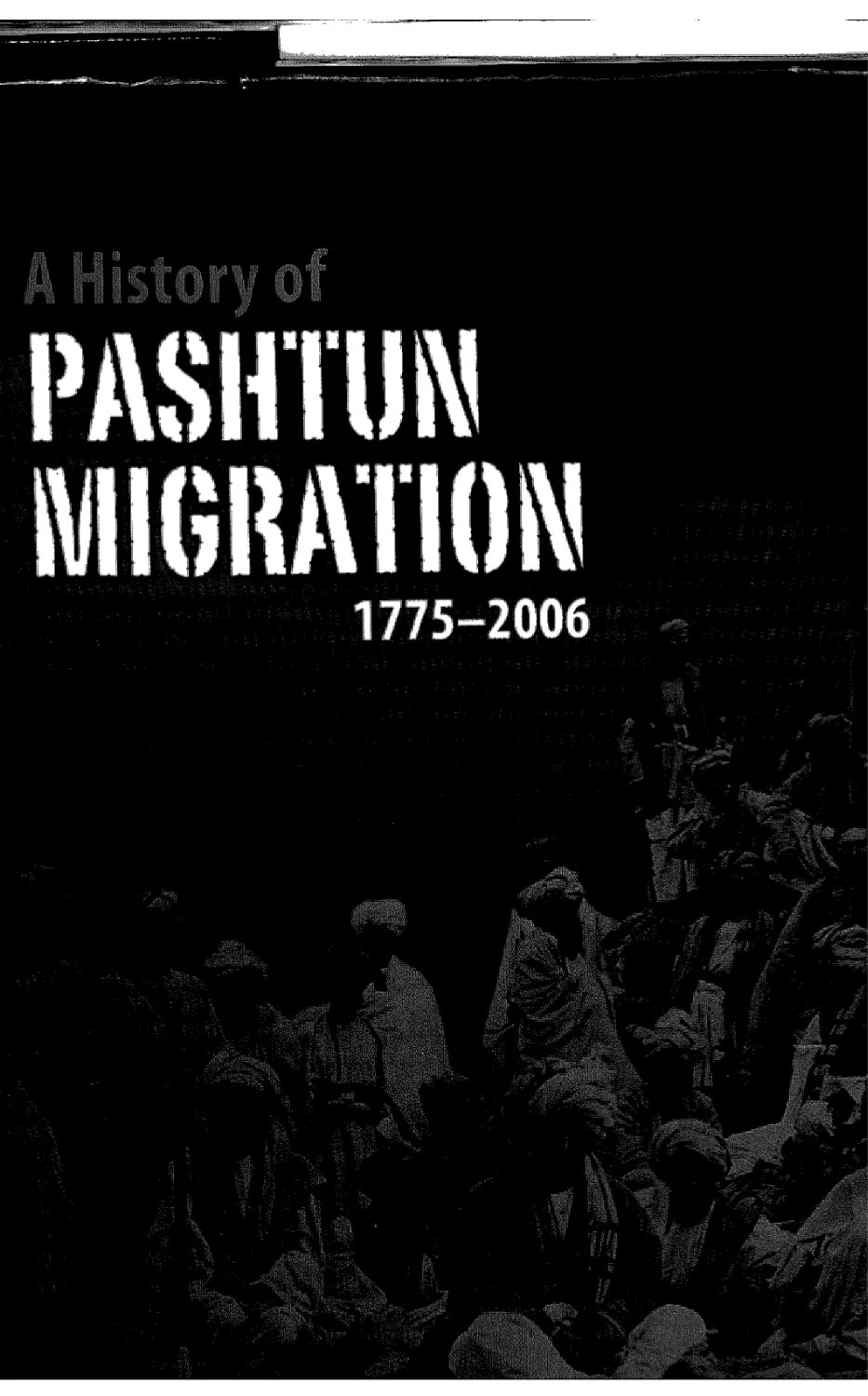
Cover photograph: Afghan chiefs and a British
Political Officer at Jamrud fort at the mouth of the
Khyber Pass, 1878. Photograph by John Burke.


A History of Pashtun
Migration, 1775-2006

A History of Pashtun
Migration, 1775-2006
Robert Nichols
OXTORD
UNIVERSITY PRESS
OXTORD
UNIVERSITY PRESS
Great Clarendon Street, Oxford ox2 6dp
Oxford University Press is a department of the University of Oxford.
It furthers the University’s objective of excellence in research, scholarship,
and education by publishing worldwide in
Oxford New York
Auckland Cape Town Dar es Salaam Hong Kong Karachi
Kuala Lumpur Madrid Melbourne Mexico City Nairobi
New Delhi Shanghai Taipei Toronto
with offices in
Argentina Austria Brazil Chile Czech Republic France Greece
Guatemala Hungary Italy Japan Poland Portugal Singapore
South Korea Switzerland Turkey Ukraine Vietnam
Oxford is a registered trade mark of Oxford University Press
in the UK and in certain other countries
© Oxford University Press 2008
The moral rights of the author have been asserted
First published 2008
All rights reserved. No part of this publication may be reproduced, translated,
stored in a retrieval system, or transmitted, in any form or by any means,
without the prior permission in writing of Oxford University Press.
Enquiries concerning reproduction should be sent to
Oxford University Press at the address below.
This book is sold subject to the condition that it shall not, by way
of trade or otherwise, be lent, re-sold, hired out or otherwise circulated
without the publishers prior consent in any form of binding or cover
other than that in which it is published and without a similar condition
including this condition being imposed on the subsequent purchaser.
ISBN 978-0-19-547600-2
Second Impression 2009
Contents
List of Maps	vii
Acknowledgements	ix
Preface	xi
1.	Regional Lives Taking Global Roles	1
2,	Integration through Subordination to Modern Empire	24
3.	Nineteenth Century Assimilation and Resistance	64
4.	Colonial Diaspora and Pashtun Adaptation	107
5.	National Integration, Transnational Circulation, 1950-2000	140
6.	Pashtuns as Global Workers, Dubai 2006	177
Conclusion: Pashtun Migration in World Historical Context	228
Bibliography	234
Index	243

List of Maps
1.	The North-West Frontier Province of Pakistan	xvi
2.	Katehr/Rohilkhand	xvii
3.	The North-Western Provinces and Oudh, about 1870	xviii
4.	Princely India, 1858-1947	xix
5.	The trading regions of the Indian Ocean	xx
6.	Hadhramaut coast	xxi

Acknowledgements
This book is the result of wide ranging interregional travel,
research, and writing; supported in many ways by numerous
friends, colleagues, and institutions. There is not enough space
to thank all those who offered advice, refuge, research
opportunities, and personal stories. First, Richard Stockton
College has proved an excellent academic home. The Stockton
College Grants Office under Beth Olsen funded summer research
in Dubai, conference travel, and writing time.
A seven month Middle East, North Africa, South Asia
Fulbright research grant allowed a spring semester in India at the
National Archives in New Delhi, with a short visit to the Rampur
Raza Library and the old Rohilkhand districts. The Fulbright also
funded a summer of research in the United Arab Emirates at the
UAE University in Al Ain, Abu Dhabi. Many thanks go out to
Fulbright administrators, especially Gary Garrison in Washington,
D. C. and the United States Education Foundation staff in New
Delhi under Executive Director Jane Schukoske. Dr. Husam
Mohamed Sultan Al Ulama, Dean of University Libraries, at the
UAE University and his staff offered generous advice and
hospitality. I especially appreciate the time given to me by Talal
M. Abdullah of the Al Ain Town Planning Department.
In Pakistan, the American Institute of Pakistan Studies funded
research and travel. AIPS Centre Director Nadeem Akbar,
Ghuhm Rasool, and others, offered full resources and remain
good friends. In Islamabad, the Sustainable Development Policy
Institute library held many valuable studies and reports.
Colleagues to acknowledge at the University of Peshawar include
Dean Taqi Bangash, History Department Chair Minhaj ul Hassan,
and Azmat Hayat Khan of the Area Studies Centre. I have also
appreciated the collegiality of Peshawar Archives Director
Zahirullah. Professor Ihsan Ali, during his period at the Peshawar
X
ACKNOWLEDGEMENTS
Museum as head of the Directorate of Archaeology and Museums,
offered constant support and scholarly opportunities.
As my writing progressed I was able to present ideas and
papers at the bi-annual AIPS conference held at the University of
Pennsylvania, hosted by then AIPS President Professor Brian
Spooner. Dr. Ian Barrow and the Rohatyn Center for International
Affairs at Middlebury College provided a venue to test out some
early ideas. Professors Sumit Guha and Indrani Chatterjee
provided opportunities to present my work at the annual Rutgers
University South Asia Conference. Other related papers were
presented at interdisciplinary conferences in Istanbul, sponsored
by the Hollings Center and the American Institute of Afghanistan
Studies; in Bellagio, Italy, at workshops organized by Professors
Sharon Nagy, Andrew Gardner, and Michael Bonine and
sponsored by The Rockefeller Conference Center; and in Dubai,
sponsored by the Social Science Research Council. Being a co-
organizer, with Professors Brian Spooner and Lee Cassanelli, of
a National Endowment for the Humanities Summer Institute,
“The Indian Ocean: Cradle of Globalization”, at the University of
Pennsylvania, allowed a sustained engagement with the
interregional scholarship of a variety of colleagues, including a
keynote address by Sugata Bose. Once again, David Ludden has
been forthcoming with ideas and manuscript feedback. One last
special thank you is extended to Ghousia Ghofran Ali and the
efficient, professional staff at Oxford University Press.
The book is dedicated to the many Pashtun and Asian workers
and friends living and circulating from the Peshawar Valley to
the Gulf and beyond who shared, with an often out of context
scholar, their life stories, insight, and ever present hospitality.
Preface
From the moment Pakistan gained independence in 1947, writers
have produced historical interpretations defining the character of
a Pakistan nation and the identity of Pakistani citizens. Even
before then, Chaudhry Rahmat Ali,1 Allama Iqbal,2 and others
talked of the need to give political autonomy to historically
Muslim majority territories in British India. The Quaid-i Azam,
M.A. Jinnah, envisioned a Two-nation1 history of long and
permanent division between Muslim and Hindu societies. Islamic
heritage and Muslim culture were seen to transcend regional
particularities? After 1947, national historians defined Pakistan
in difference and opposition to India and as a crucial state in
international competition and alliance. Political history
dominated? With the loss of East Pakistan in 1971, politicians,
academics, and authors explored the nature of historic Middle
Eastern and Islamic ties and the role of a religious identity.5 This
mobilization of historical narrative in the service of nation-
building was familiar on a global scale within a two century
period of modern world history as governments and advocates
created national narratives framed by space (homeland territories)
and time (from the struggle for independence to the postcolonial
effort to fulfil national destinies).
By the 1980s, all nation-states and their histories were
increasingly shaped by forces of globalization beyond the control
of individual countries and national storylines. Economic
linkages, political ideologies, culture, and conflict spread across
national boundaries in unpredictable and powerful ways. In
Pakistan, for a decade after 1979, nation-building efforts were
traumatized by the Soviet invasion of Afghanistan and the arrival
of millions of Afghan refugees. In the 1980s, related in part to the
political impact of the Afghan war, it was debated whether or not
Pakistan was to be a modern nation-state built on a model of
xii
PREFACE
western social and political institutions or an Islamic state defined
by religious references, ideals, and laws.
In this context Pakistan national histories continued to be
written, but now new historical approaches were also drawn upon
to illuminate an increasingly complex society. Regional histories,6
urban histories, and narratives of those at the bottom of society
revealed the great variations and nuances of national narratives
contoured by ethnicity, social status, economic standing, and
gender. Histories revisiting the 1947 partition of British India7
and that eras large scale migrations highlighted the fluidity and
contingency of the human cost of national origins/
By the 1990s Asian and world historians recognized that
histories of contemporary nation-states could not be properly
understood without recognizing long term processes of socio-
economic activity that often for centuries connected contemporary
national regions with far reaching networks of trade, pilgrimage,
empire, and migration.9 The histories of all nations were now
being expanded by new perceptions of historically relevant space
and time. European and Asian historians now traced centuries of
South Asian regional linkages to Central Asia, the Middle East,
and Southeast Asia. Pre-colonial Arab and Muslim traders from
the Gulf had long tied the ports of the Indus River and the nearby
Makran coast into Indian Ocean wide networks of economic
exchange and human circulation.10
In the same way, an evolving historiography of Pakistan has
been enriched by new perspectives interpreting notions of
relevant space and time. Through the nineteenth century, Sindhi
traders and finance connected Central Asia to the same Indian
Ocean networks.11 One author has traced national characteristics
of territorial unity and political continuity back thousands of
years to a heritage defined by the influence of the Indus River.12
The best national histories were not being replaced or denied as
much as being placed in new long-term perspectives. This volume
on Pashtun migration continues this same historical effort to offer
a new approach to thinking about a familiar theme, the history
of the Pashtuns living along todays Pakistan-Afghanistan border.
PREFACE
xiii
What follows is a historical narrative of two centuries of Pashtun
circulation within the South Asian and Indian Ocean regions. It
connects regional and national history to the widest themes of
world history. Other successful studies of relevant interregional
and Indian Ocean-scale connections and migration are discussed
in the Introduction.13 This volume joins with historians of
particular regions of East Africa, the Middle East, and Asia who
in a heuristic move to add perspective also have conceptualized
the broader Indian Ocean as an arena of scholarship useful for
integrating thematic and regional histories into global history.14
The basic argument that follows is that the Pashtun populations
of today’s Pakistan and the Peshawar region have always
participated within the greater historical flows of wider
interregional and world history. Pashtun mobility, by individuals
and communities, has adapted in different eras and circumstances
even as Pashtuns across regions have continuously asserted
initiative and agency. As Pashtuns were attracted and often
buffeted by shifting historical winds, they self-consciously made
choices that affected their future. In the modern period, Pashtuns
were increasingly subject to the forces and imperatives of
globalizing economic forces that often limited choices and
structured new forms of regimented society.15
This history selects and surveys specific periods and events
representing important themes and transitions over generations
of migration. These dynamics typically affected not only Pashtuns,
but many others struggling to survive in Pakistan and Asia across
two centuries. The study is not a formal economic analysis of
migration or a sociological argument defining a theory of
migration or diaspora. It is a history of rich narrative that draws
upon archival and other historical sources to outline two
centuries of complex socio-economic mobility and interaction
across the sub-continent and western Indian Ocean. This study
discusses interdisciplinary scholarship from anthropologists,
economists, political scientists, and sociologists to help
understand the multiple changes and continuities that have
xiv	PREFACE
shaped Pashtun society, in homelands and in diaspora, over the
generations since the late eighteenth century.
Through the six chapters, arguments are made about the effects
of different moments of Pashtun migration on individuals,
families, and communities. In the late eighteenth century Pashtun
heritage residents of northern India were confronted by a new
British Empire expanding outward from Bengal. But even as
many were subordinated to the new colonial political regime and
assimilated into local societies, many Pashtuns and those of
Pashtun descent sought new opportunities in unincorporated
Indian princely states, especially in Hyderabad in the south.
Through the nineteenth century Pashtun heritage migrants found
service from the Gulf to the Caribbean and as far as Australia as
they found themselves fully integrated into a global British
imperial economy. With the end of the empire in 1947 Pashtuns
and other Pakistanis pursued national opportunities, especially
in the new urban centres of Pakistan. In the 1970s Pashtuns were
quickly recruited by newly wealthy Gulf oil states. But the price
of employment was complete subordination at a high psychological
cost to an Arab state social hierarchy that denied the importance
of Pashtun cultural notions of honourable, egalitarian behaviour.
By the early twenty-first century Pashtun workers abroad were
fully involved in truly global dynamics of labour recruitment,
discipline, and exploitation, but were now also affected by
transnational efforts to develop labour solidarity, human rights
protections, and worker rights as defined by international trade
agreements.
This history of Pashtun migration thus informs colonial,
regional, and interregional histories even as it contributes to a
fuller understanding of a Pakistani history now imagined as
continually influenced by networks of circulation extending
across much of the world.
PREFACE
XV
NOTES
1.	Chaudhry Rahmat Ali, Pakistan: The Fatherland of the Pak Nation,
Cambridge, 1940.
2.	Hafeez Malik, ed., Iqbal: Poet-philosopher of Pakistan, New York:
Columbia University Press, 1971.
3.	Ayesha Jalal, The Sole Spokesman: Jinnah, the Muslim League and the
Demand for Pakistan, Cambridge: Cambridge University Press, 1985.
4.	K.B. Sayeed, Pakistan: The Formative Phase, 1857-1948, London, 1968.
5.	Akbar Ahmed, Jinnah, Pakistan, and Islamic Identity, London: Routledge,
1997.
6.	Examples include Imran Ali, The Punjab under Imperialism, 1885-1947,
Princeton: Princeton University Press, 1988 and Sarah Ansari, Sufi Saints
and State Power: The Pirs of Sind, 1843-1947, Cambridge: Cambridge
University Press, 1992.
7.	Ian Talbot and Gurharpal Singh, eds., Region and Partition: Bengal,
Punjab and the Partition of the Subcontinent, Karachi: Oxford University
Press, 1999.
8.	Ian Talbot and Shinder Thandi, eds., People on the Move: Punjab Colonial
and Post-colonial Migration, Karachi: Oxford University Press, 2004.
9.	Thomas Metcalf, Imperial Connections, India in the Indian Ocean Arena,
1860-1920, Berkeley: University of California Press, 2007,
10.	R.J. Barendse, The Arabian Seas, The Indian Ocean World of the
Seventeenth Century, London: M.E. Sharpe, 2002.
11.	Claude Markovits, The Global World of Indian Merchants, 1750-1947:
Traders of Sind from Bukhara to Panama, Cambridge: Cambridge
University Press, 2000.
12.	Aitzaz Ahsan, The Indus Saga and the Making of Pakistan, Karachi:
Oxford University Press, 1996.
13.	Surveys recognizing the Indian Ocean as a framing concept of historical
inquiry include Michael Pearson, The Indian Ocean, London: Routledge,
2003 and Kenneth McPherson, The Indian Ocean: A History of the People
and the Sea, Delhi: Oxford University Press, 2003.
14.	Edward Alpers, Gwyn Campbell, and Michael Salman, eds., Slavery and
Resistance in Africa and Asia, New York: Routledge, 2005; Gwyn
Campbell, ed., Abolition and its Aftermath in Indian Ocean Africa and
Asia, New York: Routledge, 2005.
15.	See essays in Sugata Bose, ed., South Asia and World Capitalism, Delhi:
Oxford University Press, 1990.
Map 1 The North-West Frontier Province of Pakistan
Map 2 Katehr / Rohilkhand
Source: Jos Gommans, The Rise of the Indo-Afghan Empire, c. 1710-1780, E. J. Brill,
1995.
Map 3 The North-West Province and Oudh, about 1870
Kilometers
KEY TO NUMBERED STATES
(Some rktosbim have been omitted
2	JHALAWAN
3	SARAWAK
4	MARI BUGT1 COUNTRY
5	AGENCIES A TRIBAL AREAS
6	FRONTIER DEPENDENCIES
7	GILGIT
8	MUZAFFARABAD
9	NORTH KASHMIR
10	PANCH
11	MtRPUR
12RAISI
13 SOUTH KASHMIR
14UOHAMPUR
15 BHADAFWVA
IS JAMMU
17 JASRGTA
18CHAUBA
19 MANDI
20SUKET
21	MALER KOTLA
22	SIHMUR
23	TEHRI-GARWAL
24	SIMLA KLL STATES
25	KAPURTHALA
25	FARIDKOT
27	HABHA
28	PATIALA
29	JIND
30	RAMPUR
31	BAHAWAIPUR
32	JAISALMER
33	KHA1RFUR
34	BIKANER
35	AL WAR
pnncery States
British Provinces
Miles
NORTH WEST
FRONTIER
PROVINCE
PUNJAB
UNITED
42 provinces
Malrran
BOMBAY
36 BHARATPUR
BOMBAY
Hyderabad
BOMBAY
Mysore
71 MORV1
72 JHALAWAR
73 PALANPUR
74 SIROHI
BIHAR
AND
□RISSA
9—80
MADRAS
90 KANKER
91 NANOGAON
92 CHHUIKHADAN
93 KAWARDHA
94 MAX RAI
95 ORCHHA
96 BIJAWAR
97 CHHA7ARPUR
Э8 CHARKHAR1
Э9 PANNA
100 AJAIGAR
101 BENARES RAJ
102 CHANG BHAKAR
103 KOREA
104 SURGUJA
105 JASHPUR
106 RAJGAR
107 UDAIPUR
108 SARANGAR
109 SIKKIM
110 GOOCH BEHAR
111 KHA SI & JAINTIAHILLS
112 TRIPURA
113 MANIPUR
BENGAL
38	KARAULI
39	BUNDI
40	JAIPUR
41	GWALIOR
42	DAT1A
43	TONS
44	KOTAH
45	RAJGAR
48	BHOPAL
47	NARSINGHGAR
48	KH1LCHIPUR
49	JHALAWAR
50	MEWAR
51	INDORE
52	DHAR
53	CEWAS
54	BARWANI
55	JHABUA
5S RATLAM
57	JAORA
58	SITAMAU
59	PARTABGAR
50 BANSWARA
6t DUNGARPUR
62 REWA KANTHA
S3 AL1-RAJPUR
64 BARODA
65 KAMBAY
65 GOHELWAR
67 SORATH
65 FOR BANDAR
69G0NDAL
70 NAWANAGAR
75 SURAT AGENCY
77 JAWHAR
7BBHOR
70 5ATARA AGENCY
80 KOLHAPUR
01 savantvadi
82 BUAPUR AGENCY
S3 SO. MARATHA JAGtRS
84 SANGLI
85 COCHIN
88TRAVANCCRE
87 PUDUKHOTTAI state
88 BANGANAPALLE
69 BASTAR
Map 4 Princely India, 1858-1947
Source; Karl Schmidt, An Atlas and Survey of South Asian History, M.E. Sharpe, 1995, p. 79.
Map 5 The Trading Regions of the Indian Ocean
Source: K. N. Chaudhuri, Trade and Civilization in the Endian Ocean, Cambridge, 1985, p. 35,
Map 6 Hadramaut Coast

1
Regional Lives Taking Global Roles
‘...Circulation is different from simple mobility, inasmuch as it
implies a double movement of going forth and coming back, which
can be repeated indefinitely. In circulating, things, men and notions
often transform themselves. Circulation is therefore a value-loaded
term which implies an incremental aspect and not the simple
reproduction across space of already formed structures and
motions...?
Recent South Asian scholarship has recognized that knowledge
of processes of migration and circulation has become vital for a
full understanding of regional social, economic, and cultural
histories, especially in the modern period. Discussing the
complex role of migration in South Asian social history,
Markovits and his colleagues have posited that the ‘totality of
circulations occurring in a given society and their outcomes’
define a kind of circulatory regime’ that varies over time and
shapes society, ‘which can be seen as an ensemble of crisscrossing
... flows.’2 In a similar approach, this study argues that a long
history of migration involving Pashtun ethnic communities has
enriched and complicated regional societies across South Asia
and the Indian Ocean, especially in the modern period, after the
mid-eighteenth century, as these regions were influenced and
transformed by colonial and postcolonial dynamics.
Arguably, the Pashtun communities of today’s northern
Pakistan and eastern Afghanistan have had their history
repeatedly transformed, incrementally and cumulatively, across
centuries by migration and constant movement. While specific
individuals, times, and places related to Pashtun mobility have
2
A HISTORY OF PASHTUN MIGRATION, 1775-2006
attracted historical notice, this volume outlines and discusses the
broad processes involved over the last two hundred years as all
Pakistani and South Asian communities have clashed with,
resisted, and been transformed by interregional forces that have
reshaped the social and economic histories of the Indian
subcontinent, and the world. Typically, Pashtun history has been
framed and studied by issues of territory, language, culture, and
political interaction in specific regions and eras. This volume
argues that the history of Pashtun migration has been one of the
neglected themes required to fully understand the history of
Pashtun communities as well as greater narratives of the Mughal
empire, British India, Pakistan, and the postcolonial world.
There has been an accumulating amount of research on social
and political change among communities in Pashtun majority
settlement territories, including the greater Peshawar valley and
neighbouring districts, a diverse region characterized by agrarian
village economies, ethnic Pashtun/Pakhtun social dynamics, and
a history of close involvement with subcontinental networks of
politics, employment, and trade? This chapter introduces this
volume’s approach to understanding the historic impact of
circulation and migration on select Pashtun communities and
socio-cultural practices as residents left the Peshawar valley, often
for decades or permanently, to pursue outside employment and
opportunity. Over generations, the lives of Pashtuns in permanent
or temporary diaspora were transformed by the range of possible
social and economic forces as they circulated in the greater
Indian Ocean region, variously experiencing degrees of
assimilation, integration, ethnic self-awareness, and, increasingly,
notions of ‘national’ identity.
For many centuries, Pashtuns travelled within the Indian
subcontinent and in the greater Indian Ocean arenas? The
following chapters offer one analytic approach to understanding
how in the last two 'centuries this movement became heavily
shaped by modern political and economic influences operating
on a global basis. After 1775 and throughout the nineteenth
century, Pashtuns circulating in northern India, from both urban
REGIONAL LIVES TAKING GLOBAL ROLES
3
and rural settings, began moving increasingly in British imperial
spheres. After decolonization in 1947 Pashtuns sought
opportunities within the new nation-states left by departing
empires and within a rapidly changing Pakistani urban
environment. From the early 1970s Pashtun workers pursued
livelihoods within a world economy transformed by the demand
for Middle East energy resources. By 2006 Pashtun circulation to
and from the Gulf city-state of Dubai offered a defining history
of how many world communities now experienced modern
globalization as a complex dynamic of subordination, exploitation,
limited agency, and nascent resistance.
This introduction briefly outlines these historic periods and
themes and argues that a study of Pashtun migration, including
from particular districts within colonial and postcolonial South
Asia, illuminates wider questions about migration and
globalization, including theories that have attempted to explain
economic, social, and cultural changes and continuities observed
in Pakistani villages, and in the world during the late modern
period, approximately 1775-2000. This is a preliminary statement
contributing to wider interpretations of interregional history and
to more difficult discussions of regional Pashtun identities and
how they have, inevitably, undergone change over the course of
time.5 The Pashtun history of migration and diaspora represents
one specific, but representative, strand of the great diversity’ of
South Asian migrations experienced over centuries by multiple
peoples of differing regions, religions, ethnicities, and
languages.6
Regionally, for centuries, agrarian districts with little irrigation
and limited rainfall in eastern Afghanistan, the northern and
western colonial Punjab, and the North-West Frontier Province
produced surplus workers looking outside the immediate village
economy for subsistence and opportunity.7 Markovits and his
colleagues have proposed that ecological differences in Indian
regions, ranging between dry, semi-dry, and wet zones, as well as
opposing pastoral and agrarian political economies, produced
some ‘highly routinised productive processes’, but also provided
4	A HISTORY OF PASHTUN MIGRATION, 1775-2006
scope for a mobile and skilful peasantry and groups of merchants
and artisans’ including ‘in the ‘dry zone of Afghanistan, Iran and
Central Asia’ Particularly, in north India, and arguably the
Pashtun homelands, ‘this interaction was manifested through a
regular pattern of circulation of manpower, including military
manpower, goods, capital, expertise, ideas, techniques, etc., from
the ‘dry’ areas to the ‘wet’ zones..?8
In the eighteenth century, tens of thousands of ‘Rohillas
migrated from west of the Indus to settle northeast of New Delhi
in the Rohilkhand region. This followed a centuries-old pattern
of migration, especially for employment in the north Indian
labour market for soldier entrepreneurs’.9 In the early nineteenth
century, many migrants sought ‘service in East India Company
territories or in areas still under local rulers. After 1849 when the
British had occupied much of the north Indian region, a small
administrative cadre was recruited for low-level colonial
government service. But most of the surplus labour force,
including poorly educated villagers of the Peshawar valley10 and
neighbouring districts such as Swat and Kohat, sought unskilled
or semi-skilled work in police and military service, in agriculture,
or in urbanizing market towns and port cities such as Karachi
which had begun to grow rapidly after 1850.
In the mature colonial period, after the imposition of direct
rule by the British crown in 1858, Pashtuns from the Peshawar
valley also were recruited for positions in colonial plantations and
trade networks that linked South Asia, Africa, various Indian
Ocean archipelagos, and Southeast Asia. Some Pashtuns pursued
trading, which included the selling of livestock across northern
India. Others became shopkeepers and small financiers. Under
colonial penal codes, Pashtun prisoners were transported across
the water’ to the Straits Settlements and the Andaman Islands.
This study discusses aspects of the Pashtun diaspora within the
provinces and princely states of colonial India and continues to
follow this human circulation after decolonization within the
independent nation-state of Pakistan. It then examines
participation in globally integrated overseas labour markets,
REGIONAL LIVES TAKING GLOBAL ROLES
5
especially in the Middle East in the late twentieth century.
Throughout this history, evidence suggests that Pashtun ethnic
identities in diaspora were not of an unchanging, primordial
character. In considering individual and community histories and
representations it must be remembered that ethnicity is never a
given factor in identity formation but is always socially and
politically constructed.’11
Especially from the early 1970s, development policies of the
Pakistan state encouraged external labour flows to the rapidly
growing economies of the oil states in the Gulf, Libya, and Iraq.
This phase saw dramatic numbers of Pakistanis employed in the
Middle East, with resulting complex social consequences.’2
Remittances to home villages transformed local architecture and
consumption patterns even as the possessors of new wealth
challenged established social hierarchies for degrees of status and
leadership. Gender relations were increasingly adjusted or upset
as women left behind by migrating husbands often took charge
of family affairs and finances. Irregular and illegal migration
proliferated, even as old power structures tried to monopolize
access to the new opportunities. Forces of globalization, including
informal labour and financial networks threatened to undermine
the sovereignty of nation-states attempting to set policies and
regulate savings and expenditures.13
In examining these potentially disruptive influences at the
village and family level and placing these findings in the context
of the last two centuries of regional history, this study argues that
there has been a rough continuity of migration push and pull
factors in the modern period and that indeed moments and
themes of contemporary migration from Pakistan to the Middle
East often have varied little from those of the colonial era. This
research also argues, agreeing with Addleton, that patterns from
the first decades of post-independence labour migration within
Pakistan resonate with the last three decades of migration to the
Middle East.14 By rooting this research in the history of the
Peshawar valley, this work contributes to literature noting the
effects of historical global processes (migration, capitalism,
6
A HISTORY OF PASHTUN MIGRATION, 1775-2006
industrialization, etc.) at the regional level, where local socio-
cultural relations and practices more readily reveal dynamics too
easily subsumed within macro studies framed on the nation-state
level.
Theoretical approaches to historical processes of migration,
diaspora, and globalization, especially in the South Asian and
Pakistani context, have been formulated by economists,
anthropologists, and others impressed by the impact of British
colonial economic policies and by great waves of national and
international mobility experienced during colonial and
postcolonial periods of urbanization, industrialization, and
transnational labour movement.15 The approach here focuses
upon South Asian history and the specific relevance of the Indian
Ocean area for migration study, especially when one considers
this region, in Sugata Boses term, a historic ‘interregional arena
of cultural, economic, social, and political exchange continuously
linking distant cultures and political economies.16
Studies of colonial-era South Asian labour migration record
the integration of a global system of European colonial capitalist
production. The nineteenth century British imperial system
developed indentured and contract labour recruitment to operate
commercial plantations from the Caribbean to Fiji. This has been
studied as a substitute for abolished slave labour and as an
ideological system creating permanent, docile worker pools.17
Post-independence scholarship has analyzed the continued high
mobility of Pakistani labour, internally and externally. Scholars
have explained processes of urbanization and overseas migration
from perspectives framed by both neo-classical and structural
theories of economic change driven by benign or rapacious
capitalism. Recent social science literature has also attempted to
theorize the nature and impact of contemporary global forces of
communication, world markets, and cultural exchange.18
Especially since the early 1970s, Pakistani government and
research centre studies have used classical economic approaches
to judge the empirical costs and benefits of labour migration. This
work has produced a substantial body of relevant literature.19 But
REGIONAL LIVES TAKING GLOBAL ROLES
7
different problems faced in this effort have included difficulties
in acquiring truly accurate statistical data bases as well as the
inability of macro-level national studies to offer insight into
village-level change or into less quantifiable regional social and
cultural dynamics shaped by ethnic and linguistic differences.
Structural approaches to migration and development theory
and the Pakistani experience have narrated change as occurring
due to inherent inequalities of power and wealth within and
between regions and economies. Scholars have tried to determine
the extent to which centres of economic power and capital,
including the oil-rich Middle Eastern states, have turned to
labour surplus countries to cultivate relations of dependency and
labour stratification.20 Yet both classical market analyses and
structural approaches to Pakistan’s migration history, especially
to the Middle East, have been critiqued for failing to fully
characterize either the historical experience of the colonial period
or the last fifty years of independence. Classical modelling has
suffered from an inadequate, ‘fragile database and an inability to
keep up with or explain the diversity and complexity of changes.
Additionally, structural world systems arguments critiquing
global capitalism as shaping centre-periphery links are weak
when it comes to explaining specificities, such as the historic roles
of modern Libya and Iraq, ‘no client states of capitalism’, in
recruiting Pakistani labour.21 Despite varying interpretations, this
study recognizes that the wider economic forces involved in this
period represent the latest evolutionary stage in a long history of
the spread and acceleration of trade and finance capital operating
within and across both Asian and world economies.22
Socially, anthropologists have attempted to trace the impact of
migration and economic globalization at the Pakistani village
level,23 but also have theorized broadly about how localities
experience modernity and reflect the influences of migration and
globalization. For this volume, a general theoretical statement
supporting a focus upon social change at the village and district
level, derives from Appadurai’s notion that a specific place of
research becomes less a case study than a site for the examination
8
A HISTORY OF PASHTUN MIGRATION, 1775-2006
of how locality emerges in a globalizing world, of how colonial
processes underwrite contemporary politics, of how history and
genealogy inflect one another, and of how global facts take local
form’24
The following discussion introduces important themes
developed in subsequent chapters that survey the history of
Pashtun circulation and diaspora in the greater Indian Ocean
arena. These moments reveal Pashtun agency, but also adaptation
as local practices and possibilities reacted to and were modified
by interregional and global processes. Throughout this history,
state policies and ideologies contributed to the shaping and
ordering of personal and community identities. Importantly, this
study argues that imperial state notions of inherent social and
political hierarchies, often using ‘the rule of colonial difference
to subordinate particular ethnic communities, continued to
operate in postcolonial nation-states that ranked internal and
migrant ‘national’ identities, often for economic advantages.25
Assimilation and Transformation: The Rohilla Experience
Numerous scholars of eighteenth century northern India have
produced histories attempting to understand and explain the
expansion of British colonial interests northwest from Bengal.26
One research question has involved gauging the late eighteenth
century and early nineteenth century influence of the growing
British presence on processes of Pashtun or ‘Rohilla’ migration
for agricultural labour, trade, and political influence in the
districts of the historic region of Katehr or Rohilkhand, north
and east of Delhi.27 Indeed, centuries-old practices of political,
economic, and cultural mobility and exchange across northern
South Asian territories were upset, transformed, and subordinated
by eighteenth and nineteenth century British colonial political
agendas and alliances.
For this study it becomes useful to look past the immediate
political history of the era and past the politically convenient
REGIONAL LIVES TAKING GLOBAL ROLES
9
assumption held by some in the late eighteenth century that the
‘Rohilla’ population simply disappeared in 1774 with the military
defeat of the last independent Rohilla chief, Hafiz Rahmat Khan?8
The more important question for this volume concerns the
political and social effects of the conquest and the gradual
subordination and assimilation of the region into the British
Indian empire. The colonial state ‘penetrated society much more
deeply than it had before, replacing a shared and layered concept
of sovereignty’ with new unitary demands.29
By the late eighteenth century perhaps one hundred thousand
Afghan or ‘Puthan migrants had established several generations
of political control and economic consolidation within numerous
Rohilkhand communities, often predominately non-Muslim in
population. These local polities had prospered after 1720, in
competition with the formerly dominate Mughal political and
economic system centred in Delhi that continued to fragment
and decentralize.30 Though identities were derived from norms
of Pashtun or Afghan leadership and heritage, over generations
of settlement in north India the ‘Rohilla name reflected less a
fixed ethnicity based on kinship or essential culture than a
constructed, inclusive, often professional identity that reinvented
lineage idioms and norms to integrate a diverse body of
individuals and interests.31
Chapter 2 of this volume discusses how after 1774 the scattered,
autonomous local polities that had developed in previous decades
were subsumed within the growing British Indian colonial sphere
of influence. Contemporary (eventually discredited) colonial
narratives at first argued that the Rohilla communities had been
exterminated in 1774 when a British colonial army aided the
Nawab of Awadh in the conquest of the Rohilla territories. Some
Rohilla military leaders were exiled. Other families left the
region. But aside from the losses in battle, relatively few of the
Rohillas were killed or went into exile. Most stayed in the region.
Many rallied to the new princely state of Rampur, a dependency
(jagir) set up to diffuse Rohilla resistance and to subordinate the
leading lineages to the influence of the Nawab of Awadh and his
10
A HISTORY OF PASHTUN MIGRATION, 1775-2006
allies in the East India Company. What became of the Rohilla
population and identity, especially under the changing conditions
in the region briefly outlined by Gommans? The evidence
suggests that processes of socio-cultural assimilation and
adaptation slowly diminished Pashtun legacies of language and
culture even as a ‘Rohilla’ identity continued to evolve and
circulate. This illustrated a larger Indian Ocean truth of 'the
apparent adaptability of migrant communities and the ease with
which their identities have often integrated or otherwise
transformed to meet the pressures of different circumstances?2
Chapter 3 of this study examines the nineteenth century as the
Rohilkhand districts were absorbed by the British empire and the
Afghan and Pashtun descendants of original settlers were
assimilated in different ways into local economies and cultural
influences. If name forms (Khan) and genealogical lineage
remained important, the Pashto language itself slowly disappeared.
Late nineteenth century Rohilkhand district censuses continued
to list ‘Pathan’ as one of the four categories of enumerated Muslim
populations, yet marriages with non-Pashtun spouses blurred
notions of pure descent.
Those individuals whose livelihoods had followed mixed
personal economies, representing old patterns of ‘mobility of
labour activity, as seasonal farmers, weavers, transporters, and
soldiers,33 were now often reduced to more sedentary existences.
Large numbers of Muslim weavers (julahas) listed in late
nineteenth century Rohilkhand district census reports hint of the
possibility that more than one landless descendant of Rohilla
migrants found lower status refuge as an artisan in district market
(qasba) towns and Rampur City.
Initially, in the late eighteenth century, in territories they newly
controlled, the British continued to reduce often large armies of
indigenously raised cavalry and infantry to smaller, better armed
and ‘disciplined’ infantry regiments. But in the early decades of
the nineteenth century, as the East India Company expanded
westward around the Delhi area, they also raised new regiments
of ‘irregular cavalry from local recruits, once again providing
REGIONAL LIVES TAKING GLOBAL ROLES
11
employment for ‘Rohilla and other recruits. Again, from the
1820s through the 1840s, as colonial administrative control
‘settled’ much of northern India, many of these recruits would be
periodically dismissed. But often now, through strategic
retirement and pension policies, many of the dismissed would be
granted parcels of farmland on uncultivated, waste lands in
strategic locations. As the colonial power pensioned off
experienced soldiers to become revenue producing agriculturists,
many ‘Rohillas’ settled permanently outside of the former
Rohilkhand districts on critical ‘frontier’ borders.34
Evidence from 1858 suggests the survival of degrees of a
Pashtun-derived lineage-based identity in villagers of the old
Rohilkhand districts. Yet eighty years after the end of ‘Rohilla
sovereignty and pre-colonial Rohilla migrations, such identities
were marked as much by signs of assimilation and transformation
as any continuity.
As the British army re-conquered north Indian districts after
losing control in the revolt of 1857, they closely documented lists
of rebels’ to be arrested for potential punishment. One contingent
of villagers from ‘Sambhal parganah’ in ‘Moradabad zillah"
(district) was wanted for having fought in the name of the rebel
Nawab of Bareilly’ Khan Bahadur Khan.35 The British compiled
a detailed report in an effort to apprehend those involved from
‘Tureenoo Suraee’36 village. The report contained personal
descriptions of the villagers and reflected both colonial and
internal perceptions of significant aspects of individual identity.
The colonial ethnographic’ personal descriptions of each of
the sixty-three men hint at a Rohilla social history more complex
than the simple reproduction of normative ‘Pashtun or ‘Afghan
families and lineages descended from putative ideal-type tall,
thin, fair Pashtun forefathers and ‘father’s brothers daughter’
brides?7 Personal characteristics, including distinction by skin
colour, were noted. If indicating notions of colonial or local
racial’ difference, this diversity might also mark the complex
ethnicity of original ‘Rohilla settlers, including descendants of
12	A HISTORY OF PASHTUN MIGRATION. 1775-2006	Ц
finally sedentary male migrants who married into locate
families.	 Ж
Chapter 4 examines how the Rohilla identity as an independent/®
military entrepreneur of nominal Afghan or Pashtun heritage^!
evolved throughout the nineteenth century. As the Britisht -Ц
assumed control over greater areas of the Indian subcontinent* 4j
the name Rohilla became a pejorative label reflecting the colonial. Я
bias against any mobile, armed, unsettled Indian population^ fl
Regardless, Rohillas, ‘Puthans’, and ‘Pathans' continued to serve |j
across India in regional forces and as the coercive power for 7Я
revenue collecting regional administrators and local zamindars^ Ц
Through the decades of the nineteenth century Rohillas were Д
continuously employed, dismissed, and denounced as bandits and ' ||
criminals, often by the same regimes in different periods. Ц
In the late spring and summer of 1836 the princely state of Ц
Hyderabad in southern India was being pressed by East India
Company advisers to regularize revenue collections and reduce Я
military expenses. In May 1836 the Nizams government tried to J
dismiss all Rohillas from government service and remove them |
from Hyderabad city and from postings with local talukdars and |
others. For decades in the vast territories of the Nizam of |
Hyderabad, revenue farmers and local authorities had hired |
‘Rohilla* cavalry as collection agents?8 The Hyderabad Rohillas |
were not to be easily dismissed. The resulting correspondence |
between East India Company officials and Hyderabad state 1
ministers outlined the survival and adaptation of pre-colonial ?
forms of interregional military recruitment and service, including J
the presence of thousands of ‘Arabs in Hyderabad.	s
In August 1836 the Hyderabad minister issued a proclamation
ordering all Rohillas to leave Hyderabad. But the utility of the
‘service rendered by such irregular troops meant that they were
never completely displaced by local landlords and officials. In
1846 colonial records included the ‘Nizam’s application for
assistance to expel Rohillas from his dominions’. In 1851 a file
discussed ‘Approval of the proposal of the Resident at Hyderabad
to make the prohibition stronger against the employment of
REGIONAL LIVES TAKING GLOBAL ROLES
13
Rohillas in the service of the officers of the Nizams government’
In 1859 a report listed ‘Preventive measures against incursions of
Rohillas into the Madras Territories’ In incidents in the 1860s
and 1870s, Arabs in service to the Nizam of Hyderabad with
family political interests in the Persian Gulf actually sent Rohillas
from Hyderabad to the ‘Hawdramant’ coast of the Arabian
peninsula. At least one group of Rohillas departing from Bombay
for the Gulf claimed to be pilgrims in transit to Mecca. Political
Agents in the Gulf and officials in British India wrote endless
notes and summaries untangling relationships and attempting to
control such long distance connections and initiatives. Pashtun
and Rohilla agency survived on the margins of empire.
By the end of the nineteenth century the word Rohilla finally
began to disappear from colonial correspondence. Inside the
Rohilkhand districts the Rohilla or Pathan name began to
represent little more than a fixed category in colonial census and
ethnographic tables. In Rampur state the myth of the martial
Pashtun survived in a dynasty descended from Faizullah Khan
(ruled 1774-83). The dynasty remained fully loyal to the British
during the revolt of 1857-8 and until the empires end in 1947.
Across the rest of India, Rohilla would become a generic term for
bandit or mercenary, long disconnected from any Afghan,
Peshawar valley, or Rohilkhand history or heritage. Yet, within
Rohilkhand, family memories of distant origin often endured. As
late as the year 2000, one member of a family who had lived for
generations in Rampur, would assert a personal heritage as a
‘Yusufzai Pathan, originally from the Peshawar valley.39
Integration into the Colonial Political Economy
Archival research has yielded useful material to trace nineteenth
century labour flows, military recruitment, and general mobility
into and from the Peshawar valley. From 1857 onwards, treated
as members of a key martial race, Afghan border Pashtuns and
Peshawar region Pakhtuns were taken in large numbers into
14
A HISTORY OF PASHTUN MIGRATION, 1775-2006
British Indian armies. Many enlisted at the military cantonment
in Mardan town in the eastern Peshawar valley, where a soaring
late nineteenth century memorial was dedicated to the many men
killed in Kabul in the second Afghan War.
Career and retirement files of local recruits listed the home
villages and postings of soldiers, and their post-retirement
activities. Such files traced the scale and scope of colonial military
and police employment of Peshawar valley residents across the ;
Indian Ocean. Even before direct recruitment from the Peshawar J
valley, Pashtun emigrants to north India had long served in J
colonial armies. A well-travelled veteran, Buland Khan, received :
recognition for his service in 1857-8 helping the British retake
districts from rebels’ in the Rohilkhand region. Born about 180Os J j
listed as of the caste of‘Puthan, Buland Khan had enlisted with
the East India Company army in 1814 and fought in numerous
colonial campaigns.40
In the late nineteenth century, as the British completed new
irrigation canals in the Peshawar valley and the Punjab, tens of
thousands relocated. Many migrated down from the Afghan
highlands as seasonal field labourers while others, including
retired military personnel, resettled as higher status landowners.41
From the 1880s new colonial irrigation works transformed much
of the Peshawar valley. New networks of trade and transport
developed as commercial agriculture and a new rail system into
the valley connected Peshawar residents and cash crops such as
sugar and tobacco to subcontinental networks and markets.
The nineteenth century also continued to involve the Peshawar
valley in long established pilgrimage and economic networks
reaching into Central Asia, Persia, and the Indian Ocean region.
The rise of new modern states and empires, including Russian
expansion into Central Asia, re-channelled or severed some of
these linkages. Pashtuns regularly visited the Muslim holy sites
in the Middle East as pilgrims on hajj and undoubtedly as
entrepreneurs servicing and facilitating transportation and
associated trade.
REGIONAL LIVES TAKING GLOBAL ROLES
15
Local and distant trading and financial networks interacted
with, facilitated, and influenced systems of labour migration. As
Dale and Markovits have situated histories of South Asian
merchant communities within Asian and world contexts, a study
of Peshawar valley migration inevitably follows paths of mobility
and livelihood across imperial, national, and area studies
boundaries.42 Nineteenth and twentieth century imperial and
national documentation placed Pashtuns in diverse colonial
locations from South Africa to the Andaman Islands. Specific
Pashtun narratives were shaped by the ever changing 'relationship
of Asian intermediary capital and migrant labour with the
broader structures of colonial and paracolonial capitalism’43
For example, between the years 1873-1916, English ships
carried up to 35,000 contract labourers from India to the Dutch
colony of Suriname where many worked on large sugar
plantations. Steamships typically sailed from Calcutta to
Paramaribo with passengers recruited by the Dutch colonial
government for five-year renewable contracts. Many were from
the districts of northern India, including Muslims from
Rohilkhand and the Peshawar valley. They left poverty and lack
of employment for uncertain futures in Suriname and other
Caribbean colonies, including neighbouring British Guyana. In
the Dutch records, hundreds of migrants had the name 'Khan,
and were listed by ‘kaste as ‘Pattan’ or ‘Mosulman. Only a handful
travelled with wives or children.44
Service as Labour in the Interregional Arena
From the 1920s onwards, nationalist movements and ideologies
challenged the British-Indian empire and generated new kinds of
mobility. Political exiles seeking refuge and support travelled to
Afghanistan, the Soviet Union, Europe, and the United States.
Peshawar police files recorded the movement of suspected
individuals across the Afghan frontier. In the 1930s, pre-partition
political-religious rioting and ethnic cleansing displaced non-
16	A HISTORY OF PASHTUN MIGRATION, 1775-2006
•
Muslim populations from towns in the NWFP,45 while from the '?
late 1930s Muslims in districts across the Punjab province were, j?-
forced to rethink notions of a territorial homeland.
Chapter 5 outlines Pashtun migration as mobility was affected
by new post-colonial, national dynamics. After the partition of.
British India in 1947, Pakistan, especially West Pakistan, was?. J
defined by millions of new residents, immigrants and refugees;
Within West Pakistan, Pashtun circulation now took the form of.??
urbanization as hundreds of thousands followed new employment 71
opportunities in government service, construction, transport, and
services. Migrants transformed Karachi into a major city.??|
Islamabad was created from farm fields as a new national capital. ? |
Pashtun citizens of Pakistan rose to high ranks in the armecL
forces of the increasingly militarized Pakistan state, even as many g
residents of the NWFP resented perceived losses of autonomy
and regional culture. Afghanistan became a temporary refuge for ?|
exiled Pashtun nationalists, including the often jailed anti-British '?|.
Peshawar valley-born nationalist, Abdul Ghaffar Khan who chose Д
to be buried in Jalalabad, Afghanistan at his death in 1988.	- ж
Chapter 5 focuses on the nature of post-1970 Pakistani
migration abroad and especially the complicated push and pull re-
factors experienced in Pashtun homelands. By the 1970s, national
and international economic and political currents pulled
Pakistani professionals and blue-collar workers abroad, including
to the oil-rich economies of the Middle East. Pashtuns circulated';®,
to fill employment niches from Saudi Arabia to Iraq, and in the
Gulf princely states such as Kuwait and the United Arab Emirates.
.But Pashtun notions of ethnic and Islamic egalitarian society
quickly clashed with socio-economic hierarchies dominated by »
Arab elites. Ethnic and class differences left Pashtuns subordinated Л
and conflicted.46
By the 1980s the futures of Pashtuns in the Indian Ocean Ж
arena, and of NWFP communities dependent on remittances, ®
were fully integrated into the ebb and flow of global forces. An A
early 1980s fall in oil prices ended the first boom in Gulf labour Л
migration. The Iraq-Iran war in the 1980s, then the first Gulf War Ж
REGIONAL LIVES TAKING GLOBAL ROLES
17
in 1991, disrupted the region and forced the shifting and return
home of many Pashtun and other expatriate workers. As well, the
leading Indian Ocean labour suppliers; Pakistan, India, Sri Lanka,
and Bangladesh, now competed with East Asian and Southeast
Asian countries eager to export workers,
In the 1990s the nation-state of Pakistan struggled to develop
stable internal systems of representation and prosperity. This
instability continued to push the underemployed to look outward
for opportunities. Pashtuns working abroad in the Gulf region
were now firmly constrained by rigid state-supervised employment
regulations that limited or ignored worker rights and benefits,
and even controlled periods and places of residence. Trading
personal sacrifice for income, and despite numerous obstacles,
many foreign workers in the Gulf, including Pakistani and
Afghan Pashtuns, secured sustainable employment. Pashtuns
took leading roles in the construction and transportation
industries. By manipulating the contract labour system, low paid
but steady work might be continued for decades. Hundreds of
thousands of Pashtun expatriate workers produced regular
remittance flows that proved vital not only to families and
communities, but also to the foreign exchange holdings of the
central government.
In addition to income, new cultural, intellectual, and spiritual
influences circulated. In the 1980s Saudi Arabia supported
Afghans using bases in the NWFP to resist the Soviet army
occupying Afghanistan. Saudi funds built religious schools and
mosques. Saudi forms of devotional and social practices were
carried back to NWFP district villages with varying consequences.
A returned worker might occasionally be observed conversing in
Arabic with another returned labourer.
This study of contemporary Pashtun circulation includes direct
observations from the home districts, especially in the Peshawar
valley, that sent labourers abroad. Ethno-historical research
illuminated the latest manifestations of age-old patterns of
production, trade, and employment. Through the 1990s the
18
A HISTORY OF PASHTUN MIGRATION, 1775-2006
circulation, adaptation, and reinvention of ideas, cultural
material, and identities continued unabated.
Chapter 6 of this volume is set in a post-11 September 2001
world and argues that by 2006 labour migration to Dubai
represented a new integration of Pashtun experience within a
network of globalized economies and international agreements
and agendas. After 11 September 2001, Pashtun and Pakistani
workers in the Gulf also operated in an environment marked by
the American occupation of Afghanistan and Iraq, high oil prices,
a second Gulf oil boom, and a less obscure ethnic profile. Western
popular culture now imagined Gulf workers as potential
‘terrorists’,47 even as foreign workers, including Pashtuns, used the
Gulf oil boom and labour needs to re-imagine their own
subordinated status.
After 2001, Gulf workers increasingly claimed new identities
as modern workers with rights detailed by international labour
organizations, advocated by human rights groups, and required
by world trade agreements. Pashtun concerns now became
comparable to and integrated with the struggles of other national
worker populations recruited from South Asia to China. By the
summer of 2006, Gulf worker mobilization slowly reshaped the
Indian Ocean labour hierarchy Spontaneous and planned sit
down strikes, demonstrations, and use of the media now
challenged Gulf country labour ministries still able to instantly
deport any high profile activists. A 2006 strike by Dubai taxi
drivers proved the ability of Pashtun workers to collaborate across
national and ethnic divides to secure economic rights.
Even as the most recent details of regional labour circulation
were difficult to document, more complicated remained the effort
to interpret the consequences of contemporary migration for
home families and villages. Remittances funded education,
including for girls. Also funded were conservative mosques,
political activism, and conspicuous consumption. Psychological
impacts empowered and confused individuals and even whole
neighbourhoods where many houses were often devoid of
working-age men.
REGIONAL LIVES TAKING GLOBAL ROLES
19
Womens lives evolved in this context. Certain women gained
from periods of household authority and higher family incomes.
If some women assumed new household authority in the absence
of men, others were perceived as threatening gendered notions
of honour or morality. A last question remained important to any
assumption that migration inevitably led to "modernity’ and
"development?* Remittances and the migrant experience may
have contributed to the rise of Islamist religious politics in
Pakistan in the 1990s, including the MM A coalition that swept
provincial elections in the NWFP in late 2002. This study provides
evidence for certain conclusions about these issues, though much
remains to be learned. As one summary of recent migration-
related ethnographies concludes, ‘migration emerges as an
ambiguous experience with winners and losers, bringing benefits
and prospects for mobility for some, but increasing inequality
and dependency for others?9
Addleton proposed that "large scale labour migration to the
Middle East became the single most important economic event
in Pakistan during the 1970s and 1980s’50 Arguably, Pashtun
circulation, for labour, service, and trade, has heavily contributed
to regional Pashtun societies and economies throughout history.
Over the last two hundred years, and especially in the current-
generation, Pashtun migration has informed the most critical
questions of contemporary local and interregional histories. In
agreement with Markovits and colleagues, in this volume
circulation is indeed also meant as a kind of shorthand for the
capacity of ...society over the centuries to generate change.’51
NOTES
1.	Claude Markovits, Jacques Pouchepadass, Sanjay Subrahmanyam,
‘Introduction: Circulation and Society under Colonial Rule’, in Society
and Circulation: Mobile People and Itinerant Cultures in South Asia,
1750-1950, New Delhi: Permanent Black, 2003, pp. 2-3.
2.	Ibid., p. 3.
3.	See the bibliography for the well-known anthropological works of Akbar
Ahmed, Fredrik Barth, and Charles Lindholm and for the regional
20
A HISTORY OF PASHTUN MIGRATION, 1775-2006
histories of Stephen Rittenberg and Erland Jansson. Especially note more
recent works of historian S.W.A. Shah and anthropologist Mukulika
Banerjee. Language pronunciation variations mark a divide between
‘Pakhtun populations of the northern and eastern Pashtun settlement
areas, including the Peshawar Valley, from the ‘Pashtuns’ of the southern
and western settlement areas, including eastern Afghanistan. The term
Pashtun will be used to represent all Pashto and Pakhto speaking
communities.
4.	Sixteenth century regional literature, including Akhund Darweza’s
(d.1727) Tazkirat al-Abrar wa al-Ashrar, repeats tales of Pakhtuns in
service to the armies of Mahmud of Ghazni in the eleventh century.
5.	Akbar Ahmed, ‘The Arab Connection: Emergent Models of Social
Structure Among Pakistani Tribesmen, Asian Affairs XII:I1 (June 1981),
pp. 167-72.
6.	Judith Brown, Global South Asians, Introducing the Modern Diaspora,
Cambridge: Cambridge University Press, 2006, p. 4.
7.	Mustapha Kamal Pasha, Colonial Political Economy, Karachi: Oxford
University Press, 1998.
8.	Markovits, et al., Society and Circulation, p. 10.
9.	Dirk Kolff, Naukar, Rajput, and Sepoy: The Ethnohistory of the Military
Labour Market in Hindustan, 1450-1850, Cambridge: Cambridge
University Press, 1990.
10.	In 2005, Pakistan’s Peshawar, Mardan, Charsadda, Nowshera, and Swabi
districts.
11.	Crispin Bates, ed., Community, Empire and Migration, South Asians in
Diaspora, New Delhi: Orient Longman, 2003, p. 3.
12.	For one early effort to understand this process, see Akbar Ahmed, ‘Dubai
Chalo: Problems in the Ethnic Encounter between Middle East and South
Asian Muslim Societies’, Asian Affairs XV:III (October 1984), pp. 262-
76.
13.	Addletohs book title summarizes his argument. Jonathan S. Addleton,
Undermining the Centre: The Gulf Migration and Pakistan, Oxford:
Oxford University Press, 1992, pp. 17-26.
14.	Addleton, Undermining the Centre, p. 39.
15.	For discussion of interdisciplinary approaches to diaspora studies, see
Brown, Global South Asians, 2006, p. 6,
16.	See Sugata Bose, A Hundred Horizons: The Indian Ocean in the Age of
Global Empire, Cambridge, Massachusetts: Harvard University Press,
2006.
17.	See Hugh Tinker, A New System of Slavery: The Export of Indian Labour
Overseas, 1830-1920, Oxford: Oxford University Press, 1974; Hugh
Tinker, The Bunyan Tree: Overseas Emigrants from India, Pakistan and
Bangladesh, London: Oxford: Oxford University Press, 1977; Madhavi
Kale, Fragments of Empire, Capital, Slavery, and Indian Indentured Labour
REGIONAL LIVES TAKING GLOBAL ROLES
21
in the British Caribbean, Philadelphia: University of Pennsylvania Press,
1998.
18.	Arjun Appadurai, Modernity at Large, Cultural Dimensions of
Globalization, Minneapolis: University of Minnesota Press, 1996.
19.	Ijaz Gilani, M.F. Khan and M. Iqbal, Labour Migration from Pakistan to
the Middle East and its Impact on the Domestic Economy, 3 vols., PI DE
Research Report Series, Nos. 126-8, 1981. The late twentieth century
boom in Middle East labour migration, and associated scholarship has
been directly linked to the effects of the October 1973 Middle East war
and the consequent sharp rise in oil prices and national incomes. Stephen
Guisinger, ‘The Impact of Temporary Worker Migration on Pakistan in
S.J. Burki and R. Laporte, eds., Pakistan's Development Priorities, Karachi:
Oxford University Press, 1984.
20.	Samir Amin, Unequal Development: An Essay on the Social Formations of
Peripheral Capitalism, New York: Monthly Review Press, 1976; Fred
Halliday, ‘Migration and the Labour Force in Oil Producing States of the
Middle East’, Development and Change 8 (1977), pp. 263-91; Fred Halliday,
‘Labour Migration in the Arab World: The Ugly Face of the New Economic
Order, Labour, Capital and Society 15:1 (April 1982), pp. 9-27.
21.	Addleton, Undermining the Centre, pp. 17-26. See Hassan Gardezi’s
discussion (Gardezi, 1995) of how Pakistan fits into 1. Wallersteins ‘World
System’ theory of global capital accumulation involving centre-periphery
hierarchies of investment anctfjabour mobilization.
22.	Sec the Introduction in David Ludden, ed., Capitalism in Asia, Readings
from the Journal of Asian Studies, Association for Asian Studies, Ann
Arbor, 2004.
23.	Alain Lefebvre, Kinship, Honour and Money in Rural Pakistan, Subsistence
Economy and the Effects of International Migration, London: Curzon
Press, 1999.
24.	Appadurai, Modernity at Large, Cultural Dimensions of Globalization,
p, 18.
25.	Bates, ed., Community, Empire and Migration, p. 5. Includes discussion
of ‘the rule of colonial difference’ (Partha Chatterjee, 1997) in which
western values and systems were presented as universal, and superior to,
‘different’ local Asian and African communities and standards.
26.	Including C.A. Bayly, Rulers, Townsmen and Bazaars: North Indian
Society in the age of British Expansion 1770-1870, Cambridge: Cambridge
University Press, 1983; P.J. Marshall, Bengal: The British bridgehead of
eastern India 1740-1828, Cambridge: Cambridge University Press,
1987.
27.	Jos Gommans, The Rise of the Indo-Afghan Empire, c. 1710-1780, E.J. Brill,
1995. In the 1850s, the districts of the ‘Rohilcund’ division included
‘Bijnore’, ‘Moradabad’, ‘Budaon’, ‘Bareilly’, and ‘Shahjuhanpoor’. See
Charles Raikes, Notes on the Revolt in the North Western Provinces,
22
A HISTORY OF PASHTUN MIGRATION, 1775-2006
Longman, 1858, Appendix A. The listed 1852-3 district census data
counted 15,094 Tnouzuhs or townships’ and a population of 5,217,507.
‘Rohillah’ was a word derived from ‘roh’, foothill or mountain, indicating
the highland roots of many of the Pakhtun or Afghan migrants from west
of the Indus.
28.	For discussion of the politics of the Hastings period and a rejection of
the narrative of Rohilla extermination by the British and their ally the
Nawab of Oudh, see John Strachey, Hastings and the Rohilla War, Oxford,
1892.
29,	Bose, A Hundred Horizons, pp. 24-25.
30.	See Muzaffar Alam, The Crisis of Empire in Mughal North India: Awadh
and the Punjab, 1707-48, New Delhi: Oxford University Press, 1986;
Sugata Bose and Ayesha Jalal, Modern South Asia, Oxford: Routledge,
1998.
31.	Gommans, 1995.
32.	Bates, ed., Community, Empire and Migration, p. 11.
33.	Dirk Kolff, ‘The Polity and the Peasantry’, in J. Gommans and D. Kolff,
eds., Warfare and Weaponry in South Asia, 1000-1800, New Delhi:
Oxford University Press, 2001, p. 218.
34.	Seema Alavi, The Sepoys and the Company: Tradition and Transition in
Northern India 1770-1830, New Delhi: Oxford University Press, 1998.
35.	NA1, Foreign Department, Political Proceedings, Fort William, 31
December 1858, Letter No. 1747,^List of Rebels...’ from J.C. Wilson,
Commissioner on Special Duty, Camp Moradabad.
36.	Perhaps Tarin-i Serai, (caravan) serai—resting place—of the Tarin. Note
the Rohilla Serai in Delhi and Tarin Kot, a provincial capital in
Afghanistan. Also, the Tarin of Haripur, now in Hazara district, NWFP,
Pakistan.
37.	See discussion of Pakhtun norms and stereotypes in Akbar Ahmed,
Pukhtun Economy, 1980, Chapter 4.
38.	‘During the eighteenth century the state suffered from the inroads of the
Marathas; and when order was restored, the revenues of the state were
farmed out to bankers and to Arab and Pathan soldiers,...’ from
‘Hyderabad State’ entry in the Imperial Gazetteer, vol. XIII, 1908.
39.	Personal history related by a retired Pakistani professor, recorded in
Baltimore, MD, 2002.
40.	NAI, Foreign Department, Political Proceedings, Fort William, 31
December 1858, Letter No. 1776, ‘Descriptive Roll of a Risaldar of the
8th Regiment Irregular Cavalry recommended for admission to the
Order of the British Empire for exemplary loyalty and good service
rendered to the state*. 1
41.	See Imran Ali, The Punjab under Imperialism, 1885-1947, Karachi:
Oxford University Press, 1989; Robert Nichols, Settling the Frontier: Land,
REGIONAL LIVES TAKING GLOBAL ROLES
23
Law and Society in the Peshawar Valley, 1500-1900, Karachi: Oxford
University Press, 2001, Chapter 9.
42.	See Stephen Dale, Indian Merchants and Eurasian Trade, 1600-1750,
Cambridge: Cambridge University Press, 1994; Claude Markovits, The
Global World of Indian Merchants, 1750-1947, Cambridge: Cambridge
University Press, 2000.
43.	Bose, A Hundred Horizons, p. 26.
44.	See the National Archives of the Netherlands online database for details
of Suriname migrants: http://www.nationaalarchief.nl/suriname.
45.	In 1901, several districts west of the Indus River of the British Indian
Punjab province were divided off as the core of a new NWFP. The new
province included the Peshawar valley and most of the Pashtun settlement
areas incorporated within the British Indian Empire.
46.	Ahmed, 1984, included an estimate that 20-30,000 men had migrated to
the Gulf out of the 300,000 total population of the South Waziristan
Agency in Pakistan on the Afghan border. Stress-related effects were
called the ‘Dubai syndrome’
47.	See the film, Syriana, 2005.
48.	See discussion in the Introduction to Katy Gardner and Filippo Osella,
eds., Migration, Modernity and Social Transformation in South Asia,
London, New Delhi: Sage Publications, 2004.
49.	Gardner and Osella, eds., Migration, Modernity and Social Transformation
in South Asia, p. ix.
50.	Addleton, Undermining the Centre, p. 4.
51.	Markovits, et al., Society and Circulation, p. 11.
2
Integration through Subordination to
Modern Empire
‘Who the Afghans were, and where they lived, in the centuries
immediately preceding the expansion of Islam is not very clear.1
As discussed in the introduction, for many centuries Pashtuns
settled between the Indus River and the western Afghan highlands
travelled within the Indian subcontinent and greater Indian
Ocean arenas. Interregional networks connected Central Asia
with South Asia and the Middle East. Merchants, pilgrims,
scholars, and soldiers of multiple communities and cultures
circulated among local and distant markets, religious institutions,
courts, and empires. The population of any particular region in
any time frame might be studied as participating in one or more
aspects of these interregional flows. Afghan patterns of residency
and livelihood tied to trade and nomadic circulation ensured a
history textured by seasonal migrations and distant travels.2
Different literature survives that details Pashtun migration and
settlement in north India in specific times and places. Limited
ecological conditions and competitive socio-economic
expectations and pressures ensured that steady numbers of male
Pashtuns continually moved towards zones of perceived
opportunity. A series of migrations from the second half of the
fifteenth century established newly dominant Pashtun clans in
the Peshawar valley, Swat, and smaller valleys along the Indus
and Kabul rivers. Before 1600, details of this migration were
consolidated in at least one narrative of Pashtun political
leadership and conflict, agrarian settlement, and wider
INTEGRATION THROUGH SUBORDINATION
25
relationships with developing Mughal imperial centres in Delhi
and Kabul.3
By 1600, a second generation of Peshawar valley descendents
wrote new narratives and polemics as they contested different
visions of political and religious legitimacy and authority. Texts
written to validate or refute interpretations of appropriate
religious belief and practice also incorporated earlier histories of
Afghan mobility and identity. Handed down as oral narrative and
tradition, these stories were retold and reinterpreted to validate
contemporary ideological struggles.
Around 1600, the Roshaniyya religious movement stirred the
Peshawar region with ‘fiercely anti-Mughal and anti-orthodox’
mobilizations. The movements founder, Bayazid Ansari,
personified the interregional influences affecting Pashtuns in the
early modern period. A non-Pashtun Barki from Waziristan,
Bayazid Ansari participated in the horse trade with northern
India. His travels exposed him to religious teachers even as he
developed a serious critique of Mughal and Afghan power
structures. If the Roshaniyya activism was ‘in essence an
emancipatory movement wrapped up in Pashto garb’, it provoked
direct opposition from the regional religious establishment?
Akhund Darweza, the orthodox’ disciple of the leading local
saint, Pir Baba Saiyid Ali Tirmizi, and himself the son of a
religious figure who had followed Pashtun clans migrating to the
Peshawar area, led opposition to the Roshaniyya arguments. In
personal debate and written pblemic Akhund Darweza drew
upon Pashtun historical memory and folklore.5 He retold and
reinterpreted Pashtun genealogical narratives to emphasize and
assert Islamic normative beliefs and practices. He also retold
familiar narratives that traced Afghan migration to north India
as early as the eleventh century. To Akhund Darweza, Afghans
who accompanied Mahmud of Ghazni into India during the early
eleventh century were good Muslims helping a supplicant sultan
and honouring Afghan ‘tradition and custom’.6 The narrative of
the Afghan relationship to Mahmud of Ghazni cast migration as
26
A HISTORY OF PASHTUN MIGRATION, 1775-2006
a 'mission for Islamic justice, as military service, and as a prelude
to settlement in India as landed rulers over obedient subjects.
Injustice had occurred when a travelling Muslim had gone to
India, had been accused of a minor offence, and had a finger cut
off by the judgment of a non-Muslim ruler:
The Muslim brought this discrimination against Islam and Muslims
in India to Sultan Mahmud Ghazi. At that moment the sultan
understood this affair as an Islamic obligation. After arranging the
army (lashkar) and its equipment Hazrat Sultan entered India
through the Kabul way. Several times fighting with the kafirs led to
victories. But finally the kafirs prevailed and the sultan was defeated.
He returned to his country. Seeing that the Afghan people were
Muslims, followers of sunnat and jamiat, people of fierceness, a brave
tribe (watan), and hardness, he took them as companions.
As it is Afghan tradition, whoever in a state of weakness enters
into the houses of their maliks and places their cooking pot {deg) on
their hearth, then all the tribe {ulus) will sacrifice their lives and
property until they solve that persons difficulty. Sultan (Mahmud)
also followed this custom. After that, from the Afghan tribes, 14,000
horsemen (sowars) and 14,000 footmen became companions and a
few women...that is a tradition (qaeda) for the Afghans.7 On a
mission with women, of course, they would rather die than flee and,
if the goal is achieved, there they settle. And the people of that place
they drive out. Some they kill, some they make slaves, and some they
make obedient subjects (ra'iyat).
....with God’s favour, victory was achieved. After that, (some)
Afghans stayed in Hind (and) after that Afghans from Kandahar
dispersed. Some stayed in Kandahar, some went to Hind, and some
scattered in other directions.’8
If Pashtun genealogical narratives had long traced ethno-religious
origins back to both pre-Islamic patriarchs and the prophet of
Islam, Akhund Darwezas short, early seventeenth century
narrative of Afghans following Mahmud of Ghazni incorporated
several dimensions of motivation and identity associated with
centuries of pre-modern movement to the east. The Muslim
sultan acted in defence of Islamic notions of justice, in defence
INTEGRATION THROUGH SUBORDINATION
27
of Muslims in India. Afghans joined in this struggle, but only as
equals, only after being asked by a defeated sultan unable to
conquer without Afghan help. Afghan hospitality (melmastia)
was the idiom for Mahmuds request for aid. Taking women
hinted at a vision for permanent occupation of territory and
settlement. Reducing the populations of conquered regions to
subjugation meant that internal Afghan notions of egalitarian
social relations would not be applied in India to non-Afghans,
any more than they had been applied after the Pashtun conquest
in the Peshawar valley where non-Pashtun dependents
(Jiatnsayas)> artisans, and the landless poor (faqirs) comprised
much of the population.
For centuries after Mahmud’s incursions, Afghans, more
specifically Pashto speaking Pashtuns, moved from the highlands
and valleys west of the Indus towards opportunities in India.
Individuals travelled as independent horse traders, moneylenders,
soldiers for hire, and potential landlords looking for a main
opportunity Through the Muslim sultanate period, 1206-1526,
Afghan political entrepreneurs pursued personal careers in
collaboration and competition with diverse sultanate courts and
dynasties. ‘The Afghans, notorious for their uncouth manners...,
took a long time to attain positions of rank in the army and
administration? Still, by the mid-thirteenth century the ruler
Balban (r. 1266-87) employed Afghans to expand his empire,
defend against Mongol incursions, and secure roads, including
between Delhi and Bengal. Indian-born Afghans served the
Khalji dynasty (1290-1320)10 and marked one early moment in
the complex question of interregional Afghan ethnic identity For
centuries after, ‘Afghans’ and Pashtuns born west of the Indus
continued to enter India. Sometimes they moved within clan
chains of migration and settlement linked to relations born in
India. Often they encountered unrelated Afghans’ and ‘Rohillas
established in India for generations.11
In the 1451-1526 period, the Lodis, an Afghan dynasty, ruled
in Delhi. An aristocracy of Afghan descent participated in the
empire as governors and courtiers, as military leaders and
28
A HISTORY OF PASHTUN MIGRATION, 1775-2006
revenue gatherers. Immigrant and Indian-born Afghans who
settled across north India included the forefathers of Sher Khan.
Sher Khan served the dynasty from 1511 as a collector of agrarian
revenues in two parganas in western Bihar. At least one sixteenth
century historian attributed the success of the Lodis to ethnic
Afghan mobilization and unity. By the 1530s, after the fall of the
Lodis to Babur and the early Mughal dynasty, Sher Khan rose to
regional power. He imposed a comparatively rigorous, hierarchical
management style of systematic agricultural taxation and regular
military service involving physical labour, drill, and regular pay.12
Around 1580, Abbas Khan Sarwani wrote the history of Sher
Khans rise to power as he defeated the Mughals in 1540 and
ruled Delhi as Sher Shah Suri until his death in 1545.
Kolff suggested that Abbas too easily attributed the success of
the Lodis and Sher Shah Suri to an ability to mobilize Afghans
around an ethnic, national (quamdar) unity. Abbas wrote Sher
Shahs history soon after the fall of the Suri dynasty and the
restoration of the Mughals in 1555. He contrasted a Lodi inability
to transcend "tribal’ egalitarian demands with Sher Shah’s
hierarchical state-building efforts. Abbas Khan Sarwani
emphasized the value of Afghan unity to the point of assuming
Sher Shah’s soldiers were only Afghans.13 Yet Kolff s discussion of
the complexities of the emerging north Indian military service
economy reminded that no ethnic, national, or group identity
had fixed impervious boundaries.
Kolff noted that Sher Shah repressed lineage politics and
emphasized subordination and employment by the centre, not
horizontal alliances with aristocratic leaders, pastoral tribes and
warlords’14 Sher Shah’s fiscal strategy relied on systematic agrarian
revenues and guaranteed monthly salaries and expenses for
troops. His personal history included interaction and coordination
with non-Afghans, including Rajputs, through marriage and
political alliance. Kolff argued that members of different
communities, especially in regards to military service, had long
served and married together, blurring the purity of any ethnic
identity. 'Perhaps we may go one step beyond this and suggest
INTEGRATION THROUGH SUBORDINATION
29
that Afghans and Rajputs were not really exclusive or even
distinct ethnic groups at all.’ ‘...I suggest that, according to the
ways of the North Indian military labour market, in the pre-
Mughal period, “Afghan” as well as “Rajput” were soldiers’
identities rather than ethnic or genealogical denotations.’15
In this world of circulating ambitions and upward mobility a
change in name or religion often represented an inflection of
social status or professional identity’. ‘Very often the Rajput to
Afghan change—and, one may add, the peasant to Rajput
change—was a similar kind of affair, indicating the pervading
impact of soldiering traditions on North Indian social history.
The military labour market, in other words, was a major generator
of socio-religious identities.’16 After a generation or two in India,
who was an Afghan, and who might become an Afghan, a
Rohilla, or a Pathan?
In 1526 Babur, the ruler of Kabul, long exiled from his Central
Asian homeland, made the most serious of his ongoing campaigns
into Hindustan, defeating the Lodi army at Panipat. In previous
shorter raids along the Indus, Babur had attacked some Afghans
while negotiating alliances with other Afghan Dilazak and
Yusufzai lineages. As early as 1519, a Yusufzai leader Malik Shah
Mansoor had joined Babur as a tributary. ‘To confirm my ties to
the Yusufzai, I had asked for his daughter in marriage....Taus
Khan Yusufzai, Shah Mansur’s younger brother, brought his niece
to this camp.’17 Two decades later, she may have been allowed by
Sher Shah Suri to remove Babur’s remains from Agra to
Kabul.18
The original Afghan history that was revised as the Tarikh-i
Hafiz Rahmat Khani could be dated by references to specific
individuals from the Peshawar valley taking service (khidmat)
under the Mughals. At his court in Kabul, Babur had received
Malik Ahmad, an important Yusufzai leader. The Tarikh-i Hafiz
Rahmat Khani told how jealous enemies had turned Babur
against Malik Ahmad, but the Pashtun had bared his chest to
Babur’s bow, convinced him of his devotion, and received robes
of honour (khillats) and personal gifts from Babur himself.19 In
±LQT
30	A HISTORY OF PASHTUN MIGRATION, 1775-2006
later years, children of Shah Mansoor went to Hindustan to serve
Jehangir. Sauda, an honoured, elder malik of the Malikzai lineage
served at Jehangirs court, and was alive in 1623.20
From the original consolidation of the Mughal polity after the
battle of Panipat, Babur (r. 1526-30) was confronted by the
problem of former Lodi Afghan regional aristocrats who resisted
the Mughal claim to political authority. In May 1526,
‘When we first came to Agra, a strange antagonism and hatred was
felt between our soldiers and the natives..,.With the sole exception
of Delhi and Agra, all the places that had fortresses made them fast
and refused obedience. In Sambhal was Qasim of Sambhal; in Bayana
was Nizam Khan; in Mewat was Hasan Khan of Mewat himself, that
little heretic who was the instigator of all this trouble. In Dholpur
was Muhammad Zaytun; in Gwalior was Tatar Khan Sarangkhani;
in Rapri was Husayn Khan son of Nohani Khan; in Etawah was Qutb
Khan; in Kalpi was Alam Khan; Kannauj and that side of the Ganges
were full of Afghans in opposition, like Nasir Khan Nohani, Maruf
Farmuli, and many other amirs who had rebelled two or three years
before Ibrahims death [in 1526].’21
In 1529 Babur campaigned to the east (‘the Purab’), striving to
impose his authority on regional, often Afghan rulers. Districts
transited by Babur included Etawah, Kalpi, Kora, Kara, the
Benares region, and Arrah, nearing the borders of Bengal. Babur
lamented, Sher Khan Sur, whom I had patronized the year before
and given large estates and stationed in this area, had joined the
Afghans’22 Local rulers would serve as Mughal dependents in
many of these districts east of Delhi, especially those north of the
Ganges protected by branches of the complex regional riverine
system. In the eighteenth century many would assert and achieve
degrees of independence from Mughal authority.23
The consolidation of the Mughal dynasty in north India under
Akbar (r. 1556-1605), including Akbar s repression of revolt in
the late 1550s when regional Afghan leaders played prominent
roles in the rebellion. North Indian Afghan dynastic ambitions
were marginalized to peripheral, minor provinces and
INTEGRATION THROUGH SUBORDINATION
31
principalities. Akbar acknowledged the heterogeneous,
interregional nature of Indian political power and religious
identity by implementing policies of relative tolerance and
inclusiveness. In the 1580s, campaigning along the Indus River
against Pashtun clans, at one point Akbar received descendants
of Bayazid Ansari. In the greater empire he built upon Sher Shahs
agrarian revenue administration and road network. By 1580 he
had also recruited and formalized a graded, centralized
aristocracy of two hundred amirs supported by awards (mansabs)
of revenue rights in imperial districts. Hie number of Persian
descended (Irani) mansabdars balanced those of Central Asians
(Turanis), while there were fewer Rajputs and Indian-born
Muslims.
The mansabdars provided military contingents and
administered agrarian districts in return for associated revenues,
salaries, and honours. Akbar incorporated Rajputs into his
hierarchy, including through personal marriage alliances. Though
Babur had taken a Yusufzai Pashtun wife to build his Kabul area
political network, Akbar remained suspicious of regional Afghan
political figures, and recruited relatively few as mansabdars.
Afghans were involved in a major rebellion against Akbar, but
many continued to accept service at different levels. Akbar’s son
Jehangir (r.l 605-28) raised Khan-i Jahan Lodi to prominence,
only to see him revolt. Jehangir s son, Shah Jehan (r.l628-57),
again remained careful of Afghan political competition.
Aurangzeb (r. 1658-1707), though emphasizing an Islamic
identity, nevertheless in the 1667-75 period became involved in
repressing protracted rebellions by Yusufzai Pashtuns and others
living in the hill country surrounding the Peshawar valley west
of the Indus river.24 These clans had been pacified only nominally
by Babur, Akbar, and Jehangir.25 Mughal officials responded by
mixing force and subsidies. Divide and rule tactics split lineages,
families, and even fathers from sons. When the warrior-poet
Khushal Khan Khattak went into rebellion against Aurangzeb,
Mughal authorities imprisoned at least one of Khushal Khans
sons, while sponsoring another to clan leadership.
32
A HISTORY OF PASHTUN MIGRATION, 1775-2006
Before gaining the throne, the young Aurangzeb had actively
commanded in the field, building strategic alliances with Afghans
throughout the Mughal provinces. In his final confrontation with
his brothers over the succession to Shah Jehan, Aurangzeb had a
decisive edge in elite Afghan support. At the battle of Samurgarh3
where Aurangzeb had support from one hundred twenty-four
mansabdars of the highest ranks, twenty-three were Afghans. His
brother and opponent Dara Shikoh rallied only eighty-seven high
mansab holders, with just one an Afghan.26
Identities of Mughal mansabdars were as much strategic as
ethnic or ‘national’. They could be differentiated by ancestry,
country of birth, and current residence. They often joined
together in political factions at the Mughal court. Non-Muslim
Indian-born mansabdars might be called Marathas, Rajputs, or
southern ‘Deccanis’. Persian-born Iranis were different in manner
and status from Indian-born Iranis. Aurangzeb’s Turani
mansabdars were variously born in ‘Turan, Bokhara, India,
Anatolia, Balkh, and Badakhshan. Aurangzeb’s ‘Afghan
mansabdars might be of Indian birth (Jalal Khan and Ranmast
Khan Panni held ranks of 5,000, Shamsuddin Kheshgi of 3,000,
Hameed Kakur of 1,500); have a Lodi past (Muzaffar Lodi had a
rank of 3,000); or be connected to the south (Abdur Rauf Miyana,
Deccani).27
M. Athar Ali, in his study, The Mughal Nobility under
Aurangzeb, listed all of the Afghan mansabdars serving Aurangzeb
in the 1679-1707 period as having a country of birth’ of‘India’
Kabul was Babur’s original Afghan imperial centre. In this period
the Kabul province (subah) was a major Mughal territory To
Babur or later historians, to what extent were Afghans’ also
‘Indians’ or of ‘Hindustan? Each name represented shifting
spatial or temporal frontiers separating cultures and politics
associated with the broad concepts of Khorasan, Turan, Persia,
or Hindustan.
By the second half of the seventeenth century less than 10 per
cent (perhaps thirty-four) of the Mughal dynasty’s 575
mansabdars were identified as of Afghan heritage. The numbers
INTEGRATION THROUGH SUBORDINATION
33
rose and fell as individual Afghan officers joined or left Mughal
service. Some took advantage of Aurangzebs long residence in
the Deccan to build increasingly autonomous north Indian power
bases and forces.28 Even as Aurangzeb pushed southward the
Mughal sphere of influence by recruiting southern Marathas as
mansabdars, different Afghans pursued opportunities in the
southern Indian kingdoms attempting to maintain independence
from the Mughals. In Bijapur a contingent of Afghan officers and
troops composed one of the factions that competed over, and
finally undermined, the authority of the ruling dynasty. As
centralized power in Bijapur disintegrated, an Afghan, Abd al-
Karim Buhlul Khan II ruled for two years, 1675-77, as regent to
the dynasty’s young heir.29
South Indian politics in this period illustrated the Indian
Ocean-wide appeal of the Indian subcontinent for traders,
pilgrims, adventurers, and military entrepreneurs operating
across oceans and vast distances. By the 1660s, the leading faction
opposed to the Afghans at the Bijapur court were ‘Abyssinians’
soldiers of African origin or descent who might have arrived in
India as slaves or mercenaries, then risen to political influence.
In 1677 the African faction in Bijapur displaced Abd al-Karim
with their leader, Sidi Masud. In the eighteenth century, as the
Mughal empire fragmented after Aurangzeb’s death in 1707,
Arabs from the Gulf would become prominent as warriors
securing an independent dynasty in Hyderabad. Babur himself
had discussed how, in Bengal, before Nusrat Shahs father,
Sultan Alauddin, an Abyssinian killed the king, took the throne,
and reigned for a time. The Abyssinian was killed by Sultan
Alauddin....’30
Two hundred years after Aurangzebs 1686 conquest of Bijapur,
British colonial census takers tried to sort out the ethno-religious
legacies of this early modern history of circulation and settlement.
In territory now structured as Bijapur district of the Bombay
Presidency, the British decided that Muslim residents still
belonged to ‘Communities of Foreign Origin. They counted
Saiyids as ‘Descendants of Middle East Sufis; Shaikhs, who claim
34
A HISTORY OF PASHTUN MIGRATION, 1775-2006
Arab descent’; Mughals, from north India who ‘came with
Aurangzeb; and Pathans’ now constables, soldiers, messengers,
and servants, who had migrated in Adil Shahi period’ All these
four groups spoke Urdu. ‘Special classes’ of‘foreigners’ included
assimilated Kakars from Afghanistan who now spoke ‘Mixed
Marathi, Urdu and Malwi’. The ‘Labbey’ population, ‘traders in
skins and hides’ had origin in Arab trading enclaves on coastal
India and spoke Tamil, Arabic, and Urdu.31 This colonial
codification of ethnic identity would recur.
In the seventeenth and eighteenth centuries, Pashto-speaking
Pashtuns continued to circulate throughout the Indian
subcontinent. After the 1657 treaty between Bijapur and
Aurangzeb, ‘700 Pathans’ left Bijapur for service with the Maratha
ruler Shivaji.32 Those who pursued seasonal or short-term labour,
trade, or military service returned to home villages or districts
after shorter or longer terms. Others never crossed back westward
across the Indus, or returned to intermediary locations, finally
settling in distant imperial capitals, provincial or district town
centres, grain market towns, or the countryside. Elite sons of
prominent lineages and political influence travelled along with
horse traders, soldiers, artisans, and farmers. Those finding
niches of opportunity often recruited others to follow and
participate as partners or dependents. In this process, over
generations, the composition of the local landlord or zamindari
class could be transformed. Irfan Habib documented that in 1662
Diler Khan, one of Aurangzeb s Afghan mansabdars, was given a
permanent (al-tamgha) jagir in pargana Pali. A generation later,
in 1689, his son Kamaluddin referred to ‘the villages of pargana
Pali that are in this persons zamindari and ijara (revenue farm)’
In 1732 Diler Khans grandson gifted the rights to a village from
the holdings that he said were his ‘by purchase and
inheritance,’33
Newly established Pashtun enclaves in north India developed
to the point that a veritable Indo-Afghan state (riyasat) began to
provide economic and political alternatives to a decentralizing
Mughal authority weakened by dynastic fragmentation and
INTEGRATION THROUGH SUBORDINATION
35
opportunistic Persian, Marathi, and Afghan dynasties, clans, and
competitors pressing in from the west and south.34
Across the Mughal empire, within a generation of the death of
Aurangzeb, a process of political realignment quickly dismantled
Mughal political hegemony. It was a process of political
decentralization rather than of anarchy or collapse across the
entire Indian political or economic landscape.35 In this generation
of political transformation, during stages of the breakaway from
the centre’, regional prosperity and fractious politics at the centre
encouraged resistance to various claims from the Mughal
system.36 Mughal governors (subahdars) and mansab holders
(jagirdars) resisted, then ignored, efforts by the emperor in Delhi
to effect transfers of office holders. In Awadh, by 1722, control of
the Mughal office of the eight sarkar-level military commanders,
faujdars, had shifted from Delhi to provincial control.37
Administrators of jagirs (amils) came increasingly under the
supervision, if not direct control of provincial authority.38
Nevertheless, the elite of the old Mughal hierarchy cultivated
certain ties to the court in Delhi, using Mughal prestige and
factional alliances to cement legitimacy and counter
competitors.
Dynasties, including in Awadh and Hyderabad, were
established as former Mughal governors engrossed resources and
authority once belonging to Delhi. At the local level, intermediary
holders of rights to land revenue and power renegotiated with or
simply ignored higher successor authorities. As early as the late
1680s independent Jats in the hinterland of Agra threatened the
security of official roads and revenue caravans, and even looted
Akbar’s tomb. As imperial security weakened in the early
eighteenth century, a shifting north of the kings road (shahrah)
to avoid attacks on revenue remittances from Bengal to Delhi
simply strengthened the prestige of the increasing independent
governor, soon nawab> of Awadh.
‘In 1745 it was Safdar Jang, the governor of Awadh, who emerged as
the chief supporter of the emperor. But ironically, Safdar Jang,
36	A HISTORY OF PASHTUN MIGRATION, 1775-2006
virtually as an independent ruler of Awadh, himself represented one
of the agencies of disintegration of the imperial structure.’39
Sikh communities in the Punjab contested power from the village
to district level, even as the Punjab governor and officials refused
to forward traditionally allocated revenues to maintain the
Mughal military contingents in Kabul. Mughal military
commands weakened, local zarnindars revolted, and provincial
governors resorted to sub-contracting revenue collecting through
local revenue farmers, (ijaradars), who diverted as much as
possible, as soon as possible. The Mughal throne, as well as
administrative forms and structures persisted. But the death of
Aurangzeb in 1707, the conquest of Delhi by the Persian Nadir
Shah in 1739, and a second occupation of Delhi by the Afghan
Ahmad Shah in 1748 left a fatally weakened Mughal authority
unable to adapt or recover. Finally, ‘(t)his shift from control of
peripheries by the centre in the seventeenth century to control of
centre by the provinces’ was significant and permanent.*10
From the beginning of this process of Mughal crisis, numerous
Afghan and Pashtun regional personalities and clans distanced
themselves from the centre and tied their fortunes to new
networks of trade, agrarian production, and political alliance.
Linked to Central Asia and Afghanistan by a thriving horse trade,
sixteenth century Afghan settlements north and east of Delhi had
also invested in land clearance and agricultural development.
So-called Rohilla rulers of Afghan and Pashtun descent often
combined Mughal military and mansabdar service with this ‘dual
economy’ of trade and production to climb to landlord status,
though many poorer or more recently arrived Afghans were not
above working the fields themselves.41
Over generations Afghans had settled in the Rohilkhand
districts.42 The Bangash Rohillas of Farrukhabad created an early
dynastic polity east of Agra between the Yamuna and the Ganges
rivers, on the southern bank of the Ganges. Mughal officials in
Bareilly, Moradabad, and Badaun collected revenues through
local landlords and revenue farmers who managed their own
INTEGRATION THROUGH SUBORDINATION
37
estates and sometimes the jagirs of absentee Mughal amirs. Soon
after the death of Aurangzeb the Afghan Daud Khan converted
assets from a family network of horse-trading across northern
India into the authority of a small Rohilkhand leader (jamadar)
of horsemen who used force or the threat of force to extract land
revenues for various overlords.43
Afghan identity was never fixed, being constructed from
diverse individuals and leadership. Da’ud Khan (d.1725) recruited
both Afghans and various Hindustanis, people generally referred
to as mardoman-i hamrahi, ‘fellow travelers’, or quam or jamaiyat,
broadly meaning people or ‘bans} indicating the heterogeneous
and open identity of this group, still different from the equally
vague but more ethnic and tribal idiom of ulus (kinsfolk) or khail
(clan)’44 His adopted son Ali Muhammad Khan was a captive,
perhaps Jat, child slave converted to Islam. Ali Muhammad Khan
rose through occupation, talent, and consensus to the leadership
of Daud Khan’s troop. Ali Muhammad turned Mughal service
into personal control of jagir holdings in and around Aonla. After
1737, after providing military service to the Mughal wazir, Ali
Muhammad claimed the high status of nawabf and for a decade
consolidated a Rohilla polity centred in Aonla.45
For decades after, the fragmentation of Mughal authority
ensured the growth of Rohilla power. When Nadir Shah occupied
Delhi in 1739 Mughal controls collapsed and thousands, if not
tens of thousands, of Afghans and Pashtuns, ‘most of them
Yusufzais from the Peshawar area, began to swell the Rohilla
ranks to about 100,000.’46 Yet the same circumstances that
empowered the Rohillas also spurred the growth of other
alternative regional power holders. Economic resources diverted
from the centre enriched regional authorities and armies. The
Mughal emperor in Delhi became only one of several competitors
disputing the wealth and rule of northern India. The Marathas
pushed north into the region from the Bombay area. A former
Mughal subahdar created a new independent dynasty in Awadh.
And from 1757, the British consolidated a new polity around
Calcutta and then the entire province of Bengal.
38
A HISTORY OF PASHTUN MIGRATION, 1775-2006
Two centuries of Afghan and Pashtun migration to the agrarian
frontier of Rohilkhand generated remarkable prosperity. Formal
revenue demand (jama) from the northwestern Rohilla districts
around Sambhal and Moradabad tripled from Rs. 1,673,536
recorded c.1595 in the Ain-i Akbari during Akbar’s reign to
perhaps Rs5,292,052 by 1750/7 The districts just to the east and
south, around Buduan and Bareilly, increased their jama demand
five times, from Rs870,427 to perhaps Rs4,310,000 by 1752.48
Muzaffar Alam counted an over 247 per cent increase in
combined Moradabad-Bareilly jama, from 101,758,494 dams in
the Ain-i Akbari to 353,507,068 dams c.1750.49
This period represented the peak of the Rohilla ‘dual economy*
based on both an interregional horse-breeding trade and decades
of local new agricultural development. Agricultural expansion to
the northeast meant ‘the administrative centres of the area also
shifted accordingly: from the old imperial centres of Budaun and
Sambhal to Moradabad, Bareilly, Aonla, Shahjahanpur, Pilibhit
and Najibabad.’50 The period also represented a peak, and a limit,
to a long history of a fluid military labour market in northern
India. Gommans dated his study of the ‘Indo-Afghan Empire as
c.1710-80. In 1774 the independent Rohilla states were defeated
and absorbed into the territories of the Nawab of Awadh and the
sphere of influence of the rising British-Indian empire based in
Calcutta. Though a nominally independent princely state of
Rampur survived, the defeat symbolized the beginning of a new
structuring of Pashtun circulation.
An expanding British-Indian empire, from its 1757 victory at
Plassey in Bengal, would spend a century consolidating authority
across India, focused heavily on reducing mobile nomads,
traders, and warriors to sedentary, revenue producing subjects.
But what did this mean for the perhaps 100,000 Rohillas of
northern India following the end of Rohilla regional independence?
Contemporary and later histories recorded and debated the
destruction, and disappearance, of north Indian Rohilla
politics.
INTEGRATION THROUGH SUBORDINATION
39
Yet the post-1774 history of the remnant Rohilla populations
also revealed the complex nuances of a decades-long process of
political and social negotiation and adaptation as the British
confronted and reshaped an established military labour market.
The British could not end historic recruitment practices across
all of India. They did create a new military labour regime within
their directly administered provinces. They did pressure
neighbouring princely states, especially those in subsidiary
alliance relationships, to end "irregular5, "informal’ established
military practices and recruitment and conform to the standards
of British colonial advisers and methods. Yet, until the end of the
nineteenth century, the British remained unable to fully eliminate
flows of military recruits moving between loosely administered
border regions and willing employers within various princely
states. Even as new forms of labour recruitment incorporated
South Asians, including Pashtuns, Afghans, and "Rohillas’, into
nineteenth century plantation, industrial, and urban labour
networks, freelance individuals and groups continued to circulate
in search of martial "service on the margins of the colonial settled
districts. Importantly, even as British colonial notions of
difference and hierarchy erased Afghan and Pashtun political
legitimacy, such attitudes created and regularized Rohilla,
"Puthan, and ‘Pathan’ social roles and identities.
Established patterns of Pashtun migration to areas northeast
of Delhi and the Rohilkhand territories had ended in 1774,
within a decade of the advance of the East India Company
outward from Bengal. In the mid-eighteenth century competition
among regional successors to Mughal authority, the East India
Company had slowly gained decisive advantage. Rights to collect
land revenues, especially in Bengal after 1757, and personal
fortunes ‘were now used to sustain a system of world trade which
stretched to Canton and London’51 British Indian enclaves in
Bombay and Madras became sub-continental reserves for colonial
interests centred in Calcutta and Bengal. The growing power of
the East India Company forced changes in north Indian political
40
A HISTORY OF PASHTUN MIGRATION, 1775-2006
relationships and finally in the structuring of military service,
especially for Pashtuns.
After a series of military victories in 1763-64 over the armies
of the Nawab of Awadh, due to 'superior military technology and
discipline’ the East India Company forced the Awadh court into
accepting the terms of post-war treaties and a subsidiary alliance
agreement. The Company needed the legitimacy of the Mughal
emperor in Delhi plus the administrative experience of the
Mughal system and the Awadh dynasty to maintain political
order and flows of revenue.52 Yet the Company subsidiary alliance
demands were inherently destabilizing for Awadh, and soon for
neighbouring Rohilla polities.53
After being defeated, Shuja ud-Daula retained his position as
Nawab of Awadh, but a war indemnity of Rs50,00,000 was to be
paid in instalments’54 Shuja tried to rebuild his own military
forces, dismissing his ‘highly unreliable’ Mughal units,55 even as
the alliance agreement imposed upon Awadh included the
stationing of East India Company forces within the province, paid
for by a Targe annual tribute of Rs75 lakhs or more’56 The British
officers leading these battalions, composed of western-drilled
Indian infantry, soon appropriated various local trade duties and
customs fees, weakening Awadh court income flows. ‘More
seriously, the pressures of the huge annual demand disrupted the
fragile and multi-layered political system.’57 A revenue system that
had incorporated flexible responses to fluctuating seasonal crop
yields and the constant negotiating of intermediary revenue
collection roles now faced a fixed, continuing annual demand.
In general, Indian rulers subject to a British subsidiary alliance
all fell rapidly and irremediably into arrears,’ generating heavy
political pressure and, for many, eventual British annexation.58
Just so, financial pressures would lead indirectly to the annexation
of the Rohilla districts by Awadh in 1774, then the annexation of
the same districts by the East India Company in 1801. These
Awadh experiences were also an early illustration of the process
in which Company politics and military dominance forced the
restructuring of the armies of subsidiary alliance partners and
INTEGRATION THROUGH SUBORDINATION
41
the reordering of the north Indian military labour market. In this
process, Pashtun migrants for service were forced either to
accept individual incorporation through subordination to an
evolving British colonial system or to search for more amenable
employment with Afghan, Marathi, or other regional Indian
militaries, themselves adapting quickly to 'European methods.
In the 1760s, the north Indian balance of power had been
negotiated and contested between periodic Afghan Durrani
incursions, the Mughal emperor in Delhi, Marathi powers to the
south, the Rohilla states northeast of Delhi, the Nawab of Awadh,
and the English. After 1765, expanding East India Company
influence meant that Awadh and Benares 'became virtually
British satellites’. Soon after the end of conflict in 1765 the
Company pressured the Nawab to reduce the number of troops
under his command. A new treaty, concluded in November 1768,
limited his army of over 48,000 cavalry and infantry to just 35,000
men. Only 10,000 could be trained and armed in 'European
fashion; ‘in the discipline of the English troops’, as drilled infantry
armed with muskets.59 The intent was to reduce the Nawab to a
dependent status.
‘...By the stipulated reduction of the Nabobs forces he is still
permitted to retain a number which will ever render him respectable
among the powers of Hindustan though in no degree sufficiently
formidable to trouble the repose of these Provinces. ...it admits not
a doubt that he can now form no projects but what we shall have in
our power to control.’60
This Company restriction in Awadh was an early imposition of a
new British Indian military organization and labour model that
would be developed over time. At first it was imposed upon
Awadh for only five years, until the Company desired to build up
the Nawab’s forces before an anticipated offensive against
Rohilkhand.
By the early 1770s, under threat from Marathi armies raiding
across the Ganges River, the leading Rohilla leader, Hafiz Rahmat
Khan, negotiated a defensive treaty relationship with Awadh and
42
A HISTORY OF PASHTUN MIGRATION, 1775 2006
its Company brigades. He agreed to pay Rs. 4,000,000, or forty
lakhs, to Awadh s ruler, Shuja ud-Daulah, in return for military
protection.6' But as threats of Marathi incursions into Rohilkhand
occurred, ebbing and flowing with seasonal conditions, no
aggressive defence was made by the Awadh troops. Pressed for
the amount by the Nawab, Hafiz Rahmat Khan claimed defensive
services had not been rendered, even as Rohilla allies ignored
Hafiz Rahmat Khans pleas for contributions towards the sum.
Both the Nawab of Awadh and Warren Hastings, Governor-
General in Calcutta, used this dispute over treaty payments as
reason to invade the Rohilla districts and annex the country to
Awadh. The Nawab coveted the regions rich agrarian revenues.
The British wished to ensure the Nawab’s ability to pay his
subsidiary treaty obligations to Calcutta. At the same time the
Company saw an opportunity to indirectly dominate and stabilize
an important border of their growing sphere of influence.
Warren Hastings lifted restrictions on the size of the Nawab’s
army for the 1774 campaign.-The armies in conflict in Rohilkhand
in 1774 reflected the historic diverse, free market aspect of north
Indian martial interest, obligation, and service. Before his defeat
on 23 April 1774, Hafiz Rahmat Khan had rallied thousands, the
army being reinforced by large bodies of the Rajpoot zemindars,
and also by the Pathans from Mow and Furrukhabad,..?.62 The
Nawab’s opposing officer corps had several apparent Rohillas
among the principal sirdars’, including ‘Bussunt Ullee Khan’,
‘Muhboob Ullee Khan’ and ‘Syyud Ullee Khan’. The interregional
nature of military service across the Indian Ocean in the pre-
colonial period was exemplified by the leader of troops sent by
the Nawab into Rohilkhand after the defeat of Hafiz Rehmat
Khan. 'On the 12th of Suffur, a large force under the command
of Seedee Busheer, an African, was dispatched towards
Pillibheet...’63 'Sidf sailors, soldiers, and leaders of African
descent were better known on the west coast of India, particularly
in the Bombay region.
After 1774, the Nawab of Awadh controlled Rohilkhand with
‘Nawabi’ regiments, often led by British officers. By treaty, East
INTEGRATION THROUGH SUBORDINATION
43
India Company regiments also served within Awadh. 'Rohilla
recruits were taken into the Nawabs service, while others
preferred service under the semi-independent Nawab of Rampur.
If slowly, '...the British Company would in the 1798 to 1818
period, achieve something approaching a demilitarizing of
India,64 this process occurred regionally from 1774, by degrees,
as thousands of soldiers were dismissed from service in the post-
Rohilla war period, including from service with the Nawab of
Awadh. British officers assigned to regiments of the Nawab
lobbied the East India Company for better firearms for the
infantry and for the dismissal of thousands of underemployed,
often unpaid and mutinous, cavalry troops.65 Rohilla cavalrymen
migrated west and south, looking for service, and for new
agrarian or political opportunities.
The Awadh conquest of Rohilkhand has served as one of the
minor dramatic historiographic breaks in modern South Asian
history. 'Thus in 1774 the Rohilla state came to an abrupt end.
The single remaining son of Ali Muhammad Khan, Faizullah
Khan, was allowed to preserve his personal jagir in and around
Rampur which continued as a Native State until 1947.’66 The
actual end of Rohilla political leadership in the region meant less
to contemporary western observers than that the facts of the
‘Rohilla War’ could be used in internal British debates over the
nature of the evolving British Indian empire and the personal
morality and culpability of Warren Hastings.
Edmund Burke, siding with rivals to Hastings based in
Calcutta,67 used the war in his overall assault on Hastings and
East India Company policies. Burke saw the war as unnecessary,
the Rohillas as victims, indeed, as ‘the bravest, the most
honourable and generous nation on earth’, a people destroyed by
Hastings out of greed.68 James Mill followed in his history of
India, furthering the anti-Hastings narrative that a crime had
occurred, that Hastings had sold Company troops to the Nawab
of Awadh for the conquest, and that this had ensured the
‘extermination of Rohillas’,69
44
A HISTORY OF PASHTUN MIGRATION, 1775-2006
...the whole country, without opposition, lay at the mercy of the
Vizier; and never probably were the rights of conquest more savagely
abused. Not only was the ferocity of Indian depredation let loose
upon the wretched inhabitants, but as his intention, according to
w at he had previously and repeatedly declared to the English
government, was to exterminate the Rohillas, every one who bore
t e name of Rohilla was either butchered or found his safety in flight
and exile.’70
Mill quoted the English military commander that unrestrained
village burning and looting continued for th ree days and that
Above a lack of people have deserted their abodes in consequence
of the defeat... Mill highlighted the word exterminate* used in
regards to the Rohillas in earlier correspondence between
Hastings and the Nawab, and that the Company’s own letters
recorded it had burned ‘upwards of a thousand’ villages in a
punitive raid against the Nawab in 1764.71 The point for
contemporary politics and early histories was that previous
Rohilla politics, and general influence in the region, had been
suppressed, reduced to a subservient Rampur prince.
Over a century later, John Strachey wrote his own polemic
rehabilitating eighteenth century political decisions leading to the
growth of the empire. He critiqued Burke, Mill, and Macauley
misled, by Mill s history, to argue that Hastings had been
e oved, bringing security and justice. Strachey called ‘imaginary5
c aims that the Rohilla war was a crime’ involving the selling* of
Company troops or the exterminating’ of the Rohillas. Strachey
observed from his late nineteenth century service in the region,
that, still, an important and numerous section consisted of
Rohillas. But if the Rohillas had not been erased, they were now
inconsequential, just as previously they ‘were no nation at all, but
a comparatively small body of cruel and rapacious Afghan
adventurers who had imposed their foreign rule on an unwilling
Hindu population..?72
If not extermination, then what happened after 1774, especially
to patterns of Pashtun migration in northern India, including for
service, and to Rohilla communities and identities in the districts
INTEGRATION THROUGH SUBORDINATION
45
north and east of Delhi as they experienced the expanding British
Indian empire? The remainder of this chapter discusses, first, the
symbolic year of 1776, when the East India Company continued
to impose a new military labour market regime on Awadh and
on Rohilla and other recruits. Second, it discusses an alternative
history of unencapsulated circulation, including military service,
that survived for many decades in India outside the directly
administered British colonial sphere of influence. For almost a
century, until well after the 1850s, border regions and princely
states, as small and ephemeral as Tonk and as large and enduring
as Hyderabad, provided new locations and occupations for
Pashtuns from the northwest and Rohillas from Rohilkhand.
Identities suppressed or absorbed into local communities and
hierarchies re-emerged, or seemed to re-emerge, in full essence
during the violent events of 1857-8. During the period of the
so-called Indian "Mutiny", Muslim rebels’ from Rohilkhand were
closely associated with a martial Pathan or Rohilla past, leading
to claims that "...the descendants of Najib ud-Daulah and Hafiz
Rahmat Khan provided the leadership, the organization and the
momentum of the Rohilla uprising’73 in 1857.
1776
In the early 1770s, colonial officials in Calcutta, speaking of
Rohilkhand and regional residents of Afghan descent, referred to
‘...the Rohillahs and Pattans...’;74 ‘...the Rhohillahs and Patans...’;75
and ‘...the Rhohillahs and Affghans...’.76 After the defeat and
death of Hafiz Rahmat Khan in 1774, those of Pashtun heritage
born west of the Indus or generations earlier in northern India
quickly adjusted to political realities. Three territorial options
were available. Thousands of defeated warriors and family fled
south across the Ganges to escape the new political regime. Many
of these joined Maratha armies. Many others migrated locally to
the Rampur jagir, accepting subordination under a Rohilla
dynasty rather than under Awadh rule. But perhaps most of the
46 A HISTORY OF PASHTUN MIGRATION. 1775-2006
up to 100,000 Rohillas long settled in the Rohikhand districts
probably remained at the time on the land as headmen and
landlords of villages, or as leading figures of district market qazba
towns and urban areas. Over following decades, livelihoods and
loyalties shifted, redefining and reshaping the nature of agrarian,
pastoral, military, and trade opportunities. Still, Rohilla
descendants remained as permanent legacies of generations of
migration.
After 1774 those who remained within the Rohilkhand
territories directly administered by the Nawab of Awadh suffered
during a long period of economic decline and political weakness.
As many Rohilla landlords and artisans moved to Rampur, land
fell out of cultivation and trade decreased. Awadh troops that
occupied the Rohilla districts were often East India Company
regiments led by British officers, some as predatory and
entrepreneurial’ as any Afghan or Mughal mansabdar. Individual
Rohilla soldiers, especially cavalry men (sowars), attempted to
maintain previous degrees of independence and flexibility. Many
accepted the new reality and enlisted in cavalry units loyal to
Awadh. But almost immediately after the conquest of Rohilkhand,
in 1775, just as Awadh seemed posed to take regional advantage,
the Nawab, Shuja ud-Daula died. He was succeeded by Asaf ud-
Daula (d.1797), who immediately came under pressure as the
East India Company forced a new military regime upon the client
state.
In 1775, after the conquest of Rohilkhand, tens of thousands
of cavalry who had been gathered for the war by the Nawab of
Awadh remained camped in bases around the Nawabs territories.
As in the historic political economy of service across India, many
of these troops rode under clan or regional leaders, with specific
histories and terms of recruitment, pay, and employment. The
Nawabs of Awadh, as other regional leaders, had often ruled only
nominally over troop leaders (risaldars, jarndars) and bands able
to decamp quickly for newer opportunities across political
frontiers. At first, the Rohilla conquest produced rich amounts of
loot for those able to secure it. But not all received sufficient
INTEGRATION THROUGH SUBORDINATION
47
shares. A British officer leading Company troops for the Nawab
bitterly complained that the Nawab’s cavalry had seized prime
Rohilla assets, while his foot soldiers were denied, by policy of
Warren Hastings, customary rights to prize money. Within
months of the conquest of Rohilkhand, the accumulating non-
payment of regular dues to troops generated tensions that the
British leveraged to their advantage.
Suffering from Arrears in pay’ was a typical condition for
soldiers in service across pre-colonial India. Rulers might
withhold pay for months, perhaps out of callousness, perhaps to
ensure degrees of dependence, or perhaps because agricultural
revenues were late or low. During periods of war, seized treasuries
and booty might quickly even up previous periods of neglected
salaries. When a windfall fell to a ruler, he might share out just
enough to placate his army. The problem for the Nawab of Awadh
was that, after 1765, the East India Company would not
countenance arrears’ in payment for their alliance subsidies,
particularly amounts due to pay for Company brigades stationed
in Awadh.
From late 1775, the British renewed efforts to establish in
Awadh a new military political economy, one designed to increase
East India Company political dominance and security as well as
guarantee payments for Awadh’s use of Company brigades. Under
the subsidiary alliance agreement, the Company was owed
Rs210,000 per month per Company brigade in service under the
Nawab.77 It was these brigades that critics charged had been sold’
by Hastings to the Nawab as mercenaries for his conquest of the
Rohillas.
From late 1775 the British pressured Asaf ud-Daula to cut the
number of his underemployed cavalry Unpaid, rebellious soldiers
were described as threats to the Nawab’s security, even as they
threatened Company influence, and made claims on Awadh land
revenues coveted by the Company Writing in July 1776, the
British resident in Lucknow, the Awadh capital, described how,
'Last year we were cantoned here with fifty thousand troops;
almost daily disturbances for pay or disputes between the
48
A HISTORY OF PASHTUN MIGRATION, 1775-2006
different parts of the army happened...’78 The process of
rationalizing troop levels, including replacing large numbers of
cavalry with smaller numbers of European drilled infantry,
directly challenged the previous Nawabs autonomous practice of
military recruitment and service, of patrimonial, personalized
relationships with leading officers.79 The Nawab, relying on the
reputation and firepower of his Company brigades, began to
simply release from service thousands of sowars without
attempting to negotiate or settle their claims for pay. Within six
months, the process culminated in a moment of symbolic
violence, marking the transition from a centuries-old set of socio-
military relations towards, at first, a ‘European model’, then
towards a British colonial system of disciplined military
organization.
East India Company internal correspondence tracked the
looming March 1776 crisis of Nawabi authority its final
subordination to colonial policy, and the contingent, violent
process required to impose a new military model. One letter from
September 1775 recorded, ‘...the Nabob has dismissed 20,000 of
his troops-discontents prevail more than ever amongst them.’ By
the end of October, a letter mentioned, ‘...the Nabob’s revenues
very deficient’, ‘...the troops much disaffected...’, and that he ‘has
dismissed most of the Europeans from his service.’ A November
letter told of Asaf ud-Daula’s efforts at quelling the disorders
which prevail among his troops.’80 The reductions continued,
despite failures to settle accounts.
The discontent came to a crisis in late February 1776. Under
pressure, ‘The Nabob ... consented to dismiss 10,000 of his
cavalry and nearly the same number of infantry’ Many refused
to leave without back pay. On 7 March the army was called out
to coerce units of infantry, ‘matchlockmen, whose resistance was
labelled ‘mutiny’. A full battle ensued. March 7 correspondence
reported 600 mutineers killed. An 8 March letter described the
troops as ‘disgusted’ with the Nawabs conduct and estimated
‘2000 instead of 900 killed in the late mutiny’.81
INTEGRATION THROUGH SUBORDINATION
49
In early April the Nawabs colonial advisers continued to
strongly recommend decrease in military establishment’ but now
cautioning to secure the arrears of all such men as may be
discharged? A mid-Aprii letter noted the Nawabs attempt to
secure Rs260,000 from the ‘Naib of Rohilcund’82 The problem for
the British was how to pay off and eliminate expensive»
undisciplined cavalry units, yet keep Awadh secure from internal
revolt and external encroachments. One answer was to recruit
and train new, cheaper infantry units, on the model of Clives 'Lal
Paltan’ originally a few hundred uniformed Indian recruits,
supplied with muskets, and trained in European drill by British
officers.83
By early summer, it was noted that £His Excellency has
dismissed the greater part of his Hindustan cavalry. A solution
was proposed that would allow the cash poor Nawab to pay for
5,000 stand of arms’ for infantry units. Elephants would be
traded for muskets. On 30 May, the 'Vizier proposes raising six
new battalions’ of infantry.84 The Company approved. The unrest
among the former Nawabi troops continued, as five companies
deserted, marching off’ and 'joining their Battalion which had
before deserted to ... Agra. Internal turmoil would not be fully
repressed until mid-summer when certain Indian officers, held
to be authors of the mutiny were finally captured and executed.
Some discretion was exercised and troops in Rohilkhand,
demanding arrears, were finally paid. Hie crucial point observed
was that, 'The Vizier having reduced his Army so very
considerably and further reductions ... to take place during the
rains, his principal dependence will rest on the troops commanded
by their British officers.’85
During the Awadh internal crisis in 1776, British officers
commanding Company units in Awadh, the British Resident
(Bristow) in Awadh, the Governor-General (Hastings) in
Calcutta, and the Supreme Council in Fort William, Calcutta
often had separate interests at stake even as they advised and
intervened in Awadh politics for general East India Company
benefit. The political competition in and around Awadh, based
50
A HISTORY OF PASHTUN MIGRATION. 1775-2006
upon contingent military leadership and loyalties, represented the
ad hoc alliances and rivalries that had defined north Indian state-
building after the decline of the overarching Mughal system of
coercion and legitimacy. Over the next few years, the British
would appropriate and co-opt idioms and icons of Mughal
legitimacy, even as they restructured coercive processes to new
hierarchies of authority.
The process of transition to a final Company hegemony in
Awadh began at the ground level of military recruitment and
loyalty. As land revenue management fragmented and income to
Lucknow declined, Mughal and Awadh officials, jagirdars, and
rivals found that military entrepreneurs, from high officers to low
recruits, were unstable assets demanding payments, and
sometimes driving decisions towards conflict to generate income.
Through 1776 the British observed the connections between
regional power and revenues, and noticed potential opportunities
for Company systems offering more regular administration and
stable employment. In spring 1776 the Company Resident in
Lucknow, Bristow, blamed the Nawab,
‘The Nabob’s conduct...to the matchlockmen has produced the
consequences that might have been expected. 1 mean the disgusting
of all his troops...’ ‘...from present appearances and the declaration
of the men, that they would desert him in case of coming into active
service. I have the pleasure to say tho’ that the ...sepoys in general
would willingly put themselves under the command of British
officers in hopes of securing their pay. But the native officers now in
charge whose consequence would be thereby deposed are ..., and
would exert their influence to prevent it. ...many of them are men
who have been dismissed from the Company’s service for bad
behaviour...
I am sorry to say his Excellency and Government is in little better
state than his military. It is true he has ordered the Gosaynes to give
up their charge and disband their troops and they have promised
obedience, but they evade and protract the doing of it.’86
Gosain soldiers, recruits gathered under a Hindu sectarian
identity, had been essential forces in the post-1765 military
INTEGRATION THROUGH SUBORDINATION
51
restructuring attempted by Shuja ud-daula. Two Gosain brothers,
Himmat Bahadur and Umraogiri, were leading officers of Shujas
reformed officer corps.87 But to the British, they now represented
intermediaries interfering with flows of land revenue to the
Nawab, and through him to the Company,
'The cause is that the whole country is filled with forts in many of
which the Gosaynes have their agents and who will not give them
up unless compelled. They report to the Nabob that they have
ordered their people to withdraw but when the new Amil...to take
possession he is positively refused it?s
In fact, the Gosains were not simply armed, sectarian mercenaries,
but entrepreneurs of a familiar pattern, filling a socio-economic
role often little different from many of the Pashtun or other
groups circulating in northern India,
"Prior to 1800, gosains and bairagis (Shaiva and Vaishnava monks,
respectively) exercised broad political and economic influence as
merchants, bankers, and, most importantly, soldiers. Powerful
mahants (abbots) speculated in real estate and engaged in extensive
moneylending activities..?
"Gosains...were able to engage successfully in trade and finance
during the eighteenth century because they not only possessed
excellent commercial intelligence and political connections but had
access to a sufficient degree of independent armed force to back their
profit-making ventures?4
Successful Pashtun horse-traders and merchants, settling to
investments in land and usury in Rohilkhand, had asserted
political influence to create the polities of the eighteenth century
Tndo-Afghan Empire’ Now Gosains, Rohillas, and others who
wished to retain degrees of autonomy would have to do so away
from Company territories. Just as in January 1773 Hastings had
banned from Bengal all Biraugies and Sunnasses...who are
travellers strangers and passengers in this country’,90.so Rohillas
52
A HISTORY OF PASHTUN MIGRATION, 1775-2006
not subordinated to settled’ agrarian livelihoods would be slowly
pushed to the fringes of British India power.
In spring 1776, Bristow discussed the indiscipline of the
Awadh troops and that two battalions had asked for ‘release*
which was granted.
I have but one way for his Excellency to remedy these disorders
which is to disband the whole and then raise such a number of
troops the expenses of which would fall within his revenue and
enable him to enforce obedience.’91
Unable to finance his own heterogeneous forces, each time the
Nawab dismissed such troops he found himself less and less able
to claim degrees of independence from the Company. By the end
of July, Company military officers in Awadh were raising new
battalions, under their direct training, discipline, and arming. A
Company military storekeeper noted, ‘.. .a supply of five thousand
musquets with accoutrements, were dispatched from the
magazine...for the service of the Vizier..?92
An invoice for these muskets was sent to the Nawab, through
Bristow, demanding Rs69,980.7.0 in payment for the arms, plus
Rsl,595.5.6 in payment for transport on nine boats. The
negotiations for the arms with the cash-poor Asaf ud-Daula
included that Awadh court assets would be used to pay for the
muskets. The letter to Bristow that accompanied the invoice
detailed, ‘We have already directed you to receive the elephants
belonging to the Nabob, which are attached to the Brigade in part
payment of the above...’ The elephants were to be appraised and
any remaining amount owed was to be settled, ‘in elephants, at a
moderate and equitable price.’ No mention was made of the
symbolic displacement involved as the royal elephant, emblematic
of centuries of Indian military might and imperial, dynastic
legitimacy, was exchanged for an early Company manufactured
commodity, crates of old muskets, ones inferior to the latest
firearms used by Company forces in Bengal.93
In 1776 a young Charles Hamilton, having just finished three
years of language study and preparation as a new Company
INTEGRATION THROUGH SUBORDINATION
53
employee, was posted to a Bengal army ‘field station for duties
with ‘translation and country correspondence’ He procured’
from an Afgan, a political representative of the Rampur Nawab,
a Persian manuscript containing a complete relation of the whole
Rohilla story...’94 Hie manuscript carried fresh impressions of
contemporary events, events that remained quite controversial.
In 1784 Hastings resigned as Company governor-general of India
and in 1787 was ‘impeached’ by Parliament on charges that
included abuse of the Rohillas. He was on trial from 1788-95,
before being acquitted of all charges. Hamilton had translated the
Rohilla history early, but left his work unpublished until 1787,
perhaps anticipating the drama of a looming trial.
Hamilton did not simply publish a translation of the Rohilla
history. He weaved his own interpretation of Rohilla circulation,
and Company policy, into a final manuscript in which
commentary blended with historical narrative,
‘In the original draft of the work, it was termed a Translation;...but,
as in some parts of it (those, in particular, which treat of such
proceedings of the English government as were any way connected
with it) he has necessarily had recourse to other sources of
information, so he has thought it most suitable to drop that
appellation, and to send it forth under the title of what it really is, a
History or Historical Relation, where all the incidents are combined
in their natural connection with and dependence upon each
other.’95
Hamilton wrote in defence of, if not Hastings, at least the
reputation of the Company. Rohilla factionalism, ‘...a total defect
in mutual alliance and general cooperation, had doomed their
defence in 1774.96 The Rohilla army of ‘...about twenty-four
thousand horse and foot, four thousand rocket men, and sixty
pieces of cannon and amuzettes,...’ had suffered perhaps two
thousand killed and wounded.97 Even as much of Rohilkhand was
abandoned to the looting of Awadhi troops, a strong remaining
Rohilla force under Ali Muhammad’s surviving son, Faizullah
Khan, took refuge at the foot of the high mountains. A standoff
54
A HISTORY OF PASHTUN MIGRATION, 1775-2006
lasted until October before the negotiation of a final settlement
consolidating the Rampur principality.
Hamilton addressed the politics of translation that Mill so
strongly relied upon decades later. The issue of extermination’
revolved around the translation from correspondence of the
Persian word ‘isteesaP Did it mean extirpate or, as Hamilton
suggested in context, simply Toot out’?
Hamilton also saw the Rohillas as less than legitimate rulers.
They were recent migrants of no great antiquity,
‘Sher Shah was himself an Afgan or Patan; and it was at this period
that numbers of Afgans, expecting in him and his successors to see
another Dynasty of the Patans established upon the throne of Delhi*
hastened from all parts to enlist under the standard of the new
emperor.
As those who fled ...chiefly consisted of such as had served in the
great offices of the state, or as collectors of districts and principal
landholders under the former government, to some of these new
comers he presented grants of the evacuated estates and employments;
many he raised to posts of the highest power and distinction, and to
all he gave every possible encouragement to settle in that part of
Hindostan; and hence...when Humaioon recovered the empire....,
the Afgans formed a powerful body in those districts?98
How indeed could Safdar Jang, before his 1743 campaign against
the Rohillas accompanied by the Mughal emperor, continue ‘....in
suffering a contemptible tribe of fifteen or twenty thousand
lawless adventurers to exercise absolute sway over a territory of
such value and extent...’?99
Nevertheless, after the 1774 battle, the Rohillas had not been
destroyed,
Such of the Afgans, found in arms, as were not immediately attached
to Fyzoola Khan, (amounting to about twenty thousand) together
with a very few of their most obnoxious leaders, were, by particular
stipulation, ordered to the westward of the Ganges;.. .These were the
only inhabitants of Rohilcund who were expelled from the country
in consequence of the war: the other Rohillas were permitted
INTEGRATION THROUGH SUBORDINATION
55
forthwith to quit their lines and to retire unmolested to their
respective places of abode’100
The Nawab of Awadh wrote circular letters’ to the remaining
Rohillas 'of any note’, promising security if they remained
peacefully on the land. According to Hamilton, 'in a few weeks
all the country south of Rampore was put entirely into the
possession of the Vazier, and every thing was soon reduced to
perfect tranquillity.’101 'With respect to the bulk of the inhabitants,
it is probable that they have been but little affected by the various
revolutions their country has experienced.’102 ‘The Hindoo
farmers...have since enjoyed their possessions in security and
repose,...these provinces have been preserved in the most perfect
peace during the past twelve years...’103
The ‘revolution’ of 1774 in the politics of Awadh and
Rohilkhand had restructured the Rohilla political economy.
Hamilton thought perhaps ‘40,000 Afgans’ had collected in the
Rampur territories. For the next century, the many thousands,
local and from west of the Indus, who desired service and
military employment on Mughal and historical terms of service,
were forced to find it at first west of the Ganges, and later always
outside the sphere of dominate Company influence.
In 1809, twenty-two years after Hamilton published his
volume, another Company official, Mountstuart Elphinstone,
visited a key Rohilla ancestral homeland, the Peshawar valley.
After several months on a diplomatic mission to the Afghan
court, Elphinstone returned to his post in Bombay. He also made
travels to The fair at Hurdwar (the great rendezvous for natives
of the countries north-west of India), and into the Afghaun
colony of Rohilcund’ He recognized Pashtun mobility and took
advantage of it; after our return we continued to examine the
numerous natives of those countries that accompanied us, and
those whom we could meet with at Dehli and in its
neighbourhood’104 He recruited Afghan visitors to Bombay and
Pune as native informants for his political and ethnographic
study published in 1815.105
56
A HISTORY OF PASHTUN MIGRATION, 1775-2006
Elphinstone traced Pashtun circulation to Pashtun cultural
values and identities based on land control. He recorded his
analysis in an extended footnote:
‘The number of the Eusofzyes that are to be met with in India» recall
my attention to the Afghaun emigrations, which I have omitted in
the proper place. The frequency with which they emigrate, seems
inconsistent with the love of their country, which I have ascribed to
them; but the same thing takes place among the Highlanders, whose
local attachments are known to be so strong. The cause is the same
in both cases; the absence of trades among the Highlanders, and the
disgrace of engaging in them among the Afghauns, render land
absolutely necessary to the support of each individual, and whoever
is without land, must quit the country.’106
By 1815 the first era of British Indian conquest and controversy
had passed. Elphinstone was established as a senior Company
leader who would one day write his own History of India,107 He
knew the arguments between those who excused Hastings as a
pragmatist acting within the necessities of Indian politics and
those who blamed Hastings for an aggressive brutality beyond
the pale of civilized European society. He also recognized a socio-
economic basis for regional Afghan dynamics:
Tn the west of Afghaunistaun, where marriages are late, and land
plenty, emigration is rare; but the east has poured out a continued
stream of adventurers, for a period of great duration. These have
always taken the direction of India. The greater part of that country
was many centuries in the possession of Afghaun dynasties, and,
even after their fall, the Mogul armies were always recruited by
foreigners in preference to natives. These causes filled India with
colonies of the descendants of Afghauns, who are now called Patans,
and who are found in all parts of Hindostan and the Deccan,
sometimes mixed with the rest of the inhabitants, and sometimes
collected under chiefs of their own, like the Nabobs of Furrukabad
and Bopaul, Curnoule and Cudduppa. The greatest colony is that
founded chiefly by Eusofzyes, at no very remote period. I allude to
the settlement of the Rohillas, whose wars with us have rendered
their name so well known in England....Their constitution had
INTEGRATION THROUGH SUBORDINATION
57
nothing of the Afghaun democracy; the chiefs were the lords of the	i
soil, and the other Afghauns their tenants, and generally their
soldiers; but there, and every where, the common Afghauns showed	n
an independence, and the chiefs a spirit of conciliation peculiar to	§
themselves?108	;

After a generation of turmoil and political change Elphinstone
noticed the continuities that marked an agrarian region and the
Rampur princely state. Rampur had survived internal dynastic
conflict in 1794 after the death of Faizulla Khan and the 1801
transfer of the surrounding former independent Rohilkhand
districts from the Nawab of Awadh to direct Company
administration:
‘Even now it is among the richest parts of the British provinces. It
consists of vast plains, covered with fields of corn, or orchards of
Mangoe trees, and filled with populous towns and flourishing
villages. The city of Barelly is one of the largest and finest in India;
and an agreeable little town called Nugeena, where I was encamped
for some weeks, contains at least 18,000 inhabitants, although it is in
no map, and is scarcely heard of beyond the limits of Rohilcund. The
residence of the Nabob is at Rampoor, the manners of which place
still resemble those of the Berdooraunees. Pushtoo is the principle
language, and one sees in the square before the Nabobs palace, fair
strong, and handsome young men, sitting or lounging on beds, with
that air of idleness and independence which distinguishes the
Eusofzyes?109
In the nineteenth century, the history of India continued as an
often told tale of the political, economic, and cultural conquests
of British imperialism. By 1849 the Punjab was under direct
Company control, an area that included the eastern most regions
of the Pashtun homelands. After the great revolt of 1857-8, the
Company disappeared and British India formally began. As did
other communities in the Indian sub-continent, Pashtuns resisted,
fled from, collaborated with, and enlisted under the British;
sometimes in sequences replicating the pattern of opposition,
negotiation, and subordination experienced by the Rohillas.

58
A HISTORY OF PASHTUN MIGRATION, 1775-2006
Nineteenth century writers fully recorded British invasions of
Afghanistan in 1839-42 and 1878-81. They also wrote of the
instability of the territories and kingdoms yet to be incorporated
either directly or indirectly under British control. What they were
often referring to was, in fact, a continued history of pre-colonial
circulation and migration, including Pashtun movement for
settlement, service, and opportunity. Until the 1870s, when the
term finally disappeared from colonial files, ‘Rohillas’, plus others
labelled Afghans’ and ‘Pathans’, remained in motion east of the
Indus river. These personal and community histories reflected
individual and community initiative. They also revealed the
efforts of state-builders to understand, define, rank, and exploit
old identities for new purposes.
NOTES
1.	Andre Wink, The Making of the Indo-Islamic World, Volume II, The Slave
Kings and the Islamic Conquest 11 th-13th Centuries, New Delhi: Oxford
University Press, 1999, p. 115. See his discussion of Afghan origins and
assimilation to Islam, pp. 115-118.
2.	Jos Gommans, The Rise of the Indo-Afghan Empire, c.1710-1780, New
Delhi: Oxford University Press, 1999.
3.	Pir Muazzam Shah, Tarikh-i Hafiz Rahmat Khani, Peshawar: Pashto
Academy, 1987, 2nd edition. Writings or narratives of fifteenth and.
sixteenth century Pashtun and Yusufzai history date, perhaps, to the early
sixteenth century just after original Peshawar Valley settlement. See
discussion in the introduction by Muhammad Nawaz Tair (original
edition 1971), prepared by the Pashto Academy from a British Museum
manuscript. At the end of the eighteenth century, Hafiz Rahmat Khan in
Rohilkhand had a version prepared from a manuscript by Pir Mu’azzam
Shah, finished, from internal evidence, c. 1623-4.
,4. Quotations from Gommans, The Rise of the Indo-Afghan Empire, p. 110.
5. Akhund Darweza (1549(?)-1638), whose father was of Turk-Tajik
descent from Ningrahar province in Afghanistan, wrote many
manuscripts in Persian, including Tazkirat al-Abrar wa al-Ashrar (History
of the Pious and Evil). He wrote at least one text in Pashto, Makhzan, to
compete with the Pashto writing of his ideological opponent, Bayazid
Ansari (1525-81), author of the Roshaniyya text, Khair al-Bayan,
Peshawar: Pashto Academy, 1967.
INTEGRATION THROUGH SUBORDINATION
59
6.	Between 1000-25, Mahmud conducts seventeen raids on North India’,
Burton Stein, A History of India, Oxford: Blackwell, 1998, p. 106.
7.	Andre Wink notes that the Khulasat al-ansab, another Afghan manuscript
compiled from earlier texts for Hafiz Rahmat Khan, lists, apparently as
exaggeration, 12,000 Afghan horsemen and 12,000 foot soldiers travelling
from Ghazna and Kandahar with Mahmud. Andre Wink, The Making of
the Indo-Islamic World, Volume II, p. 116.
8.	Akhund Darweza, Tazkirat al-Abrar wa al-Ashrar, p. 86, personal
translation.
9.	Andre Wink, Al-Hind, Vol. II, p. 193.
10.	Ibid., pp. 193-4.
11.	Pre-colonial and British distinctions included ’Afghans’ from west of the
Indus, highland and typically Indian-born ‘Rohillas’ (originally from the
hill, roh, country west of the Indus), and ‘Puthans’, an early colonial label
for Indian-born Pashtuns that would evolve into the familiar ‘Pathan’
name. Pashtuns from west of the Indus were often known and named by
their lineage branch (Yusufzai, Khesgi, Sur, etc.). See discussion in
Gommans, The Rise of the Indo-Afghan Empire, pp. 9-10.
12.	Dirk Kolff, Naukar, Rajput and Sepoy, The ethnohistory of the military
labour market in Hindustan, 1450-1850, Cambridge: Cambridge
University Press, 1990, pp. 40-41. Abbas Khan Sarwanis sixteenth
century history, Tarikh-i SherShahi, was translated by B.P. Ambashthya,
Patna, 1974.
13.	Kolff, Naukar, Rajput and Sepoy, pp. 33-9.
14.	Ibid., p. 43.
15.	Ibid., pp. 58-9.
16.	Ibid., p. 58.
17.	Zahiruddin Muhammad Babur, The Baburnama, translated by Wheeler
Thackston, New York: Modern Library, 2002, p. 268. She was Bibi
Mubarika.
18.	Beveridge estimates, from textual evidence, that ‘Bibi Mubarika {Afghani
aghachaf may well have been the wife who accompanied Babur’s remains
to Kabul during the period of Sher Shah’s rule. See discussion in
Gulbadan Begum, Humayun-nama {The History of Humayuri), trans.
Annette Beveridge, reprint Lahore: Sang-e-Meel, 1987, pp. 216-17.
19.	Pir Muazzam Shah, Tarikh-i Hafiz Rahmat Khani, pp. 83-9.
20.	Ibid., Introduction, p. 8.
21.	Zahiruddin Muhammad Babur, The Baburnama, p. 356.
22.	Ibid., p. 438.
23.	Muzaffar Alam, The Crisis of Empire in Mughal North India: Awadh and
the Punjab 1707-1748, New Delhi: Oxford University Press, 1986.
24.	John Richards, The Mughal Empire, Cambridge: Cambridge University
Press, 1993, pp. 170-1. Also, see Saqi Must ad Khan, Maasir-i-Alamgiri,
60	A HISTORY OF PASHTUN MIGRATION, 1775-2006
trans, Jadunath Sarkar, New Delhi: Oriental Books, 1986, pp. 40, 41, 84,
89-90.
25.	Thackston notes Babur mentioning 'the Abdurrahmani, Afridi, Dilazak,
Farmuli, Gagiani (also Gugiani), Ghilji (also Ghilzai and Ghaljai), Givi,
Isa Khel, Khirilji, Khizr-KheL Khugiani, Kurani, Lodi, Lohani, Mohmand,
Niazi, Orukzai, Shamu Khel, Sur, Tarklani, Waziri, and Yusufzai?
Zahiruddin Muhammad Babur, The Baburnama, p. 481.
26.	M, Athar Ali, The Mughal 'Nobility under Aurangzeb, New Delhi: Oxford
University Press, 2001, p. 20. The 211 mansabdars represented at
Samugarh held the rank of 1000 zat or above.
27.	M. Athar Ali, The Mughal Nobility under Aurangzeb, see lists of
mansabdars, pp. 175-271. Thackston footnotes Elphinstone (1815) on the
Kakar clan of the Pani of Sibi, Seistan, Tt would be curious to ascertain
the causes which have sent them to this spot, and which have filled the
southern provinces of India with men of the Punnee clan, whose
emigration.. .must have taken place some hundred years ago? Zahiruddin
Muhammad Babur, The Baburnama, p. 504.
28.	M. Athar Ali, The Mughal Nobility under Aurangzeb, p. 21.
29.	Richard Eaton, Sufis of Bijapur: Social Roles of Sufis in Medieval India,,
Princeton: Princeton University Press, 1978, p. 188.
30.	Zahiruddin Muhammad Babur, The Baburnama, p. 332. Nusrat Shah
ruled 1519-32. His father Alauddin (r.1494-1519) had assassinated
Habshi Sultan Shamsuddin Muzaffar Shah. The names Abyssinian,
Habshi, and Sidi signalled an identity associated with African ancestry.
31.	Richard Eaton, Sufis of Bijapur, p. 310; derived from British colonial
Gazetteer of Bombay Presidency: Bijapur District, Bombay, 1884. The Adil
Shahi dynasty ruled in Bijapur 1489-1686.
32.	Stewart Gordon, The Marathas, 1600-1818, Cambridge: Cambridge
University Press, 1993, p. 66.
33.	Irfan Habib, The Agrarian System of Mughal India, 15.56-1707, (1963),
New Delhi: Oxford University Press, 1999, p. 201.
34.	See Gommans, The Rise of the Indo-Afghan Empire, Chapters 4 and 5.
35.	See argument in Sugata Bose and Ayesha Jalal, Modern South Asia:
; : : History, Culture, and Political Economy, Oxford: Routledge, 1998.
36.	Muzaffar Alam, The Crisis of Empire in Mughal North India, New Delhi:
Oxford University Press, 1993, Introduction, especially pp. 9-17.
37.	Ibid., p. 210.
38.	See Ibid., pp. 204-10; Seema Alavi, The Sepoys and the Company,
Tradition and Transition in Northern India 1770-1830, New Delhi: Oxford
University Press, 1998, pp. 21-3.
39.	Muzaffar Alam, The Crisis of Empire in Mughal North India, p. 53.
40.	Ibid., p. 17. T
.. 41. Gommans, The Rise of the Indo-Afghan Empire, p. 145.
L
L
if
INTEGRATION THROUGH SUBORDINATION	61	’
42.	‘Kuttaher’ or ‘Rohilcund’ was described in 1787: ‘This territory is situated
to the eastward of the Ganges, between the province of Owde, and the
first range of northern hills commonly called the Cummou Mountains;... —	|!
its mean length, however, is about one hundred and eighty, and its	|
greatest breadth about ninety miles,..?, Charles Hamilton, An Historical	J
Relation of the Origin, Progress, and Final Dissolution of the Government
of the Rohilla Afghans in the Northern Provinces of Hindustan, London:
G. Kearsley, London, 1787, p. 31.
43.	Gommans, The Rise of the Indo-Afghan Empire, pp. 118-19.
44.	Ibid., p. 118.
45.	Ibid., pp. 120-1.
46.	Ibid., p. 121.
47.	See tables in ibid., p. 147.
48.	Ibid., p. 147.
49.	Muzaffar Alam, The Crisis of Empire in Mughal North India, p. 253.
50.	Gommans, The Rise of the Indo-Afghan Empire, p. 146.
51.	C.A. Bayly, Indian Society and the Making of the British Empire,
Cambridge: Cambridge University Press, 1988, p. 53.
52.	Michael Fisher, A Clash of Cultures: Awadh, the British, and the Mughals,
Riverdale: Riverdale Company, 1987, p. 38.
53.	Richard Barnett, North India between Empires: Awadh, the Mughals, and
the British 1720-1801, Berkeley: University of California Press, 1980,
Chapter 3.
54.	Ibid., p. 73.
55.	Ibid., p. 76.
56.	Bayly, Indian Society and the Making of the British Empire, p. 91.
57.	Ibid., p. 91.
58.	Ibid., p. 90.
59,	Fisher, A Clash of Cultures: Awadh, the British, and the Mughals, p. 39.
Barnett, North India between Empires, p. 76.
60.	Select Committee Letter to Court of Directors, 6 January 1769, ‘New
treaty with Shuja-ud-Daulah’. See NAI, Fort William-India House
Correspondence, 1773-6, Vol. VII, p. xxxiv.
61.	Gommans, The Rise of the Indo-Afghan Empire, pp. 177-8.
62.	Nuwab Moost’ujab Khan Buhadoor, The Life of Hafiz ool-Moolk, Hafiz
Rehmut Khan, trans, by Charles Elliot, London, 1831, p. 114.
63.	Nuwab Moot ujab Khan Buhadoor, The Life of Hafiz ool-Mulk, p. 122.
64.	Dirk Kolff, ‘The Polity and the Peasantry* in I. Gommans and D. Kolff,
eds., Warfare and Weaponry in South Asia, 1000-1800, New Delhi: Oxford
University Press, 2001, p. 217.
65.	See National Archives of India, 1776, Secret Department, Secret Branch
correspondence on English pressures on Nawab of Oudh to reduce the
size of his army, the March 1776 mutiny of the Nawab’s army, and the
continuing of British efforts to install British officers in the Nawab’s army,

62	A HISTORY OF PASHTUN MIGRATION, 1775-2006
dismiss cavalry units, and substitute well trained, ‘disciplined’, less
expensive infantry.
66.	Gommans, The Rise of the Indo-Afghan Empire, p. 178.
67.	Hastings’ decision to aid the Nawab of Awadh against the Rohillas was
attacked in October 1774 by a new and hostile majority in the EIC ruling
Council appointed to Calcutta under the Regulating Act of 1773.
68.	John Strachey, Hastings and the Rohilla War, Oxford: Clarendon Press,
1892, p. vii.
69.	James Mill, The History of British India, London, 1817. Strachey, Hastings
and the Rohilla War, 1892, p. vii.
70.	Mill, The History of British India, London, 6 vols., London: Baldwin»
Cradock, and Joy, 1826, Vol. Ill, Book V, Chapter 1.
71.	Mill, The History of British India, 1826, Vol. Ill, Book V, Chapter I. A
‘lack’ or lakh equalling 100,000.
72.	Strachey, Hastings and the Rohilla War, 1892, p. vii.
73.	Gommans, The Rise of the Indo-Afghan Empire, p. 179.
74.	Fort William-India House Correspondence, vol. VI, Public, Select and
Secret, 1770-2, Select Committee Letter, 18 January 1771, NAI, p. 266.
75.	Fort William-India House Correspondence, vol, VI, Public, Select and
Secret, 1770-2, Select Committee Letter, 26 March 1772, NAI, p. 387.
76.	Fort William-India House Correspondence, vol. VI, Public, Select and
Secret, 1770-2, Select Committee Letter, 26 March 1772, NAI, p. 388.
77.	Fisher, A Clash of Cultures: Awadh, the British, and the Mughals, p. 40.
78.	Proceedings Combined Index (Secret Department, Secret Branch),
1772-6, from 1 July-7 August 1776 correspondence, Letter dated 8 July
1776, from Bristow, Resident at Lucknow.
79.	Barnett, North India between Empires, p. 79.
80.	Proceedings Combined Index (Secret Department, Secret Branch),
1772-6, Misc. correspondence, Letters dated 18 September, 30 October,
20 November 1775.	. *
81.	Proceedings Combined Index (Secret Department, Secret Branch)»
1772-6, Misc. correspondence, Letters dated 26 February, 7 March, 8
March 1776.
82.	Proceedings Combined Index (Secret Department, Secret Branch),
1772-6, Misc. correspondence, Letters dated 8 April, 15 April 1776.\
83.	Seema Alavi, The Sepoys and the Company, p. 35. Lal Paltan or Red
Platoon.
84.	The Nawab retained his high status position as Wazir in the court of the
Mughal ruler in Delhi.
85.	Proceedings Combined Index (Secret Department, Secret Branch),
1772-6, Misc. correspondence, Letters dated 29 May, 30 May, 8 July
1776.	.
,86. Secret Proceedings (Secret Department, Secret Branch), 1-8 April 1776,
8 April correspondence, Letter from Bristow to Supreme Council, Ft.
William.
INTEGRATION THROUGH SUBORDINATION
63
87.	Barnett, North India between Empires, pp. 79-80.
88.	Secret Proceedings (Secret Department. Secret Branch), 1-8 April 1776,
8 April correspondence, Letter from Bristow to Supreme Council, Ft.
William.
89.	William Pinch, Peasants and Monks in British India, Berkeley: University
of California Press, 1996, p. 24.
90.	Pinch, Peasants and Monks in British India, p. 26.
91.	Secret Proceedings (Secret Department, Secret Branch), 1-8 April 1776,
8 April correspondence, Letter from Bristow to Supreme Council, Ft.
William.
92.	Secret Proceedings (Secret Department, Secret Branch), 1 July-7 August
1776, Letter entered in 5 August 1776 correspondence.
93.	Secret Proceedings (Secret Department, Secret Branch), 1 July-7 August
1776, Letter in 5 August 1776 correspondence.
94.	Charles Hamilton, An Historical Relation, p. vi.
95.	Ibid., p. xix.
96.	Ibid., p. 207.
97.	Ibid., p. 231, p. 237.
98.	Ibid., p. 28-9.
99.	Ibid., p. 61.
100.	Ibid., pp. 267-8.
101.	Ibid., p. 252.
102.	Ibid., p. 280.
103.	Ibid., p. 278.
104.	Mountstuart Elphinstone, An Account of the Kingdom of Caubul, 1815,
reprint Karachi: Indus Publications, 1992, vol. 1, p. vi.
105.	Ibid., 1992, vol. 1, p. vii.
106.	Ibid., 1992, vol. 2, fn. pp. 34-5.
107.	Mountstuart Elphinstone, The History of India; the Hindu and Mahometan
periods, London, 1841.
108.	Elphinstone, An Account of the Kingdom of Caubul, vol. 2, fn. pp. 35-6.
109.	Ibid., vol. 2, fn. p. 36.
3
Nineteenth Century Assimilation and
Resistance
In 1831, an English translation of a Persian biography of Hafiz
Rahmat Khan supported the argument that, if the Rohilkhand
districts lost their independence after 1774 and their final
incorporation into British India in 1801, the Rampur princely
state under Faizulla Khan prospered economically. Within a few
years, Faizullah Khan increased the area under cultivation to the
point ‘that the produce was treble, or perhaps quadruple the
former amount? Faizullah was ‘prudent’, filled his treasury, and
was able ‘to entertain a large proportion of the Afghans of
Bareilly, Pillibheet, Ownlah, & c., all of whom eagerly flocked to
his standard...’1
Rohillas survived and households sent members out into the
Indian subcontinent for ‘service’ and trade even as others
remained within the Rohilkhand districts settling on the land or
in towns. This chapter examines three representative dimensions
of nineteenth century Rohilla and greater Pashtun circulation and
identity. First, the old style of ‘service’-based employment
continued in princely states south and west of British India. For
decades Rohillas and Afghans travelled to southern India to fill
familiar roles within the districts of princely Hyderabad. Second,
as communities adapted and changed over decades, communal
memories retained lingering symbolic power and meaning. In the
1857-8 period the Indian revolt (‘Mutiny’) provided an extended
moment for the resurgence of an internally and externally
perceived Rohilla martial identity. This section examines to what
extent resistance to the British in this period was based on or
NINETEENTH CENTURY vVSSIMILATION AND RESISTANCE 65
attributed to nationality, religion, ethnicity, economic class, or
social status. Third, by the late nineteenth century as north Indian
Rohilla identities were assimilated into local societies, the
expanding British empire provided Indian Ocean-wide
opportunities for Pashtun circulation within new circuits of
interregional political economy and personal loyalties. Informal
military service caused concern within the British empire as far
as the Gulf, even as colonial labour contracts recruited others to
commercial plantations from South Africa to the Caribbean.
Hyderabad: Local Service
After 1775, English administrators and chroniclers viewed the
political and social history of the unincorporated territories on
the fringe of Bengal as disrupted by post-Mughal anarchy and
despotism, and as fertile ground for expanding and consolidating
British Indian forms of imperial administration, law, and trade.
To date, the primary historical interest in this period has
examined state-society interaction, imperial and market influence,
and political conflict within the British occupied provinces.2 In
the grand narrative of British conquest, the Marathas were
defeated in 1802-4, finally the Sikhs were defeated in the 1840s,
and political anarchy in north India was slowly ended. Former
Mughal provinces and princely states were annexed. Indigenous
dissatisfaction and resistance culminated in the revolt (‘Mutiny)
of 1857-8, and, finally, the Company gave way to an empire that
lasted until 1947.
For a generation after 1775, on the fringe of British Indian
territories, and narratives, political entrepreneurs fought over old
Mughal districts and revenue flows. In addition to familiar
Maratha, Mughal, Afghan, and other ‘Indian’ actors, some
Europeans, especially trained soldiers, competed to turn martial
skills into political influence and major landholdings.3 The British
Indian army fought campaigns against Indian states and
independent warlords. The last major Maratha forces and
66
A HISTORY OF PASHTUN MIGRATION, 1775-2006
independent pindari war bands were defeated in 1817. At this
point, Amir Khan, an ‘Afghan descended from a Rohilla lineage,
transformed his military service and pindari power into political
control as the Nawab of Tonk, a small Rajasthani state that lasted
until 1947.4 Over decades, in the territories neighbouring directly
administered colonial districts, the British negotiated new
treaties. They often imposed oversight through diplomatic
Residents, often accompanied by military officers and units.
In the south of India, the princely state of Hyderabad survived
as one of the last great independent dynasties.5 In 1724 Asif Jah,
titled Nizam al Mulk by the Mughal emperor, split off the
Hyderabad province from Mughal control. A dynasty of seven
Nizams ruled in Hyderabad city until the state was incorporated
into independent India in September 1948. The reign of the
fourth Nizam, Mir Farkunda Ali Khan Nasir ud-Daula (r.1829-
57), illustrated the competing political and economic interests
that allowed an informal ‘service1 economy, one including
Rohillas and Afghans, to prosper well into the nineteenth century.
The word ‘Rohilla’ would not disappear from British colonial files
about Hyderabad until the mid-1880s.
In the summer of 1836, fifty years after the fall of the polity in
Rohilkhand, British East India Company civil and military
advisers in Hyderabad tried and failed to untangle the complex
social, political, and economic roles played in Hyderabad city and
state by circulating Pashtuns, Rohillas, and Afghans. In treaties
signed in 1798 and 1800, Hyderabad had been forced to accept
subsidiary’ political and defence arrangements, including the
presence of a British Resident and British military subsidiary’
officers and units. British-led contingent’ troops stationed near
Hyderabad city were only part of a princely state military
establishment that included Hyderabad! forces, Arabs, and
Rohillas. British officers led some Hyderabad units. Despite
success in much of the Indian subcontinent, the Hyderabad
narrative reveals the limits to British power in regions not under
direct administration.
NINETEENTH CENTURY ASSIMILATION AND RESISTANCE 67
A crisis occurred in early May 1836. In Hyderabad city, the
Wazir, the Nizam’s leading minister, had argued with Rohillas in
service to the dynasty. On the evening of 4 May over one
thousand Rohillas left the city, only to set up camp just outside
the city walls. The British Resident sent for subsidiary troops
from the nearby military camp to enforce the peace. It is not clear
if the Resident had put pressure on the Hyderabad court about
the Rohillas. But the split between the Rohillas and the Wazir
raised awkward questions of equity, agency, and social role that
confused the British Resident.
At first the Wazir advised the Nizam to dismiss the Rohillas
from service. The Nizam was cautious and advised him not at
present to do so, as such a measure might be attended with very
serious consequences’ Tine Resident wrote to Calcutta that the
Rohilla leaders, group ‘Jemadars’, seemed willing to return to ‘the
districts to which they are attached’, but they first, ‘have solicited
a delay of a few days in order to settle their private affairs in the
town.’6
The nervous Resident did not want to confront the armed
Rohillas any more than did the Nizam. He thought if all the
Rohillas ‘scattered over the country’ joined the city dissidents
they might total about 4000 men. He also realized that if he
ordered government military units to escort the Rohillas to the
borders of Hyderabad state, there would also have arisen another
difficulty. To what part of India could they have been conveyed?’
He did not want them ‘let loose in the Company’s country’ nor
within nearby princely states such as Nagpur, Gwalior, and
Indore. It seemed out of the question to send them ‘to their
native country Rohilcund’, where they would not ‘be at all a
desirable acquisition... to that part of the country.’7
The crisis continued for several days. The Rohillas refused to
‘move away’ from the city. They demanded that the Arabs in
service to the Nizam be dismissed. They demanded several
months of pay in advance. The Resident had two battalions of the
subsidiary force shifted to intimidate the Rohilla camp. Finally
the Nizam decided to ‘discharge the whole of them’. Again, the
68
A HISTORY OF PASHTUN MIGRATION, 1775-2006
Rohillas did not argue with this right of dismissal, they simply
asked for some time to settle their accounts both with the
government and with private individuals in the city’8
By 20 May the crisis had been diffused. The Rohilla leaders
had agreed to the discharge and accounts with the government
were settled. The Resident found, To my surprise that these
irregulars are paid up regularly on the 1st of every month, while
the regular troops under our control are nearly five months in
arrears. Paid off Rohillas had been drifting away, Tn small parties
of four or five’ The Resident thought this seemed best for 'the
tranquillity of the country...’ The court in Hyderabad had also
ordered all provincial Taolooqdars’ To pay up and discharge the
parties of Rohillas in their districts.’ It was assumed they would
move towards Central India and the Resident would notify
Company Residents in Nagpur, Gwalior, and Indore.9
The British Captain who negotiated directly with the Rohilla
jamadars recorded two useful observations. 'They were very
urgent regarding the settlement of their private claims.’10 These
claims were not denied, but the Rohillas were told they must now
be pursued through local agents acting as vakils and through city
authorities. The city Rohillas, perhaps eleven hundred in all, held
as individuals or as groups substantial investments in Hyderabad
city. These assets required time to liquidate and may have
included money-lending debt, shops, trade goods, and other
property. Rohillas offered coercive force for hire as well as
investment capital for urban merchants and others. These profits
could be invested in local property, and, if necessary, could be
sold off for continued travels.
It seemed clear that Rohillas out in the districts also fulfilled
an important economic role. Whether or not these Rohillas, the
majority in the state, were money-lenders and traders, many were
in service to local taluqdars or landlords and other revenue
farmers responsible to the Nizam for revenue collection. Rohillas
policed collections. They may have also diverted enough revenues
that the Nizam’s Minister thought he could use the British to
displace, and perhaps replace, the Rohilla forces.
NINETEENTH CENTURY ASSIMILATION AND RESISTANCE 69
The British officer noted that some of the dismissed Rohillas
talked of going in search of service to Nagpur, Bhopal, and
Malwa. Others mentioned 'returning to their native country’ He
noticed the complex social composition subsumed under the
Rohilla name, as
‘...nearly all these men came from the westward of the Indus (only
one jemedar with a few being from Rohilcund) and they have been
called Rohillahs from the circumstances of their being of the same
tribe of Afghans, as those who have long settled at Rampoor in
Rohilcund. They appear to me anxious to remain in service amongst
the native states in Hindoostan.
The British officer told the Rohillas they would be issued
passports to particular places, passports that would be null and
void on any plundering’ or excesses’11
Inevitably, the effort to expel the Rohillas met difficulties.
Though the Rohillas from the city had been sent off, all through
June 1836 other parties of Rohillas dismissed from the country
districts arrived in Hyderabad to settle their accounts. A very
considerable number of the Rohillas in the northern Hyderabad!
districts were reported 'removed from the country’, but only with
considerable trouble’ Hyderabad military units, including a
whole division, were deployed to force out Rohilla groups. There
were still considerable numbers’ in the southern districts. Even
many of those successfully discharged and given passes to go to
the Punjab, including ‘Loodiana, remained 'lingering on the road’,
hoping for a change in policy or enforcement.12
On 25 June the Hyderabad Wazir issued a formal proclamation
ordering all Rohillas to leave the state. Many heard of the notice
and 'took their departure’ The British Resident arranged that the
arriving jamadars would be paid off in a camp near the
government military base. Then an English officer would direct
them to leave the area.
On 24 July troops clashed with jamadars and followers who
had been paid, but had not left the area. After the clash and a
confrontation, negotiations followed. Men who had fired in the
A HISTORY OF PASHTUN MIGRATION, 1775-2006
initial clash were separated and disarmed. One man committed
suicide rather than give up his arms. Four government cavalry
men wounded in the short fight included Ahmed Khan, Ameer
Khan, Mohamed Khan, and Gurreeb Dat Khan; one or more, at
least by name, possible Pashtuns. Four government infantry were
killed, non-Muslims, and three wounded. There were ‘about
twenty or more’ of the Rohillas killed or wounded.’ The formal
inventory of arms taken from the Rohilla party included one
hundred eleven swords, sixty-six shields, seventy-seven
matchlocks, ten ‘Blunderbuses’, one pistol, twenty-one pouches,
thirty-six belts, and two spears.13
The paid off Rohillas had taken refuge in a mosque or ‘Musjeed’
with other troops still considered ‘in the service’, or who had not
been paid off yet.
‘...I surrounded the place, and directed the followers of Risaldar
Hussain Modeen Khan and those of the Jemedars mentioned...,
whose accounts were not settled, to come out and separate themselves
from those against whom the troops had come...’
That the British Resident was pressuring the Hyderabad
government to reduce their military establishment, for the
familiar reasons, seemed to be confirmed by the end of July 1836.
The Wazir was forced to respond to an apparent demand from
the British to dismiss the Arab recruits kept at the court. The
Wazir avoided the Resident entirely and communicated with him
only through an intermediary, ‘Rajah Seo Purshad’. The Rajah
repeated that several ‘internal troublesome persons’ including
‘Moobariz ool Dowlah, Akbar Jah, Soolimaun Jah, Meer Tuffuzzul
Ali, and Seeraj ool Dowlah’, were always entering into intrigues
against the government’. The Nizam and Wazir needed dependable
troops, but to act agreeable to the British government’, ‘not a
single Arab beyond those that are now in the service shall be
entertained’. The Wazir explained that as the Arabs came to
Hyderabad from Bombay, ‘to which place they come in ships’,
perhaps the British could take some steps to prevent this.14
NINETEENTH CENTURY ASSIMILATION AND RESISTANCE 71
A note from the Wazir to the Resident then addressed the issue
directly,
‘Your communication through Rajah Seopurshaud regarding the
Arabs was fully laid before His Highness who said that these people
such as Syud Aoossman Khan, Syud Abdool Rymaun and Seedee
Yoonus have been in the service since the time of Nizam Ally Khan,
on account of their former services and of the negligence of the
people of this country 2000 Arabs are kept in the city for guards at
the palace and 2000 are stationed in the talooqs, all above this are
reduced. His Highness also directed me to mention the other reasons
for retaining these people and reducing the other troops. I beg
therefore to state that formerly there were 25,000 horse and 40,000
foot, in these are included 13,000 horse and foot under European
officers. On account of the reduction of revenue as already stated
1500 horse, 5000 Sikhs, 4,200 Rohillas have been reduced. By the
blessing of God according to treaties there is no apprehension from
internal enemies but on account of certain internal troublesome
people, it has been found necessary to retain these Arabs who have
been long in service.’15
The integration of Rohillas and Afghans into the Hyderabad state
Ttical economy was deep and often beyond the simple control
Pf the Nizam or Wazir. The importance of hired coercive force to
°* 1 cal revenue collection process was confirmed over the
f Ifowing decades as the process outlined in the summer of 1836
tO licated. The British continued to pressure the Nizam and
WaS Ministers to dismiss intermediary troops and revenue agents
*mained in service. Even as some were discharged, others
Arrived If patrons in Hyderabad city were blocked from direct
? , rr.inmenf of Rohillas, district-level state officials responsible
“ Xnue and security continued to use this irregular coercive
fo ce British ambitions to streamline the revenue process and
b^nnel greater sums to the court, and to subsidiary alliance
.vments never achieved the simplicity of direct ryotwari’ land
revenue relationships established between village tillers and East
India Company collection agents in the neighbouring Madras
Presidency.
72
A HISTORY OF PASHTUN MIGRATION, 1775-2006
In the 1845-9 period, colonial correspondence traced the
circulation of Rohillas within Hyderabad and between Hyderabad
and the rest of the Indian sub-continent. A July 1845 report
recorded the entry of Rohillas into Hyderabad. In October 1846
the British considered a request from the Nizam for assistance to
expel Rohillas from ‘his dominions’. In December 1846
arrangements were made to remove some Rohillas from the area
and into 1847 officials monitored the slow progress of a party of
Rohillas after their expulsion.16
In December 1847 British officials issued instructions on the
treatment of Rohillas, then spent June and July 1848 responding
to outrages’ committed by Rohillas with appropriate ‘measures’
A debate on where to relocate these undesirables produced an
1848 political dispatch titled, ‘Deportation of Rohillas from
Hyderabad to Peshawur, prohibited’. January 1849 excesses’
committed in one of the Nizam’s villages’ were followed by spring
‘disturbances’ by ‘Rohillas and Arabs’ in Hyderabad districts
neighbouring the Sattara princely state. June recorded
‘apprehension of Rohillas in ‘the Nizam’s country’17
Colonial discourses of criminality and essential community
characteristics were deployed against Pashtuns, though officials
never reduced them to ‘criminal tribe’ or criminal caste’ status.
The unpredictability of independent agents who competed with
colonial interests in areas of policing and revenue meant that
British staff in Hyderabad frequently conferred with officials in
Calcutta and Bombay. Into the 1850s the problem continued of
how to disentangle Rohillas from Hyderabad district-level
factional competition between village headmen, record keepers,
local landlords, revenue farmers, and others, all claiming to
represent different interests of the Nizam, the Wazir, Arabs, and
others in Hyderabad city.
Rohillas remained in demand for service. An 1850 letter
discussed ‘Prevention of the ingress of Rohillas’, while an 1851
note recognized the taluqdar role in employment and urged
‘prohibiting entertainment of Rohillas by any person in
Hyderabad state. An 1852 lament on the ‘inability of the Nizams
NINETEENTH CENTURY ASSIMILATION AND RESISTANCE 73
Government to suppress acts of violence committed by Rohillas’
previewed concerns that continued through the 1850s.18
In 1851 the Hyderabad Resident made an effort to formalize
and enforce previous prohibitions. He issued a new proclamation,
"which shall prohibit in stronger and more express terms’,
outsiders entering Hyderabad, for any military service whatever’19
The political problem was apparent in comments such as "...
wherein I remarked upon the violation of His Highness the
Nizam’s orders committed by Rohillas and other foreign
mercenaries, in entering into the service of the officers of the
Nizam’s government,
The Hyderabad Resident retained an earlier proclamation
issued by the Diwan, Si raj ul-Mulk, and admitted that the
announcement was aimed less at the Rohillas than at those who
hired them.
T, „enclose also a copy of the Proclamation issued in the year 1847
to the several zumindars, desmooqs, despandras, koolkurnus, &c in
His Highness the Nizam’s territories, forbidding them to take foreign
mercenaries into their service under penalty of severe
punishment;../21
He specifically identified as forbidden any of the tribe of Rohillas,
Afghans, or Sikhs’ He did recognize the diversity of intentions
even among men of these communities and exempted those "in
the pursuit of trade, or other occupations of a purely civil
nature.’22
Earlier in 1851 the British Political Assistant in Nimar district,
on the old strategic Burhanpur road that connected north India
with the Deccan, discussed from first hand observation the
process of Rohilla migration from the north to Hyderabad.
About:
‘information regarding the parties of Rohillas that so frequently pass
down into the Nizam’s territories...these parties can be easily
stopped,...but if prevented in one direction they will take another
74
A HISTORY OF PASHTUN MIGRATION, 1775-2006
route. They go down for service, which as long as they are pretty sure
о obtaining, they will continue by some means or othefto seek for?
Large armed parties of Rohillas travel the Burhanpore road every
ay, t ey are invariably well behaved, and when asked whither they
are going, the reply always is ‘to the Hyderabad territory for service!
t e entertainment of them by Talookdars &c. were prohibited it
rnig t tend to reduce their numbers, but it is not fair to confound
t em with the bands of dacoits who openly infest the Nizams
territories, over whom the local authorities are powerless to
suppress...’23
The Assistant drew a distinction between these migrants and
simple bandits. Pashtuns from higher status families with martial
and financial resources had no need for banditry. Still, might
individuals dismissed from or unfit for ‘service’ become
lawbreakers? Was revenue collected for the Nizam through
coercive abuse of villagers ‘legal’, while revenue collected and kept
by Rohillas or Arabs ‘illegal’? By 1908 British Gazetteer writers
ad simplified the Hyderabad historical narrative.
During the eighteenth century the State suffered from the inroads
о tie Marathas; and when order was restored, the revenues of the
tate were farmed out to bankers and to Arab and Pathan soldiers,
W ? extorfed as much money as they could from the
cultivators...’24
1857-8: Rohillas and Resistance
In May 1857 simmering grievances within the East India
Company army ‘native regiments sparked a major revolt in north
and north-central India, the so-called ‘Mutiny’. Over months
many Company military units overthrew their British officers.
Many men, as individuals or as groups, marched to Delhi to join
an alternative government organized under the nominal
leadership of Bahadur Shah II, the weak heir to the Mughal
dynasty. Within weeks Disraeli asked ‘Does the disturbance in
NINETEENTH CENTURY ASSIMILATION AND RESISTANCE 75
India indicate a military mutiny or is it a national revolt?’ He
blamed the revolt on a decade of aggressive East India Company
policies, especially multiple annexations of princely states,
including Awadh in 1856. In the summer of 1857 Karl Marx
detailed the history of the Company and his interpretation of a
national revolt’ in dispatches to the New York Daily Tribune.25
Some historians of the British Indian empire traced the roots
of revolt to an oppressive colonial land revenue system that had
crushed old rural elites with debt and replaced them with a new
absentee landlord class of money-lenders and others from market
towns and cities.26 Another historian argued ‘that violence and
rebellion were often fiercest and most protracted where land
transfers were low and the hold of the moneylender weakest’27
Caste, class, and community identities were crucial local variables
associated with local collaboration or revolt. Well into 1858, large
segments of urban and rural society in northern India resisted
the return of the British Indian army and colonial hierarchies of
police, courts, and tax collection. Within disrupted regions, social
communities competed amongst themselves to claim or reclaim
village and district political leadership and village lands.
As colonial military and civil control disintegrated, local
leaders competed to overthrow and replace Company tax
collectors and district officials. Community and religious figures
rallied followings around local interests and identities. Some
established connections to Delhi, others stayed loyal to the
British, and many tried to remain neutral until the success of the
revolt could be judged. In the old Rohilkhand districts, colonial
authority melted away, except in Rampur where the Nawab
refused to join any anti-British activity. In the summer of 1857,
Marx discussed the spread of trouble towards the south of India,
noting news \. .of a mutiny of the Nizams cavalry having broken
out at Aurangabad’ in the E.LC. Bombay Presidency.28
The revolt spread little beyond the Bengal Presidency, though
for a moment nervous officials thought that Rohillas threatened
Hyderabad city. Over many months the British were able to
reorganize and rebuild their armies, then slowly recover northern
76	A HISTORY OF PASHTUN MIGRATION, 1775-2006
India and Delhi. It was a violent re-conquest with sharply defined
notions of friend and enemy, ally and traitor. British lea ers ip
and resources based in Calcutta were supplemented with recruits
and experienced units from the Punjab, including many Pashtuns
from west of the Indus river who joined the British military er
the fall of Delhi in late 1857.	.
After the fail of Delhi, as the British army advanced into the
former Rohilkhand districts northeast of the Ganges, officials
attempted to sort out who was culpable for treason and who
should be rewarded for protecting Company interests. Many
prisoners, including former soldiers or those suspected of ta 'ng
arms against the British, suffered summary executions. Ot ers
were ‘transported’ to new prison colonies in the An aman
Islands.
But after immediate battles and score settling, who was to be
considered liable? Many British across India blamed Muslims for
rallying to an Islamic jihad against the Christian English. In t e
Rohilkhand districts, both preachers of Islamic fanaticism an
the Rohilla descendants of the old Pashtun ruling class were
condemned as responsible. British magistrates following t e
troops collected testimony and confessions, building lists of those
deemed beyond pardon. More than eighty years after the fall of
the Rohilla polities, the revolt in the Rohilkhand districts revived
British colonial imagery from a previous generation. Colonial
documents hinted at the survival of local community sensibilities,
even as they recorded the colonial production of stereotyped
ethnic and religious identities.
The absolute scale of the revolt and social conflict in the five
Rohilkhand districts could be framed by a sense of the population
of the ‘Rohilcund’ division as measured in 1853.29 Colonial census
takers typed and recorded residents by two categories of religion
(Hindu and Muslim), by ties to the land, and by gender. Of the
division population of 5,217,507, enumerators counted 613,48/
as non-Hindu, mainly Muslim men (‘Mahomedans + others). Of
these, 43.25 per cent (265,304) were considered Agricultural,
with 56.75 per cent (328, 503) ‘Non-Agricultural’. There were
NINETEENTH CENTURY ASSIMILATION AND RESISTANCE 77
1,629,816 ‘Hindoo’ male agriculturalists and 556,512 Hindu male
non-agriculturalists.30 In his 1852-3 survey of Rohilkhand
districts, George Christian counted 15,094 villages, 'mouzuhs or
townships’.31
In 1857-8, depending on region, community, and local history,
local Hindu officials and village leaders variously joined the
revolt, quietly opposed it, or violently contested the impositions
of an exclusive Muslim politics. Some Rajput villagers had rallied
to Hafiz Rahmat Khan’s call to battle in 1774.32 In 1857 his
grandson, Khan Bahadur Khan, had declared himself Nawab of
Bareilly, under the authority of the Mughal ruler in Delhi.
In May 1858 the British retook Bareilly city from those in
revolt. The civil authorities accompanying the army immediately
re-established the police and revenue administrations. A civil
officer then accompanied the military column sent off northeast
in the direction of Pilibhit where ‘formidable gatherings of
Pathan rebels’ were reported.33 Nazir Muhammad Khan, a local
tahsildar under the anti-British government, and Kabir Shah
Khan were captured on 10 May after killing a policeman. They
were executed two days later. On 11 May the British reoccupied
Shahjahanpur. On 15 May an extremely large force’ of rebels’
attacked Shahjahanpur and was driven back. The ‘Fyzabad
Maulvi’ was said to be the leader.34
The military column sent to Philibhit returned the same day,
but only after Mr Ricketts, the British civil officer established
thannahs and tehseels on his way’. New police stations or thanas,
and sub-district administrative offices or tahsils, were set up with
‘men of local influence’, who could ‘keep their ground’ with little
government help. In this way most of the district was returned
to at least nominal British influence by the end of May.35
Khan Bahadur Khan had been a major political leader of the
revolt in Bareilly. Troops first revolted in Bareilly on 31 May 1857
and in June many men went to Delhi. In July, Khan Bahadur
Khan was proclaimed the Nawab Nazim of Rohilkhand. The
British ‘Mutiny’ narrative blamed him and regional Muslims for
the local revolution. Also, in June 1857 the Nawab of Najibabad,
78
A HISTORY OF PASHTUN MIGRATION, 1775-2006
appeared at Bijnor with 200 armed Pathans?6 The Nawab was a
grandson of Zabita Khan. Zabita had survived the defeats of 1774
as an independent ruler west of the Ganges in the Saharanpur
region until being annexed’ by the Marathas in 1789.
’	British focused heavily on Muslim leadership,
me u ing proclamations interpreted as being issued To seduce
rom t eir allegiance the Hindoos, who form the larger majority
?. * e P°Pularion of that province, and have hitherto stood
u 1° the government whose subjects they are.’37 This British
ivi e and rule analysis excused suspect but now useful non-
usim allies, even as the narrative of Muslim and Pashtun
treac ery easily excused continued summary punishments. The
civi officer, Ricketts, was finally removed from office in spring
1859, in connection with certain acts committed by him in his
capacity of Special Commissioner?8
Even as the British pushed into Rohilkhand, irregular anti-
British cavalry contingents from the area roamed west of the
Ganges. On 14 May a troop of cavalry riding on the Mainpuri
road killed a British deputy assistant auditor general, Major
Waterfield. The encounter was only nineteen miles from Agra.
Within two weeks, Wilson, another British civil officer in
Rohilkhand acting as a ‘Commissioner on special duty’ had
completed an investigation. He issued a list of sixty-three ‘rebels’
held responsible. He ordered that The parties be proclaimed and
their personal and real property be confiscated’ He asked that the
editor of the Delhi Gazette publish the list of names and that 500
English and 2000 copies in the vernacular’ be printed and
distributed Throughout the country. The related correspondence
hinted at how Rohilla communities had both endured and been
transformed in the decades after 1774. The commissioners letters
also revealed current colonial perceptions of apparently timeless
Rohilla’ attitudes, political allegiances, and behaviour.
The assistant auditor general had died at the hands of a band
under the leadership of Rahim AIL Rahim Ali was from Kumora
in ‘Zillah Boolund Shuhur in the Doab country between the
Yamuna and Ganges rivers. Though they were operating in the
NINETEENTH CENTURY ASSIMILATION AND RESISTANCE 79
area that would become Bulandshahr district of the colonial
United Provinces, most of the horsemen were from <Tureenoo
Suraee, Pergunnah Sumbhul, Zillah Moradabad’.3’ Sambhal town
in the Sambhal tahsil or pargana of Moradabad district had a
large ‘suburb’, Tureenoo Serai, This neighbourhood of 10,000
residents was an old Rohilla enclave and birthplace of Amir
Khan.40 The settlement seemed named as the resting place or serai
of transplanted Tarin Afghans.41 Amir Khan had earned a
reputation as a Rohilla military entrepreneur who operated
outside the British sphere, being condemned as a common bandit
or pindari. He had raided Moradabad and other Rohilkhand
districts in 1805,42 and then, after the last Anglo-Maratha war in
1817, had negotiated a settlement that left him as the Nawab of
Tonk. The Tarin Serai horsemen were directly under Ahmadullah
and Akbar Khan, residents of Tarin Serai, and both ‘in the service
of Khan Bahadur Khan the rebel Nuwab of Bareilly’.43
If the overall revolt could be understood as the last gasp of
displaced former elites, then, to the commissioner in May 1858,
the Rohilkhand violence was explainable. Akbar Khan was the
son of Mazhar Ali, son of Dundi Khan of Kumora. Family
bitterness against the government seemed directly related to the
loss of the inheritance of Dundi Khan, ‘whose estates in the
Boolund Shurur district were confiscated some 50 years ago.’44
The continuity of Rohilla communal solidarity seemed clear as
all but three of the sixty-three proclaimed’ offenders lived in the
Tarin Serai neighbourhood.45
An elaborate ‘List of Rebels...’ compiled in May 1858,
accompanied correspondence forwarded by the special
commissioner.46 Sixty-three men were listed in a table organized
in simple categories determined to best identify them. The five
categories heading five columns included ‘Names of the Rebel’,
‘Father’s name’, ‘Tribe’, ‘Residence’, and ‘Description of person’. All
were residents of the Sambhal pargana, all but three from Tarin
Serai. Forty of the men, or their fathers, had the Pashtun ethnic
marker ‘Khan’ in their name. These were recorded as of the ‘tribe’
of ‘Puthan’. The name columns indicated that brothers as well as

80	A HISTORY OF PASHTUN MIGRATION, 1775-2006
fathers and sons rode together. The so-called tubal
listed for the men included ‘Puthan (forty-one), yu	’
‘Sheik’ (eleven), ‘Toork’ (two), ‘Mogul’ (one), Kum	.
and‘Carpenter’(one). This listing mixed ethnic (Pas u ’	’
Mughal, Kumboh), religious (Sayyid, Shaikh),47 and occupational
In the table the categories appeared to be selected and deployed
on a rather informal basis. Did the British or local in orman s
select the ‘tribe’ designations? Did both imperia ists an
collaborators perceive these designations as clear an precise
identities? Such names and backgrounds in such relative num ers
did not seem to be too terribly different from those t at mig
be found in an Afghan village. What made the tab e an ear у
source of unintended colonial ethnography were in ivi ua
descriptions of each of the sixty-three horsemen. Men were iste
by age, height, weight, skin colour, and facial markings. ate
nineteenth century British narratives of North West Frontier
Province Pashtuns typically referred to tall, fair, lean, an
handsome Afghans, what did it mean when north Indian Pat aans
(Puthans), descendants of founding Rohilla settleis, were
described by local informants as being of every colour ( air,
wheaten, dark, black), weight (thin, middle size, neither stout nor
thin, stout), height (short, middle stature, tall), description (broad
forehead, face small pox marked, grey eyes, wears whiskers, mar
of wound on head, lame, one eye blind), and age?48
Ages ranged from eighteen to sixty Akbar Khan, one of t e
two leaders, was described as ‘Wheaten, broad forehead, mark of
wound on head, age 35 years.’ ‘Khubef Khan, son of Naeem
Khan, was described as 'Fair, tall, thin, 50 years’. ‘Suddoo’ Khan
was ‘Wheaten, ordinary stature, age 35 years’. Abdul Kadir Khan
was ‘Dark, middle size, stout, age 40 years.’ Three men were listed
as ‘fair’, thirty-six men were listed as ‘wheaten’, and twenty-two
as ‘dark’. Akbar Khan, son of ‘Futeh oollah’ Khan, ‘Puthan of
‘Tureenoo Suraee was described as ‘Black color, short, neither
stout nor thin, age 30 years, was a sownr of some irregular
cavalry’?’
NINETEENTH CENTURY ASSIMILATION AND RESISTANCE 81
The social categories under the 'tribe* label reflected normative,
internal divisions socially constructed within a Pashtun ethnic
community. Pashtun khans were political and household leaders
and agricultural landowners, entitled to sit in village councils.
Religious figures, saiyids and sheikhs, were affiliated to the
community and important, but represented spiritual rather than
economic or political leadership. Even the identification of one
participant by his trade, tarkhan or carpenter, was a normative
Pashtun social distinction of a dependent (hamsaya) low status
artisan. Yet status seemingly fixed by birth remained subject to
assertion, revision, and reinvention.
Whatever degrees of lineage or cultural continuity and change
occurred over the decades between 1774 and 1858, colonial
notions of cultural and ethnic categories had became simplified
and normalized. By 1908, colonial censuses and gazetteers had
divided north Indian society into discrete categories of Hindus
and Muslims. The Muslims in the Rohilkhand districts were seen
as ‘divided between the four great tribes’ and were often counted
in the censuses as Shaikhs, Sayyids, Mughals, and Pathans.50
Other Muslim census categories included ‘Musalman Rajputs’,
Barhais, and Lohars (blacksmiths). These normative administrative
categories carried over into the post-colonial period. One modern
study of nineteenth century taluqdari land holdings in Awadh
recorded the colonially defined Muslim community categories of
Rajput, Afghan, Gaur, Pathan, Mughal, Saiyid, Sheikh, and
other’51
If ‘the old Rohilla order’ had simply reasserted itself’52 the
British concluded that it had happened in close partnership and
conspiracy with a fanatical Islamic religious leadership. When the
British occupied Bareilly in early May 1858, they searched the
home of Khan Bahadur Khan, who had fled to Awadh, and found
a series of proclamations issued ‘u nder the seals of Birjees Kudar,
walee of Oudh, Khan Buhadoor Khan, the rebel Nuwab of
Barielly, and Seyud Leeagut Alee, Iman of Allahabad’.53 One
proclamation by Birjis Kadir announced to all Muslims a religious
fatwa against the British. A second proclamation by Khan
82
A HISTORY OF PASHTUN MIGRATION, 1775-2006
Bahadur Khan appealed to Hindu-Muslim unity and promised
cooperating Hindus that after victory the slaughter of cattle
would be abolished in his territories. Sayyid Liaquat Ali issued at
least two calls for jihad against the British, especially within
Allahabad district.54
In the Rohilkhand districts, resistance against the British was
ragmented, tentative, and motivated by different causes and
о jectives. Many tried to stay neutral, not wanting to cut all ties
to the British before a decisive result was apparent. Birjis Kadir
condemned those who would make friends with non-Muslims
while he exhorted the faint hearted. He called for revenge against
the outrages committed by the English at Shahjahanabad, Jhujjur,
Rewaree, and the Doab.’ Both Shia and Sunni leaders had issued
the universal proclamation.55
Khan Bahadur Khan recruited Hindus to the cause against ‘the
infidel Franks, the bitter enemies of the life and religion of all
the Hindoos and Musulmans.’ He said the few Europeans could
be eliminated with Hindu-Muslim unity. But, though the Muslims
were struggling, ...the Hindus are careless of this important
point. The proclamation attributed Hindu inactivity to ‘the
prevalence of the practice of cow killing among the Mahomedans,
w ic is opposed to the tenets of the Hindoo faith.’ Hindus were
promised the end of cow slaughter by Muslims as a reward ‘for
t eir patriotism in helping to expel the British. They were also
t reatened that if any Hindoos shall shrink from joining in this
cause, the survival of cow slaughter would be their responsibility.
Any Hindu resistance to the proclamation could meet with six
months imprisonment with a fine.56
Liaquat Ali, the Imam of Allahabad, proclaimed jihad, in self-
defence of community and religion,
...every Mosalman well knows and it is a notorious fact, that the
accursed Christians have been awfully tyrannizing over the whole
country of Hindoostan, especially over the district of Allahabad. The
ristians have been guilty of the crimes of massacring, plundering
an anging human beings, burning and destroying our houses,
NINETEENTH CENTURY ASSIMILATION AND RESISTANCE 83
attacking us unawares, killing innocent learned men of our country
and burning our sacred scriptures.’57
The problem for the resistance was that the colonial system had
integrated and co-opted a wide range of collaborators, including
Muslims, Even many Muslims suspected and dismissed at the
start of the revolt remained neutral and were drawn back into
colonial service as the limits were discerned to the uprising. In
May 1857 at the beginning of the troubles, ‘Willayet Hossein
Khan’ served as the colonial deputy collector and deputy
magistrate of Moradabad. He was 'removed from service’ from
the area, but by April 1858 was being recommended for re-
employment ‘according to the exigencies of the Public Service.’58
In May 1858, ‘Mahomed Hussun Khan, Principal Sudder
Ameen59 of Mynporie’, was employed by the special commissioner
who had found the several proclamations in the office (‘Duftar’)
of Khan Bahadur Khan. In March he had joined the British forces
gathering in Kasganj, just before they crossed the Ganges into
Budaun on the road to Bareilly. When the British occupied Khan
Bahadur Khan’s home and seized his papers, it was Muhammad
Hassan Khan of Mainpuri who read the Persian and Arabic texts
of the documents and provided the translations. The commissioner
added to a letter, ‘He is also preparing lists of Rohilcund rebels.’60
He undoubtedly was one of those who interviewed local villagers
at length so that officials could compile lists with often fully
detailed physical descriptions of wanted individuals.
Even before moving into Rohilkhand, the British army of
reoccupation, through its civil commissioners, had formed
comprehensive judgments about the Rohilla role in the troubles.
At the outbreak of the revolt in May 1857, horsemen from
Bhitonnah village had ridden into Kasganj town, wounded one
merchant, and looted the shop of another. Bhitonnah village was
to the east, on the road between Kasganj and the Ganges river
crossing. The next day horsemen attacked and looted a temple
near Bhitonnah. The third day a group looted the Kasganj bazaar,
carrying off camels, rice, and sugar. In March 1858 on reoccupying
84
A HISTORY OF PASHTUN MIGRATION, 1775-2006
Kasganj, the British seized eleven men from Bhitonnah and
charged them with the attacks. Nine were hanged and two were
acquitted.61
Was the revolt of 1857 about economic disparities, or about
political oppression or nostalgia for a lost past? Villagers had
looted Hindu shopkeepers or banias, who may have been
moneylenders holding debts from the villagers. The attacker who
wounded the Kasganj merchant (‘Bunneeah’) earlier had been
forced into court over an eleven rupees debt. The shop of the
same merchants son had then been looted. Was the general
conflict about religious difference? The looted shopkeepers were
Hindus and their Hindu temple had been attacked. The attackers
were Muslims. Were all these factors involved by degrees in the
local conflict?
After the attack on the Kasganj bazaar, elite Hindus from the
area challenged the Bhitonnah villagers over a looted rice supply
that had been stored in a particular merchants (‘Bunneahs) shop.
Shots were exchanged and a Hindu was killed. The conflict
escalated. The Hindus gathered forces, attacked Bhitonnah village,
and razed it to the ground’ In December 1857 Muslims, attacked
Kasgunj, killed the Hindu town nazim> and then looted the home
of the previously targeted Hindu merchant of Rs25,000.
To the British special commissioner restoring civil order, the
local narrative was about Rohilla revolt. He thought that at the
commencement of the Mutiny, the Puthans of Bhitonnah were
the very first to rise and commence plundering.’62 The British
commissioner dismissed the legitimacy of the alternative political
system that had been installed in the area when Muhammad
Muteen, a Puthan of Bithonna’ had obtained a sunud from the
Nuwab Raess of Farrukhabad’ A few prisoners had been taken,
but most of the Muslims of Bhitonnah had apparently Taken
service with Khan Bahadur Khan, The Rohilla village headman
( Lumburdar ) formerly responsible for supervising the
government revenue collection had been taken prisoner and was
one of the accused mutineers. He and the eight other ‘Puthan*
prisoners were hanged and the ‘zummindaree (zamindari rights
NINETEENTH CENTURY ASSIMILATION AND RESISTANCE
to collect revenue) of Bhitonnah was ‘forfeited’. Two non-Pashtun
Muslim horsemen or ‘sohars’ (sowars), were freed. Nominally,
they were excused for perhaps having been subjected to coercion.
It also seemed a strategy to isolate Rohilla Pashtuns from other
Muslims. Yet none of the four proclamations seized from the
home of Khan Bahadur Khan had made any specific claim for, or
appeal to, any notion of Rohilla, Afghan, or Pashtun identity. To
what degree did specific Rohilla or Pashtun identity politics of
1857-8 derive from decades of colonial efforts to subordinate
Rohilla circulation and agency?
One voice of 1858, this one anti-British, did claim the ‘Puthans’
as a unified community of collective identity and agency, though
a rather ineffectual one as he now found it west of the Ganges.
Imam Nur Khan lived in Mau-Rashidabad, a town twenty-odd
miles west of Farrukhabad. Farrukhabad district lay just west of
the Ganges, a neighbour to the Budaun and Shahjahanpur
Rohilkhand districts across the river. Mau-Rashidabad was in the
heart of the new territories first settled by Bangash Afghans
during the reign of the Mughal emperor Aurangzeb (1658-
1707).6} West of the Ganges, in close proximity to the patronage
and coercive power of first the Mughals, then later the British,
the region was often led by Rohillas more loyal to Delhi than
Rohilkhand. The famous Bangash Nawab lineage of Farrukhabad
began with Muhammad Khan, who rose from local ‘small
mercenary jobber-commander’ jamadar to an elite Mughal
mansabdar. He built the city of Farrukhabad and became a
nawab.64
The Mau-Rashidabad history confirmed the close ties that
often existed between religious, imperial, and Rohilla identities.
A seventeenth century Mughal jagirdar in the area, Nawab Mirza
Khan, was grandson of Bayazid Ansari, the Roshaniyya opponent
to the Mughals. After the death of Bayazid Ansari west of the
Indus, his descendants variously opposed and were co-opted to
the Mughal state, with many following leaders transplants to
northern India as Mughal dependents. Generations later, in Pr*
1858, Imam Nur Khan, ‘resident of Raepoor Muhullah Mow
86	A HISTORY OF PASHTUN MIGRATION, 1775-2006
Rushudabad’, and in revolt against the British, struggled west erf
the Ganges as British ford slowly reclaimed Farrukhabad
district and approached the Ganges river crossings о
Rohilkhand.
In two letters issued one after the other, Imam Nur an
petitioned Khan Bahadur Khan in Rohilkhand to sen is army
to help west of the Ganges. He passed along intelligence о , e
location and strength of the British forces, describing the co onia
presence in Farrukhabad and Fatehgarh towns as weak, th^ew
troops as panic stricken, confused, and afraid. He exhorte an
Bahadur Khan to cross the Ganges to fight, even as he amen e
that residents were being coerced into supporting t e rlt*s
efforts. A British Deputy Collector installed in Kaimganj m tne
north of the district "has issued an order that if the Put ^ns
Mow Raepoor &c refuse to enter the service of the ntis
government they shall be severely punished?5 Because t ey were
threatened, needed food, and were afraid, Imam Nur Khan sai
many complied.	,
Imam Nur Khan reported that "the Puthans of Mow Raepoor
were ordered to return to their homes. Some who have lost a
their senses, and allow themselves to be beguiled by t e
fascinating words of the enemy,’ were returning from east of t e
Ganges and reporting for service’. Potential supporters of a
religious struggle against unworldly heretics’ and infidels were
returning to protect property. The situation drove Imam Nur
Khan to invoke an apparently faded and limited Rohilla legacy,
Sir, this submission is only a subterfuge resorted to by the Puthans
for the purpose of saving their lives. You know very well that these
Puthans of Mow Raepoor &c are very fine fellows, but since the last
2 or 3 months have become as timid as a wild mouse, taking fright
at the rustling of a leaf, but still it must be remembered that they are
Puthans, when these Puthans will come in contact with the infidels,
and remember the brave deeds of their forefathers, they will, God
grant, cut down even giants, much more the unworthy infidels that
are mere mortals, and they will never turn their backs...
NINETEENTH CENTURY ASSIMILATION AND RESISTANCE 87
The day after this letter, Imam Noor Khan wrote to Khan Bahadur
Khan again, describing British orders, including that,
‘in Mow Raipoor &c that they have forgiven all the Puthans-that the
Puthans should come and reoccupy their houses, and walk fearlessly
in the bazaars, that the Puthans that have gone across the river
should also return, that their enemies are the sirdars with whom they
have to deal, and that if the Puthans will not return from the other
side, their houses will be sold by public auction..’67
Imam Nur Khan described how the residents, unparalleled
warriors, returned and ‘reluctantly accepted the service of the
Kafirs’. He described the restoration of colonial civil government.
People were appointed as ‘Mahafiz Duftur in the revenue court’
and Terry Officer and sent to the Ghaut’ On the one hand, he
thought ‘these brave meh would desert when the army of Khan
Bahadur Khan crossed the Ganges. On the other, he thought,
‘...if these Moselmans had been in the time of our Prophet they
would not only have fought against him, but turned Yazeedl’
Imam Nur Khan invoked Yazeed, an Arab ruler who had fought
the grandsons of the Prophet. He declared that ‘the present war
is between the infidel Christians and the faithful Moselmans’, but
also said that Hindus in his area were suffering and willing to join
against the British.’68
The British did have to fight Raja Singh of Mainpuri and his
‘Thakoor tribes’ But the army of Khan Bahadur Khan never
arrived from Rohilkhand and Imam Nur Khan was never granted
his plea to Khan Bahadur Khan to be placed in charge of 500
cavalry. The British commissioner on special duty in Rohilkhand
had the Imams letters translated, then commented that, ‘if it is
conceded that Imam Noor Khan is a fair representative of the
puthans of his neighbourhood...that the matter at issue is
considered as being a matter solely between the Christian on the
one side and the Moslem on the other’, and surely, any indulgence
or leniety shown to the class to which Imam Noor Khan belongs,
will be misplaced and thrown away.’69
88	A HISTORY OP PASHTUN MIGRATION, 1775-2006
The British commissioner conflated	at leas^t
non-Pashtun community religions leaders_ He	P Kharfs
be able to hang the religious ideologues. But I	foj_ most
polemics could not disguise his own recognition
local ‘Puthans’ the ultimate issues were either, for
mortal conflict over the restoration of former po 11 P thin’
for common men, the simple acceptance of subordin	.
the colonial system as the only way to maintain personal property
and livelihoods.	,.	>
The earlier British colonial reliance upon an intermediary
of Hindu revenue accountants and administra
unanticipated dividends in 1857-8. Even as Enghs о .
the Rohilkhand districts, local and district revenue an p _
bureaucracies either continued operations as long as po
until dismissed or quietly observed events under the new regime.
As Hindu merchants fled the revolt and crossed west an s°u
over the Ganges, they carried news and gossip about gures
attitudes. In November 1857, Bihari Lal of the Bijnor ci у
collector’s office secretly sent across the Ganges news from
district.70 He described the military deployments against tne
British, but also failing attempts to collect agrarian revenues rom
villages and Hindu intermediaries, many of whom had fle across
the Ganges out of Rohilkhand.	, .
Tensions of social class and political competition emerge m
such correspondence. One of the insurgent revenue officia s in
Bijnor was Manee Khan. Bihari Lal said that ...in consequence
of misrule and the tyranny of the insurgents the peop e an
landholders have been broken down,...’ Manee Khan in particu ar
was ‘a convict of the government, and a notorious bad character.
His misdeeds have produced for him the fame of the archfiend.
This scoundrel also escaped at the time of the escape of the other
convicts. By caste he is a weaver.’71 Faded Rohilla aristocracy was
one enemy, but thousands of poor, landless Muslims in these
districts also subsisted as very low status hand-loom weavers. In
1857 some of them embraced a revolutionary opportunity for
immediate socio-economic transformation.
NINETEENTH CENTURY ASSIMILATION AND RESISTANCE 89
One of the less researched aspects of the previous eighty years
of social change in the Rohilkhand districts was the extent to
which any of the descendants of the higher status Rohilla military
entrepreneurs, merchant traders, landlords, and farmers had
become impoverished and faded in social status. How many may
have lost their ancestral lands, access to patronage and trade, and
been reduced to joining the thousands of Muslim artisans and
labourers scattered around market towns and cities? The British
included Muslim weavers (Julahas) in their census categories.
A contrasting aspect was the extent of social mobility achieved
by some under colonial patronage. Careers and honours obtained
over decades cemented individual loyalties to the colonial system
by mid-1857 even as that system disappeared in the anarchy of
revolt. When the revolt began, Buland Khan, a Rohilla cavalryman
in British service, was on home leave in Thanesar district
northwest of Delhi. He rejoined his unit and was sent first to
Delhi, then back to Thanesar to recruit new ‘sowars’. In July 1857
he was sent to help the British special commissioner who
eventually crossed the Ganges in May 1858 to restore civil order
to the Rohilkhand districts. From July 1857,
\..to the present he has been engaged with me day and night in
scouring the country, preserving the peace, punishing offenders and
collecting revenue, 'the whole of the native population believed at
the time that the British supremacy was at an end and very few of
the Irregulars who were on leave paid any attention to the orders
directing them to appear.’72
Buland Khan, age fifty-eight, ‘Puthan, had first taken service with
the British in October 1814, serving three years in the Nepal War,
1814-16. He served in the Maratha campaign of 1817-18. He was
in Afghanistan from 1838-40. He fought in major battles of the
Sikh wars of the late 1840s. He was in Burma from 1854-6. He
‘aided in the rescue of forty-eight Christians from Rohilcund’ in
November and December 1857. He fought and ‘distinguished
himself’ in a skirmish in Awadh in April 1858. His promotions
90
A HISTORY OF PASHTUN MIGRATION, 1775-2006
included to ‘Duffadar’ in 1836, ‘Jemadar’ in 1842, ‘Naib Resaldar
in 1846, ‘Resaldar’ in 1853.73
In May 1858, Buland Khan was recommended for admission
to the Order of British India for exemplary loyalty and good
service rendered to the state’ In June 1858 he was awarded the
Order of British India, second class and then in July he was
recommended for and promoted to the first class of the Order of
British India, with the title of ‘Sirdar Bahadour’.
Through the summer and fall of 1858, British special
commissioners sorted out prisoners and narratives that sought to
explain and excuse ambivalent or militant behaviour. The absolute
power to restore the rule of law and a perceived proper political
and social order led to punishments beyond the scope authorized
in April 1858 by higher colonial authorities sensitive to criticisms
of earlier unrestrained executions in northern India. In July 1858
the ‘Commissioner of Rohilkhund’ was reprimanded for the
brutality of some of his special commissioners. Officials had
noticed in reports the awarding of capital punishment’ to those
against whom the only charge noted is that they held some
insignificant office, thandar, jemadar, or burkundaz,74 under the
rebel authorities...’. These were people against whom the
Governor General has directed that not even criminal proceedings
should be taken’ Any special commissioner choosing to ignore
or exceed guidelines, will do so at his peril.’75
In November 1858 one of the Rohilkhand civil commissioners,
A. Shakespear, wrote a careful report justifying the execution by
hanging of Juhan Khan for rebellion. The magistrate of
Moradabad had given him the case to consider. Juhan Khan had
been jailed for murder, while his brother was a ‘famous dacoit in
these parts years ago’. He had escaped prison at the start of the
revolt, ‘took service’ under the Nawab of Najibabad, and fought
the British in several skirmishes. Shakespear concurred with the
magistrate that Juhan Khan was guilty of rebellion’ and should
be hung, with ‘property being confiscated as a persistent and
notorious rebel...’
NINETEENTH CENTURY ASSIMILATION AND RESISTANCE 91
At one level, the narrative was of another rebel punished. But
there was also evidence of a complex system of investigation, co-
optation, and collaboration that, in this case, targeted a Muslim
and his property, and rewarded possible Jat villager informants
with material motives for collaboration. The special commissioner
had agreed ‘to remit the remainder of the chief captors’, Nourung’s,
term of imprisonment’. He ordered the freeing of Nourung, and
the paying of a Rs25 reward to Nourung, his sons ‘Bhoop Sing’
and ‘Mookram’, and ‘Sheo Sing’, a village watchman.76 Juhan Khan
had been captured or betrayed in exchange for the release of
Nourung. Had Nourang’s earlier conviction also been for
rebellion?
The limits to prosecution were reached as suspects fled north
into the hills, across the Ganges, and to local refuge within the
Rampur jagir. Despite the subordination of the Rampur Nawab
to colonial patronage, during the worst days of 1857 the Nawab
had refused to join the revolt and had protected colonial interests
by degrees. After 1858 he was rewarded with the addition of new
villages and lands to the jagir. Officials also forbade the
Rohilkhand special commissioners to directly approach the
Nawab ‘for the apprehension of rebels in His Highnesses’
Territory’.77
By the end of 1858 the colonial government wanted to
encourage formerly rebellious soldiers to return peacefully to
their villages. The Rohilkhand commissioner on special duty was
stopped from using village revenue or patwari records or district
registers of ‘Soldiers Family Remittances’ to trace the names and
homes of former sepoys.78 There would be a general amnesty
announced on 1 November 1858.
To the southeast, in the princely state of Rewah, two weeks
before the amnesty, the British political agent advising the
Maharaja discussed the continued need for men to be available
for service. But in Rewah, military entrepreneurs not suspected
of involvement in the revolt existed in circumstances markedly
changed from a generation or two earlier. The political agent
thought a certain number of local men could be enlisted for local
92
A HISTORY OP PASHTUN MIGRATION, 1775-2006
military police. But with ‘reference to cavalry, I think there is but
slight chance of our being able to raise any worth having, for
some time if ever. The Rohillas are the only men fit for the
service, and they are generally too poor to provide themselves
with arms and horses....’79
Ironically even as the events of 1857-8 proved disastrous for
militant north Indian Rohillas, they generated a windfall of
service for Afghans and Pashtuns living west of the Indus River.
When the East India Company had annexed the Sikh kingdom
in 1849 it absorbed into a greater Punjab province the Pashtun
majority districts in the Peshawar valley and to the south. Though
colonial armies stationed in Peshawar and the region originally
worked to subject local villages to Company revenue and legal
systems, in 1857 after Company ‘Hindustani’ regiments in the
Punjab were disarmed or destroyed, colonial officials in the
Punjab recruited 30,000 new local troops to replenish and
reinforce Company armies.80
Sikhs, Punjabis, and Pashtuns enlisted, including men from the
territories of the Afghan amir. Seventeen new infantry regiments
with 12,950 men were organized, including five regiments
stationed in the Peshawar valley. Up to 7,182 ‘horse levies’ of
irregular cavalry were entertained’ including 1,570 from the
Peshawar district. Toot levies’ totalling 8,548 were enrolled in the
various Punjab districts, including thousands from west of the
Indus. Peshawar counted enlistments of 1,464 foot levies, Kohat
279, Dera Ismail Khan 1,193, and Dera Ghazi Khan 274.81
The success of the colonial military effort in 1857-8, and the
comparative failure of the military efforts of the alternative state
constructed around the Mughal emperor in Delhi could be
explained by specific events, but also by conditions that were
quite familiar to observers of the transition in military service
experienced in Awadh and Rohilkhand in the 1770s. Sita Ram, a
veteran of the Company army said the timely fall of Delhi in
September 1857 was the key to Punjabi recruitment. Tf Delhi had
not fallen at the time it did, the Sirkar would not have persuaded
so many Pathans and other northern men to enter its service. It
NINETEENTH CENTURY ASSIMILATION AND RESISTANCE 93
is well known that these men hung back, waiting to see which
side would be victorious...’82
Sita Ram, born about 1797, with forty-eight years of service,
had fought in Nepal, Afghanistan, and the Sikh wars. Around
1861 he wrote his memoirs and compared the advantages of
Company service over that of traditional rulers. He observed that
‘...few Princes of Hindoostan ever regularly pay their troops...
Princes seldom grant pensions to the families of those killed in
their service, and care but little about the soldier when once he
is disabled.’83
The British prevailed in 1858. The East India Company
disappeared and the British government exercised direct rule
over India. In north India, the label ‘Puthan’ became the
functional equivalent of a caste category for colonial documents.
The veteran Buland Khan was summarized in a ‘Descriptive Rolf
under column headings of rank and name, age, height, date of
enlisting, and dates of promotion. Under the heading ‘Caste’, he
was listed as ‘Puthan. Colonial statistical and land records now
might include ‘Pathan’ as a caste, along with Rajput, Jat, Brahmin,
‘Nau-muslim’ (new Muslim), Kayastha, and Bania.84
After the revolt, officials had to sort out new administrative
procedures and methods, including how to re-organize ‘the Police
and Native Army in the North-Western Provinces’ An
experienced colonial Commissioner and judge recognized that
European soldiers could not act as local policemen in Rohilkhand,
but he argued that divide and rule strategies of community
definition and reward should continue. Even now, after two years
of trauma, Pashtuns and their descendants were useful.
‘Without going into too minute ethnological details, I may just
observe that' for such a province as Rohilcund, where the
Mahomedans have proved treacherous, and for some time to come
may prove turbulent, we should use regiments of organized police
embodied on the plan of the Punjab Guides, but with a strong dash
of Hindoo or quasi Hindoo tribes...
For the Benares Provinces where there is a dense Hindoo
population, there might be a stronger infusion of Afghans,
94	A HISTORY OF PASHTUN MIGRATION, 1775 2006
Beloochees, or Punjab Mahometans. Such men as form the Puthan
element in Coke’s Punjab Guides would sympathize as little with the
people, and put down an emeute in Benares, as easily as a dragoon
from Hounslow or Aidershot, and with much less expense to the
State...’85
As a rule, each company, or troop, consists of a separate nationality,
or of men of one country and native officers of another. Take for
example the following analysis of the Punjab Guide Infantry...
No. 1 Company comprised all sorts of up-country men...
No. 2 Company Puthans from Peshawur, fierce, savage-looking...
No. 3 Company Punjabee Mahomedans from Lahore or
Sealkote...
No. 4 Company Khas (pure) Afreedees, speaking Pushtoo...
No. 5 Goorkas from Nepal...
No. 6 Sikhs,....
In regiments thus constituted there is a perpetual rivalry...’86
Hyderabad Proclamations
Document i
‘Translation of a Proclamation regarding Rohillas, Puthans, and
Sikhs’
As many individuals of the tribe of Rohillas, Puthans, and Sikhs have
taken service with Sahoucars and other inhabitants of the city,
Hindoo and Musulman, and having taken advantage of this, have by
degrees entered into pecuniary transactions with their employers and
ended by murdering and imprisoning them; in consequence of this
the greatest trouble is experienced in making arrangements for the
peace of the city. An order is therefore publicly given that all persons
of the tribe of Rohillas, Puthans, and Sikhs, take their discharge
within one month from their employers and settle their money
transactions, arrears of pay due to them, and transactions connected
with jageers and houses which they hold on pledge. In the event of
the month having expired and obedience not having been paid to
NINETEENTH CENTURY ASSIMILATION AND RESISTANCE 95
the pursuit of this order, this government will order the adoption of
such measures towards them as it may deem necessary?87
Document 2
'Translation of an order about to be promulgated to the several
zumeendars, deshmooks, Deshpandyas, koolkurnees, &c, in His
Highness the Nizams territories’
'This hereby notifies that you are forbidden to carry on among
yourselves contentions and disputes of any description. If any one of
you has any dispute with another in regard to a boundary or a share
of the cultivation, or in regard to any Rusooms, you will come
immediately to the Circar and state the circumstances connected
with your complaint. With a view to obviate disputes and contentions
among you, you are forbidden to take into your service Arabs or
other foreigners, and in the event of you having had any of these men
in your service previous to the promulgation of this order, you will
discharge them and within the space of one month you will obey the
instructions conveyed in this order and report the same to the circar
through the Taloogdars and Ameens. In the event of your not doing
so before the expiration of the period above noted, your villages,...,
and rusooms will be confiscated by the Circar independent of
yourselves becoming amenable to any punishment which the
government may determine to inflict?88
Appendix 3.1	: Rohilkhand and regional districts population,
by colonial categories
Bareilly district: 1901 population 1,090,117. Muslims: “Shaikhs”
54,000, “Pathans” 41,000, “Julahas” 41,000. “Rajputs, Pathans,
Brahmans, Kayasths, and Banias are the largest landholders.”
Bareilly city: 1901 population 131,208; Hindu 67,000, Muslim
59,000. On the 1801 British annexation of Rohilkhand from
Awadh, the area was divided into Bareilly and Moradabad
districts. The Rampur jagir remained separate.89
Bijnor district: 1901 population 779,951; Hindu 64%, Muslim
34%. Muhammadans: Shaikhs 59,000, Julahas 57,000, “Telis”
96	A HISTORY OF PASHTUN MIGRATION, 1775 2006
15,000, “Jhojhas” 6,000 No Pathans were listed. Bijnor town:
1901 population 17,583; Muslims 9,429. Separated from
Moradabad district in 1817. Telis (oil pressers), Jhojha—К oja
Buduan district: 1872 population 934,348; Hindu 85.1%,
Muslim 14.9%,
Muslims “divided between the four great tribes ; Shaikhs
104,743, Saiyids 3,320, Mughals 1,360, Pathans 30,092.
“Bisauli...is also a considerable town, with many fine Pathan
buildings, including a handsome mosque.” District formed in
1824 from both Moradabad and Bareilly.
Bulandshahr district: 1901 census population 1,138,101; Hindu
79%, Muslim 19%. Muslims: Shaikhs 24,000, Saiyids 6,000,
Mughals 3,000, Pathans 17,000, Musalman Rajputs 34,000,
Barhais (carpenters) 15,000, Lohars 11,000.91
Mainpuri district: 1901 population 829,357; Hindu 93 X>,
Muslim 6%. Muslims: Shaikhs 8,100, Pathans 6,600, Fakirs 5,700,
Behnas (cotton carders) 5,200.92
Moradabad district: 1901 population 1,191,993; 64% Hindu,
35% Muslim. Muslims: Shaikhs 153,000 (many from converts),
Saiyids 16,000. Moradabad city: 1901 population of Hindus
31,141, Muslims 42,472.93
Pilibhit district: 1901 population 470,339; Hindu 82%, Muslim
17%. Muslims: Shaikhs 12,000, Pathans 13,000. Location of Khan
Bahadur Khans undivided ‘zamindari mahals’. District divided
from Bareilly in 1879.94
Rampur State: 1901 population 533,212; Hindu 55%, Muslim
45%. “Muhammadans’*: “Pathans or Rohillas’ 49,000, Turks
(cultivators) 33,000, Julahas (weavers) 25,000, Shaikhs 24,000.
“Rampur was once noted for its trade in horses and elephants,
but this has declined.” “The most important industry is the
weaving of cotton cloth...” Rampur City: 1901 population 78,758,
Hindus 17,371, Muslims 58,870. The state employed 1900
infantry. Two of three squadrons of cavalry employed 317.95
Shahjahanpur district: 1901 population 921,535; Hindu 85%,
Muslim 14%. Muslims: Shaikhs 24,000, Pathans 41,000, Julahas
(Muslim weavers) 18,000. Shahjahanpur city: 1901 population
NINETEENTH CENTURY ASSIMILATION AND RESISTANCE 97
76,458; Hindu 35,636, Muslim 40,017.96 District separated from
Bareilly in 1813-14.
Appendix 3.2	: List of Rebels....May 1858
“List of Rebels forming the party of Ahmud oollah + Akbar
Khan, residents of Tureeno Suraee Pergunnah Sumbhul, Zillah
Moradabad,97 who were in the service of Khan Buhadoor Khan
the rebel Nuwab of Barielly, and who compose the party of
Ruheem Alee, the rebel of Kumora and Khybea Zillah Boolund
Shuhur who murdered Major Waterfield Deputy Assistant
Auditor General on the night of the 14"’ May 1858 about 19 miles
from Agra, on the Mynpooree Road.”98
	Names of...	Father’s name	Tribe	Residence	Description of person
1	Ahmud oolla Khan	Moortuza	Puthan	Tureeno Suraee	of wheat color, short stature, neither stout nor thin, wears whiskers, a few teeth fallen out-age 40 years
2	Akbar Khan	Seyd Khan	Do.	Do.	Wheaten, broad forehead, mark of wound on head, age 35 years
3	Suddoo Khan	Abdoor Rehman Khan			Wheaten, ordinary stature, age 35 years
4	Mahboollah Khan	Meer Khan			Wheaten, middling size, stout, 45
5	Shaharrot Khan	Esa Khan			Dark, tall, stout, face smallpox marked, 30
6	Khubel Khan	Naeem Khan			Fair, tall, thin, 50 years
7	Nadir Khan	Kalay Khan	Puthan	»	Dark, middling size, thin, 50
8	Fida Hossein	Ruhumooddeen Hossein	Syud	Village of ph Sumbhul	Wheaten, tall, face smallpox marked, a toe cut off, 45
9	Rullan	Fida Hossein	Syud		Fair, middle size, ordinary stature, 25
10	Abdool Kadir Khan		Puthan		Dark, middle size, stout, 40
11	Goo! Khan	Eesay Khan		Tureeno Suraee	Dark, middle size, middle stature, 45
12	Qasim Alee Khan	Huseen Alee Khan			Dark, middle size, 40
13	Mazoolah	Sunoollah	Sheik		Fair, short, smallpox marked + round face, 20
14	Chidda	Sunoollah	Sheik		Dark, smallpox marked face+ round, 18
15	Illahu buksh	Munna			Dark, middle size, stout, round face, 20
16	Alehdad Khan	G. Khan	Puthan		Wheaten, tall, grey eyes, 50
17	Hidaetoola Khan	Mhd. Khan			Dark, short, thin, 26
18	Rumjanee	Ullee	Toork		Dark, bald, short, stout, 22
19	Mozuffar Khan	Ashrut Khan	Puthan	»	Wheaten color, middle stature, stout, age 50 years
20	Meers	Budda	Tooruk	Tureeno Suraee	Dark, middle stature, stout, 25
21	Mohammed Seyed Khan	Akbur Khan	Puthan		Dark, short, thin, lame, 30
A HISTORY OF PASHTUN MIGRATION, 1775 2006
	Names of...	1	Father’s name	Tribe	Residence	Description of person
22	Kuremooddeen	1	Munga	Sheikh	«	Wheaten, broad forehead, middle stature, 35
23	Ruhumoodeen	1				Wheaten, middle stature, 35
24	Gabroo	Nutha Shah	«		Dark, thin, middle stature, 19
25	Nutha	Syfoo Shah		»>	Dark, smallpox marks, tall, 40
26	Meer Khan	Ahmed Khan	Puthan	»	Wheaten, middle size, 40
27	Nuzur Khan		»		Dark, short, middle size, 35
28	Surfraz Khan, alias Syfoo	Moolla Ujjoo			Wheaten, middle stature, middle size, 23
29	Muetoollah Khan			«	Wheaten, middle stature, 23
30	Ruheen Khan	Moolla Saleem			Wheaten, short, middle size, 28
31	Sheik Moomtoollah	Ameenooddeen			Wheaten, smallpox marks, middle stature, 26
32	Juwun Beg	Kusum Beg	Mogul		Wheaten, bald, middle sizel middle stature, 29
33	Rehman Khan	Juma! Khan	Puthan	>*	Dark, middle stature, 28
34	Kuman Khan	Jumal Khan			Dark, middle stature, a finger burnt, 30
35	Gholam M. Khan	Aslum Khan			Wheaten, middle stature, stout, 40
36	Nizamoodeen Khan	»»		»	Dark, short, thin, 35
37	Mohiboollah Khan	В eh ram Khan			Wheaten, tall, one eye blind, 40
38	Mulhoo Khan	Mohiboolla Khan			Wheaten, smallpox marks, tall, middle size,99
39	Syd alii	Kuramut alii	Syud	13	Wheaten, tall, 29
40	Dilawur ali	Kuramut alii	Syud	n	Dark, short, stout, 20
41	Chidda		»		О	Wheaten tall, stout, 40
42	Meaz ali Khan	Mizaj ali Khan	Puthan	n	Wheaten, tall, 25, of 8th Irregular Cavalry mutinied at Barielly
43	Sheikh Ejazooddeen	Amanooddeen	Kumboh		Wheaten color, middle size and stature, age 40 years
44	Irshadooddeen	Nizazooddeen	»		Wheaten, broad forehead, middle size and stature, 25
45	Akbar Khan 2nd	Futehoollah Khan	Puthan	л	Black color, neither stout or thin, 30, was a sowar on some irregular cavalry
NINETEENTH CENTURY ASSIMILATION AND RESISTANCE
	Names of...	Father s name	Tribe	Residence	Description of person
46	Hidaetoolla Khan 2nd	Sadoollah Khan	*		Wheaten color, middle size and stature, 50
47	Mahomed alee	Akhbar Khan	»		Wheaten color, short, neither stout or thin, 45
48	Buhadoor ali Khan	Abdool Nubi Khan			Wheaten, short, neither stout or thin, 25
49	Ayoob Khan	Fazool Khan	и		Wheaten color, tall, middle size, 50
50	Ahmud Ali Khan	Hussen Ali Khan		»	Dark color tall middle size, age 50
51	Mahomed Khan	Ahmud Ali Khan	»	»	Wheaten color, middle size and stature, 25
52	Chhotay Khan	Ahmud Ali Khan	»»		Wheaten, middle size and stature, 22
53	Kulloo Khan	Ufra	Puthan		Dark complexion, neither stout or thin, 40
54	Meazoolla Khan	Gholam Ali Khan			Dark, short, middle size, 22
55	Kurreem oollah	Ruheem oollah	Carpenter		Wheaten color, short, middle size, 30
56	Ju lei oodeen Khan	Khuleel Khan	Puthan		Wheaten, short, neither stout or thin, 25
57	Mahomed Khan	Musroollah Khan	Puthan	»	Wheaten color, broad forehead, tall, thin, 30
58	Kureemoollah	Not known	Sheikh	Formerly lived at i Dhubarra	Wheaten color, neither stout or thin, 40
59	Bukohay	Imambukoh	Sheikh	Tureeno Suraee	Wheaten color, broad forehead, short, neither stout or thin, 40
60	Rehman Khan	Osman Khan	Puthan		Wheaten color, broad forehead, tall, stout, 30
61	Kalay Khan	Buhadoor Khan			Dark complexion, broad forehead, stout, middle stature, 60
62	Kureemoollah 2nd	Рига	Sheikh		Wheaten color, tall, thin, age 20
63	Balugu	Рига	Sheikh		Wheaten color, tall, thin, age 25
A HISTORY OF PASHTUN MIGRATION, 1775 2006
NINETEENTH CENTURY ASSIMILATION AND RESISTANCE 101
NOTES
1.	Nuwab Moostujab Khan Buhadoor, The Life of Hafiz Ool-Moolk, Hafiz
Rehmut Khan (Goolistan-i Rehinut), translated by Charles Elliott, London,
1831. The Rampur jagir or princely state sat between Moradabad to the
west, Bareilly to the east, and touched Budaun to the south.
2.	C.A. Bayly, Rulers, Townsmen and Bazaars, North Indian Society in the
Age of British Expansion 1770—1870, Cambridge: Cambridge University
Press, 1983.
3.	Herbert Compton, European Military Adventurers of Hindustan, From
1784 to 1803, London: T. Fisher Unwin, 1892.
4.	Busawan Lal, Memoirs of the Puthan Soldier of Fortune...Ameer Khan,
trans. H.T. Prinsep, Calcutta, 1832.
5.	Eurocentric observers, including writers of British Indian gazetteers,
measured Hyderabad as larger than England and Scotland combined, or
two-and-a-half times the size of Ireland, or one and two-fifths England
and Wales.
6.	L. No. 106, Stewart, Resident, Hyderabad to Macnaghton, Sec. to Govt.
India, Ft. William, 10 May 1836, Foreign Dept/ Political Consultation, 6
June 1836, No. 106-111.
7.	L. No. 106, Stewart, Resident, Hyderabad to Macnaghton, Sec. to Govt.
India, Ft. William, 10 May 1836.
8.	L. No. 107, Stewart, Resident, Hyderabad to Macnaghton, Sec. to Govt.
India, Ft. William, 14 May 1836, Foreign Dept/ Political Consultation, 6
June 1836, No. 106-111.
9.	L. No. 109, Stewart, Resident, Hyderabad to Macnaghton, Sec. to Govt.
India, Ft. William, 20 May 1836, Foreign Dept/ Political Consultation, 6
June 1836, No. 106-111.
10.	L. No. 110, Captain Cameron to Stewart, Resident, Hyderabad, 19 May
1836, Foreign Dept/ Political Consultation, 6 June 1836, No. 106-111.
11.	L. No. 110, Captain Cameron to Stewart, Resident, Hyderabad, 19 May
1836.
12	L. No. 69, Stewart, Resident, Hyderabad to Macnaghten, Sec. to Govt.
India, Ft. William, 30 July 1836, Foreign Dept/ Political Proceedings, 22
August 1836/69-75 P.C.
13	Letters 69, 70, note ‘No. Г, Stewart, Resident, Hyderabad to Macnaghten,
Sec. to Govt. India, Ft. William, 30 July 1836.
14	L No. 74, Stewart, Resident, Hyderabad to Macnaghten, Sec. to Govt.
India, Ft. William, 1 August 1836, Foreign Dept/ Political Proceedings,
22 August 1836/69-75 P.C.
15	L No. 75, ‘Translation of a note...received 27th July 1836’, Stewart,
Resident, Hyderabad to Macnaghten, Sec. to Govt. India, Ft. William, 1
August 1836, Foreign Dept/ Political Proceedings, 22 August 1836/69-75
P.C. Nizam Ali Khan (r.1761-1803) shifted the Hyderabad capital to
102
A HISTORY OF PASHTUN MIGRATION, 1775-2006
Hyderabad city from Aurangabad and signed a mutual protection treaty
with the Company.	, , 1ОЛс л7
16.	From Correspondence listings under ‘Rohillas entry, 18	>
Proceedings, Foreign Department Index, 1840-49, vol. К Z, 1892, pp.
30!, 1202.	 _
17.	From Correspondence listings under ‘Rohillas’ entry, 1847- ,
Proceedings, Foreign Department Index, 1840-49, vol. K-Z, 1892.
18.	From Correspondence listings under‘Rohillas’ entry, 1850-52, Foreign
Department Index, 1850-59, vol. IV, 1892, pp. 2553-4.
19.	See Chapter endnote for texts of old and new Proclamations. .
20-	L. 153, File No. 148, from Fraser, Resident, Hyderabad, to Elliot, Sec. to
Govt. India, Simla, 29 July 1851, Foreign Department/Political
Consultation, 5 September 1851/148-151.
21.	Zamindars, deshmukhs, despandes, and kulkarnies were the loca
landlords and revenue farmers, agents, and intermediaries. Hobson-
Jobson (1886), New Delhi: Rupa Publishing 1994, p. 248, noted a Mughal
era, c.1590, comparison of regional land revenue official names.
‘Coolcurnec, l... in this Soobah (Berar)...a chowdry they call Deysmuck;
a Canoongou with them is Deyspandeh; a Mokuddem...they style Putiel;
and a Putwaree they name Kulkurnee.* A talukdar was a larger landowner,
landlord, or rights holder, in Hyderabad responsible to the Nizam for
revenue collection.
22.	L. 153, File No. 148, from Fraser, Resident, Hyderabad, to Elliot, Sec. to
Govt. India, Simla, 29 July 1851.
23.	L. No. 97, File 60, from Evans, Pol. Asst., Nimar to Hamilton, Resident,
Indore, 11 March 1851, Foreign Department/Political Consultation, 9
: May 1851/60-61.
24.	Hyderabad State’ entry, Imperial Gazetteer, vol. XIII, 1908, p. 280.
25.	See Karl Marx and Frederick Engels, The First Indian War of Independence,
1857-1859, Moscow: Progressive Publishers, 1978. Disraeli quote, p.
44:
26.	See discussion in Thomas Metcalf, Land, Landlords, and the British'Raj,
Northern India in the Nineteenth Century, Berkeley: University of
California Press, 1979, Chapter 6.
27.	See Eric Stokes, The Peasant and the Raj, Studies in Agrarian Society and
Peasant Rebellion in Colonial India, Cambridge: Cambridge University
Press, 1978, Introduction, pp. 1-18.
28.	Marx and Frederick Engels, The First Indian War of Independence, p.
29.	The districts, all east of the Ganges, were listed as Bijnore, Moradabad,
Budaon, Bareilly, and Shahjuhanpoor. See Appendices: Chapter . 3,
; Appendix 1 for colonial era regional details
30.	Charles Raikes* Notes, on the Revolt in the North Western Provinces,
- London: Longman, 1858. See Appendix A, ‘From Mr. George Christian^
NINETEENTH CENTURY ASSIMILATION AND RESISTANCE 103
Report on the Census of the North-\Viestern Provinces...prepared in
1852-53’. Statistics and table end of chapter from data in Christian’s
Report tables facing page 180.
31.	Bijnor had 3,030, Moradabad 3,484; Budaun 2,232; Bareilly 3,563; and
Shahjahanpur 2,785.
32.	‘The sirdars advised him to entrench himself at Kuttra, and to delay an
action, as his army was daily increasing by the arrival of the Rajpoot
tribes.Nuwab Moostujab Khan Buhadoor, The Life of Hafiz ool-Moolk,
Hafiz Rehmut Khan (Goolistan-i Rehmut), p. 115.
33.	In 1879 Pilibhit District was divided from Bareilly District. By 1908
Pilibhit had three tahsiis (Pilibhit, Bisalpur, Puranpur) and a population
counted as 82 per cent Hindu, 17 per cent Muslim. See Imperial Gazetteer
of India, Oxford: Clarendon Press, 1908, vol. XX, pp.
34.	No. 137-138, ‘Narrative of events for the week ending the 16th May 1858’,
Foreign Department/Secret Branch, Consultation 25 June 1858.
35.	No. 139-140, ‘Narrative of events in the North Western Provinces for the
week ending the 23rd May 1858’, Foreign Department/Secret Branch,
Consultation 25 June 1858.
36.	‘Bijnor District’, Imperial Gazetteer, 1908, vol. VIII, p. 195.
37.	No. 6, 6 April 1858, from Governor-General to Court of Directors,
Consultation 25 June 1858.
38.	Home Department, Index to Proceedings, 1858-64, vol. I, ‘Punishments’,
Home Dept, Judicial Branch, 11 March 1859, 12-14.
39.	No. 1747, ‘List of Rebels...’, from Wilson, Commissioner on Special duty
to Edmonstone, Sec. to Govt, India, 27 May 1858, Foreign Department,
Political Proceedings, 31 December 1858, No. 1687-2017 (vol. 1443).
40,	No. 1746, Letter No. 181, from Wilson, Commissioner on Special Duty
to Edmonstone, Sec. to Govt. India, 27 May 1858, Foreign Department,
Political Proceedings, 31 December 1858, No. 1687-2017 (vol. 1443).
41.	Tarin Kot was provincial capital of Uruzgan Province in modern
Afghanistan.
42.	Imperial Gazetteer, 1908, Vol. XVII, ‘Moradabad District’ entry, p. 424.
43.	No. 1747, ‘List of Rebels...’, Wilson to Edmonstone, 27 May 1858, Foreign
Department, Political Proceedings, 31 December 1858.
44.	No. 1746, Letter No. 181, from Wilson to Edmonstone, 27 May 1858,
Foreign Department, Political Proceedings, 31 December 1858.
45.	Bulandshahr district was west of the Ganges and the core Rohilkhand
area. The 1901 census counted the district as 79 per cent Hindu and only
19 per cent Muslim (‘Bulandshahr District’, Imperial Gazetteer, 1908, vol.
IX p. 48ff). But the historic clustering of Pashtun migrants in urban areas
was shown in Khurja town in the southern Khurja tahsil of Bulandshahr,
where ‘The principal inhabitants are Kheshgi Pathans and Churvwal
Uanias.V (‘Khurja Tahsil’, Imperial Gazetteer, 1908, vol. XV, p. 296).
46.	See ‘List’ in Appendices: Chapter 3, Appendix 2.
104
A HISTORY OF PASHTUN MIGRATION, 1775-2006
47.	Sayyids claimed descent directly from the Prophet Muhammad. Shaikhs
claimed descent from the companions of the Prophet.
48.	Ages of the 63 men included under 20 years old (2), 20-29 (24), 30-39
(13), 40-49 (16), 50-60 (7), no age given (1).
49.	NAI, Foreign Department, Political Proceedings, Fort William, 31
December 1858, Letter No. 1747, ‘List of Rebels...’ A sowar was a
cavalryman.
50.	‘Budaun District’, Imperial Gazetteer of India, 1908, vol. II, p. 238ff, see
Table II in chapter appendices.
51.	Thomas Metcalf, Land, Landlords, and the British Raj, p. 403.
52.	Gommans, The Rise of the Indo-Afghan Empire, p. 179, f.n. 4.
53.	No. 1749, from Wilson to Edmonstone, 27 May 1858, Foreign
Department, Political Proceedings, 31 December 1858.
54.	The four proclamations mentioned are partially translated in Nos. 1750,
1751, 1752, 1753, from Wilson to Edmonstone, 27 May 1858, Foreign
Department, Political Proceedings, 31 December 1858.
55.	No. 1750, ‘Proclamation issued under the seal of Birjees Kudur, Walee of
Oudh, to all the Moosulmans residing in Oudh, Kuthair, Rampoor,
Mooradabad, etc.’ from Wilson to Edmonstone, 27 May 1858, Foreign
Department, Political Proceedings, 31 December 1858.
56.	No, 1751, ‘Translation of a Proclamation issued by Khan Buhadoor
Khan...’ from Wilson to Edmonstone, 27 May 1858, Foreign Department,
Political Proceedings, 31 December 1858,
57.	No. 1752, ‘Proclamation of Jehad.. ..issued by the Imam, named Leeaqut
Alee of Allahabad to both great and low men of the creed of Islam..?,
(‘vernacular’ text, with Arabic verse), from Wilson to Edmonstone, 27
May 1858, Foreign Department, Political Proceedings, 31 December
1858
58.	No. 1736, April 1858 correspondence, Foreign Department, Political
Proceedings, 31 December 1858.
59.	‘Sudder Ameen, i.e. chief Ameen. This was the designation of the second
class of native Judge in the classification.. .superseded... 1868. Under that
system the highest rank of native Judge was Principal Sudder Ameen..?,
Hobson-Jobson (1886), 1994, p. 862.
60.	No. 1740, from Wilson to Edmonstone, 7 June 1858, Foreign Department,
Political Proceedings, 31 December 1858.
61.	No. 1741, from Wilson to Edmonstone, 8 April 1858, Foreign Department,
Political Proceedings, 31 December 1858.
62.	Ibid.
63.	Gommans, The Rise of the Indo-Afghan Empire, pp. 128-33.
64.	Ibid., p, 128.
65.	No. 1745, from Wilson to Edmondstone, 25 May 1858, Foreign
Department, Political Proceedings, 31 December 1858. No. 1745 section.
Translation of a petition dated 5th Ramzan 1274 Hijree, corresponding
I
NINETEENTH CENTURY ASSIMILATION AND RESISTANCE 105
with Tuesday 20th April 1858, from lmam Noor Khan> resicjent of
Raepoor Muhullah Mow Rushudabad, found in the Duftur of Khan
Buhudoor Khan on the 8th May 1858?
66.	No. 1745, from Wilson to Edmondstone, 25 May 1858, Foreign
Department, Political Proceedings, 31 December 1858. No. 1745 section,
‘Translation of a petition dated 5th Ramzan 1274 Hijree’
67.	No. 1745, from Wilson to Edmondstone, 25 May 1858, Foreign
Department, Political Proceedings, 31 December 1858. No. 1745 section,
‘Translation of a petition dated 6th Ramzan 1274 Hijree?
68.	Nd. 1745, from Wilson to Edmondstone, 25 May 1858, Foreign
Department, Political Proceedings, 31 December 1858. No. 1745 section,
‘Translation of a petition dated 6th Ramzan 1274 Hijree?
69.	No. 1745, from Wilson to Edmondstone, 25 May 1858, Foreign
Department, Political Proceedings, 31 December 1858.
70.	No. 32, ‘Translation, from Beharee Lal, 30 November 1857, Foreign
Department, Secret Branch, Proceedings 29 January 1858, Part I (vol.
824).
71.	No. 32, ‘Translation’, from Beharee Lal, 30 November 1857, Foreign
Department, Secret Branch, Proceedings 29 January 1858, Part I (vol.
824).
72.	No. 1776, Wilson quoted in ‘Descriptive Roll of a Risaldar...?, from
Mackenzie, 8th Regt., Irr. Cavalry to Ft. William, May 1858, Foreign
Department, Political Proceedings, 31 December 1858.
73.	No. 1776, ‘Descriptive Roll of a Risaldar....’, May 1858, Foreign
Department, Political Proceedings, 31 December 1858.
74.	Thanadar, The chief of a police station or thana. ‘Burkundauze, An armed
retainer; an armed policeman, or other armed unmounted employee of
a civil department,..?, Hobson-Jobson, p. 130.
75.	No. 1770, from Muir, Sec. to Govt. North Western Provinces, to
Commissioner of Rohilkhand, 7 July 1858, Foreign Department, Political
Proceedings, 31 December 1858.
76.	No. 1802, from Wilson, forwarding ‘Report of cases tried by the Special
Commissioner.. ?, and remarks by special commissioner A, Shakespear, 3
November 1858, Foreign Department, Political Proceedings, 31
December 1858.
77	No. 1826, from Edmonstone, Sec. to Govt, of India, Allahabad, to Wilson,
Commissioner on Special Duty, 15 October 1858, Foreign Department,
Political Proceedings, 31 December 1858.
78 No 1790A, from Wilson, Commissioner on Special Duty to
’ ‘Commissioner of Rohilcund, Meeruth, Agrah,..?, 21 July 1858, Foreign
Department, Political Proceedings, 31 December 1858.
70 No 1918» from Osborne, Political Agent, Rewah to Edmonstone,
Allahabad, 13 October 1858, Foreign Department, Political Proceedings,
31 December 1858.
106
A HISTORY OF PASHTUN MIGRATION, 1775 2006
80-	No. 34, from Paskc, Off. Sec. to Chief Comm., Punjab to Edmonstone,
Sec. to Govt of India, 23 November 1857, Foreign Department, Secret
Proceedings, 29 January 1858, vol. 824.
81-	No. 35, ‘Abstract’, from Paske to Edmonstone, 23 November 185/, Foreign
Department, Secret Proceedings, 29 January 1858, vol. 824.
82.	Setaram, From Sepoy to Subadar: being the life and adventures ofSubedar
Sita Ram, a native officer of the Bengal army, written and related by
himself, translated by Lt. Col. Norgate, Lahore 1873, p. 73.
83.	Setaram, From Sepoy to Subadar, p. 33.
84-	Metcalf, Land, Landlords, and the British Raj, p. 153.
85.	Charles Raikes, Notes on the Revolt in the North Western Provinces,
London: Longman, 1858, pp. 126-7.
86.	Charles Raikes, Notes on the Revolt in the North Western Provinces, pp.
132-3.
87.	File No. 149, ‘Translation of a Proclamation...’, with correspondence
dated 29 July 1851, from Fraser, Resident, Hyderabad, to Elliot, Sec. to
Govt. India, Simla, Foreign Department/Political Consultation, 5
September 1851/148-151. Sahukar: a banker, financier, money-lender.
88.	‘Rusooms’ were customary payments, fees, and dues locally negotiated
and paid.
89.	Imperial Gazetteer of India, 1908, vol. VII, ‘Bareilly District’ and
‘Bareilly City’ entries.
90.	Imperial Gazetteer of India, 1908, vol. II, pp. 236ff. Bisauli quotation, p.
240.
91.	Imperial Gazetteer of India, 1908, vol. IX, pp. 48fT.
92.	Imperial Gazetteer of India, 1908, vol. XVII.
93.	Imperial Gazetteer of India, 1908, vol. XVII, p. 424, city p. 429.
94.	Imperial Gazetteer of India, 1908, vol. XX, pp. 136ff.
95.	Imperial Gazetteer of India, 1908, vol. XXI, pp. 185ff.
96.	Imperial Gazetteer of India, 1908, vol. XXII, p. 201.
97,	Tarin Serai village, later Sambhal tahsil, Moradabad district. Also, later
Bulandshahr district.
98.	No. 1747, from J.C. Wilson, Commissioner on Special Duty, 27 May
1858, Camp Moradabad, Foreign Department/Political Proceedings, 31
December 1858 (Vol. 1443), INA, New Delhi.
99.	No age given.
Colonial Diaspora and Pashtun
Adaptation
After 1858, developing colonial policies from prisoner
transportation to contract labour exportation, increasingly
integrated the society of South Asia into imperial political
economies operating on a global scale. Pashtuns found roles in
locations across the Indian Ocean and beyond as plantation
workers, transporters, policemen, and soldiers. Much of this
migration was permanent as distance and expense limited return
options. But many did return to homes after labour contracts
expired or after sometimes prosperous careers abroad allowed
reunions with families and home communities. Some migrants
circulated between home and abroad several times over many
years, often in pursuit of yet another distant opportunity for
subsistence or potential advantage.
The revolt of 1857-8 ended with new colonial disciplinary
methods and structures created to separate and punish suspected
and convicted ‘rebels’. By mid-1858, imperial officials debated and
proposed new forms of‘transportation’ out of India for prisoners.
From the beginning of the nineteenth century, selected criminals
had been shipped to prison and confinement in the colonial Straits
Settlements of Singapore, Penang (Prince of Wales Island), and
Malacca. Convicts had been shipped eastward from Madras until
1835, and from Bombay during the 1839-56 period.1 The revolt
in 1857 led to discussions about new prison colonies on a major
scale, especially in the Andaman Islands. Punishment of those led
astray by rebel elites would be followed by rehabilitation and
subordination to modern imperial systems of social control.2
108 A HISTORY OP PASHTUN MIGRATION. 1775-2006	;
In June 1858, the Awadh judicial commissioner estimated that
only twenty-eight men had been ‘sentenced to transportation ,
since colonial armies began the re-conquest of Awadh. This low
number was attributed to ‘want of possession of the country.
With colonial sentiments forbidding either simple pardons or ,
tens of thousands of executions, the question remained of what
to do about individuals who had belonged to units or communities
implicated in revolt. The Judicial Commissioner hoped that after
the full reoccupation of Awadh, ‘in the first year 20,000 of the
sepoys’ could be exiled via transportation.3 Over time he wished
to transport up to fifty thousand men ‘from Oude, principally
sepoys’, but perhaps also ‘Goosains, Mewatees, and other
incorrigible plunderers’. If all who deserved it were exiled, he
thought the Andamans would be unsuitable and that some place
more fitted to colonization’ might be preferred.4 In the end, the
Andamans were developed as a prison colony. The islands
received thousands of convicted mutineers and soon other
criminal and political prisoners. By 1900, there were up to 12,000
transported men and women in the Andamans.5
In December 1858 ‘Nabob Kadir Ali Khan of Shahjahanpore’
surrendered to the British. He was convicted as a major leader of
the revolt for having served in May 1857 as local ‘Nizam’ of
Shahjahanpur. He received a sentence of ‘transportation for life’
to Port Blair in the Andamans. The discussion of his conviction
and its review revealed complex motives, social dynamics, and
identities behind any facade of simple ‘Mutiny’.
On the day that the colonial army regiment revolted in
Shahjahanpur, Kadir Ali Khan sent for some of the soldiers and
fed them as guests. He then went to the military cantonments and
visited the unit ‘soobadars’. He convinced them to ‘acknowledge’
his hereditary right, ‘to the Nizaniuf, based on ‘the prestige of his
descent from a founder of the city’.6 But his local claim to
authority, derived from Rohilla ancestry, was not enough. When
Khan Bahadur Khan declared himself Nawab of Bareilly, he
dispatched Ghulam Kadir Khan as his deputy in Shahjahanpur.
In mid-June, Kadir Ali Khan was forced to give up the local fort
COLONIAL DIASPORA AND PASHTUN ADAPTATION
109
and control of the local administration. He played little or no role
in the remainder of the troubled period.7
In 1861 the British wanted to determine whether or not Kadir
Ali Khan had received too high a sentence. Appealing his
sentence, he claimed he had only ruled under compulsion from
‘the mutinous sepoys’. Statements from local Muslims, ‘his own
country men’, perhaps of Rohilla heritage, hinted that he was not
a major leader. His manner and арреапщсе suggested to the
British that he was not. Though the result of his appeal decision
remained unclear, Kadir Ali Khans moment of return in 1857
again revealed the lingering prestige of Rohilla lineages long in
political decline. His displacement within weeks again illustrated
that internal factionalism within a narrow Pashtun elite had not
disappeared with the 1774 overthrow of Rohilla political
authority. The Rohilla identity would ebb and flow through the
rest of the nineteenth century even as individuals pursued ever
more wide-ranging agendas.
After 1858, contract labour exportation generated the largest
volume of late nineteenth century migration from South Asia.
With the abolition of slavery in the 1830s in European colonies
producing sugar and spices, massive new flows of contracted
workers circulated out from British India to the Caribbean,
Africa, and the Indian Ocean. Workers were recruited, indentured
under five-year contracts, and exploited, even as they searched
for opportunity. In 1834 only seventy-five men from India
immigrated to Mauritius on multi-year contracts. Before the end
of the indenture system in the early twentieth century, Mauritius
received an estimated 453,000 Indian labourers. British Guiana
(now Guyana) took 238,909, Natal received 152,184, and 60,965
went to Fiji.8
British Indian armies increasingly policed the stability of these
many imperial and economic interests, often in competition with
other European powers. As early as 1801, six thousand sepoys
from India were in Cairo and Alexandria with British military
units opposing French expansion.9 East India Company naval
expeditions to the Gulf against Company denounced Ras Al
110 A HISTORY OF PASHTUN MIGRATION, 1775-2006
Khaimah and Qasimi ‘piracy’ included among the British colonial
forces, in 1809, ‘528 natives of India and, in 1819,1,424 ‘sepoys?0
Pashtuns in various roles were drawn into many of such colonially
driven interregional and global movements.
By the early nineteenth century numerous Indian Ocean and
South Asian sailors, indentured servants, transported prisoners,
and others were visiting and settling in Australia.11 Zimran
Wriam’, born in Hyderabad, India, was a ‘Third Fleet convict’
killed in Tasmania in 1813. In 1813, ‘John Hassan, a sailor fiom
the wrecked ship Endeavour. worked as a labourer in Port
Dalrymple, Tasmania. In 1818, ‘Sua Sultan and ‘Mohomet
Cossoms’, two other Muslim sailors or lascars from the Endeavour.
resided in Tasmania. In 1829, ‘Chan Homed’ (Khan Muhammad?)
and ‘Modsam Nochackaner’ (‘Indian’) arrived in Australia as
indentured servants. In 1837, ‘Hassan Sheikh’, born in Bombay,
and ‘Siedy Maccors Mahomed’, born in Bussarah, were convicted
of mutiny in Mauritius and in 1838 arrived in Sydney after being
sentenced to life transportation to the Australian prison colony.
In 1837, a Sydney newspaper mentioned ‘Mr. O’Dean Cingalese
priest’ (an imam from Ceylon?).12
From 1860, South Asians, and especially Pashtuns, became
increasing important in the exploration of the interior of
Australia, including in the maintenance of long distance
communication and transportation in desert and mining districts.
In I860, twenty-four camels and three men were imported from
Karachi to Melbourne to transport the famous Burke and Wills
expedition from South to North Australia. The expedition ended
in tragedy with the deaths of several Europeans. ‘Dost Mahomet’,
a ‘Pathan from Peshawar’, also died on the expedition. ‘K.B.
Morad Khan’, a Karachi merchant was said to have sent the first
camels and drivers to Australia.13 ‘Afghans’ are listed as members
of the 1872-3 Warburton expedition, the 1873 W.C. Gosse
expedition, the 1875-6 Giles expedition, the 1891 Elder Scientific
expedition in Western Australia, and the 1896-7 Calvert
Expedition in Western Australia.14
COLONIAL DIASPORA AND PASHTUN ADAPTATION
111
In the 1880s—90s, Australian and Afghan’ entrepreneurs and
operators set up and supplied major transportation companies
and way stations. Camel trains carried freight and mail between
railhead cities, interior towns and mining camps. At least four
major shipments of livestock crossed the Indian Ocean. In 1887,
‘Hadji Ahmed Rahmin’ an ‘Indian importer’, landed a shipload
of 353 camels in South Australia. In 1892, one hundred and forty-
one camels from Karachi arrived in Fremantle, West Australia.
In 1892 ‘Abdul Wade’, an Afghan merchant from Quetta and in
Australia since 1879, imported 340 camels and 59 Afghans on a
single steamship. He built a mosque in Adelaide, South Australia
and in the 1920s retired to Kabul a wealthy man. In 1893, ‘Jummo
Khan, a Sindh merchant, shipped 400 camels and ‘about fifty
Afghans’ to Port Augusta in South Australia.
In his biographical study of over 1,000 Afghan and South
Asian migrants to Australia in the century 1830-1930, Gabor
Korvin accumulated evidence of the rapid confusion of primary
identities that occurred as those with a migrant heritage within
South Asia left for the wider world and had their lives recorded
by foreign officials and record keepers. Australian documents and
histories could list a man as ‘Abdul Kadir Shaikh Koreish’, a
‘Pishori Afghan from Karachi, Sind’.15 In British India would he
be a Shaikh in the gazetteer census tables, as well as a resident of
Karachi, perhaps self-identified as an Afghan, with family roots
in Peshawar? ‘Delawar Pashwarie’ was recorded in Australia in
1898 as ‘Indian. Perhaps his name had been simply Delawar, and
a second name recorded by immigration bureaucrats from his
place of origin. Perhaps he was of a Rohilla family, once from
Peshawar, but long settled in ‘India’.
Informal processes of migration and record-keeping left
sources that confused the ethnic and regional origins of
individuals. ‘Abdul Majid’ was born 1855 in Peshawar and listed
as ‘Indian and a jeweller. He may have been a non-Pashtun,
perhaps speaking a language of Peshawar city, Urdu or Hindko.
Akbar Khan, called ‘Jack Akbar’ in Australia, was an ‘Afghan from
Punjab’ who arrived in Australia in 1894. He could well have been
112
A HISTORY OF PASHTUN MIGRATION, 1775-2006
a Rohilla from east of the Indus. Because the North West Frontier
Province was not split from the Punjab districts until 1901, he
could also have been a Pashtun from Peshawar. ‘Belooch Khan
was listed as a ‘Pathan from Peshawar’ How often were camel
drivers of diverse South Asian ethnicity named ‘Baluch5 or
‘Afghan simply out of convenience for white Australians?
Korvins biographical sketches gleaned identities listed by place
of birth, ethnicity, and lineage. Seventy-one were listed as ‘Pishori
Afghan, apparently Pashtuns from Peshawar. Thirty-five others
were listed as born in Peshawar. Were they all Pashtuns from the
Peshawar region? There were about 240 others listed as Afghan,
while another 110 or so were listed as born in Karachi or
Balochistan, or as ‘Balooch’ The vast majority of the biographies
were of Afghan or Baloch Muslims, though a few others were
from the Punjab, Bengal, and other South Asian locations. These
included Sikhs, Hindus, and a Parsi or two.
Hundreds of ethnic Pashtun and Baloch cameleers were
imported from territories that by 1901 were designated as parts
of the state of Afghanistan, the British Indian NWFP or the Sindh
region of the British Indian Bombay Presidency. Afghan lineages,
birthplaces, and identities recorded in often obscure spellings
included Ghilji, Pishori, Durrani, Solaiman Khel, Daftanie,
Karkarh, Kharotie, Kohatie, Afridi, Laghmani, Jallabad, Ghuznee,
Shinwari, Dera, Kabul, Kandahar, MayKhel Khan, Khurrasan,
Dargai, ‘Syed Afghan5 Swat, Tokhie, Bajori, and ‘Sheikh Afghan.
Was a ‘Minanie Afghan’ meant to indicate a lineage, or perhaps
the identity of a Mian, a religious figure?
At least six were listed as Tarin Afghans (‘Tareen, ‘Tureen).
The most accomplished of these, remembered in records with
rare details of a long life, was ‘Mohammad Hasan Musakhan.
Born in Karachi in 1863,16 he attended universities in Karachi and
Bombay and taught before arriving in Australia in 1896. In
1904-6 he sold books in Perth. In 1904 he began organizing the
Perth mosque that opened in 1906. He spoke English, Pashto,
Urdu, Persian, Sindhi, and some Arabic. He was ‘Representative
of the ‘Camel Men at the Royal Functions in 1896, 1901, 1911,
COLONIAL DIASPORA AND PASHTUN ADAPTATION ] 13
1927.’ In 1911 he returned to India for an extended, three-year
visit. He wrote a short history of Islam in Australia, 1863-1932
and represented the small highly educated group in the
community.
Most early Pashtun immigrants worked with camels, including
carting wool. Over time some became farmers or travelling
salesmen. Hawkers often used camels to haul wagons over desert
tracks. Said Ali, called the last wandering Afghan’ in western
Queensland was a hawker until the 1940s when he became a
truck driver.17 An Afghan shantytown, ‘Ghantown’, was often
segregated away from white residents of towns and rural
communities. Other immigrants worked in cities, including as
shop assistants.
Over time, Pashtuns followed patterns of migration familiar
within their ethnic group and other Indian Ocean migrant
communities. Many returned to South Asia after a few years,
some after decades upon retirement. Many left families in South
Asia, whom they supported, often for decades. Some brought
sons to Australia. Many married locally, with different stories
detailing marriages to ‘white’ women, aboriginal’ women, and
women who were the daughters of English fathers and aboriginal
mothers. Some Pashtuns became quite secular, adopting western
names and clothes. Many contributed to local mosques, including
those listed as supporting the Perth mosque dedicated in 1905.
At least one murder of a woman was blamed on ‘Puchtunwali’
revenge.
Veterans of service in British Indian armies, as soldiers and
transport workers, migrated to Australia. One migrant, ‘Charlie
Sadadeen’, born in Balochistan, handled camels in 1880 during the
British offensive on Kandahar in the Second Afghan War. ‘Del
Khan, known as 'Old Soldier’, was a copper prospector murdered
in Queensland in 1928. Migrants with training in colonial service
helped develop Australian infrastructure. ‘Faiz Jemadar Moaomet’,
of a prominent Durrani Pashtun family, was probably born in
Kandahar in the 1840s.18 He served the British Indian army in
transport units and supervised telegraph and harbour construction.
114
A HISTORY OF PASHTUN MIGRATION, 1775-2006
He moved to Australia and ran major transport stations in South
and West Australia. He also helped organize the Perth mosque.
Pashtun migration narratives to Australia were matched by
stories collected from South Africa to the Caribbean. South Asian
contract labourers worked on sugar plantations in South Africa,
while other Indians arrived as merchants or, more rarely, as
professionals. In 1906 in South Africa, the migrant lawyer Gandhi
mobilized twenty-four men for an Indian Ambulance Corps to
support the government in the Natal Zulu uprising. He recruited
four Gujaratis, plus ex-indentured men from South India5, and
one Tree Pathan.19 Gandhi wrote of the two or three thousand
Indians, including several Pathans5, who peacefully marched
across the Transvaal border from Natal during the civil
disobedience campaign of 1913.20
Until political agitation, including from Gandhi, ended
indentured labourer exports from British India in 1917, ships
from India transported contract workers to British colonial sugar
and commodity plantations in Malaya, Fiji, Sri Lanka, and the
Caribbean.21 From 1873-1916, about 34,300 South Asians were
contracted and shipped to Dutch plantations in Suriname in the
Caribbean.22 British ships carried thousands from Calcutta to the
Suriname port of Paramaribo. The workers were often poor and
landless villagers of all religions and from every Indian region.
They included some apparent Rohillas from north India and
others from the Peshawar valley.
Dutch records of‘Hindostaanse labour migration to Suriname
listed indentured workers by physical characteristics, including
skin colour (huidskleur), then by nationality (nationaliteit, ‘Brits
Indie), district, police post, and village.23 They were recorded
under occupation as being fit for field or factory work, or both,
(veld of fabriekarbeid). One category noted religion or caste
(godsdienst of kaste). Details of ships taken and contract dates
were listed with occasional personal details. The records included
several hundred persons named cKhan, a common usage among
Pashtuns and Indian Muslims.24 Incomplete records hinted at
complex personal, family, and migration histories.
COLONIAL DIASPORA AND PASHTUN ADAPTATION
115
On 4 July 1877 the English ship Clive sailed for Suriname from
Calcutta. It arrived 29 August. Among the indentured workers
landed in Paramaribo were 'Jamin Shaw’ (Zamin Shah?), 25, son
of Modut Khan, from Shawajgunah in the Peshawar district and
Alladin, 25, son of Girwarkhan, from Bareilly district. On 30
August they were assigned to different Dutch plantations. The
contracts of both workers ended 30 August 1882. Perhaps
indicating failure in the colony, Zamin Shah’s record included a
final note, ‘vertrokken naar’ (left to) 'Calcutta...op 30 Oct 1879...’
Alladin died within seven months, on 23 March 1878, after being
hospitalized for dysentery.
Abdul Malik, 26 years old, son of Gulam Rasul, was from a
village near ‘Mardain’ (Mardan) in ‘Pichaur’ (Peshawar) district.
He sailed 12 May 1913 from Calcutta on the steamer Mutlah. The
day he arrived, 23 June 1913, he was contracted to a plantation
for five years. On the same ship was a ‘Pattan’ woman listed only
as Zizan, 24 years old, daughter of Mazid, from ‘Bar’ village in
Bareilly district. The day she arrived in Paramaribo she was
contracted to another ‘Planter’ for five years. In late October 1914
she delivered a child, but the baby died within two weeks. Zizan
returned to Calcutta in spring 1920.25 Unlike other women, her
record did not list a husband.
Others from the Rohilla districts migrated as well. The young
and uneducated served as labour, while those with education and
leadership skills might advance their prospects. Eighteen year-old
‘Habibarrahman’ from Rampur State sailed from Calcutta in
1907. Abdul Hafiz Khan, age 22, also from Rampur State, landed
in Paramaribo in 1913.26 Rehman Khan (1874-1972), literate
from a religious education, was hired at age 24 as a headman or
saradara to lead a sugar plantation labour crew. As a community
teacher he taught Hindu and Muslim subjects and literature. His
numerous written works included an autobiography. Records
reduced complex lives to short, often tragic summaries. In April
1894 Nozirun, 30, son of Babookhan, and also from Bareilly
arrived in Paramaribo. Listed as a ‘Pathan’, Nozirun was assigned
116
A HISTORY OF PASHTUN MIGRATION, 1775-2006
to the plantation ofLandbouw Maatschappij de Eendracht on the
Cottica River. Nozirun drowned in September 1899.
In January 1907 Kalay Khan arrived in Paramaribo from
Bareilly. He married Boodhooa in 1914 and had two children,
Lalamath and Warisali. He experienced a common form of subtle
bureaucratic assimilation. Colonial record keepers reordered
personal identities and blurred family histories as they gradually
required workers to select official first and last names. In 1957,
Kalay Khan chose a family name (geslachtsnaam), Kalaykhan, and
a first name (voornarn), Lalmahamad.
The numerous Khans or sons and daughters of Khans listed in
the Dutch immigration records included many from the old
Rohilkhand region (Budaun, Moradabad, Bulandshahr,
Shahjahanpur, Farrukhabad, and other districts). Most were
recorded as Muslims, though a quick survey found twenty-eight
with a godsdienst of kaste’ of ‘Pathan’, ‘Pattan’ or ‘Mosulman
(Pathan)’ Individuals noted from Rampur went to Suriname in
1880, 1888,1893, and 1913. But home listing of Rampur perhaps
disguised years of internal migration within British India, leading
finally to Calcutta and recruiting agents for the Caribbean.
Karamat, a ‘Pathan’ of Shahjahanpur district and son of Jawan
Khan, shipped from Calcutta for Paramaribo in 1894. He was
recorded with the nationality of ‘Fiji’. He left Calcutta for
Suriname at age 35, perhaps having returned from an earlier life
or birth on a Fiji sugar plantation.
Individuals and families circulated across a global network of
labour demand and added new dimensions to family identities.
Yajeerun, ‘Pathan’, daughter of Hajareekhan, of Trinidad
nationality, departed with her family in 1899 from Calcutta for
Suriname. Perhaps the father, (Hijri Khan?) had fulfilled one
contract in the Caribbean and wished to return to the region.
When other workers finished their indentures many accepted
local parcels of farm land where offered, in lieu of return fares
promised in contracts. Across the migrant labour diaspora, South
Asian communities of free subjects developed, and family
connections generated new chains of migration. Recruitment of
COLONIAL DIASPORA AND PASHTUN ADAPTATION
117
new workers by returned and retired workers acting as agents was
also common. Inevitably senior, experienced migrants acting as
agents or foremen, sardars, were not above exploiting their
contacts and specialized knowledge to extract fees and
commissions.
In 1913, Wahid Khan, 24, arrived from Bareilly on the S.S.
Mutlah. On 12 May, when the S.S. Mutlah left Calcutta with
Wahid Khan, it also carried Din Mohamed, 17, ‘Pattan of
Lucknow; Naziban, 36, daughter of Mabullah Khan and a Muslim
woman from Baduan district; Iftekarali Khan, 22, Pattan of
Janhora district; Nankoo, 22, a ‘Pathan’ from Gonda district;
Noormohamed, 22, a Pathan from Etah district; Kalo Bibi, 30,
daughter of Chandkhan and a Pattan from Dholpur district;
Abdul Hafiz Khan, 22, ofMuradabad district; and Martazarkhan,
27, Pathan of Lucknow. All eight were recruited in the name of
the colonial government for allocation to specific plantations on
arrival in Paramaribo.
On arrival on 23 June 1913 Wahid Khan, Din Muhammad, and
Naziban were sent to the Alliance plantation. Wahid Khan’s file
included details as late as 1949 when he registered first and last
names. Din Muhammad returned to Calcutta in 1920. Naziban
married Mohabir in 1919 and they returned to Calcutta in 1929.
Iftikar Ali Khan and Nankoo were sent to different plantations of
H.M.D. Robertson. Nankoo’s last file notation was from 1954
when he took the first name of Ibrahim. The last four migrants
were assigned to M. Welle, agent for the ‘Sur. Cult. Mij. Dordrecht
en Peperpot’. Nur Muhammad worked on contract until December
1920. His descendants were recorded into the 1970s. Kalo Bibi
married Abdul in 1919. They sailed for Calcutta in 1920.
How did the end of British Indian export of indentured labour
in 1917 affect these workers? Were informal communications
links with families and home regions cut? If overproduction of
sugar had caused a ‘world slump’ in prices as early as the late
1860s,27 how were more highly connected labour and commodity
markets, and workers, affected by the turmoil of the First World
War in the 1914-18 period? Did workers finishing contracts after
118
A HISTORY OF PASHTUN MIGRATION, 1775-2006
1917 find themselves in demand as free labourers? More
personally, the migration experience shaped and marked
individual lives. Banoo, 25, a Pathan woman from Orai district
had no relations listed on her migration records. She departed
for Paramaribo 27 February 1912. In September 1912 she
delivered a son, Mohamad Ali. With no record of a husband, had
a newly pregnant, unmarried Banoo fled India for a new life? Or
had details of an undistinguished womans family life simply gone
unrecorded, even upon Banoos return to Calcutta in 1920?
Hanifa, 21, arrived in Paramaribo in November 1907. She
travelled with her husband, Dillu Khan, 25, and her daughters,
Sulemia, 4, and Kulsom, 1. Hanifa had five children in Suriname
before returning in 1920. A son born in 1909 died in 1912.
Another born in March 1915 died in September 1916. Was this
experience of birth, and tragic child mortality, any different in
Suriname than it might have been in British India?
The simplicity and order of the migration records revealed
such biographical details amidst routine notices of arrivals and
departures. But the records also included one biographical
category that recognized the role of the colonial state in enforcing
a labour system one step removed from slavery. Each personal
record included an entry for verzetsactiviteiten, resistance
activities. Indentured workers who ran away from assigned
plantations (Gedeserteerd) or committed crimes against the state
were tried and sentenced. Jaseekhan, son of Jasoofkhan (Yusuf
Khan) from Saharanpur district completed one term of indenture,
1914-19, on the Alliance plantation, but deserted the Mon Tresor
plantation in February 1922, during a second contract. Underpaid,
abused, underemployed or unhappy workers fled from contracts
to pursue other opportunities. In 1930, after an inquiry, no
charges were found pending against Jaseekhan. In 1936, he
selected’ an official first name, Joesoef, and family name,
Jasienkhan.
By the mid-nineteenth century, the overarching power of
European direction and intervention in South Asian politics,
business, and socio-cultural affairs did not always mean the
COLONIAL DIASPORA AND PASHTUN ADAPTATION
119
extinction of older patterns of interregional connection and
agency. For centuries regions of India had fully interacted with
networks of circulation operating across the Indian Ocean. Even
as British and European capital and power swept aside or
subordinated many earlier intermediary collaborators, indigenous
interregional competition and networks survived.28 One
illustrative narrative follows below.
In the decades after 1858, the ambitiously hegemonic British
Indian state found it had as much trouble asserting a monopoly
of coercive power over the politics of the western Indian Ocean
as it had earlier trying to eliminate subcontinental traditions of
migration for administrative and military service. For twenty
years, starting from the 1860s, British officials struggled to
understand, interdict, and selectively patronize Arab and Rohilla
circulation connecting India and the Gulf, especially between the
Hyderabad state in South India and the Hadhrami districts along
the Yemeni coast
The oldest history of Indian Ocean trade included Arab
exchange with India.29 Seasonal monsoon winds and specialized
regions of textile, spice, and commodity production drew pre-
Islamic, then Muslim merchants from the Gulf and the Arabian
Hadhramaut coast to the Malabar coast, or Kerala region, of
southwest India. This migration occurred within a larger system
of interregional circulation that connected eastward to Southeast
Asia and China and westward to the African coast and through
Alexandria and Cairo, to the Mediterranean. By the eighth
century, Muslim traders had settled as far as China.30 In the
winter of 1342, the traveller-scholar Ibn Batutta counted thirteen
Chinese ships in the Malabar port of Calicut.31
For centuries, Muslim traders settled in Malabar ports, their
communities described by Ibn Battuta in the fourteenth century
and by Portuguese travellers after 1600. Flows of goods and
traders, including Gujaratis from the north-western Indian coast,
had always travelled west and established themselves in ports,
important towns, and cities?2 By the mid-eighteenth century
Hadhrami religious figures had settled in Malabar ports as social
120
A HISTORY OF PASHTUN MIGRATION, 1775-2006
leaders of Muslim trading communities typically living under
regional Hindu dynasties.33
These religious figures, authoritative in Islamic scholarship and
the Arabic language also diffused across South India during the
Mughal period even as South Arabian soldiers and recruits
arrived searching for service in regional Indian principalities.
With the decentralization of the Mughal empire after 1707, and
the rise of regional power centres, typically "military oligarchies’
south Indian rulers began to employ thousands of Arab recruits
as politically neutral soldiers. Arab garrisons held important forts
and posts for maharajas and rulers in Gujarat, Nagpur, and in
regional Maratha principalities.34
Though no more than ten thousand Arab recruits were active
in India in the late eighteenth-early nineteenth century period,
they had a disproportionate political influence derived from
martial skills and reputation.35 Just as the final defeat of the
Rohilkhand rulers in 1774 disrupted patterns of Rohilla military
service patronage and employment, so the final defeat of leading
Maratha states in the Anglo-Maratha war in 1818 drove Arab
military entrepreneurs outside the widening British colonial
sphere of influence. Some returned to Arabia, but others stayed,
including Arab-Indian descendents given refuge by the Nizam of
Hyderabad.
In Hyderabad, late eighteenth century treaties with the East
India Company had culminated in a 1798 subsidiary alliance
agreement that installed a permanent British resident at the court
and, as mentioned earlier, a Company armed force led by British
officers, the Hyderabad contingent, paid for by the Nizam. A long
period of Hyderabad state political instability from 1803 to 1853
meant that by the post-1858 period the basic structures of order
and revenue collection were still personalized and contingent.
Political power was centred on the court, but relied upon the
equivalent of local mansabdars to stabilize the districts. Arab
recruits became bodyguards to the Nizam, as well as soldiers in
the field. By 1849, the Nizams army, a separate force from the
Company contingent, had perhaps five thousand Arabs.
COLONIAL DIASPORA AND PASHTUN ADAPTATION
121
The court relied heavily on Indian bankers (sahukars) and
loans for financing. These debts were secured by the allocation of
authority to collect the revenue of specific districts. This revenue
farming needed coercive agents of collection and Arab agent-
soldiers joined Sikhs, Rohillas, and Pashtuns as vital components
of state authority. For each of these communities the shift was
quickly made from being agents of money-lenders to becoming
direct sources of loans for taluqdars, townsmen, and villagers.
One British Resident in Hyderabad noted Arab loans in the 1840s
and 1850s went ‘to borrowers of every rank and class’ and that
to settle debts estates would be seized and individuals would be
imprisoned.36
As discussed earlier, all through the nineteenth century British
Residents and officials in Calcutta attempted to disarm and
dismiss such recruits, especially Rohillas, claiming that the
Contingent was enough to defend the Nizams court. But despite
direct orders from more than one Nizam and many diwans over
decades from the 1830s, such recruits were too useful in the
districts to permanently eliminate. Despite proclamations and
expulsions, every new harvest motivated revenue farmers, with
debts to settle, to hire new agents to coerce villagers for income.
Over time many of the leading Arabs were assigned jagirs and
land grants that moved them firmly into the Hyderabad!
aristocracy.
Over generations, Arabs, Rohillas and others prospered in
Hyderabad state. And just as many Pashtuns from west of the
Indus maintained personal ties with home districts, so many
Arabs in Hyderabad stayed involved in Hadhrami politics. As
early as 1803, Arab soldiers expelled from Baroda after the British
conquest of the area returned to Arabia and started a local
dynasty based in Shibam in the Hadhramaut.37 By the 1860s,
prominent Arabs in Hyderabad, representing important lineages
and factions in Arabia, remitted funds and resources to the
Hadhramaut to bolster families and local dynasties competing
over villages and territories. Within a few years, Rohillas in
service in Hyderabad were being recruited for a reverse flow of
122
A HISTORY OF PASHTUN MIGRATION, 1775-2006
military service, apparently to support factions in local Arab
competition. But a more subtle motive also may have been to
ensure some indirect colonial control of a region becoming more
important to British India after the annexation of Aden in 1839
and as construction of the Suez Canal progressed in the 1860s.
Two Hadhrami lineages struggled for power along the Yemeni
coast in the mid-nineteenth century, the Al Qu ayti al Yaffi and
the Al Abdallah al-Kathiri.38 In 1818, Umar bin Awad al Quayti
was one of the Arabs expelled from the Maratha territories who
took refuge in Hyderabad.39 In 1830, Ghalib bin Muhsin al-
Kathiri moved to India where he established a key branch of the
Kathiri lineage. A third Arab family in Hyderabad, the Al Awlaqi,
also participated in the long distance activism/’0 As Umar and
other Arabs in service to the Nizam became crucial to the court’s
survival, they prospered in Hyderabad city and cultivated
connections to home communities. Between 1843 and 1881, these
two competing Hadhrami lineages used cash, supplies, and
supporters from these Indian ties as they established small Arab
sultanates. This nominally minor competition over Arabian
coastal ports and inland villages eventually drew the British
Indian government, the Hyderabad state, and dozens of Pashtun
and Rohilla soldiers into years of post-1858 cross-oceanic politics.
The interregional resources transferred over decades were
substantial and proved decisive in establishing the Al Qu ayti as
the leading Hadhrami dynasty. As the British negotiated methods
of indirect rule, the colonial empire reached the limits of their
Indian Ocean influence, and Rohillas from northern India were
Written into narratives of Arabian coast criminality and piracy.
Especially from the 1850s, British Indian officials tried to stop
the flow of perceived armed Arab mercenaries into Hyderabad.
In 1852, the Bombay government banned travel by foreign troops
through its districts, nominally blocking the use of Bombay port
as an entry into India for Hyderabad-bound Arabs. In 1853, a
new Hyderabad diwan Nawab Salar Jang, pushed by the British
Resident, patiently regularized the state administration and
trimmed the remaining traditional forms of pre-colonial military,
COLONIAL DIASPORA AND PASHTUN ADAPTATION 123
economic, and administrative service. In 1855, Ghalib bin
Muhsin of the Kathiris was expelled from Hyderabad and
returned to Arabia. At the same time the Hyderabad districts
given as tax farms to the Al Qu ayti were resumed by the state.
Ghalib bin Muhsin returned to the Hadhramaut to lead the
assertive Kathiri sultanate based in Say’un.41 In 1858, when the
Quayti took Shibam from Kathiri control, the stage was set for
decades of dynastic rivalry. The key prizes were the port towns
of al-Shihr and al Mukalla, controlling supply lines into the
interior. In 1865, when the Kathiri expelled the local ruler from
al-Shihr port, the exiled chief fled to Aden and, with the
threatened ruler of al-Mukalla, appealed to the British Resident
in Aden for support.
Abdullah, the Quayti ruler in Shibam, had four brothers ‘in
the service of the Hyderabad government’. The family strategy to
counter the Kathiri claims involved mobilizing resources from
India. The brothers approached Salar Jang, the Hyderabad diwan,
to convince the British that they should help defend the family
interests in Arabia. In November 1866, Salar Jang wrote to the
British Resident that the family, through one brother, ‘Bark Jung’,
requested arms and even British soldiers in aid. He wrote that
another brother, ‘Sooltan Nowaz Jung’42 ‘is taking a party of
Rohillas with him, some 200 men, and is taking the arms required
for them, such as swords, daggers, matchlocks, &c with him and
begs that you will grant a pass to be allowed to take them to sea
via Bombay and Sholapore..A few days later, the Resident wrote
to Bombay that ‘...The Rohillas mentioned are proceeding
unarmed to Bombay under the usual pass, and I have also given
a pass to Sooltan Nowaz Jung, Bark Jung’s brother.. .’43
The correspondence noted that the government of India was
against any actions not taken strictly in the ‘private capacity’ of
individuals. But the group sailed to Aden under Awadh bin Umar,
'where he was supplied from the Arsenal with a large amount of
ammunition both for musketry and ordnance and some tents for
his own use.’44 The force blockaded the coast and landed near
124
A HISTORY OF PASHTUN MIGRATION, 1775-2006
al-Shihr. In April 1867, the recruits defeated the Kathiri in battle
outside the city walls to take possession of the port.
The British indirect intervention left the Qu ayti in control of
Shibam and al-Shihr port while the Kathiri dynasty ruled in
Tarim and Say un. A future problem for the British Indian
government, and the Hyderabad diwan, was that the port of al-
Mukalla remained independent under local rule just as the Suez
Canal opened in 1869 and, in 1870, the expanding Ottoman
empire occupied northern Yemen and claimed sovereignty over
the Hadhramaut.45 Aden, as a coaling station, and the ports of
Arabia, for coastal trade, now became even more important
within a developing sphere of British Indian Ocean navigation
and commerce. Whatever greater strategic thinking now pre-
occupied the thinking of the Ottomans and the British, in 1873
the Qu ayti, after the death of Ghalib bin Muhsin in 1870, pushed
to conquer al-Mukalla for themselves.
In the fall of 1873, Awadh bin Umar Quayti, sailed from
Bombay and visited the ruler or Nagib of al-Mukalla in the port
town. The ruler, ‘Nukeeb Omar bin Saleh bin Mahomed Abdool
Hubeeb’ was of the ‘Kasadee (Kasadi) lineage. After a stay of
eight days, 'Jemadar’ Awadh bin Umar left for al-Shihr. At this
time the Nagib of al-Mukalla was fighting over land with ‘the
Sheikh of Doan’ The al-Shihr ruler sent three Sayyids and an
officer to al-Mukalla with a letter to the Nagib stating that he
would mediate a resolution to the conflict, and would bring the
Sheikh himself to al-Mukalla to settle their differences.
Unfortunately for the Nagib of al-Mukalla, it was a ruse. The
Jemadar arrived with a party of three hundred men, while
another four hundred of his men infiltrated the port in small
groups. In the Nagib s own words, T had 200 juffa soldiers whose
muccadum and others were bribed by the Jemadar. The Jemadar
also bribed my chief officers and my writers, Omar Goshen and
Suliman Shurfai, and others in an underhand manner, and by
such tricks he obtained possession of the whole of my town.*46
Awadh bin Umar demanded control over half of the port of
al-Mukalla. He claimed only this would settle a large debt
COLONIAL DIASPORA AND PASHTUN ADAPTATION
125
supposedly owed by the previous, now deceased, local ruler. The
Nagib acquiesced, but wrote an appeal as soon as possible to a
leading Gujarati merchant in Aden, asking that he take his agent
and his news to the British Resident in Aden to ask for help.
Because the al-Mukalla ruler did not trust his own writers and
court officials, the note to Aden was dictated by the Nagib and
written in the Gujarati language. The Nagib of Mukalla based his
plea for help on his having 'in my possession three or four treaties
which were made with the English Government, in which it is
written that the English Government will render their assistance
if at any time any other power invades our territories.’47 The
previous Nagib had negotiated one agreement in Aden. Only six
months earlier Bartie Frere had arrived from Zanzibar to
negotiate another pact ending the slave trade through the port.
The fully confident Awadh bin Umar of al-Shihr extorted a
written agreement from the Nagib. Awadh’s brother Abdullah
then forwarded a message to the British, T inform you that we
have taken half of Maculla and half of Broom from Nukeeb Omar
and his brother, sons of the late Nukeeb, Saleh bin Mahomed, the
Kasadee. Our and their conditions are one according to the
Treaty made between us. Whatever service you want from us for
your great Government we will do it with pleasure on receiving
your hint. Our hope is continually that you will look with
favourable eyes on us.’48
The British were sceptical of the debt claim, though agreements
with the Kasadi rulers did not provide for the claimed territorial
defence. The Quayti brothers thought their recent history
ensured British support, or at least non-interference. The Nagib
regrouped his supporters. On 1 December 1873 the British
Resident in Aden received another note from the Nagib, ‘in which
he informs the Resident that after three days’ fighting he had
ejected the Jemadar from his city...The Kayatees had twenty men
killed, while the Nukeeb ...lost six men. A considerable number
are said to have been wounded,. .’49
The local fighting, with relatively minor casualties occurred
within a traditional context of personal ‘service’ even as greater
126
A HISTORY OF PASHTUN MIGRATION, 1775-2006
imperial dynamics shaped future events. At the end of December
1873 the Nagib of al-Mukalla wrote again to the Aden Resident
that the Quayti forces in al-Shihr had just ‘been reinforced by
some forty Rohillas from Hyderabad’ That the British had tried
to restrict any Indian intervention in the latest skirmishing
seemed apparent as the Aden Resident observed that the Rohillas
had left Hyderabad under the guise of performing a pilgrimage
to Mecca. The Resident reminded Bombay, ‘It is not desirable that
the Kayatee family should be assisted in their aggressions against
the Nukeeb of Maculla by mercenaries entertained in India...’50
Though from the early nineteenth century the Gulf had been
pacified as a British Indian sphere of influence, the politics of the
Arabian peninsula and the Red Sea region remained uncertain.
Ottoman control over the Hijaz and the cities of Islamic
pilgrimage meant that Ottoman power and diplomacy had to be
considered. In 1873, in the period of new Quayti militancy
against al-Mukalla, the Kathiri dynasty recognized Ottoman
sovereignty over the interior.51 The incessant Hadhrami dynastic
competition meant that regional British sovereignty over the seas
remained incomplete.
The Quayti-Kathiri competition accelerated in late 1873 as
each side used agents to purchase steamships in Bombay to carry
supplies and blockade opposing ports. The forty Rohillas that
arrived in al-Shihr in December 1873 apparently arrived on the
ship Pehlwan, a 110 foot craft weighing 163 gross tons. When the
ship was inspected at al-Shihr in late February 1874 by the British
ship Kwangtung out of Aden, the Pehlwan captain described the
passengers he had recently carried as mostly, as it appeared to
him, armed sepoys*. He estimated there were perhaps thirty deck
passengers from Bombay. The official log of the Pehlwan listed
seventeen crewmen from Mocha, Surat, Goa, Hyderabad, Madras,
Calcutta, Singapore, and Penang. The mate was Abdulla bin
Muhammad from Mocha. The engineer was a Parsi. Shipmaster,
Henry Daniel Stepney, had a second list of mainly different
names, again mostly Muslims.52	I
COLONIAL DIASPORA AND PASHTUN ADAPTATION 127
Investigation indicated that the Pehlwan had been purchased
in Bombay, rumour said by ‘Abdool Kurreem Futteh Mahomed,
inhabitant of Bombay, for the Kayatee’. Another ship, the Sultan
Basha, had also been purchased for the Quayti. The Kathiris
bought the Oorun. When the Sultan Basha was searched in May
1874, a list of concealed arms recovered included fifty swords,
eleven daggers, two pistols, two guns, four blunderbusses, three
shields, forty-five powder horns with pouches, 309 leather bullet
pouches, and ninety-two leather pouch belts.5’
By July 1874, the correspondence that had originated with a
complaint from the Nagib of Mukalla to the Aden Resident had
worked its way through Bombay, through the office of the viceroy
and governor-general in council, and finally to the Resident at
Hyderabad. The Resident wrote to chastise the Nizams minister
that local efforts to prevent assistance being forwarded from
Hyderabad, whether in men or money’, had as of yet not been
fully successful.54 The British Indian government pressured the
ship captains, nominal owners, and agents that the ships would
be stopped, detained, and ultimately seized if they defied a ban
on British subjects aiding those in conflict with others who had
agreements with the British Indian government.
Events seemed resolved by 15 April 1875 when the Pehlwan
was ‘released on bond Rs25,000 by agent for Jemadar to return
directly to Bombay’.55 Yet two weeks later the Aden Resident was
lamenting that complaints were coming in from both the Nagib
of Mukalla and the Jemadar of al-Shihr ‘that they had closed each
others ports’. And local merchants and ship-owners also
complained that ships or ‘buggalows’ that sailed from Indian
ports ‘bound to Maculla and Aden were being stopped at sea and
looted, miles from any ‘port said to have been blockaded’.56
Others were forced into ports to offload, though the goods had
been purchased for delivery elsewhere.
The resident at Aden noted that ‘war dhows’ were not allowed
in the Gulf or along the Somali coast, and that this should be the
policy enforced ‘between Aden and Muscat’. He also observed
that the continued fighting was only sustained by aid from family
members in Hyderabad state. And,
128
A HISTORY OF PASHTUN MIGRATION, 1775-2006
‘if the Jemadar is likely to become possessor of Maculla, as surmised
by Captain Prideaux, by being allowed to carry on strictly warlike
operations at sea, supplemented by one or more steamers purchased
from European countries, we may expect in time to see a powerful
Mahomedan Chief established there allied with the Nizam; a state of
things by no means desirable when considered in connection with
the ambitious designs of the Khedive on the African Coast outside
the Straits of Babel Mandeb.’57
Gul Muhammad, captain of a Bombay ship, the 'ganga Durya
Dowlat, sailing from the Indian port of Mandavi for al-Mukalla,
reported that when coasting thirteen or fourteen kos5S from al-
Shihr, four dhows from al-Shihr stopped him, boarded his ship,
and forced him to sail into al-Shihr Despite his English papers
and flag, the Jemadar ordered him to land his cargo, though the
piece goods, cotton, and bags of 'jowarry’ (corn) were consigned
to merchants in Aden and al-Mukalla. 'The Jemadar then sent a
guard of five soldiers who used to come on board in the evening
and leave in the morning; they were Rohillas.’59 After thirteen
days, 511 bags of jowarry were unloaded by force. Two days later,
when rough seas kept the guards from coming out in the evening,
the crew of the Durya Dowlat cut their anchor, and sailed to al-
Mukalla, with the captain going on to Aden to file his
statement.60
Three ships claimed losses of bales of cotton piece goods,
grain, and waiting time. The British naval captain based in Aden
extracted restitution from the Jemadar, Tor the piratical acts
committed by his war dhows’, including Rs 120 for two anchors
lost by the Durya Dowlat, The Jemadar restored some bags of
grain and settled the'rest for $2,150, equal to Rs4,945.61 The
Jemadar’s ship guards, Rohillas from Hyderabad, perhaps not far
removed from Bareilly or Peshawar, were quite capable of service,
including acts that might be characterized by the British as
'piratical’
By 1881, the British again tried to end Hadhrami 'instability’
by throwing their support behind the Quayti dynasty. In 1882
al-Mukalla fell to the Quayti after extended confrontation and
COLONIAL DIASPORA AND PASHTUN ADAPTATION 129
negotiation. By agreement, Umar bin Saleh of al-Mukalla gave up
his port and lands to Abdullah bin Umar of al-Shihr, while the
Jemadar of al-Shihr ‘paid over to the Political Resident at Aden
the sum of $100,000 or Rsl 85,000 for the maintenance of the
ex-Nakib.’62 It was unclear how much, if any, of the $100,000 came
from Hyderabad money-lending, revenue farming, or service
income. In 1888 the Qu'ayti dynasty signed a protectorate treaty
with the British.63
The death of Abdullah bin Umar bin Awadh al Quayti in
November 1888 illustrated the interregional nature of the political
relation between Arabia, British India, and the princely state of
Hyderabad. He died known as the ‘Jemadar of Shihr and Makalla.
Observers remembered that the 1882 treaty with these ‘two states
and their dependencies’ was settled with both Abdullah bin Umar
and his brother Awadh bin Umar, who continued to live in
Hyderabad as Sultan Nawaz Jang. When Abdullah died, the Aden
Resident wrote to Awadh bin Umar in Hyderabad about ‘future
arrangements’ for the Hadhrami ports. Abdullah’s son would
become ‘governor* of the states.
Even as British and European colonial managers found new
roles for the poorest Rohillas and Pashtuns as indentured workers
on commercial plantations or for others as transport workers in
the Australian outback many continued as recruits for military
services in Indian princely states and in locations as far as the
Yemeni coast. Others were recruited for colonial police forces in
Malaya, Hong Kong, Singapore, and other Southeast Asia
locations. They helped build the colonial East African railroad
from Mombasa to Uganda in the 1890s.64 Police for overseas posts
were enlisted from South Asian ‘martial races’, especially Sikhs,
but also Pashtuns, now called ‘Pathans’. But again hard identities
broke down over distances. As in the eighteenth century when
recruits of various backgrounds often assumed the Rohilla
identity associated with military service, so many aspiring police
in the Malay states claimed a Pashtun heritage. One observer
discussing the Pashtun company of the police force of the
Selangor Malay state, noted that the company was ‘composed
130
A HISTORY OF PASHTUN MIGRATION, 1775- 2006
chiefly of so-called Pathans, who were really no more Pathans
than I am, coming from the southern Peshawar district?65
The term ‘Rohilla faded away at this time in British India, even
before the continuing socio-economic role disappeared. In
colonial Foreign Department Proceedings Indexes recording
British Indian correspondence, the absolute numbers of references
to Rohillas declined by the 1870s. A single reference in the
1880-1884 period mentioned restrictions placed in 1884 on the
movement of Rohillas in Hyderabad. No index category for
‘Rohilla was included for the 1885-1889 period. Just as the word
‘Puthan became archaic and was abandoned in recordkeeping
and correspondence, perhaps after a last Foreign Department
Index entry of 31 December 1858, so the word Rohilla ended a
long life as an officially accepted term of personal or community
identity.66
In 1914, with the beginning of the First World War, Pashtun
recruits were subsumed within a new era of industrialized
warfare. Any previous informal terms and conditions of British
Indian service were transformed into regular British Army
regimentation and discipline. Seven divisions from India went
overseas; two to Egypt, three ‘sailed for France*, a fourth was in
Mesopotamia, and another in East Africa.67 Peshawar valley units
Were shipped to Basra, leaving behind Pashto verse lamenting
their departure.
The first British campaign in Mesopotamia moving up from
Basra in an attempt to seize Baghdad was a disaster. Perhaps three
thousand British troops and six to seven thousand Indian soldiers
surrendered at Kut in late spring 1916. The Indian units included
‘trans-border’ Afridis, Sikhs, Dogras, Rajputs, and Gurkhas.68 As
the campaign bogged down in the fall of 1915, Muslim troops
were increasingly stressed by knowledge and propaganda that
British Indian Muslims were being asked to attack the Ottoman
Caliphate and threaten cities of great Islamic heritage and
symbolism. One observer recorded that ‘three trans-Border
Pathan companies’ were ‘disaffected’69 One British officer
complained about Indian replacement troops. He had ‘...never
COLONIAL DIASPORA AND PASHTUN ADAPTATION
131
seen such a wretched class of recruits in the whole of my Indian
experience...’, and described ‘troubles’ with Muslims unwilling to
‘advance against the Holy Place of Salman Pak, the tomb of a
devoted servant of the Prophet, at Ctesiphon...’. They ‘...had to
send back to Basra one Indian battalion, composed in the bulk
of trans-Border men of the North-West of India, owing to
numerous cases of desertion to the enemy’.70
‘Disaffection with the British Mesopotamian policy was not
limited to the Baghdad front. In Australia, on New Years Day,
1915, two camel men from South Asia literally raised a green flag
of Islam, took rifles, and attacked a holiday train. They killed and
wounded several before being killed themselves. The early
twentieth century continued to redefine the Islamic dimension of
South Asian ethnic and Pashtun identities, both at home and in
diaspora.
The end of the war in 1918 did not end British Indian army
involvement in the region. In mandate Iraq in June 1920, the
British army of about sixty thousand troops included only seven
thousand British soldiers, with the rest from South Asia. ‘But
there were some sixty thousand other Indian followers at army
headquarters in various subordinate positions.’ With the summer
1920 revolt, thirty thousand new troops were sent, in a five to one
ratio of Indian to British soldiers.71
Direct British imperial political involvement in the Gulf region
pre-dated the outbreak of war in 1914, including conflict with
Qasimi ‘pirates’ in 1809-19, the 1820 Gulf ‘General Treaty of
Peace’, and the 1853 ‘Perpetual Treaty of Peace’. In 1903, Curzon,
the British Indian viceroy, sailed from Karachi to the Gulf. His
proclaimed reason to continue indirect rule in the region, given
to an audience of Omani rulers, was that, ‘The history of your
States and of your families, and the present condition of the Gulf,
are the answer....We found strife and we have created order.,,’72
Orderly trade, rather than anarchy, was a main interest. Before
1902, only four or five steamships called at Dubai annually. In
1902, twenty-one steamers, most of the ‘Bombay and Persia
Steam Navigation Company’, docked at Dubai. In 1904, the
132
A HISTORY OF PASHTUN MIGRATION, 1775-2006
"British India Steam Navigation Company’ added Dubai to their
"regular time-table’73
In 1905, business continued to grow in Bahrain, despite
another outbreak of the plague in Manama. Over several years
the plague killed hundreds and scattered thousands in fear. In
1905, up to sixty-five British steamships visited Bahrain in
voyages up the Gulf’ while thirty-five called in ports on return.
1906 was a "remarkably prosperous’ year in Bahrain, with the
British firm of Grey Paul and Co., agents for Standard Oil of New
York, importing "kerosene oil’ to drive out Russian kerosene
being imported by British Indian subjects. Hie Gulf pearl market
crashed in 1907-8, but seventy-two British steamers going "up
the Gulf landed in Bahrain, as well as thirty-seven going "down1.
Competition now included eleven ships docking from the
Hamburg-American Line. As for decades, at the outbreak of war
in 1914, most Bahrain trade "by far’ was with India and "to a great
extent in the hands of Hindu, Mohammedan and Persian
merchants’ Of perhaps 110,000 residents of Bahrain, perhaps
only 2-300 were non-Muslims, including "a few score Hindus,
chiefly from Sind’.74
British Indian bureaucrats administered colonial affairs in the
Gulf, either directly through British Residents, as at Aden, or
though Arab intermediaries operating as indirect agents. After
World War I, international trade competition increased as the
pearl trade declined and cheap textiles from Japan and America
took market share from British mills. In 1915-16, the value of
Kuwaiti imports of US textile "piece-goods’ surpassed the value
of English imports.75 The Bahrain report for 1923 noted only
about forty private cars and vehicles for hire, but "the heavy
import of American oil’ contributed to increased import values.
After the start of the global depression after 1929, British shares
of Gulf trade came under increased pressure. The 1932 report
noted that even a considerable quantity of the textiles shown as
imported from India are actually of Japanese origin...’ The report
also said that The Bahrain Petroleum Company, a subsidiary of
COLONIAL DIASPORA AND PASHTUN ADAPTATION
133
the Standard Oil Company of California was now prospecting for
oil in Bahrain.76
With the discovery of oil in Bahrain in 1933, new employment
opportunities arose for an (until then) almost non-existent
western population as well as manual labourers from British
India. Tn 1934, about seventy ‘Europeans’ were counted, while
‘work in the oil-field is a great attraction for emigrants from
India.’ The 1936 Bahrain report counted ‘200 Europeans and
Americans’ in Bahrain.77 The 1937 report counted ‘about 500
Europeans and Americans’, over a million tons of crude oil
production, a 25,000 barrel a day refinery ‘in full operation, and
that Bahrain was now the twelfth largest oil-producer in the
world. By 1938-9, the Bahrain Petroleum Company employed
about three hundred Europeans and Americans, as well as ‘820
Asiatic foreigners’ and 2,030 Bahrainis.78
In the inter-war period, the British ability to influence Gulf oil
exploration included the India Office in London acting as an
intermediary in negotiations between the Anglo-Persian Oil
Company and the Gulf Trucial States. British subjects, including
British Indian workers, were given primacy in employment, along
with local residents. A draft model agreement for oil concessions
included a generic clause on hiring:
‘3. The employees of the Company in shall at all times
be British subjects or subjects of the Sheikh, provided that, with the
consent of His Majesty’s Government (or the Political Resident in
the Persian Gulf in the case of foreign native labour), such persons
of other nationality as are required for the efficient carrying on of
the undertaking may be employed.’7’
In 1939, Stephen Longrigg, representing Petroleum Concessions
Ltd., London, negotiated/oil concession terms with the sheikhdom
of Abu Dhabi. The seventy-five year pact, in return for Company
payments of Indian Rs300,000 on signing and Rsl00,000
($25,000) a year until commercial discoveries were made, offered
royalties of Rs3 ($0.75) per ton, with a Rs250,000 minimum over
two years guaranteed. The Rs3 per ton rate continued into the
134
A HISTORY OF PASHTUN MIGRATION, 1775-2006
early 1960s, a period when the post-war decline in pearling
spurred out-migration from the area to Kuwait, Saudi Arabia, and
Qatar.80
The birth of the modern oil economy, and of modern labour
migration, in the United Arab Emirates was marked by discrete
political events. Under offers, and pressures, from oil companies
to accept increased royalty rates, and thus secure long-term
relationships, Gulf rulers were agreeing to replace the Rs3 per ton
royalty agreements with so-called 50-50 profit splitting. The Abu
Dhabi ruler, Sheikh Shakhbut literally refused to accept increased
revenues, nominally to not upset traditional social relations. He
yielded on this only in late 1965, but continued to resist other
types of change. British financiers and politicians, local and
international businessmen, and ruling family members counted
the millions that would become available for development
projects and state-building, and in 1966 Sheikh Zayed replaced
his older brother.81 The territories that became the UAE in 1971
had an estimated population of 84,000 in 1964.
With the post-war dissolving of global European empires and
the rise of third-world nationalism, new stresses created the
global oil crisis of the early 1970s, and a resulting Gulf economic
and demographic boom. The UAE alone grew from 180,000 in
1968 to 557,000 in 197582 and perhaps 4,000,000 in 2003.83
Globalizing dynamics in the Gulf, including new hierarchies of
power, status, and income, recruited millions of Indians,
Pakistanis, Sri Lankans, Bangladeshis, and hundreds of thousands
of Pashtuns into new interregional patterns of Indian Ocean
migration. By 2003, 15 per cent of global oil consumption,
thirteen million barrels a day, sailed out of the Gulf, ‘down
through the Strait of Hormuz.84 In this postcolonial world, much
of the ‘colonial’ framework of power and political economy would
be reinvented and reinterpreted, including old forms of worker
recruitment, circulation, and exploitation.
COLONIAL DIASPORA AND PASHTUN ADAPTATION
135
NOTES
1.	No. 1/5, Home Department, Judicial Branch, Consultation 8 April 1859.
In 1856 one file listed 182 British Indian prisoners in Singapore and 83
in Penang. See No. 4265,18 December 1856, from Sec. to Govt. Bombay
to Off. Undcrsec. to Govt, of India, Home Dept., Judicial Branch,
Consultation 8 April 1859.
2.	See Satadru Sen, Disciplining Punishment, Colonialism and Convict
Society in the Andaman Islands, New Delhi: Oxford University Press,
2000.
3.	Letter 69, 3 June 1858, from Campbell, Judicial Commissioner to Forsyth,
Sec. to Chief Comm. Oude, Foreign Department, Political Branch,
Consultation 18 June 1858, No. 65/6.
4.	Letter 69, 3 June 1858, from Campbell, Judicial Commissioner to Forsyth,
Sec. to Chief Comm. Oude, Foreign Department, Political Branch,
Consultation 18 June 1858, No. 65/6. The use of the Andamans ‘for a
Penal Settlement and harbour to British subjects shipwrecked on its coast’
was discussed before 1857. See Foreign Proceedings, Foreign Index
entries, 4 April 1856/13—15.
5.	In 1872, Shere Ali, referred to in sources as a ‘Pathan and NWFP
‘highlander’ imprisoned for murder, assassinated the visiting Viceroy,
Lord Mayo. Sen, Disciplining Punishment, pp. 66-9.
6.	Letter No. 88, 10 May 1861, from Roberts, Offy. Comm. Rohilcund
Division to Bart, Sec. to Govt. North Western Provinces, Home
Department, Public Branch, Consultation 6 June 1861, No. 20/22.
7.	Letter No. 88, 10 May 1861, from Roberts, Offy. Comm. Rohilcund
Division to Bart, Sec. to Govt. North Western Provinces, Home
Department, Public Branch, Consultation 6 June 1861, No. 20/22.
8.	Marina Carter, Servants, Sirdars and Settlers: Indians in Mauritius,
1834-1874, New Delhi: Oxford University Press, 1995, p. 7. See Table 1.3,
Annual Indian Migration to Mauritius, p. 28.
9.	A. A. Paton, A History of the Egyptian Revolution, London: Trubner & Co.,
1870, pp. 394-5.
10.	J-G. Lorimer, Gazetteer of the Persian Gulf Oman and Central Arabia,
1908, Archives Edition, 1986, Vol. I, pp. 645, 665.
11.	The following discussion of Australian migration surveys the
approximately 1,060 individual biographical entries of migrants to
Australia recorded in Gabor Korvin, ‘Afghan and South-Asian Pioneers
of Australia (1830-1930) (A Biographical Study), Part Г, Journal of the
Pakistan Historical Society, Vol. LI, No. 1, January-March 2003, pp. 49-
90; ‘Part IF, Journal of the Pakistan Historical Society, Vol. LI, No. 2,
April-June 2003, pp. 45-97. Entries are listed by names. Personal and
historical details are gleaned from individual entries. Original spellings
are retained.
136
A HISTORY OF PASHTUN MIGRATION, 1775-2006
12.	In 1906, 'Mohammed Saleh-Cingalase from Columbo’ lived in Perth.
Modern observers have separated Sri Lankan ethnic identities into Hindu
Tamils, Buddhist Sinhalese, and Muslims. Was 'Cingalese’ simply a
territorial marker in this earlier period?
13.	A perhaps misdated 1932 source gives the date of Morad Khans first
shipment as 1863.
14.	Gabor Korvin, Afghan and South-Asian Pioneers of Australia (1830-1930)
(A Biographical Study), Part Г, Journal of the Pakistan Historical Society,
Vol. LI, No. 1, January-March 2003, pp. 49-90; ‘Part II’, Journal of the
Pakistan Historical Society, Vol. LI, No. 2, April-June 2003, pp. 45-97.
15.	Korvin, Afghan and South-Asian Pioneers’, part I, p. 51.
16.	Ibid., Part II, p. 53.
17.	Ibid., Part II, p. 68.
18.	Ibid., Part I, p. 71.
19.	Mohandas Gandhi, An Autobiography: The Story of My Experiments with
Truth, Boston: Beacon Press, 1957, p. 313.
20.	Rudrangshu Mukherjee, ed., The Penguin Gandhi Reader, New York:
Penguin, 1993, p. 142. After returning to India, Gandhi complained of
intimidation during his 1928 no-tax campaign in Bardoli district,
Gujarat, and ‘that Pathans are now being posted in villages with
instructions to surround the houses...’, M.K. Gandhi, Non-Violent
Resistance (Satyagraha), New York, Schocken Books, 1951, p. 212.
21,	Gandhi, An Autobiography, pp. 400-403.
22.	Rosemarijn Hoefte, A Social History of British Indian and Javanese
Laborers in Suriname, Gainesville: University of Florida Press, 1998,
counts not only 34,300 indentured workers from British India but also
33,000 imported from Java. Slavery ended in Suriname in 1863.
23.	A database on Indian, Javanese, and Chinese contract workers to
Suriname has been made available on-line at http://www.nationaalarchief.
nl/suriname/index.html. The discussion ,in this section is based on
individual file information contained in this database. Names and
spellings are from the original records.
24.	Workers were listed by name, e.g. Hanifa, a Pathan woman from
Gorakpur district, but also by father’s name, for Hanifa, Dubar Khan.
Individuals travelling with family groups were listed by relationship. This
recognized lineage and family as crucial to personal and colonial notions
of identity and control.
25.	For these three and other sample records, see the websites by Raymond
Chickrie, including ‘History of My People, The Afghan Muslims of
Guyana’, http://www.guyana.org/features/afghanguyanese_musiim.html,
accessed summer 2003.
26.	From National Archives of the Netherlands Surinmane Migrant
database.
27.	Carter, Servants, Sirdars and Settlers, p. 274.
COLONIAL DIASPORA AND PASHTUN ADAPTATION 137
28.	See Rajat Kanta Ray, Asian Capital in the Age of European Domination:
The Rise of the Bazaar, 1800-1914; Modern Asian Studies 29, 3 (1995):
449-554, and discussion in Sugata Bose, 'Space and Time on the Indian
Ocean Rim,’ in Modernity and Culture, edited by Leila Fawaz and C.A.
Bayly, New York: Columbia University Press, 2001, pp. 365-88.
29.	George Hourani, Arab Seafaring in the Indian Ocean in Ancient and Early
Medieval Times, Princeton: Princeton University Press, 1951.
30.	Hourani, Arab Seafaring, p. 63.
31.	Ross Dunn, The Adventures of Ibn Battuta, Berkeley: University of
California Press, 1989, p. 222.
32.	Off the Arabian and Somali coasts, Socotra island evidently derived its
named from ancient Indian traders and the Sanskrit name Dvipa
Sukhatara, see Hourani, Arab Seafaring, p. 22.
33.	Stephen Dale, ‘The Hadhrami Diaspora in South-Western India: The Role
of the Sayyids of the Malabar Coast1, in Hadhrami Traders, Scholars and
Statesmen in the Indian Ocean, 1750s-1960s, edited by Ulrike Freitag and
William G. Clarence-Smith, Leiden, Brill, 1997, pp. 175-184.
34.	Omar Khalidi, ‘The Hadhrami Role in the Politics and Society of Colonial
India, 1750s-1950s, in Hadhrami Traders, eds. Freitag and Clarence-
Smith, pp. 67-81.
35.	Khalidi, ‘The Hadhrami Role.,.’, p. 71.
36.	Ibid., p. 74.
37.	Freidhelm Hartwig, ‘Expansion, State Formation and Reform: The
Contest for Power in Hadhramaut in the Nineteenth Century’, in
Hadhrami Traders, eds. Freitag and Clarence-Smith, p. 43. Three villages
in the interior Wadi Hadhramaut valley were objects of dynastic
competition-Shibam, Say’un, and Tarim. Three contested seaports on the
coast, Burum, al-Mukalla, and al-Shihr, controlled access to the interior.
The port of al-Mukalla was about 250 miles east of Aden, with al-Shihr
about 20 miles east of al-Mukalla.
38.	Hartwig, ‘Expansion, State Formation and Reform...’ pp. 35-50.
39.	Khalidi, ‘The Hadhrami Role..?, p. 72.
40.	Ibid., p., 75.
41.	In 1847-9, Tarim and Say’un in the Hadhramaut interior were conquered
by the Kathiri from Shibam.
42.	Sultan Nawaz Jang was an honorific name bestowed by the Hyderabadi
court upon Awadh bin Umar, one of the five Quayti brothers.
43.	No. 58, Ministers letter, from Sir Salar fung to G. Yule, Resident at
Hyderabad, 30 November 1866; Enclosure A, No. 2319, from Yule to C.
Gonne, Sec. to Govt, of Bombay, 4 December 1866, Foreign Department,
political A Branch, September 1870, 57-60.
44	K.W. notes, ‘Affairs at Maculla, Bunder Broom, and Shurur’, p. 1, Foreign
Department, Political A Branch, Consultation February 1876, No. 225-
244.
45.	Hartwig, ‘Expansion, State Formation and Reform..?, p. 40.
138
A HISTORY OF PASHTUN MIGRATION, 1775-2006
46.	No. 232, from Nukeeb Omar bin Saleh bin Mahomed Abdool Hubeeb
Kasadee, Maculla to Hajee Bhai Laljee, Aden, Foreign Department/
Political A Branch, Consultation February 1876, No. 225-244.
47.	No. 232, from Nukeeb Omar bin Saleh to Hajee Bhai Laljee, Foreign
Department/Political A Branch, Consultation February 1876.
48.	No. 233, from Jemadar Abdoolla Bin Omar, the Kayatee to General
Schneider, Foreign Department/Political A Branch, Consultation
February 1876, No. 225-244.
49.	Letter No. 312-1232, from Political Resident, Aden to Sec. to Govt, of
Bombay, 31 December 1873, in No. 241, Foreign Department/Political A
Branch, Consultation February 1876, No. 225-244.
50.	Letter No. 289-1134, from Resident, Aden to Sec. to Govt, of Bombay, 1
December 1873, in No. 235, Foreign Department/Political A Branch,
Consultation February 1876, No. 225-244.
51,	Hartwig, ‘Expansion, State Formation and Reform...’, p. 50.
52.	No. Ill, Foreign Department/Political A Branch, Consultation July 1874,
No. 109-127.
53.	Letter No. 928, 11 May 1874, Bombay, in No. 122, Foreign Department/
Political A Branch, Consultation July 1874, No. 109-127.
54.	No. 5, Foreign Department/Political A Branch, Consultation December
1874, 3-10.
55.	Letter No. 63-368, from Schneider, Resident, Aden, to C. Gonne, Sec. to
Govt. Bombay, 15 April 1875, in No. 151, Foreign Department/Political
A Branch, Consultation June 1875, No. 150-158A,
56.	No. 153, from Schneider to Gonne, 27 April 1875, Foreign Department/
Political A Branch, Consultation June 1875.
57.	Ibid.
58.	A kos was a unit of distance used traditionally, including by the Mughal
empire in India, One kos was approximately three kilometres or two
miles.
59.	‘Statement of Goul Mahomed’, in No. 153, from Schneider to Gonne, 27
April 1875.
60.	Ibid.
61.	‘Extract from letter No. 71-422’, in No. 153, from Schneider to Gonne,
27 April 1875.
62.	‘Disposal of a sum..,’, Foreign Department/External A Branch,
Proceedings April 1885, Nos. 176-179. The agreement was recorded as
in ‘Secret E, September 1882, Nos. 139-144 (No. 142).
63.	Hartwig, ‘Expansion, State Formation and Reform..?, p. 50.
64.	Metcalf, Imperial Connections, p. 202.
65.	Ibid., p. HO,
66.	The actual usage ‘Pathan’ was rarely used in print until after 1870. One
usage in Foreign Department Indexes occurs in the 1840-49 period,
though other examples would not surprise. Early colonial era English
spellings of Patan, Patane, etc. reveal the age of the term. Still, too often
COLONIAL DIASPORA AND PASHTUN ADAPTATION
139
English translators, especially colonial era translators of texts, including
Pashtun verse, simply translated Pashtun or Pakhtun as 'Pathan.
67.	P.G. Elgood, Egypt and the Army, Oxford University Press, 1924, pp.
117-8.
68.	Charles Townshend, My Campaign in Mesopotamia, London: Thorton
Butterworth, 1920, pp. 273-4.
69.	Townshend, My Campaign in Mesopotamia, p. 45.
70.	Ibid., p. 143.
71.	Henry Foster Norman, The Making of Modern Iraq, Norman: University
of Oklahoma, 1935, p. 81. In 1920 of 2,209 low level Indians in the Iraq
civil administration, most were 'found in the Posts and Telegraph
department, the next in the Port department and the next with the
executive staff’.
72.	Sugata Bose, ‘Space and Time on the Indian Ocean Rim’, in Leila Fawaz
and C.A. Bayly, editors, Modernity and Culture, From the Mediterranean
to the Indian Ocean, New York: Columbia University Press, 2002, p. 366.
73.	J.G. Lorimer, Gazetteer of the Persian Gulf Oman and Central Arabia,
Book 2, Vol. I (Historical), 1908, Archive Editions, 1986.
74.	Miscellaneous details from The Persian Gulf Trade Reports, 1905-1940,
Bahrain, vol, I, 1905-1925, Archive Editions, 1987. Annual 'Report on
the Trade of the Bahrain Islands’ sections covered financial years ending
31 March.
75.	'Trade Report for Koweit, 1906-7’, in The Persian Gulf Trade Reports,
1905-1940, Kuwait, vol, I, 1905-1925, Archive Editions, 1986.
76,	The Persian Gulf Trade Reports, 1905-1940, Bahrain, vol, II, 1925-1940,
Archive Editions, 1987.
77.	Ibid.
78.	Ibid.
79.	Arabian Gulf Oil Concessions 1911-1953, Trucial States, vol. I, Archive
Editions, 1989, p. 503.
80.	Arabian Gulf Oil Concessions 1911-1953, Trucial States, vol. II, Archive
Editions, 1989, pp. 538-9; Mana Saeed Al-Otaiba, Petroleum and the
Economy of the United Arab Emirates, London: Croom Helm, 1977, p. 40.
The Indian rupee remained official Gulf currency until as late as June
1959, when it was replaced by the 'Gulf rupee’, and, in the 1960s, by
national currencies (Bahrain dinar, UAE dirham from 1973). Earlier Gulf
currencies also included Maria Theresa silver dollars and British gold
sovereigns.
81.	Mana Saeed Al-Otaiba, Petroleum and the Economy of the United Arab
Emirates, p.l 19.
82.	A.O. Taryam, The Establishment of the United Arab Emirates, 1950-85
Croom Helm, 1987, p. 259.
83.	Gulf News, 19 May 2003, p. 4.
84.	Gulf Business, Vol. 7, Issue 12, April 2003, p. 44.
5
National Integration, Transnational
Circulation, 1950-2000
'The transnational movement of people, money, goods, and ideas
challenges the transparency of the nation as a straightforward
category of identity. Recent scholarship questions commonsense
assumptions of clearly bounded spaces and sedentary populations,
proposing instead a theory of identity based on hybrid loyalties,
overlapping cultures, and regular travel...4
This chapter first traces Pashtun migration within Pakistan from
independence in 1947 and argues that from the 1950s onward
international migration from Pakistan, especially after 1970 to
the Gulf oil states, layered new transnational identities upon
millions of mobile national citizens. Workers and professionals
lived permanently abroad or moved, often for decades, between
established Pashtun and Pakistani home relationships and new
overseas hierarchies of power and wealth. The chapter next
closely examines the effects of this long-term movement of
workers upon Pashtun home village communities in the Peshawar
Valley and the NWFP. For the Pashtun diaspora, circulation and
final return became as important as original foreign migrations.
Despite the scholarly debates over the nature and meaning of
labour migration from Pakistan after 1947, it is clear from
migration scholarship that colonially derived analyses of the
village as a static site of unchanging tradition are, and have never
been, useful or valid. Pakistan began its history absorbing the vast
migrant populations generated by the partition of British India.
In 1951, up to 20 per cent of the national population was of
migrant or refugee status. Specific urban areas had even higher
NATIONAL INTEGRATION, TRANSNATIONAL CIRCULATION 141
rates, such as Karachi with an estimated 57 per cent refugee
population. Peshawar city had about a 10 per cent refugee
population.2 Over the decades that followed, the Pakistan
government attempted to understand and regulate aspects of this
demographic complexity. By the end of the twentieth century,
circulation and mobility, and individual identity, continued to be
shaped by the policies and projects of a consolidating nation-state
struggling to manage development.
In the 1950s and 1960s, Pakistan’s economic situation and
development planning contributed to one of the highest rates of
internal migration in Asia. For the decade 1959-1969, a study of
twenty-three villages recorded a population turnover of 23 per
cent as labour migrants, primarily individual men, married or
unmarried, left homes or entered from outside in search or
employment.3 Complex colonial patterns of labour recruitment
continued to link particular regions to national and even global
economies. Mirpur district in Azad Kashmir, just east of the
NWFP, became famous for channelling migrants to Britain, to
the point that fifty years after independence, one source claimed
over half the district’s population lived abroad.4
As mentioned, NWFP districts with high proportions of
limited yield, rain fed (bamni) farm acreage had long sent
‘surplus’ sons out of the villages in search of subsistence and
opportunity. By the 1970s, the promises of economic development
and urbanization had drawn up to 1.5 million residents of the
NWFP, mostly Pakhtuns, to migrate to other provinces within
Pakistan. The outflow was irreversible and often one way. By the
mid-1980s, scholars recorded that the apparent temporary
migration of NWFP workers to Karachi was assuming a
permanent status as families moved to be with wage earners.5
Pashtuns from Afghanistan also participated in this urbanization
process.
Karachi was massively transformed by successive flows of
millions of migrants. At independence and into the 1950s, a large
‘Mohajir’ population arrived from India.6 Thousands arrived from
Hyderabad, including Bahadur Yar Jung, who was recruited to
142
A HISTORY OF PASHTUN MIGRATION, 1775-2006
the NWFP education system in part because of his ‘Pathan’
ancestry. From the 1960s to 1980s, P'ashtuns and Punjabis came
to Karachi, followed by a wave of Sindhis from thel970s. From
the 1980s Karachi attracted Afghans, Iranians, Iraqis, Ethiopians,
Sri Lankans, Bangladeshis, Burmese, Thais, Filipinos, and others.7
By the late 1980s, in a city of perhaps eight million, 1.5 million
Pashtuns lived in Karachi’s sprawling unplanned townships.8
There were another 100,000 or more Afghan refugees displaced
by the 1979 Soviet invasion of Afghanistan. Pakhtuns ‘from the
frontier’ crowded into Karachi’s Landhi neighbourhood. In
Karachi’s Orangi township of a million people of mixed
ethnicities, Pashtuns built homes and communities on township
hillsides in patterns familiar from NWFP settlements.9 The
‘Pathans’ of the Sher Shah Colony, the Sindh Industrial Trading
Estate (SITE), and the other townships worked construction jobs
and organized transport networks.
Domestic or external migration was rarely the independent act
of an autonomous individual striking out on his own. Typically,
migration was the strategy of an extended family sending out an
individual, bound by family honour and duty, to earn, save, and
remit as much as possible to the home. In Karachi, Pashtun clan
and kinship networks facilitated chains of migration and offered
new residents shelter and services. Similarly, after 1973, over two-
thirds of Gulf migrants used networks of family or friends to help
them resettle in new destinations.10 Up to 80 per cent of
remittances to home villages went for basic needs such as food,
clothing and shelter, with surpluses often supporting education
for children.11
Across Pakistan, from the 1950s and 1960s, semi-skilled
Pashtuns and those with trade skills, some acquired in military
service, migrated to areas being developed with public sector
funding. Urban construction of housing and government and
private office blocks employed many, especially in Karachi and
Islamabad. Men with construction skills or working as manual
labour also built major earthen dams in the 1960s at Tarbela and
Mangla.
NATIONAL INTEGRATION, TRANSNATIONAL CIRCULATION 143
An important transition point came at the end of the 1960s
when major Pakistani construction projects, often funded by
international organizations, were nearing completion. Many of
the construction contracts had been awarded to foreign
construction firms. As these companies shifted to new projects
in the Middle East after the 1973 rise in oil prices, they recruited
their experienced Pakistani workmen to follow.12 In the wake of
the 1971 fragmentation of Pakistan and the loss of East Pakistan
as independent Bangladesh, the Pakistan government and Prime
Minister Z.A. Bhutto made a conscious decision to embrace
Middle Eastern economic and cultural connections. By 1981,
there were up to 1,579,000 Pakistanis and uncounted thousands
of Afghans in the Middle East, including hundreds of thousands
of Pashtuns from the Peshawar and border areas. By 1984, of a
national population of 100 million, perhaps two million Pakistanis
were at work outside the country, ‘representing at least ten
percent of Pakistan’s households and more than seven percent of
its labour force’.1’
Within Pakistan, from the 1960s onwards, the successive flows
of migrants within major cities generated tremendous competition
for resources and influence. Community-based mobilization in
Karachi led to the rise ofMohajir nationalism and the recognition
of‘Mohajir’ as a distinct ethno-political identity. A 1960s political
alliance, the ‘Mohajir-Punjabi-Pakhtun Muttahida Mohaz’,
organized itself to assert migrant rights within the Sindh
province.14 By the mid-1980s these passionate political rivalries
generated accelerating violence between ethnic communities now
increasingly organized in territorially-based ethnic enclaves.
Pashtun activists and Pashtun neighbourhoods were fully
involved in the conflict which disturbed Karachi into the
1990s.15
From the 1970s, the Pashtun population migrating abroad was
almost exclusively male, with an average age of thirty-two. Two-
thirds of them were married, though almost all families were left
in home villages in Pakistan. While 68 per cent of general NWFP
workers were agriculturalists, 77 per cent of the labour migrants
144
A HISTORY OF PASHTUN MIGRATION, 1775-2006
had non-agricultural work experience and skills.16 Levels of
education for migrants were somewhat higher than average. Low
status artisans with masonry, carpentry, and other construction
skills often were in higher demand than the sons of landowners
who might only qualify for work as labourers. One occupational
study of the 1977-85 period estimated that 457,687 (41.87 per
cent) of the total migrants went abroad as labourers, 92,478 (8.46
per cent) as masons, 68,356 (6.25 per cent) as carpenters, and
32,944 (3.01 per cent) as electricians.17
At first, wage rates in the Middle East were up to ten times the
rate for similar work in Pakistan. By the mid-1980s, migrants
were attracted by wages for skilled and unskilled workers that
remained six to seven times higher than rates paid at home.18
Individuals found work in the Middle East through personal
connections, through contracts organized on a government-to-
government basis, through private labour recruiting agents, and
ь	through informal, unregulated networks. Because private
||	recruiting agents soon became the key mediators between
companies and potential employees and because of informal,
$1 unregulated financial instruments and systems, such as the
Й hawala or hundi,™ the government of Pakistan was unable to
I closely control the recruitment or flow of workers to the Middle
East or the flow of remittances back to Pakistan.
1 In the Peshawar valley, networks of recruiting and travel agents
supplied informal services to potential recruits. By the end of the
1980s, national access to visas and work permits had become an
expensive, corrupt process. Alternative, undocumented migration
continued as one response to common knowledge that a small
t group of recruiting agents have monopolized the business of
manpower export’ from Pakistan through official channels.20
Similar to Chakrabarty s analysis of jute mill labour recruitment,
i pre-capitalist ‘kinship and village connections’, commonly
' provided current information about the labour market for
potential migrants.21
i Pashtun workers in the Middle East, after minor episodes of
early community solidarity based on lineage norms of honour
NATIONAL INTEGRATION, TRANSNATIONAL CIRCULATION 145
and justice, were quickly subordinated. Incidents of abuse or
disrespect could not be challenged as at home. Employers did not
hesitate to turn to other Muslim or Asian countries for labour
recruits."2 Unions were illegal. Worker tenures were strictly
limited by visa and contract durations, though capable and
connected employees might renew contracts and spend decades
abroad. Host countries closely monitored migrant labour forces
and refused to offer even the distant possibility of permanent
naturalization or citizenship. In the Gulf states, land ownership
for ‘non-nationals’ was forbidden. Workers were easily victimized
on agreed terms of employment and their wages were often
delayed or simply not paid. As a consequence, contract workers
served only an average of 2.9 years in Saudi Arabia and 4.9 years
in the United Arab Emirates.23 Yet, workers, often housed and fed
under contract terms, could save up to 60-80 per cent of their
wages. Pashtuns of the NWFP, as well as Punjabis of the barani
districts of northern Punjab province, continued to be
disproportionately represented in the Gulf expatriate labour
forqe.
Due to established networks and a reputation for hard work,
in the boom of the 1970s/80s, Pashtuns were recruited to the
Middle East at a rate two to three times their population
percentage within Pakistan. A 1981 estimate was that 591,400
residents of the NWFP had gone abroad to work in the previous
ten years, 34.6 per cent of the national total.24 Government of
Pakistan statistics placed the Pakhto-dialect Peshawar and
Mardan districts within the top ten districts for numbers of
* labour recruits supplied to the Middle East.25 Two other heavily
Pakhto-speaking Pashtun districts (Swat and Kohat) made the list
within the top thirteen districts. Due to a high rate of labour
turnover and ease of mobility, one estimate said that over a
twenty year period at the peak of Middle East employment the
‘number of working males in high migration districts of the
NWFP going to the Middle East would have been on the order
of one out of every three or four’.26
146 A HISTORY OF PASHTUN MIGRATION, 1775-2006
The history of this migration process highlighted global forces
as they interacted with the populations of specific localities.
Peshawar region residents participated and competed in a global
labour market, to the extent that by the late 1980s they suffered
as Middle East employers began to replace less skilled and more
expensive Pakistanis with often better educated workers from
Bangladesh and the Philippines. Pakistan contractors and their
labour crews could not win contracts lost to Korean and other
non-Pakistani bidders. Pakistan’s portion of the Middle East
migrant labour population declined from 46 to 23 per cent
between 1982 and 1986.27
Theories of global capital accumulation and labour exploitation
that observed third world national dependency and peripheral
incorporation into a world system of economic hierarchy could
not explain the full range of social and cultural effects of
emigration and return on local villages in Pakistan and the
Peshawar valley.28 Yet, clearly, this period represented a major
transition to non~western capital accumulation and control of
trade and finance managed within and across historically complex
Asian and world economies.29
Scholarship drawing upon anecdotal evidence of social change
caused by remittances highlighted effects on morality, politics,
social competition, and religion, while the psychological pressures
and costs of separation and dislocation were just beginning to be
recognized.30 Complicating economic theory was the role of
‘traditional’ social and cultural ties at the local level of labour
supervision and recruitment., Pashtun labour crew leaders,
especially in the Middle East, heavily recruited new employees *
through Pakistani and Peshawar valley family and kinship (khel,
biradari) ties.
Surveys of the Pakistan to Middle East labour flow indicate
that networks of friends and families already overseas were vital
to providing needed information about the hiring needs of
companies and recruitment agencies. Chains of recruitment and
relocation supported individuals moving abroad. By 2003, in the
United Arab Emirates, dozens if not hundreds of taxi drivers in
NATIONAL INTEGRATION, TRANSNATIONAL CIRCULATION 147
the Abu Dhabi city of Al Ain were Pashtuns from the Afghanistan-
Pakistan border districts. Up to fifteen men shared single room
accommodations, often in poorer neighbourhoods in nearby Al
Buraimi, Oman or on the southern fringe of Al Ain in the Sanaiya
industrial district. Many had worked in the Emirates for five, ten,
or twenty years. One Pashtun from Bannu district in Pakistan
said he typically worked for one year before returning to spend
one or more months with his family.31
Twenty years earlier in the Sanaiya tract of Al Ain in the
United Arab Emirates, these labourers had drawn reflexively
upon Pashtun norms of honour and justice to go on strike against
perceived exploitation by construction companies and
contractors.32 This early labour militancy had grown in part from
the stresses of displacement, social isolation, and culture shock
experienced by Pashtuns newly and quickly subordinated to fixed
hierarchies of ethnicity, wealth, and nationality.33
In 2000, after two decades of experience as wage labourers,
including the need to survive competition from other South
Asian and Asian blue collar workers, Pashtuns in Al Ain,
including the Sanaiya neighbourhood of earlier resistance, had
made grudging accommodations to their still difficult conditions.
Another popular disturbance in the Sanaiya workers district had
occurred over several days in 1992. But this time it was not over
working conditions, but because of the notorious destruction of
an Islamic mosque, the Babri mosque, in India. A decade later,
Sanaiya district Pashtuns, though superficially quiescent,
continued to occupy homes built in the familiar autonomous
style of the NWFP on hillside ridges bordering the worker
residential area.
After 2000, though unions and strikes remained illegal in the
UAE, ongoing problems of non-payment of wages by different
employers continued to generate temporary ‘work stoppages’,
including one by sixteen hundred construction workers in late
May 2003. Government responses to labour activism were barely
moderated by continued International Labour Organization
pressure to conform to international labour standards.
148
A HISTORY OF PASHTUN MIGRATION, 1775-2006
Across the Gulf, from Kuwait to Saudi Arabia, successful
workers practiced a save there, eat here method of savings,34 and
periodically remitted funds to their homes during the course of
their employment term. They also typically returned home with
a lump sum savings amount intended to finance resettlement and
a new career. In the 1970s, this had led to an unprecedented
'explosion of increased consumption in rural Pakistan.35 The
cumulative local economic, social, cultural, and political effects
of remittances suggested that this had begun to transform certain
social dynamics, while contributing to the stability or reinvention
of other practices thought of as ethnically unique or Traditional?6
Low status families spending on lavish family or religious
ceremonies threatened old village hierarchies, even as the displays
asserted and reproduced traditional values of family honour and
hospitality. Communities tried to superficially balance egalitarian'
norms against new stresses caused by personal and family
economic differentiation.37
In some regions, early remittances were dedicated to raising
levels of basic consumption of food, clothing, and shelter. They
were then used to finance house building and land purchase. One
study noticed that the decade of Middle East labour boom
(1975-1985) corresponded with the rapid mechanization of
Pakistani agriculture, with an increase from 34,500 to 97,300
tractors and from 5,900 to 32,300 threshers. Returned labourers
and workers in trades requiring heavy manual labour often
refused to take up such jobs at home. Instead they often invested,
with mixed results, in small businesses or transportation services.
Communities were transformed as new homes built by social
competitors exerted a ‘demonstration effect’ as non-migrant
families built their own fired brick houses to replace old-style
shelters.38 One survey said every return migrants first choice was
the construction of a pukka house?9
Evidence from areas of the Peshawar valley revealed the
broader socio-economic effects of new income levels. Cultural
and social investments made in new homes, businesses, and
mosques constructed a material record of how and when
NATIONAL INTEGRATION, TRANSNATIONAL CIRCULATION 149
repatriated savings were spent. Regional political competition
was influenced as newly affluent returnees sought to raise their
social status through electoral politics.'10
Complicating any single ‘national’ narrative, the international
geopolitical context shaped analysis of Pashtun labour migration.
Statistics and analysis have yet to fully measure and understand
the immense impact of two million or more Afghan refugees,
predominantly Pashtun, that transited or settled within the
NWFP after the Soviet invasion of Afghanistan in 1979. In the
1980s, as Peshawar valley residents left for overseas employment,
Afghan refugees commonly took Peshawar valley work as
labourers. Many continued onward through familiar networks to
the Gulf. When did refugees, often outside of Afghanistan for
decades, become legal or de facto permanent migrants, Pakistanis,
or members of a Pashtun diaspora? In 2003, a Pashtun driver
from Khost province in Afghanistan described his twenty years
of working in the United Arab Emirates. He had become totally
alienated from his family and home community, but sadly he
could never obtain any official UAE residency or national’
status.4'
At the Pakistani village level, questions of social impact and
change were relevant. What effects did migration and return have
upon lineage dynamics and joint family relations? Evidence
suggested a new emphasis on nuclear family concerns. One 1986
survey noted that 70 per cent of migrants were under thirty-five
years of age when they left to go abroad. Two-thirds were
married, with an average of three children. Yet despite the general
sense that families left behind would be cared for by the extended
family of the migrant, ‘more than a quarter remitted monies to
their wives’, bypassing the lineage patriarch.42 Returned migrants,
including those from rural areas, often showed a preference for
relocating to urban areas, away from kinship ties.
In judging other effects, did women left behind in villages gain
from higher incomes and from periods of asserting new degrees
of household authority when husbands were absent? How many
women claiming household authority were perceived as threats
150
A HISTORY OF PASHTUN MIGRATION, 1775-2006
to lineage patriarchs and to gendered notions of honour or
morality? Higher incomes allowed some families to withdraw
women from local manual labour.43 How often did this contribute
to new practices of female seclusion (pardaft Anecdotal evidence
suggested that remittances supported education for some
daughters, especially for higher degrees beyond matriculation.44
However, some women suffered grievously, as husbands infected
with HIV/AIDS returned and spread the disease to spouses and
children.
A last question remains important to any assumption that
migration inevitably led to progressive change, ‘modernity*, and
‘development’ Arguably, remittances and the migrant experience
contributed to the rise of Islamist religious politics in Pakistan,
of the kind that succeeded in provincial elections in the Northwest
Frontier Province and Balochistan in late 2002. In October 2002,
the son of a Peshawar valley worker who had spent fifteen years
employed in Iraq, the UAE, and Saudi Arabia, was elected to the
Provincial Assembly, He represented one of the six parties of the
Islamist Muttahida Majlis-e-Amal alliance.45 Was there a
relationship between the careers of father and son?
For centuries religious belief and related politics circulated as
easily as trade or labour in the Indian Ocean inter-regional arena.
But from the 1990s, new claims about religious identity and
reform were being made within Pashtun communities. If, on a
more global level, ‘international migration has played a role in
this heightening of Islamic awareness’,46 also by degrees religious
or ideological remittances returned with Pashtun and Pakistani
migrants after years of close contact with the specific Islamic
culture and politics of Saudi Arabia and other Gulf states.
Addleton proposed that ‘large scale labour migration to the
Middle East became the single most important economic event
in Pakistan during the 1970s and 1980s’47 Certainly, through the
1990s, this circulation continued to heavily shape Pashtun home
villages and communities. Within two years of 11 September
2001, massive increases in Gulf oil production and income,
despite regional war and turmoil, generated a new peak of labour
NATIONAL INTEGRATION, TRANSNATIONAL CIRCULATION 151
recruitment to the region. In the latest period, circulation for
labour was now framed by structures intended to permanently
subordinate foreign workers to inferior incomes, status, and long-
term possibilities.
Several patterns of post-1947 Pashtun mobility need further
study. These patterns often operated within larger, multi-ethnic
Pakistani, Indian Ocean, and global labour migration flows. First,
post-colonial migration of Pakistanis to the United Kingdom
drew heavily from specific regions, including the mentioned
Mirpur district in Azad Kashmir, but also from Faisalabad city
and the eastern Peshawar valley. The flows abroad were steady.
By 2004, there were perhaps 800,000 people of Pakistani origin
in Britain.48 Between the 1990 and 2000 censuses in the United
States, the South Asia heritage population doubled from around
600,000 to around 1,200,000, including many Pashtuns.
Second, as mentioned, after the Soviet invasion of Afghanistan
in 1979, several million Afghans, including millions of Pashtuns,
fled to neighbouring and more distant countries of refuge.
Though millions began to return after the fall of the Taliban
government in late 2001, millions remained in Iran, the NWFP,
and across Pakistan. In Pakistan in 2004, perhaps 500,000
Afghans still lived in Karachi. One estimate of this period listed
over one million Afghans still in Pakistani camps recognized by
the UNHCR, plus 500,000 to one million urban refugees’ in
Pakistani cities, and another million or so ‘in the country for
other reasons’.49
This section details a third dynamic pattern and discusses the
NWFP and Afghan borderland Pashtun migration to the Gulf in
the thirty years after the initial oil boom of the mid-1970s.
Scholarship has measured that the volume of this migration from
Pakistan, and remittances, first peaked in the early 1980s. A
second peak of labour demand, and of Pashtun migration, began
in 2003-5, this time in a highly competitive international labour
market. High oil prices in 2003-2004 produced windfall incomes
for the GCC states, high expenditures on development, and high
demand for labour. GCC revenues jumped from $145 billion in
152
A HISTORY OF PASHTUN MIGRATION, 1775-2006
2003 to "record revenues and exports of more than 180 billion
dollars in 2004’ Saudi Arabia oil revenues in 2004 were estimated
at $66 billion, creating an unanticipated budget surplus of nearly
$15 billion?0
In the thirty years before the latest boom, outflows of Pashtun
labour to the Gulf were characterized by several notable themes.
Many Afghans who went to the Gulf first came to Pakistan. There
they obtained short-term work, often also new documents, and
made the connections needed to proceed further abroad. This
pattern predated the 1979 Soviet invasion of Afghanistan. One
AfghaiTVontraclor from Khost province had first worked in
Pakistan before moving to the United Arab Emirates in 1976. By
2003, the contractor owned two trucks and earned enough
income to have his family settled in Al Ain. The contractors late
teen-aged sons, born and raised in the UAE, had first visited
Afghanistan only in summer 2002. The sons had no citizenship
or residency rights in the UAE and could not attend UAE
universities reserved for national citizens. They had no interest
in returning to Afghanistan, yet remained highly ambivalent
about possible futures in the UAE.51
Another important theme was the relative lack of government
oversight and management of Pashtun and Pakistani migration,
despite decades of official efforts to channel migration through
official labour recruiting agencies and to capture remittances
through official financial institutions. The Pakistan government
Overseas Employment Corporation matched employees with
foreign worker requests. But only 121,827 workers were sent
abroad directly through the OEC between May 1976 and
December 2001, while 3,009,946 were sent by private company
‘Overseas Employment Promoters’ The OEC total for October
1999 to December 2001 was only 4,980 while OEP agents
officially sent 257,246 people.52 In 2002 and 2003, there were
1,065 government-sanctioned labour recruitment companies and
agents, the Overseas Employment Promoters.53 But only a
minority of workers obtained foreign work permits through
simple, transparent, and open procedures. Instead, differences of
NATIONAL INTEGRATION, TRANSNATIONAL CIRCULATION 153
class, clan, region, and personal agency created specific networks
of Pashtun chain migration with access to scarce employment
opportunities. Local and international relationships sent some
Pashtuns to the United Kingdom or the United States, some to
preferred jobs in the UAE, Kuwait, or Saudi Arabia, and some to
the hardest, least attractive work in isolated towns such as Al
Ain.
One notable theme of the general migration process was that
chain migration historically developed often in very local
networks and might be highly organized in some villages or sub-
districts, while being hardly active a few miles away in nearby
villages. For migrants able to go abroad, it was clear that for the
vast majority any sustained benefits would only be accumulated
incrementally, often after years of renewed contracts and a decade
or more of unceasing labour. Individual talent and initiative did
make dramatic differences in outcomes of migration experiences.
But for the vast majority, there was only an unrelenting Gulf
employment sociological "habitus’ of limited options and
subordinated rights. Most aspired to simply save enough before
return to fund a new house and alternative work and income
sources. The Al Ain Afghan contractor from Khost was building
a house in his home village, though his sons might not return. In
Pakistan, a low status carpenter (tarkhan) from a village near
Mardan saved enough over years to fund a new transportation
career, pursued during the weeks and months he spend at home
between contracts in the Gulf. He had purchased a Chinese-
model (QINGQI) motorcycle-driven auto-rickshaw and carried
passengers from outlying villages to the main Nowshera-Mardan
road.54
A study of one village in the eastern Peshawar valley, Rawail,55
illuminated the diverse interests and possibilities of recent
Pashtun migration. In Pakistan, in the NWFP, and within specific
districts, the migration dynamic was regional, contingent, and
heavily dependent on specific personal, family, and clan
relationships. The government counted 361,461 workers who
went abroad for employment in 2002-2003. Provincial
154 A HISTORY OF PASHTUN MIGRATION, 1775-2006
breakdowns from the Ministry of Labour, Manpower and
Overseas Pakistanis counted 189,065 workers going abroad from
the Punjab and 106,420 from the NWFP, but just 23,789 from
Sindh, 20,479 from Azad Kashmir, 17,028 from the Federally
Administered Tribal Areas, 4,418 from Balochistan, and 212 from
the Northern Areas.56
The wider village area (Union Council) of Rawail, in the
eastern Peshawar valley, had slightly over ten thousand Pakhtu-
speaking residents.57 Several thousand were clustered in a grid of
village lanes bounded by the Kalpani stream to the east, an east-
west inter-village road on the north, and green fields to the south
and west. Hundreds of residents of the village were abroad, or
had been abroad, in locations from Bradford (United Kingdom)
to the UAE and Saudi Arabia. One chain of connections in the
area had begun with one original immigrant to San Francisco.
Over the years this settler had drawn forty to fifty relatives and
marriage partners to California. Socially accepted travel contacts
and arrangements, arranged by a Pashtun female travel agent, had
evolved to the point that young women who had never travelled
alone or outside the Peshawar valley were able to fly alone to
marriage partners in San Francisco.58
Population pressure was a constant incentive to emigration
from Rawail. The population of the NWFP had grown from
11,061,328 in 1981 to 17,555,000 in the 1998 census. The FATA
regions had grown from 2,722,000 in 1981 to 3,138,000 in 1998?9
Rawail was in Mardan district. This district alone had grown
from 881,465 in 1981 to 1,460,100 in 1998. The district remained
heavily agrarian, with 1,164,972 persons listed as ‘Rural*60 Limited
land, the traditional source of Pashtun identity and status, and
limited income from even the most productive land, forced many
young men to seek outside earnings before they could dream of
marriage or land purchases. By early 2003, high numbers pursued
options to go to the Gulf.
A new Gulf employment boom had began in early 2003 with
the latest Iraq war. By July 2003 it was clear to analysts that the
Saudi Arabia economy, among others, would have its best year
NATIONAL INTEGRATION, TRANSNATIONAL CIRCULATION 155
since 1981. Oil producing countries gained market share and
benefited from higher prices with the March 2003 interruption
of Iraqi crude oil supplies.61 Saudi Light crude sold for an average
of $27 a barrel at accelerated production rates during the first six
months of 2003. By 18 August 2004, speculators had pushed the
price of a barrel to $47, up $10 a barrel from the end of June 2004.
The impact on Gulf labour was reflected in the jump from
147,000 Pakistanis officially going abroad in 2002 to 214,000
going abroad in 2003A In March 2003, 24,186 Pakistanis went
abroad for work compared to 9,814 in March 2002.63 They went
to forty-five countries, but over 90 per cent went to Saudi Arabia
and the United Arab Emirates. In 2003, the UAE issued 247,797
visit, entry, and residence visas to Pakistanis for tourism and
work.6'1 Thousands of visas went to residents of the districts in
and around the Peshawar valley.
Most Pashtun workers going abroad tried their best to avoid
the official recruiting agents and their formal (and informal) fees.
Family or friends within companies reported on job openings,
arranged visas, paperwork, and plane tickets. Less connected
Pakistani workers travelled on speculation to the Gulf without
proper papers. A common estimate was that up to ten percent of
the UAE labour force in 2003, of a total population of about
3,750,000, was technically of illegal status. Many Pakistanis were
smuggled by boat to Oman and walked through the border
mountain regions to the UAE. One resident of Dera Ghazi Khan
district of the southern Punjab was deported from Dubai in
August 2004. He had followed a typical path going overland from
Balochistan to Iran, then by boat to Dubai.65 In August 2004, a
ship returned to Karachi with six hundred and seven illegal
migrants arrested by Omani authorities. Many had spent months
in local jails.66 In 2003, the UAE deported 27,699 foreigners for
visa violations, including 9,898 Pakistanis and 5,737 Afghans.67
With or without proper visas and papers, Pashtuns went
expecting to find work. Despite repeated proclamations by Gulf
governments of the need to offer only short-term contracts and
ensure the replacement of foreign workers with underemployed
156
A HISTORY OF PASHTUN MIGRATION, 1775-2006
Saudi or Emirati ‘nationals’ many Pashtuns would be able to stay
for years. Especially in the United Arab Emirates, the private
work force was almost exclusively of foreign origin. Despite an
amnesty in 2003 in which an estimated 100,000 illegal workers
were helped to repatriate to their home countries, the Emirates
economy and population continued to grow rapidly. Experienced
workers generating steady earnings for their employers or
sponsors (kafeels) could hope for easy renewals of nominal two
or three year contracts. Pashtuns able to get away from manual
labour work, including those in the UAE able to pass strict driver
license tests, could often find work niches sustainable over a
decade or more.
In Rawail village, particular neighbourhoods and extended
families found long-term opportunities not only in the Gulf, but
beyond, including in the United Kingdom. Interviews in one
section of the main village cluster, here to be called the Suhel
neighbourhood (kandi or mohalla) of Rawail, made clear that
working abroad was a standard option within the portfolio of
extended family survival strategies. Those able to connect to
Bradford or another United Kingdom Pakistani enclave were
considered the fortunate ones. One evening in Suhel, sitting
outdoors on khats (in India, charpoys), drinking tea and
discussing foreign travel, conversation revealed that several men
had been abroad, and that two younger men were planning to go
as soon as possible. At one point, the grandfatherly man who
joined the group appeared to be at least one resident who
maintained a traditional local lifestyle. Instead, he had just landed
that day at the Islamabad airport, returning from a visit to his
daughter and son-in-law in Bradford.68
The experiences of one extended Pashtun family within the
Suhel neighbourhood illustrated how the Gulf labour option
served individual and family economic, social, and political
needs. This family history demonstrated that the allure of Gulf
riches was fraught with hard realities. Lives had been marked by
international politics, recruitment fraud, numbing and isolating
work, and only slow, if steady, improvements in lifestyle and
NATIONAL INTEGRATION, TRANSNATIONAL CIRCULATION 157
relative status. Individuals within the family experienced differing
levels of sacrifice, success, and frustrated ambition.
Five brothers lived in adjoining houses in the Suhel section of
Rawail village. All had shares, with two sisters, in a good-sized
holding of productive farmland irrigated by canal water and, if
necessary, by diesel pumps drawing from wells. Their father had
been killed many years earlier in a conflict over village fields.
Their land currently produced rotations of maize, vegetables,
sugar cane, and tobacco. Drying sheds cured the tobacco and the
cane was either sold to the government mill or, depending on
prices, crushed and boiled down to an unrefined brown sugar
(gur) for local consumption and marketing. The land itself was
quite valuable and the prestige of being a Pashtun shareholder
was assured. But the income of the fields was insufficient for the
extended family, especially after being divided with those who
actually tilled the soil on a sharecropping basis.
The family had adapted to new Gulf opportunities while
remaining rooted in local idioms of social and political value.
Individual interests and capabilities had been accommodated and
the sons of the five brothers now were being integrated into the
range of family options. An older brother who had never attended
school had gone off to the United Arab Emirates in the early
1980s. By 2004 he had worked for over twenty years in the Gulf,
and was now a driver in Abu Dhabi. A second older brother who
had also done poorly in school had worked in Kuwait until being
forced out in 1991 by the turmoil of the first Gulf War. The
second brother had returned to Rawail for several years, but at
one point found himself in enough trouble that the family had to
sell a small piece of land to finance a UAE work permit. He had
originally joined his brother in Abu Dhabi, but changed to
another position in Dubai, where he continued to work in
2004.
A third older brother had also been in Kuwait in 1991 and told
dramatic stories of driving out and back to Pakistan through
circuitous routes. The third brother now stayed in Rawail and
supervised the farming. He also had a business in town selling
158
A HISTORY OF PASHTUN MIGRATION, 1775-2006
air tickets to travellers» including those making Hajj pilgrimages
to Saudi Arabia. By 2004» the Musharraf government had
reinstated a quota of funded Hajj journeys for government
employees. Perhaps 150,000 Pakistanis a year made the main
Hajj, with many overstaying their visit visas and disappearing
into the local population to work.
The third brother had learned the hard way about the fraud
and deceit connected with Gulf labour recruitment. He once had
worked as a sub-agent for a large labour recruitment company
and had collected and passed along commissions and funds for
work visas. One day the larger agent vanished with the money,
leaving no visas behind. With honour at stake, the family had
sold a piece of land to pay back local people defrauded in the
swindle. A fourth younger brother had been educated and was
now a teacher in a local college. He also supervised the family
fields and had once travelled to Europe on a visit. The fifth and
youngest brother was also well educated, holding an MA degree.
He worked in a government position in Peshawar and was also
closely involved in the daily operation of the family fields.
The family had secured traditional economic and cultural
assets found in landholding and government employment. But
they had also moved into the urban service economy as well as
the Gulf labour market. The two brothers working in the Gulf
represented a common Peshawar Pakhtun advantage possessed
over Pashtun residents of the more southern districts of the
NWFP, the southern FATA regions, and the Afghan border areas.
Anecdotal evidence and personal observation indicated that the
lineages and regions of the northern Pakhtu-speaking districts
often had an apparent advantage in filling relatively desirable jobs
in the wealthier Gulf cities. The Yusufzai and other Pakhtuns of
the Peshawar valley would often be found as Dubai or Abu Dhabi
cab or truck drivers.
As will be related, driving a taxi in the UAE for one hundred
hours a week was very hard, but an air-conditioned cab was
sustainable employment compared to highway or building
construction labouring in the Gulf, especially in summer. Truck
NATIONAL INTEGRATION, TRANSNATIONAL CIRCULATION J 59
and cab driving work in more isolated, harder living conditions,
such as in Al Ain, were nevertheless jobs often taken by Pashtuns,
especially Pashto-speaking Pakistanis from areas such as Bannu
or North Waziristan or Afghans from Pashtun border districts
such as Khost.
Despite the false starts in Kuwait and the losses of the labour
recruitment swindle, the five brothers of the Rawail extended
family had persevered. The brothers returned for a month or two
every year or two. Their children and wives lived with the families
of their brothers. The brother who had spent so many years in
the UAE finally arranged a marriage. Over several years funds
came back to build a fired brick guesthouse (hujni) and rooms
that were soon enclosed within the family compound as a new
household for the brother.
By 2004, the family was buying an open piece of land in the
odd spaces between the two main family homes. They would
build another family compound. Already the son of one of the
two older brothers in the UAE had received his own work visa
and had gone off to Ras al Khaimah, the Emirate just north of
Dubai in the UAE. He was taking driving courses required before
any licenses were issued for driver positions. In the summer of
2004, one son of the third brother had not done well academically
and was practicing his vehicle driving while a visa was being
arranged. The third brother already had one son working in Saudi
Arabia.
These various choices served the family well. They were minor
landlords, though not overtly wealthy, even in a modern Pakistani
sense. They had only a single old jeep and a small motorcycle
between them. Yet they were residents of a neighbourhood
almost entirely rebuild of fired brick. Only one in ten homes in
the several neighbourhood lanes still had the old-style mud or
unfired brick walls. A walk through the village lanes in the
evening passed many homes of workers now abroad. Here, the
family had been gone for years to Saudi Arabia; there the man
was in the UAE. From that home, the family had left for the
160
A HISTORY OF PASHTUN MIGRATION, 1775-2006
United Kingdom. Family elders and retainers often kept the quiet
homes secured.
One large cement walled house on the edge of the fields, just
down the lane from the compound of the five brothers, was
empty. The occupants had been in Karachi for over a decade. The
home was now the neighbourhood hujra for visiting guests,
evening gatherings, and special meetings. Across an open spot
from the cement hujra, just a door or two from one of the
brothers homes, lived a neighbour who had spent fifteen years
working overseas. The man had first worked in Iraq, then the
UAE, and finally Saudi Arabia. He said the most decent people
he had worked for were Iraqis in Baghdad. They treated him with
respect and friendship. He had worked and returned, but said he
would never want a son to work in the Gulf.69 One of his sons
had studied hard in local religious schools (madrasas), had been
a student leader and activist, and had been elected in October
2002 as a member of the NWFP Provincial Assembly. In the
following years, the cement hujra became the site of open house
meetings for those wishing to talk with the member of the
provincial assembly.
In the 1980s and 1990s a dozen or more madrasas and dar
ulooms had prospered in the eastern Peshawar valley. Structural
inequality within Pakistan left many districts with little
government investment in education or employment. With the
population increase between 1981 and 1998, some districts in the
NWFP had actually experienced a decline in number of
government schools.70 Religious institutions, including many
directly funded by Saudi Arabian sources, supplied alternative
opportunities for subsistence and education. During the late
1990s, regional madrasas tied to the Taliban in Afghanistan
periodically ended school years early and sent older students to
join Taliban military offences.71
After 11 September 2001, in the Malakand Agency, just north
of the Mardan district, Sufi Muhammad, a religious leader,
mobilized several thousand men to go fight with the Taliban in
Afghanistan. Hundreds had died. Hundreds were made prisoner.
NATIONAL INTEGRATION, TRANSNATIONAL CIRCULATION 161
In 2004, several hundred were still being detained, with only
occasional prisoner releases or exchanges. Did similar alienating
factors spur labour migration and international Islamist activism?
What did national identity and patriotism mean in the face of
unrelenting overpopulation, scarce farmland, and little private
sector employment, especially for the educated with aspirations
for a life beyond the farm and village?
In the Gulf, steady workers who avoided illness and injury, and
who had solid support networks at home and abroad, could save
for futures beyond immediate consumption or home building. By
2004, each of the two brothers in the UAE from the Suhel
neighbourhood in Rawail village had purchased separate shops,
on their own accounts, in Mardan town. Their plans seemed clear
for futures and incomes that would continue after a final return
from the Gulf.
Local investments, at least in basic consumption, marked other
regional locations known for labour migration. Anecdotal stories
related degrees of development financed by Gulf remittances.
Areas of Khost district in Afghanistan that twenty years earlier
had no water supplies, except dirty ponds shared with livestock,
now had power, wells, new housing, and consumer goods. One
village in the underdeveloped Buner valley just north of Peshawar
was known for fully stocked shops, new homes, and for specific
chains of migration to Malaysia.
But incremental group change did not hide the cost to many
individuals. Hundreds had died abroad of injury or disease.
Pashtuns in the Gulf organized and contributed to informal
welfare funds that repatriated bodies of the dead to home villages
for appropriate burial Though most survived, not everyone who
went abroad to the Gulf prospered or saved enough after all the
toil and sacrifice to justify the physical or psychological cost. The
Gulf market had token labour protections. The naive, the unlucky,
or those outside protective networks were constantly abused.
Slavery in Saudi Arabia had been abolished only in 1962 and the
worst Gulf employers treated workers little better than nineteenth-
century plantation contract labour. Some modern Gulf workers
162 A HISTORY OF PASHTUN MIGRATION, 1775-2006
were still employed as farm labour and even shepherds. The
smuggling of Pakistani boys to ride as illegal jockeys in Gulf
camel races was a staple of Gulf and South Asian newspaper
feature writers.
Gulf employers often provided substandard housing or work
conditions. Many refused to pay wages for months at a time.
Owners of factories in Gulf free trade zones regularly abandoned
plants and wage and repatriation obligations to workers when
contracts were no longer profitable. National sponsors held the
passports of their workers and often refused to return passports
or transfer or renew work documents when asked, especially if
there was any dispute over wages or conditions of
employment.72	:
There were no legal labour associations and no employee
pension or welfare payments. There were only return tickets for
the outspoken, the injured, the weak, or the exhausted. Citizen
sponsors often imported labourers simply to collect fees, 'selling’
visas with no intention of providing jobs. They might let workers
find their own employment, as long as regular payments were
paid to the sponsor or kafeel. The hard physical work of
construction and road building limited the work careers of many.
One Rawail villager had gone to the UAE without a contracted
job and worked for two years as a mason on smaller residential
construction sites. With no long-term prospects or great savings
he returned to the village. Every summer the UAE government
wrote newspaper articles suggesting, but not requiring (until
summer 2005), that companies give their workers several hours
off in the heat of the day, routinely up to 40-45 degrees centigrade
(up to 50 degrees in Iraq). Workers were treated for heat stroke
on a daily basis.
The 1980s idea of a 'Dubai syndrome’ was an early attempt to
measure the psychological cost of these work conditions. For the
vast majority who travelled abroad, work conditions were
aggravated by long periods of separation from families. Numerous
Peshawar valley stories hinted at the complex emotions and
tensions just below the surface of the continuous circulation of
NATIONAL INTEGRATION, TRANSNATIONAL CIRCULATION 163
workers. One Rawail villager returning to the Gulf as a labourer
made it all the way to the Peshawar airport before realizing he no
longer wanted to be away from his family. He simply walked out
of the airport and went home. He had bitter memories of his time
abroad and condemned the attitudes and conduct of his
employers. The economic class dimension was an ever-present
factor as Arab Gulf elites remained permanently situated above
egalitarian-minded Pashtuns. Another story involved a Rawail-
area horse-drawn tonga driver who had watched for years as the
families of his brothers working in the Gulf prospered from
remittances. Finally he arranged for one of his sons to go to the
Gulf. But again, a decisive moment came at the airport when
father and son both broke down crying at the imminent
separation. The trip was cancelled.73
Routinely, workers who had returned from long years working
abroad said they did not want their sons to work in the Gulf.
Even the United Kingdom could be difficult. One Rawail resident
had returned after seven years in a British prison. He had paid
thousands for his job permit and expenses and had worked for
over a year to earn this back. He had apparently taken shortcuts
to increase earnings. His NWFP drug dealer friends feeding
transnational flows of illegal commodities had escaped any
punishment. The former prisoner related stories to villagers about
the high quality of life and personal attention from staff found in
the foreign prison. He estimated that thirty workers from the area
had made it to Bradford. When their families were resettled there,
the local group in Bradford might eventually add up to several
hundred people.
Another Pashtun from Rawail village suffered more permanent
psychological damage from many years in the United Kingdom.
His father had a business there. The son had a wife, home, and
family there. But in the summer of 2004 he was back in Rawail
arranging a permanent move home. His British accent and global
cultural awareness could not hide a sense of personal unhappiness
with his British life. At the same time, he discussed the
uncertainties of what it would actually mean to return to the
164
A HISTORY OF PASHTUN MIGRATION, 1775-2006
village after so many years abroad. He had headaches and chest
pain. He smoked heavily, unlike most villagers, and was going to
visit a doctor in Peshawar. He said that there were many persons
trying to leave this village who didn’t understand his desire to
return.74
Return was a steady theme, even among those gone for
decades. But return was desirable only after success. Failure was
shame. Anyone who returned from the Gulf without completing
at least six months of a contract might be teased about his short
absence by children asking, 'have you forgotten the streets and
roads’? A locally famous personality, Amriki Baba, had returned
to Rawail after forty-four years in the United States. He had lived
a western, secular life for decades. He had dost’ his religion and
much of his Pakhto language. At some point he met a relative in
England. Over time he realized he had been asleep’ and returned
to his religion. One day he left his American wife and family and
returned to Rawail. When he landed at the airport in Islamabad,
so many cars and vans went to greet him that the alarmed police
investigated the procession. Amriki Baba was buried in the large
village cemetery (qabristan) that sprawled on many acres on the
north side of the inter-village road across from the main village
cluster.75
Returning men brought more than appliances and remittances.
There were hundreds if not thousands of men returned from the
Gulf with HIV/AIDS, Pakistan officially denied an HIV7AIDS
health crisis. In 2003, the National AIDS Control Programme
estimated there were only 1,942 cases of HIV and 231 cases of
AIDS in Pakistan. A more realistic estimate thought that
nationwide there might be 70-80,000 cases of HIV/AIDS.76
Whatever the numbers, yet to be even estimated with accuracy,
it was evident that many workers returned and infected wives and
new born children before early deaths. The Afghan border
provinces and Pakistani tribal areas had the least educated
workers, least aware of dangers or prevention. Despite denials,
prostitution and drugs were found on the margins of Gulf worker
communities. In August 2004, an HIV positive woman from
NATIONAL INTEGRATION. TRANSNATIONAL CIRCULATION 165
Parachinar town in the Kurram Agency, a FATA region southwest
of Peshawar, was appointed the head of the All Women
Advancement and Resource Development Plus group. She
pressed for educating the public about HIV/AIDS. The group had
eighty-one members living with HIV/AIDS.77
The social and personal consequences of HIV/AIDS for village
women could be devastating. In 1999, a twenty-five year-old man
from the Hangu district of Bangash Pashtuns south of Peshawar
had married a fifteen year-old woman. She said, ‘My mother was
not in favour of my marriage with an already married person, but
my father forced me into accepting the marriage proposal.’ Her
husband then went to Saudi Arabia as a labourer. He returned
and died of AIDS in May 2004 after infecting his wife. By June
2004, the sick twenty-year-old widow had two daughters,
including a three year-old and one of only four months. The
woman was denied treatment at all three teaching hospitals in
Peshawar. She told a sympathetic doctor that the hospital staff
and physicians refused to examine or even come in contact with
her.78
The structures of labour exploitation in the Gulf denied any
sustained health care or social services to foreign workers.
Workers renewing visas in the Gulf were tested for AIDS and, if
found HIV-positive, were deported without even being allowed
to pack their luggage’.79 No screening was done on return to
Pakistan and many workers, avoiding the social stigma, simply
did not reveal their status until too late. One doctor estimated
that there were about eighty HIV/AIDS patients in Hangu district
of the NWFP.80 Reliable statistics on this were not pursued on a
local or national level. No serious national preventive education
or treatment plans were discussed or implemented in Pakistan.
Even workers with hepatitis might be expelled from the Gulf. One
ill Rawail worker, found to have hepatitis C, waited until a trip
home to be diagnosed and treated. His family mailed medicine
to him in the UAE so that no one there would know of his
status.
166
A HISTORY OF PASHTUN MIGRATION, 1775-2006
Just as exploitative Gulf employers used multiple strategies to
extract value from workers, so an informal labour-recruiting
sector used underground and fraudulent means to profit from
potential workers. Blank new Pakistan passports were commonly
stolen from government offices and sold on the black market,
with perhaps. 21,741 stolen since 1999.81 ‘Human smugglers’
including illegal activities organized by travel and recruiting
agents, often worked with airport and immigration personnel to
sent people out of the country. For many years Pashtuns from
Afghanistan had little difficulty obtaining Pakistani passports and
documents. More recent reports said Afghans were even
obtaining new supposedly foolproof national identity cards.
By the summer of 2004, Pakistani national identification cards
were more and more required, yet many in Pakistan and the Gulf
were told there would be a several week delay in issuing new or
renewed passports. A temporary shortage of newly printed blank
passports was blamed, though it was soon revealed that the
problem was difficulty in mobilizing the technology to meet new
US requirements for scanner readable passports. For potential
migrant workers, obtaining government documents was just the
start.
Beyond passports, recruiting agents might demand extra
money to arrange a work visa, other documents, or a plane ticket.
But worst was the not unusual experience of defrauded recruits
arriving at a Gulf airport looking for a company agent or job and
finding that no job existed. Worse than paying too much for an
illegal and dangerous overland or boat trip was paying for these
services, and then finding the smuggler had disappeared half-
way. There were stories of boat smugglers pushing illegal migrants
into the water just off the beaches of Dubai, almost guaranteeing
immediate arrest. With rumours rampant of a new job market
for Pakistanis opening in Malaysia, the Pakistani government
issued regular warnings against being robbed by fake recruiting
agents promising access to work visas for high fees.82
To meet ever accelerating informal costs, all Gulf workers,
including Bangladeshi, Indian, and Sri Lankan workers often
national integration, transnational circulation 167
borrowed at high rates from moneylenders against potential
earnings/3 Many Pashtun villagers denied that their migrant
worker neighbours borrowed from moneylenders, saying that
instead they relied on extended family pools of capital and
remittances from earlier workers. Anecdotal evidence from
Afghanistan showed a similar pattern of post-Taliban chains of
family and community recruitment and financing of workers
going abroad. One Afghan trend included the movement of small
merchants and businessmen to cities in India.84
A System of Gulf Subordination
‘Temporary and permanent migrants, naturalized citizens, ethnic
minorities, refugees, populations in diaspora, and inhabitants of
borderlands all have ties to more than one nation, and often both
resist and accommodate the norms of their host culture, evolving
an ‘adaptive constellation of responses to dwelling-in-
displacement’ (Clifford, 1994, 310).’8S
More than one unlucky recruit from many different countries
found himself at an airport in the Gulf with fresh heavy debt back
home and no actual job on the ground. Stories were related to
journalists and scholars about men having literally to walk out of
the airport and sleep in a park until a sympathetic countryman
would eventually take in the hapless victim.86 A lucky man with
initiative, including those arriving illegally by land or sea and
those who illegally overstayed their expired visit or work visas,
worked in the grey area of illegal, but condoned construction,
restaurant, or shop labour. Often such workers were intentionally
recruited, then left underpaid or unpaid until they quit.
Pashtuns in the Gulf were almost all blue-collar workers. For
years, GCC government rhetoric repeated that unskilled labour
was to be replaced by skilled and white-collar employees. Yet in
2004, of perhaps 500,000 Pakistanis in the UAE, over 90 per cent
remained non-professionals. Four general regions of heavy labour
employment could be mapped in the seven emirates of the UAE.
168 A HISTORY OF PASHTUN MIGRATION, 1775-2006
Abu Dhabi produced almost all the oil wealth of the country. Abu
Dhabi city on the southern Gulf coast was the UAE capital and a
first centre of large numbers of foreign workers. One hundred
miles inland on the border of Oman was the second labour
centre, Al Ain with a population of 250,000-300,000.
The city had been the home of the late UAE ruler Shaikh Zayed
for two decades before he became UAE President in 1966. He had
subsequently invested heavily in Al Ain and the city’s construction
industry had boomed. A modern university and urban area grew
around historic date palm gardens. The flaw in this finely planned
and developed city was the slum-like one hundred hectare foreign
worker housing area in the Sanaiya industrial zone south of the
town centre. The barren, dusty, and totally unplanned community
housed at its peak up to 15-20,000 residents. Their cinderblock
and corrugated metal shacks were labelled spontaneous housing5
in 1980s city planning documents. Many called Sanaiya the
‘Patani village’, the village of Pathans. Most were Pashtuns from
the southern NWFP districts and Afghans from the eastern
Afghan border districts. The rebellious workers from Waziristan
that Akbar Ahmed had written about twenty years earlier had
lived here. Perhaps a few still remained from that early period.
The third and perhaps main centre of UAE labour employment
was Dubai city on the coast of Dubai emirate, just to the north
of Abu Dhabi emirate. Dubai produced a few percentage points
of the total UAE oil production, but had invested billions in ports,
industrial and free trade zones, and in massive retail and
residential complexes. The fourth region of general UAE
demography and labour could be described as the towns and
territories of the smaller emirates to the north and east of Dubai.
These often served as residential areas for Dubai city.
Foreign labour in the UAE constituted 80-85 per cent of the
population. The post-2001 economic boom had quickly added
several hundred thousand to a population that probably hit
4,000,000 in 2004, up from 3,750,000 in 2003. The ‘national’
population of Emirati citizens might be as low as 450,000.87 These
few citizens controlled 10 per cent of the worlds oil reserves.
NATIONAL INTEGRATION, TRANSNATIONAL CIRCULATION 169
‘National’ citizens monopolized highly paid public sector jobs
offering lavish benefits and easy hours. Foreign expatriates’ held
about 98 per cent of private sector jobs, though no foreign worker
could become a citizen, even after decades. No foreign worker
could gain permanent residency (green card) rights. No foreign
citizen could own land or own a majority interest in a company
outside specific free trade zones, even a company personally
financed and operated. By law, a foreign investor could build and
operate a million dollar business or hotel, yet technically could
still be pushed out by a silent, nominally token Emirati majority
partner.
European businessmen, Indian shopkeepers, Sri Lankan
housemaids, Filipino female shop help, Bangladeshi construction
workers, and Pakistani drivers were all dependent on an Emirati
citizen who authorized the persons employment and could
manipulate or ignore work conditions at will. Workers who may
not have been paid for six or even nine months were told that
they had no recourse but to file a complaint with the Labour
Ministry. The Ministry would contact the employer. At worst, a
company would be blacklisted from receiving further labour
permits. The structuring of labour subordination included the
securing of several foreign sources for manual labourers, white-
collar workers, and professionals. The fleeting moments of
Pakistani and Pashtun labour solidarity in the Gulf in the early
1980s had been followed by the recruitment of large numbers of
Indians, Bangladeshis, Nepalis, and East Asians.
In 2004, there were over one million Indians in the UAE alone,
many in professional and retail positions. The regional networking
dynamic was illustrated by the fact that half of the Indian workers
were from the single small southern state of Kerala. Immediate
deportation was often the fate of any worker disrupting a job site
or public order. Still, the continuing demand for manual labour,
and a Gulf construction boom in 2004, meant that Pakistani
workers remained in high demand. The comparatively limited
educational qualifications of Pakistani workers cost them job
170
A HISTORY OF PASHTUN MIGRATION, 1775-2006
opportunities, especially after the 2003 UAE decision to recruit
only matriculates (tenth grade graduates) for many jobs.
Within the blue-collar labour category, there were fine grades
and distinctions of opportunities and preferences. A Mangal
Pashtun from Afghanistan on a road crew in Al Ain had a
different quality of life, and prospects, compared to a Pakhtun
from Mardan driving a taxi in Au Dhabi or Dubai. A Waziri
construction worker with little education and no English might
aspire to driving a truck, but might never get into the driver
training classes in Dubai that taught proper driving technique
and good manners to those who would have direct contact with
tourists and business visitors.88
By 2004, planned growth in the wider Sanaiya industrial area
of Al Ain had developed familiar city grids of modern blocks of
shops with upstairs apartments for Indian or other non-Pakistani
workers. But the original spontaneous Pashtun settlement,
located just behind the strip of mechanic shops and truck depots
on the east of the main Sanaiya road, continued to defy plans to
demolish the site and relocate residents.89
Gulf work options and opportunities remained contingent and
unpredictable. In the summer of 2004, two Pakistani contract
workers were kidnapped and executed during the fighting in Iraq.
That same summer, Indian workers applying through agents to
companies advertising for cook jobs in Kuwait were sent to US
military bases in Iraq. Most of these Indian workers stayed
because of debts and because they were paid $400 a month,
"double the wages on offer in Gulf states and four times what
cooks earn in India.90
The advantage of being steadily employed in the UAE was only
comparative. In August 2004, a series of labour disturbances in
the textile mills of Faisalabad in the Punjab Province of Pakistan
highlighted the poor conditions for workers left behind.
Demonstrating textile workers complained they were paid as little
as Rs75 ($1.25) a day for twelve hour days. They had no weekly
holiday, no casual leaves for emergencies, and were given no
social security or old-age benefit coverage in larger units as
required by law.91
NATIONAL INTEGRATION, TRANSNATIONAL CIRCULATION 171
In July 2003, a Pakhtun from Mardan district in the Peshawar
valley had been driving a cab for a Dubai transportation company
for one year. In previous years he had worked other jobs in the
UAE. He now lived in municipal housing built for workers, one
of four men sharing a room. They had no kitchen. He returned
to visit his family for one month a year. He guessed a few
thousand men from the Peshawar valley worked in Dubai. He
noted the unique working conditions for Dubai cab drivers. A
few companies held a monopoly on the Dubai taxi business. In
Al Ain and Abu Dhabi, taxi drivers were still ‘independent’ while
the lives and incomes of company drivers in Dubai were highly
structured.
In Dubai, the cab company paid vehicle expenses and took 70
per cent of monthly earnings. The Mardan driver worked fourteen
hours a day. In July 2003, he worked twenty-eight days, plus took
one paid ‘emergency leave’ day. He received in total salary
earnings (‘30 per cent on Revenue Above Dh O’) Dh 2,740 in
gross personal income.92 After deductions of Dh 378 his net pay
was Dh 2,362.” This meant a net pay of Dh 81.44 ($22.13 per
day) for twenty-nine days with a single day off every two weeks.
If divided across twenty-nine days at fourteen hours a day, the
net earnings were the equivalent of $1.58 per hour. Essentially,
this hourly net earnings rate was available for as many hours as
the driver cared to work. Was this exploitation’? Was this ‘fair’?
In comparison, this hourly rate was roughly equivalent to the
lowest daily wage earnings (Rs75) lamented by protesting
Faisalabad textile workers.
Whatever value judgments might be made on post-1973 Gulf
labour conditions, it seemed inevitable that there would be
continued flows of fresh workers pushed by poverty from
Pakistan to the Gulf and world labour markets. With the adoption
from January 2005 of new quota regulations favouring Chinese
clothing and textile exports to Europe and the United States, it
also seemed inevitable that new dynamics of world production
and adjusted labour demand would impact upon the interregional
circulation of all South Asians, including Pashtuns from Pakistan
172
A HISTORY OF PASHTUN MIGRATION, 1775-2006
and Afghanistan and textile workers from Faisalabad. Once again,
localities would participate in and be transformed by a globalizing
world. By 2006, especially in Dubai, Pashtun workers would be'
fully involved as transnational forces took a variety of local forms
and Gulf workers struggled to renegotiate decades-old hierarchies
of power and wealth.
NOTES
1.	Michele Gamburd, The Kitchen Spoons Handle, Transnationalism and Sri
Lankas Migrant Housemaids, Ithaca: Cornell University Press, 2000, p.
31.
2.	Jonathan S.'Addleton, Undermining the Centre: The Gulf Migration and
Pakistan, Oxford: Oxford University Press, 1992, p. 33.
3.	Shahid Javed Burki, ’Migration, Urbanization and Politics in Pakistan’ in
W.H. Wriggins and J. Guyot, eds., Population, Politics and the Future of
Southern Asia, New York/London: Columbia University Press, 1973, pp.
147-84. Discussed in Addleton, Undermining the Centre, pp. 35-36.
4.	Roger Ballard, ‘Transnational entrepreneurship from Mirpur’, in Gardner
and Osella, eds., Migration, modernity and social transformation in South
 Asia, New Delhi: Sage Publications, 2004, p. 31.
5.	Mehtab Karim and Warren Robinson, 'The Migration Situation in
Pakistan: An Analytic Review’, in E Selier and M. Karim eds., Migration
in Pakistan: Theories and Facts, Lahore: Vanguard Press, 1986.
6.	For discussion of the valorising use of the word Mohajir rather than other
terms for refugee, see Karen Leonard, ‘Hyderabadis in Pakistan: Changing
Nations’ in Crispin Bates, ed„ Community, Empire and Migration, p.
227.
7.	Mohammad Waseem, ‘Mohajirs in Pakistan: Nativization of Migrants’ in
Crispin Bates, ed., Community, Empire and Migration, New Delhi: Orient
Longman, p. 251.
8.	Emma Duncan, Breaking the Curfew, London: Michael Joseph, 1989, pp.
167-8.
9.	Ibid., p. 170. The author hopes to complete an in depth study of Pashtun
settlement in Karachi in the future as conditions allow research
clearances.
10.	Ballard noted about Mirpur migrants that not only were inter- and intra-
biraderi reciprocities the principle vehicle through which the migration
process was itself organized..., they also provided the foundation for the
processes of strategic adaptation which settlers deployed as they set about
NATIONAL INTEGRATION, TRANSNATIONAL CIRCULATION 173
re-establishing themselves...’, Roger Ballard, ‘Transnational
entrepreneurship from Mirpur’, p. 37.
11.	Addleton, Undermining the Centre, p. 36.
12.	Shahid Javed Burki, ‘What Migration to the Middle East May Mean for
Pakistan, Journal of South Asian and Middle Eastern Studies HI: 3 (Spring
1980), pp. 47-66. See Addleton’s discussion, Undermining the Centre, p.
37.
13.	Addleton, Undermining the Centre, p. 3.
14.	Mohammad Waseem, ‘Mohajirs in Pakistan: Nativization of Migrants’ p.
252.
15.	See Chapter 7, Emma Duncan, Breaking the Curfew. The scope and
interpretation of Pashtun migration and involvement in Karachi politics,
conflict, and social order requires a major research project in itself and
is beyond the range of the current discussion.
16.	Addleton, Undermining the Centre, p. 36.
17.	Rashid Amjad, To the Gulf and Back, Geneva/New Delhi: ILO, p. 196.
The migrant total for 1977-85 was listed as 1,093,154. This included
64,148 (5.87 per cent) drivers and 44,536 (4.08 per cent) tailors.
18.	Khwaja Sarmad, ‘Pakistan Migration to the Middle East Countries’
Studies in Population, Labour Force and Migration Project, Report No.
9,	Pakistan Institute of Development Economics, Islamabad, February,
1985, p. 25, fn. 8.
19.	Hawala and hundi are terms for an ancient system of long distance trade
in bills of exchange organized by bazaar moneychangers. This has allowed
travellers and circulating merchants to transfer funds and avoid carrying
vulnerable currency or other valuables.
20.	‘Report of the National Manpower Commission’, Government of Pakistan,
Islamabad, 1989, p. 114.
21.	Dipesh Chakrabarty, Rethinking Working-Class History, Princeton:
Princeton University Press, 1989.
22.	See Ahmed, 1984 for anecdotes of Pakhtun social norms in conflict with
a social environment dominated by Arab ethnicity and economic class
divisions.
23.	G.M. Arif, Remittances and Investments at the Household Level in
Pakistan, Islamabad: PIDE, 1999, records for Pakistan migrants to the
UAE, a mean duration of employment’ of 4.4 years. See table 2, p. 9.
24.	Khwaja Sarmad, Pakistani Migration, p. 8.
25.	Addleton, Undermining the Centre, pp. 92-93.
26.	Ibid., p. 93.
27.	‘Report of the National Manpower Commission’, Islamabad: Government
of Pakistan, 1989, p. 108.
28.	See Hassan Gardezi’s discussion (Gardezi 1995) of how Pakistan fits into
I.	Wallerstein’s ‘World System’ theory of global capital accumulation
174 A HISTORY OF PASHTUN MIGRATION, 1775-2006
involving centre-periphery hierarchies of investment and labour
mobilization.
29.	See the essays in David Ludden, ed., Capitalism in Asia, Readings from
the Journal of Asian Studies, Ann Arbor: Association for Asian Studies,
2004.
30.	Ahmed, 1981; Sarmad, 1985, pp. 26-32; Francis Watkins, ‘ “Save there,
eat here”: Migrants, households and identity in northern Pakistan, in K.
Gardner and E Osella, eds., Migration, modernity and social transformation
in South Asia, 2004, p. 31.
31.	Al-Ain interview, summer 2003.
32.	See Ahmed, 1984.
33.	Ahmed, 1984, included an estimate that 20-30,000 men had migrated to
the Gulf out of the 300,000 total population of the South Waziristan
Agency in Pakistan on the Afghan border. Stress-related effects were
called the ‘Dubai syndrome’.
34.	See Watkins, ‘ ‘"Save there, Eat here”: Migrants, households and identity
in northern Pakistan’.
35.	Addleton, Undermining the Centre, p. 152.
36.	See Ahmed, 1981; Addleton, 1992; Lefebvre, 1999.
37.	See discussion of the ‘management of desire in Watkins, ‘Save there, eat
here* p. 70.
38.	Lefebvre, 1999.
39.	‘Return Migrants of Pakistan: Problems and Chances of Absorption,
Islamabad: Pakistan Manpower Institute report, 1990, p. 13.
40.	.Ahmed, 1981.
41.	Al-Ain interview, summer 2003.
42.	G.M. Arif, ‘Remittances and Investments at the Household Level in
Pakistan, Research Report No. 166, Islamabad: PI DE, 1999, p. 24.
43.	Sarmad, Pakistani Migration, p. 27.
44.	Peshawar interview, summer 2004.
45.	Peshawar valley interview, summer 2004.
46.	See discussion in Watkins, ‘Migrants, households and identity in northern
Pakistan’ p. 77.
47,	Addleton, Undermining the Centre, p. 4.
48.	Newspaper summary of comments of Tim Handley, British High
Commission, media and publics affairs section, Islamabad. Dawn, 15 July
2004, p. 19.
49.	Dawn, 4 July 2004, p. 25.
50.	News, ‘Surging oil prices promise windfalls for Gulf economies* 7 August
2004, p. 20.
51.	Al Ain interview, summer 2003.
52.	Government of Pakistan website, August 2004, ‘Overseas Employment*,
www.pakistan.gov.pk/labour-division/informationservices/oep.htm.
53.	Dawn, 15 July 2004, p. 17.
NATIONAL INTEGRATION, TRANSNATIONAL CIRCULATION 175
54.	Mardan district, Pakistan interview, summer 2003.
55.	Village and personal names have been changed.
56.	Dawn, ‘361,461 sent abroad for employment’ 15 July 2004, p. 17.
57.	1998 census numbers.
58.	Peshawar interview, summer 2004.
59.	Data from Population Census Organization, Statistics Division,
Government of Pakistan, 1998 Census of Pakistan (www.pap.org.pk/
population/sec2.htm). The territory of present day Pakistan had grown
from 32,500,000 (previous source) to an estimated 159.2 million in 2004,
as noted by the Population Reference Bureau, Washington, D.C., News,
‘World population 6.4 b, Pakistan’s 159.2 m’ 19 August 2004, p. 9.
60.	News, 22 July 2004, p. 12.
61.	Gulf News, ‘Saudi economy heads for a boom’, 29 July 2003, p. 27.
62.	The Statesman, ‘Over 361,000 went abroad in two years, says Sh Rashid’,
15 July 2004, p. 12.
63.	Exactly 22,894 went to Saudi Arabia and the UAE. From government of
Pakistan website, August 2004: www.pakistan.gov.pk, ‘Overseas
Pakistanis’.
64.	Gulf News, ‘UAE issues 2.6m visas in 2003’, 8 August 2003, p. 3.
65.	Daily Times, 19 August 2004, p. A4.
66.	News, 9 August 2004, p. 7.
67.	Gulf News, ‘27,699 foreigners deported last year for visa violations’, 8
August 2004, p. 3.
68.	Rawail, Mardan district, Pakistan interviews, summer 2003.
69.	Rawail interview, summer 2004.
70.	See Bari, Sarwar, ‘Illusions of Development’ News, 19 August 2004, p.
6.
71.	In August 1999, the local press listed eleven madrasas in the Mardan area
from which ‘Afghani Taliban’ who had completed their studies were
returning to Afghanistan to join summer fighting against the Northern
Alliance. ‘Taliban from Mardan leave for Afghanistan’ Dawn, 5 August
1999.
72.	For a critique of the Saudi Arabian treatment of male and female workers
from India, Sri Lanka, and Saudi Arabia, see the Human Rights Watch,
‘Bad Dreams: Exploitation and Abuse of Migrant Workers in Saudi
Arabia’, London, 15 July 2004. Non-professional Pakistani women were
not allowed to go abroad for labour, especially for the housemaid work
that led to the abuse of so many Sri Lankan, Indian, or Filipino women.
Curiously, in summer 2004, the story was told that at least one foreign
expatriate worker in Peshawar had a female Sri Lankan housekeeper
(with a Pakistani assistant).
73,	Stories from Rawail village, Mardan district, Pakistan, summer 2004
74,	Stories from Rawail village, summer 2004.
75.	Rawail village, interview summer 2004.
176
A HISTORY OF PASHTUN MIGRATION, 1775-2006
76.	Dawn Review, 19 August 2004, p. 23.	,
77.	The Statesman, ‘HIV positive woman made AWARD Plus chairperson 11
August 2004, p. 3.
78.	Dawn, ‘AIDS patients denied hospitalization, 22 June 2004, p. 5.
79.	Dawn, 22 June 2004, p. 5.
80.	Ibid.
81.	Dawn, 15 July 2004, p. 15.
82.	News, 23 July 2004, p. 2.
83.	See Gamburd, The Kitchen Spoons Handle, chapter 3.
84.	Kabul, Afghanistan interview, summer 2003.
85.	Gamburd, The Kitchen Spoons Handle, p. 31.
86.	See the variety of problematic migration tales in Al Khobaisi, S., Keratites
in Abu Dhabi: A Study of Unskilled and Semi-Skilled Keralite Migrant
Workers in the City of Abu Dhabi, unpublished Ph.D. dissertation,
University of Hull, 1992.
87.	Most estimates of the Emirati citizen percentage were 20% of the UAE
population or less. The lowest estimates may be derived from older
census data. Exact census numbers remain closely held by the
government.
88.	Al Ain interviews and visits, summer 2003.
89.	Interview with Al Ain city planners, summer 2003.
90.	Frontier Post, 18 August 2004, p. 5.
91.	Dawn, ‘Powerloom workers feel the crunch’ 21 August 2004, p. 5. In 2004,
$l=Rs58.
92.	Employment details provided for this research in August 2003. The long-
standing exchange rate for the UAE dirham was $ 1=3.68 dirhams.
93.	The Dh 378 deductions included: housing, Dh 230; insurance, Dh 18;
medical, Dh 20; training, Dh 60; ‘refund deposit’, Dh 50.
6
Pashtuns as Global Workers,
Dubai 2006
‘The Dubai model boils down to a self-consciously corporate
approach to government: a can-do attitude that appeals to business,
speed in decisions possible under an authoritarian system and
achieving results that create momentum.’1
At the beginning of the twenty-first century, Pashtuns circulating
in the Indian Ocean region deployed an evolving portfolio of
strategies to ensure success both at home and abroad. Yet for
Pashtun workers, especially in the Gulf oil states, individual,
community, and national identities and initiatives seemed to
provide increasingly inadequate protections against transnational
and global forces. This chapter argues that in 2006 the Gulf model
of state control based upon global subordinated labour
recruitment began to break down as international agendas of
trade policy, human rights, and worker solidarity challenged and
modified thirty-year-old patterns. Dubai labour relations in 2006,
especially those affecting the Pashtun circulatory regime of
personal mobility and links to homelands, revealed how Pashtuns
retained comparative advantages as workers, but increasingly
benefited from identifying with non-Pashtun workers and
universal standards to demand better wages, rights, and terms of
employment.
Early twenty-first century narratives and analysis of
globalization continued to devote much attention to the
circulation of capital, technologies, media-enhanced cultural
representations, and labour.2 By 2005, these mobile dynamics
were consolidating in the Gulf and the United Arab Emirates as
178
A HISTORY OF PASHTUN MIGRATION, 1775-2006
worldwide economic developments drove a boom in oil revenues
and state expenditures. This period marked a high point of a
second great era of regional oil-funded development. In 2006,
with oil prices in the $70 a barrel range for much of the year, the
six GCC countries, Libya, Iran, and Algeria would earn up to
$500 billion.3 Investment in regional infrastructure meant that
demand for foreign labour increased, though the rhetoric of
replacing foreign workers with nationals continued.4
During 2005 and 2006, Dubai city, with a population of
perhaps 1.5 million, experienced a peak in the planning, building,
and selling of commercial and resort real estate projects? A
December 2005 census estimated that there were now 4.1 million
people in the United Arab Emirates, a 75 per cent increase in ten
years. Exactly 20.1 per cent were counted as ‘UAE Nationals’6 It
was a boom-time environment with oil revenues for 2005
increasing over one year from Dh 124 billion to Dh 174 billion
and the GDP growing 26.4 per cent.7 City planners talked of
having to build for a population of six million by 2020.8 Dubai
had 30,000 hotel rooms that housed 6.3 million guests in 2005.
Planners estimated the need for 80-100,000 rooms to meet a goal
of attracting fifteen million visitors by 2010? The Dubai Marina
real estate development project alone would provide housing for
80-100,000 expatriate workers.10
A local desire to prove the uniqueness of a Dubai model of
modernity combined with record oil revenues to spur unique,
innovative, and speculative building projects. The planned tallest
building in the world rose within the city limits. Resort and
second home housing developments, some now available as
‘freehold’ private property, were built in high rise apartment
complexes and on artificial off-shore islands arranged in patterns
of palm trees and even a world map. Appadurai s sense of a world
shaped by transnational electronic mediascape dynamics11 took
concrete form locally in the Dubai Media City and Dubai Internet
City developments. These were free trade media and technology
zones with no taxes, customs duties, or limits to investment and
profit remittances. More difficult to discern in the prosperity were
PASHTUNS AS GLOBAL WORKERS	179
traces of social mobilization among workers tentatively
negotiating the possibilities of a globalization from below’.12
Through 2006, the United Arab Emirates and Dubai flourished.
The oil boom peaked in the UAE with an average price of oil sold
reaching $65 a barrel in May. Despite the ongoing war in Iraq,
tensions with Iran, and uncertainties about terrorism and
economic stability, Dubai tourism and investment prospered
unabated. The demand remained high for labour to fill service
and construction occupations and trades. Workers long
subordinated to unyielding corporate control and limited state
protections continued to arrive by the plane load in the Emirates.
Increased regional airline schedules made travel both more
accessible and occasionally affordable.
After four years, Pakistan International Airlines resumed
flights from the UAE to Balochistan to serve the Baluch expatriate
community of perhaps one hundred thousand people, mainly
from the Makran region.13 They and other countrymen were
pushed by poverty at home. One discussion of the Pakistan
budget released in June 2006 noted, per the World Bank, that
‘three-quarters of the 160 million people live on less than $2 a
day’.14 There were now perhaps six hundred thousand Pakistanis
in the United Arab Emirates,15 with one unofficial estimate
ranging up to more than 750,000’.16
Foreign workers, including Pashtuns from Pakistan and
Afghanistan, found themselves competing within stratified and
segmented labour niches defined by nationality, skill levels, and
the expediencies of a global labour market. In Dubai, Pashtuns
worked as hand-cart labourers in city bazaars, especially in the
Deira area of less expensive hotels and stores. Pashtun truck
drivers delivered goods from Dubai free trade manufacturing
zones to dhows loading in the Deira wharfs along Dubai Creek.
One taxi driver thought 80 per cent of the cab drivers in Dubai
were Pashtuns. He estimated there were tens of thousands of
Pashtun taxi and transport drivers in the city and emirate.17
As temperatures rose at the beginning of the summer of 2006
and western economies strained under high oil prices, the GCC
180
A HISTORY OF PASHTUN MIGRATION, 1775-2006
states, the UAE, and Dubai in particular, experienced the
unintended and unanticipated effects of changes in the global
economy, high regional investment, and speculation. Many
discussed local inflationary pressures.’8 The IMF anticipated 10.5
per cent growth for the UAE for the year, but also a second year
of 8 per cent inflation. The IMF’s mid-year Regional Economic
Outlook gently chided the UAE for not giving accurate weight to
the true cost of housing and rents in the basket of goods and
services used to judge inflation.19 As the dollar weakened, down
8.5 per cent against the euro since December,20 Gulf currencies
tied to the dollar suffered. GCC stock markets had crashed after
a heated run-up. By the end of May 2006, Dubai share prices had
fallen 53 per cent and Abu Dhabi stocks 34 per cent since the
beginning of the year.21 In May and June, a sequence of four
collapsing TT sector’ trading companies left behind bad loans and
debts of perhaps Dh 200 million. And amid the prosperity and
ebbs and flow of surplus capital, there arose a self-conscious and
increasingly militant sense of labour solidarity among expatriate
workers.
The Dubai Emirate of the UAE, similar to other GCC states,
was ruled by an autocratic dynasty that dictated policies and
operated in a non-democratic, corporate manner. The public face
of the state proclaimed Dubai as a haven of untaxed, free markets.
The iconic symbol of the emirate was the modern Chamber of
Commerce building on Dubai Creek. The public image projected
was one of prosperity, multi-cultural diversity, and consumer-
based markets and tourism. But for the hundreds of thousands
of blue-collar workers imported to build and operate the resorts,
malls, and office complexes, it was an inaccessible mirage, a
limited ideal that, in regards to the workers, operated through a
dominance of power that had never established a fully
collaborative hegemony over worker loyalties or awareness.22 If
many expatriate crew leaders and foremen collaborated in
disciplining their fellow countrymen, mainstream workers
remained marginalized and alienated.
PASHTUNS AS GLOBAL WORKERS
181
Multinational construction consortiums recruited large
numbers of South Asian workers to Dubai work sites. These
workers were fully subordinated to low wages, limited benefits,
and impoverished lifestyles marked by austere labour camp
housing and pay cheques. Many were unable to repay loans taken
to fund home country labour recruitment expenses and family
demands. Though an informal labour market existed for workers
with expired or non-existent work or visit visas, no social spaces
existed for those attempting to survive as individual entrepreneurs
without a work visa sponsor. Monthly sweeps organized by the
Dubai Municipality regularly listed arrests of ‘street vendors,
beggars and illegal car washers. In May 2006, four hundred forty-
three street peddlers and ‘illegal butchers and fish cleaners’ were
arrested by the police, in cooperation with the Dubai Naturalisation
and Residency Department.23
But even as workers on the most prestigious projects received
relatively stable and assured wages and working conditions, the
severity of the work, the inability to meet expectations of savings,
and perceived slights to worker dignity generated general despair
and discontent. It was dangerous work, especially for the many
inexperienced workers learning on the job in the UAE. Locally
published independent research estimated that in 2004 there were
up to eight hundred eighty construction-related deaths.
Government records counted only thirty-four.24 A lift accident on
a multi-story construction site in Sharjah emirate on 28 May
2006 killed one and injured four workers. On 30 May, another
worker fell at a site in Sharjah and was ‘fighting for life’. On 6
June, a worker from Kerala died after falling from a crane in the
Barsha area of Dubai. On 10 June, Harinath, a worker from India,
died from heatstroke suffered on a Knowledge Village construction
site in Dubai. One summary claimed that thirty-nine construction
workers had died in Dubai city in 2005, twenty-two of them from
falls.25
Sharp social divisions marked by class, ethnicity, and
occupation underlay social relations and tensions across Dubai.
Employment ads directly stated preferences for European, Arab
182
A HISTORY OF PASHTUN MIGRATION, 1775~2006
or Asian employees. They also listed requirements by age, gender,
and specific nationality. Shopping malls catering to affluent
clients had security policies banning admission to workers
wearing industrial gear, especially the blue, red, or yellow
coveralls worn by work crews. A cab driver on break complained
about discrimination after being kept out of a mall because he
was in 'uniform’ though all cab drivers wore ties and dressed
neatly.26 The local press carried stories about exclusive clubs
denying entry to Asians, with affluent Indians particularly noting
apparent racial bias.
Contract workers were locked into fixed terms of employment
with little chance of improving their economic or social status.
Many wilted under the pressures of climate, hard physical labour,
and unrealizable expectations. It was a problem comparative
across all Asian countries sending labour abroad. In the first
seven weeks of 2006, the UAE Indian consulate recorded fourteen
Indian worker suicides, after eighty-four suicides in 2005 and one
hundred eighty-five suicides in 2002-2004.27 To obtain individual
work contracts and work visas from Indian agents, workers often
sold property, mortgaged land, and spent the equivalent of
thousands of dollars, 'sometimes Dh 15,000’,28 on so-called fees.
Some workers came on visit visas, aware or unaware of the legal
status of their work search or contracts and of the tenuous nature
of any promised employment.
In early June 2006, the Indian government implemented new
regulations to stop illegal recruiting agents in India from
committing recruiting violations. The Indian consulate in Dubai
received bn average about 13 labour-related complaints’ per
month, while ‘the number of group complaints stood at 15 per
month’29 There were perhaps 4,580 registered Indian recruiting
agents. About 2,500 were active in business with one hundred
twenty losing their licenses for abuses. The Indian consulate in
Dubai had a current 'blacklist’ of twenty-seven companies banned
from recruiting from India.30 In general, many Asian workers
were now entangled in the equivalent of new forms of debt
bondage. For many workers there was perhaps little to distinguish
PASHTUNS AS GLOBAL WORKERS
183
between current voluntary’ obligations and Hugh Tinker’s sense
that a previous generation of contract labour had been little more
than the latest form of involuntary servitude. Workers in the UAE
recognized and increasingly responded to this vulnerability.
For several years, there had been a growing number of acts of
worker solidarity, including temporary work stoppages,
demonstrations and marches, and moments of symbolic work-
site violence. Pashtun workers, including drivers for the Dubai
Municipality taxi corporation, found themselves able to
collectively agitate and negotiate against abuses. Other Dubai
workers found that construction deadlines and labour shortages
enhanced opportunities to push for change. By 2006, successes
in redressing grievances were limited, though perceptible, as
workers continued to feel the full effects of corporate and state
efforts to co-opt and subordinate labour.
Pashtun workers now benefited from non-economic effects of
globalization, including the demands of the World Labour
Organization and international human rights organizations.
Before the World Bank held its September 2003 annual meeting
in Dubai, Human Rights Watch publicized the work conditions
often million foreign workers in the Gulf, including some 90 per
cent of the 1.7 million workers’ in the UAE, and pressured the
bank to help end exploitation and abuses.31 International media,
including the internet, now documented and outlined the
contradictions and inequities of the Dubai labour market as never
before. Pashtun workers, though generally limited to labour
market segments as unskilled, blue collar, and service workers,
now circulated, acted, and reacted within a context of other
labouring individuals and communities, and international voices,
communicating and acting with a growing sense of urgency.
Worker rights were limited by the UAE’s Labour Law, Federal
Law No (8) of 1980.32 Worker recruitment, work conditions, and
dispute resolution were covered by the law.33 But workers had no
right to organize or unionize. A handful of labour inspectors
made only token reviews of worksites and housing. When
companies failed to live up to terms of employment written into
184
A HISTORY OF PASHTUN MIGRATION, 1775-2006
three year labour contracts, individuals literally had no recourse
except to submit their complaint or claim in writing to the
employer and at the same time send a copy of it to the labour
department.’54 The employer was required to respond in writing
within seven days, and, on failure of a resolution, the department
shall...mediate with a view to reaching an amicable settlement?
On failure at this level, the department could refer the dispute to
a conciliation board’ for more arbitration. This board would hear
the dispute, and on failure of resolution, make a settlement
binding on both parties. The last recourse was a final appeal to
the ‘Supreme Arbitration Board’. Only after endless delays in this
process might disputed cases finally end up in court.
Individuals in Dubai were sponsored by and worked for a
range of employers. These included single sponsors, multi-
national corporations, and companies that ranged from serious
establishments to ephemeral sub-contractors able to decamp
quickly from unprofitable free-trade zone workshops. Similar to
the Indian recruits mentioned earlier, many international workers
obtained work visas and contracts only after paying intermediary
agents fees that could only be repaid over years. When workers
arrived, the wages actually paid were often lower than those
promised by agents and in contracts. Companies, again illegally,
often deducted visa expenses from worker salaries. Employers
frequently deferred, or simply refused to pay wages, sometimes
for months at a time.35 Workers who complained were dismissed,
often with work visas cancelled and passports withheld for
extended periods. Promised end of term payments and return air
tickets could be denied. Excessive overtime could be demanded
and then not be paid for.
Across the United Arab Emirates, the construction boom
meant that new workers had to crowd into already tight
accommodations. The Al Musaffah worker housing area in Abu
Dhabi held 12,000 or more, who often share cramped rooms
containing up to 20 beds’.36 The name of Peshawar Medical Centre
at Al Musaffah hinted at the region of origin of many workers.
Skin diseases, viruses, and other communicable diseases were
PASHTUNS AS GLOBAL WORKERS	185
rife and blamed on the cramped living quarters.37 Conditions
included the segregation of foreign labour in concrete and cinder
block housing on the fringe of urban areas. A local columnist,
sympathetic to decent treatment for workers and noting the lack
of planning for infrastructure and labour accommodation, said,
‘Twenty or so years ago, the idea of a railway was first mooted as
being a solution to help in the expansion of the emirates. Railway
tracks leading to small townships in the country would assist the
rapid development of outer regions, which even today are still
not fully exploited?8 Government spokesmen said housing was
first the responsibility of the companies.
Speaking to the June 2006 session of the International Labour
Conference in Geneva, the UAE Minister of Labour, Ali bin
Abdullah Al Kaabi, argued that expatriates were a ‘temporary
workforce’ and not ‘immigrant’ labour, though rights were still
to be protected ‘in line with the ILO criteria’39 He won agreement
from the International Organization for Migration that up to two
million unskilled workers in the UAE would be considered
‘temporary contractual workers’ and not ‘immigrants’ It was
agreed that unskilled and domestic workers would be allowed to
stay in the UAE for six years, with original three year contracts
being renewable once.
The comparative problem for the expatriate work force was
that with no national or emirate rights to union or labour
organization and representation, workers with grievances
struggled as individuals or work groups against particular
employers. Numerous stories existed of abandoned workers living
in company housing, with employers missing. In April 2006,
‘hundred of Ayoubco construction workers were abandoned by
their manager, who fled abroad. Their sponsors refused to take
responsibility for the men.’40 The Labour Ministry denied any
responsibility to supply emergency funds, but the men were
allowed to work for other companies while the case was in court.
Earlier in 2006, Sri Lankan women working in the Al Noor
Textiles Factory in Sharjah were abandoned by the company
owner and their employment sponsor. The women had to appeal
186
A HISTORY OF PASHTUN MIGRATION, 1775-2006
to the Sri Lankan consulate for funds for food and water as they
attempted to pursue a court case for months of back wages worth
thousands of dirhams. Bankrupt and unemployed, many accepted
a Dh 750 pay-off and a ticket home’41
At worst, the labour department could blacklist a company
against any future labour recruitment or government contracts.
The government would order companies to pay back wages, but
no non-administrative enforcement was perceptible. No
employers were charged, arrested, tried, or punished for
employment abuses. It was literally unlawful for workers to strike,
demonstrate, picket a work site, or organize for collective
bargaining. Despite these prohibitions, and the threat of imminent
deportation for any activists, over several years workers had
devised nominally spontaneous collective responses to abuses. If
abandoned Bangladeshi workers in a free-trade zone textile
factory would undoubtedly lose their back wages and have to
fight for a simple return ticket home, other workers for large
multi-national contractors, especially for those working on
government contracts, had more numbers and collective
leverage.
Since the beginning of the post-2001 boom in the UAE,
occasional, temporary sit-down strikes had halted work for a day
or two on major construction sites, especially in Dubai. An
immediate safety issue or perceived lack of respect for individual
dignity often triggered labour discontent that already simmered
due to harsh conditions. Stressed construction workers, driven
by foremen in summer temperatures in the 40-50 degree
centigrade range (104-122 F), spent long evenings in company
housing discussing fairness and justice. In 2003, unpaid or
aggrieved construction workers in Dubai had mobilized for
worksite sit-down strikes, often simply arriving at the job site,
then refusing to work.
Though police and security forces arrived quickly on the scene
of such incidents, usually no police action in the form of arrests
or physical coercion was taken. Especially by 2006, under scrutiny
by the ILO and sensitive to the UAE image as an immensely
PASHTUNS AS GLOBAL WORKERS	187
wealthy oil state, Labour Ministry representatives typically asked
workers to select representatives to meet with officials to discuss
the issues at hand. A typical expedient resolution included that,
after a day or two, labourers returned to work and the Labour
Department announced that, while worker actions were illegal, a
settlement had been reached, grievances would be redressed, and
the company had agreed or would be directed to pay back wages
or mitigate concerns. Company foot-dragging and little
government enforcement often turned tense situations into long-
term labour disputes. The UAE Labour Ministry had just eighty
inspectors to supervise almost 200,000 businesses sponsoring and
employing foreign workers.42 The head of the Abu Dhabi Labour
Ministry Inspection Department, Mohsen Qahal, detailed that he
had only twenty inspectors to cover perhaps 70,000 construction
and labour housing sites.43 A Dubai Municipality official said
there were 4,800 construction sites in Dubai and fifteen
inspectors.44 One estimate from UAE officials said that in 2005
nearly 20,000 employees filed work related complaints.45 With
only token government supervision and protection, a pattern
emerged of specific issues and incidents, including accidents,
generating labour reactions intended to attract official attention
to grievances beyond complaint processes.
In September 2004, a construction accident at the Dubai
airport's new Terminal 3 project sparked a two day strike among
workers of the job contractor, Al Naboodah Laing O’Rourke, a
typical Dubai construction consortium of international expertise
and local business interests. Several hundred tons of incomplete
steel structure collapsed, killing five workers and injuring others.
Accidents were frequent on Gulf work sites, but the scale of the
Terminal 3 accident, the company s rush to return workers to
work, and rumours about the numbers and condition of the
pissing led company workers to strike.
| The evening of the accident, two busloads of workers were
taken from the Sonapur worker housing camp to help recover
victims. One worker, Rehman, estimated three hundred tons of
steel had buried workers. The site smelled of the dead, and
188
A HISTORY OF PASHTUN MIGRATION, 1775-2006
rumour said that a trapped Pakistani worker had made a cell
phone call, crying for help', from under the debris.46 The company
closely held information about the numbers of workers killed and
injured and the next day asked workers to return to the greater
work site. Company workers in camps across Dubai refused to
work on Tuesday and Wednesday. Rumours said there were many
workers unaccounted for. Company officials promised up to Dh
50,000 in compensation for victim’s families. When a company
official’ asked employees in the Al Quoz worker camp to return
to work, they demanded news of their fellow workers. According
to one worker, the official verbally berated the workers, showed
no sympathy for the casualties, and said men would not be paid
if they didn’t work. Another worker, ‘Mohammad’ said, ‘He used
to verbally abuse us saying that we should be taught how to work
better.’ The official, perhaps a South Asian foreman or supervisor,
was beaten by the workers.47
Indian and Pakistani workers had united in the response to the
accident. The names of workers interviewed indicated that
Hindus, Muslims, and Sikhs had combined in their concern and
anger over apparent company cold-bloodedness. Casualties
included Prem Sagar, 46, from the Punjab who had started work
only a few days before the accident. His brother, employed in Abu
Dhabi, identified the body and described the four children of the
deceased. Another fatality was Muhammad Amjad, 18 years old.
Within a week, the company compensation package for the
families of the dead and injured was posted on circulars around
the Dubai labour camps. Families of the dead, perhaps a half
dozen Indian workers, would receive twenty-four months salary,48
and a return air ticket and all transport expenses for a relative to
accompany the body home. Recognizing the workers’ obligations,
both familial and financial, employment would be offered to a
family member. Many of the victims had lived in the Sonapur
camp. Fellow workers complained that the final compensation of
Dh 17,000 was inadequate.49
The issue of violence against company officials was relatively
rare, but could be tracked, along with the symbolic vandalizing
PASHTUNS AS GLOBAL WORKERS
189
and destruction of company work-site property. In March 2004,
frustrated workers assaulted an official of a different company
after the firm had withheld wage payments for up to eight
months. The company CEO, Ali Al Sayegh, said workers rammed
a loader into a wall at the job site, beat a hospitalized site
engineer, and ‘brandished a knife’ Three workers were arrested,
even as ninety workers again approached the Labour Ministry
about the non-payment issue. ‘They have apparently approached
the ministry seven times’50
Al Sayeghs company appeared close to bankruptcy. Workers
described it as being Dh 45 million in debt, and having had
trucks and jeeps seized by a bank. The CEO argued that he had
‘implemented 70 per cent of an agreement with the workers
brokered by the Labour Ministry last January’, even as the
company had suffered new losses on a project in Abu Dhabi. He
pleaded that ‘the company has Dh 8 million as due payments with
clients’, but would find the money to continue paying back wages.
Labour Ministry officials said that the company has already been
blacklisted’ and the employer would be summoned for
investigation of the new complaints.51
The stress on workers led to both workplace and work camp
agitation and violence. One carpenter working for Al Sayegh,
suffered from insomnia. He explained that he supported ten
family members, had not sent any money home in six months,
and was reduced to borrowing money for food.52 Workers at the
limits of endurance and resources noticed that other workers who
publicly demonstrated and attracted the attention of government
officials could bring enough official pressure on the companies to
achieve results. The frequency of workplace strike actions rose as
consequence.
On 19 September 2005 one thousand workers protested up to
months arrears in pay by marching on and blocking one of
h major highway routes into Dubai. The event was a ‘milestone
t’ in worker mobilization and awareness that public
eVenonstrations could produce the ‘immediate and ‘favourable’
d*dffess of grievances. The al Hamed construction company, with
190
A HISTORY Ol- PASH TUN MIGRATION, 1775-2006
up to 15,000 workers, was given 24 hours by the Labour Ministry
to settle up to Dh 5 million in dues. The publicity surrounding
the demonstration included local press coverage and internet
commentary available internationally. The company was
blacklisted by both the Indian government and the UAE Labour
Ministry.53
By the end of October the consequences of the September
strike included the UAE Labour Ministry promising to name
companies and owners who failed to meet obligations to workers,
including owners who were Emirati citizens. The Ministry also
opened a ‘hotline’ for workers to directly complain about unpaid
earnings. An Associated Press writer toured the al-Hamed work
camp, a hardscrabble jumble of battered trailers, where 7,800
labourers sleep, cook meals, and kneel to pray in an outdoor
pavilion of corrugated tin, while earning $135-400 a month.
Company employees worked on the Palm Jumeirah, the Burj
Dubai, and other major projects. The journalist interviewed the
UAE Labour Undersecretary, Khalid Alkhazraji. The Ministry
acknowledged T8 strikes this year, involving more than 10,000
protestors’, most in Dubai.54
One reason for the cracking down on company abuses, and
giving access to the press, was that the UAE was negotiating a
free trade agreement with the United States, similar to deals
already reached with Bahrain and Oman. Prior to a final
agreement, the US was pressuring the UAE to allow unions and
collective bargaining.55 Because all Gulf free trade agreements
had to be ratified by the US Congress, the politics of perceived
fairness to labour now were major UAE political concerns.
Gulf workers, and Pashtuns in Dubai, also might benefit in the
future from perhaps a first ever sense of a tightening labour
market. The seemingly unlimited supply of cheap South Asian
labour, especially in skilled trades, could no longer be taken for
granted. The construction industry was the first to notice that,
‘Inexplicably, the migrant site workforce travelling from the
subcontinent seems to have grown tired of the Gulf navvy
lifestyle.’ Along with the rising cost of construction materials and
PASHTUNS AS GLOBAL WORKERS
191
fuel, companies were reaching limits of easy recruitment. A
business writer noted, ‘...as one M&E contractor I spoke to this
week said, the days of going over to India and finding 50
plumbers or electricians in one go, are over’. Rising development,
construction, and wages in India now offered alternatives to Gulf
employment. Potential South Asian workers, especially those with
education and skills, were often quite aware of the rising cost of
living in the Gulf, and the often harsh working conditions. The
prospect of some Gulf workers being able to eventually negotiate
and receive increases due to labour shortages was a small, but real
long-term'possibility, nominally based on ‘the same forces of
supply and demand that brought them here in the first place’,56
but also based on international efforts pressing for local labour
laws that met ILO standards.
By January 2006, events made clear that the labour regulation
policies of the UAE government failed to provide due process for
worker complaints, did not protect workers from abuses, and
were inadequate to supervise a range of companies from local
sub-contractors who hired undocumented and ‘absconded’
employees to multi-national consortiums employing tens of
thousands of workers. The failure of the Ministry of Labour to
resolve disputes and cases burdened other government agencies
and led to an extraordinary critique by Mohamed Saleh Al
Madani, the Acting Head of Civil Cases Unit.
Madani faced the judicial consequences of failed labour
regulation and mediation policies. He complained that the
Labour Ministry did not keep statistics or data on labour disputes.
He estimated that each year the five UAE labour departments
received two to three hundred cases about disputes over issues
such as salaries, end of service dues, tickets, and suspensions
without notice. Madani explained court delays in reaching
decisions in these disputes as largely the fault of the Labour
Mi«istry- He said it ‘has no coordination with the Dubai courts
or an action plan to protect labourers rights. It also lacks
information about the companies’ status. In most cases the court
finds that the companies involved in the dispute have shut down
192
A HISTORY OF PASHTUN MIGRATION, 1775-2006
or have no properties or assets.’57 Because the arbitration method
failed so often, thousands of cases had been filed with the courts.
Madani thought that the Ministry failed to properly educate
workers about their rights and obligations, and that it would be
useful to have statistics of cases resolved by the Ministry to
compare to those passed on to the courts.
He said that court hearings were delayed because the Ministry
often could not produce relevant documents such as records on
wages and doesn’t know whether the labourers are paid by the
sponsors’; we find many important documents missing, such as
labour contracts’ ‘If a labourer wants a copy of his labour
contract, the ministry will not give it to him unless he furnishes
a permission from the court. I don’t understand what is the
reason for this rule. Also, in some cases, when the court orders
the companies to pay, we find that these establishments are either
closed down or the expatriate sponsors had fled the country.’58
Throughout 2006, workers continued to file complaints with
the Labour Ministry. More importantly, employees learned to
confront this labour regime with new levels of organization and
collective action. Cab drivers for the Dubai Transport Corporation,
a heavily Pashtun work force, began the year with a major strike
against company policies, including new rules that levied fines
against drivers for breaching a list of regulations and claimed
offences. The DTC had about 3,200 taxis, while private companies
in Dubai operated another 3,000.59 On 2 January 2006, hundreds
of DTC cab drivers refused to leave their ‘labour camp’ near Al
Ghusais, in the informally designated ‘Sonapur’ area.60 The strike
lasted from 6:00 am to 4:00 pm. Protesters blocked the entrances
to the large company property adjacent to the housing area so
that any drivers willing to work were blocked. The drivers only
returned to work when the emirate Labour Ministry negotiating
team, the Permanent Committee of Labour Affairs in Dubai
(PCLAD), gave a letter promising to investigate and resolve
worker complaints within four days.61
The morning of the strike, the workers were addressed by
Obaid Al Mullah, the DTC Director-General, who asked for
PASHTUNS AS GLOBAL WORKERS	J 93
forty-eight hours to resolve the complaints. Around noon, when
the drivers refused to return to work, riot police with tear gas
guns and water cannon arrived along with ‘members of the
special forces donned in black and wearing balaclavas’ Within an
hour, Labour and Immigration officials arrived on the scene and
the police forces left the camp. Soon about one hundred riot
police returned and contained the protesters’ The men returned
to work in the afternoon after a PCLAD official said issues would
be resolved by the coming Thursday. Officials from management
and the Dubai Labour and Immigration Ministries continued
meetings and negotiations into the evening.
The nearly one thousand drivers present at the demonstration
specifically complained about their accommodations and said
they were stressed and sick because they had no days off or health
insurance.62 The triggering grievance was the new DTC policy of
imposing a scale of fines on drivers for various violations. The
fining system was punitive to the point that some workers
actually owed the company amounts up to thousands of dirhams.
The DTC General Manager denied any abuses, saying that drivers
were ‘really protesting because we gave them too much
commission in April by accident and we had to deduct it. They
are upset about that. He said, ‘They are fined like that so they can
learn good customer service.’ He said drivers had to pay for
accommodation even if they did not live in DTC housing, ‘to
encourage them to live there.63 He insisted workers had insurance
and received treatment at private hospitals, though one driver
said he had personally paid to treat his broken leg. The General
Manager said he would cancel 70-80 per cent of outstanding fines
to resolve the dispute.64
The DTC penalty system had literally turned drivers into
debtors working to pay off fines. Drivers were fined for accidents
and for violations such as refusing to pick up passengers, reckless
driving, and unclean cabs. PCLAD officials asked DTC
management to suspend the fines while the system was under
review. A PLCAD sub-committee would visit the driver labour
camp area t0 inspect their accommodations. Grey area issues
194
A HISTORY OF PASHTUN MIGRATION, 1775-2006
included complaints that drivers not living in company housing
still had housing deductions taken from pay. A "Pakistani driver’
said, "I live in Hor Al Anz in my own accommodation but a
housing deduction is carried out from my salary?65 The company
said this was to compensate for fuel as drivers used cabs for
transport to their private residences. The company agreed to hold
a weekly meeting with worker representatives to discuss
complaints. Another outstanding issue was the company policy
of deducting fees for mandatory training sessions.66
Dubai Transport cab drivers had to earn a base of Dh 330 a
day, receiving a percentage of total daily revenues. New methods
of disciplining drivers included the installation of GPS equipment
in each taxi. Tor example, 1 get a message on our GPS that a
passenger is to be picked up...At times it so happens we get
delayed in reaching the spot and the waiting passenger hires
another taxi? ‘We then have to press no’ on the GPS. For this the
company deducts Dh 700? If a passenger filed a complaint, no
explanation was allowed, ‘Immediately, Dh 200 is deducted from
our salary?67
The egregious level of the fining of drivers in December 2005
apparently exceeded maximum amounts detailed in the Labour
law code.68 One driver had earned Dh 1,349.6, only to be fined
Dh 2,141. The driver was required to pay Dh 790.3, wellover
$200. Other salary slips showed pay back demands of up to Dh
1,600. Universal monthly deductions for all drivers included for
DTC housing (Dh 230), insurance (Dh 35), ‘Medicals’ (Dh 20),
car maintenance (Dh 150-700), and training courses (Dh 50).69
By mid-January, the DTC penalty system was under review.
Still, the PCLAD Committee Coordinator, Salah Bilal Faraj Al
Falasi, said that workers had no right to demonstrate or strike,
though a review of the Labour Law No. 8 of 1980 did not mandate
any consequent penalties. He said the Labour Ministry always
handled such labour actions in a civilized’ manner, to aid workers
in obtaining dues from employers. After the setting up of the
Committee and the workers’ hotline, he said there could no
longer be any excuse for stopping work. ‘It is not their right to
PASHTUNS AS GLOBAL WORKERS
195
think of negatively affecting the welfare of their employer’ he
said.70
Compared to construction site workers imported wholesale
from Bangladesh or India, Pashtun transport drivers had degrees
of autonomy and better working conditions. Though a Metro
Company taxi driver, ‘Khan, recently had been murdered on the
job, the work was relatively safe.71 Air-conditioned taxis were not
outdoor construction sites. The Dubai company model of taxi
employment was intended to regularize the in-town travel
experience for hundreds of thousands of white-collar employees
and resort tourists. In theory, Dubai had eliminated the operating
of un-metered taxis, with drivers who negotiated fares, a practice
still found in the UAE and rampant in Saudi Arabia. Though one
Pashtun driver trying to negotiate a fare in Dubai said he drove
a ‘special’ taxi, the practice was illegal in Dubai.
The UAE shift from independently owned taxis to the company
model was moving quickly across all seven emirates. The Sharjah
emirate began to replace privately owned taxis in 2003. By 2006,
2,700 Sharjah company cabs operated under the regulation of
Sharjah Transport, while 1,700 privately owned cabs still existed.72
Even as the DTC installed GPS devices, Abu Dhabi emirate
announced plans to eliminate independently owned taxis for the
company model. Perhaps 8,900 cabs in Abu Dhabi city and Al
Ain, all owned by Emirati citizens who sponsored expatriate
drivers, would lose their taxi licenses. Owners of taxi licenses,
UAE nationals, would receive Dh 1,000 a month in perpetuity as
compensation. Expatriate drivers would either work for
companies or lose their jobs. Drivers who were undocumented
or had not quite adjusted their work papers from previous
sponsorships faced problems. Others thought they would have to
work longer hours for less income. Mohammad Bashir Khan, an
Afghan taxi driver in Al Ain for over twenty years said, T was
planning for the marriage of my daughter but it would be a
Herculean task as I am soon going to lose my job.’ He thought he
might have to return to Afghanistan.73 Such government plans
were often announced years in advance of their final
196
A HISTORY OF PASHTUN MIGRATION, 1775-2006
implementation, and informal and ad hoc accommodations often
compromised the letter of new regulations. But the future was
apparent for individual Pashtuns who may have worked for
decades as cab drivers for individual Emirati citizens who held
the taxi licenses and offered formal or informal terms of
employment.
In the Dubai emirate, Pashtun drivers drove vehicles for
private industries and transport companies, cabs for the
government-owned DTC, and taxis for private cab companies.
Each private cab company had particular terms and conditions
of employment, all requiring long hours and minimum daily
earnings goals. All faced heavy traffic conditions that slowed trips
and income. An Afridi Pashtun from Dara Adam Khel village in
Pakistan’s Federally Administered Tribal Area bordering
Afghanistan drove in Dubai for the private National Taxi
Company. He said he had to earn Dh 400 a day to receive a Dh
120 daily minimum, before he received a percentage of earnings
beyond the minimum. He had been five years in Dubai, after
being recruited by a family member employed by the
company.74
National Taxi was described as one of the better cab companies
in Dubai by a driver for Metro Taxi. He was an Afridi from Landi
Kotal in the Khyber Agency west of Peshawar in the NWFP. He
had been in Dubai for eleven years and took a two-month home
leave each year. He literally worked every day between leaves. In
June 2006, he described finishing six months straight without a
day off. He worked from 7 am to 11 pm or midnight, paying the
first Dh 320 to the company, then keeping the rest. He claimed
to earn about Dh 1500 a month and thought National drivers
cleared up to Dh 3,000 a month. The Afridi from Landi Kotal
lived in the Bur Dubai area, sharing two rooms with seven other
drivers. The other drivers included Afghans from Khost, other
eastern Afghan provinces, and one from Mazar-i Sharif. They
were stressed by the inflation rate that threatened to raise their
rent to Dh 50-60,000 a year. He complained that Dubai traffic
was now heavy for twenty-four hours a day, He said that Afridis
PASHTUNS AS GLOBAL WORKERS
197
were found in three places in the Gulf: the UAE, Kuwait, and
Saudi Arabia.
The Afridi lamented the expenses of working as a driver»
including a new identification card that cost Dh 3,000 and was
good for only three years.75 Beyond driver regulation, the UAE
was in a multi-year process of implementing a national
identification card system to be required for all citizens and
expatriate workers. The system was intended to aid demographic
and planning studies, and undoubtedly to help control the large
numbers of undocumented or informally employed workers.
A Pashtun driver for the Cars Taxi private company was from
Mi ran Shah in North Waziristan, NWFP. In Dubai for three years,
he had followed brothers to the UAE. His family had recently
moved to Peshawar for two months because of the Pakistani
military operations against Islamic militants operating around
Miran Shah. He drove his cab for a twelve hour shift, seven days
a week and shared private housing in the Rashidiya neighbourhood
on the southern edge of Dubai, near the Al Ghusais-Sonapur
camp area. In his experience, the required driver courses took
only a couple of months of attendance and were not that
difficult.76
One driver revealed how such a lifestyle could be sustained
over many years. A Bannuchi Pashtun driver, Hazrat Ali from
Bannu in the NWFP, had been in Dubai since 1982. He drove
seven days a week, from 8 am to 12 midnight. He slept only five
or six hours a night. He returned home to Pakistan as family
demands and emergencies arose, most recently for fifteen days
during his fathers illness. He thought there were many thousands
of Pashtun cab and transport drivers in Dubai. He lived in private
housing.77
The 2 January 2006 strike by drivers of the DTC taxi fleet had
created a one day boom for other drivers, including operators of
the estimated 800 taxis of the Metro taxi company, the 500 cabs
of the Al Arabia Company, and the fleets of the handful of other
private taxi companies in Dubai. One Metro driver said, ‘I
managed to meet my target of Dh 235 by the afternoon.78
198 A HISTORY OF PASHTUN MIGRATION, 1775-2006
The January taxi strike was followed on 4 February by another
strike and a demonstration by three hundred workers of the
Ahmed Bin Dasmal Construction company. They complained
that they had not been paid for five months. At 7:30 am the
workers marched from their Sonapur accommodations towards
the Al Maktoum Bridge across Dubai Creek.79 This was during
the morning rush hour and along one of the most public, and
crowded, locations in the city. Dubai police loaded the workers
on to buses, took them to the Bur Dubai police station and to the
offices of the Ministry of Labour.
Officially, Major Arif Baqer, Head of the Complaints Section
of the Dubai Police Human Rights Department, said, "The
problem is solved and the company has agreed to pay their five
months1 pending salaries? The police said they should stop the
protests because they could use the Dubai Police hotline (800
5005) if necessary. An official from the labour dispute department’
of the Labour Ministry said that after a meeting of company and
worker representatives, the company had agreed to pay two
months’ dues by the end of the week, then the remainder a week
later. A company official blamed problems with other projects’
for the unintended delay. ‘The official said that nowadays workers
protest for any reason,’ and that ‘they were promised that they
would be paid, but they suddenly took to the streets protesting.
This is an uncivilized way because we promised to pay them
soon.’80
For the Ahmad Bin Dasmal employees, this was an old story.
They told the press that they had made repeated requests to the
company management for the arrears. Records showed that they
had filed with the Ministry of Labour three complaints about
unpaid wages in 2005 and two complaints in 2004. Ministry
records documented one group complaint demanding four
months of unpaid wages by four hundred and fifty workers in
2005 and another group complaint by seven hundred workers in
2004 asking for four months wages. The Labour Ministry had
already blacklisted the company from further labour recruitment,
in part because sixty-eight of the company’s nine hundred thirty-
PASHTUNS AS GLOBAL WORKERS
199
four workers had not had their labour permits renewed, with
required fees, and so now were working illegally.81
On 17 February 2006, the Permanent Committee for Labour
Affairs in Dubai (PCLAD) released the results of an inspection
of the Dubai labourer accommodations maintained by thirty-six
different companies. They reported that the housing for twenty-
seven companies had failed the inspection because of
overcrowding, poor kitchen and bath facilities, and safety
concerns. The report emphasized that contractors were jamming
workers into rented villas in residential areas in order to save
money on housing workers in formal labour residential areas. The
apparent economics of housing were that official Sonapur and Al
Quoz accommodations cost companies rents of about Dh 2,200
per room1. Instead, a PCLAD representative said, A company will
hire a villa for Dh 100,000 a year and cram it with more than 50
workers in a residential area. That’s not acceptable.’ Even in the
Sonapur and Al Quoz housing areas, rooms that by law should
only house four workers held between six to ten workers.82
Again, the rhetoric of standards and enforcement fell short of
the reality of corporate practice. Editorial commentary made
clear that little could be done, ‘We are aware of the fact that the
Permanent Committee for Labour Affairs has no authority or
power over the companies violating standards for residential
accommodation, but this matter should be firmly dealt with.’83
The Dubai Municipality offered a hotline number for the public
to report workers living in residential areas.
In regards to safety, companies with older Sonapur and Al
Quoz housing with roofs made of asbestos were not forced to
vacate or replace the structures, though the Municipality had
finally banned asbestos use and required false ceilings as barriers.
One municipal official said that he did fine owners of older
Sonapur worker housing that did not meet new concrete roof
standards. He said many companies found it cheaper to pay fines
than repair or replace the asbestos roofs.84
The event confirming the new sense of Dubai labour agency
occurred on 21 March 2006, with a massive, symbolically violent,
200
A HISTORY OF PASHTUN MIGRATION, 1775-2006
protest by thousands of workers. They were employed at the
multiple high rise and commercial building jobsites under
construction across the hundreds of acres surrounding the Burj
Dubai project. There were literally thousands of construction
cranes at work in Dubai,' a total loosely claimed as second only
to the number of cranes in China. There were dozens of cranes
at work in and around the Burj Dubai and adjacent Dubai Mall
‘New Dubai’ construction zone.
The South Korean conglomerate Samsung was building the
Burj Dubai for Emaar Properties, a major real estate development
company. Several major contractors employed thousands of
workers to put in utilities, pour concrete, and raise and finish
millions of square feet of residential towers and retail space. The
immediate workers involved in the strike were employed by the
Dubai consortium, Al Naboodah Laing O’Rourke.
At the end of the work day on 21 March, perhaps 2,500
employees rioted in anger and frustration. The apparent causes
were rnis-treatment by security workers at the sites and regular
delays in transporting the workers back to their camp sites’85
News services summarized that workers chased and beat security
officers Tuesday night, smashed computers and files in offices,
and destroyed about two dozen cars and construction machines,
witnesses said’86 Damages were estimated up to $1 million. If it
was indeed a spontaneous worker action, it may well have arisen
from cumulative frustration over too few buses being used to
return workers to labour camps and related daily verbal
skirmishing with security services organizing workers waiting for
rides.
Spontaneous or not, the worker outburst led overnight to an
organized strike, coordinated across Dubai labour camps and
work sites. When workers returned to the Burj Dubai site on
Wednesday morning, they refused to work. Instead they presented
demands for better wages, overtime pay, better medical care, and
better treatment from foremen. The demands for pay increases
were a response to the $4 a day rate (Dh 15) for labourers and
$7.60 a day (less than Dh 30) for skilled carpenters. Also, that
PASHTUNS AS GLOBAL WORKERS
201
Wednesday morning, acting in sympathy with the Burj Dubai
workers, around two thousand Al Naboodah workers refused to
work at the Dubai Airport Terminal 3 construction site.
The media coverage of the event noted the recent number of
worker strikes in the Gulf. There had been perhaps two dozen in
the UAE in 200587 and other strikes recently in Qatar and Oman.
"In April, Bangladeshi workers stormed their own embassy in
Kuwait City, protesting against working conditions that human
rights activists denounced as “slave-like 7s8 One estimate said the
UAE now had 300,000 South Asian contract construction
workers.89
Officially, Samsung said work on the Burj Dubai was not
affected by the striking workers from neighbouring projects. The
Burj Dubai was then up to 36 stories and nominally adding a
floor a week. Al Naboodah company officials cited misinformation
and misunderstanding with some of our workforce’ but said that
the issues had now been addressed and resolved.90 Rashid Bakhit
Al Jumairi, labour investigator from the Interior Ministry and
PCLAD member said, ‘They are asking for small things...I
promised them I would sit with them until everything is
settled.’91
The strike continued into Thursday as government and
company officials continued to meet with worker representatives.
Rashid Bakhit Al Jumairi said, ‘They have no right to continue -
this strike, actually And while some demands could be met, the
typical response to wage demands was that the workers had
agreed to pay conditions when they signed contracts.92 Again, the
police and government officials positioned themselves as
mediators between workers and company. No workers were
arrested during or immediately after the initial violence As
workers finally returned to work, it might be assumed that a few
more buses had been added to the transport fleet, and that the
company promised that foremen and security personnel would
show more respect to workers.
The workers were both vulnerable and in a positio
advantage. As the oil boom continued and Dubai development
202
A HISTORY OF PASHTUN MIGRATION. 1775-2006
planning added more and bigger projects, workers were
increasingly victimized by companies and sub-contractors
operating on the margins of profitability and legality. An
overwhelmed government surveillance structure did little to
prevent abuses before the fact. Even the company blacklist
designation, forbidding new government contracts or labour
licenses, could be removed once outstanding issues were resolved.
The fact that major construction projects, including the Burj
Dubai and Dubai Mall, were scheduled to be finished in 2008
meant that contractors and foremen could push workers as hard
as possible, knowing they would not need or be responsible for
them after immediate projects were done. The Dubai emirate
could also simply send home any surplus labour that accumulated
as projects were completed. Still, the workers did have short-term
leverage. Companies and sub-contractors working on deadlines,
and under pressure from corporate shareholders and clients who
had already purchased or placed down payments for properties,
did not want labour-related problems or delays.
The Dubai Chamber of Commerce position emerged in local
editorials that smoothed over the strike and said that proper
channels were available for grievances. "It could be the
demonstrating workers are unaware of the avenues open to them,
or even what their rights are, despite it being clearly laid down
in the labour law.* "Yet the dispute was ultimately resolved,
through the offices of the Permanent Committee for Labour
Affairs in Dubai (PCLAD), and the labourers returned to work
once promises were made by their employer to address their
grievances.’ 'PCLAD has a process and a ‘hot-line whereby these
matters can be lodged and resolved.. .Perhaps the bigger problem
is that workers are unaware of these rights’93
The 21 March unrest at the Burj Dubai construction site
overshadowed another demonstration the same day outside the
Dubai Labour Ministry building. One hundred workers from the
Al Nassour and Khalid Building and Contracting company
complained they were owed two months wages and that they had
been forced to pay Dh 1,500 deposits to the company.94 They said
PASHTUNS AS GLOBAL WORKERS
203
they had complained to the Labour Ministry ten days earlier with
no resolution» and that a legal officer failed to tell them their
rights. Workers detailed living six or seven to a room, having to
pay Dh 75 a month rent, and having no provision of food, water,
or medical care. A company manager provided a litany of excuses,
denying that workers were made to pay rent or pay for their
uniforms. The manager said the workers were upset because he
'tried to fire 10 to 15 of them who were encouraging others to
abscond." The workers said they had paid up to Dh 11,000 to
labour agents at home, and that, 'We need to make money’95
The tactics and stakes involved in labour protest had now
grown in scale. At the end of the day on 26 April 2006, two
thousand construction workers on the 'New Dubai’ high rises
going up near the Sheraton Hotel staged another violent strike,
perceived as similar in style to the March unrest. Al Ahinadiyah
Contracting Company workers complained about abusive
supervision, no overtime pay, bad food, and arbitrary pay cheque
deductions. It was said that, ‘...the infuriated workers turned
violent damaging 8 cars and two buses besides smashing office
property at the project site, and destroying official documents.
They also threw stones on the offices and beat a site engineer.’96
Dubai riot police finally dispersed the workers, hitting some with
batons and taking a few into custody. One worker said, ‘We are
getting salaries between Dh 600 to Dh 900 a month. But the
management used to cut Dh 50 and Dh 100 each time if the
punching is delayed even for two minutes. We work hard all the
months.’97
Rashid Bakhit of PCLAD blamed a labour mafia’ for instigating
the violence from behind the scenes. He said they had checked
with the company and that the allegations were ‘baseless’ ‘They
should not behave this way? Instead they should inform the
Ministry and §et helP t0 find a solution. The Director General of
the Dubai riot police said, 'Most of them do not know what they
are protesting for,’ with some complaining about food while
others were demanding wage increases.98
204
A HISTORY OF PASHTUN MIGRATION, 1775-2006
The agitating workers, most likely’ constructing the Jumeirah
Beach Residences complex," refused to work the following day
as negotiations continued. Company reaction was swift. After the
Wednesday unrest, on Thursday and Friday nights up to eighty
construction workers, ‘mostly...Indian, were pulled out of their
rooms, as they were dressed, and deported.100 Their demands had
including protesting pay and poor living conditions, but also food
supplies, ‘ready-made’ meals that were apparently food portions
sealed in plastic bags, undoubtedly repugnant to South Asian
workers raised on fresh-cooked meals.101
If there was a Dubai model of development, descriptions of
worker housing camps and meals in plastic bags reminded of an
almost apartheid-era South Africa model of labour management
and neglect. In Dubai, as in South African mines, labour was
recruited from a transient, multi-national labour force. Wages
were reduced to a bare subsistence, and segregated work camp
conditions included little more than concrete barracks and
unfurnished rooms. Many South African mine workers had
carried with them underground meals bagged in plastic. They
were told they had no citizenship rights and were forced to leave
their families in distant homelands. In South Africa, many worker
townships were outside urban areas, accessible only by rail. In
Dubai, the main Jebel Ali, Al Quoz, and Al Ghusais-Sonapur
worker accommodation areas were close enough to city
commercial districts that workers could march and demonstrate
in highly public locations. The 26 April unrest in Dubai had
closed streets around several hotels for hours. In 2005, marchers
from Al Quoz had temporarily blocked the main Dubai
thoroughfare, Shaikh Zayed road, and labourers had soon after
marched from Sonapur towards the Al Maktoum Bridge.
Though the Sonapur labour housing district was nominally
contained by adjacent barracks for the Dubai police, future Dubai
urban development, including the Dubailand project that was
three times the size of Manhattan, would be outside the developed
urban areas and beyond the labour accommodation districts. It
PASHTUNS AS GLOBAL WORKERS
205
might not be too difficult to imagine Dubai planners setting out
an urban rail system that in future years would displace workers
even farther out into new housing townships yet to be built in
the desert.
In mid-May 2006, the issue of labour protest in Dubai attracted
notice from India and the Andra Pradesh Minister of Information
and Public Relations and Non-Resident Affairs, Mohammad Ali
Shabber. The flood of new workers into Dubai in recent years had
included many Pakistanis, but most new workers may have been
men from southern India. By 2006, there were now perhaps 1.4
million Indians in the UAE, close to a third of the population,
with most from Kerala state and perhaps 450,000 from Andra
Pradesh state. Particular districts in Kerala and Andra Pradesh,
including Karim Nagar, sent disproportionate numbers through
chain migration links. There had been an outflow’ of Indian
labour to the UAE of 175,262 persons in 2004 and 194,412 in
2005.102 The Indian Minister for Overseas Indian Affairs, Vayalar
Ravi, thought that there were now five million Indians working
in the Gulf, with perhaps 55 per cent from Kerala and an annual
‘flow’ of over 500,000.103
The question arose as to what extent the rise in south Indian
workers could be correlated to a rise in labour activism. One
estimate counted thirty-one protests in Dubai and the northern
emirates in 2005 and twenty protests in the region so far in 2006.
Kerala’s history of leftist political parties and ruling coalitions and
the radical history of the Telegana region of Andra Pradesh were
familiar history. Migrants from the Indian countryside often now
went directly to the Gulf, especially from two districts where
there has been Naxalite activity’.104 Had a transnational form of
this regional support for leftist and union activism migrated to
the Gulf? Had reformist activism, even ‘Naxalite’ radicalism,
begun to infiltrate the Gulf work force?
Mohammed Ali Shabber dismissed the question, saying that
some ‘former rebels’ or surrendered Naxalites may have found
empl°yrnent in tBe Gu^- But> as ^ar as their being involved in
organizing strikes, he said, ‘Probably not. Ex-Naxals are not
206
A HISTORY OF PASHTUN MIGRATION, 1775-2006
planners. They are rural people and lack organizational skills’
Still, one Dubai senior Labour official’ said that most protests in
Dubai involved Andra Pradesh labourers. Rashid Bakhit Al
Jumairi of PCLAD said there was absolutely no truth’ to the idea
of Naxalite activism.105
Apartheid South Africa had slowly changed as people,
including leftist trade unions, claimed democratic political rights
for the majority, claims morally grounded in demands for human
rights and justice. If in post-apartheid South Africa gold miners
still carried underground meals bagged in plastic, they now had
advocates in the government. The Dubai citizen-expatriate model
assumed there would never be political rights for the non-
national majority. And, too often, the comparative advantage of
the Dubai context was that the city-state failed to enforce the rule
of law upholding contracts, especially on terms and conditions
of employment. This allowed dishonest or marginal companies
to simply keep large percentages of worker dues. This was less
free market exchange than abuse of power and, often, simple
theft. Throughout 2006, workers in Dubai and the Gulf made
claims for basic contract terms and for basic labour rights and
equity.
Through the year, despite official claims that processes were in
place to resolve labour grievances, regional workers observed the
day-to-day experiences of fellow workers subject to abuses. The
system seemed designed to delay and stall, to minimize expenses
to companies, to discourage expatriate workers with few
resources, and force them to return home. In 2004, a construction
company owned by a UAE national dismissed thirty-one
labourers from India and Bangladesh. Unpaid wages and
undelivered end of service dues and return tickets totalled Dh
465,000. After the failure of any efforts at mediation, a Dubai
Civil Court judgment in January 2005 awarded each worker sums
from Dh 14,000 to Dh 16,000, plus interest. But the reality of the
failure to enforce court judgments meant that as of May 2006 no
payments had been made, despite ‘warrants’ issued to the Emirati
citizen. The fact for all workers to see was that twenty-two
PASHTUNS AS GLOBAL WORKERS
207
months later the aggrieved labourers who continued to remain
in the UAE to pursue the case were impoverished to the point of
being forced to sleep in local parks.106
On 16 May 2006, only two weeks after the deportation of the
Al Ahmadiya company workers, thousands of employees for two
contractors went on strike in the Jebel Ali labour camp area.
Hundreds marched from the housing area to Shaikh Zayed road
to protest. Perhaps two hundred labourers of the Al Huda
Construction Company also marched to protest up to four
months of unpaid wages?07 The vast majority of protesters came
from 8,000-10,000 striking workers of Besix construction, a
Belgium corporation. The Besix worker action was another step
forward in worker organization, and in awareness of the wider
regional context of labour activism and media coverage.
As early as 18 April, Besix workers had faxed the Gulf News
newspaper that they planned a labour action for 16 May. The Gulf
News said, Tt was the first time workers threatened to protest to
negotiate better working conditions.’108 The workers had several
demands, including a bigger food allowance. They also demanded
a Dh 5 per day wage increase. Besix paid Dh 15 a day for
unskilled ‘helpers’ and Dh 20 a day for skilled labourers. All
received Dh 8.5 as a daily food allowance. No pay or food
allowance was received for the Friday day oft' One worker said
he made only Dh 390 a month ($106).
The worker plan included that it would be a five day strike,
much longer than earlier work stoppages that rarely lasted
beyond a day or two. Work stopped on about seventeen projects,
including part of the Burj Dubai.109 The wage increase demand
was intended to bring at least the skilled labour wage closer to
the top rate paid to Al Naboodah company skilled workers. The
strain on employees to sustain a five day strike included possible
threats of termination and the real chance of having to return
home with outstanding debts unsettled. The Besix labour force
did not remain fully unified over the five days. At one point, fifty
щеп returned to work. The strike-breaking was opposed and
when the men returned to the work camp, ‘About 200 colleagues
208
A HISTORY OF PASHTUN MIGRATION, 1775-2006
beat up the men. Some were lightly injured. The fifty strike-
breakers went into hiding.110
Within days, on 21 May, perhaps two hundred fifty workers in
Abu Dhabi protested near the Mussafah labour camp over
minimum wage issues’ The idea of a uniform minimum wage was
now one response to differential contracts, increased inflation,
and the inability of workers to save funds because of high debts
and expenses. Mohammad Ali, Head of the Labour Ministry’s
Complaint Section said, ‘We have heard their demands and we
are trying to negotiate with them but they have to understand
that some of their demands on salary issues are currently not
legal,’111 The minimum wage issue was raised in the local press112
and on the internet.113 A petition to Dubai construction
companies and the Dubai government for ‘Minimum wage and
timely payment of salaries for Dubai workers’ was posted and
created by members ofSkyscrapercity.com UAE forum’114
An internet blog devoted to Dubai development issues
summarized the housing and wage conditions of many workers
in the labour camps. ‘Rooms have 10 to 20 men sleeping in bunk
beds. The room serves as dining quarters, where newspaper
spread out on the floor serves as a table. The only recreation
available is the one television per room, which the men chip in
and buy. Two or three hundred men will make use of a cooking
area with perhaps a dozen or so burners. The same number of
men will share a dozen or so sinks, showers and toilet stalls.
Laundry is done by hand in the same sinks or showers and strung
out in the rooms, hallways or sometimes outside of the complex.
There is no provision for privacy or personal space—-no desks or
tables, no chairs or lounging areas, no cupboards or wardrobes.
Men use suitcases or buy or make small lockers kept under beds
or attached to the wall of their bunk space for storing personal
items. There are no public telephones, computers or other
communications facilities available.’115
The writer posted a table of Dubai wages ‘based on personal
observation of apparently several years in the region. Unskilled
labour typically earned in the Dh 500-900 range monthly ($136-
PASHTUNS AS GLOBAL WORKERS
209
245), skilled labour Dh 750-1200 ($204-327), service workers
earned Dh 1,000-3,000 monthly ($272-817), while office workers
earned Dh 2,000—7,000 ($545—1906). Professional salaries were
Dh 5,000-15,000 ($1361-4084), with managers earning Dh
10,000-40,000 monthly ($2722-10,892).116 In this framing,
Pashtun taxi drivers were in the service category, though many
Pakistanis, and Pashtuns, worked as skilled and unskilled labour
as well. The use of the press and the internet, as well as more local
and personal information sharing in work camps and on job sites
meant that there was no longer any exclusive company or
governmental control of wage data, or of news of acts of worker
solidarity.
As the year progressed, regional labour activism continued.
On 4 June 2006, in Doha, Qatar nearly 2,000 workers from
Nepal, Pakistan, Sri Lanka, Egypt and India went on strike at
their labour camp. Workers complained about living conditions
and that salaries received were lower than those given in their
contracts.117
On the evening of 6 June, hundreds of workers in Dubai in the
worker camp area behind Jebel Ali Village protested living
conditions and wage problems. One worker said, ‘Power and
water supplies have been frequently cut and we have been
suffering in the heat for about a week. Some of us have not been
paid for three months’ Perhaps 10,000 employees lived in the
camp. Protestors, smashing cars’, also burned a portakabin
housing unit, and tore down television antennas. Daily
temperatures were peaking at a minimum of 38 C/100 F, while
reaching 43 C/109 F on 12 and 13 June. Evenings were intolerable
without electricity for air-conditioning or water for bathing,
police stopped the workers before they could march out on to the
roads. The power was restored at 10:30 pm and talks with officials
continued into the night.118
Workers said the camp had been without electricity for a week
and had no water. When a company official quickly circled his
vehicle through assembled workers, the workers pulled the man
oUt of the pickup truck, overturned it and beat the man up’.119 A
g-
210 A HISTORY OF PASHTUN MIGRATION, 1775-2006
water tanker supplying the camp was also burned. The tenuous
nature of life in many worker camps was exemplified by the ad
hoc conditions in these Jebel Ali worker accommodations. The
Dubai Electricity and Water Authority did not formally serve the
‘temporary structures’ of the camp. Company camp managers
operated generators to supply electricity. When officials attempted
to save money and did not supply enough generators, or run
those installed, or did not pay for sufficient water truck deliveries,
the workers suffered. One camp manager in the area said, ‘in his
camp, where labourers had also protested last month to demand
electricity and water, they only provided electricity in the evening,
leaving the men to sweat it out during the day’120 The worst
conditions historically found in the worker camp in the Sanaiya
industrial district of Al Ain seemed not too distant from the
worst of the Dubai worker accommodations.
Shortages of water were also felt in buildings and
neighbourhoods in residential areas on the margins of the Dubai
Municipality. In Sharjah, officials failed to anticipate infrastructure
needs or balance the demands for the summer water needs of
industrial and residential customers.121 Into June, short power
shortages, even in elite areas, showed how thinly stretched had
become the infrastructure in the Dubai metropolitan area.
On 8 June 2006, labour agitation spread to Chinese workers
for the Gohchong Company, ‘the subcontractors of Al Nakeel’s
main contractor Simcorb’. More than three hundred nineteen
workers at the labour camp went on strike because of unpaid
salaries and seized a company manager from Singapore. The
manager was released after wages were paid. But on Saturday 10
June, when workers heard that some unruly workers were to be
deported, the manager was seized again, along with his deputy.
Officials from the government and police, as well as the Chinese
ambassador, went to the site.122
Workers complained that they had two year contracts and that
they had paid $4,000 each to the Chinese recruiting agent at
home. The workers refused to release their hostages and Dubai
riot police used tear gas and water cannons against the
PASHTUNS AS GLOBAL WORKERS	21]
demonstrators. The captives were only released at 1:00 am
Sunday. Police arrested eight workers. Officially, a Dubai Human
Rights Department officer said the worker’s problems were
resolved, the hostages freed, and the company would not press
criminal charges, but would refer the dispute to PCLAD. The
official said the instigators of the trouble would probably be
deported.123 Those in custody faced initial charges of public
disorder and refusing to surrender to police orders.124
When an Emirati company hired a main contractor who then
sub-contracted employee relations, a chain of managers were
responsible for the fulfilment of worker contract terms and
conditions. Workers increasingly squeezed by debts at home and
by examples of other labour activism, pressed for their dues. The
Dubai Municipality and local companies, long used to a docile
work force that could quickly be intimidated or replaced, was
increasingly at the mercy of globalizing dynamics. Educated
workers from India carried with them ideas of labour rights and
organization. A boom town environment with high numbers of
workers associating across multiple work sites and accommodation
camps meant that news and rumours spread quickly. The English
language press and the internet carried details of labour
conditions and activism to an audience across Dubai, the United
Arab Emirates, the Gulf, and the greater Asian recruitment area
for workers. At the same time, pressures to adhere to international
labour standards and free trade guidelines to allow worker
associations, if not unions, meant that the government and police
were less likely to use coercive power even as strike activity
increased.
Denying the need for new legislation to protect workers and
the need to enforce the rule of law, contract terms, and court
decisions, regional officials avoided reforms and looked elsewhere
for remedies. In 2005, between May and September, about four
hundred workers suffering from heat exhaustion were admitted
to the Hamad Medical Corporation facility in Doha, Qatar.125
Finally, in July-August 2005, under external pressure, the UAE
Labour Minister imposed a mid-day outdoor work break, from
212
A HISTORY OF PASHTUN MIGRATION, 1775-2006
12:30 to 4:30 pm, to save workers from the brutal summer
temperatures. That summer over one hundred companies violated
the day time work ban. In 2006, at first reversing the policy, the
Minister "did not think’ he would order the same break in the
summer of 2006. But the issue remained a serious regional
problem and eventually a shorter mid-day break from 12:30-3:00
pm was mandated for the UAE for 2006.
The Labour Ministry, tracing worker agitation to external
financial pressures and abuses, also considered shutting down the
one hundred seventy labour recruiting agencies licensed by the
government They would be replaced by new undefined "workers’
cities’, managed by private companies supervised by the
government Too many agencies were seen charging workers for
the cost of their visas and encouraging them to take out loans. In
April 2006, the Labour Ministry ended all applications for labour
agent licenses, with the Undersecretary saying the small agencies
had caused labour market chaos’126 Only one company, Dulsco,
was licensed to sponsor and Tent out’ workers to UAE companies,
but many other companies and individuals sponsoring workers
routinely, and illegally, hired out labourers paid Dh 3 to 6 per
hour.127 In theory, eliminating commissions to agents might lower
the cost pressures and related labour agitation confronting
companies. But a variety of overseas middlemen were the main
culprits. These agents and their extortions were fully integrated
into the global labour market and would be hard to take out of
the employment chain.
An informal labour sector continued to serve both employers
and workers living in an illegal status. Hundreds of thousands of
expatriates had arrived illegally, had overstayed visit or work
visas, or had absconded’ from legal employers to take other jobs.
One official estimate was that over 250,000 workers lived in the
UAE with expired labour permits.128 This could lead to the worst
of worker exploitation, and undermined the possibility of a
minimum wage. But this also provided space for potential worker
autonomy and movement from an abusive employer to a better
position. Casual labourers, including many Pashtuns, gathered
PASHTUNS AS GLOBAL WORKERS	213
daily in locations such as Sanaiya in Al Ain hoping to be recruited
for informal day work. Many casual employees would work for
far less than the Dh 1,000 a month mentioned by many in a Gulf
News survey as a monthly minimum subsistence wage. Day
labour conditions were often deplored. The old practice of
carrying workers in the back of trucks was illegal, though nine
trucks were found doing so during one day of inspections in June
2006 in Ras al Khaimah.'2’
Undocumented workers, often without passports, were still
routinely smuggled in from Pakistan, including by boat. A
routine monthly statement for March 2004 noted that one
hundred twenty-six illegal Pakistani migrants held in detention
were deported by Dubai police and through the help of the
Pakistan Consulate and Pakistan Association in Dubai. These
workers said they had paid smugglers between Dh 1,000 to Dh
7,000 to get to the UAE. Consulate officials said they issued
fifteen to twenty outpasses a day to illegal workers needing
documentation to leave the country.130 Pakistan government
regulation of agents or worker activities was unable to keep pace
with the many formal and informal recruitment practices and
abuses.
Workers with talent and skills found that there were many
openings for drivers, carpenters, masons, electricians, and service
workers. The new Cars Taxi Company advertised for four
hundred taxi drivers. Applicants could simply walk in for an
interview if they possessed a UAE drivers license, were in the age
range of 23-48, and were ‘Candidates on visit visa (or) 2 years
visa with the minimum validity of 6 months with NOC’.'31
privers unhappy with their wages or work conditions could find
better jobs. Newspaper ads offered drivers wages in the Dh
1,000+ range, including one notice for a ‘Driver, Pakistani, with
p/L, required for a 7 ton pick-up. Visa + salary Dhs 1,400/ +
benefits.’132 Employers uniformly held worker passports to
discourage quitting, but, with or without their documents, many
workers chased opportunities, or at least regular pay and decent
living conditions.
214
A HISTORY OF PASHTUN MIGRATION, 1775-2006
Companies posted ads listing names, photos, and document
numbers for absconding’ workers. The Union Taxi Company of
Sharjah published a notice picturing seven drivers who had quit
the company in February and March 2006. One Indian driver was
listed with six Pakistanis. Companies issued disclaimers of risk
and responsibility for the actions of such men and formally
required them to report to their offices. Tailing to report to duty
will lead to legal action as per the local law,’ one notice said.133
Living conditions for many suffered because of the colonial
labour camp model of employee housing. Dubai blue collar
employee housing areas, including within the three main districts
of Jebel Ali, Al Quoz, and Al Ghusais-Muhaisnah (Sonapur), had
buildings, trailers, and even prefabricated portkabins’ for
labourers. By itself, the Sonapur enclave, in Dubai’s Muhaisnah 2
district, held tens of thousands of workers1311 in an area of
approximately twenty square kilometres.135 These facilities were
built, owned, and managed variously by the Dubai Municipality
and private construction, real estate, and investment companies.
Over one hundred commercial property rental listings a day
advertised ‘Labour Camp’ accommodations available from two
rooms to several hundred rooms. Rents ranged upwards from Dh
1,800 a month, per room. Many were in the Dh 2,200-2,400
range. Rooms were advertised by size and by number of persons
that could be housed per room, plus the number of baths and
toilets and kitchens included. A 330 room site in Sonapur
advertised 10’ by 14’ rooms, *6 persons can be accommodated in
each room’136 Another ad offered new Sonapur rooms, 11’ by 18’
for 8 to 10 men each.137 One ad offered T05 rooms +A/C’ for rent
in Al Quoz, sized T5 x 22 ft.’, min. 12 persons’, for Dh 3,400 a
month per room.138 New multi-story barracks in Sonapur for Al
Naboodah workers on the Burj Dubai or Dubai Mall projects
were qualitatively different from ‘temporary camps with no
direct city water or electrical supplies that might be operated by
the most abusive managers or owners.
The accelerating numbers of worker complaints, demonstrations,
and even property damaging riots pushed the Dubai government
PASHTUNS AS GLOBAL WORKERS
215
to respond. In June 2006, Dubai announced the ‘first-ever
statistical survey on labour issues’, a belated acknowledgement
that there was little official data on wages and housing. From 10
June, a ‘Labour Characteristics Survey’ would collect information
from 8,000 households and ‘almost 200 labour accommodations
of about 1,000’ possible sites. The survey work was to be
completed within a month and would include both nationals and
expatriates. A consultant to the Municipality said, ‘We want to
see if there is discrimination among professionals based on their
nationalities and see the levels of wages according to profession
and educational background...We will also see to what extent
workers’ rights are covered and supplied with facilities promised
in the contract.’139 As recommended by the UN and ILO, the
survey would be repeated every two years.
One of the issues under study was the ‘unemployment rate’
suggesting that the survey was as much concerned with the
floundering ‘emiratisation’ employment policy as with care for
construction workers. Despite the recent creation of 300,000 jobs
a year in the UAE private sector, there remained a current pool
of an estimated 33,000 unemployed UAE nationals’.140 Officials
complained that only 33 of 911 private commercial companies
with over fifty workers had fulfilled the 2 per cent national hire
quota requirement. There were only 804 nationals among the
200,000 total employees in these largest private sector companies.141
Another reference said that of the 158,404 employees of 646
trading companies responding with data, only 259 were UAE
Nationals’.142
The Minister of Economy, Shaikha Lubna Al Qasimi, made
periodic speeches that addressed the need for Emirati students
to study practical skills and professions and strive for careers in
private businesses. These speeches rejected the notion that
companies would not hire citizens because they were perceived
as demanding too much in pay and benefits or were unwilling to
work hard for the company.
The Minister of Economy, in her presentations, documented
the reality that UAE citizens preferred high pay, high benefit
216
A HISTORY OF PASHTUN MIGRATION, 1775-2006
public sector careers in ministries and the military. Class and
status distinctions meant that citizen unemployment was often
voluntary. Public sector working days’ totalled 180, compared to
275 for private sector employees.143 Expatriates, currently up to
85 per cent of the UAE population, formed 90.7 per cent of the
work force. More than 88 per cent of employed "UAE nationals’
worked for the public sector’, "with 56 per cent of Emirati men
in either the military or police services’.144 There would be no
wide replacement of foreign workers with a new generation of
young citizen workers, though perhaps 320,000 Emiratis, 40 per
cent of the national population’, were under twenty-one145 and
could not all be absorbed into the public sector. Reflecting the
limits to any emiratisation policy, even as the government sector
expanded 20 per cent between 2004 and 2005 to manage growth,
the percentage of UAE nationals in the federal government fell
from 39.8 per cent to 35.1 per cent.146
Because almost all commercial and industrial activity was in
the hands of private, expatriate managers, fewer Emirati nationals
had direct involvement with the hiring and employment of
foreign labourers. Foreign executives, engineers, and managers,
operating on their own short-term contracts and career horizons,
often had little incentive to devote time or resources to mitigating
the conditions of workers. Yet Pakistani and Pashtun employees
in Dubai, recruiting family and friends into relatively secure
niches in transport and construction companies, continued to
build networks offering the support and stability that allowed
individuals to survive grasping agents, demanding employers,
and a negligent state government. Islamic identity, Pakistani
nationality, and ethnic and family networks all served Pashtuns
as they claimed work positions, and then struggled to climb from
labour positions to service and management opportunities.
Unique Pashtun circumstances and history shaped their labour
role in the Gulf and Dubai, even as they shared much in common
with the other transnational communities that, along with them,
circulated, competed, and survived in a world of multiple
interregional migrations.
PASHTUNS AS GLOBAL WORKERS
217
Appendix 6.1: UAE Labour Law, Federal Law No (8) of 1980
Part IX Collective Labour Disputes147
Article 154
The expression “collective labour dispute” means any dispute
between an employer and his workers the subject of which
concerns the joint interests of all or certain of the workers
working in a specific vocational sector.
Article 155
Where a dispute occurs between one or more employers and
all or certain of their workers and the parties fail to settle it
amicably, they shall observe the following procedures:
1	the workers shall submit their complaint or claim in writing
to the employer and at the same time send a copy of it to the
labour department;
2	the employer shall reply in writing to the workers’ complaint
or claim within seven working days from the date of receipt of
the complaint. He shall at the same time send the labour
department a copy of his reply;
3	where the employer fails to reply within the prescribed time-
limit or where his reply does not lead to a settlement of the
dispute, the competent labour department shall, either of its
own motion or at the request of one of the parties to the
dispute, mediate with a view to reaching an amicable
settlement.
4	Where the complaint is the employer he shall submit his
complaint directly to the labour department which shall
mediate between the parties to settle the dispute amicably.
218
A HISTORY OF PASHTUN MIGRATION, 1775-2006
Article 156
Where the mediation of the competent labour department
does not lead to a settlement of the dispute within ten days of its
learning of the occurrence of the object of the dispute, it shall
refer the dispute to the competent conciliation board for decision
and shall at the same time inform both parties in writing.
Article 157
A board, to be called a “conciliation board’’ shall be set up
within each labour department by order of the Minister of
Labour and Social Affairs.
Article 158
Each party to a dispute shall pursue the dispute before the
conciliation board until a settlement is reached; the board shall
take its decision by majority vote within two weeks of the dispute
being referred to it.
Such decisions shall be binding on both parties if they have
agreed in writing before the board to accept it. In the absence of
such agreement, either or both of the parties may appeal against
the board s decision to the Supreme Arbitration Board within 30
days of the date on which the decision was given. Otherwise the
decision shall be deemed to be final and enforceable.
Article 159
The dismissal or termination of the contracts of employment
of workers’ representatives who are members of a conciliation
board shall not prevent such members from continuing to
discharge their functions on the board, unless the workers elect
other representatives.
PASHTUNS AS GLOBAL WORKERS
219
Article 160
A board to be called the “Supreme Arbitration Board” shall be
set up within the Ministry of Labour and Social Affairs to settle
collective labour disputes. The Board shall be composed as
follows:
1	the Minister of Labour and Social Affairs who shall act as
chairman. In the event of his absence he shall be replaced by
the Under Secretary or the Director-General of the Ministry’
2	a judge of the Federal Supreme Court, to be appointed by
order of the Minister of Justice on the nomination of the
plenum of the Court who shall act as a member;
3	a person having knowledge and experience of labour matter,
and of unquestioned impartiality, to be appointed by order of
the Minister of Labour and Social Affairs;
Two alternate members may be appointed from the same
categories as the two regular members, to take their place in the
event of their absence or inability to serve.
Regular and alternate members shall be appointed for a
renewable period of three years. Renewal shall be effected in the
same manner as the appointment itself.
Article 161
The Supreme Arbitration Board shall be competent to settle
finally and definitely all collective labour disputes referred to it
by the parties concerned. Its decisions shall be taken by majority
Vote and the reasons shall be stated.
Article 163
Neither of the parties to a dispute on which a final decision
has been given by any of the boards provided for in this part shall
raise it again. Such a dispute may only be raised by the agreement
of the two parties concerned.
220
A HISTORY OF PASHTUN MIGRATION, 1775-2006
Article 164
The boards provided for in this Part shall apply the provisions
of this Law, the laws currently in force, the provisions of Islamic
Sharia law and any principles of customary law and concepts of
equity, natural law and comparative law consistent therewith.
Article 165
The decisions of the Supreme Arbitration Board in settlement
of collective labour disputes shall be applied in collaboration with
the competent authority in each Emirate.
Appendix 6.2: Minimum wage petition, March 2006
“Minimum wage and timely payment of salaries for Dubai
workers”148
To: Dubai Construction Companies and Dubai Government
Thousands of laborers arrive in Dubai every year from South
Asia. These poorly paid construction workers enter the
construction industry in Dubai, and often step into a nightmare
of long hour work days with no day of rest, earning meager wages
that may be withheld or unpaid altogether. Standard salary for a
full day’s of work is in the range of 4 to 6 US dollars. These
workers face drastic living conditions which may be considered
unfit for human beings in most of the other countries. They are
often accommodated in cramped labor-camps, up to twenty to a
room, without privacy. They can do little to relieve their misery.
Some employers take their passports and “lose” them so workers
cannot return home. It is also illegal for workers to strike, which
means that workers are often asked to work without pay and
without the documents to return home. Some workers say they
haven’t been home in years and that their salary has been
withheld to pay back loans. We the undersigned call on the
Government of Dubai to ensure construction companies do not
PASHTUNS AS GLOBAL WORKERS
221
violate contractual obligations to their workers. We also call on
the Government of Dubai to adopt the minimum wage system
according to the living expenses in Dubai. We believe these
workers have the right to a standard of living adequate for the
health and well-being of themselves and of their families,
including food, clothing, housing and medical care and necessary
social services. We are determined to provide this right to the
workers of Dubai by ensuring timely payment of their agreed
salaries with a set minimum by the Government of Dubai. We
encourage all to step up and spread the word. We thank you all
for participating and for your support.
Sincerely,
NOTES
1.	New York Times, Anthony Shadid, *The Towering Dream of Dubai’, 30
April 2006.
2.	See essays in Arjun Appadurai, ed., Globalization, Durham: Duke
University, 2003.
3.	Khaleej Times, ‘Oil states must spend to cut trade imbalances, says IMF’,
6 June 2006, p. 43.
4.	Replacing foreign workers with unemployed or underemployed UAE
nationals was referred to as the policy of emiratisation’ of the
workforce.
5.	Dubai planning documents included the ‘Comprehensive Development
Plan 1985-2000’, the ‘Strategic Urban Growth Plan (2000-2050)’, the
‘Structural Plan for Dubai Urban Area (2000-2020)’, and the ‘First Five
Year Plan for Dubai Urban Area (2000-2005)’.
6.	Gulf News, ‘Population grows by 75 per cent over last 10 years’, 31 July
2006, p. 2.
7.	Gulf News, ‘UAE’s GDP grows at 26 per cent to Dh 485b’, 13 June 2006,
p. 40. The UAE dirham remained pegged to the dollar, about Sl=Dh
3.67.
8.	Emirates Today, 30 May 2006, p. 6.
9,	Gulf News, 5 June 2006, p. 39. Department of Tourism and Commerce
Marketing statistics. Tourism accounted for perhaps 20 per cent of
Dubai’s economy, Gulf News, 5 June 2006, p. 39.
10.	‘Charting Dubai’s Future’ 24 August 2004, www.hokplanninggroup.com,
accessed June 2006.
222
A HISTORY OF PASHTUN MIGRATION, 1775-2006
11.	Arjun Appadurai, Modernity at Large, Minneapolis: University of
Minnesota Press, 1996, p. 35.
12.	Arjun Appadurai, ‘Grassroots Globalization and the Research
Imagination’, in Appadurai, cd., Globalization, 2003, p. 3.
13.	Gulf News, 8 June 2006, p. 7.
14.	Gulf News, 5 June 2006, ‘Pakistan Economy awaits budget boost’ p. 47.
15.	Khaleej Times, 17 June 2006, p. 7.
16.	Khaleej Times, 15 August 2006, p. 3.
17.	Dubai interview, June 2006.
18.	Gulf News, 5 June 2006, "UAE needs to control in flation-IMF’, p. 38.
‘Reports of prices of villas and apartments doubling within one year are
rife and rents have seemed to spiral out of control notwithstanding the
introduction of limited capping,’ Weekend magazine, vol. 22, issue 23,
Galadari Publishing, Dubai, 9 June 2006, p. 32.
19.	Gulf News, 7 June 2006, p. 37. Common estimates thought overall
inflation was in the 15-20 per cent range.
20.	Gulf News, 7 June 2006, p. 51.
21.	Gulf News, 29 May 2006, p. 37.
22.	See Ranajit Guha, Dominance without hegemony: history and power in
colonial India, Cambridge: Harvard University Press, 1997.
23.	Khaleej Times, ‘443 street vendors, beggars held’, 4 June 2006, p. 4.
24.	‘UAE: Address Abuse of Migrant Workers’ Human Rights Watch, 30
March 2006. http://hrw.org, accessed 17 May 2006. ‘These numbers’, up
to 880 deaths, ‘were compiled by surveying embassies of countries that
have large numbers of workers in the UAE.’
25.	See Gulf News, 31 May 2006, p. 3; Gulf News, 7 June 2006, p. 5; Gulf News,
11 June, p. 4; Gulf News, ‘No extended mid-day break for workers during
summer’, 22 May 2006.	'
26.	Khaleej Times, 7 June 2006, p. 4.
27.	Gulf News, 18 February 2006, ‘Exploitation drives expats to brink’
28.	Ibid.
29.	Gulf News, 5 June 2006, ‘India raises jail term and penalties for illegal
recruiting agents’, p. 6.
30.	Gulf News, 5 June 2006, p. 6.
31.	‘Dubai: Migrant Workers at Risk’, Human Rights Watch, New York, 19
September 2003.
32.	UAEs Labour Law, Federal Law No (8) of 1980 regulating employment
relationship in the United Arab Emirates as amended and the directives
issued to implement its provision, Jurists Association, Sharjah UAE, 2006
edition.
33.	A contract of employment may be for an unlimited or for a limited period.
If it is for a limited period, this shall not exceed four years and the contract
may be renewed by mutual agreement between the parties for a similar
or a shorter period on one or more occasions. When a contract is renewed,
PASHTUNS AS GLOBAL WORKERS
223
the further period or periods shall be deemed an extension of the original
period and shall be added thereto when calculating the workers total
period of service. UAEs Labour Law, Part Ill: Contracts of Employment,
Records and Remuneration, Article 38, p. 114.
34.	UAEs Labour Law, Part IX: Collective Labour Disputes, Article 155, p.
171. See Appendices: Chapter 6, Appendix 1 for full text of Part IX.
35.	‘Workers engaged on yearly or monthly remuneration shall be paid
remuneration at least once a month; all other workers shall be paid at
least once every two weeks.’ UAEs Labour Law, Part HI: Contracts of
Employment, Records and Remuneration, Chapter IV: Remuneration,
Article 56, p. 122.
36.	Gulf News, 9 April 2006, 'Cramped in a room with poor wages and
diseases to boot’.
37.	Ibid.
38.	Gulf News, 6 June 2006, Nicholas Coates, ‘Very nice, but what about the
workers?’, p. 11.
39.	Gulf News, 6 June 2006, ‘Expat employees are temporary workforce, not
immigrant: Kaabi’, p. 35.
40.	Gulf News, ‘Abandoned labourers need emergency fund’ \ 9 April 2006.
41.	Ibid.
42.	‘UAE: Address Abuse of Migrant Workers’, Human Rights Watch, 30
March 2006.
43.	Gulf News, 6 June 2006, p. 8.
44.	Gulf News, ‘UAE faces challenges of work safety measures’ 11 June 2006,
p. 39.
45.	‘UAE: Address Abuse of Migrant Workers’, Human Rights Watch, 30
March 2006.
46.	Khaleej Times, ‘Workers strike over firms lack of concern about airport
mishap’, 30 September 2004.
47.	Khaleej Times, 30 September 2004.
48.	‘As per terms of condition under industrial accident insurance’, Khaleej
Times, ‘Workers upset over compensation offer for airport accident
victims’ 6 October 2004.
49.	Khaleej Times, ‘Workers upset...’, 6 October 2004.
50.	Gulf News, ‘Unpaid workers assault engineer’, 11 March 2004.
51.	Ibid.
52.	Ibid.
53.	The Telegraph, Calcutta, ‘Dubai workers taste blood’, 22 September
2006.
54.	Jim Krane, ‘Migrant Labourers Build Arabian Metropolis’, Associated
Press, 2 November 2005, accessed www.truthout.org , May 2006.
55.	Jim Krane, ‘Migrant Labourers Build Arabian Metropolis’ Associated
Press, 2 November 2005.
224
A HISTORY OF PASHTUN MIGRATION, 1775-2006
56.	Sean Cronin, 1TP Construction, ‘Labour supply will fall as workers stay
home’, 13 May 2006, www.itp.net, accessed 17 May 2006.
57.	Khaleej Times, ‘Labour Ministry under fire over labour disputes’ 12
January 2006.
58.	Ibid.
59.	Gulf News, ‘Public able to pre-book all taxis’, 28 June 2006, p. 2.
60.	Sonapur, the apparent city of gold’, was said by one Pashtun driver to
mean city of sleep’, Dubai interview, summer 2006. Sonapur was an
informal name, not the official name of any city district.
61.	Khaleej Times, ‘DTC taxi drivers go on protest action and later report to
work’, 3 January 2006.
62.	Gulf News, ‘Taxi drivers end protest after company pledges to take action’,
3 January 2006. The Khaleej Times story numbered ‘Approximately 4,000’
on strike at the camp.
63.	Gulf News, ‘Top DTC official denies imposing excessive fines’, 3 January
2006.
64.	Ibid.
65.	Gulf News, ‘Taxi drivers protest salary cuts’, 3 January 2006.
66.	Khaleej Times, 'Dubai Transport asked to suspend fines temporarily’, 4
January 2006.
67.	Gulf News, ‘Taxi drivers protest salary cuts’, 3 January 2006.
68.	A fine may be expressed in terms of a specific amount or an amount equal
to the workers remuneration for a specific period. The fine prescribed in
respect of any one offence shall not exceed five days’ remuneration, and
it shall not be lawful to deduct more than five days’ remuneration in any
one month from a workers remuneration in payment of fines imposed on
him.’ UAEs Labour Law, Part VI: Disciplinary Rules, Article 104, p. 144,
69.	Gulf News, ‘Taxi drivers protest salary cuts’, 3 January 2006.
70.	Khaleej Times, ‘Workers have no right to stage demonstrations’, 13
January 2006.
71.	Khaleej Times, ‘KT and Khan’, 1 June 2006, p. 13.
72.	Gulf News, ‘Sharjah plans to resume shared taxi services’, 10 June 2006,
p.7.
73.	Gulf News, ‘Cabbies worry about plan for taxi companies’, 3 January
2006.
74.	Dubai interview, summer 2006.
75.	Ibid.
76.	Ibid.
77.	Ibid.
78.	Gulf News, 'Dubai residents battle to hire taxis’, 3 January 2006.
79.	Gulf News, ‘300 workers in protest march for unpaid wages’, 5 February
2006.
80.	Gulf News, ‘300 workers in protest march for unpaid wages’, 5 February
2006.
PASHTUNS AS GLOBAL WORKERS
225
81.	Ibid.
82.	Gulf News, ‘Workers housed in villas deemed a security risk’ 18 February
2006.
83.	Khaleej Times, ‘Standards should be set for labour accommodation’, 19
February 2006.
84.	Gulf News, ‘Killer roofs take breath out of workers’, 19 February 2006.
85.	DM Blog (Dubai Marina), 24 March 2006 entry, http://dm-blog.blogspot.
comttp://dm-blog.blogspot.com, accessed 17 May 2006.
86.	Jim Krane, Associated Press, ‘Workers Riot at Site of Dubai Skyscraper’
22 March 2006. Posted on Breitbart.com, 22 March 2006, reported on
Aljazeera.net, 22 March 2006.
87.	‘Workers Riot at Site of Dubai Skyscraper, Brcitbart.com, 22 March
2006.
88.	‘Dubai labour unrest continues’ Aljazeera.net, 23 March 2006.
89.	‘Asian workers riot in Dubai’, Aljazeera.net, 22 March 2006.
90.	Ibid.
91.	Jim Krane, Associated Press, ‘Workers Riot at Site of Dubai Skyscraper’,
22 March 2006. Posted on Breitbart.com, 22 March 2006.
92.	‘Dubai labour unrest continues’, Aljazeera.net, 23 March 2006.
93.	Gulf News, ‘Not the way to seek redress, 23 March 2006.
94.	Gulf News, ‘Official at Labour Ministry ‘did not tell us our rights’ \ 22
March 2006.
95.	Gulf News, ‘Official at Labour Ministry.,.’ 22 March 2006.
96.	Khaleej Times, ‘Violent Protest at the Dubai Marina’, 27 April 2006.
97.	Ibid.
98.	Ibid.
99.	DM Blog (Dubai Marina), April 26, 2006 entry, http://dm-blog.blogspot.
com, accessed 17 May 2006.
100.	Khaleej Times, 30 April 2006.
101-	‘The latest incident in the Al Ahmadiya contracting company (Dubai)
where workers protested against the food served in their canteen. It is
told that food is served in plastic bags (sachets) and the quality of the
food is much to be desired. Every month the company collects Dh 150
from the workers to serve them food in the work site as well as the
camp...The minimum salary they provide ... is Dhs 450.00 per month.’
29 April 2006 posting by Viswanath R. Swamy on DM (Dubai Marina)
Blog, 24 March 2006 entry.
102.	Gulf News, ‘Ex-Naxals not seen behind violent protests’, 16 May 2006.
103-	Gulf News, 13 June 2006, p. 31.
104.	Gulf News, ‘Ex-Naxals not seen behind violent protests’ 16 May 2006.
105.	Ibid.
106.	Gulf News, ‘Labourers make parks their homes for 22 months’ 15 May
2006.
226
A HISTORY OF PASHTUN MIGRATION, 1775-2006
107.	ITP Construction, ‘10,000 Besix workers down tools’ www.itp.net, 20 May
2006.
108.	Gulf News, ‘Hundreds take to streets for better working conditions and
pay rise’, 17 May 2006.
109.	Gulf News, *50 who returned to work are in hiding’, 22 May 2006.
110.	Ibid.
111.	Gulf News, ‘Demand for minimum wage ‘illegal’ ‘, 22 May 2006.
112.	Gulf News, ‘Have your say: Minimum wage’, 18 May 2006, printed public
comment on the issue.
113.	See Appendices, Chapter 6, Appendix 2.
114.	‘Minimum wage and timely payment of salaries for Dubai workers’, www.
PetitionOnline.com, accessed 31 March 2006. See Appendices: Chapter
6, Appendix 2.
115.	DM Blog (Dubai Marina), ‘Take not from the mouth of labour, 24 March
2006 entry, http://dm-blog.blogspot.com, accessed 17 May 2006.
116.	DM Blog (Dubai Marina), ‘Take not from the mouth of labour, 24 March
2006 entry.
117.	Gulf News, ‘Thousands of workers protest unpaid wages’, 7 June 2006,
p. 15.
118.	Gulf News, ‘Workers protest 'intermittent* power and water supplies’, 7
June 2006, p. 5.
119.	Ibid.
120.	Gulf News, ‘Power returns to Jebel Ali labour living quarters’, 8 June 2006,
p. 4.
121.	Khaleej Times, ‘Water crisis haunts Sharjah residents’, 10 June 2006.
122.	Ibid.
123.	Ibid.
124.	Gulf News, ‘Workers face charges for abducting firm officials’, 13 June
2006, p. 7.
125.	Gulf News, ‘Workers ‘must be kept out of midday sun’, ISJune 2006,
p. 13.
126.	Gulf News, ‘Labour recruiting agencies may be shut down’, 20 May
2006.
127.	Ibid.
128.	Gulf News, ‘Al Ain streets rife with illegal workers’, 22 March 2006.
129.	Gulf News, 19 June 2006, p. 6. One earlier observer likened this practice
to treating workers ‘like cattle’.
130.	Gulf News, ‘120 Pakistanis detained for illegal entry’, 3 April 2004.
131,	Gulf News, Appointments section, 12 June 2006, p. 8.
132.	Gulf News, Classifieds section, 13 June 2006, p. 24.
133.	Gulf News, Classifieds section, ‘Notice’, 13 June 2006, p. 10.
134.	Sam Dagher, ‘Sonapur camp-Dubai’s dark side’, Middle East Online, 12
April 2006. Estimates noted for Sonapurs worker population range from
50,000 to Dagher s 150,000.
Other Oxford Books
PASHTUNS AS GLOBAL WORKERS
227
135.	Area estimated from observation and local maps in summer 2006.
136.	Gulf News. Properties section, 13 June 2006, p. 46.
137.	Ibid., p. 58.
138.	Ibid., p. 56.
139.	Gulf News. ‘Municipality to study income discrimination, 8 June 2006,
p. 4.
140.	Gulf News. ‘Emiratisation needs private sector to succeed—Lubna, 8 June
2006, p. 38.
141.	Khaleej Times. 11 June 2006, p. 1.
142.	Gulf News. 19 June 2007, p, 7. Number as of end of December 2005’.
143.	Gulf News, ‘Emiratisation needs private sector to succeed—Lu bn a’ 8 June
2006, p. 38.
144.	Khaleej Times, ‘Steps to boost national workforce explained’, 8 June 2006,
p. 4.
145.	Gulf News, 8 June 2006, p. 38. ‘National* population numbers remained
sensitive. If 320,000 represented 40 per cent of a national population of
800,000, this would be 15 per cent of a total population of about
5,333,000. More recent government statistics suggest a total UAE
population in the 4.25-4.5 million range. If the 15 per cent number held,
this would suggest a smaller national population closer to 650-700,000
by 2006.
146.	Khaleej Times, 17 June 2006, p. 1.
147.	UAEs Labour Law and the Ministerial Orders implementing its provisions,
Federal Law No (8) of 1980, Jurists Association, Sharjah, UAE, 2006
edition, pp. 171-175. Spellings from original text.
148.	www.petitiononline.com/dxblabor/petition.html, accessed June 15, 2006.
353 names by June 2006.
Conclusion: Pashtun Migration in
World Historical Context
For centuries, the regions of South Asia have generated particular
environmental, cultural, and economic conditions that motivated
people to circulate across territories, oceans, and political
boundaries. Ethnic identities, grounded in region, language,
social relations, and culture supported individuals, families, and
affiliates as they travelled in a vast interregional arena that in the
twentieth century reached truly global dimensions. Pashtuns tied
by lineage and heritage to districts of the current borderlands of
Pakistan and Afghanistan were motivated by necessity and
opportunity to be among the many active populations that
participated in the great population movements that transformed
South Asian and Indian Ocean history.
In every century and in many world regions, Pashtuns
participated as political entrepreneurs consolidated power to
form princely enclaves, empires, and states. Pashtun soldiers for
hire, traders, landlords, and farmers moved into eighteenth
century north India, continually asserting and negotiating terms
of employment, status, identity, and power. In the nineteenth
century, confronted by an expanding British Indian empire,
Pashtuns made choices to collaborate and resist, accommodate
and move onwards, including to new opportunities in Hyderabad
state in the south. Colonial managers struggled to oversee and
control Pashtun personalities and networks that used collective
and ethnic identities to advantage, even as many eventually
settled down in new locations and experienced degrees of
linguistic, social, and cultural assimilation.
Other Oxford Books
CONCLUSION	229
By the twentieth century, new nation-state structures in South
Asia and the Indian Ocean world attempted to regulate and
channel historic interregional and trans-national flows and
processes. Pashtuns found new possibilities and challenges in the
cities of independent Pakistan, even as war in Afghanistan forced
millions into refugee status. All modern states, colonial and
postcolonial, claimed authority even as limited resources and
legitimacy meant that state institutions and policies achieved only
partial reach and influence. By the late twentieth century, labour
migration to the Gulf offered hope to hundreds of thousands,
while at the same time radical transnational religious ideologies
attracted others with different visions for a rapidly changing
world.
Whether in nineteenth century north India or the late
twentieth century Gulf, shifting political and economic contexts
shaped opportunities, recruitment, and chains of migration from
homelands to new centres of prosperity and power. Pashtuns
adapted as empires and states consolidated and fragmented.
Individuals, families, and lineage members travelled and returned
home, building and maintaining economic niches as soldiers,
traders, and finally construction workers and transport drivers.
In 2005, the oil boom drew to Dubai perhaps 260,000 new
residents, 75 per cent of whom were blue-collar workers.1 These
included many thousands of Pashtuns.
By 2006, as for generations earlier, Pashtun social and
economic history in Pakistan and Afghanistan could not properly
Be understood without knowledge of transnational flows of
capital, labour, and ideas. Pashtuns in Dubai were subordinated
as contract workers, though Pashtun entrepreneurs were also
traders, restaurant owners, company owners, and professionals.2
In Dubai, the law firm of Afridi and Angell handled international
issues, including business affairs linking Pakistan, the United
Arab Emirates, and the United States. Founding partners of the
Jaw firm included Amjad Ali Khan, in Dubai from 1982, with a
law degree from the University of California, Berkeley, and
J4.A-K. Afridi, with a law degree from the University of Peshawar.
230
Л HISTORY OF PASHTUN MIGRATION, 1775-2006
Haider Afridi of the same firm was a member of the NWFP Bar
Council in Pakistan? One long established Pashtun trader in
Dubai was said to fly several planeloads of goods a month to
Central Asia. Pakistan’s trade volume with the UAE totalled $4.4
billion dollars in 2005-6, more than double the $2 billion of
2001-2.4
In Dubai, in a typical emirate business pattern, the private
National Taxi Company was sponsored by a member of the Dubai
ruling dynasty and managed by expatriate Arabs, including from
Lebanon. Of the 1,500 drivers, perhaps half were Pashtuns.5 Many
might hold these jobs for ten years or more. After decades of
Pashtun circulation to and from the Gulf, many had cultivated
similar service niches. Such transport workers, though limited in
education and training, achieved pay and work conditions quite
different from the lives of South and East Asian construction
workers bending steel reinforcement bars and pouring concrete
in debilitating outdoor conditions. As of 2006, the Dubai labour
market remained fluid and competitive. One labour supply
company now advertised the availability of workers from
Vietnam, yet another alternative source of cheap and docile
labour.
Despite the competition, every Pashtun worker in Dubai
benefited as global calls for workers rights challenged exploitative
companies and a UAE institutional structure that valued
corporate profits at the expense of workers. The January 2006
strike by Dubai Transport drivers, including many Pashtuns, was
a moment in which personal identities as workers strategically
transcended national, ethnic, and religious distinctions. The taxi
strike was followed by ever more sophisticated worker strike
activity that continued to accelerate into the summer of 2006.
On 17 June 2006, seven hundred and fifty labourers of the
Dubai Contracting Company went on strike, refusing to leave
their Sonapur housing for work. It was three months after an
earlier work stoppage against the company. Earning Dh 650-800
a month, the workers complained they could not afford the
higher cost of food. They demanded a salary increase of Dh 150,
Other Oxford Bnnlfg
CONCLUSION	231
plus fair overtime policies.6 The next day up to 3,500 company
workers, including those in Jebel Ali and Al Quouz labour camps,
expanded the strike. Workers said they worked up to twelve
hours a day, but were not paid for the overtime. Some had worked
for ten years without a pay increase. By the third day forty-eight
Troublemakers’ were threatened with deportation.7 The company
and PCLAD said unhappy workers who did not want to adhere
to contract terms could return home.8 The workers stayed out for
over a week, returning to work on 24 June. The experience of
recent strikes had clearly shaped the issues, form, and length of
this worker action. More followed.
Choosing to work or strike, Pashtuns in Dubai lived, as had
others for centuries, as mobile individuals with lives shaped by
particular historic circumstances and evolving economic and
political conditions. Pashtun identity, language, and ethnicity
remained central for much of this history of circulation, even as
the same interregional forces and influences operated with similar
effects on other regional communities across the Indian Ocean
world. Pashtun cultural notions of justice and equity (Pashtunwali)	1
and of Muslim solidarity had been subordinated in the 1970s to
Gulf hierarchies of employers and employees. But by 2006
Pashtun notions of honourable behaviour and group loyalty
helped inform new worker identities as members of multi-ethnic
labour cohorts engaged in new forms of labour activism and
resistance. Such unity in the face of often terrible conditions had
an impact.
By mid-summer 2006, labour mobilization and international
pressure began to influence at least the rhetoric of the government
of the United Arab Emirates. On 27 June, six hundred workers
of the Seidco Contracting Company marched out from their Jebel
Ali labour camp to block the main Shaikh Zayed Road. They
protested about wages and the lack of water and power in their
camp. Even Rashid Bakhit of PCLAD admitted, A committee
delegation visited the labour camp and found that the conditions
were very bad...’9
232
A HISTORY OF PASHTUN MIGRATION, 1775 2006
National integration into a global trade system required
nominal adherence to global labour standards. While thousands
of workers continued to strike and demonstrate for the most
basic work conditions, including adequate water and power
supplies in housing camps in the summer heat/0 the UAE Labour
Ministry now hinted at a significant concession. On 25 June, the
Labour Minister announced that new studies were to be done on
labour laws and policies. ‘A new labour law, granting workers the
right to peaceful assembly and form trade unions, may be enacted
by the end of this yean11 It might take years to write a new labour
law code, one that might be heavily ignored in practice for
additional years. Such future changes would be minimal solace
for the many Dubai Contracting Company workers said to have
been taken from their sleeping quarters and deported in their
nightclothes by the end of June 2006.12 Yet from this summer of
discontent perhaps the possibility of incremental change and
equity was noticeable as one more circulating commodity, a
transnational idea that continued to motivate and unify striking
workers in Pakistan and the Gulf, including different Pashtuns,
as they ranged and earned their way across the modern world
economy. Pashtun history remained indispensable to an
integrated Pakistani national history, but the history of Pashtun
migration would also now provide a critical reference for
understanding the histories of Asia and the world, of global
capitalism, and of the universal quest for personal security and
human fulfilment.
NOTES
1.	Emirates Today, 26 June 2006, p. 16.
2.	Dubai businesses included Peshawar Furniture, Peshawar Genuine Auto
Parts, Peshawar Motors, the Pathan Restaurant, Afghan Royal Traders,
Khyber Travel, and Khyber Auto Spare Parts.
3.	See www.afridi-angell.com, accessed June 2006.
4.	Khaleej Times, 27 June 2006, p. 37.
5.	Dubai interviews, summer 2006.
6.	Gulf News, 750 labourers demand wage increase’, 18 June 2006, p. 4.
Other Oxford Books
CONCLUSION
233
7.	Gulf News, 'Protesting labourers are threatened with deportation, 19 June
2006, p. 6.
8.	Khaleej Times, 24 June 2006, p. 4.
9.	Khaleej Times, 28 June 2006, p. 45.
10.	‘About 2,000 workers of Al Moosa Pioneering Contracting Company
staged a protest Khaleej Times, 25 June 2006, p. 37. ‘About 1,000
labourers of Al Darwish Engineering company in Ajman gathered outside
their camps on Saturday night to protest ...’. One worker said, ‘...and
rooms are not clean and hygienic, as around 20 workers are
accommodated in a single room....’ Khaleej Times, 26 June 2006, p. 4.
11.	Gulf News, ‘Four teams tasked with studying global labour law’, 25 June
2006, p. 8.
12.	Information received from a Yusufzai Pakhtun transportation worker,
Dubai, July 2006.
Bibliography
Abu-Lughod, Janet, ‘Recent Migrations in the Arab world’ W.H. McNeill and
R.S. Adams, eds., Human Migration, Indiana University Press, 1978.
Addleton, Jonathan S., Undermining the Centre: The Gulf Migration and
Pakistan, Oxford University Press, 1992.
Ahmed, Akbar, Jinnah, Pakistan, and Islamic Identity, London: Routledge,
1997.
Ahmed, Akbar, Pukhtun Economy and Society: Traditional Structure and
Economic Development in a Tribal Society, London: Routledge and Kegan
Paul, 1980.
Ahmed, Akbar, ‘The Arab Connection: Emergent Models of Social Structure
Among Pakistani Tribesmen, Asian Affairs XII:Il (June 1981), pp. 167-
72.
Ahmed, Akbar, ‘Dubai Chalo: Problems in the Ethnic Encounter between
Middle East and South Asian Muslim Societies’, Asian Affairs XV;III
(October 1984), pp. 262-76.
Ahsan, Aitzaz, The Indus Saga and the Making of Pakistan, Karachi: Oxford
University Press, 1996.
Alam, Muzaffar, The Crisis of Empire in Mughal North India, Awadh and the
Punjab, 1707-48, New Delhi: Oxford University Press, 1986.
Alavi, Seema, The Sepoys and the Company, Tradition and Transition in Northern
India 1770-1830, New Delhi: Oxford University Press, 1998.
Alavi, Seema, ‘The Makings of Company Power: James Skinner in the Ceded
and Conquered Provinces, 1802-1840’, in J. Gommans and D. Kolff, eds.,
Warfare and Weaponry in South Asia, 1000-1800, Oxford University
Press, 2001.
Ali, Chaudhry Rahmat, Pakistan: The Fatherland of the Pak Nation, Cambridge,
19.40.
Ali, Imran, The Punjab under Imperialism, 1885-1947, Karachi: Oxford
University Press, 1989.
Ali, M. Athar, The Mughal Nobility Under Aurangzeb, New Delhi: Oxford
University Press, 2001.
Ali, Syed Ashraf, et aL, ‘Labor Migration from Bangladesh to the Middle East*,
World Bank Staff Working Paper, No. 454, April 1981.
BIBLIOGRAPHY
235
Al Khobaisi, S., Keratites in Abu Dhabi: A Study of Unskilled and Semi-Skilled
Keralite Migrant Workers in the City of Abu Dhabi, unpublished Ph.D.
dissertation, University of Hull, 1992.
Al-Otaiba, Mana Saeed, Petroleum and the Economy of the United Arab Emirates,
Croom Helm, London, 1977.
Alpers, Edward, Gwyn Campbell, and Michael Salman, eds., Slavery and
resistance in Africa and Asia, New York: Routledge, 2005.
Amin, Samir, Unequal Development: An Essay on the Social Formations of
Peripheral Capitalism, Monthly Review Press, 1976.
Amjad, Rashid, To the Gulf and Back, studies on the economic impact of Asian
labour migration, United Nations Development Programme, ILO, 1989.
Ansari, Sarah, Sufi Saints and State Power: The Pirs of Sind, 1843-1947,
Cambridge: Cambridge University Press, 1992.
Appadurai, Arjun, Modernity at Large, Cultural Dimensions of Globalization,
University of Minnesota Press, 1996.
Appadurai, Arjun, ed., Globalization, Duke University Press, 2003.
Arabian Gulf Oil Concessions 1911-1953, Trucial States, vols. I, II, Archive
Editions, 1987.
Arif, G. M., ‘Remittances and Investments at the Household Level in Pakistan,
Research Report No. 166, Islamabad: PIDE, 1999.
Babur, Zahiruddin Muhammad, The Baburnama, trans. W. Thackston, Modern
Library, 2002.
gadre, A.Y. and S.G. Siksek, Manpower and oil in Arab countries, American
University of Beirut, 1959.
Ballard, Roger, ‘A case of capital-rich underdevelopment: The paradoxical
consequences of successful transnational entrepreneurship from Mirpur’,
in Katy Gardner and E Osella, eds., Migration, modernity and social
transformation in South Asia, Sage Publications, 2004.
Banerjee, Mukulika, The Pathan Unarmed: Opposition and Memory in the North
West Frontier, James Curry, Oxford University Press, 2000.
Barnett, Richard, North India Between Empires: Awadh, the Mughals, and the
British, 1720-1801, University of California, 1980.
Barth, Fredrick, Political Leadership Among Swat Pathans, London, 1959.
Bates, Crispin, ed., Community, Empire and Migration, South Asians in Diaspora,
Orient Longman, 2003.
Batzlen, Christof, Migration and Economic Development, Remittances and
Investments in South Asia: A Case Study of Pakistan, Peter Lang, Frankfurt
am Main, 2000.
payly, C.A., Indian Society and the Making of the British Empire, Cambridge
University Press, 1988.
236
BIBLIOGRAPHY
Begum, Gul-badan, Humayun-nama: The History of Humayun, trans. A.
Beveridge, Lahore: Sang-e-Meel, 1987.
Birks, J.S., "The international migration project: An enquiry into the Middle East
labour market’, International Migration Review, Spring 1979.
Birks, J.S. and C.A. Sinclair, International Migration and Development in the
Arab Region, Geneva, 1980.
Bose, Sugata, A Hundred Horizons, The Indian Ocean in the Age of Global
Empire, Harvard University Press, 2006.
------, ‘Space and Time on the Indian Ocean Rim’, in Leila Fawaz and C.A.
Bayly, editors, Modernity and Culture, From the Mediterranean to the
Indian Ocean, Columbia University Press, 2001, pp. 365-88.
------, and Ayesha Jalal, Modern South Asia, Routledge, 1998.
------, ed., South Asia and World Capitalism, Oxford University Press, 1990.
Buhadoor, Nuwab Moost ujab Khan, The Life of Hafiz Ool-Moolk, Hafiz Rehmut
Khan (Goolistan-i Rehmut), trans. Charles Elliot, London, 1831.
Burki, Shahid Javed, ‘Migration, Urbanization and Politics in Pakistan’ in W.H.
Wriggins and J. Guyot, eds., Population, Politics and the Future of
Southern Asia, Columbia, 1973, pp. 147-84.
------, ‘What Migration to the Middle East May Mean for Pakistan, lournal of
South Asian and Middle Eastern Studies III: 3 (Spring 1980), pp. 47-66.
Campbell, Gwyn, ed., Abolition and its aftermath in Indian Ocean Africa and
Asia, New York: Routledge, 2005.
Carter, Marina, Servants, Sirdars and Settlers: Indians in Mauritius, 1834-1874,
Oxford University Press, 1995.
Chakrabar ty, Dipesh, Rethinking Working-Class History, Princeton University
Press, 1989.
Compton, Herbert, European Military Adventurers of Hindustan, From 1784 to
1803, T. Fisher Unwin, London, 1892.
Dale, Stephen, Indian Merchants and Eurasian Trade, 1600-1750, Cambridge
University Press, 1994.
------, ‘The Hadhrami Diaspora in South-Western India: The Role of the
Sayyids of the Malabar Coast’, in Hadhrami Traders, Scholars and
Statesmen in the Indian Ocean, 1750s-1960s, edited by Ulrike Freitag and
W.G. Clarence-Smith, Brill, 1997.
Darweza, Akhund, Makhzan, Pashto Academy, University of Peshawar, 1987.
Darweza Ningrahari, Akhund, Tazkirat al-Abrar wa al-Ashrar, Maktaba Islamia,
Peshawar, n.d.
Dasgupta, Ranajit, ‘Factory Labour in Eastern India: Sources of Supply, 1855-
1946: Some Preliminary Findings’, IESHR, vol. 8, no. 3, 1976, pp. 277-
329.
BIBLIOGRAPHY
237
Duncan, Emma, Breaking the Curfew, Michael Joseph, 1989.
Dunn, Ross, The Adventures of Ibn Battuta, University of California Press,
1989.
Eaton, Richard, Sufis of Bijapur Social Roles of Sufis in Medieval India, Princeton
University Press, 1978.
Eberhard, Wolfram, ‘Colony Villages in Punjab’, in Settlement and Social Change
in Asia, Hong Kong, 1967.
Economic and Social Commission for Asia and the Pacific, Development Papers
No. 6, International Labour Migration and Remittances Between the
Developing ESCAP Countries and the Middle East: Trends, Issues and
Policies, UN, 1987.
Elgood, P. G., Egypt and the Army, Oxford University Press, 1924.
Elphinstone, Mountstuart, An Account of the Kingdom of Caubul, (1815), Indus
Publications, 1992.
Elphinstone, Mountstuart, 'The History of India; the Hindu and Mahometan
Periods, London, 1841.
Finnie, D. ‘Recruitment and training of labour: the Middle East oil industry’
Middle East Journal 12(2), pp. 127-143.
Fisher, Michael, A Clash of Cultures, Awadh, the Mughals, and the British
1720-1801, University of California Press, 1980.
Gamburd, Michele, The Kitchen Spoons Handle, Transnationalism and Sri
Lankas Migrant Housemaids, Cornell University Press, 2000.
Gandhi, M. K., Non-Violent Resistance (Satyagraha), Schocken Books, 1951.
Gandhi, Mohandas, An Autobiography, The Story of My Experiments with Truth,
Beacon Press, 1957.
Gardezi, Hassan, The Political Economy of International Labour Migration, A
Case Study of Pakistani Workers in the Gulf, Gautam Publishers, 1995.
Gardner, Katy and Filippo Osella, eds., Migration, modernity and social
transformation in South Asia, Sage Publications, 2004.
Gazetteer of the Rampur State, Allahabad, 1911.
Gilani, Ijaz, M.E Khan and M. Iqbal, Labour Migration from Pakistan to the
Middle East and its Impact on the Domestic Economy, 3 vols., PIDE
Research Report Series, Nos. 126-8,1981.
Gilchrist, R.N., Indian Labour and the Land, Calcutta, 1932.
Gommans, Jos, The Rise of the Indo-Afghan Empire, c. 1710-1780, E. J. Bril],
1995.
Gommans, Jos and Dirk Kolff, eds., Warfare and Weaponry in South Asia,
1000-1800, Oxford University Press, 2001.
Government of Pakistan, Emigration Statistics of Pakistani Manpower, Islamabad:
Ministry of Labour, 1983.
238
BIBLIOGRAPHY
Guisinger, Stephen, ‘The Impact of Temporary Worker Migration on Pakistan
in SJ. Burki and R. Laporte, eds., Pakistan’s Development Priorities,
Oxford University Press, 1984.
Habib, Irfan, The Agrarian System of Mughal India, 1556-1707, (1963), Oxford
University Press, 1999.
Halliday, Fred, ‘Migration and the Labour Force in Oil Producing States of the
Middle East’, Development and Change 8 (1977), pp. 263-91.
Halliday, Fred, ‘Labour Migration in the Arab World: The Ugly Face of the New
Economic Order’, Labour, Capital and Society 15:1 (April 1982), pp. 9-
27.
Hamilton, Charles, An Historical Relation of the Origin, Progress, and Final
Dissolution of the Government of the Rohilla Afghans in the Northern
Provinces of Hindustan, London: G. Kearsley, 1787.
Hartwig, Freidhelm, ‘Expansion, State Formation and Reform: The Context for
Power in Hadhramaut in the Nineteenth Century’, in Hadhrami Traders,
Scholars and Statesmen in the Indian Ocean, 1750$-1960s, edited by
Ulrike Freitag and W. G. Clarence-Smith, Brill, 1997.
Hoefte, Rosemarijn, A Social History of British Indian and Javanese Laborers in
Suriname, University of Florida Press, 1998.
Hourani, George, Arab Seafaring in the Indian Ocean in Ancient and Early
Medieval Times, Princeton University Press, 1951.
Human Rights Watch report, 'Bad Dreams: Exploitation and Abuse of Migrant
Workers in Saudi Arabia, London, 15 July 2004.
Imperial Gazetteer of India, Clarendon Press, Oxford, 1908.
Jalal, Ayesha, The Sole Spokesman: Jinnah, the Muslim League and the Demand
for Pakistan, Cambridge: Cambridge University Press, 1985.
Jansson, Erland, India, Pakistan or Pakhtunistan?, Uppsala, 1981.
Kale, Madhavi, Fragments of Empire, Capital, Slavery, and Indian Indentured
Labor in the British Caribbean, University of Pennsylvania Press, 1998.
Kapiszewski, Andrzej, Nationals and Expatriates, Population and Labour
Dilemmas of the Gulf Cooperation Council States, Ithaca Press, 2001.
Kazi, Shahnaz, ‘Domestic Impact of Overseas Migration: Pakistan, in Rashid
Atnjad, ed., To the Gulf and Back, Studies on the Economic Impact of Asian
Labour Migration, UNDP/ILO, 1989.
Khalidi, Omar, ‘The Hadhrami Role in the Politics and Society of Colonial India,
175Os-1950s’, in Hadhrami Traders, Scholars and Statesmen in the Indian
Ocean, 1750s-1960s, edited by Ulrike Freitag and W.G. Clare nee-Smith,
Leiden: Brill, 1997.
Khan, Saqi Must’ad, Maasir-i Alamgiri, trans. J. Sarkar, Oriental Books, 1986.
dtherOxfordRnnks
BIBLIOGRAPHY
239
Kolff, Dirk, Naukar, Rajput, and Sepoy: the ethnohistory of the military labour
market in Hindustan, 1450-1850, Cambridge University Press, 1990.
Kolff, Dirk, ‘The Polity and the Peasantry’, in J. Gommans and D. Kolff, eds.,
Warfare and Weaponry in South Asia, 1000-1800, Oxford University
Press, 2001.
Korvin, Gabor, ‘Afghan and South-Asian Pioneers of Australia (1830-1930) (A
Biographical Study)’ Journal of the Pakistan Historical Society, 'Part Г, Vol.
LI, No. 1, January-March 2003, pp. 49-90; ‘Part IT, Vol. LI, No. 2,
April-June 2003, pp. 45-97.
Lal, Busawan, Memoirs of the Puthan Soldier of For tune... Ameer Khan, trans. H.
T. Prinsep, Calcutta, 1832.
Lefebvre, Alain, Kinship, Honour and Money in Rural Pakistan, Subsistence
Economy and the Effects of International Migration, Curzon Press, 1999.
Lindholm, Charles, Generosity and Jealousy, Columbia University Press, 1992.
Lorimer, J.G., Gazetteer of the Persian Gulf Oman & Central Arabia, (1908),
Archives Editions, 1986.
Magnarella, Paul. The Peasant Venture, Cambridge, MA: Schenkman Publishing,
1979.
Malik, Hafeez, ed., Iqbal: Poet-philosopher of Pakistan, New York: Columbia
University Press, 1971.
Markovits, Claude, The Global World of Indian Merchants, 1750-1947,
Cambridge University Press, 2000.
Markovits, Claude, Jacques Pouchepadass, Sanjay Subrahmanyam, Society and
Circulation, Mobile People and Itinerant Cultures in South Asia, 1750-
1950, Delhi: Permanent Black, 2003.
Marshall, P. J., Bengal: The British bridgehead of eastern India 1740-1828,
Cambridge University Press, 1987.
Marx, Karl and Frederick Engels, The First Indian War of Independence, 1857-
1859, Moscow: Progressive Publishers, 1978.
McPherson, Kenneth, The Indian Ocean: A History of the People and Sea, Delhi:
Oxford University Press, 2003.
Mehtab, Karim and Warren Robinson, 'The Migration Situation in Pakistan: An
Analytic Review’, in E Selier and M. Karim eds., Migration in Pakistan:
Theories and Facts, Lahore: Vanguard Press, 1986.
Metcalf, Thomas, Land, Landlords, and the British Raj, Northern India in the
Nineteenth Century, Berkeley and Los Angeles: University of California
Press, 1979.
Mill, James, The History of British India, London: Baldwin, Cradock, and Joy,
1817.
240
BIBLIOGRAPHY
Mukherjee, Rudrangshu, ed„ The Penguin Gandhi Reader, New York: Penguin,
1993.
Nazeer, Mian and Saiyeda Zia Al-Jalaly, ‘Off-Farm Employment in the North
West Frontier Province of Pakistan, MPE Series No. 13, International
Centre for Integrated Mountain Development, Kathmandu, Nepal,
January 1992.
Nichols, Robert, Settling the Frontier, Land, Law and Society in the Peshawar
Valley, 1500-1900, Karachi: Oxford University Press, 2001.
Norman, Henry Foster, The Making of Modern Iraq, Norman: University of
Oklahoma, 1935.
‘Pakistan: Employment, Output and Productivity’, Issues in Development,
Discussion Paper 33, Geneva: International Labour Office, 2000.
Pasha, Mustapha Kamal, Colonial Political Economy, Karachi: Oxford University
Press, 1998.
Paton, A.A., A History of the Egyptian Revolution, London: Trubner & Co.,
1870.
Pearson, Michael, The Indian Ocean, London: Routledge, 2003.
Persian Gulf Trade Reports, 1905-1940, Bahrain, vol. I, 1905-1925, Archive
Editions, 1987; Bahrain vol. II, 1925-1940, Archive Editions, 1987.
Persian Gulf Trade Reports, 1905-1940, Kuwait, vol. I, 1905-1925, Archive
Editions, 1986.
' Pinch, William, Peasants and Monks in British India, Berkeley: University of
California Press, 1996.
Raikes, Charles, Notes on the Revolt in the North Western Provinces, London:
Longman, 1858.
Ray, Rajat Kanta, Asian Capital in the Age of European Domination: The Rise
of the Bazaar, 1800-1914’, Modern Asian Studies 29, 3 (1995): 449-554.
‘Report of the National Manpower Commission, Islamabad: Government of
Pakistan, 1989.
‘Return Migrants of Pakistan: Problems and Chances of Absorption’, Freidrich
Ebert Shiftung report, Islamabad: Pakistan Manpower Institute, 1990.
Richards, John, The Mughal Empire, Cambridge: Cambridge University Press,
1993.
Rittenberg, Stephen, Ethnicity, Nationalism, and the Pakhtuns: The Independence
Movement in India’s Northwest Frontier Province, Durham: Carolina
Academic Press, 1988.
Sarmad, Khwaja, ‘Pakistan Migration to the Middle East Countries’, Studies in
Population, Labour Force and Migration Project, Report No. 9,
Islamabad: Pakistan Institute of Development Economics, February
1985.
Other Oxford Book»;
BIBLIOGRAPHY	241
Sarwani, Abbas Khan, Tarikh-i SerSahi, trans. B. R Ambashthya, Patna: Jayaswal
Research Institute, 1974.
Sayeed, К.Б., Pakistan: The Formative Phase, 1857-1948, London: Oxford
University Press, 1968.
Seccombe, I J. and Lawless, R.L, ‘The origins of foreign worker dependence in
the Gulf: the role of the international oil companies, 1910-1950’,
International Migration Review 20(3) Fall, pp. 548-574.
Seccombe, Ian and Richard Lawless, Work Camps and Company Towns:
Settlement Patterns and the Gulf Oil Industry, Durham, 1987.
Sen, Satadru, Disciplining Punishment, Colonialism and Convict Society in the
Andaman Islands, Delhi: Oxford University Press, 2000.
Seragelden, Ismail, James Socket, Stace Birks, Bob Li, and Clive Sinclair,
Manpower and International Labor Migration in the Middle East and
North Africa, New York: Oxford University Press, 1983.
Setaram, From Sepoy to Subadar: being the life and adventures of Subedar Sita
Ram, a native officer of the Bengal army, written and related by himself
trans. By Lt. Col. Norgate, Lahore, 1873.
Shah, Nasra, ‘Relative Success of Male Workers in the Host Country, Kuwait:
Does the Channel of Migration Matter?’, International Migration Review,
Vol. XXXIV, No. 1, Spring 2000, pp. 59-78.
Shah, Pir Mu’azzam, Tarikh-i Hafiz Rahmat Khani, Peshawar: Pashto Academy,
1987.
Shah, Syed Wiqar Ali, Ethnicity, Islam, and Nationalism: Muslim Politics in the
North-West Frontier Province, 1937-47, Karachi: Oxford University Press,
1999.
Stein, Burton, A History of India, Blackwell, 1998.
Stokes, Eric, The Peasant and the Raj, Studies in agrarian society and peasant
rebellion in colonial India, Cambridge: Cambridge University Press,
1978.
Strachey, John, Hastings and the Rohilla War, Oxford: Clarendon Press, 1892.
Talbot, lan, Pakistan, A Modern History, New York: St. Martins Press, 1998.
Talbot, Ian and Gurharpal Singh, eds., Region and Partition: Bengal, Punjab and
the Partition of the Subcontinent, Karachi: Oxford University Press,
1999.
Talbot, Ian and Shinder Thandi, eds., People on the Move: Punjabi Colonial and
Post-colonial Migration, Karachi: Oxford University Press, 2004.
Taryam, A. O., The Establishment of the United Arab Emirates, 1950-85, London:
Croom Helm, 1987.
Tinker, Hugh, A New System of Slavery: The Export of Indian Labour Overseas,
1830-1920, London: Oxford University Press, 1974.
242
BIBLIOGRAPHY
----, The Banyan Tree: Overseas Emigrants from India, Pakistan and Bangladesh,
Oxford: Oxford University Press, 1977.
Townshend, Charles, My Campaign in Mesopotamia, London: Thorton
Butterworth, 1920.
United Arab Emirates, Work visa data 1975-76, Abu Dhabi: Ministry of Labour,
1977.
United Arab Emirates, Report on employment in Abu Dhabi directorates, Abu
Dhabi: Directorate of Planning, Statistics Department, 1978.
United Arab Emirates Ministry of Information and Culture, Yearbook 2003, Abu
Dhabi, 2003.
Watkins, Francis, ‘ “Save there, eat here”: Migrants, Households and Community
Identity among Pakhtuns in Northern Pakistan, in Katy Gardner and E
Osella, eds., Migration, modernity and social transformation in South Asia,
London, New Delhi: Sage Publications, 2004.
Wink, Andre, Al-Hind: The Making of the Indo-Islamic World, Volume II, The
Slave Kings and the Islamic Conquest 11th- 13th Centuries, New Delhi:
Oxford University Press, 1999.
Yule, Henry and A.C. Burnell, Hobson-Jobson, edited by W Crooke, (1886), New
Delhi: Rupa Publishing, 1994.
Newspapers
Pakistan: Dawn, Frontier Post, Friday Times, The News, The Statesman
United Arab Emirates: Gulf News, Gulf Business, Khaleej Times
-Books
Index
Abdul, 117
Abdurrahmani, 60n.25
Aboriginal, 113
Abu Dhabi Labour Ministry
Inspection Department, 187
Abu Dhabi, 133-4, 147, 157-8,
168, 170-1, 180, 184, 188-9,
195, 208; stock market, 180
Abyssinians, 33, 60n.30
Addleton, Jonathan S., 5, 150
Adelaide, 111
Aden, 122-9, 132, 137n.37,
138n.46
Afghan Dilazak, 29, 60n.25
Afghan Durrani, 41
Afghan Royal Traders, 232n.2
Afghan war, xi
Afghan(s), 9, 10-4, 17, 22n,27, 24-
9, 30, 32-3, 36-7, 39, 41, 44-6,
53-8, 59n.7, 64-6, 69, 71, 73, 79,
80-1, 85, 92-3, 110-3, 142-3,
151-3, 155, 159, 166-8, 195-6;
mansabdars, 32-4; migration,
25, 38; officers, 33; refugees, xi,
149, 151
Afghanistan, xi, 1, 3, 4, 15-8,
20n.3, 22n.36, 34, 36, 56, 58,
58n.5, 89, 93, 103n.41, 112,
141-2, 147, 149, 151-2, 160,
166-7, 170, 172, 175П.71, 179,
195-6, 228-9
Africa, 4, 109
African, 33, 42, 60n.30, 119, 128
Afridi and Angell (law firm), 229
Afridi, 60n.25, 94, 112, 130, 195-
7
Afridi, Haider, 230
Afridi, M.A.K., 229
Agra, 29, 30, 35-6, 49, 78, 97
Ahmad, Malik, 29
Ahmadullah, 79
Ahmed Bin Dasmal Construction
Company, 198
Ahmed, Akbar, 168, 174n.33
AIDS, 164-5
Ain-i Akbari, 38
Ajman, 233n.l0
Akbar (mughal emperor), 30-1,
38; tomb, 35
Akbar, Jack, 111 see also Khan,
Akbar
Al Ahmadiyah Contracting
Company, 203, 207, 225n.l01
Al Ain, 147, 152-3, 159, 168, 170-
1, 195, 210,213
Al Arabia Company, 197
Al Awlaqi, 122
Al Buraimi, 147
Al Darwish Engineering Company,
233n. 10
Al Falasi, Salah Bilal Faraj, 194
Al Ghusais labour camp, 192, 197,
204, 214
Al Hamed Construction Company,
189, 190
244
INDEX
Al Huda Construction Company,
207
Al Jumairi, Rashid Bakhit, 201,
203, 206, 231
Al Kaabi, Ali bin Abdullah, 185
Al Madani, Mohamed Saleh, 191 -
2
Al Maktoum Bridge, 198, 204
Al Moosa Pioneering Contracting
Company, 233n.l0
Al Mukalla, 123-9, 137n.37
Al Mullah, Obaid, 192
Al Musaffah worker housing area,
184
Al Naboodah Laing O’Rourke,
187, 200-1, 207, 214
Al Naked, 210
Al Nassour and Khalid Building
and Contracting Company,
202
Al Noor Textiles Factory, 185
Al Qasimi, Shaikha Lubna, 215
Al Quayti, 122-9, 137n.41
Al Quayti, Abdullah bin Umar bin
Awadh, 129
Al Quayti, Umar bin Awadh, 122
Al Quoz worker camp, 188, 199,
204,214,231
Al Sayegh, Ali, 189
Al YafiT, Al Quayti, 122
Alam, Muzaffar, 38
Alauddin, Sultan, 33, 60n.30
Aidershot, 94
Alee, Mahomed, 100
Alee, Ruheem, 97
Alee, Seyud Leeagut, 81
Alexandria, 109, 119
Algeria, 178
Ali, Chaudhry Rehmat, xi
Ali, Dilawur, 99
Ali, Hazrat, 197
Ali, M. Athar, 32
Ali, Mazhar, 79
Ali, Meer Tuffuzzul, 70
Ali, Mohamad (s/o Banoo), 118
Ali, Mohammad, 208
Ali, Rahim, 78
Ali, Said, 113
Ali, Sayyid Liaquat, 82, 104n.57
Ali, Shere, 135n.5
Al-Kathiri, Al Abdallah, 122
Al-Kathiri, Ghalib bin Muhsin,
122-4
Alkhazraji, Khalid, 190
All Women Advancement and
Resource Development Plus
group, 165
Alladin, 115
Allahabad, 82, 104n.57
Allahabad, Imam of, 81-2
Alli, Kuramut, 99
Alli, Syd, 99
Alliance plantation, 117-8
Al-Shihr, 123-9, 137n.37
Amanooddeen, 99
Ameenooddeen, 99
America, 132
American(s), 133, 164; oil, 132
Amjad, Muhammad, 188
Anatolia, 32
Andaman Island, 4, 15, 76, 107-8,
135n.4
Andra Pradesh, 205-6
Anglo-Maratha war (1817-18), 79,
89, 120
Anglo-Persian Oil Company, 133
Ansari, Bayazid, 25, 31, 58n.5, 85
Aonla, 37-8
Apartheid, 206
Appadurai, Arjun, 7, 178
Other OvfnrH RnnLc
INDEX
245
Arab(s), xii, xiv, 12-3, 16, 22n.38,
33-4, 66-7, 70-4, 87, 95, 119,
120-2, 132, 163, 173n.22, 181,
230
Arabian coast, 119, 122, 137n.32
Arabian peninsula, 13, 119, 126
Arabic, 34, 83, 112, 120
Ar rah, 30
Asia, xiii, 141, 232
Asians, 182, 211
Asiatic, 133
Associated Press, 190
Aurangabad, 75, 102n.l5
Aurangzeb(mughal emperor), 31-
7, 85
Australia, xiv, 110-4, 131,
135n.ll
Australian, 111-2, 129,
Awadh, 35, 37-8, 40-3, 45-7, 49,
50, 52, 55, 75, 81, 89, 92, 95,
108; army, 42-3, 50, 52-3,
6In.65; dynasty, 40
Awadh, Nawab of, 9, 22n.28, 35,
38, 40-4, 46-9, 50-2, 55, 57,
62n.67, 62n.84
Ayoubco construction, 185
Azad Kashmir, 141, 151, 154
В
Baba, Amriki, 164
Babel Mandeb, 128
Babookhan, 115
Babri mosque, 147
Babur (mughal emperor), 28-9,
30-3, 59n.l8, 60n.25
Badakhshan, 32
Badaun, 36, 117 see also Budaon
Baghdad, 130-1, 160
Bahadur, Himmat, 51
Bahrain Petroleum Company,
132-3
Bahrain report, 132-3
Bahrain, 132-3, 190; Dinar,
139n.80
Bahrainis, 133
Bairagis, 51
Bajori, H2
В alb an, T1
Balkh, 32
Balochistan, 112-3, 150, 154-5,
179
Balooch, 112
Baluch, 179; Muslims, 112
Balugu, 100
Bangash Afghans, 85
Bangash Nawab, 85
Bangash Pashtuns, 165
Bangash Rohillas, 36
Bangladesh, 17, 143, 146, 195,
206
Bangladeshi(s), 134, 142, 166,169,
186, 201
Banias (Bunneeah), 84, 88, 93, 95
Bannu district, 118, 147, 159, 197
Bannuchi Pashtun, 197
Banoo, 118 see also Bannu
Bans, 37
Baqer, Major Arif, 198
Bar village, 115
Bardoli district, 136n.2O
Bareilly, 21n.27, 36, 38, 57, 64, 77,
81, 83, 95-7, lOln.l, 102n.28,
ЮЗп.31, ЮЗп.ЗЗ, 115-7, 128
Bareilly, Nawab of, 11, 77, 79, 81,
97, 108
Barhais (carpenter), 81, 96
Baroda, 121
Barsha area, 181
Basra, 130-1
246
INDEX
Bayana, 30
Beg, Juwun, 99
Beg, Kusum, 99
Behnas (cotton carders), 96
Belgium, 207
Beloochees, 94 see also Baluch
Benares, 30, 41, 93-4
Bengal army, 53	•
Bengal, xiv, 8, 27, 30, 33, 35, 37-9,
51-2, 65, 112
Berdooraunees, 57
Berkeley, 229
Besix construction, 207
Bhitonnah village, 83-5
Bhopal, 69 see also Bopaul
Bhutto, Z.A., 143
Bihar, 28
Bijapur, 33-4
Bijnor(e), 21n.27, 78, 88, 95-6,
102П.28, 103n.31
Biradari, 146, 172n.8
Bisalpur, ЮЗп.ЗЗ
Bisauli, 96
Bokhara, 32
Bombay and Persia Steam
Navigation Company, 131
Bombay, 13, 37, 39, 42, 55, 70, 72,
107, 110, 112, 122-4, 126-8,
131; Presidency, 33, 75, 112;
Port, 122
Boodhooa, 116
Boolund Shuhur district, 78-9, 97
Bopaul, 56 see also Bhopal
Bose, Sugata, 6
Bradford, 154, 156, 163
Brahmin, 93, 95
Bristow, 49, 50, 52, 62n.78, 62ri.86,
63m88, 63n.91
Britain, 141, 151
British Guyana, 15, 109
British India Steam Navigation
Company, 132
British India, xi, xii, 9, 13, 16, 56-
7, 64-5, 109, 111-2, 114, 116-9,
122, 129, 130, 136П.22, 140;
correspondence, 130, 133;
bureaucrats, 132; Punjab,
23m45; workers, 133, 136n.22
British Indian Army, 14, 41, 65,
75, 109, 113, 130-1
British Indian Empire, 15, 23n.45,
38, 43, 45, 52, 65, 75, 130-1,
228
British Mesopotamian policy, 131
British mills, 132
British Resident, 66-9, 70-1, 120,
122-3, 125-7, 129, 132
British, 4, 5, 6, 8, 10-4, 22n.28, 33,
37, 39, 40-2, 47, 49, 50-1, 57-8,
61П.65, 64-6, 68, 70-2, 75-9,
80-2, 84-9, 90, 95, 108-9, 119,
120-9,131, 132-4,163; army, 9,
11, 76, 83, 86, 130-1; colonial
system, 33, 39, 41, 45, 48, 88-9,
93,120; Empire, xiv, 10,13, 65;
Gazetteer, 74; gold sovereigns,
139n.80; government, 70, 86,
93; imperial system, 3, 6, 57,
65; officers, 42-3, 46-7, 49, 50,
66, 69, 74, 120, 130
Broom, 125, 137n,44
Budaon, 21n.27, 38, 83, 85, 96,
101П.1, 102П.28, 103П.31, 116-
7
Budda, 98
Buddhist Sinhalese, 136n.l2
Buhadoor, Nuwab Moosfujab
Khan, 103n.32
Bukohay, 100
Buksh, Illahu, 98
Other Oxford Books
INDEX
247
Bulandshahr, 79, 96, 103n.45, 116
see also Boolund Shuhur
Buner valley, 161
Bur Dubai area, 196, 198
Burhanpur, 73-4
Burj Dubai, 190, 200-2, 207, 214
Burke and Wills expedition (1860),
110
Burke, Edmond, 43-4
Burki, 25
Burma war (1854-6), 89
Burmese, 142
Burum, 137n.37
Busheer, Seedee, 42
Bussarah, 110
C
Cairo, 109, 119
Calcutta, 15, 37-8, 42-3, 45, 49,
62n.67, 67, 72, 76, 114-8, 121,
126
Calicut, 119
California, 154
Calvert expedition (1896-7), 110
Camel Men, 112
Canton, 39
Caribbean, xiv, 6, 15, 65, 109, 114,
116
Carpenter, 80, 100 see also
Tarkhan; Barhais
Cars Taxi private company, 197,
213
Cemetery (qabristan), 164
Central Asia, xii, 4, 14, 24, 29, 31,
36, 230
Ceylon, 110 see also Sri Lanka
Chakrabarty, Dipesh, 144
Chandkhan, 117
Charpoys, 156
Charsadda, 20n.l0
Chickrie, Raymond, 136m25
Chidda (s/o Kuramut alii), 99
Chidda (s/o Sunoollah), 98
China, 18, 119, 200
Chinese, 136n.23, 171, 210
Christian George, 77
Churvwal Banias, 103n.45
Cingalese, Mr O’Dean, 110
Civil Cases Unit, 191
Civil disobedience campaign
(1913), 114
Clifford, 167
Clive, 115
Clive, Robert, 49
Coke, 94
Columbo, 136n.l2
Communities of Foreign Origin,
33
Cossoms, Mohomet, 110
Cottica River, 116
Ctesiphon, 131
Cudduppa, 56
Cummou Mountains, 61n.42
Curnoule, 56
Curzon, Lord, 131
D
Daftanie, 112
Dale, Stephen, 15
Dams, 38
Dar ulooms, 160
Dara Adam Khel, 196
Dargai, 112
Darweza, Akhund, 25-6, 58n.5
Daula, Asaf ud-, 46-8, 52
Daula, Mir Farkunda Ali Khan
Nasir ud-, 66
248
INDEX
Daula, Nawab Shuja ud-> 40, 42,
46, 51, 61П.60
Daulah, Najib ud-, 45
Deccan, 33, 56, 73
Deccanis, 32
Deira, 179
Delhi Gazette, 78
Dera Ghazi Khan, 92, 155
Dera Ismail Khan, 92
Dera, 112
Deshmooks, 95, 102n.21
Deshpandyas, 95, 102П.21
Dholpur, 30, 117
Dhubarra, 100
Dirham, 139n.80, 176n.92-3, 178,
180, 182, 186, 188-9, 190, 193-
7, 199, 202-3, 206-9, 212-4,
225n.l01, 230
Disraeli, 74
Diwans, 121-2, 124, 127
Doab, 78, 82
Doan, Sheikh of, 124
Dogras, 130
Doha, 209, 211
Dowlah, Moobariz ool, 70
Dowlah, Seeraj ool, 70
Dragoon, 94
DTC, 192-7; penalty system, 193-4
see also Dubai Transport
Corporation
Dubai Airport Terminal 3, 187,
201;
Dubai Chamber of Commerce,
180, 202
Dubai Contracting Company, 230,
232
Dubai Creek, 179, 180, 198
Dubai Electricity and Water
Authority, 210
Dubai Internet City, 178
Dubai Labour and Immigration
Ministries, 192, 202-3
Dubai Mall, 200, 202, 214
Dubai Marina, 178, 225n,85,
225n.99, 22611.115-6
Dubai Media City, 178
Dubai Municipality, 181, 183,187,
199,210-1,214-5
Dubai Naturalisation and
Residency Department, 181
Dubai Police Human Rights
Department, 198, 211
Dubai syndrome, 23n.46, 162,
174n.33
Dubai Transport Corporation
(DTC), 192, 194
Dubai, 3, 18, 131-2, 155, 157-9,
166, 168, 170-2, 177-9, 180-4,
186-9, 190-1, 195-9, 200-2,
204-6, 208-9, 210-1, 214-6,
220-1, 224П.60, 225П.101, 229,
230-1, 232n.2; stock market,
180; Court(s), 191, 206; police,
198, 203-4, 209, 211, 213;
workers, 208-9, 210, 213, 220-
1, 224n.68, 231; statistical
survey, 215; government, 208,
214, 220-1; labour agency, 199;
Labour camps, 188, 200;
Transport drivers, 230;
consortium, 200; citizen-
expatriate, 206; Construction
companies, .220
Dubailand, 204
Duffadar, 90
Dulsco company, 212
Durrani Pashtun, 113
Durrani, 112-3
Durya Dowlat, 128
Dutch, 15, 114-6; colony, 15
Other Oxford Rnnks
INDEX
249
E
East Africa, xiii, 129, 130
East Asia, 17
East Asian, 169, 230
East India Company, 4, 10, 12, 14,
39, 40-9, 50, 52-3, 55-7, 65-7,
71, 74-6, 92-3, 102n.l5, 109,
120; troops, 42-4, 47-9, 52, 92-
3
East Pakistan, xi, 143
Egypt, 130, 209
EIC ruling Council, 62n.67, 75
8 Regiment Irregular Cavalry,
22n.40
Ejazooddeen, Sheikh, 99
Elder Scientific expedition (1891),
110
Elphinstone, Mountstuart, 55-7,
60П.27
Emaar Properties/ 200
Emirati citizen, 168-9, 176n.87,
190, 195-6, 211, 215-6
Endeavour, 110
England, 56, 101 n.5, 164
English, 41, 44, 53, 61П.65, 64-5,
69, 76, 82, 88, 112, 125, 128,
138-9n.66, 211; Government,
125; imports, 132, 170
Etah district, 117
Etawah, 30
Ethiopians, 142
Euro, 180
Europe, 15, 158, 171
European methods, 41, 48-9
European(s), 65, 71, 82, 93, 109,
110, 118-9, 128-9, 133-4, 169,
181
Eusofzyes, 56-7 see also Yusufzai
F
Faisalabad, 151, 170-2
Fakirs, 96
Family name (geslachtsnaam),
116
Faqir, 27
Farmuli, 60n.25
Farmuli, Ma’ruf, 30
Farrukhabad, 36, 42, 85-6, 116
Farrukhabad, Nawab Raees of, 84
see also Furrukhabad, Nabobs
of
FATA, 154, 158, 165 see also
Federal Administered Tribal
Areas
Fatehgarh, 86
Fatwa, 81,
Faujdars, 35
Federal Administered Tribal Areas
(FATA), 154, 158, 195 see also
FATA
Federal Law No (8) of 1980 (UAE)
217
Federal Supreme Court (UAE),
219
Fiji, 6, 109, 116
Filipinos, 142, 169, 175n.72
First Gulf War, 16, 157
First name (voornam), 116
First World War (1914-18), 117,
130-2
Foreign Department Index, 130,
138П.66
Fort William, 22n.35, 22n.4O, 49,
61П.60
France, 130
Freehold property, 178
Fremantle, 111
French, 109
250
INDEX
Frere, Bartie, 125
Furrukhabad, 42 see also
Farrukhabad
Furrukhabad, Nabobs of, 56
Fyzabad Maulvi, 77
G
Gabroo, 99
Gagiani (Gugiani), 60n.25
Gandhi, 114, 136n.20
Ganges river, 30, 36, 41, 45, 54-5,
61П.42, 76, 78, 83, 85-9, 91,
102n,28, ЮЗп.45
Gaur, 81
GCC states, 151, 167,178-9, 180
Gedeserteerd, 118
General Treaty of Peace (1820),
131
Geneva, 185
Ghantown, 113
Ghazna, 59n.7
Ghazni, Mahmud of, 20n.4, 25-7,
59n.6, 59n.7
Ghilji (Ghilzai, Ghaljai), 60n.25,
112
Ghuznee, 112
Giles expedition (1875-6), 110
Girwarkhan, 115
Givi, 60n.25
Goa, 126
Gohchong Company, 210
Gommans, J., 10, 38
Gonda district, 117
Goorkas, 94 see also Gurkhas
Goosains, 108 see also Gosaynes;
Gosain
Gorakpur district, 136n.24
Gosain soliders, 50-1 see also
Gosaynes; Goosains
Gosaynes, 50-1
Goshen, Omar, 124
Gosse, W.C., 110
Government of British India, 122-
4, 127
GPS equipment, 194-5
Grey Paul and Co., 132
Guesthouse (hujra), 159, 160
Gujarat, 120, 136n.2O
Gujarati (language), 125
Gujaratis, 114, 119, 125
Gulf News, 207,213
Gulf Oil states, 140, 150, 177
Gulf Trucial States, 133
Gulf, xii, xiv, 3, 5, 13, 16-8, 23n.46,
33, 65, 109, 119, 126-7, 131-2,
134, 145,148-9, 150-8, 160-9,
170-2, 174n.33, 183, 187, 190,
193, 197, 201, 205-6, 211, 216,
229, 230-2; camel races, 162;
currency, 139n.8O, 180; labour,
16, 140, 142, 144-6, 152, 153,
156, 158, 161, 169, 171, 181,
183; pearl market, 132, 134;
rupee, 139n.80 ; workers, 18,
144-5, 161-2, 164, 166, 172,
183-4, 190-1
Gurkhas, 130 see also Goorkas
Gwalior, 30, 67-8
H
Habib, Irfan, 34
Habibarrahman, 115
Hadhramaut coast, 119, 121, 123-
4, 137П.37, 137П.41
Hadhrami, 119, 121-2, 126, 128-9
Hajareekhan, 116
Hajj pilgrimages, 158
Other Oxford Books
INDEX
251
Hamad Medical Corporation,
211
Hamburg-American Line, 132
Hamilton, Charles, 52-5, 61n.42
Hamsayas, 27, 81
Hangu district, 165
Hanifa (w/o Khan, Dillu), 118
Hanifa, 136n.24
Harinath, 181
Haripur, Tarin of, 22n.36
Hassan, John, 110
Hastings, Warren, 22n.28> 42-3,
47, 49, 51, 53, 56, 62n.67
Hawala, 144, I73n.l9
Hawdramant coast, 13 see also
Hadhramaut coast
Hazara district, 22n.36
Hepatitis, 165
Hijaz, 126
Hindko, 111
Hindu(s), xi, 44, 50, 55, 76-8, 81-
2, 84, 87-8, 93-7, ЮЗп.ЗЗ,
103n.45, 112, 115, 120, 132,
136n.l2, 188
Hindu-Muslim unity, 82
Hindustan, 29, 30, 32, 49, 54, 56,
69, 93
Hindustani, 37, 93
History of India, 56
HIV, 164-5
Homed, Chan (Khan Mohammad),
110
Hong Kong, 129
Hor Al Anz, 194
Hossein, Fida, 98
Hossein, Ruhumooddeen, 98
Hounslow, 94
Hubeeb, Nukeeb Omar bin Saleh
bin Mahomed Abdool, 124-5,
138n.46
Humaioon, 54
Human Rights Watch, 17511.72,
183
Hundi, 144, 173n.J9
Hurdwar, 55
Hyderabad city, 12, 66-8, 71-2, 75,
102П.15, 122
Hyderabad Rohillas, 12, 67
Hyderabad state, xiv, 12, 22n.38,
33, 35, 45, 64, 66, 68-9, 70-4,
101n.5, lOln.15, 10211.21, 110,
119, 120-3, 126-9, 130, 141,
228; government, 70; Wazir
(minister), 67-9, 70-2
Hyderabad, Nizam of, 12-3, 66-8,
70-4, 102П.21, 120-2, 127-8
Ibn Batutta, 119
Ibrahim (Nankoo), 117
Ibrahim, 30
Ijara (revenue farm), 34
Ijaradars, 36
ILO, 185-6, 191
Imambukoh, 100
IMF, 180
Indenture system, 109, 110, 114-8,
129
India Office (London), 133
India Regulating Act of 1773,
62n.67
India, xi, 2, 4, 8,11 -5,17, 24-9, 30,
32-4, 37-9, 42-7, 51, 53, 55-7,
59n.6, 60n.27, 64-8, 74-6, 85,
90, 93, 107, 109, 110-1, 113-4,
118-9, 120, 122-3, 126, 130-3,
13611.20, 138n.58, 141, 147,
156, 175n.72, 181-2, 191, 195,
205-6, 209,211,228
252
index
Indian Ambulance Corps, 114
Indian government, 182, 190
Indian ocean, xii, xiii, 2, 4, 8, 10,
14, 16-8, 24, 33, 42, 65, 107,
109, 110-1, 119, 122, 124, 150-
1,177, 228-9, 231; labour, 17-8,
113, 134
Indian Pathans (Puthans), 80
Indian Rohillas, 92
Indian(s), 32, 65, 130-1, 134,
136n.23, 139n.71, 166, 169,
170, 175n.72, 182, 184, 188,
204-5, 214; bankers (sahukars),
121; Muslims, 114, 130-1;
Rupee, 139n.80
Indian-born Iranis, 32
Indo-Afghan empire, 38, 51
Indo-Afghan state (riyasat), 34
Indore, 67-8
Indus River, xii, 23n.45, 24, 31, 58,
76, 92
Indus, 4, 27, 29, 45, 55, 59n.ll, 69,
85, 121
Interior Ministry (Dubai), 201
International Labour Conference,
185
International Labour Organization,
18, 147
International Organization for
Migration, 185
Iqbal, Allama, xi
Iran, 4, 155, 178-9
Iranians, 142
Iraq war (2003), 154
Iraq, 5, 7, 16, 18, 131, 139n.71,
150, 160, 162, 170, 179; crude
oil suppliers, 155
Iraq-Iran War, 16
Iraqis, 142, 160
Ireland, lOln.5
Irshadooddeen, 99
Isa Khel, 60n.25
Islam, 26, 37, 104n.57, 113, 131
Islamabad, 16, 142, 156, 164
Islamic culture, 150
Islamic Sharia Law, 220
Islamist politics, 150, 161
Isteesal, 54
J
Jagir (al'tamgha), 34, 43
Jagirdars, 35, 50, 85
Jagirs {amils), 35, 37, 51, 121
Jah, Akbar, 70
Jah, Asif, 66
Jah, Soolimaun, 70
Jalalabad, 16
Jallabad, 112
Jama, 38
Jama iyat, 37
Jamadar, 37, 46, 68-9, 85 see also
Jemadar
Jamiat, 26
Jang Sultan Nawaz, 129, 137n.42
Jang, Nawab Salar, 122-3, 137n.43
Jang, Safdar, 35-6, 54
Janhora district, 117
Japan, 132
Japanese, 132
Jaseekhan (s/o khan, Yusuf), 118
Jasienkhan, 118 see also
Jaseekhan
Jasoofkhan (Khan, Yusuf), 118
Jats, 35, 37, 91,93
fava, 136n.22
Javanese, 136n.23
Jebel Ali, 204, 207, 209, 210, 214,
231
Jehangir (mughal emperor), 30-1
INDEX
253
Jemadar of Shihr and Makalla,	Kasadee (kasadi) lineage, 124-5,
129	138П.46
Jemadar(s), 67, 69, 70, 90, 124-5,	Kasganj, 83-4
127-9	Kaste, 15
Jhojhas, 96	Katehr, 8
Jhujjur, 82 see also Khojah	Kathiri, 122-4, 126-7, 137n.41
Jinnah, Quaid-i-Azam M.A., xi	Kayastha, 93, 95
Joesoef, 118 see also Jaseekhan	Kayateees, 125-7 see also Quayti
Jumeirah Beach Residences	Kerala, 119, 169, 181, 205
complex, 204	Kerosene oil, 132
Jung, Bahadur Yar, 141	Khail (clan), 37
Jung, Bark, 123	Khalji dynasty, 27
Jung, Sooltan Nowaz, 123, 129	Khan 2nd , Akbar, 99
	Khan 2nd, Hidaetoolla, 100
К	Khan II, Abd al-Karim Buhlul,
	33
Kabul River, 24	Khan, 10, 15, 79, 114, 195
Kabul, 14, 25-6, 29, 31-2, 36,	Khan, Abdool Nubi, 100
59n.l8, 111-2	Khan, Abdoor Rehman, 98
Kadir, Birjees, 81-2 see also Kudar,	Khan, Abdul Ghafiar, 16
Birjees	Khan, Abdul Hafiz, 115
Kafirs, 87	Khan, Abdul Hafiz, 117
Kaimganj, 86	Khan, Abdul Kadir, 80
Kakars, 34, 60n.27	Khan, Ahmed Ali, 100
Kakur, Hameed, 32	Khan, Ahmed, 70
Kai ay khan, 116 see also	Khan, Ahmed, 99
Lalmahamad	Khan, Ahmud Ali, 100
Kalo Bibi, 117	Khan, Ahmud oollah, 97-8
Kalpani stream, 154	Khan, Akbar (Jack Akbar), 111
Kalpi, 30	Khan, Akbar, 79, 80, 97-8
Kamaluddin, 34	Khan, Akbur, 98
Kandahar, 26, 59n.7, 112-3	Khan, Akhbar, 100
Kannauj, 30	Khan, Alam, 30
Kara, 30	Khan, Alehdad, 98
Karachi, 4, 16, 110-2, 131, 141-3,	Khan, Ali Muhammad, 37, 43, 53
151, 155, 160, 172n.9, 173n.l5	Khan, Ameer, 70
Karamat, 116	Khan, Amir, 66, 79
Karim Nagar, 205	Khan, Amjad Ali, 229
Karkarh, 112	Khan, Ashrut, 98
	Khan, Aslum, 99
254
INPEX
Khan, Ayoob, 100
Khan, Behram, 99
Khan, Belooch, 112
Khan, Buhadoor Ali, 100
Khan, Buhadoor, 100
Khan, Buland, 14, 89, 90, 93
Khan, Bussunt Ulle, 42
Khan, Chhotay, 100
Khan, Da’ud, 37
Khan, Del (Old Solider), 113
Khan, Diler, 34
Khan, Dillu, 118
Khan, Dubar, 136n.24
Khan, Dundi, 79
Khan, Eesay, 98
Khan, Esa, 98
Khan, Faizullah, 13, 43, 53-4, 57,
64
Khan, Fazool, 100
Khan, Futeh oollah, 80, 99
Khan, Fyzoola, 54 see also Khan,
Faizullah
Khan, G., 98
Khan, Gholam Ali, 100
Khan, Ghulam Kadir, 108
Khan, Gool, 98
Khan, Gurreeb Dat, 70
Khan, Hafiz Rahmat, 9, 41-2, 45,
58n.3, 59n.7, 64, 77
Khan, Hasan, 30
Khan, Hidaetoola, 98
Khan, Hijri, 116
Khan, Husayn, 30
Khan, Huseen Alee, 98
Khan, Hussen Ali, 100
Khan, Iftekarali, 117
Khan, Imam Nur, 85-8, 105n.65
Khan, Jalal, 32
Khan, Jawan, 116
Khan, Juhan, 90
Khan, Julel oodeen, 100
Khan, Jumal, 99
Khan, Jummo, 111
Khan, K.B. Morad, 110, 136n.l3
Khan, Kabir Shah, 77
Khan, Kalay, 100
Khan, Kalay, 116
Khan, Kalay, 98
Khan, Khan Bahadur, 11, 77, 79,
81-7, 96-7, 104n.56, 105n.65,
108
Khan, Khubel, 80, 98
Khan, Khuleel, 100
Khan, Kulloo, 100
Khan, Kuman, 99
Khan, M. Gholam, 99
Khan, Mabullah, 117
Khan, Mahboollah, 98
Khan, Mahomed (s/o Khan,
Musroollah), 100
Khan, Mahomed Hussun, 83
Khan, Mahomed, 100
Khan, Manee, 88
Khan, Meaz Ali, 99
Khan, Meazoolla, 100
Khan, Meer (s/o Khan, Ahmed),
99
Khan, Meer, 98
Khan, Mhd, 98
Khan, Mizaj Ali, 99
Khan, Modut, 115
Khan, Mohamad, 70
Khan, Mohammad Bashir, 195
Khan, Mohammad Hassan, 83 see
also Khan, Mahomed Hussun
Khan, Mohammed Seyed, 98
Khan, Mohiboolla, 99
Khan, Mohiboollah, 99
Khan, Mozuffar, 98
Khan, Muetoollah, 99
INDEX
255
Khan, Muhammad (Nawab of
Farrukhabad), 85
Khan, Muhboob Ulle, 42
Khan, Mulhoo, 99
Khan, Musroollah, 100
Khan, Nabob Kadir Ali, 108-9
Khan, Nadir, 98
Khan, Naeem, 80, 98
Khan, Nawab Mirza, 85
Khan, Nazir Muhammad, 77
Khan, Nizam Ally, 71, 101 n.15
Khan, Nizam, 30
Khan, Nizamoodeen, 99
Khan, Nohani, 30
Khan, Nuzur, 99
Khan, Osman, 100
Khan, Qasim Alee, 98
Khan, Qutb, 30
Khan, Rehman, 100
Khan, Rehman, 115
Khan, Rehman, 99
Khan, Risaldar Hussain Modeen,
70
Khan, Ruheen, 99
Khan, Sadoollah, 100
Khan, Sarfraz (syfoo), 99
Khan, Seyd, 98
Khan, Shaharrot, 98
Khan, Sher, 28
Khan, Suddoo, 80, 98
Khan, Syud Aoossman, 71
Khan, Syyud Ulle, 42
Khan, Wahid, 117
Khan, Willayet Hossein, 83
Khan, Yusuf, 118 see also
Jasoofkhan
Khan, Zabita, 78
Kharotie, 112
Khats, 156
Khattak, Khushal Khan, 31
Khedive, 128
Khel, 146
Kheshgi Pathans, 103n.45
Kheshgi, Shamsuddin, 32
Khirilji, 60n.25
Khizr-Khel, 60n,25
Khojah, 96
Khorasan, 32, 112
Khost province, 149, 152-3, 159,
161, 196
Khugiani, 60n.25
Khurja, 103n.45
Khybea, 97
Khyber Agency, 196
Khyber Auto Spare Parts, 232n,2
Khyber Travel, 232n,2
Knowledge Village, 181
Kohat, 4, 92, 145
Kohatie, 112
Kolff, Dirk, 28
Koolkurnees, 95, 102n,21
Kora, 30
Korean, 146
Koreish, Abdul Kadir Shaikh, 111
Korvin, Gabor, 111
Kudar, Birjees, 81, 104n.55
Kulsom, 118
Kumboh, 80, 99
Kumora, 78-9, 97
Kurani, 60n.25
Kureemoollah 2nd, 100
Kureemoollah, 100
Kuremoodden, 99
Kurram Agency, 165
Kurreem oollah, 100
Kut, 130
Kuttaher, 61П.42, 104n.55
Kuttra, 103n,32
Kuwait, 16, 134, 148, 153, 157,
159, 170, 197, 201
256
INDEX
Kuwaiti, 132
Kwangtung, 126
L
Labbey population, 34
Labour Characteristics Survey,
215
Laghmani, 112
Lahore, 94
Lal Paltan, 49
Lal, Bihari, 88,
Lalmahamad, 116 see also
Kalaykhan
Lalmath, 116
Landbouw Maatschappij de
Eendracht, 116
Landhi, 142
Landi Kotal, 196
Lascars, 110
Lebanon, 230
Libya, 5, 7, 178
Lodi Afghan, 30, 32
Lodi army, 29
Lodi, Khan-i Jehan, 31
Lodi, Muzaffar, 32
Lodis, 27-8, 60n,25
Lohani, 60n.25
Lohars (blacksmith), 81, 96
London, 39, 133
Longrigg, Stephen, 133
Loodiana, 69
Lucknow, 47, 50, 62n.78, 117
M
Macauley, 44
Maculla, 125-8, 137n.44, 138n.46
see also al Makulla
Maculla, Nukeeb of, 126
Madras, 13, 39, 107, 126;
Presidency, 71
Mahafiz Duftur, 87
Mahants (abbots), 51
Mahomed, Abdool Kurreem
Futteh, 126
Mahomed, Nukeeb Saleh bin, 125
Mahomed, Siedy Maccors, 110
Mahomet, Dost, 110
Mainpuri, 78, 83, 87, 96 see also
Mynporie
Majid, Abdul, 111
Makran coast, xii
Makran, 179
Malabar coast, 119
Malacca, 107
Malakand Agency, 160
Malaya, 114, 129
Malaysia, 161, 166
Malik, Abdul, 115
Malikzai, 30
Malwa, 69
Malwi, 34
Manama, 132
Mandavi, 128
Mangal Pashtun, 170
Mangla, 142
Manhattan, 204
Mansab, 31-2, 35
Mansabdars, 31-3, 36, 46, 60n.26,
85, 120
Mansoor, Malik Shah, 29, 30
Maratha state, 120, 122
Marathas, 22n.38, 32-3, 37, 65, 74,
78
Marathi (language), 34
Marathi army, 41-2, 45
Marathi dynasty, 35
INDEX
257
Mardan, 14, 20n.l0, 115, 145, 153-	Minister of Information and
4, 160-1, 170-1, 175n.68,	Public Relations and Non-
175П.71	Resident Affairs, 205
Mardoman-i hamrahi, 37	Ministry of Labour, Manpower
Maria Theresa silver dollars,	and Overseas Pakistanis, 154
139n.8O	Miran Shah, 197
Markovits, Claude, 1, 3, 15, 19	Mirpur district, 141, 151, 172n,8
Martazarkhan, 117	Miyana, Abdur Rauf, 32
Marx, Karl, 75	MMA, 19
Masud, Sidi, 33	Moaomet, Faiz Jamadar, 113
Mau-Rashidabad, 85-6	Mocha, 126
Mauritius, 109, 110	Mogul, 80, 99
MayKhel Khan, 112	Mohabir, 117
Mayo, Lord, 135n.5	Mohajir, 141, 143
Mazar-i Sharif, 196	Mohajir-Punjabi-Pakhtun
Mazid, 115	Muttahida Mohaz, 143
Mazoolah, 98	Mohamed, Din, 117
Mecca, 126	Mohammad, 188
Mediterranean, 119	Mohmand, 60n.25
Meers, 98	Mokuddem, 102n,21
Melbourne, 110	Mombasa, 129
Melmastia, 27	Mon Tresor plantation, 118
Mesopotamia, 130	Mongol, T1
Metro Taxi, 195-7	Mookram, 91
Mewat, 30	Moomtoollah, Sheik, 99
Mewatees, 108	Moortuza, 98
Middle East Middle East, xii, xiii,	Moradabad Zillah, 11, 21П.27,
3, 5, 7, 14, 16, 19, 21ml9, 24,	22n.35, 36, 38, 79, 83, 90, 95-7,
143-6, 150; labour, 144-6, 148,	lOln.l, 102n.28, 103n.31,
150; war, 21П.19	104П.55, 116-7
Middle East Sufis, 33 see also	Mosulman, 15
Saiyids	Mow Raepoor, 86-7
Mill, James, 43-4, 54	Mow Rushudabad, 85-6, 105n,65
Minanie Afghan, 112	Mow, 42
Minimum wage, 220	Mubarika, Bibi (Afghani aghacha),
Minister for Overseas Indian	59П.18
Affairs, 205	Mughal emperor, 37, 40-1, 54, 85,
Minister of Economy, 215	92
	Mughal empire, 33-4, 120,
	138n.58
258
INDEX
Mughal Nobility under Aurangzeb,
The, 32
Mughal(s), 9, 25, 28-9, 30-4, 36,
50, 55, 62n.84, 65-6, 80-1, 85,
96, 120; amirs, 37; court, 32;
governors (subahdars), 35, 37;
territory, 32; service, 33,
military, 36; throne, 36; wazir,
37, authority, 34, 36-7, 39;
dynasty 28, 30, 32, 74; system,
35, 40, 50
Muhaisnah, 214
Muhammad, Abdulla bin, 126
Muhammad, Gul, 128
Muhammad, Nur
(Noormohamed), 117
Muhammad, Sufi, 160
Munga, 99
Munna, 98
Musakhan, Mohammad Hasan,
112
Musalman Rajputs, 81, 96
Muscat, 127
Musharraf government, 158
Muslim weavers (julahas), 10, 88-
9, 95
Muslim(s), xi, 10,14,16, 26-7, 31,
33, 76-7, 815, 88, 91, 95-7,
ЮЗп.ЗЗ, 103П.45, 109, 1 15-6,
119, 120, 126, 130-1, 136П.12,
145, 188, 231 sec also Indian
Muslims,
N
Nau-muslim
Mussafah labour camp, 208
Muteen, Muhammad, 84
Muttahida Majlis-e-Amal alliance,
150
Mynporie, 83, 97
Nagib (ruler of al Mukalla), 124-7
129	’
Nagpur, 67-9, 120
Naib Resaldar, 90
Najibabad, 38
Najibabad, Nawab of, 77, 90
Nankoo, 117
Natal Zulu uprising, 114
Natal, 109, 114
National AIDS Control
Programme, 164
National Taxi Company, 196, 230
Nationality (nationaliteit), 115
Native Army, 93
Native State, 43
Nau-muslim (new Muslim), 93
Nawab, 37
Naxalite, 205-6
Naziban, 117
Nazim, 84
Neighbourhood (kandi or
mohalla), 156
Nepal War (1814-16), 89, 93
Nepal, 94, 209
Nepalis, 169
Netherlands, 23n.44, 136n.25
New Delhi, 4, 8, 9, 10, 22n.36, 25,
27-8,30, 35-7, 39, 40-1, 45,’54-
5, 62n.84, 74-7, 85, 89, 92
New Dubai construction zone,
200, 203
New York Daily Tribune, 75
New York, 132	t
Niazi, 60n.25
Nimar district, 73
Ningrahar, 58n.5
Nizam al Mulk, 66
Nizams government, 12-3, 72-3,
121, 123; army, 120
fNDEX
259
Nizazooddeen, 99
Nochackaner, Modsam, 110
Nohani, Nasir Khan, 30
Non-Pakistani, 170
Noormohamed (Muhammad,
Nur,) 117
North Indian Afghan dynasty, 30-
2, 34
North Indian military labour
market, 28-9, 39,41,45
North Waziristan, 159, 197
North West Frontier Province, 3,
80, 93, ЮЗп.ЗО, 112, 150 see
also NWFP
Northern Alliance, 175n.71
Northern Areas, 154
Nourung, 91
Nowshera, 20n.l0, 153
Nozirun, 115-6
Nugeena, 57
NWFP Bar Council, 230
NWFP, 16-7, 19, 22n.36, 23n.45,
112, 135n.5, 140-3, 145, 147,
149, 151, 153-4, 158, 160, 163,
165, 168, 196-7, 230 see also
North West Frontier Province
О
Occupation (veld offariekarbeid),
115
Occupational study, 144
Oil economy, 134, 151, 155, 168,
178-9, 201, 229
Oman, 147, 155, 168, 190, 201
Omani, 131, 155
Oorun> 126
Orai district, 118
Orangi township, 142
Order of British India, 90
Order of the British Empire,
22n.4O
Orukzai, 60n.25
Ottoman Caliphate, 130
Ottoman empire, 124, 126, 130
Oudh, Nawab of, 22n.28, 61П.65
see also Awadh, Nawab of,
Oudh, walee of, 81, 104n.55
Overseas Employment
Corporation (OEC), 152
Overseas Employment Promoters,
152
Owde, 6In.42 see also Awadh,
Oudh
Ownlah, 64 see also Aonla
P
Pakhto, 20n.3, 145, 158, 164
Pakhtun, 2, 13, 20n.3, 20n.4,
22n.27, 139n.66, 141-2, 158,
170-1, 173П.22
Pakistan Association in Dubai,
213
Pakistan Consulate, 213
Pakistan government, 6, 141, 143,
145, 152, 166, 213
Pakistan International Airlines,
179
Pakistan, xi, xiii, xiv, 1, 4, 5, 6, 16-
7, 19, 22n,36, 23n.46, 140-2,
144, 146-8, 150-3, 157, 160,
164-6,170-1, 174n.33, 175n,59,
179, 197, 209, 213, 228-9, 230,
232
Pakistan-Afghanistan border, xii,
147, 151, 158, 164, 168,
174П.ЗЗ
Pakistani(s), 16, 18, 134,143, 146,
148-9,150-2,155-6,158-9, 162,
260
INDEX
164, 166-7, 169, 170, 175n.72>
188, 194, 197, 209, 213-4, 216,
232; passport, 166, 213
Pali, 34
Palm Jumeriah, 190
Pani, 60n.27
Panipat, battle of, 29, 30
Panni, Ranmast Khan, 32
Parachinar, 165
Paramaribo, 15, 114-8
Parganas, 28, 79 ,
Parliament (British), 53
Parsi, 112, 126
Pashto Academy, 58n.3
Pashto, 10, 20n.3, 25, 27, 34,
58n,5, 112, 130, 159
Pashtun Khans, 81
Pashtun(s), xiii, 1, 2, 3, 4, 8, 9, 10-
8, 20m3, 23n.45, 24-7, 29, 34,
36-9, 40, 45, 51, 55-7, 58n.3,
59n.ll, 64-6, 70, 72, 74, 76, 79,
80-1, 85, 88, 92-3, 107, 109,
110, 112-4, 121-2, 129, 130-1,
134, 139П.66, 141-3, 145-7,
149, 150-9, 161, 163, 166-9,
170-2, 172n.9, 177, 179, 183,
190, 182, 195-7, 209, 212, 216,
224n.6O, 228-9, 230-2; agency,
8; clans, 25, 31, 36, 142;
communities, 1, 2, 140, 150;
migrations, xiv, 2, 3, 16, 19, 24,
38-9,41,44, ЮЗп.45, 107, 113-
4, 118, 140, 142, 144-6, 149,
150-1, 153, 166, 173n.l5, 230;
society, xiv, 19
Pashtunwali, 231
Pashwarie, Delawar, 111
Patani village, 168 see also
Sanaiya
Pathan Restaurant, 232n.2
Pathan, 10, 12-3, 22n.38, 29, 34,
39, 42, 45, 54, 56, 58, 77-8, 81,
92-3, 95-6, 110, 112, 114-8,
129, 130, 135n.5, 136n.2O,
136n.24, 138n.66,139n.66, 142,
168
Pattan, 45, 115-7 see also Pathan
Patwari, 91
PCLAD, see also Permanent
committee of Labour Affairs in
Dubai
Pehlwan, 126-7
Penang (Prince of Wales Island),
107, 126
Permanent committee of Labour
Affairs in Dubai (PCLAD),
192-4, 199, 201-3, 206, 211,
231
Perpetual Treaty of Peace (1853),
131
Persia, 14, 32
Persian (Irani) mansabdars, 31
Persian Gulf, 13, 133
Persian, 36, 53-4, 58n.5, 64, 83,
112, 132; dynasty, 35
Persian-born Iranis, 32
Perth mosque, 112-4
Perth, 112,136n.l2
Peshawar Furniture, 232n.2
Peshawar Genuine Auto Parts,
232n,2
Peshawar Medical Centre, 184
Peshawar Motors, 232n.2
Peshawar, xiii, 2, 4, 5,13-7, 20n.3,
20n.l0, 24-5, 27, 29,31,37, 55,
58n.3, 72, 92, 94, 110-2, 114-5,
128, 130, 140-1, 143-6, 148-9,
150-1, 153-5, 158, 160-5, 171,
175n.72, 196-7
Petroleum Concessions Ltd., 133
INDEX
261
Philippines, 146
Pilibhit, 38, 42, 64, 96, ЮЗп.ЗЗ
Pillibheet, 42, 64, 77
Pindarl, 66, 79
Pishori Afghan, 111, 112
Plassey, battle of, 38
Port Augusta, 111
Port Blair, 108
Port Dalrymple, 110
Portuguese, 119
Prideaux, Captain, 128
Puchtunwali, 113
Pune, 55
Punjab Guides Infantry, 93-4
Punjab Mahomedans, 94
Punjab, 3, 16, 36, 57, 69, 76, 92,
111-2, 145, 154-5, 170, 188
Punjabis, 92, 142, 145
Punnee clan, 60n.27
Рига, 100
Puranpur, ЮЗп.ЗЗ
Purshad, Rajah Seo, 70-1
Pushtoo, 57, 94 see also Pashto
Puthan, 9, 12, 14, 39, 59n.ll, 79,
80, 84-9, 93-4, 98-9, 100, 130
see also Pathan, Pattan
Q
Qahal, Mohsen, 187
Qasimi, 110, 131
Qatar, 134, 201,209,211
Qaumy 37
Qautndar, 28
QINGQI, 153
Qu‘ayti brothers, 125 see also
Quayti, Abdullah bin, Quayti,
Awadh bin Umar
Quayti, 123
Quayti, Abdullah, 123, 125
Quayti-Kathiri, 126
Quayti, Awadh bin Umar, 123-5,
129, 13711.42 see also Jang,
Sultan Nawaz
Quetta, 111
R
Raepoor Muhullah, 86, 105n.65
Rahmin, Hadji Ahmed, 111
Rajasthani, 66
Rajputs, 28-9, 31-2, 42, 77, 81, 93,
95, 103П.32, 130
Ram, Sita, 92-3
Rampur, 9, 10, 13, 38, 43-6, 54-5,
57, 64, 69, 75,91,95-6, lOln.l,
104n.55, 115-6
Rampur, Nawab of, 43, 53, 57, 75,
91
Rapri, 30
Ras al Khaimah, 109-10, 159, 213
Rashid, Sh., 175n.62
Rashidiya, 197
Rasul, Gulam, 115
Ravi, Vayalar, 205
Rawail, 153-4, 156-7, 159, 161-5,
175n.68-9, 175П.73-5
Red Sea, 126
Refugees, 141
Regional Economic Outlook, 180
Rehman, 187
Religion (godsdienst ofkaste), 115
Resaldar, 90
Revolt of 1857, 11,. 13-4, 45, 57,
64-5, 77-8, 83-6, 89, 90-3, 107-
8
Rewah, 91
Rewaree, 82
Rickets, Mr, 77-8
Risaldars, 46
262
INDEX
Robertson, H.M.D., 117
Rohilcund, 21П.27, 49, 54-5, 57,
61П.42,67, 69, 76, 83, 89, 93 see
also Rohilkhand
Rohilkhand, 4, 8, 9, 10-1, 13-5,
36-9, 41-3, 45-7, 49, 51, 53, 55,
57, 58n.3, 64, 66, 75-9, 81-3,
85-9, 90-3, 95, 103n.45, 116,
120
Rohilkhand, Nawab Nazim of, 77-
8
Rohilla War, 43-5
Rohilla(s), 4, 8, 9,10-3,22n.28, 27,
29, 36-9, 40-7, 51, 53-8, 59n.ll,
62n.67, 64, 65-9, 70-6, 79, 80-1,
83, 85-6, 88-9, 92, 94, 96, 108-
9, 111-2, 114-5, 119, 120-3,
126, 128-9, 130; districts, 38,
40, 42, 46; dynasty, 45; history,
53; revolt, 84; serai, 22n.36;
states, 41
Rohillah, 22n.27
Roshaniyya religious movement,
25, 85
Ruheem oollah, 100
Ruhumoodeen, 99
Rullan, 98
Rumjanee, 98
Russian, 14, 132
Rymaun, Syud Abdool, 71
S.S. Mutlah, 115, 117
Sadadeen, Charlie, 113
Sagar, Prem, 188
Saharanpur, 78, 118
Saiyids, 33
Saleem, Moolla, 99
Saleh, Umar bin, 128
Saleh-Cingalese, Mohammad,
136n,12
Salman Pak, 130
Sambhal, 11, 30, 38, 79, 97-8
Sambhal, Qasim of, 30
Samsung, 200-1
Samurgarh, battle of, 32, 60n.26
San Francisco, 154
Sanaiya, 147, 168, 170, 210, 213
Sanskrit, 137n.32
Saradara, 115
Sarangkhani, Tatar Khan, 30
Sardars, 117
Sarkar, 35
Sarwani, Abbas Khan, 28
Sattara state, 72
Sauda, 30
Saudi Arabia, 16-7, 120-1, 123-4,
129, 134, 145, 148, 150, 152-6,
158-9, 160-1, 165, 175B.72,
195, 197; Light crude, 155
Say’un, 123-4, 137n.37, 137n.41
Sayyid, 80-1, 96, 104n.47, 124
Schools (madrasas), 160, 175П.71
Scotland, 101n.5
Sealkote, 94
Second Afghan War, 14, 113
Seidco Contracting Company,
231
Seistan, 60n.27
Selangor Malay state, 129
Shabber, Mohammad Ali, 205
Shah II, Bahadur, 74
Shah Jehan (mughal emperor), 31-
2
Shah, Ahmad, 36
Shah, Habshi Sultan Shamsuddin
Muzaffar, 60n.30
Shah, Nadir, 36-7
Shah, Nusrat, 33, 60n.30
INDEX
263
Shah, Nutha, 99
Shah, Syfoo, 99
Shah, Zamin, 115
Shahi, Adil, 34
Shahjahanabad, 82
Shahjahanpur, 38, 77, 85, 96,
103n.31, 108, 116 see also
Shahjuhanpoor
Shahjuhanpoor, 21n.27> 102n.28,
108
Shaikh Zayed road, 204, 207, 231
Shaikhs, 80-1, 95-6, 104n.47, 111
Shaiva monks, 51
Shakespear, A, 90
Shakhbut, Sheikh, 134
Shamu Khel, 60n.25
Sharjah Transport, 195
Sharjah, 181, 185, 195, 210, 214
Shaw, Jamin (Zamin Shah), 115
Shawajgunah, 115
Sheik, 80, 98-9, 100
Sheikh Afghan, 112
Sheikh, Hassan, 110
Sheikhs, 33, 99, 100
Sher Shah Colony, 142
Sheration Hotel, 203
Shia, 82
Shibam, 121, 123-4, 137n.37,
137П.41
Shikoh, Dara, 32
Shinwari, 112
Shivaji, 34
Sholapore, 123
Shurfai, Suliman, 124
Shurur, 137n.44
Sibi, 60n.27
Sidi, 42, 60n.30
Sikh kingdom, 92
Sikh wars (1840), 89, 93
Sikhs, 36, 65, 71, 73, 92, 94, 112,
121, 129, 130, 188
Simcorb, 210
Sindh Industrial Trading Estate
(SITE), 142
Sindh, 112, 132, 143, 154
Sindhi, 111-2,142
Sing, Bhoop, 91
Sing, Sheo, 91
Singapore, 107, 126, 129, 210
Singh, Raja, 87
Sirdar Bahadour, 90
Skin color (huidskleur), 115
Skyscrapercity.com, 208
Socotra Island, 137n.32
Solaiman Khel, 112
Somali, 127, 137n.32
Sonapur worker housing camp,
187-8, 192, 197-9, 204, 214,
224n.6O, 230
South Africa, 15, 65, 114, 204,
206
South African mine workers, 204
South Arabian, 120
South Asia, 1, 3, 4, 6, 8, 15, 18, 24,
39, 43, 107, 109, 110-1, 113,
131, 147, 151, 220, 228-9
South Asian, 110-2, 114, 116, 118,
162, 171, 181, 188, 190, 191,
201,204, 228,230
South Australia, 111, 114
South India, 114, 119, 120
South Korean, 200
South Waziristan, 23n.46,
174n.33
Southeast Asia, xii, 4, 17, 119,
129
Soviet invasion, xi, 17, 142, 149,
151-2
Soviet Union, 15
264
INDEX
Sowtzrs, 46, 48, 80, 85, 89,
104П.49
Sponsors (kafeels), 156, 162
Sri Lanka, 17, 114, 175n.72, 209;
consulate, 186
Sri Lankan, 134, 136n.l2, 142,
166, 169, 17511.72, 185
Standard Oil Company, 132-3
Stepney, Henry Daniel, 126
Strachey, John, 44
Strait of Hormuz, 134
Straits Settlement, 4
Sudder Ameen (Chief Ameen),
83, 104n.59
Suez Canal, 122, 124
Suhel, 156-7, 161
Sukhatara, Dvipa, 137n.32
Sulemia, 118
Sultan Basha, 126
Sultan, Sua, 110
Sumbhul, see also Sambhal
Sunnah 26
Sunni, 82
Sunoollah, 98
Supreme Arbitration Board, 184,
218-9, 220
Sur, 6011.25
Sur. Cult. Mij. Dordrecht en
Peperpot, 117
Surat, 126
Suri dynasty, 28
Suri, Sher Shah, 28-9, 30-1, 54,
59n.I8 see also Khan, Sher
Suriname, 15, 23n.44, 114-6, 118,
136n.22, 136П.23
Swabi, 20n.l0
Swat, 4, 24,112,145
Sydney, 110
Syed Afghan, 112
Syud, 80, 98-9
T
Tahsildar, 77
Tahsils, 77
Tair, Muhammad Nawaz, 58n.3
Takikh-i-Hafiz Rahmat Khani, 29
Taliban, 151, 160, 167, 175n.71
Taluqdars, 12, 68, 72-3, 81, 95,
102П.21, 121
Tamil, 34, 136n.l2
Tarbela, 142
Tarim, 124, 137П.37, 137n.41
Tarin (Tareen, Tureen), 22n.36,
79
Tarin Afghans, 79, 112
Tarin Kot, 22n.36, 103n.41
Tarin-i-Serai, 22n.36, 79
Tarkhan (carpenter), 81, 153
Tarklani, 60n.25
Tasmania, 110
Telegana, 205
Telis, 95-6
Thais, 142
Thakoor tribes, 87
Ihanesar, 89
Tinker, Hugh, 183
Tirmizi, Pir Baba Saiyid Ali, 25
Tokhie, 112
Tonk, 45
Tonk, Nawab of, 66, 79
Toork, 80, 98 see also Turks
Transvaal border, 114
Trinidad, 116
Turan, 32
Turanis, 31-2
Tureenoo Suraee, 11, 79, 80, 97-9,
100
Turks, 80, 96
Two nation theory, xi
INDEX
265
UAE Indian Consulate, 182
UAE Minister of Labour, 185,211-
2, 218-9, 232
UAE Ministry of Labour, 169, 185,
187, 189, 190-2, 194, 198, 212,
232; complaint section, 208
UAE Nationals, 178, 195, 206,
215-6, 221П.4
UAE, 134, 147, 149, 150, 152-6,
158-9, 160-2, 165, 167-9, 170,
171, 176n.87, 179, 180-3, 185-
6, 190-1, 195, 197, 201, 205-7,
212-3, 215-6, 230; driver’s
license, 213; Labour Laws, 183,
194, 217, 223n.33, 232; Labour
Department, 187 see also
United Arab Emirates
Ufra, 100
Uganda, 129
Ujjoo, Moolla, 99
Ulle, 98 '
Ul-Mulk, Siraj, 73
Ulus (kinsfolk), 37
Umar, Abdullah bin, 128
Umraogiri, 51
UN, 215
UNHCR, 151
Union Taxi Company, 214
United Arab Emirates, 16, 134,
145-7, 149, 152, 155-7, 159,
177-9, 184, 211, 229, 231 See
also UAE
United Kingdom, 151, 153-4, 156,
160, 163
United Provinces, 79
United States, 15, 151, 153, 164,
171, 190
University of California, 229
University of Peshawar, 229
Urdu, 34, 111-2
Uruzgan, 103n.41
US Congress, 190
US, 132, 166, 170, 190
V
Vaishnava monks, 51
Verzetsactivitieten (resistance
activities), 118
Vietnam, 230
W
W.C. Gosse expedition (1873),
110
Wade, Abdul, 111
Wales, lOln.5
Warburton expedition (1872-3),
110
Warisali, 116
Waterfield, Major, 78, 97
Waziri, 60n.25, 170
Waziristan, 25, 168
Welle, M„ 117
West Australia, 110-1, 114
West Pakistan, 16
Western Queensland, 113
Wills, 110
Wilson, J.C. (commissioner on
Special Duty), 22n.35, 78
World Bank, 179, 183
World Labour Organization, 183
Wriam, Zimran, 110
Y
Yajeerun, 116
Yamuna river, 36, 78
266
INDEX
Yazeed, 87
Yemen, 124
Yemeni coast, 119,122, 129
Yoonus, Seedee, 71
Yustdzai Pakhtun transportation
worker, 233n. 12
Yusufzai, 29, 37, 58n.3, 60n.25,
158; Pashtun, 31; Pathan, 13
Yusufzai, Taus Khan, 29
Z
Zamindari, 34
Zamindars, 12, 36,102n.21
Zanzibar, 125
Zayed, Sheikh, 134, 168
Zaytun, Muhammad, 30
Zizan, 115
Zumeendars, 95, 102n.21
 	' X' ' ' ' /'X ''V


Other Oxford Books
SINDH THROUGH HISTORY AND
REPRESENTATIONS
French Contributions to Sindhi
Studies
Edited by Michel Boivin
PROCEEDINGS OF THE THIRD
INTERNATIONAL HINDU KUSH
CULTURAL CONFERENCE
Edited by Israr-ud-Din
SECRETS FROM THE FIELD
An Ethnographer's Notes from
Northwest Pakistan
Benedicte Grima
THE PERFORMANCE OF EMOTION
AMONG PAXTUN WOMEN
Benedicte Grima
AFGHANISTAN
Louis Dupree
THE PATHANS
With an Epilogue on Russia
Sir Olaf Caroe
Robert Nichols
For centuries Pashtuns from the Peshawar Valley and today's
Pakistan-Afghan borderlands have circulated throughout the
sub-continent and the Indian Ocean region. This interregional history of
migration and mobility in the modern period from 1775 to 2006 follows
Pashtun individuals and communities as they left homelands and
responded to colonial and post-colonial opportunities and challenges in
eighteenth century Rohilkhand, nineteenth century northern India and
Hyderabad, Pakistan after 1947, and the Gulf region from the nineteenth
century to the present. Pashtuns in permanent or temporary diaspora were
transformed by the range of possible social consequences as they
circulated in South Asia and the greater Indian Ocean region, variously
experiencing degrees of assimilation, integration, sustained ethnic
self-awareness, and, increasingly, notions of'national' identity. Pashtuns in
home villages and in distant locations exhibited personal initiative and
agency even as they were affected by wider European imperial policies,
national and interregional political competition, and the evolving
pressures of an expanding world economy. This work illuminates the
history of Pashtuns and Pakistan and offers insight into how Asian regional
populations have been integrated into, and often subordinated by, the
dynamics of contemporary globalization.
OXFORD
UNIVERSITY PRESS
ISBN 978-0-19-547600-2
.....	III,
9 H"80i95 476002
www.oup.com
www.oup.com/pk
RS 495