/



Текст
                    Volume 28
Number 2
Fall 2023

Articles

Underappreciated Economists
Robert M. Whaples

177

Alexander Hamilton as Economist:
A Proper Verdict
Richard M. Salsman

179

Harriet Martineau: Economist as Storyteller
and Traveler
David M. Levy and
Sandra J. Peart

193

Knut Wicksell: A Consistent Marginalist
Diana W. Thomas

203

Ursula K. Hicks: Reviewer, Editor, and
Gatekeeper
Marianne Johnson

213

Friedrich A. Lutz: A Forgotten Monetary
Economist and Social Philosopher
Lachezar Grudev

225

Kenneth Boulding: Knowledge, Conflict,
and Power
Yahya Alshamy and
Christopher J. Coyne

237

Israel M. Kirzner and the Entrepreneurial
Market Process: An Appreciation
Rosolino Candela

247

Thomas Sowell: Uncommon Perspectives
on Culture, Society, and Economics
Art Carden and
Brian C. Albrecht

259

Book Reviews

Julian Simon: Irreplaceable Economist,
Irreplaceable Man
Robert M. Whaples

271

Karl Mittermaier: Economic Theory vs. Reality
Michael C. Munger

281

Karen Vaughn: Building an Austrian Approach
to Public Choice
Jayme Lemke

291

Don Lavoie: The Failures of Socialist Central
Planning
Peter J. Boettke

301

Viviana Zelizer: Relational Exchange and
Association
Stefanie Haeffele and
Jessica Carges

313

Conservatism: A Rediscovery
By Yoram Hazony
Anthony A. Peacock

325

How Trade with China Threatens Western
Institutions: The Economic Roots of a Political Crisis
By Robert Gmeiner
Jon Pelson

331

The Governance Cycle in Parliamentary Democracies:
A Computational Social Science Approach
By Scott de Marchi and Michael Laver
Michael C. Munger

334

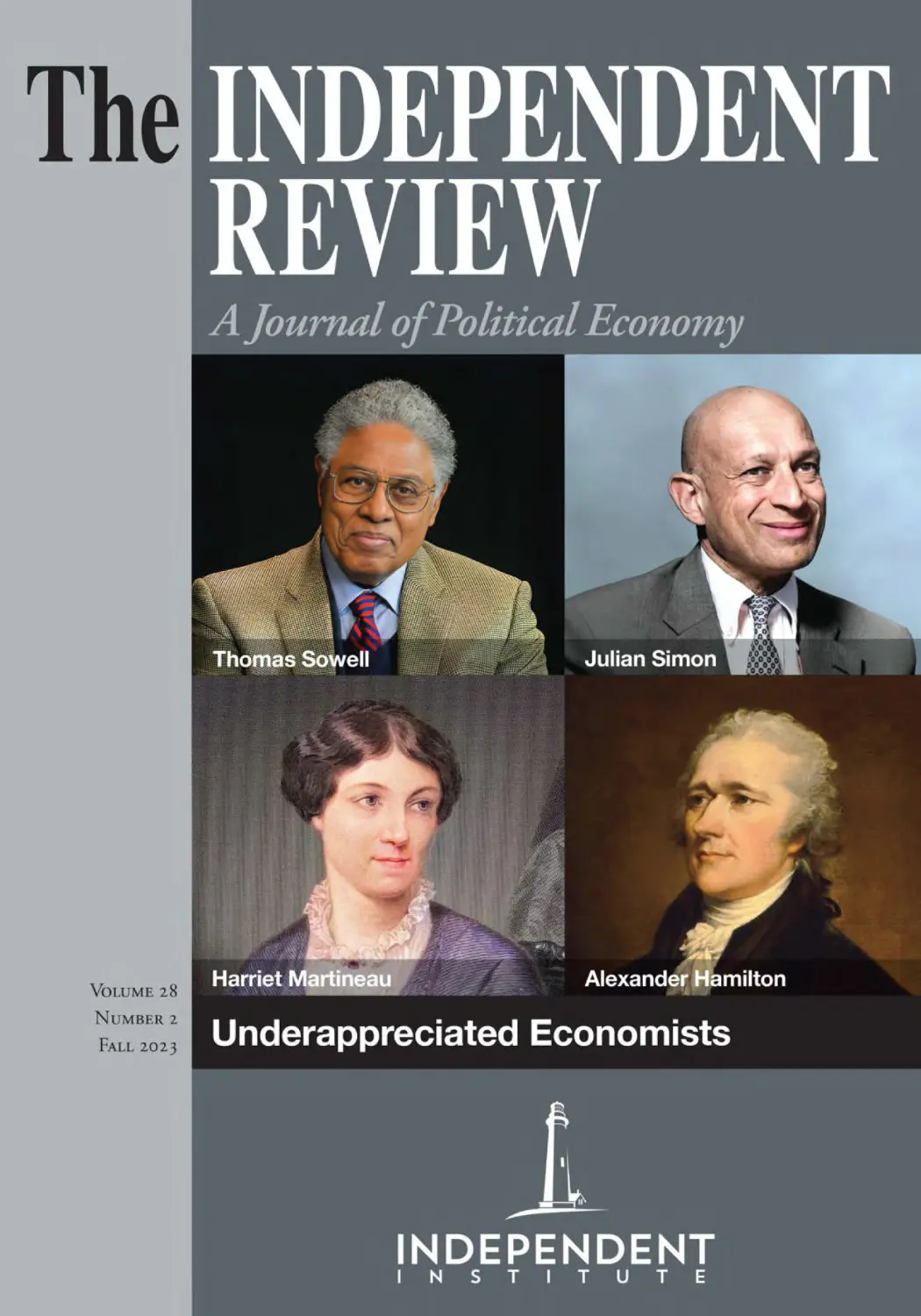
Front Cover:
Top Left: Thomas Sowell
Top Right: Julian Simon
Bottom Left: Harriet Martineau
Bottom Right: Alexander Hamilton

Visit GetTIR.org to subscribe or renew your Independent Review subscription.
Copyright © 2023, Independent Institute. All rights reserved. The Independent Review (ISSN 1086-1653) is
published quarterly (March, June, September, and December) by Independent Institute, 100 Swan Way, Oakland,
California 94621-1428. Phone: 510-632-1366. Fax: 510-568-6040. Website: www.independent.org. Application
to mail at Second-class postage rates is pending at Oakland, CA, and at additional mailing offices. Republication
of articles and reviews may not be made without written permission of the publisher. Single copy rates: individuals
$11.95 ($15.00 Canada), institutions $25.00 ($28.00 Canada). For our updated privacy policy, please see:
independent.org/privacypolicy/. Correspondence regarding subscriptions, procuring back issues, editorial,
advertising, and changes of address should be sent to the above address or e-mailed to: review@independent.org.
Information for authors wishing to submit articles is on p. 176 of this issue. The views expressed by authors of the
articles are their own and are not attributable to the editors, advisors, or Independent Institute.

Underappreciated
Economists
✦

ROBERT M. WHAPLES

T

he most recent issue of The Independent Review marked the three
hundredth anniversary of Adam Smith’s birth with Nobel laureate Vernon
Smith’s essay explaining how the earlier Smith’s ideas are “foundational
in understanding how the West grew rich because of its commitment to classical
liberalism anchored in freedom” (Smith 2023, 117). As Kenneth Boulding (1969, 1)
so aptly put it, “Adam Smith . . . has strong claim to being both the Adam and
the Smith of systematic economics.” Smith’s contributions to economics have been
keenly appreciated for more than a quarter of a millennium. If you search through
last year’s issues of The Independent Review, you won’t be surprised to see that
Smith was cited in every single issue—although many of his insights are woven so
deeply into our understanding of economics and human nature that they go without
mentioning. The same might said of economists such as James Buchanan, Milton
Friedman, Friedrich Hayek, and Ludwig von Mises—who were also cited in every
issue of the journal last year. These economists and others, including Joseph
Schumpeter and John Maynard Keynes, have been celebrated and, indeed, appreciated
by economists, if not by the wider public.
This issue of The Independent Review redirects our attention from these luminaries to economists who haven’t been as widely appreciated. Who counts as an
underappreciated economist? As we put it in our call for contributions, “You tell us.
Probably not, for example, Smith, Ricardo, Marshall, Mill, Marx, Keynes, Friedman,

Robert M. Whaples is professor in the Department of Economics at Wake Forest University and editor
of The Independent Review.
The Independent Review, v. 28, n. 2, Fall 2023, ISSN 1086–1653, Copyright © 2023, pp. 177–178.

177

178

✦

ROBERT M. WHAPLES

Samuelson, Hayek, Schumpeter, Becker, Arrow, Solow, Coase, and Stiglitz—all of
whom were selected as ‘favorite’ economists in a poll of economists published in Econ
Journal Watch about ten years ago” (Davis et al. 2011).
Although the list of underappreciated economists could be extended at least a
hundredfold, the contributions to this symposium include a couple of economists
who were new to me (Friedrich Lutz and Karl Mittermaier) and some who are
very well known, including Alexander Hamilton and Thomas Sowell. The subjects
are compelling, the writing sparkles, and the essays are packed with insights and
interesting information, so read them in any order you wish.

References
Boulding, Kenneth E. 1969. Economics as a Moral Science. American Economic Review 59,
no. 1 (March): 1–12.
Davis, William L., Bob G. Figgins, David Hedengren, and Daniel B. Klein. 2011. Economics
Professors’ Favorite Economic Thinkers, Journals, and Blogs (along with Party and Policy
Views). Econ Journal Watch 8, no. 2 (May): 126–46.
Smith, Vernon L. 2023. Adam Smith, Sociality, and Classical Liberalism. The Independent
Review 28, no. 1 (Summer): 117–22.

T HE I NDEPENDENT R EVIEW

Alexander Hamilton as
Economist
A Proper Verdict
✦

RICHARD M. SALSMAN

F

ew scholars doubt that Alexander Hamilton (1757–1804) was a formidable
American Founder—Revolutionary War aide to George Washington, prolific
pamphleteer, main author of the Federalist Papers, champion of the U.S.
Constitution, first U.S. Treasury secretary, architect of early U.S. foreign policy. But
do scholars consider him a great economist? No—but they should.
We have no polls, only impressions, but Hamilton is viewed as unoriginal in
economics and, worse, a fan of “big government,” public debt, fiat money, central
banking, subsidies, and protectionism. Statists cite him as authoritative and helpful
(Lind 2012; Cohen and Delong 2016), whereas libertarians indict him as authoritarian and harmful (DiLorenzo 2009; White 2016; McClanahan 2017).1 Edward
C. Lunt’s review (1895, 305, 309–10) was mixed: “In one sense of the term—a
political economist being the embodiment of politics, law, ethics, and economics—
Hamilton has reached the foremost place” because he “brought out more clearly
by his elucidation” “certain principles and laws,” by a methodology that was both
“deductive and inductive,” and yet “our final judgment must be that however great
Hamilton may be as a statesman, his rank as an economist is not high.”
Richard M. Salsman is assistant research professor in the Philosophy, Politics, and Economics program
at Duke University.
1. See Salsman (2016a) for a critique of Cohen and DeLong (2016). Knott (2002) provides illuminating
history on fluctuations in Hamilton’s posthumous reputation and links them mostly to changes in American
ideology and economic development.
The Independent Review, v. 28, n. 2, Fall 2023, ISSN 1086–1653, Copyright © 2023, pp. 179–191.

179

180

✦

R ICHARD M. SALSMAN

In such hands, Hamilton isn’t so much underappreciated as he is misused or
abused. Defective analyses of “the Hamiltonian vision” (Nester 2012) seem to stem
from ideology (statism versus liberalism) or anachronism: out-of-context claims about
Hamilton being responsible for whatever great good or evil has transpired in America
since the 1790s. If America became the world’s dominant capitalist dynamo, credit
Hamilton (unless you’re an anti-capitalist) because he was (truly) the most pro-capitalist
Founder; if instead America became illiberal, politically centralized, bureaucratically
bloated, crony-ridden, and financially fragile, unjustified blame is heaped upon Hamilton
because he established a strong, energetic federal government (true) compared with its
predecessor. Let’s not just split the difference between false extremes; instead, let’s render
an objective verdict as free as possible of ideological bias and anachronism.2 Properly
judged, Hamilton deserves greater appreciation as an economist than he’s been given.

Political Economy versus Economics
The term “economist” often denotes someone engaged in formal mathematical modeling detached from economic experience, one doing “positive” economics (purely
scientific, logical) while eschewing “normative” (ethical, value-laden) economics.
This dichotomy wasn’t used in the 1790s. There was political economy, albeit an
infant industry, which examined the interplay of politics and markets. Two Scotsmen
led the way: James Steuart, a mercantilist (Principles of Political Economy, 1767), and
Adam Smith, a liberal (Wealth of Nations, 1776). The more systematic Smith was the
real founder of the field; he defended free markets (with exceptions) but also refuted
mercantilism (the notion that the state should manipulate the economy to maximize
its power and revenues) and physiocracy (the notion that agriculture alone creates
economic value, which implies that other sectors are parasitic).
Hamilton used Steuart and Smith (Bourne 1894; McNamara 1998; Fleischacker
2002; Federici 2012; Liu 2022) plus David Hume’s essays of the 1750s, Adam
Anderson’s Origin of Commerce (1764), Pelatiah Webster’s Political Essays on the
Nature and Operation of Money, Public Finances and Other Objects (1776–91),
Wyndham Beawes’s Merchant Law Directory (1761), William Blackstone’s Commentaries on the Laws of England (1765–69), the Memoirs of Jacques Necker (France’s
finance minister, 1777–81), and Malachy Postlethwayt’s Universal Dictionary of
Trade and Commerce (1774).3 Writing as “The Continentalist,” Hamilton initially

2. Elsewhere, I’ve provided a comprehensive account of Hamilton’s wide-ranging thought and works
(Salsman 2017a), but here I focus only on his economics.
3. Hamilton likely read Hume’s essays “Of Commerce,” “Of Money,” “Of Interest,” “Of the Balance
of Trade, “Of the Jealousy of Trade,” “Of Taxes,” and “Of Public Credit” (Hume [1752, 1777] 1985).
The best source for all of Hamilton’s likely sources in researching and writing his Treasury reports is
Harold C. Syrett, who provides comprehensive introductory notes to each report as editor of The Papers
of Alexander Hamilton (Syrett 1962–87).

T HE I NDEPENDENT R EVIEW

A LEX ANDER H AMILTON AS E CONOMIST

✦

181

sympathized with mercantilism, believing it empowered Britain (Hamilton 1781b).4
But his essays mainly bespeak liberalism; the fourth one counsels uniform tax and
tariff rates: “the genius of liberty reprobates everything arbitrary or discretionary in
taxation,” for everyone, “by a definite and general rule,” should know in advance
“what proportion of his property the state demands.” After reading Smith in the
early 1780s, Hamilton embraced economic liberalism more consistently.
As Treasury secretary (1789–95), Hamilton delivered to Congress (by request)
five carefully researched, influential reports on public credit, banking, money, taxes,
trade, tariffs, and manufacturing. He proposed mostly liberal policies, reflecting his
(and the Federalists’) allegiance to security of private property and sanctity of contract (Grampp 1965). A scholar recounted Hamilton’s liberalism:
The purpose of Hamilton’s political economy was the preservation of private property and the liberty to pursue it. For him the chief functions of
government were to protect property, to enforce a legal framework in
which it was secured, and to provide a stable environment for economic
activity and growth. (Nelson 1979, 972)
Hamilton’s political economy has a complex, little-recognized context. A nation
builder and policymaker, he effectuated many difficult transitions. One was a shift from
a wartime to a peacetime economy. Another was a removal of hyperinflated monies
and defaulted debt, to foster monetary-fiscal rectitude and stability. Still another shift
involved replacing an impotent and incompetent confederation of disunited states with
a system of federally united states able to exercise sovereign power. A further shift was
from an undiversified colonial economy to a freer, more independent, more heterogenous one. Another move was needed away from physiocracy to the recognition that all
sectors can add value. A final, monumental shift might have been toward ending slavery,
as Hamilton preferred.5 In all of these cases, Hamilton was opposed by anti-Federalists
(Salsman 2016b). Political independence was declared (1776) and the war was won
(1783), but nothing guaranteed that next would come positive change, national unity,
and the Constitution. That was Hamilton’s dream but Thomas Jefferson’s nightmare.
A precursor to the Constitutional Convention (1787) was a gathering the
previous year at Annapolis of Hamilton, James Madison, and others seeking freer
interstate trade. They also tried to quell debtor revolts and other assaults on property.
4. Hamilton was certainly no “nationalist” in the modern meaning of the term—a statist-imperialist committed to subordinating individuals (and foreigners) to the state. By “national,” Hamilton meant “continental.”
He hoped liberty could be enjoyed by all the states together and then extended westward (he endorsed
the Louisiana Purchase in 1803). See also Holloway (2015) for a refutation of the (similar) charge that
Hamilton was a would-be progressive eager to impose statist measures.
5. Michael Chan (2004, 207) refuted “the prevailing scholarly view that Hamilton, like the Founders generally, lacked a deep concern about slavery.” In truth, “ending slavery was one of his abiding
concerns.” “Hamilton’s political principles were not Hobbesian but consistent with the views of more
traditional natural law theorists.” He “understood that the natural rights of man imposed a corresponding duty to end slavery.” As for political economy, Hamilton endorsed “compensated emancipation” to
preclude ongoing injustice, discord, and violence.

VOLUME 28, NUMBER 2, FALL 2023

182

✦

R ICHARD M. SALSMAN

Article 1, Section 8 of the Constitution empowered Congress to “lay and collect taxes,
duties, imposts and excises, to pay the debts for the common defense and general welfare
of the United States” and “to regulate commerce with foreign nations, and among the
several states.” The purpose was not to establish today’s ultra-indebted welfareregulatory-protectionist state but to create a durable, rights-respecting republic. “General
welfare” meant no privileging of special interests, and to “regulate” meant not to
restrict but to regularize, to keep economic activity flowing.
Hamilton adopted Smith’s critiques of mercantilism and physiocracy, but he
also rejected a few of Smith’s fateful errors: his “labor theory of value” (that economic
value reflects quantities of manual labor time); his belief that some labor (the service
sector, military, courts) was nonproductive; and his assertion that public debt always
diminished prosperity. Hamilton proved more astute than subsequent economists—
David Ricardo, John Stuart Mill, Karl Marx—who perpetuated Smith’s myths.

Money, Banking, and Debt
As Treasury secretary (1789–95), Hamilton almost single-handedly fixed America’s
shattered financial system; he set a high standard for policymaking and set America
on a path to economic prowess. Hamilton implemented sound policy principles amid
contentious political wrangling. Eight years prior, he wrote to Robert Morris about
how to revive America’s degraded finances (Hamilton 1781a). A wealthy banker and
finance chief under the Articles of Confederation, Morris couldn’t raise enough taxes
to pay for war; it was funded by cascades of successively depreciated money and
debt. Hamilton didn’t cause or perpetuate the debased money and defaulted debt; he
inherited them, then fixed them.
Hamilton had seen degraded finances undermine America’s war effort, and
then, during the “critical period” (1781–89), he saw how they precluded prosperity. His plans for fiscal and monetary reform, once they were enacted by Congress,
transformed a bankrupt nation issuing worthless paper money into an honorable
debt-payer issuing gold- and silver-based dollars. Hamilton’s reforms surely benefited
bondholders and “monied interests,” but all sectors benefited from more rational
public governance. He wanted a system of sound and stable money (a gold-silver
standard), a vigorous private banking system, public spending restraint, low and uniform tariff rates, minimal regulation, a diminishing public debt, and genuine credit
(an adequate capacity to borrow). That we lack many of these features today reflects
a multi-decade rejection of Hamiltonian principles.
Foes of Hamilton’s cures advised debt defaults, either explicitly or implicitly (by
inflation), and even if debt was serviced, they wanted Treasury to discriminate against
secondary bondholders (demonized as “speculators”). Hamilton, defending the sanctity of contract, refused. Foes also opposed his “assumption” plan, to have the federal government assume all state debts. Independence had been won nationally, he

T HE I NDEPENDENT R EVIEW

A LEX ANDER H AMILTON AS E CONOMIST

✦

183

argued; states should start fresh fiscally. Detractors claimed the plan would unduly
empower federal governance, even though no government benefits by adding liabilities
or having to raise taxes. Assumption was approved. Hamilton then helped reduce the
national debt burden from 40 percent of gross domestic product (1790) to 20 percent (1795). Yet he worried that unrestrained democracy again would render America
overindebted. He warned of “a general propensity in those who administer the affairs
of government . . . to shift off the [spending] burden from the present to a future
day—a propensity which may be expected to be strong in proportion as the form of the
state is popular” (Hamilton 1795, 102–3). He advised further debt reduction through
sequential budget surpluses generated by spending restraint.
For Hamilton, “a national debt if it is not excessive will be to us a national
blessing; it will be powerful cement of our union” (1781a, 635). Libertarians today
love citing the “blessing” part, but Hamilton conceded that debts can be excessive.6
Borrowing mustn’t become a major funding source, nor should it ever be repudiated. In 1790, he told Congress that “so far from acceding to the position that
‘public debts are public benefits,’ a position inviting to prodigality, and liable to
dangerous abuse,” the body should codify “as a fundamental maxim, in the system
of the public credit of the United States, that the creation of debt should always be
accompanied with the means of extinguishment.” Hamilton advised steady repayments such that “the whole of the debt shall be discharged” in a decade (Hamilton
1790a, 106–7). He endorsed what became the “golden rule of public finance”
(Salsman 2020), which says public borrowing is justified only if promotes the
creation (not redistribution) of wealth over the long term; because winning certain wars and building productive infrastructure can benefit future generations,
they too should bear the cost. This golden rule has been abandoned, along with
Hamiltonian principles.
Hamilton’s reforms fostered nationwide banking and efficient tax collection
through the Bank of the United States (BUS), chartered from 1791 to 1811. He made
sure it was apolitical. “To attach full confidence to an institution of this nature,” he
wrote, “an essential ingredient in its structure” is that it “be under a private not a
public direction, under the guidance of individual interest, not of public policy,” never
“liable to being too much influenced by public necessity,” because “suspicion of this
would most likely be a canker that would continually corrode the vitals of the credit of
the Bank.” If “the credit of the Bank be at the disposal of the government,” it would be
a “calamitous abuse of it” (Hamilton 1790b, 331). The BUS succeeded because, unlike
central banks today (Salsman 1990), its purpose wasn’t to fund fiscal profligacy;
privately owned and prudently operated, it issued gold- and silver-convertible money
and lent very little to the federal government. The states used corrupt chartering
schemes to limit the freedom of banks to branch; state-level BUS foes denounced it
6. For a pro and con debate on Hamilton’s view of public debt, see Gordon (1997), DiLorenzo (2009),
and Salsman (2017b).

VOLUME 28, NUMBER 2, FALL 2023

184

✦

R ICHARD M. SALSMAN

as a nationwide “monopoly” but didn’t repeal their own anti-banking policies. Thanks
to the BUS, the number of private-sector banks grew rapidly after 1791. Central banks
today issue fiat token money, monetize public debt, depress interest rates, cause inflation, and bail out bad banks. None of that is Hamiltonian.

Tariffs, Trade, and Foreign Affairs
Influenced most by Steuart (mercantilism) and Smith (liberalism), Hamilton was
initially mixed on trade policy, but while contributing to the Federalist Papers
(1787–88) he was unequivocal in advocating freer trade among the states. He
also recognized that the main initial federal funding source would be tariffs;
the Constitution excluded powers to tax income, property, or sales. It allowed
for excise taxes, but when these were applied initially, in 1792–94 (on whiskey),
taxpayers revolted.
Hamilton’s policies were not mercantilist, for that system not only demonized
trade deficits and saw money as wealth but also required officials to micromanage
prices, wages, rents, and interest rates while maintaining constrictive labor guilds.
None of that was Hamiltonian. Mercantilism was part of empire, imperialism, and
colonialism—all precapitalist phenomena left unchallenged until the mid-1700s.
Since 1620, the American colonies had been part of this system, partially helped
but also unnaturally stunted by it. Colonial powers, wanting trade surpluses and
net imports of cash (to enrich royals and build war chests), forced colonies to export
commodities and import manufactured goods. Hamilton, wanting a durable independence from Britain, sought to extract America from the mercantile system, not
perpetuate it. To become genuine states, colonies had to unite into a federalist whole.
Hamilton wanted nation-state institutions so America could “grow up” quickly and
safely. Foes misrepresented him as lusting after power and intent on perpetuating a
new mercantilism, a Federalist American Empire.
Hamilton was no protectionist. He advised low and uniform tariff rates for
the legitimate (and constitutionally sanctioned) purpose of raising revenues, not
high and variable rates to discriminate against some nations (or goods) or privilege
others.7 Hamilton also didn’t obsess about America’s large trade deficit. If America’s money and bonds were sound (and he ensured that they were), there’d be no
dearth of incoming foreign investment. He knew that a capital surplus (net inflow),

7. Hamilton (1788, 477, 482) made this clear in Federalist no. 35: “There is no part of the administration
of government that requires extensive information and a thorough knowledge of the principles of political
economy so much as the business of taxation. The man who understands those principles best will be least
likely to resort to oppressive expedients or sacrifice a particular class of citizens to the procurement of revenue.” “[T]he most productive system of finance will always be the least burthensome.” Tariffs should not
reach “an injurious excess” nor entail “exorbitant duties on imported articles,” which “would beget a general spirit of smuggling, which is always prejudicial to the fair trader, and eventually to the revenue itself.”

T HE I NDEPENDENT R EVIEW

A LEX ANDER H AMILTON AS E CONOMIST

✦

185

mirroring a merchandise deficit, was akin to an international vote of confidence
in the United States. Funds did flow inward because of his reforms. Meanwhile,
Jeffersonians sought to use tariffs as weapons to hurt Britain and help France and
to artificially boost America’s farmers at the expense of the nation’s manufacturers.
A trade scholar explained:
Seeing imports as the critical tax base on which he planned to finance
government expenditures and fund the public debt, Hamilton advocated
modest, non-discriminatory import duties to ensure a steady stream of
revenue into the Treasury coffers. He also wanted a stable commercial
relationship with Britain to avoid any conflict that might disrupt imports
and diminish customs revenue. By contrast, Jefferson and Madison saw
trade policy as an instrument for achieving reciprocity, a weapon to be
wielded against what they perceived to be Britain’s grossly unfair discrimination against U.S. commerce. (Irwin 2009, 1–2)
International trade involves foreign–military relations, and Hamilton, preferring
prosperity, also wanted more (hence freer) trade. He never sought trade wars that
might become militarized; he wanted nondiscriminatory, nonpunitive tariffs to minimize hostilities. He advised U.S. neutrality toward Britain and France, which were
warring in the 1790s. In contrast, Jeffersonians wanted policies that punished Britain,
favored France, and jeopardized U.S. security and prosperity.8 At Hamilton’s urging,
Washington issued his Proclamation of Neutrality in 1793 to keep the U.S. out of
war. In 1796, he asked Hamilton to draft a farewell address; he made clear the links
between peace, trade, and prosperity:
The great rule of conduct for us, regarding foreign nations, is in extending our commercial relations to have with them as little political connection as possible. So far as we have already formed engagements let
them be fulfilled with perfect good faith. Here let us stop. . . . Taking care
always to keep ourselves by suitable establishments on a respectable defensive posture, we may safely trust temporary alliances for extraordinary
emergencies. Harmony, liberal intercourse and commerce with all nations
are recommended by justice, humanity, and interest. But even our commercial policy should hold an equal hand, neither seeking nor granting
exclusive favors or preferences; consulting the natural course of things;
diffusing and diversifying by gentle means the streams of commerce but
forcing nothing. (Hamilton 1796, 284–85)

8. Indeed, when Jefferson and Madison were U.S. presidents sequentially (1801–17), they imposed trade
embargoes and other discriminatory-punitive measures on Britain and helped fund its war foe, Napoleon
(by the 1803 Louisiana Purchase); the policies heightened U.S.–British hostilities and led to the War of
1812–14 (which the U.S. nearly lost because the duo previously gutted military spending).

VOLUME 28, NUMBER 2, FALL 2023

186

✦

R ICHARD M. SALSMAN

A Freer and More Diverse Economy
The mercantilist system under which American colonies labored lasted more than a
century, until the revolts of the 1760s. It weakened as a result of war and liberal ideas.
Hamilton knew that if an independent America was to flourish, it must shift from a
subservient, agrarian economy to a freer, more diversified one. His foes, clinging to
physiocracy, insisted that agriculture alone was noble and productive and thus that commerce, manufacturing, finance, and cities were inherently corrupt and parasitic.
Hamilton rejected physiocratic premises more consistently than did Smith; he
rejected the latter’s claim that some sectors used nonproductive labor. Hamilton was
original in his embrace of the modern view that all sectors of an economy can be
productive and mutually reinforcing, that a harmony of intersectoral interests is possible, preferable, and achievable. Belief in intersectoral antagonism (physiocracy) was
as foolish as the later belief in interclass conflict (Marxism). Hamilton also had the
radical view that finance is productive (Wright 2002); that view isn’t widely accepted
even today. Hamilton also believed (contra Smith) that political actors could be productive if engaged in legitimate state functions (law and order, justice, defense). In
Federalist no. 12, Hamilton explained:
The prosperity of commerce is now perceived and acknowledged, by all
enlightened statesmen, to be the most useful as well as the most productive source of national wealth; and has accordingly become a primary
object of their political cares. By multiplying the means of gratification,
by promoting the introduction and circulation of the precious metals,
those darling objects of human avarice and enterprise, it serves to vivify
and invigorate the channels of industry, and to make them flow with
greater activity and copiousness. The assiduous merchant, the laborious
husbandman, the active mechanic, and the industrious manufacturer—all
orders of men, look forward with eager expectation and growing alacrity to this pleasing reward of their toils. The often-agitated question,
between agriculture and commerce, has from indubitable experience received a decision, which has silenced the rivalships, that once subsisted
between them, and has proved, to the satisfaction of their friends, that
their interests are intimately blended and interwoven. It has been found,
in various countries, that in proportion as commerce has flourished, land
has risen in value. And how could it have happened otherwise? Could that
which procures a freer vent for the products of the earth—which furnishes
new incitements to the cultivation of land—which is the most powerful
instrument in increasing the quantity of money in a state—could that, in
fine, which is the faithful handmaid of labor and industry in every shape,
fail to augment that article, which is the prolific parent of far the greatest
part of the objects upon which they are exerted? It is astonishing that so
simple a truth should ever have had an adversary; and it is one among a
T HE I NDEPENDENT R EVIEW

A LEX ANDER H AMILTON AS E CONOMIST

✦

187

multitude of proofs, how apt a spirit of ill-informed jealousy, or of too
great abstraction and refinement is to lead men astray from the plainest
truths of reason and conviction. (Hamilton 1787, 347)
Hamilton’s distinctive political economy is best expressed in his Report on Manufactures, delivered in December 1791 (Hamilton 1791b). Congress had requested
it in early 1790, but Hamilton uncharacteristically deferred delivery, seeing money,
banking, and debt as policy priorities. Those fundamentals had to be fixed first, for
they were akin to the body politic’s central nervous system, vital organs that were
a precondition for broader economic success. His reports on debt, banking, and
money were delivered in a flurry, over the course of a year, through January 1791
(Hamilton 1790a, 1790b, 1791a).
One of Hamilton’s great insights pertained to the power of specialization; it
would enormously enhance human creativity, achievement, and enjoyment, he said,
and contribute to a more diversified, sounder economy. Smith too had hailed the
productivity gains possible from specialized labor, but he worried it would make
workers stupid and torpid. Marx later used this notion (and Smith’s labor theory
of value) to condemn capitalism (especially finance) for its “alienation,” “exploitation,” and “expropriation.” Hamilton committed no similar error; he appreciated the
benefits of a fully free, diverse economy:
As to the furnishing greater scope for the diversity of talents and dispositions, which discriminate men from each other, this is a much more powerful
means of augmenting the fund of national industry than may at first sight
appear. It is a just observation, that the minds of the strongest and most active powers for their proper objects fall below mediocrity and labor without
effect, if confined to uncongenial pursuits. And it is thence to be inferred,
that the results of human exertion may be immensely increased by diversifying its objects. When all the different kinds of industry obtain in a community, each individual can find his proper element, and can call into activity
the whole vigor of his nature. . . . To cherish and stimulate the activity of the
human mind, by multiplying the objects of enterprise, is not among the least
considerable of the expedients by which the wealth of a nation may be promoted. Even things in themselves not positively advantageous, sometimes
become so, by their tendency to provoke exertion. Every new scene, which
is opened to the busy nature of man to rouse and exert itself, is the addition
of a new energy to the general stock of effort. The spirit of enterprise, useful
and prolific as it is, must necessarily be contracted or expanded in proportion
to the simplicity or variety of the occupations and productions, which are to
be found in a Society. It must be less in a nation of mere cultivators, than
in a nation of cultivators and merchants, and less in a nation of cultivators
and merchants than in a nation of cultivators, artificers, and merchants.
(Hamilton 1791b, 254–56)
VOLUME 28, NUMBER 2, FALL 2023

188

✦

R ICHARD M. SALSMAN

Hamilton’s report on manufactures also included some innocuous proposals
for modest public subsidies (“bounties”), to foster “infant industries” that might be
necessary for national defense. The report was no material departure from liberal
principles; it sought to offset the artificial imbalances resulting from colonialism.
Moreover, the proposals were temporary, like the twenty-year BUS charter.
For decades, statists have tried to use Hamilton to justify massive government
subsidies, with politicians “picking winners and losers” through “industrial policy.”
They hope to enlist at least one Founding Father. But they fail, for Hamilton was no
more a proto-Keynesian (on money and debt) than he was a proto-Stalinist (on manufacturing and military might). His desire to encourage American manufacturing
didn’t make him a central planner seeking a “comprehensive socialization of investment” (per Keynes); he sought to counteract prior policies that discouraged manufacturing. Nor did Hamilton believe the state could discern or should decree some
“optimal” sectoral mix; that must reflect each nation’s natural economic advantages,
a prescription that mercantilism flatly rejected.
In his report on manufactures, Hamilton also welcomed immigrants, stating that many sought a more prosperous life, an “exemption from the chief part
of the taxes, burthens and restraints which they endure in the old world.” They
sought “greater personal independence” under “a more equal government.” It was in
“the interest of the United States to open every possible avenue to emigration from
abroad” (Hamilton 1791b, 254). Unlike today’s American nationalists, Hamilton
was a pro-immigration individualist.
Hamilton also extolled the “system of perfect liberty to industry and commerce” in his manufacturing report; indeed, “the option ought, perhaps, always to
be in favor of leaving industry to its own discretion.” Yet he did not imply that government should (or could) keep its “hands off” the economy, as libertarians portray
laissez-faire doctrine. Hamilton denied that a complete separation of state and economy was possible. A proper government, by protecting property rights and contracts,
necessarily helps producers and harms robbers. For Hamilton, these were official,
indispensable acts of justice, not privileges; moreover, legitimate functions (police,
courts, military) require revenues, unavoidably from producers. Hamilton rejected
laissez-faire not as liberalism’s foe but as realism’s fan.

Hamilton’s Methods
Hamilton’s methodology was scientific, deploying both induction and deduction.
He also saw no necessary dichotomy between “positive” and “normative” economics:
what is (facts) must inform what should be (policy). This is absent from contemporary
economics. Hamilton remarked that “men give me credit for some genius,” but “all
the genius I have lies in this: when I have a subject in hand, I study it profoundly.
Day and night it is before me. I explore it in all its bearings. My mind becomes
pervaded by it. Then the effort which I have made is what people are pleased to
T HE I NDEPENDENT R EVIEW

A LEX ANDER H AMILTON AS E CONOMIST

✦

189

call the fruit of genius. It is the fruit of labor and thought” (Wilser 2016, 21).
Harvard professor Frank Taussig described Hamilton’s analytic prowess while
assessing his report on manufactures:
Considering the conditions under which he wrote, and the stage which economic theory had reached in his time, the report is a great intellectual feat.
The marshaling of the opposing arguments, the tireless examination of every
aspect of the question, the careful investigation of the facts of industry and
trade, the specific recommendations, and conclusions at the close, all bear the
stamp of Hamilton’s peculiar and powerful intellect. (Taussig 1892, iv)
Hamilton’s economic principles were derived from personal experience (business, law, policy positions) and from close study of primary sources and treatises. His
specialty might be called applied economics, but his principles were also tested in
the real world, in real time; they succeeded. Their validity could also be confirmed
after his death (1804) as U.S. prosperity tended to wax or wane as his principles were
adopted or jettisoned. Hamilton’s principles weren’t merely applied but verified.

A Fair Verdict
Hamilton’s political economy is misappreciated—either overappreciated by statists
(hoping to recruit a formidable ally) or depreciated by libertarians (seeking a scapegoat to blame for today’s statism). Because he helped create a great nation-state,
its current state must be his doing. That’s a non sequitur. In truth, his economics
isn’t mixed, statist, mercantilist, or corporatist. It is, simply, capitalist.9 For critics,
capitalism can’t possibly be a morally legitimate social system entailing all social
sciences; it’s necessarily a corrupt system that favors a subgroup of “crony” capitalists.
That was no more Hamilton’s view than was that of Ayn Rand (1967), who in our
time has expounded the broader view. Hamilton was no mere economist; he was a
political economist and, rarer still, pro-capitalist. Although not an original economic
theorist, nonetheless he was an astute synthesizer of principles and policies—and
correct ones. His unique combination of talents marks him as an original practitioner
of wise economic-financial policymaking. The ills felt so acutely in today’s world
are attributable not to a foolhardy embrace but instead to a tragic ignorance—and
abandonment—of Hamiltonian principles.

References
Bourne, Edward G. 1894. Alexander Hamilton and Adam Smith. Quarterly Journal of
Economics 8:328–44.
Chan, Michael. 2004. Alexander Hamilton on Slavery. Review of Politics 66, no. 2: 207–31.
9. Ron Chernow’s biography of Hamilton rightly includes an index subentry that is phrased “as capitalist
prophet” (Chernow 2004, 801) and cites twenty-five pages.

VOLUME 28, NUMBER 2, FALL 2023

190

✦

R ICHARD M. SALSMAN

Chernow, Ron. 2004. Alexander Hamilton. New York: Penguin Books.
Cohen, Stephen S., and J. Bradford DeLong. 2016. Concrete Economics: The Hamilton
Approach to Economic Growth and Policy. Cambridge, Mass.: Harvard Business Review
Press.
DiLorenzo, Thomas. 2009. Hamilton’s Curse: How Jefferson’s Arch Enemy Betrayed the
American Revolution—and What It Means for Americans Today. New York: Three Rivers
Press.
Federici, Michael P. 2012. Hamilton’s Political Economy. Chap. 6 in The Political Philosophy
of Alexander Hamilton. Baltimore, Md.: Johns Hopkins University Press.
Fleischacker, Samuel. 2002. Adam Smith’s Reception among the American Founders,
1776–1790. William and Mary Quarterly 59, no. 4: 897–924.
Gordon, John Steele. 1997. Hamilton’s Blessing: The Extraordinary Life and Times of Our
National Debt. New York: Walker and Company.
Grampp, William D. 1965. Economic Liberalism: The Beginnings. New York: Random House.
Hamilton, Alexander. 1781a [April]. Letter to Robert Morris. In Syrett 1962–87, 2:604–35.
———. 1781b [August]. The Continentalist no. 4. In Syrett 1962–87, 2:669–74.
———. 1787 [November]. Federalist no. 12. In Syrett 1962–87, 4:346–52.
———. 1788 [January]. Federalist no. 35. In Syrett 1962–87, 4:476–82.
———. 1790a [January]. Report Relative to a Provision for the Support of Public Credit. In
Syrett 1962–87, 6:65–110.
———. 1790b [December]. Final Version of the Second Report on the Further Provision
Necessary for Establishing Public Credit (Report on a National Bank). In Syrett 1962–87,
7:305–42.
———. 1791a [January]. Final Version of the Report on the Establishment of a Mint. In
Syrett 1962–87, 7:570–607.
———. 1791b [December]. Final Version of the Report on the Subject of Manufactures. In
Syrett 1962–87, 10:230–340.
———. 1795 [January]. Report on a Plan for the Further Support of Public Credit. In Syrett
1962–87, 18:56–129.
———. 1796 [July]. Draft of Washington’s Farewell Address. In Syrett 1962–87, 20:265–88.
Holloway, Carson. 2015. Alexander Hamilton and American Progressivism. First Principles,
no. 52. Washington, D.C.: The Heritage Foundation.
Hume, David. [1752, 1777] 1985. Essays Moral, Political, and Literary (LF ed.). Edited by
Eugene F. Miller. Indianapolis, Ind.: Liberty Fund.
Irwin, Douglas A. 2009. Revenue or Reciprocity? Founding Feuds over Early U.S. Trade
Policy. Working Paper 15144. Cambridge, Mass.: National Bureau of Economic Research.
Knott, Stephen F. 2002. Alexander Hamilton and the Persistence of Myth. Lawrence: University
of Kansas Press.
Lind, Michael. 2012. A New Hamiltonianism. Boston Review, June 13.

T HE I NDEPENDENT R EVIEW

A LEX ANDER H AMILTON AS E CONOMIST

✦

191

Liu, Glory M. 2022. Adam Smith’s America: How a Scottish Philosopher Became an Icon of
American Capitalism. Princeton, N.J.: Princeton University Press.
Lunt, Edward C. 1895. Hamilton as a Political Economist. Journal of Political Economy 3,
no. 3: 289–310.
McClanahan, Brion. 2017. How Alexander Hamilton Screwed Up America. Washington,
D.C.: Regnery History.
McNamara, Peter. 1998. Political Economy and Statesmanship: Smith, Hamilton, and the
Foundation of the Commercial Republic. DeKalb: Northern Illinois University Press.
Nelson, John R. Jr. 1979. Alexander Hamilton and American Manufacturing: A Reexamination.
Journal of American History 65, no. 4: 971–95.
Nester, William. 2012. The Hamiltonian Vision, 1789–1800: The Art of American Power
during the Early Republic. Washington, D.C.: Potomac Books.
Rand, Ayn. 1967. Capitalism: The Unknown Ideal. New Brunswick, N.J.: New American
Library.
Salsman, Richard M. 1990. Breaking the Banks: Central Banking Problems and Free Banking
Solutions. Great Barrington, Mass.: American Institute for Economic Research.
———. 2016a. Review of Concrete Economics: The Hamiltonian Approach to Economic Growth
and Policy. At https://eh.net/book_reviews/concrete-economics-the-hamiltonian-approachto-economic-growth-and-policy/.
———. 2016b. The U.S. Founding: Washington’s Allies and Opponents. Reason Papers 38,
no. 2: 89–99.
———. 2017a. America at Her Best Is Hamiltonian. Objective Standard 12, no. 1: 12–42.
———. 2017b. Early American Debate: Hamilton versus Jefferson. In The Political Economy
of Public Debt: Three Centuries of Theory and Evidence, 58–75. Cheltenham, U.K.: Edward
Elgar.
———. 2020. The Golden Rule of Public Finance and Prospects for Its Revival. Chap. 16 in
A Fiscal Cliff: New Perspectives on the U.S. Federal Debt Crisis, edited by John Merrifield
and Barry W. Poulson. Washington, D.C.: Cato Institute.
Syrett, Harold C., ed. 1962–87. The Papers of Alexander Hamilton. 27 vols. New York:
Columbia University Press. At https://founders.archives.gov/about/Hamilton.
Taussig, Frank. 1892. State Papers and Speeches on the Tariff. Cambridge, Mass.: Harvard
University Press.
White, Lawrence H. 2016. Alexander Hamilton, a Second-Hand Dealer in Retrograde Mercantilist
Ideas. FEE Stories, September 6. Atlanta, Ga.: Foundation for Economic Education.
Wilser, Jeff. 2016. Alexander Hamilton’s Guide to Life. New York: Three Rivers Press.
Wright, Robert E. 2002. Hamilton Unbound: Finance and the Creation of the American
Republic. Westport, Conn.: Greenwood Press.

VOLUME 28, NUMBER 2, FALL 2023

Harriet Martineau
Economist as Storyteller and
Traveler
✦

DAVID M. LEVY AND SANDRA J. PEART

Martineau’s Reputation in Her Own Day
Although Harriet Martineau is underappreciated today, her writings were widely read
during her lifetime, and she was extremely influential in her own time. She successfully reached a wide popular audience with her monthly serials, published under the
umbrella title Illustrations of Political Economy. She read widely in political economy
and socialized and corresponded with many of the well-known political economists
of her time, including James Mill and John Stuart Mill, Thomas Robert Malthus,
William Godwin, and Francis Place.1 She corresponded with a remarkable group
of political and literary figures in both Britain (Prime Minister William Gladstone,

David M. Levy is professor of economics at George Mason University and Distinguished Fellow of the
History of Economics Society. His most recent book with Sandra J. Peart is Towards an Economics of
Natural Equals: A Documentary History of the Early Virginia School, published by Cambridge University
Press. Sandra J. Peart is E. Claiborne Robins Distinguished Professor in Leadership Studies and dean
of the University of Richmond’s Jepson School of Leadership Studies. She is a past president of the International Adam Smith Society and the History of Economics Society. With David Levy, she has written
on the transition to postclassical economics.
1. In her autobiography, Martineau wrote with joy that her work was read by a young Princess Victoria
(Martineau 1877, 2:118–19). See Levy and Peart (2022) for additional details about Martineau’s difficult
personal life.

The Independent Review, v. 28, n. 2, Fall 2023, ISSN 1086–1653, Copyright © 2023, pp. 193–202.

193

194

✦

DAVID M. L EVY AND SANDR A J. P EART

John Bright) and America (Ralph Waldo Emerson, Harriet Beecher Stowe). Perhaps
the most balanced appreciation of her Illustrations is found in a lecture by William
Stanley Jevons, who rightly read her as a follower of Adam Smith.2
It is no exaggeration to suggest that her ideas were sometimes controversial and
attracted negative attention. Indeed, both her ideas and her character were flamboyantly attacked in Fraser’s Magazine (Peart 2009), where she was the first of three
named economists to be vilified in the Fraser’s “Gallery.”3 All three, Martineau,
William Godwin, and Francis Place, were central to the controversy surrounding
the implication of Malthus’s Essay on Population. The central issue in the debate
was at what age responsible people might marry. Martineau, like Malthus himself,
advocated for couples to delay marriage until they could support their children. This
seemingly innocuous recommendation was in direct contradiction to the orthodox
Christian doctrine of that time that couples should marry as soon as possible to avoid
the sin of fornication (Levy 1978).
Importantly, this controversy over marriage presupposed monogamy and a
world without contraception.4 Had polygamy been practiced, choice space would
have widened beyond the question of earlier or later marriage. This simple point
needs to be understood to appreciate what Martineau accomplished in her travels to
America, to which we turn next.

Martineau’s Travels to America
Martineau’s Illustrations of Political Economy was a de facto textbook of political
economy, formed from a monthly series of installments, a sequence of stories that
began with the simplest of economic arrangements and gradually became more complex.5 Queen Victoria was one of her students (Logan 2002, 24). For our narrow
purpose, Martineau’s fourth installment of her Illustrations of Political Economy,
titled Demerara, is the critical one. It was published a decade following the 1823
2. “Miss Martineau made a very different and clever attempt [from that of J. S. Mill and J. R. McCulloch],
more than thirty years ago, to spread a knowledge of political economy in a series of tales entitled ‘Illustrations of Political Economy.’ The tales are very interesting and readable, and the doctrines clearly inculcated
and sound. But like many other moral tales, they have not been so much read as they deserved, nor have
they been read by the classes in whom we are concerned” Jevons ([1866] 1981, 7:51).
3. Martineau was number 42 in the 1830–38 Gallery of Illustrious Literary Characters (Maclise and
Maginn 1873). The two other named political economists were William Godwin, number 53, and Francis
Place, number 66. The editor of the collected gallery, William Bates, suggested that the puzzling
“Tydus-Pooh-Pooh,” number 17, was a racialized caricature of political economist and linguist John
Bowring (Maclise and Maginn 1873, 46), being attacked for his translations and advocacy of free trade
in vocabulary, issues independent of what we discuss.
4. This world was idealized as late as Charles Darwin’s denunciation of contraception (Peart and Levy
2008).
5. Martineau explained her procedure at the outset; see Martineau (1832, xi). To give some idea of her
own estimation of her importance to the contemporary discussion, Martineau told a correspondent on
January 2, 1864, that her “Martyr Age of the United States” (Martineau 1838) “created” J. S. Mill’s
interest in the case (Martineau 2007, 5:47).

T HE I NDEPENDENT R EVIEW

H AR R IET M ARTINEAU: E CONOMIST AS S TORYTELLER AND T R AVELER

✦

195

rebellion of thousands of enslaved persons in the British colony of Demerara.6 It is
important to separate what she wrote about slavery when in England and what she
discovered on her American trip.
In Demerara, Martineau repeated the anti-slavery argument that property is a
conventional right and “Man has no right to hold Man in property.” In this story, she
developed a theme that she greatly expanded later. She suggested that the system of
slavery would lead to rebellions because enslavers would not punish rebellious slaves
but instead would protect their (enslavers’) assets. Thus, Martineau wrote, if the conventional punishment for murder were death by hanging, the slave owner might well
prefer not to destroy his property but instead would attempt to disguise the crime
and sell the enslaved person to a neighbor (Martineau 1833, 23–24). In her visit to
the American South during the time of slavery, she was sensitive to political attempts
to solve such collective action problems.
The economics lesson opens in a way unsurprising for anyone who has read
Adam Smith’s Wealth of Nations ([1776] 1981). Because the product of their labor
did not affect their wealth, enslaved persons had little incentive to work diligently.
But Martineau added a complication absent in Smith. Her story features a character,
Alfred, the son of a slave owner who has also read Smith and has become aware of
the incentive problem associated with using enslaved labor. Alfred offers a solution to
this problem—taskwork with wages:
Mr. Bruce meanwhile was looking alternately at two gangs of slaves at
work after a rather different manner. He was standing on the confines
of two estates; and, in a field at a little distance, a company of slaves was
occupied as usual; that is, bending over the ground, but to all appearance
scarcely moving, silent, listless, and dull. At hand, the whole gang, from
Cassius down to the youngest and weakest, were as busy as bees, and from
them came as cheerful a hum, though the nature of their work rather resembled the occupation of beavers.
“Task-work with wages,” said Alfred, pointing to his own gang;
“eternal labour, without wages,” pointing to the other. “It is not often
that we have an example of the two systems before our eyes at the same
moment. I need not put it to you which plan works the best.” (Martineau
1833, 2:69–70)7
6. Demerara, now Guyana, in August 1823 was the scene of one of the most massive uprisings in history.
For an account of the rebellion, see Costa (1994). Seymour Drescher (2009, 256) wrote that “the death
of this freeborn native Englishman [John Smith] was converted into decisive evidence that the brutal
suppression of the rebellion had been an assault on native-born Christian Britons as well as overseas
Christian West Indians. Missionary Smith was the abolitionists’ Archimedian fulcrum, which enabled
them to raise popular contention in the New World to the level of the Old World. His death allowed the
rebels to be identified not just as fellow men and brothers, but as fellow freedom-loving Christians. The
Demerarans had reacted to their unnatural deprivation as would any freeborn Briton.”
7. Martineau observed such a link between effort and income in the American South when task wages
were used as education, to teach the link between effort and reward during the period when formal

VOLUME 28, NUMBER 2, FALL 2023

196

✦

DAVID M. L EVY AND SANDR A J. P EART

Thus, in Demerara she laid out two interesting hypotheses about slavery: insufficient
punishment because of the property interest and the idea of an incentive-compatible
slavery. During her American travels, she found instances of both. Neither of these
are our primary concern, so we will focus on what she discovered.

Power, Sex, and Racial Politics
When Adam Smith explained how slavery could exist even though it would not be
materially profitable, he appealed to the masters’ desire to dominate (Smith [1776]
1981, 388). Smith did not explain what he meant by domination. Martineau, who
had been invited to visit the American South with the hope of changing the views
she expressed in Demerara,8 discovered something that filled the gap in Smith’s
argument. While traveling through the plantation South, Martineau was welcomed
by the wives of plantation owners, who apparently spoke candidly about the sexual
arrangements on plantations. On the basis of her conversations, she pointed to a
terrible consequence of the lack of self-ownership. Plantation owners abused their
female slaves sexually:
Every man who resides on his plantation may have his harem, and has every
inducement of custom, and of pecuniary gain,* to tempt him to the common practice. Those who, notwithstanding, keep their homes undefiled
may be considered as of incorruptible purity. (Martineau 1837, 2:112)
Martineau’s footnote, marked by an asterisk, continues, “The law declares that the
children of slaves are to follow the fortunes of the mother.” Plantation owners were
legally able to sell and bequeath their own enslaved children.
Martineau thus dropped the monogamy restriction of classical political
economy and opened the door to the critical examination of racial politics:
A gentleman of the highest character, a southern planter, observed, in
conversation with a friend, that little was known, out of bounds, of the
reasons of the new laws by which emancipation was made so difficult as it
is. He said that the very general connexion of white gentlemen with their
female slaves introduced a mulatto race whose numbers would become
dangerous, if the affections of their white parents were permitted to render them free. The liberty of emancipating them was therefore abolished,
while that of selling them remained. (Martineau 1837, 2:118)
methods of education were outlawed (Martineau 1837, 2:157–58). In their study of slavery in the United
States some 150 years later, Robert Fogel and Stanley Engerman discovered the payments that linked
wages to output that Martineau had predicted in Demerara (Fogel and Engerman 1974, 239–42).
8. Martineau told her reader, “[M]y having published ‘Demerara’ was the main reason why they wished
me to visit them. They desired me to see their ‘peculiar institution’ for myself: they would show me the
best and the worst instances of its working; and their hope was — so they declared, — that I should
publish exactly what I saw” (Martineau 1877, 2:19).

T HE I NDEPENDENT R EVIEW

H AR R IET M ARTINEAU: E CONOMIST AS S TORYTELLER AND T R AVELER

✦

197

A father might well desire to emancipate his children, but the law closed off this
possibility in order to prevent possible violent insurrection initiated by this mixedrace group.
Thus, as early as 1837, Martineau treated race as polychotomous, endogenous
to the system of slavery. Recognizing that the white fathers of enslaved people might
feel affection or obligation to their mixed-race children, she offered a straightforward explanation of why skin tone would matter in twenty-first-century estimates
of income disparities.9 If skin tone is a long consequence of miscegenation, children
of a white father were likely wealthier than children of two enslaved persons.10 In
addition, when confronted by the “common boast,” as Martineau put it, that slavery
improved the morals of Southerners—there were fewer prostitutes in Southern than
in Northern cities—Martineau countered that there would be no reason to resort to
prostitutes for a fee when one could purchase women for life and sell the resulting
children (1837, 2:325–26).
Martineau’s accounts rendered clear, as few before her had done, the terrible
consequences of slavery: violence and sexual abuse. Both her position and her character were consequently attacked. Thomas Carlyle referred to her “fanatisms” and
criticized her anti-slavery argument.11 Attacks on her work on America were collected and republished after the publication of Harriet Beecher Stowe’s 1852 Uncle
Tom’s Cabin.12 Martineau’s obscurity among twenty-first-century economists may
be explained by her gender, coupled with the severe attacks by canonical authorities,
which served to bury the significance of her work,13 and by the fact that hypothesis
discovery remains an uncommon procedure within economics.14
Yet with new genetic data sets and the ability to determine the geographic
lineage of parents, Martineau’s hypothesis may be tested in the data. If she is correct, women from Africa would contribute more to the American gene pool than
men from Africa. That prediction is borne out by current genetic research. A recent
study concludes: “An Americas-wide African female sex-bias can be attributed to
known accounts of rape of enslaved African women by slave-owners and other sexual
exploitation” (Micheletti et al. 2020, 273).

9. See, for example, Darity (1998); Goldsmith, Hamilton and Darity (2007); Herring and Nynes (2017).
10. The first students at Wilberforce University, founded in 1856, included the children of enslaved
mothers and their father-owners (McGinnis 1941). We owe the reference to William Darity.
11. See Carlyle (1881, 437–48) for his extremely offensive words about Martineau.
12. The Pro-Slavery Argument (1852), published after Uncle Tom’s Cabin, collected and republished the
earlier attacks on Martineau after her visit. None of the responses denied her charge of sexual usage.
13. For instance, Alfred Marshall referred to Martineau as a “parasite” (Marshall 1890, 63).
14. For a recent examination of the significance and value of travelers’ tales, see Morgan (2022). Daniel
Kuehn’s (2023) examination of Warren Nutter’s travels and the NBER Soviet growth study is particularly relevant because Rutledge Vining was both the important defender of the NBER practice as one of
hypothesis discovery and a senior colleague of Nutter at the Thomas Jefferson Center at Virginia (Levy
and Peart 2020).

VOLUME 28, NUMBER 2, FALL 2023

198

✦

DAVID M. L EVY AND SANDR A J. P EART

Underappreciated by Whom?
Martineau’s 1837 report about the sexual usage of American enslaved persons was
noticed by the black historian and sociologist Carter Woodson in a 1918 article in
his Journal of Negro History. Woodson was a careful reader of Martineau. However,
there is little evidence that twentieth-century economists read her work; otherwise,
they would not have been “startled” at what they found in the slave economy.15
Restricting ourselves to canonical economics, her insights were entirely neglected;
rather, Martineau was subjected to intense criticism in her day and oblivion in ours.
One instance will suffice. Under pressure from his funders, Gunnar Myrdal, who
knew Martineau’s work, if only from Woodson’s report, moved the reference to sexual usage reported in her work from the body of American Dilemma to an appendix
printed in a tiny font (Myrdal 1944, 1075; Morey 2021, 219).
To illustrate how the period of exclusion during which black scholars were
absent from economics (Darity 1989; Malveaux 1991) has influenced our understanding of the early debates concerning race, we conducted a pair of JSTOR searches
restricted (first) to the larger number of journals JSTOR considers as “economics”
journals and (second) to the smaller number of journals it considers as “African
American” journals. The first period is from the first issue of the journals in the
respective fields through 1944, and then we pressed forward. The table reports
cumulative citations. We searched for “Martineau” and “miscegenation.”
Cumulative Citations
Economics

Cumulative Citations
African American Studies

1944

1*

5

1960

1*

7

1970

1*

7

1980

1*

8

Period Ending

The first citation in African American studies journals is Woodson (1918). We
would have found many more articles had we searched for “Woodson” and “miscegenation” instead of “Martineau” and “miscegenation,” with ten references in African
American studies journals through 1944 and zero references through 1980 in economics journals. The only occurrence in economics (Newman 1944) cites Martineau
as a supporter of the Union in the Civil War and miscegenation as an accusation that
is not connected with Martineau’s report. Because this has nothing to do with the
issue, it is identified with an asterisk. Through 1980, there are no additional citations.

15. Robert Fogel (1989, 391–92): “I was also startled to discover the numerous ways in which masters
relied on rewards to elicit labor—a device I had assumed was almost entirely absent since David Hume,
Adam Smith, John E. Cairnes, and most of the other economic writers had identified this lack as the fatal
flaw in slavery as an economic system.”

T HE I NDEPENDENT R EVIEW

H AR R IET M ARTINEAU: E CONOMIST AS S TORYTELLER AND T R AVELER

✦

199

The difference in citations for “Martineau” and “miscegenation” across fields
is truly remarkable. Economists have been writing about slavery for as long as there
has been an economics. Smith’s appeal to domination was not made substantial until
Martineau’s account brought reports of sexual use of American slaves to the attention of the world. Her report was duly noted in African American studies journals
and ignored in economics journals. Economists in the twentieth century were apparently hesitant to examine past evidence and debates concerning slavery, whereas those
outside economics—who were perhaps excluded from the profession and tackled
these issues as historians or sociologists—found the accounts of past commentators,
accounts that came from within economics, illuminating.

Conclusion: The Consequence of Martineau’s
Visit to America
The importance of hypothesis discovery continues to divide economists. The controversy engendered by Rutledge Vining (1949) over how best to discover and test
hypotheses (Levy and Peart 2020) shows no sign of ending. The key issue is whether
one first develops a theory that yields hypotheses or whether the data themselves yield
the hypotheses in a discovery process. Whatever one’s views on that methodological
issue, Martineau’s travel to America constituted a form of hypothesis discovery, one
that had an impact on the economics of her time. Her novel about slavery offers no
suggestion that slaves would be sexually used; she discovered this usage in America
during her travels. Thomas Carlyle’s (1849) characterization of the political economy
of his contemporaries reveals that he was very much aware of Martineau’s account.
As two of the most prominent essayists of their time, Carlyle and Martineau had
initially enjoyed a cordial relationship, but that cordiality deteriorated into antipathy
largely as a result of Martineau’s sympathies for enslaved people in America. In the
1849 essay in which he referred to political economy as the “dismal science,” Carlyle
used the phrase “sweet blighted lilies, they are holding up their heads again” cruelly
to characterize blacks in Jamaica. He continued, “Our beautiful black darlings are
at last happy; with little labour except to the teeth” (1849, 671). His words echo
Martineau’s report of “[a]n epitaph on a negro baby at Savannah,” which begins,
“Sweet blighted lily” (1837, 2:222), as Carlyle mocked her description of the hopes
of the baby’s heartbroken parents for the final resurrection.
Indeed, as noted at the outset, Martineau was vilified in Fraser’s; her originality, talent, and character were all questioned in her time. Even though her writings were extremely successful during her lifetime, today only specialists know of
Martineau’s work, and economists have downplayed her originality and sophistication. Both her subject matter and her method of collecting information via travel
proved controversial from the beginning of her career. Perhaps for these reasons,
Martineau disappeared from the scholarly landscape for close to a century after her
death. As eugenic thought and racism emerged and flourished among social scientists,

VOLUME 28, NUMBER 2, FALL 2023

200

✦

DAVID M. L EVY AND SANDR A J. P EART

Martineau’s important work was forgotten, and scholars lost the ability to appreciate
her contributions. At least within economics, her work was neglected and eventually
fell into near oblivion. It is now time to reevaluate and appreciate her important
contributions.

References
[Carlyle, Thomas.] 1849. Occasional Discourse on the Negro Question. Fraser’s Magazine for
Town and Country 40 (December): 670–79.
Carlyle, Thomas. 1881. Reminiscences. Edited by James Anthony Froude. Boston: Harper &
Brothers.
Costa, Emelia Viotti da. 1994. Crowns of Glory, Tears of Blood: The Demerara Slave Rebellion
of 1823. Oxford, U.K.: Oxford University Press.
Darity, William A. Jr. 1998. Intergroup Disparity: Economic Theory and Social Science
Evidence. Southern Economic Journal 64, no. 4 (April): 805–26.
———, ed. 1989. Introduction: The Odyssey of Abram Harris from Howard to Chicago. In
Race, Radicalism, and Reform: Selected Papers of Abram L. Harris, 1–34. New Brunswick,
N.J.: Transactions.
Drescher, Seymour. 2009. Abolition: A History of Slavery and Antislavery. New York:
Cambridge University Press.
Fogel, Robert William. 1989. Without Consent or Contract: The Rise and Fall of American
Slavery. New York: W. W. Norton.
Fogel, Robert William, and Stanley L. Engerman. 1974. Time on the Cross: The Economics of
American Negro Slavery. New York: W. W. Norton.
Goldsmith, Arthur H., Darrick Hamilton, and William Darity Jr. 2007. From Dark to Light:
Skin Color and Wages among African-Americans. Journal of Human Resources 12:701–38.
Herring, Cedric, and Anthony Nynes. 2017. Race, Skin Tone, and Wealth Inequality in
America. In Color Struck: How Race and Complexion Matter in the “Color-Blind Era,”
edited by Lori Latrice Martin, Hayward Derrick Horton, Cedric Herring, Venra M. Keith,
and Melvin Thomas, 1–18. Rotterdam: Sense.
Jevons, W. S. [1866] 1981. The Importance of Diffusing a Knowledge of Political Economy.
Lecture delivered at Owens College, Manchester, October 12, 1866. In Papers and
Correspondence of William Stanley Jevons, vol. 7, edited by R. C. D. Black, 37–54. London:
Macmillan.
Kuehn, Daniel. 2023. “Marco Polo Economics” and Narrative in the NBER Soviet Growth
Study. History of Political Economy 55, no. 3: 471–96.
Levy, David M. 1978. Some Normative Aspects of the Malthusian Controversy. History of
Political Economy 10 (Summer): 271–85.
Levy, David M., and Sandra J. Peart. 2020. Towards an Economics of Natural Equals:
A Documentary History of the Early Virginia School. New York: Cambridge University
Press.

T HE I NDEPENDENT R EVIEW

H AR R IET M ARTINEAU: E CONOMIST AS S TORYTELLER AND T R AVELER

✦

201

———. 2022. Harriet Martineau (1802–1876). In The Essential Women of Liberty, edited
by Donald J. Boudreaux and Aeon Skoble, 17–29. Vancouver, British Columbia: Fraser
Institute.
Logan, Deborah Ann. 2002. The Hour and the Woman: Harriet Martineau’s “Somewhat
Remarkable” Life. Dekalb: Northern Illinois University Press.
Maclise, Daniel, and William Maginn. 1873. A Gallery of Illustrious Literary Characters.
Edited by William Bates. London: Chatto and Windus.
Malveaux, Julianne. 1991. Missed Opportunity: Sadie Tanner Mossell Alexander and the
Economics Profession. American Economic Review 81, no. 2: 307–10.
Marshall, Alfred. 1890. Principles of Economics. London: Macmillan.
Martineau, Harriet. 1832. Life in the Wilds. Vol. 1 in Illustrations of Political Economy.
London: Charles Fox.
———. 1833. Demerara. Vol. 2 in Illustrations of Political Economy. London: Charles Fox.
———. 1837. Society in America. 3 vols. New York: Saunders and Otley.
———. 1838. The Martyr Age of the United States. London and Westminster Review.
———. 1877. Harriet Martineau’s Autobiography with Memorials by Maria Weston Chapman.
3 vols. London: Smith, Elder & Co.
———. 2007. The Collected Letters of Harriet Martineau. 5 vols. Edited by Deborah Anna
Logan. London: Pickering & Chatto.
McGinnis, Frederick A. 1941. A History and an Interpretation of Wilberforce University.
Wilberforce, Ohio: Brown.
Micheletti, Steven J., Kasia Bryc, Samantha G. Ancona Esselmann, William A. Freyman,
Meghan E. Moreno, G. David Poznik, Anjali J. Shastri, 23andMe Research Team, Sandra
Beleza, and Joanna L. Mountain. 2020. Genetic Consequences of the Transatlantic Slave
Trade in the Americas. American Journal of Human Genetics 107 (August 6): 265–77.
Morey, Maribel. 2021. White Philanthropy: Carnegie Corporation’s An American Dilemma
and the Making of a White World Order. Chapel Hill: University of North Carolina
Press.
Morgan, Mary. 2022. Travelers’ Tales: Their Values and Virtues. History of Political Economy
54, no. 3: 571–82.
Myrdal, Gunnar. 1944. An American Dilemma: The Negro Problem and Modern Democracy.
New York: Harper & Brothers.
Newman, Leonard. 1944. Opposition to Lincoln in the Elections of 1864. Science and Society
8, no. 4: 305–27.
Peart, Sandra J. 2009. 2008 HES Presidential Address: We’re All “Persons” Now: Classical
Economists and Their Opponents on Marriage, the Franchise, and Socialism. Journal of the
History of Economic Thought 31, no. 1: 3–20.
Peart, Sandra J., and David M. Levy. 2008. Darwin’s Unpublished Letter at the
Bradlaugh-Besant Trial: A Question of Divided Expert Judgment. European Journal of
Political Economy 24, no. 2: 343–53.

VOLUME 28, NUMBER 2, FALL 2023

202

✦

DAVID M. L EVY AND SANDR A J. P EART

The Pro-slavery Argument; as Maintained by the Most Distinguished Writers on the Southern
States, Containing the Several Essays, on the Subject, of Chancellor Harper, Governor
Hammond, Dr. Simms, and Professor Dew. 1852. Charleston, S.C.: Walker, Richards.
Smith, Adam. [1776] 1981. An Inquiry into the Nature and Causes of the Wealth of Nations.
Edited by W. B. Todd. Indianapolis, Ind.: Liberty Fund.
Vining, Rutledge. 1949. Koopmans on the Choice of Variables to Be Studied and the
Methods of Measurement. Review of Economics and Statistics 31:77–86.
Woodson, Carter G. 1918. The Beginning of the Miscegenation of the Whites and the Blacks.
Journal of Negro History 3, no. 4: 335–53.

T HE I NDEPENDENT R EVIEW

Knut Wicksell
A Consistent Marginalist
✦

DIANA W. THOMAS

As has been correctly observed, there can be justice only among equals.
Justice from above to below always smacks of condescension or contempt.
Justice from below to above has only too often been synonymous with
revenge.
—Knut Wicksell ([1896] 1967, 74)

J

ohan Gustaf Knut Wicksell was born on December 20, 1851, in Stockholm,
Sweden. Wicksell may seem like an unlikely candidate for a symposium on underappreciated economists because his legacy and impact on economics broadly
and the areas of marginal productivity theory, monetary economics, and public economics are acknowledged in most history of thought textbooks (Robbins 2000;
Medema and Samuels 2003; Sandelin and Trautwein 2014). Yet Wicksell’s impact on
economics was, in many ways, indirect, and his name is therefore known among only
a select few. Beyond the fact that he is little known, his unanimity principle for public
decision making remains controversial and underappreciated. An essay reviewing his
contribution to public finance in the context of his other work is therefore useful.
In his obituary following Wicksell’s death, Bertil Ohlin (1926) highlighted
three substantive areas of economic theory to which Wicksell importantly contributed: marginal productivity theory, public finance, and monetary theory. Ohlin
(1926) argued that Wicksell was underappreciated even among economists of his
Diana W. Thomas is professor of economics and director of the Menard Family Institute for Economic
Inquiry at the Heider College of Business at Creighton University.
The Independent Review, v. 28, n. 2, Fall 2023, ISSN 1086–1653, Copyright © 2023, pp. 203–211.

203

204

✦

DIANA W. T HOMAS

time for two reasons: (1) English-speaking economics was woefully unaware of many
of his contributions, because they were published in German,1 and (2) Wicksell was
removed from practical life and had difficulty getting in touch with what Ohlin
called “practical” economics. Ohlin blamed Wicksell’s Austrian training for this lack
of what we might today call policy relevance on Wicksell’s part.
Most treatments of Wicksell’s work more broadly begin with a description of his
political activism, which preceded and inspired his formal training in political economy (Ohlin 1926; Sommarin 1930; Uhr 1951). Uhr (1951) suggested that Wicksell
was a social reformer before he became an economist and that his economic training
was motivated by a desire to perpetuate social reforms. Wicksell’s position on population control was to advocate for the development and wider distribution of contraceptives. This position was motivated by a desire to abate poverty and resulted in
Wicksell being labeled a neo-Malthusian. He had a distaste for the empiricism of the
German Historical School and focused, in his own work, on a deductive mathematical method. He opposed institutionalized Christian religion and was a proponent of
an expansion of the public sector, of free public schooling, population control, and
universal suffrage but also qualified majorities, benefit taxation for public goods that
benefited only some, and ability taxation only for those public goods that clearly benefited most citizens. Although his varied positions may make him appear an enigma
from today’s perspective, Wicksell was a consistent proponent of marginal benefit
calculus and its application to both economics and politics. In what follows, I review
his career more broadly. Then I summarize his contributions to marginal productivity theory, capital and interest, and monetary economics and highlight similarities
in approach across his different contributions, which suggest that Wicksell was a
consistent marginalist who consistently applied the logic of economic science across
the different areas to which he contributed. Finally, I describe his contribution to
public economics and in particular his articulation of the unanimity principle in
greater detail, again highlighting how his contribution in this area was firmly rooted
in a commitment to marginalism and a consistent application of the economic logic.

Wicksell’s Academic Career and Social Reform Efforts
Wicksell joined the ranks of academic economists rather late in his life, at age fortynine, after prolonged studies that were interrupted only by his social activism. He
initially studied mathematics at Uppsala University, receiving his first degree at the
1. Bertil Ohlin (1926, 507) poked fun at John Maynard Keynes for not being aware of Wicksell’s book
Geldzins und Güterpreise. Quoting Keynes in his memorial to Marshall, Ohlin wrote: “‘It was an odd
state of affairs that one of the most fundamental parts of monetary theory should, for about a quarter of
a century, have been available to students nowhere except embedded in the form of question and answer
before a Government Commission interested in a transitory practical problem.’ If this surprise is justified, from Mr. Keynes’ standpoint, what shall we say of the surprise felt in many quarters that a very full
and comprehensive analysis has remained practically unknown among writers on monetary problems in
Great Britain, only because it happened to be published in German?”

T HE I NDEPENDENT R EVIEW

K NUT W ICKSELL: A C ONSISTENT M ARGINALIST

✦

205

age of twenty-one in 1872. As he continued in his studies, he became very engaged
in student activities and the social reform movement. He developed a reputation as
a gifted speaker and even served as president of the students’ association from 1878
to 1879. As a result of his success as a speaker, he was invited to lecture on different
topics relating to social reform. On one such occasion in 1880, addressing the temperance organization on the causes of and remedies for alcoholism, Wicksell pointed
to abject poverty as the primary reason why males, in particular, turned to alcoholism. He blamed excessive procreation as the primary cause of poverty and advocated for the development and use of contraception to stop what he thought was a
trend of overpopulation. The content of his talk was summarized in the local newspaper, which created a public outcry against Wicksell. He subsequently came to be
considered a neo-Malthusian and a moral nihilist (Uhr 1951, 833).
As a by-product of the upheaval he had generated with his public activism and
lectures, Wicksell studied the population question more carefully, reading Malthus’s
Essay on the Principle of Population. Inspired by the book, he turned to the study
of classical economics more broadly. He finished his second degree in mathematics
in 1885 and then turned his attention to economics more fully, spending the next
five years in England, Germany, Austria, and France (Sommarin 1930, 228). He
obtained his doctoral degree in economics at the ripe age of forty-five, in 1895, and
had to spend an additional four years after that studying law in order to be eligible for
an academic appointment in political economy, which in Sweden, as in many other
places at the time, belonged to the faculties of law. Starting in 1900, he served as
assistant professor in political economy at Lund University, and he was promoted to
full professor in 1904. His concerns regarding overpopulation and poverty remained,
despite his training in economics, and he continued to publicly advocate for birth
control and emigration. One talk he gave on the topic in 1908 even landed him in
prison for two months for “violently offending the public against certain Christian
beliefs” (Ohlin 1926, 510). During his time in prison, he published a special edition
of his book on population, Die Lehre von der Bevölkerung. He retired from his
position at Lund University in 1916.

Wicksell on Marginal Productivity Theory, Capital and
Interest, and Monetary Economics
As outlined earlier, Wicksell made substantive contributions to several areas of economic theory, including marginal productivity theory, monetary economics, and
public economics. Uhr (1951, 842) described Wicksell as “a founder of the marginal
productivity theory” and explained that Wicksell reconciled insights from William
Stanley Jevons and Carl Menger regarding marginalist analysis with Eugen von
Böhm-Bawerk’s analysis of capital and the Walrasian general equilibrium theory in
a way that revealed multiple causal connections between different variables in these
models. More concretely, Wicksell’s insight into marginal productivity theory was

VOLUME 28, NUMBER 2, FALL 2023

✦

206

DIANA W. T HOMAS

that producers maximize profit by producing where the marginal rate of technical
substitution between input factors equals the price ratio between said inputs, which
is, to this day, one of the fundamental insights taught to students in intermediate
microeconomics courses (Uhr 1951). This insight is a direct application of the equimarginal principle to the production side of the economy, identifying the relevant
choice variables (input price ratios and marginal rates of substitution) and their relationships in production equilibrium.
Beyond this important theoretical insight, Wicksell contributed to Austrian
capital theory by extending Böhm-Bawerk’s work on the topic. He articulated an
explicit theory of interest as the marginal productivity of waiting and constructed
a dynamic theory of the interplay between interest rates and capital accumulation,
which was later extended into the Austrian theory of the business cycle by, among
others, Friedrich A. Hayek (Uhr 1951, 848). With this, as with his contribution to
marginal productivity theory, Wicksell again identified the relevant choice variables
for economic actors in financial markets as well as the relationship between those
variables in equilibrium.
Finally, Wicksell contributed to monetary theory by being the first to articulate
aggregate demand and supply analysis and emphasizing the relationship between
investment and savings (Uhr 1951, 852).
Across these different contributions to economics, a theme of consistent
marginalist thinking emerges. Throughout all of his various contributions, Wicksell
seems to have focused on the following logic of economic science. He
a.

identified the relevant choice variables for each economic problem (consumption, production, savings/investment),
b. articulated the particular equimarginal principle that characterizes equilibrium,
and
c. gave an account of the dynamic effects of changes in the variables underlying
the larger theoretical construct.
As a result, he was keenly aware of and able to articulate clearly
1. the information relevant for individual choice in each situation (consumer
preferences, technological possibilities, relative scarcities expressed in the
form of factor prices, time preferences), which is contained in the variables
describing equilibrium conditions, and
2. potential disturbances to the theoretical apparatus he had described.
This pattern of clearly articulating the relevant choice variables, the equimarginal
principle inherent in those choice variables, and potential disturbances to equilibrium is the blueprint for most of Wicksell’s work. Mats Lundahl (2015), building on
Johan Åkerman (1933), even made the case that it extends to his theory of population, which had otherwise been considered doctrinaire and lacking in originality.
As I will argue later in this essay, the same blueprint of identifying relevant choice

T HE I NDEPENDENT R EVIEW

K NUT W ICKSELL: A C ONSISTENT M ARGINALIST

✦

207

variables and their equilibrium conditions also applies to his theory of public finance
articulated in Finanztheoretische Untersuchungen. His articulation of the unanimity
principle as a tool for parliamentary decision making that would ensure equality
between value and countervalue—that is, the marginal benefits of public goods production to the individual would equal marginal tax prices for the same individual—
may have been his most original insight. It also remains his most underappreciated
and controversial idea.

The Unanimity Rule: Consistent Application of the
Logic of Economic Science
Knut Wicksell began his essay titled “A New Principle of Just Taxation” in his book
Finanztheoretische Untersuchungen ([1896] 1992) with the declaration that although
the title of his essay suggested a heterodox position, what he was actually doing was
simply applying what has come to be known as the equimarginal principle to public
service: “The principle as such is, in reality, nothing more than the benefit principle,
the well-known principle of equality between Value and Countervalue.” He continued that what was novel about his treatment of the principle of value and countervalue was simply the fact that he was applying it not only to public services and the
individual’s contributions for these services but also to parliamentary approval of
taxes. His proposal was “to describe the conditions in which the Value and Countervalue principle could be used more or less automatically by parliamentary tax bodies”
(Wicksell [1896] 1967, 72).
After a detailed discussion of the advantages of the benefits principle applied to
public expenditures more generally, Wicksell turned his attention to the application
of the principle to parliamentary decision making. He began this discussion with the
assertion that “It is not necessary either from the theoretical or from the practical
point of view that tax distribution should be so rigid and pre-determined, nor indeed
that it should be independent of the approval of expenditure itself” (Wicksell [1896]
1967, 89). Wicksell essentially questioned the now common practice of considering
the benefits and the costs of public expenditure projects in isolation. Instead, he
suggested that there are significant advantages to considering both the specific tax
prices and the benefits of a public expenditure project simultaneously. This assertion
implicitly suggests that by focusing on the levying of taxes for public revenue as distinct from the discussion of public expenditure projects, parliamentary bodies have
intentionally separated considerations of benefits and costs of public goods projects
in a way that has prevented application of the benefits principle to public goods production. He went on:
Provided the expenditure in question holds out any prospect at all of
creating utility exceeding costs, it will always be theoretically possible, and
approximately so in practice, to find a distribution of costs such that all

VOLUME 28, NUMBER 2, FALL 2023

208

✦

DIANA W. T HOMAS

parties regard the expenditure as beneficial and may therefore approve it
unanimously. Should this prove altogether impossible, I would consider
such failure as an a posteriori, and the sole possible, proof that the state
activity under consideration would not provide the community with utility corresponding to the necessary sacrifice and should hence be rejected
on rational grounds. (Wicksell [1896] 1967, 89–90)
These few short sentences communicate the core of Wicksell’s insight regarding a consistent application of the equimarginal principle, or the “principle of Value and Countervalue,” as he called it, to the public sphere. His discussion suggests that most public
expenditure projects cannot be justified unless they are able to command support from
a majority of the constituents, because a failure to achieve unanimous support implies
that the expected benefits from a public expenditure project do not exceed the costs
in terms of additional taxation to the population. His discussion here is evidence that
Wicksell was a consistent theoretical economist across all of his different contributions
focusing on the equality of marginal benefits and marginal cost in equilibrium. As
discussed earlier, this tendency of human systems to equilibrate and produce what he
called economically just outcomes when the choice-relevant magnitudes are considered
and allowed to equilibrate is consistent throughout all of Wicksell’s work: population,
marginal productivity of capital, monetary economics, and public finance.
Wicksell’s proposal for unanimity in public decision making stemmed from his
desire to design a system that was economically just in the sense that people should
not have to pay for public goods and services in excess of the benefits they receive.
Marianne Johnson (2010) quoted Wicksell as stating (as translated by Lars Jonung
1988, 509), “[M]y claim is now only that the degree of justice, which characterizes
voluntary exchange, namely that nobody needs to pay more for a commodity than
he believes it to be worth, should be adopted in public taxation.” A unanimity rule
provided the requisite institutional structure that would ensure that everyone’s preferences were politically represented and no group, no matter how big or small, could
be exploited by a majority as a result of limitations on the franchise or voting rules
that allowed democratic preference domination.
Wicksell cared mostly about adopting a principle of public decision making that
would ensure voluntary consent. His proposal of adopting a unanimity principle was
guided by the insight that economic justice was realized when individual marginal
benefits equaled individual marginal costs. He believed that only the unanimity principle could ensure representation of the preferences of all social groups and that
it would make public decision-making processes more like private decision-making
process in markets. This preference for economically just taxation is also revealed in
his admission that minority rights of veto or approximate unanimity were reasonable
alternatives for unanimity (Wicksell [1896] 1967, 108).
Unlike some of the most well-known later proponents of his unanimity principle, such as James Buchanan, Wicksell believed that a successful implementation

T HE I NDEPENDENT R EVIEW

K NUT W ICKSELL: A C ONSISTENT M ARGINALIST

✦

209

of his principle (of voluntary consent) would result in an increase in the number of
activities undertaken by government:
If the distribution of taxes always rested on the principle of voluntary
consent, it seems to me highly probable that many such activities which
today can be undertaken only by private groups, would come to be incorporated into the operation of the state. The bitter opposition which now
confronts the introduction of many very useful state institutions would
largely disappear as soon as each individual could be certain that he would
never be burdened with a larger share of their costs than he personally or
his interest group had accepted through their representative in the legislature. (Wicksell [1896] 1967, 91)
Given that Wicksell seems to have had an Austrian process perspective on
exchange as a type of human interaction paired with the understanding that aggregate outcomes of individual choice would at least meet a standard of economic justice
(albeit not necessarily a welfare maximum), it does not seem far-fetched to interpret
his belief that the public sector would expand if it were modeled on the logic of equilibrating the relevant choice variables (i.e., individual marginal benefit and individual
marginal cost) as a belief that rational agents would latch onto and use a process of
public decision making reflecting economic justice concerns more widely. Clearly,
this had been the case with the market mechanism as a technology that expanded the
scope for economic exchange.
Wicksell’s theory was firmly rooted in Sweden’s empirical historical reality
wherein farmers, who were not otherwise represented in the Swedish parliament,
nevertheless had the right to veto any imposition of new taxes (Wagner 1988, 158).
Despite this focus on economic justice, Wicksell also insisted on an inclusion
of social justice concerns in public decision-making processes. He proposed mechanisms that would ensure a relatively more equal distribution of resources to allow for
economically just outcomes. More specifically, Wicksell proposed confiscatory inheritance taxes, which would create a process of social leveling of opportunity, which
he believed would yield greater overall utility for society than a free enterprise system (Johnson 2010). Buchanan justified his arguments in favor of redistribution (and
inheritance taxes specifically) along similar lines (Gordon 1994) but also based on the
fact that inheritances, as noncompensated transfers, represent rents, which come with
all of the inefficiency costs of associated rent-seeking activities (Buchanan 1983).
Another way in which Wicksell’s focus on economic justice and the equimarginal principle as a tool to achieve such justice is revealed is in his discussion of the
enemies of political and economic justice (Silvestre 2003). Wicksell was particularly
concerned with political injustice resulting from the following five sources: (1) the
influence of a privately motivated executive; (2) the political power of the wealthy,
who even with universal suffrage enjoyed undue influence by virtue of the fact that

VOLUME 28, NUMBER 2, FALL 2023

210

✦

DIANA W. T HOMAS

they were overrepresented in “the whole legislative and tax approval machinery”
(Wicksell [1896] 1967, 87); (3) the potential for a tyranny of accidental parliamentary
majorities; (4) the potential for an inefficient spending spiral; and (5) obstructionism
by a minority with veto power. All of these sources of political injustice ultimately
result in a movement away from a consistent execution of the equimarginal principle
in the public sphere and therefore represent movement away from what Wicksell considered economic justice (Buchanan 1952).

Conclusion
Knut Wicksell’s contributions to economics spanned productivity theory, monetary
economics, and public economics. Beyond his scholarship in economics, he also published on and publicly discussed population theory. Across all of his contributions,
Wicksell was a consistent marginalist and faithfully applied the logic of economic
science consisting in the principle of value and countervalue (the equimarginal principle). His faithful application of what he called the principle of value and countervalue was inspired by his belief that a system based on this principle would produce
economically just outcomes in the sense that “each man received his money’s worth”
(Wicksell [1896] 1967, 75).

References
Åkerman, Johan. 1933. Knut Wicksell, A Pioneer of Econometrics. Econometrica 1, no. 2:
113–18.
Buchanan, James M. 1952. Wicksell on Fiscal Reform: Comment. American Economic
Review 42, no. 4: 599–602.
———. 1983. Rent Seeking, Noncompensated Transfers, and Laws of Succession. Journal of
Law and Economics 26, no. 1: 71–85.
Gordon, David. 1994. Justice and Redistributive Taxation: James Buchanan versus Ludwig
von Mises. Review of Austrian Economics 8, no. 1: 117–31.
Johnson, Marianne. 2010. Wicksell’s Social Philosophy and His Unanimity Rule. Review of
Social Economy 68, no. 2: 187–204.
Jonung, Lars. 1988. Knut Wicksell’s Unpublished Manuscripts: A First Glance. European
Economic Review 32, nos. 2–3: 503–11.
Lundahl, Mats. 2015. Population Growth and Diminishing Returns: Knut Wicksell on the
Causes of Poverty. In Seven Figures in the History of Swedish Economic Thought, 55–83.
New York: Palgrave Macmillan.
Medema, Stephen G., and Warren Samuels. 2003. The History of Economic Thought: A Reader.
New York: Routledge.
Ohlin, Bertil. 1926. Obituary: Knut Wicksell (1851–1926). Economic Journal 36, no. 143:
503–12.

T HE I NDEPENDENT R EVIEW

K NUT W ICKSELL: A C ONSISTENT M ARGINALIST

✦

211

Robbins, Lionel. 2000. A History of Economic Thought: The LSE Lectures. Princeton, N.J.:
Princeton University Press.
Sandelin, Bo, and Hans-Michael Trautwein. 2014. A Short History of Economic Thought. New
York: Taylor & Francis.
Silvestre, Joaquim. 2003. Wicksell, Lindahl and the Theory of Public Goods. Scandinavian
Journal of Economics 105, no. 4: 527–53.
Sommarin, Emil. 1930. Das Lebenswerk von Knut Wicksell. Zeitschrift für Nationalökonomie
2, no. 2: 221–67.
Uhr, Carl G. 1951. Knut Wicksell: A Centennial Evaluation. American Economic Review 41,
no. 5: 829–60.
Wagner, Richard. 1988. The Calculus of Consent: A Wicksellian Retrospective. Public Choice
65: 153–66.
Wicksell, Knut. [1896] 1967. A New Principle of Just Taxation. In Classics in the Theory of
Public Finance, edited by Richard A. Musgrave and Alan T. Peacock, 72–118. New York:
Macmillan.
———. [1896] 1992. Finanztheoretische Untersuchungen: Nebst Darstellung und Kritik des
Steuerwesens Schwedens. Bristol: Thoemmes Press.

VOLUME 28, NUMBER 2, FALL 2023

Ursula K. Hicks
Reviewer, Editor, and Gatekeeper
✦

MARIANNE JOHNSON

U

rsula Kathleen Webb Hicks (1896–1985) was the University of Oxford’s
Lecturer in Public Finance for nearly twenty years. She published a dozen
books on public finance and economic development. She cofounded the
Review of Economic Studies and served as its managing editor for twenty-eight
years, which made her the first woman editor of a leading economics journal. In
addition to her appointment at Oxford, Ursula Hicks held visiting professorships at
the University of Chicago, Harvard University, Northwestern University, and the
Australian National University and at universities in Brazil, India, and Japan. She
was an economic adviser for the United Nations on India and consulted for governments throughout the developing world on tax finance. A. C. Pigou considered
Hicks’s economics “excellently done” (Pigou 1941, 299). Simeon Leland (1940,
265–66) declared her history of finance “skillful,” “brilliant and thoroughgoing,”
and full of “good judgement.” Essays in her Festschrift by leading public finance
scholars of the subsequent generation—Martin Feldstein, John G. Head, and Alan
R. Prest—further illustrated “the high regard in which her work has been held by
theoretical and applied economists” (Harbury 1974, 226).
Yet contemporary references to Hicks are sparse; for example, she did not receive
a single mention in Robert Cord’s (2018) nearly thousand-page history of the London
School of Economics and Political Science (LSE). Surveys of midcentury public

Marianne Johnson is Distinguished Professor at the University of Wisconsin Oshkosh. Email: johnsonm@
uwosh.edu.
The Independent Review, v. 28, n. 2, Fall 2023, ISSN 1086–1653, Copyright © 2023, pp. 213–224.

213

214

✦

M ARIANNE JOHNSON

economics similarly relegate Hicks to the sidelines (e.g., Head 1974; Medema 2023).
Joyce Jacobson (2000, 215) suggested this may be because “the principles she espoused
are so basic as to the way public finance is nowadays taught that it is not considered
necessary to cite references for them.” Others might speculate her gender played a
role. Indeed, the systematic undervaluing of work produced by women economists
has received significant attention in recent years (Madden and Dimand 2019; Becchio
2020; Chassonnery-Zaïgouche, Forget, and Singleton 2022; May 2022). However, it
is not only the work by women that often goes unappreciated in the discipline—so
too does the work of journal editors, referees, and book reviewers. Indeed, historiographic examinations of the influence of such roles on the evolution of the discipline
are few. In this essay, I argue for the importance of this type of work—work that
defines the boundaries of a field and grades the quality of what is produced. In doing
so, I also make a case for Ursula Hicks as an underappreciated economist.

Background and Education
There was little in Ursula Hicks’s background to suggest she would become a leading British authority on public finance.1 Born in Dublin to Quaker parents, she was
educated at the Alexandra School and Roedean School before studying history at
Somerville College, Oxford. She graduated in 1918 with an undistinguished BA in
modern history. After brief employment with the Agricultural Wages Board, Ursula
returned home to spend the next decade caring for her elderly parents. Volunteer
work for the Workers’ Educational Association during this time led her to develop an
interest in economics. Following her parents’ deaths, she enrolled at LSE. She earned
her BSc in Economics in 1932 with first-class honors and immediately began graduate
study. Her MA thesis—a history of British government finance (Hicks 1938a)—was
completed under the supervision of Lionel Robbins.2
In 1935, Ursula married fellow LSE student John R. Hicks. John was knighted
in 1964 and awarded the Nobel Prize in Economics in 1972 for his contributions
to welfare economics. John spent their first two married years in Cambridge, where
he had a fellowship at Gonville & Caius College; Ursula remained affiliated with
LSE.3 In 1938, she was asked to become the head of the economics department at
the University of Liverpool. The same year, John was named Stanley Jevons Chair of
Political Economy at the University of Manchester. After the war, they spent a year
in the United States before taking positions at Oxford University. There, Ursula was
1. Several sources provide detailed biographical information on Hicks, including David (1976), Brilliant
(2019), Jacobson (2000), and Thomas (2020).
2. In addition to Robbins, LSE faculty at the time included Friedrich Hayek, R. G. D. Allen, James
Meade, Ronald Coase, Abba Lerner, and Nicholas Kaldor. LSE was known for providing somewhat
better opportunities for women students and faculty, particularly as compared with Cambridge University
(Marcuzzo and Sanfilippo 2008; Lipsey 2020).
3. John and Ursula Hicks’s letters from these years are published in Marcuzzo and Sanfilippo (2008).

T HE I NDEPENDENT R EVIEW

URSULA K. H ICKS: R EVIEWER , E DITOR , AND G ATEK EEPER

✦

215

associated first with Nuffield College and later with the Linacre House/College.
Beginning in the 1950s, she developed an interest in the public finance problems
of developing nations, inspired by a visiting professorship at the Delhi School of
Economics. Work for the United Nations, the World Bank, the Colonial Office, and
the governments of Ceylon, Jamaica, Uganda, Nigeria, and Malaysia ensued. Ursula
Hicks took Fellow Emeritus status in 1966; though she retired from teaching, she
remained active in Oxford economic circles until her death in 1985.

Contributions to Economic Thought
Public finance during the 1930s had not yet shaken off its parochial roots and distinct national traditions. At LSE, however, the conditionality of public finance theory on historical and political circumstance likely seemed increasingly anachronistic,
given the consolidation of microeconomics and welfare theory. Hicks provided a
bridge, recognizing the usefulness of a coherent theoretical foundation for the field
while still acknowledging the importance of social and historical context.4 Accepting that “each writer naturally has in mind the background of his own country,”
she argued that public finance theory nonetheless should have general relevance
(Hicks 1938b, 287); see also Hicks (1938c, 719). The insight first emerged in her
thesis (Hicks 1938a).5 Hicks’s Public Finance (1947a) offered a more comprehensive
exploration of the same theme, perhaps best evinced by her discussion of tax incidence, consumer surplus, and welfare theory and their relation to policy. Whereas
theory was deterministic, the application of theoretical insights required a thorough
understanding of contemporary and historical perspective (Hicks 1954, ix); see also
Hicks (1947a).
Another recurrent theme in Hicks’s work was the inability of traditional public
finance to competently address the growing size and scope of government—to properly
adjust to “a complete alteration in the social outlook” that initially included wartime
price controls and rationing and later the rise of the welfare state (Hicks 1954, 1).
As the economic functions of government expand, the technical aspects
of finance . . . assume a new importance[, and as] professional economists
come more and more to take a direct part in the shaping and administration of public policy, a general knowledge of the functioning of those
parts of the administrative machine . . . becomes . . . a necessary part of
their equipment. (Hicks 1947a, xi)

4. Because of space constraints, I focus on Hicks’s contributions to public finance. Her work in economic
development received some attention by Lucy Brilliant (2019); see also David (1976). A more extensive
and systematic analysis of her work is warranted.
5. Wilfred David (1976, xi) explained Hicks’s approach connected “positive public finance . . . a
theoretical subdiscipline of economic science” with “normative public finance,” which required knowledge
of the sociopolitical and historical context.

VOLUME 28, NUMBER 2, FALL 2023

216

✦

M ARIANNE JOHNSON

To understand and manage the vast expansion of the public sphere required
“a clear idea of the principal components of the public sector and their relative
importance at different stages” in history (Hicks 1954, 2). Hicks argued that there
were two fundamental tensions in the application of public finance theory to actual
governance. The first was that public officials rather than consumers determined
the provision of social or public goods—those “wants of such a nature that the
means of satisfying them cannot be split up into units and sold through the market
mechanism . . . [and] have therefore to be satisfied by collective provision” (Hicks
1947a, 2). Provision was divorced not only from preferences but also from costs.
“Since services of this nature cannot be paid for directly by the users,” compulsory
taxes are necessary (Hicks 1947a, 2). However, these taxes often had no correspondence to the desire for or the use of public services. In this, Hicks anticipated the
central problem of midcentury public economics, as distinct from more traditional
public finance.
Despite her interest in the public sector, Hicks held few illusions about the
effectiveness of many government interventions. Her work on wartime policies and
forays into macroeconomic stabilization and economic development illustrated the
practical limitations faced by policymakers who sought to manage market outcomes.6
In this, Hicks shared with other LSE economists “the common viewpoint or common faith . . . a belief in the free market” (John R. Hicks 1982, 3). This classically
liberal orientation may help explain her enthusiasm for the public-choice research
program that emerged in the 1960s.

Reviewer, Editor, and Gatekeeper
Histories of economics tend to emphasize original contributions to economics in
the form of books and journal articles. Often, what happens behind the scenes—for
example, the work of editors and reviewers—goes unnoticed despite the importance
of such roles in shaping the trajectory of the field.

Book Reviewer
Although Hicks’s contributions to public finance theory and practice were staples for
a generation of British students, it was in her roles as reviewer and editor that she was
able to shape the larger landscape. Hicks served as a global clearinghouse of information at a time when international mail and book dispersion were slow and frequently
6. Consider, for example, Hicks on “government . . . as the fourth factor of production. It would not
be right to associate the many liberal and democratic economists (such as Einaudi) who followed this
tradition, with the excesses of the Fascist Corporative State, but the connection is clear” (Hicks 1965,
149). See also Hicks (1972, 364): “[I]t is pleasant to meet a line of argument which refuses to accept a
policy prescription which is assumed to be made exogenously, presumably by a benevolent despot, who
is prepared to do just what the economists say, just because it is logical, unless it is also politically and
socially relevant to real conditions.”

T HE I NDEPENDENT R EVIEW

URSULA K. H ICKS: R EVIEWER , E DITOR , AND G ATEK EEPER

✦

217

disrupted.7 Facilitating an internationalized perspective of the field, Hicks produced
more than fifty reviews for British, American, German, and Scandinavian journals of
books by Hugh Dalton, Harold Groves, William Vickrey, Mabel Newcomer, Henry
Simons, Luigi Einaudi, Fritz Neumark, Richard Musgrave, Alan Prest, and James M.
Buchanan. Read together, the reviews are an argument to expand the boundaries of
public finance concomitantly with deepening its theoretical foundation.
An early voice for public economics over public finance, Hicks (1955, 360)
argued that the field needed to break “from the narrow Victorian outlook on the
subject which emphasized the tax side almost to the exclusion of everything else.”
An analysis of the “distribution and expenditure of tax revenue” was needed (Hicks
1938b, 287).8 Although her own textbook offered little by way of a theory of expenditures, she did not hesitate to prod others. For example, setting Prest’s (1960)
carefully conscribed vision of public finance against Musgrave’s (1959) expansionary conceptualization, she asked readers to consider “where were the limits to be
drawn,” particularly regarding “stability or growth . . . closely related questions of
welfare, of income distribution, of the balance of payments, and above all, to the field
of its fellow, monetary and credit policy?” (Hicks 1961, 124).
Tax incidence provided Hicks with a convenient vehicle by which to compare
tax treatises and advance her argument for a globalized theory of public finance. She
defined incidence as
the search . . . for the ‘locale of the final burden of a tax.’ It sets out from
the point where the revenue authorities pitch on a particular group of
producers and extract a tax from them. These then proceed to throw the
tax, as it might be a tennis ball, at the consumers. If the latter hang onto
the ball, our search is at an end; the tax has ‘come to rest’ . . . but the
consumers may throw it back again, or alternatively in the first instance
the producers may have thrown it not to the consumers (a forward shift)
but to another group of producers (a backward shift); and so the rally goes
on. (Hicks 1945, 41)
However, despite its origin in classical price theory, the emergence of various
national incidence traditions in the nineteenth century complicated comparison and
evaluation—a problem exacerbated by imprecise terminology and analysis. Study of
incidence required the application of rigorous logic and “a systematic chain of reasoning” that considered demand, cost, and market conditions (Hicks 1947a, 159).

7. Roger Backhouse (2017) documented some of the difficulties the editors of the Review of Economic
Studies faced in exchanging drafts of papers between the United Kingdom and the United States during
the 1940s and 1950s, given the frequent interruptions caused by war, paper shortages, strikes, and mail
disruptions.
8. See also Hicks’s review of a later edition of Dalton’s Principles of Public Finance ([1922] 1954): “the
first book in this country to put public finance in the wider background which is universally acknowledged to be its right, and to give due weight to the expenditure side of the budget” (Hicks 1955, 360).

VOLUME 28, NUMBER 2, FALL 2023

218

✦

M ARIANNE JOHNSON

Neither the “crude view” endorsed by Americans, in which incidence was expected
to have a direct effect on prices, nor the “almost equally misleading view, frequently
fathered on Ricardo,” that many taxes could not be shifted, met Hicks’s bar for technical precision (Hicks 1949, 432).
Hicks’s reviews were frequently bent on clarifying and standardizing terminology; as such, they can be seen as extensions of her own work (e.g., Webb 1934; Hicks
1946a, 1946b). And although her reviews invariably slanted positive, Hicks did not
hesitate to take to task authors whose theoretical analysis was not up to standards.
She declared that Neumark’s views on incidence were old-fashioned (Hicks 1949)
and Otto von Mering’s were “quite unnecessarily complicated” (Hicks 1945, 41).
Groves’s analysis was “something less than adequate” (Hicks 1947b, 204); Buchanan’s
consideration of incidence was “rather worse than other parts of the book” (Hicks
1965, 149). It was not until Musgrave’s Theory of Public Finance (1959) that she felt
incidence was treated with appropriate “clarity”—and that, Hicks declared, was a
significant improvement over Musgrave’s earlier articles (Hicks 1965, 149); see also
Hicks (1959–60).
Simultaneously with enforcing a rigorous and internationalized standard in
public finance theory, Hicks’s reviews provided keen cross-country comparisons,
particularly between the United Kingdom and the United States (e.g., Hicks 1946a,
1946b, 1947b, 1965, 1972) but also between the United Kingdom and Sweden
(Hicks 1937) and between the United Kingdom and Germany (Hicks 1938c, 1949).
Her comparative analyses and reviews were later extended to myriad developing
countries. Such work was especially useful for practitioners who sought to foster
comparability and create shared international standards across postwar tax systems.

Editor and Gatekeeper
With LSE colleagues Paul Sweezy and Nicholas Kaldor, Hicks founded the Review
of Economic Studies in 1933; she served as managing editor through October 1961.
Established independently of an academic institution or school of thought, the
journal sought to “supplement the facilities for the publication of new work in theoretical and applied economics, particularly by young writers.”9 Early board members
included Abba Lerner, John R. Hicks, A. Neumann, Joan Robinson, Harry Johnson,
and Paul Samuelson. Although the journal was not lacking for managerial talent, its
success has been widely attributed to Hicks’s “skillful management of its affairs and
her careful selection of the various papers” (David 1976, xiv).
Editors play an important role in the evolution of disciplinary communities;
they establish the boundaries of a field and shape views on what constitutes relevant
and important work (Aslanbeigui and Oakes 2007; Szenberg and Ramrattan 2014;
9. The founding document of the Review of Economic Studies can be found on the journal’s website at
http://www.restud.com/about/history/.

T HE I NDEPENDENT R EVIEW

URSULA K. H ICKS: R EVIEWER , E DITOR , AND G ATEK EEPER

✦

219

May et al. 2021).10 As Hicks explained, the job of an editor was “to advise and assist in
editing articles in your particular field, & assist with finding good articles—either by
supplying them yourself or making other people write them” (U. Hicks to H. Johnson,
June 21, 1949, Harry Johnson Papers, cited in Moggridge 2008, 104). “A prudent
editor always expects the flow of good articles to dry up without notice” (U. Hicks to
P. Samuelson, October 25, 1949, Paul A. Samuelson Papers [PASP]11 Box 62).
As gatekeepers, editors decide what should be sent for review and to whom.
They set the standard for what constitutes good communication in the field. Their
ability to solicit comments and rebuttals to articles can shape debates. As editor,
Hicks demonstrated a keen sensitivity to such responsibilities. Writing to Samuelson,
she explained:
I have read the Klein-Rubin note to the best of my ability [Klein and
Rubin 1947]. . . . It seems an ingenious bit of mathematics, and I guess we
have a big enough public for that sort of thing to make it worth including.
It is a pity it is written in such a very condensed form, but if you could, as
suggested, append a short note discussing its empirical significance (which
isn’t very clear to me, I must admit), and the linearity business (which
seems a rather serious limitation) that would greatly add to its usefulness.
(U. Hicks to P. Samuelson, September 15, 1947, PASP Box 62)
An extensive correspondence, along with regular seminar attendance in Oxford
and London, kept Hicks on top of the field. Her active solicitation from and promotion of promising graduate students and young visiting scholars at Oxford and
LSE—“encouraging the young” (U. Hicks to P. Samuelson, June 3, 1947, PASP
Box 62)—launched careers while simultaneously establishing the Review as a locus
for cutting-edge research. For example, when Samuelson’s paper with Wolfgang
Stolper on the relationship between the relative prices of output and factor rewards
was rejected by the American Economic Review in 1941, Hicks secured it for the
Review, believing it contributed an important “new point in the theory of international trade” (U. Hicks to W. Stolper, October 16, 1941, PASP Box 71); see also
Backhouse (2017).
Editorship of the Review also allowed Hicks to prosecute arguments in public
finance. In collusion with Samuelson, Hicks engineered to publish Nancy Ruggles’s
doctoral thesis as the definitive welfare theoretic answer to the ongoing “marginalcost controversy” (Coase 1946).12 The debate had begun during the previous decade,
10. Editorial power includes “managing the production of knowledge: framing research and publication
agendas; commissioning, editing, and sometimes ghost-writing contributions that fall within favored
agendas; rejecting or neutralizing those that do not; tracking the execution of research policies; and
servicing personnel” (Aslanbeigui and Oakes 2007, 44).
11. Paul A. Samuelson Papers (PASP), David M. Rubenstein Rare Book and Manuscript Library, Duke
University.
12. U. Hicks to P. Samuelson, October 25, 1949, PASP Box 62.

VOLUME 28, NUMBER 2, FALL 2023

220

✦

M ARIANNE JOHNSON

when Harold Hotelling (1938) resurrected Jules Dupuit’s argument in favor of
marginal-cost pricing for railways. For a decreasing-cost industry, Hotelling (1938,
242) claimed that “the optimum of the general welfare corresponds to the sale of
everything at marginal cost,” with fixed costs covered by general government revenue.
However, because excise taxes would generate deadweight loss, maximization of social
welfare along Paretian lines required the use of lump-sum taxes. The problems associated with implicit redistribution via lump-sum taxation, compensation payments, and
actual versus potential Pareto improvements generated a transatlantic controversy that
elicited contributions from Samuelson, Buchanan, Lerner, Coase, and James Meade,
among others (Frischmann and Hogendorn 2015). Nancy Ruggles (1949, 1949–50)
provided an incisive analysis favoring the position of Samuelson and John Hicks on the
use of potential Pareto improvements to identify possible welfare-improving choices.
Any specific choice from among those possible would, however, require some sort of
subsequent interpersonal welfare comparison. “As Samuelson has said, the economist
cannot say that the change should be made and the compensation paid; he can only say
that the change could be made and the compensation could be paid with an increase
in welfare” (Ruggles 1949–50, 120, emphasis in original).
As editor, Hicks was a savvy protector of the Review’s reputation, her extensive personal and professional connections often providing insight into how to manage situations and egos—whether it be Kaldor’s proclivity to lose papers, Sandy
Henderson’s loss of employment and editorship due to his “inveterate Don Juanism”
(U. Hicks to P. Samuelson, January 2, 1950, PASP Box 62), or Robbins’s peculiar grudges (U. Hicks to P. Samuelson, June 3, 1947, PASP Box 62). Writing to
Samuelson, Hicks explained:
I am sorry, but I don’t think we should publish the Fels note in the
Review, I am therefore returning it by sea mail—I hope that’s all right.
It really is not a very diplomatic note, and I don’t see why [we] should
get ourselves into Arthur Burns’ black book gratuitously [sic]. However,
we shouldn’t mind that so much if we thought it was a really good note.”
(U. Hicks to P. Samuelson, August 7, 1947, PASP Box 62)
Robinson provided a regular source of exasperation. Commenting on what she
perceived as a late and not particularly novel contribution to capital theory, Hicks
wrote to Harry Johnson (who had by then replaced Samuelson as the Review’s American editor): “Now for the big problem. I had not thought Joan would land this
on us. . . . If you and Nicky [Kaldor] can make Joan withdraw some of the quite
ridiculously rude and patronizing phrases that she uses I suppose that she will do
herself more harm than us if we publish it (U. Hicks to H. Johnson, March 25, 1955,
Harry Johnson Papers, Box 32, Folder RES,13 reproduced in Moggridge 2008, 106).
13. Harry Johnson Papers, Hanna Holborn Gray Special Collections Research Center, University of
Chicago Library.

T HE I NDEPENDENT R EVIEW

URSULA K. H ICKS: R EVIEWER , E DITOR , AND G ATEK EEPER

✦

221

Hicks’s ability to navigate such situations contributed both to the Review’s status
as a preeminent journal and to the fondness authors and later editors had for her
management (Hart and Mizon 1983; Mizon and Roberts 1986; Thomas 2020).

Conclusion
In this essay, I make a case for Ursula K. Hicks as an underappreciated economist.
Even though her contributions are now generally considered so standard as not to
merit citation (Jacobson 2000), Hicks played an important role in the transition from
the normative and descriptive work that characterized public finance into the 1930s to
the modern theoretical public economics of the postwar period. What makes Hicks’s
contributions difficult to assess is that they came less from her books and journal articles than from her work as an editor and reviewer. In more than fifty book reviews of
works produced across a half dozen countries, Hicks synthesized midcentury public
finance, pushing for a consistent theoretical basis in welfare economics and shared,
precise terminology. During the twenty-eight years she served as editorial adviser
for the Review of Economic Studies, Hicks played a similar role, shaping the field of
economics, evaluating the quality of work produced, resolving controversies, and
defining boundaries—her influence particularly evident at the intersection of welfare
theory and public finance.
Jim Thomas (2020) speculated that the unusual organization of the
Review—established as an outlet primarily for graduate students run by graduate
students—may have facilitated Hicks’s success in the role of editor at a time when
women economists were few and frequently marginalized. Indeed, that Hicks’s
contributions to economics may be undervalued because they operated through
the less obvious channels of editing and reviewing is difficult to disentangle from
the institutional and societal constraints that limited the ability of women to make
contributions to the field during the postwar period. Nevertheless, despite such
limitations, Hicks had a profound impact on British and postcolonial public finance
as an “economist, teacher, scholar and friend” (David 1976, ix).

References
Aslanbeigui, Nahid, and Guy Oakes. 2007. The Editor as Scientific Revolutionary: Keynes,
The Economic Journal, and the Pigou Affair, 1936–1938. Journal of the History of Economic
Thought 29, no. 1: 15–48.
Backhouse, Roger. 2017. Founder of Modern Economics: Paul A. Samuelson. London: Oxford
University Press.
Becchio, Giandomenica. 2020. A History of Feminist and Gender Economics. London: Routledge.
Brilliant, Lucy. 2019. Ursula Hicks’ and Vera Lutz’s Contributions to Development
Finance. In Routledge Handbook of the History of Women’s Economic Thought, edited by
K. Madden and R. Dimand, 341–57. London: Routledge.

VOLUME 28, NUMBER 2, FALL 2023

222

✦

M ARIANNE JOHNSON

Chassonnery-Zaïgouche, Cléo, Evelyn Forget, and John Singleton. 2022. Women and Economics: New Historical Perspectives. History of Political Economy 54 (Supplement): 1–16.
Coase, Ronald. 1946. The Marginal Cost Controversy. Economica 13, no. 51: 169–82.
Cord, Robert. 2018. The Palgrave Companion to LSE Economics. London: Palgrave Macmillan.
Dalton, Hugh. [1922] 1954. Principles of Public Finance. London: George Routledge & Sons.
David, Wilfred L. 1976. Introduction. In Public Finance, Planning, and Economic Development: Essays in Honour of Ursula Hicks, edited by Wilfred L. David, ix–xvi. London:
Macmillan.
Frischmann, Brett, and Christiaan Hogendorn. 2015. Retrospectives: The Marginal Cost
Controversy. Journal of Economic Perspectives 29, no. 1: 193–206.
Harbury, C. D. 1974. Reviewed Work: Public Finance, Planning and Economic Development:
Essays in Honour of Ursula Hicks, edited by Wilfred L. David. Economic Journal 84,
no. 333: 224–26.
Hart, O. D., and G. E. Mizon. 1983. 50th Anniversary of the Review of Economic Studies.
Review of Economic Studies 50, no. 4: 583.
Head, John G. 1974. Public Goods and Public Welfare. Durham, N.C.: Duke University Press.
Hicks, John R. 1982. Introductory: LSE and the Robbins Circle. In Money, Interest and
Wages, edited by J. R. Hicks, 3–10. Cambridge, Mass.: Harvard University Press.
Hicks, Ursula K. 1937. Reviewed Work: Sweden: The Middle Way by W. M. Childs.
Economic Journal 47, no. 186: 342–45.
———. 1938a. The Finance of British Government 1920–1936. Oxford, U.K.: Oxford
University Press.
———. 1938b. Reviewed Work: Central and Local Finance in Germany and England by
Mabel Newcomer. Economic Journal 48, no. 190: 287–89.
———. 1938c. Reviewed Works: Miti e Paradossi Della Guitstizia Tributaria by L. Einaudi;
Personal Income Taxation by Henry C. Simons. Economic Journal 48, no. 192: 719–21.
———. 1945. Reviewed Work: The Shifting and Incidence of Taxation by Otto von Mering.
Economica 12, no. 45: 41.
———. 1946a. National and Local Finance. Economic Journal 56, no. 224: 609–22.
———. 1946b. The Terminology of Tax Incidence. Economic Journal 56, no. 221: 38–50.
———. 1947a. Public Finance. London: Nisbet & Co.
———. 1947b. Reviewed Work: Post-War Taxation and Economic Progress by H. M. Groves.
Economic Journal 57, no. 226: 202–5.
———. 1949. Reviewed Work: Theorie und Praxis der Modernen Einkommenbesteurerung by
F. Neumark. Economic Journal 59, no. 235: 430–32.
———. 1954. British Public Finances: Their Structure and Development, 1880–1952. London:
Oxford University Press.
———. 1955. Reviewed Work: Principles of Public Finance by Hugh Dalton. Economica 22,
no. 88: 360–61.

T HE I NDEPENDENT R EVIEW

URSULA K. H ICKS: R EVIEWER , E DITOR , AND G ATEK EEPER

✦

223

———. 1959–60. Musgrave’s “Public Finance.” FinanzArchiv 20, no. 3: 464–67.
———. 1961. On Teaching Public Finance. Oxford Economic Papers 13, no. 2: 123–31.
———. 1965. Reviewed Work: Fiscal Theory and Political Economy by J. M. Buchanan. Economic Journal 75, no. 297: 148–49.
———. 1972. Problems of Public Choice. FinanzArchiv/Public Finance Analysis 31, no. 2:
363–66.
Hotelling, Harold. 1938. The General Welfare in Relation to Problems of Taxation and of
Railway and Utility Rates. Econometrica 6, no. 3: 242–69.
Jacobson, Joyce. 2000. Ursula Hicks. In A Biographical Dictionary of Women Economists,
edited by R. Dimand, M. Dimand, and E. Forget, 211–15. Cheltenham, U.K.: Edward
Elgar.
Klein, Lawrence R., and Herman Rubin. 1947. A Constant-Utility Index of the Cost of
Living. Review of Economic Studies 15, no. 2: 84–87.
Leland, Simeon. 1940. Reviewed Work: The Finance of British Government, 1920–1936 by
Ursula K. Hicks. Journal of Political Economy 48, no. 2: 265–71.
Lipsey, Richard. 2020. Who’s Who and What’s What at the LSE, Then and Now? History of
Political Economy 52, no. 5: 947–61.
Madden, Kirsten, and Robert Dimand, eds. 2019. Routledge Handbook of the History of
Women’s Economic Thought. London: Routledge.
Marcuzzo, Maria Cristina, and Eleonora Sanfilippo. 2008. Dear John, Dear Ursula
(Cambridge and LSE, 1935): Eighty-Eight Letters Unearthed. In Markets, Money and
Capital: Hicksian Economics for the Twenty-First Century, edited by Roberto Scazzieri,
Amartya Sen, and Stefano Zamagni, 72–91. New York: Cambridge University Press.
May, Ann Mari. 2022. Gender and the Dismal Science. New York: Columbia University Press.
May, Ann Mari, Mary G. McGarvey, Yana van der Meulen Rodgers, and Mark Killingsworth.
2021. Critiques, Ethics, Prestige, and Status: A Survey of Editors. Eastern Economic
Journal 47, no. 2: 295–318.
Medema, Steven G. 2023. It’s Fundamental: Welfare Theorems, Market Failures, and the
Turn from “Public Finance” to “Public Economics.” European Journal of the History of
Economic Thought, forthcoming.
Mizon, G. E., and K. W. S. Roberts. 1986. Editorial. Review of Economic Studies 53, no. 2:
171–72.
Moggridge, D. E. 2008. Harry Johnson: A Life in Economics. New York: Cambridge University
Press.
Musgrave, Richard A. 1959. The Theory of Public Finance. New York: McGraw Hill.
Pigou, A. C. 1941. Reviewed Work: The Taxation of War Wealth by J. R. Hicks, Ursula
K. Hicks, and L. Rostas. Economic Journal 51, nos. 202–3: 297–99.
Prest, Alan R. 1960. Public Finance in Theory and Practice. New York: Quadrangle Books.
Ruggles, Nancy. 1949. The Welfare Basis of the Marginal Cost Pricing Principle. Review of
Economic Studies 17, no. 1: 29–46.

VOLUME 28, NUMBER 2, FALL 2023

224

✦

M ARIANNE JOHNSON

———. 1949–50. Recent Developments in the Theory of Marginal Cost Pricing. Review of
Economic Studies 17, no. 2: 107–26.
Szenberg, Michael, and Lall Ramrattan. 2014. Secrets of Economics Editors. Cambridge,
Mass.: MIT Press.
Thomas, Jim. 2020. Ursula Kathleen Hicks: The First Woman Editor of a Major Economics
Journal. LSE Blogs, December 3. At https://blogs.lse.ac.uk/lsehistory/2020/12/03/ursulakathleen-hicks-the-first-woman-editor-of-a-major-economic-journal/.
Webb, Ursula K. 1934. Taxation and Production: The Wicksell Analysis. Review of Economic
Studies 2, no. 1: 18–30.
Acknowledgments: I would like to thank Maria Cristina Marcuzzo and Jim Thomas for their helpful
comments and suggestions.

T HE I NDEPENDENT R EVIEW

Friedrich A. Lutz
A Forgotten Monetary Economist
and Social Philosopher
✦

LACHEZAR GRUDEV

T

he twelfth chairman of the Federal Reserve, Paul Volcker, who is credited
with ending the long period of inflation that challenged the U.S. economy
in the 1970s, recalled that as a student at Princeton University, he acquired
his economic knowledge from two German-born economists: Oskar Morgenstern,
who taught introductory courses in economics as well as game theory, and Friedrich
Lutz, who taught monetary theory and banking (Silber 2013, 17). Volcker continued: “But it was only money and banking and monetary policy that really caught
my attention” (Volcker and Harper 2018, 17), and “[Lutz] taught us that too much
money created inflation” (Silber 2013, 34). Without any doubt, the student understood the lessons of his master. However, compared with the extensive literature
on Oskar Morgenstern, whose contributions have been held in the highest esteem,
Lutz’s intellectual legacy has fallen into neglect, among both economists and historians of economics.
There are three reasons to revitalize Lutz’s research program. First, his publications in the areas of monetary economics, monetary policy, and international
monetary theory established him as an expert in the field of money and banking
(Veit-Bachmann 2003, 14–15). Second, Lutz was very well connected to top-tier
American economists, and this was why the Austrian economist and social philosopher

Lachezar Grudev is interim professor of political economy at the Faculty of Business and Economics at
the University of Applied Sciences Zwickau, Kornmarkt 1, 08056 Zwickau, Germany. He can be reached
at lachezar.grudev@fh-zwickau.de.
The Independent Review, v. 28, n. 2, Fall 2023, ISSN 1086–1653, Copyright © 2023, pp. 225–236.

225

226

✦

L ACHEZAR G RUDEV

Friedrich A. Hayek (1899–1992) thought of Lutz when envisaging the appropriate
person to write a U.S. version of The Road to Serfdom (Caldwell 2011, 303).
Further evidence of his being well connected was Lutz’s membership in the Bellagio
Group, in which leading monetary economists discussed topical theoretical and practical problems of international monetary policy (Dal-Pont Legrand and Hagemann
2013, 249). Third, he has been remembered as an inspiring teacher who was able to
explain complex phenomena in a clear and straightforward manner, something that
many students described as influential in their decision to study monetary economics
(Lenel 1976, 3–4; Silber 2013, 17).

The Early German Years
Lutz was born in 1901 as the third child of the brewery owner Friedrich Lutz and
his wife, Amélie Lutz, née Metzger, in Saarburg, Lorraine, which was then part of
the German Empire. Lutz’s father died three months before the birth of his youngest child. World War I brought many tragedies to Lutz’s family. Lutz lost his older
brother on the battlefield, and his native Lorraine became part of France. The latter
forced the family to leave their newly occupied hometown and move to Stuttgart,
in Southwest Germany. After graduating from high school in 1920, Lutz studied
at the universities of Heidelberg and Berlin. During his Berlin years (1921–25), an
acquaintance with the young assistant professor Walter Eucken (1891–1950) would
turn out to be fateful for Lutz. Eucken would later become one of the founders of the
Freiburg School of Economics, whose ideas would influence German economic policy after World War II, thereby initiating the German economic miracle (Goldschmidt
2013; Kolev and Köhler 2022; Klinckowstroem 2023).
Eucken’s early research program, and his debate with the German Historical
School, which still dominated German economic thinking after World War I, shaped
Lutz’s ideas as a young scholar. Eucken and Lutz belonged to a generation of economists who accused the representatives of the Historical School of failing to explain
the causes of hyperinflation between 1920 and 1923 and thus to provide recommendations for how to fight this disastrous phenomenon, which shattered the basis of the
German economy (Lutz 1971, 62–63). The descriptive methods of members of the
Historical School were oriented toward collecting and analyzing facts about historical epochs, countries, and even single industries with the aim of inductively deriving
theory from their research. However, this approach made them helpless regarding
the explanation of urgent problems. At the same time, members of the Historical
School did not hide their abhorrence of the abstract-deductive theoretical approach,
which isolated German economic thinking more and more from the theoretical
achievements of their Austrian and Anglo-Saxon colleagues (Janssen [1998] 2012).
Lutz himself became a victim of the Historical School’s dominance, which
made his path to an international reputation anything but easy. With Eucken’s

T HE I NDEPENDENT R EVIEW

A FORGOTTEN MONETARY ECONOMIST AND SOCIAL P HILOSOPHER

✦

227

mediation, Lutz submitted his doctoral thesis to Hermann Schumacher, one of the
leading representatives of the Historical School. Schumacher rejected Lutz’s thesis
with the explanation that “it was too abstract.” This was a calamity for the young
scholar because German students were required to submit a doctoral thesis in order
to graduate from their study of economics. Hyperinflation had already destroyed his
mother’s savings, which meant that Lutz could not finance his study until he found
another supervisor (Veit-Bachmann 2003, 11–12). This firsthand experience of the
social effects following hyperinflation was highly influential on Lutz’s later decision to research monetary economics and monetary policy. Luckily for Lutz, Eucken
was appointed professor of economics at the University of Tübingen, not far from
Stuttgart, in 1925. Eucken accepted the young scholar as his first doctoral student.
Lutz defended the thesis A Controversy on Capital Theory (1927), which provides a
short glimpse of Lutz’s ability to present a history of economics. He classified the
research programs of leading economists such as Eugen von Böhm-Bawerk, Gustav
Cassel, and John Bates Clark according to how they explained the formation of capital. On the basis of this classification, Lutz analyzed how the theory of capital had
evolved since the writings of Adam Smith. This book was later included by the
Austrian economist Friedrich A. Hayek in the mandatory reading list for his economics classes at the London School of Economics and Political Science (LSE) (Lutz
to Eucken, October 2, 1934).1
In 1929, Lutz became Eucken’s assistant at the University of Freiburg in
Southwest Germany, where Eucken had moved in 1927. There, Lutz finished his
habilitation thesis, The Business Cycle Problem in Economics (1932). This type of thesis
was then an indispensable prerequisite to starting an academic career in the Germanlanguage area. Lutz’s thesis provided a historical account of how the explanation of
causes and persistence of economic crises evolved from the theories of David Ricardo,
Jean-Baptiste Say, and Thomas Malthus to the contemporary business cycle research
of the 1930s. Lutz criticized the still dominant nineteenth-century approach initiated by the French medical doctor Clément Juglar, which was oriented toward proving that crises were an inevitable phenomenon of capitalism. This approach neglected
the institutional factors that affected the recovery process from economic crises. Lutz
claimed that business cycle theorists either described or just replicated the idea of
the wavelike movements of capitalism by constructing mathematical models without
explaining the reason for the occurrence and persistence of economic crises. Lutz
became Eucken’s first student to be granted the right to lecture at the university. As a
lecturer at Freiburg, Lutz taught Current Disputes in Monetary Policy, Currency and
Money, and Problems of Business Cycle Theory, as well as statistics tutorials (Rühl
1994; Brintzinger 1996, 45–46; Grudev 2019).

1. The cited letters between Lutz and Eucken are from the Walter Eucken Archive at Thüringer Universitätsund Landesbibliothek Jena, University of Jena.

VOLUME 28, NUMBER 2, FALL 2023

228

✦

L ACHEZAR G RUDEV

A crucial moment in Lutz’s career was Hayek’s decision to send his doctoral
student Vera Smith to Freiburg, where she was able to study the German monetary
history in the context of her doctoral thesis, The Rationale of Central Banking and
the Free Banking Alternative (1936) (Hayek 1983, 362). The thesis had been favorably reviewed by Austrian economists because it analyzed the foundation of central
banks as institutions intended to support the treasury and thus state policy in general. This supported the Austrian view that central banks always tended to destabilize the value of money (Zelmanovitz 2019). Hayek’s advice to Smith to spend
several weeks in Freiburg was hardly a coincidence because Eucken already had
a reputation as an economist who had explained German hyperinflation between
1920 and 1923 as being the result of expansive monetary policy conducted by the
German Central Bank. In this sense, Eucken debunked the common view that
hyperinflation was a result of the balance of payments, a view promoted by the infamous Historical School (Ellis [1934] 1937). When Vera arrived in Freiburg, Lutz
had already been teaching monetary theory and policy, lectures that he inherited
from his teacher. According to Hayek, Smith convinced Lutz to apply for a Rockefeller
Fellowship in order to study the English banking and monetary system. As Hayek
recalled, “She came back bringing Lutz to London, and after a while they married”
(Hayek 1983, 362).

Lutz and the Years of High Theory
In October 1934, Lutz embarked on a ship to London for his one-year fellowship in
England, where he intended to spend nine months at LSE and three months after
that at Cambridge. Lutz’s British sojourn took place during a period that Hayek
described as the decade of high theory, when economic theory was transformed and
formalized (Hayek [1963] 1995, 49). The surviving correspondence between Eucken
and Lutz documents how Lutz himself experienced these years. He learned new
instruments of analysis, such as consumer and producer surplus, supply and demand
elasticity, and indifference curves that were developed by Alfred Marshall and Francis
Y. Edgeworth and refined by young LSE scholars such as R. G. D. Allen and John
R. Hicks. As an economist trained in the Historical School’s tradition, Lutz not
only was surprised by this completely new theoretical approach but also recognized
the increasing division between German and Anglo-Saxon economics in the 1930s
(Grudev 2021).
During his London stay, Lutz studied the British monetary and banking
system and participated in the famous Grand Seminars at LSE organized by Hayek
and Lionel Robbins.2 Lutz established lifelong connections with the two professors,
who later played an instrumental role in his academic career. In Cambridge,
2. For more about the Grand Seminars at LSE, see Howson (2011) and Caldwell and Klausinger (2022).

T HE I NDEPENDENT R EVIEW

A FORGOTTEN MONETARY ECONOMIST AND SOCIAL P HILOSOPHER

✦

229

Lutz participated in a discussion with John Maynard Keynes. In one of his letters,
Lutz related that Keynes was completing “a new book on monetary theory that [was]
supposed to be published in the end of October 1935. But the message of this book
[had] changed once again” (Lutz to Eucken, May 20, 1935).
Upon his return to Germany in 1935, Lutz recognized that his teacher had
been involved in opposition to the former rector Martin Heidegger. The Nazis had
considered the famous philosopher to be a fitting person to establish Nazi ideology
in the traditionally independent University of Freiburg and condemned any opposition against him (Klinckowstroem 2023, 172–74). The intellectual nexus to Eucken
would be one of the reasons why the Nazi Party vetoed Lutz’s appointment at
several universities in Germany (Syga-Dubois 2019, 636; Grudev 2021, 22–23).
Furthermore, Lutz’s research of institutionally based economics was met with strong
criticism by Nazi-oriented economists who started dominating German economics.
An example of such criticism is provided by a review of his book The Fundamental Problem of the Monetary Constitution (Lutz [1936] 1962). In this book, Lutz
analyzed the performance of the German, American, and English banking systems
during the Great Depression. Lutz concluded that the Peel Banking Act of 1844,
which assigned exclusive note-issuing power to the Bank of England, contributed to
the higher resilience of the English banking system during the Depression. The lack
of such legislation in Germany made the German banking system more vulnerable
to shock, which plunged the whole German economy into deep crisis (Lutz [1936]
1962, 99–102). A Nazi-oriented economist rejected Lutz’s conclusion that a monetary institutional framework, such as the British one, would have saved the German
banking system from collapse. The disastrous state of the German economy was
actually a result of an infernal plan created by England and the United States, according to this critic. Such a parochial explanation of economic events was unimaginable
for Lutz, but this review probably made him aware of the newest trends of economic
thinking that he would have to tolerate if he was to continue researching in Germany
(Grudev 2021, 19–20).

The Forced Emigration
This hostile academic environment was the reason why he applied for another
Rockefeller Fellowship in 1936, but this time to visit American universities. On
March 31, 1937, before he sailed to America, he married Hayek’s doctoral student
Vera Smith, who would play an instrumental role in Lutz’s acclimation to U.S.
academia. After several stays at leading American universities, the German scholar
joined Princeton University in September 1938 as an instructor. Five months later,
he became an assistant professor. In 1943, he was affiliated with the Institute
for Advanced Study, and he became a full professor in 1947, teaching a variety
of courses such as Money and Banking, International Monetary Economics,

VOLUME 28, NUMBER 2, FALL 2023

230

✦

L ACHEZAR G RUDEV

Public Finance, and Advanced Microeconomics.3 When Lutz joined Princeton, he
had already made a grand entrance into the U.S. economics scene with his essay “The
Outcome of the Saving-Investment Discussion” (1938), published in the Quarterly
Journal of Economics. Lutz analyzed how the Cambridge economists D. H. Robertson
and Keynes, as well as the representatives of the Stockholm School, formulated the
relationship between saving and investment when they explained the business cycle
phenomenon. Lutz concluded that the relationship between saving and investment
was no longer useful in the analysis of the business cycle phenomenon because even
if there was equality between saving and investment, this would not guarantee that
there would be economic equilibrium. The paper provoked discussion in the
1939 issue of the Quarterly Journal of Economics, where leading economists such as
Oskar Lange (1939) and Abba Lerner (1939) responded to Lutz’s critical statement
(Veit-Bachmann 2003; Grudev 2021).
As an assistant professor at Princeton, Lutz focused on interest rate and monetary theory. His paper “The Structure of Interest Rates” (1940), which also gave
rise to extensive discussions in the pages of the Quarterly Journal of Economics, formulated a theory of interest rate structure by postulating the assumption of rational
expectations developed by John R. Hicks in his book Value and Capital (1939).
Several papers in the American Economic Review (Lutz 1945b) and the Quarterly
Journal of Economics (Lutz 1945a) focused on how interest rates affected the investment decisions of firms. These ideas provided the basis for Lutz’s highly technical book The Theory of Investment of the Firm (1951), written jointly with his wife.
Besides writing about interest rate theory, Lutz published seminal works on international monetary economics and discussed the associated topical problems. With
his essay on Keynes and Harry D. White’s proposal regarding the creation of the
Bretton Woods system, Lutz launched a new series of essays on international finance
at Princeton (Lutz 1943). Further essays and lectures established him as a leading
expert in international monetary economics and finance (e.g., Lutz 1954).

Lutz as a Transatlantic Interlocutor and Classical Liberal
During his Princeton years, Lutz did not forget his Freiburg alma mater. Immediately
after the end of World War II, Lutz became a guest professor at Freiburg, where he
introduced the economics taught at American universities. Thus, he contributed to
overcoming the increased academic isolation that German economics students suffered
during the war (Veit-Bachmann 2003, 22). One cannot imagine a more suitable person
for this integrative role than Lutz. As a young German scholar, he had initially faced
the difficulties of adopting the modern Anglo-Saxon economic approach, but he went
3. Martin Shubik Papers, “Notes, Economic Theory; Prof. F. Lutz (Fall 1949–Spring 1950)” Folder,
Box 2, Economists’ Papers Archive, David M. Rubenstein Rare Book and Manuscript Library, Duke
University.

T HE I NDEPENDENT R EVIEW

A FORGOTTEN MONETARY ECONOMIST AND SOCIAL P HILOSOPHER

✦

231

on not only to actively contribute to the newest developments in modern economics
but also to become an outstanding teacher at Princeton. Lutz’s students praised him
for his didactic skills. He was able to explain the most complex and intricate theories in
a simple way, so that even graduate students attended his introductory lectures (Lenel
1976; Veit-Bachmann 2003). Volcker himself remembered Lutz as “very good and
logical” and recalled that his lectures made Volcker believe that money and banking
economics was “more precise than other economics” (Mehrling 2001, 435). These
skills can be recognized in his writings, in which he was able to clearly explain the most
complex economic issues without using mathematics.
In 1947, Eucken invited Lutz to be a cofounder and editor of the Freiburgbased journal ORDO—Jahrbuch für die Ordnung von Wirtschaft und Gesellschaft,
which aimed to popularize the Freiburg School’s research program on institutionally
based economics. After Eucken’s sudden death in 1950 during a lecture tour at LSE
organized by Hayek and Robbins, Lutz was considered to be the natural successor
to Eucken’s chair. However, because of bureaucratic issues, he was deprived of this
opportunity. In 1953, Lutz accepted a financially superior position at the University
of Zurich, where he taught Theory and History of Social Economics until the end
of his life. During the Zurich years, Lutz remained loyal to Freiburg. He was the
cofounder and a lifelong board member of the Walter Eucken Institute in Freiburg,
the aim of which was to preserve Eucken’s intellectual legacy. He remained the coeditor of ORDO, in which he published papers in the tradition of his teacher’s research
program (Ritzmann 1976; Brintzinger 1996).
Lutz considered it his duty to seek conversation with scholars and students
outside the narrow scope of economics. In several public lectures held at Zurich,
Lutz accentuated the relevance of institutionally based economics and the role of
the history of economics for the development of economic theory. All of these lectures were summarized in his book Political Beliefs and National Economic Theories
(1971), which aimed to make a broader readership familiar with the contemporary
problems of economics. During this period, Lutz published his influential book The
Theory of Interest (1956), which traces the development of interest rate theory from
the Austrian economist Eugen von Böhm-Bawerk to the modern concepts developed
by Don Patinkin. The book is considered to be the standard reference work on the
history of capital and interest rate theory (Blaug [1962] 2003, 547).
In Switzerland and Germany, Lutz played an active role in several organizations dedicated to economic research. He was a director of the Swiss Office of
International Studies, the aim of which is to organize seminars and lectures in order
to discuss topical social and economic problems. Lutz took over supervision of the
research department of the Bank for International Settlements in 1956, and at the
same time he was a member of the Board of Academic Advisors at the German
Ministry of Economics until 1974. Lutz also advised the Swiss and German Central
Banks as well as the Bank for International Settlements. At these three banks, Lutz
adopted a strong anti-Keynesian stance, in opposition to the dominant Keynesian

VOLUME 28, NUMBER 2, FALL 2023

232

✦

L ACHEZAR G RUDEV

views that engulfed monetary policymaking during the 1960s and 1970s (Richter
1998; Toniolo 2005). Such a confident position did not come out of nowhere. Lutz
was able to draw on his experience as an adviser at the Federal Reserve in the 1940s,
where, following Morgenstern’s mediation, Lutz consulted with the Board of
Governors on the proper monetary and interest rate policy.
Further evidence for the high esteem of Lutz’s reputation was his appointment as a publisher of several books that are still considered standard reference
works in economics. The American Economic Association appointed Lutz and
the Chicago monetary economist Lloyd W. Mints as chairmen of a committee to
select articles for republication in the authoritative volume Readings in Monetary
Theory (American Economic Association 1951), a compilation of the most important essays on monetary economics (Veit-Bachmann 2003). In 1958, Lutz became
chairman of the Programme Committee of the Corfu Conference on the Theory
of Capital, which later gave rise to the Cambridge capital controversy. Among
the active participants were eminent economists such as Paul Samuelson, Robert
Solow, Evsey Domar, John R. Hicks, Nicholas Kaldor, and Piero Sraffa. Lutz
was coeditor of the conference volume, The Theory of Capital: Proceedings of a
Conference Held by the International Economic Association (Lutz and Hague 1961).
In chapter 1, “The Essentials of Capital Theory,” Lutz provided a lucid summary
of the Cambridge capital controversy, which dominated economic thinking from
the early 1950s until the end of the 1960s (Hagemann 2008).
Lutz was a founding member of several societies that were intended to preserve
the intellectual foundations of liberalism and the functioning of free-market economies, as well as social order, during the postwar era. Lutz was among the founding
members of the Bellagio Group, the purpose of which was to discuss issues of international finance and monetary economics. This group was founded by his Austrian
colleague Fritz Machlup, who invited economists with an international reputation to
join, such as Robert Triffin, Peter B. Kenen, Robert Mundell, William Fellner, and
Gottfried Haberler. During the first meetings (in 1961–63), they examined alternative monetary plans that might solve the balance of payments difficulties (Connell
2013). Lutz supported the idea of flexible exchange rates as the best solution to the
balance of payments difficulties. He argued that if exchange rates were allowed to
fluctuate within well-defined limits, then speculation would be thwarted, the confidence in currencies would be preserved, and any exacerbation of balance of payments
difficulties would be avoided (Lutz 1966).
Lutz was also invited by Hayek to the founding meeting of the Mont Pèlerin
Society in 1947. Because of his teaching engagements at Princeton, he declined, but
he was able to attend the society’s next business meeting in Basel in 1948. Hayek
envisaged the society as an opportunity to gather scholars from all over the world
to discuss the intellectual program of a new liberalism, thus providing an alternative
to the dominant planning tendencies after World War II (Caldwell and Klausinger

T HE I NDEPENDENT R EVIEW

A FORGOTTEN MONETARY ECONOMIST AND SOCIAL P HILOSOPHER

✦

233

2022, 642–43). Lutz not only played an instrumental role in the formation of
the society’s position on topical economic and political problems but also was the
only member who served twice as its president (Hartwell 1995, 145–46, 151–56;
Schmelzer 2010, 74–76).
Friedrich Lutz died in Zurich on October 4, 1975, and Vera passed away on
August 20, 1976. Despite the passage of time since then, Lutz’s intellectual
legacy can still inspire regarding how to conduct research on monetary and banking
issues. Several events show that Lutz’s monetary economics embedded in institutional analysis is more than necessary today. The 2007 financial crisis demonstrated
that without taking into account the institutional framework within which banks
interact, we cannot understand the fragility of the banking sector and its contagious effect on the real economy. The 2019 LIBOR (London Interbank Offered
Rate) scandal proved that the banks could form a cartel that can manipulate the
interbank interest rate, the benchmark for pricing loans and derivatives. The
subject of forming a cartel has been neglected by many monetary economists and
policymakers. The recent banking crisis following the failure of Silicon Valley Bank
provides further evidence of the fragility of the banking system, which once again
proves the necessity of an institutional analysis of the monetary and banking sector
in the tradition of Friedrich A. Lutz.

References
American Economic Association. 1951. Readings in Monetary Theory: Selected by a Committee
of the American Economic Association (Chairs of the Selection Committee for this volume:
Friedrich A. Lutz and Lloyd W. Mints). Homewood, Ill.: Richard D. Irwin.
Blaug, Mark. [1962] 2003. Economic Theory in Retrospect. Cambridge, U.K.: Cambridge
University Press.
Brintzinger, Klaus-Rainer. 1996. Die Nationalökonomie an den Universitäten Freiburg,
Heidelberg und Tübingen, 1918–1945. Frankfurt: Peter Lang.
Caldwell, Bruce. 2011. The Chicago School, Hayek, and Neoliberalism. In Building Chicago
Economics: New Perspectives on the History of America’s Most Powerful Economics Program,
edited by Robert Van Horn, Philip Mirowski, and Thomas A. Stapleford, 301–14. New
York: Cambridge University Press.
Caldwell, Bruce, and Hansjörg K lausinger. 2022. Hayek: A Life 1899–1950. Chicago:
University of Chicago Press.
Connell, Carol M. 2013. Reforming the World Monetary System: Fritz Machlup and the
Bellagio Group. London: Pickering & Chatto.
Dal-Pont Legrand, Muriel, and Harald Hagemann. 2013. Lutz and Equilibrium Theories of
the Business Cycle. Œconomia 3, no. 2: 241–62.
Ellis, Howard S. [1934] 1937. German Monetary Theory 1905–1933. Cambridge, Mass.:
Harvard University Press.

VOLUME 28, NUMBER 2, FALL 2023

234

✦

L ACHEZAR G RUDEV

Goldschmidt, Nils. 2013. Walter Eucken’s Place in the History of Ideas. Review of Austrian
Economics 26, no. 2: 127–47.
Grudev, Lachezar. 2019. Friedrich A. Lutz’ Epistemological and Methodological Messages
during the German-Language Business Cycle Debate. Journal of Contextual Economics—
Schmollers Jahrbuch 139, no. 1: 1–27.
———. 2021. Emigration with a Pulled Handbrake: Friedrich A. Lutz’s Internal Methodenstreit. Center for the History of Political Economy at Duke University Working Paper
Series. At https://ssrn.com/abstract=3858831.
Hagemann, Harald. 2008. Zur Einführung: Friedrich A. Lutz (1901–1975). In Grundtexte
zur Freiburger Tradition der Ordnungsökonomik, edited by Nils Goldschmidt and Michael
Wohlgemuth, 273–78. Tübingen: Mohr Siebeck.
Hartwell, Ronald M. 1995. A History of the Mont Pelerin Society. Indianapolis, Ind.: Liberty
Fund.
Hayek, Friedrich A. 1983. Interview by Armen A. Alchian. “Tape: Alchian I, Side One:
Tape Date: November 11, 1978.” In Nobel Prize-Winning Economist: Friedrich A. von
Hayek, 362–88, completed under the auspices of the Oral History Program, University of
California, Los Angeles. Los Angeles: Regents of the University of California. At https://
archive.org/details/nobelprizewinnin00haye/mode/2up.
———. [1963] 1995. The Economics of the 1930s as Seen from London. In Contra Keynes
and Cambridge: The Collected Works of F. A. Hayek, vol. 9, edited by Bruce Caldwell,
49–73. Chicago: University of Chicago Press.
Hicks, John R. 1939. Value and Capital: An Inquiry into Some Fundamental Principles of
Economic Theory. Oxford, U.K.: Clarendon Press.
Howson, Susan. 2011. Lionel Robbins. Cambridge, U.K.: Cambridge University Press.
Janssen, Hauke. [1998] 2012. Nationalökonomie und Nationalsozialismus: Die deutsche
Volkswirtschaftslehre in den dreißiger Jahren des 20. Jahrhunderts. Marburg: Metropolis.
Klinckowstroem, Wendula Gräfin von. 2023. Walter Eucken: Ein Leben für Menschenwürde
und Wettbewerb. Tübingen: Mohr Siebeck.
Kolev, Stefan, and Ekkehard A. Köhler. 2022. Transatlantic Roads to Mont Pèlerin: “Old
Chicago” and Freiburg in a World of Disintegrating Orders. History of Political Economy
54, no. 4: 745–84.
Lange, Oskar. 1939. Saving and Investment: Saving in Process Analysis. Quarterly Journal of
Economics 53, no. 4: 620–22.
Lenel, Hans O. 1976. Zum Gedenken an Friedrich A. Lutz. ORDO—Jahrbuch für die
Ordnung von Wirtschaft und Gesellschaft 27, no. 1: 3–5.
Lerner, Abba. 1939. Saving and Investment: Definitions, Assumptions, Objectives. Quarterly
Journal of Economics 53, no. 4: 611–19.
Lutz, Friedrich A. 1927. Der Kampf um den Kapitalbegriff in der neuesten Zeit: InauguralDissertation an der Eberhards-Karls-Universität Tübingen (The Recent Battle over the
Notion of Capital). Tübingen: Eugen Göbel.
———. 1932. Das Konjunkturproblem in der Nationalökonomie (The Business Cycle
Problem in Economics). Jena: Gustav Fischer.

T HE I NDEPENDENT R EVIEW

A FORGOTTEN MONETARY ECONOMIST AND SOCIAL P HILOSOPHER

✦

235

———. 1938. The Outcome of the Saving-Investment Discussion. Quarterly Journal of
Economics 52, no. 4: 588–614.
———. 1940: The Structure of Interest Rates. Quarterly Journal of Economics 55, no. 1:
36–63.
———. 1943. International Monetary Mechanism: The Keynes and White Proposals.
International Finance Section, Department of Economics and Social Institutions,
Princeton University.
———. 1945a: The Criterion of Maximum Profits in the Theory of Investment. Quarterly
Journal of Economics 60, no. 1: 56–77.
———. 1945b: The Interest Rate and Investment in a Dynamic Economy. American
Economic Review 35, no. 5: 811–30.
———. 1954. The Case for Flexible Exchange Rates. Banca Nazionale del Lavoro Quarterly
Review 7, no. 31: 175–83.
———. [1936] 1962. Das Grundproblem der Geldverfassung (The Fundamental Problem of
the Monetary Constitution). In Geld und Währung: Gesammelte Abhandlungen, edited by
Karl Friedrich Maier, 28–102. Tübingen: J.C.B. Mohr (Paul Siebeck).
———. 1956. Zinstheorie. Tübingen: J.C.B. Mohr (Paul Siebeck). English translation, 1967,
The Theory of Interest. Dordrecht: D. Reidel.
———. 1961. The Essentials of Capital Theory. In The Theory of Capital: Proceedings of a
Conference Held by the International Economic Association, edited by Friedrich A. Lutz and
Douglas C. Hague, 3–17. London: Macmillan.
———. 1966. The Problem of International Liquidity and the Multiple-Currency Standard.
International Finance Section, Department of Economics and Social Institutions, Princeton
University.
———. 1971. Politische Überzeugungen und nationalökonomische Theorie: Zürcher Vorträge
(Political Beliefs and National Economic Theories), edited by Alfred Bosch and Reinhold
Veit. Tübingen: J.C.B. Mohr (Paul Siebeck).
Lutz, Friedrich A., and Douglas C. Hague, eds. 1961. The Theory of Capital: Proceedings of a
Conference Held by the International Economic Association. London: Macmillan.
Lutz, Friedrich A., and Vera Lutz. 1951. The Theory of Investment of the Firm. Princeton, N.J.:
Princeton University Press.
Mehrling, Perry. 2001. An Interview with Paul A. Volcker. Macroeconomic Dynamics 5, no.
3: 434–60.
R ichter, Rudolf. 1998. Die Geldpolitik im Spiegel der wissenschaftlichen Diskussion. In
Fünfzig Jahre Deutsche Mark: Notenbank und Währung in Deutschland seit 1948, edited by
Deutsche Bundesbank, 561–608. Munich: C.H. Beck.
Ritzmann, Franz. 1976. Professor Dr. Friedrich A. Lutz. In Rektoratsrede und Jahresbericht
1975/76, 79–81. Zurich: University of Zurich.
Rühl, Christof. 1994. The Transformation of the Business Cycle Theory: Hayek, Lucas and
a Change in the Notion of Equilibrium. In Money and Business Cycles: The Economics of
F. A. Hayek, vol. 1, edited by Marina Colonna and Harald Hagemann, 168–202.
Aldershot, U.K.: Edward Elgar.

VOLUME 28, NUMBER 2, FALL 2023

236

✦

L ACHEZAR G RUDEV

Schmelzer, Matthias. 2010. Freiheit für Wechselkurse und Kapital: Die Ursprünge neoliberaler
Währungspolitik und die Mont Pèlerin Society. Marburg: Metropolis.
Silber, William. 2013. Volcker: The Triumph of Persistence. New York: Bloomsbury Press.
Syga-Dubois, Judith. 2019. Wissenschaftliche Philanthropie und transatlantischer Austausch
in der Zwischenkriegszeit: Die sozialwissenschaftlichen Förderprogramme der RockefellerStiftungen in Deutschland. Vienna: Böhlau.
Toniolo, Gianni. 2005. Central Bank Cooperation at the Bank for International Settlements,
1930–1973. Cambridge, U.K.: Cambridge University Press.
Veit-Bachmann, Verena. 2003. Friedrich A. Lutz: Leben und Werk. In Währungsordnung
und Inflation: Zum Gedenken an Friedrich A. Lutz (1901–1975), edited by Viktor J.
Vanberg, 9–43. Tübingen: Mohr Siebeck.
Volcker, Paul A., and Christine Harper. 2018. Keeping At It: The Quest for Sound Money and
Good Government. New York: Public Affairs.
Zelmanovitz, Leonidas. 2019. Vera Smith: The Contrarian View. Library of Economics and
Liberty. At https://www.econlib.org/library/Columns/y2019/ZelmanovitzSmithV.html.

T HE I NDEPENDENT R EVIEW

Kenneth Boulding
Knowledge, Conflict, and Power
✦

YAHYA ALSHAMY AND CHRISTOPHER J. COYNE

enneth Boulding was born in Liverpool, England, on January 18, 1910.1 He
earned a scholarship to Oxford University at New College in 1929, where
he studied chemistry. Several life-altering events occurred during his time at
Oxford. First, he joined the Religious Society of Friends (Quakers). His commitment
to religion and pacificism would influence him for the rest of his life, both personally
and professionally. Second, under the influence of Lionel Robbins, then a tutor at
Oxford, Boulding shifted his focus of study to economics (Szenberg 1993, 3). This
led to the publication of his first academic paper in the Economic Journal, which was
then edited by John Maynard Keynes (Boulding 1932).
In 1932, Boulding traveled to America on a fellowship to spend time at the
University of Chicago, where he studied with Frank Knight, Henry Schultz, and
Jacob Viner. He returned to Britain in 1934, without completing his PhD, as an
assistant lecturer at the University of Edinburgh. He remained there until 1937,
when he returned to America, taking a position at Colgate University. During his
time at Colgate, he married Elise Bjorn-Hansen, a sociologist who would later teach
at Dartmouth College and also work on issues of peace and conflict. After four years
at Colgate, Boulding made several short-term moves—to the League of Nations

K

Yahya Alshamy is a PhD student in the Department of Economics at George Mason University
and research fellow at the Center for Nonviolence and Peace Studies. Email: yalshamy@gmu.edu.
Christopher J. Coyne is professor of economics at George Mason University and associate director of
the F. A. Hayek Program for Advanced Study in Philosophy, Politics, and Economics at the Mercatus
Center, George Mason University. Email: ccoyne3@gmu.edu.
1. For detailed biographies of Boulding, see Kerman (1974), Mott (2000), and Scott (2015).
The Independent Review, v. 28, n. 2, Fall 2023, ISSN 1086–1653, Copyright © 2023, pp. 237–246.

237

238

✦

Y AHYA A LSHAMY AND C HR ISTOPHER J. C OYNE

Economics and Financial Section at Princeton University (1941–42), Fisk University
(1942–43), Iowa State College (1943–46, returning in 1947–49), and McGill
University (1946–47). In 1947, he moved to the University of Michigan, where
he would remain until 1967. During his time at the University of Michigan, he
cofounded the Journal of Conflict Resolution in 1957 and founded the Center for
Research on Conflict Resolution in 1959. His final professional move was to the
University of Colorado in 1967, where he remained until his retirement in 1980.
Is Kenneth Boulding an underappreciated economist? One could argue that he
is not. He produced an enormous body of work, including three dozen books and at
least eight hundred articles. The breadth of his work is staggering, including work in
economics, political science, sociology, philosophy, social psychology, peace research,
and the humanities. One clear indication of his diverse intellect is the multiple volumes of sonnets he published during his lifetime.
Boulding was also well decorated with professional accolades. He was the winner of the John Bates Clark Medal in 1949. The Clark Medal is awarded every other
year by the American Economic Association (the top professional association in economics) to an economist under the age of forty who has made significant contributions to the discipline. Boulding held the presidency in numerous professional
associations—the Society for General Systems Research (1955–59), the American
Economic Association (1968), the International Peace Research Society (1969–70),
the Association for the Study of the Grants Economy (1970–89), the International
Studies Association (1974–75), the American Association for the Advancement of
Science (1979), and the section on economics of the British Association for the
Advancement of Science (1982–83). He received honorary doctorates from more
than thirty universities and was a member of the National Academy of Sciences, the
Institute of Medicine, and the American Academy of Arts and Sciences. He was also
nominated for both the Nobel Prize in Economics and the Nobel Peace Prize. When
he passed away in 1993, the New York Times ran an obituary—“Kenneth Boulding,
an Economist, Philosopher and Poet, Dies at 83” (Nasar 1993).
Despite this success, we argue that Boulding is underappreciated. For one,
Boulding himself feared that he had failed to make a lasting impact. In the introduction to the first volume of his collected papers, Boulding (1971, viii) wrote,
“In many ways I see myself as a voice crying in the wilderness, to which nobody
has paid much attention.” In a review essay of Boulding’s collected works, Robert
Heilbroner (1975) speculated as to why a school of thought failed to develop around
Boulding as it had with Milton Friedman, Paul Samuelson, and Joan Robinson.
According to Heilbroner, Boulding’s work tended to be insightful, but abstract
such that “[w]e do not know what to do with these insights” (Heilbroner 1975, 77).
The abstract nature of his work, according to Heilbroner, led to ahistorical work
that was “‘above’ the real world” (1975, 79) and failed to attract a large number of
dedicated followers.

T HE I NDEPENDENT R EVIEW

K ENNETH BOULDING: K NOWLEDGE , C ONFLICT, AND P OWER

✦

239

Yet another reason, not mentioned by Heilbroner, might be the breadth of
Boulding’s work. Simply put, it may be difficult for scholars in any one field to know
what to make of Boulding. Although he was an economist by training, his work was
highly interdisciplinary in nature. As Mancur Olson stated upon Boulding’s death,
“His talks, his writing were so full of brilliant asides that no summary does them
justice.” He described Boulding in the following way—“Imagine someone who
was half Milton Friedman, half Mahatma [Gandhi]” (quoted in Nasar 1993). What
made Boulding unique as an intellectual—the scope, diversity, and eclecticism of his
scholarship—also makes it difficult to neatly categorize him and his ideas in a single
school of thought in a single discipline.
In what follows, we provide an overview of some of the key, and neglected,
themes in Boulding’s scholarship. Given the breadth of his body of scholarship, we
can’t hope to cover all of his contributions. Instead, we discuss three of Boulding’s
books—The Image (1956), Stable Peace (1978), and Three Faces of Power (1989).
These books reflect Boulding’s emphasis on individual agency, subjectivism, the
nature of knowledge, open-ended processes, and the role of institutions.

The Image
One of Boulding’s critical insights into the study of social systems is his concept of
image. In The Image, Boulding (1956) offered a novel way to understand the role
of knowledge in governing human behavior. The book was written as an argument
against behaviorism, which he believed overemphasized the role of external stimuli
in governing human behavior (Scott 2015). Instead, Boulding argued that human
behavior is influenced by one’s image of the world. “Image” refers to a person’s subjective knowledge stock, ranging from the individual’s worldview, web of relationships, roles in organizations, and emotions.
Unlike behaviorists, Boulding sharply distinguished between a person’s image
and “new messages,” defined as stimuli of information based on experiences to
which the person is exposed. The sharp distinction is based on individuals’ capacity
to subjectively interpret messages and position them as they see fit in their image of
the world. Subsequently, he offered two propositions: (1) a person’s behavior is governed by the person’s image of the world, and (2) the meaning of novel messages is
the change it produces in the person’s image. Like Friedrich Hayek (1943), Boulding
postulated that the facts of the social sciences are not mere stimuli but the subjective
meanings that people attach to physical items and events in the world.
Boulding’s conception of the image was not committed only to methodological
individualism in the sense that only individuals act. It also identified the individual as
a precursor to action; only individuals form images and interpret stimuli that govern
their actions. He emphasized that the image is always the possession of individual
persons, never of organizations (Boulding 1956, 6, 54, 55).

VOLUME 28, NUMBER 2, FALL 2023

240

✦

Y AHYA A LSHAMY AND C HR ISTOPHER J. C OYNE

Yet Boulding’s methodological individualism does not postulate an atomistic
interpretation of human behavior and recognizes how social embeddedness helps
form public images. Public images refer to the role individuals play in their environment or organization. Shared public images of one another’s roles can be analogized
as images of organizations themselves and are essential for coordination in complex
societies characterized by specialization. However, Boulding maintained that one
must not take the analogy of public images too far, maintaining that only individuals form images of their roles (1956, 59). For all practical purposes, the only way to
study the public image and dynamics of images in society is to first study the images
and changes in images of the individuals constituting society and the organizations
within society (Boulding 1956, 55).
One’s image is not static; it is dynamic and malleable. Boulding explained that
“[t]he image not only makes society, society continually remakes the image” (1956, 64).
A great amount of effort in each society is dedicated to transmitting and protecting
its public image as a form of inertia. Yet unusually charismatic and creative individuals, who do not follow the transmitted public image, can bring great changes to
the public image of societies. They restructure the different roles of individuals and
innovate new ways to coordinate society (Boulding 1956, 75). Under the influence of
these innovators, the old images of society continuously change, and new ones arise
(Boulding 1956, 76).
Why does the concept of the image matter for the social sciences? There are
at least three reasons. First, many social scientists still cling to behaviorism, which
treats human decision making as a direct response to external stimuli. This removes
individual agency in the process of interpreting and responding to these stimuli.
Beyond methodology, this matters for practical policy. For instance, assumptions
of behaviorism will often make its proponents overly confident about the ability of
government interventions to achieve their desired ends because people are assumed
to be passive responders who act in a predictable manner.
Second, Boulding’s conception of image permits economists to move beyond
the mere mechanics of narrow self-interest and utility maximization. Though these
abstractions may be useful in static decision-making scenarios, they fail to explain
institutional change through time. To explain institutional change, we must appreciate the process of image formation by individuals and how that leads to image
changes in society.
Third, recognizing the subjective, methodologically individualistic understanding of knowledge allows us to resolve what Israel Kirzner (1979, 142) called
the “Shackle-Boulding paradox.” Kirzner identified G. L. S. Shackle and Kenneth
Boulding as an entry point to differentiate the Austrian perspective on the unknown
unknowns and discovery from the mainstream treatment of known unknowns and
search theory. Boulding (1968, 146) said: “We have the paradox . . . implicit in the
very concept of knowledge, that we have to know what we want to know before we

T HE I NDEPENDENT R EVIEW

K ENNETH BOULDING: K NOWLEDGE , C ONFLICT, AND P OWER

✦

241

can start looking for it. There are things we ought to know, and which we do not
know that we ought to know, that remain largely unknown and unsought for.”
Search theory is not capable of explaining the gradual removal of ignorance of
things we do not know that we do not know because it assumes we know information
is available if one wishes to incur the cost of search. Search is certainly important, but
so too is the process of discovery, which tends to be neglected by economists. In this
regard, there are clear affinities between Boulding and those working in the Austrian
tradition (see Boettke and Prychitko 1996).

Stable Peace
Boulding was a founding father of conflict and defense economics with his book
Conflict and Defense: A General Theory (1962), considered a foundational text in
the field. He built on this earlier work with Stable Peace (1978), which offered a
process-based approach to understanding conflict and peace. Boulding differentiated
between nonconflict and conflict situations.
“Nonconflict” refers to situations in which one party’s gain does not occur at
another’s expense. These situations are peaceful in that there is no violence. Conflict, in contrast, refers to actions that benefit one party at the expense of another.
A key issue is how people navigate conflict situations. Conflict situations can be
resolved peacefully, as in economic competition, or violently, as in war. Peaceful
conflict situations involve formal and informal rules that govern competition by
nonviolent means.
Boulding’s interest was in understanding the factors that cause transitions from
peace to war, and from war to peace, through time. He offered a framework defined
by four phases of war and peace: stable peace, unstable peace, unstable war, and stable war. “Stable peace” refers to a situation in which parties have no plan to engage
in war against each other, and each party is aware of the other’s intent. “Unstable
peace” refers to a situation in which parties are not engaged in war, but the possibility
of war is practically considered in each party’s plans. “Unstable war” refers to a situation in which parties are involved in war, but the possibility of peace is practically
considered in each party’s plans. Finally, “stable war” refers to a situation in which
parties are engaged in war and have no plans to transition into peace.
Boulding offered a process view of the war-and-peace system grounded in human
agency. Societies can move between phases through time. And the choices made by
people can influence the speed and direction of the transition for better or worse.
To describe the transitions from one phase to another, Boulding introduced
the concepts of “strength” and “strain.” Strains are elements of the system that are
conducive to phase change, whereas strengths are elements that make the system
resist the sort of breakage that occurs under strain. Boulding cited several important
factors that strengthen peace phases and strain war phases.

VOLUME 28, NUMBER 2, FALL 2023

242

✦

Y AHYA A LSHAMY AND C HR ISTOPHER J. C OYNE

The first is the “habit of peace,” which refers to having a history of peaceful
relations. Boulding noted the paradoxical fact that the longer peace between two
parties lasts, the better chance it has of persisting. Second, he discussed the role of
professional specializations dedicated to discovering peace. Professional specialists
include mediators, conciliators, and diplomats who use their creativity to find contextspecific solutions to conflicts and make a living doing so. Third, he discussed the
role of increasing travel and communication between parties. An increase in communication facilitates the formation of integrative relationships and lowers the cost of
bargaining to avoid violent conflict.
The fourth factor is the formation of a web of economic interdependence. Boulding described what is today termed the capitalist peace hypothesis, stating that market
transactions can lead to economic interdependence that shifts the budget constraint
for war, raising the cost of violence. Fifth, Boulding explained the importance of the
formation of mutually compatible self-images, referring to the formation of a positive
integrative relationship that does not include the use of force against one another.
The formation of these images entails considering each party’s conception of justice
and equity and finding opportunities for mutual benefit. Finally, he explained the
importance of a taboo line against the use of violence in general. He explained that
there is a taboo line that divides everything a person can do into two parts—what a
person does, and does not, refrain from doing. After all, international peace cannot
be maintained without a shared taboo against using armed forces to resolve conflicts.
A key theme in Boulding’s work is that people consistently overrate the role
of threat systems in achieving their desired ends, including peace. For example, he
noted that the reduction of banditry may be the result of technological advancements
that give rise to alternative occupations more so than the successful threats of legal
enforcement or conversion by saints (Boulding 1977, 32). Similarly, he believed that
the reduction of wars of conquest was the result of the discovery that imperialism
is not nearly as profitable as domestic economic development as a result of military
defeats (1977, 32).
Boulding’s discussion of these issues was not confined to historical analysis. He
expanded to discuss the future of peace and the folly of the overuse of threat systems
in a regularly practiced political theory—deterrence theory. Schelling (1966) defined
deterrence as the prevention of action by fear of consequences. Deterrence theory
suggests that with an increase in the cost of war, where an act of aggression would
result in a counteraggression, both parties will be less likely to attack. Boulding
(1978, 64) emphasized the inherent instability of deterrence, despite its ability to
potentially maintain short periods of unstable peace.
Consider the case of nuclear deterrence. For deterrence to work, the likelihood
of the use of a nuclear weapon must be greater than zero, for it were zero, it would
not deter. Deterrence must always have a positive probability of breaking down, which
means that it will break down over a sufficiently long period of time. As Boulding
(1988, 160) put it, “[n]uclear deterrence may be more like a one-hundred-year flood,

T HE I NDEPENDENT R EVIEW

K ENNETH BOULDING: K NOWLEDGE , C ONFLICT, AND P OWER

✦

243

with a probability of 1 percent per annum (this is just a guess), but even this would
have a 63 percent probability of occurring in a hundred years and a 98 percent probability in four hundred years. It is an illusion, therefore, to think that deterrence can
be ultimately stable.”
Another pathology of deterrence is that it exposes nations to the security
dilemma. In deterrence theory, relative power matters more than absolute power;
hence, an increase in military acquisitions and spending of an adversary may pressure
increases in defense spending that do not increase the overall security of the nation as
a whole, had the adversary not increased its defense spending. The paradoxical result
is that investing in security against war can increase the likelihood of war. Boulding
argued that studies of the “incidence of war in a historical sample of societies all over
the world cast grave doubt on the old adage that, if you want peace, you should prepare for war, for most societies prepared for war seem to get it, which is not wholly
surprising” (1978, 25). In making these arguments, Boulding called into question
the “peace through military strength” view that dominated during the Cold War
period and still exists today.

Three Faces of Power
Throughout his career, Boulding was interested in issues of power and the interplay
between the economic, social, and political arenas. His most well-developed treatment of these issues is his book Three Faces of Power (1989), which built on his earlier
work on the topic (1968, 43–54). Boulding started by offering a simple definition of
power—“the ability to get what we want” (1989, 17). On the basis of the different
means of getting what we want and their consequences, he divided power into three
categories.
First, there is the destructive power of threat systems. A threat system is based
on a relationship in which A tells B, “You do something I want, or I will do something you do not want” (Boulding 1989, 25). It is particularly associated with political power. Second, there is the productive power of exchange systems, based on a
relationship in which A says to B, “You do something I want and I will do something
you want” (1989, 27). An exchange takes place if B has a choice to accept or reject
the offer and accepts it. Exchange systems are particularly associated with economic
power. Third, there is the integrative power of love. Integrative systems are based
on a relationship in which A tells B, “You do something for me because you love
me” (Boulding 1989, 29). Love in the relationship can also be substituted for other
feelings that motivate action, such as respect, pride, guilt, and shame. The ability to
evoke these feelings to inspire action is associated with social power.
Boulding observed that elements of the three faces of power are found in all
organizations, though one element is often likely to prevail. Consider the role of
integrative systems in supporting threat systems. Unless a ruler is loved or respected,

VOLUME 28, NUMBER 2, FALL 2023

244

✦

Y AHYA A LSHAMY AND C HR ISTOPHER J. C OYNE

the power to organize threats increases and may even become prohibitively costly,
as the history of revolutions illustrates. The need for legitimacy by threat systems,
such as national military organizations, is exemplified in their rebranding from war
departments to departments of defense to signal to the citizenry and international
community their claims to defense as opposed to conquest.
As another illustration, consider that property relations, based on exchange systems, are characterized by elements of a threat system, such as legal enforcement, to
protect and maintain. Legal enforcement operates as a threat to those who would
seek to violate property rights. Integrative systems also contain elements of exchange,
given that friends may start to become distant if they are not offered mutual love and
respect.
Boulding’s taxonomy is valuable because it underlines the choice over what
kind of power we choose as a means to our ends. He offers the example of cutting
down a tree (1989, 55). Because we cannot bribe a tree or persuade it to cut itself
down, we have to use destructive power. We also cannot threaten or persuade clay to
turn into a pot, so productive power is all we have (1989, 55). In building genuine
friendships, threatening people is useless; we cannot beat people into becoming our
friends. We also cannot bribe people into friendship, though mutual gift giving when
signaling care helps. Instead, we have to charm them with subtle communication and
persuasion.
One can see how the themes in Three Faces of Power connect to common themes
that run throughout Boulding’s body of work. Choices about the type of power
exercised will depend on people’s image of themselves and of society. Where threat
systems dominate, they are likely to contribute to an unstable peace. The future of
peace for societies stuck in a precarious unstable peace requires people to choose
better means of power to achieve their end, expanding their options to integrative
and exchange systems. This, in turn, requires changing the images held by warring
parties to expand the viability set to include alternative, peaceful solutions to conflict.

Conclusion
Kenneth Boulding is an underappreciated economist and social theorist. But why? As
we discussed, Robert Heilbroner (1975) speculated that it had to do with the abstract
and ahistorical nature of Boulding’s work. But perhaps there is another explanation.
Boettke (1997) argued that there was a shift in the economics profession over
the course of the twentieth century toward formal, equilibrium theorizing. This shift
drained economics of institutional context and the purposes and plans of human
beings qua human beings. This was at odds with the “mainline tradition” going back
to Adam Smith (Boettke 2012). This tradition is delineated by the following three
propositions: “(1) there are limits to the benevolence that individuals can rely on and
therefore they face cognitive and epistemic limits as they negotiate the social world,

T HE I NDEPENDENT R EVIEW

K ENNETH BOULDING: K NOWLEDGE , C ONFLICT, AND P OWER

✦

245

but (2) formal and informal institutions guide and direct human activity, and, so (3)
social cooperation is possible without central direction” (Boettke, Haeffele-Balch,
and Storr 2016, 4).
Kenneth Boulding was part of the mainline tradition, which meant that his
work, although recognized by the profession while he was alive, was still often at
the fringes of the discipline. This helps explain why his work was, and is, underappreciated. At the same time, the resurgence of the mainline tradition offers a unique
opportunity to reengage Boulding’s work to better understand the realities of the
social world and to offer insight into a variety of issues related to individual flourishing and well-being.

References
Boettke, Peter J. 1997. Where Did Economics Go Wrong? Modern Economics as a Flight
from Reality. Critical Review 11, no. 1: 11–64.
———. 2012. Living Economics: Yesterday, Today, and Tomorrow. Oakland, Calif.: Independent
Institute.
Boettke, Peter J., Stefanie Haeffele-Balch, and Virgil Henry Storr. 2016. Mainline Economics:
Six Nobel Lectures in the Tradition of Adam Smith. Arlington, Va.: Mercatus Center at
George Mason University.
Boettke, Peter J., and David L. Prychitko. 1996. Mr. Boulding and the Austrians: Boulding’s
Contribution to Subjectivist Economics. In Joseph A. Schumpeter: Historian of Economics,
edited by Laurence S. Moss, 250–59. New York: Routledge.
Boulding, Kenneth. 1932. The Place of the “Displacement Cost” Concept in Economic
Theory. Economic Journal 42, no. 165: 137–41.
———. 1956. The Image: Knowledge in Life and Society. Ann Arbor, Mich.: Ann Arbor
Paperbacks.
———. 1962. Conflict and Defense: A General Theory. New York: Harper & Brothers.
———. 1968. Beyond Economics: Essays on Society, Religion, and Ethics. Ann Arbor: University
of Michigan Press.
———. 1971. Introduction to the Collected Papers of Kenneth E. Boulding: Volume 1. In
Kenneth E. Boulding: Collected Papers, vol. 1, edited by Fred Glahe, vii–xi. Boulder:
Colorado Associated University Press.
———. 1977. The Power of Nonconflict. Journal of Social Issues 33, no. 1: 22–33.
———. 1978. Stable Peace. Austin: University of Texas Press.
———. 1988. Moving from Unstable to Stable Peace. In Breakthrough: Emerging New
Thinking—Soviet and Western Scholars Issue a Challenge to Build a World beyond War,
edited by Anatoly Gromyko and Martin Hellman, 157–67. New York: Walker & Company.
———. 1989. Three Faces of Power. Newbury Park, Calif.: Sage.
Hayek, Friedrich A. 1943. The Facts of the Social Science. Ethics 54, no. 1: 1–13.

VOLUME 28, NUMBER 2, FALL 2023

246

✦

Y AHYA A LSHAMY AND C HR ISTOPHER J. C OYNE

Heilbroner, Robert L. 1975. Kenneth Boulding, Collected Papers: A Review Article. Journal
of Economic Issues 9, no. 1: 73–79.
Kerman, Cynthia. 1974. Creative Tension: The Life and Thought of Kenneth Boulding. Ann
Arbor: University of Michigan Press.
Kirzner, Israel. 1979. Perception, Opportunity, and Profit: Studies in the Theory of Entrepreneurship. Chicago: University of Chicago Press.
Mott, Tracy. 2000. Kenneth Boulding, 1910–1993. Economic Journal 110, no. 464: F430–44.
Nasar, Sylvia. 1993. Kenneth Boulding, an Economist, Philosopher and Poet, Dies at 83.
New York Times, March 20. At https://www.nytimes.com/1993/03/20/obituaries/
kenneth-boulding-an-economist-philosopher-and-poet-dies-at-83.html.
Schelling, Thomas C. 1966. Arms and Influence. New Haven, Conn.: Yale University Press.
Scott, Robert. 2015. Kenneth Boulding: A Voice Crying in the Wilderness. New York: Palgrave
Macmillan.
Szenberg, Michael. 1993. Kenneth E. Boulding: 1910–1993: In Memoriam. American
Economist 37, no. 2: 3–4.

T HE I NDEPENDENT R EVIEW

Israel M. Kirzner and
the Entrepreneurial
Market Process
An Appreciation
✦

ROSOLINO CANDELA

I

srael M. Kirzner, more than any other economist in the post–World War II
era, has revived our understanding of the systemic role of the entrepreneur as
the driving force of open and competitive markets, understood as a process of
discovery, error correction, and learning. During his prolific career, his contributions
to the theory of capital and interest, economic methodology, history of economic
thought, and, especially, the economics and ethics of entrepreneurship, have been
integral to reviving the Austrian school of economics in the tradition of Carl Menger,
Eugen von Böhm-Bawerk, Friedrich Wieser, Ludwig von Mises, and F. A. Hayek.
The implications of his work have also been crucial in reframing our understanding
of the roles of antitrust (Kirzner 1997), advertising (Kirzner 1972), and distributive
justice (Kirzner 1988, [1989] 2016, 2019) in the market process.
Indeed, Kirzner’s work has been recognized and applied not only in economic
theory but also in the study of entrepreneurship, business economics, and economic
management, for which he was awarded the International Award for Entrepreneurship
and Small Business Research in 2006 (see Douhan, Eliasson, and Henrekson 2007).

Rosolino Candela is senior fellow in the F. A. Hayek Program for Advanced Study in Philosophy, Politics,
and Economics and program director of academic and student programs at the Mercatus Center at
George Mason University. He is also research fellow at the Independent Institute.
The Independent Review, v. 28, n. 2, Fall 2023, ISSN 1086–1653, Copyright © 2023, pp. 247–258.

247

248

✦

R OSOLINO C ANDELA

True to his own understanding of his work, Kirzner was puzzled at being so
honored, given that his scholarship explains that the source of economic development
can be found in the entrepreneurial market process but that this research cannot
explain the secrets of successful entrepreneurship itself (Kirzner 2009, 145–46). Upon
being awarded the International Award, Kirzner made a point of acknowledging the
influence of Mises on his scholarship: “I have always emphasized that my own contribution is simply an expansion and deepening of insights articulated by my teacher,
Ludwig von Mises” (2009, 146). However, Kirzner has done more than just expand
and deepen the insights of Mises. The hallmark of Kirzner’s scholarship has been
to take his inspiration from Mises and develop his own unique appreciation of the
entrepreneurial market process, not for the purpose of illustrating where mainstream
economic theory of his time had gone wrong per se, but to explain why its focus on
equilibrium states painted an incomplete picture of the market process.
In spite of a growing awareness of the importance of the role of the entrepreneur
in economic theory, the importance of Kirznerian entrepreneurship to understanding the market process remains relatively neglected. To the extent that entrepreneurial explanations enter into the dynamics of the market process, the predominant
account is one that was first expounded by Joseph Schumpeter ([1911] 1934). Before
providing an overview of the importance of Kirzner’s scholarship, I will first outline
the intellectual context within which Kirzner entered the academic profession and
explain how Kirzner’s contributions remain underappreciated. In doing so, I hope to
establish the significance of Kirzner’s analysis to understanding the entrepreneurial
market process as well as its continued relevance.
According to Kirzner, the year 1954 marked a professional turning point in
his life. Upon completing his undergraduate studies at Brooklyn College, Kirzner
enrolled in the MBA program at New York University (NYU), initially aiming to
pursue a career in accounting. However, searching for courses to take in fulfilling
the requirements for his MBA, which he completed in 1955, he enrolled in a course
with Ludwig von Mises. It was taking Mises’s course that led K irzner to decide
to pursue a PhD in economics, completed in 1957 under the supervision of Mises.
Upon earning his PhD, Kirzner joined the faculty of NYU, where he spent the
entirety of his academic career.
It was also during this time that, in spite of the work of classical economists
and, later, early neoclassicals, such as Frank Knight and Joseph Schumpeter, who had
explicated the dynamic function of the entrepreneur in the marketplace, the role of
the entrepreneur had been all but rendered into obscurity by the mid–twentieth century. This was a result of the preoccupation with analyzing markets as an equilibrium
state of affairs rather than processes of equilibration. One way in which to situate
the importance of Kirzner’s seminal contributions is in terms stated by his student
Don Lavoie (1991, 39): “Mainstream economics, according to Kirzner, is not so
much wrong as simply incomplete.” Building on this point, the work of Kirzner is a
critical juncture in the history of economic thought, first by rendering explicit what

T HE I NDEPENDENT R EVIEW

I SR AEL M. K IR ZNER AND THE E NTR EPR ENEUR IAL M AR K ET P ROCESS

✦

249

had been implicit in classical economics, and then by reinserting what had been left
behind as a consequence of the marginal revolution: the entrepreneurial element of
human action as the basis for equilibrating market processes in an open-ended world
of uncertainty.
From Kirzner’s standpoint, the market process, as understood by classical political economists, was not so much flawed as it was simply incomplete in its explication
of entrepreneurship and the role that pure entrepreneurial profits play in driving the
market as a competitive process of discovery. Kirzner elaborated as follows:
The volume of pure profit won by entrepreneurs surely refers to only a
small fraction of capitalist “profits” in the broad sense of the word used
by the classical economists (and especially by Marx). It is no accident, it
could be conjectured, that pure profit did not loom more importantly in
the classic discussions of capitalist justice; the phenomenon was simply
not important enough. (Kirzner [1989] 2016, 109, emphasis in original)1
This early neoclassical period, pioneered by William Stanley Jevons, Carl Menger, and
Léon Walras, was distinct from the preceding period of classical political economy
because of a gradual receding of institutional analysis into the background of economic
theory. What would emerge in the foreground of economic analysis during this period
was the study of price formation and adjustment based on subjective marginal utility.
However, the preoccupation with proving the existence, stability, and uniqueness of
competitive equilibrium in markets, as had been pursued by Nobel laureate Kenneth
Arrow2 (as well as Gerard Debreu and Frank Hahn), would lead him to conclude that
economic theory has no theory of price adjustment. In a paper ironically titled “Toward
a Theory of Price Adjustment,” Arrow argued the following:
Under conditions of disequilibrium, there is no reason that there should
be a single market price, and we may very well expect that each firm will
charge a different price. . . . The law that there is only one price on a
competitive market (Jevons’ Law of Indifference) is derived on the basis
of profit- or utility-maximizing behavior on the part of both sides of the
market; but there is no reason for such behavior to lead to unique price
except in equilibrium, or possibly under conditions of perfect knowledge.
(Arrow 1959, 46)
With this intellectual background in mind, the evolution of Kirzner’s scholarship
can be understood as a consistent explication of the entrepreneurial role in the market process, as well as its normative implications. Kirzner’s own understanding of
entrepreneurship began with his doctoral dissertation, a topic recommended to him
1. See also Kirzner’s “Classical Economics and the Entrepreneurial Role” in Perception, Opportunity,
and Profit (Kirzner 1979, 37–52).
2. See, for example, Arrow and Debreu (1954).

VOLUME 28, NUMBER 2, FALL 2023

250

✦

R OSOLINO C ANDELA

by Mises. Completed in 1957, it was later published in 1960 as Kirzner’s first book,
The Economic Point of View. Kirzner’s argument was that the transformation of economic theory can be understood as evolving from a science defined as studying the
accumulation of material wealth to a science broadened to encompass the study of
human action. By tracing out that evolution from Adam Smith onward, Kirzner
sowed the seeds for his refinement and articulation of the entrepreneurial element
of human action: “The ‘propensity to truck’ must be understood as the faculty that
men possess of recognizing situations in which the device of exchange, understood
in this sense, would prove profitable” (Kirzner [1960] 2009, 83).
Despite Kirzner’s own understanding of the intellectual trajectory toward
which economic science had evolved—as he had learned from Mises—by the 1960s,
mainstream economic theory had been immersed in a preoccupation with analyzing
the conditions of a perfectly competitive market. Such an analytical focus came at the
expense of understanding the process that creates tendencies toward a perfectly competitive outcome, and a process that entails the mutual coordination and adjustment
of buyers’ and sellers’ plans. Kirzner’s second book (and his only textbook), Market
Theory and the Price System (1963), was written to fill the gap that had opened not
only in mainstream economic theory but also in its pedagogy. By reducing the attention paid to perfect competition, Kirzner redirected economic analysis away from
assessing the inefficiency of real-world markets versus the textbook ideal of perfect
competition. Instead, the efficiency of market processes, according to Kirzner, should
be assessed in terms of communicating errors to entrepreneurs in the form of current
losses, which create future profit opportunities that are realized by correcting inefficiencies in the misallocation of resources toward their most valued consumer uses.
Throughout the 1960s and early 1970s, Kirzner continued to deepen and refine
his account of the entrepreneurial market process through a series of papers,3 culminating in his most well-known book, Competition and Entrepreneurship (1973).
The impact of that book, along with The Economic Point of View ([1960] 2009) and
An Essay on Capital (1966), have been recognized by the History of Economics
Society (HES), which named Kirzner a Distinguished Fellow in 2018.4 According
to Kirzner, entrepreneurship refers not to a particular talent that is unique to a subset of individuals in society. Rather, it is the central element of all human decision
making. The entrepreneur acts as an agent of change, discovery, and error correction
through his or her “alertness” to pure profit opportunities. As Kirzner states: “It
is this entrepreneurial element that is responsible for our understanding of human
action as active, creative, and human rather than as passive, automatic, and mechanical. Once the entrepreneurial element in human action is perceived, one can no longer interpret the decision as merely calculative—capable in principle of being yielded
3. See in particular Kirzner (1967b), as well as Kirzner (1967a, 1971).
4. History of Economics Society, “Distinguished Fellow,” at https://historyofeconomics.org/awardsand-honors/distinguished-fellow/.

T HE I NDEPENDENT R EVIEW

I SR AEL M. K IR ZNER AND THE E NTR EPR ENEUR IAL M AR K ET P ROCESS

✦

251

by mechanical manipulation of the ‘data’ or already completely implied in these data”
(Kirzner 1973, 35, emphasis in original).
The best way to articulate Kirzner’s unique contribution to the theory of
entrepreneurship in the market process is by juxtaposing Kirzner’s theory of the
entrepreneur with that developed earlier by Joseph Schumpeter in the pre–World War
II era (Schumpeter [1911] 1934, [1942] 1947; see also Rothbard 1987). According
to the Schumpeterian account of entrepreneurship, the analytical point of departure
for understanding the role of the entrepreneur is to begin in a state of equilibrium,
in which all profit opportunities have been exhausted. Economic development,
according to Schumpeter, “is a distinct phenomenon, entirely foreign to what may
be observed in . . . the tendency towards equilibrium” ([1911] 1934, 64). Therefore,
the Schumpeterian entrepreneur is an innovator who has a disequilibrating effect on
the market process, namely, by creating profit opportunities through technological
innovation and therefore disrupting a preexisting state of equilibrium. Thus, entrepreneurship results in what Schumpeter referred to as “creative destruction” ([1942]
1947, 83). The Kirznerian account of entrepreneurship, however, begins in a world
of disequilibrium as its starting point, implying that a particular state of affairs at any
moment of time and place is “nothing but a seething mass of unexploited maladjustments crying out for correction” (Kirzner 1979, 119). When he or she perceives such
inefficiency from unrealized gains from trade, the Kirznerian entrepreneur captures
pure profit and exhausts the available gains from trade by redirecting resources from
less valued consumer uses to more valued consumer uses. In effect, the Kirznerian
entrepreneur is an arbitrageur who discovers previously unnoticed profit opportunities by purchasing resources, allocated toward a less valued consumer use at a lower
price, and reselling them in a higher-valued consumer use at a higher price. Thus, the
Kirznerian entrepreneur has an equilibrating effect on the market process by creating
a tendency toward one price across all markets for a particular productive resource,
consumer good, or service.
One particular avenue of research in which Kirzner’s account remains relatively underappreciated has been in the study of economic development. Much of
the resurgence in attributing economic development to the relative allocation of
entrepreneurship toward productive or unproductive activities can be traced back to
William Baumol’s seminal paper “Entrepreneurship: Productive, Unproductive, and
Destructive” (1990).5 Baumol’s central claim is that the relative allocation of entrepreneurship between productive, unproductive, and destructive activities “depends
heavily on the rules of the game—the reward structure in the economy—that happen
to prevail” (Baumol 1990, 894). Thus, entrepreneurship is ubiquitous, but its manifestation is institutionally contingent (Boettke and Coyne 2003). Indeed, an entire
literature on entrepreneurship has taken inspiration from, and built upon, Baumol’s
5. Baumol also was the 2003 recipient of the International Award for Entrepreneurship and Small
Business Research.

VOLUME 28, NUMBER 2, FALL 2023

252

✦

R OSOLINO C ANDELA

Schumpeterian framework (see for example Li, Feng, and Jiang 2006; Henrekson
and Sanandaji 2012; Aeeni et al. 2019). By his own admission, however, Baumol
concluded that the Schumpeterian entrepreneur provides an incomplete basis for
explaining, in the words of Eric Jones, “the European Miracle” ([1981] 2003). Given
that, for most of its history, Europe was both a cultural and technological backwater
compared with China (see Rosenberg and Birdzell 1986, 87; Jones [1981] 2003, 6),
this empirical fact presents a puzzle that cannot be explained solely by a Schumpeterian account of entrepreneurship. This was admitted by Baumol, who provided a
Kirznerian answer as to why this is the case:
To derive more substantive results from an analysis of the allocation
of entrepreneurial resources, it is necessary to expand Schumpeter’s
list, whose main deficiency seems to be that it does not go far
enough. For example, it does not explicitly encompass innovative
acts of technology transfer that take advantage of opportunities to
introduce already-available technology (usually with some modification to adapt it to local conditions) to geographic locales whose
suitability for the purpose had previously gone unrecognized or at
least unused. (Baumol 1990, 897)
The unintended, and unexpected, economic transition of the West from subsistence
to exchange was fundamentally predicated on creative arbitrage (see Candela,
Jacobsen, and Reeves 2022), namely (as Baumol put it), innovative acts of technology transfer by arbitraging it from one geographic location (with a less valued use) to
another geographic location (with a more valued use). These creative acts of arbitrage
were facilitated by Kirznerian productive entrepreneurship, which had been uniquely
adapted to the commercial demands of European commerce and facilitated by
political fragmentation and interjurisdictional competition.
Moreover, the importance and relative underappreciation of Kirzner’s contributions to economic theory can also be understood in terms of their public policy
implications. For example, Harold Demsetz’s work, like that of Kirzner, provided a
fundamental challenge to the prevailing orthodoxy of textbook perfect competition
and the apparent prevalence of “market failures” associated with deviations from this
ideal model to which the market ought to conform. Those perceived imperfections
include the allegation that the markets are prone to create monopoly power, externalities, macroeconomic instability, underprovision of public goods, and inequality
in the distribution of income. Nevertheless, Demsetz argued, while not denying the
renewed importance of the entrepreneur to economic theory, that Kirzner had not
accounted for anything substantially different from what had already been accounted
for in the standard neoclassical market model. Because “alertness itself is a form
of investment under conditions of uncertainty,” it “is in principle indistinguishable
from the analysis of such investment problems” (Demsetz 1983a, 279).

T HE I NDEPENDENT R EVIEW

I SR AEL M. K IR ZNER AND THE E NTR EPR ENEUR IAL M AR K ET P ROCESS

✦

253

Whether Demsetz was indeed correct in claiming such redundancy in Kirzner’s
analysis can best be illustrated by its public policy implications. For example, the
failure to distinguish entrepreneurship from the ownership of capital only reinforces
the particular argument that regulation is justified for the purpose of correcting
a “market failure” associated with monopoly power based on economies of scale,
which are regarded as a barrier to entry. Such an argument has been the basis for
recent calls to regulate digital platform economies. However, the role of limited liability, which may be regarded as the source of corporate power, is, according to
Demsetz, the very basis for its discipline and erosion. This is because “limited liability
considerably reduces the cost of exchanging shares by making it unnecessary for a
purchaser of shares to examine in great detail the liabilities of the corporation and
the assets of other shareholders” (Demsetz 1967, 359). Although he acknowledged
this disciplinary role of limited liability,6 what Demsetz’s assertion overlooks is that
the institutional importance of limited liability in disciplining monopoly power is
fundamentally predicated on there being an analytical distinction between entrepreneurship and capital ownership. Entrepreneurial profits, according to Kirzner, are
not discovered by virtue of the fact that firm owners are owners of capital. Indeed,
capital is required to later realize an entrepreneurial opportunity, but the ownership
of capital is a consequence of having first discovered that a profit opportunity exists
(Kirzner 1979, 104).
This being said, Kirzner never asserted that markets are perfect, nor that the
presence of market imperfections require government regulation. For Kirzner,
market “imperfections” that deviate from the textbook ideal of perfectly competitive
equilibrium do not necessarily prevent the price system from coordinating economic
activity but in fact depend on it because such deviations from the ideal represent
entrepreneurial profit opportunities that fuel tendencies toward equilibrium. The
relevant inquiry, then, is not whether government regulation is necessary to correct
for market imperfections but how different sets of policies incentivize the discovery
of particular types of profit opportunities by entrepreneurs.
The key to understanding why the correction of market imperfections hinges
on the entrepreneurial market process, rather than government regulation, is the
context-specific nature of profits and losses, as explained in Kirzner’s “The Perils of
Regulation” ([1978] 1985). Within an institutional environment of private property
and freedom of contract under the rule of law, entrepreneurs are residual claimants
of the consequences of their decision making, meaning that they bear both the
costs and benefits of their choices. What is more important, however, is that the very
process of rivalrous competition generates knowledge of profit opportunities, which
is not available to any single person independently of such rivalrous market competition. Therefore, such economic knowledge is context-specific to entrepreneurs
6. For example, see also Demsetz (1983b, 382–83).

VOLUME 28, NUMBER 2, FALL 2023

254

✦

R OSOLINO C ANDELA

competing and therefore is not accessible to individuals operating in nonmarket settings, such as government regulators. However well-motivated and well-intentioned
the public sector’s regulators may be, they simply cannot correct alleged market
imperfections, precisely because they are operating outside a private property context
and do not face the discipline of competitive market forces. The implication is that
government regulators are precluded from acquiring the knowledge that is necessary
for correcting any perceived market failure because it simply does not exist for them in
the form of entrepreneurial profits and losses (Kirzner [1978] 1985, 139–40).
From a Kirznerian perspective, the very notion of “perfect competition” is
an oxymoron because a situation in which all relevant information concerning
consumer preferences, technology, and resource availability is given would no longer require a market (or government regulation, for that matter) for reallocating
resources toward their most valued consumer uses. The “perils of regulation,” as
Kirzner referred to it, therefore, rest not on any behavioral asymmetry between
entrepreneurs and regulators. Both seek to further their own interests in an openended world of uncertainty, and neither entrepreneurs nor regulators can foresee
future market conditions. Rather, it rests on the fact that when entrepreneurs bear
losses for incorrect decision making, such costs are concentrated upon them and
communicated as future profit opportunities to themselves and other alert entrepreneurs to guide them toward an efficient allocation of resources. The imposition of
regulatory constraints by government actors, however, creates what Kirzner referred
to as “wholly superfluous discovery processes,” which introduce profit opportunities regarded as undesirable in terms of the regulation’s intent (Kirzner [1978]
1985, 144–45).
The differences in outcomes in market processes and political processes,
therefore, are based on the differences in planning horizons across time and the
different feedback loops available to entrepreneurs and regulators. Whereas entrepreneurs respond to price signals that emerge through the exchange of anonymous
individuals, and to the benefit of individuals they may not know, regulators, precluded from such price signals, can only respond to the knowledge available to them.
That is, if regulation introduces undesirable consequences, they can respond in the
short run only by introducing new regulation to correct for new profit opportunities that would not have existed if such regulation had not been imposed in the
first place. Kirzner argued that “government regulations drastically alter and disturb
opportunities for entrepreneurial gain, but they do not eliminate them” ([1978]
1985, 135). Airline regulation under the Civil Aeronautics Board (CAB) from 1938
to 1978 is illustrative of Kirzner’s point.7 In an attempt to regulate price competition
among U.S. airlines, the CAB did not reduce nonprice competition among airlines.
Rather, CAB regulation unintentionally changed the manifestation of entrepreneurial competition between airlines by creating profit opportunities for competition on
7. See also Shughart (2014).

T HE I NDEPENDENT R EVIEW

I SR AEL M. K IR ZNER AND THE E NTR EPR ENEUR IAL M AR K ET P ROCESS

✦

255

other margins, such as food service and convenient flight schedules. Because the
airlines could not compete by offering lower passenger fares, they began offering
more sumptuous meals. From the standpoint of the CAB, the airlines’ responses
had an unanticipated and undesirable effect of creating the famed “sandwich wars”
between airlines, after which the CAB began regulating the sizes of sandwiches! Frequent flights between major city pairs meant that just half of the seats were occupied,
on average, adding considerably to operating costs and undermining the profitability of the CAB’s regulatory regime. Therefore, the question of public policy is not
whether a deus ex machina of government intervention must save imperfect markets
from failing to live up to the ideal of perfect competition. Rather, if such market
imperfections exist, as they always do, the relevant question becomes whether specific public policy measures, such as in the forms of taxes and regulation, will erect
barriers to entry that either stifle or redirect entrepreneurship toward counterproductive activities, thus setting the market process up for failure.
Kirzner’s understanding of entrepreneurship and how alternative institutional
arrangements guide entrepreneurial activities toward productive or unproductive
outcomes has important moral implications for the distributive justice of the market
process. To the extent that mainstream economic theory frames the market in terms
of equilibrium states of affairs, in which the entrepreneur, by definition, has no role,
it also fails to account for the economic and moral relevance of discovering pure
entrepreneurial profit. Economists have been able to demonstrate, in the best-case
scenario, only that the distribution of income through the market mechanism is not
unjust, meaning it will be unable to justify the discovery of entrepreneurial profits
and the pattern of income distribution that emerges from such discovery (Kirzner
2019). At worst, profits earned by capitalists are categorized as “unearned rents” as
claimed by Piketty (2014). Thus, any account of the morality of the market process
must first begin with the notion that the distribution of income is the outcome of
realizing pure entrepreneurial profits. It is not only the final product that is created
through entrepreneurial discovery, but in the process of such discovery, the economic value of those inputs that are part of the production process are discovered
and communicated through the price mechanism. For Kirzner, production is an
ex nihilo creation resulting from entrepreneurial discovery. “There is nothing automatic
or predetermined about the productive efforts put forth in the market economy”
(Kirzner [1989] 2016, 16). Rather, each and every transaction in the market process
expresses an entrepreneurial element of discovery, implying that all income earned in
the market process is discovered income.
The profound importance of this insight complements and reinforces other theories of distributive justice based on private property, whether that be a Lockean
labor-mixing theory of distributive justice (Locke [1690] 1980) or a Nozickian entitlement theory of distributive justice (Nozick 1974). From Kirzner’s standpoint,
any account of distributive justice based on a labor-mixing theory with unowned
resources, as in the case of Locke, or an entitlement theory of income based on

VOLUME 28, NUMBER 2, FALL 2023

256

✦

R OSOLINO C ANDELA

exchange between consenting adults with just holdings of property rights, as in the
case of Nozick, must be preceded by how such resources are discovered in the first
place. Perhaps most important, it also clarifies that Marxist accusations of capitalist
injustice have been entirely misdirected because the “‘profits’ of capitalists which
Marxist criticism, for example, saw as exploited away from labor, were not pure profits at all, of course, but a conglomerate of analytically disparate income categories”
(Kirzner [1989] 2016, 109), the value of which must be discovered through rivalrous
competition between entrepreneurs actively bidding for land, labor, and capital in
the first place.
Israel Kirzner is the living embodiment of Hayek’s claim that “nobody can be a
great economist who is only an economist—and I am even tempted to add that the
economist who is only an economist is likely to become a nuisance if not a positive
danger” (Hayek [1956] 1967, 123). The power and continued relevance of Kirzner’s
scholarship is not only evidenced by its theoretical implications for microeconomic
theory but also illustrated by its policy relevance. More important, perhaps, centering the case for individual liberty on the entrepreneurial element of human action
has normative implications that transcend the distinction between economics and
philosophy. To conclude in Kirzner’s own words, individual liberty secures the
“individual’s freedom to identify for himself what the opportunities are which he may
endeavour to grasp” and hence secures the possibility for productive entrepreneurship
and human flourishing (1992, 53, emphasis in original).

References
Aeeni, Zeynab, Mahmoud Motavaseli, Kamal Sakhdari, and Ali Mobini Dehkordi. 2019.
Baumol’s Theory of Entrepreneurial Allocation: A Systematic Review and Research
Agenda. European Research on Management and Business Economics 25, no. 1: 30–37.
Arrow, Kenneth J. 1959. Toward a Theory of Price Adjustment. In The Allocation of Economic
Resources: Essays in Honor of Bernard Francis Haley, 41–51. Stanford, Calif.: Stanford
University Press.
Arrow, Kenneth J., and Gerard Debreu. 1954. Existence of an Equilibrium for a Competitive
Economy. Econometrica 22, no. 3: 265–90.
Baumol, William J. 1990. Entrepreneurship: Productive, Unproductive, and Destructive.
Journal of Political Economy 98, no. 5: 893–921.
Boettke, Peter J., and Christopher J. Coyne. 2003. Entrepreneurship and Development:
Cause or Consequence? Advances in Austrian Economics 6:67–88.
Candela, Rosolino A., Peter J. Jacobsen, and Kacey Reeves. 2022. Malcom McLean, Containerization and Entrepreneurship. Review of Austrian Economics 35, no. 4: 445–65.
Demsetz, Harold. 1967. Toward a Theory of Property Rights. American Economic Review
57, no. 2: 347–59.
———. 1983a. The Neglect of the Entrepreneur. In Entrepreneurship, edited by Joshua
Ronen, 217–80. Lexington, Mass.: Lexington Books.

T HE I NDEPENDENT R EVIEW

I SR AEL M. K IR ZNER AND THE E NTR EPR ENEUR IAL M AR K ET P ROCESS

✦

257

———. 1983b. The Structure of Ownership and the Theory of the Firm. Journal of Law &
Economics 26, no. 2: 375–90.
Douhan, Robin, Gunnar Eliasson, and Magnus Henrekson. 2007. Israel M. Kirzner: An
Outstanding Austrian Contributor to the Economics of Entrepreneurship. Small Business
Economics 29, nos. 1–2: 213–23.
Hayek, F. A. [1956] 1967. The Dilemma of Specialization. In Studies in Philosophy, Politics
and Economics, 122–32. Chicago: University of Chicago Press.
Henrekson, Magnus, and Tino Sanandaji, eds. 2012. Institutional Entrepreneurship.
Northampton, U.K.: Edward Elgar.
Jones, Eric. [1981] 2003. The European Miracle: Environments, Economies, and Geopolitics in
the History of Europe and Asia. 3rd ed. New York: Cambridge University Press.
Kirzner, Israel M. 1963. Market Theory and the Price System. Princeton, N.J.: D. Van Nostrand.
———. 1966. An Essay on Capital. New York: Augustus M. Kelley.
———. 1967a. Divergent Approaches in Libertarian Economic Thought. Intercollegiate
Review 3, no. 3: 101–8.
———. 1967b. Methodological Individualism, Market Equilibrium, and Market Process.
Il Politico 32, no. 4: 787–99.
———. 1971. Entrepreneurship and the Market Approach to Development. In Toward
Liberty: Essays in Honor of Ludwig von Mises, vol. 2, edited by F. A. Hayek, Henry
Hazlitt, Leonard R. Read, Gustavo Velasco, and F. A. Harper, 194–208. Menlo Park,
Calif.: Institute for Humane Studies.
———. 1972. Advertising. Freeman 22, no. 9: 515–28.
———. 1973. Competition and Entrepreneurship. Chicago: University of Chicago Press.
———. 1979. Perception, Opportunity, and Profit: Studies in the Theory of Entrepreneurship.
Chicago: University of Chicago Press.
———. [1978] 1985. The Perils of Regulation: A Market Process Approach. In Discovery and
the Capitalist Process, 119–49. Chicago: University of Chicago Press.
———. 1988. Some Ethical Implications for Capitalism of the Socialist Calculation Debate.
Social Philosophy and Policy 6, no. 1: 165–82.
———. 1992. The Meaning of Market Process: Essays in the Development of Modern Austrian
Economics. London: Routledge.
———. 1997. How Markets Work: Disequilibrium, Entrepreneurship and Discovery. IEA
Hobart Paper no. 133. London: Institute of Economic Affairs.
———. 2009. The Alert and Creative Entrepreneur: A Clarification. Small Business Economics 32,
no. 2: 145–52.
———. [1960] 2009. The Collected Works of Israel M. Kirzner: The Economic Point of View.
Indianapolis, Ind.: Liberty Fund.
———. [1989] 2016. The Collected Works of Israel M. Kirzner: Discovery, Capitalism and
Distributive Justice. Indianapolis, Ind.: Liberty Fund.
———. 2019. The Ethics of Pure Entrepreneurship: An Austrian Perspective. Review of
Austrian Economics 32, no. 2: 89–99.
VOLUME 28, NUMBER 2, FALL 2023

258

✦

R OSOLINO C ANDELA

Lavoie, Don. 1991. The Discovery and Interpretation of Profit Opportunities: Culture
and the Kirznerian Entrepreneur. In The Culture of Entrepreneurship, edited by Brigette
Berger, 33–51. San Francisco: Institute for Contemporary Studies.
Li, David Daokui, Junxin Feng, and Hongping Jiang. 2006. Institutional Entrepreneurs.
American Economic Review 96, no. 2: 358–62.
Locke, John. [1690] 1980. Second Treatise of Government. Indianapolis, Ind.: Hackett.
Nozick, Robert. 1974. Anarchy, State, and Utopia. New York: Basic Books.
Piketty, Thomas. 2014. Capital in the Twenty-First Century. Cambridge, Mass.: Harvard
University Press.
Rosenberg, Nathan, and L. E. Birdzell Jr. 1986. How the West Grew Rich: The Economic
Transformation of the Industrial World. New York: Basic Books.
Rothbard, Murray N. 1987. Breaking Out of the Walrasian Box: The Cases of Schumpeter
and Hansen. Review of Austrian Economics 1, no. 1: 97–108.
Schumpeter, Joseph A. [1911] 1934. The Theory of Economic Development: An Inquiry into
Profits, Capital, Credit, Interest, and the Business Cycle. Cambridge, Mass.: Harvard
University Press.
———. [1942] 1947. Capitalism, Socialism, and Democracy. 2nd ed. New York: Harper &
Brothers.
Shughart, William F. II. 2014. Airline Deregulation Act of 1978. The Beacon, October 24.
At https://blog.independent.org/2014/10/24/airline-deregulation-act-of-1978/.
Acknowledgments: I thank Peter Boettke and Christopher Coyne for their feedback and comments on
this paper. Special thanks are particularly due to Caleb Fuller, whose comments and conversations were
crucial to sharpening many critical points in this paper. I am also very grateful to the editorial comments
and feedback provided by William Shughart II on an earlier draft of this article. Any remaining errors
are entirely my own.

T HE I NDEPENDENT R EVIEW

Thomas Sowell
Uncommon Perspectives on Culture,
Society, and Economics
✦

ART CARDEN AND BRIAN C. ALBRECHT

W

ho could say that Thomas Sowell is underappreciated? Sowell is one of
the most famous economists of the past few decades. On April 28, 2023,
he had four of the one hundred best-selling books in “Economics” on
Amazon, a wide-ranging category that includes many books that are not economics by
any economist’s definition.1 In 2011, when economics professors were surveyed about
their favorite economists, Sowell ranked number 15 in the category “Economists over
60” who were alive at the time. He was the highest-ranked person on the list not to
have won a Nobel Prize, falling right behind John Nash and Daniel McFadden (Davis
et al. 2011). Yet within academic circles, he is too often seen as merely a popularizer
of economics or, worse, just a political pundit. According to Google Scholar, his most
cited work is Ethnic America: A History (1981), with more than 1,562 citations. This
is an impressive number for mortals but far behind the most-cited works of John
Nash (13,865) or Daniel McFadden (24,014).2 Sowell has made seminal contributions
to cultural economics, information economics, and the history of social thought.

Art Carden is Margaret Gage Bush Distinguished Professor of Business at Samford University, senior
fellow at the American Institute for Economic Research, and research fellow at the Independent Institute. Brian C. Albrecht is chief economist at the International Center for Law & Economics.
1. Amazon.com, “Best Sellers in Economics,” at https://www.amazon.com/gp/bestsellers/books/
2581/ref=pd_zg_hrsr_books, accessed April 28, 2023.
2. Retrieved from Google Scholar April 28, 2023.
The Independent Review, v. 28, n. 2, Fall 2023, ISSN 1086–1653, Copyright © 2023, pp. 259–269.

259

260

✦

A RT C AR DEN AND BR IAN C. A LBR ECHT

The imbalance between Sowell’s academic citations and the quality of his insights is
why we argue that he is underappreciated.
Thomas Sowell was born in North Carolina to parents he never knew and was
raised in New York by his extended family. In various places, he has written that his
academic preparation lagged far behind that of his classmates. Sowell’s intellectual
life did not begin to blossom for him until he learned, at age eight, that he could
borrow books from the public library across the street. Sowell would go on to drop
out of high school, teach pistol-shooting while learning photography in the United
States Marine Corps during the late 1940s and early 1950s, attend and graduate from
Harvard University, and at the age of thirty-eight but with a distinguished publication
record already, earn a PhD in economics from the University of Chicago under the
direction of the famously abrasive George Stigler, who would win the Nobel Prize
in Economic Sciences in 1982. Sowell’s main areas of research were in the history of
economic thought, and he produced a pathbreaking analysis of Say’s Law, published
in 1972 by Princeton University Press. Sowell held a series of faculty positions and
appointments at major research institutes before he landed for good at Stanford
University’s Hoover Institution in the 1980s, where he would spend the rest of his
long and productive career producing serious scholarly volumes for his colleagues,
popularizations for the thoughtful layperson, and columns of commentary on current
events that were syndicated in newspapers around the country and the world.
During the past few decades, Sowell has been best known as a leading conservative commentator, which was especially surprising for a black economist. He and
his colleague and friend Walter Williams used to joke that they were not allowed to
fly on the same plane because if the plane crashed, there would be no black conservatives left. This framing is unfortunate because it limits Sowell’s reach by emphasizing
black and conservative rather than economist.
He writes with a sometimes abrasive style and, like his adviser Stigler, does not
suffer fools gladly or easily. He holds himself, other scholars, and the entire academic
enterprise to high standards. He resigned from Cornell University in response to
pressure to lower the standards in a special program he was running for minority
students. Throughout his career, he has argued that affirmative action programs are
objectionable mainly because they hurt precisely the people they purport to help.

A World View
Sowell takes a world view of policies such as affirmative action, phenomena such as
poverty, and sins such as slavery. As a result, he has developed a series of broad insights,
noting that many phenomena look as if they have special causes but are instances of
more general patterns. Throughout a long and distinguished career, Sowell has followed theory and evidence wherever it has led him, regardless of whether he liked the
conclusions. Across his prodigious body of work, Sowell sets standards of intellectual
integrity and rigor that we should all hope to achieve.
T HE I NDEPENDENT R EVIEW

T HOMAS S OWELL: UNCOMMON P ERSPECTIVES

✦

261

Sowell counters stories about the legacy of slavery, the desirability of affirmative
action, and other claims by looking worldwide to see just how much explanatory power
these have. Particularly in his later career, Sowell has worked to understand general
causes rather than specific causes. Something that has been a part of virtually every society, such as slavery, cannot be the explanation for differences between those societies.
European slave traders, colonizers, and imperialists did horrible things wherever they
went, but this has been true of virtually every conquering group throughout history. If
exploitation per se could explain how the West grew rich, it presumably would have happened somewhere else long ago (McCloskey and Carden 2020; cf. Carden et al. 2022).
We have to look elsewhere. He repeatedly emphasizes that prosperity, not poverty,
needs to be explained. Repeatedly, Sowell has explained how patterns intellectuals
attribute to unique society-specific causes have reappeared throughout history and
worldwide. For example, persecution of unfavored minorities and set-asides for the
allegedly exploited are common across societies. Furthermore, many group differences, Sowell explains, are due to demographic differences (including differences in
average age) and some historically accidental head starts. Lighter-skinned mulattoes,
for example, had more privileges than darker-skinned slaves in the antebellum era; as
Sowell points out, they therefore learned to read, write, and move in urban society
before slaves on plantations.
In books such as Wealth, Poverty, and Politics (2015), Sowell pointed out the
effects of random factors such as geography, which might keep people isolated from
one another and therefore cut off from the social conversation. He instances Aboriginal peoples in Australia and the Canary Islands, noting that they had no concept of
iron and its use even though, in the case of the Australian Aborigines, they were amid
one of the world’s largest deposits of iron ore. However, he notes that “geographic
determinism” is refuted by the experience of the Soviet Union, which, as he points
out, was more richly endowed with “natural resources” than just about any country in
history. And yet it had trouble feeding itself—though it somehow found resources for
a war machine. Africa, Sowell points out, has less coastline than Europe, fewer deep
natural harbors, and rivers that “are only intermittently navigable” (Sowell 1981, 184).

The Role of Culture
Sowell emphasizes cultural prerequisites, arguing that objects’ physical characteristics are irrelevant unless people have the human capital needed to harness those
characteristics. Sowell’s emphasis on culture has exposed him to the criticism that
he is “blaming the victims” or arguing that, in the case of persistent economic gaps
between blacks and whites, he is functioning as a venal mouthpiece for people who
want to hear what is “wrong” with black people.
Sowell offers example after example of groups who have started in conditions
of abject poverty (such as Jews) and ascended quickly, going from the bottom of the
income distribution toward the top in a generation or two. Throughout his work,
VOLUME 28, NUMBER 2, FALL 2023

262

✦

A RT C AR DEN AND BR IAN C. A LBR ECHT

he tells similar stories about the overseas Chinese or Indians in the societies they
inhabited. In case after case, a persecuted ethnic minority creates jobs. It performs
services no other group would do but is blamed by local demagogues for being
responsible for the poverty of the majority.
Throughout his work, Sowell has little patience for received narratives such as
the notion that Europe and its overseas extensions (the “neo-Europes” of Canada, the
United States, Australia, and New Zealand) owe their prosperity to slavery, imperialism, and colonialism—in other words, to exploitation. This is more vision than fact,
however. As Sowell pointed out (1994, 74), “Europe’s economic impact on Africa
was far greater than Africa’s economic effect on Europe.” Trade between colonized
Africans and colonizing Europeans was an enormous fraction of African international
trade but a small part of European international trade (Sowell 1994, 75).
Attempts to explain existing patterns of injustice in the West as the product of
uniquely and particularly Western sins are bound to miss a lot. What is unique about
the relationship between slavery and Western civilization is that the West was the
first civilization to turn against slavery. This institution was not “peculiar” but had
existed worldwide for pretty much all of history. Sowell put it this way:
[S]lavery was in fact one of the oldest and most widespread institutions
on Earth. Slavery existed in the Western Hemisphere before Columbus’s
ships appeared on the horizon, and it existed in Europe, Asia, Africa, and
the Middle East for thousands of years. Slavery was older than Islam,
Buddhism, or Christianity, and both the secular and religious moralists
of societies around the world accepted human bondage, not only as
a fact of life but as something requiring no special moral justification.
Slavery was “peculiar” in the United States only because human bondage
was inconsistent with the principles on which this nation was founded.
Historically, however, it was those principles which were peculiar, not
slavery. (Sowell 1994, 186)
Historians and economists can point to histories of exploitation in every economy that has been Greatly Enriched. This does not mean that the exploitation led to
the Great Enrichment, because there are similar patterns of exploitation in societies
that remain poor today. Breathable air also existed in societies that are rich today.
That doesn’t mean breathable air was sufficient—though it was necessary!—for a
Great Enrichment.
One way that societies differed in their approach to slavery, according to Sowell,
is that in some societies, slavery required extensive ideological justification if it was to
persist because the practice was so obviously at odds with liberal principles, such as
those of the American founding. He wrote:
Slavery in a free society raised heated issues that kept political controversy
alive throughout the history of the institution in the United States.

T HE I NDEPENDENT R EVIEW

T HOMAS S OWELL: UNCOMMON P ERSPECTIVES

✦

263

It forced ideological justifications that other slave societies had not found
necessary. Essential to these justifications was the assertion that the enslaved peoples were so different that the principles and ideals of the country did not apply to them—that they were inferior in intellect and lacked
the feelings that would cause them suffering from degradation, hard work,
or the destruction of family ties. (Sowell 1981, 193)
The phrase “in a free society” is important here. In unfree societies where slavery is
taken for granted, no ideological justification is necessary because it is simply the way
of the world.
One of Sowell’s largest and most notable projects was his 1990s “cultures”
trilogy: Race and Culture (1994), Migrations and Cultures (1997), and Conquests
and Cultures (1999). Throughout his career, he has been animated by the need to
think clearly about group differences. Why, for example, are there “gaps and disparities” between black and white Americans in income, education, and so on? Are the
“gaps and disparities” the result of “root causes” like poverty? Or are they lags to be
overcome?3 He noted, in Race and Culture and elsewhere (Sowell 1994, 3ff.), that
many of the pathologies we associate with American black culture are the inherited
pathologies of Southern white culture, which are in turn the inherited pathologies of
regions of Scotland and England from which Appalachian settlers came.
Whereas cultural explanations were relatively uncommon within economics
when Sowell started writing on culture, the intellectual landscape is different today.
After rediscovering the importance of institutions in explaining economic growth,
economists rediscovered the role of culture in growth.4 Although the recent work
follows many of the trends in modern economics that are absent in Sowell’s work,
such as a heavy emphasis on formal modeling and causal inference, it shares with
Sowell’s work an emphasis on the causal role of culture in explaining growth or
income and the recognition that cultural explanations cannot be based on simply
comparing two groups but require a world perspective of culture. Sowell’s work prefigured more recent work, even if Sowell was largely uncited.

Knowledge and Decisions
Sowell’s 1980 book Knowledge and Decisions is his crowning achievement. It is a
book-length analysis and application of the principles F. A. Hayek explained in his
1945 article “The Use of Knowledge in Society.” The title for Hayek’s review of the
book—a title Hayek chose—was “The Best Book on General Economics in Many a
Year.”5 Knowledge and Decisions is also where Sowell developed as a social theorist,
3. Cf. Sowell, Intellectuals and Society (2009).
4. See Guiso, Sapienza, and Zingales (2006) and Alesina and Giuliano (2015) for literature reviews.
5. Available at https://reason.com/1981/12/01/the-best-book-on-general-econo/.

VOLUME 28, NUMBER 2, FALL 2023

264

✦

A RT C AR DEN AND BR IAN C. A LBR ECHT

expanding his analysis to include political, social, and legal trade-offs. Sowell wrote
that “various decision-making processes differ . . . in the extent to which they are
institutionally capable of making incremental trade-offs, rather than attempting
categorical ‘solutions’” (Sowell [1980] 1996, xii). Therefore, the social theorist’s task
is to identify and explain how institutions affect people’s ability to identify and make
trade-offs within the institutions.
This raises an important theme in Sowell’s work. He emphasizes the importance of incentives, costs, and benefits throughout social systems and structures.
Third-party observers, he argued, could not be trusted to arrange society. The incentive problem is apparent. Intellectuals have relatively weak incentives to get things
right or identify the right social validation processes because they enjoy no meaningful benefit from being right and bear no significant cost for being wrong. Moral,
political, and economic surrogates, as Sowell would call them in his 1987 book
A Conflict of Visions, cannot be trusted not because they are necessarily bad people
but because they are not subject to social validation processes that provide reliable
feedback. Sowell has no special place in his heart for “the totalitarian thrust of
the intellectual vision” (Sowell [1980] 1996, xxi).

Intellectuals
Sowell has little patience with the “rampaging presumptions” of intellectuals who
think themselves fit to rule. He explained his argument in detail in his 2009 book
Intellectuals and Society. Adam Smith’s discussion of the “man of system” is appropriate here:
He seems to imagine that he can arrange the different members of a great
society with as much ease as the hand arranges the different pieces upon a
chess-board. He does not consider that the pieces upon the chess-board have
no other principle of motion besides that which the hand impresses upon
them; but that, in the great chess-board of human society, every single piece
has a principle of motion of its own, altogether different from that which the
legislature might choose to impress upon it. If those two principles coincide
and act in the same direction, the game of human society will go on easily
and harmoniously, and is very likely to be happy and successful. If they are
opposite or different, the game will go on miserably, and the society must be
at all times in the highest degree of disorder. (Smith 1790, 6:2:42)
The progressive presumptions of the men (and women) of system have by no means
been benign. Eugenics was the “settled science” of the Progressive Era, and august
intellectual bodies such as the American Economic Association and the American
Sociological Association were founded by racists to promote racist ends. For example,
Francis A. Walker and Edward A. Ross traveled in the highest ranks of intellectual

T HE I NDEPENDENT R EVIEW

T HOMAS S OWELL: UNCOMMON P ERSPECTIVES

✦

265

life and were committed to racist visions and the pursuit of racial purity. Gunnar
Myrdal, who shared the Nobel Prize with Friedrich Hayek in 1974, oversaw eugenic
sterilization programs along with his wife, Alva.6
Sowell argues that group resentments begin with intellectuals. The leaders of
the Bolshevik Revolution were intellectuals. Mao Zedong has been euphemized as an
anti-colonial intellectual (Slobodian 2018, 28). In taking a world view of intellectuals
and race, Sowell points out that in society after society, the intellectual leaders among
the elites move disproportionately toward the humanities and social sciences rather than
the hard sciences and more technical subjects such as economics. In Malaysia, students
of Malay descent (for whom affirmative action policies had been developed) tended to
study the liberal arts, and “[i]n much of Latin America, technical and scientific careers
were long regarded with condescension” (Sowell 1994, 23). As Sowell put it,
Not only Hispanic and Portuguese cultures, but also the cultures of much
of the Third World make business and commerce far less attractive to the
educated classes than government employment or work in the professions. (Sowell 1994, 26)
Jobs in business have been left to despised “middleman” minorities such as Jews and
overseas Chinese, whom indigenous demagogues could then blame for “exploiting”
the badly off.

Visions
One of Sowell’s most popular books is his 1987 classic A Conflict of Visions ([1987]
2007), which Art Carden used to assign in his introductory economics courses at
Rhodes College (following the practice of his colleague Mark McMahon). Sowell’s
subtitle is Ideological Origins of Political Struggles, and he worked to explain why, in
his words, “the same familiar faces can be found glaring at each other from opposite
sides of the political fence, again and again” ([1987] 2007, 3). He continued:
It happens too often to be coincidence and it is too uncontrolled to be a plot.
A closer look at the arguments on both sides often shows that they are reasoning from fundamentally different premises. These different premises—often
implicit—are what provide the consistency behind the repeated opposition
of individuals and groups on numerous, unrelated issues. They have different
visions of how the world works. (Sowell [1987] 2007, 3)
At first glance, it seems odd that once we know someone’s views about gun control,
we can very likely predict the person’s views about abortion and school choice with
surprising confidence. Sowell, however, noted that these are not empirical disagreements
based on different readings of the evidence but fundamental disagreements about
6. See Leonard (2016) for discussions.

VOLUME 28, NUMBER 2, FALL 2023

266

✦

A RT C AR DEN AND BR IAN C. A LBR ECHT

fundamental principles. One of Sowell’s exemplars of the unconstrained vision,
William Godwin, did not fit neatly into either the “pro-liberty” or “anti-liberty”
camp. He was a libertarian, like F. A. Hayek and Adam Smith, but a libertarian of a
different kind who argued that people are perfectible but corrupted by social institutions. Godwin’s was a high liberalism, unlike the low liberalism of Smith, Hayek,
and Sowell. Like others who share his unconstrained vision, he sought to throw off
any social constraint and condemn it as oppressive.
The constrained and unconstrained visions differ in important respects. First,
individual intentions are largely irrelevant in the constrained vision, whereas they
are essential to the unconstrained vision. Good and bad things happen in the constrained vision as the unintended consequences of systemic forces such as market
exchange and democratic choice. Good and bad things happen in the unconstrained
vision largely because people make them happen deliberately for articulated reasons.
Human nature, particularly human cognitive and moral limitations, is essential to
the constrained vision. In the unconstrained vision, enlightened moral and political
surrogates can perfect and condition people. In the constrained vision, these pervasive moral and cognitive limitations mean that systemic social characteristics (such as
prices) are essential, and no one can run another’s life. In the unconstrained vision,
moral and intellectual inequality burden the Anointed—a term Sowell used in his
book The Vision of the Anointed (1995) to describe this group very generally—with
the Glorious Purpose of making everyone else equal. Economic and social equality
demand political inequality, at least in the short run.
The two visions differ fundamentally in the way they understand knowledge:
Knowledge as conceived in the constrained vision is predominantly
experience—transmitted socially in largely inarticulate forms, from prices
which indicate costs, scarcities, and preferences, to traditions which evolve
from the day-to-day experiences of millions in each generation, winnowing out in Darwinian competition what works from what does not work.
(Sowell [1987] 2007, 37)
What we consider scientific knowledge represents a tiny fraction of socially useful knowledge. Later, Sowell wrote, “Knowledge is thus the social experience of the many, as
embodied in behavior, sentiments, and habits, rather than the specially articulated
reason of the few, however talented or gifted those few might be” (Sowell [1987] 2007,
37). “The specially articulated reason of the few,” those with “cultivated” minds, is in
the unconstrained vision the total of socially meaningful knowledge, and “[a]rticulated
rationality was to be the mode of validation, not general acceptance based on pragmatic
experience” (Sowell [1987] 2007, 40). Consider the family structure. In the unconstrained vision, mere genetic affinity is not a reasonable basis for preferring one person
rather than another. In the constrained visions, thousands of generations of biological
and cultural evolution have selected social rules, norms, and institutions in which
people love and care for their children before they love and care for others.

T HE I NDEPENDENT R EVIEW

T HOMAS S OWELL: UNCOMMON P ERSPECTIVES

✦

267

Philosophy, Politics, and Economics
Sowell has written broadly and taken an integrated approach to philosophy, politics,
and economics. These are overlapping lines of inquiry concerning the way they treat
social knowledge. For Sowell, trade-offs are inescapable, and positing a world without them does not do us much good. Scarcity, as well, is unavoidable. The especially
quotable Sowell wrote that “[t]he first lesson of economics is scarcity,” but “[t]he first
lesson of politics is to disregard the first lesson of economics” (Sowell 1993, 131).
His understanding of why freedom works is not due to unrealistic assumptions about
businesspeople and their motivations or cynicism about politicians and their sincerity.
He used to offer an A to anyone in his classes who could find anywhere in Adam
Smith’s work where he wrote nice things about businessmen. Smith hesitated with
his praise but was unstinting in his criticism of “the sophistry of merchants.” Instead,
he argued that political choices do not work as well as economic freedom because of
the systemic characteristics that give people the incentives they face.
Sowell is a realist when it comes to political economy and on-the-ground decision making. Politicians, he argues, rarely look past the next election because they
have very weak incentives to do so. Furthermore, the fact that people are human
means that everyone shares the cognitive biases interventionists delight in pointing
out (cf. R izzo and Whitman 2019; Brennan and Freiman 2022, 329, 335–36).
As Brennan and Freiman put it in their evaluation of political authority and the conditions that have to be met for it to be justified,
the assumption of voter competence is even more doubtful than the assumption of consumer competence. A priori, we would expect that every
flaw in consumers to be worse in voters because the expected cost of an
uninformed and biased consumption choice is even higher than an uninformed and biased voting choice. (Brennan and Freiman 2022, 336)
Politicians easily mislead voters as a result of the “high costs of voter knowledge”
(Sowell [1980] 1996, 136). In Sowell’s framework, this is not a cognitive bias to
condemn but a fact of the political decision-making process to understand and draw
out the implications.

Conclusion
The philosopher David Schmidtz once told one of us that as famous as he is, Adam
Smith is still underrated. The same, we think, is true of Thomas Sowell. As “appreciated” as he might be, Thomas Sowell is still underappreciated by economists, other
social scientists, and historians across the humanities.
Thomas Sowell has a long list of admirers within economics and without. Most
of us know—or at least were introduced to—Sowell from his popular writing.
He has served the popular cause of the public understanding of the dismal science

VOLUME 28, NUMBER 2, FALL 2023

268

✦

A RT C AR DEN AND BR IAN C. A LBR ECHT

eloquently and articulately. His work deserves a more extensive academic hearing
as well. Though trained as an economist—and as an economist who remained a
Marxist even after taking a course from Milton Friedman, so an economist who does
not change his mind for light and transient causes—Sowell has written extensively
on politics, philosophy, education, history, and even child development. He has been
embraced by the right and largely dismissed by the left for his efforts. As a scholar
working in the constrained vision and tradition of Adam Smith, Friedrich Hayek,
Edmund Burke, Milton Friedman, and James M. Buchanan, Sowell leaves an
intellectual legacy waiting to be thoroughly mined and fully appreciated.

References
Alesina, Alberto, and Paola Giuliano. 2015. Culture and Institutions. Journal of Economic
Literature 53, no. 4: 898–944.
Brennan, Jason, and Christopher Freiman. 2022. Why Paternalists Must Endorse Epistocracy.
Journal of Ethics and Social Philosophy 21, no. 3: 329–53.
Carden, Art, Phillip W. Magness, John Meadowcroft, and Ilia Murtazashvili. 2022. Slavery.
Prepared for the Edward Elgar Encyclopedia of Public Choice.
Davis, William L., Bob Figgins, David Hedengren, and Daniel B. Klein. 2011. Economics
Professors’ Favorite Economic Thinkers, Journals, and Blogs (along with Party and Policy
Views). Econ Journal Watch 8, no. 2: 126.
Guiso, Luigi, Paola Sapienza, and Luigi Zingales. 2006. Does Culture Affect Economic
Outcomes? Journal of Economic Perspectives 20, no. 2: 23–48.
Leonard, Thomas C. 2016. Illiberal Reformers: Race Eugenics and American Economics.
Princeton, N.J.: Princeton University Press.
McCloskey, Deirdre Nansen, and Art Carden. 2020. Leave Me Alone and I’ll Make You Rich:
How the Bourgeois Deal Enriched the World. Chicago: University of Chicago Press.
Rizzo, Mario, and Glen Whitman. 2019. Escaping Paternalism. Cambridge, U.K.: Cambridge
University Press.
Slobodian, Quinn. 2018. Globalists: The End of Empire and the Birth of Neoliberalism.
Cambridge, Mass.: Harvard University Press.
Smith, Adam. 1790. The Theory of Moral Sentiments. 6th ed. At https://www.adamsmithworks.
org/documents/asw-edition. Last accessed May 3, 2023.
Sowell, Thomas. 1981. Ethnic America: A History. New York: Basic Books.
———. 1993. Is Reality Optional? And Other Essays. Palo Alto, Calif.: Hoover Institution Press.
———. 1994. Race and Culture: A World View. New York: Basic Books.
———. 1995. The Vision of the Anointed: Self-Congratulation as a Basis for Social Policy.
New York: Basic Books.
———. [1980] 1996. Knowledge and Decisions. New York: Basic Books.
———. 1997. Migrations and Cultures: A World View. New York: Basic Books.

T HE I NDEPENDENT R EVIEW

T HOMAS S OWELL: UNCOMMON P ERSPECTIVES

✦

269

———. 1999. Conquests and Cultures: An International History. New York: Basic Books.
———. [1987] 2007. A Conflict of Visions: Ideological Origins of Political Struggles. New York:
Basic Books.
———. 2009. Intellectuals and Society. New York: Basic Books.
———. 2015. Wealth, Poverty, and Politics. New York: Basic Books.
Acknowledgments: Connor Sutton provided valuable research assistance. In addition, we benefited
from discussions with David Carden and Jacob Carden, who were working on their Black History Month
projects about Sowell for Red Mountain Community School during the early stages of this project.

VOLUME 28, NUMBER 2, FALL 2023

Julian Simon
Irreplaceable Economist,
Irreplaceable Man
✦

ROBERT M. WHAPLES

J

ulian Simon felt underappreciated. Simon, whose book The Ultimate Resource
(1981b) effectively punctured Malthusian1 worries about population growth and
natural resource scarcity, began his autobiography by noting that “a novelty
of this book among scientific autobiographies is that it is not written by a person who is
a success,” calling himself a “professional outcast, a failure,” and lamenting that “most
of my best scientific work has gone for naught.” He lamented, “I have never (I mean
literally never, truly an amazing statistic) had a single standard mark of professional
respect (let alone honor) in my academic professions” (Simon 2002, xii–xiii, emphasis
in original), observing that he had never held office in a professional association or been
asked to referee a paper for a top journal in economics, demography, or statistics. Near
the end of the autobiography, Simon recounted that when administrators at the University of Maryland tried to hire him, the Department of Economics twice rejected the
offer, so he was appointed to a position in the College of Business and Management.

Robert M. Whaples is professor in the Department of Economics at Wake Forest University and editor
of The Independent Review.
1. Unlike most scholars, Simon (1981b, 177) read Malthus correctly. Malthus realized, as Simon put
it, that “human beings are very different from flies or rats. When faced with . . . limits . . . people can
alter their behavior so as to accommodate to that limit. Unlike plants and animals, people are capable
of foresight and may abstain from having children from ‘fear of misery.’” He quoted Malthus’s insight
that “impelled to the increase of his species by an equally powerful instinct, reason interrupts his career,
and asks him whether he may not bring beings into the world, for whom he cannot provide the means of
support.” See Hammond (2020) for a clear explanation of why “Malthus was not a Malthusian.”
The Independent Review, v. 28, n. 2, Fall 2023, ISSN 1086–1653, Copyright © 2023, pp. 271–280.

271

272

✦

ROBERT M. WHAPLES

Although Simon has been substantially underappreciated, few would reach his
extreme conclusion about this fact. He did, after all, publish articles in top professional journals, including the American Economic Review, the Journal of Political
Economy, the Quarterly Journal of Economics, the Review of Economics and Statistics,
the Review of Economic Studies, and Econometrica.2 And recognition has come after
his death, including the Institute for the Study of Labor’s annual Julian L. Simon
Lecture to honor his work in population economics and the University of Illinois’s
Julian Simon Memorial Faculty Scholar Endowment.

Simon’s Life and Career before Academia
Simon (1932–98) graduated from Harvard University, which he attended on an ROTC
scholarship; served in the United States Navy; and then entered the advertising business. His experience in the real world of business contributed to his realistic view of the
economy.3 “Around this time, there appeared several books with themes like that of The
Hidden Persuaders by Vance Packard that warned of the enormous power of ‘Madison
Avenue’ to propagandize and influence people’s buying and their ways of life. Academics such as . . . John Kenneth Galbraith frequently wrote about the power of advertising
over people as if it can have the powers of a Svengali. Clearly, these people had never
attempted to actually convince people to buy a commercial product with advertising; if
they had, they would have known how difficult it is to do so” (Simon 2002, 169).
Simon earned an MBA and a PhD in business economics from the University
of Chicago. Never one to hide his own failures, he advertised the “Pain of Failing a Ph.D. Oral Exam” (Simon 1980) in the American Economist. The truth is
that Simon’s economics coursework amounted to only three or four quarter-length
courses, all in the School of Business at Chicago, rather than in its famed Department
of Economics. The first question in his oral examination was elementary, concerning
consumer surplus, but when he was asked to demonstrate the concept geometrically,
he put quantity on the vertical axis and price on the horizontal axis—something
students learn not to do in the first couple weeks of introductory courses on the
subject. “I lost my moorings, and my mind began to float away” (Simon 1980, 44).
Simon passed the exam on his second attempt and went on to show that someone
with enough common sense and a keen eye for cold, hard facts could make major
contributions to a field in which he sometimes had a slippery grasp of formal theory.
Better to humbly admit one’s errors than to be one of those who were “harmfully
2. He also published in Science and in top journals in his other disciplines, including Demography,
Population Studies, and the American Statistician. In addition, he published books with prestigious
presses including Princeton University Press and the University of Chicago Press—and published
numerous op-eds in the Wall Street Journal.
3. Additional real-world experience during his school years included encyclopedia salesman, caddy, cost
accountant, drugstore clerk, sign painter, brewery worker, tin-can factory worker, technical writer, freelance magazine writer, grass-seed factory worker, and cab driver (see http://juliansimon.com/vita.html).

T HE I NDEPENDENT R EVIEW

JULIAN S IMON: I R R EPLACEABLE E CONOMIST, I R R EPLACEABLE M AN

✦

273

wrong” in their “contemporary analyses and . . . consequent forecasts for the future,”
who “arrogantly relied on their supposedly superior intellects and therefore scanted
on the examination of the available evidence,” as were John Maynard Keynes and
Paul Samuelson (Simon 2002, 88).
Following graduate school, Simon entered the mail-order business, developing
a healthy wariness of and appreciation for regulations while running his own firm.
When he sold a booklet titled “How to Make Your Will,” which was accompanied
by a blank form and written by a professional lawyer, the Federal Trade Commission
shut him down, charging that it was against the law for him to dispense legal advice.
Later, he achieved excellent results selling a catalog of materials for home brewing
but was again shut down. “The law permitted people to make wine at home and
seemed to permit people to make a limited quantity of beer as well. But the federal
alcohol authorities—probably at the behest of the commercial brewers—carried on
a sporadic campaign of harassment against the sellers of such books” (Simon 2002,
194). Simon again ran afoul of regulators when he ran misleading pharmaceutical
ads. Admitting his culpability, he decided to publish How to Start and Operate a
Mail-Order Business (Simon 1965b, which was updated through five editions) and
then turn to full-time writing and research as an academic.

Simon the Polymath
At the beginning of his academic career while at the University of Illinois, Simon published a wide range of studies related to advertising and marketing. Typical examples
are an article in which he examined the rationale for newspapers’ price discrimination
in setting advertising rates, using the results of a questionnaire he had mailed to daily
newspapers (Simon 1965a); an examination of economies of scale in advertising; and
studies that estimated the elasticity of demand for liquor and for cigarettes. Simon’s
early academic research went in numerous directions—including an economic analysis
of where libraries should store their books, an empirical analysis of the effect of income
on suicide, and a two-page paper that ultimately had a profound impact on public
policy: “An Almost Practical Solution to Airline Overbooking” (Simon 1968).4
Arguably, Simon should have omitted the word “almost” from his title. The
plan has been widely adopted and speaks for itself.
Perhaps the reader has suffered a fit of impotent rage at being told that he
could not board an aeroplane for which he held a valid ticket. The explanation is clear, and no angry letter to the president of the airline will rectify
4. The idea arose spontaneously in Simon’s mind. John Blundell recalled the following: “At a dinner party
in the late 1950s, a young lady commented that her job as an airline employee was wonderful except for
one thing. The airline overbooked and then relied on staff like her to move people on to other flights. She
was told to choose those in the armed forces and the elderly. Why? Because both were easily recognised,
and market research showed that neither was likely to complain. Instantly, Julian said: ‘That’s crazy. They
should use an auction process to discover who is the most prepared to wait’” (Blundell 1998).

VOLUME 28, NUMBER 2, FALL 2023

274

✦

ROBERT M. WHAPLES

the mistake, for mistake it was not. The airline gambles on a certain number of cancellations, and therefore sometimes sells more tickets than there
are seats. Naturally there are sometimes more seat claimants than seats.
The solution is simple. All that need happen when there is overbooking
is that an airline agent distributes among the ticket-holders an envelope
and a bid form, instructing each person to write down the lowest sum of
money he is willing to accept in return for waiting for the next flight. The
lowest bidder is paid in cash and given a ticket for the next flight. All other
passengers board the plane and complete the flight to their destination.
All parties benefit, and no party loses. (Simon 1968, 201)
Simon speculated that this commonsense solution wasn’t adopted because “such an
auction does not seem decorous,” but the primary reason was probably government
regulations, which were swept away when an economist, Alfred Kahn, was appointed
chair of the Civil Aeronautics Board in 1977 and allowed airlines to follow Simon’s
advice.

Population Questions and The Ultimate Resource
By the end of the 1960s, Simon had begun to focus his attention on population
issues, retooling himself as a demographer. His attention was drawn to the field by
worries, which he shared with many others at the time, about overpopulation. But
his research led him to the opposite conclusion, that, especially in the long run,
rising population was a key source of rising prosperity.5
This decade of research culminated in a pathbreaking book, The Ultimate
Resource (Simon 1981b), which was warmly greeted by most economists but reviled
by advocates of population control. In the book, Simon reframed the natural
resource “problem” and the population “problem,” using sound economics. The
natural resource problem isn’t that we’re “running out”; it is—more basically—
scarcity, and scarcity can be usefully measured using prices. Is the problem of
natural resource scarcity getting worse? No. Not even close. As Simon documented
again and again, the inflation-adjusted (real) price of natural resources—from iron
to oil to lead to coal—had been falling, not rising, in the long run. Likewise, the
long-run price of food—including staples such as wheat and corn—was falling and
per capita food production was rising.6
5. Simon (1989) even concluded that population growth would eventually reduce the likelihood of
war: population growth leads to technological progress, reducing the importance of land for economic
prosperity, and thereby the benefits of trying to annex other nations’ territory.
6. Simon updated and expanded the reach of these findings in The State of Humanity, the central assertion of which (Simon 1995, 7) was that “almost every absolute change, and the absolute component of
almost every economic and social change or trend, points in a positive direction, as long as we view the
matter over a reasonably long period of time.” The book includes fifty-eight chapters by leading scholars
including Nobel laureate Theodore Schultz and future Nobel winner Robert Fogel. The contributors

T HE I NDEPENDENT R EVIEW

JULIAN S IMON: I R R EPLACEABLE E CONOMIST, I R R EPLACEABLE M AN

✦

275

To his credit, Simon intuited that the rising natural resource prices of the
1970s were an anomaly. Accordingly, he focused on the long run: decades, centuries,
millennia. Ever provocative, Simon tweaked readers by arguing that natural resources
aren’t merely abundant; they are “infinite.” He didn’t mean infinite in the sense that
God is infinite but rather in the sense that there is so much that we will never run
out. (It’s not clear that he realized this, but the word “finite” derives from the Latin
finire, which means “to finish”—and Simon essentially argued that the process of
producing natural resources would never reach an end.) We certainly haven’t run
out in the years since Simon wrote. Thomas Covert, Michael Greenstone, and
Christopher Knittel showed, for example, that proven reserves of both petroleum
and natural gas have more than doubled since 1980. They concluded that the
“historical record indicates that the supply of fossil fuels has consistently increased
over time” (Covert, Greenstone, and Knittel 2016, emphasis added).
The population problem isn’t “too many people.” The problem, as Simon
explained it, has always been that children are very costly to parents, whereas most
of the material benefits from them come when they are adults, and many of these
benefits go to people other than their parents. Putting the natural resources and
population together, his argument can be summarized very simply: Prices are determined by supply and demand; as goods become scarcer, their prices increase; as prices
increase, we look for substitutes, better methods of production, and better methods
of conserving those goods. There is abundant empirical evidence that, in the long
run, mankind has been made better off for having faced increased scarcity because
we have been successful in reducing it. Rising population isn’t a problem; rather, it’s
evidence that a problem has been solved: population rises because the discoveries and
cooperation of man allow and encourage it to occur. Even more important, greater
population allows us to solve more problems. Thus, the ultimate resource isn’t energy
or minerals or metals. The ultimate resource is the creative power of humankind.
The final sentence of The Ultimate Resource pulls everything together: “The ultimate
resource is people—skilled, spirited, and hopeful people who will exert their wills
and imaginations for their own benefit, and so, inevitably, for the benefit of us all”
(Simon 1981b, 348).
Unfortunately, there is a catch in this sentence. “The better future does not
happen ‘automatically’ and without effort” (Simon 1995, 21). Not every set of social
and economic arrangements makes good use of human drive and ingenuity. Simon
indicated that only one has a good track record—the capitalist market system: “The
extent to which the political-social-economic system provides personal freedom
from government coercion is a crucial element in the economics of resources and
were a veritable who’s who among economic historians, including Terry Anderson, Jeremy Atack, Stanley
Engerman, Michael Haines, Robert Higgs, Stanley Lebergott, Peter Lindert, Robert Margo, Joel Mokyr,
and Jeffrey Williamson. Simon continued to update and broaden these findings until the end of his life in
The Ultimate Resource 2 (1996) and It’s Getting Better All the Time: 100 Greatest Trends of the Last 100
Years (Moore and Simon 2000).

VOLUME 28, NUMBER 2, FALL 2023

276

✦

ROBERT M. WHAPLES

population. Skilled persons require an appropriate social and economic framework
that provides incentives for working hard and taking risks, enabling their talents to
flower and come to fruition. The key elements of such a framework are economic
liberty, respect for property, and fair and sensible rules of the market that are enforced
equally for all” (Simon 1995, 26). “No government decision maker can come close
to the efficiency of millions of individual buyers and investors who go comparison
shopping” (Simon 1981b, 119).

The Bet
Some people belittle numbers. Henry David Thoreau claimed that an “honest man
has hardly need to count more than his ten fingers or in extreme cases he may add
his ten toes” (Thoreau [1854] 1951, 106). Antoine de Saint-Exupéry’s Little Prince
says, “Grown-ups like numbers. When you tell them about a new friend, they never
ask questions about what really matters. They never ask: ‘What does his voice sound
like?’ ‘What games does he like best?’ ‘Does he collect butterflies?’ They ask: ‘How
old is he?’ ‘How many brothers does he have?’ . . . ‘How much money does his father
make?’” (Saint-Exupéry, 2000, 10). Ironically, Julian Simon showed that people of all
ages can benefit from simply looking at reliable statistics that capture such things as
prices, populations, and plentitude. Even people who, as Saint-Exupéry would have
it, collect butterflies—people like Stanford University lepidopterist Paul Ehrlich.
Tired of the fawning attention given to Ehrlich, author of The Population Bomb
(1968), and his unfulfilled gloom-and-doom predictions, Simon famously challenged him to put his money where his mouth was.7 In the pages of the Social Science
Quarterly, Simon (1981a, 38) asked, “How often does a prophet have to be wrong
before we no longer believe that he or she is a true prophet?” and goaded Ehrlich
into a wager on resource scarcity as demonstrated by the trend in raw material prices.
They settled on a bet covering $1,000 worth of five metals (a $200 contract for each
metal). If the inflation-adjusted price of the metals rose from 1980 to 1990, Simon
would pay the difference; if the prices went down, Ehrlich would pay the difference
to Simon. In monetary terms, Simon bore almost all the risk—at most he could win
$1,000 (if the prices all fell to zero), but his potential losses were unbounded. And
he gave Ehrlich a blank check by letting him pick the five commodities. As you’ve
probably heard, Ehrlich lost the bet about as spectacularly as possible. The prices of
all five of the commodities fell. Jointly, they fell by a remarkable 36 percent.8
Simon had no way of knowing that commodity prices would fall so sharply
during the 1980s. Over many recent ten-year periods, the prices of natural resources
7. The following two paragraphs are drawn from my review (Whaples 2014) of Paul Sabin’s The Bet
(2013).
8. The nominal price of the metals inched up to $1003.93, but the overall price level rose by 58 percent,
so the real price of the metals fell by approximately 36 percent (Tupy and Pooley 2022, 185).

T HE I NDEPENDENT R EVIEW

JULIAN S IMON: I R R EPLACEABLE E CONOMIST, I R R EPLACEABLE M AN

✦

277

have risen; in many other periods, they have fallen. But it was fitting that Ehrlich
lost this particular bet so convincingly.9 He (and his collaborators John Holdren and
John Harte) failed to do their homework, choosing to bet on copper, chromium,
nickel, tin, and tungsten on the basis of little more than gut instincts and random
guesses. The price of copper was abnormally high at the start of the bet because
of temporary factors, including strikes in Chile and political disruptions in Zaire
and Zimbabwe. Simple economic reasoning suggests that the price would drop after
these temporary supply reductions ended. More important, it’s fitting that Ehrlich
lost the bet because his other, better-known, and emphatic predictions were so
profoundly wrong as well.

Conclusion
Perhaps Julian Simon has been underrated because—out of step with the economics of his age—formal theorizing was never his forte.10 As an economist—and as
a demographer—Simon was basically self-taught. However, he was an exceptional
marketer and storyteller—and the story he told, firmly anchored in irrefutable facts,
simply made sense. Turning aside Keynes’s truism that “in the long run we’re all
dead,” Simon showed, instead, that in the long run we’re all richer—and the trend is
unlikely to end because we have established a system that effectively harnesses human
ingenuity for the good of all.
Subsequent history has been kind to Simon’s optimism. Simon didn’t merely
win “the bet.” His broad predictions that human prosperity would continue to rise
have been proven correct. The largest decline in extreme poverty in human history
has occurred during the four decades since Simon published The Ultimate Resource.
The World Bank estimated that the number of people living in extreme poverty
(living on less than $1.90 per day in 2011 dollars, which is approximately $2.54 in
2023 dollars) fell from 1.91 billion in 1981 to 648 million in 2019 (Our World in
Data n.d.; World Bank 2022, 7)—despite an increase in global population from
4.5 billion to 8 billion. The poorest 5 percent of Americans today have incomes
that are likely higher than all but 95 percent of the 117 billion people who have
ever lived (Whaples 2022).
9. Not everyone agrees that it is fitting that Simon won the bet. Emmett and Grabowski (2022, 1,
emphasis added) concluded that Simon was “lucky,” that “with careful portfolio construction, Ehrlich
should win this bet more often than not.” Others, including Perry (2010), Tupy and Pooley (2022), and
scholars cited in Emmett and Grabowski (2022), agree with my conclusion.
10. The Great Breakthrough and Its Cause (Simon 2000) was published after Simon’s death. It presents a
veritable monocausal explanation for the explosion of standards of living in the past few centuries: rising
population. “If the world’s population had not grown at all since (say) 10,000 years ago, or if population
had not grown as fast as it did over the millennia, the material condition of humanity could not have
progressed to its present state by now” (Simon 2000, 14). However, the book’s “theoretical framework”
chapter has none of the mathematical modeling favored by economists. The “very-long-run full-adjustment
model” and others in the chapter are a series of arrows rather than what most economists consider to be a
true model.

VOLUME 28, NUMBER 2, FALL 2023

278

✦

ROBERT M. WHAPLES

What could derail such economic progress in the future? The contributors to
Future: Economic Peril or Prosperity? (Whaples, Coyne, and Munger, 2016) considered a range of possibilities—rising levels of debt, creeping government power, and
simple complacency, among others—but were mostly optimistic that the upward
trend will continue. Robert Atkinson (2022, 202) argued that over the past two
decades, many Americans have abandoned their faith in economic growth, warning
that “unless we restore increasing per-capita income growth to the center of economic policy, relative U.S. power will shrink, income growth and poverty reduction
will slow, and public funding available to achieve important goals will remain inadequate.” Brink Lindsay (2002, n.p.) warned of an “anti-Promethean” backlash—a
“broad-based cultural turn away from those forms of technological progress that
extend and amplify human mastery over the physical world.”
However, Simon’s explanation of the population “problem”—that children
are very costly to parents, whereas most of the material benefits from them come
when they are adults and many of these benefits go to people other than their
parents—has taken on new meaning today. In recent years, fertility rates around
the world have collapsed. Two-thirds of the world’s population now lives in countries where the total fertility rate is below the replacement level (Our World in Data
2022), and the percentage of American adults who say that having children is very
important to them plummeted from 59 percent to 30 percent between 1998 and
2023 (Zitner 2023). A recent survey of economists (Geide-Stevenson and La Parra
Perez 2021) drives home a looming fear—that the world’s population is growing
too slowly and is likely to decline within a few decades. The survey asked whether
economists agreed or disagreed with the statement that “[t]he economic benefits
of an expanding world population outweigh the economic costs.” When asked
in 2000, 64 percent of economists “disagreed” with the proposition while only
36 percent “agreed” or “agreed with provisos.” Most economists rejected Simon’s
idea that global population growth is good in economic terms. However, the tide
has turned. When surveyed in 2021, 58 percent agreed or partly agreed and only
42 disagreed.
Economists are gradually coming to Simon’s provocative conclusion that the
existence of more people is a good thing. It saddens me that reaching this conclusion has taken so long and that so many men and women of childbearing age have
decided that children are too much of a burden to bear. Simon reported having an
epiphany around 1969 when traveling to Washington, D.C., to discuss a project
intended to lower fertility in less-developed countries. There, he saw a sign for the
Iwo Jima Highway and remembered reading about a eulogy delivered over the dead
on the battlefield at Iwo Jima, in which a chaplain said “something like ‘How many
who would have been a Mozart or a Michelangelo or an Einstein have we buried
here?’ And then I thought,” continued Simon, “Have I gone crazy? What business
do I have trying to help arrange it that fewer human beings will be born, each one
of whom might be a Mozart or a Michelangelo or an Einstein—or simply a joy to

T HE I NDEPENDENT R EVIEW

JULIAN S IMON: I R R EPLACEABLE E CONOMIST, I R R EPLACEABLE M AN

✦

279

his or her family and community, and a person who will enjoy life?” (Simon, 1981b,
9–10).11 That is, perhaps, the greatest insight of Simon’s brilliant but underappreciated mind. Simon—husband, father, scholar, teacher—who wrote during a period of
great pessimism, much like ours today, recognized that every life is irreplaceable and
full of infinite potential.

References
Atkinson, Robert D. 2022. The Abandonment of Growth and the Decline of the West. The
Independent Review 27, no. 2: 201–26.
Blundell, John. 1998. Remembering Julian. Economist. March 5. At https://www.economist.
com/letters/1998/03/05/letters.
Covert, Thomas, Michael Greenstone, and Christopher R. Knittel. 2016. Will We Ever Stop
Using Fossil Fuels? Journal of Economic Perspectives 30, no. 1: 117–38. Quotation from
abstract, at https://www.aeaweb.org/articles?id=10.1257/jep.30.1.117.
Ehrlich, Paul. 1968. The Population Bomb. New York: Ballantine Books.
Emmett, Ross B., and Jesse Grabowski. 2022. Better Lucky than Good: The Simon-Ehrlich
Bet through the Lens of Financial Economics. Ecological Economics 193:107322.
Geide-Stevenson, Doris, and Alvaro La Parra Perez. 2021. Consensus among Economists 2020:
A Sharpening of the Picture. At https://www.researchgate.net/profile/Alvaro-La-ParraPerez/publication/357526861_Consensus_among_economists_2020_A_sharpening_
of_the_picture/links/62a23ce3416ec50bdb1995ea/Consensus-among-economists2020-A-sharpening-of-the-picture.pdf.
Hammond, J. Daniel. 2020. Malthus Was Not a Malthusian. The Independent Review 24,
no. 4: 499–507.
Lindsay, Brink. 2022. The Anti-Promethean Backlash. At https://brinklindsey.substack.
com/p/the-anti-promethean-backlash.
Moore, Stephen, and Julian Simon. 2000. It’s Getting Better All the Time: 100 Greatest Trends
of the Last 100 Years. Washington, D.C.: Cato Institute.
Our World in Data. 2022. The Global Fertility Rate Has Continued to Decline to 2.3 Births
per Woman. At https://ourworldindata.org/world-population-update-2022.
———. n.d. World Population Living in Extreme Poverty, 1820 to 2015. At https://
ourworldindata.org/grapher/world-population-in-extreme-poverty-absolute.
Perry, Mark J. 2010. Julian Simon: More Right than Lucky. Carpe Diem blog, February 20.
At http://mjperry.blogspot.com/2010/02/julian-simon-more-right-than-lucky.html.

11. In discussing conservation, Simon (1981a, 144) noted the importance of “one of a kind or close to
it” resources that we value—“examples include the Mona Lisa . . . and Muhammad Ali.” In keeping
with Simon’s epiphany during his trip to Washington, one wonders whether only Ali was “one of a
kind.” What about Smokin’ Joe Frazier or Chuck Wepner . . . or every human being who has ever been
conceived. Is any individual more unique or irreplaceable than any other?

VOLUME 28, NUMBER 2, FALL 2023

280

✦

ROBERT M. WHAPLES

Sabin, Paul. 2013. The Bet: Paul Ehrlich, Julian Simon, and Our Gamble over the Earth’s
Future. New Haven, Conn.: Yale University Press.
Saint-Exupéry, Antoine de. [1943] 2000. The Little Prince. New York: Harcourt.
Simon, Julian L. 1965a. The Cause of the Newspaper Rate Differential: A SubjectiveDemand-Curve Analysis. Journal of Political Economy 57, no. 5: 536–39.
———. 1965b. How to Start and Operate a Mail-Order Business. New York: McGraw Hill.
———. 1968. An Almost Practical Solution to Airline Overbooking. Journal of Transport
Economics and Policy 2, no. 2: 201–2.
———. 1980. The Pain of Failing a Ph.D. Oral Exam, and an Unfortunate Confusion in
Economic Thought. American Economist 24, no. 2: 43–46.
———. 1981a. Environmental Disruption or Environmental Improvement? Social Science
Quarterly 62, no. 1: 30–43.
———. 1981b. The Ultimate Resource. Princeton, N.J.: Princeton University Press.
———. 1989. Lebensraum: Paradoxically, Population Growth May Eventually End Wars.
Journal of Conflict Resolution 33, no. 1: 164–80.
———. 1996. The Ultimate Resource 2. Princeton, N.J.: Princeton University Press.
———. 2000. The Great Breakthrough and Its Cause. Edited by Timur Kuran. Ann Arbor:
University of Michigan Press.
———. 2002. A Life against the Grain: The Autobiography of an Unconventional Economist.
New Brunswick, N.J.: Transaction.
———, ed. 1995. The State of Humanity. Cambridge, Mass.: Blackwell.
Thoreau, Henry David. [1854] 1951. Walden. New York: Bramhall House.
Tupy, Marian L., and Gale L. Pooley. 2022. Superabundance: The Story of Population Growth,
Innovation, and Human Flourishing on an Infinitely Bountiful Planet. Washington, D.C.:
Cato Institute.
Whaples, Robert. 2014. Review of The Bet: Paul Ehrlich, Julian Simon, and Our Gamble over
Earth’s Future. The Independent Review 19, no. 1: 137–40.
———. 2022. Where Do the Poorest Americans Stand in the Income Distribution among All
People Ever Born? The Independent Review 27, no. 1: 155–59.
Whaples, Robert, Christopher J. Coyne, and Michael C. Munger, eds. 2016. Future:
Economic Peril or Prosperity? Oakland, Calif.: Independent Institute.
World Bank. 2022. Poverty and Shared Prosperity 2022: Correcting Course. Washington, D.C.:
World Bank.
Zitner, Aaron. 2023. Poll Shows Shift in What Americans Value. Wall Street Journal, March
28, A4.

T HE I NDEPENDENT R EVIEW

Karl Mittermaier
Economic Theory vs. Reality
✦

MICHAEL C. MUNGER

Of course, it would not be necessary to consider presuppositions at all if
our science were daily revealing new truths of great intellectual beauty or
of great beneficence to mankind. But when the existing paradigms have
been explored down to almost the last niche and still sensible men feel
there is much room for improvement, then we cannot afford to ignore the
philosophy of science.
—Karl Mittermaier (2020, 21)

K

arl Mittermaier was born in Germany in 1938 and was a child raised in
the turmoil of war. He was related to the prominent nineteenth-century
German legal theorist and antiquarian Karl Joseph Anton Mittermaier.
After World War II, at the age of eleven, young Karl and his family left the increasing
dangers of Soviet-controlled East Berlin for South Africa. But he was forever marked
by his experience of the centrality of the state and the environment of rules in his
approach to political economy.
He graduated from the University of Cape Town in 1963 with a BA and began
teaching at the University of the Witwatersrand in Johannesburg in 1967. A productive scholar and congenial colleague, Mittermaier was much more interested
in scholarship and writing than he was in publication, and he was cautious about

Michael C. Munger is professor of economics and political science at Duke University.
The Independent Review, v. 28, n. 2, Fall 2023, ISSN 1086–1653, Copyright © 2023, pp. 281–289.

281

282

✦

M ICHAEL C. MUNGER

saying that anything was finished lest it be dated and narrow. This combination of a
sense of his intellectual importance in tension with modesty was a central feature of
Mittermaier’s career. Michael Stettler put it this way:
Highly respected by his colleagues and setting himself the highest intellectual standards, his academic path was nonetheless not conventional by
current norms, caring little for publishing, but still writing for his own
satisfaction, and so some of his work is being put to print posthumously.
In 1977 he completed a long dissertation, which however was never
submitted for examination. When in 1986 he produced a long occasional
paper, the Head of Department submitted it to the higher degrees committee, with Boland and Leijonhuvfud acting as external examiners. He
was awarded a PhD for it, and the book was under contract for publication, but Mittermaier shelved it, thinking that the additions recommended
[a case study of Eastern Europe] by the publisher would date the book
and detract from its merits. (Stettler 2019, 124)
From 1967 until 2002, Mittermaier met classes on what we would call
“history of thought” and “philosophy of science” with a focus on economics. The
Wits economics department was ecumenical, to say the least, given that it was chaired
for much of Mittermaier’s time there by Ludwig Lachmann, whose story (see,
e.g., Boettke, 1994) is interesting on its own. Faculty were allowed, even encouraged, to stake out heterodox positions, and Mittermaier was particularly taken by
Lachmann’s views, meeting with him often until Lachmann’s death in 1990, though
Mittermaier himself did not share Lachmann’s view of the severe requirements of
accepting subjectivity in preferences and expectations.

Models and Things
A number of scholars (see Truran 2013 for a summary) have said, in different contexts,
“All models are bad. But some models are bad in an interesting way.” But, useful or not,
models are models, not the phenomenon being modeled. This problem of confusing the
model of a thing for the thing itself was a lifelong preoccupation for Karl Mittermaier.
Consider the common equating of Adam Smith’s ([1776] 1994) contribution
in The Wealth of Nations with his succinct formulation involving “an invisible hand.”
At the outset, this sounds discordant to modern ears because we all know that Smith
advanced a theory of “the” invisible hand, not “an” invisible hand. This is the sort
of thing that drove Mittermaier crazy because Smith never actually developed a
theory of “the invisible hand” at all but instead had a much more flexible and nuanced
view. As Emma Rothschild (1994) pointed out, the uses of “invisible hand” in Smith
(there are only three!) are quite different and were clearly intended sardonically; the
pagan belief in “the invisible hand of Jupiter” was not actually a force in Smith’s
cosmology.

T HE I NDEPENDENT R EVIEW

K AR L M ITTER MAIER : E CONOMIC T HEORY VS. R EALITY

✦

283

Mittermaier found the “invisible hand” model as a summary of Smith not just
inadequate but absurd:
It seems clear (at least to me) that Smith did not, in any of the three cases
[of the “invisible hand” figure], use the words aphoristically, as is the rule
nowadays. They may not have been altogether incidental to his intentions,
but they were nevertheless in the nature of throw-away expressions. Had
Smith been asked what exactly his invisible-hand doctrine was, he would
surely have been puzzled by the question. (Mittermaier 1994, 138)
His most important monograph, in my view (informed by others who are more
familiar with his work), was a book posthumously published by Bristol University
Press (Mittermaier 2020) with the intercession of his spouse, Isabella Mittermaier,
and two colleagues, Michael Stettler and Christopher Torr. Daniel Klein of George
Mason University also wrote a chapter in the book. (See also, Klein 2020).
One might read between the lines that Karl’s passing, at nearly eighty, in 2016
removed the last obstacle to publication of the book. In any case, the central argument of the book is that there is a needless, and frankly harmful, divergence between
economic dogmatism (abstract theory) and pragmatism (policy advice). Economic
theory, at least the kind worth reading and considering, focuses on understanding
the spontaneous orders that emerge into what is known as “commercial society,”
whereas policy advice accepts the efficacy of planning and central direction as if
economic theory did not exist.
The “invisible hand” is the order that arises as a consequence of human
action but not as a result of human design or intention. “Natural” orders emerge
spontaneously, as a result of decentralized activity, and “artificial” orders are
designed, planned, or “laid on” by humans. That would mean that currency and
language are “natural,” even though they are social constructs and not biologically necessary, emerging spontaneously and consistently in the context of human
interactions, without having a meeting or agreement that they will be selected
or managed.
That, for Mittermaier, was where it got more complicated. An “invisible hand”
might result from either an intended and planned or an unintended and spontaneous
order. And we might wonder about the factors that would cause such an order to
emerge and those that might cause it to endure. They might mix and match: emergence could be unintended or intended, and the maintenance or preservation of the
order might be intended or unintended (Munger 2016). For a hand to be invisible,
truly invisible, both the emergence and survival must be unintended. And yet such
an order might organize much of the world around us, possibly without our having
any substantial understanding of that order’s origins or effects.
In the first chapter of the book, Christopher Torr gives the example of the
Burning Man event held in the Nevada desert in the United States. The origin of the
event was clearly intentional, or maybe intentionalish, given that founder Larry Harvey

VOLUME 28, NUMBER 2, FALL 2023

284

✦

M ICHAEL C. MUNGER

clearly had not the remotest conception of what would happen and what Burning Man
would become. The rules and procedures adopted by the event organizers starting
in 1996 (the event was largely self-organizing in the 1986–95 period) were general
and foundational, providing broad latitude within which individuals could organize
themselves. This planning, which is explicit, intentional, and intensive, is operating
in the background. The ephemeral citylike structure of Burning Man might appear
to emerge spontaneously each year from the desert, but in fact the spontaneity is
contingent on an active and intentional “visible hand” of setup and coordination.
That’s why Mittermaier’s question is so interesting and, frankly, so odd. Steeped
in the Austrian tradition, longtime lunch companion of Ludwig Lachmann, Mittermaier was nonetheless raising deep questions about the model of markets as “what
happens when the state does nothing.” There appears to be a visible hand, operating
invisibly behind, or logically prior to, the invisible hand of the market.
When someone wakes up in Paris and goes out for a baguette, they’ll find a
cheap, fresh, and remarkably delicious loaf at the boulangerie in the next block; it
seems a marvel that this spontaneous arrangement of such a complex division of labor
can just be taken for granted. But is it spontaneous, all the way down? Or are there
visible, if subtle, rules and choices that operate at an even deeper level that empower
and unfetter the emergent, highly organized system?
In Mittermaier’s words:
Since institutions vary so much from place to place and from period to
period and since not all of them are conducive to an advantageous market
order, the question arises how an arrangement of society which constitutes an invisible hand may come into being. Does it simply arise in the
absence of the meddling hands or does someone have to turn his hand to
the task? Do the rules of conduct which give rise to a spontaneous order
arise spontaneously if governments do not interfere—or do governments
and others have to bring them about deliberately? There is a hand behind
the invisible hand. The question is: Is that hand invisible too?
The answer to this question, we will say, shows whether a dogmatic
or pragmatic view is held. “Yes” indicates a dogmatic point of view. “No”
indicates a pragmatic point of view. (Mittermaier 2020, 25–26, emphasis
in original)
In markets, the processes that economists describe about how prices are negotiated
and goods and services are exchanged really do play out. But the curves that economists
draw on blackboards, and the equations they type into computers, were for Mittermaier only models of markets and not markets themselves. It is not even clear that the
models used to represent market processes reflected a good understanding of markets.
To understand why, it is necessary to consider the core distinction Mittermaier tried to
make, between dogmatic and pragmatic perspectives of the world.

T HE I NDEPENDENT R EVIEW

K AR L M ITTER MAIER : E CONOMIC T HEORY VS. R EALITY

✦

285

Dogmatism and Pragmatism
As discussed in the previous section, Mittermaier considered Lachmann a mentor
and, in fact, a friend. But Mittermaier was not an Austrian, and he was quite explicit
about his rejection of the “kaleidic” view of subjectivity associated with some
Austrian thinkers (Stettler 2019). The Austrian school, particularly the a priori
or apodictic conclusions argued for by Ludwig von Mises (1949) and some of his
followers, were unattractive to Mittermaier.
He saw the Austrians in general, and the Misesians in particular, as being
“dogmatic” about economics, not in the sense that they were irrevocably committed
to their positions, though that was often true, but rather because they were committed to the principles and dogma that their models were built on. That is, he saw
Austrians as he saw most economists: the underlying dogmas might differ, but the
dogmas themselves were advanced and adhered to regardless of the context. In short,
they were committed to the models of the thing, not the thing.
Mittermaier favored pragmatism. As he put it:
To some it may seem that the simple anti-government prescription is all
that is needed while to others it may not be at all obvious that market
order, as they understand it, would then come about automatically. We
shall say that the former have a rather dogmatic view and the latter a more
pragmatic view of the nature of market order.
The pragmatist is likely to have misgivings, for instance, about the
rather indulgent attitude of the dogmatist toward monopolies not enforced
by government. “The only viable definition of monopoly is a grant of privilege from the government” [Rothbard 1970, 45]. The pragmatist may
appreciate how difficult it is to put one’s finger on monopolistic practices
and yet not be persuaded that they do not exist or are entirely benign. . . .
We live in an age not only of big government, but also of big business;
an age of economic oligarchy in which government is only one of the
oligarchs, albeit the chief one. Oligarchs are apt to come into conflict
and to make use of whatever weapons are at hand. The dogmatic view on
government and the indulgent attitudes towards all forms of combination
not sanctioned by government are likely to prove handy weapons for the
lesser oligarchs. (Mittermaier 2020, 24, emphasis in original)
It may be worth emphasizing that this was actually written in the 1980s, though it
wasn’t published until 2020; it has aged rather well, it seems. The notion that everything in private markets is voluntary and efficient, and everything in the public sector
is coercive and inefficient, is in fact dogmatic.
Mittermaier pointed out that “dogmatists” see government as issuing mandatory edicts and enforcing those edicts using violence. Free associations and their sets

VOLUME 28, NUMBER 2, FALL 2023

286

✦

M ICHAEL C. MUNGER

of rules are voluntarily chosen by participants, and those participants are free to
quit and go elsewhere and join other associations or patronize other businesses:
“Whatever [the individual does in a private setting], he does voluntarily and that is
all that is needed for the operation of the invisible hand” (Mittermaier 2020, 24).
Amusingly, Mittermaier noted as an aside that “Most dogfights we see are between
dogmatists of different breeds” (Mittermaier 2020, 136).
The pragmatist, as Mittermaier saw it, takes a step back and believes that some
people, and perhaps many people, desire power over others:
Organized government is simply the most convenient channel through
which all manner of people force their will on others and, if a government does not oblige, they will find other ways of doing so. If every trade
union, professional and trade association, agricultural union, cartel, and so
on is to be regarded as engaging in governing activity in so far as it tries to
coerce, then the dogmatic anti-intervention prescription is by no means as
simple as it may at first appear to be. (Mittermaier 2020, 25)
Of course, one might concede the point that dogmatic schema may be less than
perfectly accurate but still wonder “So what? What guides the pragmatist if principles
are suspect?”
Mittermaier came down on the side of what he called “free-market pragmatism.”
But he admitted that he had “not yet shown in what sense free-market pragmatism is
distinctly pragmatic. This will be rather difficult” (Mittermaier 2020, 135). Still, it is
possible to distinguish the two positions:
The distinction between dogmatism and pragmatism in the realm of principles is [that] dogmatism is based on one or a few principles, regarded as
fundamental, from which are deduced the properties of social and economic order as it should be. . . . Pragmatism in the realm of principles is based on
ill-articulated notions of a well-ordered society from which are educed or
extracted various principles in a process of articulation which progressively
formulates these notions into ideal institutional compromises. . . .
What makes a pragmatist in the realm of principles into a free-market
pragmatist is the insistence that the ideal institutional compromise should
include the principle of control by impersonal constraint, the principle of
the invisible hand, as the agency of control by which social and economic
order is maintained. (Mittermaier 2020, 139)
Mittermaier recognized that this appears to be simply a lot of discussion to cover the
fact that he sought to bring decentralized market processes in through the back door,
given that in fact “the invisible hand” is thus established as a dogmatic principle. But
he noted that there is a difference between imposing a dogmatic constraint to use
the “invisible hand” a priori and tolerating no deviation, and adopting a Humean

T HE I NDEPENDENT R EVIEW

K AR L M ITTER MAIER : E CONOMIC T HEORY VS. R EALITY

✦

287

notion of convention, simply observing that societies that use private property as
their organizing principle are happier and more prosperous. As David Hume put it:
For when men, from their early education in society, have become sensible
of the infinite advantages that result from it (property), and have besides
acquir’d a new affection to company and conversation; and when they have
observ’d, that the principal disturbance in society arises from those goods,
which we call external, and from their looseness and easy transition from one
person to another; they must seek for a remedy, by putting these goods, as far
as possible, on the same footing with the fix’d and constant advantages of the
mind and body. This can be done after no other manner, than by a convention enter’d into by all the members of the society to bestow stability on the
possession of those external goods, and leave every one in the peaceable enjoyment of what he may acquire by his fortune and industry. (Hume 1739)
Mittermaier recognized the value of economic dogmatists because he thought the
pragmatic approach, though intellectually more sensible, is ineffective. He thought
that young people who come to study economics perceive that
the world is full of burning questions and to them it must also seem that
all the equilibrium theorists are fiddling like Nero. They come to humour
equilibrium theory as stuff for passing examinations while they regard the
Marxian analysis as the real stuff. When they reach this point, in all probability they are pounced upon by political predators dressed up as economic holy men. But political predators have it almost all their own way.
Apart from some free-market dogmatists, there are very few in the ranks
of economic theorists to gainsay them. (Mittermaier 2020, 204)

Impact
It may be simply definitional that the impact of “underappreciated economists” is
less than it should be, at least in the minds of those who do appreciate the contributions of scholars such as Mittermaier. The efforts of Michael Stettler and, of course,
Karl’s widow, Isabella Mittermaier, have resulted in the posthumous publication of
several important works (Mittermaier 2018, [1994] 2019, 2020), but the work now
published deserves to be widely read.
Mittermaier’s contributions center on two areas, each of which is significant. The
first is the distinction between dogmatism and pragmatism, a distinction that articulates well with philosophy (see, for example, Rorty 1982) but that has not found much
traction in economics. The theories of economics, ranging from Marxism to constrained optimization in equilibrium, to praxeology, all use a priori theory as models
to simplify a complex world. Mittermaier did not object to models, but he shared with
Ronald Coase a concern for examining the economic world as it actually is.

VOLUME 28, NUMBER 2, FALL 2023

288

✦

M ICHAEL C. MUNGER

The second contribution was institutional, and here Mittermaier took up a
subject that has divided institutional and theoretical economics for more than a
century. The context in which economic activity takes place, the “visible hand,” is
so important that the theorizing about the emergent “invisible hand” should always
be seen as contingent, even idiosyncratic. I am myself, as a student of Douglass
C. North (1990), sympathetic to this view, but Mittermaier was writing about this
perspective in the 1980s, before neo-institutionalism became mainstream.
Stettler (2019) argued that Mittermaier was seeking to reorient the way that
economics was done, as an enterprise, an objective that is perhaps even more ambitious than the neo-institutionalist goal simply of getting the profession to account
for institutions at all. Mittermaier was advocating for “the development of an alternative conceptual framework which could ultimately enable the economic theorist
to use institutions as a means of empirical orientation” (unpublished manuscript,
quoted in Stettler 2019, 131).
At the risk of oversimplifying, what Mittermaier was after was more along the
lines of Elinor Ostrom, whom I have compared (Munger 2010) to Charles Darwin
as a searcher for different species. In Ostrom’s case, the search was for examples of
private institutions that solve common pool resource problems. For Mittermaier,
the search was for the various niche species, or varieties of “market orders,” each of
which is adapted to local conditions and the product of a path-dependent process of
generating institutions. The idea of a single, general “market order,” which seems
to be the goal of modern economics, is for all practical purposes never observed
in practice. The goal of economics instead should be to consider “a market order,”
not “the market order.” Each idiosyncratic market order is manifested as the set of
market relations that emerge from the contingent history of times and places.
Calling this view heterodox is an understatement. Not only would Mittermaier’s
approach rule out a single monolithic equilibrium theory of constrained optimization; it would reject the Austrian view that assumes that a minimal, but ideal, set of
enforcement institutions are operating in the background. Combining the attractions of pragmatism and the focus on institutions as being prior, and causal, would
result in a very different “science of economics.” I for one think that would be a very
good thing.

References
Boettke, Peter J. 1994. Ludwig Lachmann and His Contributions to Economic Science.
Advances in Austrian Economics 1:229–32.
Coase, Ronald H., and Richard Epstein. 2002. The Intellectual Portrait Series: A Conversation with Ronald H. Coase. Indianapolis: Liberty Fund. At https://oll.libertyfund.org/
page/the-intellectual-portrait-series-a-conversation-with-ronald-h-coase.
Hume, David. 1739. Of the Origin of Justice and Property. Book 3, part 2, section 2 in
A Treatise of Human Nature. At https://davidhume.org/texts/t/3/2/2.

T HE I NDEPENDENT R EVIEW

K AR L M ITTER MAIER : E CONOMIC T HEORY VS. R EALITY

✦

289

Klein, Daniel B. 2020. Karl Mittermaier and the Hands of Classical Liberalism. Economic
Affairs 40, no. 2: 209–219.
Mises, Ludwig von. 1949. Human Action: A Treatise on Economics. New Haven, Conn.: Yale
University Press.
Mittermaier, Karl H. M. 2018. Menger’s Aristotelianism. Cambridge Journal of Economics
42, no. 2: 577–94.
———. [1994] 2019. The Invisible Hand and Some Thoughts on the Non-Existent in What
We Study. Paper presented at the 2nd International Workshop on Methodology of Economics, Cambridge University. Reprinted in Journal of Contextual Economics 139, no. 1
(2019): 135–58.
———. 2020. The Hand behind the Invisible Hand: Dogmatic and Pragmatic Views on Free
Markets and the State of Economic Theory. Bristol, U.K.: Bristol University Press.
Munger, Michael C. 2010. Endless Forms Most Beautiful and Most Wonderful: Elinor
Ostrom and the Diversity of Institutions. Public Choice 143, no. 3: 263–68.
———. 2016. Hayek’s Political Insights: Emergent Orders and Laid-on Laws. In Advances
in Austrian Economics: Revisiting Hayek’s Political Economy, edited by Peter Boettke and
Virgil Storr, 145–61. Bingley, U.K.: Emerald.
North, Douglass C. 1990. Institutions, Institutional Change, and Economic Development.
New York: Cambridge University Press.
Rorty, Richard. 1982. Consequences of Pragmatism. Minneapolis: University of Minnesota
Press.
Rothbard, Murray. 1970. Power and Market: Government and the Economy. Arlington, Va.:
Institute for Humane Studies at George Mason University.
Rothschild, Emma. 1994. Adam Smith and the Invisible Hand. American Economic Review
84, no. 2: 319–22.
Smith, Adam. [1776] 1994. An Inquiry into the Nature and Causes of the Wealth of Nations.
New York: Modern Library.
Stettler, Michael. 2019. An Introduction to Karl Mittermaier and His Philosophy of Economics.
Journal of Contextual Economics 139, no. 1: 123–34.
Truran, Peter. 2013. Models: Useful but Not True. In Practical Applications of the Philosophy
of Science: Thinking about Research, 61–67. Springer Briefs in Philosophy. Heidelberg:
Springer Cham.

VOLUME 28, NUMBER 2, FALL 2023

Karen Vaughn
Building an Austrian Approach to
Public Choice
✦

JAYME LEMKE

K

aren Vaughn is an academic entrepreneur and market process theorist whose
contributions were formative in the building of the Austrian economics and
public choice programs at George Mason University. This essay could easily
be about her academic entrepreneurship alone, which is well appreciated by some,
unknown to others, and absolutely critical to both the Austrian revival and the development of the Virginia school of public choice (Caldwell 2021). However, I intend to
focus instead on the great merits of Vaughn’s scholarly contributions and the benefits
of including them more explicitly in the canon of important market process theorists
of the late twentieth and early twenty-first centuries.
Vaughn developed her academic research under strict constraints relative to
many of her peers. Not only did she invest enormous energies in building the Department of Economics at George Mason University; she was also a mother during a
time when there was not much institutional understanding of how to structure an
academic position to enable women to raise children and still do their best work.1

Jayme Lemke is senior fellow in the F. A. Hayek Program for Advanced Study in Philosophy, Politics,
and Economics, Mercatus Center at George Mason University. Email: jlemke@mercatus.gmu.edu.
1. Admittedly, economics departments are still struggling with this today (Goldin 2021). When I asked
Vaughn about her experiences as a woman in academia in a 2020 interview, she considered herself to have
generally been treated fairly or even to have had a leg up by virtue of the extreme scarcity of women. She
did recount some instances in which she either experienced or observed sexism during her career, including a future department chair who implied she should be grateful to have secretarial support because
The Independent Review, v. 28, n. 2, Fall 2023, ISSN 1086–1653, Copyright © 2023, pp. 291–300.

291

292

✦

JAYME L EMKE

As such, Vaughn was left to develop her research when she could between meetings
and raising her children. In a 2020 interview (Lemke and Vaughn 2020), she described
writing on a typewriter in her living room in fits and starts when her daughter was
napping or during any other quiet moment she could find.
In response to these trade-offs, Vaughn consciously chose quality over quantity in her academic pursuits. The result is a body of work that one of her former
colleagues, economist Richard Wagner, described as containing “one of the highest
ratios of meaningful to total verbiage of any economist currently practicing the
craft.”2 Her first book, John Locke: Economist and Social Scientist (Vaughn 1980c),
was an investigation of the economic influence of the ideas of John Locke published
by the University of Chicago Press. Her second book, Austrian Economics in
America: The Migration of a Tradition (Vaughn 1994), was an intellectual history
of the development of market process theory in the twentieth century published by
Cambridge University Press. In addition, she wrote roughly thirty-five journal articles and book chapters in the fields of history of economic thought, economic methodology, Austrian economics, comparative economic systems, and public choice,
most of them between 1972 and 2002.3 My primary contention in this essay is that
these works are underutilized both in the classroom and as a springboard for further
research in Austrian political economy.
In an effort to persuade others to join me in correcting this oversight, I will
highlight Vaughn’s contributions in four areas: (1) the history of economic thought,
(2) subjectivist economic methodology, (3) social change and learning, and (4) the
political economy of morality. In the conclusion, I will offer brief remarks on how to
build on Vaughn’s research, hopefully sending you off with either a newfound or a
renewed appreciation for the scholarship of Karen Vaughn.

History of Economic Thought
Vaughn’s start was in history of economic thought. After focusing on the work of
John Locke (Vaughn 1980c), she shifted her attention to F. A. Hayek and other
market process theorists after becoming interested in the field through interactions
with Larry Moss and Israel Kirzner (Caldwell 2021, 455–58). In addition to serving
as president of the History of Economics Society (HES), she was editor of the HES
Bulletin, which would later become the Journal of the History of Economic Thought.
Vaughn was a key contributor to the reevaluation of the socialist calculation debate that took place during the Austrian revival beginning in the 1970s
the department usually expected women—but not men—to do their own typing. Her response “was to
dismiss these people as not worth my attention and just plow on” (Lemke and Vaughn 2020).
2. From the blurb on the back of a collection of Vaughn’s articles (Vaughn 2021c).
3. A bibliography of Vaughn’s work is available as an online supplement through the Journal of the
History of Economic Thought (Caldwell 2021).

T HE I NDEPENDENT R EVIEW

K AR EN VAUGHN: AUSTR IAN A PPROACH TO P UBLIC C HOICE

✦

293

(Vaughn 1980b, 1994): “Learning about the economic calculation debate was a
revelation. There really was something wrong, not only with socialist economics
but possibly with neoclassical economics as well. The next twenty-five years of my
career, more or less, consisted of an exercise in figuring out exactly what was wrong
with both” (Vaughn 2021c, 3). Vaughn’s argument emphasized that socialist models
would never work because they fundamentally misunderstood that the actual operation of a market economy is dramatically different from the simplistic constructions
found in equilibrium models. She saw this issue as going beyond the calculation
debate itself—as if that weren’t important enough—and speaking directly to the
fact that something had gone deeply wrong in the discipline of economics (Vaughn
1980b). In the course of explicating this argument, Vaughn offered what may be
one of the clearest existing articulations of Hayek’s criticisms of socialist calculation.
In addition to her work on the calculation debate, Vaughn explored and
updated a wide range of controversies and theoretical developments originating in
the Austrian tradition. She built on Hayek’s theories of market process and social
order, including on his interpretation of the Ricardo effect (Moss and Vaughn
1986), his contributions to the socialist calculation debate (Vaughn 1980b), and his
continual efforts to explain processes of social change and progress (Vaughn 1994,
1999, [2017] 2021d, [1999] 2021e). She was greatly inspired by Israel Kirzner,
even when she did not agree with him. She challenged Kirzner’s theory of entrepreneurial alertness on the grounds that he did not go “far enough in pointing to the
implications of the creative nature of entrepreneurship” (Vaughn [1990] 2021f, 75)
and his views on equilibrium on the grounds that they were inconsistent with the
idea of the market as a never-ending creative process (Vaughn 1999, 142). She wrote
about the unappreciated importance of Carl Menger’s ideas, which she contended
contained great potential for further development and consequently had played an
important role in triggering the beginnings of the Austrian revival in the 1970s
(Vaughn 1990, 1994).
Overall, Vaughn’s research in the history of economic thought demonstrates
the value of Kenneth Boulding’s recommendation to stand on the shoulder of giants
(Boulding 1971). The ideas of the past are not merely historical curiosities but intellectual boosts that can help us push forward to a clearer understanding of the nature
of our economic and political systems without having to constantly start over from
scratch. Karen Vaughn succeeded both in building on the intellectual contributions
of the past and in advancing those ideas in such a way that she herself could support
those to follow.

Economic Methodology and Subjectivism
After meeting James M. Buchanan and eventually playing a critical role in negotiating the move of his research group to George Mason University, Vaughn became
interested in what she recognized to be a uniquely important interpretation of cost.

VOLUME 28, NUMBER 2, FALL 2023

294

✦

JAYME L EMKE

The idea of subjective cost is one that goes back to Menger and Friedrich von Wieser
(Vaughn 1980a, 702). Despite the well-established nature of the idea, Buchanan
argued—and Vaughn agreed—that the subjective nature of cost had not been fully
integrated into the practice of economics. Rather, most economists agreed with
subjective cost at an abstract level but failed to recognize its implications for
economic theory and policy.
In addition to presenting an incredibly clear exposition of subjective cost and its
significance for economic analysis—this theme of clarity is one that recurs throughout Vaughn’s work—Vaughn (1980a) got into the specifics of the way in which economic theory is abused when we fail to truly understand the subjective nature of
cost. For instance, cost curves and a variety of other core neoclassical models presume that firms’ opportunity costs can be fully captured by financial outlays—which
may or may not come close to reflecting the actual value of the next best alternative.
The same is true of indifference curves and production possibilities curves, both of
which fail to capture the difference between the subjective, unmeasurable costs that
influence choice and the objective changes in resource ownership that occur after a
decision is made or a transaction executed (Vaughn 1980a, 706).
Vaughn (1980a) also made an important argument about the implications of
subjective cost for policy analysis. She argued that monetary outlays differ most from
true (subjective) cost in the domain of economic policymaking, which by definition
is a space where the market system is presumed to be a biased or incomplete reflection of values. Consequently, any model that uses monetary outlays to evaluate the
efficiency of a policy intervention will be inherently flawed: “the further we move
away from purely competitive markets, and the more government decisions preempt
market decisions, the less likely will policy based on models of markets in full equilibrium lead to accurate evaluation of alternatives and to outcomes desired by the policy
makers” (Vaughn 1980a, 711).
Vaughn’s insights on subjective cost are extraordinarily important for scholars,
bureaucrats, and activists who attempt to use monetary outlays to evaluate the performance of economic policies. Many in the policy process place great faith in costbenefit analysis as a tool that can prevent the adoption of inefficient policies that
will generate more harm than good. However, cost-benefit analysis departs from actual
subjective valuation in many ways. Not only are any monetary values used subject to
Vaughn’s critique of the limited usefulness of monetary outlays in political spaces; the
very choice of which factors are considered worth including in the cost-benefit analysis
are determined by the subjective values of the analyst rather than by the individuals
whose values are supposed to be under consideration. The same critique applies to
the increasing pressure to develop measurable standards against which to evaluate the
performance of aid agencies and other bureaucratic organizations.
The subjectivist critique leads directly to Vaughn’s critique of welfare economics (Vaughn 1996, [1995] 2021g). Vaughn argues that subjectivist economists can “investigate the economic variables that are important to people” and

T HE I NDEPENDENT R EVIEW

K AR EN VAUGHN: AUSTR IAN A PPROACH TO P UBLIC C HOICE

✦

295

“give analyses of the link between government policies and the economic consequences that flow from them” without abandoning their methodological principles
(Vaughn [1995] 2021g, 150). Although more humble methods may not be able to
give concrete answers—which from Vaughn’s perspective would be largely illusory
anyway—the understanding they can provide will be more honest and therefore
more scientific: “It seems more a religious than a scientific exercise to identify what
we want the outcome of people’s actions to be in advance and then try to devise
means to bring about our desired result. A scientific model should serve to help
explain the world as it is, not serve as a reproach to a defective reality” (Vaughn
1996, 838). In making this argument, Vaughn continues a line of thought that
began with Hayek’s critique of scientism and continues with Buchanan’s critique
of the social welfare function. What Vaughn adds here, in my view, is both a way
forward and the foundation for a critique that is specific to the practical influence
of economics on political decision making.

Social Learning and Reform
How social learning takes place and the possibility that a society could intentionally improve itself are questions of great interest in Vaughn’s research. In Vaughn’s
words, “How can man the dreamer channel his dreams into socially desirable ends?”
([1994] 2021a, 194).
There is a tension in nonviolent social reform between needing to preserve some
degree of stability and the fact that institutional reform cannot occur until somebody
breaks the existing rules: “Social change is a tension between human creativity and
daring and human reluctance to disturb the known patterns of their lives” (Vaughn
[1994] 2021a, 193). This argument builds on two observations from the work of
F. A. Hayek: (1) change and uncertainty are necessary ingredients for progress, and
(2) systems that organize adaptation to change (such as the role prices play in the
market system) are also essential in order to preserve enough social stability for
people to be able to work toward that progress.
Vaughn argues for an evolutionary interpretation of Hayek’s work as a starting
point in the building of a theory of social change (Vaughn [1994] 2021a, [1984]
2021b, [2017] 2021d, [1999] 2021e). In Vaughn’s interpretation, Hayek’s vision of
progress begins with the observation that every change creates a problem for somebody. Whether or not the problem is directly perceived, individuals—adapting their
plans and strategies to resolve or work around the problem—begin to act according to a different set of rules from those they were following previously (again,
whether those rules are explicit or tacit) (Vaughn 1999). Once even one person
begins to act according to a different set of social rules, others gain the opportunity
to observe the existence of an alternative option and adapt their own plans and
strategies accordingly.

VOLUME 28, NUMBER 2, FALL 2023

296

✦

JAYME L EMKE

Vaughn ([1994] 2021a, 191) asks whether Hayekians can participate in social
reform without feeling that they are committing the constructivist fallacy of using
their own knowledge to supersede the knowledge that has been embedded in emergent institutions. Although Hayek does not mince words in his critique of rational
constructivism and the abuse of reason, Vaughn emphasizes the caveat that Hayek’s
critique is intended to apply to the forced implantation of social reforms. In reality,
some element of design is essential if we are to avoid “consign[ing] intelligent men
to evolutionary traps and dead ends within losing cultures” (Vaughn [1994] 2021a,
201). However, the changes brought about by that design “must be gradual and at
the margins” to avoid serious error and conflict (Vaughn [1994] 2021a, 201). As such,
there is not such a contrast as there might seem between Hayek’s critique of rational
constructivism and Buchanan’s constructive constitutional political economy. Rather,
bringing Hayek’s insights to the constitutional table could create opportunities for the
development of a theory of voluntary reform as a productive alternative to the coercive
radical change that was the subject of Hayek’s critique (Vaughn [1994] 2021a, 197).
One way this argument can be interpreted is as an early theoretical foundation
for the role of civil society and other voluntary organization building as an important component of the maintenance of a free society. This is one of many strands of
thought in Vaughn’s research that came to be picked up by later Austrian political
economists, whether through her direct influence as an interlocutor and teacher or
through her indirect influence as a program builder. Another concept that Vaughn
connects to the Hayek-Buchanan line of research and that was picked up by later
scholars is the idea of the ideological entrepreneur (Vaughn [1994] 2021a, 202).
Vaughn defines the ideological entrepreneur as a person in the business of selling
political consensus. As such, ideological entrepreneurs coordinate exchange in the
political arena in the same way that economic entrepreneurs coordinate exchange
in more traditional market spaces. These ideological entrepreneurs are often critical
players in any process of political reform, and there is much yet to be learned by
studying their actions both in theory and in practice.

Morality in a Free Society
Vaughn (1988) argues that even if understanding the moral and ideological reasons
behind decision making is not necessary to understand market exchange, this reluctance cannot be extended to our study of political decision making without severely
compromising the explanatory power of our theories. Moral considerations often
play a larger role in our decision-making in political contexts, and rational calculation
is problematic in a political context in a way it is not in market exchange. As such, in
politics, people often do not have the ability to know—much less experience—the
consequences of their actions. Moral commitments may then have a greater impact
than other facets of expected cost (Vaughn 1988, 164).

T HE I NDEPENDENT R EVIEW

K AR EN VAUGHN: AUSTR IAN A PPROACH TO P UBLIC C HOICE

✦

297

This relates to a core observation of public-choice economics: before solving
a problem, a reasonable collective choice process will begin with asking whether
the problem is worth solving. If the difficulty of navigating a collective problemsolving process exceeds what could be gained, it is better to simply leave the problem
to individuals or smaller groups to deal with on their own as best they can. When
people inevitably bring their moral codes to deliberations about acceptable constitutional agreements, those moral codes will become a key determinant of which
constitutional rules will be most agreeable or even efficient—if such terminology
is even appropriate for constitutional conversations (Vaughn 1988, 176–78). Problems that once seemed worth solving may, under a new moral code, no longer be
worth addressing and therefore no longer fall under the purview of collective choicemaking processes at all. Enough moral change and a complete reevaluation of the
constitutional order may be called for.
So, how should we proceed in understanding morality in a way that will be
most helpful in contributing to positive political economy and to helping us understand the moral codes that people bring to collective choice processes and how they
shape the range of institutional possibilities?
In charting this moral argument, we will have to take care to address the
hard questions that too often have been sloughed over in the past. . . .
There are always individual costs to any change in social structure, there
are mean ends and noble ones, there are always injustices and accidents
of fate. We live in an uncertain world which by its nature can never live
up to any human conception of perfection. Hence, we need to develop
a morality that accepts the fact of uncertainty, revels in it and places its
faith in the ability of humans to plot a course through the unknown.
(Vaughn [1994] 2021a, 204)
In short, life in a free society may require concerted efforts to restrain our impulses
to eliminate all imperfection. Sometimes life’s a mess, and that’s okay. If all problems
seem worth solving, and frictions are never acceptable, more and more will be asked
of collective decision-making processes until they become impossible to contain at a
level that will limit concentration of and eventual abuse of power.
Vaughn suggests that Kirzner’s work on entrepreneurship is a useful starting
point from which to understand the morality of the market: “By centering his
moral inquiries on the role of entrepreneurship as creativity and discovery rather
than on the role of prices in bringing about allocative efficiency in the marketplace,
he has started from the central attribute of capitalism. I have long harbored the
optimistic belief that if people truly understood the nature of the market process,
they would find it to be a system that embodies some of our most cherished moral
sentiments” (Vaughn [1990] 2021f, 79). This was an intuition that would go on to
be supported by work such as Virgil Henry Storr and Ginny Seung Choi’s (2019)

VOLUME 28, NUMBER 2, FALL 2023

298

✦

JAYME L EMKE

inquiry into the morality of the market and the crucial role that market systems play in disciplining bad behavior and in helping people develop their moral
intuitions.

Conclusion
Karen Vaughn’s account of her own career trajectory is a story of following curiosity
wherever it might lead, even in the face of great uncertainty (Lemke and Vaughn
2020; Caldwell 2021; Vaughn 2021c, 1–9). Her dissatisfaction with the explanations
of neoclassical economics and with the status of debates in market process theory
motivated a great deal of her work in Austrian economics, public choice, and history
of economic thought. In short, Vaughn’s career was driven by critical thought, curiosity, and perhaps even a dash of a stubborn unwillingness to accept an inferior status
quo in the face of an opportunity to make something better.
There are several directions in which Vaughn’s research have yet to be extended:
1. In the field of history of thought, Bruce Caldwell suggested in a 2023 panel
discussion (Boettke et al. 2023) that it was high time for a new history of the
Austrian school that could pick up where Vaughn’s (1994) book left off. In
addition to intellectually tracing the origins of the ideas that have been most
fruitful in the modern Austrian program, there is a great deal of intellectual
and programmatic history that simply has yet to be written down.
2. In the field of economic methodology, the appropriate role of subjectivism
and equilibrium analysis in modern economics is far from settled. Vaughn’s
focus on the impact of these methods on policy suggests a way forward in
specifically addressing contemporary methods in economics and policy analysis and how the subjectivist critique does or does not apply.
3. With respect to social learning and reform, there is an enormous amount of
both theoretical and applied work to be completed on how to think about
social change in an evolutionary context. This could include the development of complexity theory (Vaughn [1999] 2021e, 174), laboratory experiments, or the elaboration of theories developed by Vaughn through the
study of real-world cases of social reform.
4. Finally, although economics has tried its best to reduce morality to measurable survey responses, Vaughn’s research calls for an inquiry into morality
that investigates more carefully its origins, evolution, and relevance to political decision making.
To truly follow Vaughn’s example, these research projects should be approached
with curiosity and a willingness to adapt and change course through the learning
process. The fields of history of economic thought, Austrian economics, and public
choice owe a great debt to the work and scholarship of Karen Vaughn, and there is
still a great deal more to learn.

T HE I NDEPENDENT R EVIEW

K AR EN VAUGHN: AUSTR IAN A PPROACH TO P UBLIC C HOICE

✦

299

References
Boettke, Peter J., Karen I. Vaughn, Bruce Caldwell, Jayme Lemke, and Viktor Vanberg. 2023.
Essays on Austrian Economics and Political Economy Book Panel. Hayek Program Podcast,
February 22. At https://www.mercatus.org/hayekprogram/hayek-program-podcast/essaysaustrian-economics-and-political-economy-book-panel.
Boulding, Kenneth E. 1971. After Samuelson, Who Needs Adam Smith? History of Political
Economy 3, no. 2: 225–37.
Caldwell, Bruce. 2021. JHET Interviews: Karen Vaughn. Journal of the History of Economic
Thought 43, no. 3: 450–73.
Goldin, Claudia. 2021. Career and Family: Women’s Century-Long Journey toward Equity.
Princeton, N.J.: Princeton University Press.
Lemke, Jayme, and Karen Vaughn. 2020. Jayme Lemke and Karen Vaughn on Women in
Economics. Hayek Program Podcast, March 26. At https://www.mercatus.org/hayekprogram/
hayek-program-podcast/jayme-lemke-and-karen-vaughn-women-economics.
Moss, Laurence S., and Karen I. Vaughn. 1986. Hayek’s Ricardo Effect: A Second Look.
History of Political Economy 18, no. 4: 545–65.
Storr, Virgil Henry, and Ginny Seung Choi. 2019. Do Markets Corrupt Our Morals? London:
Palgrave Macmillan.
Vaughn, Karen I. 1980a. Does It Matter That Costs Are Subjective? Southern Economic Journal
46, no. 3: 702–15.
———. 1980b. Economic Calculation under Socialism: The Austrian Contribution. Economic
Inquiry 18, no. 4: 535–54.
———. 1980c. John Locke: Economist and Social Scientist. Chicago: University of Chicago
Press.
———. 1988. The Limits of Homo Economicus in Public Choice and in Political Philosophy.
Analyse & Kritik 10, no. 2: 161–80.
———. 1990. The Mengerian Roots of the Austrian Revival. History of Political Economy 22,
no. S1: 379–407.
———. 1994. Austrian Economics in America: The Migration of a Tradition. New York:
Cambridge University Press.
———. 1996. Economic Policy for an Imperfect World. Southern Economic Journal 62, no. 4:
833–44.
———. 1999. Hayek’s Implicit Economics: Rules and the Problem of Order. Review of
Austrian Economics 11, no. 1: 129–44.
———. [1994] 2021a. Can Democratic Society Reform Itself? The Limits of Constructive
Change. In Essays on Austrian Economics and Political Economy, 191–206. Arlington, Va.:
Mercatus Center at George Mason University.
———. [1984] 2021b. The Constitution of Liberty from an Evolutionary Perspective. In Essays
on Austrian Economics and Political Economy, 207–21. Arlington, Va.: Mercatus Center at
George Mason University.

VOLUME 28, NUMBER 2, FALL 2023

300

✦

JAYME L EMKE

———. 2021c. Essays on Austrian Economics and Political Economy. Arlington, Va.: Mercatus
Center at George Mason University.
———. [2017] 2021d. Friedrich Hayek’s Defense of the Market Order. In Essays on Austrian
Economics and Political Economy, 243–61. Arlington, Va.: Mercatus Center at George
Mason University.
———. [1999] 2021e. Hayek’s Theory of the Market Order as an Instance of the Theory
of Complex, Adaptive Systems. In Essays on Austrian Economics and Political Economy,
173–89. Arlington, Va.: Mercatus Center at George Mason University.
———. [1990] 2021f. Profit, Alertness, and Imagination. In Essays on Austrian Economics and
Political Economy, 73–80. Arlington, Va.: Mercatus Center at George Mason University.
———. [1995] 2021g. Should There Be an Austrian Welfare Economics? In Essays on Austrian
Economics and Political Economy, 137–52. Arlington, Va.: Mercatus Center at George Mason
University.
Acknowledgments: I wish to thank Peter Boettke and other colleagues at George Mason University for
introducing me to the scholarship of Karen Vaughn. However, mostly, I would like to thank Karen for
her wisdom and generosity. Any errors of interpretation are my own.

T HE I NDEPENDENT R EVIEW

Don Lavoie
The Failures of Socialist Central
Planning
✦

PETER J. BOETTKE

D

on Lavoie died in 2001 at the age of fifty from pancreatic cancer. I mention
this sad fact because I sincerely believe that had he not had this untimely
death, there would be no need for me to write this essay. All readers of The
Independent Review would have known Lavoie’s work. He would have continued to
influence students for a generation or two with his teaching and mentorship. And he
would have completed his methodological book and his social theory treatise. Lavoie
would have become a household name among scholars in the humanities and the
social sciences, especially among classical liberals and libertarian intellectuals.
As it is, Lavoie died before the age of social media fully kicked in. We do not
have a good record of his lectures on YouTube, and many of his publications remain
behind the paywalls of scholarly journals.1 His two main books, Rivalry and Central
Planning: The Socialist Calculation Debate Revisited and National Economic Planning:
What is Left?, became since their publication in the 1980s prohibitively difficult to

Peter J. Boettke is university professor of economics and philosophy, George Mason University, and
director of the F. A. Hayek Program for Advanced Study in Philosophy, Politics, and Economics, Mercatus
Center at George Mason University.
1. There is a lecture, recorded at George Mason University, on Marxism and central planning from
the early 1980s (https://youtu.be/ehLq-da3hkQ), and Chris Sciabarra has recently released audiotapes
of three of Lavoie’s talks dealing with immigration (https://youtu.be/1nolgPIsoWY) and the failure
of socialism (https://youtu.be/f BZ85cTxE-A) and a discussion with Bertell Ollman on libertarianism
and Marxism (https://youtu.be/ba2R-UNljGc). Also see this Mercatus Center video about how Lavoie
changed the debate about socialism and central planning (https://youtu.be/PIqBGVUVKks).
The Independent Review, v. 28, n. 2, Fall 2023, ISSN 1086–1653, Copyright © 2023, pp. 301–312.

301

302

✦

P ETER J. BOETTK E

obtain until the Mercatus Center republished them. But Lavoie made serious contributions to Austrian economics and to the analysis of comparative economic systems
that were recognized within the mainstream of economic and political science scholarship. In addition, Lavoie made serious contributions, which I will talk about, in the
disciplines of philosophy of science, computer science, and social theory.
For those who were mentored by him during their doctoral education, his influence was far more than his written work and spoken words. He set a standard of
scholarship and demanded that you live up to that. By the time I entered graduate
school in 1984, it was already the common practice for PhD students to submit
three essays for their dissertation. These essays could be connected by a common
theme, but they need not be. These essays also could be coauthored with faculty
members or one’s peers in the graduate student cohort. What then was an emerging
common practice is now the standard practice in PhD programs from Harvard University and the Massachusetts Institute of Technology down to the least prestigious
schools. Lavoie refused to go along with this trend. He insisted that his students
write a coherent book for their dissertation project and that they produce it as a single authored work. He was an exacting taskmaster in terms of both quality of argument and effective writing. Chapters would return with either red or green, mostly
red, markings and directions on each and every page. When he finally agreed that
your chapter was in shape, it was in publish-ready shape. Lavoie remained a constant
source of inspiration and encouragement throughout my career.
But it is important to stress that Lavoie was never just an economist; he was
always much more. And he was an outstanding teacher of philosophy and social
theory. He saw the economics of the Austrian school within a broader social theory
framework, which he worked hard to articulate as an alternative to the Frankfurt
school.
In the spring of 2001, Lavoie received his diagnosis, and within six months
he passed away. There were no extensive videotaped interviews, there were no completed books in methodology and social theory, and there would be no more students to learn under his mentorship. His influence was carried forward in the work of
his students, namely Emily Chamlee-Wright, Steve Horwitz, David Prychitko, and
Virgil Storr. I dedicated my book The Struggle for a Better World (Boettke 2021) to
Lavoie and his students. But Don Lavoie remains an underappreciated scholar, and I
would like to reverse that fate for my teacher, mentor, and friend.

Socialist Calculation
Lavoie earned his PhD in economics in 1981 from New York University. That same
year, he began teaching at George Mason University, where he would remain for the
next twenty years. His dissertation would eventually be published as Rivalry and
Central Planning (Lavoie 1985b) by Cambridge University Press. In his revisionist
account, Lavoie forcefully concluded that “[Ludwig von Mises’s initial] challenge

T HE I NDEPENDENT R EVIEW

D ON L AVOIE: T HE FAILUR ES OF S OCIALIST C ENTR AL P LANNING

✦

303

was never met” (1985b, 183). Thus, socialist economists, despite their efforts in formal theory to design systems of planning, still needed to address the question: how
can resources be rationally allocated without recourse to money prices?
In order to derive that conclusion, Lavoie centered his analysis on how the
debate was diverted by the preoccupation with static equilibrium modeling, rather
than wrestling with the process by which economic coordination through time is
achieved. Lavoie began his analysis with a detailed discussion of Karl Marx and the
Marxist critique of capitalism. In the late nineteenth and early twentieth centuries,
socialism had a particular meaning that was well understood. Its program was tied to
the abolition of private ownership in the means of production and the substitution
of a comprehensive central plan for the chaotic tug and pull of market activity characterized by prices and profits and losses. The goal was to rationalize production and
generate a burst of productivity so that the socialist future would deliver humanity
from the “Kingdom of Necessity” to the “Kingdom of Freedom.” Lavoie’s subtle
and charitable interpretation of Marxism and the revolutionary project is critical to
understanding the initial impetus for Ludwig von Mises to offer his challenge.
Lavoie walked the reader through Mises’s challenge that without private ownership in the means of production, rational economic calculation would become
impossible to do, and why this argument is so decisive in its criticism of the socialist project. Not only would socialism by construction eliminate the relative money
prices that emerge in the market for the means of production; it would also as a
result eliminate profit-and-loss statements. Without these tools of commercial life
that serve as “aids to the human mind,” there would be no economic compass.
Production would be just so many steps in the dark, the opposite of the promised
rationalization. And, as Lavoie demonstrated, Mises applied his critical analysis to
both the traditional Marxian mechanics of substituting labor units for prices and the
plan to substitute production for direct use rather than exchange. In addition, Mises
anticipated various counters to his challenge and, in Lavoie’s rendering, provided the
correct response. Absent the functional role played by relative prices and profit-andloss accounting, economic decision makers would have no way to sort from the array
of technological feasible projects those that are economically viable. Such sorting is
necessary to eliminate systemic waste in the social system of production. A rational
plan must be able to produce more with less, not less with more. That socialism eliminates by construction the very means to engage in rational planning means that it is
rendered an incoherent program that promises much but will deliver little by way of
economic progress in its operation.
To understand the subsequent evolution of the debate, it was important that
Lavoie establish that Mises’s argument concerned the dynamic market process, rather
than invoking some image of a perfectly competitive economy. Instead of a static
depiction of the economy in which economic forces have all completed their job and
equilibrium prices reflect the optimality conditions, Mises was presenting a depiction
of the market process, in which the economic forces are hard at work as prices guide

VOLUME 28, NUMBER 2, FALL 2023

304

✦

P ETER J. BOETTK E

future decisions, profits lure entrepreneurs to direct their attention toward some
ventures and away from others, and losses discipline economic actors for making
the wrong assessment and judgment about investment and methods of production.
Economic actors operate in a world of deep uncertainty and must learn to cope with
their ignorance and the reality that time’s arrow runs in only one direction. Mistakes
are costly, but the market process is one of constant adaptation and readaptation
to the constantly changing circumstances. This requires economic decision makers
to adjust their behavior on multiple margins in order to coordinate their activities
with those of others and pursue productive specialization and realize peaceful social
cooperation.
Unfortunately, the debate was diverted into statics. Economists had demonstrated in the late 1890s that if socialism was to achieve its purpose, it would have to
realize the same optimality conditions that were obtained in the model of general
competitive equilibrium. This was known as “formal similarity,” and it was widely
recognized by all those trained in neoclassical economics. Optimality conditions and
the technical coefficients had to be aligned so that prices reflected the full opportunity costs, and least-cost methods of production were being utilized. Resources,
at this point, would be allocated to their highest-valued use. That is the very definition of rational exchange and production. The socialist project was, we must always
remember, linked to the rationalization of production and, with that, a transformation of social relations throughout society.
Lavoie demonstrated with his detailed examination of the models of market
socialism, and his elaboration of the responses articulated not only by Mises but also
by F. A. Hayek and Lionel Robbins, that the clash was one of alternative paradigms
within neoclassical economics—one focused on equilibrium states and the other
focused on the processes that bring about a tendency toward those equilibrium states.
In equilibrium, the functional significance of rivalrous competition disappears, but
so does a recognition of the critical importance of the institutional infrastructure
within which economic life takes place. The challenges raised by Mises, Hayek, and
Robbins were not answered but evaded by diverting the conversation into the theoretical possibility of a solution when all the knowledge required to achieve the formal
similarity is in the hands of the benevolent and omniscient planner.
The Austrians’ rejoinder to the market socialist led to the refinement of their
theory of the entrepreneurial market process by Mises, Hayek, and then Israel
Kirzner. Rivalry and Central Planning thus took on the role of not only a thorough
overview of the debate but also a subtle and sophisticated rendering of the Austrian
theory of the market process and the knowledge-generating process of rivalrous competition. Lavoie’s book was a professional success, no doubt aided by the timing of its
publication. By 1985, word had unambiguously spread throughout the international
scientific establishment of economics that the Soviet economy was in shambles.
Meanwhile, real existing socialist regimes across the world were undertaking steps to

T HE I NDEPENDENT R EVIEW

D ON L AVOIE: T HE FAILUR ES OF S OCIALIST C ENTR AL P LANNING

✦

305

make themselves decidedly less socialist. Mikhail Gorbachev had begun perestroika,
Hungary and Poland had begun privatization, and reforms were well underway in
Deng Xiaoping’s China. As economists witnessed the collapse of socialism and the
apparent triumph of a new era of global liberalism, many wondered why socialism
had failed so utterly. Lavoie, in his novel presentation of Mises’s and Hayek’s more
than fifty-year-old arguments, gave them an answer.
National Economic Planning: What Is Left? was a companion volume of Lavoie’s
that was also published in 1985. A subset of this book is directed at the policy discussions then alive in the United States concerning “industrial policy” to counter
the declining industrial sector during the 1980s in middle America. But Lavoie was
never a “policy economist,” so the book, while providing a detailed criticism of the
proposals by Robert Reich and Felix Rohatyn, devoted considerable space to refining
what Lavoie dubbed the “knowledge problem” and how the entrepreneurial market
process offered effective ways to address this fundamental problem that all systems
of exchange, production, and distribution must confront, whereas government planning in all its varieties does not.
In developing this argument, Lavoie drew not only on Mises and Hayek but
also on an adjacent figure who operated within their larger circle of midcentury
liberal intellectuals—the chemist turned philosopher Michael Polanyi (1951, 1958)
and the “growth of knowledge” literature in the philosophy of science. There were
two reasons for this intellectual move. First, Polanyi himself had emerged as a strong
critic of the socialist experiments during the first half of the twentieth century and
had moved from being a world-renowned physical chemist to a philosopher of science as a result of the corruption of science by the totalitarian regimes of the 1930s
and 1940s. Science in a free society operated differently from science in a planned
society, and scientific inquiry was also a crucial enterprise for the maintenance and
progress of a free society. Science had to be safeguarded from corruption, and scientific inquiry must be respected for what it delivers for social progress. To achieve
both, Polanyi sought to explain the inner workings of science. In his examination
of how scientific inquiry works, Polanyi drew attention to the tacit dimension in
science and in the marketplace and the spontaneous order characteristic of both of
these human endeavors. His argument aligned with Hayek’s discussions of the use of
knowledge in society. Second, like Mises and Hayek before him, Lavoie understood
that methodology mattered, and it mattered not only in determining what questions
were valuable to ask in science but also in what answers were considered acceptable.
The formalistic and positivistic ethos of modern economics blocked an understanding among economists of the points Lavoie was raising in his books. So, even while
working on these twin books dissecting the problems with socialism and economic
planning large and small, he was deeply engaged with the philosophy of science
literature and seeking to put the modern Austrian school of economics on firmer
philosophical foundations.

VOLUME 28, NUMBER 2, FALL 2023

306

✦

P ETER J. BOETTK E

Philosophy of Science
Lavoie had to turn to philosophy of science to try to get his scientific peers in economics to ask different questions and accept different answers. The way he did that
was to do an accounting of developments in the philosophy of science since World
War II. The methodological self-understanding of economists was significantly out
of date. Philosophers had moved beyond the positivist vision of science for at least a
generation when Lavoie started his career. Not only Polanyi but also Thomas Kuhn
had changed our image of scientific progress. The “growth of knowledge” literature
was a start for Lavoie, and Imre Lakatos’s notion of scientific research programs
would be a good way to frame methodological discussion in economics.
Lavoie’s quest, however, was to draw a tight connection between the philosophy of science and the practice of economics by the Austrian economists. To do
this, he did a simple philosophical trajectory analysis. Go back to Mises’s philosophical influences in his understanding of the differences between the human
sciences and the natural sciences. Lavoie revisited Mises’s original writings in methodology, first encountering Mises’s student Alfred Schütz and then, pushing further
back, Edmund Husserl, who provided the philosophical justification for theoretical
inquiry. There were others whom Mises mentioned, such as Wilhelm Dilthey, who
Mises thought provided the philosophical justification for the method of history
and the cultural sciences in general. Once at the root thinkers, Lavoie then drew the
trajectory to where that literature ended up by the 1980s. Lavoie landed on philosophical hermeneutics and the writings of Hans-Georg Gadamer, in particular his
treatise Truth and Method (Gadamer 1960).
Lavoie’s move had nothing to do with intellectual fashion, nor was it an effort
to soften Mises’s harsh methodological pronouncements for a new era; instead, it was
an honest and sincere tracing out of the footnotes in Mises to where the current state
of the literature was on the foundational arguments Mises had relied upon when
making his defense of the uniqueness of the sciences of human action. To Mises,
economics was every bit a science as physics; it just followed different epistemological procedures. We are who we study, which gives us unique insight. Our subject is
complex phenomena, which presents unique challenges to any effort at the control
required in the “model and measure” view of economic science. Where did that line
of argument go in the philosophy of science, and where did methodology of the
social sciences in particular go after Mises wrote? It led to the “interpretive turn” in
the social sciences.
Lavoie’s interpretive turn would challenge the hegemony of mainstream methodology in economics. Lavoie wrote many papers in the philosophy of science, and
he edited a volume titled Economics and Hermeneutics (1991), but because of his
illness he never was able to complete his intended book on the interpretive dimension
in economics, which promised to introduce “economists to ideas about the nature
of human understanding from contemporary hermeneutical philosophy. Its purpose

T HE I NDEPENDENT R EVIEW

D ON L AVOIE: T HE FAILUR ES OF S OCIALIST C ENTR AL P LANNING

✦

307

is to translate hermeneutics into a language more accessible to the economist, and
to suggest many of the profound implications this philosophy may have for modern
economics.”2 As with Deirdre McCloskey’s The Rhetoric of Economics (1985) and
subsequent methodological musings, Lavoie’s work might not have changed the
practice of day-to-day economists, but it would have, as with McCloskey, made
Lavoie’s name permanently imprinted in the field of the philosophy and methodology of economics. The appreciation of his project, and what he was hoping to
accomplish, would have grown with his commitment to its promotion. His untimely
death prevented that path from being followed. A work not produced is a work not
read and talked about. That is what happened with Lavoie. I would like readers to
go back and read his papers, and read them in light of how I have framed this as an
attempt to update Mises and demonstrate the relevance for a proper grounding of
the sciences of human action in a post-positivist era.
As mentioned earlier, Lavoie had focused his analytical attention on “the knowledge problem,” and thus he was concerned deeply not only with the economics of
the discovery, dissemination, and utilization of knowledge but also with the nature
of knowledge itself—its technical and practical dimensions, its articulate and inarticulate forms. For Lavoie, as an Austrian subjectivist, a major puzzle was to study
how the institutions in a society served as guideposts to enable us to escape the trap
of solipsism and enjoy the benefits of social cooperation. Rather than some atomistic
conception of our confrontation with nature and with others, Lavoie drew attention
to intersubjectivity of the tools and practices that serve as “aids to the human mind”
so we may coordinate our activities with those of others, so we may live together far
better than we ever could in isolation. Lavoie didn’t just come at this from the angle
of the socialist calculation debate, nor purely from the philosophy of science perspective. He had a deep connection to these questions through computer science and his
early career as a computer programmer.

Computer Science
One of the first books Lavoie made me read when I came to graduate school was
Hubert Dreyfus’s What Computers Can’t Do (1972). “Strange,” you might say;
I certainly did. I was there to study economics and why socialism doesn’t work—it
was Lavoie’s survey paper on the calculation debate, which I read during my senior
year in college, that originally caught my attention. But I soon learned to appreciate
what Lavoie was trying to get at.
Lavoie had graduated from Worcester Polytechnic Institute in 1973 with a BS
in computer science and begun a career as a programmer. He had successfully programmed a computer to mimic Bach in playing music. But not jazz. That matters.
2. This is from a description of forthcoming projects drawn from his last updated curriculum vitae, from
March 2001.

VOLUME 28, NUMBER 2, FALL 2023

308

✦

P ETER J. BOETTK E

Like Dreyfus, Lavoie had doubts about what we might call hard artificial intelligence
(AI). This was relevant for the calculation argument because with the development
of computing technology, there emerged a new confidence that the problem Mises
had identified could finally be overcome. The supercomputer could do the job in a
matter of minutes, if not seconds, whereas the market, with its clumsy methods of
relative price adjustments and profit-and-loss statements, would take forever in comparison. Lavoie wrote a series of papers between 1986 and 1990 carefully arguing
that computers could never solve the planner’s knowledge problem (see, e.g., Lavoie
1986, 1990). First, the calculation problem was never a computational complexity
problem; it was a problem of the contextual nature of knowledge. The knowledge
utilized in the market is knowledge of time and place. Outside of that context,
the knowledge does not exist. It is not that it is difficult to access; it is that it is
nowhere to be found because it was never generated. Second, much of this knowledge is not only contextual and emergent but also tacit in nature. It is the type that
cannot be gathered as a statistic.
If Lavoie had lived longer, I am sure he also would have stressed that the market
process as characterized as one of adaptation and readaptation to constantly changing
circumstances presents to us as what is called a “wicked learning environment”—one
in which the parameters are relatively free. What computers can do is process information in “kind learning environments”—those in which the parameters are fixed.
In such a world, the algorithms that are finite and known (even if absurdly numerous) just need to be sorted with speed. Computers can do that—for example, in
playing chess. But in those “wicked environments,” the adaptations and adjustments
require a skillful adjudication between a variety of past experiences and imagined
responses, and through some combinatorial thinking, creative and novel adaptations
emerge to tackle the problem at hand—for example, in playing soccer. Computers
can expertly play chess, but they only badly and without much agility play soccer. Is
that a technological question, or is it an essential element associated with comparing
action within a world of fixed parameters with action within a world of free parameters? Lavoie’s argument was that this was not just a technological issue but essentially
one related to the nature of the knowledge to be utilized by the actors to effectively
execute their plans. A world of creativity and novelty, or, in other words, a world of
entrepreneurship, cannot be reduced to algorithms.3
In his work on computing technology, Lavoie drew attention to the property
rights system evident in object-oriented programming, the way knowledge is utilized
in complex computer networks, the entrepreneurial alertness and creativity demonstrated in the imagining of future computational markets by programmers, and most
interestingly, given our earlier discussion, the necessitated shift in perspective toward
3. See a description of what Lavoie began pursuing in the fall of 1989 at http://www.philsalin.com/
hth/hth.html. And this article from Reason explains how far Lavoie was ahead of the curve in this
regard: https://reason.com/video/2020/10/07/before-the-web-the-1980s-dream-of-a-free-andborderless-virtual-world/.

T HE I NDEPENDENT R EVIEW

D ON L AVOIE: T HE FAILUR ES OF S OCIALIST C ENTR AL P LANNING

✦

309

AI once a spontaneous order approach is pursued. Traditional AI was dominated by an
“expert systems” approach, which treated intelligence as an algorithmic and mechanical process. But, Lavoie stressed, this is not “intelligence”; intelligence in the market
process perspective is related to learning, creativity, and imagination. So, rather than
an expert systems approach to AI, the alternative approach builds on work in neural
network theory. This alternative approach goes by the name “emergent AI.”

Social Theory
The Austrian economists in Vienna were all educated within the context of the
School of Law at the University of Vienna. Their first degrees were in some hybrid
of jurisprudence and political science. It was in their second degree that they might
specialize in technical economics. They saw themselves as students of civilization.
That is both a radically different background from their scientific counterparts in the
United Kingdom and the United States and a training that would be most difficult
to shake off even in the era of scientism. Lavoie embraced his role as a social theorist grounded in economics. His social theory was worked out in the context of the
grand debate over socialism. No doubt, this debate had technically positive economic
components to it, but it also would inevitably touch on the major components of
normative political economy and social philosophy.
In National Economic Planning (1985a), Lavoie devoted an entire chapter to
laying out his vision of a radical libertarian society in the wake of the failure of
socialism to escape the militaristic and totalitarian trap. “What was wrong with the
Russian revolution,” Lavoie wrote (1985a, 238), “was the very direction in which it
was trying to go, while what was wrong with the American one was that its leaders
did not carry it far enough in the right direction in which it pointed them. Our task
now, therefore, is to complete the American revolution.” Lavoie concluded by stating, “Unlike the failed Marxist utopia of Planning, the Jeffersonian Market-guided
society is a workable ideal, an ideal that when properly understood is far more consistent with the humanitarian and internationalistic values of the Left” (1985a, 238).
Lavoie in this chapter also explained that vestiges of a mercantilist system of
special privileges, and not a laissez-faire economy, were the root cause of our nation’s
shame in the massacre of Native Americans, the enslavement of blacks, and the
restrictions of the rights of women. It was monopoly control over money and credit
that produced the Great Depression. It was the violation of property rights by favored
business elites that led to pollution, and it was the mercantilist policies of protection for the monied elites that led to our perpetual involvement in foreign wars.
Free-market capitalism, Lavoie argued, would deliver us from this fate of playing into
the hands of the citadels of power. The creative powers of a free civilization are the
greatest threat to the ideology of power and privilege. The spontaneous forces of the
market process will deliver to humanity peace and prosperity if they are permitted to
operate freely.

VOLUME 28, NUMBER 2, FALL 2023

310

✦

P ETER J. BOETTK E

The alternative radical ideology of planning produces the militaristic state.
“The theory of planning was, from its inception, modeled after feudal and militaristic organizations. Elements of the Left tried to transform it into a radical program, to fit into a progressive revolutionary vision. But it doesn’t fit. Attempts to
implement this theory invariably reveal its true nature. The practice of planning is
nothing but the militarization of the economy.” (Lavoie 1985a, 230). Our hope for
a just and humane world must, Lavoie argued, move in the direction of true radical
free markets.
This passion for a just world grounded in respect for persons and property,
which would afford dignity to all and recognize their fundamental human rights,
is evident throughout Lavoie’s writings. His forays into philosophical hermeneutics
led him to consider the ideal speech community as an example of the free interaction of individuals resulting in the growth of knowledge through mutual learning.
Lavoie was romantic about ideal philosophical inquiry. Mutual respect and learning, and thus the possibility of a fusion of horizons, was possible in a “good conversation.” The rules that would frame such a conversation could perhaps provide
a demonstration to us of the rules that should govern all our social interactions.
Lavoie’s libertarianism was “dialogical” because it wasn’t deductive, and it wasn’t
utilitarian. It was, instead, gentle and humane, grounded in our mutual respect and
desire to learn from one another. The endless stream of fresh and new knowledge
exhibits creativity and novelty, and we discover better ways to cooperate with one
another, better ways to produce, to tinker on margins that result in life-changing
innovations. Like Michael Polanyi, Lavoie saw the relationship between the progress
we see in the free inquiry of science, the prosperity of a free economy, and the justice
of a free society.
As with the book on methodology, Lavoie had long planned to publish a book
on social theory, titled “Understanding Political Economy,” which, sadly, we are also
denied because of his untimely death. In an undated memo, he described this work
as follows: “Working on a book entitled Understanding Political Economy which
involves a fairly comprehensive critique and re-interpretation of the Austrian school
of economics, especially Menger, Mises, Lachmann, Kirzner, and Hayek. It will refer
extensively to Marxism, especially the school of critical theory, and its leading contemporary representative, Jürgen Habermas, in an attempt to show that some of the
key philosophical aims of critical theory are better achieved in the Austrian approach
to economics than they are in Marx’s own economics.”
Again, had this book been on our shelves, Lavoie would have been read more
widely and remembered more deeply than has been the case. As it is, the most coherent statement we have is chapter 7 in National Economic Planning: What Is Left?
(Lavoie 1985a), but that was published before his thinking had matured and been
refined by his sojourns in philosophy, computer science, and cultural studies. Given
where the intellectual world has gone in the years since his death, it is easy to see just
how ahead of his time Lavoie was in social theory as well.

T HE I NDEPENDENT R EVIEW

D ON L AVOIE: T HE FAILUR ES OF S OCIALIST C ENTR AL P LANNING

✦

311

Conclusion
This essay has a rather straightforward purpose—give a sweeping overview of the
work of Don Lavoie, who I believe is significantly underappreciated, so readers today
may take the time to read his work, learn from it, and grow in their appreciation of it.
I have spoken of the loss the intellectual world had as a result of Lavoie’s death at the
young age of fifty. I want to end on a more personal note. Don’s death meant that a
loving husband and devoted father of three young children was gone. A dear friend
was lost. A dedicated teacher and mentor to so many. Don Lavoie was a good man. It
is tragic when anyone dies young; it is especially tragic when it is someone who gave
so much to his family and community. I was asked to speak at his memorial on behalf
of all who were Don’s students. It was very hard for me to first find the appropriate
words and to then deliver them that day (Boettke 2002).
In the years since, I have developed a unique and deep bond with my cohort of
Don’s students: Steve Horwitz (who also, sadly, has passed), Dave Prychitko, Emily
Chamlee-Wright, and Virgil Storr. In a real sense, they are my intellectual brothers
and sister, and Don was our doctoral father. Don’s voice has been kept alive for me
all these years through them, in their lectures, in their writings, and most of all in
their kindness, gentleness, and humanity toward others. Don wanted us to be the
sort of scholars he could be proud of. He was a romantic about the scholarly life, and
he had exacting standards that one had to match to be accepted into his circle. I just
hope that I have been able to give you a glimpse of this Lavoie training in this essay,
and that when you do sit down to read him, and read him carefully, you will see what
I am talking about. Before meeting him, I had never met anyone who took so much
joy in the act of reading, of learning in discussion, and in the pure pleasure in figuring things out. Don the man, Don the teacher, Don the scholar played a huge positive role in my life. It is my sincere hope that in reading this essay, you have gained
a sense of who he was and why he was so important to his students and to Austrian
economics and the social theory project of true radical liberalism.

References
Boettke, Peter. 2002. Remembering Don Lavoie (1951–2001): A Student’s Perspective.
Review of Austrian Economics 15, no. 1: 103–5.
———. 2021. The Struggle for a Better World. Arlington, Va.: Mercatus Center at George
Mason University.
Dreyfus, Hubert. 1972. What Computers Can’t Do. New York: Harper & Row.
Gadamer, Hans-Georg. 1960. Truth and Method. New York: Continuum.
Lavoie, Don. 1985a. National Economic Planning: What Is Left? Cambridge, Mass.: Ballinger.
———. 1985b. Rivalry and Central Planning: The Socialist Calculation Debate Reconsidered.
New York: Cambridge University Press.

VOLUME 28, NUMBER 2, FALL 2023

312

✦

P ETER J. BOETTK E

———. 1986. The Market as a Procedure for the Discovery and Conveyance of Inarticulate
Knowledge. Comparative Economic Studies 28 (Spring): 1–19.
———. 1990. Computation, Incentives and Discovery: The Cognitive Function of Markets
in Market Socialism. Annals of the American Academy of Political and Social Science 507
(January): 72–79.
———, ed. 1991. Economics and Hermeneutics. New York: Routledge.
McCloskey, D. 1985. The Rhetoric of Economics. Madison: University of Wisconsin Press.
Polanyi, Michael. 1951. The Logic of Liberty. Chicago: University of Chicago Press.
———. 1958. Personal Knowledge. Chicago: University of Chicago Press.

T HE I NDEPENDENT R EVIEW

Viviana Zelizer
Relational Exchange and
Association
✦

STEFANIE HAEFFELE AND JESSICA CARGES

V

iviana A. Zelizer, sociologist and pioneer of the economic sociology field, has
made significant contributions to economics and arguably should be more
thoroughly recognized by the discipline.1 Her work explores the cultural,
social, and moral aspects of money and exchange, providing context and explanation
to patterns of real-world activity that otherwise may seem to defy economic theory.
Scholars and students would benefit from reading her work and pursuing research
that advances her approach, which shares much in common with the mainline political
economy tradition articulated by Peter Boettke.
Mainline political economy, as explained in Boettke, Haeffele, and Storr (2016,
4), is research that advances at least three propositions: that “(1) there are limits
to the benevolence that individuals can rely on and therefore they face cognitive

Stefanie Haeffele is senior fellow in the F. A. Hayek Program for Advanced Study in Philosophy, Politics,
and Economics at the Mercatus Center at George Mason University. Jessica Carges is a PhD student in
economics at George Mason University.
1. Zelizer’s prominence in her field is apparent. She is the Lloyd Cotsen ’50 Professor of Sociology at
Princeton University and has held positions at Columbia University and Rutgers University. Her research
consists of six authored books, one edited volume, and more than seventy-five articles and book chapters.
She was elected the first chair of the Economic Sociology section of the American Sociological Association in 2001, and in 2003, the section named its annual book prize in her honor. Zelizer also was elected
to the American Academy of Arts and Sciences and the American Philosophical Society in 2007, received
an honorary doctorate from Sciences Po University in Paris in 2019, and has earned numerous awards
for her research over the course of her career. See Zelizer’s biography and current curriculum vitae at
https://sociology.princeton.edu/people/viviana-zelizer.
The Independent Review, v. 28, n. 2, Fall 2023, ISSN 1086–1653, Copyright © 2023, pp. 313–322.

313

314

✦

STEFANIE H AEFFELE AND JESSICA C ARGES

and epistemic limits as they negotiate the social world, but (2) formal and informal
institutions guide and direct human activity, and, so (3) social cooperation is possible without central direction.” Such research focuses on understanding how fallible
humans find ways to live together in society despite their differences in experiences,
goals, values, and preferences. It does not just focus on efficient resource allocation
under scarcity but, instead, on exchange and the institutions within which exchange
takes place (Buchanan 1964).
Classical economists Adam Smith and Max Weber proposed that good social
science integrates both economic and noneconomic dimensions of social life—
including culture, morality, and interpersonal relations—to fully understand economic processes. For instance, Weber ([1904] 2002) described how religious and
cultural attitudes shape economic activity. As such, he is seen as a major figure in
the disciplines of economics and sociology. In The Theory of Moral Sentiments, Smith
([1759] 1982) focused on how sympathy and social relations influence our actions
and understanding of morality. Although many saw this work as distinct from and
contradictory to his political economy, others persuasively argued that Smith’s works
provide a connected and integrated account of associational life (see Smith 1998).
Likewise, more contemporary economists such as F. A. Hayek and Vernon Smith
combine insights from psychology and social philosophy to better understand the
complex world around us (see Boettke, Haeffele, and Storr 2016). Elinor Ostrom
argued that multiple methods are needed to collect and study the varied ways in
which humans cooperate with one another (see Poteete, Janssen, and Ostrom 2010).
And Deirdre McCloskey (2006, 2010) emphasized the shift in societal beliefs about
commerce as a significant factor in the exponential progress seen since the Industrial
Revolution. Ideas matter, and they shape economics.
Viviana Zelizer, in following in this tradition, advances a framework for
understanding otherwise perplexing human phenomena. She seeks to examine “how
connected people incorporate available culture and interpersonal relations into their
daily negotiation of economic activity. In doing so, all of us incessantly reshape the
economy at the small scale and the large” (Zelizer 2011, 11). Her work explores
the complex relational patterns of people, bringing the interconnectedness of social
relations and economic activity to the foreground of analysis. Specifically, Zelizer’s
wide-ranging work includes analyzing how valuations of human life are calculated
via the life insurance market in Morals and Markets (1979); how society shifted
from treating children as economic assets to treating them as priceless in Pricing
the Priceless Child (1985); the formation of “special monies,” used to earmark legal
tender for different activities and social relations, in The Social Meaning of Money
([1994] 2017); the intersection of economic activity and intimate relations, such
as the household, couples, the provision of personal care, and the legal disputes
that arise from these relations, in The Purchase of Intimacy (2005); and the complex relational connections that shape exchange, known as circuits of commerce, in
Economic Lives (2011).

T HE I NDEPENDENT R EVIEW

VIVIANA Z ELIZER : R ELATIONAL E XCHANGE AND A SSOCIATION

✦

315

Her unique contributions push economic understanding forward by illuminating the complex realties of real-world exchange relationships and adding nuance to
preexisting economic models. She makes confounding interactions look intuitive and
straightforward while adding needed substance to the tools of economics. This, we
think, makes her worthy of study and appreciation as an economist of the mainline
political economy tradition.
This essay proceeds as follows. In the next section, we summarize Zelizer’s
critiques of preexisting economic models. Then we briefly explore her theoretical
advancements before adding concluding thoughts.

Pushing against Preexisting Models
Viviana Zelizer (2011, 5) identified three common perspectives adopted by scholars
concerning economic and social processes: the “separate spheres,” “hostile worlds,”
and “nothing-but” viewpoints. The “separate spheres” concept describes two separate
arenas of human life, one arena with rational economic calculation and the other with
personal relations and sentiments. For instance, many scholars see markets as amoral
spaces and moral development as something that occurs outside the market, in family,
friendships, and community (see Storr and Choi 2019 for a review of this stance).
Consider money neutrality in the quantity theory of money—the idea that
changes in the stock of money impact only nominal, not real, economic variables.
Although money is primarily a common medium of exchange, distortions can affect
various types of exchange differently. This non-neutrality can occur when money
holds more meaning than just as a medium of exchange. Zelizer argued that
money is not one thing but many things. It turns out that how the money
is earned, by whom, what it is spent on, when, and for whom often matters as much as—or more than—how much money is involved in the
transaction. At stake is not just the quantity of money, but its quality; and
that quality is variable. (Zelizer 2017, n.p.)
Zelizer ([1994] 2017) discussed the various ways that people earmark monies
for special purposes. Parents, for example, often set aside money for their children to
attend college and deem it inappropriate to dip into those reserves even when they are
struggling financially. Or think of how money put in a communal “swear jar” is often
used only for activities or goods the entire group can enjoy. There are also different
moral evaluations of money (Zelizer [1994] 2017). Income earned by performing
certain activities may be deemed inappropriate or dirty. Contested money, or blood
money, may result in people returning the funds or spending it on charity as a way of
cleaning it. Additionally, government interventions may not be used in the way they
were originally intended. For instance, tax refunds and government stimulus checks
are often put into savings or used to pay down debts instead of to boost consumption

VOLUME 28, NUMBER 2, FALL 2023

316

✦

STEFANIE H AEFFELE AND JESSICA C ARGES

(Halpern-Meekin et al. 2015; Zelizer 2017; Belsie 2020). Understanding how people obtain, value, and spend money has implications for policy. Zelizer (2017, n.p.)
concluded, “As soon as we recognize the inexorable social and moral differentiation
of money, then it becomes clear that money will always be shaped by institutions and
people’s social relations. In other words, money is not a social engine, but rather a
malleable social product.”
The “hostile worlds” concept explains that if these two separate arenas interact, the result is contamination. The paired concepts of separate spheres and hostile
worlds are how many social scientists view and understand economic and social processes. The efficient market, driven by self-interested, profit-maximizing behavior, is
viewed as a separate sphere from the world of sentiments, such as family, customs and
culture, and love and friendships. When the two worlds interact, particularly when
markets are introduced to the world of sentiment, contamination and corruption
results. Selling of blood or organs, intimate relations, and other so-called repugnant
goods and services is viewed as unethical. Further, this view means that social and
moral character must be buttressed against the forces of the everyday market, which
rewards selfish behavior at expense of the collective (see Storr and Choi 2019).
The concept of separate spheres and hostile worlds permeates not only economics, sociology, and other social sciences, but also many people’s daily life. For
example, Zelizer points out that couples make it clear to both themselves and others
that they are not exchanging sex for economic rewards and that “courts, for example, regularly rule that economic transactions between spouses must count as free
gifts rather than quid pro quo exchanges—at least until the moment of divorce”
(Zelizer 2011, 152; see also Zelizer 2005). Terms such as “sugar daddies” and “gold
diggers” point to the social disdain felt toward engaging in relations, and especially
marriage, for money. Yet people can choose to marry for love when they have their
own resources and careers, children receive allowances from their parents, and child
support payments are common after divorce. Money is tangled in our social relations,
and many forms seem not to corrupt but rather to ease tensions.
For instance, from a hostile worlds perspective, taking care of children may
seem like an activity best left outside the market. And indeed, many parents stay
home to tend to their children or rely on family and friends to help. However, many
parents pay for day-care services, hire full-time nannies, or pool resources with other
parents to pay for childcare. Zelizer (2005, 181) noted, “When it comes to care
outside of households, you might expect it to be steely, brisk, and efficient, thus a
contradiction in terms.” Instead, she finds that “people caring outside of households
do establish warm personal ties, often involving extensive intimacy” (Zelizer 2005,
182). The women who care for other parents’ children often help out beyond their
contractual obligations, treating the children as if they were their own and forming
close bonds with both the children and the parents (Zelizer 2005).
Advancing social scientific analysis beyond the separate spheres and hostile
world concepts is important because it moves the study of economic processes beyond

T HE I NDEPENDENT R EVIEW

VIVIANA Z ELIZER : R ELATIONAL E XCHANGE AND A SSOCIATION

✦

317

“the dichotomy between serious economic phenomena, such as firms, corporations,
or financial markets, and supposedly inconsequential, sentimental economies, such
as households, microcredits, local money communities, immigrant ROSCAs (rotations savings and credit associations), pawning, gifts, or remittances” (Zelizer 2011,
386–87). These understudied arenas are often treated as trivial, but Zelizer insists
that even minor transactions can have macroeconomic effects. Zelizer ([1994] 2017)
concentrated on small-scale monetary processes, such as family gifts, and explored the
meanings people attach to money. In other works, she explored how college students
from diverse financial backgrounds relate and exchange with one another and how
money served as a way of connection during the pandemic (Zelizer 2022, 2023).
She argued against the common view that commodification and money corrupt
social relations. Instead, she illustrated that “monetary phenomena consist of and
depend on social practices” (Zelizer 2011, 390). She ultimately concluded:
Why did I choose to focus on families, welfare, and gifts? These are
areas where, according to the traditional dichotomy between the market
and personal relations, either money should not have entered at all or
rationalization should have wrought the largest changes, homogenizing
core personal and social relations and commodifying sentiment in family,
friendship, charity, death. My research shows instead that it is very hard
work to suppress the active creative power of supposedly vulnerable social
relations. (Zelizer 2011, 393)
Social scientists who do not subscribe to the separate spheres / hostile worlds
dichotomy can still hold a rather reductionist view of economic processes and phenomena. Zelizer describes this view as “nothing-but.” The “nothing-but” concept
contains myriad accounts of the world to understand social activity, which includes
“nothing but rationally organized markets, nothing but power, nothing but culture”
(Zelizer 2011, 5). Culture, outside of a broader institutional context, does not have
much explanatory power; as a “nothing-but” explanation, it is more of a tautology: it
is what it is. Instead, integrating culture into economic processes can provide meaning within the institutional contexts within which exchange takes place. It can animate the different entrepreneurial spirits of communities (Weber [1994] 2002; Storr
2012). And it can help explain why interventions may stick in some societies and not
in others (Boettke, Coyne, and Leeson 2008).
The nothing-but concept is also common among many economists in the way
they view and understand economic processes; rational choice theory and economic
models can explain not only economic concepts but also concepts typically thought
of as outside the market space. Economists can be “imperialists by nature. [They]
view the rational choice model as the uniquely correct way to explain and interpret
human behavior and . . . apply it without apology to questions once thought to be
the exclusive province of other disciplines” (Frank 1987, 1307). Zelizer (2011, 387)
explained that “for economic reductionists, personal relations of caring, friendship,

VOLUME 28, NUMBER 2, FALL 2023

318

✦

STEFANIE H AEFFELE AND JESSICA C ARGES

sexuality, or parent-child ties become special cases of advantage seeking individual
choice under conditions of constraint—in short, of economic rationality.” Viewed
this way, sentiment and relational ties are baked into preference sets and are not
worthy of further inquiry, taking the subjectivity of preferences to an extreme.
Take, for example, life insurance. One may look at the existence of life insurance
through a nothing-but approach and determine it must be within people’s preference sets and any fluctuations in amounts purchased are based on various trade-offs
and relative price changes. This rational choice explanation is no doubt correct but
lacks nuance as to how life insurance evolved within society. Instead, Zelizer (1979)
showed how changing societal beliefs, aided by clever marketing campaigns, resulted
in people feeling obligated to purchase life insurance to make sure their loved ones
could afford their funerals and maintain their lives without them. Life insurance went
from being repugnant, as profiting off a loved one’s death, to a socially obligatory
form of inheritance.

Advancing beyond Preexisting Models
Although models can be useful abstractions to help us understand the world, and
rational choice theory can be a powerful tool for understanding complex phenomena,
Zelizer’s work illuminates how the nothing-but approach to social science is lacking.
And her framework does not simply add on to the standard neoclassical models or
rational choice theory. To Zelizer (2011, 367), “economic processes should not be
set in opposition to extraeconomic cultural and social forces but understood as one
special category of social relations.” Her research breaks free from the common concepts of separate spheres, hostile worlds, and nothing-but analysis. She recognizes
that “economic phenomena, although partly autonomous, are interdependent with
a system of meanings and structures of social relations” (Zelizer 2011, 367). And
for Zelizer, social relations are not simply flatlined networks but rather resemble rich
ethnographic relationships. She contends that “ethnography reveals a great deal of
negotiation of meaning and the actual production of cultural meaning” (Zelizer
2011, 390; see Poteete, Janssen, and Ostrom 2010).
Zelizer’s alternative is the “connected-lives” approach. Zelizer recognizes the
interconnected nature of markets and social relations, and the importance of understanding how subjective meanings influence both. She describes how “by promoting
clearer descriptions and explanations, a connected-lives approach to the intersection of
economic activity and personal relations, including intimacy, prods scholars, lawmakers,
and policy experts to identify normatively superior combinations” (Zelizer 2011, 360).
As such, she follows in the line of Adam Smith, Max Weber, Elinor Ostrom, and others
in the mainline political economy tradition (Boettke, Haeffele, and Storr 2016).
Take, for example, the rapid decline in child labor in the United States between
1870 and 1930 (Zelizer 1985). Whereas conventional economic theory reveals how
the decline in child labor during this period was largely due to a change in the

T HE I NDEPENDENT R EVIEW

VIVIANA Z ELIZER : R ELATIONAL E XCHANGE AND A SSOCIATION

✦

319

trade-offs between education and work, Zelizer (2004b, 155) reveals how “cultural
guidelines profoundly shaped and directed the process of social change by differentiating legitimate from illegitimate occupations for children and distinguishing licit
from illicit forms of child money.” She details a complex process of negotiation that
spanned more than fifty years between the view that children are useful wage earners and the view that children are “economically useless but emotionally priceless”
(Zelizer 2004b, 136). A new social understanding of what was appropriate work
for children emerged, and the relationship between work and morality gradually
strengthened. As Zelizer (2004b, 153) noted,
As twentieth-century American children became defined by their sentimental, noneconomic value, child work could no longer remain “real”
work; it was only justifiable as a form of education or as sort of game. The
useful labor of the nineteenth-century child was replaced by educational
work for the useless child. While child labor had served the household
economy, child work would benefit primarily the child.
This explanation animates the minimalist story told by standard economic reasoning, pinpointing the shifts in culture, social relations, and subjective meaning that
pushed parents to invest in their children’s future.
Further, Zelizer’s development of “circuits of commerce” comes from the
connected-lives approach (Zelizer 2011). Circuits of commerce include areas in which
economic transactions are embedded within particular social ties rather than being
clearly categorized within firms, bureaus, or other formal organizational structures.
Zelizer compiled a list of common characteristics:
(a) distinctive social relations among specific individuals; (b) shared economic activities carried on by means of those special relations; (c) creation
of common accounting systems for evaluating economic exchanges, for
example, special forms of monies; (d) shared understandings concerning the meaning of transactions within the circuit, including their moral
valuation; and (e) a boundary separating members of the circuit from
nonmembers, with some control over transactions crossing the boundary.
(Zelizer 2011, 304)
Circuits are not found everywhere in economic life but specifically where
a network of people are connected by shared and distinctive cultural meanings
that shape economic transactions, media, and social relations. Zelizer (2011, 347)
described circuits as comparable to Ostrom’s (1990) common pool resources, but
distinct because only circuits “draw attention to the fact that exchange is invariably conducted in particularized social and cultural settings” (Velthuis 2005, 57). 2
2. The connections between, and the usefulness of combining, the work of Zelizer and Ostrom is
explored in a recent edited volume (Haeffele and Storr 2023).

VOLUME 28, NUMBER 2, FALL 2023

320

✦

STEFANIE H AEFFELE AND JESSICA C ARGES

Examples of such circuits include remittances, reward systems, caring connections,
clusters within corporations, and local monies (see Zelizer 2000, 2002, 2004a,
2005, 2011). Other examples include the markets for art (Velthuis 2005) and for
fashion models (Mears 2011).
These circuits are deeply embedded and intertwined with social relations, cultural narratives, and the meanings participants ascribe to activities and products
(such as status, prestige, etc.). In order to understand the meaning people attach to
their actions and the relational work involved in circuits, qualitative methodologies
such as interviews, ethnography, and archival work are most often utilized. The use
of methodologies outside the conventional econometric analysis adds nuance, detail,
and increased understanding to make sense of complex phenomena (see Poteete,
Janssen, and Ostrom 2010; Chamlee-Wright 2010).
Circuits of commerce are a framework for understanding local, bottom-up activity that crosses economic and social arenas. They further advance research in private
money and accounting systems as well as collective action and the commons. These
types of self-governance show how individuals and communities can live together in
novel and cooperative ways (see Haeffele and Storr 2023).

Conclusion
Viviana Zelizer has pushed against prevailing theories of money and economic
exchange that attempt to isolate economic behavior and has advanced an integrated,
connected-lives approach to studying human association. In doing so, her work animates the complicated and messy economic and social lives of real-world people. Over
time, life insurance has become an acceptable and even obligatory purchase, children
have gone from productive inputs to priceless investments, and special monies permeate our personal accounting. Her accounts explain how social, moral, and cultural
shifts led to these economic phenomena. Further, circuits of commerce provide a
framework for understanding bottom-up exchange outside of formal organizations
such as the firm and bureaucracies.
Students and scholars interested in understanding the rich and perplexing
social world around us and, particularly, how everyday people find ways to live cooperatively, would benefit greatly from learning of Zelizer’s work. Indeed, if more
economists would integrate social relations, cultural considerations, and subjective
meanings into their analysis, they, like Zelizer, could bring topics that are commonly
overlooked in economics into the foreground. Social phenomena such as the market
for intimacy, children and commerce, the caring economy, family labor, migrant circuits, and so on would all benefit from further inquiry. Fully appreciating Zelizer’s
work is a great step in that direction.

T HE I NDEPENDENT R EVIEW

V IVIANA Z ELIZER : R ELATIONAL E XCHANGE AND A SSOCIATION

✦

321

References
Belsie, Laurent. 2020. Most Stimulus Payments Were Saved or Applied to Debt. National
Bureau of Economic Research: The Digest, no. 10. At https://www.nber.org/digest/oct20/
most-stimulus-payments-were-saved-or-applied-debt.
Boettke, Peter J., Christopher J. Coyne, and Peter T. Leeson. 2008. Institutional Stickiness
and the New Development Economics. American Journal of Economics and Sociology 67,
no. 2: 331–58.
Boettke, Peter J., Stefanie Haeffele, and Virgil Henry Storr. 2016. Mainline Economics: Six
Nobel Lectures in the Tradition of Adam Smith. Arlington, Va.: Mercatus Center at George
Mason University.
Buchanan, James M. 1964. What Should Economists Do? Southern Economic Journal 30, no.
3: 213–22.
Chamlee-Wright, Emily. 2010. The Cultural and Political Economy of Recovery: Social Learning
in a Post-Disaster Environment. Abingdon, U.K.: Routledge.
Frank, Robert H. 1987. Book review: The Economic Mind: The Social Psychology of Economic
Behavior by Adrian Furnhamand and Alan Lewis. Journal of Economic Literature 25, no.
3: 1307–8.
Haeffele, Stefanie, and Virgil Henry Storr, eds. 2023. Living Better Together: Social Relations
and Economic Governance in the Work of Ostrom and Zelizer. New York: Palgrave Macmillan.
Halpern-Meekin, Sarah, Kathryn Edin, Laura Tach, and Jennifer Sykes. 2015. It’s Not Like I’m
Poor: How Working Families Make Ends Meet in a Post-Welfare World. Oakland: University
of California Press.
McCloskey, Deirdre. 2006. The Bourgeois Virtues: Ethics for an Age of Commerce. Chicago:
University of Chicago Press.
———. 2010. Bourgeois Dignity: Why Economics Can’t Explain the Modern World. Chicago:
University of Chicago Press.
Mears, Ashley. 2011. Pricing Beauty: The Making of a Fashion Model. Oakland: University of
California Press.
Ostrom, Elinor. 1990. Governing the Commons: The Evolution of Institutions for Collective
Action. Cambridge: Cambridge University Press.
Poteete, Amy R., Marco A. Janssen, and Elinor Ostrom. 2010. Working Together: Collective
Action, the Commons, and Multiple Methods in Practice. Princeton, N.J.: Princeton
University Press.
Smith, Adam. [1759] 1982. The Theory of Moral Sentiments. Indianapolis, Ind.: Liberty Fund.
Smith, Vernon L. 1998. The Two Faces of Adam Smith. Southern Economic Journal 65, no.
1: 1–19.
Storr, Virgil Henry. 2012. Understanding the Culture of Markets. New York: Routledge.
Storr, Virgil Henry, and Ginny Seung Choi. 2019. Do Markets Corrupt Our Morals? New
York: Palgrave Macmillan.

VOLUME 28, NUMBER 2, FALL 2023

322

✦

STEFANIE H AEFFELE AND JESSICA C ARGES

Velthuis, Olav. 2005. Talking Prices: Symbolic Meanings of Prices on the Market for Contemporary Art. Princeton, N.J.: Princeton University Press.
Weber, Max. [1904] 2002. The Protestant Ethic and the Spirit of Capitalism: And Other Writings. New York: Penguin Classics.
Zelizer, Viviana A. 1979. Morals and Markets: The Development of Life Insurance in the United
States. New York: Columbia University Press.
———. 1985. Pricing the Priceless Child: The Changing Social Value of Children. New York:
Basic Books.
———. 2000. How and Why Do We Care about Circuits? Accounts (newsletter of the Economic Sociology section of the American Sociological Association), no. 1 (Fall): 3–5.
———. 2002. La construction des circuits de commerce: Notes sur l’importance des circuits
personnels et impersonnels. In Exclusion et liens financiers: Rapport du Centre Walras,
edited by Jean-Michel Servet and Isabelle Guérin, 425–29. Paris: Economica.
———. 2004a. Circuits of Commerce. In Self, Social Structure, and Beliefs: Explorations in
Sociology, edited by Jeffrey C. Alexander, Gary T. Marx, and Christine L. Williams, 122–44.
Oakland: University of California Press.
———. 2004b. Pricing the Priceless Child: The Changing Social Value of Children. In The
New Economic Sociology: A Reader, edited by Frank Dobbin, 135–61. Princeton, N.J.:
Princeton University Press.
———. 2005. The Purchase of Intimacy. Princeton, N.J.: Princeton University Press.
———. 2011. Economic Lives: How Culture Shapes the Economy. Princeton, N.J.: Princeton
University Press.
———. [1994] 2017. The Social Meaning of Money. New York: Basic Books.
———. 2017. A Dollar Is a Dollar Is Not a Dollar: Unmasking the Social and Moral Meanings
of Monies. Los Angeles Review of Books, June 15. At https://lareviewofbooks.org/article/
a-dollar-is-a-dollar-is-not-a-dollar-unmasking-the-social-and-moral-meanings-of-money/.
———. 2022. Pandemic Money Puzzles. In The Euro at 20: The Future of Our Money, edited
by Johannes Beermann, 466–84. Munich: Penguin Random House.
———. 2023. How and Why Social Relations Matter for Economic Lives. In Living Better
Together: Social Relations and Economic Governance in the Work of Ostrom and Zelizer,
edited by Stefanie Haeffele and Virgil Henry Storr, 11–28. New York: Palgrave Macmillan.

T HE I NDEPENDENT R EVIEW

BOOK REVIEWS
✦

✦

Conservatism: A Rediscovery
By Yoram Hazony
Washington, D.C.: Regnery Gateway, 2022.
Pp. xxix, 445. $29.99 hardcover.

Francis Fukuyama’s concept of the “end of history,” made famous in his 1992 book of
the same name, brought the idea of “liberal democracy” to center stage in American
and international politics. Although liberal democracy had always defined the American
constitutional order and similar political regimes founded on the principles of liberty
and equality, Fukuyama made two seminal claims that generated a prodigious commentary in response: first, that liberal democracy represented the theoretical end point
of human ideological evolution; second, that by the early 1990s, there was a general
global consensus about liberal democracy’s legitimacy, it having eclipsed such rivals as
monarchy, fascism, and most recently communism.
Many of Fukuyama’s critics were simply confused about what he meant by the
“end of history.” They assumed he was proposing that history had simply “stopped”
and that no more political regimes would emerge that would challenge liberal democracy in the twentieth or twenty-first centuries, regimes such as present-day China,
Russia, North Korea, or Iran. As Fukuyama made clear both in 1992 and many
times thereafter, that was not what he meant.
Arguably the more serious attacks on Fukuyama’s book were those that challenged the very ideas of classical liberal thought that were at the root of liberal democracy. These have generally been from the academic left, where one might expect such
assessments to originate. However, more recently they have also emerged from the
academic right, which had traditionally defended classical liberalism. Perhaps the
most prominent of the latter has been Patrick Deneen’s Why Liberalism Failed (New
Haven, Conn.: Yale University Press, 2018; with new preface, 2019). Deneen’s book
was intended to assuage those eager to know why at the “end of history” liberalism no
longer was ascendant or even appeared inevitable. To be sure, Why Liberalism Failed
highlighted the shortcomings of the progressive varieties of liberalism. But its central

325

326

✦

BOOK R EVIEWS

theme consisted of a comprehensive indictment of classical liberalism itself, of the
internal contradictions and other inadequacies of the classical liberal theoretical and
political project. Of particular prominence in Deneen’s charges was the idea of the
autonomous, self-governing individual who was, contrary to ancient and traditional
Christian understandings of liberty, intended to remain free of social and customary
constraints save those imposed by duly enacted laws necessary to the maintenance of
the liberal political order. This thin concept of the individual in political society on
Deneen’s reading disregarded those social and cultural elements that made up “thick”
communities and that were so essential to the functioning of democracy. Liberalism
deconstructed and ultimately eviscerated those very institutions and practices that
democracy needed to survive. Liberalism had failed in short precisely because it had
succeeded so spectacularly at its own theoretical and political enterprise.
Yoram Hazony’s Conservativism: A Rediscovery strikes a posture very similar to
Deneen’s. Hazony, president of the Herzl Institute, presents a wide-ranging broadside of what he calls “Enlightenment liberalism,” a form of liberalism that he contends replaced Anglo-American conservatism as the dominant ideology in America
shortly after World War II. Similar to Deneen’s understanding of liberalism, Hazony
proposes that Enlightenment liberalism is simply too thin to sustain any kind of
American nationhood or traditional conservatism. And like Deneen, Hazony portrays liberalism as a force of destruction, particularly destruction of the past. Today’s
“conservatives” do not really know how to conserve anything, whether ideas, behaviors, or institutions. The problem stems largely from liberalism’s excessive focus on
unrestrained individual freedom. The “remarkable fact about contemporary conservatism,” Hazony writes, is “the extraordinary confusion over what distinguishes
Anglo-American conservatism from Enlightenment liberalism (or ‘classical liberalism’ or ‘libertarianism’ or, for that matter, from the philosophy of Ayn Rand). Indeed
for decades now, many prominent ‘conservatives’ have had little interest in political
ideas other than those that can be used to justify free trade or lower taxes, and, more
generally, to advance the supposition that what is always needed and helpful is a
greater measure of personal liberty.” It is particularly misleading for conservatives to
believe that they are conserving some form of liberalism, classical or otherwise, when
the truth “is that Enlightenment liberalism, as a political ideology, is bereft of any
interest in conserving anything. It is devoted entirely to freedom, and in particular
freedom from the past” (pp. xvii–xviii).
Hazony’s argument is comprehensive and compelling in many respects, but it
also suffers from oversimplification and distortion of key legal and political texts.
Deneen highlighted how the emergence of massive, unaccountable state structures
and a globalized economy had resulted in a recent “populist” revolt against these
in liberal democratic countries such as the United States and Britain. Although
such populist movements were denounced by both liberal and conservative elites as
threats to democracy, they were actually the opposite, representing “a bottom-up

T HE I NDEPENDENT R EVIEW

BOOK R EVIEWS

✦

327

effort to reassert political control over an increasingly administrative state and a
denationalized economy” (p. xiv). Hazony similarly interprets these movements as a
reaffirmation of nationalism in the United States and Europe. But he also interprets
them as a repudiation of the liberal democratic order that dominated American and
European politics from the beginning of the Cold War to the early decades of the
twenty-first century. On Hazony’s reading, America was never a liberal democracy
until the 1960s. Prior to that, it was a Christian democracy whose heart and soul was
a vibrant “Protestant nationalism” (p. 259).
The ersatz liberal democratic order that took over the United States in the 1960s
itself came to an end with the election of Donald Trump. The Trump presidency
should have caused a reckoning in the conservative movement but did not. As Hazony
demurs: “One might think that with the collapse of liberal hegemony in America
and Britain, advocates of Enlightenment rationalism might reconsider their hostility
toward national and religious tradition. Yet, instead, many continue to expend precious resources attempting to prevent the resurgence of a conservative political theory
that could perhaps save something from the conflagration” (p. 172). As this passage suggests, Hazony identifies “Enlightenment liberalism” with “Enlightenment
rationalism,” and the distinction between “rationalism” and “empiricism” is at the
heart of the distinction between Enlightenment liberalism and the Anglo-American
conservatism Hazony seeks to resurrect.
On Hazony’s reading, Anglo-American conservatism was the basis of American
constitutional governance up until World War II. It originated in the British conservative tradition, which Hazony addresses in chapter 1. There, he surveys four
key figures of this tradition: Sir John Fortescue, Richard Hooker, John Selden, and
Edmund Burke. This is one of the more interesting chapters in the book, outlining
discrete aspects of these often-overlooked thinkers and the challenge Hazony asserts
they posed to that liberal political thought that was becoming increasingly influential
in Britain and Europe through the late 1700s. It was John Selden, whom Hazony
labels the greatest of the early conservatives, who developed the concept of “historical
empiricism” as a reaction to the “universalist rationalism” and “rationalist view” of
early liberalism, particularly that of Hugo Grotius. In On the Law of War and Peace
(1625), Grotius “suggested that it might be possible to do away with the traditional
constitutions of nations by basing the political order solely on the rationality of the
individual” (pp. 15–16, emphasis in original). Hazony later proposes that Grotius’s
contention in the first edition of his seminal book “that his system would hold
true ‘even if there is no God’” demonstrated the “fundamental incompatibility of
Enlightenment rationalism with the God of scripture” (p. 200).
Scholars of Grotius and the Westphalian model of international law, asserting
the integrity of the nation-state, as well as of classical liberalism more generally,
might find Hazony’s interpretations here peculiar. However, his broader point, as
is made clear throughout the book, is that the modern natural right and natural

VOLUME 28, NUMBER 2, FALL 2023

328

✦

BOOK R EVIEWS

law traditions definitive of classical liberal political thought are idealistic, based on
specious notions of the “rationality of the individual” and the universality of reason.
They are also opposed to religion.
But this is where Hazony’s argument begins to unravel. For Hazony, there is
no middle ground between the empiricism of the Anglo-American conservative tradition and the idealism of Enlightenment liberalism. Hazony himself often reads like
an idealist unfamiliar with the history or texts out of which classical liberalism arose.
His reading of classical liberalism is sclerotic, as is evident early in his interpretation of
John Locke, arguably the leading target of Hazony’s critique of Enlightenment liberalism. Hazony refers to Locke as a radical and Locke’s Two Treatises of Government
(1689) as a “rationalist manifesto” (p. 21). It is a rationalist manifesto because of its
view of the role of reason in politics. It begins from basic axioms or principles capable
of being understood by universal reason rather than from the historical experience
of nations. After that, Locke generates a theoretical treatise built upon these axioms
anchored in the law of nature and what has become known as natural rights theory.
Hazony has little tolerance for Locke but also has little appreciation for the purpose of Locke’s theoretical enterprise or the historical backdrop to the Two Treatises
of Government, especially the Second Treatise. As Locke makes clear in the very first
chapter of the latter work, it was necessary to found government on a foundation
other than religion or divine right. Religion could not be the basis of government
because of the problem of sectarian intolerance and violence. Hazony has nothing to
say about this—nothing to say about the Protestant Reformation, the bloody religious
wars that plagued Europe in the 1500s and 1600s following the Reformation, and
the civil wars Locke lived through, which pitted the British monarchy against Parliament. Hazony remarks that during the 1960s, the British and French were told that
they had invented liberal democracy in 1688 (the Glorious Revolution) and 1789 (the
French Revolution), respectively, while “the Americans were told that their founding
fathers had invented liberal democracy in 1776.” The British, French, and Americans
were informed “that liberal democracy had been born out of ‘the Enlightenment’—a
movement that was credited with having discovered ‘reason’ and redeemed mankind
from the absolute monarchies and religious ignorance of the Middle Ages. None of
this was really true, but it worked to justify liberal political hegemony” (p. 272).
Actually, much of this was really true. As every intellectual historian knows,
Locke fled to Holland to save himself from persecution by the British Crown, and
he never published the Second Treatise in his own name—for good reason. In the
wake of the Reformation and the religious and civil wars of the century before him,
Locke sought to refound politics on a more stable, legitimate foundation. Hazony
reflexively dismisses Locke as an anti-religion rationalist despite the fact that two of
Locke’s most famous works were A Letter Concerning Toleration (1689), promoting
religious and civil toleration and liberty, and his later work, The Reasonableness of
Christianity (1695).

T HE I NDEPENDENT R EVIEW

BOOK R EVIEWS

✦

329

Hazony proposes that because the individual’s capacity to reason is fickle and
weak, political order is best founded on the accumulated wisdom of the collective—
of the community, tribe, and nation. It is from these sources, not unaided reason,
that the individual acquires his ideas, principles, and faith. Describing the “conservative paradigm” in chapter 3 of his book, Hazony maintains that conservatism
promotes such things as mutual loyalty, familial and communal cohesion, tradition,
and honor. Enlightenment liberalism has little to say about these. It proposes, for
instance, that children owe obedience to their parents only until the age of majority,
at which point they have attained the age of reason and are presumed “to be free of
the obligation to obey them. By contrast, one of the primary precepts of a conservative society is the commandment to Honor your father and mother—a precept that
is emphasized time and again in Hebrew Scripture” (p. 118, emphasis in original).
Yet Hazony’s paradigm of Enlightenment liberalism, Locke, says virtually the same
thing in the Second Treatise: that whatever freedom a child attains upon adulthood,
“yet this freedom exempts not a Son from the honour which he ought, by the law of
God and Nature, to pay his Parents”; this obligation “ends not in minority, but holds
in all parts and conditions of a Man’s life” (John Locke, Second Treatise of Government, in Two Treatises of Government, edited by Peter Laslett [New York: Cambridge
University Press, 1988], §§ 66–67, pp. 311–12, emphasis in original).
Hazony’s attenuated reading of the Lockean classical liberal project bleeds over
into the later chapters of Conservatism, including those on American constitutionalism and present-day American politics. Hazony divides the American founding
into two camps, the Anglo-American tradition, represented by the Federalists, and
the liberal followers of Locke, represented by Thomas Jefferson and the Democratic
Republican Party. Although much of Hazony’s discussion here is interesting, describing the transition in constitutional thinking between the Revolution and Articles of
Confederation and the more nationalist leaning the Constitution represented, his
argument here is again too categorical and oversimplified. He describes the Declaration of Independence, for instance, drafted by Jefferson, as an instrument of Lockean
rationalism, natural rights, and universal reason without ever discussing the Declaration’s very empirically founded twenty-seven indictments—sometimes referred to
as its bill of particulars—against King George that follow the opening paragraphs.
Hazony also cites John Jay’s plea in Federalist no. 2 to Americans to maintain
their political union because they are “‘a people descended from the same ancestors,
speaking the same language, professing the same religion, attached to the same principles of government, very similar in their manners and customs.’” Hazony concludes:
“This is as compelling a nationalist view as one finds anywhere” and demonstrates
that “The Federalist rejects the concept of a ‘creedal nation,’ bound by nothing
other than reason and consent” (p. 45). Yet Hazony fails to mention that only a few
paragraphs earlier, in Federalist no. 2, Jay proclaims that “the people must cede to
[government] some of their natural rights, in order to vest it with the requisite powers”

VOLUME 28, NUMBER 2, FALL 2023

330

✦

BOOK R EVIEWS

(Alexander Hamilton, John Jay, and James Madison, The Federalist: A Commentary
on the Constitution of the United States, edited and with an introduction by Robert
Scigliano [New York: Modern Library, 2001], p. 8). Jay apparently subscribes to the very
Lockean natural rights social contract theory Hazony contends the Federalists rejected.
The central problem of Hazony’s book is that it indiscriminately lumps the classical liberalism of Locke and America’s founders together with the very different—even
antithetical—variety of liberalism promoted by American progressives. Everything
modern-day conservatives disdain tends to get blamed on Enlightenment liberalism.
The U.S. Supreme Court’s Everson v. Board of Education (1947), banning state support for religion, is a result of Enlightenment liberalism. So too is the “messianic
vision of the ‘end of history’” and of “worldwide redemption” that has been promoted
over the past generation (p. 252). Even Friedrich Hayek and Leo Strauss are described
as Enlightenment liberals, Strauss being portrayed as sympathizing with Lockean
liberalism even though he famously lampooned Locke’s political philosophy as reducing life itself to “the joyless quest for joy” (Leo Strauss, Natural Right and History
[Chicago: University of Chicago Press, 1953], p. 251).
“Enlightenment liberalism,” Hazony concludes, “is the source of the current
catastrophe.” Accordingly, “biblical tradition—Christianity and Judaism—must be
recovered as the normative framework and standard determining public life wherever
a majority of the public is wise enough to adopt this course” (p. 345). Hazony’s
Conservatism raises many sound critiques of much of what has gone wrong in American politics over the past generation. His chapter on “the challenge of Marxism,”
its prevalence in modern society and American universities, its attraction and power
to many different audiences in the United States and elsewhere, will likely strike a
positive chord with many readers of this journal.
But at times, Hazony appears almost anti-philosophical, failing to acknowledge that there might be some standard that reason can aspire to beyond the merely
conventional, traditional, or religious that we might appeal to for justice. In addition, although he correctly identifies many problems in current American politics,
Hazony misidentifies the source of the problem confronting conservatism in classical
or Enlightenment liberalism. Had he followed Alexis de Tocqueville in Democracy
in America (1835), for instance, he would more likely have identified the source of
social and political destruction that he otherwise shrewdly describes in democracy
itself, especially the more radical forms of equality that can emerge in advanced democratic regimes. It is difficult to see how the conservatism Hazony seeks to resurrect,
which at times borders on a sort of biblical nationalism, will appeal to a very large
segment of today’s American electorate. It may even strike many as illiberal. Yet Conservatism: A Rediscovery does provide an alternative to other brands of conservatism
in what is emerging as an expanding genre of political theory.
ANTHONY A. PEACOCK
Utah State University

T HE I NDEPENDENT R EVIEW

BOOK R EVIEWS

✦

✦

331

How Trade with China Threatens Western Institutions: The
Economic Roots of a Political Crisis
By Robert Gmeiner
London: Palgrave Macmillan, 2021.
Pp. xvi, 293. $149.99 hardcover.

Mitten crabs, small crustaceans with furry claws, have been a chronic invasive
species across Northern Europe’s canals and waterways for more than a century now.
Curiously, their presence can be attributed to China’s desire to share in the benefits
of the Industrial Revolution that had passed it by.
Having failed to industrialize during the nineteenth century (by 1900, nearly
90 percent of the population was still engaged in agriculture), China found itself early
in the twentieth century turning to countries in Europe for manufactured goods.
Trade between the regions took a one-way route as ships laden with materials such
as steel sailed from German ports to China, but little production of Chinese origin
went back to Europe. Lacking the weight of cargo needed for stability, German ships
loaded up with water as ballast for the return journey. Upon reaching their home
ports, they released the ballast, took on their next load of goods, and departed again
for Asia. But when the ballast was released in Germany, millions of tiny hitchhikers,
the mitten crabs, entered Europe’s waterways. Over the following decades, the
infestation of invasive mitten crabs has damaged the fisheries and other associated
institutions of northern Europe.
The tiny crabs may have been one of the earliest examples of trade with China
damaging Western institutions, but it would hardly be the last. In recent decades,
such damage has become more extensive, sophisticated, and insidious. Robert
Gmeiner addresses the damage done in his new book, How Trade with China
Threatens Western Institutions.
Trade with China has been transformative for much of the world, not least of all
China itself. As we consider China’s imminent surpassing of the United States as the
world’s largest economy, it’s remarkable to consider how that growth has occurred in
a single generation. In 1980, a person born in the quiet fishing village of Shenzhen
lived in a country with per capita income of $309, lower than all but sixteen of the
poorest countries in the world, and a far cry from the United States, at $12,553.
Today, that forty-three-year-old son of a fisherman might be working as a
WeChat content moderator, encamped in one of the hundreds of skyscrapers slashing
the skyline of China’s high-tech capital of Shenzhen, a center of innovation and trade
driving China’s $12,556 per capita gross domestic product.
But that three-dollar difference in national GDP belies the other half of the
equation: today, the U.S. GDP per capita sits at $70,249, in no small part a result of
the economic boom brought on by technology developments delivered by China.

VOLUME 28, NUMBER 2, FALL 2023

332

✦

BOOK R EVIEWS

The invention of the iPhone may be a marvel of American ingenuity, and there are
millions of people who would gladly shell out ten or twenty thousand dollars for
the privilege of using one. But thanks to the rock-bottom cost of manufacturing
in Chinese factories, smartphones can be delivered for less than $300, and nearly
7 billion people around the world take advantage of all the mobile internet has
to offer.
Less visible, but perhaps more important, are the other effects trade with
China has had on Western institutions. Although the low costs and high volume
of output from China have led to the benefits that societies derive from increased
wealth—improved education, reduced child mortality, enhanced health care, longer
lives—there is a downside in the trade and a dark recognition that it may not be
incidental.
In the aftermath of the COVID-19 pandemic, the costs of trading with China
have become clearer. After global production was disrupted by a disease emanating
from the city of Wuhan, China’s leadership responded with petulance to the scrutiny
they faced. This behavior was nothing new, but fierce attention was brought on by
the catastrophic spread of the disease, and much of the world finally woke up to the
threats addressed in Gmeiner’s book.
Gmeiner’s definition of “institutions” includes concepts as varied as the rule
of law, limited government, and free speech, but he also allows a broader definition
to include higher education, some industry sectors, and the entertainment business.
His book looks at the economics of trade with China and presents the broad range
of harmful impacts it has had on many such institutions.
Most prominently discussed in the book is the Western institution of property
rights. Much has been made of China’s indifference to intellectual property rights;
China’s violations are estimated to cost the United States between $225 billion and
$600 billion per year, according to a recent congressional study. As Gmeiner points
out, in China, “the concept of property is respected insofar as it serves the state”
(p. 27). Put more bluntly, a government founded on a Marxist/communist philosophy that considers property an asset of the state should not surprise anyone when
it doesn’t respect the property rights of foreign rivals. In fact, Western companies’
passive acquiescence to China’s bulldozing of intellectual property (IP) rights—by
those eager for access to Chinese markets—significantly harms the vital institution
of private property, so critical to capitalist societies.
(It is worth pointing out that the parameter outlined in Gmeiner’s book—
Western institutions—is a misnomer. I confronted the same dilemma throughout
my own book, Wireless Wars: China’s Dangerous Domination of 5G and How We’re
Fighting Back [Dallas: BenBella Books, 2021], juxtaposing China with America or,
more broadly, the West. This is insufficient. China presents a similar danger to institutions in free countries in Africa and even in the heart of the East, including Japan,
Korea, Taiwan, and Vietnam.)

T HE I NDEPENDENT R EVIEW

BOOK R EVIEWS

✦

333

Though deeply researched—Gmeiner cites no fewer than four sources for the
observation that “[c]omparative advantage in trade stems in part from a country’s
own domestic institutions” (p. 143)—the book misses the opportunity to more fully
articulate his argument for the harm done by trading with China. He lists numerous
well-sourced instances, only to leave the reader wishing for more than a compilation
of names or events. For example, in a discussion of Operation Fox Hunt, the Chinese
program to harass and return dissidents home for punishment, he tells that “[t]wo
prominent recent cases include Hong Kong booksellers Gui Minhai and Lee Bo,
who held Swedish and British nationality, respectively, in 2015” (p. 191). The nonexpert reader is left to scratch his head and wonder, “Who is Gui Minhai and what
did happen to him?”
The story is a compelling one and illustrative of the threat: Born in China, Gui
Minhai received a PhD in Sweden, where he was naturalized as a Swedish citizen
before renouncing his Chinese citizenship. In 2006, he moved to Hong Kong, where
he set up publishing companies focused on Chinese politics, though he was careful
not to visit the mainland, where he would not have the (then) protections of Hong
Kong law. Years later, while on a visit to his vacation home in Thailand, Gui disappeared, led off by mysterious men, only to reappear on Chinese television confessing
to his transgressions. Years later, he remains in custody.
Thailand, heavily dependent on trade with China, its second-largest partner after
the United States, did little to investigate this apparent kidnapping from their country by a foreign government. Sweden itself, obligated to protect its citizens, lodged
complaints but dared not bring aggressive actions in this flagrant violation of national
sovereignty. With its two largest companies, Volvo and Ericsson, heavily reliant on
sales to China, the government never drew a firm line against China’s behavior.
The actions of Thailand and Sweden—or their inactions—are illustrative of
how vital institutions such as due process, rule of law, and national sovereignty can be
compromised and damaged by the lure of trade with China. Gmeiner identifies many
supportive examples but too often declines to expand on them and thus forgoes the
chance to make a more compelling case for the book’s thesis. It is by telling the details
of these stories that he could lay plain the damage done to such vital institutions.
Still, the issues tackled by Gmeiner are among the greatest urgencies facing
free countries all over the world, Western and otherwise. Throughout the book, he
enumerates institutions that are vital to the creation of the free civil societies that so
many choose—or seek—to live in, and he describes how they have been damaged or
altered by trade with China. Academics, businesspeople, and politicians would do
well to contemplate the consequences of forfeiting what makes our societies successful
in pursuit of trade with a country that enjoys so few of these institutions.
JON PELSON
Great Falls, Virginia

VOLUME 28, NUMBER 2, FALL 2023

334

✦

✦

The Governance Cycle in Parliamentary Democracies: A
Computational Social Science Approach
By Scott de Marchi and Michael Laver
New York: Cambridge University Press, 2023.
Pp. ix, 209. $34.99 paperback.

BOOK R EVIEWS

The essence of voluntary exchange is that any of the parties can walk away and do
something else or do nothing. Bargaining, in the sense of identifying, negotiating,
and implementing mutually beneficial cooperative agreements, is the core of rational
choice theory. The “market” version of rational choice theory—economics—should
be “about” bargaining because, as I have argued repeatedly (e.g., Michael Munger,
“The Good, the Wise, and the Just,” American Institute for Economic Research,
October 27, 2021, at https://www.aier.org/article/the-good-the-wise-and-the-just/),
every agreement or contract logically requires a disagreement about value.
One of the founders of Public Choice, James Buchanan, argued that one should
judge the quality of any economics textbook by the page number on which the
indeterminacy of bargaining is mentioned (James M. Buchanan, interviewed by
H. Geoffrey Brennan in The Intellectual Portrait Series: A Conversation with James M.
Buchanan [Indianapolis, Ind.: Liberty Fund, 2021], at http://oll.libertyfund.org/
titles/1030). The correct answer is “the first page”; quality goes down from there.
Bargaining in politics is much more complicated because the dimensions of
value are potentially manifold. The “political” version of rational choice theory should
embrace that complexity and likewise be “about” bargaining and the indeterminacy of
agreements. To be fair, there is an important Public Choice tradition, arising from the
work of Kenneth Arrow and William Riker, that would highlight the generic contingency or, in the absence of institutions, the literal impossibility, of predicting outcomes
in settings that are multidimensional or in which the preferences of a substantial proportion of the choosers are not “single-peaked.” This problem was forcefully stated
by Gordon Tullock when he asked, “Why so much stability?” (Gordon Tullock and
Geoffrey Brennan, “Why So Much Stability,” Public Choice 37, no. 2 [1981]: 189–202).
The simple answer is that “institutions,” or the rules of the game chosen by
participants to narrow the set of alternatives and produce outcomes predictably and
quickly, are of great value to a society. The fact that different institutions produce
different outcomes is a problem, of course, because then the incoherence of choices
over alternatives will be “inherited” in the form of an incoherence over institutions
because participants can look down the agenda tree and backward induce preferences
over institutions.
But the “game,” or stylized strategic interaction with substantial rewards
for enforceable cooperative arrangements, is repeated. That fact is substantively
important for the survival of the society because participants want the rule of law

T HE I NDEPENDENT R EVIEW

BOOK R EVIEWS

✦

335

and order to survive, and they recognize the value of reaching an agreement that
everyone accepts. The simplest version of this argument was intuited by Thomas
Hobbes in Leviathan, of course: even a bad ruler is better than chaos and constant
war, where war might be nothing more than constantly preparing to defend one’s
turf without actually fighting. But most collections of people “choosing in groups”
(Michael Munger and Kevin Munger, Choosing in Groups [New York: Cambridge
University Press, 2015]) can do much better than the Hobbesian absolute monarch.
As Geoffrey Brennan and James Buchanan point out in The Reason of Rules
(Indianapolis, Ind.: Liberty Fund, 2001), choosing a constitution or accepting
“common law-like” norms that have become conventional through repetition can
“constitute” a government, even if no one specifically consents.
From a theoretical perspective, there is a paradox: it is impossible to make a determinate choice among rules, but almost any rule is better than the chaos, delay, and
possible revolutionary violence that results from a breakdown of governance rules that
are accepted as legitimate. The importance of the background threat of violence as
a mechanism for making almost any existing governance system self-enforcing has
been the subject of important work in political science (see Douglass North and Barry
Weingast, “Constitutions and Commitment: The Evolution of Institutions Governing
Public Choice in Seventeenth-Century England,” Journal of Economic History 49,
no. 4 [1989]: 803–32, and work that cites it). But since such nonnegotiated-but-stillbinding institutional conventions exist, and survive, precisely to limit opportunities
for ex post recontracting and renegotiation of bargains, can my earlier claim about the
centrality of actual intentional bargains be sustained?
The answer is yes, because at the core of governance, at least of democratic
governance, is the constant opportunity for renegotiation afforded by elections. Elections are an exogenous readjustment of the relative strengths of different coalitions
in the legislature, through nonviolent institutionalized takeovers of power. In “first
past the post” systems, with two effective parties, this can be a knife-edge phenomenon, with the power to organize the legislature being a knife-edge of majority status.
But the real action for bargaining theory lies in the process of forming government
in parliamentary democracies, with some form of proportional representation.
Or . . . so one might think. As Scott de Marchi and Michael Laver show in their
new book, The Governance Cycle in Parliamentary Democracies, in fact game theorists in political science have, by unspoken but nearly universal consensus, avoided
taking up the actual problems, and theoretical promises, of analyzing real bargains
and adopted a grossly simplified and strategically impoverished version of the problem that would seem laughably abstract to political insiders.
The cover of the book is clever, showing two men engaged in the partly competitive, partly cooperative sport of logrolling. Large trees were easy enough to fell
and—being wood—reasonably easy to float down a river. However, moving a log

VOLUME 28, NUMBER 2, FALL 2023

336

✦

BOOK R EVIEWS

from where it was felled to the river, where it could be tied into rafts and transported,
was extremely hard work and required many hands. But this was a peak-load problem
because it was expensive to attract a large group of sturdy workers to the site where
the logs had been felled but then have them work for only two days to roll enough
logs to the river, where the rafts were constructed.
An obvious solution was for smaller crews, who could handle the felling and
the rafting on their own, to logroll cooperatively: today we will roll crew A’s logs to
the river, tomorrow crew B’s, and so on. There is a holdup problem, of course, since
the first crew might break its agreement and say “So long, suckers!” But since this
business was repeated annually, and indefinitely, the crews could trust one another
and punish cheaters and shirkers by word of mouth and reputation.
The first application of the metaphor of logrolling to politics appears to have
been made by Davy Crockett (“An Account of Col. Crockett’s Tour to the North
and Down East,” at https://archive.org/details/accountofcolcroc00cro/page/n5/
mode/2up). Crockett is recorded as having said, “My people don’t like me to logroll in their business, and vote away pre-emption rights to fellows in other states
that never kindle a fire on their own land.” The metaphor is now common for the
custom of “exchange” in voting, in a setting where there are multiple dimensions
and different values for different participants: I’ll vote for the legislation you really
want, and you’ll vote for the legislation I really want, and we’ll both get our first-best
outcome at the small price of accepting a law we would have opposed but don’t care
much about.
In The Calculus of Consent (Ann Arbor: University of Michigan Press, 1962),
James Buchanan and Gordon Tullock argued at length that difference in values is
the very essence of bargaining and that logrolling was the means by which otherwise unobtainable mutual gains could be captured. The problem that created a
setting in which no equilibrium in voting existed could be converted to an equilibrium by bargaining, if by “bargaining” we understand the exchange of multiple
dimensions of value resulting in an overall Pareto improvement of participants in
the bargain.
Buchanan and Tullock were wrong about this claim, however: far from creating a setting in which equilibrium exists, logrolling can transform a stable “issue by
issue” setting in which equilibrium is achievable into a multidimensional quagmire
(Munger and Munger [2015] discuss this literature). Logrolling is always a “divide
the dollar” game, with no equilibrium.
And yet . . . and yet. Tullock and Brennan (1981) really were right: actual legislative processes are much more likely to be stable than to exhibit wild, chaotic fluctuations. The standard “answer” is that “institutions did it,” as I have described here.
In the United States, this explanation might work for the House of Representatives,
but the rules of the Senate do not actually create a setting where an equilibrium

T HE I NDEPENDENT R EVIEW

BOOK R EVIEWS

✦

337

outcome is required by institutions. Famously, the answer is norms, or “courtesy,”
as Mr. Dooley tells us:
Aside fr’m th’ arjoos duties iv lookin’ afther th’ prisidint’s health, is th’
business iv th’ vice-prisidint to preside over th’ deliberations iv th’ Sinit.
Ivry mornin’ between ten an’ twelve, he swings his hammock in th’ palachial Sinit chamber an’ sinks into dhreamless sleep. [At times] th’ viceprisidint rises fr’m his hammock an’ says: Th’ Sinitor will come to ordher.’
‘He won’t,’ says th’ Sinitor. Oh, very well,’ says th’ presidin’ officer; he
won’t,’ an’ dhrops off again.
It is his jooty to rigorously enforce th’ rules iv th’ Sinit. There are-ah
none. Th’ Sinit is ruled by courtesy, like th’ longshoreman’s union. . . . It wud
be a breach iv Sinitoryal courtesy f’r him to step down an’ part th’ Sinitor
fr’m Texas an’ th’ Sinitor fr’m Injyanny in th’ middle iv debate undher a
desk on whether Northern gintlemen ar-re more gintlemanly thin Southern
gintlemen. shuddent wondher if he thried to do it if he was taught his place
with th’ leg iv a chair. (Finley Peter Dunne, Dissertations by Mr. Dooley
[New York: Harper, 1906]; spelling as in original, emphasis added)
That’s really quite good. The vice president’s job is to enforce the rules of the
Senate. But there are none because the Senate is ruled by norms. It’s not really surprising that this kind of governance occasionally breaks down; what’s surprising is
that it ever works at all.
Or perhaps not. As de Marchi and Laver rightly point out, the generic prediction of the first wave of social choice theory is for “generic instability”; that’s simply
not observed, however, in the actual world of legislatures and governance. The second wave of social choice theory focused on “institutions” (see Kenneth Shepsle and
Barry Weingast, “Structure-Induced Equilibrium and Legislative Choice,” Public
Choice 37, no. 3 [1981]: 503–19, and work that cites it). The third wave refocused
(correctly, to be fair) on bargaining and the ability of negotiation models to produce
consistent and persistent predictions.
That should be all to the good, given that bargaining is (or should be) the
focus of rational choice theory. But the form of bargaining being modeled, according
to de Marchi and Laver, was stylized and largely unconnected to real-world processes of coalition formation. The set of assumptions—namely, a single formateur, or
entity empowered to make a single “take it or leave it” proposal for the allocation of
ministries or power in the collation, with a reversion point of chaos, not further
negotiations—would have been laughably unfamiliar to anyone who had spent even
twenty minutes in a legislative building.
But that assumption generated predictions of equilibrium, which was the goal,
because equilibrium and not chaos was what was being observed. Since this (nonsensical)
assumption generated the desired prediction, that meant the dominant model was

VOLUME 28, NUMBER 2, FALL 2023

✦

338

BOOK R EVIEWS

correct. Sure, it sounds dumb when I put it that way, but the level of exaggeration is
not large. Seriously, that’s really how the problem was approached by game theorists.
The problem is that this is not the way actual politics, conducted by experienced, motivated professionals in a setting with high stakes, is carried out. As de
Marchi and Laver put it, in a rather salty description:
We do not think it is in any way reasonable to assume the most seasoned
and sophisticated politicians in the business, doing the thing they care
most about, sit quietly on their hands waiting for the talking stick to be
passed in their direction. In contrast, we believe that—whether this happens in the cold light of day or in the dark shadows of what we think of
as “backstage”—no senior politician can be banned from making any proposal to anyone at any time. (p. 2)
The alternative approach advocated, and then presented, by de Marchi and
Laver is to highlight the significance of two background conditions: complexity of the
strategic context and the effectiveness of optimal conventions that, though not provably optimal through the technique of backward induction and subgame perfection,
nonetheless work well and, once established, are likely to be honored.
The case would be stronger if de Marchi and Laver took more advantage of
their obvious precursors and intellectual allies David Hume, Friedrich Hayek, and
Thomas Schelling (to be fair, they do cite Schelling). In any case, the conclusion is
persuasive: in complex systems, no individual possesses the information about mapping actions into outcomes that would be required for the process to be “rational.”
But the system, using relatively salient and simple rules, exhibits an emergent order
that persists, and constitutes a predictable framework for decision making.
Strikingly, applying this approach to actual coalition formation contexts in parliaments shows that (1) there are in fact a large set of circumstances in which, far from
predicting chaos, the theory identifies “Condorcet winning” configurations of party
power allocation, and (2) these configurations or coalition bargains are frequently,
and consistently, discovered and implemented by actual political agents.
An impressive lagniappe is the prediction of bargaining duration that falls out
of the model the authors specify. The likelihood (I would say “transaction cost,” but
then of course I would) of finding a Condorcet winner is dependent on the complexity of bargaining setting. Overall, there are three specific empirical questions with
which the authors confront the theory:
•
•
•

Which government—a particular configuration of parties, with specific
portfolios of power—forms after an election?
How long do the parties negotiate and bargain before implementing the new
government?
What is the duration or “life” of that government?

T HE I NDEPENDENT R EVIEW

BOOK R EVIEWS

✦

339

From my perspective, one of the most interesting and important aspects of this
book is that it resurrects logrolling from the intellectual grave to which it was prematurely assigned. In fact, just as Tullock intuited, side payments in the form of allocating power are votes that can help solve bargaining impasses, and the “impossibility”
result is just a problem to be solved by institutions. Experienced, motivated agents
who have diverse interests can use bargaining to create a setting in which “politics as
exchange” is put back at the forefront of our understanding of politics. I recommend
The Governance Cycle highly.
MICHAEL C. MUNGER
Duke University

VOLUME 28, NUMBER 2, FALL 2023