/








































Автор: Dummett P. Hughes J. Stephenson H.
Теги: english english grammar english language
ISBN: 978-1-133-31572-8
Год: 2013


Текст
                    ЛЬлЛЛ
Paul Dummett
NATIONAL
GEOGRAPHIC
LEARNING
HEINLE
CENGAGE Learning
John Hughes
Helen Stephenson
NATIONAL
GEOGRAPHIC
LEARNING
/ HEINLE
CENGAGE Learning1
Life Upper Intermediate Student’s Book
Paul Dummett
John Hughes
Helen Stephenson
Publisher: Jason Mann
Commissioning Editor: Alistair Baxter
Editorial Project Manager: Karen Spiller
Development Editor: Jennifer Nunan
Project Editor: Amy Smith
Production Controller: Tom Relf
Senior Marketing Manager: Ruth McAleavey
National Geographic Liaison: Leila Hishmeh
Art Director: Natasa Arsenidou
Cover Designers: Sofia Fourtouni
and Vasiliki Christoforidou
Text Designer: Keith Shaw
Compositor: eMC Design Ltd.
Audio: Prolingua Productions
Contributing Writers: Mike Downie, David Gray
(video lessons) and David A. Hill (grammar
reference)
Contributing Editors: Liz Driscoll,
Clare Nielsen-Marsh, Jessica Rackham
The Publishers would like to thank the following
for their advisory roles in the preparation of the
material: Lobat Asadi (Middle East) and
John Evans (Teacher, UK language school)
© 2013 National Geographic Learning, a part of Cengage Learning
ALL RIGHTS RESERVED. No part of this work covered by the copyright
herein may be reproduced, transmitted, stored or used in any form
or by any means graphic, electronic, or mechanical, including but not
limited to photocopying, recording, scanning, digitialising, taping, Web
distribution, information networks, or information storage and retrieval
systems, except as permitted under Section 107 or 108 of the 1976
United States Copyright Act, or applicable copyright law of another
jurisdiction, without the prior written permission of the publisher.
For permission to use material from this text or product, submit all
requests online at cengage.com/permissions.
Further permissions questions can be emailed to
permissionrequest@cengage.com.
ISBN: 978-1-133-31572-8
National Geographic Learning
Cheriton House, North Way, Andover, Hampshire
SP10 5BE United Kingdom
Cengage Learning is a leading provider of customised learning
solutions with office locations around the globe, including Singapore,
the United Kingdom, Australia, Mexico, Brazil and Japan. Locate our
local office at international.cengage.com/region
Cengage Learning products are represented in Canada by Nelson
Education Ltd.
Visit National Geographic Learning online at elt.heinle.com
Visit our corporate website at cengage.com
CREDITS
Although every effort has been made to contact copyright holders before publication, this has not always been possible.
If notified, the publisher will undertake to rectify any errors or omissions at the earliest opportunity.
Photos
The publishers would like to thank the following sources for permission to reproduce their copyright protected photographs:
Cover: Paul Cheung/My Shot/National Geographic Image Collection
Inside: pp 6 (tr) (Image Source/Alamy), 6 (cr) (Patrick Aventurier/Getty Images), 6 (cl) (Barcroft Media/Getty Images), 6 (bl)
(Tim Laman/National Geographic Image Collection), 6 (br) (Michael Nichols/National Geographic Image Collection), 7 (bl)
(Insadco Photography/Alamy), 7 (br) (Aurora Photos/Alamy), 8 (tl) (Shivji Joshi), 8 (tc) (Dario Mitidieri/Hulton Archive/Getty
Images), 8 (tr) (Shutterstock), 8 (tel) (Emanuele Picchirallo/National Geographic My Shot), 8 (tcc) (George Steinmetz/National
Geographic Image Collection), 8 (ter) (Hemis/Alamy), 8 (bcl) (David Doubilet/National Geographic Image Collection), 8 (bcc)
(Reuters/Stringer China), 8 (bcr) (Robert Harding Travel/Photolibrary), 8 (bl) (Nigel Swinn/National Geographic My Shot),
8 (be) (George Steinmetz/National Geographic Image Collection), 8 (br) (Jodi Cobb/National Geographic Image Collection),
9 (Shivji Joshi), 10 (Stevi Calandra/National Geographic Channel), 13 (Randy Olson/National Geographic Image Collection),
15 (Paul Thompson/National Geographic Image Collection), 16 (Corbis RF/Alamy), 17 (hadynyah/iStockphoto), 18 (Edwin Levick/
Hulton Archive/Getty Images), 20 (Joel Sartore/National Geographic Image Collection), 21 (Dario Mitidieri/Hulton Archive/
Getty Images), 22 (Adam Woolfitt/Corbis), 24 (Steve Winter/National Geographic Image Collection), 27 (Joel Sartore/National
Geographic Image Collection), 28 (Oote Boe Photography/Alamy), 29 (Shutterstock), 30 (John Springer Collection/Corbis),
32 (Beverly Joubert/National Geographic Image Collection), 33 (Shutterstock), 34 (Randy Olson/National Geographic Image
Collection), 36 (Oliver Uberti/National Geographic Image Collection), 38 (bl) (Renee Comet/National Geographic Image
Collection), 38 (bcl) (Renee Comet/National Geographic Image Collection), 38 (bcr) (Renee Comet/National Geographic
Image Collection), 38 (br) (Renee Comet/National Geographic Image Collection), 39 (Kenneth Garrett/National Geographic
Image Collection), 44 (Amy White & Al Petteway/National Geographic Image Collection), 45 (Emanuele Picchirallo/National
Geographic My Shot), 46 (Annie Griffiths/National Geographic Image Collection), 48 (Alexandre Orion), 51 (David Alan Harvey/
National Geographic Image Collection), 52 (Stephen Morrison/epa/Corbis), 53 (Justin Kase zfivez/Alamy), 54 (Patrick Aventurier/
Printed in China by RR Donnelley
1 234567 89 10- 16 15 14 13 12
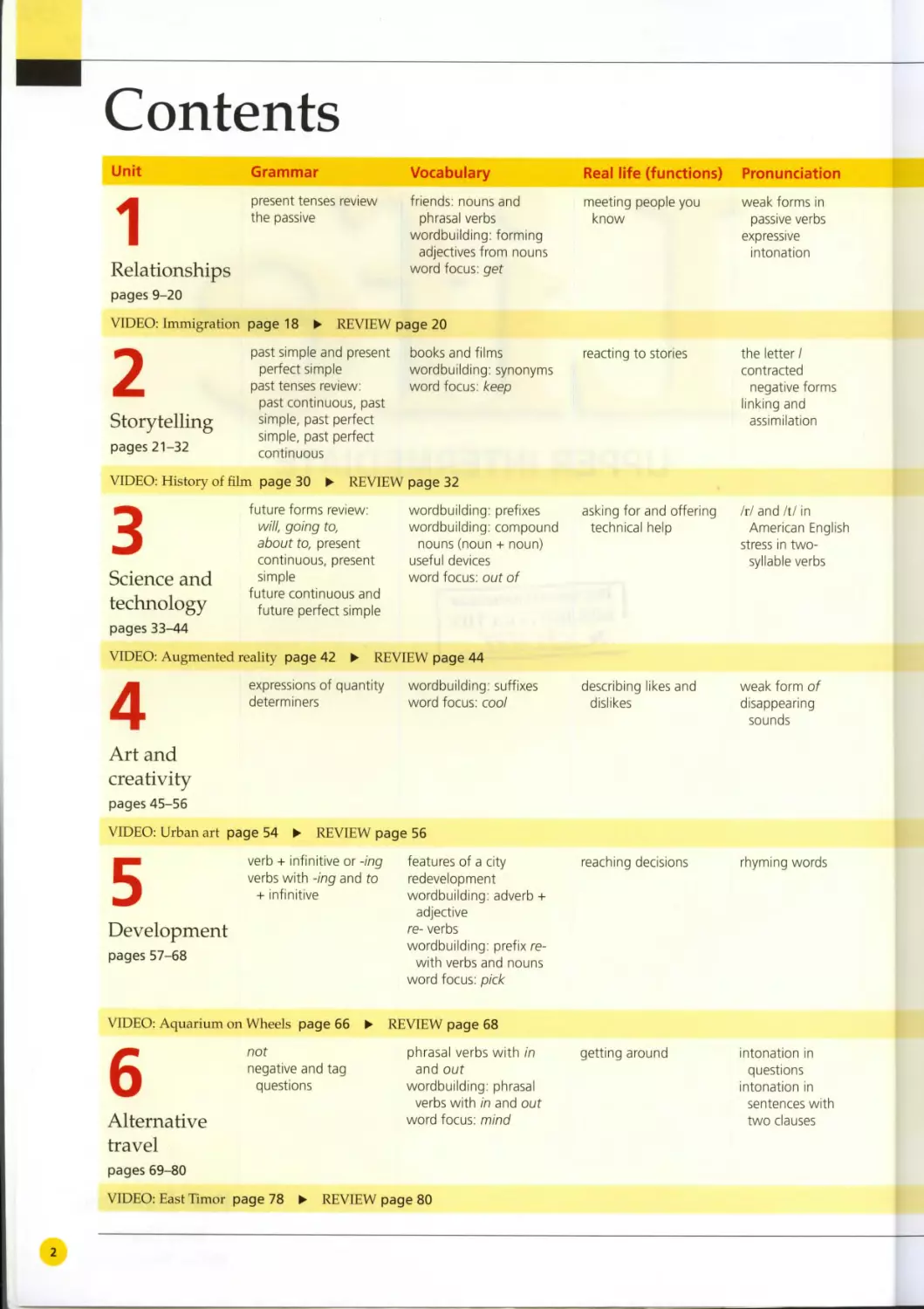
Contents
Unit	Grammar	Vocabulary	Real life (functions)	Pronunciation
1 Relationships pages 9-20	present tenses review the passive	friends: nouns and phrasal verbs wordbuilding: forming adjectives from nouns word focus: get	meeting people you know	weak forms in passive verbs expressive intonation
VIDEO: Immigration page 18 ► REVIEW page 20
2 Storytelling pages 21-32	past simple and present perfect simple past tenses review: past continuous, past simple, past perfect simple, past perfect continuous	books and films wordbuilding: synonyms word focus: keep	reacting to stories	the letter / contracted negative forms linking and assimilation
VIDEO: History of film page 30 ► REVIEW page 32
3 Science and technology pages 33-44	future forms review: will, going to, about to, present continuous, present simple future continuous and future perfect simple	wordbuilding: prefixes wordbuilding: compound nouns (noun + noun) useful devices word focus: out of	asking for and offering technical help	/г/ and /t/ in American English stress in two- syllable verbs
VIDEO: Augmented reality page 42 ► REVIEW page 44
4	expressions of quantity determiners	wordbuilding: suffixes word focus: cool	describing likes and dislikes	weak form of disappearing sounds
Art and creativity pages 45-56
VIDEO: Urban art page 54 ► REVIEW page 56
5
Development
pages 57-68
verb + infinitive or -ing
verbs with -ing and to
+ infinitive
features of a city
redevelopment
wordbuilding: adverb +
adjective
re- verbs
wordbuilding: prefix re-
with verbs and nouns
word focus: pick
reaching decisions rhyming words
VIDEO: Aquarium on Wheels page 66 ► REVIEW page 68
6
Alternative
travel
pages 69-80
not
negative and tag
questions
phrasal verbs with in
and out
wordbuilding: phrasal
verbs with in and out
word focus: mind
getting around
intonation in
questions
intonation in
sentences with
two clauses
VIDEO: East Timor page 78 ► REVIEW page 80
Listening	Reading	Critical thinking	Speaking	Writing
three people talking about important relationships in their lives a radio extract about animal friendships	an article about changing attitudes in China an article about immigrant families in New York	identifying the main aspect	your friends the generation gap family influences	text type: an informal email (1) writing skill: greetings and endings
a conversation about	a true story about	close reading	the film of the book	text type: a story
different accounts of	dangerous animals		a famous writer or	writing skill: using
Ayrton Senna's life	an article about the		filmmaker	descriptive words
an interview with a film critic	brothers Grimm		narrow escapes storytelling
three people making	an article about	balancing arguments global problems	text type: short
predictions about the	augmented reality	overpopulation	email requests
future	an article about	information age	writing skill: being
a presentation about	appropriate	predictions	polite
overpopulation	technology	technological
		solutions
a conversation about two
people who do artistic
things in their free time
an extract from a radio
programme about what's
on in Melbourne
an artist's opinion about
what art is
an article about
unusual street art
an article about the
origins of rap
analysing contrasts	participation in the	text type: an online
	arts	review
	an art competition	writing skill:
	music and values	personalising your writing
three speakers talking	an article about urban	fact or opinion	changes in your town	text type: an
about different types of	development in		a happy society	opinion essay
development	Dubai		sensitive	writing skill: linking
someone talking about redevelopment in their city an interview with a journalist talking about social development in southern India	an article about a hydropower dam project in Laos		development evaluating a development project	words
someone describing their a blog about holidays
stay at an ice hotel	at home
an interview about volunteer an extract from a
vacations	travel magazine
about historical
hotels
claims and
justifications
local knowledge
planning a staycation
opinions about travel
ideas for an unusual
hotel
text type: a letter of
complaint
writing skill: formal
language
Real life (functions) Pronunciation
Unit
Grammar
Vocabulary
шш	mixed conditional	conservation	making your point
Я	sentences	oil
Я	wish, would rather and	wordbuilding: collocations
if only	related to one word
Natural	strong feelings
	word focus: better
resources
pages 81-92
contractions in
conditionals
sentence stress
VIDEO: Galapagos energy page 90 ► REVIEW page 92
8 The news	reporting verbs passive reporting verbs	photography the feel-good factor wordbuilding: forming adjectives from verbs word focus: word	reporting what you heard
pages 93-104
VIDEO: Mount Fuji page 102 ► REVIEW page 104
weak forms in
verbs
the schwa
9
Talented
people
pages 105-116
articles: the or zero
article?
relative clauses
reduced relative clauses
careers
wordbuilding: verb (+
preposition) + noun
collocations
word focus: long
describing skills, talents linking vowels /w/,
and experience	/j/ and /г/
difficult words
VIDEO: Queen of Egypt page 114 ► REVIEW page 116
10
Customs and
behaviour
pages 117-128
habitual actions:
present tenses, will
used to, usually, be
used to and get used
to
raising children: verbs
food and eating habits
word focus: common
weddings
wordbuilding: word pairs
describing traditions
/u:/ and /ju:/
the letter s
VIDEO: Eating insects page 126 ► REVIEW page 128
11
Knowledge
and learning
pages 129-140
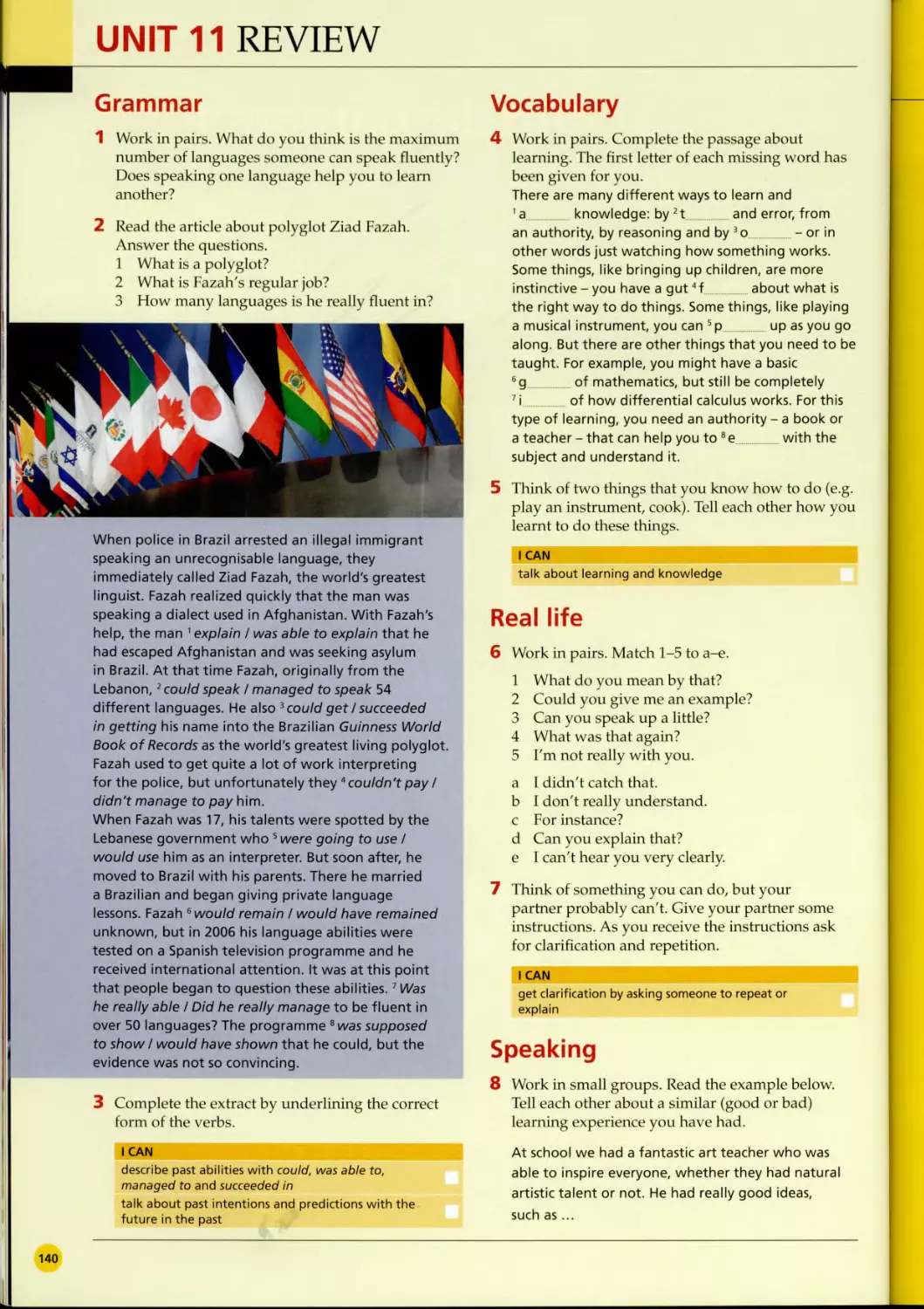
could, was able to,
manage to and
succeed in
future in the past
learning
wordbuilding: idiomatic
expressions
word focus: learn
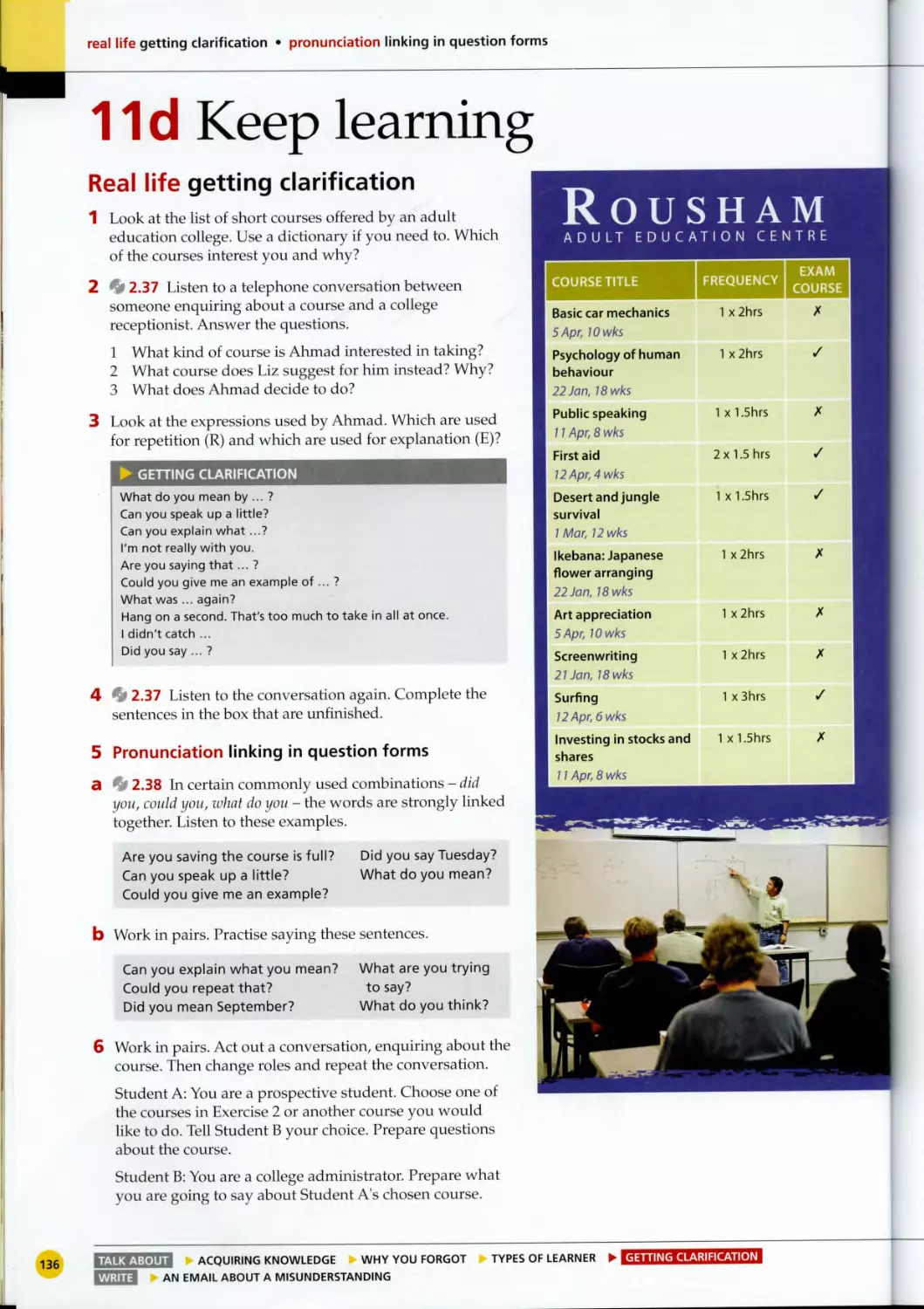
getting clarification
contrastive
sentence stress
linking in question
forms
VIDEO: Paraguay shaman page 138 ► REVIEW page 140
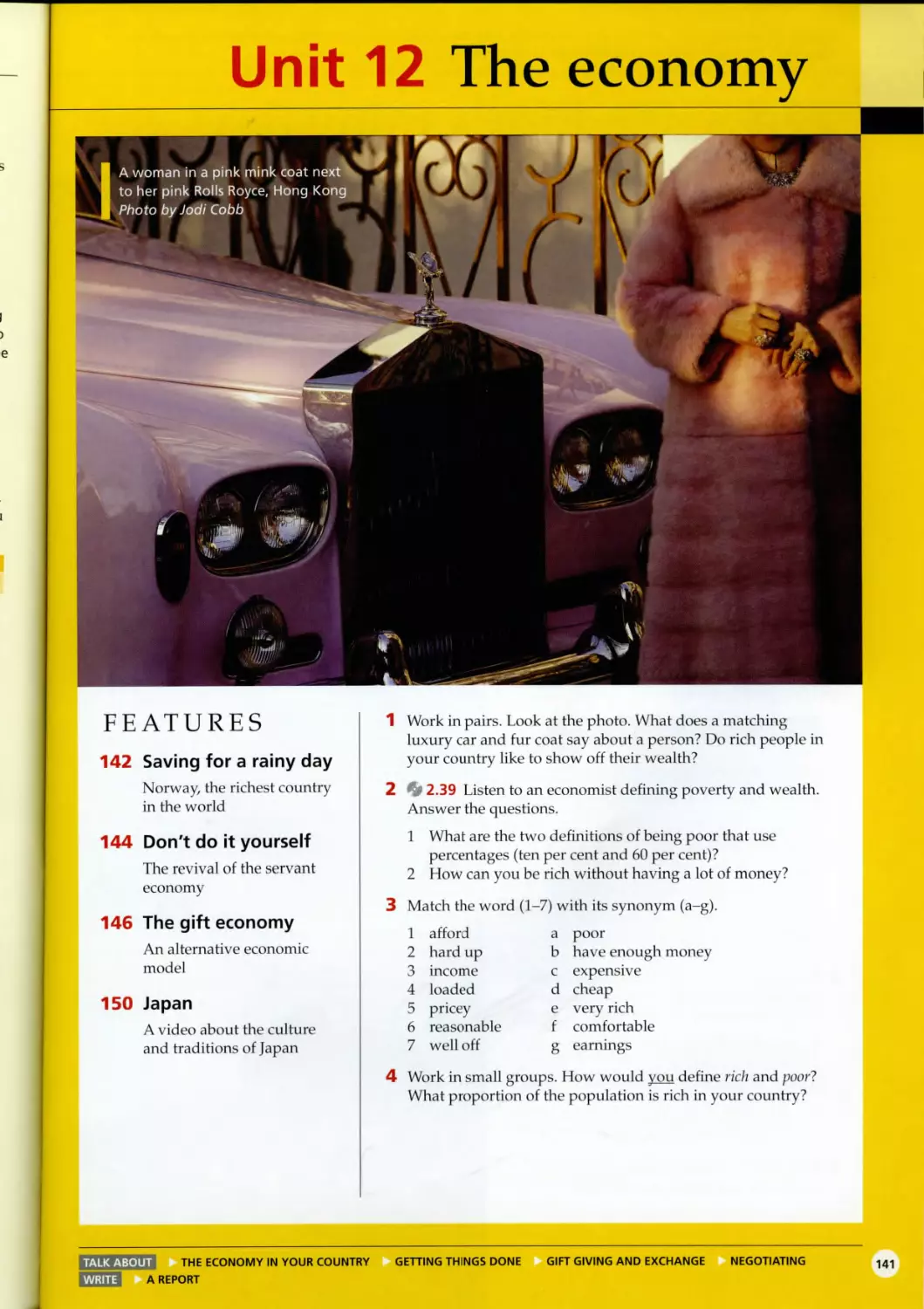
12
The economy
pages 141-152
focus adverbs only, just,
even
focus adverbs too, as
well, also
causative have and get
money
domestic help
wordbuilding: the +
adjective
getting things done
word focus: hard
negotiating
the sounds /J/, /tf/,
/3/ and /<fc/
sentence stress in
idiomatic phrases
VIDEO: Japan page 150 ► REVIEW page 152
COMMUNICATION ACTIVITIES page 153 ► GRAMMAR REFERENCE page 156 ► AUDIOSCRIPTS page 174
4
Listening	Reading	Critical thinking	Speaking	Writing
an ecologist describing how we can avoid wasting natural resources four people talking about saving water	an article about Ecuador's plan to protect resources an article about Madagascar's unique ecology	emotive language	how we use water conservation wishes	text type: a letter to the press writing skill: giving vivid examples
a radio news report about	an article about an	different perspectives the ethics of taking	text type: minutes
the parents of Chinese	iconic image	photographs	from a meeting
university freshmen	an article about the	good news stories	writing skill:
television news report of	power of the press	reputations	impersonal
four good news stories			language
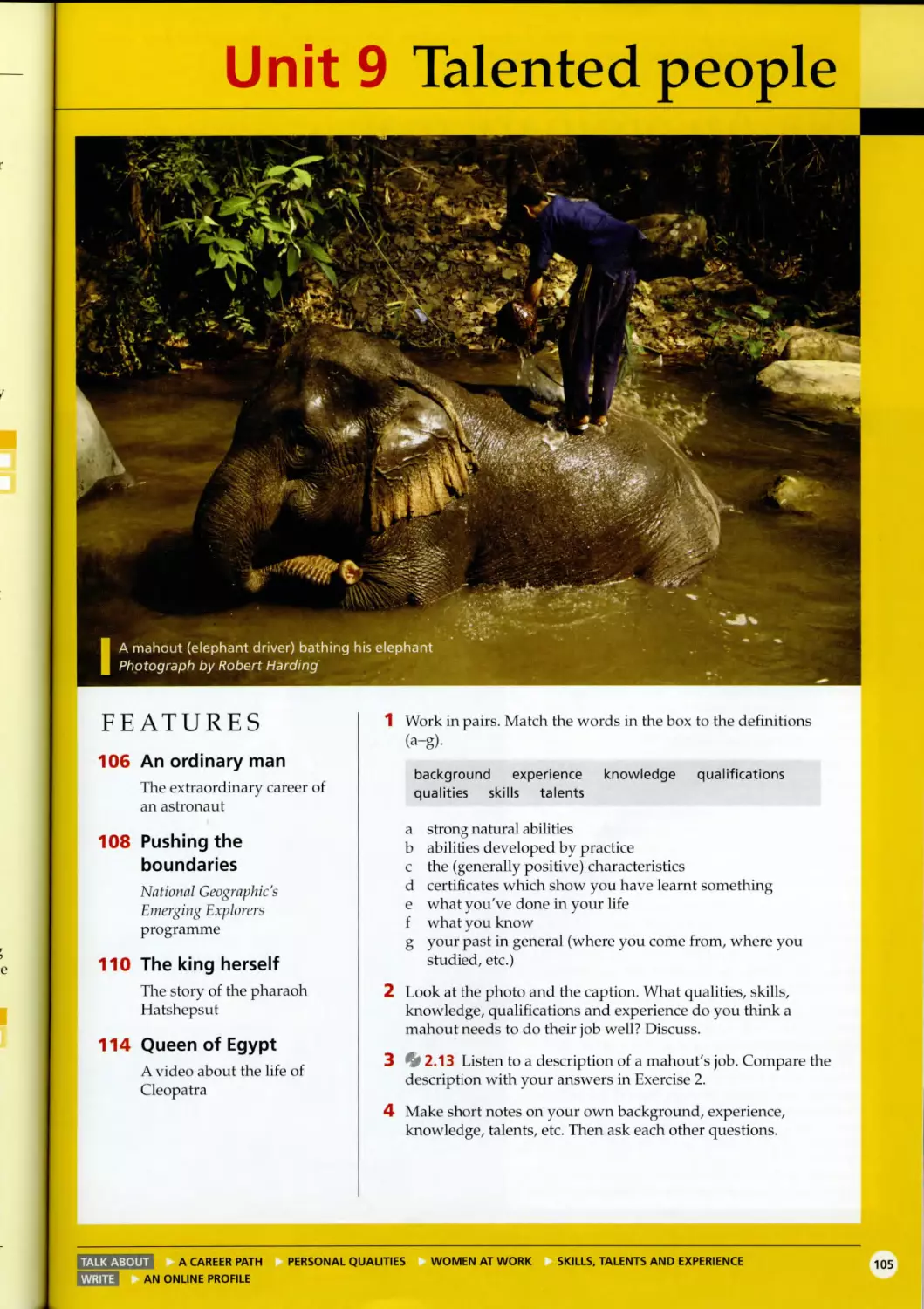
a description of a mahout's	an article about an	weighing the
job two friends discussing an astronaut's extraordinary career an interview about Emerging Explorers	extraordinary career an article about a woman who was king	evidence
a career path
personal qualities
women at work
text type: an online
profile
writing skill: writing
in note form
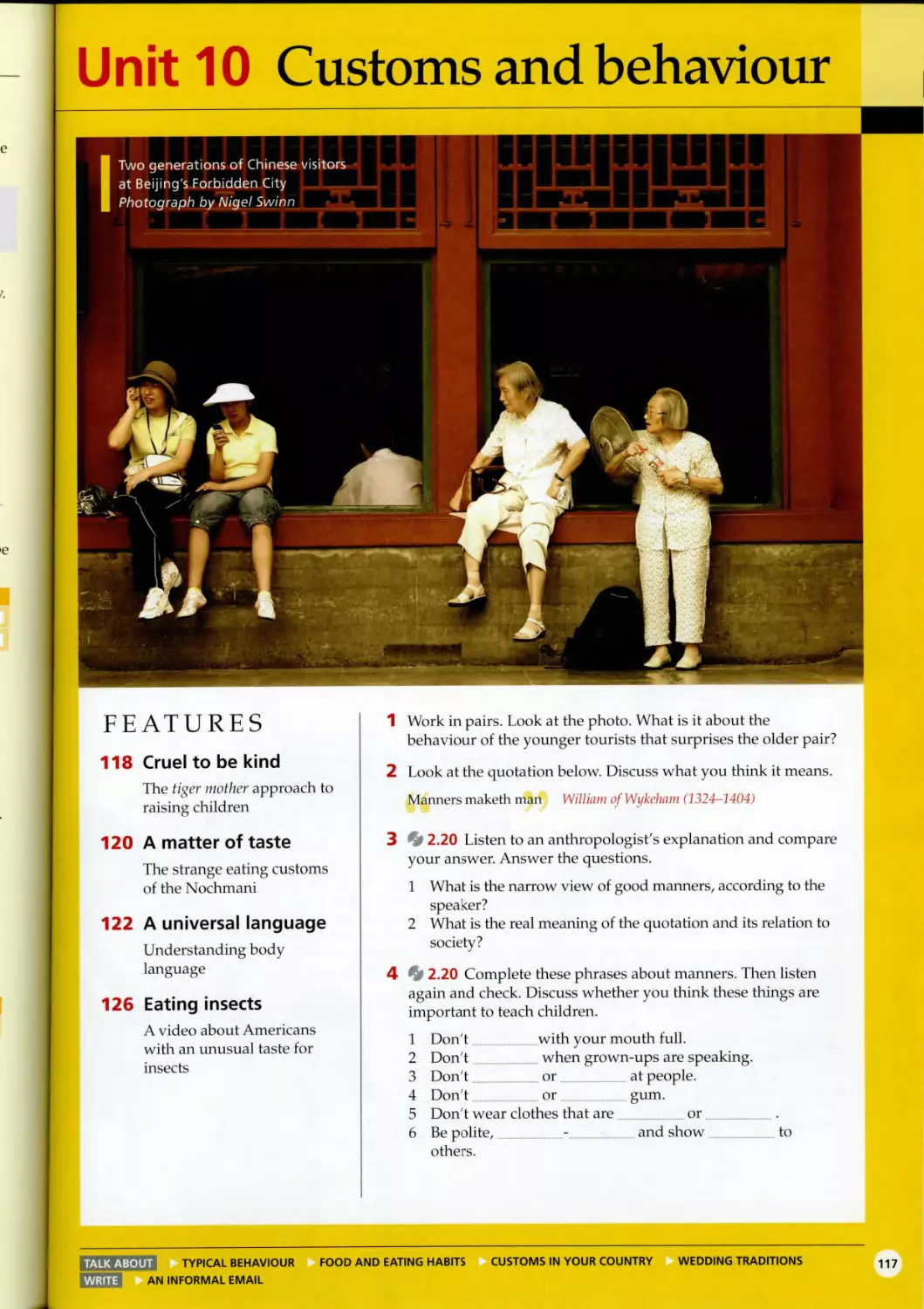
an anthropologist's	an article about	sources	typical behaviour	text type: an
explanation of the quote	the tiger mother		food and eating	informal email (2)
'manners maketh man'	approach to		habits	writing skill: elision
an extract from a radio programme about a tribe with an unusual diet	parenting an article about body language		customs in your country wedding traditions	in informal writing
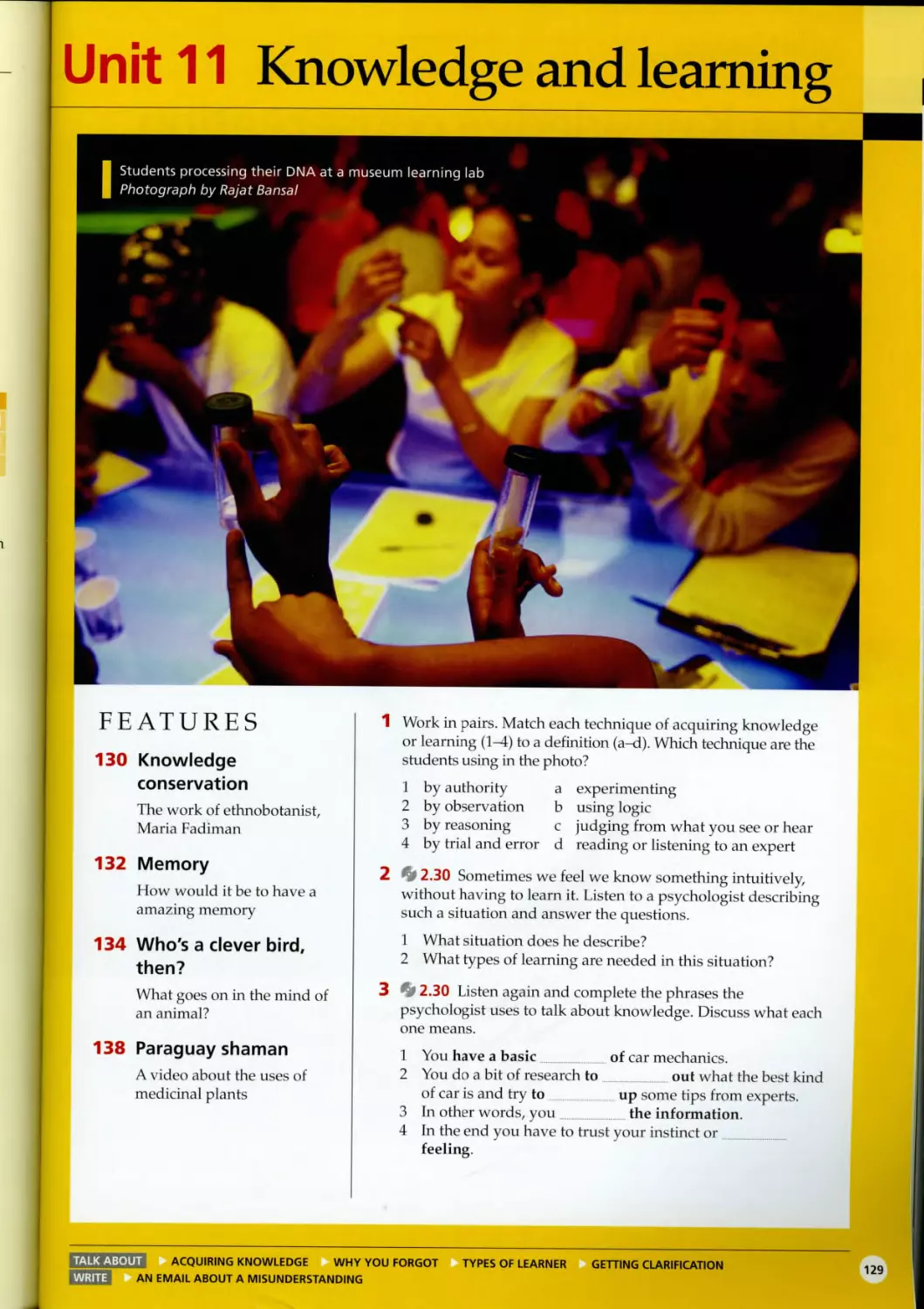
a psychologist describing a	an article about an	reinforcing ideas	acquiring knowledge	text type: an
situation in which you have	ethnobotanist		memory tests	email about a
to use your intuition	an article about a		why you forgot	misunderstanding
a talk by a psychologist on	parrot		types of learner	writing skill: linking
memory				contrasting ideas
extract from a radio
programme with an
economist giving
definitions of poverty and
wealth
an interview with the author
of The Servant Economy
an article about
Norway's riches
an article about an
alternative economic
model
signposts to key
information
the economy in your
country
getting things done
gift giving and
exchange
text type: a report
writing skill: sub-
headings and
bullet points
Unit 1 Relationships
FEATURES
10 Unlikely friends
Two animals that enjoy each
other's company
12 A confused
generation
Changing attitudes among
China's young generation
14 Bloodlines
Two accounts of how family
has shaped people's lives
18 Immigration
A video about how
immigrants have helped
build America
1 Work in pairs. Look at the photo and the caption. Choose the
phrase you think best describes the photo.
a faithful companion blood relatives
a passing acquaintance mutual respect a strong bond
true friends an odd couple
2 Look at these English sayings about relationships. What do
they mean? Do you have a similar saying in your language?
1	Blood is thicker than water
2	A friend in need is a friend indeed
3	Like father, like son
4	No man is an island
3 Ф 1.1 Listen to three people talking about important
relationships in their lives. Put the number of the speaker
(1, 2 or 3) next to the person they are talking about.
a husband
an old friend
a fiance
a brother

a colleague
a grandparent
4 Think of a person a) you have been meaning to contact for
ages; and b) you have shared a travel experience with. Tell
your partner about these people.
TALK ABOUT
YOUR FRIENDS THE GENERATION GAP
FAMILY INFLUENCES
MEETING PEOPLE YOU KNOW
WRITE
AN INFORMAL EMAIL
listening animal friendships • grammar present tenses review • vocabulary friends: nouns and phrasal verbs •
speaking your friends
1 a Unlikely friends
5
Listening
1 Work in pairs. Look at the photo. Discuss the questions.
1 What are the two animals in the photo?
2 Are they normally working animals, pets, wild animals or
something else?
3 What does the photo suggest about these animals' characters?
2 Ф 1.2 Now listen to an extract from a radio programme about an
unlikely friendship between these two animals. What things do
they do together to enjoy each other's company?
4 Do you believe animals can have
friendships? Or do they form
relationships only for practical
reasons? Do you know other
examples of sociable animals?
Discuss.
Grammar present
tenses review
► PRESENT TENSES REVIEW
3	1.2 Listen again and choose the right word to complete each
statement.
1	Co-operation between animals of different species is not
a natural b easy c usual
2	Dogs are usually	apes.
a suspicious of b frightened of c aggressive towards
3	This particular dog and orang-utan behave like
a old friends b children c people
4	Their behaviour has attracted the interest of a lot of
a TV viewers b scientists c psychologists
5	Orang-utans are very	creatures.
a physical b naughty c kind
6	Their relationship is based on a need in both animals to
a share new experiences b hunt together c be sociable
Present simple
Suriya lives with his keepers.
Present continuous
The two animals are fulfilling a basic
social need in each other.
Present perfect simple
Suriya has understood that the hound
dog is very hungry.
Present perfect continuous
They have been doing this every day
since they first met.
For further information and practice,
see page 156.
10
Unit 1 Relationships
5 Look at the grammar box. Match the tenses (1-4) with their
uses (a-d).
1	present simple	a	highlights a recent activity
2	present continuous	b	describes a situation in progress or happening around now
3	present perfect simple	c	describes a permanent / usual situation
4	present perfect continuous	d	highlights the present result of a recent past action
6 Choose the correct tense to complete this passage about
animal friendships.
I»
A number of recent videos on YouTube showing unlikely
animal friends 1 have started /have been starting a debate
about animal friendships. Lately many people2 have
discussed /have been discussing a particularly moving film
which shows a dog making friends with an elephant.
Elephants often3 show /are showing concern for their
social group, but there is one extraordinary scene where
the elephant becomes distressed when the dog gets
injured. The dog4 has recovered /has been recovering now
and the two animals have been inseparable. The question
scientists 5 ask/are asking is: is such behaviour normal,
or do we just want it to be? Some say it happens when
animals6 have lived /have been living close to humans.
No one7 has provided / has been providing a definite
answer, but it seems some animals are just naturally
sociable. Others, like giant pandas,8 live /are living more
independent and solitary lives.
ave
il
►
)und
iay
ice,
7 Work in pairs. Explain to each other the use of the verb
forms in bold in sentences 1-10 using а-d from Exercise 5.
1	We're not close friends - we're just studying French at
the same evening class.
This sentence describes a situation in progress.
2	1 live with Sarah, but each of us has our own group of
friends that we hang out with.
3	Olivia and I went on a trip to Peru together ten years ago
and we've kept up with each other ever since.
4	I wouldn't say we were friends really. We've met a couple
of times at parties.
5	Oh, do you know Tom? He's a good friend of mine too.
We should all meet up some time.
6	Jacob always hangs around when he's bored, but he
never comes round when he's got something better to do.
7	Kate has always stood by me in times of difficulty. If ever
I'm in trouble, 1 know I can rely on her for help.
8	Colin and I have been teaching at the same school for
years. We get on very well, even though we never really
see each other socially. I think I've been round to his
house once.
9	Barney and I have known each other since we were at
school. It doesn't matter if we haven't seen each other
for a while; we just seem to pick up where we left off.
10	Jessica and I are going to go for a medieval-style wedding.
Themed weddings are becoming very fashionable.
Vocabulary friends:
nouns and phrasal verbs
8 Work in pairs. What type of friend or
person is each person talking about in
Exercise 7? Match each sentence with a
person from the box.
acquaintance
fellow student
mutual friend
fair-weather friend
flatmate girlfriend
old friend
travel companion true friend
workmate
9 Find the following phrasal verbs in the
sentences in Exercise 7. Which ones
contain two prepositions, rather than
one? Discuss what each verb means.
•	1 verb with get
•	1 verb with stand
•	2 verbs with hang
•	2 verbs with round
•	3 verbs with up
10	Choose the correct phrasal verbs to
complete these sentences.
1	We come from different backgrounds
but we	really well.
2	We don't have to do anything
special, like going to a show. It
would just be nice to
each other for a bit.
3	I made a lot of really good friends at
university, but I haven't
with many of them.
4	Why don't you	to my
house for supper tonight?
5	Some friends are great just to have a
good time with, but real friends are
the ones who	you when
you're in trouble.
6	I'm busy at six o'clock but we could
later, if you like. Say,
eight thirty?
Speaking
11	Work in pairs. Think about three of your
friends. What kind of friend are they?
Choose from the types in Exercise 8.
Think also about how often you see
these people and what things you do
together. Discuss if your friendships are
similar in any way.
TALK ABOUT
YOUR FRIENDS
THE GENERATION GAP FAMILY INFLUENCES MEETING PEOPLE YOU KNOW
11
WRITE
AN INFORMAL EMAIL
reading changing attitudes in China • grammar the passive •
pronunciation weak forms in passive verbs • speaking the generation gap
1 b A confused generation
Reading
Grammar the passive
1 Work in pairs. Look at the photo accompanying
the article below. Discuss the questions.
1 What does it show?
2 What do you think the matter is with the
young girl?
3 Is this situation familiar to you?
2 Discuss what effects you think China's recent
economic boom has had on the attitudes of the
younger generation and the older generation.
3 Read the article and compare your answers.
4 Look back at the article and find examples of
the following to show how attitudes are changing
in China.
•	language use
•	caring for the old
•	the relationship between parents and children
•	shopping
•	knowledge of the world
5 Do Bella's parents seem to accept the changes that
are happening in China or not? Do you think the
changes are difficult for Bella too? Why? / Why not?
6 Work in pairs. Look at the examples of passive verbs
from the passage (1-6). Then look at uses of the
passive (а-d). Which are true and which are false?
1	Bella is the name that she has been given by
her English teacher.
2	But at the same time these new values are also
being questioned.
3	'Have our lives been made richer by all our
new possessions?'
4	Is Chinese culture being supplanted?
5	When they go shopping Bella makes sure that
the 'right' western brands are selected.
6	'Our advice is not listened to and it is not
wanted,' her mother says.
a The person doing the action - the agent - is not
the main focus of the sentence.
b We use front to introduce the agent in a passive
sentence.
c The agent is often unimportant or unknown - it
is the action that interests us.
d The passive is often used because we want
to start a sentence with something that has
already been mentioned.
Change brings problems. Bella lives with her parents in a brand new apartment
in Shanghai. Her real name is Zhou Jiaying - 'Bella' is the name that she has
been given by her English teacher. Her parents are representative of a confused
generation in a confused time. In modern Chinese society different ideologies
are fighting against each other. Enormous material benefits have been brought
by China's economic boom, but the debate is not about these; it's about family
life and values. Old values - the respect of family and the older generations - are
being replaced by new ones which place money as the critical measurement of
one's position in society. But at the same time these new values are also being
questioned. Have our lives been made richer by all our new possessions? Is
Chinese culture being supplanted? As in all changing societies people are trying
to find the right balance between the 'new' and 'old'.
Recently, Bella's family put their grandfather into a nursing home. It was a
painful decision. In traditional China, caring for aged parents has always been an
unavoidable duty, but times are changing. Bella's ambition? 'I want one day to put
my parents in the best nursing home' - the best that money can buy, she means.
'When she told us that' Bella's father says, 'I thought - is it selfish to think she will
be a dutiful and caring daughter and look after us? We don't want to be a burden
on her when we get old. This is something my daughter has taught us. Once it
was parents who taught children, but now we learn from them.' The family can
buy many more things these days, and when they go shopping, Bella makes sure
that the'right'western brands are selected. (Pizza Hut is her favourite restaurant.)
She also teaches her parents the latest slang.
Her parents want to be supportive, but they no longer help with Bella's
homework; in spoken English she has surpassed them. She has already learnt
much more about the world outside than them.'Our advice is not listened to
and it is not wanted,' her mother says. 'When she was little, she agreed with all
my opinions. Now she sits there without saying anything, but I know she doesn't
agree with me.'Bella glares, but says nothing.'! suppose our child-raising has been
a failure.'In China there is no concept of the rebellious teenager.
12
Unit 1 Relationships
► THE PASSIVE
erbs
э
Present simple passive
I am given, you/we/they are given, he/she/it is given
Present continuous passive
I am being given, you/we/they are being given, he/she/it
is being given
Present perfect simple passive
Uyou/we/they have been given, he/she/it has been given
For further information and practice, see page 157.
7 ‘>1.3 Look at the grammar box. Which of the
verbs in bold in 1-6 below also sound natural in
the passive? Transform the sentences from active
to passive. Listen and check.
There are many children like Bella in China. They
admire western brands. Their parents2 3 have
spoiled them a little perhaps. Often these children
3 receive a better education than their parents. Their
parents4 5 send them to private schools and they
5 encourage them to go to university. In China the
new economy6 is raising everyone's hopes.
e
it
► WORDBUILDING forming adjectives from nouns
There are various endings in English: -ful, -ish, -ent,
-ious, -ive, used to form adjectives from nouns.
support ♦ supportive, rebel * rebellious
For further information and practice, see Workbook
page 11.
8 Pronunciation weak forms in passive verbs
a • 1.3 Work in pairs. Listen again to the passive
verbs used in Exercise 7. Which parts of the verb
are stressed? Which are not stressed?
b Practise saying these sentences, putting stress on
the main verbs and un-stressing the auxiliary verbs.
1	A lot of changes have been introduced in China.
2	Asa result, the average Chinese person has
been given a better standard of living.
3	Couples are only allowed to have one child.
4	A lot of money is invested in each child's future.
5	But changes in this policy are being discussed.
6	The government has been concerned by the
growing number of people over 60.
9 Complete the sentences by putting the verb in the
correct tense, active or passive.
1 'Children_______________(grow) up much too
quickly today. Girls of twelve
(dress) as if they are eighteen.'
2 'We	(leave) behind by all the new
technology they use.'
3 Our grandparents	(probably / work)
harder than us, but they	(not / have)
so much fun.'
4 'They	(live) longer and longer and
we	(expect) to look after them. It's
not fair.'
5 'Our parents aren't so different to us: they
(listen) to the same music, for
example.'
6 'In recent years respect for wisdom and
knowledge	(replace) by respect for
money.'
7 'I rebelled against my parents. My children feel
that they	(expect) to rebel, but in
fact they have nothing to complain about or
rebel against.'
8 'We	(often / criticise) for being
selfish and having no moral values, but that's
our parents' fault: we	(spoil) by
them.'
Speaking
10 Work in groups. Discuss whether it was a young
person or an older person that said each of the
items in Exercise 9. Which of the statements do you
agree with?
11 Do you think the 'gap' between your generation
and your parents' generation is greater than the one
between your generation and the next generation?
TALK ABOUT
YOUR FRIENDS
□ THE GENERATION GAP
FAMILY INFLUENCES MEETING PEOPLE YOU KNOW
13
WRITE
AN INFORMAL EMAIL
reading immigrant families • critical thinking identifying the main aspect • speaking family influences
1 c Bloodlines
Reading
1	Work in pairs. Why do you think people
emigrate? What difficulties do you think
they face when they settle in a new country?
Compare your ideas with another pair.
2	Read the article about immigrants in New
York. Answer the questions. Then compare
your answers with your partner.
1	What is special about the area of Queens in
New York?
2	What do Richard and Tanja's families have
in common?
3	What are the differences between Richard's
and Tanja's stories as immigrants?
3 Are the sentences true (T) or false (F) according
to the article?
1	Immigrants in Queens feel attached to their
new country.
2	People are much more interested in
learning about distant ancestors than recent
generations.
3	Some years after immigrating to America,
Tomas met his brother in New York by
accident.
4	Richard's grandmother has kept the family
history alive.
5	Tanja's mother wasn't able to balance work
with looking after her children's education.
6	Tanja and her sister have chosen to have
similar careers to their parents.
4 Look at the article and choose the correct
explanation of each phrase.
1	a melting pot (para 1)
a a place of conflict
b a place where all mix together
c a place which attracts
2	their ancestral roots (para 2)
a where their family came from originally
b how they got to America
c their parents' character
3	one recurring theme (para 3)
a sad fact
b common story
c unusual quality
4	seeking his fortune (para 4)
a hoping to get lucky
b looking for the right job
c looking for a way to get rich
5	a must (para 5)
a a good thing
b a right
c a necessity
Critical thinking identifying the
main aspect
5	Work in pairs. This article deals with different aspects
of emigration. Identify the aspects in each of the first
three paragraphs. Compare your answers with another
pair to check you have identified the same themes.
6	Read the personal accounts of the immigrants again.
Which of the aspects do their stories pick up on?
Which aspects are not really mentioned again?
7	Discuss what the main aspect, or message, is of this
article. Then ask other pairs if they have reached the
same conclusion.
Speaking
8	Look at these phrases from the passage describing
family characteristics or traits and discuss what they
mean.
'He was clearly something of a free spirit.'
'My parents have a strong work ethic.'
'We've both inherited that desire to get ahead.'
9	Look at the questions below and note down your
answers. Then ask your partner about their answers. Does
family have a similarly strong influence in your lives?
HOW DOES FAMILY SHAPE YOU?
Would you say you are a close family?
How much time do you spend with family:
out of a sense of duty?
because you choose to?
Is family a consideration for you in choosing where to live?
How conscious are you of your family's history?
Is there a strong family trait? Have you inherited it?
Is there a'head of the family7? How important is it to have
this person's approval?
Is there someone in the family you particularly admire? Why?
Has your family influenced the career path that you have
chosen?
When seeking advice, are you more likely to turn to friends
or family?
How important is it to you that your family approves of your
partner?
Would you say your family members have the same attitude to:
money?
bringing up children?
:ts
;t
her
Richard, 38
My great-grandfather Tomas came to America from Poland when he was
Does
*s?
America itself is well-known for being a
melting pot of different ethnic groups and
cultures, but nowhere is this diversity more
pronounced than in Queens, New York.
Here, second-generation Puerto Ricans live
alongside third-generation Greeks and first-
generation Koreans, all united by a common
feeling of pride in their American identity.
However, they are also proud and curious
about their ancestral roots. National
Geographies Genographic Project, known also
as the Human Family Tree, set out to trace the
origins and common ancestry of the various
immigrants in this community by examining
their genetic makeup using a simple DNA
test. The study was well supported by
local residents, but often what was of more
immediate interest to people was something
which intrigues us all: the history of our
recent ancestry. In other words, how their
grandparents and great-grandparents arrived
in America, and what brought them there in
the first place.
One recurring theme among immigrants
seems to be the hard work and sacrifices that
went in to building a new life and how their
descendants now feel a duty to honour their
efforts by working hard too. Here are two
Queens residents' stories.
7

fifteen. His mother had become ill and died, and his father remarried to be
able to take care of his seven children. Tomas didn't like his stepmother, so
he ran away to Belgium, where he boarded a ship to America - without a
ticket. He was clearly something of a free spirit. Arriving in America with
nothing, he got a job on the railroads in California. Then one day he saw an
announcement in a newspaper that was read by immigrants. It was from
his brother in New York who was also seeking his fortune in America and
was looking for him. Tomas got in touch and they had an emotional reunion
in New York, where Tomas subsequently settled. This is the story that my
grandmother has passed down to us, to my parents and all my aunts and
uncles. She is an amazing woman and the head of the family, I suppose; the
one who holds us all together. She's actually quite forgetful now, but she
never forgets family details. What that has meant is that all of us - brothers,
aunts, cousins - have a strong family bond and a strong sense of belonging
to a group that has struggled and fought together to succeed here.
Tanja, 29
I'm a first generation American. Both my parents came here from Jamaica,
where getting a good education is a must. My mother always says that
people may take everything away from you, but they can never take away
your education. My father was a nurse in Jamaica, but he had an ambition
to be a doctor in the US; when he first came here, he studied during the day
and went to work at night. My parents have a strong work ethic. My mum
has always worked as a nurse, but at the same time has always been very
involved in our lives also, helping with our studies and following our careers
with interest. Both my sister and I have followed them into the medical
profession and now I'm working as a doctor at the Mount Sinai hospital in
Queens. I don't know if that kind of dedication is genetic or just something
that you learn from your parents, but that desire to get ahead ... we've
certainly both inherited it. The great thing about America is that it gives you
the opportunity to live those dreams too.
TALK ABOUT
YOUR FRIENDS
THE GENERATION GAP
J FAMILY INFLUENCES
MEETING PEOPLE YOU KNOW
15
WRITE
AN INFORMAL EMAIL
real life meeting people you know • pronunciation expressive intonation
writ
1 d A face from the past
Real life meeting people you
know
1 Work in pairs. Discuss the questions.
1	When was the last time you bumped into
someone that you hadn't seen for ages?
2	What did you talk about?
3	Had they changed a lot?
2 * / 1.4 Listen to a conversation between two
people, Tim and Greta, who meet by accident in
the street. Answer the questions.
1 What have they been doing since they last met?
2 What future arrangement do they make?
3 Ф 1.4 Listen again and tick the expressions in the
box the speakers use.
4 Find the ticked expression that matches sentences
1-6.
1	how Greta expresses her surprise at meeting
Tim
2	how Greta asks Tim for his news
3	what Tim says about Greta's appearance
4	how Greta describes her business
5	what Greta says about Amanda, their other
friend
6	how Greta says she can't carry on the
conversation
5 Pronunciation expressive intonation
a Ф 1.5 Emotion (surprise, excitement, etc.) is often
conveyed by expressive or exaggerated intonation.
Flat intonation often suggests a lack of emotion
or interest. Listen to these phrases and say if the
intonation is expressive (E) or flat (F).
1	Hello. Fancy seeing you here.
2	Oh, busy as ever.
3	How's it all going?
4	Sorry, I'm in a bit of a hurry.
5	Do you see much of Amanda?
6	You're looking well.
E F
Wi
1 I
f
t
2 I
I
I
t
b Work in groups. Choose a phrase from the box and
say it either with expressive intonation or with
flat intonation. Ask the others in the group to say
which intonation you used.
6 Imagine you are in a large shopping centre during
your lunch break from work. Walk around and
'bump into' other people that you have met
before. Find out what each person has been
doing, and make a future arrangement. Then
move on until you bump into someone else. Use
the box to help you.
16
Fancy meeting I bumping into / seeing you here!
What a (nice) surprise!
How are things?
What have you been up to?
How's it all going?
Busy as ever.
I’ve been completely snowed under.
It has its ups and downs.
You're looking well.
It obviously suits you.
Do you see much of Amanda?
How's Amanda getting on?
She was asking after you the other day.
Do give her my regards.
Say hello to her from me.
Well, I should probably go and ...
Sorry, I've got to rush. I I'm in a bit of a hurry.
I don't mean to be rude, but I need to ...
It was really nice to see you. I Great to see you.
Good luck with ...
► MEETING PEOPLE YOU KNOW
TALK ABOUT
YOUR FRIENDS
THE GENERATION GAP
FAMILY INFLUENCES ►
MEETING PEOPLE YOU KNOW
WRITE
AN INFORMAL EMAIL
writing an informal email • writing skill greetings and endings • word focus get
Unit 1 Relationships
1e News from home
Writing an informal email
4 Writing skill greetings and endings
1 How often do you send news to friends and
family? Do you communicate by letter, email,
text message?
Which of these other phrases for greeting and
ending would be appropriate in an informal email
to a friend or relative?
2 Read the email below from Ben to his friend,
Fergus. Where is Ben and what is he doing there?
How would you summarise the contents of each of
the three paragraphs?
All my love Best wishes Dear Mr Franks
Dear Sir or Madam Hello Hi John
Kind regards Love Regards Warm regards
Yours Yours faithfully Yours sincerely
Dear Fergus
I hope all's well with you. I've been meaning to
write for ages, but my journal takes up a lot of my
time. Please don't think it's because I haven't been
thinking about you all -1 have and I'm getting
quite homesick. But I have to remind myself of why
I am here, which is to try and get established as a
freelance journalist and photographer.
I'm now in Sri Lanka visiting some tea plantations
and talking to people about how their lives have
changed in the last 20 years or so. The countryside
here is amazing. At the moment I'm in the hills just
outside Kandy which are so lush and green, you
wouldn't believe it. I'm trying to get an interview
with one of the plantation owners that I can make
into a feature for a magazine. Fingers crossed!
So, my plan is to stay here until the end of
September and then get a plane back to the UK to
see if I can find someone who will publish some of
this stuff. It would be great to get together with you
then. How is the family? Is Sarah still working for
that horrible estate agent? Do give them all my love.
I'll write again soon.
All the best,
Ben
3 What features of the language in this letter tell you
that it is in an informal style?
5 Word focus get
a The verb get is used often in spoken or informal
written English. Find five phrases / sentences in
the letter where it is used. What does it mean in
each case? Think of a synonym for get in each case.
b Read the sentences. Match the uses of get to a word
with a similar meaning in the box.
be (in passive sentences) catch do I manage
persuade reach receive
1	Did you get my last letter?
2	How have you been getting on in your new job?
3	I got a virus which kept me in bed for two
weeks.
4	We got delayed for four hours at the border.
5	I'm going to try to get him to come with me.
6	I'll call you when I get to London.
C Write three sentences of your own with get giving
recent news about yourself. Work in small groups
and read them to each other.
6 Imagine you have been away from home for some
time. Write an email (200 words) to a friend or
family member to ask them for news from home
and to give them your news. Try to use the verb get
at least twice.
7 Work in pairs. Exchange letters. Check for the
following:
•	Is the use of tenses correct?
•	Is the style not too formal?
•	Did they use the correct greeting and ending?
w
з
4
cc
di
di
fl<
h<
11 Immigration
Fleeing economic and political
hardships, many millions left their
homelands in Europe and Asia in
search of a better life.
Be
Unit 1 Relationships
Before you watch
1 Work in groups. Look at the photo and discuss the
questions.
1	Where are the people in the photo?
2	What do you think they are doing?
3	What does the caption tell us about the people?
2	Work in pairs. Write down five images you think
you will see in the video.
An'immigration officer checking the documents of a
^^n^rnving in the US by boat._ ________________
While you watch
3	Watch the video and check your ideas from
Exercise 2.
4	Watch the first part of the video (to 02.30). Find
and underline eleven errors. Write the correct
information below the text.
Large numbers of immigrants have come to
the United States since the early 17th century.
Europeans settled mainly in the western half of the
country. Immigrants from Asia and from Mexico
settled mostly in the east and the northwest.
Between 1892 and 1954, Ellis Island in Los Angeles
Harbour admitted seventeen million immigrants.
In 1907, as many as eleven thousand people a
week were processed. And today, four out of
every five Americans can trace part of their family
history directly back to Ellis Island. Many of these
immigrants settled on the Upper East side of
Manhattan. The Tenement Museum shows how
harsh their living conditions could be. Families
of eleven people lived in small apartments with
just two rooms. On the other side of the country,
families arrived at Devil's Island in California,
where conditions were more relaxed for Asians.
1	 .. .....................
2
3
4
5	________________________________________
6
7		__________________________________
8
9
10
11
5 Watch the second part of the video (02.31 to the
end). Answer these questions.
1	How many legal immigrants arrive in the US
each year?
2	What particular challenge is there along the
US-Mexico border?
3	What have foreign-born citizens brought with
them to the US?
4	How is the US economy affected by immigration?
5	What do immigrants usually share with people
already living in the US?
6	How does this help the immigrants?
After you watch
6 Roleplay arriving at Ellis Island
Work in pairs.
Student A: Imagine you are an immigrant to the
US arriving at Ellis Island. Read the information
below and make notes.
Student B: Imagine you are an immigration
officer at Ellis Island. Student A wants to enter the
country as an immigrant. Read the information
below and prepare questions to ask the immigrant.
•	where you come from
•	your journey
•	why you want to come to the US
Act out the interview, then change roles and act
out the interview again.
7 Lavinia Limon says, 'We're in a much better
position because we have maintained our
immigration flows.' What do you think she means?
Do you agree with her?
8 Work in groups and discuss these questions.
1	What kind of problems do you think
immigrants faced when they arrived in the
United States in the 1920s?
2	Do you think immigrants face similar problems
today?
3	Do you think immigrants should try to keep the
customs and values of their home countries, or
adopt those of their new country?
contend with (v) /kon'tcnd wid/ deal with a difficult situation
discrimination (n) /disknmi'ncijon/ treating a group of people
in an unfair way
diverse (adj) /dai*v3:s/ varied
flee (v) /fli:/ escape from
hardship (n) /'hu:djip/ something that makes life difficult
harsh (adj) /ha:J/ unpleasant and difficult to live in
leap (n) /li:p/jump
partition (v) /po:’tijon/ divide
shore (n) /Jo:/ coast
tenement (n) /'tenomont/a large building divided into
apartments in a poor area of a city
19
UNIT 1 REVIEW
Grammar
Vocabulary
1 Read the article below about families.
Answer the questions.
1 What is the difference between a
nuclear and an extended family?
2 What are the benefits of an extended
family?
2 Underline the right present tense form
to complete the text. Then check your
answers with your partner.
4 Read each definition and then put in the correct word.
1 Someone who is also studying, like you =
a student
2 Someone you go on a trip with = a companion
3 Someone who you can really depend on = a
friend
4 Someone you and another friend both know =
a friend
5 Someone you share an apartment with = a
6 Someone you know but is not really a friend =
an
7 Someone you are related to by birth = a relative
5 Work in pairs. Give details about one of the people in
Exercise 4:
3 Work in pairs. Make a list of other
advantages and disadvantages of living in
an extended family. Then compare your
answers with another pair.
•	who you hang out with regularly
•	who you haven't kept up with
•	whose house you go round to regularly
I CAN
describe different types of friends and acquaintances
use phrasal verbs that describe relationships
When talking about family, a distinction 1 is
making I is made between extended family and
nuclear family. The nuclear family is the basic
family unit of parents and children. The extended
family is all the other members who2are related
I have been related by blood and by marriage:
aunts, uncles, grandparents, nieces, nephews, in-
laws, etc. In the West, the importance of extended
family3 has decreased I has been decreased greatly
in the last SOyears. But the extended family has
many economic benefits. Grandparents4 help I are
helped with childcare and in turn they 5 are looked
after I have been looked after when they are old
by younger members of the family. Also, when
houses and domestic chores6 are sharing I are
being shared by many, living costs are naturally
lower. But in recent years more and more young
people 7 are choosing I have been choosing to
live in nuclear families and so the economics
8 have changed I have been changing. The older
generation say that traditional family values
9 are losing I are being lost, but the more serious
economic issue is that everyone's network of
support10 has been taking I has been taken away.
Real life
6 Put the sentences below into the right order to complete
the conversation between Karen (K) and Jim (J).
K: Hello Jim. Fancy bumping into you here. 1
K: Great. Well, 1 should probably go. I'm in a bit of a
hurry to get to the bank.
K: Of course I will. We should get together some time.
K: You know - busy as ever. He's working for BP now in
London.
K: You too. Good luck with the work in New York.
K: Not bad, thanks. What have you been up to?
K: Have you? That's sounds exciting. You're looking well.
J: Thanks. You too. How's David getting on these days?
J: Well, do give him my regards.
J: Yes, that would be nice. I'll get in touch when I'm back
next month.
J: Well, it was great to see you.
J: I've been working in New York for the past month.
J: Oh hello, Karen. What a nice surprise! How are things?
7 Work in pairs. Imagine you meet each other in the street
by accident. Act out a similar conversation.
I CAN
have a conversation with someone I haven't seen for some
time
I CAN
use present tenses
talk about events in present time using
active and passive forms
Speaking
8 Work in pairs. Tell each other about a relationship with a
family member or friend that is important in your life.
20
Unit 2 Storytelling
ect word.
companioi
a
w =
d =
relativi
ople in
wplete
of a
time.
now in
k.
ing well
? days?
'm back
nth.
things?
street
22
24
26
30
1
ith a
e.
The film of the book
When is a good book also a
good film?
A close shave
Two reporters have a scary
encounter
Once upon a time ...
The brothers Grimm:
master storytellers
History of film
A video about how film-
making has developed
TALK ABOUT
WRITE
2
3
4
1.6 Work in pairs. Look at the photo and the caption. What
do you know about this man? Listen to a conversation about
different accounts of his life. Answer the questions.
1	What facts about his life do the speakers mention?
2	How are the film and book different?
1.6 What are the opposites of these adjectives? Which ones
did the speakers use to describe the documentary and the
biography about Senna? Listen again and check.
accurate biased fair objective partial sympathetic
truthful
Match the adjectives (1-5) with the genres (a-e).
1 sentimental, touching
2 creepy, scary
3 fast-moving, gripping
4 original, thought-provoking
5 powerful, authentic
a thriller
b historical drama
c science fiction
d romantic comedy
e horror
Describe to your partner a book or film you have enjoyed
recently. Would you like to see the film or read the book your
partner has described?
A FAMOUS WRITER OR FILMMAKER NARROW ESCAPES STORYTELLING YOUR REACTIONS TO STORIES
A STORY
vocabulary books and films • speaking and listening the film of the book • grammar past simple and present perfect
simple • pronunciation the letter I • writing and speaking a famous writer or filmmaker
2a The film of the book
Vocabulary books and films
1 Work in pairs. Look at the photo below.
What kind of film do you think this was
a location for?
2 Do the words in the box relate to books, films
or both? Put them into three categories.
► WORDBUILDING synonyms
There are often words which are close in meaning but not
exactly the same. Or they have the same meaning but differ	3
in use.
author and screenwriter	4
For further information and practice, see Workbook page 19.
5
audience author best-seller
blockbuster box office cast
characters	director	location
portrayal	producer	publisher
chapter
plot
readers
scene screenwriter script
storyline theme trilogy
setting
3 Match words from the books list and the
films list to make pairs of words that are
related. What is the difference between the
words in each pair? Compare your list with
another pair.
Example:
author and screenwriter - the author is the writer
of a book, a screenwriter writes the script of a film
Speaking and listening
4 Work in pairs. Ask each other the questions.	7
1 Do you like to see film adaptations of books you
have read?	7 у
2 Do you sometimes read a book because you have
seen the film?
5 Ф 1.7 What do you think is the secret of making a good
film adaptation of a book? Tell your partner if you agree
with a, b or c. Then listen to an interview with a film
critic and say which answer he gives.
a to remain completely faithful to the details of the
story and the characters in the book
b to remain faithful to the spirit and main themes of
the book
c to create a story that works on film, even if it is not
faithful to the book
2
3
Gr
pre
8 V
li
si
Unit 2 Storytelling
rfect
6	11.7 Answer the questions. Then listen again and
check.
1	What do people generally think are the
ingredients for a box office success?
2	What does the critic say about the success of film
adaptations of books?
3	What are Sense and Sensibility and The Shining
examples of, according to the critic?
4	What does the critic compare making a good
film from a book to?
5	What is the central theme of The Lord of the
Rings?
6	Why was it difficult to reproduce the world
J.R.R. Tolkien created?
7	How did director Peter Jackson compensate for
leaving out elements of the story in the book?
7 Work in groups. Discuss the questions.
1	Have you seen any good film adaptations of
books? And any bad ones?
2	What made them good and bad?
3	Were the reasons similar to the ones described
by the critic?
Grammar past simple and
present perfect simple
8 Work in pairs. Match each sentence from the
listening text (1-5) to one of the uses of the past
simple (a-e).
1 Some film adaptations have worked, others
have flopped.
2 'What is the secret?' That was the question I put
earlier to Mark Mowlam.
3 He has followed the progress of many book-to-
film adaptations in his time.
4 The author, Tolkien, created a magical world.
5 It has become one of the most successful films of
all time.
a When the action is clearly linked to a specific
time in the past we use the past simple.
b When the experience is more important than
the time and the time is not stated we use the
present perfect.
c We use the present perfect to talk about people's
life experiences.
d If the person is dead we must use the past
simple to talk about their lives.
e When we talk about a period of time that is not
finished we use the present perfect (e.g. over the
past few weeks, this year) even if the action itself
is finished.
► PAST SIMPLE and PRESENT PERFECT SIMPLE
Past simple
/ visited I He visited ...
I didn't visit...
Did you visit... ?
Present perfect simple
I have visited I She has visited...
I have not visited...
Have you visited... ?
For further information and practice, see page 158.
9 Look at the grammar box. Then put each verb in
these pairs of sentences into the correct form, past
simple or present perfect simple.
1	I first___________(read) The Hobbit when I
was twelve years old. What about you?
No, I	(never / read) The Hobbit,
but I know a guy who	(read) it 24
times. He never gets tired of it.
2	There	(be) a lot of film adaptations
of Stephen King books over the years.
Yes, I know. There	(be) a great
adaptation of The Green Mile a few years ago.
3	you ever	(write) a
play or a screenplay?
No, but my great grandfather
(write) a play for radio.
4	you	(see)
2001: A Space Odyssey on TV last night?
No, but I	(see) it before. It's
amazing, isn't it?
10 Pronunciation the letter I
a Ф 1.8 Listen to three words which contain the
letter /. Notice how / is pronounced in three ways.
Listen again and repeat.
1 as a clear / before a vowel sound location
2 a dark / before a consonant sound film
3 silent / would
b Ф 1.9 Listen to these words and say which /
sound you hear (1,2 or 3). Compare your answers
with your partner. Then practise saying each word.
best-seller	calm	child	details faithful to
felt half	loyal	plot	screenplay
should told trilogy walk
Writing and speaking
11 Think about a living writer or filmmaker. Make
notes about their life and work. Then describe
this person's work to your partner. Ask questions.
TALK ABOUT ИЗ A FAMOUS WRITER OR FILMMAKER
NARROW ESCAPES STORYTELLING YOUR REACTIONS TO STORIES
23
ЕНПЗ A STORY
reading a true story • grammar past tenses review • pronunciation contracted negative forms •
speaking narrow escapes
2b A close shave
Reading
1 Work in pairs. Discuss how you would react if faced
with the following dangerous situations. What do you
think would be the right thing to do?
•	a snake showing its teeth at you
•	a shark swimming near you
•	a bear approaching when you are eating a picnic
2 Have you had any 'close shaves' with dangerous
animals? What happened? Tell the class.
3	Read the story below about three encounters
two National Geographic reporters had with
rhinos on the same day. What did the rhinos do
in each case and how did the people react?
4	Look at the eight highlighted verbs in the
article and guess their meaning from the
context. Then check in a dictionary to see if
you were right.
5	What effect does the use of these verbs have on
the story?
National Park in India is home to two of the world's most endangered
species: the tiger and the single-horned rhino. Photographer Steve Winter and writer
Douglas Chadwick had only been working there a few days when they had a rather
frightening close shave with some rhinos.
They were driving into the park to start filming, when their guide stopped the jeep to
move a turtle from the middle of the road just ahead of them. Winter, Chadwick and
their guard got out to stretch their legs and watch. But when Chadwick turned to look
up the road, he saw something terrible.
About 50 metres away, a rhino was charging at them. Rhinos can sprint at more than
40 kilometres an hour, so there was no time to leap back in the car. Instinctively, the
guard fired a shot into the ground just in front of the rhino. The crack of the rifle and the
dirt that the bullet kicked up was enough to distract their attacker and he veered off into
the grass seconds before reaching them.
Shaken, but relieved the incident had not been worse, they drove on. As they were
entering the forest area on a raised section of road, three young rhinos climbed onto
the road in front of them. The jeep stopped hurriedly, but this time the animals seemed
uninterested and disappeared into the forest. Just then, however, the
mother of the three, who had been keeping an eye on her
young, came crashing through the trees from their
left. No time to shoot this time. The female rhino
slammed into the side of the jeep and started to
wrestle it off the road. Indian rhinos don't use
their horns in a fight; instead they bite and
this female's teeth were gouging deep into
the side of the jeep.
The guide had laid down a rule for his
guests at Kaziranga - 'No one is allowed to
be scared.' But his guests were breaking the
rule, praying the driver could get them out
of there. With the engine screaming, at last
the vehicle skidded free. Even then the rhino
came after them and it was only 150 metres
later that she gave up the chase.
S H A V
Unit 2 Storytelling
TS
os do
ze on
Grammar past tenses review
6 Look at the grammar box. Match the tenses (1-4)
with their uses (а-d). Then find other examples of
the tenses in the article.
1	past continuous
2	past simple
3	past perfect simple
4	past perfect continuous
a to describe the main events in sequence, i.e. one
after another
b to refer to an action that happened earlier i.e.
not in the main sequence of events
c to describe a (background) event in progress
around the time of the main event
d to describe an action in progress before or up to
the main event(s) in the past
b Ф 1.11 Work in pairs. Read these other phrases
to each other. Say how many syllables each
contracted negative form has. Listen and check.
1	1 haven't been to India.
2	It isn't far.
3	You aren't allowed.
4	It doesn't matter.
5 1 hadn't noticed.
6 They weren't late
7 She hasn't called.
8 We didn't care.
► PAST TENSES REVIEW
Past continuous
They were driving into the park to start filming, when
their guide stopped the jeep.
Past simple
Winter, Chadwick and their guard got out to stretch their
legs and watch.
Past perfect simple
Shaken, but relieved the incident had not been worse,
they drove on.
Past perfect continuous
Winter and Chadwick had only been working there a few
days when they had a very close shave.
For further information and practice, see page 158.
9 Complete these reports of lucky escapes by
putting each verb in the most appropriate past
tense. Use contracted forms where possible.
I THE NEAR MISS
11	(mountain-bike) with a friend
in Wales and we 2	(just / finish) a
long off-road climb out of the Dysynni Valley.
It3	(rain) earlier but now the sun
I 4_...	(shine) and we 5
(feel) quite warm. Since the rest of the route
was downhill on tarmac roads, 16
(take) off my bike helmet and 7
(set) off. Suddenly the road 8
(become) very steep and the bike 9
(pick) up speed quickly. There was a turn ahead
in the road and I knew I was going to crash. The
bike 10	(go) straight into a wall,
but luckily I ...
7 Complete the summary of Winter and Chadwick's
story using the past tense of the verbs given. Use
contracted forms where possible.
Steve Winter and Douglas Chadwick, who
(work) in Kaziranga National Park,
(have) three close encounters with
rhinos all on the same day. Before entering the park,
their guide 3	(tell) them not to be
afraid, so they4	(be / not) especially
worried, but clearly the incidents 5
(shock) them. They 6	(know) that
filming in the Park was dangerous work, but they
(not I expect) to meet danger quite so
soon or so frequently. But it8
(not / stop) them carrying on!
THE UNEXPECTED
Mr Charles Everson and his wife Linda
11	(drive) home from church
one Sunday when a cow 12	(fall)
from the sky and 13	(land) on the
bonnet of their van. The cow, which
’ 14	(escape) from a breeding farm,
15	(graze) too close to the edge of
a cliff next to the road and 16	(slip)
and plunged 200 feet. When the emergency
services 17	(arrive) at the scene
they ...
10 *1 .12 Complete the last sentence of each story.
Then listen to the stories and check your answers
to Exercise 9. Compare your endings with what
you hear.
8 Pronunciation contracted negative forms
а 1.10 Listen to the summary in Exercise 7 and
circle the verbs where the speaker uses contracted
forms. How many syllables does each contracted
form contain?
Speaking
11 Prepare a description of a time that you had a near
miss or lucky escape. Choose one of the following
themes. Use each tense at least once. Then tell your
story to your partner. When you come near to the
end, stop and ask your partner what they think
happened next.
•	escaping injury or physical accident
•	a scary incident when something unexpected
happened
•	getting away with something you did wrong
TALK ABOUT
A FAMOUS WRITER OR FILMMAKER
□ NARROW ESCAPES
STORYTELLING YOUR REACTIONS TO STORIES
25
WRITE
A STORY
reading the brothers Grimm • critical thinking close reading • word focus keep • writing and speaking storytelling
2c Once upon a time ...
Reading
1	Work in pairs. What were your favourite stories
as a child? Tell your partner what they were about
and why you still remember them.
2	Look at these titles of fairy tales by the brothers
Grimm. Discuss the questions.
Cinderella Little Red Riding Hood
Sleeping Beauty Snow White
The Elves and the Shoemaker The Frog Prince
1	Which of these fairy tales is depicted in the
photo on page 27?
2	Which of them are well known in your
country?
3	What is the name for them in your language? Is
the name similar or very different?
3 Where did the stories in Exercise 2 come from
originally and what did the brothers Grimm do to
them? Read the article and find out.
4 Look back at the article and find significant (or
surprising) facts about the following:
1	the popularity of the Grimms' fairy tales now
2	the popularity of the Grimms' fairy tales at the
time
3	Germany at the time the brothers were writing
4	the stories of Little Red Riding Hood and Snow
White
5	the attitude of parents to the stories
5 The writer uses various words and expressions
associated with fairy tales. Find these words and
expressions and match them with the definitions
below.
1	a long time ago (para 1)
2	the opposite of a hero (para 1)
3	clever and knowledgeable (para 1)
4	distant countries (para 1)
5	the lesson to be learnt (para 5)
6	a woman (often bad) who does magic (para 6)
7	the opposite of kind (para 6)
8	for the rest of time (para 7)
Critical thinking close reading
6 What conclusions can you draw about the brothers
Grimm from reading this article? According to the
text, are these statements true (T) or false (F)? Or
is there not enough information (N) to say if the
statements are true or false?
1	They were very motivated young men.
2	The brothers had an academic interest in these
stories.
3	Their aim was to write down stories that had
previously been told orally.
4	They were interested in the stories themselves,
not the social message behind them.
5	Wilhelm disliked the cruelty and violence in
the stories.
6	In the end the stories reached the mass
audience that the brothers had wished them to.
7	Work in pairs. Summarise the brothers Grimms'
achievement, according to the writer.
Word focus keep
8	Work in pairs. Find three phrases with the word
keep in the passage. Discuss what each one means.
Then do the same with the phrases in these
sentences.
1	Please keep an eye on the time. We mustn't
leave any later than ten thirty.
2	Try to keep your chin up. I know you must be
frustrated with the lack of progress, but I'm
sure things will get better.
3	I wouldn't tell him your news just yet, if I were
you. He's not very good at keeping a secret.
4	Technology is moving so fast these days. It's
difficult to keep track of all the changes.
5	Sorry, I don't want to keep you. I just need to
ask you a quick question.
6	I always think it's a good idea to keep a diary
when you are travelling - to look back on later.
Writing and speaking
9 Think of a traditional story or fairy tale you know
well. Make notes on the main elements of the
story. Use a dictionary if necessary.
10 Work in pairs. Tell each other your story as you
remember it, or tell the same story but in a modem
setting. When you have each other's stories,
change partner and tell your new partner the story
you were told.
Unit 2 Storytelling
Once
Once upon a time there lived in Germany two brothers
who loved a good story - one with magic and danger,
royalty and villains. At school they met a wise man
who led them to a treasure - a library of old books with
tales more enchanting than any they had ever heard.
Inspired, the brothers began collecting their own stories,
listening to the folktales people told them. Soon they
produced their own treasure - a book of fairy tales that
would charm millions in faraway lands for generations
to come.
The brothers Grimm, Jacob and Wilhelm, named
their story collection Children's and Household Tales and
published it in Germany in 1812. The collection has
been translated into more than 160 languages, from
Inupiat in the Arctic to Swahili in Africa. As a world
publishing phenomenon it competes with the Bible.
The stories and their characters continue to feature
in virtually every media: theatre, opera, comic books,
movies, paintings, rock music, advertising, fashion. The
Japanese have built two theme parks devoted to the
tales. In the United States the Grimms'collection helped
launch Disney as a media giant.
Such fame would have shocked the humble Grimms.
During their lifetimes the collection sold few copies
in Germany. The early editions were not even aimed
at children. They had no illustrations, and scholarly
footnotes took up almost as much space as the
tales themselves. Jacob and Wilhelm Grimm viewed
themselves as patriotic students of folklore. They
began their work at a time when Germany had been
occupied by the French under Napoleon. The new
rulers suppressed local culture. As young scholars, the
brothers Grimm began work on the fairy tale collection
in order to save the endangered oral storytelling
tradition of Germany.
Long before the Grimms' time, storytelling thrived in
inns, barns and the homes of peasant women. During
winter nights, as they sat spinning wool, women kept
each other company and entertained themselves with
tales of adventure, romance and magic. Altogether, 40
such storytellers delivered tales to the Grimms, many
of them coming to their house in Kassel. One of them,
'Marie', was credited with narrating many of the most
famous tales: Little Red Riding Hood, Snow White and
Sleeping Beauty. But these were not from the German
oral tradition. Marie had had French nannies who
coarseness (n) /'koi.snas/ being rough and down-to-earth; a
lack of sophistication or refinement
folklore (n) /'fsok.bzr/ the traditional songs, stories, proverbs,
legends of a society
nanny (n) /'nani/ a woman paid to look after young children
spin (v) /spin/ to make natural fibre (like wool) into thread
retold stories to her that they themselves had read in a
collection written by Charles Perrault in 1697, Tales of
My Mother Goose.
Although the brothers implied that they were just
keeping records of tales, Wilhelm continued to polish
and reshape the stories up to the final edition of 1857.
In an effort to make them more acceptable to children
and their parents, he stressed the moral of each tale, and
emphasised gender roles. According to the Grimms, the
collection served as 'a manual of manners.' To this day,
parents read them to their children because they approve
of the lessons in the stories: keep your promises, don't
talk to strangers, work hard, obey your parents.
Yet despite all Wilhelm's additions, the core of
these stories was left untouched, in all their medieval
coarseness. The cruel treatment of children (the children
Hansel and Gretel are put in a cage by a witch and then
fattened ready for eating), the violent punishments
handed out to the stories'villains (in the original Snow
White the evil stepmother is forced to dance in red-hot
iron shoes until she falls down dead), are too much for
some parents.
So what accounts for their popularity? Some have
suggested it is because the characters are always striving
for happiness. But the truth probably lies in their origin.
Grimms tales were born out of a storytelling tradition
without boundaries of age or culture. The brothers'skill
was to translate these into a universal style of writing
that seems to mirror whatever moods
or interests we bring to our
reading of them. And so it
was that the Grimms'fain'
tales lived happily ever after.
TALK ABOUT	STORYTELLING
YOUR REACTIONS TO STORIES
real life reacting to stories • pronunciation linking and assimilation
2d What a disaster!
Real life reacting to stories
1 Work in pairs. What kind of things do you
find often go wrong day-to-day: computers,
transport, things in the house, forgetting things?
2 / 1.13 Look at these extracts from six personal
accounts of things that went wrong. Discuss
what you think happened next. Then listen and
check.
1 The bus broke down on the motorway, so we
were all left stranded until help could arrive.
2 My trousers got caught on the door handle
and as I walked away they tore.
3 I bent the key trying to force it into the door
lock and when I tried to straighten the key it
snapped.
4 The lift got stuck between floors 25 storeys
up and two of the occupants were completely
panic-stricken.
5 The tyres on my bicycle were badly worn
and when I hit a bump in the road one of
them burst.
6 My computer froze without any reason while
I was working.
3 ^1.13 Look at the responses below. Can you
remember which ones were used in each of the
conversations in Exercise 2? Tell your partner.
Then listen again and check your answers.
► REACTING TO STORIES
4 Pronunciation linking and assimilation
a 1.14 Listen to these short responses. Notice how
the underlined sounds are either linked as in been
a or assimilated as in what did, where the t of what
disappears and is replaced by the d of did. Repeat
each phrase.
That must havebeena relief.
So what did you do?
Ь Ф 1.15 Work in pairs. Underline the sounds in these
sentences that you think are linked or assimilated.
Then listen and check. Practise saying the sentences.
Linked
1 What a nightmare!
2 Oh, that's awful.
Poor you!
3 How embarrassing!
4 Really? That's odd.
Assimilated
5 That was good thinking.
6 A similar thing
happened to me.
5 Work in a groups. Choose one of the following
topics each and prepare to tell a short story about
something that happened to you. Those listening to
the story should react.
•	a time you were lost or stranded
•	something embarrassing that happened to you
•	a minor accident you had
•	a computer problem
•	a situation when someone you were with
panicked
•	a situation where something broke or got stuck
Sympathising when something bad has happened
Oh, that's awful.
How embarrassing!
What a disaster!
Oh, that's really awkward.
Poor you!
What a nightmare!
Really? That's odd.
Really? How strange!
Commenting on a good outcome
to a bad situation
Phew!
That must have been a relief.
That was clever.
That was good thinking.
That was lucky.
That was a stroke of luck.
Talking about similar experiences
I can sympathise with that.
Yeah, I think I would have done the same thing.
Yeah, a similar thing happened to me once.
Yeah, I once had the same experience ...
talk about	Y0UR reactions to stories
write 1 \ ’’’ ’У
writing a story • writing skill using descriptive words	Unit 2 Storytelling
2e A real-life drama
how
•ей
hat
?at
these
ed.
nces.
iking.
Lit
gto
111
Writing a story	b
1 Read the opening paragraph from a story
about two men walking in the Amazon
rain forest in Peru. Answer the questions.
1	What happened to Rowan?
2	How are the two characters in the story
feeling?
2 Work in pairs. Identify the events and actions
in the story. Put them in chronological order.
/------------------------------------------>
'i cai/i't move,' cried 'my foot's caught
ii/t something - it's really painful.' Chris
knew that Rowan was struggling. He had
been moaning all day about his sore feet
and they had only covered a kilometre in the
last half an hour. Chris was tired too from
trudging through the thick jungle, but was
keen to get back to the cam-p before it got
dark. They weren't carryirtg many su-p-plies
with them and neither had eaten anything
L for at least three hours, 'it's -probably
just a thorn bush or something,' he said
tM,ou.raau^iiA, walking back slowly to see
what the problem was. 'Reach down and try to
free your foot. "But as he got nearer, he could
see that it wasn't a bush that had caught
Rowan but a metal animal trap which had
clamped itself firmly to his right ankle.
ck
Look at the words in bold in these sentences. Try to
work out their meaning from the context. Then check in
a dictionary to see if you were right.
Speaking
1	'Help', she screamed, 'that man, running away. He's
just stolen my wallet.'
2	They continued on their way, but Jake could tell
that Jess was unhappy, because she kept muttering
under her breath.
3	He mumbled something about it being unfair, but I
couldn't catch his exact words.
4	'Ok. Let's try your way then', she said wearily. She
had lost the energy to argue.
5	'I'll go first,' he said bravely, but she could see that
he was scared.
Moving
6	We edged our way along the narrow path, conscious
of the steep drop to our left.
7	When he heard the car arrive, he leapt to his feet
and ran to the door.
8	She stumbled on a rock and almost fell, but then
regained her balance.
9	We walked briskly for the next hour but then
reverted to a more usual pace.
10	She turned apprehensively towards the door,
wondering whether she should enter.
Do you know any other verbs that describe a particular
way of speaking or moving? Tell the class.
Write the ending of the story (at least five sentences).
3 Why does the writer choose to start the story
at the point when Rowan cries out?
4 Writing skill using descriptive words
a Look at the highlighted expressions in the
story. Which describe movement and which a
way of speaking? Discuss the exact meaning
of each expression.
Try to use some descriptive verbs and adverbs, but
don't overuse them!
6 Exchange your ending with your partner. Use these
questions to check your partner's story.
•	Have they used the different past tenses correctly?
•	Have they included some descriptive verbs and
adverbs?
7 Then read other students' stories. Decide which ending
you like best.

Unit 2 Storytelling
Before you watch
1 Work in groups. Look at the photo and discuss the
questions.
1	What do you think the man in the photo is
doing?
2	When do you think the photo was taken?
3	Why do you think the photo is made up of
several images?
2	You are going to watch a video about the history
of film. Tick the things and people you think you
will see in the video.
actors arriving at an awards ceremony
the Arctic Charlie Chaplin
a documentary filmmaker an earthquake
an old film projector an Oscar statue
a scene from an animated film
a scene from a melodrama
While you watch
3	Watch the video and check your answers from
Exercise 2. Which other early actor is mentioned in
the video?
4	Watch the first part of the video (to 01.36). Number
the events in the order they happened.
a The projector was developed.
b People watched films in arcades.
c Hollywood became the centre of the studio
system.
d Melodramas became popular.
e Actors became part of a new American
aristocracy.
f Edison and Dickson invented the kinetoscope.
5	Watch the second part of the video (01.37 to the
end). Answer the questions.
1	What has film allowed us to do outside of
Hollywood?
2	Name four events that the video shows being
covered by early newsmen.
3	Name two unusual activities you see as
examples of how documentary filmmakers
have used the camera in new ways.
4	How have studio blockbusters influenced
documentaries?
6 Watch the video again. Complete the phrases with
the missing time expressions.
1		t film has captured the
imagination of audiences all over the world.
2	, inventors realised they could
create the illusion of motion by presenting a
quick succession of pictures.
3	, projection allowed large
audiences to view the spectacle at the local
cinema or nickelodeon.
4	, the emerging film studio system
was centred in Hollywood, California.
5	, newsmen carried cameras
looking for real spectacles and history in the
making.
6	............,	documentary filmmakers have
learned to borrow from the studio blockbusters.
After you watch
7 Roleplay an interview with an actor or
actress
Work in pairs.
Student A: Imagine you are a famous Hollywood
actor or actress. Choose who you want to be. Read
the information below and make notes.
Student B: You are going to interview a famous
Hollywood actor or actress. Read the information
below and prepare questions.
•	background
•	career to date (films and other work)
•	how Hollywood has changed over the years
Act out the interview, then change roles and act
out the interview again. Student В should choose a
different actor or actress.
8 Work in groups and discuss these questions.
1	What kind of films do you prefer watching?
2	Do you enjoy watching documentaries?
Why? I Why not?
3	How important is the film industry in your
country?
arcade (n) /u:'keid/ a passage with a roof and shops on
both sides
entrancing (adj) /m'tra:nsii)/ fascinating
flickering (adj) /'flikanrj/ quick-moving and not very clear
landmark (n) /'kendmu:k/ an important historical moment
loop (n) /lu:p/ a circle
melodrama (n) /'meladraima/ an old style of drama that has
exaggerated emotion and action
nickelodeon (n) /nikal'audjan/ an old type of cinema
peep (v) /pi:p/ look at something with difficulty
projection (n) /ргэ'фск/эп/ showing film on a screen
tinseltown (n) /'tmsoltaun/ another name for Hollywood
train (v) /trem/ point a camera lens at something
vaudeville (n) /'vazdovil/ a type of variety show
31
UNIT 2 REVIEW
Grammar
1 Complete the story below about a narrow
escape told by wildlife photographer Neil
Brompton. Put each verb into the correct
tense: present perfect simple, past simple,
past continuous, past perfect simple or
past perfect continuous.
11 (film) lions a lot - ever since I was
25 years old - and 12 (never / have) serious
problems with them. Strangely, 13 (feel)
most at danger when lions4 (want) to
play. I remember an expedition a few years ago
in Tanzania. 15 (sit) in my tent reading
just after sunset. One of our guides6 (call)
(not I be) particularly
(not/take) much notice. But
(call) out again I looked
(slowly /
out 'Lion!' That7
unusual, sol8
when the guide 9
out and saw that two lions 10
approach) our camp.
We” (park) our car some distance away
and it was too far to reach. So 112 (run)
back to the tent and quickly 13 (zip) it up.
I could hear a lot of noise coming from the
kitchen, so 114 (assume) the guides
(go) back there to make a noise to scare
the lions off. 116	(wait) ten minutes and
when the noise 17 (die) down a bit, I
18 (look) out again. The two guides
19 (lock) themselves in the car. The lions
themselves were gone but where they20
(play) in the kitchen, there was an incredible mess
of pots and pans and spilled food.
2 Work in pairs. Answer these questions.
1	Where did Neil hide from the lions?
2	What did Neil think the guides had
done to save the situation?
3	What had actually happened?
I CAN
talk about past experience (present perfect
and past simple)
use narrative tenses to tell a story or give
an account of events
Vocabulary
3 Choose the correct words.
1 A documentary should be biased / impartial and factually
accurate/authentic.
2 The author /publisher of a book must make sure the
characters / cast are believable.
3 I'm reading a thriller. The script /plot is very gripping /
touching.
4 The film gives the audience / cast a very realistic scene /
portrayal of life in nineteenth-century England.
5 The film was a best-seller / blockbuster based on a
science fiction book with some very thought-provoking /
sympathetic ideas.
4 Work in pairs. Describe a film of a book you have read. Was
it a successful adaptation? How faithful was it to the book?
I CAN
describe films and books
talk about the different elements of a film or book
Real life
5 Match the piece of news (1-6) with a response (a-f).
1 My pen leaked and ink went all over my jacket and my
shirt, but it came out in the wash.
2 The garden was OK because we had asked a neighbour
to water it while we were away.
3 When I got home at midnight all the lights in the house
were on, but no one was there.
4 I went all the way to London to get my new passport,
only to find the office is closed on Mondays.
5 He asked me for my honest opinion, so I gave it.
6 I picked up the phone and started reading the messages
and then I realised it was my boss's phone.
a Poor you!
b Yes, I think I would have done the same thing.
c Really? That's odd.
d That must have been a relief.
e How embarrassing!
f That was good thinking.
6 Work in pairs. Tell each other about something bad
(embarrassing, annoying, a narrow escape, etc.) which
happened to you recently.
I CAN
react to stories in a natural way
Speaking
7 Work in small groups. Use the first and last lines below
to make your own fairy tale. When you are ready each
person should tell the story to a member of another group.
There were once two neighbours, one very lazy and the other
very hard-working ...
... And so it was that these two, who had been enemies for so
long, became the greatest of friends.
32
Unit 3 Science and technology
FEATURES
34 Is technology the
answer?
Solving the problem of
overpopulation
36 Revealed world
The smart technology of the
future
38 One size doesn't
fit all
The use of technology in the
developing world
42 Augmented reality
A video about future
applications for 3G
technology
1	How much do you depend on technology in your day-to-day
life and work? How affected are you if you lose your phone or
if your computer crashes?
2	Work in pairs. Look at the photo and read the caption.
Now look at the words below. In which of the areas is the
technological breakthrough in the photo? In which area do
you think the main breakthrough of the next 50 years will
come?
artificial intelligence communications energy use
medicine space exploration transport
3	% 1.16 You are going to listen to three people making
predictions about the future. Read their predictions. What
justification do you think they will make for their prediction?
Listen and check.
1	I expect that most of my generation will live to be around
100 years old.
2	I think in future people will be interacting with intelligent
machines even more than they do now.
3	1 don't think global warming is going to be the problem
that everyone says it is.
4	Which of the predictions do you think will come true?
Tell your partner.
TALK ABOUT
OVERPOPULATION
PREDICTIONS TECHNOLOGICAL SOLUTIONS
TECHINCAL HELP
WRITE
EMAIL REQUESTS
global problems •	a scientist's view •	' /г/ and /t/ in American English •
future forms review •	overpopulation
Speaking
1	Work in groups. Look at the photo.
Which of these following problems
does it illustrate?
congestion epidemic
overpopulation pollution
poverty starvation
2	Which of these problems could have
a technological solution?
Listening
4 Ф 1.17 Listen again. Are the sentences true (T) or false (F)?
1	The speaker has some ideas for action which can
immediately solve the problem of overpopulation.
2	Paul Ehrlich thought that we should control the number of
babies being bom.
3	There will be seven billion people in the world by the middle
of the century.
4	Nanotechnology has saved the world from mass starvation.
5	There is not enough space on the Earth for nine billion
people.
6	The growth in the 'global middle class' will put big pressure
on resources.
7	According to the speaker, people are basically lazy. They will
only act when they have to.
3	1.17 Read the opinions (1—4).
Then listen to the presentation about
overpopulation. Match the opinion
with the people (a-c).
5 What is the meaning of each underlined prefix in these words
from the passage? Match the prefix (1-6) to the meaning (a-f).
1	Whenever the population is
too big, a disaster happens and
reduces it.
2	Many people will die because
there is not enough food for the
growing population.
3	Science and technology will
find a solution to the problem of
overpopulation.
a the speaker
b Thomas Malthus
c Paul Ehrlich
1 biofuels
2 nanotechnology
3 megacities
4 microphone
5 semi-retired
6 ultra-cautious
a very small
b very big
c extremely
d of life or living things
e half
f xlO-9
► WORDBUILDING prefixes
There are many prefixes in English taken from Latin and Greek, each of
which have a particular meaning.
microphone, megacity
For further information and practice, see Workbook page 27.
6 Do you share the speaker's faith in science and technology?
Why? I Why not?
Unit 3 Science and technology
7 Pronunciation /г/ and /t/ in American
English
а ф 1.18 The speaker of the passage is American.
Listen to these words from the passage. What
can you say about how she pronounces the
letter r? And the letter f?
answer better birth eating	first
heart megacities part rate	world
Ь Ф1.19 Now listen to these phrases said by an
American speaker. Write in the missing words.
How do you think a British speaker would
pronounce /г/ and /t/ in these phrases?
1	metres	4 a	letter
2 an	site	5 a	birthday
3 a	bar	6 a	beater
C 4 1.20 Listen and check.
Grammar future forms review
► FUTURE FORMS REVIEW
will
One moment I'll just adjust my microphone.
It will be a bad thing for the planet if all those people
start eating meat and driving big cars.
The population will probably peak at around 9 billion
by the middle of the century.
going to
I'm not going to speak for too long.
Those of you who have come here looking for answers
are going to be disappointed.
about to
Science is about to step in again with nanotechnology
solutions.
Present continuous
I'm speaking to a government committee tomorrow.
Present simple
Oh, by the way, one more thing: the necessity train
arrives in half an hour.
For further information and practice, see page 159.
8 Look at the grammar box. Match the verb forms
(1-5) with their uses (a-i). Some verb forms have
more than one use.
1 will	4 present continuous
2 going to	5 present simple
3 about to
a a scheduled or timetabled event
b a future event in an if or when clause
c a prediction
d a confident prediction based on present
information
e a decision made at the time of speaking
f an intention or previously made decision
g a formal arrangement
h a simple statement of fact
i an event in the immediate future
9 Underline the correct future forms in this
presentation. Sometimes there is more than
one possibility.
I think 1 we wait / we'll wait a few moments until
everyone * 1 2 arrives I will arrive ... OK,3 / am beginning I
I'll begin now. Hello everyone and thank you for
coming to hear my presentation about appropriate
technology. I am 4 about to I going to speak for about
30 minutes and then 15 will take I am taking your
questions. If there 6 * * is I is going to be anything that
you don't understand, please ask me then rather than
during the presentation. My colleague, Liesel Babel,
7 talks I is talking this afternoon in the green seminar
room, if people would like to learn more about
appropriate technology. I think her session
8 starts I is starting at two o'clock. She9 is speaking I
will speak about her experience in the field, working
on various development projects in Africa. OK 101 am
going to show I I'll show you a short film now, so could
someone at the back please turn the lights down?
10	.21 Complete the radio news headlines about
overpopulation using an appropriate future form.
Then listen and check.
1 World leaders	(meet) in Geneva
tomorrow to discuss the issue of overpopulation.
2 In the next few weeks, the government
(introduce) a fee for each child that
couples have after their first two children.
3 Scientists say that space colonies
(be) the only solution for overpopulation in the
medium term.
4 Doctors have said that in future they
(not / spend) so much effort
keeping the old alive.
5	The government_____________(launch) a new
education programme later today to encourage
women to have fewer children.
6	People	(have to) change their
lifestyles if they	(want) the world's
resources to support the growing population in
the coming years.
11 Work in pairs. Underline all the time expressions in
the sentences in Exercise 10. Then put them in order
of the nearest to the most distant future. Compare
your answers with another pair.
Speaking
12 Work in groups. Decide which of the ideas in
Exercise 10, or one of your own, are the best course
of action for dealing with overpopulation. Then
explain your plan and the reasons for it to the rest of
the class.
TALK ABOUT ИД OVERPOPULATION
PREDICTIONS TECHNOLOGICAL SOLUTIONS TECHINCAL HELP
WRITE
EMAIL REQUESTS
speaking information age • reading augmented reality •
grammar future continuous and future perfect simple • speaking predictions
3 b Revealed world
Speaking
1 Work in pairs. What information
(news, travel advice, maps, a
grammar rule, etc.) do you get
through printed media and what
through digital media?
Reading
2	Work in pairs. Look at the picture and the labels. Which information
would you find useful or interesting if you were a visitor in
Washington D.C.? What other information might you want?
3	Read the article about augmented reality and complete the table.
► WORDBUILDING compound
nouns(noun + noun)
We can use two nouns together to
mean one thing.
information overload, computer graphics
For further information and practice,
see Workbook page 27.
REVEAL
WORLD
E D
By Tim Folger
Other terms for augmented reality:	1	AR 2
Examples of augmented reality already in use:	3
The kind of information we will be able to access:	4 r&taurant menus and prices 5
Devices we will use to see the augmented reality word: Future applications for augmented reality technology:	6 7 8	3-Й repuir instructions 9
The regular world presented to us by our five senses - you
could call it reality 1.0 - is not always the most user-friendly of
places. We get lost in unfamiliar cities; we meet people whose
language we don't understand. So why not try the improved
version: augmented reality (AR) or reality 2.0? AR technology
superimposes computer-generated images on the real world,
via a mobile phone camera or special video glasses.
Early forms of AR are already here. With the right downloads,
smart phones can deliver information about nearby ATMs and
restaurants and other points of interest. But that's just the
beginning. A few years from now the quantity of information
available will have increased enormously. You will not only see
that there's a Chinese restaurant on the next block, you will be
able to see the menu and prices, read reviews of it and even find
out how busy it is at the time.
This is where the next revolution in computing will take place:
not in ever-more sophisticated games that exist in a virtual
reality world, but rather in the interface between the real world
and the information brought to us via the Internet. Imagine
bubbles floating before your eyes, filled with cool information
about anything and everything that you see in front of you.
Information overload? Perhaps not.
Let's jump ahead to ten years from now. A person trying to fix
their car won't be looking at a repair manual online or a book
with illustrations; they will be wearing a device that projects
animated 3-D computer graphics onto the equipment under
repair, labelling parts and giving step-by-step guidance. Such
technology is already being used by trainee mechanics in the US
marines.
The window onto the AR world can be a smart phone or special
video glasses that look like wraparound sunglasses. But in ten
years time these will have been replaced by contact lenses
etched with tiny LEDs, which display text and images at a
readable distance in front of the eye. So a deaf person wearing
these inconspicuous lenses will be able to see a real-time
transcript of what people are saying as they speak.
The question is: while we are all absorbed in our new
augmented reality worlds, how will we be interacting with
each other?
HERCULES
, Hercules
Rises: 6ЮЗ am. Sets: 9.25 p.m.
A large constellation representing
* У the mythological hero
CORONA
36
4
ATM (automatic telling machine) (n) /,ci ti: 'em/ a place for
withdrawing money also a 'cash-point' or 'hole in the wall'
float (v) /flout/ to hang, supported, in the air or on water
inconspicuous (adj) /.ikon'spikjuas/ not easily noticed
Sanphan restaurant
♦ ♦ * * * 41 reviews (£)
Thai SS

US Capitol complex	TJEjj
... Construction of the
Capitol began in 1793.
When built, it was ...

Unit 3 Science and technology
4	Discuss the questions. Then tell the class what you
think.
1	Which of the AR applications described in the
article do you think will be really useful?
2	Can you think of any other possible
applications?
3	What do you think is the answer to the
author's final question?
Grammar future continuous
and future perfect simple
5 Look at the sentences (a-e) from the article and the
verbs in bold. Answer the questions.
1	Which sentences describe an action in progress
at a certain time in the future?
2	Which sentences describe an action completed
before a certain point of time in the future?
a A few years from now the quantity of
information available will have increased
enormously.
b Ten years from now a person trying to fix their
car won't be looking at a repair manual.
c They will be wearing a device that projects
animated 3-D computer graphics onto the
equipment under repair.
d In ten years time this device will have been
replaced by contact lenses etched with LEDs.
e But in our new augmented reality worlds, how
will we be interacting with each other?
► FUTURE CONTINUOUS and FUTURE PERFECT
SIMPLE
Future continuous
We will be using ...
We won't (will not) be using ...
Will we be using ... ?
Future perfect simple
We will have used...
We won't (will not) have used...
Will we have used... ?
For further information and practice, see page 160.
6 Look at the grammar box. Complete predictions
(1-10) for mobile technology made by various
industry experts by putting the verb in the future
continuous or future perfect simple.
Ten years from now ...
1	... very few people in the developed world
(use) credit cards because mobile
phone payment__________________(replace) them.
2	... it is predicted that people	(sit)
in front of traditional computers much less than
they do now.
3	... data security	(become) a huge
issue because mobile devices will store so much
personal information.
4	... advertisers	(put) their adverts
on mobile devices rather than on traditional
media like TV, magazines etc.
5	... we(get) accustomed to
advertisements which target us directly with
personalised messages.
6	... body sensors connected to our mobile
devices	(provide) us with
real-time information about our health.
7	... the problem of short battery life in phones
(disappear) because phones
and mobile devices________________(use) more
sophisticated power sources, like kinetic energy.
8	... mobile phones will	(become)
very sophisticated, so that as well as being
your diary, address book and music player,
you	(also / use) them as your
secretary, accountant and lawyer.
9	... everyone	(use) universal
translators in their mobile phones, which will
make language learning less necessary.
10	... it is unlikely that we	(find) a
way to use technology to know exactly where
people are, because legally it is so difficult.
Speaking
7 Work in groups. Discuss the predictions for mobile
technology in Exercise 6 and decide which ones
you think will come true and which not. Then
make two more predictions of your own.
reading appropriate technology • critical thinking balancing arguments • vocabulary useful devices
speaking technological solutions
3c One size doesn't fit all
Reading
1 What does the term 'one size fits all' mean when
used to describe a product? What products could
it be applied to?
2 Read the article once quickly. Are the facts about
appropriate technology true (T) or false (F)?
1 It's simple technology.
2 It's used in developing countries.
3 It improves people's lives.
3 Find a phrase in the article that defines what
'appropriate technology' means these days. What
does the author say about this?
4 Work in pairs. Discuss what each of these devices
is. Read the article again. What does the author
use each as an example of?
a central heating system
a device for shelling corn
a sewing machine
a solar-powered lamp
a water purifier
an efficient cooking
stove
5 Look at these phrases in bold from the article.
Then choose the correct definition of the sentence.
1 in a way that empowered them (para 1)
gave them more energy / control
2 intermediate technology solutions (para 2)
temporary / not too complicated solutions
3 has its place in the developed world (para 3)
can also be useful /be found in
4 a way to harness the energy (para 4)
a way to convert / make use of the energy
5 they valued the time (para 5)
they appreciated / calculated the time
6 gas-guzzling cars (para 6)
cars that consume a lot of petrol / little petrol
Critical thinking balancing
arguments
6 What are the potential risks and benefits
associated with appropriate technology? Find the
arguments in the article and make notes.
7 Work in pairs. Compare your answers. Is the
author in favour of appropriate technology or not?
Vocabulary useful devices
8 Look at the expressions in bold in definitions 1-7.
Complete the definitions with these adjectives.
appropriate easy efficient long-term old
renewable useful
1 It's a very neat solution: both clever and
appropriate .
2 It's a time-consuming process. We need to find
a solution that's more
3 We don't just want a quick fix; we want a
solution.
4 It's a handy gadget, much more
than an average penknife.
5 It's not cutting-edge technology, but often the
_______________ways are the best.
6 It's essentially a labour-saving device; it makes
cutting up wood very
7 It's an environmentally-friendly product
because it's made from	materials.
9 Work in pairs. Tell your partner about your
favourite device or gadget in the home. Use one of
the expressions in Exercise 8.
Speaking
10 Work in pairs. Complete the sentences (1-8)
using these phrases. Discuss what you think each
product is.
6 hours 6 people light and a little heat
only £1.90 only 2 kilos
put up in a few minutes solar power
strong nylon
Product 1	Product 2
1 It can hold up to ...	5 It runs on ...
2 It's made of ...	6 It lasts up to
3 It can be...	7 It costs ...
4 It weighs ...	8 It provides ..
11
Work in groups. You are going to take part in a
competition: 'Best appropriate technology product
of the year'. Your group will
have to present one of the
products shown below. Look
at the instructions on page 153.
38
Science and technology
one S1ZC doesn't fit
Even if the term 'appropriate technology' is a
relatively new one, the concept certainly isn't. In the
1930s Mahatma Gandhi claimed that the advanced
technology used by western industrialised nations
did not represent the right route to progress for his
homeland, India. His favourite machines were the
sewing machine, a device invented 'out of love', he
said, and the bicycle, a means of transport that he
used all his life. He wanted the poor villagers of India
to use technology in a way that empowered them
and helped them to become self-reliant.
This was also the philosophy promoted by E.F.
Schumacher in his famous book Small is Beautiful,
published in the 1970s, which called for 'intermediate
technology' solutions. Do not start with technology
and see what it can do for people, he argued.
Instead, 'find out what people are doing and then
help them to do it better'. According to Schumacher,
it did not matter whether the technological answers
to people's needs were simple or sophisticated. What
was important was that solutions were long-term,
practical and above all firmly in the hands of the
people who used them.
More recently the term 'appropriate technology' has
come to mean not just technology which is suited to
the needs and capabilities of the user, but technology
that takes particular account of environmental,
ethical and cultural considerations. That is clearly
a much more difficult thing to achieve. Often it is
found in rural communities in developing or less
industrialised countries. For example, solar-powered
lamps that bring light to areas with no electricity
and water purifiers that work simply by the action
of sucking through a straw. But the principle of
appropriate technology does not only apply to
developing countries. It also has its place in the
developed world.
For example, a Swedish state-owned company,
Jernhuset, has found a way to harness the energy
produced by the 250,000 bodies rushing through
Stockholm's central train station each day. The body
heat is absorbed by the building's ventilation system,
then used to warm up water that is pumped through
pipes over to the new office building nearby. It's old
technology - a system of pipes, water and pumps -
but used in a new way. It is expected to bring down
central heating costs in the building by up to twenty
per cent.
Wherever it is deployed, there is no guarantee,
however, that so-called 'appropriate technology' will
in fact be appropriate. After some visiting engineers
observed how labour-intensive and slow it was for
the women of a Guatemalan village to shell corn by
hand, they designed a simple mechanical device to
do the job more quickly. The new device certainly
saved time, but after a few weeks the women
returned to the old manual method. Why? Because
they valued the time they spent hand-shelling: it
enabled them to chat and exchange news with each
other.
In another case, in Malawi, a local entrepreneur was
encouraged to manufacture super-efficient wood-
burning stoves under licence to sell to local villagers.
Burning wood in a traditional open fire, which is a
common method of cooking food in the developing
world, is responsible for 10-20% of all global CO2
emissions, so this seemed to be an excellent scheme.
However the local entrepreneur was so successful
that he went out and bought himself a whole fleet
of gas-guzzling cars. 'We haven't worked out the CO2
implications of that yet,' said a spokesman from the
organisation that promoted the scheme.
TALK ABOUT ► OVERPOPULATION ► PREDICTIONS
WRITE ► EMAIL REQUESTS
TECHNOLOGICAL SOLUTIONS ► TECHINCAL HELP
real life asking for and offering technical help • pronunciation stress in two syllable verbs
3d Computer problems
Real life asking for and offering
technical help
1 Work in pairs. Ask and answer the questions.
1	How are your computer skills?
2	Do you feel confident that you can use the following applications
proficiently?
•	a search engine (e.g. Google)
•	spreadsheets (e.g. Excel)
•	a presentation slide show (e.g. PowerPoint)
•	photo editing (e.g. Photoshop)
•	word processing (e.g. Microsoft Word)
2 Where do you turn for help if you can't do something on the
computer? Do people turn to you for help?
3 Ф 1.22 Listen to a conversation about a computer problem. What is
Ben trying to do? What two possible solutions does Sophie propose?
5 Pronunciation stress in two
syllable verbs
a Ф 1.23 Work in pairs. Listen to
these phrases and note how the
stress in the two syllable verbs
falls on the second syllable.
Then practise saying them with
your partner.
What do you suggest?
What does that involve?
It won't allow me to copy it.
First select the picture,...
What are you trying to achieve?
What solution do you propose?
Did you attach the document?
b Think of two more two-syllable
verbs. Put them into a phrase or
sentence. Then tell another pair
your words.
6 Choose one of the tasks below
or think of a technical problem
that you have had. Then
roleplay a conversation similar
to the one in Exercise 4. Use the
box to help you. Begin like this:
Can you help me? I'm
trying to edit this photo?
4 Ф1.22 Listen again and complete sentences 1-10.
► ASKING FOR AND OFFERING TECHNICAL HELP
Person in need of help
Can you give me a hand? I'm having
trouble 1
I’m trying to2
The trouble is 4.
What shall I do then?
What does that involve?
I see, but ’	. What else
do you suggest?
OK I'll give that a try.
Helper
Ok. What do you want to do exactly?
You could just3
Let me have a look.
There are two possibilities. You can
either5	or...
I'll show you. Just •_______________.
That should do the trick.
Have you tried •_________________?
If you do a search, you might
*
Feel free to 10
I'll try. What do you
want to do exactly?
•	editing a photo (of a person
to leave only the head and
shoulders)
•	sorting a list of names
(members of a club you
are the secretary of)
alphabetically from A-Z
•	adding your comments to
someone else's document
(a report written by
a colleague)
•	making your presentation
slides more interesting (they
are just plain text at the
moment)
•	searching the Internet to get
the right information (e.g.
up to date news about smart
technology)
TALK ABOUT
OVERPOPULATION PREDICTIONS TECHNOLOGICAL SOLUTIONS ►
TECHINCAL HELP
WRITE
EMAIL REQUESTS
writing short email requests • writing skill being polite • word focus out of
Unit 3 Science and technology
3e A technical problem
Writing short email requests
1 Match the emails (1-4) with the correct reply (A-D)
below. Answer the questions.
1	What is the relationship between the
correspondents in each case?
2	What help is offered in response to each request?
2	Writing skill being polite
a How polite you are depends on your relationship
to your correspondent and on what you are asking
for. Underline the phrases used to make polite
requests in emails 1^1 and the polite forms used to
apologise in emails A-D.
b Now answer the questions.
1	What word is used often for requests in the more
formal relationships?
2	What is the difference between can you ... and
could you ... ?
3	Is would you mind -ing more or less direct than
could you please?
4	What is a more formal way of saying Гт sorry?
5	What auxiliary verb is used to mean please?
3	Word focus out of
a Work in pairs. Underline the expressions with out of
in the emails and discuss what you think they mean.
Then compare your answers with another pair.
 Three months ago I bought one of your X3000 digital
cameras from a shop in Oxford, which has since gone out
of business. The camera is fine but I cannot find the user
manual. Could you please tell me where I can find one? I've
looked on the Internet, but without success. Thank you.
b Complete these other expressions with out of
using the words given.
blue date hands luck order time
1	I've done all I can to get them to change their
decision. It's out of my_____________now.
2	She is still in shock after losing her job; the
news came out of the.
3	I'm afraid that printer is out of
you'll have to use the one in the next office.
4	This information is out of	- it's got
last year's figures on it, not this year's.
5	I'm sorry we are out of	. Let's carry
on the discussion tomorrow.
6	You're out of___________there, I'm afraid.
We sold the last one an hour ago.
4 Look at the following situation and write a short
email requesting help.
You bought two cartridges for your printer online,
but when they arrive you notice that the best
before date on them has already passed. Write
and ask for replacements to be sent.
5 Exchange emails with your partner. Use these
questions to check your partner's email. Then
write a reply.
•	Is the situation and the action demanded
clear?
•	Is the email in the right register (formal or
informal) and polite in its request?
И Sorry, I'd love to help, but I'm going on holiday
tomorrow for three weeks. Why not take it to Cycle
Surgery on the High Street? They're not expensive and
they know their stuff.
и I bought a printer at your store only five weeks ago and
the pages are coming out very feint. I am very disappointed
and would like to return it and get a new one. Please can
you advise me how to go about this?
I
Thanks a lot for the advice with the car, Jim. I changed
the air filter and it's going much better now. Just out of
interest, do you happen to know what kind of evo-chip I'd
need to improve its performance? If so, do drop me a line
to let me know.
“ Would you mind popping over and having a look at my
bike some time? It's making a strange noise. I'd be really
grateful. Please don't go out of your way though. Anytime
in the next week is fine.
J I am sorry, but an exchange is out of the question.
It is too long after the original purchase date. However,
from what you say, my guess is that it is just out of ink.
Please check the ink cartridges. If that does not work,
contact our technical team for further advice.
a I'm afraid I'm a bit out of my depth there. Try
looking at the discussions boards for your particular
model on the Internet. I'm sure someone'll know.
J I regret to say that we only supply user manuals with
the equipment at the time of purchase. However, you
can download one by following the link below.
OVERPOPULATION
PREDICTIONS TECHNOLOGICAL SOLUTIONS TECHINCAL HELP
41
EMAIL REQUESTS
TALK ABOUT
WRITE
Augmented reality
Unit 3 Science and technology
Before you watch
1 Work in groups. Look at the picture and discuss
the questions.
1	What do you know about augmented reality?
2	Where do you think the man in the picture is?
3	What is he wearing? Why?
4	What do you think the caption means?
2	How do you think a headset like this could be
used? Work in pairs and write down three things
you think you could use it for.
While you watch
3	Watch the video and check your ideas from
Exercise 2. Which three groups of people does the
video say could benefit from this technology?
4	Watch the video again and correct these sentences.
1	Professor Feiner is working with a group of
biology students.
2	The team wants to develop a virtual world that
is separate from the physical world.
3	The virtual world can provide extra
information about what you feel.
4	A global positioning system allows the team to
use the equipment in the laboratory.
5	The system wouldn't be very useful for people
to find their way around places they don't know
well.
6	Visitors to the campus can use the system to
find the university restaurant.
7	Professor Feiner developed the technology
because he has a bad sense of smell.
5 Watch the video again and answer the questions.
1	What is the Columbia University programme
trying to do?
2	How could these people use this technology?
a firefighters
b pilots
c tourists______________________________________
3	What do you think a 'situated documentary' is?
4	What would visitors to the campus 'see' as well
as the library?
After you watch
6 Roleplay an interview with Professor
Feiner
Work in pairs.
Student A: Imagine you are a journalist from the
Columbia University newspaper. Look at the
information below and prepare a list of questions
to ask Professor Feiner.
Student B: Imagine you are Professor Feiner. You
are going to be interviewed for the Columbia
University newspaper. Look at the information
below and think about what you are going to say
to the journalist.
•	when you started the project
•	how many students work with you
•	what the technology could be used for
•	what you have to do in the laboratory
•	why you decided to do research on augmented
reality
•	how you think the technology could be taken
further in the future
Act out the interview, then change roles and act
out the interview again.
7 Work in pairs and discuss these questions.
1 Have you ever seen or used any of the
following devices?
•	simulators for learning to drive
•	night vision glasses for seeing in the dark
•	billboard advertisements that speak to
pedestrians
•	Wii ™ games
•	t-shirts with moving images
2 How useful do you think they are?
3 What are the advantages and disadvantages of
augmented reality technology?
asylum (n) /a'saibm/ a kind of hospital for people with
mental illnesses
blueprints (n) /'blu:pnnts/ plans
cockpit (n) /'knkpit/ place in an aeroplane where the pilot sits
handheld (adj) /'handheld/ carried in the hand
obscure (v) bb'skjuo/ hide
overlay (v) /auva'lei/ show on top of
prototype (n) /'proototaip/ an experimental working model
superimpose (v) /su:parim'paoz/ put one image on top of
another
surroundings (n) /sa'raondirjz/ the area around something or
someone
43
UNIT 3 REVIEW
Grammar
1	Work in pairs. Can you remember at least
three of the global problems mentioned in
the unit?
2	Look at the photo. What global problems
could these windmills be the answer to?
3	Read the text and answer the questions.
1	What is the problem the author mentions?
2	What should be our target if we want to
solve the problem?
3	How can we achieve this target?
4	Why are windmills not a solution?
Vocabulary
5 Read the definitions. Complete the words. The first letter
has been given for you.
1	too much information = information о
2	a big advance in science = a technological b
3	technology suited to its context = a	technology
4	a clever answer to a problem = a n_____solution
5	a useful device = a h gadget
4 Choose the correct option.
Of all the problems facing the world, finding
a technological solution to the problem of CO2
emissions is perhaps the biggest. If we 1 won't
reduce I don't reduce our emissions to almost
zero, global temperatures 2 will continue I
are continuing to rise. At the current rate,
temperatures 3 will be increasing I will have
increased by three or four degrees by 2050.
CO2 emissions4 will come I are about to come
down if one of three things 5 happens I will
happen. Firstly, if we change our lifestyles and
stop using electricity; secondly, if the gadgets
we use don't need energy; or thirdly, if we
find a way to generate electricity that doesn't
produce CO2. Well, it is clear that people 6are not
stopping I are not going to stop using electricity.
If anything, in 30 years' time, they 7 will be
using I will have used more. Perhaps in the
future gadgets8 will consume I will be consuming
less energy, but certainly not zero energy.
That leaves only one possibility. Scientists9are
having I will have to find a way to generate
large amounts of CO2-free electricity. Wind and
solar are only intermittent energy sources. What
miracle invention '° will be generating I will have
generated our electricity in 2050? No one knows,
but the miracle will need to happen soon.
I CAN
talk about future events, intentions and
arrangements using a variety of future forms
make predictions using the future continuous
and future perfect simple
6 a fast, easy solution to a problem = a quick f
6 Work in small groups and answer these questions.
1	Which of these problems do you think we will find
technological solutions to? Why?
epidemics overpopulation pollution starvation
2	In what area will new technology most change
people's lives in the next 50 years?
I CAN
talk about global problems and solutions
talk about new technology: devices and gadgets
Real life
7 Match each statement or question (1-5) with the correct
response (a-e).
1	Can you give me a hand?
2	What do you want to do exactly?
3	If you restart the computer, that should do the trick.
4	What else do you suggest?
5	The trouble is the computer won't allow me to copy it.
a Have you tried looking for another type of map?
b Thanks. I'll give that a try.
c Sure. I'll be with you in a second.
d Let me have a look.
e I'm trying to paste this map into a document.
8 Work in pairs. Act out a conversation asking for help
with a computer problem.
I CAN
ask for and give technical help
talk about computing tasks
Speaking
9 Work in pairs. Tell each other your predictions for your
life (education, job, where you live, travel, relationships,
transport, etc.). Use the future continuous and future
perfect simple with transport:
•	a year from now
•	three years from now
•	ten years from now
10 Change partners and tell each other your original
partner's predictions.
44
Unit 4 Art and creativity
I A juggler in Scotland performs at dusk.
Photograph by Emanuele Picchirallo
FEATURES
46 All about Melbourne
Art and culture in
Australia's second city
48 Reverse graffiti
Art that carries a message
50 Hip-hop planet
Music and values
54 Urban art
A video about innovative art
forms in Washington D.C.
1	Work in pairs. Match the type of artist or performer with what
and where they perform. How many combinations can you
make?
Example:
a dance company + a performance + a theatre
Who: a band, a comedian, a dance company, a circus act,
a drama company, an orchestra, an artist
What: a gig, a show, an exhibition, a classical concert, a play,
a musical, a performance
Where: a concert hall, a live music venue, a theatre, a gallery,
a club, the street
2	Look at the photo and caption. Which words from Exercise 1
can describe what is happening? Have you seen anything like
this in your country?
3	Ф 1.24 Listen to a conversation about two people who do
artistic things in their free time. Answer the questions.
1	What does each person do as a day job?
2	What is each person s creative outlet?
4 Have you ever been surprised to find out how someone you
know expresses themselves creatively? Tell your partner.
PARTICIPATION IN THE ARTS AN ART COMPETITION
AN ONLINE REVIEW
MUSIC AND VALUES LIKES AND DISLIKES
45
TALK ABOUT
WRITE
rrrr Т т;г|
ча ' il
iiT >т|
II ГТ
(ГД1ГТГГ1
I  I I
й'.
expressions of quantity
All about Melbourne
what's on in Melbourne?
participation in the arts
Listening
1 Work in pairs. Ask and answer the questions.
1	What art forms are popular in your city or
country: theatre, dance, music, cinema, art
(painting, sculpture etc.)?
2	Which of the arts have you practised yourself?
3	Which of the arts do you particularly like to
follow?
4	Can you describe an exhibition or performance
that you've enjoyed recently?
2 Discuss what type of activities and opportunities
Australia offers visitors and tourists.
3 О 1.25 Listen to an extract from The Travel Show,
a weekly radio programme, about Melbourne and
answer the questions.
1 What is the essential difference between
Melbourne and Sydney?
2 What does Melbourne offer visitors?
3 What does it offer local people? What do they
enjoy in their free time?
4	1.25 Listen again and say if the statements
about Melbourne are true (T) or false (F).
1	Melbourne has great weather and many places
of natural beauty.
2	It is known as the architectural capital of
Australia.
3	The arts are enjoyed by a small number of art
lovers.
4	The summer is a good time for festivals in
Melbourne.
5	Melbourne's Formula One motor race and
tennis tournament are world famous.
6	Not many visitors know about the local sports.
5 Would you like to visit Melbourne after hearing
this guide? What would you do there?
Grammar expressions of
quantity
6 Turn to the audioscript on page 176. Find the
examples of the items below. Make a note of
which expressions have of after them and which
don't. Then compare your list with your partner.
•	5 expressions in the script that mean 'many
or much'
•	3 expressions that mean 'not many or much'
• 3 expressions that mean 'some'
► EXPRESSIONS OF QUANTITY
+ plural countable noun
(not) many, (a) few, a (small) number of, several
+ uncountable noun
(not) much, (a) little, a bit of, an (large) amount of
+ plural countable or uncountable noun
a lot of, lots of, plenty of, loads of, lack of,
(almost) no, (not/hardly) any, some, enough
For further information and practice, see page 161.
7 Look at the grammar box. Then read the pairs of
sentences and answer the questions.
1 Which expression means 'some' and which
means 'only a small number of'?
a Few people will be familiar with the sports
the Melburnians follow.
b Melbourne may have a few grey days.
2 Can you use the same expression in both
sentences?
a In fact there are hardly any forms of artistic
expression that are not represented.
b In fact there are almost no forms of artistic
expression that are not represented.
3 Which expression is used more often in
affirmative sentences?
a Lots of people around the world know the
Australian Formula One Grand Prix.
b But there aren't many people who know
Australian Rules football.
4 Which expression is used with countable
nouns?
a Australian Rules football and cricket enjoy
an enormous amount of support.
b There are a huge number of smaller art
spaces and venues.
5 Which expression is used in negative sentences?
a There is a lot of information on what to do in
Melbourne on the website.
b There isn't much information about where to
eat on the website.
8 Choose the correct option to complete each
sentence.
1 A visit to the opera can cost much /а lot о/money.
2 A reasonable number /amount of the winter
festivals are free.
3 There is almost no /any rain in Melbourne at
Christmas time.
4 There are few / a few tickets for the Australian
Open Tennis available at the gate for those who
haven't booked in advance.
5 We saw several /some interesting street art at
the Sweet Streets festival.
6 Almost / Hardly anyone attended the afternoon
performance.
7 Visitors show a little / little interest in AR
football.
8 There aren't as many / much differences between
Melbourne and Sydney as people say.
Unit 4 Art and creativity
9 Pronunciation weak form of
а ф 1.26 Listen and note how of is pronounced in
these phrases.
a bit of relaxation time
a huge amount of support
a huge number of galleries
a lack of natural attractions
a lot of information
lots of people
b Work in pairs. Practise saying these phrases where
of is a weak form.
as a matter of fact
first of all
in spite of that
instead of me
just the two of us
most of the time
of course
that's kind of you
10 Work in pairs. Look at the charts on page 153
showing the results of a survey on Australians'
participation in the arts. Complete the sentences
describing what they show. Use one word in each
space.
1 Overall quite a lot of Australians take an
interest in the arts, but only a participate
creatively.
2 It seems that of Australians read
literature and a surprising of them also
write creatively.
3 There is certainly lack of interest in the
visual arts, with half of the population being
involved in some way.
4 Australians attend concerts or musicals
and anyone said they did not listen to
music at all.
5 The main reason for not participating is not
having	time. But the of
money it costs to be involved and a.......of
opportunities are also important factors.
Speaking
11 Work in groups. Research your classmates'
participation in the arts and then report your
findings. Follow these steps:
•	Each group must research ONE of the
following: visual arts and crafts, theatre and
dance, reading and writing, music.
•	Make a list of four or five questions to find
out how people participate (creatively or
receptively) and reasons for non-participation.
•	Circulate around the class asking and
answering questions.
•	Come back together, pool your results and
make conclusions, using expressions of
quantity.
•	Present your findings to the class.
WRITE
AN ONLINE REVIEW
TALK ABOUT
PARTICIPATION IN THE ARTS
AN ART COMPETITION MUSIC AND VALUES LIKES AND DISLIKES
47
listening works of art • reading unusual street art • grammar determiners •
speaking an art competition
4b Reverse graffiti
Listening
1	1.27 Look at the statements about art. Do you
agree with any of them? Listen to an artist's opinion
and write down what he says about each one.
1	Art should be pleasing to the viewer.
2	Art should involve effort on the part of the artist.
3	Art should involve technical skill.
4	Art should have a social message or make a
political point.
2	1.27 Listen again. What are the roles of an artist
and a viewer according to the speaker?
3	Work in pairs. Discuss what each of these
types of artwork is.
graffiti installation landscape sculpture
sketch
► WORDBUILDING suffixes
Some noun suffixes have no clear meaning (-ment,
-tion etc.). Others like -scape have a particular
meaning.
cityscape, landscape, seascape, moonscape
For further information and practice, see Workbook
page 35.
REVERSE
GRAFFITI
When is cleaning walls a crime? When you’re doing it to
create art, obviously. A number of street artists around the
world have started expressing themselves through a practice
known as reverse graffiti. Inspired by the clean me messages
that you see written on the back of some trucks, they find
dirty surfaces and inscribe them with images or messages
using cleaning brushes or pressure hoses. Either way, it’s the
same principle: the image is made by cleaning away the dirt.
Each artist has their own individual style but all artists
share a common aim: to draw attention to the pollution
in our cities. The UK’s Paul Curtis, better known as
Moose, operates around Leeds and London and has been
commissioned by a number of companies to make reverse
graffiti advertisements.
Brazilian artist, Alexandre Orion, turned one of Sao Paulo’s
transport tunnels into an amazing mural in 2006 by scraping
away the dirt. Made up of a series of white skulls, the mural
reminds drivers of the effect their pollution is having on the
planet. ‘Every motorist sits in the comfort of their car, but
they don’t give any consideration to the price their comfort
has for the environment and consequently for themselves,’
says Orion.
The anti-pollution message of the reverse graffiti artists
confuses city authorities since the main argument against
graffiti is that it spoils the appearance of both types of
property: public and private. This was what Leeds City
Council said about Moose’s work: ‘Leeds residents want to
live in clean and attractive neighbourhoods. We view this
kind of advertising as environmental damage and will take
strong action against any advertisers carrying out such
campaigns.’ It seems that no action was taken against the
advertisers - no fines nor any other punishment - but
Moose himself was ordered to clean up his act’. How was he
supposed to do this: by making all property he had cleaned
dirty again?
As for the Brazilian artist’s work, the authorities were
annoyed but could find nothing to charge him with. They
had no other option but to clean the tunnel - but only the
parts Alexandre had already cleaned. The artist merely
continued his campaign on the other side. The city officials
then decided to take drastic action. They not only cleaned
the whole tunnel but also every tunnel in Sao Paulo.
Unit 4 Art and creativity
Reading
4	What do you think about graffiti in cities? Do you
think it improves or spoils the appearance of the
urban landscape?
5	What do you think reverse graffiti is? Read the
article and check.
6	Use the information in the article to complete these
sentences. Use one word per space.
1	Reverse graffiti works by cleaning away the
on walls.
2	The aim of the reverse graffiti artists is to
highlight the problem of
3	Some reverse graffiti artists are paid to make
images that act as
4	Orion made his message for	as they
passed through a transport tunnel in Sao Paulo.
5	The local authorities in Leeds were
by this new type of graffiti.
6	In Sao Paulo the response of the authorities was
to every tunnel.
7	Work in pairs. Discuss the questions.
1	Do you like this kind of graffiti?
2	If you were a city authority, how would you
deal with reverse graffiti in your city?
Grammar determiners
8 Work in pairs. Look at the highlighted words in
the article and decide if the nouns that come after
each are singular, plural or uncountable.
► DETERMINERS
each, every, either, the whole + singular noun
all, both + plural noun
any, no + singular or plural noun
all, any, no + uncountable noun
For further information and practice, see page 161.
9 Look at the grammar box. Answer the questions.
1	Which determiner emphasises the individual?
a Every artist has their own individual style,
b Each artist has their own individual style,
c All artists have their own individual style.
2	Which determiner(s) talk about two things?
a Every way: it's the same principle.
b Either way: it's the same principle.
c Both ways: it's the same principle.
3	Which sentence(s) about the action taken
against advertisers are negative?
a They took no action against them.
b They didn't take any action against them.
c Did they take any action against them?
10	Choose the correct option. Sometimes there is
more than one possibility.
'Even/ /all /each child is an artist. The problem is how to
remain an artist once he grows up.' Pablo Picasso, artist
'Every/all/each art is an imitation of nature.' Seneca,
philosopher and writer
'Drawing is the honesty of the art. There is
any / no possibility of cheating. It is either good or bad.'
Salvador Dali, artist
'As an artist you want it both / either /every ways. You want
it to have an immediate impact, and you want it to have
deep meanings as well.' Damien Hirst, artist
'Some days I produce something, other days nothing. Each
/ Every / Either way, I feel it's time spent well.' Anonymous,
artist
'Science and art belong to all / the whole/every world, and
before them vanish the barriers of nationality.' Goethe, writer
'Let each/every/all man exercise the art he knows.'
Aristophanes, dramatist
'Do not fear mistakes; there aren't no /any.' Miles Davis,
musician
11	Discuss the quotations. How do they fit with the
definitions of art that you discussed earlier?
12	Complete the rules for the Turner Art Prize, held
in Britain each year, with a determiner.
1	candidates are chosen for an
exhibition they have given in the last year.
2	Candidates are nominated by the public or by
the Turner Prize jury.	way, the jury
has the final say in the four who are shortlisted.
3	The aim of the prize is to celebrate
innovation and young talent.
4	candidate is invited to display
examples of their work at the Turner show.
5	artist over 50 years can enter.
6	The artists can use	medium they like;
painting, sculpture, film, etc.
7	The winner receives £25,000.	other
shortlisted candidates get £5,000.
Speaking
13 Your city would like to commission an artwork
that would a) improve the appearance of an area
in the city centre; b) be fun; and c) attract visitors.
Work in small groups and:
•	discuss what kind of thing you would like to
have and who you would like to make it
•	make a list of criteria or rules for the
competition
14 Exchange your rules with another group. Then
submit an idea for an artwork to them for
evaluation.
TALK ABOUT
PARTICIPATION IN THE ARTS
□ AN ART COMPETITION
MUSIC AND VALUES LIKES AND DISLIKES
49
WRITE
AN ONLINE REVIEW
reading the origins of rap • critical thinking analysing contrasts • word focus cool • speaking music and values
4c Hip-hop planet
Reading
1 Work in pairs. Look at the different
music genres in the box. Discuss
the questions.
1	How often do you listen to each
type of music?
2	When you listen, do you pay
much attention to the lyrics?
3	Do you identify strongly with
this type of music?
blues classical country
hip-hop jazz pop reggae
rock soul traditional/folk
2 Discuss what themes or attitudes
you associate with hip-hop and rap
music. Who do you think listens to
this music? Then read the article
and compare your answers with
what the author says.
3 Read the article again quickly.
Answer the questions.
1	What was the theme of the first
rap song the author heard?
2	Apart from music, what are the
other artistic expressions of hip-
hop culture?
3	What do the DJs do to create
hip-hop's individual sound?
4	What is the appeal of hip-hop to
middle-class children?
5	Why does Assane say that rap
belongs to his country?
6	What does the author not like
about hip-hop music?
4 Explain these phrases from the
article.
1	It sounded like a broken record
(para 1)
2	the way you step over a crack in
the pavement (para 2)
3	life on the other side of the
tracks (para 4)
4	its macho pose (para 6)
5	the empty moral cupboard that
we have left for our children
(para 7)
Critical thinking analysing contrasts
5 This article is all about what hip-hop is and isn't. Find and
underline sentences that tell you:
1 a what the author thought of rap music 26 years ago
b what he thinks now
2	a the environment in which rap music originated
b where it thrives now
3	a the message conveyed by the early rappers
b the message conveyed by successful hip-hop artists now
4	a that hip-hop culture can seem selfish
b that this selfishness in young people is not their fault
6 Work in pairs. Compare your answers and discuss if you feel
more positively about hip-hop after reading this article. Now
write a short summary of the values of hip-hop culture, according
to the author.
Word focus cool
7 Cool has three basic meanings in English: 1) not warm; 2) stylish
and fashionable; 3) calm. Which meaning does it have in the
article (para 5) and in sentences 1-6?
1	I don't know what I've done to offend Liz. She was really cool
with me when I spoke to her earlier.
2	It's not cool to arrive early to a party like that.
3	James lost his cool completely when his boss told him he had
to work at the weekend as well.
4	That's a really cool jacket. Where did you get it?
5	I think she did very well to keep her cool with that customer. I
would have got very angry with them.
6	Wait for the frying pan to cool down before you add more oil.
Speaking
8 Work in pairs. Look at the lyrics below from a country song and
a rock song. What themes and attitudes to life can you identify in
each genre?
Country song
When you ain't got a friend to lean on
There are folks you can depend on
Home, that's where you turn to
Family won't turn their back on you
Yeah, it's all right there in your own
backyard
They'll be waitin' when times are hard
Rock song
Ooh, be true to yourself
Don't let anyone put you down
If you feel you're getting tied
Then ride right on out of town
Don't be nobody's slave
Live your life - that's what I say
9 Look at the genres in Exercise 1 and discuss the questions.
1	What values does each genre project?
2	Do you have to believe these values to like the music?
50
Unit 4 Art and creativity
I first heard rap at a party in Harlem in 1980. It sounded
like a broken record. It was a version of an old hit record
called Good Times, the same four bars looped over and
over. And on top of this loop, a kid chanted a rhyme
about how he was the best disc jockey in the world. It
was called Rapper's Delight. I thought it was the most
ridiculous thing I'd ever heard.
For the next 26 years, I avoided rap music the way you step
over a crack in the pavement. I heard it
booming out of cars and alleyways from
Paris to Abidjan, but I never listened. In
doing so, I missed the most important
cultural event in my lifetime. No
American music has exploded across the
world with such force since swing jazz in
the 1930s. This defiant culture of song,
graffiti and dance, collectively known
as hip-hop, has permeated almost every
society.
Hip-hop began in the mid-1970s, in an
almost bankrupt New York City. The
bored kids of the South Bronx and Harlem
came up with a new entertainment. This
is how it worked: one guy, the DJ, played
records on two turntables. Another guy - or girl - served
as master of ceremonies, or MC. The DJs learnt to move
the record back and forth under the needle to create a
scratch, or to drop the needle on the record and play a
break over and over to keep people dancing. The MCs
rapped over the music to keep the party going. One MC
sought to out-chat the other. Dance styles were created.
Graffiti artists also emphasised the / because the music
was all about identity: I am the best.
HIP-
BY JAMES
They describe a child who is born and grows up in the
ghetto, hating the world for his situation and all the
things that he cannot have.
These days most commercial rappers in America brag
about their lives of crime and the things that fame and
money have brought them, among which women seem to
be just another material possession. For those from poor
backgrounds the life of a successful rapper has become an
aspiration, for richer suburban kids it
is a symbol of something cool.
In poor urban communities around
the globe, rap music is a universal
expression of outrage at the injustice
of the distribution of wealth. Its
macho pose has been borrowed
from commercial hip-hop in the US,
but for most the music represents an
old dream: a better life. 'We want
money to help our parents,' Assane,
a nineteen-year-old budding DJ from
Dakar in Senegal tells me. 'We watch
our mothers boil water to cook and
have nothing to put in the pot. Rap
doesn't belong to American culture,'
he says. 'It belongs here. It has always existed here,
because of our pain and our hardships and our suffering.'
That is why, after 26 years, I have come to embrace
this music I tried so hard to ignore. Much of hip-hop,
particularly the commercial side, I hate. Yet I love the
good of it. Even if some of it embraces violence, hip-hop
is a music that exposes the empty moral cupboard that we
have left for our children. They can hear it and understand
it. The question is: can we?
Initially hip-hop artists produced socially-conscious songs
that described life on the other side of the tracks, where
people are denied the same opportunities as the rich. The
lyrics of Grandmaster Flash's 1982 hit The Message are a
perfect example.
brag (v) /braeg/ speak proudly about your achievements
defiant (adj) /di'faiant/ challenging or opposing another's
authority
looped (adj) /lu:pt/ repeated without a break
out-chat (v) /.aot ‘tfaet/ chat longer or better than another
TALK ABOUT ► PARTICIPATION IN THE ARTS
WRITE ► AN ONLINE REVIEW ,
► AN ART COMPETITION
MUSIC AND VALUES ► LIKES AND DISLIKES
Real life describing likes and
dislikes
1 Do you like musicals? Which ones have you seen?
Did you see them live or on film? Tell your partner.
2	1.28 Listen to a conversation in which Tom and
his friend Jake talk about the musical, The Lion King.
For each item below put a tick next to it if one of
them likes it and a cross if one of them dislikes it.
cost of tickets for
musicals
Disney comic characters
Elton John
musicals in general
the music in musicals
the visual effects
this production of
The Lion King
3^1.28 Look at the box. Tell your partner which
of the phrases Tom used to express each like and
dislike. Then listen again and check.
► DESCRIBING LIKES AND DISLIKES
Likes
I love ...
I'm a big fan of ...
I’m really into ...
It is very inspiring
It sounds right up my street.
I have a lot of time for ...
I could watch / read I listen
to ... all day.
Dislikes
I can't bear...
I'm not generally a fan of ...
I'm not very keen on ...
... doesn't really do
anything for me
I never feel particularly
inspired by ...
It doesn't really sound like
my kind of thing
gets on my nerves
I get a bit tired of ...
4 Pronunciation disappearing sounds
a .29 Listen to these words from the
conversation. Cross out the disappearing sound,
the part of the word that is not pronounced.
different everyone generally
Ь V 130 Cross out the disappearing sound in
each of these words and then say them aloud.
Listen and check if you were right.
beautifully	chocolate comfortable
interesting	medicine ordinary secretary
5 Work in pairs. Look at these sentences and say
which words most naturally go in each space.
1	I'm not______________ keen on romantic
comedies.
2	I get	tired of reality TV shows.
3	I never feel____________inspired by science
fiction books.
4	I'm not	a fan of musicals.
5	Jazz music doesn't	do anything
for me.
6	I'm afraid opera gets on my nerves
6 Now work in groups. Each person think of a
musical, play, film, concert, TV programme or
exhibition they have enjoyed recently. Describe
your choice to the group and compare and
discuss your likes and dislikes. Use the box to
help you.
52
TALK ABOUT
PARTICIPATION IN THE ARTS
AN ART COMPETITION
MUSIC AND VALUES
3 LIKES AND DISLIKES
WRITE
AN ONLINE REVIEW
writing an online review • writing skill personalising your writing
Unit 4 Art and creativity
4e You've got to see this
Writing an online
review
1 Read the online review of an
exhibition by a recent visitor to
London. Would you follow their
recommendation? Why? I Why
not?
2 Answer the questions. Then
compare your answers in pairs.
1 How are the following themes
organised in the review? Put
them in order (1-5).
•	the author's
recommendation
•	an introduction
•	the content of the exhibition
•	the occasion of the visit
•	the details of where and
when it is on
2	What information about the
event does she include?
3	Would you describe the tone
of the review as personal or
impersonal?
3 Writing skill personalising
your writing
a Work in pairs. Look at the
following features of personal and
impersonal writing. Then find
examples of the personal forms in
the review.
Personal tone
•	use pronouns
•	use active verbs
•	use contracted forms
•	use phrasal verbs
•	add personal details
•	use conversational linking
phrases
(e.g. what's more)
•	share your feelings
Impersonal tone
•	use pronouns
•	use passive verbs
•	use uncontracted forms
•	use formal verbs
•	avoid personal information
•	use formal linking phrases
(e.g. furthermore)
•	be objective in your judgements
ООО
http://www.travelreviews.com
I find that it's always worth checking out the parks when you visit a
foreign city: as well as providing a welcome break, they can contain some
very interesting surprises. Last week, absolutely exhausted from visiting
two museums and too tired even to think about shopping anymore, my
boyfriend and I took a walk in Kensington Gardens. I was so glad we did,
because otherwise we'd have missed Anish Kapoor's mirror sculptures.
There are four of them and rather than look out of place as so many
modern sculptures can do, they really complemented their surroundings.
The sky mirror, as its name suggests, is placed at an angle to reflect the
changing sky. Another, Red Mirror, is also directed at the sky, so that you
see the sky's reflection, but this time with a red tint. The one I liked best
was the C-curve, a convex mirror that makes you see everything upside
down. It was so funny to watch dogs and children approach it, trying to
work out what they were looking at.
The secret of this exhibition's success is that it makes you appreciate what
is already a really delightful park even more. It will be on until 30th March
and, if you are in London, I'd definitely recommend taking the time to go
and see it for yourself. And by the way, it’s free!
4 Write a brief personalised review of something you have seen and
enjoyed for a What's on website. Then exchange your review with
another person in the class.
5 Read your partner s review. Check the points below. Then
feedback to the reviewer.
•	Does the review make you want to go and see this event?
•	Does the review include all the items described in Exercise 2 in
their correct order?
•	Does it feel like a friendly and personal recommendation?
•	What features has the writer used from Exercise 3 to give this
impression?
TALK ABOUT
PARTICIPATION IN THE ARTS AN ART COMPETITION MUSIC AND VALUES LIKES AND DISLIKES
53
WRITE AN ONLINE REVIEW
Urban art
Unit 4 Art and creativity
Before you watch
1 Work in groups. Look at the photo and discuss the
questions.
1	Where are the people?
2	What is unusual about the exhibition?
3	What do you know about graffiti?
2	Apart from graffiti, what other kinds of urban art can
you think of? What kinds of art do you think you are
going to see in this video?
While you watch
3	Watch the video and check your answers from
Exercise 2.
4	Watch the video again and put these things in the
order you first see them.
a a painting of a Japanese woman
b a train
c an art gallery
d a CD cover
e a shopping trolley
f paint cans
g a trumpet
5	Complete the table with the correct information (a-h).
Nick Posada	Jafar Barron

a He is a trumpeter.
b He is a graffiti artist.
c He grew up in a neighbourhood north of
Philadelphia.
d He has a record deal.
e He grew up in Washington D.C.
f His parents are jazz musicians.
g His first exhibition was in Georgetown.
h He plays in clubs where he grew up.
6	Answer the questions.
1 In what ways is urban art about innovation? Give
three examples.
2 Why is Nick Posada disappointed when he visits
the wall of fame?
3 What does Nick think real graffiti artists know?
4 Why does Chris Murray like graffiti art?
5 What is Jafar Barron's music a mix of?
6 What does Jafar think are his influences?
7 Watch the last part of the video again (03.20 to
03.36). Use these words and phrases to complete
what Don Kimes says about urban art.
authentic boundaries come from
emerge envelope one more step
to the edge
It's about sort of taking what it is that you
1	, what you 2	from,
what's3 4__________for you and pushing it
4	of its 5	, to the edge
of its6	, its limits and taking
After you watch
8	Roleplay interviewing an urban artist
Work in pairs.
Student A: Imagine you are an urban artist.
Choose a medium (visual or sound). Invent
information about the following:
•	your life (for example, where you grew up,
what your parents do, where you live now)
•	your art (for example, what you do, why
you do it, what your inspiration is)
•	your aspirations (for example, what you
would like to happen, where you see your
work in five years' time)
Student B: Imagine you are a local journalist.
Interview the urban artist about his or her life,
art and aspirations.
Act out the interview, then change roles and act
out the conversation again. Student В should
choose a different medium.
9	Work in groups and discuss these questions.
1	What type of art do you like?
2	Does the type of art you like differ from art
in your parents' generation? In what ways?
3	Is innovation in art a good thing?
authentic (adj) /o:'0entik/ genuine, real
caution (v) /'ko:Jan/ warn someone about a problem or
danger
collector (n) /ka'lektэ/ a person who buys art
exposure (n) /iks'poosa/ giving someone a particular
experience
highlight (v) /'hailait/ draw people's attention to
something
innovative (adj) /'inaveitiv/ new and original
inventive (adj) /in'venhv/ creative
uninhibited (adj) /Anm'hibitid/ saying and doing anything
you want
vilify (v) /’vilifai/ say bad things about someone or
something
UNIT 4 REVIEW
Grammar
Vocabulary
1 Work in pairs. What arts festivals are famous in
your country? What happens at them?
2 Read the article. What is the Edinburgh Fringe
Festival famous for?
3 Choose the correct option to complete the article.
Sometimes more than one option is correct.
The Edinburgh Fringe Festival is the world's largest
arts festival. It takes place 1 all I every I each year in
August and for the 2 all I every I whole month the city
is taken over by actors, street performers, comedians,
artists, musicians, etc. There is 3some I little I enough
variety to please everyone. The festival attracts a
huge 4 number I amount I lack of visitors from all over
the world. There are over 2,000 different shows and
during the festival up to two million tickets are sold.
The tickets don't cost5 a lot / much I plenty- £10 or
£15 typically - but since most people try to see 8 a lot /
many I plenty of shows over three or four days, the
costs can add up.
7 Few I Little IA few artists just come to perform
for the fun of it, but in 8 many I enough / plenty
cases they are young performers hoping that this
will be their chance to be noticed by the critics and
producers. The Edinburgh Fringe Festival is perhaps
best known for its comedy and has launched the
careers of9some / several / any notable British
comedians, including John Cleese of Fawlty Towers
fame. But the festival is 10 no / any / not any respecter
of reputations. "All / both / either unknown and well-
known artists compete for attention and 12 all / each /
every have an equal chance of success or failure.
4 Put these words into three categories: music, art
and theatre (four words per category).
a band a gig a musical a play a show
a sketch an installation drama company
folk landscape lyrics sculpture
5 Work in small groups. Answer the questions.
1 Do you have a favourite work of art? What
art or copies of art (e.g. prints, posters) do you
have at home? Describe them and why you
chose them.
2 What was the most memorable concert you
ever saw?
3 How often do you go to theatre? What is the
best thing you have seen there?
I CAN
describe different art forms, performers and venues
talk about different kinds of art
Real life
6	Put these phrases (a-f) into two groups: like and
dislike.
a I can't bear ...
b I'm not very keen on ...
c ... don't really do anything for me.
d I'm a big fan of ...
e ... get on my nerves.
f I have a lot of time for ...
7	Work in groups. Use the phrases in Exercise 6 to
tell each other about the kind of TV programmes
that you like and dislike.
I CAN
describe my own personal tastes in music, art, film
and theatre
Speaking
8	Work in groups. Tell each other about the arts in
your city or country:
•	how many people do what
•	how expensive each activity is (e.g. there's no
charge for visiting museums)
•	how the government views the arts
I CAN
use expressions of quantity
use determiners
56
Unit 5 Development
FEATURES
58
From reality to
fantasy
The building of Dubai
60
The Kerala model
Social development in
southern India
62
Sustainable
development?
A hydropower dam project
in Laos
66
Aquarium on wheels
A video about an unusual
educational programme in
Baltimore
1
Work in pairs. Look at the photo and the six types of
development in the box. What kind of development is
represented here?
economic personal product social sustainable
urban
2
Ф 1.31 Match the examples of development below with the
types of development in Exercise 1. Then listen to the three
speakers and say which one each is talking about.
Ф 1.31 Listen again. What advantages does each speaker
mention? Compare your answers with your partner.
Describe examples of two types of development from your
own experience. Were they positive developments?
I went on a public speaking course. I don't really need it
for my work, but I just thought it would be good for my
own personal development. It was a really interesting
experience: it made me feel much more confident.
3
4
a new university
a zero energy house
learning a language
a
a
a
new housing project
new railway line
new smart phone
A minimalist beach chalet under
construction on the Persian Gulf.
Photograph by George Steinmetz
TALK ABOUT
CHANGES IN YOUR TOWN
A HAPPY SOCIETY
SENSITIVE DEVELOPMENT REACHING A DECISION
57
WRITE
AN OPINION ESSAY
reading urban development • grammar verb + infinitive or -ing • listening and vocabulary redevelopment •
speaking changes in your town
5a From reality to fantasy
Reading
1 Work in pairs. The photo was taken in Dubai.
Discuss the questions.
1	Where was it taken from?
2	What can you see below?
3	What do you know about Dubai? For example,
where it is, its famous landmarks, who goes
there?
2 Read the article and answer the questions.
1	What was Dubai like 50 years ago and how has
it changed?
2	According to the author, what are the
attractions for visitors and residents?
3	What do other countries feel about this change?
3	Would you like to visit Dubai? Why? I Why not?
FROM
There once was a sheikh with big dreams. His land was
a sleepy village occupied by pearl divers, fishermen and
traders who docked their boats along a small creek through
the town. It was here that Sheikh Rashid bin Saeed al
Maktoum imagined creating a gateway to the world. It was a
dream he could not afford to realise. So in 1959 he asked a
neighbour to lend him many millions of dollars. He made the
creek wider, built roads, schools and homes. With his young
son, Mohammed, by his side, he walked along the empty
waterfront and painted his dream with words. And some
years later, it was as he had said. He built it, and they came.
Then it was his son’s turn to carry on developing his
father’s vision. Sheikh Mohammed bin Rashid al Maktoum
transformed Dubai into an air-conditioned fantasy world of
1.5 million people. No project seemed to be too ambitious for
him. He built the world’s tallest high-rise building, the
828 metre Burj Khalifa, the world’s biggest shopping mall
and the world’s largest motorway intersection. He helped
Little Dubai become the shopping capital of the Middle East.
In the last five years, it has attracted more tourists than India.
Its most famous landmark, the Palm Jumeirah, an artificial
island built in the shape of a palm tree, provides holiday villas
for the rich and famous.
But the financial crisis in 2008 made people think again and
Dubai failed to sell many of its new luxury apartments. Up
to then property in Dubai had been increasing in value and it
had been easy to get people to invest. These days, investors
risk losing money.
The rest of the world looks on with a mixture of wonder
and suspicion. Is this a capitalist model that people want
to copy or do they feel that Dubai has decided to abandon
its true heritage and become instead the Las Vegas of the
Middle East?
creek (n) /kri:k/ a small stream that flows into a river (often
they dry up in summer)
dock (v) /dnk/ to 'park' a boat in a harbour or at a sea port
pearl (n) /рз:1/ a round white jewel found in the sea (in
oyster shells)
Unit 5 Development
Grammar verb + infinitive
or -ing
4	Complete the sentences from the article.
1 Sheikh Rashid imagined	a
gateway to the world.
2 It was a dream Sheikh Rashid could not afford
3 In 1959 he asked	him some money.
4 He helped	the shopping capital
of the world.
Listening and vocabulary
7 Work in pairs. Make urban features by combining
words in A and B.
green high-rise leisure luxury
motorway pedestrianised shopping
waterfront
apartment building centre
development intersection mall spaces
zone
5	Read the article again quickly and find:
1 two more verbs followed by the -ing form
2 four more verbs followed by to + infinitive
3 one more verb followed by somebody +
to + infinitive
4 one more verb followed by the infinitive
without to
► VERB + INFINITIVE	VERB + -ING
Verb + to + infinitive He couldn't afford to build a new harbour. Verb + someone + to + infinitive He asked a friend to lend him some money. Verb + someone + infinitive He helped Dubai become a great city.	Verb + -ing He imagined building an amazing city.
For further information and practice, see page 162.
6 Look at the grammar box. Then put the verbs in
the right form.
1 The population of Dubai grew from half a
million in 1990 to 1.5 million in 2008 and has
kept on________,_______(grow) to this day.
2 Sheikh al Maktoum decided
(make) Dubai the region's most important
financial centre.
3 Attracting foreign banks and companies
involved	(reduce) taxes for
companies and individuals.
4 The expansion of the airport allowed
(Dubai / become) the fourth
busiest international airport in the world.
5 If you enjoy	(shop), Dubai has
over 70 shopping malls to choose from.
6 By planting 10,000 trees each year for the past
four years, the city planners have managed
(create) many green spaces.
7 The banking crisis made
(construction I slow) down.
8 But it seems that Dubai can't help
(build) more property and tourist attractions.
8 Ф 1.32 Listen to someone describing a
redevelopment that took place in their own
city in the 1960s. Answer the questions.
1 What was redeveloped and why?
2 Was it successful?
9 Ф1.32 Work in pairs. Complete the sentences
with the missing verbs. Then listen again and
check your answers.
1 In the 1960s the local authority decided to
the area as a shopping district.
2 This involved	all the houses and
making way for huge car parks.
3 Even the residents seemed to accept that the
area had to be
4 If you proposed	houses into shops
on such a big scale today, 1 don't think you
would be allowed to do it.
5 The result was that they	the
character of the city centre.
6 Now 50 years later the local authority wants to
it into a mixed area again.
10 Replace the underlined words in the questions
(1-6) with words from Exercise 9 that mean the
same thing.
1 Have any old factories been turned into flats
or houses?
2 Is there an area of the town that has been
changed completely in your lifetime?
3 Is there an area of the town that has been
damaged by new development?
4 Do you have a transport system that needs
to be brought up to date?
5 What buildings were you sorry to see knocked
down?
6 Is there a run-down area of the city that you
would like to see rebuilt? How?
Speaking
и Work in pairs. Ask and answer the questions in
Exercise 10 for your own town or city centre.
TALK ABOUT CHANGES IN YOUR TOWN
WRITE
A HAPPY SOCIETY SENSITIVE DEVELOPMENT REACHING A DECISION
listening social development in southern India • pronunciation rhyming words •
grammar verbs with -ing and to + infinitive • speaking a happy society
5 b The Kerala model
► WORDBUILDING adverb + adjective
Listening
1 Look at the two photos taken in the Indian state of
Kerala. Which of these adjectives could you use to
describe each place shown?
exotic fertile gorgeous hectic
prosperous remarkable tranquil
2 4*1.33 Listen to an interview with a journalist
who has recently been in Kerala. What is surprising
about the level of social development in Kerala?
3 Ф 1.33 Listen again. Are the sentences true (T) or
false (F)?
1 The journalist went to Kerala to write an article.
2 The state of Kerala has a lot of people in a small
area.
3 One of the signs of Kerala's social development
is people's high level of education.
4 Women have a superior social position to men.
5 People in Trivandrum are too busy to be
involved in politics.
6 One of the secrets of Kerala's success is the
open-minded attitude of its people.
4 Convert these definitions to adjectives. Check your
answers in the audioscript on page 177.
Having ...
1 a good rate of literacy = literate
2 a good standard of living =-
3 a good education =
4 good health =
5 a high level of culture =
6 strong interest in politics =
Adverbs and adjectives can be combined to describe
people and things.
politically engaged, highly cultured
For further information and practice, see Workbook
page 43.
5 Work in pairs. Answer the questions.
1 What do you think is the main reason for
Kerala's success as a society?
2 Could this kind of society work anywhere?
6 Pronunciation: rhyming words
a 1.34 Work in pairs. Words that rhyme end
with the same sound. Match the words from the
listening (1-9) with the word that rhymes (a-i).
Listen and check. Then practise saying them.
1	state	a	faced
2	poor	b	plane
3	low	c	opt
4	head	d	though
5	course	e	weight
6	main	f	force
7	stopped	g	fun
8	none	h	law
9	waste	i	said
b Look at these words. Can you think of a word that
rhymes with each but has a different spelling?
break foot height signed walk word
7 tolerance of differences =
ига
60
Unit 5 Development
Grammar: verbs with -ing and to
+ infinitive
7 Match each verb in bold to the correct meaning (a or b).
1	Have you tried visiting India?
2	I'm trying to show how remarkable Kerala is.
a attempting something
b experimenting with something
3	I was intending to go on to tour other parts.
4	The students went on protesting for four days.
a continuing an action
b a change of situation
5	It was meant to be a holiday.
6	Usually that would mean people having a fairly
poor quality of life.
a describing intentions
b describing what is involved
7	I don't regret changing my plans.
8	No land is wasted, which I regret to say is not always
the case in some developing countries.
a apologising for what you are about to say
b saying you are sorry about a past event
9	I remember going there in the 1990s.
10	Please remember to send me a copy.
a describing memories
b talking about things that need to be done
11	We stopped to visit an Indian journalist I know.
12	Keralites never stop debating.
a ending something
b the reason for stopping
► VERBS WITH -ING AND TO + INFINITIVE
Verbs with two meanings
remember, go on, stop, mean, try, regret + -ing and to
+ infinitive
Verbs with no change in meaning
prefer, continue, hate, like, love, start + -ing and to + infinitive
For further information and practice, see page 163.
8 Look at the grammar box. Then choose the correct form
in these other sentences.
1	No one knows how long Kerala will be able to go on
to maintain I maintaining this model society.
2	This is the journalist's impression of Kerala. You
would have to try to live/living there yourself to see
if it was the reality.
3	I regret to tell / telling you that getting there by plane
is quite expensive.
4	If you stopped to see / seeing some other places in
India on the way, it would make it more worthwhile.
5	But that would also mean to plan /planning your trip
more carefully.
6	The other man remembers to visit / visiting beautiful
beaches and lagoons.
9 Complete this interview with a sociologist
about the Kerala model of society. Use the
correct form of the verbs in brackets.
Interview
WHAT INTERESTED YOU IN KERALA IN
THE FIRST PLACE?
Well, I remember1	(read) an
interesting article about it about fifteen years
ago and I meant 2	(visit) and see
for myself, but I only managed to do that last
year.
AND WHAT DID YOU FIND? WAS IT THE
PERFECT MODEL THAT MANY PEOPLE
HAVE SAID IT IS?
I think what they have achieved is amazing.
The government implemented a number of
measures to try3_______(improve)
people's quality of life and on the whole these
have succeeded.
FOR EXAMPLE?
The most important is land reforms. In the
1960s they stopped4(allow)
landlords to charge rent to tenant farmers. This
meants___________(give) the land back to
the people, mostly peasants, who worked on it.
SO POOR PEOPLE BENEFITTED?
Certainly. At the same time, the government
also started6	(invest) heavily
in the education systems, so poor people not
only became better off, they also became better
educated.
AND WHAT ARE THE NEGATIVE EFFECTS
OF ALL THIS? THERE MUST BE SOME.
No system is perfect, I regret7
(say). The problem in Kerala is that the
economy is still largely based on agriculture.
And someone who leaves school with a good
education probably doesn't want to go on
8___________(work) in the fields. So even
though they prefer9	(live)
in Kerala, they often move to another more
industrially developed state in India or even
abroad to get a decent job.
Speaking
10 Work in pairs. Ask and answer the questions
on page 155 to find out how happy your
society is. Then compare your answer with
another pair. Were people's answers very
different? If so, why?
TALK ABOUT
CHANGES IN YOUR TOWN ►
A HAPPY SOCIETY
SENSITIVE DEVELOPMENT
REACHING A DECISION
WRITE
AN OPINION ESSAY
reading a hydropower dam project in Laos • vocabulary re- verbs • critical thinking fact or opinion •
word focus pick • speaking sensitive development
5c Sustainable development?
Reading
Critical thinking fact or opinion
1 Work in pairs. Look at the photo on page 63 of the
Mekong River in Laos before a hydroelectric dam
project. How do you think the dam affected the
lives of the people living near the river?
2 Read the article quickly and check your answers
from Exercise 1. In what other ways did the dam
affect peoples' lives?
3 Read the article again more carefully and answer
the questions.
1 Who helped to finance the project?
2 Why was this surprising?
3 How much electricity will it generate?
4 Who will use the electricity?
5 How many local people are affected?
6 What will happen to the local people?
7 Who says life is better for local people after the
dam?
8 Why do environmentalists think life for local
people could be worse?
4 Find words in the article to complete these
statements.
1	The dam flooded a big area and created a huge
. (para 1)
2	The World Bank would like the project to be a
that everyone can admire, (para 2)
3	The people from the flooded area should have
better	in future, (para 5)
4	Because their farmland has disappeared, locals
will have to find new ways to a
(para 5)
5	The people now have	that they
didn't have before, like electricity, sanitation
and clean water, (para 8)
6	Changing the environment so dramatically has
a big effect on the local and.
(para 10)
Vocabulary re-
5 Underline all the words in the article beginning
with re-. Then circle the verbs that mean
'to do something again'. Form the nouns from
these words.
► WORDBUILDING prefix re- with verbs and
nouns
verb: redevelop
noun: redevelopment
For further information and practice, see Workbook
page 43.
6 Work in pairs. This article contains a mixture of
facts and opinions about the benefits of the Nam
Theun 2 hydropower project. List the facts and
opinions about the projects:
•	economic benefits
•	effects on local people
•	effects on the environment
7 Look back at the article. What told you when an
opinion was being given rather than a fact? Tell
your partner.
8 Compare your answers with another pair. Do you
think that the dam has brought more benefits than
disadvantages to Laos?
Word focus pick
9 Work in pairs. Find three phrases in the article
using the word pick and discuss what they mean.
Then do the same for the phrases in bold below.
1	I think it's easy to pick holes in the World
Bank plan, but at least they are trying to do
the right thing.
2	Can I pick your brains for a moment? I'm
writing something about Laos and I'm not sure
my facts are right.
3	Sales of electricity to Thailand were slow at first
but they're picking up now.
4	He feels that he is being picked on. The
choice of location wasn't only his; it was the
responsibility of the whole team.
5	I asked him to pick me up from the airport
because taxis into the centre are so expensive.
6	We have a range of services - from basic
banking to business advice. You can pick and
choose which you want.
Speaking
10 Work in pairs. What is the impact on people and
the environment in the following development
projects? How do you deal with this sensitively?
Discuss and make lists.
•	helping a city damaged by a hurricane
•	building a high-speed railway line between
two cities
•	moving people from a poor and depressed area
in a city to a new town
62
I
f
i
c
c
a
1

Kai Kensavaong will never again walk along
the muddy lanes of Sop On, the village in
southern Laos where she was born. Her old
home now lies at the bottom of a reservoir of
brown water created to feed a hydroelectric
power plant, the first to be funded by the
World Bank for over twenty years. 'I'll never forget that
place,' says the 41-year-old villager. 'It was my home. I
picked my first bamboo stalks there.'
The World Bank stopped financing hydroelectric dam
projects in developing countries twenty years ago because of
criticism that such projects were harming local communities
and the environment. But Nam Theun 2 - a 39-metre
high dam on the Mekong River that generates over 1,000
megawatts of electricity - is the showpiece for the bank's
new policy of supporting sustainable hydropower projects.
For Laos it is part of a longer-term strategy to revitalise the
economy and become the battery of South-East Asia.
The bank says that lessons have been learnt from the projects
of the sixties and seventies when people were forced to
resettle and whole areas of forest or agricultural land were
flooded. When it comes to clean sources of energy, the bank
thinks hydropower is the pick of the bunch, offering the best
solution in a world where 1.5 billion people have no access
to electricity.
In 2010 the dam brought $5.6 million in sales of electricity
and it is estimated that during the next 25 years Nam Theun
2 will generate around $2 billion in revenue to Laos, one of
Asia's poorest countries, since most of the electricity will
be exported to its power-hungry neighbour, Thailand. The
government has promised that this money will be spent on
reducing poverty and both renewing and improving the
country's infrastructure.
Seventeen villages in the flooded area have now been rebuilt
and the 6,200 people - mostly farmers - who lived in them
have been retrained to make a living from the reservoir.
DEVELC
Unit 5 Development
The power company has promised to double their living
standards within five years. According to the World Bank,
87 per cent of those resettled believe life is much better than
before as they now have electricity, sanitation, clean water,
new roads and greater access to schools and health care.
'In the old village things just weren't convenient,' said Tiea,
25, one of the relocated villagers. 'It wasn't a pretty place,
the houses weren't very nice and we didn't have power. In
the new village we have electricity, we can see better.'
But the old criticisms have not gone away. Environmental
and human rights groups warn that the dam will have a
negative impact on water quality and fish and that the local
people who were relocated after the area was flooded may
not be able to support themselves economically in future.
'People are happy with these new amenities, but the
real problem is how to restore sustainable livelihoods for
communities who used to rely on the natural resources -
forests, fish and grazing lands for their animals - now that
they've lost these,' says Ikuko Matsumoto, programme
director for the environmental group, International Rivers.
As well as the 6,200 villagers already rehoused, activists
also point out that there are over 110,000 people in riverside
villages downstream from the dam whose lives will have
to change because of the new river ecosystem. They claim
that these people will have to deal with issues like flooding,
decline of the fish population and poor water quality. How
quickly they will pick up new skills is uncertain.
But the World Bank says it is responsive to these problems.
A 4,100-square kilometre protected area has been established
around the dam to safeguard flora and fauna. It admits
though that rebuilding the lives of the villagers is not a
short-term process and everyone is trying to learn and
readjust as they go along.
MENT?
?а
real life reaching decisions • speaking evaluating a development project
5d Evaluating a project
Real life reaching decisions
1 Work in pairs. What kind of development would
most improve your town? Choose three items and
number them (1-3) in order of importance.
a new arts centre (theatre, music, film, fine art)
a new leisure centre
a new shopping mall
better local shops
better public transport
fewer cars (pedestrianised zones, cycle tracks)
more (affordable) housing
more green spaces
2 41.35 The National Development Bank gives
loans to local businesses and public authorities
for projects that will improve towns and help the
local economy. Listen to a meeting of some bank
employees who are discussing a project they have
funded and complete the notes.
1 Amount of loan	The bank lent the local authority £	.
2 Purpose of loan	To help redevelop a in the city.
3 Aims of project	To give local residents a nicer park and some facilities.
4 Progress so far	They have cleaned the area up, planted	, laid new . They have also built the	and the children's	.
5 Other work	They have built a and bought a sculpture for £
6 Needs	A new loan of £250,000 to complete the courts and	golf course.
3 4 1.35 Listen again. What do the bank employees
decide to do about the new loan? Do they all
agree?
4 4 1 -35 Complete the sentences in the box with
the phrases the speakers use to give their opinions
and to agree and disagree. Then listen and check.
► REACHING DECISIONS
What do you think we should do?
What's your view?
If you 1____________, that's completely wrong.
Personally, I think that's absurd.
I don’t think we1 give them another
penny.
I find it amazing I ridiculous that he said that.
I think we should I we ought to give them the benefit of
the doubt.
3	be too hasty. / We shouldn't be too
hasty.
We need 3 4 *	whether they are in the spirit
of the original aims of the project.
That really ’the opinion of the local
residents.
The6	see it, it’s probably a good thing.
I'd ’with that.
That’s right.
I agree.
Is everyone OK I happy with that?
Exactly.
Are we all •____________that?
That ’to me.
Speaking
5 Work in pairs. Read the report on page 153 about
another project which the bank is financing and
consider these points.
•	name of project
•	date started
•	original aims
•	action taken and money spent
•	results (positive and negative)
•	next steps and money needed
Then decide together if you think the bank should
lend more money for this project. Discuss your
decision with another pair and try to come to an
agreement with them.

writing an opinion essay • writing skill linking words
Unit 5 Development
5e Big cities, big problems
Writing an opinion essay
1	Work in pairs. Why do you think people want to
live in big cities? Make a list of the reasons. Do you
think their lives are better there?
2	The chart shows the percentage of the world's
population living in cities. What problems do you
think this creates?
3	Look at the title of the opinion essay and then read
the answer. What is the opinion of the writer?
% of world population living in cities
Our cities have become too big. The problems
they create outweigh the benefits. Discuss.
4	Does this opinion essay follow the standard
format?
Introduction -► Arguments for > Arguments
against -> Conclusion
5	The introduction can take different forms. Which
of these does the writer choose?
•	giving a dramatic example of the problem
•	telling a story about the problem from the
writer's own experience
•	giving some statistics that illustrate the
seriousness of the problem
•	quoting what someone famous has said about
this problem
6 Writing skill linking words
a Look at the linking phrases below. Then underline
other examples of each type in the essay. Compare
your answers with your partner.
Adding an argument	Introducing a contrasting fact	Explaining the consequences
Furthermore, As well as this,	Then again,	Consequently,
In 1800 only two per cent of the world's population
lived in cities. Over the last twenty years more and
more people have moved to cities looking for work
and a better life. As a result, more than half the world's
population now live in cities and that number is
expected to grow. Cities are monuments to the amazing
organising abilities of human beings. However, in
some cases, they also have many social, economic
and environmental problems. The question is: do the
problems they create outweigh their benefits?
Cities exist because they are more convenient places
to live. Jobs, schools, hospitals are all close to people’s
homes. There is a wide choice of people to socialise
with and good possibilities for entertainment and
leisure.
On the other hand, there also seems to be more crime,
more poverty and more pollution and often these
problems are found in a particular area of a town,
making them seem even worse. But this is not so
surprising, if you think about it. The same problems
exist in the countryside or in smaller towns, but they are
not so concentrated. Because of this, they are noticed
less.
As long as the population of cities does not grow more
quickly than the services available for it, cities can
solve a lot of our problems. They stop the population
spreading into areas of the countryside. In addition,
they provide jobs and a more interesting life. The
problem with cities is not how big they arc, but how
well managed they are.
b Choose an appropriate linking phrase to complete
the sentences.
1	Certain cities in the world have become
especially popular.	, we have seen
the emergence of what are called megacities:
cities with over ten million inhabitants.
2	A lot of people find a better standard of living
in big cities.	, you can also find
very poor people living in them.
3	being very convenient for the
residents, cities are also very convenient for
business.
7 Write an opinion essay about the statement below.
Then compare your answer with your partner. Did
you use the same arguments?
hi our modern urban lifestyles, we have lost our sense
of community. We need to return to a simpler way of
life. Discuss.
8 Read your partner's essay and check the
following:
•	Do you find the arguments convincing?
•	Is it organised in clear paragraphs?
•	Does it follow the format suggested in
Exercise 4?
•	Does it use one of the introduction techniques
suggested in Exercise 5?
TALK ABOUT
CHANGES IN YOUR TOWN
A HAPPY SOCIETY SENSITIVE DEVELOPMENT REACHING A DECISION
65
WRITE AN OPINION ESSAY
Aquarium on Wheels
Unit 5 Development
Before you watch
1 Work in groups. Look at the title of this video and
the photo and discuss the questions.
1	Why do you think the video is called 'Aquarium
on Wheels'?
2	Do you think aquariums can teach children
about more than just fish in the sea?
3	What might the programme teach young people?
2	Work in pairs. Tick the things you think you will
see in the video.
a boy dressed as a monkey a computer
a crocodile a diver a fish tank a frog
a necklace seashells a tiger a toy snake
While you watch
3	Watch the video and check your answers from
Exercise 2.
4	Watch the first part of the video (to 02.17). Choose
the correct option to complete the sentences.
1	The students in the video are:
a employees of the Aquarium on Wheels
programme.
b visitors to the National Aquarium.
2	The students want to help their audience to
understand:
a recycling. b conservation.
3	The students perform a play about:
a snakes. b monkeys.
4	The children laugh because the actor says that:
a fighting is going to make his hair look untidy,
b he doesn't have any leaves to eat.
5	Aquarium administrators want to give students:
a training in marine biology.
b lessons for life.
5 Watch the second part of the video (02.18 to the
end). Answer the questions.
1 What kind of skills do the students need?
After you watch
6 Roleplay an interview with Martha Schaum
Work in pairs.
Student A: Imagine you work for a local
newspaper. Use the information below to prepare
questions to ask Martha Schaum about the
Aquarium on Wheels programme.
Student B: Imagine you are Martha Schaum.
A reporter from a local newspaper is going to
interview you about the Aquarium on Wheels
programme. Look at the information below and
think about what you are going to say to the
reporter.
•	the overall objectives of the Aquarium on
Wheels programme
•	who is involved with the programme
•	what the student employees have been doing
this year
•	what the programme gives the student
employees
•	what Martha gets out of the programme
personally
Act out the interview, then change roles and act
out the interview again.
7 At the end of the video, the narrator says: 'The
Aquarium on Wheels programme is having
a powerful impact on more than just the rain
forests.' What does he mean? Why do you think
the programme is so successful?
8 Work in groups and discuss these questions.
1 What kind of education about the environment
do young children in your country receive? Is it
effective?
2 The overall goal of the Aquarium on Wheels
programme is to entertain and educate. Do
you think these two aims are compatible? Can
you think of examples that meet both aims
successfully?
2 What do these students want to do that other
people in their family haven't done?
3	What does DejaNe Jones say is the most
important thing the programme has taught her?
4	What did the students learn from performing
the play?
5	What does George Faulk want to be?
6	Why is the programme personally important for
Martha Schaum?
advantageous (adj) /axivan'tcidps/ having a good effect
camouflage (n) /'ка.*тэПи:з/ something an animal uses to
make it difficult to see
major (v) Z'meiifco/ take a university degree in
mess up (v) /mes 'лр/ make something look untidy
overall (adj) /эоуэ'гэ:!/ general
poison dart (n) /poizn 'du:t/ a small arrow covered with
poison at one end which is fired from a long tube
by blowing
67
UNIT 5 REVIEW
Grammar
1	Work in pairs. What is the main industry in your
town or city? How has this affected the character
of the city?
2	Read the interview with a resident of Berlin.
Answer the questions.
1	What is the main new industry of Berlin?
2	How does this resident feel about it?
3	Complete the interview with the correct form of the
verb: -ing, to + infinitive or infinitive without to.
I = Interviewer; R = Resident
I: So, are you enjoying 1(live) here again
after a fifteen-year absence? Has Berlin changed
a lot since you were last here?
R: Of course. There has been a huge amount
of development. They have kept on 2
(build) and3 (redevelop) since the early
nineties. And in many ways that is great for the
city, but I regret4 (say) that its character
has changed ... and not for the better.
I: What do you mean by that?
R: Well, there are so many tourists here now -
people say as many as nine million a year. It's
as if the city authorities have decided 5
(turn) Berlin into a tourist park.
I: But surely tourists are a good thing? If they
stopped 6 (come), the city would lose a
lot of jobs and income. I heard that tourism will
help 7 (create) 50,000 new jobs here in the
next few years.
R: I'm not anti-tourist. I understand that tourism
means8 (earn) useful income, but a lot of
this money goes straight to private companies.
I think the city should ask tourists and tourism
companies9 (pay) a tax for visiting
Berlin. Then this money could be invested in
real jobs for Berliners.
I CAN
use verbs which take the gerund and infinitve after
them
use verbs which take both the gerund and infinitive
after them, but with different meanings
5 Work in pairs. Use a different verb in each space to
complete these statements.
1	Green spaces can really a built-up part
of a city.
2	In the 1970s and 1980s there was a fashion
for older buildings in city centres and
replacing them with high-rise buildings.
3	It's a good idea to the city centre into a
pedestrianised zone.
4	People complain that the character of many
famous cities like London, New York and Paris
has been . By them with luxury
apartments and expensive shops, developers
have forced out ordinary working people.
6 Discuss with your partner if any of the items in
Exercise 5 are features of your city. Do you agree
with the statements? Why? / Why not?
I CAN
talk about the different features of a city
describe changes in a city
Real life
7 Work in pairs. Put a verb in each space to complete
these sentences expressing opinions.
1	What do you of the idea to restore the
city centre to how it was 200 years ago?
2	I it amazing that no one has thought of
doing it before.
3	If you me, it's not a good idea.
4	No, that doesn't right to me either. You
have to look forwards not backwards.
5	The way I it, if it's good for the local
economy, then it's a good thing.
6	I think it on whether local people
actually want it to be restored.
7	Yes, I'd along with that.
8	Work in small groups. Decide if it is better to
restore old buildings or to knock them down and
start again.
I CAN
reach a decision by expressing opinions and agreeing
or disagreeing
Vocabulary
4 Match the words (1-6) with their meaning (a-f).
1	convert	a	bring up to date
2	spoil	b	change completely
3	modernise	c	rebuild
4	demolish	d	damage
5	transform	e	turn into
6	redevelop	f	knock down
Speaking
9 Work in pairs. Tell each other about a large
development project you know about (transport,
regeneration of an area, new town, sports or
leisure complex, etc.). Cover these points:
•	the benefits that the development brings / will
bring
•	whether it is sustainable or not
•	who supports the project; who opposes it
•	your opinion
68
Unit 6 Alternative travel
to
is
te
FEATURES
70 Staycations
People who holiday at
home
72 Voluntourism
Working holidays around
the world
74 Unusual places to
stay
Hotels with a difference
78 East Timor
A video about tourism in
one of the world's richest
diving areas
1	Look at the photo. What do you think there is to do in this
hotel? Would you like to stay here? Why? I Why not?
2	1.36 Listen to someone describing her stay there. What did
she like about her stay? What didn't she like as much?
3	Work in pairs. Choose the correct option. Then ask each other
the questions.
1	How much holiday / days off do you get from work each
year?
2	Do you like to stay in hotels or do you prefer self-catering /
self-service accommodation?
3	When you book into a hotel, do you usually ask for a room
with a sight / view?
4	Do you generally take a lot of suitcase / luggage when you
travel or do you prefer to travel light?
5	What is your favourite kind of scenery / countryside: the
coast, forest, mountains or desert?
6	Do you generally enjoy the travel / journey as much as
actually getting there?
7	Which aeroplane / airline do you prefer to fly with?
8	When you last went on holiday, how long did it take /last to
get to your destination?
TALK ABOUT
PLANNING A STAYCATION TRAVEL
AN UNUSUAL HOTEL GETTING AROUND
69
WRITE
A LETTER OF COMPLAINT
speaking local knowledge • reading holidays at home •
speaking planning a staycation
vocabulary phrasal verbs with /л and out • grammar not •
6a Staycations
Speaking
1 Work in pairs. How well do you know your own
capital city and its attractions? Ask each other
these questions to find out.
1	Can you name five important tourist
attractions in your capital city?
2	How many of these have you visited?
3	Have you ever been on a bus tour or walking
tour of the city?
4	Have you ever been to a famous street market
in the city?
5	How often do you visit the city's main
museums or galleries?
6	Do you know the name of a good, reasonably-
priced hotel in the city?
2 Are there parts of your local area that you
haven't ever visited or feel that you don't know?
Would you consider taking a holiday there?
Why? I Why not?
Reading
3 Read the blog. Are the sentences true (T) or false (F)?
1	Staycationers always sleep at home.
2	Staycationers go out and do different activities
during their staycation.
3	Staycations have all the stresses of normal travel.
4	Staycations simulate traditional holidays.
4 Now use the information in the blog to complete
the statements.
1	People first started having staycations because
of...
2	Staycations are good for the local economy
because...
3	Some people think that visiting local attractions
isn't as exciting as ...
4	Without leaving New York, Karen Ash was able
to have a ...
STAYCATIONS
You probably don’t like the term ‘staycation. Me neither. But you
mustn’t be put off. As a concept, it is quite attractive. Perhaps
you’ve already had one, but weren’t aware that’s what it was called.
Staycations don’t just mean staying in doing things around the
house or just relaxing at home. They involve getting out more by
taking day trips from your home to see local sights. If you don’t
want to stay at home, you can holiday locally - for example, camping at
a local campsite.
Staycations originally became popular after the financial crisis of 2008,
when people were looking for ways to cut back on their spending. Apart
from the savings, let’s not ignore the other benefits: you don’t have any of
the problems associated with travel, such as packing, long drives, delays
at airports and so on; and you bring money to the local economy, by
eating out, for example. The only people who hope this kind of holiday
won’t catch on are the holiday companies themselves.
Some staycationers who base themselves at home like to follow a set of
rules, such as setting a start and end date, planning their activities ahead
of time and avoiding routine. You don’t have to do these things, but it
helps to create the feel of a traditional vacation. Others, aware that an
extra barbecue and a visit to the local zoo may not match the thrill of
foreign travel, take it a step further. A recent example was Karen Ash,
whose story appeared in the Wh// Street Journal.
A resident of New York, Karen Ash decided not to go to Japan, as she
had originally planned, but instead took a weeklong Japanese vacation
in her own city. This included buying postcards and souvenirs at a
Japanese market, admiring bonsai plants, eating ramen (and even
speaking Japanese when ordering), all without leaving New York. Her
itinerary also involved joining in at a traditional Japanese tea ceremony,
attending a taiko drumming concert and watching Japanese soap
operas on DVD. I don’t think many people would want to take this
much trouble to create their staycation, but you get the idea!
I
70
Unit 6 Alternative travel
Vocabulary phrasal verbs with
in and out
5	Work in pairs. Find two phrasal verbs in the article
with in and two with out. Discuss what they mean.
6	Complete the sentences using in and out.
1	I'd like to try___that new restaurant in the
centre of town. I've heard it's excellent.
2	Shall we eat tonight? We've got loads of
food.
3	Can you drop at the supermarket on
your way home and pick up some milk?
4	All I seem to do is work and sleep these days.
1 need to get more.
5	My daughter stayed until 3 a.m. last
night. I was really worried.
6	Can you just fill this form with your
name, address and passport number?
► WORDBUILDING phrasal verbs with in and out
Some verbs can be used with both in and out. Sometimes
they give opposite meanings and sometimes they give
different meanings. Other verbs may only be used with
either in or out.
eat in, eat out' drop in, drop out' join in, join-out
For further information and practice, see Workbook
page 51.
► NOT
Negative infinitive
It's cheaper not to go abroad.
They advised us not to stay at that hotel.
want
I didn't want to stay in ... I wanted not to stay in ...
mustn't and don't have to
You mustn't book a holiday without comparing prices first.
You don't have to spend a lot of money to enjoy your
holiday. You mustn’t spend a lot of money ...
hope and think
I hope it doesn't rain.
I don't hope it rains.
I don't think that's right.
let's
Let's stay at home this year. Let's not go abroad.
For further information and practice, see page 163.
9 Look at the grammar box. Then make each
sentence express the opposite idea using negatives.
1 Let's spend a lot of money on a foreign holiday.
2 I want to stay in a big modem hotel.
3 1 think staycations can replace foreign holidays.
4 1 hope the accommodation is all booked up.
5 I told them to wait until the last moment before
booking their holiday.
6 We must go swimming - if you want to, that is.
7	Ask each other the following questions
1 Do you feel you get out enough? If not, what
would you like to do more of?
2	How often do you eat out?
3	What do you usually do in the evenings, if you
are staying in?
4	If you saw some people in the park playing
volleyball, would you watch or join in?
5	How late were you allowed to stay out when
you were fifteen years old?
6	Do you like to try out new types of food?
Grammar not
8 Underline these examples in the article and
comment on the position of not in
each case:
1	a negative infinitive (para 4)
2	a negative sentence using want (para 1)
3	the negative form of must (para 1)
4	the opposite of must (para 3)
5	a negative sentence using hope (para 2)
6	a negative sentence using think (para 4)
7	a negative sentence using let (para 2)
10	Look at these tips from a travel magazine. Choose
the correct option.
Let's1 don't forget/not forget that the main reason for
choosing a staycation is to save money. So you really* 1 2 mustn't
spend/don't have to spend the same amount as you would
have if you had gone abroad. For example, if you3 don’t want
to spend/want not to spend a lot on eating out, just take a
picnic with you when you go on a day trip. It4 mustn't be/
doesn't have to be a cheap picnic - you can still treat yourself to
a few luxuries.
Try 5 to not choose/not to choose only activities that cost
money. One idea is to plan a two or three day walk and take a
tent with you. If you6 don't think you'll enjoy /think you won't
enjoy camping, then look up some youth hostels you could
stay in instead.
The most important thing is to be adventurous. The fun of any
holiday is discovering new places and there is no reason why
a staycation should be any different. 17 hope it isn't/don't hope
it's a disappointment!
Speaking
11	Work in small groups. Plan a five-day staycation in
your own area or the area you are studying in. Try
to give the staycation a theme, as in the article, e.g.
a sporting theme, or a foreign theme. Make a short
itinerary of at least five activities.
12	Work with another group. Compare your
staycation ideas. Have a class vote on which
staycation sounds the most fun and practical.
TALK ABOUT И1 PLANNING A STAYCATION
TRAVEL AN UNUSUAL HOTEL GETTING AROUND
71
WRITE
A LETTER OF COMPLAINT
listening volunteer vacations • grammar negative and tag questions • pronunciation intonation in
questions • speaking travel
6 b Voluntourism
Listening
1 Work in pairs. What do you think the English
saying below means? Do you have a similar saying
in your language? Do you think it's true?
A change is as good as a rest.
2 Ф1.37 Voluntourism is when people travel to
a foreign location to work for free. Look at the
photo. What sort of volunteering do you think
people do here? Listen to the interview and check
if you were right.
3 Which of the statements best summarises Katie
Samuel's opinion of what a good volunteer
vacation should be?
a a working holiday where you learn practical
and useful skills
b a cultural experience where both the visitor and
the host benefit
c an enjoyable way to help others less fortunate
than yourself
4 4,1.37 Listen again and complete these sentences
with one word per space. Then discuss what each
expression means.
1	You probably thought that sort of vacation was
for eighteen year olds on their	year.
2	For most of us, who only get a few weeks
a year, wouldn't they prefer a more
relaxing option?
3	This should be a	travel experience,
not just a work
4	In return the locals take them for
walks, which are like mini-safaris.
5	They have to pay for their flight, their
expenses and something to cover the
organisation costs.
6	The CRTP helps to restore cultural
sites around the world.
5 Work in groups. Discuss the questions. Then tell
the class.
1	What do you think of this type of vacation?
2	Is it right that people have to pay to be a
volunteer?
3	What other ways can you think of to get close
to local people on a vacation?
Grammar negative and tag
questions
6 There are various ways of phrasing a question.
Look at these examples (1-4) from the interview
and match each one to the answer the speaker
wants (a-c).
1	Have you ever thought of doing a bit of
building work during your holidays?
2	You probably thought that sort of vacation was
for eighteen-year-olds, didn't you?
3	Wouldn't most people prefer a more relaxing
option?
4	It's not really a holiday as we know it, is it?
a Doesn't expect a particular answer (yes or no)
b Wants the answer to be yes
c Wants the answer to be no
7 Work in pairs. Find four more examples of
questions that expect a particular answer in the
audioscript on page 177.
9
a
Unit 6 Alternative travel
► NEGATIVE and TAG QUESTIONS
8
Open questions (no confirmation of opinion demanded)
Do you like visiting new places?
Yes, now and again.
Negative questions
Don't you like visiting new places?
No, not at all.
Tag questions
You like visiting new places, don't you?
Yes, I love it.
You don't like visiting new places, do you?
No, you're right. I don't.
For further information and practice, see page 164.
Look at the grammar box. Convert these open
questions into negative or tag questions that fit the
answer given.
1	Do you like the idea of volunteer vacations?
(tag question)
7
Yes, that's right... very much
2	Do you think it's an interesting idea? (negative
question)
7
No, I don't.
3	Have you been on a volunteer vacation? (tag
question)
7
Yes, two years ago.
4	Did it seem strange to pay money in order to
work? (negative question)
7
No, not really.
5	Will you be going again this year? (tag
question)
7
No. We're having a staycation this year.
Pronunciation intonation in questions
1.38 Look at the grammar box. Listen to the
sentences and answer the questions.
1	Does the speaker's intonation rise or fall at the
end of an open question?
2	Does the speaker's intonation rise or fall at the
end of a negative question?
3	Does the speaker's intonation rise or fall at the
end of each tag question?
10 «1 .40 The Great Continental Divide is a cycling
and hiking trail that crosses North America
from Mexico to Canada. Read this telephone
conversation between Mike (M), a volunteer, and
Jeff (J), from the Great Continental Divide Alliance.
Convert the sentences in bold into either negative
or tag questions. Then listen and check your
answers.
M: Hi, I'm interested in helping out on the Great
Continental Divide this summer. My friend did
four days last summer.1	(I / can I
work / for I just a few days)
J: Absolutely. Anything from two days to two
months.
M: That's great. I have about a week in June. How
much does it cost to take part?
J: It's free.
M: Sorry?2	(I / have to / pay / for I my
accommodation)
J: No, it's completely free. You just have to register
by filling out a form and sending it to us.
M:3	(I / can / do / that / online)
J: Sure, you can. It's on our website.
4	(you / have / visited / our
website)
M: Yes, I've had a quick look. And where on the
trail can 1 work?
J: New Mexico, Montana, Wyoming ...
M:5	(you I have / got I something / in
Colorado) That's where I live.
J: Yes, we do. We have spaces in Winfield and a
few in Mount Elbert.
M:6	(and / you I give / training / first)
J: It's on the job training, unless it's a very specific.
We're looking for a chef at the moment.
(you / want / to be / a chef)
M: No. I just want to help build some trails ...
Speaking
b % 1.39 Work in pairs. Practise saying the
sentences in Exercise 8 with the correct intonation.
Then listen and check your pronunciation.
11 Ask negative or tag questions to try to persuade
others of your opinions about these aspects of
travel. Speak to as many people as possible.
beach holidays
experiencing local
culture
travelling alone
trying out local food
volunteer vacations
working abroad
TALK ABOUT
PLANNING A STAYCATION
□ TRAVEL
AN UNUSUAL HOTEL GETTING AROUND
73
WRITE
A LETTER OF COMPLAINT
reading historical hotels • critical thinking claims and justifications • word focus mind •
speaking and writing an unusual hotel
6c Unusual places to stay
Reading
1 Work in pairs. Make a list of what you look
for in a place to stay on holiday (comfort,
a beautiful setting, modem facilities, etc.).
Then compare your list with another pair.
2 Read the extract from a travel magazine’s
guide to unusual places. Answer the
questions.
1 Which seem like comfortable places to
stay?
2 Which seem to have the most
disadvantages?
3 Read the article again. Choose the correct
option to complete the sentences.
1 Karosta's own description of its hotel:
a is surprising, b is not truthful.
2 The writer thinks the cost of a night in
prison:
a is too high. b is about right.
3 For a long time after the gold rush
Virginia City:
a was uninhabited.
b was a rich town.
4 The cabins at the Nevada City Hotel are:
a all newly built.
b a mix of old and new.
5 The caves of Sassi di Matera have always
been:
a lived in. b used to store things.
6 The new owners have tried to keep the
original:
a furniture. b feel of the caves.
7 In a lot of art hotels the art is not:
a very good. b very prominent.
8 The different rooms at the Propeller
Island City Lodge are decorated:
a in a dramatic way.
b in a similar way.
4 All these words describe parts of a building.
Find them in the article and discuss their
meaning with your partner. Use a dictionary
if necessary.
balcony balustrade corridor
earth roofs saloon vaulted ceilings
5 Which of these places would you prefer to
stay in? What are your reasons? Tell your
partner.
Critical thinking claims and
justifications
6 Each of these hotels claims to offer an authentic
experience. For each hotel say what the experience is,
which facts support this claim, and which facts, if any,
don't support it.
Hotel	Claims to be ...	Supporting facts	Contradictory facts

7 Work in pairs. Discuss the questions.
1 Does it matter that some of the claims the hotels
make are not always justified?
2 Does it make you less likely to trust them?
3 Does it make you less likely to stay there?
Word focus mind
8 Work in pairs. In each paragraph there is an expression
with the word mind. Discuss if it is a noun or a verb,
and what it means. Then work out what these other
expressions with mind mean.
1	I am in two minds about whether to stay at a hotel or
drive back home that night.
2	Mind how you go in the city. It can get dangerous
there at night.
3	If you change your mind about coming with me, let
me know before Friday.
4	I'm sure you can think of a solution if you put your
mind to it.
5	Sorry I haven't got back to you about the weekend.
I've had a lot on my mind lately.
6	Sorry, I know I've heard his name before but my
mind's gone blank.
9 Write three sentences with different phrases with mind,
but leave a blank where the phrase should be. Exchange
sentences with another pair and fill in the blanks.
Speaking and writing
10 Work in small groups. Create your own idea for an
unusual place to stay. Discuss:
•	where the hotel is
•	how your hotel is different
•	whether it should be luxurious or basic
•	what facilities you can offer that fit with the theme
11 Write a short description of it. Then present your idea to
the class. Vote for which one sounds the most interesting.
Unit 6 Alternative travel
Jnusual places to sta
PRISON HOTELS Built in 1905, Karosta naval jail in Latvia
was originally home to mutinous Russian sailors. In the 1970s it housed
political prisoners. According to their website this is'an opportunity to stay
overnight on real prisoners'benches and mattresses'. In direct contrast to
most hotel publicity, the website goes on to describe Karosta proudly as
'unfriendly, unheated and uncomfortable'. They are not lying. This is more
a reality jail experience than a hotel. 'Reception' is a dark corridor where
a former prison guard explains the rules to you (no luggage except a
toothbrush, no attempts to escape), and then fires his gun in the air to show
you he is serious. After a meal of bread and sweet Russian tea, 'guests'are
given five minutes to wash before making up their own bed from a wooden
bench and thin mattress. Sound unpleasant? It is. Mind you, for $12 per
night, what do you expect?
PERIOD HOTELS Would you like to experience life in America's
Wild West 150 years ago? Virginia City in Montana, a former gold-rush town,
was a ghost town until it began to be restored in the 1950s for tourism.
Owned largely by the state government, the town operates now as a large
open-air museum. Nearby is the Nevada City Hotel and cabins where you
can hang up your Stetson hat and enjoy life as a cowboy. The rooms feature
period Victorian furniture and downstairs the saloon has a true Wild West
feel. The cabins look extremely rustic and basic from the outside - two even
have their original earth roofs - but inside they have large double beds and
private bathrooms. Bear in mind that if you book in the week, you might
be disappointed because the city only comes to life at weekends, when
actors walk around in period costumes, such as sheriffs, cowboys and gold
prospectors.
liHiiiiiniiiiiniiiiitHniHfmiiiiiHiiiiiiiiiiiiiHnHniiHiiiiiiuiifiiHiiHiiHmmiitiinituHHtHiiiHiniiiHitiiiitHiimiHiiitHHiiiifiuiiiiiiuiiHHiHiiHHHitniiuiHiiHiiHHHiHii
CAVE HOTELS If you had more primitive accommodation in mind,
why not try the caves of Sassi di Matera on the toe of Italy, which have been
inhabited since the Bronze Age? During the Renaissance they developed
into more sophisticated rooms with stone walls, vaulted ceilings and
balustrades. But in recent history they are best known as the poor homes of
the peasants who lived there with their animals until as late as 1952. Now,
however, they have been renovated to provide hospitality in a historical
setting. Although visitors to Le Grotte Della Civita must do without
television or fridges, the rooms are comfortably furnished with antique
furniture and period terracotta tiles. The owners wanted the caves to still
feel as authentic as possible, so they have built the furniture into the walls
of the caves and left in place the iron rings where peasants tied up their
animals. Prices start at $300 per night.
ART HOTELS A modem art gallery is a place where you can lose
yourself in an artist's vision of the world. A hotel is essentially a place where
you can spend the night, in either more or less comfort according to your
budget. As its advertising promises, Propeller Island City Lodge in Berlin
manages to combine the two. Housed in a former apartment block, the
hotel is a collection of individually designed rooms - the upside-down
room, the all-orange room, the mirror-filled room - which are often so
extreme that you have no choice except to get into the spirit of it. In some
art hotels, you could forget the art and simply enjoy the comfort of your
surroundings. That's not the case with Propeller Island. However, the rooms
can be small and claustrophobic (although some have balconies) and often
you have to share a bathroom with other guests. But if you don't mind that,
it may be the next best thing to spending the night in a gallery.
talk about	pTWiTvpW: an unusual hotel
GETTING AROUND
A letter of complaint
real life getting around • pronunciation intonation in sentences with two clauses
6d Couch surfing
Real life getting around
1 Work in pairs. Take one minute to read this
description of couch surfing. Then discuss how
couchsurfing works. Is it something you would
do? Why? I Why not?
2 You are going to listen to a conversation between a
couch surfer and a host. Look at the box. Who do
you think says each expression?
3	1.41 Listen to the conversation. Check your
answers from Exercise 2.
4	1.41 Listen again. Complete the expressions.
► GETTING AROUND
I’m coming in by1.
I wanted to pick you up, but2.
That's3, but I can make my own way.
How do I get to4	?
You could just get5
Alternatively, you can hop on 6
Look out for the 7	on your right.
It's only a twenty-minute 8
The easiest thing is to 9
I'll come out and 10
If I get held up, I'll11	. But otherwise,
expect a call around six thirty.
5 Pronunciation intonation in sentences
with two clauses
a Listen to these two sentences with but. Notice how
the speaker's intonation rises at the end of the
first clause, indicating that they have not finished
speaking.
I wanted to pick you up, but my car's at the
garage that day.
You could just get a taxi, but it's about eleven
kilometres from the centre.
b Practise saying these sentences using the same
intonation.
1 I'll try to get home by six, but I can't promise
I will.
2 Normally it's a ten-minute drive, but the road
works have made it longer.
3 I can't make it today, but I'll pop over
tomorrow.
4 It's kind of you to offer, but we can make our
own way.
5 The bus is cheap, but the train is much quicker.
6 Work in pairs. Take turns to play the roles of
couch surfer and host. As the guest, imagine you
come from another country and are touring the
host's country. Telephone your host and ask
about the best way to get to his/her home from
another city.
PLANNING A STAYCATION
WRITE
A LETTER OF COMPLAINT
TRAVEL AN UNUSUAL HOTEL ►
Originally the idea of a New
Hampshire student who emailed
1,500 students at the University
of Iceland asking if he could sleep
the night on their couches, couch
surfing is now an established
worldwide practice. This is how
it works. When you have made
your travel plans, you contact
people on the couch surfing
network by email, to find out if
they can offer you a bed for the
night in the places you are going
to visit. There's no fee. The only
obligation on your part is to be
able to offer a place to stay at
your home when someone asks
in the future. Apart from being
free, the benefit is that you meet
people with local knowledge. If
you're lucky, some might even
become long-term friends.
TALKABOUT
GETTING AROUND
ВЯ
writing a letter of complaint • writing skill formal language
Unit 6 Alternative travel
6e A disappointed customer
Writing a letter of complaint
1	Have you ever had a bad experience on holiday
that caused you to complain? What happened and
what was the outcome?
2	Read this complaint from a guest about a stay in a
hotel and answer the questions.
1	Why is the customer unhappy?
2	What does she want the hotel to do about it?
3	Does her complaint seem justified?
44 Ascot Street
Oxford
0X4 1EP
Sweet Hotel Group
54 Pembroke Road
London
W8 6NX
Dear Sir / Madam
I am writing to express my dissatisfaction with my
stay at the Victoria Arms Hotel on 12th April. I made
a reservation through another website which was
offering one night for two people with an evening
meal and breakfast for £110. However, when we
arrived at 5.30 p.m. we were informed that there was
no table available in the restaurant and that we could
either dine at 6.00 p.m. or find another restaurant in
the town.
We had the strong impression that because it was a
discounted offer, we did not receive the same level of
hospitality as regular, full-paying guests. The situation
was both embarrassing and inconvenient. After
some discussion with the staff, we opted to dine in
the restaurant, but much later than we wished - at
9.30 p.m. No one apologised for this.
Given the circumstances, compensation is not
my principal concern. Rather, I would ask you to
investigate the matter thoroughly to ensure this does
not arise in future with other guests.
Yours faithfully
Ann Dunhill
3 Work in pairs. Formal letters follow certain
conventions. Answer the questions.
1	What is the correct position for each address?
2	When do we write Yours faithfully and when do
we write Yours sincerely?
3	Where is the reason for writing mentioned?
4	Where is the request to the recipient of the
letter for action?
4	Writing skill formal language
a Find the formal words or phrases in the letter that
say the following:
1	say 1 was unhappy	7	wanted
2	we were told	8	what worries me
3	a cheap deal		most
4	get	9	look into
5	after we talked to	10	make sure
6	chose to eat
b Convert the phrases in bold in these sentences into
more formal language. Use the letter to help you.
1	We want to tell you how unhappy we were
with the standard of the food on the cruise ship
Golden Dawn.
Example:
We wish to express our dissatisfaction with the
standard of the food on the cruise ship Golden
Dawn.
2	I told the receptionist that I had booked the
room for two nights, not one.
3	After I'd talked to the manager, she said
she was sorry and promised to look into the
problem with the shower. But no action was
taken.
4	I would have expected that the safety of the
guests was what the staff were most worried
about.
5	Given the trouble this caused us, we expected
to get some money back.
6	The manager said no other rooms were free,
but if the opportunity came up, she'd move us.
5	Read the situation and then write a letter of
complaint to the hotel.
You recently stayed at a small hotel in the centre of
Oxford in the UK. During the night you were woken
up by some noisy people trying to climb a wall into
the hotel courtyard. You went down to reception
to tell a member of the hotel staff but no one was
there. You are angry and upset that no staff were on
duty during the night.
6	Exchange letters and read your partner's letter.
Use these questions to check their letter.
•	Does it begin with the reason for writing?
•	Does it end with what action is expected?
•	Does it use rhetorical or other types of question
to be persuasive?
PLANNING A STAYCATION TRAVEL AN UNUSUAL HOTEL GETTING AROUND
TALK ABOUT
WRITE ДГа LETTER OF COMPLAINT

Unit 6 Alternative travel
г before you ''МъХЛ\
1 Work in groups. Look at the photo of East Timor
and discuss the questions.
1	What do you know about East Timor?
2	Why do you think the caption says that East
Timor is 'for the intrepid few? What does this
suggest about the country?
2 Only two of these scenes appear in the video you
are going to watch. Tick the two scenes.
a a person sunbathing on a tropical beach
b builders renovating a damaged building
c a group of people pulling in fishing nets from
the sea
d tourists having drinks in a hotel bar
While you watch
3	Watch the video and check your answers from
Exercise 2.
4	Watch the first part of the video (to 00.45).
Complete the conversation between a journalist (J)
and Ann Turner (A).
J: Hi Ann, where do you work?
A: 1
J: Why did you first come to East Timor?
A: 2
J: And when did you decide that you wanted to
stay?
A: 3
J: What four things would you say impressed
you most?
A: 4__________________________________________
J: How many fish species are there?
A: 5__________________________________________
J: Why is there such a huge diversity of fish
species here?
A:6	_____________________
5 Watch the second part of the video (00.46 to the
end). Answer the questions.
1 What is the main problem on East Timor?
2 How long has East Timor been independent?
3 What happened after people in East Timor
voted for independence?
4 What is the government worried about?
5 What policies is the government working on?
6 What should people who want to start a
tourism business in East Timor do?
in Vhe order youYiear them.
a The subsequent recovery effort has been
painfully slow.
b Welcome to East Timor, one of the world's
newest countries.
c It faces an age-old predicament: how to make the
most of its natural assets without destroying them.
d East Timor is a former war zone.
e We are still developing policies and regulations.
After you watch
7	Roleplay talking about a new project
Work in pairs.
Student A: Imagine you are an expatriate, living
on East Timor. You want to build a small beach
hotel. Look at the ideas below. Think about what
you are going to say to a government official.
•	what you hope to do
•	how you will ensure the environment is
protected
•	how your hotel will benefit the local economy
Student B: Imagine you are an East Timor
government official. Look at the information
below. Think about what you are going to say to
an expatriate business person.
•	You are interested in attracting tourism to
your country but you also want to protect the
environment.
•	Find out how the beach hotel project will do both.
Act out the conversation. Then change roles
and act out the conversation again with a new
business. Decide whether the business is a good
idea or not.
8	Work in groups and discuss these questions.
1	Which areas of your country attract tourists?
2	How does tourism contribute to the economy
of your country?
3	What impact does it have on natural assets?
4	Do you think the government does enough to
protect the natural assets of your country?
asset (n) /'«set/ a valuable possession
emerging (adj) Zi'maidjig/ in the process of being formed
expatriate (n) /eks'paHriat/ someone who lives in a foreign
country
infrastructure (n) /'mfrastrAktfo/ basic services that are
necessary for a community to function
intrepid (adj) /m'trepid/ brave, willing to take risks
meagre (adj) /'mi:go/ small
militia (n) /ma'lija/ an armed group
rampage (v) /raem'peicfe/ behave in a wild and violent way
ruin (v) /'num/ destroy
unspoiled (adj) /An'spaild/ in the natural state
UNIT 6 REVIEW
Grammar
1	Work in pairs. Look at the photo. What kind of
tourist attraction do you think this is?
2	Read the conversation and see if you were right.
3	What is Pauline's idea for her next holiday? Why
has she decided this?
4 Complete the conversation using a phrase with not
in each space.
Vocabulary
5 Put in the correct preposition to complete these
questions about holidays.
1	Do you prefer to cater for yourself or do you
generally eat when you're on holiday?
2	Do you like to try new food when you're
on holiday or do you prefer to play safe?
3	Do you generally join with group
activities and organised excursions or do you
prefer to do things alone?
4	If you had two weeks work, how far
would you consider travelling on holiday?
5	Before you can enter the country, you have to
fill an immigration form.
6	Try not to stay too late, we have an early
start tomorrow.
6 Work in pairs. Ask each other the questions in
Exercise 5.
I CAN
use phrasal verbs with in and out
talk about holidays and travel
Real life
7 Work in pairs. Find the correct ending from list В
for each phrase in list A.
A	В
M = Marina; P = Pauline
M: You're planning to go to Mexico for your
holidays,1	?
P: That was the plan, but I've2 (decide/
go) now. I thought to myself, 'You're always
travelling to exotic places. Why 3 (you /
find) out something about your own country
for a change?'
M: That's interesting. That's called a staycation,
? You'll certainly save a lot of money.
P: Well, I hope so. But 15 (want / stay) at
home. I'm going to travel around the north
of France. Givemy, the garden where Monet
painted his water lilies, is one place I'd really
like to go. 16 (hope / rain) a lot.
M: Where are you going to stay? Or have7
(decide) yet?
P: I'll take a tent with me, but 18 (think /
I will use) it all the time. Let's9 (be) too
ambitious! I'll stay in guest houses sometimes.
M: Well, I think it sounds like a great idea. It
means you 10 (must / worry) about visas
and changing money and vaccinations and all
that sort of thing.
I CAN
use not correctly with hope, think, want, let, must
and in the infinitive
make negative questions and negative tag questions
I'm coming in
The easiest thing is to hop
1'11 pick you up
1'11 call if I get held up
Look out for the Hoover building
I can easily make
It's only a ten-minute
How do I get
in traffic.
my own way.
ride.
to your house?
by train.
on a bus.
on your right.
from the station.
8 Tell your partner how to get to a well-known
meeting point in your town when they have
arrived by public transport.
I CAN
describe the best way to get to one place from
another
ask for directions and travel advice
Speaking
9 Work in pairs. What do you look for when
choosing where to go on holiday? Tell each other
which of these things are more important to you
and why:
•	the comfort OR the experience
•	the journey OR the destination itself
•	familiarity with the place OR not knowing
anything about it
•	relaxation OR being active
80
Unit 7 Natural resources
This photo taken half above, half under water
shows fisherman on an Indonesian coral island.
Photograph by David Doubilet
FEATURES
82 Water conservation
How conscious are we of
the need to save water?
84 The minister for no oil
Ecuador's plan to protect
natural resources
86 A world of its own
The fight to save
Madagascar's unique
ecology
90 Galapagos energy
A video about controlling
pollution in the Galapagos
Islands
1 Work in pairs. Look at the photo. How many natural resources
can you identify?
air animals fossil fuels (e.g. coal, oil, gas) minerals
plants + fruits soil sunlight trees water wind
2 Match the words (1-5) to their definitions (a-e). Then discuss
which words apply to the natural resources in Exercise 1.
1	abundant	a	nature can replace what is used
2	exhaustible	b	in plentiful supply
3	inexhaustible	c	can be used up
4	renewable	d	difficult to find
5	scarce	e	will never be used up
3 % 2.1 You are going to listen to an ecologist describe the
three 'R's approach to saving natural resources. Discuss what
these three words beginning with 'R' could be. Then listen and
check.
4 Ф 2.1 Listen again. What examples does she give for each of
the three 'R's? Do you do any of these things yourself?
TALK ABOUT
CONSERVATION
WISHES
STRONG FEELINGS CLIMATE CHANGE
WRITE
A LETTER TO THE PRESS
speaking how we use water • listening saving water • grammar mixed conditional sentences
pronunciation contractions in conditionals • vocabulary and speaking conservation
7a Water conservation
Speaking
4 Ф 2.2 Listen again and answer the questions.
1 Work in pairs. Why do people talk about the need
to save water when over 70 per cent of the Earth's
surface is covered by water? Read the article and
see if your answer was similar.
So what if people waste a lot of water - we've got enough,
haven't we? Well, we may have a lot of sea water, but we
are using fresh water faster than nature can replace it. So
instead we are forced to recycle waste water, cleaning it and
then piping it into people's homes. That process requires a
lot of energy - running a tap for five minutes uses the same
energy as burning a 60 watt light bulb for fourteen hours -
and a lot of money. Also, when underground natural water
reservoirs (or aquifers) get low on water, they can become
contaminated with high concentrations of natural minerals
like arsenic, or man-made chemicals from the ground. To
prevent this, we need to keep these reservoirs well-stocked.
So conserve water and you will save money and the planet.
A six minute shower	55 litres
A hamburger	2500 litres*
A serving of goat meat	42 litres
A 50g bar of chocolate	1410 litres
A serving of chicken	580 litres*
A cup of coffee	135 litres
Flushing the toilet	8 litres
500 sheets of paper	22,500 litres
A slice of bread	40 litres
У2 kilo ofclean wool	85,000 litres
* in the case of the farm animals only a few litres were drunk by
the animals or used in processing; the majority of the water went
into the grain they were fed during their lives
2 Look at the facts about the water needed for
various everyday things. Answer the questions.
1 Are you surprised by any of the facts? Why?
2 Can you draw any conclusions from them
about the best ways to save water?
Listening
3	2.2 Listen to four people from different
countries (the United Kingdom, United Arab
Emirates, the United States and Mexico) talking
about water. What does each say about:
1 their own attitude to water use?
2 what they think will happen if water
is not conserved?
Speaker 1
1 How does Liam describe Manchester?
2 What does he do when he brushes his teeth?
Speaker 2
3 What is the problem with desalinating water?
4 What is Gemal researching?
Speaker 3
5 How has the Colorado Delta changed in the
last 100 years?
6 What is the river water used for?
Speaker 4
7 What practical water saving measures does
Carmen take in the home?
8 What does she suggest about other people's
attitudes to water use?
5 Are any of the situations the speakers described
similar to that of your country?
Grammar mixed conditional
sentences
6 Work in pairs. Look at the if sentences (1-6).
Answer the questions (a-c).
a Which sentences describe present situations
and present consequences?
b Which describe past situations and past
consequences?
c Which are a mixture of the two?
1 If we had known the facts, we would not have
wasted so much water in the past.
Example:
We didn't know the facts, so we wasted a lot of
water in the past.
2 If I had been brought up in Saharan Africa,
I would be a lot more conscious of water
conservation.
3 If we all used less water, the water companies
wouldn't have to use so much energy treating
water.
4 If desalination methods didn't exist, this
country would not have been able to develop
in the way it has.
5 If you had visited the area around the old delta
in Mexico 100 years ago, you would be shocked
to see it now.
6 If more people thought and acted like me,
things would not have come to this point.
Unit 7 Natural Resources
► MIXED CONDITIONAL SENTENCES
First conditional (for present or future situations)
If + present simple, ... will + infinitive (without to)...
Second conditional
If + present simple, ... would + infinitive (without to)...
Third conditional
lf+ past perfect, ... would have + past participle
Mixed second and third conditional
If + past simple, ... would have + past participle
Mixed third and second conditional
If + past perfect, ... would + infinitive (without to)...
For further information and practice, see page 165.
7 Look at the grammar box. Then make conditional
sentences based on the information in these
situations.
1 We bought a cheap dishwasher that wasn't
very efficient. As a result, we use a lot more
water than we need to.
2 I don't use the dishwasher much, because no
one told me that you use more water washing
dishes by hand.
3	You wasted a lot of water in the past because
you washed your car by hand instead of using
a car wash.
4	Automatic carwashes are really expensive. As a
result, I haven't used them very often.
5	Our water use is way above the average
because we built a big swimming pool in the
garden. So much of the water just evaporates
away!
6	We water the garden when the temperature is
cool, so that the water doesn't just evaporate
away.
7	The United States has a shortage of water
because they have tried to cultivate areas with
a desert climate.
8	We changed our habits after we saw a shocking
TV programme about how much water is
wasted.
8 Pronunciation contractions in conditionals
а Ф 2.3 Listen to the contracted forms in these
sentences and repeat.
1	If we hadn't built desalination plants, we'd still
be fetching water from the well.
2	If you'd visited this area twenty years ago,
you'd've seen a very different river.
3	If they don't act now, maybe it'll be too late.
4	If people'd been more careful, things
wouldn't've come to this point.
5	If there's no rain, the river'll dry up.
9 Look at these facts about the use of natural
resources around the world. Then make
hypotheses based on them. Use one of the
conditional forms in the grammar box.
1	The Aral Sea in central Asia (a huge
freshwater lake) is now one-tenth of the size
it was in the 1960s because water has been
used by farmers to irrigate their fields.
2	Asa desert town, Las Vegas has to import a
lot of water. But a lot of it goes on watering
green spaces, particularly the 60 golf courses
that have been built around the city.
3	Sixteen million tourists visit Greece each
year, causing shortages of water on many of
its islands.
4	In the 1970s Britain found a lot of gas in the
North Sea. But rather than use it carefully,
they used it immediately. Now more than 50
per cent of Britain's gas is imported.
Vocabulary and speaking
10 Work in pairs. Match each verb in A with as many
nouns in В as you can. Then tell each other if you
do any of these actions or support others who do.
conserve consume preserve protect
run out of save spend waste
□	animals	food	forests	land	money
	energy	petrol	time	water
11 Think about how your country has saved or
wasted resources and write conditional sentences
about them. Then mingle with the other students
and tell each other your ideas. Choose the best
idea and tell the class.
TALK ABOUT
CONSERVATION
WISHES STRONG FEELINGS CLIMATE CHANGE
WRITE
A LETTER TO THE PRESS
vocabulary oil • reading Ecuador's plan to protect natural resources
grammar wish, would rather and would only • speaking wishes
7 b The minister for no oil
One thing you do not expect an oil
minister to do is to block the development
of his own country’s oil fields. But that is
exactly what Alberto Acosta did when
he was appointed Ecuador’s Oil Minister
in 2007.
For a relatively poor country whose main
income is from oil exports, this proposal
seemed like madness. But if Ecuador is not
rich by economic standards, in terms of
biodiversity, it is one of the richest places
on Earth. When scientists studied trees
in the Yasuni National Park in Ecuador’s
unspoiled rain forest, they found over 650
different species of tree in just one hectare
- more than the total number in all of the
US and Canada combined.
Mr Acosta said he would rather the oil
companies did not destroy these natural
riches. His innovative idea was to leave
the oil reserves beneath Yasuni Park
untouched, in return for compensation
of half their value. The oil is worth more
than $7 billion, so Ecuador asked the
international community to pay $3.6
billion not to extract it.
But the plan has met with problems, both
from within Ecuador and from outside.
The state oil company, Petroecuador,
opposes the scheme and many suspect
that President Correa now wishes he had
never supported it. At the same time only
a few countries have shown interest, with
only Germany promising $800 million
over thirteen years.
Ecuador is not the only country trying to
get richer nations to pay for not exploiting
their forests. Both Nigeria and Guatemala
are hoping they will be able to make
similar deals. A spokesperson for local
environmental groups explained, ‘This
is a fantastic initiative. If only people in
developed countries appreciated that
these forests absorb a lot of the CO, that
their industries produce. I just wish they
would take a longer-term view of this
problem. If we don’t do something to
protect biodiversity and prevent climate
change, we will all be losers - with
consequences I’d rather not even think
about.’
Vocabulary oil
1	How many of these expressions do you know?
Which is shown in the photo above?
oil field oil refinery oil reserves oil rig
oil slick oil tanker oil well
► WORDBUILDING collocations related to one word
There are some nouns that have many words that collocate
with them.
oil well, oil tanker, oil field
For further information and practice, see Workbook
page 59.
2	Work in pairs. Discuss the questions.
1	How much is a litre of petrol in your country?
2	Are people more careful these days about how
they conserve oil or petrol?
Reading
3 Look at the sentences (a-c). Then read the article
and choose the sentence that best summarises
Acosta's idea.
a for Ecuador to use money from oil exports to
protect its forests
b for Ecuador to be paid not to extract its oil
c for Ecuador to keep the oil underground until
it really needs the money
4 Answer the questions.
1	Why did Acosta's proposal seem like
madness?
2	In what way was the price Acosta asked other
countries to pay a fair one?
3	What has been the reaction of the international
community to the plan?
4	What has been the reaction of local
environmental groups?
Unit 7 Natural Resources
5 Complete these statements using words from the
article. Use one word per space.
1	Ecuador's riches are in its
2	In Yasuni park, Ecuador has oil	worth
$7 billion.
3	The main opposition to the plan in Ecuador
comes from_____________.
4	There arc other countries who would like to be
paid not to............their natural resources.
5	People in the developed world don't
the part played by the forests in preventing
climate change.
6	People need to think about what will happen in
the
6 Work in pairs. What do you think of Acosta's idea?
Is it helpful for Ecuador? Is it unrealistic?
Grammar wish, would rather
and if only
► WISH, WOULD RATHER and IF ONLY
Wish about a present situation
wish + noun/pronoun + past simple
Wish about a past situation
wish + noun/pronoun + past perfect
Wish for someone to do something about a present
situation
wish + noun/pronoun + would
NB subject of wish and noun/pronoun cannot be the same
Strong wishes about a present or past situation
Use if only in place of I wish
Stating what you would prefer to do
would rather + infinitive
Stating what you would prefer someone else to do
would rather + object + past simple
For further information and practice, see page 166.
7	Look at the grammar box. Look at these
sentences from the article. Then choose the
option that describes the actual situation.
1 Mr Acosta said he would rather the oil
companies did not destroy these natural riches.
The oil companies destroy / don't destroy these
natural riches.
2 President Correa now wishes he had never
supported it.
President Correa supported /didn't support it.
3 If only people in developed countries
appreciated that these forests absorb a lot of
the CO, that their industries produce.
People in developed countries appreciate /
don't appreciate that these forests absorb a lot
of the CO, that their industries produce.
4 I just wish they would take a longer-term
view of this problem.
They will /won't take a longer-term view of
this problem.
8	Choose the correct form to complete the
sentences below.
1 I wish people stopped / would stop complaining
about the price of petrol these days.
2 I wish they didn't cut down / hadn 't cut down
those trees in the park to make a playground.
3 Would you rather walk / walked or would you
prefer we go/went in the car?
4 Most oil companies wish they had / would have
the freedom to extract oil from wherever they
wanted.
5 If only we didn't have / wouldn’t have to rely on
our cars so much, but that's the problem with
living in the countryside.
6 If only I could speak / would speak better
Spanish. Then I might try to get a job in
Ecuador.
7 Sophie wishes that she had taken / would take a
job with BP when she had the chance. She'd
much rather work / worked for them than her
present company.
8 I wish people woke up/would wake up to the
problems of climate change.
Speaking
9 Look at these situations and make two sentences
for each one with wish, if only or would rather.
Then read your sentences to your partner.
1 Your car is old and uses a lot of petrol. You
don't have enough money to buy a new one.
2 You would like to travel more, but the
company you work for only gives you three
weeks holiday a year.
3 Your journey to work takes you one hour by
train each day. As a result you never get home
before seven in the evening. You never have
time to do any exercise, which you would
love to do.
TALK ABOUT
CONSERVATION
WISHES
STRONG FEELINGS
CLIMATE CHANGE
WRITE
A LETTER TO THE PRESS
reading Madagascar's unique ecology • critical thinking emotive language • vocabulary strong feelings
7c A world of its own
Reading
1 Work in pairs. Look at the facts on page 87 about
the island of Madagascar for two minutes and then
cover the page. Get your partner to ask you three
questions about these facts. Then get them to cover
their books and ask them three other questions.
2 Read the article. Answer the questions.
1	Which of Madagascar's natural resources is the
author most worried about?
2	How is this resource collected and where does
it go from there?
3	What examples of sustainable ways of making
money from these natural resources are
mentioned?
3 Choose the correct option (a-c) to complete the
sentences.
1	Madagascar has unusual.
a trees
b animals
c plants and animals
2	The Madagascan people are
a very poor
b very anxious
c very practical
3	Cultivating crops meant_________.
a clearing the forest carefully
b setting fire to forest
c getting government permission
4	Former President Marc Ravalomanana was
a more ecologically-minded
b an inexperienced politician
c popular with the military
5	The new government passed a law allowing
people to______________.
a cut down hardwood trees
b export hardwood to China
c sell wood from fallen hardwood trees
6	For many Madagascans cutting down
hardwood trees is______________.
a an easy way to make money
b necessary to make furniture
c against their beliefs
7	Other types of tree are cut down to
a build boats for Madagascans
b make medicines
c transport the hardwoods
8	The forest offers locals other ways to make
money, such as.
a developing new medicines
b taking tourists on guided walks
c exporting flowers
Critical thinking emotive
language
4 Often, when writers feel very strongly about an
issue, they will use strong or emotive language
to try to make the reader have similar feelings.
Find the key words in bold in sentences 1-6 in the
article. Then find the emotive words or phrases
that convey:
1	how individual Madagascar is (para 1)
2	how hard the lives of the local people are (para
2 and 5)
3	how strongly ecologists feel about the situation
(para 3)
4	how inconsiderate the loggers are (para 4)
5	how impressive and special these hardwood
trees are (para 4)
6	how hopeless the situation is (para 7)
5 Do you think that by using such language, the
writer helps his argument? Or would it be better
to give a more balanced argument? What facts or
information would you include to do this?
Vocabulary strong feelings
6 Replace the words in bold with a word from the
article to make these sentences more emotive.
1	A lot of efforts are being made to preserve this
individual place, (para 1)
2	You could tell that she was anxious to get the
job. (para 2)
3	Everyone disapproves of this use of force by
the government against its own people, (para 3)
4	A number of oil companies now want to take
oil from the Arctic, (para 4)
5	It is a beautiful view, with the tall and elegant
mountains in the background (para 4)
6	Archaeology is much more physical and tiring
work than most people think, (para 5)
7	With no prospect of a job, the future for many
young people looks hopeless, (para 7)
8	All environmentalists seem very interested in
climate change, (para 7)
7 Work in pairs. Think of a place that is very special
and should be protected (e.g. a local green space, a
traditional community). Write a short description
of it (100-150 words) using emotive language.
Then read your description to the class. Vote on
which description is the most persuasive.
Unit 7 Natural Resources
Madagascar is an island - the worlds fourth largest, at over
225,000 square miles - but an island nevertheless. Although
all islands have their own unique ecosystems, nature has
blessed Madagascar with exceptional riches. Roughly 90 per
cent of its flora and fauna is found nowhere else on the planet.
The spectacle of its carrot-shaped baobab trees and ghostly
lemurs make even the most well-travelled visitors wide-eyed
with amazement and delight.
But its rare beauty hides the desperate situation of its people.
The typical Madagascan lives on about a dollar a day, even
though you would not guess
this from the attitude of the
Malagasy, the islands main
ethnic group, who are a
cheerful and optimistic race.
Since the first humans arrived in Madagascar some
2,300 years ago, loggers and developers have destroyed
nearly 90 per cent of the islands original forest habitat,
harvesting it for timber or burning it down to create
room for crops and, more recently, cattle.
Considering that Madagascar’s population is growing
by three per cent a year, this tension between rich land and
poor residents is increasing day by day. Alarmed ecologists
have named Madagascar a biodiversity hot spot, deploring
the practice of slash-and-burn agriculture. In 2002 the
global environmental community rejoiced when green-
friendly Marc Ravalomanana was elected president. But only
seven years later, in the spring of 2009, the military replaced
Ravalomanana with a former radio disc jockey who seemed to
have little interest in protecting the environment.
Needing money, the new government reversed a ban on the
export of precious hardwoods, making it legal to sell wood
from trees which had already been cut down or had fallen
during the cyclones that regularly hit the island. Yet in reality
they did little to control the loggers who continued to rob the
forests of new wood. The main
targets of this environmental
crime are the rosewood tree
and the ebony tree. The wood
from these majestic trees is in high demand: in China it is
used to make exotic imperial-style furniture for the new
middle class; in Europe and America it is a valued material in
the manufacture of expensive musical instruments.
The locals are caught in a trap. Poverty and the high value
of rosewood - at $3,000 per cubic metre it is ten times as
valuable as oak - have driven them to cut down trees that are
traditionally believed to be sacred. It is dangerous and back-
breaking work. Using hand axes, in a few hours they bring
down a tree that has stood tall for many centuries. Then they
cut the trees into two-metre logs and drag
these several kilometres to the nearest river.
The rare hardwood trees are not the only
casualties. In order to transport the heavy
rosewood logs downriver, rafts must be built
from other wood. For each raft the loggers cut
down four or five lighter trees
from near the riverside, causing
the earth to erode and silt up
the rivers. At the same time
animals’ natural habitat has been
disturbed, putting their survival at risk.
In this bleak landscape what can bring hope? One man’s work
may offer a possible route out of the darkness. Olivier Behra
who first came to Madagascar from France in 1987 believes that
the only solution is to give local people economic alternatives.
Almost single-handedly, he has stopped deforestation in
the Vohimana forest by encouraging the locals instead to
collect medicinal plants, which they never imagined had any
monetary value, and sell them overseas to companies like
Chanel. The village lemur hunter has been retrained to act as a
guide for tourists obsessed with lemurs. The same tourists also
pay to visit the wild orchid conservatory that Behra has set up.
Can small-scale and sensitive initiatives like this compete with
the rosewood mafia of Madagascar? Only time will tell.
MADAGASCAR IN NUMBERS
4TH LARGEST island in the world
after Greenland, New Guinea and
Borneo
90% of its flora and fauna is found
nowhere else on Earth
Number 1 producer of vanilla in the
world
22 MILLION: population of
Madagascar
70 different species of lemur live
only on Madagascar
18 different ethnic groups of Asian
and African origin
300 YEARS: the time it takes a
rosewood tree to reach maturity
24,560 TONNES of ebony and
rosewood exported in 2009, much
of it illegally
WRI
real life making your point • pronunciation sentence stress
7d The climate change debate
Real life making your point
1 Work in pairs. What causes climate change? Is
it man-made or a natural phenomenon? Use the
expressions below to help you.
CO2 emissions
fossil fuels
global warming
natural weather cycle
the greenhouse effect
2 4 2.4 Listen to four people discussing climate
change and indicate whether each thinks it is
man-made 0 or not И.
Speaker 1: Erika П	Speaker 3: Jane П
Speaker 2: Andy П	Speaker 4: Ralph □
3 42.4 Listen again. Complete the expressions in
the box (1-6) that the speakers use to make their
points.
► MAKING YOUR POINT
Giving examples
Take ..., for example ...
Let me give you an example ...
Imagine 1 hair...
Stressing a point
The point is that...
I, for one,1______________in how I pollute ...
Look, there's no doubt that *...
To be honest with you, ...
Rejecting an argument
I don't accept that.
Actually, I used to believe 3____________, but...
Yeah, but that's not the point.
I (don't) believe it simply because 5
Challenging the question itself
The whole starting point for this debate is wrong.
We're approaching this debate all wrong by saying
•problem.
4 4 2.4 Discuss which of the techniques (a-e) each
speaker used to make their point. Then listen and
check.
a humour
b challenging the question itself
c speaking clearly and slowly
d illustrating with examples/stories
e anticipating counter-arguments
5 Which technique did you find most effective? Which
technique do you prefer yourself? Tell your partner.
6 Pronunication sentence stress
a 42.5 When making their point, each speaker
uses word stress to emphasise the important
words. Listen to this example.
I don't know and I'm not sure anyone knows for
sure. (2 words)
Ь *2.6 Underline the words which you think are
most stressed. Then listen and check.
1	We don't know that we're causing it, but some
people say we might be. (2 words)
2	... scraping ice off the inside of my windows
rather than the outside. (2 words)
3	Regional temperatures may be lower, but
average global temperatures carry on rising.
(2 words)
4	Because it's not just an environmental problem.
It's an economic problem, a social problem,
even an ethical problem. (4 words)
7 Work in pairs. Choose one of the solutions to
climate change given below. Work out arguments
in favour of this solution. Think about the
techniques you will use to make your point and
the examples you could give. Then get together
with another pair who have chosen a different
solution and have a debate.
The solution to climate change is:
forcing people to use less energy by increasing
the price of fuel
paying poor countries to protect their forests
finding a technological solution to cool the
Earth (e.g. putting millions of tiny mirrors in
space to reflect the sun's rays)
trying to get all countries to sign an
international agreement to limit CO, emissions
TALK ABOUT ►CONSERVATION ► WISHES ► STRONG FEELINGS CLIMATE CHANGE
WRITE ► A LETTER TO THE PRESS
writing a letter to the press • word focus better • writing skill giving vivid examples
Unit 7 Natural Resources
7e Waste of energy
Writing a letter to the press
1	Do you ever read the letters page of newspapers,
local or national? Do you enjoy reading these?
Have you ever written a letter to the press
yourself?
2	Read the letter. Answer the questions.
1	Who wrote the letter?
2	Why did they write it?
3	Do you find it persuasive? Why? I Why not?
Financial News
Published: 20 Mar 2012
From Mr V. Dupeyrat.
Sir, James Anderson (Travel section, 15 March)
writes about the waste of energy in hotels:
overheated rooms, lights that are left on all
night, towels that are used once and then sent
to be washed. He is right, but why stop with
hotels? Would it not be better to mention all
the other mindless waste that characterises
modern life?
In the morning I walk down the high street
past shops whose doors are wide open,
blowing hot air into the street. At night I walk
home past fully-lit office buildings, when the
workers have already left; past enormous
flashing screens where advertisers try to go
one better than their competitors. At the
supermarket I take my frozen vegetables from
a cooling cabinet that is completely open. My
children leave their computers on when they
go out and their phone chargers plugged in
with no phone on the other end (though of
course they should know better than that).
All this waste illustrates two simple facts.
Firstly, that energy is too cheap and we had
better increase its price substantially to make
people more energy-conscious. Secondly, that
no one really considers the public interest
anymore.
Just as it is in the public interest that there
are speed limits on our roads - though
some people may not like it - so we would
all be better off if we were forced by our
governments to conserve energy.
V. Dupeyrat
Head of Energy services
DEF energy, London
3	Work in pairs. How is the letter organised? Match
the functions (а-d) to each paragraph. Discuss
whether these elements could be organised
differently.
a Examples that illustrate the problem
b A recommendation or call to action
c The reason for writing
d A summary of the problem
4	Word focus better
a Underline all the phrases using the word better.
Then match each one with one of the definitions
(a-e) below. Compare your answers with your
partner.
a not be so stupid
b in an improved (often economic) situation
c more useful or desirable
d improve on the effort of another
e really ought to
5	Writing skills giving vivid examples
a What does the writer say about lights and towels
to illustrate his argument?
b Find four more examples of illustrations of energy
waste in the second paragraph.
6	Look at this list of things that annoy people about
modem life. Expand three of them to explain
what is annoying about it, as in the example. Then
compare with your partner.
Example:
magazines that ...are full of news about celebrities
trains which ...
mobile phones that...
TV shows about...
supermarket food that...
computer programs which ...
7	Write a short letter (150 words) to the press,
talking about one of the items in Exercise 6. Make
sure you include the same elements as in the
example letter. Then exchange letters with your
partner. Do they agree with the way you feel?
8	Read your partner’s letter. Use these questions
to check their letter. Is it correctly organised and
ending with a summary?
•	Does it use enough examples?
•	Is it persuasive?
TALK ABOUT_________________
WRITE Д A LETTER TO THE PRESS
CONSERVATION WISHES STRONG FEELINGS CLIMATE CHANGE
Galapagos energy
Naturalist Charles Darwin once called the
Galapagos 'a little world within itself'.
Unit 7 Natural Resources
Before you watch
1 Work in groups. Look at the photo and discuss the
questions.
1	What do you know about the Galapagos
Islands? Make notes about:
a their location.	c what the islands
b the population.	are famous for.
2	What do you think Darwin meant when he
called the Galapagos 'a little world within
itself'?
2	Complete the video summary with words from the
glossary below.
The Galapagos Islands are home to many
unique species of plants and animals. However,
recently human beings have invaded this tropical
. Tourism has 2________________and workers
from the3	have followed. This has
created pollution from vehicle4	, the
energy people use and the rubbish they produce,
which harms the islands. Now,5________,
corporations and the government are working to
minimise human impact.
While you watch
3	Watch the video and check your answers from
Exercises 1 and 2.
4	Watch the first part of the video (to 02.41) and
answer the questions.
1	Why did the animals on the Galapagos evolve
into unique species?
2	What do people always say about the
Galapagos?
3	What do the volcanic eruptions tell scientists?
4	How long have humans been living on the
islands?
5	How much has the human population of the
Galapagos increased since the 1980s?
6	What is one positive aspect of tourism?
7	What happened after the recent oil spill?
5 Watch the second part of the video (02.42 to the
end). Tick the things you see.
a bicycle a bird with a blue beak
a bird with a red beak black sandals
a blue dress boats a bus a motorbike
a pink T-shirt a recycling bin a seal a turtle
6 Watch the second part again and answer the
questions.
1	What is the goal of the programme that
international organisations and the
Ecuadorian government are working on?
2	What four examples of conservation projects
does the video show?
a
b
c	____________________________________
d
After you watch
7 Roleplay an interview with Leopoldo
Bocheri More
Work in pairs.
Student A: Imagine you are going to interview
Leopoldo Bocheri More. Read the information
below and prepare a list of questions.
Student B: Imagine you are Leopoldo Bocheri
More. A journalist is going to interview you.
Look at the information below and think about
what you are going to say the journalist.
•	the problems the Galapagos have
•	what the government is doing
•	what other help is needed
Act out the interview. Then change roles and act
out the interview again.
8 Work in groups and discuss these questions.
1	Are there any natural areas in your country
that have been adversely affected by human
activity?
2	What can be done to protect such places?
conservationist (n) /knnsa'veijanist/ a person who works
to preserve nature
contaminant (n) /kan'tajminant/ something that pollutes
emissions (n) /I'mijanz/ smoke and gas from machines
haven (n) /'heivan/ a place where people or animals can
escape to
leak (n) /li:k/ liquid or gas that escapes through a hole
mainland (n) /'meinlaend/ a large area of land that is
not an island
oil spill (n) /'oil spil/ when oil accidentally escapes from the
place it is stored
old-timer (n) /oold-'taima/ a person or animal who has lived
in a place for a long time
pristine (adj) /'pnsti:n/ in perfect condition
relic (n) /'rehk/ something left over from the past
revenue (n) /'revanju:/ money earned
run aground (v) /глп a'graond/ hit rocks or the bottom of the sea
skyrocket (v) /'skairokit/ to go up very quickly
wake-up call (n) /'weik лр кэ:1/ a warning to pay attention
UNIT 7 REVIEW
Grammar
1	Work in pairs. Do you think that young people
are more or less aware of the need to conserve
resources than their parents' generation?
2	Read the extract from a blog discussing young
people's attitude to resources. What kind of
things are they aware of? And not aware of?
3	Choose the correct form of the verbs to
complete the extract.
The funny thing about the younger generation
is that on the one hand they seem very aware of
global problems with natural resources. If you ask
them about the rain forests, for example, they
1 will say I would say. 'Oh, I wish people 2 stopped I
would stop cutting down the rain forests. They
are destroying the planet.’
But on a personal level, they don't seem be so
aware. For example, it seems they would rather
3 leave I left the TV on standby than 4 switch I
switched it off. If the central heating was on too
high, they 5 would be I would have been more
likely to open a window than turn it down!
We parents are partly to blame for this. If we
6 were I had been stricter with our children when
they were young, they 7 would know I would have
known how to act now. I wish also that they
8 had I had had more energy-saving education
when they were at school. As parents, we'd
all rather schools9 teach I taught these things
because when we try our children just think we
are nagging!
Vocabulary
4	Work in pairs. Find the odd one out in each group of
words. Explain why it doesn't fit.
1	conserve, waste, save, preserve
2	natural, abundant, scarce, inexhaustible
3	oil refinery, oil slick, oil rig, oil tanker
4	sunlight, minerals, air, wind
5	majestic, tall, obsessed, desperate
5	Work in small groups. Think of two natural resources
that are scarce. Discuss what we can do to protect these.
I CAN
talk about natural resources
use nouns, verbs and adjectives to do with using and
conserving natural resources
Real life
6	Work in pairs. Which speakers (1-5) agree with this
sentence and which disagree?
We should force developing countries to consume resources
more carefully.
1 'Look, I can’t do anything about how people in
developing countries consume resources. I have
enough trouble remembering to switch the light off!'
2 'The point is that the developed nations have used
resources as they wanted to. So why shouldn't
developing countries do the same?'
3 'Imagine a rich person in China wants to own four
cars and a mansion; who am I to say he can't?'
4 'I know you'll say that it's everyone's duty,
including people in developing countries, not to
waste resources. But I don't accept that.'
5 'We're approaching this all wrong. It's not about
what's fair; it's about what’s necessary to conserve
resources. We all need to be more careful.'
7	Which technique (a-e) does each speaker use to make
their point?
a humour	b challenging the question itself
c using emphasis d using examples/stories
e anticipating counter-arguments
8	Choose one of the techniques in Exercise 7 and make
your own point about the need to conserve resources.
I CAN
use different techniques to make my point in a debate
I CAN
hypothesise about present and past situations
using mixed second and third conditionals
express wishes and preferences about the past
and future with wish, if only, would rather
Speaking
9	Work in small groups. Discuss the following issues.
•	a regret you have about harming the environment
•	a consequence of not protecting natural resources in
your area
•	an action to help conserve a natural resource
92
Unit 8 The news
FEATURES
94 A life revealed
The power of the image
96 And finally...
Good news stories
98 From hero to zero
The story of pilot Peter
Burkill
102 Mount Fuji
A video about Japan's most
iconic mountain
1	Match the two halves of each sentence to complete these
English sayings about news. What sayings about news do you
have in your language?
1 Good news ..
2 Bad news ...
3 No news ...
... is good news
... doesn't sell.
... travels fast.
2	Ф 2.7 Work in pairs. Look at the photo and caption. Answer
the questions. Then listen to a radio news report and check your
answers.
1	Why did these Chinese parents stay overnight at the
university?
2	Why did they sleep on the gym floor?
3	Does this story fall into the category of hard news (serious and
urgent) or soft news (less serious and not urgent)? What about
the following? Discuss.
•	a column with celebrity gossip
•	a local news story about a new housing development
•	an editorial about a political scandal
•	business news about interest rates
•	a travel feature about Egypt
•	a science news story about a cure for Alzheimer's disease
TALK ABOUT
THE ETHICS OF TAKING PHOTOGRAPHS
GOOD NEWS STORIES
REPUTATIONS WHAT YOU HEARD
93
WRITE
MINUTES FROM A MEETING
vocabulary photography • reading the power of the image • grammar reporting verbs •
speaking the ethics of taking photographs
8a A life revealed
Vocabulary photography
1 Read the quotations. Find the following:
•	3 words that mean a photograph
•	2 words for parts of a camera
•	3 verbs that describe what a camera
does with an image
2 Which is your favourite quotation? Why?
Reading
3 Work in pairs. Look at the two photos
and discuss the questions. Then read the
article and check your answers.
1	Have you seen either of these photos
before?
2	Where are these people from?
3	How old are they?
4	What is the relationship between them?
'A picture is worth a thousand words.' Fred R. Barnard
'What you have caught on film is captured forever ... it remembers
little things, long after you have forgotten everything.' Aaron Siskind
'There is one thing the photograph must contain, the humanity of the
moment.' Robert Frank
'Look and think before opening the shutter. The heart and mind are
the true lens of the camera.' Yousuf Karsh
'I see no reason to record the obvious.' Edward Weston
'A great photographer takes 100 shots and keeps just one.' Anon
'Seeing and composing the beauty is what separates the
snapshot from the photograph.' Matt Hardy
4 Complete these sentences by finding the contrasting facts
in the article.
1	Sharbat Gula let McCurry take her picture, even
though ...
2	The picture became world famous, even though ...
3	McCurry recognised 29-year-old Gula immediately,
even though ...
4	Gula does not complain about her life, even though ...
A LIFE REVEALED
She remembers the moment the photographer took her picture. The man was
a stranger, but he asked if he could and she agreed to let him take it. She had
never been photographed before and until they met a second time seventeen
years later, she was not photographed again.
The photographer, Steve McCurry, remembers the moment too. It was 1984 and
he was recording the lives of Afghan refugees in a camp in Pakistan. She was
staring out of the school tent and he admits thinking at the time that the picture
would be nothing special. Yet the ‘Afghan girl’, as the portrait is now known,
became one of the most iconic images of our time. McCurry used her intense
expression, so untypical of an average, carefree twelve-year-old girl, to warn us
not to ignore the victims of war, especially its young victims.
In 2002 National Geographic persuaded McCurry to return to Pakistan to look
for the girl. After showing her photo around the refugee camp, he found a man
who had known her as a child and knew where to find her. He offered to fetch
her from her home in the Tora Bora mountains and after three days returned
with Sharbat Gula, a woman perhaps 29 years old. McCurry knew at once that
this was her.
Time and hardship had erased her youth. Her skin was weathered. Yet her eyes
still burned with the same intensity. Her brother explained the story of their
lives, blaming the war for forcing them and many other Afghans out of their
homeland. When Sharbat was six years old, they fled to the mountains, hiding
in caves and begging people to give them food and blankets. She married
when she was sixteen and now her time is occupied with bringing up her three
children, cooking, cleaning and caring for them. Yet she does not complain
about having a hard life. More amazingly, she is not aware of the impact that the
photo of the young Sharbat with her sea-green eyes had on the world.
iconic (adj) /ai'knn.ik/ well-known and admired everywhere
Unit 8 The news
Grammar reporting verbs
5 Look back at the article and complete these
sentences using reporting verbs. Note the form
that follows the reporting verb in each case.
1	She agreed	him take her picture.
2	He admits	at the time that the
picture would be nothing special.
3	McCurry used her intense expression to warn
us	the victims of war.
4	In 2002 National Geographic persuaded McCurry
to Pakistan.
5	He offered	her from her home in
the Tora Bora mountains.
6	Her brother blamed the war	them
out of their homeland.
7	They begged people	them food
and blankets.
8	She does not complain	a hard life.
6 Work in pairs. What is being reported in Exercise
5? Discuss what the person actually said at the
time. Then compare your answers with another
pair.
1 She agreed to let him take her picture.
Yes, you can take my picture.
► REPORTING VERBS
Verb + to + infinitive
She agreed to let him take her picture.
Verb + sb + to + infinitive
National Geographic persuaded McCurry to return to
Pakistan.
Verb + -ing
He admits thinking at the time that the picture would be
nothing special.
Verb + preposition + -ing
She does not complain about having a hard life.
Verb + someone + preposition + -ing
Her brother blamed war for forcing them out of their
homeland.
For further information and practice, see page 167.
5 I'll also introduce you to my friend, who is a
wildlife photographer.
She	. (promised)
6 In fact, I'm sorry I haven't introduced you to
him sooner.
She	. (apologised)
7	Also you really should enter that photo
competition in National Geographic.
She	(urge)
8	I can lend you my camera, if you don't think
yours is good enough.
She	. (offered)
8 Complete the article about the ethics of taking
photos of other people. Put the verbs in the correct
form. In some cases you will also need to put a
preposition before the verb.
Photographers who take pictures without their
subject's knowledge are accused 1
(be) sneaky or even unethical. A photographer
who takes a picture of someone in their living
room at home with a telephoto lens cannot deny
2	(do) wrong - they have invaded
someone's privacy. Newspaper journalists are often
criticised 3__________(do) this kind of thing -
not that it stops them.
But is there a difference between this kind of
photojournalism and taking a picture of a stranger
without them knowing? This person hasn't invited
you 4	(take) their picture. Perhaps
they would feel uncomfortable if you asked them
5	(pose) for a shot; they might even
refuse6	(let) you do it.
A lot of photographers insist7
(be) invisible so that the shots they get are more
natural. They object8	(ask) their
subject for permission first because this would
spoil 'the moment'. But I disagree. I always advise
photographers9	(talk) to their
subjects first. In fact I strongly recommend
(get) to know their subjects' story,
because in that way the shots they get will have
more meaning.
7 Look at the grammar box. Use the verb given to
report each of these statements.
1 You've taken some amazing photos!
She__________________________. (complimented)
2 You should think seriously about doing this
professionally.
She_________________________. (encouraged)
3 You are far too modest about your own talents.
She_________________________. (accused)
4 Why don't you go on a proper photography
course?
She__________________________. (suggested)
Speaking
9	Work in small groups and discuss your
experiences of taking photos of other people and
of being photographed by others.
1	Do you like having your photo taken?
Why? / Why not?
2	What is the best way to get a good photo of
someone?
3	Do you ever take photos of people you don't
know? How do you approach this?
4	Have you ever felt uncomfortable about taking
a photo of someone you didn't know?
TALK ABOUT
THE ETHICS OF TAKING PHOTOGRAPHS
GOOD NEWS STORIES REPUTATIONS WHAT YOU HEARD
WRITE
MINUTES FROM A MEETING
vocabulary the feel-good factor • listening and finally ... • grammar passive reporting verbs •
pronunciation weak forms in verbs • writing and speaking good news stories
8 b And finally
Vocabulary the feel-good factor
1 News programmes often like to end with a good
news story. Look at the adjectives that describe
how this type of story can make people feel and
match each one to a definition.
amusing appealing charming encouraging
inspiring optimistic quirky
1	An	or	story makes you feel
hopeful.
2	An	story makes you smile or laugh.
3	An	story shows you how much
people can achieve.
4	A	story shows you how strange
people or things can be.
5	An	or	story delights or
pleases you.
► WORDBUILDING forming adjectives from verbs
We can add -ing to many verbs to form adjectives.
amuse -» amusing, encourage -» encouraging
For further information and practice, see Workbook
page 67.
2 Work in pairs. Think of an example of a good news
story you have heard recently. Tell your partner.
Use one of the adjectives in Exercise 1.
I saw a really inspiring local news story on TV
about a five-year-old boy who raised money for
his sick sister by cycling round the park near...
Listening
3 Ф 2.8 Listen to four good news stories from the
TV news and make notes. Compare your notes with
two other students and fill in any missing details.
4 Ф 2.8 Listen again and complete these summaries.
1	People thought that the______, but they
were wrong because________. As a result in
the future we will see
2	Researchers believe they have found
When people took	, the result was that
3	The world's largest	say they have
invented	. But doctors say
4	Costa Rica is	because it has
Countries like on the other hands
5 Work with a student from another group and retell
the stories to each other. Which story did you find
the most optimistic? Quirky? Inspiring?
Grammar passive reporting
verbs
6 Look at these two examples of passive reporting
verbs from the listening passage and answer the
questions.
It was thought that the large blue butterfly was
extinct.
It is estimated that 20,000 large blue butterflies will
be seen this summer.
1 What do/did people actually say or think?
2 When do/did they say or think this?
► PASSIVE REPORTING VERBS
Typical reporting verbs
say, think, believe, report, consider, know, estimate,
expect, claim
It + is + passive reporting verb + that + sentence ...
It is thought that people eat more healthily these days.
(present report of present event)
It is thought that people ate less healthily in the past.
(present report of past event)
It is thought that people will eat more healthily in the
future, (present report of future event)
It + was + passive reporting verb + that + sentence ...
It was thought that the butterfly was extinct, (report and
event at same time in past)
It was thought that the butterfly had disappeared, (past
event before past report)
It was thought that the butterfly would not return, (past
report of a future event)
For further information and practice, see page 167.
Unit 8 The news
7 Work in pairs. Look at the grammar box. Then look
at the audioscript on page 179 and underline seven
more sentences with passive reporting verbs. For
each one decide:
•	when the reporting happened
•	when the reported event happened
8 Pronunciation weak forms in verbs
a 2.9 Look at these two sentences and underline
the parts of the verbs (italicised) that you would
expect to be stressed. Then listen and check. What
rule can you make?
It was said that none of the previous studies had
given a clear answer.
It is believed that 100,000 chocolate bars have been
sold in the first week.
b Then practise saying these sentences with your
partner.
1	It was claimed that they had found a cure for the
common cold.
2	It is known that developed countries have a
bigger ecological footprint.
3	It was thought that large blue butterflies had
disappeared in the UK.
4	It is knoivn that chocolate doesn't act as a health
food.
5	In 2009 it was estimated that Denmark had the
happiest citizens.
9 Transform these sentences into passive reporting
sentences using it.
1	People report: 'Large blue butterflies are
everywhere now.'
Example:
It is reported that large blue butterflies are
everywhere now.
2	30 years ago people said: 'The large blue
butterfly is a common species.'
3	People said: 'Hunters caused the butterfly to
die out.'
4	In the past people thought: 'Costa Rica is a
poor country.'
5	Scientists claim: 'Taking zinc helps if you have
a cold.'
6	They said: 'None of the previous experiments
has been conclusive.'
7	Experts claimed: 'Eating the new chocolate will
improve your health.'
8	But people know: 'Eating too much chocolate is
actually bad for you.'
10 Look at these other news items and facts and make
sentences using the passive reporting verbs given.
Tell your partner whether you think each one is
true or not. Then check your answers on page 155.
1	It / believe / that chewing gum when you peel
onions / prevent I you from crying.
2	It / say / Google's name originally /
come / from 'Googol', meaning a number with
100 zeros.
3	It / know / that laughing regularly /
increase / life expectancy by up to ten years.
4	In 2008 it / report / that air pollution in
the US / fall / by 40 per cent since 1980.
5	It / claim / recently that scientists studying the
Zebra fish / discover / a way for the human
heart to heal itself.
6	In 2011 it I report / that a man whose house
had been crushed by a huge rock in the New
Zealand earthquake /sell / the rock for $10,000.
Writing and speaking
11 Work in groups of three and prepare a good news
story. Choose a theme of your own or one from
the list below. Then write the story together, using
at least two passive reporting verbs. When you
have finished, practise reading it aloud. Then each
person should join a new group of three and read
their stories to the other students.
•	a person rescued by an animal
•	the discovery of a valuable painting or antique
•	a ten-year-old child that has been compared to
Shakespeare
•	the invention of a new clothing fabric
•	a couple who are celebrating their 90th
wedding anniversary
•	a dentist that people actually enjoy visiting
TALK ABOUT
THE ETHICS OF TAKING PHOTOGRAPHS
□ GOOD NEWS STORIES
REPUTATIONS WHAT YOU HEARD
WRITE
MINUTES FROM A MEETING
reading the power of the press • critical thinking different perspectives • word focus word • speaking reputations
8c From hero to zero
Reading
1	Work in pairs. Look at the headlines below,
in the order they appeared in the newspapers
over several months. Discuss what you think
happened.
HERO BA PILOT PETER BURKILL SPEAKS:
I THOUGHT WE'D DIE IN HEATHROW CRASH
‘I AM NOT A HERO’
SAYS BA CRASH PILOT CAPTAIN PETER BURKILL
REAL HEROof ba flight38
IS CO-PILOT JOHN COWARD
HERO PILOT FORCED OUT OF BA'
FALLEN HERO: THAT DAY CHANGED MY LIFE FOREVER
official report says ice fault
CAUSED BA AIRPORT CRASH
2	Read the story quickly. Then check the sequence
of key events with your partner. How did the
story differ from your answer in Exercise 1?
3	Read the article again. Are the statements
true (T) or false (F)?
1	Burkill's co-pilot was at the controls when the
engines failed.
2	Some passengers were badly hurt during
evacuation.
3	At the time of the accident, Burkill was a
single man who liked to enjoy himself.
4	Burkill's crew read BA's internal report.
5	Burkill was praised in the AAIB report.
6	He was too loyal to BA to work for another
airline.
4 Complete the sentences with words from the
article.
1	Burkill went from being a hero to being a
(opposite of hero) villain. . (para 1)
2	When the plane crash landed, (incredibly)
it stayed upright and no one was
hurt, (para 2)
3	Perhaps his colleagues believed he was (no
good at his job)	. (para 3)
4	The press portrayed Burkill as irresponsible:
he (failed)	the people he was
supposed to be responsible for. (para 4)
5	Burkill felt (completely unsupported)
by his colleagues and the company.
(para 5)
6	After the official report was published, Burkill
was (given as a prize)	a medal for
his actions, (para 7)
Critical thinking different
perspectives
6 Each participant has a different perspective and a
different motivation for acting as they did after the
accident. Make notes to complete the table.
People involved	Their view of Burkill's role	Motivations for their actions
Peter Burkill	he did what any pilot would have done	to clear his name and keep his job
BA staff
BA management
AAIB*
the newspapers
*Air Accidents Investigation Branch
7	Which of the people do you believe? Who do you
think the newspaper's readers believed?
Word focus word
8	Find four expressions in the article with word. Match
each one with the definitions below.
1	to be the one who is able to make the final point
in an argument and win it
2	news or a rumour starts to circulate
3	there is no evidence other than what two people
claim to be true
4	there is no news about something
9 Work in pairs. What do these other expressions with
word mean?
1	'The new gallery is amazing. But don’t take my
word for it: go and see for yourself.'
2	'When my husband handed me the keys to a new
car for my birthday, I was lost for words.'
3	'The hotel doesn't advertise at all. It just relies on
word of mouth to get new customers.'
4	'I can't believe the council are closing the library.
They gave their word that they wouldn't.
Speaking
10 Work in groups. Discuss the media in your country.
1	How respectful are journalists towards
politicians?
2	How balanced is the reporting of public scandals?
3	Are people interested in reading about the
private lives of famous people?
98
Unit 8 The news
FROM
HERO
— ZERO
In January 2008, hours after saving his plane from crashing at
Heathrow Airport, flight captain Peter Burkill was being praised
as a hero. Only days later, when reports appeared in the press
accusing him of freezing at the controls, he became a villain.
How did this extraordinary transformation come about?
Peter Burkill was the pilot on flight 38 from Hong Kong and
ultimately responsible for the lives of its 152 passengers. But 35
seconds from landing, two of the plane's engines failed. With
the plane losing height fast, Burkill let his co-pilot John Coward
take the controls while he himself adjusted the wing flaps to
help the plane reach the runway. It was a risky decision, but it
worked. The plane just missed some houses and landed heavily
on the grass just short of the runway. After skidding for a few
hundred metres, it miraculously came to a stop without turning
over. The passengers escaped without serious injury. As far as
Burkill was concerned, he had done what any captain would
have done and the rest was luck.
However, this was not the version of events that began to
circulate among BA's staff in the following days. Whether they
just liked to gossip or felt Burkill was incompetent, word went
around that rather than taking control of the plane, he had
frozen. Worse than that, it was reported that he had failed to
issue a mayday call and had not evacuated the passengers
correctly.
Overnight Burkill's life changed. Before the accident, he had
had everything: a great job, a beautiful home, a loving family
and the respect of his colleagues. Now he felt betrayed and
desperate. The stress put enormous pressure on his family.
In the weeks that followed, he spent more time at home
helping his wife, Maria, to look after their young children. But
he became depressed. He begged the company to issue a
statement to clear his name, but they refused, clearly anxious
not to receive bad publicity in case the official investigation
found Burkill guilty of a mistake. Even when they published
their own internal report in May 2008, which cleared him of any
wrongdoing, it was only read by the senior management. No
word of it reached his close colleagues and rumours circulated
that crew members were afraid to fly with him. He wrote to BA's
chief executive asking for help, but got no reply.
The official AAIB report, the result of a completely independent
enquiry, was finally published in February 2009. It concluded
that ice had formed in the fuel system during the approach to
Heathrow, cutting the fuel supply to the engines. The actions of
the crew had saved the lives of all on board, it said, in particular
Captain Burkill's split-second decision to reduce the flap setting.
The pilots and thirteen cabin crew were awarded the British
Airways Safety Medal and the story of Peter Burkill the hero
once again made the headlines. But the damage had been
done. In August 2009, Peter Burkill took voluntary redundancy
from the company he had served for 25 years. He began
applying for jobs with other airlines, but he was not invited to a
single interview.
So did his critics win? No. Burkill himself had the last word. BA
said that he was and always had been welcome in the company
and in September 2010 invited him to come back and fly
Boeing 777s for them. Burkhill accepted their invitation.
Some newspapers, sensing a chance to sell more copies, picked
up the story, claiming that John Coward was the real hero. They
published details of Burkill's colourful past, painting a picture of
a well-paid pilot, who had lived the life of a playboy, but - when
it mattered - had let down his crew and passengers. Worse still
for Burkill, it wasn't even his word against theirs. British Airways
banned him from speaking about the events until the full
investigation by Air Accidents Investigations Branch (AAIB)
was comple
BRITIS
Captain Peter Burkill (right) and
co-pilot John Coward
mayday call (n) /.meidei 'кэ:1/ a call for
help in an emergency
runway (n) /'rAnwei/ the part of an airport
where planes land and take off
skid (v) /skid/ (of a car, bicycle, plane, etc.)
to slide without any control
voluntary redundancy (n) /.vnhntri
ri'dAndansi/ to agree to leave your job in
exchange for payment of money
TALK ABOUT ► THE ETHICS OF TAKING PHOTOGRAI
WRITE ► MINUTES FROM A MEETING
REPUTATIONS
*
► ^VHAT YOU HEARD
► GOOD NEWS STORIES

^4 /
real life reporting what you heard • pronunciation the schwa
8d Spreading the news
Real life reporting what you
heard
1 Ф 2.10 Listen to two neighbours discussing a
traffic incident that took place in their street.
Choose the picture that best illustrates what
happened.
2 Ф2.10 Work in pairs. Discuss the questions. Then
listen again and check.
1	Why didn't Phil see the incident?
2	Who did Jess learn about the incident from?
3	How could the argument between the drivers
have been avoided?
4	Who was one of the drivers identified as?
5	What happened in the end?
6	What is Phil's opinion of Tara and Chris as
sources of information?
3 Ф2.10 Look at the box. Complete the phrases
Jess (J) uses to report what someone said and Phil
(P) uses to say how reliable this source was. Then
listen and check.
1	J:	that it was an argument
between two car drivers and	it
got quite heated.
2	J:	one of the drivers became
really aggressive.
3	P: I'd take what Tara says with
She tends to	things
4	J: She	that if the police hadn't
arrived, there would have bee a fight.
5	J: Someone	they had seen one
of the drivers before.	, he is a
local politician.
6	P: I think I'd take__________; he's not the
type to_____________.
7	J:	Chris, they took them both
away.
4 Pronunciation the schwa
a Ф 2.11 Unstressed syllables often produce the
schwa sound /э/. Listen to these examples and
repeat. The stressed syllable is underlined.
/э/ /э/	/э/	/э/
apparently supposedly
Ь 2.12 Underline the stressed syllable and circle
the schwa sound in these words. Then listen and
check.
according generally happened information
proportion reckon report surprisingly
► REPORTING WHAT YOU HEARD
I heard that...
Someone said that...
They reckon that...
According to (somebody) ....
It seems that...
Apparently, ...
Supposedly, ...
Expressing belief and disbelief
I'd take his/her word for it.
He /she generally gets his/her facts right.
He's not the type to spread gossip.
Take no notice of what he/she says.
It's been blown out of proportion.
I'd take that with a pinch of salt.
C Work in pairs. Practise saying the words.
5 You are going to spread news around the class.
Follow these steps:
•	Tell your partner two facts (one true, one false)
about yourself or something you did.
•	Mingle with other students in the class and
tell them the facts you heard. (Speak to at least
three people.)
•	Return to your partner and report the facts you
heard.
•	Discuss which ones you think are true or not.
Use the expressions in the box.
•	Tell the class what you thought and see if you
were right.
100
TALK ABOUT
THE ETHICS OF TAKING PHOTOGRAPHS
GOOD NEWS STORIES
REPUTATIONS
□ WHAT YOU HEARD
WRITE
MINUTES FROM A MEETING
writing minutes from a meeting • writing skill impersonal language
Unit 8 The news
8e A residents' meeting
Writing minutes from a
meeting
1 Read this report of a meeting of residents in a
street where a traffic incident occurred. Answer
the questions.
1	What three ideas were reported to avoid
confrontations between drivers?
2	Which one did they decide was the best idea
and why?
Essex Street residents' association
From: Sian Taylor
Re: Residents meeting about road rage incident
Thanks to all of you who wrote and apologised
for not being able to attend on Tuesday evening.
Here are the minutes from the meeting.
We met to discuss what to do about traffic in our
street following the incident that took place two
weeks ago. Various ideas were discussed about
how we could prevent drivers from getting
into these angry confrontations. One proposal
was to ask the council to make Essex Street a
one-way street, but most people thought that
this wouldn't be good for residents. Another
suggestion was to reduce the number of parking
spaces to allow more places for cars to pass each
other in the street. The objection to this was that
it would force residents to park in neighbouring
streets and just move the problem to another
street.
In the end, it was agreed that the best thing
would be to put some signs at each end of
the road asking drivers to drive with care and
consideration. Terry Miles offered to write a
letter to the local council to ask if this would be
possible. A draft copy of the letter will be posted
here next week so that people can comment on
it before it is sent.
3 Writing skill impersonal language
a Underline the phrases that the writer uses to do
avoid naming people directly when reporting
what was said. Why does she do this? Compare
your answers with your partner and discuss.
b Rewrite the sentences from a meeting report. Use
the words given to make them less personal and
direct.
1	Hannah suggested that we should put speed
bumps along the street.
One	. (suggestion)
2	Everyone thought this was a terrible idea.
It_______________. (decided / good)
3	Dan thought the speed limit should be reduced
to 15mph.
Another	. (idea)
4	But several people said that probably no one
would keep to this speed limit.
It	. (agreed)
5	Harry proposed having a sign with arrows
giving priority to drivers from one direction.
Another	. (proposal)
6	Sophie argued that this would be impossible to
enforce.
The	. (objection / difficult)
4 Read the description of a local problem. Discuss
with your partner possible solutions to it. Look at
the suggestions on page 153. Write a report of a
meeting at which these solutions were discussed.
Say which one was chosen and describe the
follow-up action.
The city's university has recently bought four
houses in your street to accommodate students,
because they don't have enough accommodation
at their main site. The students are making a
lot of noise at night, playing loud music and
shouting in the street. This is a problem for local
residents, many of whom have young children.
2 Which of these elements are included in the
report? In what order do they appear?
•	the aim of the meeting
•	what action was decided
•	who said what
•	who attended the meeting
•	follow-up action
5 Exchange your reports with another pair. Answer
these questions. Then report your findings to
them.
•	Did they choose the same solution as you?
•	Does their report seem too personal or direct?
•	Does it follow the structure of the model in
Exercise 1?
•	Is any important information missing from it?
TALK ABOUT
THE ETHICS OF TAKING PHOTOGRAPHS
GOOD NEWS STORIES
REPUTATIONS WHAT YOU HEARD
101
I WRITE ИЗ MINUTES FROM A MEETING
8f
Mount Fuji

mind exercise. It's mind over
matter more than anything.


Unit 8 The news
Before you watch
1 Work in groups. Look at the photo and discuss the
questions.
1	Where are the people in the photo?
2	Why do you think they are there?
3	What do you think the caption tells us about
the people in the photo?
2 Tick the things you think you are going to see in
this video.
6 Watch the second part of the video (02.08 to
the end). Make notes about these things. Then
compare your notes with a partner.
1	How Karen feels when she gets to the top.
2	How Mount Fuji was different in the past.
3	Managing Mount Fuji.
a bear a bulldozer clouds drums
an elephant food vendors a rollercoaster
snow sunflowers a sunrise umbrellas
4	What happens at the end of the climbing season.
While you watch
3 Watch the video and check your answers from
Exercise 2.
4 Watch the video again and describe these things.
1 Mount Fuji
2 the 'fire and water' festivals
3 the weather when Karen Kasmauski climbs the
mountain
5 Watch the first part of the video (to 02.07). Are
these sentences true (T) or false (F)? Correct the
false sentences.
1	Karen Kasmauski is enjoying perfect weather
for her photographic shoot.
2	Karen thinks Japanese people worship Mount
Fuji because it is so beautiful.
3	Mount Fuji is worshipped with fire and water
festivals.
4	Karen starts her photographic shoot in the
forest at the base of the mountain.
5	You can buy lots of biscuits and cakes at Mount
Fuji.
6	Climbing Mount Fuji is seen mostly as
something tourists have to do.
After you watch
7 Roleplay interviewing a National
Geographic photographer
Work in pairs.
Student A: Imagine you are a photographer
for National Geographic. You are going to be
interviewed by an amateur photographer.
Make notes about the areas below.
Student B: Imagine you are an amateur
photographer. You are going to interview a
photographer for National Geographic. Prepare
questions to ask the photographer about these
areas.
•	lifestyle of a photographer
•	the advantages and disadvantages of the job
Act out the interview, then change roles and act
out the interview again.
8 Karen Kasmauski says that climbing Mount
Fuji is 'a national bonding experience'. What do
you think she means? Are there any symbols of
national unity in your country?
9 Work in groups and discuss these questions.
1	Are there any special places in your country
where people like to go and take photographs?
2	What makes an interesting photograph for you:
the place, the people or what is taking place?
3	Is there any famous place in the world you
would like to go to take pictures? Why would
you choose that particular place?
appease (v) /a’pirz/ keep a person or a thing calm
bento box (n) /'bentao bnks/ a wooden or metal box, divided
into compartments, used in Japan for storing separate food
dishes for a meal
bonding (n) /'bondirj/the process of becoming emotionally
close to other people
bulldozer (n) /'buldauza/ a large machine that moves earth
conical (adj) /'knnikaV shaped like a cone
gorgeous (adj) /'gazdjos/ very beautiful
pilgrimage (n) /'pilgnmidj/ a journey to a holy place
purification (n) /pjoonfi'keijon/the process of making
something clean
typhoon (n) /tai'fum/ a very strong tropical storm
vending machine (n) /'vendirj moji:n/ a machine that sells
things, for example, drinks or food
UNIT 8 REVIEW
Grammar
1 Work in pairs. Look at the photo of a new development
near Singapore's financial district. What you think the
designers are trying to create?
Vocabulary
4 Work in pairs. Find the odd one out in each
group of words. Explain the reason for your
choice.
1	film, photo, snapshot, picture
2	column, feature, scandal, editorial
3	inspiring, amusing, optimistic,
encouraging
4	lens, shutter, flash, camera
5	urge, promise, encourage, persuade
6	objection, suggestion, proposal,
recommendation
5 Work in pairs. Describe a news photo that
had a big impact on you. What was the story
behind the picture?
I CAN
talk about photography
relate good news stories
Real life
2 Read the news article below and see if you were right.
3 Complete the article with the correct form of the verbs.
Use prepositions where necessary.
Big cities are often criticised 1 (be) big polluters.
But it is generally considered that Singapore 2 (be)
an exception to this rule. For a long time the government
has encouraged developers and conservationists3
(think) of ways to increase the island's green spaces.
Recently green groups suggested 4 (turn) the old
KTM railway corridor into a nature trail. But perhaps the
most striking project is Gardens by the Bay, a futuristic
park near the city's financial centre which includes
eighteen Supertrees. When it is complete it is said that
each of the eighteen trees5 (be covered) in more
that 200 varieties of plant.
The government invited various companies6
(submit) ideas for the project and this was chosen as
the most exciting. A spokesman for the government
complimented the designers 7 (come) up with a
'truly innovative' design. The Supertrees are between
25 and 50 meters tall and mimic the function of real
trees, absorbing sunlight through photovoltaic cells and
collecting rainwater. The photographer who took this
picture admitted 8 (feel) sceptical about the project
until he saw it for himself. 'It looks like something from
the film Avatar, almost too good to be real!'
I CAN
report speech with reporting verbs and the correct
dependent verb form
report what it generally said or thought with passive
reporting verbs
6 Put each phrase into the right category:
reporting what someone said (R), expressing
belief (B) or expressing disbelief (D).
1	They reckon that half a million people
came to the free festival.
2	I'd take that figure with a pinch of salt.
3	Apparently, a lot more people came than
expected.
4	I think the number has been blown out of
proportion.
5	According to official reports, around
250,000 attended.
6	It seems that the organisers were only
expecting 150,000 maximum.
7	I think we can take the organiser's word
for it.
8	Take no notice of what the promoters say.
The just want publicity.
7 Work in small groups. Talk about an event,
local or national, people have been discussing
recently. Tell each other what you believe to be
the real facts.
I CAN
report what I heard
Speaking
8 Work in pairs. Create a short news item about
an event in your class or college. Include at
least two verbs reporting what people said.
104
Unit 9 Talented people
A mahout (elephant driver) bathing his elephant
Photograph by Robert Harding

FEATURES
106 An ordinary man
The extraordinary career of
an astronaut
108 Pushing the
boundaries
National Geographies
Emerging Explorers
programme
110 The king herself
The story of the pharaoh
Hatshepsut
114 Queen of Egypt
A video about the life of
Cleopatra
Work in pairs. Match the words in the box to the definitions
(a-g).
background experience knowledge qualifications
qualities skills talents
a strong natural abilities
b abilities developed by practice
c the (generally positive) characteristics
d certificates which show you have learnt something
e what you've done in your life
f what you know
g your past in general (where you come from, where you
studied, etc.)
2	Look at the photo and the caption. What qualities, skills,
knowledge, qualifications and experience do you think a
mahout needs to do their job well? Discuss.
3	Ф 2.13 Listen to a description of a mahout's job. Compare the
description with your answers in Exercise 2.
4	Make short notes on your own background, experience,
knowledge, talents, etc. Then ask each other questions.
TALK ABOUT
A CAREER PATH PERSONAL QUALITIES
WOMEN AT WORK SKILLS. TALENTS AND EXPERIENCE
105
WRITE
AN ONLINE PROFILE
listening and reading an extraordinary career • vocabulary careers • grammar articles: the or zero article? •
pronunciation linking vowels • speaking a career path
9a An ordinary man
Listening and reading
1 Ф 2.14 Work in pairs. Look at the photo
and discuss who this person is and what the
occasion of the photo was. Then listen to a
conversation about it and check.
2 Read the article and say in what ways
Armstrong was an ordinary man and in
what ways he was extraordinary.
3 Read the article again. Answer the questions.
1	Why is Armstrong called 'the ultimate professional'?
2	Who paid for his university course and what did
they get in return?
3	What motivated Armstrong?
4	What do you think is meant by the phrase 'the rest is
history'?
5	What did Armstrong do to avoid publicity after the
Apollo 11 mission?
6	According to Armstrong, who was responsible for
the success of the Apollo 11 mission?
Neil Armstrong, the most famous of the
astronauts on Apollo 11, has been called
the ultimate professional. He was hired to
do a job. He did the job and then he went
home and kept quiet about it. In 40 years,
he gave two interviews. But how can the man who
first set foot on the Moon, a hero to millions of people,
remain such a mystery?
People like Armstrong often develop their interests at a
young age. He followed a career built on a passion for
flying that he developed in his childhood in the 1930s.
He learnt to fly before he had graduated from high
school in Wapakoneta, Ohio. He then did a course in
aerospace engineering at Purdue University in Indiana,
sponsored by the United States Navy, which meant
that Armstrong was obliged to serve as a naval pilot for
three years. He saw action almost immediately, flying
78 missions in the war in Korea.
1 He left the Navy in 1952 and two years later got a job
I with the Lewis Flight Propulsion Laboratory where he
I flew experimental aircraft. He reached speeds of 6,615
I kilometres an hour and altitudes of over 200,000 feet.
I When he decided to become an astronaut is not clear.
I Certainly, it was not his ambition to be famous. An
I extremely talented pilot, his aim was simply to push the
I boundaries of flight.
He was selected for a space plane pilot training
I programme in 1960 but shortly after news began to
4 circulate that NASA was looking for astronauts for their
kb Apollo programme. Incredibly excited, he applied for
'4 I the job and in 1962 was accepted. The rest, as they
I say, is history.
MB When the astronauts returned from the Apollo 11 Moon
landing of July 1969, Armstrong was a worldwide
Щ celebrity and could have done anything he wanted
- TV shows, public speaking. Instead, he became
a teacher at the University of Cincinnati and at the
I weekend went flying to get away from all the attention.
ьАйУ He subsequently worked for two private avionics firms
until he retired in 2002. In 40 years he only gave two
/‘J interviews. Why? Certainly he felt fortunate to have had
/ I the chance to fulfil his dream, but he did not feel any
I more special than the thousands of people who worked
on the Apollo space programme. He was just the pilot.
106
Unit 9 Talented people
Vocabulary careers
4 Work in pairs. Find verbs in the article that
collocate with each of these nouns. Then identify
the different steps in Armstrong's career.
1	to	a career
2	to	a school or college
3	to	a course
4	to	in the navy
5	to	an astronaut
6	to	a firm
► WORDBUILDING verb (+ preposition) + noun
collocations
follow a career
graduate from a school/college
For further information and practice, see Workbook
page 75.
Grammar articles: the or zero
article?
5 Look at how the or zero article are used in the first
paragraph of the article. Match the words in bold
(1-7) with the uses of the and the zero article (a-g).
Neil Armstrong, (1) the most famous of (2) the
astronauts on Apollo 11, has been called the
ultimate professional. He was hired to do a job.
He did (3) the job and then he went (4) home
and kept quiet about it. In 40 years he gave two
interviews. But how can (5) the man who first set
foot on (6) the Moon, a hero to (7) millions of
people, remain such a mystery?
1 to talk about an already mentioned thing
2 to talk about something unique
3 before a superlative adjective
4 to talk about a specific thing or person
5 to talk about specific things or people
6 to talk about things or people in general
7 before certain familiar places (e.g. work,
hospital, university, school)
6 Work in pairs. Find one more example of each use
in the rest of the article.
► ARTICLES: THE or ZERO ARTICLE?
7 Find an example in the article of the following:
1	zero article with:
a) a country
b) a subject of study
c) a month
2	the with:
a)	a country
b)	a professional group
c)	a period of time
8 Complete these sentences by inserting the where
necessary.
1	While flying for	Navy in .......__.
Korea, Armstrong had to eject into
sea when one of wings on his plane
was damaged.
2	Armstrong and Aldrin only spent one day on
surface of	Moon.
3	Armstrong retired from	NASA in
1972, but he helped with
crash investigations in	later years.
4	first investigation was in
May 1970 following an explosion on
Apollo 13.
5	other investigation involved
space shuttle Challenger, which
broke into	pieces over
Atlantic Ocean near	Florida.
6	In	nineties Armstrong stopped
signing	autographs, because
dealers were selling them for $1,000 a
time.
9 Pronunciation linking vowels
а Ф 2.15 Words that end with a vowel and words
that begin with a vowel are linked by a 'hidden'
consonant: /w/, /j/, or /г/. Listen to these phrases
and say which sound links the two words. Then
practise saying the sentences with your partner.
1 the_ultimate professional
2 to do_a job
3 a disaster_involving
4 a teacher_at the university
5 he only gave two_interviews
6 another hero_of our time
b Make three more phrases with either the /w/, /j/ or
/г/ linking sound. Then compare your phrases with
another pair.
definite article
the + singular/plural countable nouns, uncountable
nouns = specific things
zero article
- + plural countable nouns, uncountable nouns = things
in general
NB We don't use the with most time expressions or place
names. However, there are some special cases.
Speaking
10 Draw a path of your own (or a parent's) career.
Begin with your interests as a child. Finish with
future ambitions. If it is not an obvious linear
progression, show how the direction changed.
Then explain the path to your partner.
For further information and practice, see page 168.
TALK ABOUT A CAREER PATH
PERSONAL QUALITIES WOMEN AT WORK SKILLS, TALENTS AND EXPERIENCE
107
WRITE
AN ONLINE PROFILE
relative’dauses •
reduced relative clauses
Pushing t]
undaries
Emerging Explorers •
personal qualities
► RELATIVE CLAUSES
Listening
1 ‘'/2.16 Listen to an interview about the National
Geographic Emerging Explorers programme and answer
the questions.
1 What is the aim of the programme?
2 How does National Geographic help those selected?
3 What sort of fields do Emerging Explorers work in?
2 Ф2.16 Listen again. Are the sentences true (T) or false
(F)?
1	Emerging Explorers are people who are not yet fully
established in their careers.
2	As well as money, Emerging Explorers get publicity
for their work in the magazine.
3	Emerging Explorers generally have a scientific
background.
4	Storytellers are explorers who record traditional
stories from different cultures.
5	Alexandra Cousteau's father filmed other Emerging
Explorers.
6	Alexandra is interested in how new technology can
help to spread the environmental message.
Grammar relative clauses
3 Work in pairs. Look at the relative clauses in bold from
the interview (a-e). Then discuss the questions (1-4).
a Each year between eight and fifteen explorers,
whose work is really outstanding, are selected.
b Emerging Explorers are generally people who are at
an early stage of their careers.
c National Geographic awards each one of them
US$10,000, which is intended to go towards further
research.
d The magazine is a place where other interested
people can read about their work.
e There are all these people doing important work out
there in the various fields that I have described.
1	In which sentence is the relative pronoun the subject
of the relative clause?
2	In which sentences does the relative clause explain
who or what is being talked about?
3	In which sentences does the relative clause give
extra information and how does the punctuation
help you know this?
4	In which sentence could the relative pronoun be
omitted?
Relative pronouns: who (that), which (that), where,
whose
Subject: She's the woman who won the award.
Object: That's the award which/that the woman
won.
OR That's the award the woman won.
Defining relative clause
This clause contains essential information for
identification.
She's the woman who won an award for her
photography.
Non-defining relative clause
This clause contains extra information, separated
by one or two commas.
Her husband, who is also a photographer,
accompanied her on the trip.
that or zero pronoun
The article (that) I read about her was very
interesting.
For further information and practice, see page 169.
4 Look at the grammar box. Then complete these
sentences about Emerging Explorer Alexandra
Cousteau by inserting the correct relative
pronoun and any commas that are missing.
1	Alexandra Cousteau______________is a
conservationist believes water will be the
most important issue of the 21st century.
2	Alexandra Cousteau	father was
an oceanographer is a great advocate for
environmental protection.
3	Cousteau says that the environmental
movement uses communication tools
are old-fashioned.
4	She is currently planning an expedition
aim is to research different
water ecosystems around the world.
5	She is currently working on a book
she hopes will teach people how
to live on a 'Water Planet'.
6	The problem	she says was created
by people is a problem	people can
only solve by working together.
Grammar reduced relative clauses
5 An alternative to a relative clause is a reduced
relative clause. Look at the participles in bold in these
sentences from the listening passage. Which are active
and which are passive?
1	We have so many different types of explorer,
chosen from diverse fields.
2	There are all these people doing important work
out there in the various fields.
3	That's the skill of the storytellers, communicating
important facts about the planet.
4	She works as a conservationist, trying to persuade
people to protect resources like water.
5	Alexandra Cousteau, inspired by her father's
success as a storyteller, is researching ways in
which the environmental community can use new
media.
► REDUCED RELATIVE CLAUSES
Present participle
researching
She works in Oxford, whete-she-is researching biology, (active)
Past participle
researched
It’s a subject which is researched by only a few people.
(passive)
For further information and practice, see page 169.
6	Look at the grammar box. Then rewrite the reduced
relative clauses in Exercise 5 as relative clauses.
7	Complete the profiles of other Emerging
Explorers below by inserting the missing
information as a reduced relative clause where
possible and if not, as a relative clause.
1	She has been called the real-life Lara Croft
by the New York Times.
2	She cycled a distance of 700 miles.
3	They threatened to harm her.
4	He is fascinated by the truly big questions.
5	He plays music to take his mind off
problems.
6	He spends his time diving into water caves
deep under the ground.
7	The caves have been undisturbed for 3.5
million years.
8	Knowledge is provided by these dark and
wonderful places.
8	Work in pairs. Circle the eight adjectives in the
profiles that describe people's strengths and
qualities.
9	Which of these people would you most like to
meet? Tell your partner.
Speaking and writing
10	Think of someone you admire for the work
they do. Write a short description of their
achievements and qualities. In groups read
your descriptions to each other and ask
questions.
Kira Salak,
1
............  J
doesn't want to tell
travel stories you
have already heard.
Independent and
adaptable, she has
travelled across Papua
New Guinea on foot and Alaska on a
bicycle,2_________________. It is not easy
travelling alone as a single woman
in remote and dangerous regions. In
Mozambique she escaped soldiers
. But she does not
regret such experiences, because she
says they have helped her discover her
strengths.
Stephon Alexander is
a theoretical physicist
like
'how did space and
time begin'? It's an
unusual job because
you need to be not
only analytical and
patient but also daring and a risk taker,
because to answer such questions
you have to make guesses. Often you
can be completely wrong. But when
you are right, he says, the feeling is
amazing. The work can be mentally very
tiring, but Alexander is quite an easy-
going type. He is also a jazz musician,
Kenny Broad is an
extreme explorer
6
These caves or
'blue holes'
7
are like time capsules,
full of interesting
scientific evidence about the way life
on our planet has evolved. The caves
are also important reservoirs of fresh
water. An articulate and passionate
speaker. Broad promotes the idea that
by working together, scientists from
different backgrounds can benefit from
the knowledge8__________________,
WOMEN AT WORK SKILLS, TALENTS AND EXPERIENCE
PERSONAL QUALITIES
A CAREER PATH ►
j AN ONLINE PROFILE
TALK ABOUT
WRITE
reading a pharaoh like no other • critical thinking weighing the evidence • word focus long
speaking women at work
9c The king herself
Reading
1 Work in pairs. Look at the title of the
article. What is strange about the words
king and herself together?
2 Read the article and put these events
about Hatshepsut's life in the correct
chronological order.
a Her mummy was discovered in a
minor tomb.
b The monuments she built were
destroyed.
c Thutmose III became pharaoh.
d She ruled Egypt as king for 21 years.
e Her mummy was identified and put
in the Royal Mummy rooms.
f She married Thutmose II.
g She was bom, the eldest daughter of
Thutmose I and Queen Ahmose.
3 What were the different roles that
Hatshepsut fulfilled (e.g. pharaoh)?
4 Choose the correct option (a-c) to
complete the sentences.
1 Hatshepsut's mummy was not
identified at first because it:
a was badly damaged,
b was not in a royal tomb,
c had another name with it.
2 Hatshepsut was very worried that
people would:
a realise she was a woman,
b not think she was royalty,
c not remember her.
3 Thutmose III did not want people to
know that Hatshepsut had been:
a king.
b queen.
c related to him.
4 Thutmose Il's children consisted of:
a one son and one daughter,
b one son.
c one daughter.
5 According to tradition, the queen
regent was supposed to:
a make offerings to the gods,
b help until the king was ready,
c be a politician.
6 In later statues and images,
Hatshepsut appears male from:
a her body shape.
b the way she stands,
c her clothes.
Critical thinking weighing the evidence
5 Find evidence that supports each sentence (1-6). If the sentence
is definitely true, write 100%. If there is no evidence, write 0%.
Put percentages in between if it is not clear.
1 When Hatshepsut's sarcophagus was first found in 1903, it
was empty.
2	The mummy called KV60a was Hatshepsut's body.
3	Hatshepsut wanted to produce a male heir, but failed.
4	Hatshepsut had a greater claim to become pharaoh than
Thutmose III.
5	Hatshepsut knew she had broken with tradition and
wanted her subjects' approval.
6	The king in waiting, Thutmose III, was angry that
Hatshepsut had assumed the role of king.
6 Work in pairs. Compare your scores and the evidence you
found.
Word focus long
7 Find these six phrases (1-6) in the article with the word long
and match each one to its definition (a-f).
1	at long last	a	soon
2	as long as	b	over a long period of time
3	long for	c	after much waiting
4	long after	d	provided that
5	before long	e	much, much later
6	in the long term	f	desire very much
8 Complete the sentences using phrases with long.
1	Hatshepsut clearly	people to remember her.
2	The grand monuments she built ensured she would be
remembered
3	people believed she had a divine right to be
pharaoh, Hatshepsut felt safe.
4	Hatshepsut died in 1458 BC___________, Thutmose III
had destroyed most references to her as king.
5	No one understood the story of Hatshepsut until experts
in hieroglyphs______________uncovered the truth.
6	Thutmose III ruled for another 34 years,
Hatshepsut had died.
Speaking
9 Work in small groups. Say who you would expect to find
doing these jobs: mostly men, mostly women, or an equal
number of men and women. Give reasons.
cleaner company director doctor florist IT
technician lawyer machine operator nurse plumber
prime minister secretary senior civil servant teacher
10 Look at the UK statistics on page 154. Which job in Exercise 9
fits in which category? Compare and discuss your answers.
110
Unit 9
Patented people
the king Herself
Today she is in the Royal Mummy Rooms at the Egyptian
Museum in Cairo, reunited at long last with her family of
fellow pharaohs, with a sign saying she is Hatshepsut, the
king herself (1473-1458 BC).
But in 1903, when the archaeologist
Howard Carter found Hatshepsut s
sarcophagus in the Valley of the
Kings, it was empty. Had her
mummy been stolen or destroyed?
The truth only came out a century
later when Egyptian scientists
positively identified a mummy
called KV60a, discovered more
than a century earlier in a minor
tomb, as that of Hatshepsut. None of the treasures
normally found with pharaohs’ mummies were with it. It
was not even in a coffin.
For Hatshepsut, a pharaoh who did not fear death as
long as she was remembered, the irony is great. As one
of the greatest builders in one of the greatest Egyptian
dynasties, she raised numerous temples and shrines.
She commissioned hundreds of statues of herself and
left accounts in stone of her titles, her history, even her
hopes and fears. Inscribed on an obelisk at Karnak are the
words: ‘Now my heart turns this way and that, as I think
what the people will say. Those who see my monuments in
years to come, and who shall speak of what I have done.’
But following her death, her successor and stepson
Thutmose III set about erasing her memory, ordering all
images of her as king to be removed from monuments
and temples. At Deir el Bahri, at the temple designed to be
the centre of Hatshepsut s cult, her statues were smashed
and thrown into a pit. Images of her as queen were left
undisturbed, but wherever she proclaimed herself king,
the destruction was careful and precise. Why?
Hatshepsut was the eldest daughter of Thutmose I and
Queen Ahmose. But Thutmose also had a son by another
queen, and this son, Thutmose II, became pharaoh
when his father died. As was common among Egyptian
royalty, Thutmose II married his sister, Hatshepsut. They
produced one daughter; another, less important wife, Isis,
gave Thutmose II the male heir that he longed for, but
Hatshepsut was unable to provide.
f lllllllll'
Ullllllllll
TALK ABOUT ► A CAREER PATH ► PERSONAL QUALITIES	WOMEN AT WORK ► SKILLS, TALENTS AND EXPERIENCE
WRITE ► AN ONLINE PROFILE
When Thutmose II died not long after from heart disease,
his heir, Thutmose III, was still a young boy. As was
the custom, Hatshepsut assumed control as the young
pharaoh’s queen regent. And so
began one of the most intriguing
periods of ancient Egyptian history.
At first, Hatshepsut acted on her
stepson’s behalf, respecting the
convention that the queen should
handle political affairs while the
young king learnt the ropes. But
before long, she began performing
kingly functions, like making
offerings to the gods. After a few
years she assumed the role of ‘king’ of Egypt, supreme
power in the land. Her stepson was relegated to second-
in-command and ‘the king herself’ proceeded to rule for
an amazing 21 years.
What caused Hatshepsut to break so radically with the
traditional role of queen regent? A social or military
crisis? A desire for power? A belief that she had the same
right to rule as a man? No one really knows. Maybe she
felt, as a direct descendant of the pharoah Thutmose I, she
had a greater claim to the divine line of pharaohs than
Thutmose III. At first she made no secret of her sex - in
images her body is unmistakably a woman’s - but later
she is depicted as a male king, with headdress and beard,
standing imposingly with legs apart.
Her hieroglyph inscriptions have frequent references
to ‘my people’ which suggest that she knew she had
broken with tradition and wanted her subjects’ approval.
Whatever their opinion was, there is no doubting the
frustration of the king in waiting, Thutmose III. After
Hapshepsut’s death, he took his revenge, wiping his
stepmother’s reign as pharaoh out of history. But in the
long term it is she, the King Herself, who has achieved
greater fame.
coffin (n) /’knfin/ a box in which a dead body is place to be buried
commission (v) /ka'mijn/ to order and pay for something to be made
divine (adj) /di'vam/ related to god
heir (n) /еэ/ a successor
niiiiiiiiiiniimnimi
I.JK  »»	......
real life describing skills, talents and experience • pronunciation difficult words
9d Right for the job
Real life describing skills, talents and experience
Shelterbox
is a charity which sends
boxes of essential
items needed in an
emergency - a tent, tools,
cooking utensils, a water
purification kit - to places
where disasters, such as
earthquakes and floods,
have struck. Boxes are
prepared in the USA and
delivered immediately by
Shelterbox employees
to anywhere in the world
where they will help to
save lives.
1 Read the description of Shelterbox. What kind of
organisation is it and what service do they offer?
2 ф 2.17 Listen to someone being interviewed for a
job at Shelterbox. Answer the questions.
1 What aspect of their work is the candidate
interested in?
2 What is the interviewer concerned about?
3 Ф 2.17 Look at these phrases from the
interview describing the candidate's suitability
for a job. Note the prepositions used in each case.
Then listen to the interview again and complete
each one.
► DESCRIBING SKILLS, TALENTS AND EXPERIENCE
I’m familiar with your work because I have a friend who
i
I'm very keen on the idea of 2.
I specialised in3.
I think I would be suited to 4.
I'm good at coping with 5
I have quite a lot of experience of6
I'm quite good with 7
I'm comfortable with all •_____________.
I'm serious about wanting to 4_
I need to become more knowledgeable about
10
4 Work in pairs. Discuss if the candidate did a good
job of selling himself to the interviewer?
5 Pronunciation difficult words
a 2.18 The spelling of a word in English is not
always a clear indication of its pronunciation.
How confident are you that you can pronounce
these words from the interview? For very
confident put a (Z), quite confident put a (?) and
unconfident put a (x). Then listen and check.
although business comfortable
environment foreign knowledgeable
months specialised suited world
b 2.19 Listen to eight more words and try to
spell them.
6 Work in pairs.
Student A: choose one of the jobs below that
interests you and think about the skills, talents
and experience you have that would help you do
it. Try to convince Student В why this would be a
good job for you.
Student B: ask Student A questions. Then swap
roles.
•	a travel guide for a tour operator taking groups
on walking holidays in Italy
•	a sales assistant in a children's bookshop
•	a fund-raiser for a charity that helps the
homeless
•	an assistant to a cameraman who makes films
about plants and wildlife
b
112
TALK ABOUT
A CAREER PATH
PERSONAL QUALITIES WOMEN AT WORK ►
SKILLS, TALENTS AND EXPERIENCE
ИЯ
WRITE
AN ONLINE PROFILE
writing an online profile • writing skill writing in note form
Unit 9 Talented people
9e Professional networking
Writing an online profile
1	Do you use any professional
networking sites (e.g. Biznik, LinkedIn,
Ecademy, Xing)? Why? / Why not?
2	Read the profile and summarise in
no more than nine words what this
person's main skills and qualities are.
How effective was his profile in putting
across the key points?
3	Read the tips on how to write a profile
on a professional networking site.
Put a tick (/) next to each tip that has
been followed, a cross (x) next to those
which have not and a question mark (?)
if the tip has only been partly followed.
Tips:
1	Include a personal photo and
recommendations from others to
show you really exist!
2	Give a heading and summary so
that readers can get the main idea
quickly.
3	Include your current status i.e.
what you’re doing now.
4	List all the places you have worked
or studied at - someone from the
same organisation or school may
be looking at your profile!
5	Job titles may mean nothing to
others so always describe what
you did in each job.
4 Writing skill writing in note form
a Look at these four extracts from the
profile. Which are proper sentences?
Which are written in note or shortened
form? Why is this?
1	responsible for new products
2	Learning is my passion.
3	published Learning in the 21st
Century
4	Developing innovative e-learning
programme for the car industry
b Insert the necessary words (pronouns,
articles, auxiliary verbs) to show what
the extracts in note form would look
like as full sentences.
Profile
Barton McCready
Managing Director of Evercready Learning
Location: York, UK
Industry: Online learning
Current: Developing innovative
e-learning programme
for the car industry
Past
•	Head of development, Faheys Educational -
responsible for new products
•	Commissioning Editor, York Books -
published Learning in the 21st Century
•	Director of Business Studies, Carston University
Education: Cardiff University
Summary
Learning is my passion. I specialise in the design and
management of online learning programmes for
industry, but I am also a writer, editor, blogger, educator
and business consultant. My work has brought me into
contact with many companies and I am now skilled at
identifying and responding to the learning needs of
any business sector, from cosmetics to car-making. If this
experience has taught me one thing, it's that learning is
the key to improvement for all of us.
C Convert these statements from other profiles into a shorter,
more concise form by deleting the unnecessary words.
1	I worked as a personal assistant to the Marketing
Director.
2	I am currently writing an article for National Geographic
magazine.
3	I was in charge of organising corporate social events.
4	I took the official photos for the National Basketball
Championships.
5	1 am working for various charities.
6	I was employed by a local college to raise money for
them.
5 Write your own short professional profile, similar to the one
in Exercise 2. Think about the message you would most like
the reader to be left with. When you have finished exchange
profiles with another member of the class. Read the profile
once quickly and tell each other what your main impression
was.
6 Read your partner's profile again. Check the following points:
•	Has the profile been laid out correctly?
•	Have the tips in Exercise 3 been followed?
•	Has note form been used in places to make the profile
more concise?
TALK ABOUT
A CAREER PATH PERSONAL QUALITIES WOMEN AT WORK SKILLS, TALENTS AND EXPERIENCE
113
WRITE J AN ONLINE PROFILE
Queen of Egypt
Unit 9 Talented people
Before you watch
1 Work in pairs. Make notes about what you know
about Cleopatra.
•	who she was
•	when and where she ruled
•	important events in her life
2	You are going to watch a video about the story of
Cleopatra. Write down three kinds of image you
think you might see which help to tell this story.
While you watch
3	Watch the video and check your ideas from
Exercises 1 and 2.
4	Watch the video again and answer the questions.
1	Why was Cleopatra forced from power by her
brother?
2	How did she first meet Julius Caesar?
3	How did Cleopatra's relationship with Caesar
help her?
4	Why did Octavian go to war with Antony and
Cleopatra?
5	In what battle, and which year, was Mark
Antony beaten?
6	How did Mark Antony die?
7	How did Cleopatra die?
After you watch
6	Roleplay first meeting with Caesar
Work in pairs.
Student A: Imagine you are Cleopatra. You arrive
in Caesar's court hidden inside a rug. You need
to charm Caesar so that he will help you become
queen again. Read the information below and
make notes.
Student B: Imagine you are Caesar. Cleopatra
arrives in your court hidden inside a rug. Read the
information below and make notes.
•	how you feel (surprised, excited, curious, etc)
•	what you want from the other person
•	how you can help the other person
•	what you decide to do
Act out your meeting, then change roles and act
out the meeting again.
7	At the end of the video, the narrator says:
'Cleopatra lives on in history through her personal
story of love and tragedy.' Why do you think her
story has lasted for so long? Do you think her story
teaches us anything about love and power today?
8	Work in groups and discuss these questions.
1	Do you think Cleopatra was an admirable
woman? Why? / Why not?
2	Are there any similar characters in the history
of your country?
3	Would you like to have lived in Cleopatra's
time? Why? / Why not?
5 Match the sentence beginnings (1-7) with the
endings (a-g). Then watch the video again to
check.
1	Julius Caesar arrived in Alexandria
2	Cleopatra's relationship with Caesar kept
Rome
3	After Caesar's murder
4	Cleopatra and Antony shared
5	Mark Antony's Roman rival, Octavian
6	Cleopatra spread numerous
7	Antony's followers carried him to Cleopatra
a from taking direct control of Egypt.
b false rumours of her death.
c where he died in her arms.
d in pursuit of a rival Roman general.
e her position ... became uncertain.
f went to war against them.
g a hunger for power.
charmed (adj) /tju:md/ fascinated by
controversy (n) /’knntrav3:si/ disagreement about something
court (n) /ko:t/the place where a ruler lives and works
distort (v) /dis'to:t/ change something from its normal shape
dynasty (n) /'dinasti/ a family that rules a country for several
generations
grief (n) /gri:f/ great sadness
infuriate (v) /in'fjurieit/ make very angry
overjoyed (adj) /aova'djoid/ extremely happy
pursuit (n) /pa'sju:t/ the act of chasing someone or
something
rival (n) /'raival/ a person or group that competes with
another
rug (n) /глд/ a small carpet
seize (v) /si:z/ take by force
UNIT 9 REVIEW
Grammar
1 Complete this text about Emerging Explorer,
Constance Adams, with the where necessary.
Constance Adams has had an unusual career path. She
studied 1 architecture at2 Yale University
before working as an architect in 3 Berlin and
4 Japan. She then joined 5	Johnson Space
Centre in 6 USA, where she helped design
TransHab, a module for7 International Space
Station. The idea of8 module was created to
provide 9 living quarters for10 astronauts
during their stay in ” space. In 12	2005
she became a National Geographic Emerging Explorer.
2 Complete the text with relative pronouns in 1-5
and present and past participles in 6-10.
Adams explains that the TransHab module was
intended to be a habitat for a crew of six astronauts,
mission was to reach Mars. The team had to
design a module 2 would be only 4.3 metres
in diameter when it was launched. But once in space,
it needed to be three times that size to house the
six astronauts3 lived there. So they made a
structure4 could inflate and unfold in space to
become a three-level 'house' 5_ astronauts could
eat, sleep and work.
The outer shell of the module,6 (compose)
of over twenty layers of different materials, had to
resist the space debris 7 (hit) the spaceship all
the time. This debris can hit the spaceship seven times
faster than a bullet,8 (cause) great damage.
The outer layers were made of a kind of foam 9
(use) in chairs and cushions. The inner shell was made
of Kevlar, a material 10 (wear) by soldiers and
police for body protection.
Vocabulary
4 Complete the sentences with these nouns and the
correct form of the verbs.
background become do do experience
follow graduate knowledge qualification
quality serve skills
1	My main academic is a physics degree
that got when 1 from Sussex University.
2	I have a lot of of organising things. I
in the army for four years.
3	I think my main is that I'm very
conscientious. I make sure I every job
properly.
4	I have good computer . 1 course
in advanced computing last year.
5	My - both my parents are scientists -
meant scientific research was a natural career
for me to
6	My of astrophysics helped me to
a space scientist.
5 Work in pairs. Use the nouns and verbs to describe
your own skills and experience.
I CAN
talk about my experience, skills and qualifications
describe my career path
Real life
6 Put the correct preposition into each space.
1	I'm familiar most kinds of design
software.
2	I specialised mechanical engineering.
3	I think I am well suited working abroad.
4	I'm good	people.
5	I'm good	persuading people.
6	I'm serious following a career in the
automotive industry.
7	I'm not so keen sitting down all day.
8	I am quite knowledgeable mechanics.
7 Work in pairs. Tell each other about a job that
would be right for you and one that wouldn't.
I CAN
describe what kind of work I am suited to
3 Work in pairs. Discuss what was special about the
size and shape of the module, and the material
used.
I CAN
use the and zero article
Speaking
8 Work in small groups. Describe the work of
someone you admire. Include these points:
•	a description of their qualities and talents
•	what they have achieved
use relative clauses and reduced relative clauses
116
Unit 10 Customs and behaviour
118
120
122
126
A universal language
Understanding body
language
A matter of taste
The strange eating customs
of the Nochmani
Eating insects
A video about Americans
with an unusual taste for
insects
Work in pairs. Look at the photo. What is it about the
behaviour of the younger tourists that surprises the older pair?
Look at the quotation below. Discuss what you think it means.
Manners maketh man	William of Wykeham (1324-1404)
Cruel to be kind
The tiger mother approach to
raising children
4b 2.20 Listen to an anthropologist's explanation and compare
your answer. Answer the questions.
1 What is the narrow view of good manners, according to the
speaker?
2 What is the real meaning of the quotation and its relation to
society?
4f 2.20 Complete these phrases about manners. Then listen
again and check. Discuss whether you think these things are
important to teach children.
1 Don't	with your mouth full.
2 Don't	when grown-ups are speaking.
3 Don't	or	at people.
4 Don't	or	gum.
5 Don't wear clothes that are	or
6 Be polite,	-	and show	to
others.
TALK ABOUT
TYPICAL BEHAVIOUR
AN INFORMAL EMAIL
FOOD AND EATING HABITS
CUSTOMS IN YOUR COUNTRY WEDDING TRADITIONS
117
WRITE
reading tiger mothers • vocabulary raising children: verbs • grammar habitual actions: present tenses, will
speaking typical behaviour
10a Cruel to be kind
Reading
1 Work in pairs. Look at the photo and answer the
questions.
1	What is happening in the photo?
2	How would you describe the mother's attitude:
strict, intense, something else?
3	How strict were your parents with you when
you were young? Are you happy that they
were this way or not?
2 Work in small groups. Discuss which of these
things you think should be a) controlled strongly
by parents; b) controlled a little by parents; or c)
left to the child to decide?
•	watching TV
•	playing computer games
•	practising a musical instrument
•	going out to play with friends
•	doing homework
•	choosing what subjects to study at high school
•	choosing extracurricular activities
3	Read the article and find out who tiger mothers are.
What are their attitudes to the first five items in
Exercise 2? How do these compare to the attitudes
of a typical western mother?
4	What does the writer say about the results of the
tiger mother approach to child-rearing? Does she
approve or not? Do you agree with her?
Vocabulary raising children:
verbs
5	Work in pairs. Look at the pairs of verbs below
and discuss the difference between them. You will
find the first verb in each pair in the article.
1	bring up and educate children
2	praise and reward good behaviour
3	rebel against and disobey your parents
4	push and discipline yourself
5	give in to and spoil your children
6	nag and pester someone
7	shame and punish someone
CRUEL
T О
В E
KIND

Is there a right way to bring up children? Some
parents read guides to find an answer, many just
follow their instinct. Whatever they do, a doubt
always remains: could I have done a better job?
A recent contribution to the subject is Amy Chua's
controversial book Battle Hymn of the Tiger Mother,
which describes the approach to child-rearing of
an ambitious Chinese parent living in the west.
According to Chua, western mothers are far too soft
on their children. She says they are always praising
their children for every effort they make, even if
the result is coming last in a race or playing a piano
piece badly. These are the kind of parents who will
give in to their children's demands to go out and
play rather than do their homework, if they protest
loud enough.
The tiger mother method is very different and
the key is total control. Tiger mothers will accept
nothing less than 'A' grades in every subject - failure
to achieve these is just proof that they have not
worked hard enough. They will encourage not with
praise and reward, but by punishing and shaming.
Chua told her own daughter that she would take
her doll's house to a charity shop if she failed to
master a difficult piano piece. She even rejected a
homemade birthday card from her daughter Sophia
because she had drawn it in a hurry.
But that highlights another difference, says Chua, which is directness
and honesty. A tiger mother will not hesitate to tell their child that
they are lazy, whereas western parents are always telling
children not to worry, that they will do better next time,
even if they think they have been lazy.
The constant nagging of the tiger mother, the banning
of TV and computer games seems harsh, but perhaps it
works. Chua's children have not rebelled, and they don't
resent their strict upbringing. They regularly get the top
grades at school and are proficient at violin and piano
- stereotypical symbols of success, critics would say.
By contrast, children with more freedom
and more laid-back parents
will often lack self-
discipline and will fail
to push themselves
to achieve more.
their

118
Unit 10 Customs and behaviour
Grammar habitual actions:
present tenses, will
► PRESENT SIMPLE, PRESENT CONTINUOUS and WILL
FOR REPEATED ACTIONS
Present simple
Some parents read guides to find an answer.
Present continuous with always
She says they are always praising their children for every effort
they make.
will
These are the kind of parents who will give in to their
children's demands.
For further information and practice, see page 169.
6 Work in pairs. Look at the sentences from the article in
the grammar box. Which tense is used to describe:
1 typical behaviour?
2 a habit which the speaker finds annoying?
3 a simple fact or general truth?
7 Find and underline:
1 an example of tiger mothers' typical behaviour; an
example of typical behaviour of western mothers'
children.
2 a simple fact about parents and a simple fact about
Chua's children.
3 another thing Chua finds annoying about western
mothers.
8 Complete these comments by parents and children by
underlining the correct verb forms. Sometimes there
is more than one possibility. Then discuss which ones
you sympathise with and which you don't.
1 My parents will always tell /are always telling me to
practise the piano and it just makes me feel it's a
chore not a pleasure.
2 In my experience, children will do /do as little work
as they can. So you have to make them do it.
3 Children will want / want to be loved. It's also true
that they will perform /perform much better in a
loving and secure environment.
4 Every parent will hope /hopes that their children
will be successful, but they won't always admit /
aren't always admitting it to their children or even
themselves.
5 You have to have a different approach with
different children. Some will respond / respond better
to gentle encouragement; others will need / need to
be pushed and challenged.
6 I don't like parents who will always try / are always
trying to be friends with their children. There are
too many parents who will buy / buy their children
presents and let them do what they want just to get
on their good side.
9 Ф 2.21 Read the anecdotes below by people
about children in Mexico, the USA and India.
Put the verb in the right form. Then listen and
compare your answers.
I've seen this kind
of situation so many
times in Mexico when
children 1
(beg) their parents for
some sweets. At first
the parent* 1 2
(say) no. So then the
child 3	(pester) and pester until the
parent finally gives in - which they always
do. It's against all the rules of parenting.
I teach in a school in
San Francisco where
we have quite a lot
of ethnic Chinese and
Japanese kids. By and
large they4
(do) what you tell
them. But the other
kids 5	(always / misbehave). You
can tell them ten times to sit down before
they do.
Where I live in India, it
is common for young
children to work.
Kids still6
(depend) on their
parents, but they have
a different attitude to
responsibility. Just as
children in every culture 7	(play)
naturally, so children in India naturally
(assume) responsibility for
working and earning money.
Speaking
10	Work in pairs. Discuss the situations in
Exercise 9. How familiar is each one to you?
Does the behaviour seem right or wrong?
11	Think of three more examples of children's
and parents' behaviour in your country: a
simple fact about the way children or parents
behave; an example of typical behaviour; an
example of behaviour that annoys you or
seems wrong.
12	Describe your examples to another pair. Are
they similar to theirs?
TALK ABOUT
□ TYPICAL BEHAVIOUR
FOOD AND EATING HABITS CUSTOMS IN YOUR COUNTRY WEDDING TRADITIONS
WRITE
AN INFORMAL EMAIL
listening
pronunciation
a matter of taste •
u:/ and /ju:/ •
used to, usually, be used to and get used to •
food and eating habits
П" A matter of taste
Listening
1	What is the strangest thing you have ever eaten?
Why did you eat it? What did it taste like?
2	О 2.22 Listen to an extract from a radio
programme about a tribe with an unusual diet.
Answer the questions.
1	Where is this tribe from?
2	What do they eat mostly?
3	How do they make sure there is enough of this
food?
3 Ф 2.22 Listen again and choose the correct word
or phrase to complete the statements.
1	We live in an age where people are very
what they eat.
a nervous about b aware of
c careless about
2	Most people need	in order to live,
a red meat	b animals
c mammals
3	In the past it was thought that the Nicobar
Islands contained
a no inhabitants b no fresh water
c few animals
4	The Nochmani didn't want to eat
a sweets and cakes b meat
c any of the food they were offered
5	Insects have a lot of	in them.
a carbohydrate b vitamins
c protein
6	The speaker thinks we could all benefit from
eating
a less meat	b more insects
c alternative types of food
4 What do you think of the diet of the Nochmani?
Do you think what we eat is just a matter of habit?
Why? I Why not? Can we learn to eat anything if
we have to? Or are there some things you could
never eat?
Grammar used to, usually,
be used to and get used to
5 Look at these sentences from the extract (1-5).
Match each verb form in bold to the meaning (a-e).
1	We didn't use to think so much about what
we ate.
2	People usually need mammals in order to live.
3	The Nochmani were not used to eating meat.
4	If you are used to a certain type of food, other
types may be completely indigestible.
5	If more of us could get used to eating
unconventional foods,...
a refers to something that was strange or
abnormal for someone
b refers to something that happens regularly or is
generally the case
c refers to learning to cope with something
difficult or unfamiliar
d refers to what someone did regularly in the
past, but doesn't do anymore
e refers to something that is normal and not
strange
► USED TO, USUALLY, BE USED TO and
GET USED TO
Past habits	Present habits
used to + infinitive	(not) usually + present simple
1 used to eat...	/ usually eat...
/ didn't use to eat...	1 don't usually eat...
Did you use to eat?	Do you usually eat?
Familiar (and	Habits that are becoming
unfamiliar) habits	familiar
be used to + noun or	get used to + noun or -ing
-ing form	form
/ am used to (eating)	/ am getting used to (eating)
Italian food.	English food.
1 am not used to ...	1 am not getting used to ...
Are you used to ... ?	Are you getting used to ... ?
For further information and practice, see page 170.
Unit 10 Customs and behaviour
6 Look at the grammar box and then choose the
right form to complete sentences 1-9 in A, В and
C. Note that we use be used to and get used to for
things that are not strange or difficult to do.
П in China, people 1 do not usually finish I used
not to finish everything on their plate, because
it is a sign that they have not had enough to
eat. Visitors from the west find it difficult to2 be
used to I get used to this, because they 3 usually
eat / are used to eating everything up to show
that they like it. When a Chinese host sees their
empty plates, he 4 usually assumes I is used to
assuming that they want more.
□ Fifty years ago, people in the USA got5 used to
sitting I used to sit down for meals with their
families each evening. Families nowadays6
usually eat I are used to eating together only
three times a week, because busy lives and TV
get in the way. But it is believed that if more
families could be 7 used to dining / get used to
dining together, it would strengthen family
relationships.
□ Eating a traditional English breakfast of eggs,
bacon and sausages “used to be I was used
to being a common thing in the UK. A big
breakfast was important because people 8 9 didn't
use to eat I weren't used to eating so many
snacks during the day.
7 Put the verb in the most appropriate form to
complete these sentences.
1 We	(eat) out a lot, but restaurants
are so expensive these days that we don't
anymore.
2 I (have) a tuna and mayonnaise
sandwich for my lunch.
3 I	(take) sugar in my coffee, but
now 1 have a sweetener. It took a little while to
the taste, but now I can't tell the
difference.
4 When I was staying with my friends in
England, we ate at six o'clock in the evening. It
was strange, because I_________________(eat) much
later.
8 Are any of the sentences in Exercise 7 true for you?
Do you have similar experiences?
9 Pronunciation /ш/ and /ju:/
a Ф 2.23 In the words in bold the letter и is
pronounced /ju:/. Listen to the sentences and
repeat.
1 I usually eat a big breakfast.
2 Did you use to eat a big breakfast?
3 I'm not used to eating a lot of meat.
b Work in pairs. Practise saying the other words
with the same sound.
consume cucumber future human
nutritious opportunity produce tuna
useful
C 2.24 In these words there is no /j/ sound before
the /u:/ sound. Practise saying them. Then listen
and check. Which sounds does /u:/ follow in these
words?
fruit juice June rule true
Vocabulary and speaking
10 Work in pairs. Place these four items of food into
the correct category (а-d). Think of two more
items for each category. Then compare your list
with another pair.
breakfast cereal chocolate bars rice
yoghurt
a dairy products e.g. milk
b processed food e.g. frozen peas
c staple foods e.g. potatoes
d snacks e.g. crisps
11 Complete these sentences by putting in
information about eating habits in your
country. Go around the class and exchange your
information with at least three other people. Then
work with your partner. Tell each other the two
most memorable statements you heard.
1	When 1 was growing up, a lot of families
used to ...
2	The main staple food is ... People aren't used to
eating ...
3	For breakfast, people usually ...
4	I think visitors find some of our eating customs
strange, because they are not used to ...
4	People in my country don't usually eat...
5	I think young people find it difficult to get
used to ...
TALK ABOUT
TYPICAL BEHAVIOUR
□ FOOD AND EATING HABITS
CUSTOMS IN YOUR COUNTRY WEDDING TRADITIONS
121
WRITE
AN INFORMAL EMAIL
reading body language • critical thinking sources • word focus common • speaking customs in your country
10c A universal language
Reading
1	Work in pairs. Put the actions in the box into
the correct category of body language. Then
demonstrate the actions to each other. What is the
meaning of each?
a handshake	standing with arms
biting your bottom lip	crossed
sitting back in your chair waving
smiling
posture:
gesture:
facial expression:
2	Read the article about body language and say
which of the sentences best summarises the
author's view.
a We need to learn how people from different
cultures use body language.
b The differences in body language between
cultures are small but important.
c There are more similarities than differences in
body language between cultures.
3	According to the writer ...
1	Making comparisons between cultures can be:
a fun. b useful. c dangerous.
2	Standing too close to someone of another
culture can:
a cause arguments. b cause discomfort,
c be a serious insult.
3	A lot of the facts given in guides for travellers
are:
a very important.
b not of much practical help. c wrong.
4	Looking away from the speaker is a sign of:
a sadness. b boredom.
c both boredom and sadness.
5	To avoid making mistakes in body language
with other cultures, people need to be:
a sensible. b sensitive. c both.
6	Differences in body language between people
start at:
a an individual level.
b a cultural level.
c an emotional level.
4 With your partner, demonstrate to each other:
•	the two gestures described in paragraph 3
•	the two greetings mentioned in paragraph 4
•	the body language associated with boredom
and anger described in paragraph 5
5 Do you agree with the writer's view about
cross-cultural communication? Is your culture one
that generally shows its emotions or not?
Critical thinking sources
6 The article gives a lot of information about body
language and customs. But how do we know
how reliable this information is? Underline the
examples of different cultures' body language and
customs in the article.
7 Work in pairs. Find the author's source for each
example. Mark the source according to this scale:
3 = very credible source; 2 = quite credible source;
1 = incredible source and 0 = no source.
Word focus common
8 The word common has two basic meanings Look at
these expressions from the article and match the
meanings (1-2) with the sentences (a-d).
common (adj)
1	something usual or normal
2	something that is shared by two or more people
a It is quite common in European countries to sit
with your legs crossed.
b The things that we all have in common ...
c There are also common factors when people are
bored.
d If we all just apply a little sensitivity and
common sense, ...
9 Now do the same for these expressions.
e In a negotiation, always try to find common
ground between you and the other party.
f It is a common misconception that English
people drink only tea, not coffee.
g Don't worry about mispronouncing my name -
it's a common mistake that everyone makes.
h It's common knowledge that Chinese people
use chopsticks, not knives and forks.
Speaking
10 Work in pairs. Describe the following customs in
your country. Then compare your answers with
another pair. How similar were they?
•	The most common form of greeting
•	Common gestures that visitors are not used to
•	Common eating customs
•	Common misconceptions foreigners have about
your country
122
People love to compare and contrast. In most parts of
England, you buy your bus ticket on the bus. In France,
you buy it at a metro station. In Australia, you can buy
it from a newsagent. We all find this kind of comparison
entertaining. Books on cross-cultural communication
exploit our curiosity by focussing on differences between
people across the world: in social behaviour, the roles they
adopt in society, their attitudes to money, the significance
of their body language, etc.
Proxemics, the study of different standards of personal
space, is one example. How close I stand to someone
when I am speaking to them depends not only on my
relationship to them, but also on my culture. This is
important because if the person I am with is not used to
standing as near as I do when we are talking to each other,
they might feel uncomfortable. Statistics tell us that the
average distance at which two people stand in a social
context - neighbours chatting for example - is anything
between 1.2 metres and 3.5 metres. In Latin cultures
(South America, Italy, etc) and also in China this distance
tends to be smaller, while in Nordic cultures (Sweden,
Denmark, etc.) people usually stand further apart.
The messages sent by your posture and gestures is
another case in point. For example, it is quite common
in European countries to sit with your legs crossed and
the top foot outstretched. But, as I know from personal
experience, people in Arab countries hardly ever sit in
this way - because they might show you the bottom of
their shoe, which is a serious insult. It is said that in the
Philippines, people often greet each other by raising their
eyebrows quickly. In the USA, this is a sign of surprise.
Such information fills the pages of guides for travellers
and international business people. But I would really
question the usefulness of what are presented as essential’
or ‘must know’ facts. Clearly it is important to know
a little about eating customs, tipping and the rules
concerning basic greetings - whether you should bow or
shake someone’s hand. But beneath the surface, we are
not so different. There are many signs that are universal
in the emotions that they communicate. Focussing on
these similarities - the things that we all have in common
- is a much more profitable route than focussing on the
differences.
Smiling is the best known of these, but not the only one.
Behaviourists have proven that all over the world, people
show sadness in a similar way. The face ‘falls’: the mouth
becomes downturned and the eyes begin to look glassy.
The person will probably look down or away and seem
distracted.
There are also common factors when people are bored.
They will look at other things in a distracted way - their
watches, for example. Their feet will begin to move
restlessly indicating that they want to escape; they tap
their fingers or scratch their heads. Anger can also be read
quite easily: the facial muscles tense up, often causing
people to frown; the eyes stare, fixing themselves on the
target of their anger; blood rushes to the face causing it to
become red. If the anger is great, the body will also tense
up as if preparing itself for a physical fight.
Understanding these universal signals and reacting
appropriately is the real key to cross-cultural
communication. If we all apply just a little sensitivity and
common sense, it is unlikely that we will cause lasting
offence by making the wrong gesture or invading a
stranger’s personal space. Of course some cultures show
their emotions more openly and others prefer to keep
them more hidden. But isn’t that also the case within
cultures, from one individual to another?
frown (v) /fraon/ to lower your eyebrows, causing lines to
appear on your forehead
scratch (v) /skraetf/ to move your fingernails backwards and
forwards across your skin
stare (v) /stea/ to look intensely and for a long time at
something
tap (v) /tap/ to hit something lightly with a finger or hand
TALK ABOUT ► TYPICAL BEHAVIOUR ► FOOD AND EATING HABITS
CUSTOMS IN YOUR COUNTRY ► WEDDING TRADITIONS
WRITE ► AN INFORMAL EMAIL
vocabulary weddings • real life describing traditions • pronunciation the letter s •
speaking wedding traditions
10d A pre-wedding ritual
Vocabulary weddings
1	What pre-wedding customs or events are traditional
for the bride-to-be in your country?
2	Work in pairs. Look at the words related to weddings
and answer the questions.
bride groom hen night stag night veil
1 Which word means a pre-wedding party for the
man? And for the woman?
2 Which word means the woman on her wedding
day? And the man on his?
3 Which word means a piece of fine cloth that covers
the woman's face?
► WORDBUILDING word pairs
Some words have a natural ‘partner1 or make a matching pair.
bride and groom, host and guest
For further information and practice, see Workbook page 83.
6 V 2.27 Retell the events to each other using
the linking words in the box to help you. Then
listen again and compare your version to what
you hear.
7 Pronunciation the letter 5
a Ф 2.28 Listen to these words and for each one
say if the letter s is pronounced /s/ or /z/. Note
the spellings that produce each sound.
custom dress friends music suppose
symbolise weddings
b *2.29 Work in pairs. Say how s will be
pronounced in the following words. Listen
and check. Think of three more words for each
sound. Then compare words with another pair.
across eastern lose place rings
single spends surprise
Real life describing traditions
Speaking
3 Ф 2.25 Listen to the first part of a description of a
traditional pre-wedding henna night in eastern Turkey.
Who attends the event and how is it celebrated?
4 Complete the first four phrases in the box below by
writing in the details of the henna night.
► DESCRIBING TRADITIONS
11t takes place
2	It marks the
3	It is an occasion for
4	It symbolises the
It's traditional / customary for this to be done by ...
Typically / As a rule / Usually the women from ...
Describing the sequence of events
The ceremony begins with the ...
Then ,... / After that, ... I Next, ... I Finally, ...
While this is happening / During this part, the guests ...
After I Once the bride's head has been ...
On the morning of the wedding, a ...
5 О 2.26 Listen to the second part. Put the stages of the
ceremony in the correct order by numbering each item.
a A child presents the hennaed coin to the groom.
b The bride's head is covered with a red veil.
c The guests sing separation songs.
d The bride's hands and feet are decorated with
henna.
e A gold coin is put into the remaining henna.
f The henna is prepared by the daughter of another
couple.
8 What special events or customs take place
before or after a wedding in your country?
Choose one and prepare a description using
the box to help you. Think about:
•	the timing of the event
•	the sequence of the events
•	its significance
•	any special symbols used
9 Working in small groups, describe these
customs to each other. When each person has
finished their description, ask them questions.
TALK ABOUT
TYPICAL BEHAVIOUR
FOOD AND EATING HABITS CUSTOMS IN YOUR COUNTRY
□ WEDDING TRADITIONS
WRITE
AN INFORMAL EMAIL
elision in informal writing
Unit
Customs and behaviour
an informal email
an informal email
/vriting skill
Business customs
4
Imagine you are about to go on a business trip to
a country you haven't visited before. What would
you want to know about the customs there before
you travelled?
a
Writing skill elision in informal writing
Look at the two emails again. Underline
phrases in the first email and four in the
email where words have been omitted tc
e.g. Good to see you briefly the other day.
2 Read the first email. What is Paul asking for?
What is he worried about?
3
Read Dominic's reply. Which pieces of advice
should calm Paul's worries?
Hi Dominic
Good to see you briefly the other day. Forgot to tell
you. I'm going out to China next week. Just wondered
what to expect. I know you have experience of doing
business there. Don't want to put my foot in it with
any potential business partners. Could you let me
know anything I should be particularly aware of?
Thanks
Paul
Hi Paul
Glad to hear you're going out to China. I think you'll
enjoy it. Not Shanghai, is it? Let me know. Maybe I
can fix you up with a couple of contacts. Anyway, my
advice:
-	Take plenty of business cards - Chinese people will
always give you theirs (make sure you read them
carefully) and it's embarrassing if you don't have one
to give in return.
-	Keep the name and address of your hotel with you
when you go out. Visitors are always getting into
trouble because they can't remember where they're
staying.
-	The Chinese love their food and are very proud of
it. They'll offer you some unusual dishes. Just be
adventurous and be grateful!
Good luck and speak soon
Dominic
6
b How would you write these sentences or phrases
if you were writing a more formal letter? Convert
the sentences and phrases by inserting the words
that are missing.
Example:
It was good to see you the other day.
C Now convert these sentences into a more
economical style by removing unnecessary
pronouns, auxiliary verbs or the verb be.
1 I hope we can meet up soon.
2 It was bad luck that you didn't get the job.
3 1'11 be back next Tuesday night.
4 This is my address in New York: ...
5 I will look forward to hearing all about it
6 It wasn't a bad result, was it?
5 Write a response to this email that you received in
your country.
Hi there
Wondered if you could help. I'm flying over next week
to meet some clients. Will have to take them out to
dinner and chat to them a bit socially. Can you give me
some advice about how things are done over there?
Eating customs, what to talk about, etc. Sorry to ask,
but very grateful for any information you can provide.
Best wishes
Sara
Work in pairs. Exchange emails. Read your
partner's reply and answer the questions.
•	Is it written in an informal style?
•	Has the writer given some useful tips?
•	Is the content short and to the point?
•	Has the writer used some elision? I
126
Eating insects
Larry Peterman is a
candy man on a mission
Unit 10 Customs and behaviour
Before you watch
1 Work in groups. Look at the photo and discuss the
questions.
1	What do you think a candy man is?
2	How does the photo make you feel? Do you
think most people would feel the same as you?
3	What do you think Larry Peterman's mission is?
2 Work in pairs. Think about the sweets you used
to eat when you were a child. What can you
remember about them? Describe the sweets to
your partner.
3 You are going to watch a video about eating
insects. Answer these questions.
1	Which countries include insects in their diets?
2	Do you think eating insects is a new habit?
3	Are insects good for you?
4	Is producing insects better for the environment
than producing meat?
While you watch
4	Watch the video and check your answers from
Exercise 3.
5	Watch the video again. Number the foods in the
order you see them.
a banana, cream and cockroach dessert
b salt-water taffy
c lollipop with cricket
d cricket cocktail
e mealworm-covered apples
f stir fry
g caramels
h caterpillars
6	Answer the questions.
1 Where is Hotlix?
2 How long has Larry been trying to get
Americans to eat insects?
3 According to Larry, why do most Americans
not like eating insects?
4 How many species of insects are eaten around
the world?
5 How does Larry compare insects to wine?
After you watch
7	Roleplay a meal at Larry's restaurant
Work in groups of three.
Student A: Imagine you are Larry. Prepare an
interesting insect menu. Then give the menu to
your customers. Explain what each dish is and
answer their questions.
Student B: You don't like the idea of eating insects
but are prepared to try. Ask Larry about the menu
and order your meal. Also ask Larry why he is so
interested in promoting insect foods.
Student C: You love the idea of eating insects.
Order a meal.
Act out the conversation, then change roles and
act out the conversation again. The student who is
Larry should prepare a different menu.
8	At the end of the video, Larry predicts that
gourmet insects will have 'snob appeal'. What do
you think that means?
9	Do you think Larry will eventually win people
over to eating insects. Why? / Why not?
10	Work in groups and discuss these questions.
1	Are there any unusual dishes or foods in your
country?
2	What types of foods do people in your country
avoid eating generally? Why?
3	Are there any foods you don't like? Why?
advocate (n) /'sdvakat/a person who supports something
brim (v) /brim/ be full of
bug (n) /Ьлд/ insect
candy (n) /'kamdi/ (American English) sweets
munch (v) /тлпу/ eat
niche (n) /ni:J7 a specialised business opportunity
revolting (adj) /п'vault irj/ disgusting
snob (n) /snob/ a person who thinks he or she is better than
other people
swat (v) /swot/ (American English) hit
UNIT 10 REVIEW
Grammar
1	Work in pairs. Look at the photo. What do
you know about the eating habits of the
Spanish: when they eat, what they like to
eat, etc.?
2	Read the extract from a travel guide. What
times are Spanish meals?
Vocabulary
4 Work in pairs. Find the odd one out in each group of
words and expressions. Explain the reason for your
choice.
3 Underline the correct forms to complete the
extract.
1 punish, discipline, nag, spoil
2 educate, bring up, look after, raise
3 encourage, shame, praise, reward
4	bread, cheese, rice, pasta
5	sit back, shake hands, wave, point
6	interrupt, stare, smile, chew gum
7	well-behaved, offensive, polite, courteous
5 Tell each other what postures, gestures or facial
expressions you often use and in what situations.
I CAN
talk about bringing up children
talk about eating habits
talk about body language
Real life
6 Work in pairs. Find the correct ending from list В for each
phrase in list A to make sentences about a coming-of-age
tradition.
People visiting Spain for the first time can find it
difficult to ’ be used to I get used to the eating
customs of the Spanish. It's not so much the
food itself, but the timing of the meals that
visitors2 aren't used to I don't get used to. 13 was
used to living I used to live in Cadiz myself for a
few years and I actually quite like the way they
do things. Breakfast is a light continental affair
- just a roll and some coffee usually - eaten
between 8 and 9.30 a.m. The main meal of the
day is lunch, which people 4 are used to eating I
usually eat sometime between 1 p.m. and 3.30
p.m. Quite a few of the shops, museums and
galleries 5 close I will close around this time,
because the locals like to take time over lunch.
They6 are always resting I will rest for a short
time afterwards, although the traditional
afternoon siesta is not as common as it7 was
used to being I used to be. People eat late in
the evening - rarely before 9 p.m. and at the
weekend the locals often 8 aren't eating I won't
eat before 11 p.m. or even midnight. This is a
much lighter meal than lunch - often just a few
tapas taken with a drink.
A
It marks
It takes place
It is an occasion
It symbolises
It's customary for
Typically the ceremony
begins with
Once the child has
given their speech
В
people give adult presents
to the child.
the moment when a child
becomes an adult.
the child to stand up and
give a short speech.
the parent walking into the
hall with the child.
people in the audience can
also say some words.
on the child's 16th birthday
for celebration.
leaving childish things
behind.
7 Tell your partner about a special celebration in your
country and the traditions that surround it.
I CAN
describe traditions and customs at special events
I CAN
use used to, be used to and get used to
correctly
talk about habits and typical behaviour with
present simple, present continuous and will
Speaking
8 Work in small groups. How is children's upbringing
these days different from when you were a child? Look
at the example. Do you agree with this speaker?
My parents were quite strict. They used to expect us to do
jobs around the house. I think children these days have it
much easier, although they are always complaining that
their parents expect a lot of them.
128
Unit 11 Knowledge and learning
 Students processing their DNA at a museum learning lab
Photograph by Rajat Bansal
FEATURES
130 Knowledge
conservation
The work of ethnobotanist,
Maria Fadiman
132 Memory
How would it be to have a
amazing memory
134 Who's a clever bird,
then?
What goes on in the mind of
an animal?
138 Paraguay shaman
A video about the uses of
medicinal plants
1 Work in pairs. Match each technique of acquiring knowledge
or learning (1^4) to a definition (а-d). Which technique are the
students using in the photo?
1 by authority
2 by observation
3 by reasoning
4 by trial and error
a experimenting
b using logic
c judging from what you see or hear
d reading or listening to an expert
2 Ф 2.30 Sometimes we feel we know something intuitively,
without having to learn it. Listen to a psychologist describing
such a situation and answer the questions.
1	What situation does he describe?
2	What types of learning are needed in this situation?
3	ф 2.30 Listen again and complete the phrases the
psychologist uses to talk about knowledge. Discuss what each
one means.
1	You have a basic	of car mechanics.
2	You do a bit of research to	out what the best kind
of car is and try to	up some tips from experts.
3	In other words, you	the information.
4	In the end you have to trust your instinct or
feeling.
TALK ABOUT
ACQUIRING KNOWLEDGE
WHY YOU FORGOT TYPES OF LEARNER
GETTING CLARIFICATION
129
WRITE
AN EMAIL ABOUT A MISUNDERSTANDING
reading people and plants • grammar could, was able to, manage to and succeed in • vocabulary learning •
speaking acquiring knowledge
11a Knowledge conservation
Reading
1	Work in pairs. Look at the photo in the article
below of a botanist in the field. What does a
botanist do?
2	Make a list of plants or plant products you use on
a daily basis. Then compare your list with another
pair. Which uses did your lists have in common?
Example:
cotton in my clothes
3	Read the article about Maria Fadiman and answer
the questions.
1	How is her interest in plants different from a
traditional botanist?
2	Where does she work?
3	What two uses of plants are mentioned in the
article?
4 What does the article say about:
1	the way Fadiman collects knowledge from local
people?
2	the way that local people often pass their
knowledge on?
3	the way Fadiman passes her knowledge on to
her students?
5 Do you think that Fadiman's idea of recording
traditional plant knowledge is useful? Why? /
Why not? What knowledge has been passed down
to you by your parents or grandparents? Tell your
partner.
► WORDBUILDING idiomatic expressions
Often there are idiomatic expressions that can replace
basic verbs like think, realise etc.
It struck me that... = I realised that...
For further information and practice, see Workbook page
91.
KNOWLEDGE
CONSERVATION
Dr Maria Fadiman is an ethnobotanist - she studies how people
use plants.'Looking at plant conservation without including
people is a fantasy,' she says. 'The focus of my work is finding a
balance where people use resources in a sustainable way.'
It struck Fadiman early on that this was what she wanted to do.'I
was born with a passion for conservation and a fascination with
indigenous cultures,'she explains.'Ethnobotany lets me bring
it all together. On my first trip to the rain forest I met a woman
who was in terrible pain because the people in her village
weren't able to remember which plant would cure her. I saw
traditional plant knowledge was being lost, and at that moment
I knew conserving this kind of knowledge was what I wanted to
do with my life.'
Visiting the Ecuadorian rain forest, Dr. Fadiman was amazed at
the variety of plants. 'It looked like one big, green mish-mash to
me', she says. 'But the people who lived there were able to pick
out the right plants for medicine and could distinguish not only
the plants that were safe to eat, but also the right part of each
plant.'
The problem often is that such knowledge is stored only in
local people's minds and it is passed down from generation
to generation. Fadiman managed to persuade inhabitants of
the Ecuadorian rain forest to let her record the information in
written form. 'They are excited by this idea because suddenly
their knowledge is valued.'
But conservation doesn't just mean protecting indigenous
plants. If bringing in non-native plants - cash crops like coffee -
is beneficial to people and the environment, then that's fine too.
In the Galapagos Islands, where overfishing was a real problem,
environmentalists like Fadiman succeeded in getting local
people to think about alternatives to fishing, such as growing
coffee.
By forming close relationships with local people and joining in
with their way of life, Fadiman has inspired her own students
in her teaching at Florida Atlantic University. Students who
couldn't easily absorb facts and statistics said they were able to
engage much more easily with the subject when they heard her
stories of going to the river to brush her teeth or sitting around
a cooking fire.
indigenous (adj) /in'didsonos/ native to a particular country
or area
mish-mash (n) /'miLmteJ/ a confusing mixture or collection
of things
130
ВЯ
Unit 11 Knowledge and learning
Grammar could, was able to,
manage to and succeed in
6 Work in pairs. Underline the sentences in the article
where the following forms (1-6) are used. Then
match each form to the uses (a-c). Note that some
forms can have more than one use.
1	could
2	was I were able to (do)
3	couldn't
4	wasn 't / weren 't able to
5	managed to (do)
6	succeeded in (doing)
a to describe success in a task on a particular
occasion in the past
b to describe a general ability in the past
c to describe an inability to do something in the
past
► COULD, WAS ABLE TO, MANAGE TO and
SUCCEED IN
could + infinitive (without to)
He could tell which plants were safe and which were
dangerous.
couldn't + infinitive (without to)
I couldn't remember the name of the plant.
was I were able + to + infinitive
l/l/e were able to learn a lot by talking to the local
people.
He wasn't able to explain how he knew it was the right
plant.
manage + to + infinitive
After three hours climbing, we managed to reach the top
of the mountain.
succeed in + -ing
И/e succeeded in finding a guide to take us into the
forest.
For further information and practice, see page 171.
7	Look at the grammar box. Then complete the
sentences.
1 In the past people could
(distinguish) plants much more than they can
now.
2 Recently, a group of schoolchildren who were
asked where cotton came from weren't able
(say) whether it was from an animal
or a plant.
3 People were able	(use) this
knowledge to find food and medicines.
3	They also managed	(work) out
which plants were good for building and
making clothes.
4	But they didn't always succeed
(pass) this knowledge on to the next generation.
5	So people couldn't	(save) some of
this knowledge from being lost.
8 Underline the correct form in each of these
sentences. Sometimes both forms are possible.
1 By specialising in ethnobotany, Fadiman
was able to combine / succeeded in combining an
interest in plants with her interest in people.
2 She also studied geography, which meant she
could look at / managed to look at people and the
land.
3 In Ecuador, Fadiman could record I managed
to record data about plants that hadn't been
written down before.
4 In Yucatan, Mexico, local women taught
Fadiman how to weave, something that she
wasn't able to do /didn't manage to do before.
5 On a recent trip to Ecuador, she could visit /
was able to visit a lot of places in a short time
by using a helicopter rather than buses and
canoes.
6	Fadiman was impressed by how indigenous
people were able to make / succeeded in making
use of the plants around them.
Vocabulary learning
9 Work in pairs. Find pairs of words in this group
with the same meaning.
absorb acquire be ignorant connect with
engage with grasp inspire motivate
not know pick up take in understand
10 Complete these sentences about your own
learning at school using one of the forms in the
grammar box. Ask and answer these questions.
1	Which teachers	(inspire) you at
school?
2	What kind of facts(absorb)
most easily?
3	Which subjects_________(engage with)?
4	__________(pass) all your exams?
5	What knowledge	(acquire) that
has been useful in later life?
6	Was there anything that_______(not /
grasp) that you wished you did now?
Speaking
11 <>2.31 Listen to someone describing her area of
expertise and answer the questions.
1 What is the speaker's area of expertise?
2 How did the speaker acquire their
knowledge?
12 Work in pairs. Think of a subject you know
a lot about. How were you able to become
knowledgeable in this area? Have you managed
to record or pass on this knowledge in any way?
TALK ABOUT Bj ACQUIRING KNOWLEDGE
WHY YOU FORGOT
TYPES OF LEARNER
GETTING CLARIFICATION
131
WRITE
AN EMAIL ABOUT A MISUNDERSTANDING
speaking memory tests • listening memory • grammar future in the past • pronunciation contrastive sentence stress •
speaking why you forgot
11b Memory
Speaking
Listening
1	Work in pairs. How good is your memory? Look at the picture
below for ten seconds. Then turn your book over and write
down all the objects you can remember.
2	Compare your results with another pair. What techniques did
you use to remember each set?
Items left at the Vietnam Memorial,
Landover, Maryland
3 What things do you commonly forget?
Which failures of memory annoy you
the most?
4	2.32 Listen to the first part of a
talk on memory by a psychologist and
note the common failures of memory
that he mentions. Were any of them
the same as yours?
5 Ф 2.33 Listen to the rest of the talk
and answer the questions.
1 What is the woman 'AJ' good at
remembering?
2 How does 'AJ' feel about her good
memory?
3 Why are people's memories
perhaps not as good as they used to
be?
6	2.34 Complete the psychologist's
statements by putting in the missing
words (one word per space). Then
listen again and check.
1	AJ's memory is stimulated by
in the same way that our
memories can be stimulated by
certain
2	Having a good memory should
make people feel more
3	Our memories are selective: they
remember mostly	things
and	things.
4	We should be	for all the
things that our memories hide
away.
5	Psychologists call the technology
we use to store information 'our
memory'.
6	Now medical science is trying to
address the problem of
memory.
7	Work in pairs. Discuss the questions.
1 How much do you rely on your
own internal memory to remember
things?
2 How much do you rely on aids,
such as post-it notes, computer,
diaries, etc.?
3 Do you agree with the speaker that
our memories are getting worse?
132
Unit 11 Knowledge and learning
)SS
Grammar future in the past
8	2.35 Listen to the first part of the talk again and
complete the first half of these sentences with the
correct verb forms.
1	You	to make a comment at a
meeting and then...
2	You	to send a friend a card for their
birthday, but then...
3	You recognised someone in the street and
spoken to them, but...
4	You promised you	post a letter for
someone and two days later ...
5	You	to write down a great idea you
had, but when you found a pen and paper,...
9	Work in pairs. What happened next in each case?
Were any of these actions completed? If not, why
not?
10	Choose the right verb form to complete this
description of another memory patient.
There was another interesting patient who couldn't
form new memories. He could only remember
events before 1960.11 was going to ask / would ask
his doctor how someone with no memory managed
to cope with daily life, but she suggested I speak to
him directly. So I went to interview him.
Our appointment2 was supposed to be I would be
at 2 p.m., but it made no difference to him what
time it was since he lived only in the present. I
3 would tell I would have told him my name and
why I was there, but I realised there was no point:
4 ft was going to mean I it would have meant
nothing to him. So I began by asking him about his
past and he talked about his time as a child during
the Second World War. But then the telephone
rang. When he came back, 15 was about to ask I
would ask him to continue, but I realised the
moment had gone. He had completely forgotten
our earlier conversation. I thought he 6 was about
to be I would be frustrated by this but not at all.
The man was not stupid and he did not seem
unhappy. If anything he seemed happier for not
being burdened by memory.
► FUTURE IN THE PAST
going to and about to
I was going to call you, but I forgot.
I was about to call you, but I was interrupted.
would and would have
He said he would call me.
I would have called you, but I didn't have your number.
supposed to
He was supposed to call you. Did he forget?
For further information and practice, see page 172.
11	2.36 Look at the grammar box. Transform
these original plans into future in the past forms.
Then listen and check your answers.
1	Tm going to ask Sarah to come.'
I	, but I asked Kate instead.
2	'She's supposed to be in Cairo this week.'
She	in Cairo this week, but she's
ill.
3	Til definitely send you the original.'
He promised he	me the original,
but he sent me a copy.
4	'We will be there by ten o'clock'.
We	there by ten o'clock, but the
train didn't get in until eleven fifteen.
5	He's about to announce that he will retire this
year.
He	, but now he thinks he'll stay
until next year.
6	'The council will build a new shopping mall
in the centre.'
The council	a new shopping mall
in the centre, but residents opposed the idea.
12 Pronunciation contrastive sentence stress
a 0 2.36 Work in pairs. Underline the words in
each sentence in Exercise 11 that highlight the
contrasting facts. Listen and check. Then practise
saying each sentence.
b Complete each of these sentences with a
contrasting idea. Underline the words in the
sentence that highlight the contrast. Then say
your sentences to your partner. Ask them which
words they thought were stressed.
1 I was going to order a steak, but...
2 They were supposed to be going on holiday
to Italy, but...
3 I would have driven, but...
4 He said he would wait for me, but...
5 We were about to buy a new TV, but...
Speaking
13 Work in pairs. Choose one of the three situations
below. Think of a good excuse to explain why
this happened. Then change pairs and explain
your excuse again. At the end vote on which
excuses were best.
•	You were 30 minutes late for an important
business meeting and didn't call to say so.
•	You borrowed someone's car and were
supposed to return it the following day, but
they had to call you to find out where you were.
•	It was a close friend's birthday two days ago.
You didn't send a card or get them a present.
WHY YOU FORGOT
ACQUIRING KNOWLEDGE ►
| AN EMAIL ABOUT A MISUNDERSTANDING
TYPES OF LEARNER
GETTING CLARIFICATION
TALK ABOUT
WRITE
reading animal minds • critical thinking reinforcing ideas • word focus learn • speaking types of learner
11c Who's a clever bird, then?
Reading
1	Work in pairs. Do you know a domestic animal
which is particularly intelligent? How does this
intelligence show itself?
2	Read the article and say how Alex the parrot's
intelligence showed itself.
3	Read the article again. Are the sentences true (T),
false (F) or does the article not give an answer
(NA)?
1	People are right to believe that animals have
thoughts and emotions.
2	Pepperberg's idea was to let Alex communicate
to her how he saw the world.
3	Pepperberg didn't want people to think she
had chosen Alex for his intelligence.
4	Alex showed that he could distinguish between
colours and shapes but not numbers.
5	Pepperberg concluded that cognitive skills
were necessary for survival in the wild.
6	Alex felt very proud of his ability to
communicate in English.
4 Were you surprised by Pepperberg's experiment
with Alex and its results? Why? / Why not? Tell
your partner.
Critical thinking reinforcing
ideas
5 Often when writers express an idea, they reinforce
it to make sure the reader understands. They do
this in a variety of ways:
•	rephrasing or saying the same thing in other
words
•	giving examples
•	quoting someone who also made this point
Find and underline the ideas expressed below by
the author. Note how each one is reinforced.
1	How can we find out if animals can think?
2	Pepperberg's idea was to ask the parrot for his
thoughts.
3	Researchers had no confidence in her idea.
4	She wanted to get inside the parrot's head.
5	Alex's cognitive abilities are not typical of all
animals.
6	Alex cognitive abilities are necessary to cope
with his environment.
7	Alex worked through various mental tests.
8	Alex behaved like a bored teenager.
6 Which method of reinforcing an idea did you find
the most effective?
Word focus learn
7 Work in pairs. Find these three expressions in the
article with the word learn. Discuss what each one
means.
1	learn as you go along
2	learn by heart
3	learn the hard way
8 Look at the expressions in bold with learn in the
sentences below and work out what each one
means from its context. Which one means the
same as 'learn the hard way'?
1	If Jack is interested in photography, there's an
excellent four-week course at the adult college,
where he can learn some tricks of the trade.
2	Jessica wants to design the new brochure, but
she's only been here a month. I told her that
you have to learn to walk before you can run.
3	It's never too late to learn. My grandfather
took up the piano when he was 73.
4	I've learnt my lesson. I'm never going to try to
build a piece of furniture again without reading
the instructions first.
5	There's no point complaining about the
changes in the organisation. We are all just
going to have to learn to live with it.
6	You'd think that the government would learn
from its mistakes, but they never do.
9 Choose two of the expressions from Exercise 8 and
use them in sentences about your own learning
experiences. Read your sentences to your partner,
omitting the expressions with learn. Can your
partner work out the missing expressions?
Speaking
10 Work in pairs. Do the quiz on page 154 to find out
what type of learner you are. The answers are on
page 155.
11 Work in small groups. Discuss how your learning
style affects your language learning. What things
can you do to learn more effectively? Look at the
ideas below and add any others you can think of:
•	watching English language films with the
subtitles on
•	reading stories (in English newspapers, books,
magazines) and retelling them
•	keeping a vocabulary book and drawing
illustrations of each new word
134
Unit 11 Knowledge and learning
How does a scientist find out to what extent an
animal is capable of thinking? What evidence is
there that it is able to acquire information about
the world and act on it, learning as it goes along?
In 1977 Irene Pepperberg, a recent graduate of Harvard
University, decided to investigate the thought processes
of another creature by talking to it. In order to do this
she would teach a one-year-old African grey parrot
named Alex to reproduce the sounds of the English
language. ‘I thought if he learnt to communicate, I could
ask him questions about how he sees the world.’
Pepperberg bought Alex in a Chicago pet store. She let
the store’s assistant choose him because she didn’t want
other scientists to say that she had deliberately chosen
an especially smart bird. Given that Alex’s brain was the
size of a walnut, most researchers thought Pepperberg’s
communication study would be futile. ‘Some people
actually called me crazy for trying this,’ she said.
With Pepperberg’s patient teaching, Alex learnt how to
imitate almost one hundred English words, including
the names of food. He could count to six and had learnt
the sounds for seven and eight. But the point was not
to see if Alex could learn words by heart. Pepperberg
wanted to get inside his mind and learn more about a
bird’s understanding of the world. She couldn’t ask him
what he was thinking about, but she could ask him about
his knowledge of numbers, shapes and colours.
In one demonstration, Pepperberg placed Alex on a
wooden perch in the middle of the room. She then held
up a green key and a small green cup for him to look at.
‘What’s the same?’ she asked.
TALK ABOUT ► ACQUIRING KNOWLEDGE ► WHY YOU FORGOT TYPES OF LEARNER ► GETTING CLARIFICATION
WRITE ► AN EMAIL ABOUT A MISUNDERSTANDING
bird, then?
Without hesitation, Alex’s beak opened: ‘Co-lour.
‘What’s different?’ Pepperberg asked.
‘Shape,’ Alex said. His voice had the sound of a
cartoon character. But the words - and what
can only be called the thoughts - were entirely j
his. Many of Alex’s cognitive skills, such as his ability
to understand the concepts of‘same’and ‘different’,
are rare in the animal world. Very few animals share
these skills. But parrots, like humans, live a long time
in complex societies. And like humans, these birds must
keep track of the dynamics of changing relationships
and environments.
“They need to be able to distinguish colours to know
when a fruit is ripe or unripe,’ Pepperberg explained.
‘They need to categorise things - what’s edible, what isn’t
- and to know the shapes of predators. And it helps to
have a concept of numbers if you need to keep track of
your flock. For a long-lived bird, you can’t do all of this
with instinct; cognition must be involved.’
In the demonstration, Alex then ran through various
tests, distinguishing colours, shapes, sizes, and materials
(wool versus wood versus metal). He did some simple
arithmetic, such as counting the yellow toy blocks
among a pile of mixed coloured blocks. And then, as if
to offer final proof of the mind inside his bird’s brain,
Alex spoke up. ‘Talk clearly!’ he commanded, when
one of the younger birds Pepperberg was also teaching
mispronounced the word green. ‘Talk clearly!’
Alex knew all the answers himself and was getting
bored. ‘He’s moody,’ said Pepperberg, ‘so he interrupts
the others, or he gives the wrong answer just to be
difficult.’ Pepperberg was certainly learning more about
the mind of a parrot, but like the parent of a troublesome
teenager, she was learning the hard way.
real life getting clarification • pronunciation linking in question forms
11 d Keep learning
Real life getting clarification
1 Look at the list of short courses offered by an adult
education college. Use a dictionary if you need to. Which
of the courses interest you and why?
2 f 2.37 Listen to a telephone conversation between
someone enquiring about a course and a college
receptionist. Answer the questions.
1 What kind of course is Ahmad interested in taking?
2 What course does Liz suggest for him instead? Why?
3 What does Ahmad decide to do?
3 Look at the expressions used by Ahmad. Which are used
for repetition (R) and which are used for explanation (Е)?
► GETTING CLARIFICATION
What do you mean by ... ?
Can you speak up a little?
Can you explain what ...?
I'm not really with you.
Are you saying that... ?
Could you give me an example of ... ?
What was ... again?
Hang on a second. That's too much to take in all at once.
I didn't catch ...
Did you say ... ?
4	2.37 Listen to the conversation again. Complete the
sentences in the box that are unfinished.
5 Pronunciation linking in question forms
a Ф 2.38 In certain commonly used combinations - did
you, could you, what do you - the words are strongly linked
together. Listen to these examples.
Are you saving the course is full?
Can you speak up a little?
Could you give me an example?
		EXAM
COURSE TITLE	FREQUENCY	COURSE
Basic car mechanics	1 x 2hrs	X
5 Apr, 10 wks
Psychology of human	1 x 2hrs	/
behaviour
22 Jan, 18 wks
Public speaking	1 x 1.5hrs	X
11 Apr, 8 wks
First aid	2 x 1.5 hrs	✓
12 Apr, 4 wks
Desert and jungle	1 x 1.5hrs	/
survival
1 Mar, 12 wks
Ikebana: Japanese	1 x 2hrs	X
flower arranging
22 Jan, 18 wks
Art appreciation	1 x 2hrs	X
5 Apr, 10 wks
Screenwriting	1 x 2hrs	X
21 Jan, 18 wks
Surfing	1 x 3hrs	✓
12 Apr, 6 wks
Investing in stocks and	1 x 1.5hrs	X
shares
11 Apr, 8 wks
ЯИИ1	• --
1	 T
Did you say Tuesday?
What do you mean?
b Work in pairs. Practise saying these sentences.
Can you explain what you mean? What are you trying
Could you repeat that?	to say?
Did you mean September?	What do you think?
6 Work in pairs. Act out a conversation, enquiring about the
course. Then change roles and repeat the conversation.
Student A: You are a prospective student. Choose one of
the courses in Exercise 2 or another course you would
like to do. Tell Student В your choice. Prepare questions
about the course.
Rousham
ADULT EDUCATION CENTRE
Student B: You are a college administrator. Prepare what
you are going to say about Student As chosen course.
TALK ABOUT
ACQUIRING KNOWLEDGE WHY YOU FORGOT
TYPES OF LEARNER
3 GETTING CLARIFICATION
WRITE
AN EMAIL ABOUT A MISUNDERSTANDING
writing an email about a misunderstanding • writing skill linking contrasting ideas Unit 11 Knowledge and learning
11 e The wrong course
Writing an email about a
misunderstanding
1 Work in pairs. Read the email from a student to an adult
education college. Answer the questions.
1	What is the misunderstanding about the course?
a the timing b the level c the subject
2	How would you describe the student's feelings about the
situation?
a angry b offended c frustrated
3	How would you describe the tone of the email?
a complaining b reasonable c apologetic
Dear Sir / Madam
I enrolled on your course 'car mechanics 1' in August and have
attended three sessions. When I originally enquired about
the course, I was told that it was suitable for people with no
previous knowledge of car mechanics. But in fact everyone else
on the course seems to know a lot already. So despite the fact
that the lessons generally start with a basic concept, they move
very quickly onto more complicated ideas.
I don't blame the teacher. On the contrary, he does his best
to explain concepts to me. But I feel that I am just holding
everyone else back. They know how an engine works already,
whereas I have no background at all in mechanics.
I was going to leave it a couple of weeks more before saying
anything, but in the last session I felt so out of my depth that
I have decided to write now and ask for a refund. While I
appreciate it's not really anyone's fault that this has happened,
I hope you will understand how unsatisfactory the situation is
for me.
I look forward to hearing from you
Yours faithfully
Karen Redman
2 If you were an administrator at the college, how would you
react to this email?
3 Writing skill linking contrasting ideas
a Find the words or phrases in the email that link these
contrasting ideas.
1	The course should be for beginners. No one else is a
beginner.
2	Each lesson starts with a simple idea. It progresses quickly
to difficult ideas.
3	The teacher is not at fault. He helps me as much as he can.
4	The other students know a lot. I know nothing.
5	No one is to blame for this. I still feel it is unfair.
b Match these words and phrases to
the ones in the email that they could
replace.
1 whilst
2 although
3 in actual fact
4 but on the other hand
5 but in reality
C Complete these sentences with
appropriate linking phrases.
1	the brochure says the
start date is 12th September, the
first real class is a week later, on
the 19th.
2 The course is advertised as
'practical',you learn
a lot of theory as well.
3	the course fee is
quite high, it's a great investment
because it increases your
employment prospects.
4 The course isn't much fun,
you would expect a
course in lifesaving to be serious.
5 The French conversation class
focuses on everyday French,
in the А-level French
class you cover literature and
written French more.
6 Surfing is not an easy skill to
learn.	, you need to
have great natural balance and a
lot of perseverance.
6 Imagine you enrolled for one of
the other courses on page 136.
Think of a misunderstanding that
occurred with the course. Write an
email to the college explaining the
misunderstanding and asking for a
refund.
7 Exchange letters with your partner
and check the following items:
•	Does the email make clear what
the misunderstanding was?
•	Is the tone of the email
reasonable?
•	Has the writer used linking words
and phrases correctly?
•	Do you think the email will get the
desired response?
ACQUIRING KNOWLEDGE WHY YOU FORGOT
TYPES OF LEARNER GETTING CLARIFICATION
137
TALK ABOUT
WRITE ИЛ
AN EMAIL ABOUT A MISUNDERSTANDING
Paraguay shaman
138
Paraguay's renowned healers, called
'shamans', have a deep knowledge of
local medicinal plants.
Unit 11 Knowledge and learning
Before you watch
1 Work in groups. Look at the photo of the shaman,
a traditional tribal healer or doctor and discuss the
questions.
1	What do you know about shamans?
2	What techniques do you think they use to heal
sick people?
2 You are going to watch a video about medicinal
plants. Answer these questions.
1	What problem do you think faces these plants?
2	What solution to the problem might the video
suggest?
3	Write down three kinds of people you're going
to see in the video.
While you watch
3 Watch the video and check your answers from
Exercise 2.
4 Underline the false information in these sentences.
Then rewrite the sentences correctly.
1	Before going into the forest, a scientist travels
to a local village by car.
2	When they arrive, Gervasio, the local
shaman, is collecting plants in the forest.
3	Gervasio and the team set off to look for
an insect the scientists are interested in.
4	Gervasio's wife leads the way.
5	The local people eat the root raw.
6	Later, back in the village, Gervasio shows the
team a book he has written.
5 Watch the video again and answer the questions.
1	What illnesses are mentioned in the video?
2	How do traditional folk healers in Paraguay
help scientists?
3	Why is it important to record shamans'
knowledge urgently?
4	Why does Gervasio use chants and prayers
before going into the forest?
5	Why are the scientists interested in the Suruvi
root?
6	Number the extracts in the order you hear them.
a Recording and analysing Paraguayan plants for
possible medical cures is urgent business.
b To reach Gervasio, a group of researchers set
out on a long journey through the reserve.
c Somewhere in this forest, maybe in this plant or
that herb, there might be a cure for an illness.
d When he feels ready, Gervasio and his wife
lead the group on the search.
e The rain forests of Paraguay have long been a
source of medicinal cures.
After you watch
7	Roleplay interviewing a scientist
Work in pairs.
Student A: Imagine you are a National Geographic
reporter. You are going to interview the scientist
who made the documentary about Gervasio. Use
the information below to prepare questions to ask
the scientist.
Student B: Imagine you are the scientist who made
the documentary about Gervasio. Look at the
information below and think about what you are
going to say to the reporter.
•	the journey to the reserve
•	the journey to Tekoha Ryapu
•	what it feels like to work with someone like
Gervasio
•	the importance of Gervasio's knowledge
•	what they were able to achieve on this trip
•	how the book might help
Act out the interview, then change roles and act
out the interview again.
8 Work in groups and discuss these questions.
1	Do you know of any modem medicines that
originated from rain forest plants?
2	Do you think traditional medicines from plants
are effective?
3	What do you think about other forms of
traditional medicine, for example acupuncture,
massage therapy, homeopathy?
chant (n) a kind of rhythmical song that uses only one
or two notes
deforestation (n) /diifnns'teifan/ cutting down trees
folk healer (n) /'fauk hi:la/ a person who uses traditional
methods to cure illnesses
multiply (v) /'mAltiplai/ reproduce quickly
renowned (adj) /n'naund/ famous
reserve (n) /n'zaiv/ an area of land where plants or animals
are officially protected
6 What does the scientists' book set out to do?
139
UNIT 11 REVIEW
Grammar
Vocabulary
1	Work in pairs. What do you think is the maximum
number of languages someone can speak fluently?
Does speaking one language help you to learn
another?
2	Read the article about polyglot Ziad Fazah.
Answer the questions.
1	What is a polyglot?
2	What is Fazah's regular job?
3	How many languages is he really fluent in?
When police in Brazil arrested an illegal immigrant
speaking an unrecognisable language, they
immediately called Ziad Fazah, the world's greatest
linguist. Fazah realized quickly that the man was
speaking a dialect used in Afghanistan. With Fazah's
help, the man 1 explain I was able to explain that he
had escaped Afghanistan and was seeking asylum
in Brazil. At that time Fazah, originally from the
Lebanon,2 could speak I managed to speak 54
different languages. He also 3 could get I succeeded
in getting his name into the Brazilian Guinness World
Book of Records as the world's greatest living polyglot.
Fazah used to get quite a lot of work interpreting
for the police, but unfortunately they4 couldn't pay I
didn't manage to pay him.
When Fazah was 17, his talents were spotted by the
Lebanese government who 5 were going to use I
would use him as an interpreter. But soon after, he
moved to Brazil with his parents. There he married
a Brazilian and began giving private language
lessons. Fazah 6 would remain I would have remained
unknown, but in 2006 his language abilities were
tested on a Spanish television programme and he
received international attention. It was at this point
that people began to question these abilities.7 Was
he really able I Did he really manage to be fluent in
over 50 languages? The programme 8 was supposed
to show I would have shown that he could, but the
evidence was not so convincing.
3 Complete the extract by underlining the correct
form of the verbs.
I CAN
describe past abilities with could, was able to,
managed to and succeeded in
talk about past intentions and predictions with the
future in the past
4 Work in pairs. Complete the passage about
learning. The first letter of each missing word has
been given for you.
There are many different ways to learn and
1 a knowledge: by 2t___________and error, from
an authority, by reasoning and by 3o - or in
other words just watching how something works.
Some things, like bringing up children, are more
instinctive - you have a gut4 f about what is
the right way to do things. Some things, like playing
a musical instrument, you can 5p up as you go
along. But there are other things that you need to be
taught. For example, you might have a basic
6g.. .... of mathematics, but still be completely
7 i of how differential calculus works. For this
type of learning, you need an authority - a book or
a teacher - that can help you to8 e with the
subject and understand it.
5 Think of two things that you know how to do (e.g.
play an instrument, cook). Tell each other how you
learnt to do these things.
I CAN
talk about learning and knowledge
Real life
6 Work in pairs. Match 1-5 to a-e.
1	What do you mean by that?
2	Could you give me an example?
3	Can you speak up a little?
4	What was that again?
5	I'm not really with you.
a 1 didn't catch that.
b I don't really understand.
c For instance?
d Can you explain that?
e I can't hear you very clearly.
7 Think of something you can do, but your
partner probably can't. Give your partner some
instructions. As you receive the instructions ask
for clarification and repetition.
I CAN
get clarification by asking someone to repeat or
explain
Speaking
8 Work in small groups. Read the example below.
Tell each other about a similar (good or bad)
learning experience you have had.
At school we had a fantastic art teacher who was
able to inspire everyone, whether they had natural
artistic talent or not. He had really good ideas,
such as ...
140
Unit 12 The economy
FEATURES
142 Saving for a rainy day
Norway, the richest country
in the world
144 Don't do it yourself
The revival of the servant
economy
146 The gift economy
An alternative economic
model
150 Japan
A video about the culture
and traditions of Japan
1 Work in pairs. Look at the photo. What does a matching
luxury car and fur coat say about a person? Do rich people in
your country like to show off their wealth?
2	2.39 Listen to an economist defining poverty and wealth.
Answer the questions.
1 What are the two definitions of being poor that use
percentages (ten per cent and 60 per cent)?
2 How can you be rich without having a lot of money?
3 Match the word (1-7) with its synonym (a-g).
1	afford	a	poor
2	hard up	b	have enough money
3	income	c	expensive
4	loaded	d	cheap
5	pricey	e	very rich
6	reasonable	f	comfortable
7	well off	g	earnings
4 Work in small groups. How would you define rich and poor?
What proportion of the population is rich in your country?
WRITE
A REPORT
TALK ABOUT
THE ECONOMY IN YOUR COUNTRY
GETTING THINGS DONE
GIFT GIVING AND EXCHANGE
NEGOTIATING
141
reading Norway's riches • grammar focus adverbs only, just, even
vocabulary money • speaking the economy in your country
grammar focus adverbs too, as well, also •
12a Saving for a rainy day
Reading
1	Work in pairs. What do you know about
Norway: its landscape, its people, its
industry? Look at the photo below for ideas.
2	Read the article. In what ways is Norway a
'rich' country?
3	Complete these summaries of each
paragraph using as many words as
necessary in each space. Then compare
answers with another pair.
1	For a long time, Norway has had a better
than other countries.
2	The three reasons for Norway's success
are: big oil reserves,	and
3	For Norwegians being rich means
4	Norway is saving money for
SAVING FOR
A RAINY DAY
Come on, Norway; this isn't even a competition anymore! For the
last eight years, Norway has registered the highest quality of life
among the world's nations. It is one of the wealthiest countries
in the world - only Luxembourg and a couple of others are
richer. Norwegians can also expect to get a good education, find
the job they want - unemployment is only 2.5 per cent - enjoy
good health and live a long life. People say the prisons are quite
comfortable too!
4 Do you think that the Norwegians are right
to save their money? Why? I Why not?
Grammar focus adverbs
only, just, even
► FOCUS ADVERBS ONLY, JUST, EVEN
only
Only Luxembourg and a couple of other
countries are richer.
just
Just 80 years ago, Norwegians were
emigrating to the USA.
even
This isn't even a competition anymore.
For further information and practice, see
page 172.
Norway has not always been a rich country. Just 80 years ago
Norwegians were emigrating to the USA in their thousands in
search of a better life. The rise in oil prices in the 1970s changed
all that. But Norway's success is not only the result of its huge
reserves of oil. Other countries have had such riches and
squandered them. It is also due to the Norwegians' natural thrift
and their strong work ethic.
When you arrive in Oslo for the first time, don't expect to be met
with Dubai-style skyscrapers, entrepreneurs in designer suits and
rows of Ferraris and Porsches. Norway may be rich, but it is modest
in its wealth. Norwegians also work hard and are always near the
top in surveys of global worker productivity rates. But in today's
high-tech world where work seems to follow us wherever we go,
the people of Norway are redefining what wealth means. Laws just
recently passed by the government emphasise the importance
of family and time off, offering generous maternity and paternity
leave, subsidised childcare and long holidays as well.
Also, the country is saving for the future. Every dollar earned from
oil is put straight into what is now the world's biggest pension
fund - worth over $200 billion. Extraordinarily, none of this money
is allowed to be spent on state infrastructure projects. It is not
even invested in new schools and hospitals. But at a time when
most other countries are wondering how they will finance the
pensions of a growing retired population, Norway is sitting pretty.
5 Work in pairs. Look at the sentences in the
grammar box. Which of these statements
(a-c) is true of only, just and even?
a they always come directly after the word
they are emphasising
b they always come directly after the main
verb
c they always come directly before the
word they are emphasising
6 Find other examples of these words in the
article. Do they follow the same rule?
leave (n) /li:v/ time off from work
sitting pretty (v) /.sitirj ’pnti/ in a good or comfortable situation
squander (v) /'skwnndo/ waste
thrift (n) /Onft/ carefulness when spending money
Unit 12 The economy
7 Discuss the meaning of each sentence (1-8).
Then match each of the sentences to the clause or
sentence that follows it (a-h).
1	Only visitors think Norway is expensive.
2	Visitors only think Norway is expensive.
3	Visitors think only Norway is expensive.
4	Among the Scandinavian countries, I have 1Q
visited Norway just once.
5	Among the Scandinavian countries, I have
visited just Norway.
6	Even fathers are given time off to be with 11
their new babies.
7	Fathers are even given time off to be with
their new babies.
8	Fathers are given time off even to be with
their new babies.
a Of course mothers are given a lot of time off too.
b I have visited the others several times.
c They are also given time off to move house
and to look after elderly parents.
d ... but all the Scandinavian countries are
expensive.
e ... but actually it's quite reasonable.
f I haven't visited the others at all.
g The residents themselves find it reasonable.
h This is in addition to the extra money the
state gives them.
8 Complete these sentences by putting a focus
adverb in the right place. Then compare answers
with your partner. Tell them whether these facts
are true of your country.
► FOCUS ADVERBS TOO, AS WELL, ALSO
sentence + too	also + main verb
sentence + as well	be + also
Also, + sentence	auxiliary verb + also + main verb
For further information and practice, see page 172.
Look at the grammar box. Which patterns from the
box can you find in the article? Underline them.
Then compare your answers with your partner.
Rewrite the sentences using the focus adverbs
given. Compare your answers with another pair.
1	Norwegians are happy that the country is saving
for the future, but they would like to see the
government increase spending on healthcare, (as
well /also)
2	Most countries have high public borrowing and
a lot of debt. Norway has neither, (too /also)
3	Teachers in Norway receive a good salary and
if they teach 'heavy' subjects, they get extra
payments, (also / too)
4	Artists can get a grant - not a loan - from the
government of around $20,000 a year and
support with childcare, (also /as well)
5	The prices for food and drink seem very high to
outsiders and fuel is expensive. However, house
prices are relatively low and so property is a
good investment, (too /also)
6	Nurses in Norway get 42 weeks maternity leave
on full pay. They have access to the hospital
kindergarten when they return to work, (as well /
also)
1	Many people work long hours during the
week, so they see their children at weekends.
2	People with university degrees are finding it
difficult to get jobs these days.
3	For most people a job is a way to make
money, not something they particularly enjoy.
4	The rich represent about five per cent of the
population.
5	You don't see extreme poverty. Poor people
usually have food and somewhere to live.
6	The state pension gives you enough to live
on, but not to live very comfortably.
Grammar focus adverbs too,
as well, also
9 Work in pairs. Look at the position of too and as
well in these sentences. Find the same sentences
in the article, but with the word also. What do
you notice about the position of also?
1	Norwegians can expect to get a good
education too.
2	It is due to the Norwegians' natural thrift as
well.
3	Norwegians work hard too.
4	The country is saving for the future too.
Vocabulary money
12	Look at the verbs below and find the right noun in
Exercise 11 to make phrases with the same meaning.
1	pay money = make a
2	invest money = make an_______
3	borrow more money = increase your
4	spend less money = reduce your
5	be lent money = take out a
6	owe money = have a
7	earn money = receive a
8	be given money (by the government) =
receive a
Speaking
13	Work in pairs. Prepare questions to ask each other
about the economy in your country or countries (the
cost of living, work-life balance, government spending,
government grants for certain professions, etc.). Use the
items in Exercise 11 to help you get ideas.
14	Now change partners with another pair and ask and
answer your questions.
TALK ABOUT THE ECONOMY IN YOUR COUNTRY
GETTING THINGS DONE GIFT GIVING AND EXCHANGE NEGOTIATING
vocabulary domestic help • listening the servant economy • grammar causative have and get
pronunciation the sounds 'J/, /tf/, /3/ and /cfe/ • vocabulary and speaking getting things done
12b Don't do it yourself
Vocabulary domestic help
1 Work in pairs. Which of the
domestic workers listed below is
the woman in the photo? Discuss
what each of the other jobs
involve.
au pair child minder
cleaner cook dog walker
gardener handyman maid
nanny personal shopper
2 Discuss these questions about the
jobs in Exercise 1.
1	Have you done any of these
jobs yourself?
2	Have you (or your family)
employed anyone in these
roles?
3	Which jobs involve the
greatest skill?
4	Would you like to do any of
them? Why? / Why not?
6 Complete Hillaire Belloc's quotation. Do you agree
with it? Or do you think it is lazy to employ people
to do all your domestic chores?
Listening
3 4 2.40 Listen to the interview with the author of
a book entitled The Servant Economy. Answer the
questions.
1	How many domestic workers are there in
Britain today? Who are they?
2	Does the author think the growth of the
servant economy is a good thing or a bad
thing?
4 > 2.40 Listen again and identify:
1 which jobs from Exercise 1 the speakers
mention
2 what other jobs are mentioned
3 whether many people or only the rich employ
such workers
► WORDBUILDING the + adjective
We can refer to a group of people using the + adjective.
the rich, the poor
For further information and practice, see Workbook
page 99.
5 Work in pairs. What did the interviewer find
strange about the person who hired a Christmas
tree installer? Do you agree with her?
It is the duty of the	man to give _____to
the artisan. Hillaire Belloc
Grammar causative have and
get
7 Look at the forms in bold in sentences (а-d). Answer
the questions (1-4). Then look at the transcript on
page 181 and find one more example of each type
of phrase.
a Thirty years ago, the idea of getting a worker
to hand wash your car would have been
unthinkable.
b Nowadays, you can have it washed inside and
out for as little as £6.
c You don't have to be rich to have a cleaner come
once a week.
d Another example would be getting your
windows cleaned every few months.
1	Which phrases mean someone does a job for you?
2	Which phrases tell you who actually does the job?
144
Unit 12 The economy
► CAUSATIVE HAVE and GET
have/get + something + past participle
I had/got the fence fixed yesterday.
have + someone + infinitive (without to)
/ had the gardener fix the fence.
get + someone + to + infinitive
I got the gardener to fix the fence.
For further information and practice, see page 173.
8 Look at the grammar box. Then complete this
passage about a survey into paying people to help
with domestic chores.
11 Pronunciation the sounds /J7, /t|7, /3/ and
/cfe/
a Ф 2.41 Listen carefully to how the underlined
letters are pronounced in the following words.
Then practise saying them with your partner.
/J/	/$/
carwash	chores
shelves	richer
shopper	watch
/3/	/Ф/
decision	change
garage	college
pleasure	fridge
b 4 2.42 Listen to these words. Discuss which of
the four sounds above each one contains. Then
practise saying them.
Nearly half of all homes in Britain get outside
staff 1	(do) their domestic chores for an
average of six hours per week. The most common
reasons that people gave for having someone
2	(help) around the house were their
own long working hours and to avoid arguments
with their partner. A third of people said if they
didn't have help, nothing would get3
(do). The most popular jobs to pay for are having
the house4	(clean) regularly, getting
someone 5	(do) the garden and having
a handyman 6	(fix) things when they
are broken. Some of these services do not come
cheap either. People pay up to £500 per week to
have a personal assistant7	(organise)
their affairs or have their young baby 8
(look) after.
agent arrange
choice fashion
television usual
champagne cheese
general January sugar
Vocabulary and speaking
Work in pairs. How many DIY jobs can you make
by matching verbs in A with nouns in B?
□ assemble
decorate
fit fix
plaster
tile
clean
do
hang
put up
О a bed a carpet
a picture a tap
a wall some curtains
some shelves
the bathroom
the garden the roof
9 Look at these things that a rich couple gets other
people to do for them. Complete the sentences with
causative forms. Note that you can complete the
sentences in two different ways.
1	When they had a party last month, someone
organised everything for them.
They	everything for them, (get)
2	A personal trainer takes their children to the
park to play football.
They	to the park to play football,
(have)
3	A driver picks their children up from school each
day.
They	from school each day. (have)
4	A travel consultant chooses their holidays for
them.
They	for them, (have)
5	A nanny looks after their children when they are
on holiday.
They	when they are on holiday.
(get)
6	Someone even packs their bags for them, I think!
They even	for them, I think, (get)
10 Write down one thing that you would never
consider getting someone else to do and one thing
you would always get someone else to do. Compare
your list with your partner.
13 Look at the flat in the photo. First make a list of
all the things that need to be done before you can
live in it. Then decide what you will do yourself
and what you will get professional help to do.
Explain your plans to another pair.
THE ECONOMY IN YOUR COUNTRY ►
A REPORT
GETTING THINGS DONE
GIFT GIVING AND EXCHANGE NEGOTIATING
145
TALK ABOUT
WRITE
reading an alternative economic model • critical thinking signposts to key information • word focus hard •
speaking gift giving and exchange
12c The gift economy
Reading
1	Look at the title of the article. How do you think a
gift economy works?
2	Read the article and see if you were right. What
three illustrations of the gift economy at work does
the author give?
3	Read the article again. Choose the correct option
(a-c).
1	The false understanding of human nature
mentioned is that we are all trying to:
a compete to get as much as we can.
b be individuals.
c keep from being hungry.
2	Hunter-gatherers:
a had plenty and needed plenty.
b had little and needed little.
c had plenty and needed little.
3	American companies found it difficult to
recruit Japanese employees because they:
a couldn't offer good conditions.
b couldn't offer job security.
c didn't understand Japanese culture.
4	The message of the 4th paragraph is that
Japanese employers are involved in:
a organising employees' holidays.
b their employees' lives.
c the quality of employees' work.
5	According to the writer of the article, the
Internet has made it easier for people to:
a get to know each other.
b discuss problems.
c give and receive help.
6	The message of the last paragraph is that big
organisations need to:
a be made smaller.
b think about the common good.
c give more of their profits back.
4 Look at these pairs of words from the article.
Which definition (a or b) matches each word?
1	gain / reward a profit	b	compensation
2	strive / thrive a do well	b	do your best
3	common / mutual a shared by two or more groups	b	shared by many
4	abundance / excess a too much	b	plenty
5	prospects / aspects a future possibilities	b	characteristics
6	accuracy / promptness a being precise	b	being on time
5 Work in small groups. Tell each other what kind
of relationship exists between employer and
employees in your country. Is it more like the
American system or the Japanese relationship?
Critical thinking signposts to
key information
6 There are certain phrases that act as signposts for
key information (just given or about to follow).
Find the following phrases in the article and then
draw out the key information they refer to.
at the heart of ...	not only ...	rather...
the main... the real...
7	Work in pairs. Compare your answers. Did you
agree on what the key information was?
Word focus hard
8	Work in pairs. Find three expressions in the article
containing the word hard. Discuss their meaning.
9	The sentences below contain six more expressions
with the word hard. Work with a partner and try
to guess the meaning of each one from its context.
Then compare your answers with another pair.
1	I'm sorry the boss didn't like your idea and
preferred mine. No hard feelings, I hope.
2	Fran and Chris are pretty hard up these days.
He lost his job two weeks ago and she only
works part-time.
3	Hard luck about the job. I'm sure you'll get
other opportunities though.
4	Kate's feeling pretty hard done by. The college
didn't accept her because her French wasn't
good enough, even though she's spending a
year in France before the course starts.
5	Don't be hard on Jake. It's not his fault he was
late - his car broke down.
6	I tried to get him to sympathise with our
situation because we're newly established, but
he's a pretty hard-headed businessman.
Speaking
10 Work in groups of three. Discuss the customs of
gift giving and exchange that you are familiar
with. Think about:
•	specific occasions (e.g. weddings, dinner parties)
•	visiting people
•	help and favours
•	business gifts
•	returning home after a trip abroad
The economy
The banking crisis of 2008 again raised concerns that
our economy is based too much on individual greed.
Such an economic model, critics say, comes from a false
understanding of human nature. Human society is not made
up of individuals pursuing private gain through competition
with each other. The real essence of human nature lies in
the social bonds that we make through family, friendships,
professional associations and local communities. These
bonds produce a sense of common purpose and shared
values, in which groups of people strive for the things that
are for the common good: a sound education, a pleasant
environment to live in, a healthy population. It is this idea of
shared social interests that is at the heart of the gift economy.
Gift economies thrived in earlier times when people lived
in a world of greater abundance and when their wants were
fewer. Stone Age hunter-gatherers had shelter and enough
food and did not need many possessions - a few weapons
for hunting and clothing to keep warm. They helped each
other by sharing food and tools without any expectation of
payment or immediate reward. But this is not only an idea
that applies to a more primitive way of life. There are also
many recent examples of the gift economy at work.
In the past, American companies operating in Japan found it
difficult to attract Japanese recruits, even though, compared
with Japanese employers, they offered more generous wages,
shorter work hours and better promotion prospects. But
these factors were traditionally not so important to Japanese
employees, who did not think of their services as being
‘bought’. Rather, they felt they were entering into a long-term
- gift exchange’ - relationship with their employer, which
was of mutual benefit.
This relationship had many aspects. At its most basic it
involved the simple exchange of physical gifts. For example,
if the employee got married, the company sent a gift and
even a departmental manager to represent it at the wedding.
147
GETTING THINGS
GIFT GIVING AND EXCHANGE ► NEGOTI
TALK ABOUT ► THE ECONOMY IN YOUR COUNTRY
WRITE ► A REPORT	- - ii n lД
Another company gift which is still popular among Japanese
employees is the yearly company vacation. On these organised
weekends co-workers share dormitories, eat together and
visit the same attractions, largely at the company’s expense.
For their part, the main gift given by the employees to their
company is their hard work and this is why each Japanese
employee gives such great attention to accuracy, quality in their
work and promptness in its delivery. Even the simplest tasks
are carried out with extraordinary care.
Elsewhere, the Internet is facilitating the re-emergence of the
gift economy. Neighbourhood groups use online networks to
share tools and skills. Someone who needs a long ladder to
repair their roof does not need to go out and buy one; they
simply put a message up on the neighbourhood discussion
board and soon a neighbour will offer theirs. They will
probably even help them with the repair, because helping and
giving is part of human nature. Via the Internet, knowledge
and advice can be shared on almost everything, from how a
nuclear reactor works to how to plan your holiday or build
your own canoe.
All this is very well, but these are hard times: helping our
neighbour with his roof isn’t going to pay the bills, I hear you
say. But in an indirect way it is. The point is that by stressing
the co-operative side of human nature, the gift economy
helps us all. It keeps in check the excesses of big commercial
organisations that seek to exploit situations for their own gain.
So the big supermarket chains must understand that it is in
the common interest not to force small shopkeepers out of
business. Big industrial farms must realise that they cannot go
on intensively fanning the land until there is nothing left in
it. Other large companies should not always seek to drive the
hardest bargain possible with their suppliers, but just pay them
fairly. That is the real lesson of the gift economy.
real life negotiating • pronunciation sentence stress in idiomatic phrases
12d The bottom line
Real life negotiating
1 Read this advice about negotiating. Do you
agree with it? How does it related to your own
experience?
Herb Cohen was a famous negotiator. His advice was
to 'Care, really care ... but not that much.' In other
words, don't become too emotionally involved. The
other person will see how much you want the thing
and then you will be at a disadvantage.
2 Ф 2.43 Listen to a woman who is trying to
negotiate a lease on a building for her young
business with a letting agent. Answer the
questions.
1 How much does each person seem to care
about agreeing the lease?
2 On what point do they have trouble agreeing?
3 What does the woman suggest to get around
this problem?
4 How does the negotiation end?
3 Ф 2.43 Work in pairs. Listen again and complete
the expressions in the box.
► NEGOTIATING
To be honest, it's absolutely1
A key thing for us is how long we'd be
2	the lease.
I was hoping we could 3
If you look at it from our point of view, we're a
4
Let's face it, fifteen years is5
If your client could 6	on that...
I think what you have to appreciate is that our client's
main concern is...
At the end of the day, it gives them some security.
To tell you the truth, that's why the rent
7
That's a bit of a sticking point.
Is there not some way around that?
Perhaps if we signed ..., then we could pay ...
If I were in your shoes, I think I'd just
8
When all's said and done, it has to ’	for
you.
4 Work in pairs. Look at the expressions in the box
and discuss which are used to:
•	say what the important thing is
•	be direct
•	talk about an obstacle to the agreement
•	ask the other person to see your side
5 How do you think each person could have done
better in the negotiation? Tell your partner.
6 Pronunciation sentence stress in idiomatic
phrases
a Ф 2.44 Listen to these phrases again and
underline the one or two words that are most
stressed in each phrase.
1	To be honest...
2	A key thing for us is ...
3	Let's face it...
4	At the end of the day,...
5	To tell you the truth ...
b Ф 2.45 Work in pairs. Look at these other phrases.
Mark the words where you think the stress falls.
Then listen and check.
1	The bottom line for us is ...
2	The long and short of it is ...
3	The fact of the matter is ...
4	One thing that's bothering me is ...
5	To be frank,...
6	Am I right in thinking that... ?
7 You are spending eight months in a foreign
country and want to get a car to use while you are
there. You see a second-hand one advertised in the
newspaper. It seems to be exactly what you are
looking for. Work in pairs and negotiate the sale of
the car. Student A look at page 153; Student В look
at page 155.
148
TALK ABOUT
THE ECONOMY IN YOUR COUNTRY
GETTING THINGS DONE
GIFT GIVING AND EXCHANGE
□ NEGOTIATING
WRITE
A REPORT
writing a report • writing skill sub-headings and bullet points
Unit 12 The economy
12e This is what I propose
Writing a report
1	Work in pairs. Look at this quotation by the French
mathematician, Blaise Pascal. Discuss what he was
saying about the art of writing.
'I'm sorry I wrote you such a long letter;
I didn't have time to write a short one.'
2	Look at these elements of a good report. Which is
the one referred to by Blaise Pascal?
clear aims clear recommendation conciseness
good organisation
3	Read the report below. What is the aim of the
report? What is the recommendation? Tell your
partner. * I
Summary
I visited our potential new offices at 1 Paradise
Square yesterday, 4 May, and was very
impressed. They seem ideal for our needs, but
the lease is for fifteen years, much longer than
the six or seven we agreed at our last meeting.
These are the details:
Advantages
• 200m2 of flexible office space
• Low rent - only £40,000 per annum
• Central location - close to shops and train
station
• Serviced - cleaning, repairs are included
Disadvantages_______
• Long lease - fifteen years
• Service charge quite high - £10,000 per
annum
Recommendation
I propose taking these offices. We have been
looking for five months and these are the best
offices I have seen at a reasonable rent. If we
have to leave before the end of the lease, I am
confident that the remaining part of the lease
can be sold to a new tenant.
4	Writing skill sub-headings and bullet points
a The writer of the report has organised it into
sections using sub-headings and bullet points.
What do you notice about the language after each
bullet point?
b Read this first paragraph of a report on a language
training course. Rewrite the report, dividing it into
two sections, with subheadings. Then break the
points in the second section into bullet points.
Last month the company sent me on a two-
week ‘professional English’ course at Falcon
Business Language Training in London. I stayed
with a host family in west London. Although the
course did not focus on my particular job as an
engineer very much, it was well organised. On
the positive side, I was made to speak English
all the time, both in the school and with my host
family. The teachers were very professional
and had a good knowledge of the business
world. We were put in small groups of three to
four students which meant that we got a lot of
individual attention.
C Work in pairs. Compare your answers. Did you
organise your reports in the same way?
5	Now write the second half of the report including
any negative comments and a recommendation.
When you have finished, exchange your report
with your partner.
6	Read your partner's report. Check the following:
•	Is the report concise and clear?
•	Has it been broken down into clear sections
using sub-headings and bullet points?
•	Does it end with a clear recommendation?
THE ECONOMY IN YOUR COUNTRY GETTING THINGS DONE GIFT GIVING AND EXCHANGE NEGOTIATING
TALK ABOUT
WRITE ИВ~А REPORT
149

It is a land of dual identities
150
Unit 12 The economy
Before you watch
1 Work in groups. Look at the photos and discuss
the questions.
1	What do the photos show? Describe each photo.
2	What two identities do you think the caption
refers to?
2	Work in pairs. Write down things you associate
with Japan.
While you watch
3	Watch the video and check your ideas from
Exercise 2. Which of the things that you wrote
down appeared in the video?
4	Watch the first part of the video (to 02.04). What
do these numbers and dates refer to?
1	127 million
2	4
3	35 million
4	1868
5	1941
6	1945
5 Watch the second part of the video (02.05 to the
end). Answer the questions.
1	What gave Japan political stability after the war?
2	What has helped it become a world leader in
technology, manufacturing and finance?
3	What three things does the tea ceremony
emphasise?
a
b
c
4	Who did painters like Hiroshige influence?
6 Match the sentence beginnings (1-5) with the
endings (a-e).
1	Japan is a country that harmonises the forces
of what is Western and modem
2	The bustling urban area of greater Tokyo is
3	It looked to the West for a new, more modem
4	Although it is a land of few natural resources,
Japan has become
5	Beyond the bullet trains and neon of Tokyo,
a with those that are traditional Japanese.
b political and industrial model.
c there lies a rich cultural tradition.
d the largest metropolitan area on Earth.
e one of the most industrialised countries
in the world.
7 Work in pairs. Describe the snow scene painting
by Hiroshige.
After you watch
8 Roleplay a conversation between two
different generations
Work in pairs.
Student A: Imagine you grew up in a small village
in pre-war Japan. Look at the information below
and think about what you are going to say to your
grandchild.
•	what life was like (the work you did, how you
travelled around, the food you ate, etc.)
•	the differences between life then and now
•	the war years
Student B: Imagine you are a young Japanese
business person talking to one of your grandparents.
Look at the information below and think about
what you are going to say to him / her.
•	what life is like in the city (the work you do,
how you travel to work, the food you eat, etc.)
•	how you combine modem and traditional life
in the city
Act out the conversation. Compare life in Japan
pre- and post-war. When you have finished,
change roles and act out the conversation again.
9 Work in groups and discuss the questions.
1	How has your country changed culturally and
economically in the last 100 years?
2	Do cultural traditions always support economic
innovation?
3	Are economic advances always beneficial?
Why? / Why not?
bustling (adj) /'bAslirj/ busy
feudal (adj) /'fju:dal/ relating to a social system where most
people work and fight for more powerful people who
own the land
forge (v) /fotcfe/ make something in difficult conditions
glitz (n) /gilts/ the quality of being shiny and superficially
attractive
neon (n) /'niton/ a kind of bright artificial light
raid (n) /reid/ a quick attack
shrine (n) /fram/ a place where people go to meditate
or pray
ubiquitous (adj) /jui’bikwitas/ present everywhere
wrestling (n) /'reshrj/ a sport where the contestants try
to throw each other on the ground
UNIT 12 REVIEW
Grammar
Vocabulary
1 Read the article and say why Japan has had a
problem of relative poverty in recent years.
2 Compete the sentences by inserting the focus
adverb into the right place in each sentence.
When we picture poverty we often think of people in
under-developed countries without food or shelter.
1 But the so called advanced economies of the
world have their share of poverty (even).2 Japan,
for example, a few decades ago was enjoying an
economic boom (just).3 Yet by 2000 it had one of the
highest rates of relative poverty among developed
countries, with the USA having a higher rate (only).
4 One reason was that Japan had one of the highest
rates of non-regular workers (also). This means people
who are working without proper social protection.
5 An increasingly elderly population - people who
were not actively working - contributed to the
problem (as well). Making savings last when you live to
be over 90 is a problem that people in many developed
countries will face in the coming years.6 It is beginning
to be a problem already (even).
3 Put the verbs in the right form to complete this
advice to people who are long-term unemployed.
1	CV. The first thing to do is to rewrite your CV
and then get it(check) by an expert.
Make sure that it includes activities that you
have done while you have been unemployed.
2	Interview. Practise your interview technique.
Have a friend (play) the part of the
interviewer and get them (ask) you
tricky questions.
3	Appearance. Try to look smart when you go for
a job. Get your hair (cut) and make sure
your clothes are suitable. Again, get a friend
(help) you with this.
4	Job seeking. Telephone employers and go to see
them in person. Show enthusiasm and get them
(see) that you are keen to work. Even
offer to work for a trial period without pay!
I CAN
use focus adverbs to add emphasis
talk about things that others do for me with have
and get
4 Find a synonym or close synonym in В for each
word/expression in A.
A
hard up
hang
decorate
borrow from the bank
cheap
income
nanny
owe money
В
paint
child-minder
earnings
reasonable
take out a loan
put up
poor
have a debt
5	Work in pairs. Make a list of luxuries and domestic
help that you think most people can afford now
and again.
I CAN
talk about money and the economy
talk about getting domestic jobs done
Real life
6	Work in pairs. Put this conversation between a
travel agent (TA) and customer (C) into the right
order.
TA: To tell you the truth, they're not the kind of
hotels you can negotiate with.
TA: So we're suggesting one week in the north of
the island and one week in the south. Is this
the kind of holiday you were looking for?
TA: OK. I'll give them a call and see what I can do.
TA: I understand that and if I were in your shoes,
I think I'd just go for it. At the end of the day,
you only get one honeymoon.
TA: What you have to appreciate is that you've
chosen two top hotels which aren't cheap.
С:	1 was hoping we could negotiate the price.
С:	I know they aren't, but the key thing for us is
to have nice accommodation.
C: Perhaps if we stayed at just one of them for
the full two weeks we could get a better deal.
C: Yes it is, but to be honest it's much more
expensive than we expected.
7	Take the roles of travel agent and customer and
finish the negotiation.
I CAN
state my position and negotiate from it
Speaking
8	Work in small groups. Do you think the idea
below for a domestic service would work? Think
of another idea. Then tell it to others in the class.
What about offering a cooking service where busy
couples can have a meal prepared for them at home
rather eating out or buying a takeaway?
152
Communication activities
UNIT 3c Exercise 11, page 38
Instructions
•	Form a group of three or four people and ask the
teacher which product you are going to present.
•	Turn to page 154 or 155 and read the description of
the product.
•	Together prepare a brief presentation of the
product: what it is, how it works, what it is
appropriate for and why it is special.
•	Choose one person to give the presentation (the
others will have to answer questions). Think about
the questions you may be asked.
•	Give and listen to the presentations, asking and
answering questions as you go.
•	Take a class vote on which product you think is
the best.
UNIT 4a Exercise 10, page 47
Participation by art form
Art form	Creative	Receptive	Total
	participation %	participation %	participation %
Visual Arts & Crafts	22	38	49
Theatre & Dance	7	40	42
Reading/ Creative Writing	16	84	84
Music	15	57	62
Reasons for non-participation
Reason	Non-participants	%
It's difficult to find the time	54
I'm not really interested	43
It costs too much	41
There aren't enough opportunities close 28
to where I live
UNIT 8e Exercise 4, page 101
•	write to the university and ask them to speak to
students about being considerate neighbours
•	threaten to call the police if the students make
noise after midnight
•	have a friendly meeting with the students to
explain your point of view
•	complain to the local council and ask them to put
pressure on the university to find another solution
UNIT 5d Exercise 5, page 64
Aston Homes for the Elderly
The National Development Bank agreed a loan of £9
million with the Aston Housing Association (AHA)
in September 2009. The purpose of the loan was
to convert eight residential houses into groups of
self-contained apartments for elderly people in the
community who did not want to go into nursing or
care homes.
Work started in December 2009 and so far five of the
houses have already been converted, creating 40 self-
contained apartments. The AHA has sold 30 of these,
raising £4.5 million. It has also made repayments to
the bank correctly and on time.
However, there have been complaints from local
residents that AHA has sold some of the flats to
people who are not so elderly (one lady was in her
late fifties) and that they have allowed people from
outside the area to buy them. It seems that the price
of the apartments is in fact too high for many local
people.
The AHA now intends to convert a further two
houses in the same area and is asking for a further
loan of £2.2 million.
UNIT 12d Exercise 7, page 148
Student A
You want to buy this car. It is a seven-year-old
VW Golf and the advertised price is £3,000. It is in
good condition but has a lot of miles 'on the clock'
(100,000). Obviously you would like to get it for less,
if you can. The problem is you have been looking for
a long time and want to get a car quickly so that you
can drive to work each day.
153

Communication activities
UNIT 3c Exercise 11,
page 38
Description 1
Portable Clay Cooler
Building upon an ancient food-storage
technique, the pot-in-pot system uses
evaporation from a layer of wet sand
between two pots to help extend the life
of farmers' goods. Tomatoes can last
weeks instead of just days, meaning more
fresh produce at the market and more
income for farmers.
Developed by: Mohammed Bah Abba
Website: none available
Launch country: Nigeria
UNIT 9c Exercise 10,
page 110
UNIT 11c Exercise 10, page 134
Quiz
Ask each other these questions and make a note of the
answers. Then look at the key on page 155 to see what
type of learner you are. Discuss if you agree with this.
1	WHEN I STUDY GRAMMAR I LEARN BEST BY ...
A reading clear rules В writing down example
C putting it into practice in conversation
2	IN LESSONS. I PREFER ...
A discussing В lookingatpictures, maps, diagrams or videos
C doing something practical
3	I REMEMBER NEW VOCABULARY BEST WHEN IT IS
ACCOMPANIED BY ...
A a dear definition В an image C a demonstration
4	IF I AM DISTRACTED IN CLASS. I USUALLY ...
A hum or sing to myself В make little drawings in my book
C play with a pen or pencil
5	WHEN LEARNING A NEW SKILL. I PREFER ...
A someone to explain it to me В someone to demonstrate it
C just to get on with it myself
6	WHEN ГМ NOT SURE HOW TO SPELL A WORD. I ...
A say the word aloud to myself В try to visualise it in my mind
C write down different versions
7	I PREFER TO READ STORIES WITH LOTS OF ...
A dialogue and conversation В descriptive passages
C action or adventure
6	I PROBABLY LEARN MOST WHEN ГМ ...
A listening to others speak English
В watching an English film or documentary
C trying to use English myself
Managers and
senior officials
Skilled trades
Professional
Associate professional
and technical
Low skilled
Process, plant and
machine operatives
Sales and
customer service
Administrative
and secretarial
Personal service
o 5	10	15	20
UNIT 3c Exercise 11, page 38
Description 2
Sugarcane Charcoal
Burning wood and dung, the main fuel sources for
many in the developing world, has contributed
to deforestation and breathing problems among
inhabitants. These briquettes made from crushed
sugarcane stalks not only make use of a local resource,
they also bum more cleanly and allow residents to start
a charcoal business for less than $50.
Developed by: MIT D-Lab
Website: http://d-lab.mit.edu/resources
Launch country: Haiti
154
Communication activites
UNIT 3c Exercise 11, page 38
UNIT 3c Exercise 11, page 38
Description 3
Water Container
In poor rural areas, clean water is often miles
away from the people who need it, leaving them
vulnerable to diseases found in unclean water. The
strong Q Drum holds thirteen gallons in a rolling
container that makes it easy to transporting safe,
drinking water - a task that is usually done by
women and children.
Developed by: P. J. and J. P. S. Hendrikse
Website: http://www.qdrum.co.za
Launch country: South Africa
UNIT 12d Exercise 7, page 148
Student В
You want to sell this car. It is a seven-year-old VW
Golf and the advertised price is £3,000. It is in
good condition but has a lot of miles 'on the clock'
(100,000). You would like to get as close to the asking
price as you can. However, it has been advertised for
two months and you would like to sell it soon.
UNIT 11c Exercise 10, page 134
Answers to quiz
Mostly As - this means you have an auditory learning
style. In other words you remember best when you
hear things
Mostly Bs - this means you have a visual learning
style. In other words you remember best when you
see things
Mostly Cs - this means you have a kinaesthetic
learning style. In other words you remember best
when you do things or when things are acted out.
Description 4
Solar Wi-Fi Streetlight
The StarSight system consists of
a series of pylons that use solar
panels to power streetlamps,
a Wi-Fi box for wireless
Internet access, and if needed,
closed-circuit TVs for security
surveillance. The result is an
integrated system of electricity
and communication, plus better
street lighting, which has been
shown to help reduce crime.
Developed by: Kolam Partnership Ltd.
Website: http://www.starsightproject.com
Launch countries: Nigeria, South Africa, Turkey
UNIT 5b Exercise 10, page 61
Questionnaire
l HOW SATISFIED DO PEOPLE SEEM WITH THE
AMOUNT OF MONEY THEY HAVE?
2 DO PEOPLE HAVE A GOOD BALANCE
BETWEEN WORK AND FREE TIME?
3 HOW HAPPY ARE PEOPLE WITH THE
EDUCATION THEY RECEIVE?
4 HOW CONFIDENT ARE PEOPLE IN YOUR
COUNTRY’S HEALTH SYSTEM TO LOOK AFTER
I HEM?
5	WHAT KIND OF FOOD DO PEOPLE EAT? IS IT
III U.IIIY OR NOT?
6	HOW ENGAGED ARE PEOPLE POLITICALLY?
7	HOW OFTEN DO PEOPLE PARTICIPATE A LOT
IN CULTURAL ACTIVITIES?
8	ARE PEOPLE TOLERANT OF THE DIFFERENT
GROUPS IN SOCIETY?
UNIT 8b Exercise 10, page 97
1	false
2	true
3	half-true - it does increase life expectancy but no-
one can say how much
4	true
5	false - the Zebra fish can heal its own heart, but
not humans - yet!
6	true
155
Audioscripts
Unit 1
4>i.i
Speaker 1
It's a bit odd because I see him almost every
day at work. He has a job in the marketing
department on the 4th floor and my office
is on the 5th floor and occasionally, just
occasionally, we're asked to attend the same
meetings. Umm ... it's strange seeing someone
you're so close to in a different context. We've
been married for seven years, and colleagues
for longer than that, but we try not to discuss
work when we're at home with the rest of the
family ...
Speaker 2
We were such good mates at school and then
we went travelling together, but we see each
other very rarely now, because John lives in
Birmingham with his wife and I still live in
London. The funny thing is, it doesn't matter
how little we see each other - we're still great
friends. Actually, he never calls me - and
every time 1 call him he says 'Oh, I've been
meaning to call you for ages', but I don't mind
Speaker 3
We get on very well as colleagues, but I never
see him outside work. He's one of those
people that can always make you laugh,
which is really important in a stressful work
environment. He's very good at his job too
and I'm always asking for help for things.
• l.2
It's known that animals often co-operate in
their own social groups, helping each other
to hunt or raise their young. Some highly
intelligent animals, like elephants, go even
further than this, and help other animals
who are not in their own family group. But
co-operation between animals of different
species is unusual, so that's why the story of
Suriya, the orang-utan, has attracted a lot of
interest.
Suriya lives with his keepers at The Institute
of Greatly Endangered and Rare Species in
Myrtle Beach, South Carolina, which is a kind
of sanctuary for rare animals. Recently this
orang-utan has made an unlikely friend in a
local hound dog. Now most dogs avoid apes,
because they are scared of them basically, but
these two have formed a strong bond. Each
day the dog comes into the compound and
searches out Suriya.
When he finds him, they carry on like long lost
friends, wrestling and hugging and playing
together. They've been doing this every day
since they first met and their friendship has
attracted the curiosity of millions of viewers
on the National Geographic Channel. The
founder of the institute, Dr Antle explains:
'It's clear they are having the time of their life.
What is more striking is that Suriya has also
understood that the hound dog is very hungry
and so he regularly shares his monkey biscuits
with him. Orang-utans are very generous
creatures. If you give one a piece of candy,
often they will break it in half and hand one
piece back to you.'
So how does he explain the fact that their
relationship has a lot of the characteristics of
what we call 'friendship'? Antle says that the
two animals are fulfilling a basic social need
in each other that perhaps we don't normally
associate with animals. 'It's a relationship with
attributes of fun and interaction that they are
not getting from anyone else'.
4>1.3
There are many children like Bella in China.
They admire western brands. They have been
spoiled a little perhaps by their parents. Often
these children receive a better education than
their parents. They are sent to private schools
and are encouraged to go to university. In
China everyone's hopes and aspirations are
being raised by the new economy.
ЧН.4
G = Greta; T = Tim
G: Tim, hello. Fancy bumping into you here.
How are you?
T: Oh hi Greta. Yeah, I'm doing fine, thanks.
Wow, what a surprise ...
G: It's been ages. What have you been up to?
T: I know. It's been far too long. Umm ... I've
been working abroad for the last eighteen
months.
G: Anywhere exciting?
T: Yes, in India, actually. I had a contract with
the British Council, doing some teacher
training.
G: Well, it obviously suits you: you're looking
very tanned and relaxed.
T: Oh, thanks, it's been a lot of fun. And you?
You're looking well too. How are things?
G: Oh you know, busy as ever. I've been
completely snowed under with work the
last few months, trying to get my online
shoe shop business off the ground.
T: Is it going OK?
G: Well, you know. It has its ups and downs.
But we're getting there.
T: And what about Amanda? Do you see
much of her?
G: Yeah, we still get together now and then.
She was asking after you the other day,
actually.
T: Oh. Well 1 probably won't have time to
look her up this time. I'm only back for a
week. But do give her my regards.
G: 1 will.
T: And the next time I'm back, perhaps we
can all meet and catch up.
G: Yeah, that'd be great. How long will you be
gone for?
T: I've just got to do another two months
over there. Then I'll be back in the UK for a
while, I hope.
G: OK. Well give me a call when you're back.
You've got my number, haven't you?
T: Yes, if it's still the same one.
G: Yeah, it is. 1’11 look forward to that. Is Sarah
going out there with you?
T: She has been with me, but umm ... she's
staying back this time.
G: Oh. Well, say hello to her from me ... er ...
Look, I don't mean to be rude, but I need
to get back to work - but it was really nice
to see you. Hope the trip goes well.
T: Thanks, Yeah I've got to rush too. Anyway,
great to see you too, Greta. Take care ...
and see you soon. Good luck with the
business.
Unit 2
4H.6
A:	Have you seen the film Senna?
B:	No, I read a biography of him a few years
back. I've heard the film's really good.
What did you think?
A: I thought it was fantastic. It's a
documentary essentially, but unlike most
documentaries there's no narrator. It just
tells the story of his life through archive
footage. Actually, I'm not a huge fan of
Formula One so I wasn't really expecting
to enjoy it, but it's really gripping.
B: Oh, so it didn't really give any opinion
on whether Senna really believed he was
superior to every other driver or whether
he acted unfairly sometimes ...
A: No, not at all ... it leaves you to make up
your own mind about him completely.
A lot of the film focusses on his driving
career, from his early wins to his death in
a crash in ummm 1994,1 think it was. For
much of it, he had this big rivalry with the
French driver Alain Prost and they took
each other off the track at critical times.
But the film doesn't say who was right or
wrong ... although in the end you come
down on Senna's side ...
B: Well, you say it's objective, but of course
the viewer's opinion can be manipulated
by the director ... just in the way he
chooses to edit the film.
A: Yes, no, I suppose that's true ... but it's
not a sentimental film. Perhaps you feel
sympathetic towards Senna, 'cos he seemed
like a nice guy - ummm ... he did a lot of
charity work in his native Brazil - but it
felt very fair and impartial ...
B: Well, that's very different from the
biography I read. The writer made his
opinion very clear. He was very biased
against Alain Prost and took every
opportunity to tell you so.
A: Was it good otherwise?
B: Well, quite good but rather repetitive and
not very well written. But there were a
few good anecdotes in it. There are better
biographies out there, I'm told.
% 1.7
P = Presenter; M = Mark Mowlam
P: Take a bestselling book, a great storyline
and add a great cast, an experienced
director and a large filming budget. And
what do you get? A box office success,
you would think. Think again. There's no
guarantee that a book that has enjoyed
great success will make a good film. Some
film adaptations have worked, others have
flopped. So what's the secret? That was the
question I put earlier to film critic Mark
Mowlam, who's followed the progress of
many book-to-film adaptations in his time
and has recently reported on the making of
Tolkien's The Hobbit.
M: Well, the goal is really to make a good film
that remains true to the spirit of the book.
There are many examples of adaptations
which have failed because they tried to
remain too faithful to the plot and the
characters of the book. Probably because at
the time the producers worried that they'd
alienate loyal readers if they departed too
much from the original text. But in fact
that's a mistake: what works well on the
page doesn't necessarily work well on
screen; you have to give the screenwriter
freedom to create a script that flows, even
if that means changing the original.
So what we find is a lot of good films
- Sense and Sensibility, The Shining, for
example - that are completely unlike the
original book. And readers are generally
OK about this because they think of book
and film as two separate works of art. But
there are films that have managed to stay
true to the book and still be good films.
What they've done - a bit like in cooking,
I suppose - is to put in all the book's good
ingredients and then boil them down to a
concentrated mixture that's packed with
the flavour of the original work.
Probably the best example of this is The
Lord of the Rings trilogy by Peter Jackson.
The central theme of the book - which
is a struggle between the forces of good
and evil - perhaps wasn't so difficult to
174
Audioscripts
portray, but J.R.R. Tolkien created a very
original other world and reproducing
that was a much more difficult task,
because each reader has their own very
distinct idea of what this world was like.
1 think Jackson did a fantastic job, using
the spectacular scenery of New Zealand
for the film's location. The other thing
about the The Lord of the Rings is that it's a
very substantial work - three books each
containing over twenty long chapters - so
Jackson had to leave some elements of the
story out. To compensate for this, he took
the most important scenes and then put
all the emotional force behind these. The
result is that it has become one of the most
successful films of all time, a blockbuster
that has grossed almost $3 billion.
Ф 1.Ю
Steve Winter and Douglas Chadwick, who
were working in Kaziranga National Park, had
three close encounters with rhinos all on the
same day. Before entering the park, their guide
had told them not to be afraid, so they weren't
especially worried, but clearly the incidents
shocked them. They knew that filming in the
park was dangerous work, but they hadn't
been expecting to meet danger quite so soon
or so frequently. But it didn't stop them
carrying on!
** 1.12
I was mountain-biking with a friend in Wales
and we'd just finished a long off-road climb
out of the Dysynni Valley. It had been raining
earlier but now the sun was shining and we
were feeling quite warm. Since the rest of the
route was downhill on tarmac roads, I took off
my bike helmet and set off. Suddenly the road
became very steep and the bike picked up
speed quickly There was a turn ahead in the
road and 1 knew 1 was going to crash. The bike
went straight into a wall, but luckily I flew
over it and landed in a field of long grass.
Mr Charles Everson and his wife Linda
were driving home from church one Sunday
when a cow fell from the sky and landed
on the bonnet of their van. The cow, which
had escaped from a breeding farm, had been
grazing too close to the edge of a cliff next to
the road and had slipped and plunged 200ft.
When the emergency services arrived at the
scene they found the cow dead and Mr and
Mrs Everson in shock.
<11.13
Conversation 1
A:	The bus broke down on the motorway, so
we were all left stranded until help could
arrive.
B:	What did you do?
A:	Luckily another bus came within about 15
minutes and we all transferred to that one.
B:	That must have been a relief.
Conversation 2
A:	My trousers got caught on the door handle
and as I walked away they tore.
B:	Oh, that's awful.
A:	Yes, I had to walk right across the
restaurant back to our table with my hands
over the hole.
B:	How embarrassing!
Conversation 3
A:	I bent the key trying to force it into the
door lock and when 1 tried to straighten
the key it snapped.
B:	How did you get in?
A: I went to the neighbours', but they weren't
at home. So I just had to wait 'til someone
came home.
B:	Yeah, a similar thing happened to me once.
Conversation 4
A:	The lift got stuck between floors 25
storeys up and two of the occupants were
completely panic-stricken.
B:	What a nightmare!
A:	It was. Then the lights in the lift went off
and one of them started screaming.
B:	Yeah I think I would have done the same
thing.
Conversation 5
A:	The tyres on my bicycle were badly worn
and when I hit a bump in the road one of
them burst.
B:	Poor you!
A:	Well, I came off and cut my hand. Thank
goodness there were no cars behind me.
B:	That was lucky.
Conversation 6
A: My computer froze without any reason
while 1 was working.
B: Really? How strange!
A: Yeah, I thought I’d lost about four hours'
work, but I when I rebooted the computer
I searched for some of the key words in
my document and I found a temporary file
which had most of the document in it.
B: That was good thinking.
Unit 3
<Г 1.16
1
I expect that most of my generation will live
to be around a hundred years old. There are
already 12,000 people in the UK aged over a
hundred and it's predicted that by the year
2060 that number will have risen to about one
million.
2
I think people will be interacting with
intelligent machines even more than they do
now. I read this article about things called
chatbots which are programs that can hold
intelligent conversations with people in chat
rooms on the Internet. These programmes
already exist.
3
I don't think global warming is going to be
the problem that everyone says it is. By the
middle of this century I think humans will
have discovered ways to control the weather.
If you think about it, the benefits, commercial
and otherwise, are so great - for agriculture,
for stopping natural disasters and so on - that
it's only a matter of time before someone
works out a way.
<11.17
Hello everyone ... one moment, I'll just adjust
my microphone ... OK, that's better. I can
see a lot of hopeful-looking faces out there.
I'm speaking to a government committee
tomorrow and I hope they look as bright-eyed
as you do ... Let me just say that I'm afraid
that those of you who have come looking for
immediate answers to overpopulation are
going to be disappointed, but I hope I can at
least give you some cause for optimism. I'm
not going to speak for too long because I'd like
to hear what you have to say too, but let me
tell you first how I see the situation ...
In 1798 an English economist, Thomas
Malthus, claimed that the population always
grows faster than the food supply, until war,
disease or famine arrive to reduce the number
of people. A century and a half later in 1968,
Paul Ehrlich wrote in his book The Population
Bomb that medical science was keeping too
many people alive and that we had failed to
control the birth rate. He predicted that as a
result hundreds of millions of people would
soon starve to death.
But his bomb was a dud. Yes, medical
science has extended life expectancy and
the population carries on growing: around
seven billion today and it will probably peak
at around nine billion by 2050. But mass
starvation? It hasn't happened. Why? Because
science stepped in with better seeds and better
pesticides to boost food production and it's
about to step in again with nanotechnology,
which will in turn help us to engineer safer
and cheaper foods.
So what about overpopulation? Let me give
you a fact: if in 2045 there are nine billion
people in the world, the population density
will still only be half that of France today.
And no one complains about overcrowding
there: France is the world's favourite holiday
destination! Some of the new megacities of
Asia might not be such pleasant places to live
... but the problem is not just the number of
people. The problem is how people consume
resources.
By 2030 more than a billion people in the
developing world will belong to the 'global
middle class'. That's a good thing. But it will
be a bad thing for the planet if those people
start eating meat and driving big cars every
day. Some, ultracautious people, say we
should bring in wartime emergency measures
to conserve resources. I don't think that's the
answer, but then I'm a scientist at heart even
if I'm semi-retired now. For me the answer
lies in innovations like biofuels and other
alternative energy sources ...
I'll talk about these specific solutions in the
second part of my talk but let's just go back
to Malthus for a moment. People, he argued,
are basically lazy. They won't do anything
unless they are forced to by necessity. But
what he didn't take into account is that faced
with disaster people are not lazy. Mankind
and science will rise to the challenge ... that
is my sincere belief... Oh, by the way, one
more thing: the necessity train arrives in half
an hour ...
1.21
1	World leaders are meeting in Geneva
tomorrow to discuss the issue of
overpopulation.
2	In the next few weeks, the government is
going to introduce a fee for each child that
couples have after their first two children.
3	Scientists say that space colonies will be
the only solution for overpopulation in the
medium term.
4	Doctors have said that in future they are
not going to spend so much effort keeping
the old alive.
5	The government will launch a new
education programme later today to
encourage women to have fewer children.
6	People will have to change their lifestyles if
they want the world's resources to support
the growing population in the coming
years.
4» 1.22
В = Ben; S = Sophie
B: Can you give me a hand? I'm having
trouble making this map.
S: Hang on. I'm just finishing a letter. I'U be
with you in a second. ... OK. What do you
want to do exactly?
B: I'm just making some directions for some
friends who are staying in our house next
week. I'm trying to paste this map into a
Word document.
S: Are you going to email it to them? Because
if so, you could just email them the link to
the map.
175
Audioscripts
В: No I'm going to print it out and give it to
them when they get here, because we're
going away ... The trouble is it won't allow
me to copy it.
S: Let me have a look. Oh, I see ... Oh, it's
a Google map; you can’t select and copy
them, I'm afraid.
B: Oh ... what shall I do then?
S: Well, you've got two possibilities. You can
either take a screen shot...
B: What's that?
S: Here 1'11 show you. Just press alt print
screen like this, then open a new Word
document and paste it in. That should do
the trick.
B: Oh, I see, but it's come out very small.
That's going to be too difficult for them to
read. What else do you suggest?
S: Have you tried looking for a different map.
If you do a search, you might find one that
you can copy.
B: OK ... I'll give that a try. Thanks ...
S: Feel free to ask me again if that doesn't
work.
Unit 4
Ф 1.24
A: People are never quite what you expect,
are they? There's a teacher that I work with
who's really quite a shy person ... never
expresses a strong view or imposes herself
in a group. I worked with her for about a
year before I found out that every weekend
she becomes a street performer.
B: What kind of street performer?
A: Well, she turns out to be some kind of
acrobat. She was brought up in a circus and
she still gets together at weekends with
friends and puts on shows of circus skills
with them in public places, like a busy
shopping street on a Saturday afternoon.
She doesn't do it for money - just for fun.
But it's not what you imagine her doing
when you meet her ...
B: That sounds a bit like my neighbour. He
works for a firm of accountants, watches a
lot of sport, but in his free time he writes
poetry. 1 don't think many people have
read it, because he's rather private, but
he showed me a poem a while ago that
he wrote when his little boy was sick in
hospital and it was absolutely beautiful ...
Ф 1.25
'Nature has done everything for Sydney,
man nothing; man has done everything for
Melbourne, nature nothing,' a visitor to
Australia once noted. Herein lies the essential
difference between Australia's two largest
cities. Melbourne is Australia's second city,
but it has plenty of first-class qualities, from
a buzzing arts scene to its enormous range of
restaurants. It may have a few grey days, and
a muddy river instead of a beautiful harbour,
but don't let that worry you. The lack of
natural attractions has meant that Melbourne
has had to create its own man-made
pleasures ... and in doing so it has become
Australia's cultural capital. Theatre, music,
street sculpture, fashion - in fact, there are
hardly any forms of artistic expression which
you can't find here - all thrive, alongside a
cosmopolitan mix of cafes, restaurants and
pubs.
What's great about Melbourne for the visitor
is how accessible all these arts are. As well
as traditional museums and galleries like
the National Gallery of Victoria and concert
halls, like Hamer Hall, there are an enormous
number of smaller art spaces and venues
which cater for every kind of taste. Art is not
something for a small minority. In fact, for
most inhabitants of Melbourne a weekly visit
to the cinema or an art exhibition is a routine
event. Several festivals take place during the
winter months including the International
Film Festival in July and the Fringe Festival
in September which has loads of interesting
(even if not always that good!) comedy, dance
and theatre acts.
If the locals appreciate their art, they
absolutely love their sport. Lots of people
around the world will know the Australian
Formula One Grand Prix and the Australian
Open Tennis, which attracts over half a
million spectators to Melbourne in a carnival
atmosphere, but few people will be familiar
with the sports Melburnians themselves
follow. Australian rules football and cricket
enjoy a huge amount of support and, if
you have enough time, a visit to see either
is well worth it just for the atmosphere. If
you're looking to participate rather than
just watch, why not try a bit of surfing or
swimming? Cycling, jogging or a visit to
one of Melbourne's many gyms are other
possibilities. All this information is on our
website at thetravelshow.org so do have a look
if...
<H.27
I = Interviewer; W = Will
I: OK, Will, I'm going to fire some statements
at you about what various people say art
should be and I want to know which of
these you agree with. OK?
W: Er ... OK ... but I'm already a bit
suspicious, because I don't actually think
that 'should' has a lot to do with it. People
have a very fixed idea about what art
'should' be - a certain kind of portrait
or landscape very often ... but, anyway,
anyway, I'll play the game, so ... let's hear
what they say ...
I: Good, here's the first one then ... Art should
he something pleasing for the viewer.
W: Mmm no, not necessarily - the artist's
intention might be to make you feel
uncomfortable, not to give you a warm
feeling ...
I: OK. What about this, then? ... Art should
involve effort on the part of the artist.
W: OK that's more interesting, but still the
answer is 'not necessarily' - Monet did
some of his paintings in five minutes.
I: Did he? I didn't know that. That's amazing
... well, that ties in with the next one,
perhaps. Art should involve technical skill.
W: Ummm ... I can think of quite a lot of
examples of successful art that wasn't
technically difficult, but was just based on
a clever idea.
I: OK ... Art should have a social message or
make a political point.
W: No, certainly not. Is the Mona Lisa
political? I don't think so. Look,... an
artist's role is simply to present an idea in
a visual form. The viewer's role is to give
that effort their time and attention and then
they can say either 'Yes, 1 really like that',
or ... 'That moves me', or 'No, I'm afraid
that doesn't do anything for me.'
1.28
J = Jake; T = Tom
J: Hey, Tom, how was The Lion King?
T: I loved it ... I'm not generally a fan of
musicals ...
J: No, me neither ... I never feel particularly
inspired by the music in them ... which
should really be the whole point of them ...
with a few exceptions perhaps ... like West
Side Story or Grease which have fantastic
music ... So what was so good about it?
T: Well, visually it's absolutely stunning, the
opening scene particularly. All the animals
- giraffes, wildebeest, zebra, antelope -
congregate on the stage to set the scene,
which is the plains of the Serengeti where
the story takes place. And they're in these
fabulous costumes: they're difficult to
describe but the effect is that they actually
seem to move like real animals. Everyone
in the audience was spellbound ...
J: But is the story the same as in the Disney
film? I remember there were a couple of
rather annoying characters in the film, like
that bird, who's supposed to be there for
comic effect, well at least I think it is, but
actually after a while they begin to annoy
you.
T: You mean Zazu. Yeah, I know what you
mean about that kind of Disney character -
often they can get on your nerves - but this
production's different. It actually seems
much more adult than the film ... It's very
well-done. I found the story really moving.
J: Mmm ... and what about the music?
T: It's essentially the same score as the film - I
think Elton John wrote most of it, but it's
all based on African rhythms and vocals ...
J: Doesn't really sound like my kind of thing.
T: Oh ... well, I've got a lot of time for Elton
John. I think he catches the mood of this
really well. Have you heard Circle of Life?
J: Er ... no, don't think so ...
T: Well, I'm not going to sing it... anyway
I really recommend it. It's not cheap to
go but if you get a chance you should. I
can't bear the high prices they charge for
musicals these days, but actually I didn't
mind for this one ... it was worth it.
Unit 5
Ф 1.31
Speaker 1
It's always been our dream to have our
own place in the countryside which is self-
sufficient. So recently we decided to buy a
small piece of land in the hills. We're going to
build a home out of natural materials and try
to generate our own electricity using wind and
solar power so that we won't need to buy in
any extra electricity from outside.
Speaker 2
At the moment a lot of students use their own
cars to get to the university which is four miles
outside the city and not served by regular
public transport. So we hope that this new rail
link with trains running every half an hour
will help reduce traffic congestion around the
university and also reduce pollution.
Speaker 3
I think this is the first mobile device to offer
simultaneous translation. It listens to the
speaker and then displays a translation of
what they are saying directly onto the screen
- absolutely incredible. It will transform
communication between people speaking
different languages.
&1.32
There used to be a lovely residential area
right in the city centre, but, in the 1960s the
local authority decided to redevelop it as a
shopping district. This involved demolishing
all the houses and making way for huge car
parks so that shoppers from out of town could
park their cars. What's strange is that no one
really considered opposing the idea at the
time. Even the residents seemed to accept
that the area had to be modernised. If you
proposed converting houses into shops on
such a big scale today, I don't think you would
be allowed to do it.
176
Audioscripts
Anyway, the result was that they spoilt the
character of the centre. People shopped there
in the daytime but at night everyone avoided
going there because it became a centre for
drug dealing and crime. Now, 50 years later,
the local authority wants to transform it into a
mixed area again by building new homes. The
trouble is that rents are so high that ordinary
people, like the ones who were moved out
originally, can't afford to live there anymore.
Ф 1.33
Q: 1 know you like exotic places - have you
tried visiting India?
A: I was just there actually - in Kerala in the
south-west. I was intending to go on to
tour other parts of India, but Kerala was so
fascinating I stayed on ...
Q: Were you on holiday?
A: No ... well, it was meant to be a holiday,
but actually it turned into more than that
Q: Oh dear ...
A: Oh, no. I don't regret changing my plans
... I became so interested in the place that
I started to write an article about it for the
newspaper I work for ...
Q: Really? Is it a travel article?
A: Not really. It's more sociological, I guess.
I'm trying to show what a remarkable
place Kerala is in the developing world.
You see, it's a small state with a big
population and the average income is
only about $300 a year. Usually that
would mean people having a fairly poor
quality of life, but that's not the case. In
fact Kerala stands out as a kind of model
of social development. The population is
highly literate and well-educated and they
seem quite well-off, compared to other
parts of India. They're healthy and live
almost as long as Americans or Europeans;
it seems that infant mortality is also
very low. Also, women, who've umm ...
always traditionally been the head of the
household, continue to be very active (and
equal) participants in society.
Q: Mmm ... that's really interesting. I
remember going there with my wife in the
1990s. But we were just tourists and my
memories of it are as a very tranquil and
beautiful place, with gorgeous beaches and
lagoons ...
A: Well, of course that's the part of it that
tourists like to spend time visiting. But
tranquil is not necessarily the adjective
I would use. Trivandrum, the main city,
where we stopped to visit an Indian
journalist I know - a highly cultured
man, by the way - is absolutely hectic.
The people there are very politically
engaged: they never stop debating; there
are often strikes on the buses or parades
of demonstrators - some medical students
started protesting when we were there and
went on protesting for four days.
Q: So why do you think it's such a successful
society?
A: Well, there are essentially two reasons,
1 think. The first is that the Keralites
are naturally tolerant people: you find
Hindus, Muslims and Christians all living
peacefully alongside each other and
foreigners are treated no differently to
anyone else. And secondly, the government
has invested a lot in health and education
and goes on investing a lot. The land is
incredibly fertile and well-organised -
small farmers cultivate every inch of it so
none is wasted, which I regret to say is
not always the case in some developing
countries.
Q: Sounds fascinating. Please remember to
send me a copy of the article when it's
published.
A: Of course 1 will.
ЧН.35
P = Patrick; A = Anna; 1 = Isabelle
P: OK, Anna, I believe you've prepared a brief
summary of the Howard Park project...
[Anna: Yup]. Would you just like to take us
through the main points?
A: Yes, sure. Well, the Howard Park project
began two years ago. We agreed to lend
the local authority' £750,000 to redevelop
a green space in the Howard's Hill area
of the city. The aim was to give the local
residents a nicer park, first of all, but also
some new recreation facilities: a mini golf
course, two tennis courts, a small cafe and
a new children's play area. The play area
was in terrible condition ... full of rubbish
... it was actually quite dangerous. So here
we are two years on: what progress have
they made? Well, they've done a good job
of cleaning the area up: they've planted
trees and laid new grass, so it looks much,
much better. They've also built the cafe and
the children's play area. However, they've
also done some things chat weren't part
of the original plan. For example, they've
built a fountain near the cafe and six
months ago they also bought a sculpture,
at a cost of £80,000 to place near the
fountain. Now they've run out of money
and are asking for a new loan of £250,000
to complete the tennis courts and mini-golf
course. What do you think?
I: If you ask me, that's completely wrong.
They've been spending money on things
they had no right to. 1 don't think we
should give them another penny.
P: Well hang on a minute. Let's not be too
hasty. I agree that they should have told
us about these other changes. But we need
to consider if they are in the spirit of the
original aims of the project...
A: That really depends on the opinion of
the local residents. The way I see it, it's
probably a good thing - if residents like it
and it means they'll use the park more.
I: Well, I just find it arrogant of them,
actually ...
P: OK ... so what ought we to do? Personally,
I don't think we should lend them any
more until we know what local people
think of the work they've done already.
A: Yes, I'd go along with that. We need to ask
them to conduct a survey of local opinion
and then show us the results.
P: Exactly. Are we all agreed on that then?
I: Yes, I guess so ... yes, that seems fair to me.
Unit 6
% 1.36
I only get three weeks' holiday a year so I
always choose the places I go to carefully. I
try to go to places with dramatic scenery ...
and unusual places. It can take time to get to
these, but it's generally worth it. I've visited a
few ice hotels in my time in Scandinavia, but
Hotel de Glace is something special. It's a real
work of art. The furniture and fittings are all
made of ice - there's even an ice chandelier in
the lobby - and the walls are decorated with
pictures carved out of the snow. Once the
sun goes down and all the coloured lighting
is switched on, the effect is stunning. But...
there is a but, I'm afraid - as a place to get a
comfortable night, I'm not sure I'd recommend
it. I know it sounds obvious, but the place is
really cold. Unless you have a sauna before
going to bed, you'll probably wake up in the
night feeling chilly, even in the special minus
40 degree sleeping bags you are given. I guess
it's a bit like high class camping, if you like
that kind of thing.
% 1.37
P = Presenter; К = Katie Samuel
P: ... Now, have you ever thought of doing a
bit of building work during your holidays?
Or helping to look after animals on a
wildlife reserve? You probably thought that
sort of vacation was for eighteen year olds
on their gap year, didn't you? But it seems
more and more working adults are opting
for volunteer vacations. With us today
is Katie Samuel, author of Good Travel, a
guide to alternative holidays. Katie, I can
see that this might attract a few people, but
for most of us, who only get a few weeks
off a year ... wouldn't they prefer a more
relaxing option?
K: Well, that depends very much on how
your volunteer vacation is organised. The
good companies in this field are certainly
conscious of the fact that this should be a
rewarding travel experience ... and not just
a work trip.
P: But isn't the whole point of it to go and
lend a hand to people in need of help? It's
not really a holiday as we know it,
is it?
K: Well, no, perhaps it isn't, but it is more
like what real travel should be about: a
cultural experience where each side gives
something and takes something. A good
example is a programme next to Kenya's
Tsavo National Park, where volunteers
help local people to find ways of making
a living that don't involve poaching or
killing local wildlife. So they help them to
plant crops, build fences, develop ideas for
tourist businesses and so on. In return the
locals take them for bush walks, which are
like mini-safaris, teach them about local
wildlife, talk about the history of their
community ...
P: But the volunteers pay for the trip, don't
they?
K: Yes, of course, they have to pay for
their airfares, their living expenses and
something to cover the organisation costs.
P: And do you need to be qualified to
volunteer? I imagine organisations don't
want people turning up to teach or build or
whatever who have no idea of what they're
doing, do they?
K: Again it depends ... There are a few
projects which are only open to people
with professional experience ... um ... like
people with a medical background ... but
for the most part, volunteers can be trained
to do the work. The Cultural Restoration
Tourism Project (CRTP), which helps to
restore cultural heritage sites around the
world, gives volunteers the chance to
work with local architects and artists. They
have a project restoring a 300-year-old
monastery in Nepal where you can get
training in doing wall paintings from a
world-famous painter.
P: So, you could actually come back with a
skill you didn't have when you left?
K: Absolutely. It might not be a skill you'll
ever use again: helping to bottle-feed milk
to orphaned lion cubs - that's a project in
Zambia - is unlikely to be of direct use to
you back at the office in the UK, but we all
benefit from new and different experiences,
wouldn't you agree?
P: Yeah, I'm sure that's true. So could you tell
us a bit more about...
177
Audioscripts
% 1.40
М = Mike; J = Jeff
M: Hi, I'm interested in helping out on the
Great Continental Divide this summer. My
friend did four days last summer. I can
work for just a few days, can't I?
J: Absolutely. Anything from two days to two
months.
M: That's great. 1 have about a week in June.
How much does it cost to take part?
J: It's free.
M: Sorry? Don't I have to pay for my
accommodation?
J: No, it's completely free. You just have to
register by filling out a form and sending it
to us.
M: 1 can't do that online, can I?
J: Sure, you can. It's on our website. You've
visited our website, haven't you?
M: Yes, I've had a quick look. And where on
the trail can I work?
J: New Mexico, Montana, Wyoming ...
M: Don't you have something in Colorado?
That's where I live.
J: Yes, we do. We have spaces in Winfield
and a few in Mount Elbert.
M: And you give training first, don't you?
J: It's on the job training, unless it's a very
specific. We're looking for a chef at the
moment. You don't want to be a chef, do
you?
M: No. I just want to help build some
trails ...
1.41
M = Malcolm; P = Paul
M: Hi Paul, this is Malcolm, your host. You
emailed me about staying next Thursday
for a couple of nights.
P: Oh hi, hi Malcolm. Thanks for getting back
to me. Is that still OK?
M: No, that's all fine. I just thought I'd give
you a call to explain how to get here,
because it's a bit complicated. How are you
getting to Hamilton, first of all?
P: I'm coming in by train sometime in the
afternoon.
M: OK. I wanted to pick you up, but my car's
at the garage that day.
P: Hey, that's kind of you, but I can make my
own way.
M: OK. Well I'm at work 'til about five thirty
so feel free to come over any time after six.
P: That sounds perfect. And how do 1 get to
you from the town centre?
M: Well you could just get a taxi, but it's about
eleven kilometres from the centre, so it
won't be cheap. Alternatively, you can hop
on a bus to Stoney Creek. Look out for the
Stoney Creek Arena on your right and get
off there. It's only a twenty minute ride.
From there, Cherry Heights is another
fifteen minutes on foot, straight up King
St. Once you reach the crossroads at Gray
Road, the easiest thing is to give me a call
and I'll come out and meet you.
P: So bus to Stoney Creek, walk up King St to
Cherry Heights and call from there?
M: Yup. Call when you get to the crossroads at
Gray Road.
P: OK got it. That sounds great. If I get
held up in any way I'll let you know, but
otherwise expect a call around six thirty.
M: Great. See you next Thursday then. Bye
P: Bye
Unit 7
<k2.i
... so if you always keep these three things
in mind, it's actually quite simple to make a
difference to your own personal consumption
of natural resources. Number one and most
important is reduce. In other words, try to
buy and use fewer goods. In the UK we
throw away a third of the food we buy. If we
only bought the food we really needed, this
wouldn't happen. Umm ... try to reduce the
energy you use too, for example switching the
lights off when you leave the room or umm
... walking somewhere instead of taking the
car. The second thing is to reuse. Mend things
that are broken. Think how you can reuse old
things, such as those old jeans you threw out.
If you hadn't thrown them away, you could
have worn them the next time there was some
gardening or decorating to do. And lastly
recycle. Only buy products that are made
of recyclable materials: like glass bottles or
certain plastics; and when you have finished
with them, take them to a recycling point. OK
so that's three things to remember: reduce,
reuse, recycle.
<>2.2
Speaker 1
Liam from the United Kingdom
I live in Manchester, which is probably one
of the wettest places in the UK. If I had been
brought up somewhere like Saharan Africa,
where I had to walk miles each day just
to fetch water, I'd obviously be a lot more
conscious of water conservation. But I'm
afraid I don't set a very good example - er ... I
probably waste a lot - leaving the tap running
when I brush my teeth and so on. Clearly
we're not going to run out of water in the UK,
but I know water conservation is important.
If we all used less water, the water companies
wouldn't have to use so much energy treating
water to make it clean. And of course that
would be more environmentally-friendly.
Speaker 2
Gemal from the United Arab Emirates
I'm not saying the idea of desalination plants
is wrong. If desalination methods didn't exist,
this country would not have been able to
develop in the way it has. Nowadays we use
water in our homes more or less as we want
to. But 1 don't think we can continue like
this. You see, the waste from the desalination
process is a kind of brine with a dangerously
high salt content... which will eventually
destroy life in the sea. I am interested in
discovering farming techniques that use salt
water. There are grasses and other types of
plant that can grow with sea water. If we were
to use more of these, it would give our natural
fresh water springs a chance to recharge.
Speaker 3
Daniel from the United States
Americans (and I'm as guilty as the rest) use
water like there is no tomorrow. I think it's
well-known that the Colorado River doesn't
reach the sea anymore. If you had visited the
area around the old delta in Mexico 100 years
ago - rich wetlands, full of wildlife - you'd
be shocked to see it now. It's all dried up ...
a kind of salt flat. The reason is agriculture.
The river has been dammed and diverted in
various places along its route to irrigate fields
and provide enough water for people living
in the desert areas of Nevada and California.
Unless we change the way we think about
water and stop wasting so much, the river will
carry on getting smaller.
Speaker 4
Carmen from Mexico
My water needs are the same as most people's,
I think: I have a small vegetable garden; I have
to wash myself and my clothes. 1 don't have to
save water, but 1 want to, you know. I collect
rainwater for the garden, I fill a basin to wash
in rather than running the tap, 1 wash my
dishes every other day. But now governments
are discussing big projects for transporting
water from one part of the world to another
using huge pipes and tankers. I think if more
people thought and acted like me, things
would not have come to this point, you know.
<12.4
E = Erika; A = Andy; J = Jane; R = Ralph
A: Erika, what do you think about all these
people who say that there's no proof that
climate change is man-made?
E: OK I'll tell you my position. 1 don't know
if climate change is man-made and I'm not
sure anyone can say for sure. Let me give
you an example ... umm ... an analogy,
imagine you were losing your hair and I
told you that some people had found that
if they ate a banana every day it prevented
hair loss. Even though you had no proof
it worked, you would probably try eating
a banana each day, wouldn't you? Well,
it's the same with global warming. We
don't know that we're causing it, but some
people say we might be with all the fossil
fuels we bum. And 1, for one, am happy to
be a little more careful in how 1 pollute in
case they're right.
A: Mmm ... well, I don't accept that. I used to
believe in climate change, but the last few
winters here in the UK have been much
colder than normal. To be honest with you,
I’d believe it more if I wasn't getting up in
the morning and scraping ice off the inside
of my windows rather than the outside.
E: Yeah, but that's not the point, Andy, is it?
You know, regional temperatures may be
lower, but average global temperatures
carry on rising.
J: Mmm ... Look - there's no doubt that the
weather's changing, but I don't believe
it's a man-made problem. It's just part
of a natural weather cycle. Yeah, I know
you'll say 'Oh, that's just your excuse to
drive a big car and fly to exotic places for
your holidays', but actually that's not the
reason. I don't believe it simply because no
scientist has successfully proved it yet.
R: We're approaching this debate all wrong
by saying 'it's a big environmental problem
that we need to address'. Because it's not
just an environmental problem. It's an
economic problem, a social problem, even
an ethical problem.
Unit 8
<>2.7
N = Newsreader; M = Martha Cash
N: And in China, hundreds of parents of first-
year students at the University of Wuhan
have been sleeping on the floor of the
university's gym so that they can be near
their children in their first anxious days
at college. As Martha Cash, our Far East
correspondent, reports.
M: China's policy of urging families to have
only one child has meant that parents,
already ambitious for the success of their
children, become even more intensely
focussed on helping a single son or
daughter to make it in the world. Going to
university is of course seen as a necessary
first step in this journey, but most Chinese
families are not particularly well-off and
they often make great sacrifices to support
their children. So staying in a local hotel
during their children's first days at college
is not really an option. That was how, on
a recent visit to Wuhan in the centre of
China, we witnessed this extraordinary
scene: a mass adult sleep-in on the
university gym floor. It seems odd to us
in the West to find parents so involved
in their children's education and lives
when they are already adults, but as an
expression of parental concern, you can't
help but be impressed by it.
178
Audioscripts
4,2.8
And finally ... it was thought that the large
blue butterfly was extinct in Britain, but it
seems to have made a remarkable return. The
large blue, which disappeared 30 years ago, is
only found in certain fields. What these fields
have in common is that their grass is very
short, because rabbits, sheep and cows graze
there. Originally it was believed that greedy
butterfly hunters had killed off the large blue
butterfly, but it is now agreed that changes in
farming techniques were responsible for its
decline. As a result of recent efforts to protect
its natural habitat, it is estimated that around
20,000 of these beautiful creatures will be seen
in the British countryside this summer.
And finally, researchers believe they may have
found a cure - or at least some relief - for
the common cold. In tests it was reported
that people who started taking zinc at the
first signs of a common cold got well sooner.
There have been many previous studies
into the effectiveness of zinc but they were
inconclusive. The new study, involving over
1,000 people of various ages, found that on
average people who took zinc supplements
recovered from their colds one day earlier than
those who took nothing. The effectiveness of
zinc in preventing a cold in the first place was
less certain, although it was said that those
who took it regularly suffered less serious
symptoms than those who didn't.
And finally, believe it or not, eating chocolate
might be good for you after all. In the past it
was thought that eating sweets would result in
tooth decay and putting on weight. But now' it
is claimed that a new chocolate bar, invented
by the world's largest chocolate maker, can
actually slow the ageing process of your skin.
The special chocolate contains antioxidants,
which help hydrate the skin and fight
wrinkles. 1 he market tor healthy foods has
grown by over five per cent a year in recent
years and it seems now that even the sellers of
traditionally unhealthy snacks are trying to get
in on the act. However, doctors have warned
against rushing out to buy extra chocolate
- good skin and chocolate are not generally
natural partners, they say.
And finally, Costa Rica today has the honour
of being named the world's happiest nation.
According to the latest Happy Planet Index,
it is said that Costa Rica has the best balance
of human well-being - that is to say, good
health, a long life, low levels of poverty - and
a low ecological footprint, in other words the
amount of natural resources it uses. In fact,
Latin American countries took nine of the top
ten places, while richer, so-called developed
countries, like the US at number 74, were
much further down in the list.
4,2.10
J = Jess; P = Phil
J: Hi Phil. Did all that noise in the street
wake you up last night?
P: No, it didn't but then I'm a deep sleeper.
What happened?
J: Well, I didn't see it myself but I heard
that it was an argument between two car
drivers and supposedly it got quite heated.
P: Really?? Who told you about it?
J: Tara at number 42. It seems that both
drivers got out of their cars and started
shouting at each other. She says they
almost started fighting.
P: Hmm ... well I'd take what Tara says with
a pinch of salt if I were you. She tends to
blow things out of proportion.
J: No, 1 believe her actually - people do get
very frustrated by not being able to pass
each other on this street. Anyway, the
police were called ...
P: The police? It wasn't that serious, was it?
J: Well, no. The cars didn't crash or anything.
But Tara says that they got out of their cars
and started arguing. She reckons that if
the police hadn't arrived there would have
been a fight.
P: Did the cars make contact?
J: No ... they were just coming in opposite
directions and they met where the street
gets narrow and neither one would reverse
to let the other pass So they just stayed
there, in the middle of the road, with
neither one giving way.
P: How childish.
J: Yeah, it is rather. Someone said they'd seen
one of the drivers before. Apparently he's a
local politician.
P: It wasn't Tara getting her facts mixed up
again, was it?
J: No it was Chris ... I think I'd take his word
for it; he's not the type to spread gossip.
P: So what did the police do about it?
J: Well, according to Chris, they took them
both away for questioning ... surprisingly
Unit 9
Ф2.13
Both the mahout and the elephant start their
training at a young age. A mahout generally
begins to learn his trade when he's about ten
years old and is assigned a baby elephant
to look after. He'll probably be paired with
this elephant for the rest of his life. It's
traditionally a family trade, w'ith knowledge
being passed down from one generation to
another. There are no formal qualifications
for the job, but extreme patience is required.
An elephant will learn tp to 65 commands
in its life - depending on what work it's
expected to do - and the mahout has to
teach these. The mahout must also develop
an intimate understanding of his elephant
- something that only comes with time and
experience - so that he knows when it's sick
or unhappy. In this way he can get the best
out of his elephant. It's a very physical job and
extremely hard work. The elephant must be
fed and bathed daily and watched so that it
doesn't run away.
Ф2.14
A: Do you know this photo?
B: Of course. It's the first man on the Moon,
Neil Armstrong. The guy who said 'That's
one small step for man, one giant leap for
mankind'.
A: That's what everyone thinks, but actually
it's his fellow astronaut, Buzz Aldrin. Neil
Armstrong took the photo - you can see
his reflection in Aldrin's visor. But you're
right. It was that mission: Apollo 11 in
1969.
B: Amazing to think that was over 40
years ago ... but what happened to Neil
Armstrong after that?
A: He probably toured the world getting
paid huge amounts of money for public
speaking at corporate dinners and official
openings and that sort of thing.
4,2.16
Q: Can you tell us something about the
Emerging Explorers programme?
A: It's an award scheme set up by the National
Geographic Society to encourage young
adventurers, scientists, photographers and
storytellers to continue their work and to
realise their potential. Each year between
eight and fifteen explorers, whose work is
really outstanding, are selected and given
money to help them continue their research
and exploration.
Q: So Emerging Explorers are generally young
people, are they?
A: Not necessarily. Emerging Explorers are
generally people who are at an early
stage of their careers. What they have in
common is that they are all people who are
pushing at the boundaries of their field,
whether that's exploring undiscovered
deep water caves or watching the stars
through a telescope.
Q: And how does National Geographic
encourage them?
A: Well, first of all National Geographic awards
each one of them US $10,000, which is
intended to go towards further research
and exploration. Of course their profiles
are also raised by the articles and news
that appear in National Geographic. In other
words, the magazine is a place where other
interested people can read about their
work.
Q: And what kind of fields do the winners
come from?
A: We have so many different types of
explorer, chosen from fields as diverse
as anthropology, space exploration,
mountaineering and music.
Q: You mentioned storytellers earlier. What
did you mean by that, exactly?
A: Well, there are all these people doing
important work out there in the various
fields that 1 have described. And that's
great but it's also very important that
everyone hears about this work. That's the
skill of the storytellers, communicating
with pictures and words important facts
about the planet and life on the planet
in a way that grabs everyone's attention.
A really good example is Alexandra
Cousteau, whose father Jacques Cousteau
was well-known for his films about
marine life. She works as a conservationist,
trying to persuade people to protect
scarce resources like water. Alexandra,
inspired by her father's success as a
storyteller, is researching ways in which
the environmental community can use new
media - social networks, video games - to
communicate its message.
4,2.17
S = Sarah; P = Phil
S: So, you're 24 years old, you graduated a
year ago and you're looking for work with
a charity. What attracted you to Shelterbox?
P: Well, I'm familiar with your work because
I have a friend who volunteered for you
last year - packing boxes - and I think it's
a fantastic concept. But umm ... mainly I'm
very keen on the idea of working abroad ...
in different countries ...
S: Mm, I see ... and what makes you think
you'd be suited to that? I see you studied
economics at Cambridge ... Don't you
think that's a rather different world?
P: Yes, it's true that I specialised in economics
but, actually, I'm good at coping with
difficult environments. I spent three
months helping to build a school in
Chennai in India last summer. And the
year before that I trekked across Mojave
Desert. So I think I'd be suited to the work.
S: Ok - well ... they're certainly not easy
places to adapt to ... although in fact you'd
also be spending a good part of the time
here in the office doing paperwork.
P: Yeah, that's also fine. I was expecting that.
I have quite a lot of experience of sitting
at a desk ... for my studies. What sort of
paperwork is it?
S: Well, each trip involves a lot of preparation
and a certain amount of follow-up too.
Keeping spreadsheets, writing reports. Are
you ok doing that sort of thing?
179
Audioscripts
P: Yeah, I'm quite good with computers. I'm
comfortable with all the usual programs -
Excel, Word, some financial software ...
S: OK. There's just one thing that's worrying
me though. You’re clearly a bright person
and you have a good degree. How do
I know that you won't just do this job
for a few months and then go and get a
better paid job with a bank or consultancy
business?
P: That's a good question. It's actually what
a lot of my friends from university have
done but I'll tell you why that's not for me.
Firstly, I'm really serious about wanting
to help people in need. Secondly, I think I
need to become more knowledgeable about
the world, before I use my economics
degree to do something else ... If you
put your faith in me, I will be absolutely
committed to doing the best job that I can
... for two or three years at least.
Unit 10
Ф 2.20
Well a narrow view of this quotation is that
you need to have good manners or you won't
get far in life ... Good manners meaning the
kind that we teach our children: you know the
kind of thing - don't talk with your mouth
full; don't interrupt when grown-ups are
speaking; don't point or stare at people; don't
slouch or chew gum; don't wear clothes that
are inappropriate or offensive; in a nutshell,
be polite, well-behaved and show courtesy to
others.
But I think what William of Wykeham really
meant is that each society creates its own code
of behaviour and customs, and that is what
makes people what they are. So each culture
defines itself by the way it behaves socially -
how we eat, how we dress, how we celebrate,
how we interact with one another. In fact, the
different ways we all find of doing essentially
the same things.
СЙ2.21
1	I've seen this kind of situation so many
times in Mexico. What happens is children
beg their parents for some sweets. At first
the parent will say no. So then the child
will pester and pester until the parent
finally gives in - which they always do. It's
against all the rules of parenting.
2	I teach in a school in San Francisco where
we have quite a lot of ethnic Chinese and
Japanese Idds. By and large they will do
what you tell them. But the other kids -
wow - they are always misbehaving. You
can tell them ten times to sit down before
they do.
3	Where I live in India, it's common for
young children to work. Kids still depend
on their parents, but they have a different
attitude to responsibility. Just as children
in every culture play naturally, so children
in India naturally assume responsibility for
working and earning money.
4Й2.22
Different people's diets rarely surprise me
these days. We didn't use to think so much
about what we ate. But today, well ... we live
in an age where people are just very conscious
of their diets. A day hardly ever passes
without a story in the news about a particular
food that's good for your health or bad for you
if you eat too much of it.
So I was very interested to read a story the
other day about the diet of the Nochmani tribe
of the Nicobar Islands in the Indian Ocean.
People used to think that these tiny islands -
which are about 600 miles from the coast of
India - that they were uninhabited by humans.
But in 2004, aid workers in helicopters spotted
some tribespeople on a mountainside.
Scientists were particularly surprised that
there were inhabitants there, because people
usually need mammals - you know, cows,
goats and so on - and their produce - meat,
milk, etcetera in order to live. But the Nicobar
islands have almost no mammals. So what
were the Nochmani sun'iv ing on? Fish,
perhaps? No. Amazingly, their diet consisted
largely of insects, in particular beetles, of
which there were over 1,700 varieties on
the islands, but also other insects including
spiders.
This presented a problem for the aid workers,
who'd brought with them standard survival
meals, including chicken, beef and pork. The
Nochmani, who weren't used to eating meat
at all, were disgusted by these offerings. All
they'd take from the aid workers were sweets
and cakes. It wasn't just a matter of taste
either. If you're used to a certain type of food
- even insects - other types may be completely
indigestible.
Insects are in fact very nutritious: high in
protein and fat and low in carbohydrates,
making them an ideal food source for humans.
But what was even more amazing was that
just as we usually help our animals to live by-
providing food for them, so the Nochmani
cultivate certain fungi and mosses to attract
and feed the insects they eat. Perhaps we can
learn from this tribe. If more of us could get
used to eating unconventional foods such
as insects, it might help the world's fixid
problems.
Ф2.25
M = Marie; E = Esther
M: I know of henna painting as a custom from
Indian weddings ... but you came across it
in Turkey, didn't you?
E: Yes, in eastern Turkey when I was
travelling there. It takes place a few nights
before the wedding.
M: Was it a bit like a hen night?
E: Well in the sense that it marks the last
evening that a bride spends with female
family and friends, I suppose it is a bit
like that. What happens is typically, the
women from both families get together,
with the bride, to celebrate with music,
song, and dance. But it's not just a party.
It's an occasion for sadness too, because
it symbolises the end of life as a single
person and the start of another stage.
Ф2.26
M = Marie; E = Esther
M: So what happens exactly?
E: Well, the ceremony begins with preparation
of the henna. It's traditional for this to be
done by the daughter of a couple who
have had a successful marriage themselves.
Then, after the bride's head has been
covered in a red veil, her hands and feet
are decorated with henna. After that, a
gold coin is put into the remaining henna.
While this is happening, the guests sing
... umm ... separation songs - these are
rather sad, as you can imagine. The party
continues well into the night. Then, on the
morning of the wedding, a child presents
the hennaed coin to the groom as a symbol
of future prosperity and good fortune.
<>2.27
M = Marie; E = Esther
M: I know' of henna painting as a custom from
Indian weddings ... but you came across it
in Turkey, didn't you?
E: Yes, in eastern Turkey when I was
travelling there. It takes place a few nights
before the wedding.
M: Was it a bit like a hen night?
E: Well in the sense that it marks the last
evening that a bride spends with female
family and friends, I suppose it is a bit
like that. What happens is typically, the
women from both families get together,
with the bride, to celebrate with music,
song and dance. But it's not just a party.
It's an occasion for sadness too, because
it symbolises the end of life as a single
person and the start of another stage.
M: So what happens exactly?
E: Well, the ceremony begins with preparation
of the henna. It's traditional for this to be
done by the daughter of a couple who've
had a successful marriage themselves.
Then, after the bride's head has been
covered in a red veil, her hands and feet
are decorated with henna. After that, a
gold coin is put into the remaining henna.
While this is happening, the guests sing
... umm ... separation songs - these are
rather sad, as you can imagine. The party
continues well into the night. Then, on the
morning of the wedding, a child presents
the hennaed coin to the groom as a symbol
of future prosperity and good fortune.
Unit 11
Ф2.30
We rely on our intuition all the time. Let me
give you a couple of examples. Imagine you're
going to buy a second-hand car. You have
a basic grasp of car mechanics. So, first you
consult an authority on the subject... like a
motoring magazine. You do a bit of research to
find out what the best kind of car is, and try to
pick up some tips from experts and journalists.
Then you study the facts about the car - how
big the engine is, how economical it is and
so on - and make some reasoned judgements
from the information you read about whether
it's a suitable car for you or not. In other
words, you process the information.
But when it actually comes down to buying a
particular car from a particular person, then
. . . in the end you have to trust your instinct or
gut feeling. Do I trust this person? Is a car of
this age going to give me any trouble? No one
else can answer these questions. And that's
how it is with many situations in life. Our
knowledge is rarely perfect enough to mean
we can make a purely objective decision.
Ф2.31
I became interested in growing my own
vegetables a few years ago because I was
aware of how expensive vegetables were in
the shops. It also struck me that a lot of the
vegetables we buy are imported. It occurred
to me that if more people grew their own,
we wouldn't have to import so many. I was
really ignorant of the subject - I couldn't grow
a thing - but luckily I managed to discover
a fantastic book written by woman called
Joy Larkcom. That was six years ago and it's
become more than a hobby. It never crossed
my mind that I would become an expert, but
now I get a lot of neighbours coming to ask
me for my advice.
<12.32
Do these situations sound familiar to you?
Have any of these things happened to you?
You were about to give a speech or make a
comment at a meeting, and then your mind
went blank. You were supposed to send a
friend a card for their birthday, but then you
forgot. You recognised someone in the street
and would have spoken to them, but you
180
Audioscripts
1
1
I
didn't because you couldn't remember their
name. You promised you would post a letter
for someone and two days later you found it
still in your pocket. You were going to write
down a great idea you had, but when you
found a pen and paper, the idea had gone. I
could go on,... but I won't because I'm sure
everyone recognises these common failures of
memory.
4 2.33
Everyone would like to remember more but
would it actually make us any happier?
I want to tell you the story of a 41-year-old
woman from California known in medical
literature as 'AJ,' who remembers almost
every day of her life since the age of 11. She
remembers that at 12:34 p.m. on Sunday, the
3rd of August 1986, a young man she was
attracted to called her on the telephone. She
remembers that on the 28,h of March 1992, she
had lunch with her father at the Beverly Hills
Hotel. It's a bit like certain smells that evoke
strong memories ... AJ's memory is stimulated
in the most intense way by dates.
You'd think that being able to retrieve facts
and knowledge in this way would make
us more confident and wiser. But in fact
for AJ an incredible memory is as much a
burden as it is a benefit. That's because most
memories are selective: they remember mostly
important things and mostly good things
too. AJ remembers every detail good or bad,
important or not.
So when we curse our poor memories for
forgetting to send a birthday card, actually
we should be grateful also for all the things
that our memories hide away because they
don't need to be remembered or thought
about. Umm ... technology of course helps
us with this. We don't need to remember the
precise content of a report or the exact time of
a meeting, because it's stored on our computer
or in our mobile phone.
But interestingly, the growth of this technology
- what psychologists call our external memory
- is having an effect on what and how much
we remember. Even our memories of happy
events - like parties or holidays - get stored
in photo albums on our computers. So our
internal memories are probably worse than
those of people 100 years ago. Medical science
is trying to address the problem of poor
memory and this is what I want to talk about
next ...
Ф 2.34
Do these situations sound familiar to you?
Have any of these things happened to you?
You were about to give a speech or make a
comment at a meeting, and then your mind
went blank. You were supposed to send a
friend a card for their birthday, but then you
forgot. You recognised someone in the street
and would have spoken to them, but you
didn't because you couldn't remember their
name. You promised you would post a letter
for someone and two days later you found it
still in your pocket. You were going to write
down a great idea you had, but when you
found a pen and paper, the idea had gone. I
could go on,... but I won't because I'm sure
everyone recognises these common failures of
memory.
Everyone would like to remember more but
would it actually make us any happier?
I want to tell you the story of a 41-year-old
woman from California known in medical
literature as 'AJ,' who remembers almost
every day of her life since the age of 11. She
remembers that at 12:34 p.m. on Sunday, the
3"* of August 1986, a young man she was
attracted to called her on the telephone. She
remembers that on the 28lh March of 1992,
she had lunch with her father at the Beverly
Hills Hotel. It's a bit like certain smells that
evoke strong memories ... AJ's memory is
stimulated in the most intense way by dates.
You'd think that being able to retrieve facts
and knowledge in this way would make
us more confident and wiser. But in fact
for AJ an incredible memory is as much
a burden as it is a benefit. That's because
most memories are selective: they remember
mostly important things and mostly good
things too. AJ remembers every detail good
or bad, important or not.
So when we curse our poor memories for
forgetting to send a birthday card, actually
we should be grateful also for all the things
that our memories hide away because they
don't need to be remembered or thought
about. Umm ... technology of course helps
us with this. We don't need to remember
the precise content of a report or the exact
time of a meeting, because it's stored on our
computer or in our mobile phone.
But interestingly, the growth of this technology
- what psychologists call our external memory
- is having an effect on what and how much
we remember. Even our memories of happy
events - like parties or holidays - get stored
in photograph albums on our computers. So
our internal memories are probably worse
than those of people 100 years ago. Medical
science is trying to address the problem of
poor memory and this is what I want to talk
about next...
<12.35
Do these situations sound familiar to you?
Have any of these things happened to you?
You were about to give a speech or make a
comment at a meeting., and then your mind
went blank. You were supposed to send a
friend a card for their birthday, but then you
forgot. You recognised someone in the street
and would have spoken to them, but you
didn't because you couldn't remember their
name. You promised you would post a letter
for someone and two days later you found it
still in your pocket. You were going to write
down a great idea you had, but when you
found a pen and paper, the idea had gone. I
could go on,... but I won't because I'm sure
everyone recognises these common failures of
memory’.
<f 2.37
A = Ahmad; L = Liz
A: Hi there. I'm interested in taking a class at
your college - umrr ... the history of art
course.
L: Is that the two year А-level course?
A: Sorry, what do you mean by A-level?
L The А-level art history course is a two year
pre-university course with examinations at
the end of each year.
A: Oh no, no, no ... I don't want to take any
exams. It's just for interest.
L: OK. In that case, we have a one year art
appreciation course.
A: Sorry. Could you speak up a little? I can't
hear you very well.
L: Yes, we have a one year art appreciation
course.
A: Umm ... can you explain what the course
involves?
L: Yeah, it's a two hour class once a week
and, basically, it teaches you how to look
at art so that you get the most from the
experience.
A: No, sorry, I'm not really with you. Are you
saying that it doesn't really deal with the
history of art?
L: No ... there's some history of art in it,
of course, but it's mainly learning about
composition, techniques, references and so
on.
A: Hmm ... Could you give me an example of
the kind of thing students do in the class?
L: Sure. Typically, students look at works
of art and then comment on them. Then
they're told more about the artist, what he
or she was trying to achieve and then they
look at their work again, ... with fresh eyes
as it were.
A: Mmm, OK. It sounds quite interesting.
What was the course called again?
L: Art appreciation.
A: And when is it?
L: Every Tuesday - in term time, that is -
from 7 p.m. til 9 p.m., starting on ... one
minute ... yeah, starting on the 29th of
September. The cost is £298 for the year,
unless you're a registered student.
A: Hang on a second. That's too much to take
in all at once. I'm trying to write it down. I
didn't catch the start date. Did you say the
29,h of November?
L: No, the 29,h of September.
A: OK. Well, thanks. I'll have a think about it,
but it sounds good.
L: No worries, bye.
Unit 12
<T 2.39
Poverty is a relative concept. For some people
being poor may mean not having enough to
eat; others consider themselves hard-up if they
can't afford to go on holiday. Much depends
of course on the cost of living, in other words
how pricey basic goods and services are. In
the UK one definition of poverty is that you
spend more than ten per cent of your earnings
on energy - that is, the gas and electricity
you use in your home. The trouble with
this kind of definition is that something like
energy might be much more reasonable in one
country than another. So sometimes poverty is
expressed as a percentage of average national
income - for example, if you earn less than 60
per cent of the average, you are classified as
poor. Wealth is also a relative concept. Being
well-off doesn't necessarily mean being loaded
and surrounded by luxuries - two cars and a
second home in the country. Wealth can also
be measured by people's quality of life. You
can be considered rich if you have all that you
need - the basic necessities - a good work-life
balance and a happy family life.
<12.40
I = Interviewer; D = Davis Stiles
I: Thirty years ago, the idea of getting a
worker to hand wash your car would have
been unthinkable - except to the very rich.
Either you washed it yourself at home on
a Sunday morning or you took it down to
the automatic carwash at your local garage.
Nowadays, you can have it washed inside
and out by a team of willing and capable
workers for as little as £6. So, what's
changed? I have here with me David Stiles,
author of The Servant Economy. David, are
we just getting too lazy to do our own
domestic chores or is this part of some new
economic phenomenon?
181
Audioscripts
D: Well, first of all hello and thanks for
inviting onto your programme ... um
so, yes in answer to your question, it's
said that in Britain today there are more
workers doing domestic jobs than there
were in the 19lh century - um ... perhaps
as many as two million: gardeners, nannies
etcetera. And this is a direct consequence
of globalisation and the freeing up of the
labour market. You see, many of these
workers are migrants - in the case of
Britain mostly Eastern Europeans. Umm
and I think that in capitalist economies,
at any rate, the richer classes will always
provide employment for the poorer classes.
As the Victorian satirist Hillaire Belloc
famously said, 'it is the duty of the wealthy
man to give employment to the artisan'.
I: Yes, ... but that's the point, isn't it? A
19,h-century style servant economy actually
emphasises the inequalities between rich
and poor in a society.
D: Well, hmm ... yes, it can do, but it also
creates employment. You don't have to be
especially rich to have a cleaner come once
a week and tidy your house. Quite a lot of
working people do that. A lot of so-called
ordinary people get their windows cleaned
every few months. But there are some -
er ... rich - people who get it into their
heads that they're too busy or important
to do any domestic chores. So they'll hire
a personal shopper, and have someone
walk their dog every day. If they're having
a party at home, they'll get an outside
catering company to prepare the food. I
know some people who even have their
Christmas tree installed in their living
room and then decorated for them. That
really is a statement of wealth.
I: Hmm . . . it seems more a statement of
confused priorities to me. Walking the
dog and decorating the Christmas tree are
supposed to be a pleasure, aren't they?
D: Mmm ... of course, they are. But look at
it another way ... these are all things that
create employment. As long as staff are
treated well - you know, as employees, not
as servants -and are fairly paid and their
skills are valued, just as you would show
respect to your hairdresser when you get
your hair cut, then 1 don't see a problem.
<12.43
LA = letting agent; W = woman
LA: So, you've had a look at the offices. What
do you think?
W: Well, yeah, I really like the building. To be
honest, it's absolutely perfect for our needs.
LA: That's wonderful. So you'd like to take it
then?
W: Well, yes, ideally I would but... mmm a
key thing for us is how long we'd be tied
into the lease.
LA: Er ... It's a fifteen-year lease. 1 think that
was on the details I sent you.
W: Yes, it was but I was hoping we could
negotiate that down. Because if you look at
it from our point of view ... we're a young
business ... umm ... we don't really know
how things are going to go over the next
few years ... who does? ... and let's face
it, fifteen years is a big commitment. So if
your client could move a bit on that...
LA: Hmm ... 1 think what you have to
appreciate is that our client's main concern
is to secure a rental for a reasonable
length of time. You know, at the end of
the day, it gives them some security. To
tell you the truth, that's why the rent is
so low. The fifteen-year period is a kind
of compensation for that. So I'm not at all
sure we're going to get anywhere there ...
W: Oh ... that's a bit of a sticking point then,
isn't it? Is there not some way around that?
LA: Er ... Not that I can think of offhand.
What did you have in mind?
W: Well, perhaps if we signed a fifteen-year
lease but with a get-out clause after, say,
six years, then we could pay some kind of
forfeit to get out of the contract.
LA: Um ... well the normal forfeit would be
that you paid the remaining nine years
rent, so 1 don't really think that would
work ...
W: Oh, I see. Well, that's a shame because
I really like it and we need somewhere
pretty urgently.
LA: Look, we have other people interested in
the premises, so someone will take it... If
I were in your shoes ... you know ... and
found the terms of the lease difficult, I
think I'd just leave it. When all's said and
done, it has to feel right for you.
W: But that's just the problem it does feel right
for us. Give me a moment. I'm just going
to cal) my business partner and see what
he thinks ...
LA: OK no problem ...
182