/

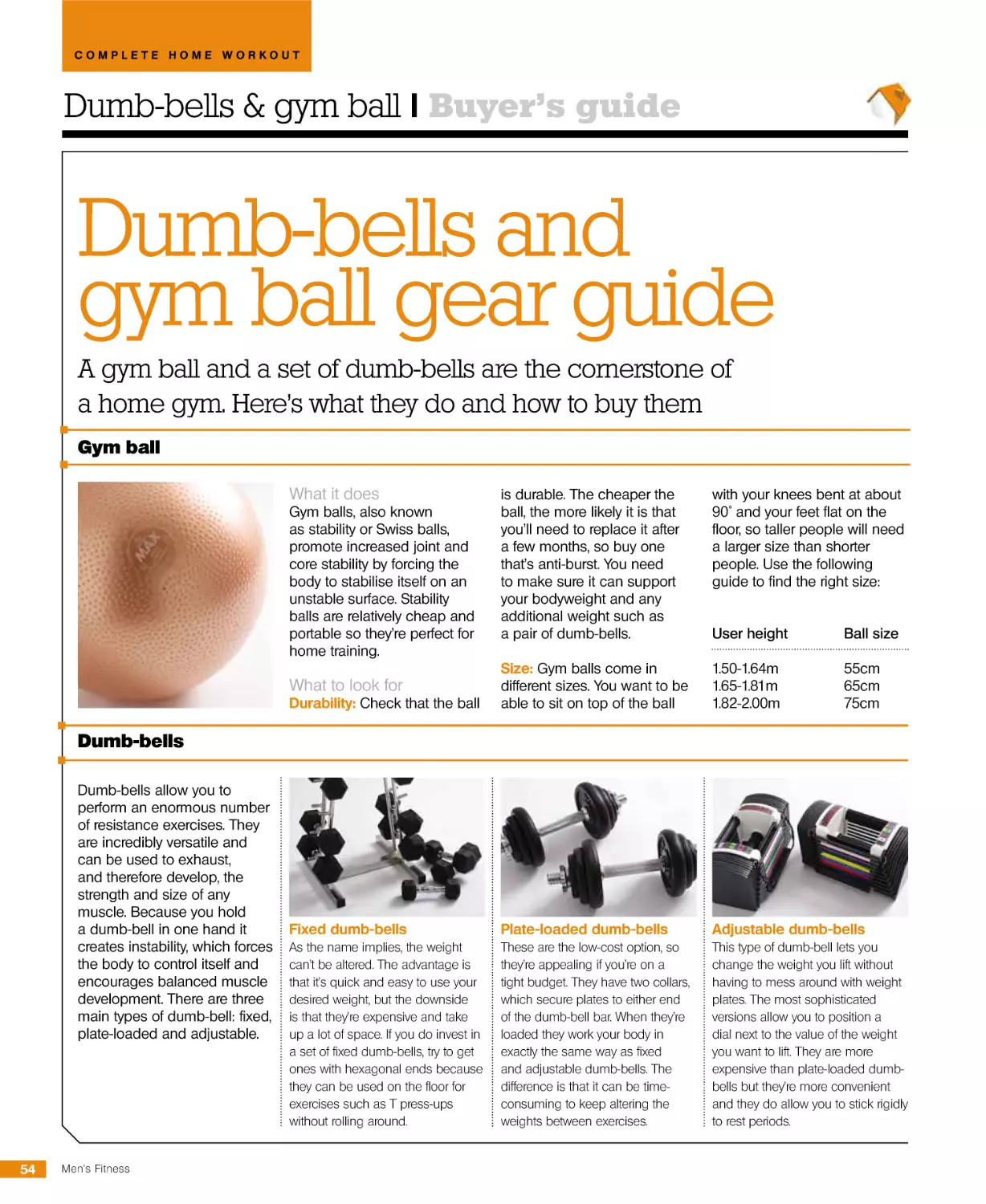





Текст
                    magazine

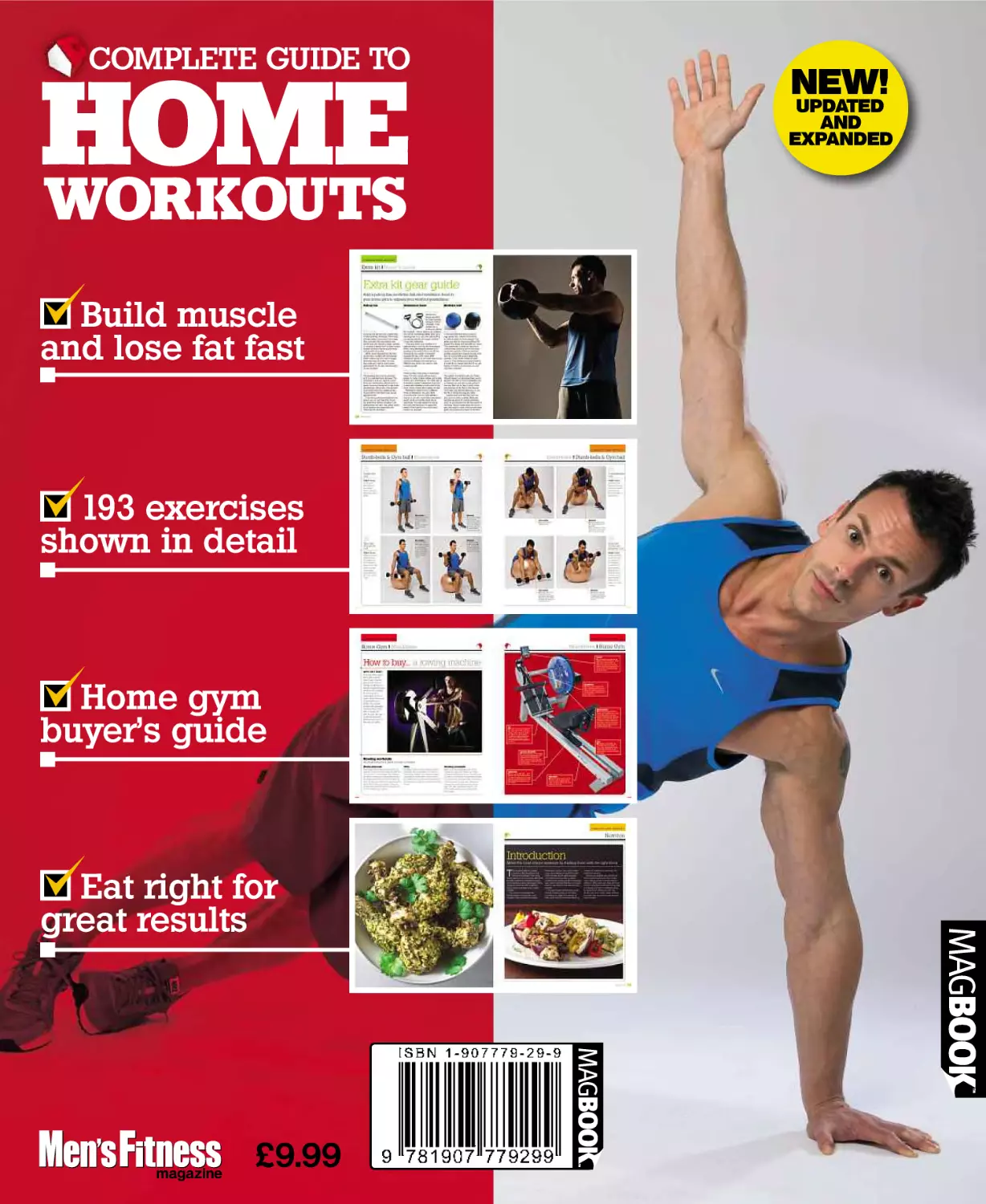
COMPLETE
PLETE GUIDE TO

HOME
WORKOUTS
BUILD MUSCLE
BURN FAT
SAVE MONEY

193

EXERCISES
XERCISES
DEMONSTRATED
MONSTRATED
IN DETAIL

>>>>

NEW!

UPDATED
AND
EXPANDED

ebooksdownloadrace.blogspot.in

magazine

COMPLETE GUIDE TO

HOME
WORKOUTS
By Jon Lipsey
Design Ian Jackson, Stephanie Gatto
Subeditors Michael Donlevy, Jo Williams
Photography Tom Miles
Model Tom Dyer@WAthletic
Thanks to Escape Fitness
and Fitness Superstore

Publishing Director Richard Downey
Managing Director James Burnay
Digital Production Manager Nicky Baker
Bookazine Manager Dharmesh Mistry
Operations Director Robin Ryan
Managing Director of Advertising
Julian Lloyd-Evans
Newstrade Director David Barker
Chief Operating Officer Brett Reynolds
Group Finance Director Ian Leggett
Chief Executive Officer James Tye
Chairman Felix Dennis

The ‘MagBook’ brand is a trademark of Dennis Publishing Ltd,
30 Cleveland St, London W1T 4JD. Company registered in England.
All material © Dennis Publishing Ltd, licensed by Felden 2011,
and may not be reproduced in whole or part without the
consent of the publishers.
COMPLETE GUIDE TO HOME WORKOUTS ISBN 1-907779-29-9
To license this product please contact Hannah Heagney on
+44 (0) 20 7907 6134 or email hannah_heagney@dennis.co.uk
Advertising
Katie Wood katie_wood@dennis.co.uk
Matt Wakefield matt_wakefield@dennis.co.uk

While every care was taken during the production of this MagBook, the publishers cannot be held responsible for the accuracy of the information
or any consequence arising from it. Dennis Publishing takes no responsibility for the companies advertising in this MagBook.
The paper used within this MagBook is produced from sustainable fibre, manufactured by mills with a valid chain of custody. Printed at PCP.
The health and fitness information presented in this book is an educational resource and is not intended as a substitute for medical advice.
Consult your doctor or healthcare professional before performing any of the exercises described in this book or any other exercise programme,
particularly if you are pregnant, or if you are elderly or have chronic or recurring medical conditions. Do not attempt any of the exercises while under
the influence of alcohol or drugs. Discontinue any exercise that causes you pain or severe discomfort and consult a medical expert.
Neither the author of the information nor the producer nor distributors of such information make any warranty of any kind in regard to
the content of the information presented in this book.

COMPLETE HOME WORKOUT

Contents
Getting started
7 - 27

Bodyweight
28 - 51

Dumb-bells & gym ball
52 - 105

Extra kit
106 - 135

Barbell & bench
136 - 169

Kettlebells
170 - 189

Home gym machines
190 - 199

Nutrition
200 - 208

4

Men’s Fitness

COMPLETE HOME WORKOUT

Getting started | Introduction

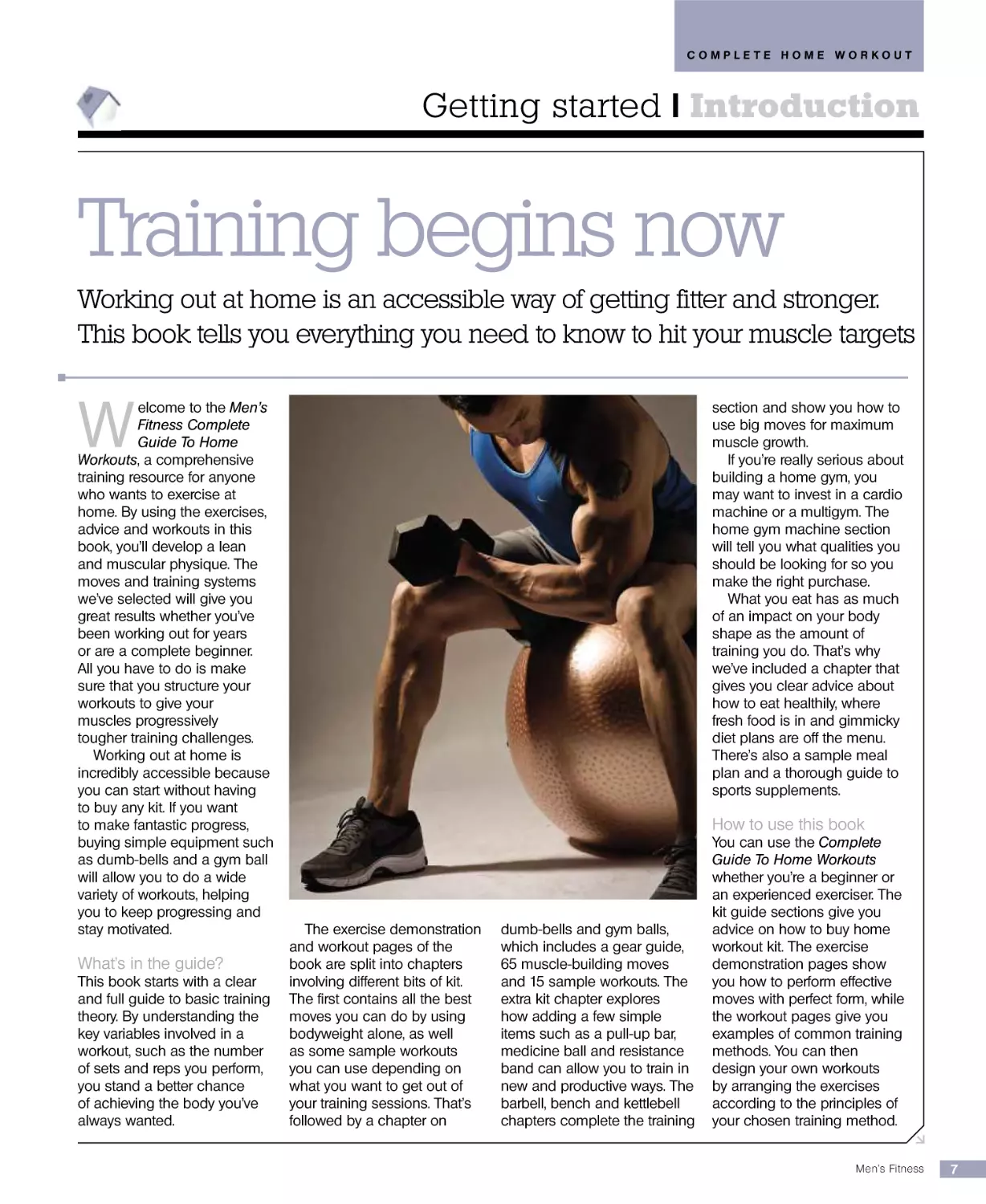
Training begins now

Working out at home is an accessible way of getting fitter and stronger.
This book tells you everything you need to know to hit your muscle targets

W

elcome to the Men’s
Fitness Complete
Guide To Home
Workouts, a comprehensive
training resource for anyone
who wants to exercise at
home. By using the exercises,
advice and workouts in this
book, you’ll develop a lean
and muscular physique. The
moves and training systems
we’ve selected will give you
great results whether you’ve
been working out for years
or are a complete beginner.
All you have to do is make
sure that you structure your
workouts to give your
muscles progressively
tougher training challenges.
Working out at home is
incredibly accessible because
you can start without having
to buy any kit. If you want
to make fantastic progress,
buying simple equipment such
as dumb-bells and a gym ball
will allow you to do a wide
variety of workouts, helping
you to keep progressing and
stay motivated.

What’s in the guide?

This book starts with a clear
and full guide to basic training
theory. By understanding the
key variables involved in a
workout, such as the number
of sets and reps you perform,
you stand a better chance
of achieving the body you’ve
always wanted.

section and show you how to
use big moves for maximum
muscle growth.
If you’re really serious about
building a home gym, you
may want to invest in a cardio
machine or a multigym. The
home gym machine section
will tell you what qualities you
should be looking for so you
make the right purchase.
What you eat has as much
of an impact on your body
shape as the amount of
training you do. That’s why
we’ve included a chapter that
gives you clear advice about
how to eat healthily, where
fresh food is in and gimmicky
diet plans are off the menu.
There’s also a sample meal
plan and a thorough guide to
sports supplements.

How to use this book

The exercise demonstration
and workout pages of the
book are split into chapters
involving different bits of kit.
The first contains all the best
moves you can do by using
bodyweight alone, as well
as some sample workouts
you can use depending on
what you want to get out of
your training sessions. That’s
followed by a chapter on

dumb-bells and gym balls,
which includes a gear guide,
65 muscle-building moves
and 15 sample workouts. The
extra kit chapter explores
how adding a few simple
items such as a pull-up bar,
medicine ball and resistance
band can allow you to train in
new and productive ways. The
barbell, bench and kettlebell
chapters complete the training

You can use the Complete
Guide To Home Workouts
whether you’re a beginner or
an experienced exerciser. The
kit guide sections give you
advice on how to buy home
workout kit. The exercise
demonstration pages show
you how to perform effective
moves with perfect form, while
the workout pages give you
examples of common training
methods. You can then
design your own workouts
by arranging the exercises
according to the principles of
your chosen training method.
Men’s Fitness

7

COMPLETE HOME WORKOUT

Introduction | Getting started

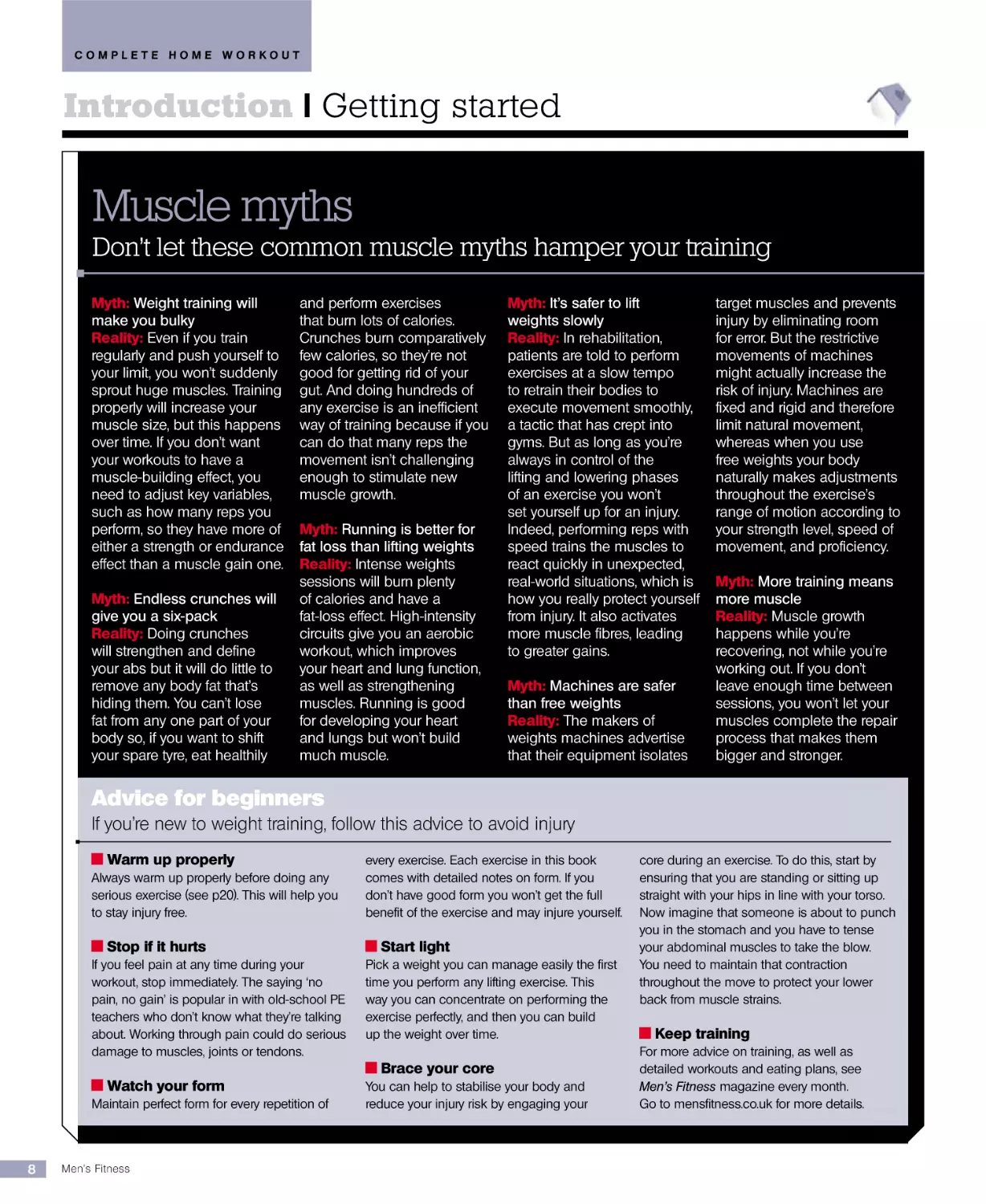
Muscle myths

Don’t let these common muscle myths hamper your training
Myth: Weight training will
make you bulky
Reality: Even if you train
regularly and push yourself to
your limit, you won’t suddenly
sprout huge muscles. Training
properly will increase your
muscle size, but this happens
over time. If you don’t want
your workouts to have a
muscle-building effect, you
need to adjust key variables,
such as how many reps you
perform, so they have more of
either a strength or endurance
effect than a muscle gain one.
Myth: Endless crunches will
give you a six-pack
Reality: Doing crunches
will strengthen and define
your abs but it will do little to
remove any body fat that’s
hiding them. You can’t lose
fat from any one part of your
body so, if you want to shift
your spare tyre, eat healthily

and perform exercises
that burn lots of calories.
Crunches burn comparatively
few calories, so they’re not
good for getting rid of your
gut. And doing hundreds of
any exercise is an inefficient
way of training because if you
can do that many reps the
movement isn’t challenging
enough to stimulate new
muscle growth.
Myth: Running is better for
fat loss than lifting weights
Reality: Intense weights
sessions will burn plenty
of calories and have a
fat-loss effect. High-intensity
circuits give you an aerobic
workout, which improves
your heart and lung function,
as well as strengthening
muscles. Running is good
for developing your heart
and lungs but won’t build
much muscle.

Myth: It’s safer to lift
weights slowly
Reality: In rehabilitation,
patients are told to perform
exercises at a slow tempo
to retrain their bodies to
execute movement smoothly,
a tactic that has crept into
gyms. But as long as you’re
always in control of the
lifting and lowering phases
of an exercise you won’t
set yourself up for an injury.
Indeed, performing reps with
speed trains the muscles to
react quickly in unexpected,
real-world situations, which is
how you really protect yourself
from injury. It also activates
more muscle fibres, leading
to greater gains.
Myth: Machines are safer
than free weights
Reality: The makers of
weights machines advertise
that their equipment isolates

target muscles and prevents
injury by eliminating room
for error. But the restrictive
movements of machines
might actually increase the
risk of injury. Machines are
fixed and rigid and therefore
limit natural movement,
whereas when you use
free weights your body
naturally makes adjustments
throughout the exercise’s
range of motion according to
your strength level, speed of
movement, and proficiency.
Myth: More training means
more muscle
Reality: Muscle growth
happens while you’re
recovering, not while you’re
working out. If you don’t
leave enough time between
sessions, you won’t let your
muscles complete the repair
process that makes them
bigger and stronger.

Advice for beginners

If you’re new to weight training, follow this advice to avoid injury
Warm up properly
Always warm up properly before doing any
serious exercise (see p20). This will help you
to stay injury free.

Stop if it hurts
If you feel pain at any time during your
workout, stop immediately. The saying ‘no
pain, no gain’ is popular in with old-school PE
teachers who don’t know what they’re talking
about. Working through pain could do serious
damage to muscles, joints or tendons.

Watch your form
Maintain perfect form for every repetition of

8

Men’s Fitness

every exercise. Each exercise in this book
comes with detailed notes on form. If you
don’t have good form you won’t get the full
benefit of the exercise and may injure yourself.

Start light
Pick a weight you can manage easily the first
time you perform any lifting exercise. This
way you can concentrate on performing the
exercise perfectly, and then you can build
up the weight over time.

Brace your core
You can help to stabilise your body and
reduce your injury risk by engaging your

core during an exercise. To do this, start by
ensuring that you are standing or sitting up
straight with your hips in line with your torso.
Now imagine that someone is about to punch
you in the stomach and you have to tense
your abdominal muscles to take the blow.
You need to maintain that contraction
throughout the move to protect your lower
back from muscle strains.

Keep training
For more advice on training, as well as
detailed workouts and eating plans, see
Men’s Fitness magazine every month.
Go to mensfitness.co.uk for more details.

COMPLETE HOME WORKOUT

Getting started | Introduction

Home vs gym

Working out at home and working out in a gym both have advantages
and disadvantages. Here’s how to get the most out of a home set-up

O

ne of the best things
about working out
at home is that it’s
accessible. In fact, you could
start right now, even if you
don’t have any kit. That’s
because you can do lots of
challenging exercises, such as
press-ups and chair dips, just
by using your bodyweight.
You can’t do everything
with bodyweight alone, but
the good news is you don’t
need lots of kit to lose fat and
build muscle. A gym ball and
a set of dumb-bells will allow

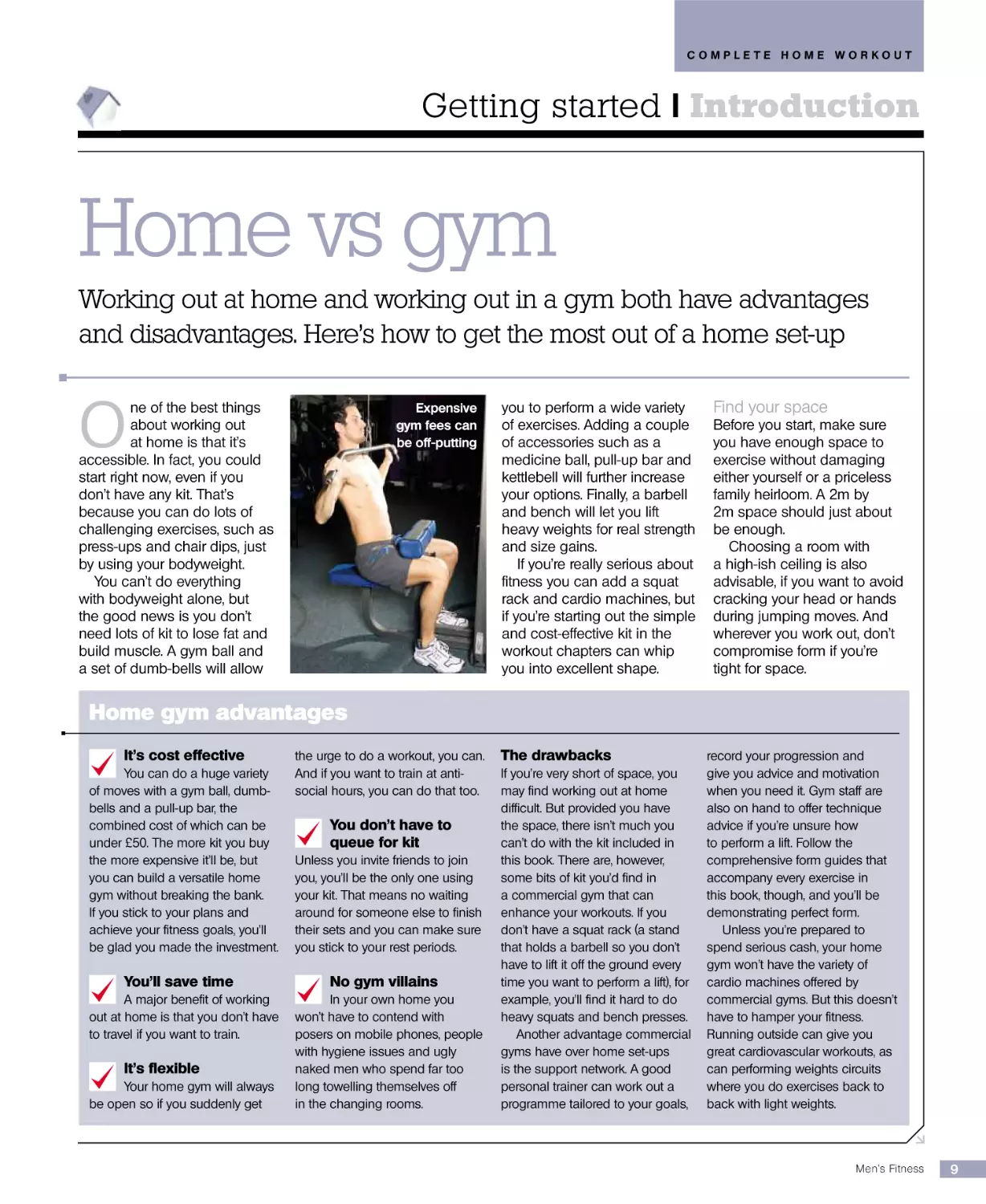
Expensive
gym fees can
be off-putting

you to perform a wide variety
of exercises. Adding a couple
of accessories such as a
medicine ball, pull-up bar and
kettlebell will further increase
your options. Finally, a barbell
and bench will let you lift
heavy weights for real strength
and size gains.
If you’re really serious about
fitness you can add a squat
rack and cardio machines, but
if you’re starting out the simple
and cost-effective kit in the
workout chapters can whip
you into excellent shape.

Find your space

Before you start, make sure
you have enough space to
exercise without damaging
either yourself or a priceless
family heirloom. A 2m by
2m space should just about
be enough.
Choosing a room with
a high-ish ceiling is also
advisable, if you want to avoid
cracking your head or hands
during jumping moves. And
wherever you work out, don’t
compromise form if you’re
tight for space.

Home gym advantages
It’s cost effective
You can do a huge variety
of moves with a gym ball, dumbbells and a pull-up bar, the
combined cost of which can be
under £50. The more kit you buy
the more expensive it’ll be, but
you can build a versatile home
gym without breaking the bank.
If you stick to your plans and
achieve your fitness goals, you’ll
be glad you made the investment.

You’ll save time
A major benefit of working
out at home is that you don’t have
to travel if you want to train.

It’s flexible
Your home gym will always
be open so if you suddenly get

the urge to do a workout, you can.
And if you want to train at antisocial hours, you can do that too.

You don’t have to
queue for kit
Unless you invite friends to join
you, you’ll be the only one using
your kit. That means no waiting
around for someone else to finish
their sets and you can make sure
you stick to your rest periods.

No gym villains
In your own home you
won’t have to contend with
posers on mobile phones, people
with hygiene issues and ugly
naked men who spend far too
long towelling themselves off
in the changing rooms.

The drawbacks
If you’re very short of space, you
may find working out at home
difficult. But provided you have
the space, there isn’t much you
can’t do with the kit included in
this book. There are, however,
some bits of kit you’d find in
a commercial gym that can
enhance your workouts. If you
don’t have a squat rack (a stand
that holds a barbell so you don’t
have to lift it off the ground every
time you want to perform a lift), for
example, you’ll find it hard to do
heavy squats and bench presses.
Another advantage commercial
gyms have over home set-ups
is the support network. A good
personal trainer can work out a
programme tailored to your goals,

record your progression and
give you advice and motivation
when you need it. Gym staff are
also on hand to offer technique
advice if you’re unsure how
to perform a lift. Follow the
comprehensive form guides that
accompany every exercise in
this book, though, and you’ll be
demonstrating perfect form.
Unless you’re prepared to
spend serious cash, your home
gym won’t have the variety of
cardio machines offered by
commercial gyms. But this doesn’t
have to hamper your fitness.
Running outside can give you
great cardiovascular workouts, as
can performing weights circuits
where you do exercises back to
back with light weights.

Men’s Fitness

9

COMPLETE HOME WORKOUT

Introduction | Getting started
Home gym kit
All the home workout kit shown in
this book is available from either
Escape Fitness (escapefitness.com)
or Fitness Superstore
(fitness-superstore.co.uk).

Get motivated

You’ll need to stay
motivated to achieve
your goals. Here’s
how to maintain your
workout enthusiasm
Set realistic, measurable goals
Don’t set yourself up for a fall by aiming
for something unrealistic such as losing

two stone in two weeks. A measurable
goal, such as wanting to lift 80kg on the
bench press, will give you focus and you
can track your progress.

Change your routine
Every two weeks you should make
a change to your routine. It could be
something simple such as the order of
your exercises or introducing variations of
a move. Doing that keeps your workouts
fresh and gives your body the stimulus
it needs to keep progressing.

Give it five minutes
On days where you’re struggling for
motivation, get changed into your workout
gear and do five minutes of your routine.
The chances are that you’ll want to carry
on and do your full workout. If you don’t
want to carry on, you need to look at
your overall programme to work out why
you’re so unmotivated.

Take a step back
If you’re really struggling, ask yourself
what’s making things difficult. Are you
doing the same thing over and over again,
are you stressed or not inspired by your
environment? There will be a reason. As
soon as you’ve identified that obstacle
you can try to do something about it.

Keep a training diary
Recording and seeing your progression
down on paper gives you great motivation.
You don’t have to record every detail of
your workout, you could just write down
your performance for the two biggest lifts
in your workout. That will also help you
realise when you need to change your
routine because you’ll easily spot when
you’ve stopped progressing.

10

Men’s Fitness

COMPLETE HOME WORKOUT

Training principles | Getting started

Designing your workouts
Use the following advice to create workouts
that will help you achieve your exercise goals

S

tarting a workout
without knowing what
you want to achieve,
what exercises you’re going
to do or how you’re going to
perform them isn’t going to
give you optimum results. To
achieve your workout aims,
you need to design and stick
to a specific programme.
But you can’t do that
without understanding the
key variables involved in how
you perform each exercise
and how you design your
workouts. The main variables
to think about are:

Repetitions

Also known as reps, this
is the number of times
you lift a weight or perform
a particular exercise within
a set.

Sets

Groups of repetitions
performed back to back.

Rest

The inactive time you take
between sets and exercises.

Tempo

The speed at which reps
are performed.

Frequency

This refers to how often you
perform a workout.

Once you understand these
variables, you can decide how
to use them to achieve your
muscle-building goals. There
is, however, no such thing as
the perfect muscle-building
routine. To understand that,
you need to have a basic
appreciation of what makes
your muscles grow.
Resistance exercises
create microscopic tears in
your muscles. Your body then
responds to this stimulus
and your muscles repair
themselves to become bigger
and stronger than they were
before. But if you continue
to repeat the same workout,
your body will stop adapting
to the stimulus and your gains
will plateau. To avoid that
happening, you need to make
sure you regularly alter the
variables described above.
The exercises you choose
to perform and the order in
which you perform them will
also have an effect on the
results you see. This section
will give you all the information
you need to decide what reps,
sets, rest and tempo to use,
as well as a brief guide on
how to order exercises.
The most common and
effective methods of grouping
exercises have been given
workout names. These
names tell you broadly what

the session involves so, for
example, a superset workout
will typically involve doing
pairs of exercises performed
back to back, resting between
sets of pairs of exercises
rather than sets of individual
exercises. More information
about these common routines
can be found in the workouts
section of each kit chapter as
you progress through the rest
of the book.
It’s worth noting that the
following advice is a guide
and that there isn’t one

Repetitions

The number of repetitions
per set you perform of each
exercise is, arguably, the most
important workout variable.
The reps you choose to
perform will affect all the other
variables and will have a
huge impact on whether the
primary effect of your workout
is developing muscle strength,
size or endurance.
Strength coaches generally
agree that certain repetition
ranges have particular training
effects and these are shown

The number of repetitions you
perform of each exercise is the
most important workout variable
perfect way of addressing
workout variables. That’s
partly because people
respond to training in
slightly different ways and
partly because strength and
conditioning research is
constantly evolving. But it’s
still rare that new findings
challenge fundamental
workout principles and the
reason that conventions, such
as performing multiple sets
rather than single sets, exist
is because there’s substantial
and credible sports science
to back them up.

in the box on page 14. Low
reps in the one to eight range
are best for building strength,
between eight and 12 reps is
best for adding muscle mass
and 12 to 20 reps will develop
muscle endurance. However,
these are broad guides and
are on a spectrum rather
than self-contained blocks.
Performing three or seven
repetitions of an exercise, for
example, will have a strengthbuilding effect, but the seven
repetitions will have more of a
size development effect than
performing three repetitions
Men’s Fitness

13

COMPLETE HOME WORKOUT

Getting started | Training principles
Aim to reach failure – where you
are unable to complete another
rep without perfect form

because it’s closer to the size
gain range of the spectrum.
In each case, to get the
desired effect you should aim
to reach failure – the point
where you are unable to
complete another rep without
compromising perfect form
– at your target rep count on
the final set of the exercise.
If you reach your target rep
and feel that you could
perform more reps, you’re not
using a heavy enough weight.
It’s also important to
remember that these rep
ranges are general guides.
Not everyone responds to
resistance training in exactly
the same way and even
different muscles in the
body can respond differently
depending on their function.
For example, slow-twitch
muscle fibres (the smaller
muscle fibres involved in
long-distance endurance
efforts) will generally
experience strength gains
at a higher rep range than
fast-twitch muscle fibres (the
larger fibres involved in short,
explosive movements).
Your training experience will
also play a part in the results
you see. Generally, people
new to weight training will
develop strength into a slightly
higher rep range than more
experienced exercisers.

to recommend doing three
sets of ten to 12 repetitions
because that allows you to
fatigue your muscles in a time
that will maximise your training
effect. Current guidelines from
the American College Of

Sets

The convention for standard
weight training programmes is

Sports Medicine (ACSM),
for example, advise beginners
to do between one and three
sets of eight to 12 repetitions.
The number of sets you
perform should be directly
linked to the number of

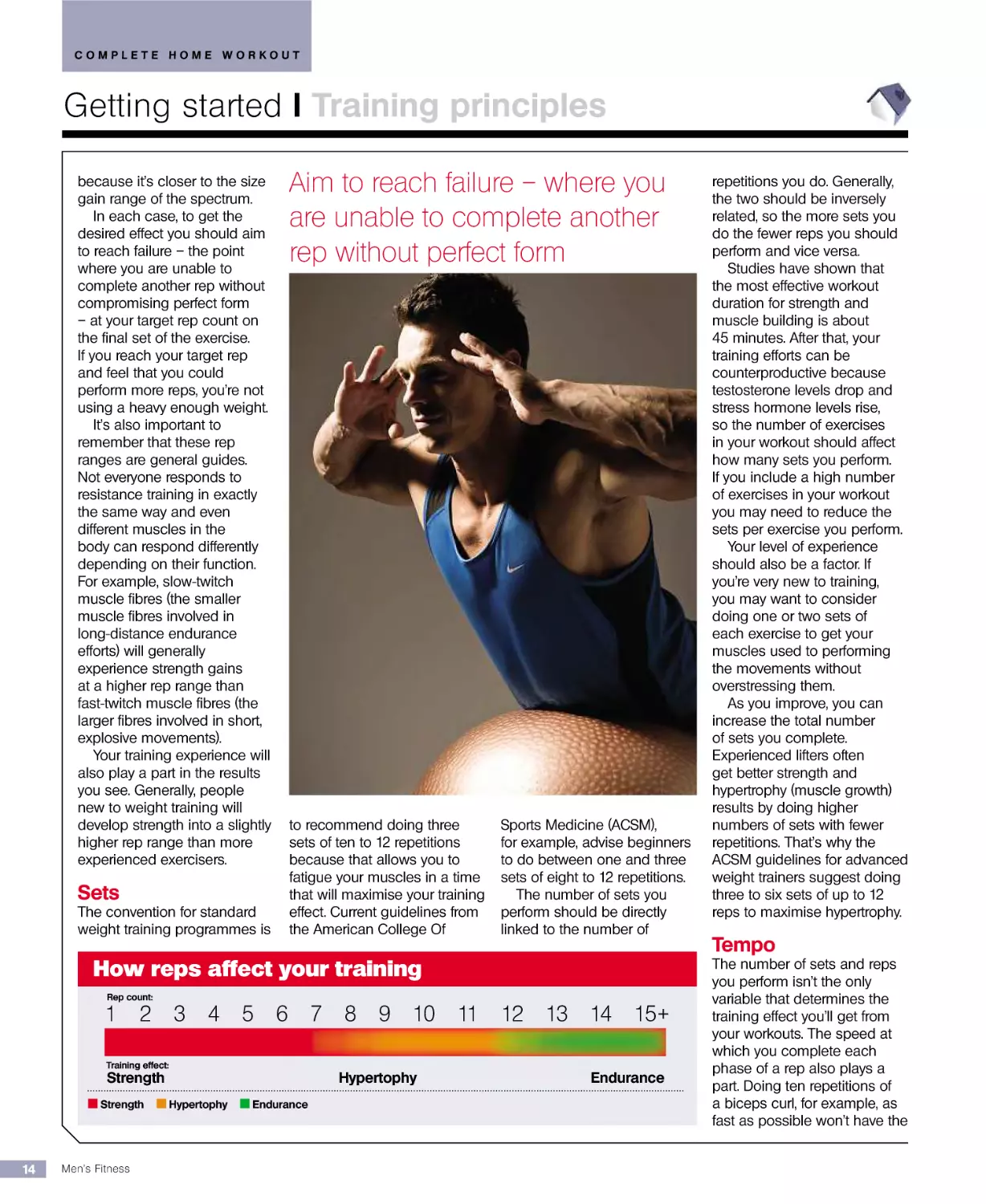
How reps affect your training
Rep count:

1

2

3

4

5

6

Training effect:

Strength

Strength

14

Men’s Fitness

7

8

9

10

Hypertophy
Hypertophy

Endurance

11

12

13

14

15+

Endurance

repetitions you do. Generally,
the two should be inversely
related, so the more sets you
do the fewer reps you should
perform and vice versa.
Studies have shown that
the most effective workout
duration for strength and
muscle building is about
45 minutes. After that, your
training efforts can be
counterproductive because
testosterone levels drop and
stress hormone levels rise,
so the number of exercises
in your workout should affect
how many sets you perform.
If you include a high number
of exercises in your workout
you may need to reduce the
sets per exercise you perform.
Your level of experience
should also be a factor. If
you’re very new to training,
you may want to consider
doing one or two sets of
each exercise to get your
muscles used to performing
the movements without
overstressing them.
As you improve, you can
increase the total number
of sets you complete.
Experienced lifters often
get better strength and
hypertrophy (muscle growth)
results by doing higher
numbers of sets with fewer
repetitions. That’s why the
ACSM guidelines for advanced
weight trainers suggest doing
three to six sets of up to 12
reps to maximise hypertrophy.

Tempo

The number of sets and reps
you perform isn’t the only
variable that determines the
training effect you’ll get from
your workouts. The speed at
which you complete each
phase of a rep also plays a
part. Doing ten repetitions of
a biceps curl, for example, as
fast as possible won’t have the

COMPLETE HOME WORKOUT

same effect on your muscles
as doing the move slowly.
To maximise strength
and size gains, conditioning
research suggests that your
muscles should be under
tension for between 40 to 70
seconds per set, provided
you’re not using extremely
low repetition ranges. Lifting
in this way will cause you to
use anaerobic energy, which
produces lactate and prompts
the release of testosterone
and growth hormones.

It’s also important to use the
right lifting speed within a rep.
To make sure your muscles
are under tension for long
enough, take one second to
lift the weight, pause then take
two to three seconds to lower.
The reason you should take
longer to lower the weight is
that size gains are best made
during the eccentric (lowering)
phase of the lift. Taking your
time will also help you
recruit stabilising
muscles, which protect

your joints and support your
bigger muscles when you
attempt heavy lifts. Another
benefit is that slower lifting
takes momentum out of
the exercise.
Some exercises, however,
such as the snatch, have to
be performed at speed
because they require
explosive movements to lift
a weight that’s heavy enough
for you to get a training
benefit. As with sets
and reps, it’s also

important to vary the tempo,
so try to avoid using the same
speed for every exercise and
every workout.

Rest

The rest you take determines
whether or not you’re able to
complete the next section of
your workout. As a rule, sets
with few reps will require the
most rest. This is because
they train the nervous system
and fast-twitch muscle fibres,
which fatigue easily and take

Men’s Fitness

15

COMPLETE HOME WORKOUT

Getting started | Training principles
longer to recover – up to five
minutes when you perform
very low reps of an explosive
move with heavy weights. As
you increase the number of
reps, you train your slow-twitch
muscle fibres, which are
harder to fatigue.
Different exercises also
require different rest times. Big
compound moves such as
squats and deadlifts require
longer rests of about two
minutes. Single-joint isolation
moves, on the other hand, may
only require 30 seconds’ rest
between exercises.
Those new to weight
training may need to take
longer rests than more
experienced lifters, who have
a higher tolerance to the
lactate produced during lifts.
How much you weigh can
also affect your rest times, with
heavier lifters needing longer
to recover between sets.
Essentially, your rest periods
are effective if you can reach
positive failure on the last rep
of the set. This means you are
unable to lift the weight with
perfect form but can lower
it under control. If you don’t
reach that point, your rest
may be too long.
It’s also important to
remember rest is the same
as any other training variable
and you should change the
rest you take to stimulate your
body into new muscle growth.

Selecting and
ordering exercises

The exercises you should
perform depend on what
you want to achieve. The
sample workouts in each
of the kit chapters will give
you an example of how to
select exercises according to
goals such as developing a
particular body part, losing fat
or developing explosive power.
16

Men’s Fitness

Structuring your workout
properly is important because
various exercises place
different demands on your
body. Some work multiple
muscle groups, whereas
some isolate small muscle
groups. The speed, pattern
of movement and body parts
targeted should all influence
how you order your exercises.
The following guidelines will
help you to structure your
workouts to maximise muscle
growth and strength gains and
to minimise injury risk.

Do big explosive moves
early in your workout

Explosive exercises such
as the hang clean are very
demanding so they need
to be performed when you
are relatively fresh. Do these
moves earlier in your workout
than simpler moves such as
triceps extensions.

Do difficult moves first
and easier moves last

Complete large muscle group
moves, such as squats and
deadlifts, at the beginning
of your workout to make
sure you keep perfect form
and your core is strong
enough to stabilise your body.
Easier moves, such as biceps
curls, should be done later in
the workout.

Keep workouts balanced

Unless you are specifically
doing an unbalanced workout
– for example, one made
up exclusively of pushing
movements – try to keep your
workouts balanced. So, for
every pushing exercise you do,
you should do a pulling one.

Save core moves until last
If you do core moves early
in your workout you’ll fatigue
your muscles. Then, when

The good news is that you don’t
have to work out seven days a
week to see great results
you come to do big dynamic
lifts such as lunges that call
on your core to stabilise your
movement, your muscles
may not be able to provide
adequate support, which
can increase your injury risk.

Frequency

How many workouts you
do each week is often
influenced by work and family
commitments. But if you lead
a busy life, the good news is
you don’t need to work out
seven days a week to see
great results. Doing from
three to five workouts a week
should be sufficient to achieve
your workout goals.
Exactly how many sessions
you do will depend on a
number of factors. One thing
that should influence training
frequency is what sort of
workouts you’re doing. A hard
full-body session may mean
you need to leave at least
48 hours between sessions
in order for your muscles to
recover and repair themselves
to be stronger then before.
However, if you are focusing
on a particular body part in
each workout, you may be
able to train the following
day if you work
on a different
body part.
One
common
mistake is
to think that
the more
workouts you
do, the stronger
and more muscular
you’ll become. In fact it’s

while you’re resting, rather
than while you’re working out,
that your muscles get bigger
and stronger. If you stress your
muscles before they’ve had a
chance to repair themselves
this may cause what’s known
as overtraining, where you lose
strength and muscle mass
and feel lethargic.
Some muscle groups
take longer to recover
than others. Larger muscle
groups, particularly those
with a comparatively higher
percentage of fast-twitch
muscle fibres such as the
hamstrings, may take longer to
recover than smaller muscle
groups such as the calves.
Doing big compound
lifts such as deadlifts also
places more of stress on your
nervous system than smaller
lifts, such as wrist curls, so
you’ll need longer to recover.
You should also take longer to
recover from intense sessions,
where you do low reps of
heavy weights, than you do
from endurance and stability
sessions, where you do high
reps of light weights.

COMPLETE HOME WORKOUT

Getting started | Cardio

Improving your cardio fitness

Structure your cardio sessions to complement your weight training

Y

ou may think that
adding long runs to
your home workouts
will complement your muscle
building work. In fact, it can
have the opposite effect.
While cardio training will
improve your heart and lung
function and prepare your
lower body for endurance
events, it doesn’t have a great
effect on muscle size. Doing
long, steady-state cardio
sessions can even break
down your muscle tissue,
replacing bulky fast-twitch
fibres with slender slow-twitch
ones that are better suited to
pounding the pavements for
mile after mile.
Weight training is good for
building muscles but it doesn’t

offer all the benefits you get
from running, swimming or
cycling. To make sure you get
the best of both worlds, follow
these rules:
Don’t do weights and
cardio back to back
If your main goal is to build
muscle, keep weights and
cardio sessions separate.
Doing cardio immediately
before weights will leave you
feeling tired and will lead to
poor lifting performance. Doing
cardio straight after a weights
session can undo the musclebuilding effects of a workout.
The answer is to do them
on separate days, which gives
your muscles time to recover
between sessions.

1

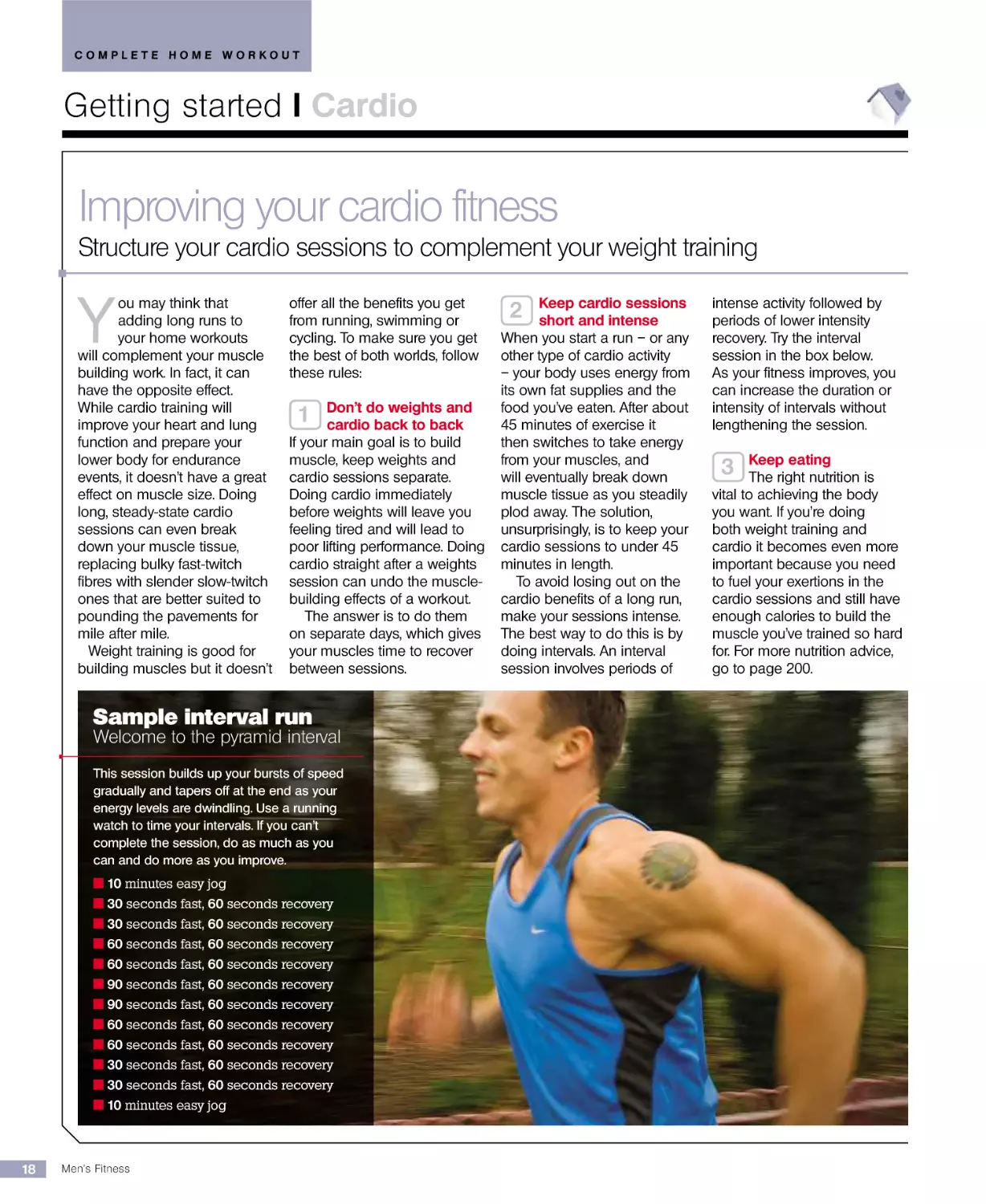
Sample interval run

Welcome to the pyramid interval

This session builds up your bursts of speed
gradually and tapers off at the end as your
energy levels are dwindling. Use a running
watch to time your intervals. If you can’t
complete the session, do as much as you
can and do more as you improve.
10 minutes easy jog
30 seconds fast, 60 seconds recovery
30 seconds fast, 60 seconds recovery
60 seconds fast, 60 seconds recovery
60 seconds fast, 60 seconds recovery
90 seconds fast, 60 seconds recovery
90 seconds fast, 60 seconds recovery
60 seconds fast, 60 seconds recovery
60 seconds fast, 60 seconds recovery
30 seconds fast, 60 seconds recovery
30 seconds fast, 60 seconds recovery
10 minutes easy jog

18

Men’s Fitness

Keep cardio sessions
short and intense
When you start a run – or any
other type of cardio activity
– your body uses energy from
its own fat supplies and the
food you’ve eaten. After about
45 minutes of exercise it
then switches to take energy
from your muscles, and
will eventually break down
muscle tissue as you steadily
plod away. The solution,
unsurprisingly, is to keep your
cardio sessions to under 45
minutes in length.
To avoid losing out on the
cardio benefits of a long run,
make your sessions intense.
The best way to do this is by
doing intervals. An interval
session involves periods of

2

intense activity followed by
periods of lower intensity
recovery. Try the interval
session in the box below.
As your fitness improves, you
can increase the duration or
intensity of intervals without
lengthening the session.
Keep eating
The right nutrition is
vital to achieving the body
you want. If you’re doing
both weight training and
cardio it becomes even more
important because you need
to fuel your exertions in the
cardio sessions and still have
enough calories to build the
muscle you’ve trained so hard
for. For more nutrition advice,
go to page 200.

3

COMPLETE HOME WORKOUT

Muscles | Getting started

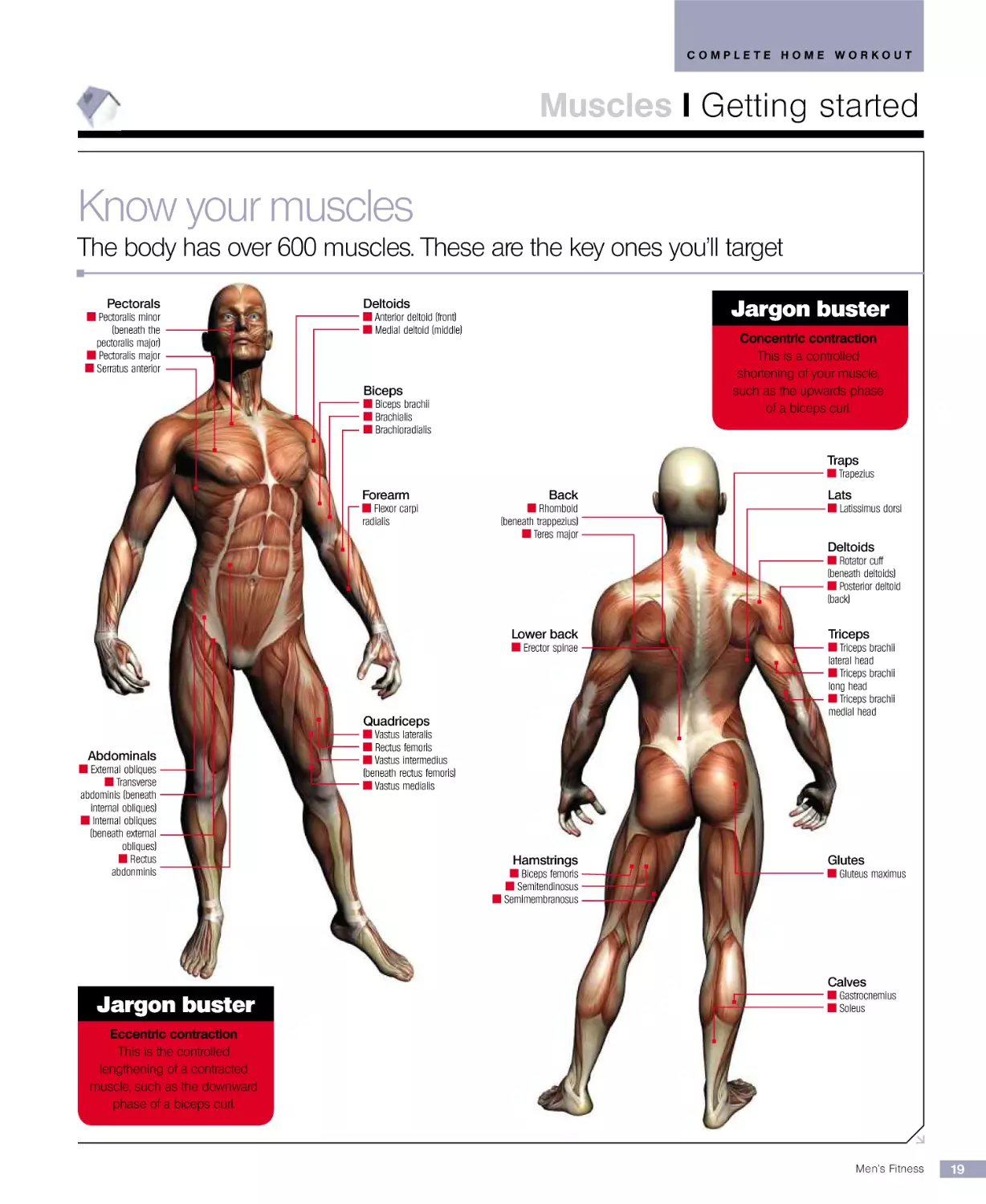
Know your muscles

The body has over 600 muscles. These are the key ones you’ll target
Pectorals

Pectoralis minor
(beneath the
pectoralis major)
Pectoralis major
Serratus anterior

Jargon buster

Deltoids

Anterior deltoid (front)
Medial deltoid (middle)

Concentric contraction
This is a controlled
shortening of your muscle,
such as the upwards phase
of a biceps curl.

Biceps

Biceps brachii
Brachialis
Brachioradialis

Traps

Trapezius

Forearm

Flexor carpi
radialis

Back

Rhomboid
(beneath trappezius)
Teres major

Lats

Latissimus dorsi

Deltoids

Rotator cuff
(beneath deltoids)
Posterior deltoid
(back)

Lower back

Triceps

Hamstrings

Glutes

Erector spinae

Quadriceps

Abdominals

External obliques
Transverse
abdominis (beneath
internal obliques)
Internal obliques
(beneath external
obliques)
Rectus
abdonminis

Triceps brachii
lateral head
Triceps brachii
long head
Triceps brachii
medial head

Vastus lateralis
Rectus femoris
Vastus intermedius
(beneath rectus femoris)
Vastus medialis

Biceps femoris
Semitendinosus
Semimembranosus

Gluteus maximus

Calves

Jargon buster

Gastrocnemius
Soleus

Eccentric contraction
This is the controlled
lengthening of a contracted
muscle, such as the downward
phase of a biceps curl.

Men’s Fitness

19

COMPLETE HOME WORKOUT

Getting started | Warm-up

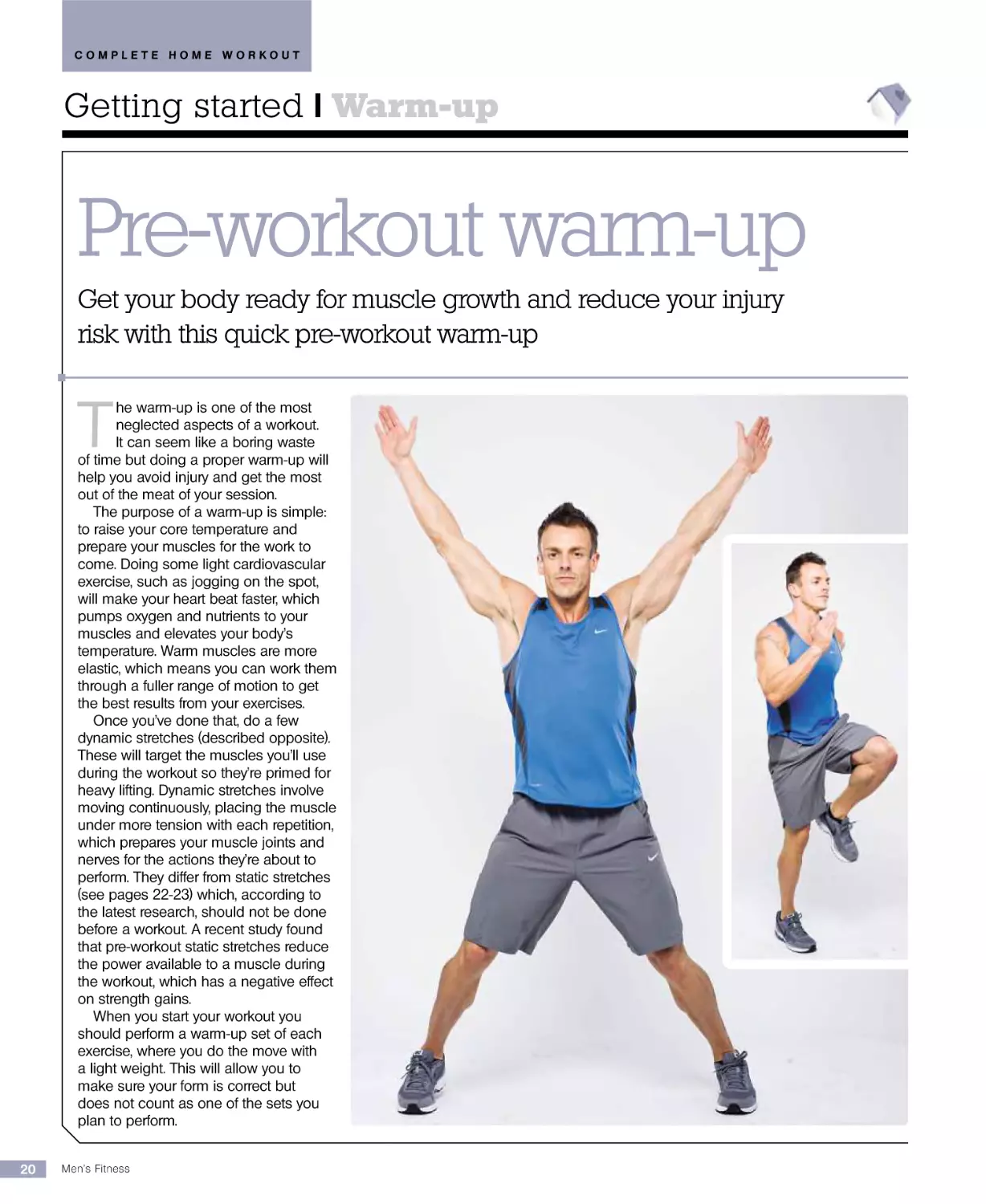
Pre-workout warm-up

Get your body ready for muscle growth and reduce your injury
risk with this quick pre-workout warm-up

T

he warm-up is one of the most
neglected aspects of a workout.
It can seem like a boring waste
of time but doing a proper warm-up will
help you avoid injury and get the most
out of the meat of your session.
The purpose of a warm-up is simple:
to raise your core temperature and
prepare your muscles for the work to
come. Doing some light cardiovascular
exercise, such as jogging on the spot,
will make your heart beat faster, which
pumps oxygen and nutrients to your
muscles and elevates your body’s
temperature. Warm muscles are more
elastic, which means you can work them
through a fuller range of motion to get
the best results from your exercises.
Once you’ve done that, do a few
dynamic stretches (described opposite).
These will target the muscles you’ll use
during the workout so they’re primed for
heavy lifting. Dynamic stretches involve
moving continuously, placing the muscle
under more tension with each repetition,
which prepares your muscle joints and
nerves for the actions they’re about to
perform. They differ from static stretches
(see pages 22-23) which, according to
the latest research, should not be done
before a workout. A recent study found
that pre-workout static stretches reduce
the power available to a muscle during
the workout, which has a negative effect
on strength gains.
When you start your workout you
should perform a warm-up set of each
exercise, where you do the move with
a light weight. This will allow you to
make sure your form is correct but
does not count as one of the sets you
plan to perform.
20

Men’s Fitness

COMPLETE HOME WORKOUT

Warm-up | Getting started

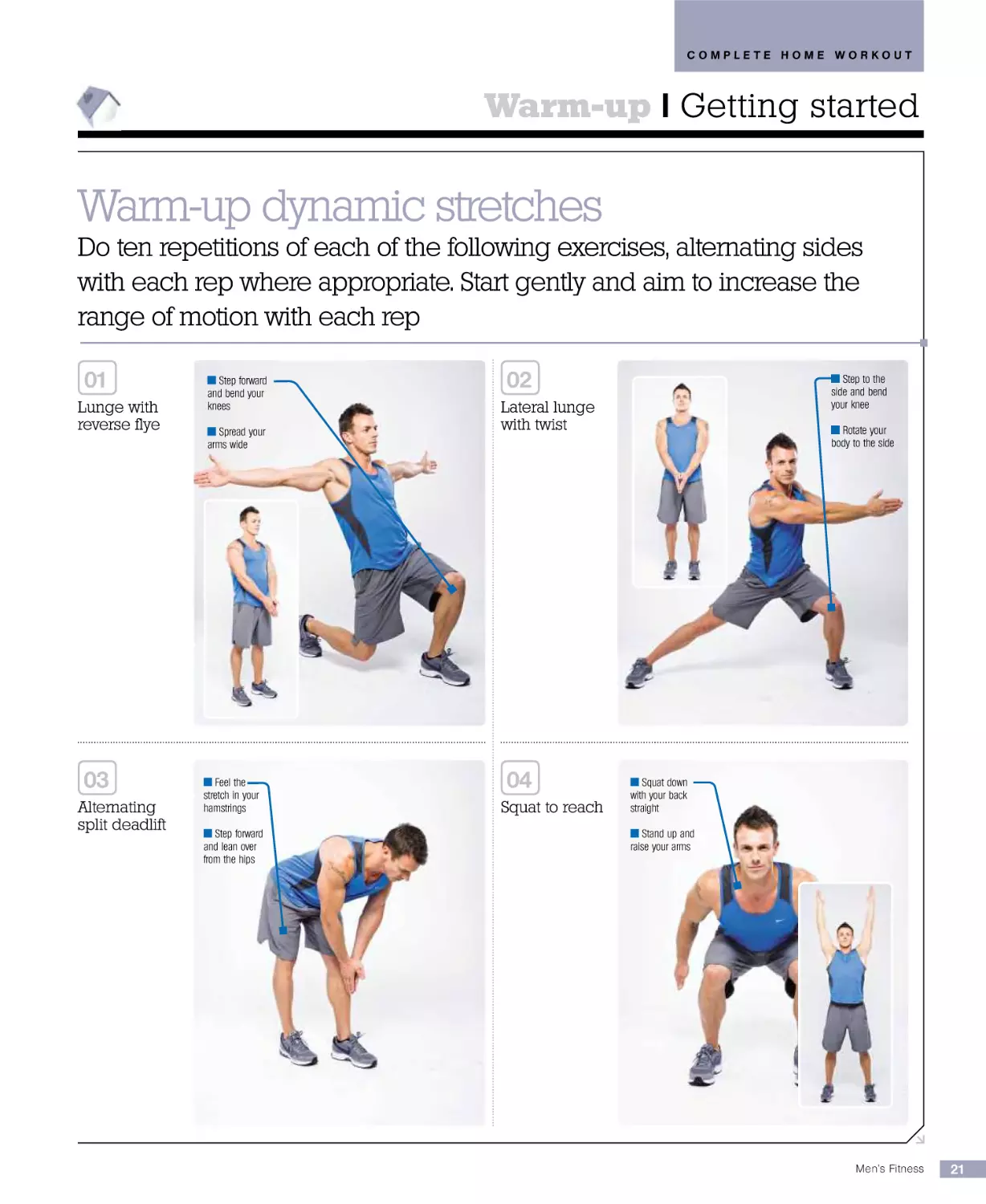
Warm-up dynamic stretches

Do ten repetitions of each of the following exercises, alternating sides
with each rep where appropriate. Start gently and aim to increase the
range of motion with each rep
01
Lunge with
reverse flye

03
Alternating
split deadlift

Step forward
and bend your
knees
Spread your
arms wide

Feel the
stretch in your
hamstrings
Step forward
and lean over
from the hips

02

Step to the
side and bend
your knee

Lateral lunge
with twist

04
Squat to reach

Rotate your
body to the side

Squat down
with your back
straight
Stand up and
raise your arms

Men’s Fitness

21

COMPLETE HOME WORKOUT

Getting started | Stretching

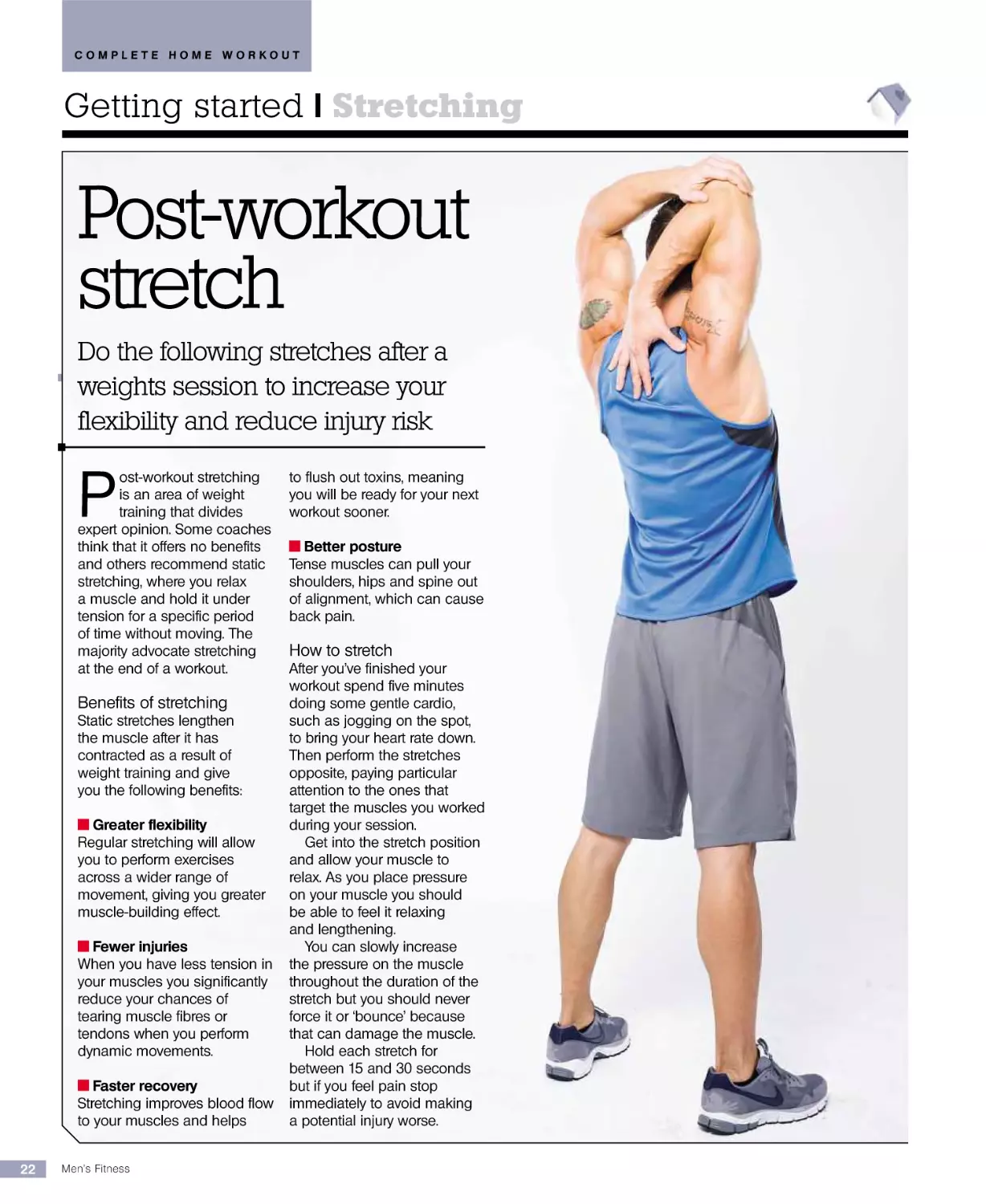
Post-workout
stretch
Do the following stretches after a
weights session to increase your
flexibility and reduce injury risk

P

ost-workout stretching
is an area of weight
training that divides
expert opinion. Some coaches
think that it offers no benefits
and others recommend static
stretching, where you relax
a muscle and hold it under
tension for a specific period
of time without moving. The
majority advocate stretching
at the end of a workout.

Benefits of stretching

Static stretches lengthen
the muscle after it has
contracted as a result of
weight training and give
you the following benefits:
Greater flexibility
Regular stretching will allow
you to perform exercises
across a wider range of
movement, giving you greater
muscle-building effect.
Fewer injuries
When you have less tension in
your muscles you significantly
reduce your chances of
tearing muscle fibres or
tendons when you perform
dynamic movements.
Faster recovery
Stretching improves blood flow
to your muscles and helps
22

Men’s Fitness

to flush out toxins, meaning
you will be ready for your next
workout sooner.
Better posture
Tense muscles can pull your
shoulders, hips and spine out
of alignment, which can cause
back pain.

How to stretch

After you’ve finished your
workout spend five minutes
doing some gentle cardio,
such as jogging on the spot,
to bring your heart rate down.
Then perform the stretches
opposite, paying particular
attention to the ones that
target the muscles you worked
during your session.
Get into the stretch position
and allow your muscle to
relax. As you place pressure
on your muscle you should
be able to feel it relaxing
and lengthening.
You can slowly increase
the pressure on the muscle
throughout the duration of the
stretch but you should never
force it or ‘bounce’ because
that can damage the muscle.
Hold each stretch for
between 15 and 30 seconds
but if you feel pain stop
immediately to avoid making
a potential injury worse.

COMPLETE HOME WORKOUT

Stretching | Getting started
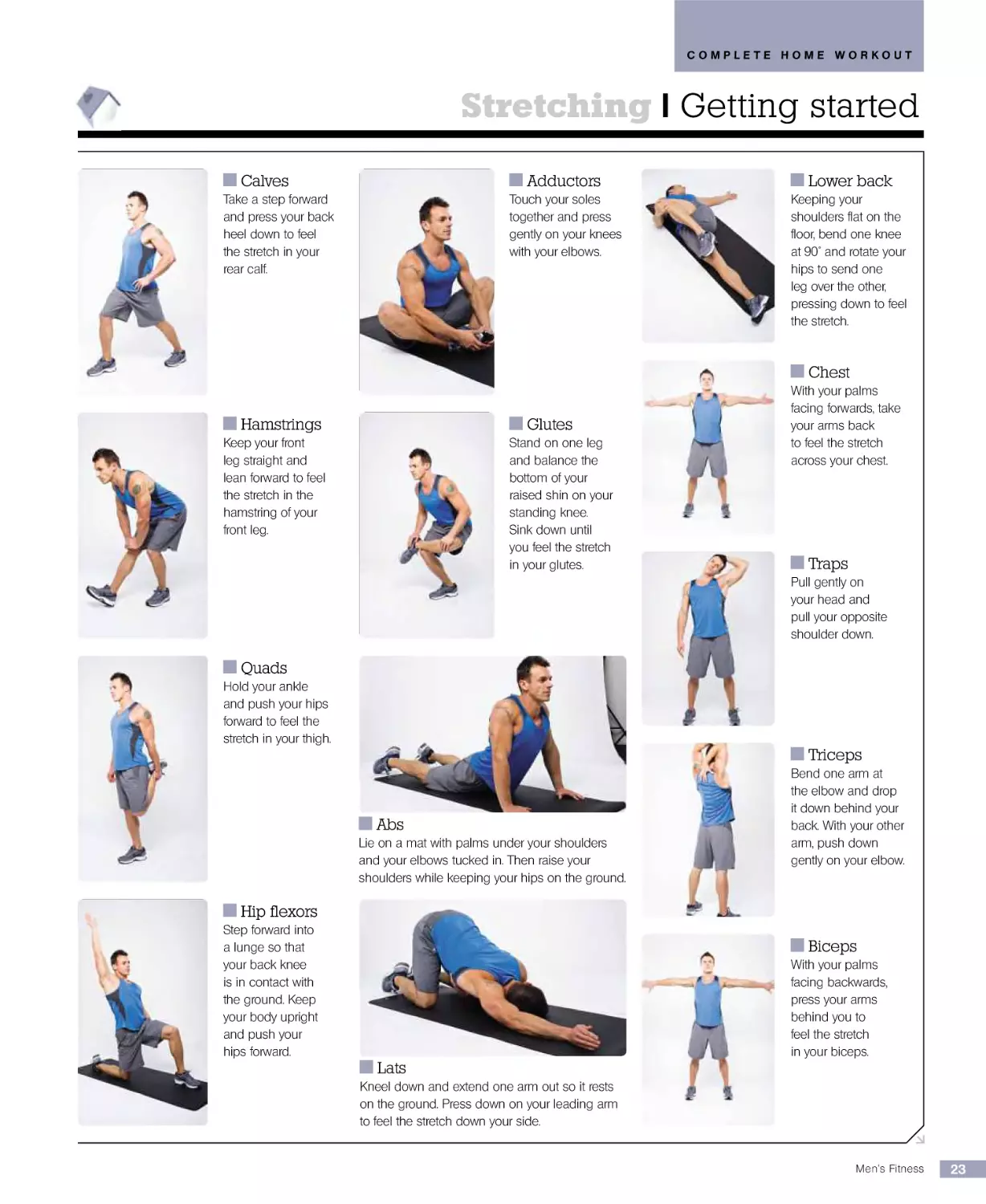
Calves

Adductors

Take a step forward
and press your back
heel down to feel
the stretch in your
rear calf.

Touch your soles
together and press
gently on your knees
with your elbows.

Lower back

Keeping your
shoulders flat on the
floor, bend one knee
at 90˚ and rotate your
hips to send one
leg over the other,
pressing down to feel
the stretch.

Chest

Hamstrings

Glutes

Keep your front
leg straight and
lean forward to feel
the stretch in the
hamstring of your
front leg.

Stand on one leg
and balance the
bottom of your
raised shin on your
standing knee.
Sink down until
you feel the stretch
in your glutes.

With your palms
facing forwards, take
your arms back
to feel the stretch
across your chest.

Traps

Pull gently on
your head and
pull your opposite
shoulder down.

Quads

Hold your ankle
and push your hips
forward to feel the
stretch in your thigh.

Triceps

Abs

Lie on a mat with palms under your shoulders
and your elbows tucked in. Then raise your
shoulders while keeping your hips on the ground.

Bend one arm at
the elbow and drop
it down behind your
back. With your other
arm, push down
gently on your elbow.

Hip flexors

Step forward into
a lunge so that
your back knee
is in contact with
the ground. Keep
your body upright
and push your
hips forward.

Biceps

Lats

With your palms
facing backwards,
press your arms
behind you to
feel the stretch
in your biceps.

Kneel down and extend one arm out so it rests
on the ground. Press down on your leading arm
to feel the stretch down your side.
Men’s Fitness

23

24

Men’s Fitness

COMPLETE HOME WORKOUT

Foam rolling | Getting started

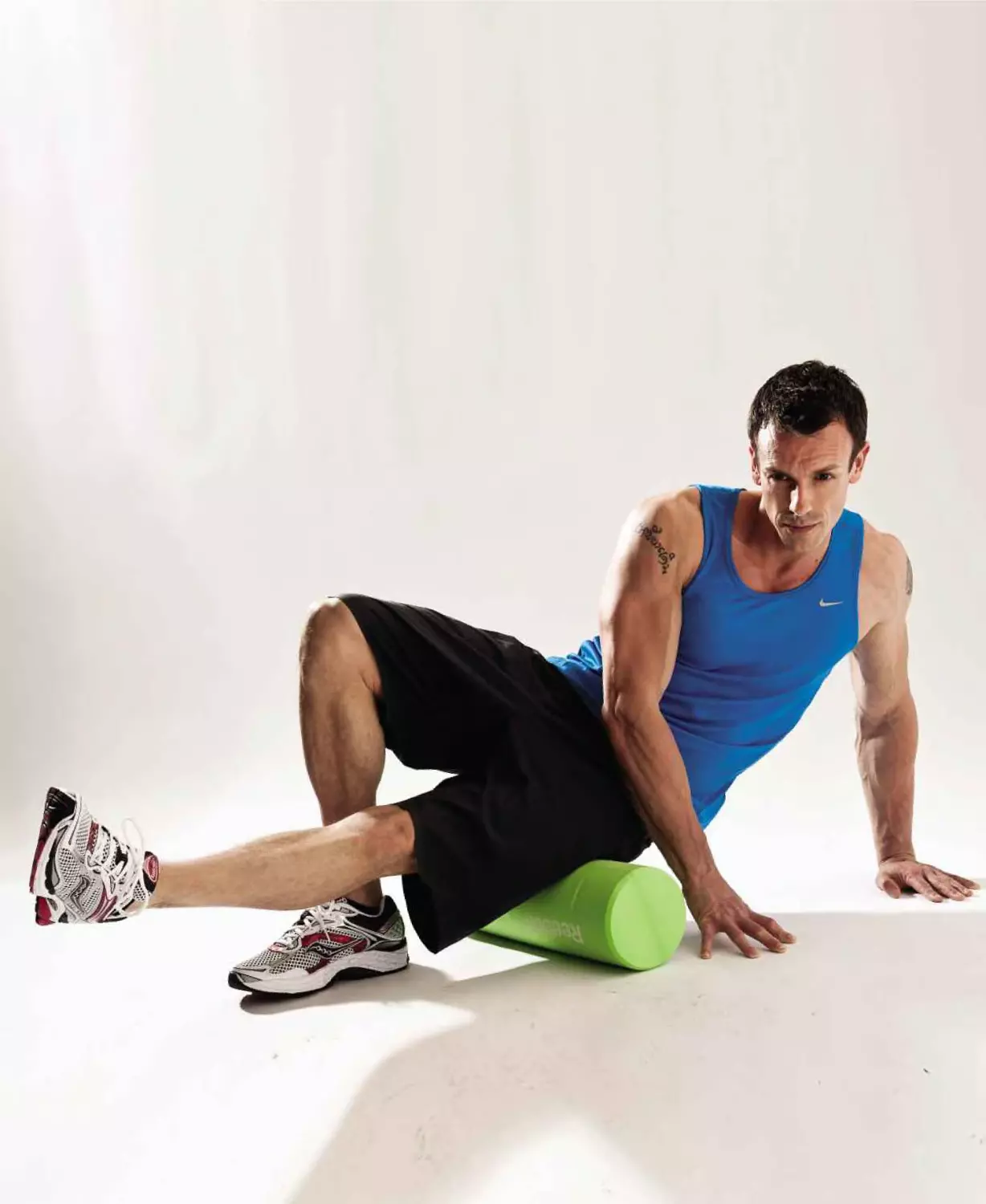
Foam rolling

Use this recovery tool to simulate a sports massage

F

oam rolling is an
increasingly popular
part of post-workout
recovery when it comes to
injury prevention. It has similar
effects to a sports massage
with the added advantage that
you can use it on yourself.
The purpose of foam rolling
is to improve your muscles’
range of motion and reduce
muscle soreness. The target
is the fascia – the soft part
of the connective tissue
that supports and protects
the muscles.

Why you need to do it

Overtraining, impact or injury
can restrict the fascia, resulting
in muscular inflammation,
pain and tension. Myofascial

release is a form of therapy
that relaxes these muscles.

How it works

Foam rolling breaks the cycle
of inflammation that leads to
fibrosis, or thickening of the
connective tissue, that causes
the muscular tension that
results in further inflammation.
Myofascial release provides
sustained, gentle pressure for
a short time, which relaxes the
affected muscles, increases
circulation and fluid drainage
and stimulates the stretch
reflex of the muscle and
connective tissues.

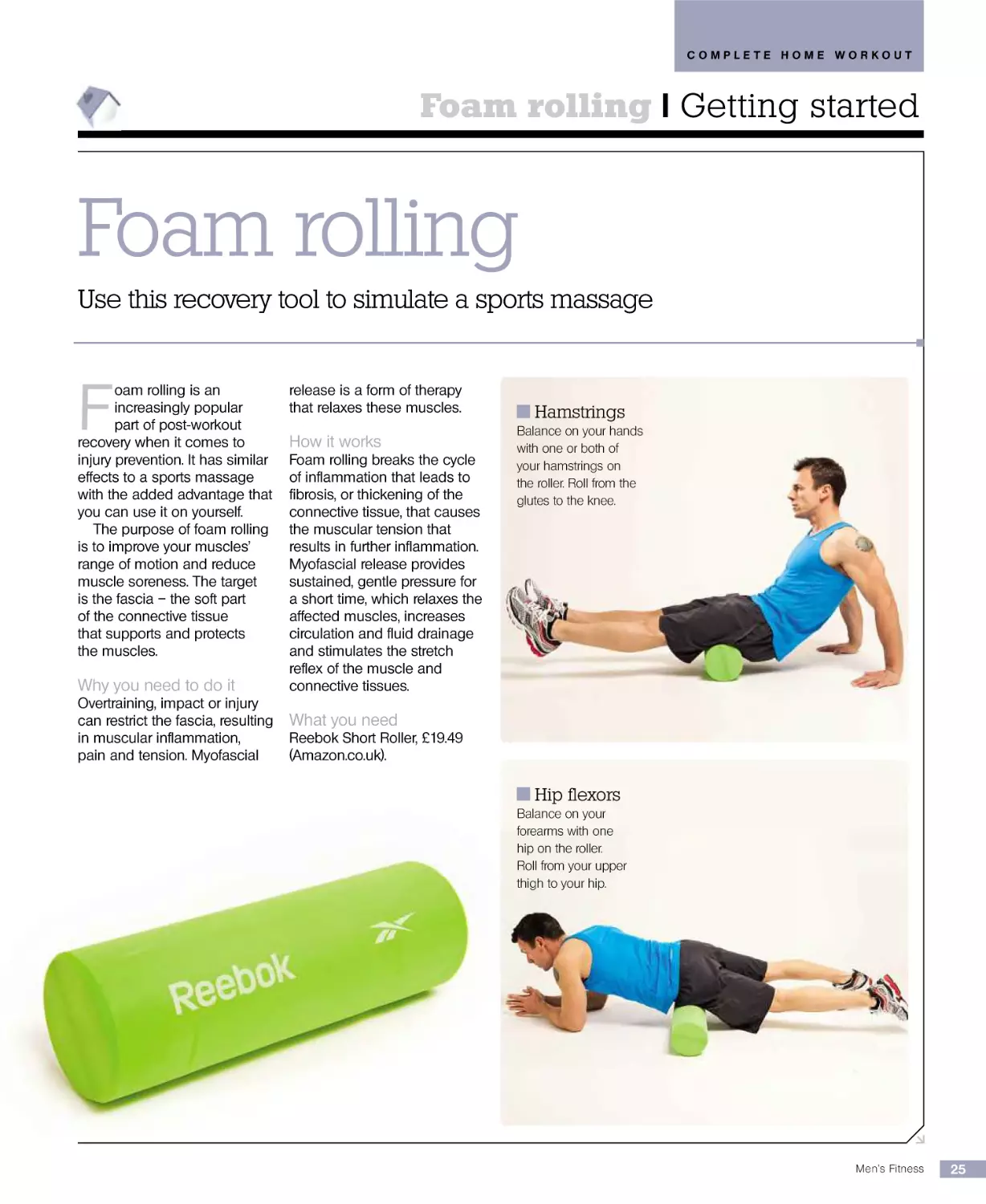
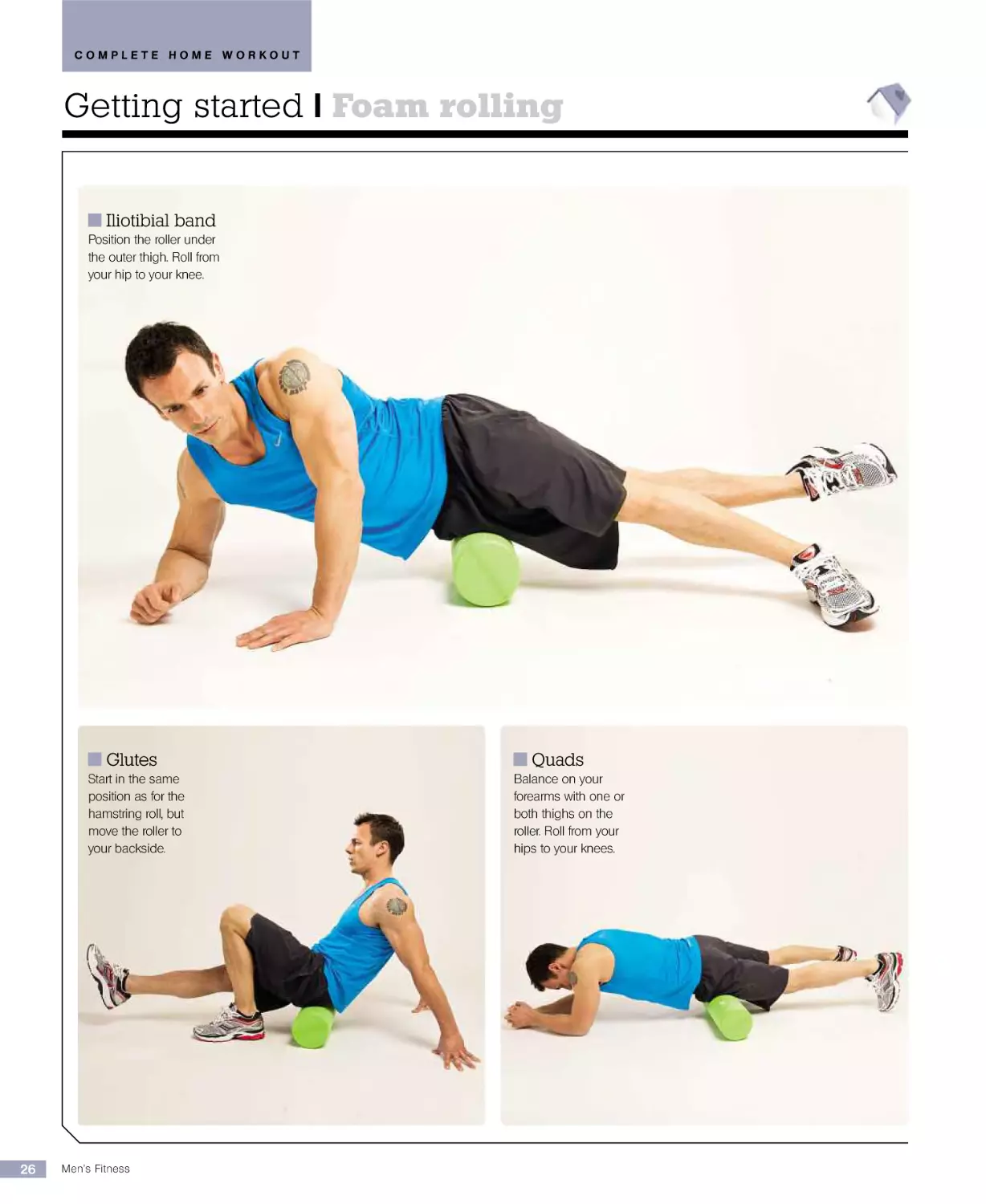
Hamstrings

Balance on your hands
with one or both of
your hamstrings on
the roller. Roll from the
glutes to the knee.

What you need

Reebok Short Roller, £19.49
(Amazon.co.uk).

Hip flexors

Balance on your
forearms with one
hip on the roller.
Roll from your upper
thigh to your hip.

Men’s Fitness

25

COMPLETE HOME WORKOUT

Getting started | Foam rolling
Iliotibial band

Position the roller under
the outer thigh. Roll from
your hip to your knee.

Glutes

Start in the same
position as for the
hamstring roll, but
move the roller to
your backside.

26

Men’s Fitness

Quads

Balance on your
forearms with one or
both thighs on the
roller. Roll from your
hips to your knees.

COMPLETE HOME WORKOUT

Foam rolling | Getting started
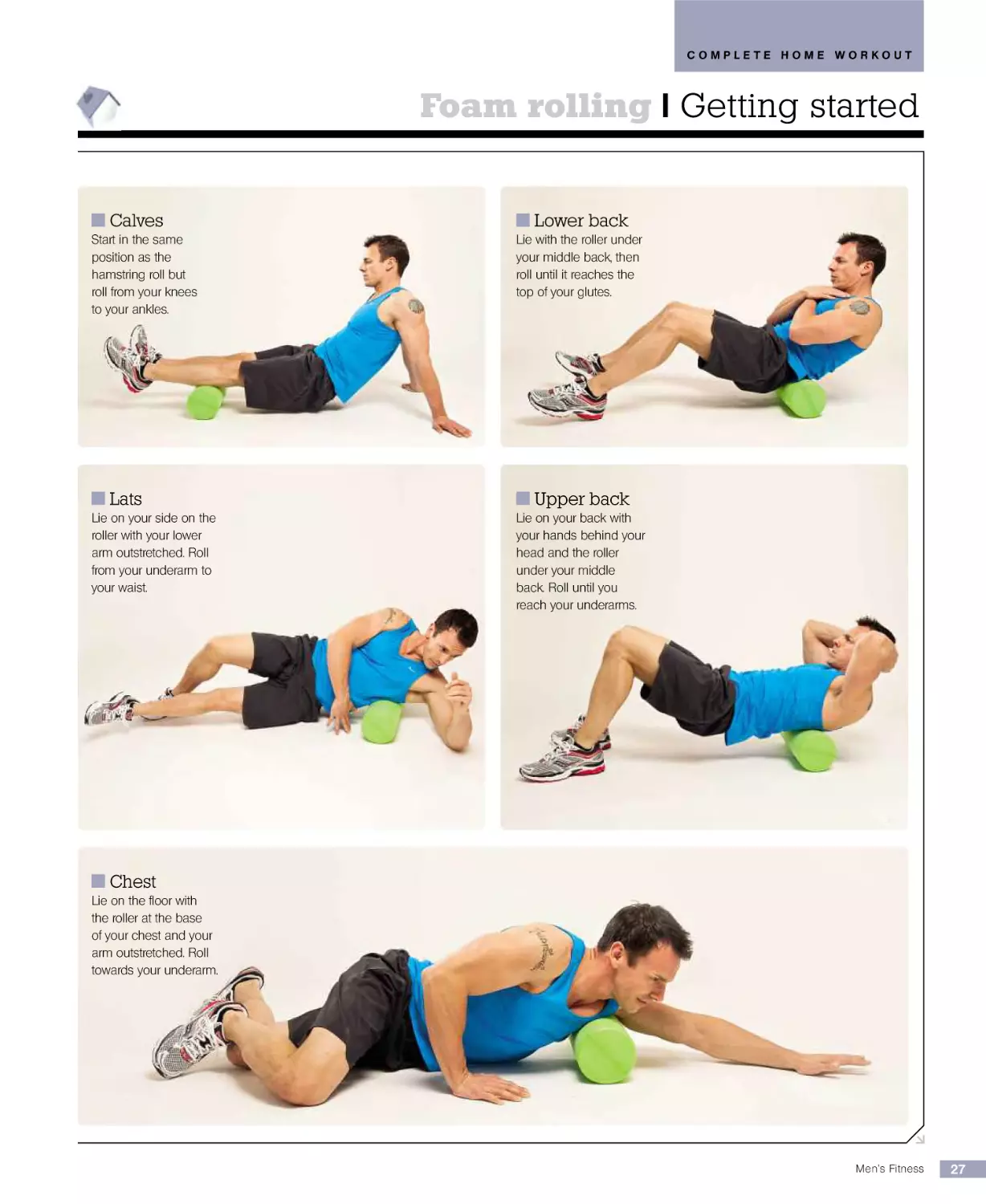
Calves

Start in the same
position as the
hamstring roll but
roll from your knees
to your ankles.

Lats

Lie on your side on the
roller with your lower
arm outstretched. Roll
from your underarm to
your waist.

Lower back

Lie with the roller under
your middle back, then
roll until it reaches the
top of your glutes.

Upper back

Lie on your back with
your hands behind your
head and the roller
under your middle
back. Roll until you
reach your underarms.

Chest

Lie on the floor with
the roller at the base
of your chest and your
arm outstretched. Roll
towards your underarm.

Men’s Fitness

27

COMPLETE HOME WORKOUT

Bodyweight
introduction
Start building muscle right now
using just your bodyweight

I

f you’ve bought this book
but haven’t yet got round to
buying any workout kit, don’t
worry. You can start building
muscle straight away by doing
bodyweight exercises.
For a muscle to grow in size
and strength, it has to move
against resistance (in this case,
yourself) to create microscopic
tears in the muscle fibres. These
fibres will heal to be bigger
and stronger than before. You
still have to follow the training
principles outlined in the previous
chapter so you may need to
adjust your tempo, for example,
if you want to work in a musclebuilding rep range. If you do that,
you can start gaining muscle
before you’ve bought any kit.
This chapter begins by
demonstrating moves that will
target different muscles. Once
you know how to do the moves,
we’ll show you how to put
them together to achieve your
particular muscle-building goals.
Bodyweight exercises such
as one-leg squats are good at
developing joint stability because

you have to push a significant
level of resistance while
balancing on one leg. Controlling
your own bodyweight will also
give you practical strength
because you’re working with
the load you carry around
in everyday life.
There are lots of bodyweight
moves you can do to target
your core muscles, which you’ll
need to develop if you want to
progress safely to doing big lifts
such as a lunges with dumbbells or even a barbell.
You can use bodyweight
exercises to target any muscle
group. However, as you improve
you’ll find it increasingly difficult
to achieve the overload that will
lead to muscle growth. When
that happens, introducing some
of the basic bits of kit outlined in
later chapters will help you avoid
getting stuck in a training rut.
You should, however, still include
bodyweight exercises in some of
your workouts because you need
to constantly refresh and tweak
the way you work out to make
sure your muscles are stimulated.

Men’s Fitness

29

COMPLETE HOME WORKOUT

Bodyweight | Exercises
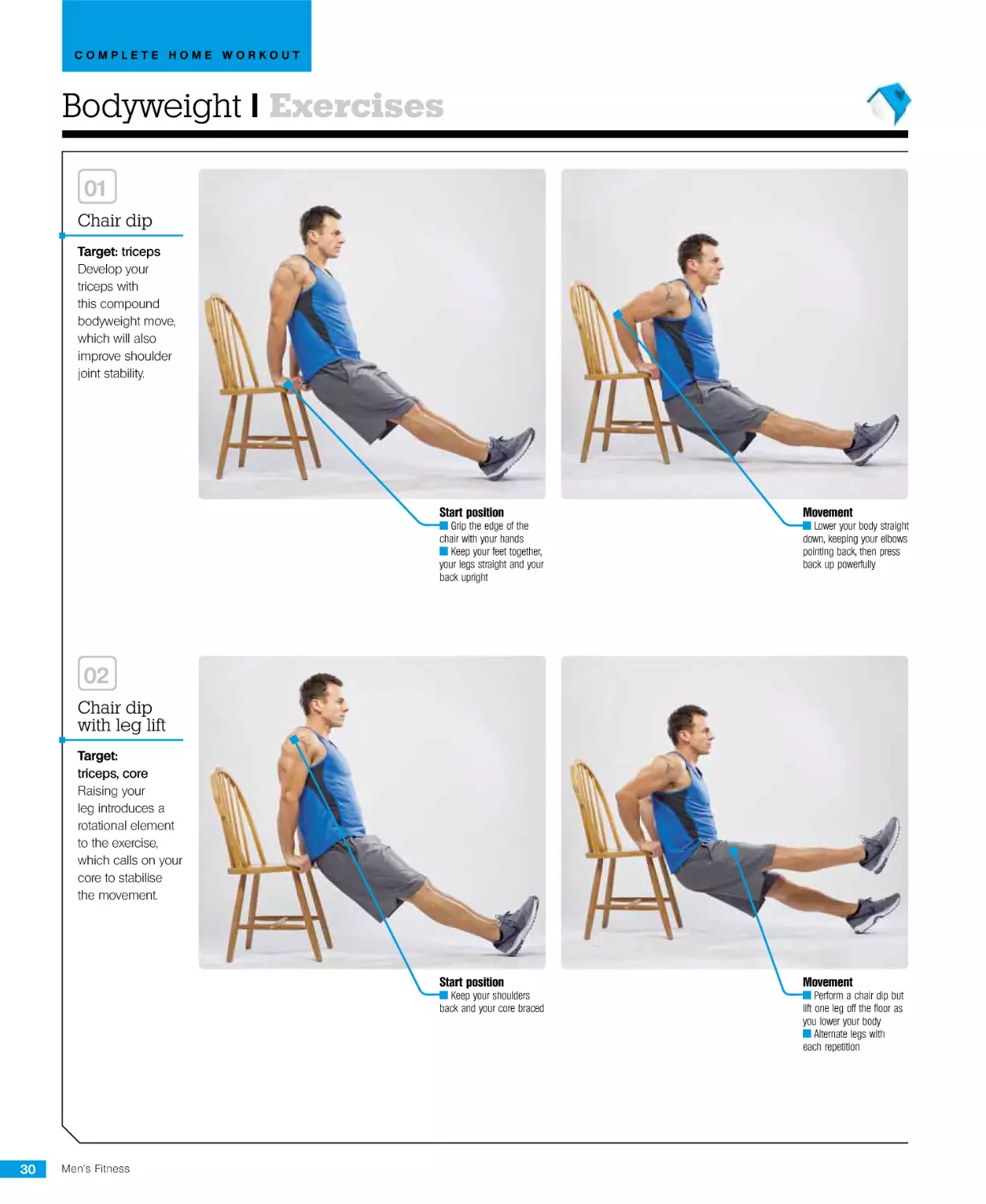
01
Chair dip
Target: triceps
Develop your
triceps with
this compound
bodyweight move,
which will also
improve shoulder
joint stability.

Start position

Movement

Grip the edge of the
chair with your hands
Keep your feet together,
your legs straight and your
back upright

Lower your body straight
down, keeping your elbows
pointing back, then press
back up powerfully

Start position

Movement

02
Chair dip
with leg lift
Target:
triceps, core
Raising your
leg introduces a
rotational element
to the exercise,
which calls on your
core to stabilise
the movement.

Keep your shoulders
back and your core braced

30

Men’s Fitness

Perform a chair dip but
lift one leg off the floor as
you lower your body
Alternate legs with
each repetition

COMPLETE HOME WORKOUT

Exercises | Bodyweight
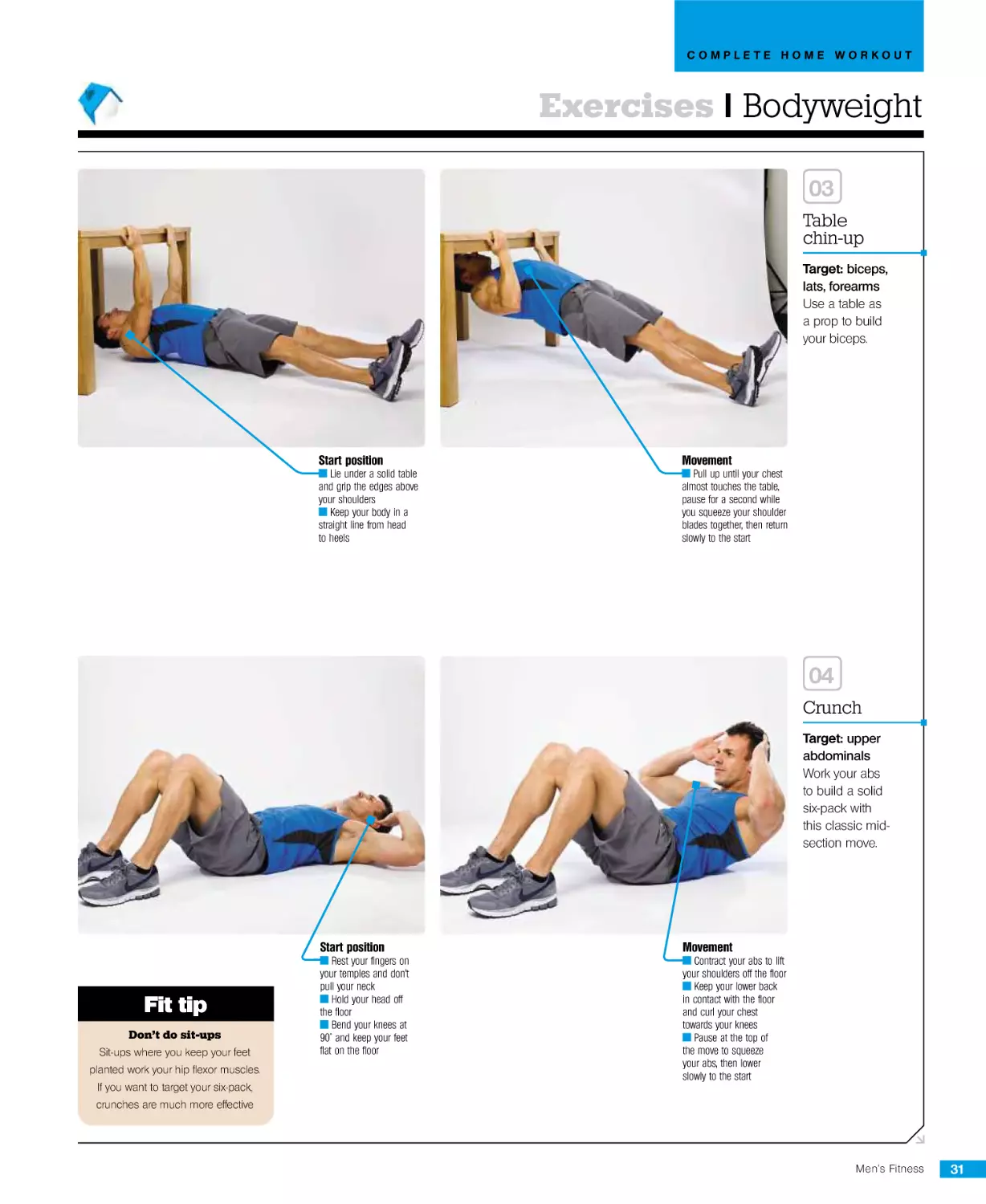
03
Table
chin-up
Target: biceps,
lats, forearms
Use a table as
a prop to build
your biceps.

Start position

Lie under a solid table
and grip the edges above
your shoulders
Keep your body in a
straight line from head
to heels

Movement

Pull up until your chest
almost touches the table,
pause for a second while
you squeeze your shoulder
blades together, then return
slowly to the start

04
Crunch
Target: upper
abdominals
Work your abs
to build a solid
six-pack with
this classic midsection move.

Start position

Fit tip
Don’t do sit-ups
Sit-ups where you keep your feet
planted work your hip flexor muscles.
If you want to target your six-pack,

Rest your fingers on
your temples and don’t
pull your neck
Hold your head off
the floor
Bend your knees at
90˚ and keep your feet
flat on the floor

Movement

Contract your abs to lift
your shoulders off the floor
Keep your lower back
in contact with the floor
and curl your chest
towards your knees
Pause at the top of
the move to squeeze
your abs, then lower
slowly to the start

crunches are much more effective

Men’s Fitness

31

COMPLETE HOME WORKOUT

Bodyweight | Exercises
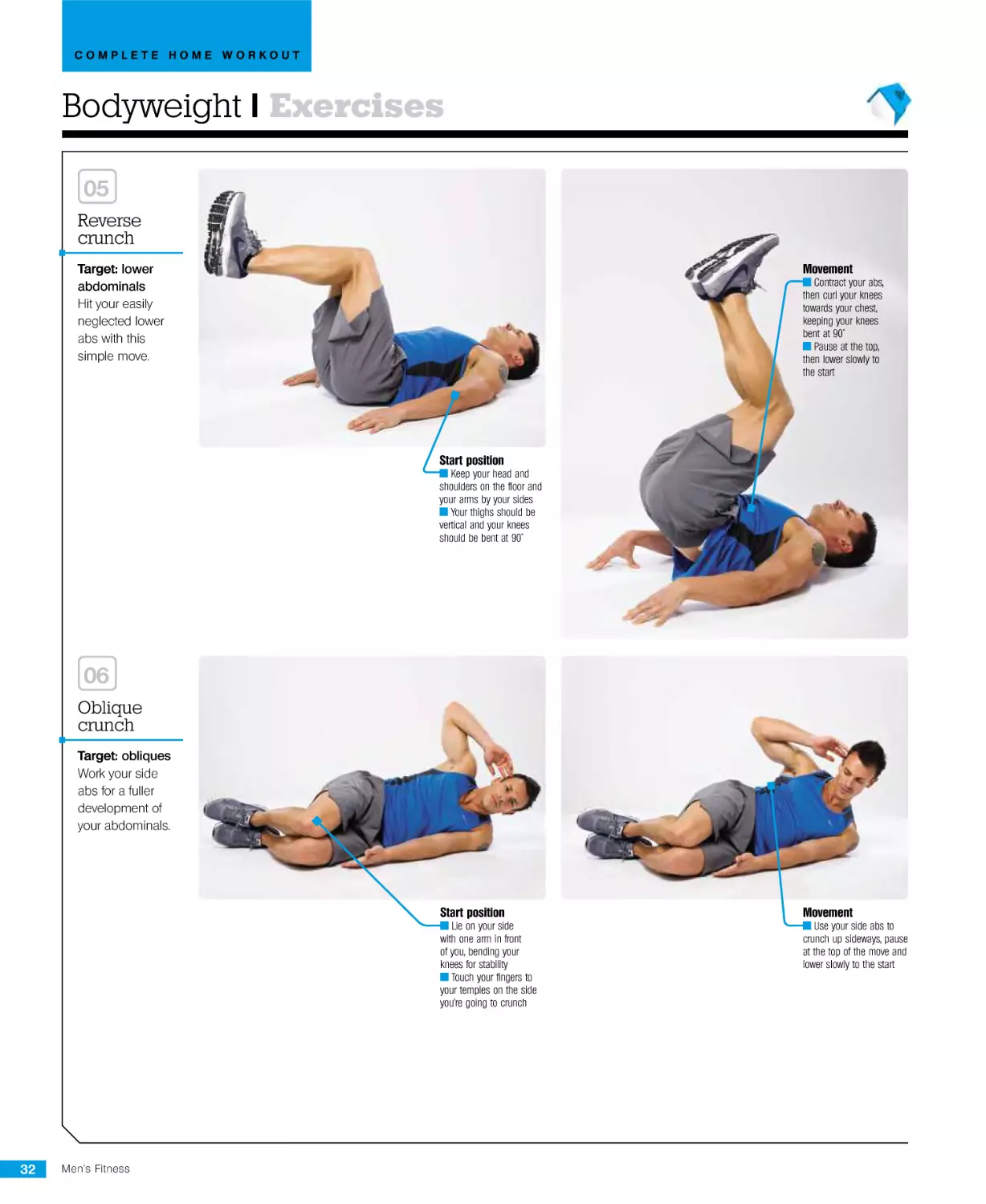
05
Reverse
crunch
Movement

Target: lower
abdominals
Hit your easily
neglected lower
abs with this
simple move.

Contract your abs,
then curl your knees
towards your chest,
keeping your knees
bent at 90˚
Pause at the top,
then lower slowly to
the start

Start position

Keep your head and
shoulders on the floor and
your arms by your sides
Your thighs should be
vertical and your knees
should be bent at 90˚

06
Oblique
crunch
Target: obliques
Work your side
abs for a fuller
development of
your abdominals.

Start position

Lie on your side
with one arm in front
of you, bending your
knees for stability
Touch your fingers to
your temples on the side
you’re going to crunch

32

Men’s Fitness

Movement

Use your side abs to
crunch up sideways, pause
at the top of the move and
lower slowly to the start

COMPLETE HOME WORKOUT

Exercises | Bodyweight
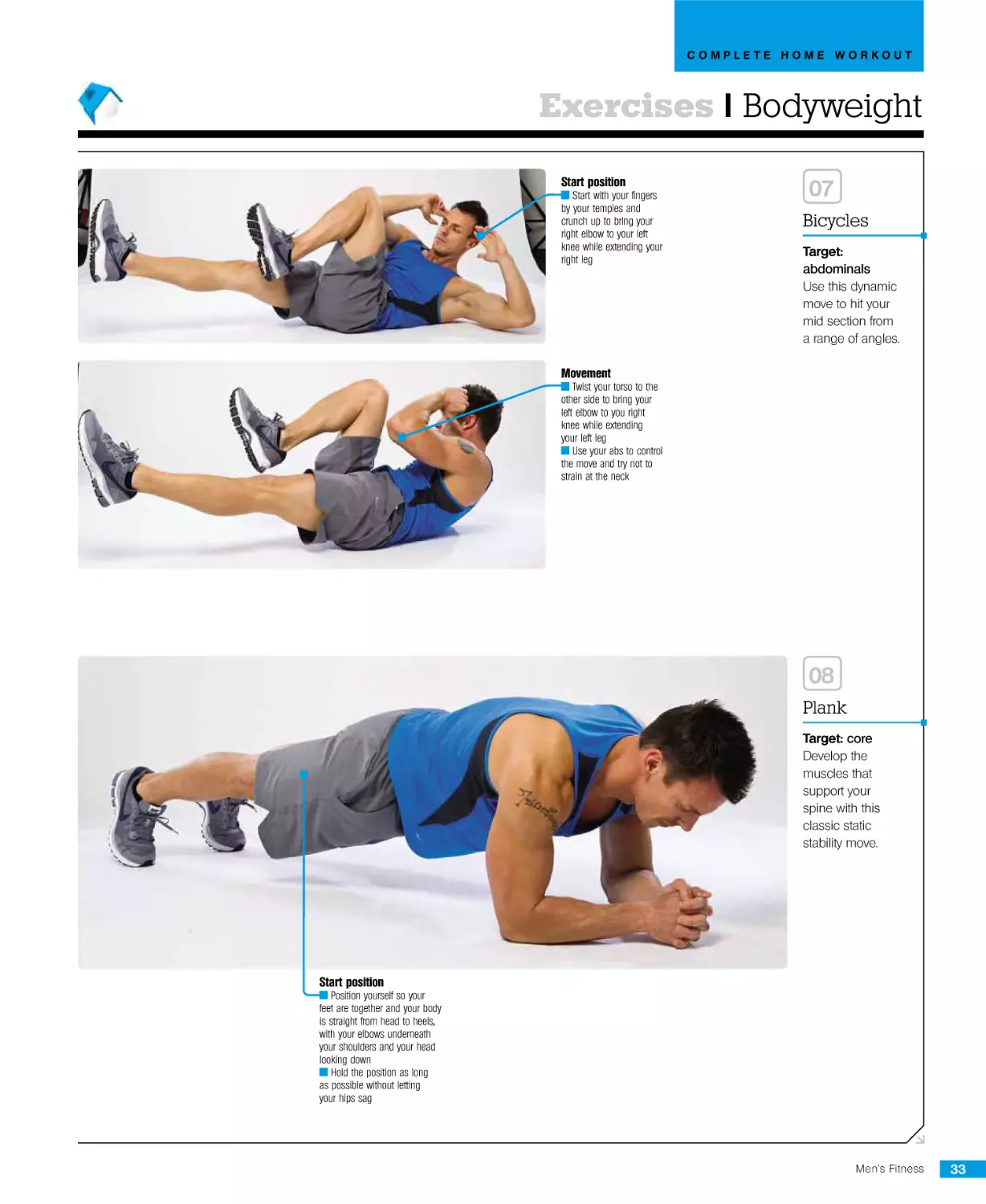
Start position

Start with your fingers
by your temples and
crunch up to bring your
right elbow to your left
knee while extending your
right leg

07
Bicycles
Target:
abdominals
Use this dynamic
move to hit your
mid section from
a range of angles.

Movement

Twist your torso to the
other side to bring your
left elbow to you right
knee while extending
your left leg
Use your abs to control
the move and try not to
strain at the neck

08
Plank
Target: core
Develop the
muscles that
support your
spine with this
classic static
stability move.

Start position

Position yourself so your
feet are together and your body
is straight from head to heels,
with your elbows underneath
your shoulders and your head
looking down
Hold the position as long
as possible without letting
your hips sag

Men’s Fitness

33

COMPLETE HOME WORKOUT

Bodyweight | Exercises
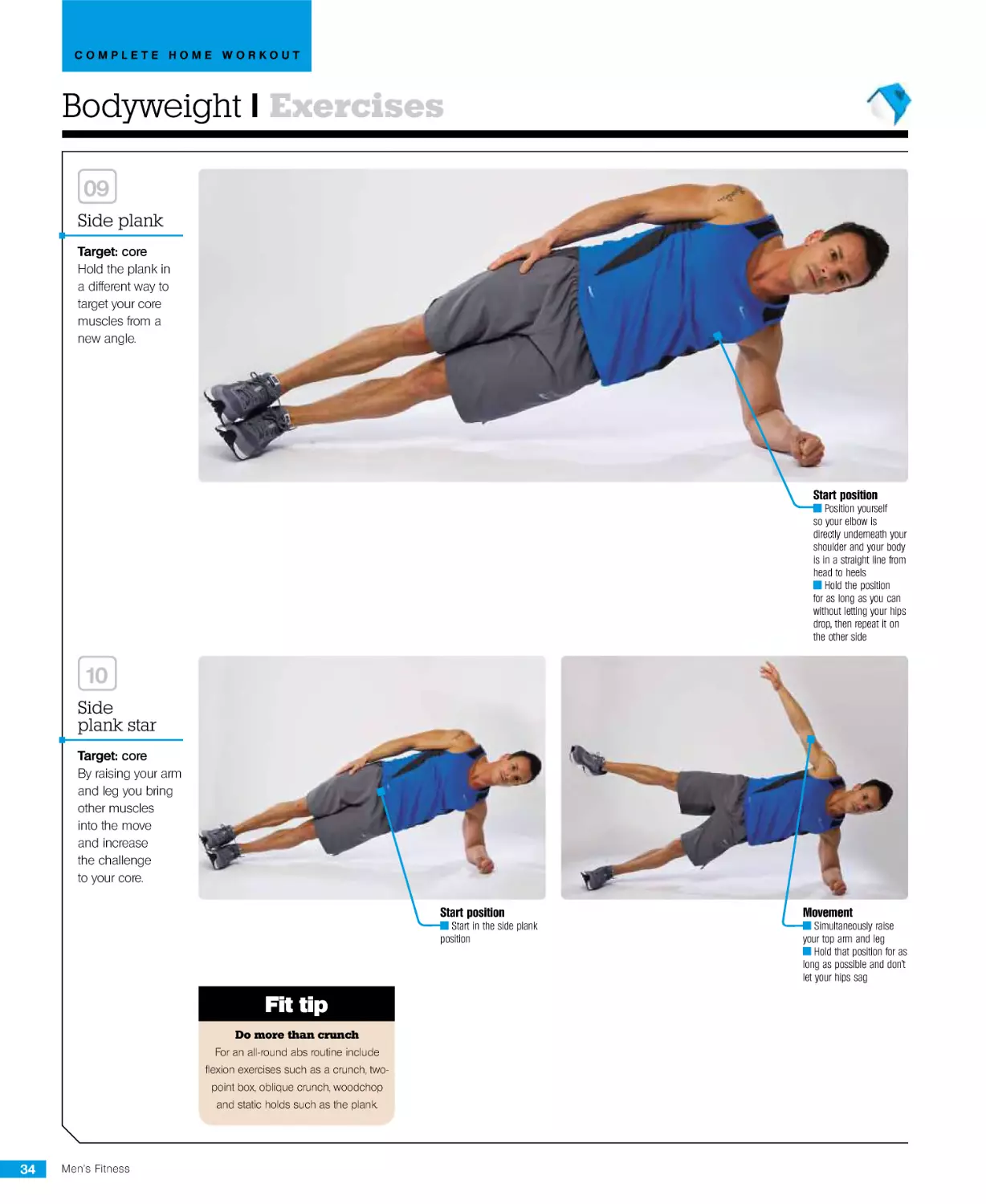
09
Side plank
Target: core
Hold the plank in
a different way to
target your core
muscles from a
new angle.

Start position

Position yourself
so your elbow is
directly underneath your
shoulder and your body
is in a straight line from
head to heels
Hold the position
for as long as you can
without letting your hips
drop, then repeat it on
the other side

10
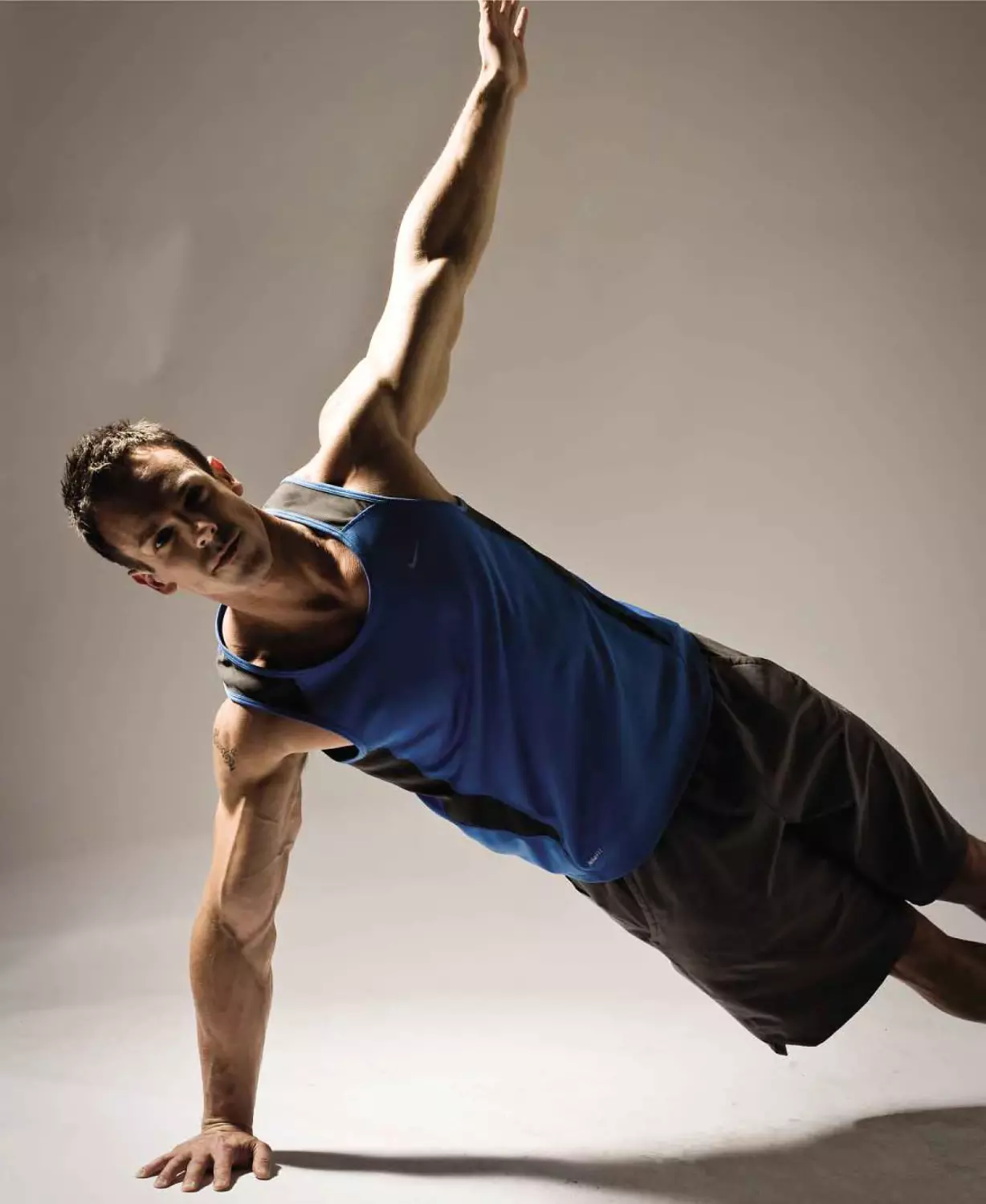
Side
plank star
Target: core
By raising your arm
and leg you bring
other muscles
into the move
and increase
the challenge
to your core.
Start position

Start in the side plank
position

Fit tip
Do more than crunch
For an all-round abs routine include
flexion exercises such as a crunch, twopoint box, oblique crunch, woodchop
and static holds such as the plank.

34

Men’s Fitness

Movement

Simultaneously raise
your top arm and leg
Hold that position for as
long as possible and don’t
let your hips sag

COMPLETE HOME WORKOUT

Exercises | Bodyweight
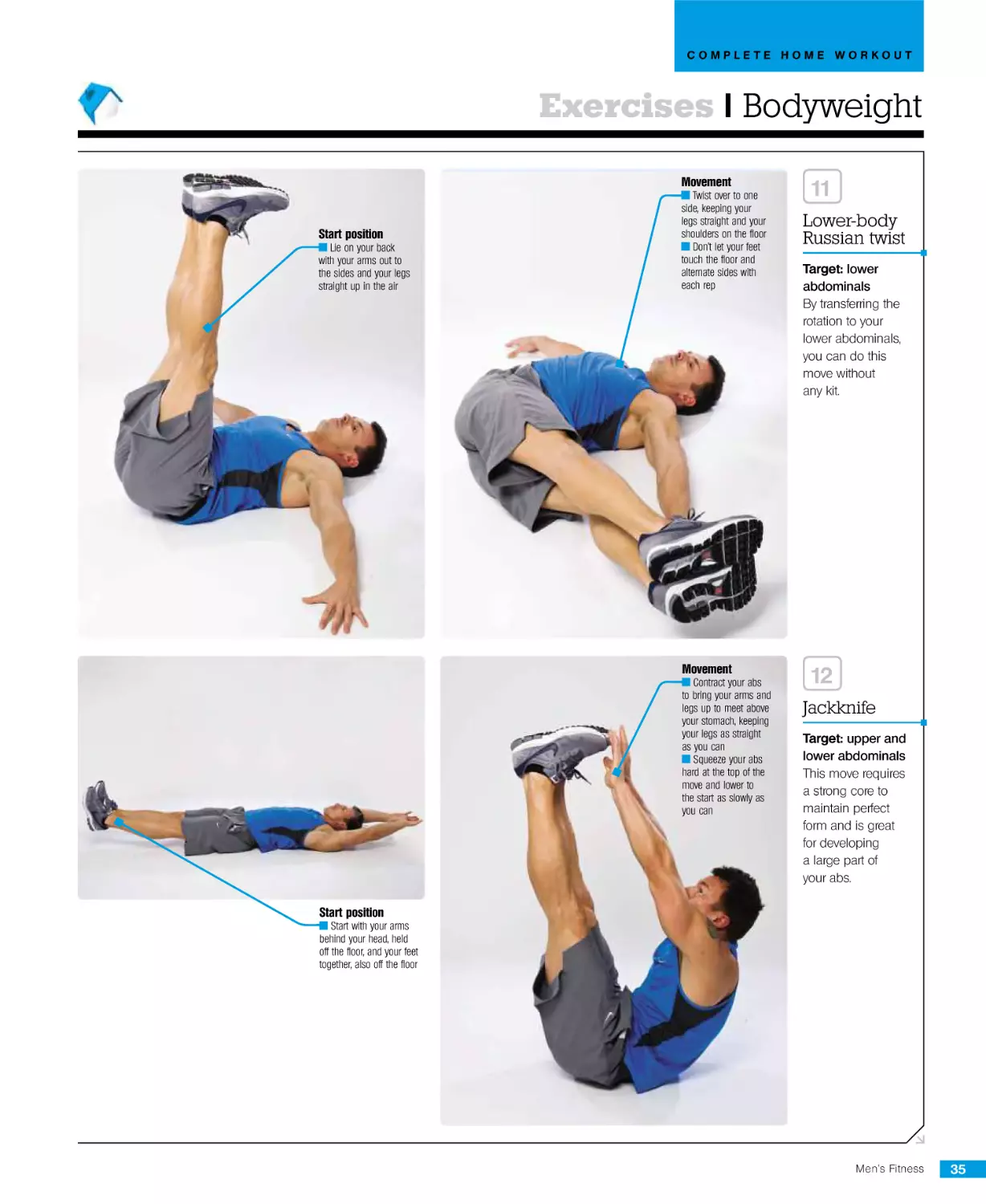
Movement

Start position

Lie on your back
with your arms out to
the sides and your legs
straight up in the air

Twist over to one
side, keeping your
legs straight and your
shoulders on the floor
Don’t let your feet
touch the floor and
alternate sides with
each rep

Movement

Contract your abs
to bring your arms and
legs up to meet above
your stomach, keeping
your legs as straight
as you can
Squeeze your abs
hard at the top of the
move and lower to
the start as slowly as
you can

11
Lower-body
Russian twist
Target: lower
abdominals
By transferring the
rotation to your
lower abdominals,
you can do this
move without
any kit.

12
Jackknife
Target: upper and
lower abdominals
This move requires
a strong core to
maintain perfect
form and is great
for developing
a large part of
your abs.

Start position

Start with your arms
behind your head, held
off the floor, and your feet
together, also off the floor

Men’s Fitness

35

COMPLETE HOME WORKOUT

Bodyweight | Exercises
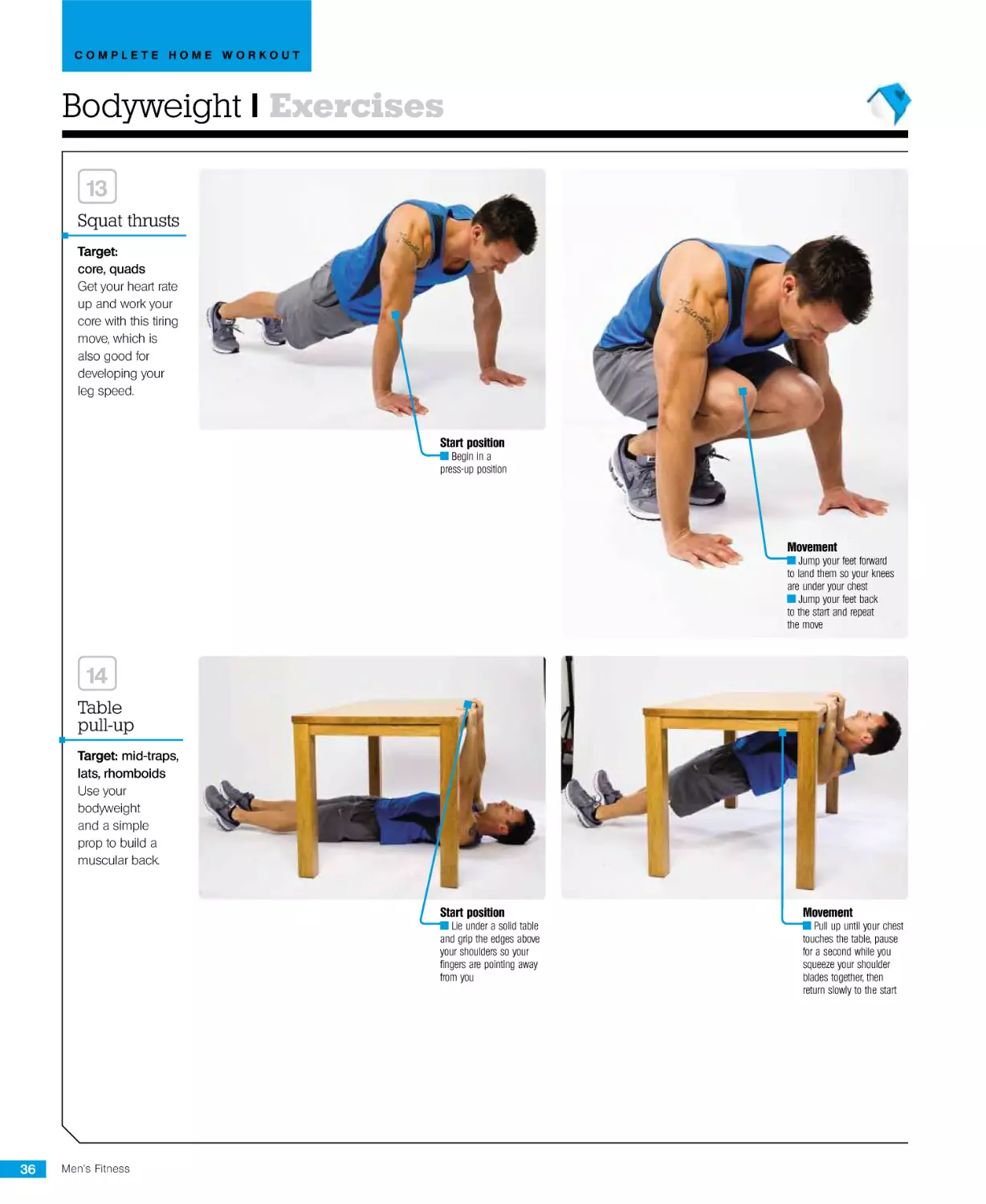
13
Squat thrusts
Target:
core, quads
Get your heart rate
up and work your
core with this tiring
move, which is
also good for
developing your
leg speed.

Start position

Begin in a
press-up position

Movement

Jump your feet forward
to land them so your knees
are under your chest
Jump your feet back
to the start and repeat
the move

14
Table
pull-up
Target: mid-traps,
lats, rhomboids
Use your
bodyweight
and a simple
prop to build a
muscular back.

Start position

Lie under a solid table
and grip the edges above
your shoulders so your
fingers are pointing away
from you

36

Men’s Fitness

Movement

Pull up until your chest
touches the table, pause
for a second while you
squeeze your shoulder
blades together, then
return slowly to the start

COMPLETE HOME WORKOUT

Exercises | Bodyweight
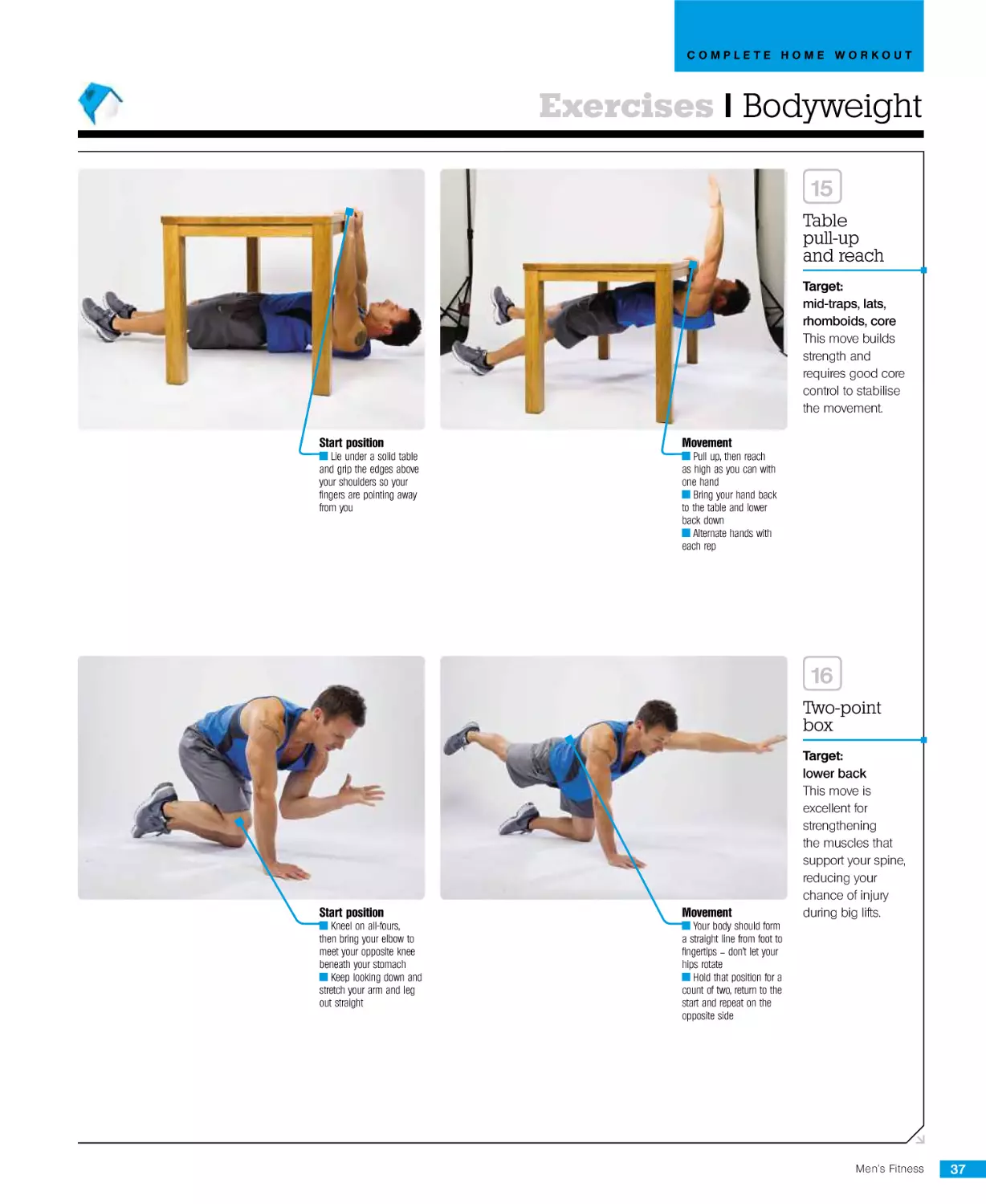
15
Table
pull-up
and reach
Target:
mid-traps, lats,
rhomboids, core
This move builds
strength and
requires good core
control to stabilise
the movement.
Start position

Lie under a solid table
and grip the edges above
your shoulders so your
fingers are pointing away
from you

Movement

Pull up, then reach
as high as you can with
one hand
Bring your hand back
to the table and lower
back down
Alternate hands with
each rep

16
Two-point
box

Start position

Kneel on all-fours,
then bring your elbow to
meet your opposite knee
beneath your stomach
Keep looking down and
stretch your arm and leg
out straight

Movement

Your body should form
a straight line from foot to
fingertips – don’t let your
hips rotate
Hold that position for a
count of two, return to the
start and repeat on the
opposite side

Target:
lower back
This move is
excellent for
strengthening
the muscles that
support your spine,
reducing your
chance of injury
during big lifts.

Men’s Fitness

37

COMPLETE HOME WORKOUT

Bodyweight | Exercises
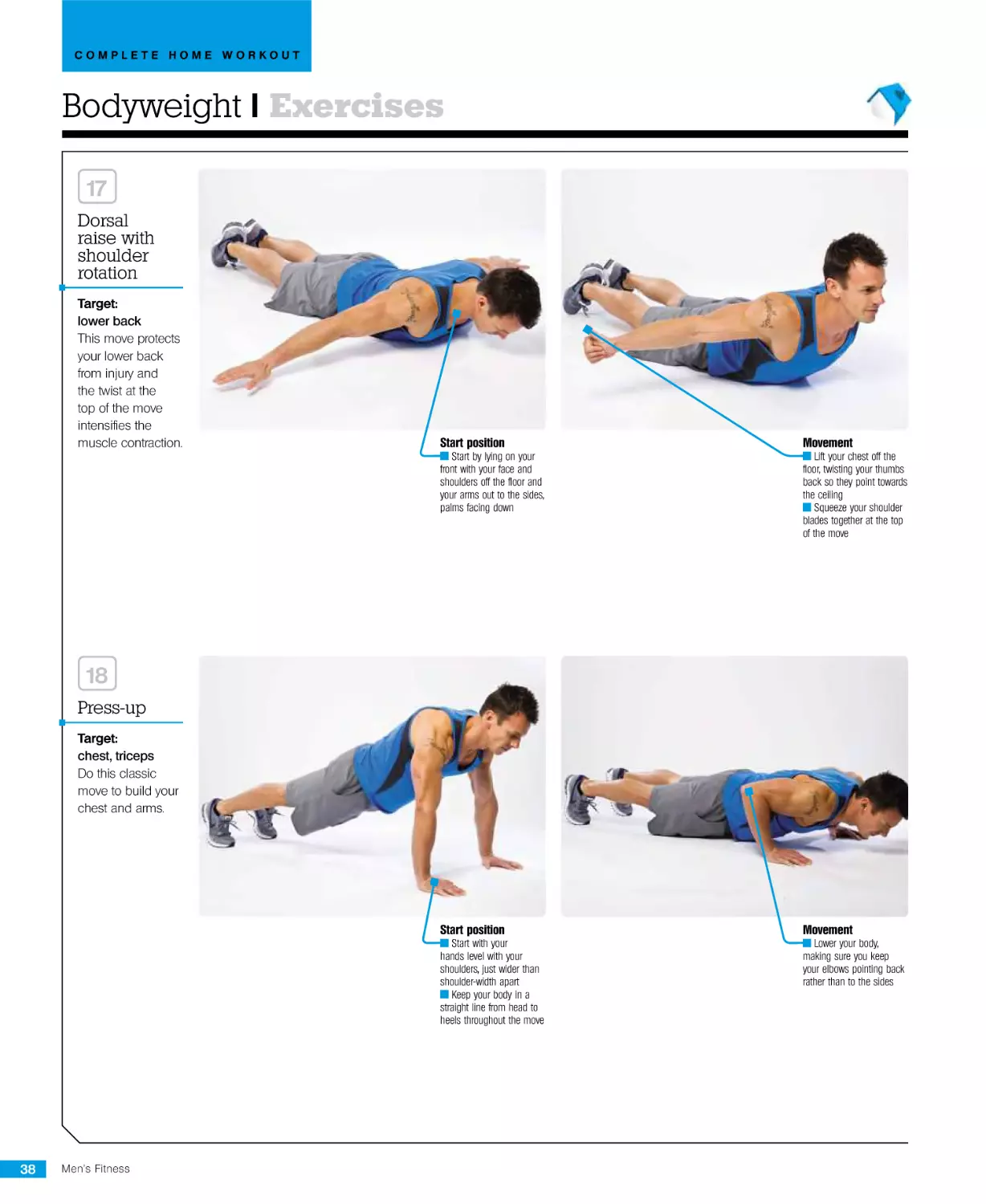
17
Dorsal
raise with
shoulder
rotation
Target:
lower back
This move protects
your lower back
from injury and
the twist at the
top of the move
intensifies the
muscle contraction.

Start position

Movement

Start by lying on your
front with your face and
shoulders off the floor and
your arms out to the sides,
palms facing down

Lift your chest off the
floor, twisting your thumbs
back so they point towards
the ceiling
Squeeze your shoulder
blades together at the top
of the move

Start position

Movement

18
Press-up
Target:
chest, triceps
Do this classic
move to build your
chest and arms.

Start with your
hands level with your
shoulders, just wider than
shoulder-width apart
Keep your body in a
straight line from head to
heels throughout the move

38

Men’s Fitness

Lower your body,
making sure you keep
your elbows pointing back
rather than to the sides

COMPLETE HOME WORKOUT

Exercises | Bodyweight
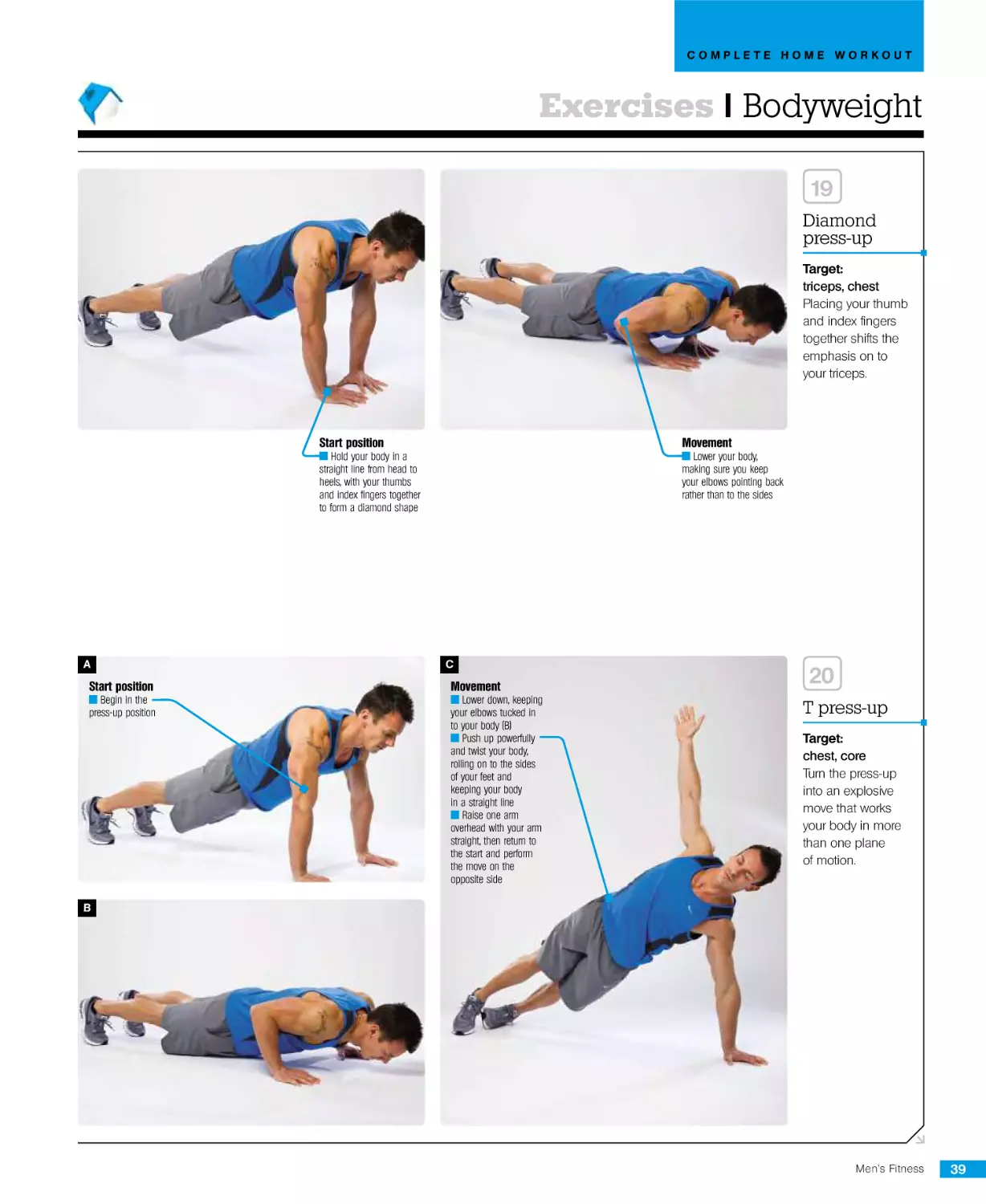
19
Diamond
press-up
Target:
triceps, chest
Placing your thumb
and index fingers
together shifts the
emphasis on to
your triceps.

Start position

Movement

Hold your body in a
straight line from head to
heels, with your thumbs
and index fingers together
to form a diamond shape

A

Start position

Begin in the
press-up position

Lower your body,
making sure you keep
your elbows pointing back
rather than to the sides

C

Movement

Lower down, keeping
your elbows tucked in
to your body (B)
Push up powerfully
and twist your body,
rolling on to the sides
of your feet and
keeping your body
in a straight line
Raise one arm
overhead with your arm
straight, then return to
the start and perform
the move on the
opposite side

20
T press-up
Target:
chest, core
Turn the press-up
into an explosive
move that works
your body in more
than one plane
of motion.

B

Men’s Fitness

39

COMPLETE HOME WORKOUT

Bodyweight | Exercises
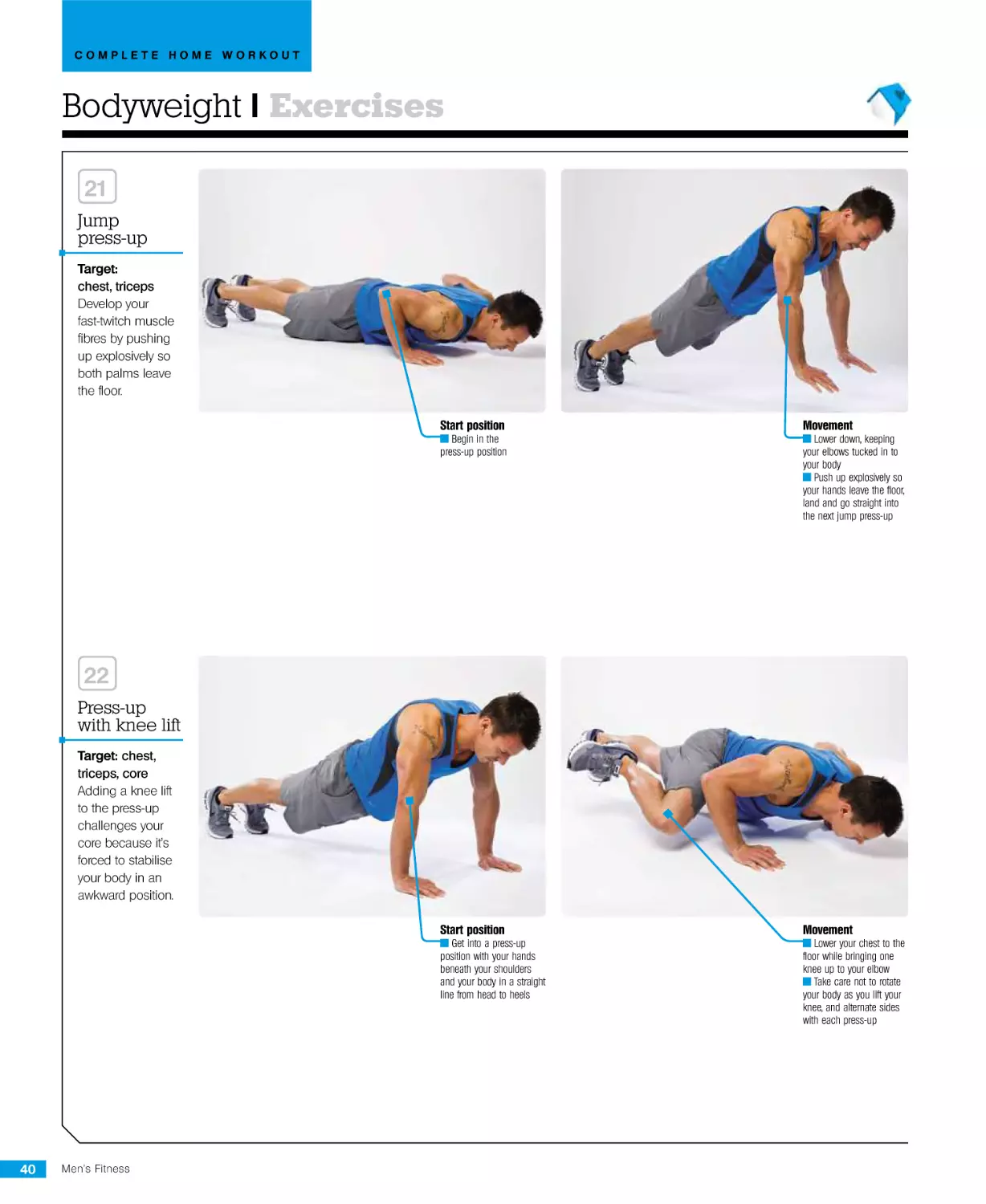
21
Jump
press-up
Target:
chest, triceps
Develop your
fast-twitch muscle
fibres by pushing
up explosively so
both palms leave
the floor.
Start position

Movement

Begin in the
press-up position

Lower down, keeping
your elbows tucked in to
your body
Push up explosively so
your hands leave the floor,
land and go straight into
the next jump press-up

Start position

Movement

22
Press-up
with knee lift
Target: chest,
triceps, core
Adding a knee lift
to the press-up
challenges your
core because it’s
forced to stabilise
your body in an
awkward position.

Get into a press-up
position with your hands
beneath your shoulders
and your body in a straight
line from head to heels

40

Men’s Fitness

Lower your chest to the
floor while bringing one
knee up to your elbow
Take care not to rotate
your body as you lift your
knee, and alternate sides
with each press-up

COMPLETE HOME WORKOUT

Exercises | Bodyweight
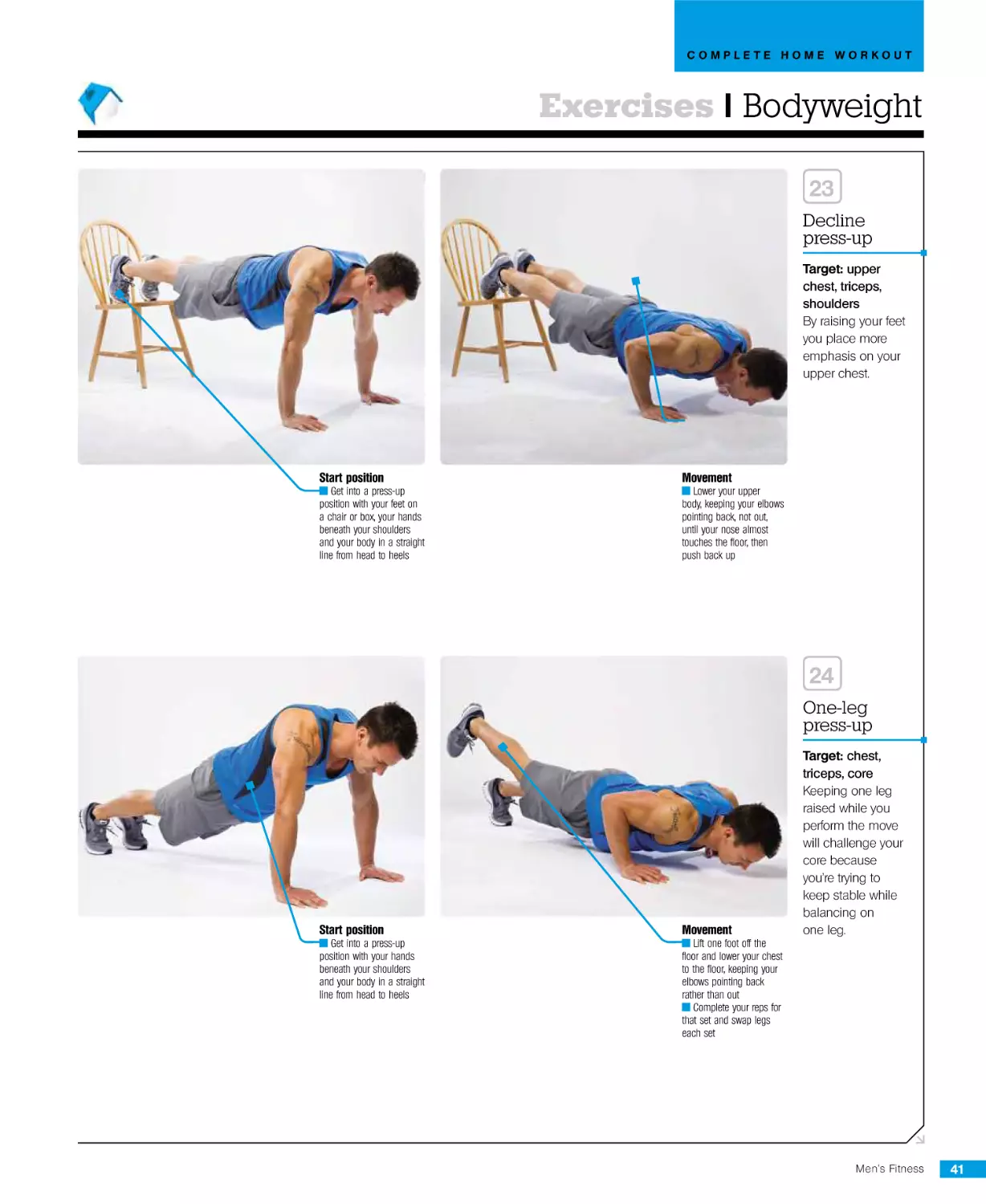
23
Decline
press-up
Target: upper
chest, triceps,
shoulders
By raising your feet
you place more
emphasis on your
upper chest.

Start position

Get into a press-up
position with your feet on
a chair or box, your hands
beneath your shoulders
and your body in a straight
line from head to heels

Movement

Lower your upper
body, keeping your elbows
pointing back, not out,
until your nose almost
touches the floor, then
push back up

24
One-leg
press-up

Start position

Get into a press-up
position with your hands
beneath your shoulders
and your body in a straight
line from head to heels

Movement

Lift one foot off the
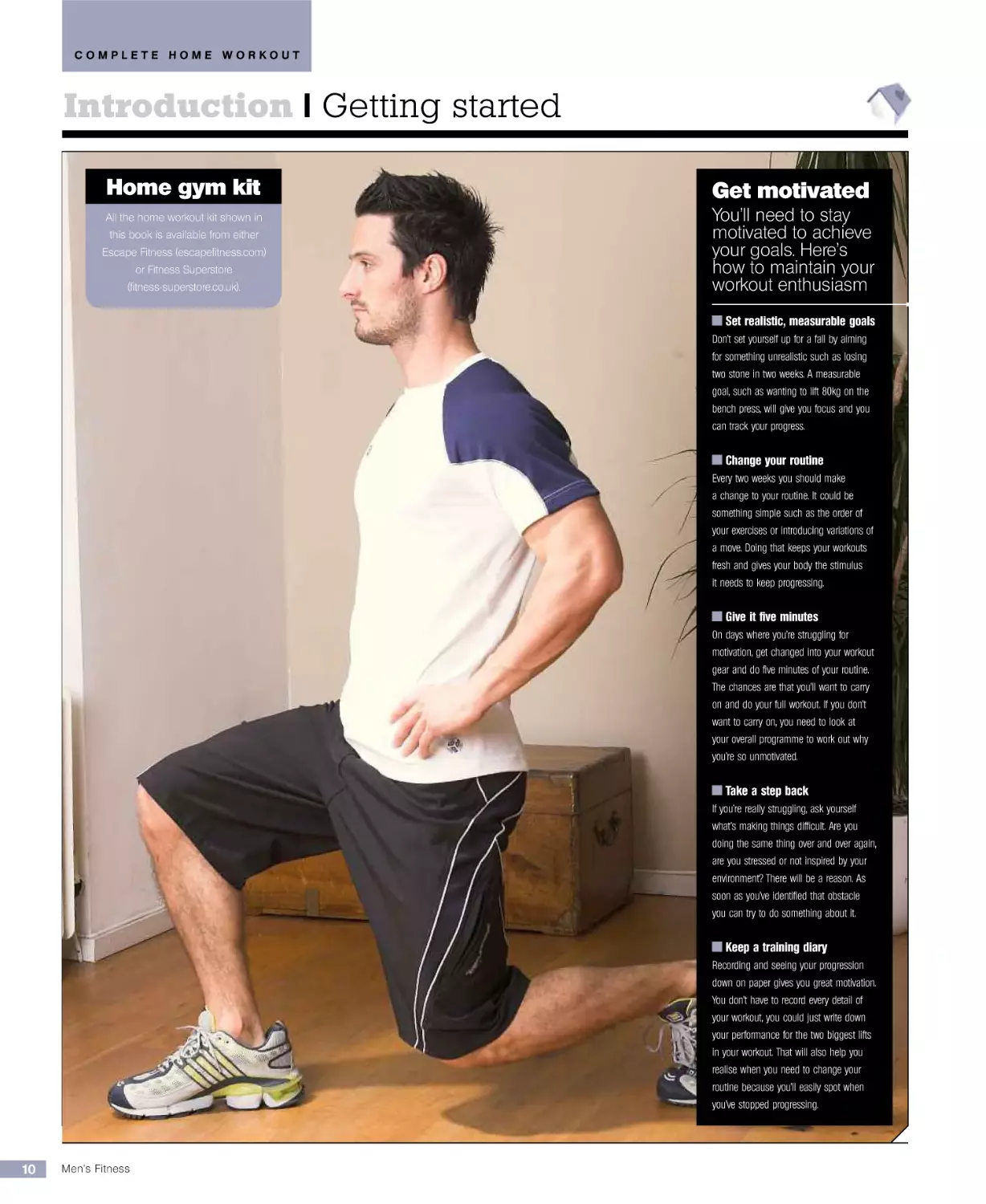
floor and lower your chest
to the floor, keeping your
elbows pointing back
rather than out
Complete your reps for
that set and swap legs
each set

Target: chest,
triceps, core
Keeping one leg
raised while you
perform the move
will challenge your
core because
you’re trying to
keep stable while
balancing on
one leg.

Men’s Fitness

41

COMPLETE HOME WORKOUT

Bodyweight | Exercises
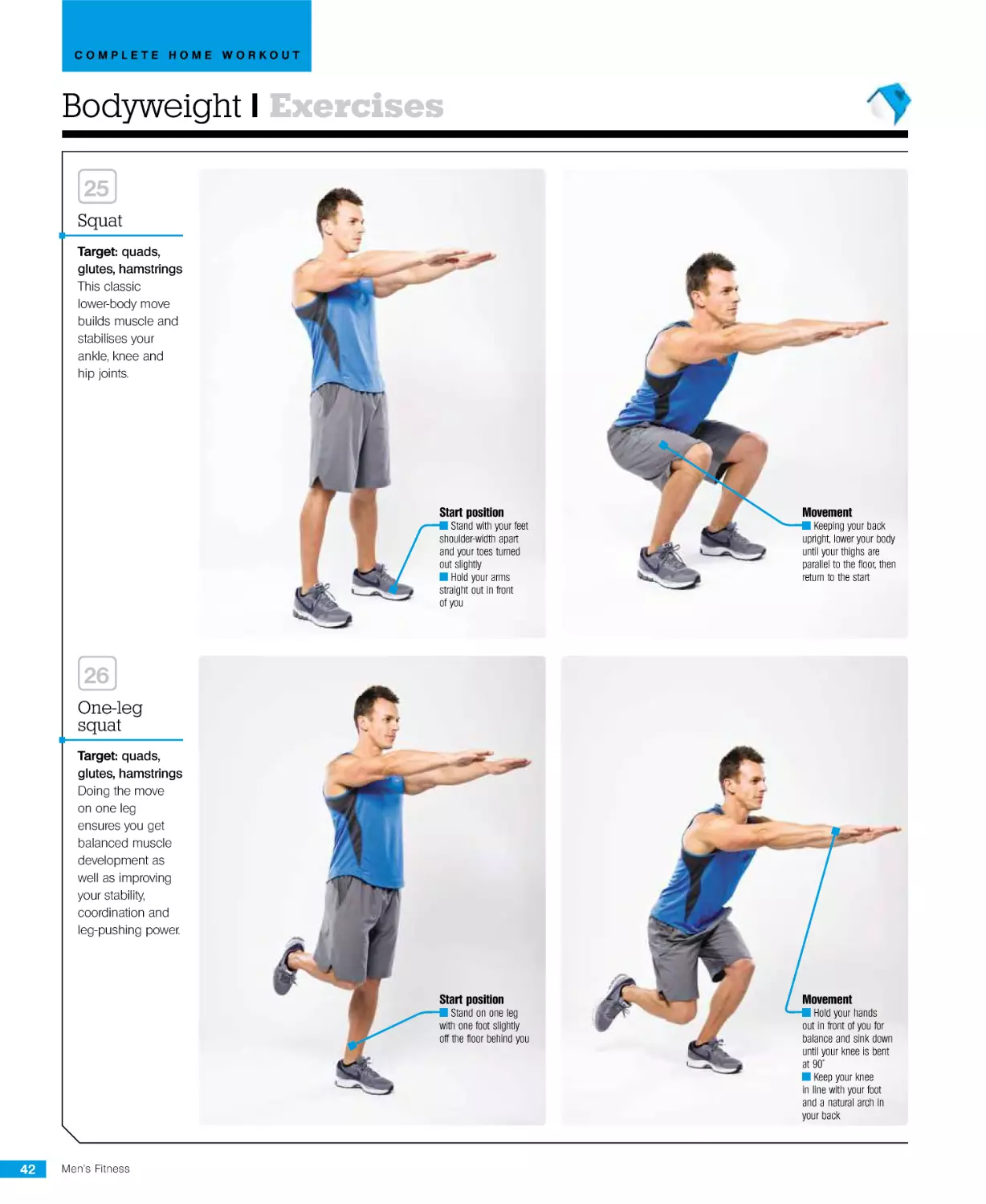
25
Squat
Target: quads,
glutes, hamstrings
This classic
lower-body move
builds muscle and
stabilises your
ankle, knee and
hip joints.

Start position

Stand with your feet
shoulder-width apart
and your toes turned
out slightly
Hold your arms
straight out in front
of you

Movement

Keeping your back
upright, lower your body
until your thighs are
parallel to the floor, then
return to the start

26
One-leg
squat
Target: quads,
glutes, hamstrings
Doing the move
on one leg
ensures you get
balanced muscle
development as
well as improving
your stability,
coordination and
leg-pushing power.

Start position

Stand on one leg
with one foot slightly
off the floor behind you

42

Men’s Fitness

Movement

Hold your hands
out in front of you for
balance and sink down
until your knee is bent
at 90˚
Keep your knee
in line with your foot
and a natural arch in
your back

COMPLETE HOME WORKOUT

Exercises | Bodyweight
Start position

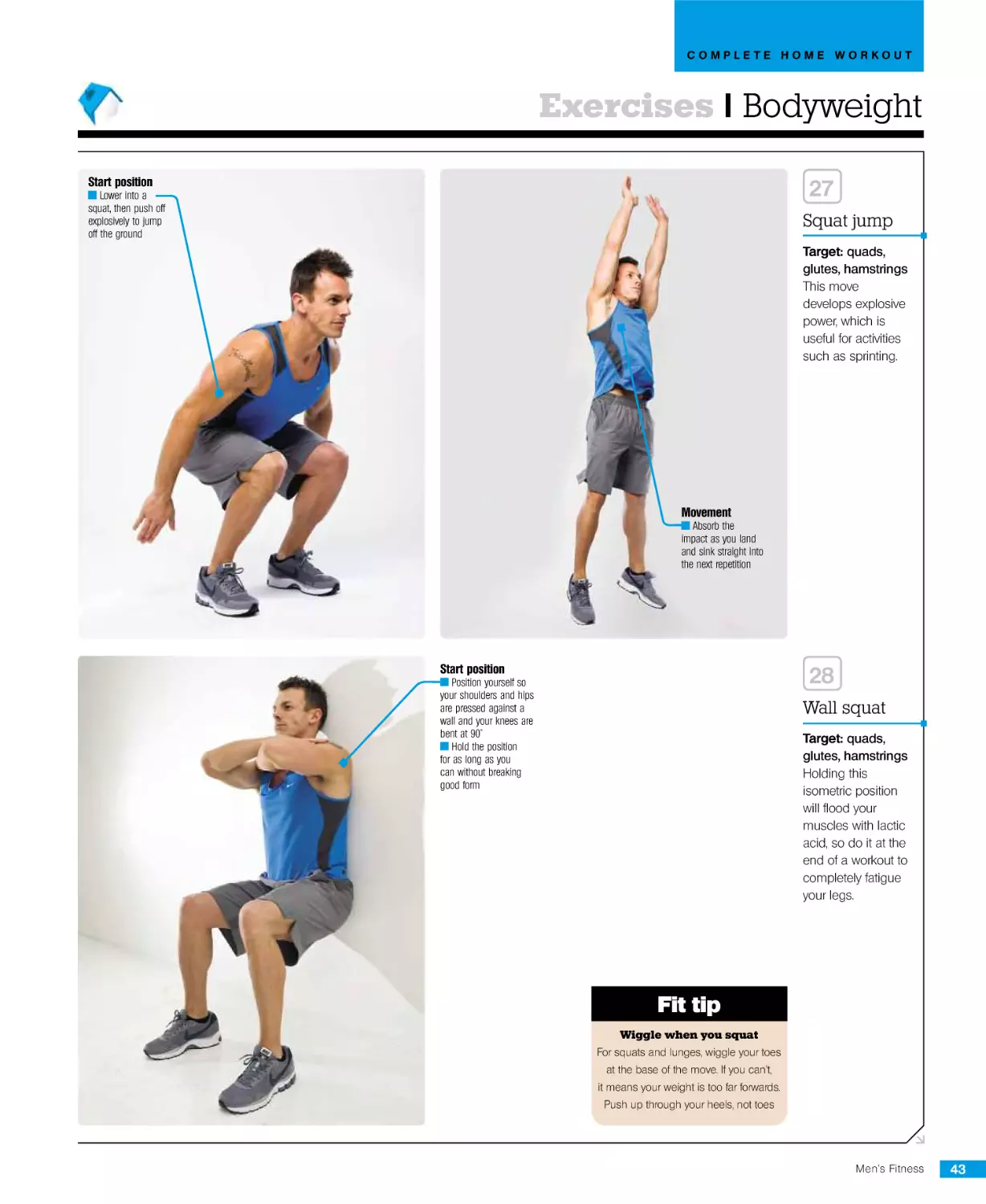
27

Lower into a
squat, then push off
explosively to jump
off the ground

Squat jump
Target: quads,
glutes, hamstrings
This move
develops explosive
power, which is
useful for activities
such as sprinting.

Movement

Absorb the
impact as you land
and sink straight into
the next repetition

Start position

28

Position yourself so
your shoulders and hips
are pressed against a
wall and your knees are
bent at 90˚
Hold the position
for as long as you
can without breaking
good form

Wall squat
Target: quads,
glutes, hamstrings
Holding this
isometric position
will flood your
muscles with lactic
acid, so do it at the
end of a workout to
completely fatigue
your legs.

Fit tip
Wiggle when you squat
For squats and lunges, wiggle your toes
at the base of the move. If you can’t,
it means your weight is too far forwards.
Push up through your heels, not toes

Men’s Fitness

43

COMPLETE HOME WORKOUT

Bodyweight | Exercises
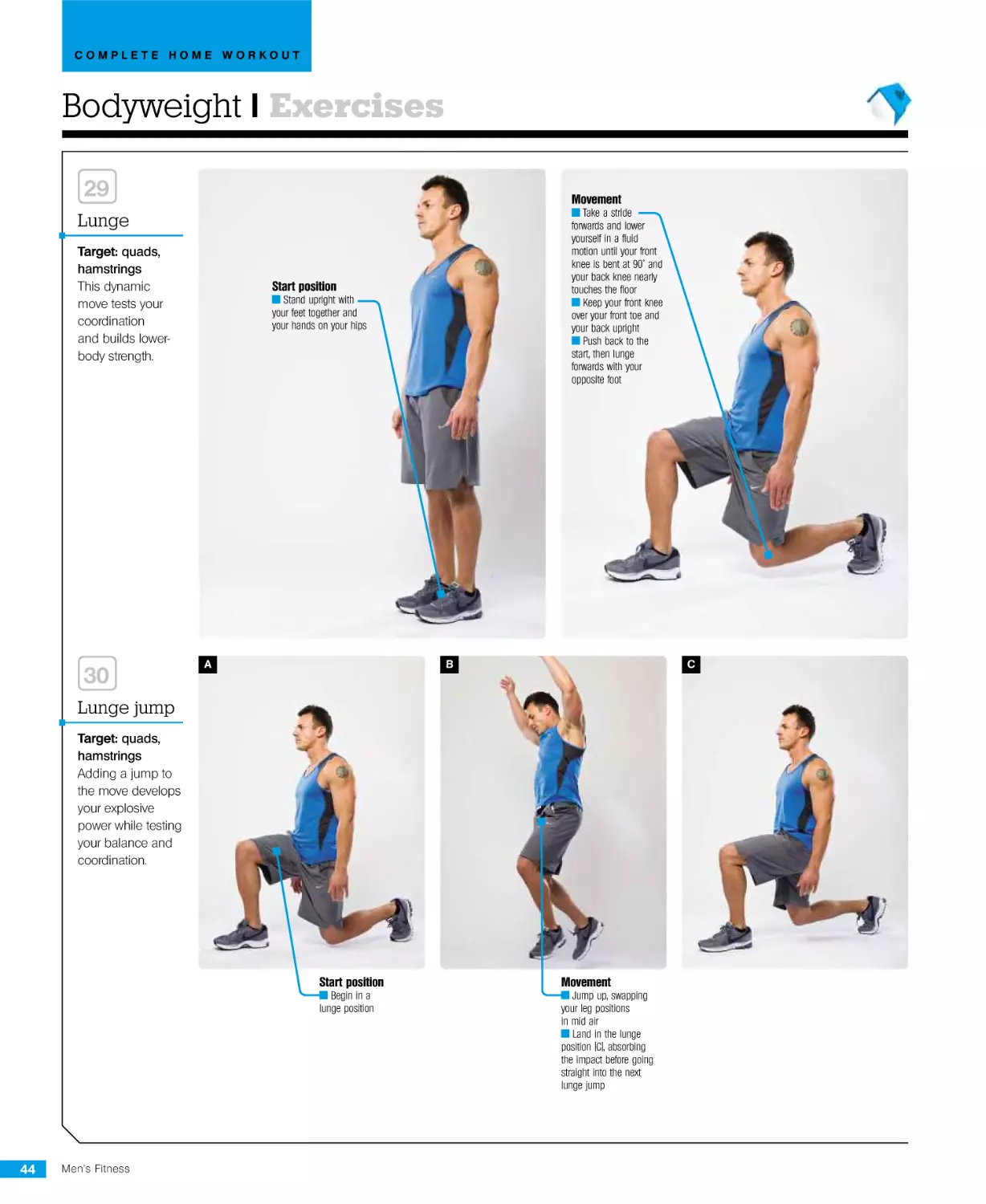
29

Movement

Take a stride
forwards and lower
yourself in a fluid
motion until your front
knee is bent at 90˚ and
your back knee nearly
touches the floor
Keep your front knee
over your front toe and
your back upright
Push back to the
start, then lunge
forwards with your
opposite foot

Lunge
Target: quads,
hamstrings
This dynamic
move tests your
coordination
and builds lowerbody strength.

30

Start position

Stand upright with
your feet together and
your hands on your hips

A

B

C

Lunge jump
Target: quads,
hamstrings
Adding a jump to
the move develops
your explosive
power while testing
your balance and
coordination.

Start position
Begin in a
lunge position

44

Men’s Fitness

Movement

Jump up, swapping
your leg positions
in mid air
Land in the lunge
position [C], absorbing
the impact before going
straight into the next
lunge jump

COMPLETE HOME WORKOUT

Exercises | Bodyweight
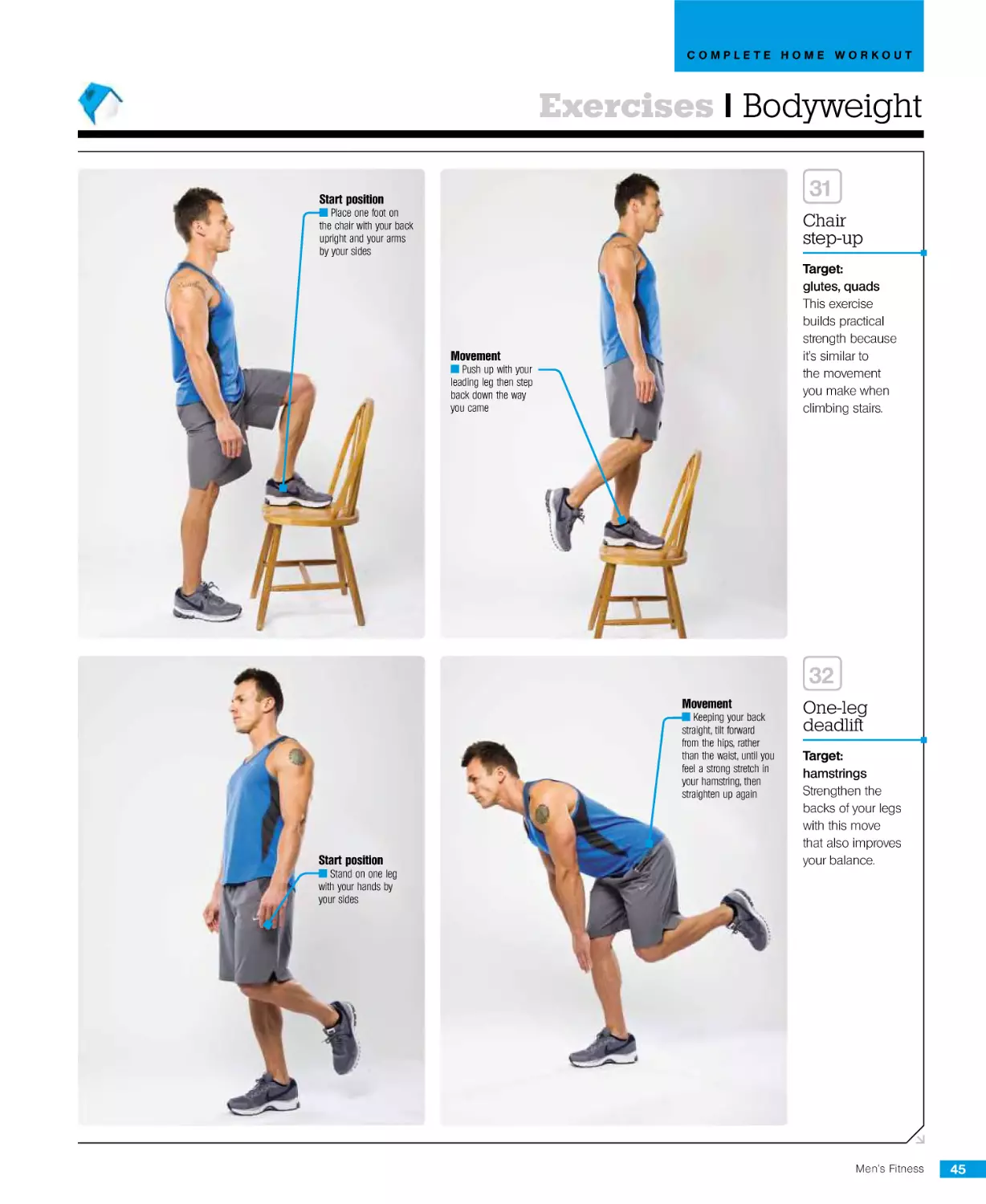
31

Start position

Place one foot on
the chair with your back
upright and your arms
by your sides

Chair
step-up
Target:
glutes, quads
This exercise
builds practical
strength because
it’s similar to
the movement
you make when
climbing stairs.

Movement

Push up with your
leading leg then step
back down the way
you came

32
Movement

Keeping your back
straight, tilt forward
from the hips, rather
than the waist, until you
feel a strong stretch in
your hamstring, then
straighten up again

Start position

Stand on one leg
with your hands by
your sides

One-leg
deadlift
Target:
hamstrings
Strengthen the
backs of your legs
with this move
that also improves
your balance.

Men’s Fitness

45

COMPLETE HOME WORKOUT

Bodyweight | Exercises
33

Movement

Bend at the elbows
to lower your upper
body until your head
almost touches the floor,
then press back up

Inverted
shoulder
press
Target: shoulders
It’s difficult to target
your shoulders
using bodyweight
alone, but this
move will get
them working.

Start position

Place your feet on a
chair or box and put your
hands on the floor beneath
your shoulders
Shuffle back with your
hands and bend at the hips
until your body forms an
inverted V-shape

34
Woodchop
Target: core,
lower back,
quads, shoulders
Develop your ability
to transfer force
from the lower to
the upper half of
your body with this
sporty move.

46

Men’s Fitness

Start position

Stand with your feet
shoulder-width apart
and your hands in front
of you
Squat and twist
to one side so your
hands are outside
one of your knees

Movement

Stand up and twist
to the opposite side,
lifting the heel you’re
twisting away from and
raising your hands over
your shoulder

COMPLETE HOME WORKOUT

Workouts | Bodyweight

Full-body workout

T

he best thing about
full-body workouts is
that they allow you
to work a large number of
muscle fibres in a short space
of time. The result is that
your body releases a flood
of growth hormones that will
make your muscles get bigger
and stronger. They’re great if
you’re new to training because
they get your muscles used to
weight training without putting
them under too much stress.
The downside of this
workout is that it’s hard to fully
exhaust your muscle fibres.
Designing your workout
The key to a sound full-body
workout is balance. That

means making sure you have
a pushing motion for every
pulling motion you do and that
you spend a roughly equal
amount of time on your upper
and lower body.
Opt for compound
exercises (multi-joint moves
that work several muscle
groups at once), as these will
give you maximum musclebuilding benefits.
Leave abs-specific
exercises, such as the crunch,
to the end of your workout
because you don’t want to
exhaust your core muscles
before they’re called on to
stabilise your spine in more
demanding moves such as
a table pull-up.

1

2

3

4

5

6

Full-body sample workout
1

Squat | Sets: 3 Reps: 10-12 Page: 42

2

One-leg deadlift | Sets: 2 Reps: 10 each side Page: 45

3

Table pull-up | Sets: 3 Reps: 10-12 Page: 36

4

Press-up | Sets: 3 Reps: 10-12 Page: 38

5

Inverted shoulder press | Sets: 3 Reps: 10-12 Page: 46

6

Woodchop | Sets: 2 reps 10 each side Page: 46

7

Jackknife | Sets: 3 Reps: 10-12 Page: 35

7

Men’s Fitness

47

COMPLETE HOME WORKOUT

Bodyweight | Workouts

Circuit training

T

his is a great option
if you’re short on time
or if your main goal is
fat loss. By doing different
exercises back to back with
no rest in between you keep
your effort level high and
force your heart to pump
blood to different parts of
your body, giving you both a
cardiovascular and a musclebuilding benefit. Circuits aren’t
the best way to build muscle,
but they will help you to look
lean and defined.

Designing your workout

Circuits require you to move
swiftly from one exercise
to the next, which is easier

with no kit. Aim to target as
many different muscle groups
as possible and alternate
between upper and lower
body moves to make your
heart work harder without
experiencing excessive
muscle fatigue.
Include a mix of pushing,
pulling, lunging, bending
and rotational moves, to give
your workout balance. You
should also try to complete
the reps quickly but without
compromising good form.
Once you’ve completed the
circuit, rest for three minutes
then do it all again. The fitter
you become, the more circuits
you’ll be able to complete.

1

2

3

4

5

6

Circuit training sample workout

48

1

One-leg deadlift | Sets: 1 Reps: 10 each side Page: 45

2

Inverted shoulder press | Sets: 1 Reps: 10 Page: 46

3

Chair step-up | Sets: 1 Reps: 10 each side Page: 45

4

T press-up | Sets: 1 Reps: 10 each side Page: 39

5

Lunge | Sets: 1 Reps: 10 each side Page: 44

6

Woodchop | Sets: 1 Reps: 10 each side Page: 46

7

Bicycles | Sets: 1 Reps: 0 each side Page: 33

Men’s Fitness

7

COMPLETE HOME WORKOUT

Workouts | Bodyweight

Core stability workout

T

The term ‘core
stability’ has become
increasingly popular
in recent years as strength
coaches acknowledge
the important role the core
muscles play in virtually every
area of physical performance.
Your core muscles are
the ones around your midriff,
including your abs and lower
back, and their function is to
provide a link between your
upper and lower body. They’re
particularly important during
whole-body moves, which
need a strong core to transfer
power between the upper
and lower halves of your body.
They’re also called upon to
stabilise your spine during
sporty movements such as
running or kicking a football.
A weak core can cause
lower back pain and poor

posture. You may also find
that you are ineffective at
transferring power, so the
work you do on other muscle
groups may be lost if your
core lets you down.

1

2

3

4

5

6

Designing your workout

The mistake most men make
when training their core
and abdominal muscles is
focusing too heavily on the
upper abs by doing endless
crunches. You need to place
equal emphasis on training
the muscles at the side and
back of your midriff.
Target your core muscles
from different angles, including
rotational movements, for a
thorough workout. Because
this workout focuses on
stability, you should complete
a relatively high number of
reps per set.

Core stability sample workout
1

One-leg deadlift | Sets: 2 Reps: 10-12 each side Page: 45

2

Woodchop | Sets: 2 Reps: 10-12 each side Page: 46

3

Crunch | Sets: 2 Reps: 15 Page: 31

4

Dorsal raise | Sets: 2 Reps: 15 Page: 38

5

Oblique crunch | Sets: 2 Reps: 15 each side Page: 32

6

Two-point box | Sets: 2 Reps: 15 each side Page: 37

7

Lower-body Russian twist

7

Sets: 2 Reps: 15 each side Page: 35

Men’s Fitness

49

COMPLETE HOME WORKOUT

Bodyweight | Workouts

Explosive power workout

E

xplosive, or plyometric,
workouts give you more
than one type of benefit.
They build muscle but they
also develop your power (the
combination of speed and
strength) and coordination.
Put simply, a plyometric
exercise is one that involves
extending a muscle across
its full range of motion before
explosively contracting it. This
dynamic movement targets
your fast-twitch muscle fibres,
exhausting them quicker than
a conventional workout but
without having to add extra
weight. The intensity will also
raise your heart rate, burning
extra calories and releasing
muscle-building hormones.
These types of workouts

are popular with sportsmen
because they can be used
to develop fast, powerful
movements and improve skills,
such as your vertical leap.
For each target body part, start
by doing an activation move
to warm up and stabilise
your muscles. Then do the
plyometric exercise before
performing a single-joint move
to exhaust the muscles.
The emphasis of these
sessions is on speed and
power, rather than developing
endurance. This means it is
essential for you to rest for
at least one minute between
sets and at least two minutes
between exercises.

1

Squat | Sets: 3 Reps: 12 Page: 42

2

Squat jump | Sets: 3 Reps: 10 Page: 43

3

Static wall squat

Sets: 1 Time: hold as long as possible Page: 43
4

Table pull-up | Sets: 3 Reps: 8 Page: 36

5

Table pull-up and reach

Sets: 2 Reps: 6 each side Page: 37

50

Dorsal raise | Sets: 3 Reps: 10 Page: 38

Men’s Fitness

2

3

4

5

6

Designing your workout

Explosive power sample workout
Legs and back

6

1

COMPLETE HOME WORKOUT

Workouts | Bodyweight

Superset workout

A

superset is two
exercises performed
back to back with no
rest in between. Once you
have finished both exercises,
you rest before performing
the superset again, just as
you would do with a regular
set. The reason for doing
supersets is that they are
time efficient because you’re
reducing the amount of rest
you take during a workout.
You can pair any two
exercises to form a superset,
but the most popular option
is to create antagonistic
supersets, where the two
moves work opposing body
parts. An example would be
to perform a press-up, which
works your chest, then a
table pull-up, which works
your back. The advantage
of antagonistic supersets is
that they give one body part
a chance to rest while the

opposing muscle group works.
They also give you balanced
muscle development.
Other common forms
include non-competing
supersets, which target
unrelated muscle groups such
as pairing a lower-body move
with an upper-body one, and
post-exhaustion supersets,
where you do a multi-joint
move followed by a singlejoint move targeting the
same body part.

1

Superset A

3

Superset C

2

Superset B

Designing your workout

If you’re going to do
antagonistic supersets, for
each exercise find one that
works its polar opposite, so
if you do one exercise that
targets your quads do another
that targets your hamstrings.
Biceps exercises should be
paired with triceps moves and
so on. After each superset, rest
for two minutes and repeat.

4

Superset D

Superset sample workout
1 Superset A
Press-up | Table pull-up | Sets: 3 Reps: 10-12 Page: 38/36
2 Superset B
One-leg squat | One-leg deadlift

Sets: 2 each side Reps: 10-12 Page: 42/45
3

Superset C Table chin-up | Chair dip

Sets: 3 Reps: 10-12 Page: 31/30
4

Superset D Crunch | Dorsal raise

Sets: 3 Reps: 10-12 Page: 31/38

Men’s Fitness

51

COMPLETE HOME WORKOUT

Dumb-bells &
gym ball
introduction
A set of dumb-bells and a gym ball
can give you serious muscle gains

T

he foundation of any home
gym set-up should be a set
of dumb-bells and a gym
ball. The reason they’re so useful
is that they are so versatile.
You can target any body part
in a variety of ways, increasing
your chances of losing fat and
gaining muscle.
This chapter will give you
a wide variety of exercises for
each major body part. You can
then begin to explore a range
of workout techniques that will
make sure you keep challenging
your body and help you get
bigger and stronger.
Dumb-bells allow you to
fatigue your muscles easily within
your desired rep range, helping
to build new muscle. The fact that
you hold one in each hand gives
you balanced muscle growth
and develops your stabilising
muscles because you’re forced
to control their movement.

A gym ball is excellent at
increasing the instability of an
exercise, which will improve your
core strength. The greater the
instability, the harder the exercise.
For that reason, a gym ball is a
great tool to use in conjunction
with a set of dumb-bells because
you’ll struggle to complete your
sets of unstable exercises, even if
your heaviest dumb-bell is 10kg.
Of course, there are some
things that you can’t do with
dumb-bells and gym ball. If you
want to do heavy compound lifts,
which will burn lots of calories
and flood your body with muscle
growth hormones, you’ll need to
invest in a barbell and bench.
But before you do that you need
to build a solid base of fitness.
And even once you introduce a
bar and bench into your routine,
you should still do dumb-bell and
gym ball moves to get an allround training effect.

Men’s Fitness

53

COMPLETE HOME WORKOUT

Dumb-bells & gym ball | Buyer’s guide

Dumb-bells and
gym ball gear guide

A gym ball and a set of dumb-bells are the cornerstone of
a home gym. Here’s what they do and how to buy them
Gym ball
What it does

is durable. The cheaper the
ball, the more likely it is that
you’ll need to replace it after
a few months, so buy one
that’s anti-burst. You need
to make sure it can support
your bodyweight and any
additional weight such as
a pair of dumb-bells.

with your knees bent at about
90˚ and your feet flat on the
floor, so taller people will need
a larger size than shorter
people. Use the following
guide to find the right size:
User height

Ball size

What to look for

Durability: Check that the ball

Size: Gym balls come in
different sizes. You want to be
able to sit on top of the ball

1.50-1.64m
1.65-1.81m
1.82-2.00m

55cm
65cm
75cm

Fixed dumb-bells

Plate-loaded dumb-bells

Adjustable dumb-bells

As the name implies, the weight
can’t be altered. The advantage is
that it’s quick and easy to use your
desired weight, but the downside
is that they’re expensive and take
up a lot of space. If you do invest in
a set of fixed dumb-bells, try to get
ones with hexagonal ends because
they can be used on the floor for
exercises such as T press-ups
without rolling around.

These are the low-cost option, so
they’re appealing if you’re on a
tight budget. They have two collars,
which secure plates to either end
of the dumb-bell bar. When they’re
loaded they work your body in
exactly the same way as fixed
and adjustable dumb-bells. The
difference is that it can be timeconsuming to keep altering the
weights between exercises.

This type of dumb-bell lets you
change the weight you lift without
having to mess around with weight
plates. The most sophisticated
versions allow you to position a
dial next to the value of the weight
you want to lift. They are more
expensive than plate-loaded dumbbells but they’re more convenient
and they do allow you to stick rigidly
to rest periods.

Gym balls, also known
as stability or Swiss balls,
promote increased joint and
core stability by forcing the
body to stabilise itself on an
unstable surface. Stability
balls are relatively cheap and
portable so they’re perfect for
home training.

Dumb-bells
Dumb-bells allow you to
perform an enormous number
of resistance exercises. They
are incredibly versatile and
can be used to exhaust,
and therefore develop, the
strength and size of any
muscle. Because you hold
a dumb-bell in one hand it
creates instability, which forces
the body to control itself and
encourages balanced muscle
development. There are three
main types of dumb-bell: fixed,
plate-loaded and adjustable.

54

Men’s Fitness

COMPLETE HOME WORKOUT

Men’s Fitness

55

COMPLETE HOME WORKOUT

Dumb-bells & gym ball | Exercises
01
Dumb-bell
curl
Target: biceps
Using dumb-bells
works your biceps
evenly, giving
you balanced
muscle growth.

Start position

02
Gym ball
dumb-bell
curl
Target: biceps
Introducing a gym
ball forces you
to engage your
core muscles to
stabilse your body,
which promotes
good posture
when performing
the move without
a ball.

56

Men’s Fitness

Movement

Start with the
dumb-bells by your
sides with your arms
facing forwards
Keep your
shoulders back and
your core braced

As you lift the weight,
keep your elbows
tucked into your sides
and don’t rock back and
forth to use momentum
Pause at the top of
the move and lower
slowly back to the start

Start position

Movement

Select a ball that
allows you to sit on the
top of it with your knees
bent at 90˚
Sit with your
torso upright, your
shoulders back and
the dumb-bells by the
side of the ball

Keep your elbows
tucked into your sides
as you lift the weight
Pause at the top of
the move then lower
slowly back to the start

COMPLETE HOME WORKOUT

Exercises | Dumb-bells & gym ball
03
Concentration
curl
Target: biceps
By locking your
elbow in place you
remove any upperarm swing and
focus the stress
on your biceps.

Start position

Movement

Rest your elbow
just inside your knee

Keep your upper body
still and curl the dumb-bell
up to your chest

Fit tip
Stretch your triceps

04

to build your biceps
To get the most out of your biceps

Gym ball
dumb-bell
preacher curl

moves, do a triceps stretch before each
set of bicep curls to temporarily weaken
the triceps. Provided you follow good
form on the bicep curls, you should be

Target: biceps
As well as hitting
your biceps, this
is a great move
for developing
coordination of
your shoulders,
hips and core in
the frontal plane
of motion. Use a
lighter weight to
make sure you
perform the
move correctly.

able to get bigger arms, faster

Start position

Rest your upper arms
on the ball and keep a
slight bend in your elbows
Turn your wrists inwards
slightly to take some of the
stress off that joint

Movement

Keep your upper
body still and curl the
weights up towards your
shoulders before lowering
slowly to the start

Men’s Fitness

57

COMPLETE HOME WORKOUT

Dumb-bells & gym ball | Exercises
05
Hammer curl
Target: biceps
Curling the weight
with a neutral grip
takes some of the
emphasis off your
biceps and places
more stress on
your forearms.

Start position

Stand with your
back straight, your
shoulders back and
your core braced
Grip the dumb-bells
with palms facing
inwards and tuck your
elbows into your sides

Movement

Curl the weight
without rotating your
wrists and make sure
you keep your elbows
tucked in
Avoid rocking back
and forth because
this allows you to use
momentum to complete
the movement

06
Hammer curl
with twist
Target: biceps
Performing the
move one arm at
a time encourages
you to stay
upright and take
momentum out
of the move. By
rotating your wrists
at the top of the
move, you target
your biceps from
two angles.

58

Men’s Fitness

Start position

Stand with your
back straight, your
shoulders back and
your core braced
Grip the dumb-bells
with your palms facing
inwards and tuck your
elbows into your sides

Movement

Curl one dumb-bell
up at a time, turning
your wrists out at the
top of the move to
place extra tension
on your biceps

COMPLETE HOME WORKOUT

Exercises | Dumb-bells & gym ball
07
Gym ball
lying triceps
extension
Target:
triceps, core
Doing a triceps
extension on a
gym ball calls on
your core muscles
to stabilise
the movement.

Start position

Start with your upper
back and shoulders in
contact with the gym
ball and hold a single
dumb-bell above your
face with both hands

Movement

Lower the weight
behind your head,
pivoting at the elbows
to keep your upper
arms still
Keep your body
horizontal and your
knees bent at 90˚

08

Start position

Start with your torso
upright and the weight
above your head with
your arm straight

Movement

Lower the weight
slowly by pivoting at
the elbow and keeping
your upper arm still
Keep your body
upright throughout
the move

Dumb-bell
overhead
triceps
extension
Target: triceps
This move
encourages you to
stabilise your body
while working the
long head of the
triceps brachii for
defined muscles.

Men’s Fitness

59

COMPLETE HOME WORKOUT

Dumb-bells & gym ball | Exercises
09
Two-arm
dumb-bell
kickback

Start position

Bend forwards at
the hips and keep your
back in its natural arch
Start with your
elbows bent at 90˚

Target:
triceps, core
Work the triceps
on both arms
and challenge
your core at the
same time.

Movement

Straighten your
arms while keeping
your upper arms as
still as possible
Keep your core
braced throughout
the move to maintain
a neutral arch in
your spine

10
Gym ball
chair dip
Target:
triceps, core
Increase the
challenge to your
triceps and core by
placing your feet
on a gym ball.

Start position

Grip the edge of the
chair with your hands and
rest your heels on top of
a gym ball
Keep your feet together,
your legs straight and your
back upright

60

Men’s Fitness

Movement

Lower your body
straight down, keeping
your elbows pointing
back, then press back
up powerfully

COMPLETE HOME WORKOUT

Exercises | Dumb-bells & gym ball
Movement

Contract your abs to
curl your chest towards
your knees, keeping
your lower back in
contact with the ball
Pause at the top of
the move to squeeze
your abs, then lower
slowly to the start

11
Gym ball
crunch
Target:
abdominals
Using a gym
ball increases
your range of
motion, giving
your abdominal
muscles a fuller
workout while
the instability
challenges
your core.

Start position

Fit tip
Stay on the ball

Touch your fingers to
your temples and lean
as far back as you can
on the ball

Gym balls are great because they’re
wobbly. This forces your muscles,
including your abs, to work harder to
stabilise your body during any exercise
than if you were on a solid surface

12
Dumb-bell
crunch

Start position

Keep your feet on the
floor and your knees bent
at 90˚ throughout the move
Hold your head off
the floor but keep your
lower back in contact
with the floor
Hold the dumb-bell
to your chest

Movement

Contract your abs to
lift your shoulders off the
floor, pause at the top of
the move to squeeze your
abs, then lower slowly to
the start

Target: upper
abdominals
Adding weight
rather than doing
more reps will have
a better musclebuilding effect on
your abs so, if you
find crunches easy,
add resistance by
using a dumb-bell.

Men’s Fitness

61

COMPLETE HOME WORKOUT

Dumb-bells & gym ball | Exercises
13
Gym ball
oblique
crunch
Target: obliques
(side abs)
Hit your abs
from the sides
and get a broad
range of motion
by performing an
oblique crunch on
a gym ball.
Start position

Jam your feet against
a support
Lie sideways and curl
your body around the ball

14
Gym ball
side plank
Target: core
Plank exercises
are great for
developing core
strength. Doing
them on a gym ball
makes them even
more challenging.

62

Men’s Fitness

Start position

Hold your body in a
straight line from head
to heels, and position
your elbow directly
under your shoulder
Use your core
muscles to control
the instability
Hold that position
for as long as possible
without letting your
hips drop, then repeat
the move on the
opposite side

Movement

Use your side abs
to crunch up sideways,
hold for a second at the
top of the move, and
lower under control

COMPLETE HOME WORKOUT

Exercises | Dumb-bells & gym ball
15
Side plank
with lateral
raise
Target:
core, deltoids
Adding a lateral
raise to a side
plank increases the
challenge to your
core and improves
your coordination.

Start position

Hold your body in a
straight line from head
to heels, and position
your elbow directly under
the shoulder

Movement

Hold the plank position
while slowly raising and
lowering the weight
Use a light weight to
maintain perfect form

16
Gym ball
jackknife
Target: upper and
lower abdominals
The instability and
range of motion
involved in this
move allow you
to hit both your
upper and lower
abdominals.

Start position

Rest your instep on top
of the ball with your body
in a straight line and your
hands directly beneath
your shoulders

Movement

Roll your feet over the
ball to draw your knees in
to your chest
Try to avoid raising your
backside as you move
the ball

Men’s Fitness

63

COMPLETE HOME WORKOUT

Dumb-bells & gym ball | Exercises
17

A

B

Gym ball
passing
jackknife
Target: upper and
lower abdominals
Using a gym ball
encourages you
to maintain perfect
form throughout
the move.

Movement

Keeping your arms and
legs as straight as you
can, pass the ball from
hands to feet at the top
of the move
Lower slowly with the
ball clasped between
your feet and return the
ball to your hands on
the next rep

Start position

Hold the ball behind
your head

C

18
Seated
Russian twist
Target: obliques
Work your side
abs and your core
with this functional
exercise that is
good for sports
that involve
twisting moves.

Start position

Keep your back straight,
your body at 45˚ to the
floor and your knees bent
at 45˚
Hold the dumb-bell in
both hands to one side
of your body

64

Men’s Fitness

Movement

Twist your torso
to one side but keep
looking straight ahead
Twist your torso to
the opposite side, using
your abs to control
the momentum

COMPLETE HOME WORKOUT

Exercises | Dumb-bells & gym ball
19

Start position

Start with your
shoulders resting on
the ball, your body
in a straight line and
a dumb-bell at arms
length above your head

Gym ball
dumb-bell
Russian twist
Target: core
Using a gym ball
takes some of the
strain off your lower
back but still poses
a challenge to your
core muscles.

Movement

Twist your torso to one
side until your arms are
parallel to the floor
Twist back to the
opposite side, looking
towards the dumb-bell

Start position

Start with your
back straight, your
core braced and
shoulders retracted
Lean forward from
the hips, not the waist
Stand with your feet
shoulder-width apart
and bend your
knees slightly
Hold the
dumb-bells
just outside
your knees

Movement

Pull the weights
up to your sternum,
allowing your wrists to
turn naturally during the
movement and
squeeze your
shoulder blades
together at the
top of the move
Slowly lower
the dumb-bells
back to the start

20
Dumb-bell
bent-over
row
Target: traps,
lats, rhomboids
Doing this classic
back-building
move with dumbbells will give you
balanced muscle
development
because it prevents
your stronger side
from taking more of
the strain.

Men’s Fitness

65

COMPLETE HOME WORKOUT

Dumb-bells & gym ball | Exercises
21
Bent-over
flye
Target: upper
back, shoulders
Get a strong
upper back with
this move that
develops scapular
retraction (the
action of pulling
your shoulder
blades together).

Start position

Start with your
back straight, your
core braced and your
shoulders retracted
Lean forward from
the hips, not the waist
Stand with your
feet shoulder-width
apart and bend your
knees slightly
Hold the dumb-bells
together just in front
of your knees,
keeping a
slight bend
in the elbows

Movement

Raise the weights
straight out to the sides
without moving your
upper body

22
Gym ball
back
extension
Target:
lower back
Using a gym ball
gives you a broad
range of motion.
It’s also a crucial
move for balancing
the training
effect of doing
crunches and for
improving posture.

66

Men’s Fitness

Start position

Wrap your body
around the ball and
jam your feet against
a wall for support

Movement

Lift your back until
your body forms a
straight line, but
don’t over-extend

COMPLETE HOME WORKOUT

Exercises | Dumb-bells & gym ball
23
Gym ball
dumb-bell
reverse flye

Start position

Use a light weight and
keep your stomach on the
centre of the ball

Movement

Raise the dumb-bells,
keeping your arms in
the ten-to-two position
and your thumbs
pointing towards the
ceiling to activate your
stabilising muscles
Pause at the top of
the move and lower the
weights slowly

Target: back,
shoulders, core
Chest and
shoulder pressing
moves work
the front of your
shoulder. This
move will help
you achieve
balanced muscle
gains because it
works the back of
your shoulders.

24
Dumb-bell
upright row
Target: upper
traps, shoulders
Develop your
upper back and
shoulders while
increasing
your upright
pulling strength.

Start position

Start with the
dumb-bells in front
of your thighs

Movement

Raise your elbows
to the sides to lift
the dumb-bells up
to your chest

Men’s Fitness

67

COMPLETE HOME WORKOUT

Dumb-bells & gym ball | Exercises
25
Dumb-bell
shrug
Target:
upper traps
Add size to your
upper back with
this balanced
move, which will
also help stabilise
your shoulder
girdle and reduce
your chances
of sustaining a
shoulder injury.
Movement

Raise your shoulders
straight up without
bending your elbows
and hold the top
position for one or
two seconds

Start position

Start with your
palms facing inwards

Movement

26

Press the weights
up, then lower slowly
to the start

Gym ball
dumb-bell
chest press
Target: chest
Using dumb-bells
for this classic
chest exercise
will give you
a good range
of movement,
balanced muscle
development and
will recruit your
glutes and core to
stabilise the move.
Start position

Support your head and
shoulders on the ball and
hold the dumb-bells at
chest level
Brace your core and
make sure that your body
is straight form head to
knees and your knees are
bent at 90˚

68

Men’s Fitness

COMPLETE HOME WORKOUT

Exercises | Dumb-bells & gym ball
27
Gym ball
press-up
Target:
chest, triceps
Performing a pressup on a gym ball
forces your chest
muscles to control
the movement,
which will help
when you come
to perform heavier
pressing exercises.

Start position

Keep your body in a
straight line from head
to heels
Grip the sides of the
ball roughly in line with
your shoulders

Movement

Lower slowly by
bending at the elbows and
push back up powerfully

28
Gym ball
decline
press-up
Target: chest,
shoulders, triceps
and core
Resting your feet
on top of a gym
ball adds instability,
to give your core a
good workout.

Start position

Start with your hands
on the floor beneath
your shoulders
Rest your feet together
on top of the ball

Movement

Perform a press-up but
don’t let your hips sag

Men’s Fitness

69

COMPLETE HOME WORKOUT

Dumb-bells & gym ball | Exercises
33
Gym ball
dumb-bell
flye
Target: chest
This exercise
primarily targets
your pecs but
also recruits your
core and glutes to
stabilise the move.

Movement

Have a slight bend in
your elbows and lower the
dumb-bells in an arc out
to the side
Use your chest muscles
to return the weights to
the start without arching
your back

Start position

Support your head
and shoulders on
the ball
Keep a straight line
from head to knees
with your knees bent
at 90˚

34

A

Movement

Push up powerfully and
twist your body, rolling on
to the sides of your feet
and keeping your body in
a straight line
Raise a dumb-bell
overhead with your arm
straight, then return to
the start and perform the
move on the opposite side

Dumb-bell
T press-up
Target: chest,
shoulders, arms
and core
Turn the press-up
into an explosive
move that works
your body in more
than one plane
of motion.

Start position

Grip the dumb bells with straight wrists and position them below your shoulders
Keep your body in a straight line and your elbows tucked in to your body
Keep your feet shoulder-width apart and don’t let your hips sag

B

70

Men’s Fitness

C

COMPLETE HOME WORKOUT

Exercises | Dumb-bells & gym ball
31
Gym ball
dumb-bell
pullover
Target: chest,
lats and core
Use this
single-joint move
to hit multiple
muscle groups.

Movement

Lower the weight
slowly behind your head,
keeping a slight bend in
your elbows
Use your chest muscles
to pull the weight back to
the start but avoid arching
your back to aid the move

Start position

Support your head
and shoulders on the
ball with the dumb-bell
in both hands above
your chest
Engage your core
and keep your feet flat
on the floor

Movement

Hold the dumb-bells
by your sides and lower
until your thighs are
parallel with the ground
Don’t round your
back and keep your
knees in line with
your feet
Push back up
through your heels

32
Dumb-bell
squat
Target: quads,
glutes, hamstrings
Hit several major
muscle groups
at once with this
must-do leg move.

Start position

Stand with your feet
shoulder-width apart
with your toes turned
out slightly and your
core muscles braced

Men’s Fitness

71

COMPLETE HOME WORKOUT

Dumb-bells & gym ball | Exercises
33

Movement

Grip a dumb-bell with
both hands and lower
until your thighs are
parallel to the floor
Keep your knees in
line with your toes and
keep your back upright

Dumb-bell
sumo squat
Target: quads
By taking a wider
stance you place
more emphasis
on the inside of
your quads.

Start position

Take a wide stance
with your toes pointing
out slightly

34
Dumb-bell
gym ball
wall squat
Target: quads
This is a great
move if you’re
unused to doing
squats because
using a ball will
engage your
core and improve
your coordination
for this kind
of movement.

Start position

Place the ball behind
your lower back

Movement

Let the ball roll up
your back as you squat

72

Men’s Fitness

COMPLETE HOME WORKOUT

Exercises | Dumb-bells & gym ball
Movement

Step forward and,
in one fluid motion,
bend your front knee
and lower your back
knee until it almost
touches the floor
Keep your torso
upright throughout the
move and make sure
your front knee is over
the front toe
Push off the front foot
to return to the start

35
Dumb-bell
lunge
Target: quads,
hamstrings
Build muscle,
increase your
power and improve
your coordination
with this classic
leg move.

Start position

Stand with your feet
slightly apart, your back
upright and the dumbbells by your sides

36
Dumb-bell
side lunge
Target: adductors
Focus on your
inner thighs to
make sure you
don’t have any
weak spots in
your legs and
improve your
properioception
– the body’s
ability to sense
its movements.

Start position

Start with your feet
close together and
facing forward, your
torso upright and the
dumb-bells at your sides

Movement

Take a big step to
the side, lowering on
to your leading leg
Keep your torso
upright throughout the
move and your head
facing forwards and
your bent knee in line
with your foot

Men’s Fitness

73

COMPLETE HOME WORKOUT

Dumb-bells & gym ball | Exercises
37

Movement

Step back into a
lunge, bending your
back leg so your
back knee nearly
touches the floor
Keep your torso
upright throughout the
move and make sure
your front knee is over
your front toe
Push off the back
foot to return to the start

Dumb-bell
reverse
lunge
Target: quads,
hamstrings
By stepping
backwards instead
of forwards you
target your quads
and hamstrings
in a different way
and increase
the coordination
challenge.

Start position

Stand with your feet
slightly apart, your back
upright and the dumbbells by your sides

38
Dumb-bell
chair step-up
Target:
quads, glutes
This exercise has
real-life benefits
because you do
this move every
day when you
climb stairs.

Start position

Try to find a chair
or box that is no
higher than knee
height and place one
foot flat on the top
Keep your back
upright and hold
the dumb-bells by
your sides

Movement

Push up with
your leading leg
while keeping your
back upright
Step back down
with your trailing leg
and repeat as before
for all your reps before
swapping sides

74

Men’s Fitness

COMPLETE HOME WORKOUT

Exercises | Dumb-bells & gym ball
Movement

Start position

Rest the instep
of your back foot
on the ball and plant
your front foot so it’s
facing forwards
Your hips should
be facing forwards
and your torso should
be upright with your
core braced

Keeping your torso
upright, lower until your
front thigh is parallel to
the floor
Keep your front knee
in line with your foot
but make sure it doesn’t
travel beyond your toes

Movement

Start position

Rest the instep
of your back foot
on the ball and plant
your front foot so it’s
facing forwards
Your hips should
be facing forwards
and your torso should
be upright with your
core braced

Hold your hands
out in front of you and,
as you lower, twist
your torso to one side,
alternating sides with
each rep

39
Gym ball
dumb-bell
Bulgarian
split squat
Target:
quads, glutes
Placing one foot on
the ball deactivates
that leg and places
all the emphasis
on your front leg.

40
Gym ball
Bulgarian
split squat
with twist
Target:
quads, glutes
Removing the
dumb-bell but
adding a twist
makes the move
more of a test of
coordination and
works your body in
several planes at
the same time.

Men’s Fitness

75

COMPLETE HOME WORKOUT

Dumb-bells & gym ball | Exercises
41
Split
dumb-bell
Romanian
deadlift

Start position

Start in a split stance
with the whole of your
front foot and the toes
of your back foot on
the floor

Target:
hamstrings
Develop the backs
of your legs but
make sure you
use perfect form to
protect your back.
This move has
huge functional
benefits because
it’s similar to
the movements
you make when
bending down to
pick something up.

Movement

Hold the weight
either side of your
thigh and initiate the
move from your hips,
not your waist
Keep your back
flat and let the
weights travel down
your shins or until you
feel a good stretch in
your hamstrings

42
Gym ball
hamstring
curl
Target:
hamstrings
This move will
develop your
hamstrings while
improving your
stability in your hips
and lower back.
Start position

Rest your head and
shoulders on the floor
and keep your body in a
straight line from shoulders
to heels with your arms by
your sides and your heels
on top of the ball

76

Men’s Fitness

Movement

Raise your hips and
drag the ball towards your
backside with your heels,
keeping your body straight
throughout the move
Pause at the top of the
move and return slowly to
the start

COMPLETE HOME WORKOUT

Exercises | Dumb-bells & gym ball
43
One-leg
gym ball
hamstring
curl
Target:
hamstrings
Doing the curl
with one leg really
gets your muscles
working hard to
control the wobble
of the ball.

Start position

Movement

Rest your head and
shoulders on the mat
and keep your body in
a straight line from
shoulders to heels
Position your arms by
your sides with one heel
on top of the ball and the
other leg raise slightly

A

Curl the ball towards
your backside with your
heel, pause and return to
the start

B

Start position

Start with your
body flat on the floor

C

44
Gym ball
hip raise
and leg curl

Movement

Raise your hips until
your body is straight from
shoulders to heels
Drag the gym ball
towards your backside
with your heels

Target:
hamstrings,
hip flexors
Starting the move
with a hip raise
works your hip
flexors before
targeting your
hamstrings.

Men’s Fitness

77

COMPLETE HOME WORKOUT

Dumb-bells & gym ball | Exercises
45
Supine
gym ball
calf raise
Target: calves
This works your
hard-to-target
calves, forcing
them to stabilise
your entire body,
which will help
during bigger lifts.

Start position

Fit tip
Limit your reps
Increase muscle size by increasing

Movement

Rest your head and
shoulders on the ball
with your body in a
straight line and your
knees bent at 90˚

Push up on to your toes
and hold for a two-count
before lowering

the resistance rather than the
number of reps. Try holding a dumbbell on your chest during calf raises.

46
Gym ball
dumb-bell
shoulder
press
Target: deltoids
Using dumbbells allows your
arms to move
in a natural arc
and will give you
balanced muscle
development.
The gym ball
calls on your
stabilising muscles
to keep your torso
steady throughout
the move.

78

Men’s Fitness

Start position

Sit on the ball with
your feet flat on the
floor and the dumbbells held at shoulder
height and your elbows
out to the sides

Movement

Keep your core
braced throughout the
move and avoid arching
your back
Press the weights
directly overhead but
don’t let the weights
touch at the top

COMPLETE HOME WORKOUT

Exercises | Dumb-bells & gym ball
47
Gym ball
dumb-bell
Arnold press

Movement

Rotate your palms
forwards as you press
the weights up
End with palms
facing forwards and
reverse the movement
back to the start

Start position

Start with your palms
facing you and your
elbows out to the front

Target: deltoids
Introducing rotation
to the move hits
your deltoids from
several angles in
the same exercise.

48
Alternating
dumb-bell
shoulder
press

Start position

Stand with your feet
shoulder-width apart
with your torso upright
and your core braced
Start with the dumbbells at shoulder level

Movement

As you lower one
dumb-bell, raise the
other and use your core
muscles to stabilise
the movement and
avoid rocking from
side to side

Target: deltoids
Focusing on one
shoulder at a time
makes each side
work as hard as
possible and gives
you balanced
muscle growth.

Men’s Fitness

79

COMPLETE HOME WORKOUT

Dumb-bells & gym ball | Exercises
49
Rotating
squat press

Start position

Start with the dumbbells at shoulder level

Target:
whole body
Add a squat and
rotation to turn a
shoulder move
into a whole-body
exercise.

Movement

Sink into a squat
and, as you rise up,
rotate your body and
press the dumb-bell
overhead, lifting your
heel as you turn
Return to the start
and repeat the move
on the other side

50
Alternating
wide
shoulder
press
Target: deltoids
Hit your deltoids
from a slightly
different angle
with this variation
of the classic
shoulder press.

80

Men’s Fitness

Start position
Start with the
dumb-bells at
shoulder level

Movement

Press the weight at a
45˚ angle to your body
You may need to use
a slightly lighter weight
than you would for a
regular shoulder press

COMPLETE HOME WORKOUT

Exercises | Dumb-bells & gym ball
51
Lateral raise

Movement

Lift the weights
out to the sides with
straight arms
Stop at shoulder
level and hold for
a moment before
lowering slowly

Target:
middle deltoid
Use a light weight
and target your
delts and upper
traps to give
yourself broadlooking shoulders.

Start position

Stand with your feet
shoulder-width apart,
your body upright and
your core braced

52
Front raise

Movement

Lift the dumb-bells
to shoulder level, pause
and lower slowly to
the start

Target:
front deltoid
By raising the
dumb-bells in front
of you, you place
the stress on your
front shoulders.

Start position

Hold the dumbbells in front of your
thighs with your palms
facing you

Men’s Fitness

81

COMPLETE HOME WORKOUT

Dumb-bells & gym ball | Exercises
53
Front/lateral
raise
Target: middle,
front deltoids
Alternate between
front and lateral
raises each time
you lift the weight
to hit your front and
middle deltoids in
the same move.

Movement

Lift the weights to
the front and to the side
simultaneously and
pause at the top before
lowering under control

Start position

Hold the dumbbells by the front of
each thigh

54

A

B

C

D

Cuban press
Target: rotator cuff
Strong and stable
rotator cuffs are
vital if you want
to avoid shoulder
injuries during
heavy lifts. This
move targets that
often-neglected
muscle.

Start position

Hold the dumb-bells
out to your sides with your
arms straight and your
palms facing back

82

Men’s Fitness

Movement

Lift your arms out to the
sides until your elbows are
bent at 90˚ with the weights
hanging straight down [B]
Rotate your arms so your
hands point up, keeping your
upper arms horizontal [C]
Press the weights directly
overhead and reverse the
movement to the start [D]

COMPLETE HOME WORKOUT

Exercises | Dumb-bells & gym ball
A

B

55

Start position

Rest your stomach
on the ball with your
body in a straight line
and your arms hanging
straight down

C

Gym ball
lying Cuban
press
Target:
rotator cuffs
Using a ball
encourages
good posture
because your body
needs to stabilise
the wobble.

D

Movement

Lift your arms out to
the sides, ensuring your
elbows are still bent
at 90˚ [B]
Press the weights
ahead of you [C & D]
Use a light weight
to make sure you don’t
overstress your muscles

56

Start position

Sit on the gym
ball with your arms
by your sides

Gym ball
dumb-bell
cleans

Movement

Pull the dumb-bells
up in front of you
powerfully, keeping
your elbows high
Catch the dumbbells level with the
top of your chest
with your elbows
pointing forward

Target: shoulders
Doing this
explosive move
with dumb-bells
develops your
shoulder stability,
enabling you
to pile on
weight when you
perform cleans
with a barbell.

Men’s Fitness

83

COMPLETE HOME WORKOUT

Dumb-bells & gym ball | Exercises
57
Internal
dumb-bell
rotation
Target: rotator cuff
Do this move as
a warm-up before
heavy shoulder
exercises or at the
end of a workout
to develop your
stabilising muscles.
Start position

Fit tip
Work your rotator cuffs
If you don’t work on your rotator cuff
you risk injuring your shoulders during
big lifts such as snatches. Use a light

Movement

Lie on your side
with your knees bent
for stability, your upper
arm in line with your
body and your elbow
bent at 90˚
Hold a light dumb-bell
with an upturned palm

Rotate your arm so
the dumb-bell points
upwards with your elbow
still at 90˚

Start position

Movement

weight and comparatively high reps to
stabilise your shoulder joint

58
External
dumb-bell
rotation
Target: rotator cuff
Move your
shoulder in
the opposite
direction to the
internal rotation.

Lie on your side
with your knees bent
for stability
Hold a dumb-bell
with your upper arm in
line with your body and
your elbow bent at 90˚

84

Men’s Fitness

Rotate your arm as
far as is comfortable,
then return to the start

COMPLETE HOME WORKOUT

Exercises | Dumb-bells & gym ball
59

Start position

Hold a dumb-bell
by each side and bend
your knees, keeping
a neutral arch in
your back

Dumb-bell
swing

Movement

Explosively thrust
your hips forward to
straighten your legs and
swing the dumb-bells
up in front of you
Don’t raise the
weights above shoulder
level and control the
swing back to the start

A

B

C

D

Target: front
shoulders, core
and hamstrings
Work several
muscle groups
at once with this
dynamic stability
move that’s good
for power sports.

60
One-arm
dumb-bell
snatch

Start position

Start with your knees
bent and hold a dumb-bell
between your legs, keeping
your shoulders square on

Movement

Straighten your legs
and use the momentum to
lift the weight up in front of
you powerfully [B]
Squat down beneath
the weight to catch it with
your arm straight [C]
Stand up straight to
complete the move [D]

Target:
whole body
This whole-body
move requires
considerable
coordination and
develops power,
so it’s great for
sports such as
football and rugby
that require you to
generate force in
an upright position.

Men’s Fitness

85

COMPLETE HOME WORKOUT

Dumb-bells & gym ball | Exercises
61
Dumb-bell
woodchop
Target:
whole body
This move is great
for sports such
as tennis that
require twisting
power because
it connects your
upper and lower
body with one big
rotational lift.

Start position

Start with your feet
shoulder-width apart
and your knees bent
so your thighs are
almost parallel to
the floor
Keep your back flat
and twist your torso
to the side, holding
a dumb-bell in both
hands on the outside
of your thigh

Movement

As you stand up,
turn your torso to the
opposite side, lifting
the dumb-bell up and
across your body with
straight arms
Use your core
muscles to control
the movement

62

Movement

Step forward into
the lunge and chop
the weight down and
across your body
Make sure your
front foot faces forward,
your front knee is over
your foot and your back
is straight

Woodchop
lunge
Target:
whole body
This move gets
your body moving
across three
planes, which tests
your balance and
coordination, and
makes it a great
move for sports
conditioning.

86

Men’s Fitness

Start position

Stand up straight
and hold a dumb-bell
in both hands over
one shoulder

COMPLETE HOME WORKOUT

Exercises | Dumb-bells & gym ball
63
Lunge
to press
Target:
whole body
Combine two
compound moves
to challenge every
major muscle
group and improve
your hip and lower
back stability.

Movement

Step into a lunge with
your front knee over your
front foot and your back
knee close to the floor
As you lunge, press the
weights directly overhead

Start position

Stand with your
feet slightly apart, your
back straight and the
dumb-bells just above
shoulder height
with your palms
facing forward

A

B

C

64
Squat to curl
to press
Target:
whole body
Put three exercises
together to make
one fluid move
that improves
coordination and
works your entire
body without
overloading any
one joint.

Start position

Sink into a squat
with your knees in
line with your feet

Movement

As you stand, curl
the dumb-bells to your
shoulders, keeping your
elbows at your sides [B]
Press the weights
directly overhead [C] and
reverse the movement
back to the start

Men’s Fitness

87

COMPLETE HOME WORKOUT

Dumb-bells & gym ball | Exercises
65

A

Gym ball
jackknife to
press-up
Target: abs, hips,
chest and triceps
This combination
move teaches
coordination of
the core, hips
and shoulders,
while giving
you functional
pushing strength.

Start position

Rest the instep of
your feet on the ball,
your body in a straight
line from head to feet
and your hands beneath
your shoulders

B

C

Movement

Fit tip
Make it hard on yourself
The press-up jackknife is a tough
move, but you can make it even
more challenging by doing it with
only one leg on the ball

88

Men’s Fitness

Draw your knees up to
your chest [B] and return
to the start
Bend your elbows and
lower your face to the floor
to perform a press-up [C]

COMPLETE HOME WORKOUT

Men’s Fitness

89

COMPLETE HOME WORKOUT

Dumb-bells & gym ball | Workouts

Full-body workout

F

ull-body workouts allow
you to work a large
range of muscle fibres
in a relatively short space of
time. This prompts your body
to release a flood of growth
hormones that will make
your muscles get bigger
and stronger. If you’re new to
training, they’re useful because
they get your muscles used to
lifting weights without putting
them under too much stress.
The downside of a full-body
workout is that it’s hard to
exhaust your muscle fibres
fully, so you may want to
also do some more targeted
sessions such as body-focus
or post-exhaustion workouts,
which we’ll explore later.

Designing your workouts

Your full-body workouts need
to be balanced. So, for every
pushing motion you should
do a pulling one, and you
should spend as much time
on your upper body as you
do on your lower.
Stick to compound
moves (ones that work
several muscle groups at
once) because these will
give you maximum muscle
development for the time you
have available.
Leave any abdominal
moves to the end of your
workout because you don’t
want them to be fatigued
when you perform big moves
such as squats and rows.

1

2

3

4

5

6

Full-body sample workout
1

Dumb-bell squat | Sets: 3 Reps: 10-12 Page: 71

2

Split dumb-bell Romanian deadlift

Sets: 2 Reps: 10 each side Page: 76
3

Gym ball dumb-bell press

Sets: 3 Reps: 10-12 Page: 68
4

Dumb-bell bent-over row | Sets: 3 Reps: 10-12 Page: 65

5

Alternating dumb-bell shoulder press

Sets: 2 Reps: 10 each side Page: 79
6

Dumb-bell woodchop

Sets: 2 Reps: 10 each side Page: 86
7

Side plank

Sets: 1 Time: hold for as long as possible Page: 34

90

Men’s Fitness

7

COMPLETE HOME WORKOUT

Workouts | Dumb-bells & gym ball

Body focus workout

W

hile full-body
workouts let you
work a big range of
muscle groups, the advantage
of body focus workouts is that
you can completely fatigue the
target muscles. You can then
let them recover for a week
while you train different body
parts. It’s a good way of being
specific about how you put on
muscle but the downside is
that doing lots of single-joint
exercises won’t produce as
big a growth hormone release
as doing big compound
moves. You also need to
exercise frequently if you want
to work every major muscle
group once a week.

Designing your workout

The structure of your session
is particularly important if
you’re doing a body focus
routine because you want to
train the target muscle hard
but without overtraining or
risking injury.
Start by doing light
exercises that will warm up
your joint before moving on
to do the bigger musclebuilding moves. You must then
make sure you have fatigued
the muscle fully by doing a
single-joint move. Vary the
exercises and angles you use
to work that body part so you
get good and well balanced
muscle growth.

Body focus sample workout
Shoulders
1

1

2

3

4

5

6

External dumb-bell rotation

Sets: 1 Reps: 15-20 Page: 84
2

Internal dumb-bell rotation

Sets: 1 Reps: 15-20 Page: 84
3

Alternating dumb-bell shoulder press

Sets: 2 Reps: 10 each side Page: 79
4

Rotating squat press | Sets: 2 Reps: 10 each side Page: 80

5

Gym ball Cuban press | Sets: 2 Reps: 10 Page: 83

6

Front/lateral raise | Sets: 2 Reps: 10 each side Page: 82

Men’s Fitness

91

COMPLETE HOME WORKOUT

Dumb-bells & gym ball | Workouts

Core stability workout

A

s we identified in the
bodyweight workouts
section, good core
stability is absolutely essential
if you want to lift heavy
weights, be better at sport
and stay injury free.
To recap, your core
muscles are the ones around
your midriff, including your
abdominals and lower back,
and their function is to provide
a link between your upper and
lower body. They’re particularly
important during wholebody moves, which need a
strong core to transfer power
between the upper and lower
halves of your body. They’re
also called on to stabilise
your spine during dynamic
and sporty movements.
A weak core will inhibit your
ability to lift heavy weights in

whole-body moves because
you won’t be able to transfer
force from your lower to upper
body. You may also be more
likely to suffer from lower back
and postural problems.

1

2

3

4

5

6

7

8

Developing your workout

To get a strong and stable
core you need to attack
the muscles from different
angles and target the muscles
at the sides and back of
your midriff.
Start with moves that place
the greatest weight on your
core, such as compound lifts,
and end with bodyweight
exercises that won’t risk
injuring your tired muscles.
Because this workout focuses
on stability, you should
complete a relatively high
number of reps per set.

Core stability sample workout
1

Lunge to press | Sets: 2 Reps: 10-12 each side Page: 87

2

Dumb-bell woodchop

Sets: 2 Reps: 10-12 each side Page: 86
3

Gym ball crunch | Sets: 2 Reps: 15 Page: 61

4

Gym ball back extension | Sets: 2 Reps: 15 Page: 66

5

Gym ball oblique crunch

Sets: 2 Reps: 15 each side Page: 62
6

Two-point box | Sets: 2 Reps: 15 each side Page: 37

7

Gym ball dumb-bell Russian twist

Sets: 2 Reps: 15 each side Page: 65
8

92

Plank | Sets: 1 Time: Hold as long as possible Page: 33

Men’s Fitness

COMPLETE HOME WORKOUT

Workouts | Dumb-bells & gym ball

Circuit training workout

T

his is a great option
if you’re short of time
or your main goal is
fat loss. By doing different
exercises back to back with
no rest in between you keep
your effort level high and
force your heart to pump
blood to different parts of
your body, giving you both a
cardiovascular and a musclebuilding benefit. Be warned,
this can be very tiring, so keep
the weights light to avoid injury
and fatiguing early. Circuits
aren’t the best way to build
muscle but they will help you
to look lean and defined.

Designing your workout

For circuits to be effective,
you need to move from one
exercise to the next as swiftly
as possible, so they work

best when you can do all the
moves in the workout with
one item of kit.
Pick a group of exercises
that target as many different
muscle groups as possible
and alternate between upper
and lower body moves
to make your heart work
harder without experiencing
excessive muscle fatigue.
Include a good mix of
pushing, pulling, lunging,
bending and rotational
moves to give your workout
balance. You should also try
to complete the reps quickly
but without compromising
good form.
Once you’ve completed the
circuit, rest for three minutes
and do it all again. The fitter
you become, the more circuits
you’ll be able to complete.

Circuit training sample workout
1

1

2

3

4

5

6

Dumb-bell side lunge

Sets: 1 Reps: 10 each side Page: 73
2

Rotating squat press | Sets: 1 Reps: 10 each side Page: 80

3

Gym ball dumb-bell reverse flye

Sets: 1 Reps: 10 Page: 67
4

Lunge to press | Sets: 1 Reps: 10 each side Page: 87

5

Dumb-bell T press-up | Sets: 1 Reps: 10 each side Page: 70

6

Dumb-bell woodchop

7

Sets: 1 Reps: 10 each side Page: 86
7

Bicycles | Sets: 1 Reps: 12 Page: 33

Men’s Fitness

93

COMPLETE HOME WORKOUT

Dumb-bells & gym ball | Workouts

Explosive power workout

E

xplosive power
workouts, also known
as plyometric workouts,
give you more than one
of benefit. They help build
muscle but also develop
your power and coordination.
During a plyometric move,
you activate the muscle
eccentrically as it’s stretched
out and pre-loaded, then you
explode into the lift to contract
the muscle concentrically,
which shortens it.
This dynamic movement
targets your fast-twitch muscle
fibres, exhausting them
quicker then a conventional
workout but without having to
add extra weight. The intensity
will also push up your heart
rate, burning extra calories
and releasing muscle-building
hormones into your body.
These types of workouts
are popular with sportsmen
because they can be used
to develop fast, powerful
movements and improve
skills such as vertical leap.

Designing your workout

The intensity and force
generated during explosive
power workouts means that
they carry a slightly higher
injury risk. For that reason,
you should perform fewer
repetitions of each plyometric
exercise than you would
for a standard workout. For
the plyometric moves, use
either your bodyweight or a
weight that’s 30-40 per cent
of your ten rep maximum for
that exercise.
For each target body part,
start by doing an activation
move to warm up and stabilise
your muscles. Then do the
plyometric exercise before
performing a single-joint move
to exhaust the muscles.
The emphasis of these
sessions is on speed and
power rather than developing
endurance, so make sure
you rest for at least one
minute between plyometric
sets and at least two minutes
between plyometric exercises.

Explosive power sample workout
Chest and triceps
1

Gym ball dumb-bell pullover

Sets: 3 Reps: 10 Page: 71
2

Jump press-up | Sets: 3 Reps: 8 Page: 40

3

Gym ball dumb-bell flye | Sets: 3 Reps: 10 Page: 70

4

Two-arm dumb-bell kickback | Sets: 3 Reps: 10 Page: 60

5

Dumb-bell T press-up

Sets: 2 Reps: 8 each side Page: 70
6

Dumb-bell overhead triceps extension

Sets: 2 Reps: 10 each side Page: 59

94

Men’s Fitness

1

2

3

4

5

6

COMPLETE HOME WORKOUT

Workouts | Dumb-bells & gym ball

Superset workout

S

upersets are a great
time-saving option.
Because you do two
exercises back to back before
resting, you dramatically
reduce your workout time.
You can pair any two
exercises to form a superset
but the most popular option
is to create antagonistic
supersets, in which the two
moves work opposing body
parts. An example would be
to perform a gym ball dumbbell press, which works your
chest, then go straight into
a dumb-bell bent-over row,
which works your back. The
advantage of antagonistic
supersets is that they give one
body part a chance to rest
while the opposing muscle
group is working, which
leads to balanced muscle

development. Other options
include non-competing
supersets, which target
unrelated muscle groups such
as pairing a lower-body move
with an upper-body one, and
post-exhaustion supersets,
where you do a multi-joint
move followed by a singlejoint move targeting the
same body part.

1

Superset A

2

Superset B

3

Superset C

4

Superset D

Designing your workout

For each exercise in this
antagonistic superset workout,
find one that works its polar
opposite, so if you do one
exercise that targets your
quads do another that targets
your hamstrings. Biceps
exercises should be paired
with triceps moves and so on.
After each superset, rest for
two minutes and repeat.

Superset sample workout
1 Superset A | Gym ball dumb-bell press | Dumb-bell
bent-over row | Sets: 3 Reps: 10-12 Pages: 68/65
2 Superset B | Dumb-bell sumo squat | Split dumbbell Romanian deadlift | Sets: 3 Reps: 10-12 Pages: 72/76
3 Superset C | Dumb-bell curl | Dumb-bell overhead
triceps extension | Sets: 3 Reps: 10-12 Pages: 56/59
4 Superset D | Dumb-bell crunch | Gym ball back
extension | Sets: 3 Reps: 10-12 Pages: 61/66

Men’s Fitness

95

COMPLETE HOME WORKOUT

Dumb-bells & gym ball | Workouts

Body part split workout

A

s you become more
advanced, you may find
you’re unable to fatigue
your muscles sufficiently in a
full-body routine. If that’s the
case, you should consider
doing a split routine where you
do a different thing in each
session of the week. The most
popular form of split routine
is a body part split in which
you train two body parts in a
single session.
An example of this would
be to train your chest and
triceps in your first workout of
the week, your shoulders and
biceps in the second, your
legs and back in the third and
you abs and core in the fourth.
This system lets you hit every
body part hard once a week

without having to go to the
gym every day.
Once you’ve decided on
which two body parts you’re
going to work, do a move that
works one of these body parts
then alternate between the
two body parts. For example,
if you’re going to work your
shoulders and biceps you
could start with a dumb-bell
Arnold press, which works
your shoulders, and follow
that with biceps curls, which
work your biceps. To develop
the body part fully, make
sure you include a range of
exercises that hit the target
muscle groups from a variety
of angles.

Gym ball dumb-bell Arnold press

Sets: 3 Reps: 10-12 Page: 79
2

Dumb-bell curl | Sets: 3 Reps: 10-12 Page: 56

3

Front raise | Sets: 3 Reps: 10-12 Page: 81

4

Gym ball dumb-bell preacher curl

Sets: 2 Reps: 10 each side Page: 57

96

5

Gym ball passing jackknife | Sets: 3 Reps: 10-12 Page: 64

6

Hammer curl | Sets: 3 Reps: 10-12 Page: 58

Men’s Fitness

2

3

4

5

6

Designing your workout

Body part split sample workout
Shoulders and biceps
1

1

COMPLETE HOME WORKOUT

Workouts | Dumb-bells & gym ball

Upper/lower body split workout

A

nother popular way of
arranging a split routine
is to do an upper/lower
split, where you alternate
between sessions made up
entirely of upper or lower
body moves.
This type of workout is
simple to create, so you don’t
have to spend lots of time
planning your sessions. It
also suits people who can’t fit
in many sessions per week
because you only have to do
two sessions a week to make
sure you’ve worked every
major muscle group. However,
you’ll need to do more than
two sessions a week if you
want to see the best benefits.

Designing your workout

If you’re doing a lower-body
day, all your exercises should
target your lower body. You
still need to make sure your
routine is balanced, so include
moves that work your glutes,
quads, hamstrings and calves,
and make sure you hit them
from different angles. Start with
the biggest muscles such as
your quads and hamstrings,
then do calves moves.
If you’re doing an upperbody workout, the same
principles apply. So you’d do
chest, back and shoulders
moves before targeting the
smaller muscles of your
biceps, triceps and forearms.

1

2

3

4

5

6

Upper/lower body split sample
workout Lower body
1

Dumb-bell squat | Sets: 3 Reps: 10-12 Page: 71

2

Split dumb-bell Romanian deadlift

Sets: 2 Reps: 10 each side Page: 76
3

Dumb-bell side lunge | Sets: 2 Reps: 10 each side Page: 73

4

Gym ball hip raise leg curl | Sets: 3 Reps: 10-12 Page: 77

5

Supine gym ball calf raise | Sets: 3 Reps: 10-12 Page: 78

6

Wall squat

Sets: 1 Time: hold for as long as possible Page: 43

Men’s Fitness

97

COMPLETE HOME WORKOUT

Dumb-bells & gym ball | Workouts

Push/pull split workout

A

push/pull split routine
is similar to an upper
lower/body one in that
you do two types of workout.
In this case, you alternate
between workouts involving
pushing moves and workouts
involving pulling moves.
This way of splitting
workouts can be attractive
for people who do sports
that involve a lot of pushing
movements, such as rugby.
However, you still need to do
an equal amount of pulling
moves for balanced muscle
development.

Designing your workout

If you’re doing a push day, all
the moves in your workout

should be pushing moves.
These are ones that work
your chest, quads, shoulders,
triceps and calves. Aim to
make your workout balanced,
so include moves that work
all those body parts and
use different exercises
and angles in different
push sessions.
Start with moves that
target your big muscles,
such as your chest, quads
and shoulders, then go on to
the smaller muscles of your
triceps and calves.
If you’re doing a pulling
workout, the same rules apply.
So you’d include moves that
target your back, hamstrings,
biceps and abs.

1

2

3

4

5

6

Push/pull split sample workout
Push session

98

1

Dumb-bell T press-up | Sets: 2 Reps: 10 each side Page: 70

2

Dumb-bell sumo squat | Sets: 3 Reps: 10-12 Page: 72

3

Gym ball shoulder press | Sets: 3 Reps: 10-12 Page: 78

4

Dumb-bell step-up | Sets: 2 Reps: 10 each side Page: 74

5

Gym ball chair dip | Sets: 3 Reps: 10-12 Page: 60

6

Supine gym ball calf raise | Sets: 3 Reps: 10-12 Page: 78

Men’s Fitness

COMPLETE HOME WORKOUT

Workouts | Dumb-bells & gym ball

Post-exhaustion workout

W

eight training
exercises can be
divided into two
main categories – compound
moves and isolation moves.
Compound exercises use
several muscle groups at
once, while isolation exercises
target one muscle group on its
own. Post-exhaustion training
involves pairing a compound
move with an isolation one.
The theory is that you do
a big muscle move to get
yourself pumped by moving
heavy weights. When you
move on to the lighter weight
isolation move you completely
fatigue the target muscle. This
is good for muscle growth
because you exhaust a high
number of muscle fibres.
Your body then repairs those

fibres to become bigger
and stronger than they
were before.

1

2

3

4

5

6

7

8

Designing your workout

If you’re training your chest,
start by doing your sets of
a chest press, for example,
which works your chest,
triceps and shoulders. You
could then move on to doing
dumb-bell flyes, which focus
on your chest.
You should avoid doing
the isolation move first
because this may fatigue
your target muscle, which will
be too tired to lift the heavy
weight on the compound
move. This increases the strain
on your smaller supporting
muscles, which may get
injured as a result.

Post-exhaustion sample workout
1

Dumb-bell squat | Sets: 3 Reps: 10 Page: 71

2

One-leg squat | Sets: 2 Reps: 10 each side Page: 42

3

Gym ball dumb-bell press | Sets: 3 Reps: 10 Page: 68

4

Gym ball dumb-bell flye | Sets: 3 Reps: 12 Page: 70

5

Split dumb-bell Romanian deadlift

Sets: 2 Reps: 10 each side Page: 76
6

Gym ball hamstring curl | Sets: 3 Reps: 12 Page: 76

7

Dumb-bell bent-over row | Sets: 3 Reps: 10 Page: 65

8

Bent-over flye | Sets: 3 Reps: 12 Page: 66

Men’s Fitness

99

COMPLETE HOME WORKOUT

Dumb-bells & gym ball | Workouts

Drop set workout

D

rop sets are a way of
increasing the number
of reps you perform
of an exercise. Once you
reach failure on your final set
of an exercise, immediately
reduce the weight and do
as many reps as you can
with that weight. Once you
reach failure again, drop
the weight once more and
continue that process.
The intense nature of this
system ramps up the musclebuilding effect, so use them
to iron out weak muscle links.
To do them effectively try to
minimise the time between
reaching failure and starting
the new weight, so you don't
get a chance to recover.

Designing your workout

Drop sets are a demanding
technique so use them
sparingly. Make sure you

only do them on the final
set of the final exercise of
a body part because they
completely exhaust the
muscle involved. If you tried
to do more exercises for that
body part, you would struggle
to maintain perfect form.
For the same reason, you
should only perform one or
two drop sets per workout. Do
more and you risk overtraining.
You can use as many drops
as you like, provided you
maintain strict form. Make
sure you drop the weight
at increments that have a
positive but not too dramatic
an effect on how many reps
you can perform. Dropping
the weight by 20 per cent
is a good place to start. If
you halve the weight, you
won’t take full advantage
of the technique’s musclebuilding potential.

Drop set sample workout
Chest and triceps
1

Decline press-up | Sets: 2 Reps: 10 Page: 41

2

Gym ball dumb-bell pullover

Sets: 3 Reps: 10-12 Page: 71
3

Gym ball dumb-bell press

Sets: 3 (last set drop set) Reps: 10-12 Page: 68
4

Diamond press-up | Sets: 3 Reps: 10-12 Page: 39

5

Chair dip | Sets: 3 Reps: 10-12 Page: 30

6

Two-arm dumb-bell kickback

Sets: 3 (last set drop set) Reps: 10-12 Page: 60

100

Men’s Fitness

1

2

3

4

5

6

COMPLETE HOME WORKOUT

Workouts | Dumb-bells & gym ball

Back-off set workout

T

hese workouts typically
involve between two
and four sets of low reps
of an exercise with a heavy
weight before dropping the
weight significantly for a final
set when you do as many
reps as possible.
This is effective is because
the nerves that stimulate your
muscles are primed for action
by the heavy sets, allowing
you to perform better in the
final set than you would
had you attempted that set
first. This increased capacity
sparks new muscle growth.

Designing your workouts

For a back-off set to be
effective, it has to be a move
you can do using heavy
weights and one in which
you can control how much
weight you’re lifting. That’s why
big compound moves such
as dumb-bell squats, rather
than stability or bodyweight
exercises, are most effective.

You’ll get best results by
activating the target muscle
group before working it again
in a back-off exercise. You’ll
also get a bigger musclebuilding effect when you do
your initial sets with low reps.
However, if your dumb-bells
don’t go over 10kg you might
not be able to fatigue your
muscle that quickly, so you
may have to do more reps.
For the back-off set, drop
the weight by 40 per cent
and do as many reps as
you can with perfect form. If,
for example, you ordinarily
lift 10kg each side in a gym
ball dumb-bell Arnold press,
reduce this to 6kg.
Aim to perform the reps of
a back-off set faster than you
would during a regular set to
develop your explosive power
and strength. This way of
working out can be draining
so only use it sparingly. Do it
for one week of a six to eightweek programme.

Back-off set sample workout
Legs, shoulders and core
1

1

2

3

4

5

6

Dumb-bell side lunge | Sets: 2 Reps: 10 each side Page: 73

2 Dumb-bell squat | Sets: 3 (+1 back-off set)
Reps: 10 (+ as many as you can in back-off set) Page: 71
3

Gym ball Cuban press | Sets: 3 Reps: 10 Page: 83

4 Gym ball dumb-bell Arnold press | Sets: 3 (+1 back-off
set) Reps: 10 (+ as many as you can in back-off set) Page: 79
5

Plank | Sets: 3 Time: 30 seconds Page: 33

6 Dumb-bell woodchop | Sets: 3 (+1 back-off set)
Reps: 10 (+ as many as you can in back-off set) Page: 86

Men’s Fitness

101

COMPLETE HOME WORKOUT

Dumb-bells & gym ball | Workouts

Pyramid workout

T

o grow your muscles
you need to exhaust
them so they repair to
be stronger than they were
before. The more fibres you
exhaust, the greater your
muscle growth. One way of
maximising the number of
fibres you stimulate is to do
a pyramid workout.
Essentially, pyramid
workouts involve increasing
the weight you lift with each
set of an exercise while
reducing the number of reps.
This is good because there’s
no such thing as a slightly
activated muscle fibre – they
are either engaged or not. By
taking a muscle through an
increasing range of weight
while reducing the reps, you
target each category of fibres
in turn, completely exhausting
the whole muscle.

Designing your workout

Doing a whole workout of
pyramid exercises would

take a long time and could
be counter-productive,
overtraining the muscle
and sending the body into
a destructive metabolism.
Instead, strategically insert
pyramid sets into a workout.
There is more than one
way of performing a pyramid
workout. You could start with
a conventional muscle growth
rep count, such as 12, and
reduce the number of reps
you do by two each set until
you get to six reps. You can
also do a reverse pyramid
by starting with low reps and
ending with a high rep count.
You can adjust your rep
counts depending on what
you want to achieve. If your
focus is on strength, start with
fewer reps and go down to
as little as one rep for a set.
You can also reduce your reps
before gradually increasing
them to finish with the same
number of reps you completed
for your first set.

Pyramid sample workout
Shoulders and arms
1

Gym ball dumb-bell shoulder press

Sets: 4 Reps: Pyramid 12/10/8/6 Page: 78
2

Front raise | Sets: 3 Reps: 10-12 Page: 81

3

Dumb-bell curl

Sets: 2 Reps: 10 each side Page: 56
4

Dumb-bell upright row | Sets: 3 Reps: 10-12 Page: 67

5

Lateral raise | Sets: 3 Reps: 10-12 Page: 81

6

Rotating squat press

Sets: 4 Reps: Reverse pyramid 6/8/10/12 Page: 80

102

Men’s Fitness

1

2

3

4

5

6

COMPLETE HOME WORKOUT

Workouts | Dumb-bells & gym ball

Wave-loading workout

T

here are a number of
ways that you can do a
wave-loading session
but, essentially, they all involve
lifting a weight for a set then
cutting the reps but upping
the weight for the next set.
From here you can either go
back to the original weight
and perform as many reps as
you can or reduce the reps
and up the weight for another
set before repeating that
sequence of three sets.
Whatever way you decide
to arrange a wave-loading
workout, it teaches your
muscles to lift more weight in
a single rep so it’s a good tool
to use if you’re struggling to
increase your maximum lift in
a particular exercise.

Designing your workout

Wave-loading works well in
split routines because you can
activate the body part with a

stability move before waveloading for the strength move
and fully exhausting the target
muscle in an isolation move.
One option is to find your
five repetition maximum for
an exercise then do four
reps. Rest for three minutes,
increase the weight by five per
cent then do three reps. Rest
for three minutes, increase the
weight by five per cent and
do two reps. Rest for three
minutes and repeat
that sequence.
An alternative – and the one
outlined in the sample workout
below – is to do a normal set
of eight reps then rest for two
minutes before loading extra
weight on to your dumb-bells
for a shorter set of four reps.
Another rest of two minutes is
followed by a final set in which
you go back to the original
weight and do as many reps
as possible, past eight reps.

1

2

3

4

5

6

Wave loading sample workout
Chest and biceps
1

Hammer curl | Sets: 3 Reps: 10-12 Page: 58

2

Dumb-bell curl

Sets: 3 Reps: (wave loader) 8, 4, 8+ Page: 56
3

Gym ball dumb-bell preacher curl

Sets: 3 Reps: 10-12 Page: 57
4

Gym ball press-up | Sets: 3 Reps: 10-12 Page: 69

5

Gym ball dumb-bell flye

Sets: 3 Reps: (wave loader) 8, 4, 8+ Page: 70
6

Dumb-bell pull-over | Sets: 3 Reps: 10-12 Page: 71

Men’s Fitness

103

COMPLETE HOME WORKOUT

Dumb-bells & gym ball | Workouts

Unilateral workout

W

hen you lift a weight
with both sides
of your body, your
stronger side will work harder
in an effort to take the strain
off your weaker side. If you
continue to do lifts that work
both sides of your body
simultaneously, you may end
up with unbalanced muscles.
The solution is to do
unilateral workouts, which
involve working one side of
your body at a time. Doing
that will force both sides of
your body to work equally
hard, resulting in equal muscle
growth, which will make you
look better and reduce your
chances of getting injured.
Unilateral moves are also
good at developing your

stabilising muscles because
you have to completely control
the movement of the weight.

1

2

3

4

5

6

Designing your workout

Unilateral workouts can be
used to address muscle
imbalances, so do exercises
that target muscle groups you
think aren’t balanced on both
sides of your body. So, if you
think one shoulder is stronger
than the other, do moves that
target that body part, such as
alternating shoulder presses.
You can combine unilateral
workouts with another workout
style, such as an explosive
workout where you only do
one-sided moves. The workout
below is an example of a
whole-body unilateral workout.

Unilateral sample workout
1

One-arm dumb-bell snatch | Sets: 2

Reps: 10 each side Page: 85
2

Alternating dumb-bell shoulder press | Sets: 2

Reps: 10 each side Page: 79
3

One-leg squat | Sets: 2 Reps: 10 each side Page: 42

4

One-leg gym ball hamstring curl | Sets: 2

Reps: 10 each side Page: 77
5

T press-up | Sets: 2 Reps: 10 each side Page: 70

6

Gym ball dumb-bell triceps extension | Sets: 2

Reps: 10 each side Page: 59
7

104

Side plank star | Sets: 2 Reps: 10 each side Page: 34

Men’s Fitness

7

COMPLETE HOME WORKOUT

Workouts | Dumb-bells & gym ball

Cluster workout

I

f you find that your training
has hit a plateau, cluster
workouts will inject new
stimulus into your workouts.
There are a number of ways
of doing cluster workouts but
essentially they all involve
reducing the load so you
can complete high reps
with little rest. The result is
that you lift a greater volume
of weight during your session,
which has a positive effect
on muscle growth and
calorie burn.

Designing your workout

One of the simplest ways to
do a cluster workout is to do
a normal workout until you
get to the final two exercises.
If you have done ten reps for
each move, stick with a weight
you would use to do ten reps
for the final two moves if you
were continuing your standard
workout, but only do five reps

of the penultimate exercise.
Without resting, move on to
the final exercise and do five
reps. Go straight back to the
penultimate exercise and
alternate between the final
two moves for five minutes,
doing five reps of each without
resting. Make sure you chose
opposing or non-competing
muscle groups, such as legs
and shoulders, otherwise you’ll
fatigue early.
Other ways of doing cluster
workouts include doing single
reps with your three-rep
maximum with minimal rest
between reps (ten seconds,
say) or clusters of low-rep
sets of one exercise with
your ten-rep maximum with
minimal rest between groups
of reps. However you choose
to arrange your workouts, this
is an intense method so use
it when you feel your progress
has stalled.

Cluster sample workout
1

Dumb-bell sumo squat | Sets: 3 Reps: 10 Page: 72

2

Gym ball lying Cuban press | Sets: 3 Reps: 10 Page: 83

3

Dumb-bell curl | Sets: 2 Reps: 10 each side Page: 56

4

Dumb-bell overhead triceps extension

1

2

3

4

5a

5b

Sets: 2 Reps: 10 each side Page: 59
5a

Gym ball dumb-bell Bulgarian split squat

Cluster: 1 Reps: 5 each side Page: 75
5b

Alternating dumb-bell shoulder press

Cluster: 1 Reps: 5 each side Page: 79

Men’s Fitness

105

106

Men’s Fitness

COMPLETE HOME WORKOUT

Extra kit
introduction
Explore new workout options by
introducing three more bits of kit

A

dding a pull-up bar,
a medicine ball and a
resistance band to your
home gym will open up new
areas of workout possibilities
without taking over your spare
room or using all your spare
cash. This chapter shows
you the key moves you can
do with these new bits of kit
and how you can use them to
create new workouts.
A pull-up bar lets you
perform pull-ups and chinups, two of the most effective
moves for building muscle.
A medicine ball lets you
exercise dynamically to
improve your coordination

and balance, and it can be
thrown and caught without
leaving dents in your floor or
dislocations in your fingers.
They can also be used to
add resistance to bodyweight
moves to make them
sufficiently challenging
to fatigue your muscles.
Resistance bands are
different to other weights
in your home gym because
the resistance increases
towards the top of the move,
which challenges your
muscles in a new way. They’re
also cheap and easy to store,
which makes them a handy
home workout tool.

Men’s Fitness

107

COMPLETE HOME WORKOUT

Extra kit | Buyer’s guide

Extra kit gear guide
Add a pull-up bar, medicine ball and resistance band to
your home gym to expand your workout possibilities
Pull-up bar

Resistance band

Medicine ball

What it does

What it does

A pull-up bar will give you a great new
muscle-building challenge. Performing
pull-ups (where your palms face away
from you) and chin-ups (where your
palms face you) recruits a large number
of muscles, making them a great muscle
builder because they flood your body
with growth hormones.
While you’re hanging from the bar
you’re not in contact with the ground,
which means you have a bigger
potential range of motion. You can
also work your hard-to -reach lower
abdominals, for an even development
of your six-pack.

What to buy

The simplest bars can be adjusted
to fit in a standard doorway. The
downside is that you need to screw
them into the frame to secure them
in place. Some are designed to be fixed
there permanently, while others are more
temporary and involve attaching two
rubber circles to your door frame, over
which you slot an adjustable bar.
If tampering with woodwork isn’t an
option you can get bars that mount
the doorframe without needing to be
permanently secured. This option tends
to be slightly more expensive, but
obviously less intrusive.
108

Men’s Fitness

Resistance
bands are ideal
for home training
because of their
versatility. Think
of them as a
multi-gym without
the weights – all you have to do is attach
one end to something stable, such as a
standing foot or a door, and start pulling
or pushing, altering the length of band
to vary the resistance.
They also work your muscles in a
different way from training with free
weights. When using free weights,
resistance is greatest at the start of the
move. It then reduces as you gather
momentum towards the top of the move.
With resistance bands, it’s the other way
round, so they challenge your muscles in
a different way, which can result in new
muscle growth.

What to buy

There are two main types of resistance
band. The first comes without hand
straps, is made of latex rubber and is also
known as a stretchband. The other type is
sometimes called a resistance tube and
comes with handles at both ends, which
makes it easier to hold.
Resistance tubes come in different
levels of resistance. You can either
buy more than one and use different
bands, or use the same band and
adjust the length of the part of the
band you’re stretching. The best
resistance bands are ones that allow
you to adjust the length so you can
create tension as required.

What it does

In the real world the body moves at
high speed and creates momentum
to make it easier to move objects. The
faster you want to move something, the
greater the speed and strength you need.
This, essentially, is what we call power.
Unfortunately, power is one of the most
neglected aspects of training and few
people possess the muscle synergy and
tone to control their body’s segments
properly. That’s where medicine balls
come in. They allow you to add power to
a workout in a natural way. And if you get
bored of working out at home, you can
use them outdoors.

What to buy

The weight of medicine ball you choose
should depend on what exercises you’re
going to do. If you’re relatively new to
working out and you’re only going to
buy one ball, opt for 3kg. If you’re more
experienced, go for 4kg or 5kg. Buying
more than one ball will allow you to use
the kit in exactly the way you want.
Leather balls look and feel nice but
you can’t use them outside. Balls with
handles are good for certain exercises
such as woodchops but are less good for
throwing. Round rubber balls are nice to
grip and easy to catch, and you won’t feel
guilty about slamming them on the floor.

COMPLETE HOME WORKOUT

Men’s Fitness

109

COMPLETE HOME WORKOUT

Extra kit | Exercises
01
Chin-up
Target:
biceps, lats
This challenging
multi-joint move
gives your biceps
a real test and
also helps to build
a strong back.

Start position

Grasp the bar
with an underhand
grip, hands shoulderwidth apart
Cross your legs
behind you and lower
to your full extension
without swinging

Movement

Pull up until your
chin is over the bar and
squeeze your biceps at
the top of the move
Lower slowly to the
start without swinging

02
Negative
chin-up
Target:
biceps, lats
If you find chinups too difficult,
try doing just the
lowering phase by
starting on a bench
or getting a training
partner to lift you
to the up phase of
the move.

Start position

Grasp the bar with
an underhand grip,
hands shoulder-width
apart
Start with your chin
over the bar

110

Men’s Fitness

Movement

Lower slowly
until your arms are
fully extended

COMPLETE HOME WORKOUT

Exercises | Extra kit
03
Pull-up

Start position

Target: lats, traps,
rhomboids
Using an overhand
grip for this classic
strength test puts
the emphasis on
your back muscles.

Movement

Grip the bar just
wider than shoulderwidth apart with an
overhand grip
Extend your arms
fully and let your
body hang down
without swinging

Pull up until your
chin is over the bar
and squeeze your
lats as you rise
Lower slowly to the
start without swinging

Fit tip
Strengthen your grip
If your hands fail before your arms
during pull-ups, grip the bar by closing
your thumb around the bar, then
wrapping fingers over thumbs

04
Negative
pull-up

Start position

Grip the bar just
wider than shoulderwidth apart with an
overhand grip
Start with your chin
over the bar

Movement

Lower slowly until
your arms are fully
extended

Target: lats, traps,
rhomboids
If you find pullups too difficult,
try doing just the
lowering phase by
starting on a bench
or getting a training
partner to lift you
to the up phase of
the move.

Men’s Fitness

111

COMPLETE HOME WORKOUT

Extra kit | Exercises
05
Wide-grip
pull-up
Target: lats, traps,
rhomboids
Widening your
grip makes the
move harder and
puts more of an
emphasis on
your lats.

Movement

Start position

Grip the bar wider
than shoulder-width
apart with an overhand
grip
Extend your arms
fully and let your body
hang down without
swinging

Pull up until your
chin is over the bar and
squeeze your lats as
you do so
Lower slowly to the
start without swinging

06
Hanging
knee raise
Target: lower
abdominals
Work the oftenneglected lower
abdominals to help
carve a six-pack.
Start position

Use an overhand
grip, cross your legs
behind you and hang
down without swinging

112

Men’s Fitness

Movement

Use your abs to
draw your knees up
to your chest
Pause for a second
at the top of the move,
then lower slowly
without letting your
body swing

COMPLETE HOME WORKOUT

Exercises | Extra kit
07
Hanging
leg raise
Target: lower
abdominals
Keeping your legs
straight as you
raise them up
is tougher than
the knee raise
but is great for
strengthening your
lower abs.

Start position

Grip the bar wider
than shoulder-width
apart with an overhand
grip, with your legs
hanging down

Movement

Raise your
legs until they
are parallel to
the floor.

08
Medicine
ball knee
raise

Start position

Use an overhand
grip and hang without
swinging, gripping a
medicine ball between
your knees

Movement

Use your abs to
draw your knees up
to your chest
Pause for a second
at the top of the move,
then lower slowly
without letting your
body swing

Target: lower
abdominals
Using a medicine
ball makes knee
raises more
challenging,
allowing you to
fatigue at your
desired rep range
once you’re good
at standard knee
raises.

Men’s Fitness

113

COMPLETE HOME WORKOUT

Extra kit | Exercises
09
Twisting
knee raise
Target: lower abs,
obliques
Bring your side abs
into play for a more
complete core
workout by twisting
as you raise your
knees.

Start position

Movement

Use an overhand
grip, cross your legs
behind you and hang
without swinging

Use your abs to draw
your knees up and out
to the side
Pause for a second
at the top of the move,
then lower slowly
without letting your
body swing, alternating
sides with each rep

Start position

Movement

10
Climbers
chin-ups
Target: lats, traps,
rhomboids
You don’t have to
be a climber to
get the benefits of
this move, which
increases upperbody strength
and shoulder joint
stabilisation.

114

Men’s Fitness

Take an overhand
grip with hands slightly
further than shoulderwidth apart

Perform a wide-grip
pull-up, then pull your
body towards one hand
Return the way
you came and repeat
the move on the
opposite side

COMPLETE HOME WORKOUT

Exercises | Extra kit
11
Mixed-grip
pull-up
Target: lats,
traps, rhomboids,
biceps, core
Taking a mixed
grip makes your
body control the
rotational force for
a stronger core.

Start position

Grab a pull-up bar
with a mixed grip – one
palm facing you, the
other facing away
from you
Extend your arms
fully and let your body
hang without swinging

Movement

Pull up until your
chin is over the bar
and squeeze your lats
as you do so
Lower slowly to the
start without swinging

Movement

Lunge forward,
leading with the leg
on the opposite side
to the ball at the start
As you lunge, chop
the ball down and
across your body so it
ends up outside your
front knee

Start position

Stand up straight
with the ball raised over
one shoulder

12
Medicine
ball lunge
chop
Target: whole
body
This move is
a great test of
balance and
coordination.
Holding the lunge
position makes
your core work
overtime as it tries
to stabilise your
hips and torso.

Men’s Fitness

115

COMPLETE HOME WORKOUT

Extra kit | Exercises
13
Medicine
ball
woodchop
Target: whole
body
This move recruits
the whole body
to lift the ball but
does it all through
the core so that
the muscles in
your midriff put in a
massive effort.

Start position

Start with your back
flat, your core engaged
and your feet shoulderwidth apart
Your knees should
be in line with your feet
with your thighs almost
parallel to the floor
Hold a medicine ball
in both hands on the
outside of your thigh

Movement

Lift the medicine
ball up and across your
body with straight but
not locked arms
As you lift the ball,
twist your torso to
the opposite side and
rise on to the toes
you’re twisting away
from, using your core
muscles to control
the movement

14
Medicine
ball reverse
crunch
Target: lower
abdominals
Adding extra
weight to a reverse
crunch will allow
you to build extra
muscle.

Start position

Lie with your head and
back on the floor and your
arms out by your sides
for support
Your knees should be
bent so that your thighs
are vertical
Grip a medicine ball
between your legs

116

Men’s Fitness

Movement

Contract your abs to lift
your hips off the floor
Pause at the top of the
move then lower slowly
back to the start

COMPLETE HOME WORKOUT

Exercises | Extra kit
15
Medicine
ball passing
press-up
Target: chest,
triceps, core
Using a medicine
ball increases the
push and forces
you to stabilise
your shoulder joint.

Start position

Get into a press-up
position with one hand
on the medicine ball
underneath your shoulder

Movement

Push up and pass
the ball across to your
other hand
Pass the ball back and
forth with each press-up

16
Medicine
ball close
grip
press-up
Target: chest,
triceps, core
Positioning both
hands on top of
the medicine ball
ramps up the
demand placed
on your core and
shoulders.

Start position

Get into a press-up
position with both hands
on top of the ball

Movement

Lower down then
press up, using your core
muscles to prevent the ball
from moving

Men’s Fitness

117

COMPLETE HOME WORKOUT

Extra kit | Exercises
17
Medicine
ball side
throw-downs
Target: obliques
The throwing
action works
your side abs
plyometrically,
developing your
fast-twitch muscles
and increasing
your power
production.

18
Medicine
ball leg drop
Target: lower abs,
hips, adductors
Increase the
resistance of
a standard leg
drop by placing
a medicine ball
between your feet.

Movement

Throw the ball down
hard to the side
Catch the ball on
the bounce and repeat
the move on the
opposite side

Start position

Hold the ball directly
above your head

Start position

Lie on your back
with your head and
shoulders on the floor
and your arms flat on
the floor for balance
Grip a medicine ball
between your feet with
your legs up in the air

Movement

Lower the ball as slowly
as you can under control
Stop before your heels
touch the floor and return
to the start

Fit tip
Target your lower abs
The lower section of the abs is the part
that’s most difficult to hit. To get a
six-pack rather than just a four-pack,
do medicine ball leg drops

118

Men’s Fitness

COMPLETE HOME WORKOUT

Exercises | Extra kit
19

Start position

Stand with your feet
shoulder-width apart,
your knees bent slightly,
and lean forwards from
the hips, not the waist
Keeping your
back straight and
your shoulder blades
retracted, hold a
medicine ball in both
hands with your
arms hanging
straight down

Medicine
ball bentover row
Target: lats, traps,
rhomboids
Work your back
with the medicine
ball variation of the
classic big musclebuilding move.

Movement

Pull the ball up to
your sternum then lower
it back to the start

20
Medicine
ball crunch

Start position

Begin with your knees
bent at 90˚ and your feet
flat on the floor
Hold the medicine ball
on your chest with your
head slightly off the floor

Movement

Contract your abs to
lift your shoulders off the
floor without straining at
the neck
Keep your lower back in
contact with the floor and
curl your chest towards
your knees
Pause at the top of the
move to squeeze your
abs and lower slowly to
the start

Target:
abdominals
Using a medicine
ball to perform a
crunch makes the
move harder so
you can fatigue
your muscles
without doing
an excessively
high number
of repetitions.

Men’s Fitness

119

COMPLETE HOME WORKOUT

Extra kit | Exercises
21
Medicine
ball tornado
chop
Target: obliques
This dynamic
move targets your
side abs and will
get your heart rate
up for a fat-burning
effect.

Start position

Movement

Hold the medicine
ball in front of you at
chest height

Keeping your
shoulders back, twist
your torso as far as you
can to one side without
losing balance
Come back the way
you came and twist
to the other side to
complete one rep

Start position

Movement

22
Medicine
ball Russian
twist
Target: lower abs,
obliques
This move
challenges two
areas of your midsection that are
easily neglected:
the lower abs
and obliques.

Lie with your back, head
and shoulders on the floor
with your arms out to the
sides for balance
Hold a medicine
ball between your knees
with your knees bent at
90˚ and your thighs vertical

120

Men’s Fitness

Lower your legs under
control to one side without
your shoulders leaving
the floor
Stop before your legs
touch the floor and return
to the start the way you
came, then lower them to
the other side

COMPLETE HOME WORKOUT

Exercises | Extra kit
23

Start position

Squat with the
ball in both hands
between your legs

Movement

Straighten your legs
and move powerfully
to bring the ball above
your head
Keeping your back
flat, bring the ball down
powerfully through your
legs, bending your
knees as you go

Medicine
ball sledgehammer
Target: whole
body
This dynamic move
will get muscle
firing all over your
body and is great
for stabilising your
lower back.

24
Medicine
ball
overhead
squat
Start position

Stand with your feet
shoulder-width apart
and hold the ball in
both hands above
your head

Movement

Lower into a squat
while keeping the ball
directly above your head

Target: quads,
hamstrings, glutes
Use a medicine
ball to test your
shoulder stability
before moving
on to doing the
exercise with a
barbell.

Men’s Fitness

121

COMPLETE HOME WORKOUT

Extra kit | Exercises
25

Movement

Medicine
ball walking
lunge
Target: whole
body
Develop your
balance and
coordination while
working a range
of muscle groups
with this functional
move.

Start position

Step forward into a
lunge and, as you do
so, push the medicine
ball out in front of you
Bring your back leg
through to stand up
straight and pull the ball
back into your chest
Lunge forward with
the other leg

Stand holding a
medicine ball in front
of your chest

26
Medicine
ball wall
throw
Target: chest,
triceps
Throwing the ball
at a wall or at a
partner makes it a
plyometric move,
which will develop
your fast-twitch
muscle fibres and
increase your
explosive force
production.

122

Men’s Fitness

Start position

Stand holding
a medicine ball level
with your chest

Movement

In an explosive
movement, extend your
arms to throw the ball
away from you

COMPLETE HOME WORKOUT

Exercises | Extra kit
27
Hammer curl

Start position

Position your feet so
you’re standing on the
middle part of the band
with an equal length
of band either side of
your feet
Hold the band so
that when your hands
are by your sides there
is some tension in
the band

Start position

Hold one end of the
band behind your back
at hip level and the
other behind your head
with your elbow bent
Make sure there is
some tension in the
band before you start

Movement

Moving only at the
elbow, pull the band up
to your chest
Pause at the top
and lower slowly under
control

Movement

Keeping your lower
arm still, pivot at the
elbow to extend your
arm overhead until it
is almost straight
Pause at the top of
the move and return
slowly to the start

Target: biceps
Doing a hammer
curl as opposed
to a straight
biceps curl takes
the emphasis
away from your
biceps brachii and
poses more of a
challenge to your
forearms.

28
Resistance
band triceps
extension
Target: triceps
Isolate the backs of
your arms with this
single-joint move.

Men’s Fitness

123

COMPLETE HOME WORKOUT

Extra kit | Exercises
29
One-arm
shoulder
press
Target: shoulders
Doing this as a
one-arm move
brings your core
into play as it
works to keep your
torso stable.

Start position

Anchor one end of
the band under one
foot and grasp the
handle with the hand
on the same side, palm
facing away from you at
shoulder height

Movement

Press the band
above your head
until your arm is
almost straight
Pause at the top
and return slowly to
the start

30
Lat pulldown
Target: lats,
biceps
Hook the band
over the top of a
door to build a
stronger back.

124

Men’s Fitness

Start position

Loop the band over
the top of a door and
kneel down, holding
both handles with
your arms up and
straight, slightly in
front of your head

Movement

Keeping your
forearms parallel
throughout the move,
bring your hands down
to your chest, squeezing
your shoulder blades
together at the bottom
of the move

COMPLETE HOME WORKOUT

Exercises | Extra kit
31
Seated row
Target: traps, lats,
rhomboids
Work your back
muscles with this
simple but effective
move.

Start position

Sit with your legs
straight and make sure
that there is tension in
the band when you loop
it round the soles of your
feet and your arms are out
in front of you

Movement

Pull the band back until
your hands are level with
your chest
Squeeze your shoulder
blades together at the top
of the move and return
slowly to the start

32
Standing
chest press

Start position

Loop the band
behind your back at
chest height and start
with some tension in
the band and your fists
level with your chest

Movement

Push your hands
away from your body,
keeping your forearms
parallel to the ground

Target: chest
Adapt this classic
move by looping
the band around
your back to
develop your chest.

Men’s Fitness

125

COMPLETE HOME WORKOUT

Extra kit | Exercises
33
Squat
Target: quads,
glutes, hamstrings
Using a resistance
band to do squats
increases the
resistance as you
stand up, working
your muscles in a
different way to a
pair of dumb-bells
or a barbell.

34
Leg curl
Target:
hamstrings
Work the backs
of your legs to
balance the quaddominant work
you do when
performing squats.

126

Men’s Fitness

Start position

Stand on the band
and hold it so there’s
tension in the band
when you’re in the
‘down’ position

Movement

Keeping your back
straight, push up
through your heels to
a standing position
then lower slowly
back to the start

Start position

Secure the handle
of one end of the
band around one of
your feet and stand
on the band with your
other foot so there’s
tension on the band
when the toes on the
working leg are level
with the heel of the
standing leg
Keep the knee
of your working leg
tucked into the other
knee

Movement

Slowly raise your
heel behind you for the
full range of movement,
keeping your toes
pointing down
Control the
movement back to the
start and swap legs
each set

COMPLETE HOME WORKOUT

Exercises | Extra kit
35
Crunch
Target:
abdominals
The resistance
band increases
the difficulty of the
move so you can
work your abs even
harder.

Movement

Start position

Loop the band around
a solid structure such
as a table leg
Lie on the floor with
your back to the table
and hold the band by the
handles so that there’s
tension in it before you
start the crunch

Crunch upwards against
the resistance of the band,
pause and lower yourself
under control, avoiding
touching your shoulders
to the floor between reps

36

Start position

Hold the band in
each hand with one
foot over the middle
of the band
Take a step
backwards with your
other foot so that the
thigh of the leg securing
the band is parallel to
the floor – making sure
there’s tension in the
bend in this position

Lunge
Target: glutes,
quads, hamstrings
Work your entire
lower body with
this dynamic move
that tests your
coordination.
Movement

Drive up with your
back foot to return to
the start
Swap legs each set

Men’s Fitness

127

COMPLETE HOME WORKOUT

Extra kit | Exercises
37
Lateral raise
Target: deltoids
This move will
strengthen your
shoulders and
make them look
broader.

Start position

Stand with one foot
slightly in front of the
other and the band
beneath it
Hold one end of the
band in each hand
with your arms
by your sides

Movement

Raise your arms
straight out to your
sides but don’t go
beyond shoulder height
Pause at the top of
the move and lower
slowly under control

38
Woodchop
Target: whole
body
Use this dynamic
movement to
build a strong core
and improve your
upper-to-lower
body force transfer.

128

Men’s Fitness

Start position

Stand on the band
with your feet slightly
wider than shoulderwidth apart and your
knees slightly bent.
Hold the handles in
both hands

Movement

Draw the band up
and to one side in
a chopping motion,
rotating your torso
as you go
Pause at the top,
then return to the start
the way you came

COMPLETE HOME WORKOUT

Exercises | Extra kit
39

Start position

Stand on the band
with your feet shoulderwidth apart
Start with your arms
down by your sides and
your palms facing front
with some tension in
the band

Biceps curl
Target: biceps
Using a resistance
band will work
your muscles in
a different way to
using dumb-bells,
giving you new
muscle growth for
this classic move.

Movement

Curl your hands up
to your chest, pivoting at
your elbow, then lower
slowly to the start

40
Chest flye
Target: chest
This move takes
the focus away
from your arm
muscles and
concentrates it
on your chest.

Start position

Loop the band
through a door handle
or other secure point
at chest height
Hold each handle
with your hands out
to the sides at chest
height, making sure
there’s some tension
in the band

Movement

With a slight bend
in your arm, pull the
band in a horizontal arc
until it’s in front of your
chest, then return slowly
to the start

Men’s Fitness

129

COMPLETE HOME WORKOUT

Extra kit | Workouts

Full-body workout

I

ncorporating your new bits
of kit into your full-body
workouts will increase
your workout options. That, in
turn, will make you less likely
to plateau and more likely to
continue to build muscle.
Even with a broader range
of kit involved, full-body
workouts are still an efficient
way of working out because
they allow you to work a large
range of muscle fibres in a
relatively short space of time.
You may find it difficult to fully
exhaust your muscle fibres
during full-body workouts
but you can combine them
with body focus workouts (an
example of which is opposite).

Designing your workouts

The important thing to
remember when designing
full-body workouts is that they
need to be balanced. So, for
every pushing motion you
should do a pulling one, and
you should spend as much
time on your upper body as
you do on your lower. Stick to
compound moves (ones that
work several muscle groups
at once) because these will
give you maximum muscle
development.
Leave any abs moves to the
end of your workout because
you don’t want them to be
fatigued when you perform big
moves such as pull-ups.

1

2

3

4

5

6

7

8

Full-body sample workout
1

Pull-up | Sets: 3 Reps: 8 Page: 111

2

Gym ball jackknife | Sets: 3 Reps: 10-12 Page: 63

3

Gym ball hamstring curl | Sets: 3 Reps: 10-12 Page: 76

4

Gym ball dumb-bell reverse flye

Sets: 3 Reps: 10-12 Page: 71
5

Gym ball dumb-bell Bulgarian split squat

Sets: 2 Reps: 10 each side Page: 75
6

Hammer curl with twist

Sets: 2 Reps: 10 each side Page: 58
7

Alternating wide shoulder press

Sets: 2 Reps: 10 each side Page: 80
8

Medicine ball lunge chop

Sets: 2 Reps: 10 each side Page: 115

130

Men’s Fitness

COMPLETE HOME WORKOUT

Workouts | Extra kit

Body focus workout

B

y focusing on one
body part you can
completely fatigue the
target muscle. You should
then let that body part
recover for a week while you
train different muscles. It’s a
good way of being specific
about how you put on
muscle but the downside is
that doing lots of single-joint
exercises won’t produce
as big a release of growth
hormone as doing big
compound moves in a fullbody workout. You also need
to be prepared to exercise
frequently if you want to
work every major muscle
group once a week.

Designing your workouts

It’s important that you get
your session structure right
for body focus workouts.
If you get it wrong, you
increase your chances of
overtraining or risking injury.
Start by doing light
exercises that warm up
your joint before moving
on to do the bigger musclebuilding moves. You must
then make sure you have
fatigued the muscle fully
by doing a single-joint move.
Vary the exercises and
angles you use to work
that body part so you get
good and well balanced
muscle growth.

1

2

3

4

5

Body focus sample workout Triceps
1

Two-arm dumb-bell kickback

Sets: 2 Reps: 10 Page: 60
2

Gym ball lying triceps extension

Sets: 2 Reps: 10 Page: 59
3

Diamond press-up | Sets: 2 Reps: 10 Page: 39

4

Medicine ball wall throw | Sets: 2 Reps: 10 Page: 122

5

Resistance band triceps extension

Sets: 2 Reps: 8 each side Page: 123

Men’s Fitness

131

COMPLETE HOME WORKOUT

Extra kit | Workouts

Resistance band workout

T

he big appeal of
resistance bands is that
they are portable and
versatile. They are therefore
good if you’re travelling but
don’t want to take a break
from exercising.
They also challenge your
muscles in a different way to
conventional weights because
the resistance increases
towards the top of a move.
This is the exact opposite to
conventional weights, which
become easier to lift at the top
of the move as momentum
kicks in. The different type of
stress is useful because your
muscles respond best to
new stimulus. If your muscles
have become used to lifting
dumb-bells, doing the same
exercises with a resistance
band will force them to adapt
to the new challenge to
become stronger. When you
go back to using dumb-bells,
you should be able to lift more.

Designing your workouts

You can use a resistance
band to do virtually all the
workout options outlined
in this book. If you want to
do a superset workout, for
example, simply arrange your
exercises and rest periods
in the same way you’d
construct the workout if you
were using other items of kit.
Some workouts, such
as drop sets or back-off
sets, aren’t ideally suited to
resistance bands because
it’s best to be precise about
how much weight you’re
lifting. You can, however,
make any exercise easier
or harder depending on the
length and resistance of the
band, so it is still possible to
use those techniques.
The workout sample
below is for a full-body
workout but you can design
your resistance band routine
to meet your workout goals.

1

2

3

4

5

6

Resistance band sample workout

132

1

Squat | Sets: 3 Reps: 10-12 Page: 126

2

Leg curl | Sets: 2 Reps: 10 each side Page: 126

3

Lat pull-down | Sets: 3 Reps: 10-12 Page: 124

4

Standing chest press | Sets: 3 Reps: 10-12 Page: 125

5

Hammer curl | Sets: 2 Reps: 10 each side Page: 123

6

Triceps extension | Sets: 2 Reps: 10 each side Page: 123

7

Shoulder press | Sets: 2 Reps: 10 each side Page: 124

8

Crunch | Sets: 3 Reps: 10-12 Page: 127

Men’s Fitness

7

8

COMPLETE HOME WORKOUT

Workouts | Extra kit

Medicine ball workout

M

edicine balls are
an underrated item
of home gym kit.
They’re surprisingly versatile
and, unlike a set of dumbbells, can be thrown around.
Because they’re easy to
hold, medicine balls are great
for doing dynamic moves
such as walking lunges,
which develop your balance
and proprioception – the
ability of your body to sense
and control its movement.
They can also introduce an
added element of instability
to standard moves such
as press-ups, which will
strengthen the stabilising
muscles in your joints and
prepare you for big barbell lifts.
If bodyweight exercises
such as crunches become too
easy, you can use a medicine
ball to increase the resistance
and fatigue your muscles
within a hypertrophy rep range.

Designing your workouts

You can use a medicine ball
to do several of the workout
options throughout this
book. It is, however, probably
best suited to either full-body
workouts (because you can
target every major group),
core stability workouts
(because medicine balls
are great at introducing
instability and developing
balance) and for circuit
workouts (because you can
use them for every exercise
and they won’t fatigue your
muscles too quickly).
The sample workout on
this page is a full-body
session but if you want to
use a medicine ball to do
a different kind of workout,
simply arrange your exercises
and rest periods in the same
way you’d construct the
workout if you were using
other items of kit.

1

2

3
4

5

6

Medicine ball sample workout
1

Passing press-up

Sets: 2 Reps: 10 each side Page: 117
2

Sledgehammer

Sets: 3 Reps: 12 Page: 121
3

Overhead squat

7

Sets: 3 Reps: 12 Page: 121
4

Walking lunge

Sets: 2 Reps: 10 each side Page: 122
5

Wall throw | Sets: 1 Time: 1 minute Page: 122

6

Woodchop

Sets: 2 Reps: 10 each side Page: 116
7

Tornado chop | Sets: 3 Reps: 12 Page: 120

Men’s Fitness

133

COMPLETE HOME WORKOUT

Extra kit | Workouts

Circuit training workout

Y

ou can create a
circuit workout using
either bodyweight or
minimal kit but introducing
a new item of kit, such as
a resistance band, will test
your muscles in a different
way. This will give you a
new training effect, although
circuits are still most suitable
for people who want to
lose fat rather than increase
muscle size.
The key theory remains the
same whatever kit you use.
Doing different exercises back
to back with no rest keeps
your effort level high and
forces your heart to pump
blood to different parts of your
body, giving you both a
cardiovascular and a musclebuilding benefit.

Designing your workouts

For circuits to be at their most
effective, you need to move

from one exercise to the next
as swiftly as possible, which
is why it’s best to do all the
moves in the workout with
one item of kit.
Pick a group of exercises
that target as many
different muscle groups
as possible and alternate
between upper and lower
body moves to make your
heart work harder without
experiencing excessive
muscle fatigue. Include
a good mix of pushing,
pulling, lunging, bending
and rotational moves to give
your workout balance. You
should also try to complete
the reps quickly but without
compromising good form.
Once you have
completed the circuit, rest
for three minutes, then do
it all again. The fitter you
become, the more circuits
you’ll be able to complete.

1

2

3

4

5

6

7

8

Resistance band circuit training
sample workout

134

1

Lunge | Sets: 1 Reps: 10 each side Page: 127

2

Lateral raise | Sets: 1 Reps: 10 Page: 128

3

Squat | Sets: 1 Reps: 10 Page: 126

4

Standin chest press | Sets: 1 Reps: 10 Page: 125

5

Seated row | Sets: 1 Reps: 10 Page: 125

6

Hammer curl | Sets: 1 Reps: 10 each side Page: 123

7

Lat pull-down | Sets: 1 Reps: 10 Page: 124

8

Woodchop | Sets: 1 Reps: 10 each side Page: 128

Men’s Fitness

COMPLETE HOME WORKOUT

Workouts | Extra kit

Core stability workout

G

ood core stability
is essential if you
want to lift heavy
weights, be better at sport
and stay injury free. Your
core muscles are the ones
around your midriff, including
your abdominals and lower
back, and their function is
to provide a link between
your upper and lower body.
They’re particularly important
during whole-body moves,
which need a strong core to
transfer power from upper
to lower body. They’re also
called upon to stabilise your
spine during dynamic and
sporty movements.
A weak core will inhibit
your ability to lift heavy
weights in whole-body
moves because you won’t
be able to transfer force from
your lower to upper body.
You may also suffer from
lower-back and postural
problems.

Designing your workouts

To get a strong and stable
midsection you need to
attack your core from
different angles and target
the muscles at the sides and
back of your midriff.
Start with moves that place
the greatest weight on your
core, such as compound lifts,
and end with bodyweight
exercises that won’t risk
injuring your tired muscles.
Because this workout
focuses on stability, you
should complete a relatively
high number of reps per set.
Using extra items of kit
such as a resistance band
will have a positive effect on
your core strength because
they allow you to challenge
your muscles in a new way.
A knee raise on a pull-up
bar, for example, works your
lower abdominals, which are
harder to target than your
upper abs.

1

2

3

4

5

6

Core stability sample workout
1

Dumb-bell snatch | Sets: 2 Reps: 10-12 Page: 85

2

Resistance band woodchop

Sets: 2 Reps: 10-12 each arm Page: 128
3

Gym ball crunch | Sets: 2 Reps: 15 Page: 61

4

Gym ball back extension | Sets: 2 Reps: 15 Page: 66

5

Medicine ball knee raise | Sets: 2 Reps: 15 Page: 113

6

Medicine ball Russian twist

7

Sets: 2 Reps: 15 each side Page: 120
7

Plank | Sets: 1 Time: hold as long as possible Page: 33

Men’s Fitness

135

COMPLETE HOME WORKOUT

136

Men’s Fitness

COMPLETE HOME WORKOUT

Barbell & bench
introduction
Lift heavy weights and pack on
muscle with a barbell and bench

I

f you’re really serious about
getting bigger and stronger,
a good barbell and bench
will give you maximum muscle
growth. This chapter will give
you an arsenal of big muscle
moves and show you how to
use your bench and bar – as
well as how to combine them
with the other pieces of kit
in the book – to achieve the
body you want.
Once you get used to
exercising with dumb-bells,

you may find that you need to
graduate to lifting something
heavier for big compound
moves such as squats and
deadlifts. A barbell will let you
load up the weights, which
in turn will have a positive
effect on the size and strength
of your muscles. Some big
barbell lifts, such as a bench
press, require a bench
because you need a solid
base upon which to perform
the move.

Men’s Fitness

137

COMPLETE HOME WORKOUT

Barbell & bench | Buyer’s guide

Barbell and
bench gear guide

Get ready to start lifting heavy by using a barbell and bench
Bench
What it does

There’s a reason why you
don’t see people doing heavy
barbell chest presses on
a gym ball. A bench offers
you a stable platform for big
lifts so you can use heavy
weights without worrying
about losing control.
There are two main types
of bench: a utility bench, which
is just a basic platform, and
a bench press bench, which
has a barbell cradle to hold
a barbell above where your
head rests on a bench. If you
want to lift heavy weights

without a spotter, go for a
bench press option.
The bench needs to be stable
when you’re lying on it and,
more importantly, when lifting
a heavy weight. If it creaks and
strains, you’ll be more worried
about ending up in a heap
of metal than you are about
using perfect form.
A bench with a good
incline and decline range
will increase the number of
exercises you can perform, as
will one with a high number

of adjustment levels. Make
sure the bench is comfortable
to lie on when you’re lifting a
heavy weight and that you can
set it at a height that allows
you to lie with your back and
shoulders on the bench and
both feet flat on the floor.
A bench-press bench with
adjustable arms that hold the
bar will be useful for doing
heavy standing exercises
such as squats and shoulder
presses unless you have a
friend with you at all times
because they allow you to
raise the bar safely.

amount you can lift. If you have
a weight set that only goes
up in 5kg increments, you’re
going to struggle to get to the
next level when you want to

increase your maximum lift
because it’s such a big jump.
A set that includes 2.5kg and
1.25kg options will give you
much more flexibility.

What to look for

Barbell
What it does

There are two main types
of barbell: standard and
Olympic. Standard ones use
a spinlock system to secure
the weight plates. Olympic
bars use collars to secure
the weight plates, have a
2in diameter grip, which is
broader than a standard bar,
and come in lengths of 5ft, 6ft
and 7ft (1.5m-2.1m). Full-length
Olympic bars typically weigh
20kg, with shorter ones slightly
less. Olympic bars can handle
more weight and are sturdier
than the standard option but
are more expensive.
138

Men’s Fitness

What to look for

The most important things
to think about are the total
weight of your plate set and
the increments in which they
ascend. If you want to do
big compound lifts, such as
squats, you will need a total
weight that’s at least equal to
your bodyweight. But if you
want to test yourself in the
deadlift, that may need to rise
to a set that’s one and a half
times your bodyweight.
Generally, the more precise
you can be about the weight
you’re lifting, the more chance
you have of increasing the

COMPLETE HOME WORKOUT

Men’s Fitness

139

COMPLETE HOME WORKOUT

Barbell & bench | Exercises
01

Start position

Stand tall with your
shoulders retracted, your
elbows tucked into your
sides and your core
braced
Hold the barbell just
outside your hips

Barbell curl
Target: biceps
Barbells allow you
to up the load you
lift for a biceps
curl, shocking your
muscles into new
growth.

Movement

Lift the weight
without rocking back
to use momentum,
stopping just before
your forearms reach
vertical
Lower the weight
under control and keep
your elbows tucked in
throughout the move

02
Barbell
rollout
Target: core
Engage your abs
and your lower
back to stabilise
your core. The
further you roll the
bar, the harder the
move becomes.

Start position

Fit tip
Push yourself further
Once you get good at this move using
a barbell, you can make it harder
by doing it with dumb-bells and
alternately rowing them in to your
chest after rolling them out

140

Men’s Fitness

Start on your knees,
holding the bar just wider
than shoulder-width apart
and directly beneath your
shoulders

Movement

Keeping your back and
arms straight and your
core braced, roll the bar
out in front of you
Stop before you feel
you’ll lose form and return
the way you came

COMPLETE HOME WORKOUT

Exercises | Barbell & bench
Start position

Start with your
core braced, your
back straight and
your shoulder
blades retracted
Lean forward from
the hips, rather than the
waist, with your knees
slightly bent
Grip the bar just
wider than shoulderwidth apart, letting
the bar hang down
around knee level

Start position

Start with your
core braced, your
back straight and
your shoulder blades
retracted
Lean forward from
the hips, rather than the
waist, and bend your
knees slightly
Take an overhand
grip just wider than
shoulder-width apart,
letting the bar hang at
around knee level

Movement

Pull the barbell up
into your sternum,
squeezing your shoulder
blades together at the
top of the move, then
lower the bar slowly to
the start

Movement

Pull the barbell up
into your sternum,
squeezing your shoulder
blades together at the
top of the move, then
lower the bar slowly to
the start

03
Bent-over row
Target: traps,
lats, rhomboids
Use this bigmuscle move
to develop your
back and give
balance to the
work you do on
the bench press.

04
Reverse
grip bentover row
Target: traps, lats,
rhomboids
Switch to a reverse
grip to place more
of an emphasis on
your lats and lower
traps.

Men’s Fitness

141

COMPLETE HOME WORKOUT

Barbell & bench | Exercises
05
Shrug
Target: upper
traps
Doing this move
will increase your
shoulder girdle
stability, reducing
your chances of
injuring yourself
during shoulder
workouts.

Start position

Movement

Stand upright with
your shoulders back
and grip the bar just
outside your thighs

Raise your shoulders
without bending your
elbows, hold at the top
for one or two seconds
and return to the start

Start position

Movement

06
Upright row
Target: upper
traps, shoulders
Hit both your
traps and your
shoulders with this
simple move that
develops vertical
pulling strength.
It’s also a useful
move to practise
explosively before
you move on to the
more challenging
hang clean.

Stand upright with
your shoulders back
and grip the bar in front
of your thighs

142

Men’s Fitness

Raise your elbows
high to the sides as
you lift the weight

COMPLETE HOME WORKOUT

Exercises | Barbell & bench
07
Good
morning
Target: lower
back, hamstrings,
glutes
This move will
strengthen your
middle back as
well as your glutes
and hamstrings,
but you’ll need to
maintain perfect
form to avoid injury.

Start position

Stand with your feet
shoulder-width apart,
your core braced and
your shoulders back.
Rest the bar across the
back of your shoulders,
not on your neck
Keep your shoulders
back, bend your knees
slightly and keep a
natural arch in your
lower back

Movement

Lean forward until
you feel a stretch in your
hamstrings, but don’t go
beyond horizontal

08
Bench press
Target: chest
This classic test
of strength will
help you build a
muscular chest.

Start position

Rest your head and shoulders
on the bench, brace your core,
contract your shoulder blades and
keep a natural arch in your spine
Bend your knees at 90˚ and
keep your feet flat on the floor
Grip the bar with your hands just
wider than shoulder-width apart, lift
it from the rack and hold it directly
above your chest

Movement

Lower the bar slowly to
your chest and press back
up powerfully
Press down with your
feet to aid the movement
but avoid arching your
back during the pressing
motion

Men’s Fitness

143

COMPLETE HOME WORKOUT

Barbell & bench | Exercises
09
Incline
bench press
Target: upper
chest, front
shoulder, triceps
Tilt the back
support of the
bench to hit your
chest from a
new angle and
work your front
shoulders and
triceps.

Start position

Set the bench at 30-45˚, brace your core
and keep your feet flat on the floor
Grip the bar with hands slightly wider than
shoulder-width apart
Remove the bar from the rack and hold it
directly above your chest

Movement

Lower the bar slowly
to your chest and press
up powerfully
Keep your elbows to
the sides and don’t arch
your back

10
Decline
bench press
Target: lower
chest
Change the angle
of the bench again
to make sure you
give your chest a
balanced workout.

Start position

Set the bench at a
decline
Grip the bar with
hands slightly wider than
shoulder-width apart, lift it
from the rack and hold it
directly above your chest

144

Men’s Fitness

Movement

Lower the bar slowly to
your chest and press back
up powerfully
Keep your elbows to
the sides and don’t arch
your back

COMPLETE HOME WORKOUT

Exercises | Barbell & bench
11
Close grip
bench press
Target: triceps,
chest
By bringing your
hands closer
together on the
bench press,
you transfer the
emphasis of the
exercise to your
triceps.

Start position

Rest your head and
shoulders on the bench
and plant your feet flat
on the floor
Brace your core and
avoid arching your back
Keep your hands close
together on the bar and
squeeze your shoulder
blades together

Movement

Lower the bar slowly
towards your sternum,
keeping your elbows
tucked in, then press back
up powerfully

12
Ballistic
bench press
Target: chest
Push the bar up
explosively, as if
you were going to
throw it, to activate
your fast-twitch
muscle fibres. Just
remember to hold
on to the bar.

Start position

Rest your head and shoulders on
the bench, brace your core, contract
your shoulder blades and keep a
natural arch in your spine
Bend your knees at 90˚
and keep your feet flat on the floor
Grip the bar with your hands just
wider than shoulder-width apart, lift
it from the rack and hold it directly
above your chest

Movement

Lower the bar slowly to
your chest and press back
up as quickly as you can
while maintaining control
Press down with your
feet to aid the movement,
but avoid arching your
back during the pressing
motion

Men’s Fitness

145

COMPLETE HOME WORKOUT

Barbell & bench | Exercises
13

Movement

Lower until your
thighs are parallel to
the floor, keeping your
knees in line with your
toes and a natural arch
in your back
Push back up
through your heels

Squat
Target: quads,
glutes, hamstrings
This must-do
lower-body move
will flood your
body with muscle
growth hormones
and improve your
body’s ability to
stabilise itself.

14
Jump squat
Target: quads,
glutes, hamstrings
Add a jump to your
squat to add a
plyometric element
to your workout.

Start position

Stand with your feet
shoulder-width apart
and your toes turned
out slightly
Rest the bar on the
back of your shoulders,
rather than your neck,
and grip the bar close
to your shoulders
Keep your elbows
back and your core
braced

Start position

Sink down into a
squat, holding on to the
bar securely

Movement

Push up explosively
so your feet leave the
ground. Land with a
controlled movement
and sink into another
squat before exploding
up again

146

Men’s Fitness

COMPLETE HOME WORKOUT

Exercises | Barbell & bench
15
Overhead
squat

Start position

Hold a light bar
above your head and
keep your arms straight

Movement

Lower into a squat,
keeping the bar directly
above your head, but
only go as low as you
can without causing
your back to arch
forward

Movement

Lower until your
thighs are parallel to
the floor, keeping your
knees in line with your
toes and your elbows
as high as you can
Push back up
powerfully through
your heels

Start position

Stand with your feet
shoulder-width apart,
your back upright and
your core braced
Rest the bar on the
front of your shoulders
with your elbows
pointing forwards

Target: quads,
glutes, hamstrings
Performing the
move with the
weight above your
head tests your
posture because
poor shoulder
mobility will force
the weight forward
as you squat.

16
Front squat
Target: quads
Placing the bar on
the front of your
shoulders forces
your back to be
more upright and
shifts the emphasis
on to your quads
and away from
your lower back.

Men’s Fitness

147

COMPLETE HOME WORKOUT

Barbell & bench | Exercises
17

Movement

Take a big step
forward, making sure
your torso is upright,
the front foot is over
your front knee and your
back knee is almost
touching the floor
Push off your front
foot to return to the start

Lunge
Target: glutes,
hamstrings,
quads
Boost your power
and coordination
with this classic
functional lowerbody move.

Start position

Stand with your feet
slightly apart, your back
upright and your core
braced

18
Split squat
Target: quads,
glutes, hamstrings
This move is
like a lunge but
you start with
one foot forward,
which is less of a
coordination test
but allows you
to lift heavier
weights than a
standard lunge.

148

Men’s Fitness

Start position

Start in a split stance
with both feet facing
forwards
Rest the bar on the
back of your shoulders
and keep your elbows
back to retract your
shoulder blades

Movement

Sink down into the
down part of a lunge
then return to the start

COMPLETE HOME WORKOUT

Exercises | Barbell & bench
Movement

Keeping your torso
upright, lower until your front
thigh is almost horizontal
Keep your front knee in
line with your foot

Rest your back foot
on the bench and plant
your front foot facing
forwards half a metre
from the bench
Keep your hips
square to your body,
your core braced
and your torso
upright
Rest the bar on
the back of your
shoulders and
look straight
ahead

Start with your feet
shoulder-width apart,
your torso upright, your
core braced and your
shoulders back
Grip the bar just
outside your hips
Keeping your core
braced, lower the
bar until your feel a
strong stretch in your
hamstrings

Bulgarian
split squat
Target: quads,
glutes
Placing your back
foot on the bench
concentrates all the
effort on to the front
foot, giving you a
unilateral workout
and balanced
muscle gain.

Start position

Start position

19

Movement

Initiate the move by
leaning forward from
the hips rather than
the waist
Make sure you
unlock your knees, push
your hips back and let
the bar travel down the
front of your shins
Keep your back flat
throughout the move
and your neck in line
with your spine

20
Romanian
deadlift
Target:
hamstrings
Use this move to
make sure you get
balanced muscle
growth if your
workouts include
quad-dominant
squats. It’s also
great for teaching
your back, hips
and legs to work
together.

Men’s Fitness

149

COMPLETE HOME WORKOUT

Barbell & bench | Exercises
21
Stiff-legged
Romanian
deadlift
Target:
hamstrings
Keeping your legs
straight increases
the challenge to
your hamstrings
but can put stress
on your lower back,
so start light and
use perfect form.

Start position

Movement

Start with your feet
slightly apart, your
torso upright, your
core braced and your
shoulders back
Grip the bar just
outside your hips

Keeping your core
braced and your back
flat, lower the bar until
you feel a strong stretch
in your hamstrings
Initiate the move by
leaning forward from
the hips rather than the
waist and keep your
legs almost straight
throughout the move

22
Shoulder
press
Target: deltoids
This must-do move
will add strength
and size to your
shoulders.
Start position

Stand with your feet
shoulder-width apart,
your core braced and
your body upright
Looking straight
ahead, grip the bar just
wider than shoulder
width apart and hold it
on your upper chest

150

Men’s Fitness

Movement

Keep looking forward
and press the bar
overhead without tilting
your hips forward

COMPLETE HOME WORKOUT

Exercises | Barbell & bench
23
Push press

Movement

Push up with your
knees and arms at the
same time

Start position

Bend your knees
slightly with feet
shoulder-width apart,
your core braced and
body upright
Looking straight
ahead, grip the bar just
wider than shoulder
width apart and hold it
on your upper chest

Target: deltoids
Use your legs to
initiate the move,
which will allow
you to press more
weight and will
improve your
dynamic pushing
power.

24
Shoulder
press with
rotation

Start position

Stand with your feet
shoulder-width apart,
your core braced and
your body upright
Looking straight
ahead, grip the bar just
wider than shoulder
width apart and hold it
on your upper chest

Movement

As you press the
bar up, rotate your body
to the side
Use your core
muscle to control the
motion, alternating sides
with each rep

Target: deltoids,
core
Work your
shoulders and core
simultaneously
by calling on your
midsection to
control the rotation.

Men’s Fitness

151

COMPLETE HOME WORKOUT

Barbell & bench | Exercises
25
Deadlift
Target:
quads, glutes,
hamstrings, back,
core
This is one of the
most effective
muscle-building
moves you can do.

Start position

Movement

Start with your feet
shoulder-width apart
and hold the bar close
to your shins with an
overhand or alternate
grip just outside your
knees
Look forward, brace
your core and position
your shoulders over the
bar, keeping your back
flat and your shoulders
retracted

Start the lift by
pushing with your glutes
and pushing down
through your heels
Keeping your
shoulders back, the
bar should rise up
your shins
As the bar passes
your knees, push your
hips forward

Start position

26

A

B

E

F

C

Start in a
deadlift position

Clean & jerk
Target:
whole body
This Olympic
lift hits virtually
every muscle
in your body for
an explosive,
challenging
workout.
D

Movement

Pull the bar explosively to
your chest, keeping your elbows
high and rising up onto your
toes to gain power [B]
Bend your knees to duck
under the bar at its highest
point, flipping the bar on to your
fingers and catching it on top
of your chest [C]
Stand up straight to steady
yourself [D] then drop into a
lunge, simultaneously pressing
the bar overhead [E]
Stand up straight to complete
the move [F]

152

Men’s Fitness

COMPLETE HOME WORKOUT

Exercises | Barbell & bench
A

B

C

D

27
Hang clean
Target:
hamstrings,
glutes, calves,
back, shoulders
This dynamic
whole-body move
will develop power
and trains your
body to generate
force efficiently.

Start position

Movement

Start with your feet
shoulder-width apart, your
core braced and your back
straight
Grip the bar just
outside your knees and
lean forward slightly from
the hips

A

Bend your knees to
initiate the move and pull
the bar up powerfully to your
chest, keeping your elbows
high and rising up onto your
toes to gain power [B]
Bend your knees to duck
under the bar at its highest
point, flipping the bar onto
your fingers and catching it
on top of your chest [C]
Stand up straight and
reset the bar [D] so you can
repeat the move

B

C

D

28
Snatch
Target: whole
body
The other Olympic
lift develops totalbody strength and
power production.
It requires high
levels of technique
and concentration
so pay attention to
your form.

Start position

Start in a deadlift position

Fit tip
Stand tall
Before doing any big lift, imagine
reaching towards the ceiling with
the top of your head to correct your

Movement

Pull the bar explosively
to your chest, keeping your
elbows high and rising
up onto your toes to gain
power [B]
Duck beneath the bar to
catch it with straight arms,
keeping your back in its
natural arch [C]
Stand up straight [D]
before resetting the bar
and repeating the move

posture and lift your shoulders

Men’s Fitness

153

COMPLETE HOME WORKOUT

Barbell & bench | Exercises
29

A

B

Lean forward from the
hips, rather than the waist,
and lower the bar down the
front of your shins

Romanian
deadlift
to row
Target: glutes,
hamstring, back
Work the big
muscles at the
back of your body
with this classic
combination
exercise.

Start position

Start with your
core braced, you
back straight and
grip the bar in front
of your thighs

C

154

Men’s Fitness

Movement

Pull the bar up to your
abdomen, squeezing your
shoulder blades together at
the top of the move

COMPLETE HOME WORKOUT

Workouts | Barbell & bench

Full-body workout

F

ull-body workouts allow
you to work a large
number of muscle fibres
in one session. They should
involve multi-joint moves that
hit several muscle groups at
once and flood the body with
growth hormones. They’re also
a good option if you’re new
to training because they get
your muscles used to weight
training without putting them
under too much stress.
The downside of a fullbody workout is that it’s hard
to fully exhaust your muscle
fibres when using this method,
so you may want to also do
some more muscle-specific
sessions (which are explained
in this section).

Designing your workout

The most important thing
in a full-body routine is
balance. You need an equal
number of pushing and
pulling movements, and you
should spend roughly the
same amount of time on your
upper and lower body. Using
compound exercises (multijoint moves that work several
muscle groups at once) will
give you the best training effect.
Leave abs exercises to the
end of your workout because
you don’t want to exhaust your
core muscles before they’re
called on to stabilise your
spine in more demanding
moves such as the squat or
the pull-up.

1

2

3

4

5

6

7

8

Full-body sample workout
1

Barbell squat | Sets: 3 Reps: 10-12 Page: 146

2

Romanian deadlift | Sets: 3 Reps: 10-12 Page: 149

3

Pull-up | Sets: 3 Reps: to failure Page: 111

4

Bench press | Sets: 3 Reps: 10-12 Page: 143

5

Bent-over row | Sets: 3 Reps: 10-12 Page: 141

6

Alternating dumb-bell shoulder press

Sets: 3 Reps: 10-12 Page: 79
7

Dumb-bell woodchop

Sets: 2 Reps: 10 each side Page: 86
8

Crunch | Sets: 3 Reps: 15 Page: 31

Men’s Fitness

155

COMPLETE HOME WORKOUT

Barbell & bench | Workouts

Body focus workout

W

hile full-body
workouts let you
work a big range of
muscle fibres, the advantage
of body focus workouts is
that you can fatigue the target
muscles completely. You can
then let them recover for a
week while you train different
body parts. It’s a good way
of being specific about how
you put on muscle, but the
downside is that doing lots
of single-joint exercises won’t
produce as big a release of
growth hormone as doing big
compound moves. You also
need to exercise frequently
to work every major muscle
group once a week.

Designing your workout

The structure of your session
is particularly important if
you’re doing a body focus
routine because you want to
train the target muscle hard
but without overtraining or
risking injury.
Start by doing light
exercises that will warm up
your joint before moving on to
do the bigger muscle-building
moves. You must then make
sure you have fully fatigued
the muscle by doing a singlejoint move. Vary the exercises
and angles you use to work
your target body part so
that you get good balanced
muscle growth.

Body focus sample workout
Upper back and lats
1

Lat pull-down | Sets: 2 Reps: 10 Page: 124

2

Chin-up | Sets: 2 Reps: to failure Page: 110

3

Hang clean | Sets: 2 Reps:10 Page: 153

4

Barbell bent-over row | Sets: 2 Reps: 10 Page: 141

5

Gym ball dumb-bell reverse flye

Sets: 2 Reps: 10 Page: 67
6

156

Hanging knee raise | Sets: 2 Reps: 10 Page: 112

Men’s Fitness

1

2

3

4

5

6

COMPLETE HOME WORKOUT

Workouts | Barbell & bench

Core stability workout

G

ood core stability is
absolutely essential if
you want to lift heavy
weights, be better at sport
and stay injury free. Your core
muscles are the ones around
your midriff, including your
abdominals and lower back,
and their function is to provide
a link between your upper and
lower body. They’re particularly
important during wholebody moves, which need a
strong core to transfer power
between the upper and lower
halves of your body. They’re
also called on to stabilise your
spine during dynamic and
sporty movements.
A weak core will inhibit your
ability to lift heavy weights in
whole-body moves because
you won’t be able to transfer

force from your lower to upper
body. You may also get lower
back or postural problems.

1

2

3

4

5

6

7

8

Developing your workout

To get a strong and stable
midsection you need to attack
your core from different angles
and target the muscles at the
sides and back of your midriff.
Using a range of items of
kit will help you achieve that
because they challenge your
muscle in different ways.
Start with moves that place
most weight on your core,
such as compound lifts, and
end with bodyweight exercises
that won’t risk injuring your
tired muscles. Because this
workout focuses on stability,
complete a relatively high
number of reps per set.

Core stability sample workout
1

Deadlift | Sets: 3 Reps: 10-12 Page: 152

2

Medicine ball lunge chop | Sets: 2 Reps: 15 Page: 115

3

Gym ball crunch | Sets: 2 Reps: 15 Page: 61

4

Gym ball back extension Sets: 2 Reps: 15 Page: 66

5

Twisting knee raise | Sets: 2 Reps: 12 each side Page: 114

6

Two-point box | Sets: 2 Reps: 15 each side Page: 37

7

Tornado chop | Sets: 2 Reps: 15 each side Page: 120

8

Plank | Sets: 1 Time: hold as long as possible Page: 33

Men’s Fitness

157

COMPLETE HOME WORKOUT

Barbell & bench | Workouts

Circuit training workout

C

ircuit workouts can
be very tiring because
you don’t rest between
exercises. For that reason,
people often choose to use
comparatively light weights
such as dumb-bells or
medicine balls. That doesn’t,
however, mean you can’t
use a barbell – it just means
you shouldn’t use a weight
that will cause you to fatigue
too early.
Approach your circuit in the
same way you would when
using other bits of kit. Perform
the exercises back to back
to keep your effort level high
and force your heart to pump
blood to different parts of your
body for both a cardiovascular
and a muscle-building benefit.

Designing your workout

For circuits to be effective,
you need to move from one

exercise to the next as swiftly
as possible. Using a barbell
for every exercise will help
you do this.
Pick a group of exercises
that target as many different
muscle groups as possible
and alternate between upper
and lower body moves
to make your heart work
harder without experiencing
excessive muscle fatigue.
Include a good mix of
pushing, pulling, lunging,
bending and rotational
moves to give your workout
balance. You should also try
to complete the reps quickly
but without compromising
good form.
Once you have completed
the circuit, rest for three
minutes, then do it all again.
The fitter you become the
more circuits you’ll be able
to complete.

1

2

3

4

5

6

Circuit training sample workout

158

1

Lunge | Sets: 1 Reps: 10 each side Page: 148

2

Shoulder press | Sets: 1 Reps: 10 Page: 150

3

Reverse-grip bent-over row | Sets: 1 Reps: 10 Page: 141

4

Front squat | Sets: 1 Reps: 10 Page: 147

5

Bench press | Sets: 1 Reps: 10 Page: 143

6

Hang clean | Sets: 1 Reps: 6 Page: 153

7

Barbell rollout | Sets: 1 Reps: 10 Page: 140

Men’s Fitness

7

COMPLETE HOME WORKOUT

Workouts | Barbell & bench

Explosive power workout

E

xplosive power
workouts, also known
as plyometric workouts,
give you more than one
typeof benefit. They help build
muscle but also develop
your power and coordination.
During a plyometric move,
you activate the muscle
eccentrically as it’s stretched
and pre-loaded, then you
explode into the lift to contract
the muscle concentrically,
which shortens it.
This dynamic movement
targets your fast-twitch muscle
fibres, exhausting them
quicker then a conventional
workout but without having to
add extra weight. The intensity
will also push up your heart
rate, burning extra calories
and releasing muscle-building
hormones into your body.
This method of workout
are popular with sportsmen
because they develop fast,
movements and improve skills
such as jump distance..

Designing your workout

The intensity and force
generated during explosive
power workouts means
they carry a slightly higher
injury risk. For that reason,
you should perform fewer
repetitions of each plyometric
exercise than you would
for a standard workout. For
the plyometric moves, use a
weight that’s 30-40 per cent
of your ten-rep maximum for
that exercise.
For each target body part,
start by doing an activation
move to warm up and stabilise
your muscles. Then do the
plyometric exercise before
performing a single-joint move
to exhaust the muscles.
The emphasis of these
sessions is on speed and
power, rather than developing
endurance, rest for at
least one minute between
plyometric sets and at
least two minutes between
plyometric exercises.

1

2

3

4

5

6

Plyometric sample workout
Shoulders and legs
1

External dumb-bell rotation | Sets: 3 Reps: 10 Page: 84

2

Internal dumb-bell rotation | Sets: 3 Reps: 10 Page: 84

3

Push press | Sets: 3 Reps: 8 Page: 151

4

Lateral raise | Sets: 2 Reps: 10 each side Page: 81

5

Gym ball dumb-bell Bulgarian split squat

7

Sets: 2 Reps: 10 each side Page: 75
6

Jump squat | Sets: 3 Reps: 6 Page: 146

7

Resistance band leg curl | Sets: 2

Reps: 10 each side Page: 126

Men’s Fitness

159

COMPLETE HOME WORKOUT

Barbell & bench | Workouts

Superset workout

A

superset workout will
let you work a huge
number of muscles in
relatively short period of time
because you do two exercises
back to back before resting.
Any two exercises can be
paired together to form a
superset but the most
popular option, and the
one we’ve selected for the
workout on this page, is to
create antagonistic supersets,
in which the two moves work
opposing body parts. An
example would be to perform
an incline bench press, which
works your upper chest, then
go straight into a bent-over
row, which works your back.
The advantage of antagonistic
supersets is that they give
one body part a chance
to rest while the opposing
muscle group is working to

ensure balanced muscle
development.
Other forms include noncompeting supersets, which
target unrelated muscle
groups, such as pairing a
lower-body move with an
upper-body one, and postexhaustion supersets, in
which you do a multi-joint
move followed by a singlejoint move targeting the same
body part.

1

Superset A

2

Superset B

3

Superset C

4

Superset D

Designing your workout

For each exercise, find one
that works its polar opposite,
so if you do one exercise
that targets your quads do
another that targets your
hamstrings. Biceps exercises
should be paired with triceps
moves and so on. After each
superset, rest for two minutes
and repeat.

Superset sample workout
Superset A
Incline bench press | Bent-over row
1

Sets: 3 Reps: 10-12 Pages: 144, 141

2 Superset B
Front squat | Stiff-legged deadlift
Sets: 3 Reps: 10-12 Pages: 147, 150

Superset C
Barbell curl | Gym ball lying triceps extension
3

Sets: 3 Reps: 10-12 Pages: 140, 59

4 Superset D
Dumb-bell crunch | Gym ball back extension
Sets: 3 Reps: 10-12 Pages: 61, 66

160

Men’s Fitness

COMPLETE HOME WORKOUT

Workouts | Barbell & bench

Body part split workout

A

s you become more
advanced, you may find
you’re unable to fatigue
your muscles sufficiently in a
full-body routine. If that’s the
case, you should consider
doing a split routine where you
do a different thing in each
session of the week.
The most popular form of
split routine is a body part
split where you train two body
parts in a single session. An
example of this would be to
train your legs and back in
your first workout of the week,
your chest and triceps in the
second, your shoulders and
biceps in the third and you
abs and core in the fourth.
This system lets you hit every
body part hard once a week

without having to go to the
gym every day.

1

2

3

4

5

6

Designing your workout

Once you have decided on
which two body parts you’re
going to work, do a move
that works one of these
body parts then alternate
between the two body parts.
For example, if you’re going
to work your legs and
back you could start with a
Romanian deadlift, which
works your hamstrings, then
do a good morning, which
targets your back. To develop
the body part fully, make
sure you include a range of
exercises that hit the target
muscle groups from a variety
of angles.

Body part split sample workout
Legs and back
1

Romanian deadlift | Sets: 3 Reps: 10-12 Page: 149

2

Good morning | Sets: 3 Reps: 10-12 Page: 143

3

Gym ball dumb-bell chest press

Sets: 3 Reps: 10-12 Page: 68
4

Bent-over row | Sets: 3 Reps: 10 Page: 141

5

Sumo squat | Sets: 3 Reps: 10 Page: 72

6

Dumb-bell bent-over flye | Sets: 2 Reps: 10 Page: 66

Men’s Fitness

161

COMPLETE HOME WORKOUT

Barbell & bench | Workouts

Upper/lower body split workout

S

plitting your routines
into either upper or
lower body sessions is
an easy way to arrange your
workouts. It may be tempting
to do more upper-body
sessions but try to keep the
split even, otherwise you’ll
end up with a muscular torso
and scrawny legs.
This type of workout is
attractive because it’s simple
to create, so you don’t have
to spend lots of time planning
your sessions. It also suits
people who can’t fit in many
sessions per week because
you only have to do two
sessions a week to make
sure you’ve worked every
major muscle group. You
will, however, need to do
more than two sessions

a week if you want to see
the best benefits.
If you’re doing a lower-body
day, all your exercises should
target your lower body. To
make sure your routine is
balanced, you should include
moves that work your glutes,
quads, hamstrings and calves.
You should also try to hit them
from different angles. Start with
the biggest muscles, such as
your quads and hamstrings,
then do calves moves.
If you’re doing an upperbody workout, the same
principles apply. So work your
chest, back and shoulders
before targeting the smaller
muscles of your biceps,
triceps and forearms.

1

Front squat | Sets: 3 Reps: 10-12 Page: 147

2

Stiff-legged Romanian deadlift

Sets: 3 Reps: 10-12 Page: 150
3

Dumb-bell step-up | Sets: 2 Reps: 10 each side Page: 74

4

Gym ball hamstring curl | Sets: 3 Reps: 10 Page: 76

5

Supine gym ball calf raise | Sets: 3 Reps: 10-12 Page: 78

6

Wall squat | Sets: 1 Time: hold as long as possible Page: 43

Men’s Fitness

2

3

4

5

6

Designing your workout

Upper/lower body split sample
workout Lower body

162

1

COMPLETE HOME WORKOUT

Workouts | Barbell & bench

Push/pull split workout

A

push/pull split routine
is similar to an upper/
lower body one in that
you do two types of workout.
In this case, you alternate
between workouts involving
pushing moves and workouts
involving pulling moves.
This way of splitting
workouts can be attractive
for people who do sports
that involve a lot of pushing
movements, such as rugby,
because it focuses your
sessions around those kinds
of movements. You still,
however, need to do an equal
amount of pulling moves to
make sure you get balanced
muscle development.

Designing your workout

If you’re doing a pull day, all
the moves in your workout
should be pulling moves.
Pulling moves are ones that
work your back, hamstrings,
biceps and abs.
Aim to make your workout
balanced, so include moves
that work all those body
parts and use different
exercises and angles in
different push sessions.
Do moves that target big
muscles such as your back
and hamstrings, then go on
to the smaller muscles of
your biceps and abs. If you’re
doing a pushing workout, the
same rules apply.

1

2

3

4

5

6

Push/pull split sample workout
Pull session
1

Bent-over row | Sets: 3 Reps: 10-12 Page: 141

2

Romanian deadlift | Sets: 3 Reps: 10-12 Page: 149

3

Good morning | Sets: 3 Reps: 10-12 Page: 143

4

One-leg gym ball hamstring curl

Sets: 2 Reps: 10 each side page Page: 77
5

Barbell curl | Sets: 3 Reps: 10-12 Page: 140

6

Barbell rollout | Sets: 3 Reps: 10-12 Page: 140

Men’s Fitness

163

COMPLETE HOME WORKOUT

Barbell & bench | Workouts

Post-exhaustion workout

A

s we saw in the dumbbell and gym ball
section, weight training
exercises can be divided
into two main categories:
compound moves and
isolation moves. Compound
exercises use several muscle
groups at once while isolation
exercises target one muscle
group on its own. Postexhaustion training involves
pairing a compound move
with an isolation one.

Designing your workout

In post-exhaustion workouts,
the compound move always
comes first. The theory is
that you do a big muscle
move to get yourself pumped
by moving heavy weights, then

you move on to the lighter
weight isolation move to
completely fatigue the
target muscle.
For example, if you’re
training your back, you
could do a bent-over row, for
example, which recruits your
lats, traps and rhomboids. You
could then do a bent-over
reverse dumb-bell flye, which
works your upper back.
You must avoid doing the
isolation move first because
this may fatigue your target
muscle. Then when you come
to lift the heavy weight of a
compound move your smaller
stabilising muscles will be
under increased strain, which
can increase your chances
of injury.

1

2

3

4

5

6

7

8

Post-exhaustion sample workout

164

1

Barbell squat | Sets: 3 Reps: 10 Page: 146

2

One-leg squat | Sets: 2 Reps: 10 each side Page: 42

3

Bench press | Sets: 3 Reps: 10 Page: 143

4

Gym ball dumb-bell flye | Sets: 3 Reps: 12 Page: 70

5

Romanian deadlift | Sets: 3 Reps: 10 Page: 149

6

Gym ball hamstring curl | Sets: 3 Reps: 12 Page: 76

7

Bent-over row | Sets: 3 Reps: 10 Page: 141

8

Bent-over flye | Sets: 3 Reps: 12 Page: 66

Men’s Fitness

COMPLETE HOME WORKOUT

Workouts | Barbell & bench

Pyramid workout

E

ssentially, pyramid
workouts involve
increasing the weight
you lift with each set of an
exercise while reducing the
number of reps. This is good
because there’s no such thing
as a slightly activated muscle
fibre – it’s either engaged
completely or not at all. By
taking a muscle through an
increasing range of weight
while reducing the reps, you
target each category of fibres
in turn, completely exhausting
the whole muscle.

Designing your workout

Doing a whole workout of
pyramid exercises would
take a long time and could
be counter-productive,
overtraining the muscle
and sending the body into
a destructive metabolism.
Strategically inserting pyramid
sets into a workout, on the

other hand, will give you all the
benefits of this method.
There is more than one
way to perform a pyramid
workout. One way, outlined
below, is to start with a
conventional muscle growth
rep count, such as ten, and
reduce the number of reps
you do by two each set
until you get to four reps.
You can also include a
reverse pyramid by starting
with low reps and ending
with a high rep count.
You can adjust your rep
counts depending on what
you want to achieve. If your
focus is on strength, start with
fewer reps and go down to
as little as one rep for a set.
You can also gradually reduce
your reps before gradually
increasing them, so you finish
with the same number of
reps you completed for your
first set.

1

2

3

4

5

6

Pyramid sample workout
Legs and core
1

Romanian deadlift

Sets: 4 Reps: Pyramid 10/8/6/4 Page: 149
2

Good morning | Sets: 3 Reps: 10 Page: 143

3

Split squat | Sets: 2 Reps: 10 each side Page: 148

4

Medicine ball throw-downs

Sets: 2 Reps: 10 each side Page: 118
5

Dumb-bell squat | Sets: 3 Reps: 10 Page: 71

6

Gym ball jackknife

Sets: 4 Reverse pyramid 4/6/8/10 Page: 63

Men’s Fitness

165

COMPLETE HOME WORKOUT

Barbell & bench | Workouts

Drop set workout

D

rop sets are a way of
increasing the number
of reps you perform
of an exercise. Once you
reach failure on your final set,
immediately reduce the weight
and do as many reps as you
can with that weight. Once
you reach failure again, drop
the weight once more and
continue the process.
The intense nature of this
system ramps up the musclebuilding effect, so use it to
iron out weak muscle links.
To do them effectively and to
minimise the time between
reaching failure and starting
the new weight, you may want
to use a training partner to
help you adjust the weights.

Designing your workout

Drop sets are a demanding
technique so use them
sparingly. Make sure you

only do them on the final
set of the final exercise of
a body part because they
completely exhaust the
muscle involved. If you tried
to do more exercises for that
body part, you would struggle
to use perfect form.
For the same reason, you
should only perform one or
two drop sets per workout.
Do more and you risk
overtraining. You can use
as many drops as you like,
provided you maintain strict
form. Make sure you drop
the weight at increments
that have a positive but not
too dramatic effect on how
many reps you can perform.
Reducing the weight by 20
per cent is a good place to
start. If you halve the weight
you won’t take full advantage
of the technique’s musclebuilding potential.

Drop set sample workout
Legs and shoulders
1

Med ball overhead squat | Sets: 3 Reps: 10 Page: 121

2

Dumb-bell step-up | Sets: 2 Reps: 10 each side Page: 74

3

Squat | Sets: 3 (final set drop set) Reps: 10-12 Page: 146

4

Cuban press | Sets: 3 Reps: 10-12 Page: 82

5

One-arm resistance band shoulder press

Sets: 3 Reps: 10 Page: 124
6

Barbell shoulder press

Sets: 3 (final set drop set) Reps: 10-12 Page: 150

166

Men’s Fitness

1

2

3

4

5

6

COMPLETE HOME WORKOUT

Workouts | Barbell & bench

Back-off set workout

B

ack-off sets involve
doing between two
and four sets of low
reps with a heavy weight of an
exercise before dropping the
weight significantly for a final
set where you do as many
reps as possible.
The reason this is effective
is because the nerves that
stimulate your muscles are
primed for action by the heavy
sets, allowing you to perform
better in the final set than you
would had you attempted that
set before the heavy sets. This
increased capacity sparks
new muscle growth.

Designing your workouts

For a back-off set to work, it
has to be a move that you
can do using heavy weights
and one that you can control
how much weight you’re lifting.
That’s why big compound
moves such as a bench
press, rather than stability or

bodyweight exercises, work
best for back-off sets.
You’ll get best results by
activating the target muscle
group before working it again
in a back-off exercise. When
you come to do your back off
exercise, choose a weight that
you could lift six times. When
you do the back-off set, drop
the weight by 40 per cent and
do as many reps as you can
while maintaining perfect form.
If, for example, you ordinarily
lift 50kg on the bench press,
reduce this to 30kg for the
back-off set.
Aim to perform the reps of
a back-off set faster than you
would during a regular set to
simultaneously develop your
explosive power and your
strength. This way of working
out can be very draining,
so only use it sparingly to
challenge your muscles. Do it
for one week as part of a sixto eight-week programme.

1

2

3

4

5

6

Back-off set sample workout
Chest and back
1

Gym ball press-up | Sets: 3 Reps: 10 Page: 69

2

Bench press | Sets: 3 (+1 back-off set)

Reps: 6 (+ as many as you can in back off set) Page: 143
3

Upright row | Sets: 3 Reps: 10 Page: 142

4 Good morning | Sets: 3 (+1 back-off set)
Reps: 6 (+ as many as you can in back-off set) Page: 143
5

Gym ball back extension | Sets: 3 Reps: 10 Page: 66

6 Incline bench press | Sets: 3 (+1 back-off set)
Reps: 6 (+ as many as you can in back-off set) Page: 144

Men’s Fitness

167

COMPLETE HOME WORKOUT

Barbell & bench | Workouts

Wave-loading workout

T

here are a number of
ways that you can do a
wave-loading session
but, essentially, they all involve
lifting a weight for a set then
cutting the reps but upping
the weight for the next set.
From here you can either go
back to the original weight
and perform as many reps as
you can or reduce the reps
and up the weight for another
set before repeating that
sequence of three sets.
Whatever way you decide
to arrange your wave-loading
workout, the method teaches
your muscles to lift more
weight in a single rep so it’s
a good tool to use if you’re
struggling to increase your
maximum lift for an exercise.

Designing your workout

Wave-loading workouts
work well in split routines
because you can activate
the body part with a stability

move before wave loading for
the strength move and fully
exhausting the target muscle
in an isolation move.
One option for wave-loading
moves is to find your five-rep
maximum for an exercise, then
do four reps. Rest for three
minutes, increase the weight
by five per cent then do three
reps. Rest for three minutes,
increase the weight by five
per cent and do two reps.
Rest for three minutes and
repeat the process.
An alternative, and the
one outlined in the sample
workout on this page, is to do
a normal set of eight reps then
rest for two minutes before
loading extra weight onto your
dumb-bells for a shorter set of
four reps. Another rest of two
minutes is followed by a final
set in which you go back to
the original weight and crank
out as many reps as possible,
taking you past eight reps.

Wave-loading sample workout
1

Good morning | Sets: 3 Reps: 10-12 Page: 143

2 Romanian deadlift | Sets: 3
Reps: (wave loader) 8, 4, 8+ Page: 149
3

Cuban press | Sets: 3 Reps: 10-12 Page: 82

4

One-arm dumb-bell snatch | Sets: 2

Reps: 10 each side Page: 85

5 Barbell push press | Sets: 3
Reps: (wave loader) 8, 4, 8+ Page: 151
6

168

Front/lateral raise | Sets: 3 Reps: 10-12 Page: 82

Men’s Fitness

1

2

3

4

5

6

COMPLETE HOME WORKOUT

Workouts | Barbell & bench

Cluster workout

C

luster workouts are a
good way of injecting
new stimulus into your
workouts. There are a number
of ways of doing cluster
workouts but essentially they
all involve reducing the load
so you can cut your rest times.
The result is that you lift a
greater volume of weight in a
session, which has a positive
effect on muscle growth and
calorie burn.

Designing your workout

One of the simplest ways to
do a cluster workout is to do
a normal workout until you
get to the final two exercises.
If you have done ten reps for
each move, stick with a weight
that you’d use to do ten reps
for the final two moves if you
were continuing your standard
workout but only do five reps
of the penultimate exercise.

Without resting, move on to
the final exercise and do five
reps. Go straight back to the
penultimate exercise and
alternate between the final
two moves for five minutes,
doing five reps of each without
resting. Make sure you chose
opposing or non-competing
muscle groups such as legs
and back, otherwise you’ll
fatigue early.
Other ways of doing cluster
workouts include doing single
reps with your three-rep
maximum with minimal rest
between reps (ten seconds,
say) or clusters of low-rep
sets of one exercise with
your ten-rep maximum using
minimal rest between groups
of reps. However you choose
to arrange your workouts, this
is an intense method so use
it when you feel your progress
has stalled.

Cluster sample workout
1

Side lunge | Sets: 2 Reps: 10 each side Page: 73

2

Medicine ball reverse crunch

1

2

3

4

5a

5b

Sets: 3 Reps: 10 Page: 116
3

Deadlift | Sets: 3 Reps: 10 Page: 152

4

Dumb-bell woodchop

Sets: 2 Reps: 10 each side Page: 86
5a

Gym ball Russian twist | Clusters 1 Reps: 5 Page: 65

5b

Good morning | Clusters 1 Reps: 5 Page: 143

Men’s Fitness

169

COMPLETE HOME WORKOUT

Kettlebell
introduction
Use the traditional Russian strongman
tool to build muscle and boost strength

T

he last few years has
seen a resurgence in the
use of kettlebells, those
cannonball-shaped weights
with handles that were popular
with Russian strongmen. They’re
an excellent addition to your
home gym but many people
are intimidated by their unusual
shape. It’s easy to imagine
getting a move wrong and
smashing the weight into either
your head or a family heirloom.
If you follow the guides in
this chapter, however, you’ll be
surprised how easy it is to
master basic moves such as
the swing. Once you build your
confidence you can attempt
satisfying whole-body moves such
as the snatch and Turkish get-up.

Mysterious movement

One thing you will notice is that
kettlebells move in a very different
way to dumb-bells. In short, they
have a tendency to do their own
thing. Dumb-bells have linear
movements and the weight sits
in the centre of your hand. With

a kettlebell, the ball is in front of
your forearm, so it’s an extra link
in the chain. That makes them
more difficult to control, but it also
means your muscles work harder
to complete the exercises.
Another benefit is that they
build intramuscular teamwork
because you’re forced to use
higher levels of coordination
than you would when slinging
dumb-bells or a barbell around.
With a barbell snatch, you have
to coordinate your lower and
upper body, but in a very vertical
way. With a kettlebell you’re
moving around it to try to change
the angle of pull. It’s as if you’re
wrestling with the kettlebell to
get it where you want it.
The speed at which you
perform exercises is also
different. A lot of barbell and
dumb-bell exercises are done
at a very sedate pace. But if you
move the weight quickly, which
you do with a kettlebell, you fire
up lots of fast-twitch muscle
fibres and that will help you to
get bigger and stronger.

Men’s Fitness

171

COMPLETE HOME WORKOUT

Kettlebell | Buyer’s guide

Kettlebell gear guide

There are lots of different kettlebell options.
Which one is right for you?

T

he main thing you
need to look at when
choosing a kettlebell is
where it sits on your arm. That
is dictated by the length of
the handle. Cheap kettlebells
tend to have smaller handles,
which means the ball sits
on the bones at the back of
the wrist, where there’s no
cushioning. That encourages
you to drop the wrist back,
so the ball lands lower down,
which exposes your tendons
and ligaments to injury
and reduces the amount of
pressure you can put through
the kettlebell.

16kg kettlebell
If you’re a man with some
weight training experience,
start with a 16kg kettlebell,
which is heavy enough to test
you but light enough for highrep cardio work. This is one
pood – the standard Russian
unit of kettlebell measurement.

Adjustable kettlebell
If you’re flush with cash
but pushed for space, an
adjustable kettlebell will allow
you to lift different weights
without cluttering your home.
It’s also handy because you
may be able to lift more
weight for easier exercises
such as a two-arm swing
than you are for trickier
moves such as a windmill.

Competition kettlebell
Competition-grade kettlebells
are designed with the same
dimensions, so there’s no
difference in size between
a 32kg and 16kg model,
meaning you don’t have to
get used to lifting a slightly
differently shaped object. This
is handy if you’re planning to
work up in weight.
172

Men’s Fitness

Men’s Fitness

173

COMPLETE HOME WORKOUT

Kettlebell | Exercises
01
Two-arm
swing
This is the most
basic move and
should be the
foundation of all
kettlebell workouts.

02
One-arm
swing
Once you’ve
mastered the
two-arm swing
try this move,
which requires
more strength
and core control to
move the kettlebell.

174

Men’s Fitness

Start with your
feet shoulder-width
apart, holding the
kettlebell in both
hands with your arms
straight and just forward
of your shoulders
Lift the kettlebell
off the floor

Start with your feet
shoulder-width apart,
holding the kettlebell in
one hand with your arm
straight and just forward
of your shoulders
Lift the kettlebell off
the floor

A

A

Swing the kettlebell
back between your legs
Extend your legs and
push your hips forwards
as you rise up

B

Use the
momentum of
the leg drive,
rather than
an arm pull,
to move the
kettlebell up
in an arc until
it’s just above
your head
Move back
the way you
came and
repeat the move,
without letting
the kettlebell
touch the floor

B

C

C

Swing the kettlebell
back between your legs
Extend your legs and
push your hips forwards
as you rise up

Use the
momentum of
the leg drive,
rather than
an arm pull,
to move the
kettlebell up
in an arc until
it’s just above
your head
Move back
the way you
came and
repeat the
move, without
letting the
kettlebell
touch the floor

COMPLETE HOME WORKOUT

Exercises | Kettlebell
Start with your
feet shoulder-width
apart, holding the
kettlebell in both hands
with your arms straight
and just forward of
your shoulders
Lift the kettlebell
off the floor

A

Swing the kettlebell
back between your legs
Extend your legs and
push your hips forwards
as you rise up

A
Start performing
a one-arm swing

B

Use the
momentum of the
leg drive, rather than
an arm pull, to swing
the kettlebell until
it is directly over
your head. Control
the deceleration
and make sure the
kettlebell doesn’t
move beyond the
vertical or flip on
to your forearms
Move back the way
you came and repeat
the move, without
letting the kettlebell
touch the floor

B
When the
kettlebell is
at its highest
point, switch it
from one hand
to the other

C

American
swing
When swinging the
weight above your
head, the control
of the deceleration
– and the effect on
your back muscles
– becomes more
important if you
want to avoid
sending the weight
beyond vertical.

C
Go straight into the
next swing, alternating
hands on each rep

03

04
Swing
swap
Switching hands
on each rep will
force you to be
in perfect control
of the kettlebell.
Make sure you do
it somewhere that
won’t matter if you
drop the kettlebell.

Men’s Fitness

175

COMPLETE HOME WORKOUT

Kettlebell | Exercises
A

05

B

Halo
Rotating the
kettlebell around
your head will give
you strong and
stable shoulders.

Hold the kettlebell
with both hands by
the horns

Rotate the kettlebell
around your head,
reversing the movement
with each rep
Keep your core
braced and your torso
upright throughout
the move

06
Windmill
This classic
kettlebell move
tests the strength
of your stabiliser
muscles, in
particular your
lower back, core
and shoulders.

176

Men’s Fitness

A
Clean and press the
kettlebell into the start
position (see p179)

B
Keeping your arm
straight in the air,
unlock your knees
and lean your torso
forwards and to the
side so your other hand
travels down your leg
Make sure you keep
looking at the kettlebell
throughout the move

COMPLETE HOME WORKOUT

Exercises | Kettlebell
A

Stand with your feet
shoulder-width apart,
gripping the horns of the
kettlebell in both hands

B

Around
body pass

Take your left hand
off the kettlebell and
swing it to your right
in as wide an arc as
possible, until it’s
behind your back
Pass the kettlebell
into your left hand
Swing the kettlebell
around to your left,
bringing it as high as
possible as it comes
back to the front
Change hands and
repeat the movement
Change the direction
of the kettlebell by
squatting and passing
the kettlebell through
your legs from the front
to your other hand,
then standing up and
continuing the move

A
Swing the kettlebell
around your body
As it comes around
to the front, bend your
knees and guide the
kettlebell between
your legs

Controlling the
weight outside
the line of your
body requires
a high level of
core control.
It also works
your shoulders.

B
Switch hands
and continue to
swing the kettlebell
around your body
As you swing it
around to the front,
bend your knees and
guide the kettlebell
between your legs and
into your other hand

07

08
Figure
of eight
This move requires
high levels of
coordination and
control if you want
to avoid smashing
the kettlebell into
your legs.

Men’s Fitness

177

COMPLETE HOME WORKOUT

Kettlebell | Exercises
09
Clean
This is the simplest
and most efficient
way of getting the
kettlebell from the
floor to the rack
position where you
finish the move.

Start with the
kettlebell on the
floor, then swing it
backwards slightly to
generate momentum

As the kettlebell
swings forwards and
past waist height,
pull it towards you
while bending your
elbow and rotating
your wrist slightly

A

C

B

Drop your elbow and control
the kettlebell so it nestles rather
than flips on to your forearm

178

Men’s Fitness

COMPLETE HOME WORKOUT

Exercises | Kettlebell
Start with the
kettlebell on the
floor, then swing it
backwards slightly to
generate momentum

Drop your elbow
and control the
kettlebell so it nestles
rather than flips on
to your forearm

A

C

As the kettlebell
swings forwards and
past waist height,
pull it towards you
while bending your
elbow and rotating
your wrist slightly

Press the weight
directly overhead

B

10
Clean
and press
This is a classic
kettlebell move.
If you’re struggling
to press it
overhead, you
can use a push
press, which
involves bending
your knees slightly
before explosively
straightening
them to aid
the movement.

D

Men’s Fitness

179

COMPLETE HOME WORKOUT

Kettlebell | Exercises
11
One-arm
swing snatch
This is a technical
lift, so make sure
you have mastered
more basic moves
such as the swing
and the clean
before including
it in your workouts.

Start with your feet
shoulder-width apart,
holding the kettlebell in
one hand with your arm
straight and just forward
of your shoulders
Lift the kettlebell off
the floor, then swing it
back between your legs

Punch forwards to
cradle the kettlebell
gently on your forearm

180

Men’s Fitness

A

C

Extend your legs
and push your hips
forwards as you rise,
using momentum
to lift the kettlebell
As the kettlebell
reaches shoulder height,
pull it back towards
the body slightly so
the handle is just
below the weight

Press the weight
overhead, still using the
momentum gained from
the leg and hip drive
The kettlebell should
be directly above the
shoulder at the end
of the move, so make
sure your arm isn’t
completely vertical

B

D

COMPLETE HOME WORKOUT

Exercises | Kettlebell
A

Lie on the floor with
one arm out to your
side for balance and
the other vertical and
holding the kettlebell

B

Bend your knee on
the kettlebell side and
plant your foot near
your backside

12
Turkish
get-up
Moving from lying
to standing with
the weight above
your head requires
high levels of
coordination.

C
As you plant
your foot, rise on to
the elbow of your
supporting arm

Move on to the knee
of the leg that was flat
on the floor

D
Extend your
supporting arm fully

E

Take your hand
off the floor and
move your torso to
an upright position

F

Stand up, keeping
the kettlebell above
your head

G

Men’s Fitness

181

COMPLETE HOME WORKOUT

Kettlebell | Exercises
A

13

B

Front
squat
Performing a squat
while holding the
kettlebell in the
rack position will
work your core as
well as your legs.

Start in the
rack position
Bend your knees
until your thighs are
at least parallel to the
floor, keeping your back
upright and your knees
in line with your toes

A

14
Goblet
squat
This squat
encourages
good technique
by forcing you
to keep your
weight on your
heels so you don’t
topple forwards.

Stand with your
feet shoulder-width
apart, using both
hands to hold the
kettlebell upside
down by the horns

182

Men’s Fitness

B
Bend your knees
until your thighs are
at least parallel to the
floor, keeping your back
upright and your knees
in line with your toes

COMPLETE HOME WORKOUT

Exercises | Kettlebell
A

B
Keeping your raised
leg straight, bend your
standing knee until
your thigh is at least
parallel to the floor,
keeping your back
upright and your knee
in line with your toes

15
Pistol
squat
This is a real test
of leg strength,
balance and
flexibility. Make
sure your legs are
warmed up before
you attempt it.

Hold the kettlebell
in both hands by the
horns and raise one
leg in front of you

A

B

16
Swing
to squat

Bend your knees
and sink into a squat
As you rise up,
push the kettlebell
forwards and go
straight into the
next swing

Combining two
moves gets your
heart pumping
and helps to
torch calories.

Start performing
a two-arm swing
(see p174)
As the kettlebell
reaches shoulder
height, control
the deceleration
and flip it so it is
upside down

Men’s Fitness

183

COMPLETE HOME WORKOUT

Kettlebell | Exercises
A

17
One-leg
Romanian
deadlift

B

Keeping your back
straight, bend at the
hips rather than the
waist to send the
kettlebell down the
front of your leg

This a very simple
way to tax your
hamstrings and
glutes. You could
do it after a session
of swings to fatigue
those muscles fully
but safely.

Hold the kettlebell
in one hand with your
opposite foot off the
floor behind you

18
One-arm
high pull
This is a fairly easy
move to master,
so you can do it
explosively with
little risk of injury.

A

B

Stand with your
feet shoulder-width
apart, holding the
kettlebell in one
hand with your
arm straight
Sink into a squat
so the kettlebell is
between your feet,
just in front of the
ankles and slightly
towards the side
you’ll be working

Drive through
your heels to
straighten your legs
and initiate movement
of the kettlebell
Push your hips
forwards, allowing
momentum from
the leg drive to bring
the kettlebell up to
your shoulder

184

Men’s Fitness

COMPLETE HOME WORKOUT

Exercises | Kettlebell
Start performing
a one-arm swing
(see p174)

A

B

Swing
to row
This is similar to a
clean but doesn’t
involve catching
it on your forearm,
which means it is
a less intimidating
move to attempt.

As the kettlebell
rises above your waist,
pull your elbow back
Control the
deceleration of the
weight, then push
it forwards into the
next swing

Sit on the floor with
your knees bent at 90˚
and your back at a 45˚
angle to the floor,
holding the kettlebell
in front of you

19

A

Twist the kettlebell
from side to side while
looking straight ahead
to make sure you keep
your back straight

B

20
Russian
twist
Most kettlebell
moves tax your
core and abs, but
this one specifically
works that area,
particularly your
side abs.

Men’s Fitness

185

COMPLETE HOME WORKOUT

Kettlebell | Workouts

Cardio workout

U

sing a kettlebell is
a great way to get a
cardio training effect
while weight training. The
main reasons for this are the
big range of movement and
the multiple muscle groups
involved in key moves.
This workout is built
around the swing move.
There are three different
types of swing because it’s
the easiest move with a big
range of motion to master.
That means you can do it
safely, even when you begin
to get tired. Between the

swings are two great allbody moves, the snatch and
the clean and press. Both
of these involve moving the
kettlebell from the floor to
above your head, which calls
on every major muscle group
in your body to work together.

How to do this workout

Complete all the exercises
in order for the designated
period of time. After the last
move, rest for between 90
seconds and two minutes
before starting again. Aim to
complete up to six rounds.

Cardio sample workout

186

1

Two-arm swing | Time: 1 minute Page: 174

2

Snatch | Time: 30 seconds each side Page: 180

3

One-arm swing | Time: 30 seconds each side Page: 174

4

Clean and press | Time: 30 seconds each arm Page: 179

5

Swing swap | Time: 1 minute Page: 175

Men’s Fitness

1

COMPLETE HOME WORKOUT

Workouts | Kettlebell

2

3

4

5

Men’s Fitness

187

COMPLETE HOME WORKOUT

Kettlebell | Workouts

Strength workout

T

o build muscle and
strength you need to
perform compound
exercises – ones that target
multiple muscle groups
simultaneously. This workout
hits every part of your body,
starting with the Turkish getup, one of the most effective
kettlebell moves. It involves
high levels of coordination
and stability, as you go
from lying to standing while
holding the weight above
your head.

The rest of the workout
alternates between upper
and lower body moves, to
allow you to maintain a high
work rate without fatiguing
one part of your body.

1

How to do this workout

Complete the moves in
order for the designated
number of reps. After the last
move, rest for between 90
seconds and two minutes
before starting again. Aim to
complete up to six rounds.

4

Strength sample workout

188

1

Turkish get-up | Reps: 5 each side Page: 181

2

Pistol squat | Reps: 5 each side Page: 183

3

Halo | Reps: 8 each side Page: 176

4

One-leg Romanian deadlift | Reps: 8 each side Page: 184

5

Clean | Reps: 8 each side Page: 178

6

One-arm high pull | Reps: 6 each side Page: 184

Men’s Fitness

COMPLETE HOME WORKOUT

Workouts | Kettlebell

2

3

5

6

Men’s Fitness

189

COMPLETE HOME WORKOUT

Home gym | Machines

Home gym
machines guide

If you have the space and funds, home gym
machines can help to improve your fitness
Cardio machines

Doing cardio workouts will
improve an important aspect
of your fitness. It is possible
to get a cardio effect from
weight training, as we’ve seen
in the sample circuit workouts
in each kit chapter. But if you
really want to improve your
cardio ability, and enter races,
you could benefit from buying
a cardio machine.
The main types of cardio
machine are treadmills,
stationary bikes and rowing
machines. You can of course
run and cycle outside, and
both of those activities are
fantastic at improving your
cardio fitness, but a machine
is a convenient weatherimmune option. And unless
you live near a lake and have
access to boats, an indoor
rower is also probably going
to be more convenient.

What is cardio?

If you decide to buy a piece
of cardio equipment you’ll be
confronted by a bewildering
array of options, ranging from
bargain products to ones that
cost the same as a small
car. What you go for depends
on your budget and your
exercise goals but, whatever
your funds and aspirations,
this section will give you the
knowledge needed to make
the right choice. We’ve also
given you three different types
of cardio session to try for
each type of kit.
If you do get a cardio
machine, avoid doing the
same session over and over
again. You’ll soon get bored
and stop improving. In the
same way that you need
to keep challenging your
muscles if you want to get
bigger and stronger, you need
to make sure you vary your

cardio training if you want to
become aerobically fitter.

Multigyms

The quality of home multigyms
has improved enormously in
recent years. The best ones
now mimic the movements
you make when using
freeweights, which allows
you to push yourself without
getting trapped under a
heavy barbell. They’re also
increasingly space efficient.
The cheaper options will
lock you into fixed planes of
motion, so it’s the machine,
rather than your muscles, that
controls a large part of the
movement. More sophisticated
(and, therefore, expensive)
machines may either have
cables, where movement
patterns aren’t fixed, or the
option to switch between fixed
path and freeweights.

Cardio fitness essentially refers to your body’s ability to generate energy through the
circulation of blood and oxygen. You can improve your cardio fitness by doing aerobic
exercise, which is any activity that you can sustain for more than a few minutes that
requires your heart and lungs to work harder in order to meet your body’s demand for
oxygen. Running, cycling and rowing will all increase your cardio fitness, helping you
to exercise for longer and burn more calories, as
well as improving your heart
and lung function.

190

Men’s Fitness

COMPLETE HOME WORKOUT

Men’s Fitness

191

COMPLETE HOME WORKOUT

Home gym | Machines

How to buy… a rowing machine
WHY GET ONE?

Rowing with proper
form will work all
your major muscle
groups as well as
being excellent lowimpact cardiovascular
exercise (compared
to running on a
pavement, which is
high impact because
it hammers your
joints). Top-quality
rowers are generally
cheaper than other
bits of cardio kit
too, so you can get
a serious workout
without having to
spend excessive
sums of money.

Rowing workouts

Do these sessions to get fit and stay motivated
Stroke intervals

Row at an easy pace for a few minutes to warm
up, reset the counter then find a stroke rate
that puts you at a slightly harder pace for five
minutes. Then explode into action, increasing
your stroke rate by five to ten strokes per minute
and hold this rate for 60 seconds. Drop back
down to the previous stroke rate for five minutes
and increase it by five to ten again for another
60 seconds. Repeat once more to complete
your workout.
192

Men’s Fitness

500s

Do 500m to warm up, then reset the counter.
Accelerate into the next 500m and note the
time that you achieve. Then recover for 500m.
Accelerate for another 500m and try to beat
your previous time. Continue this pattern for 20
minutes, trying to make each interval faster than
the last.

Rowing pyramids

Warm up for five minutes then row for two
minutes at a pace of 26 strokes per minute.
Increase the stroke rate every two minutes until
you get to 32 strokes per minute before working
back down to 26 per minute. Then do five hard
rows followed by five easy rows. Repeat but
increase the rows by five each time until you
get to 25 before working back down to five.
Warm down by rowing at an easy pace for
five minutes.

COMPLETE HOME WORKOUT

Machines | Home gym
Console

As a minimum, this should give you
readings for time and distance – though
some rowers calculate distance in
different ways. More advanced rowers
allow you to tailor your programme, but
as long as you can do timed intervals
you should be fine.

Transmission

Look for chains or straps, which
give a positive feel to the oar action
without any stretching or give as you
accelerate. Rope transmission tends to
give a jerkier feel.

Braking system

Electronic rowers use magnetic
braking and are quiet, but tend to lack
the feel of top-quality air and water
rowers. Air rowers can offer a very high
standard of movement and accuracy of
feedback, but can be a little noisy. Water
rowers create the closest feel to actually
rowing on water and make a satisfying
swishing noise.

Oar

Check if the oar feels comfortable in
your hands. Some rowers, such as the
Concept 2, have a grip in the middle
that allow you to row one-handed.
It’s also worth checking whether you
can turn to the sides while rowing
without messing with the transmission
too much.

Seat

Obviously the seat needs to feel
comfortable while you’re rowing – it
doesn’t need a back support, but you
shouldn’t slip off it, either. Try a few
vigorous strokes on the machine to see
how it feels.

Footplate adjustability

Check that your feet can be securely
and comfortably accommodated in the
footplates. A quick-release option is
helpful, especially if you’re going to be
rowing as part of a circuit, but it’s by no
means essential.

Construction

Look for an all-metal rower – steel is
expensive and heavy, while aluminium
is cheaper and lighter but not as sturdy.
When you put your weight on the seat,
there should be no flexing in any part
of the frame.

Seat runner

Move the seat to one end of the rail
and tilt the rower up slightly. A good
runner and rail will allow the seat to roll
freely to the other end.

First Degree S500 Fluid Rower

£1,399

Men’s Fitness

193

COMPLETE HOME WORKOUT

Home gym | Machines

How to buy… a treadmill
WHY GET ONE?

A treadmill has
traditionally been
one of the pricier
bits of home gym
kit, but recently the
quality models have
dropped in price
enough to become
an attractive option.
They’re an excellent
form of cardio, and
make running a more
pleasant option in
rainy weather. And
they’ll give your
knees a bit of a break
from pounding the
pavements.

Treadmill training

Plodding is boring so try these challenging 20-minute workouts
Pack of cards

Take a pack of cards with you to the treadmill.
Jog and then do a progressive, five-minute
warm-up. Stop and turn over a card, then run
for one minute at the effort level of the card –
one is walking pace and nine is the top speed
you can sustain for 60 seconds.
If you get a ten or a picture card, sprint for as
long as possible up to 30 seconds. Do this
for 20 minutes.

194

Men’s Fitness

Negative split

Do a five-minute progressive warm-up. Then
reset the timer and do seven minutes at level
6-7 (using the ‘Pack of cards’ effort scale). After
seven minutes raise the speed so that you’re
running at level 7-8. Try to hold that pace for
another eight minutes. Running faster in the
second half of a race is a tactic known as a
negative split, and this session will maximise the
training effect and teach you good race strategy.

Hill running

Jog for five minutes, then run up a ‘hill’ at level
6-7 (again, using the ‘Pack of cards’ effort scale)
for one minute by setting the treadmill incline to
eight per cent, then reset the incline and jog for
a minute. Go back to an eight per cent incline
and sprint at level 8-9, so you cover the same
distance in 30-40 seconds before removing the
incline. Keep alternating this pattern for a total
of 12 hill reps. Jog for a couple of minutes to
warm down.

COMPLETE HOME WORKOUT

Machines | Home gym
Speed

Control panel

The maximum speed a treadmill can reach
is around 25km/h, although for anything over
20km/h you’ll be looking at a fairly expensive
treadmill and you’re unlikely to be running
at that speed for long. It’s also important to
consider the starting speed – if this is anything
over 0.5km/h then you might feel a sudden jerk
when the treadmill starts.

LCD screens tend to be less
expensive but LEDs are easier to
read. Pricier treadmills will offer more
programmes, but you should be OK with
a basic incline programme.

Deck

This is usually made of wood.
Lower-budget treadmills typically use
particle board decks, while high-end
treadmills typically use medium-density
fibreboard (MDF) board decks. MDF is
better because it can sustain much
greater forces before cracking. Listen for
a deck that doesn’t make much noise
against the belt.

Frame

Belt

This key component should be wide
enough and comfortable to run on. If you
can barely stand with your feet shoulderwidth apart, look for something wider. If
you’re going to be doing a lot of running,
think about investing in an orthopaedic
belt to reduce stress on your joints.

There are generally two types: aluminium
and steel. Steel is preferable because it adds
weight to the treadmill, making it sturdier. The
good thing about aluminium is that it won’t rust,
although you can get a steel frame coated to
prevent corrosion. A frame can be either bolted
or welded connected to the treadmill base, the
welded version being more sturdy. Avoid plastic
frames at all costs.

Life Fitness CST
£3,910

Rollers

Motor

Incline

There are two types: manual
and motor incline. Most treadmills
offer between 10 and 20 per cent,
although some go as high as 40
per cent.

The treadmill motor is the most
important bit of any treadmill. Look for
at least 1.5 continuous horsepower (HP)
for general use and don’t be misled by
jargon terms such as ‘treadmill duty’ or
‘peak horsepower’. If you’re planning on
doing a lot of distance running, think
about a 3.0HP motor or higher – you
don’t want a motor that’s working at its
maximum capacity on a regular basis.

Typically the most
overlooked factor of a
treadmill. In general, the
bigger the diameter of
the roller the longer it
will last because it takes
longer to complete a
full revolution. Look for
rollers of more than
5cm. Solid rollers are
better than hollow
rollers, and steel’s better
than aluminium, which
can oxidise and grind
against the belt.

Men’s Fitness

195

COMPLETE HOME WORKOUT

Home gym | Machines

How to buy… an exercise bike
WHY GET ONE?

The engineering
required to build a
quality exercise bike
is less expensive than
the equivalent in a
decent treadmill, so
you can get a good
cardio workout for
relatively little cash.
Working out on a
bike is easier on the
knees than running
– and if you’ve got
any history of lowerback problems, a
recumbent will be
much better for
you than a rowing
machine.

Bike workouts

Try these stationary bike sessions to inject life into your riding

Speedy spinning

Do a five-minute warm-up. Cycle at level 6-7
(where 1 is walking pace and 9 in the top
speed you could sustain for one minute) for two
minutes and then explode into motion, pedalling
as fast as you possibly can. Lean forward on
the handlebars and let your legs fly for 20-30
seconds. Make a note of the top RPM that you
reach. Rest for 30 seconds and then go back
to pedalling at level 6-7 for one minute before
repeating the effort. Do this ten times in total.
196

Men’s Fitness

Test lactic acid resistance

Warm up for five minutes at level 4-5 (using the
‘Speedy spinning’ effort scale). Now accelerate
until you’re working at level 8 so that you can
feel your legs start to burn with lactic acid but
you’re not forced to slow down. Hold this pace
for five minutes and then drop back to level 4-5
for two minutes. Accelerate back up to level 8 for
five minutes, then select a low resistance and
spin your pedals for three minutes to flush the
lactic acid out of your muscles.

More resistance,
same cadence

Cycle at an easy pace for five minutes, then
increase the resistance of your pedals without
reducing your cadence. Continue cycling with
that level of resistance before going back to
the easier resistance level for two minutes.
Repeat that four times and warm down with
five minutes easy cycling.

COMPLETE HOME WORKOUT

Machines | Home gym
Maximum workload

This represents how much
resistance the bike will give when
pedalled flat out. Most bikes will
provide in excess of 250 watts.
Experienced cyclists or the very fit
will need in excess of 400 watts.

Console

Look for a bike
that can offer variety
and motivation by
simulating various
hill courses, allowing
you to create your
own or by controlling
your heart rate.

Saddle

Have a sit – and ideally an
extended pedal – on the bike to see
how comfy the saddle is. Racers
will let you swap in your normal
bike’s saddle.

Frame

This should be
built mainly from
metal. Check that
the welds are tidy,
the overall finish is
good without sharp or
rough edges and that
the moving parts are
adequately shielded.
A solidly constructed
exercise bike should
be stable and not flex
or wobble, even when
you’re standing up on
the pedals.

Adjustability

The more adjustable the bike,
the more comfortable it’ll be during
longer sessions. All bikes have saddle
height adjustment; check whether the
saddle or handlebars can be moved
backwards and forwards too.

Seating

Recumbent exercise bikes put
you in a more horizontal position, are
easier to mount and dismount and
have a more supportive seat. The
downside is that they take up more
room and are generally more costly
for the same standard of bike.

Flywheel

Generally speaking,
the heavier the
flywheel, the smoother
the pedalling action
will be.

Power supply

Is the bike self-powered or does
it need mains electricity? Generally
speaking, bikes with their own
generators are more pricy, but you
won’t need to keep them near a
wall socket or drape extension
cords across the floor.

Braking system

Most exercise bikes use electronic braking, which –
although not cheap – is generally smooth in use and allows
manufacturers to offer programmes such as hill and heart
rate control. Mechanical braking is simple, cheap and offers
potentially very high resistance levels, but it needs a heavy
flywheel to give a good pedalling feel and requires regular
maintenance. Air braking gives you more resistance as you
pedal faster, a nice cooling breeze and is a robust system of
generating resistance. However, it doesn’t allow you to alter
resistance without changing your pedalling speed.

Pedals

Ideally, the pedalling action
should be smooth with the same
level of resistance throughout the
360˚ of pedal revolution, even at
high resistance levels and out of
the saddle. Avoid models with an
uneven or jerky pedalling feel.

Life Fitness
C9i Upright, £1,495
Men’s Fitness
Men’

197

COMPLETE HOME WORKOUT

Home gym | Machines

How to buy… a multigym
WHY GET ONE?

Multigym production
has come on in leaps
and bounds over
the last few years,
with options on the
market that mimic
the benefits of free
weights (such as
instability) while letting
you lift heavy without
a spotter standing
by. They’re also more
space-efficient these
days, making it more
plausible to keep
one in the house
without annoying
other residents such
as wives.

198

Men’s Fitness

COMPLETE HOME WORKOUT

Machines | Home gym
Frame

Look for natural lines – curves are
better than angles. If you’re especially
short, tall or wide, have a go at a few
exercises to make sure the gym’s
dimensions fit you.

Weights

You need weights light enough to let
you start out on any exercise, with enough
resistance to challenge you as you get
stronger. Anything less than 90kg is unlikely
to be enough if you’re going to be doing
heavy squats. Also look out for clearlymarked weight stacks – some multigyms
still make you guess what you’re lifting.

Cables

Obviously these should be strong
enough that they won’t break when
you lift heavy weights, but they should
also have a quiet and smooth motion
rather than a dragging, noisy one. Buy
models with covered cables as it’ll
prolong the life of your multigym.

Tubing

Look for heavy-gauge steel tubing
that won’t flex too much. Physically
shake any multigym you’re thinking
about buying – if it wobbles too easily,
it’s no good for you.

Stations

Think about what exercises you’re going
to be doing and make sure the gym you’re
looking at can accommodate them. There’s
no point in getting a beautiful machine if
you’re trying to improve your squats and
it’s got no option to do them.

Vectra On-Line 1650
£4,735

Men’s Fitness
Fitnes

199

COMPLETE HOME WORKOUT

200

Men’s Fitness

COMPLETE HOME WORKOUT

Introduction | Nutrition

Fuel your training

Make the most of your workouts by fuelling them with the right foods

T

he food you eat has a huge
impact on the results you see
from your workouts. Your body
needs fuel for you to exercise effectively
and the nutritional materials to repair
your muscles so they get bigger.
That’s why your workouts will be
wasted unless they’re backed up
by proper nutrition.
This section will explain the
fundamentals of eating for more
muscle. It also contains a sample

meal plan that you can use to make
sure you’re taking on board the right
kind of foods. We’ve also included
a comprehensive guide to sports
supplements, giving you the knowledge
you need to decide whether or not
you want to use them to
complement your training.
The good news is that eating well
doesn’t involve going on fad diets
or cutting out large food groups.
In fact, you’ll need to consume

plenty of calories to power your
workouts and build new muscle.
But, not surprisingly, eating lots
of calories doesn’t mean living on
ice-creams, kebabs and puddings.
You’ve got to take your calories from
the right sources and in the right way.
Fortunately, following a few simple
rules will help you adopt a healthy
muscle-building diet. Turn the page
to find out how to eat your way to a
stronger, more muscular physique.

Men’s Fitness

201

COMPLETE HOME WORKOUT

Nutrition | Rules

The rules of
eating for muscle

Building muscle is as much about what you do in the
kitchen as in the gym. Here’s how to get it right
Go natural

If people weren’t eating it 1,000
years ago, avoid it now. That
means basing meals on fresh
meat, fish and vegetables,
and cooking your meals
from scratch rather relying
on packets and takeaways.
Processed foods such as
cakes, pies and ready meals
tend to be high in calories, full
of salt and additives and low
in essential nutrients, so while
they’re poor at providing
sustained energy, they are
very good at making you gain
weight. Many also contain
trans fats, which your body
can’t digest properly, leading
to high cholesterol and
clogged arteries.

Base meals on protein

This is really important
whether you want to add
muscle or burn fat. Basing
each meal on a high-quality
source of protein – think

How many meals?

meat, fish and eggs – will
make you feel fuller for longer
so you’re less tempted by
high-sugar snacks, provide
the nutrients needed to repair
damaged muscles and
provide a host of essential
vitamins and minerals.
Each meal should also
contain vegetables in a
variety of colours. For
carbs, stick to brown rice
and sweet potatoes.

Get plenty
of variety

Your body requires
many vitamins and
minerals to stay healthy,
and if you eat a limited
diet you risk poor health,
let alone lacking the
energy to train or fight
off illness
That’s why you need
to eat as wide a range of
foods as possible, especially
fruit and vegetables. The

Aim for six small meals a day. Small, regular meals are the best
way to keep your body energised and provide a regular intake
of protein to help you build muscles and burn fat. Eating little
and often keeps your metabolism – the speed at which you
burn energy – revved up, so you’ll burn more of the energy
you consume plus some that has been stored as body fat,
compared with eating a big breakfast, lunch and dinner.

202

Men’s Fitness

Department of Health
recommends eating five
portions of fruit and veg a day,
but some research suggests
we should be eating up to
nine and of as many different
colours as possible. This
ensures you get plenty of
cancer-fighting antioxidants,
gut-satisfying fibre and
the vitamins and minerals
you need to stay fit
and healthy.

Don’t cut out fat

Many people try to cut
out fat when trying to
lose weight, but this
isn’t the best course
of action. We need fats
to help better absorb
certain vitamins, for
example, and some fats
can also help us feel
fuller for longer.
The best sources of fats
are olive oil, avocados and
nuts, but remember fats are
still very high in calories, so
don’t go overboard.

Drink a lot of water

We can survive several weeks
without food but only a few
days without water. Your body
can’t store water like it does
food, so you need a constant
supply to replenish the fluid
you lose through sweating
and toilet stops. The average

person loses around one
litre of fluid for every hour of
exercise, and that can have
a detrimental effect on your
health and performance. Aim
to drink at least eight glasses
of water every day, but more if
you’re exercising or if it’s hot.
A good indicator of how
much water you need is to
weigh yourself before and
after exercise: for every 1kg
lost, drink 1.5 litres of water to
replenish fluids. You should
also get in the habit of sipping
water throughout the day.
If you feel thirsty, you are
probably already dehydrated.

Cut out the booze

If you are trying to add
muscle, lose fat or simply get
fitter then alcohol is not your
friend. Yes, there is evidence
that consuming a little alcohol,
such as red wine, on a regular
basis does offer some health
benefits, but necking pint after
pint will compromise your
fitness goals.
Not only are alcoholic
drinks high in calories – which
will get stored as fat – once
you’ve had a few you’ll also
be more tempted by that
takeaway on the way home
and less likely to stick to your
gym session the following
morning. If you want to get in
shape, give the booze a miss.

COMPLETE HOME WORKOUT

Rules | Nutrition

Basing each meal on a high-quality source of protein
will provide the nutrients needed to repair muscle
Men’s Fitness

203

COMPLETE HOME WORKOUT

Nutrition | Meal plan

Muscle meals

This plan contains the kind of foods you should be eating
every day to fuel your muscle-building workouts
Monday

Muscle tip
Make sure there’s a significant
amount of protein in the snacks
you take before and after
weight-training sessions to help
build and repair muscle.

Breakfast

40g muesli with 200ml
skimmed milk and 50g
fresh berries.
Two slices of wholegrain
toast with honey.
Glass of orange juice.

Snack

Low-fat yoghurt.
Cereal bar.

Lunch

80g salmon baked with
3tbsp cooked basmati
rice and steamed veg.

Snack

Cereal bar.
100g mixed berries.

Evening meal

125g pasta, 100g grilled
chicken, steamed veg, tomato
sauce and chickpeas.
Low-fat yoghurt.

DAILY TOTAL

2,948 calories
150g protein
542g carbs
204

Men’s Fitness

Tuesday
Breakfast

Two poached eggs.
Three slices wholegrain
toast with low-fat spread.
Glass of orange juice.

Snack

Four oatcakes with
low-fat cream cheese.
100g fruit berries.

Lunch

Tuna salad with beans, three
slices of wholegrain bread
and a bowl of mixed salad.

Snack

Cereal bar.

Evening meal

Large bowl of seafood
chowder with two slices
of rye bread.
Fresh fruit salad.

DAILY TOTAL

2,953 calories
119g protein
690g carbs

Wednesday
Breakfast

50g porridge oats with
200ml skimmed milk.
Glass of orange juice.

Snack

Muesli bar.
Low-fat fruit yoghurt.
Glass of orange juice.

Lunch

Two wholegrain sandwiches
with lean meat (four slices
of bread) and sprouting
bean salad.

Snack

Banana.
Skinny latte.
Low-fat oat muffin.

Evening meal

125g pasta with 100g lean
turkey Bolognese, steamed
veg and a bowl of salad.
Fresh fruit salad.

DAILY TOTAL

2,912 calories
184g protein
493g carbs

COMPLETE HOME WORKOUT

Meal plan | Nutrition

Thursday
Breakfast

60g muesli with 200ml
skimmed milk and
100g fruit berries.
One slice of wholegrain
toast with honey.
Glass of orange juice.

Snack

Skinny latte.
Cereal bar.

Lunch

Bean fajita roll.
Low-fat fruit yoghurt and
handful dried apricots.

Snack

Two cereal bars.

Evening meal

125g lean meat grilled with
3tbsp cooked basmati rice
and steamed veg.
Fruit salad, low-fat ice cream.

DAILY TOTAL

3,003 calories
124g protein
589g carbs

Friday
Breakfast

50g porridge oats with
200ml skimmed milk.
Glass of orange juice.

Snack

Low-fat oat muffin.
Glass of orange juice.

Lunch

Three slices of wholegrain
toast with low-fat spread.
Banana.

Snack

Mixed berries.
Cereal bar.

Evening meal

Salmon with pak choi
and steamed veg.
Fruit crumble with
low-fat ice cream.

DAILY TOTAL

2,833 calories
124g protein
479g carbs

Saturday
Breakfast

Two poached eggs.
Three slices of wholegrain
toast with low-fat spread.
Glass of orange juice.

Snack

Skinny latte.
Cereal bar.

Lunch

Lean meat sandwich.
Fruit salad with low-fat yoghurt.

Snack

Three oatcakes with low-fat
cream cheese.

Evening meal

100g mushroom risotto
with mixed salad.
Fresh fruit salad with
low-fat ice cream.

DAILY TOTAL

3,050 calories
126g protein
562g carbs

Sunday
Breakfast

Kedgeree.
Two slices wholegrain toast
with low-fat spread.
Glass of orange juice.

Snack

Fruit smoothie.
Cereal bar.

Lunch

150g grilled chicken
with steamed veg
and new potatoes.

Snack

Two crumpets with
peanut butter.

Evening meal

Thai stir-fried squid with
80g rice noodles.
Fresh fruit salad.

DAILY TOTAL

2,479 calories
147g protein
366g carbs

Men’s Fitness

205

COMPLETE HOME WORKOUT

Nutrition | Tips

Eating for muscle

Use these nuggets of nutritional advice to make the most of your training
5

4
Treat yourself

1

Once you’ve got the hang of eating nutritionally
balanced meals and exercising regularly, you can introduce
some treats occasionally. Just make sure your regular meals
are healthy and then plan your ‘cheat meals’ so you can
eat whatever you like and enjoy it. By allowing yourself the
occasional pizza or bowl of ice cream, you’ll satisfy your
cravings and have something to look forward to.

2

Plan healthy
snacks

Avoid the temptation to
indulge in convenient,
calorie-packed snacks
such as crisps and
chocolate by bringing
healthy alternatives
with you to your
workplace. Nuts,
seeds, berries and raw
vegetables with a
low-fat hummus or
guacamole dip will all
help to keep you feeling
full, without having to
make any trips to the
office vending machine.

206

Men’s Fitness

3

Eat after
exercise

Weight training seriously
depletes your body’s energy
supplies, so you’ll need to get
some fast-acting carbs inside
you, along with quality protein
to fuel and repair muscles.
Your body is also most
responsive to food straight
after training so eat a snack
such as a banana and peanut
butter sandwich or a bagel
with cream cheese and sliced
tomato within 30 minutes of
finishing your session.

Always have
breakfast

Skipping breakfast may
seem like a good way
of losing the fat that’s
hiding your muscles but
it isn’t – studies have
found that people who ate
breakfast were less likely
to be overweight than
those who skipped it. A
breakfast based around
complex carbs and protein
helps cut cravings for
sweet or starchy foods,
as well as boosting the
metabolism. Good breakfast
foods include wholegrain
cereals, porridge, eggs on
wholemeal toast and fruit.

Have a
protein
snack at bedtime

7

Have some cottage
cheese or a low-fat
yogurt before you hit
the hay. They are full of
slow-acting protein,
which will help
regenerate your muscles
while you sleep.

Spice up
your diet

Spices such as
turmeric, ginger and
garlic have powerful
anti-inflammatory
properties that can help
to soothe your muscles
after a hard session in
the gym. Eating spicy
foods can also fire your
metabolism for up to
three hours, increasing
the rate at which your
body burns calories
to help you shed fat.

6

Get your
five a day

Your body needs to be well
stocked with vitamins and
minerals to keep energy levels
up and boost your immune
system. Fruits and vegetables
are also extremely filling
thanks to their high volume
of water. This allows you to fill
up with fewer calories and get
enough fat-absorbing fibre.

COMPLETE HOME WORKOUT

Nutrition | Supplements

Supplements explained

Do you or don’t you need nutritional supplements? We help you decide

T

he subject of sports
supplements can be
confusing. For a start,
there’s a bewildering array
of powders, pills and drinks
that all claim to do different
things. Some products help
you gain weight, some help
you lose weight, while others
help you to perform better
at sport. And to make things
more difficult, they all seem
to contain ingredients you’ve
never heard of. So how do you
know what’s right for you? And
should you even be taking
them at all?
Before you decide whether
you want to use sports
supplements, it’s important to
realise that supplements aren’t
magic potions. You can’t just
glug protein shakes, sit on
your sofa and expect to pack
on muscle. In order for any
supplement to be effective,
you need to choose one that
suits your workout goal and
use it in appropriate quantities
alongside a structured and
progressive training regime.

amino acids at the best time
for muscle replenishment. It
is possible to get all this from
food – a chicken and rice
salad, for example – but in
today’s society where time
is short, it is sometimes
easier and more
convenient to neck
a protein shake.

What’s the point
of supplements?

Although there are a lot
of supplements to choose
from, most fall into one of the
following categories: muscle
builders, fat burners and
energy providers. Then you
have the various vitamin,
mineral and antioxidant
supplements that can
be valuable to people in
serious training. The main
categories of supplement are
outlined on the next page.

Sports supplements should
simply be seen as safety nets
to ensure that the body is
receiving the nutrients it needs
to perform at its best and
achieve the look you want.
If you are trying to increase
muscle mass you know you
need to pack away a lot of
calories and get the right
combination of carbs and

Are they safe?

Yes, when used
properly. Before you
take any supplement
it is a good idea
to research the
product and stick to a
reputable manufacturer
– they are usually full of
knowledge and willing
to give you lots of advice.
You should also make
sure you follow the dosage
on the label. Too much
creatine, for example, can
be toxic to the kidneys and
liver, while too much protein
will simply turn to lard.

What kind of supplements
should I take?

Men’s Fitness

207

COMPLETE HOME WORKOUT

Nutrition | Supplements
The main types of supplement
Whey protein

This is the quickest and most effective protein for muscle
recovery and repair after exercise. Weight training increases
your need for protein. If you don’t get enough you can lose
muscle tissue, take longer to recover and your body may
break down its own muscle to use as energy.

Creatine

There’s strong scientific evidence to suggest that creatine
can improve muscle strength, power and size. Creatine
is produced naturally in the body from three amino acids
(proteins). It’s found in meat and fish, for example, but not
in sufficient quantities to boost muscle building on it’s own,
which is why you need a supplement.

Fat burners

Known as thermogenics, these are blends of herbs and
stimulants that slightly increase body temperature, which
can help you burn more calories during exercise. They can
be helpful for maintaining energy levels on a low-calorie diet.
However, regular training and a healthy diet can also boost your
metabolosm, so their use is questionable.

Energy providers

Usually in the form of drinks, bars and gels, these are good if
you want to get that little extra edge when training or if you are
looking to train a bit longer than usual. These are pure carbs,
which can delay fatigue and improve endurance.

Amino acids

These will help the body release human growth hormone,
which helps prevent the breakdown of muscle tissue during
exercise and improve recovery.

Antioxidants

Antioxidants help your body’s natural defence against illness
by eliminating free radicals, which destroy cells and create
oxidative damage. Free radicals are created by intense exercise
such as weight training.

Casein

This protein takes seven to eight hours to digest, so it’s best
taken half an hour before you go to bed. Like whey protein,
it helps to repair and build muscle, but it is absorbed more
thoroughly so is highly effective.

Rehydrators

These are usually isotonic sports drinks that will give your body
the right blend of sugars and salts during exercise. The blend
of water, fast-acting carbohydrates and electrolytes will help
replenish fluids more efficiently than water alone.
208

Men’s Fitness

Problem solvers

If you’re experiencing diet-related workout
problems, these supplements could help
Multivitamins
These are a good option if you’re struggling to get the vitamins and
minerals you need from your normal diet. Ideally though, you should
try to have a nutritious and varied enough diet so you don’t need the
help of a multivitamin.

Zinc
Inadequate levels of zinc can hamper muscle growth and weaken
your immune system. Regular exercisers need more zinc than inactive
people because they need to replenish their red blood cell count and
help metabolise fatty acid caused by exercise.

Magnesium
This mineral is essential for burning glucose for fuel and is important
for muscle contraction. It’s lost in sweat, which is why you may need
a supplement if you exercise regularly.

COMPLETE GUIDE TO
C

HOME
WORKOUTS

Build muscle
and lose fat fast

193 exercises
shown in detail

Home gym
buyer’s guide

Eat right for
great results

magazine

£9.99

NEW!

UPDATED
AND
EXPANDED