/















































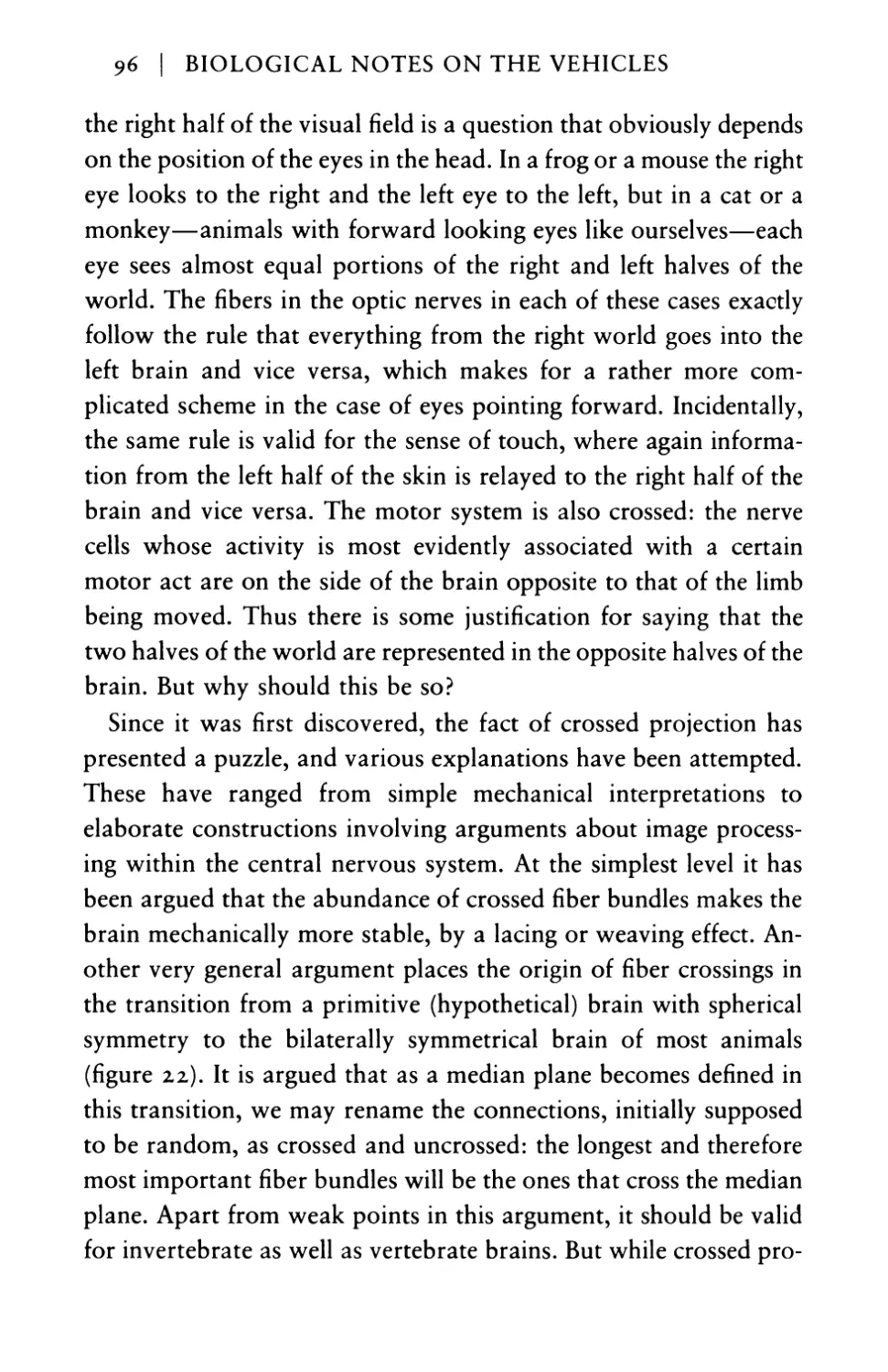

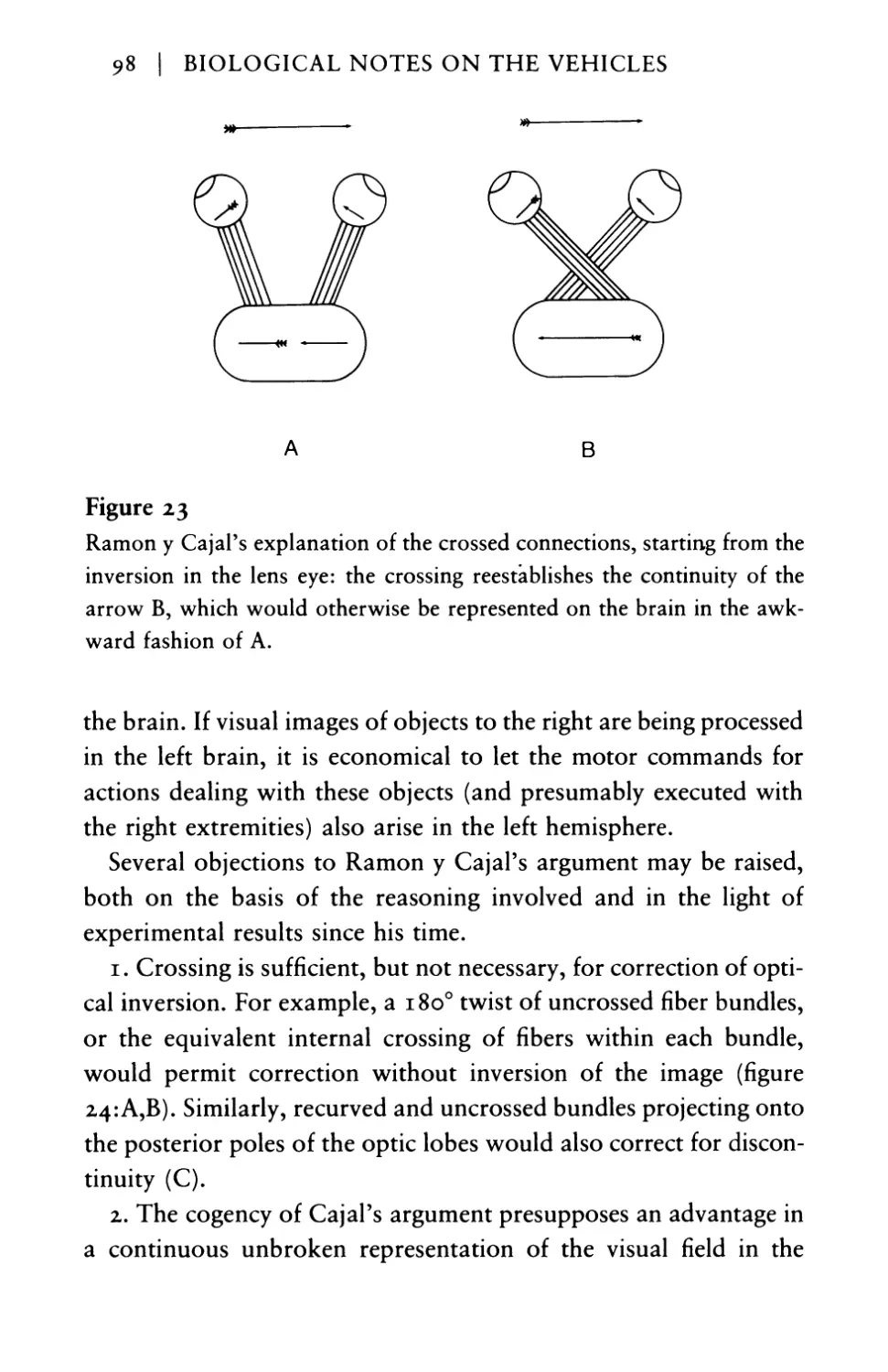
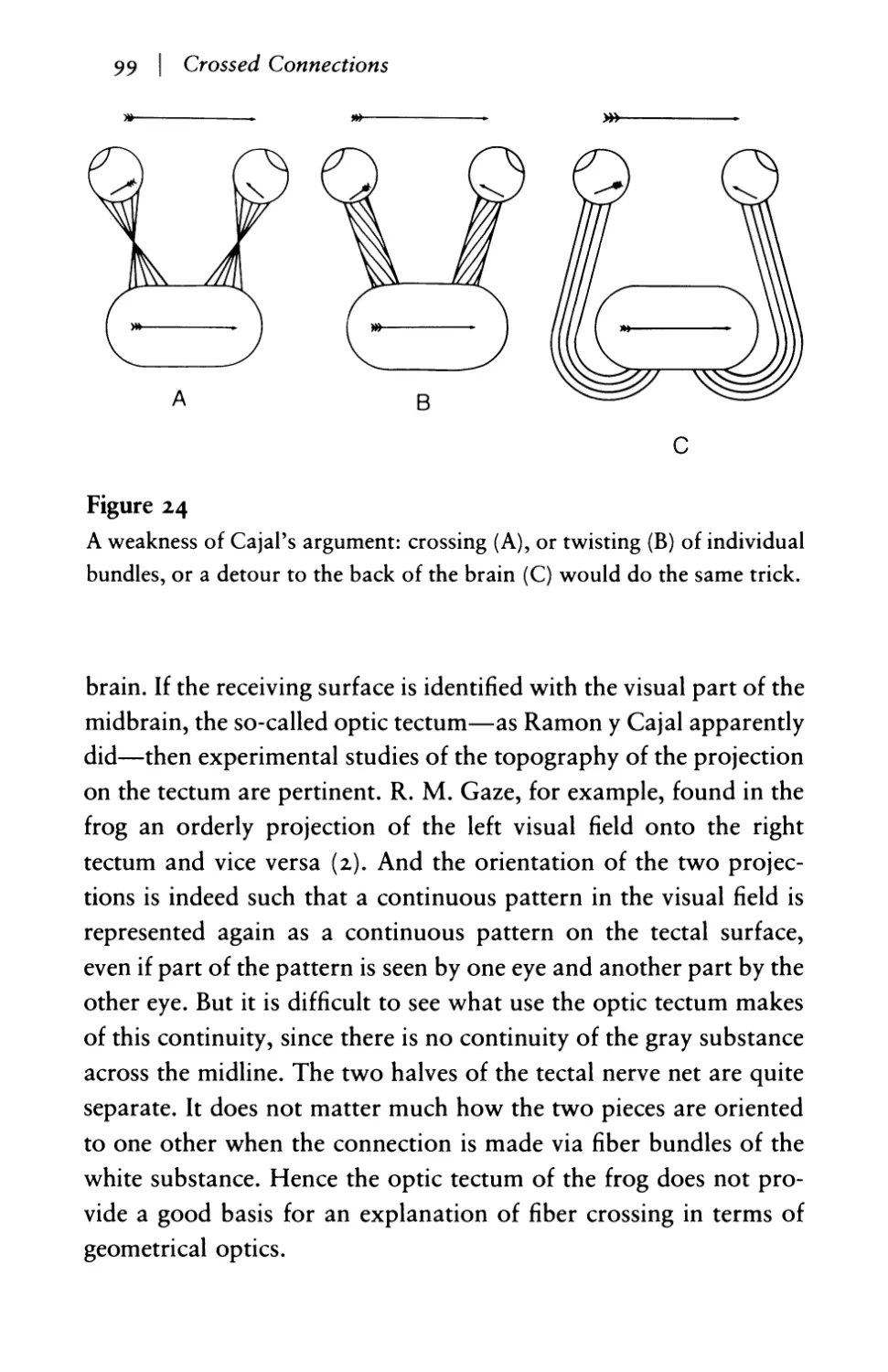

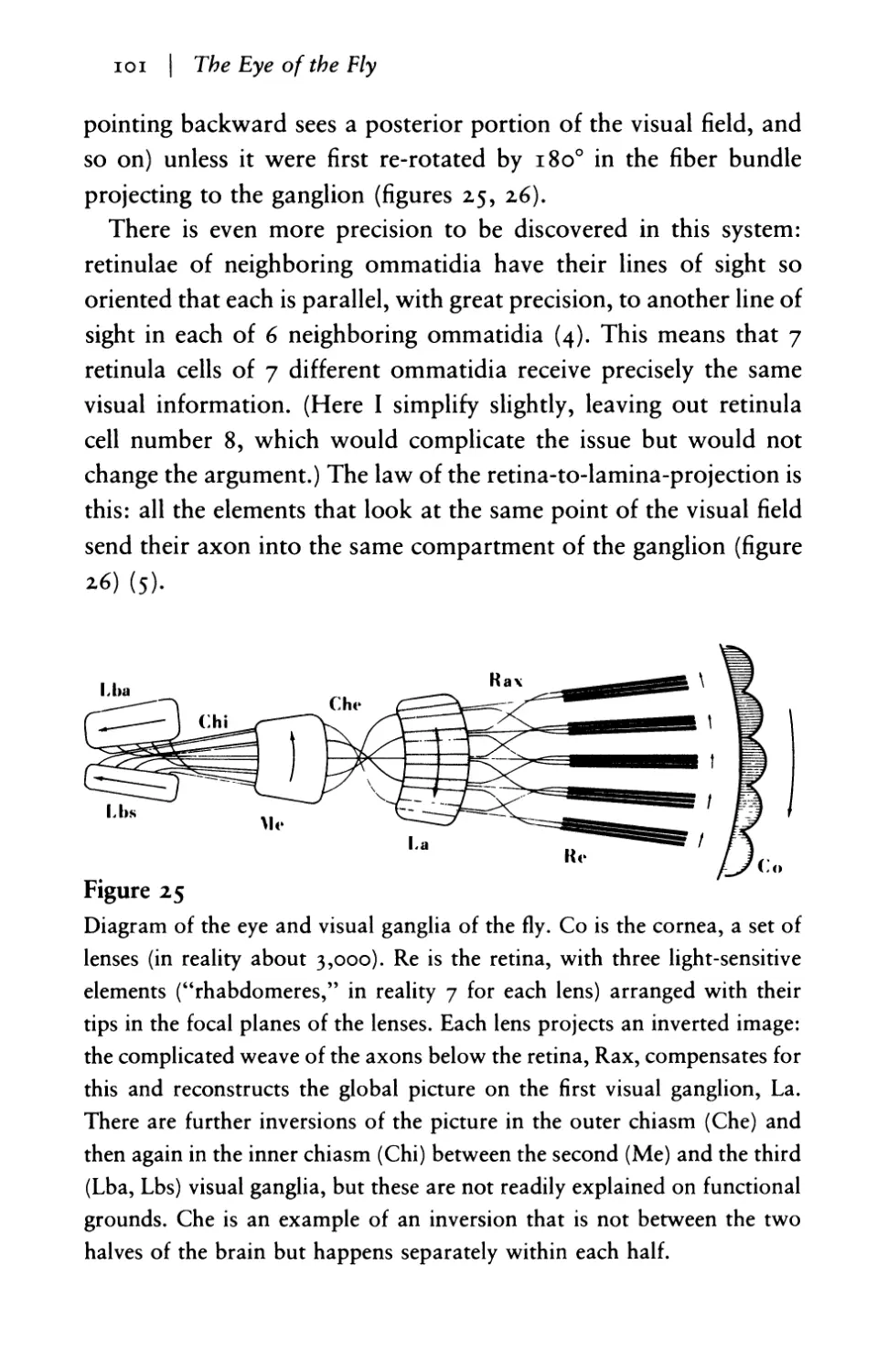








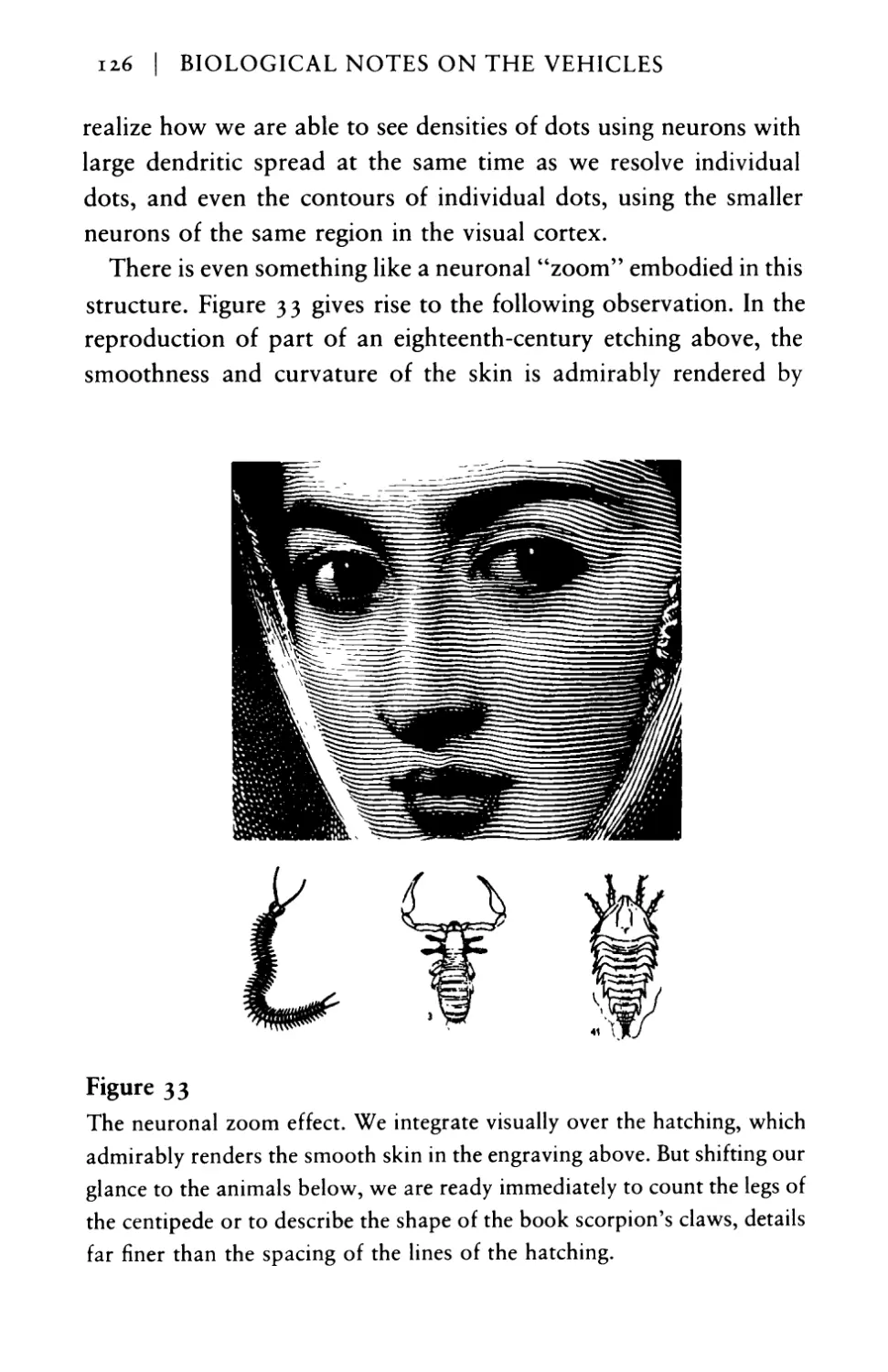













Текст
. .
. .
)
-
J
, .
, ",,'.:.
,
,.-; ...:[ )
. -
. :
(.. ,
"\ p) 'f J
\ , I' :, , ' : t !',":-..
\ I'
_, ' ' t I
/1 '. " : ".
, .\-? -
"'(, . ,Y' \"
'f- '
,
'\ '
'1,
f
. . ..
.
.. .
.
,,:,,,
I
. ! .
,,.
,\
\
\
,
"
\
oj-
..
L
.
'\I
{.. '
""" "-.... --
'\
'I,
'.
L
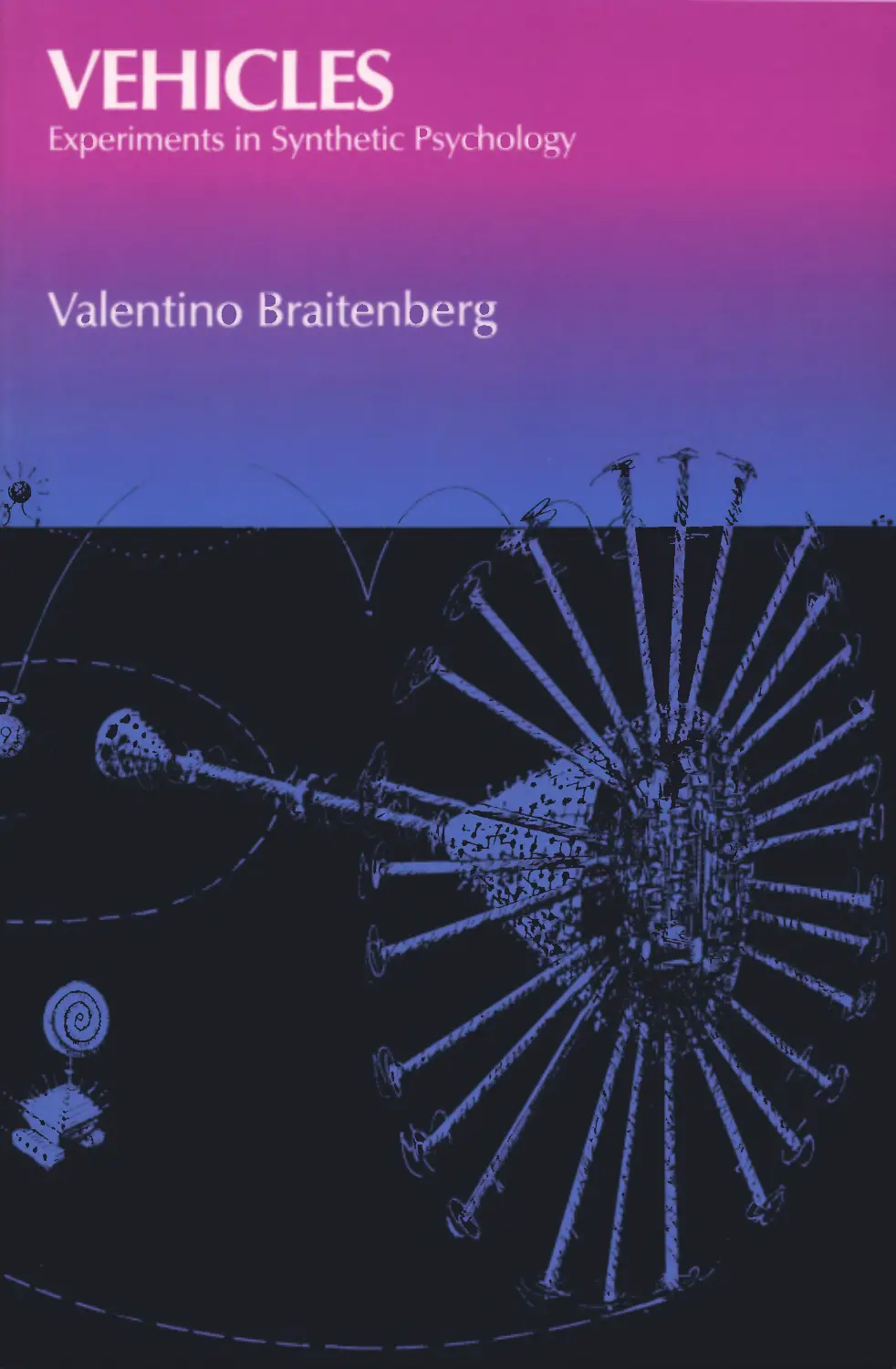
Vehicles
Experiments in
Synthetic Psychology
Valentino Braitenberg
The MIT Press
Cambridge, Massachusetts
London, England
First MIT Press paperback edition, 1986
@ 1984 by The Massachusetts Institute of Technology
All rights reserved. No part of this book may be reproduced
in any form by any electronic or mechanical means (including
photocopying, recording, or information storage and retrieval)
without permission in writing from the publisher.
Jacket artwork and portfolio of drawings
by Maciek Albrecht:
Copyright @ 1984 by Maciek Albrecht
All rights reserved. This artwork may not be
reproduced in any form or by any means, electronic
or mechanical, including photocopying or by any
other means, without permission in writing from
Maciek Albrecht.
Technical drawings by Ladina Ribi and Claudia
Martin-Schubert.
This book was set in Linotron 202 Sabon by Achorn
Graphic Services and printed and bound
in the United States of America
Library of Congress Cataloging in Publication Data
Braitenberg, Valentino.
Vehicles, experiments in synthetic psychology.
"Bradford books" -Series t. p.
Bibliography: p.
I. Neurophysiology. 2. Psychology, Physiological.
I. Title. [DNLM: I. Psychophysiology. WL 103 B8148V]
QP3 6.B74 19 8 4 15 2 84-97 2 7
ISBN 0-262-02208-7 (hard)
0-262-52112-1 (paper)
10
Aile mie creature
Contents
Foreword by Michael A. Arbib tX
Introduction: Let the Problem of the Mind Dissolve
in Your Mind I
Vehicle I Getting Around 3
Vehicle 2 Fear and Aggression 6
Vehicle 3 Love IO
Vehicle 4 Values and Special Tastes I5
Vehicle 5 Logic 20
Vehicle 6 Selection, the Impersonal Engineer 26
Vehicle 7 Concepts 29
Vehicle 8 Space, Things, and Movements 33
Vehicle 9 Shapes 43
Vehicle 10 Getting Ideas 50
Vehicle I I Rules and Regularities 55
Vehicle 12 Trains of Thought 62
Vehicle 13 Foresight 70
Vehicle 14 Egotism and Optimism 80
vii I CONTENTS
Biological Notes on the Vehicles 95
The virtues of crossed connections 95
The compound eye of the fly: reconstruction of
continuity in the visual representation I 0 0
Olfactory orientation: control of behavior by
symmetrical reins I02
Orientation and object fixation in flies I 05
McCulloch-Pitts neurons and real neurons I08
Evolution I I3
Memory I I4
In search of an engram: the anatomy of memory I I6
Maps and their use I2 0
Shapes. The morphemes of visual perception I 2 3
An inborn category of acoustic form perception I3 3
Structure of the cerebral cortex I3 3
Cell assemblies: embodiments of ideas I4 0
Threshold control and the pump of
thoughts I43
References I 45
Foreword
Valentino Braitenberg is a cybernetician, a neuroanatomist, and a
musician. He seeks to understand how the beautiful structures of
the brain constitute a machine that can enable us to exhibit such
skilled behavior as that involved in playing music. Since the early
1960s, I have turned to Valentino for detailed neuroanatomy and
for lively essays that cut away the technical details to illuminate
the key issues of what we may call cybernetics or artificial intelli-
gence or cognitive science.
One of the most exciting of these essays had the most formida-
ble of titles: "Taxis, Kinesis and Decussation," published in
1965. Taxis is the reflex-oriented movement of a freely moving
organism in relation to a source of stimulation; kinesis, by con-
trast, is movement that lacks orientation but depends on the in-
tensity of stimulation; and a decussation is a band of nerve fibers
that connects one half of the body to th opposite half of the
brain. The title was forbidding, the essay was delightful. By de-
signing little vehicles that moved around in response to smell and
vision, Braitenberg gave his readers vivid insights into how the
brain might have evolved so that olfactory input goes to the
x I FOREWORD
same side of the brain while vision, touch, and hearing send their
input to the opposite side of the brain.
Having shared this paper with friends and students over the
years, I was delighted to hear from Valentino, at a workshop in
1983, that it had provided the nucleus for this book. Vehicles:
Experiments in Synthetic Psychology is fun to read, and this fun
is heightened by the incredible illustrations of Maciek Albrecht.
But it is serious fun and will help many people, specialist and
layman alike, gain broad insights into the ways in which intelli-
gence evolved to guide interaction with a complex world.
Michael A. Arbib
Amherst, Massachusetts
Vehicles
Introduction
Let the Problem of the Mind
Dissolve in Your Mind
This is an exercise in fictional science, or science fiction, if
you like that better. Not for amusement: science fiction in the ser-
vice of science. Or just science, if you agree that fiction is part of it,
always was, and always will be as long as our brains are only
minuscule fragments of the universe, much too small to hold all the
facts of the world but not too idle to speculate about them.
I have been dealing for many years with certain structures within
a ,imal brains that seemed to be interpretable as pieces of comput-
ing machinery because of their simplicity and/or regularity. Much
of this work is only interesting if you are yourself involved in it. At
times, though, in the back of my mind, while I was counting fibers
in the visual ganglia of the fly or synapses in the cerebral cortex of
the mouse, I felt knots untie, distinctions dissolve, difficulties disap-
pear, difficulties I had experienced much earlier when I still held my
first naive philosophical approach to the problem of the mind. This
process of purification has been, over the years, a delightful experi-
ence. The text I want you to read is designed to convey some of this
2 I VEHICLES
to you, if you are prepared to follow me not through a world of real
brains but through a toy world that we will create together.
We will talk only about machines with very simple internal struc-
tures, too simple in fact to be interesting from the point of view of
mechanical or electrical engineering. Interest arises, rather, when
we look at these machines or vehicles as if they were animals in a
natural environment. We will be tempted, then, to use psychologi-
cal language in describing their behavior. And yet we know very
well that there is nothing in these vehicles that we have not put in
ourselves. This will be an interesting educational game.
Our vehicles may move in water by jet propulsion. Or you may
prefer to imagine them moving somewhere between galaxies, with
negligible gravitational pull. Remember, however, that their jets
must expel matter in order to function at all, and this implies re-
plenishment of the food stores within the vehicles, which might be a
problem between galaxies. This suggests vehicles moving on the
surface of the earth through an agricultural landscape where they
have good support and can easily find the food or fuel they need.
(Indeed the first few chapters here conjure up images of vehicles
swimming around in the water, while later what comes to mind are
little carts moving on hard surfaces. This is no accident, if the
evolution of vehicles I to 14 in any way reflects the evolution of
animal species.)
It does not matter. Get used to a way of thinking in which the
hardware of the realization of an idea is much less important than
the idea itself. Norbert Wiener was emphatic about this when he
formulated the title of his famous book: Cybernetics, or Control
and Communication in Animals and Machines.
Vehicle 1
Getting Around
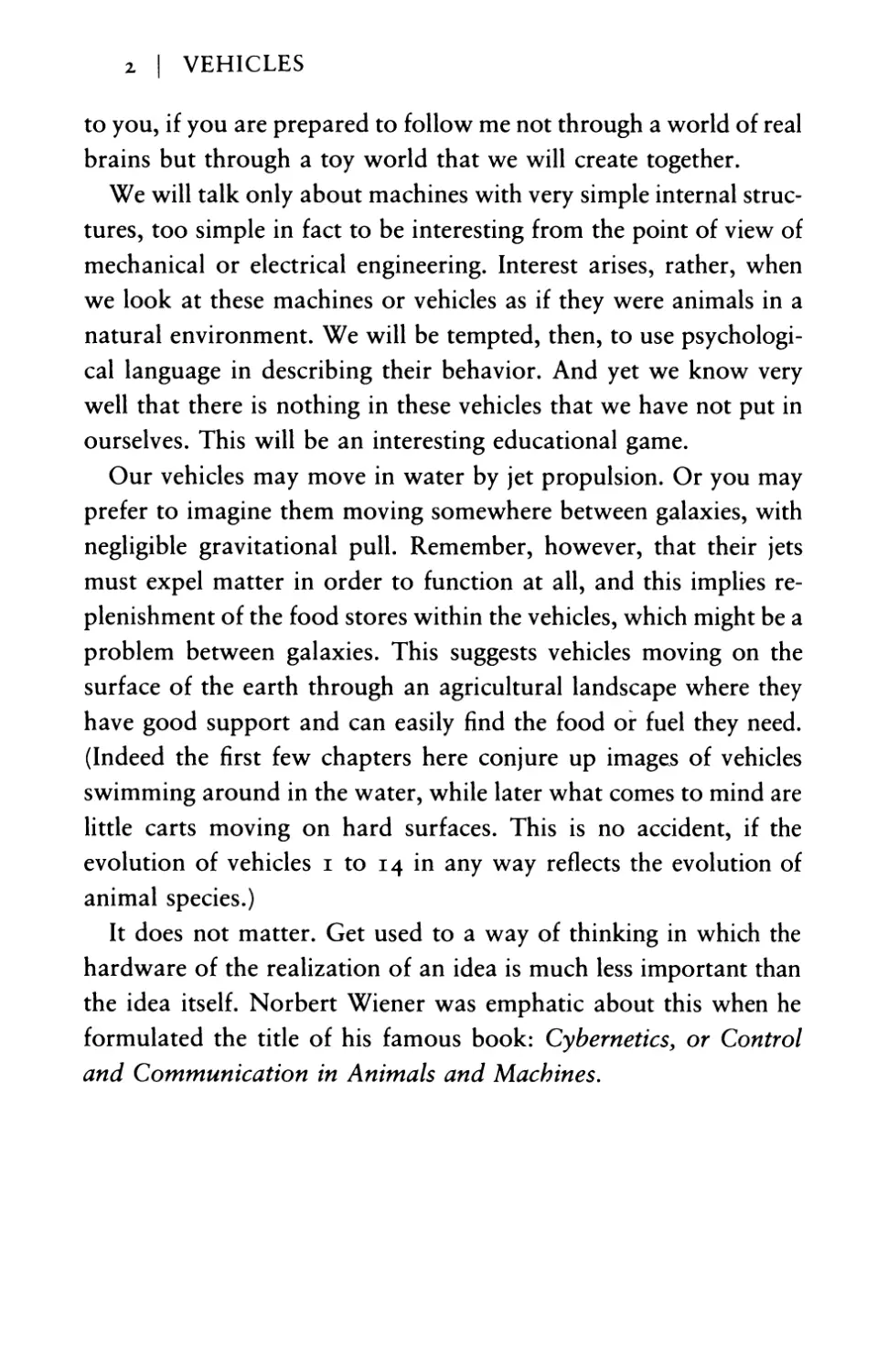
Vehicle I is equipped with one sensor and one motor
(figure I). The connection is a very simple one. The more there is of
the quality to which the sensor is tuned, the faster the motor goes.
Let the quality be temperature and let the force exerted by the
motor be exactly proportionate to the absolute temperature (the
temperature above zero degrees Kelvin) measured by the sensor.
The vehicle will move, wherever it is (the absolute temperature is
nowhere equal to zero), in the direction in which it happens to be
pointing. It will slow down in cold regions and speed up where it is
warm.
Here we have introduced a bit of Aristotelian physics. Aristotle,
like everybody else between this ancient Greek philosopher and the
less ancient Italian physicist Galileo, thought that the speed of a
moving body is proportionate to the force that drives it. This is true
in most instances, namely when there is friction to slow down the
vehicle. Normally friction will see to it that the velocity becomes
zero in the absence of any force, that it will stay at a certain small
value for a certain small force, at a higher value for a higher force,
and so forth.
Of course, as you all know, this is not true for heavenly bodies
I
Figure I
Vehicle I, the simplest vehicle. The speed of the mutor (rectangular box at
the tail end) is controlled by a sensor (half circle on a stalk, at the front
end). Motion is always forward, in the direction of the arrow, except for
perturbations.
5 I Getting Around
(especially if you don't invest astronomical time in observing them).
Their velocity is a complicated result of all the forces that ever hit
them. This is another reason for letting our vehicles move in water
or on the surface of the earth rather than in outer space.
In this Aristotelian world our vehicle number I may even come
to rest. This will happen when it enters a cold region where the
force exerted by its motor, being proportionate to the temperature,
becomes smaller than the frictional force.
Once you let friction come into the picture, other amazing things
may happen. In outer space Vehicle I would move on a straight
course with varying speed (the gravitational pull of neighboring
galaxies averages out to nothing). Not so on earth. The friction,
which is nothing but the sum of all the microscopic forces that arise
in a situation too messy to be analyzed in detail, may not be quite
symmetrical. As the vehicle pushes forward against frictional
forces, it will deviate from its course. In the long run it will be seen
to move in a complicated trajectory, curving one way or the other
without apparent good reason. If it is very small, its motion will be
quite erratic, similar to "Brownian motion," only with a certain
drive added.
Imagine, now, what you would think if you saw such a vehicle
swimming around in a pond. It is restless, you would say, and does
not like warm water. But it is quite stupid, since it is not able to turn
back to the nice cold spot it overshot in its restlessness. Anyway,
you would say, it is ALIVE, since you have never seen a particle of
dead matter move around quite like that.
Vehicle 2
Fear and Aggression
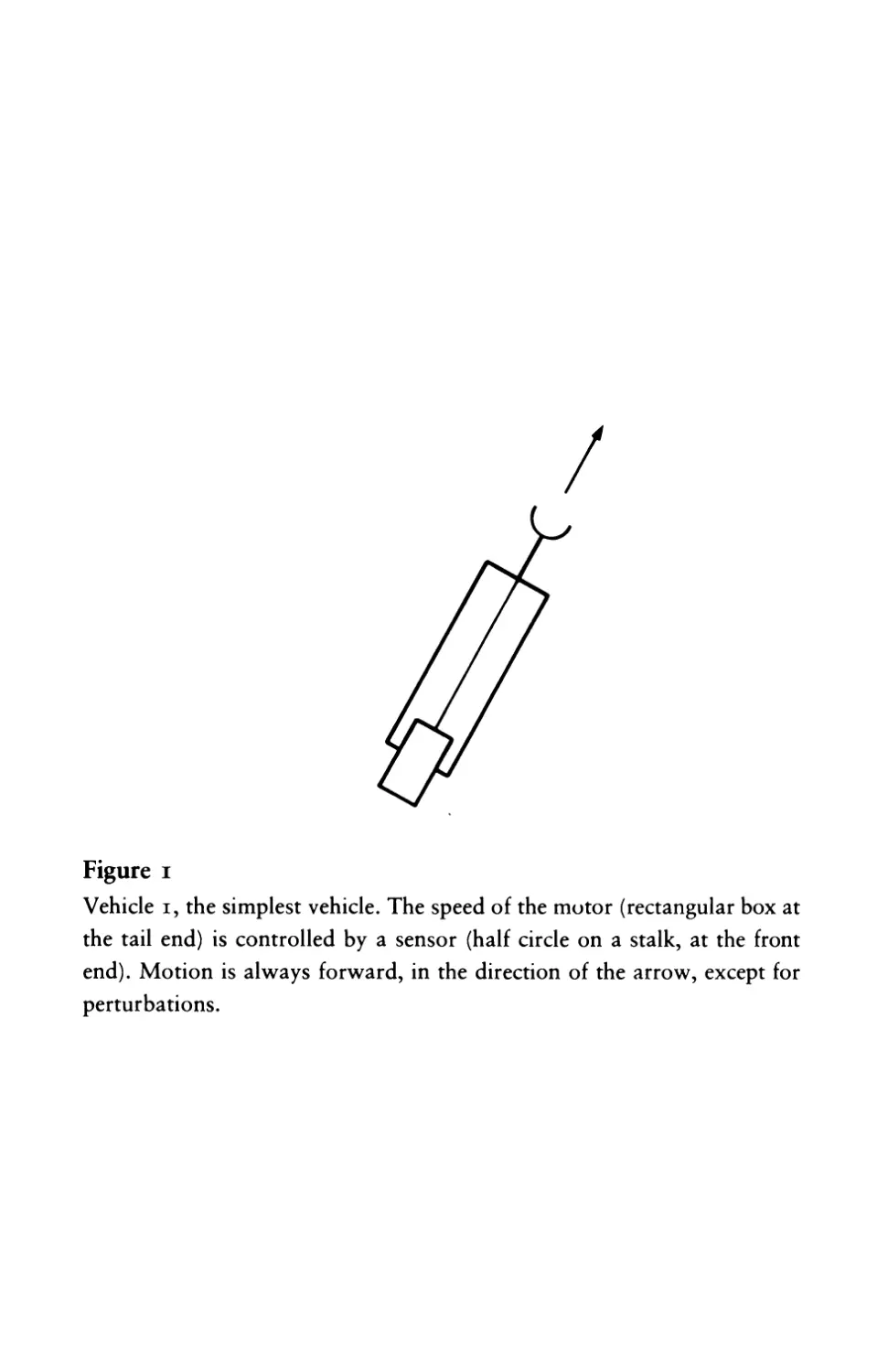
Vehicle 2 is generally similar to Vehicle I except that it
has two sensors, one on each side, and two motors, right and left
(figure 2). You may think of it as being a descendant of Vehicle I
through some incomplete process of biological reduplication: two
of the earlier brand stuck together side by side. Again, the more the
sensors are excited, the faster the motors run.
Of course you notice right away that we can make three kinds of
such vehicles, depending on whether we connect (a) each sensor to
the motor on the same side, (b) each sensor to the motor on the
opposite side, or (c) both sensors to both motors. We can im-
mediately dismiss case (c), for this is nothing but a somewhat more
luxurious version of Vehicle I. The difference between (a) and (b),
however, is very interesting.
Consider (a) first. This vehicle will spend more time in the places
where there is less of the stuff that excites its sensors and will speed
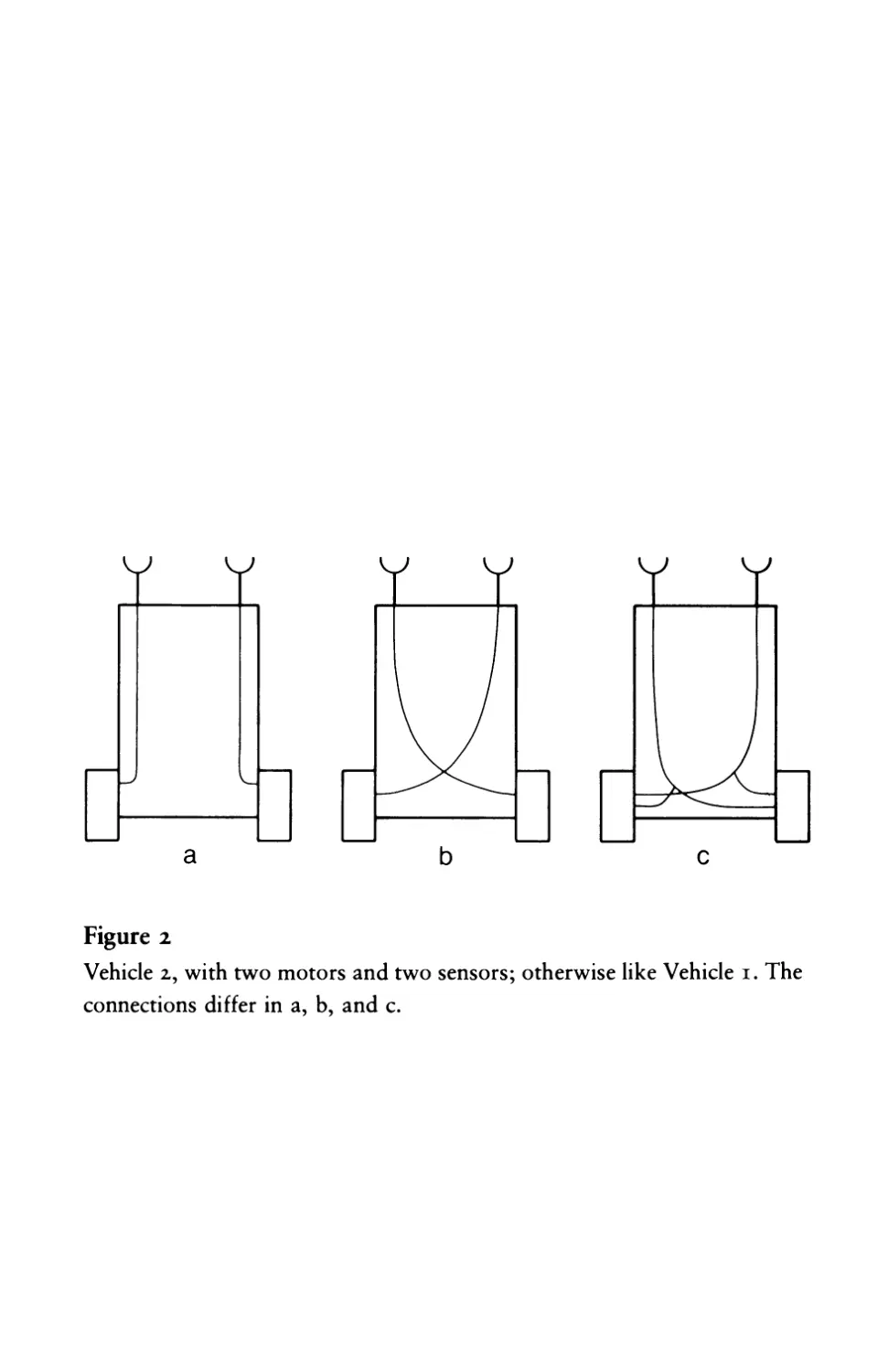
up when it is exposed to higher concentrations. If the source of the
stuff (say, light in the case of light sensors) is directly ahead, the
vehicle may hit the source unless it is deflected from its course. If
the source is to one side (figure 3), one of the sensors, the one nearer
to the source, is excited more than the other. The corresponding
a
b
c
Figure 2
Vehicle 2, with two motors and two sensors; otherwise like Vehicle I. The
connections differ in a, b, and c.
o \ I /-::..
./' "-
/ , \
,
a
"'-
"-
"
\
\
I
/
b
Figure 3
Vehicles 2a and 2b in the vicinity of a source (circle with rays emanating
from it). Vehicle 2b orients toward the source, 2a away from it.
9 I Fear an4 Aggression
motor will work harder. And as a consequence the vehicle will turn
away from the source.
Now let us try the other scheme of sensory-motor connections,
(b) in figure 3. No change if the source is straight ahead. If it is to
one side, however, we notice a difference with respect to Vehicle 2a.
Vehicle 2b will turn toward the source and eventually hit it. There
is no escaping: as long as 2b stays in the vicinity of the source, no
matter how it stumbles and hesitates, it will hit the source frontally
in the end. Only in the unlikely case that a strong perturbation in its
course makes it turn exactly away from the source, and no further
perturbation occurs, can it escape its fate.
Let Vehicles 2a and 2b move around in their world for a while
and watch them. Their characters are quite opposite. Both DISLIKE
sources. But 2a becomes restless in their vicinity and tends to avoid
them, escaping until it safely reaches a place where the influence of
the source is scarcely felt. Vehicle 2a is a COWARD, you would say.
Not so Vehicle 2b. It, too, is excited by the presence of sources, but
resolutely turns toward them and hits them with high velocity, as if
it wanted to destroy them. Vehicle 2b is AGGRESSIVE, obviously.
Vehicle 3
Love
The violence of Vehicle 2b, no less than the cowardice of
its companion 2a, are traits that call for improvement. There is
something very crude about a vehicle that can only be excited by
the things it smells (or sees or feels or hears) and knows no soothing
or relaxing stimuli. What comes to mind is to introduce some inhi-
bition in the connections between the sensors and the motors,
switching the sign of the influence from positive to negative. This
will let the motor slow down when the corresponding sensor is
activated. Again we can make two variants, one with straight and
one with crossed connections (figure 4). Both will slow down in the
presence of a strong stimulus and race where the stimulus is weak.
They will therefore spend more time in the vicinity of the source
than away from it. They will actually come to rest in the immediate
vicinity of the source.
But here we notice a difference between the vehicle with straight
connections and the one with crossed connections. Approaching
the source, the first (figure 4a) will orient toward it, since on an
oblique course the sensor nearer to the source will slow down the
motor on the same side, producing a turn toward that side.
The vehicle with straight connections will come to rest facing the
\
\
'"
a
o \ I /-::..
./ ......
/ I \
/
I
/
I
Figure 4
Vehicle 3, with inhibitory influence of the sensors on the motors.
12 I VEHICLE 3
source. The vehicle with crossed connections (figure 4b) for analo-
gous reasons will come to rest facing away from the source and
may not stay there very long, since a slight perturbation could cause
it to drift away from the source. This would lessen the source's
inhibitory influence, causing the vehicle to speed up more and more
as it gets away.
You will have no difficulty giving names to this sort of behavior.
These vehicles LIKE the source, you will say, but in different ways.
Vehicle 3 a LOVES it in a permanent way, staying close by in quiet
admiration from the time it spots the source to all future time.
Vehicle 3 b, on the other hand, is an EXPLORER. It likes the nearby
source all right, but keeps an eye open for other, perhaps stronger
sources, which it will sail to, given a chance, in order to find a more
permanent and gratifying appeasement.
But this is not yet the full development of Vehicle 3. We are now
ready to make a more complete model using all the behavioral traits
at our disposal. Call it Vehicle 3 c. We give it not just one pair of
sensors but four pairs, tuned to different qualities of the environ-
ment, say light, temperature, oxygen concentration, and amount of
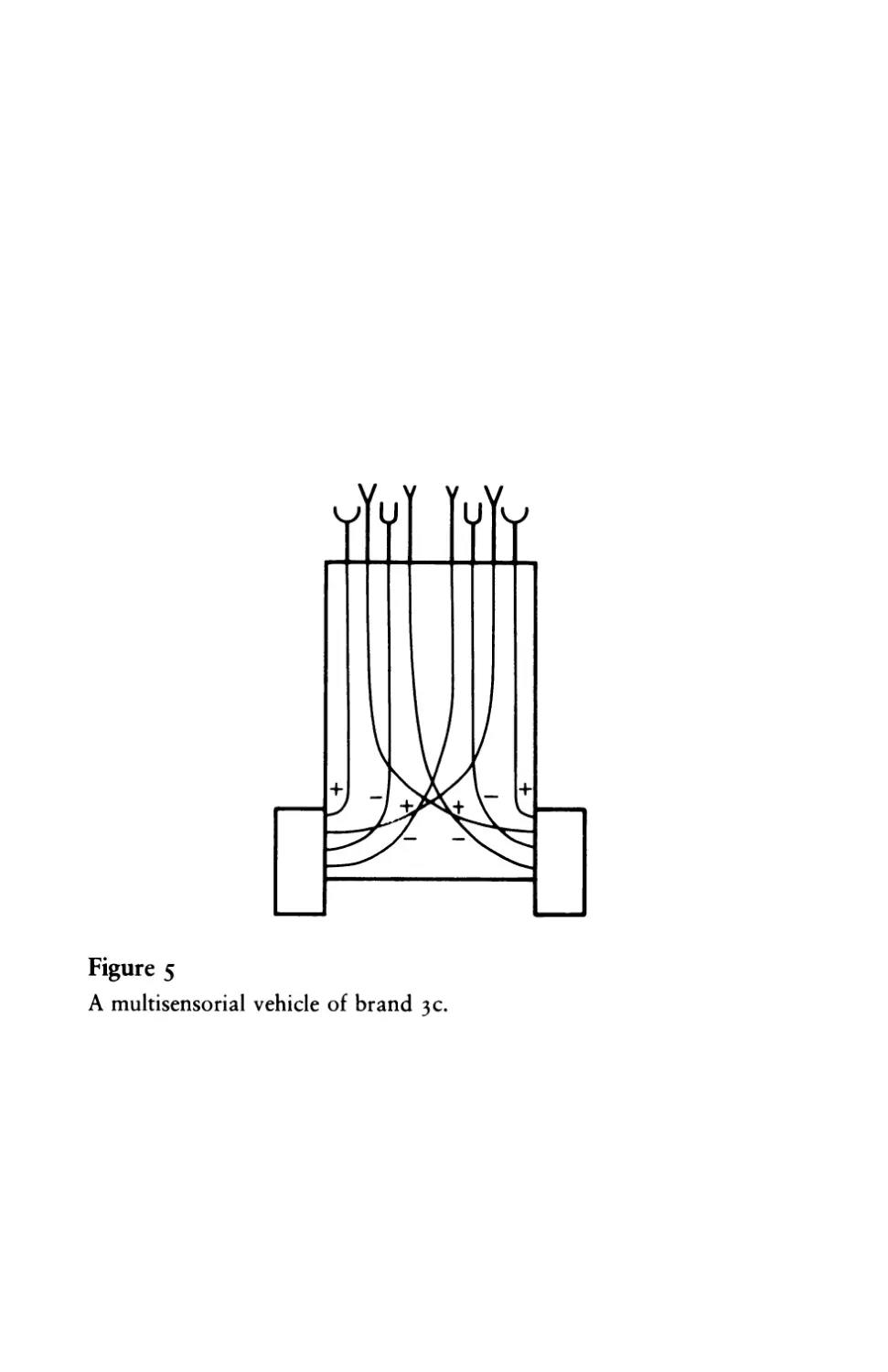
organic matter (figure 5). Now we connect the first pair to the
motors with uncrossed excitatory connections, as in Vehicle 2a, the
second pair with crossed excitatory connections, as in Vehicle 2b,
and the third and the fourth pairs with inhibitory connections,
crossed and uncrossed, as in Vehicles 3 band 3 a.
This is now a vehicle with really interesting behavior. It dislikes
high temperature, turns away from hot places, and at the same time
seems to dislike light bulbs with even greater passion, since it turns
toward them and destroys them. On the other hand it definitely
seems to prefer a well-oxygenated environment and one containing
many organic molecules, since it spends much of its time in such
places. But it is in the habit of moving elsewhere when the supply of
either organic matter or (especially) oxygen is low. You cannot help
admitting that Vehicle 3C has a system of VALUES, and, come to
Figure 5
A multisensorial vehicle of brand 3 c.
14 I VEHICLE 3
think of it, KNOWLEDGE, since some of the habits it has, like de-
stroying light bulbs, may look quite knowledgeable, as if the vehicle
knows that light bulbs tend to heat up the environment and conse-
quently make it uncomfortable to live in. It also looks as if it knows
about the possibility of making energy out of oxygen and organic
matter because it prefers places where these two commodities are
available.
But, you will say, this is ridiculous: knowledge implies a flow of
information from the environment into a living being or at least
into something like a living being. There was no such transmission
of information here. We were just playing with sensors, motors, and
connections: the properties that happened to emerge may look like
knowledge but really are not. We should be careful with such words.
You are right. We will explain in a later chapter (on Vehicle 6)
how knowledge may enter a system of connections. And we will
introduce an alternative way of incorporating knowledge into the
system in our chapter on Vehicle 7. In any case, once knowledge is
incorporated, the resulting vehicle may look and behave quite like
our Vehicle 3 c.
Meanwhile I invite you to consider the enormous wealth of dif-
ferent properties that we may give Vehicle 3C by choosing various
sensors and various combinations of crossed and uncrossed, excit-
atory and inhibitory, connections.
If you consider the possibility of strong and weak influences from
the sensors to the motors, you realize that the variety becomes even
greater. The vehicle may not care much about light but care very
much about temperature. Its sense of smell may be much keener for
organic matter than it is for oxygen or vice versa. And there may be
many more than just four pairs of sensors and four sensory qual-
ities: the vehicles may be equipped with all sorts of shrewd de-
tectors of energy and of chemicals. But this is best discussed in
connection with a new idea incorporated in the vehicles of the next
chapter.
Vehicle 4
Values and Special Tastes
We are now in a position to create a new brand of vehicle,
starting from all the varieties of Vehicle 3, by working on the
connections between sensors and motors. They were, up to now, of
two very simple kinds: the more the sensor was excited, the faster
the corresponding motor ran, or, alternatively, the more the sensor
was excited, the slower the motor ran. We did not care what the
rules of the dependence were, as tong as they were of the nature
"the more, the more" or "the more, the less." The vast class of
mathematical functions describing such dependences is sometimes
called monotonic. Obviously, there is something very simple-
minded about creatures governed by such unconditioned likes or
dislikes, and we can easily see how such the-more-the-merrier be-
havior could lead to disaster. Think what happens in the case of a
tendency to follow downhill slopes!
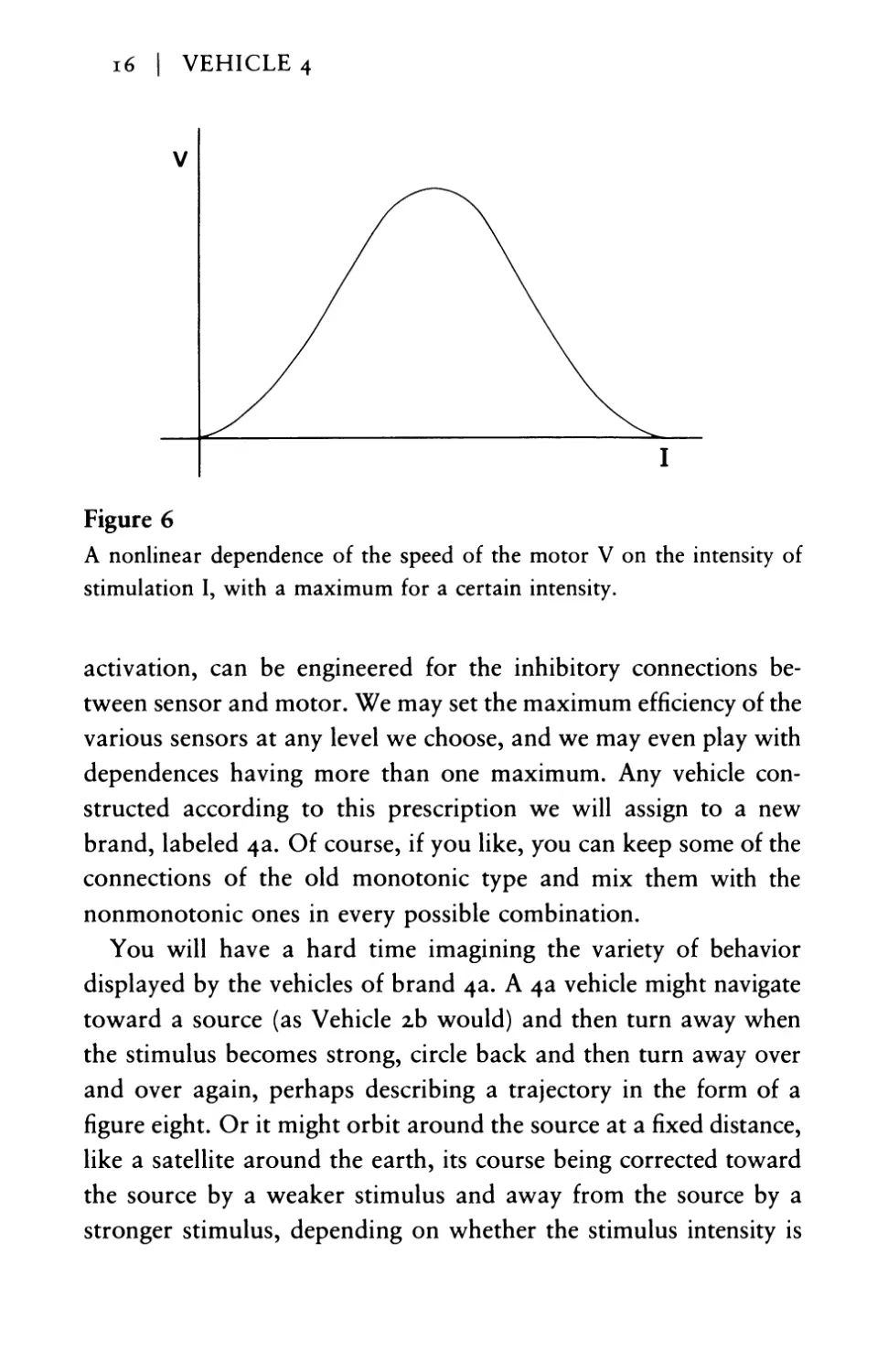
Let us consider the following improvement. The activation of a
certain sensor will make the corresponding motor run faster, but
only up to a point, where the speed of the motor reaches a max-
imum. Beyond this point, if the sensor is activated even more
strongly, the speed will decrease again (figure 6). The same sort of
dependence, with a maximum efficiency at a certain level of sensor
16 I VEHICLE 4
v
I
Figure 6
A nonlinear dependence of the speed of the motor V on the intensity of
stimulation I, with a maximum for a certain intensity.
activation, can be engineered for the inhibitory connections be-
tween sensor and motor. We may set the maximum efficiency of the
various sensors at any level we choose, and we may even play with
dependences having more than one maximum. Any vehicle con-
structed according to this prescription we will assign to a new
brand, labeled 4a. Of course, if you like, you can keep some of the
connections of the old monotonic type and mix them with the
nonmonotonic ones in every possible combination.
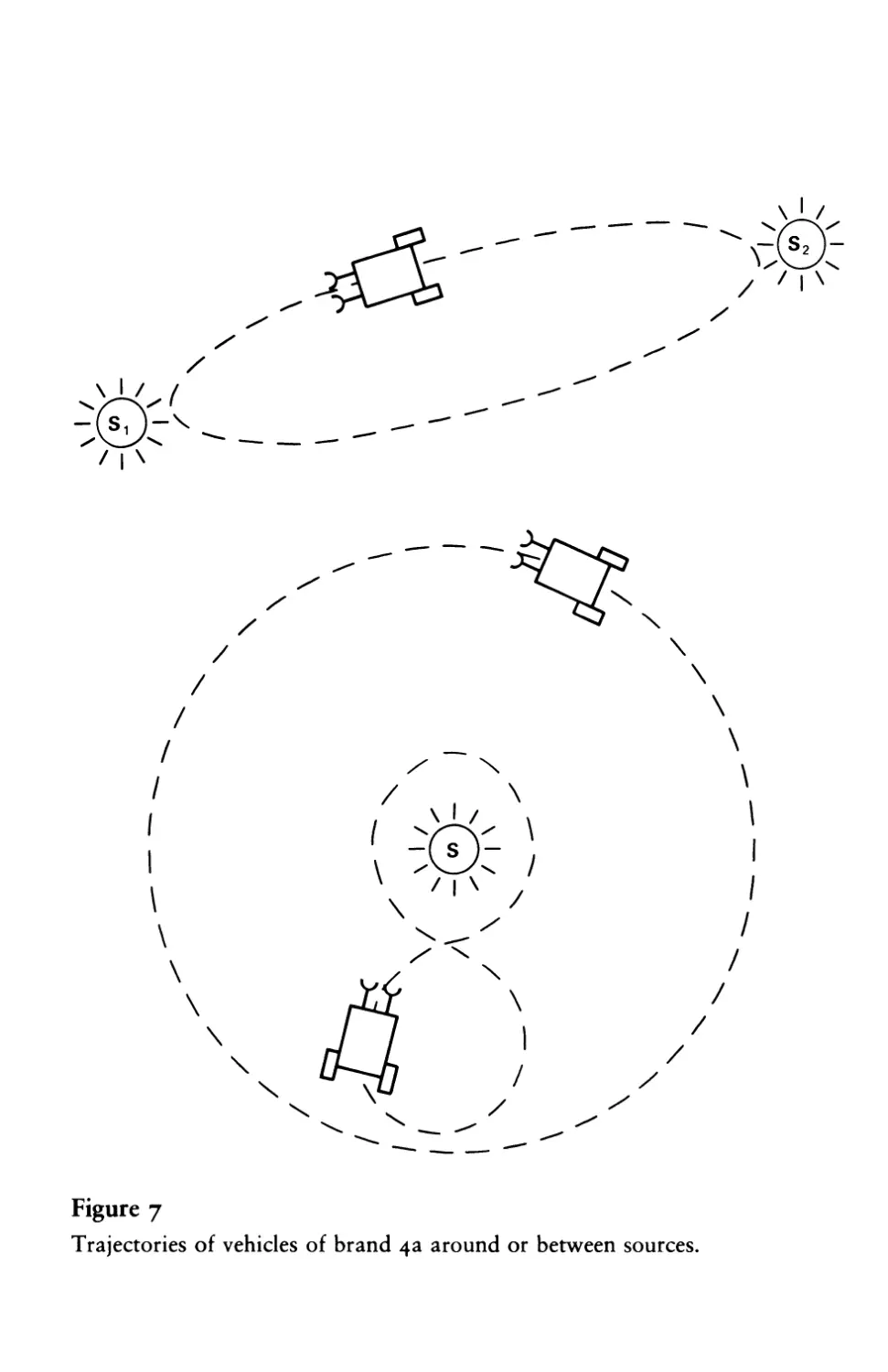
You will have a hard time imagining the variety of behavior
displayed by the vehicles of brand 4a. A 4a vehicle might navigate
toward a source (as Vehicle 2b would) and then turn away when
the stimulus becomes strong, circle back and then turn away over
and over again, perhaps describing a trajectory in the form of a
figure eight. Or it might orbit around the source at a fixed distance,
like a satellite around the earth, its course being corrected toward
the source by a weaker stimulus and away from the source by a
stronger stimulus, depending on whether the stimulus intensity is
17 I Values and Special Tastes
on one side or the other of the maximum describing the sensory-
motor dependence (figure 7). Vehicle 4a might like one sort of
stimulus when it is weak but not when it is too strong; it might like
another stimulus better the stronger it becomes. It might turn away
from a weak smell and destroy the source of a strong one. It might
visit in alternation a source of smell and a source of sound, turning
away from both with a change of temperature.
Watching vehicles of brand 4a in a landscape of sources, you will
be delighted by their complicated trajectories. And I am sure you
will feel that their motives and tastes are much too varied and
intricate to be understood by the observer. These vehicles, you will
say, are governed by INSTINCTS of various sorts and, alas, we just
don't know how Nature manages to embody instincts into a piece
of brain.
You forget, of course, that we have ourselves designed these
vehicles.
But instincts are a lowly sort of behavior anyway. We can do
better. Let us improve on type 4a by adding a new sort of connec-
tion between sensors and motors. This time the influence of the
sensor on the motor is no longer smooth; there are definite breaks.
There might be a range of intensities of sensory stimulation for
which the motor is not activated at all and then, under stronger
stimuli, the motors are running at full speed. Or else, there might be
smooth changes of motor activation for certain ranges, with abrupt
changes in between. A very lifelike pattern would be: no activation
up to a threshold value of the stimulus, and increasing activation
beyond the threshold, starting with a certain fixed minimum (figure
8) . You are by now experienced in the art of creative invention and
will have no difficulty dreaming up more schemes of this sort.
In a way these new vehicles, which we call 4b, are already con-
tained in the vast class of vehicles 4a, since abruptness of behavior
can of course be simulated with any degree of approximation by
functional dependences that are in reality, mathematically speak-
/
\ I /
- - - -- ' (0 /
.- "
-- -5 -
__ __ \/ 2,
/ / 1\
/
/'
/'
/"
/
\ 1/ (
....... (0 / --
- 51 -'-. -- -- --
/ ....... """-. - - - --
/1\
/'
/
/
/
/
/
/
I
I
,
\
\
\
\
"
"-
"-
,
----
--
/' "
/ \
{ \ I / \
\ : 0 : I
/ I \ /
" /'
'--
,/' "
"-
\
1
/
\ /
, "-".."
"""'- --
-- --
/
/
"
"-
'\
\
\
\
\
\
I
I
/
/
/
/
/
/
/
/
Figure 7
Trajectories of vehicles of brand 4a around or between sources.
19 I Values and Special Tastes
v
I
Figure 8
Various bizarre kinds of dependence of the speed of the motor (ordinate)
on the intensity of stimulation (abscissa) in Vehicle 4b.
ing, continuous. Moreover, if friction plays a role, as we have al-
ready decided it should, thresholds in motor activation would ensue
naturally: the vehicle will start moving only when the force exerted
by the motor exceeds a certain value, sufficient to overcome the
initial friction.
Whatever their origin, thresholds in some behavior patterns
make a lot of difference in the eye of the observer. These creatures,
the observer would say, ponder over their DECISIONS. When you
come close to them with a lure, it takes them some time to get
going. Yet once they have decided, they can act quite quickly. They
do indeed seem to act in a spontaneous way: none of this passive
being attracted one way or the other that was so obvious in the
vehicles of the more lowly types. You would almost be tempted to
say: where decisions are being made, there must be a WILL to make
them. Why not? For all we know, this is not the worst criterion for
establishing the existence of free will.
Vehicle 5
Logic
At this point we are ready to make a fundamental discov-
ery. We have gathered evidence for what I would like to call the
"law of uphill analysis and downhill invention." What I mean is
this. It is pleasurable and easy to create little machines that do
certain tricks. It is also quite easy to observe the full repertoire of
behavior of these machines-even if it goes beyond what we had
originally planned, as it often does. But it is much more difficult to
start from the outside and to try to guess internal structure just
from the observation of behavior. It is actually impossible in theory
to determine exactly what the hidden mechanism is without open-
ing the box, since there are always many different mechanisms with
identical behavior. Quite apart from this, analysis is more difficult
than invention in the sense in which, generally, induction takes
more time to perform than deduction: in induction one has to
search for the way, whereas in deduction one follows a straightfor-
ward path.
A psychological consequence of this is the following: when we
analyze a mechanism, we tend to overestimate its complexity. In the
uphill process of analysis, a given degree of complexity offers more
resistance to the workings of our mind than it would if we encoun-
21 I Logic
tered it downhill, in the process of invention. We have already seen
this happen when the observer of Vehicle 4b conjectured that the
vehicle does some thinking before it reaches a decision, suggesting
complicated internal processes where in reality there was nothing
but a threshold device waiting for sufficient activation. The patterns
of behavior described in the vehicles of type 4a undoubtedly suggest
much more complicated machinery than that which was actually
used in designing them.
We may now take pleasure in this and create simple "brains" for
our vehicles, which will indeed (as experience shows) tax the mind
of even the most playful analyst. All we have to do is introduce
special elements, called threshold devices, which will be either inter-
posed between sensors and motors or connected to each other in
complexes that receive some input from the sensors and give some
output to the motors.
The individual threshold device is of the simplest sort: it gives no
output if its input line carries a signal below the threshold, and it
gives full output beyond the threshold. We will also use another
variety giving output all the time unless the input carries a signal
above the threshold. Each of these devices is fitted with a knob
which may be turned to set the threshold, so that the input would
become effective with one, two, or any specified number of input
activation units. (The word threshold of course implies that, for a
given threshold value, any input stronger than the one specified
would also be effective.)
We are not limited to the types of connections through which the
threshold devices activate each other. We can also use another kind,
call them "inhibitory," which counteract the activation that comes
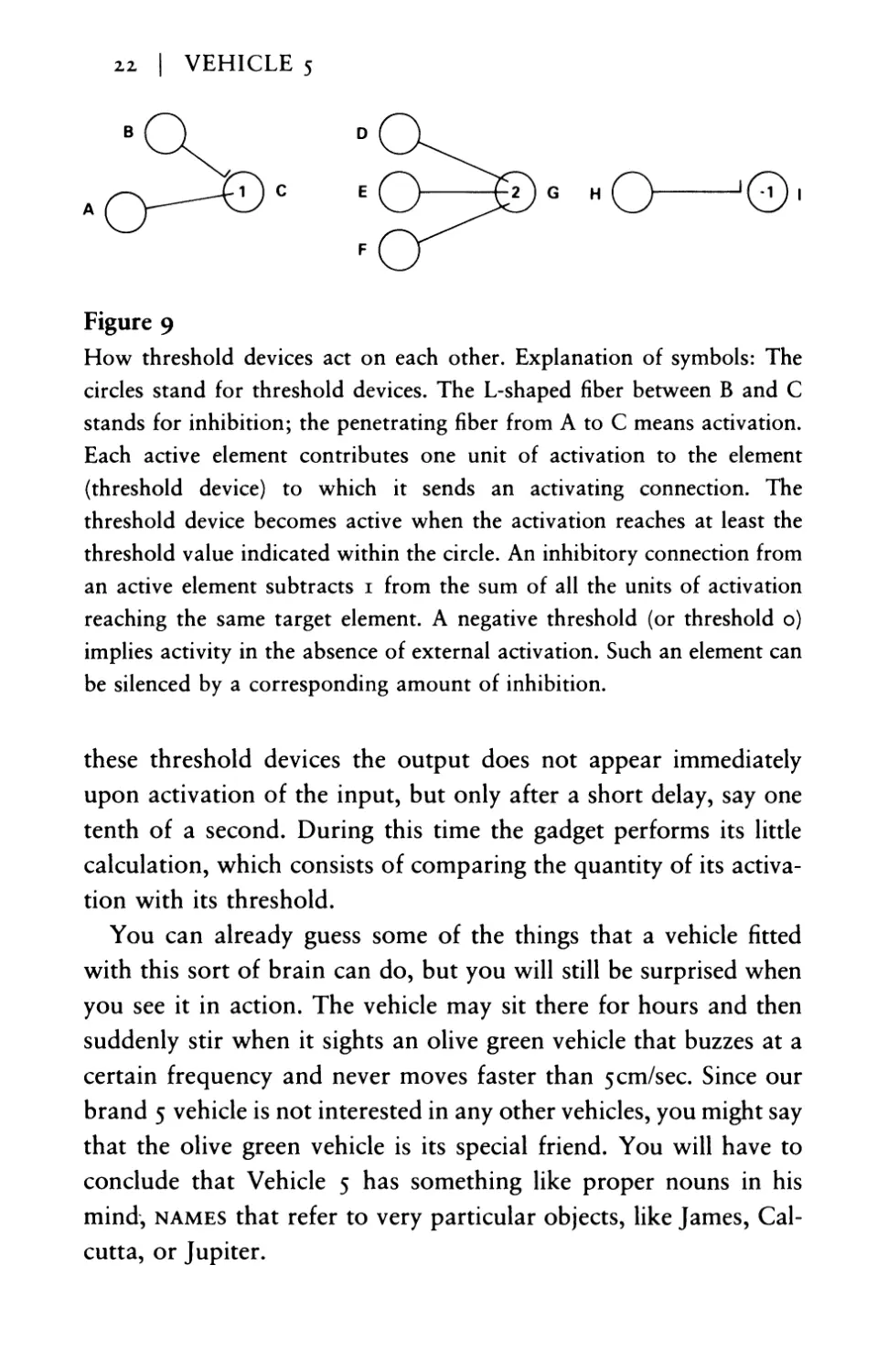
from other sources (figure 9).
In order to make a brain out of threshold devices, we may con-
nect them together one to one, or many to one, or one to many, or
many to one and one to many, in whichever way we like. When you
are designing brains, it is important for you to know that in one of
22 I VEHICLE 5
B
A o---B C
E
G H O
I G>
D
F
Figure 9
How threshold devices act on each other. Explanation of symbols: The
circles stand for threshold devices. The L-shaped fiber between Band C
stands for inhibition; the penetrating fiber from A to C means activation.
Each active element contributes one unit of activation to the element
(threshold device) to which it sends an activating connection. The
threshold device becomes active when the activation reaches at least the
threshold value indicated within the circle. An inhibitory connection from
an active element subtracts I from the sum of all the units of activation
reaching the same target element. A negative threshold (or threshold 0)
implies activity in the absence of external activation. Such an element can
be silenced by a corresponding amount of inhibition.
these threshold devices the output does not appear immediately
upon activation of the input, but only after a short delay, say one
tenth of a second. During this time the gadget performs its little
calculation, which consists of comparing the quantity of its activa-
tion with its threshold.
Yau can already guess some of the things that a vehicle fitted
with this sort of brain can do, but you will still be surprised when
you see it in action. The vehicle may sit there for hours and then
suddenly stir when it sights an olive green vehicle that buzzes at a
certain frequency and never moves faster than 5cm/sec. Since our
brand 5 vehicle is not interested in any other vehicles, you might say
that the olive green vehicle is its special friend. You will have to
conclude that Vehicle 5 has something like proper nouns in his
mind., NAMES that refer to very particular objects, like James, Cal-
cutta, or Jupiter.
23 I Logic
Figure loa
A network that gives a signal when a burst of 3 pulses presents itself,
preceded and followed by a pause.
Figure lob
A network of threshold devices that emits a pulse for every third pulse in a
row in the input.
But Vehicle 5 can do much more than that. It can count (figure
10). It may associate only with groups of four vehicles, not more
and not less, to make a party of five. Or it may visit every tenth
source it encounters on its way. Or it may turn away from a vehicle
whose number of sensors is a multiple of seven, implying that such
vehicles bring bad luck. In some way, it seems to operate with
NUMBERS.
If you fit such a vehicle with a very large number of shrewdly
connected threshold devices, you may get it to playa passable game
of chess. Or you may make it solve puzzles in LOGIC or prove
theorems in euclidean geometry. You realize what I am driving at:
with enough threshold devices it can do anything a computer can
do, and computers can be made to do almost everything.
But where is the memory, some of you will ask, realizing that
24 I VEHICLE 5
most of the activities of a digital computer consist of putting data
into memory, taking the data out again to perform some calcula-
tion, putting the results back into the memory, and so forth. The
answer: there is room for memory in a network of threshold de-
vices, if it is large enough. Imagine a threshold device connected to
a sensor for red light. When it is activated by the red light, it
activates another threshold device which in turn is connected back
to the first device. Once a red light is sighted, the two devices will
activate one another forever. Take a wire from the output of one of
the two threshold devices and connect it to a bell: the ringing of the
bell then signals the fact that at some time in the past this particular
vehicle sailed in the vicinity of a source of red light.
This is an elementary sort of MEMORY. It is not difficult to under-
stand how out of such elementary memory stores (consisting of
reciprocally connected threshold devices) complex memories can be
synthesized, with the possibility of storing extremely complex
events. But there is a limit to the quantity of facts the vehicle can
store this way. For instance, when storing numbers, if the vehicle
has a bank of ten elementary memory devices, it cannot fit any
number that has more than ten digits (in binary notation), since
each elementary device can at most remember one digit by being
active or inactive ("one bit of information").
There is a trick that can be used by our brand 5 vehicles to
overcome the intrinsic limitation of their storage capacity. Imagine
a vehicle involved in a calculation in which numbers occur that are
much larger than the number of parts in the vehicle's own interior.
You might think that such a task would be forever beyond the
comprehension of that particular vehicle. Not so if we employ the
following strategy. Let's transfer our vehicle to a large, sandy
beach. The vehicle can crawl on the beach, leaving marks in the
sand indicating the succession of digits in the large numbers that
emerge from its calculations. Then it can crawl back, following
25 I Logic
its own track, to read off the digits and put them back into the
calculation.
The vehicle is never able to comprehend these large numbers at
anyone moment. But using itself as an instrument in a larger
scheme involving the environment, and partly directed by it, it ends
up with the correct result. (Of course, to be on the safe side, we
must suppose that the sandy surface has no limits.) If you want a
concrete example, think of the vehicle calculating the difference
(small enough for it to comprehend) between two large numbers,
which it can produce but not comprehend. It will produce one
number by leaving marks on its way along the beach. It will pro-
duce the other number on its way back. And then it will measure
the difference by counting the number of marks that are in default
or in excess of the first number.
Later on, we will learn how to incorporate into a vehicle some-
thing quite analogous to the sand outside, and almost as boundless
in its capacity.
Vehicle 6
Selection the Impersonal
Engineer
In this chapter things get slightly out of hand. You may
regret this, but you will soon notice that it is a good idea to give
chance a chance in the further creation of new brands of vehicles.
This will make available a source of intelligence that is much more
powerful than any engineering mind.
Out of the collection of vehicles that we have produced for the
purposes of our experimentation, we will choose some of the more
complicated specimens and put them onto a large table. Of course
there will also be some sources of light, sound, smell, and so forth
on the table, some of them fixed and some of them moving. And
there will be various shapes or landmarks, including the cliff that
signals the end of the table top.
Now you and I will gather a plentiful supply of materials (tin,
plastic, threshold devices, wheels, motors, sensors, wires, screws
and bolts) and proceed to build vehicles, taking as our models
vehicles that we pick from the ones circulating on the table. Each
time we copy a vehicle, we will put both the model and its copy
back on the table, pick up another vehicle, copy it, and so on. Of
27 I Selection
course we will not pick up vehicles that have fallen on the floor
because they have proved their own inability to cope with the envi-
ronment. We will be careful to produce vehicles at a pace that
roughly matches the rate at which vehicles fall off the table, to
prevent the race from dying out, on one hand, and to prevent the
table from becoming unduly crowded, on the other.
Note that while we are playing this game, we won't have time to
test the behavior or to study the wiring, let alone to understand the
logic of the vehicles that we pick up as models for copying. Nor
should we. All we are asked to do is to slavishly connect the parts
according to the pattern in the model.
Note also that when we do this in a hurry, we are bound to make
occasional mistakes. It may be our fault when our copy of a per-
fectly well-tested vehicle falls off the table as soon as we put it
down. But it is also possible that we will unwittingly introduce a
particularly shrewd variation into the pattern of connections, so
that our copy will survive forever while the original may turn out to
be unfit for survival after all.
It does seem surprising that errors arising in the sloppy execution
of a task should act as germs for improvement. What is less aston-
ishing is the creative power of a special sort of error consisting of
new combinations of partial mechanisms, each of which is not
disrupted in its own well-tested structure. This can easily happen
when we pick up one vehicle as a model for one part of the brain
and then by mistake pick up another vehicle as a model for another
part of the brain. Such errors have a much greater chance of tran-
scending the intelligence of the original plan.
This is an important point. If the lucky accidents live on forever,
they will also have a multitude of descendants, for they will stay on
the table all the time while the less lucky ones come and go. There-
fore, they have a much greater chance of being picked up by the
copyists as models for the next generation. Thus very good ideas
28 I VEHICLE 6
unwittingly introduced into the wiring, though improbable, do be-
come quite widespread in the long run.
This story is quite old and goes by the name of Darwinian evolu-
tion. Many people don't like the idea that everything beautiful and
marvelous in organic nature should be due to the simple coopera-
tion of reproduction, errors, and selection. This is no problem for
us. We have convinced ourselves that beautiful, marvelous, and
shrewd machines can be made out of inorganic matter by this sim-
ple trick. Moreover, we already know that analysis is much more
difficult than synthesis. Where there has been no conscious en-
gineering at all, as in the case of our type 6 vehicles, analysis will
necessarily produce the feeling of a mysterious supernatural hand
guiding the creation. We can imagine that in most cases our analy-
sis of brains in type 6 vehicles would fail altogether: the wiring that
produces their behavior may be so complicated and involved that
we will never be able to isolate a simple scheme. And yet it works.
Vehicle 7
Concepts
We have already used the word knowledge, even if in a
somewhat facetious way, when we discussed the properties of Vehi-
cle 3. And we have just observed how a process akin to Darwinian
evolution may incorporate knowledge into machines in a mysteri-
ous way, though it is not immediately obvious through what chan-
nel the knowledge (about the dangers connected with a cliff)
entered the "brain" or in what form it is contained there. In both
cases we are referring to fixed, inborn knowledge that, whether
right or wrong, belongs to the individual vehicle for better or for
worse. This is fine for a set environment but may be catastrophic
when the conditions change. Therefore, in a precious vehicle that
we love, we should build in mechanisms of adaptation to make it
more flexible. Not only will our vehicle then be prepared to meet
catastrophic events but it will also be ready to cope with a greater
variety of situations and thus be less confined to a particular
environment.
We proceed as follows. First, we buy a roll of a special wire,
called Mnemotrix, which has the following interesting property: its
resistance is at first very high and stays high unless the two compo-
nents that it connects are at the same time traversed by an electric
30 I VEHICLE 7
current. When this happens, the resistance of Mnemotrix decreases
and remains low for a while, little by little returning to its initial
value. * Now let's put a piece of Mnemotrix between any two
threshold devices of a fairly complicated vehicle of type 5. This is a
lot of wiring, but the effect is not great at first, due to the high
resistance of Mnemotrix. Very little current will spread from an
active component to all the other components to which it is
connected.
As the vehicle (which is now type 7) moves around and experi-
ences various situations in its environment, some of its Mnemotrix
connections will change their strength. Suppose aggressive vehicles
in that particular environment are often painted red. Then the sen-
sor for red in our type 7 vehicle will often be activated together with
the threshold device that responds to aggressive behavior, and the
Mnemotrix wire connecting the two will have its resistance de-
creased so often that it will not have time to return to its initial
value. The consequence is obvious: every time the vehicle senses
red, the whole set of movements with which it normally responds to
aggressive behavior will be activated. So our vehicle will turn away
from its dangerous fellow. The enhanced connection between the
components represents what philosophers call ASSOCIATION, the
association of the color red with aggression. More generally, we
may say a new CONCEPT has arisen in the vehicle: whenever an
aggressive vehicle is around, even if it is blue or green, our type 7
vehicle will "see red." As far as we are concerned, this can mean
* I don't care if the electricians shudder. They know very well that even if Mnemotrix
is not available commercially as a wire, it can be simulated by a simple circuit. And
they also know that such things exist in animals' brains. If you want a fairly realistic
explanation of Mnemotrix wire, think of a material that changes its conductance as
a function of temperature: the current heats the two components connected by
Mnemotrix, and the temperature change at the two ends of the connection induces
the change in resistance.
3 I I Concepts
only: the vehicle does some of the things it did previously only
when it was confronted with the color red.
This process of translating things that happen together in the
environment into "complexes" of activity within the vehicles is of
such great importance that we ought to familiarize ourselves with it
some more. One consequence, we have already seen, is concept
formation. When it happens between different categories of things
(such as red color and aggression), we prefer to call it association.
But it may happen within a single category, say smell, when a
number of chemicals dissolved in the air are frequently perceived
together, such as burned plastic, lubricating fluid, and battery acid,
which are set free when a vehicle is wrecked. So it is justified for
surviving vehicles to store the "smell of death" in order to be able,
later on, to identify dangerous regions of their environment. This is
done by the formation of a new olfactory concept.
Visual concepts may be formed in a similar manner. The
straightness of a line in different parts of the visual field, for ex-
ample, may come to signify the dangerous cliff at the side of the,
table. And the movement of many objects in different directions
may come to represent the concept "region crowded with vehicles."
But visual concepts can be treated more efficiently later on when we
provide our vehicles with the a priori category of space. For now,
we should explore some of the philosophical implications of the
process of concept formation.
Let philosophers watch a breed of type 7 vehicles and let them
speculate about the vehicles' behavior. One philosopher says: This
is all very well, but learning to recognize situations that are of some
importance is a fairly trivial performance, especially if it is done the
hard way, by reward and punishment. It would be a different mat-
ter altogether if these vehicles could form their own concepts in
quiet meditation, without an external tutor telling them what is
important. But they never will, because abstraction is one of the
powers that is unique to the human mind.
3 2 I VEHICLE 7
But look, says another philosopher, I just watched an ABSTRAC-
TION being made by one of these creatures. It was moving around in
a crowd of peaceful, unpainted gray vehicles when it met a vehicle
painted red that proved to be aggressive; then it met a green vehicle
that also proved to be aggressive. When my vehicle met another
painted fellow, this one painted blue, it immediately thought that
this one was aggressive too. And it turned away in a hurry. This is a
true abstraction, the concept of color replacing the individual col-
ors red and green of the original experience. Or if you wish, we can
say that a GENERALIZATION has taken place from particular colors
indicating danger to the general danger signal "color."
Sure enough, says the third philosopher, but that is not difficult
to explain either. It has something to do with the way colors are
represented by the activity of the electronic parts in the gadget.
Undoubtedly in all the mess of wires there will be one wire that
signifies "gray" as the even mixture of all colors. Then there might
well be one that signifies "not gray," and that one was active when
the red vehicle appeared. So the "not gray" wire had the strongest
correlation with aggressiveness, and this was learned. No wonder
this "not gray" wire functioned as a danger signal when the blue
aggressor arrived.
All right, says the fourth philosopher, but nobody in his right
mind ever suspected anything more mysterious behind the "faculty
of generalization."
Fine, says I, as long as you admit it.
Vehicle 8
Space, Things, and Movements
We take the next step in the improvement of our vehicles
primarily as a favor to ourselves, to keep things tidy and to make
the wiring less cumbersome. But we will find that the introduction
of internal maps of the environment is of inestimable value for the
vehicles too, making it much easier for them to discover the truth
about their environment.
What I mean by a map is this: take a set of photocells, say one
hundred of them, but instead of distributing them messily over the
surface of the whole vehicle, arrange them in a neat square of ten by
ten photocells on the front surface of the casing (figure I I). Now fit
a lens on top of the array, making it into a camera. You know that
if everything is set correctly, the inverted image of things in front of
the vehicle will be projected onto the array. Of course, you cannot
pick up a perfect TV picture with just one hundred photocells, but
you will get a picture. It will not be scrambled information about
the outside world; it will be a representation of the order of things,
of their neighborhood relations and, roughly, of the distances be-
tween them.
It is easy to make good use of this orderliness. We may build
networks of threshold devices that can distinguish among random
Figure I I
Vehicle 8 with a lens eye.
35 I Space, Things, and Movements
environments and environments that contain lumps of matter,
things that move and ordered structures.
Build yourself an array of threshold devices, each connected to a
group of neighboring photocells, say four of them arranged in a
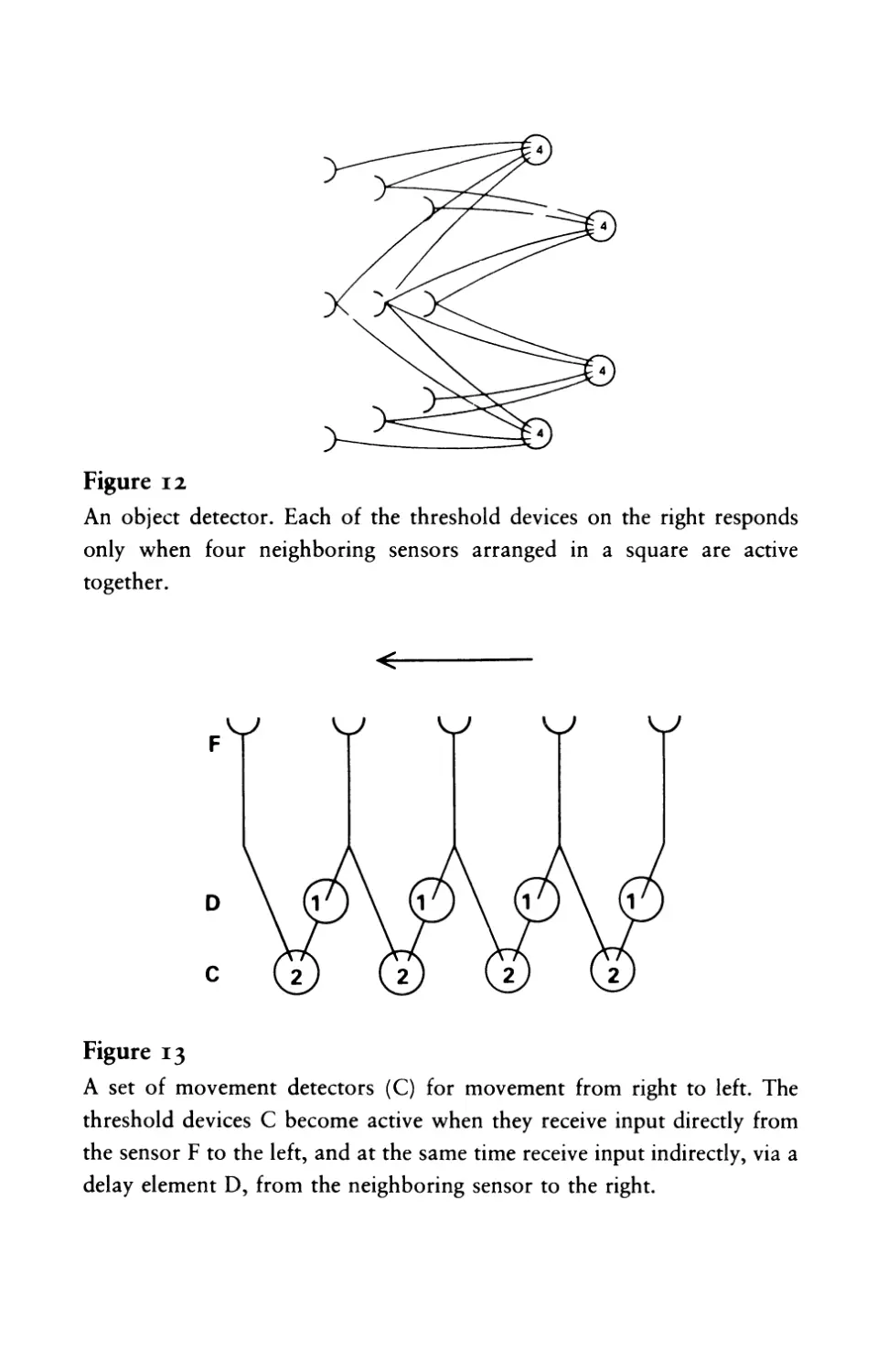
square (figure 12). Now as long as the vehicle is surrounded by little
insignificant objects or by objects quite far away, all of the photo-
cells might see just a few of these things, all in more or less the same
numbers. Consequently, the photocells will all become active
roughly to the same degree. Even if some photocell accidentally sees
a few more things than its neighbors and consequently gives a little
more output, the effect will probably be averaged out by the
threshold devices, which always add the output of four neighboring
photocells. But when a larger object appears in the neighborhood of
our vehicle, it will be seen by one or more groups of photocells that
are all connected to the same threshold device. This device will be
activated much more strongly than the others and thus will func-
tion as an object detector, of inestimable value for the vehicle.
It might be even more useful to construct a set of movement
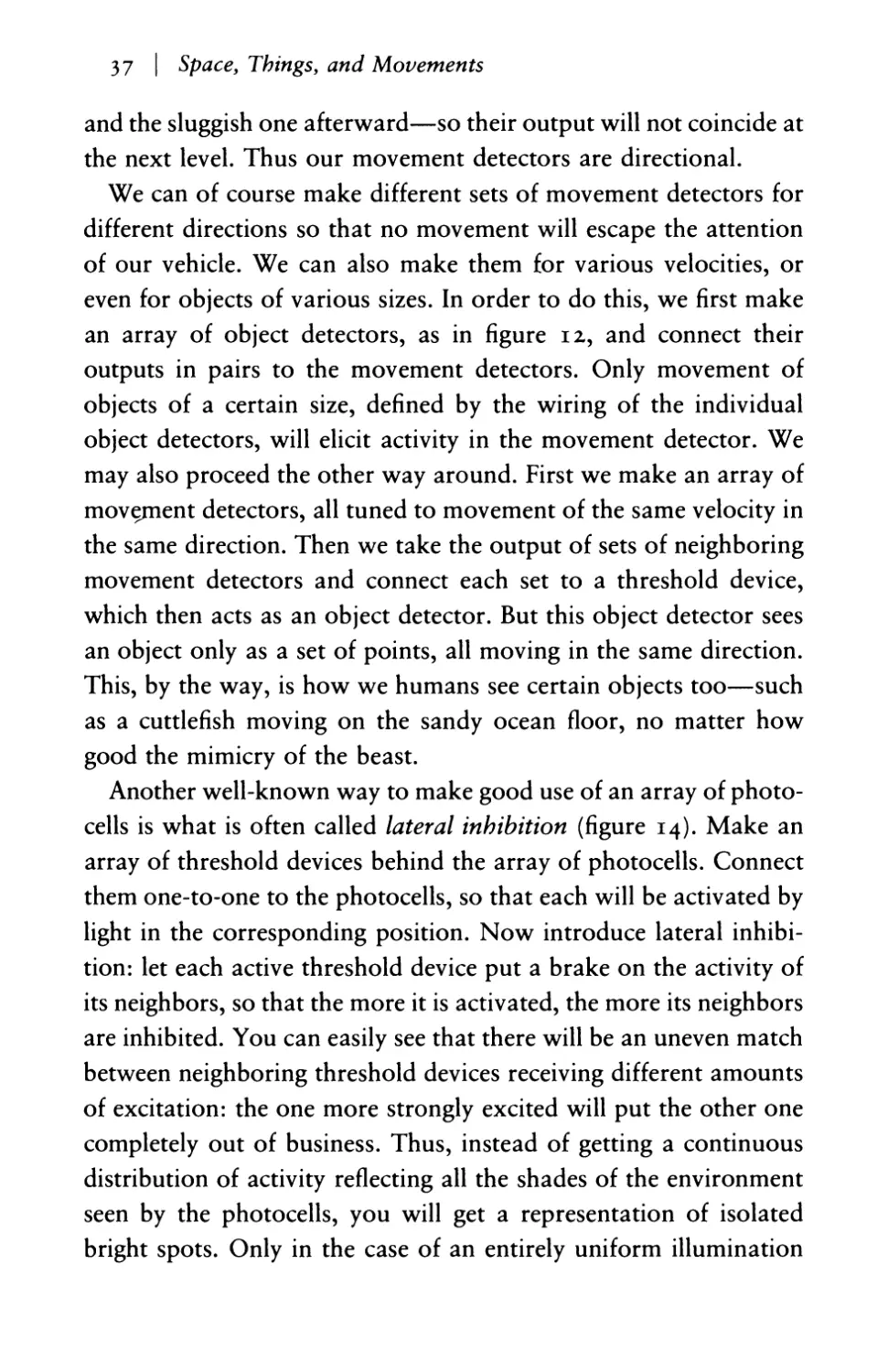
detectors connected with the array of photocells (figure 13). Put the
output of each photocell into a delay, a device that gives off a signal
a little while after it has received one. Nothing's easier than that.
A sluggish threshold device will do. Now make a new array of
threshold devices. Each is connected with one photocell via a delay
device, and with another neighboring photocell located to the right
directly, without a delay device. These threshold devices become
active only when they receive a signal from both channels. Every
time a bright object moves by from left to right, it will elicit a signal
in one photocell, which will be stored for a short while in the delay.
By the time the object elicits a signal in the neighboring photocell,
the delay will give off its signal as well so the two signals will hit the
movement detector-threshold device at the same time, making it
active. Obviously, a spot moving in the opposite direction will not
have the same effect because it will hit the fast threshold device first
Figure 12
An object detector. Each of the threshold devices on the right responds
only when four neighboring sensors arranged in a square are active
together.
<
F
D
c
Figure 13
A set of movement detectors (C) for movement from right to left. The
threshold devices C become active when they receive input directly from
the sensor F to the left, and at the same time receive input indirectly, via a
delay element D, from the neighboring sensor to the right.
37 I Space, Things, and Movements
and the sluggish one afterward-so their output will not coincide at
the next level. Thus our movement detectors are directional.
We can of course make different sets of movement detectors for
different directions so that no movement will escape the attention
of our vehicle. We can also make them for various velocities, or
even for objects of various sizes. In order to do this, we first make
an array of object detectors, as in figure 12, and connect their
outputs in pairs to the movement detectors. Only movement of
objects of a certain size, defined by the wiring of the individual
object detectors, will elicit activity in the movement detector . We
may also proceed the other way around. First we make an array of
mov ent detectors, all tuned to movement of the same velocity in
the same direction. Then we take the output of sets of neighboring
movement detectors and connect each set to a threshold device,
which then acts as an object detector. But this object detector sees
an object only as a set of points, all moving in the same direction.
This, by the way, is how we humans see certain objects too-such
as a cuttlefish moving on the sandy ocean floor, no matter how
good the mimicry of the beast.
Another well-known way to make good use of an array of photo-
cells is what is often called lateral inhibition (figure 14). Make an
array of threshold devices behind the array of photocells. Connect
them one-to-one to the photocells, so that each will be activated by
light in the corresponding position. Now introduce lateral inhibi-
tion: let each active threshold device put a brake on the activity of
its neighbors, so that the more it is activated, the more its neighbors
are inhibited. You can easily see that there will be an uneven match
between neighboring threshold devices receiving different amounts
of excitation: the one more strongly excited will put the other one
completely out of business. Thus, instead of getting a continuous
distribution of activity reflecting all the shades of the environment
seen by the photocells, you will get a representation of isolated
bright spots. Only in the case of an entirely uniform illumination
3 8 I VEHICLE 8
Figure 14
Five threshold devices, excited by that many sensors, each connected to its
neighbors by inhibitory connections. Uniform excitation of the whole set
will be subdued by the inhibitory interactions, while isolated spots of exci-
tation will stand out.
will all the threshold devices stay at the same level (although there
are difficulties at the borders of the array). But in the case of uni-
form illumination, the threshold devices will also inhibit each other
by the same amount. Thus uniformity will be weakly represented,
which is all right, for uniformity is uninteresting.
It is quite clear that these tricks, and a number of other tricks that
you might invent, are only possible when there is an orderly repre-
sentation of the "sensory space" somewhere in the body of the
vehicle. This need not be 2-dimensional visual space, as in the ex-
amples just discussed. It may be 3 -dimensional tactile space; we can
represent internally, in a 3-dimensional array, all the points that the
vehicle touches by means of a jointed arm carrying a tactile sensor.
We can also represent 3 -dimensional visual space, if we pass the
signals from two eyes through a device that performs the sort of
computation known as "stereoscopic vision" in human psychology.
We can invent all sorts of bizarre internal spaces which we might
use to file in a convenient way the information reaching the vehicle.
Two-dimensional visual space combined with one temporal dimen-
sion may lead to a representation of all the images, past and pres-
39 I Space, Things, and Movements
ent, in a 3-dimensional spatial array within the vehicle. Inspired by
some of the things that are known about animal brains, we could
also invent a 3-dimensional array for the filing of acoustic informa-
tion, with one dimension representing the frequency, the second the
intensity, and the third the phase of the acoustic signals.
Curiously, when we construct internal spaces for vehicles, we are
not even confined by the 3 -dimensionality of familiar space that
seems to limit our immediate intuitive understanding. It is difficult
to imagine solids of more than 3 dimensions, say a 4 -dimensional
cube or a 5-dimensional sphere. In fact, when we think of an ordi-
nary 3-dimensional cube, we tend to imagine something like a box
with 6 square sides. If we want to imagine a 4-dimensional cube, we
notice that the sides would have to intersect. But we cannot picture
this, so we give up.
On the other hand, it is quite easy to imagine or to draw
networks of more than 3 dimensions (figure IS). The drawing
shows spheres connected by wires. The network is truly 4-di-
mensional, since in order to specify the coordinates of one of the
balls (or the path that leads from one ball to a certain other ball),
you have to indicate how many steps to move in directions x, y, z,
and w. If you disregard distance and angles on the drawing (you
can't keep them equal on a projection even in the case of a 3-
dimensional net), and if you imagine the net continued ad infinitum
in all 4 directions, the network will look the same no matter which
ball you sit on or in which of the 4 directions you look. Now, you
could even build the network, or a piece of it, out of spheres and
wires: you would be able to hold in your hands a structure that is
intrinsically 4 -dimensional, though of course collapsed ("pro-
jected") into the 3 dimensions of space in which your hands move.
(An architect similarly collapses his buildings into the 2-dimen-
sional space of his drawing board.) You could even sit on your
network and squash it into a 2-dimensional felt. It would not mat-
ter. A louse finding its way along the wires would still notice the
40 I VEHICLE 8
\" >£' // '). /// \, ",/ /
/' /' ,/ /' /" /'
/' /"
"' /0 / "' '!I/0 v "' v0 V II\.
....... ./ ...'"\ ./ ..)II ,/
/' "" ./ ........ /' ........
).....0 / III.. /0 "" /0 1/ .....
'" '10
" v ./ /'
./ ./' /' ./ ./ "\../
'/ ..... //, v //..... r-.
.... / // \,..... vv/ '\. !(y V.
./ /' ./ /' /' /'
/' ./ r-.. /' /
/ "' v0 r- 0
'" / '" ') V
..." ./ /'I ./ ../ ./
./ ........ ,/ .....- ./ .....
0 0 r-.. V r-
'" "'
... ./ ,/ )III
./ ./ /' /' ,/ ./
// ....." /< //..... ....,
v / \",r' //' ') /'
/' /' ........ ../ /" /'
/ rill /' /' ...
..... r'- 0 , ».....
\, "'
/'" /' .JII ./ ..)II
/' ,/ ./ /' .r
v0 v0 /0/ '
" '" 11
,/ /"
/' ./ /' P'I...../ /' /"
/' v // V" // /,) I\.
Figure IS
A four-dimensional cube. Each edge is marked by three black dots on a
line, connected by a wire.
4 -dimensional connectivity, provided it had the necessary mathe-
matical acumen.
The point I want to make is the special virtue of networks as
opposed to solids. Once you have decided to represent space by
discontinuous, discrete points within the vehicle, you can represent
"neighborhood" by means of lines connecting the points. This gives
you the freedom to mimic all sorts of spaces, including spaces that a
human mind cannot imagine. Can the vehicle imagine such spaces?
We must turn to the philosophers again. Let us ask a philosopher
whether Vehicle 8 is endowed with the a priori concept of space, for
this is a familiar question to him. Only, in this case the philosopher
cannot just close his eyes and look inside himself for an answer. He
will have to invent experimental situations in which the vehicle
could demonstrate its proper use of an internal representation of
space. A simple test: move the vehicle from its present position a
4 I I Space, Things, and Movements
certain distance in a certain direction, and then again in another
direction. If the place where the vehicle was before had some favor-
able connotations, it might want to go back. Will it move back
exactly the way it came, or will it choose the diagonal, which is the
quickest way to get there? If it has an internal representation of 2-
dimensional euclidean geometry (that is, if it has 2-dimensional
space built in a priori), it will head directly toward the goal.
Now this internal representation of space is something that we
could very easily wire into the network within the vehicle. Just
imagine a 2-dimensional sheet made of a material which has
everywhere the same conductance value for electric currents. This is
defined as the current (in amperes) divided by the voltage applied
(in volts) for a wire of a certain thickness and a certain length. Now
if we apply a voltage difference between two points on the sheet,
the current that flows through the material is strongest (the current
density, current per cross-sectional area, is highest) along a straight
line connecting the two points. If we let one of the two points
represent the place where the vehicle is and the other point the
place where it wants to go, we can easily construct a device that will
determine the best course for the vehicle by way of a simple mea-
surement of current density in different directions on the sheet.
So we would conclude that Vehicle 8 does have the a priori
concept of 2-dimensional space. Could Vehicle 8 embody that of 3-
and 4-dimensional space as well? To wire an internal representa-
tion of 3 dimensions into the vehicle, we could use a block of the
same material out of which we made the 2-dimensional sheet, with
many electrodes embedded in it to produce voltage differences and
measure currents. But for 4 dimensions we already know that we
have to resort to 4-dimensional networks, since we are not able to
make (or even imagine) 4-dimensional blocks. In principle, this
does not make much of a difference. We could still measure shortest
distances by the method of current density analysis. We could also
use the 4-dimensional network in more complicated ways to let the
42 I VEHICLE 8
vehicle show off its built-in a priori concept of higher dimensional
space. If the vehicle could talk, we would ask it to rotate in its mind
a 4 -dimensional cube, let us say 90 degrees, around one of the axes.
There are such exercises in human IQ tests, using 2-dimensional
pictures of 3 -dimensional dice with three sides showing. The three
sides are decorated in different ways. The questions are of this sort:
is cube A just another view of cube B, C, D, or E? Some humans
have trouble with 3-dimensional dice, all with 4-dimensional ones.
But a vehicle endowed with a network like the one in figure 15
might very well pass the IQ test for 4-dimensional cubes if the
question was posed in a language it could understand.
I can hear myself talking to the philosophers again. The point I
am making is that orderly representation of space in a vehicle is
more than just convenience of construction. It provides for easy
tests of reality . We have seen how easy it is to knit networks that
will react to images moving at certain speeds. If these can be taken
as images of objects in the world outside, the velocity of the move-
ment of the images will stay between certain reasonable bounds, dic-
tated by the physical laws governing the movement of the objects.
In particular, there won't be any movement of infinite velocity;
there won't be any sudden displacement. Continuity of movement,
no matter at what velocity, is a primary criterion for the physical
reality of an object. Also, the continuity and certain regularities of
the change of shape of a shadow indicate that the shadow is cast by
a solid object. This, too, could be fairly easily detected by a network
with 2-dimensional connectivity. And of course identity of shape
irrespective of movement (a strong clue for objects keeping a cer-
tain geometrical relation with a given vehicle) can also be detected
by such networks. We will take up this point again from a different
point of view in the next chapter. Here it was sufficient to show that
in our vehicle, just as in the physics of relativity, the recognition, or
even the existence, of objects is related to the dimensionality of
space, internal and external.
Vehicle S
Shapes
We will improve on our vehicles some more, along the
lines outlined in the construction of the preceding brand 8, but with
a different intention this time. We will try to furnish our vehicles
with a convenient set of ideas referring to the shapes of things,
especially to shapes as we see them with our eyes (and as a vehicle
sees them if it is equipped with a good camera-type eye).
First of all, if we want to consider shape independently of color
and other irrelevant details, we must produce an outline drawing of
things in the visual field of the vehicle, as a draftsman would with a
pencil. (Webster's dictionary defines shape as "the quality of a thing
that depends on the relative position of all points composing its
outline or external surface. ") This is not very difficult if things
stand out clearly against their backgrounds-for instance if these
things are birds in the sky or vehicles on a white sheet. We can then
use the trick of lateral inhibition, which we have already learned
(figure 14). Only sharp boundaries will be passed on to the next
level, thereby producing a pure line drawing. If the interior of the
figure represented is quite homogeneous, say all black, there will be
only the outline or shape.
Let us construct detectors for elementary properties of shape.
44 I VEHICLE 9
Figure 16
A detector for bilateral symmetry. There is an array of elements onto
which an image is projected. Elements symmetrically spaced with respect to
the midline enhance each other. There will be a strong activation of the
array for bilaterally symmetrical images.
The first property that comes to mind is bilateral symmetry. Its
detector is easy to construct and enormously valuable (figure 16).
Again we make an array of threshold devices onto which a picture
of the external world is projected by means of a suitable camera
system (we can filter the picture first through a network with "lat-
eral inhibition" to enhance relevant detail). One half of it receives a
picture of the right half of the visual environment, everything to the
right of the vehicle; the other half receives a picture of the left half
of the world. Now we connect by a wire each pair of threshold
devices occupying symmetrical positions on the right and left sides.
Through the wire the threshold devices influence one another in
such a way that when they both receive input, they become much
45 I Shapes
more active than when only one of them is activated. It is clear now
that when the vehicle faces a symmetrical shape (with a vertical axis
of symmetry, such as an upright human figure seen from the front
or from behind), there will be much more activity in this array of
threshold devices than there will be in any other case. For every
element excited on one side of the vehicle, its symmetrical element
on the other side will also be excited, with the consequent recip-
rocal enhancement.
Let's not talk about an upright human figure; that introduces an
unintended aesthetic aspect. Think only of a world populated by
vehicles of the various kinds that we have been building. Up to now
we have not talked much about the exterior appearance of our
vehicles, although we have implicitly assumed that the vehicles are
made of two halves, mirror images of one another: two motors, one
on each side, two nostrils, a symmetrical casing like an automobile.
Of course such vehicles, seen from the side, are not symmetrical:
their sense organs are in front, their motors are in the back, and
their prevalent movement is always in the same "forward" direc-
tion. Nor are the vehicles symmetrical in the up-down direction if
they move around on surfaces, as our vehicles mostly do; for rea-
sons connected with gravitation, there will be wheels (or other
instruments of locomotion) on the side of the vehicles facing the
ground, the so-called underside.
But there are good reasons for the vehicle to be symmetrical in
the direction perpendicular to both the "front-back" and the "up-
down" directions-along the axis defined by the pair of concepts
"right" and "left." We have seen this early on in the cases of
Vehicles 2, 3, and 4, which showed surprisingly lifelike behavior on
the basis of paired, very simple, symmetrical connections between
two sense organs and two motors. The kind of behavior associated
with two symmetrical reins governing the motors is one in which an
object is isolated from the environment as a partner in behavior.
The vehicle's movements are directed by feedback, either turning
4 6 I VEHICLE 9
the vehicle toward the object or turning the vehicle away from the
object.
Consider the first case: feedback that makes the vehicle turn
toward the object. An observer might say that our vehicle has that
object on its mind or our vehicle pays attention to that object. Well,
what if the object is another vehicle? What would the situation look
like to that vehicle, and how should it react? Obviously the situ-
ation in which a vehicle sees another heading directly toward it,
whether in an inquisitive, a friendly, or an aggressive mood, is a
special case and well worth special attention. The detector for bilat-
erally symmetrical shapes, which we have just described, proves
helpful here: we may connect it to the output in such a way as to
trigger the mechanisms that govern the appropriate reactions to
"another vehicle facing me" or "another vehicle having me in
mind." (Perhaps one should reactivate the beautiful term "confron-
tation": fronts coming together, facing each other.) In fact, it is
clear that bilaterally symmetrical configurations in a natural world
containing only vehicles (and no other man-made objects, such as
churches or monuments) would mostly signify just that: a partner
in interaction with the observer.
There is a relation between bilateral symmetry in sensory (espe-
cially visual) space and the concept of "thou," the pronoun of the
second person singular. This has been used by the builders of tem-
ples and churches who, by a pointedly symmetrical architecture,
evoke the presence of an abstract thou, a partner in conversation
always facing the observer. The same principle can be observed in
biology: certain flowers, such as orchids, adopt bilaterally symmet-
rical shapes in order to be accepted as "partners" by insects with
detectors keyed to this type of symmetry.
I want you to note that something new and very important has
crept into our discussion of a detector with bilateral symmetry . We
decided to give our type 9 vehicles a system of connections between
corresponding points on their right and left sides. In order to ex-
47 I Shapes
plain how useful such a system would be, we had to invoke not only
the external appearance of other vehicles (which our vehicle might
meet) but their behavior as well. Things are getting complicated:
we are no longer working on individuals taken by themselves but
on the members of a community in which there are complicated
interactions between vehicles of the same or of different kinds.
Every improvement that we invent for the latest breed of vehicles
put in circulation will either force others out of business by a pro-
cess of Darwinian selection (see Vehicle 6) or make others change
their behavior through learning ( see Vehicle 7). Of course, this
makes it difficult to foresee what will actually work out as an
"improvement." Sometimes the net effect will be contrary to what
we expect, due to unforeseen reactions of the environment. But
certain great inventions will survive all vicissitudes and will be
immune to all shrewd defenses. I suspect that the detector of bilat-
eral symmetry, which provides information about "being in some-
one's focus of attention," belongs to this category. Even in biology
with all its complicated interactions between species, the symmetry
detector has remained of primary importance. An insect in search
of a sexual mate does not really care if it gets occasionally side-
tracked by an orchid as long as its symmetry detector serves the
right purpose in the majority of cases.
Other insects fall for different kinds of flowers, for those with
radial symmetry, like daisies. We can also construct radial sym-
metry detectors for our type 9 vehicles: these detectors might indi-
cate singulari ties in the world, sources from which something
emanates in all directions. A radial symmetry detector could also be
based on the fact that no movement is perceived on approaching a
pattern like that of figure 17. The picture remains identical to itself.
A fundamental category of form is periodicity. A repetitive pat-
tern may signify many important situations. It may signify a collec-
tion of identical individuals. Then again, a periodic pattern left on
the ground may be the track of a vehicle moving by some sort of
48 I VEHICLE 9
Figure 17
A pattern that is invariant to changes of scale. A vehicle approaching the
center of the figure has a constant visual input (provided we make the
figure large enough and the lines infinitely thin). The absence of perceived
movement may be used as diagnostic for figures with radial symmetry.
periodic stepping mechanism. Or the pattern may be generated by
some oscillatory movement in the form of a standing wave-an
indication of stored energy. For all these reasons periodic patterns
are happenings of great importance in this world; they are just
as fundamental as bilaterally symmetrical or radially symmetri-
cal figures. So we should equip our vehicles with detectors for
periodici ty.
This can be done in various simple ways. For instance, we can
give them periodic templates with different spacing and let them
match the picture of the environment with the templates by the
mathematical process of cross-correlation. This is the principle of
Fourier analysis. Its technical realization does not require too much
ingenuity. Another interesting detector of spatially periodic input is
implicitly contained in the network described in the previous chap-
49 I Shapes
ter as lateral inhibition. We have seen that such an array of
threshold devices neglects continuous excitation and enhances con-
trasts. It gives maximal output for patches of excitation spaced
sufficiently far apart so that they won't disturb each other by inhibi-
tion. For a periodic pattern, the spacing is determined by the length
and strength of the inhibitory connections. If we test the lateral
inhibition device with striped patterns, we will notice that it gives
the same output no matter how the stripes are oriented if the inhibi-
tion works in all directions.
Taken together, vehicles of types 8 and 9 have provided much
new evidence for our law of uphill analysis and downhill synthesis.
A problem that taxes the minds of psychologists when they deal
with real animals or humans, that of inborn concepts, found many
solutions when we attacked it from the downhill, synthetic direc-
tion. We built very simple homogeneous networks and then dis-
covered that they contain implicit definitions of such concepts as
3-dimensional space, continuous movement, reality of objects,
multitude of objects, and personal relation. More and more we
are losing our fear of philosophical concepts.
The exercises in synthetic psychology contained in this chapter
deal mostly with visual input. It is of course easy to imagine a priori
concepts in other categories of input, such as the tactile or olfactory
inputs. It is quite elementary to provide the vehicle with detectors of
aural periodicity. They would detect various frequencies in the
purely time-dependent (nonspatial) input derived from one of the
vehicle's ears (microphones). The a prioris of frequency, the so-
called resonators, have been basic to human auditory theory for a
long time.
Vehicle 10
Getting Ideas
The time has come to sit back and consider the strange
variety of vehicles that populate our laboratory. They all go about
their business according to certain rules, some of which we under-
stand, because we invented them ourselves, and some we don't,
because they emerged from a sort of Darwinian evolutionary pro-
cess. The objects of their interest are defined by simple properties
such as smell and color, or by more abstract properties, such as the
periodicity of their coloring or the symmetry of their outline. For-
mal properties may stand for even more abstract definitions, as we
have seen in the case of bilateral symmetry signifying the situation
of "somebody having me in mind."
Some of our vehicles seem to move around smoothly, as if at-
tracted and repelled by the sources of various fields of force
superimposed on one another. Others appear to make sudden deci-
sions, rousing themselves from a rather phlegmatic condition to
take off on isolated ventures, after which they resume their state of
rest. The vehicles seem to know their environment rather well, so
much so that they are able to reach some objects with closed eyes,
so to speak, apparently on the basis of some internalized map on
which the object's location is recorded. On the whole, these vehicles
5 I I Getting Ideas
are surprisingly smart, especially considering the limited amount of
intelligence that we, their creators, have invested in them.
But do they think? I must frankly admit that if anybody sug-
gested that they think, I would object. My main argument would be
the following: No matter how long I watched them, I never saw one
of them produce a solution to a problem that struck me as new,
which I would gladly incorporate in my own mental instrumenta-
tion. And when they came up with solutions I already knew, theirs
never reminded me of thinking that I myself had done in the past. I
require some originality in thinking. If it is lacking, I call the perfor-
mance at best reasonable behavior. Even if I do observe a vehicle
displaying a solution to a problem that would not have occurred to
me, I do not conclude that the vehicle is thinking; I would rather
suppose that a smart co-creator of vehicles had built the trick into
the vehicle. I would have to see the vehicle's smartness arising out
of nothing, or rather, out of not-so-smart premises, before I con-
cluded that the vehicle had done some thinking.
But this does not mean that we cannot create vehicles that would
satisfy this condition. We shall do this gradually, starting with the
problem of having ideas. Let us take one of the vehicles of type 7,
the ones with the Mnemotrix connections that introduce the effects
of experience into the brain. This vehicle has been around for some
time and has absorbed a great deal of knowledge about the world.
This knowledge takes the form of statistical correlations between
elementary events in the vehicle's sensory spaces or statistical cor-
relations between more complex events represented in some
threshold devices of its interior (or between elementary events and
complex events).
Suppose the vehicle has learned that certain objects, A, B, C, D,
are situated near the rim of the table top on which it lives: a broken-
down vehicle, a light, a battery, a hill, a supply of screws. It has
learned to associate these objects with the concepts "margin of the
universe" and "dangerous cliff." On its occasional excursions to-
52 I VEHICLE 10
ward the margin of the universe, it will also have noticed the neigh-
borhood relations among pairs of these objects: the screws are next
to the hill, the light next to the battery, and so forth. One day, after
enough excursions, the vehicle will suddenly realize that all these
paired associations (A next to B, B next to C . . . , Z next to A)
make sense if the whole situation is seen as a closed chain. The
vehicle now has the idea of a finite bounded universe, with objects
A to Z marking the marginal closed line. Once this "image" or
"idea" is generated out of individual items of knowledge, it is there
to stay. It may, in fact, be immediately recorded on the maps,
whose use we have discussed. If so, we will observe that forever
after the vehicle moves around much more expertly.
We must be careful, however, not to let the process of acquiring
new ideas interfere with the detailed knowledge that our vehicle has
assiduously collected and carefully stored in many associative con-
nections during its lifetime. We know that this may happen in
humans who are overly dedicated to the development of ideas.
They tend to connect many individual cases into general categories
and then use the categories as if they were things, losing the poten-
tial for categorizing in other ways by remembering each instance.
In the example of the discovery of the margin of the universe, I
can see this danger. The idea of a closed chain of objects may be so
strong that it keeps the images of these objects permanently active
in the vehicle's brain. The consequence is that associations will
develop between every object on the margin-and every other ob-
ject on the margin. The serial order that led to the original idea will
thereby be lost or at least submerged in a system of much stronger,
massive associations. The way out in our case would be to let the
excitation circulate in the closed chain associations. This would
strengthen the associations representing the serial order of the ob-
jects and would not allow cross-association to develop.
Here are some more examples of ideas that may arise in vehicles.
There are coins lying around on the floor in the universe of the
53 I Getting Ideas
vehicles. Some of the coins are decorated with a picture of a human
head and others are decorated with a number. One of our vehicles
has already learned to recognize and to distinguish the two types of
coins. That is, there are distinct patterns of activity, say two differ-
ent threshold devices becoming active when one or the other kind
of coin is seen by the eye of the vehicle. Now one of the coins
showing a human head is flipped around by the vehicle-and sud-
denly it shows the number. This happens again and again until, by
the learning process that we have already incorporated in our vehi-
cles, an association is formed: "head, flipping, number." Of course,
the association also works the other way around. Once the associa-
tion is acquired, the vehicle knows that, after adding the action of
flipping to the sighting of "number," the picture of the head will be
seen. It may also be reinforced by the contrary experience, when the
flipping of coins showing the number reveals the head.
We may call the whole complex of head-flipping-number and
number-flipping-head the idea of a coin with two faces. It arises in
the vehicle although the two faces of a single coin are never seen
together. The idea of a coin with two faces can arise even if there
are some coins around with human heads on both sides, as long
as these coins escape the vehicle during the phase of "getting the
idea. "
Here's another example. Moving through a garden, a vehicle
finds out that flower number one of a row is a source of food,
flowers 2 to 7 are not (they are poisonous), flower number 8 is
again a source of food and so are flowers 15, 22, and so forth. After
a while it may happen that in the brain of the vehicle only one of 7
threshold devices (connected in a circular fashion) always becomes
active in temporal coincidence with the finding of a source of food
in a flower. This is again "getting the idea": that particular
threshold device will be associated with the food finding system-
with the consequent advantage of being able to predict sources of
food without having to invest much energy in the process of sniffing
54 I VEHICLE 10
around. We must suppose, of course, that the time it takes for one
threshold device to become active after another has been activated
is exactly the same as the time it takes to get from one flower to the
next or, better still, that the advancement of activity by one step in
the ring of threshold devices is triggered by each flower.
All of this is not complicated in principle but boring to carry out
in detail. We rely on the process of Darwinian selection that, start-
ing with the vehicles of type 6, has introduced a great variety of
different patterns of connections into the vehicles without our even
noticing it (although we do recognize the vehicles' greatly increased
complexity of behavior). We can well imagine that the vehicle could
get the idea "edible flower" even if the only flowers that were edible
were those whose ordinal numbers were square or whose ordinal
numbers were prime. There is, however, a complication in the cases
of squares and of prime numbers. If these numbers get too large, the
vehicle has to perform a long and intricate dance between one
flower and the next in order to find out whether the flower's num-
ber is square or prime, leaving marks on the earth and retracing
them according to complicated rules. We have seen this before, at
the end of the chapter on Vehicle 5, which also had its limitations.
No such difficulty arises if the vehicle has to find out whether a
number is even or odd, or whether a number is a multiple of six or
of eleven, as long as the vehicle can count to eleven.
In this chapter we were only interested in the general idea of
"getting ideas." Readers who want to know exactly what kind of
network of threshold devices is necessary to calculate numbers that
are square, or prime or whatever, must read the textbooks of auto-
mata theory.
Vehicle 11
Rules and Regularities
Most of you will not yet be convinced that the process of
getting ideas as it was described in the previous chapter has any-
thing to do with thinking. It is not surprising, you will say, that
occasionally something clicks in the workings of a fairly com-
plicated brain and from then on that brain is able to perform a trick
(an algorithm, as some people say) that can be used to generate
complicated sequences of numbers or of other images. It is also not
surprising that these may occasionally match sequences of events or
things in the world of the vehicle.
I will show you that this is just one step in the direction of
creating behavior akin to thinking. In the following chapters we
will introduce more elements of the thought process, making new
vehicles to show new tricks, new types of performance. In the end
our vehicles will surprise us by doing some real thinking.
We want to equip Vehicle I I with a brain about which it can be
said-in a more radical way than it could be said about previous
editions-that it is a model of the world. We already introduced
partial aspects of this model idea, when we talked about the useful-
ness of internal maps representing external spaces (Vehicle 8), and
when we described a learning process (Vehicle 7) that discovers
56 I VEHICLE I I
things in the environment and establishes their internal models
(called concepts). But this is not enough. These things move
around, bang against each other, associate and dissociate, grow and
break. We have altogether missed these dynamic aspects up to now.
We will introduce these dynamics by improving on the system of
Mnemotrix connections already introduced in the type 7 vehicle.
You will remember that these connections between elements in the
vehicle's brain were of different strengths and could be made mote
effective when the elements they connected were often activated
together. This turned out to be very convenient, because so many of
the facts about the world that are interesting and important to us
(and to the vehicles) may be expressed as things or events that tend
to occur together. For this reason it is unlikely that we will give up
the trick of associative learning in any further development of more
refined vehicles.
But we soon discover that there are important pieces of knowl-
edge about the world expressed in a different form: events that do
not present themselves at the same time but in succession-pairs of
events, of which one is always the first and the other the second,
like lightning and thunder, swinging a hammer and hitting the nail,
or, in the world of vehicles, meeting a source of food and tasting the
food. When we discover a pair of such events, we tend to think that
one is the cause of the other, whatever that means. But this may
lead to wrong interpretations, for instance when both events are
produced by a third hidden event, only with different delays. Most
of the time, however, when two events regularly occur in succes-
sion, it is no accident. And it certainly is useful for a vehicle to
know what to expect when events occur that have important, possi-
bly dangerous, consequences.
We could use our old supply of Mnemotrix wire together with a
little electronics to incorporate into the vehrcles' brains all those
delayed coincidences of events we have been describing. What we
want to achieve is a connection between the two internal represen-
57 I Rules and Regularities
tatives of an event A and an event B such that, when the representa-
tive A is activated by the input, the representative B is activated by
the connection, but not vice versa. The connection would then
represent the fact that "B often follows A" or, if you wish, the
causal tie between A and B. This would force us to do a rather
complicated wiring for every such connection. In order not to bur-
den our constructive imagination too much, we prefer to buy a
different sort of wire, called Ergotrix, which conducts in one direc-
tion only and has an increased conductance when it is interposed
between elements that are active in succession within a brief time.
We must be careful, of course, to install the wire in the right direc-
tion, conducting from the element that tends to be active first to the
one that tends to be active second.
Once again we will see to it that all of this happens automati-
cally. Plenty of Ergotrix wire will be installed between as many
elements as possible so that whatever sequences occur can be re-
corded in the system. Of course there will be no lack of opportunity
for learning. With all the movement in the world around the vehi-
cle, with all the natural laws operating, and with all the other
vehicles displaying fairly regular behavior on the basis of all the
tricks that we (or the processes of evolution) have built into them,
many sequences of events will repeat themselves and they will be
worth learning.
You may ask why we did not use Ergotrix wire in the first place
(Vehicle 7) when we first gave our vehicles the capacity to learn,
starting with those complexes of properties that frequently occur
together because they belong to one "thing." We used the Mnemo-
trix wire, which is ideal for associations, because it couples ele-
ments in a symmetrical fashion; once coupled, each of the properties
can recall the other in quite the same way. For each Mnemotrix
connection we could have used two Ergotrix wires (one for each
direction) to obtain almost the same result. But there are two rea-
sons to leave things as they are.
First of all, we don't want to go back in evolution and change
58 I VEHICLE I I
things that have already proved to be convenient, since we might
lose some advantage that we have not even realized. (Remember the
law of uphill analysis and downhill synthesis: we run the risk of not
understanding any longer what we previously put together.) Sec-
ond, it is probably a good idea to keep the two processes conceptu-
ally separated-the associations of elementary properties into
things or concepts on one hand and the sequencing of concepts on
the other hand, one controlled by the Mnemotrix, the other by the
Ergotrix system. The two kinds of learning produce two different
kinds of knowledge, like geography and history, or systematic zool-
ogy and animal behavior, referring to what kinds of things exist
and to how they develop and interact.
If we let our imaginations go and try to work out in detail what
kinds of things the Mnemotrix system will discover in a real world,
and what kinds of dynamic laws will be incorporated in the Ergo-
trix system, we soon discover that the two kinds of knowledge are
perhaps related more than we had assumed initially for reasons of
conceptual convenience. First of all, it would seem that the process
of abstracting things from the environment-concept formation at
the most elementary level-must occur prior to the process of dis-
covering the dynamic properties of these things. For the laws of
successions of events refer to the development and to the combina-
tion of things rather than their elementary properties. This is famil-
iar from our own human experience: listening to a new language
we want to learn, we must first discover individual words, or roots
of words (something like the morphemes in linguistic terminology),
before we can even hope to discover the rules that govern their use.
Also, in the development of a science it is often apparent how the
discovery and denomination of phenomena precedes the definition
of the laws of their transformation. Chemistry had to go through a
descriptive phase before the physics underlying the variety of sub-
stances could be understood. Zoology had to be taxonomic before
it was organized by the theory of evolution.
59 I Rules and Regularities
On the other hand, purely descriptive classification is not only
boring, it is also potentially misleading. It may lead to the wrong
categories when it is not guided by at least the intuition of a theory
of the underlying processes. A century of microscopic anatomy has
filled the libraries with thousands of beautifully illustrated volumes
that are now very rarely consulted because the descriptive catego-
ries of the old histology have been largely superseded by the new
concepts of biochemical cytology. The example from linguistics
that we have just mentioned may well serve to prove the contrary
point, with word roots-morphemes-words as the segments of
speech that must be learned. While it is true that these chunks of
meaning in some languages (largely in English) coincide with
acoustically well-defined episodes (the syllables, which the naive
listener can recognize), it is certainly true that a better, more general
definition of morphemes or words is derived from grammar. Words
(I use this term loosely) are the segments of speech that we discover
as the ultimate particles of grammar. If we had no idea or no
experience of grammar, we might never discover that these are the
pieces that are shuffled around to form sentences. We might pro-
pose a different, incorrect segmentation of speech, for example, a
segmentation into syllables in a language with polysyllabic words.
Words become meaningful insofar as they are used in a grammat-
ical system.
In other words, abstracting meaningful chunks from the environ-
ment (things, events) and discovering the rules of their behavior are
two processes that condition each other and are necessarily inter-
laced, like the learning of the vocabulary and the learning of gram-
mar in a language course.
Coming back to Vehicle I I, it seems like a good idea to let the
discoveries of the Ergotrix system influence the learning process in
the Mnemotrix system, on whose initial abstractions it in turn de-
pends. I don't want to work this out in detail, but something like
the following scheme would clearly be possible. We have already
60 I VEHICLE I I
described the conditions for the strengthening of an Ergotrix wire.
These conditions are fulfilled when an element, say a threshold
device, at one end of the wire becomes active shortly before another
element becomes active at the other end. We have also seen that it
is mostly groups of such elements, strongly interconnected and rep-
resenting "things," that become active in succession. Now let's
introduce the rule that whenever the Ergotrix wires become
strengthened, the Mnemotrix wires within each of these groups will
also become strengthened.
Thus concepts are established in the vehicle especially when they
appear in regular sequences. How would this look to us? We would
notice, observing the apparently erratic behavior of a vehicle in its
world, that the vehicle displays particularly well defined reactions
to events that are known to have consequences. Take, for example,
a vehicle approaching an obstacle at high speed. We would not be
surprised to see the vehicle promptly react to its perception of the
danger of a collision. Similarly, Vehicle I I will quickly remember
which of its own behavior patterns regularly and quickly elicit a
reaction from other vehicles. We observe that after an initial learn-
ing period Vehicle I I will either produce these behavior patterns
frequently or pointedly avoid them. It will use them as signals. It
will also learn those signals that regularly precede certain behavior
patterns of other vehicles. After a while Vehicle I I will react to
these premonitory signals just as it reacted, before the learniQg, to
the behavior that regularly followed the signals.
But it would take prolonged observation to notice this particular
aspect of learning in the vehicles. As a matter of fact, we might not
have suspected it if we had not introduced a piece of our own
philosophy into the construction of these vehicles. As our brain
children become more efficient, we notice that the "law of uphill
analysis and downhill synthesis" becomes more and more compel-
ling. For the time being, take the message in this form: since you
were not satisfied with the first meager showing of intelligence in
6 I I Rules and Regularities
our vehicles, we started adding a few more tricks, hoping that they
would convince you a little more. The first trick we tried was the
coding of the environment in those terms that yield a maximum of
correlations and logical structure, in other words, in the most
meaningful terms.
Vehicle 12
Trains of Thought
At this stage, if you want to be critical, it is easy for you
to maintain that up to now you have not discovered anything in our
vehicles that goes beyond ordinary learning. True, these creatures
seemed to become more and more able to deal with the adversities
of their environment, not only by a process of Darwinian selection
but also by active assimilation of information from the world. But
thinking is different. It is a process that can go on for a long time, as
everyone who has done some conscious thinking knows. Thinking
can be observed in other people as well, when we get verbal or
nonverbal evidence for a succession of mental states that are guided
by some criterion of plausibility or logic-mental states that reflect
the exploration of various blind alleys and eventual arrival at a
result. Sometimes we seem to notice such mental operation even in
a monkey or in a dog. But not yet in a vehicle.
The possibility of sustaining long successions of distinct brain
states for the purpose of exploring knowledge already incorporated
in the brain is what we will introduce in a new brand of vehicle,
which we will call Vehicle 12.
First a remark on pathology. All the later vehicles, beginning
with type 7, are in constant danger of running into a condition
63 I Trains of Thought
quite analogous to epilepsy (which is also one of the most common
forms of derangement of animal brains). The strengthening of the
connections bet -een the elements of the brain, which is at the basis
of associative learning, embodies the danger of reciprocal activa-
tion beyond control. In a population of elements in which excit-
atory connections abound, if the number of active elements reaches
a certain critical level, chances are the remaining ones will also
become activated. These elements, in turn, keep the first set active.
A maximal condition of activity is then established and maintained
until the supply of energy is exhausted. This maximal activation
makes no sense in terms of the information ordinarily handled by
the brain, which is keyed to patterns of partial activation of the
elements. Necessarily the result is disorderly, ineffective behavior.
There are various ways of dealing with this danger, and I propose
the following for our vehicles.
Let every threshold device in the vehicle's brain be touched by a
special wire through which we can control its threshold. If we set
the thresholds high, the threshold devices will become active only
when they are very strongly activated by the input they receive from
other threshold devices or from the sensors. For a lower threshold,
less input will suffice. So if we watch the operation of the brain-
and in particular the total amount of activity in it-we can always
prevent an attack of epilepsy by raising all the thresholds. If there is
not much activity, we can lower all the thresholds and thereby
encourage the circulation of activity through the brain. It is of
course quite easy to let this happen automatically. All we need
(figure 18) is a box that receives as its input the number of active
brain elements at that moment and calculates appropriate thresh-
olds, which it then sets for the whole brain. In real life, the input
for this threshold control device might be the rate of change of the
number of active elements, in order to give it an opportunity to
foresee the catastrophic explosion of activity before it happens. But
64 I VEHICLE 12
>
B
> 0
etA)
Figure 18
B is the brain, which receives input I and elaborates an output O. At the
same time it signals the level of activity A in its interior to a special box that
calculates appropriate thresholds 8 for the elements in B.
for purposes of illustration it will suffice if the threshold control
device works just on the amount of activity in the brain.
The effect of this global negative feedback on the activity of a
vehicle's brain is illustrated in figure 19, which shows the number
of active elements as a function of the number of active elements a
moment earlier. When the activity is low, it will again be low at the
next moment. (For very low excitation, there may even be a ten-
dency for the activity to die out, since a minimum density of active
elements in the brain is required to activate the next set of elements,
but this is not shown in figure 19.) For very high levels of excita-
tion-that is, for a very large number of active elements-we may
imagine that the thresholds are immediately set so high that the
activity will drop to a very low level at the next moment. Inter-
mediate levels of activity will lead to maximum activity at the next
moment (see the middle part of the curve in figure 19). Later on we
will come back to this curve, which has interesting philosophical
impli,ations. First let us watch the operation of a brain that con-
65 I Trains of Thought
AI
Figure 19
The function describing the next number of active elements AI + 1 given the
present number of active elements AI. It can be seen by iteration (follow the
lines starting from the arrow near a) that the states of a brain controlled by
such a rule are quite unpredictable.
tains many learned associative connections while it is being con-
trolled by the feedback of a threshold control device.
We have already noticed that the vehicle's brain has a tendency
to explode into fits of activity because of the abundance of recip-
rocal activation between its elements, a situation reminiscent of the
chain reaction in a block of uranium. But most of these explosions,
if everything works out the way we have planned, should take place
within limited groups of elements that are tied together by particu-
66 I VEHICLE 12
larly strong associative connections. Such sets of elements arise as
"concepts" representing things or events that have often presented
themselves in the environment.
Let one such thing appear in the sensory space of Vehicle 12. The
explosion of activity will happen in the corresponding set of
threshold devices responsible for that concept. This implies an in-
crease of the number of active elements in the brain, and the
threshold control device will immediately react to it by raising all
the thresholds. A moment later many elements that were previously
active will be silent. But the elements pertaining to the concept in
question are likely to stay active. This is because the strong recip-
rocal connections within the set, once activated, guarantee a very
high level of excitation for each element of the set. This level is so
high that the activity of the elements may survive the raising of the
thresholds. Thus the first interesting effect of our recent innovation
is the focusing of individual concepts-of patterns that have their
own internal consistency-at the expense of background activity.
We greatly appreciate this effect in a well-functioning human brain,
where it is often called the FOCUSING OF ATfENTION.
But there is more. You remember that we have installed not only
Mnemotrix wire for concept formation but also Ergotrix wire,
which represents within the brain the relation of temporal succes-
sion, of consequence or causality. Thus the elements now active in
the lone surviving concept after the automatic raising of the
thresholds also have some Ergotrix wires attached to them. These
Ergotrix wires lead to the elements that have often been activated
after the concept in question, the consequences of the active con-
cept, so to speak. Obviously, there will be more than one possible
next step for all but the most determined situations.
So we must ask ourselves how the vehicle's brain finds the con-
cept that follows the one it presently holds. The choice, it turns out,
is quite automatic. Among all the elements activated by the present
concept through the Ergotrix wires, there will be some groups
67 I Trains of Thought
strongly connected by Mnemotrix wires because they again form
concepts. These groups will of course ignite with particular alacrity
because the internal connections within each group will provide an
explosive kick to the activation from external sources, that is, from
the active concept. Now you can see what will happen. The
threshold control, alarmed by all this growth of activity, will
quickly raise the thresholds, smothering most of the activity and
leaving only the most resistant group of elements activated. As we
have already seen, this will be the group with the strongest recip-
rocal connections. In terms of concepts we may put it this way: the
next concept, among all the concepts that are possible conse-
quences of the present one, will be the most consistent or familiar
one-the one most strongly established by experience.
Note that with all these budding and growing explosions the
thresholds have been raised above the level at which they were set
for the previous concept. It is therefore very likely that the previous
concept will be extinguished. So the system will not swing back into
its former condition but will end up with a different concept. This
new concept will have its own consequences embodied in Ergotrix
wires. And these will again materialize in a new concept by way of
the sequence of events that we have just described. The process will
continue as long as you wish or as long as the chain of concepts
does not lead back to the concept from which it started.
The upshot is something very much akin to thinking, to that
process so familiar to our introspection, where images appear in
succession according to rules reflecting the relations between the
things they stand for. This process goes on in our minds when we
try to figure out the best way to get from one point to another in
a familiar city by letting our imagination produce successions of
street corners (or other landmarks) whose relations of geographical
proximity we have experienced. It is also one of the tricks we use to
determine the consequences of possible moves in a game of chess,
or the consequences of some statement in a discussion. This chain-
68 I VEHICLE 12
ing of internal states is exactly what we planned to introduce into
the brain of Vehicle 12 to make its meditations look more lifelike,
more like our own, not only in the time they take but also in the
unforeseen routes they can follow.
There is an important property that the brain of Vehicle 12
shares with the brains of our fellow men. Consider again the curve
of figure 19, which shows the number of active elements as a func-
tion of the number of active elements a moment earlier. The exact
shape of the curve is not very important, as long as it has a max-
imum and cuts the diagonal (Ai = Ai + 1). Start with a certain value a
on the abscissa and find the ordinate of the next value b on the
curve. Put that value b again on the abscissa and find c, and so on.
You will be surprised to find that the succession of values a, b, c
. . . does not seem to follow any rules and is in general quite
unpredictable. Now you will remember that figure 18 describes the
effect of threshold control on the activity of the brain of Vehicle 12.
We may take a, b, c . . . as the number of active elements in the brain
in successive moments of time. If there are very few elements, the
succession will by necessity become repetitious after a short while.
But for a fairly large brain the succession will be truly unpredictable
to an observer, for any practicable stretch of time.
I hope you realize what this means. If you could observe the inner
workings of the vehicle's brain, say, by watching light bulbs con-
nected to the threshold devices, and these light bulbs lit up every
time the corresponding element became active, you could not even
predict how many lights would light up in the next moment, let
alone what kind of pattern they would form. (For any given num-
ber there are of course many constellations with that number of
active elements!) At this point we should again invite our philoso-
phers to comment.
I would claim that this is proof of FREE WILL in Vehicle 12. For I
know of only one way of denying the power of decision to a crea-
ture-and that is to predict at any moment what it will do in the
69 I Trains of Thought
future. A fully determined brain should be predictable when we are
informed about its mechanism. In the case of Vehicle 12, we know
the mechanism, but all we can prove is that we will not be able to
foresee its behavior. Thus it is not determined, at least to a human
observer.
I know what the philosophers will reply. They will say that al-
though this may look like free will, in fact it is not. What they have
in mind when they use that term is the real power of decision, a
force outside any mechanical explanation, an agent that is actually
destroyed by the very attempt to put it into a physical frame.
To which I answer: whoever made animals and men may have
been satisfied, like myself, a creator of vehicles, with something that
for all intents and purposes looks like free will to anyone who deals
with his creatures. This at least rules out the possibility of petty
exploitation of individuals by means of observation and prediction
of their behavior. Furthermore, the individuals will themselves be
unable to predict quite what will happen in their brains in the next
moment. No doubt this will add to their pride, and they will derive
from this the feeling that their actions are without causal deter-
mination.
Vehicle 13
Foresight
And indeed-following up the last sentence of the previ-
ous chapter-it may be said that the internal rumblings of Vehicle
12 are at least aimless, if not random, constrained as they are only
by the rules of plausibility stored in the vehicle's memories
(Mnemotrix and Ergotrix) but not determined by them.
I am sure that most of you will not believe that "aimless succes-
sion of images" is an accurate description of what goes on in your
minds most of the time. You will not be impressed by our vehicles
as long as there is no evidence of some purpose guiding their behav-
ior and some direction in their thinking. These are virtues we are
pleased to see in our children. Why shouldn't we try to modify our
brain children, the vehicles, in this direction? It won't be difficult in
principle, and it means a lot to those philosophers who like to think
that goal-directed behavior is the one property that gives living
beings their very special status within the physical universe.
There are two aspects of goal-directed behavior we must con-
sider. First, the goal lies in the future. For instance, the eating of the
mouse is the goal determining the movements of the cat now. We
have the special case of an event defined for a later time having
earlier effects, quite contrary to the effects that we are used to
7 I I Foresight
considering in physics. Second, the goal is desirable by its very
definition. We cannot talk about goals without first getting straight
the concepts of good and bad.
Let us take the first problem first, that of acting toward the future
or in accordance with an event in future time. This is obviously
nonsense if we take it to mean an action that is now a consequence
of something that will happen only in the future. However, it is an
entirely different matter-and it does make sense-if we take it to
mean an action that is a consequence of something we expect to
happen in the future, since that expectation may well be available
before the action is planned. There is no violation of the law of
causality in this. All we need is a mechanism to predict future
events fast enough so that they will be known before they actually
happen.
There are of course safe predictions-and others that are not so
safe. We have no problem predicting the future of a rolling stone
once it is on its way down the slope of a hill. But it is not so certain
whether a dog will leave its comfortable pillow when it is shown a
piece of cake. Other motions are practically unpredictable, like that
of a child playing in the middle of the street. Yet the principle of the
prediction is very similar in these cases. We have seen enough roll-
ing stones and hungry dogs that the perception of one situation
immediately brings to mind its consequences. Stored sequences of
events are all we need for prediction, together with a mechanism
forcing them to speed up in the reproduction when necessary, for
example, in dangerous situations. Complications may arise when
several different predictions are approximately equally likely. In a
good prediction there must be the possibility of predicting various
outcomes, given a certain situation, and of keeping the various
outcomes in mind in parallel. This is what we do when we drive
through a street where children are at play.
Now we want to incorporate prediction into the vehicles of type
13. Clearly, the prerequisites are all there in previous types of vehi-
7 2 I VEHICLE 13
cles. We were careful to reproduce inside the vehicles' brains many
rules and regularities that govern the world. This way we could
speak of the vehicles' brains as models of the world, as miniature
editions of external, public space. Their brains were populated with
patterns of activity that mimicked the activities of real objects in
their environment. We noticed that these brains (as models of the
environment) really came to life only when the dynamic aspects of
the world were also represented, so that a given functional state of
the elements of the brain would evolve into the next state according
to the same rules that make the world evolve from one moment to
the next. We did this by using Ergotrix wire, which activates the
elements of the brain in the same order as the sequence of events to
which they correspond. And we implicitly assumed that the Ergo-
trix wires would be trained to reproduce sequences of activation at
the same pace as the original occurrence of the sequences of events.
But this is a somewhat gratuitous assumption: the Ergotrix wires
could work faster, or slower, than the sequences that are impressed
upon them. Let them reproduce the sequences at a more rapid pace
and you will have a brain that works as a predictor (figure 20).
We want to take a closer look at what goes on in a vehicle
equipped with such a predictor. Remember that the threshold de-
vices in the brain are under the influence of two kinds of input: first,
directly or indirectly (via interposed filters) from the senses and,
second, from one another. Only the latter kind of influence is
mediated by Mnemotrix or Ergotrix wires. Consider a certain state:
the vehicle in quiet contemplation of the world, the threshold con-
trol at rest, and the thresholds set high enough so that only a few
ideas stand out over the background. (These ideas are of course
represented by groups of active threshold devices with their
Mnemotrix cross-connections.)
The evolution of the vehicle's mental state may be affected in
three ways. First, meditation. Even if the brain is at equilibrium,
with the thresholds fixed, it cannot be entirely at equilibrium be-
tci 3 t ci 2 to' to tt' tt 2 tt 3
. . . . . . .
/t,l:
(,
@1
/
t) -
comparator - - - - - - -
(,
l)
..........
( )
predictor
-_../
t o 3 t o 2 to" to tct' tct 2 t o +3
Figure 20
A predictor with some auxiliary equipment. The flow of life is represented
by the film (or tape) being unwound from the reel marked future and
ending up on the reel marked past. Only one moment of time, t m is available
as input to the machine. The input is stored, however, for three units of
time on the endless tape of a short-term memory. From there both the
present input and the content of the short-term memory are relayed to the
predictor which computes the future three units of time ahead. The predic-
tor contains statistical information about the past embodied in the Ergotrix
wires in its interior. The prediction for to + 3 is stored on another short-
term memory until it is ready to be compared, by a special comparator, to
the real input t and to the input three units of time back. (This depth in time
of the comparator is desirable in order to assess the dynamic properties of
the predictor.) The comparator in turn emits signals that may modify the
predictor or switch it off (broken arrow).
74 I VEHICLE 13
cause the Mnemotrix connections between the active elements will
slowly grow in power, the longer the idea is on. But this may not be
apparent for a while, unless new elements are recruited to make the
idea more ponderous, thereby upsetting the equilibrium and mak-
ing the brain go on a thinking tour, as we have already seen (Vehi-
cle 12).
Second, things may happen in the environment. The vehicle's
mental state will change according to new input from its sensors.
The transition from one state to the next will be aided by the Ergo-
trix wires in the case of a sequence of events that has occurred
before, but the Ergotrix connections are too weak by themselves to
effect the transition without the help of the sensors' input.
Third, the sensors may signal a condition of the environment that
has always evolved in a certain way in the past. The Ergotrix con-
nections in this case will be very strong. And the next state of the
vehicle's brain will be entirely determined by them. As a result the
vehicle will be blind to the real input that follows. Most of the time
this will not hurt the vehicle because the sequence of events will be
the same as it has been in the past.
But occasionally the rare event happens and the input clashes
with the internal prediction. This will result in a garbled condition
that cannot develop further in any coherent way. We want to avoid
this, especially in view of the fact that discrepancies between reality
and expectations are interesting and should be analyzed in detail.
Eventually we would like to provide the vehicle with a device that is
turned on by just these discrepancies and amends the system of
rules used for the prediction, so that the vehicle will know better the
next time it meets the same situation.
First, we provide the vehicles with two separate representations of
the environment, one in the predictor, the other in an equally large
ensemble of elements that receive only the fresh input from the
sensors and do not elaborate on it. These two half brains are con-
nected point to point to each other, so that the discrepancies be-
75 I Foresight
tween their states of actIVIty can be detected as easily as the
differences between two drawings if you hold them one on top of
the other against the light. The technical realization is easy. Say the
two half brains are connected by inhibitory connections between
corresponding points. There won't be much activity if the two pat-
terns of activation are exactly equal, because of the reciprocal inhi-
bition. But if one of the two representations contains some activity
not present in the other, this will stand out strongly.
We want our vehicles to be imaginative, but mainly realistic.
That's why in the case of conflicting information we want to take
the information from the realistic half brain more seriously than
that from the predictor. We may incorporate a rule: when in doubt,
believe the sensors. And we do this by introducing a mechanism
that simply turns off the predictor in cases of conflict. But we want
to go one step farther; we want to educate the predictor to make it
more realistic. This is not as easy as it may sound. Remember that
the event in the environment that caused the predictor to make the
wrong prediction belongs to the past by the time the clash between
the two half brains reveals the mistake.
Thus we want something like short-term memory (figures 20,
21), a third representation of the environment lagging behind the
other two, so that, if necessary, the past is available at any time a
few steps back. Such a mental echo is not difficult to incorporate in
the vehicle's brain. Just connect every element of the sensory half
brain with another element that becomes active one unit of time
after the first, and with yet another set of elements that becomes
active two units of time later, and you have an efficient short-term
memory.
Now with a few additional pieces of equipment, we can greatly
improve the predictor by making it more flexible and open to new
experiences. We do not worry about occasional wrong predictions,
especially if the mistakes are not fatal ones. Knowledge is incorpo-
rated all the time in the Mnemotrix and Ergotrix connections, and
7 6 I VEHICLE 13
I I
c;J1R c;J1R
I I or
I \0 I
,---- ,----
I I
I I
I I
I I
I I
I I at.
L____ L____
P P
Figure 21
Learning by internal repetition of one-time events. I is the input. D is the
Darwinian brain which emits judgments on the desirability of the input and
sets two switches accordingly (through the broken arrows). On the left:
normal operation, with the Darwinian brain quiescent. The realistic brain
R feeds the predictor P and also an open chain of two delay elements d. On
the right: the Darwinian brain D signals emotional input. The two switches
are thrown to the right, the predictor is no longer fed by the realistic brain
but receives the contents of the two delay elements d to which in turn it
gives output. The information preceding the emotion reverberates through
the predictor and the delay elements until the Darwinian brain calms down
again and sets the switches to the normal position.
the statistical knowledge about the world they represent is never
complete (by its very statistical nature!). But this piecemeal learning
may not be sufficient when the one occasional deviation from the
statistics is a very important one (in the good or in the bad sense).
Say, for example, that most of the time green vehicles display peace-
ful behavior, but there is an occasional green vehicle whose aggres-
siveness is particularly vicious. It would be wrong to associate the
77 I Foresight
property "99% peaceful" with the color green and to react indiffer-
ently to the sight of green, since sooner or later an encounter with
the green maverick is bound to take place and the victim must be on
the defensive. It is better then to give special weight to the rare but
decisive experience and to consider green vehicles as generally
bad. *
How is this done? We are talking about "good" and "bad" as if
these concepts were easy to define. Of course they are not, but there
is a way out of this difficulty. Remember the vehicles of our earlier
models. They were fairly simpleminded compared to the ones we
are now developing, but they were efficient. The type 6 vehicles,
which underwent a process of Darwinian selection, know one thing
for certain: the avoidance of danger and the search for advantage.
And they know this even though no one (neither the vehicles' build-
ers nor the vehicles themselves) has any idea of a definition of good
or bad. The type 6 vehicles simply move forward toward good
things and back away from dangerous things. But this is all we
need.
Catch one of those Darwinian vehicles of type 6, take away its
motors, and you have a detector for good and bad. The wire that
went to the forward motor signals "good" and the wire that went
to the backward motor signals "bad." So we can incorporate the
brain of Vehicle 6 into the brain of Vehicle 13 and thereby provide
it with important, ancient, intuitive knowledge.
We can now put the pieces together. Short-term memory, two
steps back in time for everything that happened, is already there.
The predictor is there. A switch that momentarily turns off the
* I hope you remember that we are only talking about little machines. It would be
wrong to cite the usefulness of one-instance learning in vehicles as a justification for
prejudice and superstition in human behavior. We do have vastly more complex
brains that enable us to make the diagnosis of good and bad independent of
superficial markers such as the shape or the color of the casing.
7 8 I VEHICLE 13
predictor in the case of a conflict between prediction and reality is
also there. The Darwinian evaluator is ready to signal particularly
sinister or joyous events. The new trick: figure 2 I.
Whenever the Darwinian evaluator D signals an unpleasant turn
in the real course of events, or a very pleasant one, the predicting
half brain P is disconnected from the input it normally receives
from the realistic (sensory) half brain, R. Instead the predicting half
brain receives its input from the short-term memory two steps back.
So it will go again through the two instants preceding the important
happening. At the same time its output is connected to the input of
the short-term memory. So it will receive over and over again via
the short-term memory the succession of the two events, a and b,
until the Darwinian evaluator D has calmed down and everything is
switched back to normal.
The net effect is that successions of events leading to strongly
emotional consequences are incorporated firmly in the Mnemotrix-
Ergotrix system even if they occur only rarely. The internal rever-
beration set up by the Darwinian evaluator artificially makes up for
their low frequency and turns them into high-frequency events in
the inner workings of the brain.
We may relax now and observe Vehicle 13 in action. Its power
of prediction is quite apparent when it follows a moving object
around, say another vehicle carrying a source of attraction. When
the object temporarily disappears behind an obstacle, Vehicle 13
will head toward the place where it is likely to show up again. We
also notice more peculiar properties. For no obvious reason, Vehi-
cle 13 seems to avoid certain places and vehicles in its environment,
and it seems to have an irrational affection for some other places
and vehicles. If we watch it long enough, we may find out that there
are indeed reasons for these idiosyncrasies. The vehicle may as-
sociate a one-time event with this or that place or vehicle, and act
accordingly. Vehicle 13 remembers facts much as we do, individual
facts and events of its past experience. This remembering is differ-
79 I Foresight
ent from the memory we have considered before, which consisted in
the molding of behavior according to the unchanging rules and
regularities of the environment, perceived through the statistics of
many individual events. The vehicles of type 13 derive their experi-
ences from rare but important happenings. They will be quite dif-
ferent, one from the other, because each vehicle builds up its own
character based on the particular experiences of its early life.
Vehicle 14
Egotism and Optimism
As time goes on, we grow affectionate toward the di-
versified crowd of our vehicles, from the very simple ones to the
more complex models displaying interesting social interactions and
sometimes quite inscrutable behavior. We can play with them, we
may get to know them personally (and they may get to know us),
we can tease them, test them, teach them tricks, and let them love or
fight each other. We do not feel, however, that they show any
personality, not even the most complex ones of type 13. It is diffi-
cult to say what we mean by that.
Perhaps we would accept them more readily as partners if they
gave more convincing evidence of their own desires and projects.
We notice that our fellow men usually seem to be after something,
when they go about their business or when we converse with them.
Dealing with people is interesting because of the challenge their
continuous internal scheming seems to provide. The system of de-
sires we suspect behind their scheming may be part of what we call
the personality. It may be the lack of just such projects that we
notice in our vehicles. We cannot help feeling that they are driven
by necessity rather than drawn by goals-in spite of all the efforts
8 I I Egotism and Optimism
we put into them, in spite of special mechanisms that are apt to
abolish lowly forms of causality, and in spite of the predictor that
seems to draw motives from a future state of the world.
Once we have noticed this, we can of course, in a last creative
effort, endow a new kind of vehicle, our last, Vehicle 14, with a
certain amount of systematic egotism, with a touch of the pleasure
principle, in order to make it look more like our fellow humans.
We proceed as follows.
Remember that our more sophisticated vehicles already have
built into them many components that come in handy for this new
project. With the introduction of the Ergotrix wires (Vehicle 10)
prediction became one of the vehicles' mental habits. In Vehicle 13
the updating of the predictor was greatly improved by a mechanism
giving great weight to rare but important events. This was achieved
by incorporating into the brain of Vehicle I 3 another, more primi-
tive, Darwinian brain that contributed all the ancient information
about good and bad things its ancestors had accumulated through
the generations.
Still earlier, we had noticed (Vehicle 12) that the succession of
mental states dictated by the Ergotrix connections was essentially
random and quite unpredictable (perhaps even unpredictable as a
matter of principle because of the peculiar mathematical property
we associate with the function of figure 19). The randomness of the
decisions made by Vehicle 12 in part reflected the statistical nature
of the knowledge incorporated in the Ergotrix connections and the
continuous updating of this knowledge by an ongoing learning
process. It also depended on the very nature of the process that
makes the brain swing from one state of activity to the next during
alternate episodes of raising and lowering the thresholds, automati-
cally imposed by the mechanism of threshold control. We will now
give this process an optimistic slant so that the pump of thoughts in
the brain of the vehicle will produce a succession of more and more
pleasurable mental images. We will convince ourselves in the end
82 I VEHICLE 14
that such optimism not only leads to nice dreams but also has
objectively favorable consequences.
We will assume that most of the time the uncertainty as to the
next state, given a certain state of activity, is not only an uncer-
tainty for the observer but an inherent uncertainty in the sense that
the predictor points toward (at least) two states that are equally
likely as a continuation of the present state of the brain (and there-
fore of the world). Such a dilemma in previous vehicles might have
been decided by a random element built into the brain (for ex-
ample, by a Geiger counter making its decisions on the basis of
whether or not it was hit by a cosmic ray within the last tenth of a
second). But from now on we will impose the following rule for
Vehicle 14: when choosing among several equally likely next brain
states, choose the most pleasing one.
You have already guessed how we want to achieve this. We hold
the present state for a short time (no problem, short-term memory
is already there) while the predictor is allowed to go quickly
through its various predictions. At the same time the built-in Dar-
winian evaluator is asked to evaluate these predictions for their
favorable or unfavorable aspects. It will in general come up with
different values for the different predictions. When this is done, the
predictor quickly goes once again through its predictions and stops
at the prediction with the highest score for pleasurableness. This is
then the next state of the brain.
We don't need more than that. We may put the vehicles back on
the table and meditate about their behavior. A superficial observer,
or an impatient one, will not notice anything special. We, as
creators of vehicles and experienced observers of their behavior, do
notice subtle changes in our latest perfected brain children. We
know their tastes: we have ample opportunity to see which sources
of stimuli, which situations and which other vehicles they are at-
tracted by and which they avoid. Their reactions to these things in
the past were quite direct and easily observable when the object was
83 I Egotism and Optimism
in the vicinity of the vehicle. Distant sources and situations did not
seem to affect them much.
Now it is different with type 14 vehicles. They move through
their world with consistent determination, always clearly after
something that very often we cannot guess at the outset-some-
thing that may not even be there when the vehicle reaches the place
it wants to get to. But it seems to be a good strategy, this running
after a dream. Most of the time the chain of optimistic predictions
that seems to guide the vehicle's behavior proves to be correct, and
Vehicle 14 achieves goals that Vehicle 13 and its predecessors
"couldn't even dream of." The point is that while the vehicle goes
through its optimistic predictions, the succession of internal states
implies movements and actions of the vehicle itself. While dream-
ing and sleepwalking, the vehicle transforms the world (and its own
position in the world) in such a way that ultimately the state of the
world is a more favorable one.
We observe at some stage how one of the vehicles of type 14 is
waiting for another vehicle to appear. This other vehicle carries a
very appealing source which Vehicle 14 intends to tap. It seems to
be waiting impatiently, since every now and then it performs the
motions that are associated with the tapping, as if by anticipating
its own behavior in the presence of the desired event, it could
accelerate the event's occurrence. "This is very human," we say.
"Haven't we all felt an urge to run to the door long before the
doorbell rings, when waiting impatiently for a beloved friend?"
Indeed, it is aberrant behavior dictated by a very subjective law of
causality, but it does seem to reflect a basic attitude of humankind,
this irrational belief in the effectiveness of one's own actions.
This portfolio of vehicles, some placidly at rest, most madly careening
over the landscape of the artist Maciek Albrecht's imagination,
illustrates only a few of the many marvelous "creatures" inspired by
Valentino Braitenberg's text.
't. _
.«/ i
/-'
A":" -
f
f
...
.
.
.,
-.
.
.
.. .
.
I
i:
L
\,' I
.'
"" ",'..
..... "*"\
t
i:
l'l
tv
t:!::-
I
_ - - -,, -- c -
.
. :.
. '.
-
' 1J . A .
'.
&
.-) -Qo (
- ?
. . . . i
... .. . :...'! ...
;
#
L .'
.. _n_ . _,::' _." . .
* ...... ... t
...... . ... .. .. . .
. ,- . _2P
...-""': . -.-
-.
...-
.l.
<.).., <
.G-;l .
. ,
'f 4 . .. t,
}I , . .,.
J ' ----
p --
- - - r '
.. -7--- -
,r;. ; ;'> ...
-- - '.,=-- --,,
- - -
__ _ __ _ _ _L ----'- _ _ _
,,-
- - ---- --- - - ---
_ t
- ...................t -
,0 ...
-, .fj.'"
'. . )
f'
dt _ t, " ( if
;. _ e' (' '/i;I.. .., Jirl .
...... -'t11 ."
,J
or -:
.
.- ...
It.
.
..
I
I F
I
I .@(
I I
I .> 'CH
I 0
,
I \J II
I \\. ' 7i'
t 1':-
! \ / -
I r.fi!.«:;'
I :...\\'\.\ t.v'
I ........ 'e-
'.-
.' "
.........
'""'e"",\ -.""'\ ...
.....
--...... -.:J '"
I ....
I ".-... J
,
I ' f' .
.
.
---
\\\\
,.
---
1ft ---- ---. " .:;w t
. - --
.. ...................
I
1$1
)1/('
1
I
I
I
I
I
< .I
:
i
J;-
" '
.. .
. '\--.-.....
, ).:
....,..+ :
,\J
--- - '(
\
:i_
J"
. ::./"
- .
(, ;.... -" .. .
. . .. .. '/. .4 .P '''''
. .' (i.... .-. ,.- l '
..
.
.-1
.
.
.
.
.
.
.
.
..tJ
.... ... if-,
".
-'.
'.
e.
'.
'.
.
.
.
,
.
.
.
.
.
.'
..
.-
.
...
..
.
.
.
.
..
.
.
..
..
,
. .
......
l.
,
......
I ' ". ,
......
.........
"
/ ' -"
\
\ . .-
....."1.....
, .
......
\
,
I '
i-/
.
l( \\
\ ,
,,/
. )V
< I
,
, ,
.. :
I,
,
,.
,..
IV
'1
!II . .
<
I I
I
c
Biological Notes
on the Vehicles
The preceding fantasy has roots in science. I will now
sketch a few facts about animal brains that have inspired some of
the properties of our vehicles, and their behavior will then seem less
gratuitous than it may have seemed up to this point. I have been
directly or indirectly involved in most of the research I shall men-
tion. These notes should not be taken as a treatise on brain science
but as a series of disconnected and quite personal essays.
The virtues of crossed connections
(Vehicles 2, 3, and 4)
Vehicles I to 4, the early ancestors of the whole breed,
spring from an attempt to understand that very curious basic fact of
brain science, the crossed representation of the world in the (verte-
brate) brain. The general principle is apparent in the projection of
visual space onto the brain. A million or so fibers of the two optic
nerves carrying signals from both eyes toward the brain cross each
other in such a way as to represent in the left brain an image of
everything to the right of the animal and vice versa in the right
brain. Just how many fibers of the right eye actually see points of
96 I BIOLOGICAL NOTES ON THE VEHICLES
the right half of the visual field is a question that obviously depends
on the position of the eyes in the head. In a frog or a mouse the right
eye looks to the right and the left eye to the left, but in a cat or a
monkey-animals with forward looking eyes like ourselves-each
eye sees almost equal portions of the right and left halves of the
world. The fibers in the optic nerves in each of these cases exactly
follow the rule that everything from the right world goes into the
left brain and vice versa, which makes for a rather more com-
plicated scheme in the case of eyes pointing forward. Incidentally,
the same rule is valid for the sense of touch, where again informa-
tion from the left half of the skin is relayed to the right half of the
brain and vice versa. The motor system is also crossed: the nerve
cells whose activity is most evidently associated with a certain
motor act are on the side of the brain opposite to that of the limb
being moved. Thus there is some justification for saying that the
two halves of the world are represented in the opposite halves of the
brain. But why should this be so?
Since it was first discovered, the fact of crossed projection has
presented a puzzle, and various explanations have been attempted.
These have ranged from simple mechanical interpretations to
elaborate constructions involving arguments about image process-
ing within the central nervous system. At the simplest level it has
been argued that the abundance of crossed fiber bundles makes the
brain mechanically more stable, by a lacing or weaving effect. An-
other very general argument places the origin of fiber crossings in
the transition from a primitive (hypothetical) brain with spherical
symmetry to the bilaterally symmetrical brain of most animals
(figure 22). It is argued that as a median plane becomes defined in
this transition, we may rename the connections, initially supposed
to be random, as crossed and uncrossed: the longest and therefore
most important fiber bundles will be the ones that cross the median
plane. Apart from weak points in this argument, it should be valid
for invertebrate as well as vertebrate brains. But while crossed pro-
97 I Crossed Connections
Figure 22
A simple explanation of crossed connections in the brain. When a median
plane becomes defined in an animal with spherical symmetry, if each of the
elements is connected to each of the others, there are more fibers crossing
the median plane than fibers staying on one side. This little difference has
been invoked as the ancestor of the much more imposing crossed connec-
tions in vertebrates.
jection may occur in invertebrate brains, it does not seem to be the
general rule.
Possibly the best known explanation of the crossed representa-
tion of the world in the brain is that provided by Ramon y Cajal to
account specifically for the crossing of the optic nerves, which he
interpreted as a correction of the image inversion that occurs for
reasons of geometrical optics in camera eyes (I). His argument is as
follows. Suppose the right and left halves of the visual field are
projected, with optical inversion, onto the right and left retinae. If
these two half images were projected by uncrossed fiber bundles
onto the right and left halves of a common receiving surface, there
would be a midline discontinuity in the mapping of the visual field
on this surface (figure 23A). Ramon y Cajal saw the chiasmal cross-
ing as a simple means of avoiding this discontinuity (figure 23B).
The other sensory and motor systems, according to this theory,
adapted secondarily to the crossed representation of the world in
98 I BIOLOGICAL NOTES ON THE VEHICLES
>*
»)
A
8
Figure 23
Ramon y Cajal's explanation of the crossed connections, starting from the
inversion in the lens eye: the crossing reestablishes the continuity of the
arrow B, which would otherwise be represented on the brain in the awk-
ward fashion of A.
the brain. If visual images of objects to the right are being processed
in the left brain, it is economical to let the motor commands for
actions dealing with these objects (and presumably executed with
the right extremities) also arise in the left hemisphere.
Several objections to Ramon y Cajal's argument may be raised,
both on the basis of the reasoning involved and in the light of
experimental results since his time.
I. Crossing is sufficient, but not necessary, for correction of opti-
cal inversion. For example, a 180° twist of uncrossed fiber bundles,
or the equivalent internal crossing of fibers within each bundle,
would permit correction without inversion of the image (figure
24:A,B). Similarly, recurved and uncrossed bundles projecting onto
the posterior poles of the optic lobes would also correct for discon-
tinuity (C).
2. The cogency of Cajal's argument presupposes an advantage in
a continuous unbroken representation of the visual field in the
99 Crossed Connections
A
)I.)
B
»))
c
Figure 24
A weakness of Cajal's argument: crossing (A), or twisting (B) of individual
bundles, or a detour to the back of the brain (C) would do the same trick.
brain. If the receiving surface is identified with the visual part of the
midbrain, the so-called optic tectum-as Ramon y Cajal apparently
did-then experimental studies of the topography of the projection
on the tectum are pertinent. R. M. Gaze, for example, found in the
frog an orderly projection of the left visual field onto the right
tectum and vice versa (2). And the orientation of the two projec-
tions is indeed such that a continuous pattern in the visual field is
represented again as a continuous pattern on the tectal surface,
even if part of the pattern is seen by one eye and another part by the
other eye. But it is difficult to see what use the optic tectum makes
of this continuity, since there is no continuity of the gray substance
across the midline. The two halves of the tectal nerve net are quite
separate. It does not matter much how the two pieces are oriented
to one other when the connection is made via fiber bundles of the
white substance. Hence the optic tectum of the frog does not pro-
vide a good basis for an explanation of fiber crossing in terms of
geometrical optics.
100 I BIOLOGICAL NOTES ON THE VEHICLES
The compound eye of the fly:
reconstruction of continuity in the
visual representation (Vehicle 8)
I have myself given evidence for the correctness of the
Cajal principle in another system of multiple fiber crossings found
in the visual system of the fly. There the complicated weave of the
fibers leading from the compound eye to the brain exactly compen-
sates for the disruption of the image produced by each of the lenses
projecting small inverted portions of the visual field onto the array
of the light sensitive elements (3).
The compound eye of the fly is composed of about 3,000 nearly
identical subunits, called ommatidia, each equipped with its own
separate optics and containing 8 separate photosensitive elements,
the rhabdomeres. Each rhabdomere is a specialized portion of one
cell, the so-called retinula cell. The upper ends of 7 of these rhabdo-
meres in each ommatidium are arranged in a very regular pattern,
localized in the focal plane of the inverting optical system. This
pattern is called retinula (small retina) for a very good reason: to
each rhabdomere corresponds a line of sight, and to the whole
retinula 7 lines of sight, which intersect a distal plane in a pattern
which is that of the retinula rotated by 180°.
The optical information discretely gathered by the elements of
the retinula, and transformed by the visual pigments into the kinds
of signals that are conveyed by nerve fibers, is carried down into the
first visual ganglion-the lamina ganglionaris or simply lamina-
through a bundle of 8 fibers emanating from the base of each
ommatidium. It will come as no surprise that this nerve bundle is in
fact twisted by 180°. The portion of the visual environment seen by
each ommatidium has been inverted by the lens optics and could
not fit continuously into the global picture provided by the nonin-
verting array of ommatidia (an ommatidium pointing forward sees
a portion of the environment situated in front of the animal, one
101 I The Eye of the Fly
pointing backward sees a posterior portion of the visual field, and
so on) unless it were first re-rotated by 180° in the fiber bundle
projecting to the ganglion (figures 25, 26).
There is even more precision to be discovered in this system:
retinulae of neighboring ommatidia have their lines of sight so
oriented that each is parallel, with great precision, to another line of
sight in each of 6 neighboring ommatidia (4). This means that 7
retinula cells of 7 different ommatidia receive precisely the same
visual information. (Here I simplify slightly, leaving out retinula
cell number 8, which would complicate the issue but would not
change the argument.) The law of the retina-to-Iamina-projection is
this: all the elements that look at the same point of the visual field
send their axon into the same compartment of the ganglion (figure
26) (5).
Hax
\
I.a
I
Itt'
Figure 25
Diagram of the eye and visual ganglia of the fly. Co is the cornea, a set of
lenses (in reality about 3,000). Re is the retina, with three light-sensitive
elements ("rhabdomeres," in reality 7 for each lens) arranged with their
tips in the focal planes of the lenses. Each lens projects an inverted image:
the complicated weave of the axons below the retina, Rax, compensates for
this and reconstructs the global picture on the first visual ganglion, La.
There are further inversions of the picture in the outer chiasm (Che) and
then again in the inner chiasm (Chi) between the second (Me) and the third
(Lba, Lbs) visual ganglia, but these are not readily explained on functional
grounds. Che is an example of an inversion that is not between the two
halves of the brain but happens separately within each half.
102 I BIOLOGICAL NOTES ON THE VEHICLES
The rigor with which this principle is carried through is especially
astonishing in exceptional regions of the eye, such as near the mar-
gin (where an ommatidium has fewer neighbors than elsewhere) or
near the "equator," where the arrangement of the retinula changes
abruptly. Horridge and Meinertzhagen dedicated a very diligent
study to the precision of this wiring and found absolutely no excep-
tions (6). It is easy to convince oneself that learning plays no part in
the establishment of this type of connection because one finds the
whole arrangement ready made in the late stages of pupation, long
before the compound eye has ever received visual input (except for
subdued and diffuse light, which may filter through the involucre of
the pupa).
Olfactory orientation: control of behavior
by symmetrical reins (Vehicles I to 4)
It is nice to see in the preceding example how a bit of
physics, the geometrical optics of a lens, is incorporated precisely in
a nerve net. But I have also argued that the lens in the vertebrate eye
provides no convincing explanation for the crossed representation
of the world in the brain (7). I proposed a different explanation,
which takes as a starting point the one sense organ that has an
uncrossed relation with the cerebral hemispheres, the sense of smell
(figure 27). Each of the two olfactory tracts (the bundles of fibers
carrying signals from the nose to the brain) goes straight to the
cerebral hemisphere on the same side. The connections from the
hemisphere to the motor system are crossed, however, which means
that a certain smell has a stronger effect on the motor system on the
side opposite the nostril it hits first or more strongly. This brings to
mind schemes like those in Vehicles 2b and 3 b, with all the proper-
ties we discussed there.
The most important nervous pathway in our primordial verte-
1°3 I Olfactory Orientation
2- 3 4
'3 I / 3
\
I \ I / I
7.- I \ I / I <1
\ I \ I / I /
\ I \ I / I /
"- \ I \ I / I / 0'
"- I \ I / I /
" \ / /
" \ I \ I / I / /
" \ I \ I / I / /
" / /
" \ I \ I / I / /
" \ I \ I / /
" " \ I I / /
I /
" \ / /
I
\
1
2
3
4
5
Figure 26
Explanation of the fiber pattern Rax between retina and brain. 12 3, 234,
345 are points in visual space seen by three adjoining lenses. Their projec-
tion is in the order 321, 432, 543. The fibers reestablish the original order
12 345.
brate ancestors may well have been that between the nose and a set
of muscles used for locomotion, since in the water the business of
following chemical gradients is certainly important. The details,
however, are not clear. First of all, we don't know what kinds of
motors these primitive vertebrates used. If they were propelled
primarily by a pair of fins, the case is analogous to that of our
vehicles of type 2, in the sense that the thrust produced by the
motor on one side of the animal (or vehicle) makes it turn toward
104 I BIOLOGICAL NOTES ON THE VEHICLES
o
o
v
v
T
T
M
M
Figure 27
Crossing of visual (V) and tactile (T) input. Also the motor output is
crossed (M). Only the olfactory input (0) is uncrossed.
the opposite side. The contrary is true for a fish, which relies mainly
on a bending of its body for locomotion. In this case the contraction
of the muscles on one side results in the animal turning to the same
side. Also, it is not clear whether it is advantageous for a fish to
turn toward the sources that activate its locomotion, a supposition I
used to explain the crossing between the olfactory input and the
motor output. Be this as it may, this sort of explanation of the
crossed projection of the world in the brain may have its merits. It
draws on a large body of observations on animal orientation and
locomotion under the influence of various chemical and physical
stimuli, with the older work well summarized in Fraenkel and
Gunn (8). One of the originators of this tradition, Jacques Loeb, in
a succession of books propagated a mechanistic approach quite
similar to that of our vehicles (9). The outburst of zoological work
in this field was largely prompted by negative reactions to his ideas.
Besides Vehicles 2 and 3, the very simple, so to speak, one-
105 I Object Fixation in Flies
dimensional behavior of Vehicle I has biological counterparts in
both the older literature and some recent work on bacteria (10).
Orientation and object fixation
in flies (Vehicle 4)
Vehicle 4, with its nonlinear relation between sensory
input and motor output, also brings to mind some neurophysiol-
ogy. Such input-output characteristics are quite common at all
levels. Movement of an object is not perceived visually if it is too
slow or too fast and receives an optimal response at a certain angu-
lar velocity that is well known for flies and for men (I I).
When the nonlinear relation of input-output is further com-
plicated by varying characteristics of a set of detectors depending
on their position in a sensory field, the ensuing behavior may be-
come quite complicated. Or, the other way around, it is sometimes
possible to explain astonishingly complex behavior, such as that of
a fly navigating through a roo,m and landing on a hanging lamp, by
invoking nothing but a set of almost identical, rather simple move-
ment detectors whose output, weighted for position, converges on
a few motoneurons. This idea appears in some recent work by
Reichardt (12) and has its precursor in early explanations of photo-
tropism (13).
Consider again the compound eye of an insect. We have already
seen that it is composed of a great number of almost identical units,
each with its lens and associated sensory and neural apparatus. It is
a fact that in many insects most of the information that enters the
brain from the eye is not about where light and dark spots are in the
visual field but about where something moves and in what direc-
tion, independent of what it is that moves. This is of course impor-
tant information when an insect wants to control its own position
in its visual environment during flight. Rotation of all points of the
106 I BIOLOGICAL NOTES ON THE VEHICLES
visual field around a certain axis most likely signifies simply that the
animal has itself been turning (in the opposite direction) around
that axis.
Forward movement of a flying fly produces a more complicated
visual flow field: the panorama streams through the visual field in a
backward direction, with the flowing motion seemingly emanating
from the point of forward projection of the direction of flight. But
the velocity of the flow depends on several factors, including the
angle the line of sight forms with the direction of motion of the
animal and the distance from the eye of the various objects forming
the visual environment. The measurement of the velocity vectors in
every part of the visual field of a flying insect obviously provides a
great deal of information, but we are hard put when we try to
invent schemes that would extract the relevant information for the
life of the insect, and make use of it.
Once again, it may be simpler than it looks: another instance of
the law of uphill analysis and downhill synthesis. One of the obser-
vations about flying flies was their tendency to navigate toward
isolated objects on a homogeneous background. They do this in
very complicated experiments by Reichardt. And they also do it in
real life when they settle on a branch or on somebody's nose. A
simple explanation is this (figure 28). Generally, perceived motion
in the visual field makes the fly turn in the direction of the motion.
The effect of the perceived motion may be different for different
directions, however. Say, motion of an object in the backward
direction in the right half field makes the fly turn toward the right
more vigorously than the forward motion of the same object in the
same position makes the fly turn toward the left. Try to imagine
what happens if that object wiggles (or if the fly's head vibrates,
which has the same effect). With every wiggle toward the back the
fly turns toward the object a little more than it turns away from it
with the wiggle in the opposite direction. In the end the fly will be
facing the object.
107 I Object Fixation in Flies
1 I
f I
t j
\
@
\
Figure 28
The turning tendency induced by movement in two opposite directions
may not be of the same magnitude (represented by the different lengths and
directions of the arrows). This will produce a tendency to turn toward
wiggling objects on a stationary or void background. The difference be-
tween the forward and backward reaction may vary according to position
in the eye (arrows).
In reality things are slightly more complicated but still of the
same nature. It seems that the difference between the effects of
forward and backward motion varies in a systematic way over the
visual field. Thus for every pattern in the visual field there will be a
net turning tendency, compounded out of the many contributions
of turning tendency from each point of the visual field. The com-
plicated trajectory of a fly in your room may be, in a way, a peculiar
sort of image of that room, the velocity and the maneuvers of the fly
108 I BIOLOGICAL NOTES ON THE VEHICLES
being completely determined by the initial velocity of the fly and by
the distribution of visual detail in the environment.
Another well-known instance of nonlinear input-output rela-
tions is apparent in the reactions of many animals to the sight of
other animals or moving objects. This depends in a curious manner
on the size of the other animal (or object): small specimens elicit
prey-catching behavior, very large ones elicit flight, and inter-
mediate-size objects are examined in more detail. Something of this
sort has been shown even at the level of electrophysiological studies
of single neurons in the visual system of the toad (14).
McCulloch- Pitts neurons and
real neurons (Vehicle 5)
Vehicle 5 is, of course, an embodiment of the old McCul-
loch and Pitts "Logical calculus of the ideas immanent in nervous
activity" (15). This was one of the great boosters of modern brain
science. Its experimental basis is in electrophysiological studies on
the spinal cord. * The influence of one input nerve ("posterior
root") of the spinal cord on one output nerve ("anterior root") is
under certain conditions "monosynaptic": the fibers of the poste-
rior root directly contact the motoneurons from which the fibers of
the anterior root originate.
* A glossary may be helpful for readers who are not trained in the biological sci-
ences. Neuron: a special kind of cell devoted to signal transmission in the nervous
system. Dendrites: usually ramified appendages of the neuron, which carry signals
toward the central part of the neuron. Axon: a single usually ramified appendage of
the neuron which carries signals away from the center of the neuron. Nerve: a
bundle ofaxons. Synapse: the place where the axon of one neuron transmits signals
to a dendrite (or cell body) of another. Motoneuron: a neuron of the central nervous
system connected to a muscle. Sensory neuron: a neuron directly connected to, and
influenced by, a sense organ.
109 I McCulloch-Pitts Neurons
When the cooperation of various input nerves in the activation of
spinal motoneurons was analysed, three facts emerged. They turned
out to be fundamental discoveries about the computational proper-
ties of synapses, even before the techniques of electrical recording
of single neurons were developed (16). For some of the motoneu-
rons, the conjoined activity of several inputs is necessary in order to
activate them. In other cases the fibers of one input nerve are by
themselves sufficient to reach the thresholds of the neurons. And
finally, a third kind of situation seemed to imply that some fibers
inhibit the motoneurons, in the sense that their activation from
other sources is made ineffective. These inferences from macro-
scopical input-output experiments were later confirmed with mi-
croelectrode studies; they were explained as consequences of the
electrical properties of the neural cell membrane and of the in-
fluence of chemical transmitter substances on these properties (17).
In their famous paper McCulloch and Pitts stylized the functional
relations of neurons connected by synapses as the fundamental
operations of the calculus of propositions: conjunction, disjunc-
tion, and negation (and, or, and not). These are fundamental in the
sense that they were the first logical relations to be used for that
purpose in antiquity by the Greek philosophers. But they are not
unique; many other sets of such fundamental relations would do, or
even one single relation (there are two relations with this property:
not both, and both not), which could of course be called fundamen-
tal with much more right.
Is it an accident, then, that conjunction, disjunction, and nega-
tion were first defined by the philosophers and then rediscovered as
fundamental properties of neurons and synapses in the spinal cord?
Or is the nervous system really constructed out of these operations,
with the consequence that the philosophers can ,only discover in
their own thinking the laws that make their brains tick? Or did
Sherrington describe the phenomena of facilitation, occlusion, and
inhibition in terms that were subconsciously suggested to him by
110 I BIOLOGICAL NOTES ON THE VEHICLES
the philosophical teachings to which he was subjected in his schools
and perhaps implicitly through ideas incorporated in the English
language? I have no answer.
The McCulloch-Pitts theory of nerve nets is one of the roots of
the theory of automata (18), so much so that in the early years some
people who really had computing machinery in mind used the
words "neuron" and "synapse" and drew diagrams that were origi-
nally intended to depict real nerve nets in animal brains (19).
It was indeed practical to speak of neurons and of threshold
devices synonymously, but there are good reasons why I preferred
the latter terms in the description of the vehicles' brains. Real
neurons have properties that go far beyond the simple threshold
devices we used as building blocks for our vehicles' brains. True,
the most important signal by which patterns of activity are repre-
sented within animal brains is the "action potential," an explosive
event that happens in its entirety or does not happen at all and,
when it happens, is propagated with undiminished intensity along
the fibers leading to other neurons. This obviously implies the con-
cept of threshold because a certain minimal intensity of excitation is
required to set off the explosive event. But it is debatable whether
these thresholds play the role that we assign them when we think of
logical computation by means of threshold devices. First of all, it is
difficult to imagine such computation without a clock that keeps
strict order in time. In the McCulloch-Pitts theory, as in digital
computers, the temporal coordinate is represented by a sequence of
discrete instants, with all the changes in the activity of the network
happening between one instant and the next.
In real brains this is hardly so. The exact point in time at which
an action potential arises in a neuron depends not only on the time
at which the excitation reaches the neuron but also on the intensity
of excitation (figure 29). Just as the potential across a condensor
reaches a certain value faster the stronger the current that charges
the condensor, the critical level of the potential across the nerve cell
I I I I McCulloch- Pitts Neurons
E
t
(..J
(..)
t
Figure 29
Dependence of the action potential on the intensity of stimulation. The
shape of the rapid excursion of the potential E (above the dashed line) does
not change with different intensities of stimulation, while the charging time
required to meet the threshold is shorter for higher intensity stimulation
(u pper curve).
membrane (which triggers the spike) is also reached more quickly
when the excitation is strong. Thus the amount of excitation above
the threshold is lost in the ordinary threshold element of a comput-
ing device but not in the brain where it translates into the time of
occurrence of the action potential. A consequence of this is the
desynchronization of action potentials triggered by synchronous
excitation in a block of nerve tissue. Whether two spikes will meet
or not at a certain synaptic junction, and hence whether the logical
operation performed by that junction will occur, may depend on
just these unwanted delays (figure 30). The simple interpretation of
a nerve net as an automaton with a fixed structure, operating syn-
chronously on a discrete time scale, therefore becomes less likely.
This is not to say that neurons may not occasionally trigger all-
or-nothing reactions. Very quick actions, such as occur in situations
112 I BIOLOGICAL NOTES ON THE VEHICLES
of danger or in reaction-time experiments in a psychologicallabo-
ratory, or in sports, must be governed by sequences of 'very few
action potentials in the neurons of the motor system. With neurons
producing action potentials at a frequency of the order of 10 or 100
per second, the reaction to a stimulus that occurs in less than 0.1
seconds must be triggered by the first, or by the first few action
potentials.
However, in many other situations, well studied by neurophys-
iologists, the signal within the brain corresponding to a sensory
stimulus is a burst of action potentials rather than a single action
potential. In such bursts, very commonly the frequency varies with
A
E
B
c
D
Figure 30
The effect described in figure 29 applied to a small nerve net. In this figure
either A, B, or C alone, or two or three of them in combination, activate
the interneuron 1 1 which has a threshold equal to one unit of excitation.
But the more input elements that are active, the sooner interneuron 1 1 will
produce its potential. Thus when A, B, C, and D are active at the same
time, coincidence of the output of 1 1 and 1 2 at E may not occur any more.
This is to show that threshold elements on a discrete time scale may not be
an accurate description of neurons.
I 13 I Evolution
the intensity of the stimulus. Borrowing terms from computer en-
gineering: there is an analogue principle involved in this which is
quite foreign to the digital operation of the McCulloch-Pitts nerve
net, or to the automation of automata theory. We are far from
understanding the code or, what is more likely, the different kinds
of codes that are used between nerve cells in the brain. One point of
information theory, however, remains valid: all messages can be
represented in theory by discrete signals on a limited number of
elements. This is the reason why the vehicles' brains, made out of
threshold devices very different from live neurons, may still display
some very lifelike properties of information handling.
Most readers will have recognized the vehicle leaving marks on
the beach as a very elementary version of a Turing machine. For
those who are not familiar with this concept, I recommend either
Turing's original articles or Minsky's book of 1967, or the very
friendly introduction in J. Sampson (20).
The very last sentence on Vehicle 5 must by necessity remain
cryptic, because the idea is not yet fully worked out. What I refer to
is the increase in computing power of a brain that is endowed with
the power of learning. No doubt this makes it possible for the brain
to write down its own record in the pattern of its interneuronal
connections, and then read it off again. But the way this is done is
very different from the way a Turing machine works with its tape,
printing, and reading heads.
Evolution (Vehicle 6)
The game we are playing to generate the vehicles of type
6 hushes up most of the complexity of Darwinian evolution. My
aim was not to make propaganda for this theory. It is all too obvi-
ously correct for the people who are enchanted by its power
of demystification, while others will forever invent diffi ulties and
114 I BIOLOGICAL NOTES ON THE VEHICLES
counterarguments. The Selfish Gene by Dawkins (21) is a book on
evolution that should appeal to psychologists. It is not weighted
down by an obscure desire that biology should not arise from phys-
ics after all. Of course there are the classics of evolutionary theory
(22). Prepared by Dawkins, even the reader with no interest in
biology will enjoy the information-generating capacity of the evolu-
tionary process in an adventure in psychology.
Memory (Vehicles 7, 10, II, 12, 13, 14)
Beginning with Vehicle 7, we considered a property of
nerve tissue unmatched by anything in present-day technology, the
distributed memory acting on the logical structure of the network
itself. In nearly all technical realizations, including electronic simu-
lations of nerve nets, information that goes into the memory is
deposited separately, outside of the computing machinery, often in
equipment that is entirely different from that doing the computing.
This is because neither Mnemotrix nor Ergotrix wire are commer-
cially available. Indeed, if an engineer reads about our vehicles, I
am sure he will be irritated by the glib way in which I have assumed
the feasibility of something which to him would appear as the main
technical problem to be solved. * However, I am not alone. Uttley's
"conditional probability machine" assumes elements with proper-
ties similar to a piece of Ergotrix wire (23), and Steinbuch's "Lern-
matrix" does not work without Mnemotrix junctions (24).
These models and many others, 'notably the very influential (ver-
bally formulated) model by D. o. Hebb (25), were all created under
the impression that "association" is the most important principle
by which information about the environment is incorporated into
* Professor Stefano Crespi Reghizzi in Milan did read the manuscript and was ir-
ritated. I thank him cordially for his comments.
115 I Memory
the brain. When things occur together, the neurons that signal their
occurrence will also be somehow connected in the brain. Is this
assumption correct? Richard Sutton and Andrew Barto (26) argue
that it is perhaps too simple an assumption, in view of emerging
information about the complexity of the operation of individual
neurons. And they argue that association may not be sufficient to
produce the effects that must be explained in cognitive psychology.
We have already discussed (in Vehicles 13 and 14) the aspect of
prediction, which these authors stress.
At this point we ask instead whether there is any direct physio-
logical evidence, based on microelectrode studies on single neurons,
which makes the phenomenon of association more concrete, evi-
dence beyond the almost inescapable but indirect assumption
derived from psychology. The answer, since Hubel and Wiesel
(27) is yes, there is such evidence, at least of this form: artificially
induced squint in kittens, which disrupts the normal cooperation
between the two eyes, has the effect that some of the normal con-
nections between the eyes and the cortical nerve cells will not be
formed. Apparently, the pattern of these connections is molded by
experIence.
The principle that can best explain these observations is the fol-
lowing (figure 3 I). A cortical nerve cell that is at first diffusely but
weakly connected to a large number of input fibers from both eyes,
with time and experience picks those fibers from the right and the
left eye that mostly carry the same signals. The cortical nerve cell
then makes strong connection with them at the expense of the other
input fibers. This way it is assured that individual nerve cells of the
visual cortex receive signals from corresponding portions of the two
retinas and hence from the same point in the visual field. The
principle of association is apparent in this: related activity leads to
the making of a connection. At a more macroscopic level the physi-
ology of association was established before the introduction of the
microelectrode (28). The pairing of electrical stimuli to different
116 I BIOLOGICAL NOTES ON THE VEHICLES
in pu t from the left eye
X
input from the right eye
Figure 3 I
Refinement of the projection of visual input onto the visual cortex by a
learning process. Fibers from both eyes reach the cortex in a rough topo-
graphical order, such that bundles of fibers from corresponding places of
the two eyes are intermingled in the same compartment of the cortex.
Subsequently individual cortical neurons pick fibers from both eyes which
are mostly active at the same time (X) and make strong connections with
them (dots). Thus cortical neurons become connected to retinal elements
having exactly the same coordinates in the right and left eyes.
parts of the brain had the consequence that one of the two loci
yielded behavioral effects of stimulation previously associated only
with the other locus.
In search of an engram: the anatomy
of memory (Vehicles 7, I I)
In a way these results are quite obvious and could be
expected. Granted that signals are carried by fibers and synapses
from the sense organs through the brain to the muscles, how would
I 17 I The Anatomy of Memory
we explain that a few neurons in the acoustic centers of a rat's
brain, responding to the sound of a buzzer, at first have no influence
on the motoneurons of the rat's forepaw but after some training
regularly lead to movement there, if not by supposing some ana-
tomical rerouting, that is, changes in the synapses of the network?
It is an entirely different matter if we ask what exactly has hap-
pened in the tissue, and at what level. There are still people who
think that the growth of new dendrites is involved, or the degenera-
tion of already existing ones, while others prefer to think in terms
of axonal growth or degeneration. It is fashionable now to say that
the changes probably take place in already existing individual
synapses that are ready to learn. But this hardly explains the
changes in the size of the brain, which some claim are associated with
the acquisition of information: the more information is acquired by
the brain, they say, the bigger the brain becomes (29). In fact the
synapses occupy only a tiny fraction of the volume of the brain.
It is no longer fashionable, luckily, to imagine that the informa-
tion of complex experiences resides in individual molecules of the
brain. There is of course plenty of ribonucleic acid in the cell bodies
of nerve cells, and it is not quite clear what it does there. But this is
not a good reason for supposing that its large information storage
capacity, normally devoted to genetic information, in the brain
codes happenings of the individual's life. This idea is actually ir-
ritating since the additional mechanisms it implicitly requires are
more complicated than the facts it intends to explain. How is the
information about the face, the name, and the utterances of some-
body whom I just met distilled down to the minuscule codeword
that fits into one molecule of one cell (which one?) in my brain?
And worse still, how is the macroscopic pattern of action potentials
in nerve cells that signals my meeting that person again compared
to the minuscule trace left earlier so that I may be able to recognize
him? Will it end up in the same cell in a parallel strand of ribonu-
118 I BIOLOGICAL NOTES ON THE VEHICLES
cleic acid? And how do I get the information out of the molecule
when I want to describe that person?
The experimental approaches to the question of the anatomical
nature of the engram are all marred by a fundamental difficulty.
(Engrams are the memory traces postulated many years ago by
psychologists, long before there was any hope of ever finding one in
the brain.) Suppose we have some idea about the anatomical
changes responsible for memory and want to prove it. We present
some input to one animal, but not to another animal, in order to
use it as a control. It is not that the control animal has experienced
nothing while the experimental animal received its input: it has had
its own experiences and its own thoughts. In order to compare the
traces left in the brains of the two animals by the two different
inputs, we would have to know exactly where the information
ended up in the two animals. In truth we don't. Most likely, two
inputs that may have entirely different meanings are represented in
the brain in quite the same way, as diffuse patterns of activity in an
enormous network of neurons.
Suppose the engram were embodied in changes that are very
easily visible in the electron microscope, or possibly in the light
microscope: a change in the thickness of axonal terminals, a change
in the number of synaptic vesicles, or a change in the amount of
pre- or postsynaptic thickening. No matter what kind of informa-
tion we presented to the animal, in the end we would expect to see
some synapses of one kind and some of the other, for information
must be represented in a pattern of elements in different states, or
else it wouldn't be information at all. But different patterns can
only be distinguished if they are understood in every detail. In other
words, they cannot be distinguished at the present stage of our
knowledge of the brain.
There is of course the possibility of imposing input of a brutally
abnormal kind, by keeping an animal entirely in the dark or by
keeping one of its eyes blinded. In these cases, which are called
119 I The Anatomy of Memory
deprivation experiments, anatomical changes can indeed be found
in the brain, but it remains questionable whether they are of the
same kind as the changes underlying memory in the normal up-
bringing of an animal. It would not be surprising if the development
of the brain just does not happen in the normal way in a mouse that
never sees the light of day, perhaps for reasons connected with an
abnormal condition of the hormonal system rather than lack of
sensory information.
There are some animals, however, in which the deprivation ex-
periment, so to speak, is a part of normal development, and the
controls are also furnished by nature. What I have in mind is the
comparison of brains in related species, such as rabbit and hare, rat
and guinea pig-of which one is born very immature and the other
is born at a much later stage in its embryonic development. Rats are
born tiny, naked, blind, helpless creatures, while guinea pigs resem-
ble the adult animal in their appearance and their behavior im-
mediately after birth. If the development of the brain is studied in
the two species from early stages on (30), it appears that there are
no great differences, except that the exit from the uterus happens at
a later date on the developmental calendar in one case than it does
in the other.
There are some stages in the development of the rat brain that
happen after birth and can be influenced by environmental stimuli:
this finding was sometimes hailed as a paradigm of the anatomy of
learning. The same episode in the development of the guinea pig
brain takes place when the fetus is entirely (or almost entirely)
shielded from environmental influences in the maternal womb.
Thus the structures that develop at that time (for example, the
dendrites and axons of cortical neurons, dendritic spines, most
synapses) at least in the guinea pig and presumably also in the
normal rat do not encode messages from the environment.
We have to take a closer look (3 I): the anatomical changes that
subserve memory must be finer than that. Schiiz presents some
120 I BIOLOGICAL NOTES ON THE VEHICLES
good candidates, subtle differences between the biologically mature
but psychologically inexperienced brains of newborn guinea pigs
and the brains of adult experienced animals: differences in the
shape of synapses on electron micrographs and differences in the
number of synaptic vesicles, as well as quite macroscopic differ-
ences in the shape of the "dendritic spines," which carry most of the
synapses in the cerebral cortex. What makes these changes good
candidates for memory traces is that the variance increases with
age. We would be disappointed if some change in the structure of
synapses affected all synapses of the cerebral cortex in the same
way. We would then call it an effect of aging rather than of learn-
ing, since memory traces ought to differentiate between neurons to
be effective.
Maps and their use (Vehicles 8, 9)
It is all too obvious that Vehicles 8 and 9 have not
sprung merely from creative fancy. They incorporate the one aspect
of animal brains that has been the main theme of brain research for
the past hundred years: the representation of external spaces in the
spatial coordinates of the nervoUs system. We used to think in
the past that such maps of the world (or of the body surface) in the
brain were a prerogative of the primary sensory and motor fields,
for example, in the cerebral cortex. But recently more refined tech-
niques have revealed a succession of visual, tactile, auditory, and
motor maps, covering most of the available space in the brain (32).
One wonders where the sort of computation that is not related in
)
any obvious way to geometrical space takes place. Intuitively, we
have no use for 2- or 3 -dimensional Cartesian coordinates in the
context of language or in the abstract world of concepts related by
a multitude of associative connections, nowadays often described
121 I Maps and Their Use
under the heading "semantic nets" (33). Intuition may of course be
misleading in this field" as we are told by Lieblich and Arbib (34)
and also by some of the discussants of their paper, who point out
that simple cartography cannot be the whole story even in portions
of the cerebral cortex that are clearly related, point by point, to
some sensory space. Maps are meaningless, they warn us, unless we
have a process for using them. The concept of the world graph,
which they propose, makes the distinction less drastic between in-
formation handling in geometrically defined spaces and informa-
tion handling in the abstract spaces of language and the like.
There is no doubt in my mind about the functional importance of
these orderly representations, quite in the spirit of the tricks de-
scribed in Vehicle 8, althQugh in theory other explanations are
possible on embryological grounds. If the problem is to connect a
million sense cells to a million cells in the brain, one of the simplest
solutions is of course to let a whole bundle of fibers find its way,
instead of specifying the address for each individual fiber. The pre-
served order in" the projection may just be due to the preserved
neighborhood relations of the fibers in the bundle, and it would be
idle then to speculate about the functional meaning of the resulting
"map. "
This cannot be the whole story, however. The tricks requiring an
internal representation of neighborhood, which we introduced in
Vehicles 8 and 9, have clearly been inspired by functional principles
known to operate in animal brains. A great deal is known about the
characteristics of movement detectors in the visual systems of vari-
ous animals, including flies, as we have already seen. Cells that
respond to moving stimuli have been identified in the retina of the
rabbit (35). In a beetle (Chlorophanus) the properties and the ar-
rangement of a set of visual movement detectors were defined in a
quantitative way by Hassenstein, Reichardt, and Varju (36), al-
though the corresponding histology could not be identified with
certainty. In the fly (37), much more is known now about the
122 I BIOLOGICAL NOTES ON THE VEHICLES
various levels of integration in the visual ganglia, including some
neuroanatomy revealing fiber patterns of such stupendous precision
that they seem to be taken out of some mechanical vehicle's brain
(3 8 ).
Lateral inhibition also has solid experimental foundations. Since
it was discovered in human visual (39), auditory, and tactile (4 0 )
perception, it was also described as a principle of neuronal inter-
action in the eye of the horseshoe crab Limulus Polyphemus (4 I)
and after that in all too many other situations. Its simplicity and
powerful information-handling properties invited mathematical
formalization (42) and various speculations on its role as a basic
computational device in central nerve nets, such as the cerebellum
(43) and the cerebral cortex (44).
A word about the idea that led to the construction of figure 15:
networks may be symmetric in any number of dimensions and still
be housed comfortably in the 3 -dimensional space surrounding us,
or even in the 2-dimensional space of a drawing. This was just
intended as a warning to neuroanatomists who cannot abstract
from what they see. It is conceivable that the exact analysis of a
piece of nerve tissue may reveal a connectivity not at all apparent in
the external shape, for instance a truly 4-dimensional network com-
pressed into an ordinary 3-dimensional body. But I know of no
such case.
What happens is that occasionally a sensory manifold of more than
two dimensions is projected onto the usual kind of cortex-like nerve
net which, for all we know, is essentially 2-dimensional. There is a
well-known example in vision. Although each eye receives a two-
dimensional picture of the visual environment, the combination of
the two pictures provides information about three-dimensional vi-
sual space. And indeed, the two pictures are brought together in
one and the same piece of cortex, the visual cortex, where this
information is presumably extracted. But before 3-dimensional
space is reconstructed, the two pictures are projected onto the corti-
123 I Maps and Their Use
cal surface in a peculiar way, with narrow stripes of the picture
from one eye alternating with stripes from the other eye, all on the
same plane, sharing the same 2-dimensional coordinates of the cor-
tex (45). We still don't know how the third dimension of space,
which is lost in the projection, is later regained through stereo-
scopic vision and where it is represented in the brain, but it seems
almost certain that its representation is not orthogonal to that of
the other two dimensions, that is, to the plane of the visual cortex.
One saving thought: if the detection of continuous trajectories is
one of the points of the orderly representation of sensory spaces,
the loss of one dimension in the projection does not matter much,
since a continuous trajectory in the original space always has as its
image a continuous line in the projection, and a discontinuous line
has a discontinuous projection most of the time.
Shapes. The morphemes of visual
perception (Vehicle 9)
Vehicle 9 is especially dedicated to the memory of Gestalt
psychology. Under this denomination, which means nothing but
the study of the concept of shape, a group of brilliant psychologists
during the first third of this century set out to discover the laws that
make similar shapes look similar to humans (46). How right they
were in making an issue out of this problem became clear to
everybody, including computer engineers, when, much later, they
tried to construct efficient machines for the discrimination of forms
(47) (enemy airplanes, handwritten addresses, turbulent or nontur-
bulent cloud patterns).
Gestalt psychologists were not so successful, however, in their
attempts at relating their discoveries to functional principles of
brain physiology. Not enough was known at the time about the
neurons and their connections in the brain, and what was known
124 I BIOLOGICAL NOTES ON THE VEHICLES
was often presented in a form that tended to obscure the computer-
like aspects. Today much more is known about the brain, but
progress is slow in this field and we still have to rely mostly
on speculation (48). We are just beginning to grasp some of the
codewords the brain uses in categorizing shapes, the elements of
meaning that we project into our visual environment or, to use a
term from linguistics, the morphemes of visual perception. Here are
some examples.
Clustering is undoubtedly the most fundamental element of form
perception, the most obvious morpheme in the brain. The Pleiades
are perceived as a unitary object in the sky because of the rather
uniform brightness of a number of stars clustering in that region.
And indeed, the morpheme "local density" in this case corresponds
to a physical reality, the gravitational coupling and common origin
of these stars. Another example: a number of sounds, all rich in
high frequency components, indicate the presence of an animal
moving nearby in the underbrush. The neuronal activity clustering
in the region of the acoustic system where high frequencies are
represented is immediately discovered by other neurons, which re-
lay signals to an alerting system in the brain.
Clustering of neuronal activity may be a factor even after several
stages of abstraction from the sense data, as when we immediately
perceive movement of disparate objects in widely separated parts of
the visual field when their movement is in the same direction and at
the same velocity. This is the "common fate" phenomenon of Ge-
stalt psychology, recently reproposed as a puzzle in neurophysiol-
ogy by H. B. Barlow (49). Here the clustering is not in a region of
the brain where visual space is mapped but perhaps in another
region where we may suppose an orderly representation of veloci-
tIes occurs.
The detection of clusters has a clear counterpart in neuroanat-
omy. The neurons in the brain are highly branched, star-shaped
objects whose size in many cases, notably in the cerebral cortex, is
125 I Shapes
larger by at least a factor of 10 than the separation of their centers.
Their dendritic trees are fairly uniformly covered with synapses,
several thousands for each neuron, through which they receive their
input. (They are also connected to each other.) Thus each responds
to the activation of a cloud of synapses centered around it, and the
clouds of synapses belonging to neighboring neurons overlap gener-
ously. Some dendritic trees of smaller neurons are even fully con-
tained within the dendritic spread of larger neurons (figure 32). We
"I
"\ '
" C
r
...4 I I
Figure 32
From Cajal, 191 I. Golgi picture of the upper layers of the human visual
cortex. Only a small percentage of the total neuronal population is shown,
all of them of the pyramidal kind. The size of their dendritic ramification
varies a great deal. Only part of the apical dendrites are shown for some
enormous neurons of the lower layers, the spread of which greatly exceeds
that of the other neurons in the picture (ascending dendrites marked c).
126 I BIOLOGICAL NOTES ON THE VEHICLES
realize how we are able to see densities of dots using neurons with
large dendritic spread at the same time as we resolve individual
dots, and even the contours of individual dots, using the smaller
neurons of the same region in the visual cortex.
There is even something like a neuronal "zoom" embodied in this
structure. Figure 33 gives rise to the following observation. In the
reproduction of part of an eighteenth-century etching above, the
smoothness and curvature of the skin is admirably rendered by
Figure 33
The neuronal zoom effect. We integrate visually over the hatching, which
admirably renders the smooth skin in the engraving above. But shifting our
glance to the animals below, we are ready immediately to count the legs of
the centipede or to describe the shape of the book scorpion's claws, details
far finer than the spacing of the lines of the hatching.
127 I Shapes
variations in the density of quasi-parallel black and white lines.
Individual lines are seen only if attention is drawn especially to
them. On the contrary, if we glance at the legs of the centipede
below, the segments of the bodies of the three arthropods, or the
shape of the claws of the book scorpion, all their structural details
are immediately recognized as such with the full spatial resolution
our eyes afford. Note that the periodicity of the centipede is nar-
rower than that of the hatching above and the small numbers next
to the zoological illustrations are no larger than the spacing of the
lines of the shading.
This observation implies that we are able to switch rapidly from
one set of filters to another, making available to the form-
perceiving mechanism different bands of the space-frequency spec-
trum. In terms of the neurons in the cortex (figure 32), it seems that
sets of smaller and larger neurons (by a factor of at least 5) can take
over in the coding of the visual input, depending on which set of
neurons provides the picture that makes the most sense to the brain.
Another category of visual perception is the continuity of lines
and of trajectories. Like clustering, it is implicitly embodied in the
structure of nerve nets as we see them under a microscope; it also
provides good evidence for the usefulness of internal maps. It cer-
tainly is not difficult to invent a network of "neurons" with connec-
tions between neighbors (figure 34) providing facilitation such that
the input becomes effective only if one of the neighboring elements
has received input a moment earlier. Such a network would give a
much stronger response for a patch of excitation moving smoothly
over its surface than for disjoint patches or discontinuous move-
ment. This is a common type of connectivity (for example, in the
system of axon collaterals in the cerebral cortex), although for
some reason the facilitating connections between neighbors seem to
be less easily detected in the electrophysiological experiments than
the inhibitory ones.
128 I BIOLOGICAL NOTES ON THE VEHICLES
............... . ..
............... . .
I
Figure 34
A network that responds to continuous trajectories. Neighboring elements
excite each other subliminally. They can be fully excited by the input (black
dots) only if a neighbor was excited a moment before. Thus only con-
tinuous trajectories (for example the one indicated by the stippling) are
perceived.
It is clear that a network such as the one in figure 34 can provide
the most convincing clues for the distinction between real objects
and random noise or hallucinations, for the most common thing
that can be said about physical objects is that they move at rea-
sonable speeds without breaks in their trajectories. The disturbing
thing is that, at least in visual perception, the continuity of a line is
not necessarily detected at this trivial level. Kanizsa (50) has given
examples in which lines can be seen that are not at all contained in
the pattern presented (figure 35). They are apparently constructed,
12 9 I Shapes
I
a
b
./\,
L
"
( \ 1\ '2)
L_
)
/\Q
(0 (0-
(jg r4
(@) 8
c
d
e
Figure 35
Contours that are not present in the picture are reconstructed through an
active process of interpretation. a: from Brunswik, 1935; b: from Kennedy,
1974; c, d, and e: from Kanisza, 1974, all quoted in Metzger, 1975.
in much the same way for every observer, by some active process
that may have its roots partly in experience and partly in inborn
mechanisms. We learn from this that it is somewhat artificial and
unnecessary to draw a sharp line between perceptual and cognitive
processes (5 I) .
It would be surprising if it turned out that the visual category of
bilateral symmetry is not related to the symmetrical build of the
two halves of the brain and to their point-to-point connections in
the simple way I suggested in Vehicle 9. This very strong element of
form, mirror symmetry with respect to a vertical line situated in
front of the animal (52), has an obvious counterpart in neuro-
anatomy: the commissures connecting symmetrical points of the
130 I BIOLOGICAL NOTES ON THE VEHICLES
right and left brain. The most imposing commissure, the corpus
callosum, contains about 200 million fibers in man, about one
hundred times more than the fibers in the two optic nerves. By an
argument of sheer information capacity, this system of fibers must
do more than simply compare the visual input in the two halves of
the visual field, which are projected onto the two halves of the
brain. No doubt bilateral symmetry is also an important property
in other sensory or motor contexts. Actually, the primary visual
area is one of the exceptions in the general scheme of callosal
connections: it contributes very few fibers to the corpus callosum,
but the secondary and tertiary visual areas, where the higher-order
figure analysis is sometimes supposed to take place, are abundantly
connected by fibers between symmetrical points in the right and left
brain.
In some cases even the wildest speculations do not lead to satis-
factory explanations. One good thing about computer technology
is the possibility of immediately translating speculations into ma-
chines. Their worth is thereby quickly revealed and the turnover of
ideas is increased. We can no longer fondle our ideas about the
brain with the secure feeling that their falsification is beyond techni-
cal feasibility. Most ideas can be translated into computer pro-
grams and are thus easily put to the experimental test.
And yet many aspects of perception are still a mystery. Nobody
knows by what principle we are able to recognize without fail
individual human faces out of millions. Even if we reduce the prob-
lem to that of the recognition of profiles, we notice that the percep-
tion and distinction of contours has by no means been fully
understood. Contours are extracted out of the original visual input
most likely by the process of lateral inhibition, which is familiar to
us from the discussion of Vehicle 8 (figure 14). No doubt they carry
most of the information we need in dealing with the objects of our
environment, as we all know from the use of drawings as the most
13 I I Shapes
Figure 36
Various kinds of arrowheads. Their essence is described by the abstract
figure on the right.
widespread means of nonverbal communication (at least before the
introduction of photographs).
But how contours are further analyzed in the brain is not at all
clear, except for one thing: it probably is not done the way com-
puter engineers do it, judging from the meager success of their
attempts to replace human observers with machines in crucial situa-
tions. I think what we humans do in the perception of contours
must embody at least the two principles illustrated in figures 36 and
37. For one thing, we categorize shapes roughly by the presence or
absence of appendages, which may interfere with our motor acts
when we deal with an object of that shape, and by the relative
position of those appendages. For instance, the dangerous function
of a barbed arrowhead is fully described by the abstract scheme
that we call an arrowhead in technical graphics and is quite inde-
pendent of the details of the contour (figure 36). On the other hand,
we take in a surprising amount of information about minute varia-
tions of curvature. We are able to detect immediately the discon-
tinuity in the second derivative of curves that are composed of four
arcs of circles, while something in our perception (the "inner
eye" ?-the gaze does no such thing) glides pleasantly along the
smoothly changing curvature of the one true ellipse (figure 37).
13 2 I BIOLOGICAL NOTES ON THE VEHICLES
Which is the ellipse?
Figure 37
Detection of discontinuities in the second derivative. Five of these curves
are composed of arcs of circles of different radii. Only one corresponds to
a single algebraic expression of second degree. It is easily identified by
everyone (from Scheffers, 19 1 I) (53).
It is tempting to think of Hubel and Wiesel's line segment detec-
tors in the visual cortex as the elements of a differential analysis of
curves in visual space (54). We are told that in any small region of
the cortex about half a millimeter across there are representatives
of all orientations in the set of line segment detectors, and there are
some that see white lines and others that see black lines or even
dividing lines between white and black. Since half a millimeter
cortex in the central part of the visual field corresponds to little
more than the unit of resolution of the visual system, we get the
impression that besides location and color, orientation is another
dimension in which the visual input is coded at the elementary level.
133 I Structure of the Cerebral Cortex
But we know very little about the possible mechanisms of interac-
tion between the neighboring line segment detectors we must postu-
late in order to explain our proficiency in the detection not only of
curvature but also of changes of curvature (figure 37). The feature
detectors of Hubel and Wiesel up to now explain only first, not
second and third derivatives.
An inborn category of acoustic
form perception (Vehicles 8, 9)
In acoustics some of the inborn categories of perception
are well documented in their relation to physiological facts. To
most of us a melody played in different keys remains practically
identical to itself. This very astonishing fact is well explained by the
finding that in the cortex of the brain, as on a piano keyboard,
frequencies are represented on a logarithmic scale (figure 3 8 ) (55).
The resulting translational symmetry for tone patterns character-
ized by constant frequency ratios is one of the basic facts of music.
It may reflect our ability to roughly recognize the shape of a solid
body by the acoustic frequencies it emits when it is mechanically
solicited. This pattern is independent of the size of the object when
it is defined in terms of frequency ratios.
Structure of the cerebral cortex (Vehicle I I)
We are getting to our more cognitive vehicles, numbers
10 to 14. From here on it becomes increasingly difficult to provide
direct justification for the vehicles by pointing out experimental
facts about animal brains. Rather, the connection is with both
kinds of psychology: serious academic psychology about animal
1 1 Base
16 8 4
I ........... 1.........
- --- ........
- ...........
u
>-
U
Z
W
0 10
w
a:
u..
u
.....
a:
w
.....
u
a:
x
u
Speech- -Middle-, Apex+i
2 1 0.5 .25 .125 .0 63
I......... I, I, I ,
........ """ ,,' /
...... ....................................... "'" ,,'\ /
-...... ............ ................ "
............ - ......... ......... \ /
: _ " I
..... ........................ """ "-
\ -Ill ' IiiI'
'o. ' MES I
4 oro. , - - - , I
.,.. ...'1' " /
AES PES
!OO
.
2
J
4
5
6
DISTANC E ALONG ELECTRODE TRACK (m/'T1)
Figure 38
An a priori of music: the logarithmic plot of acoustic frequencies in the
brain. Above (from Tunturi, 1962): projection of the frequency scale
(numbers stand for kilohertz) on the middle ectosylvian gyrus (MES) and
again on the anterior ectosylvian gyrus (AES) of the dog cortex. Both
projections are linear on a logarithmic scale between about 250 and 8,000
(16,000) hertz. Doubling of the frequency corresponds to equal distances
on the cortex. Only for very low frequencies this relation breaks down.
Below (from Evans, 1968): a similar plot in the ventral cochlear nucleus of
the cat. Logarithm of frequency versus position in the nucleus is linear (55).
135 I Structure of the Cerebral Cortex
learning and behavior on the one hand, and the introspective psy-
chology of thinking (of which we are all specialists) on the other.
However, the distinction between two kinds of association,
which is introduced in Vehicle I I, is not only appealing on philo-
sophical grounds but may find an interpretation in terms of
neuroanatomy. To make this plausible, I will provide an introduc-
tion to the cerebral cortex by quoting from some of my recent
papers (56).
According to somewhat divergent estimates, the number of nerve
cells in both hemispheres of the cerebral cortex of man amounts to
about 10 billion. The majority of these belong to a type called the
pyramidal cell. It is characterized, among other things, by an axon
leaving the cortex at one point in order to reenter it at another and
to make synaptic connections there. Compared to the 10 10 internal
connections of the cortex, the number of afferent fibers entering
the cortex from regions outside the cortex seems relatively small.
The fibers bringing information from all the senses together do not
exceed the order of magnitude 10 6 , of which the largest number
belongs to visual input. It is difficult to estimate the magnitude of
fiber bundles reaching the cortex from other parts of the brain,
although the number of cells in the thalamus, from which the great-
est part of this so-called nonspecific input to the cortex originates,
may serve as an upper limit. It does not exceed the order of
10 8 . From this we may infer that the internal, cortico-cortical con-
nections of the cortex are at least 10 times, perhaps 100 times more
powerful than the connections of the cortex with the external
world. It follows that the cortex is a machine that mainly works on
its own output or, to put it differently, works in a reflexive mode.
This great internal complexity, compared to the complexity of
the input and the output, is characteristic for the cerebral cortex.
The fact that the cortex of man (and of other mammals) is the
largest piece of gray matter of the whole brain is related to this
complexity. Only the cerebellum comes close to the cerebral cortex
136 I BIOLOGICAL NOTES ON THE VEHICLES
with its surface area, but not with its volume. The optic tectum, the
most impressive "cortex" of lower vertebrates, is far less complex:
the number of neurons in the (frog) tectum is about the same as the
number of fibers entering the tectum.
There are good reasons to consider the most numerous cell type,
the pyramidal cells, as the basic neuronal equipment of the cortex.
The great majority of the, synapses in the cerebral cortex have py-
ramidal neurons on both the presynaptic and postsynaptic sides. It
is not entirely certain, but it is a fairly safe assumption, that the
connections between the pyramidal cells are excitatory. The rea-
sons for this assumption are the following:
I. The cerebral cortex (and especially the hippocampal region) is
the piece of nervous tissue most susceptible to epileptic activity
(57). If enough neurons are activated, the most diverse stimuli can
produce self-sustained seizurelike activity in the cortex. One way of
doing this is to make an electric current pass through the tissue.
This presumably excites indiscriminately excitatory as well as in-
hibitory neurons. The fact that a seizure ensues shows that the
excitatory connections prevail over the inhibitory ones. It is rea-
sonable, then, to make the pyramidal cells, the most numerous cell
type, responsible for the excitatory connections.
2. The fibers of the corpus callosum, which are axons of pyrami-
dal cells, certainly make excitatory connections since they convey
epileptic activity from one side of the brain to the other ("mirror
focus" (58)). Their excitatory nature has also been directly ob-
served by electrophysiological means (59).
3. The axons of cortical pyramidal cells that reach distant places,
such as the spinal cord, make excitatory connections.
A pyramidal cell of average size (in the mouse) has about 5,000
synapses over which it receives excitation. This is shown by mea-
surements of the length of dendrites, by countiJjlg the number of
so-called dendritic spines per length of dendrite, and from the elec-
tron-microscopic observation that most "spines" receive only one
137 I Structure of the Cerebral Cortex
synapse. The number of synapses that the axon of a pyramidal cell
with all its branches makes is about equal to this number. The
question arises as to divergence and convergence in this system of
synaptic connections between pyramidal cells. The question can be
formulated thus: from how many different neurons do the 5,000
afferent synapses of a pyramidal cell derive, and to how many
different cells does one cell distribute its 5,000 efferent connec-
tions? The answer: from about 5,000 and to about 5,000 results from
geometrical considerations, particularly from the straightness and
the sparse branching of the axon collaterals, which only allow mul-
tiple connections with the dendritic tree of another pyramidal cell
in the rare case that a collateral happens to run parallel to a den-
drite (60).
The overall picture is one of a large cortical mixing machine that
transmits signals from every cell to as many as possible other cells
and inversely allows signals from many other cells to converge on
each cell.
The connections between pyramidal cells are collected in two
distinct systems of fibers (figure 39). The fibers of the A-system are
the axons of pyramidal cells, which traverse the white substance
and enter the cortex again in different places in order to terminate
(mainly) in the upper layers of the cortex. There they make synaptic
connections with the so-called apical dendrites of other pyramidal
cells. The B-system consists of branches of the pyramidal cell axon,
which stay within the cortex and make synaptic contact with the
so-called basal dendrites of neighboring pyramidal cells.
The assumption that both the A- and the B-terminals of the
excitatory pyramidal cell axon terminate mainly on other pyrami-
dal cells has not been proved directly by electron-microscopical
observation, but it is inescapable on quantitative grounds. The bulk
of the postsynaptic sites are furnished by dendritic spines of pyra-
midal cells. The greater part of the axonal presynaptic specializa-
tions again belong to pyramidal cells. The majority of the afferents
138 I BIOLOGICAL NOTES ON THE VEHICLES
special case I
01 fact. input
.. j ( ----
<:t r tf}'
.... . " . 1/
, (
,,:&
/ {,
\
---------
A
general case: Py - Py - connections
long range:A; short range: B
A
specia I case 2
other sensory input
A
Figure 39
The skeleton cortex: pyramidal cells with long-range (A) and short-range
(B) connections. The olfactory input to the upper layers and other sensory
input to the middle layers are also shown (from Braitenberg, 1978).
of a pyramidal cell must come from pyramidal cells, and vice versa.
The main hypothesis about the role of the pyramidal cells is
supported by indirect evidence: if among the afferent fibers of a
neuron there are some that often become active simultaneously, the
synapses of these fibers are strengthened. I have already mentioned,
in the discussion of memory, the observation supporting this as-
sumption. The projection of corresponding points of the right and
left visual fields on the visual cortex depends on a learning process
in which a fiber from each eye is evidently connected to one and the
same cortical neuron-presumably a pyramidal cell-in virtue of
their similar activity patterns (figure 3 I) (6). Rauschecker and
Singer (62) showed that this happens according to a rule quite
similar to the one postulated by Hebb.
I assume that each pyramidal cell is capable of discovering cor-
139 I Structure of the Cerebral Cortex
related activity among its afferent fibers all over its dendritic tree.
The constellation of afferents whose synapses are strengthened by
the learning process consists in general of afferents on the apical
dendrites as well as afferents on basal dendrites. Due to the connec-
tion of the apical dendrites to distant neurons (A-System) and that
of the basal dendrites to neighboring neurons (B-System), in each
elementary learning process in one pyramidal cell the information
concerning the condition of the whole cortex is brought into rela-
tion with information within the context of the area.
This can be further interpreted: the things of our experience, the
"terms" of the cortical representation are composed from different
sense qualities and are consequently detected by the apical dendritic
trees of pyramidal cells as constellations of activity in their long-
range cortico-cortical afferents. On the contrary, the rules of the
evolution and modification of these terms are more likely specified
in terms of individual sensory modalities and are therefore con-
tained within the confines of cortical areas. It would then be the
business of basal dendrites to detect these rules in the activity of
afferents they receive from neighboring cells of the same area. The
distinction of two parts of the dendritic tree, typical of the cortical
pyramidal cells, according to this view reflects the logical distinc-
tion between terms and relations between terms. The unitary learn-
ing process, which we assume to involve the whole of the dendritic
tree, implies that the learning of terms and the learning of their
relations condition each other. This is the origin of the idea that
made Vehicle II smarter than its predecessors.
If we assign to the pyramidal cells the task of learning sets of
afferents with correlated activity, we may even derive from this a
role for the inhibitory "stellate cells," which seem to be preferen-
tially located in the places where the external input to the cortex
meets the pyramidal cells-in the fourth layer of the cortex and
particularly in the primary sensory regions. Let us assume that a
pyramidal cell can only learn to recognize (and therefore to
140 I BIOLOGICAL NOTES ON THE VEHICLES
strengthen its synapses with) sets of afferents that tend to become
active together. It cannot learn to recognize a constellation of activ-
ity characterized by some fibers becoming active, and some fibers at
the same time remaining inactive. In fact, in order to learn a con-
junction of such negated and non-negated terms, the learning mech-
anism inside the neuron would have to be considerably more
complicated than if it only had to recognize conjunctions of positive
terms. Still, most of the concepts we learn consist of negated and
non-negated qualities: man is a featherless biped, a ring is a disc of
a particular material with absence of that material from a central
region, and so on.
This difficulty is best dealt with by imagining that each input
fiber, besides reaching some cortical pyramidal cells directly
through excitatory synapses, inhibits others via interposed inhibi-
tory interneurons. This makes available to the cortical learning
mechanism a set of pyramidal cells standing for the corresponding
input being active, and another set signaling the corresponding
input being inactive. The learning process may limit itself to the
detection of simultaneous activity of members of these two sets and
thus conjoin negated and non-negated terms with the same ease
with which it conjoins non-negated terms.
I recently proposed a model for orientation and direction-
sensitive line detectors in the visual cortex, which assigns to a set of
inhibitory neurons in area 17 this role of switching the sign of the
input (63). This may be just a special case of a general principle of
the cortex.
Cell assemblies; embodiments
of ideas (Vehicles 7, 10)
Vehicles 10 to 14 operate with ideas that stand for things
or situations in their environment, and the ideas are represented in
141 I Cell Assemblies
the brains of the vehicles by groups of active elements that are
somehow tied together by reciprocal activating connections. We
may ask: why are things not represented by single elements or,
quite abstractly, by patterns of activity which are not constrained
by the condition that the active elements excite each other? The
answer is of course: because the vehicles are caricatures of real
brains and at present it is again fashionable to think of groups of
connected neurons, so-called cell assemblies (64), as the carriers of
individual items of meaning or, if we wish, as the morphemes in the
language of the brain.
It is important to realize that there is no logical reason for this
interpretation. Suppose the point is internal representation of
things in such a way that any large enough subset of the details that
characterize a thing will be sufficient to evoke the thing in its en-
tirety. This is undoubtedly a good principle, since it makes for
economical use of channel capacity under the assumption that the
existence of things is the main redundancy in the world, with
"things" standing for bundles of details each of which, when it
presents itself, raises the probability for the rest of them to present
themselves as well. * Under these circumstances a Hebbian assem-
bly of all the neurons which individually represent the details of a
thing is indeed a good codeword for that thing, since it represents in
its internal excitatory connections the conditional probabilities that
characterize the thing itself. But a single neuron that receives excit-
atory synapses from a set of afferents representing the details of a
thing is also a good codeword, very much for the same reasons, if
its threshold is set appropriately somewhere between the value for
"all afferents active" and that for "one afferent active." It, too, will
*1£ you want to grasp the meaning of terms such as channel capacity, redundancy,
and conditional probability, you must read more information theory than I can pack
into a footnote. There are many introductory texts, one of the best still being
Shannon and Weaver's Mathematical Theory of Communication (1949).
142 I BIOLOGICAL NOTES ON THE VEHICLES
respond to subsets of the details that characterize the thing, the size
of the subset being determined by the threshold.
The reasons why we think again in terms of cell assemblies are
more empirical. Cell assemblies have recently gained support from
neurophysiology in two ways. First, many years of recording re-
sponses of single neurons to sensory stimuli have shown that no
very complicated or very unique input is needed to activate a
neuron. The most efficient stimuli for cortical neurons are rather
elementary configurations of the sensory input, such as moving
lines in narrow regions of the visual field (65) or changing frequen-
cies in certain delimited regions of the acoustic spectrum (66).
These simple "features" cannot independently carry meaning but
must be related to meaningful events in the same way as the
phonemes of linguistics are related to words or sentences. The
whole meaningful event must be signaled in the brain by a set of
neurons, each contributing a particular aspect which that event
may have in common with many other events.
The second line of evidence is derived from the neurophysiology
of learning. It was one of Hebb's points that cell assemblies repre-
senting things in the brain are held together by excitatory connec-
tions between the neurons of which they are composed and that
these connections are established through a learning process. The
most natural way in which such learning could take place is the
transformation of a statistical correlation, say, a frequent coinci-
dence of a certain set of elementary features in the input, into
synaptic connections between the corresponding neurons. We have
already seen how some recent observations on the plasticity of the
connections of single neurons can indeed be explained by invoking
such a mechanism (67).
The anatomy of the cortex, as I have just sketched it, also makes
good sense in terms of the theory of cell assemblies (68). If we want
to be ready to build up plenty of cell assemblies, we need plenty of
neurons. The cerebral cortex in fact contains about as many
143 I Threshold Control
neurons as the rest of the brain. These ought to be richly connected,
with a high divergence of signals from each neuron to as many as
possible other neurons in the cortex. We have already seen that the
pyramidal cells do their best in this respect. This divergence (and
corresponding convergence) is necessary in order to provide as
much freedom as possible for the choice of partners in the develop-
ment of cell assemblies. Finally, most synapses ought to be excit-
atory, since cell assemblies are held together by excitatory synapses.
About three out of four synapses in the cortex are of type I, pre-
sumably excitatory (69).
Threshold control and the pump
of thoughts (Vehicles 12, 13, 14)
Threshold control is what makes Vehicle 12 special.
There is only indirect evidence for this in animal brains, but it is
difficult to see how they could work otherwise, especially mamma-
lian brains with their enormous collection of cortical neurons recip-
rocally connected by positive feedback, an explosive situation
indeed. Threshold control may be more than a necessary evil; in
fact, it does introduce interesting dynamics in an otherwise all-too-
rigid mechanism of "cell assemblies" and associations. I have
shown that something akin to thinking may result from the dynam-
ics of threshold control (70), and Palm (71) has gone a long way
toward showing the potentialities of this principle. That this may be
chaotic (72), and therefore unpredictable, you mayor may not
accept as sufficient explanation of the freedom of thought.
On the input side of the threshold control we need a mechanism
that can quickly discover the explosive ignition of cell assemblies.
A cell assembly may be composed of neurons distributed over wide
regions of the cerebral cortex; therefore, this mechanism should
receive input from the entire cortex. The piece of gray substance
144 I BIOLOGICAL NOTES ON THE VEHICLES
accompanying the cortex of the hemisphere throughout its extent is
the caudate nucleus, and it has been shown to receive input from
everywhere in an orderly topographical projection (73).
A recent study by Wilson, Hull, and Buchwald (74) provides
evidence for very effective propagation of input from different parts
of the cerebral cortex throughout the caudate nucleus, quite in
accordance with the idea of the caudate nucleus as the detector of
overall cortical activity. I suggest that the striatum-caudate com-
plex is part of the mechanism for cortical threshold control proba-
bly via the paleostriatum-thalamus loop.
The last two vehicles, introducing the idea of prediction, repeat
what has often been discussed by psychologists. I am unable to say
whether the idea of optimistic prediction is original with me (75); I
presume it has occurred to others. It seems to me sufficient to take
away any aura of mystery from goal-directed behavior.
References
I. Cajal, S. R. y. 1898. Structure of the optic chiasm and general theory of the
crossing visual pathways. (Estructura del kiasma optico y teoria general de los
entrecruzamientos de las vias nervosas.) Rev. trimest. micrograf.LLL, quoted
in Cajal, 191 I.
2. Gaze, R. M. 1958. The representation of the retina on the optic lobe of the
frog. Quart. J. Exp. Physiol. 43: 2°9- 21 4.
3. Braitenberg, V. 1967. Patterns of projection in the visual system of the fly. I.
Retina-Lamina projections. Exp. Brain Res. 3: 271-298.
4. Autrum, H. J., and I. Wiedmann. 1962. Experiments on the optics of the insect
eye (appositional eye). (Versuche iiber den Strahlengang im Insektenauge (Ap-
positonsauge).) Z. Naturforsch. 17: 480-482.
Kirschfeld, K. 1967. The projection of the visual environment on the array of
rhabdomeres in the compound eye of Musca. (Die Projektion der optischen
Umwelt auf das Raster der Rhabdomere im Komplexauge von Musca.) Exp.
Brain Res. 3: 24 8 - 2 7°.
5. Vigier, P. 1907. The mechanism of the synthesis of the visual perception in
compound eye of dipterans. (Mecanisme de la Synthese des impressions
lulumineuses recueillies par les yeux composes des dipteres.) C.R. Acad. Sci.
Paris 122- 124.
6. Horridge, G. A., and I. A. Meinertzhagen. 1970. The accuracy of the patterns
of connexions of the first- and second-order neurons of the visual system of
Calliphora. Proc. Roy. Soc. B. 175: 69-82.
146 REFERENCES
7. Braitenberg, V. 1965. Taxis, kinesis and decussation. Progress in Brain Res.
17: 210-222.
Braitenberg, V. 1968. On Chiasms. In: Neural networks, edited by E. R.
Caianiello. Berlin, Heidelberg, New York: Springer-Verlag, pp. 34-42.
8. Fraenke1, G. S., and D. L. Gunn. 1961. The orientation of animals. Kineses,
taxes and compass reactions. New York: Dover Publications Inc.
9. Loeb, J. 1890. Heliotropism in animals and its analogy with plant heliotro-
pism. (Der Heliotropismus der Tiere und seine Ubereinstimmung mit dem
Heliotropismus der Planzen.) Wlirzburg. p. I 18. Quoted in Fraenkel and
Gunn, 1961.
10. Roessler, O. E. 1981. An artificial cognitive-plus-motivational system. Progr.
Theor. Bioi. 6: 147-160.
Koshland, D. E. 198o. Bacterial chemotaxis as model behavioral system. New
York: Raven Press.
I I. Fermi, G., and W. Reichardt. 1963. Optomotor reactions in the fly, Musca
domestica. Dependence of the reaction on the space frequency, the velocity and
the luminance of moving periodic patterns. (Optomotorische Reaktion der
Fliege Musca domestica. Abhangigkeit von der Reaktion der Wellenlange, der
Geschwindigkeit, dem Kontrast und der mitleren Leuchtdichte bewegter pe-
riodischer Muster.) Kybernetik 2: 15-28.
12. Reichardt, W. 1970. The insect eye as a model for analysis of uptake, transduc-
tion and processing of optical data in the nervous system. 34. Physikertagung
1969, Salzburg, Plenarvortrage. Stuttgart: B. G. Teubner.
13. Fraenkel, G. S., and D. L. Gunn. 196 I. The orientation of animals. Kineses,
taxes and compass reactions. New York: Dover Publications Inc.
Mast, S. O. 1923. Photic orientation in insects, with special reference to the
dronefly, Eristalis tenax, and the robber-fly, Erax rufibarbis. J. Exp. Zol. 38:
1°9- 2 °5.
14. Ewert, J. P. 1980. Neuroethology. An introduction to the neurophysiological
fundamentals of behaviour. Berlin, Heidelberg, New York: Springer-Verlag.
15. McCulloch, W. S., and W. H. Pitts. 1943. A logical calculus of ideas immanent
in nervous activity. Bull. Math. Biophys. 5: 115-133.
16. Creed, R. S., D. Denny-Brown, J. Eccles, E. G. T. Liddell, and C. S. Sherring-
ton. 1932. Reflex activity of the spinal cord. Oxford: Clarendon Press.
17. Eccles, J. C. 1964. The physiology of synapses. Berlin, Gottingen, Heidelberg,
New York: Springer- Verlag.
18. Kleene, S. C. 1956. Representation of events in nerve nets and finite automata.
147 I References
In: Automata studies, edited by C. E. Shannon and J. McCarthy. Princeton,
New Jersey: Princeton University Press.
Arbib, M. A. 1964. Brains, machines and mathematics. New York: McGraw
Hill.
19. Von Neumann, J. 195 6 . Probabilistic logics and the synthesis of reliable organ-
isms from unreliable components. In: Automata studies, edited by C. E. Shan-
non and J. McCarthy. Princeton, New Jersey: Princeton University Press.
20. Turing, A. M. On computable numbers, with an application to the Ent-
scheidungsproblem. Proc. London Math. Society. Ser. 2,4 2 : 23°-265 (1936)
and 4 2 : 534-54 6 (1937).
Minsky, M. L. 1967. Computation: finite and infinite rrzachines. Englewood
Cliffs, New Jersey: Prentice-Hall.
Sampson, J. R. 1976. Adaptive information processing. An introductory sur-
vey. New York, Heidelberg, Berlin: Springer-Verlag.
21. Dawkins, R. 1976. The selfish gene. Oxford: Oxford University Press.
22. Darwin, Ch. 1859. The origin of species. New American Library. Mentor
paperback, 1958.
Fisher, R. A. 1958. The genetical theory of natural selection. New York:
Dover.
Mayr, E. 1970. Population, species, and evolution. Cambridge, Mass.: Har-
vard University Press.
23. Uttley, A. M. 1956. Conditional probability machines and conditioned
reflexes. In: Automata studies, edited by C. E. Shannon and J. McCarthy.
Princeton, New Jersey: Princeton University Press.
24. Steinbuch, K. 1969. The learning matrix. (Die Lernmatrix.) Kybernetik. I:
3 6 -45.
25. Hebb, D. O. 1949. Organization of behavior. New York: Wiley and Son.
26. Sutton, R. S., and A. G. Barto. 198 I. Toward a modern theory of adaptive
networks: expectation and prediction. Psychol. Rev. 88: 135.
27. Hubel, D. H., and T. N. Wiesel. 1965. Binocular interaction in striate cortex of
kittens reared with artificial squint. J. Neurophysiol. 28: 1 °4 1 - 1 ° 5 9.
Wiesel, T. N., and D. H. Hubel. 1965. Comparison of the effects of unilateral
and bilateral eye closure on cortical unit responses in kitten. J. Neurophysiol.
28: 1029-1°4°.
28. Baer, A. 19°5. Contemporaneous electrical stimulation of two regions of the
cerebral cortex of an unrestrained dog. (Uber gleichzeitige elektrische Reizung
zweier GroBhirnstellen am ungehemmten Hunde.) Pfluger's Arch. Ges. Phy-
siol. 106: 523-567.
148 REFERENCES
Loucks, R. B. 1933. Preliminary report of a technique for stimulation or de-
struction of tissues beneath the integument and the establishing of conditioned
reactions with faradization of the cerebral cortex. J. Compo Psycho I. 16: 439-
444.
29. Bennett, E. L., M. C. Diamond, D. Krech, and M. R. Rosenzweig. 1964.
Chemical and anatomical plasticity of brain. Science 146: 610-619.
Diamond, M. C., D. Krech, and M. R. Rosenzweig. 1964. The effects of an
enriched environment on the histology of the rat cerebral cortex. J. Compo
Neur. 123: I I I-120.
Walsh, R. N., o. E. Budtz-Olsen, L. E. Penny, and R. A. Cummins. 1969. The
effects of environmental complexity on the histology of the rat hippocampus. J.
Compo Neur. 137: 3 61 -3 66 .
Szeligo, F., and C. P. Leblond. 1977. Response of the three main types of glial
cells of cortex and corpus callosum in rats handled during suckling exposed to
enriched, control and impoverished environments following weaning. J.
Compo Neur. 17 2 : 247-264.
30. SChUl, A. 1978. Some facts and hypotheses concerning dendritic spines and
learning. In: Architectonics of the cerebral cortex, edited by M. A. B. Brazier
and H. Petsche. New York: Raven Press, pp. 129-135.
Schuz, A. 1981. Prenatal maturation and postnatal changes in the guinea pig
cortex: a histological study of a natural deprivation experiment. I. Prenatal
development. (Pranatale Reifung und postnatale Veranderungen im Cortex des
Meerschweinchens: Mikroskopische Auswertung eines naturlichen Depriva-
tionsexperimentes. I. Pranatale Entwicklung.) J. Hirnforsch. 22: 93-1 I I.
3 I. Schuz, A. 198 I. Prenatal maturation and postnatal changes in the guinea pig
cortex: a histological study of a natural deprivation experiment. II. Postnatal
changes. (Pranatale Reifung und postnatale Veranderungen im Cortex des
Meerschweinchens: Auswertung eines naturlichen Deprivationsexperimentes.
II. Postnatale Veranderungen.) J. Hirnforsch. 22: 113-127--
32. See for instance the impressive collection of visual areas in the papers by Tusa,
Palmer and Rosenquist, by Van Essen, Maunsell and Bixby, by Allmann,
Baker, Newsome and Petersen and by Gros, Bruce, Desimone, Fleming, and
Gattas in the volume Cortical sensory organization, Vol. 2: multiple visual
areas, edited by Clinton N. Woolsey. Clifton, New Jersey: Humana Press,
198 I.
33. Minsky, M. 1975. Semantic information processing. Cambridge, Mass.: The
MIT Press.
149 References
34. Lieblich, I., and M. A. Arbib. 1982. Multiple representations of space underly-
ing behavior. The Behavioral and Brain Sciences. 5: 627-659.
35. Barlow, H. B., R. M. Hill, and W. R. Levick. 1964. Retinal ganglion cells
responding selectively to directions and speed of image motion in the rabbit. J.
Physiol. 173: 377-407.
36. Hassenstein, B., and W. Reichardt. 1956. System theoretic analysis of temporal
factors, of sequence and sign in the perception of movement by the beetle,
Chlorophanus. (Systemtheoretische Analyse der Zeit, Reihenfolgen und V or-
zeichenauswertung bei der Bewegungsperzeption des Russelkafers Chloro-
phanus.) Z. Naturforsch. lIb: 513-524.
Hassenstein, B. 1958. Perception of movement of figural and irregular pat-
terns. (Uber die Wahrnehmung der Bewegung von Figuren und unregel-
maBigen Helligkeitsmustern.) Zeitschrift f. vergl. Physiol. 40: 556-592.
Reichardt, W., and D. Varju. 1959. Transfer functions in the visual perception
of movement. (Ubertragungseigenschaften im Auswertesystem fur das Bewe-
gungssehen.) Z.f. Naturforschung. 14b (10): 674-689.
37. Fermi, G., and W. Reichardt. 1963. Optomotor reactions in the fly Musca
domestica. Dependence on wave length, velocity, contrast and average lumi-
nance of moving periodic patterns. (Optomotorische Reaktion der Fliege
Musca domestica. Abhangigkeit der Reaktion von der Wellenlange, der Ge-
schwindigkeit, dem Kontrast und der mittleren Leuchtdichte bewegter perio-
discher Muster.) Kybernetik 2: 15-28.
Reichardt, W., and T. Poggio. 1976. Visual control of orientation behaviour in
the fly. Part I. A quantitative analysis. Quart. Rev. Biophys. 3: 311-375.
Poggio, T., and W. Reichardt. 1976. Visual control of orientation behaviour in
the fly. Part II. Towards the underlying neural interaction. Quart. Rev. Bio-
physics 9,3: 377-43 8 .
38. Braitenberg, V. 1973. On the texture of brains. New York, Heidelberg, Berlin:
Springer- Verlag.
39. Mach, quoted in Ratliff, F. 1965. Mach bands. San Francisco: Holden Day.
40. Bekesy, G. v. 1960. Experiments in hearing. New York: McGraw Hill.
41. Hartline, H. K., and F. Ratliff. 1957. Inhibitory interaction of receptor units in
the eye of Limulus. J. Gen. Physiol. 40: 357-367.
42. Reichardt, W. 1961. On the optical resolution in Limulus. (Uber das optische
Auflosungsvermogen von "Limulus.") Kybernetik I: 59-69.
Varju, D. 1965. On the theory of lateral inhibition. In: Cybernetics of neural
processes, edited by E. R. Caianiello. Rome: C.N.R.
IS0 REFERENCES
43. Szentagothai, J. 19 6 7. In: Eccles, Ito and Szentagothai: The cerebellum as a
neuronal machine. Berlin, Heidelberg, New York: Springer.
44. Beurle, R. L. 1956. Properties of a mass of cells capable of regenerating pulses.
Proc. R. Soc. Lond. Ser. B. 240: 55.
Wilson, H. R., and J. D. Cowan. 1973. A mathematical theory of the func-
tional dynamics of cortical and thalamic nervous tissue. Kybernetik 13: 35.
45. Hubel, D. H., and T. N. Wiesel. 1972. Laminar and columnar distribution of
geniculo-cortical fibers in the macaque monkey. J. Compo Neurol. 146: 421-
45°.
46. Kohler, W. 1933. Psychologische Probleme. Berlin: Springer.
Wertheimer, M. 1923. Experimental contributions to the theory of form. (Un-
tersuchungen zur Lehre von der Gestalt.) Psychol. Forsch. 4.
Petermann, B. 1929. Die Wertheimer-Koffka-Kohlersche Gestalttheorie und
das Gestaltproblem. Leipzig: Barth.
For recent developments see:
Gibson, J. J. 1950. The perception of the visual world. Boston: Houghton Mifflin
Co.
Julesz, B. 1971. Foundation of cyclopean perception. Chicago and London:
The University of Chicago Press.
Metzger, W. 1975. Gesetze des Sehens. Frankfurt: Verlag Waldemar Kramer;
and a series of contributions of the Italian school: Kanisza, G., F. Metelli, G.
Vicario, and P. Bozzi, in the Rivista di Psicologia and the Giornale Italiano di
Psicologia.
47. Minsky, M., and S. Papert. 1969. Perceptrons. Cambridge, Mass.: The MIT
Press.
Braddick, o. J., and A. C. Sleigh. 1983. Physical and biological processing of
images. Berlin, Heidelberg, New York: Springer.
48. Braitenberg, V. 1983. In search of morphemes in the brain. Giornale Italiano
di Psicologia. 10: 521-54°.
49. At the European Neuroscience Society meeting, Brighton, 1980.
50. Kanisza, G. 1974. Contours without gradients or cognitive contours. Giornale
Italiano di Psicologia I.
Brunswik, E. 1935. Quoted in Metzger 1975. See note 4 6 .
Kennedy, J. M. 1974. Quoted in Metzger 1975. See note 46.
5 I. Lieblich, I., and M. Arbib, 1982. See note 34.
52. Barlow, H. B., and B. C. Reeves. 1978. The versatility and absolute efficiency
of detecting mirror symmetry in random dot displays. Vision Res. Vol. 19:
7 8 3-793.
151 References
53. Scheffers, G. 191 I. Lehrbuch der Mathematik, 2nd edition. Leipzig: Veit and
Co.
54. Hubel, D. H., and T. N. Wiesel. 1959. Receptive fields of single neurones in the
eat's striate cortex. J. Physiol. (Lond.) 14 8 : 574-591.
Hubel, D. H., and T. N. Wiesel. 1977. Functional architecture of macaque
monkey visual cortex. Ferrier Lecture. Proc. R. Soc. Lond. B. 19 8 : I-59.
55. Tunturi, A. R. 1962. Frequency arrangement in anterior ectosylvian auditory
cortex of dog. Am. J. Physiol. 20 3: 185.
Evans, E. F. 1968. Upper and lower levels of the auditory system: A contrast of
structure and function. In: Neural networks, edited by E. R. Caianiello. Berlin,
Heidelberg, New York: Springer.
56. Braitenberg, V. 1978. Cortical architectonics: general and areal. In: Architec-
tonics of the cerebral cortex, edited by M. A. B. Brazier and H. Petsche. New
York: Raven Press, pp. 443-465.
Braitenberg, V. 1978. Cell assemblies in the cerebral cortex. In: Lecture notes
in biomathematics, Vol. 21, edited by R. Heim and G. Palm. Berlin, Heidel-
berg, New York: Springer, pp. 171-188.
57. Jasper, H. H. 1969. Mechanisms of propagation: extracellular studies. In:
Brain mechanisms of the epilepsies, edited by H. H. Jasper, A. A. Ward, and
A. Pope. Boston: Little, Brown and Company.
58. Morell, F. 196 I. Lasting changes in synaptic organization produced by con-
tinuous neuronal bombardment. In: ClOMS symposium on brain mechanisms
and learning, edited by A. Fessard. London: Blackwell, pp. 375-392.
59. Renaud, quoted by Gloor, P. 1972. In: Synchronization of EEG activity in
epilepsies, edited by H. Petsche and M. A. B. Brazier. Wien, New York:
Springer.
60. Braitenberg, V. 1978. Cell assemblies. See note 56.
61. Hubel, D. H., and T. N. Wiesel. 1965. Binocular interaction. See note 27.
Wiesel, T. N., and D. H. Hubel. 1965. Comparison of the effects. See note 27.
62. Rauschecker, J. P., and W. Singer. 198 I. The effects of early visual experience
on the eat's visual cortex and their possible explanation by Hebb synapses. J.
Physiol. 310: 215-239.
63. Braitenberg, V. 1983. Explanation of orientation columns in terms of a homo-
geneous network of neurons in the visual cortex. Neuroscience Abstracts. 9:
474.
64. Hebb, D. O. 1949. The organization of behavior. New York: John Wiley.
65. Hubel, D. H., and T. N. Wiesel. 1959. Receptive fields of single neurones in the
eat's striate cortex. J. Physiol. (Lond.) 14 8 : 574-591.
152 REFERENCES
66. Evans, E. F. 1968. Upper and lower levels of the auditory system: A contrast of
structure and function. In: Neural networks, edited by E. R. C:aianiello. Berlin,
Heidelberg, New York: Springer.
Aertsen, A. M. H. J., and P. I. M. Johannesma. 1981. The spectrotemporal
receptive field. A functional characteristic of auditory neurons. Bioi. Cybern.
4 2 : 133- 1 43.
67. Hubel, D. H., and T. N. Wiesel. 1965. Binocular interaction. See note 27.
Wiesel, T. N., and D. H. Hubel. 1965. Comparison of the effects. See note 27.
Blakemore, C., and G. F. Cooper. 1971. Modification of the visual cortex by
experience. Brain Res. 3 I: 366.
Hirsch, H. V. B., and D. N. Spinelli. 1971. Modification of the distribution of
receptive field orientation in cats by selective visual exposure during develop-
ment. Exp. Brain Res. 13: 1-43.
68. Braitenberg, V. 1978. Cell assemblies. See note 56.
69. Wolff, J. R. 1976. Quantitative analysis of topography and development of
synapses in the visual cortex. Exp. Brain Res. Suppl. I: 259-263.
Uchizono, K. 1966. Characteristics of excitatory and inhibitory synapses in the
central nervous system of the cat. Nature 207: 642.
70. Braitenberg, V. 1978. Cell assemblies. See note 56.
Braitenberg, V. 1977. On the texture of brains. Neuroanatomy for the cyber-
netically minded. Berlin, Heidelberg, New York: Springer.
71. Palm, G. 1982. Neural assemblies. An alternative approach to artificial intelli-
gence. Berlin, Heidelberg, New York: Springer-Verlag.
7 2 . Myrberg, P. J. 1958. Iteration of real polynomials of the 2nd degree. (Iteration
der reellen Poly nome 2ten Grades.) I. Am. Acad. Sc. Fenn. 251A: 1-10.
73. Webster, K. E. 19 6 5. The cortico-striatal projection in the cat. J. Anat. 99:
3 2 9- 33 5.
Dray, A. 1980. The physiology and pharmacology of mammalian basal gan-
glia. Progr. Neurobiol. 14: 221-335.
74. Wilson, J. S., C. D. Hull, and N. A. Buchwald. 1983. Intracellular studies of
the convergence of sensory input on caudate neurons of cat. Brain Res. 270:
197- 208 .
75. Braitenberg, V. Gehirngespinste. Neuroanatomie fur kybernetisch Interes-
sierte. Berlin, Heidelberg, New York: Springer, 1973. Revised English transla-
tion: On the texture of brains. Neuroanatomy for the cybernetically minded.
Berlin, Heidelberg, New York: Springer, 1977.