/


Теги: policy hitler adolf hitler mein kampf
Год: 1939



Текст
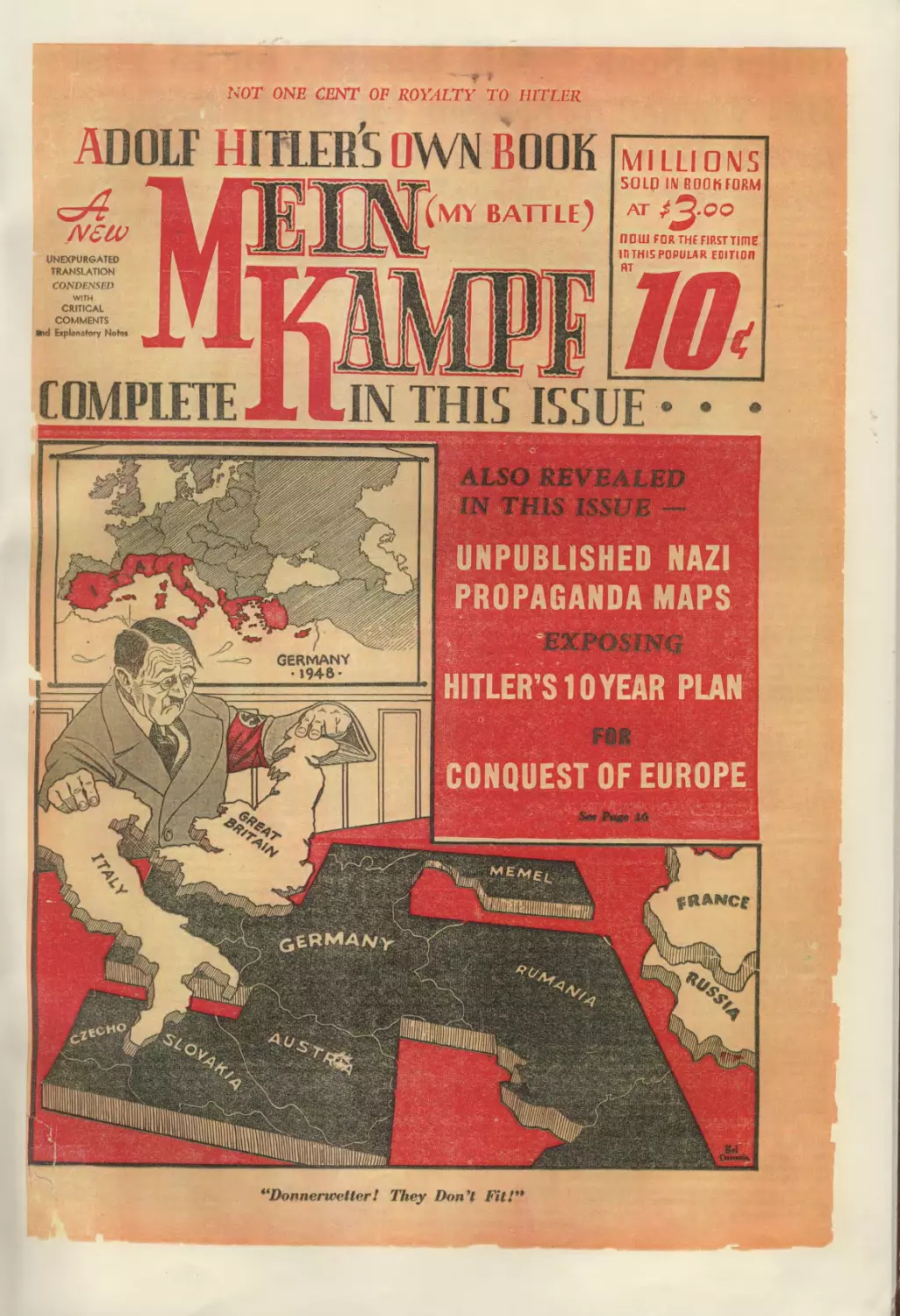
NOT ONE CENT OF ROYALTY TO HITLER
COMPUTE
AL
HITLER'S TOYEAR PLAK
^4-
Vf
JV€fV
UNEXPURGATED
TRANSLATION
CONDENSED
WITH
CRITICAL
COMMENTS
Srd Explanatory Note*
UNPUBLISHED NAZI
PROPAGANDA MAPS
CONQUEST OF EUROPE
ADOLT HITTER'S OWN BOOK
GERMANY
•1948-
MILLIONS
SOLO IN BOOK FORM
^^Donnerwetter! They Don^ FUT*
ODIU FOR THE FIRST Tone
iniHISPOPULAR EOiTiOn
AT
fRANCf
Hitler’s Book, ‘‘Mein Kampf”, for 15 Years
Has Warned of Scheme for World Conquest J
D
oes ADOLF hitler seek to dominate the
world by force?
Will the sabre-rattling Fuehrer who welded 80,-
000,000 Germans into: a; mighty/military machine in
vade the rest' of the world* from* his fortress in Cen
“smashing, France and protecting her rear” can then
proceed to bigger/ game.
Will Hitler try to conquer the Ukraine? That is
the question uppermost in European minds today
because that means war with Russia. “Yes” wrote
writes. “Part of the genius of a true leader,” he says,
“is to make widely different enemies appear to be
one.”
Circumstances gave him the Jews, the World War,
the Treaty of Versailles.,
for his algolagnia—
any one man unleashed such
world, setting man
That is his
Hitler 15 years ago.
“When we speak today of new territory in Europe,
we can think only of Russia” “Mein Kampf” informs.
Hitler will teach Germans to “gaze to the land of the
East.” Then “as of old, the Reich would again have
to send Knights marching out armed with the Ger-
'All his actions are dominated by
His hatred of Jews and love
excuses
If the handful of Jews-in Germany hadn’t existed,
he would-Jtave-had: to create them! “A savage attack
upon some adversary is proof to the people of the
justice of their own cause.”
If the World JFar had not occured, he would have
had to provoke one! When it broke out, “I fell on
my knees and thanked heaven with all my heart .that
it: had granted me the fortune to live this day.”
If the Allies had not dictated the Treaty of Fer-
saitles he would have had to invent it! “How Ver
sailles could have been used” he writes, “to ignite"
great:flames of national passion!”
With Adolf Hitler once installed as undisputed
master of the German Reich, can the rest of the
world'breathe easier? Is Nazism not really an article
for export? Will not the whims, hates, insane
prejudices of this man leap over national boundaries
and embroil the world in the bloodiest war in his
tory?
'
.
Fifteen years ago “Mein Kampf” warned the world
of its fate.
“Every attempt made for the sake of a world idea
fails unless the struggle takes the form of a violent
attack”. Hitler wrote. But having “redeemed” his
German brothers in Austria and Czechoslovakia,
can we really now rest in peace?
; “Such enthusiasm as war enthusiasm,'once broken,
cannot easily be awakened again” Hitler believes. ,
“It is intoxication and it should be kept.”
Greatest Liar
On Earth
How is it possible that a once highly cultured and
civilized nation can be duped by the torrent of
chunsy forgery, deliberate lies, perversion, and
violent hatred that all eminent scholars agree “Mein
Kampf” to be?
Most audaciously, Herr,Hitler gives us the clue to
his technique. Noi man ever despised more-com
pletely the “primitive”, “herdlike” masses w’hom he
: intends to dupe.
“Accustomed ■ to' telling insignificant lies them
selves” he' writes “the masses can detect them. They
are more'easily misled by a great lie than a tiny lie.
But never having d.rearned, of the vast possibilities of
lies, they getterally fail to detect a truly gigantic dis
tortion.” ,
So Herr Hitler made himself the greatest -liar on
earth!
He confesses this a dozen times in “Mein KampF’.
No matter how fantastic, lies “must be drummed into ■
the minds and feelings of the people by constant
repetition.”
Hitler frankly admits his prevaricating ways.
“Even when in the process of being enlightened as to
the actual truth . . . after a great lie has once been
told, (the masses) will for a long time have their
doubts, completely unable to believe that some truth
was not contained . . . This is a fact which all the
great falsifiers know so well.”
Perfectly staggering is this brazen declaration of
a scheme to dominate every thou.ght, action and word
, of every man, woman and child by the methods of
witchcraft and voodoo, of totem jsri.l taboo.
A single,enemy! Hitler has exploited the Jews, per
haps beyond the point of diminishing returns. For
propaganda their value is now nearly nil, and the
Nazis are flogging corpses, only hoidhig them until
relatives abroad pay ransom. Observers in Germany
claim that after the November pogroms the man in
the street, though silent, is finally shocked.
The stage is set, therefore, for the creation and
destruction of another great enemy, a Nazi Scape
goat No. 2.
All signs point to ths Catholic Church. The Jews,
scattered over the four quarters of the globe, have
no international organization, and Herr Hitler knows
it. But the Catholic Church is a true and active
“International”—the oldest—with headquarters iA
Rome.
It is rich. A safe estimate of Catholic Church
wealth in Germany would be about $20,000,000,000,
and it can be plundered. (Thia has been quietly
donejjy accusing priests and nuns of violating fo;r-
‘
eign exchange laws, then fining them heavily.)
'
Writes the Voelkischer Beobachter, official N:azi
party paper, on Oct. 15th;
'
“We are armed to continue the battle agaittst
(Continued on face Thirty-OneJ
; And Hitler, faced with the issue, might
either have plunged the world into the
bloodiest war in history—or backed down
from his bluff, possibly to face oblivion.
The discovery that might have altered
the world situalion was a Nazi propaganda
map, seized by Czech police, two weeks
: prior, to Munich, in a raid on the Henlein
(Nazi) headquarters in Prague.
It revealed in detail Hitler’s plan for the
complete conquest of Europe and a part of
' Asia. It disclosed Great Britain as a prov-
■ ince ih: the destined German Empire. It
provided a timetable showing when Hitler
proposed to lake each step.
Supplementing' the scheme boldly enun-
; dated in “Mein Kampf” it completed the
picture of the Nazi-dominated world Hit
ler foresees.
But high British powers didn’t want the
map published! A censorship was clamped
down and: the world remained in ignorance
of this startling confirmation of Hitler’s
aims.
The maps, their . interpretation, the
whole story of their suppression, now are
given in their full significance in this issue,
on Pages 16 and 17.
tral Europe?
President Roosevelt thinks so. On Friday, March
30th, he was in, constant communication with Europe
by underseas telephone. The same day a White
House official revealed our Government’s fear “that:
Hitler would'not stop with Europe, but would carry
his program of conquest to other continents, possibly
the Americas.”
Prime Minister Ghamberlain now thinks so.
Pledging Britain's might to defend Poland against'
invasion on that same day, he has dramatically
reversed England’s historical policy by guaranteeing
prompt military aid to a country east of the Rhine.
A bogeyman? Too absurd?
We believe not. Hitler’s actions will not surprise
readers of “Mein Kampf”, the Nazi Bible which
Dorothy Thompson has labelled' “blueprint to world
domination^’
Surprising, rather^ are the jitters and tremblings
of the rest of the world which, in “Mein Kampf”, , •
could have found a complete revelation of the for
mer Austrian house-painter’s bold schemes.
For no Napoleon, no other world-conqueror—
ever has revealed in advance: bis ambitions and his
technique, which is precisely' what Herr Hitler in
“Mein Kampf” has* done —for all the world to see.
The ruthless policy which Her Fuehrer now pur
sues was outlined 15 years ago, when he wrote this
book while lying in the prison' fortress of Landsberg
on the Lech, convicted of plotting to overthrow the
German goverment by force.
Now that Hitler’s first aimbitions have been real
ized, it behooves the rest of the world carefully to
read his book, no matter how illogical, fantastic, it
may seem, no matter whether you hate Hitler or
hero-worship him.
Since it will directly affect the daily lives, hopes,
fears, of hundreds of iniilioiis of peaceful citizens far
removed from Berlin or Berchtesgaden, “Mein
Kampf” may be called the most important political
tract of all time.
, “Mein Kampf” should; lie. read in conjunction with
the timeable of Hitler’s- “strategy of piecemeal con
quest”—conveniently provided: in a secret Nazi pro
paganda map discovered by Czech police who raided
Nazi headquarters' in, Prague, during last September’s
crisis,, and published here for the first time.
In “Mein Kampf” Hitler tells ns what he is going
to do and’ how he will do it;
In this map he tells us when.
England to Bo a
German Province
Adolf Hitler states eniphatically in, “Mein Kampf”
that he intends to dominate this planet by force.
“Raising the German people: slowly and surely to a
dominating position”, he promises to settle down
only after the. “conquest of' the world by the Ger
man,”
Hitler intends to carry (his out by “the weapon
of ruthless, brute force.”
His method is “violent
attack.” Early in his career he “realized the value
of physical terror against the masses.”
“Mein Kampf” 15 years ago supplied the key to
prese.f .:i-day power politics,jn Europe. Creation of
the Rome-Berlin Axis, seizure of Austria and Czecho
slovakia, the attempt to ally with Great Britain, the
“Drang nach Osteu”—push to the East and the
Ukraine, are all prediciesf.
“If we want allies” he wrote, “two are possible,'
England and Italy.”'
,
He has courted England, but'Britannia—always
shy—has finally taken’ fright, and sought other
friends.
The Nazi propaganda map shown on page 16
destines the British Isles to become o'" German prov
ince after 1941!
Italy, with her “inferior race”, is selected, and
Hitler must give her a temporary share in the spoils.
But according to the map. Hitler bottles up Musso
lini in his own lake by snatching Gibraltar, guard
ing the Mediterranean’s western entrance, for himself.
France is the “everlasting enemy of the German
people”. Hftler writes. She is doomed for destruction
in 1941, according to the map, and Germany
But for the suppression of a momentous
discovery at the height of the Munich
crisis last September, the entire course of
world history to-day might he vastly dif
ferent.
Gzechoslbyakiaj spared annihilation,
i might have remained an impregnable fort-
‘ ress against Nazi aggression—
England, her people aroused, might have
, been defiant:—
How Censorship Helped
Hitler at Munich
man sword, to give soil to the German plough and
bread to the German people.”
The map earmarks the Ukraijie for conquest in
1941, after France is smashed. The rest of Russia up
to the Urals, the British Isles, Scandinavia—all
Europe and part of Asia are destined for Nazi dom
ination between 1941 and 19411!
AUDACIOUS best descrilies Adolf Hitler's
methods, FANTASTIC his character. “He is an in
fantile personality” says Proefssor Oscar J. Raeder,
famous Boston University psychiatrist. “His temper
tantrums.'his weeping and similar emotional manifes
tations under stress are childhood fixations.’’
Devastating hatred', above all, characterizes Hitler.
“A psychopathic paranoid personality whose sole
need is hatred” is how Dr. A. A . Brill of New York
describes him.
this sadistic leitmotif.
for Germans are mere
his pleasure in pain.”
Never in: history has
torrents of hatred upon the
against man, <^ation against nation,
technique:
“A single enemy must be pushed forward and all
hate concentrated upon this sole opponent”. Hitler
Copyright 1938, by Noram Fub^hlng company, 'focorporated. Greonwich, Cosn.
Publisher’s foreword
T
h,IS BOOK, MEIN KAMPF, written in 1925 By an obscure German
political prisoner, is a startling, almost miraculous prophecy of present-
day hi'Story'^as it is being made by the author, Adolf Hitler.
The reader of Mein Kampf is always amazed at the completeness with
which Hitler is carrying out his fantastic aims. It seems incredible that after
havino; get down in writing such brutal, coldly-calculated plans. Hitler is being
allowc’d by his fellow Germans— -and by the rest of the world—even to attempt
to execute them.
If Hitler’s plans as stated in Mein Kampf are carried out—if he is not
stopped—they mean inevitable war, bloodshed, and the destruction of civiliza
tion as we know it.
The reader of this strange book is never able to understand how Hitler
can sneer at the masses, call them dull, stupid, moronic—and still capture them.
But—usually the individual never quite considers himself a member of
the great masses. It is always his near neighbor who is dull, stupid I
Also—-wild, rambling Mein Kampf never attracted much attention until
Hitler was powerful enough actuaBy to begin carrying out the threats and
promises he wrote into his book-
Finally—the German edition of Mein Kampf—which has made Hitler a
millionaire through laws making it compulsory that it be read in the Nazi
state and that it be presented to all newly wedded couples—was carefully ex
purgated. So was the British edition—and the French edition. Each country
was offered only a specially-prepared edition. None were allowed to know
the true Mein Kampf.
The book first appeared in America in an abridged, carefully expurgated
edition, in which were omitted certain basic principles and ambitions which it
it behooved Hitler to conceal from American eyes.
Millions of copies of Mein Kampf have now been bought and read all
over the world, for it has become the most vital and significant political tract
of our time. Rival publishers have recently put two unabridged, unexpurgated
editions on the American market. They are best sellers. People throughout
the United States must wait months for their turn to obtain Mein Kampf front
lending libraries.
But Meife Kampf should be read today!
Every living American should know—immediately—exactly what it was
that Hitler said back in 1925—for now words are finding expression in acts
of aggression, persecution, tyranny!
It is impossible to understand the ever-changing world of today without
knowing the most important ideas and plans Hitler wrote down in Mein Kampf.
Yet in the complete edition of Mein Kampf it is a trying, tiresome task
to rescue what is coherent thought from the midst of Hitler’s torrent of
270,000 words.
This edition of Mein Kampf contains every important point, every im
portant idea Hitler presented, every important sentence he wrote. Hitler’s
inconsistencies, self-contradictions, extremities, even his erratic language—all
these are retained here.
But we have eliminated his long-winded digressions, and cut out much
of the endless repetition—repetition which he himself explains is necessary
in order indelibly to impress an idea upon the mind of everyone exposed to his
propaganda.
Sometimes we have expressed in a single sentence a thought which Hitler
required two or three pages to present. We have slashed Hitler’s 270,000 words
to 70,000.
But nothing important is omitted!
AU important portions of the text, expurgated in the original American
edition, are presented here.
The reader of our edition wiU know exactly what Hitler said in Mein
Kampf. He will have gained an indispensable background without which it is
impossible even to attempt to understand the present world. He will perhaps
see a bit more clearly the role he, as an individual, must play in this Hitler-
threatened age.
We have criticized, commented upon, and explained the text wherever it
was considered necessary.
MEIN KAMPF ADOLF HITLER
'.HAPTER I
MY HOME
T
o-day i consider it fortunate that fate
chose Braunau on the Inn as the place of my birth.
For thia little town lies on the border between two Ger
man States, the reunion of which we younger ones regard
as a task that must be worked for with all our powers.
German-Austrians must return to the great German
Fatherland,, and not because of economic reasons. No
no! Even if economically this union were unimportant—
even if it were harmful—it must, nevertheless, still
come.
Common Blood Belongs in a Common Reich.
Not until every single German is in one common
Reich—and a Reich too crowded to provide bread—will
the State have the moral right to acquire foreign soil.
At that time, and only at that time, the sword becomes
the plow, and bread is watered by the tears of war.
So this little frontier town is to me the symbol of a
great task.
(Hitler achieved his ambition to unite Germany
and Austria when German troops marched into
crushed Vienna in March, 1938. He states here that
Germany will have no moral right to seize foreign
soil until all Germans are living in a common Reich
—but in March, 1939, he took Czechoslovakia, a state
inhabited by millions of non-German people.)
My parents. Bavarian by blood and Austrian by na
tionality, lived here at the end tf the 8O’s of the last
century. Father was a faithful civil servant, and mother
kept herself busy with us children.
"
(Adolf Hitler's father, Alois Hitler, was the Ule- -
gitimate son of Maria Anna Schickelgruber, and
while in Nazi Germany it is alleged that Alois’ father
was Johann Hiedler, the man Maria Anna married
five years after the birth of Alois, this cannot be
proven. Alois, a drunkard who would face steriliza
tion if he lived in the Germany of today, used the
name Schickelgruber until he was 40; then, due to
his wife’s insistence that he be legitimized, he legally
changed his name to Hitler, a derivation of Hiedler.
Adolf was born to Klara Poelzl, third wife of Alois
Schickelgruber-Hiedler-Hitler, on April 20, 1889 .
(So the racial purist, Adolf Hitler, does not know his
own grandfather.)
I remember little of this time, for before I was very
old my father had to go down the River Inn to take a
post at Passau in the German Reich. Soon after that
he was again transferred, this time to Linz. There he
was pensioned off, and after a time settled on a farm
which he bought near Lambach in Northern Austria.
Hitler’s Foreword
On April 1, 1924, I commenced serving my
sentence in the prison fortress of Landsberg on
the Lech, according to decision rendered by the
People’s Court of Munich.
I was thus able to undertake a task fre
quently demanded of me, a task which I, too,
felt would be of service to the Movement. I de
cided to set dotvn the aims of our Movement,
and the story of our progress.
Also, I found opportunity to portray my own
development—^^necessary if this book is to be
understood and the filthy legends built up
about mq by the Jew press are to be destroyed.
I address myself here not to strangers, but to
followers of the Movement, strong-hearted fol
lowers who seek more intimate enlightenment.
I know that people are won more by the
spoken than by the written word, that every
great world movement depends upon great
speakers, not upon great writers. But the prin
ciples of a doctrine must be laid down for eter
nity.
This, then, is a stone which I add to our
common structure.
THE AUTHOR.
Landsberg on the Lech
Prison Fortress.
Adolf An
Abbot ?
I did not brood over my future, but I had no sym
pathy for the life my father had led. I did extremely
well in school, and singing lessons in the choir of the
Lambach Convent gave me excellent opportunity to in
toxicate myself with the splendor of the rich church
festivals. I fixed upon the position of abbot as an ideal
to look toward.
My longing to be an abbot disappeared very quickly,
however, to make way for things more in accord with
my temperament: in my father’s library I found boqks
on, military subjects—most important of all, two illus
trated volumes telling of the Franco-Prussian war of
1870-1871. These I devoured. And this great heroic
campaign became my greatest spiritual experience. I
was now excited—ever more and more—by everything
connected with War and Militarlsna
Confused, I wondered if there was a difference be
tween the Germans fighting this war and other Ger
mans. Why did not my father and other Austrian-Ger-
mans battle in this war against the French? _
Do not all we Germans belong together?
This problem racked my braiq. I asked questions,
and learned with greedy envy that not every German
was fortunate enough to belong to the Reich of Bis
marck.
1 could not understand this.
At this time, my oratorical gift was trained by stir
ring, violent arguments wifh comrades: I became a ring
leader. Meanwhile, because of my nature, my father
decided attendance at the Humanistic School was use
less. He thought a non-classical modem school more
suitable. He was impressed by my obvious talent for
drawing, and this subject was neglected in the Austrian
schools. But he was determined that like himself, I
should eventually become a civil servant.
i flatly refused the thought. NO! and again NO! The
thought of slaving in an ofiice, not master of my own
life, sickened me.
The ridiculously easy studies at school left me so much
spare time that the fields and forests saw much of mo
in those days, and so when my enemies examine my life
now, back into childhood, they can ferret out, if they
will, the mean tricks this “Hitler” played in his youth
in company with other robust boys. I thank Heaven for
my happy memories of those times!
By the time I was twelve years old, I had decided 1
would become a painter. My father knew nothing of
this ambition, but suddenly, after I rejected once again
his plan for the future, he for the first time asked what
I intended to be. I unexpectedly burst out with my
decision. My father was speechless:
" A pahiter? An artist?”
He doubted my sanity, but hoped that he had mis
understood—then he opposed me with all the force of
his character:
"An artist—No! Never as long as I live.”
I strengthened my resolve. The old man was embit
tered, and though I loved him, so was I. He commanded
me to drop all thought of ever becoming a painter. 1
returned that I would no longer study anything else.
My threat became action when he tried to impose nis
authority! I took no notice of my school work. 1 do
not know if this reasoning was correct; but 1 learned
only what I pleased—excelling only in my favorite sub
jects, geography and especially history.
The Young
Nationalist
To-day when I examine this period, I find two out
standing facts:
I. I became a nationalist;
IL 1 came to understand the significance of historg<
Page 4
MEIN RAMPF
MUSTBE BIGAS U.S.A.
“To aim merely al re-establishment of our 1914 frontier is nonsense. These old fron
tiers were unnatural since they were political and not racial, and the result would anyhow
be so miserable that it would not, by God, be worth the blood sacrifice it would entail..
“The 1914 frontiers mean nothing to Germany’s future. They were not a protection in
the past, and they would not mean power in the future. The distance to England would
not be lessened, the size of the United States would not be equaled, nor would France he de
prived of any political power.”
MEIN KAMPF—Chapter X^ni
Old Austria was a state of nationalities. Few Ger
mans in the Reich had any idea of the constant struggle
waged for the sacred German language, and the German
life, by the ten million Germans living among forty-two
million other people in Austria. Only now, with this
misery put upon millions more of our people who dream
of the Fatherland while living under foreign yoke, can
the meaning of this battle for nationality be widely
understood.
Now, perhaps, greater numbers will realize the charac
ter of the Germans in Austria, who for centuries pre
served the Reich in the East, while the Reich itself was
interested in colonies and not in its own lost flesh and
blood so near at hand.
As in every struggle, there were three groups in the
language battle of Austria:
The fighters, the lukewarms, and the traitors.
Significantly, this war engulfed the school, cradle of
the oncoming generations. The fighting is ever chiefly
over the child, and the first cry is:
“ German boy, do not forget that you are a German!”
“German girl, remember that you are to be a German
mother!”
Easily captured, youth in countless ways carried on the
guerilla warfare, refusing to sing non-German songs,
rebelliously wearing the forbidden emblem of its own
German nationality, rejoicing in being punished—even
beaten—for this. Youth came to glory in the grandeur
of German heroes.
While very young, I, too, joined in this national strug
gle. My development was quite rapid: even at fifteen
I knew the difference between dynastic patriotism to the
ruling Hapsburg House of Austria, and the nationalism
of the people.
There was really no Austrian history taught in the
schools, yet, actually, the very separation Into two states,
Germany and Austria, was German history.
Probably my entire later life v/as influenced by my
fortune in having at school in Linz an intelligent teacher.
Professor Doctor Leopold Potseh, who knew that history
must not be taught merely o.s a jumble of dates and
names. Only the important must be emphasized, the
unimportant ignored; thi.s lie knew. He utilized our
“Every ai tempt made for the sake of a world
idea fails nulcss the slruggle takes the form of a
violent attack. I'lie weapon of ruthless, brute
force is of greaiesl v.ahis in war between two
diverse views of lire world.”
MEIN KAMPF-Chapter V
national fanaticism, repeatedly exploiting it. He made
history my favorite subject.
Who could possibly study German history under such
a teacher without becoming an enemy of the Austrian
dynastic state", l y l iich so disastrously betrayed the true
destiny of the nation!
Who could keep allegiance to emperors who sold, the
cause of the German people for their own petty ends?
Austria could hot love us as Germans, and thus foreign
poisons ate at the German body. Even Vienna became
un-German. The House of Hapsburg favored Czechs
wherever possible. It was the hand of the Goddess of
Eternal Justice, plus implacable revenge, which caused
Archduke Franz Ferdinand, the enemy of Austro-Ger-
manism and the patron of Austria’s Slavization, to fall
by bullets he himself had prepared.
The burdens which the German people bore were enor
mous—unimaginable sacrifices in taxes and blood. Most
sad and outrageous Of all was that all this was morally
fostered by the alliance with Germany; and thus Ger
many herself partly helped along the gradual extermina
tion of the German nationality in Austria. The hypo
critical Hapsburgs created the Impression abroad that
Austria was still a German state.
'
Blind, the leaders of the Reich saw nothing of all this.
Yet the tragic alliance between the new Reich and the
old Austrian fake state brought the World War and the
general collapse.
I^ew Technique :
“Protection^’ by Conquest
In earliest youth I grasped this conviction which ever
grew stronger and stronger:
The protection of ths German race required the de
struction of Austria; further, national feeling is very
unlike dynastic patriotism; above all else, the House of
Hapsburg was fated to bring misfortune to the German
nation.
I thus intensely loved my. native German-Austrian
country, and bitterly hated the “Austrian” state. I was
no lukewarm —1 was a fighter! I was a young revolu
tionary.
I never lost this art of historical thinking, and thus
have always possessed a never-drained .source of under
standing for politics.
At the age of twelve I saw “Wilhelm Tell” and a few
months later I saw my first opera. J was captivated.
Convinced that I should never be a civil servant, and
my talent for drawing now confirmed—appreciated in
school—my resolve, as to my future was unshakable.
Pleas and threats were useless. I would be a painter.
Nothing could make an oflicial of me. Meanwhile as
time passed 1 was more and more attracted by archi
tecture. and assuming thhs tc be the broadening of my
talent for painting, I was delighted.
I never dreamed the future would turn out so dif
ferently.
When I was thirteen my father suddenly died, suffer
ing a stroke which plunged us all in the depths of sad
ness. My life went on unchanged for a time, but I was
determined more than ever. Suddenly an illness rescued
me: due to a severe lung trouble the doctor strongly
advised my Mother against ever allowing me to work
in an ofifice. And I had to stop school for at least a
year. So all that I had warred for suddenly became
reality. My mother agreed to send me to the Academy.
Then, in two years, my Mother’s death in a flash had
ended all my happy plans. Her death was a fearful
shock. I had respected my Father but I loved my
Mother.
Need and the reality of life now forced me to make
a quick decision. Meager funds inherited along with the
customary orphan’s pension were not nearly enough for
. me to live on. I had now to earn my dally bread.
I went to Vienna with little luggage but with Iron
determination in fny heart. 1 , too, hoped to wrest from
fate the victory my Father had won. I, also, would be
come “something”— but no oflicial.
CHAPTER n
VIENNA—YEARS OF STUDY AND STRUGGLE
D
uring the last months of my Mother’s life
I went to Vienna to take the entrance examination
to the Academy. I took along many drawings, con
vinced that I would easily pass the test.
This was my second visit to Vienna—once when fifteen
I had spent two weeks vacation there—and now I was
excited again by the magnificent parliament building,
and by the Ringstrasse which wa.s to me like a fairy
tale of the Arabian Nights.
Proud and confident I awaited the result of the en
trance examination: then announcement of my fa,ilure
struck me like a bolt from the blue. The director told
me my drawings showed lack of ability to paint, but
that I obviously belonged in the school of architecture.
For the first time in my life I was dissatisfied with
myself, but in a feiv days I knew I would one day be
an architect. .
After my Mother's death I went to Vienna again, for
a third time, how to remain for many years; once again
I was calm and confident—my goal burned before my
eyes. No obstacles could prevent me from becoming an
architect.
. NowIAmAble
To Be Hard”
Now I look upon what I had once considered the
cruelty of fate as the wisdom of providence. The God
dess of Misery threatened to crush me in her arms, but
the will to resist grew, and this will was finally victor
ious. I owe it to this that I learned to be hard, and that
now I am able to be hard. I rejoice that the Goddess
of Misery became my hew mother, pitching me into the
world of poverty—so making me acquainted with those
for whom I was later to fight.
Vienna still awakens only sad thoughts in my brain.
The city means to me five years of sorrow and wretched
ness. For five years I struggled for-bread—and some
times went hungry—fij’st as a worker, then as a small
painter.
(Hitler spent most of these five years painting
houses, although eventually some of his sketches
were sold.)
I attended opera whenever I had saved enough money,
and books were my only other joy. I read endlessly.
In a few years I had constructed a knowledge which feeds
me even today.
More than this, I at this time formed an image of
world and life which became the unwavering guide for all
my actions. I have added little to what I learned then,
and there has been no need to change a single thing.
To-day I believe that almost all creative ideas appear
in youth, if ever. Plans for the future are formed in
youth; maturity seizes upon them and carries them out.
The surrounding.s of my childhood were Bourgeoisie,
so at first I knew little of the working classes. Both
of these classes are little favored by economic condi
tions. but the chasm between the two is nevertheless
gigantic; the Bourgeoisie which has so recently climbed
above the hand workers is terrifiijd at the thought of
tumbling back into that class, or of being considered
of that class. The Bourgeoisie memory of the misery
suffered by people in the manual labor class is unbear
able. It is because of this that people of the still iugher
social classes frequently are closer to the humblest of
their fellow beings than it i.s possible for the Bourgeoisie
to be.
The Bitter Struggle
For Bread
Fate helped me in this respect, driving me back into
the lower worlckpf miserable poverty; the blindness of
Bourgeoisie education was struck from my eyes. Only
now did I come to know mankind, and to disting-uish
between the hollow sham or brutal exterior of human
men and their inn^ tjiture.
Vienna was at uiia lime' socially ill. Gaudy iKasrlth
and horrible poverty mingled in deep contrast. Countless
unemployed loafed before palaces of the Ringstras ^e,
and below the bridges in the filthy canals and sewers
dwelt the homeless.
No other German city provided better- opportunity to
study social conditions-a study which must, of course,
not be carried out from above. Those who attempt
social work from above foolishly expect gratitude—but
such people .should hot distribute favorts but instead must
restore rights.
The chance of falling to earn one’s daily bread seemed
to me—occasionally hungry—one of the blackest aspects
of the new life’.
I'found it not very difucult to secure
work as an unskilled laborer, but I found that such
readily obtained occupations are just as easily lost. The
skilled worker Ls not so easily dismis.sed, yet even he is
not safe. It is seldom that he loses his income—or his
dally bread—because of a shortage of work, but often
he is locked out, or he strikes.
(Hitler’s lumping strike,s and lockouts' together
here, as ffom the workers’ viewpoint, i,s typical of
whatever few econoniie theories he has put forth.
Admittedly, he has' never troubled himself over
economics, and this is demonstrated by the constant
shifting and isubstituting of economic leaders' and
theorists in the Nazi State which Hitler has created.)
I grew to hate'the metropolis which greedily sucked
meh in from the' fields, only cruelly to tear them to
' pieces hi' its maelstrom. When they came they belonged
to the^nation; if they stayed long, they were lost to the
nation. I,"myself, knocked about in the metropolis, felt
this deeply; spiritually.
Sad were the housing conditions. I ■ shudder to think
of the filthy, stinking refuse-filled shelters of the un
skilled Viennese worker,
(No European city could boast finer, more modern
workers’ flats than those erected in Vienna by the
Social Democrats, whom Hitler hated.)
Thankful I am to the Providence which sent me to
that school! I cOuld-not destroy what I detested there,
but I was educated rapidly and completely.
Preservation' From
.. Sentimenttitiiy,'
The people, in this dirt and decay were no longer 'human
beings, but the sad products of deplorable affairs. . But
my own battle for life preserved me from falling into
pitying sentimentality for these people.
''
I saw that only a single path could lead to bettering
of such condition.^ : a deep feeling of responsibility for
the establishment ■ of .stronger foundations for. develop
ment.. united with brutal determination to destroy suca
social cancers.
Nature concentrates on breeding the next generation,
not on. aiding- that generation which exi.sts; humans must
do the same. And only when a race no longer worries
as to its own guilt will it be pos.sible for it to apply the
correct, ruthless means against the diseases destrovine:
the state.
The Austrian .state lacked all social legislation and
justice. Its weaknesses glared malignantly.
I do not know’ what horrified me most at thi.s period
of my life: the economic plight of my companions, their
moral coarseness, or their slight intellectual devclon-
ment.
How often our Bourgeoisie leap.s up indignant when
some wretched tramp .sa.ys he doesn’t care whether he
A state wa.c never !.
hy peaceful eco
nomy, only and always by t.h.e instinct of race
pre.servatioij, and by .ikoroic.c ., or by cunning,”
MEIN I.AMPF—Chapter IV
is a German or not, that he feehs at home anywhere as
long aa he eats!
.
This lack of “national pride” i .s deeply deplored. Horror
Is expresised at such sentiments.
But how many: of these TBotirgeoisie ask why they
themselves think differently j>
How many, realize how much national pride depends
upon knowledge of national greatness?
Do not our Bourgeoi,sie realize how little this pride is
available to the “people” ?
It is an unacceptable excuse to say; “It is just the
same in ah the other countries. ”
This is not true, and
even if it were, it would be no excuse. The French child
is no^aught objectively: instead, subjectively. Prance’s
great "civilization” is beaten into hi.s impressive young
head.
Edtica.lion should be confined to broad general views,
which, if necessary, must be drummed into the minds
and feelings of the people by perpetual repetition.
But no, at the age of fourteen when our lad skips
forth from school it is impossible to tell which is ths
KAMPF
Page 5
CREED
^*’The masses can only be captured by a ruthless and
fanatic one-sided presentation of our nationalistic idea.
The dynamic force which has made the most important
changes in history has always been—no scientific intellect
—but rather a fanatic feeling of hysteria which has hurled
the masses in one direction.
To win the soul of the people, it is not enough merely to
fight for one’s own end—one must at the same time destroy
the upholders of the opposite cause.
'A savage attack upon some adversary is proof to
f
OF HATE
the people of the justice of their turn cause.
The masses feel that if their leaders refrain from de
stroying an opponent, this must be a sign of uncertainty of
lheir own cause—if not a sign that the cause is unjust.
The masses are only a fragment of nature, and their
feelings cannot understand a handclasp between men who
proclaim opposite views. What they want is the victory of
the stronger and the annihilation of the weaker, or else his
unconditional enslavement.’^
MEIN KAMPF—Chapter XII
worse: his amazing stupidity as far as knowledge and
ability go, or his biting insolence combined with immor
ality which—considering hia age—makes one’s hair
stand on end.
As my knowledge flowered a new world unfolded be
fore my eyes.
I no longer was forced to earn my daily bread as a
common laborer in 1909-10 . I worked independently as
a draftsman and a painter of water colors. My earnings
were small, but I was master of my own time. . I had
more time to read, and besides, I was continually im
mersed in thoughts of my own.
I suppose my acquaintances considered me an odd sort.
All this time, learning about music and other arts, I
was most of all convinced that I would one day »be a
famous architect.
My great interest in politics I deemed merely the ordi
nary duty of every intelligent individual, so I read and
learned a lot about this. But I do not mean that I read
only in order to possess wide, little-organized knowledge.
This only creates a muddle in a foolishly vain mind.
One who masters the art of reading—whether it be book,
magazine, or pamphlet—simply picks out that which he
believes suitable because It fits a specific purpose or is
genetally worth knowing. Only in this way is reading
“Evon as a boy I was no pacifist, and all at
tempts to train me in this direction were utter
failures.”
MEIN KAMPF—Chapter V
of any use. Otherwise it is senseless. A public speaker
for example, who has not stuffed his head with all man
ner of support for his ideas, will be without sufficient
support from his memory in case of contradiction or
argument.
Escape From
Marxism
1 have always, from earliest youth, read in the correct
manner, and I have been helped in the most plea.sing‘
way by my memory and understanding.
In the misery of Vienna daily experience enabled me
to examine theory in the light of reality, and so I was
not suffocated by my wide thinking and reading.
Who knows when I would have come to studying
Marxism if at this time my nose had not been thrust
into thia problem!
At the age of 17 I had scarcely heard the word
"Marxism", and I thought "Socialism" and “Democracy"
were identical. Until that time I knew of the Social
Democratic Party only because I had attended a few
m*s3 meetings, at which I gained no Insight into the
mentality of its followers or the meaning of its doctrine.
But in Vienna I came into rapid contact with people of
this sort, and soon knew that this “Socjal Democracy"
idea was a pestilence hiding behind a mask of social
virtue and love of humanity—a pestilence that, unless it
was driven from the world, would destroy mankind.
I was employed on a construction job when 1 first
really encountered the Social Democrats. I was asked
to join the union; I knew nothing of unions and I re
fused. 1 said I wanted a little time to investigate the
whole affair, and so they consented to wait a few days.
After two weeks of study, no power on earth could
have forced me to have anything whatever to do with
them.
At lunch as I drank my bottle of milk and ate my
piece of bread, I listened to the workers talk. They were
against everything.
The nation was an invention of the capitalistic classes
.
.
.
The Fatherland was a weapon of the Bourgeoisie to
exploit the workers . . . The law was intended to suppress
the proletariat .. . . The school was to create slaves . ,
.
Religion was to dope the people . ,
.
Morality was only
a symbol of sheep-like patience . . .
‘^Are These
Human Beings ?”
I strove to keep quiet, but I could not hold myself
back. L began to contradict. Of course refusing to join
the union, I argued and argued against them until one
day they adopted that one means which most easily
vanquishes reason: terrorism and violence. I was warned
that I must either leave the job at once, or I would be
thrown off the scaffolding. Since X was alone and re-
' Sistance seemed hopeless, I quit my job.
I went away disgusted, my head throbbing with the
question: are these human beings, worthy of being part
of a great race?
One day soon after this I watched with horror as
endless columns of Viennese workers marched through
the streets in a mass demonstration. For almost two
hours I stood transfixed staring at this huge .serpei t
twisting through the city. On the way home, for the
first time I bought a copy of one of the Social Demo
cratic newspapers; and in the evening I read it through,
fighting down with difficulty the overpowering rage that
arose in me in the face of the mass of lies.
Only a fool, understanding the hypocrisy of thia poison,
would condemn the victim. Now I understand the candid
orders that only Red newspapers be subscribed to, only
Red Meetings be attended, only Red books be read.
Thus I learned that the soul of the masses will not
accept weak or half measures.
Just like a woman, influenced less by reasoning than
by longing for strength, would rather submit to the
powerful man than dominate the weak one, so do the
masses love the Commander more than the petitioner.
The masses are more satisfied with a doctrine which
tolerates no rival than by freedom of choice.
The value of physical terror, against the individual
and aganst the masses, now was revealed to me.
It was the terrorist Instrument of the trade union
which turned the idea of Democracy into a ridiculous
and disgusting phrase.
They outraged liberty and
mocked fraternity with the cry:
“Join with us or we’ll break your skull" .
Thus I came to know these friends of mankind.
Hitler Discovers
The Jew
Meanwhile I had come to understand the relation be
tween the doctrine of destruction and the nature of a
race of which I had hitherto been unaware.
An understanding of Jewry is the sole key to a grasp
of the hidden, real intention of Social Democracy.
To know this race is to lift the veil of false under
standing, and then from the mist of social talk rises,
grinning, the ape-like face of Marxism.
Today I find it difficult to say when the word “Jew"
first provoked special thought in my head. X do not
remember ever hearing it at home. At school I Isnew
one .Jewish boy whom we treated with caution, but this
was only because his aloofness made us distrustful of
him. Neither I, nor the other boys, had any res.!
thoughts on the matter. I encountered the word “Jew”
more frequently when X was fourteen or fifteen, generally
in political discussions. Only a few Jews lived in Linz.
After centuries they seemed outwardly Europenn and
human; I even thought that they were Germans.
(After the Nazi regime came into power in Ger
many, Goebbels declared; “Our critics are degen
erates! Some even say the Jew is a human being!’’!
The insanity of this notion was not clear to me, for
the only distinguishing mark X perceived was the religion.
That Jews had been persecuted solely because of their
religion, as I supposed, made me dislike hearing hostile
remarks about them.
I did not dream that there was such a thing as organ
ized warfare against the Jews.
Then I went to Vienna.
. Because of My
Human Tolerance”
At that time Vienna had nearly 200,000 Jews among
2,000,000 Inhabitants, but I did not see these Jews. Soon
I was conscious of anti-Semitism, but, because of my
human tolerance, I refused to join the movement, which
I thought was based upon religious grounds.
I was depressed by the memory of certain events
in the middle ages which I hoped never would be
repeated.
When I first came to Vienna I eagerly read the "world
press", but I soon found myself antagonized by the in
evitable blind daily worship of the House of Hapsburg.
I thought that Democracy was violated by this courting
of the powerful. Meanwhile, of course, proudly com
paring the growing strength of the German Reich with
the decline of the Austrian State, X saw in Wilhelm II
not only the German Emperor but the great creator of
the German fleet. It maddened me that the Viennese
press, while bending the knee to the smallest local court
followers, openly attacked the German Kaiser.
This.made the blood rush to my head.
More, the asinine press praise for France annoyed me.
Compared to the way the French were talked of, one
could only feet ashamed of the Germans.
Finally. I dropped such people and turned to the
Volksblatt, a smaller, but cieaner newspaper and with
which I seemed much more in accord. I disagreed with
its anti-Semitism, but occasicna! arguments expressed
in the Volksblatt made me think.
This led me to knowledge of the man and the move
ment which then ruled Vienna’s destiny—Doctor Karl
Lueger of the Christian Social Party. When X came to
Vienna I disliked both, considering the man and the
movement “reactionary”, but my customary sense of
justice allowed me to alter this opinion and now X con
sider thia man the greatest Jerman Mayor of all times.
(Lueger. a violent anti-Semite, founded the Chris
tian Socialist Party to which Kurt von Schusschnigg,
last Chancellor of independent Austria, belonged.
When Hitler annexed Austria in March, 1938, Kurt
von Schusschnigg was imprisoned in a hotel room,
where he was doped with scopalamine and otherwise
mistieated. He is still held prisoner by the Nazis.!
As 1 came to sympathize with the Christian Socialist
movement, my opinions regarding anti-Semitism changed.
This radical change was my most severe spiritual
struggle, and only after months of torturous debate be
tween reason and feeling did victory finally fall to reason.
Within two years feeling followed reason completely,
and from then on was its most faithful guide in this
matter.
One day as I walked through the streets of Vienna X
abruptly encountered a figure clad in a long kaftan,
with black curls. My first thought was:
“Is that a Jew?”
Secretly, I stared at the man, and as the strange face
Impressed itself upon my brain, feature by feature, my
question changed form;
“Is that a German?"
According to my custom, I strove to end my doubts
through books. For the first time I bought some anti-
Semitic pamphlets. But they were such that X suffered
again from my doubts, for the anti-Semitic assertions
were supported only by shallow and unscientific argu
ments.
I then suffered relapses for weeks—even for
months The matter seemed so monstrous; the accusa
tions were so overwhelming, that through fear of in
justice 1 was uncertain.
However, even I could no longer doubt that these
were not Germans with an odd religion, but a separate
race. Now wherever X went I saw Jews, and soon 1
could easily tell them from other people.
My vacillation was finally ended by the Jews them
selves. A great movement amongst them, a movement
widely represented in .Vienna, was determined to affirm
the character of Jewry as a people; the Zionists.
Soon X discovered that the apparent quarrel among
the Zionist Jews and non-Zionlst Jews was entirely un
real, based on lies. The inner oneness of thq race was
not disturbed; this fraud disgusted me. The impurity
“We must train the German people from
childhood only — absolutely exclusively — to
recognize the rights of their own nationality.”
MEIN KAMPF—Chapter Ill
of this race was still another thing—they were drunk
ards. After a time I was often nauseated by the smell
of the .Jew; also there was tneir uiciean clothing and
most unheroic appearance.
Much more revolting than this was the moral un
cleanliness of the chosen people. Was there any offal,
any form of profligacy, especially in cultural life, in
which there was not found some Jew ? This was
devouring disease, everywhere infecting the people, worse
than the Black Death of ancient times, and in what
quantltie.s this virus was produced and distributed;
It was not to be denied that nine-tenths of afi the
literary diit, artistic rubbisn, and theatrical nuisance
was conceived by a race constituting scarcely a Hun
dredth of the population: the press, too, was thus
poisoned
“How My Indignation
Blnzed !”
The Vienna streets offered especially lucid and ugly
lessons Nowhere else an western Europe was tbe re
lationship between Jewry and prostitiitiob - and aisc the
White slave traffic—^so evident, unless in the French sea-
Page 6
MEIN K
port towns of the Mediterranean. Walking through the
streets and alleys of Leopoldstadt at night, with every
step one witnessed atrocious sights.
I shuddered, when, for the first time, I recognized the
Jew as the shameless manager—profiteer of this vice.
Then how my indignation blazed!
Now I no longer avoided talking of the Jews. No!
Now I sought it. I learned to search for the Jew, every
where, and suddenly I stumbled over him where I had
been blindest of all.
The Jew was the leader of social democracy!—the
scales dropped from my eyes, my long internal struggle
was ended.
While rubbing elbows daily with my worker comrades,
I was struck by their ever-changing opinion.s upon all
subjects. One day they were convinced, the next daj’
they had forgotten. The third day they presented some
new idea. Madly, their opinions swung back and forth
like a perpetual pendulum.
I could understand that they were dissatisfied with
their lot. I could understand that they demonstrated
in the street.s against their miserable conditions. But
what I could not under,>5land was their limitless hate for
their own people. I was constantly amazed at the way
they despi.sed their nation’s grandeur, defiled its history,
and threw mud at its heroes.
The,fight against their own race, against their own
homeland, was senseles.s , unnatural.
It was some time after I came to see that the Social
Democratic press was headed primarily by Jews, that
I was struck with the realization that not one paper
employing Jews was truly nationalistic. My hate of
Jewry was intensified.
I bought pamphlets, traced names, and found that
most of the leaders of Austria—from representatives in
the Government to street agitators—-were Jews. I found
that the Social Democratic Party with which I had
fought so bitterly over the union question, was almost
exclusively in the hands of an alien race.
(Official Austrian Government statistics disprove
these statements). ,
I rejoiced in the realization that the Jew was no
German. Now I knew the seducers of my race.
For a time I was childish enough to tiy to warn Jews
of the madness of their doctrines. I talked until my
tongue was tied, and my throat cracked, thinking 1
could convince the Jews of the destructive nature of
their Marxist theory. But seemingly realization of the
destructive destiny of social democratic theories served
only to increase the determination of these people.
Became a
Fanatical Anti-Semite
A.S I argued, I came to know their ways. They de
pended upon the ignorance of their opponents; if they
failed that way, they themselves pretended stupidity.
Sometimes they would succumb to my arguments, before
witnesses, only to deny this at the next moment when
the witnesses were gone. . The Jew never remembered
a defeat in an argument from one day to the next. Often
I was paralyzed. I did not know which to admire the
more, their fluency or their more startling lies. I began
to hate them. All this had one good result: as the sup
porters of Social Democracy attracted my abhorence,
my love for my own people grew. Knowing the wiles
of these seducers, who would condemn the poor victim?
I became a fanatical anti-Semite.
Only once more—for the last time—I was tortured by
anxious thoughts, I wondered if perhaps inscrutable
Kate had not inalterably decreed final victory for this
race.
♦
Fate gave me the answer.
The Jewish doctrine of Marxism rejects the aristo
cratic principle of nature, setting mass, numbers, and
weight against the eternal privilege of strength and
power. It denies the individual, denounces the signifi
cance of race and nation, and so cuts off mankind from
all assumption of civilization.
' This would destroy all
order. Humanity would disappear with Jewish conquest
of this world, which would then, devoid of all mankind,
spin through the ether just as it did thousands of year.s
ago.
Eternal nature revenges violations of her laws.
Thus, I believe, today I am working in the spirit of
the Almighty Creator by fighting the Jew: I fight for the
Lord’s work.
“There is no principle so wrong as the par
liamentary principle.”
MEIN KAMPF—Chapter III
CHAPTER in
POLITICAL THOUGHTS OF MY
VIENNA DAYS
I
T IS MY BELIEF to-day that a man should never
actively take part in politics before he is thirty, un
less he has extraordinary ability.
The leader who is forced to abandon the platform of
his general world view because he found it in error, acts
honorably only if he for all future times relinquishes all
further public political activity. .Since he has already
once been basically mistaken, the possibility of a second
mistake is obvious. He has no right to continue to
assume or demand the confidence of hts fellow people.
(Hitler has made several important changes in his
fundamental program, one of the most important
occurring in March, 1839 . On the very first page of
Mein Kampf, and repeatedly throughout the book.
Hitler emphasizes the idea, “One People, One Nation,
One Leader.”
He has repeatedly said that not until
all Germans are in a common German state will Ger
many have the ’’moral right” to foreign conquest.
Yet in March, 19.39 , Hitler annexed millions of com
pletely racially unrelated Czeclis and Slovaks. Poles,
Rumanians, Hungarians and others tremble lest this,
LOO, be forcibly incorporated within Hitler’s Ger
many.)
(Has Hitler, then, been "forced to abandon the
platform of his general world view”? And should
he not “for all future times relinquish all further
public political activity”?)
I for a long time refrained from public appearances
and talked of politics only in the most limited circles.
I thus gained much insight into the incredibly primitive
ideas and motives of the masses. Thus I trained myself.
The political memory of the various nations making
up the Austrian State was almost entirely lacking for a
long time, but now, as the various countries developed
popular forces, the control of these forces became ever
more difficult, as states took form on the frontier of
the monarchy whose people were related to the different
individual Austrian national splinters.
Vienna, faced with the development of Budapest as
the capitol for the Hungarians, came to know a danger
ous rival.
Soon Prague was to follow this example, then Lem
berg, (hen Laibach, etc.
As these provincial towns tended more and more to
become national capitols of individual countries, so also
did they become centers for diverse cultures, Only thus
— through these cultures—could the movements find
spiritual depth.
The time would inevitably come when the forces of
these different nationalities would be greater than the
force of their common interest—then Austria would die.
If the war for the preservation of the greater state
was to be waged at all, a ruthless and ceaseless central
ization was the only weapon worth using. A uniform
state language would have to be imposed.
Those guilty of this omission were guilty of the col
lapse of the Austrian Empire.
(If tlip Czechs and Slovaks know their Mein
Kampf, how, in the light of these remarks, can they
even consider the promise Hitler made, immediately
after their conquest in March, 1939, to preserve their
cultural ways and liberties within the Nazi Reich?)
Among the institutions which might have revealed to
the Bourgeoisie the decay of the Austrian Empire was
parliament This blissful arrangement was transplanted,
of course, from London to Vienna, with as little change
as possible—up to and including the architecture of the
physical building, Thu.s in Vienna after a mixture of
Roman and Greek decorations there arose two houses
above which, with symbolic irony, the four-horse chariots
pulled away from each other toward the four parts of
the globe—a perfect representation of what was going
on inside.
“ ... AsaLoverof
Freedom”
I was not yet twenty when I first attended a meeting
of tlie Chamber of Deputies in Vienna. I always had
hated this parliament, but not yet as an institution.
Instead, as a lover of freedom, I could imagine no other
possible form of government.
’ The House of Hapsburg
being what it was, I would have believed any form of
dictatorship a crime against liberty and reason.
I was an cnOTny of the Austrian parliament chiefly
because I thought it such a miserable imitation of the
British parliament, which at the.t time, unconsciously, J
admired very much.
The destiny of the German race in the Austrian State
depended entirely uyoij^ts position in PaiS&ament. With
the introduction of general suffrage, the German major
ity was destroyed—and thus there was no longer any
legal way to oppose the de-Germanization of the State.
It was because of this that my racial instinct of self
preservation could not inspire me with any love for a
representative body in which German interests were be
trayed instead of represented. I still believed that the
reestablishment of the German majority would end my
bitter objections to the Austrian parliament.
All this whirled in my mind a.s for the first time I
entered the building. How immediately I was outraged
at the wretched comedy occuring before my very eyes!
Several hundred of these representatives were present.
Some of the gentlemen did not even speak German, but
-instead their Slavic mother tongues or rather dialects’
It was a gesticulating mass in frantic turmoil, shrieking
and interrupting in every pitch of voice, while in Ifis
midst a hopeless old duffer strove to restore dignity in
the House by shaking a bell and remonstrating most
reservedly. I Could not help laughing.
A few weeks later I decided to visit the house again.
I found the hall almost empty. A few people were
lounging about, other,s yawming, while some other gentle
man .spoke. Some were actually asleep, snoring.
Against Parliament
And Mapsburgs
I siificrtd roy first real doubts. Now I went there
repeatedly, watched and listened, and slowly formed my
opinions. In a year I discarded all my former ideas.
Now I did not simply object to this particular Austrian
brand of parliament; I could no longer accept parliament.
I went on from here to the study of the democratic
principle of decision by a majority, also investigating
the spiritual and moral qualifications of those supposed
to put into action the decision of the majority. I recog
nized at last the parliamentarian, and knew parliament
itself to be one of the symptoms of the death of man
kind.
The democracy of the West today is the forerunner
of Marxism, which could never succeed without it.
(But after his assumption of power In Germany in
1933, Hitler promptly burned the German Reichstag
— and then accused the Communists of setting it
ablaze. The Communist Party, thus officially held
responsible for this anti-parliament, anti-democratic
act, was denied the right to elect representatives in
the election, held a few day.s later, which gave Hitler
his grasp on the German nation.)
The difficulty was that if parliament was worth noth
ing, the Mapsburgs were worth still less.
, Abolition of
Pai-liament would have left the House of Hapsburg as
the only governing power—an idea especially intolerable
to me.
It seemed to me a special fault of parliament that
after a decision was made, no individual could be held
responsible for it. Is not the very idea of responsibility
connected with the individual? Actually, is not the t isk
of the true statesman the creation of a worthy plan or
ideal, or is his task that of convincing a herd of stupid
sheep of the genius of himself and his potential plans?
Is a leader’s incapacity proved because he cannot convert
a majority to his view?
(This represents a complete distortion, or mis
understanding to say the least, of the basic principle
of the democratic system, which is based upon the
fact that elected representatives are directly respon
sible to the people who vote them into office and who “
in turn can vote them out again. The Dictator, on
the other hand, is responsible to no one. Once in
power he may act in any manner whatsoever and
the people have no recourse, should they be dissatis
fied, but to revolution.)
Have the masses, after all, ever been able to under
stand any new ideas, before succes.s proclaimed their
greatness ?
What is a statesman to do who cannot win the favor
of the masses? Where is the frontier dividing duty to
the community from the obligation-^ to one’s personal
honor ?
He Loves
The Masses
The parliamentary principle of majority rule sins
against nature’s vital law of aristocracy.
The mediocre man holding office in a democracy is
relieved of care because he knows that no matter what
the result of his bungling may be, he will not be held
responsible. More, he Jtnow.s that anjuvay some day he
will have to make room for another similarly great mind.
For the simple masses, it is always comforting to know
that they have a leader whose wisdom is no greater
than their own; the representatives of the majority, that
is to say of-stupidity, hate nothing more dreadfully than
a superior brain.
All this leads to cowardice, for whenever decisions are
involved, the “leader” can hide behind the skirts of the
majority!
Political crooks carefully beg approval of the majority
for every large action—thus eksting off all responsibility.
This sort of political activity is disgusting and abhorent
to a truly decent and brave man, while it is attractive
to all contemptible characters—he who i.s not willing to
take personal responsibility for his actions, but seeks
refuge, is a lowly scoundrel.
Once the leaders of a nation are such wretches, ven
geance follows—all courage for decisive action is lacking,
and one will accept any dishonor, ;!o matter how huinlli-
atingwather than make up one’s mind.
(This bit of Mein Kampf philosophy was being
widely quoted in England after Hitler commenced
calmly to violate the Munich Agreement of Septem
ber, 1938 . Many Britishers began to believe this
summed up Hitler’s opinion of Chamberlain.)
We must never forget;
THE NAZI POUTICAL TESTAMENT
“The political testament of the German nation, vvith rcgartl to relations with other na
tion.?, should forever he:
Never tolerate tico powers on the European continent. It is the duty of the German
state never to .permit a power to be created on any German frontier, to use force if necess
ary to prevent this, and to smash with armed force any such power ever actually constructed.
The power of Germany must be based upon European territory, and not upon colonies. The
Reich must never be considered secure unless it can guarantee for centuries to come sufficient
soil to every single citizen. The holiest right on this earth is that of tilling one’s own soil,
and the holiest sacrifice is the blood one sheds for that soil.”
MEIN KAMPF—Chapter XXVI
<EIN- Kax..
Page 7
A. majority can never replace a man.
' A majority always represents both stupidity and
Cowardice.
There is no principle so wrong as the parliamentary
principle.
The Weapoif
Of the Lie
Public opinion, of covise, depends very largely upon
the propaganda work of the press. As a very young man
in Vienna, I was astounded at the political methods and
accomplishments of the press. Heroes were created over
night, and ridiculous trifles were with amazing eass
turned into affairs of state. Showers of abuse could in
a flash destroy the careers of long-trusted representa
tives of the people.
This notorious Jewish method—that of deluging honor
able men with vile libel and defamation—must be studied
in order to appreciate the true danger of these journalist
rascals. They do not hesitate to turn inside out the
lives of their enemies in search of dirt, and if nothing
filthy is stirred up, then flat lies are turned loose , with
the conviction that some of it will stick despite thousand
fold contradictions, and that in consequence of incessant
repetition of the lies, the victim is ultimately buried help
lessly beneath them.
Such a rascal assailing some enemy or even all the
rest of the world thus hides himself in a cloak of decency
and rectitude.
(This is precisely the policy with which Hitler at
tacked Czechoslovakia’s President Benes in the
campaign of 1938, which ended in Benes’ exile in
America and in iiltimate dismemberment of his
Country.)
It would take volumes to describe this procedure in
all its untruthfulness and fraud.
As to parliament, again, it is impossible to think that
It can act intelligently. For instance, vital economic
measures are decided by a group of men of which, at
most, one-tenth knows anything about economics.
(Here, again, Hitler reveals a hopeless—or a wilful
i—misunderstanding of the functioning of democratic
government, and the role of the civil service and gov
ernment commissions.
Men of genius are smothered in general elections.
Sooner shall the camel pass through the eye of a needle
than shall a great man rise out of a common voting of
the people.
The real genius almost inevitably personally announces
his arrival in world history!
The object of democratic parliamentarism is to form
an assembly not of wise men, but of intellectual crip
ples. Only in this way is it possible for the real wire
puller to remain cautiously in the background from
which he is never called to account, no matter how
damaging to the nation are the acts which he decrees.
Only a lying criminal, lurking in the shadows, can be
pleased by such an Institution.
AU this is infinitely distasteful to every straightfor
ward man, ready to assume personal responsibility. And
so, this democracy has evolved into an instrument of
that race which shuns right and truth, now and always.
Only a Jew can praise an institution as filthy and falsa
as himself.
Opposed to this system is the true German democracy
•—the free choice of the leader who must assume abso
lute responsibility for all he does or fails to do. There
Is no majority rule, but only the rule of the individual
who backs his decisions with his all. If it be argued
that perhaps at times no one could be found willing to
assume such a dangerous task, there is a single answer:
“ Thank God!”
Precisely this is the true meaning of German Democ
racy—-no one unworthy can sneak in through the back
door to rule his fellow people. The greatness of the office
discourages weaklings and incompetents. But if such a
weakling should attempt to steal in, we can most easily
see him, and ruthlessly drive him out:
“Out, scoundrel!”
(’This Is clearly the reasoning by means of which
Hitler fanatically believes his present position as
Fiihrer of Germany to be divinely justified.
(Yet is it not really the dictator who sneaks in
the back door and seizes power over hLs fellow peo
ple? In a democracy, the leaders may be chosen
by a free vote of the people, and can be dismissed
by the voters at the end of a term limited by those
voters.)
Holy Duty
To Rebel
■When the House of Hapsburg started with deep deter
mination to root out the perilous Germanism of the
Austrian Empire—Germanism which unchecked would
destroy the policy of Slavization—the resistence of this
persecuted people burst out in a manner the like ot
which modern German history had never witnessed.
------------- -------------------------------------------------------------------
“A man desiring world pacifism co Id only
hope for its achievement through the conquest
of the world by the German; for ifjie should
try the opposite way, tlie idea and ibe possi
bility of World I’acifisra would die with the
destruction of tS-e Iasi Gernian, for no other
race has taken thif=. pacifist nonsense so seriously
in all its denial of naiitre uad reason,
“Thus to arrive al pacifism one would have to
make war. It is precisely this which the Amer
ican “savior of the world”, Wilson, desired—at
least so thought the German “visionaries”, and
with this the purpose was fulfilled.
“The pacifist-humane idea may be perfectly
fine when the highest man has conquered the
world, and is its absolute ruler; for an idea can
rlo tio harm when its practical application is
impossible.”
MEIN KAMPF-Chapter 11
For the first time natioi/ai pairiots were rebels. Not'
against the nation, yiot against tlie alate, but they arose
against a form of government which tliey knew could
only lead to annihilation of their own race. This revolt
demonstrated for all history that a state’s authority
merits respect and protection only so long as ,it helps,
or at least does not hinder, the desires of a nationality.
State authority can never exist as an end in itself,
or tyranny would be sacred and inviolable in this world.
When a people is driven toward destruction by any
government power, then rebellion of that people—and
every individual member of that people—is not merely
a right but a holy duty.
The question as to when such an occasion arises is
decided not by theoretical treatises, but by force and by
success.
(Thus the Bible of Nazi Germany tells the Czechs
and Slovaks that it is both their right and their duty
to rebel against Nazi rule! !)
Since the anti-German parliament of the Austrian
Empire held a non-German majority, the mere thought
of attempting to change the fate of the German-Austrian
people through parliament was utter nonsense.
In the opinion of some fools who could think only of
“legal” methods, all strong-arm resistance should have
been renounced. But this would have destroyed the
German people in the Austrian Empire.
Human rights tower above state rights.
But the bespectacled theorist would choose to die for
a doctrine rather than for his people.
In order to destroy parliament should one go inside
and “bore from within”, or was one to fight from the
outside, in frontal assaults against the institution a,3
such? To fight from the outside necessitated arming
oneself with unanswerable courage and to be ready for
atrocious sacrifices. It means suffering countless blows.
It means to be hurled to the ground, perhaps to rise with
broken bones. And even then only after supreme strug
gle could victory come to the dauntless aggressor.
But for such fearless warfare—if it is to be successful
—on e
needs the masses and the children of the masses.
These the German movement lacked. So it could only
go into the parliament, or so the leaders thought. I sup
pose, in general, it was believed that the masses could
be enlightened through work in this “forum of all the
nation.”
The greatest real forum is not the hall of parliament
—it is the great public mass meeting. There one will
find thousands of people present simply to hear what the
speaker has to tell them, whereas in the Chamber ot
Deputies there are a few hundred loafers, there only
because they receive remuneration for their presence.
The Geiunan Deputies could drone on until they were
hoarse—there was never any result. The moment the
German movement sold out to parliament, it producer
“parliamentarians”,
and not leaders and fighters.
Let it also be said to the Knights of the Pen and to
the so-called “literati” —s o me
of whom in a superficial
manner supported the German movement—that the great
est upheavals in this world have never sprung out of
inkwells.
Pen and ink may be left to explain such things in
theory. But the force that has led to the world’s great
est political and religious avalanches was ever and shall
ever be the magic of the spoken word.
Only a storm of burning passion, pouring out words
like the thunder of a hammer, can reach the heart of a
people. He to whom this passion is denied, whose mouth
is sealed, is not chosen by Heaven as a prophet.
The masses are essential to every niovement. A move
ment must scrupulously avcid al! that can con
ceivably weaken its ability to sway the masses, not for
any "demagogic” reason, but simply because no idea—
no matter how all-powerful—is realizable without the
masses.
The leaders of the German movement in Austria wit-
lessly overlooked the importance of the people.
The Oldest
. “International’^
Proof that these leaders had no knowledge of the
value of the support of the masses is the way they fought
the Catholic Church.
Once tlie House of Hapsburg had decided to make
Austria over into a Slavic state, religious Institutions
were fraudulently enlisted in this treacherous cam
paign For instance, in purely German parishes Czech
pastors were appointed who immediataely placed the
interests of the Czech nation above those of the church,
thus adding impetus to the de-Germanization process.
The German clergy, meanwhile failed utterly to take
any advantage of the few similar pro-Gerraan oppor-
(unities which lay in their hands.
(All this about the old Austro-Hungarian empire
under the Hapsburgs favoring the Czechs pnd allow
ing the German element to be submerged is, of
course, pure historical fiction It was precisely be
cause the German minority trieij to submerge the
various other national groups-in the empire that
the latter finally broke away during the World War.
The Czechs, for instance, hat'’ to fight underground
against Austria for centuries and only achieved their
national freedom after 1918.)
All this was a grave violation of German rights by the
Catholic clergy.
Worse, the Catholic Church actually seemed con
sciously to side with the enemies of the German people.
The root of this trouble was that the Catholic Church
had its capitol outside of Germany, and for this reason
it was hostile to the aim of our nationality, Schoenerer
(pro-German leader, who was anti-Hapsburg, antl-
Catholic and anti-Semetic) attacked the church in the
belief that only in this wav could the German people
perhaps be saved. He felt that if successful in this
struggle the sad schism of the church in Germany would
be overcome, and that the German nation could gain
enormous power—through unity—with such a victory.
Of course, the weak defense of Germans by the clergy
was neither malicious in actual nature, nor ordered from
“above”, but only the result of submission to the unfor
tunate habit of looking at things objectively rather than
•subjectively.
Thus before thinking of anything else, before thinking
of (no rights and destiny of the German people, the
e!..3rgy stiffly troubled itself over purely doctrinary no
tions, such as “government authority”,
“ democracy”,
pacifism , “international solidarity”, and such nonsense*
This ruinous way of inspecting all concern^ from tna •
standpoint of a previously accepted belief kills all ability
to think oneself subjectively into anything which is ob
jectively contradictory to one’s own doctrine.
Protestants,
Catholics, Jetvs . , ,
Thus our fine German pacifists pass over in silence
the rape of the nation, no matter if it comes most brut
ally, no matter if change obviously could be brought
about only by resistance, for resistance is force—and
force is contrary to the heavenly spirit of peace societies!
This IS true not only of pacifists and Catholics, but
also of Protestants. Protestantism, unlike Catholicism,
is rooted in German soil—but it weakens and collapses
the moment defense of German interests enters a field
not included in the ideal Protestant world. Protestantism
gladly upholds the interests of Germany, protecting its
language, liberty and "purity” — yes, but only until some
enemy of these things must ruthlessly be suppressed.
Thus the attitude of Protestantism towards Judaism—
the German nation’s most deadly enemy—depends only
upon dogma.
Only the German pacifist looks objectively at his own
nation. The Jew never looks in the same way at the
interest of Judaism. So the duped German socialist is
“international” in a way forbidding him to ask justice
for his people except by sobbing before his international
“friends” .
Meanwhile, the Czech, the Pole and others
do not act in thia ridiculous way.
We must train the German people from childhood only
—absolutely exclirsively—to recognize the rights of their
own nationality.
We must not infect our children’s hearts with the
curse of “objectivity”.
A Catholic should always be a
German.
But the religious faiths and institutions of a people
should always be inviolable to the people’s political leader
~or
else he should be a reformer, not a politician. Any
diffeicnt attitude, particularly in Germany would bring
catastrophe.
Summing up the German movement in Austria, J
came lo conclude it made three serious mistakes:
First, through small understa-nding of the importance
ONLY COLOSSAL LIES WORTH TEIIJNG
‘The primitive simplicity of the mind of the masses is
more easily misled by a great than a tiny
tomed to telling insignificant lies themselves, and so can de
tect them. But, never having dreamed of the vast possibil
ities of lies, they generally fail to detect a truly gigantic dis
tortion.
Even when in the process of being enlightened as to the
rictwal truth of the matter, after a great lie has once been
told,, they will for a long time have their doubts, completely
unable to behove that some truth was not contained in what
they had so completelv accepted. This is a fact wh”ch all the
great falsifiers and lying societies know all too well.”
MEIN KAMPF—Chapter X
Page S
Hl KAMPF
THE VERSAILLES LJSLE
“When Versailles was imposed upon the German people in 1919, the ruthless oppres
sion of the German people written into that document should have been turned into a spark
with which to ignite great flames of national passion.
How Versailles could have been used!
Its injustice should have been burned into the minds of sixty million people until a
common hatred and a will of steel raised the cry:
“We want arms!”
Yes, a treaty of peace can be turned to that purpose!
Everything, from the child’s primer to the last newspaper, every theatre and every cine
ma, every billboard and every blank wall, should have united in service of this one mission,
until the fearful prayer of our drawing-room p atriots, “Lord deliver us!” changed and be
came. “Almighty God, Bless our Arms; judge whether we deserve freedom; Lord, Bless our
Battle T’
MEIN KAMPF—Chapter XXV
of working toward social justice, the movement lost sup
port of the ahle-hodied fighting masses.
Second, joining parliament not only destroyed the mo
mentum of the movement, hut also burdened it with all
the weaknesses Innate in the institution of parliament.
Third, the struggle against the Catholic Church robbed
the movement of many of the best national elements
in innumerable lower and middle class groups.
TheMasses...
Important Because Stupid
Once again a political movement which might have
achieved the salvation of the German nation and race
through ruthless development of concentrated aims, and
stro’"g leadership, instead weakly spread out into too
many directions, destroying all its force.
If the leaders of the German movement had only been
intelligent enough to see the importance of the masses!
If they had only realized the stupidity of the masses,
e3id understood that for purely psychological reasons one
must present not two enemies to the masses, but only
one! A single enemy must be pushed forward and all
hate must be concentrated upon this sole opponent.
It is part of the genius or a true leader to make even
widely different eiieiniea appear to belong to but a single
category.
A well-directed, single blow always accomplishes more
than many scattered taps.
Moreover, the thought that there are various enemies
will frighten people and cause them to doubt their own
right. Then they come to fear that perhaps they them
selves are wrong and the others are right. Then they
are paralyzed. But if the masses believe that they battle
but a single enemy, then belief in their own cause is
strengthened and hate of the one enemy is ever more
bitter, is in fact boundless.
(Hitler here reveals his technique of hypnotizing
the masses with brutal clarity. He says in effect
that to gain control of the "stupid” masses for whom
he has such little regard, a single enemy must be
created. If the Jews had not been at hand they—or
any other “single enemy”- --would have had to be in
vented. Thus all of Hitler’s , polemics against the
Jews must be read in the light of this—that for
psychological purposes he had to create an enemy.
He says that even widely different enemies must be
made to appear to be but a single enemy, and thus
throughout Mein Kampf—and today in actuality—he
attacks the Jew as both a Communist, a Stock Ex
change financier, and a rapist—and also as the man
behind the scenes in the governments of France,
Russia, England, and the United States.)
Those Jews
Again
While the blithering idiots who led the German move
ment were blissfully unaware of all this, this was mani
festly not true of their competitors at the head of the
Christian Socialist Party, who understood the masses.
But even this movement made its mistakes. For one.
thing, they attacked the Jews on religious rather than on
racial grounds. It was thought that in this way the
Czech elements could be. enlisted in the cause, for they
would be able to share in the oppression of ,^the Jews
without fear of themselves being attacked on racial
grounds
AU this, of Vourse, gave Jewry little cause for worry.
If necessary, a drop of baptismal water would halt every
thing and save Judaism.
Such half-measures utterly destroyed the value of the
Christian Socialist Party’s attack on the Jews. It was
false anti-Semitism that was worse than no anti-Semi
tism at all. It was so impotent that the Jews would
have been unhappy without it, for as long as their ene
mies acted in this manner they were not dangerous.
If the Christian Socialist Party leaders had understood
anti-Semitism as well as they understood the masses in
general, and if they had adopted more nationalistic ten
dencies, in my opinion this Party could have successfully
changed the fate of the German race.
Since my convictions were not understood elsewhere,
and thus not followed in any party of the Austrian state,
I could not make up my mind what to do. Should I join
some party? They were all incompetent.
My hate of the Hapsburg state increased. Finally I
realized that the fate of the German people could be
decided only in the Reich, and not in thi.s place. My
heart came to dwell where I was not.
I felt with absolute certainty that this Austrian state
was bound to oppress everything German, just as it spon
sored everything that was not German. The conglom
eration of races manifested in the imperial capitol made
me ill—all this mixture of Czechs, Poles, Hungarians,
Ruthenlans, Serbs, Croats, etc.—and always Jews and
more Jews. To me the giant city wais the personification
of incest (sic).
All my time there I was unable to forget the German
dialect I learned in my childhood in Bavaria. I could
not learn the Viennese jargon. The longer I stayed, the
hotter burned my hatred for the alien mixture of races
devouring this ancient site of German culture.
Always my heart had beaten only for the German
Reich, never for any Austrian monarchy. So I could
only dream of the hour of the collapse of this monarchy
as the first step in the salvation of the German race.
More and more I longed to go at last to the land to
which my secret wishes and hidden love had been calling
me since childhood, I hoped one day to be a famous
architect, and thus to serve my nation, and I wanted to
work on the soil of the fatherland.
Some may not understand this longlngi but I appeal
to those who, severed from the homeland, must fight for
their sacred and holy language, to those who are tor
mented and persecuted because of their faithfulness to
things that are their own, and who burn for the moment
I bat will return them to the arms of the beloved Mother.
' Piiese will understand me!
He who is German but does not belong to the dear
Fatherland knows this horrible longing which torments
on and on, ceasing only when the doors open and com
mon blood finds rest and peace in the common Reich.
“A Quiet,
Serious Man^’
Vienna was> and remains, the hardest, but most
thorough school of my life. I entered the city a boy, I
left it as a quiet, serious man. There I built the founda
tion of a view of the world, and of political thought,
which never left me. I had only to fill in the details.
Only today do I appreciate, really, those yeans of ap
prenticeship.
I have dealt so fully with those years because their
lessons formed the basis of the Party which after five
years of growth has now begun to grow into a great
mass movement.
I do not know what my present attitude would be to
Judaism, Social Democracy—or rather to Marxism as a
whole—and to social problems, if I had not so early,
under the pressure of Pate, had this schooling.
CHAPTER IV
MUNICH
I
N THE SPRING OF 1912 I moved to Munich.
A German town!
How different from Vienna!
I was sick to think of that racial Babylon.
Here in Munich the dialect reminded me of my youth,
and thousands of other things here were, or became,
dear to me.
Today 1 feel more attached to this town than to any
other in the world, and this is probably because it is so
closely linked with the course of my own development.
Aside from my art work, I was again thrown into
the study of current politics, and now especially foreign
affairs. Even more than in Vienna I realized the stupid
ity of the German coalition policy with Austria. Every
where I found people deluded with the belief that the
Hapsburg Monarchy was an ally to be relied upon. It
was not realized that this was no longer a German
state and that slowly and internally it was collapsing.
I knew this Austrian state better than those so-called
"diplomats.”
A few years later, when the hour came for things to
be proven, how excited these people got when Italy slid
out of the Triple Alliance and let these other two “allies”
go their way—and even finally fought against them.
The crafty Hapsburgs had used the Alliance in this
way: as a friend Germany could not interfere with force
in the Hapsburg policy, which within the Austrian
Empire was anti-German and pro-Slav.
Beyond this, how could the German in Austria act
while the German in the Reich had only praise for the
Hapsburg regime? If he resisted, then in German
public opinion he was a traitor- to his own race!—he
who for centurie.s had martyred himself for his na
tionality!
And what
the German-Austrian Alliance worth
as such now that the Hapsburg Monarchy was Slavic?
The policy of official German diplomacy was not stupid,
no—it was maniacal. They had an Alliance, and calmly
watched the partner brutally and methodically destroy
its very basis, Gennanism.
Anyone with fhe sense to study history would never
have believed for a moment that Rome and Vienna
would ever fight side by side. Any Italian government
attempting to put its people on a battlefield with/ not
against, the hated Austrian state, would have been
overthrown.
(In the minds of most Italians today, this dislike
still exists—now transferred from Vienna to Berlin,
despite the Roman-Berlin axis of Mussolini and
Hitler).
Italy had but two possibilities in its relationship with
Austria: alliance or wan By choosing the first she was
able leisurely to prepare for the second.
The
Bursting Point
Why is an alliance formed at all? Certainly only so
that Germany could serve her own future better than
she could standing alone. Annually Germany’s popula
tion increases by almost 900,000. The struggle contin
ually to feed this growing family was—and Is—every
year more difficult, and some day must end in disaster,
unless ways are prepared to avert eventual starvation
or strangulation.
Four ways existed in which to avoid such a horrible
future:
1. Copy the French. ArtiScial methods could be used
to limit births and block the danger of over-population.
Nature herself limits population, but wisely and ruth
lessly. She creates difficulties which kill off the weak
and allow only the strong to survive; this sti’engthens
the entire species.
Meanwhile, the Lord’s good little Ape doe.s not see
this. No, he artificially limits the number of births,
thus stopping the struggle for life and its process of
natural selection. He controls the quantity, all right,
but he pays no attention to the quality. Every effort
is made to preserve not only the weak, but the weakest.
Nature’s law cannot be broken in this way. A stronger
race will come to drive out these weak people.
He who argues that the German people should pre
serve their existence in this way, would rob the Ger
man people of their future.
2. Another way is what is today caUed "domestic
colonization.”
The productivity of the soil can be vastly
increased, but certainly not without end. To attempt
in this way to save the German people would be to
wage a battle, which would inevitably fail. Famine
would eventually strike down the people in years of
poor harvests.
One day, of course, all mankind will have mutually
to limit the population of the world, when the soil can
no longer feed ail the peoples—this would concern all
nations, but now only the race lacking sufficient soil
for itself is the one which will suffer. Nature reserves
no soil for any particular race—soil is for those people
“ It must be a higher honor to he a citizen of
the German Reich as a street cleaner, than to be
a king in any foreign state.
Compared to the alien the state citizen is a
privileged character—he is master of the
Reich,”
MEIN KAMPF—Chapter XV
which have the energy to conquer it and the will to
cultivate it
A nation which attempts to solve this problem by
domestic colonization seals its doom, and will suffer
while alert nations expand and thrive. The worst of this
is that too often it is the culturally superior nation
which chooses this method, thus permitting inferior but
more ruthless nations unlimited soil. This heralds a
time when the inferior nation will be so powerful as
to destroy the superior nation and this will mean a
world decline,
(This theorizing is .somewhat anti-dated in that
chemical discoveries now made, if properly utilized,
would enable a nation as large as Germany to feed
all its people with food- . situffs produced on a bare
hand-full of acres.)
The Only Foreign Policy :
Conquest
If we German people adopt this idea of domestic
colonization, any really worth while foreign policy would
have to be given up, and then the future of the German
people could be considered dead and buried.
(In other words—the only “worth while foreign
policy is one which prepares conquest of foreign soil.)
I emphasize that German domestic colonization can
serve primarily only to end social wrongs and parti
cularly to take soil out of .the reach of speculation—■
but domestic colonization can never suffice to assure
the future of the nation—the nation needs new territory,
3. Either new soil could be taken year by year on
which to place the yearly superfluous millions, or
4, , , . industry and trade could work toward foreign
consumption and the nation could attempt to live on
the profits.
The better of these latter two methods was, of course,
acqu^ition of new land; this has countless advantages,
(Here is another example of the way Hitler warps
his reasoning to suit his own ends.)
Jf our forefathers had ba.sed their decisions on the
present day pacifist nonsense, we should today hold no
more than a third of our present territory.
The territory of many European states is today insanely
small in compari.son with their colonies, foreign trade.
mein kampf
Page 9
LESSONS IN PROPAGANDA
‘'•Propaganda appeals forever only to the masses! The
business of propaganda is not scientific training of the indi
vidual, but instead is the directing of the attention of the
masses to certain facts, events, needs, etc.—the purpose is
to make things seem important.
The whole art consists in attacking a point so skillfully
that a universal belief in its reality is induced, and a right
eous faith constructed.
Propaganda must be popularly toned, dropped to the
intellectual level of the dullest of those at whom it is di
rected. Thus the greater the mass which must be influenced,
the lowei*»nust be the form of the propaganda used.
The less scientific ballast used, the more brilliant will
be the success of the propaganda.
The absorbant-capacily of the masses is most limited.
Their understanding is small while their forgetfulness is
great. Therefore, propaganda must be strictly limited to a
very few essential points, and these must be used again
and again until the dullest man of all cannot help knowing
what IS meant. As soon as this principle is abandoned the
force of propaganda fades.”
MEIN KAMPE—Citftpter VI
etc. Their apex is in Europe, their base all over the
world—quite different from the United States of America
whose base is still on its own continent but whose apex
touches the rest of the earth. This, and this alone, ac
counts for the tremendous strength of that nation and
the weakness of most of the European colonial powers.
Germany, therefore, had only the possibility of ac
quiring new soil within the confines of Europe.
In the 19th century such a thing could not be achiev
ed in a peaceful manner—it could only come as the
result of a bitter struggle. It could not be launched
half-heartedly, but would require the utmost zeal. Only
a war could bring victory.
AH possible alliances would have been considered only
as seen in this light.
And If European soil was to be had, by and large it
could be had only at the expense of Russia—and thus,
as of old, the Keich would' again, have to send knights
marching out armed with the German sword, to give
soil to the German plow and bread to the German people.
There was but a single ally in all Europe for such a ,
policy: England.
Only so could the back be covered so that this new
German Invasion could be launched. Our right would ba
no less than the light of our forefathers.
No sacrifice would be too great in order to win Eng
land’s favor, for this would mean renunciation of a'(
thought of colonies and sea power, and the avoidance of
all competition with British Industries.
Attention,
Mr. Chamberlain
The result would have been a MOMENTARY RE
STRICTION that meant creation of a mighty state.
There was a time when England could have been
persuaded to do this. England knew that Germany, be
cause of ever-increasing population, needed a way out
— a way out that would be fought for with England’s
cooperation on the European continent, or else regardless
of England, in the wide world. It was probably be
cause of such reasoning that England tried a rapproche
ment with Germany. Yet some people in Germany
thought that now we were only supposed to pull some
British chestnuts out of the fire!
Just Imagine a wise German foreign policy assuming
Japan’s role in 1914—the consequences which would
have come to Germany are limitless. There never would
have been a World War. The bloodshed of 1904 would
have saved ten-fold the bloodshed of 1914-18.
This shows the absurdity of the Alliance with Austria.
That mummy of a state allied itself with Germany not
to fight a war, but in the service of eternal peace—
which meant the certain extermination of the German
race in the Austrian Monarchy.
But the leaders of the Reich could not vision the pos
sibility of an alliance with England, of course, as long
as they lacked the determination to help the Germans
dying away so near at hand in the Austrian Empire,
A Reich which would not ruthlessly alter this situation
could never see such a daring plan.
Not only this; despite the fact that Austria’s value
as an ally required the preservation of the German ele
ments, the Reich leaders looked idly on while the Ger
mans in Austria were slowly oppressed.
Nothing seemed worse than a fight—so at the
least opportune hour a fight was forced upon the Reich.
The Reich leaders attempted to out-face fate, and
were overwhelmed. They dreamed of world peace and
landed in the world war.
And Now
Stalin!
But the Reich leaders never for a moment considered
acquisition of new soil, for this was only to be had in
the East and it meant a fight. They wanted peace al
any price, for the watch-word ot their Foreign Policy
was ho longer preservation of the German nation, by
every means, but instead, preservation of world peace
by any and all means.
The Reich leaders chose the least suitable answer to
their problem: development of industry and world trade,
and the coveting ot sea power and colonies.
Yet this, too, could only eno in fighting. Only children
could expect to survive gathering their bananas in
•‘peaceful competition of nations” without ever being
■compelled to take up arms.
No: If we chose this way England would then some
Jay be .pur enemy.
If European territorial policy could be carried out only
with England and against Russia, on the other hand
colonial and world trade policy was possible only with
Russia against England.
Those “Brutal’^
British
However, one no more thought of forming an Alliance
with Russia against England, than with England against
Russia, for in either case the result would have been
war. So to prevent this war, the commercial policy was
chosen. This talk about “peaceful economic competi
tion of the world” was the greatest madness ever made
the guiding point of a state policy.
In England itself the denial of all this was glaringly
apparent: nc> people has ever mote brutally prepared
“We Nazis must ever relain our foreign
policy aims—to secure for the German people
the soil which is due iheni on ihis carlh.
I bitterly oppose those “racial” wriiers v. ho
claim that such an acquisition of soil “breaks
sacred human rights,” These people only create
confusion which serves the enemies of our peo
ple.”
MEIN KAMPF—Chapter XXVI
with the sword for its economic conquest, or thereafter
more ruthlessly defended its prizes, than have I be
British,
The British make economic gain out of political power
and transform- evej-y economic advance into political
power. How mistaken to believe that England was
too cowardly to shed her blood in defense of her econo
mic policy!
But in Germany the schools, the newspapers, and the
comics gradually persuaded the people that although
the British were smart tradesters, they were actually
Incredible cowards.
I remember vividly the astonishment on the faces of
my comrades when we clashed with the Tommies in
Flanders. At this time I formed my first views about
propaganda.
Getting back to the Triple Alliance it must be empha
sized that an Alliance is weak as soon as it restricts
itself to guardianship of the status quo. In an alliance,
as everywhere else, strength is in attack, not in defense.
It was lucky for Germany that the World War burst
by way of Austria, so that the Hapsburg’s were com
pelled to fight; if the war had begun in any other way,
Germany would have stood alone. The Hapsburg state
would have been not only unwilling, but unable, to
fight in a war caused by Germany.
What later made one so angry with Italy would have
occurred even sooner with Austria; Austria would have
remained neutral to save herself from immediate revo
lution.
The great unpopularity of the Austrian Empire in the
world brought the Reich enemies through alliance with
this hated state; Austria’s enemies became Germany’s
enemies.
With a general attack upon Germany, each one ot
these could expect to win riches at the expense ot
Austria.
This was just the bait International Jewish World
Financiers needed in order to carry out its long-cherished
plot to destroy Germany, which had thus far refused
tr yield to the general Jewish Super-State control ot
world finance and economics.
All this time I felt that our unfortunate treaty with
a state doomed for disaster could only lead to a ruinous
collapse ot Germany itself; unless the Alliance was
broken m time.
Even when 1 was at the front fighting in the war,
1 still maintained my belief that the Alliance would nave
to be broken to save Germany, ano I felt that this would
be no sacrifice but would only -lessen the number ot our
enemies.
The State:
WhatIsIt?
A deeper cause making it possible for Germany to
hold the absurd belief in “economic conquest” as prac
tical, and the preservation of world peace as a political
goal, was the victorious march of JJerman Industry and
invention and the rising luccess of German trade.
Sortie came to think of the state only as an economic
institution, to be ruled according to economic laws and
interests.
Really the state has nothing whatever to do with
a particular conception of economics or economic dev
elopment.
rhe state is not an assembly of commercial groups
and business .men . It is the organization of a commu
nity of physically and spiritually equal human oeings,
united for the furtherance of our species. That, and
that by itself, is the true purpose and meaning of a
state. Economics is only an auxiliary.
The state-forming forces can be summed up thusly__
they amount to the individual’s ability and readiness to
sacrifice himself for the community. When the World
War came the clever British fought for “liberty,” and
not only for their own—no, but for that of the’ small
nations.
Meanwhile, we Germans fought for “bread.”
Our
‘ ." Latesmen” could not understand that when a man fights
for an economic interest he scrupulously avoids death, for
death would prevent him forever from enjoying the
reward of his struggle.
The following statement may be followed after as an
eternal truth:
A state was never founded ^y peaceful economy, but
only and always by the instinct of race preservation,
and by heroics, or by cunning.
CHAPTER V
WORLD WAR
I
N MY YOUTH the most depressing thing to me was
that I had been born at a period of history in which
temples of glory were erected only to tradesmen or state
servants.
Why hadn’t I been born a hundred years sooner? At
the time of the Wars of Liberation, say, when a man
had a value quite apart from “business. ”
I looked upon
it as a mean trick of Fate that I lived in the period of
“ peace and quiet” .
Even as a boy, I was no pacifist, and all attempts to
train me in this direction were utter failures.
When the Boer War came, it was like a flash of light
ning illuminating my norizon. Eagerly 1 devoured the
newspapers each day, happy tj follow this heroic cam
paign. even from such a great distance.
The Russian-Japanese War found me much more ma
ture and observant. As a nationalist, I supported the
Japanese, and gloried in the defeat of the Russians as a
catastrophe for the Austrian Slavs.
The pre-v/ar German belief in “Commercial Conquest”
was a sign that real virtues of statecraft had been for
gotten, and along with them all insight, will, and deter
mination—by the law of God the result was the World
War.
I asked myself:
“How could the great German state, part of the heroic
Prussia of old, have become so ill? Was it poisoned?
More, and ever more, I thought of that power which
1 had met in Vienna—Marxism.
Once again I thoroughly investigated this doctrine of
destruction, led this time not by personal experiences,
but by observation of political processes.
Soon I was warning my acquaintances, as I do today
on a greater scale, against the maxim of all cowards:
“ Nothing can happen to us!”
In these years, 1913 and 1914, I proclaimed my con
viction that the question of Germany’s future was a
question of the destruction ef Marxism. This infection,
almost invisibly, wherever it was present destroyed the
cornerstone of a sound state.
Then the Balkan War came, and passed, but left
hints of something more to come. The days that fol
lowed lay upon men like a horrible dream, similar to the
throbbing heat of the tropics, and then finally the ever
lasting worry—the feeling it ipproaching disaster—
turned into longing: Let Heaven hasten her destiny,
which could in no wise be turned aside!
World
War !
Then the first bolt of lightning thrashed down to
earth the storm broke, and in the skies roared the
batteries ot the World War.
I was sitting far away, and heard only vague details,
Page 10
MEIN KAMPF
when first news arrived of the murder of Archduke Franz
Ferdinand. Momentarily, I feared that possibly the
bullet had come from some German outraged over the
Hapsburg pro-Slav policy. The results of such a deed
could have been a true disaster, for then this pro-Slav
policy would have been “justified” before the eyes of
the world. Then I learned, with a slight feeling of hor
ror, that the murderers were Serba, for this was revenge
of inexorable Fate upon a treacherous House.
(Thi,s passage clearly reveals Hitler’s fantastic
ability to twist his argument for his own purposes—
and then to believe it. He convinces himself that
the Austrians were pro-Slav and pro-Serb—although
these minorities had struggled against the Austrian
government for centuries in their desire for libera
tion. Therefore, no minority subject could have
murdered thf Austrian Ferdinand. Discovering that
the assassins were Slavs, Hitler attributes this to
the “revenge of inexorable Fate,” rather than to any
flaw in this reasoning.)
To reproach the Vienna government for the ultimatum
It presented is unjust—no other power could have acted
at all differently. No, the Vienna government circles
must not be reproached If they hurried into a war Which
but some things annoyed me. The press, behind the
backs of the soldiers, began to sow seeds of discontent
concerning the war: “The battle was unworthy of a
civilized nation . .
, the bravery of a German soldier
was a matter of course, and did not call for wild enthu
siasm among cultured peoples .
,
.
anyhow, this war
was not of our intention.”
Soon people were protesting, more and more, against
all demonstrations of war fever. But the people who
provoked this attitude through their prattling press were
not hanged, as they should have been. Instead, their
propaganda worked, and people began to protest victory
celebrations.
The important point is that such enthusiasm as war
enthusiasm, once broken, cannot easily be awakened
again. It is Intoxication, and it should be kept.
As for myself, I was angered that nothing was done
to increase war jubilation—that it could possibly, con
ceivably, be systematically restrained I could not under
stand.
Another thing that irritated me was the way Marxism
was treated. Marxism aims for the ultimate destruc
tion of all non-Jewish National States, and therefore it
trembled to see, in July, 1914, how the German working
CONQUEST AT ANY PRICE
“Pre-war German foreign policy should have aimed to strengthen German power
through conquest of new s6il in Europe, either with the aid of a British alliance, or else
with the force of such a mighty and abnormal military machine that its creation would have
halted cultural activity for 40 or 50 years.”
MEIN KAMPF—Chapter XXV
perhaps was still avoidable—it could only have been
postponed for a short time.
The curse of German and Austrian diplomacy was
that it alway.s strove to put off unavoidable reckonings,
until at last trouble broke out when unplanned for, and
therefore at the most unfavorable moment. It was cer
tain that still another attempt by Austria to save the
peace would have only meant that the Inevitable war
would come at the wrong time.
(The theory here propounded is evidently that upon
which Adolf Hitler, now no longer a prisoner in a
fortress but instead leader of Germany, con
ducts Nazi foreign policy in relation to such foreign
diplomats as Chamberlain and Daladler. He feels
that those foreign leaders will put off “unavoidable
reckonings” as long as possible, and thus run the
risk of finally becoming involved at “the most unfav
orable moment”. )
To me those days seem like rescue from all the bitter
moods of my youth. I am not ashamed to say that,
swept off my feet by a storm of passion, I fell on my
knees and thanked Heaven with all my heart that it
had granted me the fortune to live this day.
It was not a matter of the fate of Serbia, or of Aus
tria, but of the survival—or the death—of the German
nation. Bismarck’s creation now had to go forth to
battle.
A Fervent Wish
Fulfilled
My wish as a boy, and then as a young man, that 1
be given one opportunity to prove by acts my national
fervor was fulfilled! I was no longer paralyzed. I had
so many times sung Deutschland uber Alles, and cried
Heil! with all the force of m^ lungs—and now I could
prove myself. I would not fight for the Hapsburg Stale,
but I was ready to die for my people and for my Reich.
Cn August 3rd I petitioned His Majesty King Ludwig
ni, requesting permission to join in a Bavarian regi
ment. Wild with my joy I was when the next day I
received a favorable reply. My hands trembled as 1
read the notice of my acceptance. Within a few days
I was in uniform—thus to stay for six years. The great
est era of my mortal life had begun.
Now the tenth anniversary of that great day ap
proaches and it is with melancholy pride that I look
back on those weeks when began the grand battle of
my people, in which Fate granted me permission to take
part.
Only one thing bothered me—I was afraid I would
reach the front loo late. This thought tortured me, only
this disturbing my peace.
Soon I left Munich, and then saw the Rhine for the
first time in my life as we roared westward to defend
the German I^eich against the greed of its old enemy.
Then there was a night, cold and wet, when we
marched silently through Flanders, and just as day
broke, a shell whined over our heads and bullets crashed
through the ranks. We ran forward, through fields,
leaping hedges, and rushed straight into hand-to-hand
combat.
While Death busied himself with us, a song from afar
reached our ears—then it burst from our lips as we
passed it along:
“Deutschland, Deutschland fiber allcs, fiber allcs iii dcr
’Welt!”
Four days later we retraced our steps—but each step
wa- different—for boys of seventeen now seemed like
men.
That was the beginning.
Later the joy and romance of all this was buried
beneath fear of death. 1, too, felt this, but the harder
this voice of self-preservation called me, the stronger
was my resistance. My sense of duty won a victory oy
the winter of 1915-16. Now Will was master.
This change took place in the entire army. The hero
ism of this German army will burn gloriously down
through all the pages of history,
X did not want to dhscuss politics, for I was a soldier.
class set about serving its Fatherland, In s. few days
the Marxist leaders were deserted; they stood alone.
So what did they do but speedily and hypocritically join
in the national renaissance!
These fakers should have been destroyed: if the best
men were to die in the front line trenches, certainly the
vermin at home should have been wiped out. Yet the
Kaiser himself united with these criminals, turning the
nation over to their mercy.
Thus the fight against Marxism failed once more, and
for this reason:
Every attempt made for the sake of a world idea fails
unless the struggle takes the form of a violent attack.
The weapon of ruthless, brute force is of greatest value
in war between two diverse views of the world.
Bismarck’s
Weakness'
In the, same way, Bismarck lost his battle against
socialism, because instead of taking direct action, he
entrusted responsibility for the overcoming of Marxism
to the Bourgeoisie. The Iron Chancellor lacked a funda
mentally new world view.
(Hitler has always been jealous of Bismarck’s
great role in Germany’s history, so here he scoffs at
him because he lacked the talents necessary to create
a Nazi program, or anything similar.)
Circumstances were no different at the outbreak of
the World War. What was one to give the masses in
the place of Marxism? There was nothing. No suitable
party beckoned to the men who now left the ranks of
his international class group—certainly the Bourgeois
organizations were not attractive to him. But the
Bourgeois political leaders failed to comprehend what
was happening, and had no idea of how to win the masses.
We should never consider the masses stupider than
they really are. Feeling is a more important factor than
reason in most political matters; an alluring new con
cept was desperately needed to capture the workers who
in a burst of national enthusiasm momentarily forgot
the insidious teachings of the Marxist masters.
Long before the World War I was so convinced that
there was no group capable of overcoming the Social
Lemocrats, that I had no Impulse to join any political
party. As the World War raged I felt this more strongly,
and expressed myself openly to my comrades.
Now I Jirst thought that I might sometime become
active in politics.
So I assured my intimates that after the war I would
be an orator as well as an artist,
I think I meant this seriously.
CHAPTER VI
WAR PROPAGANDA
A
S 1 STUDIED POLITICS with such interest, I was
always much Intrigued by propaganda. I saw that
the Marxist organizations applied this weapon with a
masterly touch.
Events during the war showed the almost unbelievable
potency of propaganda Often there was too much time
for thought—but the enemy was the one who filled the
blank spaces. While our leaders were failing to do any
thing, 1 learned much from the propaganda of our enemy.
The British and the Americans, branding the German
as a barbarous Hun, prepared their soldier for war. He
was made to hate hi.s enemy with all his heart. Then when
this soldier met our cruel weapons, and saw their effect
upon his falling comrades, he believed the more in his
government and in its—and his own— “righteous cause.”
Whatever little propaganda was manufactured on our
side was terrine. Our papers laughed at the enemy as a
ridiculous, ea^^to-be-vanquished fool; then when our
soldiers met him on the battlefield, and learned how un
true this was, they were discouraged if not terrified—and
so many of them came to doubt everything they were
told, and even the tfEiusfe they were fighting for.
Freedom
From Whom ?
The aim for which we fought was sublime; freedom
and unity of the German people.
Nations fighting for existence on this planet should not
concern themselves with particulars of humaneness and
aesthetics. Nature does not know these driveling things-—
questions of destiny have no obligation to beauty.
Slavery is the most unbeautiful thing related to human
life.
The Jews are the inventors of the current perfumes of
civilization, but their very existence is incarnate pfotest
against the aesthetics of the Lord’s image!
In the time of the World War, propaganda was a means
to an end, and this end was the existence of the German
race. Propaganda, then, could be looked at only with this
in mind. The crudest imaginable weapons were humane
if they hastened victory.
Important is the question: at whom should propaganda
be aimed? At the intelligentsia, or at the little-educated
masses ?
For the Intelligentsia we have scientific Instruction,
not propaganda.
Propaganda appeals forever only to the masses! The
business of propaganda is not scientific training of the
individual, but instead is the directing of the attention
of the masses to certain facts, events, needs, etc.—the
purpose is to make these things seem important.
The whole art consists in attacking a point so skill
fully that a universal belief in its reality is induced, and
a righteous faith constructed.
Propaganda must be popularly toned, dropped to the
Intellectual level of the dullest of those at whom it is
directed. Thus the greater the mass which must be influ
enced, the lower must be the form of the propaganda
used.
Propaganda
—And Away With Truth
The less scientific ballast used, the more brilliant will
be the success of propaganda.
The absorbant-capacity of the masses is most limited.
Their understanding is small while their forgetfulness is
great. Therefore, propaganda must be strictly limited to
a very few essential points, and these must be used again
and again until the dullest man of all cannot help know
ing what is meant. As soon as this principle is abandoned
the force of propaganda fades.
Our propaganda during the World War—if there Wa,s
any such—neglected the basically important fact that a
deliberately subjective biased attitude must be adopted in
every case.
Sometimes it was difficult for me to believe that our
propaganda sins and omissions could be blamed upon
stupidity. What is a people to think of a poster adver-
tising some soap but which remarks that other soaps are
just as good? They would shake their heads. Propa
ganda’s job is never truly to sum up all the various
causes—it must emphasize only the cause it is intended
to represent. It must not waste time exploring truth, and
then presenting this with intellectual honesty—it must
perpetually serve its own truth.
It was a basic error to talk of the war guilt from
the standpoint that Germany alone could not be held re
sponsible. The enemy should have been loaded down with
the entire guilt, even if this were not true—which it was
in this case.
The moment one’s own propaganda grants even a gljm-
mer of justice to the other side, seeds are sown for the
“The parliamentary principle of majority
rule sins against nature’s vital law of aristo
cracy.”
MEIN KAMPF—Chapter Hl
doubting of one’s own cause. The passes are Incapable
of deciding where the enemy’s sins end and their own
begin.
True or False,
Blame the Enemy
At this time the masses begin taking pains not to do
the enemy an injustice. An overwhelming majority of the
people is naturally so feminine in nature and thought
that it is motivated more by feeling than by sober rea
son. But this sentiment is very simple. There are almost
no shadings—there are only opposites. There is never
half of this and half of hat, but only love or hate, right
or wrong, truth or lie.
The British proved their knowledge of the pidmitive
masses with their atrocity propaganda, ruthlessly build
ing moral righteousness, while flailing the German
enemy with the unequaled, colossal lie of sole war guilt.
Meanwhile our empty-headed “statesmen” poured out
a thin stream of pacifist dishwater. How could this make
men willing to die!
Propaganda must carefully limit itself to very little,
which must be ever and forever repeated. The masses
require some time before they even notice anything, and
then it only impresses itself upon their memories after it
has been hammered in for a long, time.
Tb^s the enemy armed itself with only a few ideas, and
then-^turled these out continuously. At first their propa
ganda seemed madly impudent; later it was merely un
pleasant—but finally it was believed.
After four and a half years a revolution flared in Gci’v -
many—and the slogan of that revolution was born hr.
enemy war propaganda!
All the effect of German propaganda was just luL
MEIN KAMPF
Page 11
CHAPTER VII
REVOLUTION
I
iNEMY PROPAGANDA first struck U3 in 1915; In
I 1916 it was intensified, until as 1918 dawned' it had
swelled to a giant flood. The army began to think
the enemy wanted it to.
Remember how France came back, when at first, in
1914, we crashed victoriously into that country! What
did Italy do in the days of the destruction of her Isonzo
front? Remember France again in 1918, when our far-
shooting batteries hammered at the very gates of Paris!
Thia was all the result of propaganda.
But meanwhile what came forth from Berlin?
Nothing, or v/orse.
Constantly I was infuriated as papers behind the lines
passed into my hands, and I read of the mass murder
they were committing back home. I was wracked with
the thought that if only fate had placed me there
instead of those criminally incompetent Wretches, things
would have been very different.
I felt at last the irony of fate, which could put me
at the front where anv stray gesture of some negro
might shoot me down, while in another place I might
have done different service for my Fatherland. I was
confident enough even then to believe that I would have
been successful. But I was unknown among eight mil
lions—so I held my tongue and did my duty.
The first leaflets distributed by the enemy dropped
into our hands in the summer of 1915.
Always, with never any changes except in form, their
contents were the same: Germany was tortured by dis
tress, the war would never end, our hope of winning
was vanishing. We were told that those at home there
fore longed for peace, but that “Militarism” and “The
Kaiser” would not allow it. The world did not oppose
the German people, these leaflets said, but only the real
villain—“ The Kaiser”; the war would only end when
this enemy of all minkind was eliminated. Then, and
only then,
“ Prussian Militarism” destroyed, the Demo
cratic world would embrace Germany in happy, eternal
peace.
Wherever Bavarian regiments fought, foreign planes
dropped sheets denouncing Prussia, asserting that only
Prussia was guilty of wrong, and that there was no
enmity at all against Bavaria. Feeling against Prussia
Visibly grew among the troops.
For a long time the enemy swamped us with “letters
from home” wherein the Germans we were defending
cried out against the horrible conditions way back in
the heart of Germany. But in 1916 our soldiers began
to receive an endless .flood of letter.^ from their own
unthinking women at home supporting the claims of
the enemy propaganda, ruining the morale of the sol
diers, and actually costing hundreds of thousands of
men their lives. We had grumbled enough at the front
as it was, hungry and abused, but with the realization
that there was misery at home, things became infinitely
worse.
Hitler:- —
War Is Hell!
Near the end of September, 1916 , my division marched
into the battle of the Somme. It was like Hell rather
than like war. We stood our ground in whirlwinds of
fire, pushed back, then advancing, never retreating.
On October 7th, 1916 , I was wounded.
Carried back to the rear, I was sent to Germany,
I had not seen home for two years—I could not even
Imagine how Germans not in uniform would look. As I
lay in the hospital at Hermies, I jerked with shock when
suddenly I heard the voice of a German woman—a nurse
— speak to a man lying near to me. Such a sound—
for the first time in two years!
As the homeward-bound train neared the German fron
tier, we all became greatly excited. Past us drifted the
towns through which we had marched tvzo years before
as sodiers; Brussels, Louvain, Liege, and then finally
tve thought we recognized the first German house with
its high gable and attractive shutters.
The Fatherland!
Back in October, 1914 , wc were aflame with enthus
iasm when we crossed the frontier; now quiet emotion
reigned. Each was happy to be allowed to see once
more that which he had so fearlessly defended with his
life.
One day, almost on the anniversary of my march
ing out, I was taken into the hospital at Beelitz near
Berlin. What a change from the Somme mud to these
white beds.
Yes, and the spirit of the war front was lacking, too.
i heard bragging of one’s own cowardice! One person
even boasted of thrusting nis own hand into barbed wire
so as to get into the hospital! He even went so far as
to flaunt his act as the consequence of bravery higher
than that with which an heroic soldier falls.
Many listened silently, others left the room, but some
actually agreed with the man.
I was overpowered with disgust, but this agent of
trouble was tolerated in the hospital. What could be
done? The authorities knew of this talk, in fact knew
quite well the attitude of tihs man as well as of many
others. But nothing happened.
V/hen I could again walk, I went to Berlin on leave.
■Distress was everywhere. Millions were hungry. Great
was the discontent. Homes were filled with just such
talk as existed in the hospitals.
Munich was much worse!
I could hardly recognize the town. Anger, complain
ing, and curses were encountered everywhere. Avoidance
of duty was considered the smart thing.
The state officials were now all Jews. So were the
OlCrks in the stores. I could not refrain from comparing
—
-------- ----- ---- --------------------- ----
“The organizer must not o: er-csliuiate the
masses of people; he must know their weakness
and bestiality, and must he able to .convince
them of the truth of an idea, even if t^do this
he must be a demagogue.”
MEIN KAMPF—Chapter XXIII
this mass of “fighters" of the chosen people with the
few representatives the race had under fire in the front
line trenches.
(Actually, approximately 190,000 of Germany’s
total Jewish population of a half million were en
listed, as official records show, and an overwhelming
majority of these fought at the front. Furthermore,
countless engineers, chemists, doctors, etc,, served
their country with distinction at the battle front and
behind ths lines.)
Safe in positions of ever-growing economic power, the
Jew despoiled Germany. They also egged on the split
between the “Prussian. ';”, who were blamed for the war
and its hardships, and the Bavarians.
The
Scapegoat
I v,as deeply wounded at tiii.s . For in the Bavarian-
‘
Prussian row, I clearly saw only a Jew trick to distract
attention from his own culpability in order to n&il the
blame upon others. While Germans quarreled among
themselves, tire Jews systematically robbed all of them,
organized the revolution, and prepared the collapse of
Bavaria and Prussia—the end of Germany.
I could not stand this feud between the Germanic
tribes, and it was b, great relief to have my request to
return to the front, filed immediately after my arrival
in Munich, granted.
Early in March, 1917 , I rejoined my regiment.
I found a new spirit at the front. The collapse of the
Russians and Italians heralded great things for the com
ing Spring. Victory was at hand.
.
Then came the great crime. The munition strike was
organized, and its succe.ss would mean the breakdown
of the German army. Of course, the attack we hart
planned was thus forestalled, the Allies were saved, and
international capital seized Germany.
But the strike failed physically to ruin the German
army, for it was broken in time. But how infinitely
worse was the moral damage wreaked! Why should
the soldiers at the front continue to battle, suffering
constantly and ever facing death, if those sitting peace
fully at home didn’t even want victory?
And imagine the effect upon Germany’s enemies, who
: for so long had helplessly battered themselves to pieces
. against a giant, unflinching, force! Now the worn out,
discouraged fighters could again be inspired. The power
of the, Germain fighting force mattered little, for behind
there was revolution!
British, French, and American newspapers wasted no
time. The opportunity was seized, the people at home
were reassured, and the battlers driven on with this:
“ Germany on the eve of revolution! Victory of the
/Ulies certain!”
Luckily, I was in the first two attacks, and also in
the; last one.
Some time before the munition strike, there was a
good deal of bewilderment among the soldiers. They
had gone out, in the face of death, with thi.s cry on their
lips at Flanders: ,
“Deutschland fiber alles in der Welt!”
The Noose For
Democrats !
But now the cry, back home at least, apparently was
supposed to be:
“ Long live universal siilTrage!”
The warriors could only wonder at this new war aim
of Messrs, Ebert, Scheidemann, Barth, Liebknecht, etc.
And why should these slackers now suddenly assume the
right to go over the heads of the soldiers and take con
trol of the state?
My attitude was certainly solid from the start: I hated
with all my heart these villains who betrayed the people.
I well knew that this gang was only out to serve itself.
They were ready to sacrifice the people for themselves,
and in my eyes, they wer.e fit and ready for the noose.
These were the feelings of most of the old soldiers at
the front, but the reinforcements sent up from the rear
were quite different, and their arrival really only weak
ened our strength. It was a strain to think that these
were the sons of the people which once sent out its youth
to the battle of Ypres.
The signs of decay were worse in .lugu.st and .Septem
ber, but even now the enemy attacks were far dif
ferent from the horrible defensive battles we had waged
before. As September drew to a close, my division for
the third time approached those positions which we had
once stormed as young volunteers.
What a memory!
We had marched into our baptism of fiie as youth
steps into a dance. Blood was given gleefully for the
Fatherland's freedom.
In July, 1917 , we trod the sacred soil once more, where
so many of our comrades lay.
The British, firing incessantly for three weeks, pre
pared the great offensive of Flanders, We dug into the
mud, clawed grips in the shell holes, and waited.
The British attack was launched on July 31, 1917.
Early in August our regiment was relieved and wo
stumbled to the rear, but the British had won only a
short stretch—a few hundred yards—of shell holes.
Tears For
Royalty
Now, in the autumn of 1918 for the third time wo
stood on this ground. The little village of Comines, once
our quarters, now was our battlefield. But now the troops
were discussing politics, for thi.s poison from home had
reached the front.
On the night of October 13-14 the English unloosed a
gas attack before Ypres. It was Yellow Cross, new to
us, but I was to find out fits effect. On a hiljock south
of Wervick we encountered the gas, violently unleashed
through all the night. Around midnight, half of us were
out, some of us forever.
As morning approached I was h.Vwith ever more ter
rible pains, and at 7 o’clock in the mornirg I staggered
to the rear. After a few hours my eyes were red-hot
coals. All about me it was growing dark.
I was sent to a hospital at Pasevalk in Pomerania—
there to experience the greatest infamy of the century,
A gradually increasing tension wa.s suddenly worse in
November. Then suddenly one day catastrophe struck
us. Sailors rode in on trucks shouting for the revolution
— led by a few Jews. None of these had been al the
front. By way of what we called a "gonorrhea hospital”
three Jews had been sent home from behind the lines.
Now they ran up the red flag.
I was somewhat better, the pain in the balls of my
eyes was lessening, and I was beginning to see things
in vague outline. I was thinking about how I would be
unable to see well enough to paint again—although I
would be able to see—when the monstrous event occurred.
I hoped this treason was merely a local affair. But
day after day the rumors were more alarming: it was
general revolution. Added soon was the shaming news
from up front—capitulation was intended. Was it pos
sible ?
On November 10th a pastor came to the hospital, and
we learned the truth. Greatly excited, I went to hear
him speak: an old gentleman trembling like a leaf told
us the House of Hohenzollern vas no longer to wear the
Imperial Crown, that our land was now a “republic”—
and that we Should beg the Almighty's blessings upon
this change.
When the pastor came to a few words of praise for
the Royal House, and what it had done for Germany,
tears fell .silently from his eyes.
But when he went on, attempting to fell us that now
we must end the war, that it was lost and we must sub
mit ourselves to the mercy of the victors, that our
Fatherland faced inevitable oppression^—1 rose up,
faltered back to my cot, and buried my burning head
in the covers.
He Makes A
Sad Decision
I wept for the first time since the day when I stood
over the grave of my mother. Fate had handled me
brutally, had tom comrade after -omrade from my side,
had sent creeping gas to eat my eyes until I was threat
ened with eternal blindness, but whenever I was about
to cry out in complaint, conscience had thundered to
me: wretch, you’ll cry while thousands are a hundred
times worse off than you?
But now I broke down—this lime it was a disaster of
the Fatherland. Vain had been the hunger, the thirst,
the torture, and vain the death of two millions. Had
they died for this, those soldiers ? Was it only for this
that boys of seventeen fell at Flanders? Was all this
so that a band of criminals should lay hands on the
Fatherland ?
What of the home land? Was me Germany of old
worthless ? Owed we no obligations to our history ?
How could this deed be submitted to the future?
Depraved criminals!
Days and nights of horror followed—I knew only that
all was lost. Only idiots—or lia’S and villains—could
hope for mercy from the enemy. In those nights my
hatred flared against those guilty of this deed.
Days that followed brought me awareness of my own
destiny. Now I laughed at my old worries about my
personal future. It became clear that the events 1 had
witnessed were those I had always dreaded, but scarcely
believed possible.
Kaiser Wilhelm II was tuc first German emperor to
extend his hand to Marxist leaders—and while they held
the imperial hand in their own, with the other they
reached for a dagger.
There can be no dickering with the Jews but only
ruthless either—or .
I resolved to become a politician.
ENEMY NEVER RIGHT
'■'The moment one’s own propaganda grants even a glimmer of justice to tlie other side,
seeds are sown for the doubting of one’s own cause. The masses are incapable of deciding
where the enemy’s sins end and their own begin. ”
MEIN KAMPF—Chapter VI
Page 12
EIN KAMPF
CHAPTER VIII
I BEGIN POLITICAL ACTIVITY
A
t the end QP NOVEMBER, 1918 I was back in
Munich with my regiment—which was in the hands
of "Soldiers’ Councils”, I was so disgusted I went away
to Traunstein, where I remained until the camp was
broken up.
In March, 1919, we returned to Munich.
Eisner’s death only hastened things leading to the
Soviet Dictatorship—a reign of the Jews.
Plan after plan chased through my head. I wondered
what I could do, but realized that miknown, 1 could do
nothing. During the revolution of the "Councils” I acted
in a way displeasing to the “Authorities”, and early in
the morning of April 27th, 1919 , three fellows came to
arrest me—but when I faced them with a rifle, they
turned and marched off just as they had come.
Shortly after the liberation of Munich I was called
before a commission investigating the events of the
revolution. This was my first taste of more or less purely
political activity.
I was given orders, a few weeks later, to attend a
" course” intended to train soldiers to be good citizens.
The value of this was that I was able to meet others who
felt as I did. There were many of us who agreed that
Germany could not be saved from impending collapse by
the parties of the November crime—that is, the Center
Party and the Social Democrats—and we felt that not
even those with "Bourgeois-national” inclinations could
be of any use.
In our small circle we discussed formation of a new
party. Its very name was to appeal to the broad masses,
and so we fell upon the name "Social Revolutionary'
Party.”
Until this lime I had had little understanding of capi
talism, but now I learned something from one of the lec
turers in the course I was attending: Gottfried Feder. For
the first time in my life I heard a basic discussion of in
ternational finance and loan capital,' and the difference
between capital as the result of creative labor and capi
tal dependent upon speculation dawned upon me.
Immediately after Feder’s first lecture, the idea flashed
into my head that now I had found my way to one of
the most vital things needed for the formation of a new
party.
A program-maker mu'St consider primarily his goal,
much more than the method needed to achieve it, or he
will not find many followers. It is for the politician to
worry himself over ways and means. The program-maker
must not be evaluated by fulfillment, or failure to fulfill,
his aims—otherwise who would respect the founders of
the great religions ?
Only rarely—but sometimes—are the talents of a pro
gram-maker and a politician found embodied in a single
person.
The Enemy:
CoTntnunist-Capilalists !
As I listened to Feder’s first lecture about "breaking
the tyranny of Interest” I saw at once that here was a
theoretical truth of immense importance to the future
of the German people. The great battle was to be fought
against international capital—and in Feder’s lecture 1
sensed an overpowering slogan for the coming struggle.
It must be remembered always that even the best idea
is dangerous if it comes to consider itself an end, for
really it is only a means to an end—for myself and all
true Nazis there is a single doctrine:
People and Fatherland!
We must fight for the life and the increase of our
race and out people,- to feed our children and preserve
our blood purity—freedom and independence of the
Fatherland must be achieved so our people may flower
and fulfill that mission assigned them by the Creator of
the Universe.
AU thought, teaching, and knowledge must serve this
purpose alone. Only from this standpoint must any and
all things be judged—all which cannot pass this test, this
sole test, must be rejected.
Now 1 saw for the first time the true meaning of the
life work of the Jew Karl Marx and comprehended his
Kapital—thia and the fight of Social Democracy against
the national economy was intended for nothing other
than the preparation of the reign of international capital
and the stock exchange.
(The view is generally accepted that Karl Marx
was a Communist, and not a Stock Exchange
Broker.)
These courses I attended had great consequences in
yet another way.
One day I asked for the floor in order to argue with a
Jew. Nearly all the pupils soon took my view, with the
“The racial
e must have as the aim of its
education the breeding of superior bodies—the
development of intellectual powers must stand
in second place. The schools must devote much
more time than present “educational institu
tions” do to sport, and here boxing, which so
many “nationalists” consider brutal and undig
nified, must not be overlooked. No sport is
equal to boxing in building up the aggressive
spirit!”
MEIN KAMPF—Chapter XIV
result that in a few days I received orders to join a
regiment as an “instruction officer.”
Pilled with delight at the opportunity to speak before
large audiences, I had the added thrill of learning what
I had always previously presumed but never proven: I
could speak. My voice was so good that people could
always understand me, at least in the small barracks.
This task pleased me as no other could, for now I
could really serve that institution which had drawn so
near to my heart—the army.
I was successful, for through my lectures I- lead hun
dreds, probably thousands, back to their people and their
Fatherland. I nationalized the troops and strengthened
discipline.
The process acquainted me with a number of comrades
who later began to form the center of the New Move
ment.
CHAPTER IX
GERMAN WORKERS’ PARTY
O
^NE DAY orders came from headquarters; I was to
find out what was back of some political society,
called the “German tVorkers’ Party,” which.had sched
uled a meeting at which Gottfried Feder was to speak,
I was to attend this meeting, and then file a report.
I arrived that evening in the room in the back of the
former Sterneckerbrau in Munich—this was a room
destined for history important to all of us later. I found
about twenty people, mostly from the lower classes.
My impression that evening was not good nor bad.
Societies like this one were springing up everywhere out
of the wide dissatisfaction, only to fade away again into
nothingness. The founders almost always knew nothing
of forming a party and a movement, and so they suffo
cated their ideas, if any, under the innane ways of the
Bourgeoise.
This movement seemed no different, and after Feder
had finished speaking I was about to leave, when the
open discussion began. Some "professor” started an argu
ment with Feder, and had the nerve not only to urge
separation of Bavaria from Prussia, but union of Bavaria
with Austria. At this I began to talk, and the “professor”
soon left the hall like a whipped puppy.
Meanwhile the audience listened to me in amazement.
Later, as 1 was saying good-night, a man ran up and put
a political pamphlet in my hand, urging that I read it.
I was still living in the Barracks of the 2nd Infantry
Regiment, in a very small room. I was there only when
I needed keep, for most of the time I was with the 41st
Rifle Regiment, or at meetings and lectures. Usually I
would awaken at five in the morning, and then I would
throw crust.s on the floor to the mice, and watch them
struggle.
I had known enough hunger myself to realize how they
felt.
The morning after the meeting of the German Work
ers’ Party I was awake early and could not sleep, so 1
read the pamphlet 1 had received there. It was written
by a worker, and described his development through the
maze of Mai-xist and trade union maxims; the title was
“M y Political Awakening”. It reminded me of my own
experiences.
Less than a week later I was surprised to receive a
post card announcing that I had been accepted as a mem
ber of the German Workers’ Party. My opinion of this
was requested; I was asked to attend a committee meet
ing on the following Wednesday, I did not .know whether
to laugh or be annoyed at this method of enlarging a
party.
I had no thought of joining any existing party —I was
going to found my own.
A Political
Meeting
But I decided to go on Wednesday orally to pronounce
my feelings on thi.s matter.
Thus I entered a little room in the Alte Rosenbad
Restaurant in the Herrenstrasse at the appointed time.
Four young men sat in the dim light of a half-broken
gas lamp; they were grouped about a table. One, who
greeted me warmly as a new member of the German
Workers’ Party, was the author of the pamphlet I had
read. I was told that the “National Chairman” was to
come later, and so he did. His name was Harrer. The
Chairman of the Munich section was Anton Drexler.
Finally the minutes of the last meeting were read,
accepted, followed by the treasury report—the party
possessed seven marks and fifty pfennigs. Then some
letters from various parts of Germany were read aloud,
discussed, and answers were proposed. One letter had
come from Berlin, one from Dusseldorff, and one from
Kiel.
Terrible! ’This was petty club work of the worst sort.
And I was to join this club!
Next, new memberships came up for discussion; then
I began to ask questions. Nothing existed save a few
cardinal points, plus good faith and will—there was no
party program, no leaflets, no printed material at all,
no membership card, and not even a rubber stamp.
I lost my smile—this represented to me all the be
wilderment of Germany. The force that brought these
young people together was the expression of their desire
to serve the Fatherland. I hastily read the few principles
of the party—they were there in typewritten form— and
I saw search for knowledge rather than possession of
knowledge itself. It was all very dim, and much was
missing—but inner compulsion to find something badly
needed was there.
I had long felt just what these people felt: longing
for a New Movement that would not be a party in the
old sense.
IVhen I was back in the barracks that night, I had
formed an opinion of the German Workers’ Party.
The most difficult decision of my life, probably, stared
me in the face: should I join, or should I refuse?
Reason urged refusal, but my feeling allowed me no
peace. The more I considered the absurdity of the party,
the more my feelings favored it.
I was restless for days.
My decision would be irrevocable, for I am not one of
those w’ho makes decisions and then commences to shift
about. I was deciding this thing forever—I was in deadly
earnest.
I began to realize, then, that although my earlier deci
sion never to join one of the big parties still held good,
this young German Workers’ Party was still small
enough for me to shape it as I would.
Out of just such a cell could spring a movement which
could revive the nation. The old parties were of no use—
a new world view, a. brand new slogan, was needed.
Inferiority
Complex ?
still it was hard to make the decision.
What could I bring with me to the task?
I was poor, but that was nothing compared to the
fact that I was nameless. I was one of the millions of
beings subjected to the laws of chance, one of those
beings which can live or die without anyone else taking
notice.
Also, difficulty was bound to come on account of my
lack of schooling The intelligentsia looks down upon
everyone who has not gone through the obligatory schools.
It does not matter what a man can do, but only what he
has learned. I could imagine what this “educated” world
would say about me.
I was mistaken only in thinking men somewhat better
than they really are.
After two days of torturous thought, I decided to take
the step.
It was the most important decision of my life—there
was no chance of reconsideration.
I registered as a member in the German Workers’
Party, and received a provisional membership card, with
the number seven.
CHAPTER X
CAUSES OF THE COLLAPSE
M
ost people believe the German collapse was
chiefly due to economic distress. So the cure is
expected through economic means—that is why so far
there has been no recovery.
It must be realized that economics are of only second
or even third importance: .efore all stand factors of
blood and morals.
Some go about saying that the lost war is back of
our present misery. These same people used to cry that
if this war were won, only the “capitalists” would profit.
HITLER’S “PIECEMEAL” STRATEGY
*‘A shrewd victor will, whenever it is possible, impose
his demands upon the vanquished only in installments.
The victor thus gradually weakens the character of the
vanquished, making sure that no one demand is sufficient
in itself to cause the vanquished to resort to arms in de-
This Hitler theory is exemplified in practice in the Nazi disniemher-
ment of Czechoslovakia. First, minority rights were granted to Germans in
Czechoslovakia to appease Hitler. Then, a border fringe of the ^co^ntry
fiance. The more extortions that are accepted, the more un
justifiable violent defense seems to the victims, for no single
outrage seems to warrant a struggle after so many outrages
have been passed by i» silence.”
MEIN KAMPF—Chapter XXVIl
actually was turned over to Germany. Finally, armed invasion was not resisted
— and so all Czechoslovakia was engulfed in the Nazi slate.
MEIN KAMPF
Page 13
WMIHUmi'nMWBW
WAR IS INTOXICATING
“The iinpoiliuil poiul is tha^such cnlhnsiasm as war enthusiasui, ouce broken, cannot
easily be awakened again, Il is intoxication, and it should be kepi,”
MEIN KAMPF—Chapicr y
and that tlie entire affair would net nothing to the
German workers and the German people! They said
then that “militarism” could only he destroyed through
a defeat of the Germans. The revolution supposedly,
through robbing the German flag of victory, was tv
hring salvation of the German people.
Wasn’t this so? You rascally, lying villains?
The loss of the World War was a horrible thingAc'
the German people, but it was a consequence, and not n
cause
The construction and leadership of the German arm;
was the most tremendous thing the world has seen thus
far. Its weaknesses were merely the result of natural
human fallibility.
This army failed because of some crimes. The con
sequence of that failure, of course, led to further cal as-
trophes.
The way in which German people accepted the peacs
showed that this defeat was not only a military one.
If that had been the case people would not have laughesi,
and danced in the streets, when the .Armistice wa<;
signed.
.
,
It took the never-ending lies of Jews and their Marxist
fighting force to damn, with blame for the collapse,
the warrior who had so desperately attempted to save
the honor of his nation. Ludendorff, pointed to as the
cause of the defeat, thus was robbed of his pow: r 5,i«
accuse the ti'uo traitvjrs of the PatheTifiud.
The
f
OfaLie
This was clever, of course, for in the very uiag'iiiliHlo
of a lie is held a good amount of credibility. The primi
tive simplicity of the mind of ,he masses is more easily
misled by a great than by a tiuy lie—they are accus
tomed to telliiig insignificant lies tliemselves, and so can
detect' them. But, never having drearhed of the vast
possibilities c-f lies, they generally fail to detect a truly
gigantic' distortiOsi.
Bveri^ when in i:l»e process of being 'enlsghl.ened as to
the actual truth of the matter, after a great lie has once
been told, they will for a long time have their doubts,
completely uhablcs to believe that sonae truth was not
contained in v.hat they had so completely accepted. This
Js a fact which all the great falsifier's and lying societies
Jrnow all too well.
The Jews know this best of all.
(Here, as in so many places throughout this book,
and in hi,s speeches. Hitler righteously attempts to
blame and denounce the Jews for a weapon he him
self has seized upon.
(Hitler here frankly admits the value of the lie:
make a thing monstrous, repeat it a thousand times,
and people will begin really to believe you. Is it not
logical, therefore, to assume that all his v/ild raving
against the Jews is a colossal lie for propaganda
purposes, and not a belief based, upon reason?!
Their very existence is built upon a single monstrous
lie, They pretend to be a religious group, but actually
they are a racc-^ -and what a race.
One;of the most dreadful symptoms.of; decay in Ger
many before, the war was the ever-present half-measure
which was universally visible, and v/as the result of un
certainty and cowardice,
;:
’
Slitter ! , 1
German education of that period spent too little time
training character and developing a detennlnation and
desire for responsibility. A too-pliable German was pro
duced. This .was disastrous when it came to dealings
between German people and the Kaiser—ho was never
to be contradicted, all that he said, felt and did was
to be approved.
Yet here, more than in any other place, the true dig
nity of man was absolutely vital, else the Institution of
monarchy was to perish through obsequity,
(Nazi Church Minister Kerri stated in 1937; “The
Fiihrer is the Jesus Christ and also ihe Holy Ghost
of the Fatherland. ”)
These fawning sneaks, grovelling about the throne,
are gravediggor.s . No other vzay of looking at thia
matter is possible. A man who will stand up for his
cause is never a man who can possibly be, at any time,
a characterles.3 sycophant. Such people will never die
for their master.
'
That monarchs never learn this has always been their
ruin.
Characteristic of the lack of responsible people in pre
war Germany was the attitude to the press. People who
read can be put in three groups:
First, those who believe everything that they read.
Secohd, those who have reached the point where they
no longer believe anything they read.
Third, those who critically examine v/hat thej’ read,
and pass judgment accordingly.
Of course, the first group is by far the greatest. The
irsfisses form it—they actually do believe everything of
fered to them! The press has limivless control over these
people, which is of advantage if their enlightenment is
in the nands of truth-lovers, but it, is ruinous when In
the hands of crooks and liars.
“' hus the state must watch the press with ceaseless
vigilance, and must never be fooled by idle talk about
“freedom of the, press” —instead, the state ruthlessly
must use the press for the service of the state and
nation,
Before the war the state did nothing against the Jew-
Marxist press poisoners who ripened the state for
slavery, ..
.
.
jFor such people the Frankfurter Zeituug was decency
itself; it never used rude words, denounced all physical
brutality, and always would fight only with “iutellectual”
weapons; this latter idea, oddly enough, was always the
product Of tiio least intelligent people.
This is all the result of our semi-education which de
prives people of their natural instincts, giving them in-
. stead a certain amount of knowledge, while at the same
lime insuring that they can never use it.
Another Jew Plot:
Syphilis
Another example of this half-hea'. 'tedness of the leadens
of pre-war Germany was this; right along with the
moral infection of the people marched an equally dread
ful poisoning of their phy,sical health.
Syphilis spread everywhere, and tuberculosis was in
'l l parts of the country.
The. government threw up its hands; especially in re
gard to syphilis. The cause of the disease was primarily
our .prostitution of love. The ruinous moral and physical
results of this Judaization of our life and the mammon-
Izing of our mating instinct meant the corruption of
future generations.
Marriage was too much related to finance, leading to
blood poisoning; for any department store Jewess was
considered good enough to produce the offspring’of “His
Highness” .
The re.sult of this is always complete de
generation.
Ever wider prostitution in the midst of our big cities
means ever v/ider spread of syphilis, the re,suits of which
can be found in mad houses and in our children.
Too many people cannot see this, refuse to see it,
shrug their shoulders, or else take refuge under a per
sonal, halo..
Siu against blood amj rave is the original sin of the
“A majority alvzays represents both stupidity
and cowardice,”
MEIN KAMPF—Chapter Hl
world, and those who surrender to it siieed the end of
manldnd.
,
Some in pre-war Germany thoight abolition of this sin
against and infection of German blood .was impossible
to halt. Solution of the problem required brutality.
It should have been uiiilcr.stood, first of sill, that when
ever a seemingly iinisossible task is to be accomplished,
the, whole attention of ajjcople must be absolutely united
upon this single aim—as if e.vistcnce or noii-e.xi-stenee
of the people depended upon its solution.
Thus ths. matter of t.hc conquest of syphilis sh<iuld
have been made io appear not as a task of the nation,
but as the task.
Marriage must not be thou.ght of as an end in itself,
for it has one great design; propagation a'nd preserva
tion of the race. This is its' sole meaning.
Marriage, must be made more easily available at an
earlier age through liigiic-! ' salaries, as one of the first
maneuvers in the battle aj’.alnst prostitution and syphilis.
Education must also take up arms: sius against the
body cannot be ended only by training the “mind”.
Too
great stress on intellectual training, leading to neglect
of physical development, brings sexual notions too early
into a youth’s life. A boy made hard by sport,s has
less need of sensual pleasure than has the intellectual
sitter.
It is also important to understand that physical weak
nesses are usually the prime cause of personal cowardice.
Our whole public life ia today a hot-house of sexual
ideas and stimulants.
' I'lie menus of our movies and
theatres, our store wimkiv/.s and posters, the reports
creeping out of our court rooms—all these are bad food
for youth and the re.sult is to give syphilis a foothold
among our children. Is it not horrible to see so many
physically wrecked and .spiritually ruined young men,
who have been introduced io marriage through some
city whore?
The medical baiiie .:ig.uin«l this disease is helpless
until these other tlfing.? are cleaned up.
Merciless putting aside of the Incurably dkseased - a
barbarous measure for tin; stricken, but a bles.sing for
the healthy and for all generations to come- -may bo
found necessary.
■War upon syphilis and prostitution is one of the great
est tasks facing mankind, because to abolish it so many
evils which are combined as its cause must also be
destroyed. For thi.s illne.ss is the result of the disea.se
of spiritual, social, and racial instincts.
This
Futuristic Art !
A very visible proof of 'Jie decay of the old Reich wa.s
the gradual loss of culture and I dr not mean by cultuie
that which is to-day labeled “civilization” for that stuff
Is the true opponent of all that Is really of value in thi.s
world.
I am not talking of mi.stakes in taste, but of the Bol
shevism of art—seen as Cubism and Dadaism In many
states to-day—which is nothing but artistic collapse.
“Futuristic Art” is lunacy. How indignant a true Schil
ler, or a Goethe, wmuld he at the sight of such prostitu
tion!
The mure debased is a new revolutionary moveuicnt,
the more it hate.s ail things representative of the past.
How such feeble people try to make their own I'HbitifJi
scern superior to past works!
The nineteenth century sai', - a loss of i,Qdividual charac
ter dmong our great cilies--wh'ch became poorer in
culture as thsir popuif.liuhc increased- -and this to me
v/aa a questionable sign. When in the course of . history
Munich grew to hold sixty thousand souls, it at the same
time developed as a great art center; but what has been
added to Munich of late is culturally disgraceful. And
modern cities have become as great or greater in popu
lation than the original Munich of sixty thousand people,
without ever producing anything culturally worthy.
Heroic monuments and grand buildings—the Acropolis,
the Pantheon, or the old Gothic cathedrals—character
ized growing cities in another age. Today, however, we
erect Jew department stores, and imposing hotels.
A single batlleship used to cost the Reich about sixty
million marks, but hardly half as much was earmarked
for the first building of the Reich--meant for*all eternity
the Reichstag Building. When it came to voting upon
the interior, the parliametilariahs chose plaster instead
of stone.
Our present cities, lacking great monuments, are
symptoms of our cultural decline.
(So Hitler burned down the Reichstag as soon as
he came into power in Germany. He has since de
creed that German workers construct the grandiose
Olympic Stadium in Berlin, the giant Nazi Congress
site in Nurnberg, and a few other such Nordic
monumento.)
All these sign.s of decay are due to the fact that there
is no cle^r, inspiring view of life in the Reich, or at
least leading it.
Even,the religions have no strong will. Both denomi
nations may keep missionaries busy making converts in
Asia and Africa, but meanwhile in Europe they are los
ing followers by the millions. As the people steadily
lose interest in religion, the cheap politicians sell out
their faiths by allying tliemselves with atheist Marxists.
Act—Even if
IPs Suicide
'T he horrible vacillation and timidness of the Reich in
affairs at home and abroad was due chiefly to the func
tioning of the Reichstag, which marched at the head of
the nation in the direction of general collapse. Half
measure w'aS the Reichstag slogan. Their vague efforts
to preserve peace made war inevitable.
The Polish policy was another half-measure. It merely
irritated the Poles, without accomplishing ajaything. The
result was not friendship with the Poles, and it was not
a German victory—no , it was the enmity of Russia.
The Alsace-Lorraine affair was, in the same way, only
half concluded. Instead of savagely bashing the head of
the F'rench Hydra, or else giving fair rights to the Alsa
tian, peither one nor the other was done. Nothing could
be done, for in the ranks of the great parties stood
traitors- for instance, Herr Wetterle, of the Centre
Party; '
'
All this would have been sufferiible if that power upon
which the Reich depended for life had not been effected
—the Army,
For thi.s sabotage of the weapon Of the Reich, this
“ German Reichstag” must forever merit the curses of
the German race!
If the graves of Flanders Field could open to-day,
hundreds of thousands of the finest young Germans, who
were chased into death ill-trained and unprepared, would
arise—bloody accusers of the traitors who sold them for :
their own selflsh gains, or betrayed them with their weak
doctrines.
The Jews with the Marxist democratic press cried
out the falsehood about German “Militarism”—striving
to disarm and incriminate the nation when anyone who
paused to think could see that in case war ever came the
whole nation would have had to take up arms. Thus
disarmament and lack of this “Militarism” would nave
sent millions of inexperienced youths into the jaws of
death
It must also be realized that shortage of v/ell-trained
. soldiers could very easily mean defeat in any war--a3
was demonstrated in the IVorld tVar so dreadfully.
Defeat in the stru,ggie for the independence of the
German nation was the result of half-measures, executed
during peace, when actually the entire strength of the
people should have been Called upon for the defense of
the F'atberland.
(Hitler, it may bo reeaiied, devoted Mein liampf’s
Chapter VII— “Revolution”—to his theory tliat Ger
many lost the World War DESPITE her “‘great army”,
because of the “Jev. -Marxist Stab in the Back” .
At
the very beginning of the pi'esent chapter. Hitler de
cJared: “ . .
.
the German army was the most tre
mendous thing the world lias, seen thus far. Its weak
nesses were merely the result of natural human
fallibility”.)
The same half-heartdne,‘is was at work at the same
time on the Navy, for even the highest commanders were
poisoned. The tendency was alway. '. to build ships similar
to those under construction by the British, only in every
instance each German ship vza.s a vzee bit smaller than
the British ship with wliich it was to keep pace. Thia
was indeed clever.
He who review.s al! tiie great sacrifices, who can see
before his eyes the useiessiy crippled and dead, wno feels
the shame and dishonor, and who fully comprehend.^ our
present misery—and also who Kaov/s ■ that all this was
done only to help along their way a band of un.scrupuioua
job-hunters--wifl well uhderstand that only such woid.-s
as rascal, villain,
.and criminal arb suitable.'
Otherwise
the existence of the.se e;<pressioris n our language vzould
be incompieliensible.
Page 14
MEIN KAMPF
Compared to these traitors, e/ery pimp is a gentleman
of honor.
It is strange that all this villainy was so seldom seen.
The really capable people in the government knew noth
ing of the value of propaganda.
Only the Jew knew that propaganda, rightly used,
makes it possible even to pass Heaven to a people and
make them think it is Hell.
’
(Only Adolf Hitler knew that propaganda, rightly
used, makes it possible even to pas.s Hell to a people
and make them think it is Heaven—until they
actually cross the River Styx, when they discover
they’re really in the Domain of the Devil.)
Of course, the many ills I have listed, and many others,
existed in other nations as well as in Germany before
the war. And we possess some advantages. One of
these was our effort to preserve the national nature of
our economy. This, however, was a dangerous virtue,
which eventually turned out to be the greatest cause of
the World War.
Who Cared What
The Kaiser Ate?
The existence of the Monarchy was both good and
bad. Precise accounts of the reigning Kaiser’s proverbial
frugality, his early rising, his late working hours at
night—all this was highly questionable. Certainly no
one cared what and how much the monarch ate; nobody
begrudged him a full meal; no one desired to rob him
of his sleep; everyone was contented if he was an honor
able representative of his House and his nation, and ruled
well.
Fairytale telling did more harm than good.
(The monster propaganda machine which Hitler
now wields over the German people devotes no small
share of its energies to spreading among the German
people the gospel of Hitler’s pure and abstemious
love for milk and vegetables.)
A worse effect of the monarchy was the widespread
belief that since government came from above, the indi-
CHAPTER XI
STATE AND RACE
HERE ARE MANY TRUTHS lying about so utterly
commonplace, like the famous egg of Columbus,
that no one sees them: one ci the most Important of
these, passed blindly by today, is the inner aloofness of
all the diverse species of the earth’s living inhabitants.
Superficial observation shows tliat like attracts only
like: the titmouse seeks ^the titmouse, the finch mates
with the finch, the wolf unites with the wolf, etc.
(Hitler is now working into his racial theory, and
in this chapter he attempts to explain why Jews
should be persecuted.
(His entire theory of race, however, was recently
Bummed up in these words by the Nazi “New Basis
of Racial Research”:
(“If non-Nordlcs are more closely allied to mon
keys and apes than they are to Nordics, why is it
possible for them to mate with Nordics—but not with
apes? The answer is this: It has never been proven
that non-Nordics cannot mate with apes. ”)
Only the most unusual circumstances can break this
law of nature, for Instance the compulsion of captivity,
but even then nature staunchly resists, sterilizing the
bastard offspring.
Cross-breeding between two creatures of unequal
standards always results in offspring whose level is the
half-way mark; the bastard is Inferior to the superior
parent, but superior to the inferior parent.
That is because this sort of mating breaks nature’s
law, and nature’s will to breed for ever higher standards.
Nature’s method is not to hitch inferior to superior; it
is instead to compel the absolute victory of the latter.
The strong must rule.
Only the weak can hold this to be cruel.
The law of race purity Is Instinctive. A fox is always
a fox, a goose a goose, a tiger a tiger, and never will
be found a fox with humane ideas concerning geese, just
as no cat is friendly with mice.
sense so seriously in all its denial of nature and reason.
Thus to arrive at pacificism one would have to make
war. It is precisely this which the American “savior of
the world”, Wilson, desired—at least so thought our
German “visionaries”, and with this the purpose was
fulfilled.
The pacifist-humane idea may' be perfectly fine when
the highest man has conquered the world, and is its
absolute ruler; tor an idea can do no harm when its
practical application' is Impossible,
The only alternative to a pacifist world not dominated
by the highest breed of man would be anarchy lacking
any ethical idea—in other words, first barbarism, then
chaos.
Science and art, invention and industry, every single
thing created by man that we admire—all these are the
product of only a few peoples, and perhaps originally of
one race.
The great civilizations of history died out when, and
because, the originally-created race destroyed itself with
blood poisoning. Each time this occurred because it
was forgotten that culture depends upon man, and dies
with the man who has created it.
He who would live must fight—and he who will not
battle in the eternal struggle has no right to live on this
earth.
He who ignores the laws of race relinquishes his
destined happiness. He halts the glorious progress of
the best (sic!—Hitler makes no qualification here, so
every race is “best”, but some people are too stupid to
realize it!) race and thus abandons the prime basis of
all human progress.
It is futile to haggle over the question of which race
or races originated human civilization, but from evidence
before us it is a simple matter to see that culture today
is almost exclusively Aryan-produced. This easily-per
ceived fact allows the deduction that he was the creator
of civilization as a whole, and is thus the prototype of
what we now mean by the word “man”.
He is the Prometheus, the great genius with the
spark of heaven, of mankind.
Eliminate him, and darkness will again fall upon the
earth, and perhaps in a few thousand years civiliza-
EVERYTHING NOT PROHIBITED IS COMPULSORY
“Nazi employees and employers are at one and the same
time subject to and protectors of the entire national com
munity.
Great personal liberty must therefore be accorded them
(Roy Howard, famous American journalist and publisher, in recent
despatches from both Germany and Italy declared that what they call “ab
sorption of unemployment” in the dictatorship countries we call WPA or
PWA. Nazi Germany has large civilian armies mobilized for forced labor.
Strikes are outlawed.
in their activity because experience proves that the efficiency
of the individual is increased by liberty, hampered by
force.”
MEIN KAMPF-Chapter XIV
Howard found industrialists bitterly regretting that they ever helped
Hitler and Mussolini along the way to power. Employers have been subjected
to strict government control, lockouts have been abolished, and the economy
is now being nationalized, factory by factory, and industry by industry—not
in the interests of the people, but for war purposes.
vidual need not worry about the nation. tVhile the
government was good this may have been all right.
But alas—if an evil government stepped in, then the
spiritless obedience and childish faith was the worst
misfortune imaginable, (sic).
The greatest asset Germany possessed at that time
was the army. Had we lacked that army, Versailles
would long before have been inflicted upon our people.
The debt of the German people to the army may be
Bummed up in one word: Everything.
The army built responsible people despite spiritless
days. The army taught bravery, and willingness to
sacrifice; this in a time when willingness to sacrifice was
in some quarters regarded as idiocy.
The army was the school that taught the individual
German to seek national salvation not in the lying false
hood of international fraternity amongst Negroes, Ger
mans, Chinese, Frenchmen, Britishers, etc.—but in the
strength and united force of his own nationality.
Above all, the army upheld faith in individual per
sonalities in the face of the Jew-Democratic worship
of numbers.
Every year the army bred three hundred and fifty
thousand real young men—it was not for nothing that
the enmity of those who wished the weakness of the
Reich WM concentrated upon the army.
Old Germany—~
May It Return !
still one other thing was great in the old Empire:
the unsurpassable body of civil servants. Germany was
the best-organized and best-administered nation in all
the World. What other country could equal Germany’s
railways? The revolution, however, broke this efficiency,
and gradually ability was replaced by stupid party con
viction.
It was upon the form of government, the army, and
the officials, that the magnificent strength of the old
Reich rested. There existed then what is utterly lacking
to-day - -state authority! This does not rest on parlia
mentary sop, or upon court sentences intended to frighten
dlsputers of this authority. (Hitler was writing in the
pritSOD fortress of Landsberg on the Lech, remember!)
but instead upon broad confidence in the direction of the
community.
In the ultimate analysis governments are maintained
by belief in their good quality and in their truthfulness,
and in their just representation of the interests of the
people—and not by the pressure of force, (sic.)
The real underlying cause of the ruin of the old empire
was Its inability to understand -he race problem and
its importance in the historical development of the
people.
The live.s of nations are expressions of the drive for
*elf preservation and deyelopraent of species and race.
Nature is pleased by all this, for the weak die out.
Nature dislikes a mating between a weak and a
strong individual, but she abhors a mating between a
lower race and a higher one—for in this way thousand.?
of year.? of work would be smashed at one blow.
History gives enormous evidence that this is true.
With horrifying plainness it is shown that every mix
ture of Aryan blood with inferior races has destroyed
the carrier of civilization.
(Science knows no “Aryan blood” or Aryan race. ”
There is no such thing. The word “Aryan” refers to
people speaking languages evolved from Sanscrit, or
else it refers to the languages themselves.
(Anthropologists ,ln their researches, have found
so much intermingling of bloods through centuries of
invasions and migrations that few of them are
willing to concede any pure racial distinctions be
tween peoples.)
North America, with a population composed over
whelmingly of Germanic elements—wliich mingle very
little with inferior, colored races—shows a higher human
ity and culture than does Central and South America,
where the Latin settlers had mixed with the aborigines.
The German settler of the North American continent
keeping himself pure, has mastered the land; he will
hold his position as long as he avoids blood defilement.
To provoke the results of cross-breeding—the decline
of the superior race, and a wasting physical and moral
disease—is to sin against the will of the Eternal Creator.
When man acts in the face of this, he defies the prin
ciple of nature to which his very existence is due, and
so obviously he thereby seals his doom.
Naturally, now It is time for the Impudent Jewish
answer of the Pacifist:
“ But man conquers nature!”
Millions unthinkingly fall victim to this Hebrew non
sense. Yet, actually, no man ha.s ever conquered nature.
To Create Peace:
Wage War
Ideas have been created only out of the mind of man
and therefore cannot conquer the rules for the existence
of man, since the idea through its dependence upon man
depends in turn upon those rules. Ideas are absolutely
linked to those men who have created them, and thus
their preservation depends upon the continued existence
of those men. .
To give an Sample, a man desiring world pacifism
could only hope for its achievement through the con
quest of the world by the German; for if he should try
the opposite way, the Idea and the possibility of World
Pacificism would $e ^vith^ the destruction of the last
German, for no other race has takes this pacifist non-
tion will disappear and the world will be a desert.
The Japanese, for example, do not add anything but
style to European creations—Japanese culture is really
European and American, that is, Aryan. If suddenly
all Aryan influence upon Japan were stopped, Japan’s
present advance in science and technology would within
a few years begin to die away.
Auxiliary forces are the necessary complement of
technical genius, and thus without the possibility of using
Inferior peoples the Aryan could never have made the
first advance toward his present culture; precisely In
the same way he has benefited from the opportunity
of taming animals and putting them to work in his
service.
(In 1937 Hitler allied himself with the Japanese,
forming the Berlin-Rome-Tokio Anti-Komintern Pact.
Hitler thus considers the Japanese an inferior race,
to be impressed into the service of the Nazi Aryans
until they are no longer useful, then to be abandoned,
and allowed to decay and die—unless, of cour.se , they
are to be preserved as slaves.)
Everything In this world that is not of good race is
rubbish.
All the great events of history are simply the ex
pression, good or evil, of racial instinct for self-preser
vation.
The most primitive human beings think only of them
selves; they are purely egotistical, exactly like animals.
All community urge is lacking, only families holding
together.
When the family begins to develop, however, when
Individuals fight to feed or protect mate.? or offspring,
the first basis for the formation of a community and
eventually of a state exists.
In a word, the first requisite for union of individuals
is sacrifice. This instinct is most highly developed in
the Aryan.
The Aryan Is greatest, not In his intellectual capacities
as such, but in the extent to which he is ready to lend
all his capacities to the service of the community.
Intellectual talents are not the keynote of the Aryan’s
creative abilities.
Armed only with these he would only be a destroyer,
for the requisite of creation Is the individual’s willing
ness to suppress personal opinion and interests, giving
up both for the sake of the majority. It is because of
this ijjgalistic sense as opposed to the alternative egoistic
sense, that the Aryan today occupie.s his present high
position in the world.
Only idealism opens the eyes of man to the right of
force and power.
Purist idealism is really the most profound knowledge.
The proof of this can be Been in the small cbild-r-th®
still pure, healthy child.
MEIN kAMPF
Page 15
--- ---- ---- - -
--- ---- ---- ---- ---- ---- ---- ---- ---- ---- --- ---- ---- ---- ---- ---- ---- ----
THE PUBLIC AND THE PRESS
“People who read can be put into three groups:
First, those who believe everything they read.
Second, those who have reached the point where
they no longer believe anything they read.
Third, those who critically examine what they
read, and pass judgment accordingly.
Of course, the first group is by far the greatest. The
masses form it—they actually believe everything offered to
them! The*press has limitless control over these people,
5vhich is of advantage if their enlightenment is in the hands
of truth-lovers, but it is ruinous when in the hands of crooks
and liars.
Thus the state must watch the press with ceaseless vigi
lance, and must never be fooled by idle talk about ‘freedom
of the press^—instead the state ruthlessly must use the press
for the service of the state and nation.”
MEfN KAMPF—Chapter X
The same child who is angered by the ridiculous pacifist
is eager to sacrifice his young life for the ideal of his
nationality.
Jew—
Extreme Racist ? . . ,
Thus it can be seen how the instinct of racial self
preservation, a fundamental law of nature, is opposed
to the cowardly and egotistical pacifist; for the real
man is ready to give up individual interest for the
sake of his race.
The Jew is the extreme opposite of the Aryan.
The instinct of racial self-preservation is strong among
the Hebrew people—that is proved by the way they have
resisted racial change in the'last two thousand years.
Or—
Extremely Selfish ?
Yet among the Jews idealism, the first requisite of
culture, is utterly lacking. The Jew does not possess
the will to sacrifice beyond the interests of the Indi-
viduaL
Jews unite only when forced to by a common danger,
or when pursuing some common prey; at all other times
egotism rules and they become rats waging a battle of
gore among themselves.
If the Jews were alone in this world, they would com
mit mass suicide battling each other in their own filth.
Of course, their lack of all knowledge of what self
sacrifice means, would be expressed in coward;e.p , which
would make this internecine warfare rank comedy.
(Note that just three paragraphs ago Hitler de
clares that the Jews have the '‘instinct of racial self
preservation” to a great degree. But then he im
mediately contradicts himself, here denouncing the
Jews because they "imite only when forced to by a
common danger or when pursuing some common
prey.”
He scorns them because "at all other times
egotism rules”.)
It is because of the selfishness of the individual Jew
that the Jewish “state”—a nd remember that a slate is
supposed to be the living organism for the preservation
of a race—knows no territorial frontiers. This explains
why the Jewish people are without any true civilization,
especially one of their own.
There never has been—and there is not today—any
Jewish art. Particularly the two Queens of Art, archi
tecture and music, owe nothing at all that is original to
Jewry. Whatever they have achieved in the great field
of art 13 either degenerate, or else it has been stolen
from some non-.lew. The Jew lacks the necessary
qualities.
(No music composed by the Jew Mendelssohn may
bo played In Nazi Germany, p-obably because If It
was It would be enough to destroy this theory. It
was found impossible to stop Germans from singing
the Jew Heinrich Heine’s famous, beloved Rhine
song, "t<orelei”; but now printed copies say, beneath
the title, “Author Unknown.” )
*1116 Jew is often found in one particular field of art,
acting—but there, again, he is a parasite, in other
words a copying monkey.
(After Hitler grabbed Austria, the people of that
country—and of all the world—were deprived of the
great annual Salzburg Festivals, for the genius who
directed them, Mas Reinhardt, was a Jew and there
fore no longer physically safe in this Nazi territory.)
The Jew’s intellect, totally unconscious of the pos
sibility of man's potential development toward a higner
sphere, is destructive, never constructive. All progress
'of man takes place not through the Jew, but in spite of
him.
(The Jew Albert Einstein, who made the mistake
of developing the “destructive” theory of relativity,
is a refugee in America from Nazi Glermany.)
Since the Jew has never possessed his own territorial
state, and no culture, it has become widely believed that
he is a “nomad”—this is a seriou.'’ mistake, a dangerous
one. The nomad possesses his own .bounded territory,
but instead of settling down in any particular spot, he
wanders about with his herd, perhaps because the soil
where he exists is not fertile; the real cause lies in the
difference between the technical achievements of any
age and the soil upon which those achievements are
made.
It must not be forgotten that after the discovery of
the American continent, many Aryans battled for life
as trappers, huntsmen, etc.—often in quite large groups
which included, women and children—wandering about
in such a way that their existence was similar to that
of nomads. Only when greater numbers and technically
superior equipment allowed them to clear the wilderness
and resist the aborigines, did settlements arise through
out the land.
The Aryan was probably a nomad at the very first,
but after a time he settled dovni, and for this reason
he was never a Jew! No, the Jew is not a nomad—
he is a parasite upon the body of other peoples. It is
not to be thought that he is a nomad because sometimes
he suddenly leaves his dwelling place—he does this
simply because he is thrown out by his abused hosts.
The Jew does not consider leaving the occupied territory;
ha is content to sit there, a sponger. He spreads else
where only if he spies exceedingly rare pickings.
(Germans. Italians, Irish, English, Slavs, etc., are
as widely scattered throughout the world as are the
Jews.)
Thus the Jew builds his "state" always in the staje
of another people, masking it as a religious community
until he thinks himself strong enough to discard bis
protective covering, and then people suddenly see what
previously they had refused to see or believe: the real
Jew.
(Here Hitler conveniently overlooks the fact that
precisely because the Jews have no country of their
own, they do not menace the country in which they
live by clamoring for a return to any “Fatherland.”
Hitler’s main technique of aggression against peace
ful states has been to whip German minorities into
a frenzied desire to return “home”—they cry for the
Fatherland’s
“protection”.
“ Protection” comes in
the form of a German conquest of the country in
v/hich they live—as happened in the case of Czecho
slovakia.
(Possessing no mother country, the Jews can
never cause such trouble for their hosts. Their efforts
to built a National Home in Palestine menace no
other state.)
The Great Master
Of Eying
It is the Jew ’s life as a parasite, a life dependent upon
falsehood, which caused Schopenhauer to state that the
Jew is the “great master of lying” .
The first lie I have
already mentioned, namely, the Jew’s pretense that he
is a member of a “religious community” and not of a
peculiar race. Thus some people really believe that the
Jew is really a Frenchman, an Englishman, an Italian
Or a German—and merely of a different religious belief.
The Jew, lacking all idealism, devoid of faith in the
Hereafter, has not the talents necessary for the creation
or possession of a religious institution. The Talmud is
a practical guide to material prosperity tn this world,
and has nothing to do with preparation for the Here
after.
(’This is an absolutely false summation of the
Talmud, which has much to say in support of the
belief in immortality.)
The Jew lives for this world, and his spirit is today
anti-Christian just as much as it was demonstrated to be
2000 years ago to the Holy Founder of the new faith.
He did not hide his attitude toward the Jews, and with
whips drove out of the Lord’s temple this enemy of man
kind who saw in religion only a way to good business.
Of course Christ was crucified for this, and yet now our
present Christian parties beg for Jew votes, and so pre
pare their own ruination.
(The Nazis indignantly deny that Christ could pos
sibly have been a Jew!)
The Jew has followed this original lie about his
“r eligion” with more lies needed in consequence of this
first one. The Jew uses language not to express his
thoughts, but to mask them. He may speak French, but
he is thinking Jewishly, and when he dribbles poetry in
the German language he is really expressing the nature
of his own race.
(This has been elaborated upon by the newspaper
Frankfurter Zeitung, which Hitler attacked in the
last chapter for its pre-Nazi “decency”.
On April
26, 1933 , thoroughly Nazified, this paper, which was
once one of the greatest in Jlurope, said, “A Jew can
only think Jewish. When he writes German he
lies!”)
As long as the Jew is a parasite, he must use the
language of the people to which he has poisonously at
tached himself; but let the wor.d become enslaved to the
Jews, and a universal language would be Installed to
make simpler domination—for instance, Esperanto!
Greatest proof of the nature of the Jew lies in the
" Protocols of Zion”, supposedly so abhorred by the Jews.
The Franlifurter Zeitung sobs once a week that these
are “foigeries ”—a nd this in itself is undeniable proof
that they are genuine.
What some Jews may do only unconsciously is in the
"Protocols of Zion” consciously demonstrated. To exam
ine the history of the past few hundred years In the
light of this book is at once to understand t6e Jewish
press.
(The Protocols of Zion purport to be the minutes
of a meeting of Jewish leaders held in 1897, at
which they outlined a plot to destroy civilization
and enslave the world under Jewish rule. They are
actually copied word for word—except for the sub
stitution of the word Jew —from a French political
polemic of the 1860’3, which had nothing whatever
to say about Jews.)
The first Jews came to Germany ahead of the Romans,
of course as tradesmen. The Judaization of Central and
Northern Europe began with the creation of the first
Germanic state.
' The, Jew slowly fastens his grip upon the state he has
chosen to live upon, and eventually he is found bubbling
with “enlightenment” ,
“ progress”,
"freedom”,
“ human
ity”,
etc.—but always he strictly keeps pure his race.
Now and then he may attach his women to influential
Christians, but he keeps hi.s male line unviolated. He
poisons Christian blood, but jealously guards bis own.
The Jew will not marry a Christian woman; out the
Christian marries a Jewess. Yet the bastard is Jewish.
Our nobility particularly debases itself in this way.
The Jewish talons are taciened everywhere; through
the stock exchange he wngjles his way into national eco
nomic life, and becomes the master of national business
and trade. The Jew deprive? factories of the basis of
personal ownership, and becoi.ies the owner, or at least
the ruthless controller, of the laboring force of the nation,
and then provokes class waifare
The final goal of the Jew is the victory of "democ
racy", because it destroys personality—substituting for
it the power of the moronic, incompetent, cowardly ma
jority.
(This is what the dictator’s state attempts to do.
Hitler has already carefully described how' the
" moro nic. Incompetent, cowardly” masses are to be
captured with clever lie-propaganda.)
The gigantic economic development leads to rigid social
classifications, small craftsmen die away, and the work
ers chance to earn an independent livlihood is destroyed.
He now becomes a “factory worker” and his life depends
upon the factory where he works—he is without prop
erty, so that his old age is tortured.
■ihen the system of pensions is inaugurated—and so
an entire class remains without property, but is kept
in the totality of the people.
The worker' is driven to lower and lower depths, until
the one-time respect for the handicrafts is turned into
contempt for physical work. A lowly, scorned cla.ss is
created.
But this new group includes not the worst element
of the people, but the most energetic—for here the fop
pish refinements of so-called civilization has not yet
gotten in its destructive work.
This great mass was in most part not yet struck
by the poison of pacifist weakness-—it was robust, and
brutal when brutality was required.
Reason and
Frenzy
While the bourgeoisie ignores all this, the Jew fastens
upon the limitless potentialities of this situation. On
the one hand he organizes capitalistic methods of ruth
less human exploitation, and then he injects himself
among the masses as a leader of their battle against
himself. To say “against himself” is of course only to
speak figuratively, for the Jew is really preparing the
worst betrayal of all time.
This is the way the Jew proceeds:
He pretends to pity the worker in order to gain hla
confidence. He awakens in the worker a longing for
improvement of his lot. Slyly, he awakens the sense
of social justice, dormant (sic) in every single Aryan,
until it flares into hatred for the more fortunate, thus
creating a desire for reform. He forms the Marxist
idea.
This Marxist doctrine is an inseparable mixture of
reason and frenzy, prepared in such a way that only the
lunacy, and never the reason, can become fact.
Denying personality, and thus nation and race too,
it systematically destroys the very foundations of human
civilization
The destruction of personality, nation, and race which
this is intended to bring about removes the only barrier
.to domination of the world by the inferior man—the
Jew.
The Captured
Press
While the workers are prepared to play their pan in
this Jew plot, the “intelligentsia’' is reached by Free-
(CouUuued DA Pftge
Page 16
MEIN KAMPF
Adolf Hitler’s Plan for Ck,
Revealed in Maps Seized id
INVASION OF FRANCE IN 1941
Great Britain a
German Colony
by 1948
P
ROOF OF ADOLF HITLER’S aim to dominate all
Europe and part of Asia—as outlined in Mein Kampf
—is presented in a Nazi propaganda map published for
the first time on these pages.
This map reveals Hitler’s intention to convert Great
Britain into a province of the Reich, smash France,
colonize Russia, and forge a colossal German Empire
stretching from Ireland to the Urals by 1948.
World war is indicated for 1941, the year Der Fiihrer
expects to take France and Belgium.
Mussolini is to be Hitler’s temporary partner in this
looting. According to the map, he will give Italy some
Mediterranean territory and share Spain. But Hitler
firmly intends to keep II Duce bottled up in “his sea’’
by retaining Gibraltar, mighty fortress guarding the
western entrance.
This bold plan is clearly revealed in the map, which
was discovered by Czech police during a raid on Henlein
(Nazi) party headquarters last September at the height
of the Czechoslovakian crisis.
“Two weeks later, just as the map predicted. Hitler
annexed the Sudetenland, key to Czechoslovakia, and
has now overrun the entire country.
Surreptitiously circulated among Nazi agents in for
eign countries, the map not only earmarks the countries
doomed for German conquest, but indicates precisely the
season and year of their annexation.
Exactly according to this battle timetable. Hitler
seized Austria on March 11, 1938 . (The map indicates
" Austria—Spring, 1938 ’’ .)
In the autumn of that year Czechoslovakia fell—juSt
as the map foretold.
<tti
eitt
eitt
?
ONE RACE, ONE NATION, ONE LEADER
—is a literal translation oj the words across the top of this chart of Hitler s plans for
world domination. The words “Fruhjahr” and ^‘'Herhst' ” appearing alternately be
side each map mean “Spring” and “Fall” of the years indicated. The shadf^d por
tions denote each new acquisition of territory.
For this year—1939—Hungary and Poland are sched
uled for absorption! (Hitler has already taken Memel
r
and his threat to Poland has become so serious that
Premier Chamberlain has taken the unprecedented step
S
of guaranteeing her Britain’s unconditional military aid
K
In the event of German aggression.)
During 1940, Jugoslavia. Roumania and Bulgaria are
due for the Ntizi sledgehammer. (Its shadow is already
cast over Roumania, which Germany has just forced info
signing a harsh trade agreement putting her at the
economic mercy of the Reich.)
If all this will not have already precipitated a general
wax in Europe, conflagration is certainly Indicated for
the spring of 1941,
The northern’half of France and Switzerland, as well
as Belgium. Holland and Denmark, are earmarked by
Hitler on this map. This of, course means war. It is an
axiom of British foreign policy never to let Germany
dominate northern France, the Channel ports and Low
Countries.
Then Europe's great prize—the Russian Ukraine, gran
ary of two continents—is to fall before the swastika in
the autumn of 1941, In Mein Kampf, Hitler warned
he would do this, and this map now tells us the date.
Between 1941 and 1948, the British Isles, Scandinavia,
Portugal, Spam, the rest of Russia up to the Ural moun
tains and the greater part of Asia Minor are doomed
to dissolve into the Greater German Empire, So Hitler
ados "Berlin to Belfast” to the Kaiser’s famous "Berlin
to Bagdad” which made him lose the last World War,
Out Of all this Mussoiim gets quite a share of the
swag Hitler leaves mm the southern (poorer) parts
of Spain France and Switzerland, and the economically
pitiful countries of Albania, Greece and Turkey. The
Balearic islands (now "Spanish’ ) are thrown in for
£ood measure. Corsica, the birthplace of Napoleon, and
now French, is tossed along, possibly to satisfy the Duce
psychologically if not materially.
Thus Hitler’s great dream—reiterated throughout
Mein Kampf and engraved on this map of conquest—is
finally realized: “Deutschland, Deutschland fiber Alles!”
— “Germany, Germany over all!”
Generalissimo Franco, it should be noted, is destined
for complete oblivion. Having “saved Spain” with the
help of Hitler and Mussolini, that strife-tom country is
to be partitioned between his former allies.
This map, it should be noted, stops with the Atlantic
Ocean on the west, and the Ural mountains in Asia on
the east. Will Hitler—who speaks always of world domi
nation in Mein Kampf—be satisfied with the entire Con
tinent of Europe and a mere half of Asia?
Many dazzling questions are left unanswered by this
map. Possession of the Suez (Janal, key to the East and
England’s great colonial and African Empire, is left
unsettled, possibly as a bone of contention between Hit
ler and Mussolini for the future.
With Russia conquered. Hitler now moves uncomfort
ably close to Japan, Germany’s present ally. The Jap
anese now ’ •ate in Germany as “Saviours” from Bolshe
vism in the East. But if Hitler reaches Vladivostok,
will he suddenly find the Japanese an "inferior race” ?
And, finally, vsijjl Hitler turn his eyes towards the
United States—rJChest countrj- on the face of the earth?
Nazi penetration into South and Latin America has al
ready caused serious alarm. He has made at least two
concrete attempts to seize territory there: the Nazi-
inspired "Integralist” uprising in Brazil and a similar
plot in Patagonifc^-as recently as March 31st, 1939,
Will American Secret Service men unearth another
Nazi map clocking the swatiska’s domination—country
by country—of the two continents of the Western Hemis-
pheree?
4
HITLER’S TIMETABLE
For Conquering Europe
fas scheduled in the niapi
SPRING
FALL ■
1938
Austria
Czechoslovakia
(both already taken)
SPRING
FALL
1939
Hungary
''
Poland
SPRING
FALL
1940
Jugoslavia
Rumania, Bulgaria
SPRING
FALL
1941
France, Switzerland,
Belgium, Holland, Denmark,
Russian Ukraine,
1948
All Europe and Western Asia under
Complete Subjugation
'
7
I••
............................... '■ Li^^_
_—_
!
MEIN KAMPF
p.-e I7
-
■-"■■■-'■
—--
'
-
-r*
■
,
,. , ,...
,
f
[nquest of Europe and Asia
pRaid on Nazi Headquarters
^EEN LAUNCHING WORLD WAR
$
Scutfdllob, ®etttfl^lan^ fiber ofe!
I
GREATER GERMANY. 19384948
■^1
noM’, 250,000.000 Germans Jive on lliis conti
nent, not jammed together as factory slaves for
the rest of the world, but as workers and peas
ants lin ing productively together.
Our forbears were not handed German soil
from Heaven—not even that upon which we
live to-day—and only the conquering stvord
will bring us territory in the future.
blind could have failed to discern
such expression as the following,
text:
. . must secure for the German
To-day there are 80,000,000 Germans in Eu
rope.
Only that foreign policy is correct which
leads us to the point where, a century from
Only a potent stvord ean bring lost soil back
iinto a common Reich—protest can never win
anything. The forging of this sword is the duty
of the national leaders who must, as a part of
this task, seek allies.
War is the aim of every alliance which is not
foolish and worthless.
EXCERPTS FROM “MEIN KAMPF”
DISCLOSE HITLER WAR AIMS
What might nave neen r.ne course ot events nao pub
lication of that map not aeen suppresseo at a critical
moment ian only he nazarded. Censorship is always a
dangerous ousiness Certaimy England -ano the world
at large—is finally waking up to Hitler’s real iJften-
tions, and Ghamoeiiain appears at last to nave drawn
a line over which Der Fuhrer cannot step without a
fight.
I bitterly oppose those . . . who claim that
such an acquisition of soil “violates sacred
human rights,”
The everlasting enemy of the German people
is and remains Franee,
We recognize the necessity for a reckoning
with France, but our foreign policy must not
concern itself only with that. Seltlement with
France has significance only if it protects us'in
the rear while we turn to enlarge our European
territory.
When-we speak to-day of new territory in
Europe, fundamentally we can think only of
Russia and her subjugated border states.
—is the label Hitler attaches to the Nazi state encoinpassiitg most of Europe and
part of Asia. Dark areas mark Germany of today. Lighter shading indicates territory
to be conquered. Territory in pink is ceded to Mussolini. Gibraltar is NOT in pirth
—lending significance to the line—“GERMANY, GERMANY OVER .iLL.’"'
TpHE NAZI PROPAGANDA MAPS reproduced on
these pages constitute NEW, supplementary evi
dence of Hitler’s intentions toward the rest of the
world.
But for fully fifteen years his purposes have been
just as plainly outlined in the words of his book.
Mein Kampf.
None but the
his meaning in
selected from his
We Nazis .
people the soil which is due them on this earth.
Map Discovery
Suppressed in
England |
Griffin moved fieaven and earth to get copies of the
map to London on the 28th for publication. He sent
them with a trusted agent, who made a special trip oy |
plane to Gerald Barry, editor of the important Uberal j
paper, “News Chronicle” (circulation of l,5u0,000) and S
a personal friend of Griffin’s . The editors ion the eve-
ning of the 28th) prepared a nuge front page layout
of the map with a leading article explaining its sig-
'■■■■
nlficance.
Then Sir Walter Layton, owner of the “News Chron
icle” turned up at the offices and saw the map. Ha ;
rang up the Prime Minister, CHAMBERLAIN SUPPRES
SED it; Meanwhile the historic House oi Commons
debate had taken piace that day, cut short by Chamber
lains dramatic announcement that be was flying to
Munich. He left the morcirg of the.29th: the Munich '
pact—delivering the core of Europe to Kit,’"’'- --wa^ nego
tiated that evening and signed in the small hours ot the
30th.
A few weeks later, Geoffrey Mander, Eibera. Member ■
of Parliament, saw-Griffin in Prague ano was toldf ^?
the story of Chamberlain’s suppression. He intended to S
reveal it to the House of Commons in a special debate
on press and radio censorship to take place on Decern-
ber 7th. The morning of the debate. Sir Walter Dayton ■
telephoned Mander requesting him not to mention it in
the House.
HAT WOULD the people of Great Britam and
France—-of Czechoslovakia, Russia and the whole
civilized world—-have done if publication oi the revealing
maps on this page nad not been suppressed at a crucial
moment on the personal initiative of Prime Minister
Chamberlain a few hours before he flew to Munich? '
-
Would the British and French people have r.seri in
their wrath-—as they did when the Hoare-Laval' plans
were prematurely “broken” by the press- thus prevent
ing Chamberlain from flying to Munich and negotiating
that fateful Pact p
Would Czechoslovakia have been spared the aismem-
berment of one-third of her territory, an operation which
led inevitably to her complete disappearance in March
of this year?
'
Would Chamberlain have been forced by his electorate
to cancel his flight to Munich—come what might—or to
go there armed with the grim determination of nls
people never to submit to the prospect of perpetual
“ force?'
Speculation, as intriguing and fascinating as it may
be, cannot proceed Without first establishing the tacts.
The maps were furnished to us by Mr. Jonathan Grifr
fin, British writer and authority on international aliairs
and defense problems, who was in Prague tip' to the
end ot 1938 On September 16th, at the height pt the
crisis, the Czech Government declared the Suoetan Ger
man (Nazi) Party illegal, and closed its offices trirougn-
out Czechoslovakia. Raiding the Nazi offices in Hibern-
ska St., Prague, a few days later, the police seized sev
eral hundred copies of this map and turned them over
to the Czech Foreign Office. Considering it vital that
public opinion in England be aroused by knowieoge of
the German dictator’s real intentions, the Czech Foreign
Office turned the maps over to Mr. Griffin on September
28th. This was one day before Chamberlain ^eft for
Munich.
193S-194S
Page 18
MEIN KAMPF
[Continued from Page Fifteen)
masonry, and the captured press is utilized to poison the
Bourgeoisie.
Widespread pacifist paralyzation of the national self
preservation 'uatinct now develops rapidly, and it is time
for the Jews to take up their most fearful weapon—
brute force. Attack columns are organized to finish off
the products of the previous-prepared degeneracy.
Moral
Scruples
First of all, the Jew becomes leader of the labor unions.
Then he commences making demands which are either
Impossible or which if granted would destroy the national
economy. The Jew has of course taken over the labor
movement as such partly because he wants, not honestly
convinced followers, but a herd of oppressed people,
ready blindly to obey him; it was precisely for this reason
that he first bent them down into the dirt.
The Jewish leadership of unions cannot be broken
until vast educational work is done among the masses,
or until the state disposes of Jews. As long as the in
telligence of the masses remains as slight as it is the
masses wlil always follow the lead of whoever presents
the most pleasing economic promises.
The Jew is the master or this technique, for his activi
ties are unhampered by any moral scruples
’
.
The incredible means which the Jew is ready to use to
“It mu,si never be left to the individual to
define his faith and his will.”
MEIN KAMPF-Chapter XIII
achieve his ends are so vicious that it is not to be won
dered at that among our people the figure of the Devil,
symbol of evil, lakes the form of a Jew!
Step by step, the fear of the Jewish Marxist weapon
creeps like a nightmare into the soul of good people.
They begin to tremble before the dreadful enemy, and
thus become his victims.
Many Jews now become so arrogant that they pro
claim themselves as Jews racially at last, and go so far
as openly to admit that they have no thought of actually
carrying out Zionism and that they really have no desire
to build a Jewish National State in Palestine in order
to Inhabit it—they only want a central organization be
yond control of other states where villains can take
refuge or future villains be schooled.
It is a sign of their Increasing confidence and sense
of security that while some Jews still fraudulently nias-
querade as Germans. Frenchmen, or Englishmen, others
openly admit that they are members of the Jewish race.
Their belief in impending victory is clearly demon
strated in the horible wray in which their intercourse
With other peoples is now carried out.
The black-haired Jew boy, devilish jubilation written
on his face, waits hours in hiding for the unsuspecting
girl whom he outrages with ids blood, and thus takes
from her people.
(This sentence has convinced many of the great,
psychiatrists of the world that Hitler, in view of the
fanatic persecution of the Jews in Germany since ,
the Nazi regime came to power, is definitely insane
at least on the subject of race.).
Everywhere the Jew strives to break down barriers
of blood. The Jews brought—^and still bring—negroes
to the Rhine, clearly with the intention of destroying
the white race, which they so detest. For a racially
pure people cannot be enslaved by the Jew.
Politically, the Jew slowly begins to substitute the
Idea of the dictatorship of the proletariat for the idea
of democracy, for in the organized mass of Marxism
he has found a great weapon.
In the field of culture he infects art and everything
else, destroying all ideals of beauty and ability, and thus
drags into the gutter everything which is great, includ
ing the people he craves to destroy.
Religion is scoffed at, customs and morals are scorned
as outmoded, until the last supports of national struggle
for existence disappear.
Mass
Slaughter
Now the Jew becomes a tyrant—-an example of what
he will do in the final stages of: the revolution can be
seen by looking at Russia.
.
Wherfe: with mass slaughter, starvation, and Satanic
tortures close to 30,000,000 people, were: done away with
So that a band* of Jewish writers , and stock exchange
bandits Cjotild rule a great people. ,
(Trotsky was the only important leader of the
Russian Revolution, who We.e a Jew—and he is how
exiled ih-Sr' .iico.) /
J^’. t the end is not only the end of people attacked by
the Jew, but al-' o the end Of these parasites themselves:
with the death of the victim. U-e vampire itself must die.
If we study tlie German collapse it is clear that the
real cau^e was failure to understand the race problem,
particularly the Jewish menace.
The old Reich did not preserve Ole racial basis of the
nation.
Any Calamity—defeat in waf, or anything else, can
serve as a stimulant to ultimate achievement. Only the
loss of blood purity destroys i .ner happiness once and
for all and eternally debases man. Once that has hap
pened, the consequences exist forever more in body and
spirit.
The old Reich had allowed the Jew to infiltrate into
and weaken so many' of its parts that when it went on
the battlefield in August, T914, this was only the last
flicker of the national Instinct of :self-preservation.
With this realization we come' to the guilding prin
ciple and tendency of the new movement' which alone,
in our belief, will be able to halt the decline of the Ger
man people and to lay the granite foundation over which
one day shall be erected a state representing not an,
alien economic mechanism, but an organism of the
people:
A GERMANIC STATE OF THE GERMAN NATION.
CHAPTER XIl
EARLY DEVELOPMENT OF THE NAZI PARTY.
O
FTEN GREAT REFORM MOVEMENTS have but
a single man a.s leader, but millions of people as
followers.
Some goal may for centuries burn as the passionate
desire of countless people, until finally one man arises as
the standard-bearer who knows how to bring victory.
Viewing the German situation politically, as it was in
1918, a people tom in two parts can be seen.
One class, by far the smallest, is of the intelligentsia,
exclusive of all who do physical labor. It is apparently
nationalistic, but is actually so in a most diluted sense,
for it tries to support its ideas with intellectual weapons
which are fragmentary and superficial. Such weapons
fail sadly in the face of opposing savagery. A single
blow has overthrown tjiis class which recently ruled; now,
shaking with cowardly humiliation and fear, it accepis
whatever the brutal victor chooses to do.
Facing this class is a much larger one, the proletarian
mass. Somewhat united by various Marxist movements,
this group is anti-national; but it includes the elements
of the nation without which a national revival is im
possible.
Cannons
Or Butter ?
It was clear by 1918 that any recovery of the German
people needed more than mere aims—Germany became
helpless not because arms were lacking, but because her
desire for self-preservation had been milked of its
potency.
The question of Germany regaining her power is not:
how can we manufacture arms?
It is: how can we create the spirit of a people worthy
to bear arms?
Once this spirit arises in a people. It will find a thou
sand ways, every one of which ends with arms!
One allies oneself with men, not with weapons.
Therefore the British must be looked upon as
the most valuable ally in the world as long as its lead
ership and its masses lead one to count upon that brutal
ity and perseverance which bring victories.
The weakness of our fifteen million Marxists, Demo
crats, Pacificists and people of the Centre—affected by
Jewish poison or by parliamentary ideas—is so clear to
foreign powers that we have no hope today of forging
any worth-while alliance.
The great masses, who can fight, who can perform or
refuse to perform, the necessary industrial labor which
lends power to a nation, and who can be managed, must
be won over to the ideal of our national freedom, before
a New Germany is conceivable.
“War is the aim of .every alliance which is
not foolish and worthless.”
MEIN KAMPF—Chapter XXVI
Aims and
Tactics
Thus we realized as early as 1919 that the new move
ment must consider as its chief alm the nationalization
of the masses.
As to tactics:
(1) No social sacrifice can be considered as too great
If it can win the masses to the service of the nation.
(That is: to the services of the would-be dictator.)
Profit-Mad
Employers, Too
Few can acknowledge—although some of our business
men and other people manage to—that in the long run
there can be any economie rise for anyone as long as
the national solidarity of the masses of the nation is
lacking. If the Csrman unions during the 'World War had
protected the rights of the workers from the profit-mad
employers even going so far as to stage countless strikes
extorting thousandfold tenefit?, only so long as they
always first of all fanatically considered the fate of Ger
many, we would not have lost the war. How unimportant
any economic concessions, even the greatest, would have
been compared to the vast Importance of a war victory!
A movement trying to give the German worker back
to the German people must never consider any economic
sacrifices too great, unless they endanger the inde
pendence of the national economy.
.
(2) National education of the masses can only come
through social improvement, for that alone will create
those economic conditions which allow the individual to
share In the culture of the nation.
'
(3) The masses can only be captured by a rutluess
and fanatic one-sided presentation of our nationalistic
idea.
Most people are*taeither professors nor diplomats; their
views are based upon sentiment, and not upon r^a^on.
These people are not susceptible to half-measures—they
fall victim to force. Their attitudes are generally stable,
just because they art little influenced by reasoning—for
faith is stronger than knowledge, love less changeable
than respect, hate more everlasting than mere dislike.
The dynamic force which has made the most Import
ant changes In history has always been—not scientific
intellect—but rather a fanatic feeling of hysteria which
has hurled the masses in one direction or the other.
(4) To win the soul of tlie people, it is not enough
merely to fight for one’s own end—one must at the same
time destroy the upholders of the opposite cause.
A savage attack upon some adversary is proof to the
people of the justice of their own cause.
The masses feel that if tlieir leaders refrain from
destroying an opponent, this must be a sign of uncer
tainty of their own cause—it not a sign that the cause is
unjust.
The masses are only a fragment of nature, and their
feelings cannot understand a Iiandclasp between men who
proclaim opposite views. What they want Is the victory
of the stronger and the annihilation of the weaker, or
else his unconditional enslavement.
The nationalization of oiu- masses will succeed only
if, together with the positive battle for the soul of our
people, its international poisoners are wiped out.
(5) The German blood must be purified, and the alien
Jew dealt with, or there will be no resurrection 6f the
German nation. The race question is the key to world
history and to human civilization.
(6) Just as a worker sins against his commimlty If he
makes a demand based upon power, without considera
tion for the welfare and existence of the community, so
an employer Injures the community if he abuses the com
munal working strength through exploitation, inhum
anity, and general profiteering out of sweat. Too many
employers consider every attempt to guard the interests
of the employee as an attack upon the nation.
Might
Makes Right
The task at hand Is to take the W’orkers from their
internationalist insanity, and enlist their weight behind
a movement aimed to bring them economic justice within
the national: economy.
The winning of the Bourgeois voting cattle must never
be the aim of the movement—this would only weigh It
down with dull paralysing weight.
Acute class distinctions are not to be abolished by
fraternizing—the mass must develop its own force .for
its upward surge.
(7) The propaganda of the movement must be directed
only at one side, for if it were directed at both, the
difference between the Bourgeois and the mass mind
would mean that any propaganda launched would either
be misunderstood by one group, or else it would be auto
matically rejected by the other.
If propaganda, by word or gesture, applies itself to
the coarseness and feelings of the masses, it Will be ob
jected to by the “intelligentsia” as vulgar. But 'on the
other hand, if the propaganda sacrifices its primitive
expression, it' will not be possible for it to reach its
broad masses.
Generally speaking, the ideas which I have already
summed up under the ■ heading “war propaganda” are
sufficient for the guidance of the young movement’s
work of enlightenment.
(8) : Every idea designed to change the world has not
only the right but the duty to adopt any means which
make possible the achievement of its aims, (sic.!)
(The above statement, odd as it seems, is actually
the Nazi philosophy. Goering has said the same thing
in different words: “It isn’t important who is right
—the important thing is who wins!”
(9) Our movement is in attitude, and also in inner
structure, anti-parliamentary. It throws away the idea of
decision by majority rule—^by which the leader is degrad
ed into the mere executive of the opinion of the others.
The leader of the entire party is the only leader elect
ed; once elected, he assumes full responsibility and dic
tates. He appoints the next-highest leaders, and these
in turn appoint the group leaders who come after them,
until finally the lowest officer i,s thus appointed. AJl lead
ers are chosen from above.
The followers of the movement are free to call the
supreme leader to account, and to throw him out of
office; then a new leader is chosen, and given the same
authorities and responsibilities.
(This is in flat contradiction of Hitler’s previous
statement. If the follower.s of the movement are
free to call the leader to account and to “throw him
out of office” that is in fact representative govern
ment. The essential characteristic of the dictator
state is the inability of the people to oust the Dic
tator once he has seized power. Hitler’s dread secret
political police, the Gestapo terrorizes all Germans
— putting thousands in concentration camps, killing
thousands more. —precisely in order to insure that
the masses cannot “throw him out of office”. Launch
ing a battleship at Wilnelmshaven before 80,000
Germans on April 1, 1939, Hitler made an address
from a rostrum circled by buUet proof glass so that
no one could depose him by the only possible method
— assa ssination.)
Only the hero is suited for such serious leadership.
Man’s progress depends upon the genius and energy of
individuals, and not upon any majorities.
Our movement is autl-parllamentary and if it parti-
)?ipates in parliament tlie sole aim is to smash it.
(TSte raises the vital question, which must be con
sidered in the United States today. Should free
democratic rights—free speech, right of assembly,
etc. —be granted to groups whose primary alm is to
smash the very system, democracy, which grants
them those rights?)
(10) The movement flatly refuses to commit itself on
gpestions outside the frame e£ its political work, or not
MEIN KAMPF
Page 19
Important to the achievement of its ideas.
The party's task is not to lead a religious reformation.
It regards both the Catholic and Protestant denomina
tions as equally valuable supports for the existence of
the people and so attacks whoever tries to Injure these
foundations of our religious and moral character.
(This is, of course, an effort to win religious suj*
port for the Nazi movement, for at the time Hitler
wrote this passage he was not yet powerful enough
openly to attack the churches.
(This statement of Hitler’s make,s strange reading
today, in view of the open, continued, and violent
Nazi persecution of the Catholic and Protestant
Churches in Germany.
(The Volkischer Beobachter, principal Nazi news
paper, states flatly: “We are armed to continue the
battle against Catholicism to the point of total an
nihilation.”
(Alfred Rosenberg, present-day Dictator of Ger
man Culture, sneers at the customary interpretation
of Christ, declaring it is conceived by "Jewish fan
atics like Matthew, by materialistic rabbis like Paul,
by mongrel half-breeds like Augustine.”
(Nordland, official Nazi Pagan magazine, mocks
l.he Sermon on the Mount as the "First Bolshevist
Manifesto. ”
(Dr. Rudolf Dahms, Nazi scholar, writes, "We re
ject the Christ of the dogmas—the Jesus Christ who
no longer corresponds to our Nordic faith. ”
(Wilhelm Hauer, founder of the German Move
ment, writes: “We must protest against the claim of
the Christian religion to be the religion of the Ger
man nation. For its essence is quite foreign and
repugnant to us. Before us lies the goal of a Teu
tonic, German morality, which will rank higher than
that of Christianity. ”
(Pope Pius XI, after the Nazi regime came to
povzer in Germany, found it necessary continually
to refer to the “tragic and memorable hour through
which Germany is passing.”
He sadly cried out,
"The threat of great evil is becoming constantly
stronger and more frightening ,
.
.
hysteria of
thought,, idea, and action which is neither Christian
nor human seems to prevail. ”
Propaganda Minister Goebbles issued orders to the
press in 1938 to refer henceforth to Catholics and
Communists as linked, thus varying the older and
almost played-out theme, “Jews are Communists and
Communists are Jews. ”)
(11) The movement’s inner organization is a matter
of expediency and not of principle.
The best organization places between the leader and
the followers the greatest possible organizational gap.
The task is to impart a certain ideal—which originates
in the head of an individual—through a body of people,
and for this elaborate technical apparatus i.s not needed.
The practical development of every idea fighting for
realization i.s broadly as follows:
' A great idea springs from the brain of a man who
thereupon feels himself called upon to transmit this to
aU mankind. Preaching his views, he slowly wins follow
ers. This is the ideal way.
The Increasing number of believers finally makes it
impossible for the teacher personally to guide each in
dividual, and then it is time for the necessary evil of
organization—-units are formed to carry on local work.
To preserve the unity of the movement, this sub-organ-
Iza* ion must never be allowed to take place until the
authority of the founder is regarded as absolute.
The existence of a Mecca or a Rome, a headquarters
or a founding-place which can create a great magic
power, is of great importance. It must be made to seem
ever more important—Munich must be our Mecca.
Local groups must be formed only after the authority
of the group in Munich is established a.s unconditional
leader.
Some group leaders can be trained with the aid of
funds in the party treasury; but due to lack of great
financial means the movement must begin by relying
chiefly upon honorary leaders.
(12) It i,s a mistake to believe that a movement is
made more powerful by uniting it with some similar
movement—for the increase In size does not mean an
Increase in power; instead, such a union according to the
law of nature, means wealcness.
Nazi Maxim:
Never Compromise
The greatness of a powerful organization as the bearer
of an idea depends upon the absolutely religious fanati
cism with which it intolerantly imposes itself over every
thing else—fanatically convinced of its own rightness!
The greatness of Christianity was due to its fanatical
crying of its own doctrine—and not to any compromises
with somewhat similar philosophical opinions.
(This criticism of the policy of compromise i.s
especially intere.stlng when applied to the short-lived
Popular Front formed in France by the enemies of
of Internal Fascism and of Hitler and Mussolini in
the spring of 1936. In order to achieve a majority,
the labor and left parties—including the Communist
party—formed a coalition in which It was thought
necessary to Include the Radical Socialists, who,
despite their name, were middle-of-the readers. In
clusion of the Radical Socialists made real unity
impossible, destroying the entire force of the move
ment, and in March, 1938, while Hitler was marching
into Austria, France, in the midst of a home crisis
was actually wthout a government. In a short time
a majority was established composed of the Radical
Socialists in alliance with parties of the right against
the parties of the left. This government, headed by
Daladier o£ the Radical Socialists, proceeded to fol-
--- ---- ---- -- ---- ---- --- --- ---- ---- -- ---- ---- -- ... ... .. ... .. .. ..
..... ....
..
,
FORGET HUMANITY
“Nations fighting for existcnoj^; on this planet should not concern themselves with partic
ulars of humaneness and aesthetics. Nature does not know these driveling things—ques
tions of destiny have no obligations to beauty.”
MEIN KAMPF—Chapter VI
low a policy of routine capitulation to Hitler, and,
among other things, . signed the Munich Pact which
doomed Czechoslovakia.)
(13) The followers of the movement must not bo
afraid of the hostility of their adversaries—they should
consider it proof of the justification of their existence.
They should long for the hatred of enemies of our nation
ality and our view of the world.
(Today in Mussolini's Italy this doctrine is neatly .
expressed in four words white-washed on the walls
of many buildings; “Many enemies—much honor.”)
He who is not libeled and abused by the Jew news
papers is no decent German and no true Nazi. The great
est standard to judge him by is the amount of hos
tility he provokes in this mortal enemy of our people.
It must, again and again, be pointed out to the follow
ers of the movement—and to all the People of Germany
—that the Jew always tells lies in his newspaper.
Every Jewish denunciation and every Jewish lie is a
scar of honor on the body of our battlers.
He whom the Jew most mortally hates Is our greatest
friend.
He who picks up a Jewish newspaper in the morning
and does not find himself slandered in it has not profit
ably spent the previous day!
As these principles enter the souls of our followers,
the movement will become invincible.
(14) The movement must create respect for indivi
dual personality—when a great mind i.s no longer paid
homage the great energy which springs forth from the
names of great men and also women i.s lost. All the
great events of history are inseparably linked to the
names of the geniuses who were their cause.
(Tlie man who wrote that paragraph is the ruth
less dictator who has “burnt the books”, driven out
Germany’s greatest scientists, writers, musicians,
and who has forbidden the mere mention of some
of Germany’s greatest people, living and dead.)
Of course, the Jew, member of a race whose great men
are all destructors, scornfully labels all this “idolatrous
worship of the man.”
If Only
They^d Laughed
In the early days of our movement, nothing caused ns
greater suffering than our insignificance—the obscurity
of our names made success doubtful.
It was difficult then, when sometimes only six, seven
or eight came together to listen to a speaker, to awaken
and hold faith in the future even in this inner group.
Imagine six or seven men, all poor, never heard-of
people getting together with the intention of forming a
movement supposed to achieve what the gigantic parties
failed In—the resuiTection of a German Reich with
greater power and magnificence! If someone had attack
ed us then—yes, if only someone had laughed at us—
we would have rejoiced. Lack of attention was the great
est woe, particularly to me, at that thne.
When I entered the party nothing at all really existed.
No one in Munich even knew the party by name, save
a handful of followers, and their friends.
Every Wednesday we held a committee meeting in a
Munich cafe, and once a week a meeting was devoted to
discussion or to lectures.
Seeking new members we began holding “meetings’’
every month, and later every two weeks. Invitations for
these were written on a typewriter—or even by hand—
and spread about personally by our few members. Each
tried to persuade his friends to visit some meeting or
other.
The result was miserable.
I remember how once I myself passed out about eighty
of those bills, and how that evening we expected masses
of people. But after an hour’s delay the chairman fin
ally had to open the meeting. We were again seven men—
the old seven.
We had invitation bills printed in a Munich shop, and
for the meeting so advertised we had a slightly greater
attendance. Slowly the number rose, from eleven to thir
teen, finally to seventeen, to twenty-three, to thirty-
four listeners.
We raised funds out of our own pockets, and one day
advertised the meeting in the Munchner Beobachter.
Our success was amazing this time. It had been sched
uled at the Munich Hofbrauhaus Keller—a, tiny hall with
a capacity of only 130 people. To me the room seemed
gigantic and we all were afraid wv could not fill it.
“I Could
Speak
At seven o’clock 111 people were there, and the meeting
was opened.
A Munich Professor delivered Vie principal address,
and I wa!3 second on the program: my first public speech!
The chairman of the party at that time, Herr Harrer,
thought this very hazardous; he was convinced that
whatever else I might be able to do 1 could not speak.
Even much later on he would not change his opinion!
I had been slotted twenty minutes; I spoke for
thirty, and discovered what I had long suspected—I
could speak. At the end of my speech the people in the
room were electrified. This was proven in that my appeal
for contributions was answered by 300 marks. This was
Of the greatest use to us.
National Chairman Harrer, the very first man to hold
that position, was a journalist: but he was no speaker
for the masses. Drexler, chairman of the Munich group,
was a simple laborer; he too was no speaker, and more
over he was no soldier. Not even during the war had he
served in the army, and his whole nature was weak and
vacillating.
Neither man possessed natures which would have en
abled him to hold a fanatical belief in the ultimate suc
cess of the movement. Nor was either the type who
would savagely crush anyone standing in the way. For
this, only one was suited whose spirit and body united
these military virtues; fast as greyhounds, tough as
leather, and hard as Krupp steel.
*
I, myself, was still a soldier at that time. Six years
had so shaped me that at first I suppose I seemed
strange In this circle. I had forgotten the existence of
such word,s as "one can ’t do that, ” “this won’t work out,”
“we mustn’t venture that, ”
“ it is too dangerous,”
etc.
The thing was dangerous. Bourgeois club meetings were
safe enough, but in 1920 any nationalist meeting which
tried to appeal to the masses was apt to be bloodily
broken up by Communists in many parts of Germany.
Our aim to win the masses who were in the services of
the Marxist Jews and the Stock Exchange was of course
hateful to the betrayers of the people, to whom the mere
name “German Workers ’ Party” was provocative. An
early battle with the Marxists was inevitable.
In the inner circle of the movement this occasioned
some alarm—for it was easy to vision the first large
meeting being broken up, and the movement thus
smashed. I had to fight hard for my view that we must
not try to evade this trouble, but instead should go and
meet it—first arming ourselves. Terrorism Is not broken
by mind, but by terrorism.
The success of the first meeting lead to a second one.
Four gentlemen spoke about the treaties of 'Brest-Lltovsk
and Versailles. I spoke for an hour, with greater success
than before. More than one hundred and thirty were
present, and some troublemakers who tried to create a
row were thrown downstairs with broken head.s by my
comrades.
Two weeks later there was still another meeting—
with more than one hundred and seventy in attendance.
I spoke again, with still greater success.
“I Was
Right...”
I now pointed out that we needed a larger hall, and
finally we obtained one at the other end of the city, in
the Deutsches Reich, tn the Dachauer Strasse. The first
meeting attracted only 140 people, and the eternal doubt
ers began to quibble about the advisability of holding
so many meetings. There were violent arguments. I
maintained that a city of 700,000 people could stand not
shnply one meeting every second week—but ten meetings
every week.
The next meeting, held in the same hall again, proved
I was right. More than two hundred people were there
and much money was taken in.
Two weeks later more than 400 people showed up at .
this meeting.
The winter of 1919-20 was one long battle to strength
en the movement, and to raise it to that fanaticism which
can move mountains.
Now the inner organization of the movement began
to take place, and there were foolish arguments over such
things a.s to whether it should be called a party—of
course it was a party—and about slogans, etc.
A definite program was established, and the word “folk
ish” was carefully avoided, bearing as it did the taint
of its use by weak-willed bourgeois “nationalists” who
went about drivelling of stone axes and spears, and
thought that they were thus building the glory of the
race.
The idea contained in the word “folkish” is too limit
less to form a solid foundation for a movement—it offers
room for too wide interpretation. Such a vague concep
tion doesn’t belong in a political battle, for it weakens
unity, and it must never be left to the individual to
define his faith and his will.
We took the word "party” in order to frighten off
" n ationalists” of the insipid type; we called ourselves
the “National Socialist German Workers’ Party.”
The first expression— "National Socialist”— drove off
the antiquity lovers, while “German Workers’ Party”—<
eliminated the cowards that want only to u.se the “int^J-
lectual” sword, whatever that is.
First Nazi
Mass Meeting
At the first of 1920 I urged that we stage our first
great mass meeting. Some thought thi.s premature. The
red press was beginning to occupy itself with us, and
this made us happy. We had begun to enter discussion
periods in other meetings, which of course, created real
trouble each time, but which siowiy made u.s known. Wo
hoped that our first great
eeting woulo in the same
way attract visitors from the red camp.
Harrer could not agree with me chat the time was ripe
for a mass meeting, so, as an honest man, he withdrew
from the leadership of the movement. Anton Drexler re
placed him. I reserved propaganda to my.self, and now
I savagely carried it out.
The date of the first mass meeting was set for Feb
ruary 24, 1920.
J
Page 20
MEIN KAMPF
------
—,rf^Tnnm-w -iinriniiir„,......■iiir-«iiMiiiiir"‘i7~— 4'"-‘^Tr«^
I personally Jed the preparations. Everytlring wa.it aim
ed at the creation of ability to make rapid decisions. We
wanted- to outline our stands upon current events on
twenty-four hour notice. Announcements of mass meet
ings concerned with national doings were to be made in
posters and leaflets concentrating on Influencing the
masses through perpetual repetition of a few points.
We deliberately chose red as the color, for it is the
most inflammatory, and was sure to outrage our ene
mies. Before we held the first mass meeting, it was
necessary, in addition to formulating propaganda, to set
down in print the leading articles of the program. This
was done to give the movement form and substance, and
to make its aims clear to the masses.
I saw in tho.se years dozens of new movements arise
but they have all withered away. One alone has sur
vived: The National Socialist German Workers Party.
To-day ihore than ever I believe that it can be fought,
that attempt;; may be made to terrorize it, that petty
ministers may prohibit us from writing and taking, but
that victory of our ideas cannot be prevented.
The foundation.^ of the Nazi program are the basis of
the coming .state.
At the time of the first great mass meeting I had one
great anxiety-will the hall be filled? I believed that
if a crowd appeared, the meeting would mean a trem
endous lot to the success of the party.
The meeting was scheduled to begin at 7:30 in the
weapon a new faith, which has a brave battle cry of
attack, and not a cowardly defense slogan.
As we formed our party we had constantly to avoid
allowing it to become a club worrying over parliamentary
Interests. The first measure to be taken was the creation
of an inalterable program, expressed In brief, strong
language, promising relief for the terrible weaknesses
which brought about Germany’s downfall.
Figh.f, Fight
For Anything
Every view of the world fails to make any dent unless
its principles are written indelibly upon the banner of a
fighting movement.
The current conception of the world in general depends
upon the notion that while a state has culture-making
energy, it is fundamentally an economic unit and has
nothing to do with race.
This nation-leveling idea would inevitably lead to
leveling of the individuals into a common lump—in other
words, would wind up by making a negroid-inhabited
planet.
Upon the existence of the Aryan depends the civiliza
tion of the world---Bic who dares to lay hands upon the
great likeness of the I,ord sins against the Creator ol
this miracle and provokes the c.vpulsion from Paradise.
Only when the Mai-xUt international view of life is.
the Austrian Slavs, the Empire could in that way be
Germanized. If a negro or a Chinaman learns to speak
German, or is forced to learn to speak it, is Ije thus
Germanized?
It IS obvious that if such a policy had been carried
out In the Austrian Empire it would have led to de-
Germanizalion, for the outv/ard difference between Slavs
and Germans would have become difficult to see, and
the result would have been racial mixture and destruc
tion, therefore, of the German element.
It is fortunate for the German nation that the Haps-
burgs did not adopt this policy.
Whija*i in
A
If the Slavs of the Austrian Empire had been com
pelled to speak German, the German people today could
not rightly be called a culture factor.
(When, in March, 1939, Hitler took over Czecho
slovakia, and overwhelmed the Czechs and the Slavs,
the names of countless streets, squares, villages,
rivers, and mountains were changed overnight, Ger-
inan proper names replacing Czech and Slovak
harries.)
People of an alien race expressing their alien thought.?
In the German language would be disastrous to the dig-
MAKE ALL ENEMIES SEEM AS’ONE
‘•if they.had only realiaed the stupidity of the masses,
and understood that for.purely psydiological reasons one
liinst present not two enemies to the masses, hut only one!
A single enemy must he pushed forward and all hate must
be coneentrated upon this sole opponent.
It is part of the genius of a true leader to make even
widely different enemies appear to belong to hut a single
calegoi’v. ...
(Like c'.eiy politician. Hitler liail a variety of opponents—banker-. Jjiiii.-
I1C33 men, .labor leaders, democrats, capitalists, communists^ Frenclrmlm. His .
technique was to lump them all into one—and call them Jews,
Moreover, the thought that there are various enemies
will frighten people and cause them to doubt their own
right. Then they come to Tear that-perhaps they themselves
are wrong and the others are right. Then they are paralysed.
But if the masses helieve'that they, battle hut a single enemy,
then belief in their own cause’is' strengthened and hate ©f
one enemy is ever more bitterj" is in fact boundless,^* ■
.
.
' /MEIN KAMPF—Chapter ni
The Catholic is an “internationalist”. ■_ The Jew is an ‘’internationalist”.
Therefore, Nazi propaganda reasons; “The Pope is a Jew!”)
evening. At 7:15 1 entered the banquet hall of the
HofbrauSiaus at the Platzl in Munich—and my heart
almost burst with joy. The great hall—it seemed great
to me then-- was filled with c great mass of people
shoulder to shoulder—almost 2,000 of them. Above all,
those whom w-s had wanted to reach had come. Half of
the hall was filled with Communists and Independents.
They had decided upon a quick end for our first great
demonstration,
7 v?as ’Second on the program, and soon after I began
to speak, there was shouting and then some fighting in
the hall—-peace was restored ind I continued. After half
air hour applause began to be greater than the .shouting.
Siegfried—
And the Coddess of Revenge
I began, for the first time, to interpret the program.
The interruption.? were less and less. When finally, point
by point, I gave the 25 points to the crowd, asking judg
ment upon each of them, one after another was accepted
with more and more cheering, unanimously. When I
finished I was faced by a hall full of poeple united by a
new conviction, a new belief, a new will.
When, after almost four hours, the hall began to empty
and the cro’. "- .! went out, I knew that the principles of
the movement marched out into the German people,
never to'oe forgotten.
A fire had been kindled, and the flames would one day
win back freedom for the Germanic Siegfried and the
German nation
I sensed that beside the coming revival there walked
the Goddess or. Revenge, : eeking those guiltv of the act
of Novemnei 3t;i, 1918 .
So the haP gradually emptied.
The movem.rut took its course.
CHAPTER Xin
■HT-AV OE WORLD AND .PARIT
jiTt IS CSV ALLY hard to understand the basic aims
Jt’of the usia. Bourgeois parties. This is partly because
their leaders coa.^tantly go about eaves-dropping among
the'dear people, and as soon as it is found that the dear
people seem lo desire some particular thing, that thing
is immedist.;. incorporated in the party platform.
Of course a.ier the elections are over, al! tlii.s is for
gotten for r
:■ come time.
The who ;■
number of i.
least this
t
"is because c.
which is n.v -
■overwhelm:' '
Btronglr- e<
fanhtic f<.
'A gTr)>j.p t
world ide;i.
sand wave:. r
the world on
puiliamentary system consists ordy of a
... Mual battles for seats in parliament; at
? in the case of the Bourgeois parties. It
,
that they lack the magnetic attraction
to draw the masses, who follow only the
■;’..p:esslon of principles which are so
-' i ’flt! as to create blind f;!?.;i -s v/ell as
■ > fight in their dele- .. :;,
-i psci with all the powerful wcaptins' of a
• r.uitrer if the idea is crim nc.: in a thou-
:';i be halted as it sets out to overcome
li lesistance itself a;so ta.^ea up a,s a
directly opposed bj' a racial view of life, as strongly
organized as are the Marxists and as ready to fight, will
success fall to the side of Eternal Truth.
But the new world view destined to overthrow Marx
ism must be built only upon a solid construction of the
racial view,
This is the aim jf the Na,tlonal Socialist German
Workers’ .Party,
■
'
Our party must
the slumbering tendencies oE
folkish unity,:taking..puf of these only the strongest es
sentials, With these ,:i ..V. -. ' out racial political creed mrat
be formed out of ) h ;■ .'uasses of the nation, provid ng
the basis and the bcl.ci for a smashing victory of this
world view.
CHAPTER XIV
'.IHE STATE
oi.
I
iVEN SO EARLY .\3 1921-22, our young movement
I was reproached by the tired Bourgeois world be
cause we were hestiie to the present state. Tliey did
not realize that really, lacking any definite idea of what
a state was, no state really existed.
There exist today several different views of a state;
some of these views include ail that “ethical" and
“moral" junk, whicli so obviously denies reality. Broadly,
these views of the state are ’• epresented by three groups;
(a) a' group of those who think of the state simply
as a more or less veluiitary coming-together of people
under some governmiut.
This group is the I;i' .;;-. 'st, and its members respect the
law of the state-ils legitimacy—so much that they
worship it liko a dog « orships a master, and think that
it is in Itself sacr.jd. The heads of these people thus
confuse a means with an end—and they think state
authority must only consider the preservation of peace
and order.
(b) Much snia)l.?r is the second group, for these
people attach at ic-a:;;. a few conditions to the existence
of a state.
...
They desire, if pc.ssible, equal administration and a
uniform language, sorc.ciimes only for the sake of me
chanical perfection oi administration.
To these people st£i.< authority is not the sole purpose
of the state; it m'-
msider the welfare of its sub
jects. They take in
and most of these fi.
examine the goverin.’
The chief represent
mon German Bnur.gi-
about when thej' tiii,;
-i .n .' uderation ideas of “liberty"—
'3 are misunderstandings. They
nt according to its expediency.
-
■ os of this group are our coni-
and the first thing they thifik
.,
' . >1 the state is whether it satiSt'
fles their economic if --. is.
(c) The third gioup is tJie smallest—it sees the state
as a means to the lerl zstioa of vague longing for polit
ical power; ana they ct.ink of a state as something weided
together simply be; ;,:
a number-of people speak the
same language.
I remember ho’A if . t; 'days of the old Austrian Em
pire. the pro-Ge|mi4i k- . ' -iuent used to believe that if
the government svoui'f em’oxce the German fenguage on
nlty of our nationality because of the certain inferiority
of this alien race.
How horrible it is—how much damage is done, to the
German race—by the fact that tho quarreling German
Jew, when he , goes to ; America, is judged to be a Ger
man, due to the tenorance of many Americans 1
The only thing profitably Germanized by. our fore
fathers’was soil acquired.; by wielding the sword, au'd
thereafter settled,, withGerman peasants. Conquests
which introduced foreign blood to our national boay
split the inner life and unity of the German super-indi-
viduallssn, . a nd..therefore vvere catastrophes.
(Thus, even from- Hitler’s own standpoint, the; 1939
German conquest of millions of Czechs and Slovaks
was a catastrophe for Germany.
(Many people hold the view that it is the nature
of a dictatorship such as Hitler’s, or Mussolini’s,
that it can nevei' rest. It must continually express
itself in violent action, for otherwise the subjected
people would have time to think of what is hap
pening to them, and then they would revolt. It is
quite possible that Hitlei’ was, against his will,
forced to conquer Czecho-Slovakia—he perhaps felt
that some violent act or emotion, such as sprln.gs
out of m.ilitary conquest, wag vitally needed if he
was to preserve eternal peace in Nazi Germany.
The easiest thing was to take over betrayed Czecho
slovakia, so that is what he chose to do.
(In September. 1938, Hitler’s axis partner, Musso
lini, published in his Milan newspaper, Popolo d’Italia,
a letter addressed to Lord Runciman, in which he
stated that he was in a position to reveal, con
fidentially, that if Hitler were offered all the millions
of Czechs and the Slovaks for inclusion in the Ger-
'
man state. Hitler would “politely but firmly decline
to take them” .
{Clearly, at that time, less than six months before
Hitler absorbed the Czechs and the Slovaks, he told
his ally, Mussolini, mat HE DID NOT WANT
THEM.)
To sum up, none of these three views of the state
realize that the great forces which create culture and
all things worthy of man are based upon race—and
that therefore the state must above all consider ths
ends of the race.
,
The Jew. Karl Marx, realized that to break the Eour-
geois world from the idea of the racial state opened the
way for his terrible doctrine which denies the state it
self. T'hus. when they fell victim to the wiles of the
internationalists, the Bourgeoisie could no longer presei'’o
their race, and therefore their world was doomed to
death unless they were awakened.
For this reason the first duty of a new movement
wh(ph is based upon the racial view of life is to see that
the^State is clearly understood to be guardian of the
race.
■;''
The State cannot create culture—it can only sert’e and
protect the face which creates culture.
Thus the achievement of ever higher humanity does
not depend upon any state, but upon the existence and
.flourishing life of the race capable of creating it.
Therefore it is aa inci'etlible outrage to say that ths
mein kampf
Page 21
HOW HE WELCOMED WORLD WAR!
“I am not ashamed to say that, swept off my feet by a storm of passion, I fett on my
knees and thanked Heaven with all my heart that it had granted me the fortune to live this
day.
. . . Only one thing bothered me—I was afraid 1 would reach the front too late. The
thought tortured me, only this disturbing my peace.”
MEIN KAMPF—Chapter V
Germans of pre-Christian ages were uncivilized bar
barians. They never were cultureless people. The hard
ness of their Nordic home merely forced upon them con
ditions which prevented the flowering of their creative
talents.
If these Germans had instead come to the more favor
able regions to the south, and if they had found there
elementary technical tools among the inferior people
(meaning the Italians!) the culture-creating powers
slumbering in them would have blossomed as gloriously
as was the case with the Hellenes.
But it must not be assumed that the creative spark
in the Aryan is the result of his Northern home; the
Laplander, transported to the south, would still be as
culturally sterile as the Eskimo.
No, only the Aryan possesses this gi’and creative
talent—no matter whether it is carried about in a hid
den condition, asleep, or whether it is actively at work
because of favorable climatic conditions.
The Dullf
Bleating Herd
The state is a means to an end.
The only purpose of the state is the preservation and
promotion of a community of physically and mentally
equal creatures.
States that don’t serve tnis purpose are monstrosities.
The fact of their existence proves nothing’.
We Nazis as the bearers of a new view of the world,
must never stand on the "basis of facts”.
Ifwedidwe
would-not be fighters for something new—we would be
slaves of things now existing.
Thus the great purpose of the state is to protect those
racial elements which create culture and build the beauty
and superbness of a higher man.
We are convinced, as Aryans, that people who live
after us will understand.
We must carefully ask how the state needed by us
Germans is to be formed—and must first see clearly what
sort of people it is to bring together. Blood poisoning
has led to decomposition of our bodies and souls; we
have Nordics beside Orientals, and beside Orientals
stand Occidentals, while in between these classifications
there are mixtures.
A great disadvantage cropping out of this racial mix
ture is that the German people lack that dependable
herd Instinct which will always arise out of blood unity.
If throughout history the German people had pre-
scrved the unity enjoyed by some other peoples, the
German Empire today would rule the world!
Slavedrivers ?
No one knows whether, if things had worked them-
. s elves out in that way, that peace which today so many
ignorant pacifists hope to achieve by groaning and weep
ing would not have come anyway: a peace foimded on
the mighty sword of overlords setting the world to work
for a greater culture, and not a peace supported by the
olive branches of tearful pacifist female mourners.
Fortunately, however, not all German blood has been
contaminated by this mongrelizing process. Today, from
the standpoint of our new understanding, we must study
and evaluate that which was prevented by Fate from
entirely disappearing.
lie who speaks of a German mission on this earth
must know that it can only rest upon the formation of
a state which sees as its greatest task the salvation and
advancement of the noblest surviving element of our
I'Hce, that is, of the greatest element of mankind.
The German Keich must include all Germans, with
the task not only of taking the most valuable racial
Clements among that people onto itself and preserving
them, but also with the duty of raising them slowly and
surely to a dominating position.
The state is the great, powerful weapon to be used
by a race in the battle, the eternal battle, for life—a
weapon to which everyone must submit, because it ex
presses a common will.
Nature’s law (that is. Hitler’s law) that racial mix
ture destroys the higher race must never be forgotten,
and more, it should never be broken even by the indi
vidual—for’ the ds.nger is great that race barriers will
gradually come to be overlooked. At that time, the
mission of mankind could be looked ujxjn as at an end.
Itacial Mass
Production
No, there is only one most sacred human right, which
is also the most sacred duty—th© preservation of blood
purity.
Thus a racial state must first of all take marriage out
of the level of race degradation, consecrating it as an
institution Intended to beget images of th© Lord, and
not bastards that are half man and half ape.
The fertility of the healthy woman must not be limited
by the financial mismanagement, of the state which allows
conditions to arise making children a curse for parents.
Race, and healthy offspring which mean worthy future
generations, must become the center of state life.
That it is within the realm of possibility to raise racial
propagation to this high plane cannot be denied in this
world in which hundreds of thousands of men voluntarily
impose celibacy upon themselves, obligated and bound by
nothing more than a command of the Church.
Is not the same renunciation possible if replaced by
the warning finally to halt the original sin of race poison
ing and to give God such beings as He Himself first
created ?
Of course, at this the miserable Bourgeoisie will com
plain bitterly, or arg-ue in their eternal manner; "That,
would all be very nice in Itself, perhaps, but it’s impos
sible!”
With you, of course, it is impossible. You know only
a single care—your personal lives; and one God—your
money!
But we don’t appeal to you—we turn to the masses,
and above all, to the great and powerful German youth.
If an entire continent today at last takes up the battle
against liquor, freeing a people from the poison of this
devastating vice, our European Bourgeois world can
only shake its head, give a blank stare, and then begin
a sort of a superficial ridicule of all this.
The first task of the state is to develop its best racial
elements—and that geniuses are occasionally physically
malformed, and even sick, is the exception which proves
the rule.
Body—
Not Mind
The racial slate must have as the aim of its education
the breeding of superior bodies—the development of in
tellectual powers must stand in second place. The schools
must devote much more time than present "educational
institutions” do to sport, and here boxing, which so many
“ nationalists” consider’ brutal and undignified, must not
be overlooked. No sport is equal to boxing in building
up the aggressive spirit!
It is more Ignoble for a man to run away yelping for
a policeman when he is attacked, than it is for him to
counter-attack with his fists.
But above all, the healthy youngster must learn to
endure the heaviest blows.
This may seem wild to our “spiritual fighters ”, but
the racial state is not concerned with the task of breed
ing a colony of peaceful aesthetes and physical weak
lings.
If our intellectual class had been taught boxing instead
of refined social manners, a German revolution by pimps,
deserters, and such riffraff would have been impossible.
Today our do’wn-trodden German nation, helpless
against the kicks of the world, is in this condition be
cause it lacks tlie force of self confidence. German
youth must be educated so that out of his physical
strength and skill he comes to believe- once more in the
invincibility of all Germany,
Even the clothes that young people wear should be
shaped to this purpose. The girl should be made to
know her knight. If today physical beauty was not
shoved into the background by our stilted world of fash
ion, the seduction of hundreds of thousands of girls by
bowlegged, disgusting Jewish bastards would be impos
sible. For th© sake of the nation the most beautiful
bodies should be helped in the quest for one another, so
that beauty can be produced for the nation.
Today conditions are especially bad, because the guid
ance which widespread military training used to give to
the relationship of the sexes is lacking. In former time,s
the girl preferred—and she still prefers, or would prefer
— the soldier to the civilian.
It is insanity to think that when school is over the
state's right of supervision over the citizen is at an end.
This right is a permanent duty, but the present state
criminally allows youth to decay in the streets and
brothels.
The education adopted by the racial state must have
as its goal primarily the training of youth for army
service. Discipline must be taught! The youth must
learn to be silent, not only when he is justly blamed for
something, but also youth must learn to bear injustice
with the same silence.
At the end of his army service, he is to be given two
documents; his diploma as a slate citizen, which permits
him public life, and his health certificate, whicn pro
nounces him physically fit for marriage.
The racial slate can also educate the girl, from the
same viewpoint. The greatest stress must be placed
upon physical culture, secondly on spiritual development,
and last of all on intellectual concerns. The inalterable
aim of education of the female must be the preparation
of a future mother.
(Goering has expressed this very nicely; "Woman
— her place is in the home, and her duty is the rec
reation of the tired warrior”. )
Only as of secondary importance must a racial state
devote itself to character building.
The training of will and resolution, and of willingness
to accept responsibility, is important. Today it is lacK
of will, not lack of arms, that leaves us helpless; this
weakness prevents every decision involving risk, as
though the greatness of a deed did not consist of daring
in the face of overwhelming danger and odds, Thi.s
cowardice of our people is the result of the education
jxilicy followed by the past and present state.
Education
For Apes
The racial state will be able to lake over the present
academic organization, but must make three changes:
(1) Young brains must not be bothered with the things
which are not ever needed, and therefore soon forgotten.
The teaching of foreign languages, which are used by
only perhaps two in one hundred people in later life, is
especially ridiculous. Such useless materials should be
eliminated, because in this way necessary time is gained
for physical education,
(2) It is the duty of the racial state to see that at
last a world history is written In which race is elevated
to a dominating position.
The state must choose the history that is to be taught
—a nd carefully make its interpretation. Individuals
should be trained for their speceifle tasks in life, but not
given too broad an education. But the individual must
be taught that his trade or’ profession cannot flourish
except in a well formed, racial state.
When the World War came revenge was taken upon
Germany for its failure to train the people into a fanatic
national passion.
Since the revolution history has been taught as the
mere acquisition df knowledge. And who could get ex
cited about a republic!
Actually, this nation owes its present existence to its
willingness to pay any tribute, and to sign any shame
ful surrender of territory. Others like the German nation
now, because it is a weakling.
The enemy’s fondness for our present form of govern
ment is really the most devastating possible criticism
of it.
But the racial state will have to fight for life!
(3) Science must be impressed into the service of
racial pride. Not only world history but all the history
of culture, must be taught with this in mind. An in
ventor must be made to seem great not only as an
inventor, but as a member’ of one’s own race.
Youth must be so taught that upon leaving school he
is no pacifist, democrat, or anything of that nature, but
a genuine German—and nothing else.
The present-day fear of chauvinism is proof of decad
ence. Bourgeois virtues of peace ,and good order could
never h,ave brought the great upheavals of history, all
of which have been borne in fanatical and hysterical
passion.
Boys and girls must come out of the schools of the
racial state with the principle of blood purity branded
forever in their brains.
Another thing to remember is that there is no use
teaching the incompetents, the members of the great
masses, things which they can never appreciate or use
for the aggrandizement of the state.
Krom time to time the little German Bourgeois man
read.s in hi.s illustrated magazine that for the first time
some negro has become a lawyer or teacher, or a singer
or something. The Jew selze.s upon this opportunity and
begins to talk of the equality of man. The stupid Bour
geois world does not realize the criminal foolishness of
training a 'half ape until it is thought that he has be
come a lawyer, while God is at the same time sinned
against because hundreds of thousands of hi.s most tal
ented creatures rot in the proletarian marshes.
The racial state must make certain through its edu
cational .system that fresh transfusions of blood from
below continually stimulate the upper intellectual layers.
A nation will collapse if its leadership is allowed to
become a feed-bin for certain groups of classes without
any consideration of natural abilities.
The good state will judge a man according to the typo
and the quality of service he renders to the community.
Nature decides what each individual is to contribute.
Services rendered to the state are the only measure for
law as regards to general, equal, and legal life within
the state.
Thi.s age is committing suicide: it introduces universal
suffrage and babbles about equal rights, but can offer no
justification for them.
»
The National Socialist movement, ignoring the medi-
■ocre, must rearrange the nation and put at its head those
capable of leading it.
We must set up against the ma.sters of this material
republic a new faith in an idealistic Reich.
CHAPTER XV
PEOPLES IN THE STATE
r
llE STRUCTURE today fraudulently called a stat©
knows two kinds of people; citizens and aliens.
A citizen is generally any person born within the fron
tiers of the state—and this take.s no consideration of
race, so a negro, Jew, Pole, or Oriental can be declared
a German citizen. Also, any burglar or pimp that is not
politically objectionable—that is, a Harmless political
moi on—can fill out a paper and thus become a citizen,
in just about the way one joins an automobile club. It
doesn’t matter, for instance, how corrupted by syphilis
he may be.
Scarcely anything can be more stupid than our stat©
citizenship law, which allows all this . 'otten poison to
be incorporated into the nation every day.
The alien is marked off from the citizen in that he
cannot hold public office nor vote, and he is freed from
compulsory military servlde—generally he otherwise pos
sesses equal rights with the citizen!
America a
German State
One state in thi.s world is at present making at least
some weak attempts to formulate somewhat more intel
ligent citizenship laws. Of course, this is not the German
Reich; il ra the United States of America, where reason
is sometimes permitted to hove a litt'e influence. Es-
Page 22
MEIN KAMPF
eluding sickly immigrants, and absolutely barring certain
races, the United States is gradually acknowledging ths
principles of a true racial state.
(Hitler considers the United States to be predomi
nantly a Gorman racial state. A recent book pub
lished In Germany v/as entitled “Our America. ”)
The racial state knows three classes of inhabitants:
state citizens, state subjects, and aliens.
Birth Itself gives nothing beyond the status of state
subject; and a state subject cannot hold public office
or vote. A state subject, if of foreign race, may at any
time go away and become a citizen of his nation, if any.
The alien Is singled out from the state subject! only
by the fact that he i.? a subject or a citizen of some
foreign state.
The young state subject of German nationality must
attend the schools prescribed by the government, must
become fully conscious of the glory of his race and nation,
must join the army, and after his discharge must pass
a health test—then he is granted state citizenship, the
most valuable document of his life.
He thus gains all the rights of the state citizen, and
the resultant privileges. For the state must carefully
drav/ a line between people living within the nation who
are the cause of its existence and greatness, and tho-se
who are merely “employed" residents.
»
The German girl is a state subject, and can only be ■
come a citizen when she gets married. It is possible,
however, for state citizenship to be granted to German
female subjects active in the economic life of the nation.
(Hitler simplified his classification of the Germans
of his state on April 4, 1938, when in a speech deliv
ered in Austria, he cried; “Every one in Germany
is a Nazi—the few’ outside the Party are either lun
atics or idiots. ")
It must be a higher honor to be a citizen of the Ger
man Reich as a street cleaner, than to be a king in any
foreign state.
Compared to the aiicsi the state citizen is a privileged
character—he is master of the Keich.
CHAPTER XVI
PERSONALITY AND THE RACIAL STATE
O
UR VIEW OF THE WORLD rejects the democratic
rule of the majority, and strives to give the world
to the best race, that is, to the highest humans. It must
follow the same aristocratic principle within the race
itself.
The best must be assured the command of the race. ’
It must not be supposed that the racial Nazi state
is to differ from other states solely in its economic con-
Sin against blood and race is the original sin
of the world, and those who surrender to it
speed the end of mankind.
MEIN KAMPF—Chapter X
struction, in, for instance, a better balance between
wealth and poverty—this ha.s nothing to do with per
manency nor with greatness.
The creations we see about us are the results of the
talents and energies of individuals, even though these
inventions are so widely accepted and their use so com
mon as- to have become almost a part of instinct. One
individual is responsible in ever; case
The masses don’t invent, nor does the majority ever
organize or think— always it is only the individual man,
the personality, the benefactor of mankind.
The supreme duty of the racial community is to give
this great individual man the fullest opportunity to serve
the race. All state organization must primarily concern
itself with the double task of putting the superior indivi
dual above the masses, and of subjecting the masses to
him.
This superior individual is selected by the harsh test
of the life struggle. Those who are crushed in this battle
are not those chosen to lead; but finally the selected one
rises up to command.
(Thus the most horrible, depraved maniac or crim
inal member of an entire nation or race is—accord
ing to Hitler—the man who should lead that nation
or race, if to a higher’'degree than any other mem-
bei’ of the nation or race he possesses the sole talent
of influencing and dominating people.)
Marxism Is^ the perfection of the Jew ’. s
attempt to
destroy the personality in all fields of life, replacing it
tiy tiie weight of mass numbers.
The principle which makes the racial view of life
so different from Marxism is that it absolutely under
stands the importance of blood and race. This recogni
tion of the race make.s the individual personality the
pillar of the whole structure.
(Is it -possible that Hugenberg, Thyssen, Krupp
and the other frightened industrial leaders—includ
ing a few Jews—of Germany -who financed Hitler’s
final efforts to achieve a dictatorship over Germany,
because they thought that he could abolish the threat
of Communism, read this passage of Mein Kampf?
Could they have chosen him a.s their “Savior" know
ing that he opposed Marxism purely on racial
grounds, and that his hatred of it had absolutely
nothing to do with economics?)
The racial state must unfetter all leadership from the
parliamentary principle ot majority rule, thus assuring
inviolably the right ot personality. The extraordinary
genlus must not be made subject to the rules of normal
jnankind.
The racial state must adopt the principle which once
“In the ultimate analysis governments are
maintained by belief in their good quality and
in their truthfulness, and in their jiist repre
sentation of the interests ot the people—and not
by the pressure of force.’’
MEIN KAMPI—Chapter X
made the Prussian army so great; authority over those
below, and responsibility to those above.
One commander must have complete responsibility.
The racial state has no ruling body which makes deci
sion by majority vote; it has instead councils designed
to carry out specific duties. Each individual member has
an advisory vote, but never a decisive one. One man,
the chairman of the council, makes final decisions, alt
of which are subject to the veto of the one supreme
leader.
The Nazi movement should: cany, out these idea-s
within its own organization so that it may point out to
the state proper principles, and may one day place its
own organization in ths service of the racial state.
CHAPTER XVU
■ WORLD VIEW AND ORGANIZATION ■
A
new view of life is intolerant, and cannot be
content with being merely “one party among
others’’.
It must proudly demand absolute recognition of
its, supremacy, and must never rest until the world is
completely readjusted,
: Thus while it is struggling for power it must violently
attack everyone with any opposite view, and once it
, a chieves authority it must not tolerate even the exist
ence of anyone still representing the old condition.
(This is another of those famous Mein Kampf
prophecies that has come true. Thousands of refu
gees from Nazi Germany—and the slain and impris
oned inside the Reich—bear witness to ths Nazi
movement’s unwillingness to “tolerate even the
existence of anyone stili representing the old con
dition”. )
A battle is positively necessary above all because the
first task is not the creation only of the idea of the
racial state, but the destruction of the Jewish idea. In
.tlie same way Christianity was unable to .start with the
erection of its own altar—first of all heathen idols had
to be broken.
Fanatical intolerance is iiidiapeiisabie to any creed.
Pclitsca! parties like to cbniproinise-—vieu s of life claim
their infallibility.
Since a new view of life must attack so many existing
conditions and all hostile ideas, it immediately meets
much resistance;' Thus it must be strong and so it is
necessary for it to express a few of its major premises
in slogans able to capture and guide great numbers Of
men;
It is not at all necessary that each individual battler
for a faith understand to any great degree the real ideas
and aims in the head of the leader of the m.ovement. It
is iniportant only that he understands a few basic trends,
which 'must be burned into his mind so deeply that they
Can never be erased, and which must convince him for
all time that victory is certain because it is totally right
and justified. The soldier in an army is not instructed in
high strategy; he is trained for discipline and fanaticism.
Wanted: The
Primitive Soldier
A vieu' of life needs the prkuitivc soldier.
No organization can function properly unless a supreme
intellectual giant has in his service the broad, emotional
masses. A company of 200 high and equally intellectual
men is much more difficult to control than a company
of 190 less intelligent men, and 10 smart ones.
The power of a political party does not depend upon
the great mentality of the individuals who make it up;
but rather in the blind obedience with which the members
follow their intellectual leader.
The program of our new movemen I wa,s summed up
in twenty-five points designed as a political credo intend
ed to give the man in ths street a rough idea of our
aims. The groat mass of the German worker.s were—and
are—to be convinced that the party program as set down
in these points is absolutely correct.
It must be understood that any attempt to reframe
the ideas as set down in these points, or to replace any
single one of them, is almost certain to lead to disas
trous results, for the people must believe absolutely in
these points, and as soon as they see ■ any indecision or
change of any sort their faith will be badly shaken.
Even if one point becomes out of date, it is muc)
wiser to retain it, for throwing it oveiboard would risk
the strength of the entire movement.
The Catholic Church proves this, for while its doctrines
in many instances openly conflict, at many polnt,s quite
unnecessarily, with science and modern knowledge, the
Church is not willing to sacrifice one syllable of dogma.
It realizes that its great strength doe.s not lie in close
adjustment to facts of the moment, but in its ever-la,st
ing, inalterable doctrines of faith.
The Nazi Party received in its twenty-five point pvd'
gram a foundation which must be immovable.
(Actually, a few minor portions of various points
on this program of the Nazi party have been changed
from time to time. Some points, however, still scrup
ulously kept on the list, are completely in discord
with current Nazi policies. Others are so broad that
they can easily be- interpreted in any way Hitler
desires.)
I
•-a .
The Nazi party having taken up the racial cause, it
must now proclaim its own right and duty to be the sola
representative of this cause of the German blood state.
If the Nazi party wants to be victorious it must in the
face O-f all opposition maintain absolutely and exclusively
that since the basic ideas of the Nazi movement are
racial, therefore racial ideas are basically Nazi,
Our movement must stress again and again that any
effort to achieve the creation ot a racial state without
leadership of the Nazi party is not only impossible but
actually based on fraud.
If anyone ever accuses the movement of acting as if
it “owned” the racial idea, but a single answer can be
given: the movement not only owns the idea, but it
created it, as far as reality is concerned.
Only our movement has formed the basis for the
achievement of German racial purity.
If today innumerable little groups claim the word
“racial" for themselves, this is .solely due to our move
ment— without 113 these people would never even have
thought of the word racial.
Only our efforts have made them use words w'hich
they did not know eight years ago, which they laughed
at seven years ago, called insanity six years ago, battled
five years ago, detested four years ago, persecuted three
years ago, and finally two years ago adopted a.s a battle
cry of their own. .
Yet still they misunderstand the needs of the German
race, and use: the^.word “race’’ o nly stiperficialiy.
CHAPTER -XVIII
THE EARLY STRUGGLE
" [sriGHOES of the first, ma?s meeting held on February
, )8 j 24, 1920, In the Hofbrauhaus had not yet faded away
when preparations for the next meeting were undertaken.
Now we decided to hold one great meeting every week,
along with small meetings once or twice a month. The
same old thought still tortured us—would people come
to our meetings, and would they listen to us? I, person
ally, believed firmly even at that time that once people
came, they would absorb the speec.bes.
The Hofbrauhaus took on an almost sacred significance
for us. More and more people came to hear us talk, first
of the “war guilt”, then of the peace treaties, and so
on through almost all vital subjects. Meetings at which
the peace treaties were discussed always created great
agitation. As soon as a speaker criticized Versailles, out
of the audience would come the standard howl: “And
Brest-Lltovsk?”
The crowd would shout this again and again, until one
could have beaten- one’s liead against the wall in disgust
against such-people: '
(Brest-Lltovsk was tne treaty Germany inflicted
upon the defeated Ruasiaus iti 1917. it wa.s much
“The value, of; physlfal terror, against the
individual and against: the masses, now'was re
vealed to me.”
1
" MEIN KAMPF—Chapter II
more harsh than the Treaty of Versailles.)
We had to creep into the minds of the people with
our hate of the Treaty of Versailles so that finally, when
the people realized tne villainy of that document, memory
of our stand against it would convince them that we
could be trusted.
I was in favor of taking a direct stand against public
opinion, whenever it was wrong on any basic question,
' W ithout any hesitation. The Nazi party was not to be
the slave of the masses, it v/a,s to be their master!
Almost always in those years, I stepped before a group
of people who believed the precise opposite of what I
intended to say. Then it was a two-hour task to cut off
two or three thousand people from their own convictions,
to hammer to pieces, blow by blow, the foundations of
their old opinions, and gradually to swing them over to
our view.
Always Disarm
The Enemy
I learned .something very important from these talks —
to knock the weapon of the enemy’s reply from his hand
at the very beginning of my attack upon his view’ . Thus,
very soon, I changed the title of my speech about the
“ Treaty of Versailles" and called it “The Treatie.s of
Brest-Litov.sk and Versailles." I learned the stereotyped
remark,3 the enemies in the audience always made about
Brest-Litovsk, and I carefully prepared rebuttals to all
these points and flung them in the face of the audience
before the people could open their mouths.
I would compare the two peace treaties point by point,
showing the really limitless ljumaneness of Brest-Litovsk
against the inhuman cruelty of Versailles, with excellent
results.
'Tw'o years later I was a master at this art of speedily
disarming the enemy.
Meetings at which I talked about the peace treaties
seemed never to end, for I considered this a vital subject,
and repeated my speech of denunciation again and again
in endless repetition; I gradually put it in better form
until at last I was driving a powerful message into the
heariwof the people.
This constant practice in addressing meetings slowly
but surely made me clever in the use of the pathos and
the gestures needed to sway audiences t<f thousands,
I wrote a propaganda pamphlet about the treaties, too,
and this was printed and spread far and wide. The flr.st
meetings were characterized by tables overflowing w.th
MEIN KAMPF
Page 23
leaflets, newspapers, and all manner of written propa
ganda. But the greatest emphasis was put upon the
spoken word, which is ever far more potent than is the
written word.
The speaker can establish such direct contact with
the listeners! If he is sensitive he can tell, after he has
spoken for just a few moments, exactly how he M«st
adapt his talk in order to win his audience. A speaker
can change the presentation of his subject for every
throng—as a writer, of course, cannot do.
J^ever Orate
Before Breakfast
Audiences are so moody that even the same talk, the
same speaker, and the same subject can have entirely
different results at ten in the morning from those they
will achieve at three in the afternoon or in the early
evening. I remember how once when I spoke at a mass
meeting in Munich at ten in the morning, how depressing
the atmosphere was, and how I found it impossible to
stimulate the audience—yet I spoke no worse than on
other occasions. I left the meeting most unhappy, but
with a rich experience. Tests I made later on led to the
same result.
The stupid German Intelligentsia from their lofty perch
proclaim, of course, that the writer is superior to the
speaker. I remember reading one of their criticisms, writ
ten during the World War, of the speeches of Lloyd
George, dissecting them bit by bit as under a magnifying
glass. The bright conclusion was drawn that his addresses
were Intellectually inferior, as well as commonplace and
obviou’s . So I got some of George’s speeches to read them,
and had to laugh at the masterly way they had been
composed in order to reach and grasp the soul of the
masses.
The mass meeting is Invaluable partly because the in
dividual often feels alone while he is considering joining
the new movement—he is still upon uncertain ground—
but when he joins together with many others he is en
couraged and strengthened by the feeling of fellowship.
Surrounded by thousands of those who believe implicitly
in the new movement, the individual is swept off his feet
by the magic compulsion of mass suggestion. He suc
cumbs.
The Nazi movement must never overlook this, and
must hever allow itself to be influenced by the Bourgeois
fools who know better—but who have tossed away a
great state, endangered their own existence, and destroy
ed their position of leadership.
If those people today doubt the power of the spoken
word, it is because, thank God, their ceaseless chatter
has convinced them of the uselessness of words,
CHAPTER XIX
BATTLE WITH THE REDS
I
N 1919, 1920, and in 1921 I attended many Bourgeois
meetings. Once, at a meeting in the Wagnersaal in
Munich, on the anniversary of the “Battle of Leipzig’’ ,
a speech was read by some dignified old professor. On
the platform sat the committee of the meeting. On the
left a monocle, on the right a monocle, and In the
middle, one without a monocle. All three were so soberly
dressed that the general impression was that this was
either a court about to sentence someone to death, or a
solemn baptism. After three quarters of an hour of
talk the audience started to doze.
Just in front of me sat three workers, who had per
haps come to start some trouble, but after a short time
they grinned at each other, and soon after quietly left
the hall. The last thing they wanted to do was to create
a disturbance here.
How different our Nazi meetings were—they certainly
were not peaceful. Here the two world views crashed
head on into one another, and the meetings did not close
with some pretty song sung weakly, but with a frenzied
outburst of natural passion.
Friendly
Gatherings
Often there were real battles with the reds who came
with instructions to destroy our meetings, but the fear
less recklessnes.s of our squads of guards always coun
tered with violent action that foiled the enemy.
It was a joy to follow the bewildered tactics of our
opponents. First the Marxists received orders to leave
our meetings alone. But since people came more and
more the red leaders began to worry, and soon felt that
we must be stopped. Then fighters were sent to our
meetings to strike us down. Yet in battles in our meet
ing halls they were vanquished, and often many of these
Marxist workers went away with certain of our slogans
ringing in their ears. They began to question their own
doctrine.
The Only Bad Publicity
Is No Publicity
The worried red leaders reversed their orders—our
meetings were to be avoided. But our meetings were
too big and successful. Then again came the order to
smash our meetings.
A bit of that. Then the watchword was issued:
" Workers! stay away from the meetings of the Nazi
monarchist reactionaries!’’
The same vacillating policy was to be seen in the red
press: first we were ignored, then laughed at, then at
tacked, then overlooked, and then denounced again!
I took the view in those times that it didn’t matter
whether they laughed at us, or denounced us as villains
— so long as they kept us before the eyes of the workers!
Because the protection of the authorities could never
be relied upon, we had to police our own meetings and
keep the peace ourselves. More imj^rt^nt, police aid is
not wanted because it only helps’ the disturbers—it
always ends either in the dismissal of a meeting, or else
its prohibition, even before it is begun, for the sake of
“law and order”.
To avoid either the one or the other,
we had always to be prepared to suppres;?^Bny disturb
ances the moment they broke out.
Private
Armies
Every meeting which receives its protection exclusively
from the legal iwlice authorities is discredited in the
eyes of the masses.
Just as a brave man wins the heart of a woman
more easily than a coward, so does a heroic movement
“The leader who is forced to abandon the
platform of his general world view because he
found it in error, acts honorably only if he for
all future time relinquishes all further public
political activity.”
MEIN KAMPF—Chapter Hl
captivate the heart of the people much more easily than
can a movement of cowards which survives only by
police protection.
At the time of the first mass meetings, I began organ
izing storm troops composed of young men, whom I knew
from my military days, to police our meetings and to
make us known not as a debating club, but as a fighting
group possessed of an idea for which its members were
v/illing to spill their last drop of blood.
How the eyes of my lad.s used to shine when I would
explain to them their mission, repeating again and again
that all wisdom in the world was useless if force did
not defend and protect it—that the Goddess of Peace
can walk only beside the God of War! How the idea
of military service seized upon them!
And how they fought!
Like a swarm of hornets they descended upon enemy
agents who tried to disrupt our meetings. They thought
only of our holy mission and never considered wounds
nor blood sacrifices.
By mid-summer of 1920 regular troops began to take
form; in the spring of 1921 these fighters were divided
up into companies of hundreds, which in turn were
divided into smaller groups.
'This organization of actual troops made necessary
some emblem, some symbol, to be put in opposition to
the Internationale. Just after the war, in Berlin, I wit
nessed a Marxist demonstration in front of the Royal
Palace, and the ocean of red flags, red arm bands, and
red flowers, aroused a passion so strong that I easily
understood how a man falls victim to the hypnotic force
of a grandiose spectacle.
Up to the year 1920 the Marxists were opposed by no
flag—the Bourgeoisie, after 1918, did not have any opin
ion, let alone a symbol.
The old Reich was dead, and our.s was a new movement
for a new state; so the flag we would hoist and fly in
the face of the Marxists had to bear the symbol of the
new nation. It also had to symbolize our fight. Any
one who has dealt with the masses very much knows
the importance of these .seeming trifles—a strong emblem
can have much to do with the successful launching of
a movement, if it catches the eye of the masses.
Birth of That
Hooked Cross
All sorts of suggestions were made. I—as Leader—
did not want to offer my own design at the start, for it
was possible that someone else would produce another
one as good or better. Actually, a dentist from Starn
berg brought in a design that was not at all bad; it was
much like mine, but it made the mistake of having the
swastika in the form of a white circle with curved
hooks.
Finally I, after countless experiments, put down the
form that was kept: a flag with a red backgrouivl. bear
ing a white circle with a black swastika in its center.
Similarly-designed arm bands were handed out to the
storm troopers.
A Munich goldsmith, Herr Fuss, produced the first
suitable design for the party emblem.
The flaming flag, young as the movement, flew before
the people for the first time in mid-summer of 1920.
We see our program symbolized in our flag—red for
our social ideas, white for nationalism, and the swastika
for the fight for the victory of the Aryan man, and the
victory of the creative work which must forever be anti
Jew.
During 1920 we began to hold as many as two meet
ings a week. People clustered about our posters, and
we filled the largest halls in Munich. The city talked
about us. In the winter of 1920-1921 we emerged as a
strong party in Munich.
Grave troubles rose for Germany as January, 1921,
drew to a close—the country was obligated to pay the
mad sum of one hundred billion gold marks according
to an agreement dictated by London.
There was talk in Munich of a common protest, and
apparently a small national association. The Workers
Community, was going to organize it. But there was
delay and indecision, and meanwhile the great parties
of the nation seemed to have no mtention of making
any protests.
Tuesday. February 1, 1921 , I demanded a decision.
I was put off until Wednesday: then the answer was
again vague, so my patience gave out, and I decided
to stage the demonstration on my own initiative. At
noon on Wednesday, I dictated the words for a poster
to a typist, in ten .short minutes, and reserved the great
Zirkus Krone—the one great place in Munich in which
we had so far never quite dared to hold a meeting.
It was a great risk, for one thing because oui storm
troops were still by no means large enough effectively
to patrol so large a room—or so I thought. Later I
found that it was really easier to quell disturbances in
large spaces than it is in jammed rooms.
There was only one day for advertising—Thursday—
and it rained in the morning! Shortly before noon 1
was seized with fear that the hall would not be filled,
so I speedily dictated some leaflets, had them printed,
and ordered that two trucks swathed in red and manned
by fifteen or twenty party members roar about the
streets of the city throwing out the leaflets.
Swastika and
Clenched Fist
These were the first trucks driven about by anyone
save Marxists, and the Bourgeoisie stared in amazement
at these red trucks adorned with swastikas. In the wake
of the trucks many outraged Communists waved their
clenched fists.
At seven in the evening the hall was not well filled—
I received telephone reports every ten minutes, and I
was greatly agitated. Then favorable reports began to
come in, and at a quarter to eight I was told that the
room was more than three-quarteis filled and that great
throngs were lined up before the ticket booths. At that
I left for the meeting.
At two.minutes past eight I arrived in front of the
Zirkus Krone Outside there was still a huge crowd.
I was swept off my feet with joy when I entered the
gigantic hall, but only when I had reached the stage did
I see how great was our triumph. The hall lay before
me like a giant shell, cupping thousands and thousands
of people. More than six thousand were present.
I began to talk—and kept on talking for around two
and one-half hours—and I at once felt that the meeting
was to be a great success. Immediately I was in con
tact with the audience. After an hour applause broke
out more and more often, in great outbursts, and then
ebbed away after two hours, until I finished in that
solemn silence which will never be forgotten by a soul
who was there, and which 1 afterwards experienced so
many times in this room. Almost nothing but the soft
breathing of the mass could be heard, and suddenly when
I was finished applause rose like thunder, and then re
lease was found in fervent singing of Deutschland Uber
Alles.
I stood and watched the hall slowly empty. Only after
twenty minutes I stepped down tremendously happy, to
go home.
Now we had to be taken into account.
To prove that we had not been merely lucky, I imme
diately scheduled a second demonstration at the Zirkus
Krone for the next week, and again success was ours.
“ The real genius almost inevitably person
ally announces his arrival in world history!”
MEIN KAMPF—Chapter III
The third week there was another jammed meeting.
When the summer of 1921 came, we were sometimes
holding three meetings a week—and now we always met
in the vast Zirkus Krone.
And so we gained more and more followers and mem
bers.
Our enemies, of course, were not left very pleased by
all of this, so they decided to try terror. There was a
strange attack upon Erhard Auer, a deputy; supposedly
some one shot at him one night. At least he said so,
and he also explained that the villains fled so fast that
it was impossible to know who they were. We were blam
ed for this in the press of the Social Democratic Party.
Our enemies thought this was the time for a show
down; a meeting at which 1 was scheduled to speak in
the Munich Hofbrauhaus was chosen as the time and
place. 1 was warned shortly beforehand, late in th©
afternoon of November 4, 1921.
Armed
Mobsters
When I reached the hall just before eight, the hall
was jammed, and it was clear our enemies were there.
I lined up forty-five or forty-six storm troopers who
awaited me, and told them that now they were really to
demonstrate their faith—that no one was to leave the
hall unless he was carried out dead, i declared that I
V'ould stay in the hall myself, and tear the armband off
any coward.
"Heil!”—shouted three time!?—strongly and more
hoarsely than usual, was the answer.
I entered the hall and there the enemy was, waiting.
They stared at me. 1 began to speak. As always in the
Hofbrauhaus, I was in a comer, my platform a beer
table.
The enemies before me were hearty fellows, mostly
from the Maffei factory, from Kustermann, from Isarra,
etc. They were massed close to my table and now com
menced drinking beer, and placing the empty mugs—
ammunition—on the fipor between their feet.
For an hour and a halt 1 spoke despite all the shouts
of the opposition, and it seemed as if perhaps 1 was to
be master ot the situation. The enemy leacier" grew
nervous and gathered in little groups and whispered.
Then, defending myselt against an interruption. I
made a slight psychological error—one which I felt the
moment the words had left my lips—and the storm
broke. There was a great noise foi a few moments—a
few shouts and scuffles. When a man leaped upon a table
and shouted; “Freedom!”
This was the signal—and in a few moments the room
Page 24
MEIN KAMPF
was a wild maelstrom of roaring, fighting people, with
beer mugs flying about, and the sound of tables crashing
and chair legs breaking.
I stood at my post, and watched how the storm troopers
did their duty. Like wolves they swooped on the enemy
and drove them from the hall. In five minutes there was
not one that was not covered with blood. I came really
to know many of them only then—above all my faithful
Maurice, and my present private secretary, Rudolf Hess,
and others who though desperately wounded fought as
long as they could stand.
Two Pistol
Shots !
After twenty minutes most of the enemy had been
chased out of the hall, and they numbered, perhaps seven
or eight hundred men, as against pur forty or fifty!
(Hitler’s enthusiasm has here run away with him,
for he overlooks all the Nazi sympathizers who,
although not members of the storm troops, ac
tively engaged in this battle. The numbers were ap
proximately even.)
All at once two pistol shots came from the entrance
to the hall, and then wild shooting began. Our hearts
rejoiced in such a revival of the old war days.
But after twenty-five minutes there was quiet once
more, although the room was a wreck; the chairman of
“State authority can never exist as an end in
itself, or tyranny would be sacred and in
violable in thia world.”
MEIN KAMPF—Chapter III
the evening, Hermann Esser, declared: “The meeting will
continue. The speaker has the floor. ”
1 spoke again.
Just after we had ended the meeting, an excited police
lieutenant came in, waving bis arms, and shouted: “This
meeting is dissolved!”
I could not help laughing at this tardy officer—and
bls typical self-importance.
That night we iearned a great deal, nor did our enemies
forget the lesson they had received.
CHAPTER XX
STRONG MAN
S
EVEJRAb GROUPS that called themselves “racial”
cropped up in 1918-1919 out of the natural force of
events. By 1920 the Nazi party had slowly emerged as
the victor among them. The honesty of the founders of
the various parties was then demonstrated, in many
cases, by their willingness to allow themselves, to be
either dissolved or incorporated into our party.
Especially is this true of Julius Streicher, who headed
the German Socialist Party tn Nuremberg; he led all his
followers into the Nazi movement.
When great problems arise in the course of history,
masses of people come to long for salvation, and so indivi
duals begin to rise up to lead the way, or to attempt
to. But one man is chosen by destiny for the task,
although usually it takes a long time for it to be under
stood by the others that this is really the-leader, when
he first appears.
Hitler, and
Only Hitler!
Yet an inevitable law of nature, no matter if only after
centuries of struggle, finally allows the correct man to
arrive in the position awaiting him.
This always has been and forever will be.
Therefore, it is not to be regretted when several or
many people battle to lead the way to the same goal—
the best will be recognized, and inevitably he will win.
Nothing that is great in this world is the result of
coalitions—victories are always won by individuals.
Even if the policy of alliance leads to a victory. It
can only be temporary, for it contains the germ of decay.
Great revolutionary changes are conceivable only as the
result of the titanic struggle of Individual units.
The racial state will never be created by the com
promising methods of a racial workers’ coalition, but
only by the iron determination of a single movement that
is willing to fight in defiance of ’.veryone.
(Hitler stubbornly refused any compromises, oust
ing from the Nazi party all who advocated coalition
too strongly, during the years of the development of
the movement. He jealously kept himself secure as
the leader of the party itself, brooking no com-'
petltors.
(Only when voting in common with the German
National party insured victory in the election of
March, 1933, did Hitler break this rule concerning
party politics, t
CHAPTER XXI
THE STORM TROOP,S
P
ERIODS IN WHICH a national body flowers exist
omy When the best level of its people rule.
Periods of normal state development occur when the
middle group nolds the balance of power.
Periods of a nation’s decline come when the worst
elements attain power.
Now the odd thing is, that the middle group makes
itself felt, as leader, only when the two extremes are
battling one another—as soon as one extreme or the
other is victorious, the mass quickly submits itself to
its domination. The middle class will never itself engage
in a fight, but will readily follow the best elements when
they are strong, and will never put up any sort of resist
ance to the evil when they dominate.
After the World War Germany’s best element had
sacrificed itself at the front, the great middle mass had
done its duty too, but meanwhile the rotters, as shirkers,
had neatly survived.
It was this latter scum which then proceeded to make
the revolution, because there was now lacking the op
position of the best elements, which had died.
When, after the Armistice, the armies began to return
home, the -revolutionaries—who were “internationalists”,
and who looked down on “militarism” —began nervously
to ask a question: “What will the soldiers do? Will they
stand for this?”
The Jews, behind all tnis, were terrified, and the revo
lution was restrained somewhat to avoid open provoca
tion—this was the only way to fool old generals and old
state officials, disarming them from the start, and keep
ing them from leading the army against the revolution
ary government, which they could easHy have smashed.
To save the revolution the violent element—radical
Independent and Spartacist storm battalions—which had
done the really active battling—was pushed aside, the
Social Democratic Party holding the conquered position,
This could not be done, of course, without a fight—so
the “government” had to suppress its old friends, thus
becoming the representative of “peace and order”.
Im
mediately the duped Bourgeois came to the side of these
treacherous betrayers of the German nation—thinking
they were thus helping to prevent “real” revolution—
and so the revolution now had strength of numbers.
Thus, in December, 1918, and January, 1919 , this was
the situation:
A revolution had been made by pimps and rascals,.sup
ported by the Marxists. After it was accomplished the
revolution seemed too moderate to suit the extremists,
who immediately began to throw hand grenades, to shoot
machine guns, to occupy public buildings—and in gen
eral to threaten the somewhat moderate revolution.
To stop an extreme revolution, an alliance was de
clared between the supporters of the new set-up and
the supporters of the old, in order together to fight the
extremists.
In this way a people, nine-tenths of whom did not
carry out a revolution, seven-tenths of whom rejected it,
six-tenths of whom hated it, nevertheless had this revo
lution imposed upon them by a mere one-tenth.
Terror Cannot
Be Broken
With the formation of the Nazi party, a movement
for the first time appeared whose goal was not—like
that of the Bourgeois parties—a restoration of the past,
but the establishment of a racial state.
From the first day the young movement clung to the
belief that while its idea was to be represented spiritually,
its defense depended upon physical strength.
In the eternal evidence of history lies the truth that
terror, fighting as the instrument for the conquest of the
world by a new view, cannot be broken by a formal
state authority.
Since the present German state is absolutely subjugated
by Marxist rulers, it is the duly of the Nazi movement
to defend itself—and the new idea which it offers to the
world—against the attacks of the victory-drunk inter
nationalists.
After a riotous meeting held in the Munich Hofbrau-
haus the fighting troops of the movement were forever
named “Storm Troops” in honor of the courage they
showed that night. The group was not permitted by the
leaders of the movement to join with the so-called
“national defense organizations” organized by other
parties and groups—for it was to have nothing to do
with the protection of the nation-rapers who had de
ceived the people with their revolution.
It was also decided that our storm troops were not to
form a special “secret organization” .
What we need is
not a few hundred daring plotters, . but hundreds of
thousands,of fanatical fighters. Our work is to be done
in giant mass demonstrations, and not in secret con
spiracies.
The Marxists must be shown that tlie future boss of
the streets is the Nazi Party—and that some day this
group, will be master of the state.
When Assassination
Is Justified
A special danger of secret organizations is that mem
bers may come to underestimate the greatness of their
task, and so the opinion develops that the fate of a race
could be altered favorably by a single assassination.
This belief may be historically justified whenever a people
is tortured under the tyranny of some oppressor—when
it is known that only his superior talents preserve the
strength and terror of his terrible rule.
In such a case it may happen that a man ready to
sacrifice himself suddenly appears to destroy the hated
individual. Only the republican mentality of thugs con
scious of their own guilt will consider such a deed hate
ful—while the greatest poet of our national freedom
has glorified just such a deed in his “Wilhelm Tell”.
In 1919 and 1920, however, there existed a dangerous
possibility that some member of a secret organization
might attempt to take revenge upon the destroyers of
his country in the belief that in this way he could, end
the misery of ^s people—such an attempt would have
been folly because Marxism had conquered not because
of the talent of some individual, but through the coward
ice of the Bourgeois world.
The bitterest criUcl^ that can be made of our Bour
geoisie is that they c^itulated to a revolution that was
not led by any great leader. It can be understood how
a people can surrender to a Robespierre, a Danton, or a
Marat, but it is disgraceful to fall prostrate before a
stupid Scheldemann, a fat Herr Erzberger, a Friedrich
Ebert and such fool political weaklings. To do away
with any one of these would have been nonsense—or at
least, it would have done no good, for there were count
less such leeches ready and waiting to take their place.
The same view holds in regard to the question of
doing away with so-called traitors. It is madly illogical
to kill someone who has betrayed a cannon while close
by in the highest offices sit villains who sold a realm,
who have two million dead on their consciences, who are
responsible for millions of crippled—^but who meanwhile,
unruffled, concern themselves with their republican busi
ness.
I believe that one should not hang little thieves in
order to allow big ones to run loose: some day a German
National court will have to condemn and kill ten thou
sand or so of the criminals who organized the November
treason and are responsible for what followed.
This will serve as an eternal example to all little be
trayers of cannons.
If our Storm Troop was to be neither a military de
fence organization nor a secret brigade, there were cer
tain consequences.
(1) Training was to be conducted according to Party
expediency, and not according to military standards.
Physical agility was to be taught—and to me boxing
and jiu-jitsu have always seemed more important than
careless rifle practice. Build six million powerful athletic
bodies in the nation—and in less than two years, if It is
necessary, they can be trained into a marvelous army!
(2) Since the movement was not to be secret—and
was never to allow anyone to consider it as such—its
size and strength was to be flaunted before the wide
world.
Instead of meeting in secret, it was to march openly
through the streets. The uniforms of the members of
the organization were to be made familiar to everyone.
(3) The inner organization of the Storm Troops, as
well as the uniforms to be worn, were to be suited to
expediency, and not to customs set by the army.
I was guided by these principles In 1920 and 1921 as I
developed the spirit of the Storm Troopers, and by 1922
we had a comparatively large fighting force at our dis
posal.
Three events had special influence in the further de
velopment of our Storm Troop:
(a) The general demonstration of all patriot groups
against the defence laws of the republic held on the
Konigsplatz in Munich late in the summer of 1922.
We participated with six groups of Storm Troops from
Munich composed of one hundred men each, which
“When a people is driven toward destruction
by any government power, then rebellion of
that people—^and every individual member of
that people—is not. merely a right but a holy
duty.”
MEIN KAMPF—Chapter HI
marched into the Square followed by the units of our
political party—with about fifteen flags waving and two
bands playing. We were the only colorful group there
- ^all the others lacked even flags—and when we arrived
on the Square there was an outburst of enthusiasm,
I had the honor of being permitted to speak before a
mass of about sixty thousand people.
Street
Fights
Our success was overwhelming, and another great
factor in this victory was that in the course of the day
our Storm Troops smashed some reds who tried to inter
fere as we marched through the streets—we demon
strated our determination to rule the streets in the
future.
A few weeks after this our Storm Troops had re
doubled their number of members!
(b) The 1922 event in Coburg.
Some racial organizations announced a “German Day’’
in Coburg, and I was Invited t'> speak and to bring some
followers with me. I ordered out 800 Storm Troops,
who were to go by special train from Munich to the
little Bavarian village.
This was the first such train Germany had ever seen.
The train stopped at different pointe along the way, to
let new Storm Troops get aboard, and this aroused great
interest. Many people saw our flags for the first time.
When we reached the station at Coburg a committee
representing the “German Day” met us, and told us of
an agreement with the local labor unions, meaning the
Independents and the Communist Party, depriving us of
the right of entering the town with flags waving and
with music—we had brought our band—and we were
not to march in a single column, but in separate com
panies.
I immediately turned down and denounced these shame
ful conditions, and w'e marched in with our flags un
furled and our bands playing. We were met by a hostile
crowd before the station, but we marched undaunted
through the streets, escorted by the frightened local
police, and on to the Hofbrauhaus in the middle of the
town. We did not know it, but it had previously been
arranged that not *.ie Hofbrauhaus, but a shooting gal-
lery,’^as to be cur headquarters.
A great mass of people had followed us through the
streets, and no sooner were we inside the Hofbrauhaus,
than they tried to push in in our wake. So the police
locked the door. This was Intolerable, and I had mean
while learned that this wasn't where we really belonged,
so I demanded that the police open the door—which they
did after some hesitation.
MEIN KAMPF
Page 25
We marched through the streets to the shooting gal
lery, and then the reds began to hurl stones at us. Our
patience ended, and we attacked—after fifteen minutes
nothing red was in sight.
Freedom
For Whom?
AU through the night individual Nazis were assaulted,
so then we realty went after the enemy and by morning
the red terror, from which Coburg had suffered for years,
was definitely broken.
With typical Marxist-Jewish underhandedness, the reds
now began to accuse us of coming to Coburg “to attack
the peaceful workers”.
They announced a great workers’
demonstration for 1:30 in the afternoon, so I led the
Storm Troops to the Square to see if they would attack
us. But there we found only a few hundred people in
stead of the advertised thousands, and some of these
turned and ran, while the rest stood about innocuously,
A few red brigades did try to attack us, but they speedily
lost a taste for this.
When we marched away, the people who had so long
been terrorized took courage* saluting us and shouting,
and occasionally staging real outbursts of spontaneous
]oy.
Then at the station the railway workers announced
they would not run our train. I told the mob leaders
that I intended to capture a few of them, and that we
ourselves would operate the train, taking with us in the
engine, and in the coach, a few hostages. I pointed out
that the trip would be dangerous, and that we might
all break our necks, but that at least this would occur
In union with our red companions-—advocates of Equality
and Fraternity.
So the train left punctually, and the next morning we
Were safely back in Munich.
This day made a lasting impression, not only upon
the vastly encouraged Storm Troops but on the rest of
Germany, which now began to see in the Nazi movement
Egmething which would probably one day halt the Marx
ist insanity. Only the democratic-minded complained be
cause instead of allowing our skulls to be smashed we
met a wild attack with fists and sticks and not with
pacifist songs.
Back in Coburg we won over some of the Marxist
workers, who had been taught by the fists of the Nazi
Workers that we were fighting for ideals, for they knew
that one only battles in that way for a real faith.
A still greater result of the Coburg incident was that
now we systematically launched an attack upon the red
terror in all place.s where it had suppressed all meetings
of their opponents. We restored the right of free assem
bly to the people.
(!!!!!
(Hitler here frankly admits the use of violence
to suppress political enemies in the name of “free
speech”.
His method was to use the privileges of
free speech and assembly guaranteed by the Con
stitution in order to seize power and then deny those
rights to others. There is of course no “right of
free assembly” in Germany today.)
Citadel after citadel of the reds fell victim to our
Storm Troops and our propaganda, throughout Bavaria.
(c) The French occupied the Ruhr early in 1923.
This is of great significance for the development of
the Storm Troops, but' in the interest of the nation I
cannot at this time speak of this in any detail.
The occupation of the Ruhr, which was not particularly
surprising to us, gave birth to the hope that from now
on the German policy of cowardly retreat was at an end.
The Storm Troops could not escape being impressed into
this national service, so in the spring and summer of
1923 it was transformed into a military organization.
This transformation of the Storm Troop was injurious
If the reason that promoted its change—the supposition
that active resistance against Franc© was to be renewed
— was incorrect.
The end of the year 1923, terrible as it may seem for
the moment, may have been a blessing in that at a blow
it ended thia change in the Storm Troop, which had been
made useless by the attitude of the German Reich’s
government.
The Nazi PiU’ty. reborn in the year 1925, must again
set up the Storm Troops according to the first principles.
The Storm Troops must not be a defense league or a
Becret organization—it must develop a guard of a hun
dred thousand men for the Nazi racial idea.
(Hitler’s comic opera beer-hall putsch—a wild at
tempt to overthrow the government in Bavaria at
the time of the Ruhr crisis—was halted with
machine guns, and several Nazis were killed and
wounded. It is said that at the first shot fired by
the government forces Hitler threw himself to the
ground with such frantic haste that he broke his
collar bone. He escaped, but was subsequently ar
rested and sentenced to prison, and it was while
serving this sentence that he wrote Mein Kampf.
(The Nazi Party broke up and the Storm Troops
were disorganized, but tn 1925 both were recreated.
Hitler—who had been badly frightened—insisting
that the Storm Troops be constructed as an auxil
iary protection force of the party, but not as a
fighting force designed for violent revolution.)
CHAPTER XXII
THE FEI>ERALIST VEIL
Tj- ET BAVARIANS BATTLE PRUSSIANS and Prus-
iCj sians battle Bavarians, and the more the better!—
this was the propaganda of the enemy during the World
War, and the greater the battle between the two the
more peace the Jews had, for in this way attention was
fl; verted from those international maggots of the nations.
German people have never fully realized hov/ vital it
“Education should be confined to broad gen
eral views, which, if necessary, must be drum
med into the minds and feelings of ^e people
by' perpetual repetition.”
*
MEIN KAMPF—Chapter H’
is that they stand together, so after the revolution its
leaders in Bavaria proclaimed themselves the guardians
of Bavarian interests —the international Jew, Kurt Eisner,
began pitting Bavaria against Prussia. He was of course
acting solely as a Jew, and was not really interested in
helping Bavaria in any- way.
I have probably never in my life taken up a more un
popular cause than I did when I stood up against the
Prussian-baiting of that time. Just after the World War
mass meetings used to be held i Munich against the
rest of Germany, and it was actually dangerous for a
North German to attend such meetings. They usually
ended with mad bellows—- “Liberty from Prussia!” —
“Down with Prussia!”— "War on Prussia!”— feelings
which one individual summed up in the cry, “Better die
Bavarian than rot Prussian!”
I first offered opposition to this at a meeting In
Munich’s Loewenbraukeller, surrounded by a few friends,
and how great was the outcry against me! This incident
had the good result of uniting the friends who were with
me as true followers who soon after swore to stand with
me unto death.
This great struggle which I lau..ched as an Individual
with the protection of merely a few old war-time friends
was carried on by our new movement, later, as a sacred
duty.
I am proud to say that we were able slowly to end
this mixture of stupidity and treason.
I call it stupidity and treason because—although I
firmly believe that the stupid masses who followed the
anti-Prussian movement did so in good faith—I cannot
help but feel that the leaders of the movement were
traitors paid In French francs.
(Similarly, many critics of the Nazis are reluctant
to blame the average German for the actions of the
Nazi German state of today.)
The most dangerous thing about this treason was that
federalist campaigns were such a powerful weapon with
which to disguise other alms.
No federalist organization of the empire was at all
possible if one of the weapons used to create such a
union was an attack upon Pru.ssia, for Prussia—the part
of Germany which can be least blamed for the November
crime, was the indispensable first unit of such a body.
It was naturally the Internationa^ Jew who spread the
story—and all similar stories —that Berlin was not a
city of four million serious industrious people but a
cluster of degenerates and bums.
The clever Jew used all this to divert attention from
himself, so that in the year 1918 there was no organized
anti-Semitism in Germany. If anyone even used the
word Jew he was either met with a blank stare or vio
lently opposed. Our first efforts to reveal this real enemy
to the people seemed hopeless, but in the winter of 1918-
19 some anti-Jew feeling began to deveiop, and later we
began to really put this in the foreground as the driving
force of a great national movement.
As soon as this idea began its unifying work upon the
German people the Jew immediately counter-attacked by
trying to start the Catholics and Protestants fighting
among themselves.
(This is an absolute historical falsehood.)
■We must understand how this Jewish poison entering
our national blood stream will, unless we stop it, even
tually destroy the last Aryan virtues of our German
people, putting us soon, at least in the great cities, where
southern Italy has already fallen!
I declare that I see in whoever would mix up the
racial movement with religious controversy a. worse
enemy of my race than I see in a Communist! Whoever
splits the German people among themselves over any
cause is the mortal enemy of the lerman race, and so
it is only the Jew who would provoke and profit by our
suicide in religious waitare.
The Nazi movement must never allow itself to be
drawn into disputes between religious beliefs.
The most pious Protestant could stand in our ranks
beside the most faithful Catholic without ever troubling
his conscience over his religious views.
(In Chapter XII is a long note relating how
Catholics fare in Nazi Germany. Devout Protestants
meet no better fate, suffer more and more. Pastor
Martin Niemoller, who as a submarine commander
was a German War hero, and who was for some
years an ardent Hitler supporter, is an outstanding
example. He protested against the worst excesses
of Nazi paganism—and has lain in jail for years.
(Professor of Theology Ernst Bergmann of the
University of Leipzig, declared recently: ‘"The his
tory, of Christianity is a history of lies and swindles,
.
murder and crime, oppression and violence . . . burn
ing of cities and torturing of Inhabitants, inquisi
tions, persecution of neretics, witch-hunting, plun
dering of the poor and the weak, jails, enslavement
of the mind, execution of the innocent.”
(Does that sound like a record of Christianity, or
a summation of Nazism?
(The Nazis are setting up their own pagan re
ligion, with their hooked cross. Faithful Nazis
-
are married before busts of Adolf Hitler, and after
'
the ceremony they are presented with a carefully
expurgated copy of Mein Kampf.)
'The great battle which the two must wage against
the poisoner of Aryan humanity teaches them mutual
respect.
The battle fostered by the jews in 1919-20 -21 over the
question of federalism versus a really unified state com
pelled the Nazi movement to take a definite stand on
this matter. The loss of faith in the common Reich idea
is not because the provinces have lost their individual
rights, but because of the shameful way the German
nation is represented by its present government.
AU th© waving of the flag, and the festivals, and the
glorifying of the constitution has not won the heart of
the German people for the present government. Laws
may frighten the people and prevent them from overt
acts of violence against Institutions of this state, but
they wifi never win the love of any German for this
state. The great lengths to which the republic must go.
to defend itself against its own citizens by law and prison
is actually the most devastating criticism and denuncia
tion of the entli’e government.
(Who waves the flags now?
(Who is trying now to win the love of the German
people by putting them in concentration camps?)
It must be made clear that what characterizes the
present Reich from the empire of old is this: the old
empire granted internal liberties, and was a great power
in foreign affairs, while the present republic is horribly
weak abroad but at home suppresses the people cruelly.
The powerful national state needs few internal laws
because it earns the affection of its people; the internal
slave state, weak abroad, can make its people serve in
foreign battle only by force.
Oppressed by foreign powers, forced to pay repara
tions, the present state, in order to preserve its own
existence, must increasingly take rights and wealth
from individual citizens and individual provinces, and it
must oppress these in order to prevent revolution from
rising, out of the general dissatisfaction.
fi'herefore we Nazis can set down this basic aim: a
powerful national Reich protecting the Interests of its
citizens abroad and thus able to grant liberty at home
without any fear of the stability of the state.
A strong national government will be able to encroach
to a great extent on the rights of individuals and of
provinces without'destroying the idea of national solidity,
if it i.s generally recognized that such measures increase
the recognition and strength of his nationality.
All the great nations of the world are becoming more
unified; modern invention, particularly transportation and
communication, steadily makes each nation smaller and
easier to govern,
■We Nazis at present, however, must not work for any
unification which means the strengthening of the present,
government, especially in fields where this would aid the
government in the enforcement of today’s disastrous for
eign policy.
We must also struggle to transform the various cam
paigns for the rights of the different sections of Ger
many into a weapon to be used against the present state
and for a higher racial interest.
When we consider this problem in the light of the
future, we must see that the importance of the divisions
of the German people lies not in the field of power poli
tics, but in culture.
The coming Nazi state must use the army to unify
the nation, constantly watching to see that no part of
it is ever used only to renresent or protect some special
territory of the nation.
In the same way German youth must be made to re
spect not only his birthplace but every inch of soil up
to the frontiers of his Fatherland. The Bavarian must
come to love the North Sea, and the man from Hamburg
the Alps.
Nazism must claim, on the basis of principle, the right
to force itself on the entire German nation, with no re
gard of the previous boundaries of the different federal
states, just as the churches recognize no frontiers.
The Nazi doctrine is not the servant of different fed
eral states; it is to rule all Germany.
The greater the victory of the Nazi doctrine, the
greater will be the freedom which it offers to every in
dividual German.
CHAPTER XXIII
PROPAGANDA AND ORGANIZATION
P
ropaganda must march far ahead of an or
ganization in order to conquer the necessary human
material—I am an enemy not only of too scholarly but
of too rapid organizing.
The organization required to put into execution an
idea must evolve slowly and only after the idea itself
has won support of a considerable number of people.
Only by following the course of a more or less natural
organic growth, in step with the development of the
idea, will the organization take on the most '”iitable
form.
Definition
Of a Leader
When an organization is mechanically constructed from
above, there is great danger that some individual, once
appointed leader, will for reasons of jealousy try to keep
more able individuals from gaining any power. The real
leader may not easily be recognized at first, and ob
stacles such as this should not be allowed to arise in hia
path.
Thus an idea should be widely spread about with the
use of propaganda, and the search for the Leader should
by all means consider these new believers as potentially
eligible for this most exalted position.
Men from insignificant walks of life, quite often turn
out to be natural-born leaders.
It is positively wrong to think that a leader must have
great theoretical knowledge.
The opposite is quite often the case. •
A theorist i' - very seldom an organizer; an organizer
must be abc /e all a psychologist.
(Psychologists often present these four statements
—a nd the one which follows this note—as evidence
Pnge 26
MEIN KAMPF
of the famous Hitler inferiority complex, which goads
him into his assertive acts of violence.)
The organizer must not over-estimate the masses of
people; he must know their weakness and bestiality, and
must be able to convince them of the truth of an idea,
even if to do this he must be a demagogue.
To lead the masses one must be able to move the
masses.
It would be a waste of time to stop, to discuss which
Is more important, to create ideas, or to carry them out.
One would be worth nothing without the other. How
could a leader be worth anything if no creator lived
before him, or at the same time?
The combination of theorist and leader is the rarest
thing on this earth—the combination results in a really
great man.
Propaganda Convinces——
Then Organisation Acts
Every movement must use propaganda to attract fol
lowers, and organization to get members.
There will always be about ten followers of a move
ment, to every two actual members of the organizaj;ion
— ^for the follower must merely agree with a movement,
while the member must actively serve it. The ten fol
lowers represent, in a way, the great majority of man
kind, which is lazy and cowardly; the two members cor
respond to the active minority which always leads the
world. Thus propaganda must always be out to win
followers, but the organization must scrupulously restrict
membership.
Propaganda strives to force an idea upon people, but
the organization itself must Include only those whose in
tellectual talents do not make them a barrier standing
,‘ n the way of actual realization of ends.
Propaganda prepares the way for the victory of an
Idea in a community of men—the organization achieves
this victory.
The followers of an idea cannot be too great in num
ber, but the members of the fighting organization can
much more easily be too many than too few.
The supreme danger which an organization faces is
that early successes may create too iarge an early mem
bership, for in this way weaklings get inside where later
they can destroy the power of the entire movement.
This explains why so often new movements apparently
destined for brilliant success suddenly wither and die
away. As the Bourgeois world usually says, and in this
particular case it would be correct: “The wine has been
spoilt with water” .
The first task of propaganda is to win followers of the
movement who are eventually to become members of
the organization; the second task is to prepare the col
lapse of existing conditions. The first task of the organ
ization is to unite people for the continuance and the
spread of propaganda; the second task of the organiza
tion is the battle for power which insures the final vic
tory of. the idea.
All great movements, religious and political, owe their
successes only to the understanding and the use of these
principles, and lasting victories are Impossible without
them.
As the leader of party propaganda, I from the very
first endeavored to scare away weaklings with my radical
and inflammatory propaganda. I did not want them.
If, at first, they nevertheless became followers of the
movement they were the type who would nervously con
ceal the fact—in those days.
Thousands assured me then that they completely
agreed with us—but that they could under no circum
stances join the movement!
And that was fine.
The live, reckless form which I gave to our propaganda
strengthened our movement since only vigorous people—
with a few exceptions—were willing to join.
yet this propaganda in a short time won the hearts
of hundreds of thousam't of people who desired our vic
tory even though they were too cowardly to stand up
for the cause.
Hitler Becomes
Nasi Fiihrer
In the middle of the year 1921 certain events made it
apparent that the time had come when the organization
should take on the nature of the propaganda. A plot of
a group of racial “visionaries” to grasp the leadership
of the party failed, and in a general meeting I was
unanimously chosen Leader.
Along with this action, new articles were adopted by
the
granting absolute responsibility to the Leader,
and this subsequently proved to be a great boon.
In August. ♦1921, 1 reorganized the entire movement
from the inside, as the new Leader. Oddly enough, the
various committees were based upon the very parlia
mentary weaknesses which we were opposing, and a
change was necessary unless the entire idea was not
ultimately to be wrecked because of this.
Formerly I nad been so irritated by these committees
that i refused to pay any attention to them or to attend
meetings, and carried on my work in my special realm
of propaganda without allowing any committee decisions
or inferior people to tell me what I should or should not
do.
iMow X changed the entire system, abolishing commit
tee decisions and setting up the rule of complete respon
sibility; committees now existed to share and carry out
work, and to serve in an advisory capacity. The chair-
mar or each committee rmeo it.
A movement which during a period of majority rule
pays no attention to that system, but instead devotes it-
*■011 to the development ot the header loea, will one day
overthrow the old set-up and take command—with
mathematical certainty.
When X loined the party in the fall of 1919, the im
poverished eroup used to meet in a dingy tavern in the
Herrengasse; later the meeting place became a cafe on
“It is positively wrong to think that a leader
must have great theoretical knowledge.”
MEIN KAMPF—Chapter XXIII
the Gastelg. This place was intolerable, so one day I
set out to find better headquarters. I visited many of
M:unich’s restaurants and inns, and finally took a room
in the Sterneckerbrau in the Tai—it was very small and
dark, and the street the room overlooked was never
bright, but the rent was only fifty marks.
Gradually we acquired electric light and finally a tele
phone; we managed to get a table and rented a few
chairs, added a shelf, and then a cabinet. Finally we
had enough things of value to prompt purchase of a
safe.
So we grew. Finally we needed a business manager,
and appointed an old friend of mine, Herr Schiissler.
He started in working only two hours every day, but
after a short time ha was doing full time. Schiissler
brought with him a typewriter, which we eventually
bought.
After a year and a half we were cramped, and now
moved over to the Cornelius Strasse, into another inn
There we stayed until November. 1923 .
We took over the Volklscher Beobachter in December,
1920, a paper which, living up to its name, advocated
racial purity; we made it the official organ of the Nazi
party. At first it was published twice a week. Early
tn 1923 it became a daily, and in August, 1923, it greatly
increased in size.
I in those days Itnew utterly nothing about the news
paper business, and for a time the consequences were
rather unpleasant. However, I was fortunate in getting
an excellent business manager for the newspaper who
was of great aid to me; up in the front lines in 1914 I had
come to know the man who is now business manager
of our party, Max Amann—he was in those days my
superior. Through the four war years I was able to
watch and admire his ability. I first called upon Amann
for help in the summer of 1921, when I became very
dissatisfied with many of the employees of the party;
after some hesitation he consented to become our busi
ness manager, if he could do so with the understanding
that I was to be his only master. He brought discipline
into the business affairs of the party.
In the early period of my leadership, I insisted that
the movement should everywhere seek out the best offi
cials, administrators and leaders, and that they should
be given absolute authority in their own domain—of
course, subject to orders from above. This system is
now accepted througaout the movement, at least by
those possessing high authority.
The results of this were shown in late 1923. I have
remarked that when I joined the party four years before,
I could not even find a rubber stamp. On November 9,
1923, the party was dissolved and all property confis
cated. The wealth of the organization then totalled
above 170,000 gold marks.
CHAPTER XXIV
LABOR UNIONS
O
UR POSITION UPON A QUESTION which has not
yet been solved had to be made clear in 1922 due to
the rapid development of our movement.
While we strove to find ways and means to win our
way into the heart of the great masses, we continually
were warned that the workers would never be really
ours as long as they were represented in professional and
economic fields by people with an organization quite dif
ferent from our own.
The Nazi movement must engage in union activity.
But the Nazi union is not a weapon for class warfare,
but is purely an instrument of vocational representation.
The Nazi state recognizes no “classes”, but instead knows
only citizens with equal rights, and subjects without
political rights.
The labor union in the Nazi state has not the faintest
idea of taking certain people of the state and organizing
them into a class intended to attack another class in
the national body. This task really has nothing to do
with the labor union anyway; it was drafted on to the
union by the Marxists, in other words by Jews who
intended to use the unions to destroy national economy
and to enslave free nations for the benefit of international
Jew finance.
The Nazi union must weld together certain groups of
participants in the national economy in order to defend
and strengthen the national economy Itself. This is to
be done by abolition of the abuses which injure the na
tional economic system and the people who serve it.
The Nazi union considers the strike permissable only
as a means to a national economy through an attack
upon the anti-social abuses which hurt the efficiency of
the economic system and in that way threaten the com
munity. The Nazi union is not a weapon intended to
annihilate national production, as all present unions in
tend.
The Nazi worker must be made to understand that if
the national economic system prospers his own material
fortune consequently improves.
The Nazi employer must know that good treatment of
his employees is necessary to their existence and to his
owa economic power.
Nasi WorJ^rs, Employers- — ■
Both Slav^
Nazi employees and employers are at one and the
same time subject to and protectors of the entire na
tional community. ,
i
Great personal fibeTty lAust therefore be accorded to
them in their activity, because experience proves that
the efficiency of the individual is increased by liberty,
and hampered by force.
(When Hitler hecarae dictator of Genraany he
deprived workers of the right to strike against un
just conditions—labeling all strikes “treason to the
state”— and initiated compulsory labor. On Septem
ber 10th, 1939 , Goering, leader of the Nazi five-year
economic plan, stated: “Foreign countries say forced
labor has been introduced here. They don’t under
stand the difference between duty and compulsion.
We know what the difference is, but wo don’t conde
scend to discuss it with foreigners.”
(The result of this policy was described with
startling frankness by the official Nazi economic
journal, Deutsche Volkswirtschaft, which declared in
March, 1939: “In recent weeks there has been a
series of symptoms of overstrain among industrial
workers. First, a grippe epidemic took on propor
tions which betrayed heightened susceptibility to
disease through moral and physical exhaustion.
Second, in many factories there is excessive stimu
lation as a result of nervous tension during working
hours. Third, the number of unexcused absences
from work has risen sharply. ”
(AU unions in Germany were dissolved, funds were
appropriated and scores of labor leaders were jailed
on May 3, 1933 —three months after Hitler became
Dictator of Germany—so that workers are unable to
protect themselves from exploitation in any way.
(Hitler’s apologists state that if nothing else,
Nazism has at least abolished unemployment. Koy
Howard, famous American journalist and pubUsher,
writes that what they caU “absorbtlon of unemploy
ment” in Germany, we call W'PA or PWA. Nazi Ger
many has large civilian armies mobilized for forced
labor. In America that is confined to chain gangs,
and to Federal and State penitentiaries—and It is
not caUed “employment” .
(Americans worry about the size of the National
.
Debt. If the government put every business man
in a straight-jacket, and spent enough to create em
ployment to raise the debt from 40 to 140 bUIion
doUars, the United States would approach what
Germany is doing today as she builds her war
machine.
As for the employers, they have been subjected to
rigid governmental control, which has been summed
up in the phrase: “Everything which is not prohibited
is compulsory’’ .)
(Hitler first abolished the lockout, and is now in
the process of nationalizing German economy, fac
tory by factory, and industry by Industry, for war
purposes and not in the interests of the economic
well-being of the nation. Today he has so weakened
the power of Germany’s pre-Nazi industrial leaders,
that he could undoubtedly put all of them into con
centration camps overnight without running any
danger of provoking revolution.
■ (Roy Howard in recent dispatches from both Ger
many and Italy declared that he found industrialists
bitterly regretting that they ever helped Hitler and
Mussolini along the way to power.)
The Nazi union sees in the strike a weapon which
can be applied only as long as there is no Nazi racial
state. But it will be the duty of the Nazi state to cars
for all individual members of the state.
Economic councils will be set up with the responsi
bility of preserving national economy and of perfecting
it; in these economic councils class war will end. Here
employers and employees won’t fight their eternal battle
over wages—they will together solve this problem, al
ways with the welfare of the state as a first' considera
tion.
The task of the Nazi labor union is the preparation for
the setting up of these economic councils.
(Hitler is apparently vaguely thinking about some
sort of a corporate chamber such as that which
Mussolini, after more than sixteen years of similar
talk and absolutely no action, finally inaugurated in
Italy on March 23, 1939. Whether II Duce’s corpor
ate chamber will be able to lift Italy out of its
present sad economic condition is problematical.
Meanwhile, after six years of dictatorship in Ger
many, Hitler has taken no steps toward formation
of any “council of economics”.
(Goering has been given almost unlimited powers
as leader of the economic five-year plan.)
Once our movement realized that it needed a labor
union, the question aro.se: how are we to get them?
The thought of a Nazi union side by side with other
unions was ridiculous. This left two ways:
(1) We could organize our own union, and then slowly
attack the international Maraist unions.
(2) We could invade the Marxist unions and try to
transform them with the force of our own idea.
Foodf Clothes, Houses—
Unimportant
The foundation of our own union seemed difficult in
view of our lack of funds, and because it would be a
tremendous battle at first to wean workers away from
their old organizations. Also, I did not know any man
I thought able enough to be entrusted with the task of
forming our union. Still further, I have always been
against the suggestion that a political view of life should
be rtoed up with economics at too early a point in its
development; the people who form a movement must
think more of the great ideals of the movement, and
must not be allowed to think too much, selfishly, about
their own immediate economic prosperity.
The 1918 November revolution was not made by unions,
but in spile of them.
We had to avoid the danger of creating a Nazi union
MEIN KAMPF
Page 27
which might come to see its mission only as competition
with the Marxist unions—our imion must battle the
Marxist organization not only as a union, but for the
sake of the fundamental principles of the Nazi move
ment.
All these ideas stood against the thought of our creat
ing our own union.
*-
And so two possibilitie.s were left: we could have our
party members quit the unions, or else tell them to re
main in them in order to destroy them.
I recommended the second choice. And so we acted
in 1922. Others knew better and formed their own
imions—denouncing us for not having any and announc
ing that this proved our .stupidity or else our bias. But
these other organizations did not last very long, so even
tually they had no unions, and neither did we—but we
had never fooled ourselves or others.
CHAPTER XXV
GEltMANY’S POST-WAR ALLIANCES
A
fter the world war the Reich’s foreign policy
was worse than it had been before. But before
the war there was confusion—after the vvar there was
dishonesty.
Those who had achieved the ruinous revolution had no
desire to form alliances which would reestablish a free
and powerful German state. This would have interrupted
their attempts to internationalize Germany economy and
the rest of the world.
The perpetrators of the November crims feared that
any sort of strong foreign policy w’ould inflame national
passions.
It is necessary here to distinguish between the leaders
of our state, and the parliamentary people who consider
themselves politicians^—but aren’t, and the dull-witted
sheep which are the foolishly tolerant Gennan masses.
The leaders know what they want, the parliamentarians
tag along behind the leaders either because they are
cowards or fools, while the masses submit because of
their stupidity.
While the Nazi party was comparatively unknown,
foreign affairs could not" loom Important to many fol
lowers. This was partly due to the fact that our move
ment declared that first of all in the struggle for Ger
man freedom the removal of the reasons for our collapse
and the destruction of those who took advantage of it
was necessary.
But when our movement became large, it was neces
sary for us to adopt a definite attitude on foreign af
fairs. One guiding rule had to decide our view on every
issue:
Will it help Germany now or in the futui'e, or will it
damage us ?
The alm of German foreign policy to-day must be the
restoration of the national freedom which was lost in
the World War.
The German
Sword
The matter of regaining lost territories is first a mat
ter of regaining the political power and freedom of the
fatherland. The interests of the lost territories must
not be taken into account. Restoration cannot come
through the wishes of the opposed people, but only
through the power of the greatest surviving free portion
of the former conunon state.
Only a potent sword can bring lost soil back into a
common Reich—protests never win anything. The forg
ing of this sword is the duty of the national leaders who
must, as part of this task, seek allies.
Our pre-war leader.s chose to attempt to work for the
inlerest.s of the German people through a commercial
and colonial policy—the result was the World War.
Pre-war German foreign policy should have aimed to
strengthen German power through conquest of new soil
in Europe, either with the aid of a British alliance, or else
with the force of such a mighty and abnormal military
m.achine that its creation would have halted cultural
activity for 40 or 50 years.
This latter choice would have been entirely justified,
if it was found necessary for the conquest, because the
culture of a nation is directly dependent upon its national
freedom.
England—The
Balance of Power
A study of European power politics of the past results
in the following conclusions:
England has dominated our continent for 300 years
by means of successful efforts to maintain the balance
of power among the different European states, thus al
lowing herself to achieve her aims throughout the world
without any threats from the rear. Ever since Queen
Elizabeth, England has deliberately tried by evei’y pos
sible means to prevent the rise of any European power
which could destroy this balance—if necessai-y England
was ready to use armed force to halt any nation tend
ing to attain too great power on the continent.
Thus after Spain and the Netherlands were destroyed
as naval rivals on the high seas, Britain concentrated
her power upon France until finally the threat from this
quarter was ended with the .smashing of Napoleon.
Germany’s lack of national cohesion kept England’s
eyes off this nation for a long time, but by 1870-1871,
England began to see that here a dangerous commercial
and therefore political rival was appearing.
When Germany’. s leaders haplessly conceived the idea
of "peaceful economic conquest of the world” Britain
immediately knew she had tc destroy us. She gathered
allies, intending to use them to strengthen British domi
nation of the world—she was not spending her time pro
curing allies merely in order to maintain world peace.
---------------------------------------- ------------
‘' i iii- Goddes.s of Misery threatened to crush
me in her arm.s, but the will to resist grew, and
this will was finally victorious. L owe it to
this that I learned to be hard, and mat now I
am able to be hard.'’
MEIN K,4MPF~Cliai)ler K
England Lost
The World War!
But with the German revolution Britain’s fears of
Germany ended, and England no longer wa.s interested
in seeing Germany blasted to bits.
Britain fought for four and one-half years to destroy
Germany’ .s
supposed domination of the European con
tinent.
When Germany collapsed internally, a new situation
suddenly arose: Germany was so completely demolished
that France became overnight the great political power
of the European continent.
England failed to accomplish her World War aim!
France came out of the war in 1918 a greater power
and threat to Britain than Germany had been in 1914
when the war began.
In, 1914 Germany was in a way stiffled because of her
position between Prance and Russia, and because of a■>
short coastline which, when viev./ed from the standpoint
cf its military value in a war against England; was not
favorable for Germany.
On the other hand, France i.s to-day a tremendous
military power.
She is without any strong enemy
on the continent, possesses two almost completely safe
borders—those touching Spain an<i Italy—while her fron
tier facing Germany is guaranteed because of the weak
ness of our Fatherland. At the same time the French
coast and possession,s are of great strategic value at
many places from the viewpoint of attack upon vital
life lines of the British Empire.,
(The great weakne.ss of this argument is a point
which it would probably be utterly impossible for
Hitler to believe. While England might be jealous
of France, she would never have the slightest fear
of military attack from that country. But Britain
can never be certain that a strong Germany has only
friendly intentions.)
Just as Britain traditionally desires a Balkanized
Europe—a Europe split up into many small and im
potent states—France desires a Balkanized ■ Germany.
Precisely as England requires a balance of power on
the continent, Prance requires a disunited Germany, plus
occupation of the left bank of the Rhine, in order to
guarantee French domination of Europe.
The ultimate aim of French diplomacy will always
stand in diametrical opposition to the final alm of British
diplomacy.
Thus to-day England is the ally which Germany should
acquire, for England is no longer interested in oppres
sing Germany, but now desperately desires that some
power rise upon the European continent to balance the
present overwhelming strength of Prance.
Nations can unite with one another only for the pur
pose—the solo purpose—of joint benefit, that is, mutual
increase of power through conquest, No English, Amer
ican or Italian statesman was ever really "pro-German”.
Every Englishman is always, as a statesman, first of all
an Englishman, an American is always above all an
American, and never will an Italian be found prepared
to follow anything but a pro-Italian foreign policy.
Nations never form an alliance upon the basis of love
for each other, but only with the expectation of profit.
Allies
Become Enemies
Despite the fact that a British statesman will never
follow any policie.s that are not pro-English, it is still
very possible to find certain pro-English policies which
can overlap, and thus cooperate with pro-German poli
cies. Of course, this cendition may only last for a limited
time and can after a while change into a precisely oppo
site state of affairs; but the .skilled diplomat knows how-
in a given period—to find a foreign leader who, in his
own interests, must travel the r ame road.
(In 1936 Hitler formed an alliance with Mussolini
which exactly fit.s this prescitption, and although
Mussolini has not yet gained a solitary thing out
of that alliance, Hitler has used it to make himself
master of Europe, Moreover, it is possible that what
Hitler here describes as "a precisely opposite state
of affairs” is now developing—with Mussolini- slowly
realizing that Italian interests are ruined, not aided,
by alliance with Germany.)
We must ask these questions at the present time:
What states are not interested in seeing France gain
absolute power in Europe through the complete assassi
nation of Germany?
What sL-ites consider such a development a threat to
their own interest." ?
Everlasting
Enemy—France
V/ith regard to thi.s wc must be clear about one thing;
The everlasting enemy of the German people is and
remains France.
(This Is undoubtedly the most-quoted sentence in
Mein Kainpf. It is especially popular in Prance!)
It doesn’t matter who reigned, reigns, or will reign
in France—Bourbon, Jacobin, Bonapartist, Bourgeois
democrat, cleric republican, or Bolshevlc, always tne
final aim of French for-cign policy will be to hold the
Rhineland, and to guarantee this frontier for France by
keeping Germany di.sorganized and dismembered.
England does not w'ant a dominating Germany, but
France does not want any Germany at all—an essential
difference!
To-day we are not struggling to become a world
power; we ate struggling to become Gennany.
If we want allies, two are practical and possible; Eng
land and Italy.
England wants anything but a France whose conti
nental power, uncurtailed, enables that nation to adopt
a policy which is eventually bound to conflict with British
interests. Nor does England want a France made power
ful by western Europe’s iron and coal, which might well
give Francs economic rule over the entire world.
Italy—And the
Mediterranean
Like Britam, Italy also cioes not want France to at
tain supremacy in Europe. The future of Italy lies along
the Mediterranean; and Italy entered the World War
only in order to destroy her old Austrian enemy on the
Adriatic—her purpose was not to aid B'rance to achieve
the domination of Europe. Every increase of French
power means a relative decrease of Italian-power, and
we must not fool ourselves with ahy belief that kinship
among the nation,s excludes enmity.
(Supposedly French people and Italian people are
Latins, as Hitler seems to know heie, and even the
Italian government admitted thia until very re
cently. In. 1935 official Italian propaganda still
spoke of "our French sisters”.
However, now the
Italians have officially become “Aryans” and govern
ment propaganda now scoffs at the French as "those
lowly Latins”.
(Hitler came along and persuaded Mussolini that
through alliance with Germany the Mediterranean
could be made into an Italian lake and the French
could bq driven therefrom; so the Rome-Berlin axis
was forged. But Hitler thereupon seized Austria,
a disaster for Italy, whose policy since the World
■ War had been to keep this country a.s a buffer vassal
state fo,r protection from Germany. Next Hitler
took over Czechoslovakia, ending all Italian influence
in central Europe. So far Hitler has done nothing
to help Mussolini dominate the Mediterranean or
lessen French power on that sea, so that to date
the Rome-Berlin axis has been nothing but a dis
aster for Italy.
.
(To-day it is felt tn Rome that Italy’s profits from
the Rome-Berlin axis—in the form of concessions
exacted from France with the aid of German pi-es-
sui’e —must come in the very near future or never.
In other words, Italians are beginning to wonder if
the Rome-Berlin axis was not merely an instrument
which Hitler used to glorify and expand Germany—
and to dupe Mussolini and turn Italy into a second
rate power.
(Outraged Italian patriots may some day fling this
chapter of Mein Kampf in the face of their present
DUce.)
England and Italy are the two state.s whose own in
terests are at present least in opposition to the condi
tions necessary for the existence of the German nation;
their interests are, to a degree, identical wdth our in
terest.
Three factors must not be overlooked, as we consider
such alliances. The first factor concerns ourselves, ths
other two lie in the states Under consideration.
Is it possible for any .state to ally itself with present-
day Germany?
No, no power with offensive aims would ally itself with
the cowardly, impotent Marxist-infested Germany of to
day.
Our present unsuitability for alliances explains the
unity among our despoilers—even those states with no
great interest in our absolute annihilation see in partici
pation with France in the plundering of Germany the
only way of preventing our downfall from serving solely
to strengthen Prance.
Another important point to be remembered is that an
alliance cannot be formed until propaganda has done
its work; the masses of a nation cannot for years under
stand that some nation is composed of "Huns” and
“Vandals” and then suddenly be told one day that those
Huns” and "Vandals” have now become their friendly
allies.
Concentrated
Hate
The other point i.s this; the British may no longer
desire any further weakening of Germany, but our Jew
enemies are still working for our destruction. But the
Marxist soldiers of international Jew capitalists can only
break our state with cooperation from other powers—
French armies must batter Germany until finally the
Reich falls victim to the red shock brigades of Jew
finance.
(In Chapter III Hitler declaied, "It is part of the
geuius of a true leader to make even widely different
enemies appear to belong to but a single category
...
if the masses believe that they battle but a
single enemy, then belief in their own cause is
strengthened and hate of the one enemy is ever more
bitter, is in fact boundless. ”
(Thus here, trying to arouse the fury of the
German people against the Frerich, he lumps to
gether Communists, capitalists, Jews, ana French
armies attacking Germany—tbey are a single enemy
preparing the annihilation or Germany! German
people — defend yourselves ogaiiist jmur single
enemy!)
The Jew is the greatest agitator to-day for the blot
ting out of Germany, Jews aje the inventors of every
attack upon Germany, just as during the war Jew finance
and the Marxist press stirred up state after state against
Germany, driving one after another of them into the
Page 28
MEIN KAMPF
war against us—and against their own national interests.
The Jew works for the destruction of Germany as a
Step in the Hebrew plot for the enslavement of the
world. The Jew works for this purpose in every great
national state, in each state battling with the weapon
most suited to the mentality he finds characteristic there.
Thus in Germany the Jew dupes our masses with talk
of “internationalism” and “pacifism”.
In Prance the
Jew takes into his service French chauvinism. In Eng
land the instrument seized upon is the economic—im
perial nature—and so on.
In England and in Italy there is a difference between
the aims of national statecraft and the diabolical desire
of the Jews. But in Prance the plans of the Jew Stock
Exchange and the fanatic nationalists are almost iden
tical, and in this lies a great threat for Germany. It is
because of this that France is our most terrible enemy.
The French, a people steadily destroying themselves
with negro blood, are a grave danger to the survival of
the European white race due to the similarity of their
aims to the aims of the Jews plotting for world domina
tion.
(Hitler has added the negro enemy to his con
coction, for good measure.)
Spreading the poison of negro blood along the Rhine—
in the heart of Europe—reveals the sadistic hate of this
chauvinistic arch enemy of our people, just as it does
the cold-blooded plot of the Jews who consider this a
way to bastardize Europe and deprive the white race of
its world leadership, through the devastating effect of
mixture with an inferior race.
France’s deed, provoked by her own hate and urged
by the Jews, is a sin against white mankind, and one
day will loose upon that nation the vengeance which
must inevitably follow such original sin as this degrada
tion of mankind.
The French threat means that Germany must, forget
ting all sentiment, join with those who are as unwilling
as we to tolerate France’s passion for domination. There
are two allies in Europe for Germany: England and
Italy.
The leaders of the German revolution actually tried
to win the favor of France! They groveled and whined,
while the Jew wire-pullers of course never really seri
ously considered such an idiotic idea as friendship with
France. This was merely their means of blocking any
practical policy of alliance.
In the same way the Jews continue ceaselessly at
tempting to stir up hatred for the British among our
people—in order to prevent us from making an alliance
with them. The Jew in Germany starts a clamor over
sea power, and the rape of our colonies—with recom
mendations for violent action to regain our former
strength and soil—and then as soon as the Bourgeoisie
fall into the trap and begin really to want these things,
this Jew working in Germany turn.s over to a racial
brother in England this valuable material—to be used
there as propaganda against Germany!
South
Tyrol
The Jew has with special skill raised this ghost:
South Tyrol.
Yes. South ’Tyrol. As I start this discussion I want
to state that I am one of those who, when the fate of
South "Tyrol was being decided—from early August.
1914, until November, 1918—went to the actual defense
of the Fatherland bearing arms.
Anyone who believes that the South Tyrol matter
can be settled by protests, declarations, and pleasant
demonstrations, is either a criminal or else a simple
German country buffoon.
It should be recognized by this time that our lost
territories will not be won back by prayers to God nor
through faith in a League of Nations—but only by force
of arms.
The Question is: Who is willing to take up arms
to regain our lost soil ?
I, myself, can guarantee that I would be willing to
take part in the conquest of the South Tyrol at the
head of a parliamentary shock brigade composed of poli
tical quibblers and party leaaers. Satan knows I would
be delighted If some shrapnel would burst over the heads
of such a band!
But the worst thing about the way these gentlemen
chatter about retaking South Tyrol is that they well
know the uselessness of all that, they know that to talk
about the reconquest of South Tyrol is a much nicer occu
pation than it was once upon a time for others to fight
in its defense. There is one basic reason which explains
why the “South Tyrol issue” has become the most im-
portant element in German-Italian relations:
Jews and Hapsburg legitimists want to prevent a Ger
man Alliance policy which contains the possibility of the
restoration of a free German Fatherland — and so South
Tyrol is screamed about not because of love for that
soil, but only to make German-Italian friendship impos
sible,
MussoHni
T'kp Note!
These lying oabblers actually have the nerve to pre
tend that in some way we ‘betrayed’ South Tyrol. This
must oe known: South f'yro) was betrayed, first of all.
by every able-bodied Germar who from 1914 to 1918
was not at the front fighting tor his Fatherland. Every
one who during the war dio not try to strengthen the
German nation ana its soiiaanty betrayed South Tyrol.
Everyooay who took hart ir the November revolution
or Who tolerated it through ■cowardice destroyed the
only weapon which could nave protected South Tyrol.
Ano all who signed the treaties of Versailles ana Saint
Germain or who supported the signers, betrayed South
Tyrol
1 am guided to-day by the knowledge that lost soil
'‘^Demonstrations
Against God*^
“The greatness of a powerful organization as
the bearer of an idea depends upon the abso
lutely religious fanaticism with which it intol
erantly imposes itself over everything else—•
fanatically convinced of its own rightness!”
MEIN KAMPF—Chapter Xll
is not won back by parliamentary talk, but only by a
sharp sword and a bloody conflict.
,
.
At this time, however, I state that the reconquest of
South Tyrol by war is impossible, and moreover I would
be against any attempt, for it would be impossible t®
create the flaming national passion which is a pre
requisite of victory. Also, I believe that if sometime in
the future this blood is to be sacrificed, it would be
criminal to try to win merely 200,000 Germans as long
as more than 7,000,000 Germans suffer under alien rule;
and the Rhine is the playground of African niggers.
The German people want to end the threat to their
existence in Europe. It must not make the pre-war
mistake of making too many enemies—the greatest
enemy must be isolated and all force must be concen
trated upon the task of destroying him.
(Obviously, Hitler is here sliding out of a difficult
situation. He wants alliance with Italy, remilitari
zation of the Rhine zone, and absorption of Austria’s
7,000,000 people much more than he wants the
German people and soil of South Tyrol, so he here
disclaims the possibility of conquering the Tyrol.
Until 1930 a portion of one of the 25 Nazi points
formulated as the credo of the movement listed South
Tyrol as one of the lost territories which the Nazis
intended to take back into the Fatherland; but in
1930 South Tyrol disappeared from this list.
(It is important to note that here in Mein Kampf
Hitler hints that South Tyrol might loom important
again after more vital victories have been won—
and while in 1925 when Mein Kampf was written,
and in 1930 when the point in the Nazi credo was
changed, these victories were still to be won, to-day
the Rhineland has been fortified by Hitler and Aus
tria has been conquered.
(At present the ’Tyrolean minority in Italy is com
posed of probably the most abused Germans in the
world. Mussolini’s efforts to Italianize them are
so complete that at birth a Tyrolean cannot be given
a German name, and those older ones who were
Christened in the day.s of the Austrian Empire can
not, even in death, have a German name inscribed
on their tombstones.
(Undoubtedly Hitler hopes some day to take
South Tyrol away from Italy—when the Rome-
Berlin axis is no longer of value to him. Possession
of the port of Trieste would give Hitler a German
Reich slicing across Europe from the North Sea to
the Adriatic, making him a Mediterranean power.
(This would be an easy conquest today for Ger
many, for the Italians could easily be overwhelmed
by the German military machine, and one can
scarcely visualize Chamberlain or Daladler at last
taking action—in defense of Mussolini’s Trieste!)
Starting in August, 1914 , the German people showed
a courage which has never been surpassed in the his
tory of the world—yei since the war our government
has done nothing to recreate that spirit, which was so
cruelly betrayed.
“Bless
Our Arms^‘
When Versailles was imposed upon the German people
in 1919 the ruthless oppression of the German people
written into that document should have been turned
into a spark with which to ignite great flames of na
tional passion.
How Versailles could have been used!
Its injustice should have been burned into the minds
of sixty million people until a common hatred and a
will of steel raised the cry:
“We want arms!”
Yes, a treaty of peace can be turned to that purpose!
Everything, from the child’s primer to the last news
paper, every theatre and every cinema, every billboard
and every blank wall, should have united in service of
this one mission, until the fearful prayer of our drawing
room patriots, “ Lord deliver, us!” changed and became,
“Almighty God, Bless our Arms; judge whether we de
serve freedom; Lord, Bless our Battle!”
(Admittedly the Treaty of Versailles was harsh,
and War Reparations brought great economic hard
ship on Germany. But too much sympathy need not
be wasted. As fast as Germany paid out Repara
tions, she borrowed from America and other coun-
tries—and has repaid a mere fraction of the debts.
She ceased paying Reparations after the Hoover
Moratorium in 1932, The Treaty of Versailles has
by now long ceased to exist.)
But none of this was done—so what can the world do
but see us as a dog, eager to lick the hand that has
beaten us!
At the moment, it would be difficult or impossible for
Germany to form any useful alliance, because the gen
eral anti-German psychosis inspired by propaganda in
the minds of the peoples of the nations against whom
we fought during the World War still exists. Only when
a revival of the German spirit of self-preservation is
again apparent,<«(fvealing the true character of our state,
can we hope to make alliances.
Only when we have a secure government can we hope
to form foreign alliances, and only then can public senti
ment against all thoi^ht of such alliance be change®
after years of clevA work,"
To-day ©nr parlor nationalists and parliamentary
morons wander about demanding a new navy, restora
tion of our colonies, etc. —a nd all this, of course, is
exploited in England as argument against friendly rela
tions with Germany,
Thus wo tire ourselves out in damaging demonstra
tions against God and the World!
A principle which must always be remembered is:
whatever you do, do it thoroughly. By wasting our ener
gies in too many directions, we neglect our greatest
enemy and destroy the possibility of the alliance we need
for our battle.
We mutter and denounce England and Italy—from a
safe distance—but meanwhile allow to exist among us
the villains who sold u,s for thirty pieces of silver.
If we refuse to ally ourselves with England, because
she stole our colonies, and refuse to make friends with
Italy because she took South ’Tyrol, and for other rea
sons have nothing to do with Poland or Czecho-Slovakia,
then there is no one else in Europe except France.
There remains the final question as to whether we can
ever accomplish anything while our mortal enemy, the
Jew, works against us unmolested.
There exists one state where the government is so
strongly in power that it serves national interests abso
lutely, and has obliterated the strength of International
Jew forces.
The battle of Fascist Italy against the three chief
weapons of Jewry is the best sign that the fangs of this
monster can be torn out. Suppression of Free Mason
secret groups, smashing of the Marxist press, and the
flowering of the Fascist state view all means that the
Fascist government can more and more serve the in
terests of the Italian people, unperturbed by the hissing
of the Jewish world hydra.
(Ignoring, as usual, all consideration of economics.
Hitler here praises Mussolini because he has in Italy
eliminated the “Marxist” and the “Jew” —whom
Hitler chooses to consider one and the same thing.
(Few Americans are now deceived by the old Nazi
and Fascist propaganda that these movements afford
“protection” from “Reds”.
Under Fascism there
simply are no property rights when the State wants
to Interfere. The business man is completely regi
mented. Profits and dividends for the most part are
confiscated by the State,
(In Italy not only are taxes higher than anything
we have ever dreamed of in America, but there
actually have been three capital levies in the past
two years on property holders, corporations, and
private companies. Most important, it is never cer
tain that the dictatorship economy will not break
down tomorrow. Shrouded in secrecy, every measure
adopts the character of “emergency” .
(Labor in Italy—as in Germany—Is of course
forced. There are no unions.)
America
Versus England
This matter is much different In England, for the
Jew in this “Free Democracy” is still able to dictate
with complete power over public opinion through con
trol of the press and other weapons of propaganda. Thus
in England sometimes the interests of the state are the
opposite of the interests of the Jew internationalists.
This was apparent after the war when the Japanese
question arose, when the old animosity between America
and Japan cropped up. European powers could not re
main uninterested in this threat of war, yet despite all
the close relationships, the British could not keep down
a certain envy of the growth of the United. States, poli
tically and economically. Frightened England visions the
emergence of a new mistress of the world, and in dread
awaits the time when the cry will no longer be:
“England rules the waves!” but “The seas for
America!”
It was much more difficult to attack giant America
with its vast reaches of virgin soil than it is to attack
the well-surrounded German Reich. England would be
lost if she stood alone at the outbreak of the American-
Japanese war, so she eagerly grasped the yellow hand
with an alliance which, though to be condemned from a
racial viewpoint, nevertheless affords the only possibility
of strengthening Britain in the face of growing American
power.
Yet while Britain, despite the common battle fought
in Europe, refused to drop its alliance with this Asiatic
partner, the British Jew press bitterly attacked this
alliance!
,
It was the Jews primarily, not the British, who wanted
to destroy Germany, and in the same way, the Jews
pray for the destruction of Japan to clear the way for
Jewish world domination.
The Jew dominates Europer, whether that domination
is expressed through “democracy” or by Russian Bol
shevism. Also, the Jews are the masters of the Amer
ican Stock Exchange. Year by year, their power grows
over the productive power of 120,000 ,000 souls. A soli
tary great man. Ford, exasperates them, as he still re
tains his Independence.
(Back In Chapter XV, Hitler praised the United
States as the one racially conscious and progressive
stajj^in the world.)
The Jew plot to devour the nations, transforming ths
people of the world into a herd of denationalized colonial
people, cannot succeed as long as a single nation retains
its individual power. The Jew knows that it is within
his power to undermine the European nations and to
raise them as sexless bastards, but he faces a different
j^roblem with an Asiatic state such as Japan.
MEIN KAMPF
P«ge 29
^‘Reason
Guide
The Jew can ape a Geiman and an Englishman, and
pass himself off as an American or a Frenchman,, but
he has not a chance when it comes to the yellow Asiatics.
So he endeavors to destroy the Japanese state w'‘h«the
aid of existing similar states before he has overwhelr.ied
the last state in which he can masquerade.
The Jew must destroy Japan before he can create his
own dictatorship. That is why he now incites the nations
against Japan, as he did against Germany; and so while
British diplomats try to keep their alliance with Japan,
the British Jewish Press cries: ‘‘Down with Japanese
militarism and imperialism!”
Thus the Jew is the rebel today in England.
at is here that the Nazi .struggle against world Jewry
begins:
We Nazis must remind the people of the world that
the great enemy i.s the Jew. We must not hate Aryans,
for they are people united to u.s by common blood and
culture. Our struggle against the Jew must be the guid
ing star of a new epoch, demonstrating to other nations
the way to the salvation of Aryan civilization.:
Ami .so, P.ea.ion guide us, and Win strengthen us.
-
'
CHAPTER XX¥.r
EASTERN POIJfCy
’
I
AM LED By TWO REASONS to make a special
study here of Germany’s relationship with Russia.
(1) This is probably the most critical point of German
foreign policy.
(2) This matter tests the capacity of the young Nazi
movement to tliinlt clearly and act intelligently in poli
tics.
So many of our followers come from other'opinionated
group.? that many of them bring- along prejudices dr
narrow views. There Is less danger, - however, that a
follower who has come to u.s from the radical “left” will
be destroyed in his thinking for good and all, than
there is that the person who comes to us from among
the intelligentsia, bringing with hint the curse of ob
jectivity-will prove harmful to our movement.
Germany’s t’uiure:
Conquest '
If ‘‘foreign policy” means the way in which a people
conducts, itself in relation to the rest of the world, then
we Nazis can draw this conclusion;
The task of the foreign policy of a racial state is to
guard the existence of that race in tliis world through
establishing a .sound, lasting, and direct felationship
between the number and growth of the population, and
the size and . quality of national territory.
It is important that this relationship be considered
unhealthy unless,the people, live,upon soil which, forms an
actual part of the race state. Moreover^ wlien a nation
has taken necessary territory, it must iiOt rest 'until
possession is absolutely secure.
Therefore the German race must accept ho position
but that of a world power—in no other way is its secur
ity guaranteed for all time.
Germahy cannot be considered a world poyver 'today.
This is an age when the world is being dividoa up among
a few gree.t states, some of which Cdver entire conti
nents, ahd it is ridiculous to .speak Of a nation which is
limited to scarcely five hundred thousand square kilo
meters as a power.
The far-flung Britigh Empire, claiming almost a qu8.r -
ter of the world’s surface a.s it.s own, is in structure too
different to be compared to Germany.
But look at the United .States, and then at Russia,
and China! Some of these countries are ten time.s
greater than today’s Reich. Even France must be
counted among these giant states. Her colored colonials
vastly increase her military power, and she is so speedily
mixing her blood stream with the bloo.-l of niggers that
we can now speak of the creation of an African state on
the European continent. If thi.s continues for three
cejiturie.s the world will .see a great settlement, reach
ing from the Rhine to the Congo, of an inferioi’ mulatto
state.
Our old German colonial policy is quite different from
that of P'rance, but it too, like everything else, bore all
the trace.? of halfheartedness. Germans never settled
extensively in Africa. Dui'ing the war it was physically
impossible to transport black troops to European battle
fields. but even under more favorable circumstances we
would never consider such a thing
Thus we see the German nation fading away in an
ago of great development of strong states.
If the Nazi movement is to be hailowed down the pages
of history it must wage war upon this aimlessness. We
mu.st. unite and strengthen the German people and lead
them down a road leading tnem to new territory, thu.s
abolishing the danger of becoming a tiny slave state.
More Babies, More Space, ,
More Babies, More Space . * .
The Nazi movement must do av/ay with the dkspro-
portion between Germany’. ? large population and small
national territory, fulfilling all the natural obligations
to the supreme human I’ace of this world.
Certainly our people are not surppssed by any other
on earth in courage; we have surely sacrificed more
blood than any other race to preserve our existence—
therefore our present woeful condition must be due solely
to the fact that our blood was spillec. for mistaken pur-
po.ses.
Out Of a' great ,sca of our wa.sied blood only three
valuable prize.? - can be di.gcerned:
(I) 'Colonization-of Austria, done chiefly by Bavarians,
-
- --------------- -
-------- ------------------------------
■‘The followers of the movement must not be
afraid of the hostility of their adversaries—
they .should consider it proof o-f the justification
of their existence. They shMild
for the
hatred of enemiea of our uationalily and our
view of the world.”
MEIN K,’IMPF-Chapter Xn
(2) Conquest and infiltration of the land east of the
Elbe.
(3) Organization of the I’lussiiin state as a first cell
and pattern for the Reich to come.
' The first two represent the onl.v victorious attempts
ever made to win the necessary .so -? . 'for our people, and
as historical movements they sJibuid be glorified.
Without the discipline and example of the great Prus-
.sian state our blood would by now have lost all purity.
I.want briefly to outline my position in regard to our
depjand for soil from the moral and ethical standpoint.
’rhi,s is necessary, due to the faft that aisfortiinately
even in so-called racial circles (here .aiwayh bob up fop
pish talkers who say German foi’clgh policy must right
the injustice of 1918, but who feiil it necessary that
the world be assured meanwhile Of our true fraternity
and .sympathy.
'
i
Germany
'
Big'as U. S. A,
--
■
To aim merely at re-establi-Shmi-iit of our 1914 fron
tiers i,s nonsense. These old frontier,? were unnatural
since , they were political and not racial, and the result
would anyhow be so miserable that it would not, by God,
be worth the blood .sacrifice it vfoUld entail;
The 1914 frontiers mean nothing tb Germany’s future.
They were not a protection in the past, - ■ and they would
not mean power in the future. ' The distance to England
would not be lessened, the size of the United States
would not be equalled, nor would France be deprived of
any political power.
' Any attempt to re-establish the 1914 borders would
merely bleed our people; and ft -thi.? small aim was
achieved, the drunken joy of victory would weaken in
terest in greater goals.
We Nazis must ever retain our foreign policy aims—
to Secure for the German people the .soil which is due
them on this earth.
I bitterly oppose those “racial” . writers who claim
that such an acquisition of soil ''‘breaks sacred hUman
rights” .
These people only creatfe etmfUsion which serves
the enemies of our people.
No nation on earth holds a .scrap of soil because of
superior right. National frontiers rare made by men—
and they can be changed by men. : Our forebears were
not handed German soil from' heaven—not even that
upon which we of today dwell *-3nd only the conquering
sword;will bring us territory ;in the future.
Smash t'rance-— ^ :
Then^Seize Ukraine '
.i;
We recognize the- meces.sity . for - a , reckoning with
France, but our foreign policy must not concern Itself
only with that. Settlement with France has significance
-
Only if it protect.? us in the j fear while -we turn to en-
lai-gc our European territory -i’of riot in coioriial con
quest but only by increasing th'e size'of the actual father
land will we solve our great national pibblem.
The racial state must not concern itself with the in
terests of other states, hut must battle for its own
people. The future will not be guided by international
sentimentaiity, but by soldier.? figliting for our nation.
' We Nazis must go even further than this: the right
to possess soil becomes a duty when the decline of a
nation i.? at hand unless new icriitory is conquered.
Thi.? becomes especially tnre when it is not the cause
of some petty negro tribe, but that of the great German
mother of all life, and of world culture.
'l. ’hu.s we Nazis cast aside the foreign policy of the
pre-war epoch. We take up tiic task that was aban
doned si.x hundred years ago. ffc halt the eternal Ger
man fioiv to the south and ucst of iiturope, and gaze to
the land to the east.
When we speak today of neiv territory in Europe,
fimdamentahy we can tiiinli onljr of Russia and her
subjugated border states.
Fate seems wilting to guide u.s in this. When R.u.?.?ia
•surrendered to Bolshevism, the people were deprived of
the intelligence which had created and led its govern
ment. The Russian state was not organized by Slavs,
but by the -creative ability of the German element in an
inferior race.
Countie.?.? great empires have been created in this
way.
Today the nourishing Gerj-nan element in Russia has
been wiped out—and replaced ny the Jew, but the Jew
cannot org,anize, he can only destroy, and ao the .lewish
reign in Russia is ready to collapse -and with it will
die the Russian state. We have been selected by fate
to witness this cata.?trophe which will be the greatest
proof of the race theory.
'The mission o.? the Nazi movement, however, i,? to give
our people such m.sight that they do not see their wishes
filled merely by a nev/ A.lexandrian campaign, but only
by the labor of the German plow upon .soil won by the
■syford.
.-
!i<Pf course the Jew is against the policy which we
must follow, but eveu some "racial” group.? denounce
.such an sa,stern policy, even quoting Bi.?marck, with tne
claim that he alvzay.? worked for friendly relation,? with
Rus.?ia
-
To this one must cotmte.r with the re.inark that Bi.?-
aiarck allied himself with Italy, Therefore why are we
net today to form ax?
nd'ih Ilaly our.seive.s?
It will be said,
"Because modem Italy is not the Italy
of old” .
Good, honorable gentlemen, but permit me to
remark that present Russia is not what Russia once
was.
The question should not be; “What did Bt.smarck do?”
It should oe: “What would Bismarck do today?” The
answer is certainly that he would not ally himself to a
state doomed to disappear!
In 1920 and 1921, as the Nazi movement was beginning
to develop, people used to come to u,? from all parts of
the worlu wanting to form links between ourselves and
groups struggling for freedom in other nations. This
was similar to the much advocated “League of Oppressed
Nations”.
.Some Asiatic individuals even came to us to
declare that the British Empire was about to fall into
ruin, with India the scenfe of collapse. It should be
known that Indian insurgents will never break India free
from Engtaiid —England will only be deprived of India if
England i.? stnick by ri mighty sword in the hand of a
potent enemy, or if racial degeneration sets in
Alliance
With Russia?
As a racially conscious man, who estimates humanity
from a racial view, I cannot link my nation’ .? fate with
the destiny of these “oppressed nations", ■e. l .dch I see are
racially inferior.
We must ta,kc a similar view of Russia. Fiom a mili
tary standpoint a war with Germany and Russia fight
ing again:3t western Burope-rwhich means (he rest of
the w’orld—would be ' ruinous, for the imttle would be
fought upon German soil, and Russia would be of little
help to Germany in any way. Our industrial regions
would be completely open to the brunt of the enemy
attack. More, Russia would have to dispose of Poland
before it could even attempt to come to dur aid. Tech
nically speakin.g , Germany is in a bad way herself, but
the Russian situation i.? truly horrible—the Russians
have not a .single factory which can even produce an
automobile!
Someone will now object that an alliance ivith Russi-a
would not necessarily mean immediate war, or that if
war was implied, it could be slowly prepored for.
War is the aim of every alliance which Is not foolish
and worthless.
Alliances are made only for purpo.ses of a military
struggle, no matter how far removed the outbreak of the
battle may ,?cem at the time the alliance i.s forged. No
power will look at an alliance in any waj’ taut this.
It is naive to think that if a German-Russian alliance
was made England and France would wait ten years
until war had been fully prepared. The .storm would
crash upon Germany with lightning speed I An alliance
with Russi.a would mean declaration of war, and the
end of Germany.
^‘Bloody Criminals ...
i Tyrants ... Linrs
Moreover, the rulers of the Rus.sia of today never
consider entering an alliance honestly. They are bloody
criminals; they are the scum of the earth, who, favored
by opportunity in a tragic moment overran a great
state, killing millions of the best intellect.? and leading
millions more into a mad lust for blood. For ten years
they have held over Russia the cruellest tyranny of all
. time.. And they are the .greatest liar,? in .the world.
,
Today those ruling Russia see in Germany not an
ally, but a state singled out for the same desti’uction.
An alliance, is not formed with a partner who.?e sole
interest is the destruction of the other.
An alliance is not made with creature,? to whom no
treaty is to be honored, who know no truth, and who
only represent lies, theft, and rape.
The danger which wrecked Russia face.? Germany.
Russian Bolshevism symbolizes Judaism’s effort to con
quer the world in the twentieth century. Now Germany
is the great objective of the Bolshevist Jew. AU our
energie.? and powers are needed to defend ourselves.
I felt, even before the World War, lh.at Germany
should have formed an alliance with England against
Russia, thu,? transforming our weak colonial-commercial
policy into a powerful drive for territorial conquest.
I never forget the perpetual and insolent threats w’hich
the old pan-Slav Russia dared flaunt again,st Germany;
I do riot forget the border mobilizations designed to
a,nnoy Germany; I cannot forget the Russian piess, which
before the V7ar hated Germany and courted the French.
Even so, befoi'e the war there wa.s an aiternative—
for Rus.?ia would have been willing to turn upon Eng.
land. Today, however, all this i,? changed, a .nd if before
the war it might have been po.ssible--by holding in
check all feeling—to approach Russia, today this is^ not
possible.
, The ^uzi .Political
Testament
If the Nazi movement throws away all illusions, our
nation can rise up from it,? time of trial witli a new
internal life and a new foreign policy, and can. thug
achieve what England has, what Russia had, and what
ever enable,? France to serve faithfully her own interests:
a poiitical testament.
The poiitical testament of the German nation, with
regard to lelations with other nations, should forever be:
Never tolerate two powers on the European continent.
It is the fluty of the German state never to permit a
power to he created on any German frontier, to use force
if necessary to prevent this, and to smash with armed
force any siicii power ever actuall.y constructed. The
power ot Germany must be based upon European ter
ritory, and not upon colonies. The Reich must never ha
considered secure unless it can guarantee for ceiilurieg
to come Sfsfiicieut soil to every single citizen. The holiest
riglit on this earth is that ot tilling one’s own soil, and
the holiest sacrilice is the blood one shefls tor that soil.
I will wot fend these reflections without once again
Page 30
MEIN KAMPF
phasizing that only England and Italy are potential
allies for the- German Reich. France is the only power
which would seriously disapprove, and France would
be helpless to stop formation of the coalition. This en
tente would give Germany the opportunity quietly to
prepare, within the bounds of this alliance, a settling of
accounts with France. France would be devoid of allies.
Isolated—this deadly enemy of our people!
But all of the necessities -f life would be guaranteed
to Germany, and for the first time Germany would bo
reinforced by great stores of raw material wealth, sup
plemented by great technical skill.
The greatest world power in the world, and a youth-
spirited national state, would be quite a different basis
for a war in Europe from that presented by the rotting
corpses—Turkey and Russia—to which Germany was
allied in the last war.
We need soil. Therefore Prance, the mortal enemy
who stifles us, must be nullified—and every power fear
ful of France’s aim for European hegemony is our nat
ural ally.
Our Nazi movement must because of all this take Its
place in the eyes of the outer world as the creator of a
clear political idea.
CHAPTER XXVII
RIGHT OF SELF-DEFENSE
"Wj^HEN we GERMANS laid down our arms la
, vV November, 1918, a policy was begun which seemed
destined gradually to lead co unconditional submission—
for history shows that when a nation surrenders too
readily in battle, it is then willing to accept terrific
humiliation rather than to make any subsequent stand
based on force.
Conquest
Step-by-Step
A shrewd victor will, whenever it Is possible, impose
his demands upon the vanquished only in installments.
The victor thus gradually weakens the character of the
vanquished, making sure that no one demand is sufficient
in itself to cause the vanquished to resort to arms In
defiance. The more extortions that are accepted, the
more unjustifiable violent defense seems to the victims,
for no single outrage seems to warrant a struggle after
so many outrages have been passed by m silence.
The destruction of Carthage was a terrible example of
Just such a gradual extermination brought about due to
the weakness of the people who were finally exterminated.
(Hitler carefully followed this course in his cam
paign against Czechoslovakia. During the spring
and summer of 1938, the Czechoslovakian govern
ment, advised by the British, granted ever greater
privileges to the German minority in Czechoslovakia;
in September the Munich pact was signed in which
a portion of Czechoslovakia was turned over to
Hitler; then by March, 1939, the spirit of the
Czechoslovakian state was so crushed that it offered
no opposition to an invasion which they would have
resisted with arms In September, and all Czechoslov
akia was engulfed in the Nazi state, except the bit
seized by Hungary.)
What has happened since 1918 proves that hope of win
ning a victor’s mercy and respect through willingness
to accept whatever he demands is hopeiess.
Just seven years after November, 1918, the Treaty of
liocamo was signed!
After the Armistice was signed, no one had the cour
age to oppose whatever the enemy demanded; but the
victors were too intelligent to make overwhelming
demands at the very first. They carefully kept their
demands within the bounds of what in their opinion—
and in the opinion of the German leaders—would be
tolerable enough not to provoke any real outburst of
defiance among the German masses As each added
demand was piled upon us, signed and received, the less
it seemed justified, because of just one more lone humil
iation, to resist.
Thus Germany accepted disarmament and enslavement,
then political suppression and ecoi’omlc robbery, so that
finally the moral weakness that was created saw the
“Marriage must not be thought of as an end
in itself, for it has one great design: propaga
tion and preservation of the race. This is its
sole meaning. ”
MEIN KAMPF—Chapter X
Dawes Plan as a blessing, and the Treaty of Locarno is
a success.
Everyone should have understood at least by the winter
of 1922-1923 that peace meant nothing, that France did
not intend merely to accept payment for damage done,
but Intended utterlj’ to dismember the German state,
breaking it up into little pieces.
This, and this alone, was the purpose for which Franco
fought, although in doing so she was really selling her
people to international Jewry.
That the World War was fought in France rather than
In Germany was the only thing that saved our nation.
It Is my staunch belief, one which sometimes causes me
great anguish, that if the war had been fought along our
German rivers and in our German cities, there would
now be no German Reich, but only “German States.’ ’
This is the sole reason why the blood of our friends
and brothers was not shed in vain.
Peace Is Continuation
Of War
When we collapsed In November, 1918, our soldiers
were still deep in enemy territory. The first aim of
France was not to destroy Germany, but to get th©
German armies out of France and Belgium as quickly
as possible. Only after this was done could they turn
to the accomplishment of those aims for which they
really had fought, and a policy was adopted which caused
Clemenceau to remark that to him peace was but a con
tinuation of war.
It our leaders In the winter of 1922-1923 had realized
what Prance was trying to do, and if they had chosen to
do anything at all about it, there were two alternatives;
Germany could try to wear out the French by harrassing
them in every conceivable way, or Ase the great risk
of armed resistance could be attempted.
I am convinced that tne second way must come. I
cannot believe that the French attitude to us will ever
change. If I were a Frenchman myself, and the great
ness of France was as dear to me as the greatness of
Ge-many is, then I could and would act in no way other
than that which Clemenceau did. Only by demolishing
Germany can France maintain forever her present power
In Europe.
Germany can go on abandoning one position after an
other to Prance, century after century. Or else Germany
can unite for the purpose of a final settlement with
France, and only in this way will Germany be able to
end this eternal oppression of our nation. Only after
this Is accomplished will Germany be able even to con
sider expansion elsewhere,
A Century
Froml\oiv,.,
To-day there are 80,000,000 Germans in Europe!
„ Only that foreign policy will be considered correct which
conducts us to the point where, a century from now,
350,000 ,000 Germans will live on this Continent, not
jammed together as factory slaves for the rest of the
world, but as workers and peasants living and prosper
ing together.
In December, 1922, there v. as a crisis In French-
German relations. Prance thought that occupation of
the Ruhr district would break the German will once and
for all, and v/ould in addition so injure our economic
system that we would then be absolutely helpless.
The occupation of the Ruhr seemed horrible when it
came, yet really it brought the possibility of an end to
Germany’s torture.
The British were disgusted and alarmed by this French
action, and in Italy, where there had been displeasure
enough with France since Versailles, dislike now turned
to hate. But Germany lacked the proper leadership to
take advantage of this great opportunity to win allies
from her former enemies.
French occupation of the Ruhr held promise for Ger
many’s future from the standpoint of internal as well
as foreign affairs. Many of our “pacifists’ *
had been
going about saying that France was the great example of
modern liberal progress, but in a flash they were disillu
sioned, just as our workers back in 1914 suddenly lost
their Ideas about international fraternity.
As the French marched into the Ruhr came Germany’s
chance to whip up national passion. Military measures
would have been insanity, but now was the psychological
moment when preparation could be commenced for a
future reckoning.
Our leaders showed great stupidity when, neither
offering nor preparing to offer resistance, they took the
stand: “We won’t negotiate.’ ’
It was still worse the way
they later went to negotiate anyway, having made no
preparations to do anything else—and so only going to
the meeting table to be informed of decisions already
made.
A Cry From
Prison
In 1923 the situation was really exactly like that which
it was in 1918; the first step in any sort of resistance,
if it was to have the remotest possibility of success, was
to cleanse the national body of its Marxist Jew poison.
Any true nationalist government should at that time
have sought out and turned to those forces within the
nation determined to destroy Marxism. Such forces
should have been allowed unlimited action. It was not
the time to quibble about “law and order’’ while the
enemy of the Fatherland was preparing our annihilation.
(Hitler is complaining because when he staged his
putsch against the Bavarian government, he was
locked up for purposes of “law and order” —a nd not
allowed to send brown-shirted bands about Germany
attacking Jews, labor union members, and other
“traitors to the Fatherland. ”)
It should have been realized at that time that the
bloodiest civil war has often created a strong, healthy
national body, while artificial conditions of peace often
protect national bodies that stink.
I argued until I was hoarse in those day.s trying to
persuade at least the so-called “national” groups that
the situation was desperate. I begged that our move
ment be allowed to deal with the Marxists—but I talked
only to deaf ears. Everyone knew better—even the
commander of national defenses.
So I saw that the German Bourgeoisie was through
and could never be called upon to fulfill any important
task. At last I understood that they really had no desire
to destroy Marxism. They accepted as inevitable the
ultimate death of the Fatherland. They were merely
struggling for positions in the funeral procession.
Praise for
Il Duce
While all this was happening—and I admit it frankly—
I developed a profound admiration for that great man
south of the Alps, who. Inspired by love of his people,
was destroying Italy’s domestic enemies by every method.
Mussolini must be ranked as one of the greatest of men
for his determination not to share Italy with Marxism;
how Insignificant our present own leaders are compared
to this leader who saved his nation by wiping out its
enemies.
The day Marxism is destroyed In Germany will be the
day our chains are forever broken. Never in history
have we been vanquished by the force of our external
enemies, but always by our own vices and by the enemy
in our own camp.
Leadership was lacking in Germany in thia vital hour
— heaven presented us with Herr Cuno—who was no
statesman; not even by birth. France marched into the
Ruhr, and since coal was in the Ruhr Herr Cuno decided
that it was only the coal that France was after, so he
conceived the idea of a strike. I suppose it was presumed
that this would cause the J'rench to turn about and go
back to France.
Of course, for the purposes of a strike the workers
were needed—the Marxists workers—so now the Bour
geois and the workers blissfully joined hands. Everyone
was delighted, for Herr Cuno received his united front
of national fools and international villains, and the Marx-
MEIN KAMPF
Page 31
Jsts got government pay for ruining the national eco
nomy,
How Nations
Are Liberated
This was certainly a flash of genius—this notion of
saving a state with a subsidized strike!
Nations are not liberated by doing nothing—tlwjt can
free themselves only by sacrifice.
Naturally, it was soon seen that the armies of occu
pation could not be driven out by passive resistance.
Passive resistance really means nothing unless it is
backed by cold determination to resume active resistance
—if
it is found necessary—by frontal opposition or guer
illa warfare. For what is one to do if the enemy becomes
bored by passive resistance and make.s a violent attack?
Until late In the summer many people, even oflicers,
could not believe how great our surrender was to be. It
was widely believed that efforts would eventually be
made to transform this French invasion into a turning
point in German history. Only when the final capitula
tion came did millions of people suddenly understand tha.t
only a violent upheaval, and a purge of the ruling system,
could save the Fatherland.
The moment was ripe, for while the nation was slowly
starved economically, the government itself flaunted the
laws, scorning the rights of its citizens^ betraying the
sacrifices of their most faitlrful sons, despoiling millions
“The everlasting enemy of the Germany peo
ple is and remains France.”
(
MEIN KAMPF—Chapter XXV
of their last penny. The hatred thus aroJkted was bound
to lead to a change. I can only refer to the closing
word.s of my last speech in the great trial held in the
spring of 1924: "The judges of this state may condemn
us, but History, the Goddes.s of a greater ti-uth and of a
more perfect law, will one day smile and tear up this
verdict, absolving us of all guilt and sin.”
She will then call to justice those who to-day crush
justice and law, who have led our people into misery and
destruction, loving themselves more than their Father-
land.
I shall not here portray the events which led up to
November 8, 1923 . I do not want to, for it would not
help the future; and it is senseless to tear open wounds
which are scarcely healed. And it is useless to discuss
the guilt of people who. after all, are perhap.s only mis
guided.
In view of the common tragedy of the Fatherland, I
do not want to attack, or split, those who in the future
must unite as the true citizens of Germany against our
national enemy.
In closing, I want to recall those eighteen crusaders
Eider’s Book “Mein Kampi” for 15 Years Has
Warnetl of Scheme for' Conquest
(Continued from Fagc Two>.
Catholicism until the point of total annihilation.”
Plunder is necessary today in Germany. The
Jews were legally robbed of any remaining wealth in
November 1938. On March 25th, 1939, the govern
ment announced it would henceforth pay 40% of its
bills in “scrip”.
Foreign experts writing from Ger
many agree this will mean half inflation, half a
capital levy on industry, to the tune of several billion
marks.
.Another juicy plum, therefore, mast he ripened
for Nazi plucking.
The Four Horsemen
Of the Apocalypse
Flow explain the character of Adolf Hitler—self-
confessed liar, hater, world-conqueror, propagator of
lustful war?
Were he merely a privaie citizen "of the Reich
we could relegate him to obscurity—ror let the State
commit him to some instituliou.
But Hiller holds a death grip on the lives of,
80 000,000 able-bodied Germans^ controls a dreadful,
war machine. Therefore his flights of fancy, the
state of his liver, his whole character as revealed in
“Mein Kampf” command penetrating analysis.
Something haunts Adolf {titler.
His father—illegitimate al birth—died drank in
a village tavern. Hitler, who investigates every Ger
man’s ancestry, cannot prove who his own grand
father was.
Under present Nazi sterilizaiion laws, Adolf Hitler
himself would ttever have been born!
HiGer does not touch meat, tobacco, alcohol in
anv form. It is generally belicvetl that he has never
had sexual relations with a ttoiaan.
What obsesses Hitler? He abhors “filth”, “scum”,
“pollution.” This confessed desiroyer, liar, and hater
worships “purity” and “cleanliness” .
The explanation is not diiliciilt to find. “Purity”
in Hitler’s mind becomes purity of blood and “race”,
■''erinans must not mix wiih Italians, Frenchmen
should not marry Englishmen. Somehow the Ger
man nation has sinned against its “race”.
But once Germany cleanses itself, regains the pure
blood of the Nordic ancestors v.- boae barbarisin Hitler
denies, then Germans—with Hiller at lheir head
can conquer the earth. Her Fuehrer has undergone
a psychic experience and that i.s his Revelation.
The Jews, Hitler admits, remain one of the purest
races on earth, despite their dispersion. All his prev
ious nonsense about capitalists and communists,
bankers and Jjcggars, fades into unimportance. Hitler
will put his handful of Jews upon the sacrificial altar
to let their blood and clean.se the German race.
That is Herr Hitler s Revelation. “Mein Kampf”,
illogical, unscientific, history-dislorling, barbaric, is
also apocalyptical. And llerren Hitler, Goering,
Goebbels and Streicher become the Tour Horsemen
of the Apocalypse.
Perpetual revolution emerges as the result of all
tliis, since every country on earth will have to be
: conquered “to protect the German race.”
Then it
will have risen to its “dominating position in the
world”.
Machiavelli, Napoleon and Capone rolled into
one, Adolf Hitler appears an ogre imprisoned by his
hates, the quintessence of all he describes- as detest
able. As Dorothy Thompson has said, ‘"Hitler’s is a
legend of total corruption and salvation through sin,
whereby one becomes the very image of the bogey
of one’s fantasy and is thus redeemed.”
An appalling document in morbid psychology,
“Mein Kampf” is an insult to the mentality of a
16-year old child. A high-school education suffices to
refute its distorted history, unscientific biology,
warped logic. Every argument emerges a.s the con
fession of a demon bent on perverting reason for his
own aggrandizcmejit. Ih’cn a new religion must be
created so Hitler may become God!
■»
if
Forewarned is forearmed.
Every American who has read Hitler's “Mein
Kampf” has been warned!
who sacrificed tliernselves for our sake
(A reference to the Nazis vdio fell tn the 1923
putsch.)
They must call back again and again Die weak and
the uncertain to the fulflllmei t of duty, to the duty
which they them,selves fulfilled loyally in spite of all
consequence.s.
CONCLUSION.
On November 9, 1923, in the fourth year of its life,
the Nazi party was dissolved throughout the German
Reich. To-day, in November, 1926, it is once more free
in the Reich, stronger than ever before.
Persecution.s of the movement and its leaders, together
with slander, could not damage it. Its inherent right,
the purity of its aims, and readines.s of its followers for
any sacrifice, have allowed it to emerge from suppression
with new vigor.
If, in thi.s world of parliamentary corruption, it busies
itself more and more with the deepest meaning of its
struggle and proves as a movement the true value of
race and personality, it is certai: by mathematical law
one day to the victorious. In the same way, Germany
will win her rightful position on thi.s earth only if she
is led and organized by the same principle,?,
A state which scrupulously preserves its purest blood
in this age of race pollution must one day rule the world.
Let the believer.? jn our movement hold thi.s forever in
their minds, in case the greatness of any .sacrifice ever
gives them pause to compare the price with the worth
of the possible victory,
END.
Attention^
Newspapermen: .
You probably have under your be' . -is dozens
I of smashing good stories you're aching to see
in print but can't get the boss to go for.
Exposes, mysteries, things !il:e that.
WE WANT THEM!
V/e're looking for REAL LOWDOWN- —
news thai's too HOT, too packed with dynamite
for timid editors to handle. News that has stir
ring human interest appeal, and tells a REAL
STORY.
THE PUBLISHERS OF THIS EDITION OF
MEIN KAMPF ARE ABOUT TO LAUNCH A
NATIONAL WEEKLY NEWSPAPER THAT IS
GOING TO COMMAND ATTENTION,
i
We're not going to be afraid to print NEWS,
I ifitisNEWSandisTRUE.Wehaveno
I advertisers to favor, no interests to serve,
EXCEPT those of the. readers we hope to please:
We vzant news that's VITAL, that's EXCIT
ING, that's EXCLUSIVE, that - will interest
EVERYONE.
And we want PICTURES—photos, drawings,
I documents, anything you have that will illus-irate
your yarn and make it more attractive.
If you have any ideas—or STORIES—send
them to us now. We'll pay well for anything
we can use.
Address, Managing Editor,
Noram Publishing Company, Incorporated
321 West Putnam Ave.,
I
Greenwich, Conn.
P.S. It you v/ould like to act as our corraspoftdent in
your vicinity and are willing
accept assignments
from us for special stories, please drop us & l*ne, tell
ing US something about yourself.
I
___________________________
_____
_
_______________________________
--
Ij
^Tr.iciiaTiwiirjri.-t; -tji ■riw:-.i-nu<TTi > hiIitiiwihi'iwminiiii ■ **winMn ■‘•"rmf.r.i tit——ff -wwwiiinniim—rn1
Page 32
MEIN KAMPF
MAGNIFICENT
VOLUMES
of the famous
books ever written
by the greotest outhors
who ever lived!
K)
Volumes
UNIVERSITY
TWENTY-FOUR TITLES NOW AVAILABLE
<3
*
*0
M
«55
sa
> 'i..
Namft
Afjfirae.
City and State
delivered to you
anywhere in the U. S.
An actual-sise Ulut-
tration of
Set [>lo. 1
««
«?
:s:
«!5
to
»
•»S
Bi
a
g
i.
SET No. 3
Kidnapped—Stevenson
Sapho^Daudet
The Picture of Dorian
Gray—Wilde
Christmas Stories—Dickens
Barrack Room Ballads—
Kipling
Autocrat of the Breakfast
Table—Holmes
Madame Bovary—Flaubert /
Two- Years Before the
Mast—Dana
«
-
w,
S£:T No. 1
Silas Marner—Eliot
Treasure Island—Stevenson
The Scarlet Letter—
Hawthorne
Fathers and Sons—
Turgeniev
Green Mansions—Hudson
Pere Goriot—Balzac
Wuthering Heights-
Bronte
Pride and Prejudice—
Austen
<<s»>*»
c
o
SET No. 2
The Vicar of Wakefield-
Goldsmith
Manon Lescaut—Prevost
Autobiography of
Benjamin Franklw^
Frankenstein-
Mary Shelley
Gulliver's Travels—Swift
The Housez of Seven
Gablo^—Hawthorne
The Little Minister—
Barrie
Sense and Sensibility—
Austen
c
0
.mazing Offer if Ordcred N
I
We Will Send You A Complete Set Of II 1
/
.
-
I
1.
_
_
I•
..M .»(SaaooQW»QWiwBfca»M»a>«»gBBMoo(iniw^
«>«■. ._
‘
■
!■
NOTE: You may obtain these books at this sensational f
price WHETHER OR NOT you subscribe to all 12 groups, j
w
POU ALL
BSiil
Order by Setg Only, Do Not Select Individual Titles
..... —........ R ESERV ATION FORM...............
UNIVERSITY CLASSICS DISTRIBUTORS.
301 Easf 22nd Street, New York City.
Gentlemen:
Please reserve for me, and ship
soon as possible, the eight-volume set of University
Classics i have checked below, I will pay the postman $1.29 on delivery to cover all costs
including postage.
[]SETNo.I
r ]SETNo.2
[]SETNo.3
(Eight volumes per set. List of titles as shown above.)
UNIVERSITY
CLASSICS
A group of famous educators has selected from the world's most fascinating litera
ture, exactly 96 titles comprising 12 sets of 8 volumes each. These books are classics,
most of them required reading in high school and college literary courses; books
you will be proud to own. But more than that, they are books you will enjoy reading !
Not fifteen minutes a-day reading; not dry works you wade through because they
are supposed to be educational, cultural, but books you will not want to put down
until you have read them from cover to cover. University Classics are classics be
cause the whole world loves to read them.
Through University*Classics, you may acquire a complete and glorious library of
magnificent books every literary connoisseur is proud to own. Yet the sensational
price of these books makes them worth while as a duplicate library for your children
to use. even if you already have these masterpieces on your bookshelves. These are
not special abridged editions. They are full-length, unaltered, generous-sized volumes
—a living library of the classics.
This amazing offer is made to bring just one group of these University Classics into
the homes of a tremendous audience, because we know, once you have seen a single
group you will want them all. Select any one of the three sets now In preparation
and fill in the reservation form at once. It Is not necessary to send a penny with this
reservation. You may pay the postman when the books reach you. Don't delay. Your
reservation must be received promptly to take advantage of this sensational offer—
8 volumes for less than you would ordinarily pay for any one book.
J
’F
THESi Ai'E QUALITY 2OOKS
Each volume Is a handsomely bound complete and unabridged library edition, prinJ^ from new
plates of freshly set, clear, readable type. Titles are gold-leaf stamped on attractive leatherette
covers beautifully embossed. These quality books are full-sized, yet compact enough to fit into
your pocket. At twice the price they would be unbelievable value.
SEND NO MONEY
CLASSICS
A Library ... An lnvestment... An
Education for YOU and YOUR CHILDREN
The most interesting
*7f 'ifi
RRL. >MinillJ)WiiN,NMPJUCll|ijlllHUI