





























































































Автор: Kingsley Ch.
Теги: philosophy art religion historical novel education architecture ancient history science hypatia alexandria conflict classical antiquity
Год: 1897


                    ж
ж
Ж
ж
||
I
ж
ж
SANTINiKETAN
VISWABHARATI
LIBRARY
ж
I
I
'l
ж
ж
ж
ж
ж
Я23^5

ж
ж
It
it
ж
ж
ж


“ ‘ What was that shriek ? What is the meaning of this. Pelagia ?' "—Page 370.


HYPATIA
OR
NEW FOES WITH AN OLD FACE
BY
CHARLES KINGSLEY
ILLUSTRATED ВГ LANCELOT SPEED
Honson
SERVICE V PATON
6 HENRIETTA STREET
1897
The Illustrations
in this Volume are the copyright of
Service c~ Paton, London
5>e0icatfon
TO MY FATHER AND MY MOTHER
My dear Parents,
When you shall have read this book, and considered
the view of human relationships which is set forth in it, you
will be at no loss to discover why I have dedicated it to you,
as one paltry witness of an union and of a debt which, though
they may seem to have begun with birth, and to have grown
with your most loving education, yet cannot die with death у
but are spiritual, indefeasible, eternal in the heavens with
that God from whom every fatherhood in heaven and earth
is named.
C. K.

PREFACE
A picture of life in the fifth century must needs contain much
which will be painful-to any reader,, and which the young and
innocent will do well to leave altogether unread. It has tp
represent a very hideous, though a very great age; one of
those critical and cardinal eras in the history of the human
race, in which virtues and vices manifest themselves side by
side—even at times in the same person—with the most
startling openness and power. One who writes of such an
era labours under a troublesome disadvantage. He dare not
tell how evil people were; he will not be believed if he tells
how good they were. In the present case that disadvantage
is doubled ; for while the sins of the Church, however heinous,
were still such as admit of being expressed in words, the sins
of the heathen world, against which she fought, were utterly
indescribable; and the Christian apologist is thus compelled,
for the sake of decency, to state the Church’s case far more
weakly than the facts deserve.
Not, be it ever remembered, that the slightest suspicion of
immorality attaches either to the heroine of this book or to
the leading philosophers of her school for several centuries.
Howsoever base and profligate their d^ciples, or the Mani-
chees, may have been, the great Neo-Platonists were, as Manes
himself was, persons of the most rigid and ascetic virtue.
For a time had arrived in which no teacher who did not put
forth the most lofty pretensions to righteousness could expect
a hearing. That Divine Word, who is*The Light who lighteth
every man which cometh into the world/ had awakened in the
heart of mankind a moral craving never before felt in any
PREFACE
strength, except by a few isolated philosophers or prophets.
The Spirit had been poured out on all flesh; and from one
end of the Empire to the other, from the slave in the mill to
the emperor on his throne, all hearts were either hungering
and thirsting after righteousness, or learning to do homage
to those who did so. And He who excited the craving was
also furnishing that which would satisfy it, and was teaching
mankind, by a long and painful education, to distinguish the
truth from its innumerable counterfeits, and to find, for the first
time in the world’s life, a good news not merely for the select
few, but for all mankind without respect of rank or race.
For somewhat more than four hundred years the Roman
Empire and the Christian Church, born into the world almost
at the same moment, had been developing themselves side by
side as two great «rival powers, in deadly struggle for the pos-
session of the human race. The weapons of the Empire had
been not merely an overwhelming physical force and a ruthless
lust of aggressive conquest, but, even more powerful still, an
unequalled genius for organisation, and an uniform system of
external law and order. This was generally a real boon to
conquered nations, because it substituted a fixed and regular
spoliation for the fortuitous and arbitrary miseries of savage
warfare; but it arrayed, meanwhile, on the side of the Empire
the wealthier citizens of every province, by allowing them their
share in the plunder of the labouring masses below them.
These, in the country districts, were utterly enslaved; while
in the cities nominal freedom was of little use to masses kept
from starvation by the alms of the government, and drugged
into brutish good-humour by a vast system of public spectacles,
in which the realms of nature and of art were ransacked to
glut the wonder, lust^ and ferocity of a degraded populace.
Against this vast organisation the Church had been fighting
for now four hundred years, armed only with its own mighty and
all-embracing message, and with the manifestation of a spirit
of purity and virtue, of love and self-sacrifice, which had
proved itself mightier to melt and weld together the hearts of
men than all the force and terror, all the mechanical organisa-
tion, all the sensual baits, with which the Empire had been
PREFACE
vii
contending against that Gospel in which it had recognised
instinctively, and at first sight, its internecine foe.
r And now the Church had conquered. The weak things
of this world had confounded the strong. In spite of the
devilish cruelties of persecutors; in spite of the contami-
nating atmosphere of sin which surrounded her; in spite of
having to form herself, not out of a race of pure and separate
creatures, but by a most literal‘new birth ’ out of those very
fallen masses who insulted and persecuted her; in spite of
having to endure within herself continual outbursts of the
evil passions in which her members had once indulged without
check; in spite of a’thousand counterfeits which sprang up
around her and within her, claiming to be parts of her, and
alluring men to themselves by that very exclusiveness and
party arrogance which disproved their claim; in spite of all,
she had conquered. The very emperors had arrayed them-
selves on her side. Julian’s last attempt to restore paganism
by imperial influence had only proved that the old faith had
lost all hold upon the hearts of the masses ; at his death the
great tide-wave of new opinion rolled on unchecked, and ^he
rulers of earth were fain to swim with the stream; to accept, in
words at least, the Church’s laws as theirs; to acknowledge a
King of kings to whom even they owed homage and obedi-
ence ; and to call their own slaves their ‘poorer brethren,’ and
often, too, their ‘ spiritual superiors.’
But if the emperors had become Christian, the Empire had
not Here and there an abuse was lopped off; or an edict
was passed for the visitation of prisons and for the welfare of
prisoners; or a 'fheodosius was recalled to justice and humanity
for a while by the stem rebukes of an Ambrose. But the
Empire was still the same—still a great tyranny, enslaving the
masses, crushing national life, fattening itself and its officials
on a system of world-wide robbery; and while it was para-
mount there could be no hope for the human race. Nay,
there were even those among the Christians who saw, like
Dante afterwards, in the ‘ fatal gift of Constantine,’ and the
truce between the Church and the Empire, fresh and more
deadly danger. Was not the Empire trying to extend over the
viii	BREFACE
Church itself that upas shadow with which it had withered up
every other form of human existence; to make her, too, its
stipendiary slave-official, to be pampered when obedient, and
scourged whenever she dare assert a freewill of her own, a
law beyond that of her tyrants; to throw on her, by a refined
hypocrisy, the care and support of the masses on whose life-
blood it was feeding? So thought many then, and, as I
believe, not unwisely.
But if the social condition of the civilised world was anoma-
lous at the beginning of the fifth century, its spiritual state
was still more so. The universal fusion of races, languages, and
customs which had gone on for four centuries under the Roman
rule had produced a corresponding fusion of creeds, an uni-
versal fermentation of human thought and faith. All honest
belief in the old local superstitions of paganism had been
long dying out before the more palpable and material idolatry
of Emperor-worship; and the gods of the nations, unable to
deliver those who had trusted in them, became one by one
the vassals of the ‘Divus Caesar/ neglected by the philosophic
rich and only worshipped by the lower classes, where the old
rites still pandered to their grosser appetites, or subserved the
wealth and importance of some particular locality.
In the meanwhile the minds of men, cut adrift from their
ancient moorings, wandered wildly over pathless seas of specu-
lative doubt, and especially in the more metaphysical and con-
templative East, attempted to solve for themselves the ques-
tions of man’s relation to the unseen by those thousand schisms,
heresies, and theosophies (it is a disgrace to the word philo-
sophy to call them by it), on the records of winch the student
now gazes bewildered, unable alike to count or to explain
their fantasies.
Yet even these, like every outburst of free human thought,
had their use and their fruit. They brought before the minds
of Churchmen a thousand new questions which must be solved,
unless the Church was to relinquish for ever her claims as the
great teacher and satisfier of the human soul. To study these
bubbles, as they formed and burst on every wave of human
life; to feel, too often by sad experience, as Augustine felt,
PREFACE
ix
the charm of their allurements; to divide the truths at which
they aimed from the falsehood which they №ered as its sub-
stitute ; to exhibit the Catholic Church as possessing, in the
great facts which she proclaimed, full satisfaction, even for
the most subtle metaphysical cravings of a diseased age;—
that was the work of the time, and men were sent to do it,
and staled in their labour by the very causes which had pro-
duced the intellectual revolution. The general intermixture
of ideas, creeds, and races, even the mere physical facilities
for intercourse between different parts of the Empire, helped
to give the great Christian fathers of the fourth and fifth cen-
turies a breadth of observation, a depth of thought, a large-
hearted and large-minded patience and tolerance, such as,
we may say boldly, the Church has since beheld but rarely,
and the world never; at least if we are to judge those great
men by what they had, and not by what they had not, and
to believe, as we are bound, that had they lived now, and not
then, they would have towered as far above the heads of this
generation as they did above the heads of their own. And
thus an age which, to the shallow insight of a sneerer like
Gibbon, seems only a rotting and aimless chaos of sensuality
and anarchy, fanaticism and hypocrisy, produced a Clement
and an Athanase, a Chrysostom and an Augustine; absorbed
into the sphere of Christianity all which was most valuable
in the philosophies of Greece and Egypt, and in the social
organisation of Rome, as an heirloom for nations yet unborn;
and laid in foreign lands, by unconscious agents, the founda-
tions of all European thought and ethics.
But the health of a Church depends, not merely on the
creed which it professes, not even on the wisdom and holiness
of a few great ecclesiastics, but on the faith and virtue of its
individual members. The mens sana must have a corpus sanum
to inhabit. And even for the Western Church, the lofty future
which was in store for it would have been impossible without
some infusion of new and healthier blood into the veins of a
world drained and tainted by the influence of Rome.
And the new blood, at the era of this story, was at hand.
The jjreat tide of those Gothic nations, of which the Nor-
X
PREFACE
wegian and the German are the purest remaining types,
though every nation of Europe, from Gibraltar to St. Peters-
burg, owes to them the most precious elements of strength, was
sweeping onward, wave over <ave, ip a steady south-western
current, across the whole Roman territory, and only stopping
and recoiling when it reached the shores of the Mediterranean.
Those wild tribes were bringing with them into the magic circle
of the Western Church’s influence the very materials which
she required for the building up of a future Christendom, and
which she could find as little in the Western Empire as in
the Eastern: comparative purity of morals; sacred respect for
woman, for family life, law, equal justice, individual freedom,
and, above all, for honesty in word and deed; bodies un-
tainted by hereditary effeminacy, hearts earnest though genial,
and blessed wit]} a strange willingness to learn, even from
those whom they despised; a brain equal to that of the
Roman in practical power, and not too far behind that of the
Eastern in imaginative and speculative acuteness.
And their strength was felt at once. Their vanguard, con-
fined with difficulty for three centuries beyond the Eastern
Alps, at the expense of sanguinary wars, had been adopted,
wherever it was practicable, into the service of the Empire;
and the heart’s core of the Roman legion was composed of
Gothic officers and soldiers. But now the main body had
arrived. Tribe after tribe was crowding down to the Alps,
and trampling upon each other on the frontiers of the Empire.
The Huns, singly their inferiors, pressed them from behind
with the irresistible weight of numbers; Italy, with her rich
cities and fertile lowlands, beckoned them on to plunder. As
auxiliaries, they had learned their own strength and Roman
weakness; a casus belli was soon found. How iniquitous was
the conduct of the sons of Theodosius in refusing the usual
bounty, by which the Goths were bribed not to attack the
Empire ! The whole pent-up deluge burst over the plains of
Italy, and the Western Empire became from that day forth a
dying idiot, while the new invaders divided Europe among
themselves. The fifteen years before the time of this tale had
decided the fate of Greece; the last four that of Rome itself.
PREFACE	xi
The countless treasures which five centuries of rapine had
accumulated round the Capitol had become the prey of men
clothed in sheepskins and horsehide; and the sister of an
emperor had found her beauty, virtue, and pride of race worthily
matched by those of the hard-handed Northern hero who led
her away from Italy as his captive and his bride, to found new
kingdoms in South France and Spain, and to drive the newly
arrived Vandals across the Straits of Gibraltar into the then
blooming coast-land of Northern Africa. Everywhere the
mangled limbs of the Old World were seething in the Medea’s
caldron, to come forth whole, and young, and strong. The
Longbeards, noblest of’their race, had found a temporary rest-
ing-place upon the Austrian frontier, after long southward
wanderings from the Swedish mountains, soon to be dispos-
sessed again by the advancing Huns, and, crossing the Alps,
to give their name for ever to the plains of Lombardy. A few
more tumultuous years, and the Franks would find themselves
lords of the Lower Rhineland; and before the hairs of Hypatia’s
scholars had grown grey, the mythic Hengist and Horsa would
have landed on the shores of Kent, and an English nation have
begun its world-wide life.
But some great Providence forbade to our race, triumphant
in every other quarter, a footing beyond the Mediterranean,
or even in Constantinople, which to this day preserves in
Europe the faith and manners of Asia. The Eastern World
seemed barred, by some stern doom, from the only influence
which could have regenerated it. Every attempt of the Gothic
races to establish themselves beyond the sea, whether in the
form of an organised kingdom, as the Vandals attempted in
Africa; or of a mere band of brigands, as did the Goths in
Asia Minor, under Gainas; or of a praetorian guard, as did the
Varangens of the middle age; or as religious invaders, as did
the Crusaders, ended only in the corruption and disappearance
4)f the colonists. That extraordinary reform in morals which,
according to Salvian and his contemporaries, the Vandal con-
querors worked in North Africa, availed them nothing; they
lost more than they gave. Climate, bad example, and the
luxury of power degraded them in one century into a race of
PREFACE
Hi
helpless and debauched slaveholders, doomed to utter exter-
mination before the semi-Gothic armies of Belisarius; and with
them vanished the last chance that the Gothic races would
exercise on the Eastern World the same stern yet wholesome
discipline under which the Western had been restored to life.
The Egyptian and Syrian Churches, therefore, were destined
to labour, not for themselves, but for us. The signs of disease
and decrepitude were already but too manifest in them. That
very peculiar turn ofo the Graeco-Eastern mind, which made
them the great thinkers of the then world, had the effect of
drawing them away from practice to speculation; and the races
of Egypt and Syria were effeminate, >over-civilised, exhausted
by centuries during which no infusion of fresh blood had come
to renew the stock. Morbid, self-conscious, physically indolent,
incapable then, as now, of personal or political freedom, they
afforded material out of which fanatics might easily be made,
but not citizens of the kingdom of God. The very ideas of
family and national life—those two divine roots of the Church,
severed from which she is certain to wither away into that
most godless and most cruel of spectres, a religious world—bad
perished in the East from the evil influence of the universal
practice of slaveholding, as well as from the degradation of
that Jewish nation which had been for ages the great witness
for those ideas; and all classes, like their forefather Adam—
like, indeed, (the old Adam’ in every man and in every age
—were shifting the blame of sin from their own consciences
to human relationships and duties—and therein, to the God
who had appointed them ; and saying as of old, ‘ The woman
whom thou gavest lo be with me, she gave me of the tree, and I
did eat/ The passionate Eastern character, like all weak ones,
found total abstinence easier than temperance, religious thought
more pleasant than godly action ; and a monastic world grew
up all over the East, of such vastness that in Egypt it was said
to rival in numbers the lay population, producing, with art*
enormous decrease in the actual amount of moral evil, an
equally great enervation and decrease of the population. Such
a people could offer no resistance to the steadily increasing
tyranny of the Eastern Empire. In vain did such men as
PREFACE	xiii
Chrysostom and Basil oppose their personal influence to the
hideous intrigues and villainies of the Byzantine court; the
ever-downward career of Eastern Christianity went on un-
checked for two more miserable centuries, side by side with
the upward development of the Western Church; and while
the successors of the great Saint Gregory were converting and
civilising a new-born Europe, the Churches of the East were
vanishing before Mohammedan invaders, strong by living trust
in that living God, whom the Christians, while they hated and
persecuted each other for arguments about Him, were denying
and blaspheming in every action of their lives.
But at the period* «thereof this story treats, the Grseco-
Eastem mind was still in the middle of its great work. That
wonderful metaphysic subtlety which, in phrases and defini-
tions too often unmeaning to our grosser intellect, saw the
symbols of the most important spiritual realities, and felt that
on the distinction between homooutrios and homoiousios might
hang the solution of the whole problem of humanity, was set
to battle in Alexandria, the ancient stronghold of Greek philo-
sophy, with the effete remains of the very scientific thought
to which it owed its extraordinary culture. Monastic isolation
from family and national duties especially fitted the fathers of
that period for the task, by giving them leisure, if nothing else,
to face questions with a lifelong earnestness impossible to the
more social and practical Northern mind. Our duty is, instead
of sneering at them as pedantic dreamers, to thank Heaven
that men were found, just at the time when they were wanted,
to do for us what we could never have done for ourselves; to
leave to us, as a precious heirloom, bought most truly with the
life-blood of their race, a metaphysic at once Christian and
scientific, every attempt to improve onewhich has hitherto
been found a failure; and to battle victoriously with that
strange brood of theoretic monsters, begotten by effete Greek
philosophy upon Egyptian symbolism, Chaldee astrology, Parsee
dualism, Brahminic spiritualism—graceful and gorgeous phan-
toms, whereof somewhat more will be said in the coming
chapters.
I have, in my sketch of Hypatia and her fate, closely followed
$iv	PREFACE
authentic history, especially Socrates’ account of the closing
scene, as given in Book vii. § 15 of his “ Ecclesiastical History.”
I am inclined, however, for various historical reasons, to date
her death two years earlier th^n he does. The tradition that
she was the wife of Isidore, the philosopher, I reject with
Gibbon, as a palpable anachronism of at least fifty years
(Isidore’s master, Proclus, not having been bom till the year
before Hypatia’s death), contradicted, moreover, by the very
author of it, Photius, who says distinctly, after comparing
Hypatia and Isidore, that Isidore married a certain * Domna.’
No hint, moreover, of her having been married appears in any
contemporary authors; and the name of Isidore nowhere occurs
among those of the many mutual friends to whom Synesius
sends messages in his letters to Hypatia, in which, if anywhere,
we should find mention of a husband, had one existed. To
Synesius’s most charming letters, as well as to those of Isidore,
the good Abbot of Pelusium, I beg leave to refer those readers
who wish for further information about the private life of the
fifth century.
I cannot hope that these pages will be altogether free from
anachronisms and errors. I can only say that I have laboured
honestly and industriously to discover the truth, even in its
minutest details, and to sketch the age, its manners and its
literature, as I found them—altogether artificial, slipshod,
effete, resembling far more the times of Louis Quinze than
those of Sophocles and Plato. And so I send forth this little
sketch, ready to give my hearty thanks to any reviewer who,
by exposing my mistakes, shall teach me and the public some-
what more about the last struggle between the Young Church
and the Old World.
CONTENTS
PAGE
I.	THE LAURA....................................1
II.	THE DYING WORLD .	 12
III.	THE GOTHS ....	.	29
IV.	MIRIAM .	 41
V.	A DAY IN ALEXANDRIA.........................53
VI.	THE NEW DIOGENES............................75
VII.	THOSE BY WHOM OFFENCES COME ....	84
VIII.	THE EAST WIND....................... .	. 98
IX.	THE SNAPPING OF THE BOW....................114
X.	THE INTERVIEW..............................122
XI.	THE LAURA AGAIN............................133
XII.	THE BOWER OF ACRASIA.......................142
XIII.	THE BOTTOM OF THE ABYSS...................153
XIV.	THE ROCKS OF THE SIRENS....................174
XV.	NEPHELOCOCCUGIA............................181
XVI.	VENUS AND PALLAS...........................189
XVII.	A STRAY GLEAM...............................204
XVIII.	THE PREFECT TESTED.........................212
XIX.	JEWS AGAINST CHRISTIANS....................225
XX.	SHE STOOPS TO CONQUER......................237
XXI.	THE SQUIRE-BISHOP.........................259
XXII.	PANDEMONIUM...............................285
XXIII.	NEMESIS....................................29Э
XXIV.	LOST LAMBS.................................303
XXV.	SEEKING AFTER A SIGN ....... 320
XXVI.	MIRIAM’S PLOT..............................331
XXVII.	THE PRODIGAL'S RETURN......................347
XXVIII.	WOMAN’S LOVE..............................364
XXIX.	NEMESIS...................................371
XXX, EVERY MAN TO HIS OWN PLACE .... 382
xv
LIST OF ILLUSTBATIONS
“‘What was that shriek? What is the meaning of this,
Pelagia ? ’ ”..........................................Frontispiece
PAGK
“ He dare not stoop to take up the wood at his feet ”.	.	.	2
“ In came a man gorgeously dressed in senatorial costume ”	.	16
“In a moment he and his frail bark were overturned, and
the monster, with his huge white tusks gaping wide,
close on him ”.............................................30
“ He had just time to swerve, and the weapon struck against the
granite wall ”.............................................54
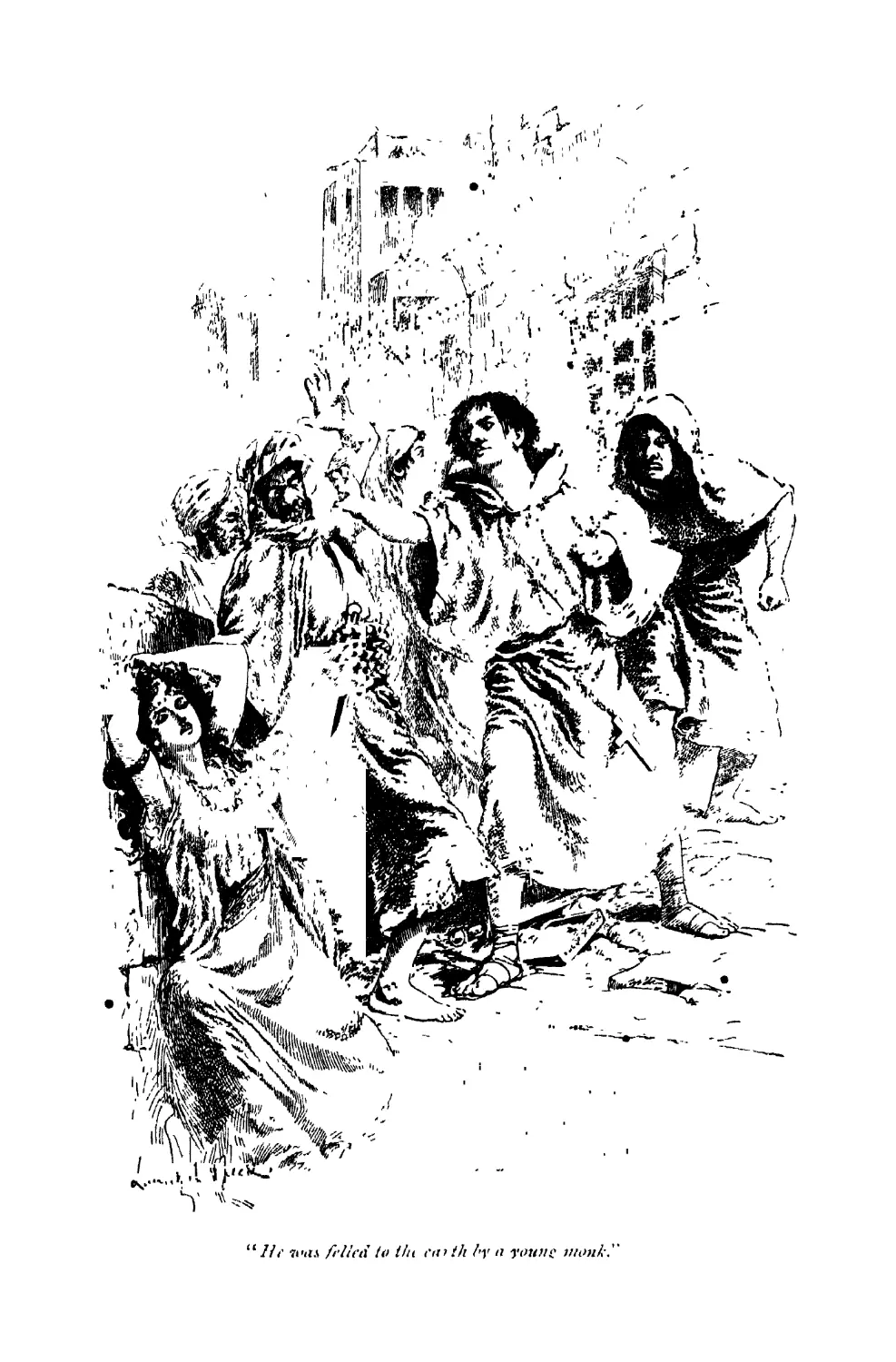
“ He was felled to the earth by a young monk ” .	.	.	.78
“ Her whole figure trembled and dilated with rapture ”	.	.112
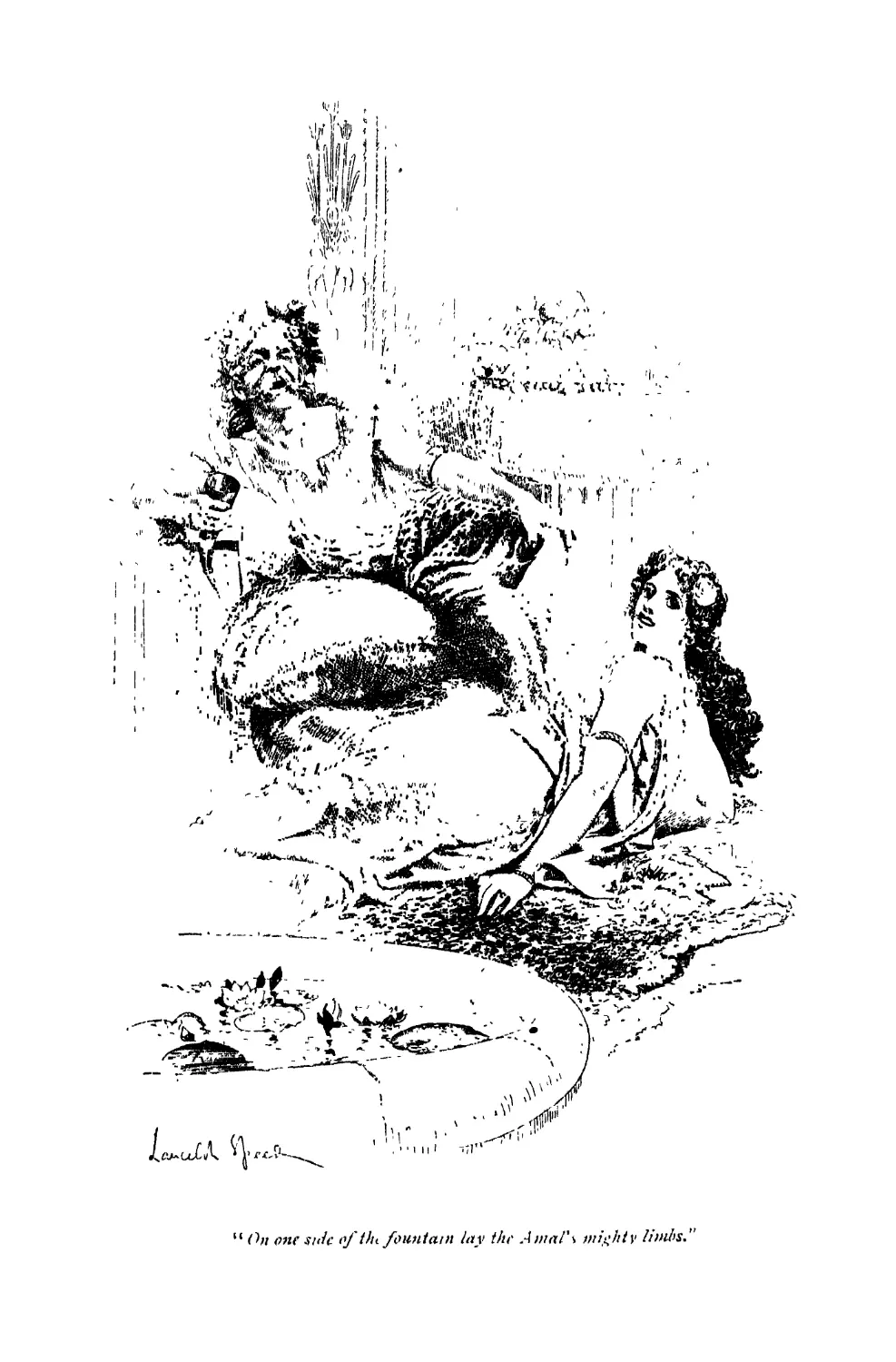
“ On one side of the fountain lay the Amal’s mighty limbs ”	. 143
“ A few yards off lay old Wulf upon his back ”.	,	.	. 144
“ ‘ You will not leave an old man to die here I. 165
“ The great triremes rushed past one after another ”.	.	.	205
“ The prettiest hands in Alexandria seized on Orestes ”	.	.	215
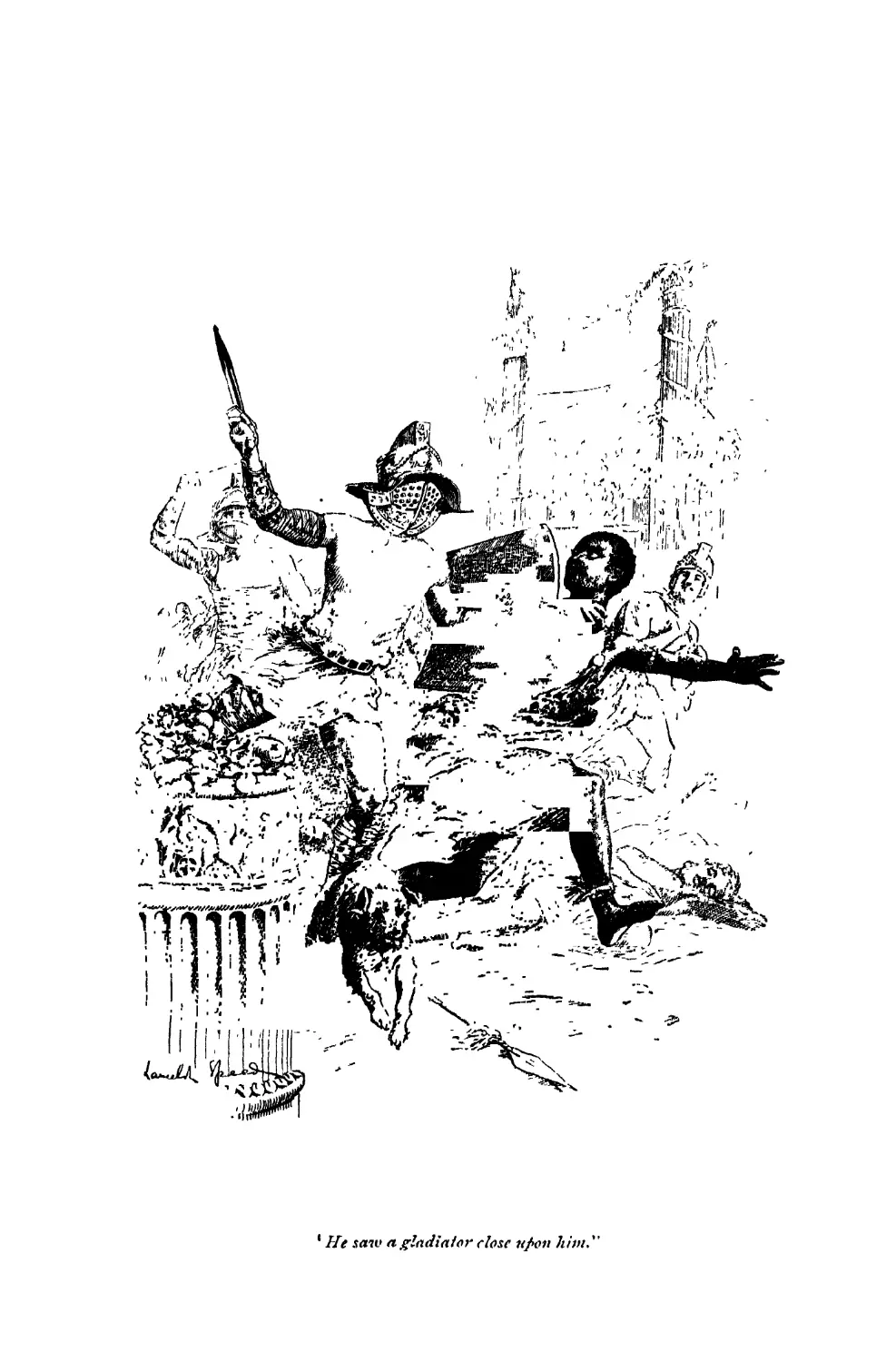
“ He saw a gladiator close upon him ”..........................289
“ 1 Athene! Pallas! Adored I Have mercy on me I	.	.	328
“ With one finger on her lips she held up her crucifix ”	.	.	341
“ The Goth and the Greek were locked in deadly struggle” . 378
xvi
HYPATIA
. CHAPTER I
THE LAURA
In the four hundred and thirteenth year of the Christian Era,
some three hundred miles above Alexandria, the young monk
Pliilammon was sitting on the edge of a low range of inland
cliffs, crested with drifting sand. Behind him the desert
sand-waste stretched, lifeless, interminable, reflecting its
lurid glare on the horizon of the cloudless vault of blue.
At his feet the sand dripped and trickled, in yellow rivulets,
from crack to crack and ledge to ledge, or whirled past him
in tiny jets of yellow smoke, before the fitful summer airs.
Here and there, upon the face of the cliffs which walled in
the opposite side of the narrow glen below, were cavernous
tombs, huge old quarries, with obelisks and half-cut pillars,
standing as the workmen had left them centuries before ; the
sand was slipping down and piling up around them, their
heads were frosted with the arid snow; everywhere was
silence, desolation—the grave of a dead nation, in a dying
land. And there he sat musing above it all, full of life and
youth and health and beauty—a young Apollo of the desert.
His only clothing was a ragged sheepskin, bound with a
leathern girdle. His long black locks, unshorn from child-
hood, waved and glistened in the sun; a rich dark down on
cheek and chin showed the spring of healthful manhood; his
hard hands and sinewy sunburnt limbs told of labour and
endurance; his flashing eyes and beetling brow, of daring,
fancy, passion, thought, which had no sphere of action in such
a place. What did his glorious young humanity alone among
the tombs ?
2
HYPATIA
So perhaps he, too, thought, as he passed his hand across
his brow, as if to sweep away some gathering dream, and
sighing, rose and wandered along the cliffs, peering down-
ward at every point and cranny, in search of fuel for the
monastery from whence he came.
Simple as was the material which he sought, consisting
chiefly of the low arid desert shrubs, with now and then a
fragment of wood from some deserted quarry or ruin, it was
becoming scarcer and scarcer round Abbot Pambo’s Laura at
Scetis; and long before Philammon had collected his daily
quantity, he had strayed farther from his home than he had
ever been before.
Suddenly, at a turn of the glen, became upon a sight new
to him ... a temple carved in the sandstone cliff; and in
front a smooth platform, strewn with beams and mouldering
tools, and here and there a skull bleaching among the sand,
perhaps of some workman slaughtered at his labour in one of
the thousand wars of old. The abbot, his spiritual father—
indeed, the only father whom he knew, for his earliest re-
collections were of the Laura and the old man’s cell—had
strictly forbidden him to enter, even to approach any of those
relics of ancient idolatry; but a broad terrace-road led down
to the platform from the table-land above; the plentiful
supply of fuel was too tempting to be passed by. . . . He
would go down, gather a few sticks, and then return, to tell
the abbot of the treasure which he had found, and consult
him as to the propriety of revisiting it.
So down he went, hardly daring to raise his eyes to the
alluring iniquities of the painted imagery which, gaudy in
crimson and blue, still blazed out upon the desolate solitude,
uninjured by that rainless air. But he was young, and youth
is curious; and the devil, at least in the fifth century, busy
with young brains. Now Philammon believed most utterly in
the devil, and night and day devoutly prayed to be delivered
from him; so he crossed himself, and ejaculated honestly
enough, ‘ Lord, turn away mine eyes, lest they behold
vanity I ’ . . . and looked nevertheless. . . .
And who could have helped looking at those four colossalo
kings, who sat there grim and motionless, their huge hands
laid upon their knees in everlasting self-assured repose, seem-
ing to bear up the mountain on their stately heads ? A sense
of awe, weakness, all but fear, came over him. He dare not
• He dare not stoop to take up the wood at it is feet,"

THE LAURA
3
stoop to take up the wood at his feet, their great stem eyes
watched him so steadily.
Round their knees and round their thrones were mystic
characters engraven, symbol after symbol, line below line—
the ancient wisdom of the Egyptians, wherein Moses the man
of God was learned of old—why should not he know it too ?
What awful secrets might not be hidden there about the
great world, past, present, and future, of which he knew only
so small a speck ? Those kings who sat there, they had known
it all; their sharp lips seem parting, ready to speak to him.
. . . Oh that they would speak for once 1 . . . and yet that
grim sneering smile, that seemed to look down on him from
the heights of their power and wisdom, with calm contempt
. . . him, the poor youth, picking up the leaving and rags of
their past majesty. ... He dared look at them no more.
So he looked past them into the temple halls; into a
lustrous abyss of cool green shade, deepening on and inward,
pillar after pillar, vista after vista, into deepest night. And
dimly through the gloom he could descry, on every wall and
column, gorgeous arabesques, long lines of pictured story;
triumphs and labours; rows of captives in foreign and fan-
tastic dresses, leading strange animals, bearing the tributes of
unknown lands ; rows of ladies at feasts, their heads crowned
with garlands, the fragrant lotus-flower in every hand, while
slaves brought wine and perfumes, and children sat upon
their knees, and husbands by their side; and dancing girls,
in transparent robes and golden girdles, tossed their tawny
limbs wildly among the throng. . . . What was the meaning
of it all ? Why had it all been ? Why had it gone on thus,
the great world, century after century, millennium after
millennium, eating and drinking, and marrying and giving in
marriage, and knowing nothing better . . . how could they
know anything better ? Their forefathers had lost the light
ages and ages before they were bom. . . . And Christ had
not come for ages and ages after they wSre dead. . . . How
could they know ? . . . And yet they were all in hell . . .
every one of them. Every one of these ladies who sat there,
with her bushy locks, and garlands, and jewelled collars, and
lotus-flowers, and gauzy dress, displaying all her slender
limbs—who, perhaps, when she was alive, smiled so sweetly,
and went so gaily, and had children, and friends, and never
once thought of what was going to happen to her—what
4
HYPATIA
must happen to her. . . . She was in hell. . . . Burning for
ever, and ever, and ever, there below his feet. He stared
down on the rocky floors. If he could but see through them
. . . and the eye of faith could see through them ... he
should behold her writhing and twisting among the flickering
flame, scorched, glowing ... in everlasting agony, such as
the thought of enduring for a moment made him shudder.
He had burnt his hands once, when a palm-leaf hut caught
fire. . . . He recollected what that was like. . . . She was
enduring ten thousand times more than that for ever. . .
He should hear her shrieking in vain for a drop of water to
cool her tongue. . . . He had never heard a human being
shriek but once ... a boy bathing On the opposite Nile
bank, whom a crocodile had dragged down . . . and that
scream, faint and distant as it came across the mighty tide,
had rung intolerable in his ears for days . . . and to think
of all which echoed through those vaults of fire—for ever!
Was the thought bearable 1—was it possible ! Millions upon
millions burning for ever for Adam’s fall. . . . Could God be
just in that ? . . .
It was the temptation of a fiend! He had entered the
unhallowed precincts where devils still lingered about their
ancient shrines; he had let his eyes devour the abominations
of the heathen, and given place to the devil. He would flee
home to confess it all to his father. He would punish him
as he deserved, pray for him, forgive him. And yet could he
tell him all ? Could he, dare he confess to him the whole
truth—the insatiable craving to know the mysteries of learn-
ing—to see the great roaring world of men, which had been
growing up in him slowly, month after month, till now it had
assumed this fearful shape ? He could stay no longer in the
desert. This world which sent all souls to hell—was it as
bad as monks declared it was ? It must be, else how could
such be the fruit of it ? But it was too awful a thought to be
taken on trust. Nb ; he must go and see.
Filled with such fearful questionings, half inarticulate and
vague, like the thoughts of a child, the untutored youth went
wandering on, till he reached the edge of the cliff belowi
which lay his home.
It lay pleasantly enough, that lonelr Laura, or lane of
rude Cyclopean cells, under the perpetual shadow of the
southern wall of crags, amid its grove of ancient date-trees.
THE LAURA
5
A brandling cavern in the cliff supplied the purposes of a
chapel, a storehouse, and a hospital; while on the sunny slope
across the glen lay the common gardens of the brotherhood,
green with millet, maize, and bq^ns, among which a tiny stream-
let husbanded and guided with the most thrifty care, wandered
down from the cliff foot, and spread perpetual verdure over
the little plot which voluntary and fraternal labour had pain-
fully redeemed from the inroads of the all-devouring sand.
For that garden, like everything else in the Laura, except
each brother’s seven feet of stone sleeping-hut, was the
common property, and therefore the common care and joy of
all. For the common good, as well as for his own, each man
had toiled up the glen with his palm-leaf basket of black mud
from the river Nile, over whose broad sheet of silver the
glen's mouth yawned abrupt For the common good, each
man had swept the ledges clear of sand, and sown in the
scanty artificial soil, the harvest of which all were to share
alike. To buy clothes, books, and chapel furniture for the
common necessities, education, and worship, each man sat,
day after day, week after week, his mind full of high and
heavenly thoughts, weaving the leaves of their little palm-
copse into baskets, which an aged monk exchanged for goods
with the more prosperous and frequented monasteries of the
opposite bank. Thither Philammon rowed the old man over,
week by week, in a light canoe of papyrus, and fished, as he
sat waiting for him, for the common meal. A simple, happy,
gentle life was that of the Laura, all portioned out by rules
and methods, which were held hardly less sacred than those
of the Scriptures, on which they were supposed (and not so
wrongly either) to have been framed. Each man had food
and raiment, shelter on earth, friends and counsellors, living
trust in the continual care of Almighty God ; and, blazing
before his eyes, by day and night, the hope of everlasting
glory beyond all poets’ dreams. . . . And what more would
man have had in those days ? Thither Uiey had fled out of
cities, compared with which Paris is earnest and Gomorrha
chaste—out of a rotten, infernal, dying world of tyrants and
slaves, hypocrites and wantons — to ponder undisturbed on
duty and on judgment, on death and eternity, heaven and
hell; to find a common creed, a common interest, a common
hope, common duties, pleasures, and sorrows. . . . True, they
had many of them fled from the post where God had placed
6
HYPATIA
them, when they fled from man into the Thebaid waste. . . .
What sort of post and what sort of an age they were, from
which those old monks fled, we shall see, perhaps, before this
tale is told out.	«
‘Thou art late, son/ said the abbot, steadfastly working
away at his palm-basket, as Philammon approached.
‘Fuel is scarce, and I was forced to go far/
‘ A monk should not answer till he is questioned. I did
not ask the reason. Where didst thou find that wood ? ’
‘ Before the temple, far up the glen/
‘ The temple ! What didst thou see there ? *
No answer. Pambo looked up with his keen black eye.
‘ Thou hast entered it, and lusted after its abominations.*
‘ I—I did not enter ; but 1 looked---*
‘ And what didst thou see ? Women ? ’
Philammon was silent.
‘ Have I not bidden you never to look on the face of women ?
Are they not the firstfruits of the devil, the authors of all evil,
the subtlest of all Satan’s snares ? Are they not accursed for
ever, for the deceit of their first mother, by whom sin entered
into the world ? A woman first opened the gates of hell;
and, until this day, they are the portresses thereof. Unhappy
boy ! What hast thou done ? ’
‘ They were but painted on the walls.’
‘ Ah ! ’ said the abbot, as if suddenly relieved from a heavy
burden. ‘ But how knewest thou them to be women, when
thou hast never yet, unless thou liest—which I believe not of
thee—seen the face of a daughter of Eve ? ’
‘Perhaps—perhaps,’ said Philammon, as if suddenly re-
lieved by a new suggestion—‘perhaps they were only devils.
They must have been, I think, for they were so very beautiful/
‘ Ah ! how knowest thou that devils are beautiful ? *
‘I was launching the boat, a week ago, with Father
Aufugus; and on the bank, . . . not very near, . . . there
were two creatures » . . with long hair, and striped all over
the lower half of their bodies with black, and red, and yellow
. . . and they were gathering flowers on the shore. Father
Aufugus turned away; but I ... I could not help thinking
them the most beautiful things that I had ever seen ... so I
asked him why he turned away; and he said that those were
the same sort of devils which tempted the blessed St Anthony.
Then I recollected having heard it read aloud, how Satan
THE LAURA
7
tempted Anthony in the shape of a beautiful woman. . . . And
so . . . and so . . . those figures on the wall were very like
♦ . . and 1 thought they might be . . .*
And the poor boy, who considered that he was making
confession of a ‘deadly and shameful sin, blushed scarlet and
stammered, and at last stopped.
(And thou thoughtest them beautiful ? Oh utter corrup-
tion of the flesh !—oh subtilty of Satan ! The Lord forgive
thee, as 1 do, my poor child: henceforth thou goest not
beyond the garden walls.’
' Not beyond the walls ! Impossible ! I cannot! If thou
wert not my father, I would say I will not!—I must have
liberty! I must see for myself—I must judge for myself, what
this world is of which you all talk so bitterly. I long for
no pomps and vanities. I will promise you this moment, if
you will, never to re-enter a ’heathen temple—to hide my
face in the dust whenever I approach a woman. But I must
—I must see the world; I must sec the great mother-church
in Alexandria, and the patriarch, and his clergy. If they can
serve God in the city, why not I ? I could do more for God
there than here. . . . Not that I despise this work—not that
I am ungrateful to you—oh, never, never that!—but I pant
for the battle. Let me go 1 I am not discontented with you,
but with myself. I know that obedience is noble; but danger
is nobler still. If you have seen the world, why should not
I ? If you have fled from it because you found it too evil to
live in, why should not I, and return to you here of my own
will, never to leave you ? . . . And yet Cyril and his clergy
have not fled from it. . . /
Desperately and breathlessly did Philammon drive this
speech out of his inmost heart; and then waited, expecting
the good abbot to strike him on the spot. If he had, the
young man would have submitted patiently ; so would any
man, however venerable, in that monastery. Why not?
Duly, after long companionship, thought, and prayer, they
had elected Pambo for their abbot—abba—father—the wisest,
eldest-hearted and headed of them—if he was that, it was
time that he should be obeyed. And obeyed he was, with a
loyal, reasonable love, and yet with an implicit, soldier-like
obedience, which many a king and conqueror might envy.
Were they cowards and slaves? The Roman legionaries
should be good judges on that point. They used to say that
8
HYPATIA
no armed barbarian, Goth or Vandal, Moor or Spaniard, was
so terrible as the unarmed monk of the Thebaid.
Twice the old man lifted his staff to strike; twice he laid
it down again ; and then, slowly rising, left Philammon kneel-
ing there, and moved away deliberately, and with eyes fixed
on the ground, to the house of the brother Aufugus.
Every one in the Laura honoured Aufugus. There was
a mystery about him which heightened the charm of his
surpassing sanctity, his childlike sweetness and humility. It
was whispered—when the monks seldom and cautiously did
whisper together in tlfeir lonely walks—that he had been
once a great man; that he had come from a great city—
perhaps from Rome itself. And the simple monks were
proud to think that they had among them a man who had
seen Rome. At least, Abbot Pambo respected him. He
was never beaten; never even reproved—perhaps he never
required it; but still it was the meed of all; and was not
the abbot a little partial ? Yet, certainly, when Theophilus
sent up a messenger from Alexandria, rousing every Laura
with the news of the sack of Rome by Alaric, (lid not Pambo
take liim first to the cell of Aufugus, and sit with him there
three whole hours in secret consultation, before he told the
awful story to the rest of the brotherhood ? And did not
Aufugus himself give letters to the messenger, written with
his own hand, containing, as was said, deep secrets of worldly
policy, known only to himself? So, when the little lane of
holy men, each peering stealthily over his plaiting wrork from
the doorway of his sandstone cell, saw the abbot, after his
unwonted passion, leave the culprit kneeling, and take his
way toward the sage’s dwelling, they judged that something
strange and delicate had befallen the common weal, and each
wished, without envy, that he were as wise as the man whose
counsel was to solve the difficulty.
For an hour or more the abbot remained there, talking
earnestly and low; arid then a solemn sound as of the two
old men praying with sobs and tears; and every brother
bowed his head, and whispered a hope that He whom they
served might guide them for the good of the Laura, and of
His Church, and of the great heathen world beyond; and
still Philammon knelt motionless, awaiting his sentence;
his heart filled—who can tell how? ‘The heart knoweth
its own bitterness, and a stranger intermeddleth not with its
THE LAURA
9
joy.’ So thought he as he knelt; and so think I, too, know-
ing that in the pettiest character there are unfathomable
,depths, which the poet, all-seeing though he may pretend to
be, can never analyse, but muit only dimly guess at, and still
more dimly sketch them by the actions which they beget.
At last Pambo returned, deliberate, still, and slow, as he
had gone, and seating himself within his cell, spoke—
'And the youngest said, Father, give me the portion of
goods that falleth to my share. . . . And he took his journey
into a far country, and there wasted hi§ substance with riotous
living. Thou shalt go, my son. But first come after me, and
speak with Aufugus.’
Philammon, like every one else, loved Aufugus; and when
the abbot retired and left the two alone together, he felt no
dread or shame about unburdening his whole heart to him.
Long and passionately he spoke, in answer to the gentle
questions of the old man, who, without the rigidity or
pedantic solemnity of the monk, interrupted the youth, and
let himself be interrupted in return, gracefully, genially,
almost playfully. And yet there was a melancholy about
his tone as he answered to the youth’s appeal—
'Tertullian, Origen, Clement, Cyprian—all these moved in
the world ; all these and many more beside, whose names we
honour, whose prayers wrc invoke, were learned in the wisdom
of the heathen, and fought and laboured, unspotted in the
world; and why not 1 ? Cyril the patriarch himself, wras he
not called from the caves of Nit ria to sit on the throne of
Alexandria ? ’
Slowly the old man lifted his hand, and putting back the
thick locks of the kneeling youth, gazed, with soft pitying
eyes, long and earnestly into his face.
' And thou wouldst see the world, jxror fool ? And thou
wouldst see the world ? ’
' 1 would convert the world ! *
'Thou must know it first. And shall btell thee what that
world is like, which seems to thee so easy to convert ? Here
I sit, the poor unknown old monk, until I die, fasting and
к praying, if perhaps God will have mercy on my soul; but
little thou knowest how I have seen it. Little thou knowest,
or thou wouldst be well content to rest here till the end. I
was Arsenins. . . . Ah ! vain old man that 1 am ! Thou hast
never heard that name, at which once queens would whisper
10
HYPATIA
and grow pale. Vanitas vanitatum! omnia vanitas! And
yet he, at whose frown half the world trembles, has trembled
himself at mine. I was the tutor of Arcadius/
* The Emperor of Byzantium t? ’
(Even so, my son, even so. There 1 saw the world which
thou wouldst see. And what saw I ? Even what thou wilt
see. Eunuchs the tyrants of their own sovereigns. Bishops
kissing the feet of parricides and harlots. Saints tearing
saints in pieces for a word, while sinners cheer them on to
the unnatural fight. eLiars thanked for lying, hypocrites
taking pride in their hypocrisy. The many sold and but-
chered for the malice, the caprice, the vanity of the few.
The plunderers of the poor plundered in their turn by
worse devourers than themselves. Every attempt at reform
the parent of worse scandals ; every mercy begetting fresh
cruelties; every persecutor silenced, only to enable others
to persecute him in their turn; every devil who is exorcised,
returning with seven others worse than himself; falsehood and
selfishness, spite and hist, confusion seven times confounded,
Satan casting out Satan everywhere—from the emperor who
wantons on his throne, to the slave wrho blasphemes beneath
his fetters/
' If Satan cast out Satan, his kingdom shall not stand/
f In the world to come. But in this world it shall stand
and conquer, even worse and worse, until the end. These
are the last days spoken of by the prophets, the beginning of
woes such as never have been on the earth before—“ On earth
distress of nations with perplexity, men’s hearts failing them
for fear, and for the dread of those things which are coining
on the earth.” I have seen it long. Year after year I have
watched them coming nearer and ever nearer in their course
like the whirling sand-storms of the desert, which sweep past
the caravan, and past again, and yet overwhelm it after all—
that black flood of the northern barbarians. I foretold it; I
prayed against it; but, like Cassandra's of old, my prophecy
and my prayers were alike unheard. My pupil spumed my
warnings. The lusts of youth, the intrigues of courtiers, were
stronger than the warning voice of God; then I ceased to
hope; I ceased to pray for the glorious city, for I knew that
her sentence was gone forth; I saw her in the spirit, even as
St. John saw her in the Revelations; her, and her sins, and
her ruin. And I fled secretly at night, and buried myself
THE LAURA
11
here in the desert, to await the end of the world. Night and
day I pray the Lord to accomplish His elect, and to hasten
His kingdom. Morning by morning 1 look up trembling, and
yet in hope, for the sign of tlv‘ Son of man in heaven, when
the sun shall be turned into darkness, and the moon into
blood, and the stars shall fall from heaven, and the skies pass
away like a scroll, and the fountains of the nether fire burst
up around our feet, and the end of all shall come. And
thou wouldst go into the world from which I fled ? ’
‘If the harvest be at hand, the Lord needs labourers. If
the times be awful, I should be doing awful things in them.
Send me, and let that day find me, where I long to be, in
the forefront of the battle of the Lord.’
r The Lord's voice be obeyed ! Thou shalt go. Here are
letters to Cyril the patriarch. He will love thee for my sake;
and for thine own sake, too, I trust. Thou goest of our free
will as well as thine own. The abbot and I have watched
thee long, knowing that the Lord had need of such as thee
elsewhere. We did but prove thee, to see by thy readiness
to obey, whether thou wert fit to rule. Go, and God be with
thee. Covet no man’s gold or silver. Neither eat flesh nor
drink wine, but live as thou hast lived—a Nazarite of the
Lord. Fear not the face of man; but look not on the face
of woman. In an evil hour came they into the world, the
mothers of all mischiefs which I have seen under the sun.
Come ; the abbot waits for us at the gate/
With tears of surprise, joy, sorrow, almost of dread, Phil-
ammon hung back.
'Nay—come. Why shouldst thou break thy brethren’s
hearts and ours by many leave-takings! Bring from the
storehouse a week’s provision of dried dates and millet. The
papyrus boat lies at the ferry; thou shalt descend in it. The
Lord will replace it for us when we need it. Speak with no
man on the river except the monks of God. When thou hast
gone five days* journey downward, ask for the mouth of the
canal of Alexandria. Once in the city, any monk will guide
thee to the archbishop. Send us news of thy welfare by
some holy mouth. Come.’
Silently they paced together down the glen to the lonely
beach of the great stream. Pambo was there already, his
white hair glittering in the rising moon, as with slow and
feeble arms he launched the light canoe. Philammon flung
HYPATIA
12
himself at the old men’s feet, and besought, with many tears,
their forgiveness and their blessing.
* We have nothing to forgive. Follow thou thine inward
call. If it be of the flesh, it rvill avenge itself; if it be of
the Spirit, who are we that we should fight against God?
Farewell.’
A few minutes more, and the youth and his canoe were
lessening down the rapid stream in the golden summer twi-
light. Again a minute, and the swift southern night had
fallen, and all was darjt but the cold glare of the moon on
the river, and on the rock-faces, and on the two old men, as
they knelt upon the beach, and with their heads upon each
other’s shoulders, like two children, sobbed and prayed to-
gether for the lost darling of their age.
CHAPTER II
THE DUNG WORLD
In the upper story of a house in the Museum Street of
Alexandria, built and fitted up on the old Athenian model,
was a small room. It had been chosen by its occupant, not
merely on account of its quiet; for though it was tolerably
out of hearing of the female slaves who worked, and chattered,
and quarrelled under the cloisters of the women’s court on
the south side, yet it was exposed to the rattle of carriages
and the voices of passengers in the fashionable street below,
and to strange bursts of roaring, squealing, trumpeting from
the Menagerie, a short way off, on the opposite side of the
street. The attraction of the situation lay, perhaps, in the
view which it commanded over the wall of the Museum
gardens, of flower-beds, shrubberies, fountains, statues, walks,
and alcoves, which* had echoed for nearly seven hundred
years to the wisdom of the Alexandrian sages and poets.
School after school, they had all wralked, and taught, and
sung there, beneath the spreading planes and chestnuts, figs
and pahn-trees. The place seemed fragrant with all the
riches of Greek thought and song, since the days when
Ptolemy Philadelphus walked there with Euclid and Theoc-
ritus, Callimachus and Lycophron.
THE DYING WORLD
18
On the left of the garden stretched the lofty eastern
front of the Museum itself, with its picture galleries, halls
of statuary, dining-halls, and lecture-rooms; one huge wing,
containing that famous library, founded by the father of
Philadelphus, which held in the time of Seneca, even after
the destruction of a great part of it in Caesar’s siege, four
hundred thousand manuscripts. There it towered up, the
wonder of the world, its white roof bright against the rain-
less blue; and beyond it, among the ridges and pediments of
noble buildings, a broad glimpse of the bright blue sea.
The room was fitted up in the purest Greek style, not
without an affectation of archaism, in the severe forms and
subdued half-tints of the frescoes which ornamented the walls
with scenes from the old myths of Athene. Yet the general
effect, even under the blazing sun which poured in through
the mosquito nets of the courtyard windows, was one of
exquisite coolness, and cleanliness, and repose. The room
had neither carpet nor fireplace; and the only movables in
it were a sofa-bed, a table, and an arm-chair, all of such
delicate and graceful forms as may be seen on ancient vases
of a far earlier period than that whereof we write. But,
most probably, had any of us entered that room that morning,
we should not have been able to spare a look either for the
furniture, or the general effect, or the Museum gardens, or
the sparkling Mediterranean beyond; but we should have
agreed that the room was quite rich enough for human eyes,
for the sake of one treasure which it possessed, and beside
which nothing was worth a moment’s glance. For in the
light arm-chair, reading a manuscript which lay on the table,
sat a woman, of some five-and-twenty years, evidently the
tutelary goddess of that little shrine, dressed in perfect keeping
with the archaism of the chamber, in a simple old snow-white
Ionic robe, falling to the feet and reaching to the throat,
and of that peculiarly severe and graceful fashion in which
the upper part of the dress falls downward again from the
neck to the waist in a sort of cape, entirely hiding the outline
of the bust, while it leaves the arms and the point of the
shoulders bare. Her dress wras entirely without ornament,
except the two narrow purple stripes down the front, which
marked her rank as a Roman citizen, the gold embroidered
shoes upon her feet, and the gold net, which looped back,
from her forehead to her neck, hair the colour and gloss of
14	HYPATIA
which were hardly distinguishable from that of the metal
itself, such as Athene herself might have envied for tint, and
mass, and ripple. Her features, arms, and hands were of the
severest and grandest type of old Greek beauty, at once
showing everywhere the high development of the bones, and
covering them with that firm, round, ripe outline, and waxy
morbidezza of skin, which the old Greeks owed to their con-
tinual use not only of the bath and muscular exercise, but
also of daily unguents. There might have seemed to us too
much sadness in that clear grey eye; too much self-conscious
restraint in those sharp curved lips; too much affectation
in the studied severity of her posture as she read, copied,
as it seemed, from some old vase or bas-relief. But the
glorious grace and beauty of every line of face and figure
would have excused, even hidden those defects, and we should
have only recognised the marked resemblance to the ideal
portraits of Athene which adorned every panel of the walls.
She has lifted her eyes off her manuscript; she is looking
out with kindling countenance over the gardens of the
Museum; her ripe curling Greek lips, such as we never see
now, even among her own wives and sisters, open. She is
talking to herself. Listen !
‘Yes. The statues there are broken. The libraries are
plundered. The alcoves are silent. The oracles are dumb.
And yet—who says that the old faith of heroes and sages is
dead ? The beautiful can never die. If the gods have de-
serted their oracles, they have not deserted the souls who
aspire to them. If they have ceased to guide nations, they
have not ceased to speak to their own elect. If they have
cast off the vulgar herd, they have not cast off Hypatia,
‘ Ay. To believe in the old creeds, while every one else
is dropping away from them, ... To believe in spite of
disappointments. ... To hope against hope. ... To show
oneself superior to the herd, by seeing boundless depths of
living glory in myths which have become dark and dead to
them. ... To struggle to the last against the new and
vulgar superstitions of a rotting age, for the faith of my
forefathers, for the old gods, the old heroes, the old sages
who gauged the mysteries of heaven and earth—and perhaps
to conquer—at least to have my reward ! To be welcomed
into the celestial ranks of the heroic — to rise to the
THE DYING WORLD
15
immortal gods, to the ineffable powers, onward, upward ever,
through ages and through eternities, till I find my home
at last, and vanish in the glory of the Nameless and the
Absolute One ! . . /	•
And her whole face flashed out into wild glory, and then
sank again suddenly into a shudder of something like fear
and disgust, as she saw, watching her from under the wall
of the gardens opposite, a crooked, withered Jewish crone,
dressed out in the most gorgeous and fantastic style of
barbaric finery.	•
‘ Why does that old hag haunt me ? I see her everywhere
—till the last month at least—and here she is again 1 I will
ask the prefect to find out who she is, and get rid of her,
before she fascinates me with that evil eye. Thank the gods,
there she moves away ’ Foolish !—foolish of me, a philoso-
pher. I, to believe, against the authority of Porphyry him-
self, too, in evil eyes and magic! But there is my father,
pacing up and down in the library.’
As she spoke, the old man entered from the next room.
He was a Greek also, but of a more common and perhaps
lower type; dark and fiery, thin and graceful; his delicate
figure and cheeks, wasted by meditation, harmonised well
with the staid and simple philosophic cloak which he wore
as a sign of his profession. He paced impatiently up and
down the chamber, while his keen, glittering eyes and rest-
less gestures betokened intense inward thought. . . .
. . . ‘ I have it. . . . No; again it escapes—it contradicts
itself. Miserable man that I am ! If there is faith in Pytha-
goras, the symbol should be an expanding series of the powers
of three; and yet that accursed binary factor will introduce
itself. Did not you work the sum out once, Hypatia ? *
‘Sit down, my dear father, and eat. You have tasted no
food yet this day/
‘ What do I care for food ! The inexpressible must be ex-
pressed, the work must be done if it cost me the squaring of
the circle. How can he, whose sphere lies above the stars,
stoop every moment to earth ? ’
‘Ay/ she answered, half bitterly, ‘and would that we could
live without food, and imitate perfectly the immortal gods.
But while we are in this prison-house of matter, we must
wear our chain; even wear it gracefully, if we have the good
taste; and make the base necessities of this body of shame
16
HYPATIA
symbolic of the divine food of the reason. There is fruit,
with lentils and rice, waiting for you in the next room; and
bread, unless you despise it too much.’
‘The food of slaves!* he answered. ‘Well, I will eat, and
be ashamed of eating. Stay, did I tell you ? Six new pupils
in the mathematical school this morning. It grows ! It
spreads ! We shall conquer yet 1 *
She sighed. ‘ How do you know that they have not come
to you, as Critias and Alcibiades did to Socrates, to learn a
merely political and mundane virtue ? Strange ! that men
should be content to grovel, and be men, when they might
rise to the rank of gods! Ah, my father! That is my
bitterest grief! to see those who have been pretending in
the morning lecture-room to worship every word of mine as
an oracle, lounging in the afternoon round Pelagia’s litter;
and then at night—for I know that they do it—the dice, and
the wine, and worse. That Pallas herself should be con-
quered every day by Venus Pandemos ! That Pelagia should
have more power than I! Not that such a creature as that
disturbs me : no created thing, I hope, can move my equa-
nimity ; but if I could stoop to hate—I should hate her—
hate her.’
And her voice took a tone which made it somewhat un-
certain whether, in spite of all the lofty impassibility which
she felt bound to possess, she did not hate Pelagia with a
most human and mundane hatred.
But at that moment the conversation was cut short by the
hasty entrance of a slave girl, who, with fluttering voice,
announced—
‘His excellency, madam, the prefect! His chariot has
been at the gate for these five minutes, and he is now coming
upstairs.’
‘ Foolish child ! ’ answered Hypatia, with some affectation
of indifference. ‘ And why should that disturb me ? Let
him enter.’	•>
The door opened, and in came, preceded by the scent of
half-a-dozen different perfumes, a florid, delicate-featured
man, gorgeously dressed out in senatorial costume, his fingers
and neck covered with jewels.
‘The representative of the Caesars honours himself by
offering at the shrine of Athene Polias, and rejoices to see in
her priestess as lovely a likeness as ever of the goddess whom
hi came а шан gorgeously dressed in senatorialcostume.

THE»DYING WORLD	it
she serves. . . . Don’t betray inc, but I really cannot help
talking sheer Paganism whenever I find myself within the
influence of your eyes/
* ‘ Truth is mighty/ said Hypatia, as she rose to greet him
with a smile and a reverence.
' Ah, so they say. Your excellent father has vanished. He
is really too modest—honest, though, about his incapacity for
state secrets. After all, you know, it was your Minervaship
which I came to consult. How has this turbulent Alexandrian
rascaldom been behaving itself in my absence ?’
'The herd has been eating, and drinking, and marrying,
as usual, I believe/ answered Hypatia, in a languid tone.
' And multiplying, I don’t doubt. Well, there will be less
loss to the empire if I have to crucify a dozen or two, as I
p6sitively will, the next riot. It is really a great comfort to
a statesman that the masses are so well aware that they de-
serve hanging, and therefore so careful to prevent any danger
of public justice depopulating the province. But how go
on the schools ? ’
Hypatia shook her head sadly.
‘ Ah, boys will be boys. ... I plead guilty myself. Video
meliora proboque, deteriora seqtior. You must not be hard
on us. . . •. Whether we obey you or not in private life, we
do in public; and if we enthrone you queen of Alexandria,
you must allow your courtiers and bodyguards a few court
licences. Now don’t sigh, or I shall be inconsolable. At all
events, your worst rival has betaken herself to the wilderness,
and gone to look for the city of the gods above the cataracts.’
' Whom do you mean ? ’ asked Hypatia, in a tone most un-
philosophically eager.
' Pelagia, of course. 1 met that prettiest and naughtiest
of humanities half-way between here and Thebes, transformed
into a perfect Andromache of chaste affection/
‘ And to whom, pray ? ’
r To a certain Gothic giant. What men* those barbarians
do breed ! I was afraid of being crushed under the elephant’s
foot at every step I took with him ! *
e ' What! ’ asked Hypatia ; f did your excellency condescend
to converse with such savages ? ’
' To tell you the truth, he had some forty stout countrymen
of his with him, who might have been troublesome to a per-
plexed prefect; not to mention that it is always as well to
HYPATIA
IS
keep on good terms with these Goths. Really, after the
sack of Rome, and Athens cleaned out like a beehive by
wasps, things begin to look serious. And as for the great
brute himself, he has rank enough in his way—boasts of his
descent from some cannibal god or other — really hardly
deigned to speak to a paltry Roman governor, till his faithful
and adoring bride interceded for me. Still, the fellow under-
stood good living, and we celebrated our new treaty of friend-
ship with noble libations—but I must not talk about that to
you. However, I got rid of them; quoted all the geo-
graphical lies 1 had ever heard, and a great many more;
quickened their appetite for their fool’s errand notably, and
started them off again. So now the star of Venus is set, and
that of Pallas in the ascendant. Wherefore tell me—what
am I to do with Saint Firebrand ? ’
f Cyril ? ’
‘ Cyril/
(Justice/
( Ah, Fairest Wisdom, don’t mention that horrid word out
of the lecture-room. In theory it is all very well; but in
poor, imperfect, earthly practice, a governor must be content
with doing very much what comes to hand. In abstract
justice, now, I ought to nail up Cyril, deacons, district visitors,
and all, in a row on the sandhills outside. That is simple
enough ; but, like a great many simple and excellent things,
impossible/
‘ You fear the people ? ’
‘Well, my dear lady, and has not the villainous demagogue
got the whole mob on his side ? Am I to have the Constan-
tinople riots re-enacted here ? I really cannot face it; I have
not nerve for it; perhaps I am too lazy. Be it so/
Hypatia sighed. (Ah, that your excellency but saw the
great duel which depends on you alone ! Do not fancy that
the battle is merely between Paganism and Christianity-------’
'Why, if it were, you know, 1, as a Christian, under a
Christian and sainted emperor, not to mention his august
sister----*
* We understand/ interrupted she, with an impatient wave
of her beautiful hand. ‘Not even between them ; not ev£n
between philosophy and barbarism. The struggle is simply
one between the aristocracy and the mob—between wealth,
refinement, art, learning, all that makes a nation great and
THE DYING WORLD
19
the savage herd of child-breeders below, the many ignoble,
who were meant to labour for the noble few. Shall the
Roman empire command or obey her own slaves ? is the
question which you and Cyril have to battle out; and the
fight must be internecine.’
‘ I should not wonder if it became so, really,’ answered the
prefect, with a shrug of his shoulders. ‘I expect every time
I ride to have my brains knocked out by some mad monk.’
‘ Why not ? In an age when, as has been well and often
said, emperors and consulars crawl to the tombs of a tent-
maker and a fisherman, and kiss the mouldy bones of the vilest
slaves ? Why not, among a people whose God is the crucified
son of a carpenter ? Why should learning, authority, anti-
quity, birth, rank, the system of empire which has been grow-
ing up, fed by the accumulated wisdom of ages—why, I
say, should any of these things protect your life a moment
from the fury of any beggar who believes that the Son of
God died for him as much as for you, and that he is your
equal if not your superior in the sight of his low-born and
illiterate deity ! ’1
* My most eloquent philosopher, this may be—and perhaps
is—all very true. I quite agree that there are very great
practical inconveniences of this kind in the new—I mean the
Catholic faith; but the world is full of inconveniences. The
wise man does not quarrel with his creed for being disagree-
able, any more than he does with his finger for aching; he
cannot help it, and must make the best of a bad matter.
Only tell me how to keep the peace.’
*And let philosophy be destroyed ? ’
'That it never will be, as long as Hypatia lives to illuminate
the earth; and as far as I am concerned 1 promise you a clear
stage, and—a great deal of favour, as is proved by my visiting
you publicly at this moment, before I have given audience to
one of the four hundred bores, great and small, who are wait-
ing in the tribunal to torment me. Do help me and advise
me. What am I to do ? ’
' I have told you.’
• 'Ah, yes, as to general principles. But out of the
lecture-room I prefer a practical expedient: for instance,
Cyril writes to me here—plague on him ! he would not let
1 These are the arguments and the language which were commonly
employed by Porphyry, Julian, and the other opponents of Christianity.
20
HYPATIA
me even have a week’s hunting in peace—that there is a plot
on the part of the Jews to murder all the Christians. Here
is the precious document—do look at it, in pity. For aught
I know or care, the plot may fie an exactly opposite one, and
the Christians intend to murder all the Jews. But I must
take some notice of the letter.’
(I do not see that, your excellency.’
'Why, if anything did happen after all, conceive the
missives which would be sent flying off to Constantinople
against me ! ’
' Let them go. If you are secure in the consciousness of
innocence, what matter ? ’
' Consciousness of innocence ? I shall lose my prefecture ! ’
* Your danger would just be as great if you took notice of
it. Whatever happened, you would be accused of favouring
the Jews.’
* And really there might be some truth in the accusation.
How the finances of the provinces would go on without their
kind assistance, I dare not think. If those Christians would
but lend me their money, instead of building almshouses
and hospitals with it, they might burn the Jews’ quarter
to-morrow, for aught I care. But now. . . .’
' But now, you must absolutely take no notice of this letter.
The very tone of it forbids you, for your own honour, and the
honour of the empire. Are you to treat with a man who
talks of the masses at Alexandria as "the flock whom the
King of kings has committed to his rule and care ” ? Does
your excellency, or this proud bishop, govern Alexandria ?'
* Really, my dear lady, 1 have given up inquiring.’
' But he has not He comes to you as a person possessing
an absolute authority over two-thirds of the population, which
he does not scruple to hint to you is derived from a higher
source than your own. The consequence is clear. If it be
from a higher source than yours, of course it ought to control
yours; and you will confess that it ought to control it—you
will acknowledge the root and ground of every extravagant
claim which he makes, if you deign to reply.’
'But I must say something, or I shall be pelted in the
streets. You philosophers, however raised above your own
bodies you may be, must really not forget that we poor
worldlings have bones to be broken.’
' Then tell him, and by word of mouth merely, that as the
THE-DYING WORLD	21
information which he sends you comes from his private know-
ledge and concerns not him as bishop,but you as magistrate, you
can only take it into consideration when he addresses you as
a private person, laying a regular information at your tribunal.’
‘Charming! queen of diplomatists as well as philosophers!
I go to obey you. Ah ! why were you not Pulcheria ? No, for
then Alexandria had been dark, and Orestes missed the supreme
happiness of kissing a hand which Pallas, when she made you,
must have borrowed from the workshop of Aphrodite.’
(Recollect that you are a Christian,’ answered Hypatia,
half smiling.
So the prefect departed; and passing through the outer hall,
which was already crowded with Hypatia’s aristocratic pupils
and visitors, bowed his way out past them and regained his
chariot, chuckling over the rebuff which he intended to ad-
minister to Cyril, and comforting himself with the only text
of Scripture of the inspiration of which he was thoroughly
convinced: ' Sufficient for the day is the evil thereof.’
At the door was a crowd of chariots, slaves with their
masters’ parasols, and the rabble of onlooking boys and
market-folk, as usual in Alexandria then as in all great cities
since, who were staring at the prefect, and having their heads
rapped by his guards, and wondering what sort of glorious
personage Hypatia might be, and what sort of glorious house
she must live in, to be fit company for the great governor of*
Alexandria. Not that there was not many a sulky and lower-
ing face among the mob, for the great majority of them were
Christians, and very seditious and turbulent politicians, as
Alexandrians, ‘men of Macedonia,’ wrere bound to be; and
there was many a grumble among them, all but audible, at
the prefect’s going in state to the heathen woman’s house—
heathen sorceress, some pious old woman called her—before
he heard any poor soul’s petition in the tribunal, on even said
his prayers in church.
Just as he was stepping into his curricle^ a tall young man,
as gorgeously bedizened as himself, lounged down the steps
after him, and beckoned lazily to the black boy who carried
Jiis parasol.
‘ Ah, Raphael Aben-Ezra! my excellent friend, what pro-
pitious deity—ahem ! martyr—brings you to Alexandria just
as I want you ? Get up by my side, and let us have a chat
on our way to the tribunal.’
HYPATIA
Ж
The man addressed came slowly forward with an ostenta-
tiously low salutation, which could not hide, and indeed was
not intended to hide, the contemptuous and lazy expression
of his face; and asked in a drawling tone—
(And for what kind purpose does the representative of the
Caesars bestow such an honour on the humblest of his, &c. &c.
—your penetration will supply the rest/
' Don’t be frightened; 1 am not going to borrow money of
you/ answered Orestes laughingly, «is the Jew got into the
curricle.
rI am glad to hear it. Really one usurer in a family is
enough. My father made the gold, and if I spend it I con-
sider that I do all that is required of a philosopher/
e A charming team of white N isatins, is not this ? And
only one grey foot among all the four/
‘Yes . . . horses are a bore, I begin to find, like every-
thing else. Always falling sick, or running away, or break-
ing one’s peace of mind in some way or other. Besides, I
have been pestered out of my life there in Cyrene, by com-
missions for dogs and horses and bows from that old Episcopal
Nimrod, Synesius.’
' What! is the worthy man as lively as ever ? ’
‘ Lively ? He nearly drove me into a nervous fever in three
days. Up at four in the morning, always in the most dis-
gustingly good health and spirits, farming, coursing, shooting,
riding over hedge and ditch after rascally black robbers;
preaching, intriguing, borrowing money; baptizing and ex-
communicating ; bullying that bully, Andronicus; comforting
old women, and giving pretty girls dowries; scribbling one
half-hour on philosophy, and the next on farriery; sitting up
all night writing hymns and drinking strong liquors ; off again
on horseback at four the next morning; and talking by the
hour all the while about philosophic abstraction from the
mundane tempest. Heaven defend me from all two-legged
whirlwinds! By*the-bye, there was a fair daughter of my
nation came back to Alexandria in the same ship with me,
with a cargo that may suit your highness/
‘ There are a great many fair daughters of your nation whg
might suit me, without any cargo at all.’
‘ Ah, they have had good practice, the little fools, ever since
the days of Jeroboam the son of Nebat. But I mean old
Miriam—you know. She has been lending Synesius money
THE DYING WORLD
23
to fight the black fellows with ; and really it was high time.
They had burnt every homestead for miles through the
province. But the daring old girl must do a little business
for herself, so she went off ift the teeth of the barbarians,
right away to the Atlas, bought all their lady prisoners, and
some of their own sons and daughters, too, of them, for beads
and old iron; and has come back with as pretty a cargo of
Lybian beauties as a prefect of good taste could wish to have
the first choice of. You may thank me for that privilege.’
c After, of course, you had suited «yourself, my cunning
Raphael ? *
< Not I. Women arc bores, as Solomon found out long ago.
Did I never tell you ? I began, as he did, with the most
select harem in Alexandria. But they quarrelled so, that one
day I went out and sold them all but one, who was a Jewess
—so there were objections on the part of the Rabbis. Then
I tried one, as Solomon did ; but my " garden shut up,” and
my “sealed fountain” wanted me to be always in love with
her, so I went to the lawyers, allowed her a comfortable
maintenance, and now I am as free as a monk, and shall be
happy to give your excellency the benefit of any good taste
or experience which I may possess.’
* Thanks, worthy Jew. We are not yet as exalted as your-
self, and will send for the old Erictho this very afternoon.
Now listen a moment to base, earthly, and political business.
Cyril has written to me, to say that you Jews have plotted to
murder all the Christians.’
r Well—why not ? I most heartily wish it were true', and
think on the whole that it very probably is so.’
‘ By the immortal—saints, man ! you arc not serious ? ’
rThe four archangels forbid ! It is no concern of mine.
All I say is, that my people arc great fools, like the rest of
the world; and have, for aught 1 know or care, tome such
intention. They won’t succeed, of course; and that is all
you have to care for. But if you think it? worth the trouble
—which I do not—I shall have to go to the synagogue on
business in a week or so, and then 1 would ask some of the
•Rabbis.’
* Laziest of men !—and I must answer Cyril this very day.’
* An additional reason for asking no questions of our people.
Now you can honestly say that you know nothing about the
matter.’
HYPATIA
24
f Well, after all, ignorance is a stronghold for poor states-
men. So you need not hurry yourself/
f I assure your excellency 1 will not/
‘Ten days hence, or so, youeknow/
‘ Exactly, after it is all over/
‘ And can’t be helped. What a comfort it is, now and then,
that Can’t be helped!'
‘ It is the root and marrow of all philosophy. Your prac-
tical man, poor wretch, will try to help this and that, and
torment his soul with «ways and means, and preventives and
forestallings; your philosopher quietly says—It can’t be
helped. If it ought to be, it will be; if it is, it ought to
be. We did not make the world, and we are not responsible
for it. There is the sum and substance of all true wisdom,
and the epitome of all that has been said and written thereon
from Philo the Jew to Hypatia the Gentile. By the way, here’s
Cyril coming down the steps of the Ca?sareum. A very hand-
some fellow, after all, though he is looking as sulky as a bear/
‘With his cubs at his heels. What a scoundrelly visage
that tall fellow—deacon, or reader, or whatever he is by his
dress—has ! ’
‘There they are—whispering together. Heaven give them
pleasant thoughts and pleasanter faces ! ’
‘ Amen ! ’ quoth Orestes, with a sneer; and he would have
said Amen in good earnest, had he been able to take the
liberty—which we shall—and listen to Cyril’s answer to Peter,
the tall reader.
‘ From Hypatia’s, you say ? Why, he only returned to the
city this morning/
‘I saw his four-in-hand standing at her door, as I came
down the Museum Street hither, half-an-hour ago.’
‘ And twenty carriages besides, I don’t doubt ? ’
‘ The sfreet was blocked up with them. There 1 I люк
round the corner now. Chariots, litters, slaves, and fops.
When shall we sec such a concourse as that where it ought
to be ? ’
Cyril made no answer; and Peter went on, ‘Where it ought
to be, my father—in front of your door at the Serapeium ? ’ t
‘The world, the flesh, and the devil know their own,
Peter; and as long as they have their own to go to, we can-
not expect them to come to us.’
‘ But what if their own were taken out of the way ? ’
THE DYING WORLD	25
‘They might come to us for want of better amusement
. . » devil and all. Well—if I could get a fair hold of the
two first, I would take the third into the bargain, and see
what could be done with him. But never, while these
lecture-rooms last—these Egyptian chambers of imagery—
these theatres of Satan, where the devil transforms himself
into an angel of light and apes Christian virtue, and bedi-
zens his ministers like ministers of righteousness, as long as
that lecture-room stands, and the great and the powerful
flock to it to learn excuses for theiii own tyrannies and
atheisms, so long will the kingdom of God be trampled under
foot in Alexandria; so long will the princes of this world, with
their gladiators, and parasites, and money-lenders, be masters
here, and not the bishops and priests of the living God/
It was now Peter’s turn to be silent; and as the two, with
their little knot of district-visitors behind them, walk moodily
along the great esplanade which overlooked the harbour, and
then vanish suddenly up some dingy alley into the crowded
misery of the sailors* quarter, we will leave them to go about
their errand of mercy, and, like fashionable people, keep to the
grand parade, and listen again to our two fashionable friends in
the carved and gilded curricle with four white blood-horses.
‘A fine sparkling breeze outside the Pharos, Raphael—
fair for the wheat-ships too/
‘Are they gone yet ? *
r Yes—why ? I sent the first fleet off three days ago; and
the j^est are clearing outwards to-day/
, ‘Oh—ah—so! Then you have not heard from Heraclian?’
* Heraclian ? What the—blessed saints has the Count of
Africa to do with my wheat-ships ? *
‘ Oh, nothing. It’s no business of mine. Only he is going
to rebel. . . . But here we are at your door/
‘To what ?’ asked Orestes, in a horrified tone.
‘ To rebel, and attack Rome.’
‘ Good gods—God, I mean. A fresh bore !• Come in, and tell
a poor miserable slave of a governor—speak low, for Heaven’s
sake ! I hope these rascally grooms haven’t overheard you.’
• ‘Easy to throw them into the canal, if they have/ quoth
Raphael, as he walked coolly through hall and corridor after
the perturbed governor.
Poor Orestes never stopped till he reached a little chamber
of the inner court, beckoned the Jew in after him, locked the
26
HYPATIA
door, threw himself into an arm-chair, put his hands on his
knees, and sat bending forward staring into Raphael’s face
with a ludicrous terror and perplexity.
'Tell me all about it. Telit me this instant?
(I have told you all I know/ quoth Raphael, quietly seat-
ing himself on a sofa, and playing with a jewelled dagger.
‘ I thought, of course, that you were in the secret, or I should
have said nothing. It's no business of mine, you know.’
Orestes, like most weak anti luxurious men, Romans espe-
cially, had a wild-bea^t vein in him—and it burst forth.
' Hell and the furies ! You insolent provincial slave—you
will carry these liberties of yours too far ! Do you know who
I am, you accursed Jew ? Tell me the ‘whole truth, or by the
head of the emperor, I’ll twist it out of you with red-hot
pincers ! ’
Raphael's countenance assumed a dogged expression, which
showed that the old Jewish blood still beat true, under all its
affected shell of Neo-Platonist nonchalance ; and there was a
quiet unpleasant earnest in his smile, as he answered—
' Then, my dear governor, you will be the first man on earth
who ever yet forced a Jew to say or do what he did not choose.’
'We’ll see!' yelled Orestes. 'Here, slaves Г And he
clapped his hands loudly.
'Calm yourself, your excellency/ quoth Raphael, rising.
' The door is locked ; the mosquito net is across the window;
and this dagger is poisoned. If anything happens to me you
will offend all the Jew money-lenders, and die in about three
days in a great deal of pain, having missed our assignation
with old Miriam, lost your pleasantest companion, and left
your own finances and those of the prefecture in a consider-
able state of embarrassment. How much better to sit down,
hear all I have to say philosophically, like a true pupil of
Hypatia,«and not expect a man to tell you what he really
does not know.’
Orestes, after looking vainly round the room for a place to
escape, had quietly subsided into his chair again; and by the
time that the slaves knocked at the door he had so far re-
covered his philosophy as to ask, not for the torturers, but fqp
a page and wine.
'Oh, you Jews!’ quoth be, trying to laugh off matters.
' The same incarnate fiends that Titus found you !'
'The very same, my dear prefect. Now for this matter,
THE DYING WORLD	27
which is really important—at least to Gentiles. Heraclian will
certainly rebel. Synesius let out as much to me. He has
fitted out an armament for Ostia, stopped his own wheat-ships,
and is going to write to you ¥o stop yours, and to staive out
the Eternal City, Goths, senate, emperor, and all. Whether
you will comply with his reasonable little request depends of
course on yourself.’
4 And that again very much on his plans/
4 Of course. You cannot be expected to—we will euphe-
mise—unless it be made worth your while.’
Orestes sat buried in deep thought.
4 Of course not/ said he at last, half unconsciously. And
then, in sudden dread of having committed himself, he looked
up fiercely at the Jew.
4 And how do I know that this is not some infernal trap of
yours ? Tell me how you found out all this, or, by Hercules ’
(he had quite forgotten his Christianity by tins time), 4 by
Hercules and the Twelve Gods, I’ll-----’
4 Don’t use expressions unwrorthy of a philosopher. My
source of information was very simple and very good. He has
been negotiating a loan from the Rabbis at Carthage. They
were either frightened, or loyal, or both, anil hung back. He
knew—as all wise governors know when they allow themselves
time—that it is no use to bully a Jew7; and applied to me.
I never lend money—it is unphilosophical, but 1 introduced
him to old Miriam, who dare do business w ith the devil him-
self ; and by that move, whether he has the money or not, I
cannot tell: but this I can tell, that we have his secret—and
so have you now; and if you w ant more information, the old
woman, who enjoys an intrigue as much as she does Falernian,
will get it you/
4 Well, you are a true friend, after all.’
4 Of course I am. Now7, is not this method of ^getting at
the truth much easier and pleasanter than setting a couple of
dirty negroes to pinch and pull me, and so making it a point
of honour with me to tell you nothing but lies ? Here comes
Ganymede with the wine, just in time to calm your nerves,
rand fill you with the spirit of divination. . . . To the goddess
of good counsels, my lord. What wrine this is 1 ’
4 True Syrian—fire and honey; fourteen years old next
vintage, my Raphael. Out, Hypocorisma ! See that he is not
listening. The impudent rascal! I w7as humbugged into
28
HYPATIA
giving two thousand gold pieces for him two years ago, he
was so pretty—they said he was only just rising thirteen—
and he has been the plague of my life ever since, and is
beginning to want the barber already. Now, what is the count
dreaming of?’
‘His wages for killing Stilicho.’
' What! is it not enough to be Count of Africa ? *
‘ I suppose he sets off against that his services during the
last three years.’
‘ Well, he saved Africa.’
‘ And thereby Egypt also. And you too, as well as the
emperor, may be considered as owing him somewhat.’
‘ My good friend, my debts are far too numerous for me
to think of paying any of them. But what wages does he
want?’
‘The purple.’
Orestes started, and then fell into thought. Raphael sat
watching him awhile.
‘ Now, most noble lord, may I depart ? I have said all I
have to say; and unless I get home to luncheon at once, I
shall hardly have time to find old Miriam for you, and get
through our little affair with her before sunset.’
‘ Stay. What force has he ? ’
‘ Forty thousand already, they say. And those Donatist
ruffians are with him to a man, if he can but scrape together
wherewith to change their bludgeons into good steel.’
‘ Well, go. . . . So. A hundred thousand might do it,’ said
he, meditating, as Raphael bowed himself out. ‘ He won’t
get them. I don’t know, though ; the man has the head of
a .Julius. Well—that fool Attains talked of joining Egypt to
the Western Empire. . . . Not such a bad thought either.
Anything is better than being governed by an idiot child and
three canting nuns. I expect to be excommunicated every
day for some offence against Pulcheria’s prudery. . . . Hera-
clian emperor at Rome . . . and I lord and master on this
side the sea . . . the Donatists pitted again fairly against the
orthodox, to cut each other’s throats in peace ... no more
of Cyril’s spying and tale-bearing to Constantinople. . . 4
Not such a bad dish of fare. . . . But then—it would take
so much trouble ! ’
With which words, Orestes went into his third warm bath
for that day.
THE GOTHS
29
CHAPTER III
THE GOTHS
For two days the young monk held on, paddling and floating
rapidly down the Nile stream, leaving city after city to right
and left with longing eyes, and looking back to one villa after
another, till the reaches of the banks hid them from his sight,
with many a yearning to know what sort of places those gay
buildings and gardens would look like on a nearer view, and
what sort of life the’ thousands led who crowded the busy
quays, and walked and drove, in an endless stream, along the
great highroads which ran along either bank. He carefully
avoided every boat that passed him, from the gilded barge of
the wealthy landlord or merchant, to the tiny raft buoyed up
with empty jars, which was floating down to be sold at some
market in the Delta. Here and there he met and hailed a
crew of monks, drawing their nets in a quiet bay, or passing
along the great watery highway from monastery to monastery ;
but all the news he received from them was, that the canal
of Alexandria was still several days’ journey below him. It
seemed endless, that monotonous vista of the two high clay
banks, with their sluices and water-wheels, their knots of
palms and date-trees; endless seemed that wearisome succes-
sion of bars of sand and banks of mud, every one like the one
before it, every one dotted with the same line of logs and
stones strewn along the water’s edge, w Inch turned out as he
approached them to be basking crocodiles and sleeping peli-
cans. His eye, wearied with the continual confinement and
want of distance, longed for the: boundless expanse of the
desert, for the jagged outlines of those far-off hills? which he
had watched from boyhood rising mysteriously at morn out of
the eastern sky, and melting mysteriously into it again at even,
beyond which dwelt a whole world of wonders, elephants and
dragons, satyrs and anthropophagi—ay, and the phoenix itself.
•Tired and melancholy, his mind returned inward to prey on
itself, and the last words of Arsenins rose again and again to
his thoughts. c Was his call of the spirit or of the flesh ? *
How should he test that problem ? He wished to see the
world . . . that might be carnal. True; but he wished to
50
HYPATIA
convert the world . . . was not that spiritual ? Was he not
going on a noble errand ? . . . thirsting for toil, for saintship,
for martyrdom itself, if it would but come and cut the Gordian-
knot of all temptations, and s:cve him—for he dimly felt that
it would save him—a whole sea of trouble in getting safe and
triumphant out of that world into which he had not yet
entered . . . and his heart shrank back from the untried
homeless wilderness before him. But no! the die was cast,
and he must down and onward, whether in obedience to the
spirit or the flesh. Oh, for one hour of the quiet of that dear
Laura and the old familiar faces !
At last a sudden turn of the bank brought him in sight of
a gaudily-painted barge, on board of winch armed men, in un-
couth and foreign dresses, were chasing with barbaric shouts
some large object in the water. In the bows stood a man of
gigantic stature, brandishing a harpoon in hi# right hand, and
in his left holding the line of a second, the head of which was
fixed in the huge purple sides of a hippopotamus, who foamed
and wallowed a few yards down the stream. An old grizzled
warrior at Jthe stern, with a rudder in either hand, kept the
boat’s head continually towards the monster, in spite of its
sudden and frantic wheelings; and when it dashed madly
across the stream, some twenty oars flashed through the water
in pursuit. All was activity and excitement; and it was no
wonder if Philammon’s curiosity had tempted him to drift
down almost abreast of the barge ere he descried, peeping
from under a decorated awning in the afterpart, some dozen
pairs of languishing black eyes, turned alternately to the game
and to himself. The serpents !—chattering and smiling, with
pretty little shrieks and shaking of glossy curls and gold neck-
laces, and fluttering of muslin dresses, within a dozen yards
of him! Blushing scarlet, he knew not why, he seized his
paddle and tried to back out of the snare . . . but somehow,
his very efforts to escape those sparkling eyes diverted his
attention from everything else. The hippopotamus had caught
sight of him, and, furious with pain, rushed straight at the
unoffending canoe; the harpoon line became entangled round
his body, and in a moment he and his frail bark were over-
turned, and the monster, with his huge white tusks gaping
wide, close on him as he struggled in the stream.
Luckily Philammon, contrary to the wont of monks, was a
bather, and swam like a water-fowl. Fear he had never known.
“ In a moment he and his frail hark were overturned, and the monster, with
h.'s huge white tusks gaping wide, close on him. "

THE GOTHS
31
Death from childhood had been to him, as to the other
inmates of the Laura, a contemplation too perpetual to have
any paralysing terror in it, even then, when life seemed just
about to open on him anew. IJut the monk was a man, and
a young one, and had no intention of dying tamely or un-
avenged. In an instant he had freed himself from the line,
drawn the short knife which was his only weapon, and diving
suddenly, avoided the monster’s rush, and attacked him from
behind with stabs, which, though not deep, still dyed the
waters with gore at every stroke. The barbarians shouted
with delight. The hippopotamus turnefl furiously against his
new assailant, crushing, alas ! the empty canoe to fragments
with a single snap of *his enormous jaws ; but the turn was
fatal to him; the barge was close upon him, and as he pre-
sented his broad side to the blow, the sinewy arm of the giant
drove a harpoon through his heart, and with one convulsive
shudder the huge blue mass turned over on its side and
floated dead.
Poor Philammon ! He alone was silent, amid the yells of
triumph ; sorrowfully he swam round and round his little paper
wreck ... it would not have floated a mouse. WTstfully he
eyed the distant banks, half minded to strike out for them and
escape, . . . and thought of the crocodiles, . . . and paddled
round again, . . . and thought of the basilisk eyes ; . . . he
might escape the crocodiles, but who could escape women ?
. . . and he struck out valiantly for shore . . . when he was
brought to a sudden stop by finding the stem of the barge
close on him, a noose thrown over him by some friendly
barbarian, and himself hauled on board amid the laughter,
praise, astonishment, and grumbling of the good-natured crew',
wrho had expected him, as a matter of course, to avail himself
at once of their help, and could not conceive' the cause of his
reluctance.
Philammon gazed with wonder on his strange hosts, their
pale complexions, globular heads and faces, high cheek-bones,
tall and sturdy figures; their red beards, and yellow hair
. knotted fantastically above the head ; their awkward dresses,
half Roman or Egyptian, and half of foreign fur, soiled and
stained in many a storm and fight, but tastelessly bedizened
with classic jewels, brooches, and Roman coins, strung like
necklaces. Only the steersman, who had come forward to
wonder at the hippopotamus, and to help in dragging the
HYPATIA
82
unwieldy brute on board, seemed to keep genuine and un-
ornamented the costume of his race, the white linen leggings,
strapped with thongs of deerskin, the quilted leather cuirass,
the bears’-fur cloak, the only ornaments of #hich were the
fangs and claws of the beast itself, and a fringe of grizzled
tufts, which looked but too like human hair. The language
which they spoke was utterly unintelligible to Philammon,
though it need not be so to us.
* A well-grown lad and a brave one., Wulf the son of Ovida/
said the giant to the old hero of the bearskin cloak; ‘and
understands wearing skins, in this furnace-mouth of a climate,
rather better than you do.’
‘I keep to the dress of my forefathers, Amalric the Amal.
What did to sack Rome in, may do to find Asgard in/
The giant, who was decked out with helmet, cuirass, and
senatorial boots, in a sort of mongrel mixture of the Roman
military and civil dress, his neck wreathed with a dozen gold
chains, and every finger sparkling with jewels, turned away
with an impatient sneer.
‘ Asgar^l—Asgard ! If you are in such a hurry to get to
Asgard up this ditch in the sand, you had better ask the
fellow how far it is thither/
Wulf took him quietly at his word, and addressed a question
to the young.monk, which he could only answer by a shake
of the head.
* Ask him in Greek, man/
‘Greek is a slave’s tongue. Make a slave talk to him in it,
not me/
(Here—some of you girls ! Pelagia ! you understand this
fellow’s talk. Ask him how far it i§ to Asgard/
<You must ask me more civilly, my rough hero/ replied a
soft voice from underneath the awning. f Beauty must be
sued, and not commanded/
‘ Come then, my olive-tree, my gazelle, my lotus-flower,.
my—what was the last nonsense you taught me ?—and ask
this wild man of the sands how far it is from these accursed
endless rabbit-burrows to Asgard/
The awning was raised, and lying luxuriously on a ‘soft
mattress, fanned with peacock’s feathers, and glittering wifh
rubies and topazes, appeared such a vision as Philammon had
never seen before.
A woman of some two-and-twenty summers, formed in the
THE GOTHS
33
most voluptuous mould of Grecian beauty, whose complexion
showed every violet vein through its veil of luscious brown.
Her little bare feet, as they dijnpled the cushions, were more
perfect than Aphrodite’s, softer xhan a swan’s bosom. Every
swell of her bust and arms showed through the thin gauze
robe, while her lower limbs were wrapped in a shawl of
orange silk, embroidered with wreaths of shells and roses.
Her dark hair lay carefully spread out upon the pillow, in
a thousand ringlets entwined with gold and jewels; her
languishing eyes blazed like diamonds from a cavern, under
eyelids darkened and deepened with black antimony; her
lips pouted of themselves, by habit or by nature, into a per-
petual kiss; slowly she raised one little lazy hand; slowly the
ripe lips opened; and in most pure and melodious Attic, she
lisped her huge lover’s question to the monk, and repeated it
before the boy could shake off the spell and answer. . . .
‘Asgard ? What is Asgard ? ’
The beauty looked at the giant for further instructions.
f The City of the immortal Gods,’ interposed the old war-
rior, hastily and sternly, to the lady.
e The city of God is in heaven,* said Philammon to the in-
terpreter, turning his head away from those gleaming, luscious,
searching glances.
His answer was received with a general laugh by all except
the leader, who shrugged his shoulders.
‘It may as well be up in the skies as up the Nile. We
shall be just as likely, I believe, to reach it by flying as by
rowing up this big ditch. Ask him where the river comes
from, Pelagia.’
Pelagia obeyed . . . and thereon followed a confusion
worse confounded, composed of all the impossible wonders
of that mythic fairyland with which Philammon had gorged
himself from boyhood in his walks with the old ’monks,
<md of the equally trustworthy traditions which the Goths
had picked up at Alexandria. There wasf nothing which
that river did not do. It rose in the Caucasus. Where was
the Caucasus ? He did not know. In Paradise—in Indian
./Ethiopia—in ^Ethiopian India. Where were they ? He did
not know. Nobody knew. It ran for a hundred and fifty
days’ journey through deserts where nothing but flying ser-
pents and satyrs lived, and the very lions’ manes were burnt
off by the heat. . . .
HYPATIA
84
‘ Good sporting there, at all events, among these dragons/
quoth Smid the son of Troll, armourer to the party.
‘ As good as Thor’s when he caught Sna^e Midgard with
the bullock’s head,’ said Wulf.
It turned to the east for a hundred days’ journey more, all
round Arabia and India, among forests full of elephants and
dog-headed women.
‘ Better and better, Smid !' growled Wulf approvingly.
cFresh beef cheap there, Prince Wulf, eh?’ quoth Smid;
‘ I must look over the arrow-heads.
—To the mountains of the Hyperboreans, where there was
eternal night, and the air was full of feathers. . . . That is, one-
third of it came from thence, and another third came from the
Southern ocean, over the Moon mountains, where no one had
ever been, and the remaining third from the country where
the phoenix lived, and nobody knew where that was. And
then there were the cataracts, and the inundations—and—and
—and above the cataracts, nothing but sand-hills and ruins,
as full of devils as they could hold . . . and as for Asgard, no
one had ever heard of it . . . till every face grew longer and
longer, as Pelagia went on interpreting and misinterpreting;
and at last the giant smote his hand upon his knee, and swore
a great oath that Asgard might rot till the twilight of the
gods before he went a step farther up the Nile.
( Curse the monk ! ’ growled Wulf. ‘ How should such a
poor beast know anything about the matter ? ’
‘ Why should not he know as well as that ape of a Roman
governor ? ’ asked Smid.
* Oh, the monks know everything,’ said Pelagia. ‘ They go
hundreds and thousands of miles up the river, and cross the
deserts among fiends and monsters, where any one else would
be eaten up, or go mad at once.’
* Ah) the dear holy men! It’s all by the sign of the blessed
cross! ’ exclaimed all the girls together, devoutly crossing
themselves, while two or three of the most enthusiastic were
half-minded to go forward and kneel to Philammon for his
blessing ; but hesitated, their Gothic lovers being heathenishly
stupid and prudish on such points.
‘Why should he not know as well as the prefect ? Well
said, Smid ! I believe that prefect’s quill-driver was hum-
bugging us when he said Asgard was only ten days’ sail up.’
< Why?’asked Wulf.
THE GOTHS
85
(I never give any reasons. What’s the use of being an
Amal, and a son of Odin, if one has always to be giving
reasons like a rascally Roman lawyer ? I say the governor
looked like a liar; and I say tills monk looks like an honest
fellow ; and I choose to believe him, and there is an end of it.’
‘Don't look so cross at me, Prince Wulf; I’m sure it's not
my fault; I could only say w hat the monk told me,' whispered
poor Pelagia.
‘ Who looks cross at you, my queen ?' roared the Amah
‘ Let me have him out iere, and by Thor’s hammer, I’ll-*
‘ Who spoke to you, you stupid darling ?' answered Pelagia,
who lived in hourly fear of thunderstorms. ‘ Who is going to
be cross with any one, except 1 with you, for mishearing and
misunderstanding, and meddling, as you are always doing ?
I shall do as I threatened, and run away with Prince Wulf, if
you are not good. Don’t you see that the whole crew are
expecting you to make them an oration ?'
Whereupon the Amal rose.
‘See you here, Wulf the son of Ovida, and warriors all!
If we want wealth, we shan’t find it among the sand-hills.
If we want women, we shall find nothing prettier than these
among dragons and devils. Don’t look angry, Wulf. You
have no mind to marry one of those dog-headed girls the
monk talked of, have you ? Well, then, we have money and
women; and if wc want sport, it’s better sport killing men
than killing beasts; so wc had better go where we shall find
most of that game, which wc certainly shall not up this road.
As for fame and all that, though I’ve had enough, there’s
plenty to be got anywhere along the shores of that Medi-
terranean. Let’s burn and plunder Alexandria; forty of us
Goths might kill down all these donkey-riders in two days,
and hang up that lying prefect who sent us here on this fool’s
errand. Don’t answer, Wulf. I knew he was hunrtbugging
«us all along, but you were so open-mouthed to all he said,
that I was bound to let my elders choose for me. Let’s go
back ; send over for any of the tribes ; send to Spain for those
Vandals—they have had enough of Adolf by now, curse him 1
—>1’11 warrant them; get together an army, and take Con-
stantinople. I’ll be Augustus, and Pelagia, Augusta; you
and Smid here, the two Caesars; and we’ll make the monk
the chief of the eunuchs, ch ?—anything you like for a quiet
life ; but up this accursed kennel of hot water I go no farther.
36	HYPATIA
Ask your girls, my heroes, and I’ll ask mine. Women are all
prophetesses, every one of them.’
r When they are not harlots/ growled Wulf to himself.
• ‘I will go to the world’s end with you, my king! ’ sighed
Pelagia; ‘but Alexandria is certainly pleasanter than this/
Old Wulf sprang up fiercely enough.
r Hear me, Amalric the Amal, son of Odin, and heroes all!
When my fathers swore to be Odin’s men, and gave up the
kingdom to the holy Amals, the sons of the JEsir, what was
the bond between your fathers and mine ? Was it not that
we should move and move, southward and southward ever,
till we came back to Asgard, the city where Odin dwells
for ever, and gave into his hands the kingdom of all the
earth ? And did we not keep our oath ? Have we not held
to the Amals ? Did we not leave Adolf, because we would
not follow a Balth, while there was an Amal to lead us ?
Have we not been true men to you, son of the Jisir ? *
'No man ever saw Wulf, the son of Ovida, fail friend
or foe/
' Then why does his friend fail him ? Why does his friend
fail himself? If the bison-bull lie down and wallow, what
will the herd do for a leader ? If the king-wolf lose the
scent, how will the pack hold it ? If the Yngling forgets
the song of Asgard, who will sing it to the heroes ? ’
' Sing it yourself, if you choose. Pelagia sings quite well
enough for me/
In an instant the cunning beauty caught at the hint, and
poured forth a soft, low, sleepy song:—
* Loose the sail, rest the oar, float away down,
Fleeting and gliding, by tower and town;
Life is so short at best I snatch, while thou canst, thy rest,
Sleeping by me I 9
<
< Can you answer that, Wulf ? ’ shouted a dozen voices. r
‘ Hear the sang of Asgard, warriors of the Goths ! Did
not Alaric the king love it well ? Did I not sing it before
him in the palace of the Caesars, till he swore, for all the
Christian that he was, to go southward in search of the Ijply
city ? And when he went to Valhalla, and the ships were
wrecked off Sicily, and Adolf the Balth turned back like a
lazy hound, and married the daughter of the Romans, whom
Odin hates, and went northward again to Gaul, did not I sing
THE GOTHS
37
you all the song of Asgard in Messina there, till you swore to
follow the Amal* through fire and water until we found the
hall of Odin, and received the n^ad-cup from his own hand ?
Hear it again, warriors of the Goths ! *
‘ Not that song !' roared the Amal, stopping his ears with
both his hands. ‘Will you drive us blood-mad again, just
as we are settling down into our sober senses, and finding
out what our lives were given us for ? ’
‘ Hear the song of Asgard ! On to Asgard, wolves of the
Goths ! ’ shouted another ; and a babel of voices arose.
‘ Haven’t we been fighting and marching these seven
years ?'
‘Haven’t we drunk blood enough to satisfy Odin ten
times over ? If he wants us let him come himself and
lead us! ’
‘ Let us get our winds again before we start afresh ! ’
‘Wulf the Prince is like his name, and never tires ; he has
a winter-wolf s legs under him; that is no reason why we
should have.'
‘Haven’t you heard what the monk says ?—we can never
get over those cataracts.’
‘We’ll stop his old wives’ tales for him, and then settle
for ourselves,' said Smid ; and springing from the thwart
where he had been sitting, he caught up a bill with one
hand, and seized Philammon’s throat with the other ... in
a moment more it would have been all over with him. . . .
For the first time in his life Philammon felt a hostile gripe
upon him, and a new sensation rushed through every nerve,
as he grappled with the warrior, clutched with his left hand
the uplifted wrist, and with his right the girdle, and com-
menced, without any definite aim, a fierce struggle, which,
strange to say, as it went on, grew absolutely pleasant;
The women shrieked to their lovers to part the combatants,
but in vain.	e
‘ Not for worlds ! A very fair match, and a very fair fight 1
Take your long legs back, Itho, or they will be over you!
That’s right, my Smid, don’t use the knife ! They will be
overboard in a moment! By all the Valkyrs, they are down,
and Smid undermost! ’
There was no doubt of it; and in another moment Philam-
mon would have wrenched the bill out of his opponent's
band, when, to the utter astonishment of the onlookers, he
38
HYPATIA
suddenly loosed his hold, shook himself free by one powerful
wrench, and quietly retreated to his seat, conscience-stricken
at the fearful thirst for bloocl which had suddenly boiled up
within him as he felt his enemy under him.
The onlookers were struck dumb with astonishment; they
had taken for granted that he would, as a matter of course,
have used his right of splitting his vanquished opponent's
skull—an event which they would of course have deeply
deplored, but with which, as men of honour, they could not
on any account interfere, but merely console themselves for
the loss of their comrade by flaying his conqueror alive,
' carving him into the blood-eagle,' or any other delicate
ceremony which might serve as a vent for their sorrow, and
a comfort to the soul of the deceased.
Smid rose, with a bill in his hand, and looked round him
-—perhaps to see what was expected of him. He half lifted
his weapon to strike. . . . Philammon, seated, looked him
calmly in the face. . . . The old warrior's eje caught the
bank, which was now receding rapidly past them; and when
he saw that they were really floating downwards again, with-
out an effort to stem the stream, he put away his bill, and
sat himself down deliberately in his place, astonishing the
onlookers quite as much as Philammon had done.
Five minutes’ good fighting, and no one killed
is a shame !' quoth another. e Blood we must see, and it
had better be yours, master monk, than your betters',’—and
therewith he rushed on poor Philammon.
He spoke the heart of the crew; the sleeping wolf in
them had been awakened by the struggle, and blood they
would have; and not frantically, like Celts or Egyptians, but
with the cool humorous cruelty of the leuton, they rose alto-
gether, and turning Philammon over on his back, deliberated
by what death he should die.
Philammon qujetly submitted—if submission have anything*
to do with that state of mind in which sheer astonishment
and novelty have broken up all the custom of man's nature,
till the strangest deeds and sufferings are taken as matters of
course. His sudden escape from the Laura, the new woftd
of thought and action into which he had been plunged, the
new companions with whom he had fallen in, had driven him
utterly from his moorings, and now anything and everything
might happen to him. He who had promised never to look
THE GOTHS
39
upon woman found himself, by circumstances over which he
had no control, amid a boatful of the most objectionable
species of that most objectionable genus—and the utterly
worst having happened, everything else which happened
must be better than the worst. For the rest, he had gone
forth to see the world—and this was one of the ways of it.
So he made up his mind to see it, and be filled with the fruit
of his own devices.
And he would have been certainly filled with the same in
five minutes more, in some shape too ugly to be mentioned ;
but, as even sinful women have hearts in them, Pelagia
shrieked out—
‘ Amalric ! Amalric ! do not let them ! I cannot bear it! ’
‘ The warriors are free men, my darling, and know what is
proper. And what can the life of such a brute be to you ? *
Before he could stop her, Pelagia had sprung from her
cushions, and thrown herself into the midst of the laughing
ring of wild beasts.
‘ Spare him I spare him for my sake !’ shrieked she.
(Oh, my pretty lady 1 you mustn’t interrupt warriors’ sport! ’
In an instant she had torn off her shawl, and thrown it
over Philammon; and as she stood, with all the outlines of
her beautiful limbs revealed through the thin robe of spangled
gauze*—
‘ Let the man who dares, touch him beneath that shawl!
—though it be a saffron one ! ’
The Goths drew back. For Pelagia herself they had as
little respect as the rest of the world had. But for a moment
she was not the Messalina of Alexandria, but a woman; and
true to the old woman-worshipping instinct, they looked one
and all at her flashing eyes, full of noble pity and indigna-
tion, as well as of mere woman’s terror—and drew back, and
whispered together.	•
Whether the good spirit or the evil one would conquer,
seemed for a moment doubtful, when Pelagia felt a heavy
hand on her shoulder, and turning, saw W’ulf the son of Ovida.
(Go back, pretty woman ! Men, I claim the boy. Smid, give
him to me. He is your man. You could have killed him if
you had chosen, and did not; and no one else shall.’
‘Give him us, Prince Wulf! We have not seen blood for
many a day ! ’
‘ You might have seen rivers of it, if you had had the hearts
40
HYPATIA
to go onward. The boy is mine, and a brave boy. He has
upset a warrior fairly this day, and spared him; and we will
make a warrior of him in return/
And he lifted up the prostrate monk.
‘ You are my man now. Do you like fighting ? ’
Philammon, not understanding the language in which he
was addressed, could only shake his head—though if he had
known what its import was, he could hardly in honesty have
said, No.
‘He shakes his head ! He does not like it! He is craven !
Let us have him ! ’
f I had killed kings when you w ere shooting frogs/ cried
Smid. ‘ Listen to me, iny sons ! A coward grips sharply at
first, and loosens his hand after a while, because his blood is
soon hot and soon cold. A brave man’s gripe grows the firmer
the longer he holds, because the spirit of Odin comes upon
him. I watched the boy’s hands on my throat, and he will
make a man; and 1 will make him one. However, we may
as well make him useful at once; so give him an oar/
‘ Well/ answered his new protector, ‘he can as well row us
as be rowed by us; and if we are to go back to a cow’s death
and the pool of Hela, the (pricker we go the better/
And as the men settled themselves again to their oars, one
was put into Philammon’s hand, which lie managed with such
strength and skill that his late tormentors, who, in spite of an
occasional inclination to robbery and murder, were thoroughly
good-natured, honest fellow’s, clapped him on the back, and
praised him as heartily as they had just now heartily intended
to torture him to death, and then went forward, as many of
them as were not rowing, to examine the strange beast which
they had just slaughtered, pawing him over from tusks to tail,
putting their heads into his mouth, trying their knives on his
hide, comparing him to all beasts, like and unlike, which they
had ever seen, and laughing and shoving each other about with
the fun and childish wonder of a party of schoolboys; till Smid,
who was the wit of the party, settled the comparative anatomy
of the subject for them—
‘Valhalla! I’ve found out what he's most like ! One of
those big blue plums, which gave us all the stomach-ache
when we were encamped in the orchards above Ravenna I ’
MIRIAM
41
CHAPTER IV
MIRIAM
One morning in the same week, Hypatia’s favourite maid
entered her chamber with a somewhat terrified face.
‘The old Jewess, madam—the hag who has been watching
so often lately under the wall opposite. * She frightened us all
out of our senses last .evening by peeping in. We all said she
had the evil eye, if any one ever had--’
(Well, what of her ? *
‘She is below, madam, and will speak with you. Not that
I care for her; 1 have my amulet on. I hope you have ? ’
‘ Silly girl! Those who have been initiated as 1 have in
the mysteries of the gods, can defy spirits and command them.
Do you suppose that the favourite of Pallas Athene will con-
descend to charms and magic ? Send her up.’
The girl retreated, with a look half of awe, half of doubt,
at the lofty pretensions of her mistress, and returned with old
Miriam, keeping, however, prudently behind her, in order to
test as little as possible the power of her own amulet by avoid-
ing the basilisk eye which had terrified her.
Miriam came in, and advancing to the proud beauty, who
remained seated, made an obeisance down to the very floor,
without, however, taking her eyes for an instant off Hypatia’s
face.
Her countenance was haggard and bony, with broad sharp-
cut lips, stamped with a strangely mingled expression of
strength and sensuality. But the feature about her which
instantly fixed Hypatia’s attention, and from w hich jhe could
not in spite of herself withdraw it, was the dry, glittering, coal-
black eye which glared out from underneath the grey fringe
of her swarthy brows, between black locks covered with gold
coins. Hypatia could look at nothing but those eyes; and she
reddened, and grew all but unphilosophically angry, as she saw
that the old woman intended her to look at them, and feel the
strange power which she evidently wished them to exercise.
After a moment’s silence, Miriam drew a letter from her
bosom, and with a second low obeisance presented it.
‘ From whom is this ? ’
HYPATIA
'Perhaps the letter itself will tell the beautiful lady, the
fortunate lady, the discerning lady/ answered she, in a fawn-
ing, wheedling tone. ‘How should a poor old Jewess know
great folks’ secrets ? ’	c
‘ Great folks ?--’
Hypatia looked at the seal which fixed a silk cord round
the letter. It was Orestes’; and so was the handwriting.
. . . Strange that he should have chosen such a messenger I
What message could it be which required such secrecy ?
She clapped her hands for the maid. ‘Let this woman
wait in the anteroom/ Miriam glided out backwards, bow-
ing as she went. As Hypatia looked up over the letter to
see whether she was alone, she caught a last glance of that
eye still fixed upon her, and an expression in Miriam’s face
which made her, she knew not why, shudder and turn chill.
‘ Foolish that I am ! What can that witch be to me ? But
now for the letter.’
‘To the most noble and most beautiful, the mistress of
philosophy, beloved of Athene, her pupil and slave sends
greeting.* . . .
‘ My slave ! and no name mentioned ! ’
‘There are those who consider that the favourite hen of
Honorius, which bears the name of the Imperial City, would
thrive better under a new feeder; and the Count of Africa
has been despatched by himself and by the immortal gods to
superintend for the present the poultry-yard of the Csesars—
at least during the absence of Adolf and Plaeidia. There are
those also who consider that in his absence the Numidian
lion might be prevailed on to become the yoke-fellow of the
Egyptian crocodile; and a farm w hich, ploughed by such a
pair, should extend from the upper cataract to the Pillars of
Hercules, might have charms even for a philosopher. But
while the? ploughman is without a nymph, Arcadia is im-
perfect. What were Dionusos without his Ariadne, Ares
without Aphroditd, Zeus without Hera ? Even Artemis has
her Endymion; Athene alone remains unwedded; but only
because Hephaestus was too rough a wooer. Such is not he
who now offers to the representative of Athene the oppor-»
tunity of sharing that which may be with the help of her
wisdom, which without her is impossible. Фюгаута. erweromv.
Shall Eros, invincible for ages, be balked at last of the noblest
game against which he ever drew his bow ? ’ . . .
MIRIAM
43
If Hypatia's colour had faded a moment before under
the withering glance of the old Jewess, it rose again swiftly
enough, as she read line after line of this strange epistle; till
at last, crushing it together in Ъег hand, she rose and hurried
into the adjoining library, where Theon sat over his books.
‘ Father, do you know anything of this ? Look what
Orestes has dared to send me by the hands of some base
Jewish witch !’ And she spread the letter before him, and
stood impatient, her whole figure dilated with pride and
anger, as the old man read it slowly and carefully, and then
looked up, apparently not ill pleased with the contents.
‘ What, hither ? ’ asked she, half reproachfully. ‘Do not you,
too, feel the insult which has been put upon your daughter ? *
‘ My dear child/ with a puzzled look, ‘do you not see that
he offers you---’
‘ I know what he offers me, father. The Empire of Africa.
... I am to descend from the mountain heights of science,
from the contemplation of the unchangeable and ineffable
glories, into the foul fields and farmyards of earthly practical
life, and become a drudge among political chicanery, and the
petty ambitions, and sins, and falsehoods of the earthly herd.
. . . And the price which he offers me—me, the stainless—
me, the virgin—me, the untamed—is—his hand! Pallas
Athene ! dost thou not blush with thy child ? ’
‘ But, my child—my child—an empire-----’
‘ Would the empire of the world restore my lost self-respect
—my just pride? Would it save my cheek from blushes every
time I recollected that I bore the hateful and degrading name
of wife ? The property, the puppet of a man—submitting to
his pleasure—bearing his children—wearing myself out with
all the nauseous cares of wifehood—no longer able to glory in
myself, pure and self-sustained, but forced by day and night
to recollect that my very beauty is no longer the sacrament of
Athene’s love for me, but the plaything of a man ; and such
a man as that! Luxurious, frivolous, heartless—courting my
society, as he has done for years, only to pick up and turn
to his own base earthly uses the scraps which fall from the
festal table of the gods ! I have encouraged him too much
—vain fool that I have been ! No, I wrong myself! It was
only—I thought—I thought that by his being seen at our
doors, the cause of the immortal gods would gain honour and
strength in the eyes of the multitude. ... I have tried to feed
44
HYPATIA
the altars of heaven with earthly fuel. . . . And this is my just
reward ! I will write to him this moment;—return by the
fitting messenger which he has sent, insult for insult! ’
* In the name of Heaven, my daughter !—for your father’s
sake !—for my sake ! Hypatia !—my pride, my joy, my only
hope !—have pity on my grey hairs ! ’
And the poor old man flung himself at her feet, and clasped
her knees imploringly.
Tenderly she lifted him up, and wound her long arms round
him, and laid his head cn her white shoulder, and her tears fell
fast upon his grey hair; but her lip was firm and determined.
(Think of my pride—my glory in your glory; think of me.
. . . Not for myself! You know I never cared for myself!’
sobbed out the old man. ‘ But to die seeing you empress ! ’
‘ Unless 1 died first in childbed, father, as many a woman
dies who is weak enough to become a slave, and submit to
tortures only fit for slaves/
‘But—but ’ said the old man, racking his bewildered
brains for some argument far enough removed from nature
and common sense to have an effect on the beautiful fanatic
—‘but the cause of the gods! What you might do for it!
. . . Remember Julian ! ’
Hypatia’s arms dropped suddenly. Yes; it was true 1 The
thought flashed across her mind with r'jev^^delight and
terror. . . . Visions of her childhood rc$wiftSe ‘^1 Диск—
temples—sacrifices —priesthoods—colleger)us	wri s! What
might she not do ? What might she not make Africa ? Give
her ten years of power, and the hated name of Christian might
be forgotten, and Athene Polias, colossal in ivory and gold,
watching in calm triumph over the harbours of a heathen
Alexandria. . . . But the price !
And she hid her face in her hands, and bursting into bitter
tears, walked slowly away into her own chamber, her whole
body convulsed with the internal struggle.
The old man looked after her, anxiously and perplexed, and
then followed, hesitating. She was sitting at the table, her
face buried in her hands. He did not dare to disturb her.
In addition to all the affection, the wisdom, the glorious*
beauty, on which his whole heart fed day by day, he believed
her to be the possessor of those supernatural powers and
favours to which she so boldly laid claim. And he stood
watching her in the doorway, praying in his heart to all gods
MIRIAM
45
and demons, principalities and powers, from Athene down to
his daughter*s guardian spirit, to move a determination which
he was too weak to gainsay, and yet too rational to approve.
At last the struggle was over, and she looked up, clear,
calm, and glorious again.
rIt shall be. For the sake of the immortal gods—for the
sake of art, and science, and learning, and philosophy. ... It
shall be. If the gods demand a victim, here am I. If a
second time in the history of the ages the Grecian fleet can-
not sail forth, conquering and civilising, without the sacrifice
of a virgin, I give my throat to the knife. Father, call me no
more Hypatia—call me Iphigenia ! *
<And me Agamemnon ? * asked the old man, attempting a
faint jest through his tears of joy. ‘ 1 dare say you think me
a very cruel father ; but---*
‘Spare me, father—I have spared you.’
And she began to write her answer.
c I have accepted his offer—conditionally, that is. And
on whether he have courage or not to fulfil that condition
depends----- Do not ask me what it is. While Cyril is leader
of the Christian mob, it may be safer for you, my father, that
you should be able to deny all knowledge of my answer. Be
content. I have said this—that if he will do as I would
have him do, I will do as you would have me do.’
f Have you not been too rash ? Have you not demanded of
him something which, for the sake of public opinion, he dare
not grant openly, and yet which he may allow you to do for
yourself when once-----’
‘ I have. If I am to be a victim, the sacrificing priest shall
at least be a man, and not a coward and a time-server. If he
believes this Christian faith, let him defend it against me;
for either it or I shall perish. If he does not—as he does
not—let him give up living in a lie, and taking on his lips
blasphemies against the immortals, from which his heart and
reason revolt! ’	t
And she clapped her hands again for the maidservant, gave
her the letter silently, shut the doors of her chamber, and
.tried to resume her Commentary on Plotinus. Alas I what
were all the wire-drawn dreams of metaphysics to her in that
real and human struggle of the heart ? What availed it to
define the process by which individual souls emanated from
the universal one, while her own soul had, singly and on its
4б
HYPATIA
own responsibility, to decide so terrible an act of will ? or to
write fine words with pen and ink about the innnutability of
the supreme Reason, while her own reason was left there to
struggle for its life amid a roaring shoreless waste of doubts
and darkness ? Oh, how grand, and clear, and logical it had
all looked half-an-hour ago ! And how irrefragably she had
been deducing from it all, syllogism after syllogism, the non-
existence of evil !—how it was but a lower form of good, one
of the countless products of the one great all-pervading mind
which could not err or change, only so strange and recondite
in its form as to excite antipathy in all minds but that of the
philosopher, who learnt to see the stem which connected the
apparently bitter fruit with the perfect root from whence it
sprang. Could she see the stem there ? -the connection be-
tween the pure and supreme Reason, and the hideous caresses
of the debauched and cowardly Orestes ? wras not that evil
pure, unadulterate with any vein of good, past, present, or
future ? . . .
True ;—she might keep her spirit pure amid it all; she
might sacrifice the base body, and ennoble the soul by the
self-sacrifice. . . . And yet would not that increase the horror,
the agony, the evil of it—to her, at least, most real evil, not
to be explained away—and yet the gods required it ? Were
they just, merciful in that ? Was it like them, to torture her,
their last unshaken votary ? Did they require it ? Was it
not required of them by some higher power, of whom they
were only the emanations, the tools, the puppets ?—and re-
quired of that higher power by some still higher one—some
nameless, absolute destiny of which Orestes and she, and all
heaven and earth, were but the victims, dragged along in an
inevitable vortex, helpless, hopeless, toward that for which
each was meant ? And she was meant for this ! The thought
was unbearable ; it turned her giddy. No 1 she would not!
She would rebel 1 Like Prometheus, she would dare destiny,
and brave its worst! And she sprang up to recall the letter.
. . . Miriam was gone ; and she threw herself on the floor,
and wept bitterly.
And her peace of mind would certainly not have been im?
proved, could she have seen old Miriam hurry home with her
letter to a dingy house in the .lews' quarter, where it was un-
sealed, read, and scaled up again with such marvellous skill,
that no eye could have detected the change; and finally, still
MIRIAM
47
less would she have been comforted could she have heard the
conversation which was going on in a summer-room of Orestes’
palace, between that illustrious statesman and Raphael Aben-
Ezra, who were lying on two divans opposite each other,
whiling away, by a throw or two of dice, the anxious moments
which delayed her answer.
c Trays again ! The devil is in you, Raphael! ’
‘ I always thought he was,’ answered Raphael, sweeping up
the gold pieces. . . .
‘ When will that old witch be back ?e’
'When she has read through your letter and Hypatia’s
answer.’
‘ Read them ? ’
'Of course. You don’t fancy she is going to be fool enough to
carry a message without knowing what it is ? Don’t be angry ;
she won’t tell. She would give* one of those two grave-lights
there, which she calls her eyes, to see the thing prosper.’
' Why ? ’
'Your excellency will know when the letter comes. Here
she is ; I hear steps in the cloister. Now, one bet before they
enter. I give you two to one she asks you to turn pagan.’
' What in ? Negro-boys ? ’
' Anything you like.’
' Taken. Come in, slaves ? ’
And Hypocorisma entered, pouting.
' That Jewish fury is outside with a letter, and has the im-
pudence to say she won’t let me bring it in 1 ’
' Bring her in then. Quick 1 ’
' I wonder what I am here for, if people have secrets that
I am not to know,’ grumbled the spoilt youth.
' Do you want a blue ribbon round those white sides of
yours, you monkey ? ’ answered Orestes. ' Because, if you
do, the hippopotamus-hide hangs ready outside.’ •
' Let us make him kneel down here for a couple of hours,
and use him as a dice-board,’ said Raphael)' as you used to do
to the girls in Armenia.*
' Ah, you recollect that ?—and how the barbarian papas
used to grumble, till I had to crucify one or two, eh ? That
was something like life ! I love those out-of-the-wray stations,
where nobody asks questions ; but here one might as well live
among the monks in Nitria. Here comes Canidia 1 Ah, the
answer ? Hand it here, my queen of go-betweens 1 ’
48
HYPATIA
Orestes read it—and his countenance fell.
‘ I have won ? ’
‘ Out of the room, slaves ! and no listening ! ’
i I have won then ? '	*
Orestes tossed the letter across to him, and Raphael read :—
f The immortal gods accept no divided worship ; and he
who would command the counsels of their prophetess must
remember that they will vouchsafe to her no illumination till
their lost honours be restored. If he who aspires to be the
lord of Africa dare trample on the hateful cross, and restore
the Caesareum to those for whose worship it w as built—if he
dare proclaim aloud with his lips, and in his deeds, that con-
tempt for novel and barbarous superstitions, which his taste
and reason have already taught him, then he would prove
himself one w’ith whom it were a glory to labour, to dare, to
die in a great cause. But till then---*
And so the letter ended.
‘ What am I to do ? 1
(Take her at her word/
( Good heavens! I shall be excommunicated ! And—and
—what is to become of my soul ? ’
< What will become of it in any case, my most excellent
lord ? ’ answered Raphael blandly.
‘ You mean—I know w hat you cursed Jews think will
happen to every one but yourselves. But what would the
world say ? I an apostate ! And in the face of Cyril and the
populace ! 1 daren’t, I tell you ! ’
‘ No one asked your excellency to apostatise/
‘ Why, what ? What did you say just now ? ’
‘ I asked you to promise. It will not be the first time that
promises before marriage have not exactly coincided with
performance afterwards/
‘I daren’t—that is, I won’t promise. I believe, nowT, this
is some trap of your Jewish intrigue, just to make me commit
myself against those Christians, whom you hate.’
(I assure you, I despise all mankind far too profoundly to
hate them. How disinterested my advice was when I proposed
this match to you, you never will know ; indeed, it would be
boastful in me to tell you. But really you must make a little
sacrifice to win this foolish girl. With all the depth and
daring of her intellect to help you, you might be a match
for Romans, Byzantines, and Goths at once. And as for
MIRIAM
49
beauty—why, there is one dimple inside that wrist, just at the
setting on of the sweet little hand, worth all the other flesh
and blood in Alexandria.’
‘By Jove ! you admire her so«much, 1 suspect you must be
in love with her yourself. Why don’t you marry her? I’ll
make you my prime minister, and then we shall have the use
of her wits without the trouble of her fancies. By the twelve
Gods ! If you marry her and help me, 1’11 make you what
you like!’
Raphael rose and bowed to the earth.
'Your serene high-mightiness overwhelms me. But I
assure you, that never having as yet cared for any one’s in-
terest but my own, I could not be expected, at my time of
life, to devote myself to that of another, even though it were
to yours.’
‘ Candid ! ’
‘ Exactly so; and, moreover, whosoever I may marry will
be practically, as well as theoretically, my private and peculiar
property. . . . You comprehend.’
‘ Candid again.’
‘ Exactly so ; and waiving the third argument, that she pro-
bably might not choose to marry me, 1 beg to remark that it
would not be proper to allow the world to say, that 1, the
subject, had a wiser and fairer wife than you, the ruler;
especially a wife who had already refused that ruler’s com-
plimentary offer.’
'By Jove! and she has refused me in good earnest! I’ll
make her repent it! 1 was a fool to ask her at all! What’s
the use of having guards, if one can’t compel what one wants ?
If fair means can’t do it, foul shall! i’ll send for her this
moment! ’
' Most illustrious majesty—it will not succeed. You do not
know that woman’s determination. Scourges and ♦red-hot
pincers will not shake her, alive; and dead, she will be of no
use whatsoever to you, w hile she will be of great use to Cyril.’
‘ How ? ’
' He will be most happy to make the whole story a handle
against you, give out that she died a virgin-martyr, in defence
of the most holy catholic and apostolic faith, get miracles
worked at her tomb, and pull your palace about your ears on
the strength thereof.'
e Cyril will hear of it anyhow : that’s another dilemma into
D
60
HYPATIA
which you have brought me, you intriguing rascal! Why,
this girl will be boasting all over Alexandria that I have
offered her marriage, and that she has done herself the
honour to refuse me I ’
* She will be much too wise to do anything of the kind;
she has sense enough to know that if she did so, you would
inform a Christian populace what conditions she offered you,
and, with all her contempt for the burden of the flesh, she has
no mind to be lightened of that pretty load by being torn in
pieces by Christian n,\onks ; a very probable ending for her in
any case, as she herself, in her melancholy moods, confesses! ’
'What will you have me do, then?’
' Simply nothing. Let the prophetic spirit go out of her,
as it wTill in a day or two, and then — 1 know' nothing of
human nature, if she does not bate a little of her own price.
Depend on it, for all her ineifabilities, and impassibilities, and
all the rest of the seventh-heaven moonshine at w'hich we
play here in Alexandria, a throne is far too pretty a bait for
even Hypatia, the Pythoness, to refuse. Leave well alone is a
good rule, but leave ill alone* is a better. So now another bet
before we part, and this time three to one. Do nothing either
way, and she sends to you of her ow n accord before a mouth
is out. In Caucasian mules ? Done? Be it so/
'Well, you are the most charming counsellor for a poor per-
plexed devil of a prefect! If 1 had but a private fortune like
you, I could just take the money, and let the work do itself.’
' Which is the true method of successful government. Your
slave bids you farewell. Do not forget our bet. You dine
with me to-morrow ? ’
And Raphael bowed himself out
As he left the prefect’s door, he sawr Miriam on the opposite
side of the street, evidently watching for him. As soon as
she saw him, she held on her own side, without appearing to
notice him, till he turned a corner, and then crossing, caught
him eagerly by the arm.
' Does the fool dare ! ’
‘ Who dare what ? ’
' You know what 1 mean. Do you suppose old Miriam car-
ries letters without taking care to know what is inside them?
Will he apostatise ? Tell me. I am secret as the grave ! *
' The fool has found an old worm-eaten rag of conscience
somewhere in the corner of his heart, and dare not?
MIRIAM
51
( Curse the coward! And such a plot as I had laid ! I
would have swept every Christian dog out of Africa within
the year. What is the man afraid of? ’
‘Hell-fire/	*
(Why, he will go there in any case, the accursed Gentile !9
* So I hinted to him, as delicately as 1 could; but, like the
rest of the world, he had a sort of partiality for getting
thither by his own road/
(Coward ! And whom shall I get now? Oh, if that
Pelagia had as much cunning in her whble body as Hypatia
has in her little finger, I'd seat her and her Goth upon the
throne of the Cirsars. .But----’
(But she has five senses, and just enough wit to use
them, eh ? ’
‘ Don’t laugh at her for that, the darling I 1 do delight
in her, after all. It warms e ven my old blood to see how
thoroughly she knows her business, and how she enjoys it,
like a true daughter of Eve.’
( She has been your most successful pupil, certainly, mother.
You may well be proud of her/
The old hag chuckled to herself a while ; and then suddenly
turning to Raphael—
( See here ! I have a present for you ; ’ and she pulled out a
magnificent ring.
‘Why, mother, you are always giving me presents. It was
but a month ago you sent me this poisoned dagger/
‘ Why not, eh ?—why not ? Why should not Jew give to
Jew ? Take the old woman’s ring ! ’
‘ What a glorious opal 1 ’
( Ah, that is an opal, indeed ! And the unspeakable name
upon it; just like Solomon’s own. Take it, 1 say ! Whosoever
wears that never need fear fire, steel, poison, or woman’s eye/
‘ Your own included, eh ? ’
‘ Take it, I say ! ’ and Miriam caught his hand, and forced
the ring on his finger. ‘ There ! Now you’re’safe. And now
call me mother again. I like it. I don’t know why, but I
like it. And—Raphael Aben-Ezra—don’t laugh at me and
call me witch and hag, as you often do. I don’t care about it
from any one else ; I’m accustomed to it. But when you do
it, I always long to stab you. That’s why 1 gave you the
dagger. I used to wear it; and I was afraid I might be
tempted to use it some day, when the thought came across
HYPATIA
52
me how handsome you’d look, and how quiet, when you were
dead, and your soul up there so happy in Abraham’s bosom,
watching all the Gentiles frying and roasting for ever down
below. Don’t laugh at me, 1 say ; and don’t thwart me ! I
may make you the emperor’s prime minister some day. I can
if I choose.’
* Heaven forbid ! ’ said Raphael, laughing.
( Don’t laugh. 1 cast your nativity last night, and I know
you have no cause to laugh. A great danger hangs over you,
and a deep temptation. And if you weather this storm, you
may be chamberlain, prime minister, emperor, if you will.
And you shall be—by the four archangels, you shall! *
And the old woman vanished down a by-lane, leaving
Raphael utterly bewildered.
( Moses and the prophets ! Does the old lady intend to
marry me ? What can there be in this very lazy and selfish
personage who bears my name, to excite so romantic an affec-
tion ? Well, Raphael Aben-Ezra, thou hast one more friend
in the world beside Bran the mastiff; and therefore one more
trouble—seeing that friends always expect a due return of
affection and good offices and what not. I wonder whether
the old lady has been getting into a scrape kidnapping, and
wants my patronage to help her out of it. . . . Three-quarters
of a mile of roasting sun between me and home ! . . . I must
hire a gig, or a litter, or something, off the next stand . . .
with a driver who has been eating onions . . . and of course
there is not a stand for the next half-mile. Oh, divine a?thcr !
as Prometheus has it, and ye swift-winged breezes (I wish
there were any here), when will it all be over ? Three-and-
thirty years have I endured already of this Babel of knaves
and fools; and with this abominable good health of mine,
which won’t even help me with gout or indigestion, 1 am
likely to have threc-and-thirty years more of it ... 1 know
nothing, and I care for nothing, and I expect nothing ; and I
actually can’t take the trouble to prick a hole in myself, and
let the very small amount of wits out, to sec something really
worth seeing, and try its strength at something really wrorth
doing—if, after all, the other side the grave does not turn out
to be just as stupid as this one. . . . When will it be all over,
and I in Abraham’s bosom—or any one clse's, provided it be
not a woman's ? '
A DAY IN ALEXANDRIA
53
CHAPTER V
Л DAY IN ALEXANDRIA
In the meanwhile, Philammon, with liis hosts, the Goths, had
been slipping down the stream. Passing, one after another,
world-old cities now dwindled to decaying towns, and number-
less canal-mouths, now fast falling into ^uin with the fields to
which they ensured fertility, under the pressure of Roman ex-
tortion and misrule, they had entered one evening the mouth
of the great canal of Alexandria, slid easily all night across the
star-bespangled shadows of Lake Marcotis, and found them-
selves, when the next morning dawned, among the countless
masts and noisy quays of the greatest seaport in the world.
The motley crowd of foreigners; the hubbub of all dialects from
the Crimea to Cadiz ; the vast piles of merchandise, and heaps
of wheat, lying unsheltered in that rainless air ; the huge bulk
of the corn-ships lading for Rome, whose tall sides rose story
over story, like floating palaces, above the buildings of some
inner dock—these sights, and a hundred more, made the young
monk think that the world did not look at first sight a thing
to be despised. In front of heaps of fruit, fresh from the
market-boats, black groups of glossy negro slaves were basking
and laughing on the quay, looking anxiously and coquettishly
round in hopes of a purchaser; they evidently did not think
the change from desert toil to city luxuries a change for the
worse. Philammon turned away his eyes from beholding
vanity; but only to meet fresh vanity w hen soever they fell.
He felt crushed by the multitude of new objects, stunned by
the din around ; and scarcely recollected himself enough to
seize the first opportunity of escaping from his dangerous
companions.
‘ Holloa ! * roared Smid the armourer, as he scrambled on to
the steps of the slip; ‘you are not going to run away without
bidding us good-bye ? ’
* Stop with me, boy !' said old Wulf. (I saved you ; and
you are my man.’
Philammon turned and hesitated.
‘ I am a monk, and God’s man.’
( You can be that anywhere. I will make you a warrior.’
54
HYPATIA
‘ The weapons of my warfare are not of flesh and blood, but
prayer and fasting/ answered poor Philammon, who felt already
that he should have ten times more need of the said weapons
in Alexandria than ever he had had in the desert. . . . ‘ Let
me go ! I am not made for your life ’ I thank you, bless you !
I will pray for you, sir ! but let me go ! ’
* Curse the craven hound ’.’ roared half a dozen voices.
‘Why did you not let us have our will with him, Prince Wulf?
You might have expected such gratitude from a monk/
(He owes me my share of the sport/ quoth Smid. (And
here it is’/ And a hatchet, thrown with practised aim,
whistled right for Philammon’s head—he had just time to
swerve, and the weapon struck and snapped against the
granite wall behind.
‘Well saved’’ said Wulf coolly, while the sailors and
market-women above yelled murder, and the custom-house
officers, and other constables and catchpolls of the harbour,
rushed to the place—and retired again quietly at the thunder
of the Amal from the boat’s stern—
‘ Never mind, my good fellows I we’re only Goths; and on
a visit to the prefect, too/
‘ Only Goths, my donkey-riding friends I ’ echoed Smid, and
at that ominous name the whole posse comitalus tried to look
unconcerned, and found suddenly that their presence was
absolutely required in an opposite direction.
‘ Let him go/ said Wulf, as he stalked up the steps. ‘ Let
the boy go. I never set my heart on any man yet/ he growletl
to himself in an under voice, ‘ but what he disappointed me—
and I must not expect more from this fellow. Come, men,
ashore, and get drunk ! ’
Philammon of course, now that he had leave to go, longed
to stay—at all events, he must go back and thank his hosts.
He turned unwillingly to do so, as hastily as he could, and
found Pelagia and her gigantic lover just entering a palanquin. t
With downcast eyes he approached the beautiful basilisk, and
stammered out some commonplace; and she, full of smiles,
turned to him at once.
‘Tell us more about yourself before we part. You speak
such beautiful Greek—true Athenian. It is quite delightful
to hear one’s own accent again. Were you ever at Athens ? *
‘ When I was a child ; I recollect—that is, I think-’
'What ? ’ asked Pelagia eagerly.
He had , и st tinu toiWrve, and the wea/on sfru<h. against the granite wait."

A DAY IN ALEXANDRIA
55
‘A great house in Athens—and a great battle there—and
coming to Egypt in a ship.’
' Heavens ! * said Pelagia, and paused. . . . ‘ How strange 1
Girls, who said he was like m£?’
‘ I’m sure we meant no harm, if we did say it in a joke/
pouted one of the attendants.
‘Like me !—you must come and see us. I have something
to say to you. . . . You must! ’
Philammon misinterpre ted the intense interest of her tone,
and if he did not shrink back, gave some involuntary gesture
of reluctance. Pelagia laughed aloud.
f Don’t be vain enough to suspect, foolish boy, but come !
Do you think that I have nothing to talk about but nonsense ?
Come and see me. It may be better for you. I live in-----’ ;
and she named a fashionable street, which Philammon, though
he inwardly vowed not to accept the invitation, somehow
could not help remembering.
‘ Do leave the wild man, and come/ growled the Amal from
within the palanquin. 'You arc not going to turn nun, I
hope ?’
' Not while the first man I ever met in the world stays in
it/ answered Pelagia, as she skipped into the palanquin, taking
care to show the most lovely white heel and ankle, and, like
the Parthian, send a random arrow' as she retreated. But the
dart was lost on Philammon, who had been already hustled
awray by the bevy of laughing attendants, amid baskets, dress-
ing-cases, and bird-cages, and was fain to make his escape
into the Babel round, and inquire his way to the patriarch’s
house.
‘ Patriarch’s house ? ’ answered the man whom he first ad-
dressed, a little lean, swarthy fellow', with merry black eyes,
who, with a basket of fruit at his feet, was sunning him-
self on a balk of timber, meditatively chewing the*papyrus-
cane, and examining the strangers with a look of absurd
sagacity. 'I know' it; without a doubt I know it; all Alex-
andria has good reason to know- it. Are you a monk ? ’
'Yes?
' Then ask your way of the monks; you won’t go far
without finding one.’
‘ But I do not even know the right direction. What is your
grudge against monks, my good man ? ’
' Look here, my youth ; you seem too ingenuous for a monk.
56
HYPATIA
Don’t flatter yourself that it will last. If you can wear the
sheepskin, and haunt the churches here for a month, without
learning to lie, and slander, and clap, and hoot, and perhaps
play your part in a sedition-ahd-murder satiric drama—why,
you are a better man than I take you for. I, sir, am a Greek
and a philosopher ; though the whirlpool of matter may have,
and indeed has, involved my ethereal spark in the body of a
porter. Therefore, youth,’ continued the little man, starting
up upon his balk like an excited monkey, and stretching out
one oratoric paw, ‘ I bear a treble hatred to the monkish tribe.
First, as a man and a husband ; . . . for as for the smiles of
beauty, or otherwise—such as( 1 have, I. have ; and the monks,
if they had their wicked will, would leave neither men nor
women in the world. Sir, thejT would exterminate the human
race in a single generation, by a voluntary suicide ! Secondly,
as a porter; for if all men turned monks, nobody would be
idle, and the profession of portcring would be annihilated.
Thirdly, sir, as a philosopher; for as the false coin is odious
to the true/so is the irrational and animal asceticism of the
monk, to the logical and methodic self-restraint of one who,
like your humblest of philosophers, aspires to a life according
to the pure reason.’
‘And pray,’ asked Philammon, half laughing, ‘who has
been your tutor in philosophy ? ’
‘ The fountain of classic' wisdom, Hypatia herself. As the
ancient sage—the name is unimportant to a monk—pumped
water nightly that he might study by day, so I, the guardian
of cloaks and parasols, at the sacred doors of her lecture-room,
imbibe celestial knowledge. From my youth I felt in me a
soul above the matter-entangled herd. She revealed to me
the glorious fact, that I am a spark of Divinity itself. A fallen
star, I am, sir ! ’ continued he pensively, stroking his lean
stomach—‘a fallen star!—fallen, if the dignity of philosophy
will allow of the simile, among the hogs of the lower world—
indeed, even into*the hog-bucket itself. Well, after all, I will
show you the way to the archbishop’s. There is a philosophic
pleasure in opening one’s treasures to the modest young.
Perhaps you will assist me by carrying this basket of fruit ? ’
And the little man jumped up, put his basket on Philammon’s
head, and trotted off’ up a neighbouring street.
Philammon followed, half contemptuous, half wondering
at what this philosophy might be, which could feed the self-
A DAY IN ALEXANDRIA
57
conceit of anything so abject as his ragged little apish guide ;
but the novel roar and whirl of the street, the perpetual
stream of busy faces, the line of curricles, palanquins, laden
asses, camels, elephants, which met and passed him, and
squeezed him up steps and into doorways, as they threaded
their way through the great Moon-gate into the ample street
beyond, drove everything from his mind but wondering
curiosity, and a vague, helpless dread of that great living
wilderness, more terrible than any dead wilderness of sand
which he had left behind. Already he longed for the repose,
the silence of the Laura—for faces which knew him and smiled
upon him ; but it was too late to turn back now. His guide
held on for more than a mile up the great main street, crossed
in the centre of the city, at right angles, by one equally
magnificent, at each end of which, miles away, appeared, dim
and distant over the heads of the living stream of passengers,
the yellow sand-hills of the desert; while at the end of the
vista in front of them gleamed the blue harbour, through a
network of countless masts.
At last they reached the quay at the opposite end of the
street; and there burst on Philammon’s astonished eyes a
vast semicircle of blue sea, ringed with palaces and towers.
. . . He stopped involuntarily; and his little guide stopped
also, and looked askance at the young monk, to watch the
effect which that grand panorama should produce on him.
‘ There!——Behold our works! Us Greeks!—us be-
nighted heathens ! Ix>ok at it, and feel yourself what you
are, a very small, conceited, ignorant young person, wrho
fancies that your new religion gives you a right to despise
every one 'else. Did Christians make all this ? Did Christians
build that Pharos there on the left horn—wonder of the
world ? Did Christians raise that mile-long mole which runs
towards the land, with its two drawbridges, connecting the'
two ports ? Did Christians build this esplanade, or this gate
of the Sun above our heads ? Or that Ctrsaftium on our right
here ? Look at those obelisks before it ! ’ And he pointed
upwards to those tw o world-famous ones, one of w hich still lies
on its ancient site, as Cleopatra s Needle. ‘ Look up ! look up,
I say, and feel small - very small indeed! Did Christians
raise them, or engrave them from base to point with the
wisdom of the ancients ? Did Christians build that Museum
next to it, or design its statues and its frescoes—now, alas 1
58
HYPATIA
re-echoing no more to the hummings of the Attic bee ? Did
they pile up out of the waves that palace beyond it, or that
Exchange ? or fill that Temple of Neptune with breathing
brass and blushing marble ? • Did they build that Timonium
on the point, where Antony, worsted at Actium, forgot
his shame in Cleopatra’s arms ? Did they quarry out that
island of Antirrhodus into a nest of docks, or cover those
waters with the sails of every nation under heaven ? Speak !
Thou son of bats and moles—thou six feet of sand—thou
mummy out of the4 cJiiF caverns ! Can monks do works like
these ? ’
f Other men have laboured, and we have entered into their
labours/ answered Philammon, trying to seem as unconcerned
as he could. He was, indeed, too utterly astonished to be
angry at anything. The overwhelming vastness, multiplicity,
and magnificence of the whole scene; the range of buildings,
such as mother earth never, perhaps, carried on her lap before
or since ; the extraordinary variety of form—the pure Doric
and Ionic of the earlier Ptolemies, the barbaric and confused
gorgeousness of the later Roman, and here and there an
imitation of the grand elephantine style of old Egypt, its
gaudy colours relieving, while they deepened, the effect of its
massive and simple outlines ; the eternal repose of that great
belt of stone contrasting with the restless ripple of the glitter-
ing harbour, and the busy sails which crowded out into the
sea beyond, like white doves taking their flight into boundless
space ?—all dazzled, overpowered, saddened him. . . . This
was the world. . . . Was it not beautiful ? . . . Must not the
men who made all this have been—if not great . . . yet . . .
he knew not what ? Surely they had great souls and noble
thoughts in them I Surely there was something godlike in
being able to create such things ! Not for themselves alone,
too; bift for a nation—for generations yet unborn. . . . And
there was the sea . . . and beyond it, nations of men in-
numerable. . . .* His imagination was dizzy with thinking of
them. . . . Were they all doomed—lost ? . . . Had God no
love for them ?
At last, recovering himself, he recollected his errand, and
again asked his way to the archbishop’s house.
‘ This way, О youthful nonentity ! ’ answered the little man,
leading the way round the great front of the Cicsareum, at
the foot of the obelisks.
A DAY IN ALEXANDRIA	59
Philammon’s eye fell on some new masonry in the pedi-
ment, ornamented with Christian symbols.
‘How ? Is this a church ? ’
‘ It is the Cresareum. It has become temporarily a church.
The immortal gods have, for the time being, condescended
to waive their rights; but it is the Caesareum, nevertheless.
This way; down this street to the right. There,’ said he,
pointing to a doorway in the side of the Museum, 'is the
last haunt of the Muses—the lecture-room of Hypatia, the
school of my unworthiness. . . . And, here/ stopping at the
door of a splendid house on the opposite side of the street,
‘is the residence of that blest favourite of Athene—Neith, as
the barbarians of Egypt would denominate the goddess—we
men of Macedonia retain the time-honoured Grecian nomen-
clature. . . .You may put down your basket.’ And he knocked
at the door, and delivering the fruit to a black porter, made
a polite obeisance to Philammon, and seemed on the point of
taking his departure.
( But where is the archbishop’s house ? '
‘ Close to the Scrapcium. You cannot miss the place: four
hundred columns of marble, now ruined by Christian perse-
cutors, stand on an eminence---*
(But how far off ? ’
( About three miles ; near the gate of the Moon/
( Wliy, was not that the gate by which wc entered the city
on the other side ? '
' Exactly so; you will know your way back, having already
traversed it.'
Philammon checked a decidedly carnal inclination to seize
the little fellow by the throat, and knock his head against the
wall, and contented himself by saying—
'Then do you actually mean to say, you heathen villain,
that you have taken me six or seven miles out of my road ? ’
' Good words, young man. If you do me harm, I call for
help; we are close to the Jews’ quarter, mid there are some
thousands there who will swarm out like wasps on the chance of
beating a monk to death. Yet that which I have done, I have
done with a good purpose. First, politically, or according to
practical wisdom—in order that you, not 1, might carry the
basket. Next, philosophically, or according to the intuitions
of the pure reason—in order that you might, by beho1 ling
the magnificence of that great civilisation which your fellows
бо
HYPATIA
wish to destroy, learn that you are an ass, and a tortoise, and
a nonentity, and so beholding yourself to be nothing, may be
moved to become something/
And he moved off.
Philammon seized him by the collar of his ragged tunic,
and held him in a gripe from which the little man, though he
twisted like an eel, could not escape.
* Peaceably, if you will ; if not, by main force. You shall
go back with me, and show me every step of the way. It is
a just penalty/ <
‘ The philosopher conquers circumstances by submitting to
them. I go peaceably. Indeed, the bast* necessities of the
hog-bucket side of existence compe l me of themselves back
to the Moon-gate, for another early fruit job/
So they went back together.
Now why Philammon’s thoughts should have been running
on the next new specimen of womankind to whom he had
been introduced, though only in name, let psychologists
tell, but certainly, after he had walked some half-mile in
silence, he suddenly woke up, as out of many meditations,
and asked—
‘ But who is this Hypatia, of whom you talk so much ? ’
‘ Who is Hypatia, rustic ? The queen of Alexandria ! In
writ, Athene ; Hera in majesty ; in beauty, Aphrodite ! *
f And who are they?’ asked Philammon.
The porter stopped, surveyed him slowly from foot to head
with an expression of boundless pity and contempt, and was
in the act of walking off in the ecstasy of his disdain, when he
was brought to suddenly by Philammon’s strong arm.
‘ Ah !—I recollect. There is a compact. . . . Who is
Athene? The goddess, giver of wisdom. Hera, spouse of
Zeus, queen of the Celestials. Aphrodite, mother of love.
. . . You*are not expected to understand.’
Philammon did understand, however, so much as this, that
Hypatia was a very unique and wonderful person in the mind
of his little guide; and therefore asked the only further
question by which he could as yet test any Alexandrian
phenomenon —
‘ And is she a friend of the patriarch ? ’
The porter opened his eyes very wide, put his middle finger
in a careful and complicated fashion between liis fore and
third fingers, and extending if playfully towards Philammon,
A DAY IN ALEXANDRIA
61
performed therewith certain mysterious signals, the effect
whereof being totally lost on him, the little man stopped,
took another look at Philammon’s stately figure, and
answered—
‘Of the human race in general, my young friend. The
philosopher must rise above the individual, to the contempla-
tion of the universal. . . . Aha !—Here is something worth
seeing, and the gates are open.’ And he stopped at the
portal of a vast building.
‘ Is this the patriarch’s house ? ’	#
‘ The patriarch’s tastes are more plebeian. He lives, they
say, in two dirty little rooms—knowing what is fit for him.
The patriarch’s house ? Its antipodes, my young friend—that
is, if such beings have a cosmic existence, on which point
Hypatia has her doubts. This is the temple of art and beauty;
the Delphic tripod of poetic inspiration ; the solace of the
earthworn drudge ; in a word, the theatre; which your patri-
arch, if he could, would convert to-morrow into a- But the
philosopher must not revile. Ah! I see the prefect’s apparitors
at the gate. He is making the polity, as we call it here ; the
dispositions; settling, in short, the bill of fare for the day, in
compliance with the public palate. A facetious pantomime
dances here on this day every week—admired by some, the
dews (‘specially. To the more classic taste, many of his move-
ments—his recoil, especially—are wanting in the true antique
severity—might be called, perhaps, on the whole, indecent.
Still, the weary pilgrim must be amused. Let us step in
and hear.’
But before Philammon could refuse, an uproar arose within,
a rush outward of the mob, and inward of the prefect’s
apparitors.
4 It is false ! ’ shouted many voices. ‘A Jewish calumny!
The man is innocent ’ ’	*
‘There is no more sedition in him than there is in me,’
roared a fat butcher, who looked as ready to fell a man as an
ox. ‘He was always the first and the last to clap the holy
patriarch at sermon.’
‘ Dear tender soul/ whimpered a woman; ‘ and 1 said to
him only this morning, “ Why don’t you flog my boys, Master
Hierax ? How can you expect them to learn if they are not
flogged ? ” And he said, he never could abide the sight of a
rod, it made his back tingle so/
62
HYPATIA
‘ Which was plainly a prophecy I’
* And proves him innocent; for how could he prophesy if
he was not one of the holy ones ?’
( Monks, to the rescue 1 Hilrax, a Christian, is taken and
tortured in the theatre ! ’ thundered a wild hermit, his beard
and hair streaming about his chest and shoulders.
‘Nitria ! Nitria ! For God and the mother of God, monks
of Nitria ! Down with the Jewish slanderers ! Down with
heathen tyrants ! * And the mob, reinforced as if by magic
by hundreds from without, swept down the huge vaulted
passage, carrying Philammon and the porter with them.
‘My friends/ quoth the little man, trying to look philo-
sophically calm, though he was fairly off his legs, and hanging
between heaven and earth on the elbows of the bystanders,
‘ whence this tumult ? ’
‘The Jews got up a cry that Hierax wanted to raise a riot.
Curse them and their sabbath, they arc always rioting on
Saturdays about this dancer of theirs, instead of working
like honest Christians ’’
‘And rioting on Sunday instead. Ahem! sectarian differ-
ences, w hich the philosopher-----’
The rest of the sentence disappeared with the speaker, as
a sudden opening of the mob let him drop, and buried him
under innumerable legs.
Philammon, furious at the notion of persecution, maddened
by the cries around him, found himself bursting fiercely
through the crowd, till he reached the front ranks, w’hcre tall
gates of open ironwork barred all farther progress, but left a
full view of the tragedy which was enacting within, where the
poor innocent wretch, suspended from a gibbet, writhed and
shrieked at every stroke of the hide w hips of his tormentors.
In vain Philammon and the monks around him knocked
and beat at the gates ; they were only answered by laughter
and taunts from the apparitors within, curses on the turbu-
lent mob of Alexandria, with its patriarch, clergy, saints, and
churches, and promises to each and all outside, that their
turn would come next; while the piteous screams grew
fainter and more faint, and at last, with a convulsive shudder,
motion and suffering ceased for ever in the poor mangled
body.
‘ They have killed him ! martyred him ! Back to the arch-
bishop ! To the patriarch’s house : he will avenge us ! * And
A DAY IN ALEXANDRIA	6.3
as the horrible news, and the watchword which followed it,
passed outwards through the crowd, they wheeled round as
one man, and poured through street after street towards
Cyril’s house; while Philammofl, beside himself with horror,
rage, and pity, hurried onward with them.
A tumultuous hour, or more, was passed in the street before
he could gain entrance; and then he was swept, along with
the mob in which he had been fast wedged, through a dark
low passage, and landed breathless in a quadrangle of mean
and new buildings, overhung by the four hundred stately
columns of the ruined Serapeium. The grass was already
growing on the ruined capitals and architraves. . . . Little
(lid even its destroyers dream then, that the day would
come when one only of that four hundred would be left,
as ‘ Pompey’s Pillar,’ to show what the men of old could
think and do.
Philammon at last escaped from the crowd, and putting the
letter which he had carried in his bosom into the hands of
one of the priests who was mixing with the mob, was beckoned
by him into a corridor, and up a flight of stairs, and into a
large, low, mean room, and there, by virtue of the world-wide
freemasonry which Christianity had for the first time on earth
established, found himself in five minutes awaiting the sum-
mons of the most powe rful man south of the Mediterranean.
A curtain hung across the door of the inner chamber,
through which Philammon could hear plainly the steps of
some one walking up and down hurriedly and fiercely.
‘ They will drive me to it! ’ at last burst out a deep, sono-
rous voice. ‘ They w ill drive me to it ! . . . Their blood be on
their own head ! It is not enough for them to blaspheme God
and llis church, to have the monopoly of all the cheating,
fortune-telling, usury, sorcery, and coining of the city, but
they must deliver my clergy into the hands of the tyrant !’
® ‘ It was so even in the apostles’ time,’ suggested a softer
but far more unpleasant voice.	*
t Then it shall be so no longer ! God has given me the
power to stop them ; and God do so to me, and more also, if
I do not use that powrer. To-morrow’ I sweep out this Augean
stable of villainy, and leave not a Jew to blaspheme and cheat
in Alexandria.’
(I am afraid such a judgment, however righteous, might
offend his excellency.’
64
HYPATIA
( His excellency ! His tyranny ! Why does Orestes truckle
to these circumcised, but because they lend money to him
and to his creatures ? He would keep up a den of fiends in
Alexandria if they would do us much for him ! And then to
play them off against me and mine, to bring religion into con-
tempt by setting the mob together by the ears, and to end
with outrages like this! Seditious! Have they not cause
enough ? The sooner I remove one of their temptations the
better ; let the other tempter beware, lest his judgment be
at hand ! ’	u
' The prefect, your holiness ? ’ asked the other voice slily.
f Who spoke of the prefect ? Whosoever is a tyrant, and a
murderer, and an oppressor of the poor, and a favourer of the
philosophy which despises and enslaves the poor, should not
he perish, though he be seven times a prefect ?’
At this juncture Philammon, thinking perhaps that he had
already heard too much, notified his presence by some slight
noise, at which the secretary, as he seemed to be, hastily
lifted the curtain, and somewrhat sharply demanded his busi-
ness. The names of Pambo and Arsenins, however, seemed
to pacify him at once ; and the trembling youth was ushered
into the presence of him who in reality, though not in name,
sat on the throne of the Pharaohs.
Not, indeed, in their outward pomp; the furniture of the
chamber was but a grade above that of the artisan’s; the
dress of the great man w as coarse and simple; if personal
vanity peeped out anywhere, it was in the careful arrange-
ment of the bushy beard, and of the few curling locks w hich
the tonsure had spared. But the height and majesty of his
figure, the stern and massive beauty of his features, the flash-
ing eye, curling lip, and projecting brow—all marked him as
one born to command. As the youth entered, Cyril stopped
short in' his walk, and looking him through and through, with
a glance which burnt upon his cheeks like fire, and made him 1
all but wrish the ‘kindly earth would open and hide him, took
the letters, read them, and then began—
‘ Philammon. A Greek. You arc said to have learned to
obey. If so, you have also learned to rule. Your father-abbot
has transferred you to my tutelage. You are now to obey me/
f And I will/
* Well said. Go to that window, then, and leap into the
court/
A DAY IN ALEXANDRIA
65
Philammon walked to it, and opened it. The pavement
was fully twenty feet below; but his business was to obey,
and not take measurements. There was a flower in the vase
upon the sill. He quietly rcmaved it, and in an instant more
would have leapt for life or death, when Cyril’s voice thun-
dered, ‘Stop! ’
‘The lad will pass, my Peter. I shall not be afraid now for
the secrets which he may have overheard?
Peter smiled assent, looking all the while as if he thought
it a great pity that the young man had not been allowed to
put tale-bearing out of his own power by breaking his neck.
‘ You wish to sec the world. Perhaps you have seen some-
thing of it to-day?
‘ I saw the murder----’
‘ Then you saw what you came hither to see; what the
world is, and what justice and mercy it (‘an deal out. You
would not dislike to see Cod’s reprisals to man’s tyranny ?
. . . Or to be a fellow-worker with Cod therein, if 1 judge
rightly by your looks ? ’
6 1 would avenge that man?
‘Ahl my poor simple schoolmaster * And his fate is the
portent of portents to you now 1 Stay awhile, till you have
gone with Ezekiel into the inner chambers of the devil’s
temple, and you will see worse things than these- women
weeping for Thammuz ; bemoaning the decay of an idolatry
which they themselves disbelieve. That, too, is on the list
of Hercules’ labour, Peter mine?
At this moment a deacon entered. ... * Your holiness, the
rabbis of the accursed nation arc* below at your summons.
We brought them in through the back-gate, for fear of--’
‘Right, right. An accident to them might have ruined us.
I shall not forget you. Bring them up. Peter, take this
youth, introduce him to the parabolani. . . . Who will be the
best man for him to work under ? ’
‘The brother Theopompus is especially sober and gentle?
Cyril shook his head laughingly. . . . ‘ Co into the next
room, my son. . . . No, Peter, put him under some fiery saint,
some true Boanerges, who will talk him down, and work him
to death, and show him the best and worst of everything.
Cleitophon will be the man. Now, then, let me see my en-
gagements ; five minutes for these Jews—Orestes did not
choose to frighten them : let us sec whether Cyril cannot;
E
66
HYPATIA
then an hour to look over the hospital accounts; an hour for
the schools; a half-hour for the reserved cast's of distress; and
another half-hour for myself; and then divine service. See
that the boy is there. Do bring in every one in their turn,
Peter mine. So much time goes in hunting for this man and
that man . . . and life is too short for all that. Where are
these Jews?’ and Cyril plunged into the latter half of his
day’s work with that untiring energy, self-sacrifice,and method
which commanded for him, in spite of all suspicions of his
violence, ambition, and intrigue, the loving awe and implicit
obedience of several hundred thousand human beings.
So Philammon went out with the parabolani, a sort of orga-
nised guild of district visitors. . . . And in their company he
saw that afternoon the dark side of that world, whereof the
harbour-panorama had been the bright one. In squalid misery,
filth, profligacy, ignorance, ferocity, discontent, neglected in
body, house, and soul by the civil authorities, proving their
existence only in aimless and sanguinary riots, there they
starved and rotted, heap on heap, the masses of the old Greek
population, close to the great food-exporting harbour of the
world. Among these, fiercely perhaps, and fanatically, but
still among them and for them, laboured those district visitors
night and day. And so Philammon toiled away with them,
carrying food and clothing, helping sick to the hospital, and
dead to the burial; cleaning out the infected houses—for the
fever was all but perennial in those quarters—and comforting
the dying with the good news of forgiveness from above; till
the larger number had to return to evening service. He,
however, was kept by his superior, watching at a sick-bedside,
and it was late at night before he got home, and was reported
to Peter the reader as having acquitted himself like ‘a man
of God/ as, indeed, without the least thought of doing any-
thing fioble or self-sacrificing, he had truly done, being a
monk. And so he threw himself on a truckle-bed, in one of
the many cells which opened off’ a long corridor, and fell fast
asleep in a minute.
He was just weltering about in a dreary drcam-jumble of
Goths dancing with district visitors, Pelagia as an angel, with
peacock’s wings; Hypatia with horns and cloven feet, riding
three hippopotami at once round the theatre; Cyril standing
at an open window, cursing frightfully, and pelting him with
flower-pots; and a similar self-sown after-crop of his day’s
A DAY IN ALEXANDRIA
67
impressions; when he was awakened by the tramp* of hurried
feet in the street outside, and shouts, which gradually, as he
became conscious, shaped themselves into cries of, 'Alexander’s
church is on fire ! Help, goodf Christians ! Fire ! Help ! *
Whereat he sat up in his truckle-bed, tried to recollect
where he was, and having with some trouble succeeded, threw
on his sheepskin, and jumped up to ask the news from the
deacons and monks, who were hurrying along the corridor
outside. ' Yes, Alexander’s church was on lire;’ and down
the stairs they poured, across the courtyard, and out into the
street, Peter’s tali figure serving as a standard and a rallying-
point.
As they rushed out through the gateway, Philammon,
dazzled by the sudden transition from the darkness within to
the blaze of moon and starlight w hich flooded the street, and
walls, and shining roofs, hung back a moment. That hesita-
tion probably saved his life; for in an instant he saw a dark
figure spring out of the shadow, a long knife flashed across
his eyes, and a priest next to him sank upon the pavement
with a groan, while the assassin dashed off dow’n the street,
hotly pursued by monks and parabolani.
Philammon, who ran like a desert ostrich, had soon out-
stripped all but Pet er, when several more dark figures sprang
out of doorways and corners and joined, or seemed to join, the
pursuit. Suddenly, however, after running a hundred yards,
they drewr up opposite the mouth of a side street; the assassin
stopped also. Peter, suspecting something wrong, slackened
his pace, and caught Philammon’s arm.
' Do you see those fellows in the shadow ? ’
But, before Philammon could answer, some thirty or forty
men, their daggers gleaming in the moonlight, moved out
into the middle of the street, and received the fugitives into
their ranks. What wras the meaning of it ? Here was a plea-
sant taste of the ways of the most Christian and civilised city
of the Empire !	•
'Well/ thought Philammon,'! have come out to see the
world, and I seem, at this rate, to be likely to see enough
of it.’
Peter turned at once, and fled as quickly as he had pur-
sued ; while Philammon, considering discretion the better part
of valour, followed, and they rejoined their party breathless.
'There is an armed mob at the end of the street.’
68
HYPATIA
‘ Assassins 1 ’ 'Jews ! ’ ‘ A conspiracy ! ’ Up rose a babel
of doubtful voices. The foe appeared in sight, advancing
stealthily, and the whole party took to flight, led once more
by Peter, who seemed determined to make free use, in behalf
of his own safety, of the long legs which nature had given him.
Philammon followed, sulkily and unwillingly, at a foot’s
pace; but he had not gone a dozen yards when a pitiable
voice at his feet called to him—
* Help ! mercy ! Do not leave me Here to be murdered !
I am a Christian ; indeed I am a Christian ! ’
Philammon stooped, and lifted from the ground a comely
negro-woman, weeping, and shivering in a few tattered
remnants of clothing.
‘I ran out when they said the church was on fire/ sobbed
the poor creature, ‘and the Jews beat and wounded me.
They tore my shawl and tunic off me before I could get away
from them; and then our own people ran over me and trod
me down. And now my husband will beat me, if I ever get
home. Quick ! up this side street, or we shall be murdered I ’
The armed men, whosoever they were, were close on them.
There was no time to be lost; and Philammon, assuring her
that he would not desert her, hurried her up the side street
which she pointed out. But the pursuers had caught sight
of them, and while the mass held on up the main street, three
or four turned aside and gave chase. The poor negress could
only limp along, and Philammon, unarmed, looked back, and
saw the bright steel points gleaming in the moonlight, and
made up his mind to die as a monk should. Nevertheless,
youth is hopeful. One chance for life. He thrust the negress
into a dark doorway, where her colour hid her well enough,
and had just time to ensconce himself behind a pillar, when
the foremost pursuer reached him. He held his breath in
fearful suspense. Should he be seen ? He would not die
without a struggle at least. No ! the fellow ran on, panting.’
But in a minut£ more another came up, saw him suddenly,
and sprang aside startled. That start saved Philammon.
Quick as a cat, he leapt upon him, felled him to the earth
with a single blow, tore the dagger from his hand, and sprang
to his feet again just in time to strike his new weapon full
into the third pursuer’s face. The man put his hand to his
head, and recoiled against a fellow-ruffian, who was close on
his heels. Philammon, flushed with victory, took advantage
A DAY IN ALEXANDRIA
69
of the confusion, and before the worthy pair could recover,
dealt them half-a-dozen blows, which, luckily for them, came
from an unpractised hand, or the young monk might have had
more than one life to answer for. As it was, they turned and
limped off’, cursing in an unknown tongue; and Philammon
found himself triumphant and alone, with the trembling
negress and the prostrate ruffian, who, stunned by the blow
and the fall, lay groaning on tuc pavement.
It was all over in a minute. . . . The negress was kneeling
under the gateway, pouring out her simple thanks to Heaven
for this unexpected deliverance; and Philammon was about
to kneel too, when a thought struck him ; and coolly despoil-
ing the Jew of his shawl and sash, he handed them over to the
poor negress, considering them fairly enough as his own by right
of conquest; but, lo and behold! as she was overwhelming
him with thanks, a fresh mob poured into the street from the
upper end, and were close on them before they were aware.
... A flush of terror and despair, . . . and then a burst of
joy, as, by mingled moonlight and torchlight, Philammon
descried priestly robes, and in the forefront of the battle—
there being no apparent danger—Peter the reader, who
seemed to be anxious to prevent inquiry, by beginning to
talk as fast as possible.
‘ Ah, boy! Safe? The saints be praised! We gave you
up for dead ! Whom have you here ? A prisoner ? And
we have another. He ran right into our arms up the street,
and the Lord delivered him into our hand. He must have
passed you.’
‘So he did,* said Philammon, dragging up his captive, ‘and
here is his fellow-scoundrel.’ Whereon the two worthies were
speedily tied together by the elbows; and the party marched
on once more in search of Alexander’s church and the sup-
posed conflagration.
Philammon looked round for the negress, but she had
vanished. He was far too much ashamed of being known to
have been alone with a woman to say anything about her.
Yet he longed to see her again; an interest—even something
like an affection—had already sprung up in his heart toward
the poor simple creature whom he had delivered from death.
Instead of thinking her ungrateful for not staying to tell what
he had done for her, he was thankful to her for having
saved his blushes, by disappearing so opportunely. . . . And
70
HYPATIA
he longed to tell her so—to know if she was hurt—to-------
Oh, Philammon ! only four days from the Isaura, and a whole
regiment of women acquaintances already ! True, Providence
having sent into the world about as many women as men, it
may be difficult to keep out of their way altogether. Per-
haps, too, Providence may have intended them to be of
some use to that other sex, with whom it has so mixed them
up. Don’t argue, poor Philammon; Alexander’s church is
on fire 1—forward !
And so they hurried on, a confused mass of monks and
populace, with their hapless prisoners in the centre, who,
hauled, cuffed, questioned, and cursed by twenty self-elected
inquisitors at once, thought fit, either from Jewish obstinacy
or sheer bewilderment, to give no account whatsoever of
themselves.
As they turned the corner of a street, the folding-doors of
a large gateway rolled open; a long line of glittering figures
poured across the road, dropped their spear-butts on the pave-
ment with a single rattle, and remained motionless. The front
rank of the mob recoiled, and an awe-struck whisper ran
through them. . . . (The Stationaries ’ ’
'Who are they?* asked Philammon, in a wrhisper.
' The soldiers—the Roman soldiers/ answered a whisperer
to him.
Philammon, wrho was among the leaders, had recoiled too—
he hardly knew why—at that stern apparition. His next
instinct was to press forward as close as he dared. . . . And
these wrere Roman soldiers ’—the conquerors of the world !—
the men whose name had thrilled him from his childhood
with vague awre and admiration, dimly heard of up there in
the lonely Laura. . . . Roman soldiers! And here he was
face to face with them at last!
His curiosity received a sudden check, however, as he
found his arm seized by an officer, as he took him to be, from
the gold ornaments on his helmet and cuirass, who lifted his
vine-stock threateningly over the young monk’s head, and
demanded—
' What’s all this about ? Why are you not quietly in your
beds, you Alexandrian rascals ? ’
' Alexander’s church is on fire/ answered Philammon, think-
ing the shortest answer the wisest.
' So much the better/
A DAY IN ALEXANDRIA
71
‘ And the Jews are murdering the Christians?
f Fight it out, then. Turn in, men, it’s only a riot.’
And the steel-clad apparition suddenly flashed round and
vanished, trampling and jingliftg, into the dark jaws of the
guardhouse-gate, while the stream, its temporary barrier re-
moved, rushed on wilder than ever.
Philammon hurried on too with them, not without a strange
feeling of disappointment. ‘ Only a riot! ’ Peter was chuck-
ling to his brothers over their cleverness in ‘ having kept
the prisoners in the middle, and stopped the rascals’ mouths
till they were past the guardhouse.’ f A fine thing to boast
of,’ thought Philammo.n, ‘ in the face of the men who make
and unmake kings and Ctesars!’ ‘ Only a riot!’ He, and
the corps of district visitors—whom he fancied the most
august body on earth—and Alexander’s church, Christians
murdered by Jews, persecution of the Catholic faith, and all
the rest of it, was simply, then, not worth the notice of those
forty men, alone and secure in the sense of power and dis-
cipline, among tens of thousands. . . . He hated them, those
soldiers. Was it because they were indifferent to the cause of
which he was inclined to think himself a not unimportant
member on the strength of his late Samsonic defeat of Jewish
persecutors ? At least, he obeyed the little porter’s advice,
and ‘felt very small indeed.’
And he felt smaller still, being young and alive to ridicule,
when, at some sudden ebb or flow, wave or wavelet of the
Babel sea, which weltered up and down every street, a shrill
female voice informed them from an upper window, that Alex-
ander’s church was not on fire at all; that she had gone to
the top of the house, as they might have gone, if they had
not been fools, &c. &c. ; and that it ‘looked as safe and as
ugly as ever; ’ wherewith a brickbat or two having been sent
up in answer, she shut the blinds, leaving them to halt?inquire,
discover gradually and piecemeal, after the method of mobs;
they had been following the nature of mobs * that no one had
seen the church on fire, or seen any one else who had seen
the same, or even seen any light in the sky in any quarter, or
knew who raised the cry; or— or—in short, Alexander’s church
was two miles off; if it was on fire, it wTas either burnt down
or saved by this time; if not, the night-air was, to say the
least, chilly; and, wdiether it was or not, there wrere ambus-
cades of Jews—Satan only knew how strong—in every street
1%
HYPATIA
between them and it . . . Might it not be better to secure
their two prisoners, and then ask for further orders from the
archbishop? Wherewith, after the manner of mobs, they
melted off the way they came*, by twos and threes, till those
of a contrary opinion began to find themselves left alone, and
having a strong dislike to Jewish daggers, were fain to follow
the stream.
With a panic or two, a cry of, ‘The Jews arc on us I* and a
general rush in every direction (in which one or two, seeking
shelter from the awful* nothing in neighbouring houses, were
handed over to the watch as burglars, and sent to the quarries
accordingly), they reached the Serapeium, and there found,
of course, a counter-mob collected to inform them that they
had been taken in—that Alexander’s church had never been
on fire at all—that the Jews had muni cred a thousand Chris-
tians at least, though three dead bodies, including the poor
priest who lay in the house within, were all of the thousand
who had yet been seen—and that the whole Jews* quarter
was marching upon them. At which news it was considered
advisable to retreat into the archbishop's house as quickly as
possible, barricade the doors, and prepare for a siege —a work
at which Philammon performed prodigies, tearing woodwork
from the rooms, and stones from the parapets, before it struck
some of the more sober-minded that it was as well to wait for
some more decided demonstration of attack, before incurring
so heavy a carpenter’s bill of repairs.
At last the heavy tramp of footsteps was heard coming
down the street, and every window was crowded in an instant
with eager heads; while Peter rushed downstairs to heat
(he large coppers, having some experience in the defensive
virtues of boiling water. The bright moon glittered on a
long line of helmets and cuirasses. Thank fleaven! it was
the soldiery.
* Are the Jews coming ? * ‘Is the city quiet ? ’ ( Why did
not you prevent this villainy?’ ' A thousand citizens murdered
while you have been snoring ’ ’ and a volley of similar ejacu-
lations greeted the soldiers as they passed, and were answered
by a cool, fTo your perches, and sleep, you noisy chickens,
or we’ll set the coop on fire about your ears.'
A yell of defiance answered this polite speech, and the
soldiery, who knew perfectly well that the unarmed ecclesias-
tics within were not to be trifled with, andfc had no ambition
A DAY IN ALEXANDRIA	78
to die by coping-stones and hot water, went quietly on
their way.
All danger was now past; aiyl the cackling rose jubilant,
louder than ever, and might have continued till daylight, had
not a window in the courtyard been suddenly thrown open,
and the awful voice of Cyril commanded silence.
(Every man sleep where he can. 1 shall want you at day-
break. The superiors of the parabolani are to come up to
me with the two prisoners, and the men who took them/
In a few minutes Philammon found himself, with some
twenty others, in the great man’s presence; he was sitting
at his desk, writing, quietly, small notes on slips of paper.
(Here is the youth who helped me to pursue the murderer,
and having outrun me, was attacked by the prisoners/ said
Peter. ‘My hands arc clean from blood, 1 thank the Lord ! *
‘Three set on me with daggers/ said Philammon apolo-
getically, ‘and I was forced to take this one’s dagger away,
and beat off the two others with it/
Cyril smiled, and shook his head.
‘Thou art a brave boy ; but hast thou not read, "If a man
smite thee on one cheek, turn to him the other” ?*
‘I could not run away, as Master Peter and the rest did/
‘ So you ran away, eh, my worthy friend ? ’
‘ Is it not written/ asked Peter, in his blandest tone, ‘“If
they persecute you in one city, flee unto another” ?’
Cyril smiled again. ‘And why could not you run away,
boy ? ’
Philammon blushed scarlet, but he dared not lie ‘ There
was a—a poor black woman, wounded and trodden down, and
I dare not leave her, for Uie told me she was a Christian/
‘Right, my son, right. I shall remember this. What was
her name ? ’	•
‘I did not hear it- Stay, I think she said Judith,'
‘Ah ! the wife of the porter who stands at^thc lecture-room
door, which God confound ’ A devout woman, full of good
works, and sorely ill-treated by her heathen husband. Peter,
thou shalt go to her to-morrow with the physician, and see if
she is in need of anything. Boy, thou hast done well. Cyril
never forgets. Now bring up those Jews. Their rabbis were
with me two hours ago promising peace; and this is the
way they have kej)t their promise. So be it. The wicked
is snared in his own wickedness/
74
HYPATIA
The Jews were brought in, but kept a stubborn silence.
‘Your holiness perceives/ said some one, ‘that they have
each of them rings of green palm-bark on their right hand.’
(A very dangerous sign ! An evident conspiracy ! ’ com-
mented Peter.
‘ Ah ! What does that mean, you rascals ? Answer me, as
you value your lives.’
(You have no business with us : we are Jews, and none of
your people/ said one sulkily.
( None of my people ? You have murdered my people !
None of my people ? Every soul in Alexandria is mine, if the
kingdom of God means anything; and you shall find it out.
1 shall not argue with you, my good friends, any more than
I did with your rabbis. Take these fellows awray, Peter,
and lock them up in the fuel-cellar, and see that they are
guarded. If any man lets them go, his life shall be for the
life of them.’
And the twro worthies w ere led out.
‘ Now, my brothers, here arc your orders. You will divide
these notes among yourselves, and distribute them to trusty
and godly Catholics in your districts. Wait one hour, till the
city be quiet; and then start, and raise the church. I must
have thirty thousand men by sunrise.’
e What for, your holiness ? ’ asked a dozen voices.
‘ Read your notes. Whosoever will fight to-morrow under
the banner of the Lord, shall have free plunder of the Jewrs’
quarter, outrage and murder only forbidden. As I have said
it, God do so to me, and more also, if there be a Jew left in
Alexandria by to-morrow at noon. Go.’
And the staff of orderlies filed out, thanking Heaven that
they had a leader so prompt and valiant, and spent the next
hour ov$r the hall fire, eating millet cakes, drinking bad
beer, likening Cyril to Barak, Gideon, Samson, Jephtha, Judas
Maccabeus, and all the worthies of the Old Testament, and
then started on their pacific errand.
Philammon was about to follow7 them, when Cyril stopped
him.
‘Stay, my son ; you are young and rash, and do not know
the city. Lie down here and sleep in the anteroom. Three
hours hence the sun rises, and we go forth against the enemies
of the Lord.’
Philammon threw himself on the floor in a corner, and
THE NEW DIOGENES	75
slumbered like a child, till he was awakened in the grey
dawn by one of the parabolani.
* Up, boy ! and see what we can do. Cyril goes down
greater than Barak the son of Abinoam, not with ten, but
with thirty thousand men at his feet!’
s Ay, my brothers ! ’ said Cyril, as he passed proudly out
in full pontificals, with the gorgeous retinue of priests and
deacons ; 4 the C atholic Church has her organisation, her unity,
her common cause, her watchwords, such as the tyrants of
the earth, in their weakness and their* divisions, may envy
and tremble at, but cannot imitate. Could Orestes raise, in
three hours, thirty thousand men, who would die for him ? ’
‘ As we will for you ! ’ shouted many voices.
‘ Say for the kingdom of God/ And he passed out.
And so ended Philammon’s first day in Alexandria.
CHAPTER VI
THE NEW DIOGENES
About five o’clock the next morning, Raphael Aben-Ezra was
lying in bed, alternately yawning over a manuscript of Philo
Judaeus, pulling the ears of his huge British mastiff, watching
the sparkle of the fountain in the court outside, wondering
when that lazy boy would come to tell him that the bath was
wanned, and meditating, half aloud. . . .
‘Alas! poor me! Here I am, back again—just at the
point from which I started ! . . . How am I to get free from
that heathen Siren ? Plagues on her ! I shall end by falling
in love with her. ... I don’t know that 1 have mjt got a
,barb of the blind boy in me already. 1 felt absurdly glad the
other day when that fool told me he dare not accept her
modest offer. Ha ! ha ! A delicious joke it would have been
to have seen Orestes bowing down to stocks and stones, and
Hypatia installed in the ruins of the Serapeium, as High
Priestess of the Abomination of Desolation ! . . . And now
. . . Well: I call all heaven and earth to witness that I have
fought valiantly. 1 have faced naughty little Eros like a man,
rod in hand. What could a poor human being do more than
try to marry her to some one else, in hopes of sickening him-
76
HYPATIA
self of the whole matter? Well, every moth has its candle,
and every man his destiny. But the daring of the little fool!
What huge imaginations she has ! She might be another
Zenobia, now, with Orestes a*s Odenatus, and Raphael Aben-
Ezra to play the part of Longinus . . . and receive Longinus’s
salary of axe or poison. She don’t care for me ; she would
sacrifice me, or a thousand of me, the cold-blooded fanatical
archangel that she is, to water with our blood the foundation
of some new temple of cast rags and broken dolls . . . Oh,
Raphael Abcn-Ezra, what a fool you arc ! . . . You know you
are going off as usual to her lecture, this very morning! ’
At this crisis of his confessions the page entered, and an-
nounced, not the bath, but Miriam.
The old woman, who, in virtue of her profession, had the
private entry of all fashionable chambers in Alexandria, came in
hurriedly; and instead of seating herself, as usual, for a gossip,
remained standing, and motioned the boy out of the room.
‘ Well, my sweet mother ? Sit: Ah ? I sec 1 You rascal,
you have brought in no wine for the lady. Don’t you know
her little ways yet ? ’
( Eos has got it at the door, of course/ answered the boy,
with a saucy air of offended virtue.
£ Out with you, imp of Satan 1 ' cried Miriam. ‘ This is
on time for wine-bibbing. Raphael Aben-Ezra, why are you
lying here ? Did you not receive a note last night ? '
‘A note ? So I did, but I was too sleepy to read it. There
it lies. Boy, bring it here. . . . What’s this ? A sera]) out of
Jeremiah ? “Arise, and flee for thy life, for evil is determined
against the whole house of Israel!” Does this come from
the chief rabbi ? I always took the venerable father for a
sober man. . . . Eh, Miriam ? ’
(Fool.’ instead of laughing at the sacred wrords of the
prophets, get up and obey them. I sent you the note/
(Why can’t I obey them in bed ? Here 1 am, reading
hard at the Cabbala, or Philo—w ho is stupider still—and what
more would you have ? ’
The old woman, unable to restrain her impatience, literally
ran at him, gnashing her teeth, and, before he was aware,
dragged him out of bed upon the floor, where he stood meekly
wondering what would come next.
‘ Many thanks, mother, for having saved me the one daily
torture of life—getting out of bed by one's own exertion/
THE NEW DIOGENES
77
< Raphael Aben-Ezra! arc you so besotted with your philo-
sophy and your heathenry, and your laziness, and your con-
tempt for God and man, that you will see your nation given
up for a prey, and your wealtlf plundered by heathen dogs ?
I tell you, Cyril has sworn that God shall do so to him, and
more also, if there be a Jew left in Alexandria by to-morrow
about this time.’
* So much the better for the Jews, then, if they are half as
tired of this noisy Pandemonium as I am. But how can I
help it ? Am I Queen Esther, to go to ^hasuerus there in the
prefect’s palace, and get him to hold out the golden sceptre
to me ?*
(Fool 1 if you had read that note last night, you might have
gone and saved us, and your name would have been handed
down for ever from generation to generation as a second
Mordecai.’
t My dear mother, Ahasuerus would have been either fast
asleep, or far too drunk to listen to me. Why did you not
go yourself ? ’
'Do you suppose that I would not have gone if I could ?
Do you fancy me a sluggard like yourself? At the risk of my
life I have got hither in time, if there be time to save you.’
‘Well, shall 1 dress ? What can be done now ? ’
‘ Nothing ! The streets are blockaded by Cyril’s mob----
There I do you hear the shouts and screams ? They are attack-
ing the farther part of the quarter already.’
c What! are they murdering them ? ’ asked Raphael, throw-
ing on his pelisse. ‘ Because, if it has really come to a practical
joke of that kind, I shall have the greatest pleasure in em-
ploying a counter-irritant. Here, boy 1 My sword and dagger!
Quick ! ’
‘No, the hypocrites ! No blood is to be shed, they say, if
we make no resistance, and let them pillage. Cyril and his
monks are there, to prevent outrage, and so forth. . . . The
Angel of the Lord scatter them ! ’	•
The conversation was interrupted by the rushing in of the
whole household in an agony of terror; and Raphael, at last
thoroughly roused, went to a window which looked into the
street. The thoroughfare was full of scolding women and
screaming children; while men, old and young, looked on at
the plunder of their property with true Jewish doggedness,
too prudent to resist, but too manful to complain; while
78
HYPATIA
furniture came flying out of every window, and from door
after door poured a stream of rascality, carrying off money,
jewels, silks, and all the treasures which Jewish usury had
accumulated during many a generation. But unmoved amid
the roaring sea of plunderers and plundered, stood, scattered
up and down, Cyril’s spiritual police, enforcing, by word, an
obedience which the Roman soldiers could only have com-
pelled by hard blows of the spear-butt. There was to be no
outrage, and no outrage there was ; and more than once some
man in priestly robes hurried through the crowd, leading by the
hand, tenderly enough, a lost child in search of its parents.
Raphael stood watching silently, while Miriam, who had
followed him upstairs, paced the room in an ecstasy of rage,
calling vainly to him to speak or act.
f Let me alone, mother,’ he said at last. ‘ It will be full
ten minutes more before they pay me a visit, and in the mean-
time what can one do better than watch the progress of this,
the little Exodus ? ’
e Not like that first one I Then wc went forth with cymbals
and songs to the Red Sea triumph ! Then wc borrowed,
every woman of her neighbour, jewels of silver, and jewels
of gold, and raiment.’
‘ And now we pay them back again ; ... it is but fair,
after all. We ought to have listened to Jeremiah a thousand
years ago, and never gone back again, like fools, into a country
to which we were so deeply in debt.’
(Accursed land!’ cried Miriam. (In an evil hour our
forefathers disobeyed the prophet; and now we reap the har-
vest of our sins ! Our sons have forgotten the faith of their
forefathers for the philosophy of the Gentiles, and fill their
chambers’ (with a contemptuous look round) ‘with heathen
imagery; and our daughters are------ Look there !’
As sne spoke, a beautiful girl rushed shrieking out of an
adjoining house, followed by some half-drunk ruffian, who was
clutching at the*gold chains and trinkets with which she was
profusely bedecked, after the fashion of Jewish women. The
rascal had just seized with one hand her streaming black
tresses, and with the other a heavy collar of gold, which was
wound round her throat, when a priest, stepping up, laid a quiet
hand upon his shoulder. The fellow, too maddened to obey,
turned, and struck back the restraining arm . . . and in an
instant was felled to the earth by a young monk. . . .
Нс пш felled to tin cm th 1>у а youne monk."

THE NEW DIOGENES
79
‘Touchest thou the lord’s anointed, sacrilegious wretch?’
cried the man of the desert, as the fellow dropped on the
pavement, with his booty in his hand.
The monk tore the gold necklace from his grasp, looked at
it for a moment with childish wonder, as a savage might at
some incomprehensible product of civilised industry, and then,
spitting on it in contempt, dashed it on the ground, and
trampled it into the mud.
(Follow the golden wedge of Achan, and the silver of
Iscariot, thou root of all evil! ’ And he rushed on, yelling,
(Down with the circumcision ! Down with the blasphemers ! ’
while the poor girl vanished among the crowd.
Raphael watched him with a quaint, thoughtful smile,
while Miriam shrieked aloud at the destruction of the pre-
cious trumpery.
‘The monk is right, mother. If those Christians go on
upon that method, they must beat us. It has been our ruin
from the first, our fancy for loading ourselves with the thick
day.’
‘What will you do?’ cried Miriam, clutching him by the
arm.
‘ What will you do ? ’
‘ I am safe. I have a boat waiting for me on the canal at
the garden gate, and in Alexandria 1 stay; no Christian hound
shall make old Miriam move a foot against her will. My
jewels are all buried—my girls are sold; save w hat you can,
and come writh me ! ’
‘My sweet mother, why so peculiarly solicitous about my
welfare, above that of all the sons of Judah ? ’
‘ Because—because----- No, 1’11 tell you that another time.
But I loved your mother, and she loved me. Слипе ! ’
Raphael relapsed into silence for a few minutes, and watched
the tumult below.	•
‘ How those Christian priests keep their men in order *
There is no use resisting destiny. They are the strong men
of the time, after all, and the little Exodus must needs have
its course. Miriam, daughter of Jonathan-----’
‘ I am no man’s daughter! J have neither father nor
mother, husband nor------ Call me mother again ! ’
‘Whatsoever I am to call you, there are jewels enough in
that closet to buy half Alexandria. ’Гаке them. I am going/
‘With me!’	b
80
HYPATIA
' Out into the wide world, my dear lady. I am bored with
riches. That young savage of a monk understood them better
than we Jews do. I shall just make a virtue of necessity,
and turn beggar?
‘ Beggar!’
‘ Why not ? Don't argue. These scoundrels will make me
one, whether I like or not; so forth I go. There will be few
leave-takings. This brute of a dog is the only friend I have
on earth ; and I love her, because she has the true old, dogged,
spiteful, cunning, obstinate Maccabee spirit in her—of which
if we had a spark left in us just now, there would be no little
Exodus; eh, Bran, my beauty?’
'You can escape with me to the prefect’s, and save the
mass of your wealth?
‘ Exactly what I don’t want to do. I hate that prefect as
I hate a dead camel, or the vulture who eats him. And, to
tell the truth, I am growing a great deal too fond of that
heathen woman there-------’
‘ What!’ shrieked the old woman — ‘ Hypatia ? ’
‘If you choose. At all events, the easiest way to cut the
knot is to expatriate. I shall beg my passage on board the
first ship to Cyrene, and go and study life in Italy with
Heraclian’s expedition. Quick—take the jewels, and breed
fresh troubles for yourself with them. I am going. My
liberators are battering the outer door already?
Miriam greedily tore out of the closet diamonds and pearls,
rubies and emeralds, and concealed them among her ample
robes—'Go 1 go ! Escape from her 1 I will hide your jewels!’
‘Ay, hide them, as mother earth does all things, in that
all-embracing bosom. You will have doubled them before
we meet again, no doubt. Farewell, mother ! ’
‘ But not for ever, Raphael! not for ever ! Promise me, in
the name of the four archangels, that if you are in trouble or
danger, you will write to me, at the house of Eudaimon?
‘ The little porter philosopher -who hangs about Hypatia’s
lecture-room ? ’
* The same, the same. He will give me your letter, and I
swear to you I will cross the mountains of Kaf to deliver you 1
-—I will pay you all back. By Abraham, Isaac, and Jacob I
swear ! May my tongue cleave to the roof of my mouth, if
I do not account to you for the last penny ! ’
f Don’t commit yourself to rash promises, my dear lady. If
THE NEW DIOGENES
81
I am bored with poverty, I can but borrow a few gold pieces
of a rabbi, and turn pedlar. I really do not trust you to pay
me back, so I shall not be disappointed if you do not. Why
should I ? ’
‘ Because—because—О God! No—never mind ! You shall
have all back. Spirit of Elias! where is the; black agate ?
Why is it not among these ?—the broken half of the black
agate talisman! ’
Raphael turned pale. * How did you know that I have a
black agate ? ’
i How did I? How did 1 not?’ cried she, clutching him
by the arm. ‘ Where is it ? All depends on that! Fool ! ’
she went on, throwing him off from her at arm’s-length, as a
sudden suspicion stung her ; c you have not given it to the
heathen woman ? ’
‘ By the soul of my fathers, then, you mysterious old witch,
who seem to know everything, that is exactly what I have
done.’
Miriam clapped her hands together wildly. ( Lost! lost 1
lost! No ! I will have it, if I tear it out of her heart! I will
be avenged of her—the strange woman who flatters with her
words, to whom the simple go in, and know’ not that the dead
arc there, and that her guests arc in the depths of hell ! God
do so to me, and more also, if she and her sorceries be on
earth a twelvemonth hence ! ’
‘ Silence, Jezebel ! Heathen or none, she is as pure as the
sunlight! I only gave it her because she fancied the talisman
upon it.’
fTo enchant you w ith it, to your ruin ! ’
‘ Brute of a slave-dealer ! you fancy every one as base as the
poor wretches whom you buy and sell to shame, that you may
make them as much the children of hell, if that be jlbssible,
•as yourself! ’
Miriam looked at him, her large black eyes widening and
kindling. For an instant she felt for her poniar®"^^l then
burst into an agony of tears, hid her face in her withered
hands, and rushed from the room, as a crash and shout bclowr
announced the bursting of the door.
(There she goes with my jewels. And here come my
guests, with the young monk at their head. One rising when
the other sets. A worthy pair of Dioscuri! Come, Bran !
. . . Boys ! Slaves ! Where are you ? Steal every one what
F
82	HYPATIA
he can lay his hands on, and run for your lives through the
back gate/
The slaves had obeyed him already. He walked smiling
downstairs through utter solitude, and in the front passage
met face to face the mob of monks, costermongers and dock-
workers, fishwives and beggars, who were thronging up the
narrow entry, and bursting into the doors right and left;
and at their head, alas! the young monk who had just
trampled the necklace into the mud ... no other, in fact,
than Philammon.
‘Welcome, my worthy guests ! Enter, I beseech you, and
fulfil, in your own peculiar way, the precepts which bid you
not be over anxious for the good things of this life. . . . For
eating and drinking, my kitchen and cellar are at your ser-
vice. For clothing, if any illustrious personage will do me the
honour to change his holy rags with me, here are an Indian
shawl-pelisse and a pair of silk trousers at his service. Per-
haps you will accommodate me, my handsome young captain,
choragus of this new school of the prophets ? ’
Philammon, who was the person addressed, tried to push by
him contemptuously.
‘ Allow me, sir. I lead the way. This dagger is poisoned
—a scratch, and you are dead. 'Phis dog is of the true British
breed; if she seizes you, red-hot iron will not loose her, till
she hears the bone crack. If any one will change clothes with
me, all I have is at your service. If not, the first that stirs is
a dead man/
"There was no mistaking the quiet, high-bred determination
of the speaker. Had he raged and blustered, Philammon
could have met him on his own ground ; but there was an
easy, self-possessed disdain about him, which utterly abashed
the young monk, and abashed, too, the whole crowd of rascals
at his heels.
(I’ll change tdothes with you, you Jewish dog!’ roared a
dirty fellow out of the mob.
61 am your eternal debtor. Let us step into this side room.
Walk upstairs, my friends. "Гаке care there, sir ! That ]юг-
celain, whole, is worth three thousand gold pieces ; broken, it
is not worth threepence. I leave it to your good sense to treat
it accordingly. Now then, my friend ! ’ And in the midst of
the raging vortex of plunderers, who were snatching up every-
thing which they could carry away, and breaking everything
THE NEW DIOGENES
83
which they could not, he quietly divested himself of his finery,
and put on the ragged cotton tunic and battered straw hat
which the fellow handed over to him.
Philammon, who had had from the first no mind to plunder,
stood watching Raphael with dumb wonder; and a shudder of
regret, he knew not why, passed through him as he saw the
mob tearing down pictures and dashing statues to the ground.
Heathen they were, doubtless; but still, the Nymphs and
Venuses looked too lovely to be so brytally destroyed. . . .
There was something almost humanly pitiful in their poor
broken arms and legs, as they lay about upon the pavement.
. . . He laughed at himself for the notion; but he could not
laugh it away.
Raphael seemed to think that he ought not to laugh it
away; for he pointed to the fragments, and with a quaint
look at the young monk -
' Our nurses used to tell us,
“ If you can’t make it,
You ought not to break it.” ’
(I had no nurse/ said Philammon.
‘ Ah !—that accounts—for this and other things. Well,’ he
went on, with the most provoking goodnature, ‘ you are in a
fair road, my handsome youth ; I wish you joy of your fellow-
workmen, and of your apprenticeship in the noble art of
monkery. Riot and pillage, shrieking women and houseless
children, in your twentieth summer are the sure path to a
saintship, such as Paul of Tarsus—who, with all his eccentri-
cities, was a gentleman—certainly never contemplated. I have
heard of Phoebus Apollo under many disguises, but this is the
first time I ever saw him in the wolfs hide/	•
( Or in the lion’s/ said Philammon, trying in his shame to
make a fine speech.
‘ Like the Ass in the Fable. Farewell! Sftand out of the
way, friends ! ’Ware teeth and poison !’
And he disappeared among the crowd, who made way
respectfully enough for his dagger and his brindled com-
panion.
84
HYPATIA
CHAPTER VII
THOSE BY WHOM OFFENCES COME
Philammon’s heart smote him all that day, whenever he
thought of his morning's work. T'ill then all Christians,
monks above all, had been infallible in his eyes ; all Jews and
heathens insane and accursed. Moreover, meekness under
insult, fortitude in calamity, the contempt of worldly comfort,
the worship of poverty as a noble estate, w ere virtues which
the Church Catholic boasted as her peculiar heritage: on
which side had the balance of those qualities inclined that
morning ? The figure of Raphael, stalking out ragged and
penniless into the wide world, haunted him, with its quiet
self-assured smile. And there haunted him, too, another
peculiarity in the man, w hich he had never before remarked
in any one but Arsenins—that ease and grace, that courtesy
and self-restraint, which made Raphael's rebukes rankle all
the more keenly, because he felt that the rebuker was in some
mysterious wFay superior to him, and sawr through him, and
could have won him over, or crushed him in argument, or in
intrigue—or in anything, perhaps, except mere brute force.
Strange —that Raphael, of all men, should in those few
moments have reminded him so much of Arsenins; and that
the very same qualities which gave a peculiar charm to the
latter should give a peculiar unloveliness to the former, and
yet be, without a doubt, the same. What was it ? Was it
rank which gave it ? Arsenins had been a great man, he knew*
—the companion of kings. And Raphael seemed rich. He
had heard the mob crying out against the prefect for favour-
ing him. Was it, then, familiarity with the great ones of the
world which produced this manner and tone ? It was a real
strength, whether in Arsenins or in Raphael. He felt humbled
before it—envied it. If it made Arseni us a more complete
and more captivating person, why should it not do the same
for him ? Why should not he, too, have his share of it ?
Bringing with it such thoughts as these, the time ran on
till noon, and the midday meal, and the afternoon’s work, to
wdiich Philammon looked forward joyfully, as a refuge from
his own thoughts.
THOSE BY WHOM OFFENCES COME 85
He was sitting on Ins sheepskin upon a step, basking, like
a true son of the desert, in a blaze of fiery sunshine, which
made the black stonework too hot to touch with the bare hand,
watching the swallows, as they threaded the columns of the
Serapeium, and thinking how often he had delighted in their
air-dance, as they turned and hawked up and down the dear
old glen at Scctis. A crowd of citizens with causes, appeals,
and petitions were passing in and out from the patriarch’s
audience-room. Peter and the archdeacon were waiting in the
shade close by for the gathering of the parabolani, and talking
over the morning’s work in an earnest whisper, in which the
names of Hypatia and Orestes were now and then audible.
An old priest came up, and bowing reverently enough to
the archdeacon, requested the help of one of the parabolani.
He had a sailor’s family, all fever-stricken, who must be
removed to the hospital at once.
The archdeacon looked at him, answered an off-hand,(Very
well,’ and went on with his talk.
The priest, bowing lower than before, represented the
immediate necessity for help.
‘ It is very odd,’ said Peter to the swallows in the Serapeium,
‘that some people cannot obtain influence enough in their
own parishes to get the simplest good works performed with-
out tormenting his holiness the patriarch.’
The old priest mumbled some sort of excuse, and the arch-
deacon, without deigning a second look at him, said, ‘ Find
him a man, brother Peter. Anybody will do. What is that
boy—Philammon—doing there ? Let him go with Master
Hieracas.’
Peter seemed not to receive the proposition favourably, and
whispered something to the archdeacon. . . .
‘No. I can spare none of the rest. Importunate persons
must take their chance of being w ell served. Conte—here
are our brethren ; we will all go together.’
‘The farther together the better for .the boy’s sake,’
grumbled Peter, loud enough for Philammon—perhaps for
the old priest—to overhear him.
So Philammon went out with them, and as he wrent ques-
tioned his companions meekly enough as to wrho Raphael wras.
‘ A friend of Hypatia !’—that name, too, haunted him ; and
he began, as stealthily and indirectly as he could, to obtain
information about her. There was no need for his caution
86	HYPATIA
for the very mention of her name roused the whole party into
a fury of execration.
‘May God confound her, siren, enchantress, dealer in spells
and sorceries ! She is the strange woman of whom Solomon
prophesied/
‘ It is my opinion/ said another, ‘ that she is the forerunner
of Antichrist/
* Perhaps the virgin of whom it is prophesied that he will
be born/ suggested another.
* Not that, I’ll warrant her/ said Peter, w ith a savage sneer.
‘ And is Raphael Abcn-Ezra her pupil in philosophy ? *
asked Philammon.
' Her pupil in whatsoever she can find Avherewith to delude
men’s souls/ said the old priest. 'The reality of philosophy
has died long ago, but the great ones find it still worth their
while to worship its shadow/
'Some of them worship more than a shadow, when they
haunt her house/ said Peter. 'Do you think Orestes goes
thither only for philosophy ? ’
'We must not judge harsh judgments/ said the old priest;
'Synesius of Cyrene is a holy man, and yet he loves Hypatia
well/
' He a holy man ?—and keeps a wife ! One who had the
insolence to tell the blessed Theophilus himself that he would
not be made bishop unless he were allowed to remain with
her; and despised the gift of the Holy Ghost in comparison
of the carnal joys of wedlock, not knowing the Scriptures,
which saith that those wrho arc in the flesh cannot please
God ! Well said Siricius of Rome of such men, " Can the
Holy Spirit of God dwell in other than holy bodies ? ” No
wonder that such a one as Synesius grovels at the feet of
Orestes* mistress ! *
' Then she is profligate ? * asked Philammon.
'She must be. Has a heathen faith and grace? And-
without faith ai^d grace, are not all our righteousnesses as
filthy rags ? What says St. Paul ? That God has given them
over to a reprobate mind, full of all injustice, uncleanness,
covetousness, maliciousness—you know' the catalogue; w hy
do you ask me ? *
' Alas ! and is she this ? ’
'Alas ! And why alas? How would the Gospel be glori-
fied if heathens were holier than Christians? It oucht to be
THOSE BY WHOM OFFENCES COME
87
so, therefore it is so. If she seems to have virtues, they, being
done without the grace of Christ, are only bedizened vices,
cunning shams, the devil transformed into an angel of light.
And as for chastity, the flower and crown of all virtues—who-
soever says that she, being yet a heathen, has that, blasphemes
the Holy Spirit, whose peculiar and highest gift it is, and is
anathema maranatha for ever ! Amen ! ’ And Peter, devoutly
crossing himself, turned angrily and contemptuously away
from his young companion.
Philammon was quite shrewd enough to see that assertion
was not identical with proof. But Peter s argument of * it
ought to be, therefore it is/ is one which saves a great deal
of trouble . . . and no doubt he had very good sources of
information. So Philammon walked on, sad, he knew not
why, at the new notion which he had formtai of Hypatia, as
a sort of awful sorccress-Messalina, whose den was foul with
magic rites and ruined souls of men. And yet, if that was all
she had to teach, whence had her pupil Raphael learned that
fortitude of his ? If philosophy had, as they said, utterly died
out, then what was Raphael ?
Just then Peter and the rest turned up a side street, and
Philammon and Ilieracas were left to go on their joint errand
together. They paced on for some way in silence, up one
street and down another, till Philammon, for want of anything
better to say, asked where they were going.
‘ Where 1 choose, at all events. No, young man ! If I, a
priest, am to be insulted by archdeacons and readers, I won’t
be insulted by you/
‘ I assure you I meant no harm/
‘ Of course not; you all learn the same trick, and the young
ones catch it of the old ones fast enough. Words smoother
than butter, yet very swords/
‘ You do not mean to complain of the archdeacon and his
companions ?’ said Philammon, who of course was boiling over
with pugnacious resped for the body to which he belonged.
No answer.
‘Why, sir, are they not among the most holy and devoted
of men ? ’
‘Ah—yes/ said his companion, in a tone which sounded
very like (Ah—no/
‘You do not think so?’ asked Philammon bluntly.
‘ You are young, you are young. Wait a while till you have
88
HYPATIA
seen as much as I have. A degenerate age this, my son ; not
like the good old times, when men dare suffer and die for the
faith. We are too prosperous nowadays ; and fine ladies walk
about with Magdalens embroidered on their silks, and gospels
hanging round their necks. When I was young they died
for that with which they now bedizen themselves.’
‘Blit I was speaking of the parabolani/
'Ah, there are a great many among them who have not
much business where they are. Don’t say I said so. But
many a rich man puts his name on the list of the guild just
to get his exemption trom taxes, and leaves the work to poor
men like you. Rotten, rotten ! my son, and you will find it
out. 'rhe preachers, now—people used’to say—1 know Abbot
Isidore ditl—that I had as good a gift for expounding as any
man in Pelusium; but since 1 came here, eleven years since,
if you will believe it, I have never been asked to preach in
my own parish church/
‘ You surely jest 1 ’
'True, as 1 am a christened man. I know why—1 know
why: they are afraid of Isidore’s men here. . . . Perhaps
they may have caught the holy man’s trick of plain speaking
—and ears are dainty in Alexandria. And there are some in
these parts, too, that have never forgiven him the part he
took about those three villains, Maro, Zosimus, and Marti Dian,
and a certain letter that came of it; or another letter either,
which we know of, about taking alms for the church from the
gains of robbers and usurers. “ Cyril never forgets.” So he
says to every one who does him a good turn. . . . And so he
does to every one who he fancies has done him a bad one.
So here am I slaving away, a subordinate priest, while such
fellows as Peter the reader look down on me as their slave.
But it’s always so. There never was a bishop yet, except the
blessed «Augustine—would to Heaven I had taken my abbot’s
advice, and gone to him at Hippo !—who had not his flatterers
and his tale-bearers, and generally the archdeacon at the head
of them, ready to step into the bishop’s place when he dies,
over the heads of hard-working parish priests. But that is
the way of the world. The sleekest and the oiliest, and the
noisiest; the man who can bring in most money to the chari-
ties, never mind whence or how; the man who will take
most of the bishop’s work off his hands, and agree with
him in everything he wants, and save him, by spying and
THOSE BY WHOM OFFENCES COME
89
eavesdropping, the trouble*, of using his own eyes ; that is the
man to succeed in Alexandria, or Constantinople, or Rome
itself. Look now; there are but seven deacons to this great
city, and all its priests; and they and the archdeacon are
the masters of it and us. They and that Peter manage Cyril's
work for him, and when Cyril makes the archdeacon a bishop,
he will make Peter archdeacon. . . . They have their reward,
they have their reward; and so has Cyril, for that matter.*
‘ How ? *
‘ Why, don’t say I said it. But what do 1 care ? I have
nothing to lose, I'm sure. But they do say that then* are two
ways of promotion in Alexandria : one by deserving it, the
other by paying for it. That’s all.’
‘Impossible 1 *
‘Oh, of course, quite impossible. But all I know is just
this, that when that fellow Martinian got back again into
Pelusium, after being turned out by the late bishop for a
rogue and hypocrite as he was, and got the ear of this present
bishop, and was appointed his steward, and ordained priest—
I’d as soon have ordained that street-dog—and plundered him
and brought him to disgrace—for 1 don’t believe this bishop
is a bad man, but those who use rogues must expect to be
called rogues—and ground the poor to the earth, and tyran-
nised over the whole city so that no man’s property, or repu-
tation, scarcely their lives, were safe; and after all, had the
impudence, when he was called on for his accounts, to bring
the church in as owing him money; I just know this, that
he added to all his other shamelessness this, that he offered
the patriarch a large sum of money to buy a bishopric of
him. . . . And what do you think the patriarch answered ? ’
‘ Excommunicated the sacrilegious wretch, of course !’
‘ Sent him a letter to say that if he dared to do such a thing
again he should really be forced to expost* him 1 So the fellow,
taking courage, brought his money himself the next time;
and all the world says that Cyril would have made him a bishop
after all, if Abbot Isidore had not written to remonstrate.’
‘ He could not have known the man’s character,’ said poor
Philammon, hunting for an excuse.
‘The whole Delta was ringing with it. Isidore had written
to him again and again.’
‘Surely, then, his wish was to prevent scandal, and preserve
the unity of the Church in the eyes of the heathen.’
90
HYPATIA
The old man laughed bitterly.
‘Ah, the old story—of preventing scandals by retaining
them, and fancying that sin is a less evil than a little noise ; as
if the worst of all scandals was not the being discovered in
hushing up a scandal. And as for unity, if you want that,
you must go back to the good old times of Dioclesian and
Decius. *
‘ The persecutors ? ’
‘Ay, boy — to the times of persecution, when Christians
died like brothers, because they lived like brothers. You will
see very little of that4now, except in some little remote county
bishopric, which no one ever hears of from year’s end to year’s
end. But in the cities it is all one great fight for place and
power. Every one is jealous of his neighbour. The priests
are jealous of the deacons, and good cause they have. The
county bishops are jealous of the metropolitan, and he is
jealous of the North African bishops, and quite right he is.
What business have they to set up for themselves, as if they
were infallible? It’s a schism, 1 say—a complete schism.
They are just as bad as their own Donatists. Did not tli<“
Council of Nice settle that the Metropolitan of Alexandria
should have authority over Libya and Pentapolis, according
to the ancient custom ? ’
‘ Of course he ought/ said Philammon, jealous for the
honour of his own patriarchate.
( And the patriarchs of Rome and Constantinople are jealous
of our patriarch.’
‘Of Cyril?’
‘ Of course, because he won’t be at their beck and nod, and
let them be lords and masters of Africa.’
‘ But surely these things can be settled by councils?’
‘Councils? Wait till you have been at one. The blessed
Abbot Jsidore used to say, that if he ever was a bishop—which
he never will be—he is far too honest for that—he would,
never go near oye of them ; for he newer had seen one which
did not call out every evil passion in men’s hearts, and leave
the question more confounded with words than they found it,
even if the whole matter was not settled beforehand by some
chamberlain, or eunuch, or cook sent from court, as if he were
an anointed vesse l of the Spirit, to settle the dogmas of the
Holy Catholic Church.’
‘ Cook ? ’
THOSE BY WHOM OFFENCES COME QI
‘Why, Valens sent his chief cook to stop Basil of Caesarea
from opposing the court doctrine. ... I tell you the great
battle in these cases is to get votes from courts, or to get to
court yourself. When I was young, the Council of Antioch
had to make a law to keep bishops from running off to Con-
stantinople to intrigue, under pretence of pleading the cause
of the orphan and widow. But what’s the use of that, when
every noisy and ambitious man shifts and shifts, from one sec
to another, till he settles himself close* to Rome* or Byzantium,
and gets the emperor’s ear, and plays into the hands of his
courtiers ? ’
‘ Is it not written, “ Speak not evil of dignities ” ? * said
Philammon, in his most sanctimonious tone*.
‘Well, what of that? I don’t speak evil of dignities, when
I complain of the men who fill them badly, do I ? ’
‘ 1 never heard that interpretation of the text before.’
‘Very likely not. That’s no reason why it should not be
true and orthodox. You will soon hear a good many more
things, which are true enough—though wiicther they are
orthodox or not, the court cooks must settle. Of course, I am
a disappointed, irreverent old grumbler. Of course, and of
course, too, young men must needs buy their own experience,
instead of taking old folks’ at a gift. Hi ere- use your own
eyes, and judge for yourself. There you may see what sort of
saints are bred by this plan of managing the Catholic C hurch.
There comes one of them. Now ! 1 say no more ! ’
As he spoke, two tall negroes came up to them, and set
down before the steps of a large church which they were pass-
ing an object new to Philammon—a sedan-chair, the poles of
which were inlaid with ivory and silver, and the upper part
enclosed in rose-coloured silk curtains.
‘ What is inside that cage ? ’ asked he of the old priest, as
the negroes stood wiping the perspiration from their fore-
heads, and a smart slave-girl stepped forward, with a parasol
and slippers in her hand, and reverently lifted the low er edge
of the curtain.
‘ A saint, I tell you ! *
An embroidered shoe, with a large gold cross on the instep,
was put forth delicately from beneath the curtain, and the
kneeling maid put on the slipper over it.
‘There!’ whispered the old grumbler. ‘ Not enough, you
see, to use Christian men as beasts of burden—Abbot Isidore
92
HYPATIA
used to say—ay, and told Iron, the pleader, to his face, that
he could not conceive how a man who loved Christ, and knew
the grace which has made all men free, could keep a slave/
* Nor can 1/ said Philammon.
(But we think otherwise, you see, in Alexandria here. We
can’t even walk up the steps of God’s temple without an
additional protection to our delicate feet.’
f I had thought it was written, “ Put off thy shoes from off
thy feet, for the place where thou standest is holy ground.” ’
(Ah ! there are a good many more things written which we
do not find it convenient to recollect. Look ! There is one
of the pillars of the church—the richest and most, pious lady
in Alexandria/
And forth stepped a figure, at which Philammon’s eyes
opened wider than they had done even at the sight of Pelagia.
Whatever thoughts the rich and careless grace'of her attire
might have raised in his mind, it had certainly not given his
innate Greek good taste the inclination to laugh and weep at
once, which he felt at this specimen of the tasteless fashion of
an artificial and decaying civilisation. Her gown was stuffed
out behind in a fashion which provoked from the dirty boys
who lay about the steps, gambling for pistachios on their
fingers, the same comments with which St. Clement had
upbraided from the pulpit tin* Alexandrian ladies of his day.
The said gown of white silk was bedizened, from waist to
ankle, with certain mysterious red and green figures at least
a foot long, which Philammon gradually discovered to be a
representation, in the very lowest and ugliest style of fallen
art, of Dives and Lazarus ; while down her back hung, upon
a bright blue shawl, edged with embroidered crosses, Job
sitting, potsherd in hand, surrounded by his three friends—
a memorial, the old priest whispered, of a pilgrimage which
she had* taken a year or two before, to Arabia, to sec and kiss
the identical dunghill on which the patriarch had sat.
Round her neck hung, by one of half-a-dozen necklaces, a
manuscript of the Gospels, gilt-edged and clasped with jewels ;
the lofty diadem of pearls on the head carried in front a large
gold cross; while above and around it her hair, stiffened with
pomatum, was frizzled out half a foot from a wilderness of
plaits and curls, which must have cost some hapless slave-girl
an hour’s work, and perhaps more than one scolding, that
very morning.
THOSE BY WHOM OFFENCES COME 93
Meekly, with simpering face and downcast eyes, and now
and then a penitent sigh and shake of the head, and pressure
of her hand on her jewelled bosom, the fair penitent was pro-
ceeding up the steps, when she eaught sight of the priest
and the monk, and turning to them with an obeisance of the
deepest humility, entreated to be allowed to kiss the hem of
their garments.
‘You had far better, madam/ said Philammon, bluntly
enough, ‘ kiss the hem of your ow n. You carry two lessons
there which you do not seem to have learnt yet/
In an instant her face flashed up into pride and fury. < I
asked for your blessing, and not for a sermon. 1 can have
that when 1 like.’
‘ And such as you like/ grumbled the old priest, as she
swept up the steps, tossing some small coin to the ragged
boys, and murmuring to herself, Loud enough for Philammon’s
hearing, that she should certainly inform I he confessor, and
that she would not be insulted in the streets by savage monks.
f Now she wrill confess her sins inside— all but those which
she has been showing off to us here outside, and beat her
breast, and weep like a very Magdalen ; and then the worthy
man will comfort her with, “ What a beautiful chain ! And
what a shawl—allow me to touch it ! I low soft and delicate
this Indian wrool ! Ah 1 if you knew the debts which I have
been compelled to incur in the service of the sanctuary !-”
And then of course the answ er w ill be, as, indeed, he expects
it should, that if it can be of the least use in the service
of the Temple, she, of course, w ill think it only too great
an honour. . . . And he will keep the chain, and per-
haps the shawl too. And she wrill go home, believing that
she has fulfilled to the very letter the command to break off
her sins by almsgiving, and only sorry that the good priest
happened to hit on that particular gewgaw ! ’	•
‘What! * asked Philammon; ‘dare she actually not refuse
such importunity ? *
‘From a poor priest like inc, stoutly enough ; but from a
popular ecclesiastic like him. ... As Jerome says in a letter
of his 1 once saw, ladies think twice in such cases before they
offend the city newsmonger. Have you anything more to
say ? *
Philammon had nothing to say, and wisely held his peace ;
while the old grumbler ran on—
94
HYPATIA
‘ Ah, boy, you have yet to learn city fashions 1 When you
arc a little older, instead of speaking unpleasant truths to a
fine lady with a cross on her forehead, you will be ready to
run to the Pillars of Hercules at her beck and nod, for the
sake of her disinterested help towards a fashionable pulpit, or
perhaps a bishopric. The ladies settle that for us here/
‘The women ? ’
‘The women, lad. Do you suppose that they heap priests
and churches with wealth for nothing ? They have their
reward. Do you suppose that a preacher gets into the pulpit
of that church there, without looking anxiously, at the end
of each peculiarly flowery sentence, to sec whether her saint-
ship there is clapping or not? She who has such a delicate
sense for orthodoxy, that she can scent out Novatianism or
Origenism where no other mortal nose wrould suspect it.
She who meets at her own house weekly all the richest and
most pious women of the city, to settle our discipline for us,
as the court cooks do our doctrine. She w ho has even, it
is whispered, the car of the Augusta Pulcheria herself,
and sends monthly letters to her at Constantinople, and
might give the patriarch himself some trouble, if he crossed
her holy will I *
‘What! will Cyril truckle to such creatures ?’
‘Cyril is a wise man in his generation—too wise, some say,
for a child of the light. But, at least, he know\s there is no
use fighting with those whom you cannot conquer ; and while
he can get money out of these great ladies for his almshouses,
and orphan-houses, and lodging-houses, and hospitals, and
workshops, and all the rest of it—and in that, I will say for
him, there is no man on earth equal to him but Ambrose
of Milan and Basil of Caesarea—why, I don’t quarrel with
him for making the best of a bad matter; and a very bad
matter if is, boy, and has been ever since emperors and
courtiers have given up burning and crucifying us, and taken
to patronising and’bribing us instead/
Philammon walked on in silence by the old priest’s side,
stunned and sickened. . . . ‘And this is what I have come
out to see—reeds shaken in the wind, and men clothed in soft
raiment, fit only for kings’ palaces ! ’ For this he had left the
dear old Laura, and the simple joys and friendships of child-
hood, and cast himself into a roaring whirlpool of labour and
temptation ! This was the harmonious strength and unity of
THOSE BY WHOM OFFENCES COME 95
that Church Catholic, in which, as he had been taught from
boyhood, there was but one Lord, one Faith, one Spirit. This
was the indivisible body,‘ without spot or wrinkle, which fitly
joined together and compacted by that which every mem-
ber supplied, according to the effectual and proportionate
working of every part, increased the body, and enabled it to
build itself up in love ! ’ He shuddered as the well-known
words passed through his memory, and seemed to mock the
base and chaotic reality around him. He felt angry with the old
man for having broken his dream ; he longed to believe that
his complaints were only exaggerations of cynic peevishness,
of selfish disappointment: and yet, had not Arsenins warned
him ? Had he not foretold, word for word, what the youth
would find—what he had found ? Then w as St. Paul’s great
idea an empty and an impossible dream? No! Clod’s word
could not fail; the Church could not err. The fault could
not be in her, but in her enemies ; not, as the old man said,
in her too great prosperity, but in her slavery. And then the
wrords which he had heard from Cyril at their first interview
rose before him as the true explanation. IIowr could the
Church work freely and healthily while she was crushed and
fettered by the rulers of this world ? And bow could they be
anything but the tyrants and antichrists they were, while
they wrcre menaced and deluded by heathen philosophy and
vain systems of human wisdom? If Orestes was the curse
of the Alexandrian Church, then Hypatia was the curse of
Orestes. On her head the true blame lay. She was the root
of the evil. Who w ould extirpate it ? . . .
Why should not he? It might be dangerous ; yet, successful
or unsuccessful, it must be glorious. The course of Chris-
tianity wanted great examples. Might he not—and his young
heart beat high at the thought—might he not, by soigc great
act of daring, self-sacrifice, divine madness of faith, like
David’s of old, w hen he went out against the giant—awaken
selfish and luxurious souls to a noble emulation, and recall
to their minds, perhaps to their lives, the patterns of those
martyrs who were the pride, the glory, the heirloom of Egypt?
And as figure after figure rose before his imagination, of
simple men and weak women who had conquered temptation
and shame, torture and death, to live for ever on the lips of
men, and take their seats among the patricians of the heavenly
court, with brows glittering through all eternities wdth the
96
HYPATIA
martyr’s crown, his heart beat thick and fast, and he longed
only for an opportunity to dare and die.
And the longing begot the opportunity. For he had hardly
rejoined his brother visitors when the absorbing thought took
word again, and he began questioning them eagerly for more
information about Hypatia.
On that point, indeed, he obtained nothing but fresh in-
vective; but when his companions, after talking of the triumph
which the true faith had gained that morning, went on to
speak of the great overthrow of Paganism twenty years
before, under the patriarch Theophilus ; of Olympiodorus and
his mob, who held the Serapeium for many days by force of
arms against the Christians, making sallies into the city, and
torturing and murdering the prisoners whom they took ; of the
martyrs who, among those very pillars which overhung their
heads, had died in torments rather than sacrifice to Serapis;
and of the final victory, and the soldier who, in presence of
the trembling mob, clove the great jaw of the colossal idol,
and snapped for ever the spell of heathenism, Philammon’s
heart burned to distinguish himself like that soldier, and to
wipe out his qualms of conscience by some more unquestion-
able deed of Christian prowess. There were no idols now to
break: but there was philosophy— * Why not carry war into the
heart of the enemy’s camp, and beard Satan in his very den ?
Why does not some man of God go boldly into the lecture-
room of the sorceress, and testify against her to her face ?'
(Do it yourself, if you dare/ said Peter. ‘ We have no wish
to get our brains knocked out by all the profligate young
gentlemen in the city.’
‘I will do it/ said Philammon.
‘That is, if his holiness allows you to make such a fool of
yourself.’
‘Take care, sir, of your words. You revile the blessed
martyrs, from St. Stephen to St. Telemachus, when you cal]
such a deed foolishness.’
‘ I shall most certainly inform his holiness of your insolence.*
‘ Do so/ said Philammon, who, possessed with a new idea,
wished for nothing more. And there the matter dropped
for the time.
r The presumption of the young in this generation is grow-
ing insufferable,’ said Peter to his master that evening.
THOSE BY WHOM OFFENCES COME 97
'So much the better. They put their elders on their
mettle in the race of good works. But who has been pre-
suming to-day ? ’
'That mad boy whom Pambo sent up from the deserts
dared to offer himself as champion of the faith against
Hypatia. He actually proposed to go into her lecture-room
and argue with her to her face. What think you of that for
a specimen of youthful modesty and self-distrust ? ’
Cyril was silent a while.
' What answer am I to have the honour of taking back ?
A month’s relegation to Nitria on bread and water? You, I
am sure, will not allow, such things to go unpunished ; indeed,
if they do, there is an end to all authority and discipline/
Cyril was still silent, whilst Peter’s brow clouded fast. At
last he answered—
'The cause wants martyrs. Send the boy to me/
Peter went down with a shrug, and an expression of
face which looked but too like envy, and ushered up the
trembling youth, who dropped on his knees as soon as he
entered.
' So you wish to go into the heathen woman’s lecture-room,
and defy her ? Have you courage for it ? *
' God will give it me.’
‘ You will be murdered by her pupils/
*1 can defend myself/ said Philammon, with a pardonable
glance downward at his sinewy limbs. ‘ And if not: what
death more glorious than martyrdom ? ’
Cyril smiled genially enough. ‘ Promise me two things/
'Two thousand, if you will.’
'Two are quite difficult enough to keep. Youth is rash in
promises, and rasher in forgetting them. Promise me that
whatever happens, you will not strike the first blow.’
' 1 do.’
' Promise me again, that you will not argue with her/
' What then ? ’	*
' Contradict, denounce, defy. But give no reasons. If you
do, you are lost. She is subtler than the serpent, skilled in
all the tricks of logic, and you will become a laughing-stock,
and run away in shame. Promise me.’
' 1 do.’
' Then go.’
' When ? ’
a
98
HYPATIA
‘The sooner the better. At what hour does the accursed
woman lecture to-morrow, Peter ? ’
‘ Wc saw her going to the Museum at nine this morning/
‘ Then go at nine to-morrow. There is money for you/
‘ What is this for ? * asked Philammon, fingering curiously
the first coins which he ever had handled in his life.
‘ To pay for your entrance. To the philosopher none enters
without money. Not so to the Church of God, open all day
long to the beggar and the slave. If you convert her, well.
And if not/ . . . And he added to himself between his teeth,
‘ And if not, well also—perhaps better/
‘ Ay! ’ said Peter bitterly, as he ushered Philammon out.
‘ Go up to Ramoth Gilead, and prosper, young fool 1 What
evil spirit sent you here to feed the noble patriarch’s only
weakness ? *
‘What do you mean ?’ asked Philammon, as fiercely as he dare.
‘ The fancy that preachings, and protestations, and martyr-
doms can drive out the Canaanites, who can only be got rid
of with the sword of the Lord and of Gideon. His uncle
Theophilus knew that well enough. If he had not, Olympio-
dorus might have been master of Alexandria, and incense burn-
ing before Serapis to this day. Ay, go, and let her convert
you ! Touch the accursed thing, like Achan, and see if you
do not end by having it in your tent. Keep company with
the daughters of Midian, and see if you do not join yourself
to Baalpeor, and eat the offerings of the dead ! ’
And with this encouraging sentence, the two parted for
the night.
CHAPTER VIII
THE EAST WIND
As Hypatia went forth the next morning, in all her glory,
with a crowd of philosophers and philosophasters, students,
and fine gentlemen, following her in reverend admiration
across the street to her lecture-room, a ragged beggar-man,
accompanied by a huge and villainous-looking dog, planted
himself right before her, and extending a dirty hand, whined
for an alms.
Hypatia, whose refined taste could never endure the sight,
much less the contact, of anything squalid and degraded,
THE EAST WIND	99
recoiled a little., and bade the attendant slave get rid of the
man with a coin. Several of the younger gentlemen, how-
ever, considered themselves adepts in that noble art off up-
setting ’ then in vogue in the African universities, to which
we all have reason enough to be thankful, seeing that it
drove St. Augustine from Carthage to Rome; and they, in
compliance with the usual fashion of tormenting any simple
creature who came in their way by mystification and insult,
commenced a series of personal witticisms, which the beggar
bore stoically enough. The coin was • offered him, but he
blandly put aside the hand of the giver, and keeping his
place on the pavement, seemed inclined to dispute Hypatia’s
farther passage.
‘ What do you want ? Send the wretch and his frightful
dog away, gentlemen 1 ’ said the poor philosopher, in some
trepidation.
(I know that dog/ said one of them; ‘it is Aben-Ezra’s.
Where did you find it before it was lost, you rascal ?’
‘Where your mother found you when she palmed you off
upon her goodman, my child— in the slave-market. Fair
sybil, have you already forgotten your humblest pupil, as
these young dogs have, who are already trying to upset their
master and instructor in the angelic science of bullying ? ’
And the beggar, lifting his broad straw hat, disclosed the
features of Raphael Aben-Ezra. Hypatia recoiled with a
shriek of surprise.
‘.Ah ! you are astonished. At what, 1 pray?*
‘ To see you, sir, thus ! ’
‘ Why, then ? You have been preaching to us all a long
time the glory of abstraction from the allurements of sense.
It augurs ill, surely, for your estimate either of your pupils or
of your own eloquence, if you are so struck with consternation
because one of them has actually at last obeyed you.’ 9
‘What is the meaning of this masquerade, most excellent
sir ? * asked Hypatia, and a dozen voices beside.
‘ Ask Cyril. I am on my way to Italy, in the character of
the New Diogenes, to look, like him, for a man. When I
have found one, I shall feel great pleasure in returning to
acquaint you with the amazing news. Farewell! 1 wished to
look once more at a certain countenance, though I have turned,
as you see, Cynic; and intend henceforth to attend no teacher
but my dog, who will luckily charge no fees for instruction ;
100
HYPATIA
if she did, I must go untaught, for my ancestral wealth made
itself wings yesterday morning. You are aware, doubtless, of
the Plebiscitum against the Jews, which was carried into effect
under the auspices of a certain holy tribune of the people ? ’
(Infamous ! ’
r And dangerous, my dear lady. Success is inspiriting . . .
and Theon’s house is quite as easily sacked as the Jews’
quarter. . . . Beware.’
‘Come, come, Aben-Ezra/ cried the young men; 'you are
far too good company for us to lose you for that rascally patri-
arch’s fancy. We will make a subscription for you, eh ? And
you shall live with each of us, month and month about. We
shall quite lose the trick of joking without you.’
‘Thank you, gentlemen. But really you have been my
butts far too long for me to think of becoming yours. Madam,
one word in private before I go.’
Hypatia leant forward, and speaking in Syriac, whispered
hurriedly—
‘ Oh, stay, sir, 1 beseech you ! You are the4 wisest of my
pupils—perhaps my only true pupil. . . . My father will find
some concealment for you from these wretches; and if you
need money, remember, he is your debtor. We have never
repaid you the gold which-----’
e Fairest Muse, that was but my entrance-fee to Parnassus.
It is I who am in your debt; and I have brought my arrears,
in the form of this opal ring. As for shelter near you/ he
went on, lowering his voice, and speaking, like her, in Syriac—
* Hypatia the Gentile is far too lovely for the peace of mind
of Raphael the Jew.’ And he drew from his finger Miriam’s
ring and offered it.
‘Impossible ! ’ said Hypatia, blushing scarlet; ‘I cannot
accept it.’
‘ 1 beseech you. It is the last earthly burden I have, except
this snail’s prison of flesh and blood. My dagger will open a'
crack through that when it becomes intolerable. But as I do
not intend to leave my shell, if I can help it, except just when
and how I choose; and as, if I take this ring with me, some
of Heraclian’s Circumcellions will assuredly knock my brains
out for the sake of it—I must entreat.’
‘ Never! Can you not sell the ring, and escape to Synesius ?
He will give you shelter.’
4 The hospitable hurricane ! Shelter, yes ; but rest, none.
THE EAST WIND
101
As soon pitch my tent in the crater of /Etna. Why, he will
be trying day and night to convert me to that eclectic farrago
of his, which he calls philosophic Christianity. Well, if you
will not have the ring, it is soon disposed of. We Easterns
know how to be magnificent, and vanish as the lords of the
world ought/
And he turned to the philosophic crowd.
‘ Here, gentlemen of Alexandria ! Does any gay youth
wish to pay his debts once and for all ? Behold the Rainbow
of Solomon, an opal such as Alexandria never saw before,
which would buy any one of you, and his Macedonian papa,
and his Macedonian mamma, and his Macedonian sisters, and
horses, and parrots, and peacocks, twice over, in any slave-
market in the world. Any gentleman who wishes to possess
a jewel worth ten thousand gold pieces, will only need to pick
it out of the gutter into which 1 throw it. Scramble for it,
you young Phicdrias and 1’amphili 1 There are Laides and
Thaides enough about, who will help you to spend it/
And raising the jewel on high, lie was in the act of tossing
it into the street, when his arm was seized from behind, and
the ring snatched from his hand. He turne d, fiercely enough,
and saw behind him, her eyes flashing fury and contempt,
old Miriam.
Bran sprang at the old woman’s throat in an instant, but
recoiled again before the glare of her eye. Raphael called the
dog off, and turning quietly to the disappointed spectators—
e It is all right, my luckless friends. You must raise money
for yourselves, after all; which, since the departure of my
nation, will be a somewhat more difficult matter than ever.
The overruling destinies, whom, as you all know so w'ell when
you are getting tipsy, not even philosophers can resist, have re-
stored the Rainbow of Solomon to its original possessor. Fare-
well, Queen of Philosophy ’ When I find the man, ybu shall
hear of it. Mother, I am coming with you for a friendly word
before wc part; though/ he w ent on, laughing, as the two
walked away together, ‘ it was a scurvy trick of you to balk
one of The Nation of the exquisite pleasure of seeing those
heathen dogs scrambling in the gutter for his bounty ’
Hypatia went on to the Museum, utterly bewildered by this
strange meeting, and its still stranger end. She took care,
nevertheless, to betray no sign of her deep interest till she
found herself alone in her little waiting-room adjoining the
102
HYP/ША
lecture-hall; and there, throwing herself into a chair, she sat
and thought, till she found, to her surprise and anger, the
tears trickling down her cheeks. Not that her bosom held one
spark of affection for Raphael. If there had ever been any
danger of that, the wily Jew had himself taken care to ward it
off, by the sneering and frivolous tone with which he quashed
every approach to deep feeling, either in himself or in others.
As for his compliments to her beauty, she was far too much
accustomed to such, to be either pleased or displeased by
them. But she felt, as she said, that she had lost perhaps her
only true pupil ; and more—perhaps her only true master.
For she saw clearly enough, that under that Silenus’ mask
was hidden a nature capable of —perhaps more than she dare
think of. She had always felt him her superior in practical
cunning ; and that morning had proved to her what she had
long suspected, that he was possibly also her superior in that
moral earnestness and strength of will for which she looked
in vain among the enervated Greeks who surrounded her.
And even in those matters in which he professed himself her
pupil, she had long been alternately delighted by finding that
he alone, of all her school, seemed thoroughly and instinctively
to comprehend her every word, and chilled by the disagree-
able suspicion that he was only playing with her, and her
mathematics and geometry, and metaphysic and dialectic,
like a fencer practising with foils, while he reserved his real
strength for some object more worthy of him. More than
once some paradox or question of his had shaken her neatest
systems into a thousand cracks, and opened up ugly depths of
doubt, even on the most seemingly palpable certainties; or
some half-jesting allusion to those Hebrew Scriptures, the
quantity and quality of his faith in which he would never
confess, made her indignant at the notion that he considered
himself in possession of a reserved ground of knowledge,
deeper and surer than her own, in which he did not deign to
allow her to share.
And yet she was irresistibly attracted to him. That delibe-
rate and consistent luxury of his, from which she shrank, he
had always boasted that he was able to put on and take off at
will like a garment: and now he seemed to have proved his
words; to be a worthy rival of the great Stoics of old time.
Could Zeno himself have asked more from frail humanity?
Moreover, Raphael had been of infinite practical use to her.
THE EAST WIND
103
He worked out, unasked, her mathematical problems ; he
looked out authorities, kept her pupils in order by his bitter
tongue, and drew fresh students to her lectures by the attrac-
tions of his wit, his arguments, and last, but not least, his un-
rivalled cook and cellar. Above all, he acted the part of a
fierce and valiant watch-dog on her behalf, against the knots
of clownish and often brutal sophists, the wrecks of the old
Cynic, Stoic, and Academic schools, who, with venom increas-
ing, after the wont of parties, with their decrepitude, assailed
the beautifully bespangled card-castle of Neo-Platonism, as
an empty medley of all Greek philosophies with all Eastern
superstitions. All such Philistines had as yet dreaded the
pen and tongue of Raphael, even more than those of the
chivalrous Bishop of Cyrene, though he certainly, to judge
from certain of his letters, hated them as much as he could
hate any human being ; which was, after all, not very bitterly.
But the visits of Synesius were few and far between; the
distance between Carthage and Alexandria, and the labour of
his diocese, and, worse than all, the growing difference in pur-
pose between him and his beautiful teacher, made his protec-
tion all but valueless. And now Aben-Ezra was gone too,
and writh him were gone a thousand plans and hopes. To
have converted him at last to a philosophic faith in the old
gods! To have made him her instrument for turning back
the stream of human error! . . . How often had that dream
crossed her ! And now, who would take his place ? Atha-
nasius ? Synesius in his good-nature might dignify him with
the name of brother, but to her he was a powerless pedant,
destined to die without having wrought any deliverance on
the earth, as indeed the event proved. Plutarch of Athens ?
He was superannuated. Syrian us ? A mere logician, twisting
Aristotle to mean what she knew, and he ought to have
known, Aristotle never meant. Her father? A man of
triangles and conic sections. How paltry they all looked by
the side of the unfathomable Jew ! Spiyners of charming
cobwebs. . . . But would the flies condescend to be caught
in them ? Builders of pretty houses. ... If people wrould but
enter and live in them ! Preachers of superfine morality . . .
which their admiring pupils never dreamt of practising.
Without her, she well knew, philosophy must die in Alex-
andria. And was it her wisdom—or other and more earthly
charms of hers—which enabled her to keep it alive ? Sicken-
104
HYPATIA
ing thought! Oh, that she were ugly, only to test the power
of her doctrines 1
Ho ! The odds were fearful enough already; she would be
glad of any help, however earthly and carnal. But was not
the work hopeless ? What she wanted was men who could
act while she thought. And those were just the men whom
she would find nowhere but—she knew it too well—in the
hated Christian priesthood. And then that fearful Iphigenia
sacrifice loomed in the distance as inevitable. The only hope
of philosophy was in her despair !
She dashed away the tears, and proudly entered the lecture-
hall, and ascended the tribune like a goddess, amid the shouts
of her audience. . . . What did she care for them ? Would
they do what she told them ? She was half through her
lecture before she could recollect herself, and banish from her
mind the thought of Raphael. And at that point wc will
take the lecture up.
‘ Truth? Where is truth but in the soul itself? Facts,
objects, are but phantoms matter-woven—ghosts of this earthly
night, at which the soul, sleeping here in the mire and clay
of matter, shudders and names its own vague tremors sense
and perception. Yet, even as our nightly dreams stir in us
the suspicion of mysterious and immaterial presences, un-
fettered by the bonds of time and space, so do these waking
dreams which we call sight and sound. They are divine
messengers, whom 7,eus, pitying his children, even when he
pent them in this prison-house of flesh, appointed to arouse
in them dim recollections of that real world of souls whence
they came. Awakened once to them ; seeing through the
veil of sense and fact, the spiritual truth of which they are
but the accidental garment, concealing the very thing which
they make palpable, the philosopher may neglect the fact for
the doctrine, the shell for the kernel, the body for the soul,
of which it is but the symbol and the vehicle. What matter,
then, to the philosopher whether these names of men, Hector
or Priam, Helen or Achilles, were ever visible as phantoms
of flesh and blood before* the eyes of men ? What matter
whether they spoke or thought as he of Scios says they did ?
What matter, even, whether he himself ever had earthly life?
THE EAST WIND
105
The book is here—the word which men call his. Let the
thoughts thereof have been at first whose they may, now they
are mine. I have taken them to myself, and thought them to
myself, and made them parts of my own soul. Nay, they
were and ever will be parts of me ; for they, even as the poet
was, even as I am, are but a part of the universal soul. What
matter, thou, what myths grew up around those mighty
thoughts of ancient seers ? Let others try to reconcile the
Cyclic fragments, or vindicate the Catalogue of ships. What
has the philosopher Jost, though the former wrere proved to
be contradictory, о'Ла the latter interpolated ? The thoughts
arc there, and ovLet us open our hearts lovingly to receive
them, from whencesoever they may have come. As in men, so
in books, the soul is all w ith which our souls must deal; and
the soul of the book is whatsoever beautiful, and true, and
noble we can find in it. It matters not to us whether the
poet was altogether conscious of the meanings which we can
find in him. Consciously or unconsciously to him, the mean-
ings must be there ; for were they not there to be seen, how
could w e see them ? There are those among the uninitiate
vulgar—and those, too, w ho carry under the philosophic cloak
hearts still uninitiate—who revile such interpretations as
merely the sophistic and arbitrary sports of fancy. It lies
with them to show what Homer meant, if our spiritual mean-
ings be absurd; to tell the w orld why Homer is admirable, if
that for which we hold him up to admiration does not exist in
him. Will they say that the honour which he has enjoyed
for ages was inspired by that which seems to be his first and
literal meaning? And more, wall they venture to impute
that literal meaning to him ? can they suppose that the divine
soul of Homer could degrade itself to write of actual and
physical feastings, and nuptials, and dances, actual nightly
thefts of horses, actual fide lity of dogs and swineherds, actual
intermarriages between deities and men, or that it is this seem-
ing vulgarity which has won for him from the w isest of every
age the title of the father of poetry ? Degrading thought!
fit only for the coarse and sense-bound tribe who can appreciate
nothing but wdiat is palpa1*' »o sense and sight! As soon
believe the Christian scriptures, when they tell us of a deity
who has hands and feet, eyes and cars, who condescends to
command the patterns of furniture and culinary utensils, and
is made perfect by being born—disgusting thought!—as the
106
HYPATIA
son of a village maiden, and defiling himself with the wants
and sorrows of the lowest slaves ! *
‘ It is false ! blasphemous 1 The Scriptures cannot lie ! *
cried a voice from the farther end of the room.
It was Philammon’s. He had been listening to the whole
lecture, and yet not so much listening as watching, in be- *
wilderment, the beauty of the speaker, the grace of her action,
the melody of her voice, and last, but not least, the maze of
her rhetoric, as it glittered before his mind’s eye like a cobweb
diamonded with dew.r A sea of new thoughts and questions,
if not of doubts, came rushing in at every sentence on his
acute Greek intellect, all the more plentifully and irresistibly
because his speculative faculty was as yet altogether waste
and empty, undefended by any scientific culture from the
inrushing flood. For the first time in his life he found himself
face to face with the root-questions of all thought: 4 What am
I, and where ? ’ ‘ What can 1 know ? ’ And in the half-
terrified struggle with them, he had all but forgotten the
purpose for which he entered the lecture-hall. Fie felt that
he must break the spell. Was she not a heathen and a false
prophetess ? Here was something tangible to attack ; and
half in indignation at the blasphemy, half in order to force
himself into action, he had sprung up and spoken.
A yell arose. ‘ Turn the monk out!’ ‘Throw the rustic
through the window! ’ cried a dozen young gentlemen.
Several of the most valiant began to scramble over the benches
up to him ; and Philammon was congratulating himself on
the near approach of a glorious martyrdom, when Hypatia’s
voice, calm and silvery, stilled the tumult in a moment.
‘ Let the youth listen, gentlemen. He is but a monk and
a plebeian, and knows no better; he has been taught thus.
Let him sit here quietly, and perhaps we may be able to
teach Itim otherwise.’
And without interrupting, even by a change of tone, the
thread of her diecourse, she continued—
‘ Listen, then, to a passage from the sixth book of the Iliad,
in which last night I seemed to see glimpses of some mighty
mystery. You know it well: yet I will read it to you; the
very sound and pomp of that great verse may tune our souls
to a fit key for the reception of lofty wisdom. For well said
Abamnon the teacher, that “ the soul consisted first of
harmony and rhythm, and ere it gave itself to the body, had
THE EAST WIND
107
listened to the divine harmony. Therefore it is that when,
after having come into a body, it hears such melodies as most
preserve the divine footstep of harmony, it embraces such,
and recollects from them that divine harmony, and is impelled
to it, and finds its home in it, and shares of it as much as it
can share.” ’
And therewith fell on Philammon’s ear, for the first time,
the mighty thunder-roll of Homer’s verse :—
So spoke the stewardess : but Hector rushed
From the house, the same way back, dftwn stately streets,
Through the broad city, to the Scaian gates,
Whereby he must go forth toward the plain.
There running toward him came Andromache,
His ample-doworcd wife, Eet ion’s child—
Eet.ion the grcat-hoaitcd, he who dwelt
In Thcbd under Places, and the woods
Of Flacos, ruling over Kilic men.
His daughter wedded Hector brazen-hclmed,
And met him then ; and with her carnc a maid,
Who bore in arms a playful-hearted babe,
An infant still, akin to some fair star,
Only and well-loved child of Ilectoi’s house,
Whom he had named Scamandrios, but the rest
Astyanax, because his sire alone
Upheld the weal of Ilion the holy,
lie smiled in silence, looking on his child :
But she stood close to him, with man\ tears ;
And hung upon his hand, and spoke, and called him.
‘My hero, thy great heart will wear thee out ;
Thou pitiest not thine infant child, nor me
The hapless, soon to be thy widow’;
The Greeks will slay thee, falling one and all
Upon thee : but to me were sweeter far,
Having lost thee, to die ; no cheer to me
Will come thenceforth, if thou shouldst meet thy fate ;
Woes only : mother have 1 none, nor sire. •
For that my sire divine Achilles slew,
And wasted utterly the pleasant homes
Of Kilic folk in Thebd lofty-walled,
And slew Eetion wTith the sword ! yet spared
To strip the dead : awe kept his soul from that.
Therefore ho burnt him in his graven arms,
And heaped a mound above him ; and around
The damsels of the JEgis-holding Zeus,
108
HYPATIA
The nymphs who haunt the upland, planted elms.
And seven brothers bred with me in the halls,
All in one day went down to Hades there;
For all of them swift-foot Achilles slew
Beside the lazy kine and snow-white sheep.
And her, my mother, who of late was queen
Beneath the woods of Places, he brought here
Among his other spoils ; yet set her free
Again, receiving ransom rich and great.
But Artemis, whose bow is all her joy,
Smote her to de^th within her father’s halls.
Hector ! so thou art father to me now,
Mother, and brother, and husband fair and strong !
Oh, come now, pity me, and stay thou here
Upon the tower, nor make thy child an orphan
And me thy wife a widow ; range the men
Here by the tig-tree, where the city lies
Lowest, and wheie the wall can well be scaled ;
For here three times the best have tried the assault
Round cither Ajax, and Idomeneus,
And round the Atiidai both, and Tydcus’ son,
Whether some cunning seer taught them craft,
Or their own spirit stirred and ctrose them on.’
Then spake tall Hector, with the glancing helm :
‘All this I too have watched, my wife; yet much
1 hold in dread the scorn of Trojan men
And Trojan women with their trailing shawls,
If, like a coward, I should skulk from war.
Beside, 1 have no lust to stay ; 1 have learnt
Aye to be bold, and lead the van of fight,
To win my father, and mvself, a name.
For well I know, at heart ami in my thought,
The da j will come when Hi os the holy
Shall lie in heaps, and Priam, and the folk
£)f ashen-speared Priam, perish all.
But yet no woe to come to Trojan men,
Nor even to Hecabe, nor Priam king,
Nor to my*brothers, who shall roll in dust,
Many and fair, beneath the strokes of foes,
So moves me, as doth thine, when thou shalt go
Weeping, led off by some brass-harnessed Greek,
Robbed of the daylight of thy liberty,
To weave in Argos at another’s loom,
Or bear the water of Mcsseis home,
Or Hypereia, with unseemly toils,
THE EAST WIND
109
While heavy doom constrains thee, and perchance
The folk may say, who see thy tears run down,
“ This was the wife of Hector, best in fight
At Ilium, of horse-taming Trojan men.”
So will they say perchance ; while unto thee
Now grief will come, for such a husband’s loss,
Who might have warded off the day of thrall.
But may the soil be heaped above my corpse
Before I hear thy shriek and see thy shame 1 ’
He spoke, and stretched his arms to take the child,
But back th ; child upon his nurse’s breast
Shrank crying, frightened at his father’s looks,
Fearing the brass and crest of horse’s hair
Which waved above the helmet terribly.
Then out that father dear and mother laughed,
And glorious JI (‘Ctor took the helmet off,
And laid it gleaming on the ground, and kissed
His darling child, and danced him in his arm ;
And spoke in prayer to Zeus, and all the gods :
‘ Zcu, and ye other gods, oh grant that this
My child, like me, may grow the champion here
As good in strength, and rule with might in Troy
That men may say, “ The hoy is better far
Than was his sire,” when he returns from war,
Bearing a gory harness, having slain
A foeman, and his mother’s heart icjoice.*
Thus saying, on the bands of his dear wife
He laid the child ; and she received him back
In fragrant bosom, smiling through her tears.1
‘Such is the myth. Do you fancy that in it Homer meant
to hand down to the admiration of ages such earthly common-
places as a mother’s brute aflection and the terrors of an
infant ? Surely the deeper insight of the philosopher may be
allowed, without the reproach of fancifulness, to see*in it the
adumbration of some deeper mystery 1
1 The above lines are not meant as a ‘ translation,’ but as an humble
attempt to give the literal sense in some sort, of metre. It would be
an act of arrogance even to aim at success where Pope and Chapman
failed. It is simply, 1 believe, impossible to render Homer into English
verse; because, for one reason among many, it is impossible to preserve
the pomp of sound, which invests with grandeur his most common
words. How can any skill represent the rhythm of Homeric Greek
in a language which—to take the first verse which comes to hand—
transforms ‘boos mogaloio boei^n’ into ‘ great ox’s bide ’ ?
по
HYPATIA
‘The elect soul, for instance—is not its name Astyanax,
king of the city; by the fact of its ethereal parentage, the
leader and lord of all around it, though it knows it not ? A
child as yet, it lies upon the fragrant bosom of its mother
Nature, the nurse and yet the enemy of man—Andromache,
as the poet well names her, because she fights with that
being, when grown to man’s estate, whom as a child she
nourished. Fair is she, yet unwise; pampering us, after the
fashion of mothers, with weak indulgences; fearing to send
us forth into the great realities of speculation, there to forget
her in the pursuit of glory, she would have us while away our
prime within the harem, and play for ever round her knees.
And has not the elect soul a father, too, whom it knows not ?
Hector, he who is without — unconfined, unconditioned by
Nature, yet its husband ? — the all-pervading, plastic Soul,
informing, organising, whom men call Zeus the lawgiver,
Aither the fire, Osiris the lifegiver; whom here the poet has
set forth as the defender of the mystic city, the defender of
harmony, and order, and beauty throughout the universe ?
Apart sits his great father—Priam, the first of existences, father
of many sons, the Absolute Reason ; unseen, tremendous, im-
movable, in distant glory; yet himself amenable to that
abysmal unity which Homer calls Fate, the source of all which
is, yet in Itself Nothing, without predicate, unnameable.
‘From It and for It the universal Soul thrills through the
w hole Creation, doing the behests of that Reason from which
it overflowed, unwillingly, into the storm and crowd of material
appearances; warring with the brute forces of gross matter,
crushing all which is foul and dissonant to itself, and clasping
to its bosom the beautiful, and all wherein it discovers its own
reflex; impressing on it its signature, reproducing from it its
own likeness, whether star, or daemon, or soul of the elect:—
and ye£, as the poet hints in anthropomorphic language,
haunted all the wdiile by a sadness—-weighed down amid all
its labours by the sense of a fate—by the thought of that First
One from whom the Soul is originally descended ; from whom
it, and its Father the Reason before it, parted themselves when
they dared to think and act, and assert their own free will.
‘And in the meanwhile, alas! Hector, the father, fights
around, while his children sleep and feed; and he is away in
the wars, and they know him not—know not that they the
individuals are but parts of him the universal. And yet at
THE EAST WIND	111
moments—oh ! thrice blessed they whose celestial parentage
has made such moments part of their appointed destiny—at
moments flashes on the human child the intuition of the un-
utterable secret In the spangled glory of the summer night
—in the roar of the Nile-flood, sweeping down fertility in
every wave—in the awful depths of the temple-shrine—in the
wild melodies of old Oqihic singers, or before the images of
those gods of whose perfect beauty the divine theosophists of
Greece caught a fleeting shadow, and with the sudden might
of artistic ecstasy smote it, as by an enchanter’s wrand, into an
eternal sleep of snowy stone—in these there flashes on the
inner eye a vision beautiful and terrible, of a force, an energy,
a soul, an idea, one and yet million-fold, rushing through all
created things, like the wind across a lyre, thrilling the strings
into celestial harmony — one life-blood through the million
veins of the universe, from one great unseen heart, whose
thunderous pulses the mind hears far away, beating for ever
in the abysmal solitude, beyond the heavens and the galaxies,
beyond the spaces and the times, themselves but veins and
runnels from its all-teeming sea.
‘ Happy, thrice happy 1 they who once have dared, even
though breathless, blinded with tears of awful joy, struck
dowrn upon their knees in utter helplessness, as they feel
themselves but dead leaves in the wind which sweeps the
universe—happy they who have dared to gaze, if but for an
instant, on the terror of that glorious pageant; who have not,
like the young Astyanax, clung shrieking to the breast of
mother Nature, scared bv the heaven-wide flash of Hector s
arms, and the glitter of his rainbow’ crest! Happy, thrice
happy ! even though their eyeballs, blasted by excess of light,
wither to ashes in their sockets ! Were it not a noble end to
have seen Zeus, and die like Scmelc, burnt up by his glory ?
Happy, thrice happy ! though their mind reel from the divine
intoxication, and the hogs of C irce call them henceforth mad-
men and enthusiasts. Enthusiasts they arc*; for Deity is in
them, and they in It. For the time, this burden of individu-
ality vanishes, and recognising themselves as portions of the
universal Soul, they rise upward, through and beyond that
Reason from whence the soul proceeds, to the fount of all—
the ineffable and Supreme One—and seeing It, become by
that act portions of Its essence. They speak no more, but It
speaks in them, and their whole being, transmuted by that
112
HYPATIA
glorious sunlight into whose rays they have dared, like the
eagle, to gaze without shrinking, becomes an harmonious
vehicle for the words of Deity, and passive itself, utters the
secrets of the immortal gods! What wonder if to the brute
mass they seem as dreamers? Be it so. . . . Smile if you
will. But ask me not to teach you things unspeakable, above
all sciences, which tlie word-battle of dialectic, the discursive
struggles of reason, can never reach, but which must be seen
only, and when seen confessed to be unspeakable. Hence,
thou disputer of the Academy !—hence, thou sneering Cynic !
—hence, thou sense-worshipping Stoic, who fanciest that the
soul is to derive her knowledge from those material appear-
ances which she herself creates ! . . . hence---; and yet
no : stay and sneer if you will. It is but a little time—a few
days longer in this prison-house of our degradation, and each
thing shall return to its own fountain; the blood-drop> to the
abysmal heart, and the water to the river, and the river to
the shining sea; and the dew-drop which fell from heaven
shall rise to heaven again, shaking off the dust-grains which
weighed it down, thawed from the earth-frost which chained
it here to herb and sward, upward and upward ever through
stars and suns, through gods, and through the parents of the
gods, purer and purer through successive lives, till it enters
The Nothing, which is The All, and finds its home at last/ . . .
And the speaker stopped suddenly, her eyes glistening with
tears, her whole figure trembling and dilating with rapture.
She remained for a moment motionless, gazing earnestly at
her audience, as if in hopes of exciting in them some kindred
glow; and then recovering herself, added in a more tender
tone, not quite unmixed with sadness—
‘Go now, my jmpils. Hypatia has no more for you to-day.
Go now, and spare her at least—woman as she is after all—
the shame of finding that she has given you too much, and
lifted the veil of Isis before eyes which are not enough puri-
fied to behold tile glory of the goddess. Farewell! *
She ended : and Philammon, the moment that the spell of
her voice was taken off him, spirang iq>, and hurried out
through the corridor into the street. . . .
So beautiful! So calm and merciful to him ! So enthusi-
astic towards all which was noble ! I lad not she too ярюкеп
of the unseen world, of the hope of immortality, of the con-
quest of the spirit over the flesh, just as a Christian might
Herwhoiejigute ire/M’d and diiateJ with >rt/>!dft."

THE EAST WIND
113
have done ? Was the gulf between them so infinite ? If so,
why had her aspirations awake ned echoes in his own heart
—echoes too, just such as the prayers and lessons of the
Laura used to awaken ? If the fruit was so like, must not
the root be like also? . . . Could that be a counterfeit ?
That a minister of Satan in the robes of an angel of light ?
Light, at least, it was: purity, simplicity, courage, earnest-
ness, tenderness, flashed out from eye, lip, gesture. ... A
heathen, who disbelieved ? . . . What was the meaning
of it all ?	•
But the finishing stroke yet remained which was to
complete the utter confusion of his mind. For before he
had gone fifty yards up the street, his little friend of the
fruit-basket, whom he had not seen since he vanished
under the feet of the mob in the gateway of the theatre,
clutched him by the arm, and burst forth, breathless with
running—
'The—gods—heap their favours—on those who—who least
deserve them ! Rash and insolent rustic ! And this is the
reward of thy madness ’ ’
'Off with you!’ said Philammon, who bad no mind at the
moment to renew' his acquaintance with the little porter.
But the guardian of parasols kept a firm hold on his sheep-
skin.
4 Fool 1 Hypatia herself commands! Yes, you wdll see
her, have speech w ith her ! while 1—1 the illuminated— 1 the
appreciating—1 the obedient—1 the adoring—who for these
thre e years past have grovelled in the kennel, that the hem
of her garment might touch the tip of my little finger—I—I
—I-----*
'What do you want, madman ? ’
'She calls for thee, insensate wretch ! 'Ph eon scijt me—
breathless at once with running and w ith envy, (io! favourite
of the unjust gods ! ’
' Who is Thcon ?'
' Her father, ignorant! lie commands thee to be at her
house—here—opposite—to-morrow at the third hour. Hear
and obey ! There ! they are coining out of the Museum, and
all the parasols will get wrong ’ Oh, miserable me !’
And the jxior little fellow rushed back again, while Phil-
ammon, at his wits’ end between dread and longing, started
off, and ran the whole way home to the Scrapeium, regardless
of carriages, elephants, and foot-passengers ; and having been
114
HYPATIA
knocked down by a surly porter, and left a piece of his sheep-
skin between the teeth of a spiteful camel—neither of which
insults he had time to resent—arrived at the archbishop’s
house, found Peter the reader, and tremblingly begged an
audience from Cyril.
CHAPTER IX
THE SNAPPING OF THE BOW
Cyril heard Philammon’s story and Hypatia’s message with a
quiet smile, and then dismissed the youth to an afternoon of
labour in the city, commanding him to mention no word of
what had happened, and to come to him that evening and
receive his order when he should have had time to think over
the matter. So forth Philammon went with his companions,
through lanes and alleys hideous with filth and poverty, com-
pulsory idleness and native sin. Fearfully real and practical
it all was ; but he saw it all dimly as in a dream. Before his
eyes one face wras shining; in his ears one silvery voice was
ringing. . . . ‘He is a monk, and know s no better/ . . .
True 1 And how* should he knowr better? How could he tell
how much more there w as to know', in that great new universe,
in such a cranny whereof his life had till now been passed ?
He had heard but one side already. What if there were
two sides ? Had he not a right—that is, was it not proper,
fair, prudent, that he should hear both, and then judge ?
Cyril had hardly, perhaps, done wisely for the youth in
sending him out about the practical drudgery of benevolence,
before deciding for him what was his duty wdth regard to
Hypatia’s invitation. He had not calculated on the new
thoughts which were tormenting the young monk; perhaps
they would have been unintelligible to him had he known of
them. Cyril had been bred up under the most stem dogmatic
training, in those vast monastic establishments, which had
arisen amid the neighbouring saltpetre quarries of Nitria,
where thousands toiled in voluntary poverty and starvation at
vast bakeries, dyerics brick-fields, tailors’ shops, carpenters’
yards, and expended the profits of their labour, not on them-
selves, for they had need of nothing, but on churches, hospitals,
and alms. Educated in that world of practical industrial pro-
duction as well as of religious exercise, which by its proximity
THE SNAPPING OF THE BOW
115
to the great city accustomed monks to that world which they
despised ; entangled from boyhood in the intrigues of his
fierce and ambitious uncle Theophilus, C’yril had succeeded
him in the patriarchate of Alexandria without having felt a
doubt, and stood free to throw his fiery energy and clear
practical intellect into the cause of the Church without
scruple, even, where necessary, without pity. How could
such a man sympathise with the poor boy of twenty, suddenly
dragged forth from the quiet cavern-shadow of the Laura into
the full blaze and roar of the world’s noonday ? He, too, was
cloister-bred. But the busy and fanatic atmosphere of Nitria,
where every nerve of soul and body was kept on a lifelong
artificial strain, without rest, without simplicity, without
human affection, was utterly antipodal to the government of
the remote and needy, though no less industrious common-
wealths of Ctrnobites, who dotted the lonely mountain-glens,
far up into the heart of the N ubian desert. In such a one
Philammon had received, from a venerable man, a mother’s
sympathy as wrell as a father’s care; and now he yearned for
the encouragement of a gentle voice, for the greeting of a
kindly eye, and was lonely and sick at heart. . . . And
still Hypatia’s voice haunted his ears, like a strain of
music, and would not die away. That lofty enthusiasm, so
sweet and modest in its grandeur—-that tone of pity—in one
so lovely it could not be called contempt—for the many ; that
delicious phantom of being an elect spirit . . . unlike the
crowd. ... * And am I altogether like the crowd ? ’ said
Philammon to himself, as he staggered along under the
weight of a groaning fever-patient. ‘ Can there be found
no fitter work for me than this, w hich any porter from the
quay might do as well ? Am 1 not somewhat wasted on
such toil as this? Have I not an intellect, a taste, a reason ?
I could appreciate what she said. Why should not my facul-
ties be educated ? Why am 1 only to be shut out from know-
ledge ? There is a Christian Gnosis as well <ls a heathen one.
What was permissible to Clement ’—he had nearly said to
Origen, but checked himself on the edge of heresy—c is surely
lawful for me ! Is not my very craving for knowledge a sign
that I am capable of it ? Surely my sphere is the study rather
than the street! 9
And then his fellow-labourers—he could not deny it to
himself—began to grow less venerable in his eyes. Let him
try as he might to forget the old priest’s grumblings and
116
HYPATIA
detractions, the fact was before him. The men wore coarse,
fierce, noisy ... so different from her ! Their talk seemed
mere gossip—scandalous too, and hard judging, most of it;
about that man’s private ambition, and that woman’s proud
looks; and who had stayed for the Eucharist the Sunday
before, and who had gone out after the sermon ; and how the
majority who did not stay could possibly dare to go, and how
the minority who did not go could possibly dare to stay. . . .
Endless suspicions, sneers, complaints . . . what did they care
for the eternal glories and the beatific vision ? Their one
test for all men and things, from the patriarch to the prefect,
seemed to be—did he or it advance the cause of the Church ?
—which Philammon soon discovered to'mean their own cause,
their influence, their self-glorification. And the poor boy, as
his faculty for fault-finding quickened under the influence of
theirs, seemed to see under the humble stock-phrases in which
they talked of their labours of love, and the future reward
of their present humiliations, a deep and hardly hidden
pride, a faith in their own infallibility, a contemptuous im-
patience of every man, however venerable, who differed
from their party on any, the slightest, matter. They spoke
with sneers of Augustine’s Latinising tendencies, and with
open execrations of Chrysostom, as the vilest and most im-
pious of schismatics ; and for aught Philammon knew they
were right enough. But when they talked of wars and deso-
lation past and impending, without a word of pity for the
slain and ruined, as a just judgment of Heaven upon heretics
and heathens ; when they argued over the awful struggle for
power which, as he gathered from their words, was even then
pending between the Emperor and the Count of Africa, as if
it contained but one question of interest to them—would
Cyril, and they as his bodyguard, gain or lose power in Alex-
andria?‘and lastly, when at some mention of Orestes, and of
Hypatia as his counsellor, they broke out into open impre-
cations of God’s’-curse, and comforted themselves with the
prospect of everlasting torment for both, he shuddered and
asked himself involuntarily—were these the ministers of a
Gospel ?—were these the fruits of Christ’s Spirit ? . . . And
a whisper thrilled through the inmost depth of his soul—‘ Is
there a Gospel ? Is there a Spirit of Christ ? Would not their
fruits be different from these ? ’
Faint, and low, and distant was that whisper, like the
mutter of an earthquake miles below the soil. And yet, like
THE SNAPPING OF THE BOW
117
the earthquake-roll, it had in that one moment jarred every
belief, and hope, and memory of his being each a hair’s-
breadth from its place. . . . Only one hair’s-breadth. But that
was enough ; his whole inward and outward world changed
shape, and cracked at every joint. What if it were to fall in
pieces? His brain reeled with the thought. He doubted
his own identity. The very light of heaven had altered its
hue. Was the firm ground on which he stood after all no
solid reality, but a fragile shell which covered—what ?
The nightmare vanished, and he «breathed once more.
What n strange drcam! The sun and the exertion must
have made him giddy. He would forget all about it.
Weary with labour, and still wearier with thought, he re-
turned that evening, longing and yet dreading to be per-
mitted to speak with Hypatia. He half hoped at moments
that Cyril might think him too weak for it; and the next, all
his pride and daring, not to say his faith and hope, spurred
him on. Might he but face the terrible enchantress, and re-
buke* her to her face 1 And yet so lovely, so noble as she
looked ! Could he speak to her, except in tones of gentle
warning, pity, counsel, entreaty? Might he not convert her
—save her? Glorious thought! to win such a soul to the true
cause! 'Го be able io show, as the firstfruits of his mission,
the very champion of heathendom ! It was worth while to
have lived only to do that; and having done it, to die.
The archbishop’s lodgings, when he entered them, were in
a state of ferment even greater than usual. Groups of monks,
priests, parabolani, and citizens rich and poor, were hanging
about the courtyard, talking earnestly and angrily. A large
party of monks fresh from Nitria, with ragged hair and beards,
and the peculiar expression of countenance which fanatics of
all creeds acquire, fierce and yet abject, self-conscious and
yet ungoverned, silly and yet sly, with features coarsened
and degraded by continual fasting and self-torture, prudishly
shrouded from head to heel in their long ragged gowns, were
gesticulating wildly and loudly, and calling on their more
peaceable companions, in no measured terms, to revenge
some insult offered to the Church.
6 What is the matter ? ’ asked Philammon of a quiet, partly
citizen, who stood looking up, with a most perplexed visage,
at the windows of the patriarch’s apartments.
‘ Don’t ask me; I have nothing to do with it. Why
docs not his holiness come out and speak to them ? Blessed
118	HYPATIA
virgin, mother of God! that we were well through it
all !---’
f Coward ! * bawled a monk in his ear. ( These shopkeepers
care for nothing but seeing their stalls safe. Rather than lose
a day’s custom, they would give the very churches to be
plundered by the heathen ! ’
'We do not want them!’ cried another. 'We managed
Dioscuros and his brother, and we can manage Orestes. What
matter what answer he sends? The devil shall have his own!’
‘ They ought to have been back two hours ago : they are
murdered by this time.’
‘ He would not dare to touch the archdeacon ! ’
r He will dare anything. Cyril should never have sent them
forth as lambs among wolves. What necessity was there for
letting the prefect know that the Jews were gone ? He
would have found it out for himself fast enough, the next
time he wanted to borrow money.’
' What is all this about, reverend sir ? ’ asked Philammon
of Peter the reader, who made his appearance at that moment
in the quadrangle, walking with great stride's, like the soul of
Agamemnon across the meads of Asphodel, and apparently
beside himself with rage.
‘Ah ! you here ? You may go to-morrow, young fool!
The patriarch can’t talk to you. Why should he ? Some
people have a great deal too much notice taken of them, in
my opinion. Yes ; you may go. If your head is not turned
already, you may go and get it turned to-morrow. We shall
see whether he who exalts himself is not abased, before all is
over ! ’ And he was striding away, when Philammon, at the
risk of an explosion, stopped him.
' His holiness commanded me to see him, sir, before--’
Peter turned on him in a fury. ' Fool 1 will you dare to in-
trude у our fantastical dreams on him at such a moment as this?*
‘ He commanded me to see him,’ said Philammon, with the
true soldier-like discipline of a monk ; ‘ and sec him I will in
spite of any man. I believe in my heart you wish to keep me
from his counsels and his blessing.*
Peter looked at him for a moment with a right wicked ex-
pression, and then, to the youth’s astonishment, struck him
full in the face, and yelled foi* help.
If the blow had been given by Pambo in the Laura a week
before, Philammon would have borne it. But from that man,
and coming unexpectedly as the finishing stroke to all his
THE SNAPPING OF THE BOW
119
disappointment and disgust, it was intolerable; and in an
instant Peter’s long legs were sprawling on the pavement,
while he bellowed like a bull for all the monks in Nitria.
A dozen lean brown hands were at Philammon’s throat as
Peter rose.
e Seize him ! hold him ! ’ half blubbered he. ‘ The traitor 1
the heretic ! He holds communion with heathens ! ’
‘ Down with him 1 ’ ‘ Cast him out! ’ c Carry him to the
archbishop ! ’ while Philammon shook himself free, and Peter
returned to the charge.
(I call all good Catholics to witness ! He has beaten an
ecclesiastic in the courts of the Lord’s house, even in the
midst of thee, О Jerusalem ! And he was in Hypatia’s lecture-
room this morning ! ’
A groan of pious horror rose. Philammon set his back
against the wall.
'His holiness the patriarch sent me.*
' He confesses, he confesses ! He deluded the piety of the
patriarch into letting him go, under colour of converting
her; and even now he wants to intrude on the sacred pre-
sence of Cyril, burning only with the carnal desire that he
may meet the sorceress in her house to-morrow ! ’
( Scandal ! ’ ' Abomination in the holy place ! ’ and a rush
at the poor youth took place.
His blood wTas thoroughly up. The respectable part of the
crowd, as usual in such cases, prudently retreated, and left
him to the mercy of the monks, with an eye to their own re-
putation for orthodoxy, not to mention their personal safety;
and he had to help himself as he could. He looked round for
a weapon. There was none. 'The ring of monks were bay-
ing at him like hounds round a bear; and though he might
have been a match for any one of them singly, yet their
sinewy limbs and determined faces warned him th;Ft against
such odds the struggle wrould be desperate.
'Let me leave this court in safety ! God»knows whether I
am a heretic; and to Him I commit my cause! The holy
patriarch shall know7 of your iniquity. I will not trouble you ;
I give you leave to call me heretic, or heathen, if you will, if
I cross this threshold till C yril himself sends for me back to
shame you.’
And he turned, and forced his way to the gate, amid a yell
of derision which brought every drop of blood in his body into
his cheeks. Twice, as he went down the vaulted passage, a
120
HYPATIA
rush was made on him from behind, but the soberer of his
persecutors checked it. Yet he could not leave them, young
and hot-headed as he was, without one last word, and on the
threshold he turned.
( You I who call yourselves the disciples of the Lord, and
are more like the demoniacs who abode day and night in the
tombs, crying and cutting themselves with stones-------’
In an instant they rushed upon him ; and, luckily for him,
rushed also into the arms of a party of ecclesiastics, who were
hurrying inwards from the street, with faces of blank terror.
‘He has refused!* shouted the foremost. 41c declares
wai' against the Church of Clod ! ’
' Oh, my friends ! * panted the archdeacon, ‘ we arc escaped
like the bird out of the snare of the fowler. The tyrant kept
us waiting two hours at his palace-gates, and then sent lictors
out upon us, with rods and axes, te lling us that they were the
only message which he had for robbers and rioters J
‘Back to the patriarch ’’and the whole mob streamed in again,
leaving Philammon alone in the street—and in the world.
Whither now ?
He strode on in his wrath some hundred yards or more
before he asked himself that question. And when he asked
it, he found himself in no humour to answer it. He was
adrift, and blown out of harbour upon a shoreless sea, in
utter darkness; all heaven and earth were nothing to him.
He was alone in the blindness of anger.
Gradually one fixed idea, as a light-tower, began to glimmer
through the storm. . . . To see Hypatia, and convert her.
He had the patriarch’s leave for that. That must be right.
That would justify him—bring him back, perhaps, in a triumph
more glorious than any Grsar’s. leading captive, in the fetters
of the Gospel, the Queen of Heathendom. Yes, there was
that left*, for which to live.
His passion cooled down gradually as he wandered on in
the fading evening light, up one street and down another,
till he had utterly lost his way. What matter ? He should find
that lecture-room to-morrow at least. At. last he found him-
self in a broad avenue, which he seemed to know. Was that
the Sun-gate in the distance ? He sauntered carelessly down
it, and found himself at last on the great Esplanade, whither
the little porter had taken him three days before. He was
close then to the Museum, and to her house. Destiny had
led him, unconsciously, towards the scene of his enterprise.
THE SNAPPING OF THE BOW 121
It was a good omen; he would go thither at once. He might
sleep upon her doorstep «as well as upon any other. Perhaps
he might catch a glimpse of her going out or coming in, even
at that late hour. It might be well to accustom himself to
the sight of her. There would be the less chance of his being
abashed to-morrow before those sorceress eyes. And more-
over, to tell the truth, his self-dependence, «and his self-will
too, crushed, or rather laid to sleep, by the discipline of the
Laura, had started into wild life, and gave him a mysterious
pleasure, which he had not felt since he was a disobedient
little boy, of doing what he chose, right or wrong, simply
because he chose it. Such moments come to every free-willed
creature. Happy arc* those5 who have not, like poor Phil-
ammon, been kept by a hotbed cultivation from knowing
how to far > them ! But he had yet to learn, or rather his
tutors had io learn, that the sure path toward willing obedi-
ence and panful self-restraint lies not through slavery, but
through liberty.
He was not certain which was Hypatia’s house ; but the
door of the Museum he could not forget. So there he sat
himself down under the garden wall, soothed by the cool
night, and the holy silence, and the rich perfume of the
thousand foreign flowers which filled the air with enervating
balm. There he sat and watched, and watched, and watched
in vain for some glimpse of his one object. Which of the
houses was hers ? Which wras the window of her chamber ?
Did it look into the street ? What business bad his fancy
with woman’s chambers ? . . . But that one open window,
with the lam]) burning bright inside—he could not help
looking up to it—he could not help fancying—hoping. He
even moved a few yards to see better the bright interior
of the room. High up as it was, he could still discern shelves
of books—pictures on the walls. Was that a voice? Yes!
a woman’s voice—reading aloud in metre—wras plainly dis-
tinguishable in the dead si illness of the «night, which did
not even awaken a whisper in the trees above his head. He
stood, spellbound by curiosity.
Suddenly the voice ceased, and a woman’s figure came
forward to the window, and stood motionless, gazing upward
at the spangled star-world overhead, and seeming to drink in
the glory, and the silence, and the rich perfume. . . . Could
it be she? Every pulse in his body throbbed madly. . . .
Could it be? What was she* doing? ile could not distinguish
122
HYPATIA
the features; but the full blaze of the eastern moon showed
him an upturned brow, between a golden stream of glittering
tresses which hid her whole figure, except the white hands
clasped upon her bosom. . . . Was she praying ? were these
her midnight sorceries ? . . .
And still his heart throbbed and throbbed, till he almost
fancied she must hear its noisy beat—and still she stood
motionless, gazing upon the sky, like some exquisite chrysele-
phantine statue, all ivory and gold. And behind her, round
the bright room within, painting, books, a whole world of
unknown science and‘beauty . . . and she the priestess of it
all . . . inviting him to learn of her and be wise! It was a
temptation 1 He would Mee from it!' Fool that he was !—
and it might not be she after all 1
He made some sudden movement. She looked down, saw
him, and shutting the blind, vanished for the night. In vain,
now that the temptation had departed, he sat and waited for
its reappearance, half cursing himself for having broken the
spell. But the chamber was dark and silent henceforth ; and
Philammon, wearied out, found himself soon wandering back
to the Laura in quiet dreams, beneath the balmy, semi-
tropic night.
CHAPTER X
THE INTERVIEW
Philz1mmon was aroused from his slumbers at sunrise the next
morning by the attendants who came in to sweep out the
lecture-rooms, and wandered, disconsolately enough, up and
down the street; longing for, and yet dreading, the three
weary hours to be over which must pass before he would be
admitted to Hypatia. But he had tasted no food since noon
the day before; he had but thre e hours* sleep the previous
night, and had been working, running, and fighting for two
whole days without a moment’s peace of body or mind. Sick
with hunger and fatigue, and aching from head to foot with
his hard night’s rest on the granite-flags, he felt as unable as
man could well do to collect his thoughts or brace his nerves
for the coming interview. How to get food he could not
guess, but having two hands, he might at least earn a coin
by carrying a load; so he went down to the Esplanade in
search of work. Of that, alas 1 there was none. So he sat
THE INTERVIEW	Ш
down upon the parapet of the quay, and watched the shoals
of sardines which played in and out over the marble steps
below, and wondered at the strange crabs and sea-locusts
which crawled up and down the face of the masonry, a few
feet below the surface, scrambling for bits of offal, and making
occasional fruitless dashes at the nimble little silver arrows
which played round them. And at last his whole soul, too
tired to think of anything else, became absorbed in a mighty
struggle between two great crabs, who held on stoutly, each
by a claw, to his respective bunch of seaweed, while with the
others they tugged, one at the head and the other at the tail
of a dead fish. Which would conquer ? . . . Ay, which ?
And for five minutes Philammon was alone in the world with
the two struggling heroes. . . . Might not they be emble-
matic ? Might not the upper one typify Cyril ?—the lower
one Hypatia ?—and the dead fish betwreen, himself? . . . But
at last the deadlock wras suddenly ended—the fish parted in
the middle ; and the typical Hypatia and Cyril, losing hold of
their respective seaweeds by the jerk, tumbled down, each
with its half-fish, and vanished head over heels into the blue
depths in so undignified a manner, that Philammon burst into
a shout of laughter.
‘What’s the joke ? ’ asked a w ell-known voice behind him ;
and a hand patted him familiarly on the back. He looked
round and saw the little porter, his head crowned with a full
basket of figs, grapes, and water-melons, on which the poor
youth cast a longing eye. ‘ Well, my young friend, and why
are you not at church ? Look at all the saints pouring into
the Caesareum there, behind you.’
Philammon answered sulkily enough something inarticulate.
e Ho, ho 1 Quarrelled with the successor of the Apostles
already ? Has my prophecy come true, and the strong meat
of pious riot and plunder proved too highly spiced*for your
young palate ? Eh ? ’
Poor Philammon ! Angry with himself for feeling that the
porter was right; shrinking from the notion of exposing the fail-
ings of his fellow-Christians ; shrinking still more from making
such a jackanapes his confidant; and yet yearning in his loneli-
ness to open his heart to some one, he dropped out, hint by
hint, word by word, the events of the past evening, and finished
by a request to be put in the way of earning his breakfast.
‘Earning your breakfast! Shall the favourite of the gods
—shall the guest of Hypatia—earn his breakfast, while I have
124
HYPATIA
an obol to share with him ? Base thought! Youth ! 1 have
wronged you. Unphilosophi eally 1 allowed, yesterday morn-
ing, envy to ruffle the ocean of my intellect. We are now
friends and brothers, in hatred to the monastic tribe/
‘I do not hate them, I tell you/ said Philammon. ‘But
these Nitrian savages----’
‘Are the perfect examples of monkery, and you hate them ;
and therefore, all greaters containing the less, you hate all
less monastic monks—I have not heard logic lectures in vain.
Now, up ! The sea woos our dusty limbs: Nereids and Tritons,
charging no cruel coin, call us to Nature’s baths. At home a
mighty sheat-fish smokes upon the festive board; beer crowns
the horn, and onions deck the dish; come, then, my guest
and brother! ’
Philammon swallowed certain scruples about becoming the
guest of a heathen, seeing that otherwise there seemed no
chance of having anything else to swallow; and after a refresh-
ing plunge in the sea, followed the hospitable little fellow to
Hypatia’s door, where he dropped his daily load of fruit, and
then into a narrow bv-street, to the ground-floor of a huge
block of lodgings, with a common staircase, swarming with
children, cats, and chickens; and was ushered by his host into
a little room, where the savoury smell of broiling fish revived
Philammon’s heart.
‘Judith! Judith! where lingcrest thou? Marble of Pen-
telicus ! foam-flake of the wine-dark main ’ lily of the Mareotic
Jake ! You accursed black Andromeda, if you don’t bring the
breakfast this moment, Г11 cut you in two ! ’
The inner door opened, and in bustled, trembling, her hands
full of dishes, a tall lithe negress, dressed in true negro fashion,
in a snow-white cotton shift, a scarlet cotton petticoat, and a
bright yellow turban of the same, making a light in that dark
place wfiich would have served as a landmark a mile off. She
put the dishes down, and the porter majestically waved Phil-
ammon to a stodt ; while she retreated, and stood humbly
waiting on her lord and master, who did not deign to intro-
duce to his guest the black beauty w hich composed his whole
seraglio. . . . But, indeed, such an act of courtesy would have
been needless; for the first morsel of fish was hardly safe in
poor Philammon’s mouth, when the negress rushed upon him,
caught him by I he head, and covered him writh rapturous
kisses.
Up jumped the little man with a yell, brandishing a knife
THE INTERVIEW
125
in one band and a leek in the other; while Philammon,
scarcely less scandalised, jumped up too, and shook himself
free of the lady, who, finding it impossible to vent her feelings
further on his head, instantly changed her tactics, and wallow-
ing on the floor, began frantically kissing his feet.
(What is this? before my face I (ip, shameless baggage,
or thou diest the death !’ and the porter pulled her up upon
her knees.
‘ It is the monk ! the young man I told you of, who saved
me from the Jews the other night! What good angel sent him
here that 1 might thank him ?’ cried the poor creature, while
the tears ran down her black shining face.
‘ I am that good angel/ said the porter, with a look of
intense self-satisfaction. ‘Rise, daughter of Erebus; thou
art pardoned, being but a female. What says the poet ?—
“Woman is passion’s slave, while lightful lord
O’er her and passion, rules the nobler male.”
Youth ! to my arms 1 Truly say the philosophers, that the
universe is magical in itself, and by mysterious sympathies
links like to like. The prophetic instinct of thy future
benefits towards me drew me to thee as by an invisible warp,
hawser, or chain-cable, from the moment I beheld thee. Thou
Avert a kindred spirit, my brother, though thou knewest it not.
Therefore 1 do not praise thee—no, nor thank thee in the
least, though thou hast preserved for me the one palm which
shadows my weary steps—the single lotus-flower (in this case
black, not white) winch blooms for me above the mud-stained
ocean wastes of the Hylic Borboros. That which thou hast
done, thou hast done by instinct—by divine compulsion—thou
couldst no more help it than thou canst help eating that fish,
and art no more to be praised for it?
c I'hank you/ said Philammon.
‘ Comprehend me. Our theory in the schools for such cases
is this—has been so at least for the last six* months ; similar
particles, from one original source, exist, in you and me.
Similar causes produce similar effects; our attractions, anti-
pathies, impulses, are therefore, in similar circumstances,
absolutely the same ; and therefore you did the other night
exactly what I should have done in your case/
Philammon thought the latter part of the theory open to
question, but be had by no means stopped eating when he
rose, and his mouth was much too full of fish to argue.
126
HYPATIA
‘And therefore/ continued the little man, ‘we are to con-
sider ourselves henceforth as one soul in two bodies. You
may have the best of the corporeal part of the division . . .
yet it is the soul which makes the person. You may trust
me, 1 shall not disdain my brotherhood. If any one insults
you henceforth, you have but to call me; and if I be within
hearing, why, by this right arm----’
And he attempted a pat on Philammon’s head, which, as
there w’as a head and shoulder’s difference between them,
might on the whole (have been considered, from a theatric
point of view, as a failure. Whereon the little man seized the
calabash of beer, and filling therewith a cow’s horn, his thumb
on the small end, raised it high in the air.
‘To the Tenth Muse, and to your interview with her!’
And removing his thumb, he sent a steady jet into his open
mouth, and having drained the horn w ithout drawing breath,
licked his lips, handed it to Philammon, and flew ravenously
upon the fish and onions.
Philammon, to w’hom the whole was supremely absurd, had
no invocation to make, but one which he felt too sacred for
his present temper of mind ; so he attempted to imitate the
little man’s feat, and of course poured the beer into his eyes,
and up his nose, and in his bosom, and finally choked himself
black in the face, wrhile his host observed smilingly—
* Aha, rustic ! unacquainted with the ancient and classical
customs preserved in this centre of civilisation by the
descendants of Alexanders heroes? Judith ! clear the table.
Now to the sanctuary of the Muses !’
Philammon rose, and finished his meal by a monkish grace.
A gentle and reverent ‘ Amen ’ rose from the other end of
the room. It was the negress. She saw him look up at her,
dropped her eyes modestly, and bustled away with the rem-
nants, while Philammon and his host started for Hypatia’s
lecture-room.
‘Your wife is ar Christian ? ’ asked he, when they were out-
side the door.
‘Ahem------! The barbaric mind is prone to superstition.
Yet she is, being but a woman and a negress, a good soul, and
thrifty, though requiring, like all lowrer animals, occasional
chastisement. I married her on philosophic grounds. A wife
was necessary to me for several reasons ; but mindful that the
philosopher should subjugate the material appetite, and rise
above the swinish desires of the flesh, even when his nature
THE INTERVIEW	127
requires him to satisfy them, I purposed to make pleasure as
unpleasant as possible. I had the choice of several cripples
—their parents, of ancient Macedonian family like myself,
were by no means adverse; but I required a housekeeper,
with whose duties the want of an arm or a leg might have
interfered?
‘ Why did you not marry a scold ? ’ asked Philammon.
‘Pertinently observed ; and indeed the example of Socrates
rose luminous more than once before my imagination. But
philosophic calm my dear youth, and *he peaceful contem-
plation of the ineffable ? 1 could not relinquish those luxuries.
So having, by the bounty of Hypatia and her pupils, saved a
small sum, 1 went out, bought me a negress, and hired six
rooms in the block we have, just left, where I let lodgings to
young students of the Divine Philosophy?
‘ Have you any lodgers now ? ’
‘ Ahem 1 Certain rooms are occupied by a lady of rank.
The philosopher will, above all things, abstain from babbling.
To bridle the tongue is to-- But there is a closet at your
service; and for the hall of reception, which you have just
left—are you not a kindred and fraternal spark ? We can
combine our meals, as our souls are already united?
Philammon thanked him heartily for the offer, though he
shrank from accepting it; and in ten minutes more found
himself at the door of the very house which he had been
watching the night before. It was she, then, whom he had
seen! , . . lie was handed over by a black porter to a smart
slave-girl, who guided him up, through cloisters and corridors,
to the large library, where five or six young men were sitting,
busily engaged, under Theon’s superintendence, in copying
manuscripts and drawing geometric diagrams.
Philammon gazed curiously at these symbols of a* science
unknown to him, and wondered whether the day would ever
come when he too would understand their mysteries; but his
eyes fell again as he saw the youths starih’g at his ragged
sheepskin and matted locks with undisguised contempt. He
could hardly collect himself enough to obey the summons of
the venerable old man, as he beckoned him silently out of
the room, and led him, with the titters of the young students
ringing in his ears, through the door by which he had entered,
and along a gallery, till he stopped and knocked humbly at a
door. . . . She must be w ithin! . . . Now ! ... At last! . . .
His knees knocked together under him. His heart sank and
128
HYPATIA
sank into abysses ! Poor wretch ! . . . He was half minded
once to escape and dash into the street . . . but was it not
his one hope, his one object ? . . . But why did not that old
man speak? If he would have but said something! ... If
he would only have looked cross, contemptuous ! . . . But
with the same impressive gravity, as of a man upon a business
in which he had no voice, and wished it to be understood that
he had none, the old man silently opened the door, and Phil-
ammon followed. . . . There she was ! looking more glorious
than ever; more than.when glowing with the enthusiasm of
her own eloquence ; more than when transfigured last night
in golden tresses and glittering moonbeams. There she sat,
without moving a finger, as the two entered. She greeted
her father with a smile, which made up for all her seeming
want of courtesy to him, and then fixed her large grey eyes
full on Philammon.
‘ Here is the youth, my daughter. It was your wish, you
know ; and I always believe that you know best-------’
Another smile put an end to this speech, and the old man
retreated humbly toward another door, with a somewhat
anxious visage, and then lingering and looking back, his hand
upon the latch—
‘ If you require any one, you knows you have only to call—
we shall be all in the library.’
Another smile; and the old man disappeared, leaving the
twTo alone.
Philammon stood trembling, choking, his eyes fixed on the
floor. Where were all the1 fine t hings he had conned over for
the occasion? He dared not look up at that face, lest it
should drive them out of his head. And yet the more he
kept his eyes turned from the fact*, the more he w*as conscious
of it, conscious that it was watching him ; and the more all
the fine words were, by that very knowledge, driven out of t
his head. . . . When would she speak ? Perhaps she wished
him to speak first. It was her duty to begin ; for she had
sent for him. . . . But still she kept silence, and sat scanning
him intently from head to foot, herself as motionless as a
statue, her hands folded together before her, over the manu-
script which lay upon her knee. If there was a blush on her
cheek at her own daring, his eyes swam too much to notice it.
When would the intolerable suspense end ? She was, per-
haps, as unwilling to speak as he. But some one must strike
the first blow; and, as often happens, the weaker party, im*
THE INTERVIEW	129
pelled by sheer fear, struck it, and broke the silence in a tone
half indignant, half apologetic—
(You sent for me hither! ’
‘I did. It seemed to me, as I watched you during my
lecture, both before and after you were rude enough to inter-
rupt me, that your offence was one of mere youthful ignorance.
It seemed to me that your countenance bespoke a nobler
nature than that which the gods are usually pleased to bestow
upon monks. That I may now ascertain whether or not my
surmises were correct, I ask you for wThat purpose are you
come hither ? *
Philammon hailed the question as a godsend. Now for his
message ! And yet he faltered as he answered, with a des-
perate effort, ‘To rebuke you for your sins/
' My sins ! What sins ? ’ she asked, as she looked up with
a stately, slow surprise in those large grey eyes, before which
his own glance sank abashed, he knew not why. What sins ?
He knew not. Did she look like a Messalina ? But wras
she not a heathen and a sorceress ? And yet he blushed, and
stammered, and hung down his head, as, shrinking at the
sound of his own words, he replied —
'The foul sorceries—and profligacy w7orse than sorceries,
in which, they say---* He could get no farther, for he
looked up again and saw an awful quiet smile upon that face.
His words had raised no blush upon the marble cheek.
'They say ! The bigots and slanderers ; wild beasts of the
desert, and fanatic intriguers, who, in the words of Him they
call their master, compass heaven and earth to make one
proselyte, and when they have found him, make him twofold
more the child of hell than themselves. Go—I forgive you ;
you are young, and know not yet the mystery of the world.
Science will teach you some day that the outward frame is
the sacrament of the soul’s inward beauty. Such a sotil I had
•fancied your face expressed ; but I was mistaken. Foul hearts
alone harbour such foul suspicions, and fancy others to be
what they know they might become themselves. Go ! Do
I look like---? The very tapering of these fingers, if you
could read their symbolism, would give your dream the lie.’
And she flashed full on him, like sun-rays from a mirror, the
full radiance of her glorious countenance.
Alas, poor Philammon! where w ere thy eloquent argu-
ments, thy orthodox theories then ? Proudly he struggled
with his own man’s heart of flesh, and tried to turn his eyes
130
HYPATIA
away ; the magnet might as well struggle to escape from the
spell of the north. In a moment, he knew not how, utter
shame, remorse, longing for forgiveness, swept over him and
crushed him down ; and he found himself on his knees before
her, in abject and broken syllables entreating pardon.
‘ Go—I forgive you. But know before you go, that the
celestial milk which fell from Here’s bosom, bleaching the
plant which it touched to everlasting whiteness, was not more
taintless than the soul of Tlieon’s daughter.’
He looked up in her, face as he knelt before her. Unerring
instinct told him that her words were true. He was a monk,
accustomed to believe animal sin to, be the deadliest and
worst of all sins—indeed, * the great offence ’ itself, beside
wThich all others were comparatively venial: where there wras
physical purity, must not all other virtues follow’ in its wTake ?
All other failings wrere invisible under the dazzling veil of
that great loveliness ; and in his self-abasement he went on—
‘Oh, do not spurn me !—do not drive me away ! I have
neither friend, home, nor teacher. I fled last night from the
men of my own faith, maddened by bitter insult and injustice
—disappointed and disgusted with their ferocity, narrowness,
ignorance. I dare not, I cannot, I will not return to the
obscurity and the dulness of a Thebaid Laura. I have a
thousand doubts to solve, a thousand questions to ask, about
that great ancient world of which 1 know' nothing—of whose
mysteries, they say, you alone possess the key !	1 am a
Christian; but I thirst for knowledge. ... I do not promise
to believe you—1 do not promise to obey you ; but let me
hear ! Teach me what you know, that I may compare it with
what I know\ ... If indeed ’ (and he shuddered as he spoke
the words) ‘I do knowr anything ’ ’
‘ Have you forgotten the epithets which you used to me
just now ? ’
‘ No, no ! But do you forget them; they were put into
my mouth. I—I did not believe them when I said them. It
was agony to me ; but I did it, as I thought, for your sake—
to save you. Oh, say that I may come and hear you again !
Only from a distance—in the very farthest corner of your
lecture-room. I will be silent; you shall never see me. But
your words yesterday awoke in me—no, not doubts; but still
I must, must hear more, or be as miserable and homeless
inwardly as I am in my outward circumstances! ’ And he
looked up imploringly for consent.
THE INTERVIEW	131
( Rise. This passion and that attitude are fitting neither
for you nor me.’
And as Philammon rose she rose also, went into the library
to her father, and in a few minutes returned with him.
'Come with me, young man/ said he, laying his hand
kindly enough on Philammon’s shoulder. . . . ‘The rest of
this matter you and 1 can settle;’ and Philammon followed
him, not daring to look back at Hypatia, while the whole
room swam before his eyes.
‘So, so I hear you have been saying rude things to my
daughter. Well, she has forgiven you----’
(1 las she ?’ asked tire young monk, with an eager start.
‘Ah! you may well look astonished. But 1 forgive you
too. It is lucky for you, however, that 1 did not hear you,
or else, old man as I am, I can’t say what I might not have
done. Ah ! you little know, you little know what she is ! ’
and the old pedant’s eyes kindled with loving pride. ‘ May
the gods give you some day such a daughter !—that is, if you
learn to deserve it—as virtuous as she is wise, as wise as she
is beautiful. Truly they have repaid me for my labours in
their service. Look, young man ! little as you merit it, here
is a pledge of your forgiveness, such as the richest and noblest
in Alexandria are glad to purchase with many an ounce of
gold—a ticket of free admission I о all her lectures hence-
forth ! Now go; you have been favoured beyond your
deserts, and should learn that the philosopher can practise
what the Christian only preaches, and return good for evil/
And he put into Philammon’s hand a slip of paper, and bid
one of the secretaries show him to the outer door.
The youths looked up at him from their writing as he
passed, with faces of surprise and awe, and evidently thinking
no more about the absurdity of his sheepskin and nis*tanned
•complexion ; and he went out with a stunned, confused feel-
ing, as of one who, by a desperate leap, has* plunged into a
new world. He tried to feel content; but he dare not. All
before him was anxiety, uncertainty. He had cut himself
adrift; he was on the great stream. Whither would it lead
him? Well—was it not the great stream? Had not all
mankind, for all the ages, been floating on it ? Or was it but
a desert-river, dwindling away beneath the fiery sun, destined
to lose itself a few miles on, among the arid sands ? Were
Arsenius and the faith of his childhood right ? And was
the old world coming speedily to its death-throe, and the
132
HYPATIA
Kingdom of God at hand ? Or was Cyril right, and the
Church Catholic appointed to spread, and conquer, and de-
stroy, and rebuild, till the kingdoms of this world had become
the kingdoms of God and of His Christ! If so, what use in
this old knowledge which he craved ? And yet, if the day of
the destruction of all things were at hand, and the times
destined to become worse and not better, till the end—how
could that be ? . . .
‘What news ? ’ asked the little porter, who had been waiting
for him at the door all the while. ‘ What news, О favourite
of the gods ! ’
‘ I will lodge with you, and labour with you. Ask me no
more at present. I am—I am-------’
'Those who descended into the Cave of Trophonius, and
beheld the unspeakable, remained astonished for three days,
my young friend—and so will you ! ’ And they went forth
together to earn their bread.
But what is Hypatia doing all this while, upon that cloudy
Olympus, where she sits enshrined far above the noise and
struggle of man and his work-day world ?
She is sitting again, with her manuscripts open before her;
but she is thinking of the young monk, not of them.
' Beautiful as Antinous ! . . . Rather as the young Phoebus
himself, fresh glowing from the slaughter of the Python.
Why should not he, too, become a slayer of Pythons, and
loathsome monsters, bred from the mud of sense and matter ?
So bold and earnest! I can forgive him those words for the
very fact of his having dared, here in my father’s house, to say
them to me. . . . And yet so tender, so open to repentance
and noble shame ! That is no plebeian by birth; patrician
blood surely flows in those veins ; it shows out in every
attitude^ every tone, every motion of the hand and lip. He
cannot be one of the herd. Who ever knew one of them crave
after knowledge for its own sake ? . . . And I have longed
so for one real pupil! I have longed so to find one such man,
among the effeminate selfish triflers who pretend to listen to
me. I thought I had found one—and the moment that I had
lost him, behold, I find another; and that a fresher, purer,
simpler nature than ever Raphael’s was at its best. By all
the laws of physiognomy—by all the symbolism of gesture
and voice and complexion—by the instinct of my own heart,
that young monk might be the instrument, the ready, valiant,
obedient instrument, for carrying out all my dreams. If I
THE LAURA AGAIN
133
could but train him into a Longinus, I could dare to play the
part of a Zenobia, with him as counsellor. . . . And for my
Odenatus—Orestes ? Horrible ! *
She covered her face with her hand a minute. ‘No !’ she
said, dashing away the tears. ‘ That-- and anything—and
everything for the cause of philosophy and the gods ! ’
CHAPTER XI
THE LAURA AGAIN
Not a sound, not a moving object, broke the utter stillness of
the glen of Scetis. The shadows of the crags, though paling
every moment before the spreading dawn, still shrouded all
the gorge in gloom. A winding line of haze slept above the
course of the rivulet. The plumes of the palm-trees hung
motionless, as if awaiting in resignation the breathless blaze
of the approaching day. At length, among the green ridges
of the monastery garden, two grey figures rose from their
knees, and began, with slow and feeble .strokes, to break the
silence by the clatter of their hoes among the pebbles.
‘These beans grow wonderfully, brother Aufugus. We
shall be able to sow our second crop, by Cod’s blessing, a
•week earlier than we did last year.’
The person addressed returned no answer; and his com-
panion, after watching him for some time in silence, re-
commenced—
‘ What is it, my brother ? 1 have remarked lately a melan-
choly about you, which is hardly fitting for a man of God.’
A deep sigh was the only answer. The speaker laid down
his hoe, and placing his hand affectionately on the shoulder
of Aufugus, asked again—	•
‘What is it, my friend ? I will not claim with you iny
abbot’s right to know the secrets of yoim heart; but surely
that breast hides nothing which is unworthy to be spoken to
me, however unworthy 1 may be to hear it ! ’
f Why should I not be sad, Pambo, my friend ? Does not
Solomon say that there is a time for mourning ? ’
‘True ; but a time for mirth also.’
‘None to the penitent, burdened with the guilt of many sins.’
‘Recollect what the blessed Anthony used to say: “Trust not
in thine own righteousness, and regret not that which is past.”*
134
HYPATIA
‘ I do neither, Pambo/
f Do not be too sure of that. Is it not because thou art
still trusting in thyself, that thou dost regret the past, which
shows thee that thou art not that which thou wouldst gladly
pride thyself on being ? ’
‘ Pambo, my friend/ said Arsenins solemnly, ‘ I will tell
thee all. My sins are not yet past ; for Honorius, my pupil,
still lives, and in him lives the weakness and the misery of
Rome. My sins past ? If they are, why do I see rising
before me, night after night, that train of accusing spectres,
ghosts of men slain in battle, widows and orphans, virgins
of the Lord shrieking in the grasp of barbarians, who stand
by my bedside and cry, “ Hadst thou done thy duty, we had
not been thus 1 Where is that imperial charge which God
committed to thee ? ” ’ . . . And the old man hid his face
in his hands and wept bitterly.
Pambo laid his hand again tenderly on the weepers
shoulder.
‘ Is there no pride here, my brother ? Who art thou, to
change the fate of nations and the hearts of emperors, which
are in the hand of the King of kings ? If thou wert weak,
and imperfect in thy work—for unfaithful, I will warrant thee,
thou wert never—He put thee there, because thou wert
imperfect, that so that which has come to pass might come to
pass; and thou bearest thine own burden only—and yet not
thou, but He who bore it for thee/
‘Why then am I tormented by these nightly visions ? ’
‘Fear them not, friend. They are spirits of evil, and
therefore lying spirits. Were they good spirits they would
speak to thee only in pity, forgiveness, encouragement. But
be they ghosts or demons, they must be evil, because they
are accusers, like the Fvil One himself, the accuser of the
saints. 'He is the father of lies, and his children will be like
himself. What said the blessed Anthony ? That a monk
should not busy his brain with painting spectres, or give
himself up for lost; but rather be cheerful, as one who knows
that he is redeemed, and in the bands of the Lord, where
the Evil One has no power to hurt him. “For/’ he used to
say, “the demons behave to us even as they find us. If
they see us cast down and faithless they terrify us still more,
that they may plunge us in despair. But if they see us full
of faith, and joyful in the Lord, with our souls filled with the
glory which shall be, then they shrink abashed, and flee away
THE LAURA AGAIN
135
in confusion.” Cheer up, friend! such thoughts are of the
night, the hour of Satan and of the powers of darkness; and
with the dawn they flee away.’
(And yet things are revealed to men upon their beds, in
visions of the night.’
‘ Be it so. Nothing, at all events, has been revealed to thee
upon thy bed, except that which thou knowest already far
better than Satan does, namely, that thou art a sinner. But
for me, my friend, though I doubt not that such things are,
it is the day, and not the night, whicl| brings revelations.’
‘How, then ? ’
e Because by day I can see to read that book which is
written, like the Law given on Sinai, upon tables of stone, by
the finger of God Himself.’
Arsenins looked up at him inquiringly. Pambo smiled.
(Thou knowest that, like many holy men of old, I am no
scholar, and knew not even the Greek tongue, till thou, out
of thy brotherly kindness, taughtest it to me. But hast thou
never heard what Anthony said to a certain Pagan who re-
proached him with his ignorance of books ? “ Which is first,”
he asked, “ spirit, or letter ? Spirit, sayest thou ? Then know,
the healthy spirit needs no letters. My book is the whole
creation, lying open before me, wherein I can read, whenso-
ever I please, the Word of God.” ’
‘ Dost thou not undervalue learning, my friend ? ’
‘ I am old among monks, and have seen much of their ways;
and among them my simplicity seems to have seen this—
many a man wearing himself with study, and tormenting his
soul as to whether he believed rightly this doctrine and that,
while he knew not with Solomon that in much learning is
much sorrow, and that while he was puzzling at the letter of
God’s message, the spirit of it was going fast and faster out
of him.’	*
*' And how didst thou know that of such a man ? ’
* By seeing him become a more and more learned theologian,
and more and more zealous for the letter of orthodoxy; and
yet less and less loving and merciful—less and less full of
trust in God, and of hopeful thoughts for himself and for his
brethren, till he seemed to have darkened his whole soul with
disputations, which breed only strife, and to have forgotten
utterly the message which is written in that book wherewith
the blessed Anthony was content.’
‘ Of what message dost thou speak ? ’
136
HYPATIA
e Look/ said the old abbot, stretching his hand toward the
Eastern desert, ‘ and judge, like a wise man, for thyself!’
As he spoke, a long arrow of level light flashed down the
gorge from crag to crag, awakening every crack and slab to
vividness and life. The great crimson sun rose swiftly through
the dim night-mist of the desert, and as he poured his glory
down the glen, the haze rose in threads and plumes, and
vanished, leaving the stream to sparkle round the rocks, like
the living, twinkling eye of the whole scene. Swallows
flashed by hundreds out of the clifls, and began their air-
dance for the day ; the jerboa hopped stealthily homeward
on his stilts from his stolen meal in the monastery garden ;
the brown sand-lizards underneath the stones opened one
eyelid each, and having satisfied themselves that it was day,
dragged their bloated bodies and whip-like tails out into the
most burning patch of gravel which they could find, and
nestling together as a further protection against cold, fell fast
asleep again; the buzzard, who considered himself lord of
the valley, awoke with a long querulous bark, and rising aloft
in two or three vast rings, to stretch himself after his night’s
sleep, hung motionless, watching every lark which chirruped
on the clifls ; while from the far-off Nile below, the awakening
croak of pelicans, the clang of geese, the whistle of the god-
wit and curlew, came ringing up the windings of the glen;
and last of all the voices of the monks rose chanting a morning
hymn to some wild Eastern air; and a new day had begun in
Scetis, like those which went before, and those which were
to follow after, week after week, year after year, of toil and
prayer as quiet as its sleep.
6What does that teach thee, Aufugus, my friend ?’
Arsenins was silent.
* To щр it teaches this : that Clod is light, and in Him is no
darkness at all. That in His presence is life, and fulness of
joy for evermore. That He is the giver, who delights in His
own bounty; the lover, whose mercy is over all His works—
and why not over thee, too, О thou of little faith ? Look at
those thousand birds—and without our Father not one of
them shall fall to the ground; and art thou not of more
value than many sparrows, thou for whom God sent His Son
to die ? . . . Ah, my friend ! wre must look out and around to
see what God is like. It is wrhen we persist in turning our
eyes inward, and prying curiously over our own imperfections,
that we learn to make a God after our own image, and fancy
THE LAURA AGAIN	137
that our own darkness and hardness of heart are the patterns
of His light and love/
‘Thou spcakest rather as a philosopher than as a penitent
Catholic. For me, I feel that 1 want to look more, and not
less, inward. Deeper self-examination, completer abstraction,
than I can attain even here, are what I crave for. I long—
forgive me, my friend—but I long more and more, daily, for
the solitary life. This earth is accursed by man’s sin: the
less we see of it, it seems to me, the better/
‘ I may speak as a philosopher, or as ц heathen, for aught I
know; yet it seems to me that, as they say, the half-loaf is
better than none; that the wise man will make the best of
what he has, and throw away no lesson because the book is
somewhat torn and soiled. The earth teaches me thus far
already. Shall 1 shut my eyes to those invisible things of
God which are clearly manifested by the things which are
made, because some day they will be more clearly manifested
than now? But as for more abstraction, are we so worldly
here in Scetis ? ’
‘Nay, my friend, each man lias surely his vocation, and for
each some peculiar method of life is more edifying than
another. In my case, the habits of mind which I acquired in
the world will cling to me in spite of myself even here. I
cannot help watching the doings of others, studying their
characters, planning and plotting for them, trying to prog-
nosticate their future fate. Not a word, not a gesture of
this our little family, but turns away my mind from the one
thing needful/
‘And do you fancy that the anchorite in his cell has fewer
distractions ? ’
‘ What can he have but the supply of the mere necessary
wrants of life ? and them, even, he may abridge to thj gather-
ing of a few roots and herbs. Men have lived like the beasts
already, that they might at the same time live like the angels
—and wThy should not 1 also ? *
‘And thou art the wise mat of the world—the student of
the hearts of others—the anatomiser of thine ow n ? Hast
thou not found out that, besides a craving stomach, man
carries with him a corrupt heart ? Many a man I have seen
who, in his haste to fly from the fiends without him, has for-
gotten to close the door of his heart against worse fiends wrho
were ready to harbour within him. Many a monk, friend,
changes his place, but not the anguish of his soul, I have
188
HYPATIA
known those who, driven to feed on their own thoughts in
solitude, have desperately cast themselves from cliffs, or ripped
up their own bodies, in the longing to escape from thoughts,
from which one companion, one kindly voice, might have
delivered them. I have known those, too, who have been
so puffed up by those very penances which were meant to
humble them, that they have despised all means of grace,
as though they were already perfect, and refusing even the
Holy Eucharist, have lived in self-glorying dreams and visions
suggested by the evi| spirits. One such I knew, who, in the
madness of his pride, refused to be counselled by any mortal
man—saying that he would call no pian master; and what
befell him? He who used to pride himself on wandering a
day’s journey into the desert without food or drink, who
boasted that he could sustain life for three months at a time
only on wild herbs and the Blessed Bread, seized with an
inward fire, fled from his cell back to the theatres, the circus,
and the taverns, and ended his miserable days in desperate
gluttony, holding all things to be but phantasms, denying his
own existence, and that of God Himself/
Arsenius shook his head.
‘ Be it so. But my case is different. I have yet more to
confess, my friend. Bay by day I am more and more haunted
by the remembrance of that world from which I fled. I know
that if I returned I should feel no pleasure in those pomps,
which, even while I battened on them, I despised. Can I
hear any more the voice of singing men and singing women ;
or discern any longer what I eat or what I drink ? And yet
—the palaces of those seven hills, their statesmen and their
generals, their intrigues, their falls, and their triumphs—for
they might rise and conquer yet!—for no moment are they
out of my imagination—-no moment in which they are not
tempting me back to them, like a moth to the candle which •
has already scorched him, with a dreadful spell, which I must
at last obey, wretch that I am, against my own will, or break
by fleeing into some outer desert, from whence return will be
impossible ! *
Pambo smiled.
‘ Again, I say, this is the worldly-wise man, the searcher of
hearts ! And he would fain flee from the little Laura, which
does turn his thoughts at times from such vain dreams, to
a solitude where he will be utterly unable to escape those
dreams. Well, friend!—and what if thou art troubled at
THE LAURA AGAIN
139
times by anxieties and schemes for this brother and for that ?
Better to be anxious for others than only for thyself. Better to
have something to love—even something to weep over—than
to become in some lonely cavern thine own world—perhaps,
as more than one whom I have known, thine own God/
‘ Do you know what you are saying ? ’ asked Arsenins, in a
startled tone.
‘ I say, that by fleeing into solitude a man cuts himself off
from all which makes a Christian man; from law, obedience,
fellow-help, self-sacrifice—from the communion of saints itself/
‘How, then ?’	9
‘How canst thou hold communion with those* toward whom
thou canst show no love ? And how canst thou show thy
love but by works of love ? ’
‘I can, at least, pray day and night for all mankind. Has
that no place—or rather, has it not the mightiest place—in
the communion of saints ? ’
Hie who cannot pray for his brothers whom he does see, and
whose sins and temptations he knows, will pray but dully, my
friend Aufugus, for his brothers whom he does not sec, or for
anything else. And he who will not labour for his brothers, the
same will soon cease to pray for them, or love them cither. And
then, what is written ? “If a man love not his brother whom
he hath seen, how w ill he love God w hom he hath not seen ? ” ’
‘ Again, I say, do you know’ whither your argument leads ? ’
am a plain man, and know nothing about arguments.
If a thing be true, let it lead w here it will, for it leads w here
God wills/
* But at this rate, it vrere better for a man to take a wife,
and have children, and mix himself up in all the turmoil of
carnal affections, in order to have as many as possible to love,
and fear for, and work for/
Pam bo wras silent fora while.	'
‘1 am a monk and no logician. But tins I say, that thou
leavest not the Laura for the desert with -my good will. 1
would rather, had I my wish, sec thy w isdom installed some-
where nearer the metropolis--at Troe or Canopus, for example
—where thou mightest be at hand to fight the Lord’s battles.
Why wert thou taught w orldly wisdom, but to use it for the
good of the Church ? It is enough. Let us go/
And the two old men walked homeward across the valley,
little guessing the practical answer which w as ready for their
argument in Abbot Pambo’s cell, in the shape of a tall and
140
HYPATIA
grim ecclesiastic, who was busily satisfying his hunger with
dates and millet, and by no means refusing the palm-wine,
the sole delicacy of the monastery, which had been brought
forth only in honour of a guest.
The stately and courtly hospitality of Eastern manners, as
well as the self-restraining kindliness of monastic Christianity,
forbade the abbot to interrupt the stranger; and it was not
till he had finished a hearty meal that Pambo asked his name
and errand.
‘My unworthiness is called Peter the reader. I come from
Cyril, with letters and messages to the brother Aufugus.’
Pambo rose, and bowed reverentially.
fWe have heard your good report, sir, as of one zealously
affected in the cause of the Church Catholic. Will it please
you to follow us to the cell of Aufugus ? *
Peter stalked after them with a sufficiently important air
to the little hut, and there taking from his bosom Cyril’s
epistle, handed it to Arseni us, who sat long, reading and re-
reading with a clouded brow, while Pambo watched him with
simple awe, not daring to interrupt by a question lucubrations
w’hich he considered of unfathomable depth.
(These are indeed the last days/ said Arsenins at length,
< spoken of by the prophet, when many shall run to and fr^.
So Heraclian has actually sailed for Italy?’
( His armament was met on the high seas by Alexandrian
merchantmen, three weeks ago.’
(And Orestes hardens his heart more and more ? ’
e Ay, Pharaoh that he is; or rather, the heathen woman
hardens it for him.’
‘ 1 always feared that woman above all the schools of the
heathen,’ said Arsenins. ‘ But the Count Heraclian, whom I
always held for the wisest as well as the most righteous of
men ! *Alas !—alas ! what virtue will withstand, when ambi-.
tion enters the heart! ’
"Fearful, truly/ said Peter, "is that same lust of power; but
for him, I have never trusted him since he began to be indul-
gent to those Donatists.’
"Too true. So does one sin beget another.’
" And I consider that indulgence to sinners is the worst of
all sins whatsoever.’
"Not of all, surely, reverend sir ? ’ said Pambo humbly.
But Peter, taking no notice of the interruption, went on to
Arseni us—
THE LAURA AGAIN
141
t And now, what answer am I to bear back from your wisdom
to his holiness ?1
‘Let me see—let nie see. He might—it needs considera-
tion—I ought to know more of the state of parties. He has,
of course, communicated with the African bishops, and tried
to unite them with him ? ’
‘Two months ago. But the stiff-necked schismatics are
still jealous of him, and hold aloof/
‘ Schismatics is too harsh a term, my friend. But has he
sent to Constantinople ?’
 Hcneeds a messenger accustomed to courts. It was possible,
he thought, that your experience might undertake the mission.’
‘Me? Who am I? Alas! alas! fresh temptations daily I Let
him send by the hand of whom he will. . . . And yet—were I
—at least in Alexandria—I might advise from day to day. . . .
I should certainly see my way clearer. . . . And unforeseen
chances might arise, too. . . . Pambo, my friend, thinkest
thou that it would be sinful to obey the holy patriarch ? ’
‘ Aha! ’ said Pambo, laughing, ‘ and thou art he who was
for fleeing into the desert an hour agone 1 And now, when
once thou smellest the battle afar off, thou art pawing in the
valley, like the old war-horse. Go, and God be with thee f
Thou wilt be none the worse for it. Thou art too old to fall
in love, too poor to buy a bishopric, and too righteous to have
one given thee/
‘ Art thou in earnest ? ’
‘ What did 1 say to thee in the garden ? Go, and see our
son, and send me new s of him/
‘Ah! shame on my worldly-mindedness ’ I had forgotten all
this time to inquire for him. llowr is the youth, reverend sir ? ’
‘ Whom do you mean ? ’
‘ Philammon, our spiritual son, wThom we sent dowrn to you
three months ago/ said Pambo. ‘ Risen to honour he is, by
this time, I doubt not ? ’
‘ He ? He is gone ’ ’	*
‘ Gone ? ’
‘Ay, the wretch, with the curse of Judas on him. He had
not been with us three days before he beat me openly in the
patriarch’s court, cast off the Christian faith, and fled awTay to
the heathen woman, Hypatia, of wdiom he is enamoured/
The two old men looked at each other with blank and
horror-stricken faces.
‘ Enamoured of Hypatia ? ’ said Arsenius at last.
142
HYPATIA
‘ It is impossible ! ’ sobbed Pambo. ‘The boy must have
been treated harshly, unjustly ? Some one has wronged him,
and he was accustomed only to kindness, and could not bear
it. Cruel men that you are, and unfaithful stewards. The
Lord will require the child’s blood at your hands !’
e Ay/ said Peter, rising fiercely, 'that is the world’s justice !
Blame me, blame the patriarch, blame any and every one but
the sinner. As if a hot head and a hotter heart were not
enough to explain it all I As if a young fool had never before
been bewitched by a fair face ! ’
f Oh, my friends, my friends/ cried Arsenins, (why revile
each other without cause? I, I only am to blame. 1 advised
you, Pambo!—I sent him—I ought to have known—what
was I doing, old worldling that I am, to thrust the poor inno-
cent forth into the temptations of Babylon ? This comes of
all my schemings and my plottings ! And now his blood will
be on my head as if 1 had not sins enough to bear already,
I must go and add this over and above all, to sell my own
Joseph, the .son of my old age, to the Midianites ! Here, 1
will go with you—now—at once—J will not rest till I find
him, clasp his knees till he pities my grey hairs ! Let Hera-
clian and Orestes go their way for aught I care —I will find
him, I say. О Absalom, my son ! would to God 1 had died
for thee, my son ! my son 1 ’
CHAPTER XII
THE BOWER OF ACRASIA
The house which Pelagia and the Amal had hired after their
return to Alexandria was one of the most splendid in the
city. They had been now living there three months or more,
and in that time Pelagia’s taste had supplied the little which
it needed to convert it into a paradise of lazy luxury. She
herself was wealthy ; and her Gothic guests, overburdened
with Roman spoils, the very use of which they could not
understand, freely allowed her and her nymphs to throw away
for them the treasures which they had won in many a fearful
fight. What matter ? If they had enough to eat, and more
than enough to drink, how could the useless surplus of their
riches be better spent than in keeping their ladies in good
humour ? - , . And when it was all gone . . . they would go
On one side of thi fountain lay the A mat's mighty limbs,'

THE BOWER OF ACRASIA	143
somewhere or other—who cared whither?—and win more.
The whole world was before them waiting to be plundered,
and they would fulfil their mission, whensoever it suited them.
In the meantime they were in no hurry. Egypt furnished in
profusion every sort of food winch could gratify palates far
more nice than theirs. And as for wine—few of them went
to bed sober from one week’s end to another. Could the
souls of warriors have more, even in the halls of Valhalla ?
So thought the party who occupied the inner court of the
house, one blazing afternoon in the same w'eek in which
Cyril’s messenger had so rudely broken*in on the repose of
the Scctis.
Their repose, at least*, was still untouched. The great city
roared without; Orestes plotted, and Cyril counterplotted,
and the fate of a continent hung—or seemed to hang—trem-
bling in the balance ; but the turmoil of it no more troubled
those lazy Titans w ithin, than did the roll and rattle of the
carriage-wheels disturb the parakeets and sunbirds which
peopled, under an awning of gilded wTire, the inner court of
Pelagia’s house. Why should they fret themselves with it
all ? What was every fresh riot, execution, conspiracy, bank-
ruptcy, but a sign—that the fruit was growing ripe for the
plucking? Even Hcraclian’s rebellion and Orestes’ suspected
conspiracy were to the younger and coarser Goths a sort of
child’s-play, at which they could look on and laugh, and bet,
from morning till night; while to the more cunning heads,
such as Wulf and Smid, they were but signs of the general
rottenness—newr cracks in those great w alls over which they
intended, writh a simple and boyish consciousness of power, to
mount to victory w hen they chose.
And in the meantime, till the right opening offered, what
was there better than to eat, drink, and sleep ? And certainly
they had chosen a charming retreat in wdiich to fiflfil that
lofty mission. Columns of purple and green porphyry, among
which gleamed the white limbs of delicate statues, surrounded
a basin of water, fed by a perpetual jet, wdiich sprinkled with
cool spray the leaves of the oranges and mimosas, mingling
its murmurs with the warblings of the tropic birds which
nestled among the branches.
On one side of the fountain, under the shade of a broad-
leaved palmetto, lay the Amal’s mighty limbs, stretched out
on cushions, his yellow hair crowned with vine-leaves, his
hand grasping a golden cup, which had been won from
144
HYPATIA
Indian Rajahs by Parthian Chosroos, from Chosroos by Roman
generals, from Roman generals by the heroes of sheepskin and
horse-hide; while Pelagia, by the side of the sleepy Hercules-
Dionysos, lay leaning over the brink of the fountain, lazily dip-
ping her fingers into the water, and basking, like the gnats which
hovered over its surface, in the mere pleasure of existence.
On the opposite brink of the basin, tended each by a dark-
eyed Hebe, who filled the wine-cups, and helped now and
then to empty them, lay the especial friends and companions
in arms of the Amal, Goderic the son of Ermenric, and
Agilmund the son of Cniva, who both, like the Amal, boasted
a descent from gods ; and last, but not least, that most im-
portant and all but sacred personage, Smid the son of Troll,
reverenced for cunning beyond the sons of men ; for not only
could he make and mend all matters, from a pontoon bridge
to a gold bracelet, shoe horses and doctor them, charm all
diseases out of man and beast, carve runes, interpret war-
omens, foretell wrath er, raise the winds, and, finally, conquer
in the battle of mead-horns all except Wulf the son of Ovida ;
but he had actually, during a sojourn among the half-civilised
Msesogoths, picked up a fair share of Isatin and Greek, and
a rough knowledge of reading and w’riting.
A few yards off lay old Wulf upon his back, his knees in
the air, his hands crossed behind his head, keeping up, even
in his sleep, a half-conscious comment of growls on the follow-
ing intellectual conversation
‘Noble wine this, is it not ? ’
‘ Perfect. Who bought it for us ? ’
‘Old Miriam bought it, at some great tax-farmer’s sale.
The fellow was bankrupt, and Miriam said she got it for the
half what it was worth/
‘Serve the penny-turning rascal right. The old vixen-fox
took care, I’ll warrant her, to get her profit out of the
bargain.’
‘ Never mind if she did. We can afford to pay like men, if
we earn like men.’
‘ We shan’t afford it long, at this rate,’ growled Wulf.
‘Then we’ll go and earn more. I am tired of doing nothing/
‘ People need not do nothing, unless they choose,’ said
Goderic. ‘ Wulf and 1 had coursing fit for a king the other
morning on the sand-hills. I had had no appetite for a week
before, and I have been as sharp-set as a Danube pike
ever since/
Ajen-yn,-^

THE BOWER OF ACRASIA
145
‘ Coursing ? What! with those long-legged, brush-tailed
brutes, like a fox upon stilts, which the prefect cozened you
into buying ? ’
‘ All I can say is, that we put up a herd of those—what do
you call them here'—deer with goats’ horns ? *
‘ Antelopes ? ’
(That’s it—and the curs ran into them as a falcon does
into a skein of ducks. Wulf and 1 galloped and galloped
over those accursed sand-heaps till the horses stuck fast;
and when they got their wind again, we found each pair of
dogs with a deer down between them-^-and what can man
want more, if he cannot get fighting ? You eat them, so you
need not sneer.’
‘Well, dogs are the only things worth having, then, that
this Alexandria does produce.’
‘Except fair ladies !’ put in one of the girls.
‘ Of course. I’ll except the women. But the men-----’
‘The what? I have not seen a man since I came here,
except a dock-worker or two—priests and fine gentlemen
they are all—and you don’t call them men, surely ?’
‘ What on earth do they do, beside riding donkeys ? ’
‘ Philosophise, they say.’
‘ What’s that ? ’
‘ I’m sure I don’t know ; some sort of slave’s quill-driving,
I suppose.’
f Pelagia ! do you know what philosophising is ? ’
‘No—and 1 don’t cure.’
‘ I do,’ quoth Agilmund, with a look of superior wisdom ;
11 saw a philosopher the other day.’
‘ And what sort of a thing was it ? ’
‘ I’ll tell you. I was walking down the great street there,
going to the harbour; and I saw a crowd of boys—men they
call them here—going into a large doorway. So I asked one
of them what was doing, and the fellow, instead of answering
me, pointed at my legs, and set all the othei; monkeys laugh-
ing. So I boxed his ears, and he tumbled down.’
‘ They all do so here, if you box their ears,’ said the Amal
meditatively, as if he had hit upon a great inductive law.
‘ Ah,’ said Pelagia, looking up with her most winning
smile, ‘they are not such giants as you, who make a poor
little woman feel like a gazelle in a lion’s paw ! ’
‘Well—it struck me that, as I spoke in Gothic, the boy
might not have understood me, being a Greek. So I walked
146
HYPATIA
in at the door, to save questions, and see for myself. And
there a fellow held out his hand—I suppose for money. So
I gave him two or three gold pieces, and a box on the ear,
at which he tumbled down, of course, but seemed very well
satisfied. So I walked in/
e And what did you sec ? ’
e A great hall, large enough for a thousand heroes, full
of these Egyptian rascals scribbling with pencils on tablets.
And at the farther end of it the most beautiful woman I ever
saw—with right fair hair and blue eyes, talking, talking—I
could not understand it; but the donkey-riders seemed to
think it very fine, for they went on looking first at her, and
then at their tablets, gaping like frogs in drought. And,
certainly, she looked as fair as the sun, and talked like an
Alruna-wife. Not that I knew what it was about, but one
can see somehow, you know. So I fell asleep; and when I
woke, and came out, I met some one who understood me,
and he told me that it was the famous maiden, the great
philosopher. And that’s what 1 know about philosophy.’
‘ She was very much wasted then, on such soft-handed
starvelings. Why don’t she marry some hero ? ’
' Because there are none here to marry,’ said Pelagia;
‘ except some who are fast netted, I fancy, already.’
‘ But what do they talk about, and tell people to do, these
philosophers, Pelagia ? ’
‘ Oh, they don’t tell any one to do anything—at least if
they do nobody ever does it, as far as I can see; but they
talk about suns and stars, and right and wrong, and ghosts
and spirits, and that sort of thing; and about not enjoying
oneself too much. Not that I ever saw that they were
any happier than any one else.*
'She must have been an Alruna-maiden,’ said Wulf, half
to himself.
'She is a very conceited creature, and I hate her/ saidr
Pelagia.
' I believe you/ said Wulf.
' What is an Alruna-maiden ? ' asked one of the girls.
' Something as like you as a salmon is like a horse-leech.
Heroes, will you hear a saga ? ’
' If it is a cool one/ said Agilmund ; ' about ice, and
pine-trees, and snowstorms. I shall be roasted brown in
three days more.’
' Oh/ said the Amal, ' that we were on the Alps again for
THE BOWER OF ACRASIA * 147
only two hours, sliding down those snow-slopes on our shields,
with the sleet whistling about our ears ! That was sport! *
'To those who could keep their seat/ said Goderic. 'Who
went head over heels into a glacier-crack, and was dug out
of fifty feet of snow, and had to be put inside a fresh-killed
horse before he could be brought to life ?’
'Not you, surely/ said Pelagia. 'Oh, you wonderful
creature ! what things you have done and suffered ! ’
'Well/ said the Amal, with a look of stolid self-satisfaction,
'I suppose 1 have seen a good deal in my time, eh ? ’
'Yes, my Hercules, you have gon ee through your twelve
labours, and saved your poor little Hesione after them all,
when she was chained, to the rock, for the ugly sea-monsters
to eat; and she will cherish you, and keep you out of scrapes
now, for her own sake and Pelagia threw her arms round
the great bull-neck, and drew it down to her.
'Will you hear my saga?" said Wulf impatiently.
'Of course wre will/ said the Amal; 'anything to pass the
time/
'But let it be about snow/ said Agilmund.
' Not about Alruna-wives ? ’
'About them, too/ said z<odcric; 'my mother was one, so
I must needs stand up for them/
'She was, boy. Do you be her son. Now’ hear, Wolves of
the Goths 1 ’
And the old man took up his little lute, or, as he would
probably have called it, ' fidel/ and began chanting to his
own accompaniment:—
Over the camp liies
Drank I with heroes,
Under the Donau bank
Warm in the snow-trench.
Sagamen heaid 1 there,
Men of the Longbeards,
Cunning and ancient,
Honey-sweet-voiced.
Scaring the wolf-cub,
Scaring the horn-owl out,
Shaking the snow-wreaths
Down from the pine-boughs,
Up to the star-roof
Bang out their song.
Singing how Wini? men
148
HYPATIA
Over the icefloes
Sledging from Scanland on
Came unto Scoring;
Singing of Gambara,
Freya’s beloved.
Mother of Ayo
Mother of Ibor.
Singing of Wendel men,
Ambri and Assi ;
How to the Winilfolk
Went they with war-w'ords—
‘ Few are ye, strangers,
And many are we ;
Pay us now toll and fee,
Clothyarn, and rings, and beeves ;
Else at the raven’s meal
Bide the sharp bill’s doom.*
Clutching the dwarfs’ work then,
Clutching the bullock’s shell,
Girding grey iron on,
Forth fared the Winils all,
Fared the Alruna’s sons,
Ayo and Ibor.
Mad of heart stalked they :
Loud wept the women all,
Loud the Alruna-wife;
Sore was their need.
Out of the morning land,
Over the snowdrifts,
Beautiful Freya came,
Tripping to Scoring.
White were the moorlands,
And frozen before her ;
But green were the moorlands,
And blooming behind her,
Out of her golden locks
Shaking the spring flowers,
Out of her garments
Shaking the south wind,
Around in the birches
Awaking the throstles,
And making chaste housewives all
Long for their heroes home,
Loving and love-giving,
THE BOWER OF ACRASIA
149
Came she to Scoring.
Came unto Gambara,
Wisest of Valas—
‘ Vala, why weepest thou 1
Far in the wide-blue,
High up in the Elfin-homo,
Heard I thy weeping?
* Stop not thy weeping,
'Till one can fight seven,
Sons have I, heroes tall,
First in the sword-play ;
This day at the Wendels’ hands
Eagles must tear them ;
While their mothers, thrall-weary,
Must grind for the Wendels?
Wept the Alruna-wife ;
Kissed her fair Freya—
* Far off in the morning land
High in Valhalla,
A window stands open,
Its sill is the snow-peaks,
Its posts aie the water-spouts,
Storm rack its lintel,
Gold cloud-flukes above it
Are piled for the roofing.
Far up to the Elfin-home,
High in the wide-blue,
Smiles out each morning thence
Odin Allfather ;
From under the cloud-eaves,
Smiles out on the heroes,
Smiles out on chaste housewives all,
Smiles on the brood-mares,
Smiles on the smith’s work :
And theirs is the sword-luck,
With them is the glory—
So Odin hath sworn it—
Who first in the moining
Shall meet him and greet him?
Still the Alruna wept—
‘ Who then shall greet him ?
Women alone are here :
Far on the moorlands
150
HYPATIA
Behind the war-lindens,
In vain for the bill’s doom
Watch Winil heroes all,
One against seven.’
Sweetly the Queen laughed—
1 Hear thou my counsel now ;
Take to thee cunning,
Beloved of Freya.
Take thou thy women-folk,
Maidens and wives:
Over your ankles
Lace on the white war-hose ;
Over your bosoms
Link up the hard mailnets;
Over your lips
Plait long tresses with cunning
So war-beasts full bearded
King Odin shall deem you,
When off the grey sea-beach
At sunrise ye greet him.’
Night’s sun was driving
His golden-haired horses up.
Over the Eastern firths
High flashed their manes.
Smiled from the cloud-caves out
Allfather Odin,
Waiting the battle-sport:
Freya stood by him.
4 Who are these heroes tall—
Lusty-limbed Longbeards ?
Over the swans’ bath
Why cry they to me ?
Bones should be crashing fast.
Wolves should be full-fed,
Where’er such, mad-hearted,
Swing hands in the sword-play.’
Sweetly laughed Freya—
* A name thou hast given them—
Shames neither thee nor them,
Well can they wear it.
Give them the victory,
First have they greeted thee ;
Give them the victory,
THE BOWER OF ACRASIA
151
Yokefellow mine!
Maidens and wives are these—
Wives of the Winils;
Kcw are their heroes
And far on the war-road,
So over the swans’ bath
They cry unto thee.*
Royally laughed he then ;
Dear was that craft to him,
Odin Allfather,
Shaking the clouds.
‘Cunning are women all,
Bold and importunate 1
Longbeards their name shall be,
Ravens shall thank them :
Where the women are heroes,
What must the men be like ?
Theirs is the victory ;
No need of me ! ’1
‘ There ! ’ said Wulf, when the song was ended; ‘is that
cool enough for you ? *
‘Rather too cool; eh, Pelagia ? * said the Amal, laughing.
‘Ay/ went on the old man, bitterly enough, ‘such were
your mothers ; and such were your sisters ; and such your wives
must be, if you intend to last much longer on the face of the
earth — women who care for something better than good
eating, strong drinking, and soft lying/
* All very true, Prince Wulf/ said Agilmund, ' but I don’t
like the saga after all. It was a great deal too like what
Pelagia here says those philosophers talk about—right and
wrong, and that sort of thing/
‘ I don’t doubt it.’
s Now I like a really good saga, about gods, and grants, and
the fire kingdoms, and the snow kingdoms, and the JEsir
making men and women out of two sticks,-and all that/
‘ Ay/ said the Amal, f something like nothing one ever saw
in one’s life, all stark mad and topsy-turvy, like one’s dreams
when one has been drunk; something grand which you can-
not understand, but which sets you thinking over it all the
morning after/
1 This punning legend, may be seen in Paul Warnefrid’s Gcsta Lango-
tardorum. The metre and language are intended as imitations of those
of the earlier Eddaic poems,
152
HYPATIA
'Well/ said Goderic, 'my mother was an Alruna-woman,
so I will not be the bird to foul its own nest. But I like to
hear about wild beasts and ghosts, ogres, and fire-drakes, and
nicors—something that one could kill if one had a chance, as
one’s fathers had.’
'Your fathers would never have killed nicors/ said Wulf,
' if they bad been----’
' Like us—I know/ said the Amal. ' Now tell me, prince,
you are old enough to be our father; and did you ever see
a nicor ?’
'My brother saw one',in the Northern sea,three fathoms long,
with the body of a bison-bull, and the head of a cat, and the*
beard of a man, and tusks an ell long, lying down on its breast,
watching for the fishermen; and he struck it w ith an arrow, so
that it fled to the bottom of the sea, and never came up again.’
' What is a nicor, Agilmund ? ’ asked one of the girls.
'A sea-devil who eats sailors. There used to be plenty of
them where our fathers came from, and ogres too, who came
out of the fens into the hall at night, when the warriors were
sleeping, to suck their blood, and steal along, and steal along,
and jump upon you—so ! ’
Pelagia, during the saga, had remained looking into the
fountain, and playing with the water-drops, in assumed in-
difference. Perhaps it was to hide burning blushes, and
something very like two hot tears, which fell unobserved
into the ripple. Now she looked up suddenly—
'And of course you have killed some of these dreadful
creatures, Amalric ? ’
'I never had such good luck, darling. Our forefathers
were in such a hurry with them, that by the time we were
bom there was hardly one left.’
'Ay, they were men/ growled Wulf.
'As fof me/ went on the Amal, 'the biggest thing I ever
killed was a snake in the Donau fens. How long was he,
prince ? You had *time to see, for you sat eating your dinner
and looking on, while he was trying to crack my bones.*
'Four fathom/ answered Wulf.
'With a wild bull lying by him, which he had just killed.
I spoilt his dinner, eh, Wulf?’
' Yes/ said the old grumbler, mollified, ' that was a right
good fight,’
'Why don’t you make a saga about it, then, instead of
about right and wrong, and such things ? *
THE BOTTOM OF THE ABYSS 153
(Because I am turned philosopher. I shall go and hear
that Alruna-maiden this afternoon/
(Well said. Let us go too, young men; it will pass the
time, at all events/
‘ Oh, no 1 no ! no ! do not ! you shall not ! ’ almost shrieked
Pelagia.
e Why not, then, pretty one ? ’
‘ She is a witch—she—I will never love you again if you
dare to go. Your only reason is that Agilmund’s report of
her beauty/
‘So ? You are afraid of my liking h£r golden locks better
than your black ones ? ’
* I ? Afraid ? ’ And she leapt up panting with pretty
rage. ‘ Come, we will go too—at once—and brave this nun,
who fancies herself too wise to speak to a woman, and too
pure to love a man ! Look out my jewels ! Saddle my
white mule ! We will go royally. We will not be ashamed
of Cupid’s livery, my girls—saffron shawl and all ! Come,
and let us see -whether saucy Aphrodite is not a match, after
all, for Pallas Athene and her owl! ’
And she darted out of the cloister.
The three younger men burst into a roar of laughter, while
Wulf looked with grim approval.
‘ So you want to go and hear the philosopher, prince ? ’
said Smid.
* Wheresoever a holy and a wise woman speaks, a warrior
need not be ashamed of listening. Did not Alaric bid us
spare the nuns in Rome, comrade ? And though I am no
Christian as he was, I thought it no shame for Odin’s man to
take their blessing; nor will I to take this one’s, Smid, son
of Troll*
CHAPTER XIII
THE BOTTOM OF THE ABYSS*
‘ Here am I, at last! ’ said Raphael Aben-Ezra to himself.
‘ Fairly and safely landed at the very bottom of the bottom-
less ; disporting myself on the firm floor of the primeval
nothing, and finding my new element, like when ‘Жеу
begin to swim, not so impracticable after all. No man, angel,
or demon can this day cast it in my teeth that I am weak
enough to believe or disbelieve any phenomenon or theory
154
HYPATIA
in or concerning heaven or earth ; or even that any such
heaven, earth, phenomena, or theories exist—or otherwise.
... I trust that is a sufficiently exhaustive statement of my
opinions ? . . . I am certainly not dogmatic enough to deny—
or to assert either—that there are sensations . . . far too
numerous for comfort . . . but as for proceeding any further,
by induction, deduction, analysis, or synthesis, I utterly decline
the office of Arachne, and will spin no more cobwebs out of
my own inside—if I have any. Sensations ? What are they,
but parts of oneself—if one has a self ? What put this child’s
fancy into one’s head, that there is anything outside of one
which produces them? You have exactly similar feelings
in your dreams, and you know that there is no reality
corresponding to them. No, you don’t! How dare you
be dogmatic enough to affirm that ? Why should not your
dreams be as real as your waking thoughts ? Why should not
your dreams be the reality, and your waking thoughts the
dream ? WThat matter which ?
‘What matter indeed ? Here have I been staring for years
—unless that, too, is a dream, which it very probably is—at
every mountebank "ism” which ever tumbled and capered
on the philosophic tight-rope ; and they are every one of
them dead dolls, wooden, worked with wires, which are
petitiones principii. Each philosopher begs the question in
hand, and then marches forward, as brave as a triumph, and
prides himself—on proving it all afterwards. No wonder that
his theory fits the universe, when he has first clipped the
universe to fit his theory. Have I not tried my hand at many a
one—starting, too, no one can deny, with the very minimum
of clipping, . . . for I suppose one cannot begin lower than
at simple " I am I ” . . . unless—which is equally demon-
strable—at " I am not I.” I recollect—or dream—that I
offered Yhat sweet dream, Hypatia, to deduce all things in <
heaven and earth, from the Astronomies of Hipparchus to the
number of plumes in an archangel’s wing, from that one
simple proposition, if she would but write me out a demon-
stration of it first, as some sort of тгои егтш for the apex of my
inverted pyramid. But she disdained. . . . People are apt
to disdain what they know they cannot do . . . "It was an
axiom,” it was, " like one and one making two.” . . . How
cross the sweet drcam was, at my telling her that I did not
consider that any axiom either, and that one thing and one
thing seeming to us to be two things, was no more proof that
THE BOTTOM OF THE ABYSS
155
they really were two, and not three hundred and sixty-five,
than a man seeming to be an honest man, proved him not
to be a rogue; and at my asking her, moreover, when she
appealed to universal experience, how she proved that the
combined folly of all fools resulted in wisdom !
‘ “ I am I ” an axiom, indeed ! What right have I to say
that I am not any one else ? How do I know it ? How do I
know that there is any one else for me not to be ? I, or
rather something, feel a number of sensations, longings,
thoughts, fancies—the great devil take them all—fresh ones
every moment, and each at war tooth *and nail with all the
rest; and then on the strength of this infinite multiplicity
and contradiction, of which alone I am aware, I am to be
illogical enough to stand up, and say, tC 1 by myself I,” and
swear stoutly that I am one thing, when all I am conscious of
is the devil only knows how many things. Of all quaint de-
ductions from experience, that is the quaintest! Would it
not be more philosophical to conclude that I, who never saw
or felt or heard this which I call myself, am what I have seen,
heard, and felt—and no more and no less—that sensation
which I call that horse, that dead man, that jackass, those
forty thousand two-legged jackasses who appear to be running
for their lives below there, having got hold of this same
notion of their being one thing each—as I choose to fancy
in my foolish habit of imputing to them the same disease
of thought which I find in myself—crucify the word ! The
folly of my ancestors—if I ever had any—prevents my having
any better expression. . . . Why should I not be all I feel—
that sky, those clouds—the whole universe ? Hercules ! what
a creative genius my sensorium must be ! I’ll take to writ-
ing poetry — a mock-epic, in seventy-two books, entitled
" The Universe; or, Raphael Aben-Ezra,” and take Homer’s
Margites for my model. Homer’s ? Mine ! Why fnust not
the Margites, like everything else, have been a sensation of
my own ? Hypatia used to say Homer’s poetry was a part of
her . . . only she could not prove it . . . but I have proved
that the Margites is a part of me . . . not that 1 believe my
own proof—scepticism forbid 1 Oh, would to heaven that the
said whole disagreeable universe were annihilated, if it were
only just to settle by fair experiment whether any of master
“ I ” remained when they were gone 1 Buzzard and dog-
matist ! And how do you know that that would settle it ?
And if it did—why need it be settled ? . . .
156
HYPATIA
‘I dare say there is an answer pat for all this. I could write
a pretty one myself in half-an-hoar. But then I should not
believe it . . . nor the rejoinder to that . . . nor the demurrer
to that again. ... So ... 1 am both sleepy and hungry . . .
or, rather, sleepiness and hunger are me. Which is it ? Heigh-
ho . . / and Raphael finished his meditation by a mighty
yawn.
This hopeful oration was delivered in a fitting lecture-room.
Between the bare walls of a doleful fire-scarred tower in the
Campagna of Rome, standing upon a knoll of dry brown grass,
ringed with a few grim pines, blasted and black with smoke;
there sat Raphael Aben-Ezra, working out the last formula of
the great world problem—f Given Self; to find God/ Through
the doorless stone archway he could see a long vista of the
plain below, covered with broken trees, trampled crops, smok-
ing villas, and all the ugly scars of recent war, far onward to
the quiet purple mountains and the silver sea, towards which
struggled, far in the distance, long dark lines of moving
specks, flowing together, breaking up, slopping short, recoiling
back to surge forward by some fresh channel, while now and
then a glitter of keen white sparks ran through the dense
black masses. . . . The Count of Africa had thrown for the
empire of the world—and lost.
6 Brave old Sun ’ ’ said Raphael, ‘how merrily he flashes off
the sword-blades yonder, and never cares that every tiny
spark brings a death-shriek after it! Why should he ? It is
no concern of his. Astrologers are fools. His business is to
shine; and, on the whole, he is one of my few satisfactory
sensations. How now ? This is questionably pleasant!’
As he spoke a column of troops came marching across the
field, straight towards his retreat.
‘ If these new sensations of mine find me here, they will
infallibly‘produce in me a new sensation, which will render
all further ones impossible. . . . Well ? What kinder thing
could they do for*me? . . . Ay—but how do 1 know that
they would do it ? What possible proof is there that if a two-
legged phantasm pokes a hard iron-grey phantasm in among
my sensations, those sensations will be my last ? Is the fact
of my turning pale, and lying still, and being in a day or two
converted into crows’ fle sh any reason why I should not feel ?
And how do I know that would happen ? It seems to happen
to certain sensations of my eyeball—or something else—who
cares?—which I call soldiers; but what possible analogy can
THE BOTTOM OF THE ABYSS
157
there be between what seems to happen to those single sensa-
tions called soldiers, and what may or may not really happen
to all my sensations put together, which I call me ? Should
I bear apples if a phantasm seemed to come and plant me ?
Then why should I die if another phantasm seemed to come
and poke me in the ribs ?
‘ Still I don’t intend to deny it. . . I am no dogmatist.
Positively the phantasms are marching straight for my tower !
Well, it may be safer to run away, on the chance. But as for
losing feeling/ continued he, rising and cramming a few
mouldy crusts into his wallet, ‘that, like everything else, is
past proof. Why—if now, when I have some sort of excuse
for fancying myself one thing in one place, I am driven mad
with the number of my sensations, what will it be wyhen 1 am
eaten, and turned to dust, and undeniably many things in
many places ? . . . Will not the sensations be multiplied by—
unbearable ! I would swear at the thought, if I had anything
to swear by! 'Го be transmuted into the sensoria of forty
different nasty carrion crows, besides two or three foxes and
a large black beetle! I’ll run away, just like anybody else . . .
if anybody existed. Come, Bran!
{Bran ! where are you; unlucky inseparable sensation of
mine ? Picking up a dinner already off these dead soldiers ?
Well, the pity is that this foolish contradictory taste of mine,
while it makes me hungry, forbids me to followr your example.
Why am I to take lessons from my soldier-phantasms, and not
from my canine one ? Illogical ’ Bran ! Bran ! ’ and he wrent
out and whistled in vain for the dog.
‘ Bran ! unhappy phantom, who w ill not vanish by night or
day, lying on my chest even in dreams; and who would not
even let me vanish, and solve the problem—though I don’t
believe there is any—why did you drag me out of* the sea
’ there at Ostia ? Why did you not let me become a whole
shoal of crabs ? How did you know7, or I. either, that they
may not be very jolly fellows, and not in the least troubled
w ith philosophic doubts ? . . . But perhaps there were no
crabs, but only phantasms of crabs. . . . And, on the other
hand, if the crab-phantasms give jolly sensations, why should
not the crow-phantasms ? So, whichever wray it turns out, no
matter; and I may as well wait here, and seem to become
crows, as I certainly shall do. Bran ! . . . Why should I wait
for her ? What pleasure can it be to me to have the feeling of
158
HYPATIA
a four-legged, brindled, lop-eared, toad-mouthed thing always
between what seem to be my legs ? There she is ! Where
have you been, madam ? Don’t you see I am in marching
order, with staff and wallet ready shouldered ? Come ! ’
But the dog, looking up in his face as only dogs can look,
ran toward the back of the ruin, and up to him again, and
back again, until he followed her.
‘ What’s this? Here is a new sensation with a vengeance !
О storm and cloud of material appearances, were there not
enough of you already, that you must add to your number
these also ? Bran ! Bran I Could you find no other day in
the year but this whereon to present my ears with the squeals
of—one—two—three —nine blind puppies ? ’
Bran answered by rushing into the hole where her new
family lay tumbling and squalling, bringing out one in her
mouth, and laying it at his feet.
c Needless, I assure you. I am perfectly aware of the state
of the case already. What! another ? Silly old thing 1—do
you fancy, as the fine ladies do, that burdening the world
with noisy likenesses of your precious self is a thing of which
to be proud ? Why, she’s bringing out the whole litter ! . . .
What was 1 thinking of last ? Ah—the argument was self-
contradictory, was it, because I could not argue without using
the very terms which I repudiated. Well. . . . And—why
should it not be contradictory ? Why not ? One must face
that too, after all. Why should not a thing be true and false
also ? What harm in a thing’s being false ? What necessity
for it to be true ? True ? What is truth ? Why should a
thing be the worse for being illogical ? Why should there be
any logic at all ? Did I ever see a little beast flying about
with “Logic” labelled on its back? What do 1 know of it,
but as a sensation of my own mind—if I have any? WThat
proof is^ that that I am to obey it, and not it me ? If a flea
bites me I get rid of that sensation ; and if logic bothers me,
I’ll get rid of that too. Phantasms must be taught to vanish
courteously. One’s only hope of comfort lies in kicking
feebly against the tyranny of one’s own boring notions and
sensations—every philosopher confesses that—and what god
is logic, pray, that it is to be the sole exception ? . . . What,
old lady? I give you fair warning, you must choose this
day, like any nun, between the ties of family and those of
duty/
Bran seized him by the skirt, and pulled him down towards
THE BOTTOM OF THE ABYSS 159
the puppies; took up one of the puppies and lifted it towards
him, and then repeated the action with another.
(You unconscionable old brute ! You don’t actually dare to
expect me to carry your puppies for you ? * and he turned to go.
Bran sat down on her tail and began howling.
‘Farewell, old dog ! you have been a pleasant dream after
all. . . . But if you will go the way of all phantasms.’ . . .
And he walked away.
Bran ran with him, leaping and barking, then recollected
her family and ran back ; tried to bring them, one by one, in
her mouth, and then to bring them all* at once; and failing,
sat down and howled.
(Come, Bran ! Come, old girl 1 ’
She raced half-way up to him ; then half way back again to
the puppies; then towards him again ; and then suddenly
gave it up, and dropping her tail, walked slowly back to the
blind suppliants, with a deep reproachful growl.
(----!’ said Raphael, with a mighty oath; 'you are right
after all! Here are nine things come into the w7orld, phan-
tasms or not, there it is ; I can’t deny it. They are something,
and you are something, old dog; or at least like enough to
something to do instead of it; and you are not I, and as good
as I, and they too, for aught I know’, and have as good a right
to live as I; and by the seven planets and all the rest of it,
Г11 carry them ’ ’
And he went back, tied up the puppies in his blanket,
and set forth, Bran barking, squeaking, w’agging, leaping,
running between his legs and upsetting him, in her agonies
of joy.
f Forward ! Whither you w’ill, old lady ! The world is
wide. You shall be my guide, tutor, queen of philosophy,
for the sake of this mere common-sense of yours. Forward,
you new Hypatia ! I promise you I will attend no»lectures
but yours this day ! ’
He toiled on, every now7 and then stepping across a dead
body, or clambering a wall out of the road, to avoid some
plunging, shrieking horse, or obscene knot of prowling camp-
followers, who were already stripping and plundering the
slain. ... At last, in front of a large villa, now a black and
smoking skeleton, he leaped a wall, and found himself landed
on a heap of corpses. . . . They were piled up against the
garden-fence for many yards. The struggle had been fierce
there some three hours before.
160	HYPATIA
‘ Put me out of my misery I In mercy kill me ! * moaned
a voice beneath his feet
Raphael looked down; the poor wretch was slashed and
mutilated beyond all hope.
‘Certainly, friend, if you wish it/ and he drew his dagger.
The poor fellow stretched out his throat, and awaited the
stroke with a ghastly smile. Raphael caught his eye; his
heart failed him, and he rose.
‘ What do you advise, Bran ? ’ But the dog was far ahead,
leaping and barking impatiently.
f I obey/ said Raphael; and he followed her, while the
wounded man called piteously and upbraidingly after him.
‘ He will not have long to wait. Those plunderers will not
be as squeamish as I. . . . Strange, now! From Armenian
reminiscences I should have fancied myself as free from such
tender weakness as any of my Canaanite-slay ing ancestors.
. . . And yet by some mere spirit of contradiction, I couldn’t
kill that fellow, exactly because he asked me to do it. . . .
There is more in that than will fit into the great inverted
pyramid of “I am I.” . . . Never mind, let me get the dog’s
lessons by heart first. What next, Bran ? Ah ! Could one
believe the transformation ? Why, this is the very trim villa
which I passed yesterday morning, with the garden-chairs
standing among the flower-beds, just as the young ladies had
left them, and the peacocks and silver pheasants running
about, wondering why their pretty mistresses did not come to
feed them. And here is a trampled mass of wreck and cor-
ruption for the girls to find, when they venture back from
Rome, and complain how horrible war is for breaking dowTn
all their shrubs, and how cruel soldiers must be to kill and
cook all their poor dear tame turtle-doves 1 Why not ? WThy
should they lament over other things—vrhich they can just as
little mend—and which perhaps need no more mending ?
Ah 1 there lies a gallant fellow underneath that fruit-tree 1 ’
Raphael walkecj up to a ring of dead, in the midst of which
lay, half-sitting against the trunk of the tree, a tall and noble
officer in the first bloom of manhood. His casque and armour,
gorgeously inlaid with gold, were hewn and battered by a
hundred blows; his shield was cloven through and through ;
his sword broken in the stiffened hand which grasped it still.
Cut off from his troop, he had made his last stand beneath
the tree, knee-deep in the gay summer flowers, and there
he lay, bestrewn, as if by some mockery—or pity—of mother
THE BOTTOM OF THE ABYSS
161
Nature, with faded roses and golden fruit, shaken from off
the boughs in that last deadly struggle. Raphael stood and
watched him with a sad sneer.
‘Well ! — you have sold your fancied personality dear !
How many dead men ? . . . Nine . . . Eleven 1 Conceited
fellow ! Who told you that your one life was worth the
eleven which you have taken ? *
Bran went up to the corpse—perhaps from its sitting
posture fancying it still living—smelt the cold cheek, and
recoiled wi*b a mournful whine.
‘Eh ? that is the right way to look at the phenomena, is
it? U ell, after all, 1 am sorry for you . . . almost like you.
. . . All your wounds in front, as a man’s should be. Poor
fop ! Lais and Thais will never curl those dainty ringlets for
you again ! What is that bas-relief upon your shield ? Venus
receiving Psyche into the abode of the gods ! ... Ah I you
have found out all about Psyche’s wings by this time. . . .
How do 1 know that ? And yet, why am I, in spite of my
common-sense—if I have any—talking to you as you, and
liking you, and pitying you, if you are nothing now, and pro-
bably never were anything ? Bran ! What right had you to
pity him without giving your reasons in due form, as Hypatia
would have done ? Forgive me, sir, however—whether you
exist or not, I cannot leave that collar round your neck for
these camp-wolves to convert into strong liquor.’
And as he spoke he bent down and detached, gently
enough, a magnificent necklace.
‘ Not for myself, I assure you. Like Ate’s golden apple, it
shall go to the fairest. Here*, Bran 1 ’
And he wreathed the jew els round the neck of the mastiff,
who, evidently exalted in her own eyes by the burden, leaped
and barked forward again, taking, apjmrently as a natter of
course, the road back towards Ostia, by which they had come
thither from the sea. And as he followed, careless where he
went, he continued talking to himself aloud *after the manner
of restless, self-discontented men.
. . . ‘ And then man talks big about his dignity and his
intellect, and his heavenly parentage, and his aspirations after
the unseen, and the beautiful, and the infinite—and every-
thing else unlike himself. How can he prove it ? Why,
these poor blackguards lying about are very fair specimens of
humanity. And howr much have they been bothered since
they were' born with aspirations after anything infinite, except
L
162
HYPATIA
infinite sour wine ? To eat, to drink; to destroy a certain
number of their species ; to reproduce a certain number of the
same, two-thirds of whom will die in infancy, a dead waste of
pain to their mothers and of expense to their putative sires . . .
and then------ What says Solomon ? What befalls them befalls
beasts. As one dies, so dies the other; so that they have
all one breath, and a man has no pre-eminence over a beast;
for all is vanity. All go to one place; all are of the dust,
and turn to dust again. Who knows that the breath of man
goes upward, and that the breath of the beast goes downward
to the earth ? Who, 'indeed, my most wise ancestor ? Not
I, certainly. Raphael Aben-Ezra, how art thou better than
a beast ? What pre-eminence hast thou, not merely over this
dog, but over the fleas whom thou so wantonly eursest ? Man
must painfully win house, clothes, fire. . . . A pretty proof
of his wisdom, when every flea has the wit to make my
blanket, without any labour of his own, lodge him a great
deal better than it lodges me ’ Man makes clothes, and the
fleas live in them. . . . Which is the wiser of the two ? . . .
'Ah, but—man is fallen. . . . Well—and the flea is not.
So much better he than the man; for he is what he was in-
tended to be, and so fulfils the very definition of virtue . . .
which no one can say of us of the red-ochre vein. And even
if the old myth be true, and the man only fell because he
was set to do higher work than the flea, what docs that prove
—but that he could not do it ?
' But his arts and his sciences ? . . . Apage ! The very
sound of those grown-children’s rattles turns me sick. . . .
One conceited ass in a generation increasing labour and
sorrow, and dying after all even as the fool dies, and ten
million brutes and slaves, just where their forefathers were,
and where their children will be after them, to the end of
the farce. . . . The thing that has been, it is that which
shall be ; and there is no new thing under the sun. . . .
' And as for your palaces, and cities, and temples . . . look
at this Campagna, and judge. Flea-bites go down after a
while—and so do they. What are they but the bumps which
we human fleas make in the old earth’s skin? . . . Make them?
We only cause them, as fleas cause flea-bites. . . . What are
all the works of man, but a sort of cutaneous disorder in this
unhealthy earth-hide, and we a race of larger fleas running
about among its fur, which we call trees ? Why should not the
earth be an animal ? How do I know it is not ? Because it
THE BOTTOM OF THE ABYSS
163
is too big ? Bah ! What is big, and what is little ? Because
it has not the shape of one ? . . . Look into a fisherman’s
net, and see what forms are there ! Because it does not
speak ? . . . Perhaps it has nothing to say, being too busy.
Perhaps it can talk no more sense than we. ... In both
cases it shows its wisdom by holding its tongue. Because it
moves in one necessary direction ? . . . How do I know that
it does ? How can I tell that it is not flirting with all the
seven spheres at once, at this moment ? But if it does—so
much the wiser of it, if that be the best direction for it. Oh,
what a base satire on ourselves and our Motions of the fair and
fitting, to say that a thing cannot be alive and rational, just
because it goes steadily on upon its own road, instead of
skipping and scrambling fantastically up and down without
method or order, like us and the fleas, from the cradle to the
grave 1 Besides, if you grant, with the rest of the world, that
fleas are less noble than we, because they are our parasites,
then you are bound to grant that we are less noble than the
earth, because wc arc its parasites. . . . Positively, it looks
more probable than anything I have seen for many a day. . . .
And, by-the-bye, why should not earthquakes, and floods, and
pestilences be only just so many ways which the cunning old
brute earth has of scratching herself when the human fleas
and their palace and city bites get too troublesome ? ’
At a turn of the road he was aroused from this profitable
meditation by a shriek, the shrillness of which told him that
it was a woman’s. He looked up, and saw close to him,
among the smouldering ruins of a farmhouse, two ruffians
driving before them a young girl, with her hands tied behind
her, while the poor creature was looking back piteously after
something among the ruins, and struggling in vain, bound as
she was, to escape from her captors and return.
( Conduct unjustifiable in any fleas—eh, Bran ? How do I
know that, though ? Why should it not be a piece of excel-
lent fortune for her, if she had but the equanimity to see it ?
Why—what wall happen to her ? She will be taken to Rome,
and sold as a slave. . . . And in spite of a few discomforts
in the transfer, and the prejudice which some persons have
against standing an hour on the catasta to be handled from
head to foot in the minimum of clothing, she will most pro-
bably end in being far better housed, fed, bedizened, and
pampered to her heart’s desire than ninety-nine out of a
hundred of her sister fleas . . . till she begins to grow old
164
HYPATIA
. . . ’which she must do in any case. . . . And if she have
not contrived to wheedle her master out of her liberty, and
to make up a pretty little purse of savings, by that time—
why, it is her own fault. Eh, Bran ? ’
But Bran by no means agreed with his view of the case ; for,
after watching the two ruffians, with her head stuck on one side,
for a minute or two, she suddenly and silently, after the manner
of mastiffs, sprang upon them, and dragged one to the ground.
‘Oh ! that is the “ fit and beautiful,” in this case, as they
say in Alexandria, is it ? Well—I obey. You are at least a
more practical teacher than ever Hypatia was. Heaven grant
that there may be no more of them in the ruins ! ’
And rushing on the second plunderer, he laid him dead
with a blow of his dagger, and then turned to the first, whom
Bran was holding down by the throat.
‘ Mercy, mercy ! ’ shrieked the wretch. ( Life 1 Only life ! ’
e There was a fellow half-a-mile back begging me to kill
him ; with which of you two am I to agree ?—for you can’t
both be right.’
e Life ! Only life ! ’
e A carnal appetite, which man must learn to conquer,’ said
Raphael, as he raised the poniard. . . . In a moment it was
over, and Bran and he rose. Where was the' girl ? She had
rushed back to the ruins, whither Raphael followed her;
while Bran ran to the puppies, which he had laid upon a
stone, and commenced her maternal cares.
‘What do you want, my poor girl?’ asked he in Latin.
* I will not hurt you.’
‘ My father ! My father ! ’
He untied her bruised and swollen wrists ; and without
stopping to thank him, she ran to a heap of fallen stones and
beams, and began digging wildly with all her little strength,
breathlessly calling, ‘ Father ! ’
‘Such is the gratitude of flea to flea ! What is there, now,
in the mere fact of being accustomed to call another person
father, and not master, or slave, which should produce such
passion as that ? . . . Brute habit! . . . What services can
the said man render, or have rendered, which make him
worth------Here is Bran ! . . . What do you think of that,
my female philosopher ? ’
Bran sat down and watched too. The poor girl’s tender
hands were bleeding from the stones, while her golden
tresses rolled down over her eyes, and entangled in her
1 ou will not leai<e an old man to die hen ' ”

THE BQTTOM OF THE ABYSS 165
>*
impatient fingers; but still she worked frantically. Bran
seemed suddenly to comprehend the case, rushed to the
rescue, and began digging too, with all her might.
Raphael rose with a shrug, and joined in the work.
* Hang these brute instincts ! They make one very hot.
What was that ?*
A feeble moan rose from under the stones. A human limb
was uncovered. The girl threw herself on the place, shriek-
ing her father’s name. Raphael put her gently back, and
exerting his whole strength, drew out of the ruins a stalwart
elderly man, in the dr$ss of an officer of high rank.
He still breathed. The girl lifted up his head and covered
him writh wild kisses. Raphael looked round for water, found
a spring and a broken sherd, and bathed the wounded man’s
temples till he opened his eyes and showed signs of return-
ing life.
The girl still sat by him, fondling her recovered treasure,
and bathing the grizzled face in holy tears.
‘It is no business of mine/ said Raj >h a el. ‘Come, Bran !’
The girl sprang up, threw herse lf at his feet, kissed his hands,
called him her saviour, her deliverer, sent by God.
‘Not in the least, my child. You must thank my teacher,
the dog, not me?
And she took him at his word, and threw her soft arms
round Bran’s neck ; and Bran understood it, and wagged her
tail, and licked the gentle face lovingly.
‘Intolerably absurd, all this !* said Raphael. ‘I must be
going, Bran/
‘You will not leave us? You surely will not leave an old
man to die here ? ’
‘ Why not ? What better thing could happen to him ? ’
‘Nothing/ murmured the officer, who had not spoken before.
‘ Ah, God 1 he is my father ! *
‘Well?’
‘ He is mv father ! ’
‘Well?’ "
‘You must save him ! You shall, I say !’ And she seized
Raphael’s arm in the imperiousness of her passion.
He shrugged his shoulders, but felt, he knew not why,
marvellously inclined to obey her.
‘I may as well do this as anything else, having nothing
else to do. Whither now, sir ? *
166
HYPATIA
‘Whither you will. Our troops «яге disgraced, our eagles
taken. Wc are your prisoners by right of war. We follow you/
'Oh, iny fortune! A new responsibility! Why cannot I
stir, without live animals, from fleas upward, attaching them-
selves to me ? Is it not enough to have nine blind puppies
at my back, and an old brute at my heels, who will persist in
saving my life, that I must be burdened over and above with
a respectable elderly rebel and his daughter ? Why am I not
allowed by fate to care for nobody but myself? Sir, I give
you both your freedom. The world is wide enough for us
all. I really ask no ransom/
'You seem philosophically disposed, my friend/
(I ? Heaven forbid. I have gone right through that slough,
and come out sheer on the other side. For sweeping the last
lingering taint of it out of me, 1 have to thank, not sulphur
and exorcisms, but your soldiers and their morning’s work.
Philosophy is superfluous in a world where all arc fools/
'Do you include yourself under that title ?’
'Most certainly, my best sir. Don’t fancy that I make any
exceptions. If I can in any way prove my folly to you, I
will do it/
'Then help me and my daughter to Ostia/
(A very fair instance. Well—my dog happens to be going
that way; and, after all, you seem to have a sufficient share of
human imbecility to be a very fit companion for me. I hope,
though, you do not set up for a wise man ! ’
' God knows—no ! Am I not of Hcraclian’s army ? ’
' True; and the young lady here made herself so great a
fool about you, that she actually infected the very dog/
'So we three fools will forth together/
'And the greatest one, as usual, must help the rest. But I
have niye puppies in my family already. How am I to carry
you and them ? ’
' I will take them,’ said the girl; and Bran, after looking
on at the transfer with a somewhat dubious face, seemed to
satisfy herself that all was right, and put her head contentedly
under the girl’s hand.
'Eh? You trust her, Bran?’ said Raphael in an under-
tone. ' I must really emancipate myself from your instruc-
tions if you require a similar simplicity in me. Stay! there
wanders a mule without a rider; we may as well press him
into the service.*
He caught the mule, hfted the wounded man into the
THE BOTTOM OF THE ABYSS 167
saddle, and the cavalcade set forth, turning out of the high-
road into a by-lane, which the officer, who seemed to know
the country thoroughly, assured him would lead them to
Ostia by an unfrequented route.
‘If wc arrive there before sundown wc are saved/ said he.
*And in the meantime/ answered Raphael, f between the
dog and this dagger, which, as I take care to inform all
comers, is delicately poisoned, we may kee p ourselves clear
of marauders. And yet, what a meddling fool I am ! ’ he
went on to himself. ‘ What possible interest can I have in
this uncircumcised rebel ? The leasb evil is, that if we are
taken, which wc most probably shall be, I shall be crucified
for helping him to escape. But even if we get safe off—here
is a fresh tie between me and those very brother fleas, to
be rid of whom I have chosen beggary and starvation.
Who knows where it may end ? Pooh 1 The man is like
other men. He is certain, before the day is over, to prove
ungrateful, or attempt the mountebank-heroic, or give me
some other excuse for bidding him good-evening. And in
the meantime there is something quaint in the fact of find-
ing so sober a respectability, with a young daughter too,
abroad on this fool's errand, which really makes me curious
to discover with what variety of flea I am to class him.’
But while Aben-Ezra was talking to himself about the
father, he could not help, somehow, thinking about the
daughter. Again and again he found himself looking at her.
She was undeniably most beautiful. Her features were not
as regularly perfect as Hypatia’s, nor her stature so command-
ing ; but her face shone with a clear and joyful determination,
and with a tender and modest thoughtfulness, such as he had
never beheld before united in one countenance; and as she
stepped along firmly and lightly by her father's side, looping up
her scattered tresses as she went, laughing at the struggles of
her noisy burden, and looking up with rapture at her father’s
gradually brightening face, Raphael could not help stealing
glance after glance, and was surprised to find them returned
with a bright, honest, smiling gratitude, which met him full-
eyed, as free from prudery as it was from coquetry. . . . f A
lady she is/ said he to himself; Unit evidently no city one.
There is nature—or something else, there, pure and unadulter-
ated, without any of man’s additions or beautifications.’ And as
he looked, he began to feel it a pleasure, such as his weary heart
had not known for many a year, simply to watch her. . . .
168
HYPATIA
(Positively there is a foolish enjoyment, after all, in making
other fleas smile. . . . Ass that 1 am ! As if I had not drunk
all that ditch-water cup to the dregs years ago! ’
They went on for some time in silence, till the officer,
turning to him—
‘ And may I ask you, my quaint preserver, whom I would
have thanked before but for this foolish faintness, which is
now going off, what and who you are ? ’
‘ A flea, sir—a flea—nothing more.’
‘But a patrician flea, surely, to judge by your language
and manners ? ’
‘Not that exactly. True, I have been rich, as the saying
is; I may be rich again, they tell me, when 1 am fool enough
to choose/
‘Oh, if we were but rich !’ sighed the girl.
‘You would be very unhappy, my dear young lady. Be-
lieve a flea who has tried the experiment thoroughly/
‘ Ah ! but we could ransom my brother ! and now we can
find no money till we get back to Africa/
‘And none then/ said the officer in a low voice. ‘You
forget, my poor child, that I mortgaged the whole estate to
raise my legion. We must not shrink from looking at things
as they are/
‘ Ah ! and he is prisoner! he will be sold for a slave—
perhaps—ah 1 perhaps crucified, for he is not a Roman ! Oh,
he will be crucified ! ’ and she burst into an agony of weeping.
. . . Suddenly she dashed aw ay her tears, and looked up clear
and bright once more. ‘ No ! forgive me, father ! God will
protect His own ’ ’
‘My dear young lady/ said Raphael, ‘if you really dislike
such a prospect for your brother, and are in want of a few
dirty coins wherewith to prevent it, perhaps I may be able to
find you them in Ostia/
She looked at him incredulously, as her eye glanced over
his rags, and then, blushing, begged his pardon for her un-
spoken thoughts.
‘Well, as you choose to suppose. But my dog has been so
civil to you already', that perhaps she may have no objection
to make you a present of that necklace of hers. I will go
to the rabbis, and we will make all right; so don’t cry. I
hate crying; and the puppies are quite chorus enough for
the present tragedy/
‘ The rabbis ? Arc you a Jew ? ’ asked the officer.
THE ВОГТОМ OF THE ABYSS
169
'Yes, sir, a Jew. And you, I presume, a Christian; per-
haps you may have scruples about receiving—your sect has
generally none about taking—from one of our stubborn and
unbelieving race. Don’t be frightened, though, for your
conscience; I assure you I am no more a Jew at heart than
I am a Christian.’
' God help you, then ! ’
'Some one, or something, has helped me a great deal too
much, for three-and-thirty years of pampering. But, pardon
me, that was a strange speech for a Christian.’
'You must be a good «Jew, sir, before you can be a good
Christian.*
' Possibly. I intend to be neither—nor a good Pagan
either. My dear sir, let us drop the subject. It is beyond
me. If 1 can be as good a brute animal as my dog there—it
being first demonstrated that it is good to be good—1 shall
be very well content.’
The officer looked down on him with a stately, loving
sorrow. Raphael caught his eye, and felt that he was in the
presence of no common man.
' I must take care what I say here, I suspect, or I shall be
entangled shortly in a regular Socratic dialogue. . . . And
now, sir, may 1 return your question, and ask who and what
are you ? 1 really have no intention of giving you up to any
Caesar, Antiochus, Tiglath-Pileser, or other flea-devouring flea.
. . . They will fatten well enough without your blood. So
I only ask as a student of the great nothing-in-general, which
men call the universe.*
' I was prefect of a legion this morning. What I am now,
you know as w ell as L*
'Just what I do not. I am in deep wonder at seeing your
hilarity, when, by all flea-analogies, you ought to be either
behowling your fate like Achilles on the shores of «Styx, or
pretending to grin and bear it, as I w as taught to do when I
played at Stoicism. You are not of that sect certainly, for
you confessed yourself a fool just now.’
' And it would be long, would it not, before you made one
of them do as much ? Well, be it so. A fool 1 am; yet, if
God helps us as far as Ostia, why should I not be cheerful ? *
' Why should you ? ’
'What better thing can happen to a fool than that God
should teach him that he is one, when he fancied himself the
wisest of the wise ? Listen to me, sir. Four months ago I
170
HYPATIA
was blessed with health, honour, lauds, friends—all for which
the heart of man could wish. And if, for an insane ambition,
I have chosen to risk all those, against the solemn warnings of
the truest friend and the wisest saint who treads this earth of
God’s—should I not rejoice to have it proved to me, even by
such a lesson as this, that the friend who never deceived me
before was right in this case* too; and that the God who has
checked and turned me for forty years of wild toil and warfare,
whenever I dared to do what was right in the sight of my
own eyes, has not forgotten me yet, or given up the thank-
less task of my education ? ’
c And who, pray, is this peerless friend ?’
‘ Augustine of Hippo.’
(Humph ! It had been better for the world in general if
the great dialectician had exerted his powers of persuasion on
Heraclian himself.’
‘ He did so, but in vain.’
'I don’t doubt it. I know the sleek Count well enough
to judge what effect a sermon would have upon that smooth
vulpine determination of his. . . . “An instrument in the
hands of God, iny dear brother. . . . We must obey His call,
even to the death,” &c., &c.’ And Raphael laughed bitterly.
‘You know the Count?’
'As well, sir, as I care to know any man.*
* 1 am sorry for your eyesight, then, sir,’ said the prefect
severely, ‘if it has been able to discern no more than that in
so august a character.’
' My dear sir, I do not doubt his excellence—nay, his in-
spiration. How well he divined the perfectly fit moment for
stabbing his old comrade Stilicho ! But really, as two men of
the world, we must be aware by this time that every man
has his price.’ . . .
'Oh,<hush ! hush ! ’ whispered the girl. ‘ You cannot guess
how you pain him. He worships the Count. It was not
ambition, as he pretends, but merely loyalty to him, which
brought him here against his will.*
‘Mydear madam,forgive inc. For your sake I am silent.* . . .
‘ For her sake ! A pretty speech for me ! What next ? ’
said he to himself. e Ah, Bran, Bran, this is all your fault! ’
‘ For my sake 1 Oh, why not for your own sake ? How sad
to hear one—one like you, only sneering and speaking evil I ’
‘ Why then ? If fools are fools, and one can safely call
them so, why not do it ? ’
THE BOTTOM OF THE ABYSS
171
c Ah,—If Ood was merciful enough to send down His own
Son to die for them, should wc not be merciful enough not
to judge their failings harshly !’
*My dear young lady, spare a worn-out philosopher any
new anthropologic theories. Wc really must push on a little
faster, if we intend to reach Ostia to-night.*
But, for some reason or other, Raphael sneered no more
for a full half-hour.
Long, however, ere they reached Ostia the night had
fallen, and their situation began to be more than questionably
safe. Now and then a wolf, slinking across the road towards his
ghastly feast, glided like a lank ghost out of the darkness, and
into it again, answering Bran’s growl by a gleam of his white
teeth. Then the voices of some marauding party rang coarse
and loud through the still night, and made them hesitate and
stop a while. And at last, worst of all, the measured tramp
of an imperial column began to roll like distant thunder along
the plain below. They were advancing upon Ostia! What
if they arrived there* before the routed army could rally, and
defend themselves long enough to re-embark ! . . . What if
—a thousand ugly possibilities began to crowd up.
'Suppose we found the gates of Ostia shut, and the Im-
perialists bivouacked outside ? ’ said Raphael, half to himself.
' God would protect His own,* answered the girl; and
Raphael had no heart to rob her of her hope, though he
looked upon their chances of escape as growing smaller and
smaller every moment. The poor girl was weary; the mule
weary also ; and as they crawled along, at a pace which made
it certain that the fast-passing column w ould be at Ostia an
hour before them, to join the vanguard of the pursuers, and
aid them in investing the town, she had to lean again and
again on Raphael’s arm. Her shoes, unfitted for so rough a
journey, had been long since torn off, and her tender fvet wTcre
marking every step with blood. Raphael knew it by her falter-
ing gait; and remarked, too, that neither sigh nor murmur
passed her lips. But as for helping her, he could not; and
began to curse the fancy which had led him to eschew even
sandals as unworthy the self-dependence of a cynic.
And so they crawled along, while Raphael and the prefect,
each guessing the terrible thoughts of the other, were thank-
ful for the darkness which hid their despairing countenances
from the young girl; she, on the other hand, chatting cheer-
fully, almost laughingly, to her silent father.
172	HYPATIA
At last the poor girl stepped on some stone more sharp
than usual—and, with a sudden writhe and shriek, sank to
the ground. Raphael lifted her up, and she tried to proceed,
but sank down again. . . . What was to be done ?
‘ I expected this/ said the prefect in a slow, stately voice.
‘ Hear me, sir! Jew, Christian, or philosopher, God seems
to have bestowed on you a heart which I can trust. To your
care I commit this girl—your property, like me, by right of
war. Mount her upon this mule. Hasten with her—where
you will—for God will be there also. And may lie so deal
with you as you deakwith her henceforth. An old and dis-
graced soldier can do no more than die/
And he made an effort to dismount, but fainting from his
wounds, sank upon the neck of the mule. Raphael and his
daughter caught him in their arms.
e Father! Father! Impossible! Cruel! Oh!—do you think
that I would have followed you hither from Africa, against
your own entreaties, to desert you now ?’
‘ My daughter, I command !'
The girl remained firm and sound.
‘ How long have you learned to disobey me ? Lift the old
disgraced man down, sir, and leave him to die in the right
place—on the battlefield where his general sent him/
The girl sank down on the road in an agony of weeping.
(I must help myself, I sec/ said her father, dropping to the
ground. ‘ Authority vanishes before old age and humiliation.
Victoria! has your father no sins to answer for already, that
you will send him before his God with your blood too upon
his head ?’
Still the girl sat weeping on the ground; while Raphael,
utterly at his wits’ end, tried hard to persuade himself that it
was no concern of his.
‘ I annat the service of either or of both, for life or death ;
only be so good as to settle it quickly. . . . Hell 1 here it is
settled for us, with a vengeance ! ’
And as he spoke the tramp and jingle of horsemen rang
along the lane, approaching rapidly.
In an instant Victoria had sprung to her feet—weakness
and pain had vanished.
‘There is one chance—one chance for him ! Lift him over
the bank, sir! Lift him over, while I run forward and meet
them. My death will delay them long enough for you to
Gave him! ’
THE BOTTOM OF THE ABYSS 173
' Death ? ’ cried Raphael, seizing her by the arm. ‘If that
were all----’
'God will protect His own/ answered she calmly, laying
her finger on her lips; and then breaking from his grasp in
the strength of her heroism, vanished into the night.
Her father tried to follow her, but fell on his face, groaning.
Raphael lifted him, strove to drag him up the steep bank;
but his knees knocked together; a faint sweat seemed to
melt every limb. . . . There was a pause, which seemed ages
long. . . . Nearer and nearer came the trampling. ... A
sudden gleam of the moon revealed Victoria standing with
outspread arms, right before the horses’ heads. A heavenly
glory seemed to bathe her from head to foot ... or was it
tears sparkling in his own eyes ? . . . Then the grate and
jar of the horse-hoofs on the road, as they pulled up suddenly.
. . . He turned his face away and shut his eyes. . . .
' What are you ? ’ thundered a voice.
'Victoria, the daughter of Majorieus the prefect/
The voice was low, but yet so clear and calm that every
syllable rang through Aben-Ezra’s tingling ears. . . .
A shout—a shriek—the confused murmur of many voices.
. . . He looked up, in spite of himself—a horseman had
sprung to the ground, and clasped Victoria in his arms. The
human heart of flesh, asleep for many a year, leaped into mad
life within his breast, and drawing his dagger, he rushed into
the throng—
'Villains! Hellhounds 1 I will balk you! She shall die first 1 ’
And the bright blade gleamed over Victoria’s head. . . .
He was struck down—blinded—half-stunned—but rose again
with the energy of madness. . . . What was this ? Soft
arms around him. . . » Victoria’s !
'Save him! spare him! He saved us! Sir! It is my
brother ! We are safe ! Oh, spare the dog ! It saved my
father! ’
' We have mistaken each other, indeed; sir! ’ said a gay
young tribune in a voice trembling with joy. 'Where is
my father ? ’
' Fifty yards behind. Down, Bran ! Quiet! О Solomon,
mine ancestor, why did you not prevent me making such an
egregious fool of myself? Why, I shall be forced, in self-
justification, to carry through the farce ! ’
There is no use telling what followed during the next five
minutes, at the end of which time Raphael found himself
174
HYPATIA
astride of a goodly war-horse, by the side of the young tribune,
who carried Victoria before him. Two soldiers in the mean-
time were supporting the prefect on his mule, and convincing
that stubborn bearer of burdens that it was not quite so un-
able to trot as it had fancied, by the combined arguments of
a drench of wine and two sword-points, while they heaped
their general with blessings, and kissed his hands and feet.
s Your father’s soldiers seem to consider themselves in debt
to him; not, surely, for taking them where they could best
run away ? ’
‘ Ah, poor fellows ►’ said the tribune ; ‘ we have had as real
a panic among us as I ever read of in Arrian or Polybius.
But he has been a father rather than a general to them. It
is not often that, out of a routed army, twenty gallant men
will volunteer to ride back into the enemy’s ranks, on the
chance of an old man’s breathing still.’
‘Then you knew where to find ns?’ said Victoria.
‘Some of them knew. And he himself showed us this very
by-road yesterday, when we took up our ground, and told us
it might be of service on occasion—and so it has been.’
‘But they told me that you were taken prisoner. Oh, the
torture I have suffered for you ! ’
‘Silly child! Did you fancy my father’s son would be
taken alive ? I and the first troop got away over the garden
walls, and cut our way out into the plain, three hours ago.’
‘ Did I not tell you,’ said Victoria, leaning toward Raphael,
‘ that God would protect His own ? ’
4 You did,’ answered he, and fell into a long and silent
meditation.
CHAPTER XIV
THE ROCKS OF THE SIRENS
These four months had been busy and eventful enough to
Hypatia and to Philammon ; yet the events and the business
were of so gradual and uniform a tenor, that it is as well to
pass quickly over them, and show what had happened prin-
cipally by its effects.
The robust and fiery desert-lad was now metamorphosed
into the pale and thoughtful student, oppressed with the
weight of careful thought and weary memory. But those
remembrances were all recent ones. With his entrance into
THE ROCKS OF THE SIRENS 175
Hypatia's lecture-room, and into the fairy realms of Greek
thought, a new life had begun for him ; and the Laura, and
Pambo, and Arseni us seemed dim phantoms from some ante-
natal existence, which faded day by day before the inrush of
new and startling knowledge.
But though the friends and scenes of his childhood had
fallen back so swiftly into the far horizon, he was not lonely.
His heart found a lovelier, if not a healthier home, than it
had ever known before. For during those four peaceful and
busy months of study there had sprung up between Hypatia
and the beautiful boy one of those puie and yet passionate
friendships—call them rather, with St. Augustine, by the
sacred name of love—which fair and holy as they are when
they link youth to youth, or girl to girl, reach their full per-
fection only between man and woman. The unselfish adoration
with which a maiden may bow dowrn before some strong and
holy priest, or with which an enthusiastic boy may cling to the
wise and tender matron, who, amid the turmoil of the world,
and the pride of beauty, and the cares of wifehood, bends down
to him with counsel and encouragement—earth knows no fairer
bonds than these, save wedded love itself. And that second
relation, motherly rather than sisterly, had bound Philammon
with a golden chain to the wondrous maid of Alexandria.
From the commencement of his attendance in her lecture-
room she had suited her discourses to what she fancied were
his especial spiritual needs; and many a glance of the eye
towards him, on any peculiarly important sentence, set the
poor boy’s heart beating at that sign that the words were
meant for him. But before a month was past, won by the
intense attention with which he watched for every utterance
of hers, she had persuaded her father to give him a place in
the library as one of his pupils, among the youths who were
employed there daily in transcribing, as well as in studying,
the authors then in fashion.
She saw him at first but seldom—more, seldom than she
would have wished ; but she dreaded the tongue of scandal,
heathen as well as Christian, and contented herself with in-
quiring daily from her father about the progress of the boy.
And when at times she entered for a moment the library,
where he sat writing, or passed him on her way to the Museum,
a look was interchanged, on her part of most gracious approval,
and on his of adoring gratitude, which was enough for both.
Her spell was working surely; and she was too confident in
176
HYPATIA
her own cause «and her own powers to wish to hurry that
transformation for which she so fondly hoped.
r He must begin at the beginning/ thought she to herself.
‘ Mathematics and the Parmenides are enough for him as yet.
Without a training in the liberal sciences he cannot gain a faith
worthy of those gods to whom some day I shall present him ;
and I should find his Christian ignorance and fanaticism trans-
ferred, whole and rude, to the service of those gods whose shrine
is unapproachable save to the spiritual man, who has passed
through the successive vestibules of science and philosophy/
But soon, attracted herself, as much as wishing to attract
him, she employed him in copying manuscripts for her own
use. She sent back his themes and declamations, corrected
with her own hand ; and Philammon laid them by in his little
garret at Eudaimon’s house as precious badges of honour, after
exhibiting them to the reverential and envious gaze of the
little porter. So he toiled on, early and late, counting himself
well paid for a week’s intense exertion by a single smile or
word of approbation, and went home to pour out his soul to
his host on the one inexhaustible theme which they had in
common—Hypatia and her perfections. He would have raved
often enough on the same subject to his fellow-pupils, but he
shrank not only from their artificial city manners, but also from
their morality, for suspecting which he saw but too good cause.
He longed to go out into the streets, to proclaim to the whole
world the treasure which he had found, and call on all to
come and share it with him. For there was no jealousy in
that pure love of his. Could he have seen her lavishing on
thousands far greater favours than she had conferred on him,
he would have rejoiced in the thought that there were so
many more blest beings upon earth, and have loved them all,
and every one as brothers, for having deserved her notice.
Her very beauty, when his first flush of wonder was past, he
ceased to mention—ceased even to think of it. Of course she
must be beautiful:* It was her right, the natural complement
of her other graces ; but it was to him only what the mothers
smile is to the infant, the sunlight to the skylark, the mountain-
breeze to the hunter—an inspiring element, on which he fed
unconsciously. Only when he doubted for a moment some
especially startling or fanciful assertion, that he become really
aware of the great loveliness of her who made it; and then
his heart silenced his judgment with the thought: Could any
but true words come out of those perfect lips ?—any but royal
THE ROCKS OF THE SIRENS 177
thoughts take shape within that queenly head? . . . Poor
fool! Yet was it not natural enough ?
Then, gradually, as she passed the boy poring over his book
in some alcove of the Museum Cardens, she would invite him
by a glance to join the knot of loungers and questioners who
dangled about her and her father, and fancied themselves to
be reproducing the days of the Athenian sages amid the groves
of another Academus. Sometimes, even, she had beckoned
him to her side as she sat in some retired arbour, attended
only by her father; and there some passing observation,
earnest and personal, however lofty and measured, made him
aware, as it was intended to do, that she had a deeper interest
in him, a livelier sympathy for him, than for the many; that
he was in her eyes not merely a pupil to be instructed, but
a soul whom she desired to educate. And those delicious
gleams of sunlight grew more frequent and more protracted,
for by each she satisfied herself more and more that she had
not mistaken either his powers or his susceptibilities ; and
in each, whether in public or private, Philammon seemed to
bear himself more worthily. For over and above the natural
ease and dignity which accompanies physical beauty, and the
modesty, self-restraint, and deep earnestness which he had
acquired under the discipline of the Laura, his Greek char-
acter was developing itself in all its quickness, subtlety, and
versatility, until he seemed to Hypatia some young Titan, by
the side of the flippant, hasty, and insincere talkers who made
up her chosen circle.
But man can no more live upon Platonic love than on the
more prolific species of that common ailment; and for the
first month Philammon w’ould have gone hungry to his couch
full many a night, to lie awrake from baser causes than philo-
sophic meditation, had it not been for his magnanimojis host,
who never lost heart for a moment, either about himself or
any other human being. As for Philammon’s going out with
him to earn his bread, he would not hear oP it. Did he sup-
pose that he could meet any of those monkish rascals in the
street, without being knocked dow n and carried off by main
force ? And, besides, there was a sort of impiety in allowing
so hopeful a student to neglect the ‘ Divine Ineffable * in order
to supply the base necessities of the teeth. So he should pay
no rent for his lodgings—positively none; and as for eatables
—why, he must himself work a little harder in order to cater
for both. Had not all his neighbours their litters of children
м
178
HYPATIA
to provide for, while he, thanks to the immortals, had been
far too wise to burden the earth with animals who would add
to the ugliness of their father the Tartarean hue of their
mother ? And, after all, Philammon could pay him back when
he became a great sophist, and made money, as of course he
would some day or other; and in the meantime something
might turn up—things were always turning up for those whom
the gods favoured ; and besides, he had fully ascertained that
on the day on which he first met Philammon the planets were
favourable, the Mercury being in something or other, he for-
got what, with Helios, which portended for Philammon, in
his opinion, a similar career with that of the glorious and devout
Emperor Julian.
Philammon winced somewhat at the hint, which seemed to
have an ugly verisimilitude in it; but still, philosophy he must
learn, and bread he must eat; so he submitted.
But one evening, a fewr days after he had been admitted as
Thcon’s pupil, he found, much to his astonishment, lying on
the table in his garret, an undeniable glittering gold piece.
He took it down to the porter the next morning, and begged
him to discover the owner of the lost coin, and return it duly.
But w’hat wras his surprise when the little man, amid endless
capers and gesticulations, informed him, with an air of mystery,
that it wras anything but lost; that his arrears of rent had been
paid for him ; and that, by the bounty of the upper powers, a
fresh piece of coin would be forthcoming every month ! In
vain Philammon demanded to know w ho was his benefactor.
Eudaimon resolutely kept the secret, and imprecated a whole
Tartarus of unnecessary curses on his wrife if she allowed her
female garrulity—though the poor creature seemed never to
open her lips from morning till night—to betray so great a
mystery,,
Who was the unknown friend ? There was but one person
who could have done it. . . . And yet he dared not—the
thought wras too delightful—think it was she. It must have
been her father. The old man had asked him more than once
about the state of his purse. True, he had always returned
evasive answers; but the kind old man must have divined the
truth. Ought he not—must he not—go and thank him?
No; perhaps it was more courteous to say nothing. If he—
she—for of course she had permitted, perhaps advised, the
gift—had intended him to thank them, would they have so
carefully concealed their own generosity ? . . . Be it so, then.
THE ROCKS OF THE SIRENS 179
But how would he not repay them for it! How delightful to
be in her debt for anything—for everything ! Would that he
could have the enjoyment of owing her existence itself!
So he took the coin, bought unto himself a cloak of the most
philosophic fashion, and went his way, such as it was, rejoicing.
But his faith in Christianity ? What had become of that ?
What usually happens in such cases. It was not dead ; but
nevertheless it had fallen fast asleep for the time being. He
did not disbelieve it; be would have been shocked to hear
such a thing asserted of him; but he happened to be busy
believing something else—geometry, t*onic sections, cosmo-
gonies, psychologies, and what not. And so it befell that be
had not just then time to believe in Christianity. He re-
collected at times its existence ; but oven then he neither
affirmed nor denied it. When lie had solved the great ques-
tions—those which Hypatia set forth as the roots of all
knowledge—how the world was made, and what was the
origin of evil, and what his own personality was, and—that
being settled—whether he had one, with a few other prelimi-
nary matters, then it would be time to return, with his enlarged
light, to the study of Christianity; and if, of course, Christianity
should be found to be at variance with that enlarged light, as
Hypatia seemed to think, . . . why, then--- What then? . . .
He would not think about such disagreeable possibilities.
Sufficient for the day was the evil thereof. Possibilities ? It
was impossible. . . . Philosophy could not mislead. Had not
Hypatia defined it as man’s search after the unseen ? And if
he found the unseen by it, did it not come to just the same thing
as if the unseen had revealed itself to him ? And he must find
it—for logic and mathematics could not err. If every step was
correct, the conclusion must be correct also ; so he must end,
after all, in the right path—that is, of course, supposing Chris-
tianity to be the right path— and return to fight the Church’s
battles, with the sword which he had wrested from Goliath
the Philistine. . . . But he had not Avon lift sword yet; and
in the meanwhile learning was weary work, and sufficient
for the day was the good, as well as the evil, thereof.
So, enabled by his gold coin each month to devote himself
entirely to study, he became very much what Peter would
have coarsely termed a heathen. At first, indeed, he slipped
into the Christian churches, from a habit of conscience. But
habits soon grow sleepy; the fear of discovery and recapture
made his attendance more and more of a labour. And keeping
180
HYPATIA
himself apart as much as possible from the congregation, as a
lonely and secret worshipper, he soon found himself as sepa-
rate from them in heart as in daily life. He felt that they,
and even more than they, those flowery and bombastic pulpit
rhetoricians, who were paid for their sermons by the clapping
and cheering of the congregation, were not thinking of, long-
ing after, the same things as himself. Besides, he never
spoke to a Christian; for the negress at his lodgings seemed
to avoid him—-whether from modesty or terror he could not
tell; and cut off thus from the outward e communion of saints/
he found himself fast parting away from the inward one. So
he went no more to church, and looked the other way, he
hardly knew why, whenever he passed the Cajsareiim; and
Cyril, and all his mighty organisation, became to him another
world, with which he had even less to do than with those
planets over his head, whose mysterious movements, and
symbolisms, and influences Hypatia’s lectures on astronomy
were just opening before his bewildered imagination.
Hypatia watched all this with growing self-satisfaction,
and fed herself with the drcam that through Philammon she
might see her wildest hopes realised. After the manner of
women, she crowned him, in her own imagination, with all
powers and excellences which she would have wished him to
possess, as well as with those which he actually manifested,
till Philammon would have been as much astonished as self-
glorified could he have seen the idealised caricature of himself
which the sweet enthusiast had painted for her private enjoy-
ment. They were blissful months those to poor Hypatia.
Orestes, for some reason or other, had neglected to urge his
suit, and the Iphigenia-sacrifice had retired mercifully into the
background. Perhaps she should be able now to accomplish all
without it. And yet—it was so long to wait! Years might
pass before Philammon’s education was matured,and with them
golden opportunities which might never recur again.
(Ah ! ’ she sighed at times, ‘that Julian had lived a generation
later ! That 1 could have brought all my hard-earned treasures
to the feet of the Poet of the Sun, and cried, “ Take me !—
Hero, warrior, statesman, sage, priest of the God of Light!
Take thy slave ! Command her—send her—to martyrdom, if
thou wilt! ” A pretty price would that have been wherewith
to buy the honour of being the meanest of thy apostles, the
fellow-labourer of lamblich us, Maximus, Libanius,and the choir
of sages who upheld the throne of the last true Caesar! ’
NEPHELOCOCCUGIA
181
CHAPTER XV
NEPHELOCOCCUGIA
Hypatia had always avoided carefully discussing with Phil-
ammon any of those points on which she differed from his
former faith. She was content to let the divine light of
philosophy penetrate by its own power, and educe its own con-
clusions. But one day, at the very time at which this history
reopens, she was tempted to speak more openly to her pupil
than she yet had done*. Her father had introduced him,
a few days before*, to a new work of hers on mathematics;
and the delighted and adoring look with which the boy wel-
comed her as he* met her in the Museum Gardens pardonably
tempted her curiosity to inquire what miracles her own wisdom
might have already worked. She stopped in her walk, and
motioned her father to begin a conversation with Philammon.
'Well!’ asked the old man, with an encouraging smile,
'and how does our pupil like his new-’
‘ You mean my conic sections, father? It is hardly fair to
expect an unbiassed answer in my presence.’
(Why so ? ’ said Philammon. ' Why should I not tell you,
as well as all the world, the fresh and wonderful field of
thought which they have opened to me in a few short hours?’
'What then?’ asked Hypatia, smiling, as if she knew
what the answer would be. c In what docs my commentary
differ from the original text of Apollonius, on which I have
so faithfully based it ? ’
'Oh, as much as a living body differs from a dead one.
Instead of у »erc dry disquisitions on the properties of lines
and curves I found a mine of poetry and theology Every
dull mathematical formula seemed transfigured, as if by a
miracle, into the symbol of some deep and noble principle of
the unseen world.’
' And do you think that he of Perga did not see as much ?
or that we can pretend to surpass, in depth of insight, the
sages of the* elder world ? Be sure that they, like the poets,
meant only spiritual things, even when they seem to talk only
of physical ones, and concealed heaven under an earthly garb,
only to hide it from the eyes of the profane ; while we, in
these degenerate* days, must interpret and display each detail
to the dull ears of men.’
182	HYPATIA
‘ Do you think, my young friend/ asked Theon,(that mathe-
matics can be valuable to the philosopher otherwise than as
vehicles of spiritual truth ? Are wc to study numbers merely
that we may be able to keep accounts ; or, as Pythagoras did,
in order to deduce from their laws the ideas by which the
universe, man, Divinity itself, consists ?’
‘That seems to me, certainly, to be the nobler purpose.’
‘Or conic sections, that wc may know better how to con-
struct machinery, or rather to devise from them symbols of
the relations of Deity to its various emanations?’
‘You use your dialectic like Socrates himself, my father/
said Hypatia.
‘ If 1 do, it is only for a te mporary purpose. I should be
sorry to accustom Philammon to suppose that the essence of
philosophy wras to be found in those minute investigations of
words and analyses of notions, which seem to constitute Plato’s
chief power in the eyes of those who, like thei Christian sophist
Augustine, worship his letter while they neglect his spirit;
not seeing that those dialogues, which they fancy the shrine
itself, are but vestibules-’
‘Say rather, veils, father.’
‘Veils, indeed, which were intended to baffle the rude gaze
of the carnal-minded ; but still vestibules, through which the
enlightened soul might be led up to the inner sanctuary, to
the Hesperid gardens and golden fruit of the Tinurus and the
oracles. . . . And for myself, were but those two books left,
1 care not whether every other writing in the world perished
to-morrow.’1
‘ You must except Homer, father.’
‘Yes, for the herd. . . . But of what use would he be to
them without some spiritual commentary ? ’
‘ He would tell them as little, perhaps, as the circle tells to
the carpenter who draws oik; with his compasses.’
‘ And what is the meaning of the circle ? ’ asked Philammon.
‘ It may have infinite meanings, like every other natural
phenomenon ; and deeper meanings in proportion to the exal-
tation of the soul which beholds it. But, consider, is it not,
as the one perfect figure, the very symbol of the totality of
the spiritual world, which, like it, is invisible, except at its
circumference, where it is limited by the dead gross pheno-
mena of sensuous matter 1 and even as the circle takes its
1 This astounding speech is usually attributed to Proclus, Hypatia’s
‘ great ’ successor.
NEPHELOCOCCUGIA
183
origin from one centre, itself unseen—a point, as Euclid
defines it, whereof neither parts nor magnitude can be pre-
dicated—does not the world of spirits revolve round one
abysmal being, unseen and undefmable—in itself, as I have
so often preached, nothing, for it is conceivable only by the
negation of all properties, even of those of reason, virtue,
force; and yet, like the centre of the circD -the cause of all
other existences ? ’
‘ I see,* said Philammon ; for the moment, certainly, the
said abysmal Deity struck him as a somewhat chill and barren
notion . . . but that might be caused only by the dulness of
his own spiritual perceptions. At all events, if it was a logical
conclusion, it must be right.’
‘Let that be enough for the present. Hereafter you may
be—I fancy that I know you well enough to prophesy that
you will be—able to recognise in the equilateral triangle in-
scribed within the circle, and touching it only with its angles,
the three supra-sensual principles of existence, which are con-
tained in Deity as it manifests itself in the physical universe,
coinciding with its utmost limits, and yet, like it, dependent
on that unseen central One which none dare name/
‘Ah !’ said poor Philammon, blushing scarlet at the sense
of his own dulness, ‘ I am, indeed, not worthy to have such
wisdom wasted upon my imperfect apprehension. . . . But, if
I may dare to ask, . . . does not Apollonius regard the circle,
like all other curves, as not depending primarily on its own
centre for its existence, but as generated by the section of
any cone by a plane at right angles to its axis ? *
‘ But must we not draw, or at least conceive, a circle in
order to produce that cone ? And is not the axis of that cone
determined by the centre of that circle?’
Philammon stood rebuked.
‘Do not be ashamed; you have only unwittinglylaid open
another, and perhaps as deep, a symbol. Can you guess what
it is ? *
Philammon puzzled in vain.
‘Does it not show you this? That, as every conceivable
right section of the cone discloses the circle, so in all which
is fair and symmetric you will discover Deity, if you but
analyse it in a right and symmetric direction ?’
‘ Beautiful ! ’ said Philammon ; while the old man added—
‘And does it not show us, too, how the one perfect and
original philosophy may be discovered in all great writers, if
184	HYPATIA
we have but that scientific knowledge which will enable us
to extract it ? *
‘True, my father; but just now I wish Philammon, by
such thoughts as I have suggested, to rise to that higher and
more spiritual insight into nature, which reveals her to us
as instinct throughout — all fair and noble forms of her at
least—with Deity itself; to make him feel that it is not
enough to say, with the Christians, that God has made the
world, if we make that very assertion an excuse for believing
that His presence has been ever since withdrawn from it/
‘ Christians, I think, Would hardly say that/ said Philammon.
‘Not in words. But, in fact, they regard Deity as the
maker of a dead machine, which, once made, will move of
itself thenceforth, and repudiate as heretics every philosophic
thinker, whether Gnostic or Platonist, who, unsatisfied with so
dead, barren, and sordid a conception of the glorious all, wishes
to honour the Deity by acknowledging His universal presence,
and to believe honestly the assertion of their own Scriptures,
that He lives and moves, and has I Jis being in the universe/
Philammon gently suggested that the passage in question
was worded somewhat differently in the Scripture.
‘True. But if the one be true, its converse will be true
also. If the universe lives and moves, and has its being in
Him, must He not necessarily pervade all things?’
‘ Why ? Forgive my dulness, and explain/
‘ Because, if He did not pervade all things, those things
which He did not pervade would be as it were interstices in
His being, and in so far, without Him/
‘True; but still they would be within His circumference.’
‘Well argued. But yet they would not live in Him, but
in themselves. To live in Him they must be pervaded by
His life. Do you think it possible—do you think it even
reverent to affirm that there can be anything within the
infinite glory of Deity which has the power of excluding from
the space which il occupies that very being from wdiich it
draws its worth, and which must have originally pervaded
that thing, in order to bestow on it its organisation and its
life? Does He retire after creating, from the spaces which
He occupied during creation, reduced to the base necessity
of making room for His own universe, and endure the suffer-
ing—for the analogy of all material nature tells us that it is
suffering—of a foreign body, like a thorn within the flesh,
subsisting w ithin His own substance ? Bather believe that
NEPHELOCOCCUGIA
185
His wisdom and splendour, Икс a subtle and piercing fire,
insinuates itself eternally with resistless force through every
organised atom, and that were it withdrawn but for an instant
from the petal of the meanest flower, gross matter, and the
dead chaos from which it was formed, would be all which
would remain of its loveliness. . . .
'Yes/ she went on, after the method of her school, who
preferred, like most decaying ones, harangues to dialectic,
and synthesis to induction. . . . 'Look at yon lotus-flower,
rising like Aphrodite .from the wave in which it Jias slept
throughout the night, and saluting, with bending swan-neck,
that sun which it will follow lovingly around the sky. Is
there- no more there than brute matter, pipes and fibres,
colour and shape, and the meaningless life-in-death which
men call vegetation? Those old Egyptian priests knew
better, who could sec in the number and the form of those
ivory petals and golden stamina, in that mysterious daily birth
out of the wave, in that nightly baptism, from which it rises
each morning re-born to a new life, the signs of some divine
idea, some mysterious law, common to the flower itself, to
the white-robed priestess who held it in the temple rites, and
to the goddess to whom they both were consecrated. . . .
The flower of Isis 1 . . . Ah !—well. Nature has her sad
symbols, as well as her fair ones. And in proportion as a
misguided nation has forgotten the worship of her to whom
they owed their greatness, for novel and barbaric supersti-
tions, so has her sacred flower grown rarer and more rare, till
now—fit emblem of the worship over* which it used to shed
its perfume—it is only to be found in gardens such as these
—a curiosity to the vulgar, and to such as me a lingering
monument of wisdom and of glory passed away.’
Philammon, it may be seen, was far advanced by tips time;
for he bore the allusions to Isis without the slightest shudder.
Nay—he dared even to offer consolation to the beautiful
mourner.	*
'The philosopher/ he said, 'will hardly lament the loss of
a mere outward idolatry. For if, as you seem to think, there
were a root of spiritual truth in the symbolism of nature, that
cannot die. And thus the lotus-flower must still retain its
meaning, as long as its species exists on earth/
'Idolatry!* answered she, with a smile. 'My pupil must
not repeat to me that worn-out Christian calumny. Into
whatsoever low superstitions the pious vulgar may have fallen,
186
HYPATIA
it is the Christians now, and not the heathens, who are
idolaters. They who ascribe miraculous power to dead men’s
bones, who make temples of charnel-houses, and bow before
the images of the meanest of mankind, have surely no right to
accuse of idolatry the Greek or the Egyptian, who embodies in
a form of symbolic beauty ideas beyond the reach of words ! ’
6 Idolatry ? Do I worship the Pharos when I gaze at it,
as I do for hours, with loving awe, as the token to me of the
all-conquering might of Hellas? Do I worship the roll on
which Homer’s words are written, when I welcome with
delight the celestial truths which it unfolds to me, and even
prize and love the material book for the sake of the message
which it brings ? Do you fancy that any but the vulgar
worship the image itself, or dream that it can help or hear
them ? Does the lover mistake his mistress’s picture for the
living, speaking reality ? We worship the idea of which the
image is a symbol. Will you blame us because we use that
symbol to represent tiie idea to our own affections and
emotions instead of leaving it a barren notion, a vague
imagination of our own intellect ? ’
‘Then,’ asked Philammon, with a faltering voice, yet un-
able to restrain his curiosity—(then you do reverence the
heathen gods ? ’
Wliy Hypatia should have felt this question a sore one
puzzled Philammon; but she evidently did feel it as such,
for she answered haughtily enough—
‘If Cyril had asked me that question, I should have
disdained to answer. ’Го you I will tell, that before I can
answer your question you must learn what those whom you
call heathen gods are. The vulgar, or rather those who find
it their interest to calumniate the vulgar for the sake of
confounding philosophers with them, may fancy them mere
human beings, subject like man to the sufferings of pain and*
love, to the limitations of personality. We, on the other
hand, have been taught by the primeval philosophers of
Greece, by the priests of ancient Egypt, and the sages of
Babylon, to recognise in them the universal powers of nature,
those children of the all-quickening spirit, which arc but
various emanations of the one primeval unity—say, rather,
various phases of that unity, as it has been variously con-
ceived, according to the differences of climate and race, by
the wise of different nations. And thus, in our eyes, he who
reverences the many, worships by that very act, with the
NEPHELOCOCCUGIA
187
highest and fullest adoration, the one of whose perfection
they are the partial antitypes; perfect each in themselves,
but each the image of only one of its perfections/
'Why, then/ said Philammon, much relieved by this ex-
planation, e do you so dislike Christianity ? May it not be
one of the many methods------’
'Because,’ she answered, interrupting him impatiently,
' because it denies itself to be one of those many methods,
and stakes its existence on the denial; because it arrogates
to itself the exclusive revelation of the divine, and cannot
see, in its self-conceit, that its own doctrines disprove that
assumption by their similarity to those of all creeds. There
is not a dogma of the Galileans which may not be found,
under some form or other, in some of those very religions
from which it pretends to disdain borrowing/
'Except/ said Theon, 'its exaltation of all which is human
and low-born, illiterate, and levelling/
' Except that---- But look ’ here comes some one whom
I cannot—do not choose to meet. Turn this way—quick ! ’
And Hypatia, turning pale as death, drew her father with
unphilosophic haste down a side-walk.
' Yes/ she went on to herself, as soon as she had recovered
her equanimity. 'Were this Galilean superstition content to
take its place humbly among the other 'k religiones licitas” of
the empire, one might tolerate it well enough, as an anthro-
pomorphic adumbration of divine things fitted for the base
and toiling herd ; perhaps peculiarly fitted, because peculiarly
flattering, to them. But now------’
' There is Miriam again/ said Philammon,' right before us ! *
' Miriam ? ’ asked Hypatia severely. ‘ You know her, then ?
How is that ? *
' She lodges at Eudaimon’s house, as I do/ answered Phil-
1 ammon frankly. ' Not that 1 ever interchanged, or wish to
interchange, a word with so base a creature/
' Do not 1 I charge you ! ’ said Hypatia, almost imploringly.
But there was now no way of avoiding her, and perforce
Hypatia and her tormentress met face to fata*.
'One word ! one moment, beautiful lady/ began the old
woman, with a slavish obeisance. ‘ Nay, do not push by so
cruelly. I have—see what I have for you ! ’ and she held
out, with a mysterious air, 'The Rainbow of Solomon/
' Ah ! I knew you would slop a moment—not for the ring’s
sake, of course, nor even for the sake of one who once offered
188
HYPATIA
it to you. Ah ! and where is he now ? Dead of love, per-
haps ! At least, here is his last token to the fairest one, the
cruel one. . . . Well, perhaps she is right. ... To be an
empress—an empress ! . . . Far finer than anything the poor
Jew could have offered. . . . But still. . . . An empress need
not be above hearing her subject’s petition. . . .’
All this was uttered rapidly, and in a wheedling undertone,
with a continual snaky writhing of her whole body, except her
eye, which seemed, in the intense fixity of its glare, to act as
a fulcrum for all her limbs; and from that eye, as long as it
kept its mysterious Hold, there was no escaping.
‘What do you mean ? What have I to do with this ring ?’
asked Hypatia, half frightened.
‘ He who owned it once, offers it to you now. You recollect a
little black agate—a paltry thing. . . . I f you have not thrown
it away, as you most likely have, he wishes to redeem it with
this opal ... a gem surely more fit for such a hand as that.’
‘ He gave me the agate, and I shall keep it.’
‘ But this opal—worth, oh ! worth ten thousand gold pieces
—in exchange for that paltry broken thing not worth one ? ’
‘ I am not a dealer, like you, and have not yet learnt to
value things by their money price. If that agate had been
worth money, I would never have accepted it.’
‘Take the ring, take it, my darling,’ whispered Th eon im-
patiently ; ‘it will pay all our debts.’
‘Ah ! that it will — pay them all,’ answered the old woman,
who seemed to have mysteriously overheard him.
‘ What!—my father ! Would you, too, counsel me to be
so mercenary ? My good woman,’ she went on, turning to
Miriam, ‘ I cannot expect you to understand the reason of my
refusal. You and 1 have a different standard of worth. But
for the sake of the talisman engraven on that agate, if for no
other reason, I cannot give it up.’
‘Ah! for the sake of the talisman! That is wise, now!
That is noble ! 'Like a philosopher ! Oh, I wull not say a
word more. Let the beautiful prophetess keep the agate, and
take the opal too ; for sec, there is a (‘harm on it also ! The
name by which Solomon compelled the demons to do his bid-
ding. Look ! What might you not do now, if you knew how
to use that! To have great glorious angels, with six wings
each, bowing at your feet whensoever you called them, and
saying, “ Here am I, mistress ; send me.” Only look at it! ’
Hypatia took the tempting bait, and examined it with more
VENUS AND PALLAS	189
curiosity than she would have wished to confess; while the
old woman went on—
‘ But the wise lady knows how to use the black agate, of
course ? Aben-Ezra told her that, did he not ? ’
Hypatia blushed somewhat; she was ashamed to confess
that Aben-Ezra had not revealed the secret to her, probably
not believing that there was any, and that the talisman had
been to her only a curious plaything, of which she liked to
believe one day that it might possibly have some occult virtue,
and the next day to laugh at the notion as unphilosophical
and barbaric; so she answered, rathej severely, that her
secrets were her own properly.
fAh, then! she knows it all—the fortunate lady! And
the talisman has told her whether Heraclian has lost or won
Rome by this time, and whether she is to be the mother of a
new dynasty of Ptolemies, or to die a virgin, which the Four
Angels avert! And surely she has had the great demon come
to her already, when she rubbed the flat side, has she not ?*
' Go, foolish woman! I am not, like you, the dupe of
childish superstitions/
‘Childish superstitions ! Ha ! ha ! ha ! ’ said the old woman,
as she turned to go, with obeisances more lowly than ever.
f And she has not seen the angels yet! . . . Ah well! perhaps
some day, when she wants to know how to use the talisman,
the beautiful lady will condescend to let the poor old Jewess
show her the way/
And Miriam disappeared down an alley, and plunged into
the thickest shrubberies, while the three dreamers went on
their way.
Little thought Hypatia that, the moment the old woman
had found herself alone, she had dashed herself down on the
turf, rolling and biting at the leaves like an infuriated wild
beast. . . . e 1 will have it yet! 1 will have it, if l*tear out
her heart with it! ’
CHAPTER XVI
VENUS AND PALLAS
As Hypatia was passing across to her lecture-room that after-
noon, she was stopped midway by a procession of some twenty
Goths and damsels, headed by Pelagia herself, in all her glory
of jewels, shawls, and snow-white mule; while by her side rode
igo
HYPATIA
the Amal, his long legs, like those of (king-Rolf the Norse-
man, all but touching the ground, as he crushed down with his
weight a delicate little barb, the best substitute to be found
in Alexandria for the huge black chargers of his native land.
On they came, followed by a wondering and admiring mob,
straight to the door of the Museum, and stopping, began to dis-
mount, while their slaves took charge of the mules and horses.
There was no escape for Hypatia; pride forbade her to
follow her own maidenly instinct, and to recoil among the
crowd behind her ; and in another moment the Amal had
lifted Pelagia from Iyer mule, and the rival beauties of Alex-
andria stood, for the first time in their lives, face to face.
* May Athene befriend you this day, Hypatia ’” said
Pelagia, with her sweetest smile. e I have brought my guards
to hear somewhat of your wisdom this afternoon. I am
anxious to know whether you can teach them anything more
worth listening to than the foolish little songs which Aphro-
dite taught me, when she raised me from the sea-foam, as she
rose herself, and named me Pelagia.’
Hypatia drew herself up to her stateliest height, and re-
turned no answer.
‘I think my bodyguard will well bear comparison with
yours. At least they are the princes and descendants of
deities. So it is but fitting that they should enter before
your provincials. Will you show them the way ? ’
No answer.
‘ Then 1 must do it myself, (’ome, Amal ! ’ and she swept
up the steps, followed by the Goths, who put the Alexandrians
aside right and left, as if they had been children.
(Ah ! treacherous wanton that you are ! ’ cried a young
man’s voice out of the murmuring crowd. (After having
plundered us of every coin out of which you could dupe us,
here you are squandering our patrimonies on barbarians !’
‘ Give us back our presents, Pelagia/ cried another, ‘ and
you are welcome to your herd of wiki bulls ! ’
‘ And I will ! ’ cried she, stopping suddenly; and clutching
at her chains and bracelets, she was on the point of dashing
them among the astonished crowd—
‘There ! take your gifts ! Pelagia and her girls scorn to be
debtors to boys, while they are worshipped by men like these!’
But the Amal, who, luckily for the students, had not under-
stood a word of this conversation, seized her arm, asking if
she were mad.
VENUS AND .PALLAS
191
‘No, no!’ panted she, inarticulate with passion. ‘Give
me gold—every coin you have. These wretches are twitting
me with what they gave me before—before—oh, Amal! you
understand me ? * And she clung imploringly to his arm.
‘Oh! Heroes! each of you throw his purse among these
fellows; they say that we and our ladies arc living on their
spoils!’ And he tossed his purse among the crowd.
In an instant every Cloth had followed his example, more
than one following it up by dashing a bracelet or necklace
into the face of some hapless philosophaster.
‘1 have no lady, my young friends/ s;pd old Wulf, in good
enough Greek, ‘and owe you nothing, so I shall keep my
money, as you might have kept yours ; and as you might,
too, old Smid, if you had been as wise as I/
‘ Don’t be stingy, prince, for the honour of the Goths/
said Smid, laughing.
‘ If I take in gold 1 pay in iron/ answered Wulf, drawing
half out of its sheath the huge broad blade, at the ominous
brown stains of which the studentry recoiled ; and the whole
party swept into the empty lecture-room, and seated them-
selves at their ease in the front ranks.
Poor Hypatia! At first she determined not to lecture—
then to send for Orestes—then to call on her students to
defend the sanctity of the Museum : but pride, as well as
prudence, advised her better. 'Го retreat would be to confess
herself conquered—to disgrace philosophy—to lose her hold
on the minds of all ’waverers. No ! she wTould go on and
brave everything, insults, even violence; and with trembling
limbs and a pale check, she mounted the tribune and began.
To her surprise and delight, however, her barbarian audi-
tors were perfectly well behaved. Pelagia, in childish good-
humour at her triumph, and perhaps, too, determined to
show her contempt for her adversary by giving hev every
chance, enforced silence and attention, and checked the titter-
ing of the girls, for a full half-hour. But aj the end of that
time the heavy breathing of the slumbering Amal, who had
been twice awoke by her, resounded unchecked through the
lecture-room, and deepened into a snore ; for Pelagia herself
was as fast asleep as he. But now another censor took upon
himself the office of keeping order. Old Wulf, from the
moment Hypatia had begun, had never taken his eyes off
her face; and again and again the maiden’s weak heart had
been cheered, as she saw the smile of sturdy intelligence
192
HYPATIA
and honest satisfaction which twinkled over that scarred
and bristly visage; while every now and then the greybeard
wagged approval, until she found herself, long before the end
of the oration, addressing herself straight to her new admirer.
At last it was over, and the students behind, who had sat
meekly through it all without the slightest wish to ‘ upset ’ the
intruders, who had so thoroughly upset them, rose hurriedly,
glad enough to get safe out of so dangerous a neighbourhood.
But to their astonishment, as well as to that of Hypatia, old
Wulf rose also, and stumbling along to the foot of the tribune,
pulled out his purse, and laid it at Hypatia’s feet.
c What is this ?’ asked she, half terrified at the approach of a
figure more rugged and barbaric than she had ever beheld before.
‘ My fee for what I have heard to-day. You are a right
noble maiden, and may Freya send you a husband worthy of
you, and make you the mother of kings ! ’
And Wulf retired with his party.
Open homage to her rival, b(‘fort* her very face ! Pelagia
felt quite inclined to hate old Wulf,
But at least he was the only traitor. The rest of the Goths
agreed unanimously that Hypatia was a very foolish person,
who was wasting her youth and beauty in talking to donkey-
riders ; and Pelagia remounted her mule, and the Goths their
horses, for a triumphal procession homeward.
And yet her heart was sad, even in her triumph. Right
and wrong were ideas as unknown to her as they were to
hundreds of thousands in her day. As far as her own con-
sciousness was concerned, she was as destitute of a soul as the
mule on which she rode. Gifted by nature with boundless
frolic and good-humour, wit and cunning, her Greek taste for
the physically beautiful and graceful developed by long train-
ing, until she had become, without a rival, the most perfect
pantomime, dancer, and musician who catered for the luxuri-
ous tastes of the Alexandrian theatres, she had lived since
her childhood only for enjoyment and vanity, and wished for
nothing more. But her new affection, or rather worship, for
the huge manhood of her Gothic lover had awoke in her a
new object—to keep him—to live for him—to follow him to
the ends of the earth, even if he tired of her, ill-used her,
despised her. And slowly, day by day, Wulfs sneers had
awakened in her a dread that perhaps the Amal might despise
her. . . . Why, she could not guess. But what sort of women
were those Alrunas of whom Wulf sang, of whom even the
VENUS AND PALLAS
193
Amal and his men spoke with reverence, as something nobler,
not only than her, but even than themselves ? And what was
it which Wulf had recognised in Hypatia which had bowed
the stern and coarse old warrior before her in that public
homage ? . . .It was not difficult to say what. . . . But why
should that make Hypatia or any one else attractive ? . . .
And the poor little child of nature gazed in dee]) bewilder-
ment at a crowd of new questions, as a butterfly might at the
pages of the book on which it has settled, and was sad and
discontented—not with herself, for was she not Pelagia the
perfect ?—but with these strange fancies which came into
other people’s heads. Why should not every one be as happy
as they could? And.who knew better than she how to be
happy, and to make others happy ? . . .
(Look at that old monk standing on the pavement,
Amalric 1 Why does he stare so at me ? Tell him to go away.’
The person at whom she pointed, a delicate-featured old
man, with a venerable white beard, seemed to hear her ;
for he turned with a sudden start, and then, to Pelagia’s
astonishment, put his hands before his face, and burst con-
vulsively into tears.
( What does he mean by behaving in that way ? Bring him
here to me this moment! 1 will know I ’ cried she, petulantly
catching at the new object, in order to escape from her own
thoughts.
In a moment a Goth had led up the weeper, who came
without demur to the side of Pelagia’s mule.
‘ Why were you so rude as to burst out crying in my face ? ’
asked she petulantly.
The old man looked up sadly and tenderly, and answered
in a low voice, meant only for her ear—
e And how can I help w eeping, when I see anything as
beautiful as you are destined to the flames of hell foF ever ? ’
‘The flames of hell ? ’ said Pelagia, with a shudder. ‘What
for ? ’
‘ Do you not know ? ’ asked the old man, w ith a look of
sad surprise. ‘ Have you forgotten what you are ? ’
‘ I ? I never hurt a fly 1 ’
‘ Why do you look so terrified, my darling ? What have
you been saying to her, you old villain ? ’ and the Amal raised
his whip.
‘ Oh 1 do not strike him. Come, come to-morrow, and tell
me what you mean.*
N
194
HYPATIA
‘ No; we will have no monks within our doors, frightening
silly women. Off, sirrah ! and thank the lady that you have
escaped with a whole skin.’ And the Amal caught the bridle
of Pelagia’s mule, and pushed forward, leaving the old man
gazing sadly after them.
But the beautiful sinner was evidently not the object
which had brought the old monk of the desert into a neigh-
bourhood so strange and ungenial to his habits; for, recovering
himself in a few moments, he hurried on to the door of the
Museum, and there planted himself, scanning earnestly the
faces of the passers-out, and meeting, of course, with his due
share of student ribaldry.
* Well, old cat, and what mouse are you on the watch for,
at the hole’s mouth here ? *
‘Just come inside, and see whether the mice will not singe
your whiskers for you. . . .’
‘ Here is my mouse, gentlemen,’ answered the old monk,
with a bow and a smile, as he laid his hand on Philammon’s
arm, and presented to his astonished eyes the delicate features
and high retreating forehead of Arsenius.
f My father! ’ cried the boy, in the first impulse of affectionate
recognition; and then—he had expected some such meeting
all along, but now that it was come at last, he turned pale as
death. The students saw his emotion.
‘ Hands off, old Heautontimoroumenos! He belongs to
our guild now 1 Monks have no more business with sons than
with wives. Shall we hustle him for you, Philammon ? ’
‘ Take care how you show off, gentlemen; the Goths are
not yet out of hearing ! ’ answered Philammon, who was learn-
ing fast how to give a smart answer; and then, fearing the
temper of the young dandies, and shrinking from the notion
of any insult to one so reverend and so beloved as Arsenius,
he drew the old man gently away, and walked up the street
with him in silence, dreading what was coming.
‘ And are these your friends ? ’
‘ Heaven forbid ’ I have nothing in common with such
animals but flesh and blood, and a seat in the lecture-room! ’
‘ Of the heathen woman ? ’	(
Philammon, after the fashion of young men in fear, rushed
desperately into the subject himself, just because he dreaded
Arsenius’s entering on it quietly.
‘Yes, of the heathen woman. Of course you have seen
Cyril before you came hither ? ’
VENUS AND PALLAS
195
‘I have, and----’
‘And/ went on Philammon, interrupting him, 'you have
been told every lie which prurience, stupidity, and revenge
can invent. That I have trampled on the cross—sacrificed
to all the deities in the pantheon—and probably ’ (and he
blushed scarlet) 'that that purest and holiest of beings—
who, if she were not what people call a pagan, would be, and
deserves to be, worshipped as the queen of saints—that she
—and I------’ and he stopped.
' Have I said that I believed what I may have heard ? *
' No; and therefore, as they are all Simple and sheer false-
hoods, there is no more to be said on the subject. Not that
I shall not be delighted to answer any questions of yours, my
dearest father-----’
' Have I asked any, my child ? ’
'No. So we may as well change the subject for the
present; * and he began overwhelming the old man wdth in-
quiries about himself, Pam bo, and each and all of the inhabi-
tants of the Laura; to which Arsenins, to the boy’s infinite
relief, answered cordially and minutely, and even vouchsafed
a smile at some jest of Philammon’s on the contrast between
the monks of Nitria and those of Scetis.
Arsenins was too wise not to see well enough what all this
flippancy meant, and too wise, also, not to know that Phil-
ammon’s version was probably quite as near the truth as Peter’s
and Cyril’s; but, for reasons of his own, merely replied by an
affectionate look, and a compliment to Philammon’s growth.
'And yet you seem thin and pale, my boy.’
'Study/ said Philammon, 'study. One cannot bum the
midnight oil without paying some penalty for it. . . . How-
ever, I am richly repaid already ; I shall be more so hereafter.’
'Let us hope so. But who are those Goths whom J passed
in the streets just now ? ’
' Ah ! my father/ said Philammon, glad in his heart of any
excuse to turn the conversation, and yet half uneasy and
suspicious at Arsenius’s evident determination to avoid the
very object of his visit. ' It must have been you, then, whom
I saw stop and speak to Pelagia at the farther end of the
street. What wrords could you possibly have had wherewith
to honour such a creature ? ’
' God knows. Some secret sympathy touched my heart. . . .
Alas ! poor child ! But how came you to know her ? ’
'All Alexandria knows the shameless abomination/ inter-
196
HYPATIA
rupted a voice at their elbow—none other than that of the little
porter, who had been dodging and watching the pair the whole
way, and could no longer restrain his longing to meddle. ( And
well it had been for many a rich young man had old Miriam
never brought her over, in an evil day, from Athens hither/
‘ Miriam ? *
‘Yes, monk; a name not unknown, I am told, in palaces as
well as in slave-markets/
‘An evil-eyed old Jewess ? ’
‘A Jewess she is, as her name might have informed you ; and
as for her eyes, I consider them, or used to do so, of course—
for her injured nation have been long e xpelled from Alexandria
by your fanatic tribe—as altogether divine and demoniac, let
the base imagination of monks call them what it likes/
(But how ciid you know this Pelagia, my son ? She is no
fit company for such as you/
Philammon told, honestly enough, the story of his Nile
journey, and Pelagia’s invitation to him.
‘ You did not, surely, accept it ? ’
‘Heaven forbid that Hypatia’s scholar should so degrade
himself! ’
Arsenins shook his head sadly.
‘ You would not have had me go ? ’
‘No, boy. But how long hast thou learned to call thyself
Hypatia’s scholar, or to call it a degradation to visit the most
sinful, if thou mightest thereby bring back a lost lamb to the
Good Shepherd ? Nevertheless, thou art too young for such
employment—and she meant to tempt thee doubtless.’
‘I do not think it. She seemed struck by my talking
Athenian Greek, and having come from Athens/
‘ And how long since she came from Athens ? ’ said Arsenins,
after a pause. ‘ Who knows ? ’
‘Just after it was sacked by the barbarians/ said the little
porter, who, beginning to suspect a mystery, was peaking and
peering like an excited parrot. ‘ The old dame brought her
hither among a cargo of captive boys and girls/
‘The time agrees. . . . Can this Miriam be found ?’
‘ A sapient and courteous question for a monk to ask ! Do
you not know that Cyril has expelled all Jews four months
ago?’
‘ True, true. . . . Alas 1 ’ said the old man to himself, ‘ how
little the rulers of this world guess their own power ! They
move a finger carelessly, and forget that that finger may
VENUS AND PALLAS
197
crush to death hundreds whose names they never heard—and
every soul of them as precious in God’s sight as Cyril’s own.’
'What is the matter, my father? ’ asked Philammon. ' You
seem deeply moved about this woman. . . .’
' And she is Miriam’s slave ? ’
e Her freedwoman this four years past/ said the porter.
'The good lady—for reasons doubtless excellent in them-
selves, though not altogether patent to the philosophic
mind—thought good to turn her loose on the Alexandrian
republic, to seek what she might devour.’
' God help her ! And you are certain that Miriam is not
in Alexandria ? ’
The little porter turned very red, and Philammon did so
likewise ; but he remembered his promise, and kept it.
‘ You both know something of her, I can see. You cannot
deceive an old statesman, sir! ’ turning to the little porter
with a look of authority; ‘ poor monk though he be now.
If you think fitting to tell me what you know, I promise you
that neither she nor you shall be losers by your confidence in
me. If not, I shall find means to discover.’
Both stood silent.
' Philammon, my son ! and art thou too in league against—
no, not against me ; against thyself, poor misguided boy ? ’
' Against myself ? ’
'Yes—1 have said it. But unless you will trust me, I
cannot trust you.’
' I have promised/
'And I, sir, statesman, or monk, or both, or neither, have
sworn by the immortal gods ! ’ said the porter, looking
very big.
Arsenius paused.
' There are those who hold that an oath by an idol, being
nothing, is of itself void. I do not agree with them.* If thou
thinkest it sin to break thine oath, to thee it is sin. And for
thee, my poor child, thy promise is sacred, were it made to
Iscariot himself. But hear me. Can either of you, by asking
this woman, be so far absolved as to give me speech of her ?
Tell her—that is, if she be in Alexandria, which God grant—all
that has passed between us here, and tell her, on the solemn
oath of a Christian, that Arsenius, whose name she knows
well, will neither injure nor betray her. Will you do this ?’
'Arsenius?’ said the little porter, with a look of mingled
awe and pity.
198
HYPATIA
The old man smiled. ‘Arsenins, who was once called the
Father of the Emperors. Even she will trust that name/
‘I will go this moment, sir ; I will fly 1 * and off rushed the
little porter.
6 The little fellow forgets/ said Arsenins, with a smile, (to
how much he has confessed already, and how easy it were
now to trace him to the old hag’s lair. . . . Philammon, my
son ... I have many tears to weep over thee—but they
must wait a while; I have thee safe now,’ and the old man
clutched his arm. ( Thou wilt not leave thy poor old father ?
Thou wilt not desert 1' ie for the heathen woman ? ’
‘I will stay with you, I promise you, indeed ! if—if you
will not say unjust things of her.’
‘ I will speak evil of no one, accuse no one, but myself. I
will not say one harsh word to thee, my poor boy. But listen
now ! Thou knowest that thou earnest from Athens. Knowest
thou that it was I who brought thee hither ? ’
(You ? ’
(I, my son; but when I brought thee to the Laura, it
seemed right that thou, as the son of a noble gentleman,
shouldest hear nothing of it. But tell me, dost thou re-
collect father or mother, brother or sister, or anything of
thy home in Athens ? ’
‘No/
‘Thanks be to God. But, Philammon, if thou hadst had a
sister—hush 1 And if—I only say if---’
‘ A sister ! ’ interrupted Philammon. ‘ Pelagia ? *
‘ God forbid, my son ! But a sister thou hadst once—some
three years older than thee she seemed/
‘ What! did you know her ? ’
‘ I saw her but once—on one sad day. Poor children both !
I will not sadden you by telling you where and how.’
‘ And why did you not bring her hither with me ? You
surely had not the heart to part us ? ’
* Ah, my son, what right had an old monk with a fair young
girl? And, indeed, even had I had the courage, it would
have been impossible. There were others, richer than I, to
whose covetousness her youth and beauty seemed a precious
prize. When 1 saw her last she was in company with an
ancient Jewess. Heaven grant that this Miriam may prove
to be the one ! *
‘ And I have a sister! ’ gasped Philammon, his eyes bursting
with tears. c We must find her 1 You will help me ? Now—
VENUS AND PALLAS	199
this moment1 There is nothing else to be thought of, spoken
of, done, henceforth, till she is found ! *
‘ Ah, my son, my son ! Better, better, perhaps, to leave her
in the hands of God ! What if she were dead ? To discover
that, would be to discover needless sorrow. And what if—
God grant that it be not so!—she had only a name to live,
and were dead, worse than dead, in sinful pleasure—*’
f We would save her, or die trying to save her 1 Is it not
enough for me that she is my sister ? ’
Arsenius shook his head. He little knew the strange new
light and warmth which his words had poured in upon the
young heart beside him. . . . ‘ A sister ! ’ What mysterious
virtue was there in that simple word, which made Philammon’s
brain reel and his heart throb madly ? A sister! not merely
a friend, an equal, a helpmate, given by God Himself, for
loving whom none, not even a monk, could blame him. Not
merely something delicate, weak, beautiful—for of course she
must be beautiful—whom he might cherish, guide, support,
deliver, die for, and find death delicious. Yes—all that, and
more than that, lay in the sacred word. For those divided
and partial notions had flitted across his mind too rapidly to
stir such passion as moved him now; even the hint of her sin
and.danger had been heard heedlessly, if heard at all. It was
the "word itself which bore its own message, its own spell to
the heart of the fatherless and motherless foundling, as he
faced for the first time the deep, everlasting, divine reality of
kindred. ... A sister ! of his own flesh and blood—born of
the same father, the same mother—his, bis, for ever! How
hollow and fleeting seemed all ‘spiritual sonships,’ (spiritual
daughterhoods,’ inventions of the changing fancy, the wayward
will of man ! Arsenius—Pambo—ay, Hypatia herself—what
were they to him now ? Here was a real relationship. . . .
A sister ! What else was worth caring for upon earth ?
‘And she was at Athens when Pelagia was,’ he cried at
last; (perhaps knew her. Let us go to Belagia herself’. ’
‘ Heaven forbid’’ said Arsenius. fWe must wait at least
till Miriam’s answer comes.’
‘I can show you her house at least in the meanwhile, and
you can go in yourself when you will. I do not ask to enter.
Come! I feel certain that my finding her is in some way
bound up with Pelagia. Had I not met her on the Nile,
had you not met her in the street, I might never have heard
that I had a sister. And if she went with Miriam, Pelagia
200	HYPATIA
must know her—she may be in that very house at this
moment! ’
Arsenius had his reasons for suspecting that Philammon
was but too right. But he contented himself with yielding to
the boy’s excitement^ and set off with him in the direction of
the dancer’s house.
They were within a few yards of the gate, when hurried
footsteps behind them; and voices calling them by name, made
them turn; and behold, evidently to the disgust of Arsenius
as much as Philammon himself, Peter the reader and a large
party of monks I *
Philammon’s first impulse was to escape. Arsenius himself
caught him by the arm, and seemed inclined to hurry on.
‘ No! ’ thought the youth; c am I not a free man, and a
philosopher?’ and facing round, he awaited the enemy.
‘ Ah, young apostate ! So you have found him, reverend
and ill-used sir. Praised be Heaven for this rapid success ! ’
*My good friend,’ asked Arsenius in a trembling voice,
e what brings you here ? ’
‘ Heaven forbid that I should have allowed your sanctity
and age to go forth without some guard against the insults
and violence of this wretched youth and his profligate com-
panions. We have been following you afar off’all the morning,
with hearts full of filial solicitude.’
c Many thanks ; but indeed your kindness has been super-
fluous. My son here, from whom I have met with nothing
but affection, and whom, indeed, I believe far more innocent
than report declared him, is about to return peaceably with
me. Are you not, Philammon ? ’
‘ Alas ! my father,’ said Philammon, with an effort—‘ how
can I find courage to say it ?—but I cannot return with you/
f Cannot return ? ’
‘ I vowed that 1 would never again cross that threshold
till---9
c And Cyril does." He bade me, indeed he bade me, assure
you that he would receive you back as a son, and forgive and
forget all the past.’
‘ Forgive and forget ? That is my part—not his. Will he
right me against that tyrant and his crew ? Will he proclaim
me openly to be an innocent and persecuted man, unjustly
beaten and driven forth for obeying his own commands ? Till
he docs that, I shall not forget that I am a free man/
c A free man ! ’ said Peter, with an unpleasant smile; ‘that
VENUS AND PALLAS
201
remains to be proved, my gay youth; and will need more
evidence than that smart philosophic cloak and those well-
curled locks which you have adopted since I saw you last.’
‘Remains to be proved ? ’
Arsenins made an imploring gesture to Peter to be silent.
‘Nay, sir. As I foretold to you, this one way alone remains ;
the blame of it, if there be blame, must rest on the unhappy
youth whose perversity renders it necessary.’
* For God’s sake, spare me ’ ” cried the old man, dragging
Peter aside, while Philammon stood astonished, divided be-
tween indignation and vague dread. •
(Did I not tell you again and again that I never could bring
myself to call a Christian man my slave ? And him, above all,
my spiritual son ? ’
(And, most reverend sir, whose zeal is only surpassed by
your tenderness and mercy, did not the holy patriarch assure
you that your scruples were groundless ? Do you think that
either he or I can have less horror than you have of slavery in
itself? Heaven forbid ! But when an immortal soul is at
stake—when a lost lamb is to be brought back to the fold—
surely you may employ the authority which the law gives you
for the salvation of that precious charge committed to you ?
What could be more conclusive than his holiness’s argument
this morning ?—i! Christians are bound to obey the laws of this
world for conscience’ sake, even though, in the abstract, they
may disapprove of them, and deny their authority. Then, by
parity of reasoning, it must be lawful for them to take the
advantage which those same laws offer them, when by so doing
the glory of God may be advanced.” ’
Arsenius still hung back, with eyes brimming w’ith tears;
but Philammon himself put an end to the parley.
‘What is the meaning of all this ? Are you, too, in a con-
spiracy against me ? Speak, Arsenius ! ’	*
(This is the meaning of it, blinded sinner! ’ cried Peter.
‘ That you are by law the slave of Arsenius, law fully bought
with his money in the city of Ravenna; and that he has the
power, and, as I trust, for the sake of your salvation, the will
also, to compel you to accompany him/
Philammon recoiled across the pavement, wdth eyes flashing
defiance. A slave ! The light of heaven grew black to him.
. . . Oh, that Hypatia might never know his shame I Yet it
was impossible; too dreadful to be true. . . .
‘You liealmost shrieked he. ‘1 am the son of a noble
202	HYPATIA
citizen of Athens. Arsenius told me so, but this moment,
with his own lips ! *
‘Ah, but he bought you—bought you in the public market;
and he can prove it! ’
(Hear me—hear me, my son ! ’ cried the old man, springing
toward him. Philammon, in his fury, mistook the gesture,
and thrust him fiercely back.
(Your son !—your slave ! Do not insult the name of son
by applying it to me. Yes, sir; your slave in body, but not
in soul! Ay, seize me—drag home the fugitive—scourge him
—brand him—chain him in the mill, if you can; but even
for that the free heart has a remedy. If you will not let me
live as a philosopher, you shall see me die like one! ’
* Seize the fellow, my brethren !’ cried Peter, while Arsenius,
utterly unable to restrain either party, hid his face and wept.
(Wretches ! ’ cried the boy ; (you shall never take me alive,
while I have teeth or nails left. Treat me as a brute beast,
and I will defend myself as such ! ’
‘Out of the way there, rascals !’ ‘ Place for the prefect! ’
‘ What are you squabbling about here, you unmannerly monks ?'
shouted peremptory voices from behind. The crowd parted,
and disclosed the apparitors of Orestes, who followed in his
robes of office.
A sudden hope flashed before Philammon, and in an instant
he had burst through the mob, and was clinging to the
prefect’s chariot.
‘I am a free-born Athenian, whom these monks wish to
kidnap back into slavery ! I claim your protection ! ’
‘And you shall have it, right or wrong, my handsome
fellow. By Heaven, you are much too good-looking to be
made a monk of! What do you mean, you villains, by attempt-
ing to kidnap free men ? Is it not enough for you to lock up
every mad girl whom you can dupe, but you must----’
‘His master is here present, your excellency, who will
swear to the purchase.’
‘Or to anything else for the glory of God. Out of the
way ! And take care, you tall scoundrel, that I do not get a
handle against you. You have been one of my marked men
for many a month. Off! ’
‘His master demands the rights of the law as a Roman
citizen,' said Peter, pushing forward Arsenius.
‘If he be a Roman citizen, let him come and make his claim
at the tribune to-morrow, in legal form. But I would have you
VENUS AND PALLAS
203
remember, ancient sir, that I shall require you to prove your
citizenship before we proceed to the question of purchase/
‘ The law does not demand that/ quoth Peter.
‘Knock that fellow down, apparitor!’ Whereat Peter
vanished, and an ominous growl rose from the mob of monks.
tfWhat am I to do, most noble sir?’ said Philammon.
‘ Whatever you like, till the third hour to-morrow-—if you
are fool enough to appear at the tribune. If you will take
my advice, you will knock down these fellows right and left,
and run for your life/ And Orestes drove on.
Philammon saw that it was his onljj chance, and did so;
and in another minute he found himself rushing headlong
into the archway of Pelagia’s house, with a dozen monks at
his heels.
As luck would have it, the outer gates, at which the Goths
had just entered, were still open ; but the inner ones which
led into the court beyond were fast. He tried them, but in
vain. There was an open door in the wall on his right; he
rushed through it, into a long range of stables, and into the
arms of Wulf and Smid, who were unsaddling and feeding,
like true warriors, their own horses.
‘Souls of my fathers 1 ’ shouted Smid ; (here’s our young
monk come back 1 What brings you here head over heels in
this way, young curly-pate ? ’
*Save me from those wretches ! ’ pointing to the monks,
who were peeping into the doorway.
Wulf seemed to understand it all in a moment; for, snatch-
ing up a heavy whip, he rushed at the foe, and with a few
tremendous strokes cleared the doorway and shut-to the door.
Philammon was going to explain and thank, but Smid
stopped his mouth.
‘ Never mind, young one ; you are our guest now. Come
in, and you shall be as welcome as ever. See what tomes of
running away from us at first.’
‘ You do not seem to have benefited mjich by leaving me
for the monks,’ said old Wulf. ‘ Come in by the inner door.
Smid ! go and turn those monks out of the gateway.’
But the mob, after battering the door for a few minutes, had
yielded to the agonised entreaties of Peter, who assured them
that if those incarnate fiends once broke out upon them, they
would not leave a Christian alive in Alexandria. So it was
agreed to leave a few to watch for Philammon’s coming out, and
the rest, balked of their prey, turned the tide of their wrath
204
HYPATIA
against the prefect, and rejoined the mass of their party, who
were still hanging round his chariot, ready for mischief.
In vain the hapless shepherd of the people attempted to
drive on. The apparitors were frightened and hung back,
and without their help it was impossible to force the horses
through the mass of tossing arms and beards in front. The
matter was evidently growing serious.
*The bitterest ruffians in all Nitria, your excellency/
whispered one of the guards, with a pale face ; (and two
hundred of them at the least. The very same set, I will be
sworn, who nearly mir'dered Dioscuros.’
(If you will not allow me to proceed, my holy brethren/ said
Orestes, trying to look collected,‘perhaps it will not be contrary
to the canons of the Church if I turn back. Leave the horses’
heads alone. Why, in God’s name, what do you want ? ’
‘ Do you fancy we have forgotten Hicracas ? * cried a voice
from the rear; and at that name yell upon yell arose, till
the mob, gaining courage from its own noise, burst out into
open threats. ‘ Revenge for the blessed martyr Hieracas ! ’
‘ Revenge for the wrongs of the Church ! ’ ‘ Down with the
friend of heathens, Jews, and Barbarians!’ 'Down with
the favourite of Hypatia ! ’ ‘Tyrant! ’ ‘ Butcher ! ’
And the last epithet so smote the delicate fancy of the
crowd that a general cry arose of, ' Kill the butcher ! ’ and
one furious monk attempted to clamber into the chariot. An
apparitor tore him down, and was dragged to the ground in
his turn. The monks closed in. The guards, finding the
enemy number ten to their one, threw down their weapons
in a panic, and vanished; and in another minute the hopes
of Hypatia and the gods w'ould have been lost for ever, and
Alexandria robbed of the blessing of being ruled by the most
finished gentleman south of the Mediterranean, had it not
been for unexpected succour, of which it will be time enough,
considering who and what is in danger, to speak in a future
chapter.
CHAPTER XVII
Л STRAY GLEAM
The last blue headland of Sardinia was fading fast on the
north-west horizon, and a steady breeze bore before it innu-
merable ships, the wrecks of Heraclian’s armament, plunging
1 (*,
‘ /7/г цпи/ ln>e»i. s' Glided fast он? after another.

A STRAY GLEAM
205
and tossing impatiently in their desperate homeward race
toward the coast of Africa. Far and wide, under a sky of
cloudless blue, the white sails glittered on the glittering sea,
as gaily now, above their loads of shame and disappointment,
terror and pain, as when, but one short month before, they
bore with them only wild hopes and gallant daring. Who
can calculate the sum of misery in that hapless flight ? . , .
And yet it was but one, and that one of the least known and
most trivial of the tragedies of that age of woe ; one petty
death-spasm among the unnumbered throes which were
shaking to dissolution the Babylon ofethe West. Her time
had come. Even as St. John beheld her in his vision, by
agony after agony, she was rotting to her well-earned doom.
Tyrannising it luxuriously over all nations, she had sat upon
the mystic beast—building her power on the brute animal
appetites of her dupes and slaves ; but she had duped herself
even more than them. She was finding out by bitter lessons
that it was 'to the beast,’ and not to her, that her vassal
kings of the earth had been giving their power and strength;
and the ferocity and lust which she had pampered so cunningly
in them had become her curse and her destruction. . . .
Drunk with the blood of the saints ; blinded by her own
conceit and jealousy to the fact that she had been crushing
and extirpating out of her empire for centuries past all which
was noble, purifying, regenerative*, divine, she sat impotent
and doting, the prey of every fresh adventurer, the slave of
her own slaves. . . . 'And the kings of the earth, who had
sinned with her, hated the harlot, and made her desolate and
naked, and devoured her flesh, and burned her with fire. For
God had put into their hearts to fulfil His will, and to agree,
and to give their kingdom to the beast, until the words of
God should be fulfilled.’ . . . Everywhere sensuality, division,
hatred, treachery, cruelty, uncertainty, terror; the viafe of God’s
wrath poured out. Where was to be the end of it all ? asked
every man of his neighbour, generation afi^r generation; and
received for answer only, ' It is better to die than to live.’
And yet in one ship out of that sad fleet there was peace ;
peace amid shame and terror, amid the groans of the
wounded and the sighs of the starving, amid all but blank
despair. The great triremes and quinqueremes rushed onward
past the lagging transports, careless, in the mad race for
safety, that they were leaving the greater number of their
comrades defenceless in the rear of the flight; but from one
206	HYPATIA
little fishing-craft alone no base entreaties, no bitter execra-
tions, greeted the passing flash and roll of their mighty oars.
One after another, day by day, they came rushing up out of
the northern offing, each like a huge hundred-footed dragon,
panting and quivering, as if with terror, at every loud pulse of
its oars, hurling the wild water right and left with the mighty
share of its beak, while from the bows some gorgon or chimaera,
elephant or boar, stared out with brazen eyes toward the
coast of Africa, as if it, too, like the human beings which it
carried, was dead to every care but that of dastard flight.
Past they rushed, one after another; and off the poop some
shouting voice chilled all hearts for a moment, with the fear-
ful news that the emperor s Neapolitan fleet was in full chase.
. . . And the soldiers on board that little vessel looked silently
and steadfastly into the silent, steadfast face of the old prefect,
and Victoria saw him shudder and turn his eyes away—and
stood up among the rough fighting men, like a goddess, and
cried aloud that ‘ the Lord would protect His own/ and they
believed her, and were still; till many days and many ships
were passed, and the little fishing-craft, outstripped even by
the transports and merchantmen, as it strained and crawled
along before its single square-sail, was left alone upon the sea.
And where was Raphael Aben-Ezra ?
He was sitting with Bran’s head between his knees, at the
door of a temporary awning in the vessel’s stern, which
shielded the wounded men from sun and spray; and as he
sat he could hear from within the tent the gentle voices of
Victoria and her brother, as they tended the sick like minister-
ing angels, or read to them words of divine hope and comfort
—in which his homeless heart felt that he had no share. . . .
'As I live, I would change places now with any one of
those poor mangled ruffians, to have that voice speaking such
words to me . . . and to believe them.’ . . . And he went on
perusing the manuscript which he held in his hand.
'Well!’ he sighed to himself after a while; fat least it
is the most complimentary, not to say hopeful, view of our
destinies with which I have met since I threw away my
nurse’s belief that the seed of David was fated to conquer
the whole earth, and set up a second Roman Empire at
Jerusalem, only worse than the present one, in that the
devils of superstition and bigotry would be added to those
of tyranny and rapine/
A STRAY GLEAM	207
A hand was laid on his shoulder, and a voice asked,* And
what may this so hopeful view be ?’
'Ah, my dear general! ’ said Raphael, looking up. *1 have
a poor bill of fare whereon to exercise my culinary powers this
morning. Had it not been for that shark who was so luckily
deluded last night, I should have been reduced to the neces-
sity of stewing my friend the fat decurion’s big boots.*
'They would have been savoury enough, I will warrant,
after they had passed under your magical hand.’
'It is a comfort, certainly, to find that after all one did
learn something useful in Alexandria J So I will even go
forward at once, and employ my artistic skill.’
' Tell me first what it was about which I heard you just now
soliloquising, as so hopeful a view of some matter or other ? ’
' Honestly—if you will neither betray me to your son and
daughter, nor consider me as having in anywise committed
myself—it was Paul of Tarsus’s notion of the history and
destinies of our stiff-necked nation. See what your daughter
has persuaded me into reading ! ’ And he held up a manu-
script of the Epistle to the Hebrews.
‘ It is execrable Greek. But it is sound philosophy, I can-
not deny. He knows Plato better than all the ladies and
gentlemen in Alexandria put together, if my opinion on the
point be worth having.’
'I am a plain soldier, and no judge on that point, sir. He may
or may not know Plato, but I am right sure that he knows God.’
'Not too fast,’ said Raphael, with a smile. 'You do not
know, perhaps, that I have spent the last ten years of my
life among men who professed the same knowledge ? ’
' Augustine, too, spent the best ten years of his life among
such; and yet he is now combating the very errors which he
once taught.’
' Having found, he fancies, something better 1 ’	*
' Having found it, most truly. But you must talk to him
yourself, and argue the matter over, with ope who can argue.
To me such questions are an unknown land.’
' Well . . . perhaps I may be tempted to do even that. At
least a thoroughly converted phil osopher—for poor dear Sy nesi us
is half heathen still, I often fancy, and hankers after the wisdom
of the Egyptian—will be a curious sight; and to talk with so
famous and so learned a man would always be a pleasure, but to
argue with him, or any other human being, none whatsoever.’
' Why, then ? *
208
HYPATIA
‘ My dear sir, I am sick of syllogisms, and probabilities, and
pros and contras. What do I care if, on weighing both sides, the
nineteen pounds weight of questionable arguments against are
overbalanced by the twenty pounds weight of equally question-
able arguments for ? Do you not see that my belief of the victori-
ous proposition will be proportioned to the one overbalancing
pound only, while the whole other nineteen will go for nothing ?*
‘ I really do not/
(Happy are you, then. J do, from many a sad experience.
No, my worthy sir. 1 want a faith past arguments: one wrhich,
whether I can prove it or not to the satisfaction of the lawyers,
I believe to my own satisfaction, and act on it as undoubtingly
and unreasoningly as I do upon my owrn newly rediscovered
personal identity. I don’t want to possess a faith. I wrant a
faith which will possess me. And if I ever arrived at such a
one, believe me, it would be by some such practical demon-
stration as this very tent has given me/
‘ This tent ? *
‘ Yes, sir, this tent; within which I h;^r^ seen 'rou and your
children lead a life of deeds as	w, as they
would be to Hypatia, the Gentile.	ed you for
many a day, and not in vain. Wi	, an experi-
enced officer, encumber your flight ..oune i men, I was
only surprised. But since I have sc you and у our daughter,
and, strangest of all, your gay young Alcibiades of a son, starv-
ing yourselves to feed those poor ruffians—performing for
them, day and night, the offices of menial slaves—comfort-
ing them, as no man ever comforted me—blaming no one
but yourselves, caring for every one but yourselves, sacrific-
ing nothing but yourselves; and all this without hope of
fame or reward, or dream of appeasing the wrath of any god
or goddess, but simply because you thought it right. . . .
When I saw that, sir, and more which I have seen ; and when,
reading in this book here, I found most unexpectedly those
very grand moral rules which you were practising, seeming
to spring unconsciously, as natural results, from the great
thoughts, true or false, which had preceded them; then,
sir, I began to suspect that the creed which could produce
such deeds as I have* watched within the last few days
might have on its side not merely a slight preponderance of
probabilities, but what we Jews used once to call, wrhen we
believed in it—or in anything—the mighty power of God/
And as he spoke, he looked into the Prefect’s face with the
A STRAY GLEAM	209
look of a man wrestling in some deadly struggle; so intense
and terrible was the earnestness of his eye that even the old
soldier shrank before it.
(And therefore/ he went on,e therefore, sir, beware of your
own actions, and of your children’s. If, by any folly or base-
ness, such as I have seen in every human being whom I ever
met as yet upon this accursed stage' of fools, you shall crush my
new-budding hope that there is something somewhere which
will make me what I knowr that I ought to be, and can be—if
you shall crush that, I say, by any misdoing of yours, you had
better have been the murderer of my first-born; with such a hate
—a hate which Jews alone can feel—-will I hate you and yours.’
‘ God help us and strengthen us ! ’ said the old warrior in a
tone of noble humility.
c And now/ said Raphael, glad to change the subject, after
this unwonted outburst, (wre must once more seriously consider
whether it is wise to hold on our present course. If you return
to Carthage, or to Hippo-----’
‘ I shall be beheaded.’
‘ Most assuredly. And how much soever you may consider
such an event a gain to yourself, yet for the sake of your son
and your daughter-----’
‘ My dear sir/ interrupted the prefect, ‘you mean kindly.
But do not, do not tempt me. By the Count’s side I have
fought for thirty years, and by his side 1 will die, as I deserve.’
‘Victorius! Victoria!’ cried Raphael; ‘help me! Your
father,’ he went on, as they came out from the tent, ‘ is still
decided on losing his own head, and throwing away ours, by
going to Carthage.’
‘For my sake—-for our sakes—father!’ cried Victoria,
clinging to him.
‘ And for my sake also, most excellent sir/ said ^Raphael,
smiling quietly. ‘ I have no wish to be so uncourteous as to urge
any help which I may have seemed to afford you. But I hope
that you will recollect that I have a life to lose, and that it is
hardly fair of you to imperil it as you intend to do. If you could
help or save Heraclian, I should be dumb at once. But now, fora
mere point of honour to destroy fifty good soldiers, w ho know not
their right hands from their left. Shall I ask their opinion ?’
‘ Will you raise a mutiny against me, sir ? ’ asked the old
man sternly.
‘ Why not mutiny against Philip drunk, in behalf of Philip
sober ? But really, I will obey you . . . only you must obey
о
210
HYPATIA
us. . . . What is Hesiod’s definition of the man who will
neither counsel himself nor be counselled by his friends ? . . .
Have you no trusty acquaintances in Cyrenaica, for instance ? *
The prefect was silent.
* Oh, hear us, my father ! Why not go to Euodius ? He is
your old comrade—-a well-wisher, too, to this . . . this ex-
pedition. . . . And recollect, Augustine must be there now.
He was about to sail for Berenice, in order to consult Synesius
and the Pentapol itan bishops, when we left Carthage/
And at the name of Augustine the old man paused.
‘ Augustine will be there ; true. And this our friend must
meet him. And thus at least I should have his advice. If he
thinks it my duty to return to Carthage, I can but do so, after
all. But the soldiers !’
(Excellent sir,’ said Raphael,c Synesius and the Pentapolitan
landlords—who can hardly call their lives their own, thanks to
the Moors—will be glad enough to feed and pay them, or any
other brave fellows with arms in their hands, at this moment.
And my friend Victorias, here, will enjoy, I do not doubt, a
little wild campaigning against marauding blackamoors/
The old man bowed silently. The battle was won.
The young tribune, who had been watching his father’s
face with the most intense anxiety, caught at the gesture,
and hurrying forward, announced the change of plan to the
soldiery. It was greeted with a shout of joy, and in another
five minutes the sails were about, the rudder shifted, and the
ship on her way towards the western point of Sicily, before a
steady north-west breeze.
‘Ah!’ cried Victoria, delighted. ‘And now you will see
Augustine ! You must promise me to talk to him ! ’
e This, at least, I will promise, that whatsoever the great
sophist shall be pleased to say shall meet with a patient hear-
ing from a brother sophist. Do not be angry at the term.
Recollect that 1 am somewhat tired, like my ancestor Solomon,
of wisdom and wise men, having found it only too like mad-
ness and folly. And you cannot, surely, expect me to believe
in man, while I do not yet believe in God ?’
Victoria sighed. ‘ I will not believe you. Why always
pretend to be worse than you are ? ’
‘ That kind souls like you may be spared the pain of finding
me worse than I seem. . . . There, let us say no more; except
that I heartily wish that you would hate me ! ’
‘ Shall I try ? ’
A STRAY GLEAM
211
'That must be my work, I fear, not yours. However, I
shall give you good cause enough before long, doubt it not/
Victoria sighed again, and retired into the tent to nurse
the sick.
(And now, sir,’ said the prefect, turning to Raphael and his
son ; (do not mistake me. I may have been weak as worn-out
and hopeless men are wont to be; but do not think of me as
one who has yielded to adversity in fear for his own safety. As
God hears me, I desire nothing better than to die ; and I only
turn out of my course on the understanding that, if Augustine
so advise, my children hold me free to upturn to Carthage and
meet my fate. All I pray for is, that my life may be spared until
I can place my dear child in the safe shelter of a nunnery/
' A nunnery ? ’
'Yes, indeed; I have intended ever since her birth to
dedicate her to the service of God. And in such times as
these, what better lot for a defenceless girl ?*
‘ Pardon me ! ’ said Raphael; ' but I am too dull to com-
prehend what benefit or pleasure your Deity will derive from
the celibacy of your daughter. . . . Except, indeed, on one
supposition, which, as 1 have some faint remnants of rever-
ence and decency reawakening in me just now, I must leave
to be uttered only by the pure lips of sexless priests/
'You forget, sir, that you are speaking to a Christian/
' I assure you, no ! I had certainly been forgetting it till the
last two minutes, in your very pleasant and rational society.
There is no danger henceforth of my making so silly a mistake/
' Sir! ’ said the prefect, reddening at the undisguised con-
tempt of Raphael’s manner. . . . 'When you know a little
more of St. Paul’s Epistles, you will cease to insult the
opinions and feelings of those who obey them, by sacrificing
their most precious treasures to God/
' Oh, it is Paul of Tarsus, then, who gives you the adVice ! I
thank you for informing me of the fact; for it will save me the
trouble of any future study of his works. AJJow me, therefore,
to return by your hands this manuscript of his with many thanks
from me to that daughter of yours, by whose perpetual im-
prisonment you intend to give pleasure to your Deity. Hence-
forth the less communication which passes between me and any
member of your family the better; ’ and he turned away.
' But, my dear sir ! ’ said the honest soldier, really chagrined,
' you must not!—we owe you too much, and love you too well,
to part thus for the caprice of a moment. If any word of mine
212
HYPATIA
has offended you—forget it, and forgive me, I beseech you ! *
and he caught both Raphael's hands in his own.
'My very dear sir/ answered the Jew quietly, 'let me ask
the same forgiveness of you ; and believe me, for the sake of
past pleasant passages, I shall not forget my promise about
the mortgage. . . . But—here we must part. To tell you
the truth, 1 half-an-hour ago wras fearfully near becoming
neither more nor less than a Christian. I had actually
deluded myself into the fancy that the Deity of the Gali-
leans might be, after all, the God of our old Hebrew fore-
fathers—of Adam and Eve, of Abraham and David, and of
the rest who believed that children and the fruit of the
womb were an heritage and gift which cometh of the Lord
—and that Paul was right—actually right—in his theory
that the Church was the development and fulfilment of our
old national polity. ... I must thank you for opening my
eyes to a mistake which, had I not been besotted for the
moment, every monk and nun would have contradicted by
the mere fact of their existence, and reserve my nascent
faith for some Deity who takes no delight in seeing his
creatures stultify the primary laws of their being. Farewell!’
And while the prefect stood petrified with astonishment,
he retired to the farther extremity of the deck, muttering to
himself—
c Did 1 not know all along that this gleam was too sudden
and too bright to last ? Did I not know that he, too, would
prove himself like all the rest—an ass ? . . . Fool! to have
looked for common sense on such an earth as this 1 . . . Back
to chaos again, Raphael Aben-Ezra, and spin ropes of sand
to the end of the farce 1 ’
And mixing with the soldiers, he exchanged no word with
the prefect and his children, till they reached the port of
Berenice ; and then putting the necklace into Victoria’s hands,
vanished among the crowds upon the quay, no one knew
whither.
CHAPTER XVIII
THE PREFECT TESTED
When we lost sight of Philammon, his destiny had hurled him
once more among his old friends the Goths, in search of two
important elements of human comfort, freedom and a sister.
THE PREFECT TESTED
213
The former he found at once, in a large hall where sundry
Goths were lounging and toping, into the nearest corner of
which he shrank, and stood, his late terror and rage forgotten
altogether in the one new and absorbing thought—his sister
might be in that house ! . . . and yielding to so sweet a dream,
he began fancying to himself which of all those gay maidens
she might be who had become in one moment more dear,
more great to him than all things else in heaven or earth.
That fair-haired, rounded Italian ? That fierce, luscious,
aquiline-faced Jewess ? That delicate, swart, sidelong-eyed
Copt ? No. She was Athenian, like tyhnself. That tall, lazy
Greek girl, then, from beneath whose sleepy lids flashed, once
an hour, sudden lightnings, revealing depths of thought and
feeling uncultivated, perhaps even unsuspected, by their pos-
sessor ? Her ? Or that, her seeming sister ? Or the next ?
. . . Or—was it Pelagia herself, most beautiful and most sin-
ful of them all ? Fearful thought! He blushed scarlet at
the bare imagination; yet why, in his secret heart, was that
the most pleasant hypothesis of them all ? And suddenly
flashed across him that observation of one of the girls on board
the boat, on his likeness to Pelagia. Strange that he had
never recollected it before 1 It must be so ! And yet on what
a slender thread, woven of scattered hints and surmises, did
that ‘ must’ depend ’ He would be sane ; he would wait; he
would have patience. Patience, with a sister yet unfound,
perhaps perishing? Impossible 1
Suddenly the train of his thoughts was changed perforce.
c Come 1 come and see ! There’s a light in the streets,’
called one of the damsels down the stairs, at the highest
pitch of her voice.
‘ I shan’t go,’ yawned a huge fellow, who wTas lying on his
back on a sofa.
‘ Oh, come up, my hero,’ said one of the girls. •'Such a
charming riot, and the prefect himself in the middle of it!
We have not had such a one in the street this month.’
'The princes won’t let me knock any of these donkey-riders on
the head, and seeing other people do it only makes me envious.
Give me the wine-jug—curse the girl! she has run upstairs ! ’
The shouting and trampling came nearer; and in another
minute Wulf came rapidly downstairs, through the hall into
the harem-court, and into the presence of the Amal.
' Prince—here is a chance for us. These rascally Greeks
are murdering their prefect under our very windows,’
214
HYPATIA
e The lying cur! Serve him right for cheating us. He has
plenty of guards. Why can’t the fool take care of himself ? ’
‘ They have all run away, and I saw some of them hiding
among the mob. As I live, the man will be killed in five
minutes more.’
' Why not ? ’
‘ Why should he, when we can save him and win his
favour for ever ? The men’s fingers are itching for a fight;
it’s a bad plan not to give hounds blood now and then, or
they lose the knack of hunting.’
‘Well, it wouldn’t take five minutes.’
‘ And heroes should show that they can forgive when an
enemy is in distress.’
c Very true ! Like an Amal too ! ’ And the Amal sprang
up and shouted to his men to follow him.
“ Good-bye, my pretty one. Why, Wulf,’ cried he, as he
burst out into the court, ‘ here’s our monk again ! By Odin,
you’re welcome, my handsome boy ! Come along and fight
too, young fellow; what were those arms given you for ? ’
'He is my man,’ said Wulf, laying his hand on Philammon’s
shoulder, ‘ and blood he shall taste.’ And out the three
hurried, Philammon, in his present reckless mood, ready for
anything.
'Bring your whips. Never mind swords. Those rascals
are not worth it,’ shouted the Amal, as he hurried down the
passage brandishing his heavy thong, some ten feet in length,
threw the gate open, and the next moment recoiled from a
dense crush of people who surged in—and surged out again as
rapidly as the Goth, with the combined force of his weight and
arm, hewed his way straight through them, felling a wretch
at every blow, and followed up by his terrible companions..
They yrere but just in time. The four white blood-horses
were plunging and rolling over each other, and Orestes reel-
ing in his chariot, with a stream of blood running down his
face, and the hands of twenty wild monks clutching at him.
'Monks again 1’ thought Philammon; and as be saw among
them more than one hateful face which he recollected in
Cyril’s courtyard on that fatal night, a flush of fierce revenge
ran through him.
' Mercy 1 ’ shrieked the miserable prefect; ' I am a Chris-
tian ! I swear that I am a Christian ! The Bishop Atticus
baptized me at Constantinople ! ’
' Down with the butcher! down with the heathen tyrant,
Tkeprettiest hand\ in AlcAandria seized e>n Orestes.

THE PREFECT TESTED
215
who refuses the adjuration on the Gospels rather than be
reconciled to the patriarch ! Tear him out of the chariot! ’
yelled the monks.
'The craven hound !’ said the Amal, stopping short; 'I
won’t help him ! ’ But in an instant Wulf rushed forward,
and struck right and left; the monks recoiled, and Philam-
mon, burning to prevent so shameful a scandal to the faith
to which he still clung convulsively, sprang into the chariot
and caught Orestes in his arms.
'You are safe, my lord ; don’t struggle,’ whispered he,
while the monks flew on him. A stqpe or two struck him,
but they only quickened his determination, and in another
moment the whistling of the whips round his head, and the
yell and backward rush of the monks, told him that he was
safe. He carried his burden safely within the doorway of
Pelagia’s house, into the crowd of peeping and shrieking
damsels, where twenty pairs of the prettiest hands in Alex-
andria seized on Orestes, and drew him into the court.
'Like a second Hylas, carried off by the nymphs!’ simpered
he, as he vanished into the1 harem, to reappear in five minutes,
his head bound up with silk handkerchiefs, and with as much
of his usual impudence as he could muster.
‘ Your excellency—heroes all—1 am your devoted slave.
I owe you life itself; and more, the valour of your succour
is only surpassed by the deliciousness of your cure. I would
gladly undergo a second wound to enjoy a second time the
services of such hands, and to see such feet busying them-
selves on my behalf.’
'You wouldn’t have said that five minutes ago,’ quoth the
Amal, looking at him very much as a bear might at a monkey.
' Nevermind the hands and feet, old fellow ; they are none
of yours! ’ bluntly observed a voice from behind, probably
Smid’s, and a laugh ensued.	•
' My saviours, my brothers ! ’ said Orestes, politely ignoring
the laughter. ' How can I repay you ? |s there anything in
which my office here enables me—1 will not say to reward,
for that would be a term beneath your dignity as free bar-
barians—but to gratify you ? ’
'Give us three days’ pillage of the quarter!’ shouted s6me one.
' Ah, true valour is apt to underrate obstacles ; you forget
your small numbers.’
'I say,’ quoth the Amal, '1 say, take care, prefect. If
you mean to tell me that we forty couldn’t cut all the throats
216
HYPATIA
in Alexandria in three days, and yours into the bargain, and
keep your soldiers at bay all the time--’
c Half of them would join us ! ’ cried some one. ‘ They are
half our own flesh and blood after all!’
‘ Pardon me, my friends, I do not doubt it a moment. I
know enough of the world never to have found a sheep-dog yet
who would not, on occasion, help to make away with a little
of the mutton which he guarded. Eh, my venerable sir?’
turning to Wulf with a knowing bow.
Wulf chuckled grimly, and said something to the Amal in
German about being ciyil to guests.
(You will pardon me, my heroic friends,’ said Orestes, ‘ but,
with your kind permission, I will observe that I am somewhat
faint and disturbed by late occurrences. To trespass on your
hospitality further would be an impertinence. If, therefore,
I might send a slave to find some of my apparitors--’
‘No, by all the gods !’ roared the Amal; ‘you’re my guest
now—my lady’s at least. And no one ever went out of my
house sober yet if I could help it. Set the cooks to work, my
men ! The prefect shall feast with us like an emperor, and
we’ll send him home to-night as drunk as he can wish. Come
along, your excellency ; we’re rough fellows, we Goths, but by
the Valkyrs, no one can say that we neglect our guests ! ’
‘ It is a sweet compulsion,’ said Orestes, as he went in.
‘Stop, by-the-bye ! Didn't one of you men catch a monk ?’
‘ Here he is, prince, with his elbows safe behind him.’ And
a tall, haggard, half-naked monk was^dragged forward.
‘ Capital! bring him in. His excellency shall j udge him while
dinner’s cooking, and Smid shall have the hanging of him.
He hurt nobody in the scuffle ; he was thinking of his dinner.’
‘Some rascal bit a piece out of my leg, and I tumbled
down,' grumbled Smid.
‘Well,c pay out this fellow for it, then. Bring a chair,
slaves ! Here, your highness, sit there and judge.’
‘Two chairs!’ said some one; ‘the Amal shan’t stand
before the emperor himself.’
‘ By all means, my dear friends. The Amal and I will act as
the two Ca?sars, with divided empire. I presume we shall have
little difference of opinion as to the hanging of this worthy.’
‘ Hanging’s too quick for him.’
‘Just what I was about to remark—there are certain judicial
formalities, considered generally to be conducive to the stability,
if not necessary to the existence, of the Roman Empire---'
THE PREFECT TESTED
217
' I say, don’t talk so much/ shouted a Goth. e If you want
to have the hanging of him yourself, do. We thought we
would save you trouble?
( Ah, my excellent friend, would you rob me of the delicate
pleasure of revenge ? I intend to spend at least four hours
to-morrow in killing this pious martyr. He will have a good
time to think, between the beginning and the end of the rack?
(Do you hear that, master monk ? ’ said Smid, chucking
him under the chin; while the rest of the party seemed to
think the whole business an excellent joke, and divided their
ridicule openly enough between the prefect and his victim.
‘The man of blood has said it. I am a martyr/ answered
the monk in a dogged voice.
'You will take a good deal of time in becoming one?
' Death may be long, but glory is everlasting?
' True. I forgot that, and w’ill save you the said glory, if
I can help it, for a year or two. Who was it struck me with
the stone ? ’
No answer.
*Tell me, and the moment he is in my lictors’ hands I
pardon you freely?
The monk laughed. ' Pardon ? Pardon me eternal bliss,
and the things unspeakable, which God has prepared for
those who love Him ? Tyrant and butcher ! I struck thee,
thou second Dioelesian—I hurled the stone—I, Ammonius.
Would to heaven that it had smitten thee through, thou
Sisera, like the nail of Jacl the Kenite ! ’
'Thanks, my friend. Heroes, you have a cellar for monks
as well as for wrine ? I will trouble you w ith this hero’s
psalm-singing to-night, and send my apparitors for him in
the morning?
' If he begins howling when we are in bed, your men won’t
find much of him left in the morning/ said the A mat ' But
here come the slaves, announcing dinner?
' Stay/ said Orestes ; ' there is one more writh wrhom I
have an account to settle—that young philosopher there?
' Oh, he is coming in, too. He never was drunk in his
life, 1*11 warrant, poor fellow, and it’s high time for him to
begin; ’ and the Amal laid a good-natured bear’s paw on
Philammon’s shoulder, who hung back 411 perplexity, and
cast a piteous look towards Wulf.
Wulf answered it by a shake of the head, which gave
Philammon courage to stammer out a courteous refusal,
218
HYPATIA
The Amal swore an oath at him which made the cloister
ring again, and with a quiet shove of his heavy hand, sent
him staggering half across the court; but Wulf interposed.
'The boy is mine, prince. He is no drunkard, and I will
not let him become one. Would to heaven,’ added he
under his breath, f that I could say the same to some others.
Send us out our supper here, when you are done. Half a
sheep or so will do between us, and enough of the strongest
to wash it down with. Smid knows my quantity.’
' Why in heaven’s name are you not coming in ? ’
'That mob will be*trying to burst the gates again before
two hours are out; and as some one must stand sentry, it
may as well be a man who will not have his ears stopped up
by wine and women’s kisses. The boy will stay with me.’
So the party went in, leaving Wulf and Philammon alone
in the outer hall.
There the two sat for some half-hour, casting stealthy
glances at each other, and wondering perhaps, each of them
vainly enough, what was going on in the opposite brain.
Philammon, though his heart was full of his sister, could not
help noticing the air of dee]) sadness which hung about the
scarred and weather-beaten features of the old warrior. The
grimness which he had remarked on their first meeting seemed
to be now changed into a settled melancholy. The furrows
round his mouth and eyes had become deeper and sharper.
Some perpetual indignation seemed smouldering in the knitted
brow and protruding upper lip. He sat there silent and
motionless for some half-hour, his chin resting on his hands,
and they again upon the butt of his axe, apparently in deep
thought, and listening with a silent sneer to the clinking of
glasses and dishes within.
Philammon felt too much respect, both for his age and his
stately sadness, to break the silence. At last some louder
burst of merriment than usual aroused him.
' What do you call that ? ’ said he, speaking in Greek.
' Folly and vanity.’
'And what does she there—the Alruna—the prophet-
woman, call it ? ’
' Whom do you mean ? ’
' Why, the Greek woman whom we went to hear talk this
morning.’
' Folly and vanity.’
'Why can’t she cure that Roman hairdresser thereof it, then?’
THE PREFECT TESTED
219
Philammon was silent—‘ Why not, indeed ! ’
e Do you think she could cure any one of it ? ’
< Of what ? *
‘Of getting drunk, and wasting their strength and their
fame, and their hard-won treasures upon eating and drinking,
and fine clothes, and bad women.*
‘She is most pure herself and she preaches purity to all
who hear her.*
‘ Curse preaching. I have preached for these four months.*
‘ Perhaps she may have some more winning arguments—
perhaps----’	•
e I know. Such a beautiful bit of flesh and blood as she is
might get a hearing, when a grizzled old head-splitter like
me was called a dotard. Eh? Well. It’s natural.’
A long silence.
‘She is a grand woman. I never saw such a one, and I have
seen many. There was a prophetess once, lived in an island
in the Wescrstream—and when a man saw her, even before
she spoke a word, one longed to crawl to her feet on all fours,
and say, “ There, tread on me; 1 am not fit for you to wipe
your feet upon.” And many a warrior did it. . . . Perhaps
I may have done it myself, before now. . . . And this one is
strangely like her. She would make* a prince’s wife, now.’
Philammon started. What new feeling was it, which made
him indignant at the notion ?
‘ Beauty ? What’s body without soul ? What’s beauty
without wisdom ? What’s beauty without chastity ? Beast 1
fool ! wallowing in the mire which every hog has fouled ! ’
‘Like a jewel of gold in a swine’s snout, so is a fair woman
who is without discretion.’
‘ Who said that ? ’
‘Solomon, the king of Israel.’
‘ I never heard of him. But he was a right Hagaman,
whoever said it. And she is a pure maiden, that other
one ? *	•
‘ Spotless as the *-Blessed Virgin, Philammon was going
to say, but checked himself. There were sad recollections
about the words.
Wulf sat silent for a few minutes, while Philammon’s
thoughts reverted at once to the new purpose for which alone
life seemed worth having. ... To find his sister ! That one
thought had in a few hours changed and matured the boy
into the man. Hitherto he had been only the leaf before the
220
HYPATIA
wind, the puppet of every new impression ; but now circum-
stance, which had been leading him along in such soft fetters
for many a month, was become his deadly foe ; and all his
energy and cunning, all his little knowledge of man and of
society, rose up sturdily and shrewdly to fight in this new
cause. Wulf was now no longer a phenomenon to be wondered
at, but an instrument to be used. The broken hints which
he had just given of discontent with Pelagia's presence in-
spired the boy with sudden hope, and cautiously he began to
hint at the existence of persons who would be glad to remove
her. Wulf caught at the notion, and replied to it with
searching questions, till Philammon, finding plain speaking
the better part of cunning, told him openly the whole events
of the morning, and the mystery which Arsenius had half
revealed, and then shuddered with mingled joy and horror,
as Wulf, after ruminating over the matter for a weary five
minutes, made answer—
‘And what if Pelagia herself wrcre your sister?’
Philammon was bursting forth in some passionate answer,
when the old man stopped him and went on slowiy, looking
him through and through—
‘ Because, when a penniless young monk claims kin with a
woman who is drinking out of the wrine-cups of the Caesars,
and filling a place for a share of w hich kings’ daughters have
been thankfid—and will be again before long—why, then,
though an old man may be too good-natured to call it all a
lie at first sight, he can’t help supposing that the young monk
has an eye to his own personal profit, eh ?’
'My profit?’ cried poor Philammon, starting up. 'Good
God! what object on earth can 1 have but to rescue her
from this infamy to purity and holiness ? ’
He had touched the wrong chord.
' Infamy ? you accursed Egyptian slave 1 ’ cried the prince,
starting up in his turn, red with passion and clutching at the
whip which hung 3over his head. ‘Infamy ? As if she, and
you too, ought not to consider yourselves blest in her being
allowed to wrash the feet of an Amal ? ’
'Oh, forgive me!’ said Philammon, terrified at the fruits
of his own clumsiness. 'But you forget—you forget, she is
not married to him ! *
' Married to him ? A freedwoman ? No ; thank Frey a !
he has not fallen as low as that, at least; and never shall, if
I kill the witch with my own hands. A freedwoman ! ’
THE PREFECT TESTED
221
Poor Philammon ! And he' had been told but that morn-
ing that he was a slave. He hid his face in his hands, and
burst into an agony of tears.
'Come, come/ said the testy warrior, softened at once.
'Woman’s tears don’t matter, but somehow I never could bear
to make a man cry. When you are cool, and have learnt
common courtesy, we’ll talk more about this. So! hush;
enough is enough. Here comes the supper, and I am as
hungry as Loke.’
And he commenced devouring like his namesake, 'the grey
beast of the wood/ and forcing, in his rough hospitable way,
Philammon to devour also, much against his will and stomach.
'There. I feel happier now !’ quoth Wulf at last. 'There
is nothing to be done in this accursed place but to eat. I
get no fighting, no hunting. 1 hate women as they hate me.
I don’t know anything, indeed, that I don’t hate, except
eating and singing. And now, what with those girls’ vile,
unmanly harps and flutes, no one cares to listen to a true
rattling war-song. There they are at it now, with their
caterwauling, squealing all together like a set of starlings
on a foggy morning ! We’ll have a song too, to drown the
noise/ And he burst out with a wild, rich melody, acting, in
uncouth gestures and a suppressed tone of voice, the scene
which the words described—
* An elk looked out of the pine forest;
He snuffed up cast, he snuffed down west,
Stealthy and still.
His mane and his horns were heavy with snow;
I laid my arrow across my bow,
Stealthy and still.’
And then quickening his voice, as his whole face blazed up
into fierce excitement—
‘ The bow it rattled, the arrow Hew,
It smote his blade-bones through an<kthrough,
Hurrah!
I sprang at his throat like a wolf of the wood,
And I warmed my hands in the smoking blood,
Hurrah! ’
And with a shout that echoed and rang from wall to wall, and
pealed away above the roofs, he leapt to his feet with a gesture
and look of savage frenzy which made Philammon recoil. But
222	HYPATIA
the passion was gone in an instant, and W ulf sat down again
chuckling to himself—
‘There—that is something like a warriors song. That
makes the old blood spin along again ! But this debauching
furnace of a climate ! no man can keep his muscle, or his
courage, or his money, or anything else in it. May the gods
curse the day when first I saw it! ’
Philammon said nothing, but sat utterly aghast at an out-
break so unlike Wulf’s usual caustic reserve and stately self-
restraint, and shuddering at the thought that it might be an
instance of that demoniac possession to which these barbarians
were supposed by Christians and by Neo-Platonists to be pecu-
liarly subject. But the horror was not yet at its height; for
in another minute the. doors of the women’s court flew open,
and, attracted by Wulf’s shout, out ]x>ured the whole Baccha-
nalian crew, with Orestes, crowned with flowers, and led by the
Amal and Pelagia, reeling in the midst, wine-cup in hand.
‘There is my philosopher, my preserver, my patron saint! ’
hiccupped he. ‘ Bring him to my arms, that 1 may encircle
his lovely neck with pearls of India and barbaric gold ’’
'For God’s sake let me escape’’ whispered he to Wulf,
as the rout rushed upon him. Wulf opened the ddor in an
instant, and he dashed through it. As he went, the old man
held out his hand—
'Come and see me again, boy ! Me only. The old warrior
will not hurt you ! ’
There was a kindly tone in the voice, a kindly light in the
eye, which made Philammon promise to obey. He glanced
one look back through the gateway as he fled, and just saw a
wild whirl of Goths and girls, spinning madly round the court
in the world-old Теutonic waltz; while, high above their
heads, in the uplifted arms of the mighty Amal, was tossing
the beautiful figure of Pelagia, tearing the garland from her
floating hair to pelt the dancers with its roses. And that
might be his sister ! He hid his face and fled, and the gate
shut out the revellers from his eyes; and it is high time that
it should shut them out from ours also.
Some four hours more had passed. The revellers were
sleeping off their wine, and the moon shining bright and cold
across the court, when Wulf came out, carrying a heavy jar of
wine, followed by Smid, a goblet in each hand.
' Here, comrade, out into the middle, to catch a breath of
night-air. Are all the fools asleep ? ’
THE PREFECT TESTED
' Every mother’s son of them. Ah ! this is refreshing after
that room. What a pity it is that all men are not born with
heads like ours 1 ’
e Very sad indeed/ said Wulf, filling his goblet.
‘ What a quantity of pleasure they lose in this life ! There
they are, snoring like hogs. Now, you and I are good to
finish this jar, at least/
‘ And another after it, if our talk is not over by that time/
‘Why, art' you going to hold a council of war ? *
‘That is as you take it. Now, look here, Smid. Whomso-
ever I cannot trust, 1 suppose I may trust you, ch ? ’
c Well 1 ’ quoth Smid surlily, putting down his goblet, ‘ that
is a strange question to ask of a man who has marched, and
hungered, and plundered, and conquered, and been well
beaten by your side for five-and-twenty years, through all
lands lietwcen the Wesel and Alexandria! ’
‘ I am growing old, 1 suppose, and so I suspect every one.
But hearken to me, for between wine and ill-temper out it
must come. You saw that Alruna-woman ? ’
‘ Of course/
‘ Well ? ’
‘Well?’
‘Why, did not you think she would make a wife for any man ?’
‘Well?’
‘ And why not for our Amal ? ’
‘That’s his concern as well as hers, and hers as well as ours/
‘She? Ought she not to think herself only too much
honoured by marrying a son of Odin ? Is she going to be
more dainty than Placidia ? ’
‘What was good enough for an emperor’s daughter must
be good enough for her.’
‘ Good enough ? And Adolf only a Balt, while Amalric is
a full-blooded Amal—Odin’s son by both sides ? ’	,
‘ I don’t know whether she would understand that/
‘Then we would make her. Why not carry her off, and
marry her to the Amal whether she chose br not ? She would
be well content enough with him in a week, I will warrant/
‘But there is Pelagia in the way/
‘ Put her out of the way, then/
‘ Impossible/
‘ It was this morning; a week hence it may not be. I heard
a promise made to-night which will do it, if there be the spirit
of a Goth left in the poor besotted lad whom we know of/
224	HYPATIA
‘ Oh, he is all right at heart; never fear him. But what
was the promise ? *
‘ I will not tell till it is claimed. I will not be the man to
shame my own nation and the blood of the gods. But if that
drunken prefect recollects it—why, let him recollect it. And
what is more, the monk-boy who was here to-night-----*
'Ah, what a wrell-grown lad that is wasted !’
‘More than suspects—and if his story is true, I more than
suspect too—that Pelagia is his sister.’
‘ His sister ! But what of that ? ’
‘He wants, of course, to carry her off and make a nun of her.'
‘You would not let nim do such a thing to the poor child?’
‘ If folks get in my way, Smid, they must go down. So
much the worse for them; but old Wulf was never turned
back yet by man or beast, and he will not be now.’
‘After all, it will serve the hussy right. But Amalric?’
‘ Out of sight, out of mind.’
‘ But they say the prefect means to many the girl.’
‘He! That scented ape ? She would not be such a wretch.’
‘But he does intend; and she intends too. It is the talk of the
wdiole town. We should have to put him out of the way first.’
‘ Why not ? Easy enough, and a good riddance for Alex-
andria. Yet if we made away with him we should be forced
to take the city too; and I doubt whether we have hands
enough for that.’
‘The guards might join us. I will go down to the barracksand
try them, if you choose, to-morrow. 1 am a boon-companion
with a good many of them already. But after all, Prince
Wulf—of course you are always right; we all know that—
but what’s the use of marrying this Hypatia to the Amal?’
‘ Use ? * said Wulf, smiting down his goblet on the pave-
ment. ‘ Use ? you purblind old hamster-rat, who think of
nothing Jjut filling your own cheek-pouches ! To give him a
wife worthy of a hero, as he is, in spite of all—a wife who
will make him sober instead of drunk, wise instead of a fool,
daring instead of a sluggard—a wife who can command the
rich people for us, and give us a hold here, which if once
we get, let us see who will break it ! Why, with those two
ruling in Alexandria, we might be masters of Africa in three
months. We’d send to Spain for the Wendels, to move on
Carthage; we’d send up the Adriatic for the Longbeards to
land in Pentapolis; we’d sweep the whole coast without losing
a man, now it is drained of troops by that fool Heraclian’s
JEWS AGAINST CHRISTIANS 225
Roman expedition; make the Wendels and Longbeards shake
hands here in Alexandria; draw lots for their shares of the
coast, and then--*
1 And then what ? *
‘Why, when we had settled Africa, I would call out a crew
of picked heroes, and sail away south for Asgard—I’d try that
Red Sea this time—and see Odin face to face, or die search-
ing for him.’
‘Oh!’ groaned Smid. ‘ And I suppose you would expect me
to come too, instead of letting me stop half-way, and settle
there among the dragons and elephants. * Well, well! wise men
are like moorlands—ride as far as you will on the sound ground,
you are sure to come upon a soft place at last. However, I will
go down to the guards to-morrow, if my head don’t ache.’
‘And I will see the boy about Pelagia. Drink to our plot ! ’
And the two old iron-heads drank on, till the* stars paled
out and the eastward shadows of the cloister vanished in the
blaze of dawn.
CHAPTER XIX
JEWS AGAINST CH BISTIANS
The little porter, after having carried Arsenius*s message to
Miriam, had run back in search of Philammon and bis foster-
father, and, not finding them, had spent the evening in such
frantic rushings to and fro as produced great doubts of his
sanity among the people of the quarter. At last hunger sent
him home to supper; at which meal he tried to find vent for
his excited feelings in his favourite employment of beating his
wife. Whereon Miriam’s two Syrian slave-girls, attracted by
her screams, came to the rescue, threw a pail of water over
him, and turned him out of doors. He, nothing discomfited,
likened himself smilingly to Socrates conquered by Xantippe,
and, philosophically yielding to circumstances, hopped about
like a tame magpie for a couple of hours at the entrance of
the alley, pouring forth a stream of light raillery on the
passers-by, which several times endangered his personal
safety; till at last Philammon, hurrying breathlessly home,
rushed into his arms.
‘Hush! Hither with me! Your star still prospers. She
calls for you.’
‘Who?’
226
HYPATIA
* Miriam herself. Be secret as the grave. You she will see
and speak with. The message of Arsenius she rejected in
language which it is unnecessary for philosophic lips to repeat.
Come; but give her good words—as are fit to an enchantress
who can stay the stars in their courses, and command the
spirits of the third heaven.’
Philammon hurried home with Eudaimon. Little cared he
now for Hypatia’s warning against Miriam. . . . Was he not
in search of a sister ?
'So, you wretch, you are back again!’ cried one of the
girls, as they knocked at the outer door of Miriam’s apart-
ments. ' What do you mean by bringing young men here at
this time of night ? ’
' Better go down, and beg pardon of that poor wrife of yours.
She has been wreeping and praying for you to her crucifix all
the evening, you ungrateful little ape 1 ’
'Female superstitions—but I forgive her. . . . Peace, bar-
barian women 1 I bring this youthful philosopher hither by
your mistress’s own apjjointment.’
' He must wrait, then, in the anteroom. There is a gentle-
man with my mistress at present.’
So Philammon waited in a dark, dingy anteroom, luxuri-
ously furnished writh faded tapestry, and divans wThich lined
the walls; and fretted and fidgeted, while the two girls
watched him over their embroidery out of the corners of
their eyes, and agreed that he was a very stupid person for
showing no inclination to return their languishing glances.
In the meanwhile Miriam, within, wras listening with a
smile of grim delight to a swarthy and weather-beaten
young Jew.
' I knew, mother in Israel, that all depended on my pace,
and nigljit and day I rode from Ostia toward Tarentum; but
the messenger of the uncircumciscd was better mounted than
I. I therefore bribed a certain slave to lame his horse, and
passed him by a whole stage on the second day. Neverthe-
less, by night the Philistine had caught me up again, the evil
angels helping him ; and my soul was mad within me.’
'And what then, Jonadab Bar-Zebudah ? ’
' I bethought me of Ehud, and of Joab also, when he was
pursued by Asahel, and considered much of the lawfulness of
the deed, not being a man of blood. Nevertheless, we were
together in the darkness, and I smote him.’
Miriam clapped her hands.
JEWS AGAINST CHRISTIANS
227
‘Then putting on his clothes, and taking his letters and
credentials, as was but reasonable, 1 passed myself off for
the messenger of the emperor, and so rode the rest of that
journey at the expense of the heathen; and I hereby return
you the balance saved.’
‘ Never mind the balance. Keep it, thou worthy son of
Jacob. What next ? ’
‘When I came to Tarentum, I sailed in the galley which
I had chartered from certain sea-robbers. Valiant men they
were, nevertheless, and kept true faith with me. Бог when
we had come half-way, rowing with «rill our might, behold
another galley coming in our wake and about to pass us by,
which I knew for an Alexandrian, as did the captain also,
who assured me that she had come from hence to Brundusium
with letters from Orestes/
‘Well?’
‘ It seemed to me both base to be passed, and more base
to waste all the expense wherewith you and our elders had
charged themselves ; so I took counsel with the man of blood,
offering him, over and above our bargain, two hundred gold
pieces of my own, which please to pay to my account with
Rabbi Ezekiel, who lives by the Watergate in Pelusium.
Then the pirates, taking counsel, agreed to run down the
enemy; for our galley was a sharp-beaked Liburnian, while
theirs was only a messenger trireme/
‘ And you did it ? ’
‘ Else had 1 not been here. They wrere delivered into our
hands, so that wc struck them full in mid-length, and they
sank like Pharaoh and his host/
‘So perish all the enemies of the nation!’ cried Miriam.
‘ And now it is impossible, you say, for fresh news to arrive
for these ten days ? ’
‘ Impossible, the captain assured me, owing to the rising of
the wind and the signs of southerly storm.’
‘ Here, take this letter for the Chief Rabbi, and the bless-
ing of a mother in Israel. Thou hast played the man for thy
people; and thou shalt go to the grave full of years and
honours, with men-servants and maid-servants, gold and silver,
children and children’s children, with thy foot on the necks
of heathens, and the blessing of Abraham, Isaac, and Jacob,
to eat of the goose wrhich is fattening in the desert, and the
Leviathan which lieth in the great sea, to be meat for all
true Israelites at the last day/
228	HYPATIA
And the Jew turned and went out, perhaps, in his simple
fanaticism, the happiest man in Egypt at that moment.
He passed out through the ante-chamber, leering at the
slave-girls and scowling at Philammon; and the youth was
ushered into the presence of Miriam.
She sat, coiled up like a snake on a divan, writing busily
in a tablet upon her knees, while on the cushions beside
her glittered splendid jewels, which she had been fingering
over as a child might its toys. She did not look up for
a few minutes; and Philammon could not help, in spite of
his impatience, looking, round the little room and contrasting
its dirty splendour, and heavy odour of wine, and food, and
perfumes, with the sunny grace and cleanliness of Greek
houses. Against the wall stood presses and chests fretted
with fantastic Oriental carving ; illuminated rolls of parch-
ment lay in heaps in a corner; a lamp of strange form
hung from the ceiling, and shed a dim* an^J’.’nd light upon
an object which chilled the youth’s blahilosophernoment; a
bracket against the wall, on which, in a p	J, engraven
with mystic signs, stood the mummy of Thei»u’s head, one
of those teraphim from which, as Philammon knew, the sor-
cerers of the East professed to evoke oracular responses.
• At last she looked up, and spoke m a shrill, harsh voice—
e Well, my fair boy, and what do you want with the poor
old proscribed Jewess ? Have you coveted yet any of the
pretty things which she has had the wit to make her slave-
demons save from the Christian robbers ? 1
Philammon’s tale wras soon told. The old woman listened,
watching him intently with her burning eye, and then
answered slowly—
‘ Well, and what if you are a slave ? ’
‘Am I one, then ? Am I ? ’
‘Of course you are. Arsenius spoke truth. I saw him
buy you at Ravenna, just fifteen years ago. I bought your
sister at the same<time. She is two-and-twenty now. You
were four years younger than her, I should say.’
‘Oh heavens! and you know my sister still ! Is she Pelagia?’
‘You were a pretty boy,’ went on the hag, apparently not
hearing him. ‘ If I had thought you w'erc going to grow
up as beautiful and as clever as you are, I would have
bought you myself. The Goths were just marching, and
Arsenius gave only eighteen gold pieces for you—or twenty
—I am growing old, and forget everything, I think. But
JEWS AGAINST CHRISTIANS
229
there would have been the expense of your education, and
your sister cost me in training—oh, what sums1 Not that she
was not worth the money—no, no, the darling ! ’
‘ And you know where she is 1 Oh, tell me—in the name
of mercy tell me !’
‘ Why, then ? ’
s Why, then ? Have you not the heart of a human being
in you ? Is she not my sister ?’
‘ Well ? You have done very well for fifteen years with-
out your sister—why can you not do as wrell now ? You
don’t recollect her—you don’t love her.’
( Not love her ? I would die for her—die for you, if you
will but help me to see her ! ’
‘You would, would you ? And if I brought you to her,
what then ! What if she were Pelagia herself—what then ?
She is happy enough now, and rich enough. Could you
make her happier or richer ? ’
‘ Can you ask ? I must—I will—reclaim her from the
infamy in which I am sure she lives.’
‘Ah ha,’ sir monk! I expected as much. 1 know, none knows
better, what those fine words mean. The burnt child dreads
the fire; but the burnt old woman quenches it, you will find.
Now listen. I do not say that you shall not see her—I do not
say that Pelagia herself is not the woman whom you seek—
but—you arc in my power. Don’t frown and pout. I can
deliver you as a slave to Arsenius w hen I choose. One word
from me to Orestes, and you are in fetters as a fugitive.’
‘I will escape !’ cried he fiercely.
‘ Escape me ? ’ She laughed, pointing to the teraph—r Me,
who, if you fled beyond Kaf, or dived to the depths of the
ocean, could make these dead lips confess w here you were, and
command demons to bear you back to me upon their wings!
Escape me ! Better to obey me, and see your sister.’
Philammon shuddered, and submitted. The spell of the
woman’s eye, the terror of her words, .which he half be-
lieved, and the agony of longing, conquered him, and he
gasped out—
‘ I will obey you—oidy—only-----’
‘ Only you are not quite a man yet, but half a monk still,
eh ? I must know that before I help you, my pretty boy.
Are you a monk still, or a man ? ’
‘ What do you mean ? ’
‘ Ah, ha, ha ! ’ laughed she shrilly. f And these Christian
280
HYPATIA
dogs don't know what a man means ? Arc you a monk,
then ? leaving the man alone, as above your understanding/
c I ?—I am a student of philosophy/
‘ But no man ? ’
‘J am a man, I suppose/
* I don’t; if you had been, you would have been making
love like a man to that heathen woman many a month ago/
‘1—to her ? *
‘Yes, I—to her!’ said Miriam, coarsely imitating his tone
of shocked humility. ‘ I, the poor penniless boy-scholar, to
her, the great, rich, vise, worshipped she-philosopher, who
holds the sacred keys of the inner shrine of the east wind;
and just because I am a man, and the handsomest man in
Alexandria, and she a woman, and the vainest woman in
Alexandria, and therefore I am stronger than she, and can
twist her round my finger, and bring her to her knees at my
feet when I like, as soon as I open my eyes and discover that
I am a man. Eh, boy ? Did she ever teach you that among
her mathematics and metaphysics, and gods and goddesses?’
Philammon stood blushing scarlet The sw’eet poison had
entered, and every vein glowred with it for the first time in
his life. Miriam saw her advantage.
‘There, there—don’t be frightened at your new lesson.
After all, I liked you from the first moment I saw you, and
asked the teraph about you, and I got an answer—such an
answer! You shall know it some day. At all events, it set
the poor old soft-hearted Jewess on throwing away her money.
Did you ever guess from whom your monthly gold piece came ? ’
Philammon started, and Miriam burst into loud, shrill
laughter.
‘ From Hypatia, I’ll warrant 1 From the fair Greek woman,
of course—vain child that you are—never thinking of the
poor old Jewess/
‘ And did you ? did you ? ’ gasped Philammon. ‘ Have I
to thank you, then, for that strange generosity ? ’
‘ Not to thank me, but to obey me; for, mind, I can prove
your debt to me, every obol, and claim it if I choose. But
don’t fear; I won’t be hard on you, just because you are in
my power. I hate every one wrho is not so. As soon as I
have a hold on them, I begin to love them. Old folks, like
children, are fond of their own playthings.’
‘ And I am yours, then ? ’ said Philammon fiercely.
‘You are indeed, my beautiful boy,’ answered she, looking
JEWS AGAINST CHRISTIANS
231
up with so insinuating a smile that he could not be angry.
‘ After all, I know how to toss my balls gently, and for these
forty years I have only lived to make young folks happy; so
you need not be afraid of the poor soft-hearted old woman.
Now—you saved Orestes’s life yesterday.’
‘How did you find out that ? *
' I ? 1 know everything. I know what the swallows say
when they pass each other on the wing, and what the fishes
think of in the summer sea. You, too, will be able to guess
some day, without the teraph’s help. But in the meantime you
must enter Orestes’s service. Why? What are you hesitating
about? Do you not know that you are nigh in his favour? He
will make you secretary—raise you to be chamberlain some
day, if you know how to make good use of your fortune.*
Philammon stood in astonished silence ; and at last—
£ Servant to that man ? What care 1 for him or his
honours ? Why do you tantalise me thus ? 1 have no wish
on earth but to see my sister! ’
‘You will be far more likely to see her if you belong to
the court of a great officer—perhaps more than an officer—
than if you remain a penniless monk. Not that I believe you.
Your only wish on earth, ch? Do you not care, then, ever
to see the fair Hypatia again ?’
‘ I ? Why should 1 not see her ? Am I not her pupil ?’
'She will not have pupils much longer, my child. If you
wish to hear her wisdom—and much good may it do you—-
you must go for it henceforth somewhat nearer to Orestes’s
palace than the lecture-room is. Ah ! you start. Have I
found you an argument now ? No—ask no questions. I ex-
plain nothing to monks. But take these letters; to-morrow
morning at the third hour go to Orestes’s palace, and ask for
his secretary, Ethan the Chaldee. Say boldly that you bring
important news of state; and then follow your sttir—it is a
fairer one than you fancy. Go ! obey me, or you see no sister.’
Philammon felt himself trapped ; but, after all, what might
not this strange woman do for him ? It seemed, if not his
only path, still his nearest path to Pelagia; and in the mean-
while he was in the hag’s power, and he must submit to his
fate; so he took the letters and went out.
'And so you think that you are going to have her?’
chuckled Miriam to herself when Philammon went out. ' To
make a penitent of her, eh ?—a nun, or a she-hermit; to set
her to appease your God by crawling on all fours among the
HYPATIA
232
mummies for twenty years, with a chain round her neck and
a clog at her ankle, fancying herself all the while the bride of
the Nazarene ? And you think that old Miriam is going to
give her up to you for that ? No, no, sir monk ! Better she
were dead ! . . . Follow your dainty bait!—follow it, as the
donkey does the grass which his driver offers him, always an
inch from his nose. . . . You in my pow er !—and Orestes in
my powrer! . . . I must negotiate that ncwr loan to-morrow,
1 suppose. ... 1 shall never be paid. The dog will ruin me,
after all! How much is it, now ? Let me see.’ . . . And
she began fumbling in her escritoire, over bonds and notes of
hand. ‘ I shall never be paid; but pow er !—to have power !
To see those heathen slaves and Christian hounds plotting and
vapouring, and fancying themselves the masters of the world,
and never dreaming that we are pulling the strings, and that
they are our puppets !—we, the children of the promises—we,
The Nation—we, the seed of Abraham ! Poor fools ! I could
almost pity them, as 1 think of their faces when Messiah comes,
and they find out who were the true lords of the world, after
all! . . . He must be the emperor of the South, though, that
Orestes ; he must, though I have to lend him Raphael’s jewels
to make him so. For he must marry the Creek woman. He
shall. She hates him, of course. ... So much the deeper
revenge for me. And she loves that monk. I saw it in her
eyes there in the garden. So much the better for me, too.
He will dangle willingly enough at Orestes’s heels for the
sake of being near her—poor fool! We will make him secre-
tary, or chamberlain. He has wit enough for it, they say, or
for anything. So Orestes and he shall be the twro jaws of my
pincers, to squeeze what I want out of that Greek Jezebel.
. . . And then, then for the black agate ! ’
Was the end of her speech a bathos ? Perhaps not; for as
she spoke the last word, she drew from her bosom, where it
hung round her neck by a chain, a broken talisman, exactly
similar to the one which she coveted so fiercely, and looked at
it long and lovingly ; kissed it; wept over it; spoke to it;
fondled it in her arms as a mother would a child ; murmured
over it snatches of lullabies ; and her grim, withered features
grew softer, purer, grander, and rose ennobled for a moment,
to their long-lost might-have-been, to that personal ideal which
every soul brings with it into the world, which shines, dim
and potential, in the face of every sleeping babe, before it has
been scarred, and distorted, and encrusted in the long tragedy
JEWS AGAINST CHRISTIANS
233
of life. Sorceress was, pander and slave-dealer, steeped
to the lips in falsehood, ferocity, and avarice; yet that paltry
stone brought home to her some thought, true, spiritual, im-
palpable, unmarketable, before which all her treasures and
all her ambition were as worthless in her own eyes as they
were in the eyes of the angels of God.
But little did Miriam think that at the same moment
a brawny, clownish monk was standing in Cyril's private
chamber, and, indulged with the special honour of a cup of
good wine in the patriarch’s very presence, was telling to
him and Arsenius the following history:—
'So I, finding that the Jews had chartered this pirate-ship,
went to the master thereof, and finding favour in his eyes,
hired myself to row therein, being sure, from what I had over-
heard from the Jews, that she was destined to bring the news
to Alexandria as quickly as possible. Therefore, fulfilling the
work which his holiness had entrusted to my incapacity, 1
embarked, and rowed continually among the rest; and being
unskilled in such labour,received many curses and stripes in the
cause of the Church—the which I trust are laid to my account
hereafter. Moreover, Satan entered into me, desiring to slay
me, and almost tor^iv'4 asunder, so that I vomited much, and
loathed all manner of meat. Nevertheless, I rowed on valiantly,
being such as I am, vomiting continually, till the heathens were
moved with wonder, and forbore to beat me, giving me strong
liquors in pity ; wherefore I rowed all the more valiantly day
and night, trusting that by my unworthiness the cause of the
Catholic Church might be in some slight wise assisted.’
'And so it is,’ quoth Cyril. 'Why do you not sit down, man?’
'Pardon me,’ quoth the monk, with a piteous gesture; 'of
sitting, as of all carnal pleasure, cometh satiety at the last.’
' And now,’ said Cyril, ' what reward am I to give you for
your good service ? ’	•
'It is reward enough to know that 1 have done good
service. Nevertheless, if the holy patriarch be so inclined
without reason, there is an ancient Christian, my mother
according to the flesh------’
'Come to me to-morrow, and she shall be well seen to.
And mind—look to it, if 1 make you not a deacon of the city
when I promote Peter.’
The monk kissed his superior’s hand and withdrew. Cyril
turned to Arsenius, betrayed for once into geniality by his
delight, and smiting his thigh—
234
HYPATIA
{We have beaten the heathen for once, eh ? ’ And then,
in the usual artificial tone of an ecclesiastic, ‘ And what would
my father recommend in furtherance of the advantage so
mercifully thrown into our hand ? ’
Arsenius was silent.
*1/ went on Cyril, ‘ should be inclined to announce the
news this very night in my sermon.’
Arsenius shook his head.
f Why not ? why not ? * asked Cyril impatiently.
‘Better to keep it secret till others tell it. Reserved know-
ledge is always reserved strength ; and if the man, as I hope
he does not, intends evil to the Church, let him commit him-
self before you use your knowledge against him. True, you
may have a scruple of conscience as to the lawfulness of
allowing a sin which you might prevent. To me it seems that
the sin lies in the will rather than in the deed, and that some-
times—I only say sometimes—it may be a means of saving
the sinner to allow his root of iniquity to bear fruit, and fill
him with his own devices/
‘ Dangerous doctrine, my father/
(Like all sound doctrine—a savour of life or of death ac-
cording as it is received. I have not said it to the multitude,
but to a discerning brother. And even politically speaking—
let him commit himself, if he be really plotting rebellion, and
then speak, and smite his Babel tower.’
‘You think, then, that he does not know of Heraclian’s
defeat already ? ’
‘ If he does, he will keep it secret from the people ; and our
chances of turning them suddenly will be nearly the same/
‘ Good. After all, the existence of the Catholic Church in
Alexandria depends on this struggle, and it is well to be wary.
Be it so. It is well for me that 1 have you for an adviser.’
And thus Cyril, usually the most impatient and intractable
of plotters, gave in, as wise men should, to a wiser man than
himself, and made, up his mind to keep the secret, and to
command the monk to keep it also.
Philammon, after a sleepless night, and a welcome visit to
the public baths, which the Roman tyranny, wiser in its genera-
tion than modem liberty, provided so liberally for its victims,
set forth to the prefect’s palace, and gave his message; but
Orestes, who had been of late astonishing the Alexandrian
public by an unwonted display of alacrity, was already in the
adjoining Basilica. Thither the youth was conducted by an
JEWS AGAINST CHRISTIANS 235
apparitor, and led up the centre of the enormous hall, gorgeous
with frescoes and coloured marbles, and surrounded by aisles
and galleries, in which the inferior magistrates were hearing
causes, and doing such justice as the complicated technicalities
of Roman law chose to mete out. Through a crowd of anxious
loungers the youth passed to the apse of the upper end, in
which the prefect’s throne stood empty, and then turned into a
side chamber, where he found himself alone with the secretary,
a portly Chaldee eunuch, with a sleek, pale face, small pig’s eyes,
and an enormous turban. The man of pen and paper took the
letter, opened it with solemn dcliberatipn, and then, springing
to his feet, darted out of the room in most undignified haste,
leaving Philammon to wait and wonder. In half-an-hour he
returned, his little eyes growing big with some great idea.
‘ Youth 1 your star is in the ascendant: you are the fortu-
nate bearer of fortunate news ! His excellency himself com-
mands your presence.’ And the two went out.
In another chamber, the door of which was guarded by
armed men, Orestes was w alking up and down in high excite-
ment, looking somewhat the worse for the events of the past
night, and making occasional appeals to a gold goblet which
stood on the table.
‘ Ha ! No other than my preserver himself ! Boy, I wTill
make your fortune. Miriam says that you wish to enter my
service.’
Philammon, not knowing what to say, thought the best
answer wTould be to bow as low as he could.
‘ Ah, ha ! Graceful, but not quite according to etiquette.
You will soon teach him, eh, secretary? Now to business.
Hand me the notes to sign and seal. To the prefect of the
stationaries---’
‘Here, your excellency.’
‘To the prefect of the corn-market—howr many wheat-ships
have you ordered to be unladen ? ’
‘ Two, your excellency.’	e
'Well, that wnll be largess enough for the time being. To
the defender of the Plebs—the devil break his neck ! ’
‘He may be trusted, most noble ; he is bitterly jealous of
Cyril’s influence. And, moreover, he owres my insignificance
much money/
‘ Good! Now the notes to the gaol-masters about the
gladiators/
‘ Here, your excellency/
286
HYPATIA
‘To Hypatia. No. I will honour my bride elect with my
own illustrious presence. As I live, here is a morning’s work
for a man with a racking headache ! ’
‘ Your excellency has the strength of seven. May you live
for ever! ’
And, really, Orestes’s power of getting through business,
when he chose, was surprising enough. A cold head and a
colder heart make many things easy.
But Philammon’s whole soul was fixed on those words.
‘His bride elect! ’ . . . Was it that Miriam’s hints of the day
before had raised some selfish vision, or was it pity and horror
at such a fate for her—for his idol ? But he passed five
minutes in a dream, from which he Was awakened by the
sound of another and still dearer name.
‘ And now, for Pelagia. We can but try.’
‘ Your excellency might offend the (loth.
‘Curse the Goth ! He shall have his choice of all the
beauties in Alexandria, and be Count of Pentapolis if he likes.
But a spectacle I must have ; and no one but Pelagia can
dance Venus Anadyomene.’
Philammon’s blood rushed to his heart, and then back again
to his brow, as he reeled with horror and shame.
‘ The people will be mad with joy to see her on the stage
once more. Little they thought, the brutes, how I was plot-
ting for their amusement, even when as drunk as Silenus.’
‘ Your nobility only lives for the good of your slaves.’
‘ Here, boy ! So fair a lady requires a fair messenger.
You shall enter on my service at once, and carry this letter to
Pelagia. Why ?—why do you not come and take it ? ’
‘ To Pelagia ? ’ gasped the youth. ‘ In the theatre ?
Publicly ? Venus Anadyomene ?'
‘ Yes, fool! Were you, too, drunk last night after all ?’
f She is’ my sister ! ’
‘Well, and what of that? Not that I believe you, you
villain ! So!' said Orestes, who comprehended the matter
in an instant. (Apparitors 1 ’
The door opened, and the guard appeared.
* Here is a good boy wrho is inclined to make a fool of him-
self. Keep him out of harm’s way for a few days. But don’t
hurt him; for, after all, he saved my life yesterday, when
you scoundrels ran away.’
And without further ado the hapless youth was collared, and
led down a vaulted passage into the guard-room, amid the jeers
SHE STOOPS TO CONQUER
237
of the guard, who seemed only to owe him a grudge for his
yesterday’s prowess, and showed great alacrity in fitting him
with a heavy set of irons; which done, he was thrust head
foremost into a cell of the prison, locked in, and left to his
meditations.
CHAPTER XX
SHE STOOPS TO CONQUER
f But, fairest Hypatia, conceive yourself struck in the face by
a great stone, several *hundred howling wretches leaping up
at you like wild beasts—two minutes more, and you are torn
limb from limb. What would even you do in such a case?’
‘Let them tear me limb from limb, and die as I have lived.’
* Ah, but---- When it came to fact, and death was staring
you in the face ? ’
‘And why should man fear death ? ’
‘Ahem! No, not death, of course; but the act of dying.
That may be, surely, under such circumstances, to say the
least, disagreeable. If our ideal, Julian the Great, found a
little dissimulation necessary, and was even a better Christian
than I have ever pretended to be, till he found himself able
to throw off' the mask, why should not I ? Consider me as a
lower being than yourself—one of the herd, if you will; but
a penitent member thereof, who comes to make the fullest
possible reparation, by doing any desperate deed on which you
may choose to put him, and prove myself as able and willing,
if once I have the power, as Julian himself.’
Such was the conversation which passed between Hypatia
and Orestes half-an-hour after Philammon had taken pos-
session of his newr abode.
Hypatia looked at the prefect w'ith calm penetration, not
unmixed with scorn and fear.
‘ And pray what has produced this sudden change in your
excellency’s earnestness ? For four months your promises
have been lying fallow.’ She did not confess how glad she
would have been at heart to see them lying fallow' still.
‘ Because---- This morning I have newrs; which I tell
to you the first as a compliment. We will take care that
all Alexandria knows it before sundown. Heraclian has,
conquered.’
238
HYPATIA
r Conquered ? ’ cried Hypatia, springing from her seat.
(Conquered, and utterly destroyed the emperor’s forces
at Ostia. So says a messenger on whom I can depend. And
even if the news should prove false, I can prevent the
contrary report from spreading, or what is the use of being
prefect ? You demur ? Do you not see that if we can keep
the notion alive but a week our cause is won ? ’
(How so ? ’
61 have treated already with all the officers of the city, and
every one of them has acted like a wrise man, and given me
a promise of help, conditional of course on Heraclian’s suc-
cess, being as tired as I am of that priest-ridden court at
Byzantium. Moreover, the stationaries are mine already. So
are the soldiery all the way up the Nile. Ah 1 you have been
fancying me idle for these four months, but--- You forget
that you yourself wrere the prize of my toil. Could I be a
sluggard with that goal in sight ? ’
Hypatia shuddered, but was silent; and Orestes wrcnt on—
'I have unladen several of the wheat-ships for enormous
largesses of bread; though those rascally monks of Tabenne
had nearly forestalled my benevolence, and I was forced to
bribe a deacon or tw o, buy up the stock they had sent down,
and retail it again as my own. It is really most officious of
them to persist in feeding gratuitously half the poor of the
city ! What possible business have they with Alexandria ? ’
rThe wash for popularity, I presume.’
* Just so; and then what hold can the government have on
a set of rogues whose stomachs are filled without our help ? ’
r Julian made the same complaint to the high priest of
Galatia, in that priceless letter of his?
(Ah! you will set that all right, you know, shortly. Then
again, I do not fear Cyril’s power just now. He has injured
himself deeply, I am happy to say, in the opinion of the
wealthy and educated, by expelling the Jews. And as for
his mob, exactly at the right moment the deities—there are
no monks here, so I can attribute my blessings to the right
source—have sent us such a boon as may put them into as
good a humour as wre need.’
‘ And what is that ? ’ asked Hypatia.
r A white elephant.*
‘ A white elephant ? ’
rYes/ he answered, mistaking or ignoring the tone of her
answer. ‘ A real, live, white elephant; a thing which has
SHE STOOPS TO CONQUER	289
not been seen in Alexandria for a hundred years! It was
• passing through with two tame tigers, as a present to the
boy at Byzantium, from some hundred-wived kinglet of the
Hyperborean Taprobane, or other no-man’s-land in the far
East. I took the liberty of laying an embargo on them,
and after a little argumentation and a few hints of torture,
elephant and tigers are at our service/
‘And of what service are they to be ? ’
‘My dearest madam------ Conceive . . . How arc we to
win the mob without a show ? . . . When were there more
than two ways of gaining either the whole or part of the
Roman Empire—by force of arms or force of trumpery ? Can
even you invent a third ? The former is unpleasantly excit-
ing, and hardly practicable just now. The latter remains,
and, thanks to the white elephant, may be triumphantly
successful. 1 have to exhibit something every week. The
people are getting tired of that pantomime; and since the
Jews were driven out, the fellow has grown stupid and lazy,
having lost the more enthusiastic half of his spectators. As
for horse-racing, they are sick of it. . . . Now, suppose we
announce, for the earliest possible day, a spectacle—such a
spectacle as never was seen before in this generation. You
and I—I as exhibitor, you as representative—for the time
being only—of the Vestals of old—sit side by side. . . . Some
worthy friend has his instructions, when the people are beside
themselves with rapture, to cry, “ Long live Orestes Caesar ! ”
. . . Another reminds them of Heraclian’s victory—another
couples your name with mine . . . the people applaud . . .
some Mark Antony steps forward, salutes me as Imperator,
Augustus—what you will—the cry is taken up—I refuse as
meekly as Julius Caesar himself—am compelled, blushing, to
accept the honour—I rise, make an oration about the future
independence of the southern continent—union of Africa and
Egypt—the empire no longer to be divided into Eastern and
Western, but Northern and Southern. Shouts of applause, at
two drachmas per man, shake the skies. Everybody believes
that everybody else approves, and follows the lead . . . And
the thing is won/
‘And pray/ asked Hypatia, crushing down her contempt
and despair,‘ how is this to bear on the worship of the gods ? ’
‘Why . . . why ... if you thought that people’s minds
were sufficiently prepared, you might rise in your turn, апсЦ
make an oration—you can conceive one. Set forth how these
240
HYPATIA
spectacles, formerly the glory of the empire, had withered
under Gali bean superstition; . . . how the only path toward
the full enjoyment of eye and ear was a frank return to those
deities, from whose worship they originally sprang, and con-
nected with which they could alone be enjoyed in their per-
fection. . . . But I need not teach you how to do that which
you have so often taught me. So now to consider our spectacle,
which, next to the largess, is the most important part of our
plans. I ought to have exhibited to them the monk who so
nearly killed me yesterday. That would indeed have been
a triumph of the laws over Christianity. He and the wild
beasts might have given the people ten minutes’ amusement.
But wrath conquered prudence; and the fellow has been
crucified these two hours. Suppose, then, wc had a little
exhibition of gladiators. They are forbidden by law, certainly/
c Thank Heaven, they arc 1 ’
e But do you not see that is the very reason why we, to
assert our own independence, should employ them ? *
‘ No ! they are gone. Let them never reappear to disgrace
the earth/
‘ My dear lady, you must not in your present character say
that in public ; lest Cyril should be impertinent enough to re-
mind you that Christian emperors and bishops put them down/
Hypatia bit her lip, and was silent.
‘ Well, I do not wish to urge anything unpleasant to you.
. . . If we could but contrive a few martyrdoms—but I really
fear we must wait a year or two longer, in the present state
of public opinion, before we can attempt that/
‘Wait? wait for ever! Did not Julian—and he must be
our model—forbid the persecution of the Galilaeans, consider-
ing them sufficiently punished by their own atheism and self-
tormenting superstition ? ’
‘ Another small error of that great man. He should have
recollected that for three hundred years nothing, not even
the gladiators themselves, had been found to put the mob in
such good humour as to see a few Christians, especially young
and handsome women, burned alive, or thrown to the lions/
Hypatia bit her lip once more. ‘I can hear no more of
this, sir. You forget that you are speaking to a woman/
‘ Most supreme wisdom/ answered Orestes in his blandest
tone,‘you cannot suppose that I wish to pain your ears. But
allow me to observe, as a general theorem, that if one wishes
to effect any purpose, it is necessary to use the means; and
SHE STOOPS TO CONQUER	241
on the whole, those which have been tested by four hundred
years’ experience will be the safest. I speak as a plain, prac-
tical statesman—but surely your philosophy will not dissent ? ’
Hypatia looked down in painful thought. What could she
answer ? Was it not too true, and had not Orestes fact and
experience on his side ?
‘Well, if you must—but I cannot have gladiators. Why
not a—one of those battles with wild beasts ? They are
disgusting enough, but still they are less inhuman than the
others ; and you might, surely, take precautions to prevent
the men being hurt.’
(Ah ! that would indeed be a scentless rose ! If there is
neither danger nor bloodshed the charm is gone. But, really,
wild beasts are too expensive just now; and if I kill down
my present menagerie I can afford no more. Why not have
something which costs no money, like prisoners ? ’
(What! do you rank human beings below brutes ? *
'Heaven forbid ! But they are practically less expensive.
Remember that without money wc are powerless; we must
husband our resources for the cause of the gods.’
Hypatia was silent.
e Now, there are fifty or sixty Libyan prisoners just brought
in from the desert. Why not let them fight an equal number
of soldiers ? They are rebels to the empire, taken in war.’
‘Ah, then,’ said Hypatia, catching at any thread of self-
justification, ‘ their lives are forfeit in any case.’
‘ Of course. So the Christians could not complain of us
for that. Did not the most Christian Emperor Constantine
set some three hundred German prisoners to butcher each
other in the amphitheatre of Treves ? ’
(But they refused, and died like heroes, each falling on his
own sword.’
6 Ah !—those Germans are always unmanageable. My
guards, now, are just as stiff-necked. To tell you the truth,
I have asked them already to exhibit thqir prowess on these
Libyans, and what do you suppose they answered ? ’
‘ They refused, I hope.’
‘They told me in the most insolent tone that they were
men, and not stage-players; and hired to fight, and not to
butcher. I expected a Socratic dialogue after such a display
of dialectic, and bowed myself out.’
‘They were right.’
‘ Not a doubt of it, from a philosophic point of view ; from
Q
HYPATIA
Й4Й
a practical one they were great pedants, and 1 an ill-used
master. However, I can find unfortunate and misunderstood
heroes enough in the prisons, who, for the chance of their
liberty, will acquit themselves valiantly enough ; and I know
of a few old gladiators still lingering about the wine-shops,
who will be proud enough to give them a week’s training.
So that may pass. Now for some lighter species of represen-
tation to follow—something more or less dramatic.’
'You forget that you speak to one who trusts to be, as
soon as she has the power, the high-priestess of Athene, and
who in the meanwhile is bound to obey her tutor Julian’s
commands to the priests of this day, and imitate the Gali-
leans as much in their abhorrence for the theatre as she hopes
hereafter to do in their care for the widow and the stranger.’
{Far be it from me to impugn that great man’s wisdom.
But allow me to remark that, to judge by the present state
of the empire, one has a right to say that he failed.'
'The Sun-God whom he loved took him to himself, too
early, by a hero’s death.’
' And the moment he was removed, the wave of Christian
barbarism rolled back again into its old channel.’
' Ah ! had he but lived twenty years longer ! ’
e The Sun-God, perhaps, was not so solicitous as we are for
the success of his high-priest’s project.’
Hypatia reddened. Was Orestes, after all, laughing in his
sleeve at her and her hopes ?
'Do not blaspheme !’ she said solemnly.
' Heaven forbid ! I only offer one possible explanation of a
plain fact. The other is, that as Julian was not going quite
the right way to work to restore the worship of the Olympians,
the Sun-God found it expedient to withdraw him from his
post, an$ now sends in his place Hypatia the philosopher, who
will be wise enough to avoid Julian’s error, and not copy the
Galilaeans too closely, by imitating a severity of morals at
which they are the only true and natural adepts.’
' So J ulian’s error was that of being too virtuous ? If it be
so, let me copy him, and fail like him. The fault will then
not be mine, but fate’s.’
' Not in being too virtuous himself, most stainless likeness of
Athene, but in trying to make others so. He forgot one half
of Juvenal’s great dictum about“ Panem and Circenses,” as the
absolute and overruling necessities of rulers. He tried to give
the people the bread without the games. . . . And what thanks
SHE STOOPS TO CONQUER 243
he received for his enormous munificence, let himself and the
good folks of Antioch tell—you just quoted his Misopogon--’
‘ Ay—the lament of a man too pure for his age/
‘ Exactly so. He should rather have been content to keep
his purity to himself, and have gone to Antioch not merely as
a philosophic high-priest, with a beard of questionable cleanly
ness, to offer sacrifices to a god in whom—forgive me—nobody
in Antioch had believed for many a year. If he had made his
entrance with ten thousand gladiators and our white elephant,
built a theatre of ivory and glass in Daphna?, and proclaimed
games in honour of the sun, or of any other member of the
Pantheon------*
' He would have afcted unworthily of a philosopher/
‘ But instead of that one priest draggling up, poor devil,
through the wet grass to the deserted altar with his soli-
tary goose under his arm, he would have had every goose
in Antioch—forgive my stealing a pun from Aristophanes—
running open-mouthed to worship any god, known or unknown
—and to sec the sights/
'Well/ said Hypatia, yielding perforce to Orestes’s cutting
arguments. ' Let us then restore the ancient glories of the
Greek drama. Let us give them a trilogy of JEschylus or
Sophocles/
'Too calm, my dear madam. The Eumenides might do,
certainly, or Philoctetcs, if we could but put Philoctetes to
real pain, and make the spectators sure that he was yelling in
good earnest/
' Disgusting!'
' But necessary, like many disgusting things/
' Why not try the Prometheus ? ’
' A magnificent field for stage effect, certainly. What with
those ocean nymphs in their winged chariot, and Ocean on
his griffin. . . . But I should hardly think it safe^to reintro-
duce Zeus and Hermes to the people under the somewhat
ugly light in which /Eschyhis exhibits them.’
' I forgot that/ said Hypatia. ' The Orestean trilogy will
be best, after all/
' Best ? perfect—divine 1 Ah, that it were to be my fate to
go down to posterity as the happy man who once more revived
Aeschylus’s masterpieces on a Grecian stage ! But------ Is
there not, begging the pardon of the great tragedian, too much
reserve in the Agamemnon for our modern taste ? If we couM
have the bath scene represented on the stage, and an Agamem-
244
HYPATIA
non who could be really killed—though I would not insist on
that, because a good actor might make it a reason for refusing
the part—but still the murder ought to take place in public.’
‘ Shocking ! an outrage on all the laws of the drama. Does
not even the Roman Horace lay down as a rule the—Nec
pucros coram populo Medea trucidet ? ’
e Fairest and wisest, I am as willing a pupil of the dear old
epicurean as any man living—even to the furnishing of my
chamber; of which fact the Empress of Africa may some day
assure herself. But we are not now discussing the art of
poetry, but the art of reigning; and, after all, while Horace
was sitting in his easy-chair, giving his countrymen good
advice, a private man, who knew somewhat better than
he what the mass admired, wras exhibiting forty thousand
gladiators at his mother’s funeral.’
( But the canon has its foundation in the eternal laws of
beauty. It has been accepted and observed.’
‘ Not by the people for whom it was written. The learned
Hypatia has surely not forgotten that, within sixty years after
the Ars Poctica was written, Annaeus Seneca, or whosoever
wrote that very bad tragedy called the Medea, found it so
necessary that she should, in despite of Horace, kill her children
before the people, that he actually made her do it! ’
Hypatia was still silent—foiled at every point, while Orestes
ran on with provoking glibness.
* And consider, too, even if we dare alter TEschylus a little,
we could find no one to act him.’
‘ Ah, true ! fallen, fallen days ! ’
‘And really, after all, omitting the questionable compli-
ment to me, as candidate for a certain dignity, of having my
namesake kill his mother, and then be hunted over the stage
by furies-;--’
‘ But Apollo vindicates and purifies him at last. What a
noble occasion that last scene would give for winning them
back to their old reverence for the god ! ’
‘True ; but at present the majority of spectators will believe
more strongly in the horrors of matricide and furies than in
Apollo’s power to dispense therewith. So that, I fear, must
be one of your labours of the future.’
‘And it shall be,’ said Hypatia. But she did not speak
cheerfully.
‘ Do you not think, moreover/ went on the tempter, ‘ that
those old tragedies might give somewhat too gloomy a notion
SHE STOOPS TO CONQUER 245
of those deities whom we wish to reintroduce—I beg pardon,
to rehonour ? The history of the house of Atreus is hardly
more cheerful, in spite of its beauty, than one of Cyril’s
sermons on the day of judgment, and the Tartarus prepared
for hapless rich people ? ’
'Well/ said Hypatia, more and more listlessly, 'it might
be more prudent to show them first the fairer and more grace-
ful side of the old myths. Certainly the great age of Athenian
tragedy had its playful reverse in the old comedy.’
' And in certain Dionysiac sports and processions which
shall be nameless, in order to awakcp a proper devotion for
the gods in those who might not be able to appreciate
zEschylus and Sophocles.’
'You would not reintroduce them?’
{Pallas forbid ! but give as fair a substitute for them as
we can.’
‘ And are wre to degrade ourselves because the masses are
degraded ? ’
'Not in the least For my own part, this whole business,
like the catering for the weekly pantomimes, is as great a
bore to me as it could have been to Julian himself. But, my
dearest madam—" Panem and Circenses ”—they must be put
into good humour ; and there is but one way—by " the lust
of the flesh, and the lust of the eye, and the pride of life,” as
a certain Galikean correctly defines the time-honoured Roman
method.’
' Put them into good humour ? I wish to lustrate them
afresh for the service of the gods. If we must have comic
representations, wc can only have them conjoined to tragedy,
which, as Aristotle defines it, will purify their affections by
pity and terror.’
Orestes smiled.
'1 certainly can have no objection to so good a pufpose. But
do you not think that the battle between the gladiators and
the Libyans will have done that sufficiently beforehand? I
can conceive nothing more fit for that end, unless it be Nero’s
method of sending his guards among the spectators themselves,
and throwing them down to the wild beasts in the arena.
How thoroughly purified by pity and terror must every worthy
shopkeeper have been, when lie sat uncertain whether he might
not follow his fat wife into the claws of the nearest lion ! ’
'You are pleased to be witty, sir,’ said Hypatia, hardip
able to conceal her disgust.
HYPATIA
246
‘ My clearest bride elect, I only meant the most harmless
of reductiones ad absurdum of an abstract canon of Aristotle,
with which I, who am a Platonist after my mistress’s model,
do not happen to agree. But do, I beseech you, be ruled,
not by me, but by your own wisdom. You cannot bring the
people to appreciate your designs at the first sight. You are
too wise, too pure, too lofty, too far-sighted for them. And
therefore you must get power to compel them. Julian, after
all, found it necessary to compel—if he had lived seven years
more he would have found it necessary to persecute.’
(The gods forbid that—that such a necessity should ever
arise here.’
‘The only way to avoid it, believe me, is to allure and to
indulge. After all, it is for their good.’
‘ True,’ sighed Hypatia. ( Have your way, sir.’
* Believe me, you shall have yours in turn. I ask you to be
ruled by me now, only that you may be in a position to rule
me and Africa hereafter.’
'And such an Africa! Well, if they are born low and
earthly, they must, I suppose, be treated as such; and the
fault of such a necessity is Nature’s, and not ours. Yet it
is most degrading ! But still, if the only method by which
the philosophic few can assume their rights, as the divinely
appointed rulers of the world, is by indulging those lower
beings whom they govern for their good—why, be it so. It
is no worse necessity than many another which the servant
of the gods must endure in days like these.’
' Ah ! ’ said Orestes, refusing to hear the sigh, or to sec the
bitterness of the lip which accompanied the speech, fnow
Hypatia is herself again ; and my counsellor, and giver of
deep and celestial reasons for all things at which poor I can
only snatch and guess by vulpine cunning. So now for our
lighter entertainment. What shall it be ? ’
'What you will, provided it be not, as most such are, unfit for
the eyes of modest women. I have no skill in catering for folly.’
' A pantomime, then ? We may make that as grand and as
significant as we will, and expend, too, on it all our treasures
in the way of gewgawrs and wild beasts.’
'As you like.’
'Just consider, too, what a scope for mythologic learning a
pantomime affords. Why not have a triumph of some deity ?
“Could I commit myself more boldly to the service of the
gods! Now—who shall it be ? *
SHE STOOPS TO CONQUER 247
' Pallas—unless, as I suppose, she is too modest and too
sober for your Alexandrians ? *
* Yes—it does not seem to me that she would be appreci-
ated—at all events for the present. Why not try Aphrodite ?
Christians as well as Pagans will thoroughly understand her;
and I know no one who would not degrade the virgin goddess
by representing her, except a certain lady, who has already, I
hope, consented to sit in that very character, by the side of
her too much honoured slave; and one Pallas is enough at a
time in any theatre/
Hypatia shuddered. He took it all for granted, then—and
claimed her conditional promise to the uttermost. Was there
no escape ? She longed to spring up and rush away, into the
streets, into the desert—anything to break the hideous net
which she had wound around herself. And yet—was it not
the cause of the gods—the one object of her life ? And after
all, if he the hateful was to be her emperor, she at least was
to be an empress; and do wdiat she would—and half in irony,
and half in the attempt to hurl herself perforce into that
which she knew that she must go through, and forget misery
in activity, she answered as cheerfully as she could.
'Then, my goddess, thou must wait the pleasure of these
base ones ! At least the young Apollo will have charms even
for them/
‘ Ah, but who will represent him ? This puny generation
does not produce such figures as Pylades and Bathyllus—
except among those Goths. Besides, Apollo must have golden
hair; and our Greek race has intermixed itself so shamefully
with these Egyptians that our stage-troop is as dark as Andro-
meda, and we should have to apply again to those accursed
Goths, who have nearly’ (with a bow) 'all the beauty, and
nearly all the money and the power, and will, I suspect, have the
rest of it before 1 am safe out of this wicked world, because they
have not nearly, but quite, all the courage. Now—shall we
ask a Goth to dance Apollo ? for we can ^et no one else/
Hypatia smiled in spite of herself at the notion. 'Th/it
would be too shameful! I must forego the god of light him-
self, if I am to see him in the person of a clumsy barbarian/
'Then why not try my despised and rejected Aphrodite?
Suppose we had her triumph, finishing with a dance of Venus
Anadyomene. Surely that is a graceful myth enough/
' As a myth; but on the stage in reality ? ’
'Not worse than what this Christian city has been looking
248
HYPATIA
at for many a year. We shall not run any danger of corrupt-
ing morality, be sure/
Hypatia blushed.
‘ Then you must not ask for my help/
‘Or for your presence at the spectacle ? For that, be sure,
is a necessary point. You are too great a person, my dearest
madam, in the eyes of these good folks to be allowed to
absent yourself on such an occasion. If my little stratagem
succeeds, it will be half owing to the fact of the people know-
ing that in crowning me they crown Hypatia. . . . Come
now—do you not see that, as you must needs be present at
their harmless scrap of^ mythology, taken from the authentic
and undoubted histories of those very gods whose worship we
intend to restore, you will consult your own comfort most in
agreeing to it cheerfully, and in lending me your wisdom
towards arranging it? Just conceive now, a triumph of
Aphrodite, entering preceded by wild beasts led in chains by
Cupids, the white elephant and all—what a field for the plastic
art! You might have a thousand groupings, dispersions, re-
groupings, in as perfect bas-relief style as those of any Sopho-
clean drama. Allow me only to take this paper and pen-------*
And he began sketching rapidly group after group.
s Not so ugly, surely ? ’
* They are very beautiful, I cannot deny/ said poor Hypatia.
‘ Ah, sweetest empress! you forget sometimes that 1, too,
world-worm as I am, am a Creek, with as intense a love of
the beautiful as even you yourself have. Do not fancy that
every violation of correct taste does not torture me as keenly
as it does you. Some day, I hope, you will have learned to
pity and to excuse the wretched compromise between that which
ought to be and that which can be, in which we hapless states-
men must struggle on, half stunted, and wholly misunderstood.
Ah, wTell! Look, now, at these fauns and dryads among th^.
shrubs upon the stage, pausing in startled wonder at the first
blast of music which proclaims the exit of the goddess from
hey temple/
‘The temple ? Why, where are you going to exhibit ?’
‘In the theatre, of course. Where else pantomimes?’
‘But will the spectators have time to move all the way
from the amphitheatre after that—those------’
‘ The amphitheatre ? We shall exhibit the Libyans, too,
jg, the theatre/
‘ Combats in the theatre sacred to Dionusos ? ’
SHE STOOPS TO CONQUER 249
rMy dear lady/ penitently,<I know it is an offence against
«11 the laws of the drama/
' Oh, worse than that! Consider what an impiety toward
the god, to desecrate his altar with bloodshed ! ’
‘Fairest devotee, recollect that, after all, I may fairly borrow
Dionusos’s altar in this my extreme need; for I saved its very
existence for him, by preventing the magistrates from filling
up the whole orchestra with benches for the patricians, after
the barbarous Roman fashion. And besides, what possible
sort of representation, or misrepresentation, has not been
exhibited in every theatre of the empire for the last four
hundred years ? Have we not had tumblers, conjurers, alle-
gories, martyrdoms, marriages, elephants on the tight-rope,
learned horses, and learned asses too, if we may trust Apuleius
of Madaura; with a good many other spectacles of which we
must not speak in the presence of a vestal ? It is an age of
execrable taste, and we must act accordingly/
‘Ah! ’ answered Hypatia; ‘the first step in the downward
career of the drama began when the successors of Alexander
dared to profane theatres w hich had re-echoed the choruses
of Sophocles and Euripides by degrading the altar of Dionusos
into a stage for pantomimes ! ”
* Which your pure mind must, doubtless, consider not so
very much better than a little fighting. But, after all, the
Ptolemies could not do otherw ise. You can only have Sopho-
clcan dramas in a Sophoclean age ; and theirs was no more of
one than ours is, and so the drama died a natural death ; and
when that happens to man or thing, you may weep over it ii
you will, but you must, after all, bury it, and get something
else in its place—except, of course, the worship of the gods/
11 am glad that you except that, at least/ said Hypatia,
somewhat bitterly. ( But why not use the amphitheatre for
both spectacles ? *
(What can I do ? I am over head and ears in debt already; and
the amphitheatre is half in ruins, thanks to that fanatic edict
of the late emperors against gladiators. There is no time oi;
money for repairing it; and besides, how pitiful a poor hundred
of combatants will look in an arena built to hold two thou-
sand ! Consider, my dearest lady, in what fallen times we live!’
‘I do, indeed! ’ said Hypatia. f But I will not see the
altar polluted by blood. It is the desecration which it has
undergone already which has provoked the god to withdraw^
the poetic inspiration.’
250
HYPATIA
4 do not doubt the fact. Some curse from Heaven,
certainly, has fallen on our poets, to judge by their exceed-#
ing badness. Indeed, I am inclined to attribute the insane
vagaries of the water-drinking monks and nuns, like those
of the Argive women, to the same celestial anger. But I
will see that the sanctity of the altar is preserved, by confin-
ing the combat to the stage. And as for the pantomime
which will follow, if you would only fall in with my fancy
of the triumph of Aphrodite, Dionusos would hardly refuse
his altar for the glorification of his own lady-love/
6 Ah—that myth is a late, and in my opinion a degraded
one/
' Be it so ; but recollect that another myth makes her, and
not without reason, the mother of all living beings. Be sure
that Dionusos will have no objection, or any other god either,
to allow her to make her children feel her conquering might;
for they all know well enough that if we can once get her
well worshipped here, all Olympus will follow in her train/
( That was spoken of the celestial Aphrodite, whose symbol
is the tortoise, the emblem of domestic modesty and chastity ;
not of that baser Pandemic one/
(Then we will take care to make the people aware of whom
they are admiring, by exhibiting in the triumph whole legions
of tortoises ; and you yourself shall write the chant, while I
will see that the chorus is worthy of what it has to sing. No
mere squeaking double flute and a pair of boys, but a whole
army of cyclops and graces, with such trebles and such bass-
voices ! It shall make Cyril’s ears tingle in his palace 1 ’
‘The chant 1 A noble office for me, truly ! That is the
very part of the absurd spectacle to which you used to say
the people never dreamed of attending. All which is worth
settling you seemed to have settled for yourself before you
deigned to consult me/
‘I said so ? Surely you must mistake. But if any hired
poetaster’s chant do pass unheeded, what has that to do with
Hypatia’s eloquence and science, glowing with the treble
inspiration of Athene, Phoebus, and Dionusos ? And as for
having arranged beforehand — my adorable mistress, what
more delicate compliment could I have paid you ? ’
‘I cannot say that it seems to me to be one.’
< How ? After saving you every trouble which I could, and
racking my overburdened wits for stage effects and properties,
have I not brought hither the darling children of my own brain,
SHE STOOPS TO CONQUER 251
and laid them down ruthlessly, for life or death, before the
judgment-seat of your lofty and unsparing criticism ? ’
Hypatia felt herself tricked, but there was no escape now.
‘ And who, pray, is to disgrace herself and me, as Venus
Anadyomene ? ”
(Ah! that is the most exquisite article in all my bill of
fare ! What if the kind gods have enabled me to exact a
promise from—whom, think you ?’
* What care I ? How can I tell ? * asked Hypatia, who
suspected and dreaded that she could tell.
( Pelagia herself! ’
Hypatia rose angrily.
(This, sir, at least, is too much ! It was not enough for
you, it seems, to claim, or rather to take for granted, so
imperiously, so mercilessly, a conditional promise—weakly,
weakly made, in the vain hope that you would help forward
aspirations of mine w hich you have let lie fallow' for months—
in which I do not believe that you sympathise now I It was
not enough for you to declare yourself publicly yesterday a
Christian, and to come hither this morning to flatter me into
the belief that you will dare, ten days hence, to restore the
worship of the gods whom you have abjured ! It was not
enough to plan without me all those movements in which you
told me I was to be your fellow-counsellor—the very con-
dition which you yourself offered ! It was not enough for
you to command me to sit in that theatre, as your bait, your
puppet, your victim, blushing and shuddering at sights unfit
for the eyes of gods and men; but over and above all this
I must assist in the renewed triumph of a woman w ho has
laughed down my teaching, seduced aw ay my scholars, braved
me in my very lecture-room—who for four years has done
more than even Cyril himself to destroy all the virtue and
truth which I have toiled to sow—and toiled in vafli ! Oh,
beloved gods ! where will end the tortures through wrhich
your martyr must witness for you to a fallep. race ?’
And, in spite of all her pride, and of Orestes’s presence, her*
eyes filled with scalding tears.
Orestes’s eyes had sunk before the vehemence of her just
passion; but as she added the last sentence in a softer and
sadder tone, he raised them again, writh a look of sorrow and
entreaty as his heart whispered—
< Fool!—fanatic I But she is too beautiful! Win her к
must and will! ’
252
HYPATIA
* Ah ! dearest, noblest Hypatia ! What have I done ? Un-
thinking fool that I was! In the wish to save you trouble—<
in the hope that I could show you, by the aptness of my own
plans, that my practical statesmanship was not altogether an
unworthy helpmate for your loftier wisdom—wretch that I am,
I have offended you; and I have ruined the cause of those
very gods for whom, I swear, I am as ready to sacrifice myself
as ever you can be ! ’
The last sentence had the effect which it was meant to have.
e Ruined the cause of the gods?’ asked she in a startled
tone.
‘ Is it not ruined without your help ? And what am I to
understand from your words but that—-hapless man that I am !
—you leave me and them henceforth to our own unassisted
strength ? ’
‘ The unassisted strength of the gods is omnipotence.’
‘ Be it so. But—why is Cyril, and not Hypatia, master of
the masses of Alexandria this day ? Why, but because he and
his have fought, and suffered, and died too, many a hundred
of them, for their god, omnipotent as they believe him to be ?
Why are the old gods forgotten, my fairest logician ?—for for-
gotten they are.’
Hypatia trembled from head to foot, and Orestes went on
more blandly than ever.
‘I will not ask an answer to that question of mine. АП 1
entreat is forgiveness for—what for I know not; but I have
sinned, and that is enough for me. What if I have been too
confident—too hasty ? Are you not the prize for which I
strain ? And will not the preciousness of the victor’s wreath
excuse some impatience in the struggle for it ? Hypatia has
forgotten who and what the gods have made her—she has not
even consulted her own mirror, when she blames one of her
innumerable adorers for a forwardness which ought to be
rather imputed to him as a virtue.’
And Orestes stole meekly such a glance of adoration that
Hypatia blushed and turned her face away. . . . After all, she
was a woman. . . . And she was a fanatic. . . . And she was to
be an empress. . . . And Orestes’s voice was as melodious and
his manner as graceful as ever charmed the heart of woman.
* But Pelagia ? ’ she said at last, recovering herself.
‘ Would that I had never seen the creature! But, after
<*11, I really fancied that in doing what I have done I should
gratify you.’
SHE STOOPS TO CONQUER 253
‘ Me ? *
‘Surely if revenge be sweet, as they say, it could hardly
find a more delicate satisfaction than in degradation of one
who-----’
‘ Revenge, sir ? Do you dream that I am capable of so base
a passion ? ’
‘I ? Pallas forbid ! ’ said Orestes, finding himself on the
wrong path again. 1 But recollect that the allowing this
spectacle to take place might rid you for ever of an un-
pleasant—I will not say rival/
f How, then ? ’	э
'Will not her reappearance on the stage, after all her proud
professions of contempt for it, do something towards reducing
her in the eyes of this scandalous little town to her true and
native level ? She will hardly dare thenceforth to go about
parading herself as the consort of a god-descended hero, or
thrusting herself unbidden into Hypatia’s presence, as if she
were the daughter of a consul/
‘But I cannot—I cannot allow it even to her. After all,
Orestes, she is a woman. And can 1, philosopher as I am, help
to degrade her even one step lower than she lies already ?'
Hypatia had all but said {a woman even as I am/ but Neo-
Platonic philosophy taught her better; and she checked the
hasty assertion of anything like a common sex or common
humanity between two beings so antipodal.
(Ah/ rejoined Orestes, ‘that unlucky word degrade ! Un-
thinking that I was, to use it, forgetting that she herself will
be no more degraded in her own eyes, or any one’s else, by
hearing again the plaudits of those “dear Macedonians,” on
whose breath she has lived for years, than a peacock when he
displays his train. Unbounded vanity and self-conceit are
not unpleasant passions, after all, for their victim. After all,
she is what she is, and her being so is no fault of yeftirs. Oh,
it must be ! indeed it must! ’
Poor Hypatia ! The bait was too delicate, the tempter too
wily; and yet she was ashamed to speak aloud the philosophy:
dogma which flashed a ray of comfort and resignation through
her mind, and reminded her that, after all, there was no harm
in allowing lower natures to develop themselves freely in that
direction which Nature had appointed for them, and in which
only they could fulfil the laws of their being, as necessary
varieties in the manifold whole of the universe. So she cwfe
the interview short with—
254
HYPATIA
r If it must be, then. ... I will now retire, and write the ode.
Only 1 refuse to have any communication whatsoever with- -
I am ashamed of even mentioning her name. I will send the
ode to you, and she must adapt her dance to it as best she
can. By her taste, or fancy rather, I will not be ruled.’
‘ And I,’ said Orestes, with a profusion of thanks,‘ will retire
to rack my faculties over the " dispositions.” On this day week
we exhibit—and conquer 1 Farewell, queen of wisdom ! Your
philosophy never shows to better advantage than when you
thus wisely and gracefully subordinate that which is beautifid
in itself to that which is beautiful relatively and practically.’
He departed; and Hypatia, half dreading her own thoughts,
sat down at once to labour at the ode. Certainly it was a
magnificent subject. What etymologies, cosmogonies, alle-
gories, myths, symbolisms, between all heaven and earth,
might she not introduce—if she could but banish that figure
of Pelagia, dancing to it all, which would not be banished,
but hovered, like a spectre, in the background of all her
imaginations ! She became quite angry, first with Pelagia,
then with herself, for being weak enough to think of her.
Was it not positive defilement of her mind to be haunted
by the image of so defiled a being ? She would purify her
thoughts by prayer and meditation. But to whom of all the
gods should she address herself? To her chosen favourite,
Athene ? She who had promised to be present at that
spectacle ? Oh, how weak she had been to yield ! And
yet she had been snared into it. Snared—there was no
doubt of it—by the very man whom she had fancied that she
could guide and mould to her own purposes. He had guided
and moulded her now against her self-respect, her compas-
sion, her innate sense of right. Already she was his tool.
True, she had submitted to be so for a great purpose. But
suppose 'she had to submit again hereafter — always hence-
forth ? And what made the thought more poignant was her
knowledge that he was right; that he knew what to do, and
how to do it. She could not help admiring him for his
address, his quickness, his clear practical insight; and yet
she despised, mistrusted, all but hated him. But what if
his were the very qualities which were destined to succeed ?
What if her purer and loftier aims, her resolutions — now,
alas I broken—never to act but on the deepest and holiest
jprinciples and by the most sacred means, were destined
never to exert themselves in practice, except conjointly with
SHE STOOPS TO CONQUER 255
miserable stratagems and cajoleries such as these ? What if
^statecrafts, and not philosophy and religion, were the ap-
pointed rulers of mankind ! Hideous thought! And yet—
she who had all her life tried to be self-dependent, origi-
native, to face and crush the hostile mob of circumstance
and custom, and do battle single-handed with Christianity
and a fallen age—how was it that in her first important and
critical opportunity of action she had been dumb, irresolute,
passive, the victim, at last, of the very corruption which she
was to exterminate ? She did not know yet that those who
have no other means for regenerating a corrupted time than
dogmatic pedantries concerning the dead and unreturning
past, must end, in practice, by borrowing insincerely, and
using clumsily, the very weapons of that novel age which
they deprecate, and (sewing new cloth into old garments/
till the rent become patent and incurable. But in the mean-
while such meditations as these drove from her mind for
that day both Athene, and the ode, and philosophy, and all
things but—Pelagia the wanton.
In the meanwhile Alexandrian politics flowed onward in
their usual pure and quiet course. The public buildings were
placarded with the news of Hcraclian’s victory; and groups
of loungers expressed, loudly enough, their utter indifference
as to who might rule at Rome—or even at Byzantium. Let
Heraclian or Honorius be emperor, the capitals must be fed;
and while the Alexandrian wheat-trade was uninjured, what
matter who received the tribute ? Certainly, as some friends
of Orestes found means to suggest, it might not be a bad thing
for Egypt if she could keep the tribute in her own treasury,
instead of sending it to Rome without any adequate return,
save the presence of an expensive army. . . . Alexandria had
been once the metropolis of an independent empire. . . . Why
not again ? Then came enormous  largesses of conf, proving,
more satisfactorily to the mob than to the shipowners, that
Egyptian wheat was better employed at .home than abroad.
Nay, there were even rumours of a general amnesty for ajl
prisoners; and as, of course, every evil-doer had a kind of
friend, who considered him an injured martyr, all parties were
well content, on their own accounts at least, with such a move.
And so Orestes’s bubble swelled, and grew, and glittered
every day with fresh prismatic radiance ; while Hypatia sat at
home, with a heavy heart, writing her ode to Venus Urania»,
and submitting to Orestes’s daily visits.
256
HYPATIA
One cloud, indeed, not without squalls of wind and rain,
disfigured that sky which the prefect had invested with such
serenity by the simple expedient, well known to politicians, of
painting it bright blue, since it would not assume that colour
of its own accord. For, a day or two after Ammonius’s execu-
tion, the prefect’s guards informed him that the corpse of the
crucified man, with the cross on which it hung, had vanished.
The Nitrian monks had come down in a body and carried
them off before the very eyes of the sentinels. Orestes knew
well enough that the fellows must have been bribed to allow
the theft, but he dare not say so to men on whose good
humour his very life might depend ; so, stomaching the affront
as best he could, he vowed fresh vengeance against Cyril, and
went on his way. But, behold 1—within four-and-twenty
hours of the theft, a procession of all the rascality, followed
by all the piety of Alexandria—monks from Nitria counted
by the thousand—priests, deacons, archdeacons, Cyril himself,
in full pontificals, and borne aloft in the midst upon a splendid
bier, the missing corpse, its nail-pierced hands and feet left
uncovered for the pitying gaze of the Church.
Under the very palace windows, from which Orestes found
it expedient to retire for the time being, out upon the quays,
and up the steps of the Csesareum, defiled that new portent;
and in another half-hour a servant entered breathlessly, to
inform the shepherd of people that his victim was lying in
state in the centre of the nave, a martyr duly canonised—
Ammonius now no more, but henceforth Thaumasius, the
wonderful, on whose heroic virtues, and more heroic faithful-
ness unto the death, Cyril was already descanting from the
pulpit, amid thunders of applause at every allusion to Sisera
at the brook Kishon, Sennacherib in the house of Nisroch, and
the rest of the princes of this world who come to nought.
Here Xvas a storm! To order a cohort to enter the church
and bring away the body was easy enough—to хдаке them do
it, in the face of certain death, not so easy. Besides, it was
rtoo early yet for so desperate a move as would be involved
in the violation of a church. ... So Orestes added this
fresh item to the long column of accounts which he intended
to settle with the patriarch ; cursed for half-an-hour in the
name of all divinities, saints, and martyrs, Christian and
Pagan ; and wrote off a lamentable history of his wrongs and
bufferings to the very Byzantine court against which he was
about to rebel, in the comfortable assurance that Cyril had
SHE STOOPS TO CONQUER
257
sent by the same post a counter-statement, contradicting it
•in every particular. . . . Never mind. ... In case he failed
in rebelling, it was as well to be able to prove his allegiance
up to the latest possible date; and the more completely the
two statements contradicted each other, the longer it would
take to sift the truth out of them; and thus so much time
was gained, and so much the more chance, meantime, of a
new leaf being turned over in that Sibylline oracle of poli-
ticians—the Chapter of Accidents. And, for the time being,
he would make a pathetic appeal to respectability and
moderation in general, of which Alexandria, wherein some
hundred thousand tradesmen and merchants had property to
lose, possessed a goodly share.
Respectability responded promptly to the appeal; and
loyal addresses and deputations of condolence flowed in from
every quarter, expressing the extreme sorrow with which the
citizens had beheld the late disturbances of civil order, and
the contempt which had been so unfortunately evinced for
the constituted authorities; but taking, nevertheless, the
liberty to remark, that while the extreme danger to property
which might ensue from the further exasperation of certain
classes prevented their taking those active steps on the side of
tranquillity to which their feelings inclined them, the known
piety and wisdom of their esteemed patriarch made it pre-
sumptuous in them to offer any opinion on his present
conduct, beyond the expression of their firm belief that he
had been unfortunately misinformed as to those sentiments
of affection and respect which his excellency the prefect
was well known to entertain towards him. They ventured,
therefore, to express a humble hope that, by some mutual
compromise, to define which would be an unwarrantable
intrusion on their part, a happy reconciliation would be
effected, and the stability of law, property, and the* Catholic
Faith ensured. . . . All which Orestes heard with blandest
smiles, while his heart was black with .curses; and Cyril
answered by a very violent, though a very true and practical/
harangue on the text, ‘ How hardly shall they that have riches
enter into the kingdom of heaven.’
So respectability and moderation met with their usual
hapless fate, and soundly cursed by both parties, in the vain
attempt to please both, wisely left the upper powers to settle
their own affairs, and went home to their desks and counters^
and did a very brisk business all that week on the strength
R
258
HYPATIA
of the approaching festival. One hapless innkeeper only
tried to carry out in practice the principles which the depu<«
tation from his guild had so eloquently advocated; and
being convicted of giving awray bread in the morning to the
Nitrian monks, and wine in the evening to the prefect's
guards, had his tavern gutted, and his head broken by a
joint plebiscitum of both the parties whom he had concili-
ated, who afterwards fought a little together, and then, luckily
for the general peace, mutually ran away from each other.
Cyril in the meanwhile, though he was doing a foolish
thing, was doing it wisely enough. Orestes might curse,
and respectability might deplore those nightly sermons,
which shook the mighty arcades of the Gesaremn, but they
could not answer them. Cyril was right, and knew that he
was right. Orestes was a scoundrel, hateful to God, and to
the enemies of God. The middle classes were lukewarm,
covetous cowrards; the whole system of government was a
swindle and an injustice; all men’s hearts were mad with
crying, ‘ Lord, how long ? ' The fierce bishop had only to
thunder forth text on text, from every book of scripture,
old and newr, in order to array on his side not merely the
common sense and right feeling, but the bigotry and ferocity
of the masses.
In vain did the good Arsenius represent to him not only
the scandal but the unrighteousness of his new canonisation.
‘I must have fuel, my good father/ was his answzer, ' where-
with to keep alight the flame of zeal. If 1 am to be silent as
to Heraclian's defeat, 1 must give them some other irritant,
which will put them in a proper temper to act on that defeat,
when they are told of it. If they hate Orestes, does he not
deserve it? Even if he is not altogether as much in the
wrong in this particular case as they fancy he is, are there
not a thousand other crimes of his which deserve their
abhorrence even more ? At all events, he must proclaim
the empire, as you yourself say, or we shall have no handle
.against him. He will not dare to proclaim it if he knows
that we are aware of the truth. And if we are to keep the
truth in reserve, we must have something else to serve mean-
while as a substitute for it.’
And poor Arsenius submitted with a sigh, as he saw Cyril
making a fresh step in that alluring path of evil-doing that
'*good might come, which led him in after-years into many a
fearful sin, and left his name disgraced, perhaps for ever, in
THE SQUIRE-BISHOP	259
the judgment of generations, who know as little of the pande-
monium against which he fought as they do of the intense
belief which sustained him in his warfare, and who have,
therefore, neither understanding nor pardon for the occa-
sional outrages and errors of a man no worse, even if no
better, than themselves.
CHAPTER XXI
THE S Q U I R E - В 1 S II О P
In a small and ill-furnished upper roomeof a fortified country-
house sat Synesius, the Bishop of Cyrcne.
A goblet of wine stood beside him on the table, but it was
untasted. Slowly and sadly, by the light of a tiny lamp, he
went on writing a verse or two, and then burying his face in
his hand, while hot tears dropped between his fingers on the
paper; till a servant, entering, announced Raphael Aben-Ezra.
Synesius rose, with a gesture of surprise, and hurried towards
the door. ‘ No; ask him to come hither to me. To pass
through those deserted rooms at night is more than I can bear/
And he waited for his guest at the chamber door, and as he
entered, caught both his hands in his, and tried to speak ; but
his voice was choked within him.
‘Do not speak,’ said Raphael gently, leading him to his
chair again. ‘ I know all.’
‘ You know all ? And are you, then, so unlike the rest of
the world that you alone have come to visit the bereaved and
the deserted in his misery ? ’
‘I am like the rest of the world, after all; for I came to
you on my own selfish errand, to seek comfort. Would that
I could give it instead ! But the servants told me all, below/
‘ And yet you persisted in seeing me, as if I could help you ?
Alas! 1 can help no one now. Here I am at last, utterly
alone, utterly helpless. As I came from my mother’s womb,
so shall I return again. My last child—my last and fairest—
gone after the rest! Thank God that I have had even a
day’s peace wherein to lay him by his mother and his brothers;
though He alone knows how long the beloved graves may
remain unrifled. Let it have been shame enough to sit here
in my lonely tower and watch the ashes of my Spartan
ancestors, the sons of Hercules himself, my glory and щу
pride, sinful fool that» I was ! cast to the winds by barbarian
260
HYPATIA
plunderers. . . . When wilt thou make an end, О Lord, and
slay me ? *
<And how did the poor boy die ? ’ asked Raphael, in hope
of soothing sorrow by enticing it to vent itself in words.
‘The pestilence. What other fate can we expect, who
breathe an air tainted with corpses, and sit under a sky
darkened with carrion birds ? But I could endure even that
if I could work, if I could help. But to sit here, imprisoned
now for months between these hateful towers; night after
night to watch the sky, red with burning homesteads; day
after day to have my ears ring with the shrieks of the dying
and the captives—for they have begun now to murder every
male down to the baby at the breast—and to feel myself
utterly fettered, impotent, sitting here like some palsied idiot,
waiting for my end ! 1 long to rush out, and fall fighting,
sword in hand; but I am their last, their only hope. The
governors care nothing for our supplications. In vain have I
memorialised Gennadius and Innocent, with what little elo-
quence my misery has not st/py. л nie. 4iJ?ut there is no
resolution, no unanimity к emp]	e soldiery are
scattered in small garrisons,	ei*tire]yl< *n protecting
the private property of theityy	^p^isurians defeat
them piecemeal, and, armed , ‘le>r *is, actually have
begun to beleaguer fortified trseni-,; ami now there is nothing
left for us but to pray that, likv Jlysses, we may be devoured
the last. What am I doing ? I am selfishly pouring out my
own sorrows, instead of listening to yours/
‘ Nay, friend, you are talking of the sorrows of your country,
not of your own. As for me, I have no sorrow—only a de-
spair, which, being irremediable, may well wait. But you—
oh 1 you must not stay here. Why not escape to Alexandria?*
‘ I will die at my post as I have lived, the father of my
people. < When the last ruin comes, and Cyrene itself is be-
sieged, I shall return thither from my present outpost, and
the conquerors shall find the bishop in his place before the
altar. There I have offered for years the unbloody sacrifice
to Him, who will perhaps require of me a bloody one, that so
the sight of an altar polluted by the murder of His priest may
end the sum of Pentapolitan woe, and arouse Him to avenge
His slaughtered sheep! There, we will talk no more of it.
This, at least, I have left in my power, to make you welcome;
and after supper you shall tell me what brings you hither/
And the good bishop, calling his servant, set to work to
THE SQUIRE-BISHOP	261
show his guest such hospitality as the invaders had left in
his power.
Raphael’s usual insight had not deserted him when, in his
utter perplexity, he went, almost instinctively, straight to
Synesius. The Bishop of Cyrene, to judge from the charming
private letters which he has left, was one of those many-
sided, volatile, restless men, who taste joy and sorrow, if not
deeply or permanently, yet abundantly and passionately. He
lived, as Raphael had told Orestes, in a whirlwind of good
deeds, meddling and toiling for the mere pleasure of action ;
and as soon as there was nothing to ]>e done, which, till
lately, had happened seldom enough writh him, paid the
penalty for past excitement in fits of melancholy. A man of
magniloquent and flow ery style, not without a vein of self-
conceit, yet withal of overflowing kindliness, racy humour,
and unflinching courage, both physical and moral; with a
very clear practical faculty, and a very muddy speculative
one—though, of course, like the rest of the world, he was
especially proud of his own weakest side, and professed the
most passionate affection for philosophic meditation; while
his detractors hinted, not without a show of reason, that he
was far more of an adept in soldiering and dog-breaking than
in the mystefTcs of the unseen wrorld.
To him Raphael betook himself, he hardly knew why;
certainly not for philosophic consolation; perhaps because
Synesius was, as Raphael used to say, the only Christian from
whom he had ever heard a hearty laugh ; perhaps because he
had some wayward hope, unconfcsscd even to himself, that he
might meet at Synesius’s house the very companions from whom
he had just fled. He was fluttering.round Victoria’s new and
strange brilliance like a moth round the candle, as he confessed,
after supper, to his host; and now he was come hither, on the
chance of being able to singe his w ings once more.
Not that his confession w as extracted without much trouble
to the good old man, who, seeing at once «that Raphael had
some weight upon his mind, which he longed to tell, and yet»
was either too suspicious or too proud to tell, set himself to
ferret out the secret, and forgot all his sorrows for the time,
as soon as he found a human being to w hom he might do
good. But Raphael was inexplicably wayward and unlike
himself. All his smooth and shallow persiflage, even his
shrewd satiric humour* had vanished. He seemed parched^
by some inward fever ; restless, moody, abrupt, even peevish ;
HYPATIA
2б2
and Synesius’s curiosity rose with his disappointment, as
Raphael went on obstinately declining to consult the very
physician before whom he presented himself as patient.
‘ And what can you do for me, if I did tell you ? *
r Then allow me, my very dear friend, to ask this. As you
deny having visited me on my own account, on what account
did you visit me ? ’
‘ Can you ask ? To enjoy the society of the most finished
gentleman of Pentapolis/
‘And was that worth a week’s journey in perpetual danger
of death ? ’
‘As for danger of death, that weighs little with a man who
is careless of life. And as for the week’s journey, 1 had a
dream one night, on my way, which made me question
whether I were wise in troubling a Christian bishop with any
thoughts or questions which relate merely to poor human
beings like myself, who marry and arc given in marriage/
' You forget, friend, that you arc speaking to one who has
married, and loved—and lost/
‘ I did not. But you see how rude I am growing. I am no
fit company for you, or any man. I believe I shall end by
turning robber-chief, and heading a party of Ausurians/
‘ But/ said the patient Synesius, ‘ you have forgotten your
dream all this while/
(Forgotten ! I did not promise to tell it you—did I ? ’
f No ; but as it seems to have contained some sort of
accusation against my capacity, do you not think it but fair
to tell the accused what it was ? ’
Raphael smiled.
(Well, then. . . . Supnose I had dreamt this—that a phi-
losopher, an academic, and a believer in nothing and in no
man, had met at Berenice certain rabbis of the Jews, and
heard them reading and expounding a certain book of Solomon
—the Song of Songs. You, as a learned man, know into wThat
sort of trumpery allegory they would contrive to twist it;
Jiow the bride’s eyes were to mean the rcribes who were full
of wisdom, as the pools of Heshbon were of water; and her
stature spreading like a palm-tree, the priests who spread out
their hands when blessing the people ; and the .left hand
which should be under her head, the Tephilim which these
old pedants wore on their left wrists; and the right hand
-which should hold her, the Mezuzah which they fixed on the
right side of their doors to keep off devils ; and so forth/
THE SQUIRE-BISHOP	268
‘ I have heard such silly Cabbalisms, certainly?
( You have ? Then suppose that I went on, and saw in my
drcam how this same academic and unbeliever, being himself
also a Hebrew of the Hebrews, snatched the roll out of the
rabbis’ hands, and told them that they were a party of fools
for trying to set forth what the book might possibly mean,
before they had found out what it really did mean ; and that
they could only find out that by looking honestly at the plain
words to see what Solomon meant by it. And then, suppose
that this same apostate Jew, this member of the synagogue
of Satan, in his carnal and lawless imaginations, had waxed
eloquent with the eloquence of devils,^md told them that the
book set forth, to those who had eyes to see, how Solomon
the great king, with his threescore queens, and fourscore con-
cubines, and virgins without number, forgets all his seraglio
and his luxury in pure and noble love for the undefiled, who
is but one ; and how, as his eyes arc opened to see that God
made the one man for the one woman, and the one woman to
the one man, even as it was in the garden of Eden, so all his
heart and thoughts become pure, and gentle, and simple;
how the song of the birds, and the scent of the grapes, and
the spicy southern gales, and all the simple country pleasures
of the glens of Lebanon, which he shares with his own vine-
dressers and slaves, become more precious in his eyes than all
his palaces and artificial pomp ; and the man feels that he is
in harmony, for the first time in his life, with the universe of
God, and with the mystery of the seasons ; thakwithin him,
as well as without him, the winter is past, and therarain is over
and gone ; the flowers appear on the earth, and t^ voice of
the turtle is heard in the land. . . . And suppose I saw in
my dream how the rabbis, when* they heard those wicked
words, stopped their ears with one accord, and ran upon that
son of Belial and cast him out, because he blasphemed their
sacred books by his carnal interpretations. And suppose—I
only say suppose—that I saw in my dream how the poor man
said in his heart, “ I will go to the Christians; they acknow-
ledge the sacredness of this same book; and they say tlfht
their God taught them that ‘in the beginning God made
man, male and female.’ Perhaps they will tell me whether
this Song of Songs docs not, as it seems to me to do, show
the passage upwards from brutal polygamy to that monogamy
which they so solemnly command, and agree with me thaj^it
is because the Song preaches this that it has a right to take
264
HYPATIA
its place among the holy writings?” You, as a Christian
bishop, should know what answer such a man would receive. (
. . . You are silent ? Then 1 will tell you what answer he
seemed to receive in my dream. “ О blasphemous and
carnal man, who pervertest Holy Scripture into a cloak for
thine own licentiousness, as if it spoke of man’s base and
sensual affections, know that this book is to be spiritually in-
terpreted of the marriage between the soul and its Creator,
and that it is from this very book that the Catholic Church
derives her strongest arguments in favour of holy virginity
and the glories of a celibate life.” ’
Synesius was still silent.
‘ And what do you think I saw in my dream that that man
did when he found these Christians enforcing, as a necessary
article of practice, as well as of faith, a baseless and bom-
bastic metaphor, borrowed from that very Neo-Platonism
out of which he had just fled for his life ? He cursed the
day he was born, and the hour in which his father was told,
“ Thou hast gotten a man-child,” and said, “ Philosophers,
Jews, and Christians, farewell for ever and a day! The
clearest words of your most sacred books mean anything or
nothing, as the case may suit your fancies; and there is
neither truth nor reason under the sun. What better is
there for a man than to follow the example of his people,
and to turn usurer, and money-getter, and cajoler of fools
in his turn, even as his father was before him ? *
Synesius remained a while in deep thought, and at last—
( And yet you came to me?’
‘I did, because you have loved and married ; because you
have stood out manfully against this strange modern insanity,
and refused to give up, when you were made a bishop, the
wife whom God had given you. You, I thought, could solve
the riddle for me, if any man could.’
‘Alas, friend ! I have begun to distrust, of late, my power
of solving riddles. After all, why should they be solved ?
What matters one more mystery in a world of mysteries?
“Ir thou marry, thou hast not sinned,” are St. Paul’s own
words; and let them be enough for us. Do not ask me to
argue with you, but to help you. Instead of puzzling me
with deep questions, and tempting me to set up my private
judgment, as I have done too often already, against the
opinion of the Church, tell me your story, and test my
sympathy rather than my intellect. I «shall feel with you
THE SQUIRE-BISHOP	265
and work for you, doubt not, even though I am unable to
•explain to myself why I do it.’
‘Then you cannot solve my riddle?’
‘Let me help you/ said Synesius, with a sweet smile, ‘to
solve it for yourself. You need not try to deceive me. You
have a love, an undefiled, who is but one. When you possess
her, you will be able to judge better whether your interpreta-
tion of the Song is the true one ; and if you still think that it
is, Synesius, at least, will have no quarrel against you. He
has always claimed for himself the right of philosophising in
private, and he will allow the same liberty to you, whether
the mob do or not/
‘ Then you agree with me ? Of course you do ! ’
‘ Is it fair to ask me whether I accept a novel interpretation,
which I have only heard five minutes ago, delivered in a some-
what hasty and rhetorical form ? ’
‘You are shirking the question," said Raphael peevishly.
‘ And what if I am ? Tell me, point-blank, most self-tor-
menting of men, can I help you in practice, even though I
choose to leave you to yourself in speculation ? ’
‘Well, then, if you will have my story, take it, and judge
for yourself of Christian common sense/
And hurriedly, as if ashamed of his own confession, and yet
compelled in spite of himself to unbosom it, he told Synesius
all, from his first meeting with Victoria to his escape from her
at Berenice.
The good bishop, to Aben-Ezra’s surprise, seemed to treat
the whole matter as infinitely amusing. He chuckled, smote
his hand on his thigh, and nodded approval at every pause—
perhaps to give the speaker courage — perhaps because he
really thought that Raphael’s prosjfects were considerably less
desperate than he fancied. . . .
‘If you laugh at me, Synesius, I am silent. U is quite
enough to endure the humiliation of telling you that 1 am—
confound it!—like any boy of sixteen/
‘ Laugh at you ?—with you, you mean. 'A convent ? Pooh,
pooh ! The old prefect has enough sense, I will warrant him,
not to refuse a good match for his child/
‘You forget that I have not the honour of being a Christian/
‘ Then*we’ll make you one. You won’t let me convert you,
I know; you always used to gibe and jeer at my philosophy.
But Augustine comes to-morrow/
‘ Augustine ?'
266
HYPATIA
* He does indeed ; and we must be off by daybreak, with all
the armed men we can muster, to meet and escort him, and,
to hunt, of course, going and coming; for we have had no
food this fortnight but what our own dogs and bows have
furnished us. He shall take you in hand, and cure you of all
your Judaism in a week ; and then just leave the rest to me ; I
will manage it somehow or other. It is sure to come right. No;
do not be bashful. It will be real amusement to a poor wretch
who can find nothing else to do. Heigho ! And as for lying
under an obligation to me, why, we can square that by your
lending me three or four thousand gold pieces—Heaven knows
I want them !—on the certainty of never seeing them again/
Raphael could not help laughing in his turn.
* Synesius is himself still, I see, and not unworthy of his
ancestor Hercules ; and though he shrinks from cleansing the
Augean stable of my soul, paws like the war-horse in the valley
at the hope of undertaking any lesser labours in my behalf.
But, my dear, generous bishop, this matter is more serious, and
I, the subject of it, have become more serious, also, than you
fancy. Consider; by the uncorrupt honour of your Spartan fore-
fathers, Agis, Brasidas, and the rest of them, don’t you think
that you are, in your hasty kindness, tempting me to behave in
a way which they would have called somewhat rascally ? ’
fHow then, my dear man! You have a very honourable
and praiseworthy desire, and I am willing to help you to
compass it.’
( Do you think that I have not cast about before now for
more than one method of compassing it for myself? My good
man, I have been tempted a dozen times already to turn
Christian; but there has risen up in me the strangest fancy
about conscience and honour. ... I never was scrupulous
before, Heaven knows—I am not over-scrupulous now—
except about her. I cannot dissemble before her. I dare
not look in her face when I had a lie in my right hand. . . .
She looks through one—into one—like a clear-eyed, awful
goddess. ... I never was ashamed in my life till my eyes
met hers. . . .’
f But if you really became a Christian ? ’
‘ I cannot. I should suspect my own motives. w Here is
another of these absurd soul-anatomising scruples which have
risen up in me. I should suspect that I had changed my
c#?ed because I wished to change it—that if I was not de-
ceiving her I was deceiving myself. К I had not loved her
THE SQUIRE-BISHOP
267
it might have been different; but now—just because I do
love her, I will not, I dare not, listen to Augustine’s argu-
ments, or my own thoughts on the matter/
(Most wayward of men ! ’ cried Synesius, half peevishly;f you
seem to take some perverse pleasure in throwing yourself into
the waves again, the instant you have climbed a rock of refuge! ’
f Pleasure ? Is there any pleasure in feeling oneself at
death-grips with the devil ? 1 had given up believing in him
for many a year. . . . And behold, the moment that I awaken
to anything noble and right, I find the old serpent alive and
strong at my throat! No wonder that I suspect him, you,
myself—I, who have been tempted,* every hour in the last
week, temptations to become a devil. Ay/ he went on, raising
his voice, as all the fire of his intense Eastern nature flashed
from his black eyes, 6 to be a devil! From my childhood till
now never have I known what it was to desire and not to
possess. It is not often that I have had to trouble any poor
Naboth for his vineyard; but when I have taken a fancy to
it, Naboth has always found it wiser to give wTay. And
now. . . . Do you fancy that I have not had a dozen hellish
plots flashing across me in the last week ? Look here 1 This
is the mortgage of her father’s whole estate. I bought it—
whether by the instigation of Satan or of God—of a banker
in Berenice, the very day I left them; and now they, and
every straw which they possess, are in my power. I can ruin
them—sell them as slaves—betray them to death as rebels—
and last, but not least, cannot I hire a dozen worthy men to
carry her off, and cut the Gordian-knot most simply and sum-
marily ? And yet I dare not. I must be pure to approach the
pure, and righteous to kiss the feet of the righteous. Whence
came this new conscience to me I know not, but come it has;
and I dare no more do a base thing toward her than I dare
toward a God, if there be one. This very mortgage—I hate
it, curse it, now that I possess it—the tempting devil! *
* Burn it/ said Synesius quietly.
‘ Perhaps I may. At least, used it never shall be. Compel
her? I am too proud, or too honourable, or something or
other, even to solicit her. She must come to me ; tell me
with h$r own lips that she loves me, that she will take me,
and make me worthy of her. She must have mercy on me
of her own free will, or—let her pine and die in that accursed
prison; and then a scratch with the trusty old dagger fosjher
father, and anothei* for myself, will save him from any more
268
HYPATIA
superstitions, and me from any more philosophic doubts, for
a few aeons of ages, till we start again in new lives—he, 1
suppose, as a jackass, and 1 as a baboon. What matter ? But
unless I possess her by fair means, God do so to me, and more
also, if I attempt base ones ! *
f God be with you, my son, in tne noble warfare 1 * said
Synesius, his eyes filling with kindly tears.
* It is no noble warfare at all. It is a base coward fear, in
one who never before feared man or devil, and is now fallen
low enough to be afraid of a helpless girl! ’
‘ Not so,’ cried Synesius in his turn ; ‘ it is a noble apd a
holy fear. You fear hdr goodness. Could you see her good-
ness, much less fear it, were there not a Divine Light within
you which showed you what, and how awful, goodness was ?
Tell me no more, Raphael Aben-Ezra, that you do not fear
God ; for he who fears virtue, fears Him whose likeness
virtue is. Go on— go on. ... Be brave, and His strength
will be made manifest in your weakness.’
It was late that night before Synesius compelled his guest
to retire, after having warned him not to disturb himself if he
heard the alarm-bell ring, as the house was well garrisoned,
and having set the water-clock by which he and his servants
measured their respective watches. And then the good
bishop, having disposed his sentinels, took his station on the
top of his tower, close by the warning-bell; and as he looked
out over the broad lands of his forefathers, and prayed that
their desolation might come to an end at last, he did not for-
get to pray for the desolation of the guest who slept below, a
happier and more healthy slumber than he had known for
many a week. For before Raphael lay down that night he
had torn to shreds Marjoricus’s mortgage, and felt a lighter
and a bettemnan as he saw the cunning temptation consuming
scrap by scrap in the lamp-flame. And then, wearied out
with fatigue of body and mind, he forgot Synesius, Victoria,
and. the rest, and seemed to himself to wander all night among
the vine-clad glens of Lebanon, amid the gardens of lilies and
the beds of spices; while shepherds’ music lured him on and
on, and girlish voices, chanting the mystic idyll of his mighty
ancestor, rang soft and fitful through his weary brain.
Before sunrise the next morning Raphael was faring forth
gallantly, well armed and mounted, by Synesius’s side, followed
THE SQUIRE-BISHOP	2б9
by four or five brace of tall brush-tailed greyhounds, and by the
faithful Bran, whose lop-ears and heavy jaws, unique in that
land of prick-ears and fox-noses, formed the absorbing subject
of conversation among some twenty smart retainers, who, armed
to the teeth for chase and war, rode behind the bishop on half-
starved, raw-boned horses, inured by desert training and bad
times to do the maximum of work upon the minimum of food.
For the first few miles they rode in silence, through ruined
•villages and desolated farms, from which here and there a
single inhabitant peeped forth fearfully, to pour his tale of
woe»into the ears of the hapless bishop, and then, instead of
asking alms from him, to entreat his acceptance of some paltry
remnant of grain or poultry, which had escaped the hands of
the marauders; and as they clung to his hands, and blessed
him as their only hope and stay, poor Synesius heard patiently
again and again the same purposeless tale of woe, and mingled
his tears with theirs, and then spurred his horse on impatiently,
as if to escape from the sight of misery which he could not
relieve; while a voice in Raphael’s heart seemed to ask him,
(Why was thy wealth given to thee, but that thou mightest
dry, if but for a day, such tears as these ? ’
And he fell into a meditation which was not without its
fruit in due season, but which lasted till they had left the
enclosed country, and were climbing the slopes of the low
rolling hills, over which lay the road from the distant sea.
But as they left the signs of war behind them, the volatile
temper of the good bishop began to rise. He petted his
hounds, chatted to his men, discoursed on the most probable
quarter for finding game, and exhorted them cheerfully enough
to play the man, as their chance of having anything to cat at
night depended entirely on their Jprowess during the day.
(Ah ! * said Raphael at last, glad of a pretext for breaking
his own chain of painful thought, (there is a vein of your land-
salt. I suspect that you were all at the bottom of the sea
once, and that the old earth-shaker Neptune, tired of your
bad ways, gave you a lift one morning, and set you up as dry
land, in order to be rid of you.’
'It may really be so. They say that the Argonauts re-
turned i>ack through this country from the Southern Ocean,
which must have been, therefore, far nearer us than it is now,
and that they carried their mystic vessel over these very hills
to the Syrtis. However, we have forgotten all about the^sea
thoroughly enough slince that time. 1 well remember my first
270	HYPATIA
astonishment at the sight of a galley in Alexandria, and the
roar of laughter with which my fellow-students greeted my not
unreasonable remark, that it looked very like a centipede.’
‘And do you recollect, too, the argument which I had once
with your steward about the pickled fish which I brought you
from Egypt; and the way in which, when the jar was opened,
the servants shrieked and ran right and left, declaring that
the fish-bones were the spines of poisonous serpents ? ’
‘The old fellow is as obstinate as ever, I assure you, in his
disbelief in salt water. He torments me continually by asking
me to tell him the story of my shipwreck, and docs not be-
lieve me after all, though he has heard it a dozen times.
“Sir,” he said to me solemnly, after you were gone, “will
that strange gentleman pretend to persuade me that anything
eatable can come out of his great pond there at Alexandria,
when every one can see that the best fountain in the country
never breeds anything but frogs and leeches ? ” ’
As he spoke they left the last field behind them, and
entered upon a vast sheet of breezy down, speckled with
shrubs and copse, and split here and there by rocky glens end-
ing in fertile valleys once thick with farms and homesteads.
‘Here,’ cried Synesius, ‘arc our hunting-grounds. And
now for one hour’s forgetfulness, and the joys of the noble
art. What could old Homer have been thinking of wThen he
forgot to number it among the pursuits which are glorious to
heroes, and make man illustrious, and yet could laud in those
very words the forum ? ’
f The forum ? ’ said Raphael. ‘I never saw it yet make
men anything but rascals.’
‘ Brazen-faced rascals, my friend. I detest the whole breed
of lawyers, and never meet’ one without turning him into ridi-
cule ; effeminate pettifoggers, who shudder at the very sight
of roast venison, when they think of the dangers by which it
has been procured. But it is a cowardly age, my friend—a
cowardly age. Let us forget it and ourselves/
‘ And even philosophy and Hypatia ? ’ said Raphael archly.
*‘l have done with philosophy. To fight like a Heracleid,
and to die like a bishop, is all I have left—except Hypatia,
the perfect, the wise 1 I tell you, friend, it is a comfort to
me, even in my deepest misery, to recollect that the corrupt
world yet holds one being so divine----’
^nd he was running on in one of his high-flown laudations
of his idol, when Raphael checked him. *
THE SQUIRE-BISHOP
271
‘I fear our common sympathy on that subject is rather
^weakened. I have begun to doubt her lately nearly as much
as I doubt philosophy/
* Not her virtue ? ’
‘ No, friend; nor her beauty, nor her wisdom; simply her
power of making me a better man. A selfish criterion, you
will say. Be it so. . . . What a noble horse that is of yours ! ’
(He has been—he has been; but worn-out now, like his
master and his master’s fortunes. . . /
(Not so, certainly, the colt on which you have done me the
honour to mount me/
‘Ah, my poor boy’s pet! . . . You ffre the first person who
has crossed him since-----’
(Is he of your own breeding ? ’ asked Raphael, trying to
turn the conversation.
‘A cross between that white Nissean which you sent me
and one of my own mares/
‘ Not a bad cross; though he keeps a little of the bull-head
and greyhound flank of your Africans/
‘So much the better, friend. Give me bone—bone and
endurance for this rough down country. Your delicate
Nisaeans are all very well for a few minutes over those flat
sands of Egypt; but here you need a horse who will go forty
miles a day over rough and smooth, and dine thankfully off
thistles at night. Aha, poor little man ! ’ as a jerboa sprang
up from a tuft of bushes at his feet; ‘ I fear you must help to
fill our soup-kettle in these hard times/
And with a dexterous sweep of his long whip, the worthy
bishop entangled the jerboa’s long legs, whisked him up
to his saddle-bow, and delivered him to the groom and the
game-bag.
‘ Kill him at once. Don’t let him squeak, boy !—he cries,
too, like a child. . . /	. *
‘ Poor little wretch ! * said Raphael. ‘ What more right,
now, have we to eat him than he to eat us ? ’
‘ Eh ? If he can eat us, let him try. h How long have you
joined the Manichees ? ’
‘ Have no fears on that score. But, as I told you, since my
wonderful conversion by Bran, the dog, I have begun to hold
dumb animals in respect, as probably quite as good as myself.’
‘ Then you need a further conversion, friend Raphael, and
to learn what is the dignity of man; and when that arrises,
you will learn to belifeve, with me, that the life of every beast
272
HYPATIA
upon the face of the earth would be a cheap price to pay in
exchange for the life of the meanest human being/
(Yes, if they be required for food ; but really, to kill them
for our amusement! ’
* Friend, when I was still a heathen, I recollect well how I
used to haggle at that story of the cursing of the fig-tree;
but when I learnt to know what man was, and that I had been
all my life mistaking for a part of nature that race which was
originally, and can be again, made in the likeness of God, then I
began to see that it were well if every fig-tree upon earth were
cursed, if the spirit of one man could be taught thereby a single
lesson. And so I speak of these, my darling field-sports, on
which I have not been ashamed, as you know, to write a book/
‘And a very charming one; yet you were still a pagan,
recollect, when you wrote it/
‘ I was; and then I followed the chase by mere nature and
inclination. But now I know I have a right to follow it,
because it gives me endurance, promptness, courage, self-con-
trol, as well as health and cheerfulness; and therefore------
Ah ! a fresh ostrich-track 1 *
And, stopping short, Synesius began pricking slowly up the
hillside.
‘ Back ! ’ whispered he, at last. ‘ Quietly and silently. Lie
down on your horse’s neck as I do, or the long-necked rogues
may see you. They must be close to us over the brow. I
know that favourite grassy slope of old. Round under yon
hill, or they will get wind of us, and then farewell to them 1 ’
And Synesius and his groom cantered on, hanging each
to their horses’ necks by an arm and a leg, in a way which
Raphael endeavoured in vain to imitate.
Two or three minutes more of breathless silence brought
them to the edge of the hill, where Synesius halted, peered
down a moment, and then turned to Raphael, his face and
limbs quivering with delight, as he held up two fingers to
denote the number of the birds.
‘ Out of arrow-range ! Slip the dogs, Syphax ! ’
*And in another minute Raphael found himself galloping
headlong down the hill, while two magnificent ostriches, their
outspread plumes waving in the bright breeze, th^ir necks
stooped almost to the ground, and their long legs flashing out
behind them, were sweeping away before the greyhounds at
a pace which no mortal horse could have held for ten minutes.
‘ Baby that I am still!’ cried Syncsiufc, tears of excitement
THE SQUIRE-BISHOP	273
glittering in his eyes; . . . while Raphael gave himself up to
Jhe joy, and forgot even Victoria in the breathless rush over
rock and bush, sandhill and watercourse.
‘ Take care of that dry torrent-bed ! Hold up, old horse !
This will not last two minutes more. They cannot hold their
pace against this breeze. . . . Well tried, good dog, though
you did miss him ! All that my 1юу were here ! There—
they double. Spread right and left, my children, and ride
at them as they pass ’’
And the ostriches, unable, as Synesius said, to keep their
pace against the breeze, turned sharp qn their pursuers, and
beating the air with outspread wings, came down the wind
again, at a rate even more wonddrful than before.
‘Ride at him, Raphael—ride at him, and turn him into those
bushes I’ crieJ\Synesius, fitting an arrow to his bow.
Raphael obej ^d, and the bird swerved into the low scrub;
the well-trained orse leapt at him like a cat, and Raphael,
who dare not trust his skill in archery, struck with his whip
at the long neck as it struggled past him, and felled the noble
quarry to the ground. He was in the act of springing down to
secure his prize, when a shout from Synesius stopped him.
(Are you mad ? He will kick out your heart! Let the
dogs hold him 19
(Where is the other ? ’ asked Raphael, panting.
‘ Where he ought to be. I have not missed a running shot
for many a month/
(Really, you rival the Emperor Commodus himself.’
* Ah ! I tried his fancy of crescent-headed arrows once, and
decapitated an ostrich or two tolerably; but they are only fit
for the amphitheatre—they will not lie safely in the quiver
on horseback, I find. But what is that ? ’ and he pointed
to a cloud of white dust, about a mile down the valley. ‘ A
herd of antelopes ? If so, God is indeed gracious to its*! Come
down—whatsoever they are, we have no time to lose/
And collecting his scattered forces, Syjiesius pushed on
rapidly towards the object which had attracted his attentionr
‘ Antelopes! ’ cried one.
‘ Wild horses ! ’ cried another.
‘ Tame fnes, rather! ’ cried Synesius, with a gesture of
wrath. (I saw the flash of arms ! ’
c The Ausurians 1 ’ And a yell of rage rang from the whole
troop.
‘Will you follow me/children ? ’
s
274
HYPATIA
(To death ! ’ shouted they.
‘I know it. Oh that I had seven hundred of you,
Abraham had 1 We would see then whether these scoundrels
did not share, within a week, the fate of Cltedorlaomer’s/
* Happy man, who can actually trust your own slaves ! ’ said
Raphael, as the party galloped on, tightening their girdles
and getting ready their weapons.
(Slaves ? If the law gives me the power of selling one or
two of them who are not yet wise enough to be trusted to take
care of themselves, it is a fact which both I and they have long
forgotten. Their fathers grew grey at my father’s tabje, and
God grant that they may grow grey at mine! We eat together,
work together, hunt together, fight together, jest together,
and weep together. God help us all ! for we have but one
common weal. Now—do you make out the enemy, boys ? ’
‘ Ausurians, your Holiness. The same party who tried
Myrsinitis last week. I know them by the helmets which
they took from the Markmen/
‘ And with whom are they fighting ? ’
No one could see. Fighting they certainly were ; but their
victims were beyond them, and the party galloped on.
‘ That was a smart business at Myrsinitis. The Ausurians
«appeared while the people were at morning prayers. The
soldiers, of course, ran for their lives, and hid in the caverns,
leaving the matter to the priests.’
‘ If they were of your presbytery, 1 doubt not they proved
themselves worthy of their diocesan.’
‘Ah, if all my priests were but like them; or my people
either ! ’ said Synesius, chatting quietly in full gallop, like a
true son of the saddle. ‘They offered up prayers for victory,
sallied out at the head of the peasants, and met the Moors in a
narrow pass. There their hearts failed them a little. Faustus,
the deacbn, makes them a speech ; charges the leader of the
robbers, like young David, with a stone, beats his brains out
therewith, strips him in true Homeric fashion, and routs the
Ausurians with their leader’s sword ; returns and erects a
trophy in due classic form, and saves the whole valley/
‘You should make him archdeacon.’
‘I would send him and his townsfolk round the province,
if I could, crowned with laurel, and proclaim before them at
every market-place, " These are men of God.” With whom
*can those Ausurians be dealing ? Peasants would have been
all killed long ago, and soldiers would have run away long
THE SQUIRE-BISHOP
275
ago. It is truly a portent in this country to see a fight last ten
tninutes. Who can they be ? I see them now, and hewing
away like men, too. They arc all on foot but two; and we
have not a cohort of infantry left for many a mile round/
‘ I know who they are ! ’ cried Raphael, suddenly striking
spurs into his horse. ‘ I will swear to that armour among a
thousand. And there is a litter in the midst of them. On!
and fight, men, if you ever fought in your lives ! ’
f Softly ! ’ cried Synesius. (Trust an old soldier, and per-
haps—alas that he should have to say it!—the best left in
this wretched country. Round by thee hollow, and take the
barbarians suddenly in flank. They will not see us then till
we are within twenty paces of them. Aha ! you have a thing
or two to learn yet, Abcn-Ezra.’
And chuckling at the prospect of action, the gallant bishop
wheeled his little troop, and in five minutes more dashed out
of the copse with a shout and a flight of arrows, and rushed
into the thickest of the fight.
One cavalry skirmish must be very like another. A crash
of horses, a flashing of sword-blades, five minutes of blind
confusion, and then those who have not ‘been knocked out
of their saddles by their neighbours’ knees, and have not cut
off their own horses’ heads instead of their enemies’, find
themselves, they know not how, either running away or being
run away from—not one blow in ten having taken effect
on either side. And even so Raphael, having made vain
attempts to cut down several Moors, found himself standing
on his head in an altogether undignified posture, among in-
numerable horses’ legs, in all possible frantic motions. To
avoid one was to get in the way ef another; so he philoso-
phically sat still, speculating on the sensation of having his
brains kicked out, till the cloud of legs vanished, and he
found himself kneeling abjectly opposite the nose? of a mule,
on whose back sat, utterly unmoved, a tall and reverend man,
in episcopal costume. The stranger, instead of bursting out
laughing, as Raphael did, solemnly lifted his hand, and gawe
him his blessing. The Jew sprang to his feet, heedless of all
such courtesies, and looking round, saw the Ausurians gallop-
ing off up*the hill in scattered groups, and Synesius standing
close by him, wiping a bloody sword.
* Is the litter safe ?' were his first wrords.
‘Safe; and so are fill. I gave you up for killed when I
saw you run through with that lance/
276
HYPATIA
* Run through ? I am as sound in the hide as a crocodile/
said Raphael, laughing.
(Probably the fellow took the butt instead of the point, in
his hurry. So goes a cavalry scuffle. I saw you hit three or
four fellows running with the flat of your sword.*
* Ah, that explains/ said Raphael. ‘Why, I thought myself
once the best swordsman on the Armenian frontier. . . /
‘I suspect that you were thinking of some one besides
the Moors,’ said Synesius, archly pointing to the litter; and
Raphael, for the first time for many a year, blushed like a boy
of fifteen, and then tuyned haughtily away and remounted his
horse, saying, ‘ Clumsy fool that I was ! ’
'Thank God rather that you have been kept from the
shedding of blood/ said the stranger bishop in a soft, deliberate
voice, with a peculiarly clear and delicate enunciation. ' If
God have given us the victory, why grudge His having spared
any other of His creatures besides ourselves?*
' Because there are so many the more of them left to ravish,
bum, and slay,* answered Synesius. ' Nevertheless, I am not
going to argue with Augustine/
Augustine! Raphael looked intently at the man, a tall,
delicate-featured personage, with a lofty and narrow forehead,
scarred like his cheeks with the deep furrows of many a doubt
and woe. Resolve, gentle but unbending, was expressed in
his thin, close-set lips and his clear, quiet eye ; but the calm of
his mighty countenance was the calm of a worn-out volcano,
over which centuries must pass before the earthquake-rents be
filled with kindly soil, and the cinder-slopes grow gay with
grass and flowers. The Jew’s thoughts, however, were soon
turned into another channel by the hearty embraces of
Majoricus and his son.
' We have caught you again, you truant! ’ said the young
tribune; SJryou could not escape us, you see, after all.’
' Rather/ said the father, f we owe him a second debt of
gratitude for a second deliverance. We were right hard
bestead when you rode up.'
' Oh, he brings nothing but good with him whenever he
appears; and then he pretends to be a bird of ill-omen/ said
the light-hearted tribune, putting his armour to rights.
Raphael was in his secret heart not sorry to find that his
old friends bore him no grudge for his caprice; but all he
answered was—
‘ Pray thank any one but me ; I have, as usual, proved
THE SQUIRE-BISHOP
277
myself a fool. But what brings you here, like Gode e Machine?
^It is contrary to all probabilities. One would not admit so
astounding an incident, even in the modern drama/
‘Contrary to none whatsoever, my friend. We found
Augustine at Berenice, in act to set off to Synesius. We—one
of us, that is—were certain that you would be found with
him; and we decided on acting as Augustine’s guard, for
none of the dastard garrison dare stir out/
‘One of us/ thought Raphael; (which one ? ’ And
conquering his pride he asked, as carelessly as he coulf,
for Victoria.
‘ She is there in the litter, poor chilA ! * said her father in a
serious tone.
‘ Surely not ill ? ’
f Alas! either the overwrought excitement of months of
heroism broke down when she found us safe at last, or some
stroke from God------ . . . Who can tell what I may not have
deserved ? But she has been utterly prostrate in body and
mind ever since we parted from you at Berenice/
The blunt soldier little guessed the meaning of his own
words. But Raphael, as he heard, felt a pang shoot through
his heart, too keen for him to discern whether it sprang from
joy or from despair.
‘ Come/ cried the cheerful voice of Synesius, f come, Aben-
Ezra; you have knelt for Augustine’s blessing already, and
now you must enter into the fruition of it. Come, you two
philosophers must know each other. Most holy, I entreat you
to preach to this friend of mine, at once the wisest and the
foolishest of men.’
‘ Only the latter/ said Raphael j * but open to any speech
of Augustine’s, at least when we are safe home, and game
enough for Synesius’s new guests killed.’
And turning away, he rode silent and sullen by<he side of
his companions, who began at once to consult together as to
the plans of Majoricus and his soldiers. ,
In spite of himself Raphael soon became interested Jn
Augustine’s conversation. He entered into the subject of
Cyrenian misrule and ruin as heartily and shrewdly as any man
of the world; and when all the rest were at a loss, the prompt
practical hint which cleared up the difficulty was certain to
come from him. It was by his advice that Majoricus had
brought his soldiery hither; it was his proposal that they
should be employed* for a fixed period in defending these
278
HYPATIA
remote southern boundaries of the province; he checked the
impetuosity of Synesius, cheered the despair of Majoricus*
appealed to the honour and the Christianity of the soldiers^
and seemed to have a word—and that the right word—for
every man; and after a while Aben-Ezra quite forgot the
stiffness and deliberation of his manner, and the quaint use
of Scripture texts in far-fetched illustrations of every opinion
which he propounded. It had seemed at first a mere affecta-
tion ; but the arguments which it was employed to enforce
were in themselves so moderate and so rational, that Raphael
began to feel, little by little, that his apparent pedantry was
only the result of a wish to refer every matter, even the most
vulgar, to some deep and divine rule of right and wrong.
‘ But you forget all this while, my friends/ said Majoricus
at last, ‘the danger which you incur by sheltering proclaimed
rebels/
‘The King of kings has forgiven your rebellion, in that,
while He has punished you by the loss of your lands and
honours, He has given you your life for a prey in this city of
refuge. It remains for you to bring forth worthy fruits of
penitence; of which I know none better than those which
John the Baptist commanded to the soldiery of old, “ Do no
violence to any man, and be content with your wages/* ’
‘As for rebels and rebellion/ said Synesius, ‘they are
matters unknown among us; for where there is no king there
can be no rebellion. Whosoever will help us against Ausurians
is loyal in our eyes. And as for our political creed, it is simple
enough—namely, that the emperor never dies, and that his
name is Agamemnon, who fought at Troy ; which any of my
grooms will prove to yoq syllogistically enough to satisfy
Augustine himself. As thus—
‘ Agamemnon was the greatest and the best of kings.
‘ The ehiperor is the greatest and the best of kings.
‘Therefore, Agamemnon is the emperor, and conversely/
/It had been wej,l/ said Augustine, with a grave smile, ‘if
sqme of our friends had held the same doctrine, even at the
expense of their logic/
‘ Or if/ answered Synesius, ‘ they believed with us, that the
emperor*s chamberlain is a clever old man, with a i>ald head
like my own, Ulysses by name, who was rewarded with the
prefecture of all lands north of the Mediterranean, for putting
oik the cyclop’s eye two years ago. However, enough of
this. But, you see, you are not in arty extreme danger of
THE SQUIRE-BISHOP	279
informers and intriguers. . . . The real difficulty is, how you
will be able to obey Augustine, by being content with your
Swages. For/ lowering his voice,(you will get literally none/
(It will be as much as we deserve/ said the young tribune ;
‘but my fellows have a trick of eating---’
‘They are welcome, then, to all deer and ostriches which they
can catch. But I am not only penniless, but reduced myself
to live, like the Laestrygons, on meat and nothing else; all crops
and stocks for miles round being either burnt or carried off/
‘ E nihilo nihil! ’ said Augustine, having nothing else to
say. But here Raphael woke up on a sudden with—
‘ Did the Pentapolitan wheat-ships go to Rome ? ’
‘ No; Orestes stopped them when he stopped the Alexan-
drian convoy/
‘Then the Jews have the wheat, trust them for it; and
what they have I have/ There arc certain moneys of mine
lying at interest in the seaports, which will set that matter
to rights for a month or two. Do you find an escort to-
morrow, and I will find wheat/
‘ But, most generous of friends, I can neither repay you
interest nor principal/
‘Be it so. I have spent so much money during the last thirty
years in doing nothing but evil, that it is hard if I may not at
last spend a little in doing good—unless his Holiness of Hippo
thinks it wrong for you to accept the goodwill of an infidel ? ’
‘ Which of these three/ said Augustine, ‘ was neighbour to
him who fell among thieves, but he who had mercy on him ?
Verily, my friend Raphael Aben-Ezra, thou art not far from
the kingdom of God/
‘ Of which God ? ’ asked Raphael slyly.
‘ Of the God of thy forefather Abraham, whom thou shalt
hear us worship this evening, if He will. Synesius, have you
a church wherein 1 can perform the evening service, and give
a word of exhortation to these my children ? ’
Synesius sighed. ‘ There is a ruin, which was last month
a church/
‘ And is one still. Man did not place there the presence
of God, and man cannot expel it/
And so, sending out hunting-parties right and left in chase
of everything which had animal life, and picking up before
nightfall a tolerably abundant supply of game, they went
homewards, where Victoria was entrusted to the care of
Syriesius’s old stewardess, and the soldiery were marched
280
HYPATIA
straight into the church ; while Synesius’s servants, to whom
the Latin service would have been unintelligible, busied
themselves in cooking the still warm game.
Strangely enough it sounded to Raphael that evening to
hear, among those smoke-grimed pillars and fallen rafters, the
grand old Hebrew psalms of his nation ring aloft, to the very
chants, too, which were said by the rabbi to have been used
in the Temple-worship of Jerusalem. . . . They, and the in-
vocations, thanksgivings, blessings, the very outward cere-
monial itself, were all Hebraic, redolent of the thoughts, the
words of his own ancestors. That lesson from the Book of
Proverbs, which Augustine’s deacon was reading in LAtin—
the blood of the man who wrote these words was flowing in
Aben-Ezra’s veins. . . . Was it a mistake, an hypocrisy ? or
were they indeed worshipping, as they fancied, the Ancient
One who spoke face to face with his forefathers, the Arche-
type of man, the Friend of Abraham and of Israel ?
And now the sermon began; and as Augustine stood for a
moment in prayer in front of the ruined altar, every furrow
in his worn face lit up by a ray of moonlight which streamed
in through the broken roof, Raphael waited impatiently for
his speech. What would he, the refined dialectician, the
ancient teacher of heathen rhetoric, the courtly and learned
student, the ascetic celibate and theosopher, have to say to
those coarse war-worn soldiers, Thracians and Markmen,
Gauls and Belgians, who sat watching there, with those sad,
earnest faces? What one thought or feeling in common
could there be between Augustine and his congregation ?
At last, after signing himself with the cross, he began.
The subject was one of the psalms which had just been
read—a battle-psalm, concerning Moab and Amalek, and the
old border wars of Palestine. What would he make of that ?
He seemed to start lamely enough, in spite of the exquisite
grace of voice and manner and language, and the epi-
grammatic terseness of every sentence. He spent some
minutes over the inscription of the psalm—allegorised it—
made it mean something which it never did mean in the
writer’s mind, and which it, as Raphael well knew, never
could mean, for his interpretation was founded on a sheer
mistranslation. He punned on the Latin version—derived
the meaning of Hebrew words from Latin etymologies. . . .
And as he went on with the psalm itself, the common sense
of bavid seemed to evaporate in mysticism. The most fan-
THE SQUIRE-BISHOP
281
tastic and far-fetched illustrations, drawn from the commonest
objects, alternated with mysterious theosophic dogma. Where
4vas that learning for which he was so famed ? Where was
that reverence for the old Hebrew Scriptures which he pro-
fessed? He was treating David as ill as Hypatia used to
treat Homer—-worse even than old Philo did, when in the
home life of tife^old patriarchs, and in the mighty acts of
Moses and Joshuakhe could find nothing but spiritual alle-
gories wherewith t3%pamper the private experiences of the
sechided theosophist. \And Raphael felt very much inclined
to get up and go away, and still more inclined to say, with a
smile, in his haste, (All men are liars.’*. . .
And yet, what an illustration that last one was ! No mere
fancy, but a real deep glance into the working of the material
universe, as symbolic of the spiritual and unseen one. And
not drawn, as Hypatia’s were, exclusively from some sublime
or portentous phenomenon, but from some dog, or kettle, or
fishwife, with a homely insight worthy of old Socrates himself.
Mow personal he was becoming, too! ... No long bursts of
reclamation, but dramatic dialogue and interrogation, by-hints,
and unexpected hits at one and the other most commonplace
soldier’s failing. . . . And yet each pithy rebuke was put in
a universal, comprehensive form, which made Raphael himself
wince—which might, he thought, have made any man, or
woman either, wince in like manner. Well, whether or not
Augustine knew truths for all men, he at least knew sins for
all men, and for himself as well as his hearers. There was no
denying that. He was a real man, right or wrong. What he
rebuked in others he had felt in himself, and fought it to
the death-grip, as the flash and quiver of that worn face pro-
claimed. . . . But yet, why were the Edomites, by an utterly
mistaken pun on their name, to signify one sort of sin, and
the Ammonites another, and the Amalekites anotl^r ? What
had that to do with the old psalm ? What had it to do with
the present auditory ? Was not this the wildest and lowest
form of that unreal, subtilising, mystic peclantry, of which he
had sickened long ago in Hypatia’s lecture-room, till he fl£d
to Bran, the dog, for honest practical realities ?
No. . Gradually, as Augustine’s hints became more prac-
tical and pointed, Raphael saw that there was in his mind a
most real and organic connection, true or false, in what seemed
at first mere arbitrary allegory. Amalekites, personal sms,
Ausurian robbers and* ravishers, were to him only so many
282
HYPATIA
different forms of one and the same evil. He who helped
any of them fought against the righteous God. He who
fought against them fought for that God; but he must conf
quer the Amalekites within, if he expected to conquer the
Amalekites without. Could the legionaries permanently put
down the lust and greed around them, while their own hearts
were enslaved to lust and greed within ? Would they not be
helping it by example, while they pretended to crush it by
sword-strokes ? Was it not a mockery, an hypocrisy ? Could
God’s blessing be on it ? Could they restore unity and peace
to the country while there was neither unity nor peace within
them ? What had produced the helplessness of the people, the
imbecility of the military, but inward helplessness, inward
weakness? They were weak against Moors, because they
were weak against enemies more deadly than Moors. How
could they fight for God outwardly, while they were fighting
against Him inwardly ? He would not go forth with their
hosts. How could He, when He was not among their hosts ?
He, a spirit, must dwell in their spirits. . . . And then the
shout of a king would be among them, and one of them should
chase a thousand. . . . Or if not—if both people and soldiers
required still further chastening and humbling—what matter,
provided that they were chastened and humbled ? What
matter if their faces were confounded, if they were thereby
driven to seek His Name, who alone was the Truth, the Light,
and the Life ? What if they were slain ? Let them have con-
quered the inward enemies, what matter to them if the out-
ward enemies seemed to prevail for a moment ? They should
be recompensed at the resurrection of the just, when death
was swallowed up in victory. It would be seen then who had
really conquered in the £yes of the just God—they, God’s
ministers, the defenders of peace and justice, or the Ausurians,
the enemips thereof. . . . And then, by some quaintest turn
of fancy, he introduced a word of pity and hope, even for the
wild Moorish robbers. It might be good for them to have
succeeded thus far; they might learn from their Christian
captives, purified by affliction, truths which those captives had
forgotten in prosperity. And, again, it might be good for
them, as well as for Christians, to be confounded and made
like chaff before the wind, that so they too might* learn His
Name. . . . And so on, through and in spite of all conceits,
allegories, overstrained interpretations, Augustine went on
evolving from the psalms, and from the past, and from the
THE SQUIRE-BISHOP	283
future, the assertion of a Living, Present God, the eternal
^enemy of discord, injustice, and evil, the eternal helper and
deliverer of those who were enslaved and crushed thereby
in soul or body. ... It was all most strange to Raphael. . . .
Strange in its utter imlikeness to any teaching, Platonist or
Hebrew, which he had ever heard before, and stranger still
in its agreement with those teachings; in the instinctive ease
with which it seemed to unite and justify them all by the talis-
man of some one idea—and what that might be bis Jewish pre-
judices could not prevent his seeing, and yet would not allow
him to acknowledge. But, howsoever he might redden with
Hebrew pride; howsoever he might Idng to persuade himself
that Augustine was building up a sound and right practical
structure on the foundation of a sheer lie, he could not help
watching, at first with envy, and then with honest pleasure,
the faces of the rough soldiers, as they gradually lightened up
into fixed attention, into cheerful and solemn resolve.
‘ What wonder ? * said Raphael to himself, (what wonder,
after all ? He has been speaking to these wild beasts as to
sages and saints ; he has been telling them that God is as
much with them as with prophets and psalmists. ... 1
wonder if Hypatia, with all her beauty, could have touched
their hearts as he has done ?'
And when Raphael rose at the end of this strange discourse,
he felt more like an old Hebrew than he had done since he sat
upon his nurse’s knee, and heard legends about Solomon and
the Queen of Sheba. What if Augustine were right after all ?
What if the Jehovah of the old Scriptures wrere not merely
the national patron of the children of Abraham, as the rabbis
held; not merely, as Philo held* the Divine Wisdom which
inspired a few elect sages, even among the heathen ; but the
Lord of the whole earth, and of the nations thereof? And
suddenly, for the first time in his life, passages frqp the psalms
and prophets flashed across him which seemed to assert this.
What else did that whole Book of Daniel and the history of
Nebuchadnezzar mean—if not that ? tfrilosophic latitudina-
rianism had long ago cured him of the rabbinical notioft ot
the Babylonian conqueror as an incarnate fiend, devoted to
Tophet^like Sennacherib before him. He had long in private
admired the man, as a magnificent human character, a fairer
one, in his eyes, than either Alexander or Julius Cresar. . . .
What if Augustine had given him a hint which might justify
his admiration ? . ?. But more. . . . What if Augustine
284
HYPATIA
were right in going even further than Philo and Hypatia?
What if this same Jehovah, Wisdom, Logos, call Him what
they might, were actually the God of the spirits, as well as ot
the bodies of all flesh ? What if He was as near—Augustine
said that He was—to the hearts of those wild Markmen,
Gauls, Thracians, as to Augustine’s own heart ? What if He
were—Augustine said He was—yearning after, enlightening,
leading home to Himself, the souls of the poorest, the most
brutal, the most sinful ? What if He loved man as man, and
not merely one favoured race or one favoured class of minds ?
. . . And in the light of that hypothesis, that strange, story
of the Cross of Calvary seemed not so impossible after all.
. . . But then, celibacy and asceticism, utterly non-human
as they were, what had they to do with the theory of a
human God ?
And filled with many questionings, Raphael was not sorry
to have the matter brought to an issue that very evening in
Synesius's sitting-room. Majoricus, in his blunt, soldier-like
way, set Raphael and Augustine at each other without circum-
locution ; and Raphael, after trying to smile and pooh-pooh
away the subject, was tempted to make a jest on a seeming
fallacious conceit of Augustine’s—found it more difficult than
he thought to trip up the serious and wary logician, lost his
temper a little—a sign, perhaps, of returning health in a
sceptic—and soon found himself fighting desperately, with
Synesius backing him, apparently for the mere pleasure of
seeing a battle, and Majoricus making him more and more
cross by the implicit dogmatic faith with which he hewed at
one Gordian-knot after another, till Augustine had to save
himself from his friends by tripping the good prefect gently
up, and leaving him miles behind the disputants, who argued
on and on, till broad daylight shone in, and the sight of the
desolation below recalled all parties to more material weapons,
and a sterner warfare.
But little thought,Raphael Aben-Ezra, as he sat there, call-
ing up every resource of his wit and learning, in the hope,
han malicious, half honestly cautious, of upsetting the sage of
Hippo, and forgetting all heaven and earth in the deliglit of
battle with his peers, that in a neighbouring chamber, her
tender limbs outspread upon the floor, her face buried in her
dishevelled locks, lay Victoria, wrestling all night long for him
in prayer and bitter tears, as the murmur of busy voices reached
her eager ears, longing in vain to catch the sense of words, on
PANDEMONIUM
285
which hung now her hopes and bliss—how utterly and entirely
she had never yet confessed to herself, though she dare con-
fess it to that Son of Man to whom she prayed, as to One who
felt with tenderness and insight beyond that of a brother, a
father, even of a mother, for her maiden s blushes and her
maiden’s woes.
CHAPTER XXII
PANDEMONIUM
But where was Philammon all that wcbk ?
For the first day or- two of his imprisonment he had raved
like some wild beast entrapped. His new-found purpose and
energy, thus suddenly dammed back and checked, boiled
up in frantic rage. He tore at the bars of his prison ; he
rolled himself, shrieking, on the floor. He called in vain
on Hypatia, on Pelagia, on Arsenius—on all but God. Pray
lie could not, and dare not; for to whom was he to pray ?
To the stars ?—to the abysses and the eternities ? . . .
Alas ! as Augustine said once, bitterly enough, of his own
Manichaean teachers, Hypatia had taken away the living God,
and given him instead the four elements. . . . And in utter
bewilderment and hopeless terror, he implored the pity of
every guard and gaoler who passed along the corridor, and
conjured them, as brothers, fathers, men, to help him.
Moved at once by his agony and by his exceeding beauty,
the rough Thracians, who knew enough of their employer’s
character to have little difficulty in believing his victim to be
innocent, listened to him and questioned him. But when
they offered the very help which ne implored, and asked him
to tell his story, the poor boy’s tongue clave to the roof of
his mouth. How could he publish his sister s slyjme ? And
yet she was about to publish it herself! . . . And instead of
words, he met their condolences with fresh agonies, till they
gave him up as mad ; and, tired by his violence, compelled
him, with blows and curses, to remain quiet; and so the week
wore out, in dull and stupefied despair, which trembled on the
very edge of idiocy. Night and day were alike to him. The
food which was thrust in through his grate remained untasted;
hour after hour, day after day, he sat upon the ground, his
head buried in his hands, half dozing from mere exhaustion
of body and mind. • Why should he care to stir, to eat, to
286
HYPATIA
live ? He had but one purpose in heaven and earth, and
that one purpose was impossible.
At last his cell door grated on its hinges. ‘ Up, my mau
youth ! ’ cried a rough voice. ‘ Up, and thank the favour^of
the gods, and the bounty of our noble—ahem !—prefect. To-
day he gives freedom to all prisoners. And I suppose a
pretty boy like you may go about your business, as well as
uglier rascals ! *
Philammon looked up in the gaoler’s face with a dim half-
comprehension of his meaning.
' Do you hear ? ’ cried the man, with a curse. ‘ You are free.
Jump up, or I shut the door again, and your one chance is over.’
' Did she dance Venus Anadyomene ? ’
'She! Who?’
‘ My sister 1 Pelagia! ’
' Heaven only knows what she has not danced in her time !
But they say she dances to-day once more. Quick ! out, or
I shall not be ready in time for the sports. They begin an
hour hence. Free admission into the theatre to-day for all—
rogues and honest men, Christians and heathens. Curse the
boy ! he’s as mad as ever.’
So indeed Philammon seemed; for, springing suddenly to
his feet, he rushed out past the gaoler, upsetting him into the
corridor, and fled wildly from the prison among the crowd of
liberated ruffians, ran from the prison home, from home to the
baths, from the baths to the theatre, and was soon pushing
his way, regardless of etiquette, towards the lower tiers of
benches, in order, he hardly knew wThy, to place himself as near
as possible to the very sight which he dreaded and abhorred.
As fate would have it, the passage by which he had entered
opened close to the prefect s chair of state, where sat Orestes,
gorgeous in his robes of office, and by him—to Philammon’s
surprise andvhorror—Hypatia herself.
More beautiful than ever, her forehead sparkling, like Juno’s
own, with a lofty tiara of jewels, her white Ionic robe half
hidden by a crimson shawl, there sat the vestal, the philo-
sopher. What did she there ? But the boy’s eager eyes,
accustomed but too well to note every light and shade of
feeling which crossed that face, saw in a moment how„wan and
haggard was its expression. She wore a look of constraint, of
half-terrified self-resolve, as of a martyr, and yet not an un-
dousting martyr; for, as Orestes turned his head at the stir of
Philammon’s intrusion, and flashing with anger at the sight,
PANDEMONIUM
287
motioned him fiercely back, Hypatia turned too, and as her
eyes met her pupil’s she blushed crimson, and started, and
deemed in act to motion him back also; and then, recollect-
ing herself, whispered something to Orestes which quieted his
wrath, and composed herself, or rather sank into her place
again, as one who was determined to abide the worst.
A knot of gay young gentlemen, Philammon’s fellow-
students, pulled him down among them, with welcome and
laughter; and before he could collect his thoughts the curtain
in front of the stage had fallen, and the sport began.
The scene represented a background of desert mountains,
and on the stage itself, before a group of temporary huts,
stood huddling together the black Libyan prisoners, some
fifty men, women, and children, bedizened with gaudy feathers
and girdles of tassellcd leather, brandishing their spears and
targets, and glaring out with white eyes on the strange scene
before them, in childish awe and wonder.
Along the front of the stage a wattled battlement had been
erected, while below, the hyposcenium had been painted to
represent rocks, thus completing the rough imitation of a
village among the Libyan hills.
Amid breathless silence a herald advanced, and pro-
claimed that these were prisoners taken in arms against the
Roman senate and people, and therefore worthy of immediate
death; but that the prefect, in his exceeding clemency toward
them, and especial anxiety to afford the greatest possible
amusement to the obedient and loyal citizens of Alexandria,
had determined, instead of giving them at once to the beasts,
to allow them to fight for their lives, promising to the survivors
a free pardon if they acquitted themselves valiantly.
The poor wretches on the stage, when this proclamation
was translated to them, set up a barbaric yell of joy, and bran-
dished their spears and targets more fiercely than.ever.
But their joy was short. The trumpets sounded the attack.
A body of gladiators, equal in number to the savages, marched
out from one of the two great side-passages, made their obeis-
ance to the applauding spectators, and planting their scaling-
ladders against the front of the stage, mounted to the attack.
The Libyans fought like tigers; yet from the first Hypatia,
and Philammon also, could see that their promised chance of
life was a mere mockery. Their light darts and naked limbs
were no match for the heavy swords and complete armour of
their brutal assailant^ who endured carelessly a storm of blows
288
HYPATIA
and thrusts on heads and faces protected by visored helmets;
yet so fierce was the valour of the Libyans that even they
recoiled twice, and twice the scaling-ladders were hurled dowii
again, while more than one gladiator lay below, rolling in the
death-agony.
And then burst forth the sleeping devil in the hearts of
that great brutalised multitude. Yell upon yell of savage
triumph, and still more savage disappointment, rang from
every tier of that vast ring of seats at each blow and parry,
onslaught and repulse ; and Philammon saw with horror and
surprise that luxury, refinement, philosophic culture itself,
were no safeguards against the infection of bloodthirstiness.
Gay and delicate ladies, whom he had seen three days before
simpering delight at Hypatia’s heavenward aspirations, and
some, too, whom he seemed to recollect in Christian churches,
sprang from their seats, waved their hands and handkerchiefs,
and clapped and shouted to the gladiators. For, alas ! there
was no doubt as to which side the favour of the spectators in-
clined. With taunts, jeers, applause, entreaties, the hired ruffians
were urged on to their work of blood. The poor wretches
heard no voice raised in their favour. Nothing but con-
tempt, hatred, eager lust of blood, glared from those thousands
of pitiless eyes ; and, broken-hearted, despairing, they flagged
and drew back one by one. A shout of triumph greeted the
gladiators as they climbed over the battlement, and gained a
footing on the stage. The wretched «blacks broke up, and fled
wildly from corner to comer, looking vainly for an outlet. . . .
And then began a butchery. . . . Some fifty men, women,
and children were cooped together in that narrow space. . . .
And yet Hypatia’s countenance did not falter. Why should
it ? What were their numbers beside the thousands who had
perished year by year for centuries, by that and far worse
deaths, in .the amphitheatres of that empire, for that faith
which she was vowed to re-establish ? It was part of the great
system; and she must endure it.
Not that she did not feel, for she, too, was woman ; and her
heart, raised far above the brutal excitement of the multitude,
lay calmly open to the most poignant stings of pity. Again
and again she was in the act to entreat mercy for some shriek-
ing woman or struggling child; but before her lips could
shape the words the blow had fallen, or the wretch was
whirled away from her sight in the dense undistinguishable
mass of slayers and slain. Yes, she had begun, and she must
1 He saw a gladiator close и/юп him.''

PANDEMONIUM
289
follow to the end. . . . And, after all, what were the lives of
those few semi-brutes, returning thus a few years earlier to
tie clay from which they sprang, compared with the regenera-
tion of a world ? . . . And it would be over in a few minutes
more, and that black writhing heap be still for ever, and the
curtain fall. . . . And then for Venus Anadyomene, and art,
and joy, and peace, and the graceful wisdom and beauty of
the old Greek art, calming and civilising all hearts, and
softening them into pure devotion for the immortal myths, the
immortal deities, who had inspired their forefathers in the
glorious days of old. . . . But still the black heap writhed;
and she looked away, up, down, and rbund, everywhere, to
avoid the sickening sight; and her eye caught Philammon’s
gazing at her with looks of horror and disgust. ... A thrill
of shame rushed through her heart, and, blushing scarlet, she
sank her head, and whispered to Orestes—
‘ Have mercy !—spare the rest! ’
‘Nay, fairest vestal! The mob has tasted blood, and they
must have their fill of it, or they will turn on us for aught 1
know. Nothing so dangerous as to check a brute, whether
he be horse, dog, or man, when once his spirit is up. Ha !
there is a fugitive ! How well the little rascal runs ! *
As he spoke, a boy, the only survivor, leaped from the
stage and rushed across the orchestra toward them, followed
by a rough cur-dog.
*You shall have this youth, if he reaches us.’
Hypatia watched breathless. The boy had just arrived at
the altar in the centre of the orchestra, when he saw a gladi-
ator close upon him. The ruffian’s arm was raised to strike,
when, to the astonishment of the whole theatre, boy and dog
turned valiantly to bay, and leaping* on the gladiator, dragged
him between them to the ground. The triumph was momen-
tary. The uplifted hands, the shout of e Spare him came too
late. The man, as he lay, buried his sword in the slender
body of the child, and then rising, walked coolly back to the
side passages, while the poor cur stood over the little corpse,
licking its hands and face, and making the whole building
ring with his doleful cries. The attendants entered, and
striking their hooks into corpse after corpse, dragged them
out of signt, marking their path by long red furrows in the
sand; while the dog followed, until his’inauspicious howlings
died away down distant passages.
Philammon felt sick and giddy, and half rose to escape. But
290
HYPATIA
Pelagia ’ . . . No—he must sit it out, and see the worst, if
worse than this was possible. He looked round. The people
were coolly sipping wine and eating cakes, while they chatted
admirably about the beauty of the great curtain, which had
fallen and hidden the stage, and represented, on a ground of
deep-blue sea, Europa carried by the bull across the Bosphorus,
while nereids and tritons played around.
A single flute within the curtain began to send forth luscious
strains, deadened and distant, as if through far-off glens and
woodlands ; and from the side passages issued three Graces,
led by Peitho, the goddess of persuasion, bearing a herald’s
staff in her hand. She advanced to the altar in the centre of
the orchestra, and informed the spectators that, during the
absence of Ares in aid of a certain great military expedition,
which was shortly to decide the diadem of Rome, and the
liberty, prosperity, and supremacy of Egypt and Alexandria,
Aphrodite had returned to her lawful allegiance, and sub-
mitted for the time being to the commands of her husband,
Hephaestus ; that he, as the deity of artificers, felt a peculiar
interest in the welfare of the city of Alexandria, the workshop
of the world, and had, as a sign of his especial favour, prevailed
upon his fair spouse to exhibit, for this once, her beauties to
the assembled populace, and in the unspoken poetry of
motion to represent to them the emotions with which, as she
arose new-born from the sea, she first surveyed that fair,
expanse of heaven and earth of which she now reigned un-|
disputed queen.	•
A shout of rapturous applause greeted this announcement.'
and forthwith limped from the opposite slip the lame deity
himself, hammer and pincers on shoulder, followed by a train
of gigantic Cyclops, who bdre on their shoulders various pieces
of gilded metal-work.
Hephaestus, who was intended to supply the comic element
in the vast pantomimic pageant, shambled forward with studied
uncouthness, amid roars of laughter; surveyed the altar with
ludicrous contempt; raised his mighty hammer, shivered it to
pieces with a single blow, and beckoned to his attendants to
carry off the fragments, and replace it with something more
fitting for his august spouse.
With wonderful quickness the metal openwork was put in
its place, and fitted together, forming a frame of coral branches
intermingled with dolphins, nereids, and tritons. Four gigan-
tic Cyclops then approached, staggering under the weight
PANDEMONIUM
291
of a circular slab of green marble, polished to a perfect mirror,
which they placed on the framework. The Graces wreathed
itl circumference with garlands of seaweed, shells, and coral-
line?, and the mimic sea was complete.
Peitho and the Graces retired a few steps, and grouped
themselves with the C yclops, whose grimed and brawny limbs,
and hideous one-eyed masks, threw out in striking contrast
the delicate hue and grace of the beautiful maiden figures ;
while Hephaestus turned toward the curtain, and seemed to
await impatiently the forthcoming of the goddess.
Every lip was breathless with expectation as the flutes swelled
louder and nearer; horns and cymbals took up the harmony;
and to a triumphant burst of music the curtain rose, and a
simultaneous shout of delight burst from ten thousand voices.
The scene behind represented a magnificent temple, half
hidden in an artificial wood of tropic trees and shrubs, which
filled the stage. Fauns and dryads peeped laughing from
among their stems, and gorgeous birds, tethered by unseen
threads, fluttered and sang among their branches. In the
centre an overarching avenue of palms led from the temple
doors to the front of the stage, from which the mimic battle-
ments had disappeared, and had been replaced in those few
moments by a broad slope of smooth greensward, leading
down into the orchestra, and fringed with myrtles, roses,
apple-trees, poppies, and crimson hyacinths, stained with the
life-blood of Adonis.
The folding-doors of the temple opened slowly, the crash
of instruments resounded from within, and, preceded by the
musicians, came forth the triumph of Aphrodite, and passed
down the slope, and down the outes ring of the orchestra.
A splendid car, drawn by white oxen, bore the rarest and
gaudiest of foreign flowers and fruits, which young girls,
dressed as hours and seasons, strewed in front of*the pro-
cession and among the spectators.
A long line of beautiful youths and maidens crowned with
garlands, and robed in scarfs of purple gauze, followed by tv^>
and two. Each pair carried or led a pair of wild animals,
captives of the conquering might of beauty.
Foremost were borne, on the wrists of the actors, the birds
especially sacfed to the goddess—dovos and sparrows, wry-
necks and swallows; and a pair of gigantic Indian tortoises,
each ridden by a lovely nymph, showed that Orestes had rfbt
forgotten one wish, at feast, of his intended bride.
292	HYPATIA
Then followed strange birds from India, parakeets, peacocks,
pheasants silver and golden; bustards and ostriches. The
latter, bestridden each by a tiny cupid, were led on in golden
leashes, followed by antelopes and oryxes, elks from beyond
the Danube, four-horned rams from the Isles of the Hyper-
borean Ocean, and the strange hybrid of the Libyan hills, be-
lieved by all spectators to be half-bull, half-horse. And then
a murmur of delighted awe ran through the theatre, as bears
and leopards, lions and tigers, fettered in heavy chains of
gold, and made gentle for the occasion by* narcotics, paced
sedately down the slope, obedient to their beautiful guides;
while behind them, the unwieldly bulk of two double-horned
rhinoceroses, from the far south, was overtopped by the long
slender necks and large soft eyes of a pair of giraffes, such as
had not been seen in Alexandria for more than fifty years.
A cry arose of ‘ Orestes ! Orestes ! Health to the illus-
trious prefect! Thanks for his bounty ! ’ And a hired voice
or two among the crowd cried, 'Hail to Orestes! Hail,
Emperor of Africa ’ ’ . . . But there was no response.
' The rose is still in the bud/ simpered Orestes to Hypatia.
He rose, beckoned and bowed the crowd into silence; and
then, after a short pantomimic exhibition of rapturous grati-
tude and humility, pointed triumphantly to the palm avenue,
among the shadows of which appeared the wonder of the day
—the huge tusks and trunk of the white elephant himself.
There it was at last! Not a doubt of it! A real elephant,
and yet as white as snow. Sight never seen before in Alex-
andria—never to be seen again ’ ' Oh, thrice blest men of
Macedonia! ’ shouted some worthy on high ; ' the gods are
bountiful to you this day J ’ And all mouths and eyes con-
firmed the opinion, as they opened wider and yet wider to
drink in the inexhaustible joy and glory.
On he ^aced solemnly, while the whole theatre resounded
to his heavy tread, and the fauns and dryads fled in terror.
A choir of nymphs ,,swung round him hand-in-hand, and sang,
as they danced along, the conquering might of beauty, the
tamer of beasts and men and deities. Skirmishing parties of
little winged cupids spread themselves over the orchestra from
left to right, and pelted the spectators with perfumed comfits,
shot among them from their tiny bows arrows of fragrant
sandal-wood, or swung smoking censers, which loaded the air
with intoxicating odours.
The procession came on down the slope, and the elephant
PANDEMONIUM

approached the spectators; his tusks were wreathed with roses
and myrtles; his ears were pierced with splendid earrings, a
jewelled frontlet hung between his eyes ; Eros himself, a lovely
wiiiged boy, sat on his neck, and guided him with the point
of a golden arrow. But what precious thing was it which
that shell-formed car upon his back contained ? The goddess ?
Pelagia Aphrodite herself ?
Yes; whiter than the snow-white elephant—more rosy than
the pink-tipped shell in which she lay, among crimson cushions
and silver gauze, there shone the goddess, thrilling all hearts
with those delicious smiles, and glances of the bashful playful
eyes, and grateful wavings of her tin£ hand, as the whole
theatre rose with one accord, and ten thousand eyes were
concentrated on the unequalled loveliness beneath them.
Twice the procession passed round the whole circumference
of the orchestra, and then returning from the foot of the slope
towards the central group around Hephaestus, deployed right
and left in front of the stage. The lions and tigers were led
away into the side passages ; the youths and maidens combined
themselves with the gentler animals into groups lessening
gradually from the centre to the wings, and stood expectant,
while the elephant came forward, and knelt behind the plat-
form destined for the goddess.
The valves of the shell closed. The Graces unloosed the
fastenings of the car. The elephant turned his trunk over his
back, and guided by the hands of the girls, grasped the shell,
and lifting it high in air, deposited it on the steps at the back
of the platform.
Hephaestus limped forward, and with his most uncouth
gestures signified the delight which he had in bestowing such
a sight upon his faithful artisans of Alexandria, and the un-
speakable enjoyment which they were to expect from the
mystic dance of the goddess; and then retired,leaving the
Graces to advance in front of the platform, and with their arms
twined round each other, begin Hypatia’§ song of invocation.
As the first strophe died away, the valves of the shell re-
opened and discovered Aphrodite crouching on one knee
within. She raised her head, and gazed around the vast
circle of «seats. A mild surprise was on her countenance,
which quickened into delightful wonder, and bashfulness
struggling with the sense of new enjoyment and new powers.
She glanced downward at herself and smiled, astonished at
her own loveliness; then upward at the sky, and seemed
ЗД4.	HYPATIA
ready, with an awful joy, to spring up into the boundless void.
Her whole figure dilated; she seemed to drink in strength
from every object which met her in the great universe around;
and slowly, from among the shells and seaweeds, she rose to
her full height, the mystic cestus glittering round her waist,
in deep festoons of emeralds and pearls, and stepped forward
upon the marble sea-floor, wringing the dripping perfume from
her locks, as Aphrodite rose of old.
For the first minute the crowd was too breathless with
pleasure to think of applause. But the goddess seemed to
require due homage; and when she folded her arms across
her bosom, and stood motionless for an instant, as if to de-
mand the worship of the universe, every tongue was loosed,
and a thunder-clap of c Aphrodite ! ’ rang out across the roofs
of Alexandria, and startled Cyril in his chamber at the Sera-
peium, and weary muleteers on distant sand-hills, and dozing
mariners far out at sea.
And then began a miracle of art, such as was only possible
among a people of the free and exquisite physical training
and the delicate aesthetic perception of those old Greeks, even
in their most fallen days. A dance, in which every motion
was a word, and rest as eloquent as motion; in which every
attitude was a fresh motive for a sculptor of the purest school,
and the highest physical activity was manifested, not as in the
coarser comic pantomimes, in fantastic bounds and unnatural
distortions, but in perpetual delicate modulations of a stately
and self-restraining grace. The artist was for the moment
transformed into the goddess. The theatre, and Alexandria,
and the gorgeous pageant beyond had vanished from her
imagination, and therefore from the imagination of the spec-
tators, under the constraining inspiration of her art, and they
and she alike saw nothing but the lonely sea around Cythera,
and the goddess hovering above its emerald mirror, raying
forth on sea, and air, and shore, beauty, and joy, and love. . . .
Philammon’s eyes were bursting from his head with shame
and horror; and yet he could not hate her, not even despise
her. He would have done so, had there been the faintest trace
of human feeling in her countenance to prove that some germ
of moral sense lingered within ; but even the faintJflush and
the downcast eye with which she had entered thef theatre were
gone, and the only expression on her face was that of intense
enjoyment of her own activity and skill, and satisfied vanity,
as of a petted child. . . . Was she accountable ? A reason-
PANDEMONIUM
295
able soul capable of right or wrong at all ? He hoped not. . . .
He would trust not. . . . And still Pelagia danced on ; and for
Ж whole age of agony he could see nothing in heaven or earth
bi|t the bewildering maze of those white feet, as they twinkled
over their white image in the marble mirror. ... At last it
was over. Every limb suddenly collapsed, and she stood droop-
ing in soft self-satisfied fatigue, awaiting the burst of applause
which rang»through Philammon’s ears, proclaiming to heaven
and earth, as with a mighty trumpet-blast, his sister’s shame.
The elephant rose, and moved forward to the side of the
slabs.* His back was covered with crimson cushions, on which,
it seemed, Aphrodite was to return without her shell. She
folded her arms across her bosom, and stood smiling as the
elephant gently wreathed his trunk around her waist, and lifted
her slowly from the slab, in act to place her on his back. . . .
The little feet, clinging half fearfully together, had just
risen from the marble. The elephant started, dropped his
delicate burden heavily on the slab, looked down, raised his
forefoot, and throwing his trunk into the air, gave a shrill
scream of terror and disgust. . . .
The foot was red with blood—the young boy’s blood—which
was soaking and bubbling up through the fresh sand where
the elephant had trodden, in a round, dark, purple spot. . . .
Philammon could bear no more. Another moment and he
had hurled down through the dense mass of spectators, clear-
ing rank after rank of seats by the sheer strength of madness;
leaped the balustrade into the orchestra below7, and rushed
across the space to the foot of the platform.
‘Pelagia ! Sister 1 My sister ! Have mercy on me ! on
yourself! I will hide you ! save you ! and we w'ill flee together
out of this infernal place ! this world of devils ! I am your
brother ! Come ! ’
She looked at him one moment with wide, „eyes--------------
The truth flashed on her-----	’ r '
(Brother! ’
And she sprang from the platform into his arms. ... A
vision of a lofty window7 in Athens, looking out over far olive-
yards and gardens, and the bright roofs and basins of the
Pirseus, and the broad blue sea, with the purple peaks of
JSgina beyftnd all. . . . And a dark-eyed boy, with his arm
around her neck, pointed laughing to the twinkling masts in
the far harbour, and called her sister. . . . The dead* soul
woke within her ; aftd with a wild cry she recoiled from him
296	HYPATIA
iu an agony of shame, and covering her face with both her
hands, sank down among the blood-stained sand.
A yell, as of all hell broke loose, rang along that vast circle- u
‘ Down with him ! ’ f Away with him ! 9 ‘ Crucify the
slave ! ’ ' Give the barbarian to the beasts ! ’ (To the beasts
with him, noble prefect! ’ A crowd of attendants rushed
upon him, and many of the spectators sprang from their seats
and were on the point of leaping down into the orchestra.
Philammon turned upon them like a lion at bay, and clear
and loud his voice rose through the roar of the multitude—
f Ay! murder me, as the Romans murdered Saint, Tele-
machus ! Slaves as besotted and accursed as your besotted
and accursed tyrants1 Lower than the beasts whom you
employ as your butchers ! Murder and lust go fitly hand-in
hand, and the throne of my sister’s shame is well built on
the blood of innocents ! Let my death end the devil’s sacri-
fice, and fill up the cup of your iniquity ! ’
‘ To the beasts ! ’	( Make the elephant trample him to
powder! ’
And the huge brute, goaded on by the attendants, rushed
on the youth, while Eros leaped from his neck, and fled weep-
ing up the slope.
He caught Philammon in his trunk, and raised him high in
air. For an instant the great bellowing ocean of heads spun
round and round. He tried to breathe one prayer, and shut
his eyes----Pelagia’s voice rang sweet and clear, even in the
shrillness of intense agony—
f Spare him I He is my brother! Forgive him, men of
Macedonia 1 For Pelagia’s sake—your Pelagia 1 One boon
—only this one 1 ’
And she stretched her arms imploringly toward the specta-
tors, and then, clasping the huge knees of the elephant, called
madly to it.jji terms of passionate entreaty and endearment.
The men wavered. The brute did not. Quietly he lowered
his trunk, and set down Philammon on his feet. The monk
was saved. Breathless and dizzy, he found himself hurried
away by the attendants, dragged through dark passages, and
hurled out into the street, with curses, warnings, and con-
gratulations, which fell on an unheeding ear. «
But Pelagia kept her face still hidden in her hands, and
rising, walked slowly back, crushed by the weight of some
tremendous awe, across the orchestra and up the slope, and
vanished among the palms and oleanders, regardless of the
PANDEMONIUM	297
applause and entreaties, and jeers, and threats, and curses, of
that great multitude of sinful slaves.
t For a moment all Orestes’s spells seemed broken by this
unexpected catastrophe. A cloud, whether of disgust or of
disappointment, hung upon every brow. More than one
Christian rose hastily to depart, touched with real remorse
and shame at the horrors of which they had been the willing
witnesses. JThe common people behind, having glutted their
curiosity with all that there was to see, began openly to
murmur at the cruelty and heathenry of it. Hypatia, utterly
unnerved, hid her face in both her hands. Orestes alone rose
with the crisis. Now or never was the time for action; and
stepping forward, with his most graceful obeisance, waved his
hand for silence, and began his well-studied oration—
(Let me not, О men of Macedonia, suppose that you can
be disturbed from that equanimity which befits politicians, by
so light an accident as the caprice of a dancer. The spectacle
which I have had the honour and delight of exhibiting to
you—(roars and applause from the liberated prisoners and
the young gentlemen)—and on which it seemed to me you
have deigned to look with not altogether unkindly eyes—
(fresh applause, in which the Christian mob, relenting, began
to join)—is but a pleasant prelude to that more serious busi-
ness for which I have drawn you here together. Other testi-
monials of my good intentions have not been wanting in the
release of suffering innocence, and in the largess of food, the ,
growth and natural property of Egypt, destined by your late
tyrants to pamper the luxury of a distant court. . . . Why
should I boast ?—yet even now this head is weary, these limbs
fail me, worn out in ceaseless efforts for your welfare, and in
the perpetual administration of the strictest justice. For a
time has come in which the Macedonian race, whose boast is
the gorgeous city of Alexander, must rise again toj^he political
pre-eminence which they held of old, and becoming once more
the masters of one-third of the universe, be treated by their
rulers as freemen, citizens, heroes, who h’ave a right to choose
and to employ their rulers. Rulers, did I say ? Let us forget
the word, and substitute in its place the more philosophic
term of piinisters. To be your minister—the servant of you
all; to sacrifice myself, my leisure, health, life, if need be, to
the one great object of securing thd independence of Alex-
andria—this is my work, my hope, my glory—longed for
through weary years*; now for the first time possible by the
HYPATIA
fall of the late puppet Emperor of Rome. Men of Macedonia,
remember that Honoring reigns no more! An African sits
on the throne of the Caesars! Heraclian, by one decisive
victory, has gained, by the favour of—of Heaven, the impejial
purple ; and a new era opens for the world. Let the conqueror
of Rome balance his account with that Byzantine court, so
long the incubus of our trans-Mediterranean wealth and civi-
lisation ; and let a free, independent, and united Africa rally
round the palaces and docks of Alexandria, and find there its
natural centre of polity and of prosperity/
A roar of hired applause interrupted him ; and not a few,
half for the sake of hi.; compliments and fine words, half from
a natural wish to be on the right side—namely, the one which
happened to be in the ascendant for the time being—joined.
. . . The city authorities were on the point of crying,‘Impera-
tor Orestes/ but thought ‘better of it; and waited for some
one else to cry first—being respectable. Whereon the pre-
fect of the guards, being a man of some presence of mind,
and also not in anywise respectable, pricked up the prefect of
the docks with the point of his dagger, and bade him, with a
fearful threat, take care how he played traitor. The worthy
burgher roared incontinently, whether with pain or patriotism,
and the whole array of respectabilities, having found a
Curtius who would leap into the gulf, joined in unanimous
chorus, and saluted Orestes as emperor; while Hypatia, amid
the shouts of her aristocratic scholars, rose and knelt before
him, writhing inwardly with shame and despair, and entreated
him to accept that tutelage of Greek commerce, supremacy,
and philosophy which was forced on him by the unanimous
voice of an adoring people. . . .
‘ It is false ! * shouted a voice from the highest tiers, appro-
priated to the women of the lower classes, which made all
turn their heads in bewilderment.
(False 1 false ! you are tricked ! He is tricked ! Hera-
clian was utterly routed at Ostia, and is fled to Carthage, with
the emperor s fleet in chase/
‘•She lies! Drag the beast down !' cried Orestes, utterly
thrown off his balance by the sudden check.
‘ She? He ! I, a monk, brought the news ! Cyril l\as known
it—every Jew in the Delta has known it, for a week past! So
perish all the enemies ot the Lord, caught in their own snare ! ’
And bursting desperately through the women who sur-
rounded him, the monk vanished.
NEMESIS
299
An awful silence fell on all who heard. For a minute every
man looked in his neighbour’s face as if he longed to cut his
throat, and get rid of one witness, at least, of his treason.
4jid then arose a tumult, which Orestes in vain attempted to
subdue. Whether the populace believed the monk’s words or
not, they wrere panic-stricken at the mere possibility of their
truth. Hoarse with denying, protesting, appealing, the would-
be emperorthad at last to summon his guards around him and
Hypatia, and make his way out of the theatre as best he could ;
while the multitude melted away like snow before the rain, and
poured out into the streets in eddying and roaring streams, to
find every church placarded by Cyril»with the particulars of
Heraclian’s ruin.
CHAPTER XXIII
NEMESIS
That evening was a hideous one in the palace of Orestes. His
agonies of disappointment, rage, and terror were at once so
shameful and so fearful that none of his slaves dare approach
him; and it was not till late that his confidential secretary,
the Chaldean eunuch, driven by terror of the exasperated
Catholics, ventured into the tiger’s den, and represented to
him the immediate necessity for action.
What could he do ? He was committed—Cyril only knew
how deeply. What might not the wily archbishop have dis-
covered ? What might not he pretend to have discovered ?
What accusations might he not send off on the spot to the
Byzantine court ?
(Let the gates be guarded, anA no one allowed to leave the
city/ suggested the Chaldee.
‘ Keep in monks ? As well keep in rats! No; jve must send
off a counter-report instantly.’
‘ What shall I say, your excellency ? ’ quoth the ready scribe,
pulling out pen and inkhorn from his sash.
‘What do I care? Any lie which comes to hand. What
in the devil’s name are you here for at all but to invent a lie
when I «want one ? ’
‘ True, most noble/ and the worthy sat meekly down to his
paper, . . . but did not proceed rapidly.
‘ I don’t see anything that would suit the emergency, «nless
I stated, with youf august leave, that Cyril, and not you,
302
HYPATIA
all! Remember the bonds 1 remember the—the—your own
most august reputation, in short.’
f Get up, brute, and don’t grovel there, but tell me what
you mean, like a human being. If old Miriam is once de^l,
her bonds die with her, don’t they ? ’
‘ Alas! my lord, you do not know the customs of that ac-
cursed folk. They have a damnable practice of treating every
member of their nation as a brother, and helpingqeach freely
and faithfully without reward; whereby they are enabled to
plunder all the rest of the world, and thrive themselves, from
the least to the greatest. Don’t fancy that your bonds are in
Miriam’s hands. They have been transferred months ago.
Your real creditors may be in Carthage,- or Rome, or Byzan-
tium, and they wrill attack you from thence; while all that
you would find, if you seized the old witch’s property, would be
papers, useless to you, belonging to Jews all over the empire,
who would rise as one man in defence of their money. I assure
you, it is a net without a bound. If you touch one you touch
all. . . . And besides, my diligence, expecting some such com-
mand, has already taken the liberty of making inquiries as to
Miriam’s place of abode; but it appears, I am sorry to say,
utterly unknown to any of your excellency’s servants.’
‘ You lie ! ’ said Orestes. . . . ‘ I would much sooner believe
that you have been warning the hag to keep out of the way.’
Orestes had spoken, for that once in his life, the exact truth.
The secretary, who had his own private dealings with
Miriam, felt every particular atom of his skin shudder at those
words; and had he had hair on his head, it would certainly
have betrayed him by standing visibly on end. But as he
was, luckily for him, close shaven, his turban remained in its
proper place, as he meekly replied—
‘ Alas ! a faithful servant can feel no keener woe than the
causeless suspicion of that sun before whose rays he daily
prostrates his---’
(Confound your periphrases ! Do you know where she is ? ’
r No ! ’ cried the wretched secretary, driven to the lie direct
at last; and confirmed the negation with such a string of oaths
that Orestes stopped his volubility with a kick, borrowed of
him, under threat of torture, a thousand gold pieces as largess
to the soldiery, and ended by concentrating the stationaries
round his own palace, for Vhe double purpose of protecting him-
self in case of a riot, and of increasing the chances of the said
riot, by leaving the distant quarters of the city without police.
LOST LAMBS
303
‘ If Cyril would but make a fool of himself, now that he is
in the full-blown pride of victory—the rascal!—about that
j^mmonius, or about Hypatia, or anything else, and give me
a real handle against him ! After all, truth works better than
lyftlg now and then. Oh that I could poison him 1 But one
can’t bribe those ecclesiastics; and as for the dagger, one
could not hire a man to be torn in pieces by monks. No; I
must just sit^ still, and see what Fortune’s dice may turn up.
Well, your pedants like Aristides or Epaminondas—thank
Heaven, the race of them has died out long ago !—might call
this no very creditable piece of provincial legislation ; but, after
all, it Is about as good as any now going, or likely to be going
till the world’s end, and one can’t be expected to strike out
a new path. I shall stick to the wisdom of my predecessors,
and—oh that Cyril may make a fool of himself to-night! ’
And Cyril did make a fool of himself that night, for the
first and last time in his life, and suffers for it, as wise men
are wont to do when they err, to this very day and hour; but
how much Orestes gained by his foe’s false move cannot be
decided till the end of this story; perhaps not even then.
CHAPTER XXIV
LOST LAMBS
And Philammon ?
For a long while he1 stood in the street outside the theatre,
too much maddened to determine on any course of action;
and ere he had recovered his self-possession the crowd began
to pour from every outlet, and filling the street, swept him
away in its stream.
Then, as he heard his sister’s name, in every tone of pity,
contempt, and horror, mingle with their angry exclamations,
he awoke from his dream, and bursting through the mob,
made straight for Pelagia’s house.
It was fast closed ; and his repeated knocks at the gate
brought only, after long waiting, a surly negro face to a little
wicket.
He asked, eagerly and instinctively for Pelagia; of course
she had not yet returned. For Wulf; he was not within.
And then he took his station close to the gateway, whil$ his
heart beat loud with Лоре and dread.
304	HYPATIA
At last the Goths appeared, forcing their way through the
mob in a close column. There were no litters with them.
Where, then, were Pelagia and her girls ? Where, too, w^s
the hated figure of the Amal ? and Wulf, and Smid ? TJJie
men came on, led by Goderic and Agilmund, with folded arms,
knitted brows, downcast eyes; a stern disgust, not unmingled
with shame, on every countenance, told Philammon afresh of
his sister’s infamy.	n
Goderic passed him close, and Philammon summoned up cour-
age to ask for Wulf. . . . Pelagia he had not courage to name.
‘ Out, Greek hound ! we have seen enough of your accursed
race to-day ! What 1 ere you trying to follow us in ? * And
the young man’s sword flashed from its sheath so swiftly that
Philammon had but just time enough to spring back into the
street, and wait there, in an agony of disappointment and
anxiety, as the gates slid together again, and the house was
as silent as before.
For a miserable hour he waited, while the mob thickened
instead of flowing away, and the scattered groups of chatterers
began to form themselves into masses, and parade the streets
with shouts of ‘ Down with the heathen ! ’ ‘Down with the
idolaters ! ’ (Vengeance on all blaspheming harlots ! ’
At last the steady tramp of legionaries, and in the midst of
the glittering lines of armed men—oh, joy!—a string of litters!
He sprang forward, and called Pelagia’s name again and
again. Once he fancied he heard an answer; but the soldiers
thrust him back.
' She is safe here, young fool, and has seen and been seen
quite enough to-day already. Back ! ’
‘ Let me speak to her ! ’
' That is her business. Ours is now to see her home safe.’
'Let me go in with you, I beseech 1 ’
' If you want to go in, knock for yourself when we are gone.
If you have’any business in the house, they will open to you,
I suppose. Out, you interfering puppy ! ’
And a blow of the spear-butt in his chest sent him rolling
back into the middle of the street, while the soldiers, having
delivered up their charge, returned with the same stolid in-
difference. In vain Philammon, returning, knocked at th e gate.
Curses and threats from the negro were all the answer which he
received; and at last, Wfearied into desperation, he wandered
away, up one street and down another, struggling in vain to
form some plan of action for himself, until the sun was set
LOST LAMBS
305
Wearily he went homewards at last. Once the thought of
Miriam crossed his mind. It was a disgusting alternative to
a^Jc help of her, the very author of his sister’s shame ; but yet
sh^ at least could obtain for him a sight of Pelagia—she had
promised as much. But then—the condition which she had
appended to her help! To see his sister, and yet to leave
her as she was ! Horrible contradiction ! But could he not
employ Mirisyn for his own ends ?—outwit her ?—deceive her ?
—for it came to that. The temptation was intense; but it
lasted only a moment. Could he defile so pure a cause by
falsehood ? And hurrying past the Jewess’s door, hardly
daring to look at it, lest the temptaiion should return, he
darted upstairs to his. own little chamber, hastily flung open
the door, and stopped short in astonishment.
A woman, covered from head to foot in a large dark veil,
stood in the centre of the chamber.
f Who are you ? This is no place for you ! * cried he, after
a minute’s pause. She replied only by a shudder and a sob.
... He caught sight, beneath the folds of the veil, of a too
well-known saffron shawl, and springing upon her like the
lion on the lamb, clasped to his bosom his sister.
The veil fell from her beautiful forehead. She gazed into
his eyes one moment with a look of terrified inquiry, and saw
nothing there but love. . . . And clinging heart to heart,
brother and sister mingled holy kisses, and strained nearer
and nearer still, as if to satisfy their last lingering doubts of
each other’s kin.
Many a minute passed in silent joy. • . . Philammon dare
not speak; he dare not ask her what brought her thither
—dare not wake her to recollect the frightful present bj/
questions of the past, of his long-forgotten parents, their
home, her history. . . . And, after all, was it not enough for
him that he held her at last ?—her, there by her own will—
the lost lamb returned to him ? —and their tears mingled as
their cheeks were pressed together.
At last she spoke.
'I ought to have known you—1 believe 1 did know*you
from the first day! When they mentioned your likeness to
me, my Jieart leapt up within me; and a voice whispered
. . . but I would not hear it! I was ashamed—ashamed to
acknowledge my brother, for whom F had sought and longed
for years . . . ashamed to think that I had a brother.«. . .
Ah, God ! and ought? I not to be ashamed ? ’
и
306	HYPATIA
And she broke from him again, and threw herself on the floor.
(Trample upon me ! curse me !—anything but part me
from him ! ’	r
Philammon had not the heart to answer her, but he made
an involuntary gesture of sorrowful dissent.
‘ No ! Call me what 1 am !—what he called me just now !
—but do not take me away ! Strike me, as he struck me !—
anything but parting ! *
(Struck you ? The curse of Clod be on him ! ’
‘Ah, do not curse him!—not him! It was not a blow,
indeed !—only a push—a touch—and it was my fault—all
mine. I angered hint.—I upbraided him;—1 was mad. . . .
Oh ! wrhy did he deceive me ? Why did he let me dance ?—
command me to dance ? ’
(Command you ? ’
(He said that wc must not break our words. He would not
hear me, when I told him that we could deny having pro-
mised. I said that promises made over the w ine need never be
kept. . . . Who ever heard of keeping them ? And Orestes
was drunk, too. But he said that I might teach a Goth to be
what I liked, except a liar. . . . Was not that a strange speech ?
. . . And Wulf bade him be strong, and blessed him for it/
‘He was right,’ sobbed Philammon.
‘Then I thought he would love me for obeying him, though
I loathed it! О God, how I loathed it! . . . But how could
I fancy that he did not like my doing it ? Who ever heard
of any one doing of their own wrill what they did not like ? ’
Philammon sobbed again, as the poor civilised savage art-
lessly opened to him all her moral darkness. What could he
say ? . . . He knew what to say. The disease was so utterly
patent that any of Cyril’s school-children could have supplied
the remedy. But how to speak it ?—how to tell her, before
all things, as he longed to do, that there was no hope of
her marrying the Amal, and, therefore, no peace for her till
she left him.
(Then you did hate the—the----’ said he at last, catching
at some gleam of light.
‘ Hate it ? Do I not belong, body and soul, to him ?—him
only ? . . . And yet . . . Oh, I must tell you all!, When I
and the girls began to practise, all the old feelings came back
—the love of being admired, and applauded, and cheered;
andadancing is so delicious 1—so delicious to feel that you are
doing anything beautiful perfectly, and better than every one
LOST LAMBS
307
else ! ♦ . . And he saw that I liked it, and despised me for
it. . . . And, deceitful!—he little guessed how much of the
pams which I took were taken to please him, to do my best
before him, to win admiration, only that I might take it home
and throw it all at his beloved feet, and make the world say
once more, “She has all Alexandria to worship her, and yet
she cares for that one Goth more than for-----” But he de-
ceived me, tr^ie man that he is ! He wished to enjoy my
smiles to the last moment, and then to cast me off, when I had
once given him an excuse. . . . Too cowardly to upbraid me,
he let ijie ruin myself, to save him the trouble of ruining me.
Oh, men, men ! all alike ! They love uS for their own sakes,
and we love them for love’s sake. We live by love, we die for
love, and yet wc never find it, but only selfishness dressed up
in love’s mask. . . . And then we take up with that, poor,
fond, self-blinded creatures that we arc !—and in spite of the
poisoned hearts around us, persuade ourselves that our latest
asp’s egg, at least, will hatch into a dove, and that, though all
men are faithless, our own tyrant can never change, for he is
more than man ! ’
(But he has deceived you ! You have found out your mis-
take. Leave him, then, as he deserves ! ’
Pelagia looked up, with something of a tender smile. ‘ Poor
darling ! Little do you know of love ! ’
Philammon, utterly bewildered by this newest and strangest
phase of human passion, could only gasp out—
{But do you not love me, too, my sister ? ’
(Do I not love you ? But not as I love him ! Oh, hush,
hush !—you cannot understand yet! ’ And Pelagia hid her
face in her hands, while convulsive* shudderings ran through
every limb. . . .
(I must do it! I must! I will dare everything, stoop to
everything, for love’s sake ! Go to her !—to the wj^e woman !
—to Hypatia 1 She loves you ! I know that she loves you !
She will hear you, though she will not mef! ’
‘ Hypatia ? Do you know that she was sitting there un-
moved at—in the theatre ? ’	*
‘She was forced! Orestes compelled her! Miriam told
me so. And I saw it in her face. As I passed beneath her
I looked up, send she was as pale as ivory, trembling in every
limb. There was a dark hollow round her eyes—she had been
weeping, I saw. And I sneered in my mad self-conceit, sfhd
said, “She looks as ff she was going to be crucified, not
SOS
HYPATIA
married ! ° . . . But now, now! Oh, go to her! Tell her
that I will give her all 1 have—jewels, money, dresses, house !
Tell her that I—I—entreat her pardon, that I will crawj to
her feet myself and ask it, if she requires ! Only let her teach
me—teach me to be wise, and good, and honoured, and re-
spected, as she is! Ask her to tell a poor broken-hearted
woman her secret. She can make old Wulf, and him, and
Orestes even, and the magistrates, respect her* . . . Ask her
to teach me how to be like her, and to make him respect me
again, and I will give her all—all! ’
Philammon hesitated. Something within warned .him, as
the Daemon used to 'warn Socrates, that his errand would be
bootless. He thought of the theatre; and of that firm, com-
pressed lip, and forgot the hollow eye of misery which accom-
panied it, in his wrath against his lately worshipped idol.
e Oh, go ! go 1 I tell you it was against her will. She felt
for me—I saw it—О God !—when I did not feel for myself 1
And I hated her, because she seemed to despise me in my
fool's triumph! She cannot despise me now in my misery. . . .
Go ! Go ! or you will drive me to the agony of going myself/
There was but one thing to be done.
* You will wait, then, here ? You will not leave me again ? ’
'Yes. But you must be quick ! If he finds out thdt I am
away, he may fancy . . . Ah, heaven ! let him kill me, but
never let him be jealous of me ! Go now! this moment!
Take this as an earnest—the cestus which I wore there.
Horrid thing ! I hate the sight of it! But I brought it
with me on purpose, or I would have thrown it into the
canal. There; say it is an earnest—only an earnest—of
what I will give her ! ’	,,
In ten minutes more Philammon was in Hypatia's hall.
The household seemed full of terror and disturbance; the
hall was full of soldiers. At last Hypatia’s favourite maid
passed, and knew him. Her mistress could not speak with
any one. Where was Theon, then ? He, too, had shut him-
self up. Never mind. Philammon must, would speak with
him; and he pleaded so passionately and so sweetly that
the soft-hearted damsel, unable to resist so handsome a sup-
pliant, undertook his errand, and led him up to ’the library,
where Theon, pale as^ death, was pacing to and fro, apparently
half beside himself with terror.
^Philammon’s breathless message fell at first upon unheed-
ing ears.	f
LOST LAMBS
309
‘A new pupil, sir! Is this a time for pupils; when my house,
my daughter’s life, is not safe ? Wretch that I am ! And have
I |ed her into the snare ? I, with my vain* ambition and
covetousness ! Oh, my child ! my child ! my one treasure!
Oh1! the double curse which will light upon me if---*
rShe asks for but one interview.*
‘ With my daughter, sir ? Pelagia ! Will you insult me ?
Do you suppq^e, even if her own pity should so far tempt her
to degrade herself, that I could allow her so to contaminate
her purity ? ’
‘ Yojjr terror, sir, excuses your rudeness.’
* Rudeness, sir ? The rudeness lies ir* your intruding on us
at such a moment 1' .
rThen this, perhaps, may, in your eyes at least, excuse me
in my turn;’ and Philammon held out the cestus. f You are
a better judge of its value than I. But I am commissioned to
say that it is only an earnest of what she will give willingly
and at once, even to the half of her wealth, for the honour of
becoming your daughter’s pupil; ’ and he laid the jewelled
girdle on the table.
The old man halted in his walk. The emeralds and pearls
shone like the galaxy. He looked at them, and walked on
again*more slowly. . . . What might be their value ? What
might it not be ? At least, they would pay all his debts. . . .
And after hovering to and fro for another minute before the
bait, he turned to Philammon. ‘If you would promise to
mention the thing to no one----’
e I will promise.’
c And in case my daughter, as I have a right to expect,
shall refuse---’
(Let her keep the jewels. Their owner has learnt, thank
God, to despise and hate them I Let her keep the jewels—
and my curse 1 For God do so to me, and more also, if I ever
see her face again! ’	*
The old man had not heard the latter part of Philammon’s
speech. He had seized his bait as greedily as a crocodile, and
hurried off with it into Hypatia’s chamber, while Philammon
stood expectant, possessed with a new and fearful doubt.
r Degrade herself 1 ’ ‘Contaminate her purity ! ’ If that notion
were to be <he fruit of all her philosophy ? If selfishness,
pride, Pharisaism, were all its outccftnc? Why—had they
not been its outcome already ? When had he seen her help-
ing, even pitying, the^poor, the outcast ? When had he heard
810	HYPATIA
from her one word of real sympathy for the sorrowing, for
the sinful ? . . . He was still lost in thought when Theon re-
entered, bringing a letter.
f From Hypatia to her well-beloved pupil.
‘ I pity you—how should I not ? And more, I thank you
for this your request, for it shows me that my unwilling pre-
sence at the hideous pageant of to-day has not alienated from
me a soul of which I had cherished the noblest hopes, for
which I had sketched out the loftiest destiny. But how shall
I say it ? Ask yourself whether a change—apparently im-
possible—must not take place in her for whom you plead,
before she and I can meet. I am not so inhuman as to blame
you for having asked me ; I do not even blame her for being
what she is. She does but follow her nature; who can be
angry with her, if destiny have informed so fair an animal
with a too gross and earthly spirit ? Why weep over her ?
Dust she is, and unto dust she will return; while you, to
whom a more divine spark was allotted at your birth, must
rise, and, unrepining, leave below you one only connected
with you by the unreal and fleeting bonds of fleshly kin.’
Philammon crushed the letter together in his hanefy and
strode from the house without a word.
The philosopher had no gospel, then, for the harlot! No
word for the sinner, the degraded! Destiny, forsooth! She was
to follow her destiny, and be base, miserable, self-condemned.
She was to crush the voice of conscience and reason, as often as
it awoke within her, and compel herself to believe that she was
bound to be that which she knew herself bound not to be. She
was to shut her eyes to that present palpable misery which was
preaching to her, with the voice of Clod Himself, that the wages
of sin are death. Dust she was, and unto dust she will return 1
Oh, glorious hope for her, for him, who felt as if an eternity
of bliss would be worthless, if it parted him from his new-found
treasure 1 Dust she was, and unto dust she must return !
Hapless Hypatia! If she must needs misapply, after the
fashion of her school, a text or two here and there from the
Hebrew Scriptures, what suicidal fantasy set her о?д quoting
that one ? For now upon Philammon’s memory flashed up,
in letters of light, old Words forgotten for months—and ere
he itfas aware, he found himself repeating aloud and passion-
ately, ‘ I believe in the forgiveness of sins, the resurrection of
LOST LAMBS	311
the body, and the life everlasting/ . . . and then clear and
fair arose before him the vision of the God-man as He lay at
at in the Pharisee’s house ; and of her’who washed His
fe^t with tears, and wiped them with the hairs of her head.
. . . And from the depths of his agonised heart arose the
prayer, ‘ Blessed Magdaleno, intercede for her 1 ’
So high he could rise, but not beyond. For the notion of
that God-msyi was receding fast to more and more awful
abysmal heights, in the minds of a generation who were for-
getting His love in His power, and practically losing sight of
His humanity in their eager doctrinal assertion of His divinity.
And Philammon’s heart re-echoed the «spirit of his age, when
he felt that for an apostate like himself it were presumptuous
to entreat for any light or help from the fountain-head itself.
He who had denied his Lord, he who had voluntarily cut
himself off from the communion of the Catholic Church—hoW
could he restore himself ? Howr could he appease the wrath
of Him who died on the cross, save by years of bitter suppli-
cation and self-punishment ? . . .
( Fool ! Vain and ambitious fool that I have been ! For
this I threw away the faith of my childhood! For this I lis-
tened to words at which I shuddered ; crushed down my own
doubts and disgusts; tried to persuade myself that I could
reconcile them with Christianity—that I could make a lie fit
into the truth I For this I puffed myself up in the vain hope
of becoming not as other men arc—superior, forsooth, to my
kind ! It was not enough for me to be a man made in the
image of God; but I must needs become a god myself, know-
ing good and evil. And here is the end ! 1 call upon my fine
philosophy to help me once, in one real practical human
struggle, and it folds its arms and sits serene and silent,
smiling upon my misery! Oh ! fool, fool, thou art filled
with the fruit of thy own devices ! Back to the old faith 1
Home again, thou wanderer ! And yet how home ? Arc
not the gates shut against me ? Perhaps against her too. . . .
What if she, like me, were a baptized Christian ? ’
Terrible and all but hopeless that thought flashed across
him, as in the first revulsion of his conscience he plunged
utterly and implicitly back again into the faith of his child-
hood, and sAl the dark and cruel theories popular in his day
rose up before him in all their terror! In the innocent sim-
plicity of the Laura he had never felt their force ; but he felt
them now. If Pelagia were a baptized woman, what was
HYPATIA
m
before her but unceasing penance? Before her, as before
him, a life of cold and hunger, groans and tears, loneli-
ness and hideous soul-sickening uncertainty. Life was, a
dungeon for them both henceforth. Be it so! There was
nothing else to believe in. No other rock of hope in earth
or heaven. That at least promised a possibility of forgive-
ness, of amendment, of virtue, of reward—ay, of everlasting
bliss and glory; and even if she missed of thflt, better for
her the cell in the desert than a life of self-contented
impurity ! If that latter were her destiny, as Hypatia said,
she should at least die fighting against it, defying it,
cursing it! Better virtue with hell than sin with heaven!
And Hypatia had not even promised her a heaven. The
resurrection of the flesh was too carnal a notion for her re-
fined and lofty creed. And so, his four months* dream swept
away in a moment, he hurried back to his chamber with
one fixed thought before him—the desert; a cell for Pelagia;
another for himself. There they would repent, and pray,
and mourn out life side by side, if perhaps God would have
mercy upon their souls. Yet—perhaps she might not have
been baptized after all. And then she was safe. Like other
converts from Paganism, she might become a catechumen,
and go on to baptism, where the mystic water would wash
away in a moment all the past, and she would begin life afresh,
in the spotless robes of innocence. Yet he had been baptized,
he knew from Arsenius, before he left Athens; and she was
older than he. It was all but impossible, yet he would hope;
and breathless with anxiety and excitement, he ran up the
narrow stairs, and found Miriam standing outside, her hand
upon the bolt, apparently inclined to dispute his passage.
* Is she still within ? ’
(What if she be ? *
'Let me pass into my own room/
'Yours ? Who has been paying the rent for you, these four
months past? You ! What can you say to her? ,What can
you do for her ? Young pedant, you must be in love yourself
before you can help poor creatures who are in love !*
But Philammon pushed past her So fiercely that the old
woman was forced to give way, and with a sinister smile she
followed him into the chamber.
Pelagia sprang towards her brother.
‘ Will she ?—will she see me ? *
‘Let us talk no more of her, my belowd^ said Philammon,
LOST LAMBS
313
laying his hands gently on her trembling shoulders, and look-
ing earnestly into her eyes. . . . ‘ Better that we two should
w^rk out our deliverance for ourselves, without the help of
strangers. You can trust me ? ’
‘ You ? And can you help me ? Will you teach me ? *
‘ Yes, but not here. . . . We must escape. Nay, hear me,
one moment! dearest sister, hear me! Are you so happy
here that yaw can conceive of no better place ? And—and,
О God! that it may not be true after all!—but is there not
a hell hereafter ? ’
Pelagia covered her face with her hands—‘The old monk
warned me of it! ’	•
‘ Oh! take his warning. . . / And Philammon was bursting
forth with some such words about the lake of fire and brim-
stone as he had been accustomed to hear from Pambo and
Arsenius, when Pelagia interrupted him—
‘ О Miriam I Is it true ? Is it possible ? What will be-
come of me ? ’ almost shrieked the poor child.
( What if it were true ? Let him tell you how he will save
you from it/ answered Miriam quietly.
‘ Will not the Gospel save her from it—unbelieving Jew ?
Do not contradict me I I can save her/
e If she does what ? *
(Can she not repent ? Can she not mortify these base affec-
tions ? Can she not be forgiven ? Oh, my Pelagia ! forgive
me for having dreamed one moment that I could make you a
philosopher, when you may be a saint of God, a---’
He stopped short suddenly, as the thought about baptism
flashed across him, and in a faltering voice asked, (Are you
baptized ? ’	e
c Baptized ? ’ asked she, hardly understanding the term.
‘Yes—by the bishop—in the church/
‘ Ah/ she said, e I remember now. . . . When J was four or
five years old. ... A tank, and women undressing. . . . And I
was bathed too, and an old man dipped myjhead under the water
three times. ... I have forgotten what it all meant—it was
so long ago. I wore a ^hite dress, I know, afterwards/ *
Philammon recoiled with a groan.
‘ Unhappy child ! May God have mercy on you ! ’
‘Will He* not forgive me, then ? gYou have forgiven me.
He ?—He must be more good even than you. Why not ?'
‘He forgave you then, freely, when you were baptised ;
and there is no seeonB pardon unless--’
314
HYPATIA
‘ Unless I leave my love ! ’ shrieked Pelagia.
‘When the Lord forgave the blessed Magdalene freely,
and told her that her faith had saved her—did she live on jn
sin, or even in the pleasures of this world ? No ! though
God had forgiven her, she could not forgive herself. u)he
fled forth into the desert, and there, naked and barefoot,
clothed only with her hair, and feeding on the herb of the
field, she stayed fasting and praying till her dying day* never
seeing the face of man, but visited and comforted by angels
and archangels. And if she, she who never fell again, needed
that long penance to work out her own salvation—О Pelagia !
what will not God require of you, who have broken your
baptismal vows, and defiled the white robes, which the tears
of penance only can wash clean once more ? *
‘But I did not know ! I did not ask to be baptized !
Cruel, cruel parents, to bring me to it! And God I Oh I
why did He forgive me so soon ? And to go into the deserts !
I dare not! I cannot! See me, how delicate and tender I
am ! I should die of hunger and cold ! I should go mad
with fear and loneliness 1 Oh, brother, brother ! is this the
gospel of the Christians ? I came to you to be taught how
to be wise, and good, and respected, and you tell me that all I
can do is to live this horrible life of torture here, on the chance
of escaping torture for ever ! And how do I know that I
shall escape it ? How do I know that I shall make myself
miserable enough ? How do I know that He will forgive me
after all ? Is this true, Miriam? Tell me, or I shall go mad!’
‘ Yes,’ said Miriam, with a quiet sneer. e This is the gospel
and good news of salvation, according to the doctrine of the
Nazarenes/
‘ I will go with you ! ’ cried Philammon. ‘I will go ! I
will never leave you ! I have my own sins to wash away !—
happy for rqe if I ever do it!—and I will build you a cell
near mine, and kind men will teach us, and we will pray
together night and morning, for ourselves and for e.ach other,
and weep out our weary lives together-------’
‘ better end them here, at once ! ’ said Pelagia, with a
gesture of despair, and dashed herself down on the floor.
Philammon was about to lift her up, when Miriam caught
him by the arm, and in a hurried whisper—c Are you mad ?
Will you ruin your own purpose ? Why did you tell her this ?
Why did you not wait—give her hope—time to collect herself
—time to wean herself from her lover,^instead of terrifying
LOST LAMBS
815
and disgusting her at the outset, as you have done ? Have
you a man's heart in you ? No word of comfort for that poor
creature; nothing but hell, hell, hell. See to your own chance
oi hell first! It is greater than you fancy ! ’
* It cannot be greater than I fancy !'
f Then see to it. For her, poor darling!—why, even we Jews,
who know that all you Gentiles are doomed to Gehenna alike,
have some sqjtof hope for such a poor untaught creature as that.’
‘And why is she untaught ? Wretch that you arc ! You
have had the training of her! You brought her up to sin and
sham^! You drove from her recollection the faith in which
she was baptized !'
fSo much the better for her, if the recollection of it is to
make her no happier than it does already. Better to wake
unexpectedly in Gehenna when you die than to endure over
and above the dread of it here. And as for leaving her un-
taught, on your own showing she has been taught too much
already. Wiser it would be in you to curse your parents for
having had her baptized, than me for giving her ten years’
pleasure before she goes to the pit of Tophet. Come now,
don’t be angry writh me. The old Jewess is your friend,
revile her as you will. She shall marry this Goth.’
‘ An Arian heretic ! ’
‘ She shall convert him and make a Catholic of him, if you
like. At all events, if you wish to win her, you must win
her my way. You have had your chance, and spoiled it.
Let me have mine. Pelagia, darling ! Lip, and be a woman 1
We will find a philtre downstairs to give that ungrateful man,
that shall make him more mad about you, before a day is
over, than eve ’ you were about him.’
(No ! ’ said Pelagia, looking up. ( No love-potions ! No
poisons ! ’
* Poisons, little fool ! Do you doubt the old woman’s skill ?
Do you think I shall make him lose his wits, as Callisphyra
did to hep lover last year, because she would trust to old
Megsera’s drugs, instead of coming to me ! ’
'No ! No drugs ; no magic ! He must love me realty, or
not at all! He must love me for myself, because I am worth
loving, because he honours, worships me, or let me die. I,
whose boast? was, even when I was basest, that I never needed
such mean tricks, but conquered liUe Aphrodite, a queen in
my own right! I have been my own love-charm; wlten I
cease to be that, let tne die ! *
316
HYPATIA
' One as mad as the other! * cried Miriam, in utter per-
plexity. ‘ Hist I what is that tramp upon the stairs ? ’
At this moment heavy footsteps were heard ascending tl|e
stairs. . . . All three stopped aghast: Philammon, because
he thought the visitors were monks in search of him; Miriam,
because she thought they were Orestes’s guards in search
of her; and Pelagia, from vague dread of anything and
everything. ...	„
' Have you an inner room ? ’ asked the Jewess.
(None.’
The old woman set her lips firmly and drew her dagger.
Pelagia wrapped her face in her cloak, and stood trembling,
bowed down, as if expecting another blow. The door opened,
and in walked, neither monks nor guard, but Wulf and
Smid.
(Heyday, young monk ! ’ cried the latter worthy, with a loud
laugh ; 1 veils here, too, eh ? At your old trade, my worthy
portress of hell-gate ? Well, walk out now; we have a little
business with this young gentleman.’
And slipping past the unsuspecting Goths, Pelagia and
Miriam hurried downstairs.
'The young one, at least, seems a little ashamed of her
errand. . . . Now, Wulf, speak low, and I will see that no
one is listening at the door/
Philammon faced his unexpected visitors with a look of
angry inquiry. What right had they, or any man, to intrude
at such a moment on his misery and disgrace ? . . . But he was
disarmed the next instant by old Wulf, who advanced to him,
and looking him fully in the face with an expression which
there was no mistaking, held out his broad brown hand.
Philammon grasped it, and then covering his face with his
hands, burst into tears.
'You did right. You are a brave boy. If you had died,
no man need have been ashamed to die your death/
'You were there, then?’ sobbed Philammon.
'We were/
' Afid what is more,’ said Smid, as the poor boy writhed at
the admission, ' we were mightily minded, some of us, to have
leapt down to you and cut you a passage out. One «man, at
least, whom I know of, felt his old blood as hot for*the minute
as a four-year-old’s. The foul curs ! And to hoot her, after
all 1 'Oh that I may have one good hour’s hewing at them
before I die ! ’	« «
LOST LAMBS	817
'And you shall!’ said Wulf. 'Boy, you wish to get this
sister of yours into your power ? ’
' It is hopeless—hopeless ! She will never leave her—the
?Lmal.’
' Are you so sure of that ? ’
'She told me so with her own lips not ten minutes ago.
That was she who went out as you entered ! ’
A curse of astonishment and regret burst from Smid. . . .
' Had I but known her! By the soul of my fathers, she
should have found that it was easier to come here than to go
home again! ’
' Hush, Smid ! Better as it is. B?y, if I put her into your
power, dare you carry her off?’
Philammon hesitated one moment.
'What I dare you know already. But it would be an un-
lawful thing, surely, to use violence.’
' Settle your philosopher’s doubts for yourself. I have made
my offer. I should have thought that a man in his senses
could give but one answer, much more a mad monk.’
'You forget the money matters, prince,’ said Smid, with a
smile.
' I do not. But I don’t think the boy so mean as to hesitate”
on «that account.’
' He may as well know, however, that we promise to send
all her trumpery after her, even to the Amal’s presents. As
for the house, we won’t trouble her to lend it us longer
than we can help. We intend shortly to move into more ex-
tensive premises, and open business on a grander scale, as the
shopkeepers say—eh, prince ? ’
' Her money ? That money ? God forgive her! ’ answered
Philammon. ' Do you fancy me base enough to touch it ?
But I am resolved. Tell me what to do, and I will do it?
'You know the lane which runs down to the canal, under
the left wall of the house ? ’
'Yes/.
' And a door in the corner tower, close to the landing-place?*
'Be there, with a dozen stout monks, to-morrow, an hour
after sundown, and ^ke what we give you. After that the
concern is*yours, not ours.’
' Monks ? ’ said Philammon. ' I at open feud with the
whole order.’
' Make friends* with them, then/ shortly suggested Smid.
818
HYPATIA
Philammon writhed inwardly. ‘ It makes no difference to
you, I presume, whom I bring ? ’
f No more than it does whether or not you pitch her inty)
the canal, and put a hurdle over her when you have got hqr,’
answered Smid; ‘which is what a Goth would do, if he were
in your place.’
‘Do not vex the poor lad, friend. If he thinks he can mend
her instead of punishing her, in Freya’s name, let hjm try. You
will be there, then ? And mind, I like you. 1 liked you when
you faced that great river-hog. I like you better now than
ever; for you have spoken to-day like a Sagaman, and dared
like a hero. Therefore mind; if you do not bring a good
guard to-morrow night, your life will not be safe. The whole
city is out in the streets; and Odin alone knows what will
be done, and who will be alive, eight-and-forty hours hence.
Mind you ! The mob may do strange things, and they may
see still stranger things done. If you once find yourself safe
back here, stay where you are, if you value her life or your
own. And—if you are wise, let the men whom you bring
with you be monks, though it cost your proud stomach--------’
(That’s not fair, prince! You are telling too much!*
* interrupted Smid; while Philammon gulped down the said
proud stomach, and answered, ( Be it so ! ’	*
‘I have won my bet, Smid,’ said the old man, chuckling, as
the two tramped out into the street, to the surprise and fear
of all the neighbours, while the children clapped their hands,
and the street dogs felt it their duty to bark lustily at the
strange figures of their unwonted visitors.
‘No play, no pay, Wulf. We shall sec to-morrow.’
‘I knew that he would stand the trial! I knew he was
right at heart! ’
‘At all events, there is no fear of his ill-using the poor
thing, if he loves her well enough to go down on his knees to
his sworn foes for hei?
‘I don’t know that,’ answered Wulf, with a shake of the
head. ‘ These monks, I hear, fancy that their God likes them
the better the more miserable they are ; so perhaps they may
fancy that he will like them all the more, the more miserable
they make other people. However, it’s no concern of ours.’
‘We have quite enough of our own to see to justrnow. But
mind, no play, no pay.’
‘Oficourse not. How the streets are filling! We shall not be
able to see the guards to-night if this mob thickens much more.’
LOST LAMBS
819
'We shall have enough to do to hold our own, perhaps.
Do you hear what they are crying there ? “ Down with all
heathens! Down with barbarians!’’ That means us, you know. ’
•'Do you fancy no one understands Greek but yourself?
LA them come. ... It may give us an excuse. . . . And
we can hold the house a week.’
(But how can we get speech of the guards ? ’
'We will slip round by water. And, after all, deeds will
win them better than talk. They will be forced to fight on
the same side as we, and most probably be glad of our help;
for if the mob attacks any one, it will begin with the prefect.’
'And then------- Curse their shouting! Let the soldiers
once find our Amal at. their head, and they will be ready to go
with him a mile, where they meant to go a yard.’
'The Goths will, and the Markmen, and those Dacians and
Thracians, or whatever the Romans call them. But I hardly
trust the Huns.’
' The curse of Heaven on their pudding-faces and pigs’ eyes !
There will be no love lost between us. But there are not
twenty of them scattered in different troops; one of us can
thrash three of them, and they will be sure to side with the
winning party. Besides, plunder, plunder, comrade ! When
did jfou know a Hun turn back from that, even if he were
only on the scent of a lump of tallow ? ’
'As for the Gauls and Latins,’ . . . went on Wulf medita-
tively, ' they belong to any man who can pay them.’ . . .
'Which we can do, like all wise generals, one penny out
of bur own pocket, and nine out of the enemy’s. And the
Amal is staunch ? ’
' Staunch as his own hounds, now there is something to be
done on the spot. His heart was*in the right place after all.
I knew it all along. But he could never in his life see four-
and-twenty hours before him. Even now, if that Pelagia gets
him under her spell again, he may throw down his sword, and
fall as fast asleep as ever.’
' Never fear; we have settled her destiny for her, as far as
that is concerned. Lpok at the mob before the door! *We
must get in by the posteTn-gate.’
.' Get ir^ by the sewer, like a rat! I go my own way. Draw,
old hammer and tongs ! or run away ! ’
' Not this time.’ And sword in hand, the two marched into
the heart of the crowd, who gave way before them like a flbek
of sheep.
820	HYPATIA
‘They know their intended shepherds already/ said Smid.
But at that moment the crowd, seeing them about to enter
the house, raised a yell of ‘ Goths ! Heathens! Barbarians ! ’
and a rush from behind took place.	r
‘ If you will have it, then !’ said Wulf. And the two 16ng
bright blades flashed round and round their heads, redder
and redder every time they swung aloft. . . . The old men
never even checked their steady walk, and knocking at the
gate, went in, leaving more than one lifeless corpse at the
entrance.
‘We have put the coal in the thatch, now, with a vengeance/
said Smid, as they wiped their swords inside.
‘ We have. Get me out a boat and half-a-dozen men, and
I and Goderic will go round by the canal to the palace, and
settle a thing or two with the guards/
‘ Why should not the Amal go, and offer our help himself
to the prefect ? ’
‘What? Would you have him after that turn against the
hound ? For troth and honour’s sake, he must keep quiet in
the matter/
‘ He will have no objection to keep quiet—trust him for
that! But don’t forget Sagaman Moneybag, the best of all
orators/ called Smid laughingly after him, as he went cff to
man the boat.
CHAPTER XXV
SEEKING AFTER A SIGN
‘ What answer has he sent back, father ? ’ asked Hypatia, as
Theon re-entered her chamber, after delivering that hapless
letter to Philammon.
‘ Insolent that he is ! he tore it to fragments and fled forth
without a word/
‘ Let him go, and desert us like the rest, in our calamity!'
( At least, we have the jewels/
‘ The jewels ? Let them be returned to their owner. Shall
we defile ourselves by taking them as wages for anything—
above all, for that which is unperformed ? ’
‘But, my child, they were given to us freely. He bade
me keep them; and—and, to tell you the truth, I must keep
them. After this unfortunate failure, be sure of it, every
creditor we have will be clamouring for; payment/
SEEKING AFTER A SIGN	321
‘Let them take our house and furniture, and sell us as slaves,
then. Let them take all, provided we keep our virtue?
f Sell us as slaves ? Are you mad ? ’
* Not quite mad yet, father,’ answered she, with a sad smile.
'But how should we be worse than we are now, were we
slaves ? Raphael Aben-Ezra told me that he obeyed my pre-
cepts, when he went forth as a houseless beggar; and shall I
not have cou^ige to obey them myself, if the need come ? The
thought of his endurance has shamed my luxury for this many
a month. After all, what does the philosopher require but
bread #nd water, and the clear brook in which to wash away
the daily stains of his earthly prison-hoi&e ? Let what is fated
come. Hypatia struggles with the stream no more I ’
' My daughter! And have you given up all hope ? So
soon disheartened ! What! is this paltry accident to sweep
away the purposes of years ? Orestes remains still faithful.
His guards have orders to garrison the house for as long as
we shall require them?
'Send them away, then. I have done no wrong, and I
fear no punishment/
'You do not know the madness of the mob; they are shouting
your name in the streets already, in company with Pelagia’s/
Hypatia shuddered. Her name in company with Pelagia’s!
And to this she had brought herself 1
' I have deserved it! I have sold myself to a lie and a
disgrace! I have stooped to truckle, to intrigue! I have
bound myself to a sordid trickster ! Father 1 never mention
his name to me again ! I have leagued myself with the im-
pure and the bloodthirsty, and I have my reward ! No more
politics for Hypatia from hencefyrth, my father; no more
orations and lectures; no more pearls of Divine wisdom cast
before swine. I have sinned in divulging the secrets of the
immortals to the mob. Let them follow their natures ! Fool
that I was, to fancy that my speech, my plots, could raise
them above that which the gods had made them 1 ’
' Then you give up our lectures ? Worse and worse ! We
shall be ruined utterly ! \	*
' We are ruined utterly already. Orestes ? There is no help
in him. i know the man too well, my father, not to know that
he would give us up to-morrow to the fury of the Christians
were his own base life—even his own Baser office—in danger/
' Too true—too true! I fear,’ said the poor old man,
wringing his hand» in*perplexity. ' What will become of us—
822
HYPATIA
of you, rather ? What matter what happens to the useless old
star-gazer ? Let him die! To-day or next year is alike
to him. But you—you! Let us escape by the canal. We
may gather up enough, even without these jewels which you
refuse, to pay our voyage to Athens, and there we shall be
safe with Plutarch; he will welcome you—all Athens will
welcome you—we will collect a fresh school—and you shall
be Queen of Athens, as you have been Queen of Alexandria!1
‘No, father. What I know, henceforth P will know for
myself only. Hypatia will be from this day alone with the
immortal gods! *
‘ You will not leave me ? ’ cried the old man, terrified.
‘ Never on earth ! ’ answered she, bursting into real human
tears, and throwing herself on his bosom. ‘ Never—never!
father of my spirit as well as of my flesh !—the parent who
has trained me, taught me, educated my soul from the cradle
to use her wings!—the only human being who never mis-
understood me—never thwarted me—never deceived me ! ’
‘ My priceless child! And I have been the cause of your ruin! ’
c Not you !—a thousand times not you ! I only am to blame!
I tampered with worldly politics. I tempted you on to fancy
that I could effect what I so rashly undertook. Do not accuse
yourself unless you wish to break my heart! We can be happy
together yet. A palm-leaf hut in the desert, dates from the
grove, and water from the spring—the monk dares be miser-
able alone in such a dwelling, and cannot we dare to be happy
together in it ?1
s Then you will escape ?'
‘Not to-day. It were base to flee before danger comes.
We must hold out at our post to the last moment, even if we
dare not die at it like heroes. And to-morrow I go to the
lecture-room—to the beloved Museum, for the last time, to
take farewell of my pupils. Unworthy as they are, I owe it to
myself and to philosophy to tell them why 1 leave them.'
‘ It will be too dangerous—indeed it will! ’
' I could take the guards with me, then. And yet—no. . . .
They shall never have occasion to impute fear to the philo-
sopher. Let them see her go fortfi as usual on her errand,
strong in the courage of innocence, secure in the protection
of the gods. So, perhaps, some sacred awe, some suspicion of
her divineness, may fall on them at last.’
must go with you.’
‘ No, I go alone. You might incur danger where I am safe.
SEEKING AFTER A SIGN	328
After all, I am a woman. л . And, fierce as they are, they
will not dare to harm me?
BThe old man shook his head.
£Look now/ she said smilingly, laying Ker hands on his
shoulders, and looking into his face. . . . ‘ You tell me that I
am beautiful, you know; and beauty will tame the lion. Do
you not think that this face might disarm even a monk ? ’
And she laughed and blushed so sweetly that the old man
forgot his fears, as she intended that he should, and kissed her
and went his way for the time being, to command all manner
of hospitalities to the soldiers, whom he prudently determined
to keep in his house as long as he could hiake them stay there ;
in pursuance of which wise purpose he contrived not to see a
great deal of pleasant flirtation between his valiant defenders
and Hypatia’s maids, who, by no means so prudish as their
mistress, welcomed as a rare boon from heaven an afternoon’s
chat with twenty tall men of war.
So they jested and laughed below, while old Theon, having
brought out the very best old wine, and actually proposed in
person, by way of mending matters, the health of the Emperor
of Africa, locked himself into the library, and comforted his
troubled soul with a tough problem of astronomy, which had been
hauifting him the whole day, even in the theatre itself. But
Hypatia sat still in her chamber, her face buried in her hands,
her heart full of many thoughts, her eyes of tears. She had
smiled away her father’s fears; she could not smile away her own.
She felt, she hardly knew why, but she felt as clearly as if
a god had proclaimed it to her bodily ears, that the crisis of
her life was come; that her political and active career was
over, and that she must now be content to be for herself, and
in herself alone, all that she was, or might become. The
world might be regenerated, but not in her day; the gods
restored, but not by her. It was a fearful discovery—and
yet hardly a discovery. Her heart had told her for years that
she was hoping against hope—that she was struggling against
a stream too mighty for her. And now the moment had (jpme
when she must either be swept*helpless down the current,
or by one desperate effort win firm land, and let the tide roll
on its owh way henceforth. ... Its own way ? . . . Not the
way of the *gods, at least; for it was* sweeping their names
from off the earth. What if they did not care to be knoyn ?
What if they were weary of worship and reverence from mortal
men, and, self-sufficing in their own perfect bliss, recked
324
HYPATIA
nothing for the weal or woe of earth ? Must it not be so ?
Had she not proof of it in everything which she beheld ? What
did Isis care for her Alexandria ? What did Athene care for
her Athens? . . . And yet Homer and Hesiod,and those^Id
Orphic singers, were of another mind. . . . Whence got they
that strange fancy of gods counselling, warring, intermarrying,
with mankind, as with some kindred tribe ?
'Zeus, father of gods and men/ . . . Those vere words of
hope and comfort. . . . But were they true ? Father of men ?
Impossible !—not father of Pelagia, surely. Not father of the
base, the foul, the ignorant. . . . Father of heroic souk only,
the poets must have meant. . . . But where were the heroic
souls now ? Was she one ? If so, why was she deserted by
the upper powers in her utter need ? Was the heroic race in-
deed extinct ? Was she merely assuming, in her self-conceit,
an honour to which she had no claim ? Or was it all a dream
of these old singers ? Had they, as some bold philosophers
had said, invented gods in their own likeness, and palmed off
on the awe and admiration of men their own fair phantoms ?
... It must be so. If there were gods, to know them was
the highest bliss of man. Then would they not teach men of
themselves, unveil their own loveliness to a chosen few, even
for the sake of their own honour, if not, as she had dreamed
once, from love to those who bore a kindred flame to theirs ?
. . . What if there were no gods ? What if the stream of
fate, which was sweeping away their names, were the only
real power ? What if that old Pyrrhonic notion were the true
solution of the problem of the universe ? What if there were
no centre, no order, no rest, no goal—but only a perpetual
flux, a down-rushing change ? And before her dizzying brain
and heart arose that awful vision of Lucretius, of the home-
less universe falling, hilling, falling, for ever from nowhence
toward nowhither through the unending ages, by causeless
and unceasing gravitation, while the changes and efforts of all
mortal things were but the jostling of the dust-atoms amid
the everlasting storm. . . .
It could not be 1 There “was a truth, a virtue, a beauty, a
nobleness, which could never change, but which were absolute,
the same for ever. The God-given instinct of hef woman’s
heart rebelled against her intellect, and in the name of God
deified its lie. . . . Yes—there was virtue, beauty. . . . And
yet—might not they, too, be accidents of that enchantment
which man calls mortal life; temporaryand mutable accidents
SEEKING AFTER A SIGN	825
of consciousness; brilliant sparks, struck out by the clashing
of the dust-atoms ? Who could tell ?
There were those once who could tell. Did not Plotinus
sbeak of a direct mystic intuition of the Deity, an enthusiasm
without passion, a still intoxication of the soul, in which she
rose above life, thought, reason, herself, to that which she
contemplated, the absolute and first One, and united herself
with that One, or rather, became aware of that union which
had existed%om the first moment in which she emanated from
the One ? Six times in a life of sixty years had Plotinus risen
to that height of mystic union, and known himself to be a
part of God. Once had Porphyry attained the same glory.
Hypatia, though often attempting, had never yet succeeded
in attaining to any distinct vision of a being external to her-
self ; though practice, a firm will, and a powerful imagination
had long since made her an adept in producing, almost at will,
that mysterious trance, which was the preliminary step to
supernatural vision. But her delight in the brilliant and, as
she held, divine imaginations, in which at such times she
revelled, had been always checked and chilled by the know-
ledge that, in such matters, hundreds inferior to her in intellect
and in learning—ay, saddest of all, Christian monks and nuns,
boasted themselves her equals—indeed, if their own account
of their visions was to be believed, her superiors—by the same
methods which she employed. For by celibacy, rigorous fasts,
perfect bodily quiescence, and intense contemplation of one
thought, they too pretended to be able to rise above the body
into the heavenly regions, and to behold things unspeakable,
which nevertheless, like most other unspeakable things, con-
trived to be most carefully detailed and noised abroad. . . .
And it was with a half feeling *of shame that she prepared
herself that afternoon for one more, perhaps one last, attempt
to scale the heavens, as she recollected how many an illiterate
monk and nun, from Constantinople to the Thebaid, was pro-
bably employed at that moment exactly as she was. Still, the
attempt must be made. In that terrillle abyss of doubt, she
must have something palpable,,real; something beyond her
own thoughts, and hopes, and speculations, whereon to rest
her we^ry faith, her weary heart. . . . Perhaps this time, at
least, in her extremest need, a god might vouchsafe some
glimpse of his own beauty. . . . AWiene might pity at last.
. . . Or, if not Athene, some archetype, angel, demon. . . • And
then she shuddered git the thought of those evil and deceiving
82б
HYPATIA
spirits, whose delight it was to delude and tempt the votaries
of the gods, in the forms of angels of light. But even in the
face of that danger, she must make the trial once again. Was
she not pure and spotless as Athene’s self? Would not Ker
innate purity enable her to discern, by an instinctive antipathy,
those foul beings beneath the fairest mask ? At least, she
must make the trial. . . .
And so, with a look of intense humility, she began to lay aside
her jewels and her upper robes. Then baring her bosom and
her feet, and shaking her golden tresses loose, she laid herself
down upon the couch, crossed her hands upon her breast, and
with upturned ecstatic »?yes, waited for that which might befall.
There she lay, hour after hour, as her eye gradually kindled,
her bosom heaved, her breath came fast; but there was no
more sign of life in those straight still limbs, and listless feet
and hands, than in Pygmalion’s ivory bride, before she bloomed
into human flesh and blood. The sun sank towards his rest;
the roar of the city grew louder and louder without; the
soldiers revelled and laughed below; but every sound passed
through unconscious ears, and went its way unheeded. Faith,
hope, reason itself, were staked upon the result of that daring
effort to scale the highest heaven. And by one continuous
effort of her practised will, which reached its highest vif cue,
as mystics hold, in its own suicide, she chained down her senses
from every sight and sound, and even her mind from every
thought, and lay utterly self-resigned, self-emptied, till con-
sciousness of time and place had vanished, and she seemed to
herself alone in the abyss.
She dared not reflect, she dared not hope, she dared not re-
joice, lest she should break the spell. . . . Again and again had
she broken it at this very point, by some sudden and tumultuous
yielding to her own joy or awe; but now her will held firm.
. . . She did not feel her own limbs, hear her own breath. ... A
light bright mist, an endless network of glittering films, coming,
going, uniting, resolving themselves, was above her ajid around
her. . . . Was she in the body or out of the body ? . . .
The network faded into an abyss of still, clear light. ... A
still, warm atmosphere was around her, thrilling through and
through her. . . . She breathed the light, and floated in it, as a
mote in the midday beam. . . . And still her will held firm.
Far away, miles, and aeons, and abysse’s rfway, through the
SEEKING AFTER A SIGN
827
interminable depths of glory, a dark and shadowy spot It
neared and grew. ... A dark globe, grined with rainbows.
. . . What might it be ? She dared not hope. ... It came
nearer, nearer, nearer, touched her. . . . The centre quivered,
flickered, took form—a face. ... A god’s ? No—Pelagia’s.
Beautiful, sad, craving, reproachful, indignant, awful. . . .
Hypatia could bear no more, and sprang to her feet with a
shriek, to experience in its full bitterness the fearful revulsion
of the mystic, when the human reason and will which he has
spurned reassert their God-given rights, and after the intoxi-
cation of the imagination, come its prostration and collapse.
And this, then, was the answer of tljp gods ! The phantom
of her whom she had despised, exposed, spumed from her!
e No, not their answer—the answer of my own soul! Fool that
I have been ! I have been exerting my will most while I pre-
tended to resign it most! I have been the slave of every
mental desire, while I tried to trample on them ! What if
that network of light, that blaze, that globe of darkness, have
been, like the face of Pelagia, the phantoms of my own imagi-
nation—ay, even of my own senses ? What if I have mistaken
for Deity my own self? What if I have been my own light,
my own abyss ? . . . Am I not my own abyss, my own light
—my own darkness ? ’ And she smiled bitterly as she said it,
and throwing herself again upon the couch, buried her head
in her hands, exhausted equally in body and in mind.
At last she rose, and sat, careless of her dishevelled locks,
gazing out into vacancy. ‘Oh for a sign, for a token ! Oh
for the golden days of which the poets sang, when gods walked
among men, fought by their side as friends! And yet . . .
are these old stories credible, pious, even modest ? Does not
my heart revolt from them ? Who has shared more than I in
Plato’s contempt for the foul deeds, the degrading transforma-
tions, which Homer imputes to the gods of Greece ? Must I
believe them now ? Must I stoop to think tttat gods, who
live in a Region above all sense, will dei^n to make themselves
palpable to those senses of ours, which are whole aeons of exist-
ence below them ? Degrade th^nselves to the base accidents
of matter ? Yes ! That, rather than nothing ! ... Be it even
so. Better, better, better to believe that Ares fled shrieking
and wounded from a mortal man—better to believe in Zeus’s
adulteries and Hermes’s thefts—thnn to believe that gods
have never spoken face to face with men! Let me think,
lest I go mad, that beings from that unseen world for which
328
HYPATIA
I hunger have appeared, and held communion with mankind,
such as no reason or sense could doubt—even though* those
beings were more capricious and baser than ourselves! Is
there, after all, an unseen world ? Oh for a sign, a sign ! ’
Haggard and dizzy, she wandered into her <chamber of che
gods ; ’ a collection of antiquities, which she kept there rather
as matters of taste than of worship. All around her they
looked out into vacancy with their white soulless eyeballs,
their dead, motionless beauty, those cold dreams of the buried
generations. Oh that they could speak, and set her heart at
rest! At the lowTer end of the room stood a Pallas, completely
armed with aegis, spear, and helmet; a gem of Athenian sculp-
ture, which she had bought from some, merchants after the
sack of Athens by the Goths. There it stood severely fair, but
the right hand, alas ! was gone; and there the maimed arm
remained extended, as if in sad mockery of the faith of which
the body remained, while the power was dead and vanished.
She gazed long and passionately on the image of her favourite
goddess, the ideal to which she had longed for years to assimi-
late herself; till—was it a dream ? was it a frolic of the dying
sunlight? or did those lips really bend themselves into a smile?
Impossible! No, not impossible. Had not, only a few
years before, the image of Hecate smiled on a philosopher ?
Were there not stories of moving images, and winking pictures,
and all the material miracles by which a dying faith strives
desperately—not to deceive others—but to persuade itself of
its own sanity ? It had been—it might be—it was !—
No 1 there the lips were, as they had been from the be-
ginning, closed upon each other in that stony self-collected
calm, which was only not a sneer. The wonder, if it was one,
had passed; and now—did her eyes play her false, or were
the snakes round that Medusa's head upon the shield all
writhing, grinning, glaring at her with stony eyes, longing to
stiffen her wiLh terror into their own likeness ?
No ! that, too, passed. Would that even it had stayed, for it
would have been a sigh of life ! She looked up at the" face once
more, but in vain—the stone was stone; and ere she was aware,
she found herself clasping passionately the knees of the marble.
‘ Athene! Pallas ! Adored! Ever-virgin! Absolute reason,
springing unbegotten from the nameless One! -Hear me!
Athene ! Have mercy on me ! Speak, if it be to curse me !
Thou, who alone wieldest the lightnings of thy father, wield
them to strike me dead, if thou wilt; only/io something!—
‘ Athene г ГаКаь ' zi<4v ea 1	mcf cy on me '

SEEKING AFTER A SIGN	329
something to prove thine own existence—something to make
me sure that anything exists beside this gross miserable matter,
and my miserable soul. I stand alone in the centre of the
universe ! I fall and sicken down the abyss of ignorance, and
ddbbt, and boundless blank and darkness 1 Oh, have mercy!
I know that thou art not this ! Thou art everywhere and in
all things ! But I know that this is a form which pleases thee,
which symbolises thy nobleness! I know that thou hast
deigned to speak to those who — oh! what do I know ?
Nothing ! nothing 1 nothing !9
And she clung there, bedewing with scalding tears the cold
feet of the image, while there was neiljier sign, nor voice, nor
any that answered. .
On a sudden she was startled by a rustling near, and look-
ing round, saw close behind her the old Jewess.
* Cry aloud !9 hissed the hag in a tone of bitter scorn ; ‘ cry
aloud, for she is a goddess. Either she is talking, or pursuing,
or she is on a journey; or perhaps she has grown old, as we
all shall do some day, my pretty lady, and is too cross and lazy
to stir. What! her naughty doll will not speak to her, will it
not ? or even open its eyes, because the wires are grown rusty ?
^Vell, we will find a new doll for her, if she chooses.’
begone, hag! What do you mean by intruding here ? ’ said
Hypatia, springing up ; but the old woman went on coolly—
‘Why not try the fair young gentleman over there ?9 point-
ing to a copy of the Apollo which we call Belvedere. ‘ What
is his name ? Old maids are always cross and jealous, you
know. But he—he could not be cruel to such a sweet face
as that. Try the fair young lad 1 Or perhaps, if you are
bashful, the old Jewess might try him for you ? ’
These last words were spoken with so marked a significance
that Hypatia, in spite of her disgust, found herself asking the
hag what she meant. She made no answer for a few seconds,
but remained looking steadily into her eyes with a glance of
fire, before which even the proud Hypatia, as she had done
once before, quailed utterly, so deep was the understanding,
so dogged the purpose, so fearl^s the power, which burned
within those withered ahd shrunken sockets.
‘ Shall, the old witch call him up, the fair young Apollo,
with the beauty-bloom upon his chin ? He shall come ! He
shall come! I warrant him he mu#t come, civilly enough,
when old Miriam’s finger is once held up.’
‘ To you ? Apqflop the god of light, obey a Jewess ? ’
330
HYPATIA
‘A Jewess? And you a Greek?’ almost yelled the old
woman. ‘And who are you who ask ? And who are your
gods, your heroes, your devils, you children of yesterday, com-
pared with us? You, who were a set of half-naked savages
squabbling about the siege of Troy, when our Solomon, amid
splendours such as Rome and Constantinople never saw, was
controlling demons and ghosts, angels and archangels, princi-
palities and powers, by the ineffable name ? What science
have you that you have not stolen from the Egyptians and
Chaldees ? And what had the Egyptians which Moses did
not teach them ? And what have the Chaldees which Paniel
did not teach them ? What does the world know but from
us, the fathers and the masters of magic—us, the lords of the
inner secrets of the universe! Come, you Greek baby—as
the priests in Egypt said of your forefathers, always children,
craving for a new toy, and throwing it away next day—come
to the fountain-head of all your paltry wisdom ! Name what
you will see, and you shall see it! *
Hypatia was cowed; for of one thing there was no doubt
—that the woman utterly believed her own words; and that
was a state of mind of which she had seen so little that it
was no wonder if it acted on her with that overpowering
sympathetic force with which it generally does, and pe&aps
ought to, act on the human heart. Besides, her school had
always looked to the ancient nations of the East for the pri-
meval founts of inspiration, the mysterious lore of mightier
races long gone by. Might she not have found it now ?
The Jewess saw her advantage in a moment, and ran on,
without giving her time to answer—
‘What sort shall it be, then ? By glass and water, or by
the moonlight on the wall, or by the sieve, or by the meal ?
By the cymbals, or by the stars ? By the table of the twenty-
four elements, by which the empire was promised to Theo-
dosius the Great, or by the sacred counters of the Assyrians,
or by the sapphire of. the Hecatic sphere ? Shall J threaten,
as the Egyptian priests used to do, to tear Osiris again in
pieced, or to divulge the myvteries of Isis ? I could do so, if
I chose; for I know them all and more. Or shall I use the
ineffable name on Solomon’s seal, which we alone, of all the
nations of the earth, know ? No ; it would be a pity to waste
that upon a heathen. It shall be by the sacred wafer. Look
here'i—here they are, the wonder-working atomies ! Eat no
food this day, except one of these every «three hours, and
SEEKING, AFTER A SIGN	381
come to me to-night at the house of your porter, Eudaimon,
bringing with you the black agate; and then—why, then,
what you have the heart to see, you shall see 1 ’
Hypatia took the wafers, hesitating—
^But what are they ? *
‘And you profess to explain Homer? Whom did I hear
the other morning lecturing away so glibly on the nepenthe
which Helei^gave the heroes, to fill them with the spirit of
joy and love ; how it was an allegory of the inward inspiration
which flows from spiritual beauty, and all that ? Pretty enough,
fair la$y; but the question still remains, what was it ? and I
say it was this. Take it and try; and tjjen confess, that while
you can talk about Helen, I can act her, and know a little
more about Homer than you do, after all/
(I cannot believe you ! Give me some sign of your power,
or how can I trust you ? ’
c A sign ? A sign ? Kneel down then there, with your face
toward the north; you are over tall for the poor old cripple/
‘I ? I never knelt to human being/
{Then consider that you kneel to the handsome idol there,
if you will—but kneel!1
And, constrained by that glittering eye, Hypatia knelt
befefce her.
‘ Have you faith ? Have you desire ? Will you submit ?
Will you obey? Self-will and pride see nothing, know nothing.
If you do not give up yourself, neither God nor devil will care
to approach. Do you submit ?’
' I do ! I do ! ’ cried poor Hypatia, in an agony of curiosity
and self-distrust, while she felt her eye quailing and her limbs
loosening more and more every moment under that intolerable
fascination.
The old woman drew from her bosom a crystal, and placed
the point against Hypatia’s breast. A cold shiver ran through
her. . . The witch waved her hands mysteriously round her
head, muttering from time to time, ‘Down ! down, proud
spirit! ’ and then placed the tips of her skinny fingers on
the victim's forehead. Gradually her eyelids became hfiavy;
again and again she tried to raise them, and dropped them
again before those fixed glaring eyes . . . and in another
moment she lost consciousness. . . .
When she awoke she was kneeling4n a distant part of the
room, with dishevelled hair and garments. What was •It so
cold that she was clasping in her arms? The feet of the
332	HYPATIA
ApolloI The hag stood by her, chuckling to herself and
clapping her hands.
‘How came I here ? What have I been doing ? *
‘ Saying such pretty things !—paying the fair youth there
such compliments as he will not be rude enough to forget in
his visit to-night A charming prophetic trance you have
had! Ah ha ! you are not the only woman who is wiser
asleep than awake ! Well, you will make a very pretty
Cassandra—or a Clytia, if you have the sense*. ... It lies
with you, my fair lady. Are you satisfied now ? Will you
have any more signs ? Shall the old Jewess blast those blue
eyes blind to show that she knows more than the heathen ? ’
‘ Oh ! I believe you—1 believe/ cried the poor exhausted
maiden. ‘I will come ; and yet-----’
‘ Ah ! yes 1 You had better settle first how he shall appear/
‘ As he wills!—let him only come 1 onlylet me know that he is
a god. Abamnon said that gods appeared in a clear, steady, un-
bearable light, amid a choir of all the lesser deities, archangels,
principalities, and heroes, who derive their life from them/
‘ Abamnon was an old fool, then. Do you think young
Phoebus ran after Daphne with such a mob at his heels ? or
that Jove, when he swam up to Leda, headed a whole Nile-
flock of ducks, and plover, and curlews ? No, he shall доте
alone—to you alone ; and then you may choose for yourself
between Cassandra and Clytia. . . . Farewell. Do not forget
your wafers, or the agate either, and talk with no one between
now and sunset. And then—my pretty lady ! ’
And laughing to herself, the old hag glided from the room.
Hypatia sat trembling with shame and dread. She, as a
disciple of the more purely spiritualistic school of Porphyiy,
had always looked with aversion, with all but contempt, on
those theurgic arts which were so much lauded and employed
by lamblicus, Abamnon, and those who clung lovingly to the
old priestly 'xites of Egypt and Chaldrea. They had seemed
to her vulgar toys, tricks of legerdemain, suited only for the
wonder of the mob. . . . She began to think of them with
more favour now. How di\J she know that the vulgar did
not require signs and wonders to make them believe ? . . .
How, indeed? for did she not want such herself? And
she opened Abamnon’s famous letter to Porphyry, and read
earnestly over, for the twentieth time, his subtle justification
of magic, and felt it to be unanswerable. Magic ? What
was not magical ? The whole universe, Jrom the planets over
SEEKING AFTER A SIGN
333
her head to the meanest pebble at her feet, was utterly mys-
terious, ineffable, miraculous, influencing and influenced by
affinities and repulsions as unexpected, as unfathomable, as
thbse which, as Abamnon said, drew the gods towards those
sounds, those objects, which, either in form, or colour, or
chemical properties, were symbolic of, or akin to, themselves*
What wonder in it after all ? Was not love and hatred,
sympathy a^d antipathy, the law of the universe ? Philo-
sophers, when they gave mechanical explanations of natural
phenomena, came no nearer to the real solution of them.
The mysterious ‘ Why ? ’ remained untouched. . . . All their
analyses could only darken with big wtrds the plain fact that
the water hated the oil with which it refused to mix, the lime
loved the acid which it eagerly received into itself, and, like
a lover, grew warm with the rapture of affection. Why not ?
What right had we to deny sensation, emotion, to them, any
more than to ourselves ? Was not the same universal spirit
stirring in them as in us ? And was it not by virtue of that
spirit that we thought, and felt, and loved ? Then why not
they, as well as we ? Jf the one spirit permeated all things,
if its all-energising presence linked the flower with the crystal
as well as with the demon and the god, must it not link
toother also the two extremes of the great chain of being ?
bind even the nameless One itself to the smallest creature
which bore its creative impress ? What greater miracle in
the attraction of a god or an angel, by material incense,
symbols, and spells, than in the attraction of one soul to
another by the material sounds of the human voice ? Was
the affinity between spirit and matter implied in that, more
miraculous than the affinity between the soul and the body ?
—than the retention of that soul within that body by the
breathing of material air, the eating of material food ? Or
even, if the physicists were right, and the soul were but a
material product or energy of the nerves, and the sole law of
the universe the laws of matter, then, was not magic even
more probable, more rational? Was it not fair by every
analogy to suppose that there, might be other, higher beings
than ourselves, obedient to those laws, and therefore possible
to be attracted, even as human beings were, by the baits of
material sights and sounds ? ... If spirit pervaded all things,
then was magic probable; if nothing but matter had existence,
magic was morally certain. All that remained in eithef case
was the test of experience. . . , And had not that test been
384
HYPATIA
applied in every age, and asserted to succeed ? What more
rational, more philosophic action than to try herself those
methods and ceremonies which she was assured on every hand
had never failed but through the ignorance or unfitness0 of
the neophyte ? . . . Abamnon must be right. ... She daVed
not think him wrong; for if this last hope failed, what was
there left but to eat and drink, for to-morrow we die ?
CHAPTER XXVI
Miriam’s plot
He who has worshipped a woman, even against his will and
conscience, knows well how storm may follow storm, and
earthquake earthquake, before his idol be utterly overthrown.
And so Philammon found that evening, as he sat pondering
over the strange chances of the day; for, as he pondered, his
old feelings towards Hypatia began, in spite of the struggles
of his conscience and reason, to revive within him. Not
only pure love of her great loveliness, the righteous instinct
which bids us welcome and honour beauty, whether in man
or woman, as something of real worth—divine, heavenly, ay,
though we know not how, in a most deep sense eterflal;
which makes our reason give the lie to all merely logical
and sentimental maunderings of moralists about‘the fleeting
hues of this our painted clay; ’ telling men, as the old Hebrew
Scriptures tell them, that physical beauty is the deepest of
all spiritual symbols; and that though beauty without discre-
tion be the jewel of gold in the swine’s snout, yet the jewel
of gold it is still, the sacrament of an inward beauty, which
ought to be, perhaps hereafter may be, fulfilled in spirit and
in truth. Not only this, which whispered to him—and who
shall say that the whisper was of the earth, or of the lower
world ?—‘ She is too beautiful to be utterly evil; ’ but the
very defect in her creed which he had just discovered, drew
him towards her again. She had no gospel for the Magdalene,
because she was a Pagan. .	. That, then, was the fault of
her Paganism, not of herself. She fell for Pelagia; but even
if she had not, was not that, too, the fault of her Paganism ?
And for that Paganism who was to be blamed ? She ? . . .
Was he the man to affirm that ? Had he not seen scandals,
stupidities, brutalities, enough to shake even his faith, edu-
cated a Christian ? How much more excuse for her, more
MIRIAM’S PLOT
385
delicate, more acute, more lofty than he; the child, too, of
a heathen father ? Her perfections, were they not her own?
her defects, those of her circumstances ? . . . And had she
ncft welcomed him, guarded him, taught him, honoured him ?
. >. Could he turn against her?—above all now in her dis-
tress—perhaps her danger ? Was he not bound to her, if by
nothing else, by gratitude ? Was not he, of all men, bound
to believe that all she required to make her perfect was
conversion to the true faith ? . . . And that first dream of
converting her arose almost as bright as ever. . . . Then he
was checked by the thought of his first utter failure. ... At
least, if he could not convert her, he c^uld love her, pray for
her. . . . No, he could not even do that; for to whom could
he pray ? He had to repent, to be forgiven, to humble him-
self by penitence, perhaps for years, ere he could hope to be
heard even for himself, much less for another. . . . And so
backwards and forwards swayed his hope and purpose, till he
was roused from his meditation by the voice of the little
porter summoning him to his evening meal; and recollecting,
for the first time, that he had tasted no food that day, he
went down half unwillingly and ate.
But as he, the porter, and his negro wife were sitting silently
anebsadly enough together Miriam came in, apparently in high
good-humour, and lingered a moment on her way to her own
apartments upstairs.
‘Eh ? At supper ? And nothing but lentils and water-
melons, when the flesh-pots of Egypt have been famous any
time these two thousand years. Ah ! but times are changed
since then! . . . You have worn out the old Hebrew hints,
you miserable Gentiles, you, and got a Caesar instead of a
Joseph 1 Hist, you hussies ! * cried she to the girls upstairs,
clapping her hands loudly. (Here ! bring us down one of
those roast chickens, and a bottle of the wine of wines—the
wine with the green seal, you careless daughters of Midian,
you, with eyour wits running on the men, I'll warrant, every
minute I’ve been out of the house ! Ah, you’ll smart for it
some day—you’ll smart for it ,some day, you daughters of
Adam’s first wife ! ’
Dowi> came, by the hands of one of the Syrian slave-girls,
the fowl and the wine.
* There, now; we’ll all sup together. Wine, that maketh
glad the heart of man I Youth, you were a monk once, you
have read all about that, eh ? and about the best wine which
886	HYPATIA
goes down sweetly, causing the lips of them that are asleep
to speak. And rare wine it was, I warrant, which the blessed
Solomon had in his little country cellar up there in Lebanon.
We’ll try if this is not a very fair substitute for it, thou&h.
Come, my little man-monkey, drink, and forget your sorrow !
You shall be temple-sweeper to Beelzebub yet, I promise you.
Look at it there, creaming and curdling, the darling ! purring
like a cat at the very thought of touching human lips ! As
sweet as honey, as strong as fire, as clear as amber ! Drink,
ye children of Gehenna, and make good use of the little
time that is left you between this and the unquenchable fire 1 ’
And tossing a cup of.<it down her own throat, as if it had been
water, she watched her companions with a meaning look, as
they drank.
The little porter followed her example gallantly. Phil-
ammon looked, and longed, and sipped blushingly and bash-
fully, and tried to fancy that he did not care for it; and sipped
again, being willing enough to forget his sorrow also for a
moment; the negress refused with fear and trembling, * She
had a vow on her.’
‘Satan possess you and your vow 1 Drink, you coal out of
Tophet! Do you think it is poisoned ? You, the only creature
in the world that I should not enjoy ill-using, because elery
one else ill-uses you already without my help ! Drink, I say,
or I’ll turn you pea-green from head to foot! ’
The negress put the cup to her lips, and contrived, for her
own reasons, to spill the contents unobserved.
(A very fine lecture that of the Lady Hypatia’s the other
morning on Helen’s nepenthe,’ quoth the little porter, grow-
ing philosophic as the wine-fumes rose. ‘Such a power of
extracting the cold water of philosophy out of the bottom-
less pit of Mythus I never did hear. Did you ever, my
Philammonidion ? ’
f Aha ! she and I were talking about that half-an-hour ago/
said Miriam.	.
‘ What! have you seen her ? ’ asked Philammon, with a
fluttef of the heart.	%
f If you mean, did she mention you—why, then, yes! *
r How ?—how ? ’	*
r Talked of a young Phoebus Apollo—without ^mentioning
names, certainly, but in1 the most sensible, and practical, and
hopeful way—the wisest speech that I have heard from her
this twelvemonth.’
MIRIAM’S PLOT
387
Philammon blushed scarlet.
‘ And that/ thought he,‘ in spite of what passed this morn-
ing ! Why, what is the matter with our^host ? ’
•He has taken Solomon’s advice, and forgotten his sorrow.’
And so, indeed, he had; for he was sleeping sweetly, with
open lack-lustre eyes, and a maudlin smile at the ceiling;
while the negress, with her head fallen on her chest, seemed
equally unconscious of their presence.
‘We’ll see/ quoth Miriam; and taking up the lamp, she
held the flame unceremoniously to the arm of each of them,
but neither winced nor stirred.
' Surely your wine is not drugged ?> said Philammon, in
trepidation.
‘Why not? What has made them beasts may make us
angels. You seem none the less lively for it 1 Do I ?’
6 But drugged wine ? ’
'Why not? The same who made wine made poppy-juice.
Both will make man happy. Why not use both ? ’
6 It is poison ! ’
'It is the nepenthe,jas I told Hypatia, whereof she was
twaddling mysticism this morning. Drink, child, drink ! I
have no mind to put you to sleep to-night! I want to make
a mtn of you, or, rather, to see whether you are one ! ’
And she drained another cup, and then went on, half
talking to herself—
' Ay, it is poison; and music is poison; and woman is
poison, according to the new creed, Pagan and Christian; and
wine will be poison, and meat will be poison, some day; and
we sliall have a world full of mad Nebuchadnezzars, eating
grass like oxen. It is poisonous* and brutal, and devilish to
be a man and not a monk, and an eunuch, and a dry branch.
You are all in the same lie, Christians and philosophers, Cyril
and Hypatia ! Don’t interrupt me, but drink, young fool 1--
Ay, and the only man who keeps his manhood, tne only man
who is not ashamed to be what Cod has made him, is your
Jew. You will find yourselves in want of him after all, some
day, you besotted Gentiles, to bring you back to common
sense and common manhood. In want of him and his grand
old books, which you despise while you make idols of them,
about AbrahA^n, and Jacob, and Moses, and David, and
Solomon, wtem you call saints, уоЛ miserable hypocrites,
though they did what you are too dainty to do, and had their
wives and their children, and thanked God for a beautiful
v
338
Hypatia
woman, as Adam did before them, and their sons do after
them—drink, I say—and believed that God had really made
the world, and not the devil, and had given them the lord-
ship over it, as you will find out to your cost some day ! ’
Philammon heard, and could not answer; and on she ramified.
‘ And music, too ? Our priests were not afraid of sackbut
and psaltery, dulcimer and trumpet, in the house of the Lord;
for they knew who had given them the cunning make them.
Our prophets were not afraid of calling for music, when they
wished to prophesy, and letting it soften and raise their souls,
and open and quicken them till they saw into the inner har-
mony of things, and4beheld the future in the present; for
they knew who made the melody and harmony and made
them the outward symbols of the inward song which runs
through sun and stars, storm and tempest, fulfilling his word
—in that these sham philosophers the heathen are wiser than
those Christian monks. Try it ’ — try it! Come with me !
Leave these sleepers here, and come to my rooms. You long
to be as w ise as Solomon. Then get at wisdom as Solomon
did, and give your heart first to knowr folly and madness. . . .
You have read the Book of the Preacher ? ’
Poor Philammon ! He was no longer master of himself.
The arguments—the w ine — the terrible spell of the?*’ old
woman’s voice and eye, and the strong overpowering will
which showed out through them, dragged him along in spite
of himself. As if in a dream, he followed her up the stairs.
‘ There, throw away that stupid, ugly, shapeless philo-
sopher’s cloak. So! You have on the white tunic I gave
you ? And nowr you look as a human being should. And you
have been to the baths to-day ? Well—you have the comfort
of feeling now like other people, and having that alabaster
skin as white as it was created, instead of being tanned like a
brute’s hide. Drink, I say 1 Ay—what was that face, that
figure, made for ? Bring a mirror here, hussy ! There, look
in that and judge for yourself? Were those lips rounded for
nothing ? Why were those eyes set in your head, and made
to sparkle bright as jewels, .sweet as mountain honey ? Why
wrere those curls laid ready for soft fingers to twine themselves
among them, and look all the whiter among the glassy black
knots ? J udge for yourself! ’	v
Alas ! poor Philammon !
‘And, after all/ thought he, 4s it not true, as well as
pleasant ? *
MIRIAM’S PLOT
889
e Sing to the poor boy, girls !—sing to him ! and teach him,
for the first time in his little ignorant life, the old road to
inspiration! ’
Qne of the slave-girls sat down on the divan, and took up
a double flute; while the other rose, and accompanying the
plaintive, dreamy air with a slow dance, and delicate twinklings
of her silver armlets and anklets, and the sistrum which she
held aloft, she floated gracefully round and round the floor
and sang— *
Why were we born but for bliss ?
Why aie we ripe, but to fall ?
Dream not that duty can bar thee from beauty,
Like water and sunshine, the heirdom of all.
Lips were made only to kiss ;
Hands were made only to toy;
Eyes were made only to lure on the lonely,
The longing, the loving, and drown them in joy I
Alas for poor Philammon ! And yet no ! The very poison
brought with it its own antidote, and shaking off* by one
strong effort of will the spell of the music and the wine, he
sprang to his feet. . . . ^
{Never ! If love means no more than that—if it is to be a
iner^delicate self-indulgence, worse than the brute’s, because
it requires the prostration of nobler faculties, and a selfishness
the more huge in proportion to the greatness of the soul
which is crushed inward by it—then I will have none of it 1
I have had my dream—yes ! but it was of one who should be
at once my teacher and my pupil, my debtor and my queen—
who should lean on me, and yet support me—supply my de-
fects, although with lesser light, as the old moon fills up the
circle of the new—labour with md side by side in some great
work—rising with me for ever as I rose; and this is the base
substitute ! Never 1 *
Whether or not this was unconsciously forced^into words
by the vehemence of his passion, or whether the old Jewess
heard, or pretended to hear, a footstep coming up the stair,
she at all events sprang instantly to her feet.
( Hist! Silence, girls ! • I hear a visitor. What mad maiden
has comeeto beg a love-charm of the poor old witch at this
time of night ? Or have the Christian bloodhounds tracked
the old lioness of Judah to her den at last ? We’ll sec 1 *
And she drew a dagger from her girdle, and stepped boklly
to the door.
340
HYPATIA
As she went out she turned—
* So 1 my brave young Apollo ! You do not admire simple
woman ? You must have something more learned, and intel-
lectual, and spiritual, and so forth. I wonder whether Fve,
when she came to Adam in the garden, brought with her a
certificate of proficiency in the seven sciences ? Well, well—
like must after like. Perhaps we shall be able to suit you
after all. Vanish, daughters of Midian ! ’
The girls vanished accordingly, whispering and laughing; and
Philammon found himself alone. Although he was somewhat
soothed by the old woman’s last speech, yet a sense of terror,
of danger, of coming temptation, kept him standing sternly on
his feet, looking warily round the chamber, lest a fresh siren
should emerge from behind some curtain or heap of pillows.
On one side of the room he perceived a doorway, filled by
a curtain of gauze, from behind .which came the sound of
whispering voices. His fear, growing with the general ex-
citement of his mind, rose into anger as he began to suspect
some snare; and he faced round towards the curtain, and
stood like a wild beast at bay, ready, with uplifted arm, for
all evil spirits, male or female.
'And he will show himself? How shall I accost him?*
whispered a well-known voice—could it be Hypatia’s ? ,And
then the guttural Hebrew accent of the old woman answered—
‘As you spoke of him this morning-----’
'Oh! 1 will tell him all, and he must—he must have
mercy ’ But he ?—so awful, so glorious !----’
What the answer was he could not hear; but the next
moment a sweet, heavy scent, as of narcotic gums, filled the
room—mutterings of incantations—and then a blaze of light,
in which the curtain vanished, and disclosed to his astonished
eyes, enveloped in a glory of luminous smoke, the hag stand-
ing by a tripod, and kneeling by her Hypatia herself, robed
in pure white, glittering with diamonds and gold, her lips
parted, her head thrown back, her arms stretched out in an
agony of expectation.
In an instant, before hev had time to stir, she had sprung
through the blaze, and was kneeling at his feet.
' Phoebus ! beautiful, glorious, ever young ! Heart me ! only
a moment! only this once! ’
Her drapery had caught fire from the tripod, but she did
not heed it. Philammon instinctively clasped her in his arms,
and crushed it out, as she cried—
“ With onejnger on her lips she held up her erm ijix.

MIRIAM’S PLOT
S41
‘ Have mercy on me! Tell me the secret! I will obey
thee! 1 have no self—I am thy slave! Kill me, if thou
wilt; but speak 1 ’
The blaze sank into a soft, warm, mellow gleam, and
beyond it what appeared ?
The negro-woman, with one finger upon her lips, as with
an imploring, all but despairing look, she held up to him her
little crucifix»
He saw it. What thoughts flashed through him, like the
lightning bolt, at that blessed sign of infinite self-sacrifice, I
say net; let those who know it judge for themselves. But in
another instant he had spurned from 4rim the poor deluded
maiden, whose idolatrous ecstasies he saw instantly were not
meant for himself, and rushed desperately across the room,
looking for an outlet.
He found a door in the darkness—a room—a window—and in
another moment he had leapt twenty feet into the street, rolled
over, bruised and bleeding, rose again like an Antivus, with new
strength, and darted off towards the archbishop’s house.
And poor Hypatia lajHialf senseless on the floor, with the
Jewess watching her bitter tears—not merely of disappoint-
ment, but of utter shame. For as Philammon fled she had
recognised those well-known features ; and the veil was lifted
from her eyes, and the hope and the self-respect of Theon’s
daughter were gone for ever.
Her righteous wrath was too deep for lipbraidings. Slowly
she rose, returned into the inner room, wrapped her cloak
deliberately around her, and went silently away, with one
look at the Jewess of solemn scorn and defiance.
‘ Ah ! I can afford a few sulky looks to-night! ’ said the
old woman to herself, with a smile, as she picked up from the
floor the prize for which she had been plotting so long—
Raphael’s half of the black agate.
(I wonder whether she will miss it! Perhaps she wall have
no fancy for it’s company any longer, nerw that she has dis-
covered what bver-palpable archangels appear when she^rubs
it. But if she docs tryjlo recover it . . . wrhy—let her try
her strength with mine—or, rather, with a Christian mob.’
And tlien, drawing from her bosom the other half of the
talisman, she fitted the two pieces together again and again,
fingering them over, and poring upon them w ith tear-brim-
ming eyes, till she had satisfied herself 4that the fracture still
fitted exactly; while She murmured to herself from time to
342
HYPATIA
time, ‘ Oh that he were here ! Oh that he would return
now—now 1 It may be too late to-morrow ! Stay—I will go
and consult the teraph ; it may know where he is. . . .’
And she departed to her incantations ; while Hypatia thyew
herself upon her bed at home, and filled the chamber with a
long low wailing, as of a child in pain, until the dreary dawn
broke on her shame and her despair. And then she rose, and
rousing herself for one great effort, calmly prepared a last
oration in which she intended to bid farewell for ever to
Alexandria and to the schools.
Philammon meanwhile was striding desperately up the main
street which led towards the Serapeium. But he was not
destined to arrive there as soon as he had hoped to do. For
ere he had gone half-a-mile, behold a crowd advancing towards
him blocking up the whole street.
The mass seemed endless. Thousands of torches flared
above their heads, and from the heart of the procession rose
a solemn chant, in which Philammon soon recognised a well-
known Catholic hymn. He was half minded to turn up some
by-street, and escape meeting them.' But on attempting to
do so, he found every avenue which he tried similarly blocked
up by a tributary stream of people, and almost ere he was
aware, was entangled in the vanguard of the great column.
‘Let me pass ! ’ cried he in a voice of entreaty.
‘ Pass, thou heathen ? ’
In vain he protested his Christianity.
‘ Origenist, Donatist, heretic ! Whither should a good
Catholic be going to-night, save to the Cacsareum ? ’
‘My friends, my friends, I have no business at the Csesareum Г
cried he, in utter despair. ' I am on my way to seek a private
interview with the patriarch, on matters of importance.’
(Oh, liar! who pretends to be known to the patriarch, and
yet is ignorant that this night he visits at the Cacsareum the
most sacred corpse of the martyr Ammonius 1 ’
rWhat! Is Cyril'with you ? ’
( He and all his clergy.’
fBetter so; better in public/ said Philammon to himself,
and turning, he joined the crowd.
Onward, with chant and dirge, they swept out through the
Sun-gate, upon the harbour esplanade, and wheeled to the
right along the quay, wThile the torchlight bathed in a red glare
the great front of the Csesareum, and the tall obelisks before
it, and the masts of the thousand ships which lay in the harbour
MIRIAM’S PLOT
343
on their left; and last, but not least, before the huge dim mass
of the palace which bounded the esplanade in front, a long line
of glittering helmets and cuirasses, behind a barrier of cables
which stretched from the shore to the corner of the museum.
<There was a sudden halt, a low ominous growl, and then the
mob pressed onward from behind, surged up al most to the barrier.
The soldiers dropped the points of their lances, and stood firm.
Again the mob recoiled; again surged forw ard. Fierce cries
arose ; some of the boldest stooped to pick up stones, but
luckily the pavement was too firm for them. . . . Another
moment, and the whole soldiery of Alexandria would have been
fighting for life and death against fifty thousand Christians. . . .
But Cyril had not forgotten his generalship. Reckless
as that night’s events proved him to be about arousing the
passions of his subjects, he was yet far too wary to risk the
odium and the danger of a night attack, which, even if suc-
cessful, would have cost the lives of hundreds. He knew
well enough the numbers and the courage of the enemy,
and the certainty that, in case of a collision, no quarter
would be given or accepted on either side. . . . Beside, if
a battle must take place—and that, of course, must happen
sooner or later—it must not happen in his presence and
under his sanction. He was in the right now, and Orestes in
the wrong; and in the right he would keep—at least till his
express to Byzantium should have returned, and Orestes was
either proscribed or superseded. So, looking forward to some
such chance as this, the wary prelate had schooled his aides-
de-camp, the deacons of the city, and went on his way up
the steps of the Caesareum, knowing that they could be
trusted to keep the peace outside.
And they did their work wfll. Before a blow had been
struck, or even an insult passed on either side, they had burst
through the front rank of the mob, and by stout threats of ex-
communication, enjoined not only peace, but allsolute silence
until the sacred ceremony which was about to take place should
be complete^; and enforced their commands by marching up
and down like sentries between the hostile ranks for the next
weary two hours, till tile very soldiers broke out into expres-
sions of»admiration, and the tribune of the cohort, who had no
great objection, but also no great wish, to fight, paid them a
high-flown compliment on their laudable endeavours to main-
tain public order, and received the somewhat ambiguous reply,
that the ‘ weapons of their warfare were not carnal, that they
344
HYPATIA
wrestled not against flesh and blood, but against principalities
and powers/ ... an answer which the tribune, being now
somewhat sleepy, thought it best to leave unexplained.
In the meanwhile there had passed up the steps of the
temple a gorgeous line of priests, among whom glittered, mCre
gorgeous than all, the stately figure of the pontiff. They were
followed close by thousands of monks, not only from Alexandria
and Nitria, but from all the adjoining towns and monasteries.
And as Philammon, unable for some half-hour more to force his
way into the church, watched their endless stream, he could
well believe the boast which he had so often heard in Alex-
andria, that one-half of the population of Egypt was at that
moment in 1 religious orders/
After the monks, the laity began to enter; but even then
so vast was the crowd, and so dense the crush upon the steps,
that before he could force his way into the church Cyril’s
sermon had begun.
—(What went ye out for to sec ? A man clothed in soft
raiment ? Nay, such are in kings’ palaces, and in the palaces
of prefects who would needs be emperors, and cast away the
Lord’s bonds from them—of whom it is written, that He that
sitteth in the heavens laugheth them to scorn, and taketh the
wicked in their own snare, and maketh the devices of princes
of none effect. Ay, in king’s palaces, and in theatres too,
where the rich of this world, poor in faith, deny their covenant,
and defile their baptismal robes that they may do honour to the
devourers of the earth. Woe to them who think that they
may partake of the cup of the Lord and the cup of devils.
Woe to them who will praise with the same mouth Aphrodite
the fiend, and her of whom it is written that He was born of
a pure Virgin. Let such be excommunicate from the cup of
the Lord, and from the congregation of the Lord, till they have
purged away*their sins by penance and by almsgiving. But
for you, ye poor of this world, rich in faith, you whoiji the rich
despise, hale before the judgment-seats, and blaspheme that
holy пйше whereby ye are called—what went ye out into the
wilderness to see ? A prophet ? Ay, and more than a prophet
—a martyr ! More than a prophet, more than a king, more
than a prefect: whose theatre was the sands of *the desert,
whose throne was the croSs, whose crown was bestowed, not by
heathen philosophers and daughters of Satan, deceiving men
with the works of their fathers, but by angels and archangels;
MIRIAM’S PLOT
345
a crown of glory, the victor’s laurel, which grows for ever in the
paradise of the highest heaven. Call him no more Ammonius;
call him Thaumasius, wonderful! Wonderful in his poverty,
wonderful in his zeal, wonderful in his faith, wonderful in his
fortitude, wonderful in his death, most wonderful in the
manner of that death. Oh thrice blessed, who has merited the
honour of the cross itself 1 What can follow, but that one so
honoured in the flesh should also be honoured in the life which
he now lives, and that from the virtue of these thrice-holy
limbs the leper should be cleansed, the dumb should speak, the
very jlead be raised ? Yes; it were impiety to doubt it. Con-
secrated by the cross, this flesh shall n<jt only rest*in hope, but
work in power. Approach, and be healed ! Approach, and
see the glory of the saints, the glory of the poor. Approach,
and learn that that which man despises God hath highly
esteemed; that that which man rejects God accepts; that that
which man punishes God rewards. Approach, and see how
God hath chosen the foolish things of this world to confound
the wise, and the weak things of this world to confound the
strong. Man abhors th$ cross. The Son of God condecended
to endure it! Man tramples on the poor. The Son of God
hath not where to lay His head. Man passes by the sick as
assess. The Son of God chooses them to be partakers of His
sufferings, that the glory of God may be made manifest in them.
Man curses the publican, while he employs him to fill his
coffers with the plunder of the poor. The Son of God calls him
from the receipt of custom to be an apostle, higher than the
kings of the earth. Man casts away the harlot like a faded
floWer, when he has tempted her to become the slave of sin for
a Reason ; and the Son of God calls her, the defiled, the de-
spised, the forsaken, to Himself, accepts her tears, blesses her
offering, and declares that her sins are forgiven, for she hath
loved much ; while to whom little is forgiven the same loveth
little. . .
Philamyion heard no more. With tjie passionate and im-
pulsive nature of a Greek fanatic, he burst forward through
the crowd, towards the steps why?h led to the choir, and*above
^hich, in front of the altar, stood the corpse of Ammonius,
enclosed» in a coffin of glass, beneath a gorgeous canopy ; and
never stopping till he found himself in front of Cyril’s pulpit,
he threw himself upon his face upon the pavement, spread out
his arms in the form of a cross, and lay silent and motionless
before the feet of.the multitude.
34б
HYPATIA
There was a sudden whisper and rustle in the congregation;
but Cyril, after a moment’s pause, went on—
‘ Man, in his pride and self-sufficiency, despises humiliation and
penance, and the broken and the contrite heart, and tells thee
that only as long as thou doest well unto thyself will he speak
wellof thee. The Son of God says that he thathumbleth himself,
even as this our penitent brother, he it is who shall be exalted.
He it is of whom it is written that his father saw him afar off,
and ran to meet him, and bade put the best robe on him, and
a ring on his hand, and shoes on his feet, and make merry and
be glad with the choir of angels who rejoice over one sinner
that repenteth. Arisp, my son, whosoever thou art, and go
in peace for this night, remembering that he who said, “ My
belly cleaveth unto the pavement,” hath also said, “ Rejoice not
against me, Satan, mine enemy, for when I fall I shall arise!”’
A thunder-clap of applause, surely as pardonable as any an
Alexandrian church ever heard, followed this dexterous and
yet most righteous turn of the patriarch’s oratory; but Phil-
ammon raised himself slowly and fearfully to his knees, and
blushing scarlet, endured the gaze ofjen thousand eyes.
Suddenly, from beside the pulpit, an old man sprang forward,
and clasped him round the neck. It was Arsenius.
‘ My son ! my son ! ’ sobbed he, almost aloud.
(Slave, as well as son, if you will! ’ whispered Philammon. ‘One
boon from the patriarch, and then home to the Laura for ever!’
‘ Oh, twice-blest night,’ rolled on above the dee}), rich voice
of Cyril, ‘which beholds at once the coronation of a martyr
and the conversion of a sinner; which increases at the same
time the ranks of the Church triumphant, and of the Church
militant, and pierces celestial essences with a twofold rapture
of thanksgiving, as they welcome on high a victorious, and on
earth a repentant, brother ! ’
And at a sign from Cyril, Peter the reader stepped forward,
and led aw&y, gently enough, the two weepers, who were
welcomed as they passed by the blessings, and prayers, and
tears even of those fierce fanatics of Nitria. Na^y, Peter him-
self, a*s he turned to leave th$m together in the sacristy, held
out his hand to Philammon.	*
‘I ask your forgiveness,’ said the poor boy, who plunged eagerly
and with a sort of delight into any and every self«abasement.
‘ And I accord it,’ quoth Peter; and returned to the church,
lookftig, and probably feeling, in a far more pleasant mood
than usual.
THE PRODIGAL'S RETURN
347
CHAPTER XXVII
THE PRODIGALS RETURN
About ten o’clock the next morning, as Hypatia, worn out
with sleepless sorrow, was trying to arrange her thoughts
for the farewell lecture, her favourite maid announced that
a messengef from Synesius waited below. A letter from
Synesius ? A gleam of hope flashed across her mind. From
him, surely, might come something of comfort, of advice. Ah 1
if he*only knew howr sorely she was bestead !
'Let him send up his letter.’
‘ He refuses to deliver it to any one but yourself. And I
think,’ added the damsel, who had, to tell the truth, at that
moment in her purse a substantial reason for so thinking—‘ I
think it might be worth your ladyship’s while to see him.’
Hypatia shook her head impatiently.
(He seems to know you well, madam, though he refuses to
tell his name; but he bade me put you in mind of a black
agate—I cannot tell wfiat he meant—of a black agate, and a
spirit which was to appear when you rubbed it.’
JFIypatia turned pale as death. Was it Philammon again ?
She felt for the talisman—it was gone ! She must have lost
it last night in Miriam’s chamber. Now she saw the true
purpose of the old hag’s plot— . . . deceived, tricked, doubly
tricked 1 And what new plot was this ?
‘1 ell him to leave the letter, and begone . . . My father ?
What ? Who is this ? Whom are you bringing to me at such
a moment ? ’
And as she spoke, Theon inhered into the chamber no
other than Raphael Aben-Ezra, and then retired.
He advanced slowly towards her, and falling on one knee,
placed in her hand Syncsius’s letter.
Hypatia trembled from head to foot at the unexpected
apparition. . . . Well, at least he could know nothing of last
night and its disgrace. But not daring to look him in the
face, she took the letter and opfcned it. . . . If she had hoped
for contort from.it, her hope was not realised.
( Synesius to the Philosopher.
'Even if Fortune cannot take frofn me all things, yet what
she can take she will. And yet of two things, at le^fet, she
shall not rob me*—tb prefer that which is best, and to succour
848
HYPATIA
the oppressed. Heaven forbid that she should overpower my
judgment, as well as the rest of me ! Therefore I do hate
injustice, for that I can do, and my will is to stop it; but
the power to do so is among the things of which she has be-
reaved me—before, too, she bereaved me of my children. . . .
“ Once, in old times, Milesian men were strong. ”
And there was a time when I, too, was a comfort to my friends,
and when you used to call me a blessing to every one except
myself, as I squandered for the benefit of others the favour
with which the great regarded me. . . . My hands they were—
then. . . . But now I am left desolate of all—unless you have any
power. For you and virtue I count among those good things,
of which none can deprive me. But you always have power,
and will have it, surely, now—using it as nobly as you do.
‘As for Nicaeus and Philolaus, two noble youths, and kins-
men of my own, let it be the business of all who honour you,
both private men and magistrates, to see that they return
possessors of their just rights/1
‘ Of all who honour me ! ’ said she, with a bitter sigh; and
then looked up quickly at Raphael, as if fearful of having
betrayed herself. She turned deadly pale. In his eyes vras
a look of solemn pity, which told her that he knew—not all ?
—surely not all ?
‘Have you seen the—Miriam?* gasped she, rushing des-
perately at that which she most dreaded.
‘Not yet. 1 arrived but one hour ago; and Hypatia’s welfare
is still more important to me than my own.’
‘ My welfare ? It is gone ! ’
‘ So much the better. I never found mine till 1 lost it/
‘ What do you mean ? ’
Raphael lingered, yet without withdrawing his gaze, as if
he had something of importance to say, which he longed and
yet feared to utter. At last—
‘ At least, you will confess that I am better dressqd tfian when
we met .last. I have returned, you see, like a certain demoniac
of Gadara, about whom we used to argue, clothed—and perhaps
also in my right mind. . . . God knows ! *	v
‘Raphael 1 are you come here to mock me ? Yeu know—
you cannot have been here an hour without knowing—that
but yesterday I dreamed of being ’—and she drooped her eyes
1 An authentic letter of Synesius to Hypatia.
THE PRODIGAL’S RETURN
349
—‘an empress ; that to-day I am ruined ; to-morrow, perhaps,
proscribed. Have you no sj>eech for me but your old sarcasms
and ambiguities ? ’
•Raphael stood silent and motionless.
Why do you not speak ? What is the meaning of this sad,
earnest look, so different from your former self? ... You
have something strange to tell me ! ’
‘ I have/ said he, speaking very slowly. ‘ What—what
would Hypatia answer if, after all, Aben-Ezra said, like the
dying Julian, “The Galilajan has conquered ” ?*
‘ Julian never said it 1 It is a monkish calumny.’
'But I say it.’
‘ Impossible! ’
' I say it! ’
'As your dying speech ? ’flic true Raphael Aben-Ezra,
then, lives no more ! ’
' But he may be born again.’
f And die to philosophy, that he may be born again into
barbaric superstition! Oh worthy metempsychosis ! Fare-
well, sir ! ’ And she rose to go.
f Hear me !—hear me patiently this once, noble, beloved
Hypatia ! One more sneer of yours, and I may become again
this same case-hardened fiend which you knew me of old—to
all, at least, but you. Oh, do not think me ungrateful, forget-
ful ! What do 1 not owe to you, whose pure and lofty words
alone kept smouldering in me the dim remembrance that there
was a right, a truth, an unseen world of spirits, after whose
pattern man should aspire to live ? ’
She paused, and listened in wonder. What faith had she
of her own ? She would at least hear what he had found. . . .
' Hypatia, 1 am older than y&u—wiser than you, if wisdom
be the fruit of the tree of knowledge. You know but one
side of the medal, Hypatia, and the fairer; I have seen its
reverse as well as its obverse. Through every form of human
thought, of human action, of human sin and folly, have 1 been
wandering £pr years, and found no rest—as little in wisdom as
in folly, in spiritual dreams as in sensual brutality. J could
not rest in your Platonism—I Vill tell you why hereafter. I
went <jn to Stoicism, Epicurism, Cynicism, Scepticism, and
in that lowest deep I found a lower depth, when I became
sceptical of Scepticism itself.*
There is a lower deep still,’ thought Hypatia to heiself, as
she recollected ^xst, night’s magic; but she did not speak.
350
HYPATIA
* Then, in utter abasement, I confessed myself lower than
the brutes, who had a law, and obeyed it, while I was my own
lawless god, devil, harpy, whirlwind. ... I needed even my
own dog to awaken in me the brute consciousness of my oyn
existence, or of anything without myself. I took her, the d<?g,
for my teacher, and obeyed her, for she was wiser than I.
And she led me back—the poor dumb beast—like a God-sent
and God-obeying angel, to human nature, to mercy, to self-
sacrifice, to belief, to worship—to pure and weddt!d love.’
Hypatia started . . . and in the struggle to hide her own
bewilderment, answered almost without knowing it—
‘Wedded love ? . . . Wedded love ? Is that, then,* the
paltry bait by which Raphael Aben-Ezra has been tempted to
desert philosophy ? ’
‘Thank Heaven! ’ said Raphael tohimself. ‘She does not care
for me, then ! If she had, pride would have kept her from that
sneer. Yes, my dear lady/ answered he aloud, ‘to desert philo-
sophy, to search after wisdom; because wisdom itself had sought
for me, and found me. But, indeed, 1 had hoped that you would
have approved of my following your example for once in my
life, and resolving, like you, to enter into the estate of wedlock.’
‘Do not sneer at me 1* cried she in her turn, looking up at
him with shame and horror, which made him repent of utteriijg
the words. ‘ If you do not know—you will soon, too soon !
Never mention that hateful dream to me, if you wish to have
speech of me more ! ’
A pang of remorse shot through Raphael’s heart. Who but
he himself had plotted that evil marriage ? But she gave him
no opportunity of answering her, and went on hurriedly—
‘Speak to me rather about yourself. What is this strange
and sudden betrothal ? What has it to do with Christianity ?
I had thought that it was rather by the glories of celibacy—
gross and superstitious as their notions of it are—that the
Galila?ans terror)ted their converts.’
‘ So had I, my dearest lady/ answered he, as, glad to turn
the subject for a moment, and perhaps a little nettled by her
contemptuous tone, he resumed something of his did arch and
careless manner. ‘ But—there is no < accounting for man’s
agreeable inconsistencies—one morning 1 found myself, to
my astonishment, seized by two bishops, and |>etrothed,
whether I chose or not, t$ a young lady who but a few days
before<thad been destined for a nunnery.’
‘ Two bishops ?'
THE PRODIGALS RETURN
35x
‘ I speak simple truth. The one was Synesius, of course ;
—that most incoherent and most benevolent of busyb. lies
chose to betray me behind my back—but I will not trouble
you with that part of my story. The real wonder is that the
otjer episcopal match-maker was Augustine of Hippo himself!’
‘ Anything to bribe a convert/ said Hypatia contemptuously.
“ I assure you, no. He informed me, and her also, openly
and uncivilly enough, that he thought us very much to be
pitied for so»great a fall. . . . But as we neither of us seemed
to have any call for the higher life of celibacy, he could not
press it on us. ... We should have trouble in the flesh.
But if we married we had not sinned. To which I answered,
that my humility was quite content to sit in the very lowest
ranks, with Abraham, Isaac, and Jacob. . . . He replied by
an encomium on virginity, in which I seemed to hear again
the voice of Hypatia herself.’
‘ And sneered at it inwardly, as you used to sneer at me.’
‘ Really, I was in no sneering mood at that moment; and
whatsoever 1 may have felt inclined to reply, he was kind
enough to say for me and himself the next minute.’
‘ What do you mean
c He went on, to my utter astonishment, by such a eulogium
on wedlock as I never heard from Jew or heathen, and ended
by advice to young married folk so thoroughly excellent and to
the point, that I could not help telling him, when he stopped,
wrhat a pity I thought it that he had not himself married, and
made some good woman happy by putting his own recipes into
practice. . . . And at that, Hypatia, 1 saw an expression on his
face which made me wish for the moment that I had bitten out
this impudent tongue of mine, before I so rashly touched some
deep old wound. . . . That man lias w ept bitter tears ere now,
be sure of it. . . . But he turned the conversation instantly,
like a well-bred gentleman as he is, by saying, with the
sweetest smile, that though he had made it solemn rule
never to be a party to making up any marriage, yet in our case
Heaven htul so plainly pointed us out for each other, &c., &c.,
that he coulcT not refuse himself the pleasure . . . andeended
by a blessing as kindly* as overcame from the lips of man.’
‘ You seem wonderfully taken with the sophistry of Hippo/
said Hypatia impatiently, ‘and forget, perhaps, that his
opinions, especially when, as you epnfess, they are utterly
inconsistent with themselves, are not quite as important to
me as they seem to have become to you.’

HYPATIA
‘ Whether he be consistent or not about marriage/ said
Raphael somewhat proudly,‘I care little. I went to him to
tell me, not about the relation of the sexes, on which point I
am probably as good a judge as he—but about God; andron
that subject he t61d me enough to bring me back to Alex-
andria that I might undo, if possible, somewhat of the wrong
which I have done to Hypatia?
‘What wxong^feave you done me? ... You are silent?
Be sure, at Irfist, that whatsoever it may be, you tvill not wipe
it out by trying to make a proselyte of me ! *
e Be not too sure of that. I have found too great a treasure
not to wish to share it with Theon’s daughter?	*
‘ A treasure ? ’ said 6he half scornfully.
‘Yes, indeed. You recollect my last words, when we
parted there below a few months ago ? *
Hypatia was silent. One terrible possibility at which he had
hinted flashed across her memory for the first time since ; . . .
but she spurned proudly from her the heaven-sent warning.
‘ I told you that, like Diogenes, I w ent forth to seek a man.
Did I not promise you, that when I had found one you should
be the first to hear of him ? And I Have found a man?
Hypatia waved her beautiful hand. ‘I know whom you
would say . . . that crucified one. Be it so. I want пс£ a
man, but a god?
‘What sort of a god, Hypatia? A god made up of our
own intellectual notions, or rather of negations of them—of
infinity, and eternity, and invisibility, and impassibility—and
Why not of immortality, too, Hypatia? For I recollect we
used to agree that it was a carnal degrading of the Supreme
One to predicate of Him so merely human a thing as virtue?
Hypatia was silent. *
‘Now I have always had a sort of fancy that what we
wanted, as the first predicate of our Absolute One, was that
He was to be not merely an infinite God—whatever that
meant, which I suspect we did not always see quite clearly—
or an eternal one—or* an omnipotent one—or even' merely a
one G,od at all; none of which predicates, I Year, did we
understand more clearly than*the firsts but that he must be
a righteous God—or rather, as we used sometime^ to say
that He was to have no predicate—Righteousness i,tself. And
all along, I could not he,1p remembering that my old sacred
Hebrew books told me of such a one; and feeling that they
might have something to tell me which-;—•
THE PRODIGAL’S RETURN	353
‘ Which I did not tell you ! And this., then, caused your
air of reserve, and of sly superiority over the woman whom
you mocked by calling her your pupil! I little suspected
yoib of so truly Jewish a jealousy ! Why, oh why, did you
nob tell me this ? ’
‘Because I was a beast, Hypatia, and had all but forgotten
what this righteousness was like; and Was atiftaid to find out
lest it should condemn me. Because I wasjrclevil, Hypatia;
and hated righteousness, and neither wished to see you right-
eous, nor God righteous either, because then you would both
have been unlike myself. God be merciful to me a sinner! ’
*She looked up in his face. The inan^was changed as if by
miracle—and yet not .changed. There was the same gallant
consciousness of power, the same subtle and humorous twinkle
in those strong ripe Jewish features and those glittering eyes;
and yet every line in his face was softened, sweetened; the
mask of sneering faineancc was gone—imploring tenderness
and earnestness beamed from his whole countenance. The
chrysalis case had fallen off’, and disclosed the butterfly within.
She sat looking at him, /pid passed her hand across her eyes,
as if to try whether the apparition would not vanish. He, the
subtle !—he, the mocker r—he, the Lucian of Alexandria !—
he whose depth and power had awed her, even in his most
polluted days. . . . And this was the end of him. . . .
(It is a freak of cowardly superstition. . . . Those Christians
have been frightening him about his sins and their Tartarus.’
She looked again into his bright, clear, fearless face, and
was ashamed of her own calumny. And this was the end of
him—of Synesius—of Augustine—of learned and unlearned,
Goth and Roman. . . . The grea£ flood would have its way,
then. . . . Could she alone fight against it ?
She could ! Would she submit ? She ? Her will should
stand firm, her reason free, to the last—to the death if need
be. . . . And yet last night!—last night 1
At last sjie spoke, without looking up. .
‘ And what if you have found a man in that crucified one 1
Have you found in him a God al^p ? ’
<Does Hypatia recollect Glaucon’s definition of the perfectly
righteous«man ? . . . How, without being guilty of one un-
righteous ac>, he must labour his life long under the impu-
tation of being utterly unrighteous,*in order that his dis-
interestedness may be thoroughly tested, and by proceeding
in such a course, arrive inevitably, as Glaucon says, not only
354
HYPATIA
in Athens of old, or in Judaea of old, but, as you yourself will
agree, in Christian Alexandria at this moment, at—do you re-
member, Hypatia ?—bonds, and the scourge, and lastly at the
cross itself. ... If Plato’s idea of the righteous man be a cruci-
fied one, why may not mine also ? If, as we both—android
Bishop Clemens, too—as good a Platonist as we, remember—
and Augustine himself, would agree, Plato in speaking those
strange words spoke not of himself, but by the Spirit of God,
why should not others have spoken by the same Spirit when
they spoke the same words ? ’
(A crucified man. . . . Yes. But a crucified God, Raphael 1
I shudder at the blasnhemy.’
‘So do my poor dear fellow-countrymen. Are they the more
righteous in their daily doings, Hypatia, on account of their
fancied reverence for the glory of One who probably knows
best how to preserve and manifest His own glory ? But you
assent to the definition ? Take care ! * said he, with one of
his arch smiles; ‘I have been fighting with Augustine, and have
become of late a terrible dialectician. Do you assent to it ?'
‘Of course—it is Plato’s.’
'But do you assent merely because it is written in the book
called Plato’s, or because your reason tells you that it is true ?
... You will not tell me. Tell me this, then, at least. Is
not the perfectly righteous man the highest specimen of men?’
‘Surely,’ said she half carelessly; but not unwilling, like a
philosopher and a Greek, as a matter of course, to embark in
anything like a word-battle, and to shut out sadder thoughts
for a moment.
‘ Then must not the Autanthropos, the archetypal and ideal
man, who is more perfect than any individual specimen, be
perfectly righteous also ? ’
‘Yes.’
‘ Suppose^ then, for the sake of one of those pleasant old
games of ours, an argument, that he wished to manifest his
righteousness to the world. . . . The only method for him,
according to Plato, would be Glaucon’s, of calumny and perse-
cutioh, the scourge and the cross ?'
‘ What words are these, Raphael F Material scourges and
crosses for an eternal and spiritual idea ? ’
‘ Did you ever yet, Hypatia, consider at leisure what the
archetype of man might be like ? ’
Hypatia started, as ata new thought,and confessed—as every
Neo-Platonist would have done—that she had never done so.
THE PRODIGAL’S RETURN
355
r And yet our master, Plato, bade us believe that there was
a substantial archetype of each thing, from a flower to a nation,
eternal in the heavens. Perhaps we have not been faithful
Phftonists enough heretofore, my dearest tutor. Perhaps,
be&g philosophers, and somewhat of Pharisees to boot, we
began all our lucubrations as we did our prayers, by thanking
God that we were not as other men were, and so misread
another passage in the Republic, which we used in pleasant
old days to be fond of quoting.’
‘ What was that ? ’ asked Hypatia, who became more and
more interested every moment.
‘That philosophers were men.’ e
' Are you mocking, me ? Plato defines the philosopher as
the man who seeks after the objects of knowledge, while
others seek after those of opinion.’
‘ And most truly. But what if, in our eagerness to assert
that wherein the philosopher differed from other men, we had
overlooked that in which he resembled other men, and so
forgot that, after all, man was a genus whereof the philosopher
was only a species ? ’
Hypatia sighed.
‘ Do you not think, then, that as the greater contains the
lest, and the archetype of the genus that of the species, we
should have been wiser if we had speculated a little more on
the archetype of man as man, before we meddled with a part
of that archetype—the archetype of the philosopher? . . .
Certainly it would have been the easier course, for there are
more men than philosophers, Hypatia; and every man is a
real man, and a fair subject for examination, while every
philosopher is not a real philosopher—our friends the Aca-
demics, for instance, and even a Neo-Platonist or twro whom
we know ? You seem impatient. Shall I cease?*
‘ You mistook the cause of my impatience,* answered she,
looking up at him with her great sad eyes. (Gcfon.’
‘ Now—-/or I am going to be terribly scholastic—is it not
the very definition of man, that he is, alone of all known things,
a spirit temporarily united to an^animal body ? *
‘ Enchanted in it, as in a dungeon, rather,’ said she, sighing.
' Be it*so if you will. But—must we not say that the arche-
type—the vfcry man—that if he is the archetype, he too will
be, or must have been, once at least, temporarily enchanted
into an animal body? ... You are silent. I will not^ress
you. . . . Only ask you to consider at your leisure whether
353
HYPATIA
beloved Hypatia. You refuse to give up the beautiful, the sub-
lime, the heavenly? What if Raphael Aben-Ezra, at least, had
never found them till now ? Recollect what I said just now—
what if our old Beautiful, and Sublime, and Heavenly had been
the sheerest materialism, notions spun by our own brainspout
of the impressions of pleasant things, and high things, and low
things, and awful things, which we had seen with our bodily eyes?
What if I had discovered that the spiritual is not the intellectual,
but the moral; and that the spiritual world is not, as we used to
make it, a world of our own intellectual abstractions, or of our
own physical emotions, religious or other, but a world of ^right-
eous or unrighteous persons ? What if I had discovered that one
law of the spiritual wbrld, in which all others were contained,
was righteousness; and that disharmony with that law, which
we called unspirituality, was not being vulgar, or clumsy, or ill-
taught, or unimaginative, or dull, but simply being unrighteous?
What if I had discovered that righteousness, and it alone, was
the beautiful righteousness, the sublime, the heavenly, the God-
like—ay, God Himself? And what if it had dawned on me, as
by a great sunrise, what that righteousness was like ? What if
I had seen a human being, a woman, too, a young weak girl,
showing forth the glory and the beauty of God ? Showing me
that the beautiful was to mingle unshrinking, for duty’s s»ke,
with all that is most foul and loathsome ; that the sublime was
to stoop to the most menial offices, the most outwardly degrad-
ing self-denials; that to be heavenly was to know that the
commonest relations, the most vulgar duties of earth, were
God’s commands, and only to be performed aright by the help
of the same spirit by which He rules the universe; that right-
eousness was to love, to help, to suffer for—if need be, to die
for—those who, in themselves, seem fitted to arouse no feelings
except indignation and disgust ? What if, for the first time—I
trust not for the last time—in my life, I saw this vision ; and
at the sight v>f it my eyes were opened, and I knew it for the
likeness and the glory of God ? What if I, a Plajxmist, like
John of Galilee and Paul of Tarsus, yet like tl^pm a Hebrew
of the Hebrews, had confessed to myself—If the creature can
love thus, how much more its*archetype ? If weak woman can
endure thus, how much more a Son of God ? If for the good
of others man has strength to sacrifice himself in part, God
will have strength to sacrifice Himself utterly. If He has not
donedt, He will do it; or He will be less beautiful, less sublime,
less heavenly, less righteous than my poor^coyception of Him—
THE PRODIGAL’S RETURN	359
ay, than this weak, playful girl! Why should I not believe
those who tell me that He has done it already ? What if their
evidence be, after all, only probability ? I do not want mathe-
matical demonstration to prove to me that when a child was
in ganger his father saved him—neither do I here. My reason,
my heart, every faculty of me, except this stupid sensuous
experience, which I find deceiving me every moment, which
cannot even prove to me my own existence, accepts that story
of Calvary asathe most natural, most probable, most necessary
of earthly events, assuming only that God is a righteous Person,
and not some dream of an all-pervading necessary spirit—non-
sense which, in its very terms, confesses its own materialism.’
Hypatia answered with a forced smije.
‘ Raphael Aben-Ейга has deserted the method of the severe
dialectician for that of the eloquent lover.’
( Not altogether,’ said he, smiling in return. ‘ For suppose
that I had said to myself, We Platonists agree that the sight
of God is the highest good.’
Hypatia once more shuddered at last night’s recollections.
f And if He be righteous, and righteousness be—as I know
it to be—identical with»love, then He will desire that highest
good for men far more than they can desire it for themselves.
. e . Then He will desire to show Himself and His own
righteousness to them. . . . Will you make answer, dearest
Hypatia, or shall I ? . . . or does your silence give consent ?
At least let me go on to say this, that if God do desire to
show His righteousness to men, His only perfect method,
according to Plato, will be that of calumny, persecution, the
scourge, and the cross, that so He, like Glaucon’s righteous
man, may remain for ever free from any suspicion of selfish
interest or weakness of endurance. . . . Am I deserting the
dialectic method now, Hypatia? . . . You are still silent?
You will not hear me, I see. ... At some future day the
philosopher may condescend to lend a kinder eaj to the words
of her greatest debtor. ... Or rather, she may condescend
to hear m her own heart the voice of that Archetypal Man,
who has be£h loving her, guiding her, heaping her with every
perfection of body ancLof mind/inspiring her with all pure and
noble longings, and only asks of her to listen to her own reason,
her own philosophy, when they proclaim Him as the giver of
them, and to impart them freely and humbly, as He has im-
parted them to her, to the poor, and the brutish, and the sinful,
whom He loves as well as He loves her. . . . Farewell! ’
360	HYPATIA
e Stay! * said she, springing up; * whither are you going ? *
‘ To do a little good before I die, having done much evil. To
farm, plant, and build, and rescue a little corner of Ormuzd's
earth, as the Persians would say, out of the dominion of Ahri-
man. To fight Ausurian robbers, feed Thracian mercenaries,
save a few widows from starvation, and a few orphans from
slavery. . . . Perhaps to leave behind me a son of David's
line, who will be a better Jewr, because a better Christian than
his father. ... We shall have trouble in the fle^h, Augustine
tells us. . . . But, as 1 answered him, I really have had so
little thereof yet, that my fair share may probably be rather
a useful education than otherwise. Farewell! ’
{Stay 1 ’ said she. <- Come again !—again ! And her. . . .
Bring her. ... I must see her ! She must be noble, indeed,
to be worthy of you.’
‘She is many a hundred miles awray/
‘Ah! Perhaps she might have taught something to me—me,
the philosopher! You need not have feared me. ... I have no
heart to make converts now. . . . Oh, Raphael Aben-Ezra! why
break the bruised reed ? My plans are scattered to the winds, my
pupils worthless, my fair name tamishfed, my conscience heavy
with the thought of my own cruelty. ... If you do not know
all, you will know it but too soon. . . . My last hope, Synesius,
implores for himself the hope which I need from him. . . .
And over and above it all . . . You ! . . . Et tu, Brute ! Why
not fold my mantle round me, like Julius of old, and die ! ’
Raphael stood looking sadly at her, as her whole face sank
into utter prostration.
‘Yes—come. . . . The Galikvan. . . . If He conquers strong
men, can the weak maid reside Him ? Come soon. . . . This
afternoon. . . . My heart is breaking fast/
‘ At the eighth hour this afternoon ? *
‘Yes. . . .^At noon I lecture . . . take my farewell,rather,
for ever of the schools. . . . Gods ! What have I to ,say ? . . .
And tell me about Him of Nazareth. Farewell
‘ Farpwell, beloved lady ! At the ninth hour you shall
hear of Him of Nazareth/ *	*•
Why did his own words sound to him strangely pregnant,
all but ominous ? He almost fancied that not ho* but some
third person had spoken tiiein. He kissed Hypatia's hand; it
was a^cold as ice; and his heart, too, in spite of all his bliss,
felt cold and heavy as he left the room.
THE PRODIGAL’S RETURN	361
As he went down the steps into the street, a young man
sprang from behind one of the pillars and seized his arm.
(Aha! my young Coryphaeus of pious plunderers ! What
dquyou want with me ? ’
^Philammon—for it was he—looked at him an instant, and
recognised him.
‘ Save her ! for the love of God, save her 1 *
‘ Whom ? ’
f Hypatia*! ’
‘ I low long has her salvation been important to you, my
good friend ? *
‘For God’s sake,’ said Philammon, c go back and warn her !
She will hear you—you are rich—you used to be her friend—
I know you—I have heard of you. . . . Oh ! if you ever cared
for her—if you ever felt for her a thousandth part of what I
feel—go in and warn her not to stir from home.’
‘ I must hear more of this/said Raphael, who saw that the boy
was in earnest. ‘ Come in with me, and speak to her father.’
(No ! not in that house ! Never in that house again ! Do
not ask me why, but go yourself. She will not hear me. Did
you—did you prevent her from listening ? ’
‘What do you mean ? ’
•' I have been here—ages! I sent a note in by her maid,
and she returned no answer.’
Raphael recollected then, for the first time, a note which
he had seen brought to her during the conversation.
fI saw her receive a note. She tossed it away. Tell me
your story. If there is reason in it, I will bear your message
myself. Of what is she to be warned ? ’
‘ Of a plot—I know that there is a plot—against her among
the monks and Parabolani. As lay in bed this morning in
Arsenius’s room—they thought I was asleep----’
(Arsenius? Has that venerable fanatic, then, gone the
way of all monastic flesh, and turned persecutor* ’
‘God forbid ! I heard him beseeching Peter the reader to
refrain from something, I cannot tell what; but I caught her
name. . . . I heard Peter say, “ She that hindereth will"hinder
till she be taken out of die way.’ And when he went out into
the passage I heard him say to another, “ That thou doest do
quickly! . « . ” ’
‘ These arc slender grounds, my friend.’
‘ Ah, you do not know of what those mcikare capable^ ’
‘Do I not ? Wlieje did you and I meet Deist ? ’
HYPATIA
362
Philammon blushed and burst forth again—'That was
enough for me. I know the hatred which they bear her, the
crimes which they attribute to her. Her house would have
been attacked last night had it not been for Cyril. . . . A/ad
I knew Peter’s tone. He spoke too gently and softly not 4л
mean something devilish. I watched all the morning for an
opportunity of escape, and here I am! Will you take my
message, or see her----’
'What?’
' God only knows, and the devil whom they worship instead
of God.'
Raphael hurried back into the house. 'Could he* see
Hypatia?’ She had !>hut herself up in her private room,
strictly commanding that no visitor should be admitted. . . .
' Where was Theon, then ? ’ He had gone out by the canal
gate half-an-hour before, with a bundle of mathematical
papers under his arm, no one knew whither . . . ' Imbecile
old idiot! ’ and he hastily wrote on his tablet—
c Do not despise the young monk’s warning. I believe him
to speak the truth. As you love yourself and your father,
Hypatia, stir not out to-day.’
He bribed a maid to take the message upstairs, and passed
his time in the hall in warning the servants. But they wov&l
not believe him. It was true the shops were shut in some
quarters, and the Museum gardens empty; people were a little
frightened aftei’ yesterday. But Cyril, they had heard for
certain, had threatened excommunication only last night to
any Christian who broke the peace; and there had not been
a monk to be seen in the streets the whole morning. And
as for any harm happening to their mistress—impossible!
' The very wild beasts would not tear her,’ said the huge negro
porter, ' if she was thrown into the amphitheatre.’
Whereat a maid boxed his ears for talking of such a thing;
and then, byMvay of mending it, declared that she knew for
certain that her mistress could turn aside the lightping, and
call legions of spirits to fight for her with a noc^ . . . What
was to*be done with such idolaters ? And yet who could help
liking them the better for it ?
At last the answer came down, in the old graceful, studied,
self-conscious handwriting:—
' It is a strange way of persuading me to your new faith, to bid
me beware, on the very first day of your preaching, of the wicked-
ness of those who believe it. I thank yop; but your affection
THE PRODIGAL’S RETURN 368
for me makes you timorous. I dread nothing. They will not
dare. Did they dare now, they would have dared long ago.
As for that youth—to obey or to believe his word, even to seem
av^are of his existence, were shame to me henceforth. Because
he is insolent enough to warn me, therefore I will go. Fear not
for me. You would not wish me, for the first time in my life,
to fear for myself. I must follow my destiny. I must speak
the words jrhich I have to speak. Above all, I must let no
Christian say that the philosopher dared less than the fanatic.
If my gods are gods, then will they protect me; and if not,
let your God prove His rule as seems to Him good.’
Raphael tore the letter to fragments. . . . The guards, at least,
were not gone mad like the rest of the^vorld. It wanted half-
an-hour of the time of her lecture. In the interval he might
summon force enough to crush all Alexandria; and turning
suddenly, he darted out of the room and out of the house.
(Quern Deus vult perdere----!* cried he to Philammon,
with a gesture of grief. ‘Stay here and stop her!—make a
last appeal! Drag the horses’ heads down, if you can! I
will be back in ten minutes/ And he ran off for the nearest
gate of the Museum gardens.
On the other side of the gardens lay the courtyard of the palace.
Uhere were gates in plenty communicating between them. If
he could but see Orestes, even alarm the guard in time ! . . .
And he hurried through the walks and alcoves, now deserted
by the fearful citizens, to the nearest gate. It was fast, and
barricaded firmly on the outside.
Terrified, he ran on to the next; it was barred also. He
saw the reason in a moment, and maddened as he saw it. The
guards, careless about the Museum, or reasonably fearing no
danger from the Alexandrian populace to the glory and wonder
of their city, or perhaps wishing wisely enough to concentrate
their forces in the narrowest space, had contented themselves
with cutting off all communication with the g<rdens, and so
converting the lofty partition-wall into the outer fenceinte of
their marblg citadel. At all events, tfie doors leading from
the Museum itself might be open. He knew them every
one, every hall, passage, statue, picture, almost every book in
that vast treasure-house of ancient civilisation. He found an
entrance; Jiurried through well-known corridors to a postern
through which he and Orestes had Jounged a hundred times,
their lips full of bad words, their hearts of worse thoughts,
gathered in thoq£ records of the fair wickedness of old. ... It
8б4
HYPATIA
was fast. He beat upon it; but no one answered. He rushed
on and tried another. No one answered there, Another—
still silence and despair! . . . He rushed upstairs, hoping that
from the windows above he might be able to call to the guard.
The prudent soldiers had locked and barricaded the entrances
to the upper floors of the whole right wing, lest the palace
court should be commanded from thence. Whither now?
Back—and whither then ? Back, round endless galleries,
vaulted halls, staircases, doorways, some fast, some open, up
and down, trying this way and that, losing himself at whiles
in that enormous silent labyrinth. And his breath failed Jrim,
his throat was parched, his face burned as with the simoom
wind, his legs were trembling under him. His presence of
mind, usually so perfect, failed him utterly. He was baffled,
netted ; there was a spell upon him. Was it a dream ? Was
it all one of those hideous nightmares of endless pillars beyond
pillars, stairs above stairs, rooms within rooms, changing,
shifting, lengthening out for ever and for ever before the
dreamer, narrowing, closing in on him, choking him ? Was it
a dream ? Was he doomed to wander for ever and for ever
in some palace of the dead, to expiate the sin which he had
learnt and done therein ? His brain, for the first time in his
life, began to reel. He could recollect nothing but that some*-
thing dreadful was to happen—and that be had to prevent it,
and could not. . . . Where was he now ? In a little by-
chamber. . . . He had talked with her there a hundred times,
looking out over the Pharos and the blue Mediterranean. . . .
What was that roar below ? A sea of weltering yelling heads,
thousands on thousands, down to the very beach; and from
their innumerable throats one mighty war-cry, ‘ God, and the
mother of God Г Cyril’s hounds were loose. . . . He reeled
from the window, and darted frantically away again . . .
whither he knew not, and never knew until his dying day.
And Philanfenon ? . . . Suflicient for the chapter, as for the
day, is the'evil thereof.
CHAPTER XXVMI
woman’s love
Pelagia had passed that nSght alone in sleepless sorrow, which
was not diminished by her finding herself the next morning
palpably a prisoner in her own house. Her girls told her that
WOMAN’S LOVE
865
they had orders—they would not say from whom—to prevent
her leaving her own apartments. And though some of them
made the announcement with sighs and tears of condolence, yet
mere than one, she could see, was well inclined to make her
feel that her power was over, and that there were others besides
herself who might aspire to the honour of reigning favourite.
What matter to her ? Whispers, sneers, and saucy answers
fell on her ^ar unheeded. She had one idol, and she had lost
it; one power, and it had failed her. In the heaven above,
and in the earth beneath, was neither peace, nor help, nor
hope; nothing but black, blank, stupid terror and despair.
The little weak infant soul, which luul just awakened in her,
had been crushed and stunned in its very birth-hour; and
instinctively she crept away to the roof of the tower where
her apartments were, to sit and weep alone.
There she sat, hour after hour, beneath the shade of the
large windsail, which served in all Alexandrian houses the
double purpose of a shelter from the sun and a ventilator for
the rooms below ; and her eye roved carelessly over that end-
less sea of roofs and towers, and masts, and glittering canals,
and gliding boats; but she saw none of them—nothing but
one beloved face, lost, lost for ever.
At last a low whistle roused her from her dream. She
looked up. Across the narrow lane, from one of the em-
brasures of the opposite house-parapet bright eyes were
peering at her. She moved angrily to escape them.
The whistle was repeated, and a head rose cautiously above
the parapet. ... It was Miriam’s. Casting a careful look
around, Pelagia went forward. What could the old woman
want with her ?	e
Miriam made interrogative signs, which Pelagia understood
as asking her whether she was alone; and the moment that
an answer in the negative was returned, Miriam rose, tossed
over to her feet a letter weighted with a pebbly, and then
vanished, again.	•
‘I have watched here all day ! They refused me admit-
tance below. Beware of Wulf,eof every one. Do not £tir from
your chamber. There is a plot to carry you off to-night, and
give you up to your brother the monk; you are betrayed;
be brave!b
Pelagia read it with blanching cheek and staring eyes, and
took at least the last part of Miriam’s advice. For, walking
down the stair, che> passed proudly through her own rooms.
368	HYPATIA
Wulf could not trust himself to speak, but he bowed his
head in acquiescence.
‘Yes—I will go—up into the desert—with Philammon—find
you shall never hear of me again. And I will be a nun, abd
pray for him, that he may be a great king, and conquer all
the world. You will tell him why I went away, will you not ?
Yes, I will go—now, at once---’	<
She turned away hurriedly, as if to act upon her promise;
and then she sprang again to Wulf with a sudden shudder—
‘ I cannot, Wulf!—I cannot leave him ! I shall go mud if
I do ! Do not be angjjv. I will promise anything—take any
oath you like, if you will only let me stay here. Only as a
slave—as anything—if I may but look at him sometimes. No
—not even that—but to be under the same roof with him,
only. Oh, let me be but a slave in the kitchen ! I will make
over all I have to him—to you—to any one ! And you shall
tell him that I am gone—dead, if you will. Only let me stay !
And I will wear rags, and grind in the mill. . . . Even that
will be delicious, to know that he is citing the bread which I
have made ! And if I ever dare speak to him—even to come
near him—let the steward hang me up by the wrists, and whip
me, like the slave which I deserve to be ! . . . And then shall
I soon grow old and ugly with grief, and there will be no more
danger then, dear Wulf, will there, from this accursed face of
mine ? Only promise me that, and---- There ! he is calling
you ! Don’t let him come in and see me !—I cannot bear it!
Go to him, quick, and tell him all. No, don’t tell him yet. . . .*
And she sank down again on the floor, as Wulf went out
murmuring to himself—	♦
(Poor child! poor child! well for thee this day if thou
wert dead, and at the bottom of Hela ! 9
And Pelagia heard what he said.
Gradually, amid sobs and tears, and stormy confusion of
impossible hopes and« projects, those words took rdbt in her
mind, and spread, till they filled her whole heartland brain.
‘Well for me if I were dead ? ’
And she rose slowly.
‘Well for me if I were dead? And why not? Then it
would indeed be all settled. There would be no more danger
from goor little Pelagia then. . .
She went slowly, firmly, proudly, into the well-known
chamber. . . . She threw herself upon the bed, and covered
WOMAN’S LOVE
the pillow with kisses. Her eye fell on the Amal’s sword,
which hung across the bed’s-head, after the custom of Gothic
warriors. She seized it, and took it down, shuddering.
>Yes! . . . Let it be with this, if it must be. And it must
ba I cannot bear it! Anything but shame ! To haye fancied
all my life—vain fool that I was !—that every one wved and
admired me, and to find that they were despising me, hating
me, all along ! Those students at the lecture-room door told
me I was despised. The old monk told me so—fool that I
was ! I forgot it next day ! For he—he loved me still! Ah !
—how could I believe them, till his own lips had said it ? . . .
Intolerable ! . . . And yet women as |?ad as I am have been
honoured—when they were dead. What was that song which
I used to sing about Epicharis, who hung herself in the litter,
and Leaina, who bit out her tongue, lest the torture should
drive them to betray their lovers ? There used to be a statue
of Leaina, they say, at Athens—a lioness without a tongue.
. . . And whenever I sang the song, the theatre used to rise,
and shout, and call them noble and blessed. ... I never
could tell why then; Jbut I know now! — I know now!
Perhaps they may call me noble, after all. At least they may
say," She was a—a—but she dare die for the man she loved ! ”
. • . Ay, but God despises me too, and hates me. He will
send me to eternal fire. Philammon said so—though he was
my brother. The old monk said so—though he wept as he
said it. . . . The flames of hell for ever! Oh, not for ever!
Great, dreadful God ! Not for ever! Indeed, I did not know !
No one taught me about right and wrong, and I never knew
that I had been baptized—indeed, I never knew! And it
was so pleasant—so pleasant t<^ be happy, and praised, and
loved, and to see happy faces round me. How could I help
it? The .birds there who are singing in the darling, beloved
court—they do what they like, and Thou art not angry with
them for being happy ! And Thou wilt not be ftiore cruel to
me than to them, great God—for what did I know more than
they ? Thoiv hast made the beautiful sunshine, and the
pleasant, pleasant world, and th^flowers, and the birds—Thou
wilt not send me to burn for ever and ever ? Will not a hun-
dred yeaars be punishment enough—or a thousand ? О God !
is not this punishment enough already — to have to leave
him, just as—just as I am beginning^» long to be good* and
to be worthy of him ? . . . Oh ! have mercy—mercy—mercy
—and let*me go aftei I have been punished enough ! Why
2a
HYPATIA
may I not turn into a bird, or even a worm, and come
back again out of that horrible place, to see the sunshine,
and the flowers grow once more ? Oh! am I not punishing
myself already ? Will not this help to atone? . . . Yes^-I
will die !—and perhaps so God may pity me ! *
And witl| trembling hands she drew the sword from its
sheath, and covered the blade with kisses.
(Yes—on this sword—with which he won his battles. That
is right—his to the last 1 How keen and cold it looks ! Will
it be very painful ? . . . No—I will not try the point, or my
heart might fail me. I will fall on it at once ; let it hurt me
as it may, it will be too late to draw back then. And after all
it is his sword—it will not have the heart to torture me much.
And yet he struck me himself this morning ! *
And at that thought a long, wild cry of misery broke from
her lips, and rang through the house. Hurriedly she fastened
the sword upright to the foot of the bed, and tore open her
tunic. . . . 'Here—under this widowed bosom, where his
head will never lie again ! There arc footsteps in the passage !
Quick, Pelagia ! Now-----’
And she threw up her arms wildly, in act to fall. . . .
' It is his step ! And he will find me, and never know that
it is for him 1 die ! ’
The Amal tried the door. It was fast. With a single blow
he burst it open, and demanded—
f What was that shriek ? What is the meaning of this ?
Pelagia! ’
Pelagia, like a child caught playing with a forbidden toy,
hid her face in her hands and cowered down.
' What is it ? ’ cried he, lifting her.
But. she burst from his arms.
'No, no !—never more 1 1 am not worthy of you 1 Let me
die, wretch that I am ! I can only drag you down. You must
be a king^ You must marry her—the wise woman !’
' Hypatia ! She isdead 1 *
'Dead?’ shrieked Pelagia.	a
'Mdrdered, an hour ago, by those Christian devils/
Pelagia put her hands over her eyes and burst into tears.
Were they of pity or of joy ? . . . She did not askvherself;
and we will not ask her.
'Where is my sword ? Soul of Odin! Why is it fastened here ? *
' I was going to---- Do not be angry ! . . . They told
me that I had better die, and---’
NEMESIS
371
The Amal stood thunderstruck for a moment.
‘ Oh, do not strike me again ! Send me to the mill. Kill
me now with your own hand ! Anything but another blow ! ’
ЧА blow ? Noble woman ! ’ cried the Amal, clasping her in
hfe arms.
The storm was past; and Pelagia had been nestling to that
beloved heart, cooing like a happy dove, for many a minute
before the Дта1 roused himself and her. . . .
‘Now—quick! We have not a moment to lose. Up to
the tower, where you will be safe; and then to show these
curs.what comes of snarling round the wild wolves’ den ! ’
CHAPTER XXIX
NEMESIS
And was the Amal’s news true, then ?
Philammon saw Raphael rush across the street into the
Museum gardens. Hiselast words had been a command to
stay where he was; and the boy obeyed him. The black
porter who let Raphael out told him somewhat insolently that
hfc mistress would see no one, and receive no messages; but
he had made up his mind, complained of the sun, quietly
ensconced himself behind a buttress, and sat coiled up on the
pavement, ready for a desperate spring. The slave stared at
him, but he was accustomed to the vagaries of philosophers,
and thanking the gods that he was not born in that station of
life, retired to his porter s cell and forgot the whole matter.
There Philammon awaited a full half-hour. It seemed to him
hours, days, years. And yet Raphael did not return; and yet no
guards appeared. Was the strange Jew a traitor ? Impossible!
—his face had shown a desperate earnestness of terror as in-
tense as Philammon’s own. . . .Yet why did he not return ?
Perhap» he had found out that the streets were clear; their
mutual fears groundless. . . . What meant that black knot of
men some two hundred jrards off, hanging about the mouth of
the side street, just opposite the door which led to her lecture-
room ? «e moved to watch them; they had vanished. He
lay down agkin and waited. . . . There they were again. It
was a suspicious post. That street n?n along the back qf the
Cfiesareum, a favourite haunt of monks, communicating by in-
numerable entries ami back buildings with the great church
372
HYPATIA
itself. . . . And yet, why should there not be a knot of monks
there ? What more common in every street of Alexandria ?
He tried to laugh away his own fears. And yet they ripened,
by the very intensity of thinking on them, into certainty. Jle
knew that something terrible was at hand. More than on<?e
he looked out from his hiding-place—the knot of men were
still there; it seemed to have increased, to draw nearer.
If they found him, what would they not suspect ?t What did
he care ? He would die for her, if it came to that—not that
it could come to that; but still he must speak to her—he must
warn her. Passenger after passenger, camage after carriage,
passed along the street; student after student entered the
lecture-room ; but he never saw them, not though they passed
him close. The sun rose higher and higher, and turned his
whole blaze upon the corner wrhere Philammon crouched, till
the pavement scorched like hot iron, and his eyes were dazzled
by the blinding glare; but he never heeded it His whole
heart, and sense, and sight were riveted upon that well-known
door, expecting it to open. . . .
At last a curricle, glittering with silver, rattled round the
corner and stopped opposite him. She must be coming now.
The crowd had vanished. Perhaps it was, after all, a fancy of
his own. No; there they were, peeping round the corner
close to the lecture-room—the hell-hounds ! A slave brought
out an embroidered cushion—and then Hypatia herself came
forth, looking more glorious than ever; her lips set in a sad
firm smile; her eyes uplifted, inquiring, eager, and yet gentle,
dimmed by some great inward awe, as if her soul was far away
aloft, and face to face with God.
In a moment he sprang up. to her, caught her robe convul-
sively, threw himself on his knees before her—
‘Stop! Stay ! You are going to destruction ’ ’ <
Calmly she looked down upon him.
‘ Accomplice of witches! Would you make of Theon’s
daughter a traitor like yourself?’
He* sprang up, stepped back, and stood stupefied with
shame* and despair. ... c
She believed him guilty, then! . . .' It was the will of God 1
The plumes of the horses were waving far down the street
before he recovered himself and rushed after her, shouting
he knew not what. °
It was too late ! A dark wave of men rushed from the am-
buscade, surged up round the car . . , swept forward . . she had
NEMESIS
873
disappeared! and as Philammon followed breathless, the horses
galloped past him madly homeward with the empty carriage.
Whither were they dragging her ? To the Csesareum, the
church of God Himself? Impossible! Why thither of all
places of the earth ? Why did the mob, increasing momen-
tarily by hundreds, pour down upon the beach, and return
brandishing flints, shells, fragments of pottery ?
She was jipon the church steps before he caught them up,
invisible among the crowd; but he could track her by the
fragments of her dress.
V^here were her gay pupils now ? Alas ! they had barri-
caded themselves shamefully in the Museum, at the first
rush which swept her from the doJr of the lecture-room.
Cowards ! he would save her !
And he struggled in vain to pierce the dense mass of
Parabolani and monks, who, mingled with the fishwives and
dock-workers, leaped and yelled around their victim. But
what her could not do another and a weaker did—even the
little porter. Furiously—no one knew how or whence—he
burst up as if from the ground in the thickest of the crowd,
with knife, teeth, and nails, like a venomous wild cat, tearing
his way towards his idol. Alas! he was torn down himself,
fcflled over the steps, and lay there half dead in an agony of
weeping, as Philammon sprang up past him into the church.
Yes. On into the church itself! Into the cool dim shadow,
with its fretted pillars, and lowering domes, and candles, and
4ncense, and blazing altar, and great pictures looking from the
walls athwart the gorgeous gloom. And right in front, above
the altar, the colossal Christ watching unmoved from off the
wall, His right hand raised to give a blessing—or a curse ?
On, up the nave, fresh shreds of her dress screwing the
holy pavement—up the chancel steps themselves- -up to the
altar—right underneath the great still Christ; and there even
those hell-hounds paused. ... *
She shook herself free from her tor^ienters, ani springing
back, «rose fipr one moment to her full height, naked, snow-
white against the dusky mass ground—shame and indignation
in those wide clear e/bs, but not a stain of fear. With one
hand she clasped her golden locks around her; the other
long white arm was stretched upward toward the great still
Christ appealing—and who dare say in vain ?—from man to
God. Her lips were opened to speak, but the words that
should have come from them reached God’s ear alone; for in
374
HYPATIA
an instant Peter struck her down, the dark mass closed over
her again . . . and then wail on wail, long, wild, ear-piercing,
rang along the vaulted roofs, and thrilled like the trumpet of
avenging angels through Philammon’s ears.	r
Crushed against the pillar, unable to move in the denae
mass, he pressed his hands over his ears. He could not shut out
those shrieks ! When would they end ? What in the name of
the God of mercy were they doing ? Tearing her piecemeal ?
Yes, and worse than that. And still the shrieks rang on, and
still the great Christ looked down on Philammon with that
calm intolerable eye, and would not turn away. And over His
head was written in the rainbow, ‘I am the same, yesterday,
to-day, and for ever ! ’ * The same as He was in Judea of old,
Philammon ? 'I'hen what are these, and in whose temple ?
And he covered his face with his hands, and longed to die.
It was over. The shrieks had died away into moans ; the
moans to silence. How long had he been there ? An hour,
or an eternity ? Thank God it was over! For her sake—
but for theirs ? But they thought not of that as a new cry
rose through the dome.
‘To the Cinaron ! Burn the bones lo ashes ! Scatter them
into the sea ! ’ . . . And the mob poured past him again. . . .
He turned to flee; but once outside the church he sanik
exhausted, and lay upon the steps watching with stupid horror
the glaring of the fire, and the mob who leaped and yelled like
demons round their Moloch sacrifice.
A hand grasped his arm; he looked up ; it was the porter.
‘And this, young butcher, is the Catholic and apostolic
Church ? ’
‘No! Eudaimon, it is the church of the devils of hell!’
And gathering himself up, he sat upon the steps and buried
his head within his hands. He would have given life itself
for the power of weeping, but his eyes and brain were hot
and dry as the desert.
Eudaimon looked ф him a while. The shock had sobered
the poor fop for once.
‘ 1 did what I could to die with her ! ’ said he.
(I did what I could to save her ! ’ answered Philammon.
*1 know it. Forgive the words which I just spoke. Did
we not both love her ? ’	♦
And the little wretch oat down by Philammon’s side, and
as the? blood dripped from his wounds upon the pavement,
broke out into a bitter agony of human tgar^
NEMESIS
375
There are times when the very intensity of our misery is a
boon, and kindly stuns us till we are unable to torture our-
selves by thought. And so it was with Philammon thjn. He
sa( there, he knew not how long.
(She is with the gods/ said Eudaimon at last.
‘She is with the God of gods/ answered Philamn$n ; and
they both were silent again.
Suddenly a commanding voice aroused them. They looked
up, and saw before them Raphael Abcn-Ezra.
He was pale as death, but calm as death. One look into
his#face told them that he knew all. /
‘ Young monk/ he said, between his closed teeth, f you
seem to have loved her ? ’	•
Philammon looked up, but could not speak.
‘ Then arise, and flee for your life into the farthest corner of
the desert, ere the doom of Sodom and Gomorrah fall upon
this accursed city. Have you father, mother, brother, sister—
ay, cat, dog, or bird for which you care, within its walls ? ’
Philammon started ; for he recollected Pelagia. . . . That
evening, so Cyril had promised, twenty trusty monks were to
have gone with him ter seize her.
‘You have ? Then take them with you, and escape, and
Remember Lot’s wife. Eudaimon, come with me. You must
lead me to your house, to the lodging of Miriam the Jewess.
Do not deny ! I know that she is there. For the sake of her
who is gone I will hold you harmless, ay, reward you richly,
if you prove faithful. Rise ! ’
Eudaimon, who knew Raphael’s face well, rose and led the
way trembling; and Philammon was left alone.
They never met again. But Philammon knew that he had
been in the presence of a stronger man than himself, and of
one whjj hated even more bitterly than he himself that deed
at which the very sun, it seemed, ought to have veiled his
face. And his words, ‘ Arise, and flee for thyjife/ uttered as
they were with the stern self-command and writhing lip of
compressec^agony, rang through his ears like the trump of
doom. Yes, he would flee. He had gone forth toasee the
world, and he had seefti it. Arsenius was in the right after all.
Homo to the desert! But first he would go himself, alone, to
Pelagia, and implore her once more to flee with him. Beast,
fool, that he had been to try to мЛц her by force—by the help
of such as these 1 God’s kingdom was not a kingdom of
fanatic^ yellingiforea doctrine, but of willing, loving, obedient
376
HYPATIA
hearts. If he could not win her heart, her will, he would go
alone, and die praying for her.
He sprang from the steps of the Caesareum, and turned up
the street of the Museum. Alas! it was one roaring searof
heads! They were sacking Theon’s house—the house of go
many memories ! Perhaps the poor old man too had perished 1
Still—his sister! He must save her and flee. And he turned
up a side street and tried to make his way onward.
Alas again! the whole of the dock-quarter was\ip and out.
Every street poured its tide of furious fanatics into the main
river; and ere he could reach Pelagia’s house the sun was set, and
close behind him, echoed by ten thousand voices, was the cry of
‘Down with all heathens! Root out all Arian Goths! Down
with idolatrous wantons ! Down with Pelagia Aphrodite !*
He hurried down the alley to the tower door, where Wulf
had promised to meet him. It was half open, and in the dusk
he could see a figure standing in the doorway. He sprang up
the steps, and found, not Wulf, but Miriam.
‘ Let me pass! ’
‘ Wherefore ? ’
He made no answer, and tried to pdsh past her.
‘ Fool, fool, fool! * whispered the hag, holding the door
against him with all her strength. ' Where are your fellows
kidnappers ? Where are your band of monks ? ’
Philammon started back. How had she discovered his plan ?
‘Ay—where are they ? Besotted boy ! Have you not seen
enough of monkery this afternoon, that you must try still to
make that poor girl even such a one as yourselves ? Ay, you
may root out your own human natures if you will, and make
yourselves devils in trying to become angels; but woman she
is, and woman she shall live or’ die ! ’
‘ Let me pass! * cried Philammon furiously.
‘Raise your voice—and I raise mine; and then your life is
not worth a mqment’s purchase. Fool, do you think I speak
as a Jewess’! I speak as a woman—as a nun ! I w^ a nun
once, madman—the iron entered into my soul! God dq so to
me, andtmore also, if it ever enter into another soul while I
can prevent it! You shall not have her*! I will strangle her
with my own hand first! ’ And turning from him, she darted
up the winding stair.	.
He followed ; but the intense passion of the old hag hurled
her onward with the strength and speed of a young M sen ad.
Once Philammon was near passing her. put, he recollected
NEMESIS	377
that he did not know his way, and contented himself with
keeping close behind, and making the fugitive his guide.
Stair after stair, he fled upward, till she tiimed suddenly into
a chamber door. Philammon paused. A few feet above him
th$ open sky showed at the stair-head. They were close then
to the roof! One moment more, and the hag darted out of
the room again, and turned to flee upward still. Philammon
caught her by the arm, hurled her back into the empty cham-
ber, shut the door upon her, and with a few bounds gained
the roof, and met Pelagia face to face.
‘Come ! ’ gasped he breathlessly. * Now is the moment!
Come, while they are all below ! ’ and he seized her hand.
But Pelagia only recoiled.
‘No, no/ whispered she in answer,‘I cannot, cannot—he has
forgiven me all, all! and I am his for ever! And now, just as
he is in danger, when he may be wounded—ah, heaven ! would
you have me do anything so base as to desert him ? ’
(Pelagia, Pelagia, darling sister! ’ cried Philammon in an
agonised voice, ‘think of the doom of sin! Think of the
pains of hell ’ ’
‘ I have thought of Лет this day; and I do not believe
you ! No—I do not! God is not so cruel as you say ! And
£He were—to lose my love, that is hell! Let me bum
hereafter, if I do but keep him now ! ’
Philammon stood stupefied and shuddering. All his own
early doubts flashed across him like a thunderbolt, when in the
temple-cave he had seen those painted ladies at their revels,
and shuddered, and asked himself, were they burning for ever
and ever ?
‘ Come’! ’ gasped he once again, and throwing himself on
his knees before her, covered Ifer hands with kisses, wildly
entreating, but in vain.
‘ What is this ? ’ thundered a voice; not Miriam’s, but
the Amal’s. He was unarmed, but he rushed straight upon
Philammqn.	*
r Do jiot harm him ! ’ shrieked Pelagia; ‘ he is my brother
—my brother of whom I t&ld you ! *	•
‘ What does he here ? ’ cri&l the Amal, who instantly
divined Jhe truth.
Pelagia wts silent.
' I wish to deliver my sister, a TJiristian, from the sinful
embraces of an Arian heretic; and deliver her I will, oredie 1*
f An Arian ? ’ l^ug^ed the Amal. (Say a heathen at once,
878
HYPATIA
and tell the truth, young fool! Will you go with him,
Pelagia, and turn nun in the sand-heaps ? ’	* r
Pelagia sprang towards her lover. Philammon caught her
by the arm for one last despairing appeal; and in a morpent,
neither knew how, the Goth and the Greek were locked in
deadly struggle, while Pelagia stood in silent horror, knowing
that a call for help would bring instant death to her brother.
It was over in a few seconds. The Goth lifted Philammon
like a baby in his arms, and bearing him to the parapet,
attempted to hurl him into the canal below. But the active
Greek had wound himself like a snake around him, and held
him by the throat with the strength of despair. Twice they
rolled and tottered on the parapet, and twice recoiled. A
third fearful lunge—the earthen wall gave way; and down
to the dark depths, locked in each others arms, fell Goth
and Greek.
Pelagia rushed to the brink, and gazed downward into the
gloom, dumb and dry-eyed with horror. Twice they turned
over together in mid-air. . . . The foot of the tower, as was
usual in Egypt, sloped outwards towards the water. They
must strike upon that—and then ! . Л . It seemed an eternity
ere they touched the masonry. . . . The Amal was under-
most. . . . She saw his fair floating locks dash against C*e
cruel stone. His grasp suddenly loosened, his limbs collapsed ;
two distinct plunges broke the dark sullen water, and then
all was still but the awakened ripple, lapping angrily against
the wall.
Pelagia gazed down one moment more, and then, with a
shriek which rang along roof and river, she turned and fled
down the stairs and out into the night.
Five minutes afterwards Philammon, dripping, bruised, and
bleeding, was crawling up the water-steps at the lower end of
the lane. A woman rushed from the postern door, and stood
on the quay-Qdge, gazing With clasped hands into the canal.
The moon fell full on her face. It was Pelagia^ She saw
him, knew him, and recoiled.
‘ Sister !—my sister ! Forgive me ! ’
‘ Murderer !* she shrieked, and dashing aside his outspread
hands, fled wildly up the passage.	•
The way was blocked with bales of merchandise, but the
dancer bounded over them like a deer; while Philammon,
half stunned by his fall, and blinded by his dripping locks,
stumbled, fell, and lay, unable to rise. She held on* for a few
The Goth and the Greek 7uere locked in deadly struggle.'

NEMESIS	379
yards towards the torch-lit mob, which was surging and
roaring in the main street above, then turned suddenly into
a side alley, and vanished ; while Philammon lay groaning upon
th^ pavement, without a purpose or a hope upon earth.
•Five minutes more, and Wulf was gazing over the broken
parapet, at the head of twenty terrified spectators, male and
female, whom Pelagia’s shriek had summoned.
He alone suspected that Philammon had been there; and
shuddering at the thought of what might have happened, he
kept his secret.
But all knew that Pelagia had been on the tower; all had
seen the Amal go up thither. Where were they now ? And
why was the little postern gate found tpen, and shut only just
in time to prevent the entrance of the mob ?
Wulf stood, revolving in a brain but too well practised in such
cases all possible contingencies of death and horror. At last—
‘ A rope and a light, Smid ! ’ he almost whispered.
They were brought, and Wulf, resisting all the entreaties of
the younger men to allow them to go on the perilous search,
lowered himself through the breach.
lie was about two-tAirds down, when he shook the rope,
and called in a stifled voice to those above—
‘ Haul up. I have seen enough.’
Breathless with curiosity and fear, they hauled him up.
He stood among them for a few moments, silent, as if stunned
by the weight of some enormous woe.
e Is he dead ? ’
‘ Odin has taken his son home, wolves of the Goths ! ’ And
he held out his right hand to the awe-struck ring, and burst
into an agony of weeping. ... A clotted tress of long fair
hair lay in his palm.
It wa$ snatched ; handed from man to man. . . . One after
another recognised the beloved golden locks. And then, to
the utter astonishment of the giris who stood r^und, the great
simple hearts, too brave to be ashamed of tears, brdke out and
wailedJikejftildren. . . . Their Amal! Their heavenly man 1
Odin’s own son, their joy, and pride, and glory t Their
e Kingdom of heaven,’*as his name declared him, who was all
that each wished to be, and more, and yet belonged to them,
bone of their bone, flesh of their flesh ! Ah 1 it is bitter to all
true human hearts to be robbed of fkeir ideal, even though that
ideal be that of a mere wild bull and soulless gladiator. . , .
At Ifcfet Smid ^po^e—
380
HYPATIA
(Heroes, this is Odin’s doom; and the All-father is just.
Had we listened to Prince Wulf four months ago this had
never been. We have been cowards and sluggards, and Odin
is angry with his children. Let us swear to be Prince W;ilf’s
men, and follow him to-morrow where he will! ’
Wulf grasped his outstretched hand lovingly—
‘ No, Smid, son of Troll! These words are not yours to
speak. Agilmund, son of Cniva; Goderic, son of Ermenric, you
are Balts, and to you the succession appertains. Draw lots
here, which of you shall be our chieftain.’
‘ No ! no ! Wulf! ’ cried both the youths at once. ‘ You are
the hero! you are the Sagaman! We are not worthy; we
have been cowards and sluggards, like the rest. Wolves of
the Goths, follow the Wolf, even though he lead you to the
land of the giants ! ’
A roar of applause followed.
‘Lift him on the shield/ cried Goderic, tearing off his
buckler. ‘Lift him on the shield ! Hail, Wulf king ! Wulf,
king of Egypt 1 ’
And the rest of the Goths, attracted by the noise, rushed
up the tower-stairs in time to join'in the mighty shout
‘Wulf, king of Egypt!’ as careless of the vast multitude
which yelled and surged without as boys are of the snot»»'
against the window-pane.
‘No!’ said Wulf solemnly, as he stood on the uplifted
shield. ‘ If I be indeed your king, and ye my men, wolves of
the Goths, to-morrow we will go forth of this place, hated of
Odin, rank with the innocent blood of the Alruna maid. Back
to Adolf; back to our own people ! Will you go ? ’
‘ Back to Adolf! ’ shouted the men.
‘You will not leave us to be murdered!’ cried one of the
girls. ‘ The mob are breaking the gates already ! ’ ,
‘ Silence, silly one ! Men—we have one thing to do. The
Amal must not go to the Va&halla without fair attendance.’
‘ Not thb poor girls ? ’ said Agilmund, who took for granted
that Wulf would wish to celebrate the Amal’s fyperpVn true
Gothic, fashion by a slaughter of slaves.
‘No. . . . One of them I saw behuve this very afternoon
worthy of a Vala. And they, too—they may make, heroes’
wives after all, yet. . . . Women are better than I fancied,
even the worst of them., *No. Go down, heroes, and throw
the gates open, and call in the Greek hounds to the funeral
supper of a son of Odin.’
NEMESIS
881
^Throw the gates open ? ’
‘ Yes. Goderic, take a dozen men, and be ready in the east
hall. Agilmund, go with a dozen to the west side of the
cou^t—there in the kitchen; and wait till you hear my war-
cry. Smid and the rest of you, come with me through the
stables close to the gate—as silent as Hela.’
And they went down—to meet, full on the stairs below,
old Miriam.
Breathless* and exhausted by her exertion, she had fallen
heavily before Philammon’s strong arm, and lying half stunned
for a -while, recovered just in time to meet her doom.
She^knew that it was come, and faced it like herself.
‘Take the witch ! ’ said Wulf slowly# ‘Take the corrupter
of heroes—the cause of all our sorrows ! *
Miriam looked at him with a quiet smile.
(The witch is accustomed long ago to hear fools lay on her
the consequences of their own lust and laziness.’
‘ Hew her down, Smid, son of Troll, that she may pass the
Amal’s soul and gladden it on her way to Niflheim.’
Smid did it; but so terrible were the eyes which glared
*Тфоп him from those sunken sockets that his sight was dazzled.
The axe turned aside, and struck her shoulder. She reeled,
#ut did not fall.
‘It is enough/ she said quietly.
‘ The accursed Grendel's daughter numbed my arm 1 ’ said
Smid. ‘ Let her go! No man shall say Mat I struck a
woman twice?
‘Nidhogg waits for her, soon or late/ answered Wulf.
And Miriam, coolly folding her shawl around her, turned
and walked steadily down the stair; while all men breathed
more freely, as if delivered frftm some accursed and super
natural spell.
‘And now/ said Wulf, ‘to your posts, and vengeance!’
The mob had weltered and hcrwled ineffectually around the
house foj some half-hour. But the loftjr walls, opehing on the
street^flnl^Jjy a few narrow windows m the higher stories,
rendered it an impregnable fortress. Suddenly the irpn gates
were drawn back, disclosing to the front rank the court, glaring
empty ^nd silent and ghastly in the moonlight. For an instant
they recoiled, with a vague horror, and dread of treachery;
but the mass behind pressed therfleonward, and in swept the
murderers of Hypatia, till the court was full of choking
wretches, surgii^g against the walls and pillars in aimless fury.
383	HYPATIA
And then, from under the archway on each side, rushed a body
of tall armed men, driving back all incomers more; the gates
slid together again upon their grooves, and the wild beasts of
Alexandria wrere trapped at last.	r
And then began a murder grim and great. From three
different doors issued a line of Goths, w’hose helmets and mail-
shirts made them invulnerable to the clumsy weapons of the
mob, and began hewing their way right through the living
mass, helpless from their close-packed array. True, they were
but as one to ten ; but what are ten curs before one lion ? . . .
And the moon rose higher and higher, staring down ghastly
and unmoved upon that doomed court of the furies; and still
the bills and swords he<ved on and on, and the Goths drew the
corpses, as they found room, towards a dark pile in the midst,
where old Wulf sat upon a heap of slain, singing the praises
of the Amal and the glories of Valhalla, while the shrieks of
his lute rose shrill above the shrieks of the flying and the
wounded, and its wiki waltz-time danced and rollicked on
swifter and swifter as the old singer maddened, in awful
mockery of the terror and agony around.
And so, by men and purposes whicK’ recked not of her, as is
the wont of Providence, wras the blood of Hypatia avenged in
part that night.
In part only. For Peter the reader and his especial
associates were safe in sanctuary at the Gvsareum, clinging
to the altar. Terrified at the storm which they had raised,
and fearing the consequences of an attack upon the palace,
they had left the mob to run riot at its will, and escaped the
swords of the Goths to be reserved for the more awful punish-
ment of impunity.
CHAPTER XXX
'EVERY MAN TO ins OWN PLACE
It was near midnight. Raphael had been sittin^oirr three
hours ip Miriam’s inner chamber, waiting in vain for her
return. To recover, if possible, his 'ancestral wealth; to
convey it without a day’s delay to Cyrene; and, if possible,
to persuade the poor old Jewess to accompany him;*and there
to soothe, to guide, perhaps to convert her, was his next
purpose—at all events, with or without his wealth, to flee
from that accursed city. And he counted impatiently the
EVERY MAN TO HIS OWN PLACE S8$
b!o> hours and minutes which detained him in an atmosphere
which seemed reeking with innocent blood, black with the
lowering curse of an avenging God. More than once, unable
to bgar the thought, he rose to depart, and leave his wealth
behind ; but he was checked again by the thought of his own
past life. How had he added his own sin to the great heap
of Alexandrian wickedness! How had he tempted others,
pampered others in evil! Good God ! how had he not only
done evil wifii all his might, but had pleasure in those who
did the same ! And now, now he was reaping the fruit of his
own devices. For years past, merely to please his lust of
power, his misanthropic scorn, he had been making that
wicked Orestes wickeder than he was <bven by his own base
will and nature ; and his puppet had avenged itself upon him !
He, he had prompted him to ask Hypatia’s hand. ... He
had laid, half in sport, half in envy of her excellence, that foul
plot against the only human being whom he loved. . . . And
he had destroyed her ! He, and not Peter, was the murderer
of Hypatia ! True, he had never meant her death. ... No ;
but had he not meant for her worse than death ? He had
GfflJVer foreseen. . . . No* but only because he did not choose
to foresee. He had chosen to be a god ; to kill and to make
akve by his own will and law ; and behold ! he had become a
devil by that very act. Who can—and who dare, even if he
could—withdraw the sacred veil from those bitter agonies of
inward shame and self-reproach, made all the more intense by
his clear and undoubting know ledge that he wras forgiven ?
What dread of punishment, what blank despair, could have
pierced that great heart so deeply as did the thought that the
God whom he had hated and defied had returned him good
for evil, and rewarded him not? according to his iniquities ?
That discovery, as Ezekiel of old had warned his forefathers,
filled up the cup of his self-loathing. . . . To have found at
last the hated and dreaded name ot God; anc^ found that it
was LoveJ ... To possess Victoria, a liying, humah likeness,
•howev^yynjjgrfect, of that God ; and to possess in her a home,
a duty, a purpose, a fresh clear life of righteous labour, perhaps
of final victory. . . . That was Ins punishment; that wras the
brand of Cain upon his forehead; and he felt it greater than
he could bear.
But at least there was one thin% to be done. Where he
had sinned, there he must make amends; not as a propitia-
tion, nofreven a^a restitution, but simply as a confession of
384
HYPATIA
the truth which he had found. And as his purpose shaped
itself, he longed and prayed that Miriam might return, and
make it possible.
And Miriam did return. He heard her pass slowly through
the outer room, learn from the girls who was within, order
them out of the apartments, close the outer door upon them;
at last she entered, and said quietly—
‘Welcome! I have expected you. You could not sur-
prise old Miriam. The teraph told me last night that you
would be here. . . .’
Did she see the smile of incredulity upon Raphael’s face,
or was it some sudden pang of conscience which made her
cry out—
‘. . . No ! I did not! I never expected you ! I am a liar,
a miserable old liar, who cannot speak the truth, even if I
try ! Only look kind 1 Smile at me, Raphael!—Raphael,
come back at last to his poor, miserable, villainous old mother!
Smile on me but once, my beautiful, my son ! my son ! ’
And springing to him, she clasped him in her arms.
c Your son ?’
' Yes, my son ! Safe at last! Mine at last 1 I can pro^v
it now ! The son of my womb, though not the son of my
vows ! * And she laughed hysterically. ‘ My child, my hei<,
for whom I have toiled and hoarded for three-and-thirty
years ! Quick! here are my keys. In that cabinet are all
my papers—all I have is yours. Your jewels are safe—buried
with mine. The negro - woman, Eudaimon’s wife, knows
where. I made her swear secrecy upon her little wooden
idol, and, Christian as she is, she has been honest. Make her
rich for life. She hid your poor old mother, and kept her
safe to see her boy come home. But give nothing to her
little husband ; he is a bad fellow, and beats her. Go, quick!
take your riches, and away ! . . . No ; stay one moment—just
one little moment—that the poor old w retch may feast her
eyes with the sight of her darling once more before she dies! *
‘Before you die ? Your son? God of my fathersk^hat is
the meaning of all this, Miriam ? This morning fwas the
son of Ezra, the merchant of Zintioch I ’
‘His son and heir, his son and heir ! He knew alt at last.
We told him on his deathbed ! I swear that we told him,
and he adopted you ! ’
'WH Who?’
‘ His wife and I. He craved for a chifyl, ttye old Hhser, and
EVERY &AN TO HIS OWN PLACE 386
we^gave him one—a better one than ever came of his family.
But he loved you, accepted you, though he did know all. He
was afraid of being laughed at after he was dead—afraid of
having it known that he was childless, the old dotard! No
-*he was right—true Jew in that, after all! ’
‘ Who was my father, then ? ’ interrupted Raphael, in utter
bewilderment.
The old woman laughed a laugh so long and wild that
Raphael shuftdered.
‘Sit down at your mother’s feet. Sit down . . . just to
please the poor old thing ! Even if you do not believe
her, just play at being her child, her darling, for a minute
before she dies; and she will tell you all . . . perhaps there
is time yet! ’
And he sat down. . . . ‘What if this incarnation of all
wickedness were really my mother? . . . And yet—why
should I shrink thus proudly from the notion ? Am I so pure
myself as to deserve a purer source ? ’ . . . And the old woman
laid her hand fondly on his head, and her skinny fingers played
with his soft locks, as she spoke hurriedly and thick—
** Of the house of Jesse* of the seed of Solomon ; not a rabbi
from Babylon to Rome dare deny that! A king’s daughter I
«In, and a king’s heart I had, and have, like Solomon’s own,
my son 1 ... A kingly heart. ... It made me dread and
scorn to be a slave, a plaything, a soulless doll, such as Jewish
women are condemned to be by their tyrants, the men. I
craved for wisdom, renown, power—power—power !—and my
nation refused them to me ; because, forsooth, I was a woman!
So I left them. I went to the Christian priests. . . . They
gave me what I asked . . . They gave me more. . . . They
pampered my woman’s vanity* my pride, my self-will, my
scorn of jvedded bondage, and bade me be a saint, the judge
of angels and archangels, the bride of God 1 Liars ! liars.'
And so—if you laugh you kill пТс, Raphael—ajad so Miriam,
the daughter of Jonathan—Miriam, of ijie house oT David—
• MiriamMJji^ jjescendant of Ruth and Rachab, of Rachel and
Sara, became a Christian nun, and shut herself up to see ^visions,
and dream dreams, and fattenecf her own mad self-conceit upon
the impious fancy that she was the spouse of the Nazarene,
Joshua Bar-Joseph, whom she called Jehovah Ishi-Silence!
If you stop me a moment, it may & too late. I hear them
calling me already: and I made them promise not to take me
before I4iad told, all Jto my son—the son of my shame 1’
2 R
8Я6	HYPATIA
*Who calls you?’ asked Raphael; but after one stn&ig
shudder she ran on, unheeding—
‘ But they lied, lied, lied ! I found them out that day. * . .
Do not look up at me, and I will tell you all. There wps a
riot—a fight between the Christian devils and the heathen
devils—and the convent was sacked, Raphael, my son 1—
Sacked ! . . . Then I found out their blasphemy. ... О
God ! I shrieked to Him, Raphael 1 I called on Him to rend
His heavens and come down—to pour out His thunderbolts
upon them—to cleave the earth and devour them—to save
the wretched, helpless girl wrho adored Him, who had given
up father, mother, kinsfolk, wealth, the light of heaven,
womanhood itself, for Him—who worshipped, meditated over
Him, dreamed of Him night and day. . . . And, Raphael, He
did not hear me . . . He did not hear me ! . . . did not hear
me ! . . . And then I knew it all for a lie ! a lie ! ’
* And you knew it for what it is ! ’ cried Raphael through
his sobs, as he thought of Victoria, and felt every vein burning
with righteous wrath.
‘ There was no mistaking that test, was there ? . . » For
nine months I was mad. And then ^our voice, my baby, ifty
joy, my pride—that brought me to myself once more ! And
I shook off* the dust of my feet against those Galilean priestL,
and went back to my own nation, where God had set me from
the beginning. I made them—the rabbis, my father, my kin
—I made them all receive me. They could not stand before
my eye. I can make people do what 1 wjll, Raphael! I could
—I could make you emperor now, if I had but time left 1 I
went back. I palmed you off on Ezra as his son, I and his
wife, and made him believe that you had been born to him
while he was in Byzantium. . . . And then—to live for you !
And I did live for you. For you I travelled from India to
Britain, seeking wealth. For you I toiled, hoarded, lied,
intrigued, uwon money by every means, no matter how base—
for was it not for you,? And I have conquered ! You are the
richest Jew south of the Mediterranean—you, щг/ОР I And
you deserve your wealth. Yotj have your mother's soul in you,
my boy 1 I watched you, gloried inf you—in your cunning,
your daring, your learning, your contempt for these'Gentile
hounds. You felt the royal blood of Solomon within you!
You felt that you were г. young lion of Judah, and they the
jackals who followed to feed upon your leavings ! And now,
now! Your only danger is past! Th-? criming Woman is
EVERY MAN TO HIS OWN PLACE
387
gone—the sorceress who tried to take my young lion in her
pitfail, and has fallen into the midst of it herself; and he is
safe, and returned to take the nations for a prey, and grind
thbones to powder, as it is written, “ He couched like a
Wbn, he lay down like a lioness’s whelp, and who dare rouse
him up ? ” ’
‘Stop ! ’ said Raphael,‘ I must speak ! Mother ! I must!
As you lov^ me, as you expect me to love you, answer ! Had
you a hand in her death ? Speak 1 ’
‘ Did I not tell you that I was no more a Christian ? Had
I remained one—who can tell what I might not have done ?
All I, the Jewess, dare do was-- Fool that I am ! 1 have
forgotten all this time the proof—the*proof ’
‘I need no proof, mother. Your words are enough/ said
Raphael, as he clasped her hand between his own,and pressed it
to his burning forehead. But the old woman hurried on—‘See!
See the black agate which you gave her in your madness I ’
‘ How did you obtain that ? ’
‘ I stole it—stoic it, my son ; as thieves steal, and are cruci-
fied for stealing. What was the chance of the cross to a mother
yearning for her child ?—to a mother who put round her baby’s
neck, three-and-thirty black years ago, that broken agate,
%nd kept the other half next her own heart by day and night ?
See! See how they fit 1 Look, and believe your poor old
sinful mother I Look, I say! ’ and she thrust the talisman
into his hands.
‘ Now let me die J I vowed never to tell this secret but to
you ; never to tell it to you until the night I died. Farewell,
my son 1 Kiss me but once—once, my child, my joy ! Oh,
this makes up for all! Makest up even for that day, the last
on which I ever dreamed myself the bride of the Nazarene ! ’
Raphael felt that he must speak, now or never. Though it
cost him the loss of all his wealth, and a mother’s curse, he
must speak. And not daring to look up, he gnid gently—
‘ Men* have lied to you about Him? mother ; but has He
ever feiUkeyou about Himself? He did not lie to me when
He sent me out into the wo^ld to find a man, ambsent me
back again to you witli the gobd news that The Man is born
into the world.’
But to his astonishment, instead of the burst of bigoted in-
dignation which he had expected,•Miriam answered in a low,
confused, abstracted voice—
‘ An8 did He send you hither ? Well—that was more like
388
HYPATIA
what I used to fancy Him. ... A grand thought it is after
all—a Jew the king of heaven and earth ! . . . Well—I shall
know soon. ... I loved Him once, . . . and perhaps . . .
perhaps. . . /	€
Why did her head drop heavily upon his shoulder ? He
turned—a dark stream of blood was flowing from her lips!
He sprang to his feet. The girls rushed in. They tore open
her shawl, and saw the ghastly wound, which she^had hidden
with such iron resolution to the last. But it was too late.
Miriam the daughter of Solomon was gone to her own place.
. , . . . . . ।
Early the next morning Raphael was standing in Cyril’s
anteroom, awaiting an* audience. There were loud voices
within; and after a while a tribune whom he knew well
hurried out, muttering curses.
‘What brings you here, friend ? ’ said Raphael.
(The scoundrel will not give them up/ answered he in an
undertone.
‘Give up whom ? ’
f The murderers. They are in sanctuary now at the Caesareurm
Orestes sent me to demand them, and this fellow defies him
openly ! ’ And the tribune hurried out.
Raphael, sickened with disgust, half turned to follow him J
but his better angel conquered, and he obeyed the summons
of the deacon who ushered him in.
Cyril was walking up and down, according to his custom,
with great strides. When he saw who was his visitor he
stopped short with a look of fierce inquiry. Raphael entered
on business at once, with a cold, calm voice.
‘ You know me, doubtless ; rand you know what I was. I
am now a Christian catechumen; I come to make such restitu-
tion as I can for certain past ill-deeds done in this city. You
will find among these papers the trust-deeds for such a yearly
sum of mopey ts will enable you to hire a house of refuge for
a hundred fallen women, and give such dowries to thirty of
them yearly as will enable them to find suitable hands.
I have abt down every detail of my plan. On its exact fulfil-
ment depends the continuance of my gift.’
Cyril took the document eagerly, and was breaking out
with some commonplace about pious benevolence? when the
Jew stopped him. '
‘ Your holiness’s compliments are unnecessary. It is to your
office, not to yourself, that this business relates.’ *
EVERY MAN TO HIS OWN PLACE 389
'Cyril, whose conscience was ill enough at ease that morning,
felt abashed before Raphael’s dry and quiet manner, which
bespoke, as he well knew, reproof more severe than all open
unbraidings. So, looking down, not without something like
blush, he ran his eye hastily over the paper, and then said
in his blandest tone—
( My brother will forgive me for remarking that, while I
acknowledge his perfect right to dispose of his charities as he
will, it is somewhat startling to me, as Metropolitan of Egypt,
to find not only the Abbot Isidore of Pelusium, but the secular
defender of the plebs, a civil officer, implicated, too, in the
late conspiracy, associated with me as co-trustecs?
‘I have taken the advice of more tjian one Christian bishop
on the matter. I acknowledge your authority by my presence
here. If the Scriptures say rightly, the civil magistrates are
as much God’s ministers as you; and I am therefore bound to
acknowledge their authority also. I should have preferred
associating the prefect with you in the trust; but as your dis-
sensions with the present occupant of that post might have
crippled my scheme, I have named the defender of the plebs,
‘and have already put kilo his hands a copy of this document.
Another copy has been sent to Isidore, who is empowered to
l receive all moneys from my Jewish bankers in Pelusium?
‘You doubt, then, either my ability or my honesty?’ said
Cyril, who was becoming somewhat nettled.
‘ If your holiness dislikes my offer, it is easy to omit your
name in the deed. One word more. If you deliver up to
justice the murderers of my friend Hypatia, I double my
bequest on the spot?
Cyril burst out instantly—
(Thy money perish with thee ! Do you presume to bribe
me int^o delivering up my children to the tyrant! ’
‘I offer to give you the means of showing more mercy,
provided that you will first do simple justice^
‘Justice ? ’ cried Cyril. ‘Justice ? If it be jdfet that Peter
shouldLdie^ sir, see first whether it was not just that Hypatia
should cue. Not that I compassed it. As I live, I weould have
given my own right hand that this had not happened! But
now that it is done—let those who talk of justice look first in
which scale of the balance it lies! Do you fancy, sir, that the
people do not know their enemieS/rom their friends ? Do yoi>
fancy that they arfc to sit with folded hands while « pedant
makef commqja c^use with a profligate, to drag them back*
890	HYPATIA
again into the very black gulf of outer darkness, ignorance,
brutal lust, grinding slavery, from which the Son of God died
to free them, from which they are painfully and slowly
struggling upward to the light of day ? You, sir, if you be a
Christian catechumen, should know for yourself what would
have been the fate of Alexandria had the devil’s plot of two
days since succeeded. What if the people struck too fiercely ?
They struck in the right place. What if they have given the
reins to passions fit only for heathens ? Recollect the cen-
turies of heathendom which bred those passions in them, and
blame not my teaching but the teaching of their forefathers.
That very Peter. . . . What if he have for once given place
to the devil, and avenged where he should have forgiven?
Has he no memories which may excuse him for fancying, in a
just paroxysm of dread, that idolatry and falsehood must be
crushed at any risk? He who counts back for now three
hundred years, in persecution after persecution, martyrs, sir!
martyrs—if you know what that word implies—of his own
blood and kin; who, when he was but a seven years’ boy, saw
his own father made a sightless cripple to this day, and his
elder sister, a consecrated nun, devoured alive by swine in the*
open streets, at the hands of those who supported the very
philosophy, the very gods, which Hypatia attempted yesterdays
to restore. God shall judge such a man; not I, nor you I ’
'Let God judge him, then, by delivering him to God’s
minister.’
'God’s minister? That heathen and apostate prefect?
When he has expiated his apostasy by pehance, and returned
publicly to the bosom of the Church, it will be time enough
to obey him ; till then he is the minister of none but the
devil. And no ecclesiastic shall suffer at the tribunal of an
infidel. Holy Writ forbids us to go to law before the unjust.
Let the world say of me what it will. I defy it and its rulers.
I have to establish the kingdom of God in this city, and do it
I will, knowing that other foundation can no man lay than
that which is laid, which is Christ.’	«
' Wherefore you proceed to lay it afresh. A curious method
of proving that it is laid already/ <
e What do you mean ? ’ asked Cyril angrily.	*
'Simply that God’s kingdom, if it exist at all, must be a
-sort of kingdom, considering Who is the King of it, which
would have established itself without your help some time
since; probably, indeed, if the Scriptures pf ngy Jewish fore-
EVERY MAN TO HIS OWN PLACE ЗД1
fathers are to be believed, before the foundation of the world;
and that your business was to believe that God was King of
Alexandria, and had put the Roman law there to crucify all
murderers, ecclesiastics included, and that crucified they must
beaccordingly, as high as Haman himself/
‘ I will hear no more of this, sir ! I am responsible to God
alone, and not to you. Let it be enough that, by virtue of the
authority committed to me, I shall cut off these men from the
Church of*God, by solemn excommunication, for three years
to come/
* They are not cut off, then, it seems, as yet ? ’
I tell you, sir, that I shall cut them off! Do you come
here to doubt my word ? *	#
‘Not in the least, most august sir. But I should have
fancied that, according to my carnafnotions of God’s kingdom
and the Church, they had cut off themselves most effectually
already, from the moment when they cast away the Spirit of
God, and took to themselves the spirit of murder and cruelty;
and that all which your most just and laudable excommunica-
tion could effect would be to inform the public of that fact.
However, farewell! My money shall be forthcoming in due
time; and that is the most important matter between us at
this moment. As for your client Peter and his fellows, per-
haps the most fearful punishment which can befall them, is
to go on as they have begun. 1 only hope that you will not
follow in the same direction.’
‘I ? ’ cried Cyril, trembling with rage.
‘Really I wish^our holiness well when I say so. If my
notions seem to you somewhat secular, yours—forgive me—
seem to me somewhat atheistic ; and I advise you honestly to
take care lest, while you are busy trying to establish God’s
kingdom, you forget what it is like, by shutting your eyes to
those of its* laws which are established already. I have no
doubt that, with your holiness* great powers, you will succeed
in establishing something. My only dread 4k, that when it is
established, you should discover to your horror that it is the
devil ^Kingdom and not God’s.’
And without waiting for Sv answer Raphael bow£d himself
out vf the august presence, and sailing for Berenice that very
day, witl^ Eudaimon and his negro wife, went to his own place;
there to labour and to succour? a sad and stern, and yet 9
loving and a much-loved man, for many a year to cope.
And now wg wijl leave Alexandria also, and taking a forward*
392
HYPATIA
leap of some twenty years, see how all other persons m6n-
tioned in this history went, likewise, each to his own place.
A little more than twenty years after, the wisest /md
holiest man in the East was writing of Cyril, just deceased
‘His death made those who survived him joyful, but it
grieved most probably the dead; and there is cause to fear,
lest, finding his presence too troublesome, they should send
him back to us. . . . May it come to pass, by your prayers,
that he may obtain mercy and forgiveness, that the immeasur-
able grace of God may prevail over his wickedness
So wrote Theodoret in days when men had not yet inter-
calated into Holy Writ «that line of an obscure modem hymn,
which proclaims to mant the good news that ‘ There is no
repentance in the grave.’ Let that be as it may, Cyril has
gone to his own place. What that place is in history is but
too well known. What it is, in the sight of Him unto whom
all live for ever, is no concern of ours. May He whose mercy
is over all His works have mercy upon all, whether orthodox
or unorthodox, Papist or Protestant, who, like Cyril, begin by
lying for the cause of truth, and setting off upon that evil
road, arrive surely, with the Scribes and Pharisees of old,
sooner or later at their own place !
True, he and his monks had conquered; but Hypatia did
not die unavenged. In the hour of that unrighteous victory,
the Church of Alexandria received a deadly wound. It had
admitted and sanctioned those habits of doing evil that good
may come, of pious intrigue, and at last of open persecution,
which are certain to creep in wheresoever men attempt to set
up a merely religious empire, independent of human relation-
ships and civil laws; to ‘establish,’ in short, a ‘theocracy,’
and by that very act confess their secret disbelief that God
is ruling already. And the Egyptian Church gre\V year by
year more lawless and inhuman. Freed from enemies with-
out, and frofti tnte. unipn which fear compels, it turned its
ferocity inward, to prey on its own vitals, and to t^tjyfc^lf in
pieces by a voluntary suicide, with mutual anathemas and
exclusions, till it ended <as a mere chabs of idolatrous sects,
persecuting each other for metaphysical propositions, which,
true or false, were equally heretical in their mouths? because
fchey used them only as watchwords of division. Orthodox or
unorthodox, they knew not God, for they knew neither right-
eousness, nor love, nor peace. . . . They ‘ hated their brethren,
EVERY MAN TO HIS OWN PLACE $9$
arffl walked on still in darkness, not knowing whither they
were going/ . . . till Amrou and his Mohammedans ap-
peared ; and whether they discovered the fact or not, they
we^tt to their own place. . . .
^Though the mills of God grind slowly, yet they grind exceeding small;
Though He stands and waits with patience, with exactness grinds
He all.’
And so foqpd, in due time, the philosophers as well as the
ecclesiastics of Alexandria.
Twenty years after Hypatia’s death philosophy was flicker-
ing down to the very socket. Hypatia’s murder was its death-
blow. In language tremendous and unmistakable, philoso-
phers had been informed that mankind had done with them;
, that they had been weighed in the <>alances and found want-
ing; that if they had no better gospel than that to preach,
they must make way for those who had. And they did make
way. We hear little or nothing of them or their wisdom
henceforth, except at Athens, where Proclus, Marinus, Isidore,
and others kept up ‘the golden chain of the Platonic succes-
, sion/ and descended deeper and deeper, one after the other,
into the realms of contusion—confusion of the material with
the spiritual, of the subject with the object, the moral with
the intellectual; self-consistent in one thing only—namely,
in their exclusive Pharisaism; utterly unable to proclaim any
good news for man as man, or even to conceive of the possi-
bility of such, and gradually looking with more and more
complacency on alb superstitions which did not involve that
one idea, which alone they hated—namely, the Incarnation;
craving after signs and wonders, dabbling in magic, astrology,
and barbarian fetichisms; bemoaning the fallen age, and
barking querulously at every form of human thought except
their owq^jyriting pompous biographies, full of bad Greek,
worse taste, and still worse miracles. . .
‘ That last drear mood *
bf envious sloth, and proud decrepitude*
’’WFMith, no art, no king, no priest, no God ;
While round the freezing^founts of life in snarling ring,
Crouch’d on the^bareworn^sod, •
Babbling about the unreturning spring,
And whining for dead gods, who cannot save,
Th% toothless systems shiver t« their grave.’
The last scene df their tragedy was not without « touch
of pathos. . . « Inethe year 52<) Justinian finally closed, by
HYPATIA
394
imperial edict, the schools of Athens. They had nothing m$re
to tell the world but what the world had yawned over a thou-
sand times before: why should they break the blessed silence
by any more such noises ? The philosophers felt so themselves.
They had no mind to be martyrs, for they had nothing^f^r
which to testify. They had no message for mankind, and
mankind no interest for them. All that was left for them was
to take care of their own souls; and fancying that they saw
something like Plato’s ideal republic in the pure rnonotheism
of the Guebres, their philosophic emperor the Khozroo, and
his holy caste of magi, seven of them set off to Persia, to forget
the hateful existence of Christianity in that realised idfcal.
Alas for the facts ! Ttye purest monotheism, they discovered,
was perfectly compatible with bigotry and ferocity, luxury
and tyranny, serails and bowstrings, incestuous marriages and
corpses exposed to the beasts of the field and the fowls of the
air; and in reasonable fear for their own necks, the last seven
sages of Greece returned home weary-hearted, into the Chris-
tian empire from which they had fled, fully contented with the
permission, which the Khozroo had obtained for them from
Justinian, to hold their peace, and di$* among decent people.
So among decent people they died, leaving behind them, as
their last legacy to mankind, Simplicius’s Commentaries oik
Epictetus’s Enchiridion, an essay on the art of egotism, by
obeying which whosoever list may become as perfect a Pharisee
as ever darkened the earth of God. Peace be to their ashes 1
. . . They are gone to their own place.
Wulf, too, had gone to his own place, wheresoever that
may be. He died in Spain, full of years and honours, at the
court of Adolf and Placidia, hdving resigned his sovereignty
into the hands of his lawful chieftain, and having lived long
enough to see Goderic and his younger compaft^is-in-arms
settled with thgir Alexandrian brides upon the sunny slopes
from which HhejMvid ^xpelled the Vandals and the §uevi, to
be the ancestors of ‘bluest-blooded ’ Castilian nojjles^ Wulf
died, as he had lived, a heathen. Placidia, Vho loved him
well, as she loved all righteous «and nobk?. souls, had succeeded
once in persuading him to accept baptism. Adolf himself
acted as one of his sponsors; and the old warrior ^as in the
»act of stepping into the fo^t, when he turned suddenly to the
bishop, and. asked where were the souls of his heathen ances-
tors ? ‘In hell/ replied the worthy prelate ^Vulf drew back
Victoria
had come
EVERY MAN TO HIS OWN PLACE 395
frofti the font, and threw his bearskin cloak around him. . . .
He would prefer, if Adolf had no objection, to go to his own
people. ’1 And so he died unbaptized, and went to his own place,
was still alive and busy ; but Augustine’s warning
true—she had found trouble in the flesh. The
of the Lord had come, and Vandal tyrants were now the
masters of the fair corn-lands of Africa. Her father and
brother were lying by the side of Raphael Aben-Ezra, beneath
the ruined чЛШз of Hippo, slain, long years before, in the vain
attempt to deliver their country from the invading swarms.
But they had died the death of heroes; and Victoria was con-
tent. And it was whispered, among the down-trodden Catho-
lics, who clung to her as an angel of фегсу, that she too had
endured strange misery and disgracej that her delicate limbs
'bore the scars of fearful tortures; that a room in her house,
into which none ever entered but herself, contained a young
boy’s grave; and that she passed long nights of prayer upon
the spot, where lay her only child, martyred by the hands of
Arian persecutors. Nay, some of the few who, having dared
to face that fearful storm, had survived its fury, asserted that
*!she herself, amid her ov>n shame and agony, had cheered the
shrinking boy on to his glorious death. But though she had
•found trouble in the flesh, her spirit knew none. Clear-eyed
and joyful as when she walked by her father’s side on the field
of Ostia, she went to and fro among the victims of Vandal
rapine and persecution, spending upon the maimed, the sick,
the ruined, the small remnants of her former wealth, and win-
ning, by her purity %id her piety, the reverence and favour
even of the barbarian conquerors. She had her work to do,
and she did it, and was content; and in good time she also
went to her own place. •
Abboj; Pambo, as well as Arsenius, had been dead several
years ; thdrfMoot’s place was filled, by his own dying command,
by a hermit from the neighbouring deserts, who had made
^famous for many miles round, byxffls extraordinary
austeritjesL ]jjs ceaseless prayers, his loving wisdom, and, it was
rumoured7by various cures which could only be attributed to
miraculous powers. . While still in the prime of his manhood,
he wa% dragged, against his own entreaties, from a lofty cranny
of the cliflfe to preside over the Laura of Scetis, and ordained
a deacon at the advice of Pambo, Ify the bishop of the diocese,
who three years afterwards took on himself to commejid him
1 A fact.
эдб
HYPATIA
to enter the priesthood. The elder monks considered it an
indignity to be ruled by so young a man; but the monastery
throve and grew rapidly under his government. His sweet-
ness, patience, and humility, and, above all, his marvellous
understanding of the doubts and temptations of his own gene-
ration, soon drew around him all whose sensitiveness or way-
wardness had made them unmanageable in the neighbouring
monasteries. As to David in the mountains, so to him, every
one who was discontented, and every one who was oppressed,
gathered themselves. The neighbouring abbots were at first
inclined to shrink from him, as one who ate and drank with
publicans and sinners; but they held their peace, when they
saw those whom they l;ad driven out as reprobates labouring
peacefully and cheerfully under Philammon. The elder gene-
ration of Scetis, too, saw with some horror the new influx of
sinners; but their abbot had but one answer to their remon-
strances—c Those who are whole need not a physician, but
those who are sick/
Never was the young abbot heard to speak harshly of any
human being. ‘ When thou hast tried in vain for seven years,’
he used to say, ‘ to convert a sinner, then only wilt thou have
a right to suspect him of being a worse man than thyself/
That there is a seed of good in all men, a divine word and-
spirit striving with all men, a gospel and good news which
would turn the hearts of all men, if abbots and priests could
but preach it aright, was his favourite doctrine, and one which
he used to defend, when at rare intervals he allowed himself
to discuss any subject from the writings of his favourite theo-
logian, Clement of Alexandria. Above all, he stopped, by
stem rebuke, any attempt to revile either heretics or heathens.
‘ On the Catholic Church alone/ he used to say, < lies the blame
of all heresy and unbelief; for if she were but fo^pnc (lay that
which she ought to be, the world would be convened before
nightfall/ To one class of sftis, indeed, he was inexorable-
all but ferocious", Jo the sins, namely, of religious persons. In
proportion to any man’s reputation for orthodoxy gnd sanctity,
Philamnpons judgment of him was stern and'pitiless. More
than once events proved him to have been unjust. When he
saw himself to be so, none could confess his mistaka more
frankly, or humiliate himself for it more bitterly £ but from
his rule he never swerv^i; and the Pharisees of the Nile
dreaded and avoided him, as much as the publicans and
sinners loved and followed him.
EVERY MAN TO HIS OWN PLACE
397
©ne thing only in his conduct gave some handle for scandal,
among the just persons who needed no repentance. It was
well known that in his most solemn devotions, on those long
nights of unceasing prayer and self-discipline, which won him
ar reputation for superhuman sanctity, there mingled always
with his prayers the names of two women. And when some
worthy elder, taking courage from his years, dared to hint
kindly to him that such conduct caused some scandal to the
weaker brethren, ‘It is true/ answered he, (tell’ my brethren,
that I pray nightly for two women ; both of them young; both
of ^hem beautiful; both of them beloved by me more than I
love my own soul; and tell them, moreover, that one of the
two was a harlot, and the other a heathen/ The old monk
laid his hand on his mouth and retired.
The remainder of his history it seems better to extract from
an unpublished fragment of the Hagiologia Nilotica of Graidi-
ocolosyrtus Tabenniticus, the greater part of which valuable
work was destroyed at the taking of Alexandria under Amrou,
a.d. 640:—
‘Now when the said abbot had ruled the monastery of Scetis
Fseven years with uncorWmon prudence, resplendent in virtue
and in miracles, it befell that one morning he was late for the
•divine office. Whereon a certain ancient brother, who was
also a deacon, being sent to ascertain the cause of so unwonted
a defection, found the holy man extended upon the floor of his
cell, like Balaam in the flesh, though far differing from him in
the spirit, having fallen into a trance, but having his eyes open ;
who, not daring to arouse him, sat by him until the hour of
noon, judging rightly that something from heaven had befallen
him. And at that hour, the saint arising without astonishment,
said,“ Brother, make ready fo/me the divine elements, that I
may consecrate them.” And he asking the reason wherefore,
the saint Wpued, “ That I may partake thereof with all my
brethren, ere I depart hence, hbr know assuredly |hat, within
the seventh day, I shall migrate to the ctjg^ial mansions. For
this nigj^styod by me in a dream thojfe two women whom 1
love, and for whom I pray ; the/>ne clothed in a white, Uie other
in a ruby-coloured garment, and holding each other by the
hand ;*who said to me,e That life after death is not such a one
as you fan^y; come, therefore, and behold with us what it is
like/ ” Trbubled at whi?h words, Vie deacon went forth ; yet
on account not only*of holy obedience, but also of the Shnctity
of the Messed abbots did not hesitate to prepare according to
398
HYPATIA
his command the divine elements; which the abbot having
consecrated, distributed among his brethren, reserving only a
portion of the most holy bread and wine; and then having
bestowed on them all the kiss of peace, he took the pateq and
chalice in his hands, and went forth from the monastery to-
wards the desert; whom the whole fraternity followed weeping,
as knowing that they should see his face no more. But he,
having arrived at the foot of a certain mountain, stopped, and
blessing them, commanded them that they shoufd follow him
no farther, and dismissed them with these words : “ As ye have
been loved, so love. As ye have been judged, so judge. ( As
ye have been forgiven, so forgive/’ And so ascending, was
taken away from their yes. Now they, returning astonished,
watched three days witl1 prayer and fasting; but at last the
eldest brother, being ashamed, like Elisha before the entreaties
of Elijah’s disciples, sent two of the young men to seek their
master.
f To whom befell a thing noteworthy and full of miracles.
For, ascending the same mountain where they had left the
abbot, they met with a certain Moorish people, not averse to
the Christian verity, who declared that certain days before a
priest had passed by them, bearing a paten and chalice, and
blessing them in silence, proceeded across the desert in the
direction of the cave of the holy Amma.
(And they inquiring who this Amma might be, the Moors
answered that some twenty years ago there had arrived in
those mountains a woman more beautiful^han had ever before
been seen in that region, dressed in rich garments ; who, after
a short sojourn among their tribe, having distributed among
them the jewels which she wore, had embraced the eremitic
life, and sojourned upon the Highest peak of a neighbouring
mountain; till her garments failing her, she bqggne «invisible
to mankind, saving to a few women of the tribe, ъ Гю went up
from time to time to carry her offerings of fruit and meal, and
to ask the blessin*K<jf her prayers. To whom she rarely ap-
peared, veiled down lo her feet in black hair /jf^ceeding
length rad splendour.
e Hearing these thihgs, the two Brethren doubted for a
while; but at last, determining to proceed, arrived at sunset
upon the summit of the said mountain.
'Where, behold a great miracle. For above an open grave,
freshl/ dug in the sand, a cloud of vultures and obscene birds
hovered, whom two lions, fiercely contending,,drove away with
EVERY MAN TO HIS OWN PLACE 399
thfcir talons, as if from some sacred deposit therein enshrined.
Towards whom the two brethren, fortifying themselves with
the sign of the holy cross, ascended. Whereupon the lions,
as having fulfilled the term of their guardianship, retired; and
Jefr to the brethren a sight which they beheld with astonish-
ment, and not without tears.
'For in the open grave lay the body of Philammon the
abbot; and by his side, wrapped in his cloak, the corpse of a
woman of Acceding beauty, such as the Moors had described.
Whom embracing straitly, as a brother a sister, and joining
his#lips to hers, he had rendered up his soul to God ; not with-
out bestowing on her, as it seemed, the most holy sacrament,
for by the grave-side stood the patciyand the chalice emptied
of their divine contents.
' Having beheld which things a while in silence, they con-
sidered that the right understanding of such matters pertained
to the judgment-seat above, and was unnecessary to be com-
prehended by men consecrated to God. Whereon, filling in
the grave with all haste, they returned weeping to the Laura,
and declared to them the strange things which they had
’beheld, and whereof I the writer, having collected these facts
from sacrosanct and most trustworthy mouths, can only say
that wisdom is justified of all her children.
' Now, before they returned, one of the brethren, searching
the cave wherein the holy woman dwelt, found there neither
food, furniture, nor other matters; saving one bracelet of gold,
of large size and stijinge workmanship, engraven with foreign
characters, which no one could decipher. The which bracelet,
being taken home to the Laura of Scetis, and there dedicated
in the chapel to the memory of the holy Amma, proved beyond
all doubt the sanctity of its ftfriner possessor, by the miracles
which Vs v^Ule worked ; the fame whereof spreading abroad
througho# we whole Thebaid, drew innumerable crowds of
suppliants to that holy relic. Rut it came pq^ss, after the
Vandalic persecution wherewith Huneri/gj^j^jcnseric the king
devastate Africa, and enriched the Catholic Church with in-
numerable martyrs, that certain wan dering barbarians of the
Vandalic race,imfrftedTrith the Arian jfravity, and made insolent
by success, boiled over from the parts of Mauritania into the
Thebaid гшроп. Who plundering and burning all monasteries,
and insulting the cogsecrated virgins, at last arrived even at the1
monastery of Scetis, where they not only, according %o their
impiouS custom, defiled the altar, and carried off* the sacred
400
HYPATIA
vessels, but also bore away- that most holy relic, the chief
glory of the Laura—namely, the bracelet of the hdly Amma,
impiously pretending that it had belonged to a warrior of their
tribe, and thus expounded the writing thereon engraven—
‘ For Amalric Amal’s Son Smid Troll’s Son Made Me.
Wherein whether they spoke truth or not, yet their sacrilege
did not remain unpunished; for, attempting to return home-
ward toward the sea by way of the Nile, they we?e set upon,
while weighed down with wine and sleep, by the country
people, and to a man miserably destroyed. But the pious folk,
restoring the holy gold to its pristine sanctuary, were not un-
rewarded ; for since tha\ day it grows glorious with ever-fresh
miracles—as of blind restored to sight, paralytics to strength,
demoniacs to sanity—to the honour of the orthodox Catholic'
Church, and of its ever-blessed saints?
So be it, Pelagia and Philammon, like the rest, went to
their own place; to the only place where such in such days
could find rest; to the desert and the hermit’s cell, and then
forward into that fairy land of legend and miracle, wherein
all saintly lives were destined to be enveloped for many a
century thenceforth.
And now, readers, farewell. I have shown you new foes
under an old face—your own likenesses in toga and tunic, in-
stead of coat and bonnet. One word before we part. The
same devil who tempted these old Egyptians tempts you.
The same God who would have saved these old Egyptians if
they had willed will save you, if you will. Their sins are
yours, their errors yours, their doom yours, their deliverance
yours. There is nothing new under the sun. The thing
which has been, it is that which shall be. Lf*ynm »that is
without sin among you cast the first stone, whether St Hypatia
or Pelagia, Miriam or Raphaef, Cyril or Philammon.
BA^LANTYNE PRESS, EDINBURGH
Ое
gilustyateii (ZBnultsl) МлЬгатр
Uniform with this Volume.
Frke <>*. (И
f О HIS Series will consist of the most widely-read
_J. Novels of Standard Anthers, each Volume
containing original Pen and Ink Illustrations by
the best Artists.
THE HISTORY OF ifENRY ESMOND. ^Йу
W. M. Thackeray. Illustrated by Chris*
П\м:л •><•* Ready.
HYPATIA. By Chas. Kingsley. Illustrated by
!,-va j ha S-akk Ready.
JANE EYRE. By Charlotte Bronte. Illus-
trated by Г IE	Ready.
THE LAST OF THE BARONS. By Lord
Lytton. Illustrated by Frj;»,... Pegram.
THE HISTORY OF PENDENNIS. By W. M.
Thackeray. Illustrated by Chris. Hammond.
THE LAST DAVS OF POMPEII. By Lord
Lytton. Illustrated by Imn.-elot Speed.
VANITY FAIR. By W. M. T^aci^eray. Illus-
trated by (jugs.
To be* followed by others.
SERVICE & PATON
5 HENRIETTA STREET, LONDON, ^.C.
Cfte Ctjeteea Classics
Large Crown with Photogravure Frontispiece
Price ete. 6d.
TT is proposed to issue under the above title a
**“ series of books selected from the best English
Classics, the first Volume, which is now ready, being
Thomas Carlyle’s «SARTOR RESARTUS,” with
Photogravure Portrait after the Painting by J.
McNeill Whistler.
SERVICE & PATON
5 HENRIETTA STREET, LONDON, W.C.
1