/


Текст
                    Fontana
~l
^
7>
^( 17 Cll 07]^

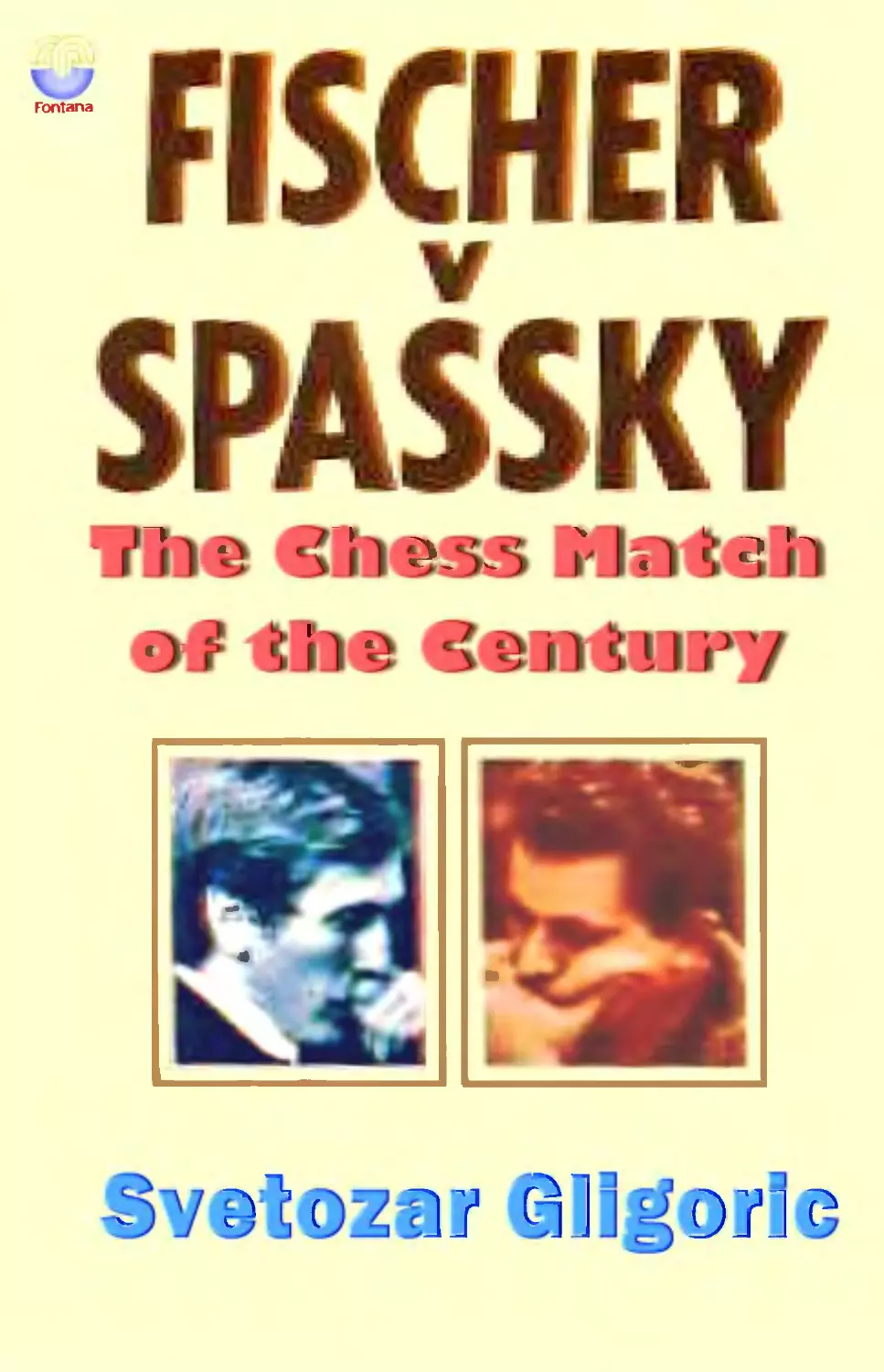
FISCHER
SPASSKY
The World Chess
Championship Match
1972
Introduced and Annotated by
Svetozar Giigoric
International Grandmaster
Collins Fontana

First published by Fontana Books 1972
®The Chess Player 1972
Typesetting and layout by
Quorn Court Publishing Ltd.,
Quorn, Leicestershire.
Printed in Great Britain by
C. Nicholls & Co. Ltd., Manchester.
CONDITIONS OF SALE
This book is sold subject to the condition
that it shall not, by way of trade or otherwise,
be lent, re-sold, hired out or otherwise circulated
without the publisher's prior consent in any form of
binding or cover other than that in which it is
published and without a similar condition
including this condition being imposed
on the subsequent purchaser

CONTENTS
EXPLANATION OF SYMBOLS
INTRODUCTION
FISCHERS PLAYING RECORD
SPASSKYS PLAYING RECORD
PREVIOUS ENCOUNTERS
SCENE IN REYKJAVIK
GAME ONE
GAME TWO
GAME THREE
GAME FOUR
GAME FIVE
GAME SIX
GAME SEVEN
GAME EIGHT
GAME NINE
GAME TEN
GAME ELEVEN
GAME TWELVE
GAME THIRTEEN
GAME FOURTEEN
GAME FIFTEEN
GAME SIXTEEN
GAME SEVENTEEN
GAME EIGHTEEN
GAME NINETEEN
GAME TWENTY
GAME TWENTY-ONE
ROBERT FISCHER
BORIS SPASSKY
IN RETROSPECT
6
7
17
19
21
29
31
36
37
43
47
51
55
60
64
68
73
77
81
86
90
95
100
106
III
116
120
124
125
126
5

EXPLANATION OF SYMBOLS
+ check
0-0 castles king side
0-0-0 castles queen side
! a strong move (sometimes used by Gligoric early in the game to show
an important choice of opening move)
!! a very strong move, usually winning very quickly
? a bad move
V. a blunder, usually losing immediately
!? a surprising or interesting move
?! a doubtful move
6

INTRODUCTION
A scene shot by a Yugoslav film director at Bled in 1959 will
remain an impressive momenta of the world's chess in the latter
half of the twentieth century. Tal raised his big, black eyes, looked
at Fischer, and directed an overtly scornful smile at the sixteen-
year-old boy. The manner in which he stared at his rival (rules of
good manners ask for concentration upon the board) could only
be accounted for by Tal's taking particular pleasure in
psychologically challenging and outwitting his even younger rival who,
absorbed in the problems of the play, was obviously unaware of
what was going on around him.
At the closing banquet of that event (the Candidates'
Tournament) Fischer complained to the author of this text of having lost
four superior positions against Tal. Fischer's complaint was in
vain. Tal had triumphed at the tournament and shortly afterwards
he triumphed again in his first match with Botvinnik, thus
marking his short but impressive reign as World Champion. This
was probably the time when Fischer's indignation with Soviet
chess players and their selfclaimed superiority began.
When only a boy Fischer felt that his mission was to become
the strongest player in the world Later he declared: 'Too many
times, people don't try their best. They don't-have the keen spirit;
the winning spirit. And once you make it you've got to guard your
reputation — every day go in like an unknown to prove yourself.
That's why I don't clown around. I don't believe in wasting time.
My goal is to win the World Chess Championship; to beat the
Russians (this is how Fischer always refers to the Soviet
grandmasters although, for instance, Petrosian is Armenian and Keres
Estonian). I take this very seriously.'
This is true. Fischer took the task more seriously than anybody
else in the history of chess. It was his sister, who later married
and moved to California, who initiated him in the rules of the
game. Since the age of six he has thought only of chess. Later he
quit school, then left his mother's flat in Brooklyn, and later still
moved out of his home in Los Angeles and turned into a wanderer
7

8
INTRODUCTION
living in hotels and leaving his belongings behind. But not his
wooden travelling chess set. 'Look at these pieces, smooth and
light. No hard edges. Beautifully carved. The best set for playing
with that I've ever seen. Here, feel this knight!'
After finally qualifying to meet Spassky, Fischer said: 'Someone
has to stop them . . .' (the Soviets) '. . . I've been chosen. I
intend to teach them a little humility.' Being aware of
exaggeration in his statements Fischer admits privately that he does not
know the reason for saying such things occasionally, but 'Such
moods do come now and then.' He has been following the Soviet
press for years and what it has written about him. Why this
involvement in opinions in a country thousands of miles away;
opinions few others in America either know or care about?
'I'm sick of their hypocrisy . . .' says Fischer.'. . . like when
I beat Petrosian. There was just a little squib in their papers about
it But there was a local championship that they put in headlines.
If Petrosian had beaten me then there would have been headlines.'
Recognition (all the time) and fair play (since the Candidates'
Tournament at Curacao in 1962) have not been the only subjects
of Fischer's indignity with the Soviets. It has been money too. He
believes that he has been systematically excluded from earning
money, since the Soviet government pays its players and sends
them to tournaments 'free' (i.e. without demanding an appearance
fee) while he insists on extra fees thereby incurring unfavourable
world opinion. 'They would send top Russian players
globetrotting to play free in places where I was asking thousands of
dollars. Well, I've finally broken through this . . .' (their
conspiracy against him)'. . . but for about a year and eight months
in 1969 and 1970 I was pretty discouraged. I refused to play the
Russians and they have most of the best players in the world.
For a time I was thinking of quitting international chess. But
then I thought 'What else can I do?'. The answer was 'Nothing'.'
Fischer is very angry because, he says, he has been the world's
best chess player since he was 18 and has had little recognition
of this. In particular, he has not become wealthy as befits a
champion — as, in fact, befits the world's all-time greatest player
(according to the rating system employed by F.I.D.E). Part of his
dissatisfaction falls on America. 'I was even put down in my own
country. Americans really don't know much about chess. So they

INTRODUCTION
9
listened to other people.. But I think when I beat Spassky, that
Americans will take a greater interest in chess. Americans like
winners .... The U.S. is not a cultural country. The people
here want to be entertained. They don't want any mental strain,
and chess is a high intellectual form. Americans want to plunk
in front of a TV and not to have to open a book . . . But now,
President Nixon just sent me a letter saying that America is
backing me.'
Thus, for Fischer, his match with Spassky is the match of his
life against Soviet chess. There is not much reason for Fischer to
be angry with Spassky personally. His opponent, six years older
than he, has always treated him in a friendly and sympathetic
way. (Spassky told me once privately, with some irony at his own
expense, that it would suit him best if he moved around the world
and, like a philosopher, studied human relationships.)
If he senses simple sincerity in others, Fischer becomes
disarmed. This is why he seems (unconsciously) to dislike
remembering, before the big match, the moments of friendship which he
experienced with Spassky at Santa Monica in 1966 and elsewhere.
That could only upset his psychological armament against his
principal opponent.
But Fischer does have friends. Quinteros, a young master from
Argentina exclaimed in Buenos Aires during the Fischer-Petrosian
match: 'Pressmen have been doing Fischer wrong all his life. He
loves chess immensely and he is a wonderful friend.' Fischer's
openness to those who show their good intentions contrasts with
his sulkiness to the whole world, and particularly to the Soviet
chess circle.
I cannot but help remembering one particular detail. When I
had an .intercontineptal interview with both of them for Radio
Belgrade, Fischer started his conversation in an angry tone saying
that Spassky had been making preparations to meet him for
three years while he had only two months to prepare (which was
the time that had elapsed since his match with Petrosian).
However, when I told him mat Spassky too wanted the match
to begin as late as possible, he was unpleasantly surprised rather
than glad. He had acquired the habit in his previous negotiations
of following the rule, instinctively rather than by reason, 'all that
the rival does not want has to be good for me'. But now he was

10 INTRODUCTION
at a loss what to demand when their wishes coincided. His first
reaction was to try to avoid committing himself to any statement.
Exhausting negotiations suited the edifice of truculence that the
American had erected round his chess better than an easy coming
to terms.
While Spassky himself, on my suggestion in a telephone
conversation, was inclined to support the idea of going to F.LD.E.'s
H.Q. there to talk about the place and the time of the match.
Bobby was less enthusiastic about the chance to meet his rival
before the match. 'No friendship' seems to have been Fischer's
concealed anxiety. However, in reality things took the opposite
course. For fear that he might lose his best financial offer Fischer
did come to Amsterdam (100,000 dollars a year was Fischer's
personal plan during the first year of both the new era of his
life and his different status in business-orientated American
society). In Amsterdam it was Spassky who was the absent one.
The World Champion wanted to press more'strongly and to force
his choice of venue for more favourable climatic and other
conditions for himself. The Soviet side had their own reasons for not
compromising. Fischer had played all his matches on the
American side of the Atlantic. They had had enough of favouring the
younger rival. The World Champion had his own rights and he
would not go all the way to Fischer's back yard as the others had
gone. Nor would he play in the south of Europe in summer heat
to which he had not been accustomed. Now was the time for
Fischer to concede.
From a list of seventeen offers, eight possible venues were
selected for serious consideration. Then came the first surprising
move. The Soviet order of preference was limited to four places:
1 Reykjavik, 2 Amsterdam, 3 Dortmund, 4 Paris. The other four
offers were rejected through the Soviet embassy in the
Netherlands which proclaimed that they were 'unacceptable to Spassky'.
Now it was the turn of Fischer's manager Ed Edmondson (the
Executive Director of the U.S.C.F.) to make the appropriate
move. Fischer himself, while in Amsterdam, uttered only three
words to Dutch journalists — I don't know' — when they asked
him if he agreed to play in the Netherlands. A single repetition on
the American list of any one place from the Soviet list would
mean a free hand for F.I.D.E. President Dr Euwe to appoint that

INTRODUCTION
II
place as the venue as the 'only possible choice by agreement of
the two rivals'. But such an agreement might have reduced by
half Fischer's income from the match for which he had been
working all his life. After several hour's reflection, Edmondson's
decision in this diplomatic game of hide and seek was infallible:
the cities of Southern Europe were certainly not on Spassky's list
(that is two towns in Yugoslavia, 1 Belgrade, 2 Sarajevo); nor
would the two transatlantic cities be on the Soviet list (3 Buenos
Aires, 4 Montreal). Thus no city was on both lists. The first round
of this particular match ended in a draw. Fischer actually liked
Buenos Aires best but it had laid an insufficient guaranteed sum
which prevented it from being promoted to first place on his list.
A new attempt at an agreement came when Edmondson visited
Moscow but this did not bear fruit. Although Reykjavik was not
a bad choice (125,000 dollars for the prize fund against 152,000
dollars offered by Belgrade) Fischer, in New York, followed his
sacred rule not to accept on principle his rival's suggestions. And
why? When it became clear that the disagreement resembled a
Gordian knot Dr Euwe cut it in the manner of Alexander the
Great and decided to divide the match into two halves: twelve
games in Belgrade and the remainder, up to a maximum of twelve,
in Reykjavik. This was not an ideal solution but it had its
precedent when players of different countries were concerned —
in 1948 Botvinnik won the title in the match-tournament which
was played one half in the Netherlands and the other in the Soviet
Union. And after all, what else could Dr Euwe do if he wanted
to be impartial in the eyes of F.I.D.E. members? Outspokenness
has become more fashionable than the so-called gentlemanly
kindness. Neither Spassky nor Fischer showed any particular
consideration for his rival's desires. Fischer did not try to conceal
his aspiration to take his opponent across the ocean ('the Russians
play worse there') nor Spassky his wish to play in the Far North
because 'Iceland reminded me most of the climate in my native
Leningrad'.
The Soviet Chess Federation made a sharp protest against
Euwe's solution: 'Spassky cannot accept the Belgrade summer
although we respect the conditions offered'. The American
magazine Time said that the decision had been borrowed from King
Solomon.

12
INTRODUCTION
Fischer did not want to commend Euwe's decision either: 'It's
a mistake. You will have double the problems. People are going
to be confused, moving around, and it will seem like a road show.
I don't like it!' In fact Bobby was not actually angry Reykjavik
was only unacceptable to him for tactical reasons and he was
the first of the two to concede to the division of the match. His
statement to F.I.D.E.: 'Prefer all games Belgrade starting June
25 but will abide by your decision start between June 21 and 25
split between first Belgrade then Reykjavik.'. His statement for
the American public: 'It's going to be over in a couple of months
and then I'll be Champion!'
For Spassky, concession was a more difficult process. It seemed
again, at least to a slight degree, that Fischer's demands had been
met more fully than his own. The reason lay partially in the fact
that the starting points of the Soviet side were less elastic. But at
any rate, Dr Euwe's decision did not stand for long. At the
beginning of April 'the biggest match' was unexpectedly put in
question. Fischer, who admits himself that he is 'unpredictable', all
of a sudden didn't want to play under the conditions of the
agreement reached on his behalf, as well as Spassky's, in
Amsterdam. Under the wrong impression that his interests were neglected
by F.I.D.E. and the organisers, and that the American federation
was 'compromising too much in fear that the Soviet federation
might cancel the match', Fischer refrained from employing any
representative and took the whole thing into his own hands.
This meant that after protracted arguments and discussions,
mostly carried out by intercontinental telephone calls and cables,
the President of F.I.D.E. was forced to put an ultimatum to the
challenger: He or Petrosian? For, in the face of new financial
demands by Fischer, the Belgrade organizer cancelled his offer
and the Sovet Federation energetically refused new bids for the
venue, asking that Iceland's offer be respected in accordance
with the previously reached agreement.
At the very last moment, when the chess world didn't know
whether it would have a Spassky-Fischer match in Reykjavik or
a Spassky-Petrosian match in Moscow, Fischer accepted the terms
through his newly chosen lawyer. The biggest match had been
saved . . .

INTRODUCTION
13
But only in appearance. When Fischer was due to be in Iceland
to start the match, he was instead in New York, repeating his
claim for thirty per cent of the gate money for each of the players.
This demand, for financal reasons, could not be accepted by the
organizers.
Even Spassky, who had been in Reykjavik for about two weeks
before the match was due to begin, believed that all possibility
of the match taking place was over. Fischer was not present at
the big opening ceremony on the night of Saturday July 1st, nor
the next day when the first game should have been played.
Probably Fischer, still in New York at the twenty-fifth hour, had
the same pessimistic opinion as Spassky. Was he reasoning that
'Clay would never agree to be deprived of his percentage of the
gate money'? (Why should chess champions be treated on a lower
level than boxers?) Perhaps Fischer had instinctively lost the will
to play Spassky at the moment when the title holder might still
be in his prime and it was this that made him stay away. We shall
never know.
In order to bring the Icelandic organisers out of their
consternation (so much money had been spent on preparing for the match)
and to save the interests of world chess, the President of F.I.D.E.,
Dr Euwe, took the risk of making the (perhaps judicially wrong)
decision to delay the first game for two days. This unexpected
decision gave Fischer a little more time in the hope that he would
'come to his senses'. This would not have helped much if, on the
same day, the deus ex machina had not appeared in the person.of
British chess sponsor Jim Slater who simply added £50,000 to
the Icelandic prize fund of 125,000 dollars. His message to
Fischer was: 'If money is the question, here it is. Now come out
and play, chicken!'
Robert Fischer landed on Icelandic tarmac early on the
morning of Tuesday July 4th and before Dr Euwe's noon deadline.
But the first game was delayed again because the champion did
not agree to the drawing of lots until Fischer apologized for
'having violated the rules' by his late arrival.
The atmosphere was such that the majority placed Fischer as
favourite for the forthcoming meeting. In an inquiry amongst the
contestants and experts at Hastings in January, only one
International Master said: 'I don't know what Fischer can play against

14
INTRODUCTION
Spassky's queen's pawn. Fischer hasn't got a good defence.'
Almost everyone else forecast that Fischer would win easily, and
the most voluble was Najdorf who had witnessed Fischer's play
against Petrosian at Buenos Aires.
Spassky's remarkable scores in matches and his chameleon-like
ability to adapt himself to any rival had been forgotten. An
exceptionally intelligent observer of people, Spassky is a very
cunning and dangerous rival. Let us remember, for example, how
he waited for Larsen to start playing heedlessly in their match in
Malmo. In contrast, Fischer, against the same rival last year in
Denver, went in a straight line trying to play better in general.
Spassky defeated some by patience (Korchnoi, after losing the
Candidates' final in 1968: 'Spassky has taught me not to push
pawns too far.'); he defeated Geller with mating attacks, Tal by
enterprising play without counting material (which is Tal's way
of thinking), Petrosian (the most difficult) by a sudden rousing of
energy in himself in the final stage of the match when Petrosian
ceased to strive, believing he would win the fight. The end of that
match must have looked to Petrosian like waking from a short,
ugly dream.
All this has tended to be overlooked in the face of Fischer's s
most impressive results and Spassky's insufficiently ambitious
play in recent events. (Donner: 'Spassky is stronger but I am
afraid that he unconsciously wishes to lose the match.'.)
Fischer has said of Spassky's play in Gothenburg (August
1971): 'He has the title and is little interested in anything else.'.
Fischer's intensity of creativity in games is always on the same
level, while Spassky vacillates and behaves more casually in that
respect. This is, perhaps, the reason why in the games of Fischer's
matches there are fewer mistakes than in Spassky's.
To what degree had Spassky succeeded in arming himself
psychologically for the match against his very ambitious challenger?
The obligation to defend the recognised chess empire from
assaults and destruction is a great responsibility and stimulus, but
it could be a terrible burden also. However, when the fight begins
he will defend himself. Before his second match with Petrosian he
said privately: 'This time we'll fight without mercy. Even
friendship may leave'.

INTRODUCTION
15
Spassky can feel respect but he is not impressionable. Of
Petrosian's play in the latter half of the match in Buenos Aires he
said: '. . . like a child'! Speaking from the experience of his
second match with Petrosian he says: '. . . the regulation which
states that a score of 12-12 leaves the title with the champion is a
handicap for the challenger. On the other hand this regulation
leads the champion to play more cautious 'never lose' tactics.
Such tactics are in practice risky against a rival who ventures
something . . . Petrosian's tactics were too passive, too cautious,
and this was the main reason for his defeat. I, for my part, shall
draw the moral therefrom and will never use such tactics.'
Spassky has already prepared for Fischer once before, in
anticipation of the match between the Soviet Union and the Rest of
the World in Belgrade in 1970. He and Botvinnik concluded that
Fischer's style was 'too simple' and that it was easy to see through
Fischer's aim in the game. But speaking of the abortive unofficial
match between Fischer and Botvinnik that was planned for the
Netherlands, Spassky said: '... Botvinnik was an optimist. This
is funny. For me it is very funny. I think this match would be
very hard for Botvinnik.'
Taking a look at Spassky's twenty year career, the vast majority
of his successes can be seen to have taken place at home, in
terrible competition with the top Soviet grandmasters. This makes
for a practical experience such as Fischer could never get. But,
by way of compensation, Fischer seems to have exceeded Spassky
and Soviet grandmasters in general in his highest professional
attitude to chess. Answering a Life reporter about his way of
preparing for the match, Fischer did not know what to say: '1
will be walking round as usual. I will be looking at chess . . .'
In fact, whereas preparation means, for Spassky, an exceptional
life style (this is why he preferred the match to begin later — a
point which Fischer was unable to grasp immediately), for Fischer
it brings about no change in his everyday life's routine. In this lies
an important advantage — his 'player's engine is constantly
chugging'.
It was quite natural for Fischer to be more optimistic in an
interview on Radio Belgrade. When I asked him if the match
would go to the maximum 24 games he replied in the negative,

16
INTRODUCTION
while Spassky is different and said that he would know the answer
'only when my preparations are finished in May'.
While walking with me once, Spassky, who was already World
Champion at the time, confessed his wish to forget all that he
knew, like a superfluous load, and to start thinking about chess
from the beginning. What enormous creative ambition in a man
who is called casual by some!
In practice, Fischer has more often manifested an impeccable
treatment of various positions, especially in the opening. In fact,
only one question remains open. Who actually knows'more about
chess — Spassky or Fischer?
The challenger was, perhaps, right when he claimed: 'It will
probably be the greatest sports event in history. Bigger even than
the Frazier-Ali fight . . .'

FISCHER'S PLAYING RECORD
1956
1957/8
1958
1958/9
1959
1959/60
I960
1960/1
1961
1962
1962/3
1963/4
1965
1965/6
1966
1966/7
1967
1968
1970
Tournaments
Rosenwald Trophy
USA Ch.
Portoroz Interzonal
USA Ch.
Mar del Plata
Santiago
Zurich
Candidates' Tournament (Yugoslavia)
USA Ch.
Mar del Plata
Buenos Aires
Reykjavik
Olympiad (Leipzig)
USA Ch.
Bled
Stockholm Interzonal
Curacao Candidates' Tournament
Olympiad (Varna)
USA Ch.
USA Ch.
Havana (by telex)
USA Ch.
Santa Monica
Olympiad (Havana)
USA Ch.
Monaco
Skopje
Sousse Interzonal
withdrew while leading
Netanya
Vinkovci
USSR v Rest of the World match
(Board 2 v Petrosian)
Rovinj/ Zagreb
Buenos Aires
Olympiad (Siegen)
Palma Interzonal
Place
8th
1st
5th-6th
1st
3rd^th
4th-7th
3rd^th
5th-6th
1st
lst-2nd
13th
1st
1st
2nd
1st
4th
1st
1st
2nd^th
1st
2nd
1st
1st
1st
1st
1st
1st
1st
1st
Total 290 wins 173 draws 59 losses = 72%
17
W D
2 5
8 5
6 12
6 5
8 4
7 1
8 5
8 9
7 4
13 1
2 11
3 1
10 6
7 4
8 11
13 9
8 12
8 6
6 4
11 0
12 6
8 I
7 8
14 2
8 3
6 2
12 3
7 3
10 3
9 4
2 2
10 6
13 4
8 4
15 7
L
4
0
2
0
2
4
2
Ii
0
1
5
0
2
0
0
0
7
3
1
0
3
2
3
i
0
1
2
0
0
0
0
1
0
1
I

18
FISCHER'S PLAYING RECORD
Matches
1961 Reshevsky
1971 Taimanov
Larsen
Petrosian
unfinished
won
won
won
2
6
6
5
7
0
0
3
2
0
0
1
Total 19 wins 10 draws 3 losses = 75%

SPASSKY'S PLAYING RECORD
1952
1953
1954
1955
1956
1957
1958
1959
I960
1961
1962
Tournaments
Leningrad Ch.
Bucharest
Young Masters Tournament
Semi-final USSR Ch.
22nd USSR Ch.
World Junior Ch. (Antwerp)
Gothenburg Interzonal
Student Olympiad (Lyons)
23rd USSR Ch.
USSR Ch. play-off
Amsterdam Candidates'
Semi-final USSR Ch.
24th USSR Ch.
Student Olympiad (Reykjavik)
European Team Ch. (Hamburg)
Semi-final USSR Ch.
25th USSR Ch.
Student Olympiad (Varna)
Semi-final USSR Ch.
26th USSR Ch.
Moscow Central Chess Club Ch.
Leningrad Ch.
Semi-final USSR Ch.
Spartakiad
Riga
27th USSR Ch.
Mar del Plata
Student Olympiad (Leningrad)
USSR Team Ch.
Trud Trade Union Ch.
Semi-final USSR Ch.
28th USSR Ch.
Leningrad Ch.
29th USSR Ch.
Student Olympiad (Marienbad)
Havana
Olympiad (Varna)
USSR Team Ch.
30th USSR Ch.
Place
2nd
4th-5th
1st
4th
3rd^th
1st
8th-9th
lst-3rd
3rd
3rd -8th
lst-5th
4th-5th
lst-2nd
5th-6th
lst-2nd
2nd-3rd
lst-3rd
1st
lst-2nd
1st
9th-10th
lst-2nd
1st
1st
5th-6th
lst-2nd
1st
2nd-3rd
5th
W
6
8
10
6
7
13
7
7
7
0
3
7
7
5
2
7
7
4
7
8
4
11
9
4
10
5
12
0
3
8
8
7
8
10
6
11
8
4
9
D
7
8
5
12
9
2
8
1
9
1
13
9
12
4
3
11
7
5
6
9
6
6
5
4
3
10
3
2
5
7
8
8
10
9
3
10
6
4
7
L
0
3
0
2
3
1
5
0
1
3
2
3
2
0
0
1
4
0
2
2
1
0
1
0
0
4
0
1
0
0
1
4
0
1
0
0
0
0
3
19

20
SPASSKY'S PLAYING RECORD
1963
1964
1965
1966
1967
1968
1969
1970
1971
Semi-final USSR Ch.
31st USSR Ch.
USSR Ch. play-off
Zonal Tournament (Moscow)
Amsterdam Interzonal
Sochi
Belgrade
Olympiad (Tel Aviv)
Trades Union Spartakiad
Sochi
Hastings
Santa Monica
USSR Team Ch.
Sochi
Olympiad (Havana)
Beverwijk
RSFSR Ch.
Moscow
Spartakiad
Sochi
Winnipeg
Olympiad (Lugano)
Palma
San Juan
Palma
USSR v Rest of the World match
(Board 1 v Larsen)
Leiden
Amsterdam
Olympiad (Siegen)
Gothenburg
USSR Team Ch.
Moscow
2nd
lst-3rd
2nd
1st
lst-4th
4th
1st
1 st-2nd
lst-2nd
1st
5th-6th
1st
lst-2nd
6th-8th
lst-5th
3rd^th
2nd-3rd
1st
5th
1st
lst-2nd
3rd
6th-7th
6
5
1
4
13
5
9
8
3
6
6
5
0
6
5
7
6
4
3
5
2
6
10
8
3
1
2
8
7
5
3
4
9
14
2
6
8
9
8
6
4
9
3
13
9
7
10
8
5
11
5
10
7
8
6
7
14
1
10
7
5
6
1
11
0
0
1
2
2
1
0
0
0
0
0
0
1
1
0
0
0
2
0
0
0
0
1
0
0
1
0
0
0
0
0
2
Total 431 wins 496 draws 64 losses = 68.5%
Matches
1965
1966
1968
1969
Keres
Geller
Tal
Petrosian
Geller
Larsen
Korchnoy
Petrosian
won
won
won
lost
won
won
won
won
4
3
4
3
3
4
4
6
4
5
5
17
5
3
5
13
2
0
1
4
0
1
1
4
Total 31 wins 57 draws 13 losses = 58.9%

PREVIOUS ENCOUNTERS
Although Fischer and Spassky are two of the young 'veterans' of the
international tournament circuit, they had only met over the board five times before
this match. It is these five games that added so much interest to the match, not
because of the games themselves but because of their results.
The simple truth is that Fischer had never beaten Spassky! The American has
a plus score against most international players, but he had not managed a single
win against the Russian.
So, although most forecasters tipped Fischer to win in Reykjavik, most of
them qualified their statements. The five reasons for these qualifications we give
below, with light notes.
White: Spassky
Black: Fischer
Mar del Plata, 1960
King's Gambit
1 P-K4
2 P-KB4
3 N-KB3
P-K4
PxP
P-KN4
Alter this game Fischer wrote a famous
article "The King's Gambit is busted" in
which he recommended 3 ... P-Q3 as the
correct defence.
4 P—KR4 P—N5
5 N—K5 N-KB3
6 P—Q4 P—Q3
7 N—Q3 NxP
8 BxP B-N2
aa j dlf ,i w iaB38K w Wm -Mm
n.m. Mini
It II it II llitjH
9 N—B3?
Belter is 9 P-B3.
10 PxN
11 B-K2
12 0—0
13 BxNP
14 BxB
Q-N4
15
NxN
P—QB4
PxP
N-B3
0-0
RxB
P—B4
Fischer's suggestion 15... K-Rl is safer.
16 Q-N3 PxP
17 QR-K1! K-Rl
18 K—Rl?
Fischer preferred the immediate
capture 18 BxP. e.g. 18 ... R-KN1 19 N-K5!
18 ... R—KM
19 BxP! B—Bl!
20 B—K5+ NxB
21 QxN+ R—N2!
Winning the KRP.
21

22
PREVIOUS ENCOUNTERS
22 RxP
If 22 R-B4? B-Q3 or 22 P-R5 Q-N4.
22 ... QxP+
23 K-Nl
23 ... Q—N5?
Correct is 23 ... Q-N6! 24 QxQ RxQ
(threatening ... RxN followed by ... P-B7)
and White is in a bad way.
24 R-B2 B-K2
25 R-K4
25 ... Q—N4?
Black can force a draw by repetition: 25
... Q-Q8+ 26 R-Kl Q-N5 27 R-K4 Q-Q8+
etc. — Fischer.
26 Q-Q4! R-KB1?
26 ... B-Bl is good enough for a draw,
e.g. 27 QxRP B-B4 28 NxB QxN 29 R-K8+
R-NI, or 27 N-K5 B-B4! 28 N-B7+ K-N 1.
27 R-K5! R-Ql
Or 27 ... Q-N3 28 RxB winning.
28 Q-K4 Q-R5
29 R—B4 Resigns
White: Spasskj
Black: Fischer
Second Piatigorsky Cup.
Santa Monica. 1966
Grunfeld Defence
I
2
3
4
5
6
7
8
9
10
11
12
P-Q4
P-QB4
N-QB3
PxP
P-K4
PxN
B—QB4
N-K2
B-K3
0—0
R-Bl
Q-KI
N-KB3
P-KN3
P—Q4
NxP
NxN
B—N2
P—QB4
N-B3
0-0
Q-B2
R-Ql
P-K3
12 ... Q-R4! is stronger, and if 13 PxP or
13 P-Q5 then 13 ... N-K4! — Spassky.
13 P—B4 N—R4
14 B-Q3 P-B4
15 R—Ql P-N3
16 Q—B2 PxQP
17 BxP BxB

PREVIOUS
18 PxB B—N2
19 N—N3 Q—B2
20 P—Q5!
Opening up Fischer's king.
20 ... BPxP
21 PxP QxKP
22 P—B5 Q—B2
Not 22 ... PxP 23 NxBP Q-KB3 because
of 24 Q-K3 when White has a crushing
attack.
23 BxP RxR
24 RxR R-KB1!
And not 24 ... BxB 25 NxB QxBP 26 N-
B6+ K-N2 27 R-Q7+ KxN 28 Q-R4+again
with a winning attack.
33 ... RxR+?
Spassky praised Fischer's conduct of the
defence up to this point. But here he
suggests 33 ... PxQ with good chancesfora
draw. e.g. 34 RxR KxR 35 P-KR4N-B5 36
K-B2 N-Q3, or 34 R-Bl P-B5 35 R-B3 R-
K3 36 B-B3 K-B3 37 K-B2 P-N4.
34 KxR PxQ
35 P-KR4 N—B5
36 K-K2 N-K4
37 K-K3 K-B3
38 K—B4 N—B2
39 K—K3
39 B-Q5 would have been more accurate
since now Black can play 39 ... N-Q3 when
the win is difficult to force.
39 ... P—N4?
40 P—R5 N—R3
41 K-Q3 K-K4
42 B—R8 K—Q3
43 K-B4 P-N5
44 P—R4 N-Nl
45 P-R5 N-R3

24
PREVIOUS ENCOUNTERS
46
47
48
49
50
B-K4
K-N5
B—Nl
K-R6
B-R2
P-N6
N—Nl
N-R3
K-B3
Resigns
White: Fischer
Black: Spassky
Second Piatigorsky Cup.
Santa Monica, 1966
Ruy Lopez
1 P—K4
2 N—KB3
3 B—N5
4 B—R4
5 0—0
6 R—Kl
7 B—N3
8 P—B3
P-
N-
P-
N-
B-
P-
0-
P-
-K4
-QB3
-QR3
-B3
-K2
-QN4
-0
-Q4
9 PxP
10 NxP
11 RxN
12 P—N3
13 P-Q4
14 R-Kl
15 Q-Q3
NxP
NxN
P-QB3
N-B3
B-Q3
B-KN5
15 P-B3 B-KB4 16 B-N5 P-B4 also gives
Black compensation
for the pawn.
15 ...
16 PxP
17 QxQ
18 B—KB4
19 N—R3
20 B-K3
P-B4
BxBP
QRxQ
P—R3
P-N4
If 20 B-K5 R-Q7 and if then 21 BxN?
BxP+ winning.
20 ...
21 RxB
BxB
R-Q7
ft!
■J
I I
<zm. m
22
23
24
25
N—B2
RxR+
N-K3
B-B2
R-Kl
NxR
B-B6
N-Q3

PREVIOUS ENCOUNTERS
25
26
27
28
29
30
P-N3
P-QR4
BxN
PxP
P-QN4
K-BJ
N-K5
BxB
PxP
R-N7
31 P—N4
32 K-BI
33 R—R5
34 K-K2
35 K-Bl
Draw agreed.
K-N2
K-B3
R—N8+
R-N7+
White:
Black:
Havana
Fischer
Spassky
Olympiad,
Ruv Lopez
I
2
3
4
5
6
7
8
9
10
11
12
P—K4
N—KB3
B-N5
B-R4
0—0
R-Kl
B—N3
P—B3
P-KR3
P-Q4
QN-Q2
N—Bl
1966
P-
N-
P-
N-
B-
P-
0-
P-
P-
R-
B-
B-
-K4
-QB3
-QR3
-B3
-K2
-QN4
-0
-03
-R3
-Kl
-Bl
-Q2
13 N—N3 N—QR4
14 B-B2 P-B4
15 P—N3 BPxP
Spassky prefers White's game after 15 ...
N-B3 16 P-Q5.
*|ftl
16
17
18
19
20
21
22
23
PxP
B—N2
Q-Q2
QR-Q1
N-Bl
N-K3
B—Nl
R-QB1
N-B3
P—N3
B—N2
Q-N3
QR-Q1
Q-Nl
Q—N2
K-R2
lf23...PxP24NxPNxP25BxNRxB26
NxN BxN 27 BxB KxB 28 Q-B3+ winninga
piece.
■#B -#_i§ 1 ii#
^asaf Off W^JGL^-ffiMfr ^L. imm «*
Wklt HI,,, H^H it
wmQm & m.
24 P-R3
B-QB1
25
26
27
28
29
30
31
B-B3
Q-N2
P-QN4!
QR-Q1
B-R2
NxN
PxP
B-Q2
Q-Nl
K-Nl
N-KR2
N-N4
PxN
PxP
Alter3l ...NxKP, (2N-Q5 is still strong.

26
PREVIOUS ENCOUNTERS
32 N-Q5 N-K2
11 32 ... N-Q5 (which was suggested by
many of the kibbitzers), 33 Q-Q2 N-K3 34
P-N3 followed by K-N2, R-KR1 and P-
KR4 with a dangerous attack.
33 NxN+ RxN
34 Q-Q2 B-KB3
35 Q-Q6 K-N2
mm mm
36 QxRP?
36 R-K3! is much stronger, defending
the bishop before going after Black's QR P.
Now Spassky wins material.
36 ... R—QB1!
37 R-.Q6
lf37B-Rl B-K3 38BxBRxB39Q-R5B-
Ql and White can resign.
37 ... RxB
38 RxB(B6) B—K3!
39 RxB PxR
40 R-Ql
40 ... Q—N2?
A time trouble error on the last move of
the time control. 40... Q-KBI! leaves Black
with a winning position because of the
mounting pressure on White's king.
41 QxQ
42 BxP
43 K-R2
44 R—QN1
45 P—B3
46 B—N3
47 R—N2
48 K-N3
49 K-N4
50 B—Q5
51 P—R4
52 KxP
53 R-Q2
54 K-N4
55 R-K2
56 R-R2
57 R—N2
Draw agreed.
RxQ
RxQRP
R-R5
R-QB2
R-R3
R-R6
R-R8
K-B3
R-B6
R(R8)-R6
PxP
R-R8
R(R8)-R6
R-Q6
R(R6)—B6
R-R6
White:
Black:
Siegen (
Spassky
Fischer
Olympiad,
Grunfeld Defence
1
•2
3
4
5
6
7
8
9
10
11
P-Q4
P—QB4
N—QB3
PxP
P-K4
PxN
B—QB4
N-K2
B-K3
0—0
R-Bl
1970
N-KB3
P-KN3
P—Q4
NxP
NxN
B—N2
P-QB4
N-B3
0—0
Q-B2
R-Ql

PREVIOUS ENCOUNTERS
27
12 P—KR3
Varying from the 12 Q-Kl of the first
Santa Monica game. The idea of the text is
to deprive Black of the use of his KN5
square and to support the eventual advance
l'-KN4.
» ft B
llilJ!
B B
ill §
■ t=n
H H
lit!! j
8 §1
HI
±
■
iH
1
H
12
13
14
15
16
17
18
...
P-B4
Q-Kl
B—Q3
P-N4
BxP
N—N3
P-N3
P-K3
N-R4
P-B4
PxKP
B—N2
N-B5
mzJSmffllMS mww;
imt Wffik W£M §iil^j«fl»^^
I1B1
HAM
w wm. %m. 'mm.
js^ms^.^jn.
19 BxB
11 19 B-KB2 BxB 20 QxB N-Q7 21
QxKP+ K-Rl 22 KR-Ql N-B6+ 23 K-Rl
N-R5! with a fine game for Black who
threatens both ... QxP and ... R-Kl.
19
20
21
22
23
...
B-B2
Q—K2
PxP
N-K4
QxB
Q-B3
PxP
P—QN4
23 ... BxP
Weakening the dark squares around his
king by exchanging his protecting bishop.
Better was 23 ...R-Kl followed by ... QR-
Ql consolidating Black's position in the
centre.
24
25
26
27
28
N-N5
RxB
R-Kl
N-K4
N—B6+
BxB+
R-Q3
Q-N3
R-Q5
K-Rl
28 ... K.-N2, although superficially
weaker, would have been less unsafe.
29 QxP
29 ... R-Q3
29 ... R-Q8, the move that all the
spectators had been expecting, fails to 30 Q-B7
RxR+ 31 K-N2 Q-B3+ 32 K-N3 R-K6+ 33
K-R4 RxP+ 34 KxR Q-R8+ 35 R-R2 Q-
KB8+ 36 K-R4 when Black runs out of
checks.
30 Q-K4 R-KB1
31 P—N5 R-Q7
32 R(1)-KB1 Q-B2

28
PREVIOUS ENCOUNTERS
33 RxR
34 Q-Q4
35 N-Q5+
36 R-B2
37 R-K2
38 R—K8+
39 R—KB8+!
Because of 39 ...
NxR
R-Ql
K-Nl
N-B5
R-Q3
K-B2
Resigns
KxR 40 Q-R8+ fol
lowed by 41 QxP+ and 42 NxQ.

THE SCENE IN REYKJAVIK
The match in Reykjavik is the first match for the World Chess Championship
to be held outside Moscow since Botvinnik won the title in 1948. Between 1948
and 1969 no less than ten matches for the title have been played in the Soviet
capital, and so the Russians developed a formula for the organization of these
events.
The games were usually played on the stage of a large theatre with a seating
capacity of several thousands. On the stage would be the table carrying the set,
and chairs for the contestants. To one side was another table at which would sit
the Chief Referee and his assistant (these have included a Czechoslovak, an
Englishman and a Belgian). At the back of the stage was a gigantic
demonstration board which showed the position in the current game and also the time
taken by the two players.
For some of the matches at least, the spectators in the hall were able to put on
earphones and hear a commentary on the game in progress from an eminent
grandmaster (there are no shortage of these in Moscow!).
In the foyer of the theatre would be chess book displays and simultaneous
exhibitions by top players (in which they would play twenty, thirty or perhaps
more opponents at once). Outside, those unable to gain admission (it is
rumoured that there was sometimes a black market in tickets) would be able to
watch the progress of the game on a second demonstration board even larger
than the one on the stage.
These Moscow matches were well covered by Russian radio and television
and the games would be reported in all the Soviet newspapers with expert
comment. But, except by chess enthusiasts, little attention was paid to these
matches by the 'outside' world.
The World Chess Championship is, however, no longer a domestic issue of
interest only to the Russians. There is a 'new power in the land' and the Soviet
hegemony is severely threatened. This time the outside world was all attention.
What was the set-up in Reykjavik? Broadly, the Icelanders followed the
Soviet pattern. Of course they do not have the local grandmasters to call upon
(there is just one Icelandic grandmaster, Fridrik Olafsson) but visiting players
gave simultaneous displays. There was a large colony of visiting journalists
(most of them non-players) and a great many tourist/spectators, something
rather rare in the Moscow days. But the biggest change was the presence of an
American on the stage!
The Icelanders managed a more up-to-date appearance than the Russians by
introducing closed circuit television. Monitors were scattered all around the
auditorium showing the players seated at the board. High up at the front of the
stage was a large screen which showed the pictures from a second camera. This
was trained on the board only and so the audience viewed a gigantic reproduc-
29

.10
SCENE IN REYKJAVIK
tion of the actual pieces instead of the demonstration board idea employed in the
Moscow matches.
The match programme provided for three games per week, to be played on
Sunday, Tuesday and Thursday from five o'clock to ten in the evening local
time. Any game unfinished would then be adjourned and would be played at
four p.m the following day. Saturday, Fischer's Sabbath, was a rest day. Each'
player was allowed a maximum of three postponements on the grounds of
illness.
Thus each game had a scheduled first session of five hours. Each player had a
clock which recorded his thinking time. When he had made his move he stopped
his own clock and this automatically started his opponent's. Each player had
two and a half hours in which to make his first forty moves. Hisclock wasfitted
with a flag which would drop at the end of his time allowance. If he had not made
forty moves when the flag fell then the game would go to his opponent.
Each player was entitled to use his time as he wished but if he spent a lot of
time on the early part of the game then he would get into 'time trouble' and
would have to hurry with his later moves. If a player was very short of time, a
'time scramble' would occur.
If the game remained unfinished after five hours play, then the player whose
turn it was to move had to 'seal' his next move. This means that when he had
decided upon his move he would write it on a piece of paper which would be
sealed in an envelope and placed in the care of the referee. The other player I
would not be told this move until the following day when the game would be
resumed and the envelope opened.
This strange procedure is adopted for a very good reason. Both players will
usually spend many hours working out what to play when the game is
continued. The system of sealing a move ensures that neither player can be sure what
the position will be on the board when it is next his turn to move. Thus they are
placed in an approximately equal position. This is much fairer than simply
stopping the game when the player whose turn it was to move would have a
whole day in which to work out his best move and would therefore have a great,
advantage.
To assist him in his study of unfinished games, each player had a second or
seconds. Spassky arrived in Iceland with grandmasters Geller and Krogiusand
International Master Nei while Fischer was helped by grandmaster William
Lombardy, an ex-World Junior Champion and now a Jesuit priest. The re-?
mainder of the American entourage consisted of Fischer's lawyer, Paul
Marshall, and a representative of the United States Chess Federation, Fred Cramer,
who might both be classed as trouble-shooters.
Each player received one point for a won game and half a point for a draw.
Fischer needed 12'/2 points to win the title.whereas Spassky needed only twelve
points to retain his title but 12'/i points to win first prize.

1
Nine long days have preceded this game which should have been played on
Sunday, July 2. In the meantime it looked as though the match would never be
played. For the first time in its history, chess occupied the headlines on the front
pages of the world's press; filling twice as much space as any important political
issue like Vietnam.
By Tuesday, July 11, both contestants had seemingly calmed down. Euwe's
postponement of this first game had been a reprieve for Fischer and meant that
the challenger could feel, after all that had happened, twice as happy. He was
presented not only with another chance to play the match, but with double the
prize fund as well. His spirits were so high, after his first good sleep in Reykjavik,
that he did not even mind reading personally for American TV his repentant
letter to Spassky. Bobby's almost boyish sincerity made many people less critical
of his previous 'bad manners'. Having received apologies from both Fischer and
Dr. Euwe, and after having spent a day or two on a fishing expedition, Spassky
also reassumed the confident mood with which he first came to Iceland.
At the drawing of lots, Fischer pointed to Spassky's right hand in which a
black pawn was hidden. The exciting question arose of what move Spassky
would choose in the first game. While not sharing his challenger's devotion to 1
P-K.4, Spassky still likes that move best and used it as his main weapon against
Petrosian in 1969. Yet, against Fischer, the champion had preferred 1 P-Q4on
those rare occasions they had met in recent years.
Will Spassky look for his opponent's weaknesses in closed systems again, or
will he change his attitude, after eight months of hard preparation, and strike at
his most dangerous rival with the king's pawn, expressing a readiness to discuss
the sharpest lines which Fischer has analysed for years?
White: Spassky
Black: Fischer
Nimzoindian Defence
1 P—Q4
Spassky entered the illuminated stage of
the large tournament hall a minute before
live p.m. Icelandic time. Fischer was not
there. So, all the initial applause of
thousands of spectators (the Soviet
ambassador was also noticed there) went to the
ntle holder. The Icelandic referee pushed
the clock. (Chief Referee, grandmaster
1 othar Schniid, returned later from'his
lui me in Germany where his son had been
involved in a slight accident). The silence
was automatically established and
Spassky, after a short while (perhaps
waiting for his opponent to appear), made
his first move.
An atmosphere of some tension was
created and nine minutes had elapsed
before Fischer finally arrived, shook hands
with the champion, and made his move
without much reflection.
1 ... N—KB3
2 P—QB4 P-K3
A solid and rather cautious approach to
the first game of the match.
3 N—KB3
The same remark goes for Spassky, who
sends an invitation for the Queen's Indian
Defence, but in vain . . .
3 ... P-Q4
4 N—B3 B—N5
3
I

32
GAME ONE
Offering the possibility of the Nimzo-
indian Defence once more. The move in the
game is more aggressive and therefore
perhaps more to Fischer's taste than the
modest 4 ... B-K2. The American
grandmaster used to play 4... P-B4, but Spassky
showed the right strategy against that move
in the fifth game of his match with
Petrosian in 1969: 5 BPxP NxP 6 P-K4
NxN 7 PxN PxP 8 PxP B-N5+ 9 B-Q2
BxB+ lOQxBO-0 11 B-B4N-B3 12 0-0 P-
QN3 13 QR-Ql B-N2 14 KR-K1 R-Bl 15
P-Q5! and White's passed QP won the day.
5 P—K3
Only now, White agrees to transpose
into a position from the Nimzoindian
Defence. What is the idea? White has, with
the different order of moves,' avoided the
sharper lines after 1 P-Q4 N-KB3 2 P-QB4
P-K3 3 N-QB3 B-N5 4 P-K3 e.g. 4 ... P-
QN3 or 4 ... P-B4.
The alternatives 5 Q-R4+ and 5 B-N5
would be a less classical and less clear
choice, while 5 PxP could lead to
simplifications too early.
5 ... , 0—0
6 B—Q3 P—B4
7 0—0 N—B3
8 P—QR3
It seems that this well known position
suited both player's preparations.
8 ... B—R4
Not recognized as best, and thus a small
surprise to Spassky who now began to
think for the first time in the game. Larsen's
intermediate move 8...QPxP or the
classical 8...BxN are more frequently
played.
9 N-K2
The 'red book' (the collection of 355 of
Spassky's games edited by Dr. Wildhagen
in Hamburg) which, according to
American newspapers was in Fischer's
hands all the time during his preparations
for the match and even during meals, does
its job! Spassky, probably not too weH
acquainted with the crucial variations,
repeats an unpretentious continuation of
fourteen years ago. The psychological
judgement of the challenger is a very daring
one, as it follows a game between Spassky
and Krogius— Krogius was now a member
of the champion's team in Reykjavik.
A more ambitious attempt in my opinion
would be not to waste a move on a
developed piece and thus avoid the pressure of
Black's KB, but to fight for the pair of
bishops and the centre with 9 BPxP KPxP
IOPxPBxN 11 PxBe.g. 11 ... B-N5 12P-
B4 P-Q5!? 13 R-Nl! with advantage to
White. Gligoric-Szabo, Beverwijk 1967.
The move in the game escapes
theoretical, elaborated routes and threatens 10
QPxP, but Black first has the option to
simplify.
Was Spassky to be blamed for his*
choice? Fischer has never before tried this
line, which has appeared only few times in
tournament praxis in the last few years.
Who, unprepared for it, could forecast
what Fischer had up his sleeve?
9 ... QPxP
Less double-edged than 9 ... BPxP 10
KPxP PxP 11 BxBPP-KR3 12 B-R2(or 12
B-B4 P-R3 13 R-Bl N-K2 14 B-R2 B-Q2 15
B-K5 N(2)-Q4 with a good game,
Petrosian-Tolush, USSR 1951) 12... B-B2
13 N-B3 N-K2 14 R-Kl P-QN3 Hodos-
Krogius, 30th USSR Championship, 1960.
10 BxBP B—N3
Defending the pawn and removing the
bishop from an exposed square.
11 PxP
Otherwise, White would have to put up
with an isolated pawn in the centre. Black
now takes the opportunity to enter an even
endgame, for he has no weaknesses in his
position.
11 ... QxQ
More radical now than later.
The Spassky-Krogius game went

GAME ONE
33
H...BxP12P-QN4QxQ(Weakerisl2...B-
Q3 13 B-N2P-K4 14N-N3Q-K2 15Q-B2!
B-N5 16QR-Q1 P-KN3 17B-K2QR-B1 18
Q-Nl when White has a clear plus.
Gasztonyi-Dely, Hungary 1966) 13 RxQ B-
K2, transposing back to the present game.
12 RxQ BxP
13 P—QN4 B—K2
14 B—N2 B—Q2
The prepared (?) improvement and the
little trick which shows that Black has no
difficulties in completing his development
(15 BxN? BxB 16 RxB?? BxR). White was
probably remembering and hoping that he
might make something of this endgame:
14...P-QN3?! 15 N-B4 B-N2 16N-N5 N-Ql
17 QR-B1 P-KR3? 18 N(5)xKP! PxN 19
NxP R-Bl 20 B-N3 N-B2 21 NxR KxN 22
RxR+ BxR 23 R-QB1 N-Q3 24 P-B3
N(B3)-K1 25 P-K4 B-N4 26 P-B4! BxP 27
R-Bl P-KN4 28 P-N3 B-R6 29 R-B2 NxP
30 R-K2 N-Q7 31 PxB NxB 32 R-K3 and
White won in 50 moves (Spassky-Krogius,
25th USSR Championship, Riga 1958).
15 QR-B1
15 N(2)-Q4 appears to be more precise.
15 ... KR—Ql
16 N(2)—Q4
This knight was passive on K2 and
therefore White offers to exchange it. 16 N-
B3 would avoid the simplification, but, at
the same time, White would not achieve
much bringing the knight back to where it
was before with a loss of a tempo.
16 ... NxN
17 NxN
After 17 BxN B-R5 White would not be
able to cover the QR4-Q1 diagonal, but 17
RxN was also playable. The game now
enters a peaceful harbour, but neither of
the players would risk the offer of a draw
for the sake of his prestige.
17 ... B-R5
Using the hole on White's queen side to
activate his pieces more quickly.
18 B—N3 BxB
18...RxN? 19 BxB serves no purpose.
The exchange of light squared bishops
favours Black, for White is a litttle weak on
the light squares on the queen side and his
pawns there are slightly exposed.
19 NxB RxR+
A small gain in time for Black, because
White has, by now, moved both rooks in
order to have only one left on Ql.
20 RxR R—QB1
Trying to say that the QB-file is a more
precious one than the Q-file to White's
rook, where all possible penetration
squares are protected by Black.
21 K-Bl
Bringing the king closer to the area of
potential danger.
21 ... K-Bl
Black also activates his king. 21 ...R-B7 is
no threat because of 22 R-Q2.
22 K—K2 N—K5
The first serious threat in the game: 23...
R-B7+ and wins. White has nothing better
than his next move.
23 R—QB1 RxR
24 BxR
Better than 24 NxR, as White also has
something to say with an eventual N-R5.
24 ... P—B3
With the purpose of protecting the
defensive square Q3 for the black knight
from any attack by White's bishop.
25 N-R5 N-Q3
Black must not weaken the structure of
his pawns, as they would be exposed to
further attacks by White's knight without
there being any possibility to defend them
well.
26 K-Q3 B—Ql
Chasing the more active of his opponent's
pieces away without making committal
pawn moves.
27 N—B4 B—B2
Activating the bishop at the same time.
28 NxN BxN

34
GAME ONE
29 P—N5
Removing pawns from black squares
and thereby leaving all his worries behind.
29 ... BxKRP?
Let us quote something from Norman
Mailer's book 'Cannibals and Christians'
about Scranton in his try for President:
'One felt he had been spoiled when he was
young by a lack of testing. It was not that
he lacked bravery, it was that he had lacked
all opportunity to be brave for much too
long, and now he was not so much engaged
in a serious political struggle as in a puberty
rite.'
Was it lack of serious resistance to
Fischer in his previous qualification
matches which made the challenger feel
over confident at this moment and ripe to
make the worst blunder in his whole chess
career (if he ever made one before?). Was it
a vain wish to show his opponent that he
cannot get half a point that easily, or just
the prejudice that with the capture of a
pawn Black was crowning his
(nonexistent) 'initiative'?
The move in the game is a hardly
believable oversight in an entirely drawish
position, adding drama to a tranquil and
rather monotonous beginning to the
match. Surprisingly, Black took very little
time to decide on such a dangerous
continuation. Had Fischer thought for a few
minutes more, and another move ahead, he
would easily have realised that after 30 P-
N3P-KR4 31 K-K2P-R5 32K-B3P-R633
K-N4 B-N8 34 KxP BxP White has the
intermediate move 35 B-Q2, finally closing
the cage on the black piece.
30 P—N3 P—KR4
31 K—K2 P-R5
32 K—B3
An impulse caused by Black's
impatience and levity, not compatible with
Fischer's true chess character, probably
made him believe for a while that here
White was forced to accept a worse pawn
structure with 32 PxP.
32 ... K—K2
It did not take long for Fischer to realize
his terrible mistake, but he kept his head
cool. The move in the game looked like the
best chance for some counterplay now.
Yet, the strange continuation 32...P-N4 33
K-N2 P-N5 34 KxB P-R6 could have been
an interesting practical chance, too.
33 K—N2 PxP
34 PxP BxP
35 KxB K-Q3
Is there any chance, thanks to the active
black king, to save the end game having
only two pawns for the unnecessarily lost
piece?
36 P—QR4
The best. White had to avoid being left
with the QR pawn, e.g. 36 P-K4 K-B4 37 B-
K3+ KxP 38 BxP K-B5 with chances for a
draw because the RP queens on a square of
the wrong colour for the bishop: 39 K-B3
K-Q6 threatening P-K4 and P-N4-N5+.
Also, 36 K-N4 P-KN3 37 B-N2 P-K4 could
not do much for White.
36 ... K-Q4
Better than 36 ... K-B4 37 B-R3+. Now,
Black keeps open the possibility for his
king to go to either side.
37 B—R3 K-K5
It looks like an important advantage for
Black to have his king on that central,
dominant square, and White had no time
to prevent it. In case of 37... P-QR3 or 37...
P-QN3 White can operate very well with
the threatened B-B8 at the proper moment,
opening the access of White's king to the
black pawns.
38 B—B5 P—QR3
Not 38...P-QN3 39 BxP! PxB 40 P-R5
and wins.
39 P—N6!
White has to keep as many pawns on the
board as possible in order to diminish his
opponent's chances for a draw.
39 ... P—B4
If 39 ... P-K4 40 K-N4 P-N3 41 B-K7
KxP 42 BxP P-K5 43 K-N5 K-Q6 44 KxP
K-B5 45 K-B5 the position would be
similar to the one in the game after the
adjournment.
40 K—R4 P—B5?
This destroys the last chance for a draw
by making his own passed pawns less
dangerous. After 40...K-Q4 41 B-Q4 P-K4
42 B-B3 K-K5 43 K-N5 P-B5 44 PxP PxP
or 41 B-K7 K-K5 42 B-N5 P-K4 and P-B5,
Black's king will run to the queen side
saving the game. With the move in the
game Black only temporarily cuts his

GAME ONE
35
opponent's king off from the play, thus
achieving nothing.
White decided to adjourn the game, seal
his obvious 41st move and sacrifice about
25 minutes on his clock because five hours
of play had not been completed at that
moment. In home analysis the road to
victory was to be found in full safety.
41 PxP KxP
42 K-R5
This is the right method: White tries to
get closer to the Queen side and to decide
the game there. Very wrong would be 42 B-
Q6+ P-K4 43 P-R5?, because Black would
reach a stalemate position by heading his
king to QR1 or QB1 whichever was
allowed.
42 ... K-B4
Black prevents White's king from
entering play, as 42 ... P-N4 43 K-N6 P-N5 44
K-B6 P-K4 45 B-Q6 would win easily.
43 B—K3 K—K5 y
44 B—B2
The key! White keeps the bishop on the
best diagonal where it protects his winning
chance, the QN pawn, and controls the
advance of both of Black's passed pawns.
44 ... K—B4
A must, again.
45 B—R4!
Forcing Black to move a pawn and
aiming to create a 'zugzwang' position.
45 ... P-K4
46 B—N5 P—K5
47 B-K3
Coming back to the best diagonal after
having completed the first task. Now,
Black has no useful move and must allow
his opponent's king out of its temporary
prison.
47 ... K—B3
48 K-N4 K—K4
49 K—N5 K—Q4
Black has no other choice.
50 K-B5
Of course, always closer to the centre
and to the queen side.
50 ... P—R4
50...K-B5 51 KxP K-N5 52 K-Q5 KxP 53
K-Q6 wins. So, Black makes his last
attempt to gain a tempo for the later race
on the queen side.
51 B—B2
Continuing to insist on the established
'zugzwang.'
51 ... P—N4
The only weapon left to distract White's
king from the crucial area.
52 KxNP K—B5
Now—or never.
53 K-B5 K-N5
54 KxP KxP
55 K—Q5 K—N4
56 K—Q6
Black resigns. White's king comes to
QB7 and decides the issue.
The score 1:0 to Spassky.

2
Did hidden TV cameras remind Fischer of human eyes, staring constantly at
him and distracting his attention from the chess board? Whatever the reason the
choice 'Cameras, or meT offered by Fischer on the eve of the second game, put
the Icelandic organizers and the American firm of Mr. Chester Fox (which had
bought all filming rights) in a state of disbelief.
Was not the American grandmaster the one who fought stubbornly for several
months for his and Spassky's right each to receive thirty per cent of the income
from television? Did he wish to throw all that income away (the organizers did
not, for 60,000 dollars had been spent on the preparations for the match), and
not only that, but an excellent share of the prize fund of 250,000 dollars if he left
the match unfinished? Common sense said: 'No, it would not be possible.' Can a
'whim' be more precious than some two hundred thousand?
The cameras remained (it was in the contract, agreed by the players). So did
Bobby. But in his hotel room. Twenty five minutes before the forfeit, Mr. Fox, in
desperation, sent a message by telephone from the tournament hall that the
cameras would be removed if only Fischer would be willing to come and play.
Then the challenger also wanted the thirty five minutes back on his clock. But
there are playing rules. So, that could only be done if ever-moving time could be
turned back. No-one could do it, not even for the sake of the match.
Fischer lost by forfeit because the leader of the white pieces failed to appear
during the first hour of play. As a matter of fact, he did not appear on that day at
all but remained locked in his room with the telephone plug pulled out.
Score: 2:0 for Spassky.
36

3
Was the match off, or was it on? At eight o'clock in the morning, Fischer
delivered his letter of protest personally to the referee, Lothar Schmid, as he had
done with the letter to Spassky before the match began. The German
grandmaster, surprised in his room and still in his pyjamas, hit the low hanging lamp
with his head. Realizing that his unexpected presence was the cause, Bobby said:
'Very, very, sorry!' He was polite and extremely kind. The written protest
against the forfeit was less so. Was Fischer going to withdraw as he did, for
similar reasons, during the Sousse Interzonal of 1967?
The Tournament Committee turned the protest down. Its members also
inspected the hall and found 'that playing conditions in every respect conformed to
the Match Rules and that all likely sources of disturbance were well controlled.'
In the meantime, Spassky went fishing for salmon to get away from it all.
Very few people expected Fischer to come on that Sunday to the tournament
hall and continue the match. Probably, neither did Spassky. If Fischer's
reasoning was rational rather than emotional, he would take the only correct
decision instead of risking not only so much money but also his reputation. But,
as he had not appeared on Thursday, thereby giving away a point without any
fight on the board, could he behave differently three days later when in an even
worse situation in the match?
Fischer was rumoured to have booked a flight from Reykjavik to Greenland
but it turned out to be a German tourist with the same name. Yet it was true that
he had reserved a seat to New York on the day of the third game (Fischer called it
the second). Two hours before the game was due to begin, Fischer's lawyer Paul
Marshall and his second William Lombardy called the referee and asked, on
behalf of Fischer, the favour that the game be played in a room behind the stage.
That call produced a chance of a compromise. Schmid called Spassky and the
champion generously agreed. But later, Spassky almost changed his mind and
wanted to play in the main hall when his challenger, instead of sitting at the table
and starting the game, began to talk about the camera switching on and off.
•Schmid himself stopped the clock and saved the situation during an
unprecedented delay of eight minutes.
A closed circuit camera (the only one which did not disturb the challenger)
reproduced the game on a big screen in the main hall. Instead of the game itself
the spectators watched an exciting soundless replica.
To Spassky's 1 P-Q4 Fischer hesitated to give his reply. From time to time he
turned in his black swivel armchair (the same type as he had used in Buenos
Aires) to the referee and complained about something (was it the colour of the
pieces, which denoted that the second game was irrevocably over?). Five minutes
elapsed before Fischer decided to make his first move. He could not hear the
applause in the hall, which signified the sigh of relief among the crowd. Once
more, the 'greatest sports event' was saved.
37

38
GAME THREE
White: Spassky
Black: Fischer
Modern Benoni
1 P—Q4 N-KB3
2 P-QB4 P-K3
3 N-KB3 P-B4
This is much sharper than 3...P-Q4 as
played in the first game of the match.
4 P-Q5
The champion accepts the challenge for
an open fight. Was it a tactical mistake?
Perhaps Spassky decided that as his
opponent had not walked out of the match, he
would try to put him out of it as quickly as
possible. Or did Fischer's once more
unexpected arrival produce another switch of
psychological advantage from Spassky to
his opponent?
4 ... PxP
5 PxP P—Q3
6 N—B3 P—KN3
7 N—Q2
The so called semi-Benoni could not
come as a surprise to Spassky, and in his
preparations he had probably evolved
some reason for this move instead of the
more frequently played 7 P-K4.
7 ... QN—Q2
Being ready to meet the positional threat
8 N-B4 and 9 B-B4 with 8....N-N3. e.g. 8 N-
B4 N-N3 9 P-K4 NxN 10 BxN B-N2 11 0-0
0-0 12 B-B4 P-QR3 13 P-QR4 N-R4! with
equal chances. Gligoric-Trifunovic,
Yugoslav Championship 1957. 8 P-KN3 also
leads to an even game: 8... B-N29 B-N20-0
I0 0-0Q-K2 II N-B4N-K4 I2NxNQxN.
Gligoric-Petrosian, Zurich 1953.
8 P-K4 B-N2
9 B—K2 0—0
10 0—0 R—Kl
Transposing into a well-known position.
The specific order of moves chosen by
White deprived his opponent of the
possibility to play one of the other lines e.g.
with QN-R3 or B-KN5, if he ever intended
to do so.
11 Q-B2
A prepared novelty? It has the good
intention to save a tempo for White's
development, but, at the same time, it
somehow removes the queen from the
defence of the king side. Another
possibility is 11 P-QR4 (weaker is 11 P-B3 P-
QR3 12 P-QR4 Q-B2 13 Q-N3?! N-K4 14
P-R5 R-Nl 15 N-Ql N-R4 16 N-B4 P-B4
17 PxP BxP! 18 P-N4NxN 19 BxN P-QN4
20 PxPcp. RxNP21 Q-R2 B-Q5+22 K-N2
Q-KN2! with advantage to Black.
Tukmakov-Tal, 37th USSR
Championship 1969) and now;
I) II ... P-QR3: la) 12 P-B4! (12 P-B3
would transpose into Tukmakov-Tal,
quoted above) 12... P-B5! 13 P-K5! PxP 14
NxPN-N3 15PxPN-N5!16N-Q6!BxP17
NxR BxP+? (17 ...,Q-R5! leads to
interesting complications) 18 K-Rl Q-R5 19
B-KN5! QxB 20 BxN and White won.
Gligoric-Nicevski, Rovinj 1970;
lb) 12 P-R5 P-QN4 13 PxPe.p. NxNP
14 P-B3 Q-B2 15 N-B4 KN-Q2 16 B-Q2
NxN 17 BxN N-N3 18 P-N3 with an even
game. Gligoric-Minic, Rovinj 1970;
lc) 12Q-B2P-N3(orl2...R-Nl.Purdy-
Hartoch, Siegen 1970) 13 P-B4 R-NI 14
R-Nl (better 14 K-Rl) P-B5! 15 K-Rl P-
QN4 16 PxP PxP with strong counterplay.
Fernandez-Velimirovic, Havana 1971;
Id) 12 R-Kl R-Nl 13 B-BI N-K4 14 P-
B4? (14 H-R3) N(4)-N5 15 N-B3 (15 P-R3
NxQP!) P-B5! 16 P-R5 Q-B2 17 P-K5
(Donner-Velimirovic, Havana 1971) and
Black missed a win with 17... PxP 18 PxP
B-BH;
Or 2) II ... N-K4 12 Q-B2 P-KN4;
2a) 13 N-B3 NxN+ 14 BxN P-KR3
(Gligoric-Fischer, Palma de Mallorca
1970), but the easiest way to equalise was
14 ... N-Q2 15 B-N4 N-K4 16 BxB RxB;
2b) 13 N-B4 NxN 14 BxN N-N5 15 N-
K2! P-QR3 16 R-R3 Q-K2 17 R-KN3! P-
R3 18 P-B4! QxP 19 B-Q3 Q-N5 20 PxP
PxP 21 BxNPQxNP22QxQBxQ23R-B4
R-K6 (Najdorf-Ree, Wijk aan Zee 1971)
and White missed the win by 24 Ri(4)-B3!
RxR 25 PxR N-K4 26 B-B6+ K-Bl 27 B-R7
K-Kl 28 R-N8+ K-Q229B-B5+K-B230B-
Q8+ K-Nl 31 B-QN6.
2c) 13 P-QN3! P-N5! 14 B-N2N-R4 with
chances for both sides. Gligoric-Tatai,
Venice 1971.

GAME THREE
W
11 ... N-R4!
Exploiting the absence of white's queen
from the Q1-KR5 diagonal, Black seizes
his best chance for active counterplay.
12 BxN
What else"? 12 P-K.N3 N-K4 or 12 N-B4
N-K4 brings White nowhere; and 12 P-B4
would dangerously open the position of
White's king.
12 ... PxB
13 N-B4 N-K4
14 N-K3
Taking better control over the hole on
KB5.
14 ... Q-R5!
Creating unpleasant threats around his
opponent's king.
15 B-Q2
Improving his development and waiting
for Black to declare his intentions.
15 ... N-N5
A strictly positional solution. 15... B-Q2
was also playable, but 15 ... N-B6+?! was
not sound enough: 16 PxN B-K4 17 KR-B1
creating an escape route for the king via
KBI
16 NxN PxN
Correcting the pawn formation again.
17 B-B4
There is nothing better than to take this
important diagonal, yet, White had to
spend two moves to get the bishop to this
square.
17 ... Q-B3!
The more pieces on the board, the easier
it is for Black to keep plenty of counter-
play. In contrast, 17 ... B-K4 would give
White an easy game.
18 P—KN3
An important decision, which makes a
lasting weakness out of his KP. White had
to try 18 B-N3 (I8...P-KR4 19 P-B3).
18 ... B—Q2
19 P—QR4 P—N3!
Making the chain of pawns intact. Now
Black has a clear plan, pressure along the
K-file, and a flexible pawn majority on the
queen side.
20 KR-K1 P—QR3
An obvious confirmation that Black's
majority of pawns on the queen side has
more value than White's preponderance on
the opposite wing.
21 R—K2
Looking for his best chance to break
through with P-K5, if it becomes possible.
21 ... P—N4
22 QR-K1
22 PxP PxP 23 RxR RxR 24 P-K5 R-
R8+ 25 K-N2 PxP 26 RxP P-N5 27 N-K4
Q-QR3 would not be pleasant for White.
22 ... Q—N3
Meeting the threat of P-K5 and putting
the queen on her ideal square.
23 P—N3
Black is stronger on the queen side, so
White intends not to open the position in
that area but somehow to block Black's
mass of pawns.
23 ... R-K2
Black has more to say in this position.
24 Q—Q3 R—Nl
25 PxP
White has to think of the threat P-B5.
25 ... PxP
26 P—N4

40
GAME THREE
Black's pawns had to be blocked,
otherwise, 26 ... P-N5 and 27 ... B-N4 would
follow.
26 ... P-B5
Black trades the blockade of the queen
side for the strategic gain of a passed pawn.
He has good reason for it, since if 26...PxP
27 N-R2 R-QB1 28 NxP R-B5 29 N-B6
White could hold on quite well.
27 Q-Q2 R(1)-K1
The crisis in the game approaches its
climax. Is White able to defend? Not 28 B-
N5? because of 28...BxN.
28 R-K3 P-R4
Giving an additional escape to the king.
28...BxN 29 QxB RxP 30 RxR RxR 31
RxR QxR would offer nothing because of
32 Q-B6! B-B4 33 Q-N5+ B-N3 34 B-Q2.
29 R(3)-K2
White has no better choice than to wait
and leave it to his opponent to show what
Black can do.
29 ... K-R2
Black tests his opponent's patience and
hestitates for a while in making his own
decision.
30 R-K3 K-Nl
31 R(3)-K2
The repetition of moves suited White
well, for he had less time up to the time
control. Seeing no other way to break through,
Black decides to exchange bishop for
knight in order to win a pawn.
31 ... BxN
32 QxB RxP
33 RxR RxR
34 RxR
This exchange makes the black queen
mightier. Yet, 34 R-Rl R-Kl was not
attractive either (35 R-R6? Q-N8+ 36 K-N2
R-K8 37 R-R8+ B-Kl), and Black could
even try playing the endgame with an
eventual Q-Q6.
34 ... QxR
35 B-R6
Not 35 BxP? QxP 36 Q-B6 Q-Q8+ 37 K-
N2 B-B3+ and wins.
35 ... Q-N3
36 B—Bl Q—N8
37 K-Bl
Wishing to get out of the cage. White is
cramped and therefore Black's attack on
the light squares is stronger than any
counteraction by White on the dark
squares.
37 ... B-B4
38 K-K2 Q-K5+
Black forces White's queen to leave the
long diagonal. Very wrong would be 38 ...
B-K5 39 B-N2 B-B6+ 40 K-Q2! Q-Q8+ 41
K-K3 Q-K7+ 42 K-B4 Q-K5+ 43 K-N5
QxP+ 44 K-R6 K-Bl 45 Q-R8+ K-K246 B-
B6+ K-K3 47 K-N7! and White's queen is
ready for numerous and inescapable
checks.
39 Q—K3 Q—B7+
39 ... QxP? 40 Q-N5+ would be a draw.
40 Q-Q2?
Paying the debt to his opponent who,
also, made the decisive mistake in time
trouble, and on the 40th move, in the first
game of the match. After 40 K-K 1 White
would still have hopes to live.
40 ... Q-N6
It looks terrible for White, but still 41 K-
Kl could*offer resistance. Instead, the time
approached to adjourn the game. White
hastened with his move in order to make
Fischer seal.
41 Q-Q4?
Out of premature desperation, seeing
that 41 B-N2 Q-B6+ 42 K-K 1 Q-R8+ 43 K-
K2 B-Q6+ loses immediately. This makes
things easy for Black who took little time to
find the killing move and put it in the
envelope.
What if 41 ... B-Q6+ 42 K-K3 Q-Q8?
See diagram next page.

GAME THREE
41
41 ... B-Q6+!
White resigns (on the next day after
having seen the best seated move). Thefirst
victory over Spassky in Fischer's chess
career!
Fischer arrived a quarter of an hour late
for the adjourned session at the
tournament hall and missed being
congratulated by the champion who found it
discomforting to wait for too long with the
clock stopped.
The score: 2:1 to Spassky.

4
After the adjournment of the third game Spassky made no protest, just a
simple statement that he would not play in the back room again. The referees
agreed with the champion. When built, the spacious room had been intended for
table tennis. During those five hours of playing chess there it wasdiscovered that
all kinds of outside noise could be heard: traffic on the road above, cars in the
parking lot, children playing on the near-by grounds.
What about Fischer? A friend remarked: 'That was the right kind of noise.
Not like that from cameras.' This makes sense. 1 n certain countries which are less
touched by Western civilisation, people do not agree to be photographed!
Fischer was not acting. His dislike for cameras was in-born; a genuine one.
There were years of his solitary life when not one recent photo of Bobby could be
found for the press.
The tournament committee used instruments to measure the noise in the main
playing hall. There was none. Yet if Fischer could not hear the cameras, he could
sense them. The challenger preferred the isolation from cameras and public to
the isolation from the sounds in the street. So he let his representative write a
letter pointing out that the Committee's conclusion about'all sources of
disturbance being well controlled in the main hall' was not accurate. The members of
the Committee noticed, with relief, that the letter was not signed by Fischer
himself. According to the match regulations this gave them the right to
disregard it.
But a hidden fear grew among the officials. What would happen that
afternoon when the players were due to meet in the main hall for the fourth game?
Would Fischer once more insist on moving to the room behind the stage and
thus possibly ruin the match?
No, the challenger kept quiet! After all, the room behind also had a closed
circuit camera to reproduce the game for the spectators on a big screen in the
hall. To that camera Fischer never objected. But perhaps he remembered the
impossible situation before the third game, which caused the delay of eight
minutes. While showing the progress of the game on a magnified, illuminated
chess diagram, the camera would switch from time to time to the players.
Fischer wanted to know when it was off and when it was on them, but the lentil
on the wall of the ping-pong room always looked the same and did not say. The
only way out was for the camera crew to shout when the camera was off, and
when it was on, in order to instruct the players how to behave. Not only Fischer
but Spassky as well, refused to accept the suggestion.
Perhaps the American grandmaster was influenced by a flood of supporting
telegrams organized in a steady flow by chess friends in the United States who
were trying to persuade him to play during the crisis before the third game? Or
was it the long-distance call from Kissinger in Washington (at about the same
42

GAME FOUR
43
time) that made Bobby feel differently? (Some people even suggested that
Fischer's premature departure could provoke a domestic movement in Iceland
to force out the American military base.) Well.. .
Anyhow, there were none of the usual complications surrounding the fourth
game. That Tuesday evening after the game, when at dinner in his hotel, the
patient referee grandmaster Lothar Schmid was seen in a bright mood for the
first time. Were the committee meetings over?
White: Fischer
Black: Spassky
Sicilian Defence
1 P-K4 P-QB4!
A surprise. In moments of great
responsibility Spassky always used to stick to the
classical 1 ... P-K4, as he did against
Fischer in the second Piatagorsky Cup in
Santa Monica and at the Olympiad in
Havana, 1966.
2
3
4
5
6
N—KB3
P-Q4
NxP
N-QB3
B-QB4
P-Q3
PxP
N-KB3
N-B3
Fischer's all-round weapon against the
Sicilian Defence. Spassky must have
expected it.
6 ... P-K3
7 B-N3
Eliminating the danger of Black's... NxP
followed by ... P-Q4.
7 ... B-K2
8 B—K3
Avoiding 8 0-0 NxN 9 QxN 0-0 10 P-B4
P-QN3 11 K-Rl B-R3! 12 R-B3 P-Q4 13
PxP B-B4 14 Q-R4 B-N2 15 B-K3 PxP 16
B-Q4(Fischer-Geller, Curacao 1962) when
16 ... P-QR3 would have offered good
chances to Black.
8 ... 0—0
Weaker is 8... P-QR3 9 P-B4 Q-B2 100-
0 N-QR4 11 Q-B3 0-0 12 P-B5 P-K4 13
N(4)-K2 NxB 14 RPxN P-QN4 15 P-K.N4
P-N5 16 P-N5!, Fischer-Hamann, Natanya
1968.
9 0-0
Fischer tried the unclear continuation 9
Q-K2 and 10 0-0-0 against Geller (Skopje
1967) and Larsen (Palma de Mallorca
1970) without any success.
Premature would be 9 P-B4 NxN 10
UxN P-QN4! 11 P-K5 PxP 12 PxP N-Q2
130-0 P-QR3(or 13... B-B4! 14BxBNxB
15QxQKRxQ 16 NxP B-R3 17 B-B4QR-
Nl 18 P-QR4NxP! with equality. Fischer-
Geller, Curacao 1962) 14N-K4 B-N2 15 Q-
N4(or 15 N-Q6 BxN 16 PxBQ-N4 17 Q-K2
QR-Q1 18 QR-Q1 P-K4 19 B-K3 Q-N3
with counterplay) 15 ... BxN 16QxBN-B4
with the better game for Black. Klovski-
Shamkovich, USSR 1971.
9 ... P—QR3
After eight months of preparation
Spassky was bound to know what he was
doing, for Fischer has played more than
twenty tournament games with this line,
and crushed many opponents. For
instance:
1) 9 ... N-QR4 10 P-B4 P-QN3 11 P-K5
N-Kl 12P-B5QPxP 13 PxPNxB14N-B6
Q-Q3 15 QxQ BxQ 16 RPxN BxP 17
NxRP with the better endgame. Fischer-
Korchnoi, Curacao 1962;
2) 9 ... B-Q2 10 P-B4 NxN (Interesting is
10 ... Q-Bl. Fischer-Larsen, fifth match
game, Denver 1971) 11 BxN B-B3 12Q-K2
P-QN4 13 NxP and now:
2a) 13 ... BxP 14 NxRP P-K4 15 PxP
PxP 16 B-K3 Q-Nl 17 N-N5 B-B3 18 N-B3
with a material advantage. Fischer-Saidy,
East Orange 1957;

44
GAME
FOUR
2b) 13...BxN 14QxBNxP 15P-B5B-B3
16Q-Q3 P-Q4 17 BxBNxB 18 P-B4QPxP
19 QxQ K RxQ 20 Bx P with the better
endgame. Fischer-Weinstein, USA
Championship 1958/59.
3) 9 ... NxN JO BxN P-QN4!? 11 NxNP
B-R 3 12 P-QB4 BxN 13 PxB Nx P 14 Q-N4
N-B3 15 Q-K2 N-Q2 (Fischer-Korchnoi,
Rovinj 1970), and now White missed the
best continuation 16 QR-B1.
10 P-B4 NxN
Passive is 10 ... B-Q2 11 P-B5! Q-Bl? 12
PxP BxP 13 NxB PxN 14 N-R4! (Fischer-
Larsen, third match game, Denver 1971).
11 BxN P—QN4
12 P-QR3
Or 12Q-B3 B-N2 13 P-QR3 P-QR4! 14
QR-K1 P-N5 15 PxP PxP 16 N-Nl P-Q4
17 PxP BxP 18 BxB PxB 1^P-B3 N-K5 20
R-Ql P-B4 with advantage to Black.
Radulov-Bobotzov, Bulgaria 1967.
12 ... B-N2
13 Q-Q3
A well known type of position. In the
game Nikolayevsky-Geller, USSR
Championship 1959, Black, in a very similar
position, played the passive Q-B2.
13 ... P-QR4!?
A prepared improvement. Black is ready
to meet the positional threat 14 P-B5 with
14 ... P-N5 followed by ... P-K4 after
White's knight has been driven away from
the centre. In fact Black MUST continue
with his queen side action without any loss
of time.
14 P-K5
White is almost forced to alter his
strategy. Removing the pawn from the
attacked square White challenges tne
correctness of Black's offered pawn
sacrifice.
14 ... PxP
15 PxP N—Q2
16 NxP N-B4
This obviously ought to be a position
which has been analyzed by the Soviet
team at home.
17 BxN
Wasting no time on any retreat of the
queen and keeping the light squared bishop
on the board as this gives better protection
to White's queen side. Also, after the
inevitable 17 ... NxB White would have
difficulties in overcoming various tactical
threats.
17 ... BxB+
18 K-Rl
Is there sufficient compensation for a
pawn? After having spent only 5 minutes
on the whole opening (Fischer used half an
hour), Spassky now began to think for a
long time.
18 ... Q-N4
An ambitious move, which gives to the
game more excitement than just a dull
striving for a draw after 18 ... QxQ (cutting
White's mass of pawns in two parts) 19
PxQ B-R3 20 N-B7 R-R2 21 NxB RxN 22
B-B4 R-R2, although it could be sufficient
for Spassky to split the point in view of his
lead in the match.
19 Q-K2
A safer alternative was 19 Q-N3, but
White prefers to have his queen
centralised underestimating the dangers in this
position.

GAME FOUR
45
19 ... QR-Q1
20 QR-Q1 RxR
21 RxR
A sign that Black had created new
problems for himself was the times on the
clock. By now Spassky had spent longer on
his moves than Fischer.
21 ... P-R4!
Black's best chance by far is to go for
action against the opponent's king. It could
have been done equally efficiently by 21 ...
B-K.6! 22 N-Q6 B-B3 23 N-B4 B-B5 24 K-
Nl P-QR5 25 B-R2 P-R4, or 22 N-Q4
QxKP 23 N-B3 Q-B5 leaving White in a
hopeless situation.
Black had nothing to do on the Q-file: 21
... R-QI? 22 N-Q6.
22 N-Q6 B-Rl
With the exchange of a pair of rooks.
Black has left this square free for the bishop
and diminished White's pressure along the
KB-file.
23 B-B4
White is still confident and plays coolly
and rather quickly, preparing the
centralisation of his passive bishop, and making
the road free for his QN-pawn.
23 ... P-KRS
Probably only now did White realize
that he is exposed to a severe attack and
Fischer began to think. Spassky's whole
continuation had not just been bluff!
24 P-R3
He must stop the threat of 24 ... P-R6.
24 ... B-K6
Black plays for a win! The other
possibility was 24 ... Q-N6 25 N-K4 (not 25 R-
Q3? because of 25 ... BxP+! 26QxBQ-K8+
27 K-R2 QxP+ 28 K-Rl Q-K8+ 29 K-R2
BxN+ 30 RxB Q-K4+ winning the rook) 25
... QxKP 26 NxB QxN establishing
material equality.
25 Q-N4
25 R-Q3 B-B5 would leave White's
pieces in an awkward position, and the
deadly threat 25 ... Q-N6 had to be
prevented.
25 ... QxP?
Missing a golden opportunity: 25 ...
QxQ 26 PxQ B-B5 27 R-Kl P-R6 28 B-Bl
P-B3 29 N-B4 PxP, and if 30 NxRP? B-N6
31 R-Ql RxB+ etc.
26 QxRP
26 NxP?! was not correct because of 26
... KxN! and Black's king would reach
safety on either K2 or KR1.
26 ... P-N4
Fighting sharply for the square Ql for
his rook and KN6 for his queen. Also
playable was 26 ... B-N4.
27 Q-N4
Preventing 27 ... Q-N6 and 28 ... B-B5.
27 ... B-B4
Black realized that 27... R-Ql could not
win because of 28 NxP! RxR+ 29 QxR Q-
K5 (or 29 ... Q-N6 30 N-R6+! K-N2 31 Q-
Q7+ with perpetual check) 30 B-B1 K xN 31
Q-Q7+ K-B3 32 Q-Q8+ K-K4 33 Q-B7+ and
Black's king cannot escape the checks.
28 N-N5
Although this temporarily removes a
piece from the battlefield, it was the only
good way for the knight to escape.
28 .... K-N2
Trying to decide the game with the
maneouvre R-R1-R5.

GAME FOUR
2» N-Q4
Coining to the rescue at the very last
moment. Spassky was now in rather bad
lime-trouble.
29 ... R-Rl?!
Being in time trouble, Black omits the
intermediate winning move 29... R-Ql! 30
P-B3 (not 30 N-B5+ K-B3!!)and only now
30 ... R-Rl!! (30 ... B-Q3 leads nowhere
after 31 K-Nl!) with the attacking
continuation as in the game but leaving White
without the square QB3 for his salvation
(by the exchange of queens): 31 K-Nl Q-
K6+ or 31 N-B3 BxN 32 QxB B-Q3.
30 N-B3 BxN
31 QxB
A must: 31 PxB? R-R5.
31 ... B-Q3
31 ... R-R5 32 B-Bl B-Q3 gave better
chances to fight for a win in the endgame to
come.
32 Q—B3!
Again the only move, possibly
overlooked by his opponent. 32 K-Nl R-R5
would make White feel miserable.
32 ... QxQ
33 PxQ B-K4
Black has the better endgame but his
advantage is not decisive because the
bishops are of opposite colours. 33... BxP
34 R-RI would lead to simplifications.
34 R-Q7! K-B3
Preventing 35 BxP.
35 K-Nl BxP
Not 35 ... R^JBl because of 36 B-K.2
with the threat of B-R5.
36 B-K2
White has defended very well and the
draw is in sight.
36 ... B-K4
37 K—Bl R-QB1
38 B—R5 R—B2
39 RxR BxR
40 P-QR4 K-K2
41 K-K2 P—B4
42 K-Q3 B-K4
43 P-B4 K-Q3
44 B-B7 B-N6
45 P-B5+
Draw agreed.
The first draw in the match and the,
referee Schmid liked that result best: "It
will put both players in the right mood for
the match!"
The score iVi'-Wi to Spassky.

5
As is well known, when Fischer met Petrosian for the Candidates finals at
Buenos Aires, Fischer won the first game but lost the second. This was followed
by three draws. Fischer, it was learnt, was suffering from a cold and was taking
drugs for it. He was unnaturally quiet the first week. Then he started to complain
— about his hotel room, about the food, about playing conditions. His admirers
who had been worried cheered up; this meant that Bobby was back on form. He
went on to win the next four games in a row — during which period Petrosian,
pleading nervous exhaustion, took two days off on his doctor's advice. But this
did not affect the final score.
Before the fifth game with Spassky, the rumour spread that Fischer had put
fourteen(I) new demands to the Icelandic Chess Federation. He wanted to
change rooms. He asked to be allowed to sign bills wherever he went. He wanted
more pocket money than his allowance of ten dollars a day, a new Mercedes car
(the one he was given was two years old), the option to change the playing room,
a larger supply of American newspapers and magazines, personal control of
filming (his own off and on switch), a chessboard with squares one eighth of an
inch smaller, the use of an indoor tennis court, the exclusive use of the hotel
awimming pool, and so on.
The Icelanders kept quiet about these demands and no-one knew to what
extent rumours had been exaggerated. Already the hotel swimming pool was
closed at 10pm. and Fischer was given the right to use it alone after that time. He
felt happy in the swimming pool and sauna bath during the physically
exhausting two or three hours spent there from 11pm. on. But, was he back on
form was the question that mattered, and the fourth game had raised some
doubts.
But the panicky days of Fischer's return plane booking were over. The best
sign that everthing was all right was the arrival of the experienced veteran
grandmaster Miguel Najdorf from Buenos Aires. He had not wanted to risk the
expense of the trip until he felt certain that the match was going to be played to
its finish.
By the fifth game the match had become a matter of routine with Spassky
arriving on time and Fischer a few minutes late for the game.
Spassky spent much time and energy in the opening and found an ingenious
eleventh move. Yet, after Fischer's modest (but wonderfully simple) reply,
Spassky found himself fighting against a brick wall. Black's position was
unpenetrable and every active move of Spassky's only increased his problems of
how to draw. The champion's fruitless efforts were crowned by the worst
blunder of his career, at a time when he was again worried by the threat of time-
trouble.
Meanwhile, Fischer had been playing with ease, spending relatively little time
on his strong moves. How come that the challenger always knew what he was
47

48
GAMK KIVE
doing? According to Najdorf the secret lay in the nature of Fischer's work in
chess. The American grandmaster never bothered too much about the initial
moves. He studied the different types of positions, thousands of them.evenfrom
the forgotten past, and searched and memorized the reasons for a player's
defeat. That way apart from his gift for the game, he possesses an experience and
personal knowledge without parallel in chess history. Whatever position arises,
with a very few exceptions (e.g. the fourth game), he knows where 'it hurts'.
That is how Fischer orientated himself so excellently while Spassky vacillated in
the fifth game.
In order to celebrate his victory, Fischer spent more than two hours in the
hotel swimming pool the same night. Meanwhile Spassky played tennis with his
helper, International Master Nei, at the court near his hotel, until dark at about
11pm. By then he was healthily, physically exhausted and able to forget his
oversight and quickly recover for the next game.
White: Spassky
Black: Fischer
Nimzoindian Defence
1 p_Q4 N-KB3
2 P-QB4 P-K3
3 N-QB3
The first time that Spassky has allowed
the Nimzoindian without delay. The
reason might be that this way there is a
broader choice of lines for White if Fischer
again tried the Modern Benoni with 3... P-
B4.
3 ... B-NS
4 N-B3
Most popular is 4 P-K3, but Spassky
likes to keep the option of developing his
queen bishop to N5, if possible. With his
next move, Fischer prevents it.
4 ... P-B4
5 P-K3 N-B3
6 B—Q3 BxN+
7 PxB P-Q3
The favourite line of young German
Grandmaster Huebner. It could hardly be
avoided once White had developed his king
knight in the early stage of the game.
8 P-K4 P-K4
9 P-Q5
Spassky reflected too long over each
move. Was he surprised by this specific
variation? 9 PxBP PxP 10 Q-B2 B-K3! 11
N-Q2 N-QR4 does not allow White to play
the intended manoeuvre N-BI-K3-Q5.
9 ... N—K2
The knight is needed for the defence of
the king side.
10 N-R4
Considered to be the most active con-;
tinuation (10 ... N-N3 II N-B5!), but
another question is whether it is actually
the best, for in many cases it produces too
many simplifications.
10 ... P-KR3
All played before. Black intends 11 ... P-
KN4 thereby preventing the advance of
White's KB-pawn. Both sides are fighting
for more space on the crucial king's wing
where the position may become opened.
11 P—B4!?
A bolt from the blue. Spassky took much
time for this new idea, which revealed the
extent of his imagination. It was his bad
luck that this attacking move could not do
any harm to the opponent. The normal-
continuation is 11 P-B3 P-KN4 12 N-B5
BxN 13 PxB Q-R4 e.g.
1) 14 B-Q2 0-0-0 15P-N4QR-K1 16 K-
B2 P-K5! 17 PxP P-KR4 18 PxP RxP 19
Q-B3 R(K1)-R1 20 P-KR3 with equal
chances. Donner-Damjanovic, Berlin
1971.
2) 14 Q-B2! 0-0-0 15 P-K.R4 P-K5 16
BxKP (16 PxKP is even stronger —
Donner) 16 ... NxB 17 PxN QR-K1 18 K-
B2 P-B3 19 B-K3 K-Nl 20 P-K5!! and
White's position was overwhelming.
Donner-Damjanovic, Cienfuegos 1972.

GAME FIVE 49
squared one is doomed to passivity
throughout the game.
17 R-Nl
The best chance to keep Black busy.
17 ... B-Q2
Doing the same thing to the weak White
QR-pawn.
18 R—N2 R-Nl
11 .... N-N3!
A great reply by a great player. This
modest looking move is by far the best.
White's knight is the piece which best adds
a dynamic streak to his position, and now it
must be removed from the chess board (12
N-B5 BxN 13 PxB NxBP).
Very dangerous would be 11 ... PxP 12
BxP P-KN4 13 P-K5! N-N5 14 P-K6 (not
14 PxP PxB 15 PxN QxP+ 16 Q-K2 N-K6)
14 ... N-KB3 15 B-N3 with a very strong
attack as Black rapidly realized.
12 NxN PxN
Now White no longer has the possibility
of pressure along the KB-file. His next
move could have waited but without any
special reward for doing so.
13 PxP PxP
The position is blocked and White
simply has nothing. Black can easily defend
his weak spots while White's are not lesser
in number.
14 B-K3?!
White begins to err a little (Black has to
play P-N3 anyhow). After 14 0-0 0-0 15 R-
Nl P-QN3 16 R-N2 White could hold the
balance more easily.
14 ... P-N3
15 0—0 0—0
16 P-QR4
White strives for action where there is
none and creates only a weakness which is
not sufficiently compensated by the one
arising out of Black's reply.
16 ... P-QR4!
Played without hesitation, which
illustrates Fischer's precise judgement. The
completely blocked position does not suit
White's pair of bishops and the light-
19 R(2)—KB2?
An important decision, removing his
pressure from the queen side. But without
his heavy pieces White has less
opportunity to trouble his opponent.
19 ... Q-K2
Not 19 ... Q-B2? because of 20 BxRP.
20 B-B2
Defending the QR-pawn and agreeing to
the coming simplifications. After 20 P-R3
P-KN4, the move ... P-N5 would be an
unpleasant threat.
20 ... P—KN4
Black has bigger ambitions than just an
eventual draw by ... N-N5.
21 B-Q2
Removing the bishop from an exposed
square. The slightest deceiving signs of
Spassky's (non-existant) initiative have
disappeared by now. In the endgame White
will have a larger number of weak pawns
(all of them on the fourth rank), than
Black.
21 ... Q-Kl
Stressing the awkward position of
White's pieces which have nothing to do
but try to defend his pawns.
22 B-Kl
The best counterchance would be to
bring the bishop, if possible, to KN3, and
attack Black's vital KP.

50
GAME
FIVE
22 ... Q-N3
23 Q-Q3
The queen would like to go to KN3, as
well.
23 ... N-R4!
Sooner or later Black had to exchange
rooks and try his chances with the
remaining pieces.
24 RxR+ RxR
25 RxR+ KxR
26 B-Ql
Aiming to bring the queen to QN1.
26 ... N-B5
In case of 26 ... N-B3 (the "strategic
move") White would have an excellent
chance to activate his pieces with 27 B-
KN3!. Now, Black's knight cannot be
chased from its stronghold without
seriously weakening White's position.
27 Q-B2??
Threatened by a coming time-trouble,
and perhaps remembering his omissions in
the previous game when in that situation,
Spassky loses patience and makes a terrible
blunder. White should have tried 27 Q-N1,
although he would remain in permanent
difficulties (Black's king goes to QB2 and
all Black's pieces combine to organize
pressure against White's KP).
27 ... BxP!
A bolt from the blue from the opposite
side. The combination is simple: 28 QxB
QxP with the double mating threat (29 K-
B2 N-Q6+ etc.); or 28 Q-Nl BxBand 29.:.
QxP.
White resigns.
Fischer had evened the score: 2!4:2'/2!

6
After all, it is how one plays chess that really matters. The challenger became
more agreeable to discuss the problem of the cameras for some two hours during
his spare time. Could the cameraman be taken away so that no living being
would stare through the instrument at the players? Impossible! Could the
cameras, then, be covered with something black? That did not work either.
There was no solution but there was hope. The television crew was ordered to
stand by. At the same time, the journalists (some of whom had never heard
about chess before and were sent to Reykjavik at short notice because 'chess is
big now') were grateful to have another subject to write about. 'The show must
go on.' The clouds were very low over Reykjavik and, it seemed, intended never
to go away. For weeks, there was a kind of 24-hour twilight on the island and one
could not escape the feeling of living in some future distant age when our sun
would be dying but life still possible at a reduced intensity.
The wheel of fortune made unbelievable turns in seven days. The Sunday
before, it seemed that Fischer was doomed. Who would expect that the
challenger would continue the match under those strange and, by then, very
unfavourable circumstances (0:2 and one of the losses a forfeit, the first one in
the history of the world championship)? Even on the eve of the third game
Bobby looked very pale and near to a nervous breakdown.
But his appearance was deceptive. I remember the lost expression on his face
before he began, after his eighteen-month absence from competition, to beat
Petrosian in the Match of the Century in Belgrade 1970. 'When he starts playing
chess, he is another man. He becomes steel!' This was known to Fischer's chess
teacher Jack Collins, but not to many others. True, Fischer hesitated to make his
first move in the third game. But he made no mistake after that.
Spassky felt no reason to escape an open fight. Najdorf asked excitedly: 'Why
did he not play the cautious 4 P-K3 in that game? The champion had prepared
hard for eight months and discovered 'serious weaknesses in Fischer's play'. The
fourth game gave him more reason to believe this, but he missed his winning
opportunities. At the same time Spassky had 'serious weaknesses' too, and it was
amazing the way that Fischer knew how to point his finger at them in a different
way in every game. For how long can the challenger keep this up?
The sixth game saw the first Queen's Gambit (with Fischer as White) in his
chess career. Although Spassky had never lost with Tartakower's line in his
many tournament games, this time he could not put up an adequate resistance.
Fischer seemed prepared for almost everything. He repeated an improvement
from a Soviet competition, and although the loser then was Geller, Spassky's
second probably omitted to instruct his player about the dangers of White's
fourteenth move. No wonder, for who would have predicted a Queen's Gambit
with Fischer on the White side?
51

52 . GAIV
White: Fischer
Black: Spassky
Queen's Gambit Declined, Orthodox
Defence.
(In order to feel more relaxed, Spassky,
for the first time, took a long walk to the
tournament hall instead of being driven. As
usual Fischer, arriving by car, was several
minutes late for the game.)
1 P—QB4!
A surprise! Did the fourth game
temporarily shake Fischer's confidence in his
traditional 1 P-K4, or was it planned far in
advance to search on a larger scale for
deficiencies in the champion's opening
repertoire.
Fischer has tested this move only once
before, in the Interzonal in Palma de
Mallorca 1970, and that against Polu-
gaevsky (who, as Black, likes the Sicilian).
The game went 1 P-QB4 N-K.B3 2 P-K.N3
P-B3 3 B-N2 P-Q4. Fischer also opened 1
P-QB4 against Panno in the last round of
the same tournament but Panno resigned
the game without replying.
1 ... P-K3
A cautious approach. More ambitious is
1 ... P-K4, as Spassky sometimes used to
play, but that would produce a Sicilian
with colours reversed and that was not at
all Black's idea!
2 N-KB3 P—Q4
3 P-Q4
Another surprise. Fischer never plays
the Queen's Gambit as White, and one
could rather expect a more reserved Reti
system as his second choice. What has
Fischer got in mind? Should Black try the
Tarrasch Defence, or just the Orthodox?
Well, the second choice looked safer, for
Spassky had never lost a game with that
line.
3 ... N-KB3
4 N-B3 B-K2
5 B-N5 0-0
6 P-K3 P-KR3
7 B—R4 P—QN3
Tartakower's variation was Spassky's
favourite choice in many tournaments.
Here he had one more reason for playing it:
White developed his KN early and thus is
deprived of any dangerous pressure against
the Black QP with B-K2-B3 and KN-K2, as
SIX
in Portisch-lvkov, Wijk aan Zee 1972.
Fischer could expect Black's line, but
who could expect Fischerto play against it?
8 PxP NxP
The old 8 ... PxP is playable, but less
popular in modern praxis.
9 BxB QxB
10 NxN
Creating "hanging pawns" in the centre
for Black. The alternative is 10 R-BI B-N2
11 NxN trying to avoid the more active
position of Black's bishop on K3, but then
Black could answer 11 ... BxN without
incurring pawn weaknesses in the centre.
10 ... PxN
11 R-Bl B—K3
The QN-file may become open later and
therefore it is considered preferable not to
have the bishop on N2 where it could
disturb the activity of Black's heavy pieces.
12 Q—R4 P—QB4
13 Q-R3 R—Bl
All known from the books. After 14 B-
K2 N-Q2 tournament praxis has shown
that White gains nothing.
14 B-N5!
Is this new? Fischer's improvement? No;
it was played in the game Furman-Geller,
Soviet team competition 1970, but the
challenger was quick to notice the value of
Furman's idea! The intention is to
exchange the bishop for Black's knight and
thus expose Black's QB-pawn to a more
severe pressure from White's pieces.
14 ... P—QR3
This is an unwelcome exposure Of

GAME SIX
53
Black's QRP, but how else to get rid of the
intruder which does not permit Black to
complete his development in peace?
15 PxP PxP
Not 15 ... RxP 16 0-0!
16 0—0 R-R2
Fischer and his conception! Strange,
how a recognized line for Black all of a
sudden looks not worthy of being played!
Black puts his rook on a protected but
awkward square and the difficulties remain
as to how to develop his knight (in
addition to the weak QBP Black's QRP is in
need of protection).
Geller suggested 16 ... Q-N2 17 B-K2
(but what if 17 B-R4?) N-Q2
17 B-K2
The bishop should not be removed too
tar from the K- side while Black's queen is
near it and White's queen busy on the other
side. The "loss" of a tempo with the bishop
was in fact a gain. Black has a weak QRP
and an undeveloped queen side.
17 ... N-Q2
This allows White's knight to come very
effectively into action, but how otherwise is
it possible to develop? After 17 ... P-QR4
18 R-B3 (18 R-B2 P-R5 19 B-N5! is
probably even better) N-Q2 19 KR-B1 R-Kl
20 B-N5 White was clearly better. Furman-
Geller, 1970 continued 20 ... B-N5 21 N-Q2
P-Q5 22 PxP PxP 23 QxQ RxQ24 R-B8+
K.-R2 25 N-N3 N-K4 26 R-Q8 R(R)-B2 27
RxR RxR 28 P-B4 B-Q2 29 PxN BxB 30
NxQP R-B8+ 31 K-B2 R-Q8 32 R-Q6and
Black resigned.
18 N-Q4
Producing increased threats to Black's
hanging pawns.
18 ... Q-Bl?
Black did not like 18 ... N-B3 19N-N3 P-
B5 (19 ... N-Q2 20 R-B3) 20 QxQ RxQ 21
N-Q4 with an inferior endgame, but the
text will make it even more difficult for him
in the middlegame.
19 NxB PxN
20 P-K4!
Striking at the heart of Black's position.
After 20 B-N4 Black could defend himself.
But after the key move of the game, Black
probably could not escape a feeling of
being in danger of a sudden and
immediate defeat.
20 ... P-Q5
Being in serious difficulties Black
chooses a sharp answer in search for
counterchances but it weakens his light
squares. Other moves were not much more
attractive: 20 ... PxP 21 R-B4 and Black's
pawns are all weak and doomed-or 20 N-
B3 21 P-K5 N-Q2 (21 ... N-K5 22 P-B3) 22
P-B4.
21 P-B4
Controlling the square K5 and
threatening B-B4 with greater effect
21 ... Q-K2
Black is paying for his loss of time.
22 P-K5!
Fixing the weakness of K.6. 22 P-QN4 P-
K4 would give Black some counterplay.
22 ... R—Nl
Meeting the immediate threat 23 P-QN4,
but everything is hanging by a thread in
Black's position. In the case of 22 ... N-N3
(preventing B-B4) 23 Q-QN3! N-Q4 24 P-
B5! and the attack would still be strong
23 B-B4
The bishop becomes an almighty piece,
for White has no fear of 23 ... N-N3 having
the reply 24 Q-QN3!
23 ... K-Rl
In case of 23 ... N-Bl 24 P-B5 Black
would have to face the threat P-B6.
24 Q-R3 N-Bl
From now on Black isMimited to full
passivity until the end of the game, but 24
... RxP 25 BxP was no better. For a long
time Black has been positionally lost
25 P-QN3 P-QR4
26 P-B5
Now is the time to open the KB-file, to
penetrate with the heavy pieces around the

54
GAME SIX
opponent's king and at the same time to
have a dangerous passed K-pawn, both for
the middlegame and the endgame.
26 ... PxP
27 RxP N-R2
28 R(1)-B1
Bringing the last reserves into the attack.
Not 28 R-B7? N-N4!
28 ... Q-Ql
Black is helpless against the combined
action of all the active White pieces.
29 Q-N3
Preparing mating threats and the
centralization of the queen. All White's moves
are simple and very strong.
29 ... R-K2
Trying to cover the second rank. There is
not much else that Black can do. With his
next move White takes away the last
useful square of Black's knight, and then he
proceeds with a slow execution.
30 P-KR4 R(l)-N2
31 P-K6
Directing an eye to Black's B-pawn.
There are now too many threats, among
them 32Q-K5. Black cannot try 31... P-Q6
because of 32 R-Q5.
31 ... R(N2)-B2
32 Q-K5 Q-Kl
32 ... P-Q6 33 R(5)-B3 would result in a
hopeless endgame. I
33 P-R4!
Putting his opponent into a kind of a
zugzwang. Black must wait, as 33 ... N-B3
34 RxN! PxR 35 RxP! leaves his king
without shelter.
33 ... Q-Ql
There is nothing else to play: 33... K-Nl
34 R-B7 loses at once. With his next two
rather neutral moves, White leaves his
opponent with the option to resign.
34 R(l)-B2 Q-Kl
35 R(2)-B3 Q-Ql
36 B-Q3 Q-Kl
37 Q-K4!
The same would follow after 36... R-B3.
The threat of 38 R-B8+ forces Black to
allow the technical sacrifice of the
exchange after which there is no defence
against the mating attack.
37 ... N—B3
38 RxN! PxR
39 RxP K-Nl
40 B-B4
The threat is 41 R-B7.
40 ... K-Rl
41 Q-B4
One of several winning moves (41 R-
B7!): 41 ... K-Nl 42QxRP or42Q-N3+ K-
Rl 43 Q-KS! Black resigns.
The challenger took the lead for the first
I time: 3!^:214 for Fischer!

7
With thousands of spectators applauding Fischer's classical style win in the
sixth game, Spassky did the same, while offering his hand to the challenger. In
order not to be touched by his opponent's gracious behaviour, '1 had to go away'
said Fischer to friends afterwards. There were, however, no soft feelings in the
seventh game, just a cruel fight with the same resoluteness shown on both sides.
Spassky was not shaken by his bad start. Just because he played below capacity
at the beginning it did not mean that it must be so for the rest of the match. And
so, he was ready again for an open struggle, more perhaps than ever before.
Fischer was also ready. Ready to try to crush the remnants of the champion's
self-confidence. Now seemed to be the most appropriate moment to do so.
In fact, Fischer felt happy that same evening after he took the lead for the first
time in the match. There was a casual dinner gathering and Bobby did not think
much about the match itself although he needed nothing less than nine more
points for victory. He behaved as if the Reykjavik duel was over and mused upon
the possibility of keeping the world title for the next thirty years, by which time
he would be nearly sixty. Rulers used to dream about a thousand years of their
empire, but a chess player could not afford to hope for more than the age at
which he would still by physically fit for the task. Anyhow, if his dream comes
true it will exceed the record of Dr. Emanuel Lasker who sat on the chess throne
for twenty seven years.
With that historical insight Fischer went bowling till five o'clock in the
morning. Spassky did not seem to want to comply with his challenger's
intentions. In reply to a cautious question as to how the champion felt, a member
of Spassky's team said without excitement: 'Nichevo (nothing)! He slept fine!'
And that was it.
Was it a symbolic sign when Spassky, before the seventh game, was given an
executive chair? It swivels, rolls on castors and rocks gently like Fischer's. Some
fan of Fischer's did not like the idea, 'stole' the new chair and moved it away
from the stage so that the referee, Schmid, had to look for it and, luckily,
brought it back just before the game began. Spassky, sitting for the first time in
his armchair, richly upholstered in black leather-like vinyl on a heavy chrome
plated steel frame (its list price is 470 dollars and it was sent from New York for
the 'advertising value'), copied Fischer's tactics from the previous game and
abruptly changed his repertoire with the White pieces. After a twelve year gap
Spassky once again opened against Fischer with 1 P-K4.
It was like a glove thrown into his opponent's face. Fischer did not mind and
accepted the challenge. He adopted his favourite, double-edged line which
Spassky had avoided for so long. White's ninth move showed that Spassky did
not want to repeat anything that Bobby had experienced in his tournament
. praxis. Yet, nothing could surprise Fischer in that position. Spassky's
55

56 GAME SEVEN
apparently dangerous attack evaporated after a few moves and resulted in an
inferior endgame a pawn down.
Spassky was lost again! Fischer knew it and relaxed too early. Playing fast, he
missed strong lines several times. After that Spassky held on heroically and
made the best move even on move forty, when he was left with only a couple of
minutes. The real problem came when he had to seal move forty one. He spent
forty five minutes on it and found a miraculous solution which showed that he
still had energy and fight. On the next day, after the game, Fischer made a bitter
statement about his 'poor play before the adjournment.' He intended never
again to repeat it.
White: Spassky
Black: Fischer
Sicilian Defence
1 P-K4!
This was Spassky's favourite weapon in
his match with Petrosian in 1969 when he
captured the title, but against Fischer he
had not tried it since Mar del Plata 1960!
Behind in points for the first time, the
champion felt that the moment was ripe to
stop avoiding Fischer's pet line.
! ... P-QB4!
Accepting the challenge with the wish to
continue his "Blitzkrieg" in the match,
having taken V/i points out of the
preceding 4 games.
2
3
4
5
N-KB3
P-Q4
NxP
N-QB3
P-Q3
PxP
N-KB3
P-QR3
Najdorf s line, in which Fischer has been
the greatest expert in the world since 1958!
6 B-KN5!
The sharpest line, and over the years the
most analyzed one, though without any
final conclusion.
6 ... P-K3
7 P-B4 Q—N3!
More ambitious than 7 ... B-K2. The
game now takes a highly interesting course.
8 Q—Q2 QxP
The "Poisoned Pawn" variation,
Fischer's best weapon. His last win with it
was against Parma in Rovinj/Zagreb 1970.
9 N-N3!
No one tried this seldom played
continuation against Fischer. The threat is P-
QR3 and R-R2 with the capture of Black's
queen. More usual is 9 R-QN1.
9 ... Q-R6!
More flexible than the older 9... N—B3,
which hoped for a premature 10 P-QR3?
N-QR4! Sooner or later Black's queen
must be moved into safety. By doing it
straight away Black keeps open a bigger
choice of plans.
10 B-Q3
White has the better development in
return for the sacrificed pawn, but he will
need to open the position in order to be
able to make use of it. The alternative was
10 BxN PxB 11 B-Q3 (or B-K.2 as in the
eleventh game), but White prefers to keep
more pieces on the board for the attack
which is designed to weaken Black's pawn
structure.
10 ... B—K2
The advantage of Black's 9th move: he
can secure the king side sooner and better.
0—0 P—KR3
Taking the opportunity to get rid of
White's unpleasant bishop.
11 ... QN-Q2 would not be new, being
known from the games Giterman-
Sakharov, USSR Spartakiad 1967," which
went 12QR-K1 P-R3 13 B-R4Q-N5(if 13
... NxP 14 RxN BxB 15 R-R4 Q-N7 16 R-
Nl) 14 B-B2 with excellent positional com-

GAME
SEVEN
57
pensation for the pawn, and Strekalovsky-
Shamkovich, USSR 1968, which
continued 12 B-N5!? 0-0 (the Russian analyst
Matsukevich suggests instead 12 ... PxB!
13 NxPQ-R5 with an unclear position) 13
BxN(Q7) BxB 14 P-K5 PxP 15 PxPN-Q4
16NxNPxN 17R-B3BxB18QxBP-R319
Q-Q2 Q-K2 20 R-Kl and White has good
compensation for his pawn.
12 B-R4
One of two unclear continuations, but 12
BxN BxB 13 P-K5 PxP 14 N-K4 was less
attractive to Spassky at that moment.
Therefore White offers another pawn
hoping to get more out of it, thanks to the
temporarily displaced Black KB.
12 ... NxP
13 NxN BxB
14 P-B5
White has no time to count the material.
He must open as many files aspossibleand
try to penetrate with his pieces.
14 ... PxP
15 B—N5+!
The only chance. On 15 Q-B4 B-K.2 or 15
Q-B3 0-0 White has nothing. By offering
the piece White keeps Black's king in the
centre and he can therefore continue to
attack.
15 ... PxB!
The other choice, 15 ... K.-K2 16 B-B4,
would be unpleasant for Black.
16 NxP+ K-Bl
Not 16 ... K-K2? 17 NxP(N5) Q-R3
(otherwise 18 Q-Q6+ would follow) 18 Q-
N4+! with a winning attack.
17 NxB N-B3!
Fischer's wonderful grasp of the game!
Black played fast in spite of a very
complicated position, and it turns out that
White's attack is now evaporating.
18 N-Q6
White decides to fight tamely for a draw.
Black's position is more stable than it
appears: 18 Q-Q? P-KN3! 19QxNPQ-R3
is good for Black.
18 ... R-Ql
19 NxP(NS)
White may have counted on 19 ... RxQ
20 NxQ R-Q4 21 N-B4 P-KN3 22 QR-Q1
RxR 23 RxR K-K2 24 N-B5 with
sufficient counterplay in the endgame. But...
19 ... Q-K2!
20 Q-B4 P-KN3
21 P-QR4
The attack is over. Black has material
and positional advantages (White's knights
are displaced). Another win for Fischer?
21 ... B—N4
A sharp move, but there was nothing
wrong with the simple 21 ... K.-N2 with an
easily won position, and making it more
difficult for White to get a rook to the K-
file.
22 Q-B4 B-K6+
23 K—Rl P—B5
The activity of White's pieces isnow very
limited.
24 P-N3
Trying desperately to open files and
activate his pieces.
24 ... P—N4
25 QR-K1 Q—N5
Looking for a superior endgame. Not 25
... R-Q5? 26 N(5)xR Q-K5+ 27 R-B3.
26 QxQ NxQ
27 R-K2 K—N2

58 GAME
27 ... N-B3! could have deprived White
of any active continuation. Now Spassky
tries his only chance.
28 N-R5 P-N3
29 N-B4 N-Q4
30 N(4)-Q6 B-B4
More efficient was 30 ... K-N3! 31 P-B4
N-B3.
31 N—N7 R—QB1?
Unbelievable! 31 ... N-K6! was still a
clear win.
32 P-B4!
An essential attempt to break the chain
of black pawns.
32 ... N-K6
33 R-B3 NxP
34 PxP P-N5
35 R-Q3!
Having both central files, White keeps
the best possibilities for counterplay.
35 ... P-R4
36 P-R3
Fighting for more air on the K-side.
36 ... N-R4
Forcing the unpleasant White knight to
make a decision.
37 N(7)-Q6! BxN
In order to free the file for his rook, but
White gains a tempo for the journey of his
knight to the K-side.
38 NxB R-B8+
39 K-N2 N-B5
White's knight was too strong.
40 N-K8+! K-N3
See diagram next column.
SEVEN
41 P-R4!!
A problem move. White diminishes the
scope of his opponent's king while not
prematurely committing his pieces for action.
After the obvious 41 R-Q5? P-B3 42 P-R4
R-B6! (42 ... R-B7 is not bad either e.g. 43
RxR N-K6+ 44 K-B2 NxR(Q4).) Black
would win because White's rook left the
third rank too early (Black's threat would
be ... N-K6+). White did not spend 45
minutes on his sealed move in vain!
41 .... P-B3
After 41 ... K-B4 42 N-N7+ Black would
have to repeat moves (42... KxP?? 43 R-Q4
mate). 41 ... R-Bl was an interesting
possibility.
42 R-K6!
Everything now is well timed.
42 ... R—B7+
42 ... K-B4 43 N-N7+ offers nothing to
Black.
43 K-Nl
Not 43 K-N3? R-Bl 44 R-Q5 R-B6+!
getting to the sixth rank without wasting
time.
43 ... K-B4
After 43 ... R-Bl 44 R-Q5 White has
excellent counterplay: e.g. 44... K-B245 P-B5
RxN 46 R-Q7+ with a draw. Best was 43...
RxN! 44 RxR N-Q7!, but after 45 R-K2 N-
B6+ 46 K-B2 R-B5 47 RxN PxR 48 KxP
RxRP 49 R-QN2 the endgame, although a
pawn down, would be an easy draw for
White.
44 N-N7+ KxP
45 R-Q4+ K—N6
The last try: 45 ... K-B6 46 R-Q3+ is a
draw.

GAME SEVEN
59
46 N-B5+ K—B6
Hoping a little for 47 R-Q3+ K-B5
gaining a vital tempo by attacking the
knight. Not 46 ... K-R67? 47 R-Q3+ with
mate.
47 R(6)-K4!
All these moves were made by White in
two minutes. In taking so long over his
sealed move he had only left himself 20
minutes for the remaining 15 moves up to
the next time control. Neither side can now
escape the perpetual check. White also has
mating threats on KB4 or K3 if Black
moves his rook or knight anywhere.
47 ... R-B8+
48 K-R2 R-B7+
Black has nothing else: 48 ... P-N6+ 49
NxP brings nothing. Black's pieces do not
collaborate as well as those of his
opponent.
49 K-Nl
Draw agreed.
The second draw in the match. The
score: 4:3 in favour of Fischer.

8
Throughout its centuries long history, chess has been the game of a tiny
minority of mankind. Now, strange things have happened within a few weeks.
This incredible match and the even more incredible Fischer have made the whole
world read about chess. 'He is either insane, or very clever, wanting so much
more money,' wrote the Washington correspondent of the French newspaper
'Figaro.' At the same time, the Moscow correspondent of the same influential
Parisian daily said that 'in the Soviet Union it looked like the struggle between
good and evil, where Spassky had the role of Saint George fighting the dragon.'
In the meantime, the show was going on. Fischer addressed another letter to
the referee asking in extremely elaborate language that the marble chess board
be substituted for a wooden one (the one on which the third game in the
backstage room was played). Bobby claimed that the wrong combination of
colours on the stone gave the impression that the white squares were bigger than
the black ones. Schmid informed Spassky and the champion, having bigger
problems with his inferior chess than with this, agreed instantly. The seventh
game was played on the wooden board. Spassky saved a half point.
But before the eighth game Fischer asked for the marble board back and
blamed the referee for having broken the rules. Schmid was puzzled for Fischer
was right. In the rules (Article 18) it states that the same chess equipment, chosen
by the players at the beginning of the match, should be used throughout the
whole match.
Schmid did not succeed in locating Spassky in time, and the wooden board
remained for the eighth game. This time it was of no avail to Spassky. Contrary
to the legend, in life 'the dragon' was stronger than the saint'. Spassky, obviously
impressed by Fischer's better grasp of the positions in games 5,6 and 7, played as
though he was in a hypnotic trance and took one and a half hours to find a
suitable plan after Fischer's not too dangerous novelties on moves 10 and 11.
Then, quite unexpectedly, worn out by fatigue and irritated by the approaching
time pressure, Spassky made, one after the other, two beginner's blunders and
was left the exchange down without any compensation. In a hundred years of
The World Chess Championship there was only one othej game which
resembled this one. That was Fischer's loss by forfeit.
White: Fischer
Black: Spassky
English Opening
1 P—QB4!
Once more! It had given better results in
the 6th game, than Fischer's favourite 1 P-
K4 in the 4th.
1 ... P—QB4!
Fischer himself likes to oppose the
English in this way, playing in the centre. In
the 6th game Spassky played I... P-K.3, but
had no reason to choose it now.
2 N—QB3 N—QB3
3 N—B3 N—B3

GAME
It took rather a long time for Black to
decide on this move. The alternatives were
3 ... P-K3 or 3 ... P-KN3.
4 P-KN3 P-KN3
5 B—N2 B—N2
6 0—0 0—0
7 P—Q4 PxP
Putting his hopes in the activity of his
minor pieces in return for the spatial
advantage now delivered to White. More
to the classical taste would be 7 ... P-Q3
which would transpose into the Yugoslav
variation of the King's Indian Defence, in
which Black tries to have better
strongholds in the centre.
8 NxP NxN
The sacrifice of the pawn with 8 ... P-Q3
9NxNPxN 10 BxP would be unsound, and
8 ... N-KN5 or 8 ... Q-N3 9 N-B2 (or 9 N-
N3) would be of doubtful value for Black.
9 QxN P—Q3
This is the line which Spassky's second
Geller used to play himself in various
competitions.
10 B—N5!
Although the closed systems have never
been the speciality of Fischer before this
match, now he demonstrates his ability to
produce novelties anywhere! Whether the
move was the best or not it produced a
psychological shock in his opponent who
had already begun to respect Fischer's ex-
cellentjudgement from previous games (11
... N-N3! in game 5, and 14 B-N5! in game
6).
The idea is reminiscent of the strategy
from the game Hort-Unzicker, Venice
1969, which went 10 Q-Q3 N-Q2 11 Q-B2
N-B4 12 B-N5! P-KR3 13 B-K3 B-B414Q-
Q2 K-R2 15 B-Q4 BxB 16 QxB with better
play for White.
The move 10 Q-Q3 has given good
results several times (but now it would not
be a novelty!). For instance, 10 Q-Q3 P-
QR3 (or 10 ... N-Q2 11 P-N3! N-B4 12 Q-
Q2 B-Q2 13 B-N2 P-QR4 14 N-Q5 BxB 15
QxB B-B3 16QR-Q1 BxN 17 RxBQ-N3 18
R-Nl! KR-B1 19 P-KR4 Q-Ql 20 P-K4!
with strong pressure, Gufeld-Damjanovic,
Skopje 1971)11 B-K3B-B4(orll ... N-N5.
12 B-Q4 N-K4 13 Q-Ql with the better
game, Furman-Stein, USSR 1971) 12 Q-
Q2Q-Q2 13B-Q41QR-B1 I4BxN!PxB15
EIGHT 6|
N-Q5 with advantage to White, Smejkal-
Stein, Tallin 1971.
The idea of the move in the game is to
provoke Black's weakening ... P-KR3 and
then to apply a strategy similar to that in
the above mentioned games.
Not 10 Q-R4 Q-R4 with excellent
counterplay for Black on the Q-side
10 ... B-K3
Black does not accept the invitation to 10
P-KR3 11 B-Q2 and 12 Q-Q3 as was
played in many tournament games. The
threat is 11 ... N-Q4.
11 Q-B4!
Another unusual move and a surprise!
The shock was now complete and Spassky
took about an hour to find a suitable plan!
White has removed his queen from an
exposed square, preventing ... P-KR3. Now
White may exercise pressure on the K.N5-
Q8 diagonal and along the Q-file with his
rook because his queen has found another,
active square.
11 ... Q—R4
A known idea to build up the pressure on
the Q-side and counterbalance White's
advantage in space. After 11 ... Q-Q2 12
KR-Q1 QR-B1 13 P-N3 White's pressure
along the Q-file would be unpleasant; but
11 ... N-Q2 threatening 12 ... P-B3, was
quite playable.
12 QR-B1
Defending the knight and preparing to
protect the QB-pawn with P-N3. Black still
has to think about his QN-pawn, which for
a while was taboo (12 BxP? QR-N land 13
... RxP).
12 ... QR-N1

62
GAME EIGHT
Defending the pawn and preparing for
counter-action with ... P-QR3 and ... P-
QN4.
13 P—N3
By now Fischer had spent half an hour,
Spassky one and a half hours.
13 ... KR-B1
Black was left with a little less than an
hour for the remaining 27 moves up to the
time control, but if nothing else he has
solved the problem of how to develop.
14 Q-Q2
Another unexpected change of attitude.
Although incurring some loss in time,
White can afford it in order to strengthen
his position in the centre. Perhaps Black
was puzzled that he could not obtain some
advantage from it.
14 ... P—QR3
15 B-K3
Turning his attention to the Q-side and
preparing the centralization of his QB to
Q4. At the same time there is a threat in B-
15 ... P-QN4?
Tired ness and the simple oversight of the
loss of the exchange, perhaps caused by the
influence of White's slow manoeuvring.
Sound was 15... R-B2 16 KR-Q1 R(1)-QB1
with an even game.
16 B—R7 PxP?
Black is absent-minded and plays
quickly. A better chance was 16 ...R-Rl 17
BxR RxB 18 B-Q4 PxP with some control
of the central squares and the possibility of
advancing his pawns.
17 BxR RxB
18 PxP BxP
19 KR-Q1 N-Q2??
Once more, and what a blunder!
Influenced by his mistake on the 15th move
Black is blinded and does not see
something which in his normal state of mind he
would be able to notice in a game of
lightning chess. Normal was 19 ... K-Bl
with hopes to fight for a draw.
20 N—Q5 QxQ
21 NxP+
Of course! Black is lost, an exchange
down and without any compensation for it.
21 ... K—Bl
22 RxQ KxN
23 RxB R—N8+
24 B—Bl N—B4
25 K—N2 P—QR4
Trying his only chance to capture the
white QR-pawn.
26 P-K4
Aimed at undermining the position of
Black's knight. Also, 26 P-K3 P-R5 27 B-
Q3 R-QR8 28 B-K4 P-R6 29 B-Q5 was
good enough.
26 ... B—R8
Trying to stop P-K5 by ... P-B3, but his
position is hopeless anyhow.
27 P—B4 P—B3
28 R-K2 K-K3
Meeting the threat of P-K5.
29 R(2)—QB2 B—N7
Preventing R-Bl.
30 B—K2 P—R4?
31 R-Q2 B—R6
32 P—B5+ PxP
33 PxP+ K-K4
34 R(4)-Q4 KxP

GAME EIGHT
63
35 R—Q5+ K—K3 I Black resigns.
36 RxQP+ K—K2 1 The score: the challenger increased his
37 R—QB6 I lead to 5:3!

9
Jerry Weintraub (former promoter of Elvis Presley) and Sid Bernstein (one
time manager of the Beatles) were in town. The little known personality of
Robert Fischer had waved a magic wand, attracting the distinguished
presence of people from the more lucrative world of pop music. Weintraub
admitted, and he certainly knows what he is talking about, that in his career he
had never witnessed a faster rise into the sky of a new star. In a matter of weeks
Bobby Fischer had become a 'super-star,' the man of the year.
Having a different approach to the problem of a chess star, Weintraub
checked the reactions in the tournament hall and found out that the tall, good- >
looking Fischer had a definite appeal to girls. Alas, Bobby concluded long ago ;
that 'chess is much more interesting.' At the same time Fischer's lawyer, Paul
Marshall, predicted that a month after the match Robert Fischer would be a true
American millionaire, the first one in the annals of chess! Many grandmasters in
the past had lived in poverty, but Fischer's merits were enormous.
'What is newT That was the way to say 'good-morning' among the reporters in
Reykjavik. Well 'the agreement has finally been reached' and the ABC cameras
were in the hall for the eighth game, but Fischer 'did not know about that' when
he was playing and afterwards he threatened to walk out. An urgent meeting was
called. Spassky had no say in the matter and meanwhile had to be content with
the same luxury chair as was used by Fischer.
Is the real fight over? After the forfeit Spassky had made only two draws out
of six games! The champion was in a deep crisis and his only psychological
chance now was that having reached the bottom he could only get better.
The eighth game was the worst one of the match, almost a disaster for the title
holder. It is not that Fischer played that game so well. On the contrary, it was his
least impressive performance. But after having experienced Fischer's excellent
judgement in the fifth, sixth and seventh games, it seemed that Spassky felt
paralyzed at any novelty introduced by the challenger. Was this disability that
was preventing his playing like a champion, to last, or was it just an episode?
Before having to find out the answer for himself, Spassky postponed the ninth
game, scheduled for Sunday, July 30th. Although a member of his entourage
had said the preceeding evening that Spassky wanted to play (so as not to repeat
the complaints of 'high blood pressure' or 'nervous exhaustion' made by Larsen
and Petrosian, Fischer's opponents in the qualification matches), the doctor
discovered on Sunday morning that Spassky had a cold in the head and a sore
throat.
'How about thatT was the short comment of an American radio station. Fred
Cramer, an official of the United States Chess Federation, asked to be shown th«S
doctor's certificate, adding perhaps a little bit to the psychological torture for the*
depressed champion. Grandmaster Lombardy explained that it was Fischer's
64

GAME NINE
65
wish to point at the weakness of the rule that a player may postpone only three
times in a case of illness. 'It would be much better to give the right of
postponement for whenever a player does not feel fit,' said Fischer's second. He
talked sense.
Another two days of rest could only be welcome if it was to bring the match
back onto its natural course. In the meantime, there were false rumours that
Spassky's second, Geller, had flown to Moscow at short notice in order 'to
report about the critical situation in the match', and two days later Icelandic
Radio announced incorrectly that Spassky's wife Larissa was coming to
Reykjavik.
The panicky news was an exaggeration. Spassky played and lost his regular
tennis game 6-3, 6-1, 6-1. Like his Estonian compatriot Paul Keres, Spassky's
opponent Nei is an experienced tennis player and Spassky was pleased with this
score: 'It could have been worse.'
In the ninth game everything went according to the established routine.
Spassky was on stage in time, Fischer almost ten minutes late. An American
chess friend explained that it could not only be a psychological weapon but
also Bobby's reluctance to face the 'embarassing' situation of sitting there and
having nothing to do before the clock was started. This time Spassky could not
sit in his chair long. After each of his moves he stood up and walked away.
Another of Fischer's novelties came on the ninth move but his novelties, by
now, were also part of the routine. This time Spassky was not shaken. The game
itself was rather uneventful although Fischer's new idea in the opening might
have a lasting importance for Spassky's favourite line. For the sake of prestige
the draw was agreed several moves later than necessary. Fischer behaved nicely,
and was the first to whisper the expected word.
While: Spassky
Black: Fischer
Semi-Tarrasch Defence
1 P^Q4
Back to the planned strategy of before
the match! The first, third and fifth games
were also opened by the title holder in this
way. But is the "poisoned pawn" line going
to be discussed again?
1 ... N—KB3
2 P—QB4 P—K3
Fischer's approach in this match is
cautious. Will he never play 2 ... P-KN3?
3 N-KB3
As in the first and the third games.
3 ... P-Q4
Sharper is 3 ... P-B4 (3rd game), but now
there is no need for it.
4 N-B3 P-B4!
Something different! In the first game
Black played 4 ... B-N5. The move here is
also a kind of a challenge, for Spassky isan
expert on any form of the Tarrasch
Defence, playing White or Black.
5 BPxP NxP
6 P-K4!
Starting with this move Spassky
developed a new strategy for White and had an
excellent victory against Petrosian in 1969.
What has Fischer up his sleeve when
deliberately entering this dangerous variation?
A good alternative is 6 P-K3, but it
became less popular when Spassky showed
a way to make good use of the full pawn
centre.
6 ... NxN
7 PxN PxP
8 PxP N-B3!
Everyone played 8 ... B-N5+ here and
had a bad time of it in recent years. Yet, the
move in this game is not quite new and was
played in the game Platonov-Krogius
(another member of Spassky's team in
Reykjavik) in Leningrad in 1971, but there

66
GAME
NINE
it only resulted in a different order of
moves.
After8... B-N5+9B-Q2BxB+(9...Q-R4
10 R-QN1!) I0QxB0-0 11 B-B4 N-Q2 120-
0 P-QN3 13 QR-Q1 B-N2 14 KR-KI R-BI
15 B-N3 N-B3 16 P-Q5! PxP 17 PxP R-B4
18 P-Q6 B-Q4 19 Q-B4 N-R4 20 Q-Q4 N-
B3 21 Q-KB4 N-R4 22 Q-Q4 N-B3 23 R-
K5! BxN 24 PxB RxR 25 QxR R-KI 26 Q-
B4 R-BI 27 B-R4 Q-Nl 28 Q-K5 R-Ql 29
Q-K7 White was very much better.
Olafsson-Unzicker, Lugano 1970.
9 B—QB4
The most active square for the bishop,
from where it supports the break P-Q5.
9 ... P—QN4!
This is Fischer's new idea! Black chases
White's bishop from the strong diagonal
and gains time and space for the active
development of his pieces on the queen
side.
After 9... B-N5+ 10 B-Q2 BxB+ (or 10...
Q-R4 11 P-Q5! BxB+ 12 QxB QxQ+ 13
KxQ N-R4 14 QR-QB1! K-K2 15 K-K3 R-
Ql 16KR-QI P-B3 17 B-N5 with superior
ending for White, Platonov-Krogius,
Leningrad 1971) 11 QxB 0-0 12 0-0 P-QN3
(12... Q-R4?! 13Q-K2Q-R4I4QR-N1 P-
QN3 15 KR-B1 B-N2 16 B-R6!, Hort-
Platonov, Wijk aan Zee 1970) 13 QR-QI!
(this is the right way to develop the rooks
because White's chances lie on the king
side) B-N2 14 KR-KI! R-BI (or 14...N-R4
15B-Q3R-B1 I6P-Q5!PxPI7P-K5N-B5
18 Q-B4 N-N7 19 BxP+! KxB 20 N-N5+ K-
N3 21 P-KR4! R-B5 22 P-R5+ K-R3 23
NxP+ K-R2 24 Q-B5+ K-N1 25 P-K6! with
a strong attack. Poiugaevsky-Tal, Moscow
1970) 15 P-Q5 PxP 16 BxPN-R4 I7Q-B4
Q-B2 18 Q-B5 BxB 19 PxB White has the
advantage. Spassky-Petrosian, fifth match
game 1969.
» 10 B-Q3
Not 10 BxNP? Q-R4+. On 10 B-N3 the
bishop would be exposed to Black's ... N-
R4, but 10 B-K2 was a serious alternative in
order to give better support to an eventual
P-Q5.
10 ... B—N5+
Now is the right moment for this move.
Black should reduce the number of pieces
on the board while White has a full pawn
centre.
11 B-Q2 BxB+
12 QxB P-QR3
13 P-QR4!?
Trying to dissolve Black's queen side,
but it loses a move and slowsdown White's
development. Nevertheless, it is difficult to
exploit the weakness on QB5 because of
Black's ... Q-N3 and his pressure on the
unstable Q-pawn.
13 ... 0-0!
Ready to meet 14 PxP with 14 ... NxP!
14 Q-B3 B-N2
Black is not afraid of 15 PxP PxP 16
RxR QxR 17 BxP N-R2!, or 16 BxP RxR+
17 Qx R Q-N3 with too much initiative for a
(temporarily) sacrificed pawn.
15 PxP PxP
16 0—0 Q—N3!?
A drawish outcome now looks
inevitable, but this move is an inaccuracy which
was left unpunished. Necessary first wa& 16
... RxR! 17 RxR and then 17 ... Q-N3 so
that 18 P-Q5 P-N5 19 R-Nl PxP 20 PxP
PxQ 21 RxQ N-QI 22 P-Q6 would not

GAME
work because of 22 ... BxN 23 PxB N-K.3.
Not 16 ... P-N5 17 Q-B5 when White's
}ueen has a dominating position.
17 QR—Nl! P-N5
18 Q-Q2
More chances would be given by 18 P-
35 PxP 19 PxP PxQ (if 19 ... Q-Ql 20 Q-
B2!QxP2I BxP+K-Rl 22 B-K4and Black
s having difficulties) 20 RxQ N-Ql 21 B-
NINE 67
B4! (this move would not be possible if
rooks had been exchanged on the 16th
move because of 21 ... P-B7).
18 ... NxP
Of course! Otherwise, White would have
a threat in P-Q5.
19 NxN QxN
20 RxP Q—Q2
20 ... R-R7 was also quite good: 21 QxR
QxR 22 R-NI Q-Q5.
21 Q-K3 KR-Q1
21 ... R-R6 would be met by 22 R-Q4.
22 KR—Nl
The simplest, freeing the safe square for
an eventual retreat of the bishop.
22 ... QxB
Not 22... BxP??23 BxB Q-Q8+ 24 Q-KI.
23 QxQ RxQ
24 RxB P-N4
25 R-N8+ RxR
26 RxR+ K—N2
27 P—B3 R-Q7
28 P—R4 P—R3
29 PxP PxP
Draw agreed.
The score: 5'/2:3'/2 in favour of Fischer.

10
After almost endless bad weather, the sun began to shine on the 2nd of
August. It was the worst July in Iceland for 17 years. It was the worst July for
Spassky, too.
Bobby's willingness to discuss the possibility of removing the cameramen or
covering the cameras with something black, was misinterpreted as a sign that the
challenger would change his attitude as soon as things improved for him in the
match. Fischer was furious when he heard that the eighth game had been filmed.
His lawyer who signed the agreement flew home, and so did the television crew,
for the American Broadcasting Company saw no more hope.
People close to Bobby began to wonder whether he really cared for money
that much, although he speaks so much about it. There was even an impression
that Fischer had no real concept what 10,000 or 100,000 dollars really meant. He
played with sums as with toys, and it was his chess and social prestige that he
really cared for.
The lack of filming deprived the organizers of perhaps 100,000 dollars
income. Fischer was not bothered by that, nor by his, or Spassky's, financial
loss. Spassky kept out of it, having bigger personal worries. Things were not
tragic for the Icelandic Chess Federation, as the government declared itself
ready to cover the deficit in the match budget. A 'fishing war' was being prepared
for the autumn, when Iceland would proclaim an extension of her territorial
waters to 50 miles, and it could not be bad to have, thanks to the match, so much
advance publicity for the country.
With the TV cameras definitely out, Fischer had no more reason to excite
himself and others, and the only remaining problem was to give him, apart from
milk and orange juice, a sufficient supply of drinking water (he eats salty
herrings during play). The water is excellent, as in other countries a few hundred
years ago. Iceland is an isolated spot, not yet spoilt by pollution, and there is a
big business prospect of exporting good natural drinking water to less lucky
industrial states. Such is civilization.
Spassky looked fine, but his feeble voice disclosed his nervous exhustion. On
the first sunny free day he took a long walk and sat on a rock on the sea shore,
reflecting in solitude how to pull himself back into the match. For the moment
he felt he had no energy for another risky attempt. So he decided to make a
cautious approach, to keep the 'status quo' until he could recapture his will to
fight fiercely.
It was to no avail. The tenth game was the first one in the match where both
players employed a line which they could both predict before the match, and had
prepared for accordingly. Spassky's general belief in the soundness of the
Breyer variation, shared by many Soviet grandmasters, was met by Fischer's
thorough analysis of the possibilities in that kind of position. Once more. Black
had problems to solve and another time scramble occurred. Spassky made some
small slips and Fischer's impeccable play did the rest.
68

GAME TEN
69
While: Fischer
Black: Spassky
Ruy Lopez
1 P-K4!
The psychological surprises were over.
So, back to normal and to the favourite
move!
1 ... P-K4!
No Sicilian this time! Spassky needed
time to recover and did not wish to risk a
further deterioration of his position in the
match.
2 N-KB3 N-QB3
3 B—N5 P-QR3
4 B—R4 N—B3
5 0—0 B—K2
6 R—Kl P—QN4
7 B-N3 P-Q3
At Santa Monica 1966, Spassky played
the Marshall against Fischer with 7...0-0 8
P-B3 P-Q4!?, but times are different now,
and that risky line has been analyzed more
thoroughly in the meantime.
8 P-B3 0—0
9 P—KR3
At last, here was a position which had
been expected before the start of the match.
9 ... N-Nl
The Breyer line, one of Spassky's
favourites. Black connects better the
exposed pawns on the Q-side and prepares
a more flexible placement of his minor
pieces.
10 P—Q4 QN—Q2
11 QN-Q2
Fischer used to play II N-R4, so this
would have been no surprise to his
opponent. His game with Barczay at
Sousse 1967 had the continuation 11 N-R4
PxP 12 Pxp N-N3 13 N-KB3! with
advantage in the centre, but there are other
possibilities for Black like II N-R4 R-KI
12 N-B5 B-BI or 11 N-R4 N-N3 12 N-Q2 P-
B4 13 PxBP PxP t4 N-B5 BxN 15 PxB,
Fischer-Benko, U.S. Champion&hop 1965.
The sharp line is 11 P-B4 P-B3 12 P-B5
Q-B2 13 BPxP BxP 14 B-N5 PxP 15 BxN
PxB 16 Qxp N-K4 17 QN-Q2 R-QI 18 Q-
K3 N-Q6 19 Q-R6 B-B5! 20QxBP R-Q3 21
Q-B3 NxR 22 RxN Q-QI 23 R-K2 with
chances for both sides, Fischer-Portisch,
Second Piatigorsky Cup, Santa Monica
1966.
11 ... B-N2
12 B-B2
This gives better cover to the KP and
prepares an annexation of space on the Q-
side by pawn advances.
12 ... R-Kl
13 P-QN4
Spassky against Unzicker, Santa
Monica 1966, had little with 13 N-BI B-
KB1 14N-N3P-N3 15 B-N5 P-R3 16B-Q2
B-N2.
The move in the game aims to prevent
Black's P-QB4, and thus emphasize a
strategical weakness of Breyer'sline, which
postpones that manoeuvre for too long.
But, in comparison with the game Fischer-
Stein, Sousse 1967, which went 9 P-KR3 B-
N2 10 P-Q4 N-QR4 11 B-B2 N-B5 12 P-
QN3 N-N3 13 QN-Q2 N(N3)-Q2 14 P-
QN4!, it is Black who is a move ahead here.
13 ... B-KB1
The necessary reply. 1.3...P-QR4,
13...PxP and 13...P-Q4 look less solid: a)
13...P-QR4 14N-N3RPxP I5BPxPR-N1
16 N-R5 P-B3, Suetin-Tringov, Titovo-
Uzice 1966, and now 17 NxBRxN I8B-N3
would have given White the better game; b)
13...PxP 14 PxP P-QR4 15 PxP P-B4 16 B-
N2QxP I7P-QR4P-N5 I8N-B4Q-B2I9
P-K5 QPxP 20 PxKP N-Q4 21 KN-Q2
N(Q2)-N3, Ciric-Robatsch, Beverwijk
1967, and now 22 P-K6! gives a clear
advantage to White.
14 P—QR4
Parma against Unzicker, Berlin 1971,
tried a different plan: 14 B-N2 N-N3 15 P-
R3, threatening P-QB4. A similar idea was
also played in Ciric-Kuijpers, Beverwijk

70
GAME TEN
1967: 14 B-N2P-N3 15 P-R3 B-N2 16 P-Q5
N-N3 17 P-B4 PxP 18 P-QR4 P-B3 19 PxP
BxP 20 P-R5 N-BI 21 NxBP with the
better game.
14 ... N-N3
This looks very solid. Black invites his
opponent to say what he wantstodoonthe
Q-side. In the game Balashov-Podgaets,
Moscow 1966, the unclear continuation 14
... P-B4 15NPxPKPxP(orl5...QPxP16
1'xKP QNxP 17 NxN RxN \8 P-KB4 with
advantage) 16 P(B3)xP QPxP was played.
Bui interesting is 14 ... P-QR4! 15 RPxP
RPxP 16 B-N2 NPxP 17 BxP P-B3 draw,
Kavalek-Portisch, Wijk aan Zee 1969.
15 P—R5
15 PxP PxP offers nothing to White. In
this position the game Minic-Petrosian,
Rovinj-Zagreb 1970, was agreed drawn!
15 ... N(N3)-Q2
Establishing the previous situation for
Black without having committed himself
with any pawn weakness.
16 B—N2
The only good developing move at
White's disposal.After 16 P-Q5 P-B3 17 P-
B4 NPxP 18 PxP BxP 19 NxBP Q-B2
Black would have very good counterplay.
16 ... Q—Nl
Black has a solid position, but it is
difficult to find an appropriate plan. With
the move in the game Black gives
additional protection to his KP (along the
diagonal QN1-K4, and is again ready for 17
P-Q5? P-B3 18 P-B4 NPxP 19 PxP BxP 20
NxBP Qxf), but the queen manoeuvre is
somehow artificial.
17 R—Nl!
All of a sudden Black has difficulties.
What is he to do against the positional
threat 18 P-B4? White's last move protects
his QBand QNP and builds pressure along
the QN-file after P-QB4.
17 ... P-B4
17...Q-R2 18 P-B4! KPxP 19 BxPwould
not work out well lor Black. Therefore, he
tries his only chance for active play.
I* NPxP QPxP
18...KPxP 19. P(B3)xP PxP 20 P-K5
opens diagonals towards the black king.
19 PxKP N(Q2)xP
20 NxN QxN
21 P—QB4 Q—B5
Black tries his best chance—the threat
along the Q-file.
22 BxN
Aiming to win a pawn or have some
positional advantage on the Q-side. It is
also necessary to diminish his opponent's
pressure along the central files.
22 ... QxB
22...PxB23 PxPQR-Ql 24 R-K3 would
be favourable for White.
23 PxP
With the possibility of using the square
QB4 for the knight.
23 ... KR-Q1
Why not the other rook? Well, 23...QR-
Ql 24 Q-Bl Q-QB6 25 B-R4! would put
Black in difficulties because the rook on KI
would be left hanging.
24 Q—Bl
Removing the queen from the
unpleasant pin. Not 24 P-K5? Q-N4 winning.
24 ... Q—QB6

GAME TEN
71
25 N-B3
Marshalling pieces towards Black's
under-protected K-side.
25 ... QxP?
Unclear was 25...P-B5 26 PxP BxRP 27
P-K5. But instead of the move in the game,
which leaves the K-side unprotected, a
better chance was 25:..PxP 26 RxP B-R3.
26 B—N3!
Alter 26 PxP Black could defend. With
the move in the game White saves a tempo
for the attack and Black is. all of a sudden,
in a critical situation.
26 ... PxP
27 Q-KB4 R-Q2
The only defence. After 27...P-B5 28
BxPPxB29RxBQ-R430P-N4!QxRP31
N-N5 Black would soon be lost.
28 N-K5 Q-B2
29 QR-Q1! R-K2
Not 29 ... RxR? 30 BxP+ K-RI 31 N-N6+
PxN 32 Q-R4 mate. The alternative was 29
... QR-Q1 30 BxP+ RxB 31 QxR+ QxQ 32
NxQ RxR 33 RxR BxP 34 N-N5 with good
winning chances for White. Now, White
has the Q-file for his combination, which
will result in the gain of material.
30 BxP+ RxB
31 QxR+ QxQ
32 NxQ BxP
Better than 32 ... KxN 33 R-Q7+ which
leaves Black without any material
compensation for the lost exchange.
33 RxB
33 N-R6+ would lose a precious tempo in
blocking Black's passed pawns: 33 ... PxN
34 RxB P-B5!
33 ... KxN
34 R—Q7+ K—B3
35 R-N7
The best way to stop the pawns and keep
active rooks.
35 ... R—R8+?
In time pressure. Black misses the better
chance 35...P-N5 36 K-B 1 R-Bl! 37 R-QB4
R-Kl! (not 37...K-K3 38 R(7)xQNP) and
White would be faced with difficulties in
bringing his material advantage to effect.
36 K-R2 B—Q3+
37 P-N3 P—N5
38 K-N2 P-R4
38...B-K4 might have been better, but
after 39 P-B4 B-Q5 40 P-N4 it would still be
difficult for Black.
39 R—N6 R—Q8
40 K-B3?
40 P-B4 was the right move.
40 ... K-B2?
Again, 40... P-N4! would make the mass
of white pawns less dangerous and would
thus increase the chances of a draw. Now
the adjourned position is hopeless for
Black.'

72
GAME
TEN
41 K-K2 R-Q4
42 P-B4
Of course! It prevents B-K4 and
activates the pawn majority on the K-side.
42 ... P-N3
43 P—N4 PxP
44 PxP
The threat is to build up a kind of a
7Ug?wang with 44...K-B3 45 R-R6 K-B246
P-N5 and later the pin by R-Q7. Therefore,
Black fights desperately with his next move
for more space and more mobility for his
bishop.
44 ... P-N4
Black's best chance to get strongholds
for his bishop and some counterplay,
instead of being slowly strangled.
45 P-B5
After 45 PxP B-K4! Black could feel
easier because White's pawns would be less
secure.
45 ... B-K4
46 R—N5! K-B3
Black has no good alternative.
47 R(4)xP B—Q5
Looking desperately for another chance;
47...PxR48 RxR P-N6 49RxB! KxR 50 K-
Q3 would win easily in the pawn endgame.
48 R—N6+ K-K4
49 K-B3
Threatening mate with the rook on K6
and preventing Black's K-B5.
49 ... R—Ql
50 R-N8
Not letting the Black rook take the KR-
file.
50 ... R—Q2
50...PxR 51 RxR P-N6 52 R-QN8 P-N7
53 R-N5+ and 54 K-K4 wins easily.
51 R(4)-N7 R-Q3
52 R-N6 R—Q2
53 R—N6
Decisive.
53 ... K—Q4
54 RxP B—K4
55 P-B6 K-Q5
56 R-Nl
Black resigns (56 ... BxP 57 R-Q1+).
Fischer leads (sW.Vh.

11
So it seemed that the end of the great Soviet chess empire was taking on the
appearance of a strangely quiet, easy, and uneventful death. An Argentinian
radio reporter was informed from Moscow about 'the sorrow of millions of
Soviet chess fans and the diminished home prestige of the champion.'
Outwardly, Spassky looked abandoned to his fate while watching the evening
bridge game in the lobby of his hotel. Journalists were still chasing the
whereabouts of, and human stories about, the two big competitors, and, while
complaining that there was no sports event in their experience so shrouded in
secrecy and mystery, contemplated on which day of August they would be able
to return home and enjoy a little the remnants of summer in the South.
The sky over Reykjavik was rather clear now, and so looked the outcome of
the match, although officially it was not half over. Yet, on Sunday, at five
dollars entry fee, the tournament hall was packed by thousands of
spectators.The act of execution is highly attractive, and there is always the
unknown.
Spassky's first move had a slightly electrifying effect. It was the king pawn, the
move which he had avoided against Fischer for twelve years, not wanting to go
through the hell of Fischer's thoroughly analyzed sharp lines. But now the hell
was elsewhere too. Whatever the move meant, it did not indicate a lack of
fighting spirit.
True, Spassky also opened that way in the seventh game. But that was at the
moment when he had to make a desperate attempt in order to equalize the score
in the match. Then he was lost, and he returned to his queen pawn in the ninth
game. Now the king pawn was not the same, for Spassky had to know what he
was entering this time. More than by the score, the title holder was under the
pressure of his creative impotence in almost all the preceding games. He had to
do something in order to justify his chess career.
Naturally enough, the line used in the seventh game, but less frequently played
in -tournaments, was repeated. Spassky had nothing to hope for elsewhere. For
Fischer, it was also his second game with that specific continuation. On the tenth
move Spassky varied, but after thirteen moves the position was still of a known
type.
Then Spassky took thirty minutes to decide what to do next. 11 is hard to guess
whether his next move was prepared or not. Spassky said it was not. Probably it
was not prepared for White would not have waited — but would have played the
same variation in the seventh or ninth game rather than wait until now.
White's paradoxical manoeuvre, the fruit of sudden inspiration, encircled
again the daring black queen and threatened her capture. Fischer could not put
up a proper resistance and was, surprisingly quickly, lost. There was something
dramatic in Spassky's achievement, just at the point when an eventual loss of the
match threatened to be transformed into a most severe defeat which would be a
73

74
GAME ELEVEN
personal tragedy, for a very pleasant man. Spassky was not on the stage when
Fischer stopped the clock and waited in vain to shake hands, before leaving.
When Spassky appeared alone between the curtains and stepped on to the stage
in order to sign the score sheets, he continually gave signs with his hands, trying
to quieten the roaring applause.
While: Spassky
Black: Fischer
Sicilian Defence
1 P—K4!
This reflects the fighting mood of the
champion who is at a disadvantage in
points!
1 ... P-QB4!
Accepting the challenge, as in the 7th
game, with the wish to crush, as rapidly as
possible, the remaining hopes of the losing
man in the duel.
2
3
4
5
6
N-KB3
P—Q4
NxP
N—QB3
B-KN5!
P—Q3
PxP
N—KB3
P-QR3
Entering the same variation as in the 7th
game.
6 ... P-K3
7 P—B4 Q-N3!
Black is also ready for that type of a
fight.
8 Q—Q2 QxP
9 N—N3
It is natural that Spassky looks for his
chance to this rare continuation, where
Fischer has less experience from his
abundant praxis with the Najdorf variation.
9 ... Q-R6
Fischer's improvement, which leaves
Black a more flexible choice of plans.
Black's queen seems to be safe now...
10 BxN!
White missed this chance of weakening
Black's pawn structure in the 7th game, but
faced an unpleasant dilemma after 10 B-Q3
B-K2 11 0-0 P-R3! Nevertheless, the move
in the game has been played before.
10 ... PxB
11 B-K2!
This is different, too, from the seventh
game. White keeps the Q-file open to put
pressure on Black's QP, and forces Black to
waste a move to prevent 12 B-R5.
11 ... P-KR4
This is new. 11 ... N-B3 was known to be
good for White: 12 0-0 and now: a) 12... B-
Q2 13K-R1B-K214B-R5R-KBI 15Q-K3
N-R4 16 P-B5 NxN 17 BPxN! 0-0-0 18 N-
Q5 PxN 19 PxP B-N4 (19... QR-K1 20 Q-
R7!) 20 KR-B1+ K-Nl 21 QxBand White
is clearly better, Angantysson-Ogaard,
Denmark 1968; b) 12 ... B-N2 13 R-B3 B-
Q2 (13 ... 0-0?! 14 P-B5 P-R3 15 QR-KB1
K-R2 16 R-R3 gives White a decisive
attack, Balashov-Schaufelberger, Vilnius
1967) 14 P-B5 R-QBI 15 R-N3! R-KN1 16
R-KB1 with a clear advantage, Minic-
Buljovcic, Yugoslavia 1966.
12 0-0 N-B3
12 ... Q-N5 13 Q-K3 N-Q2 was an
interesting possibility to allow the queen to
escape.
13 K-Rl
This prophylaxis is a waste of time at this
moment. The right continuation is 13 N-
Nl! at once.
13 ... B—Q2?
Black prepares to put his king into safety
on the Q-side, and is not aware of the
dangers. Correct was 13... N-R4avoiding
the main trouble from the continuation in
the game.
14 N—Nl!!
The manoeuvre R-B3 has been tried in a
slightly different situation, but this is a
quite unexpected idea in this kind of posi-

GAME ELEVEN
75
tion. This paradoxical move, which seems
to slow down proper development, is very
strong and puts the black queen in danger
again. Was it suggested by telephone from
chess circles in Moscow, invented during
the past day or two in Spassky's apartment
at the 'Saga' hotel, or found overthe board
in those 30 minutes, as White himself
claimed?
Whatever it was, it made an impression
on an opponent who has never been in
trouble with this line in his whole chess
career. For almost the first time in the
match. Fischer took more time on h is clock
than Spassky finding an answer.
14 ... Q—N5
Not 14 ... Q-N7? 15 P-QR4! (15 P-QR3
R-BI! 16 N-B3 N-R4) and 16 N-R3! with
the double threat N-B4 and K.R-QN I. But
14... Q-R5 was an alternative; in case of 15
Q-K.3 N-K2 Black can escape with the
queen to QB3, but 15 P-B4 could build up
new pressure in the centre.
15 Q—K3
Again cutting off avenuesof escape from
the black queen.
15 ... P-Q4?
Black gives a pawn back in the hope of
activating his pieces, but it is a wishful,
positional solution, for White will obtain
too much pressure in the centre. The
alternative was 15 ... N-K2, to free the QB3
square for the queen's escape, but after 16
N(l)-Q2(not 16 P-QR4 P-B4 17 N(l)-Q2
PxP 18 P-B3 because of... N-Q4!) it is not
clear that Black's position deserves much
optimism! Is this, then, a refutation of the
"poisoned pawn" line?
16 PxP N—K2
17 P-B4!
Increasing the pressure in the centre. 17
PxP PxP would offer much more activity
to Black's pieces.
17 ... N-B4
The best, and almost the only good piece
that Black has.
18 Q-Q3!
The most active square. The queen
exercises pressure against the strong black
knight: 18 ... PxP 19 PxP B-N4? 20 QxN
BxB 21 N(l)-Q2 BxR 22 RxB would give
White a strategic victory. The material is
even and Black's only difficulties are
having no safe place for the king, and the
problem of how to complete his
development satisfactorily. White has a clear plan
of bringing fresh forces into the
battlefield, and obviously stands much better!
18 ... P-R5?
This speeds up the decision, but it is hard
to blame Black for his lack of patience in a
strategically lost position.
19 B-N4
Black was threatening 19 ... N-N6+ 20
PxN PxP+ 21 K.-N1 B-B4+, but now there
is an answer in 21 B-R3. At the same time,
the black knight, his best piece, is under
increased pressure.
19 ... N-Q3
20 N(l)—Q2
20 PxP PxP 21 Q-N6+ K-K2! would not
be effective. Black is helpless now against
the growing pressure of White's pieces.
20 ... P—B4?
It loses, but what else?
21 P—QR3!
The queen is in terrible trouble now.
21 ... Q—N3

76
GAME ELEVEN
No other move: 21 ... Q-R5 22 N-B5.
22 P—B5! Q—N4
Forced, again.
23 Q-QB3!
The threat 24 P-QR4 is deadly now.
black's queen has no good retreat, and his
KR is also attacked.
■liMMiB
23 ... PxB
23 ... R-KNI 24 P-R4 B-N2 25 N-Q4!
also wins easily.
24 P—QR4! P— R6
The last desperate attempt. 24 ... Q-K7
25 QR-KI wins the queen and keeps the
simultaneous attack on black's knight and
rook.
25 PxQ PxP+
26 KxP R-R6
27 Q—B6< N—B4
27 ... B-K2 28 Q-N7 would be equally
hopeless.
28 P—B6! B—Bl
29 QPxP BPxP
30 KR-K1 B-K2
31 RxKP
Black resigns.
Fischer's lead was reduced to 6,/^:4'/2!

12
Bobby Fischer had settled down to play chess, and his complaints to the
referee from time to time that 'there was a lot whispering in this room' were the
sole remaining sign that he was not out of form. Lothar Schmid admitted once
that there was always 'a grain of truth' in Fischer's demands, whatever 'torture'
those could mean to other people. There was nothing wrong with Fischer asking
for perfect conditions. So the German grandmaster did his best, pressing the
button to light up the huge sign with the word 'Silence.' It could not stop one per
cent, of the spectators whispering a little, but there was a small consolation for
the challenger. In the passage behind the stage was a trolley, brought from
Bobby's hotel, with three kinds of fish, meat, cheese and a selection of drinks.
Spassky restricted His refreshment only to easily available fruit juices.
Bobby wanted to have a feast out of the twelfth game too, but Spassky did not
wish to change his now honourable position in the match. The champion
carefully chose an old line from the Twenties and Thirties, hoping that Fischer would
not be well acquainted with its half forgotten secrets, and thus have an easy day
before making a new attempt himself with the White pieces in the next game.
Fischer took more time than usual (he never plays the Queen's Gambit, it was
said), but found the best moves. He obtained the advantage of the bishop pair,
but the position was too simplified for him to be able to make much out of it.
Spassky knew how to defend and was a confident man now.
Thus Spassky's idea was to disillusion Fischer's hope of a 'blitzkrieg'finish to
the match, then the time would come to take the opportunities offered more
abundantly by a disappointed opponent. Well planned or not, the atmosphere
was different now and one sensed a long, exhausting fight for the title. This was
short-lived.
White: Fischer
Black: Spassky
Queen's Gambit Declined, Orthodox
Defence.
1 P-QB4!
Alternating again! So, it was not just a
psychological weapon for two games.
1 ... P-K3
Like Fischer, Spassky began to behave
more casually. As usual Fischer was 7
minutes late, Spassky on time, but
disappeared somewhere and returned to the
stage with several minutes lost on his clock
too. A new style in everything? Not quite.
The move in the game indicates caution
and patience.
2
3
4
5
6
7
N-KB3
P—Q4
N-B3
B—N5
B-R4
P-K3
P-Q4
N—KB3
B—K2
P-KR3
0-0
QN—Q2!
All this was played quickly by the
opponents, but now Spassky did not want to
repeat the Tartakower line which brought
him defeat in the sixth game.
8 R—Bl P—B3
9 B—Q3 PxP
10 BxP P-QN4
With the interpolated moves 5... P-KR3
and 6 B-R4 it was not a good moment for
Capablanca's manoeuvre 10 ... N-Q4
77

78 GAME
anymore, because of 11 B-KN3! avoiding
simplification.
11 B-Q3 P—R3
Preparing 12 ... P-B4, freeing Black's
play. 12 ... P-N5? would waste a move
and would permit 13 BxN! and 14 N-K4.
As far as one can recall, it is the first time
that Spassky has used this variation of the
Queen's Gambit, but this is also the first
time Fischer has had to fight the wing
development of black's QB. Spassky had
the advantage of being able to choose the
line in advance, and, by this juncture,
Fischer had spent more time in deciding his
plans.
12 P-QR4!
Although on little known ground,
Fischer does not miss the best move. After
12 0-0 P-QB4 (not 12 ... B-N2? 13 BxN!
NxB 14 N-K4) Black would equalize easily.
12 ... PxP!
Also the best, obliging White to spend a
move on recapturing the pawn, while after
12... P-N5?13BxN!and 14N-K4theQBP
would be in trouble.
13 NxP Q-R4+
14 N-Q2
Trying to maintain control of the
important square QB5.
14 ... B—N5
- Preventing White from castling and
threatening 15... BxN+. Weaker is 14... B-
N2 15 0-0 QR-B1? 16 N-K4! and White
won quickly in the game (which arose by
a different order of moves) Taimanov-
Jimenez, Palma de Mallorca 1970, which
may be the only game with this same line in
the last seven years!
TWELVE
15 N—B3
White was obliged to relax his pressure a
bit on the crucial square QB5.
15 ... P-B4
Without the text move Black could never
get a reasonably good game. Theory
considers all this to be the best play for both
sides.
16 N-N3 Q—Ql
Defending the K-side again, but it is
White who gains time now, for the black
KB is misplaced. It was hard to find a good
square for the black queen: 16...Q-R5!? 17
PxP NxP 18 NxN QxQ+ 19 KxQ! BxN 20
BxN PxB 21 N-Q5!, or 16 ... Q-R7 17 0-0
QxP 18 N-R4, or 16 ... Q-N3 17 PxP.
17 0-0 PxP
18 NxP B-N2
19 B-K4!
Fighting for the QB6 square for a white
knight and threatening to weaken Black's
K-side. Black is behind in development and
faces difficulties.
19 ... Q-Nl!
Black had to do something to break the
pin on the diagonal Q1-KR5 and todefend
the bishop at the same time. After 19... Q-
N3? 20 N-R4 Q-R2 21 R-B7 Black would
be in danger of losing. The move in the
game looks like the most reasonable
choice.
20 B-N3
The alternative was 20 N-B6 BxN 21
BxB R-R2 22 B-N3.
20 ... Q-R2
20 ... P-K4 would create weaknesses.
21 N-B6 B(N2)xN
22 BxB QR-B1
White has the advantage of the bishop

GAME
pair, but it is not always decisive in a simple
position.
23 N-R4
Defending the stronghold on QB6 and
thus maintaining some pressure along the
open files. 23 Q-B3 was also playable.
23 ... KR-Q1
23 ... N-B4 24 NxN RxB? would not
work well because of 25 N-K4! RxR 26
NxN+ seriously weakening Black's K-side.
24 B-B3
White wants to exchange one of the
rooks and thus be able, more easily, to
penetrate along one of the open files, but
this manoeuvre is slow. 24 Q-B3 was a
better alternative with the same purpose.
24 ... P-QR4!
Strengthening the position of the bishop
and giving the queen more air. Not 24 ...N-
K4? 25 BxN RxQ 26 RxR+ with a decisive
material advantage.
25 R-B6
This is a logical consequence of the 24th
move, but it is a vain hope to make Black
more vulnerable along the QB-file after
having forced the opponent to exchange a
rook.
25 ... RxR
26 BxR R-QB1
This is a more sensitive file for Black,
and it is sound defence to oppose on it.
White's advantage is minimal.
27 B-B3 Q-R3!
Taking an important diagonal and
activating the queen.
28 P-R3 Q-N4
29 B—K2 Q-B3
30 B—B3 Q-N4
31 P-N3!
79
Black's heavy pieces are more active and
that makes chances even, but White is not
satisfied with a draw by repetition of moves
and so seeks to improve the position of his
knight.
31 ... B-K2
Exercizing pressure on White's QN-
pawn.
32 B-K2 Q-N5
33 B—R6 R—B3
34 B—Q3 N—B4!
This knight was passive too, and it is
useful to get rid of the white knight which
controls sensitive squares on the QB-file.
35 Q—B3!
The only way to worry his opponent.
35 ... R-Bl
35 ... N(4)-K5 was playable.
36 NxN
Not 36 R-Bl Q-Q7! 37 RxN RxR 38 Q-
R8+ B-Bl 39 NxR Q-B8+ or 39 B-Q6 R-
B8+ 40 K-R2 QxB.
-36 ... BxN
Not 36 ... RxN?37Q-R8+ B-Bl 38 B-Q6,
and 36 ... QxN 37 Q-N7 would also be
unpleasant.
37 R—Bl R—Ql
37 ... QxP? 38 RxB RxR 39 Q-R8+ was
too obvious.
38 B-QB4
White had to defend the QNP this way:
38 Q-Ql N-K5! Now Black must not play
38 ... P-R5? 39 PxP QxP 40 BxP.
38 ... Q— Q7
39 R-Bl B-N5
40 B—B7 R—Q2
41 Q-QB6
The sealed move.
WELVE

80
GAME TWELVE
41 ... Q-B7
Black is in time to stop White's threat of
P-K4-K5.
42 B-K5 R-Q7
An active defence. Black had to accept a
slight weakening of his K-side.
43 Q-R8+ K-R2
44 BxN PxB
45 Q-B3 P-B4
46 P—N4 Q—K5
Black had no time for 46 ... P-R5 47
PxBP RPxP 48 PxP QxB 49 QxP+ K-Rl
50 R-Rl R-Ql 51 Q-B6+ and wins.
47 K-N2
There is not much for White in the
endgame. But, as usual, the fight goes on.
47 ... K-N3!
48 R—Bl
Hoping for B-N5 and R-B7.
48 ... B—R6
49 R-QR1
Not 49 R-B3? B-N7.
49 ... B-N5
50 R-QB1 B-K2!
A little game of prestige: Black does not
want a draw now. It is Black who is more
active and the threat is 50 ... B-R5.
51 PxP+ PxP
52 R-Kl
Ready to defend the second rank with 53
R-K2 and allowing the following small
combination with a drawish endgame.
52 ... RxP+
53 KxR B-R5+
54 K—K2 QxQ+
55 KxQ BxR
Draw agreed.
The score: 7:5 in favour of Fischer.

13
The novelty did not last long. Bobby badly wanted to be back where he was
after the tenth game. He could not be shaken by anything. Hundreds of letters,
which said that he was "a disgrace to the American people" or that he was "very
handsome and elite" — did not touch him either. According to the magazine
"Life", he said, blinking with an expression oddly like a baby owl's, "It's really
surprising what people think about me." That was all.
Fischer wanted to be in shape, and he was. Having had three, then another
two rows of front seats removed, he asked for another seven. But where, then, to
put the spectators? He also asked that children with candy be forbidden to enter
the hall because they made noise while unwrapping it. The referee Schmid felt
slightly exhausted, mentioning to Fischer's'representative, Fred Cramer, that
the American side had by then submitted seven protests, while the Soviet side
had made none. Cramer remained cool: "My job is to complain, not to
approve." To an English newspaperman it looked like "the easiest job in the
world."
Fischer was not shaken by the eleventh gam,e. In the thirteenth one he simply
switched to the Alekhine Defence. Strangely enough, once more Spassky was
unprepared, although he should have known Fischer's game with the same line
of two years before. Spassky was improvising at the board, and he did it badly.
After only twelve moves, he was, as White, in a critical situation.
Fischer felt overconfident about his position. Although -a pawn down,
Spassky obtained strong pressure, but — while watching his clock — lacked
resoluteness. The adjourned position looked hopeless. Yet, after twenty five
minutes of reflection, he sealed the best move. Fischer did not like to see his
opponent's salvation, and spent a sleepless night analysing the unexpectedly
complicated position. According to Fischer's second, grandmaster Lombardy,
"Fischer never before put so much energy into an endgame." Bobby was finally
chased away to bed, by friends, at eight o'clock in the morning'and for the
continuation in the early afternoon he was almost half an hour late.
The adjourned session was the most dramatic.of the whole match. The home
analysis went for some sixteen moves and Spassky came successfully out of his
second period of time pressure. Instead of "an easy win" Fischer had to give up a
piece for three pawns' in order to keep uncertain winning chances. Spassky was
nearing a drawish position when time pressure, coming for the third time in the
game, took its toll. It was a terrible blow for the title-holder whose remaining
hopes were vanishing.
81

82
GAME THIRTEEN
White: Spassky
Black: Fischer
Alekhine Defence
1 P-K4!
Settling down to the new weapon from
the eleventh game!
1 ... N-KB3!
No Sicilian Defence this time! Well,
Fischer has lately played the Alekhine
Defence too, and Spassky, perhaps not!
2 P—K5 N-Q4
3 P-Q4 P-Q3
4 N—KB3
The sharpest line is 4 P—QB4 N—N3 5
P—B4.
4 ... P-KN3
This has more edge to it than 4... B-N5.
Larsen used to play 4 ... PxP!? 5 NxP P-
KN3.
5 B-QB4
In the game Browne-Fischer,
Rovinj/ Zagreb 1970, 5 B-K2 B-N2 6 P-
QB4 N-N3 7 PxP BPxP 8 N-B3 0-0 9 0-0 N-
B3 10 B-K3 B-N5 11 P-QN3 P-Q4! was
played.
5 N-N5 was fashionable for a while, but
it might be premature because of 5 ... P-
KB3! or 5 ... PxP 6 PxP B-N2 7 B-QB4 P-
QB3, Vasyukov-Larsen. Moscow 1959.
5^ ... N-N3
In several tournament games 5... P-QB3
was played, but it is more passive and
deprives Black ofopportunittes to strike back
in the centre: 6 0-0 B-N2 7PxP QxP 8 P-
KR3 0-0, Kavalek-Kupka, Czechoslovakia
1968.
6 B-N3 B-N2
7 QN—Q2?!
After long reflection, Spassky finds
something new, but it is not a happy
solution, for there is a certain artificiality in the
way in which White strengthens his
outpost at K5. Keres used to play here 7 P-
QR4 or 7 0-0 0-0 8 P-QR4 P-QR4 9 P-KR3
N-B3 10 Q-K2 P-Q4!? 11 N-B3 B-K3 12 B-
KB4, Keres-Kupka, Kapfenberg 1970.
Interesting is 7 N-N5 and 8 P-KB4
securing better control of space.
7 ... 0—0
8 P—KR3?
Defending the KP even better, but
before it was. attacked. It costs time, and
one of the two moves, the 7th or the 8th,
was superfluous.
8 ... P—QR4!
By attacking the active, but exposed,
bishop Black wants to provoke a
weakening of White's Q-side, and thus obtain
some additional squares for his minor
pieces.
9 P-QR4?
White fights in the darkness and does not
realize the danger he is in while meeting
"energetically" the threat 9 ... P-R5. The
move in the game, with the white knight on
Q2. creates a serious weakness. White
should have tried something more modest
like 9 P-B3 B-B4 100-0 P-R5 11 B-B2 BxB
12QxBN-B3 13R-K1 PxP 14 NxP.
9 ... PxP
10 PxP N—R3!
Stressing the futility of White's strategy
on the 7th move, when White defended
before he was attacked. White's KB faces
the unpleasant threat 11 ... N-B4 and
white's QR P is even more in danger. Black
has a big advantage, for White is also
behind in development.
11 0—0
What else? 11 N-K4 QxQ+ 12 KxQ B-B4
13 N-N3 B-Q2 does not look promising.
11 ... N—B4
12 Q-K2 Q-Kl!
Aiming to win the pawn, at once!
13 N-K4 N(3)xP
14 BxN NxB
15 R—Kl
Typical of Spassky's reactions. White
does not like the inferior game he would get;
if he tried to establish material equality by
15 Q-B4 B-Q2 16 QxQBP or 15 ... P-QN4

GAME THIRTEEN
83
16 QxQBP B-B4, although it might have
been a better chance for a draw than
White's prefersmce for art attack, with
eventual counterchances for Black.
15 ;.. N-N3
Bringing the knight back to safety and
keeping his material advantage.
16 B-Q2 P—R5
17 B—N5
Trying his only chance to organize some
pressure, for 17 B-N4 N-Q4 was not good.
17 ... P-R3
Emphasizing what little p.ower there was
in White's last move.
18 B—R4
There is no other way to try to be active.
18 ... B-B4!?
Black misses the much better chance 18
... B-Q2! threatening 19 ... B-N4and 20 ...
N-B5 and White would be in immediate
trouble. The threatfrom Black of... P-KB4
would be very effective too.
19 P-KN4
White accepts the invitation to
commence an attack, for there is nothing better
that he can do.
19 ... B-K3?
Safer was 19... BxN 20QxBP-QB3,and
again, better was 19... B-Q2 with the threat
20... P-KB4. Now, White gets a chance to
centralize a knight without having to pay
anything for it.
20 N—Q4! B—B5
21 Q—Q2
h must have been disappointing for
Black, that White is not lost here. On the
contrary, hehascounterplay,for21... BxP
22 QxP B-N2(otherwise23 N-N5)23Q-K3
N-Q4 24 Q-Q2 would not be too pleasant
for Black.
21 ... Q-Q2
22 QR—Ql
Black's careless play has given chances to
his opponent! The white KP is taboo and
exercises pressure against Black's K-side.
22 ... KR-K1
23 P-B4! B-Q4
24 N—QB5 Q-Bl
25 Q-B3!?
25 P-K6! was strong and more
dangerous. White probably did not like 25 ...
N-B5, but after 26 Q-BI there would be
good counterplay ahead for him.
25 ... P—K3!
Stopping White's dangerous KP.
26 K-R2
White is too slow. The approaching time
pressure makes its influence felt.
26 ... N-Q2
27
N—Q3?
27 N-N5 was a
Black is
27
28
29
29 ...
quick to
...
N-N5
N—Q6
better chance. Now,
obtain space for his
P-QB4!
Q-B3
QxN
KR-N1 30 Q-Q2 P-QN4 was
another possibility.
30
31
32
PxQ
PxB
P-N5!
Doing his best in
squares.
32
33
34
35
PxP
B-N3
N-K5+
BxQ
P—B3
the struggle for black
RPxP
P-B4
K-B2
NxN

84
GAME THIRTEEN
36 BxN
White's best chance is to play the
inferior endgame with bishops of opposite
colours.
36 ... P-N4
37 R-KB1 R—Rl!
The threat R-B4-KR4 looks very
unpleasant, and Black has to stop it.
38 B—B6!
The exchange is not worth taking. The
bishop is a strong piece and may keep both
black rooks busy.
38 ... P—R6
Naturally, Black wants to keep the white
rooks busy with his passed pawn.
39 R—B4 P-R7
40 P—B4
Now was the first time that Spassky bent
his head over the clock in order to check
his flag. This important decision was made
under extreme time pressure. 40 R-QR1
was the other choice to fight for a draw.
40 ... BxP
41 P—Q7 B—Q4
42 K-N3!
The sealed move, and the best (as in the
. 7th game). White is threatening 43 R-KR4
RxR 44 KxR and then to capture the other
black rook by promoting the QP.
42 ... R-R6+
43 P-B3
Not 43 K-B2 R(6)xP! 44 P-Q8(Q) RxQ
45 BxR. P-K4! winning the rook back.
43 ... R(l)—Rl!
The passive rook becomes an active
Getting air for the king and avoiding
perpetual check.
45 R-R7+ K-K3
46 R-K7+ K-Q3
47 RxP RxP+
48 K—B2 R-B7+
49 K-Kl
All forced and best play by both sides.
piece.
44 R-KR4!
P-K4!
49 ... KxP
50 R(5)xB+ K-B3
51 R-Q6+ K-N2
51 ... K-B2 52 B-K5! would be dan-;
gerous. Black has begun a daring con-?
tinuation, thanks to his excellent
judgement that three pawns are still better than
White's piece.
52 R—Q7+
52 R-K6 could be met by 52 ... R-QB1.
Interesting was 52 R(6)-Q2 at once.
52 ... K-R3
Not giving the opportunity for 53 B-Q8+.
53 R(7)—Q2 RxR
54 KxR P—N5
55 P—R4!
The only chance: 55 K-B2 K-N4 56 K-N2
P-QB5 57 K-Rl P-B6 would be hopeless.
55 ... K-N4
56 P-R5 P-QB5!
Trying to gain a tempo in the race on
opposite wings.
57 R-QR1
A must because of the threat 58... P-B6+
and P-R8(Q), for instance, 57 P-R6 P-B6+
58 K-Q3 P-R8(Q) 59 RxQ RxR 60 P-R7 R-
Q8+! 61 K.-B2 R-K.R8 62 P-R8(Q) RxQ 63
BxR K-B5 and Black wins with his three
passed pawns on two sides.
57 ... PxP
58 P-N6

GAME THIRTEEN
85
This pawn wants to deprive black's rook
of any activity.
58 ... P—R5
Black was thinking here of an
interesting possibility to keep the rook active
with 58... R-R659 P-N7 R-KN660 RxP P-
B6+ 61 K-K2 P-N6 62 R-R8 but there is
nothing clear for Black.
59 P—N7
59 BxP R-KN1 would favour Black.
59 ... P-R6
60 B-K7 R—KM
Necessary to prevent the white pawn
from queening.
61 B—B8
61 B-B6 was also playable: 61... P-R7 62
K-B2 K-B3 63 K.-N2 K-Q3 64 R-RI! K-K3
65 B-Q4 K.-Q4 66 B-B6 with a draw.
61 ... P-R7
If 61 ... P-B6+62 K-Q3!
62 K-B2 K-B3
The king must go to the other side or
there is no chance to win.
63 R—Ql
Not allowing the king to cross the Q-file.
63 ... P-N6+
64 K-B3?
64 K-N2 was more precise: 64... P-B565
R-Q6+ K-B2 66 R-Ql! P-KB6 67 K-B3 P-
B7 68 K-N2! with an easy draw, or 64 ... P-
KR8(Q) 65 RxQ K.-Q4 66 R-QI+ K.-K.5 67
R-K.I+! K-Q6 68 R-QI+ K.-K.7 69 R-QBI
with a draw also.
64 ... P-KR8(Q)!
There lies Fischer's strength; Black made
his move quickly having a clear vision that
it was the only chance to fight for a win.
After 64... P-B5 65 R-Q6+! K-B266 R-Ql!
Black's K-side pawns would be too far
from the support of their king.
■ 65 RxQ K-Q4
66 K—N2
White has to waste a move now because
of his mistake on move 64.
66 ... P—B5
67 R—Q1+ K—K5
68 R—QB1 K-Q6
White was in time pressurejiow and had
about four minutes left for four moves.
69 R—Q1+??
The last, and now decisive, mistake.
After 69 R-B3+ K-Q5 70 R-B3 P-B6+7I K-
R1 P-B7 72 RxBP+ K-B6 73 R-B3+ K-Q7
74 B-R3! White would easily salvage half a
point.
69 ... K-K7!
70 R—QB1
White has, lost two tempi now and
cannot defend any more.
70 ... P-KB6
71 B—B5
A desperate try. Black's rook gets, its
freedom and that is decisive.
71 ... RxP
72 RxP R—Q2!
Again Black was quick in making this
correct decision. Not 72 ... P-B7 73 BxP
KxB 74 R-B4+! with chances for a draw.
The threat ... R-Q8 (or ... R-Q7+ first) is
deadly.
73 R-K4+ K-B8
74 B-Q4 P-B7
White resigns. There is a threat of 75 ...
RxB, too.
The score: 8:5 for Fischer!

14
Fischer left the stage but Spassky, after having resigned the thirteenth game,
remained seated. "It is very strange," he said (as though hypnotized) and tried to
reconstruct the position of a few moves earlier. "How can one lose with the
opponent's only rook locked in completely at KN1?
The shock was twofold: it gave Fischer what was perhaps a decisive advantage
in points in the match. And on Sunday, August 13th, Spassky, according to the
doctor's statement 'did not feel well', and the fourteenth game was postponed.
There were rumours that Fischer was not happy about this and that he had even
protested to FIDE in Amsterdam. True or not, it could not harm the champion's
right to postpone three times during the match. If necessary, Spassky could
postpone once more.
And so the match was not on for three days, and the chess show had to step in
instead. Something was going on 'behind the scenes'. Apart from the episodic
protest (not signed by Fischer) of Mr. Cramer to the president of FIDE in
Amsterdam concerning the 'arrogance and incompetence' of the referee,
Fischer's lawyer Paul Marshall asked that the loser's share of the prize fund
(which was the minimum he could win) be deposited in advance at Kennedy
Airport. When refused, Marshall compromised by suggesting the U.S. Embassy
in Reykjavik as an alternative.
A spokesman of the Icelandic Chess Federation commented: 'We are willing
to consider any reasonable demand, but we must know why they have asked this
now — more than half way through the match!'
There could have been several 'becauses'. Barry Fredericks, who negotiated
for exclusive movie rights for Chester Fox, flew to Iceland to discuss the
deadlock. He was not granted a meeting with Fischer but discussed with an
Icelandic attorney the possibilities of suing Fischer under Icelandic law. He said
he might try to impound Fischer's share of the purse until some settlement was
reached.
Paul Marshall, Fischer's lawyer, laughed this option off saying that
Fredericks would have to 'use all his imagination on that one'. But he did not
forget to add before his departure that Fischer still wanted the match filmed, but
not by crews in the playing hall. Bobby wanted a number of television cameras
installed in the hall under remote control from outside. "This is not a soccer
match with people running back and forth. You do not need crews right in
there," was Marshall's explanation.
To prove the seriousness of Fischer's intentions, he said that he had talked
with Fischer until six o'clock in the morning, 'philosophizing about women and
discussing financial offers. One major film company in California has offered
Bobby a six-figure sum to advise on a spy-murder mystery based on chess'.
Meanwhile, Chester Fox filmed a Yugoslav journalist who had a gift for
mimicking Boris and Bobby at the chess table.
86

GAME FOURTEEN 87
Instead of Sunday, the 13th, (an unlucky number for Spassky), the game was
played on Tuesday, August 15th. In the meantime, Spassky's wife Larissa
arrived from Moscow, and so did the wives of other members of Spassky's team,
Geller, Krogius and Nei. The ladies stayed in the Soviet Embassy and did not
intend to interfere with the match.
Boris opened modestly, waiting for Fischer to strike first. Bobby did,
deviating from two previous games with the Queen's Gambit in spite of his
successfol play in those games. The position was to Spassky's liking and it was
one of the rare occasions when he knew better than Bobby how to treat it.
Realizing his sudden difficulties, Fischer hastened to play a simplifying
continuation and blundered away a pawn. Spassky had even more reason to be
tense inside and, like his rival, blundered a pawn back a few moves later. When
Bobby instantly grabbed the black pawn Spassky turned in his swivel chair
abruptly and, with his back to everyone, looked at the distant wall with a feeling
of sheer disgust with himself. And so it was a draw, haughtily scorned by experts
but liked by the spectators for its 'human touch'.
White: Fischer
Black: Spassky
Queen's Gambit Declined
1 P-QB4
N The challenger has played this move in
the match more frequently than his
favourite 1 P-K4!
1 ... P—K3
2 N-KB3 P— Q4
3 P-Q4 N-KB3
4 N—B3 B-K2
5 B—B4!
Deviating from the two previous games
where White played 5 B-N5 entering lines
of the Orthodox Defence. The move in this
game has become fashionable in recent
years.
5 ... 0—0
The alternative is 5 ... P-B4 6 QPxP N-
R3 (or 6... Q-R4 7N-Q2!)7 B-Q6! (weaker
could be 7 P-K3 NxP 8 PxP PxP9 B-K20-
0 10 0-0 B-K.3 11 B-K5 R-BI 12 R-BI P-
QR3 P-QN4 14 B-Q3> P-Q5! winning the
exchange, Petrosian-Spassky, 8th match
game 1969) 7 ... NxP (or 7 ... PxP 8 Q-Q4!
0-0 9 P-K.4 N-Q2 10 BxP N(3)xP 11 R-Ql
BxB 12 QxB with the better game,
Portisch-Ivkov, Prague 1970)8 BxBQxB9
PxP PxP 10 P-K3 0-0 f 1 B-K2 N(4)-K5 12
Q-Q4 with some advantage, Portisch-
Bobotzov, Amsterdam 1971.
6 P_K3 P-B4
The logical counter in the centre, since
White has less pressure there with his QB
not on KN5.
Interesting is 6... P-QN3, or 6... QN-Q2
7 P-QR3 P-B3 8 P-R3 P-QR3 9 P-B5 P-
QN3! 10 P-QN4 P-QR411 B-Q3 B-R3 with
an even game. Larsen-Spassky, Palma de
Mallorca 1968.
7 QPxP N—B3
More flexible than 7... BxP 8 Q-B2 N-B3
9 P-QR3 Q-R4 10 R-Ql B-K2 11 N-Q2 P-
K4 12 B-N5 P-Q5 13 N-N3 and Black had
to gamble by offering pawns. Portisch-
Spassky, Havana 1966; or 7 ... Q-R4 8 R-
Bl BxP 9 N-Q2 B-K.2 10 B-K2 N-B3 11 0-0
Q-Ql 12 PxP NxP 13 NxN PxN 14 N-N3
with better chances for White. Larsen-
Lombardy, Monte Carlo 1967.
8 PxP Pxp

88
GAME FOURTEEN
9 B-K2 BxP
10 0—0 B-K3
10 ... P-Q5 would be met by 11 N-QR4.
11 R—Bl
Trying to make the black KB feel
uncomfortable on its active square.
11 ... R-Bl
12 P—QR3 P-KR3
13 B-N3
Not yet 13 NxP QxN 14 QxQ NxQ 15
RxB NxB 16 PxN because of 16 ... N-Q5!
17 R-K5 NxB+ 18 RxN B-B5 winning the
exchange. The move in the game also
introduces the possibility of pinning with B-R4.
13 ... B-N3!
Removing the bishop from the exposed
square. Now the threat is 13 ... P-Q5. In
case of 14 N-QR4 Black might reply in the
centre with 14 ... N-K5.
14 N-K5
Hoping to diminish the effect of the
possible break ... P-Q5, by reducing the
number of pieces on the board. The
isolated pawn gives free play to Black's pieces,
but with the lesser number of pieces its
weakness would become more apparent.,
Therefore, Black avoids the exchange of
knights with his next move.
14 ... N-K2!
In case of 14 ... P-Q5 15 NxN RxN 16
PxP BxP, 17 B-B3 could be unpleasant.
Now the idea is an eventual ... N-B4.
15 N—R4
Not leaving Black's bishop in peace on
its strong diagonal.
15 ... N-K5
The natural reaction in the centre to
White's wing manoeuvre.
16 RxR BxR
17 N-KB3
17 B-R4 B-B2 18 N-KB3 B-Q2 would be
quite playable for Black. With the move in
the game White increases his control of the
blockading square Q4, and removes the
knight from an exposed, inefficient post.
17 ... B-Q2
In case of 17... B-B2 18 BxBQxB, Black
would not be able to make use of the
position of White's knight on the wing because
of 19 Q-Bl! With the move in the game
Black aims to be the first to arrive on the
QB-file.
18 B-K5?
18 NxB QxN 19 B-K5 was a good
solution, keeping some advantage.
18 ... BxN!
19 QxB N—QB3
Black is now comfortable and more
active. White has played around with his
pieces, misjudging the result of the time-
consuming manoeuvre that was his 18th
move.
.20 B-KB4
20 B-Q4 NxB 21 NxN Q-B3 would give
Black an easy game.
20 ... Q—B3
This natural move increases the
pressure along two intersecting dark
diagonals. Black now has the initiative!
21 B—QN5?
White, with his quick perception, has
realized the dangers. But here he makes an
oversight in his wish to simplify in an
unnecessary rush. Yet, in a way, Fischer's
instinct was tremendous. After the normal
21 Q-B2. 21... P-N4 22 B-N3 P-KR4could
be very unpleasant.

GAME FOURTEEN
89
21 ... QxP
22 BxN N-B6!
The flaw in White's rapid calculation.
23 Q-N4
Not 23 B-K5 NxQ 24 BxQ PxB! and
Black would have a more mobile pawn
majority than in the game.
23 ... QxQ
24 PxQ PxB
24 ... N-K7+ 25 K-Rl NxB 26 BxNP
would offer nothing. White's best hope, a
pawn down, is to control the mobility of
Black's pawns.
25 B-K5 N-N4
26 R—Bl R-Bl?!
Less precise than 26 ... P-B3 gaining a
tempo.
27 N—Q4
White is dreaming of entering a rook
endgame with excellent drawing chances.
27 ... P—B3?»
A terrible blunder in return and the
position is now a draw. After 27 ... NxN (or
BxN) 28 BxN (or respectively BxB)28... P-
B3 (Black would also have to keep a minor
piece on the board, for after 28 ... BxB 29
PxB R-Nl 30 K-Bl RxP 31 RxP RxP 32
R-R6 White could salvage a draw in the
rook endgame, being only a pawn down)
and 29 ... K-B2, Black would have a long
but perhaps successful fight for a win.
28 BxP BxN
28 ... PxB 29 NxN offers Black nothing.
29 BxB NxB
30 PxN R-Nl
31 K—Bl
This is the right order of moves: 31 RxP
would be a little dangerous because of 31...
P-QR4!
31 ... RxP
32 RxP RxP
33 R—R6 K-B2
34 RxP+ K-B3
35 R—Q7 P—R4
36 K-K2 P-N4
37 K-K3 R-K5+
38 K-Q3 K-K3
39 R-KN7 K-B3
40 R—Q7 K—K3
Draw agreed.
The score remained intact: 814:514 _in
favour of Fischer.

15
At last Chester Fox announced the amount of money which he, because of
Fischer's anti-filming attitude, was not going to earn: one million, two hundred
and fifty thousand dollars! So what? Even if Fischer was sued, how could he
afford to pay it?
Well, another cosmic age has dawned for chess grandmasters. Fischer's
lawyer brought better news from the United States: with a few signatures,
Bobby could make one million two hundred thousand in only three weeks after
the match. But will he ever sign? One recalls a private episode after Fischer's
match with Petrosian. Robert James Fischer was tempted with a six-figure sum
to advertise a hair lotion. After a little hesitation, he rejected the offer with an
argument of annihilating effect: 'I cannot do it. After all, 1 never use it!'
A reader of 'Time' magazine wrote to the Editor: 'To some people Bobby
Fischer is impudent, arrogant, self-serving and somewhat childish. They are
probably right, but do they know that he has to be rated one of the most brilliant
chess masters of all time? Do they know that he alone has probably brought
more prize money and better playing condiitions to tournament chess than all
the greats combined?"
Fischer remained undisturbed by everything and went his own way. Now, he
began complaining about the air-conditioning, the autograph hounds, the
'excessive spectator noise', and asked for the fifteenth game to be played in the
back-stage room. Not again!
Horrifying memories of the forgotten past and the third game of the match
came back. Knowing the rules and what Spassky's reaction would now be,
Lothar Schmid made a nice little speech to the public before starting the chess
clock on the stage, praying within himself for the best reaction from Bobby. That
evening, referee Schmid, while sitting quietly at the dinner table, produced his
normal statement in his usual tired voice:'I cannot move. I feel finished.'
It had been like that for two months, but everyone had survived, including the
players, going through the hell of the fifteenth game. Boris, rumoured before to
be suffering from defeatism, professed a new found determination: 'The first half
of this match was not very interesting for me. The second half will be.' Indeed, he
was a tougher opponent in the opening, too, and it was Fischer who spent more
time in the beginning of the game.
When Fischer, with some delay, accepted the challenge of playing another
Sicilian defence, Spassky applied the most up-to-date method of quick
development against Fischer's favourite set-up in the Najdorf variation.
Something took Fischer by surprise and he had to give up a pawn. But he
succeeded in placing his minor pieces on their ideal squares. Thinking that being
a pawn up was worth more than this achievement of Black's, Spassky avoided a
draw by repetition of moves and then was almost on the brink of disaster.
Fischer played fast. No one knew whether it was the inspiration of genius or
90

GAME FIFTEEN
91
the impatience of being so close to his life's goal. Spassky found miraculous
replies while in time pressure and on the next day Fischer did not find anything
better than repeating moves. One could have predicted this outcome on the
evening after the first session, when Fischer's second Lombardy was seen in his
hotel unexpectedly looking for a table-tennis partner.
White: Spassky
Black: Fischer
Sicilian Defence
1 P-K4
Being three points behind, the title
holder now had no better weapon than
king's pawn, in order to put to a severe test
Fischer's double-edged lines.
1 ... P—QB4!
In the thirteenth game, Black had not
tried his favourite defence.
2 N-KB3 P-Q3
3 P—Q4 PxP
4 NxP N—KB3
5 N-QB3 P-QR3!
Fortune favours the bold.
6 B-KN5!
Spassky's challenge is now complete.
6 ... P-K3
7 P-B4 B-K2!
Black is first to deviate from the eleventh
game, expressing no wish for the risky
"poisoned pawn" line (7 ... Q-N3).
8 Q-B3 Q-B2
9 0—0-0 QN-Q2
Giving additional support to Black's
KN: 9 ... P-N4? would be premature
because of 10 BxN BxB II BxP+! PxB 12
N(4)xN P with a devastating attack.
10 B—Q3!
The most recently discovered method for
White who is going straight for the attack
along the central files. Unclear is 10 B-K2
P-N4 II BxNNxBI2P-K5B-N2 13Q-N3
(13 PxN BxQ 14 BxB BxP 15 BxR BxN 16
RxB P-Q4 17 BxP PxB 18 R-KI+ K-Bl
holds for Black) PxP 14 PxP(Velimirovic-
Bronstein, Vinkovci 1970), when with 14...
N-Q2 Black could have kept the chances
even. Frequently played and very much
explored is 10 P-KN4, but Fischer has met
that move several times in his tournament
praxis and he could not be surprised by
anything in that line.
10 ... P—N4
11 KR-K1
This is the idea, to bring all his forces
into play as quickly as possible and
eventually to open the K-file.
11 ... B—N2
11 ... P-N5 has also been played and may
be stronger e.g. 12 N(B3)-K2 N-B4 with an
equal game, Mikenas-Aronin, 24th USSR
Championship, or 12 N-Q5 PxN 13 PxP
which is unclear according to Pachmanbut
probably unsound in view of the
Velimirovic-Ljubojevic game mentioned
below.
12 Q-N3!
Not quite unknown, but still a new idea.
In this position the sacrifice 12 N-Q5!? has
attracted the attention of aggressive
tournament competitors. In the game Jimenez-
Mecking, Palma Interzonal 1970, after 12
N-Q5 PxN 13 N-B5 B-BI (much more
interesting is 13 ... K-Bl) White missed a
chance to destroy his opponent with 14 P-
K5! PxP 15 PxP NxP 16 NxP+! BxN 17
BxN.
In the Velimirovic-Ljubojevic game
mentioned above play continued: 12 N-Q5?
NxN 13 PxN BxB 14RxP+ PxR 15 NxKP
and now, with 15 ... Q-N3! Black could
have left his opponent with insufficient
compensation for the material sacrificed
and consolidated his position within a few
moves.

92
GAME FIFTEEN
With the move in the game White does
not commit himself to material sacrifices,
but improves the position of his queen
which now exercises pressure along the
KN-file. White played all his moves quickly
and was obviously ready for this line. In
contrast, Fischer had to spend more time
on his replies.
12 ... 0—0—0
Removing his king into safety. After 12
... P-N5, 13 N-Q5! could be played with
even more effect because of the improved
position of White's queen and Its pressure
along the KN-file. The idea of the knight
sacrifice is to open the K-file and attack
straight away, but now the black,king has
escaped.
13 BxN
••The logical consequence of White's 12th
move, played in order to exploit the
pressure along the KN-file. White took a long
time over his 13th move, perhaps
surprised that Black could castle long.
13 ... NxB
Black had no better reply. On 13... BxB
14 BxP! PxB (14 ... BxN 15 BxN+) 15
N(4)xNPand 16 NxP+would follow with a
winning game; and after 13... PxB 14Q-N7
(14 P-B5 is also playable) QR-Bl 15
NxKP! White would again win material.
With the move in the game. Black may
hope for some counterplay as
compensation for the lost pawn.
14 QxP QR—Bl
Not 14 ... KR-Nl 15 QxBP QR-Bl 16
QxP+.
15 Q-N3
The queen had to be brought back to
safety.
15 ... P-N5
Using his chance for an attempt to
disrupt the collaboration of White's pieces.
16 N-R4
The only active reply. Black has still to
prove whether he has sufficient
compensation for his material disadvantage.
16 ... KR-Nl
17 Q—B2
After 17 Q-B3 P-Q4 18 P-K5 N-K5 19
BxN PxB Black would win a tempo.
17 ... N-Q2!
Fischer knows many positions, but this
one especially well. Black protects the
squares on the queen side and threatens 18
... N-B4. Black is trying to make use of the
wing position of White's QN, and that is his
best chance.
18 K-Nl!
- Meeting the threat of 18 ... Q-R4 19 P-
QN3 N-B4.
18 ... K-Nl!
Both players are far sighted. If 18 ... N-
B4 19 NxN PxN (19 ... QxN is playable but
it would not offer anything substantial) 20
N-B3 QxP (if 20 ... P-B5 21 B-Bl QxP 22
BxP; or 21 ... P-B6 22 Q-R7!) 21 Q-K2!
Black would regain material equality, but
with a bad position because of his light
square weaknesses.
19 P-B3!
Wishing to open the QB-file and leaving
the square QB2 free for his bishop.
19 ... N-B4
19 ... PxP20R-QBl would not be
attractive for Black.
20 B—B2 PxP
Not 20 ... NxN 21 BxN PxP 22 R-QB1
Q-R4 23 B-B6! PxP 24 QxP!
21 NxBP B-KB3
A strange position has arisen. Black has
placed his minor pieces on the ideal squares
for the Najdorf variation, but, at the same
time, he is a pawn down. Is he lost or has he
even chances? It is hard to guess, even for
an expert.
22 P-KN3 P-KR4
Insisting on making Black's KR an
active piece. White now decides to break,
having no other possibility for developing
immediate activity.
H HI UVli
tm. m*mmm
***■„„„ i»*L.„ f^aL*
1
23 P-K5I?
It looks attractive, but is actually

GAME FIFTEEN
93
double-edged. What else could White do to
prove his superiority? Perhaps 23 R-QB1.
23 ... PxP
24 PxP B-KR1!
An original solution, keeping the
pressure on White's weak K-pawn which could
not be captured at once by 24 ... BxP
because of 25 N(4)-N5! PxN 26 NxP Q-N3
(not 26 ... BxKNP 27 PxB Q-N3 28 Q-B4+
K-RI 29 N-B7+ K-R2 30 R-K3) 27 RxB
with a big advantage.
25 N—B3 R-Ql
25 ... BxN 26 QxB BxP 27 N-R4 would
leave Black's king more open. White was
threatening 26 N-K4 with a positionally
won game, so with his last move Black had
to fight for the central file.
26 RxR+ RxR
27 N-KN5
This does not bring much, but there is
nothing else to do: 27 Q-K2 BxN 28 QxB
BxP would be slow now, for Black has the
Q-file.
27 ... BxP
28 QxP
Not 28 NxBP R-KB1.
28 ... R—Q2
The best that White can do now is to
repeat moves with 29 Q-K8+ R-Ql
(otherwise 30 NxP) 30 Q-B7, but he is not
satisfied with such an outcome and takes a
terrible risk. 28 ... BxP 29 PxB QxP also
worked, 30 R-Ql QxN with an even game.
29 QxRP?! BxN
Using his chance to weaken the position
of White's king, while the other white
pieces are far away.
30 PxB Q—N3+
31 K-Bl
31 K-Rl would be safer if it were
possible, but then 31 ... R-Q7 would follow
with very unpleasant threats.
31 ... Q-*R4
32 Q—R8+
Not 32 NxP?? N-Q6+ (or N-N6+)
winning the queen.
32 ... K-R2
Black has a very strong attack and the
two pawns down do not count.
33 P-QR4
Now it was White who was in worse time
pressure. 33 K-N2 R-Q7 would be very
unpleasant, and 33 Q-K5 R-Q4 did not work
either. Black's attack is extremely
dangerous.
33 ... N—Q6+
Going for the simplest solution, clearing
away a piece which defends White's king.
Unclear would be 33 ... NxP 34 BxN QxB
35 Q-K5 and there is no mating net, for
Black needs a move or two to prepare it,
and his own king might be irreparably
exposed to checks in the meantime.
34 BxN RxB
• Everything in White's position is now
hanging, two pawns around the king and
the knight on K.N5. White makes the only
move which defends part of his set up.
35 K—B2 R—Q4
After 35... R-Ql 36Q-K5QxP+37K-BI
the identical position would be reached as
if Black had played 33 ... NxP34 BxNQxB
35 Q-K5. Perhaps this was still the best
chance to win after 37... Q-R8+ 38 K-B2Q-
R7+ (38 ... B-K5+ does not bring a definite
result)39K-BlQ-Q7+40K-Nl R-Q441Q-
K3+ QxQ 42 RxQ RxN 43 RxP R-KB4,

94
GAME FIFTEEN
and the presence of rooks on the board
could eventually make the outcome of the
game different from the otherwise drawish
endgame (bishop of the wrong colour for
the black rook pawn).
36 R-K4!
As in several previous difficult
situations, Spassky finds a marvellous resource.
This move is the only one left to keep any
chances of salvaging half a point.
36 ... R—Ql
On 36 ... RxN, 37 Q-Q4+ would follow,
and after the exchange of queens White
would also have a QR-pawn and a more
active king than in the position which could
have arisen on moves 33 and 35.
37 Q-N7
This is the best position that White could
reach.
37 ... Q-KB4
This pin looks more unpleasant than
White's. 37 ... Q-Q4 would not win because
of 38 R-Q4.
38 K-N3
Trying another resource.
38 ... Q—Q4+
Trying to bring his pieces closer to
Spassky's king, but it does not bring
anything decisive. An unclear chance was 38...
K-Rl 39 Q-K5 BxR 40 QxB+ Q-Q4+! 41
QxQ+ PxQ or 41 P-B4 QxQ 42 NxQ P-
K4!, but the real .continuation should have
been 38 ... R-Q8! 39 P-K.R4Q-B7! bringing
the heavy pieces behind the White king.
39 K—R3 Q—Q7
With the idea of 40... R-Q2and4l ...Q-
B8+, but it also turns out not to be effective.
40 R—QN4 Q-B8+
The game was adjourned here and White
sealed the obvious move.
41 R—N2 Q-R8+
42 R-R2 Q-B8+
In case of 42... Q-Q843 R-QN2 R-Q244
Q-KS! Black cannot do much, for his
bishop is tied down by White's mating
threat on QN8.
43 R—N2 Q—R8+
Draw! The resumption of the game did
not take more than 2 minutes, but the
spectators were grateful even for that m uch and
applauded loudly. Of course, the players
could have agreed on a draw by telephone,
but Fischer probably had his own reasons
for not doing so.
7 he lead was still intact: 9:6 in favour of
Fischer! How much closer to the title is he?

16
At last the reporters were happy. They heard that Fischer had a date with a
lady. But that was a bad joke as the lady was a judge from New York High Court,
who wanted to freeze Fischer's royalties until his case with Chester Fox was
legally solved. Kindly, smiling Mr. Fox, while moving around in the
tournament hall, was dead serious. Thanks to Bobby, he had plenty of free time and
therefore, even examined the possibility of suing Fischer not only in New York,
but in Reykjavik, as well.
When 'seeds of suspicion' were thrown, making the Icelandic Chess
Federation appear to be involved in the case too, the hosts produced their statement.
Their indignation was as deep as the list of signatures on the declaration that 'it is
not and has at no moment been the slightest intention of the Icelandic Chess
Federation to sue Mr. Robert Fischer.' Not only the president, but the vice-
president, the secretary, the treasurer and another member of the Federation
made a joint testimony on the subject.
So, it was only Chester Fox who was suing the challenger 'for huge amounts'.
Was it the publicity that pleased the film director? For, he looked too happy fora
man who was losing so much money. Was Fischer concerned now for the income
in the United Statesfromhistwobooks?But,heneversignsanything!Lifeisnot
chess, and Bobby needed plenty of time to think things over. If he ever could.
Other people were quick to sign for him contracts of whose contents he was
never quite certain. So, how could he accept them? And, they used to betray him,
like those promises of 'technological progress' and of invisible cameras, and,
then, what did he see? There were two huge towers with 'hidden' cameras on the
stage by the very beginning of the match!
Chester Fox, himself, former prize-winner fora documentary film, recorded
on a celluloid tape for posterity Fischer's astonishment on seeing strange
wooden constructions on either side of the chess table. The Greek horse in Troy
certainly looked much better! If Fox had no true reason to be cross with Fischer,
Spassky did have.
This was disclosed by the ending of this game when Boris was a pawn up and
dragged on a hopelessly drawish position for another hour or two and another
25 moves, so that Bobby, after having signed the inevitable result on a score
sheet, left the stage like the wind. Was it retaliation for the previous day when
Bobby made Spassky come to the hall in order to sit there for only two minutes
and agree on an obvious draw in the adjourned position? Or, was it something
else, that had occurred in abundance during the match and had accumulated to
the point where Spassky decided to give a lesson on basic chess endings to the
several thousand attentive onlookers?
Whatever it was, it looked as if'Spassky was rude to Fischer' — the feeling
expressed by the surprised Fischer's second, grandmaster Lombardy. Fischer, by
now, could have been annoyed even by Spassky's constantly 'too quiet attitude'
95

96
GAME SIXTEEN
(!), while Bobby was 'left to fight alone for better playing conditions'. That
coughing, for instance! Fischer protested twice during the game and asked that
the players be moved to the back-stage room, but in vain. The challenger even
pointed at a written protest in his pocket, but refrained from showing it to the
referee, waiting for a better opportunity on some other day. His only bitter
remark about the coughing was: 'They should go to the hospital, not to the world
championship match!'
The sixteenth game illustrated Spassky's newly found ability to keep Fischer
at a distance. Perhaps, White even overlooked the temporary sacrifice of the
rook and therefore wanted to reduce the game to a draw as soon as possible. But
Spassky failed to stretch his hand for an armistice at the proper moment, and
used his symbolic material advantage for a little psychological torture.
White: Fischer
Black: Spassky
Ruy Lopez
1 P-K4
Since the tenth game, Fischer had not
opened with his favourite KP.
1 ... P-K4
Although it is a different opening, it is
the same cautious approach by Black as in
the 14th game.
2 N-KB3 N-QB3
3 B—N5 P—QR3
4 BxN
Faithful to his tactics not to repeat the
same line twice. This differs from the tenth
game where 4 B-R4 was played. Fischer
surprised the world with the Exchange
Variation in the Olympiad at Havana 1966
and had excellent results with it there. But,
it could not be a surprise to Spassky now.
4 ... QPxP
5 0—0
This move poses more problems for
Black than does an immediate S P-Q4, and
Nimzovich is once more proved right in his
pronouncement that the threat is stronger
than its execution. Though White has sold
his strong bishop for a knight, a bishop
which is usually Black's main strategical
problem in many variations of the Lopez,
there is no basic flaw in White's tactics. He
has gained a tempo for development,
somewhat spoiled Black's pawn structure and
revived the threat to Black's KP.
5 ... P—B3
In the game Andersson-Portisch, Las
Palmas 1972, Black tried thelessusual S ...
Q-Q3 and after 6 P-Q4 (playable is 6 P-Q3
or 6 P-QN3) PxP 7 Nx,P B-Q2 8 N-QB3 0-
0-0 9 B-K3 N-R3 10 P-KR3 P-KN4 11 Q-
R5 P-N5 12 N-B5 NxN 13 PxN PxP 14
QR-Q1 Q-N5 15 B-N5 B-K2 16 P-QR3 Q-
B4 17 BxBQxB 18 KR-K1 P-R7+29KxP
Q-B4 20 QxBP QxP(B7) had strong
counterplay.
6 P—Q4
White traded the bishop pair hoping to
have a more effective pawn majority on the
K-side in the endgame.
6 ... B-KN5
An active reply. The alternative is 6 ...
PxP 7 NxP! (7 QxP QxQ 8 NxQ P-QB4
would deprive White of a gain of tempo
with the rook on Ql, as in the game
Fischer-Portisch quoted below) with some
advantage for White:
1) 7... P-QB4 8 N-N3 QxQ9 RxQB-Q3
10N-R5! P-QN4 11 P-QB4(weakeris 11 P-
QR4 N-K2 12 N-B3 R-QN1, Perez-
Spassky, Havana 1962) N-K2 12 B-K3 P-
B4 13 N-B3 P-B5 14 P-K5! BxP 15 BxQBP
BxN 16 PxB N-N3 17 N-B6 with a better
endgame. Fischer-Portisch, Havana 1966;
2) 7 ... B-Q3 8 Q-R5+ P-KN3 9 Q-B3
BxP+ 10 KxB QxN 11 R-Ql Q-B5 12 B-B4
Q-B2 13 Q-QN3! QxQ 14 RPxQ B-K3 15
BxP with a superior endgame. Hecht-
Gligoric, Teesside 1972;
3) 7...N-K2 8B-K3N-N39N-Q2!B-Q3
10N-B40-011Q-Q3N-K412NxNBxN 13
P-K.B4 B-Q3 14 P-B5! Q-K.2 15 B-B4 BxB
16 RxB B-Q2 17 R-Kl Q-B4 18 P-B3 QR-
Kl 19P-KN4Q-Q3 20Q-N3R-K221 N-B3
with a big positional advantage because of
the threat P-K5. Fischer-Unzicker, Siegen
1970.

GAME SIXTEEN
97
7 PxP
This can lead to a sharp endgame.
Playable is 7 P-B3 B-Q3 (weaker is 7 ... PxP 8
PxP Q-Q2 9 P-KR3 B-K3 — or 9 ... B-R4
10N-K5 BxQ 11 NxQKxN 12RxBR-Kl
13 P-B3 N-K2 14 N-B3 K-Bl 15 B-K3 P-
KB4 16 QR-B1 PxP 1.7 PxP Fischer-
Jimenez, Havana 1966 — 10 N-B3 0-0-0 11
B-B4! N-K2 12 R-Bl N-N3 13 B-N3 B-Q3
I4N-QR4!BxB?15PxBK-N1 I6N-B5Q-
03 17 Q-R4 K-R2? 18 NxRP! and White
won, Fischer-Gligoric, Havana 1966) 8 B-
K3 N-R3! intending 9 ... N-B2 as in the
game Hort-Gligoric, Sousse 1967.
7 ... QxQ
8 RxQ PxP
Playable is 8 ... BxN (in order to spoil
White's pawn mass, too) 9 PxB PxP:
1) 10 P-KB4N-B3! 11 PxP NxP 12 B-
K3 B-B4 13 N-Q2 NxN 14 BxB 0-0-0 and
Black won the ending, having pressure on
the central fites and the possibility of
blocking White's central pawns. Lee-
Gligoric, Hastings 1965/66;
2) 10B-K3B-Q3I1N-Q2N-K212N-B4
0-0-0 13 R.-Q3 P-QN4 14 N-R5 B-N5 15 N-
N3 RxR 16 PxR N-N3 17 K-Bl R-Bl 18 K-
K2N-B5+ 19 BxN RxB20R-KNl R-R521
RxP RxP 22 P-R3 B-Q3 23 P-B4! PxP 24
P-Q4K-Q1 25N-R5P-B426P-K5B-B127
N-B6+ K.-K.1 28 RxBP and Black resigned.
Fischer-Rubinetti, Buenos Aires 1970.
9 R-Q3
Avoiding the weakening of the pawn
structure now. This was also played in the
game Fischer-Smyslov, Monte Carlo 1967.
9 ... B-Q3:
This is a known improvement. After 9...
BxN 10 RxB N-B3 11 N-B3 B-N5 12 B-N5
BxN 13 PxB! (Fischer's idea!) R-KBI (13
... NxP 14 R-Kl with a superior endgame)
14 BxN RxR 15 RxR PxR 16 R-QI K-K2
17 R-Q3 and Black had difficulties in the
endgame, because White's pawn majority
on the K-side was more dangerous than
Black's on the opposite wing. Fischer-
Smyslov, Monte Carlo 1967.
10 QN-Q2 N-B3
11 N—B4 NxP
12 N(4)xP
This is better than 12 N(3)xP B-K3 with
a satisfactory game. Hecht-Matanovic,
Berlin 1971.
12 ... BxN(B3)
Wasting no time on trying to preserve
the bishop pair. 12 ... B-KB4 13 P-KN4
would not work well, anyhow, because of
White's threat of R-K3.
13 NxB 0—0
Black has a comfortable development,
and White's only advantage lies in the
possibility of activating his pawn majority
in the K-side. For the moment, this goal is
still far away.
14 B-K3 P-QN4!
Using the black pawns to obtain — if
nothing else — more space on the Q-side,
and then eventually to threaten the
retarded white pawns there.
15 P—B4!?
Meeting the action of Black and wanting
to block the black pawns. The strategic
idea is the right one, but its execution is
slightly premature. 15 R-QBI was
playable.
15 ... QR-Nl
Increasing the strength of the QN-pawn
outpost.

98
GAME SIXTEEN
16 R-QB1 PxP
There is no hope of doing anything with
the doubled QB-pawns, and rather than
wait till the position becomes frozen on the
Q-side, Black opens the file there. White
wished for the opposite, a blocked
situation on the Q-side, and then to turn his
attention to the king's wing where he feels
stronger.
17 R—Q4
Necessary. Of course not 17 RxP? RxP
18 RxN?? R-N8+.
17 ... KR-K1
Maintaining the knight in its strong
position in the centre. White therefore forces
the exchange of a piece with his next move.
18 N-Q2 NxN
19 RxN
Now, the White rooks can move better
and try to protect the pawns on the Q-side.
The crucial problem is whether Black —
with his temporary initiative — can prevent
White from consolidating his Q-side.
Otherwise, Black's pawn weaknesses
would be a dangerous disadvantage.
19 ... R-K5!
The consequent continuation after the
exchange of knights. The rook occupies the
same square. 19 ... B-K4 20 RxP RxP (or
BxP) 21 RxR BxR 22 RxP would be
pleasant for White. Black has to sell his
QB5-pawn at a dearer price.
20 P—KN3
20 K-BI was not possible because of 20
... BxP! (it would be a capture of a different
kind to the one we saw in the first game of
the match for if 21 P-KN3then2l ...BxP).
The move in the game also takes the square
KB5 from the black bishop, and kills the
mating threats on White's back rank.
20 ... B-K4
If White's king approaches the centre,
this move would not be possible later.
21 R(l)-B2
Stubbornly defending pawns on the Q-
side.
21 ... K-B2
Activating the king, and preparing a
small combination. White does the same
with his king, relying on the unpleasant
threat 23 K-B3.
22 K-N2 RxP!
A sudden tactical thrust. The point is
that if 23. R-Q7+ Black has an answer in K-
K3, now attacking the rook and keeping
the material balance. The good side of
Black's move is also that it diminishes the
number of White pawns without having to
play 22 ... P-B6 23 PxP and ihus allow
White the more favourable pawn
formation.
fsls1
23 K—B3
The best solution. After 23 RxR P-B6 24
R-Q7+ JC-K3 White would be in danger of
losing.
23 ... P-B6
Freeing the fifth rank for the rook. The
simplifications are inevitable now.
24 KxR PxR
25 RxQP
All forced.
25 ... R-N4
Without rooks, White would feel easier
with his good control of white squares.
White recaptures the pawn with his next
move.
26 R—B2 B—Q3
27 RxP R—QR4
Keeping the rook more active.
Therefore, White decides to enter a drawish
endgame with his next offer of exchanging
bishops.
28 B-B4 R-R5+
29 K—B3 R—R6+
29 ... BxB 30 PxB would not change
matters at all.
30 K-K4 RxRP
31 BxB PxB
32 RxQP RxP
33 RxP RxP
Black is a pawn up, but it is a theoretical
draw, known from tuition books. Two

GAME
pawns against one on the same side cannot
win in the rook endgame with correct play.
34 K-B3
Avoiding the danger of the White king
being cut from the pawns. The rest of the
game is unnecessary and the only interest is
its unusual length.
34
35
36
37
38
39
40
41
42
43
44
45
R-R7+
R-R6+
R-R7+
R-R2
K-N2
K-R3
R-R6+
R—R5
R-R2
R-B2+
R—B7
R-Q7
K-B3
K-K2
R-Q2
K-K3
R—K2
K-B3
R—K3
P—R3
K-B4
K-N4
P-N3
99
46
47
48
49
50
51
52
53
54
55
56
57
58
59
60
R-B4
R—B3
R-R3
R-KB3
R-R3
R-R6
K-R4
K-R3
K-R4
R-N6
R-N4
R-N6
K-R3
K-N2
K-R3
P-R4
R-KB3
R—K3
R-K5
K-R3
R-K4
R-K5+
R-K2
R-K4
K-N2
K-R3
R-K8
R— R8+
R-R8
R-R5
Draw agreed! Five hours of play had
elapsed at this point. The American had
kept his lead intact for the third time:
9!/2:6'/2 in favour of Fischer!

17
Every game was different and the seventeenth was no exception. Experts
began to enjoy, more than ever, the versatility of both rivals in the rich variety of
their opening systems, and chess fans were happy for the publicity which this
match gave to their beloved game.
Yet, the reporters remained worried. Throughout the world, millions of
readers were following the chess news, but many of them for the first time. One
could not entertain them just with a description of what happened on the chess,
board. If it were the shooting of a film, the recipe would be a simple one: the prin-,
cipal actor and actress, during the making of the film, find each other so
wonderful that afterwards they cannot resist falling in love. Nothing of that kind of a.
story could be applied to the chess match. And the journalists were frightened ,
that the number of Fischer's subjects for complaint — percentages, cameras,
children, noise, back-stage room, rows Of spectator's chairs — might soon be
exhausted.
But there was nothing to worry about. A delightful misunderstanding arose <■
between the two rival sides, outwardly adding spice to the quiet struggle on'
the board. Tired of several draws in a row, Fischer now felt that Spassky's?
strictly restrained and indifferent behaviour about anything that occurred:
around the chess table, could be an unfriendly gesture to the challenger who
restlessly strove for "perfect conditions". At the same time, tired of Fischer's
demands despite his constantly having the advantage in points, the Soviet side;
created a situation in which a mean psychological device had been invented by:
Fischer, to "unbalance" his opponent. |
As uniformed policemen patrolled the playing hall to enforce silence, fol|
lowing a walkout threat by Fischer the same morning, a typewritten statement
was issued in English and Russian, signed by the champion's second, grand*;
master Efim Geller:
"The World Chess Championship Match now taking place jn Reykjavik
arouses a great interest in all parts of the world including the United States. Mr:,
B. Spassky, the other members of our delegation and 1 have been receiving many
letters from various countries. A great number of the letters is devoted to an
unknown in the chess history therne, i.e. a possibility to use non-chess means of
influence oh one of the participants.
"It is said that Mr. R. Fischer's numerous "whims", his claims to the
c rganizers, his constant late arrivals for the games, his demands to play in the
closed-door room, ungrounded protests, etc. have been deliberately aimed at
exercizing pressure on the opponent, unbalancing Mr. B. Spassky and making
him lose his fighting spirit.
"I consider that Mr. R. Fischer's behaviour runs counter to the Amsterdam
Agreement which provides for gentlemanly behaviour of the participants. 1
100

GAME SEVENTEEN
101
believe that the arbiters have had enough facts to demand that Mr. R. Fischer
should observe the provisions of the match in this respect. Furthermore it must
be done immediately, now that the fight is approaching its decisive stage.
"We have received letters saying that some electronic devices and chemical
substance which can be in the playing hall are being used to influence Mr. B.
Spassky. The letters mention, in particular, Mr. R. Fischer's chair and the
influence of the special lighting over the stage installed on the demand of the
U.S. side.
"All this may seem fantastic, but some objective factors in this connection
make us think of such seemingly fantastic suppositions.
"Why, for instance, does Mr. R. Fischer strongly protest against film-
shooting even though he suffers financial losses? One of the reasons might be
that he is anxious to get rid of the constant objective control over the behaviour
and physical state of the participants. The same could be supposed if we take
into consideration his repeated demands to conduct the games behind closed
doors and to remove the spectators from the first seven rows.
"It is surprising that the Americans can be found in the playing hall when the
games are not taking place, even at night. Mr. F. Cramer's demand that Mr. R.
Fischer should be given "his" particular chair, though both the chairs look
identical and are made by the same American firm.
"I would also like to note that having known Mr. B. Spassky for many years, it
is the first time that I observe such unusual slackening of concentration and
display of impulsiveness in his playing which I cannot account for by Mr. R.
Fischer's exclusive impressive playing. On the contrary, in some games the
Challenger made technical mistakes and in a number of games he did not grasp
the position.
"In connection with the above said our delegation has handed over the
statement to this effect to the Chief Arbiter and the Organizers of the Match which
contains the urgent request that the playing hall and the things in it should be
examined with the assistance of competent experts and that the possibility of the
presence of any outsiders in the place allocated to the participants should be
excluded. '
E. Geller.
August 22, 1972"
The atmosphere of the match was, thanks to Fischer, strange enough already,
but now, thanks to the Soviet statement, it was transformed into a James Bond
style happening.
It was reported that Fischer laughed the statement off. His biographer, Frank
Brady, remarked that it was the most contrived excuse for losing a game of chess
ever heard, and that 'the Russians have accepted idle speculation'. "It is not all
that unusual to want your own chair. It is like asking for your own bed. It is
where your body fits."
A neutral observer, a young Rhodesian lawyer, was amazed: "Pathetic! It is
just the thing I would expect Fischer to say." (The preceding year in Argentina,
Fischer had hesitated to accept a ride in a private plane, saying: "Suppose the
Russians did like something with the engine... People do not realize how they
would like to get me out of the way.")

102 GAME SEVENTEEN
After the game, chief referee Lothar Schmid said that he would treat the
Soviet demand "with all seriousness, as I have all American protests." He added
that it sounded a little fantastic, 'but there was some truth in it, that Fischer's
behaviour had not always been "gentlemanly", and that Fischer's aide had, on a .
number of occasions, interfered with the playing podium, altering the lighting
and changing the champion's chiar.
The long-patient referee immediately responded to a Soviet objection that the
player's area in the playing hall was open to outsiders. A 24-hour guard was
posted at the hall and the backstage closed to everyone but the two players. The
tournament building looked more impressive than ever with the increased crowd '
of elegant Icelandic policemen around it. i
The game was equally exciting. Fischer played the Pirc Defence for the first"'
time in his career, but Spassky made prompt answers and did not look sur- ;
prized. He built an aggressive set-up, and Fischer entered early complications.)
Spassky gave up a pawn but had a terrible attack. Giving up an exchange Fischer ,;
got out of the worst of the trouble. The game was adjourned with material \
advantage to White but Black had very good drawing chances.
After Geller cited the challenger's habitual tardiness as one example of his un- J
sporting behaviour, Schmid entreated his second, Rev. William Lombardy, to'j
get him to the chess board on time. For the first time in the match, Fischer!
arrived punctually for the continuation of the 17th game. Greeted by pleased,!
applause as he entered, Fischer looked unusually jaunty. J
That was perhaps one of Spassky's last opportunities to shake Fischer's firm.f,
standing on a safe distance of three points, and a long fight for a full point was •
expected from Spassky. Instead, a repetition of the position followed, and','
Fischer was quick to claim a draw. The puzzle remained whether Spassky had|
not seen any possibility to play for win and agreed to the inevitable, or just forgot5;
about the repetition (like Petrosian once did in a superior position against,:
Fischer in Buenos Aires) and thus spoilt his chance. Anyhow, the novelty was '
that the champion once peered suspiciously up at the lighting before turning his ,,
attention back to the game.
White: Spassky
Black: Fischer
Pirc Defence
1 P—K4
This move has become a standard
weapon of the title holder in the final stage of
the match.
1 ... P—Q3!
Fischer has never played like that before.
According to his present tactics he does not
use the same line twice in the match.
2 P—Q4 P—KN3
More flexible and sometimes more
complicated than the straightforward 2 ... N-
KB3 3 N-QB3 P-K.N3.
3 N—QB3
Taking better control of the Q5 square
and leaving thhe posssssibility of playing
P-KB4 until later. White also has to take
care of Black's counter in the centre (... P-
QB4) and the developing move covers the
diagonal Ki-QR5 where the black queen
(after an eventual ... P-QB4) could
otherwise come with check.
3 ... . N-KB3
Coming back to the recognized
continuation.
4 P—KB4
The most energetic attempt to control
more space and the K5 square. The
alternative 4 N-B3 is less sharp.
4 ... B—N2

GAME S
5 N-B3
This is the favourite method of Fischer
himself, when playing White.
5 ... P-B4
The usual continuation is 5... 0-0 6 B-Q3
N-B3, but it could hardly surprise Spassky.
Therefore, Fischer chooses an unclear
continuation, favoured by Benko, and less
explored in the praxis.
6 PxP
Interesting, but probably premature is 6
P-K5 KN-Q2 7 B-B4 0-0 (crucial is 7
BPxP!) 8 P-K6 N-N3?! 9 PxP+ K-R1 10 P-
KR4H with a very strong attack
(Velimirovic-Rajkovic, Skopje 1971).
The alternative 6 B-N5+ B-Q2 7 P-K5 N-
N5 8 P-K6 (or 8 N-N5 BxB 9 QxN, Estrin-
Shashin, USSR 1967) BxB 9 PxP+ K-Q2
10 NxB Q-R4+ 11 N-B3 PxP 12 NxP BxN
13 QxB N-B3 does not give White
anything. Zuckerman-Benko, New York 1967.
6 ... Q-R4
Necessary, for after 6 ... PxP 7 QxQ+
KxQ 8 P-K5 Black could not feel happy in
such an endgame.
7 B—Q3
7 PxP? would be met by 7... NxP, and 7
Q-Q3 QxP 8 B-K3 Q-QR4 9 N-Q2 0-0! 10
N-N3 Q-R4 i 1 B-K2 B-N5 12 P-KR3N-B3
would not worry Black either. Klovan-
Vitolinsh, USSR 1971.
7 ... QxBP
8 Q-K2 0-0
9 B-K3 Q-QR4
Playable is 9... Q-B2 100-0 QN-Q2 11 P-
KR3 P-QR3 12 P-QR4 P-N3 13 Q-B2 B-
N2 14 Q-R4 N-B4 (or 14 ... B-B3) 15 P-B5
P-QN4. Tal-Gufeld, USSR 1970.
10 0—0 B—N5!
Suggested by Fridstein in his book of the
Pirc Defence. It looks more natural than
the other moves:
1) 10 ... N-B3 11 P-KR3! B-Q2 12 P-
QR3! KR-B1 13 Q-B2 B-KI (or 13 ... P-K3
also with the inferior game. Velimirovic-
Tringov, Skopje 1971) 14 P-B5! with
pressure for White. Olafsson-Benko, Wijk aan
Zee 1969;
2) 10...QN-Q2 11P-KR3(11Q-K1!)P-
QR3 12 Q-B2 P-K4 13 PxP PxP 14 Q-R4
P-QN4 15 B-KR6 B-N2 with chances for
both sides. Ree-Benko, Wijk aan Zee 1967.
IN I EEN ifj3
11 QR-Q1 N-B3
12 B-B4!
All of a sudden, with his peculiar skill,
Spassky transforms his position into an
aggressive set-up, putting the bishop on a
strong diagonal. The ordinary alternative
was 12 P-KR3.
12 ... N—R4!
It was now Fischer's turn to show his
ability to find a way for immediate counter-
play. The position becomes very tricky and
with chances for both sides. While
attacking. White has to think of his queen
side because of Black's threat ... KBxN.
13 B-N3
It was necessary to secure the bishop on
its active diagonal. White offers a pawn,
placing his hope in the weaknesses of
Black's king side. The continuation 13 R-
Q5 Q-B2 14 R-KN5!? could not work well
after 14 ... N-B3, and the rook would be
rather displaced.
13 ... KBxN
Accepting the challenge. As a matter of
fact, it was the only logical chance to keep
some counterplay, before White increased
his pressure even more.
14 PxB QxBP
15 P-B5!
This move opens the diagonals and files
towards the sensitive position of Black's
king which no longer has the protection of
his good black-squared bishop.
15 ... N-B3!
It is the natural consequence of Black's
13th move, reestablishing the previous
centralized position of his pieces, covering the
KB-file, attacking White's king pawn and
threatening also to bring the queen to K4.

104
GAME SEVENTEEN
The alternative was 15... N-K4 and if 16
B-Q4? (correct is 16 PxP RPxP 17 Q-B2)
16 ... N-KB5, but not 15 ... PxP 16 PxP
BxP and White would have several
attractive ways to continue his attack against the
insufficiently protected black king.
| WW
■*
1 HI
Biljli
\±w±
■ ■
■ wufM
S£B£
fH Bill
B&H l
Hi * S!f J& HHi
Wfi&Wk
Hi WiH A «
16 P-KR3
White could not activate his pieces
without getting rid of the pin.
16 ... BxN
17 QxB
Defends the king pawn for a while and,
more important, seeks to bring White's
queen closer to the opponent's king. One
possible manoeuvre could be Q-B4-R6.
17 ... N-QR4
Black defends very cleverly in a
dangerous position, wanting to get rid of oneof
the very unpleasant white bishops. 17... N-
K4 would be wrong because of 18 Q-B4,
and 17... Q-K4 just the same, because of 18
B-Q5!
18 R—Q3 Q—B2
Not 18 ... Q-K4 because of 19 B-Q5 and
the black queen would be in trouble.
19 B—R6
The best choice now is to go for material
gain, as 19 B-Q5 was not clear. The
continuation in the game offers White the
chance of correcting the pawn structure on
his queen side.
19 ... NxB
20 BPxN Q-B4+
21 K—Rl?
Automatically played. Correct was 21 R-
K3 and if 21 ... KR-BI 22 P-KN4 saving a
tempo in the attack.
:
Mil
1 ■
■
\mn
\±m
HL1
■
m
Hi
■SI
HI
§ _ J
!§#§§
t± t
fj|£i§
Bit Hi
ill H
w&mt\
ia»'
21 ... Q-K4?!
Black remains faithful to his concept of
giving up an exchange for a very solid
position and some positional compensation.
But, after White's 21st move, Black could
well play 21 ... KR-BI 22 PxP BPxP 23 P-
KN4 (23 R-Q5 Q-B6) Q-K4 attacking
White's KP.
22 BxR RxB
23 R-K3
This is that loss of a tempo mentioned at
move 21, but now, with an exchange up, it
is still in time.
23 ... R—Bl
It is essential for Black to be able to take
the open QB-file just in time. White's
chances to win are now very small.
24 PxP
Perhaps 24 Q-B4 was better, not being
afraid of 24 ... QxQ 25 RxQ P-KN4 26 R-
B2.
24 ... RPxP
25 Q-B4
Black's queen is too strong in the centre,
and White has no better choice than to
enter the endgame.
25 ... QxQ
26 RxQ N-Q2
Preventing 27 P-K5 and an
unfavourable opening of files for Black.
27 R-B2 N-K4
28 K—R2 R-B8!
29 R(3)-K2 N-B3
Closing the file to White's rooks.
30 R—B2 R-K8
Black has to keep his active rook on the
board and thus keep White's rooks busy
with the defence of his weak pawns.

GAME SEVENTEEN
105
31 R(KB)-K2 R-QR8
32 K—N3 K-N2
33 R(B)-Q2 R-KB8
34 R-KB2 R-K8
38 R(B)—K2 R—KB8
36 R—K3
White does not wish a draw by
repetition of moves.
36 ... P-R3
37 R—QB3 R-K8
38 R-B4
White has slightly improved the
position of his rook on B4, but, with three
islands of white pawns, it is difficult to
activate the white pieces sufficiently. 38 ... N-
K4 would be bad because of 39 R-B7.
38 ... R-KB8
39 R(2)—QB2 R-QR8
40 R—B2 R—K8
The game was adjourned and White
sealed the 41st move.
41 R(2)-B2
An interesting idea was also 41 R-N2
intending, with P-QN4-N5, to open the QN-
file for a rook and try to penetrate with the
heavy pieces on the seventh rank.
41 ... P—KN4!
This looks a little mysterious and
surprising, but it is a natural move which
captures space and, after an eventual White
sacrifice on QB6, would make Black's
central passed pawns more effective. The other
reason for the move in the game however, is
to free the square KN3 for the knight. Also,
after 42 R-N2 R-QR8 43 P-N4 K-B3 44 P-
N5 PxP 45 RxP RxP 46 RxQNP N-K4 47
R(4)-B7 N-N3 it would be quite, obvious
why Black's 41st move is useful. .
42 R-Bl R—K7
43 R(l)-B2 R— K8
44 R-Bl R—K7
45 R(l)-B2
Draw. Black announced that he can
create the identical position with his 41st,
43rd and 45th moves by playing 45 ... R-
K8. The score 10:7 to Fischer.

18
Before the seventeenth game, Fischer threatened to quit the championship
unless immediate steps were taken to improve "worsening" conditions in the
2500-seat auditorium. "1 shall consider the match summarily terminated and
there will be no further play under any conditions" — were Fischer's warning
words in his letter to Schmid. An accompanying letter from Fred Cramer said
that Sunday's (16th) game had been as noisy as "a ball game in Milwaukee" (this
is where Fischer's spokesman lived).
Schmid called a meeting (one among many) of American and Icelandic
officials. After two hours of talks, the Icelandic Chess Federation agreed to bow
saying that conditions in the hall were "normal, even good". The referee then
suggested to Fischer that he seek a two-day medical postponement, buying time
for talks, but Cramer said that the challenger had "never felt better in his life".
Schmid called a meeting (one among many of American and Icelandic
officials.) After two hours of talks, the Icelandic Chess Federation agreed to bow
to Fischer's condition for playing on stage and gouged out a semi-circle of seats
at the front of the auditorium. There was now about thirty metres distance to the
player's cheSs table, but the remaining rows were squeezed together to keep
capacity seating. The organizers, already without film profits, were reluctant to
suffer further financial loss.
Since long ago, the event in Reykjavik had consisted of two parts: the great
match on the chess board and the great performance outside of it. Spassky had
his share in the first part, but had almost nothing to do with the second one. That
way, all headlines and attention went to Fischer and his constant demands, while
the champion remained in the shadow and was in danger of getting an
inferiority complex. The sensational Soviet press statement aimed at changing all
that. A group of Icelandic scientists started their search by smear-testing the two
chairs, to determine whether poison could have entered the champion's body
that way, as one of the suggested Soviet hypotheses for Spassky's "unusual
slackening of concentration and display of impulsiveness". The experts
dismantled the 105 glass plates of the huge lighting canopy over the stage and came
up with two dead flies. They took photographs for comparison with pre-match
shots. Finally, they made 18x-rays of each chair in case some devilish device had
been embedded in the chrome or leather.
To Fischer's ultimatum of the previous day, Spassky's second Geller added his
first official letter toJUrthar Schmid. It was short, saying that the Soviet side was
not consulted about the removal of the front rows of spectator's seats and
protested against alterations in the seating arrangements.
Referee Schmid had a very busy day, being now obliged tcanswer protests
from two sides. The Soviets were right in their claim and, while Fischer was
sleeping as usual by day and could not be contacted, the front rows of seats were
106

GAME EIGHTEEN
107
put back in place. The same afternoon the organizers compromised, trying not
to fill these with newcomers until there would be no other choice.
Fortunately, Fischer did not want to pay attention to the outlook of the
audience. The same evening Schmid was relieved to hear from Fischer the praise
that "conditions were improving". "He asked me only during the game to
remove someone he thought was snoring. But 1 could not find him. It is not so
easy to find the right man," added the happy referee. However, Schmid felt tired
before dinner and complained, as usual, of having "pains in stomach".
After Geller's description of Fischer's habitual tardiness as being "ungentle-
manly", the challenger managed one prompt arrival for the continuation of the
17th game, and then backslided to his normal way of life. Fischer arrived eight
minutes late for the game, which this time he opened with his favourite king
pawn. It could mean that he had become tired of the levelled fight in the second
half of the match, and wanted a quick decision.
Being three points behind, Spassky was tired of a slow progress too, and was
less cautious with Black than ever. The eighteenth game was a hard struggle,
with plenty of tricky manoeuvring and chances for both sides. Spassky lost
patience first and opened the position to his disadvantage. "Now, we can pack
home" — said a journalist. (He had stayed in Iceland for two months by then.)
But, Fischer played fast and somewhere missed his way. Spassky
immediately recovered, made the best moves and after the adjournement the experts
realized with astonishment that the picture had changed abruptly and Black was
not worse. Next day, after some hesitance by Fischer, the moves were quickly
repeated, the most convenient way to make a draw in this match and thusescape
the necessity of "humiliating offers".
White: Fischer
Black: Spassky
Sicilian Defence
1 P-K4
Both players took it for the best weapon,
at last.
1 ...
This did not mean
2 N-KB3
3 N—B3
4 P—Q4
5 NxP
6 B-KN5!
P—QB4
any peaceful mood.
P-Q3
N—QB3
PxP
N—B3
The first. Rauzer Attack in Fischer's
career.
Never repeat the same line was Fischer's
rule in this match. Now, it meant
forsaking his favourite Sozin line with 6 B-
QB4 as played in the fourth game of the
match.
6 ... P-K3
7 Q—Q2 P—QR3
Popular, but a more modest line is7...
fill^ 8 0-0-0 0-0.
8 0—0—0 B—Q2
Because of the threat N(4)-N5, Black's
7th move was the necessary preparation of
this move, which goes for faster counter-
play on the queen side.
9 P—B4 B—K2
10 N-B3
Threatening 11 P-K5. The interesting
alternative is 10 Q-K2, or 10 P-B5 R-QBI
11 PxP PxP 12 B-QB4 NxN 13 QxN Q-R4
14 BxN PxB 15 B-N3 with the better game.
Holmov-Taimanov, Leningrad 1967.
10 ... P—N4
11 BxN
11 P-K5 P-N5! 12 PxN (unclear is 12
PxP?! PxN 13 QxP B-KB1 14 P-B5 Q-R4
15 BxN PxB 16 PxP PxP 17 QxP R-KN1
18 B-B4 B-N2. Burger-Mednis, USA 1970)
12 ... PxN 13 QxBP PxP 14 B-R4 P-QR4
(14 ... P-Q4 15 K.-NI N-N5?! 16 N-Q4 R-

IQ8
GAME EIGHTEEN
QB1 17Q-QN3IQ-R4 18 B-Kl B-R5 19Q-
QR3! is winning for White. Matanovic-
Jansa, Lugano Olympiad 1968) 15 K-Nl
N-N5 16P-QR3R-QB1 17 Q-Q2N-Q4 18
P-B4 N-N3 gives counterplay to Black.
Jimenez-Taimanov, Havana 1967.
11 ... PxB
Interesting but unclear is the pawn
sacrifice 11 ... BxB!? (in order not to spoil his
pawn structure) 12 Qx P B-K2 (weaker is 12
... P-N513N-QR4R-R214Q-B5IQ-N1 15
Q-K3 with better chances. S. Garcia-
Polugaevsky, Havana 1967) 13Q-Q2 P-N5
14 N-K2 R-R2 15 N(2)-Q4 Q-N3 16 NxN
BxN 17 B-Q3 0-0 18 N-K5 B-QN4 19 K-Nl
R-Bl. Schmid-R. Byrne, San Juan 1969.
12 B—Q3!
This normal, developing move is
Fischer's novelty! It deviates from
previous tournament games, where 12 P-B5
(with the idea of developing White's king
bishop to R3) was played:
1) I2...Q-R4I3K-N10-0-O(orl3'... P-
R4 14 P-KN3 N-K4 15 NxN BPxN 16 B-
R3! with the advantage, Vasjukov-Partos,
Bucharest 1967) 14P-KN3 K-Nl 15 B-R3
B-QB1 (or 15... R-QB1 16 PxP BxP[16...
PxP 17N-Q5V)nB-B5R-B218N-Q5with
a positional advantage, Bihovski-Averbah,
USSR 1967) 16 KR-KI P-R4 17 Q-K3 B-
Q2 18 N-K2 N-K.4 19 N-B4 with pressure
for White. Tal-R. Byrne, Havana
Olympiad 1966;
2) 12 ... Q-N3! 13 K-Nl 0-04) 14 P-KN3
K-Nl 15B-R3P-N516N-K2P-K417P-B4
N-R4! 18 P-N3 B-B3! 19Q-Q3 N-N2 20 N-
Q2 B-BI 21 Q-KB3 B-R3 22 KR-KI draw.
Boleslavsky-Taimanov, USSR 1970.
12 ... Q-R4
13 K—Nl P—N5
14 N-K2 Q-QB4
Activating the queen and leaving the
road free to Black's QRP.
15 P—B5
The standard method to exercize
pressure on Black's weakened pawn formation
in the centre.
15 ... P—QR4
Black's counter-chance is to increase the
pressure on the queen side, where he has
more space.
16 N-B4 P-R5
Both players develop their initiative in
their respective areas of the board. Black
has a bishop pair, but also problems
because o/ the sensitive pawn formation in
the centre and an eventual obligation to
keep his king there.
17 R-QB1
Preparing to meet Black's attack with an
attempt to open the QB-file by P-B3, and
thus obtain more air on the queen side.
17 ... R-QN1
After 17... P-R6 18
P-QN3Q-B6(otherwise 19 P-B3) 19 QxQ PxQ 20 B-B4 Black
would stand worse.
18 P-B3 P—N6
Opening the QB-file would be to White's
favour.
19 P-QR3
This way White avoids the attack on his
king and has free hands elsewhere, but he
remains cramped on the queen side.
19 ... N—K4
Using the possibility to diminish the
pressure of White's pieces on the black K P,
which cannot move (19... P-K4? 20 N-Q5).

GAME E1GI
- 20 KR—Bl
Bringing a new piece into play after a
long reflection. 20 NxN BPxN would
increase the power of Black's bishops and
central pawns, and 20 N-Q4 NxB would
produce something similar to the con-
. tinuation in the game.
20 ... N-B5
21 BxN
Otherwise White would have to count on
a knight sacrifice on R6, and Black would
have dangerous passed pawns in front of
his opponent's king. Now Black's queen
will be a very strong piece on its new
square.
21 ... QxB
, 22 R(QB)-K1
Played quickly. After 22 KR-K1 White
would be better able to control the central
files (22... PxP? 23 N-Q4!), but the move in
the game has another idea — pressure
along the KB-file.
22 ... K-Ql!
Finding the only safe way to connect his
rooks and remove his king from the K-file.
The alternative 22 ... P-K4 23 N-Q5 B-B3
24 R-K3 BxN 25 QxB QxQ 26 PxQ Would
favour White (because of the manoeuvre
N-Q2-K4).
23 K—Rl
Removing the king from the QN1-KB5
diagonal.
23 ... R—N4
24 N-Q4 R-R4
25 N—Q3
Intending to go to QN4and meeting the
threat of ... P-K4. Both sides now have
chances.
25 ... K-B2
HTEEN 109
26 N—N4
Both sides have improved the positions
of their pieces.
26 ... P-R4
Now that White has consolidated his
control of the central squares, Black had to
meet the threat 27 Q-R6.
27 P-N3
Keeping the tension.
27 ... R-K4
28 N-Q3 R-QN1!?
Black does not try to offer the repetition
of moves with-28... R-R4. Instead he offers
the exchange.
29 Q-K2
Aiming at the strong black queen. After
29 PxP PxP 30 NxR QPxN 31 N-B3 Black
would have counterplay with his activated
bishop pair (31 ... B-N4!).
29 ... R-R4
30 PxP PxP
31 R—B2
Removing the rook from the KB1-QR6
diagonal. The position is unclear and Black
has good possibilities. But now he loses
patience.
31 ... P-K4
This move is satisfactory although 31 ...
K-N2 was also playable as a preparation
for the break in the centre. 31 ... P-Q4
would be met by 32 P-K5.
32 N-KB5 BxN
33 RxB P—Q4
On this move Black put his hopes — in
vain.
34 PxP QxQP?
Only now, probably. Black realized that
he could not play 34... RxP and have active
counterplay because of the tactical blow 35

110
GAME EIGHTEEN
N-B4 (35 ... QxQ? 36 NxR+) winning
material. Yet the move in the game was a
mistake and the correct continuation was
34 ... R-Ql! 35 N-B4 QxQ 36 RxQ K-Q3!
(36 ... PxN? 37 RxB+) 37 NxP RxP 38 R-
Kl K-K3 39 R(5)-BI R-Q7and Black can
have a draw whenever he wants.
mmnmt
itn&i
****.*««««.»»»*»
35 N—N4
White plays fast on impulse. An
interesting possibility was 35 N-B4! (to
prevent Black's heavy pieces occupying the
Q-file) 35... Q-B2 (otherwise White's queen
may check on B4) 36 RxRP threatening 37
Q-K4 and an irresistible attack would
follow.
35 ... Q-Q2
Not 35 ... BxN immediately because of
36 BPxB and White captures the open files
first. 35 ... Q-K3 36 R-B4! would bring
White's rook quickly into attack.
36 RxRP
Capturing a pawn but taking the rook
away from the central files. Therefore,
more effective was 36 R-B3! BxN 37 BPxB
and Black would have more problems to
safeguard his king.
36 ... BxN!
37 BPxP R—Q4
Black can feel better now. He has a
central file and his king has escaped.
38 R-B1+ K—N2
There is not other place to go: 38... K-Ql
39 R-R8+ or 38 ... K-N3 39 Q-B2+.
39 Q—K4 R—QB1!
Getting rapidly Out of trouble, thanks to
his mating threats on the eighth rank.
40 R-QN1
An unfortunate necessity because of the
poorly protected first rank.
40 ... K-N3
41 R—R7 R—Q5!
An excellent intermediate move which
chases White's queen from its dominant
position in the centre.
42 Q-N6
White's king is too passive for the
endgame, and therefore he prefers to keep the
queens on the board. The game was
adjourned here and Blacksealed his move.
42 ... Q-B3
Obvious and good, keeping the king well
covered.
43 R—KB7
In case of 43 Q-N7 R-B2 Black would
feel safe in the endgame because of his
more active king.
43 ... R-Q3
44 Q—R6
44 P-KR4 Q-B7 brings nothing to White.
44 ... Q—KB6
Preventing 45 Q-K3+.
45 Q—R7 Q—B3
Back to safety. The threat is 46... R-B2,
in order to exchange those white pieces
which are active.
46 Q—R6 Q-KB6
47 Q—R7 Q—B3
Draw. The score: WWJ'A in favour of
Fischer.

19
Throughout the day proceeding the nineteenth game, Fischer was in seclusion,
.observing the Sabbath of his world-wide Church of God and his aide said that in
mid-afternoon he was asleep. Richard Stein served the legal papers (in the suit
bought by movie maker Chester Fox) on Fischer's personal representative, Fred
Cramer, as Cramer crossed his hotel lobby. "Do you think that we would wake
him up for that!" he said. (The suit was for $1,750,000.)
Fox had no written agreement (who had?) with Fischer, whose objections
prevented filming except in the first and eighth games. But, Chester Fox contends
that Fischer exclusively had destroyed a potentially lucrative contract with the
Icelandic Chess Federation, granting the American exclusive movie rights. The
suit required Fischer or a representative to appear within twenty days before
Judge Constance Baker Motley in a New York City court. It was part of a triple-
barrelled legal assault, planned by Stein, to tie up Fischer's assets in the U.S.A.,
Iceland and Britain, pending settlement of Fischer's differences with Fox. "We
are getting near the end and 1 do not want to see that money wind up in a Swiss
bank" Stein said.
After conferences with officials of the Icelandic Chess Federation which went
on throughout the day, Stein said that he had agreed not to file a suit under
Icelandic law. In return the Icelandic Federation ("They are such good, honest
people" said the enchanted attorney), yielded to Fox its claim for 20% of any
eventual profit from filming the match. The president of the Icelandic
Federation, Gudmundur Thorarinsson, told newspapermen: "We did not want to end
this match of the century with a fiasco, handing over empty envelopes to the
players with a lawsuit over their heads."
"Fox remained hopeful of filming the remaining games," said Stein.
Thorarinsson admitted that the Icelandic Federation faced losses of more than
five million -kronur (about $60,000) so far. If the Icelandic prize fund of $ 125,000
remained safe, the British half was not affected by this agreement. Attorney
Stein thought that he would go to Britain next week for a possible suit to freeze
the £50,000 contributed to the prize fund by British financier James Slater.
According to Stein the case could take anything from three to five years. This did
not seem to impress Fischer sufficiently to make him change his ideas about the
film cameras.
In the latest off the board fighting, the American camp again demanded that
the front rows of the 2,500 seat playing hall be kept empty to protect Fischer who
cannot stand noise when he is thinking. The match organizers, having an interest
in this matter, but openly supporting the Russian side, rejected the demand. As it
happened, an unusually warm and sunny day (the only one in a long time) lured

112
GAME NINETEEN
the Icelanders outdoors. Even many chess buffs were away from the hall. The
expected overflow crowd on Sunday did not show up. It was therefore possible
that the front row of seats be kept in place (for the sake of Spassky), but empty
(for the sake of Fischer), who restricted himself to only one personal complaint
about the noise after the thirteenth move, and everything went normally
according to the accepted routine of other chess competitions.
There were almost no problems concerning Fischer at that moment, only with
his representative. Schmid wrote a stinging "Dear Fred" letter in a reply to
Cramer and his allegations of favouritism towards Spassky. Schmid said that
Cramer's fetter was largely inaccurate in content and that the American had
erred in signing it as an official of F. 1. D.E. (Cramer is a vice president) instead of
as Fischer's personal representative. The referee wrote of "The absolute
necessity of making my own decision without any interference from outside sources".
Schmid also told Cramer that he wouldn't attempt to tell Cramer his job "just as
it is not for you to have the right to give me official advice."
Cramer was arguing that he wanted to have Schmid treat Fischer as fairly as
the Russians. It looked as though the "Cramer-Schmid show", as it was jokingly
called by the referee because of their almost daily correspondence, was going to
leave a bitter taste.
The Soviet suspicion about the possible use of electronic devices and chemical
methods on Spassky, was followed by a scientific search which disclosed
nothing. On Sunday afternoon the two players, according to the newspapers,
shook hands cordially. Spassky, in a suit and waistcoat, left the stage after
making his first move. Fischer, in a new blue-white suit, was only two minutes
late — exceptionally punctual for him. As was his habit, Spassky then returned
to the board and they settled down to play.
After his bitter experiences with the 1 P-Q4 in the first half of the match,
Spassky turned to his favourite 1 P-K4, and for good. If nothing else he was
giving his opponent more trouble with 1 P-K4. The game was an Alekhine
Defence this time, the one with which Fischer had scored a success in the
thirteenth game. Of course, Fischer never repeats the same line in this match, and he
therefore deviated at an early stage of the game. But Spassky was not taken
aback and soon he captured the initiative.
When bishops of opposite colour appeared on the board there were expert
predictions that it would be "a dull game". Only a few moves later however,
Spassky offered a piece sacrifice. "It's getting exciting" said Fischer's second,
grandmaster Bill Lombardy. The title holder felt, nevertheless, that the time was
right. He was hoping for an irresistable attack, which one or two moves later had
vanished. The champion couldn't hide his disgust and bit a curve on his lip while
he was pouring coffee during Fischer's absence from the board. Fischer, in
contrast, felt relaxed, and was hurrying busily around looking for his own supply of
drinks and food behind the stage.
The sixth draw in a row looked inevitable and with it the burial of Spassky's
last hopes to change the course of destiny. The Russian was still three points
behind and would have the White pieces only twice more even if the match went
to its limit.

GAME NINETEEN
113
White: Spassky
Black: Fischer
Alekhine's Defence
1 P-K4 N-KB3
2 P—K5 N—Q4
3 P-Q4 P—Q3
4 N-KB3
Sooner or later one could have expected
that Fischer would again reply with this
defence with which he triumphed in the
thirteenth game of the match.
The sharpest line is 4 P-QB4 N-N3 5 P-
B4, but Spassky obviously doesn't mind
once more entering the line played in the
thirteenth game, but being better ready to
meet it this time.
4 ... B-N5!
Fischer's normal tactics, not repeating
the same line twice. In the thirteenth game
he replied 4 ... P-KN3.
5 B—K2 P—K3
Thisappears to be more flexible than 5...
N-QB3 e.g. 6 PxP BPxP 7 0-0 P-K3 8 P-
KR3 B-R4 9 P-B4 N-N3 10 QN-Q2! B-K2
11 P-QN3 0-0 12 B-N2 P-Q4 13 P-B5 N-Q2
14 P-R3 B-B3 15 P-QN4 P-QR3 16 R-Kl
R-Kl 17 Q-N3! and White has the better
game because of his good control of the K5
square. Matulovic-Janosevic, Yugoslavia
1970.
6 0-0 B-K2
7 P-KR3
Deviating slightly from previous games:
7P-B4N-N3 8N-B3 0-0(if8...N(Nl)-Q29
PxP PxP 10P-QN3 0-0 11 P-KR3B-R412
P-QR4 N-B3 13 P-R5 N-Q2 14 P-R6 P-
QN3 15B-R3P-Q4 16R-Kl;or8...N-B39
PxP PxP 10 P-Q5 PxP[10... N-R4 11 PxP
BxP 12 N-Q5!] 11 PxP BxN 12 PxB! when
White has the advantage) 9 B-K3 N-B3 10
PxP PxP II p-<}5 PxP 12 NxP NxN 13
QxNQ-B2 14 QR-Q1! also gives White the
advantage. Gipslis-Marovic,
USSR-Yugoslavia match, Erevan 1971.
The move in the game seeks to
interpolate P-KR3 without loss of time.
7 ... B-R4
8 P—B4 N—N3
9 N-B3 0-0
1« B-K3 P-Q4.'?
Black does not choose to enter the
continuation 10 ... N-B3 11 PxP PxP because
of 12 P-Q5! with advantage to White.
The move played by Fischer was tried in
the second and fourth games of the match
for the ladies world championship between
Nona Gaprindashvili and Alia Kushnir,
Tiflis 1969. The idea is to build a pawn
formation similar to that in the French
Defence but with the favourable
difference that Black's QB is actively
developed. But here White also has some
positional advantage in comparison with the
French Defence. He has more space on the
queen side thanks to the activated QBP.
11 P—B5
11 P-QN3 looks playable, the idea being
to deprive Black's knight of squares and to
retain the tension in the centre with his
pawns.
11 ... BxN
It is useful to destroy White's knight
which controls the important squares Q4
and K5. Black should not play 11 ... N-B5
because of 12 BxN PxB 13 Q-K2capturing
the pawn.
12 BxB
A drawish continuation would be 12
PxN BxB 13 PxBP BxQ 14 PxQ(Q) RxQ
15 KRxB, but White cannot be satisfied
with any line of that kind. The ladies-World
champion Gaprindashvili tried in one
game (with the moves P-KR3 B-R4
interpolated) the dubious PxB?! for White
12 ... N-B5
Alia Kushnir played the more passive 12
... N-Bl.
13 P-QN3!
The only way to keep the initiative. 13 B-
Bl P-KN3 would slow down White's
development and give excellent chances to
his opponent.

114
GAME NINETEEN
13 ... NxB
14 PxN P—QN3!?
In spite of bishops of opposite colours.
White has some advantage in
development and space. Therefore this move might
be overreaching a little.
15 P-K4!
Forcing Black to take a more passive
attitude on the queen side. The opening of
the position was to White's favour for he is
better developed.
15 ... P-QB3
Black is obliged to close the long
diagonal.
16 P—QN4
16 KPxP BPxP 17 P-QN4 N-B3 gives
Black favourable development on the
queen side.
16 ... NPxP
17 NPxP Q-R4
A sharp move. Fischer is faithful to his
enterprising style and doesn't like the
passive continuation 17... N-Q2 because of
18 Q-R4, although 18 ... Q-B2 would still
be playable and somehow safer. For
instance 19 PxP KPxP 20 NxP PxN 21
BxP QR-Q1 and Black has disposed of the
knight sacrifice on his Q4 and all
associated threats.
18 NxP!?
This looks impressive but perhaps 18 Q-
Kl was more efficient, keeping the threat
against Black's Q4 outpost. True, in case of
18 ... B-N4 19 PxP BPxP 20 NxP QxQ 21
QRxQ PxN 22 BxP N-R3! 23 RxP RxR 24
BxQR K-Bl White would have nothing
clear in his favour.
18 ... B-N4!
Played instantly and showing that Black
had been expecting White's sacrifice.
White has no retreat lor his knight and a
queer situation has arisen with many
tactical possibilities for both sides. With 18 ...
KPxN Black would be looking for trouble:
19 PxP PxP 20 BxP N-Q2 21 RxP!
19 B—R5'.?
Spending a move to force Black into
accepting the sacrifice. II 19 Q-N3 or 19 Q-
Q3 Black would have excellent counter-
play after 19 ... N-R3! (but not 19 ... R-Ql
20 B-R5 P-N3 21 Q-KB3 or 19 ... KPxN 20
PxPN-Q2 21 PxPNxKP22PxNQxP+23
K-Rl QxKP 24 B-Q5 and White would
have the better game for a long time).
19 ... BPxN!
Freeing the square QB3 for Black's
knight. Not 19 ... P-N3 20 N-B6+ BxN 21
PxB with an irresistable attack.
20 BxP+
20 RxP would be followed simply by 20
... N-B3.
20 ... RxB
Gaining a tempo for the counteraction.
21 RxR
Black cannot answer 21 ... KxR because
ol 22 Q-R5+.
21 ... Q—Q7!
Killing the attack for White because the
hanging White QP makes it impossible for
White to keep the queens on. It shows that
White has spoilt his chances with his 19th
move. White could have played for more
than a draw after 21 ... N-B3.
22 QxQ BxQ
23 QR-KB1 N-B3

GAME NINETEEN
The moves for both sides are obvious
BOW.
24 PxP PxP
25 R—Q7 B-K6+
26 K-Rl BxP
27 P-K6 B-K4
It is safer to take the square Q6 from
White's rook than to play the continuation
27 ... R-Kl 28 R-Q6 N-K.2 29 R-Bl. Not 27
... BxP? 28 R-QB7.
28 RxQP
28 ... R-Kl
29 R-Kl RxP
30 R—Q6 K—B2
Dubious would be 30 ... RxR 31 PxR K-
B2 31 R-Bl! After the move in the game
Black enters a drawish rook endgame. The
pawn up has no value for White because of
the active black king.
31 RxN RxR
32 RxB K-B3
33 R-Q5 K-K3
34 R-R5 P-KR3
35 K-R2 ' R-R3
36 P-B6 RxBP
Not 36... RxRP?37R-QB5!or36... K-
Q3 37 R-K.B5 with the threat of 38 R-B7.
As usual, the players are dragging out the
dull ending to the time control.
37 R—QR5 P—R3
38 K-N3 K-B3
39 K-B3 R-B6+
40 K—B2 R—B7+
n m
VM iH
m
Draw agreed.
The score: 11:8 in favour ol Hischerl

20
The match was obviously close to its end. There was no news. In other words,
there were no protests on the eve of the twentieth game.
Yet, the game of chess, thanks to Fischer, will never again be the same. Still
remembering last year, when a few thousand dollars was a very good prize in the
best international competitions, it happened that the offer of Las Vegas to have
another Fischer match there next year, for a prize fund of one million dollars,
was a well founded rumour.
Fischer's lawyer, Paul Marshall, arrived from New York once more, telling
that he had many offers for Bobby for one night appearances as a show business
personality, and none of those offers was smaller than a six-fugure sum. What
should Bobby do for not less than 100,000 dollars each time? Nothing special —
play a few games in front of his audience or just talk a little on each evening, was
the answer.
Yes, the match was nearing its end, for the President of F.I.D.E., Dr. Max
Euwe, arrived in Reykjavik to attend the final ceremony, and the third member
of Spassky's team, master lvo Ney, left on the same day for the Soviet Union
because of the beginning of the school season. While Spassky's entourage was
diminishing in number, Fischer's was increasing. Hisfriend, Argentinian master
Quinteros arrived from Buenos Aires, and Bobby gave him his house to stay in,
while he — the future champion — preferred his hotel now. On the other hand,
Spassky began to live most of the time with his wife Larissa in a small house in
the town, and enjoyed the domestic atmosphere more.
A study made on behalf of the Ministry of Finince revealed that the prize
money to be awarded in the world chess championship match between Boris
Spassky and Robert Fischer was subject to Government income tax and local
income tax.
In view of the special nature of this prize money, the Government of Iceland
decided to enact special legislation during the following session of the Icelandic
Parliament to authorize exemption from taxation of the prize money and local
authorities, for their part, agreed to that. "The decision not to levy tax on prize
money is being made in the faith that it will not be subject to taxation in the
contestants home countries," said the official statement on the day of the twentieth
game.
For some time, from the fourteenth game on, Fischer had little success in
reaching an initiative. Spassky was imposing his choice of lines and the leader in
the match could not find anything substantial against them. A similar thing
happened in this game. Fischer, in the end, hastened to enter a drawish ending,
but Spassky twice avoided repeating moves. He squeezed some positional
advantage till the adjournment but that was all. The continuation was no more
than a sheeF formality.
116

GAME TWENTY
117
White: Fischer
Black: Spassky
Sicilian Defence
1 P-K4
Both players confessed only at the end of
the match that they liked this move best.
1 ... P-,QB4
Black wants a sharp Tight too.
2 N-KB3 N-QB3
A more straightforward way to play the
line than 2 ... P-Q3 as in earlier Spassky
games. Was he afraid of the drawish 3 B-
N5+?
P-Q4
NxP
N—QB3
B-KN5
PxP
N-B3
P-Q3
No return to the Sozin! The move
repeats the Rauzer line played in the
eighteenth game.
7 Q-Q2
8 0—0—0
9 P—B4
P-K3
P-QR3
B—Q2
B-K2
Black is ready to follow the footsteps of
the eighteenth game too, but ...
10 B-K2
This looks like a brand new move, but
has been played before in a few games, first
by Darga in 1964, then by Kavalek in 1967
and also in Robert Byrne versus Mednis in
the United States Championship. The
challenger obviously was not pleased with
anything that chess theory could offer
White and had to find something that is
missing from the books, even if it looks like
a normal developing move.
In the eighteenth game Fischer replied
with the most frequent continuation, 10 N-
B3 but couldn't have been pleased with the
result. 10 P-B5 would have been another
rather unsuccessful choice from
tournament practice.
10 ... 0—0
Premature would be 10 ... P-R3 11 B-R4
NxP 12 N(3)xN BxB 13 NxP+. Instead of
going for queen side action with P-QN4
Black changes his mind and castles short.
This could remind players of the other line
with 7... B-K2 8 0-0-0 0-0 9 P-B4, but there
is no similar example for, in that order of
moves 9 ... P-QR3 would come too late
because of 10 BxN BxB 11 NxN PxN 12
QxP.
In the game Kavalek-Brasket, Chicago
1968, 10 ... Q-B2 11 B-B3 QR-B1 was
played. After Spassky's move. White is
faced with an important decision — what
kind of plan shall he adopt in this new
version of the Rauzer line?
11 B-B3
Improving the activity of the bishop and
controlling the centre better, making it
more difficult for Black to play P-QN4.
This eleventh move is the logical
consequence of his tenth.
11 ... P—R3
In the game Kavalek-Barden 1969, 11 ...
R-Bl was played first and then 12 K.R-K.1
P-R3 13 B-R4NxPand White was insome
trouble.
12 B— R4
An unclear alternative would be 12 P-
KR4, but White doesn't look for such
things just now. 12 BxN BxB 13 NxN
QBxN 14QxP BxN would offer nothing to
White.
12 ... NxP!

118
GAME TWENTY
Going for simplifications of a known
kind.
13 BxB
13 N(3)xN BxB 14 NxP was playable
too.
13 ... NxQ
Otherwise, Black would remain a piece
down.
14 BxQ N(7)xB
Forced again in order to keep the
material balance. 14 ... NxN 15 B-K7!
would be a dangerous adventure for Black.
15 NxN(KB3) KRxB
16 RxP
It begins to look like a drawish ending.
This should not disturb White.
16 ... K-Bl
16 ... B-Kl was simple too but Black
wishes to keep more pieces on the board.
17 KR-Q1
Preventing Black from escaping the
exchanges.
17 ... K-K2
18 N-QR4
Developing activity of his own but Black
can protect the dark squares rather easily.
18 ... B-Kl
19 RxR RxR
20 N-B5
Looking for a little bit more, for 20 RxR
could not worry Black with his king near
the queen side.
20 ... R-Nl
Using the opportunity to look for a more
complex fight in the endgame. 20 ... RxR+
21 KxR N-Ql would suffice only for a
draw.
21 R-Q3
With the intention to 'punish' his
ambitious opponent and give more meaning to
the position of White's knight on QB5.
21 ... P-QR4
Removing the pawn from the attacked
square in order to make his QN pawn
movable.
22 R—N3 P-QN4
Black didn't like the drawish possibility
22 ... P-QN3 23 N-R6 R-N2 24 N-B5.
23 P—QR3
23 R-B3 would be met by the unpleasant
23 ... N-N5 threatening 24„.. NxRP+.
23 ... P—R5
Black doesn't mind a certain weakening
of his dark squares, because his advanced
pawns make White's pawn majority rather
ineffective.
24 R-B3 R-Ql
25 N-Q3 P-B3
26 R-BS R-Nl
27 R-B3 P-N4
As at the 22nd move, Black is not pleased
to offer a repetition of moves by 27... R-Ql
but tries to make his pawn majority in the
king side more valuable.
28 P-KN3
Not letting the mass of black pawns
become powerful.
28 ... K—Q3
29 N—B5 P—KN5
Another search foi activity which has the
drawback of consolidating the opponent's
control of the black squares.
30 N—K4+ K—K2
31 N-Kl R-Ql
32 N—Q3
If 32 ... N-Q5 33 R-B7+ R-Q2 34 R-B8
White would have the threat 35 NxP.
32 ... R—Q5
33 N(4)-B2 P-R4
34 R-B5 R-Q4
White's rook is (no active. Black is
looking for a minor piece endgame where
he has more space.
35 R-B3
After 35 RxR PxR Black's pieces would
be more active but it could not be of
decisive effect.
35 ... N-Q5
36 R-B7+
Escaping the threat of 36 N-K7+.
36 ... R—Q2
Black gained a tempo having driven

GAME
White's knight from K4. Black is better
because in the end he has the possibility of
creating a passed king pawn while White is
forced to defend.
37 RxR+ BxR
Black's freedom of movement increases
with the disappearance of rooks but
White's chances to block Black's advance
with the knights are good too.
38 N-Kl
Meeting the menace 38 N-B6.
38 ... P-K4
39 PxKP PxP
40 K—Q2 B—B4
Taking the square K.5 under control and
keeping White's QB pawn under pressure.
41 N-^Ql!
Aiming at the blockading square K3.
41 ... K-Q3
The sealed move. It could be expected
that Black would improve the position of
his king first and then try to find the best
plan at home.
42 N—K3 B-K3
43 K-Q3 B-B2
Being ready for 44 K.-K4?? B-N3+.
44 K-B3 K-B3
45 K-Q3
White must wait but the other side
doesn't prove that there is much to be done.
45 ... K-B4
Inviting the opponent tocometo K4and
eventually play for the exchange of
knights.
46 K-K4
Fischer never resists such temptations to
be active.
reNTY 119
46 ... K—Q3
46 ... N-B3 would be followed by 47 N-
Q3+.
47 K-Q3
47 N-B5+ NxJM 48 KxN K-Q4 would be
dangerous for White because the white
kijng would be away from the true centre.
Now the identical position occurs as
existed after 43 moves but with Black —
not White — on the move. Has it any
significance here?
47 ... B—N3+
48 K-B3 K-B4
49 N-Q3+ K—Q3
49 ... BxN 50 KxB N-B6 51 K-K4 would
not be dangerous for White.
50 N-Kl K-B3
50 ... N-B6 51 NxN PxN 52 K-Q2 and
with 53 P-B3 there would be no square
where his opponent could approach.
51 K-Q2
Waiting again.
51 ... K—B4?
The only remaining chance was 51 ... P-
K5! and 52 ... N-B6 and White still has
problems.
52 N-Q3+ K-Q3
53 N—Kl N—K3
54 K-B3 N-Q5
Under the wrong impression that he
could claim a draw by the third repetition
of position, Fischer invited the referee to
examine the position. Spassky, tired of
vain efforts and manoeuvres, signed the
score sheet before the referee could
investigate the correctness of White's claim.
Draw! Fischer's lead intact for the
seventh time ll'/$:8'/$t

21
Chess has entered high political circles. U.S. President's adviser Henry
Kissinger announced in public that he had called Bobby Fischer in the middle of
July during the crisis before the third game, when it was not known whether the
match would be continued or not. Kissinger said that President Nixon did not
suggest that call, but was delighted when he was told of it.
Dr. Max Euwe, President of the world chess federation, said in Reykjavik that
he believed that Fischer favoured giving Spassky a rematch within a year if he
took the Russian's title. Dr. Euwe said that he would support the idea.
Fischer «aid that he would like to defend the crown often, maybe every year
instead of every three years under the F.l.D.E.'s present cycle of elimination
contests. (Fischer about Soviet champions: "They take the title and then hide
themselves for three years.") But, Fischer's aides denied — at this moment —
that he has expressed any views on playing Spassky again.
His entourage pictured Fischer as impatient after seven consecutive draws,
the longest series not only in his impressive career, but in all postwar world
championship matches, the previous record being six draws in a row in
Botvinnik-Petrosian in 1963 and in Petrosian-Spassky in 1966.
But, how then about Spassky, who was trailing by three points and who had
only two wins over the board, both with White? He had the same pieces in the
twenty-first game and could allow only one draw to his rival in the remaining
four games, if the match was going to last that long. No one expected it to,
including Henry Kissinger, who was pleased to give his statement before the match
was ended.
As a matter of fact, Bobby could not mind draws as much as Boris, who saw
his title melting, and Fischer was in a state of certain euphoria sensing the
closeness of victory and had no time to think of newly appeared deficiencies in his
repertoire. He just resisted the pressure, approaching his life goal, little by little.
It looked to be Fischer's destiny now, for he even missed wins in the 15th and
18th games, when Spassky was impatient and was overreaching himself.
But, in the twenty-first game, Fischer — after some short period of relative
creative failure — again disclosed an original idea of adeep thinker. By his magic
wand he transformed the Sicilian Defence into an endgame of the Scotch
Opening! Spassky could not believe his eyes when he realized what trap he had
fallen into, applying an opening he never intended, even in a dream. He could
not hide the disgust on his face because of the drawish position he could not
avoid any more. He tried a sacrifice of the exchange, but he had to fight for a
draw then. It would not have been that tragic for him, perhaps, if he had not
committed suicide in the thirtieth move, allowing his opponent to make a passed
pawn, which was to decide the game. They then formally adjourned until the
next day.
120

GAME TWENTY-ONE
121
The match was over! Robert Fischer was the first American to win the highest
title in the history of chess. The match itself opened a new era in the world of
chess. What next?
White: Spassky
Black: Fischer
Sicilian Defence
1 P— K4 P-QB4
The Sicilian was a surprise even from
Fischer at the final stage of the match.
2 N-KB3 P—K3
Once again Fischer varies. Previously he
played 2 ... P-Q3.
3 P—Q4 PxP
4 NxP P-QR3
This version of the Paulsen line was
played by Petrosian against Fischer in the
seventh game of their Buenos Aires match
when the Soviet grandmaster was crushed.
5 N-QB3
Against Petrosian, Fischer played the
more flexible 5 B-Q3 and after 5 ... N-QB3
6 NxN NPxN 7 0-0 P-Q4 8 P-QB4 N-B3 9
BPxP BPxP 10 PxP PxP 11 N-B3 B-K2 12
Q-R4+! outplayed his opponent. But
Spassky has a different taste and Fischer
knew it.
5 ... N—QB3
Usual is 5 ... Q-B2 but Fischer prefers to
deviate from recent tournament praxis.
The specific order of moves in this game is a
favourite of Taimanov's.
6 B—K3
Weak is 6 NxN NPxN 7 B-Q3 P-Q4
giving Black a strong centre. Janosevic-
Tringov, Skopje 1970.
More frequently played has been 6 P-
KN3KN-K2(6...
P-Q37B-N2B-Q2transposes into the Scheveningen line.
Formanek-Kavalek, USA 1971)7 N(4)-K2
(or 7 N-N3 N-R4 8 Q-R5 NxN 9 R PxN N-
B3 10 B-KN5 B-K2 11 BxB QxB 12 B-N20-
0. Timman-Radev, Tbilisi 1971)7 ... N-N3
8 B-N2 B-B490-OP-N4 10N-B4B-N2with
good counterplay. Kapengut-Taimanov,
Leningrad 1971.
Interesting is 6 B-KB4 P-Q3 7 B-N3 P-
K4 8 N-N3 N-B3 9 B-QB4 B-K2 10 0-00-0
II P-QR4P-QN3 12Q-K2B-N2I3KR-Q1
Q-B2 14 B-R4 N-QN5 15 BxN BxB 16 N-
Q5 with a lasting positional advantage.
Janosevic-Hartoch, Amsterdam 1971.
6 ... N—B3
Black refrains from wasting a tempo on
the customary Q-B2, and thus is ready for
some action in the centre.
7 B—Q3 P-Q4!
This is quite unexpected, designed to
neutralize Spassky's favourite attacking
set-up (with 8 P-B4) for White in the
Paulsen line.
8 PxP PxP!
One more surprise. More cautious looks
8 ... NxP avoiding the isolated pawn in the
centre, but after 9 N(4)xN (9 N(3)xN QxN
is easy for Black)9 ... PxN (9 ... NxB? 10
NxQ NxQ 11 RxN KxN 12 BxRP+) 10 B-
Q4 White would be better off. This new
Black set-up must have been analyzed by
Fischer beforehand.
9 0—0 B-Q3
There is a threat 10 ... N-K.N5. The white
KB is not best placed against Black's
isolated pawn which gives free play to the
black pieces and limits the activity of the
white QN.
10 NxN
White did not see any other way to
activate the pair of bishops but this strengthens
the Black pawn centre.
10 ... PxN
11 B-Q4 0—0
Naturally not 11 ... P-B4? 12 BxN and
Black's QP would be hanging.
12 Q—B3

122
GAME TWENTY
The same strategy as in a similar
position arising from the Scotch game (see note
to move 15) but it does not offer more than
an even endgame.
12 ... B—K3
Defending the QP better. Premature
would be 12 ... N-N5 13 P-K.R3 N-R7?(or
13 ... Q-R5 14 KR-K1) 14Q-R5 P-N3 15 Q-
R6 gaining a tempo with a mating threat.
Not 12 ... B-KN5?? 13 BxN.
13 KR-K1
White took a long time for this move as
he did not like a rather drawish endgame,
yet he has no better choice.
13 ... P-B4
14 BxN QxB
15 QxQ PxQ
This position shows White's idea, but
Black has po problems for this is almost
identical to a position arising from the
Scotch game after 1 P-K4 P-K4 2 N-KB3
N-QB3 3 N-B3 N-B3 4 P-Q4 PxP 5 NxP B-
N5 6 NxN NPxN 7 B-Q3 P-Q4 8 PxP PxP
9 0-0 0-0 10 B-KN5 P-B3 11 Q-B3 B-Q3 12
QR-Kl (otherwise 12 ... B-K4) P-KR3 13
BxN QxB 14 QxQ PxQ. The differences
here are that Black's QR P has advanced
one square and not his KRP, and White
has his KR on Kl instead of his QR.
16 QR-Ql KR-Q1
It is queer how quite a different semi-
closed opening brought an almost
identical position and endgame to that known
from an open system such as the Scotch
Game. It is certain that White had never
intended to reach this position when making
his first move.
17 B—K2
Trying to build the pressure on Black's
QP.
17 ... QR-N1
18 P—QN3
The Black QP is taboo: 18 NxP? BxN 19
RxB BxP+.
18 ... P—B5
The threat 19 ... B-QN5 makes it
impossible for White to keep his pressure on
Black's QP.
19 NxP?
A surprise. The sacrifice of the
exchange looks correct and White hopes to
get endgame chances when capturing
Black's Q-side pawns. But there are hidden
dangers in the position.
19 ... BxN
20 RxB BxP+
If first 20 ... PxP the black QR pawn
would be hanging.
21 KxB RxR
22 BxP R—Q7!
Attack is the best form of defence!
23 BxRP RxQBP

GAME TW
Black has to lessen the number of passed
pawns on the queen side.
24 R—K2
Otherwise the material advantage would
be clearly on Black's side.
24 ... RxR
The best. The other rook will come onto
the seventh rank.
25 BxR R—Ql
26 P—R4
The best chance.
26 ... R—Q7
27 B-B4 R-R7
Not 27 ... RxP? 28 P-R5 R-R7 29 P-R6
K-Bl 30 P-QN4 R-R5 31 P-N5 RxB32 P-
R7 R-QR5 33 P-N6 and White wins.
28 K-N3 K-Bl
29 K-B3 K—K2
30 P—KN4?
A terrible mistake. 30 P-N3 was safer.
30 ... P-B4
31 PxP P—B3
Black has a passed pawn now and that is
the most that he could hope for with those
doubled pawns.
32 B—N8
Better was 32 K-N4.
32 ... P-R3
33 K—N3 K—Q3
34 K-B3 R-R8
35 K—N2
The threat was 35 ... R-KN8 to cut the
white king off from the black passed pawn.
35 ... K—K4
36 B-K6 K—B5
37 B—Q7
White has problems avoiding zugzwang.
37 ... R—QN8!
Black is playing for a win.
MTY-ONE 123
x 38 B-K6 R-N7
On 38... K-N5 White would have a reply
in 39 B-N8 when Black cannot take the
pawn because of 40 B-R7+. With the move
in the game Black moves the rook from an
exposed square.
39 B-B4 R—R7
Again not 39... KxP because of 40 P-R5
R-R7 41 P-R6 as mentioned in the note to
move 27.
40 B—K6 P— R4
Adjourned..White sealed.
Black's 40th move was not the most
precise. He should have played 40 ... K-N5!
first and then 41 ... P-R4 taking control of
all the squares in front of the white king. If
White did not seal 41 K-R3 then Black's
wrong order of moves would not matter
e.g. 41 K-R3 K.-N4 (41 ... RxBP is wrong
because of 42 P-R5 R-QR743 P-R6 RxRP
— the threat was 44 B-B4 and P-N4 — 44
K-R4 with a draw) 42 P-B3 K-B5 43 B-B7
KxP(B4) 44 BxP K-B5 45 B-K8 R-QN7
and Black wins, but 43 B-Q5 KxP 44 K-N3
was a chance to fight on.
41 B—Q7?
The sealed move made after a short
reflection. Probably Spassky momentarily
lost his drive. Now 41 ... K-N5 puts things
right again for Black: 42 B-B6 (otherwise
comes P-R5-R6 withamatingattack)42...
P-R5 43 B-B3+ KxP 44 B-B6 K-N5 45 B-
B3+ (a must) K-B5 46 B-B6 R-B7 and 47...
R-B6 preventing White from controlling
the white squares, decides the issue.
White resigns! Thefinal score 12'/2:8!/2 in
favour of Robert Fischer — the new chess
champion of the world!

IN RETROSPECT
Among the world champions since the war, Boris Spassky has distinguished
himself. During a relatively short period of five years he came victorious out of
personal duels with a most exquisite group of contemporary grandmasters -
Keres, Geller, Tal, Larsen, Korchnoi and Petrosian. No other world champion
could boast such an impressive list of triumphs in matches.
At the same time, Robert Fischer was growing alongside him into another
chess giant who, with his general results and high percentages, outclassed the
achievements not only of his contemporaries, but of any individual in the whole
history of world chess.
Years had to go by, and many difficulties had to be overcome, until the match
between these two players in their prime became reality, the match which every
chess enthusiast considered as the most wishful chess event of our century. By
happy coincidence - after a quarter of a century of supremacy by one country - it
was also the first clash at the top in the spirit of healthy sporting rivalry between
the best representatives of two different parts of the world.
All that gives a clue to the unexpected chess fever which overwhelmed
continents during those two months in Reykjavik. The match opened a new,
unforeseen chapter in the history of this noble game, which has existed modestly
for more than one thousand years, only now to be discovered by a good part of
mankind as the best game ever invented by the human mind.
Yet, the peculiar attitude of the challenger almost brought about the
cancellation of the match. Several miracles had to occur simultaneously - like in
a tale - in order to save the competition and the interests of world chess. The
president of F.I.D.E. and ex-world champion, Dr. Max Euwe, and the German
grandmaster Lothar Schmid as referee, intervened with the sudden idea of two
days postponement, just to buy time in a legal but irregular way. The title holder,
Spassky, was generous in not disagreeing with this. The Icelandic organizers
were extremely patient, and another sponsor from another country - Mr. Jim
Slater - offered to double the prize fund. All that happened - without any pre-
arrangement - in less than 48 hours and Robert Fischer finally appeared at the
hall.
A very attractive match to a few millions of chess fans was transformed into an
unbelievable sensation to hundreds of millions of non-playing readers
throughout the world. By the end of the world championship in Reykjavik,
many millions of them were playing readers.
The merits of Fischer and Spassky were enormous and twofold. Not taking
into account a few weak moments, understandable under such a strain, it was
chess of the highest professional class that was played in the match. Many
systems and opening lines, recognized and applied for years in the most
important international competitions by the leading grandmasters of the world,
126

IN RETROSPECT
127
will have to be completely re-appraised after only twenty or so games played in
Iceland. This match will influence the development of ideas in future
tournament praxis.
Apart from the chess aspect, there was a strange psychological situation from
which arose a large controversy in public opinion. Fischer's spokesman
explained in one of his many letters to the referee, Schmid, the frequency of
American demands by saying that it is known "how dear to the challenger's heart
is the perfection of conditions for grandmaster chess". It is also true, as a 'Time'
magazine reader stated, that "Fischer alone has probably brought more prize
money and better playing conditions to tournament chess than all the greats
combined", and another reader said that "for the first time in chess history there
has come forward someone who has elevated chess to the category of a contest in
which the rewards should be proportionate to the ability of the contestants".
At the same time, Fischer's tireless insistence both on big issues and petty
details, created an atmosphere of confusion and tension which could easily have
influenced the calm necessary to his opponent. It seems that Spassky tried to
retaliate with.a few protests of a similar kind when the match was close to its end.
But, the puzzle remains whether Fischer's attitude was a 'mean device to destroy
the fighting spirit of the champion', or just the defence of his principles and the
continuation of his lifelong struggle for 'perfect conditions'.
Spassky was magnanimous and apparently confident at the beginning of the
match. He felt well prepared, and he was, except for a limited area - those lines
that Fischer had never played before. The challenger grasped the situation
excellently and avoided everything that his opponent could expect, going from
one surprise to another. As Black, he didn't play the King's Indian orGruenfeld
Defence, and as White, even refrained for a while frdm the king's pawn, his
favourite first move all his life. Spassky was taken aback by the all-round
knowledge of the American grandmaster, and after ten games was on the brink
of a catastrophe.
Only then the title holder realized that the direction of his preparations was
the wrong one. He had tried stubbornly to outplay the challenger in systems
where Fischer had more knowledge and experience. In the second half, Spassky
turned back to his best weapons from other competitions, being then ready to
take his share of risks in Fischer's double-edged lines. It was now the duel of
rivals on about the same highest level, but nothing could change the established
large difference in points.
There were exciting moments at the very end of the match, too, but Spassky,
stunned by Fischer's rapid reactions in very complicated positions (can we
ascribe this speed as a superhuman quality of the new ruler in chess), here and
there missed his best opportunity, as did Fischer himself. In general, Fischer
gave an impression of being more at ease in finding the right moves, while
Spassky spent more time on the same purpose. When FisGher was asked why he
almost never allowed himself to get into time pressure, he replied: "It is not chess
any more."
The new champion advocates the highest professional approach to the game
and sets new standards for grandmasters, who will be obliged to give their best in
international competitions. Therefore, Robert Fischer enjoys the respect of the
chess world.

The American grandmaster Robert Byrne played in the very strong
Alekhine Memorial Tournament in Moscow in November/December
1971. He was asked for his opinion on the result of the Fischer-Spassky
match and was widely quoted in the Soviet press as follows:-
"Fischer will win by 12'/$ to %Vi and will be World Champion for the
next twelve years!"