

Теги: politics culture sports news environment media current events opinion the guardian 2023 world news uk news global affairs investigative journalism breaking news
ISBN: 0261-3077
Год: 2022



Section:GDN 1N PaGe:1 Edition Date:220423 Edition:03 Zone:S
Sent at 22/4/2022 23:55
cYanmaGentaYellowb
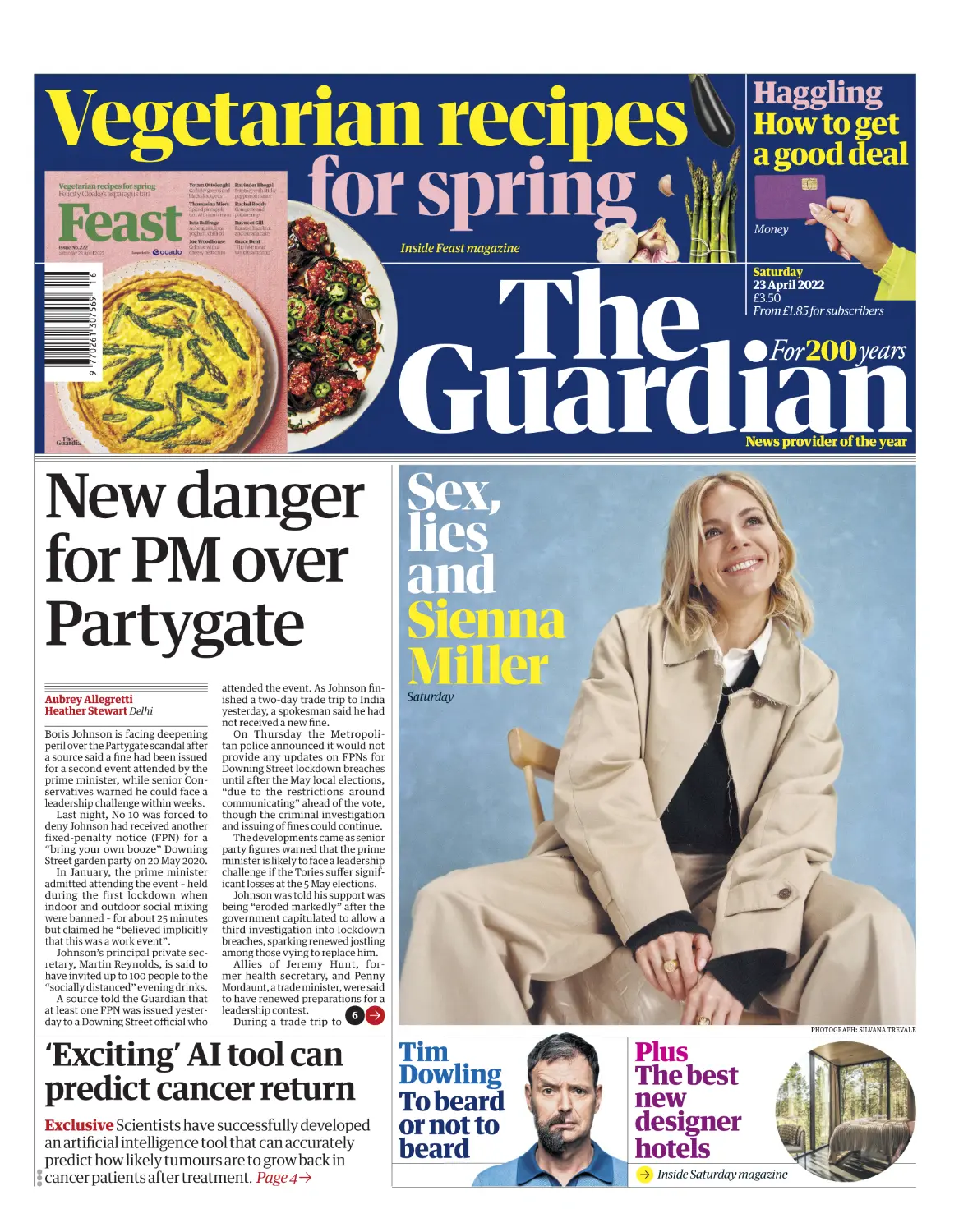
Vegetarian recipes
for spring
Haggling
How to get
a good deal
Money
IInside Feast magazine
Saturday
23 April 2022
£3.50
£3
50
From £1.85 for subscribers
New danger
for PM over
Partygate
Aubrey Allegretti
Heather Stewart Delhi
Boris Johnson is facing deepening
peril over the Partygate scandal after
a source said a fine had been issued
for a second event attended by the
prime minister, while senior Conservatives warned he could face a
leadership challenge within weeks.
Last night, No 10 was forced to
deny Johnson had received another
fixed-penalty notice (FPN) for a
“bring your own booze” Downing
Street garden party on 20 May 2020.
In January, the prime minister
admitted attending the event – held
during the first lockdown when
indoor and outdoor social mixing
were banned – for about 25 minutes
but claimed he “believed implicitly
that this was a work event”.
Johnson’s principal private secretary, Martin Reynolds, is said to
have invited up to 100 people to the
“socially distanced” evening drinks.
A source told the Guardian that
at least one FPN was issued yesterday to a Downing Street official who
attended the event. As Johnson finished a two-day trade trip to India
yesterday, a spokesman said he had
not received a new fine.
On Thursday the Metropolitan police announced it would not
provide any updates on FPNs for
Downing Street lockdown breaches
until after the May local elections,
“due to the restrictions around
communicating” ahead of the vote,
though the criminal investigation
and issuing of fines could continue.
The developments came as senior
party figures warned that the prime
minister is likely to face a leadership
challenge if the Tories suffer significant losses at the 5 May elections.
Johnson was told his support was
being “eroded markedly” after the
government capitulated to allow a
third investigation into lockdown
breaches, sparking renewed jostling
among those vying to replace him.
Allies of Jeremy Hunt, former health secretary, and Penny
Mordaunt, a trade minister, were said
to have renewed preparations for a
leadership contest.
6
During a trade trip to
•••
‘Exciting’ AI tool can
predict cancer return
Exclusive Scientists have successfully developed
an artificial intelligence tool that can accurately
predict how likely tumours are to grow back in
cancer patients after treatment. Page 4
Sex,
lies
and
Sienna
Miller
Saturday
PHOTOGRAPH: SILVANA TREVALE
Tim
Dowling
To beard
or not to
beard
Plus
The best
new
designer
hotels
Inside Saturday magazine
Section:GDN 1N PaGe:2 Edition Date:220423 Edition:01 Zone:
Sent at 22/4/2022 18:40
The Guardian Saturday 23 April 2022
•
23/04/2022
Inside your
Saturday paper
MEMOIR
ISS
SU
U E № 3 0 | 2 3 A PR
PR I L 2
20
02
022
LIFESTYLE
How I
learned to
dump my
friends
Will the
beard
trend
ever end?
PA G E 3 4
PA G E 6 9
cYanmaGentaYellowbl
News
Sunflowers in
bloom. Most
of the sunflower
oil consumed in
the UK comes
from Ukraine
Tesco joins
rationing
of cooking
oil as war
disrupts
supplies
PHOTOGRAPH: RÉGIS
DUVIGNAU/REUTERS
INTERV IE W PAGE 16
23-29 April 2022
KABOOM!
THE GREAT
GAMING TV
EXPLOSION
Vegetarian recipes for spring
Felicity
Cloake’s
F
elicity C
loake’s aasparagus
sparagus ttart
ar t
Yotam Ottolenghi Ravinder Bhogal
Garlicky greens and Potatoes with sticky
black chickpeas
peppercorn sauce
Thomasina Miers Rachel Roddy
Spiced pineapple
Courgette and
tart with rum cream potato soup
Isssu
Issue
Is
ue No.222
ue
No.2
No
222
22
Saturday
S
Sa
atu
turd
daay
y 23
23 April
Ap
A
prriil 2022
220
02222
Supported
Sup
Su
S
u por
uppor
porte
po
ted
ed
e
d by
by
Ixta Belfrage
Aubergines, lime
yoghurt, chilli oil
Ravneet Gill
Roasted hazelnut
and banana cake
Joe Woodhouse
Celeriac with a
cheesy herb crust
Grace Dent
‘The fake meat
world is amazing’
Cryptic crossword
Page 58
Puzzles
Pages 57-58
Killer sudoku and
quick crossword
Journal page 12
Zoe Wood
Consumer affairs correspondent
Tesco has become the latest supermarket to ration cooking oil as
Russia’s war with Ukraine war chokes
off the flow of sunflower oil to the UK
food industry, pushing up the price
of items including crisps.
Most of the UK’s sunflower oil
comes from Ukraine and the war has
caused exports to grind to a halt. With
firms scrabbling to source other vegetable oils, the price in shops is about
a 20% higher than a year ago.
Tesco has introduced a limit of
three bottles per customer across its
entire cooking oil range.
The UK’s biggest retailer said it still
has good availability but, on its website, a small number of vegetable oils
are out of stock.
Tesco is following in the footsteps
of Morrisons and Waitrose, which
have already limited purchases to two
bottles per person. Waitrose said it
was “closely monitoring the situation and working with our suppliers
to ensure customers continue to have
a choice of cooking oils”. Sainsbury’s
and Asda are yet to take any action.
Sunflower oil is found in hundreds
of products, including ready meals,
biscuits and mayonnaise.
Tom Lock, founder of the British
Snack Company, which makes handcooked crisps for sale in pubs, said the
oil was a key ingredient.
“Sunflower oil is the industry
standard for snacks,” said Lock,
whose company has been forced to
switch to rapeseed oil. “It is impossible to get sunflower oil in any
quantity. You just can’t get it. We’ve
secured enough rapeseed to get us
through to August, but we are paying
three times as much for it as we were
for sunflower oil a year ago.”
It was inevitable that price
increases would be passed on to the
customer. “We’ve already done one
price increase to our customers this
year,” he said.
As an interim step, the Food Standards Agency has said suppliers can
switch to using rapeseed oil and
allow their labels to catch up. Shoppers should look out for stickers on
packets and on shelves explaining
any recipe change, it advises.
Weather
Page 59
Earl of Shrewsbury investigated
by Lords’ standards watchdog
Contact
David Conn
For missing sections call 0800 839 100.
For individual departments, call the Guardian
switchboard: 020 3353 2000.
For the Readers’ editor (corrections
& clarifications on specific editorial content), call
020 3353 4736 between 10am and 1pm UK time
Monday to Friday excluding public holidays, or
email guardian.readers@theguardian.com.
Letters for publication should be sent to
guardian.letters@theguardian.com or the
address on the letters page.
NEWSPAPERS
SUPPORT
RECYCLING
The recycled paper
content of UK newspapers
in 2017 was 64.6%
Guardian News & Media, Kings Place, 90 York Way,
London N1 9GU. 020-3353 2000. Fax 020-7837 2114.
In Manchester: Centurion House, 129 Deansgate,
Manchester M3 3WR. Telephone Sales: 020-7611 9000.
The Guardian lists links to third-party websites, but
does not endorse them or guarantee their authenticity
or accuracy. Back issues from Historic Newspapers:
0870-165 1470 guardian.backissuenewspapers.co.uk.
Published by Guardian News & Media, Kings Place,
90 York Way, London N1 9GU, and at Centurion House,
129 Deansgate, Manchester M3 3WR. Printed at Reach
Watford Limited, St Albans Road, Watford, Herts
WD24 7RG; Reach Oldham Limited, Hollinwood Avenue,
Chadderton, Oldham OL9 8EP; Reach Saltire Ltd,
110 Fifty Pitches Place, Glasgow G51 4EA; and by
Irish Times Print Facility, 4080 Kingswood Road,
Citywest Business Campus, Dublin 24. No. 54,639,
Saturday 23 April 2022. Registered as a newspaper at
the Post Office ISSN 0261-3077.
The House of Lords commissioners
for standards have launched an investigation into a second Conservative
peer for allegedly breaching the
rules against peers profiting financially from their membership of the
UK parliament’s upper house.
The investigation into the Earl of
Shrewsbury, an elected hereditary
Conservative peer who has been a
member of the Lords for 41 years,
has been announced by the standards commissioners on their website.
The rules alleged to have been
breached by the earl, whose full
name is Charles Henry John Benedict
Crofton Chetwynd Chetwynd-Talbot,
are the same as those over which his
fellow Tory peer Michelle Mone is
also under investigation.
They include the requirements
in the Lords code of conduct that
members “must not seek to profit
from membership of the house” by
being rewarded for providing parliamentary services or advice; that they
must register and declare all relevant
interests, and they must not seek to
benefit “by parliamentary means”
any outside organisation in which
The British Retail Consortium
said some retailers had put limits on
cooking oil purchases “as a temporary measure to ensure availability
for everyone”.
Andrea Martinez-Inchausti, deputy director of food, said that where
sunflower oil had been substituted
▲ Food producers have switched to
rapeseed oil as an interim measure
they have an interest or in return
for payment.
The investigation into Mone
relates to her alleged involvement in
procuring PPE contracts worth £203m
for the company PPE Medpro. She has
denied wrongdoing.
The current Earl of Shrewsbury is
the 22nd hereditary male holder of
the title, which was first bestowed on
▲ The Earl of Shrewsbury has been
a member of the Lords for 41 years
out, retailers would “change product
labels as soon as possible”.
Gary Lewis, of oil importer KTC
Edibles, said vegetable oil prices had
eased off recent highs but were still
“way up” on before the war.
Other factors, such as crop problems linked to Covid and the climate
crisis, as well as the competing
demand for biofuels, were also factors, he said.
“Prices are still extremely high and
that will contribute towards the high
inflation around the world.”
Yesterday Indonesia, the world’s
biggest palm oil producer, said it
would ban exports of cooking oil and
its raw materials to reduce domestic
shortages and hold down rocketing
prices.
President Joko Widodo announced
the ban a day after hundreds protested in Jakarta against rising
food costs. The ban will begin next
Thursday and continue for an undetermined length of time, he said.
War in Ukraine Page 20
his ancestor John Talbot in 1442, and
generations of earls have been members of the Lords.
He inherited his place in 1981, and
was then elected in 1999 to serve as a
Conservative hereditary peer. He has
registered interests as a director in
several companies, and runs his own
company, Talbot Consulting.
No details have been released
about the substance of the investigation. A spokesperson for the Lords
said: “At this stage information on
this investigation remains confidential until it is completed and a report
published.”
The earl told the Guardian he was
unable to comment.
“The commission have told me
that [if] I speak to anyone about their
investigation I will be in contempt of
parliament. Apologies but my hands
are tied,” he said.
Sign up for First Edition
Our new free digital newsletter, First Edition, is launching on Monday
morning. Every weekday at 7am, Archie Bland and Nimo Omer will
email you a pick of the headlines, share some of the best writing in
the Guardian, and go deeper on one big story – to help you make
sense of the world in the time it takes to drink your morning coffee.
Visit theguardian.com/firstedition to sign up – or scan the QR code.
Section:GDN 1N PaGe:3 Edition Date:220423 Edition:01 Zone:
Saturday 23 April 2022 The Guardian
Sent at 22/4/2022 16:52
cYanmaGentaYellowbl
•
News
3
Going ‘out-out’:
Clubbers go wild,
making up for lost
time, following a
two-year break
▲ Aly Meghani,
25, in Soho, has
been making up
for lost clubbing
time since
restrictions
were lifted in
February
PHOTOGRAPH:
MARTIN GODWIN/
THE GUARDIAN
Lauren Bude
and Millie Jones
with student
friends in Soho.
This is about
getting back to
normal, said
Bude, 21
PHOTOGRAPH:
MARTIN GODWIN/
THE GUARDIAN
Geneva Abdul
All dressed up?A quick reminder about how to prepare for a big night out
On any given Friday, Saturday or Sunday night, it’s likely Aly Meghani will
be relishing in a night out in central
London, where the streets lined with
clubs, pubs and bars have returned to
their spirited state.
The 25-year-old content manager
from Ealing has been going out more
than usual since lockdown restrictions were lifted in February. The
reason? Making up for lost time, said
Meghani, and the fear of missing out.
“Obviously everything is so packed
nowadays, you’ve just got to make
the most of what you can, even if it’s
just if you’re outside, you’ve got to
be doing something,” said Meghani,
flanked by a group of friends in Soho.
It’s the return of “out-out”, a distinction first popularised by the
comedian Micky Flanagan, who
differentiated between a regular night out, and “out-out” which
is understood as staying out later,
longer, and clearing your schedule
the following day.
In Soho, the streets were thrumming this week with the sound of
people out having fun in an attempt
to make up for lost time.
After a long lockdown of kitchen raving, you may be more than ready to break out some dance
moves in an actual nightclub – but shuffling in your slippers is no longer an option. With that in
mind, here are four tips to make sure your return to the night scene is as stylish as it is fun.
Don’t take your best coat
It’s a rookie move to wear
something you treasure
to a club. You’ll either
end up worrying about
it all night, or going mad
with fomo from queuing
for the cloakroom.
Instead, have a “clubbing
coat” that you can stuff
behind a speaker. Shop
your own wardrobe, but a
bomber jacket or fleece is
a classic here.
Lighten your load
Don’t take your overspill
bag to the club. Instead,
go for a small bag that
you can wear crossbody
or around your waist,
with lots of zips. John
Lewis’s Kin bag or a
bumbag from Fila or
similar would work here.
Note: wear said bumbag
around your shoulder,
not your waist, to update
your clubbing look from
1989 to 2022.
Layer, layer, layer
A night out can involve
time in a queue, and time
on a dancefloor fuelled by
body heat. To keep your
style cool, you’ll need a
hoodie (a classic of the
out-out pro playbook)
and a top you can strip
down to. That could
mean an off-the-shoulder
T-shirt, a camisole or,
for the real club-friendly
look, a bra top.
Trainers are
probably best
There’s a case to made
for heels for your first
night out in more than
two years, but trainers
are more fashionable.
And, in even better news,
the super-comfy chunky
ones get a pass, as part of
the Dad-trainer trend. A
pair of grey New Balance
550s are now classic
– and are robust enough
to come to through all
that clubbing dirt fairly
unscathed.
Lauren Cochrane
The club owner Rekom has found
evidence that teenagers who turned
18 during the pandemic are not only
turning up earlier on nights out, but
spending more on drinks in clubs and
bars than patrons in March 2020.
It’s a significant recovery that has
allowed the group to open at least 10
more bars this year, and has made
its UK chief executive, Peter Marks,
“cautiously optimistic”.
“We haven’t experienced the consumer price squeeze yet,” said Marks,
“but most of our guests are under 25
and they are not the people paying
the electric bill, filling the car or paying the mortgage.”
That’s not the case for everyone.
While some people said they were
going out more, others said they had
emerged from the pandemic tamer
and more considerate on nights out.
Lauren Bude and Millie Jones, two
university students from Surrey and
Nottingham, were visiting London
for a friend’s birthday. When asked if
they’re going out more, they chimed
in unison: “Yes, definitely.” But are
they spending more? No, said Bude,
who described herself as a “tight
queen” financially.
For Bude, 21, nights out are not a
matter of making up for lost time, but
rather “just getting back to normal”
after the pandemic. “Now it’s just easier to do,” added Jones, 20. “There’s
less risk.”
The risk was particularly acute for
Simba Munson, who worked at Sainsbury’s throughout the pandemic.
“It was hard,” said Munson, out
celebrating his 34th birthday in Soho.
“I was working through the whole
pandemic, I’m a bit tired, and I’m
getting older now, I just can’t be bothered.” However, when he does go out,
Munson tends to be out later, to make
the most of it. And was he spending
more? Definitely, he said. “Well I’m
not, my boyfriend is,” he added.
“You need the freedom,” Munson
said. “Everyone’s been cooped up for
so long that you need to be out there.”
New evidence suggests that since
March 2020, the number of licensed
venues in the UK has shrunk by 8%,
with 9,200 fewer sites. According
to the consultancy CGA and advisory firm AlixPartners, independent
operators bore the brunt, with 8.7%
closing, while 4.8% of chains or managed pubs closed.
According to Karl Chessell, CGA’s
director for hospitality operators
and food for Europe, the Middle East
and Africa, there’s “a lot of turmoil
going on” due to staffing and supply
issues, in addition to heavy inflationary pressures.
While Chessell says a steady flow of
closures and openings are expected,
overall consumer demand and investor confidence remains strong.
But for 26-year-old Ilhan Hassan,
discussion about people going out
and spending as much as before the
pandemic is already outdated.
“It’s a bit too late to have that
conversation, in my opinion,” said
Hassan. Last year, she started going
out again and making up for lost time.
“This year we’ve been doing it,” said
Hassan, surrounded by a group of
friends. “Nothing new.”
Typically, she will go out twice a
week. “If the opportunity presents
itself, I’ll be dancing until the sun
comes out,” Hassan said assuredly, as
the group made their way to the next
bar. “Once again, it’s my birthday.”
Section:GDN 1N PaGe:4 Edition Date:220423 Edition:01 Zone:
Sent at 22/4/2022 17:34
The Guardian Saturday 23 April 2022
•
4
cYanmaGentaYellowbl
News
‘Exciting’
AI tool
predicts
likelihood
of cancer
recurring
Andrew Gregory
Health editor
Doctors and scientists have successfully developed a potentially
revolutionary artificial intelligence
tool that can accurately predict how
likely tumours are to grow back after
cancer patients have undergone
treatment.
The breakthrough, described as
“exciting” by clinical oncologists,
could improve the surveillance of
patients. While treatment advances
in recent years have boosted survival
chances, there remains a risk that the
disease might come back.
Monitoring patients after treatment is vital to ensuring any cancer
recurrence is acted on urgently.
Currently, however, doctors tend to
have to rely on traditional methods,
including ones focused on the original amount and spread of cancer, to
predict how a patient might fare.
Now a world-first study by the
Royal Marsden NHS foundation trust,
the Institute of Cancer Research, London, and Imperial College London
has identified a model using machine
learning – a type of AI – that can predict the risk of cancer returning, and
do it better than existing methods.
“This is an important step forward
in being able to use AI to understand
which patients are at highest risk
of cancer recurrence, and to detect
this relapse sooner so that re-treatment can be more effective,” said Dr
Richard Lee, a consultant physician
in respiratory medicine and early
diagnosis at the Royal Marsden trust.
Lee, the chief investigator of the
Octapus-AI study, told the Guardian it
could prove vital in not only improving outcomes for cancer patients, but
alleviating their fears, with relapse
“a key source of anxiety” for many.
“We hope to push boundaries to
improve the care of cancer patients,
to help them live longer, and reduce
the impact the disease has on their
lives,” he said.
The AI tool may lead to recurrence
being detected earlier in patients
deemed at high risk, ensuring they
receive treatment more urgently, but
it could also result in fewer unnecessary follow-up scans and hospital
visits for those deemed at low risk.
“Reducing the number of scans
needed in this setting can be helpful,
and also reduce radiation exposure,
‘Like footprints’ – mass tumour
analysis reveals clues to causes
PA Media
Analysis of thousands of tumours
has revealed a treasure trove of clues
about the causes of cancer, representing a significant step towards the
personalisation of treatment.
Researchers say that for the first
time it has been possible to detect patterns – called mutational signatures
– in the DNA of cancers.
These provide clues including
about whether a patient has had
past exposure to environmental
causes of cancer such as smoking or
UV light, for example. This is important as these signatures allow doctors
to look at each patient’s tumour and
match it to specific treatments and
medications.
However, these patterns can be
detected only through analysis of
the vast amounts of data unearthed
by whole genome sequencing – identifying the genetic makeup of a cell.
The principal author of the study,
Serena Nik-Zainal, is a professor of
genomic medicine and bioinformatics at the University of Cambridge
and an honorary consultant at Cambridge University hospitals. She
said: “It’s like looking at a very busy
beach with thousands of footprints
in the sand. To the untrained eye, the
footprints appear to be random and
meaningless.
hospital visits and make more efficient use of NHS resources,” Lee said.
In the retrospective study, doctors,
scientists and researchers developed
a machine learning model to determine whether it could accurately
identify non-small cell lung cancer
(NSCLC) patients at risk of recurrence
after radiotherapy. Machine learning
is a form of AI that enables software
to automatically predict outcomes.
Lung cancer is the leading worldwide cause of cancer death and
accounts for 21% of UK cancer deaths.
NSCLC makes up nearly 85% of lung
cancer cases, and when caught early
the disease is often curable. However,
36% of NSCLC patients experience
recurrence in the UK.
The researchers used clinical data
from 657 NSCLC patients treated at
five UK hospitals to feed their model
– and added in data on various
“But if you are able to study them
closely, you can learn a lot about
what’s been going on, distinguish
between animal and human prints,
whether it’s an adult or child, what
direction they’re travelling in, etc. It’s
the same thing with the mutational
signatures.
“The use of whole genome
sequencing can identify which ‘footprints’ are relevant/important and
reveal what’s happened through the
development of the cancer.”
Researchers analysed the complete genetic makeup or whole
genome sequences of more than
12,000 NHS cancer patients.
They were able to spot 58 new
mutational signatures, suggesting that there are additional causes
of cancer that are not yet fully
understood.
Nik-Zainal said: “The reason it
is important to identify mutational
signatures is because they are like
prognostic factors to better predict
a patient’s chance of recurrence.
These included the patient’s age,
gender, BMI and smoking status,
the intensity of radiotherapy,
and the tumour’s characteristics.
Researchers then used the AI model
to categorise patients into low and
high risk of recurrence, how long a
period they might experience before
a recurrence and overall survival two
years post treatment.
The tool was found to be more
accurate in predicting outcomes than
traditional methods. The results of
the study, supported by the Royal
Marsden Cancer Charity and the
National Institute for Health and Care
Research, were published in the Lancet’s eBioMedicine journal.
“Right now, there is no set
framework for the surveillance of
non-small cell lung cancer patients
‘Mutational
signatures are
like fingerprints.
They help pinpoint
cancer culprits’
Serena Nik-Zainal
Principal study author
fingerprints at a crime scene – they
help to pinpoint cancer culprits.
“Some mutational signatures have
clinical or treatment implications –
they can highlight abnormalities that
may be targeted with specific drugs
or may indicate a potential ‘achilles
heel’ in individual cancers.”
Dr Andrea Degasperi, research
associate at the University of Cambridge and the first author, said:
▲ Checking an X-ray for lung cancer.
The study accurately identified lung
cancer patients at risk of recurrence
PHOTOGRAPH: UTAH778/GETTY/ISTOCKPHOTO
following radiotherapy treatment
in the UK,” said the study lead, Dr
Sumeet Hindocha, a clinical oncology specialist registrar at the Royal
Marsden and Imperial College London. “This means there is variation in
the type and frequency of follow-up
that patients receive … Using AI with
healthcare data may be the answer.
“As this type of data can be
accessed easily, this methodology
could be replicated across different
health systems.”
The study was “an exciting first
step” towards rolling out a tool
nationally and internationally to
guide the post-treatment surveillance of cancer patients, he added.
“Whole genome sequencing gives
us a total picture of all the mutations
that have contributed to each person’s cancer. We have unprecedented
power to look for commonalities and
differences, and in doing so we broadened our knowledge of cancer.”
The findings are being incorporated into the NHS as researchers and
clinicians now have the use of a digital tool called FitMS that will help
them identify the mutational signature and potentially inform cancer
management more effectively.
This research was supported by
Cancer Research UK and published
in the journal Science.
Michelle Mitchell, the chief executive of Cancer Research UK, said:
“This study shows how powerful
whole genome sequencing tests can
be in giving clues into how the cancer may have developed, how it will
behave and what treatment options
would work best.”
Section:GDN 1N PaGe:5 Edition Date:220423 Edition:01 Zone:
Saturday 23 April 2022 The Guardian
Ditch the Land Rover
Advice for Wessexes
before Caribbean tour
Page 13
Sent at 22/4/2022 18:33
•
Sex, sun and secrecy
Captain’s log of life
aboard a superyacht
Page 25
5
Madeleine McCann suspect: German
investigation could last until next year
Philip Oltermann
Hamburg
A German investigation into the
2007 disappearance of Madeleine
McCann could continue until next
year, according to the state prosecutor in the city of Braunschweig.
Authorities in Faro, Portugal on
Thursday declared convicted rapist
Christian Brückner, 44, an “arguido”,
or “formal suspect” – the first time
they have officially identified a suspect in the case since Kate and Gerry
McCann, the girl’s parents, were
declared as such in 2007. They were
formally cleared of suspicion in 2008.
Officials in the northern German
city of Oldenburg, where Brückner
is serving seven years for raping
an American pensioner in 2005 in
the same area of Portugal’s Algarve
region where Madeleine went missing, confirmed yesterday they had
told the prisoner of his new status.
However, the state prosecutor
in Braunschweig, Hans Christian
Wolters, who since 2020 has been
investigating Brückner over Madeleine’s disappearance and other
alleged offences, said the news from
Portugal was unlikely to be indicative
of a breakthrough in the case. “We
note the announcement from Faro,
but it does not affect our own work in
a significant way,” Wolters said.
Asked if it was possible that
Brückner was about to be charged
in Portugal and could be extradited
there from Germany, Wolters said he
believed it was “rather unlikely there
will be an indictment in Portugal”.
The 15th anniversary of three-yearold Madeleine’s disappearance from a
holiday apartment at a resort in Praia
da Luz approaches on 3 May, and
Portugal has a 15-year statute of limitations for crimes with a maximum
jail term of 10 years or more.
Madeleine’s parents said they
“welcomed the news that the Portuguese authorities have declared
a German man an ‘arguido’”. “Even
though the possibility may be slim,
we have not given up hope that
Madeleine is still alive and we will
be reunited with her,” Kate and Gerry
McCann said in a statement.
Wolters said the “arguido” classification “appears to have a procedural
background in Portugal … a statute of
limitations can be avoided that way”.
Brückner’s lawyer, Friedrich Fülscher, told German newspaper Bild
that the Portuguese decision was a
“procedural trick”.
German police said in June 2020
that Madeleine was assumed dead
and that Brückner was likely to have
been responsible.
However, British officers continue to treat it as a missing persons
case. Germany, unlike Portugal, does
not have a statute of limitations for
murder, and the state prosecutor
in Braunschweig is investigating
▲ Kate and Gerry McCann still hope
their daughter is alive, 15 years after
she went missing in Portugal
Brückner for five alleged offences.
They include three cases of rape and
two cases of child molestation, the
most recent being an incident in 2017
where Brückner is alleged to have
exposed himself and masturbated
in front of a group of children.
Wolters said that his office would
make an announcement regarding
the next step towards a possible prosecution at the end of May, but “the
end of our investigations into the
McCann case is not yet in sight” and
could continue into 2023.
If Brückner were charged over the
other alleged offences in Germany,
probably in late summer or early
autumn, he would need to either
personally consent to be tried in
Germany or the prosecution would
need to reissue extradition papers
from Italy, where the suspect was last
arrested in September 2018 – a process that could take several months.
If he were to be charged in Portugal
after all, officials there would need
to take the same bureaucratic step.
Different national prosecutors
in Europe can investigate criminal
offences in parallel, though legal
agreements in the EU are designed
to avoid individuals being charged
over the same crimes more than once.
Christian Brückner was said to
have been in the vicinity of Praia da
Luz on 3 May 2007, around the time
that Madeleine disappeared
Long search
Fifteen years
of leads that
proved false
PHOTOGRAPH: METROPOLITAN POLICE/AFP/GETTY
Ben Quinn
K
ate and Gerry
McCann are likely to
take limited solace
from Portuguese
authorities
designating a
convicted German sex offender a
formal suspect in their daughter’s
disappearance, more than 14 years
after police pointed a finger of
suspicion at them.
In their case, it took 11 months
for the Portuguese police to lift
their categorisation of the couple
as arguidos – translated from
Portuguese as “named suspects” or
“formal suspects”.
The initial investigation into
the disappearance of Madeleine
McCann in May 2007 from a holiday
apartment in Praia da Luz was also
shelved at that point. But by then,
investigators had already made a
string of basic, potentially crucial
errors, which included not just
falsely suspecting the McCanns but
also failing to seal off the scene.
Almost 15 years later, and after
multiple suspects and desperate
public appeals, it was a police
cYanmaGentaYellowbl
search of an allotment in the
German city of Hanover, in the
summer of 2020, that gave a
sense that there had finally been a
breakthrough.
The excavation had come to an
end by July of that year, but a name
had already emerged in the form of
a convicted sex offender, Christian
Brückner, who had occupied the
allotment in the months after
Madeleine’s disappearance.
Now, the formal identification
by Portuguese authorities of
Brückner as an arguido heightens
levels of expectations again, even
if an abundance of false leads over
the years gives cause for caution.
The original Portuguese police
investigation had also resulted in
an Anglo-Portuguese man, Robert
Murat, being made an arguido.
Murat was formally cleared of
suspicion in 2008 and won more
than £500,000 in damages over
defamatory articles connecting him
with the child’s disappearance.
In January 2009 the McCanns
returned to Portugal, launching a
new public appeal for information.
One suspect emerged in the shape
of a dying convicted paedophile,
Raymond Hewlett, who said he
was in the Algarve around the
time of the child’s disappearance
but that he had an alibi. Another
was an unnamed woman who had
reportedly been seen in Barcelona
days after the girl’s disappearance.
In March 2010, a released file
from the Portuguese police on
potential sightings was described
as “gold dust” by a spokesperson
for the family. But it, too, led to
nothing. Efforts were stepped up
again the following year when
the then prime minister, David
Cameron, asked Scotland Yard to
help the Portuguese authorities.
The Metropolitan police’s
involvement has continued to
this day. Until the shift in focus to
Germany in the summer of 2020,
what appeared to be the most
significant development was the
search by British and Portuguese
police of a patch of scrubland
outside Praia da Luz in June 2014. It
ultimately yielded nothing.
The 10th anniversary of
Madeleine’s disappearance
came and went in 2017, and four
official suspects investigated by
Scotland Yard were ruled out of
the investigation – though a senior
police chief said they were pursuing
a “significant line of inquiry”.
Against the backdrop of the
Covid-19 pandemic, on 4 June
2020 the public identification of a
German prisoner as a new prime
suspect came out of the blue.
He was said to have been in
the vicinity of Praia da Luz on the
evening of 3 May 2007, and had a
telephone conversation that ended
just over an hour before the child
went missing from the apartment
where she had been sleeping.
Soon Brückner’s name emerged.
While the development brought
hope that the case might one day be
solved, German officials have said
they have “concrete evidence” that
Madeleine is dead.
Brückner’s lawyer has said that
his client has not been charged over
the case. However, the potential
timing is not lost on those familiar
with the case, given Portugal’s
15-year statute of limitations for
crimes with a maximum prison
sentence of 10 years or more.
Section:GDN 1N PaGe:6 Edition Date:220423 Edition:02 Zone:
Sent at 22/4/2022 21:43
The Guardian Saturday 23 April 2022
••
6
National
Politics
Danger deepens for prime minister
over second Partygate gathering
Continued from page 1
India, Johnson admitted he had got
a “pretty good kick” from his backbenchers after the government
tried to force them to delay a third
Partygate inquiry, by the privileges
committee, only to U-turn hours
later. He vowed to fight on, insisting
he would still be prime minister in six
months’ time.
Meanwhile, infighting between his
detractors and supporters spilled out
into the open. Conor Burns, a Northern Ireland minister, dismissed
criticism levelled at Johnson by some
Tory backbenchers and said there
were “colleagues across parliament
who have never really supported the
prime minister”.
Robert Hayward, a Conservative
peer and elections expert, said MPs,
councillors and Tory associations
were fearful of the Partygate row
stretching on indefinitely.
“I expect that there will be some
form of contest for the leadership at
some stage, not immediately,” he told
the BBC. “But the support for the PM
is being eroded quite markedly and
has been since the recess.”
Hayward suggested Johnson’s
downfall would be “death by a
thousand cuts” given the various
investigations by Scotland Yard, the
senior civil servant Sue Gray and now
the Commons privileges committee.
He revealed MPs were “looking
around” to gauge who would be the
most suitable replacement for Johnson and said: “They won’t necessarily
admit it but that is the reality.”
Hayward added: “I think they’re
moving to a position, from wherever
they started, to a position of saying
‘this cannot go on and there is only
one way of resolving that and that is
by saying we will need some form of
challenge, leadership election, whatever it may happen to be’.”
A cabinet source also predicted
the local elections in May could be
as dire for the Conservatives as the
2019 European parliament elections,
where the party won its lowest ever
share of the vote.
‘Is this for real?’
The lead-up to
gathering in
No 10 garden
on 20 May 2020
Haroon Siddique
It was the hottest day of the year, the
sun was shining with the temperature in the mid-20s, perfect for a get
together – or so one of Boris Johnson’s
top officials had obviously thought.
cYanmaGentaYellowbl
▲ Downing Street staff enjoying wine
and cheese at a gathering in the
garden of No 10 in May 2020
Hancock’s ‘inside story’
MP to release Covid book
Matt Hancock’s “inside story of the
pandemic” will be published later
this year, he has announced.
During an interview on GB News
on Wednesday night (pictured
below), the former health secretary
said he would be releasing a book
about his experience, with royalties
to be donated to NHS charities.
Twitter users mocked the
West Suffolk MP, who resigned as
health secretary after footage of
him breaching his own rules by
kissing his aide Gina Coladangelo
leaked last summer. One tweeted
that he “must be the least selfaware person on the planet” while
another suggested that the book
should be titled “the adulterer’s
guide to social distancing”.
The book, in which Hancock will
look back at how he and his fellow
ministers handled Covid, has been
bought by the publisher Biteback,
which has published books by the
MP Oliver Letwin and rightwing
commentator Katie Hopkins.
Lucy Knight
Iain Duncan Smith, a former Tory
party leader, said many MPs had not
grown any more hostile to Johnson
because of the poor handling of the
vote about the PM being investigated
for misleading parliament.
However, he told the Guardian:
“We’ll wait to see what happens at
the end of this. The majority of the
public are sick and tired of the story;
Conservative MPs are sick and tired
of the story.
“Colleagues may decide it is recoverable. If they reach the decision it’s
too damaging, then it’s over. That balance is just sitting waiting. I fancy
that the local elections and inquiry
will put that to rest.”
Steve Brine, a former health minister, was also revealed to have told a
constituent that a confidence vote in
Johnson “should take place … sooner
rather than later”. He emailed: “This
is not a sustainable situation and I
suspect further FPNs will follow ... I
will be liaising with senior colleagues
to see that confidence is tested in the
period ahead.”
Robert Largan, the Tory MP for
High Peak in Derbyshire, the 14th
most marginal seat in the country,
also told constituents he would not
“defend the indefensible”.
“We cannot have a situation
where it is one rule for politicians
and another rule for everyone else,”
he said. “I can assure you that I am
taking the appropriate action to
defend integrity in public life.”
Rory Stewart, a former cabinet
minister, also predicted the May elections would demonstrate Johnson
“has lost his magic and the Conservative MPs will then conclude there is
no point staying behind him”.
Tory MPs who have submitted letters of no confidence in Johnson felt
quietly optimistic that others would
follow suit, and be given heart by the
likes of senior backbenchers Mark
Harper and Steve Baker calling on
the prime minister to go this week.
“They’ll just do it quietly or privatelyuntil we’re left with these mad people
who wouldn’t get anything under
another regime,” one surmised.
Another MP supportive of Johnson
admitted: “It’s so unpredictable and
all seems to have changed again. I’ve
gone from thinking he should be safe
to thinking ‘this is it’.” A Conservative MP who previously kept an open
mind about Johnson’s future diagnosed the concerns about his political
leadership as “terminal”.
Winding up his two-day trip to
India, an exasperated Johnson was
unable to escape fresh questions
about the Partygate row.
“I think what people want in our
country is for the government to get
on and focus on the issues on which
we were elected,” he said.
Responding to a question about
whether he would compare himself
to a cat with nine lives, he said: “We
had a pretty good kick of the cat yesterday” but quickly added: “Not that
I’m in favour of kicking cats.”
In an email sent to more than 100
employees on 20 May 2020, Martin
Reynolds, the prime minister’s principal private secretary, wrote: “Hi
all, after what has been an incredibly busy period we thought it would
be nice to make the most of the lovely
weather and have some socially distanced drinks in the No 10 garden this
evening. Please join us from 6pm and
bring your own booze!”
There was just one problem – the
country was in lockdown. The gathering, believed to have been attended
by 30-40 people, occurred when
social mixing was banned except
with one other person from another
household outdoors in a public place.
Staff quaffed wine and ate food
laid out for them on tables. Among
those present was the prime minister, who is believed to have attended
with his then fiancee – now wife – Carrie Johnson.
When details of the gathering first
emerged, Johnson said he joined the
event for about 25 minutes from 6pm
to talk to and thank staff, believing it
was a work event, with the No 10 garden being used as “an extension of
the office” amid lockdown. It was an
explanation that attracted howls of
derision in the Commons, given the
invitation to “bring your own booze”.
While the PM said he was not
warned it was against the rules –
and Reynolds was apparently equally
ignorant, assuming it was not a wilful breach – some staff were more
cautious. They feared they might be
breaking the very laws the government had implemented.
“Um. Why is Martin encouraging a mass gathering in the garden?”
one staffer said, according to the BBC.
Another asked: “Is this for real?”
Johnson’s former aide Dominic Cummings also claimed he told
Reynolds it broke the rules. He said
Reynolds replied: “So long as it’s
socially distanced, I think it’s OK.
I’ll check with the PM if he’s happy
for it to go ahead.”
Just minutes before the party
started, the daily press conference
inside Downing Street had concluded. The then culture secretary
Oliver Dowden had reinforced the
messaging around what was permitted, saying: “You can meet one
person outside your household in an
outdoor, public place provided that
you stay 2 metres apart.”
Dowden announced the launch
of the Covid alert level system, with
each of its five levels relating to the
level of threat posed by the virus,
with the country at the time preparing to move to level 3 from 4.
On that day, there were 9,953
people in hospital with coronavirus. A further 363 deaths were
announced, bringing the total at that
point to 35,704.
Dowden was not the only one highlighting the rules. The Met police
tweeted on 20 May 2020 that people
could have a picnic, exercise or do
sport outside providing you are “on
your own, with people you live with,
or just you and one other person”.
The Met seemed to realise the
hot weather would test adherence
to the rules. But the police could not
have imagined the transgressors they
would be handing fines out to more
than two years later would include
the occupants of No 10.
PHOTOGRAPH: THE GUARDIAN
Section:GDN 1N PaGe:7 Edition Date:220423 Edition:01 Zone:
Saturday 23 April 2022 The Guardian
Sent at 22/4/2022 18:52
cYanmaGentaYellowbl
•
7
▼ Keir Starmer in the Commons
yesterday highlighted constitutional
issues in investigating the PM
PHOTOGRAPH: UK PARLIAMENT/AFP/GETTY
‘An amazing job’ Labour celebrates as
downcast Tories mull political humiliation
Peter Walker
Political correspondent
T
he contrast was
marked. Shortly after
the Commons agreed
a third Partygate
inquiry, the few visible
Conservative MPs
seemed notably downcast while
colleagues had already scarpered,
wheeling their suitcases out of
Westminster and heading to their
constituencies amid the chaos of
government U-turns.
The mood in the Labour team,
meanwhile, was ebullient after
the party led the humiliation. Keir
Starmer joined aides for a drinks
gathering on the Commons terrace
that evening.
“It’s not the first time we’ve done
this kind of thing, and everyone has
done an amazing job,” one official
said. “But it’s also fair to say that if
there was a way for the government
to have messed up this week,
they’ve managed to find it.”
Boris Johnson has perhaps
experienced worse weeks as
prime minister, but none have so
brutally underlined the contrast
between his ebbing authority and
the increasingly focused tactics
of Starmer’s operation, plus the
willingness of opposition parties to
cooperate.
A painstakingly drafted motion
paving the way for a Partygate
inquiry by the Commons privileges
committee eventually passed
without a vote. It was written
by Labour but signed by the
Westminster leaders or sole MPs
from six other parties, including
the Scottish National party and the
Liberal Democrats.
Labour officials sought wording
that would prevent ministers
from trying to delay or dismiss the
process, specifying that the inquiry
would not fully begin until the end
of the police investigation.
To get around another
government objection, the
committee’s Labour chair, Chris
Bryant, who has criticised the
prime minister, said he would step
back from the process. Bryant
even discussed this with Graham
Brady, the shop steward for Tory
backbenchers, to make sure the
message got through.
All this took place in a truncated
Tuesday to Thursday political
week after the bank holiday, with
opposition parties first sounding
out the Commons Speaker, Lindsay
Hoyle, over timetabling a motion
before MPs had returned from their
Easter recess.
Another challenge for Labour
was to avoid potentially alienating
voters when Starmer challenged
the prime minister in the Commons
on the same subject on three
consecutive days, requiring a
Privileges committee
What the investigation could mean for Johnson
What is the privileges committee?
The special body known as
the committee of privileges
looks into allegations that an
MP has committed contempt
of parliament. Misleading
the Commons comes under
this category. The committee
has conducted numerous
investigations but this is the first
time a sitting prime minister has
been referred to it for scrutiny.
Who sits on it?
Seven cross-party MPs make up the
committee. There are four Tories,
Alberto Costa, Bernard Jenkin,
Andy Carter and Laura Farris.
Labour has two spots, held by
Yvonne Fovargue and Chris Bryant,
while the Scottish National party
has one, Allan Dorans. Commons
rules dictate it must have a Labour
chair, currently Bryant. However,
he was a vocal critic of Johnson
over Partygate so has recused
himself. Jenkin, the acting vicechair, is expected to take his place.
How will its investigation work?
The motion that set it up said
committee members “shall not
begin substantive consideration
of the matter” until police have
concluded their inquiries. So the
committee will have relatively
little to do for weeks, and MPs
may also want to wait for the final
report about Sue Gray’s Whitehall
investigation to be released.
The committee is not intended
to examine the extent of lawbreaking though, but whether
Johnson deliberately misled
parliament. The ministerial code
states clearly that ministers who
do so are expected to offer their
resignation. It may prove tricky to
establish that Johnson knowingly
misled parliament.
What would happen next?
The committee can recommend
a penalty – including suspension
or expulsion of an MP from
parliament. Crucially, this
would need the approval of the
Commons. Some allies of Johnson
still believe he would have a
chance of surviving. However,
others argue that voting down
the recommendations of a crossparty committee that has looked
through all the evidence would be
politically impossible.
Aubrey Allegretti
varied approach. On Tuesday,
responding to Johnson’s Commons
apology for receiving a fixedpenalty notice, Starmer took a
personal tone, calling him “a man
without shame”.
The next day at prime minister’s
questions, Starmer tried to pin
down Johnson over details.
Finally, opening the debate on
Thursday, he sought to highlight
the constitutional principles
involved. The overall plan was to
leave Downing Street with two
unavoidable and unpalatable
choices: accepting the motion,
or whipping Conservative MPs to
vote it down, leaving them open
to accusations of trying to block
scrutiny.
Such was the tangle that while
Downing Street did table an
amendment, late on Wednesday
evening, little more than 12 hours
later it had been dropped after Tory
MPs made it plain they could not
support the tactic.
The end result is Johnson will
be investigated for alleged lying,
many Tory MPs are even more
unhappy, and a news agenda No
10 had hoped would be shaped by
the prime minister’s visit to India
has been dominated by questions
about his honesty.
“I think we can say it went well,”
one official for another opposition
party said. “All these Commons
procedures can seem deeply weird.
But people know a shambles when
they see one. It’s like the chaos over
Theresa May’s Brexit deal. No one
really understood the deal, but they
all knew it was a shambles.”
Credit for Labour’s strategy will
inevitably fall on its chief whip,
Alan Campbell, and Starmer’s
political director, Luke Sullivan.
But Labour aides stressed the wider
team element.
Meanwhile, though all MPs will
be wary of reading too much into a
handful of days, Tory backbenchers
are gloomily aware that the muchvaunted rejig of No 10 staff and
the whipping operation has not
brought about the changes billed.
There were many factors
behind the decision to drop the
government amendment minutes
before the debate began, but it was
not a good sign for the new chief
whip, Chris Heaton-Harris, in terms
of gauging the mood of his MPs.
Hannah White, the deputy
director of the Institute for
Government thinktank, said it was
a surprise that the government had
got itself into such a mess.
“If they’d looked at it calmly,
they could have just said, ‘We can
let this pass. We have nothing to
hide,’” she said. “But it has ended
up being an own goal. They didn’t
need to expend all this political
capital, and they’ve ended up
looking defensive.”
While the procedure could
appear arcane, White said,
the issues at stake were vital:
“Fundamentally, this isn’t about
parties. It isn’t even about Boris
Johnson’s career. It’s about
whether we care that when a prime
minister comes to the Commons,
they make sure that what they are
saying is true.
“If that’s not the case then the
whole point of parliament in terms
of its scrutiny role is undermined.”
Section:GDN 1N PaGe:8 Edition Date:220423 Edition:02 Zone:
Sent at 22/4/2022 21:22
••
8
The Guardian Saturday 23 April 2022
National
Politics
Johnson vows to block
British exports to India
ending up in Russia
Heather Stewart Delhi
Dan Sabbagh
Boris Johnson has said he will close
loopholes to ensure UK exports to
India cannot end up being used in
Russian weapons, as he conceded
the war in Ukraine could go on until
the end of 2023, and Russia could win.
Speaking in Delhi at the end of
a two-day visit, the prime minister warned that Vladimir Putin was
resorting to a “grinding approach” in
Ukraine and suggested the UK would
help to “backfill” countries including
Poland if they provided heavy weaponry, such as tanks, to Kyiv.
Johnson was asked about a report
by the Royal United Services Institute
(Rusi), warning that India was one of
a number of major routes for smuggling arms to Putin’s regime.
cYanmaGentaYellowbl
He pointed to the ban on exporting technology products to Russia,
saying: “We want to ensure we keep
that tight. We’ll be making sure that
we don’t allow any loopholes of any
kind … we will take steps to make sure
that stuff doesn’t go through other
routes to Russia.”
Hours before the Rusi analysis was published, the government
announced it would ease arms
exporting licensing arrangements
with New Delhi by issuing an open
general export licence, hailing closer
defence cooperation as one of the
wins from the prime minister’s trip.
Rusi’s 26-page overview says
western economic sanctions mean
Moscow will become increasingly
reliant on component-smuggling
for its jets, missiles and other hi-tech
munitions. Some components have a
dual civilian and military use.
Its authors, Jack Watling and Nick
Reynolds, say “Russia has established mechanisms for laundering
these items through third countries”,
and they argue that India should
be subject to specific restrictions.
“Restricting access, therefore, likely
means preventing export to countries
such as India of goods that are in some
instances used for civilian purposes.
“Moreover, there are myriad companies around the world, including in
the Czech Republic, Serbia, Armenia,
Kazakhstan, Turkey, India and China
who will take considerable risks to
meet Russia supply requirements.”
The shadow defence secretary,
John Healey, accused Johnson of
taking “a vanity trip”, and urged him
to do more to press India to clamp
down on exports that could be used in
defence. “Boris Johnson’s vanity trip
to India was designed to distract from
Ukraine
Britain to reopen embassy in Kyiv
Britain is to reopen its Kyiv
embassy, Boris Johnson has
announced, more than two months
after moving it out of the Ukrainian
capital before the Russian invasion.
Since the embassy’s closure in
February, the UK has retained a
diplomatic presence in Ukraine,
but has not been providing inperson consular assistance.
The Foreign Office (FCDO) said
at that time the embassy was
relocating temporarily and staff
were operating from an embassy
office in the western Ukrainian city
of Lviv. However, the embassy is
expected to reopen next week after
Russian forces were pushed back or
withdrawn from the region around
Kyiv in the face of Ukrainian
resistance. A team of diplomats
returning will include Melinda
Simmons, the UK ambassador.
The announcement, which
the prime minister made at a
press conference in India, also
comes after he met the Ukrainian
president, Volodymyr Zelenskiy,
during an unannounced visit to
Kyiv earlier this month.
“The extraordinary fortitude
and success of President Zelenskiy
in resisting Russian forces in
Kyiv means I can announce that
very shortly, next week, we will
reopen our embassy in Ukraine’s
capital city,” Johnson said at the
beginning of the press conference
in New Delhi. “I want to pay tribute
to those British diplomats who
remained in the region throughout
this period.”
More than a dozen European
countries, as well as the EU, have
already reopened their missions
in Kyiv. They include Italy, Spain
and France, which reopened on
16 April. The French ambassador,
Etienne de Poncins, said: “It was
obviously a very moving moment
for me and my colleagues. We left
Kyiv seven weeks ago,” adding
that they did not know then if they
would return.
The Czechs returned on 13 April,
announcing on Twitter: “This is
one of the many steps we are taking
to show our support for Ukraine.”
Zelenskiy has praised states
whose missions have returned to
the capital, saying they are sending
“a clear signal to the aggressor”.
The US has been weighing up
the possibility of reopening its
embassy in Kyiv.
Ben Quinn
Section:GDN 1N PaGe:9 Edition Date:220423 Edition:02 Zone:
Saturday 23 April 2022 The Guardian
Sent at 22/4/2022 21:22
cYanmaGentaYellowbl
••
9
Boris Johnson inspects a guard
of honour yesterday at India’s
presidential palace in New Delhi
PHOTOGRAPHER: BEN STANSALL/PA
his law-breaking and failure to tackle
the cost-of-living crisis. But he can
use this report to help halt the Russian war in Ukraine. He must press
for urgent action from prime minister Modi to clamp down on weapons
parts passing through India and into
Russian hands,” he said.
Asked about briefings from western intelligence figures suggesting
the Ukraine conflict could go on for
many more months, and may result
in a Russian victory, Johnson said:
“The sad thing is that that is a realistic possibility. Of course, Putin has
a huge army. He has a very difficult
political position because he’s made a
catastrophic blunder, so that the only
option he now has really is to try to
use his appalling, grinding approach,
led by artillery, trying to grind the
Ukrainians down.”
Johnson said Putin was close to
securing Mariupol – but he paid tribute to the resistance of Ukrainians:
“No matter what military superiority
Vladimir Putin may be able to bring
to bear in the next few months – and
I agree it could be a long period – he
will not be able to conquer the spirit
of the Ukrainian people.”
He announced that the UK would
reopen its embassy in Kyiv next week,
and suggested more ministers could
follow his lead and visit the Ukrainian
capital in the coming weeks.
And he suggested the UK could
send weaponry to neighbouring
countries who could supply Ukraine
with arms. “We are looking at sending
tanks to Poland to try to help them as
they send some of their T72s [tanks]
to Ukraine,” he said.
An MOD spokesperson clarified the
remarks yesterday evening, saying:
“As announced by the prime minister, the UK is currently exploring
sending British Challenger 2 tanks to
Poland. While no decisions have been
taken, these would be deployed on a
short-term basis and operated by UK
service personnel to bridge the gap
between Poland donating tanks to
Ukraine, and replacements arriving.”
Johnson discussed Russia’s invasion of Ukraine with Modi when the
pair held bilateral talks yesterday
morning. India’s foreign secretary,
Harsh Vardhan Shringla, told reporters Johnson put “no pressure” on
Modi over the issue.
Delivering a statement alongside
Johnson yesterday, Modi called for
an “immediate ceasefire” in Ukraine,
and emphasised the importance of
diplomacy, but did not criticise Russia, India’s biggest supplier of arms.
India has abstained from successive United Nations motions
condemning Russia, including last
month when the general assembly
voted to suspended the country from
the Human Rights Council, and it
continues to buy Moscow’s oil. Modi
has called the situation in Ukraine
“very worrying” and has appealed to
both sides for peace. While India has
condemned the killings of civilians in
Ukraine, it has not criticised Putin.
The Russian foreign minister, Sergei Lavrov, met Modi in Delhi this
month, and insisted the two countries would continue to find ways
to trade, despite western sanctions
imposed on Russia.
Analysis
Heather Stewart
Johnson racks up the
air miles but has little
else to show from his
two-day visit with Modi
A
Unpublished
parts of UK
policy say that
dinghies in the
Channel should
not be pushed
back if asylum
seekers are
onboard
PHOTOGRAPH:
GARETH FULLER/PA
s Boris Johnson met Narendra Modi
yesterday, he joked of the enthusiastic
welcome he had received in the Indian
prime minister’s home state of Gujarat,
with giant posters of Johnson’s face and
flag-waving crowds: “I wouldn’t get that
necessarily everywhere in the world.”
It was a self-deprecating reference to the fact
that even 4,000 miles from home he was unable to
escape Partygate. When this trip was being planned,
Johnson’s refreshed Downing Street team had hoped
it would demonstrate his commitment to the issues of
investment, post-Brexit trade deals and green energy.
In truth the victories from the visit were relatively
modest. Johnson hailed the prospects for a free trade
agreement, which the Indian government is indeed
keen to press ahead with. Modi’s imprimatur may
help speed up the process, but talks have been under
way since January after a shift in Indian policy. It has
signed recent deals with the UAE and Australia.
There are questions, too, about how much the UK
may be willing to tie in visas with any deal. Johnson
appeared to signal he would welcome more highskilled Indian immigration as part of an agreement,
reversing a longstanding UK stance.
Government sources claimed he was only referring
to the intercompany transfers that allow firms to bring
in overseas staff. Johnson also highlighted cooperation
on green technologies. Aside from that, tangible
outcomes from the two-day tour were hard to identify,
raising the question of why India, and why now, apart
from the hope of generating some
upbeat headlines about a postJohnson insisted the UK
Brexit trade deal.
Johnson repeatedly insisted
and
India were fellow
the UK and India were fellow
democracies ready
democracies ready to take on
autocratic regimes (without
to take on autocratic
mentioning China or Russia by
regimes (no mention of
name). Human rights watchdogs
have warned that while it was
China or Russia)
indeed democratically elected,
Modi’s government has taken
on increasingly autocratic
characteristics including repressive
measures against journalists and activists. Johnson
stood alone at his final press conference in Delhi
because Modi himself has not given one for years.
The trip was also fraught with tensions about
deepening cooperation with a country whose stance
is radically different on the overriding foreign policy
issue of the day: Ukraine. Downing Street had made
clear in advance that Johnson had no illusions about
influencing Modi, who recently entertained Moscow’s
foreign minister, Sergei Lavrov, in Delhi.
One of the few solid announcements from the visit
was that the UK will liberalise exports of defence
equipment to India. That was intended as a signal of
defence cooperation as part of Johnson’s “Indo-Pacific
tilt” towards a region he described in his closing press
conference as “the geopolitical centre of the world”.
But it was thrown into question by a report from
the the Royal United Services Institute thinktank
yesterday that Russia is laundering components for
weapons from western countries through India.
While Johnson’s reception in India was warm, he
left his lieutenants back home exposed to the full force
of backbench fury over Partygate and returns with
little to show for it. The welcome as he flies back to
London is unlikely to be anything but chilly.
Migration
Patel accused
of misleading
parliament
over Channel
pushbacks
Diane Taylor
The home secretary has been accused
of misleading parliament after a high
court ruling revealed that unpublished parts of a controversial policy
to push back migrant dinghies in the
Channel said the tactic would not be
used against asylum seekers.
The pushbacks policy was finalised
in autumn 2021, yet in January this
year Priti Patel said pushing back
migrant boats was “absolutely still
policy” when she gave evidence to
the Lords justice and home affairs
committee. She has been accused of
giving that evidence even though she
knew about the unpublished clauses
in the policy not to use pushbacks
against asylum seekers.
The former shadow attorney
general Shami Chakrabarti accused
Patel of misleading parliament and
called on her to apologise , saying:
“This judgment reveals the home secretary connived to mislead refugees,
voters and parliament that people
expressly seeking asylum could be
repelled in UK waters. Priti Patel must
apologise and rethink large sections
of her borders bill before it returns to
the Lords. It is a disgraceful breach of
the rule of law.”
Details of the unpublished policy
came to light during a legal challenge
to the pushbacks plan brought by
the Public and Commercial Services
Union (PCS), and the NGOs Care4Calais, Channel Rescue and Freedom
From Torture.
The Home Office had applied to the
high court for public interest immunity to avoid making the details of the
pushbacks policy public. This mechanism is used where sensitive issues
such as organised crime, terrorism
or national security are involved. But
judges said disclosure of the policy
did not “give rise to a real risk of
serious harm to the public interest”.
The government has always said
the pushbacks policy would only be
used when it was safe to deploy it.
Restrictions on usage of the tactic
are outlined in the nationality and
borders bill, which is due to return to
the House of Lords on Tuesday. However, since the policy was announced
last October ministers have not said
publicly that it would not be used
against asylum seekers.
A key part of the unpublished
policy disclosed in the high court
judgment is that anyone in a dinghy who indicates they wish to
claim asylum in the UK should not
be pushed back but instead escorted
to UK shores. Almost everyone who
uses this method to reach the UK is
an asylum seeker, according to the
Home Office’s own data.
The ruling reveals the pushback
policy states: “Should a migrant
request asylum whilst in UK territorial waters they must be returned to
the UK for processing.”
According to the high court judgment, a clause in the unpublished
policy says “the actual number of
migrant vessels successfully intercepted is likely to be extremely low”.
It adds that one of the “acceptable
outcomes” is that during deployments no migrant vessels are assessed
as suitable for safe turnaround.
Paul O’Connor, the head of bargaining at PCS, said: “PCS has been
pressing the Home Office for transparency in these proceedings. They
have gone to considerable lengths
to keep certain matters shrouded in
secrecy. This judgment has left them
nowhere to hide and has exposed
their real agenda.”
Clare Moseley, the founder of Care4Calais, said: “I’m shocked that this
government tried to hide the fact that
refugees who request asylum in UK
waters have a right to be brought to
the UK to process that request.”
Toufique Hossain, the director of
public law at Duncan Lewis solicitors,
who represents PCS and Care4Calais,
described the judgment as “deeply
concerning”. “In light of the extreme
measures that are now being taken
and proposed to prevent asylum
claims being considered in the UK,
there is a greater need than ever for
transparency.”
In a speech on 14 April about
tackling illegal migration, the prime
minister said Channel pushbacks
were unlikely to be used much,
although provision for the tactic
remained in the immigration bill.
“It’s clear that there are extremely
limited circumstances when you can
safely do this in the English Channel,”
Boris Johnson said.
The Home Office has been
approached for comment.
Section:GDN 1N PaGe:10 Edition Date:220423 Edition:01 Zone:
Sent at 22/4/2022 17:55
The Guardian Saturday 23 April 2022
•
10
Bill Murray
accused of
‘inappropriate
behaviour’
on set of film
cYanmaGentaYellowb
National
Andrew Pulver
A complaint of “inappropriate behaviour” has been made against the actor
Bill Murray, halting the production of
the film he is working on, it has been
reported.
According to Deadline, production
on the Searchlight film Being Mortal
was stopped on Monday and a letter
was sent to its cast and crew saying:
“We were made aware of a complaint,
and we immediately looked into it.
After reviewing the circumstances,
it has been decided that production
cannot continue at this time.”
The letter did not name Murray as
the target of the complaint. However,
Deadline named Murray and the New
York Times followed, referencing an
anonymous source saying that the
movie had been shut down because
of “inappropriate behaviour”.
Being Mortal is an adaptation of
Being Mortal: Medicine and What
Matters in the End, a nonfiction
exploration of death and dying by
the surgeon Atul Gawande, and is
▲ Murray was making the film Being
Mortal – production has been halted
More than
seven in 10
people in
England
have now
had Covid,
says ONS
Hannah Devlin
Science correspondent
More than seven in 10 people in
England have been infected with
Covid-19 since the start of the pandemic, according to the Office for
National Statistics.
The estimate, the most detailed
analysis to date, suggests that 71%
of people in England caught Covid
between 27 April 2020 and 11 February 2022.
The proportion is likely to have
risen further in the most recent
Omicron wave, during which the
prevalence was higher than at any
other time in the pandemic, including in older age groups that had
previously had relatively low rates
of infection.
Prof James Naismith, the director
of the Rosalind Franklin Institute at
the University of Oxford, said: “The
total number of infected people was
rising rapidly when the data stopped.
The bottom line is the majority of
people in the UK have had Covid-19.”
The analysis used a sample of
535,116 people who have completed one or more tests as part of
the UK Covid-19 Infection Survey
(CIS), which covers people over the
age of two years living in private
households.
Lower proportions of the population were estimated to have been
infected in Wales (56%) and Scotland
(52%), but the figures are not directly
comparable as the data covered a
shorter time period, with Welsh data
starting in June 2020 and Scotland in
September 2020. In Northern Ireland,
72% of the population were estimated
to have been infected.
Duncan Cook, the deputy director of the CIS, said: “Today’s release
is a valuable piece of the puzzle for
written and directed by Aziz Ansari.
Ansari also stars in the film alongside
Murray, Keke Palmer and Seth Rogen.
It is not known for how long the
shoot will be suspended. In its letter Searchlight said: “Our hope is to
resume production and we are working with Aziz and Youree [Henley, the
producer] to figure out that timing.”
Both Searchlight and a representative for Murray have been contacted
for a response.
Searchlight told Deadline that it
did not make any comment on active
investigations.
understanding the impact of the pandemic across the UK.”
The analysis suggested that by
October 2021, only about one in three
people in England had been infected
and the proportion remained lower
than half until the emergence of the
Omicron variant, which triggered a
rapid rise in cases.
The proportions infected now are
likely to be even higher than the ONS
estimates as the most recent Covid
wave, which coincided with the lifting of restrictions, led to a surge of
cases in the oldest age groups.
“In some regions of England today
I would predict the portion of those
who have had Covid-19 will easily
exceed 80%,” said Naismith.
The findings come as the latest
ONS survey shows Covid rates are
continuing to fall across the UK, with
about 3,218,700 people in England –
one in 17 – having Covid in the week
ending 16 April, down from about
one in 15 people the week before.
Decreases were also seen in Wales
(one in 15 people), Northern Ireland
(one in 30) and Scotland (one in 19)
and across all age groups.
Cook said: “We continue to see
a welcome decrease in infections
across England, Northern Ireland and
Scotland in today’s data. For the first
time in several weeks, we are also seeing a decrease in Wales too.
“It’s encouraging to see that infections have decreased in all age groups
across England.
“Despite the decrease in infections, it’s important to note that levels
remain high. We continue to monitor
these going forward,” he said.
According to the latest government figures, the number of Covid
patients in hospital and the number
of weekly deaths linked to the virus
is also falling in the UK.
In numbers
71%
Proportion of people in England
who have had Covid, according to
the Office for National Statistics
52%
The figure for Scotland, though
the data covers a shorter period,
from September 2020 onwards
3.2m
Number of people in England who
had the virus in the week ending
16 April – equivalent to one in 17
Section:GDN 1N PaGe:11 Edition Date:220423 Edition:01 Zone:
Saturday 23 April 2022 The Guardian
Sent at 22/4/2022 16:55
cYanmaGentaYellowb
•
National
11
Madonna’s California
mansion put up for sale
– all yours for £20m
Mark Sweney
Madonna has listed her California
mansion for $26m (£20m), a little
more than a year after buying it from
the R&B singer the Weeknd.
The 63-year-old singer-songwriter
paid $19.3m for the property, located
20 miles from Los Angeles in the
star-studded Hidden Hills neighbourhood, in April 2021.
The 12,500 sq ft (1,200 sq metre)
home has nine bedrooms, a twostorey wall of windows, an infinity
saltwater pool and spa, and a bright
orange basketball court.
The Weeknd, whose real name
is Abel Tesfaye, paid $18.2m for the
property in 2017 and was its first
owner. The Blinding Lights singer
originally listed the mansion, which
has a climate-controlled glass wine
cellar, a theatre room and a five-car
garage, for $25m in 2020. But after
10 months on the market, Madonna
snapped it up for almost $6m less.
The Weeknd has since moved to a
$70m property in Bel Air.
The property is located in 1.2 hectares (3 acres) of land accessible via
Madonna bought the property
from R&B singer the Weeknd just
a year ago, paying $19.3m (£15m)
a guarded gate and includes a barn,
a gym and a dance studio.
Madonna has listed the house with
Beverly Hills Estates, which represented the singer when she bought
the property. The agency describes
the main house as sitting at the end
of an olive tree-lined driveway with
a “storybook bridge”, a great room
with an indoor-outdoor bar and
adjoining outdoor living room, and
a formal dining room with a fireplace.
The gated Hidden Hills community
is a favourite neighbourhood for
some of Hollywood’s biggest names,
including the Kardashians.
The Canadian hip-hop star Drake
recently sold two houses in the area
to Matthew Stafford, the quarterback
of the LA Rams, for $11m.
▲ The mansion is located in Hidden
Hills, popular with Hollywood’s elite
PHOTOGRAPH: ZILLOW
Last year, Madonna announced a
lucrative deal with Warner Music, in
which her four-decade catalogue of
hits, including Papa Don’t Preach and
Like a Virgin, will be rereleased over
the coming years.
Section:GDN 1N PaGe:12 Edition Date:220423 Edition:01 Zone:
Sent at 21/4/2022 10:22
cYanmaGentaYellowb
Section:GDN 1N PaGe:13 Edition Date:220423 Edition:01 Zone:
Saturday 23 April 2022 The Guardian
Sent at 22/4/2022 18:30
cYanmaGentaYellowb
•
National
13
▼ The Cambridges’ greeting through
a fence and The Crown’s opentopped car scenes are ‘to be avoided’
PHOTOGRAPHS: TIM ROOKE/REX; NETFLIX
‘Forget The Crown’
Wessexes warned to
avoid William and
Kate’s mistakes on
tour of Caribbean
Harry’s week
Four things we learned
After the Duke and Duchess of
Sussex’s first visit together to the
UK in two years, what are the key
things we learned this week from
Prince Harry?
He may not attend celebrations
for the Queen’s jubilee
On Tuesday, it was reported that
Harry and Meghan were invited
to appear on the Buckingham
Palace balcony during the
platinum jubilee. But in an
interview with US network NBC’s
Today Show, the duke said he
was unsure whether they would
accept the invitation. “I don’t
know yet,” he said. “There’s lots
of things – security issues and
everything else. So this is what
I’m trying to do, trying to make it
possible that, you know, I can get
my kids to meet her.”
Caroline Davies
I
t seems like simple advice
for the Earl and Countess of
Wessex’s Caribbean tour:
avoid taking references
from the Netflix drama
The Crown, ditch anything
that smacks of 1950s colonialism
and swerve the PR pitfalls that
befell the Duke and Duchess of
Cambridge’s recent visit.
But with Grenada dropped from
the itinerary with no explanation
the day before the tour started
yesterday, and an open letter on
slave trade reparations awaiting
them in Antigua and Barbuda, the
spotlight is already on Edward and
Sophie’s platinum jubilee tour of
Antigua and Barbuda, St Lucia, and
St Vincent and the Grenadines.
Buckingham Palace will be
desperate to avoid the PR missteps
suffered by William and Kate, with
its images of the couple greeting
children in Jamaica through wire
fencing. If there were plans for the
Wessexes to recreate the Queen
and Prince Philip’s waving from an
open-top Land Rover, as William
and Kate did in images criticised
as a relic of the colonial era, they
should have been shelved, said
the public relations expert Mark
Borkowski.
The Land Rover shots of the
couple “looked straight out of
1950s. Like somehow they were
taking references from The Crown
rather than the modern handbook
of how to look contemporary
and future-thinking and not
being anachronistic,” he added.
“If they [the royal family] start
repeating these errors, there is
clearly something at the heart that
is broken of what has been a very
controlling royal media machine.”
But despite royal aides’ scrutiny
of the Wessex’s itinerary potential
for backlash exists in a region
where some island nations intend
to sever links with the crown.
During their tour of Belize,
Jamaica and the Bahamas, the
Cambridges faced protests against
slavery, calls for reparations and
public apologies, and the Jamaican
prime minister’s uncomfortable
on-camera warning that the
country would ditch the monarchy.
Now the Antigua and Barbuda
Reparations Support Commission
has warned the Wessexes in an
open letter against the “phoney
He is keen the Queen has the
‘right people around her’
After reports Harry had met the
Queen for tea last week, the duke
said he wanted to make sure that
his grandmother was “protected”
and had the “right people around
her”. “Both Meghan and I had
tea with her, so it was really nice
to catch up,” he said, adding that
he believed his relationship with
his grandmother to be “really
special” and that she has an
amazing sense of humour.
Howzat?
Prince Louis, birthday boy
The Duke and Duchess of
Cambridge have released new
photographs of Prince Louis,
below, for his fourth birthday
today. The photographs were taken
by the duchess on a Norfolk beach,
with Louis holding a cricket ball.
In December Kate told the
celebrity cook Mary Berry on BBC
One’s A Berry Royal Christmas:
“One of Louis’s first words was
Mary because right at his height
are all my cooking books.”
▲ A planned trip by Edward and
Sophie to Grenada has been dropped
sanctimony” of “members of the
royal family and representatives of
the government of Britain” coming
to the region to “lament that
slavery was an ‘appalling atrocity’
… that should not have happened.
“For us, they are the source of
genocide and of continuing deep
international injury, injustice and
racism. We hope you will respect us
by not repeating the mantra. We are
not simpletons,” it reads.
An apology and reparations are
still needed, said the commission
chair, Dorbrene O’Marde, who
described William and Kate’s tour
as a “horrible, horrible exposition
of archaic colonial behaviour”. He
said the letter followed concerns
raised by others, including the
absence of “an apology from the
crown both as a family and as an
institution for their role in the
enslavement of African people”.
O’Marde linked the Grenada
cancellation to revelations the
Bank of England had owned 599
slaves from Grenada in the late 18th
century. Buckingham Palace has
not commented.
So the Wessexes are “hostages
to misfortune”, said Borkowski,
and are straitjacketed by protocol.
“They are forced to do these things
which still have a throwback to a
time when the royal family were
loved back in the 50s … A lot of
water has passed under the bridge.”
The focus on the Caribbean may
be a scoping exercise to see what
might happen when Charles, then
William, ascend the throne, he said.
Charles “Max” Fernandez, a
minister in Antigua and Barbuda,
has said it is time to follow
Barbados and become a republic. In
St Lucia, the former prime minister
Dr Kenny Anthony said his country
should do the same.
In the light of this, Borkowski
said: “[The Wessexes] should
avoid cliches, think very carefully
about every photo op and not go
off piste.”
He may have been trying
to rebuild some bridges with
Prince Charles
The visit to the UK has also
been seen as an offer of an olive
branch in an effort to re-establish
relationships. A royal observer
said the visit showed Harry
“slowly starting to rebuild
some bridges with his father”.
Another said the visit was seen
as a gesture after the fallout from
the Sussexes’ Oprah Winfrey
interview last year.
He has felt the presence of his
late mother
Harry told NBC he felt the
“presence” of Diana, Princess of
Wales, in everything he did.
He said the presence of his
mother had felt constant over the
past two years especially. “It’s
almost as though she’s done her
bit with my brother, and now
she’s very much helping me.
“He’s got his kids, I’ve got
my kids … I feel her presence
in almost everything that I do
now, but definitely more so in
the last two years than ever
before.” Tobi Thomas
▲ Meghan and Harry with a British
athlete at the Invictus Games
Section:GDN 1N PaGe:14 Edition Date:220423 Edition:01 Zone:
Sent at 22/4/2022 12:05
cYanmaGentaYellowb
Section:GDN 1N PaGe:15 Edition Date:220423 Edition:01 Zone:
Sent at 22/4/2022 13:43
•
Saturday 23 April 2022 The Guardian
National
15
Minister calls countryside ‘a place of
business’ as right to roam report axed
A government minister has described
the English countryside as a “place of
business” in response to questions
about why the long-awaited right to
roam report into public access to rural
areas had been shelved.
The comments by Mark Spencer,
the leader of the Commons, came as
campaign groups expressed fury over
the Treasury’s decision to quash the
review, which was commissioned to
help achieve a “quantum shift in how
our society supports people to access
and engage with the outdoors”.
The review, led by Lord Agnew,
had included a potential expansion of
the much-fought-over right to roam,
which campaigners fear will not now
go ahead. In response, activists are
planning mass trespasses to raise
awareness of how much English land
is out of bounds. The right to roam
exists over only 8% of the country.
Spencer made the remarks after
the Green MP Caroline Lucas asked
why the responses to the Agnew
report into making more of the countryside publicly accessible would not
be published.
He said: “I think we are blessed in
this country with hundreds of thousands of miles of public footpath
Testing the water
Swimmers plan
mass trespass at
Kinder reservoir
Helen Pidd
North of England editor
A
t 2pm on 25 April
1932 hundreds of
rebellious ramblers
descended on Kinder
Scout, Derbyshire’s
highest point, to
“take action to open up the fine
country at present denied us”.
Six people were arrested at what
became known as the Kinder
mass trespass, which established
the principle of open access land
and laid the foundations for
the UK’s first national park, the
Peak District.
At noon tomorrow, exactly
90 years on from that historic
victory, swimmers from across
the north of England plan to
plunge into Kinder reservoir for
what they describe as “an act of
defiance against widespread lack of
undisputed access to inland open
water in England and Wales, and
the disconnect this causes between
people, water and each other”.
to allow people to access the countryside. We have to recognise the
countryside is not just a place of
leisure, but it is also a place of business and food production.”
Lucas responded on Twitter:
“Utterly feeble ‘defence’ from the
leader of house on government
quashing review into the right to
roam. Working and leisure are not
incompatible – is this really the government’s excuse?”
Ninety-two per cent of England’s land is privately owned and
not available to access. The Countryside and Rights of Way (Crow)
Act 2000 gives a legal right of public access to mountains, moorland,
heaths, some downland and commons, and the English coastal path.
Campaigners have asked for this to
be extended to cover rivers, woods
and green belt land.
Ninety-seven per cent of rivers
are off limits to the public, and tens
of thousands of acres of woodland
have benefited from public subsidy
yet remain publicly inaccessible.
This weekend the Right to Roam
The proportion of land in England
that is privately owned and not
available for public access
campaign is celebrating the 90th
anniversary of the 1932 Kinder Trespass, when hundreds of activists
trespassed on Kinder Scout in the
Peak District.
James MacColl, the head of policy, advocacy and campaigns for the
Ramblers charity, said the government was not doing anywhere near
enough to improve access to the
countryside.
He said: “The government … isn’t
making use of its own Environment
Act powers to set public access targets. Its new farm payments scheme
shows no sign of rewarding farmers
for improving access on their land,
despite repeated promises. Proposed
changes to the planning system don’t
prioritise access to nature.
“Access to these green open spaces
is still currently very limited and
unequal and the Ramblers wants to
see government extend the freedom
to roam across England and Wales so
that it is more easily accessible, and
better connected to our path network
and our towns and cities.”
Though the firm operates a blanket
ban on swimming, the laws around
reservoir access in England and
Wales are disputed and rarely, if
ever, get tested in the courts.
The Outdoor Swimming Society
(OSS) says: “There is a strong
argument based on detailed
research by many organisations
and campaigns that there is a
‘public right of navigation’ on all
rivers that can be navigated by any
sort of boat, and therefore a right to
swim.” Despite this, United Utilities
and other firms have in recent years
employed security guards to order
swimmers out of the water and to
scare would-be dippers away.
The OSS argues that water
companies have a statutory duty
to provide recreational access to
waterways, not just for angling and
dog walking but also for swimming.
In Scotland, swimmers have
enjoyed a right to swim freely in
almost all reservoirs since 2003.
Tomorrow’s swimming
trespassers will be cheered on
from afar by Catherine West
MP, the chair of the all-party
parliamentary group on swimming.
“I think as an awareness-raising
campaign it sounds like a good
way of getting everybody to
take more note of how clean or
otherwise the waterways are, and
also of campaigning for constant
improvements to our outdoor
swimming opportunities,” said
West, who swims regularly at
Hampstead ponds near her north
London constituency.
She wants better swimming
education for children so that they
grow into adults who understand
the risks of swimming in open
water. People choosing to swim
outdoors who are not under the
influence of alcohol and do not
jump in make up a small fraction
of UK drownings, the OSS notes.
One of the organisers of
tomorrow’s Kinder swim said they
were optimistic that the narrative
was changing around access to
open water after more people
discovered the endorphin highs
of wild swimming during Covid.
“It’s 90 years since the trespass
that triggered a series of events that
led to us having the right to roam
freely, off the footpath. It opened
up the huge landscapes to people
from industrial cities … to come out
and get fresh air and all the benefits
of getting up high on the hill and
enjoying the countryside,” they
said. “The benefits of open water
are very similar.”
92%
PHOTOGRAPHS: TONY EVELING/GETTY; MEN SYNDICATION
Helena Horton
cYanmaGentaYellowb
▲ The trespass
of 1932. Right,
the Kinder
reservoir, site
of tomorrow’s
mass ‘swimpass’
All are welcome at the mass
swimming trespass, whether for a
paddle or a leisurely swim. But with
water temperatures unlikely to be
much above 10C (50F)– a swimming
pool is usually heated to 26-28C
– caution is advised for anyone
planning to take part.
The Manchester Guardian had
a correspondent booted up for
the original mass trespass. They
reported a “brief but vigorous
hand-to-hand struggle” with a
series of gamekeepers employed
by the wealthy landowners, who
tried and failed to stop the walkers
asserting their right to roam.
One of the organisers of the
mass “swimpass”, who asked
not to be named, said they were
not expecting arrests, or tussles
with anyone employed by United
Utilities, which owns the reservoir.
Section:GDN 1N PaGe:16 Edition Date:220423 Edition:01 Zone:
Sent at 22/4/2022 18:37
cYanmaGentaYellowb
•
Scientists
warn of
risks from
huge surge
in satellites
Ian Sample
Science editor
The orbital space around Earth must
urgently be protected by environmental rules and regulations akin to
those that safeguard the planet’s land,
seas and air, leading scientists say.
An international team of researchers say a dramatic rise in the number
of satellites is polluting the night sky
for astronomers and stargazers, while
increasing the risk of objects colliding
in space and potentially striking people or aircraft when they fall to Earth.
Much of the concern is driven by
the surge in mega-constellations,
which involve placing tens of thousands of satellites in low Earth orbit to
deliver broadband internet and other
services. While companies such as
SpaceX and OneWeb are leading the
way, others are interested, including countries such as Rwanda, which
recently filed an application to launch
327,000 satellites in a single project.
Writing in Nature Astronomy,
scientists from the UK, US, Canada
and the Netherlands warn the number of satellites in low Earth orbit
could exceed 100,000 by 2030, disrupting the work of astronomers and
reshaping our view of the heavens as
the number of satellites seen as “fake
stars” starts to rival the number of
real stars seen with the naked eye.
“We really need to get our act
together. We need to see where
have we got regulations that we’re
not applying properly, and where do
we need new regulations?” said the
lead author, Andy Lawrence, a regius
professor of astronomy at the University of Edinburgh. “This is about
recognising that the problems we see
in orbit are the same as those we see
when we worry about the land, the
oceans and the atmosphere. We need
to knock heads together and say how
can we solve this problem.”
Among the proposals are regulations based on a satellite’s space
traffic footprint and limits on the
carrying capacity of different orbits.
In late 2018, about 2,000 active satellites circled Earth. That number has
nearly doubled in two years thanks
to SpaceX launches alone. All have
gone into the most congested low
Earth orbit, which reaches from 1002,000km above Earth. In 2019, the
European Space Agency moved its
▲ An artist’s
impression of
the debris field
polluting low
Earth orbit
PHOTOGRAPH: ESA/
AFP/GETTY IMAGES
▼ The ESA’s
ClearSpace-1
will embark on
a mission to
remove debris
from Earth’s
orbit in 2025
orbiting Aeolus observatory to avoid
colliding with a SpaceX satellite, the
first time it had swerved around an
active satellite. Last year, the Chinese
moved their space station twice
because of similar concerns.
The scientists say while there is
robust regulation to ensure satellites
are launched safely and transmit signals only within certain frequency
bands, there is almost nothing to govern the impact of satellites on the
night sky, astronomy, Earth’s atmosphere or the orbital environment.
The researchers describe how
light reflecting off satellites can ruin
astronomical observations by leaving streaks across images, while their
broadcasts can drown out the natural
radio signals astronomers study to
understand some of the most exotic
objects in the cosmos.
The satellites also undermine the
ability to enjoy the night sky, they
argue, an act the International Astronomical Union asserts should be a
fundamental right.
There are other concerns too. The
risk of falling satellite debris causing
damage to property or harm to life
today is relatively low. But the danger will rise as more satellites re-enter
Earth’s atmosphere at the end of their
lives, with potentially lethal consequences. “The first aircraft strike or
ground casualty is only a matter of
time,” the researchers warn.
Chris Newman, a professor of
space law and policy at the University
of Northumbria, said: “The problem
of increasing debris and congestion
in Earth orbit poses a real challenge
for the governance of human space
activity. The breadth of new actors
and increased geopolitical tensions
mean that a binding international
treaty is a long way off.”
Section:GDN 1N PaGe:17 Edition Date:220423 Edition:01 Zone:
Saturday 23 April 2022 The Guardian
Sent at 22/4/2022 18:23
cYanmaGentaYellowb
•
National
17
▼ Ruffles, cutouts and flowers turn
swimwear into the main event – but
may slow down your front crawl
PHOTOGRAPH: TABACARU SWIM
Strictly for lounging
Statement swimwear hits
the shops – just keep it dry
Lauren Cochrane
I
f, once upon a time, the
swimwear in your suitcase
was an afterthought – a
bikini designed for maxing
out a tan and lunchtime dip
– it’s set to become the main
event this summer. Statement
swimwear is here.
To be clear, this trend is not
about the sort of swimsuits in
which to do 40 lengths. In the same
way that wider fashion has moved
to a glamorous night-time look as
we emerge from the pandemic,
swimwear is the latest – perhaps
more unlikely – category to have its
moment of maximalism.
Brands such as Léa the Label,
Maygel Coronel, Norma Kamali and
Johanna Ortiz are leading a charge
for costumes with ruffles, unusual
cutouts and metallic fabrics. These
are designs that would get you
cross looks in any pool’s fast lane.
They are meant to stay dry.
The market was valued at more
than $16bn (£12.5bn) in 2020, with
Euromonitor predicting it will hit
$21.4bn by 2025.
Swimwear for poolside lounging,
worn with heels rather than flipflops, has been around for a few
years. It features heavily at the
villa in ITV’s Love Island (back this
June) and on the Instagram feeds
of stars such as Kim Kardashian,
Kendall Jenner, Megan Thee
Stallion and Emily Ratajkowski.
Ruffled and compicated swimwear
can also now be found on the high
street, with Zara offering suits with
oversized flowers that might slow
down the wearer’s front crawl.
Kelsey Lyle, the swimwear buyer
for the luxury site Moda Operandi,
said: “Our customer loves both
minimal and more embellished,
detailed swimwear.” Lyle named
Johanna Ortiz as “the designer to
kick off the ready-to-wear meets
‘It’s an Instagramworthy head-to-toe
look’
Lisa Illis
Marks & Spencer
swim trend… at Moda, we like to
call this look ‘barefoot glamour’”.
Marks & Spencer has also noticed
a trend towards poolside dressing
up, and has launched a “one stop
holiday shop” in response. “We’ve
never been more co-ordinated,”
said Lisa Illis, head of womenswear
design. “[There’s] printed bucket
hats, bags and sandals that
coordinate back to our beach swim
collections. [It’s] an Instagramworthy head-to-toe look.” This
swimwear is made to actually swim
in, with fabrics using chlorineresistant Stay New technology.
Perhaps the most curious
development is bridal swimwear,
with Pamela Anderson marrying
Tommy Lee on the beach in a white
bikini in 1995 as the style reference,
as reprised by Lily James in the
Disney+ series Pam and Tommy.
Liane Wiggins, head of
womenswear at matchesfashion.
com, said: “A lot of our customers
are planning for destination
weddings.”
Section:GDN 1N PaGe:18 Edition Date:220423 Edition:01 Zone:
Sent at 21/4/2022 17:22
cYanmaGentaYellowb
Section:GDN 1N PaGe:19 Edition Date:220423 Edition:01 Zone:
Saturday 23 April 2022 The Guardian
Sent at 22/4/2022 18:24
•
National
Logan Mwangi murder: expert
calls for care review in Wales
Patrick Butler
Social policy editor
A root-and-branch review of children’s social care in Wales is needed
after the case of five-year-old Logan
Mwangi, who was killed by his parents after being removed from the
child protection register, a leading
social work expert has said.
Prof Donald Forrester said the case
highlighted critical issues affecting
many children’s social services in
Wales, ranging from social worker
capacity and staffing shortages to
high and increasing numbers of children being taken into care.
Mother found guilty of
manslaughter in asthma
death of seven-year-old
Jessica Murray
Midlands correspondent
A woman has been convicted of manslaughter after her seven-year-old
son died in Birmingham alone and
“gasping for air” in a garden while
suffering from an asthma attack.
Laura Heath “prioritised her addiction to heroin and crack cocaine”,
leading to the neglect of Hakeem Hussain, who died in the Nechells area of
the city on 26 November 2017.
During the trial at Coventry crown
court, jurors were shown an image
of one of Hakeem’s inhalers which
Heath had repurposed as a crack
pipe. The 40-year-old was convicted
yesterday of gross negligence manslaughter after admitting four counts
of child cruelty before the trial,
including failing to provide proper
medical supervision and exposing
Hakeem to class A drugs.
During the trial it emerged that
social services in Birmingham were
aware of Hakeem, and that at a child
protection conference two days
before his fatal collapse a school
nurse had told the meeting “he could
die at the weekend”.
Social workers had voted to act to
protect Hakeem, and it was agreed
that the family’s social worker would
speak to Heath on the Monday, but by
that time the boy was dead.
A serious case review into the contact agencies had with Hakeem and
his mother before his death will be
published within weeks.
▲ Hakeem Hussain, 7, died ‘gasping
for air’ after an asthma attack
cYanmaGentaYellowb
Hakeem died at the home of a
friend where his mother had been
staying after going outside during
the night for fresh air, wearing only
a top and pyjama bottoms in nearfreezing temperatures.
Heath, who had gone to bed after
smoking heroin, said her son had usually woke her up in the night when
he was struggling to breathe. His
body was found the next morning
and there was no sign of his asthma
medication having been with him.
Pharmacy records revealed that in
the last two months of his life Hakeem
had been given only one-third of the
prescribed amount of asthma preventer medication by his mother.
Evidence also showed that Heath
had exposed her son to known
asthma triggers such as smoke, dust
and low air temperatures, and that
in the hours before his death he had
inhaled tobacco smoke.
Toxicology evidence also showed
he had ingested heroin, crack cocaine
and cannabis, most likely through
inhalation of secondhand smoke.
Andy Couldrick, the head of the
Birmingham Children’s Trust, which
took over child social services in 2018,
said:“For too long social workers
worked in what they believed was
partnership with the mother, and
didn’t understand the amount of disguise and deception in regards to her
substance use, and Hakeem, who had
an additional area of vulnerability
because of his asthma.
“There were some clear missed
opportunities, [and] some of them
are distressingly familiar in terms of
other cases,” he said, adding that the
child protection conference should
have taken place earlier and led to
immediate action.
Hakeem’s death came months
before responsibility was transferred
from the council’s failing child
social services department after years
of poor performance dating back
to 2008. This led to a number of child
deaths, such as those of Khyra Ishaq
in 2008, Keanu Williams in 2011, and
Daniel Pelka in 2012.
“I think child social care in Birmingham did do some things wrong
[in this case] and we have worked
hard to learn those lessons,” Couldrick added.
Heath will be sentenced next
week.
19
Logan’s mother, stepfather and a
teenage boy who cannot be identified
for legal reasons were convicted on
Thursday of murdering Logan after
subjecting him to months of abuse
and violence. Logan was found dead
in a river with more than 50 injuries .
Forrester said it was impossible to
prevent child deaths of this nature
ever happening and there were no
“simple solutions” but the Mwangi
case offered an opportunity for the
country to take stock.
“We really should be taking a step
back and saying: ‘Is this [the current
system] working, or could we do it
better?”, said Forrester, the director
of the Cascade children’s social care
research centre at Cardiff University.
“Child protection is always difficult, and Covid made it even more
difficult. What we have seen is a system already under strain coming
under even more stress.”
The court case suggested safeguarding authorities in Bridgend
potentially missed clues and reports
that Logan was at risk of abuse.
An inspection by the Welsh care
watchdog carried out just months
before Logan’s death found child protection teams managed by Bridgend
county borough council were struggling to provide uniformly safe and
comprehensive services to vulnerable children as demand rose during
the pandemic.
A spokesperson for the Welsh government said: “This is such a tragic
case and our thoughts are with everyone affected by Logan’s death. It
is of vital importance now for both
the child practice review and the
planned inspection by Care Inspectorate Wales to be completed.”
Section:GDN 1N PaGe:20 Edition Date:220423 Edition:02 Zone:
Sent at 22/4/2022 21:38
cYanmaGentaYellowb
The Guardian Saturday 23 April 2022
••
20
National
News
xSubjectxxxx
War in Ukraine
▲ Ukrainian
women show
their ID to
receive EU
humanitarian
aid in in Bucha,
on the outskirts
Russian commander says aim is
‘full control’ over south Ukraine
Andrew Roth
A senior Russian military commander
has said the goal of Russia’s new
offensive is to seize control of southern Ukraine and form a land bridge to
Crimea, indicating that Russia plans a
permanent occupation of Ukrainian
territory taken in the war.
Rustam Minnekayev, the acting
commander of the central military
district, also told members of a
defence industry forum yesterday
that control over southern Ukraine
would give Russia access to Transnistria, a pro-Russia breakaway region of
Moldova, indicating that Russia may
attack the port city of Odesa.
The remarks directly contradict
earlier claims from the president,
Vladimir Putin, that Russia was not
planning to occupy Ukrainian cities
permanently, and suggests the
Kremlin is changing tack after its
failed offensive toward Kyiv, which
appeared to seek regime change.
The statement was the first by
a senior official about the Russian
military’s goals to occupy territory
as it manoeuvres for an anticipated
“battle for Donbas” in Ukraine’s east.
“Since the beginning of the second phase of the special operation …
one of the tasks of the Russian army
is to establish full control over Donbas and southern Ukraine. This will
provide a land corridor to Crimea, as
well as affecting vital objects of the
Ukrainian economy, Black Sea ports
through which agricultural and metallurgical products are supplied to
[other] countries,” Minnekayev said
yesterday at the annual meeting of
the Union of Defence Industry Enterprises of Russia’s Sverdlovsk region.
Crimea was annexed by Russia in
2014, a move not recognised by the
international community.
Capturing Mariupol would connect mainland Russia to Crimea
Russian-controlled territory
Areas where Ukraine regained control
Kyiv
Kharkiv
Ukraine
Dnieper
River
Izyum
Moldova
Donbas
Odesa
There are fears Russia could
seek to take Odesa once the
land bridge is established
Luhansk
Donetsk
Mykolaiv
Transnistria
Melitopol
Kherson
Mariupol
Sea of Azov
Romania
Black Sea
Crimea
Russia
100 km
100 miles
Source: The Institute for the Study of War with AEI’s Critical Threats Project. Note: latest data at 2230 BST 21 April
of Kyiv. Russia’s
offensive in the
direction of
the capital
has failed
PHOTOGRAPH:
EMILIO MORENATTI/AP
Russia’s campaign in southern
Ukraine has been more successful
than its attempts to take Kyiv from
the north, although it has also met
fierce resistance. Russia has occupied
the city of Kherson and has claimed
near-total control of Mariupol, as it
plans a pincer-style attack in the eastern Donbas region.
Volodymyr Zelenskiy, the Ukrainian president, has accused Russia of
planning to “falsify” an independence referendum in the partly
occupied southern regions of
Kherson and Zaporizhzhia, telling
Ukrainians there not to give personal
information to occupying forces.
Russia was planning “to falsify a
so-called referendum on your land, if
an order comes from Moscow to stage
such a show. And this is the reality. Be
careful,” Zelenskiy said.
The Kremlin refused to answer
questions about Minnekayev’s comments yesterday, saying the defence
ministry was responsible for the
“special operation”, meaning Russia’s war in Ukraine.
Section:GDN 1N PaGe:21 Edition Date:220423 Edition:02 Zone:
Saturday 23 April 2022 The Guardian
Sent at 22/4/2022 21:38
cYanmaGentaYellowb
••
21
Ukrainian troops carry the body of
their officer killed in fighting in the
south-eastern Zaporizhzhia region
‘This will provide
a land corridor to
Crimea, as well
as affecting vital
objects of the
Ukrainian economy’
PHOTOGRAPH: UESLEI MARCELINO/REUTERS
Rustam Minnekayev
Russian commander
It is not clear if Minnekayev was
revealing details about Russia’s plans
or expressing personal views on the
benefits of Russia’s offensive.
Minnekayev, the acting commander of one of Russia’s four
military districts, also said that “control over southern Ukraine will give
yet another point of access to Transnistria, where facts of oppression of
the Russian-speaking population
have also been observed.” He added:
“Apparently, we are now at war with
the whole world.”
If true, that could indicate Russia would seek to take Odesa, one of
Ukraine’s largest cities, and seek to
reinforce its positions in Transnistria,
a Russian-controlled territory of Moldova that has hosted Russian troops
since the fall of the Soviet Union.
With Russian backing, Transnistria
fought a war against Moldova in the
1990s that left the territory with de
facto independence and a garrison
of 1,500 Russian troops. The region
is recognised as part of Moldova. The
unrecognised state is strongly influenced internationally by nostalgia
for the Soviet Union and its affinity
for Russia.
It is unlikely Russian forces would
be able to stage an offensive toward
Odesa at the moment, much less
the border with Moldova. Russian
warships have been driven further
from Ukraine’s coast after the cruiser
Moskva, a Russian flagship, sank in
the Black Sea last week. Ukraine
claimed it had attacked the cruiser
with anti-ship missiles.
Last night the Russian defence
ministry said one sailor had died and
27 were missing after the Moskva fire,
with 396 others rescued.
Analysts said that Minnekayev’s
statement could mean Russia would
target the economy of the port city
Odesa and surrounding region rather
than launch an attack on the city.
“My interpretation of the recent
statement by Minnekayev is that Russia intends to hold on to what they’ve
taken in the south (largely assumed
at this point), and try to pressure
Ukraine over time on the economic
front, including via blockade,” wrote
Michael Kofman, the research programme director of the Russia studies
programme at the US thinktank CNA.
“I am sceptical of any further major
offensives beyond Donbas given
losses and current force availability
constraints,” he wrote.
Separately yesterday, the Kremlin announced that Putin will meet
the UN secretary general, António
Guterres, in Russia on Tuesday.
Guterres “will arrive in Moscow for
talks with Russian foreign minister
Sergei Lavrov”, the Kremlin spokesman, Dmitry Peskov, told the state
news agency RIA Novosti. “He will
also be received by Russian president
Vladimir Putin.”
On the southern front
Ukrainian soldiers talk
of injuries, shortages
and unbroken resolve
Isobel Koshiw
Ed Ram Zaporizhzhia
Dan Sabbagh
A
group of Ukrainian
infantry soldiers
stood in a warehouse
in south-western
Ukraine when they
were shelled by
Russian artillery. Serhiy was hit in
the face with shrapnel. He and his
recent best friend Hennadiy took
a selfie clutching part of the shell
which did not hit them.
Moments later, Russian tanks
appeared on a hill opposite and
fired across the village in front of
them, including at the warehouse.
Hennadiy and the rest of the group
– all natives of the Zaporizhzhia
region – were also hit by shrapnel,
all suffering hearing damage.
“They had three tanks and they
were just shooting down at us.
We just had rifles,” said Hennadiy.
“We had some equipment that the
Americans and Poles gave us, but it
wasn’t enough to fight.”
They said they escaped from the
warehouse under plumes of smoke
and walked to the next village,
from where they were taken to the
Zaporizhzhia military hospital.
The Guardian was granted
access to the military hospital to
speak to soldiers on the condition
that reporters not identify specific
locations of battles or publish the
full names of soldiers interviewed.
“There are plenty of people
motivated to fight,” said Serhiy,
speaking from a hospital ward
with the rest of the company who
escaped from the warehouse.
“But we are underarmed and
desperately trying to hold the
whole mass [of the Russian army].”
“There’s also just not enough
time to train everyone who wants
to fight,” added Dmytro, another
member of the company, who was
lying on a bed in the ward.
Ukraine has criticised the west
for dripfeeding it arms, with
President Volodymyr Zelenskiy
appealing almost daily because his
country cannot manufacture the
weapons or ammunition it needs.
Equipment demanded has ranged
from fighter jets and tanks, which
the west has been reluctant or
slow to supply, through to artillery
and armoured vehicles – and most
simply of all guns and ammunition.
On Thursday the US said it
would supply another $800m
(£620m) worth of arms, including
72 howitzers, taking the total
value of its arms supply to more
than $3bn since the war began,
including “more than 50m rounds
of ammunition”, according to the
US president, Joe Biden. However,
even when weapons are supplied it
can take a fortnight or more before
they arrive in Ukraine.
Other major countries have
been slower or more reluctant,
most notably Germany, which has
scaled back the heavy weapons it
is prepared to offer Ukraine and
whose chancellor, Olaf Scholz,
has admitted that the stockpiles
of what it is prepared to send are
running short. The speed at which
Ukraine’s forces are using arms and
ammunition has also surprised the
west, which has begun to ramp up
industrial production.
Ukrainian forces are currently
holding a line which stretches
hundreds of miles from Kharkiv in
the north-east to outside Mykolaiv
in the south-west.
Serhiy, whose face was cut up
by the shrapnel, was happy to have
his picture taken despite the risks,
as pointed out to him by a military
press secretary, were he to be
▼ Serhiy, left, injured by shrapnel
to the face, is unbowed by his unit’s
recent encounter with Russian forces
PHOTOGRAPH: ED RAM/THE GUARDIAN
captured by Russian forces. “We’re
not afraid of anything,” said Serhiy.
Permission to use the soldiers’
images was confirmed.
Earlier that day, the group
had avoided fire from a Russian
plane. “A plane came over us and
bombed us a little bit. It was a bit
unpleasant,” said Serhiy, with a
smile. “Well, actually, not a bit,
utterly unpleasant.”
Another member of the group
who escaped from the warehouse,
Mykola, said the Russians had
drones and knew exactly where
their positions were.
“Things are very hard,” said
Mykola. “I can only speak for our
situation. I don’t know what it’s like
for the other [battalions].”
Out of all the cities in central
and eastern Ukraine, Zaporizhzhia
city feels like the one where life
is closest to how it was pre-war,
but Russian forces occupy more
than 70% of Zaporizhzhia region.
Twenty per cent of the region,
meanwhile, makes up Ukraine’s
southern front.
New restrictions placed on
movements of journalists south of
Zaporizhzhia city seem to indicate
that the situation on the southern
front is worsening. According to
soldiers interviewed, Ukrainian
forces were pushed out of at least
one of the three towns and villages
an hour south of the city that the
New York Times visited three
weeks ago.
The military press secretary
for Zaporizhzhia, Ivan Ariefiev,
said journalists were not allowed
to travel to those places now, but
claimed that this was because
the active phase of the war on the
southern front had begun.
A group of soldiers the Guardian
visited in Zaporizhzhia region were
about seven miles from Russian
positions. They did not expect the
fighting to reach them quickly and
said that the lines further south
would hold – though shells were
landing between two and three
miles away.
They said they lacked medical
equipment. Between 23 people,
they had just six helmets and six
tourniquets – some of them handsewn by civilian volunteers. They
said that while the helmets were on
their way from Poland, volunteers
and suppliers were struggling to
find tourniquets even abroad.
The injured soldiers back in
the hospital said they received an
overwhelmingly warm welcome
from local villagers, who often
bought them food. On their retreat,
they took the number plates off the
cars they used so that the Russians
would not be able to identify locals
who lent them vehicles.
There have been widespread
reports of locals suspected of aiding
the Ukrainian army being tortured
and even killed by Russian forces.
Serhiy said he used his own
car to get around the battlefield
for just under two months before
being injured and abandoning it.
“I’ll never get [the car] back,” said
Serhiy. “Although maybe it will
return to me itself.”
Section:GDN 1N PaGe:22 Edition Date:220423 Edition:01 Zone:
Sent at 22/4/2022 18:35
The Guardian Saturday 23 April 2022
•
22
National
News
xSubjectxxxx
War in Ukraine
Concern
grows for
civilians
caught in
Mariupol
siege
Lorenzo Tondo Kyiv
Agencies
Fears are growing for hundreds of
civilians holed up in the Azovstal
steel factory on Mariupol’s left bank,
with the last remaining contingent of
Ukrainian fighters outgunned.
According to local officials ,
between 300 and 1,000 people,
including women and children, could
still be trapped in the steelworks, a
sprawling mass of tunnels and workshops spread over 1,000 hectares in
the south-east of the city, scene of
the worst humanitarian crisis of the
nearly two-month war.
Speaking in Moscow on Thursday,
Vladimir Putin, who claimed the city
had fallen into Russian hands apart
from the Azovstal plant, ordered his
forces not to storm the factory complex after his defence minister, Sergei
Shoigu, said the Russian army was
still fighting thousands of Ukrainian
soldiers there.
The Russian president described
a plan to penetrate the complex as
impractical, and called instead for
a blockade of the area “so that a fly
can’t get through”. Putin told Shoigu,
in remarks broadcast on state television: “There is no need to climb
into these catacombs and crawl
underground.”
However, owing to the lack of telecommunications in the city after
Russia bombed radio towers there
during the first days of invasion,
concerns are rising over the fate of
civilians and soldiers.
▲ Evacuees from the Mariupol area reach a refugee centre in Zaporizhzhia. Officials in the region say between
300 and 1,000 civilians, including children, could be trapped in the Mariupol steel plant PHOTOGRAPH: LÉO CORRÊA/AP
Russia’s assault on the Donbas
Russian-controlled territory
Areas where Ukraine regained control
Russian advances
Reported Ukrainian partisan warfare around Melitopol
Western Luhansk
Russian forces continued to focus
their assaults on Rubizhne,
Severodonetsk, and Popasna
Ukraine
Kharkiv
Russian forces continued
to shell areas of Kharkiv
on Thursday, partially
blocking Kharkiv city
Kharkiv
Luhansk
Izyum
Eastern Donetsk
Russian forces captured
dozens of villages in the
region on Thursday
Kreminna
Donetsk
40 miles
Luhansk
Russia
2014-22
frontline
Manhush
Satellite imagery reinforces
claims that Russia has been
burying the bodies of civilians
in a new mass grave
40 km
Rubizhne
Severodonetsk
Popasna
Donetsk
Mariupol
Civilians are trapped under
buildings in the Azovstal
steelworks plant
Melitopol
Kyiv
Sea of Azov
Source: The Institute for the Study of War with AEI’s Critical Threats Project
Russia Seven killed in fire at weapons research
facility north-west of Moscow, say reports
Martin Farrer and agencies
Seven people have been killed after a
fire broke out at a key Russian defence
research institute in Tver, north-west
of Moscow, according to reports.
Local authorities said 25 people
had also been injured in Thursday’s
fire, Tass news agency reported, citing emergency services, and that at
least 10 people were missing.
The death toll was initially five but
Tass said it had increased to seven.
“We confirm a number of seven
deaths at the moment,” Tass cited
cYanmaGentaYellowb
British intelligence suggests
Putin’s decision to blockade the steel
plant probably indicates a desire to
contain Ukrainian resistance in the
city and free up Russian forces to be
deployed in eastern Ukraine.
The mayor of Mariupol, Vadym
Boichenko, appealed yesterday for
the “full evacuation” of the devastated city, where, according to local
officials, 100,000 people are trapped.
“We don’t know the precise civilian figure because we haven’t been
able to get them out. We need a day’s
ceasefire for this to happen,” said
Boichenko, who is no longer in Mariupol. “The civilians were living in
desperate conditions in a network of
underground tunnels, surrounded by
Russian troops.’’
In a statement, the Russian
defence ministry said Moscow was
“ready at any moment” to announce
a “humanitarian pause” for the evacuation of civilians, but only when
“white flags are raised”.
“If such signs are found in any
part of the Azovstal metallurgical
plant, Russia’s armed forces … will
the source as saying. It added that the
number of casualties could increase.
The fire erupted in an administrative building of the aerospace defence
forces’ central research institute,
which operates under the defence
ministry. It quickly engulfed the
building’s upper three floors, forcing
those inside to jump from windows
and causing the roof to cave in.
Photographs of the main building
showed it completely gutted by fire.
Video footage from the scene, which
is about 100 miles (160km) northwest of Moscow, showed thick smoke
and flames billowing from the institute’s windows.
The incident was followed hours
later by unconfirmed reports of a
Firefighters tackle the blaze at the
building in the Russian city of Tver
PHOTOGRAPH: VITALIY SMOLNIKOV/AP
immediately stop any hostilities and
provide a safe exit,” the ministry said,
adding that Ukrainian soldiers who
have surrendered will be “guaranteed” their lives.
Putin accused Kyiv yesterday of
refusing to allow Ukrainian troops
to surrender in Mariupol. “All servicemen of the Ukrainian armed
forces, militants of the national battalions and foreign mercenaries who
laid down their arms are guaranteed
life, decent treatment in accordance
with international law, and the provision of quality medical care,” he said,
adding: “But the Kyiv regime is not
allowing for this opportunity.”
Boichenko said Russia had been
hiding evidence of its “barbaric” war
crimes in Mariupol by burying the
bodies of civilians killed by shelling
in a new mass grave, as a US satellite
imagery company released photos
that appeared to match the site.
According to local officials, Russian lorries had collected corpses
from the streets of the port city and
transported them to the nearby village of Manhush. They were then
secretly thrown into a mass grave in
a field next to the settlement’s old
cemetery, he said.
“The invaders are concealing evidence of their crimes,” Boichenko
said. “The cemetery is located near
a petrol station. The Russians have
dug huge trenches, 30 metres wide.
They chuck people in.”
The graves could hold up to 9,000
bodies, Mariupol city council said via
Telegram. The mayor estimated that
more than 20,000 Mariupol residents
had been killed since Russian forces
began attacking the city during the
early days of Putin’s invasion.
The UN human rights office,
OHCHR, sounded the alarm yesterday about growing evidence of war
crimes in Ukraine, urging Moscow
and Kyiv to order combatants to
respect international law.
“Russian armed forces have indiscriminately bombed populated areas,
killing civilians and wrecking civilian infrastructure, actions that may
amount to war crimes,” said the UN
high commissioner for human rights,
Michelle Bachelet.
UN human rights monitors in
Ukraine have also documented what
appeared to be the use of weapons
with indiscriminate effects, causing civilian casualties, by Ukrainian
armed forces in the east of the country, the OHCHR said.
fire at one of Russia’s largest chemical plants. Images on social media
purported to show a large fire at the
Dmitrievsky chemical plant in Kinsehma, north-east of Moscow.
They showed smoke billowing
from the facility, said to be the largest
producer of butyl acetate and industrial solvents in Russia and eastern
Europe. There was no official cause
given for either of the fires.
Initial reports said regional military prosecutors were investigating
the cause of the blaze in Tver. The
state-run news agency Tass said early
findings pointed to ageing wiring as
a contributing factor.
The defence institute is engaged
in aerospace research, including on
a unified air defence system for the
CIS bloc of former Soviet republics,
according to the Russian defence
ministry’s website.
Section:GDN 1N PaGe:23 Edition Date:220423 Edition:01 Zone:
Saturday 23 April 2022 The Guardian
Sent at 22/4/2022 17:40
cYanmaGentaYellowb
•
23
Kinder Album
with a painting
of her and her
son in the first
bombing in Lviv
‘I decided to draw’
How Ukrainian
artists are trying to
make sense of the
horrors of war
PHOTOGRAPHS:
ALESSIO MAMO/
THE GUARDIAN
▼ Alisa Gots,
a printmaker,
in her studio in
Kyiv. During the
war Ukrainian
artists are
reclaiming
their identity
from Russia
Sergii
Radkevych in
his studio in
Lviv in front of
his work Seven
Deadly Sins. He
wants to show
‘the real ugly
cruelty’ of war
Lorenzo Tondo
Lviv
M
ore than 200
years after
Francisco Goya
commemorated
Spanish
resistance to
Napoleon’s armies in The Third
of May 1808, his groundbreaking
depiction of the horrors of war,
Ukrainian painters, illustrators
and cartoonists are trying to find
artistic expression as Russian
bombs fall on their country.
Like other Ukrainians, many
artists had to abandon their homes
– and their work – when war broke
out. Andriy Roik, who was born
and still lives in Lviv in the west,
exhibited at home and abroad
before the war. “When the war
started, all this [artistic] process
stopped,” the 27-year-old said.
“It was extremely hard to work and
react to what was going on in the
country. I volunteered by helping
refugees who came to Lviv. I drove
volunteers to different places. As
an artist, I temporarily stopped my
activities. The war made me act in
a totally different way.”
It took time before Roik could
resume his work and learn to live
with the constant sound of air-raid
sirens and nights spent in bomb
shelters that have become the new
‘At some point I
started to adapt to
the war. And in my
paintings I have a
vision of peace. The
peace I want to see’
Andriy Roik
Artist, Lviv
normal. “At some point I started to
adapt to the war,” Roik said. “It kind
of turned into a routine. And in my
paintings, I have a vision of peace.
The peace that I want to see.”
Roik’s first painting since the
beginning of the Russian invasion,
Apogee Under the Question
Mark, represented his vision of a
utopian state of peace “after those
bloody, inhumane events that are
happening now”, he said.
Sergii Radkevych, from Lviv,
also struggled at first to focus
on his art. “It’s hard to explain,”
the 35-year-old said. “It’s a very
stressful situation for us all. I have
never felt anything like it.”
He said it was much easier
to respond to the war at first by
working on “mechanical tasks”
such as buying medicine or
volunteering than by creating
art. “To me, art is like a speech, a
dialogue,” he said “And it was very
hard to build this dialogue. You are
destroyed inside, and you just seem
unable to find a way to speak.”
A few weeks after the war broke
out, Radkevych said he started to
receive offers from buyers in Japan,
Europe and the US. He decided to
use the opportunity to “show the
whole world the violence and the
aggression” of the conflict, which
he described as genocidal. “We
need to show [the] … real cruelty,
ugly cruelty,” he said.
Daryna Momot, 28, is an art
expert and co-founder of Cittart,
a Ukrainian organisation that
helps fund and find shelter and
resources for artists. She is trying
to promote the country’s painters,
cartoonists and illustrators around
the world, and has launched an
app where people can buy the
work of a Ukrainian artist with one
click. Of each sale, 20% goes to
humanitarian relief efforts.
“Art helps us realise what we
are going through,” she said. “Art
captures people’s experiences
… This is important for the
Two tarot cards from a deck
Michelle and Nicole Feldman
decided to create and dedicate to
Ukraine after the invasion began
preservation of memory and its
transmission through generations
in its true form, as art is much more
difficult to manipulate than to
rewrite history.”
The day Russia invaded, Kinder
Album, the alias of an artist from
the west of Ukraine, vowed to not
leave. “I didn’t want to read about
the war in the news,” she said,
“and I felt it was important to stay
and feel all these events. I wanted
to actually experience them. The
whole atmosphere of fear, of
shelters and threats, of bombings,
helped me to make war art.”
Before the invasion, the Feldman
sisters, Michelle and Nicole – street
artists, illustrators and cartoonists
from Dnipro – had seen war only
in movies. “So when it began,
we started to panic,” said Nicole.
“I knew I had to do something to
keep myself busy, so I started to
wash dishes. But then I realised it
didn’t help, so I decided to draw.”
The sisters, who are living in
Kyiv, said they turned down a
chance to leave the country. During
the conflict, they have produced a
series of animated films on the war
whose main character is a squareheaded Vladimir Putin.
In one, the Russian president has
dinner at his monumentally long
table with an enormous bomb, his
companion by day and night. “Last
year we made a cartoon about the
future where all people have round
heads,” Nicole said. “There is a
special machine that makes them
square so they’re more suitable for
the system. But in cutting part of
the head, they’ve lost many of their
emotions, like empathy. This is why
we represented Putin in that way.”
Momot suggested that Ukrainian
artists had also been reclaiming
a “stolen” identity. “[Kazimir]
Malevich, [David] Burliuk, Sonya
Delone, even the Kharkiv School
of Photography are mistakenly
considered ‘Russian’,” Mamot said.
“Ukrainian art is not known in the
world and is associated with Russia.
“Ukrainian artists are finally
able to speak to the world for the
whole nation and create values
that will be passed down for many
years to come. The horrific events
that Ukrainians have encountered,
through art are now taking shape.”
Section:GDN 1N PaGe:24 Edition Date:220423 Edition:01 Zone:
Sent at 22/4/2022 18:44
The Guardian Saturday 23 April 2022
•
24
National
▼ Paola Adeitan (left) stockpiled
in the early days of Covid, while
Philippe Marti says he has always
had an interest in ‘basic survival’
Any regrets?
Covid stockpilers on
how they are faring
Linda Geddes
Science correspondent
E
ven before Covid, some
people were stocking
up on essential items in
anticipation of supply
chain disruptions
wrought by Brexit or a
fundamental civilisational collapse.
Some stockpiled candles and
bought a wind-up radio for keeping
abreast with the news. Others
installed freezers in outbuildings,
and shifted a proportion of their
savings into overseas accounts.
So, how did these “preppers”
fare once Covid hit our shores, and
are they still stockpiling?
Angi Strafford, 41, nurse
practitioner from Leeds
“I started building a store of
food after reading there may be
problems with fresh goods coming
into the UK in the event of a
no-deal Brexit. It started out as not
wanting to run out of things that
my little one likes – at the time it
was specifically olives, sundried
tomatoes and tinned tomatoes for
making spaghetti bolognese. But it
expanded to most of our common
foods, as well as extra bottles of
Calpol and household items.
Having a stock of store cupboard
ingredients came in handy when
Covid hit. As a non-driver, a single
parent and a nurse, I didn’t have
the time or the means to keep going
to the shops to look for sold-out
essentials.
I think given the potential
volatility of ‘just in time’ delivery
systems, the conflict in Ukraine and
the worsening climate emergency it
is important to have a safety net for
difficult times. The future could be
difficult, and Covid has shown that
the government will largely leave
us to it in times of crisis.”
cYanmaGentaYellowb
stocking up long-term foods,
especially when they were
temporarily discounted, and
rotated the stock to avoid it going
off.
Then Covid happened and our
Brexit boxes became Covid boxes.
We carefully avoided panic-buying
or reacting emotionally to any
news. Stockpiling, done rationally
and properly planned, is a great
way to save money – you buy food
on last month’s or last year’s prices,
or bulk-buy on sales – and feel
incredibly smug.”
Paola Adeitan, 27, Swindon
“At the peak of the pandemic I
stockpiled essentials such as toilet
roll, because it was just going really
fast, and baby wipes because we
have children.
But it was not grounded on
rationality, or on the idea of
equality or fairness and justice. We
have to think about all the people
who can’t go out to the shops, or
can’t afford to stockpile. I did use
all of the toilet roll and baby wipes,
but I feel bad about it now.
My initial response was anxiety
but I learned that this approach was
not OK and I needed to shift my
perspective.
If there was another pandemic,
I wouldn’t behave that way again,
because I think it was selfish.”
Philippe Marti, 54, London
“I’ve always had a secondary
interest in basic survival and
prepping. Nothing extreme, just a
bug-out bag containing anything
that I might need in case we have
to leave the house in an emergency
(lights, radio, crank-up phone
chargers, cooking utensils), and
some preparedness for likely
scenarios that could force us to
leave London in a jiffy.
Roughly a year before Brexit
was imminent, we started slowly
Laura Aucuparia, 38,
West Yorkshire
“I’ve been hoarding food, water,
medical essentials and general
survival gear since I watched the
film The Road about 15 years ago. It
chilled my blood.
I have enough water for a
week, and then water filters and
cleansers. I have enough food
for six months, and some extras
that would last longer: sugar, oil,
salt. I have a great array of legally
obtained medicines.
I have to rotate it and manage it
all so it doesn’t go out of usefulness.
I’ve had to move house three times
with it all, which was no fun, but
when the pandemic hit I was so
glad of it. I am severely disabled
and without my hoarding I would
have been completely stuck.”
Section:GDN 1N PaGe:25 Edition Date:220423 Edition:01 Zone:
Saturday 23 April 2022 The Guardian
Sent at 22/4/2022 18:22
cYanmaGentaYellowb
•
National
25
▼ In summer young people head to
superyacht hotspots such as Monaco
to ‘dock walk’, hoping to find work
PHOTOGRAPH: JOHN LAMB/GETTY IMAGES
Cyclist Laura
Kenny tells of
miscarriage
and ectopic
pregnancy
PA Media
A life of wild parties What really
goes on aboard a superyacht
Jasper Jolly
T
he secretive world
of superyachts is the
ultimate in billionaire
excess, where tycoons
cavort with celebrities,
politicians and sex
workers, and where privacy is
protected by non-disclosure
agreements ensuring absolute
discretion from well-paid staff.
Insider accounts are rare, but
as owners and their crew come
under scrutiny like never before
after Russia’s invasion of Ukraine,
a captain who has worked for some
of the wealthiest boat owners has
come forward to share details of his
15 years in the industry.
His account is of a world that is
showy and shadowy, with weekly
food orders worth more than
€40,000 (£33,000) flown in from
Paris, expensive morning-after
clean-ups to remove traces of party
drugs, and what he sees as a culture
of prostitution and sexism.
The captain, who has sailed in
the Caribbean and Mediterranean
hotspots, said he wanted to show
how rich owners – and particularly
Russians – hid behind a “mess of
shell companies” in jurisdictions
such as the Marshall Islands or the
Cayman Islands.
As western allies have curbed the
financial freedoms of oligarchs who
surround Vladimir Putin, yachts
have been key targets. Among
those impounded are the 86metre Amore Vero, which French
authorities believe belongs to Igor
Sechin, head of the Rosneft oil
company, and the 156-metre Dilbar,
thought to be owned by the metals
billionaire Alisher Usmanov ( both
have denied ownership).
“They’re operated in a supersecretive way so they can use them
and deflect attention from the
ownership,” said the captain, who
said he had not worked on any of
the seized yachts, and asked to
remain anonymous because he had
signed confidentiality agreements.
In some cases non-disclosure
agreements were mandatory to
even interview for a job, he said.
The Guardian was shown examples
of employment contracts: one
contains clauses forever barring the
One contract
seen by the
Guardian
barred the
disclosure of
any information
identifying a
boat’s owner or
guests (models
were used for
this image)
disclosure of any information about
the identities of the owner or guests
– including business documents,
photographs and even drawings of
the boat.
Posting photographs of the yacht
on social media can be a firing
offence, and talking to the media
is forbidden. Another contract
shows employees must consent to
polygraph lie detector tests.
There was good reason, said
the captain: normal laws often
did not seem to apply on these
floating palaces . He said cleaning
to remove traces of drugs could be
a regular requirement, particularly
when moving from one European
territory to another where customs
officials can insist on spot checks.
The industry was described as
“very sexist, and ageist, and racist”.
He suggested non-white crew or
those from poorer countries had
little chance of being hired, and
female crew were usually required
to send full-length profile photos to
prospective employers.
Friends and former colleagues
working on other boats had
reported that female crew members
were forced to test regularly for
sexually transmitted diseases.
Some specific yacht users are
known to regularly exchange sex
for gifts such as luxury watches.
“It’s the norm in the industry,”
the captain said. “The owners want
to hook up with the stewardesses.
It’s quite crazy, and disgusting.”
Yet every summer, flocks of
young people head to the world’s
superyacht hotspots to do the
“dock walk”: stopping at every big
boat along the marina and asking
for work. They end up serving
guests or endlessly cleaning salt
water from windows.
A life of sun, sea, and high pay
is the reward. Even junior deck
hands pocket €2,500 a month – an
attractive salary when room and
board are included, and when
maritime loopholes mean earnings
can be tax-free. Senior crew can
earn many times that: some prized
chefs have been known to make
€25,000 a month, while captains
of the biggest yachts can make as
much as €40,000 a month.
“The billionaires, it’s their toy,”
the captain said. “The money is just
a number to them at the end of the
day. They’ll pay crazy amounts just
to make it work.”
The sanctions on Russian yacht
owners mean unprecedented
upheaval, but there have been only
occasional public signs of crew
turning against owners . “We all do
recognise how much of a conflict of
interest it is, and it shouldn’t exist,”
the captain said. “It’s crazy how it
does and it goes unregulated.”
The five-time Olympic gold medallist Laura Kenny has revealed she had
a miscarriage in November and had
one of her fallopian tubes removed in
January due to an ectopic pregnancy.
Kenny was part of the British
team that won silver in the women’s pursuit at the UCI Track Nations
Cup in Glasgow on Thursday, but she
spoke yesterday morning of the personal difficulties she had overcome
to compete.
Kenny, who has won six Olympic medals overall, said the events
of the past six months would have
left her “broken” without the support of her husband, the nine-time
Olympic medallist Jason Kenny, and
their son, Albie.
“Since the Olympics we haven’t
had much luck and it’s been the hardest few months I’ve ever had to go
through,” she wrote on Instagram.
“Jason and I fell pregnant immediately after the Games and we
were absolutely chuffed to bits. But
unfortunately in November when
commentating at the Track Champions League I miscarried our baby
at nine weeks. I’ve never felt so lost
and sad. It felt like a part of me had
been torn away.
“I grabbed for my safety blanket, bike riding! I found myself back
in my happy place training again. I
then caught Covid in mid-January
and found myself feeling really very
unwell. I didn’t have typical Covid
symptoms and I just felt I needed to
go to hospital.
“A day later I found myself in A&E
being rushed to theatre because I was
having an ectopic pregnancy. Scared
doesn’t even come close. I lost a fallopian tube that day.”
Kenny, who turns 30 tomorrow,
added: “I’ve always known I was
tough, but sometimes life pushes you
to an unbearable limit. If it wasn’t for
Jason and Albie getting me through
the day to day I’d have been broken.
But here I am, with the support of my
family, friends and teammates, on
the podium of a nation’s cup.”
Kenny also gave her backing to
comments this week from her Olympic teammate Katie Archibald, who
had criticised sport’s governing bodies over how they have handled the
issue of transgender inclusion.
▲ The then Laura Trott with future
husband, Jason Kenny, in Rio in 2016
Section:GDN 1N PaGe:26 Edition Date:220423 Edition:01 Zone:
Sent at 22/4/2022 16:55
•
26
Artistic chief
of the Royal
Shakespeare
Company to
step down
cYanmaGentaYellowb
The Guardian Saturday 23 April 2022
National
Jessica Murray
Midlands correspondent
The artistic director of the Royal
Shakespeare Company, Gregory
Doran, has announced he is stepping
down from the role after 35 years with
the company.
He will remain as artistic director
emeritus until the end of 2023 and
will direct a production as part of the
400th anniversary of Shakespeare’s
first folio next year, his 50th production for the RSC.
▲ Gregory Doran has been the RSC’s
artistic director since September 2012
“It has been a real privilege to be a
part of the amazing team leading this
great company for this last decade of
challenge and achievement,” Doran
said of his decision.
“We have made many strides in
making our theatre more inclusive,
accessible, diverse and accountable,
but there is always more to do and
I wish whoever succeeds me joy in
continuing that work.”
Doran was appointed artistic director in September 2012 and in his first
production in the role he directed
David Tennant in Richard II, which
transferred to the Barbican theatre
and was the first RSC production to
be seen live in cinemas around the
world.
Shriti Vadera, the chair of the RSC,
said: “Greg’s unparalleled knowledge
of Shakespeare’s plays has created
many memorable productions on
our stages over a 35-year span that
marks an extraordinary contribution
to the RSC.”
Erica Whyman, who has been acting artistic director since September
2021, will continue in this role during
the search for a replacement.
Theatre review
Surreal satire of race and
care through the ages
Marys Seacole
Donmar Warehouse, London
★★☆☆☆
Arifa Akbar
T
he provocations and
final coup de théâtre in
Jackie Sibblies Drury’s
last play, Fairview,
divided audiences
and Marys Seacole
(the plural is intentional) has the
same flamboyant theatricality but
ends up less potent by comparison,
though it should be commended
for its fearlessness and desire to do
something different.
Perhaps it is just that desire that
scuppers its effects. Directed by
Fairview’s Nadia Latif, it is based on
the life of the 19th-century BritishJamaican nurse and hotelier Mary
Seacole. A superstar in her time,
she combined western practices
with the herbalism learned
from her Caribbean mother. She
volunteered on the Crimean war
frontline and healed the sick during
the cholera epidemic.
She is gloriously played by Kayla
Meikle, who keeps the audience
hanging on her every word as she
narrates a story that jumbles up
character and chronology on Tom
Scutt’s non-naturalistic stage. The
cast as a whole excels, playing
▲ Déja Bowens and Olivia Williams:
the cast play multiple characters
multiple parts with deliberately
overblown emotions and archness.
We begin in satirical mode, at
an NHS hospital, by the bed of
an elderly white woman (Susan
Wooldridge). The curtain lifts to
reveal another set. Scenes zigzag
and splice past with present, from
Seacole’s 19th-century hotel in
Kingston to a modern American
playground. There is a sense of
watching not only Seacole but also
other Marys down the ages, from
childminders to nurses, whose
work goes unrecognised.
The play makes its bigger point
about the racial outsourcing of care
through satire. There is a rather too
flat interplay between patronising
white middle-class women and
black carers. But the humour comes
to life in more surreal setups: there
is a comic training day for nurses
that enacts a terrorist attack, and
a scene with Florence Nightingale
in an enormous boned skirt.
The music, by Xana, builds a
sense of dread with its rumble and
thrum of bass, and the comedy
threatens to slip into something
darker – which manifests fully in
act two when we enter the realm
of surreal fantasy and horror.
Characters buckle, keen and
repeat old lines. The stage looks
like a wreckage of its parts, as
in Fairview. Seacole’s mother
(Llewella Gideon) appears as a
vision and speaks all the play’s
messages about race and the
outsourcing of care: “Them need
us but them nah want us.”
Like it did in Fairview, this action
pulls the rug from under our feet.
Here, though, it does not seem to
be a dismantling of the story for
greater purpose but a mystifying
melodrama that we watch rather
than feel. The point about care and
economic slavery is crucial, but the
mother’s diatribe feels like a play
speaking aloud all the racial ills of
society in one gasping breath, using
the character as a mouthpiece.
It also leaves us with a sense
that Mary Seacole is a vehicle for
exploring our current issues rather
than a study of a singular life and
its forgotten achievements.
Until 4 June
Section:GDN 1N PaGe:27 Edition Date:220423 Edition:01 Zone:
Saturday 23 April 2022 The Guardian
Sent at 22/4/2022 18:14
cYanmaGentaYellowb
•
National
27
Cecilia
Alemani,
curator of the
Biennale’s
international
art exhibition
Venice Biennale Women
outnumber male artists for
first time – by nine to one
▼ Małgorzata
Mirga-Tas’s
work at the
Polish pavilion
PHOTOGRAPHS:
DAVID LEVENE/
THE GUARDIAN
Charlotte Higgins
Venice
T
here is no shortage
of art’s big beasts in
Venice, as the world’s
most prestigious
international art event,
the city’s Biennale,
opens to the public.
Georg Baselitz has made works
to hang in the 18th-century stucco
frames that once held portraits of
the Grimani family in their palazzo.
Marc Quinn is showing in the
National Archaeological Museum.
Anselm Kiefer has covered the
walls of a colossal room in the
Palazzo Ducale with paintings
encrusted with shoes, clothing,
metal, even a ladder.
But the dominant spirit of the
event is not of the lone, male, white
artist. Instead, for the first time,
female artists outnumber the men
– by a ratio of roughly nine to one.
Of the more than 200 artists the
curator Cecilia Alemani is showing
in her huge main exhibition, the
vast majority are women. One
of her venues, the International
Pavilion of Venice’s Giardini,
contains no male artists at all,
only women and a small number
of non-binary and trans artists.
“I have always worked with
many women artists – and I think
some of the most talented artists
working today are women,” the
Italian US-based curator said.
Historically, about 10% of artists
in the main exhibition have tended
to be women, rising to 30% in
recent years; in 2019, the UK-based
curator Ralph Rugoff ’s exhibition
achieved a rough parity for the first
time. Alemani’s show is around
90% women.
“I don’t care about quotas,” she
added, “but it’s striking that people
are obsessing about my exhibition
and never found the dominance
of men [in previous editions]
shocking”.
Characteristic of the Biennale’s
atmosphere is, for example, the
Polish pavilion: the Roma artist
Małgorzata Mirga-Tas has covered
the walls of the structure with
tapestry-like patchworks, partly
based on frescoes in the Palazzo
Schifanoia in Ferrara, which pay
homage to individual pioneering
Roma women.
Next door, Adina Pintilie’s
talked-about Romanian pavilion
and her cast of collaborators,
whom she called “wonderful,
brave, soul searchers” and
include gay, trans, and disabled
people, are challenging normative
views of relationships, the body
and intimacy. In her film work
Cathedral of the Body she was
interested, she said, in “opening
up different ways of relating
to different bodies, different
beauties”.
Black women occupy some of the
most prominent national pavilions:
the sculptor Simone Leigh for the
US; Sonia Boyce for Great Britain,
Zineb Sedira, who is of Algerian
descent, for France.
Sedira, whose exhibition
meditates on the history of
Algerian, French and Italian film,
said: “I’m a woman artist who
works in a male-dominated world.
▲ Sphinx, 2022,
by Simone Leigh
at the American
pavilion
in Venice’s
Giardini.
Leigh is one
of a number
of women
representing
the most
prominent
national
pavilions at this
year’s Biennale
▲ American
artist Barbara
Kruger’s
Untitled
(Beginning/
Middle/End)
forms part
of the main
international
art exhibition
curated by
Cecilia Alemani
at the Arsenale
in Venice
The 1960s and 70s film world was
definitely a man’s world. I really
wanted to reappropriate that space
as a woman, as an Algerian, as a
Muslim, as a French, as a British.”
Like Boyce’s exhibition,
which foregrounds black female
musicians, Sedira’s show is
strongly embedded in ideas of
friendship. The same is true of
Alberta Whittle’s exhibition for
Scotland, which reflects on the
traumatic history of the slave trade
and colonialism between Africa,
Scotland and Barbados, where
she was born. “I find it interesting
that so many of us – Sonia Boyce,
Simone Leigh – are members of
the West Indian diaspora,” said
Glasgow-based Whittle. “It’s a
perspective that has long been
ignored.” Tender and touching
despite everything, her work was
made, said Whittle, “through a
spirit of hope and rage”. It was, she
said, “a fatiguing position” to be
the first black woman to represent
her country, along with Boyce,
Leigh and Sedira. “That said, I feel
honoured. It’s like showing my
work in the big league.”
“The world is awakening and
realising that it’s finally time,” said
Alemani. “I think it’s puzzling that
though the American pavilion
was built in 1930, and the British
pavilion was built in 1912, it has
taken until now for black women
to occupy them. But we need to
go beyond the shock and use this
time to reflect on the past and
reinterpret history and understand
how we got to this point.”
Until 27 November
Section:GDN 1N PaGe:28 Edition Date:220423 Edition:01 Zone:
Sent at 22/4/2022 10:43
cYanmaGentaYellowb
Section:GDN 1N PaGe:29 Edition Date:220423 Edition:01 Zone:
Sent at 22/4/2022 16:31
•
Saturday 23 April 2022 The Guardian
Of course
there were
no parties
in No 10
whatsoever
National
John Crace’s
Digested week
Orwell was a great
writer but, it turns out,
not such a great reader
Monday
With impeccable timing I
managed to get Covid just a few
weeks after the government
announced that as far as it
was concerned the pandemic
was over. So, no more press
conferences, no more nightly
death totals on the news
bulletins. From now on we were
all on our own, which is why I
never bothered to confirm my
lateral flow test with a PCR or
register my infection online.
The illness itself was not too
bad. Hacking cough, flu-like
symptoms, confined to bed
for several days and brain fog.
Certainly a lot less severe than
many people I know who have
had it. Though not as mild as my
98-year-old mother, who has just
shrugged off Covid like a gentle
cold for the second time. She’s
made of stronger stuff.
Still, good to know that Sajid
Javid thinks Covid is over.
Chelsea three times in as many
weeks was a mental scar too far.
Then a weird thing happened.
Spurs bought two players –
Bentancur and Kulusevski – who
could actually play. We started
not just winning but also playing
attractive football. A place in the
top four of the Premier League
became ours to lose. I started to
get nervous. This was a vertigo
moment. Sure enough, Spurs chose
last Saturday’s home game against
Brighton to play their worst match
of the season. In a fairer world the
club would pay the fans to watch
that rubbish. I left the ground with
a familiar sense of despair. The next
few weeks are going to be trying.
possession. The first was a letter
sent by Orwell in 1936 to a Michael
Fraenkel, asking for a copy of his
new book, Bastard Death, which
he had heard was reminiscent of
Henry Miller (a writer whom Orwell
much admired), so he could review
it for the New English Weekly.
The review was less than
enthusiastic, with Orwell saying
he found Bastard Death almost
unintelligible. “It was hardly a
novel at all,” he wrote. Rather it
was a series of paragraphs with
no very apparent connection.
However, the review prompted
Orwell to write another letter to
Fraenkel – also in my friend’s hands
– to explain his critique.
“I would have written earlier to
thank you for your book,” he wrote.
“I am sorry to say that I did not
understand very much of it. I am
afraid it is above my head, but I’m
going to have another go and see if
I understand it better on a second
reading.” He concluded by advising
Fraenkel to write to the New
English Weekly saying that Orwell
had not done the book justice and
asking for a second review. So far,
so a bit embarrassing.
But the killer item in my friend’s
possession is the inscribed copy of
Bastard Death Fraenkel had sent
to Orwell. It is almost pristine. So
much so that it’s clear Orwell never
got more than a third of the way
Wednesday
Over lunch, a friend, who is a
George Orwell expert, drew my
attention to a few items in his
PHOTOGRAPHS: DAN
KITWOOD/PA WIRE; BEN
STANSALL/WPA/GETTY
I’ve never
had trouble
spinning
a yarn
Tuesday
For much of Spurs’ season I’ve
managed my expectations. I
never really believed our new
manager, Antonio Conte, was a
miracle worker and thought it
inevitable he would quit in the
summer once he realised how
deep-rooted the club’s problems
were. So I was quite relaxed
when Spurs fell into the habit
of winning one game and losing
the next. My one regret was that
during January and February I
invariably went to see the losses.
Watching Tottenham lose to
TV review
Wholesome,
sweet and
zippy: what’s
not to love?
Heartstopper
Netflix
★★★★☆
cYanmaGentaYellowb
Rebecca Nicholson
H
eartstopper may not
quite live up to the
dramatic promise
of its title, but this
teen romance is a
heartwarmer, at
the very least. Adapted by Alice
Oseman from her graphic novel
series of the same name, it follows
14-year-old Charlie as he develops a
crush on popular rugby player Nick
after they bond over whether it is
appropriate to do your homework
on the way to maths. It is sweet and
wholesome, and by the end of its
zippy eight episodes, it leaves the
sensation of being on the receiving
end of a solid hug.
Charlie is out at school and has
experienced some bullying as a
result, but seems to have settled
into a supportive friendship group
who send each other a lot of DMs.
(Watching characters write, delete,
rewrite and redelete replies is
tensely effective.)
Charlie has a secret sort-of
boyfriend, Ben, who meets up with
him in the library at breaktime but
who picks on him when anyone else
is around. When Ben progresses to
getting a girlfriend then belittling
him, Nick comes to the rescue,
and their friendship slowly builds
towards something else.
I am not quite sure of the
target audience. It feels aimed at
a young crowd, but if teenagers
are watching Euphoria now, then
this feels more like a throwback
to Byker Grove/Grange Hill. There
are double dates with milkshakes
and lots of meaningful hugs. But
it has a modern sophistication,
too, with its emotionally articulate
through – at best – as many of the
later pages have not been cut open.
So much for giving Bastard Death a
second reading. Orwell didn’t even
give it a first. And the towering
conscience of his generation might
possibly have written reviews of
books he hadn’t read.
Thursday
You would have thought Boris
Johnson, aka The Convict, might
be quite good at apologising. After
all, he’s had a lot to say sorry for: to
wives, family, friends, colleagues
and the country. Now he finds
himself having to apologise for
his criminality. And doubtless will
again when he inevitably receives
further fixed penalty notices for
more egregious breaches of the law.
But though Johnson has improved
a little bit in the delivery, he still
couldn’t manage to sound entirely
sincere when he apologised to the
Commons on Tuesday. And he
couldn’t bring himself to admit he
had knowingly misled MPs.
What’s more, the repentance
was only skin deep. As soon as
he was away from the Commons
chamber he went off to address
Tory MPs at the 1922 Committee.
There, by all accounts, he was a
lot more bullish, minimising his
conviction and laying into the BBC
and the Church of England for not
being more complimentary about
his Rwanda refugee policy. By
Wednesday, he had moved on to
instructing the paymaster general,
Michael Ellis, to dream up a
wrecking amendment to delay any
parliamentary inquiry into claims
he misled MPs, only to have to
protagonists, who have a mature
grasp of sexuality as a spectrum.
An exploration of bisexuality is
handled with care, with Olivia
Colman as the understanding mum,
a role she suits. Charlie joins the
rugby team, in part to pursue his
crush on Nick, but also to protest
against the idea that he won’t be
any good since he is supposed to be
a certain type of gay boy.
▲ ‘A throwback to Grange Hill’:
teenagers in Heartstopper
29
fold when the whips told him they
couldn’t guarantee MPs would back
the amendment.
Friday
Liam Gallagher has told Mojo
magazine that he is in constant
pain from acute arthritis in both
hips. Doctors apparently told the
former Oasis singer that he needed
both hips replaced but Gallagher,
49, says he would rather endure the
pain and be in a wheelchair than
risk dying under anaesthetic.
This seems a bit extreme: hip
replacement surgery is classified
as a routine procedure with good
outcomes. Yet part of me sort of
understands, not because I might
croak but because the benefits
are oversold. I’d had a bad knee
since my teens and had had many
operations, including a bone graft,
by my early 50s I was in constant
pain and the surgeon said I was
out of options. But not to worry,
he said, the whole thing would be
a breeze and I’d be up and about
in no time. With any luck I’d even
be able to play tennis again. Only it
wasn’t quite like that. The op itself
was something of a doddle, but
the recovery was anything but. It
took months of hard physio before
I could walk vaguely normally and
I have never been able to exercise
properly again. The whole process
really took it out of me and I said
that if my other knee gave out I
would stick with the pain for as
long as possible. More than 10 years
on I haven’t changed my mind.
Digested week digested
‘Sorry for getting caught’
“Wow, being a teenager is
terrible,” says the art teacher, and
after watching the episode about a
rich kid’s 16th birthday, few would
disagree. But the truth is that, in
this world, being a teenager doesn’t
seem so bad. The adults are lovely
and most kids are pleasant enough.
It isn’t a rainbow-tinted paradise
– there is homophobia and Ben’s
self-loathing finds a nasty release
in his treatment of Charlie. Mostly,
however, Charlie’s friends give him
all the support he needs.
For this old cynic, it is hard to
adjust to such wholesomeness. But
by the time I finish Heartstopper
I understand its appeal. It is a
comic book fantasy about LGBTQ+
teenagers, and as such, it softens
hard edges and amplifies the
sweetness of the romance. There is
something soothing about the time
spent in its company.
Section:GDN 1N PaGe:30 Edition Date:220423 Edition:01 Zone:
Sent at 22/4/2022 14:50
•
cYanmaGentaYellowb
The Guardian Saturday 23 April 2022
Eyewitnessed
Pictures of the week
30
Sean Penn and
Julia Roberts
attend the
world premiere
of Gaslit, their
Watergate-era
television drama
series, at the
Metropolitan
Museum of Art
in New York
PETER FOLEY/EPA
▲ A worshipper
guides their
child during
Easter vigil
prayers at the
Legio Maria of
African Church
Mission in the
Kibera district of
Nairobi, Kenya
THOMAS MUKOYA/
REUTERS
Boris Johnson,
en route to India
on Wednesday,
speaking to
journalists
shortly after
takeoff
STEFAN ROUSSEAU/
AFP VIA GETTY
Section:GDN 1N PaGe:31 Edition Date:220423 Edition:01 Zone:
Saturday 23 April 2022 The Guardian
Sent at 22/4/2022 14:51
cYanmaGentaYellowb
•
31
Spring
sunshine and
blue sky at
Rydal cave in
the Lake District
PHOTOGRAPH:
SIMON HALL/BNPS
▲ MILLI
performs with
88rising at
Coachella. The
US collective
used their set at
the California
music festival to
showcase young
Asian talent
KEVIN MAZUR/
GETTY IMAGES
The Queen’s
official portrait
to mark her
96th birthday
on Thursday.
She is flanked
by two of her fell
ponies, Bybeck
Nightingale,
left, and Bybeck
Katie, which
will take part in
platinum jubilee
celebrations
at the Royal
Windsor Horse
Show in May
ROYAL WINDSOR
HORSE SHOW/
HENRY DALLAL/PA
▲ This herd of
bull elephants
in Kenya was
encountered
by a group
crossing Africa
in tuk-tuks to
raise funds for
wildlife rangers
@TUKSOUTH/SWNS
Section:GDN 1N PaGe:32 Edition Date:220423 Edition:01 Zone:
Sent at 22/4/2022 18:36
cYanmaGentaYellowb
The Guardian Saturday 23 April 2022
•
National
32
Secrets of
Bletchley
Park ‘factory’
revealed
Cat lost for five
years found on
Scottish oil rig
Tobi Thomas
Harriet Sherwood
Arts and culture correspondent
PHOTOGRAPH:
BLETCHLEY PARK
Bletchley Park bosses scrambled to
recruit more and more people – 75%
of them women, many in their late
teens or early 20s – to do mostly tedious tasks in extreme secrecy.
By the end of 1945, thousands of
people were working three shifts a
day. They were billeted with local
residents, or housed in huts containing rows of camp beds, and fed
canteen meals of mince and potatoes
or corned beef with prunes.
For most, it was a far cry from the
experience of Alan Turing, the brilliant mathematician who cracked the
Enigma code. “Turing was a genius,
who worked largely in intellectual
isolation,” said Thomas Cheetham,
Bletchley Park’s research officer. “In
fact, this place was like a factory –
busy, bustling, noisy, lots of people
doing small tasks. For many, it was
their first job – and they were never
given the big picture of what was
being achieved at Bletchley.”
The exhibition includes an original
Hollerith machine that processed
data using 2m punch cards.
Pneumatic tubes kept vital information flowing around Block A. Its
distinctive whooshing sound, along
with the clatter of the Hollerith, provided a constant soundtrack.
Kay Pickett (nee Harrison), now 96,
who started work at Bletchley Park in
June 1944 at the age of 18, said: “Everything was so secret, and we weren’t
allowed to talk about it. Now I know
how important it was.”
125857
It was called the Intelligence Factory: a warren of rooms and offices
in which, by the end of the war,
almost 9,000 people worked round
the clock decoding and processing
enemy communications.
Block A at Bletchley Park, the
top secret second world war codebreaking centre in Buckinghamshire
that was the forerunner of GCHQ, has
been restored and opens to the public
for the first time on Thursday. Using
testimonies from veterans, surviving documents and photographs, and
interactive reconstructions, the exhibition shows the industrial scale of
the operation that was critical to the
Allied victory.
Block A opened in late 1942, built to
house the people needed to decode,
analyse and process a growing
mountain of war communications.
Some of the
thousands of
young women
recruited from
1942 to work at
Bletchley Park.
A new exhibition
explores their
secret labours
A cat that was missing for five years
has been reunited with its owner after
being found on an offshore oil rig.
Workers at the oil rig contacted
the Scottish SPCA on Thursday after
they found the animal in a shipping
container originally from Peterhead,
Aberdeenshire.
Yesterday, staff from the Scottish
charity collected the microchipped
cat. It is believed to have been living
as a stray around Peterhead prison.
SPCA animal rescue officer Aimee
Findlay said she had “no idea how the
cat ended up” in the container – but
it had been nicknamed One-eyed Joe
by the prison officers who had been
feeding it for five years. “After checking him for a microchip, it turns out
his real name is Dexter,” she said.
“We are so glad that he was well
looked after for the time he was missing but we’re even more delighted to
be able to reunite him with his original owner, thanks to his microchip
being up to date.”
Your donations are still urgently needed
Ukraine Humanitarian Appeal
The numbers of people fleeing Ukraine continues
to rise. In the short term, we have been providing:
•
•
•
•
•
Beds
Food and water
Washing facilities
Safe spaces for children
Counselling
£5 could provide someone with
emergency food for a week
£50 could provide blankets for 10 people
CAFOD works through local experts who respond immediately.
Once the danger has passed, we will help rebuild.
Please donate today
Visit:
cafod.org.uk/Ukraine
Text: CAFODUKRAINE
to 70580 to donate £5*
Call us on:
0303 303 3030
Scan the
QR code:
*Texts will cost the donation amount plus one standard network rate message, and you’ll be opting into hearing more from us. If you would like to donate but don’t wish
to hear more from us, please text CAFODUKRAINENOINFO instead.
Charity no. 1160384 and a company limited by guarantee no. 09387398 Photo: DEC
Section:GDN 1N PaGe:33 Edition Date:220423 Edition:01 Zone:
Saturday 23 April 2022 The Guardian
Sent at 22/4/2022 13:44
cYanmaGentaYellowb
•
‘Change is possible’
Indigenous groups
o
unite against Bolsonaro
Page 35
33
Sheep grazing on the coast of
County Antrim. The KPMG analysis
suggests 700,000 sheep must be lost
PHOTOGRAPH: BRIAN JANNSEN/ALAMY
Northern Ireland’s new climate targets ‘will
mean the loss of 1 million sheep and cattle’
requiring the farming sector to reach
net zero carbon emissions by 2050
and reduce methane emissions by
almost 50% over the same period.
About a third of human-caused
methane emissions come from livestock, mostly from the burps and
manure of beef and dairy cattle.
Analysis by KPMG, commissioned
by industry representatives including
the Ulster Farmers’ Union, estimates
more than 500,000 cattle and about
700,000 sheep would need to be lost
in order for Northern Ireland to meet
the new climate targets. Separate
analysis by the UK’s climate advisers suggests chicken numbers would
also need to be cut by 5 million by
2035. Both the pig and poultry sectors
in Northern Ireland have seen rapid
growth in the past decade.
Northern Ireland has for some
years been the only devolved administration without dedicated climate
legislation and targets for emissions
reduction.
The region’s agrifood industry and
associated farming groups have long
Top wildlife crime unit scrapped
despite rise in raptor poisonings
the broader work we are undertaking
to ensure we provide exceptional
local policing to our rural communities”. Dinsdale then went on leave,
and the Guardian understands she
has been told that she will no longer
be a wildlife crime lead on her return.
Sources told the Guardian they
were concerned about hostility to
wildlife crime investigations, pointing out that the MP for West Dorset,
Chris Loder, has said police funding
should be focused on other crimes.
Dr Ruth Tingay, a co-founder of
the wildlife campaign group Wild
Justice and author of the Raptor
Persecution blog, said the rebranding
“flies in the face of government and
Tommy Greene
Northern Ireland will need to lose
more than 1 million sheep and cattle
to meet its new legally binding
climate emissions targets, according
to an industry-commissioned analysis seen by the Guardian.
The analysis into the impact on
farm animals comes after the passing of the Climate Change Act, the
jurisdiction’s first climate legislation,
Helena Horton
Birds of prey are being put at risk by
the disbanding of a leading wildlife
crime team, campaigners have
warned, raising fears it could be part
of a nationwide pattern.
Wildlife crime officers stop
offences such as raptor persecution,
where birds of prey are poisoned or
shot. In January a rare white-tailed
eagle was found poisoned on an
estate in Dorset. The local wildlife
policing team opened an investigation led by PC Claire Dinsdale, a
recipient of the Queen’s police medal
for her work on wildlife crime. Weeks
later, the case was abruptly closed.
The team was also been renamed
the Dorset Police Rural Crime Team
on its Twitter account. Police sources
said this rebrand took place to “reflect
raised concerns about the expected
impact of emissions reductions.
Agriculture accounts for about
27% of Northern Ireland’s greenhouse gas emissions, with the vast
majority coming from livestock. Its
heavily export-driven meat industry mainly supplies Great Britain, but
it also exports to China and North
America.
The country’s principal poultry
processor, Moy Park (a subsidiary
of the Brazilian meat giant JBS), has
grown into one of Europe’s biggest
▲ A white-tailed eagle was found
poisoned in Dorset in January
police commitments to tackle wildlife crime. There is no justification
for ignoring these crimes when there
is a statutory duty for raptors to be
protected.”
such firms and Northern Ireland’s
largest company, while the Armaghbased JMW Farms pig producer
recorded its gross turnover nearly treble to £54m between 2011 and 2020.
A spokesperson for KPMG said:
“Under the [climate act’s] net zero
target, we have assumed that ‘beef
and other cattle’, ‘dairy’ and ‘sheep’
do the most work to decarbonise due
to these sectors accounting for the
largest livestock-related impact on
NI’s carbon emissions.
“Both the ‘pig’ and ‘poultry’
sectors have a minor impact on
agriculture carbon emissions (2% and
1%, respectively) and, therefore, any
effort to decarbonise can be assumed
to have a minor impact on total carbon emissions.”
Ewa Kmietowicz, head of the land
use mitigations team at the Climate
Change Committee (CCC), said: “If
you look at the evidence on the lifecycle of greenhouse gas emissions,
the red meat livestock sources – beef,
dairy, sheep – have the highest emissions because they’re ruminant and
they have high methane emissions.
“But pigs and poultry also have
a lot of indirect emissions through
fodder growth and supply. A lot of
food for pigs is imported in the UK,
which wouldn’t necessarily impact
on UK territorial emissions, but it’s
still important because we don’t want
to increase consumption emissions
for the UK.”
Chris Stark, CCC chief executive,
said a switch to arable farming would
probably be necessary if food production levels were to remain the same
in Northern Ireland. “A condition in
our modelling is that we produce
the same amount of food per head
in 2050,” he said. “But it’s very difficult to do this unless you see a change
in farming practice, and especially
unless you see a shift in arable farming versus livestock.
“So it’s a big challenge – and I’m
interested to see what the executive
comes up with now, since the majority of emissions come from animals.”
The devolved Department of
Agriculture, Environment and
Rural Affairs has been contacted for
comment.
The RSPB’s head of investigations,
Mark Thomas, said: “We obviously
have concerns if the level of response
from any force to wildlife crime incidents is diminished … especially
when raptor persecution is at a
modern day high.”
Dorset police said: “We have allocated increased numbers of officers
to the rural crime team to tackle the
issues that matter. This includes all
aspects of rural, wildlife and heritagerelated crime … We take any and all
potential wildlife offences seriously
and will act to prevent and detect
offences wherever possible.”
The Home Office has been contacted for comment.
Section:GDN 1N PaGe:34 Edition Date:220423 Edition:01 Zone:
Sent at 22/4/2022 14:29
•
34
cYanmaGentaYellowb
The Guardian Saturday 23 April 2022
Environment
▼ Tiny nanoparticles can evade
sewage systems and end up, in
unknown concentrations, in the sea
PHOTOGRAPH: ANTONY BRITTEN/GETTY
Forget microplastics: we may
have a much smaller problem
Anna Turns
In 2019, Ikea announced it had developed curtains that it claimed could
“break down common indoor air pollutants”. The secret, it said, was the
fabric’s special coating. “What if we
could use textiles to clean the air?”
asked Ikea’s product developer Mauricio Affonso in a promotional video.
After explaining the coating was
a photocatalyst, Affonso said: “It’s
amazing to work on something that
can give people the opportunity to
live a healthier life at home.”
Puzzled by these claims – how
could a coating clean the air? – Avicenn , a French environmental
non-profit organisation, investigated. Independent laboratory tests
of the Gunrid textile reported it contained tiny particles of titanium
dioxide (TiO2) – a substance not normally toxic but possibly carcinogenic
if inhaled – which supposedly gives
“self-cleaning” properties to things
such as paint and windows when
exposed to sunlight.
These tiny particles, or nanoparticles, are at the forefront of materials
science. Nanoparticles come in many
shapes, but the crucial thing is their
size: they are smaller than 100 nanometres (a human hair, by comparison,
is approximately 80,000nm thick).
Many nanoparticles exist in
nature. Nano-hairs make a gecko’s
feet sticky, and nano-proteins make
a spider’s silk strong. But they can
be manufactured too, and because
they are so small, they have special
properties that make them attractive across a range of endeavours. In
medicine, they can transport cancer drugs directly into tumour cells,
and nanosilver is used to coat medical breathing tubes and bandages.
Nanoparticles could also direct pesticides to parts of a plant, or release
nutrients from fertilisers in a more
controlled manner.
Synthetic nanoparticles are added
to cosmetics and long been used as
additives in food. Nanosilver is also
used in textiles, where it is claimed to
give antibacterial properties to plasters, gym leggings, yoga mats and
period pants.
But scientists such as those at
Avicenn are concerned that when
these household items get washed,
▲ Ikea’s Gunrid curtains were
coated with titanium dioxide
recycled or thrown away, synthetic
nanoparticles are released into the
environment – making their way into
the soil and sea in ways that are still
not understood. Some believe nanoparticles could pose an even greater
threat than microplastics.
Synthetic nanoparticles of plastic
have been found in the ocean and
in ice on both poles. Nanoparticles
from socks and sunscreen have been
found to pollute water, and certain
ones have been shown to negatively
affect marine wildlife.
Little is known even about where
nanoparticles end up, let alone theeffects they might be having on the
environment. “The main problem
with these substances is that we cannot measure them – we know they are
there, but they’re so tiny they’re difficult to detect,” says Nick Voulvoulis,
professor of environmental technology at Imperial College London.
He worries about the uncontrolled
use of nanoparticles in consumer
products. “If nanos are used properly in applications that are useful or
beneficial, that’s justified, but if they
are used anywhere and everywhere
because they have certain properties,
that’s crazy.”
Synthetic nanoparticles are not
inherently harmful. Many are metalbased, but they can be made of any
substance. Crucially, unlike chemical
compounds, they cannot be dissolved. Their tiny size gives them,
relatively speaking, a much larger
surface area than larger particles,
which makes them behave differently to “non-nano” versions of the
same material. It can make them
more mobile, more reactive – and
potentially more toxic. That toxicity
depends on their shape, size, type,
manner of release into the environment and concentrations.
According to Avicenn, the release
of nanoparticles is most likely during
manufacture or disposal, but it can
also happen when items are washed.
Sewage systems are unable to trap
them and they end up in the ocean.
From a health perspective, inhalation is the most harmful route of
exposure to nanoparticles such as
TiO2. Avicenn found that the average
particle size in their tests was 4.9nm,
and all 300 particles analysed were
below the official nano threshold of
100nm.
Ikea said its own tests showed the
TiO2 particles were “properly bound
to the fabric” and “pose no risk” to
customers, and said it took workers’ safety extremely seriously. The
Section:GDN 1N PaGe:35 Edition Date:220423 Edition:01 Zone:
Saturday 23 April 2022 The Guardian
Sent at 22/4/2022 14:29
cYanmaGentaYellowb
•
35
‘We resist to exist’
Indigenous people find
common voice in Brazil
Rebeca Binda
Brasília
A
multitude of sounds
and tones echoing
local chants; vibrant
face paint with
colours from the
red of the urucum
shrub and the black of genipap
tree fruit; the coordinated
movements of magical dances:
the annual Free Land Camp
brought Indigenous peoples from
across Brazil to its capital earlier
this month.
Under the title Retaking Brazil:
Demarcate the Territories and
Indigenise the Politics, the 18th
Acampamento Terra Livre (ATL), or
Free Land Camp, 8,000 Indigenous
people gathered in Brasília give
voice to the ongoing fight to save
their culture and way of life.
Joênia Wapichana, the country’s
first Indigenous congresswoman,
said: “The ATL is an opportunity
to unite Indigenous and
Brazilian leaders from across
the country to stand up for their
constitutional rights.”
They protested against what
activists have called a “death
combo” of environment-related
bills being considered by congress.
These include a bill that aims to
open Indigenous lands to mining
and other commercial exploitation,
and another that would change
the rules on demarcation of
Indigenous territory.
The 10-day camp, the largest
gathering of Indigenous people
in the world, according to the
Articulation of Indigenous Peoples
of Brazil, included a multitude of
ethnicities including the Pataxó,
Kayapó, Munduruku, Yanomami,
Xikrin and another 195 peoples
from across Brazil. This year, with a
▲ An Indigenous dancer performs
at the Free Land Camp in Brasília
general election due in October, the
Free Land Camp was a concerted
effort to fight back against the antiIndigenous policies of President
Jair Bolsonaro’s administration.
“Indigenous people have
constantly been the subject of
discussions and deliberations
without proper participation,”
said Wapichana. “At this specific
moment, this gathering is even
more important considering
that we have a government
that is anti-Indigenous, fascist,
anti-environmentalist and
anti-human rights.
“I see myself as a spokesperson
who will take the Indigenous
voice further, to fight for the
defence of our rights so that we
prevent further violations. It is
also incredibly important to raise
more sympathy and empathy
among politicians in congress,
who represent Brazilian society.”
In April 1997 Brasília was the site
‘We are fighting for
our right to have
our place and space
recognised’
Ãngoho Pataxó
Indigenous leader
of the brutal murder of Galdino
Pataxó, an Indigenous leader of
the Pataxó-Hã-Hã-Hãe people
who was burned to death after
demanding the demarcation of
his people’s territory. Twentyfive years later, Ãngoho Pataxó,
a relative and leader of the PataxóHã-Hã-Hãe people at Katurama
village, attended the Free Land
Camp to highlight continuing
rights violations perpetrated by the
government and mining companies
against her people and territory.
“Today we are here resisting in
order to exist,” she said. “We are
here demanding justice for my
relative’s death.
“But we are also here showing
our resistance to extractivism.
We are here demanding our land
rights on ancestral lands. We are
here fighting for our lives and the
right of us, women, to have our
place and space recognised.”
Puyr Tembé, of the Tembé
people in Pará state, reminded
the gathering of the importance
of unity. “After two years without
an in-person Free Land Camp due
to the pandemic, we come to this
18th edition filled with strength,
bravery and resistance to not just
fight and defend our rights, but
also to celebrate and reconnect.
“Here is where we remain
resilient with this resistance that
we already carry with the forces
of ancestry. Here is where diverse
traditions and voices get together
to preserve our identity.
“For the sake of future
generations and our wellbeing
we are inspired every day to keep
fighting. The expectation we
have is that [we can] bring some
change. More and more I believe
that the Indigenous people are
aware that this change is possible
if we are unified.”
Wapichana added: “As an
Indigenous woman in congress,
it is fundamental to me that I
represent the voices of other female
warriors, considering the collective
Indigenous rights and interests
while focusing on specific agendas
for women.
“Showing that we are capable,
that we are fully capable of
performing our professions and
occupying positions of power is
extremely important to me.”
Female
leaders march
in Brasília to
protest against
the antiIndigenous
policies of
the country’s
president,
Jair Bolsonaro
Quiz by Phoebe Weston
Environment
Test your
knowledge
1 Cuckoo’s boots, fairy
flower and wild hyacinth
are all names for which
common woodland flower?
A Dog violet
B Cowslip
C Bluebell
2 If elected, Labour has
promised to insulate how
many homes within a year
of being in government?
A 1m
B 2m
C 10m
3 Which fast food outlet
trialled making one
of its central London
restaurants completely
meat-free?
A Burger King
B McDonald’s
C KFC
4 A new GCSE will be
available from September
2025. What is the name of
the qualification?
A Mental health
B Healthy eating
C Natural history
5 A community group from
Bristol has got funding
to build the tallest wind
turbine in England. From
the base to the tip of its
blade, how many metres
high will it be?
A 50
B 150
C 250
PHOTOGRAPH:
REBECA BINDA/
THE GUARDIAN
Solutions
1. C Almost half the world’s bluebells are found
in the UK. 2. B The party said its plan could save
households an average £400 a year. 3. A
Offerings included a plant-based Whopper. 4. C
The course will teach pupils about the impact of
human activity on natural environments. 5. B
firm has not referred to the coating
as nanoparticles, and said that once
integrated into textile surfaces, there
was “no good standard method to
measure the particle size distribution of a material”, acknowledging
that EU definitions of nanomaterials were under review. “We recognise
that the tests and measurements of
nanoparticles are complex, especially
for materials containing particles that
tend to form agglomerates,” it said.
As for Ikea’s curtains shedding TiO2
nanoparticles when washed or discarded, Ikea said it was “confident
that the treatment is properly bound
to the fabric, and therefore we do not
see a risk of inhaling the treatment”,
but acknowledged that “as with any
textile, parts of the textile can come
off during use or washing”.
Many nanoparticles do not persist
for long in the environment. However, because they are consistently
being discharged, levels of them
remain fairly constant, Voulvoulis
says.
His main concern is whether
they become carriers for other compounds. In 2009, Spanish scientists
suggested nanoparticles could bind
to and transport toxic pollutants,
and possibly be toxic themselves by
generating reactive free radicals. If
other toxic pollutants “latch on” to
nanoparticles’ surfaces, they argued,
marine plants and animals could
absorb them more easily.
Other scientists suggest the opposite: that organic matter in sewage
can coat nanoparticles, rendering
them less active. Still others fear
nanoparticles could trigger “toxic
cocktail” effects – making them more
harmful in combination than individual substances would be separately.
So far, synthetic nanomaterials are
relatively dispersed in the sea, and
unlikely to significantly affect marine
animals, says Dr Tobias Lammel of
Gothenburg University. But he warns:
“It’s possible that the concentration
of some manufactured nanomaterials in the marine environment will
increase … It is important to keep an
eye on this.”
Given the questions, Avicenn
wants more stringent regulations
and caution in product design.
“Companies are eager to sell innovative and fancy products, but they
must thoroughly assess their benefits-risks balance at each step of
the lifecycle of the products,” says
Mathilde Detcheverry, Avicenn’s policy manager.
From August, the EU will ban
the use of TiO2 nanoparticles in
food (where it is called E171) and
the European Commission recently
announced 12 nanomaterials would
soon be prohibited in cosmetics.
Detcheverry says: “We need to
make sure nanos are only allowed for
specific and essential uses in order
to minimise any adverse effects at
the source and [ensure they are] not
released uncontrollably.”
Two years after the release of
Ikea’s Gunrid curtains, they were
withdrawn. Ikea told the Guardian
that they remained “safe to use as
a traditional curtain” but they were
withdrawn because “the functionality was not as effective as expected”.
“Nanoparticles are often promoted
as silver bullets against pollution or
bacteria,” Detcheverry says. “But we
must make sure that the cure is not
worse than the disease.”
Section:GDN 1N PaGe:36 Edition Date:220423 Edition:01 Zone:
Sent at 22/4/2022 18:44
•
cYanmaGentaYellowb
The Guardian Saturday 23 April 2022
36
Fear of Le Pen may
trump dislike of
Macron in France’s
presidential race
Jon Henley and Kim Willsher
Paris
France’s two presidential contenders
have traded their last blows before
tomorrow’s deciding runoff, with
polls suggesting fear of a Marine Le
Pen victory was outweighing dislike
of Emmanuel Macron and his record.
Hours before a media blackout was
due to begin last night, the incumbent and his far-right challenger
made their final pitches to undecided voters in radio interviews and
on walkabouts, with Le Pen insisting
Macron’s polling lead would prove
misleading.
“Polls aren’t what decide an election,” the Rassemblement National
(National Rally) leader said in Étaples
in her northern stronghold, attacking
the outgoing president’s “condescension and arrogance” and insisting her
policies held up under scrutiny.
“I call on people to form their own
opinion, read what I actually propose,” she said, adding that Macron
“calls millions of French voters ‘far
right’; for him it’s an insult. I’ve never
expressed even the slightest hostility
to his voters.” In a radio interview she
went further, saying Macron “does
not like the French”.
Again slamming her centrist rival’s
unpopular plan to extend the retirement age to 65, saying it amounted to
“a life sentence”, the far-right leader
said the choice facing French voters
tomorrow was “fundamental. It is in
the hands of the French people. It is
Macron, or France.”
For his part, Macron accused Le
Pen of trying to divide France and
stigmatise Muslims with her proposal
to outlaw the hijab in public. “The far
right lives off fear and anger to create
resentment,” he said. “It says excluding parts of society is the answer.”
Much of Le Pen’s programme,
including her plan to give French
nationals priority on jobs and benefits, “abandons the founding texts
of Europe that protect individuals,
human rights and freedoms”, the
president said on French radio. Her
proposals would exclude non- and
dual nationals from many public sector jobs and restrict their access to
welfare, and also cancel automatic
citizenship rights for children of
non-nationals born in France, making naturalisation harder.
He also dismissed his challenger’s plans to tackle the cost-of-living
‘An election like no other’
Neighbours back Macron
The leaders of Germany, Spain
and Portugal have publicly backed
Emmanuel Macron (above) in
tomorrow’s French presidential
election runoff, calling on French
voters to support “freedom,
democracy and a stronger Europe”
– and taking a swipe at Brexit.
In a highly unusual intervention
in another country’s election, Olaf
Scholz, Pedro Sánchez and António
Costa said in an op-ed column in
Le Monde that France’s secondround vote was “for us, not an
election like any other”.
Although they did not mention
Macron or his far-right rival Marine
Le Pen by name, the centre-left
German chancellor and Spanish
and Portuguese prime ministers
said they “hoped” the incumbent’s
vision of “France, Europe and the
world” would win.
Voters had a choice between “a
democratic candidate who believes
France is stronger in a powerful and
autonomous EU, and an extremeright candidate who openly sides
with those attacking our liberty and
our democracy,” they said. The EU
needed a France that remained “at
the heart of the European project”,
they said, continuing to “defend
our common values” in a “strong
and generous Europe”.
In a dig at Britain’s decision to
leave the bloc, the three leaders
said “Take back control” had
been “the Brexiteers’ promise”,
but Brexit had instead “disrupted
Britain’s transport and supply
chains, caused a collapse in foreign
trade and seen inflation generally
higher than in the eurozone.”
A spokesperson for Le Pen’s
Rassemblement National
(National Rally) said that outside
interventions in elections were
rarely welcomed by voters or
effective. Jon Henley
crisis, the main focus of her campaign,
saying she “gives the impression she
has an answer, but her answers aren’t
viable” – although he conceded Le
Pen had “managed to draw on some
of the things I did not manage to do to
pacify some of people’s anger”.
The cost of living has emerged as
the election’s main campaign issue,
with a sustained squeeze leaving
many voters saying they have difficulty making ends meet despite
support during the pandemic, caps
on rising fuel prices, and data suggesting that all but the poorest 5% of
French households are better off than
five years ago.
On his final campaign visit, in
Figeac in the rural south, Macron
promised to radically improve public services, including healthcare
and transport, in small and midsized country towns, saying a lack
of investment outside big cities, in
particular for medical provision, was
“a real issue that fosters real anger”.
Polls published on Thursday and
yesterday after Wednesday’s fractious live TV debate showed Macron’s
score stable or rising, at between
55.5% and 57.5%, and Le Pen’s score
between 42.5% and 44.5% – a lead for
the incumbent of between 10 and 14
points, but a far closer race than the
66%-34% score when the same two
contestants met in the previous election in 2017.
The narrowing of the gap partly
reflects the success of Le Pen’s long
drive to sanitise her party and normalise its policies, although she
complained bitterly yesterday of a
concerted attempt by the media and
commentators to “retoxify” the Le
Pen brand.
But also reflected in the figures is
a strong public perception of Macron
as an aloof, arrogant and high-handed
leader, out of touch with the concerns of ordinary people. Many
leftists in particular feel also that he
has veered decisively to the right in
office, despite his 2017 pledge to be
“neither of the left nor the right”.
Polls also predict turnout at
between 72% and 74%, the lowest
for a presidential runoff since 1969.
The turnout for 2017’s second round
was 74.56%. Easter holidays are
under way across much of France,
boosting an abstention rate already
inflated by the many French voters who feel politically orphaned by
the two-round race and no longer
represented.
Both candidates are seeking to win
over in particular those of the 7.7 million voters who backed the radical left
firebrand Jean-Luc Mélenchon in the
first round on 10 April who now say
they are tempted either to stay away
or to spoil their ballots.
Starting at midnight last night,
neither candidate is allowed to give
interviews, distribute flyers or hold
campaign events until polling stations close tomorrow evening and
initial estimates of results start coming in. Polls will open tomorrow at
8am and close at 7pm across most
of France and 8pm in major cities.
Voting opens today in France’s overseas territories.
‘My life won’t change a bit’
Little appetite for voting
in decaying banlieue
Anissa Rami
Paris
S
tanley did not vote in
the first round of the
presidential election on
10 April, and he said he
would not vote in the
second round tomorrow
either. The 27-year-old from
Bobigny, north of Paris, stands by
his decision.
As a young father who had
just finished his studies, he was
interested in politics. But he
had been “disappointed” by the
left since the five-year term of
the Socialist president François
Hollande – presented by many as
having hammered the last nail into
the left’s coffin. In Seine-Saint-
Denis, the département north of
Paris, abstention was up by three
points in the first round, rising
above 30% – the highest rate in
mainland France.
Asked why he would not turn
out to vote tomorrow, Stanley
summed up a sombre track record
for President Emmanuel Macron.
“The rich have got even richer, and
the poor even poorer,” he said.
Since the Covid pandemic,
between 5 and 7 million people
– 10% of the population – have
had to ask for help at a food bank,
according to figures from the
charity Secours Catholique.
Stanley was particularly critical
of the handling of the Covid crisis,
which affected his mother, a
hospital cleaner. “She has never
missed a day’s work,” he said.
Section:GDN 1N PaGe:37 Edition Date:220423 Edition:01 Zone:
Saturday 23 April 2022 The Guardian
•
Glowing in the
e dark
Tourists flock to
Taiwan’s firefly nights
Page 42
P
Paradise
lost
L
Locals barred from
p
private beaches
P
Page 41
Sent at 22/4/2022 18:44
cYanmaGentaYellowb
37
Russian group
of mercenaries
accused of
faking French
atrocity in Mali
▲ Marine Le Pen
campaigning
in Étaples,
northern
France,
yesterday
The housing
estates in the
working class
suburbs of Paris
– the banlieues
– are home to
many Muslim
immigrants
▼ Residents
in the Paris
suburb of SaintDenis wait to
greet President
Emmanuel
Macron this
week
PHOTOGRAPHS:
PIRATEDUB/
ISTOCKPHOTO/GETTY;
LUDOVIC MARIN/
AFP/GETTY IMAGES
“Macron promised a bonus of
€1,000 (£836), yet she hasn’t seen a
single cent more.”
Despite abstaining, Stanley
was engaged in life on his
housing estate. He had set up a
neighbourhood association with
other young people. But he said
he just did not believe politicians
could change their lives.
“It’s us associations that can
bring about that change. Here,
people are fighting against
dilapidated housing, rats and
cockroaches. Those aren’t the
kind of problems in politicians’
programmes,” he said.
In the entrances to apartment
buildings, the name on everyone’s
lips was Jean-Luc Mélenchon,
the leftwing candidate who was
narrowly eliminated in the first
round, leaving Macron to face the
far-right Marine Le Pen. Farid, 19,
who did not want to give his real
name, lives with his mother and
said he had lost interest in politics.
“But I heard about Mélenchon
on social networks,” he said.
“Everyone was appealing to vote
for him to keep out Marine Le Pen.”
In Bobigny, where 23,366 people
were registered to vote, the firstround result was similar to the 37
‘We immigrants keep
France running. Do
you think she’ll [Le
Pen] send us back?
It’s impossible’
Leïla
Colombes resident
other towns of Seine-Saint-Denis:
Mélenchon, running for the left’s
Popular Union, came first with
more than 60% of the vote, far
ahead of Macron who took 17%.
Julien Talpin, a politics specialist
at the French National Centre for
Scientific Research, said this was a
factor in explaining the abstention
rate. “The argument that ‘there’s
no point’ [in voting] is the idea
that politics no longer has a hold
on daily life and the problems of
people who live on estates. It’s
a feeling of resignation fed by
decades of unkept promises.”
There was also resignation in
Colombes, in an area north-west
of Paris where detached houses,
new buildings and 1930s housing
estates rub together. Malek has
lived on one housing estate since
he arrived in France from Algeria.
He said: “In my neighbourhood,
poor people have been pushed out
to be replaced by more well-to-do
residents. No one is mobilising.”
The town was divided, reflected
in the first-round scores where
Mélenchon came first with 36% of
the votes, followed by Macron on
31% and an abstention rate of 23%.
Malek’s neighbour, Leïla, who did
not want her real name published,
is a young mother of two, living
with her mother in the flat where
she grew up, and was a fervent
“abstentionist”. “I never vote,” she
said. “Whether Macron or Le Pen
gets in, it won’t change anything
about my life. Whoever it is, I’ll still
have to get up in the morning and
go to work.”
Macron’s five years in power has
been regarded as particularly hard
for the working class, who were
also badly hit by the Covid crisis.
Malek and other young people from
the working-class banlieues were
worried about a backlash “protest
vote for Le Pen”. They had printed
thousands of leaflets to mobilise
people against her.
Despite being convinced of the
need to block the far right, Malek
could not bring himself to explicitly
call for a Macron vote. “It hurts too
much,” he said. “We’re at this point
because of him.”
Leïla had just woken up when
Malek arrived with a leaflet. She did
not believe in Le Pen’s programme,
an anti-immigration platform that
would prioritise French people over
foreigners for housing, jobs, benefit
and health, and ban the Muslim
headscarf in all public places,
including the street.
“We immigrants keep France
running,” Leïla said. “Do you
think she’ll send us back? It’s
impossible.” But she ended on a
doubt about abstention. “When
I saw that my cousin who wears
the headscarf is going out to vote
for the first time, I said to myself,
‘Maybe it is important.’ My mother
wears a headscarf too.”
This article was produced in
collaboration with Bondy Blog
Jason Burke
Agencies
Russian mercenaries buried bodies
near a Malian military base to falsely
accuse France’s departing forces of
leaving behind mass graves, the
French military has claimed.
The French army said it had used
a drone to film what appeared to be
white soldiers covering bodies with
sand near the Gossi military base in
northern Mali.
The video was shown to reporters
from Agence France-Presse on Thursday after a Twitter account using the
name Dia Diarra, who describes himself as a “former soldier” and “Malian
patriot”, posted pixelated images of
corpses buried in sand and accused
France of atrocities. “This is what the
French left behind them when they
left the base in Gossi … We cannot
keep silent!” the account wrote.
France’s general staff called the
Twitter video an “information
attack” and said the profile was
“very probably a fake account created by Wagner”, a private Russian
mercenary group which arrived in
Mali late last year to reinforce local
troops’ faltering efforts against Islamist extremists there.
France’s army said comparing the
photos on Twitter with images taken
by a special sensor allowed them to
“draw a direct line” between Wagner’s activities and what has been
falsely attributed to French soldiers.
“This manoeuvre to discredit the
Barkhane force seems coordinated.
It is representative of multiple information attacks French soldiers have
faced for several months,” it said.
France, the US and others have
accused Wagner mercenaries of
widespread human rights abuses in
Mali as Paris winds down its almost
decade-long military operation there.
More than 500 Russian fighters are
believed to be in Mali, mounting joint
patrols on the porous frontiers and
leading military operations against
Islamist extremists in the central
zone where the UN also operates.
This month, Wagner was accused
of leading an attack on the village of
Moura during which more than 300
men were killed, mostly civilians,
according to witnesses, community
leaders and human rights organisations. Mali’s military-dominated
government has denied the accusations, saying that only extremists
were killed, and said the Russians in
the country are military instructors.
France officially handed control of
the Gossi base, host to 300 French soldiers, to Mali on Tuesday.
Section:GDN 1N PaGe:38 Edition Date:220423 Edition:01 Zone:
Sent at 22/4/2022 17:33
•
38
cYanmaGentaYellowb
The Guardian Saturday 23 April 2022
World
They’re after
Mickey Mouse:
Biden decries
Republicans’
Disney reprisal
Richard Luscombe
Miami
PHOTOGRAPH: GERADO
VIEYRA/FUTURE
PUBLISHING/GETTY
High and mighty Visitors at the opening of an exhibition showing a replica of Michelangelo’s
Sistine Chapel in the Zócalo, Mexico City’s main plaza. Eight thousand people queued on the first
day to see the reproduction of the Renaissance masterpiece. The free exhibition, which runs until
May, is being held to mark 30 years of diplomatic relations between Vatican City and Mexico.
Shanghai tightens Covid
lockdown as infections fall
Vincent Ni and agencies
Authorities in Shanghai have further
tightened restrictions on the movement of residents in some districts
and warned its 25 million inhabitants
that strict measures will continue
until Covid-19 is eradicated, neighbourhood by neighbourhood.
After three weeks of stringent
lockdown that has fuelled discontent in China’s largest metropolis,
some districts were told that restrictions would be tightened even when
they met the criteria for people to be
allowed to leave their homes.
“Our goal is to achieve community
zero-Covid as soon as possible,” the
government said, referring to a target
to stamp out transmission outside
quarantined areas. “This is an important indication that we are winning
this major, hard battle against the
epidemic … so that we can restore
normal production and life order.”
The Shanghai municipal government said on WeChat that infections
were showing a “positive trend” and
that life could return to normal soon
as long as people stuck to strict rules
to curb the spread of Covid-19.
Since last month, Shanghai has
experienced its worst surge in Covid
cases. But the lockdown has not only
constricted residents’ movements
but also resulted in many facing loss
of income, family separations and
difficulty meeting basic needs.
One resident, Zhang Chen, 30, told
Reuters that her four-year-old son
and his 84-year-old grandmother had
been taken to quarantine on Sunday
and she was worried poor conditions in the facility might affect their
health. The Shanghai government did
not immediately respond to a request
for comment.
Yesterday, the city reported 15,698
new local asymptomatic coronavirus
cases, down from 15,861 a day earlier. New symptomatic cases stood
at 1,931, down from 2,634.
Eleven people infected with
Covid died in Shanghai on Thursday, authorities said, taking the tally
to 36 – all recorded in five days. But
there are doubts over the official toll,
as many residents have said relatives
have died after catching Covid since
early March, but their cases are not
included in the data. Officials have
yet to publicly explain the reasons for
these apparent discrepancies.
Lockdowns hit China’s economy
Page 45
A vote by Florida Republicans on
Thursday to strip Disney of its selfgoverning powers was a step too far
for Joe Biden.
“Christ, they’re going after Mickey
Mouse,” the US president exclaimed
at a fundraiser in Oregon, in apparent disbelief that the culture wars of
Florida’s governor, Ron DeSantis, had
reached the gates of the Magic Kingdom. The move, Biden said, reflected
his belief that the “far right has taken
over the party”.
By voting to penalise Florida’s
largest private employer, lawmakers followed DeSantis’s wishes in
securing revenge on a company he
brands as “woke” for its opposition
to his “don’t say gay” law.
DeSantis, a likely candidate for the
Republican presidential nomination
in 2024, has pushed his legislature
on several rightwing laws recently,
including a 15-week abortion ban,
stripping black voters of congressional representation and preventing
discussion of sexual orientation and
gender identity issues in schools.
“This is not your father’s Republican party,” Biden said at the event in
Oregon. “It’s not even conservative in
a traditional sense of conservatism.
It’s mean, it’s ugly. Look at what’s
happening in Florida: Christ, they’re
going after Mickey Mouse.”
Analysts are still grappling with
the likely effects of Thursday’s Disney vote, which will disband an entity
officially known as the Reedy Creek
improvement district. The body,
approved by Florida legislators in
1967, gives Disney autonomous powers, including generating its own tax
revenue and self-governance.
Ending the 55-year deal, Democrats says, will leave local residents
on the hook for the functions Reedy
Creek was responsible for paying for,
including police and fire services, and
road construction and maintenance.
Gary Farmer, a state senator and
vocal opponent of DeSantis, said families in Orange and Osceola counties,
which straddle the 10,000-hectare
(25,000-acre) Disney World resort,
could face yearly property tax rises of
$2,200 (£1,680) to cover the shortfall.
Republicans, meanwhile, have
been unable to point to any financial advantage to the state.
▲ Mickey and Minnie Mouse at
Disney’s Magic Kingdom in Florida
Section:GDN 1N PaGe:39 Edition Date:220423 Edition:02 Zone:
Saturday 23 April 2022 The Guardian
Sent at 22/4/2022 21:09
cYanmaGentaYellowb
••
World
39
‘The divorce case that never was’
The first week in the Depp v Heard trial
I
Edward Helmore
A
mber Heard
maintained
her composure
throughout her
former husband
Johnny Depp’s $50m
(£38m) defamation suit against her
last week. That is, until her lawyers
played a video of Depp, pouring
himself a beaker of wine, raging
and shouting “motherfucker!”
as he smashed up or into the
kitchen cabinets. Heard’s neutral
disposition collapsed, and she
dropped her head and appeared
close to tears.
What the jury makes of that
video, filmed by Heard herself in
one of the couple’s marital homes,
several court observers hinted
on Thursday, could decide the
outcome of an action that turns on
a 2018 Washington Post opinion
article in which Heard wrote
she had become “a public figure
representing domestic abuse”.
This latest case follows Depp’s
loss of a high-stakes libel case that
he brought against the Sun in 2020
after it described the actor as a
“wife beater” in relation to Heard
alleging domestic abuse.
Last week, in the current case,
being heard in Fairfax, Virginia, the
video of Depp shouting was shown
during cross-examination after two
days of unchallenged testimony
from the Pirates of the Caribbean
star. During that earlier evidence he
discussed his abusive upbringing,
his struggles with drug addiction
and alcoholism. He offered
musings on brain chemistry, and
a self-serving interpretation of
the collapse of his career after
allegations of domestic abuse
surfaced in 2016, the re-educations
of #MeToo and other topics.
If his defamation case against
Heard was purely a legal matter,
Depp’s presentation could have
been cut short. Instead, it was
arguably also an audition, or
re-audition, designed to remind
the public of his charisma and why
he had shot to fame at a young age
in quirky, romantic roles such as
Edward Scissorhands, Ed Wood
and the lead in Dead Man.
But the Depp of recent years,
in the Keith Richards parodies
of Pirates of the Caribbean,
surrounded by acolytes,
managers, bodyguards, lesserstature actors, concierge doctors,
psychotherapists and nurses – all
of whom have given supportive
testimony – is a more challenging
proposition.
At the culmination of Thursday’s
cross-examination, jurors were
shown pictures of bloody daubings
that Depp had made with a partially
severed finger in Australia; tape
recordings of the actor moaning
“The definition of insanity is
doing the same thing over and
over and expecting a different
result,” Melville-Brown said. “He is
expecting a different result. This is
a different case under different law
with different evidence, different
parties, different witnesses, but it
all comes down to the same basic
allegation.”
▲ Johnny
Depp’s two days
of testimony
were arguably
also an audition
to remind the
public of his
charisma.
Amber Heard,
below, is likely
to take the stand
early next week
PHOTOGRAPHS: EVELYN
HOCKSTEIN/AFP/GETTY
‘I’ll just say that I’m
not proud of any
of the language …
[I use] dark humour’
Johnny Depp
Giving evidence
in the bathroom of a private jet,
throwing up, and recordings of
Heard trying to reason with her
inflamed and intoxicated husband.
“What happened? All I did was
say sorry,” Heard says on the video.
“Did something happen to you?
I don’t think so. You drank this
whole thing this morning? You’re
smashing shit.”
Whatever the outcome of the
trial – Heard is counter-suing
for $100m – Depp’s testimony,
regardless of what the court
ultimately makes of it, has made for
uncomfortable viewing as he has
issued repeated apologies to the
jury for the trial’s exhibits.
“I’ll just say that I’m not proud
of any of the language that I used,”
he offered from the stand last
week, and said he often used “dark
humour” to express himself.
“Functionally it’s a libel trial
but it’s also the divorce case that
never was,” said Amber MelvilleBrown, the head of the US media
and reputation team at the law
firm Withers. “Theses kinds of
acrimonious accusations lobbed
back and forth are of the kind you’d
expect in a nasty divorce.”
The couple settled out of court
in 2017, with Depp paying his wife
$7m, Heard keeping their two dogs,
Pistol and Boo, and a horse called
Arrow. Depp kept his real estate
assets, including properties in Los
Angeles and Paris, a private island
in the Bahamas and 40 vehicles.
At the time, the couple issued a
statement: “Neither party has
made false accusations for financial
gain. There was never any intent of
physical or emotional harm.”
To Depp, that agreement came
apart with Heard’s Washington Post
article. Heard’s lawyers argue that
she is exempt to libel claims under
Virginia’s current anti-Slapp law
that provides legal “immunity”
for certain claims based on speech
regarding a matter of public
concern.
Either way, said Melville-Brown,
entering into the libel courts,
whether in the US or in the UK
is a high-stakes move. Depp has
argued that Heard was the one who
became violent in the relationship.
n court last week, much of
the testimony focused on
duelling portraits of Depp:
the “southern gentleman”
described by a former Heard
assistant, or a “monster”,
as both Depp and Heard came to
describe his changed personality
while under the influence of drugs
and alcohol.
Near the start of their marriage,
in 2015, Depp texted a former
security guard. “We’ve been
perfect. All I had to do was send
the monster away and lock him
up, we’ve been happier than ever,”
he wrote. To one of his doctors, he
said: “I have locked my monster
child away in a cage deep within
and it has fucking worked.”
But the monster, Heard’s
attorneys argue, kept reappearing,
while Depp has countered that
Heard used the word to describe
when she thought he was using
drugs or alcohol – and that her
perception was not always correct.
“Let’s drown her before we burn
her,” Depp texted the British actor
Paul Bettany in 2013. “I will fuck
her burnt corpse afterward to make
sure she is dead.”
Early in the case, Depp said
his public image had gone from
“Cinderella to Quasimodo”
overnight when Heard made
her abuse allegations in People
magazine in 2016. Depp was
dropped from the Pirates franchise
and has had little movie work since.
Depp’s Quasimodo allegory is
interesting in part because the
hunchback of Victor Hugo’s novel
was feared by the townsfolk as
a sort of monster, but he finds
sanctuary in the unlikely love of
Esmeralda that is fulfilled only
in death.
Ultimately the jurors in the
Virginia court will need to decide
whose credibility stands up to
scrutiny. Depp, at times charming
and forthright but at others
grandiloquent, is close to the end of
his testimony. Heard will probably
take the stand early next week.
She has already proved to be an
eloquent advocate for herself in
depositions to the UK case.
The central legal questions of
defamation, of reputational fallout
from Heard’s alleged libel, have
at times seemed incidental to the
proceedings. “Even if the jury
agrees he was defamed, the jury
can still decide she is protected
under the Virginia law,” said
Melville-Brown.
“I keep waiting for one of them
to get up and rush across the
courtroom in true movie-style to
say: ‘Sweetie, I’m so sorry,’ shower
the other with kisses and say:
‘Let’s just walk away.’ Of course,
it’s too late for that now. They are
so entrenched in their respective
positions in the court and with
people around the world, they can’t
get out of it now.”
Section:GDN 1N PaGe:40 Edition Date:220423 Edition:01 Zone:
•
40
Barcelona
A
lbert Costa spent 10
days in a coma after a
massive heart attack.
When he came back
to life, one thing
was clear: he would
become a bookseller.
Costa, 83, trained first as
an engineer and then as an
anthropologist. He spent much
of his life travelling around Africa
and the Pacific, acquiring artefacts
for museums. He also became a
compulsive book collector.
“After the heart attack I thought,
what am I going to do with all these
books?” he said. What he didn’t
want was for them to end up in a
flea market where “no one knows
the value of what’s in them and
they sell them all for one euro”.
The solution was to open a
small bookshop, Espíritus del
cYanmaGentaYellowb
The Guardian Saturday 23 April 2022
World
‘It’s a painful obligation’
Book collector, 83, puts his
lifetime of stories on sale
Stephen Burgen
Sent at 22/4/2022 16:54
Agua (water spirits) in Gràcia,
Barcelona, and stock it with his
private collection of works on
anthropology, art, philosophy and
travel, as well as fiction.
The shop, crammed from floor to
ceiling with books, takes its name
from an exhibition about Inuit art
that Costa helped to organise in
2000 for the Fundación La Caixa,
the cultural organisation linked to
one of Spain’s largest banks.
“I sell books but it’s a business
that barely pays the overheads.,” he
says. “I enjoy it because it’s a new
career. But rather than sell them
all to a library I like people to come
and look and then we can come to
an agreement.”
At one point a customer enters
the shop and browses for about
10 minutes, then leaves. “Has
she gone?” asks Costa, who is
profoundly deaf. “Oh well, she’s
looked at the books. Books are for
looking at too.”
Pricing, he says, is a delicate
Albert Costa in his shop in Gràcia,
Barcelona. He likes to speak to his
customers to come to a good price
PHOTOGRAPH: STEPHEN BURGEN/THE GUARDIAN
issue. “Lots of people have this idea
that secondhand books have no
value, but I believe a secondhand
book should be only a little cheaper
than a new one and sometimes
much more expensive. I try to
arrive at a price that is somewhere
in the middle.
“If people protest, I say, when
you buy a secondhand car, you
don’t know if it’s been well looked
after and maintained. But you can
see with a book that it’s all there,
the author’s thoughts, the company
that printed it.”
He holds up a book. “This is a
masterpiece of anthropology; the
author dedicated his life to this
work, but this book was on sale for
€9. I’d ask €15 or €20.
“If people don’t want to pay that,
it’s all the same to me. Unless it’s a
student and I know they’re going to
read it, then they can have it at any
price.”
Costa’s collection – and there are
plenty more books at home, he says
– represents a lifetime of travel and
curiosity, so it must be hard to part
with it. “I know I can’t leave my son
with 10,000 books in the house,”
he says. “Of course, it hurts to sell
them, but it’s a painful obligation.”
Section:GDN 1N PaGe:41 Edition Date:220423 Edition:01 Zone:
Saturday 23 April 2022 The Guardian
Sent at 22/4/2022 14:59
cYanmaGentaYellowb
•
World
41
▼ The seafront at a tourist resort
on Mo’orea, which has just three
beaches still open to local people
PHOTOGRAPH: IMAGEBROKER/ALAMY
Huahine
Raiatea
South
Pacific
Ocean
Mo'orea
island
Tahiti
French Polynesia
50 km
50 miles
Paradise, but only for some
Polynesian island locking
residents out of its beaches
Tiare Tuuhia
Papeete
L
ast November more
than 2,000 people
arrived on Temae
beach, the heart of
Mo’orea island in
French Polynesia.
The gathering was a traditional
cultural ceremony called a tahei,
in which people tie braided ti
leaf cords together in a symbol of
peace. The purpose was to raise
awareness of the growing number
of developments on the island,
which include plans for two new
hotels, and more than 300 villas,
homes and bungalows, catering for
high-end visitors.
Temae is one of just three
beaches accessible to the public
on the entire island; the rest are
privately owned or attached to
resorts and inaccessible to local
people.
Some residents fear Temae may
soon be lost to the public too. Last
year, 21 hectares (53 acres) of land
at Temae, including the waterfront,
was bought for an estimated 4bn
Pacific francs (£28m). The land was
bought by the Wane group, a major
player in the French Polynesian
economy, which runs hotels
and owns the country’s largest
supermarket chain.
Wane also owns the Sofitel resort
near Temae. No announcement has
been made about plans for the land
but some fear the beachfront may
be used to expand the activities of
the resort. Wane did not respond to
requests for comment.
In a television interview, a
spokesperson for Wane said
it was working for economic
development in harmony with
the community and environment.
“Part of the beach will probably
remain open to the public,” she
said, adding: “Mo’orea has a
unique environment, and this
environment will be respected.”
The Keep Mo’orea Wild
movement, which organised the
tahei, and the Temae residents’
association would like the land to
be used to benefit local people, for
instance by including a public park.
Hironui Johnston, an official at
the tourism and labour ministry,
pointed out the land was privately
owned before Wane’s acquisition
and the previous owners allowed
residents access. He said the
government could not afford to
buy it.
While some argue that new
developments across the island
bring badly needed jobs and boost
the economy, their opponents are
concerned they are privatising huge
areas of land, potentially harming
the environment and distorting the
housing market.
“Growing up in Mo’orea, as a kid
I used to think wow, this place is
beautiful, it’s magic,” said Temoana
Poole, a photographer and one of
the founders of Keep Mo’orea Wild.
“But all of these places where I used
to go play were getting destroyed to
build parking lots and big homes.”
He started the campaign group
▲ Temoana Poole wants sustainable
indigenous-centred development
‘This mindset doesn’t
work. What do the
locals get? They get
to just survive on a
minimum wage job’
Temoana Poole
Co-founder, Keep Mo’orea Wild
in response to extensive highend developments. Its goal is to
preserve Mo’orea’s environment
for future generations, as well as to
promote sustainable, indigenouscentred development.
The movement has already
pitched one project to the local
government for funding – a centre
focused on connecting local people
with tourists through culture and
nature-based sports – but claims it
never received a response.
“Polynesia is so special and if
it just becomes another concrete
jungle, another city, then it will lose
its mana [power or spirit], it’ll lose
what makes it special – the culture,
the people, everything,” said Poole.
The influx of property
developers has also contributed to
rising housing prices and property
speculation. One hectare of land
at Temae now sells for more than
£140,000, a price most local people
cannot afford. The land is being
snapped up by foreign investors to
build holiday houses that are then
marketed as Airbnbs. Others are
creating subdivisions, homes and
villas for wealthy visitors.
“Every family living here wants
to be able to afford to live on the
island,” said Mo’orea resident and
tour operator Heimata Hall. “This
is where we were born and raised.
Where are we supposed to move
if we can’t live here? This is about
preserving who we are, preserving
our culture, preserving our people.”
Tourism is French Polynesia’s
leading export and represents 12%
of GDP. Mo’orea is the second most
visited island but it lags behind
both Bora Bora and Tahiti in terms
of tourist accommodation.
According to the tourism and
labour ministry, Mo’orea’s hotel
capacity is just over 1,000 beds,
while Tahiti and Bora Bora can both
accommodate nearly double that.
A new hotel would make it possible
for more tourists to visit the island
and provide up to 800 new jobs,
said Johnston – an important
factor as the unemployment rate
in French Polynesia is 12.8%,
according to official statistics.
Activists said much of this work
was badly paid. Poole said: “This
is like an old mindset that we need
development, we need a hotel, and
that doesn’t work any more. What
do the locals get? Well they get to
be maids, they get to be bartenders,
you know, they get to clean the
garden and they get to just survive
in a minimum wage job.”
Johnston acknowledged the
developments can have an impact
on the environment, but said:
“Even if we think economically
or in terms of finances, it is in the
interest of [developers] to preserve
the environment because that is
the selling point for Tahiti.”
In September 2021, a clause
in the law involving Mo’orea’s
maritime space management plan
was changed, potentially allowing
overwater bungalows on the lagoon
at Temae, an area previously under
environmental protection.
Ronald Teariki, the mayor
of Teavaro, the district where
Temae is located, said the change
was made at the last minute at
the federal level. He has since
been attempting to address local
concerns, saying the district was
seeking to create a “strategic
control committee in relation to
these developments’ zones”.
The committee would help keep
residents informed and ensure
developments are in line with
environmental laws to protect the
marine ecosystem. Teariki believes
this would help residents feel
their concerns are taken seriously
and encourage developers to be
environmentally friendly.
“These promoters can’t do
whatever they want, They must
follow Mo’orea’s maritime space
management laws,” he said.
Section:GDN 1N PaGe:42 Edition Date:220423 Edition:01 Zone:
Sent at 22/4/2022 16:40
cYanmaGentaYellowb
The Guardian Saturday 23 April 2022
•
42
World
Taiwan’s
twinkle stars
Thousands
flock to get
glimpse of
flirty fireflies
Helen Davidson and Chi Hui Lin
Taipei
T
he nature guides
are waiting outside
a Taiwanese fried
sausage shop on the
outskirts of Taipei,
easily identified
by their quick-dry clothing,
microphones, and laminated sheets
of QR codes. They are also carrying
several enlarged photos of insects.
A group of about 50 people soon
gathers, excited to start trudging up
a nearby mountain in the dark.
The glowing
abdomens of
male fireflies
in Taiwan.
The country
is home to 65
of the world’s
2,200 species
of the insect
It is a ritual repeated across
Taiwan at this time of year as
hundreds of thousands of people
flock to more than 30 sites such as
this one in Xindian district.
They gather in the hope of
witnessing the twinkling lights of
fireflies, a natural phenomenon
that is beautiful, captivating and
under threat. The guides say they
cannot guarantee the group will see
any of the bioluminescent bugs, but
people are hopeful. The conditions
are ideal: a last burst of winter gave
up overnight, and it’s clear, warm
and muggy.
The lights the group is looking
for are a firefly courtship routine
lasting just two to four weeks, as
males show off to potential mates
by making their abdomens glow
green or a warm red.
As dusk settles the first of
dozens of groups – from toddlers
in prams to elderly couples –
begin the 90-minute hike along
the Hemeishan trail through an
abandoned amusement park and
into the jungle.
On the walk up observers rush
to a ditch to marvel at the first
sighting: just two or three fireflies
hovering around the undergrowth.
But by the time night has fallen
▲ A volunteer
guide offers
information to
a tour group at
the Hemeishan
trail in Taipei
PHOTOGRAPHS:
GETYY IMAGES;
NAOMI GODDARD/
THE GUARDIAN
they are surrounded by blinking
lights dancing over marshy ponds
in the darkness.
Taiwan is home to about 65 of
the world’s estimated 2,200 species
of firefly. In terms of density, it
ranks behind only Jamaica and
Costa Rica. But global populations
are under threat from habitat
destruction and pesticides, as well
as water, air and light pollution.
“The fundamental problem
is visibility,” wrote the Tufts
University firefly experts Avalon
CS Owens and Sara Lewis on the
Conversation academic website
last year. “Fireflies use their
bioluminescence to flirt in the dark.
It doesn’t work so well with the
lights on.”
Climate change is also a
concern, says Dr Wu Chiah-siung,
an expert on fireflies from the
National Taiwan University.
“[Fireflies] like to hatch in a wet
and humid area, so if climate
change makes a place too dry [they
won’t hatch].” He notes the Taiwan
drought of 2020-21, its worst in
50 years. But conservationists
and volunteers are fighting to
save them.
In the centre of Taipei,
conservationists from the Friends
of Daan Forest Park Foundation
have successfully reintroduced
fireflies after almost a century.
In 2014 the group formed under
Wu’s training to restore natural
habitats, replace bright streetlights
with firefly-friendly globes and lead
tour groups. Their success has led
to delegations from Hong Kong,
Singapore and Bangkok visiting to
learn from them.
They run the nightly tours
during the season, with as many as
500 people on weekdays and 1,000
at weekends.
“It’s a childhood memory for
those over 50, and before 2014
many of them thought it would be
impossible to see them again,” says
Wu. “We brought them back. It’s an
ecological miracle.”
Section:GDN 1N PaGe:43 Edition Date:220423 Edition:01 Zone:
Saturday 23 April 2022 The Guardian
Sent at 22/4/2022 18:35
cYanmaGentaYellowb
•
43
FTSE 100
All share
Dow Indl
Nikkei 225
-
-
-
-
7521.68
4180.65
34205.68
27105.26
106.27
57.47
587.08
£/€
447.80 1.1918
-0.0099
£/$
1.2842
-0.0189
Soaring cost of living hits
retail and services sectors
Richard Partington
Economics correspondent
Britain’s economy is showing growing signs of stress from the soaring
cost of living amid a sharp fall in retail
sales and the biggest loss of momentum for service sector activity since
Omicron hit businesses late last year.
Figures show that a bigger than
expected decline in March retail
sales was followed by a slowdown
across the economy in April, with
record inflationary pressures hitting businesses.
The Office for National Statistics
(ONS) said retail sales volumes in
Great Britain dropped by 1.4% in
March, after a decline of 0.5% a
month earlier, as shoppers adjusted
to rising costs. City economists had
forecast a drop of 0.3%.
The drop in demand came before
shoppers felt the impact of April’s
cost of living rises, when the cap on
household energy bills went up by
54% and national insurance contributions rose by 1.25 percentage points.
Darren Morgan, a director of economic statistics at the ONS, said:
“Retail sales fell back notably in
March, with rises in the cost of living
hitting consumers’ spending. Online
sales were hit particularly hard due
to lower levels of discretionary
spending.”
Separate figures from S&P Global
and the Chartered Institute of Procurement and Supply (Cips) showed
growth in the UK private sector
recorded the slowest rate for three
months as high inflation and the war
in Ukraine hit demand.
The monthly snapshot, closely
monitored by the Treasury and the
Bank of England for early warning signs from the economy, found
service providers experienced a considerable loss of momentum in April
as they have passed on higher costs
to consumers amid a rise in prices for
raw materials.
Warning that escalating costs were
offsetting a boost to spending from
the end of Covid restrictions, the survey found escalating energy, fuel and
raw material costs had contributed
to across-the-board rises in average
prices charged by firms.
Chris Williamson, the chief business economist at S&P Global, said:
“High prices and the associated rising cost of living were often cited as
a principal cause of lower demand,
with Covid also continuing to affect
many businesses. Brexit and transport delays were seen as having
further impeded export sales, while
the Ukraine war and Russian sanctions also led to lost overseas trade.”
After the release of the figures the
pound fell 1.3% to its weakest level
since late 2020, at just below $1.29.
The ONS data shows spending on
food fell for the fifth consecutive
month as supermarkets reported
a sharp drop in sales, alongside
declines for butchers and bakers,
and an 11.3% fall in spending at alcohol and tobacco stores. The ONS said
some of the drop in spending could be
due to consumers returning to pubs
and restaurants after Covid curbs
were eased, but it warned the impact
of rising food prices on the cost of living was also hurting retail sales.
Fears for a marked slowdown in
consumer spending have intensified
in recent weeks, with surveys showing the public has grown gloomier
about the economy than when banks
were on the brink of collapse during
the 2008 financial crisis.
Amid soaring global energy prices
and rising food costs, inflation hit 7%
in March – the highest since 1992 – and
is forecast to rise again this month
after the increase in household
energy bills. The Bank of England
has warned the measure for the rising
cost of living could hit 10% this year.
of colluding with prosecutors to have
him arrested because he wanted to
deepen the Japanese firm’s alliance
with Renault.
A statement from his PR team
called the French warrant “surprising”, suggesting it was ineffective as
Ghosn “is subject to a judicial ban on
leaving Lebanese territory”. Lebanon
does not extradite its citizens.
The Nanterre judge heading the
investigation issued four other arrest
warrants targeting current and former leaders of SBA.
Kelly was given a six-month suspended sentence by a Tokyo court
last month over allegations he helped
Ghosn attempt to conceal income.
Prosecutors had accused him of helping Ghosn underreport his income to
the tune of 9.1bn yen (£55m) between
2010 and 2018. The court found Kelly
not guilty for the financial years 2010
to 2016, and guilty for 2017.
Retail sales fell 1.4% in March as
people cut back on fuel and food
spending amid soaring prices
Great Britain. Index. 2019 = 100
110
100
90
80
Mar 2019
2020
2021
2022
Source: ONS
France issues
international
arrest warrant
for Ghosn
Guardian staff and agencies
France has issued an international
arrest warrant for Carlos Ghosn, the
disgraced former Nissan executive
who jumped bail in Japan and fled
to Lebanon, prosecutors have said.
The warrant was issued on Thursday over €15m (£12.6m) in suspect
payments between the Renault-Nissan alliance that Ghosn once headed
and an Omani company, Suhail
Bahwan Automobiles (SBA), prosecutors in Nanterre, Paris, said.
The allegations involve misuse of
company assets, money laundering
and corruption. Ghosn, then the chief
executive of Nissan and head of an
alliance between Renault, Nissan and
Mitsubishi Motors, was detained in
Japan in November 2018 on suspicion of financial misconduct, with
his top aide, Greg Kelly. They both
denied wrongdoing.
In December 2019, as Ghosn, 68,
awaited trial, he staged an audacious getaway. He was smuggled out
of Japan in an audio equipment case
on a private jet. Ghosn, who holds
French, Lebanese and Brazilian
▲ Former Nissan chief executive
Carlos Ghosn fled Japan to escape
prosecution and lives in Lebanon
PHOTOGRAPH: HUSSEIN MALLA/AP
passports, landed in Beirut, which
has no extradition treaty with Japan.
He said he fled because he did not
believe he would get a fair trial in
Japan, where prosecutors have an
almost 99% conviction rate in cases
that go to trial. He also accused Nissan
Bundesbank
warns Russian
gas ban could
push Germany
into recession
Philip Oltermann
Berlin
An embargo on Russian gas imports
triggered by a further escalation of
the war in Ukraine could plunge
Germany into a recession, the Bundesbank warned yesterday, but
Europe’s largest economy would be
likely to shrink less severely than
during the first year of the coronavirus pandemic.
An immediate EU ban on Russian
gas would cost Germany the equivalent of €165bn (£138bn) in lost output
this year, according to the country’s
central bank. “In the severe crisis
scenario, real GDP in the current year
would fall by almost 2% compared to
2021,” the Bundesbank said in its latest monthly report.
Germany’s manufacturing-heavy
economy would feel the painful consequences of gas shortages for the
coming years, the bank’s report said.
“In addition, the inflation rate would
be significantly higher for a longer
period of time.”
Before the war in Ukraine, Russian
natural gas accounted for about 55%
of Germany’s gas needs, with roughly
a third used for industrial production,
including steel and chemicals.
“Natural gas prices are likely to rise
the most, as Russian deliveries are
difficult to replace in the short term,”
the bank said.
Germany’s GDP slumped by 4.6%
in the first year of the pandemic, with
a sharp recession bringing to an end a
10-year run of growth. The economy
recovered in 2021, growing by 2.9%.
While the EU has banned Russian
coal and is preparing an embargo
on Russian oil, plans for a gas boycott have stalled in part because of
the concerns of Germany, which has
warned that a recession on its own
terrain could have devastating knockon effects across the bloc.
Germany’s economic affairs minister, Robert Habeck, has predicted
there would be “mass unemployment, poverty, people who can’t heat
their homes, people who run out of
petrol” if his country stopped using
Russian oil and gas.
Critics say the German government’s fears are based on political gut
instincts and doomsday warnings of
industrial lobbyists rather than concrete economic models.
€165bn
Amount the Bundesbank estimated
an EU ban on Russian gas would cost
Germany in lost output this year
Section:GDN 1N PaGe:44 Edition Date:220423 Edition:01 Zone:
Sent at 22/4/2022 18:21
•
44
The Guardian Saturday 23 April 2022
Financial
‘We keep
it simple’
B&M boss
to retire as
discounter
thrives
Sports Direct
owner to hand
nearly £21m to
incoming chief
Sarah Butler
Mark Sweney
S
imon Arora, the
billionaire co-owner
and chief executive of
B&M, the discount chain
that cemented its place
as one of Britain’s most
successful retailers during the
pandemic, is to retire.
The 52-year old, who runs the
business with his brother Bobby
with involvement to a lesser extent
from youngest sibling Robin, is to
stand down early next year after
18 years running the chain.
Simon and Bobby, 50, acquired
B&M from Phildrew Investments
in late 2004 when it was an ailing
regional chain of 21 stores, and built
it into a retail empire of 1,100 shops
in the UK and France. It is listed on
the FTSE 100 with a market value of
more than £5bn.
It sells everything from food to
toys, DIY supplies and gardening
products, and has more than 600
stores in the UK and a further
500 in France. The brothers are
estimated to be worth £2.5bn.
“Having firmly established a
strong, entrepreneurial culture and
built a talented and experienced
senior management team, Simon
wishes to plan for retirement,” the
company said yesterday.
In January, SSA Investments, the
family office of the Arora brothers,
cYanmaGentaYellowb
sold shares worth £234m, having
sold a stake worth £214m a year
earlier. The family still owns a
7% stake in the business, which
listed on the London stock market
in 2014.
Bobby will remain as group
trading director, while Robin has a
seat on the board.
Simon has previously described
the family’s background as the
“classic immigrant story”. His
father emigrated to the UK from
Delhi in the 1960s with “£10 in his
pocket”, set up several businesses
and “what money he made he
spent on educating his kids”.
“He also loved talking to his sons
about business and commerce, and
he filled us with ambition and selfconfidence,” Simon said.
Simon studied law at Cambridge
and his early career included a stint
at the management consultancy
McKinsey. Bobby went straight into
the family cash-and-carry business
after school.
Before hitting the big time with
B&M, the brothers, who grew up
in Sale, Manchester, had already
enjoyed success. In the 1990s they
established a successful wholesale
business, Orient Sourcing, which
imported cheap homewares for
high street chains, eventually
selling it for £30m.
Acknowledged as one of the
retail sector’s “pandemic winners”,
B&M thrived during the crisis when
its stores were granted “essential”
retailer status and allowed to stay
open through lockdowns.
Its low prices and out-of-town
locations struck a chord with
shoppers, who spend more than
£4bn a year in its stores, and it is
expected to continue to fare well
as the cost of living crisis hits
consumer spending.
The success during the pandemic
meant the brothers and other
▲ Simon Arora built an empire of
1,100 shops with his brother Bobby
shareholders received hundreds
of millions in dividend payouts as
profits soared.
The retirement of the eldest
brother will bring to an end an
immensely successful two-decade
business relationship.
“There’s a Punjabi saying from
our childhood that we both believe
in: ‘One plus one equals 11,’” Simon
has said of the relationship. “Bobby
has been shoulder to shoulder with
me throughout my business career,
and I do believe we have both been
more effective by virtue of that
relationship.”
“We like to keep it simple,”
Simon has said of the B&M formula
for success. “We sell name brands
that our customers recognise; we
have direct sourcing, so there’s
no middleman; and we have good
retail standards.”
The company said yesterday
that the chair, Peter Bamford,
would lead the process to find a
new chief executive, and would
consider internal and external
candidates. Shares fell 6% after
the announcement, making B&M
the biggest faller on the FTSE 100
yesterday morning.
The incoming boss of the Sports
Direct owner Frasers Group has been
handed his biggest ever payout, netting a near-£21m consultancy fee as
he prepares to take over from the
founder, Mike Ashley, next month.
Michael Murray, the Frasers “head
of elevation”, who is engaged to Ashley’s daughter Anna, is being handed
a cash payment three times larger
than any previous sum he has earned
from Sports Direct. It is being made
under a controversial agreement in
which Murray is paid a consultancy
fee based on value generated under
property deals made for the company.
Murray’s MM Prop Consultancy
Ltd is entitled to up to 25% of any
value created by its services to
Frasers, which also owns the House
of Fraser department stores, the
designer fashion chain Flannels,
Evans Cycles and Jack Wills.
The payment to Murray comes
after a £2.5m sum in 2021 and £9.7m in
payouts during 2019 and 2020. Those
payouts were already far in excess
of the £150,000 a year paid to Sports
Direct’s previous senior executives.
The Doncaster-born son of a property developer, who began by helping
Ashley with personal real estate deals
a few years after meeting Anna on
holiday in 2011, could also be handed
shares worth more than £100m if he
more than doubles its share price
to £15 by 2025 under a pay deal that
comes into force from 1 May.
Almost half the independent
shareholders in Frasers rejected the
plans for the £100m bonus scheme
and more than half came out against
a pay rise and bonus for the group’s
finance director, Chris Wootton.
In an announcement yesterday,
Frasers said the latest payout was
being made after an assessment of the
final terms of Murray’s consultancy
deal before he moved to his new role.
Section:GDN 1N PaGe:45 Edition Date:220423 Edition:01 Zone:
Saturday 23 April 2022 The Guardian
Sent at 22/4/2022 16:52
cYanmaGentaYellowb
•
Financial
45
▼ Food being delivered to a lockeddown district of Shanghai this week,
where millions have been confined
PHOTOGRAPH: HÉCTOR RETAMAL/SHUTTERSTOCK
‘People cannot go
out to consume and
March retail sales
data shows even
online sales hit hard’
Jinny Yan
ICBC Standard Bank
Fast, precise, but too tough?
Strict coronavirus lockdowns
risk stalling China’s economy
Vincent Ni
China affairs correspondent
M
eng Hong has
become an
unlikely social
media star in
recent weeks.
Since March, the
veteran lorry driver’s short video
talks about life on the road during
Covid outbreaks on Douyin, the
Chinese version of TikTok, have
won him millions of likes.
Most of Meng’s videos are about
“spreading positive energy” as he
says in his account description. But
on 13 April, he began to complain
about what happened when drivers
transported goods to Shanghai.
“After we have delivered food, we
were quarantined [after leaving the
city] or locked down in Shanghai,”
he said in an animated video tirade.
As China’s most populous
city entered a strict lockdown
this month, local governments
in neighbouring areas erected
roadblocks and closed highways
to curb potential spread, leaving
logistics chains woefully disrupted.
“If you have had a trip to Shanghai,
very few other cities will allow you
to enter,” Meng – also known as
Brother Hong - complained. Drivers
were now refusing to go there, he
reported.
Meng’s post resonated across
China. The episode is a microcosm
of the uncertainty the world’s
second largest economy is facing.
The ruling party’s zero-Covid
policy has so far resulted in at least
45 cities experiencing some form
of lockdown, and Beijing shows no
sign of changing course on its effort
to eliminate the spread of the virus.
Last Sunday, inhabitants in the
six urban districts in Wuhu, a city
of 3.6 million in eastern Anhui
province, woke up to a sudden
coronavirus lockdown a day after
one pupil at a school had tested
positive. The officials say they
operate on a three-word principle
in tackling this kind of situation:
fast, precise and tough.
But the unpredictable nature of
such a practice has inevitably led to
economic losses, with lockdowns
affecting 50% of China’s output,
according to local economists.
Chinese and foreign firms have
been equally affected. According
to a recent survey by the German
Chamber of Commerce in China,
only about 7% of German firms
surveyed reporting no impact from
Covid on their Chinese operations.
Factoring in geopolitical tensions,
one-third of the respondents
reported that they were putting
planned business or investments in
China on hold.
“What companies need now
are signs of stability,” the chamber
said in a recent report, which also
urged European Union leaders to
raise their concerns with Chinese
decision makers. “Being in the
middle of the current Covid19 wave in China, the German
business community strongly
needs an indication of the direction
of the government’s Covid strategy,
to minimise the severe impact on
business operations and supply
chains.”
Beijing set its annual GDP growth
target last month at “around 5.5%”,
but this is now looking increasingly
like a tall order, economists say. In
the past week, the International
Monetary Fund (IMF) has slashed
its forecast for the world’s secondlargest economy this year to
4.4% as China begins to feel the
implications of Russia’s invasion of
Ukraine as well as the lockdowns.
On Thursday, Nomura went
further, cutting its forecast for
China’s annual growth from 4.3% to
3.9% this year. With no relaxation
of the severe containment strategy
in sight, the Japanese firm said its
baseline estimate was that China’s
second-quarter growth would only
expand by 1.8%.
Consumption and net exports
are two drivers of China’s economic
growth, according to Mary Lovely,
head of the China programme at the
Peterson Institute for International
Economics in Washington DC.
“[But] when we look at those two
drivers going forward, we see
some serious danger signs,” she
said, warning that China could
experience a “growth recession”
in the current quarter.
A “growth recession” refers to an
A deserted
road in China’s
second city,
Shanghai. The
country’s growth
forecasts have
been slashed
economy experiencing slow growth
but with rising unemployment.
Delivering economic growth
has always been crucial to the
legitimacy of China’s ruling
Communist party. This is
particularly the case in 2022 as the
five-yearly party congress is to be
held in the autumn. President Xi
Jinping is expected to continue his
rule, in an extraordinary break with
previous norms.
Stability – political as well as
economic – is key for Beijing’s
rulers. But lockdowns, risk of
disease and uncertainty are
dampening consumption and
investment that could create jobs,
Lovely added. According to China’s
own data released this week,
joblessness has reached its highest
level since the early phase of the
pandemic. Unemployment rose
to 5.8% in the first three months
of 2022, the highest level since
May 2020, during China’s first
nationwide lockdown.
Unemployment, particularly
among younger workers, is a
matter of immediate concern to
the authorities as it fuels social
discontent, said Lovely. “It also
means lost experience for these
future workers, and lower lifetime
productivity and earnings. Training
young people is necessary for China
to continue to maintain healthy
growth as the population ages.”
But there is a bigger worry for
Beijing. Last week, the IMF boss,
Kristalina Georgieva, warned that
China’s consumption was falling
short. “Rather than moving money
into public investments, move
it into the pockets of people, so
there is more dynamism coming
from a consumption boom,” she
suggested.
China has long tried to build a
consumption-driven economy. But
economic data suggests it has yet
to see a meaningful recovery in real
household income growth since
the first round of the pandemic in
2020, said Jinny Yan, chief China
economist at ICBC Standard Bank.
“This is now exacerbated by local
lockdowns because physically
people cannot go out to consume,
and March retails sales data shows
that even online sales have been hit
hard by supply chain and logistical
disruptions.”
There’s no easy way out of
the current zero-Covid-policy
dilemma, according to Yan. This
means that consumer confidence
would be expected to continue
to weaken even with monetary
and fiscal support. Additionally,
structural issues in the Chinese
economy still linger. “So there’s
no silver bullet. Even if the current
zero-Covid policy would be eased, a
high prevalence of Covid cases will
still impact economic activity.”
Section:GDN 1N PaGe:46 Edition Date:220423 Edition:01 Zone:
Sent at 22/4/2022 11:57
cYanmaGentaYellowb
The Guardian Saturday 23 April 2022
•
46
Property
The landlords who
choose to keep
their rents low
Tenants’ tales of misery hit
the headlines, but there are
property owners who go the
extra mile. Suzanne Bearne
talks to some of them
W
hen landlords
hit the
headlines it
tends to be for
the worst of
reasons – what
we don’t tend to hear are the stories
of tenants who live in properties in
good condition, where the owner
quickly replaces the fridge when it
breaks or gets an electrician to fix
the flickering light fitting.
There are about 1.5 million
residential landlords in England,
according to the 2018 English
Private Landlord Survey, and in
2020-21, the private rented sector
accounted for 4.4 million, or 19%,
of households in England.
Earlier this month, a committee
of MPs reported that more than
one in eight of these homes posed
a risk to safety, and that it was “too
difficult for renters to realise their
legal right to a safe and secure
home”.
This week there has also been
news of a major charity failing to
look after the homes of some of
its tenants.
But alongside the problem
properties, and the landlords who
are doing everything they should
be a doing, there are some owners
who are going the extra mile for
their tenants.
‘We’re not all terrible
landlords. We wanted
to put our morals
where our mouth is
and the rents here
are astronomical’
Heather Scott
Copywriter
“We’re not all terrible
landlords,” says Heather Scott, 41, a
copywriter, who started renting out
her dad’s property in Whitstable
when he went into care, charging
tenants less than the market rent.
“We both liked to put our morals
where our mouth is and the rents
here are astronomical,” she says.
They decided to rent out the
property to a friend and her three
children who were “living in a
tiny house” nearby for which they
paid £760 a month. For the same
money the family now live in a
three-bedroom detached house
with a large garden and parking
close to the children’s school and a
10-minute walk to the beach.
“We worked out that level of rent
would cover my dad’s care home
bill and she would have a lovely
place to live,” Scott says. “Dad has
since died but I’m happy with the
renting situation as I know the
children have stability in their lives,
I have long-term income coming
from the property, which I no
longer have a mortgage on, and it
isn’t losing value.
“Yes, I could probably charge
double the rent but in a town where
a three-bed terrace house costs at
least £1,300 a month in rent and the
average wage is about £20,000 a
year, it didn’t seem right.”
As in many tourist hotspots,
there are only a small number of
properties to rent in Whitstable.
Pointing to the rise of holiday lets in
the coastal town, Scott says she can
“count the key safes down the
road”. She says there are 20 empty
homes on the street. “I know I
could earn at least four times as
much renting through Airbnb but
that would mean taking a home
away from a family who have roots
and work in our town,” she says.
‘I try to keep rents low’
Homeless at 19 and sleeping in
sheds, back gardens and train
stations, Lara Oyedele, 55, is
perhaps an unlikely landlord. But
those tough beginnings led Oyedele
to study a master’s in housing,
move into a career in social housing
and become a landlord herself. She
has 10 rental properties in Bradford.
“The first properties (prior
to 2014) were bought purely for
investment,” she says. “I was
Housing an Afghan family
‘The father messages to say how happy they are’
When Jacqui Furneaux, 72, a
retired nurse and travel writer
living in Bristol, bought a two-bed
flat in Clevedon last year with
money her brother had left her, she
knew she wanted to do something
“useful” with her inheritance.
“I set the wheels in motion to
let it out to refugees and contacted
North Somerset council, who
allocated it to a lovely family from
Afghanistan who I believe had
helped the British armed forces,”
she says. “It seemed like a nice way
of saying welcome.”
The couple and their three-yearold son moved into the property
in December. “I’ve met them
several times, they’re lovely,” says
Furneaux. “I’m so pleased to have
helped. The father messages to say
how happy they are.”
Furneaux, who rents out the
flat for £850 a month, says she was
told by estate agents that she could
receive rental income of more than
£1,000. “I don’t miss the extra
money; I’m in a fortunate position
▲ Jacqui Furneaux rents out her
two-bedroom flat to Afghan refugees
that I have the state pension and
an occupational pension,” she says.
“It’s comforting to know a family
who have helped the forces have
a home.”
working full-time within the
social housing sector, so I was
doing my bit. But even then, I was
determined that my rents would be
affordable. The properties acquired
after 2014 were bought with the full
intention of creating a portfolio of
affordable homes so I could support
others and be a good landlord.”
Oyedele, who is the vicepresident of the Chartered Institute
of Housing, says: “I remember
that feeling when I eventually
got a council flat. It was the best
thing that ever happened to me.
It was in a grotty block with two
bedrooms but I could shut the door
and it was mine.”
She keeps the rents on her nine
properties as low as possible.
“I’ve never charged market rates,”
Oyedele says. “It’s not fair on
people. If I don’t need the money
and can make an OK profit and
be kind to other people, that’s
good enough.”
She is also flexible and willing
to stagger payments or help
out tenants at times of crisis. “A
couple of years ago my tenant had
issues with family stuff and I said:
‘Listen, don’t pay the £350 in rent
in December, just put an extra £100
Section:GDN 1N PaGe:47 Edition Date:220423 Edition:01 Zone:
Saturday 23 April 2022 The Guardian
HMRC hitch
Taxpayers locked out
of online accounts
Page 48
Sent at 22/4/2022 11:57
•
Fantasy house hunt
Homes with roof
terraces and balconies
Page 53
47
Offering property at less than
market rent can give a family
an affordable place to live
rail journeys over the offer period
is more than 160m, so it is a tiny
proportion. More than 170,000
tickets were sold on the first day of
the sale.
Tickets on popular routes are
selling fast, so don’t hang about.
PHOTOGRAPH: LIGHTFIELD STUDIOS/ALAMY
people. People can’t get a job or
bank account if they don’t have
anywhere to live. Once they have
somewhere to call home they can
start rebuilding their life.”
Beattie keeps rents as low as
possible. “All I want to do is pay
my mortgage. I’m not in it to make
money from my tenants,” she says.
“My investment is the building.”
on top of your rent for the next few
months,’” she says. “I have one
tenant who can’t work, her rent is
cheaper than the mortgage. I try
to keep rents low so people aren’t
stressing out about paying rent,
and I organise repairs as quickly as
I can.”
On top of providing homes,
she says she recently bought
baby items for tenants. “I also do
coaching and help my tenants with
interview skills. I say: ‘I’ll help
you get a job, send me your CV.’
Although one tenant did say to me:
‘It’s my personal life; it’s not your
business.’”
Moira Beattie, 60, who lives
in Chertsey, lets out four bedsits
in the building above her hair
and beauty salon via Rentstart, a
charity that works with landlords
to offer properties to people facing
homelessness.
“I think everyone deserves a
chance,” Beattie says. “I’ve got to
know a lot of the 20 tenants who
have lived here since I bought
the building in 2008 and have
helped several with trips to the
jobcentre. Many have gone on to
find jobs. I quite like being this
kind of landlord. I like helping
cYanmaGentaYellowb
‘A landlord charging a fair rent …
should be the norm’
Lee Coates, an ethical money
and environmental, social and
corporate governance consultant,
says there is nothing intrinsically
unethical about being a landlord.
“Those who cannot buy and
need to rent need landlords to
provide a property to rent,” he says.
“How the landlord acts, however,
is where ethics come in. We all
know of instances where problems
are not sorted and landlords do
not meet even basic requirements
– making an extra few pounds at
the tenant’s expense. A landlord
charging a fair rent and meeting
their obligations, keeping the
property in good condition, should
be the norm.”
Richard Blanco, a spokesperson
for the National Residential
Landlords Association and the
owner of 14 rental properties,
says most tenants have a positive
experience with their landlord.
“It’s a small minority of landlords
who misbehave,” he says. “There’s
some accidental landlords who
don’t know the regulations and
some downright stupid or negligent
ones. You only hear about the small
proportion because it’s much more
newsworthy to report on the evil
landlord. No one ever calls the local
authorities to say how wonderful
their landlord is. Hearing about
a landlord repairing the boiler is
really boring.”
Of his own properties, he says:
“If someone reports an issue to
me, I want to fix it asap.” He adds:
“Knowing the tenant individually
and understanding their lives is
important. You’ve got to help them
and encourage them to stay on top
of their rent.”
‘I’ve never charged
market rates. If I
can make an OK
profit and be kind to
other people, that’s
good enough’
Lara Oyedele
Campaigner
▲ Passenger numbers fell because of Covid and the aim of the Great British
Rail Sale is to tempt back people PHOTOGRAPH: CHARLOTTE GRAHAM/REX/SHUTTERSTOCK
Train tickets
The great rail sale is on –
but is there a catch?
One million tickets are up for
grabs at up to half-price to
encourage people back to the
train but, as Miles Brignall
writes, don’t get too excited
O
ne million half-price
rail tickets are up
for grabs in the first
Great British Rail
Sale, which was
announced earlier
this week. The offer is designed
to tempt back travellers to using
the train, after the coronavirus
pandemic led to a big drop in
passenger numbers.
What’s the deal?
A million off-peak, mostly advance,
train tickets have gone on sale,
discounted by up to 50%. To get the
lower prices you have to book by
23.59 on 2 May, and travel between
25 April and 27 May.
Before you get excited, you need
to be aware that not all routes and
journeys are being discounted, and
the period does not include halfterm (schools break up on 27 May).
It does include the early May bank
holiday weekend.
Some rail companies are being
more generous than others, while
some are barely taking part.
The Department for Transport
says: “Great British Rail Sale
tickets are not available on all
routes, are limited and subject
to availability and exclusions.” It
also warns that the discounted
ticket “may not represent the
lowest available fare” for a
particular journey.
Advance tickets are single
tickets, so you need to take that
into account when looking at the
headline offers.
Tempt me with some prices
On LNER, one-way EdinburghLondon tickets have been on sale
on some trains at a price of £22.
The sale fare between London
and Leeds is £15. GWR is selling
Cardiff-London Paddington tickets
for £25 one-way, and has tickets
between Bristol and London at £18.
Avanti West Coast, which runs
trains from London Euston all the
way to Scotland on the west coast
mainline, is offering some one-way
fares between London and Glasgow
for £26 and London-Manchester
for £23. Trips between London and
Liverpool are £17, and it costs £8 to
get from London to Birmingham.
Between Southampton and
London Victoria, Southern is selling
seats for only £2.70. It’s a huge
bargain – more than 50% off what
is advertised after the promotion
ends, in fact – but, as ever, there is
a small catch. This journey takes
twice as long as the South Western
Railway trip to London Waterloo.
A single from York to Leeds is
being reduced to £2.80 from £5.60,
while Portsmouth Harbour to
Penzance is £22, down from £45.70.
Is it possible to find these fares?
One million tickets might sound
like a large number but you need
to know that the usual number of
50%
The saving on Southern between
Southampton and London Victoria
.... but there’s a downside
170,000
The number of tickets sold on the
first day of the sale, with popular
routes selling fast
Where do I book?
The tickets are only available online
– you cannot get them in person,
and must buy them at least a day
before you plan to travel.
For bookings the DfT has set up a
useful website, greatbritishrailsale.
nationalrail.co.uk, which will tell
you if the discounted fares are
available on your chosen route.
If they are, it links through to the
train operator of that service, and
your booking is made directly.
Trainline is also offering the
discounted fares, although be
aware it charges a booking fee.
Can I use this offer for commuting?
In most cases not. The offer is
designed to get people out of their
cars and on to trains at off-peak
times, although there are a few
exceptions.
Commuter services in and out
of London and other big cities are
generally not included in the offer –
most offers are focused on off-peak
travel rather than during rush hour.
However, those travelling for
work on longer trips should be
able to take advantage if they are
travelling during the day and are
prepared to be flexible on times.
What else do I need to consider?
When you buy an advance ticket
you have to commit to getting on
a specifically timed train, which
means your ticket can’t be used on
a later service if you oversleep, and
you can’t leap on an earlier train
if you arrive at the station ahead
of schedule. If your train operator
allows, you may be able to make
changes for free until 6pm on the
day before you are set to travel.
If you have a railcard you can still
use that and you will receive the
typical 33% discount on top of the
other reductions. The discounts are
also available for first-class tickets.
Connecting journeys on different
train operators do not qualify.
There is nothing to stop you
from split-ticketing if the offer is
available on one leg of your trip.
Some rail firms don’t appear to
have bothered to cut prices at all
on popular routes. For example,
Great Northern fares to Brighton
are the same price as normal. LNER
is excluding trips on Fridays and
weekends from its offer.
If you fancy a trip into the
unknown, the rail sale website has
an “inspire me” button offering
information on fares from your
local station. This week, inspiration
for travelling from London
King’s Cross included tickets to
Peterborough and Doncaster for
about £8, while travellers from
Gloucester were shown trips to
Bristol stations for £4, and £5 fares
to Evesham among others.
Section:GDN 1N PaGe:48 Edition Date:220423 Edition:01 Zone:
Sent at 22/4/2022 11:49
The Guardian Saturday 23 April 2022
•
48
cYanmaGentaYellowb
Money
Identity crisis
HMRC locks out
taxpayers from their
online accounts
Tax service unexpectedly
scraps use of Verify scheme
that confirmed a person’s
identity – without a backup
plan. Anna Tims reports
T
housands of people,
including pensioners
and the self-employed,
are locked out of filing
their tax returns, or
applying for rebates
online, after HMRC changed
the way taxpayers sign in to
its services.
Until recently, they could access
accounts after signing up through
Gov.uk Verify, a government
service that allows users to confirm
their identity using a British driving
licence or credit records. However,
last month, HMRC withdrew from
the service.
As a result, people can now
only access tax accounts via
Government Gateway, which
requires them to hold two ID
options from a list including a UK
passport, a recent payslip or P60, a
tax credit statement or a Northern
Ireland driving licence.
HMRC advises those who can’t
provide the required documents
to submit their tax returns on
paper, and to call its helpline for
information about their tax status.
Louise Wadley, who is selfemployed, says she is now unable
to complete a self-assessment form
online because she has been barred
from the account she previously
accessed by Verify.
“I do not have a UK passport
and my driving licence was issued
in England, not Northern Ireland,
so I can’t get past the first stage of
Government Gateway,” she says.
“The very helpful HMRC
call centre agent I spoke to was
unaware of the change and advised
me to file my return by post, even
though they are trying to reduce
the number of paper returns.”
Gov.uk Verify was launched
by the Cabinet Office in 2014 to
allow users to access government
services from a single account.
To sign up, users provide their
details to one of two approved
organisations, the Post Office and a
company called Digidentity, which
check and verify their identity.
The aim was to sign up 25
million users by the end of 2020.
However, HMRC developed a rival
authentication system in 2017
and, last year, the Cabinet Office
announced its flagship system
would close in April 2023.
HMRC’s decision to scrap Verify
a year early appears to have caught
its staff and users unawares.
The government’s Verify
guidance and sign-in websites
continued to list it as a portal to
HMRC services for up to a week
after it withdrew it, until Guardian
Money intervened.
The Driver and Vehicle Licensing
Agency (DVLA), which holds driver
records used for verification,
initially told the Guardian that
HMRC would use the system until
next year.
The 2023 deadline announced
by the Cabinet Office was to allow
time for an alternative system to
be developed, but HMRC appears
to have ditched Verify without a
back-up plan.
It told Guardian Money that it
was working on increasing the
range of acceptable ID, but could
not yet accept a British driving
licence because the DVLA would
not allow it access to its database.
According to the DVLA, officials
only requested access last month
and it is still processing the
paperwork.
To compound the problem,
technical issues have left
many users unable to log on to
Government Gateway and, until
March, advisers on HMRC’s
community forum pointed them to
Verify, instead.
The move will have an impact
on pensioners and young people
who don’t have employer payslips,
and on foreign nationals who can’t
provide a UK passport.
Loic Baron, who is French, has
‘I’ve had to apply by
phone, as a digitally
excluded person.
Being a software
engineer, I don’t fall
into this category’
Loic Baron
Software engineer
been trying to set up a tax-free
childcare account, using HMRC’s
Gateway, since moving to the UK
in 2020.
“Registration requires a UK
passport, which I don’t have,” he
says. “I have had to apply by phone,
involving many calls, and waits of
about half an hour, as a ‘digitally
excluded’ person. Being a software
engineer, I find it hard to believe
that I fall into this category.”
Derek Mullins* says his 17-yearold daughter has been unable to
correct her tax status because she
doesn’t have the required ID.
“She has been overtaxed to the
value of several hundred pounds
and HMRC’s website told us that,
to correct this, we needed to set up
Government Gateway access for
her,” he says.
“Both a passport and a Northern
Ireland driving licence are required.
As we live in England, of course she
was not able to oblige.”
The Low Incomes Tax Reform
Group says the change will have a
significant impact on many users.
“Taking away the Verify option
is unhelpful, given there are
issues with Government Gateway
that remain to be resolved,” a
▲ People who want to file their
tax return have found themselves
shut out of the HMRC website
PHOTOGRAPH: LINDA NYLIND/THE GUARDIAN
spokesperson says. “The results
of this decision seem somewhat
at odds with HMRC’s drive
towards digital.”
HMRC told Guardian Money
that those unable to access their
accounts online could sort out their
affairs via its helpline – despite an
automated message warning callers
of busy lines and long wait times –
or by letter.
This month it was revealed that
HMRC responded to only 52% of
correspondence within 15 days of
receipt in February, compared with
88% before the pandemic.
HMRC says: “Most customers
can deal with us securely online
and we are continually looking at
how we can increase accessibility
to Government Gateway without
reducing protections.
“We always provide alternative
ways for customers to access our
services where they cannot use
Government Gateway.”
* Name has been changed
Section:GDN 1N PaGe:49 Edition Date:220423 Edition:01 Zone:
Saturday 23 April 2022 The Guardian
Sent at 22/4/2022 11:49
•
Money
49
Albert Johnson, a survivor of the
Dunkirk evacuation, with his family
in Australia on his 100th birthday
Banks
Halifax tempts savers with
special £1.35m prize draw
A promotion in June will
include 10 top prizes of
£100,000 rather than the
usual three. Rupert Jones
examines what’s on offer
T
he Halifax is “supersizing” its prize draw
for savers for one
month only and will be
giving away £1.35m in
June, including 10 top
prizes of £100,000.
It’s the latest bit of encouraging
news for longsuffering savers, who
are starting to see interest rates
creep up after the recent Bank of
England base rate rises.
With interest rates moving
upwards, it is perhaps no surprise
that easy access accounts are
proving popular at the moment, as
people are not locked in and can
quickly move their cash elsewhere
if higher returns become available.
Halifax runs a monthly premium
bond-style prize draw for savers
with at least £5,000 stashed away.
The bank says that in June,
“in celebration of its 10-year
anniversary” (though the draw was
actually launched in 2011), it will
increase the prize fund.
Rather than the usual three
top prizes of £100,000, there will
be 10. In addition, just for June,
another 10 prizes of £10,000 will
be available. The usual draws of
£1,000 (100 winners) and £100
(1,500 winners) will also take place.
The draw is free to enter,
although customers need to
register – via the app, online or
in branch – and there are various
requirements. You need to hold
a qualifying savings account (all
Halifax and Bank of Scotland
products are eligible, with the
exception of those held by children)
for a whole calendar month.
To be in with a chance of winning
cYanmaGentaYellowb
in June, £5,000-plus must be in the
account for the full calendar month
of May. You also need to be 18 or
over and live in England, Scotland
or Wales.
The average easy access account
rate has risen from 0.25% in March
to 0.33% this month, which may
not sound a lot but is the biggest
monthly rise for 15 years.
As interest rates rise, many
savers may be keen to keep their
money where they can quickly
move it into an account paying
more, says Rachel Springall at the
financial data website Moneyfacts.
One of the top-paying easy
access accounts is the Saver
account offered by the US bank
Chase, which pays 1.5%. However,
to get access to this, you will first
need to bank with Chase, which
means holding, or taking out, one
of its current accounts. You don’t
need a minimum deposit and you
can have up to 10 Chase Saver
accounts at any one time.
Zopa has an app-only Smart
Saver account which is offering
1.2% to those looking for easy
access to their cash, while Tandem
Bank has the Instant Access Saver
paying 1.1%.
For those willing to tie up their
cash for 12 months, the top-paying
one-year fixed-rate bonds were, at
the time of writing, paying up to
1.96%. PCF Bank and Al Rayan Bank
were among the providers offering
this rate.
▲ Savers need a qualifying account
to enter the Halifax prize draw
Frozen pensions
Dunkirk veteran among
those losing up to £5,600
Almost 500,000 UK
state pensioners living
overseas are excluded
from the latest increase.
Rupert Jones reports
A
lmost half a million
UK pensioners living
overseas will be left
out of pocket by up
to £5,600 this year
after being excluded
from this month’s annual state
pension increase.
They include the 103-year-old
second world war veteran Albert
Johnson, one of the last remaining
survivors of the evacuation of
Dunkirk in 1940, and his 95-yearold wife, Mary, who are originally
from Lincolnshire and now live in
Beechboro, Western Australia.
They are receiving UK state
pensions that are a fraction of what
they would get if they had stayed in
the UK or moved to one of a list of
other countries.
The couple are among 492,000
older Britons living abroad who are
losing out as a result of the UK’s
“frozen pensions” policy. These
people’s basic state pensions do not
increase every year, as happens in
the UK, but stay at the level they
were on the date the individual
moved away if they had already
retired, or became entitled to
the payment if they were already
living overseas.
On 11 April, all UK state pensions
and most state benefits went up
by 3.1%. As a result, the basic state
pension rose by £4.25 to £141.85
a week, while the full new state
pension went up by £5.55 to £185.15
a week.
This will give UK pensioners
a little more protection from the
rising cost of living but the 492,000
Britons who emigrated or retired to
countries such as Australia, Canada
and South Africa will not get a
penny extra.
Some of the oldest “frozen
pensioners” are receiving
payments of only £30 to £40 a
week, which never go up.
For example, a single pensioner
who retired in late 1982 after having
made the full contributions would
be getting £32.85 a week, or £1,708
a year, if their pension was frozen
then. If they had stayed in Britain
they would now be getting £141.85
a week, or £7,376 a year.
The End Frozen Pensions
campaign, run by the International
Consortium of British Pensioners,
says: “Although we welcome
the rise in UK pensions, we are
hugely disappointed that the UK
government is continuing to treat
British citizens living in an arbitrary
list of countries unfairly.”
The UK state pension is payable
overseas but it is not “uprated”
annually unless there is a legal
requirement to do so – for example,
where there is a relevant reciprocal
social security agreement in place.
The Johnsons believe the UK
government’s policy on this issue
is unfair, particularly as Albert gave
“six and a half of the best years of
my life [to] serving my country”.
In 1939, Albert – then aged 20 –
was called up for military service,
and at the start of 1940 he was sent
to France. He was evacuated from
Dunkirk and later spent three years
fighting in Burma (now Myanmar).
He and Mary met when he went to
work on the same farm as her. The
couple moved to Australia in 1967,
when Albert was in his late 40s.
His pension was set when
he applied for the UK state
pension in 1984, when he turned
65, and was awarded 81% of the
full entitlement.
He receives about £28 a
week, while Mary’s pension is
approximately £17 a week. Their
pensions are paid into their bank
account monthly – he receives
199.75 Australian dollars (£113.82) a
month, while she receives 119.61.
They also receive a fortnightly
payment from the Australian
government’s Department of
Veterans’ Affairs, which they
qualify for because of Albert’s
war service.
The Department for Work and
Pensions says there is information
on Gov.uk about what the effect
of going abroad will be on your
entitlement to the state pension. It
adds: “The government’s policy on
the uprating of the UK state pension
for recipients living overseas is a
longstanding one of more than 70
years, and we continue to uprate
state pensions overseas where
there is a legal requirement to
do so.”
Section:GDN 1N PaGe:50 Edition Date:220423 Edition:01 Zone:
Sent at 22/4/2022 11:07
The Guardian Saturday 23 April 2022
•
50
Money
compensation to apologise for the
delay. In December it announced
it was shutting down its peer-topeer operation to concentrate on its
banking services.
Perhaps it needs to clear its Isa
backlog first. Four months is an
absurdly long time to wait.
Consumer champions
Miles Brignall
I can’t convince HMRC
I’m not self-employed
HMRC keeps sending me late
self-assessment charge letters
although I have repeatedly
told its staff I have been fully
employed for the past 14 years –
ironically, by the civil service.
Having completed all the
relevant forms to say that I am
not self-employed, HMRC said in
February it would not be issuing
returns after 2021, as I didn’t
need to complete them.
Since then, I have received a
£100 charge for not submitting
my 2021 tax return. HMRC’s
advice line has told me I
registered as self-employed in
May 2021, but I know I didn’t.
This morning, I received
three further penalty notices
for self-assessment tax returns
totalling £2,700 for the period
2017-20. I was also told that the
late fees for the most recent
year will start increasing by £10
a day. I’m finding these threats
increasingly stressful and no one
seems to able to stop them.
PC, by email
cYanmaGentaYellowb
Incredibly, this turned out to be
a case of mistaken identity. After
I sent HMRC all the information,
it emerged that your tax details
had been mixed up with someone
else’s, and it was this person who
had registered for self-assessment.
Most people would have thought
there would be systems in place to
stop this, but seemingly not.
HMRC says: “We have
apologised to PC and corrected
our records. We have closed
the self-assessment record,
cancelled the penalties, and sent a
redress payment.”
On the plus side, HMRC staff also
realised that you had overpaid your
tax, and this has been refunded.
I am getting a lot of complaints
about delays and problems with
this government department. Let’s
hope this is not about to become
the next DVLA.
How can it take Zopa four
months to transfer an Isa?
Last December I received an
email from Zopa announcing
that it was closing all its peerto-peer accounts and clients
And finally …
would have to move their savings
elsewhere. I had £24,336 in my
Zopa Isa, so I instructed Charter
Savings to take it over. It sent the
required transfer request to Zopa
on 31 January.
I heard nothing until Zopa
emailed on 1 March stating it
aimed to process the requested
transfer in the next 30 days. I’ve
heard nothing since.
I emailed its complaints
department on 1, 4 and 8 April
but have received no replies.
Whenever I phone and ask for
“Isa” it says it is too busy and cuts
me off.
Today I rang again and
spoke to someone by asking for
▲ Zopa left a customer hanging on
when he tried to transfer his Isa
PHOTOGRAPH: TRUE IMAGES/ALAMY
“investments” who rang the Isas
department. He was told they
would ring him back and then he
would phone me, but gave me no
timescale. Still nothing.
Charter Savings says there is
nothing more it can do until Zopa
transfers my Isa.
SC, Dunfermline
I asked Zopa, which has treated
you very poorly, to get on the
case and within a few hours your
transfer had been made. The
company has also paid you £250
After a spate of letters about poor
service with car insurance, FD from
Devon reports a good experience:
“Last month my car was hit by
another car in a local car park. I
took the other driver’s details and
phoned my insurer, John Lewis, as
soon as I got home.
“Within one hour, the car
repairer’s head office had called to
take my details; immediately there
was another call from the car hire
company; this was swiftly followed
by a further call from the repairer’s
local office to make arrangements
to inspect the damage.
“This is how it should be done.”
We welcome letters but cannot answer
individually. Email us at consumer.
champions@theguardian.com or
write to Consumer Champions,
Money, the Guardian, 90 York Way,
London N1 9GU. Please include a
daytime phone number. Submission
and publication of all letters is subject
to our terms and conditions: http://
theguardian.com/letters-terms
Section:GDN 1N PaGe:51 Edition Date:220423 Edition:01 Zone:
Saturday 23 April 2022 The Guardian
Sent at 22/4/2022 15:16
cYanmaGentaYellowb
•
Money
ILLUSTRATION BY JAMIE WIGNALL
51
Go with ideas
Think about what you could accept
instead of a price cut. Could the
company throw in something
that would make the deal better?
Batteries? Sofa cushions? A couple
of extra contract months?
Claire Stitt of the website Stapo’s
Thrifty Life Hacks says you should
consider what you actually want
and need. “There’s no point in
a phone contract with 500 text
messages a month if you usually
only send 10,” she says.
Outline the benefits
A haggled deal is a win-win. The
trader gets a sale that it might
otherwise not have made, and you
get a good price. Try to show the
trader the beneficial impact the sale
could have in future.
Shilpa Panchmatia is a retired
entrepreneur, teaching people how
to grow their business.
When booking a hotel for a
conference, she pointed out that
she would be bulk-booking rooms
every month for a whole year and
got the manager to waive the room
hire charge.
“The secret was to show him the
bigger picture and how he would
benefit,” she says.
If bulk-booking for an overnight
stay for a wedding, for example,
a venue might offer a discount in
return for having a guaranteed
number of rooms booked.
Pick your moment
Money hacks
How to haggle for a good deal,
from broadband to travel
Helen Dewdney
Give it a go
It may not come naturally to you,
but many businesses are open
to haggling so do not rule it out.
They want to make a sale, even
if the profit margin is slightly
lower, so a displayed price tag isn’t
necessarily what you need to pay.
No contract has been formed
until money has changed hands.
And the worst that can happen
from haggling is being told no by
a salesperson.
Earlier this year, Which?
surveyed broadband customers
and found the ones who had
haggled had saved an average of
£85 a year – a discount of 20%.
The saving was even bigger for
people who had a combined
broadband and TV package: £128 a
year on average.
Jenny Ross, the Which? Money
editor, says that in its online
shopping research, it found people
could sometimes obtain discounts
of up to 20% from popular retailers
just by asking for a better price on
the company’s online chat.
“You could save money on
your next holiday, too, by haggling
with your travel agent, or calling
your hotel directly, instead of
settling for the price online,”
she says. “This could result in a
discount, free upgrade or even a
bottle of champagne on arrival.”
Do your research
Have as much information as
possible at your fingertips. For
example, look at competitors’
prices using comparison websites
such as Google Shopping, Kelkoo
and PriceRunner.
Michelle Bailey, who writes
the Time and Pence blog, haggled
£600 off new windows and doors
after speaking to several firms and
seeing what prices they charged.
Or Goren, the editor of the Cord
Busters blog, says: “Before you call,
write down the maximum you’re
willing to pay, and the lowest.
These should guide your haggling.”
He advises that if you stay
focused and within the limits you
have set, you are more likely to win.
Try going to a store during its
quiet time, when no one is under
pressure to move you on.
If you’re buying a car go to the
showroom towards the end of
the month, possibly on the last
Thursday.
Becky Derbyshire, who runs
The Lifestyle Blogger UK website,
recently haggled on her Ford Fiesta.
She says the salespeople are often
desperate to hit monthly targets
and so may well lower prices.
Polly Arrowsmith has haggled
for years, including with the
likes of Harrods and Prada. Her
successful negotiations include
getting hundreds of pounds off a
dishwasher and furniture.
Many of her wins have come
from knowing when the sales are
coming, so she knows retailers will
be ready to reduce their margins.
‘Don’t make
unreasonable offers.
Understand that
any business has
to make a profit –
so be respectful’
Brad Burton
Network Central
Keep it good-humoured.
People are more open to persuasion
if you make them feel good, rather
than trying to beat them down in
price. Make them want to help you.
If it’s a no, or you can’t get the
desired discount, accept gracefully,
thanking the person you are talking
to for their consideration. At some
point you may be back to haggle on
something else.
Negotiate on renewal
Often if you threaten to leave a
company when a contract, or
subscription, comes to an end you
will be made an offer to stay. Don’t
just accept it – look at what offers
are available for new customers,
and request one for being loyal.
Insurers are now banned from
quoting policyholders a higher
price to renew their home or motor
insurance than they would offer
a new customer. But that does
not mean that what you are being
offered is the cheapest price.
Tell your provider about the
comparison site prices that they
must beat.
Haggle when complaining
If you need to complain about a
service, such as problems with your
broadband, request a discount as
well as redress. I did this, and got
six months’ fees refunded, a free
year’s upgrade and a wifi booster.
Offer to pay in cash
Shops are typically charged 1-4%
of the transaction value when you
pay for something with a credit or
debit card. Although traders may
have to pay for putting cash into
a bank, it may be a lower cost, so
it’s worth offering as part of your
conversation.
Build a good relationship
Approach small businesses
Be cool, calm, polite and assertive.
Say you are a cash buyer or can
pay today, to show you are serious.
Importantly, make sure you start
the haggling with the person who
has the authority to make deals.
Brad Burton is a motivational
business speaker who founded
Network Central, a networking
organisation. He says it can be
far easier to haggle with smaller
businesses, as they have the
flexibility that comes from a shorter
chain of command and are often
hungrier for the sale.
“When it comes to negotiation,
offering immediate or short
payment terms is always a good
starting point to help any cashflow
problems,” he says.
He adds: “Don’t make
unreasonable offers. Understand
that any business has to make a
profit and that they are offering a
product or service you want and/or
need – so be respectful.”
£85
The average sum Which? readers
saved by haggling with their
broadband provider
20%
The discount you could get from
popular retailers just by asking for a
better price on online chat
Section:GDN 1N PaGe:52 Edition Date:220423 Edition:01 Zone:
Sent at 22/4/2022 11:07
mono
Section:GDN 1N PaGe:53 Edition Date:220423 Edition:01 Zone:
Saturday 23 April 2022 The Guardian
Sent at 22/4/2022 11:09
cYanmaGentaYellowb
•
Money
53
Streatham Hill, London
£410,000
It is the start of the season when we hanker
after roof terraces and balconies to catch the
sun. For those daydreaming of setting sail to
more exotic climes, there is a two-bedroom
ground-floor apartment in Pullman Court, a
Grade II-listed modernist block designed to
resemble an ocean liner. It has a communal
roof terrace. The flat is accessible from the
main lobby and residents can use the original
lifts. The building is just 600 metres from
Streatham Hill overground station, from
which trains run to Victoria and London
Bridge. The Modern House, 020 3795 5920
▲ Govilon,
Monmouthshire
£550,000
Fantasy
house hunt
Homes with
roof terraces
and balconies
In a small Welsh village, in the
shadow of the Black Mountains, is
the Haven, a five-bedroom, twobathroom house, built to take in
the mountainous vista of Sugar
Loaf, Skirrid and Deri, which can
be enjoyed from the balcony on
the first floor. The sloping front
garden has far-reaching views –
as does the hot tub. Mr and Mrs
Clarke, 07884 231 242
Compiled by Anna White
Croy, Highland
£275,000
▼ Broadsands, Devon
£795,000
A side door is the main entrance
into what the estate agent
describes as an “eco lodge” –
designed as a holiday home only.
It leads to an open-plan living
area consisting of a hallway, a
kitchen, a living/dining room
and then out on to a timber deck
next to a hot tub. Upstairs are two
bedrooms in the eaves, with a
balcony off the master bedroom.
On a mezzanine floor is a room
with a hot tub and rural views out
of slanted glass panels. Strutt &
Parker, 01463 723 593
This five-bedroom modernist
house was designed in 1933 and has
a roof terrace offering captivating
views, whatever the weather. Glass
doors lead from the main bedroom
on to the terrace, which overlooks
the red clay sands of Broadsands
beach. It is a short walk to the
South West Coast Path and Agatha
Christie’s house Greenway is a bike
ride away. The Modern House, 020
3795 5920
Loudwater,
Buckinghamshire
£1.5m
Built by the current owners, Little
Magpie is a modernist timber home
that blends into its woodland
surroundings. It is clad in cumaru
(Brazilian teak), with solid oak
staircases and green roofs. The
series of different-sized rooftops, at
varying heights, are the statement
feature and overlook Wycombe
Heights Golf Centre, which has
two courses, a restaurant and a
driving range. On the lower ground
floor there is a garage, a gym and a
study. The village is four miles from
Beaconsfield station, which offers
train links to London. Hamptons,
01494 355 340
Section:GDN 1N PaGe:54 Edition Date:220423 Edition:01 Zone:
Sent at 22/4/2022 15:50
cYanmaGentaYellowb
Section:GDN 1N PaGe:55 Edition Date:220423 Edition:01 Zone:
Sent at 22/4/2022 15:50
cYanmaGentaYellowb
Section:GDN 1N PaGe:56 Edition Date:220423 Edition:01 Zone:
Sent at 21/4/2022 17:34
cYanmaGentaYellowb
Section:GDN 1N PaGe:57 Edition Date:220423 Edition:01 Zone:
Saturday 23 April 2022 The Guardian
Sent at 22/4/2022 16:07
cYanmaGentaYellowb
•
57
Puzzles
Solutions
Kakuro
Codeword
Fill the grid so that each block adds up to the total in the box above or to
the left of it. You can only use the digits 1-9 and you must not use the same
number twice in a block.
Crack the code to fill in the crossword grid. Each letter of the alphabet makes
at least one appearance in the grid and is represented by the same number
wherever it appears. A number of letters have been decoded to help with the
identification of other letters and words in the grid.
Train tracks
LIABILITY
Word wheel
Suguru
Suguru
Train tracks
Fill the grid so that each square
in an outlined block contains a
digit. A block of 2 squares contains
the digits 1 and 2, a block of three
squares contains the digits 1, 2 and
3, and so on. No same digit appears
in neighbouring squares, not even
diagonally.
Lay tracks to enable the train to travel from village A to
village B. The numbers indicate how many sections of
rail go in each row and column. There are only straight
rails and curved rails. The track cannot cross itself.
Time
on your
hands?
Stay
connected
and keep
in touch
with your
friends with
our new
Puzzles
mobile app
You can
access more
than 15,000
crosswords and
sudoku and
solve puzzles
online together.
Download
The Guardian
Puzzles app and
try it for free
now.
theguardian.
com/
puzzlesapp
Word wheel
Find as many words as possible
using the letters in the wheel. Each
must use the central letter and at
least two others. Letters may be
used only once. You may not use
plurals, foreign words or proper
nouns. There is at least one nineletter word to be found. TARGET:
Excellent-17. Good-14. Average-10.
Codeword
Kakuro
Section:GDN 1N PaGe:58 Edition Date:220423 Edition:01 Zone:
Sent at 22/4/2022 16:06
cYanmaGentaYellowb
•
The Guardian Saturday 23 April 2022
58
Puzzles
Quick crossword No 16,212
Across
1 Just — not bad (4)
3 Fortified wine, flavoured with
aromatic herbs, drunk as an aperitif
(8)
8 Annoy (4)
9 Unprepared (3,5)
11 Member of a monastic order, noted
for austerity and a vow of silence
(10)
14 Large flatfish prized as food (6)
15 Tinker’s follower? (6)
17 Remunerative (10)
20 Viking vessel (8)
21 Azure (4)
22 Waylaid (8)
23 Brewer’s cart (4)
Down
1 Fierceness (8)
2 Unreal (8)
4 Obliterate (6)
5 Charter of political rights given to
English barons by King John, 1215
(5,5)
6 Location of the Great Salt Lake (4)
7 Skin (4)
10 Comfortable situation (3,2,5)
12 Spherical (8)
13 Verdure (8)
16 Bureau (sought by politicians?) (6)
18 Parasitic insect (4)
19 Round handle (4)
Yesterday’s
Quick crossword
1
2
3
8
4
5
7
Solution No 16,211
A C
A
T R
R
M I
A
E G
E
9
10
11
12
14
13
H
V A
L
F O
15
16
E O F D
B
I
I O
S
E
T
S S S A
N
O I S T
N
D E C
O
A
L U A B
B
I
R T U N
I A M O N D
P
U
U
K I T T I S
N
I
K
I G O N
G
C
C O S T L
O
A
O R A T I V
R
A
I
L E
M U C
C
I
L
E T E L L E
S
H
Y
E
H
R
17
18
19
20
22
Sandwich sudoku
6
21
23
Stuck? For help call 0906 200 83 83. Calls cost £1.10
per minute, plus your phone company’s access charge.
Service supplied by ATS. Call 0330 333 6946 for
customer service (charged at standard rate).
Want more? Get access to more than 4,000 puzzles at
theguardian.com/crossword. To buy puzzle books, visit
www.guardianbookshop.com or call 0330 333 6846.
Chris Maslanka
Solutions
Medium
Place the digits
from 1-9 in each
row, column and
3x3 block.
The clues outside
the grid show
the sum of the
numbers placed
between the 1 and
9 in that row or
column.
1 Let √(49 + 20√6) = √a +√b.
Squaring: 49 + 20√6 = a + b +
2√(ab). Equating rational parts and
equating irrational parts: a + b =
49, 10√6 = √(ab) 600 = ab. Clearly
(a, b) = (24, 25). [If you don’t spot
this, a = 49 – b; so 600 = b(49 – b),
whence b2 – 49b + 600 = 0, or (b –
24)(b – 25) = 0, which leads to the
same result.] So √(49 + 20√6) = 5
+ 2√6. [Alternatively, since we are
given 5 + 2√6, we can just square
this and show the result is √(49 +
20√6).] Now, also, the fourth root
of (49 + 20√6) is √(5 + 2√6). Let this
equal √p + √q. Squaring: 5 + 2√6 = p
+ q + 2√(pq); using the same trick as
before: p + q = 5, √(pq) = √6; so that
(a, b) = (2, 3) and the 4th root of 49
+ 20√6 is √2 + √3. You can check this
by squaring √2 + √3 twice.
2 Let O be the centre of the circle.
Draw the radii from 0 to A, B & C
respectively. The 3 triangles are all
isosceles. This permits us to label
the angles as shown. Now at C we
note that
O
b + t = 90°.
Further 2a
B
+ 2b + 2c
c
= 180°; so A
c y b
a+b+c=
a z x
90°. The
T
ab t
angle at A
is <A = a +
C
c = 90 – b.
But t = 90
T
- b; so <A
= t, as required. This result is true
wherever point A moves around the
arc on the other side of chord BC
from t.
3 The chances of a white egg from
the first urn are (1/2)[1/(1 + p2)];
from the second they are (1/2)[p3/
(p + p3)]; so the chance of a white
egg from one or other of the two
urns is (1/2)[1/(1 + p2) + p2/(1 + p2)]
= (1/2)[(p2 + 1)/(1 + p2)] = ½. 1 white
egg and 7 brown eggs in the first urn
and 28 white eggs and 4 brown eggs
in the second is one possibility; 1
white egg and 9 brown in the first
urn and 27 white eggs and 3 brown
eggs in the second is another.
Point to Ponder: List all the
possible distributions of the 40
eggs that work.
Wordplay; Wordpool b), b), d);
EPU PERCUSSON; Same Difference
TANGO, MANGO; Cryptic WAGER,
MARCH; Missing Links a) fog/horn/
pipe b) biscuit/tin/ear c) ear/drum/
sick d) fire/pit/viper e) fire/power/
station f) cap/tor/rent g) sea/view/
finder h) fish/finger/post
Section:GDN 1N PaGe:59 Edition Date:220423 Edition:01 Zone:S
Sent at 22/4/2022 16:08
cYanmaGentaYellow
•
Saturday 23 April 2022 The Guardian
59
Weather
Saturday 23 April 2022
UK and Ireland Noon today
Forecast
Sunny
Low 6 High 15
Mist
Fog
Around the UK
London
Lows and highs
Tomorrow
10
Sunny intervals Hazy
10
16
24
1020
Shetland
Inverness
Overcast/dull
6
Low
5%
Low
45%
Low
80%
Low
17 40%
Low
15
40%
Low
15
40%
Low
25%
Low
80%
Low
13
Belfast
1016
16
Glasgow
Light showers
Low 4 High 13
Monday
6
15
Birmingham
Newcastle
ca
14
6
Belfast
Light
snow
Slight
16
1012
Snow showers
York
13
Liverpool
rpo
oo
ol
Ice
Bristol
Nottingham
Nott
m
1008
35C
Norwich
14
Birmingham
ming
30
Thundery rain
16
1
16
15
Thundery showers
L
London
Cardiff
Ca
10
X
Latest
17 Apr 2022
420.87
Weekly average
10 Apr 2022
420.16
22 Apr 2021
419.00
22 Apr 2012
396.76
Pre-industrial base 280
Safe level
350
17
5
Temperature,
ºC
Dover
0
16
-5
1004
Plymouth
17
-10
Moderate
-15
Windy
-20
28
1000
The Channel Islands
Atlantic front
1000
1008
Source: NOAA-ESRL
1024
1032
1032
1024
H
1032
1016
1024
L
H
1016
L
Cold front
L
L
1016
1000
1008
1008
Warm front
1008
Occluded front
H
1008
L
Trough
High tides
Source: © Crown Copyright. All rights reserved. Times are local UK times
Aberdeen
0703
3.6m
2007
3.5m
Avonmouth
0016
11.1m
1250
10.5m
Barrow
0455
7.9m
1743
7.5m
Milford Haven
Belfast
0436
3.2m
1737
3.0m
Newquay
Cobh
1114
3.3m
2348
3.3m
North Shields
Cromer
0005
4.3m
1213
4.2m
Oban
Dover
0430
5.8m
1708
5.6m
Penzance
Dublin
0510
3.6m
1814
3.4m
Galway
1122
4.0m
2347
Greenock
0529
3.2m
Harwich
0508
Holyhead
0350
--
Sun &
Moon
Lighting
up
London Bridge
0718
6.5m
1944
5.8m
Belfast
Lossiemouth
0517
3.4m
1816
3.3m
Birm’ham 2019 to 0550
--
1205
5.5m
Brighton 2009 to 0548
1101
5.5m
2340
5.5m
Bristol
2020 to 0557
0908
4.3m
2213
4.2m
Carlisle
2031 to 0547
--
1129
2.8m
Cork
2045 to 0619
1029
4.4m
2310
4.6m
Dublin
2040 to 0606
Plymouth
1136
4.4m
2358
4.5m
4.1m
Portsmouth
0508
4.1m
1804
4.1m
1812
3.0m
Southport
0350
7.8m
1626
7.3m
3.6m
1731
3.2m
Stornoway
0040
4.8m
1646
4.5m
Weymouth
--
--
1151
6.3m
Whitby
--
--
Sun rises
Sun sets
Moon rises
Moon sets
Last Quarter
0547
2010
0326
1057
23 April
2044 to 0602
Glasgow 2040 to 0551
Harlech
2030 to 0558
Inverness 2044 to 0543
4.0m
1344
3.6m
--
1156
0.6m
M’chester 2024 to 0550
0940
4.7m
2243
4.6m
Newcastle 2027 to 0542
Leith
0816
4.7m
2112
4.6m
Wick
0446
2.9m
1753
2.8m
Liverpool
0437
8.1m
1720
7.6m
Workington
0459
7.1m
1744
6.7m
Forecasts and
graphics provided by
AccuWeather ©2022
London
Norwich
7
Cardiff
8
Newcastle
5
13
Penzance
10
15
World weatherwatch
H
H
Carbon
count
Daily atmospheric CO2
readings from Mauna Loa,
Hawaii (ppm):
25
20
14
Brighton
9
Dublin
13
Hull
45%
14
5
Moderate
Sunny and heavy showers
Wind speed,
mph
Low
13
Edinburgh
Heavy snow
40%
Edinburgh
14
14
Sunny showers
Sleet
Air pollution
Manchester
Mostly cloudy
Rain
Precipitation
2010 to 0545
2008 to 0537
Penzance 2029 to 0611
South Africa has been hit by
unprecedented rain, the heaviest in
60 years, with at least 448 people
killed in the city of Durban and
the surrounding KwaZulu-Natal
province. Nearly 4,000 homes and
500 schools have been destroyed,
with more than 40,000 people
displaced by floods and mudslides
caused by prolonged heavy rains.
More than 300mm of rain was
dumped in a 24-hour period on
11 April, about 75% of South Africa’s
average total annual precipitation.
North-east India has also had an
extremely wet spell through April
so far, as south-westerly winds
have brought persistent, premonsoon rainfall from the Bay of
Bengal. Winds of up to 50-60mph
have been recorded, with frequent
storms. Extensive damage has been
reported in Assam, Meghalaya,
Mizoram and Arunachal Pradesh,
where 8,000 homes have been
damaged and 14 people have died.
Low pressure across the northeast US has brought winter back for
many, with a spring storm bringing
more than a foot of snow in places.
States as far south as Virginia and
Florida have seen wintry weather,
but the worst recorded has been in
Virgil, in upstate New York, where
18in (46cm) of snow was reported.
Claire Jones MetDesk
Around the world
Algiers
22
Lisbon
16
Ams’dam
18
Madrid
13
Athens
22
Malaga
20
Auckland
18
Melb’rne
17
B Aires
22
Mexico C
24
Bangkok
35
Miami
28
Barcelona
16
Milan
17
Basra
35
Mombasa
31
Beijing
29
Moscow
15
Berlin
17
Mumbai
35
Bermuda
22
N Orleans
28
Brussels
18
Nairobi
23
Budapest
15
New Delhi
40
C’hagen
13
New York
15
Cairo
30
Oslo
13
Cape Town
19
Paris
18
Chicago
27
Perth
26
Corfu
20
Prague
15
Dakar
26
Reykjavik
11
Dhaka
38
Rio de J
33
Dublin
13
Rome
19
Florence
22
Shanghai
23
Gibraltar
18
Singapore
31
H Kong
28
Stockh’m
10
Harare
23
Strasb’g
20
Helsinki
10
Sydney
21
Istanbul
21
Tel Aviv
24
Jo’burg
20
Tenerife
22
K Lumpur
32
Tokyo
22
K’mandu
30
Toronto
8
Kabul
23
Vancouv’r
13
Kingston
28
Vienna
15
Kolkata
36
Warsaw
14
L Angeles
22
Wash’ton
21
Lagos
32
Well’ton
17
Lima
20
Zurich
18
Section:GDN 1N PaGe:60 Edition Date:220423 Edition:01 Zone:
Sent at 22/4/2022 11:07
cYanmaGentaYellowb
Section:GDN 1J PaGe:1 Edition Date:220423 Edition:01 Zone:
Sent at 22/4/2022 18:05
cYanmaGentaYellowbla
•
Harry wibbles, and the Queen’s superfans all go mad Marina Hyde, page 3
Starmer must double down on this as Tory ‘chaos’, 70s-style Andy Beckett, page 4
I grew to love fist bumps, and now I can’t stop doing them Paul MacInnes, page 5
The Guardian Saturday 23 April 2022
Opinion
and ideas
Every day Johnson clings on,
our democracy rots a bit more
We can’t know for certain how
long Boris Johnson will survive
as prime minister or whether
his departure is indeed, as one
of his ministers whispers, ‘a
matter of when, not if’. But
there are two things we do know,
because they are true right now.
Jonathan
Freedland
We saw vivid evidence of both this week. The first is that
his authority is shot. The second is that his continued
presence in office is corroding and corrupting our
democratic system, and that this is not a hypothetical
threat awaiting us in the future. It is already here.
The proof of his vanished authority came just
13 minutes before MPs were due to debate a Labour
motion to investigate Johnson on the gravely serious
charge of deliberately misleading parliament.
Johnson and his team had hoped to order Tory
MPs to block it, or at least to delay it. But too many
Conservatives refused to do as they were told. They
didn’t fancy going into the next election with their
faces on opposition leaflets, alongside a reminder
that they had voted to cover up Johnson’s lies about
partying during lockdown. Downing Street was late
getting that message. So late that, with just minutes
to go, it had to back down and let Labour have its way.
This, remember, is the new, supposedly
streamlined No 10 operation installed by Johnson
to replace the previous crowd, who, with Johnson
at the helm, turned the seat of government into a
frat house during the first phase of the pandemic. It
seems incompetence and lack of nous – starting with
the most elementary political skill, namely an ability
to count – have been restored to Downing Street.
Remember, too, that this is a government that won an
80-seat majority a little over two years ago. Yet now it
cannot rely on its own MPs to do its bidding. And so, on
Thursday, it had to watch as Labour took back control.
The loss of authority stretches far beyond
Westminster. A YouGov poll this week found that 78%
of Britons believe Johnson has lied over Partygate.
Even among Tory voters, only 17% say he’s told the
truth. It seems laughable to speak of “moral authority”
and “Boris Johnson” in the same sentence, but it is
now plain that the prime minister has none.
Of course, there are some who still credit Johnson
with Houdini powers of escapology. They look
to next month’s local elections and suspect that
Johnson’s critics have erred by prophesying a Tory
wipeout. Anything less than that, and the prime
minister will boast of his resilience in defiance of the
“gloomsters”. They note, too, that the Commons
investigation by the privileges committee could stretch
into the autumn, buying Johnson precious time.
But there are plenty of Conservatives, not all of
them longtime enemies of the prime
minister, who believe that “the dial has
shifted”, that the Johnson premiership
Section:GDN 1J PaGe:2 Edition Date:220423 Edition:01 Zone:
Sent at 22/4/2022 18:05
•
cYanmaGentaYellowbla
The Guardian Saturday 23 April 2022
2
Every day Johnson clings on,
our democracy rots a bit more
Jonathan Freedland
Continued from front
is now in a state of irreversible decay.
A tremor went through many with
Thursday’s declaration by Steve Baker
that “the gig is up”. It’s not just that Baker is a strident
Brexiter: others of that affiliation have abandoned him
already. No, what matters is not what Baker said, but
what he might do. “He’s the most lethal organiser,”
says one colleague. He won’t be satisfied with a
simple statement of withdrawn support for Johnson.
“He’ll be installing the telephones.” Add to that the
prospect of more fixed-penalty notices – with reports
late yesterday that a new batch of fines has started
to land in Downing Street inboxes – and, as one Tory
MP puts it, leaked photographs of Johnson “dancing
on the Downing Street photocopier” and they remain
convinced that his removal is only a matter of time.
Conservatives had been banking on there
being no more fines before local election day. The
Metropolitan police said on Thursday that, helpfully,
it would issue no such sanctions until after 5 May.
That rather astonishing policy may now be unravelling,
but it points to the second political certainty, one
that awaits no further confirmation: that this scandal
and Johnson’s refusal to leave Downing Street are
corroding our system of government.
I
n a healthy democracy, the police would
investigate Downing Street lockdown parties
in the same way as they do any other crime.
But that is not what has happened. As Adam
Wagner, a barrister who is a specialist on Covid
rules, puts it: “Why has the schedule of this
investigation been so heavily influenced by
what is convenient to the government?”
The pattern is striking, starting with the initial
Met refusal to investigate Downing Street parties at
all, a position only reversed after a legal challenge.
Then came the decision not to interview those
involved, instead merely presenting them with a
questionnaire. “Everything they’ve done has made
it look like special treatment,” Wagner tells me.
To be sure, police guidance suggests officers
should avoid doing anything that might “affect or
influence the outcome of [an] election”, but a few
pages later that same guidance makes the obvious
point that “delaying an announcement could itself
influence the political outcome”. The Met could have
gone either way. It decided to go with the course of
action most favourable to the government.
The charitable reading is that all of these
decisions – including the initial one, taking on
trust Downing Street’s insistence that no rules had
been broken, and therefore concluding no police
investigation was necessary – arose because the
police, in Wagner’s words, “were not prepared
for a situation where the government itself was
the lawbreaker”. It’s the same problem with the
ministerial code, which, custom demands, is
enforced by the prime minister. All these conventions
are predicated on an assumption that the prime
minister obeys the rules and the law.
None of that works when a man such as Johnson
sits at the apex of our system. On the contrary, his
presence there is exposing the fatal flaw in what
Peter Hennessy calls the “good chaps theory of
government”, the same flaw that Donald Trump
revealed in the US constitution: it is not equipped
for a bad chap and a party that remains loyal to him.
Every day that Johnson stays, his presence
contaminates essential parts of the democratic
body politic, the rot spreading through our
institutions. Confidence in the police will sink lower:
they’ve made themselves look politically partisan.
Thanks to them, faith in the even-handedness of
the law is diminished. One minister wonders if
civil servants are continuing to work from home in
part because they are demoralised: they work for a
government whose consuming purpose has become
nothing more than “the survival of Boris Johnson”.
We don’t need to play the Westminster guessing
game about any of this. This damage has already
been done. There is something rotten in the state
of Britain – and its name is Boris Johnson.
Founded 1821 Independently owned by the Scott Trust № 54,639
‘Comment is free… but facts are sacred’ CP Scott
Politics
Boris Johnson has fled his
woes at Westminster to hug
India’s Narendra Modi close
By attending the inauguration of a new JCB factory
in Gujarat on Thursday, Boris Johnson might have
thought he was leaving his troubles behind in
Westminster. What harm was there in going in to bat
for a successful British business owned by a big Tory
donor? Plenty, it transpires. Mr Johnson walked into a
major human rights controversy over the use of JCB’s
bulldozers in flattening Muslim homes and businesses
in Delhi and in states run by Indian prime minister
Narendra Modi’s Bharatiya Janata party.
Mr Johnson should not have mugged for the
cameras with the machinery used to intimidate
religious minorities by a regime seemingly bent
on creating a theocratic Hindu state. Perhaps he is
unaware of the growing sense of vulnerability felt
by India’s 200 million Muslims. But no one who is
paying attention could miss what Mr Modi is about.
He is the only person ever denied a US visa for “severe
violations of religious freedom”. This was in 2005,
after he failed, as Gujarat’s chief minister, to stop a
series of deadly anti-Muslim riots.
Earlier this month the US secretary of state, Antony
Blinken, said Washington was monitoring a rise in
human rights abuses in India by “some government,
police and prison officials”. The US often takes an
instrumental approach in determining whether human
rights violations are raised or overlooked. India’s
democratic backsliding, coupled with Delhi’s refusal
to speak out against the Russian invasion of Ukraine,
probably tilted the scales in the White House. But
Policing
It’s official: black people
need to be ‘safeguarded’
from biased officers
Barely a month after two separate reviews of policing
made the case for radical reform in light of growing
risks, the Independent Office for Police Conduct has
issued a fresh blast of criticism. The latest findings
relate to the police’s approach to stop and search.
The number of these searches carried out rose 24%
to 695,009 in the year to March 2021. Almost 70%
of stops – 478,576 – were drugs searches.
While the Met points to the seizure of 4,800
weapons as proof that stop and search is a valid tool,
the IOPC rightly asserts that the service – which uses
stop and search more than any other – must, along with
the UK’s other 42 forces, “balance tackling crime with
building trust”. This has fallen to alarmingly low levels
after a series of incidents that have horrified even
many of those who are usually pro-police.
The most extreme was the abduction, rape and
murder of Sarah Everard by a serving officer. More
recently, reports of the strip-search of a 15-year-old
girl, carried out at school with no teachers or parent
present, provoked outrage. An official investigation
found that racism was “likely to have been an
influencing factor” in the way this black child
was treated. Last week it was announced that the
school’s headteacher has stepped down.
Racism is to the fore too in the stop and search
review. In the year to March 2021, black people
were seven times more likely than white people
to be stopped and searched. Extraordinarily, the
official police watchdog is now calling for people
Mr Blinken’s warning should have been heeded by
Mr Johnson. Instead of keeping his distance, Mr
Johnson hugged Mr Modi close. India is set to be
the world’s fastest-growing major economy over
the next two years. London joins the list of capitals
courting Mr Modi, despite his refusal to choose sides
over Moscow’s invasion. India’s bargaining power
rests on appearing as a key element in western-led
efforts to counterbalance China in the Indo-Pacific.
One assumption is that India is so indispensable
in geopolitics that its partners will not be offended if
it also deals with some of their opponents. Another
is that the country is competently governed and has
the social and economic means to accomplish its
policy goals. The latter is a live question. Mr Modi
failed to grasp the scale of the Covid pandemic
early on, and his mistakes meant that Delhi failed
to fulfil its obligation to supply Covid vaccines to
the EU. Last year, Germany’s then leader Angela
Merkel wondered if Europe had erred in allowing
India to become a large pharmaceutical producer.
Britain’s prime minister pointedly described
India as the world’s pharmacy.
Mr Johnson, who faces political oblivion thanks
to his own pandemic mistakes, might envy the
ends – if not the means – of Mr Modi’s rule. The
Indian prime minister has been in power since
2014. His success is built on an aggressive assault
against minorities, with economic policies that
favour the rich. Mr Modi’s populist repertoire sees
him claiming that the poor are his priority, while
doing little to combat inequalities. His appeal
endures despite rising unemployment and Covid
deaths. Judges rarely confront the government.
Civil society opponents are jailed. But Britain is not
India. The Indian jurist BR Ambedkar sensed a fatal
political flaw in his fellow citizens: the tendency
towards hero worship, which he said was “a sure
road to degradation and to eventual dictatorship”.
In Mr Modi, that prophecy might be fulfilled.
from black, Asian and other ethnic minority
backgrounds to be “safeguarded” from the harms
caused by biased policing. The Home Office and
police chiefs should take up the suggestion of
research into the trauma this causes, including
to children and young people, and bearing in
mind the disproportionate use of force including
handcuffs. Allegations that one boy was searched
60 times over two years, starting when he was 14,
are being examined.
Racism in the police, of course, is nothing new.
Nor is sexism. Arguably, the sharing of grossly
offensive images and views on social media – for
example by disgraced officers at Charing Cross
station, in Hampshire and West Mercia – has simply
given an uglier edge to pre-existing attitudes
and behaviour. But what has become clearer
recently is that flawed leadership has allowed
the situation to deteriorate.
The acting Met chief, Sir Stephen House, told
MPs last week that his former boss Dame Cressida
Dick had been wrong to blame the force’s problems
on rogue individuals. Instead, it is “subcultures”
that need to be rooted out – failures of supervision
that must be faced. But while it is a relief to see this
admitted – and it must always be remembered that
police officers, like other frontline public sector
workers, do a difficult job – it is impossible to have
faith in any promised clearout.
The outgoing chief inspector, Sir Tom Winsor,
believes the problems are structural as well as
cultural. The architecture of the 43 separate
forces is “far from fit for purpose”, his final report
said. He also raised the threat of infiltration
by organised crime.
Change is needed and the current home
secretary, Priti Patel, is incapable of leading it.
The opportunity is there for the government’s
opponents to set out an alternative. Labour
should take it. British policing needs an overhaul.
Section:GDN 1J PaGe:3 Edition Date:220423 Edition:01 Zone:
Saturday 23 April 2022 The Guardian
Sent at 22/4/2022 17:53
cYanmaGentaYellowbla
•
Opinion
3
The true
royalist
would ignore the
prince completely.
We ignore most
other Californians;
it can’t be beyond us
Harry wibbles,
and the Queen’s
superfans
all go mad
Marina
Hyde
L
ike all truly patriotic Britons,
I hugely enjoy how mad Prince Harry
makes some people. Mad in both the
British and American senses of the
word. More than two years after he
stepped back from royal duties to
become yet another boring Californian,
seemingly every utterance of Harry’s
induces proper steam-out-of-the-ears stuff in a whole
demographic of British people who insist they never
want to hear another word from him – yet absolutely
refuse to simply stop reading about him.
Is His Royal Highness doing it on purpose, like
some clever, extremely high-status troll? That’s
a nice idea, but it feels unlikely. The Windsors
have never exactly been fabled for their intellects.
It’s possible the situation is actually extremely
uncomplicated: Prince Harry just wibbles out some
stuff every now and then, at which point millions of
grownups are completely unable to handle it.
Either way, the Duke of Sussex’s latest act of
treason seems to have been calling in on the Queen
on the way to his Invictus Games for disabled former
soldiers, held this week in the Netherlands. Not only
did Harry later reveal that he and his grandmother
had had a good-humoured tea – decried as
oversharing by the sort of former aides who lucratively
betrayed all his mother’s secrets – but he explained
he’d been “making sure that she’s protected and got
the right people around her”. Can’t be sure what he’s
on about. Perhaps he saw the Queen being walked
to her Westminster Abbey seat at Prince Philip’s
memorial by the Duke of York, about 10 minutes after
she’d forked out for some of his multimillion-dollar
sex assault case settlement, and wondered if she was
being advised by some kind of paedo Oliver Cromwell.
Whatever the import of Harry’s comment, though,
it has caused a huge number of pants to be wet, and
whole fleets of prams to be emptied of toys. You
cannot move for corpulent royal experts hissing about
it all as they bank another appearance fee, while
Britain’s leading body language authority wheels
herself out to explain that Kate and William look
“subdued” because of the “emotional exhaustion” she
reckons was caused either by Harry, or by the fact they
The Duke of
Sussex celebrates
with Team
Netherlands
at the Invictus
games in The
Hague yesterday
PHOTOGRAPH:
CHRIS JACKSON/
GETTY IMAGES FOR
THE INVICTUS GAMES
FOUNDATION
were visiting a Ukraine charity. (What a huge amount
the rigorous science of body language can tell us.)
However, in a country where millions act as if they
know the Queen socially, people were always going
to claim their chief concern was for the monarch,
who celebrated her 96th birthday this week. “How
CAN he do this to the Queen?” they always demand,
apparently unwilling to realise that anyone who really
cared about the Queen’s supposed feelings would
simply avoid making it worse by ranting about the
situation on every available airwave. That would
surely be the most civilised course of action. After
all, if a real-life friend of ours has an irksome relative
we regard as potentially upsetting to them, we
don’t spend their birthday wanging on about him.
So the logic escapes me. If newspapers and
television pundits were simply trying to sell
clickbaity content to be consumed by messy bitches
who live for the drama, that would be one thing.
But nothing – nothing! – could be further from the
noble truth. As they never tire of telling us, they
utterly REVERE the Queen. In which case, surely
they should conduct themselves with a baseline
level of social tact? The true, committed royalist
would ignore Harry’s pronouncements completely.
We ignore most of the other Californians; it can’t
be beyond our famous British reserve. As close
personal strangers to the Queen, we know the one
thing of which we can be absolutely sure is that she
wouldn’t want a fuss about it all.
Y
et a fuss is endlessly made. No
snowflake in an avalanche ever
feels responsible, as the saying
goes, but maybe the provisional
wing of the Elizabeth II fandom
ought to suppress the urge to
call in furiously to a phone-in, or
post furiously online, in order to
spare this 96-year-old woman the endless drama?
If not, I’m not sure how much longer we can keep
taking lectures in duty and service from people too
emotionally incontinent to prevent themselves
being exercised by a Dan Wootton article.
If they can’t commit to ignoring Prince Harry’s
supposedly incendiary pronouncements, it’s
past time for every single one of them to admit to
themselves the truth: that they love the drama of
the royal soap opera, and relish every new halfbaked opportunity to re-enter the outrage cycle.
As I say, I myself adore it. I am completely with
the Bloomsbury group diarist Frances Partridge,
who characterised people’s reaction to the death
of George VI as “richly revelled-in emotional
unbuttoning”. “What the public is feeling is a sense
of great drama,” she noted, “not at all unpleasant.”
Well quite. What a sadness, then, that the great
British public remains too repressed to acknowledge
this as far as Prince Harry is concerned. Instead,
many feel more comfortable using the feelings of
the Queen as a figleaf, at the same time as taking
none of those feelings into account. So as she enters
her 97th year, one of the greatest public services
Her Majesty performs is serving as the proxy for all
sorts of desires and impulses that her people lack
the honesty and self-awareness to admit. What an
exhausting job that must be at her age – but of course
her heartless “fans” will never permit her to retire.
Section:GDN 1J PaGe:4 Edition Date:220423 Edition:01 Zone:
Sent at 22/4/2022 17:51
cYanmaGentaYellowbla
•
4
Opinion
Starmer must
double down
on this as Tory
‘chaos’, 70s-style
Andy
Beckett
I
The Guardian Saturday 23 April 2022
n a usually stable country like Britain,
how periods of crisis are portrayed and
remembered can be a very powerful political
weapon. For nearly half a century, the turmoil
of the 1970s and the sense that the decade’s
governments couldn’t cope have been used
by the Conservatives to argue that Labour is
never truly fit for office. Despite the relative
competence of Tony Blair and Gordon Brown’s
premierships – a competence that Keir Starmer
aspires to now – the association between Labour
governments and chaos has never been broken.
This picture of the 1970s is highly selective. The
decade also brought many Britons greater freedom
and equality, and the Conservatives were in power
for almost half of it. But these realities have not
lessened the influence of the Tory narrative.
Constantly presented by rightwing newspapers,
politicians and historians, it has a powerful simplicity.
For the many voters who have seen post-imperial
Britain as a country in decline, Labour’s struggling
1970s prime ministers have been perfect scapegoats.
But now problems supposedly unique to that
decade, such as out-of-control inflation, panic buying
by the public and other disruptions to everyday life,
have recurred under Boris Johnson, a fundamental
rethink of our political past and present has become
possible. If the Conservatives are finally to be
removed from power, this rethink may be essential.
Johnson’s failures as prime minister ought to cast
his 1970s predecessors in a new light. If he, with a
big majority, an often sycophantic press and a limited
opposition, can still seem so out of his depth, then
we should stop being so dismissive of the efforts of
Edward Heath, Harold Wilson and Jim Callaghan
to govern Britain in a much more hostile political
environment, in which there were frequent hung
parliaments, more independent political journalism
and Margaret Thatcher waiting to pounce. The three
men’s policies often failed, but never as disastrously
as Johnson’s. Callaghan’s inability to maintain good
relations with the unions ultimately led, in the
“winter of discontent”, to some dead people being
left unburied. That infamous episode looks trivial
next to Johnson’s lethal complacency about Covid.
He and his defenders often argue that his impact as
prime minister has been limited by disruptive global
events. Yet so were the governments of the 1970s: that
decade’s two energy crises, just like today’s, increased
inflation and reduced economic growth. We need to
acknowledge that any modern British government,
in a middling country with limited influence, can be
thrown off course by external events. If we accept
this, the power of the 1970s as the great cautionary
tale of British politics will significantly wane.
For Labour, the resemblance of the Johnson era
to modern Britain’s supposed nadir presents a double
opportunity. Not only to neutralise a political negative
once and for all, but also to position the Conservatives
rather than themselves in voters’ minds as the party
of disorder. For months, Starmer and his shadow
ministers have included references to “Conservative
chaos” in their public statements. In the absence of
compelling Labour policies – however welcome some
of them are, for instance on strengthening the rights
of employees – Starmer’s main strategy is to play
on voters’ growing exasperation and anxiety about
Johnson’s inability to govern, and to promise that
life under Labour would be safer and calmer.
In theory, this is a shrewd approach. In some ways,
Britain is even more turbulent now than in the 1970s:
more fragmented by nationalism, more polarised by
wealth and poverty, more clamorous with discontent
Ambulances queue outside A&E at the Royal London hospital, Whitechapel, in January PHOTOGRAPH: GUY BELL/REX/SHUTTERSTOCK
Some dead
people being
left unburied in the
‘winter of discontent’
looks trivial next
to Johnson’s lethal
complacency on Covid
thanks to social media, and more disgusted at its
ruling class. The Tories have been in power much
longer than they or Labour were in the 1970s, and
their sense of entitlement and their self-serving
behaviour are much worse, as Partygate continues to
show. There was plenty of corruption in Britain in the
1970s, but compared with Johnson’s cosiness with the
super-rich - the likes of Evgeny Lebedev – the lives of
our 1970s prime ministers seem quite modest: Heath
went sailing, Callaghan had a farm, Wilson owned
a holiday bungalow in the Isles of Scilly. The Tories’
current air of decadence and casual destructiveness
may have no precedent in our modern history.
And yet they could easily win the next election.
Labour’s poll lead is much smaller and less solid
than those that Blair and Thatcher achieved as
opposition leaders. The difference is that today’s
electorate has not definitely had enough of the
status quo. Part of the problem for Labour is that,
unlike Thatcher in the 1970s, it does not have a chorus
of supportive newspapers constantly declaring that
Britain is in crisis. Nor, unlike then, is there general
and open discontent among the establishment
about the state of the country. As with Brexit, there
are mutterings and isolated outbursts, but most
business leaders, for instance, are quiet, despite
the Conservatives’ dead-end economic policies,
calculating that they may yet win another term.
E
ven many left-of-centre Britons,
pessimistic after multiple election
defeats, can be reluctant to connect
the mess that Johnson has made
of the country to his party’s electoral
prospects. To adapt the famous line
about capitalism attributed to the
theorist Fredric Jameson, many
leftists find it easier to imagine the end of Britain
than they do the end of Tory rule.
It’s virtually a heresy to say now, but the closest
Labour has come to a really effective critique of the
Conservatives’ record in power since 2010 was at
the 2017 election. Labour’s manifesto described the
frayed and desperate condition of much of Britain
in clear and resonant language, and that systemic
condemnation, at least as much as Jeremy Corbyn’s
actual policies, caused the surge in Labour support.
When the party offered less critique and more policy
at the 2019 election, its vote shrivelled.
Yet Starmer, in his determination to dissociate
himself from “Mr Corbyn”, as he called him with
theatrical distaste in the House of Commons this
week, has disconnected Labour from the sort of
broadbrush but morally and emotionally potent
politics that Corbyn reawakened. Starmer is trying
to condemn the Tory status quo while also presenting
himself as a cautious figure. As Thatcher’s victory in
1979 showed, voters often prefer politicians offering
to rescue the country to be radicals.
However, it is not realistic to expect Starmer’s
Labour, or any of the other opposition parties, to
crystallise what is wrong with Johnson’s Britain on
their own. If the chaos of these years is to be properly
remembered, not just at the next election but for
decades afterwards, that work also needs to be
done by journalists, historians, activists and voters.
Unless enough of us decide these are the worst of
times, the Conservatives will swagger on.
Section:GDN 1J PaGe:5 Edition Date:220423 Edition:01 Zone:
Saturday 23 April 2022 The Guardian
Sent at 22/4/2022 18:16
cYanmaGentaYellowbla
•
5
I grew to love
fist bumps, and
now I can’t stop
Paul
MacInnes
O
f late I’ve been intensifying the
frequency with which I bump
people’s fists. Bit of unexpected
banter in the street? Fist bump.
Saying goodbye to a friend from
an awkward distance that would
necessitate fist bumping on one
leg? Fist bump. Holding up the
end of a five-a-side match so I can fist bump every
last person on the pitch? Fist bump.
I love fist bumping so much, but I do it with all
the passion of the convert. At one time, I was a
handshaker. Family got a hug, and maybe even
close friends after a few drinks, but everyone
else got what is described in Business Etiquette
for Dummies as the “perfect” handshake: “A
firm [connection] with good eye contact [which]
communicates self-confidence.” Then came Covid.
One of my vivid memories of the spring of
2020 was watching Premier League footballers
practising elbow bumps as a greeting, laughing at
the ridiculousness of a measure recommended to
limit the spread of a new virus. A week later the
grounds were shut down. Twelve months further on,
and even that kind of limited physical contact had
largely been removed from our lives. Then, with the
easing of restrictions, I began to value as I never had
before the moments when you could reach out and
touch somebody else. Obviously, shaking hands was
out: too risky. And elbows were still too awkward.
But fist bumps were quick and clean.
Barack Obama was the great populariser of the
fist bump. While campaigning in Minnesota for
the Democratic nomination in 2008, he took to the
stage and exchanged a gentle, cocked-wrist bump
with his wife, Michelle. It became a talking point – it
“thrilled a lot of black folks”, according to the author
Ta-Nehisi Coates, and was likely to have been an
al-Qaida “terrorist fist jab” in the eyes of Fox News
– but it also cut through to the public at large.
This was surely because of its tenderness.
According to the president, speaking afterwards,
the gesture “captured what I love about my wife –
there’s an irreverence about her … and sometimes
we’ll do silly things”. A presidential couple doing
something both affectionate and silly moved the fist
bump from a gesture largely associated with sport
to something more commonplace.
In the interests of balance, it should probably be
acknowledged that the handshake has not always been
the act of formalised self-assertion it is today. Its early
Paul MacInnes
is a Guardian
reporter
history (handshakes feature in the Iliad) was as a
means of building trust, because it allowed someone
to check that you weren’t concealing a weapon. In the
17th century, the Quakers appropriated the gesture
as something almost equivalent to a fist bump today:
an act of openness that welcomed one’s fellow man
and eschewed the hierarchical behaviours involved
in bowing or tipping your hat.
As I bumped my way through 2021, I rode on Obama
vibes. Gently meeting another person’s knuckles was,
it became clear, a very different kind of greeting. It’s
something about the simplicity and the way in which
the hands meet evenly. There’s little opportunity for
power games with a fist bump, and no need to stand
up straight. There’s nothing about this gesture that
has anything to do with displaying self-confidence.
During a period that was battering for everyone,
the fist bump felt appropriate; and, what’s more, it
was easy to do. Bumping someone who has helped
you out or done something thoughtful just wasn’t
as awkward as offering to shake hands. It was a way
to show gratitude. It also felt like a means of simply
acknowledging common humanity.
That was then. Now that the pandemic restrictions
are so totally over in England, I can already sense
an awkwardness as I try to connect my fist with
another’s. The handshake is creeping back. I am
one of those people who worry that the disaster this
country went through in the past two years, and the
collective trauma we all shared, are things that may
easily be buried. I fear that we won’t take the time
to reflect on what happened and retain those things
we learned for the better from that period. A greater
ability to acknowledge what people have in common
was, I believe, one of those things. Which is why – at
least for now – my quest for bumping continues.
Section:GDN 1J PaGe:6 Edition Date:220423 Edition:01 Zone:
Sent at 22/4/2022 17:25
•
6
Wimbledon’s decision to bar
Russian and Belarusian players
from this year’s tournament is
outrageous and hypocritical
(Wimbledon bans Russian and
Belarusian players over war in
Ukraine, 21 April).
Did they ban Stan Smith,
Jimmy Connors, John McEnroe
or Pete Sampras during the wars
waged by the US government in
Vietnam, Iraq or Afghanistan?
Where does this madness stop –
is my local club to ban anyone from
Russia? What about businesses?
The Russian people are no more
to blame for this war than the
average American for those US
government wars – or, dare I
say it, the British people for the
wanton slaughter of hundreds of
sailors on the retreating Belgrano
during the Falklands war.
One of the highlights of 2021 for
me was attending super Saturday
with the finals of the ladies’ singles
and doubles. If Wimbledon refuses
to reverse this ban, I will, very
sadly, be neither attending nor
watching this year.
Bruce Hamm
London
• Russian and Belarusian tennis
players are private individuals,
no more responsible for the
Russian government’s illegal
invasion of Ukraine than I,
as a private UK citizen, was
responsible for our government’s
illegal invasion of Iraq in 2003.
Many Russian oligarchs are
deeply complicit in Vladimir
Putin’s corrupt regime and are, like
national sports teams, liable to being
sanctioned. But the recent action
of the All England Lawn Tennis
Club smacks of blind populism
at best, and racism at worst.
Peter Nicklin
Newcastle upon Tyne
• Congratulations to the Association
of Tennis Professionals and the
Women’s Tennis Association for
their principled stand against
the intrusion of politics into
their sport. As the WTA has said:
“Discrimination, and the decision
to focus such discrimination
against athletes competing
on their own as individuals, is
neither fair nor justified.” Will the
players now take the next step,
and threaten a boycott of their
own in solidarity with their
fellow ATP and WTA members?
Fay Marshall
Brighton
• The decision to ban Russian
players from Wimbledon is
understandable but unhelpful. It
This is Putin’s war, and
he uses these sorts of
western responses as
evidence that the
west hates Russia
Prof Paul Gilbert
Celebrating the singular sound
of Harrison Birtwistle’s music
Thank you for your marvellous
obituary of Harrison Birtwistle
(19 April), Accrington’s greatest
son (and I’m not forgetting Dave
“Haggis” Hargreaves, Accrington
Stanley’s record goalscorer).
Harri never deviated from his
principles. As a result, he did not
succumb to the temptation – as
other composers of his, and the
newer, generation have done – to
write occasional popular pieces
suitable for Classic FM playlists.
Like Benjamin Britten, I walked
out halfway through his Punch and
Judy due to defeated eardrums.
But I have been enthralled
by Panic, which so disturbed
traditional Prom-goers, The
Minotaur (rated by the Guardian
as the third best piece of classical
music of the 21st century) and
much else of his output.
None of Harri’s stuff is pleasant
The Guardian Saturday 23 April 2022
Letters
Why Wimbledon’s ban
on Russians is wrong
listening, but that’s rather the
point. You have to fight to get
through the thicket of sound to the
underlying musical thought. In
an age where so much “classical”
music is intellectual pap (forgive
me, Messrs Einaudi, Rutter, Jenkins
etc), Harri stood out like a giant.
Simon Lawton-Smith
Lewisham, London
• Without the slightest fuss, let
alone flamboyance, Sir Harrison
Birtwistle became one of the
towering figures in British music.
He always spoke his mind, tellingly
and with a calm exactness that was
memorable. Decades ago, I was
involved putting on performances
of some of his works (eg a student
performance of Down by the
Greenwood Side at Kingston
Polytechnic), and wrote articles
about his works. He always said
cYanmaGentaYellowbla
is well recognised that we need to
drive a wedge between Vladimir
Putin and the Russian people.
This is Putin’s war, and he uses
these sorts of western responses
as evidence that the west hates
Russia. A better approach is
to highlight that we value the
freedom of Russian people, their
literature and their music, and
their engagement as individuals
in the civil processes of society
such as sport.
If they were allowed to
participate in Wimbledon,
these players and their support
staff would go home with new
information about the war, having
watched the news and conversed
with other players.
That is what we desperately want
to spread into Russia. Our moral
behaviour must be decided by our
moral values, not by Putin.
Prof Paul Gilbert
University of Derby
• Congratulations to Wimbledon
for banning Russian players from
this year’s tournament. And
eternal shame on the Association
of Tennis Professionals and the
Women’s Tennis Association for
opposing such a ban. Especially
with war raging as Russia attempts
to wipe out the few Ukrainians left
standing in Mariupol.
Anyone claiming that sport is
above politics is either woefully
mistaken or pushing a very wrong
agenda. Sporting and cultural
bans are incredibly powerful in
the long term. And Russia has to
stay isolated for years to come,
at the very least until Ukrainian
sportsmen and women feel
comfortable playing games with
this murderous, pillaging, raping,
torturing, inhumane pariah state.
Stuart Kerr
Chiswick, London
things that were illuminating and
hit the nail on the head.
And he was great fun. Not long
ago, after I’d been ill, I attended a
performance of one of his pieces
and went backstage afterwards to
talk to him. Before leaving, I said to
him: “You know, Harri, the doctor
doesn’t think I’ve got long to live.”
He looked me up and down and
replied: “You look all right to me.
Tell the doctor to bugger off.”
One of this country’s treasures.
Meirion Bowen
London
• While I agree with everything
said about Harrison Birtwistle in
your obituary, there seems to me
to be one serious omission from
his accepted canon – his opera Yan
Tan Tethera. My wife and I were
at the opening night on the South
Bank in 1986 and it haunted us
for years. Such a shame that it has
slid into almost complete obscurity
– a magical, mystical piece that tugs
at the heartstrings.
Kay Smith
Leeds
Sky, field
and flag
‘I am a 74-yearold photography
enthusiast, and
I wanted to do
something to
support Ukraine.
This photo was
taken in Ramsey,
Cambridgeshire,
on 16 April’
YASU SEKIMORI/
GUARDIAN COMMUNITY
Do you have a
photo to share
with Guardian
readers? Visit
theguardian.
com/letterspics to upload
it, and we’ll
print the best
on these pages
We do not
publish letters
where only an
email address is
supplied; please
include a full
postal address,
a reference to
the article and a
daytime phone
number. We
may edit letters.
Submission
and publication
of all letters
is subject to
our terms and
conditions: see
theguardian.
com/
letters-terms
Sexist dress code for
classical performers
For the last two decades, I have
been singing classical music and
opera all over the world. There is
a dress code for female classical
singers, combining “modesty”
and exhibitionism: dresses
must reach the floor (awkward
for walking), with no ankles
visible; but they can be backless
and low-cut, except shoulders
should be covered up if singing
religious works or in a place of
worship. And high heels are de
rigueur (awkward for singing as
they throw one’s entire posture
out of alignment).
Your article (Fashion, fabrics
and fishtails – why we need to talk
about what female performers
wear, the guardian.com, 19 April)
celebrates individuality in concert
wear and invites critics to comment
on attire as part of the visual
aspect of performance – as long
as they are prepared to do it with
accurate descriptions and the
names of designers.
This ignores the enormous
elephant in the concert hall:
women are being judged on
their appearance as well as on
their playing and singing. Male
performers wear a uniform of white
tie and tail coat, leaving them and
their critics free to concentrate on
the quality of their performance.
Why can’t women walk on
to the platform to make music
without also being expected to
make a fashion statement? The
stage is not a catwalk.
Female performers are as
serious about their music as their
male counterparts, and deserve
to be judged on the substance of
what they do rather than on the
fripperies of silk and satin that they
do it in. My response has been to
make an appointment at a tailor to
be measured for a tail coat, trousers
and made-to-measure shirts,
which I shall enjoy wearing with
comfortable, flat shoes.
Rachel Nicholls
Chesterfield, Derbyshire
Section:GDN 1J PaGe:7 Edition Date:220423 Edition:01 Zone:
Saturday 23 April 2022 The Guardian
Sent at 22/4/2022 17:26
cYanmaGentaYellowbla
•
7
guardian.letters@theguardian.com
@guardianletters
Corrections and
clarifications
• An article about the ITV drama
The Thief, His Wife and the Canoe
said its research sources included
“an unpublished manuscript by
journalist David Leake”. To clarify:
this was a memoir by David Leigh,
whose book about the case, written
with Tony Hutchinson, is now
published. Also Sinéad Keenan, not
Sinéad Keegan, is replacing Nicola
Walker in the TV show Unforgotten
(‘Sometimes people tip over into
extreme behaviour’, 16 April,
What’s On, p2).
• The sponge element in a zuccotto
recipe was missing a step: 150g plain
flour should be added to the stiff egg
whites at the same time as the yolk
mixture (16 April, Feast, p21).
Editorial complaints and corrections can be sent to
guardian.readers@theguardian.com or The readers’
editor, Kings Place, 90 York Way, London N1 9GU.
You can also leave a voicemail on 020 3353 4736
Wordle tips from
me and Grandma
Kamala Harris suggests “notes” as
a starting word (100% streak: Harris
plays Wordle to cleanse brain of
work stress, 19 April). My grandma
and I use “audio”, because it has
four vowels. If “audio” has no
letters in the word we try “entry”.
Grandma and I usually get the
Wordle on our fourth or fifth try.
Lilly Handley (aged nine) and
Barbara Handley (aged 77)
Glossop, Derbyshire
My twin sister was stillborn – I still miss her
Your article (‘Just devastating’: the
rarely discussed virtual taboo of
losing a baby, theguardian.com,
19 April) discusses the effects on
the family of a stillborn baby, but
one group was not mentioned:
those who, like me, lose their
twin at birth. My sister Diana was
stillborn; 44 years later I still miss
her. People may say that I never
knew her, but I spent nine months
or so next to her in the womb
– there is no closer bond.
It was not until I was 18 and
discovered Joan Woodward’s
book The Lone Twin and began
talking to other twins who had
lost a twin at birth that I began
to understand all the ways in
which I had been grieving for her
throughout my childhood.
We may not consciously
remember our twins, but we have a
sense of another person there who
has now gone. Attachment issues
are common. I would ask anyone
That’s simply not cricket, Jacob Rees-Mogg
If we all thought Etonians
understood one thing, it would
be the finer points of cricket.
However, Jacob Rees-Mogg’s
analogy to the game during a
recent on-street interview with
Nick Watt of BBC Two’s Newsnight
programme either betrayed that
he was no devotee of the game
or, perhaps, that he was subtly
betraying his esteemed leader.
He said that Boris Johnson’s
reaction to Partygate could be
compared to a batsman, given out
by the on-pitch umpire, turning to
the DRS (decision review system)
– an honest disagreement. But
if that were the case and the
who parents a child who has lost a
twin in this way to be open about
it. I was lucky because my parents
were open about my sister; I know
many who found out by accident
and who have struggled with such
an important aspect of themselves
being hidden from them, as well as
a sense of things falling into place.
People from multiple births
have a different experience from
those who were alone in the
womb. I may have lost Diana all
that time ago, but I am still a twin.
Ingrid Warren
Oxford
DRS showed him to be out, the
batsman would not be at liberty
to announce: “This was all a jolly
rotten misunderstanding, but I’ll
just continue batting.”
The image on the big screen
would twirl around a couple
of times, and then announce
“OUT!” in very large letters.
And he would have to go.
Clive Stafford Smith
Symondsbury, Dorset
• Conversations with Coco often
does justice to some fairly complex
topics within a few hundred
words. However, the answer to
last week’s question (Must we stop
flying to save the planet?, 16 April)
does not need two columns of
contemplation – it’s “Yes”.
Stephen Gardner
Chorlton, Manchester
• Boris Johnson and some
ministers are anxious that we
should all “move on”. Not half as
anxious as we are that they should.
Angela Barton
Bishop’s Stortford, Hertfordshire
• The Thief, His Wife and the Canoe
could’ve been A Man, A Pal, a Kayak,
à la Panama (Letters, 22 April).
Roger Osborne
Snainton, North Yorkshire
• On Thursday we got sight of the
first swallows of the spring here in
north Pembrokeshire. Slightly later
than last year, but very welcome.
Charlie Mason
Hermon, Pembrokeshire
• A swallow, 3pm on Wednesday,
Cark-in-Cartmel.
Jonathan, Marie and Hattie Stanley
Grange-over-Sands, Cumbria
Established 1906
Country diary
Yorkshire Wolds
Crossing from road to wood is
both easy and hard. Easy because
the boundary is a single strand
of barbed wire, hard because I’m
stepping outside the law, again.
The transgression pays off
in minutes, though, as three
wood-wraiths rise and drift ahead
of me through the trees – brown
hares, unhurried, seemingly
unafraid. I pocket plastic as I go
– cartridge cases, baler twine, a
foil balloon – but can do nothing
about feed sacks embedded in the
soil or decades-old tree guards,
brittle and disintegrating.
When I emerge from the wood
at the break of the slope, the
landscape unrolls at my feet and
I understand why the people
who interred their dead in the
long barrow at the top of the dale
chose this place. The chalky turf
is spangled with daisies, violets
and celandines, and I see my first
bee-fly of the year, my first orange
tip. I doze off watching the flameflicker of a brimstone dancing
along a holloway no longer
mapped – and wake to the blackhole stare of a stoat standing 10
feet away. When it finally moves,
it is red as a fox, lithe as a ribbon.
I follow downhill to a cluster of
tumbledown hawthorns and find
rushes teeming with little black
spiders, and a gushing spring
with the signature clarity of chalk
water. I drink. It’s good, but the
thirst that pulls me to places like
this is for more than sweet water.
It’s now 90 years since the
mass trespass of Kinder Scout in
the Peak District highlighted the
burning need for a right to roam,
and 22 years since the Countryside
and Rights of Way Act 2000 gaslit
us into believing that the 8% of
England to which we have free
access is some kind of wondrous
benevolence. Fine if you live near
one. Elsewhere, public footpaths
and bridleways only hint at what
we’re missing as we cross private
land, often hemmed in by wire, or
barracked by signage that forbids
us from being led by hares, or
stoats, or butterflies or old ways.
When I slipped under that
wire into the full breadth of my
homeland, something glowed
in my animal brain. I’m both
adrift and connected: fully out
and wholly in. If I had to put
one name to that sensation, it
is simply freedom.
Amy-Jane Beer
ILLUSTRATION: CLIFFORD HARPER
Section:GDN 1J PaGe:8 Edition Date:220423 Edition:01 Zone:
Sent at 22/4/2022 17:08
•
8
T
he photography
of the US civil
rights activist
and academic
Doris Derby, who
has died aged
82 of cancer,
began through
documenting the struggles of
black people in the segregated
south. However, rather than
recording the dramatic events and
protests of the nine years from
her arrival in Mississippi from
New York in 1963, Doris chose to
capture the everyday human effort
required to live through them.
She went into rural
communities to witness children
working in the fields and women
living in wooden shacks trying
to care for families. “They were
looking to find some help, some
way to get out of their horrible
The Guardian Saturday 23 April 2022
Obituaries
Doris Derby
Photographer and
activist who chronicled
the American civil
rights movement
poverty and despair,” she said.
Among her photographic subjects
were community audiences
reacting to their first exposure to
theatre, and students listening to
visiting speakers such as Amiri
Baraka and Stokely Carmichael
(later Kwame Ture).
Influenced both by the German
expressionist artist Käthe Kollwitz,
who was concerned with the
effects of poverty, hunger and
war on the working class, and
the photographer Roy DeCarava,
who captured the creativity of
the Harlem Renaissance, she
also took pictures of children
in urban settings, of old and
young people attending election
events, and those working for the
movement, among them the author
Alice Walker.
Doris’s 1968 photograph, Nurse
Ora Bouie and a Doctor at the
cYanmaGentaYellowbla
Tufts-Delta Health Clinic, Mound
Bayou, Mississippi, captures
the exhausting character of a
pioneering community health
clinic. It provided black children
with support for the first time,
its existence protected through
Mound Bayou having been founded
as an all-black town.
Children With a White Doll,
Farish Street, Jackson, Mississippi,
1968, is a typically sympathetic
portrayal of the complex world of
childhood. The black children here
are seen with a white doll: very
few black children had black dolls,
so among the earliest products
that were made at handicraft
co-ops such as Liberty House, for
which Doris did marketing work,
were both male and female black
rag dolls.
Many of the non-black
customers in retail stores also
wanted to have black dolls.
Promoting them took Doris to the
celebrated Woodstock festival in
1969, though setting up the Liberty
House stall and selling the dolls left
her barely aware of the music going
on around her.
She had arrived in Mississippi
as a member of the Student
Nonviolent Coordinating
Committee (SNCC). Believing
that culture is a vital force for
change, she soon founded
the Free Southern Theater
with John O’Neal and Gilbert
Moses, at Tougaloo College in
Madison county.
Above left: Derby’s
portrait of Alice
Walker in 1972. Above
right: Nurse Ora Bouie
and a Doctor at the
Tufts-Delta Health
Clinic, Mound Bayou,
Mississippi, 1968.
Below, Derby in 2016
That impartial yet
empathic eye was
possible through Doris
being both an outsider
and an insider
In 1968 she also began to help
press photographers and filmmakers visiting the state by joining
Southern Media, a community
darkroom and offices in Jackson,
Mississippi’s capital. That year
she was a press co-ordinator at the
National Democratic Convention
in Chicago, taking pictures too.
In one remarkable image, the
sharecropper activist and singer
Fannie Lou Hamer walks past a
group of white men, having just
spoken at the convention.
The darkroom produced posters
for black election candidates such
as Charles Evers, whose brother
Medgar had been assassinated in
1963. Doris photographed Evers’
victorious campaign in Fayette in
1969 to become the first AfricanAmerican mayor of a racially
diverse municipality in Mississippi.
Danger shadowed participants
in the civil rights movement. In a
talk at the Photographers’ Gallery,
London, in 2020, Doris described
an occasion when she was driving
past a rural church hall where a
preschool programme for black
children was being held, and
spotted a burning fuse leading
out of the church entrance. She
jumped out of the car and ran to
extinguish the fuse before the
church was set alight, narrowly
avoiding disaster.
“Documenting was one of the
things I was destined to do from an
early age,” Doris told me when I was
working with her on A Civil Rights
Journey (2021), a collection of her
images and a testament to her
experience in the south.
“I knew that we did not have
our history in history books
and I knew that we had a lot of
achievements. I wanted to make
sure that I recorded whatever I
could, whatever was historical and
happening around me.”
That impartial yet empathic eye
was possible through Doris being
both an outsider, born and raised in
the Bronx, New York, with a liberal
education, and an insider, steeped
in civil rights from an early age by
her mother, Lucille (nee Johnson).
She encouraged Doris to hold
meetings with fellow students;
her own mother, Edith Delaney
Johnson, had started a chapter of
the National Association for the
Advancement of Colored People
(NAACP) in Maine, in the 1920s.
Doris’s father, Hubert Derby,
was an engineer who later became
a civil servant, and was forced to
move jobs several times because
of discrimination. He taught her
to use a camera and to keep an
allotment garden – skills that came
in useful when she went south. He
died while she was a teenager.
Since he was Episcopalian, she
was active in that church. But she
also liked to sing in the choir at
the Baptist church that her friends
went to, so attended two services
each Sunday. At school she was
drawn to the arts – particularly
dance – and any chance to study
Africa and the Caribbean.
Section:GDN 1J PaGe:9 Edition Date:220423 Edition:01 Zone:
Saturday 23 April 2022 The Guardian
Sent at 22/4/2022 17:08
cYanmaGentaYellowbla
•
obituaries@theguardian.com
@guardianobits
9
Ron Pember
Versatile and prolific
actor familiar to TV
and stage audiences
T
While at Hunter College,
Manhattan, Doris joined the SNCC
and visited Nigeria. On graduating
in 1962 she became a teacher, and
after participating in the following
year’s March on Washington she
went to Mississippi to visit a friend.
Seeing the misery and poverty of
rural Mississippi, she decided to
stay on to work in an SNCC literacy
project – in the most violent place
to be fighting for civil rights in
the US.
In 1972 Bill Peltz, a colleague
from Southern Media, invited
her to the University of Illinois,
Urbana-Champaign, to take a
master’s (1975) in cultural and
social anthropology, specialising in
African-American studies, followed
by a PhD (1980).
During this time she undertook
several journeys to west Africa
and began to bring back evidence
of African-American links to
Africa, including photographs and
textiles, while still supporting the
continuing work in Mississippi.
She taught African-American
studies and anthropology at
Illinois, and at the University of
Wisconsin-Madison and the College
of Charleston, South Carolina.
From 1990 until her retirement in
2012 she was director of AfricanAmerican student services at
Georgia State University.
Doris pursued practical, flexible
ambitions with great energy. Three
years ago she, I and others set about
making her account of history
Top left: Sharecropper Home,
Sunflower County, Mississippi Delta,
1968. Top right: Children With a
White Doll, Farish Street, Jackson,
1968. Above: Fannie Lou Hamer
After Speaking at the 1968 National
Democratic Convention, Chicago
more visible by digitising her
negatives and making prints, now
to be seen in her book. Through her
photographs she wanted to impart
the lesson that showing evidence
of people’s stories increases
awareness of history and brings
about lasting social change.
We were working together in
2021 when the white policeman
Derek Chauvin was convicted of
the murder of George Floyd, a
black citizen of Minneapolis, and
her phone rang continuously.
Doris responded: “There’s always
something going on. You may make
two steps forward and then have
to take one step back or go to the
side. It didn’t stop for me. Now is a
continuation from then.”
In 1995 she married Robert
Banks, an actor, and adopted his
children, Daniel and Lisa. The
three survive her, along with two
grandchildren and two greatgrandchildren, and her sister
Pauline.
Hannah Collins
Doris Adelaide Derby, photographer,
civil rights activist and academic,
born 11 November 1939; died
28 March 2022
he actor Ron
Pember, who
has died aged
87, was familiar
to TV audiences
thanks to his
wiry physique
and his long, thin
and cadaverous face – excellent
for conveying wily factotums,
jobsworth officials, dodgy spivs
and seedy operators.
Hard-working, natural and
versatile, he swung happily from
good-value cameos to leading
character parts, with his role as
the radio operator and resistance
member Alain Muny in Secret Army
(1977-79) cementing his place as a
TV favourite. Now often unjustly
languishing in the shadow of the
sitcom ’Allo ’Allo, Secret Army was
a respected, sophisticated drama
depicting a fictional resistance
movement in German-occupied
Belgium, regularly drawing
audiences of 16 million.
He was also a deft comedy turn.
Recurring appearances in The
Dick Emery Show (1975-81), The
Two Ronnies (1980-84), and in
the sitcom Sink or Swim (1980-81)
augmented many memorable guest
roles, including as the tenants’
association chairman Baz in Only
Fools and Horses (1983).
Born in Plaistow, then in Essex,
Ron was the youngest of five
children of Gladys (nee Orchard),
a waitress at a Lyons Corner
House, and William, a painter
and decorator. He was educated
at Eastbrook secondary modern
school in Dagenham. His love
for theatre blossomed when his
father regularly took him to the
People’s Palace venue in Mile End,
and he was soon performing with
amateur groups. He left school at
14, doggedly writing to theatrical
greats for advice (they all replied
encouragingly) and joining an Arts
Council theatre company.
National service (1952-54) took
him to Egypt with the Royal Air
Force and touring the Middle East
with the RAF Show Band. He then
worked in variety theatre before
joining a repertory company at
Bexhill-on-Sea, East Sussex.
In 1959, a cold, dishevelled
Pember doorstepped the actor and
producer Bernard Miles, who ran
the Mermaid theatre in London,
asking for work and explaining
that he had come from Dagenham.
“You look like you’ve walked
here,” sniffed Miles. “I have,” came
the rejoinder. Impressed, Miles
Pember in the ITV children’s show
The Flaxton Boys in 1973
cast Pember in Treasure Island,
beginning a long, fruitful series of
collaborations, with Pember acting
in and/or directing many Mermaid
productions, including Enter Solly
Gold (1970) and Shakespeare’s
Rome (1981).
Despite his TV ubiquity,
theatre was his first love. In 1974
he co-wrote and composed the
musical Jack the Ripper, which
debuted at the Players’ theatre.
He enjoyed a lengthy association
with the Royal Shakespeare
Company – he was the Porter in
Trevor Nunn’s 1974 Macbeth and
a sardonic, rasping, cockney Feste
in Twelfth Night the same year. He
was also part of the early National
Theatre company (1964-66), and
rejoined the NT later, performing
in a number of its productions
every year between 1981 and 1988
for directors such as David Hare,
Richard Eyre and Alan Ayckbourn.
He considered his NT performance
as Sganarelle in Don Juan at the
Cottesloe in 1981 his best.
Pember’s prolific TV career,
starting in 1961, included roles
in Nicholas Nickleby (1977), The
Gentle Touch (1980) and Rumpole
of the Bailey (1987-92). His film
career included supporting roles
in Oh! What a Lovely War (1969),
Death Line (1972), The Land That
Time Forgot (1974) and Aces High
(1976) – and he was front-billed in
the ill-fated Bulldog Drummond
pastiche movie, Bullshot (1983).
He suffered a stroke while
playing Scrooge in his own
adaptation of A Christmas Carol at
the Mermaid theatre in 1992. This
led him to retire, and in 1998 he
moved to Southend-on-Sea.
In 1958 he met Yvonne Tylee
when she visited Bexhill as a
summer show dancer, and they
married the following year. She
survives him, as do their children,
Pauline, David and Catherine.
Toby Hadoke
Ronald Henry Pember, actor, born
11 April 1934; died 8 March 2022
Birthdays
Today’s birthdays: Neville Brody,
graphic designer and typographer,
65; Alistair Brownlee, triathlete,
34; Prof Sir Paul Collier,
economist, 73; Judy Davis, actor,
67; Derek Granger, TV producer
and writer, 101; Gigi Hadid,
model, 27; John Hannah, actor,
60; Steph Houghton, footballer,
34; Alexandra Kosteniuk, chess
grandmaster, 38; Rowley Leigh,
restaurateur, 72; Lee Majors, actor,
83; Pierluigi Martini, grand prix
racing driver, 61; Michael Moore,
film-maker, 68; John Oliver,
comedian, 45; Dev Patel, actor, 32
Tomorrow’s birthdays: Raymond
Burns (Captain Sensible), singer,
songwriter and guitarist, 68;
Kelly Clarkson, singer-songwriter,
40; Jean-Paul Gaultier, fashion
designer, 70; Enda Kenny, former
taoiseach of Ireland, 71; Dame
Laura Kenny, cyclist, Olympic
gold medallist, 30; Gabby Logan,
broadcaster, 49; Shirley MacLaine,
actor, 88; Stuart Pearce, footballer
and manager, 60; Hella Pick,
former Guardian diplomatic
editor, 93; Bridget Riley, painter,
91; Barbra Streisand, actor and
singer, 80; Sachin Tendulkar,
cricketer, 49; John Williams,
guitarist, 81.
Announcements
CARMICHAEL, Elizabeth (Liz), museum curator
and wife of Tony Kitzinger, died peacefully in Devon
on 19 April aged 84.
MCCLURE, Alex, 72, of Moseley, Birmingham
(born Irvine, Ayrshire), died peacefully at home 28
March 2022 after a brave seven year fight with
cancer. Funeral will be at 10am 28 April 2022 at
Robin Hood Crematorium, then from 12pm at The
British Oak, Stirchley. Please bring your musical
instruments and voices for a folk music session in
Alex’s memory. Dress code: celebratory. No flowers.
Donations to Marie Curie Cancer Care,
alexandermcclure.muchloved.com.
STAPLETON, Sally, died at All Hallows Nursing
Home, Bungay on 2 April 2022 aged 85. Much
loved wife of Brian and a very good and generous
friend to many. Sally held a Masters Degree in
Computer Science, was an inspirational teacher at
primary school, colleges and universities. She was
an accomplished singer with the London
Philharmonic and Essex University Choirs and was
a magistrate for over 30 years. The funeral service
will take place at Waveney Memorial Park and
Crematorium on Monday 9 May 2022 at 2pm. No
flowers by request please but donations if desired
in memory of Sally for The Camphill Village Trust
may be made online within the tributes and
donations menu at www.rosedalefuneralhome.co.
uk.
EVANS, Annie, happy birthday. If you are ever
passing please pop in. Paul x.
CASEY, AD, on his birthday, in loving memory of
my dearest Tony, died 7 August 1984. S.
For Announcements, Acknowledgments, Adoptions,
Anniversaries, Birthdays, Births, Deaths,
Engagements, Memorial Services and In Memoriam,
email us at announcements@theguardian.com
including your name, address and telephone
number or phone 0203 353 2114.
Section:GDN 1J PaGe:10 Edition Date:220423 Edition:01 Zone:
Sent at 22/4/2022 17:05
cYanmaGentaYellowbl
•
10
The Guardian Saturday 23 April 2022
Obituaries
obituaries@theguardian.com
other.lives@theguardian.com
@guardianobits
Information on offering Other lives pieces can be found
at theguardian.com/contact-obits. Submission and
publication of all Other lives pieces and letters is subject to
our terms and conditions: see http://gu.com/letters-terms
Other
lives
Louise Rands Silva
Assistant on legal matters for three
decades on projects relating to
international law and development
Louise Rands Silva, who has died
of cancer aged 57, worked as my
assistant for nearly 30 years, on
cases, books and a myriad of other
activities relating to matters of
international law and justice. She
also had a strong commitment to
community engagement, working
in parallel in education, for Sure
Start, as a forest school leader,
at a school working with children
with behavioural difficulties,
and as a teaching assistant at
a primary school.
Born in Byfleet, Surrey, Louise
was the daughter of Barbara Wright,
a primary school teacher, and John
Rands, a public health inspector.
When the family moved to north
Devon, she went to school at South
Hashir Faruqi
Founder of Impact International,
which provided news and analysis
to English-reading Muslims
My friend Hashir Faruqi, who
has died aged 92, was a scientist
of Pakistani heritage who found
his vocation as a journalist and
community activist after settling
in London in the early 1960s.
He launched the bi-monthly
Impact International magazine in
1971 from a modest office in north
London, and ran it on a shoestring
budget for 35 years, providing
English-reading Muslims with news
and analysis from an independent,
postcolonial perspective. At its
peak it had 28,000 subscribers in
85 countries and 80,000 readers.
Hashir was also a guiding figure
in initiatives that gave British
Muslims a voice in the public space,
including as a founding trustee
and chairman of the Islamic
Foundation and as a trustee of
Muslim Aid. His vision for the
Muslim Council of Britain when
it was launched in 1997 was for it
to eschew fatwa-giving and act
Molton community college and
Kelly college, then spent a year
working on a kibbutz in Israel. In
1986 she went to St Edmund Hall,
Oxford University, to study English
literature. She moved to Brazil, to
teach English as a foreign language,
returning to London to work as
a paralegal at a Brazilian law firm.
In 1992 I employed Louise at
the Foundation for International
Environmental Law and
Development at Soas University
of London. We worked together
on projects about climate change,
sustainable development, and
international courts and tribunals.
A highlight for her was being part
of the team in The Hague on the
1996 case on the legality of the use
of nuclear weapons, which ruled
that environmental protection was
now part of international law. While
there, Louise took a part-time
master’s degree at Soas, in South
American development studies.
In 1993 she married Maú de Jesus
Silva, a guide and musician whom
she had met in Brazil, and later they
moved to Bideford, north Devon,
to raise their children. There, Louise
began her work in education,
focusing on young families and on
her work as a forest school leader,
taking children into the outdoors to
help them understand the wonders
of the natural world. In later years
she worked with refugee families
in north Devon, teaching English.
Over this entire period, Louise
and I never stopped working
as an umbrella body working for
the common good – advice that the
council took up.
Hashir was born in Benares
(now Varanasi) in pre-partition
India to Sufairah Syed, a housewife,
and her husband, Nizamul Haq,
a tax inspector. He graduated
with a degree in entomology from
Kanpur Agricultural College, where
he was secretary of the Muslim
students’ union, and after migrating
to Pakistan in 1953 he worked at
the ministry of agriculture. He was
on deputation to Saudi Arabia for
a year, and in 1963 went to Imperial
College London to do research into
locust control, remaining in the UK
for the rest of his life.
In the UK, Hashir began
contributing to weekly meetings
of the London Islamic Circle at
Regent’s Lodge, now the site of
the London Central Mosque. I first
encountered him there when,
as a wet-behind-the-ears A-level
student, I was being harangued
by a hardcore Arab nationalist and
Hashir stepped in to extract me
from the situation.
He worked initially as a
community organiser at the UK
Islamic Mission, but also wrote
a satirical column for the magazine
the Muslim, and after several
years decided to set up Impact
International. He supported himself
solely, if frugally, on revenues from
the magazine. It ceased publication
in 2006 but Hashir’s flat in Kilburn,
A highlight
for her
was being
part of the
team in
The Hague
on the
1996 case
on the
legality
of the use
of nuclear
weapons
An illustration by Martin Rowson showing Louise Rands Silva (behind the bust of Nelson Mandela)
taking notes at the World Court, where she assisted in work on behalf of the Chagos Islanders
together. She transcribed every
interview I conducted, for books
and cases, and typed and corrected
the manuscripts of 15 books,
from a treatise on international
environmental law to the more
recent East West Street (2016) and
The Ratline (2020). She shared
thoughts about characters and
themes, enriching every book.
She was a first sounding board,
a trusted colleague and friend
who offered significant input on
the issues she cared about. A few
weeks before her death she was
still working, on my forthcoming
book about Chagos, The Last
Colony, and was immortalised
by Martin Rowson in one of his
illustrations for the book.
Louise was a truly decent
person, smart and warm, humorous
and generous, understated and
utterly reliable.
Maú died in 2007. Louise is
survived by their sons, Gabriel
and Rafael, by her siblings,
Caroline and Edward, and by
her mother, Barbara.
Philippe Sands
north-west London, continued to
be an essential stopping point for
scholars, poets and activists.
In 1980 he found himself in the
news rather than analysing it, when
the Iranian embassy siege began
in London. He had been visiting
the embassy to seek a journalistic
interview, and ended up among
the 26 hostages taken by a terrorist
group, showing coolness under fire.
Hashir’s wife, Fakhra Begum,
whom he married in Benares in
1954, predeceased him. He is
survived by their daughter, Sadia,
and sons, Ausaf, Rafay and Irfan.
Jamil Sherif
Nature?, which examines the
varied meanings of nature, climate
change, ecological science and
nature in literature and art.
Described by one friend as
a “hippy contrarian”, he pursued
certain key themes throughout
his career. These he characterised
as the “personal meanings of
nature, especially the therapeutic
aspects in wilderness, nature
reserves and gardens, as well as
the psychological importance
of nature to our wellbeing”.
He had a generous and kind
nature that was appreciated
by generations of students and
dons, as well as his neighbours
(of which I was one) in the
Cambridgeshire village of Hinxton.
His slightly stooped frame was
a familiar sight in the gardens of
Robinson College – he was chair
of its gardens committee – and
he was often seen checking the
footpaths around Hinxton, where
he served on the parish council
for 23 years.
Steve was born in Norwich, where
his father, John, was a publisher
and artist, and his mother, Hettie
(nee Gooch), worked in the Jarrold
& Sons department store. After
Thorpe grammar school he went
to Bristol University, where he had
wanted to study botany as well
as geography and geology but –
because the timetable precluded
it – reluctantly took sociology as
his third subject.
After graduation in 1968,
he gained a PhD on the
geomorphology of Aldabra Atoll
in the Indian Ocean, where he
spent several months in 1972. His
lecturing began at the University
of Strathclyde, before he moved to
the University of Sheffield, where
he taught soils, biogeography and
geomorphology for 20 years. Steve
then joined Robinson College in
1996, becoming its first resident
geography director of studies
and making geography one of the
college’s best-established subjects.
It was at Robinson that his
reluctantly undertaken sociology
studies proved their worth as he
expanded his interest from physical
geography to the psychological
and social aspects of environmental
perception and environmental
management. These elements all
came together in his course on the
social engagement of nature.
Outside his university work,
Steve was especially proud of the
time he spent as a member of the
executive committee of the Field
Studies Council, helping young
people access the countryside.
He had a restless curiosity
that was reflected not only in his
professional life but in many other
interests, including as a gardener,
birdwatcher, opera lover and
amateur artist.
He is survived by his brother,
Peter.
Chris Elliott
Stephen Trudgill
Cambridge geographer who studied
the psychological importance of
nature for human wellbeing
My friend Stephen Trudgill, who
has died aged 74, was an emeritus
fellow of Robinson College,
Cambridge, whose work often
focused on the interaction of nature
with people.
Steve died just before the
release of his book, Why Conserve
Section:GDN 1J PaGe:11 Edition Date:220423 Edition:01 Zone:
Saturday 23 April 2022 The Guardian
cYanmaGentaYellowbl
•
Puzzles
Easy
Sudoku
Sent at 22/4/2022 15:27
11
Medium
Expert
The normal
rules of Sudoku
apply: fill each
row, column and
3x3 box with all
the numbers
from 1 to 9.
Futoshiki
Medium
Fill in the grid so that every row and column contains
the numbers 1-5. The “greater than” or “less than” signs
indicate where a number is larger or smaller than its
neighbour.
Kids Word search
Kids Countdown
Find all the listed Beanie Babies in the grid, reading in
straight lines, up, down or diagonally, either backwards
or forwards.
Can you work out the answers to the sums below?
ALLY, BLUE, ERIN, FAUNA, GLORY, GROOVY, INCH,
KICKS, MAGIC, MOONLIGHT, NANA, SHERBET,
SMOOCH, WALES
1
1
<
1
>
1
1
1
1
1
1
1
>
<
1
<
<
1
1
<
<
<
1
1
1
1
1
<
<
1
>
1
1
1
1
<
>
Solutions
Futoshiki
Kids Word search
5
1
4 < 5
<
<
4
3
1 < 2
>
<
1
<
4
3 > 2
5
<
>
5 > 2
<
4
2 < 4 > 3
2 < 3
1
5
Sudoku Expert
1
Sudoku Medium
3
Sudoku Easy
1
1
1
1
1
>
Kids Countdown
1
1
1
1
1
1
1
Easy: 12
Medium: 46
Hard: 96
Section:GDN 1J PaGe:12 Edition Date:220423 Edition:01 Zone:
Sent at 22/4/2022 15:28
•
The Guardian Saturday 23 April 2022
12
Puzzles
Yesterday’s
solutions
Killer sudoku
Chris Maslanka’s puzzles
Hard No 810
Pyrgic puzzles
Killer sudoku
Easy
The normal rules of Sudoku apply: fill each row, column and 3x3 box with all
the numbers from 1 to 9. In addition, the digits in each inner shape (marked
by dots) must add up to the number in the top corner of that box. No digit can
be repeated within an inner shape.
Medium
1 Andy was stuck on the last question of his
holiday homework:
3 If the Hindoo Jar Brothers place 1 white
egg and p2 brown eggs in one of their two
urns, and p brown eggs and p3 white eggs
Where to begin? Luckily Candy was on hand
with some ideas. What might they have been? in the other, show that the chances of
withdrawing a white egg from a randomly
2 Garabaggio’s latest “masterpiece”,
chosen one of the urns are ½. Show that if
Wheel Rolling
the number of white eggs in the first urn,
Uphill, shows –
the number of white eggs in the second, the
according to the
number of brown eggs in the first and the
catalogue – “a
number of brown eggs in the second are all
chord marked in
four different non-zero numbers totalling 40
a circle, at one
there are many other possible distributions of
end of which
eggs giving the probability of withdrawing a
the tangent is
white egg of ½.
drawn. Another
email: maslanka@easynet.co.uk
point is marked
Wordpool
In each case find the correct definition:
SABDARIFFA
a) sherbet made with coconut milk
b) East Indian rose mallow
c) goat weed
d) Burmese scarf
ZUFOLO
a) Piedmontese curd cheese
b) Italian fipple flute
c) pantomime fool
d) Calabrian baby cauliflower
Codeword
FUTAH
a) nursery maid
b) firework let off in Muslim celebrations
c) wood-burning stove used in upper Egypt
d) clothing worn in some Arabic countries
Jumblies
Rearrange the letters of SUPERSONIC to
make another word.
F U
R Y
R I L I NG DOGE AR
I A W B U L O
ONAGE R O I L S L I C K
G E A X E E O
WE L L P U E R T OR I C O
R L
O
R T
HAMF I S T E D L Y
L H
A F
T
THE R E ABOUT VA L I
I O M R O E A
D R I L L B I T R E N OWN
S L E S E D E
THORAX F R I END
N U
O R
Same Difference
Identify the two words the spelling of which
differ only in the letters shown:
M**** (fruit)
T**** (dance)
Cryptic
Bet pay on third of this month (5)
Spell last month wrongly (5)
Missing Links
Find a word that follows the first word in the
clue and precedes the second, in each case
making a fresh word or phrase. Eg the answer
to fish mix could be cake (fishcake and cake
mix) and to bat man it could be he (bathe and
he-man) ...
a) fog pipe
c) ear sick
e) fire station
g) sea finder
b) biscuit ear
d) fire viper
f) cap rent
h) fish post
©CMM 2022. Solutions on Page 58
Guardian cryptic crossword No 28,739 set by Brendan
1
2
3
5
4
6
7
8
9
10
11
12
13
14
15
16
18
17
19
20
22
21
23
24
Want more? Get access to more than
4,000 puzzles at theguardian.com/
crossword. To buy puzzle books, visit
guardianbookshop.com or call
0330 333 6846.
on the circumference so a triangle can be
made with the chord as one side.” The “artist”
has marked two angles. Curiously, they must
in fact be equal. Can you prove it?
Show that √(49 + 20√6) = 5 + 2√6. Hence
show that 4√(49 + 20√6) = √2 + √3.
Wordplay
Cryptic crossword
Solution No. 28,738
cYanmaGentaYellowbl
Across
5 Intense expression of outrage by
people missing answer (6)
6 Religious belief is shown in the
mass (6)
9 One novelist or another abridged
(6)
10 Heroic feats of 4 no longer
moving one (8)
11 Prevail over heartless monster (4)
12 A crazy Irishman with power and
skill of 4 (10)
13 Red Cross patron? (5,6)
18 Saw nothing amiss in president,
initially (10)
21 Monster George has smashed
left, right and centre (4)
22 Heed revised note appended to
catalogue (6,2)
23 For example, story of saint, say,
presented in advance (6)
24 Annoyingly, don’t stop fire
hazard (6)
25 Institution having silver lining in
this respect (6)
Down
1 English people over time dividing
charity up — something GR
developed (8)
2 Namely, helping fighter upset
monster (6)
3 Hoped art could be curated for
European gallery (3,5)
4 Test programmes for those made
redundant at times, by George (6)
5 So-called king once, in a good
way, married queen (6)
7 Brendan’s almost impenetrable?
That’s not true (6)
8 Divisive policy, variation on 13
(11)
14 In lower-class part of UK, acting
like unorganised workers (3-5)
15 Like six rules 11 mostly named
with Botham (8)
16 I’ve tangled with dragon, up to a
point — outcome is mixed (6)
17 In charge, name possible future
king (6)
19 Knight, say, following success as
slayer (6)
20 English hero’s effective use of
arms in fight (6)
Name
□ Tick here if you do not wish to receive further
information from the Guardian Media Group or
other companies screened by us.
25
The first five correct entries drawn each week win Can You Solve My
Problems?
Entries to: The Guardian Crossword No 28,739,
P.O. Box 17566, Birmingham, B33 3EZ, or Fax to 0121-742 1313 by first post
on Friday. Solution and winners in the Guardian on Monday 2 May.
Address
Postcode
Telephone number
How many times
a week do you buy
the Guardian?
How many times
a month do you buy
the Observer?*
MEMOIR
ISS
SU
U E № 3 0 | 2 3 A PR
PR I L 2
20
02
022
INTERV IE W PAGE 16
LIFESTYLE
How I
learned to
dump my
friends
Will the
beard
trend
ever end?
PA G E 3 4
PA G E 6 9
CONTENTS
23.04.22
ISSUEE № 3300
5
41 69
C U LT U R E
LIFESTYLE
Pages.............................5-15
Pages.......................... 41-67
Pages ...............
...
Smart shot
Bird, plane or rainbow?
‘This is sort of Rodin’s
Thinker on the toilet’
Antony Gormley
explores time and space
Peak beard
Tim Dowling (left) on
why the trend for male
facial hair just won’t die
P41
P69
Cultural prescription....47
What to do this week ....48
Film................................... 50
Blind date
A pep talk before dinner
Down the rabbit hole
All about Punchdrunk
Model sound
Suki Waterhouse finds
her musical voice
Tim Dowling
Back on the road
P7
P52
CU T TINGS
P5
Can I make an
ethical killing on the
stock market?
Coco Khan asks the
experts the big questions
69-94
P72
COVER: SILVANA TREVALE/THE GUARDIAN. ST YLING: MEL ANIE WILKINSON. THIS PAGE: AMIT LENNON, PÅL HANSEN, CHANTEL KING, ALL FOR THE GUARDIAN. TOP: MR P FOR MRPORTER.COM
P7
Flashback
Shobna Gulati (below)
and son Akshay discuss
their relationship
P8
Dining across
the divide
Northern Ireland and the
trouble with Labour
16
F E AT U R E S
Pages............................................................................... 16-38
Comedy ............................ 54
Books
In Black and white
Candice Carty-Williams
(below) on her new novel
P57
The Guardian
Kings Place
90 York Way, N1 9GU
—
Byline illustrations:
Delphine Lee
Spot illustrations:
Lalalimola
Q&A
Author Rose Tremain
P13
Sun burnt
Sienna Miller talks to Emma Brockes about how she
fought back against press intrusion, and survived in
Harvey Weinstein’s Hollywood
Critical times
Margo Jefferson’s pop
culture obsessions
P66
P16
Experience
I opened the world’s
largest penis museum
P15
The future is written
The extraordinary story of the psychic investigators
who tried to prevent human tragedy. By Sam Knight
P22
You be the judge
Should my partner
binge-watch TV with me?
P74
Ask Annalisa Barbieri
My husband has been in
touch with an old flame
P75
Nonfiction reviews........60
Fiction reviews................63
P11
S AT U R D AY
P73
The big idea
Can social media change
the course of war?
P67
Style & Body (above)......76
Gardens............................78
Travel
Stylish lie-ins
Europe’s 10 best new
design hotels
P84
Shellfish motives
Hot spots in Andalucía’s
gastronomic capital
P86
Under the influence
How have Russian social media stars reacted to
Vladimir Putin’s invasion of Ukraine?
Sign up
for our Inside Saturday
newsletter for a sneak
peek of each issue
P28
How far to the pub?.........88
A local’s guide.................91
Puzzles..............................93
‘She declared: I can’t stand any of them’
Nina Stibbe’s mum was a master of dumping her
mates – so why can’t the novelist do the same?
Guardian angel
Making nice things
happen for nice people
P34
P94
Edith Pritchett A week in Venn diagrams
This product is made from sustainable managed forest and controlled sources. Printed by Walstead Group, Bicester
The Guardian | 23.04.22 | S AT UR DAY | 3
Top of the food chain.
The new Weber Genesis.
Redefine barbecuing with an extra large sear zone, integrated revolutionary Weber Connect smart
technology and the Weber Crafted Gourmet BBQ System. The ultimate barbecue for endless possibilities.
P E O P L E , I S S U E S & C U R I O S I T I E S of M O D E R N L I F E
Smart shot
The best pictures
taken on phones
Josh Edgoose
Flight path, or Is it
a bird, is it a plane?, 2021
Shot on iPhone 13
Photographer Josh
Edgoose has always tried
to capture “moments
that feel a bit strange”.
When lockdown first
hit, he was limited to
the area surrounding
his home in Hounslow,
London, for inspiration.
“We live under
a flight path, so planes
go by every 10 minutes
or so,” Edgoose says.
“This beautiful rainbow
appeared and I went out
hoping to capture it as
one flew over. I knew
I had only two or three
shots before the rainbow
faded. The bird was
complete luck. There
is even another one
peeking out from behind
the chimney pot.”
As he primarily
shoots on a 28mm
or 35mm wide-angle
lens, he reached for
his iPhone 13 to allow
him to zoom in. While
some have doubted
the authenticity of the
shot, it all came down to
serendipitous timing.
“If you throw a brick
in the air, it will land
on a photographer. But
people don’t realise
the years of practice it
takes,” he says, adding
that “there is definitely
an element of luck at
play, too. It doesn’t
happen often, so it’s
incredibly satisfying
when it works this well.”
Grace Holliday
5
CUTTINGS
Down the rabbit hole
Lost in the flow of pop culture
Punchdrunk
by Larry Ryan
Conversations
with Coco
Can I make an
ethical killing on
the stock market?
“Sustainable investing” had a bumper
year in 2021. Aligning investments
with climate goals – no fossil fuel
companies, for example – promises
a good financial return, while benefiting
the planet. But is it too good to be true?
I asked Tariq Fancy – CEO of nonprofit digital learning charity Rumie
and ex-head of sustainable investing
for investment company BlackRock.
Last year Fancy publicly denounced
sustainable investing as a “dangerous
placebo that harms the public interest”.
JULIAN ABR AMS; GET T Y IMAGES; PICTORIAL PRESS/AL AMY; REX/SHUT TERSTOCK; SK Y T V
I read a claim recently – from research
led by Aviva and Make My Money
Matter – that turning your pension
“green” is 21 times more powerful in
cutting your carbon footprint than
stopping flying, becoming vegetarian
and moving to a renewable energy
provider combined.
That’s ludicrous. Our individual actions
reduce real-world emissions. Selling
shares in polluting companies does not
– it just means someone else buys those
shares and owns those emissions.
But sustainable investing must be
doing something good?
It is, in specific corners of the market.
But those aren’t corners the average
person can get into, commonly with
pensions. The proof is in the pudding.
Green investing has increased
massively, yet emissions seem to
be increasing alongside it. Since the
80s, people have been beholden to
a narrative that the free market will
magically self-correct. But climate
change is at its core a market failure,
and it requires regulation. Investing
in ESG falls into that trap.
ESG investing – that’s a type of
sustainable investing that involves
buying shares in companies with
a good score for “environmental,
social and governance” …
ExxonMobil used to have the same
ESG score as Tesla! Because the scores
are a mashup of different things.
ExxonMobil has good governance and
a diverse board, so they’re good on
“G” and “S” but terrible on “E”.
So when someone is investing in ethical
or sustainable funds, they may find
they’re investing in companies they’d
be horrified by. How can this be OK?
There hasn’t been any regulation,
though increasingly there is in the EU.
It’s like organic fruit 30 years ago. If
no one polices what it is to be organic,
then someone figuring people will pay
more will put the organic sticker on.
Tariq, this all sounds a bit evil.
The economy is structured according
to what’s profitable. That’s not because
people are bad, but the way the
system is designed. Fund managers
have a legal obligation to focus on
maximising profit. And because they’re
managing someone else’s money, you
don’t want them thinking about values,
because everyone has different values.
I see why you’ve said this system is
not going to save the planet.
A lot of the theory comes from
divestment – that if I no longer own
something, I’ll make the world better.
But it makes no sense in practice. I’ve
met Middle Eastern ethical investors
who say, “We’re against drinking,
we don’t want to own alcohol
companies.” But they didn’t believe
that by not owning them they stop
people in France drinking wine. As
long as something is legal and it makes
money, someone will own it. Our
greatest power is not as consumers
but as voters. Only the government
has the power to put a price on carbon,
to set vehicle emissions limits and
new efficiency standards for buildings.
It’s wasting time, too. The eight-yearrold in Bangladesh who has no carbon
n
footprint is going to bear the brunt
while Wall Street kicks the can down
n
the road. It’s morally unconscionable.
e.
Punching up
The theatre company Punchdrunk hass expanded what’s
possible on stage – and spawned many immersive imitators.
All the while, it’s reinvented classic texts in strange settings,
merging theatre, dance, film and installation art, and
leaving audiences dazzled and unsettled … and tired from
all that walking around. Its latest is The Burnt City, based
around the Trojan war, staged at its new London HQ.
Parklife!
ife!
This … was a fantasy
Among the Punchdrunk oeuvre is It Felt
Like a Kiss, a work for the 2009 Manchester
international festival, made with Adam Curtis and
Damon Albarn. At the 2007 MIF, Albarn joined
with Chinese director Chen Shi-Zheng to stage
the fantastical opera meets “rock’n’roll circus”,
Monkey: Journey to the West.
Dark days
Chen Shi-Zheng’s film debut was the little-seen
Dark Matter from 2007, starring Meryl Streep,
Aidan Quinn and Liu Ye. In his 1980s-hunk era, Quinn
starred in Susan Seidelman’s “cult feminist classic”
Desperately Seeking Susan. Smithereens, the 1982
debut from Seidelman – who later directed the Sex and
the City pilot – is also worth a look, with musician
Richard Hell as a scuzzy hunk.
You cannot be serious!
Hell was once married to the singer Patty Smyth. Not to
be confused with the Patti Smith, poet-punk, who dated
Hell’s one-time Television bandmate Tom Verlaine.
Patti later married Fred “Sonic” Smith of MC5, while an
entirely different Fred Smith took up the bass in Television
after Hell quit. Patty Smyth is married to John McEnroe
from the tennis. A confusing set of mixed doubles.
Punch back
McEnroe was previously married to Tatum O’Neal,
who won a best supporting actress Oscar for Paper
per
Moon aged 10. At that 1974 ceremony, Glenda Jackson
ackson
won her second gong for best actress. An early role
for the future Labour MP was in Marat/Sade – suitable
uitable
fodder for a 2005 Punchdrunk production. Jackson
kson
played Lady Macbeth on Broadway in 1988, and
d the
play provided the basis for Punchdrunk’s Sleep No
More, one of its most celebrated shows.
Monarch
Glen
e
Pairing notes
es
Watch Punch
Punchdrunk founder Felix Barrett
ett co-create
co-created
ed sp
sspooky
ooky TV
V
The Third Day, starring Jude Law and Naomie Harris.
miniseries T
from The Burnt City’s south-east London setting
Eat A short walk
w
is Maya DD’s restaurant, one of several Nepalese offerings in the
area. Try the jhol momo and sel roti rice doughnuts.
Illustration: Lalalimola
The Guardian | 23.04.22 | S AT UR DAY | 7
CUTTINGS
Flashback
Actors Shobna and
Akshay Gulati go
back in time and talk
about their special
mother-son bond
Interview: Harriet Gibsone
Photography: Pål Hansen
Styling: Andie Redman
C O U R T E S Y O F S H O B N A G U L AT I
1997
It’s always been me and Ma
against the world Akshay
8 | S AT UR DAY | 23.04.22 | The Guardian
B
orn in Oldham in 1966,
Shobna Gulati began her
career as a dancer and
choreographer, before
landing breakthrough
TV roles as the lovable
idiot Anita in Dinnerladies and Sunita
Alahan in Coronation Street. As
well as a 35-year career in acting, she
published Remember Me? in 2019,
a memoir chronicling her experience
of caring for her late mother, who had
dementia. Having recently starred in
Everybody’s Talking About Jamie,
Shobna is currently touring alongside
her 27-year-old son, Akshay, in the
play The Rise and Fall of Little Voice.
Shobna
This photograph was taken at my
sister’s house. I can tell because we’re
sitting on one of her fancy chairs.
I had just started in Dinnerladies, and
we’d come down from Manchester to
London for a wedding, which is why
we’re in our special outfits. Akshay is
holding a guitar given to him by my
mum. He has always been very fond
of music and learned the euphonium
at school, but big brass instruments
aren’t very sexy, so he gave it up.
He gave up the guitar, too. Actually,
he could be playing it again, but
I wouldn’t know. He’s busy doing his
own thing; he wouldn’t tell me!
I’m working with Akshay at the
moment, and what’s beautiful is
that we’re in a space where we are
equals. I’m not his mum and he’s
not my son – we are actors in a room.
There’s a hierarchy in place, and it’s
the director who has the keys. It’s an
extraordinary feeling to relinquish
that normal mother-son dynamic.
Especially testing as a single mum.
My journey as a parent has been full
of challenges. The papers always used
to describe me as “falling pregnant”,
which I found hilarious. I didn’t trip
and land on someone’s willy. I became
pregnant. It wasn’t society’s “normal”
pregnancy narrative, so it was spoken
about in loaded terms. I always
thought I’d go to university and meet
someone, get married and have babies,
like my sisters and brothers. But it
wasn’t that way for me.
I was 28 and dancing at the time.
Working on a show called Moti Roti,
Puttli Chunni, a play at the Theatre
Royal, Stratford East in London. It was
my first proper theatre job and it was
getting great reviews. When we were
touring, I grew and grew with Akshay
inside me, and confronted all the
challenges that being pregnant brings.
It was out of wedlock and with a man
who my family and wider community
didn’t consider part of our culture.
I had to hide my bump when I came to
Manchester, and all the aunties would
say: “You’ve put on weight!” The next
time I turned up, I was with a baby and
one of them asked: “Whose baby is
this?” I said: “It’s mine, aunty.” I was
shamed and faced a huge backlash,
but I’m not afraid of standing up for
my choices and who I am.
Regardless of how the rest of the
community reacted to my baby,
my mum supported me. I try very
hard to emulate that approach with
Akshay. Whatever you need, I’m here.
Nothing he can do could shock me.
Mum stood up to her own children
and community; stood up for me and
helped me raise Akshay when I was on
my own. What I’ve learned – from that
experience and with caring for mum
before she died – was that in the end
it is all about love. There is nothing
beyond that.
Sometimes Akshay and I have
arguments. Discussions we call them.
We do conflict resolution exercises,
which have been very helpful when
we reach peaks. We’ve got to be able to
speak our minds. The shit can stink if
you don’t flush it away and start again.
We both really like to eat and to
watch football. I’m a Manchester United
fan, and there was a point when he
was little and wanted to support
a different team. When he told me
that, I replied: “I will disown you.” All
that understanding – throw it out of
the window! But as he progresses into
adulthood, I have to get rid of the reins.
Understand he’s becoming an adult,
too, with his own life. That’s been
hard for me, but I’m getting there.
Akshay
I’ve got this photo up in my bedroom,
and even though I don’t remember
it being taken, it’s always been an
important image. Me and Ma against
the world. We’ve always had that
mentality – along with my grandma,
who had a pretty big role in bringing
me up. In our household there were no
men. It was either Mam or Nani and
my cousins, who were three girls. Five
very strong women. This saying gets
bandied about that lads need a “strong
male role model”, but I like to think
I turned out OK having exclusively
strong females bringing me up.
I was known at school for having
a famous mum, which meant more
scrutiny on top of being black and
Punjabi, in a very white school in
Oldham. With an afro. It was never
a case of, “Your mum is a successful
actor on the telly.” It was more,
“Oh, I saw your mum in a magazine,
she was wearing this.” But the older
I got, the more I appreciated what she
had achieved. To consistently work
as a woman of south Asian heritage
in a very male- and white-dominated
space is dead cool.
Ma always encouraged me to speak
my mind. But there was a lot I didn’t
share with her because I didn’t want
to burden her with any more than
she already had going on. She was
really good at advice, though. If
someone was being mean at school,
she’d say something like: “Fuck it!”
She also instilled in me an attitude
of, if you haven’t got anything nice to
say to someone, don’t say anything.
For example: don’t ever tell anyone
2022
As he gets older, I have to get rid of
the reins Shobna
they look tired. Especially a woman.
They can’t do anything about it and
it’s just mean. She’s full of fantastic
titbits like that.
Ma has always described herself as
awkward, whereas I am quite sure of
myself. I think that’s a lot to do with
how she brought me up. If I was upset
about anything, by the end of
a conversation she’d make me feel
proud of my south Asian heritage and
who I am. My mum celebrates
differences and that’s the way I’m
trying to live my life. With no apologies.
The Guardian | 23.04.22 | S AT UR DAY | 9
CUTTINGS
John, 55 – ‘We could both see how Brexit has
hastened the debate around a united Ireland’
could be reformed. That’s a pipe dream.
Brian As someone who grew up seeing
checkpoints on the border, queues
piling up and violence, I definitely
don’t want to see any of that return.
John We could both see how Brexit has
hastened the debate around a united
Ireland. Brexiters are willing to abandon
Northern Ireland for a hard Brexit.
Sharing plate
Brian Both of us opposed the Russian
attack on Ukraine. But we also have
concerns about Nato expansionism.
John To be anti-Nato is not to be
pro-Putin. There is an argument that
assurances were given to Russia after
the collapse of the Soviet Union,
guaranteeing neutrality and borders.
Brian The fact that Nato has been
expanding up to the borders with
Russia has exacerbated the situation.
Brian, 65 – ‘As someone who grew up with
checkpoints, I don’t want that to return’
Dining
across the
divide
Can breaking
bread bridge
political
differences?
Interview: Naomi Larsson
Brian, 65, Belfast
Occupation Editor of a social
affairs magazine
Voting record When he lived in London,
Brian voted Labour. He is not impressed
with what’s on offer politically in
Northern Ireland. Voted remain
Amuse bouche While on an assignment,
he spent an evening with the singersongwriter John Mart yn in a hotel
room, drinking Guinness and whiskey
John, 55, Belfast
Occupation University professor
Voting record John votes Green and is
a former Green councillor. Voted remain
but has lost faith in the EU since
Amuse bouche As a student in Dublin
in the 80s, John stripped naked in
McDonald’s in protest over beef imports
from Costa Rica. It was his last day
working there
For starters
Brian I looked into the window of the
restaurant and spotted John sitting
there. Because I’m a journalist, we’ve
met at different events. I thought:
I’ll say hello to him, and then I’ll find
who I’m meeting. But then I saw the
photographer beside him. We must
have laughed for about 10 minutes.
John I don’t know Brian that well, but
Portrait: Rob Durston
we’ve bumped into each other over
the years. I suppose it’s a mark of how
Belfast is a village.
Brian I started off with the JFK. It had
cumin in it, cauliflower, soya, sesame …
Every time the waiter came over, he’d
ask: “What are you arguing about now?”
John I asked if there were any vegan
options on the menu, without realising
we were in a vegetarian restaurant.
The big beef
Brian Seeing people like Nigel Farage
were for Brexit, I didn’t have to find
out much more to stand against. Even
from a capitalist point of view, here’s
a big market comprising the European
Union: how could Britain be in any
way stronger outside that economic
force? It made no sense to me.
John I’ve become disillusioned with
the EU – its constitutionalising and
the privatisation of services. It’s only
at nation state level that we can have
welfare reform or move towards a social
democratic, even a socialist, direction.
Brian I nearly choked on my food. At
heart, I’m an internationalist. I believe
in open borders, free travel, citizens of
the world. The EU could be made more
worker-oriented. I don’t understand
the isolation approach at all.
John Brian’s view was that the EU
For afters
John We were both disappointed by
the milk-and-water leadership of
Keir Starmer.
Brian He’s just a lightweight Tory.
John But the discussion went on to
why Labour lost in 2019, and the
role of Corbyn. And we had furious
disagreement on these big issues,
though they are small points – that’s
always the way with lefties. If Corbyn
had come out clearly accepting
the vote and saying we’re going to
implement a lexit – the leftwing
version of Brexit – that may have
prevented the “red wall” from falling.
But unfortunately he was hamstrung
by the remoaners within Labour.
Brian I thought this lexit idea was
lunacy. Corbyn failed badly on Brexit.
I think he should have said: I’m a
European, an internationalist, and we
can have a different Europe, but we’re
not having anything to do with Brexit.
Takeaways
Brian We had differences, but it shows
the importance of good conversation
and good food – we need to put our
phones down and talk more.
John Even when you have people on
the same ideological page, you can
have profound disagreements. Those
issues of Brexit and Corbyn are really
deeply rooted – they’re not trivial.
But people of good faith can disagree,
especially with a good bit of humour
and lots of bad language.
Brian and John ate at Jumon in
Belfast; jumon.co.uk. Want to meet
someone from across the divide? Go to
theguardian.com/different-views
The Guardian | 23.04.22 | S AT UR DAY | 11
CUTTINGS
The author on moonlighting as an
agony aunt, a cat called Fluff y and
Ben Fogle’s strong brown legs
Rose Tremain
Interview: Rosanna Greenstreet
B
orn in London, Rose Tremain,
78, published her first novel,
Sadler’s Birthday, in 1976.
In 1989, Restoration was shortlisted
for the Booker prize and went on to
become a film and a play. Her awards
include the 1999 Whitbread novel of
the year for Music and Silence, and the
2008 Orange prize for fiction for The
Road Home. Last year, she published
her 16th novel, Lily. She lives in Norfolk
with her husband, the biographer
Richard Holmes, and has a daughter.
When were you happiest?
When I first met Richard, in 1992,
on a British Council writers’ tour of
Adelaide. We were drinking Australian
lager while parakeets squawked rudely
in the neighbourhood gumtrees.
What is your greatest fear?
We live in a fearful age: Brexit, Covid,
global warming, cancel culture, war
in Ukraine. Add in pancreatic cancer
and you find me in an advanced and
complex state of anxiety.
Which living person do you most
admire, and why?
Meryl Streep. For all her truthful and
perfected offerings that have taken me
to an “elsewhere”, in which my mind
could feel both soothed and stimulated.
What is the trait you most deplore
in yourself?
The only drink I really, really like
is champagne.
What is the trait you most deplore
in others?
Talking in cliches. We have the most
economic, resonant and versatile
language in the world, yet so many
people use it in a dull and boring way.
ALECSANDR A R ALUC A DR AGOI/THE GUARDIAN
What was your most
embarrassing moment?
Being told to take my mother out of
a restaurant because she was drunk.
I owe my parents
very little. My
father I hardly knew
and my mother
hardly bothered
to get to know me
Aside from a property, what’s the
most expensive thing you’ve bought?
A cream suit from Chanel that cost
almost as much as a small car.
What is your most
treasured possession?
A cat with the embarrassing name
of Fluff y.
What makes you unhappy?
Any suffering in my family. If my
grandson, Archie, gets in the least bit
upset, I stop breathing.
What do you most dislike about
your appearance?
I’m 78. I dislike everything.
If you could bring something extinct
back to life, what would you choose?
The 1960s.
What is your most unappealing habit?
Putting Velcro rollers in what my
mother called my “hopeless hair”.
Who is your celebrity crush?
I’m slightly in love with Ben Fogle.
I admire his courtesy and his strong
brown legs. But I wish he would say
“wow” a bit less.
Would you choose fame or anonymity?
Anonymity, but touched with just
enough success to keep me from
existential despair.
What do you owe your parents?
Very little. My father I hardly knew
and my mother hardly bothered to get
to know me.
What does love feel like?
Like coming home.
What did you dream about last night?
Being put down like a dog. Except that
I called to death and it never came.
What is the worst job you’ve done?
Working as the assistant to
an agony aunt on a women’s
magazine. When we didn’t get
enough heartbreaking letters,
we made them up.
What has been your biggest
disappointment?
The film of Restoration. A beautiful
cast. An award-winning designer.
A massive budget. A dog’s dinner.
What happens when we die?
Nothing. Death is “the anaesthetic
from which none come round”.
The Guardian | 23.04.22 | S AT UR DAY | 13
CUTTINGS
Reykjavík, Iceland
Sigurður Hjartarson
at the Icelandic
Phallological
Museum
Experience
I opened the world’s largest
penis museum
As told to Felix Bazalgette
F
or most of my life I’ve
been a teacher in Iceland,
where I was born. In the
60s, I did a postgraduate
degree in Edinburgh, but
in the 70s I settled into
life as a history and Spanish teacher in
Akranes, a town north of Reykjavík.
One night in 1974, I was having
a drink with my fellow teachers
after school and playing bridge. The
conversation turned to farming in
Iceland – we were discussing how the
industry finds a use for every part
of the animal. Take lamb, for instance:
the meat is eaten, the skin used for
clothes, the intestines for sausages
and the bones turned into toys for
kids. Someone asked if there was
a use for the penis, which made me
recall how, as a child, I had been given
a dried bull’s penis as a whip, to drive
the animals out to pasture every day.
I was telling my fellow teachers
about this and said that I would be
interested in finding a whip like
that again. “Well,” said one of my
friends, “you might be lucky.” He was
returning to his family’s farm that
weekend and offered to find me some
“pizzles” (a very old word for penis).
I agreed, and the next week my friend
came back with four bulls’ penises
in a plastic bag. I took them to a local
tannery and had them preserved.
I gave three away as Christmas
presents and kept the fourth. That was
the start of my collection.
At first, it was a bit of a joke. It was
very common then for teachers to have
other jobs in the farming and animal
industries, such as whaling. So to tease
me, other teachers began to bring
me penises from their second jobs –
Portrait: Einar Falur Ingólfsson
whale penises, sheep penises. I started
learning how to preserve them.
Then, gradually, the collection took
on a life of its own. I thought: what if
I collect the penises of all the species of
Iceland? So that is what I tried to do.
I kept an eye on the news; if an
interesting whale was found beached
on the coast, I would try to get the
penis as a specimen, or if an outlying
island was infested with black rats that
had escaped from a ship, I’d ask the
pest control technician to send me one.
(I’ve always had a rule that no animal
The largest at 6ft is
from a sperm whale;
the smallest, under
1mm, from a mouse
would be killed for my collection.)
By 1997, I had amassed 63 specimens
and the story of my collection had
become more well known. I was
invited to display it in a small space
in the centre of Reykjavík, and my
penis museum, or the Phallological
Museum, to give it its proper name,
was born. There are a lot of different
ways to preserve a penis and I have
tried all of them, so the collection
varies between dried, stuffed and
mounted penises, and also those
floating in alcohol or formaldehyde.
In 2011, my son took over and the
museum is now in a much larger
building in the centre of town.
Alongside the collection is information
on the cultural history of the penis,
displays of memorabilia, such as
carvings and drawings of the penis
from different places and eras, and so
on. It’s a wonderful museum and I’m
proud of what my son has done with it.
Tourists visit from all over the world,
as well as doctors and biologists.
The collection is very large today,
as people have sent in specimens.
The largest, from a sperm whale, is
about 6ft long, while the smallest,
from a European mouse, is less than
a millimetre and must be looked at
through a magnifying glass. We have
one human penis on display, from
a 95-year-old man who left it to us in
his will in 2011. A few well-endowed
humans, one from America and one
from Germany, have promised to
donate theirs when they die. They are
young, though, so we will have to wait
a while for those.
You might call me a bit eccentric.
At first people thought there was
something wrong with me, but over
time they saw I was a serious collector
who was precise and accurate with
the information I kept, and that there
was nothing pornographic about the
collection. I’m happy that people don’t
think I’m a pervert any more.
I’m now 80 and have retired to
a small town in the north. I’ve had
great fun building the collection over
the years and starting the world’s
first penis museum; before me, there
had been some small collections of
penis bones – which many animals
have – but not a more comprehensive
collection of all these different types.
Some people collect stamps or rare
coins; I chose instead to collect the
phallus. Someone had to do it.
Sigurður Hjartarson
Do you have an experience to share?
Email experience@theguardian.com
The Guardian | 23.04.22 | S AT UR DAY | 15
IN T E RV IE W
‘IT WAS SO TOXIC.
THE MADNESS OF WHAT
WOMEN WERE SUBJECTED TO.
IT WAS LIKE
ANOTHER UNIVERSE’
Sienna Miller was once one of the biggest tabloid targets in Britain, with intimate details
of her life splashed on front pages. After a bruising battle to expose the red tops’ dirty
tricks, the actor tells Emma Brockes how it nearly crushed her – and how she fought back
Photography: Silvana Trevale | Styling: Melanie Wilkinson
The Guardian | 23.04.22 | S AT UR DAY | 17
the late summer of 2005, Sienna Miller was appearing
in the West End of London in a production of As You Like
It. It is hard to remember how things were back then –
how feverish the attention around young, female
celebrities was and how ferocious the tabloids were in
pursuing them. Fresh from filming the remake of Alfie,
and dating her co-star Jude Law, Miller was both a style
icon (the queen of “boho chic”) and the biggest tabloid
target in Britain – as the Observer put it, an “actress and
model who has been traded like pork belly on the celebrity market”. When, that summer, the Sun published a
“rumour” that Miller was pregnant, her world exploded.
She was 23, panicked, mortified – and obliged to stand
on stage eight times a week before a capacity audience
of 800 people. She was also, as the Sun had correctly
reported, pregnant – less than 12 weeks. Looking back,
she still boggles at the grotesqueness of it: “Appearing
in public when you’re extremely heartbroken. Trying
not to break. All the while being mocked and ridiculed.”
The now 40-year-old smiles. “Hell, honestly.”
This all happened a very long time ago. The reason we
are talking about it on a Monday morning in Manhattan
is that at the end of last year Miller reached a settlement
with the Sun. The newspaper agreed to pay the actor
an undisclosed sum on the basis that there was no
admission of illegal activity, and as part of the settlement the judge allowed Miller to read out a prepared
statement. In it, she expressed regret that she didn’t
have the resources to pursue the tabloid further, to a full
trial, and restated her belief in its guilt; Miller alleges
that the Sun obtained details of her pregnancy via
illegal subterfuge, the so-called “blagging” of medical
records from her doctor’s office by pretending to be one
of her reps. “I wanted to expose the criminality that
runs through the heart of this corporation,” she read,
standing outside the high court flanked by her lawyers.
“A criminality demonstrated clearly and irrevocably
by the evidence which I have seen. I wanted to share
News Group’s secrets just as they have shared mine.”
We are downtown, in a cafe around the corner from
where Miller lives with her 10 -year-old daughter,
Marlowe. She is in green mohair, slight and cheerful. If
she appears a little nervous, it’s probably because Miller
18 | S AT UR DAY | 23.04.22 | The Guardian
‘I HEARD A LOT AT THE
TIME: “YOU WANTED
IT. YOU GOT IT.”
WELL, NO. IT WAS LIKE
BIG GAME HUNTING.
IT’S SO VICIOUS’
has a habit of shooting her mouth off and regretting it
afterwards. In 2007, she gave an interview to my colleague
Simon Hattenstone in which she said, among other
things, people do drugs “cos they’re fun”. A lot of people
liked her for that, an honest answer in a context in which
they are exceedingly rare. But it upset her mum, which
she tries not to do. For much of her life, Miller has
pinballed between impulse and correction. “I sometimes
wish I was more able to focus and strategise,” she says,
particularly in relation to her career. The fact is, however,
“If I’m happy, I’m happy. I’m an absolutely present, inthe-moment person – not much looking back, or further
forward. I’ve never known where I’ve wanted to be in 10
years’ time.” There’s no question that this guilelessness
of Miller’s, underscored by somewhat shaky self-esteem,
added to the scorn with which she was treated.
This month, she can be seen playing against type in
Anatomy of a Scandal, a six-part Netflix drama adapted
from Sarah Vaughan’s novel and directed by SJ Clarkson,
in which an English cabinet minister, played by Rupert
Friend, is caught up in a #MeToo-type sex scandal.
Miller plays Sophie, his wife, with Michelle Dockery as
the barrister tasked with bringing him down. It’s a loose
take on Boris Johnson’s old Bullingdon Club coterie
and an enjoyable, bingeable romp. (One of the makers
is Big Little Lies and Ally McBeal creator David E Kelley
– this is his first show for Netflix – and the series has a
lot in common with The Undoing, his highly stylised
hit starring Hugh Grant and Nicole Kidman.) For Miller,
the character seemed unattractive at first. “I wasn’t that
excited about playing a kind of English Tory wife,” she
says. But the subject of betrayal interests her; she has
Shakespearean-level experience of it, both from cheating boyfriends and endless gaslighting from the tabloids.
I point out there’s not a single appealing man in the entire
thing. “I know! They’re all shit!” Miller looks delighted.
She thinks for another second. “Yeah, no, they’re all
shit. She’s rampantly feminist, SJ Clarkson. She’s great.”
The other noticeable thing about the show is the way
it highlights how starkly the conversation around consent
has moved on. The case prosecuted by the character
played by Dockery – “Dockers” to Miller, who had few
scenes with her, but is wildly admiring: “She’s genuinely
a great person” – hinges on whether a woman who has
said “yes” can, a moment later, say “no”. Even 10 years
ago, this would have been a fantastical
proposition on which to hang a fictional
court case, and 20 years ago, when Miller Sienna Miller
pretty, and when she got into acting and
modelling after school, a ready made
was in her 20s, it wouldn’t have been a reads a statement
template was waiting for her. It’s thanks
discussion at all. “God, no,” she says. “We after settling her case:
‘I wanted to share
grew up in such a different world.”
almost single-handedly to Miller that many
Miller’s own character, Sophie, says at News Group’s secrets
of us tried, in the early 00s, to carry off boot
one point, “It was just easier to acquiesce,” just as they have
tassels, big scarves and floaty florals, a wardto which Miller adds, “as a teenager, fuck, shared mine’
robe that made her look pixie-like and
there’s no way that you could [say no],
whimsical, and made the rest of us look like
really. I mean, God forbid you offend a man’s ego by we got dressed in the dark. She hated the “It Girl” tag.
rejecting him. Versus the generation 10 years below us. “For a long time [my reputation] was something to
‘No!’ They’re happy to say it. It’s very different.”
celebrate – it’s just it wasn’t celebrating anything that
A language has evolved to enable this change, and I wanted to celebrate. People would come up to me and
Miller hoots with laughter when I ask if she used the say, ‘I love your clothes!’ I’d be like, ‘Aaaaaargh, I’m
word “boundaries” when she was younger. “If someone trying to do Shakespeare!’”
If this was the extent of her grievance, Miller, whom
had ever said to me you need a boundary, I’d have said
‘What is a boundary?’” The same goes for gaslighting, no one forced to pose for the cover of Vogue, wouldn’t
she says. “Or ‘love-bombing’ or ‘narcissistic tendencies’. have much to complain about beyond basic, misogynistic
I realise I’ve been gaslit and love-bombed several times.” double standards. (Jude Law, as pretty as Miller back
then, had – I’m going out on a limb here – much less
A F T E R H E R PA R E N T S DI VORC E D when Miller was substance than his then girlfriend, but in spite of appearfive, her father, an American banker and art dealer, ing on magazine covers, too, was taken very seriously
stayed in New York and she returned, with her sister indeed as an actor. Miller, on the other hand, was disand her English-South African mother, to London. At missed as an empty, talentless celebrity.) But of course,
eight, she was sent to boarding school. It has been a it went further than that. In her statement to the high
feature of Miller’s life that she has been serially under- court Miller said that she believes it was Rebekah Brooks,
estimated, and it started early. “I was raised to be a then editor of the Sun, who called Miller’s publicist and
people-pleaser,” she says. (Her daughter, however, has told her she knew Miller was pregnant. Miller alleged
no trouble saying no, which is great, says Miller, bar that Brooks was one of those responsible for leaking the
“moments of arse-clenching embarrassment” when story. The story itself was not originally published in
she won’t do what her mother asks her in public.)
the Sun but in Page Six, the notorious gossip column
As a child and a young adult, Miller was sunny and in the New York Post, Rupert Murdoch’s US tabloid.
The Sun followed up and published the story in the UK.
For a split second – “Because I was in a mess” – Miller
wondered if one of her close friends had betrayed her.
How else could the tabloid have found out about her
pregnancy? But she didn’t suspect her friends for long.
“I mean, there’s no fucking way they could’ve known
that from someone [I knew] – literally my three best
friends were the only ones who knew. I realised pretty
soon that [the Sun] was blagging medical records.” How
did she know? “My doctor phoned and said, ‘We sent the
documents you asked for.’ And I said, ‘I didn’t ask for any
documents.’” Wow; a real the-phone-call’s-coming-frominside-the-building moment. During the hearing last
year, Miller’s legal team presented evidence, including
invoices issued to the Sun from an alleged medical blagger
for “Sienns [sic] Miller Pregnant research”, along with
personal expenses that used references such as “SIENNA
MILLER PREGNANCY RIDDLE” and “DINNER WITH
TRACER (WHO CONFIRMED SIENNA WAS PREGNANT)”.
The allegations are shocking, even now. It’s obscene
that a 23-year-old, in the early stages of a pregnancy,
should have had these alleged actions taken against
her. She did not ultimately continue with the pregnancy.
“Horrible,” she says. “The anxiety it induced. At the
time, it removed any ability I had to think clearly about
making a decision. I was in an absolute panic, and
already dealing with a huge amount of pain.” She pauses.
“And then you think of, you know, the family of Milly
Dowler [the murdered schoolgirl whose voicemails were
targeted by the News of the World], and it’s insignificant.
But it was just so toxic. Those days – the frenzy of it, the
madness of what women, specifically, were subjected
to. I actually look back at it and it’s like a weird film.
Another universe.”
Making her statement outside the high court was a
complicated moment for Miller. It didn’t feel like a
victory. “When you hear there’s been an out-of-court
settlement, of course it’s an astounding amount of
money, but it’s nothing near what you imagine. I don’t
tell people the actual figure as I’m not allowed to say.
But it’s a drop in the ocean. I mean they won, essentially.”
The reason Miller was able to go after the Sun in the
first place was because she didn’t settle with the News
of the World during the first phone-hacking scandal.
When that story broke, she knew she was one of those
who had been hacked. “I knew it. And I was being told
that I was not one of them. I had to take the police to
court to even find out I was a victim, which is indicative
of how deeply it all runs, in terms of this democracy
we’re living in.” She sued the police to hand over
evidence that she was a victim of phone-hacking, and
the judge ordered them to comply. “I got four boxes of
evidence.” But in the end, “There’s very little you can
do with it; you’re going up against a Goliath.” Airing all
this is fine, she says, but “I thought it would have more
of an impact than it did.”
What struck her most about the evidence was how
removed reporters at the Sun were from the implications of what they were doing. It was gam ification,
effectively, and she was considered fair game. “I heard
a lot, at the time: ‘You wanted it. You asked for it.’ Well,
no. No one can prepare you for what that experience
is. It was like big game hunting. It’s so vicious. And then
reading through the emails of the correspondents and
journalists, in court: ‘Look what she’s done now, silly
little twat’ – that kind of thing. Banter, between grownups. There’s a weak link in human psychology, which
is the part that makes us slow down on a motorway and
look at an accident. That’s what tabloids exploit.”
She doesn’t blame individual Sun journalists particularly. “It was a collegial environment, where that’s
what they were doing, and it was probably exciting. And
I understand if you just detach from the fact that there’s
a human being [at the other end of it], you can get sucked
into a way of behaving that you are really not proud of,
ultimately. And I think that a lot of
people look back on it and probably feel
pretty disgusted at what they did.”
The Guardian | 23.04.22 | S AT UR DAY | 19
SILVANA TREVALE/THE GUARDIAN. ST YLING: MEL ANIE WILKINSON. HAIR: GEORGE NORTHWOOD. MAKEUP: WENDY ROWE AND AMY WRIGHT. OPENING PAGES: MIUMIU.COM CLOTHES; HARRIS
REED X MISSOMA EARRINGS, FROM MISSOMA.COM; GOOSSENS-PARIS.COM AND ALIGHIERI.COM RINGS. PREVIOUS PAGES: TOTÊME JUMPER, FROM MATCHESFASHION.COM; GUCCI.COM
JACKET, TROUSERS AND HEELS; COMPLETEDWORKS.COM EARRINGS. PA. THIS PAGE: JILSANDER.COM CLOTHES; ALIGHIERI.COM EARRINGS; GOOSSENS-PARIS.COM AND ALIGHIERI.COM RINGS
News Group, which owns the Sun, has always denied
that illegal activity took place at the News of the World’s
sister daily during the era when Rebekah Brooks was
editor of the tabloid, including the blagging of medical
records. Though it has made substantial payouts to
celebrities who have accused it of phone hacking,
including Paul Gascoigne.
How did her parents react when all this was going
down? “Ugh, it was brutal. Actually, Mum’s got a claim
against the Sun. It’s starting to be worth it because of
all the people around me who were hacked and are going
to get a settlement. That’s made it worthwhile, once
you add up what everybody else is getting.”
Wait, what? “Mum and my best friend. The web was
extremely large. It was agony, because it was out of
everybody’s control. They were watching me somewhat
implode. They set the stage for people to unravel and
then documented it. Young women. Amy Winehouse.
Britney Spears.” When I asked a Sun spokesperson if it
had any comment on the allegation that it targeted
Miller’s mum and her friend, they said no.
It’s because of all this that Miller is very nervous
about phones. Marlowe doesn’t have one. “I’ve told her
she’s never getting one. She can have a flip-phone when
she’s 12. All she wants is to go to her friends’ house and
learn TikTok dances.”
I T I S W I T H A BL E A K A M USE M E N T that one notes that,
after the Sun’s pregnancy story exploded, the fi rst
movie Miller made was Factory Girl, a biopic of Edie
Sedgwick produced by … Harvey Weinstein! Ah, to be
a young woman in Hollywood in the early 21st century!
Actually, says Miller, Weinstein never tried to assault
her, partly, she thinks, because “I was Jude’s girlfriend,
and there was probably protection in that. Jude was a
big actor for Harvey.” And partly, she says, because “I
called Harvey ‘Pops’ from day one, which I’m sure
helped; you’re not going to wank on that.”
The former movie mogul and convicted sex offender
currently serving a 23-year prison sentence did,
however, shout at her. “I was rehearsing one day with
Steve Buscemi, and Harvey called and asked me to come
to his office. I said, I’m in rehearsal. And he shouted,
‘NOW!’ and sent a car. He sat me down in his office and
said, “You’re not fucking going out any more, you’re
not partying, rah rah rah.’” This was a period during
which Miller was out every night, appearing in gossip
columns. “I was having a lot of fun, but I managed to
go to work on time. And he was standing over me while
I was sitting in a chair, lip quivering, and then he
slammed the door, and I burst into tears. And then he
came back in and said: ‘It’s because I’m fucking proud
of you.’ And slammed the door again.”
It sounds abusive, but at the time, says Miller, it felt
like an honour – “You weren’t really inaugurated until
Weinstein made you cry. I imagined this is what Hollywood producers were like. I genuinely felt he’d given me
the biggest validation. I was so grateful. I wasn’t scared
of him, actually. And I was not aware that he was raping
people. He asked for one meeting with me in a hotel, and
I brought the other producers and it was innocuous. I’ve
never been propositioned by anyone, for a job.”
Her biggest problem, beyond the behaviour of tabloids,
has been her own confidence. Miller has appeared in
more than 30 movies, turned in excellent performances
in films such as Foxcatcher, and American Woman, and
appeared on stage as Sally Bowles in a 2015 Broadway
revival of Cabaret. But, she says, “I don’t have rock-solid
self-esteem. I wish I did.” Learning to ask for equal pay
has been hard – although she was pleased, recently, when
she walked away from a theatre project rather than accept
less money than her male co-star. More generally,
though, “Advocating for myself in that way is not who
I am. I don’t see myself as valuable. I’m just grateful to
be there. I’m trying very hard not to think this way; to
switch my mindset into a place where I can say no. I try.
And I can’t. Because ultimately, deep down, I am really
happy to be there and would probably pay to be there.”
She’ll tell a joke against herself before anyone else can
get there. “I do it endlessly and I have to stop.”
Is she ambitious? “No. I mean, I must have some
ambition. I have had this conversation with my English
agent, who thinks I do have ambition. But I know that
reaching some kind of apex of success in this industry
is not the thing that would make me happy.” Other
conventional measures of success have never interested
her, either. She notes with interest that Sophie, her
character in Anatomy of a Scandal, is someone with an
agenda: “To marry the ‘best’ man, to be the wife, to
have the kids. To set up the perfect world to live out
that fantasy, and it all implodes. That’s so far away from
my ambitions when I was younger.”
‘YOU WEREN’T REALLY
INAUGURATED UNTIL
WEINSTEIN MADE YOU
CRY. I IMAGINED THIS
WAS WHAT HOLLYWOOD
PRODUCERS WERE LIKE’
Miller, who is single, separated from Tom Sturridge,
the actor with whom she had Marlowe, in 2015, but he
is very present in their lives. His mother, the actor Phoebe
Nicholls – who in fact appears in Anatomy of a Scandal
as Sophie’s mother-in-law – is visiting Miller at present,
and at one point walks past the cafe where we sit, though
she doesn’t spot us. During the first lockdown in 2020,
Miller moved upstate into a house with Marlowe, Tom,
her best friend, Tara, and briefly, her dad. “It was
communal living, which I love, although by the end we
were ready for it to end. But Marlowe was really happy.
I look back on the start of that lockdown quite fondly.”
Miller sometimes wonders, and worries, if she talks
and thinks too much about what happened to her at the
hands of the Sun and its sister papers during those days
of her early 20s. And she tries to recalibrate. “It was at
the same time as really falling in love, and having
magical times. I look back on that decade with mostly
fond memories. I can really dissociate my life from that
person – put it in a box where it feels like somebody else.”
But a moment later, she rebels against this impulse. “It
was such an enormous part of my life. And it’s still being
bashed out.” Reading the statement outside the high
court, in which she publicly accused Rupert Murdoch’s
company of doing her harm, was a moment of terror and
empowerment. “To be able to acknowledge the truth.”
Does that mean she has closure? Miller laughs,
suddenly incredulous with outrage. “No!” she says.
“No!” •
Anatomy of a Scandal is on Netflix now.
The Guardian | 23.04.22 | S AT UR DAY | 2 1
REPORT
In 1966, a British psychiatrist had an
idea: could asking the public to share
their eerie premonitions and dark
dreams avert future catastrophes?
THE VISION
COLLECTOR
By Sam Knight
Illustration: Deena So’Oteh
2 2 | S AT UR DAY | 23.04.22 | The Guardian
The Guardian | 23.04.22 | S AT UR DAY | 2 3
ON
T H E M O R N I N G O F 2 1 October 1966, a
dark, glistening wave of coal waste burst
out of the hillside above the Welsh village
of Aberfan and poured down. People later
compared the roar of the collapsing mine
tip to a low-flying jet aircraft or thunder or a runaway
train. At first, sheep, hedges, cattle, a farmhouse with
three people inside were smothered. Then the wave
reached Pantglas junior school and Pantglas County
secondary school, burying the former, which was full
of children answering the register. One hundred and
forty-four people were killed by the tip slide in Aberfan,
116 of them children, mostly between the ages of seven
and 10.
In the aftermath, a roadblock was set up to control
access to the disaster, but more or less anyone in a
uniform or an official-looking car could fi nd a way
through. During the morning of 22 October, a green
Ford Zephyr nosed its way into the village. At the wheel
was John Barker, a 42-year-old psychiatrist at Shelton
Hospital near Shrewsbury with a keen interest in unusual mental conditions. Barker was tall and broad and
dressed in a suit and tie. At the time, he was working
on a book about whether it was possible to be frightened to death. In the early news reports from Aberfan,
Barker had heard that a boy had escaped from the school
unharmed but later died of shock. The psychiatrist had
come to investigate, but realised he had arrived too
soon. When Barker reached the village, victims were
2 4 | S AT UR DAY | 23.04.22 | The Guardian
still being dug out. “I soon realised it would have been
quite inopportune to make any inquiries about this
child,” he wrote afterwards. The devastation reminded
Barker of the blitz, when he had been a teenager, growing up in south London, but the loss of life in Aberfan
was worse for being so concentrated and the dead so
young. “Parents who had lost their children were standing in the street, looking stunned and hopeless and
many were still weeping. There was hardly anybody I
encountered who had not lost someone.”
Voyeurs and outsiders who came to Aberfan without good reason were easy to identify. Policemen who
stood around drinking tea were shouted at. Someone
threw a tobacco tin at a photographer and broke his
camera flash. During the course of the day, a steady
drizzle came down, soaking the hundreds of rescuers,
muddying the streets, which were already inches deep
in muck, and raising fears that the tip could suddenly
fall again, causing another calamity. The village was
dreadfully tense.
But Barker did not get back in his car and drive away.
He had long been interested in subjects that struck
others as macabre or inexplicable. He was, in every outward sense, an orthodox psychiatrist. He had studied
at the University of Cambridge and at St George’s
Medical School, in London. But he also chafed at the
limits of his field. Barker was a member of Britain’s
Society for Psychical Research, which was founded in
1882 to investigate the paranormal, and for some years
had been interested in the problem of precognition and
people who seemed to know what was going to happen
to them before it actually did.
Talking to witnesses, he was struck by “several
strange and pathetic incidents” connected to the
disaster. A school bus, carrying children from Merthyr
Vale, had been delayed by the fog and reached the site
after the tip fell. Their lateness saved their lives. A boy
had overslept, apparently for the first time in his life,
and was sent hurrying to school by his mother, in tears;
he was crushed. Inane, unthinking decisions in the
moments before the waste came down – a cup of tea
before starting work, looking the wrong way, resting
on a wall – spared lives and ended others.
Barker was interested in the nature of those decisions
and what prompted them. Did people have rational fears
or inexplicable knowledge? The dark, unnatural tips
above Aberfan had long played on local people’s minds.
Bereaved families also spoke of dreams and portents.
Weeks after the accident, the mother of an eight-yearold boy named Paul Davies, who died in Pantglas school,
found a drawing of massed figures digging in the hillside under the words “the end”, which he had made the
night before the slide.
In the days after his visit to Aberfan, Barker came up
with an idea for an unusual study. Given the singular
nature of the disaster and its total penetration of the
national consciousness, he decided to gather as many
premonitions as possible of the event and to investigate
In Plymouth, the evening before the coal slide,
Constance Milder had a vision at a spiritualist meeting.
Milder, who was 47, told six witnesses that she saw an
old schoolhouse, a Welsh miner, and “an avalanche of
coal” rushing down a mountain. “At the bottom of this
mountain of hurtling coal was a little boy with a long
fringe looking absolutely terrified to death. Then for
quite a while I ‘saw’ rescue operations taking place. I
had an impression that the little boy was left behind
and saved. He looked so grief-stricken.” Milder recognised the boy later on the evening news.
A man in Kent was convinced for days before the
Aberfan accident that there would be a national disaster
on the Friday. “It came to me as strongly as might come
the thought that you have forgotten that it was your
wife’s birthday tomorrow,” wrote R J Wallington, of
Rochester. When he arrived at work on 21 October, he
told his secretary: “Today’s the day.”
Barker wrote back to the percipients, as he called
them, asking for details and witnesses. Of the 60 plausible premonitions, there was evidence that 22 were
described before the mine tip began to move. The
material convinced Barker that precognition was not
unusual among the general population – he speculated
that it might be as common as left-handedness.
In the weeks before Christmas, Fairley and Barker
approached Charles Wintour, the editor of the Evening
Standard, to open what they called a Premonitions
Bureau. For a year, readers of the newspaper would be
invited to send in their dreams and forebodings, which
would be collated and then compared with actual
happenings around the world. Wintour agreed to the
experiment. Fairley devised an 11-point scoring system
for the predictions: five points for unusualness, five
points for accuracy, and one point for timing.
***
W H E N T H E P R E MON I T ION S BU R E AU opened, it
was not the first attempt to capture the visions of the
British public. In the late 1920s, J W Dunne, an aircraft
designer, wrote a popular book called An Experiment
With Time which combined an account of his own precognitive dreams with a discussion of relativity theory
and quantum physics. In 1902, Dunne was a young
soldier serving in the Boer war when he dreamed of a
volcano about to explode on a French colonial island,
which would kill 4,000 people. A few weeks later, he
got hold of a Daily Telegraph, which reported the loss
the people who had them. Barker wrote to Peter Fairley, the science editor of London’s Evening Standard
newspaper, and asked him to publicise the idea. On 28
October, Fairley carried Barker’s appeal in his World of
Science column. “Did anyone have a genuine premonition before the coal tip fell on Aberfan? That is what a
senior British psychiatrist would like to know,” Fairley
wrote. The article described the kinds of vision that
Barker was interested in: “a vivid dream”, “a vivid waking impression”, “telepathy at the time of the disaster
(affecting someone miles away)” and “clairvoyance”.
Barker received 76 replies to his Aberfan appeal. Two
nights before the disaster, a 63-year-old man named
J Arthur Taylor, from Stacksteads, a village on the edge
of the Lancashire moors, dreamed that he was in
Ponty pridd, in south Wales. He had not been in the town
for many years and he was trying to buy a book. He
faced a large machine with buttons. “Now I have never
seen a computer. This may have been one; I just don’t
know,” Taylor wrote. “Then, all of a sudden, while I was
standing by this big machine, I looked up and saw
ABERFAN written as if suspended in white lettering
against a black background. This seemed to last some
minutes. Then I turned and looked the other way and
I saw through a window rows of houses and everything
seemed derelict and desolate.” Taylor did not recognise
the word, even though he had driven past the village
countless times, until he heard it on the radio on the
day of the disaster.
FOR A YEAR,
READERS OF THE
STANDARD COULD
SEND IN DREAMS
AND FOREBODINGS,
TO COMPARE WITH
ACTUAL EVENTS
of some 40,000 lives after the eruption of Mont Pelée,
on the Caribbean island of Martinique, and read about
his dream in print. “I was out by a nought,” Dunne
reflected.
Premonitions, banal and tremendous, stalked him
for years. Dunne’s response was unsentimental. “No
one, I imagine, can derive any considerable pleasure
from the supposition that he is a freak,” he wrote. By
the end of the first world war, Dunne was consoled by
advances in quantum mechanics that suggested the
old order of time was collapsing: “That, already, was
in the melting-pot,” he wrote. “Modern science had put
it there – and was wondering what to do next.”
Dunne’s own theory about how time worked, which
he called serialism, was hard to follow, but An Experiment With Time was influential because it encouraged
thousands of readers to keep dream diaries and to see
if their presentiments materialised. Dunne emphasised that we should pay attention to trivial flashes of
the future as well as things that seemed important. He
liked to sit in the library of his club, pick up a novel,
glance at the name of the protagonist and then jot down
thoughts and images that came to him, to see if they
predicted the plot. One day, Dunne picked up a book
by JC Snaith, a cricketer turned popular author, but
nothing came to him except a peculiar image of a plain
black, entirely straight umbrella, standing vertical – its
handle resting on the pavement – outside the Piccadilly
Hotel. The next day, Dunne found himself on a bus as
it approached the hotel and noticed a figure walking
along: “It was an old lady, dressed in a freakish, very
early-Victorian, black costume, poke bonnet and all.
She carried an umbrella in which the handle was merely
a plain, thin, unpolished extension of the main stick
… She was using this umbrella – closed, of course – as
a walking stick, grasping it pilgrim’s staff fashion. But
she had it upside down. She was holding it by the ferrule
end, and was pounding along towards the hotel with
the handle on the pavement.”
While Dunne’s work was popular in Britain, 20thcentury physics and psychology catalysed similar
interest in prophetic dreams elsewhere in Europe. In
1933, a Jewish journalist in Berlin, Charlotte Beradt,
began secretly writing down the dreams of German
citizens soon after the Nazis came to power. Three days
after Hitler was elected chancellor, a factory owner
dreamed that it took him half an hour of excruciating
effort to raise his arm in salute during a visit by Joseph
Goebbels. A 30-year-old woman dreamed that all the
street signs in her neighbourhood had been replaced
by posters with a list of 20 words that it was now
forbidden to say. The list started with “Lord” and ended
with “I”. Later, the same woman dreamed that a squad
of policemen hauled her out of a performance of The
Magic Flute because a thought-reading machine – “it
was electric, a maze of wires” – had registered her
associating Hitler with the word “devil”, when it was
sung by Papageno and Monostatos during the opera.
Beradt collected around 300 dreams. Many involved
bureaucratic absurdity – The Decree of the Seventeenth
of this Month on the Abolition of Walls; A Regulation
Prohibiting Residual Bourgeois Tendencies – which
prefigured the totalitarian intentions of the regime. A
Jewish lawyer dreamed that he was crossing Lapland
to reach “the last country on earth where Jews are still
tolerated,” but a smiling border official threw his passport into the snow. A green, safe land lay tantalisingly
out of reach. It was still 1935.
Beradt posted her notes to friends or hid them in
books, and published them after the war. In The Third
Reich of Dreams, she wrote that these “diaries of the
night” seemed “to record seismographically the slightest effects of political events on the psyche”. They were
raw, untouched by hindsight and possibly prophetic
for that reason. “Dream imagery might thus help to
describe the structure of a reality that was just on the
verge of becoming a nightmare,” Beradt wrote.
In 1940, when Britain was threatened with
The Guardian | 23.04.22 | S AT UR DAY | 2 5
invasion, the playwright JB Priestley delivered regular Sunday evening radio talks on the BBC, called
Postscript, which were heard by a third of the British
population. Priestley was from Bradford. He evinced a
patriotic longing from the scattered notes of birdsong
or a day trip to the seaside. He was also a follower of
Dunne; Priestley described himself as “time-haunted”.
In the early 1930s, the playwright had travelled to
the American west. Early one morning, he stood by a
railing on the South Rim of the Grand Canyon, with the
landscape shrouded in mist. Suddenly the mist lifted,
the colours shone, and Priestley recognised the railing, the sky and the canyon from a vivid dream that he
remembered from years before. (In the dream, he had
been sitting in a theatre when the curtain lifted and
displayed precisely the same scene.) Priestley’s plays,
such as Time and the Conways and, later, An Inspector
Calls, reflected his preoccupation with the order of time.
He helped to publicise Jung’s idea of synchronicity,
which proposed that events could be linked by meaning rather than causation, in the English-speaking world.
In March 1963, a few months before Barker arrived
at Shelton, Priestley appeared on the BBC arts programme Monitor to talk about time. Priestley was
almost 70 years old and had become a beloved national
figure. He equated a strict, materialist reading of how
time passes – each second of our lives flowing remorselessly, one after the other, until death – with the
intellectual barrenness of capitalist consumption. “The
moment does not matter because it is only another little
step towards final oblivion,” Priestley wrote in Man
and Time, which was published the following year. “It
is all a tale told by an idiot.”
Priestley was struck by how earlier and non-western
cultures were comfortable with more sophisticated
notions of time. He proposed a model of three concurrent times (the present, the unconscious and a collective
unconscious) which was a fusion of Jungian and
psychical ideas, not unlike Barker’s. Priestley compared
living within the modern understanding of time to
balancing on a rope that was fraying at both ends:
scientists knew that time was unpredictable at both
the planetary scale, because of relativity, and at the
subatomic scale, because of quantum physics. So why
should it flow steadily, ceaselessly, through human
lives? Priestley described “a world dominated by the
worst idea of time men have ever had”.
Man and Time was part confessional, part manifesto.
2 6 | S AT UR DAY | 23.04.22 | The Guardian
IF ONLY ONE
CATASTROPHE
COULD BE
PREVENTED, THE
PROJECT WOULD
JUSTIFY ITSELF –
FOR ALL TIME
Priestley implored society to step off the “inexorable
conveyor-belt to nothingness”. During his BBC broadcast in 1963, the interviewer, Huw Wheldon, invited
viewers to send in their own unusual experiences of
time. Priestley received around 1,500 letters, of which
around a third appeared to come from followers
of Dunne.
***
B A R K E R WA N T E D T H E B U R E AU to be more than
another collection of anecdotes. The Aberfan material
had convinced him that it was no longer necessary to
prove the existence of precognition. In an article for
the Medical News in January 1967, two weeks into the
experiment, Barker claimed that there were now more
than 10,000 incidents recorded in parapsychology
journals. “We should instead set about trying to harness
and utilise it with a view to preventing further disasters,”
he wrote.
Like Beradt in Nazi Germany, Barker used the
language of seismology to describe mental processes
which might be operating at a deep level within the
collective subconscious. He wanted an instrument that
was sensitive enough to capture intimations that were
otherwise impossible to detect. He envisaged the fully
fledged Premonitions Bureau as a “central clearing
house to which the public could always write or telephone should they experience any premonitions,
particularly those which they felt were related to future
catastrophes.” Over time, the Premonitions Bureau
would become a data bank for the nation’s dreams and
visions – “mass premonitions”, Barker later called them
– and issue alerts based on the visions it received:
“Ideally the system would need to be linked with a
computer, to help exclude trivial, misleading or false
information … With practice, it should be possible to
detect patterns or peaks which might even suggest the
nature and possible date, time and place of a disaster
so that an official early warning could then be issued.
“There might be numerous false alarms, particularly in the early stages, when the operators were
inexperienced,” Barker conceded. He recognised that
the bureau also faced a version of the quandary that
haunted Jonah in the Old Testament. God asked Jonah
to prophesy the destruction of Nineveh. But Jonah
reasoned that if the people of Nineveh believed his
warning and repented, God would forgive them and
Nineveh would not be destroyed after all. Jonah’s
prophecy would turn out to be false, and he would look
like a fool. Befuddled and ashamed, Jonah ran away
and ended up inside a whale.
If a calamity is averted, how can it generate a vision
to precede it? “Theoretically, there might be no premonitions since no disaster would have occurred,” Barker
acknowledged. But it was worth a shot. There were
plenty of cases of premonitions that appeared to have
helped avoid certain disasters in the past. “If only one
major catastrophe could be shown to have been
prevented by this means,” Barker wrote in a paper for
the Society for Psychical Research later that year, “the
project would have more than justified itself, perhaps
for all time.”
***
T H E B U R E A U G O T I T S first major hit in the spring
of 1967. At 6am on 21 March, the phone rang in the dining
room at Barnfield, Barker’s home in the village of
Yockleton, outside Shrewsbury. He came downstairs
and answered. It was Alan Hencher, a post office switchboard operator, one of the Aberfan seers who claimed
to experience physical sensations before a disaster.
“I was hoping not to have to ring you,” Hencher said.
“But now I feel I must.”
Hencher was coming off a night shift and was calling to predict a plane crash. Barker made notes on a piece
of Shelton hospital letterhead. Hencher was upset. He
had a vision of a Caravelle, a French-built passenger jet,
experiencing problems soon after takeoff. “It is coming
over mountains. It is going to radio it is in trouble. Then
it will cut out – nothing.” Hencher said there would be
123 or 124 people on board (“? say 124”, Barker jotted
down) and that only one person would survive, “in a
very poor condition”. Hencher couldn’t tell where the
crash was going to happen but he had had the feeling
for the last two or three days. It was as if someone on
the aircraft was trying to communicate with him. They
were trying to make peace. “While I am talking to you,
I have a vision of Christ,” Hencher told Barker. He could
see a pair of statues and was directed to the crash by a
light flashing on and off. Barker’s notes ran to the bottom
of the page and into the corner. On the other side of the
paper, he noted that he called Hencher back later for
more details, but there were none.
It was an hour before dawn, on a Tuesday morning.
After being woken by Hencher’s telephone call that
night, Barker passed the prediction on to the Evening
Standard. On 11 April, he and Fairley appeared on Late
Night Line-Up, a chatshow on BBC Two, to publicise
the bureau. Nine days later, a turboprop Britannia
passenger aircraft carrying 130 people attempted to
land in Nicosia, Cyprus, during a thunderstorm. The
plane, which belonged to Globe Air, a new low-cost
Swiss charter airline, was on its way from Bangkok to
Basel, carrying mostly Swiss and German holidaymakers. It had refuelled in India and was on its way to
its penultimate stop, in Cairo, when the pilots were
advised the airport was closed because of heavy rain.
The flight plan suggested Beirut as the back-up option
but the captain, a British pilot named Michael Muller,
decided to make an unscheduled landing in Cyprus,
despite the bad weather.
By the time the plane reached the island, it had been
in the air for almost 10 hours. Muller and his co-pilot
were almost three hours over their time limits at the
controls. At 11.10pm, the aircraft was cleared to land at
Nicosia, but came in a little high. Muller requested
permission to make a low circuit of the airport and try
again. The control tower glimpsed the plane, its landing
lights flashing through the low cloud, before it wheeled
to the south and clipped a wing on the side of a hill –
22 feet from the summit – rolled over, broke into pieces
and caught fire.
“124 DIE IN AIRLINER” the Evening Standard reported
on its front page the following morning. (The final death
toll was 126; two people who survived the initial impact
were taken to a nearby UN field hospital, where they died.)
At the time, the Nicosia crash was the sixth worst aviation
accident in history. Fairley and Barker noticed the
similarities with Hencher’s prediction immediately. The
Evening Standard published an account of Hencher’s
premonition alongside the news coverage that day. “The
Incredible Story of the Man Who Dreamed Disaster” the
headline read. An accompanying photograph showed
Archbishop Makarios, the island’s Greek Cypriot
president, picking through the wreckage.
***
H E N C H E R WA S A GAU N T 44-year-old man who lived
with his parents in a council house in Dagenham, in
Essex. The family had moved out of the East End of
London before the war. Percy, Alan’s father, had worked
as a local government clerk. His mother, Rosina, stayed
at home to look after the couple’s three sons. The eldest,
Eric, had served in the commandos in Burma; the youngest, Ken, was a professional footballer for Millwall FC
in the 50s before leaving the sport to become a customs
and excise official. Alan, who had once been an apprentice to an optician, was the odd boy out. The Hencher
family liked a drink; Alan preferred to read. He was
affable but serious. He was proud of his collection of
history books. In 1949, when he was 26, he suffered a
head injury in a car accident and was unconscious for
four days. His precognitive ability began soon after. “He
was just different to the rest of them,” his niece, Lynne,
recalled. “He was very intense about everything.”
On the day of the plane crash, Fairley tried to call
Hencher from the Evening Standard but failed to get
through. Barker had arranged to speak to Hencher the
following day. Shortly before one in the morning, the
telephone in the dining room at Barnfield rang again.
Barker came downstairs. It was the night-time switchboard operator at Shelton. Hencher had called the
hospital, trying to reach Barker. He sounded agitated
and the operator wanted to put him through.
The future of the Premonitions Bureau – and Barker
himself – changed direction when Hencher came on the
line. As the psychiatrist wrote in an anguished memo
the following day: “I suppose anybody who plays about
with precognition in this way to some extent sticks his
neck out and must accept what he gets.”
In the darkness of the dining room, Hencher told
Barker that he was concerned for his safety. He had been
worried about him all day – that there might be some
kind of accident. When Hencher thought of Barker, his
mind filled with something black. He urged the
psychiatrist to check his gas supply. But Barnfield didn’t
have a gas supply.
“Have you a dark car?” Hencher asked.
Barker’s Zephyr was dark green.
“Be very careful,” Hencher warned. “Look after yourself.” Barker asked Hencher if he was telling him that
his life was now in danger.
“Yes,” the seer replied •
This is an extract from The Premonitions Bureau by
Sam Knight, published by Faber & Faber on 5 May.
To buy a copy for £13.04 go to guardianbookshop.com
The Guardian | 23.04.22 | S AT UR DAY | 2 7
USSIAN
INFLUE
2 8 | S AT UR DAY | 23.04.22 | The Guardian
ENCERS
AT WAR
Nationalist memes, brave protests
and Z symbols – what can the
posts of Russian social media
stars tell us about the nation’s
response to the invasion of
Ukraine? By Diyora Shadijanova
The Guardian | 23.04.22 | S AT UR DAY | 2 9
RUSSIA FIRST RESTRICTED ACCESS to Instagram on
ASHA SMIRKS at the camera
and says in a baby voice: “Hi, I missed you all.” It is 11
March, a few weeks after Russia invaded Ukraine, and
the blond 19-year-old Moscow-based influencer with
126,000 Instagram followers is posting to her stories.
“I wasn’t on social media for over a week and I want to
talk about my news and the news of the world,” she says.
A fter taking a weekend trip to a friend’s dacha in
the countryside, Dasha posts videos of her friends
laughing, making pancakes or playing party games.
The atmosphere is warm, the alcohol flowing. The next
tile shows Dasha looking solemnly at her phone. “I was
constantly watching the news to understand what was
going on in the world and one thought wouldn’t escape
my mind …” she writes. Next tile: “Maybe I should leave
Russia?” in bold red letters. In smaller black text underneath, she elaborates: “At least for a little bit of time,
until the situation calms down and we have a better
understanding.” There is a question box for followers
to answer: “What do you think about this?”
Does Dasha’s concern about “world news” extend to
criticism of Putin’s war in Ukraine? Not exactly. Later,
she clarifies for her followers that what prompted her
to consider leaving Russia is the potential hit to her
income now that the Russian government is blocking
access to Instagram. She also worries that the military
situation might mean someone called Denis, whom
I take to be her boyfriend, could be conscripted into
the army.
On her TikTok page she appears to briefly participate
in a trend associated with nationalist messaging. In a
video featuring the Soviet folk song Katyusha, Dasha
writes: “I hope my position is clear” and adds the Russian
flag and heart emojis. She later deletes the video.
Russia is home to a thriving community of influencers
and content creators, who live a life of luxury compared
with the average citizen. Among the most popular is
Dina Saeva, 22, who has more than 7.6m followers on
Instagram and 24.5m on TikTok, where she posts short
dance routines to viral songs and sport s an everchanging fashion aesthetic (including dressing as a
goth, an e-girl and a Kylie Jenner-esque “Insta baddie”).
Like many of her peers, she references designer clothes,
travel and her latest ad campaigns. Dina’s friend Rahim
Abramov became the country’s highest-paid TikTok
creator in 2020. He made his name with comedy skits
on Instagram, often with his grandmother, but now his
reel features music, fancy cars, custom clothing and
sponsored posts. Blogger Nastya Ivleeva, who also grew
her platform by posting relatable, humorous videos, is
a bit less flashy, though still incredibly wealthy thanks
3 0 | S AT UR DAY | 23.04.22 | The Guardian
14 March. The government decision followed a confusing
week in which it appeared that Meta, the social network’s
parent company, was relaxing its hate-speech policies
to allow posts condoning violence in response to the
invasion of Ukraine. It then clarified that this applied
only to posts made in Ukraine. A week earlier, TikTok
had suspended livestreaming and the uploading of new
content to its service in Russia while it reviewed the
safety implications of the country’s new “fake news”
law. The legislation can result in up to 15 years in jail for
those spreading “false information” about the “special
military operation”, as Russia calls the war; or calling
for sanctions. Later in March, Russia banned Instagram
and Facebook altogether, citing its extremism laws and
describing the platforms as “carrying out extremist
activities”, cutting off 80m users.
When war was officially announced, views among
influencers were divided. Instagram food blogger
and socialite Veronika Belotserkovskaya became
one of the first to be charged for her Instagram posts,
which investigators said “contained knowingly false
information about the use of the Russian armed forces”.
On her feed, she posted vibrant pictures showing the
blue and yellow of the Ukrainian flag, and openly mocked
propaganda based on Russia’s pro-war Z symbol.
Others, including Ivleeva, posted a black square
on their feeds with the caption “No to war” or called
for peace. TV presenter Ivan Urgant also posted a
black square to his 10m Instagram followers, with the
caption: “Fear and pain, no to war.” That night, his latenight show on the major
state-owned Channel
Moscow-based Dasha,
1 was taken off-air and
19, asked her 126,000
Instagram followers
if she should leave
the country ‘until the
situation calms down’
hasn’t returned. Urgant flew to Israel with his family,
later explaining it was “a holiday”. Other influencers
carried on posting as before, only briefly mentioning
“the situation”. A few, such as Abramov, took a break
from posting, only to start again weeks later. Still
others openly supported Russia in the war, expressing
patriotic sentiments in lengthy captions. Some of the
most loyal came from outside the country, with Dubaibased Russian influencers such as Sonia Plotnikova
writing: “We will deal with all hardships! Russia is
the strongest country This whole situation will bring
us all together! We have become even bigger patriots.”
Although restrictions on western social media
platforms have undoubtedly reduced their reach,
Russians who know how can still access influencer
content by using virtual private network (VPN) services,
which create a secure encrypted connection that hides
the browser’s location. And the platforms are still being
used by pro-Kremlin domestic users to spread misinformation and propaganda. TikTok has been named
one of the worst, thanks to its vast user base and minimal
fi ltering of content. The proliferation of accounts in
which young people speak to the camera, seemingly
parrot ing pro-Kremlin statements, has led some to
wonder if they are being paid to do so. With many identical videos, often word for word, almost like bots, they
make for dystopian viewing. These younger influencers,
it seems, have become a tool in Putin’s propaganda war,
to quash unrest and political discontent.
A Vice News investigation revealed something of
the workings of this coordinated campaign. A secret
channel on the messaging app Telegram reportedly
directs influencers on what to say, how to capture
videos, which hashtags to use and even what time of
day to post content. In one case, content creators were
reportedly instructed to use an audio track featuring
Putin calling for all ethnic groups in Russia to unite
at this time of confl ict. The same phrases crop up
regularly, such as: “The freeing operation in Ukraine is
necessary” and “Children deserve a peaceful sky above
them.” A few of these videos have since been deleted.
On TikTok, videos under hashtags such as #Russian
LivesMatter have hundreds of millions of views. The
folk song Katyusha makes regular appearances, with
videos of users juxtaposed with images of Putin,
Chechen warlord Ramzan Kadyrov or even Jesus,
captioned: “Who will help the Russians?” or holding
their Russian passports to the camera, with the
caption: “I hope my position is clear.” Other posts use
the “mirror” TikTok filter: on one side, the user stands
under the word “Russia”; on the other, under “Donbas”,
the coal-rich region on the border of eastern Ukraine
where pro-Russian sentiment is high. The background
track is Brother for Brother; influencers beat their chests
with their fists, lip-syncing: “We don’t leave our own.”
As recently as April, young people could be seen
holding signs or showing text on their phones with
“Russophobia”, “Donbas”, “Hate Speech”, “Cancelling”,
“Luhansk”, “Sanctions”, “Info Wars”, “Nationalism”
and “Russian Lives Matter”. The videos, and TikTok
dances in which young people use their hands to form
a Z sign, are tagged under #RLM.
Yevgeny Kuklychev, a senior fact-check editor at
Newsweek magazine, who tracks Russian-language
misinformation, has seen similar online behaviour
in response to internal protests before, specifically
in February 2021 after the Russian opposition leader
Alexei Navalny was imprisoned. This coordinated
campaign extended to Instagram, Facebook and the
Russian social network VKontakte. “Last year was the
first time we saw that among TikTokers and Telegram
channels and influencers,” Kuklychev says, adding that
details on their operation were leaked by users who
declined to take part. “They shared the online job offers;
either someone reached out to them, or they found an ad
that offered people small payments – a few dollars per
video. Back then the talking points were to denigrate
Navalny and his supporters, and the overall message
GET T Y IMAGES
to 18.7m followers on her main Instagram profile, 8m
on her “personal” one and 4.4m on YouTube. She hosts
popular talkshows there, presents on TV, vlogs about her
life and does arty campaigns with brands such as Prada.
Until Russia invaded Ukraine, it seemed nothing
could get in the way of these young people’s fame.
There is a huge audience for their content: 63.7% of
Russians aged 16-64 use Instagram, and 46.6% are on
TikTok. But as the war spills over into online spaces,
the influencer landscape seems to be losing its gloss.
For the last month or so, I have been following dozens
of these social media accounts to get a deeper insight
into the minds of young Russians. I wanted to find out
about the influencers’ feelings on the war, the limits
to their freedom of speech and how they are reacting
to a deluge of sanctions and social media restrictions.
How is the pervasive atmosphere of fear, denial and
discontent affecting them and their young fanbase?
‘A FRIEND WHO WAS
NEVER INTO POLITICS
RECENTLY POSTED THAT
RUSSIANS SHOULD BE
MORE UNIFIED THAN
EVER. I WAS SHOCKED’
The night Ivan Urgant
posted a black square
to his 10m Instagram
followers, captioned,
‘Fear and pain, no to
war’, his Channel 1 TV
show was taken off-air
Dina Saeva, 22, has
24.5m followers on
TikTok and 7.6m on
Instagram – but only
170,000 have moved
to Telegram, where
many influencers have
gone since the social
media ban in March.
Right: a blanked-out
Instagram profile
was that people were tired of talking about protests.”
Kuklychev says a disordered dispersal of online
information has been the predominant strategy used
by the state to quell dissent. The idea is to put so much
information out there that people are confused into
apathy and inaction. Another strategy – “digital astroturfing” – refers to generating pro-Kremlin messaging
or events that can be amplified online. One example was
the Putin rally For a World Without Nazism, held on 18
March. Viral content was made of protesters, Putin’s
speeches and other musical performances. “You’re
also seeing the Z sign and schoolchildren being led outside to make that shape – which means organised flash
mobs. It’s essentially rallying students or state workers
to pseudo organic gatherings,” Kuklychev explains.
Though this type of content has outraged those who
see it as propaganda, users supportive of the government
line will continue to interact with it and share it, no
matter how obvious the staging. The aim is to polarise
Russia even more – and it’s working. Masha (not her
real name), 25, a teacher from Moscow, says the climate
online has made her more conscious of how she behaves:
“I archived all my photos on Instagram so no one can
place me anywhere. I’ve tried to make my accounts as
impersonal as possible.” She says she’s lucky to be
surrounded by family and friends who are against the
war, but being exposed to so much pro-war propaganda
has made her realise she is living in a bubble. “Looking
at some of the TikTok videos, I was honestly taken aback:
I’ve never come across posts like this in my feeds.”
She has been particularly frustrated by influencers
escaping Russia and showing their “patriotism” from
abroad. “Suddenly it turns out everyone knows someone
who has a visa or the necessary documentation to just
leave at any moment. It feels incredibly disheartening
– maybe I won’t get the chance to travel any more, and
it’s rubbing salt in the wound seeing other people do it.”
Katya (not her real name), 22 and from St Petersburg,
senses the information war is stoking paranoia and
anger among the wider population, and tearing people
apart. “I have a friend who was never into politics, but
recently I opened her Instagram page and saw a post
where she says that, now, Russians should be more
unified than ever,” she says. Shocked by hashtags at the
end of the post saying “We are for peace” and “We don’t
abandon our own”, Katya sent it to a mutual friend:
“He was, like, this is 100% sponsored, because there
are other posts like this one.” While not surprised that
influencers and celebrities are engaging in pro-Putin
propaganda, Katya didn’t expect to see people she
knows doing the same: “One woman published a post
where her husband shaved the letter Z on the back of his
head. And she put a very patriotic caption underneath.”
DURING THE FINAL HOURS before the Instagram ban,
Russian influencers’ reactions flooded my timeline. The
loud and charismatic video blogger Karina Lazaryantz
laughed about the platform’s closure, posting a lastminute comedy sketch. She pointed out that her
university degree might finally come in useful, if she
has to get a new job. Fashion blogger Karina Nigay livestreamed her tears while declaring: “Instagram is my
life.” Singer and TV presenter Olga Buzova recorded a
video in which she, too, cried about losing her audience.
Most posted links to their Telegram channels and
VKontakte profiles in a bid to transfer their fans. That
said, “business as usual” has become a far harder image
to sell as international companies cut ties with Russia,
brand deals with Prada, Hugo Boss and even Domino’s
Pizza disappear, and the reality of sanctions sinks in.
In the early days of the war, some influencers – such
as Gusein Gasanov, the YouTube star best known for his
comedy and “random acts of charity” videos in which
he rewards ordinary people for good deeds – were
posting guidance on how to use VPNs or what services
were “best” on Telegram, in a desperate attempt to keep
things as they were. Though clearly gutted to lose their
platforms, not a single content creator I came across
blamed the government for cutting access to Instagram;
perhaps they were too scared to speak out.
“It’s depressing. I started my Instagram account 11
years ago and it’s 50% of my income,” says Karina
Istomina, a popular DJ and influencer based in Moscow,
with more than 400,000 followers. She has been on the
cover of Marie Claire Russia, appeared in advertorials
for Swarovski crystals and Calvin Klein, and hosts a
web series on mental health. Her page is also filled with
photos of herself and long captions of self-help advice.
Recently these have focused on the concept of “radical
acceptance”, but she has also written about burnout
and sobriety. “Of course, there are people dying right
now and other problems are far more outrageous, but it
feels like I have lost my job. I hope we will find a way to
monetise our content again after some time,” she says.
Nearly a month into the ban, how are Russian
influencers coping with the new social media rules?
“Some people are in psychotic hysteria
and screaming that everything is falling
apart; some are just trying to adapt to
The Guardian | 23.04.22 | S AT UR DAY | 31
Olga Buzova, 36, one
of Russia’s biggest
media stars, reacted
to the Instagram ban
by recording a video
in which she cried over
losing her audience
a new world. My daily routine is the same as it was,”
Istomina says. Friends abroad keep texting to ask if
there is any food in the shops. “Yes! We have food, sugar,
other supplies! But everything has risen in price.”
Telegram is by far the most popular app for Russian
influencers looking for a new home. It can be used as
a messenger app and to create channels where people
can post videos, photos, voice notes and polls. Overall,
the platform is a lot less visual, making it harder to sell a
lifestyle or an aesthetic than on Instagram. Dina Saeva’s
170,000 Telegram followers pale in comparison with
the millions of followers on her other accounts. Even
Buzova, one of Russia’s biggest media personalities,
hasn’t been able to hit 1m on her Telegram channel,
despite posting constantly, and temporarily deleting
her Instagram account with more than 23m followers.
Yet Russian influencers are doing all they can to
monetise themselves, pushing song promos, ads for
homegrown fashion brands, promoting non-fungible
tokens and other people’s channels; some are even
posting “get rich quick” schemes on new, less regulated
platforms. Saeva is hosting cash competitions on
Telegram to grow her audience, while others, such
as Lazaryantz, have turned to posting about western
pop-culture news, memes and personal videos. No one
Russia’s highest-paid
TikTok creator, Rahim
Abramov, 24, features
music, fancy cars
and clothes. He took
a break from posting
after war broke out
who wants a future as a mainstream influencer in
Russia is explicitly talking about the war, unless it’s to
discuss which international brands are leaving or which
countries are banning Russian nationals.
GIVEN THEIR RELATIVE MOBILITY, it’s perhaps no
surprise that some influencers have decided to skip
the headache of internal social media restrictions and
leave Russia altogether. Even Buzova, who since the
war has repeatedly played her 2017 song My People Are
Always With Me over her Instagram stories, went for a
long holiday with her mother in Ras al-Khaimah in the
United Arab Emirates. She posted videos of herself at
the beach, enjoying camel rides and eating at expensive
restaurants to “entertain her followers during a difficult
time”. She is back now and has resumed normal output.
Initial rumours of martial law, closed borders and
military conscription sent hundreds of thousands of
people with anti-war views off to catch any available
flights out of the country. The Kremlin denounced those
who left as traitors. Among them were content creators
whose material wouldn’t work in a changing Russia,
including Grigoriy Mastrider, who has a talk show
discussing literature, philosophy and art on his YouTube
channel, which has 200,000 subscribers. Naturally,
Can social media change the course of war? The big idea, page 67
‘OF COURSE, THERE ARE
PEOPLE DYING NOW AND
OTHER PROBLEMS ARE
FAR MORE OUTRAGEOUS,
BUT IT FEELS LIKE
I HAVE LOST MY JOB’
these themes veer into politics, and he has been unable
to hide his criticism of Putin and the government.
“This is not a ‘special operation’ but a real war, in
which many people are dying for no reason,” he says in
one of his videos. “This war was started by a person we
didn’t elect, but it’s a situation we will all have to deal
with as a consequence.” From a hotel room in Turkey,
Mastrider told his audience some creators are pivoting
to target an international base by switching to English
or having an English-language mirror account. “Yes,
I do have plans to work on English-speaking content,
but my main focus will still be on my Russian audience,
I won’t abandon my country,” he reassured viewers.
Where could the Russian government go next in
tightening its grip on social media? Kuklychev thinks
there may be more restrictions to come. “We’ve seen
the clampdown has been gradual and the tightening of
the screws incremental, which has eventually led to a
complete lack of freedom. It’s a boiling frog effect.” The
government has so far given the “extremist” label only
to western social media platforms, not to individuals
who use them. But who is to say this won’t change?
That would be the worst-case scenario for social
media users such as Masha, who hopes loopholes to
access social media channels and news outlets via
VPN won’t get taken away within Russia, especially
as international platforms provide an alternative stream
of information about the war in Ukraine and play a
major role in keeping alive any form of Russian antiwar movement. Like many young Russians, Masha feels
shut off from the rest of the world but is afraid of what
a more robust digital curtain could bring. Despite their
usefulness for pro-Kremlin propaganda, the internal
shutdowns of western social media platforms will
undoubtedly affect how mainstream Russian society
understands the country’s actions in Ukraine.
I ask Istomina why she didn’t leave Moscow. “I don’t
have any documents, any international bank accounts,
any relatives,” she says. “Nobody is waiting for me
anywhere, and I don’t have enough money.” Plus, for
her, leaving would be an act of “Russophobia”; she
doesn’t want to leave the government, her family,
friends or city behind. “I love Moscow. That’s why I
stay, because I have support here. I’m not alone.” But
she is worried. “I’m against people dying and don’t
support bloodshed. I really want everything to be over
as soon as possible.”
One thing has been clear for the past month: whatever social media restrictions are introduced, Russian
influencers will find a way to work around them. Says
Istomina: “This is a test of strength for all of us.” •
The Guardian | 23.04.22 | S AT UR DAY | 3 3
GET T Y IMAGES FOR BUDWEISER
Karina Istomina, 28,
a DJ and influencer
who has 400,000
Instagram followers,
hopes ‘we will find
a way to monetise our
content again’
Can you dump a pal?
Nina Stibbe (on right)
watched her mother
ditch friends at the
drop of a hat but, despite
her many annoyances
with best mate Stella
(on left), the novelist is
loyal to the last
M
Y FRIEND STELLA MARGARET HEATH
doesn’t suffer fools gladly – it’s what she’s
known for, and she won’t mind my saying
so. When I first met her, in the 80s, we were
new undergraduates. I picked her to pair with for a
philosophy assignment because she looked easygoing and enlightened (perm, jeans, thin white
belt); it turned out she was neither. I discovered
straight away that she’d read none of the summer
reading list (and therefore cogito, ergo sum meant
nothing to her) and only wanted to talk about
timetabling restrictions at the polytechnic. We
became good friends, best friends – me not minding
her cynicism and untidiness; her ignoring my joie
de vivre and shoplifting .
Over the years, I’ve watched her become a
brilliant, principled human being, and less and
less tolerant of other human beings. I noticed just
how much one rainy Christmas in the 2000s when,
trapped at my house, with husbands and babies,
my mother-in-law approached her with a paper
wallet. “Would you like to see my holiday snaps,
dear?” she said. “No, thank you,” said Stella, firmly,
without looking up from her Anthony Trollope.
I was astonished. Were you allowed to decline
an old lady’s shots of baby dragonflies and a donkey
sanctuary? My mother-in-law clearly thought not,
and after the children were down for the night,
she made a second attempt. “Did I show you these
photographs?” she said, emphatically. Again, Stella
refused to look, and so I had a third viewing to
deflect any awkwardness.
Later, I asked Stella: “Couldn’t you have just
flicked through them, for my sake?”
“No,” she said. “I hate other people’s pictures.”
It has long seemed to me that the concept of
female friendship has come to mean some kind of
unerring, endlessly supportive kinship; or, if not,
one of the friends will turn out to be some kind
of psychopath. This has not been my experience,
and it isn’t for the two main characters in my new
novel – Susan and Norma. Sure, the friendship gets
a bit rocky in parts, but I have always found it odd
that, in fiction, siblings, romantic partners,
FREE COLOUR CARDS & WALLPAPER SAMPLES | PAINT & WALLPAPER TO ORDER
Nationwide Stockists | paintandpaperlibrary.com | +44 (0) 161 230 0882 | info@paintandpaperlibrary.com
WALL: MORNING ROOM 447 | WOODWORK: MUGA 445.
‘We became best friends
– me not minding her
cynicism and untidiness;
her ignoring my joie de
vivre and shoplifting’:
Nina (below) and Stella
(left, in 1997)
I’VE KNOWN THIS LITTLE
GANG ALL MY LIFE,
AND IF WE MET FOR THE
FIRST TIME TODAY, I’M
NOT SURE WE’D BOND
PREVIOUS PAGES: CHRIS FLOYD/C AMER A PRESS. THIS PAGE: HARRY BORDEN/THE GUARDIAN; COURTESY OF NINA STIBBE
parents, even neighbours are allowed to behave
monstrously, but old girlfriends always have to be on
their best behaviour.
It’s been interesting to see the reaction to my
depiction of the two friends – the competitiveness,
letdowns and the brutal honesty, as well as the laughs
and the boosting. Take my sister who, while reading the
manuscript, texted me: “Norma is horrible!” and when I
replied, “Viva Ferrante!” she texted back: “Poor Susan.”
M
Y GRASP OF THE TRUE MEANING of friendship
began at the age of eight when my first comrade
suddenly went to America for the entire
summer holidays, without warning, and
came back overconfident. Appearing at our door in
the September, in a baseball cap, she told my mother a
joke – like some kind of man. I had two other significant
childhood friends; one whose parents wouldn’t allow
her to come round because of my parents’ divorce, and
had a spiteful twin, and another who called me Stib of
the Dump even though I’d asked her not to after the
first time (which I admitted was funny). I was already
a big reader, and it struck me hard that friends in real
life never quite equalled the benign, dependable
types encountered in books, like the saintly Ann, Jill’s
best friend from Jill’s Gymkhana , who was forever
defending Jill against the posh kids with flashy horse
equipment. Are these fictional friends unrealistic, I
wondered, or were my real ones a particularly poor lot?
Then, as a teenager, I read The Country Girls and, thank
God, here was a fun-loving pal who was also a selfish
bitch. It felt good to have my rotten friends validated
by Edna O’Brien. I have since enjoyed EF Benson and
Elena Ferrante, whose female friends are pleasingly
disagreeable and cut-throat.
Recently, in spite of O’Brien and co, I’ve been
questioning myself. Am I right to have hung on to the
listless individuals I happened to sit near at college or
work, in the 80s and 90s, who seemed like they might
be useful if/when I needed someone to co-present a
Descartes seminar, or to walk out to lunch with? Making
friends was tricky, pre-internet; one couldn’t check
out who else already liked them before committing.
We had very little to go on; mainly their footwear, and
willingness to make tea – it was a huge gamble. And so,
as I say, I have this little gang that I’ve known almost
all my adult life; though, to be frank, they don’t mix
well, even among themselves, and if we met for the first
time today, I’m not sure we’d bond. My correspondence
habit and the fact that I can’t face great change is, I
think, why I have doggedly clung on, however grim
and untenable they have become.
Maybe I should invite them to the friendship
counselling my American pen pal recently mentioned,
a sort of couples therapy but for jaded old buddies who
keep “misreading” intentions and “bitching out on
each other” (her words). “Our therapist showed us
where the rifts were,” my friend told me, “and gave
us the tools we need to keep the friendship nice.”
God, how I’d love to watch her therapist’s Zoom face
as I reminisce about Stella yelling at her son, in front of
my new Cornish mum friends in the cafe at the Eden
Project: “Just chew it, for God’s sake.” She was keen to
stroll in the Mediterranean biome; he had accidentally
chosen a lamb dish and suddenly understood the
connection between the baby animal and the bloody
bone on his plate. He was four.
I’d also bring up the time she went to a pottery
painting event with a different friend and made
matching Mary, Queen of Scots mugs; and the
heartbreak over her move from London to Southport,
when she chose yet another friend (and the friend’s
husband) to drive the rental van. And the time she
karate-kicked my seven-year-old in the throat –
albeit a kneejerk reaction to his tapping her on the head
with a cat toy. And the day when, waiting in the car
while I bought pasties in Greggs, she told my children
(and hers) the facts of life (because one of them
mentioned sex).
It’s not just Stella – there’s also a friend I’ll call Julie,
who used to allow her child to open a brand new bottle
of ketchup at virtually every mealtime, because he
“needed to” and, for the same reason, let him dunk
chips into my son’s fried egg, and had nuggets and
chips delivered to year 3 camp when all the others
had baked beans.
I
’VE STUCK WITH THESE FRIENDS despite it all.
The source of my steadfastness can be found, I
think, in early childhood and my instinct, in any
given situation, to always do the exact opposite of
my mother, who’d ditch her friends at the drop of a
hat. I’ve a detailed memory of her dumping her friends,
en masse, without even knowing she was doing it. She
was freshly divorced and throwing a party to prove
she’d survived. I remember, on the day, she read the
guest list out loud: lifelong friends, cousins, girls with
whom she’d shared a dorm at school, women with whom
she’d simultaneously been boxed up for marriage, then
pregnant, and pregnant again. With whom she’d had
trips to the seaside, spent Christmas, Easter and Bonfire
Night. Women whose mothers just wanted them to be
happily married with children, and slim. This was her
entire regiment.
“Oh, God,” she said. “I literally can’t fucking stand
any of them.” And because she said it just to us, her
daughters, both under 10 and already in our party
dresses, I knew she wasn’t joking. It was too late to
cancel, and soon the caterer arrived – a woman called
Madeline from up the road – and set to work on a huge
poached salmon with its head still on, and assorted
slaws. My mother was squeamish about the eyes and
gills, so Madeline played them down with curly parsley
– these were the days before the flat-leaf variety – and
in so doing, gave it a look of Gilbert O’Sullivan, the 70s
singer-songwriter.
The party got going and the music went on early, and
loud. My mother swallowed a pint of punch, wiped her
mouth with her hand and then, thumbs in belt loops,
she danced. Guests watched, between bites of Russian
salad, as she jabbed at the smoky air with her elbows
and sang slightly the wrong words. The dance was
as profound as it was eloquent. “I’m not the person
you used to know,” it said. “I’m no longer interested
in picnics by streams, days out in Chapel St Leonards,
or vinaigrettes. I want to take drugs with new friends,
rebels like me, single, or with a game husband.”
Madeline the caterer nodded her head to the beat as
she hurriedly put the finishing touches to the puddings
(gutted pineapples with brandy, cream and some
The Guardian | 23.04.22 | S AT UR DAY | 3 7
‘My instinct is always to
do the exact opposite of
my mother, who dumped
her friends en masse’:
Nina with her mother
(below) in 2014 and with
Stella (right) in 1997
‘OH, GOD,’ MY MOTHER
SAID OF ALL THE FRIENDS
ON HER DIVORCE PARTY
GUEST LIST. ‘I CAN’T
STAND ANY OF THEM’
A
SHORT PERIOD OF LONELINESS and heavy
drinking followed, until she befriended
married couple Liza and Peter Grosvenor,
leading figures in the Shakespeare Drama Club,
whom Madeline had introduced her to, and soon my
mother was playing Viola in Twelfth Night, and never
stopped boasting about her action creating all the play’s
momentum. The Grosvenors sometimes invited us to
dinner at their home and we saw for ourselves just
how sophisticated they were. I can’t tell you what Liza
looked like because she wore her hair in a long fringe
that hid her eyes, but Peter looked like a cross between
Doctor Who actor Jon Pertwee and political reformer
William Cobbett, with a puff of grey-white hair, calico
shirt and cravat.
Dinner was always some kind of meat and potatoes,
3 8 | S AT UR DAY | 23.04.22 | The Guardian
with salad to follow, served on rudimentary wooden
platters that they’d brought home from Crete, and we
had to be reminded not to saw into them too deeply
with our knives.
“These plates are very modern!” commented my
sister one evening.
“Modern?” said Liza. “Wooden plates are very ancient.”
I’d noticed on a previous occasion that the plates
weren’t to go in the washing-up water with everything
else but were wiped over, gently, with an oily cloth,
and though that was surely a clue as to their place in
history, my sister must have missed it, and now she
looked a complete idiot.
One evening over a carafe of California wine, my
mother asked Liza how she knew Madeline the caterer,
and discovered Madeline had seen an advertisement
for their secondhand baby equipment and had ended
up taking the lot for her triplets, and from that, had
inveigled her way into the drama club. “Even though
she’d never heard of Shakespeare,” said Liza, scandalised.
“Never heard of Shakespeare?” said my mother.
“She’s a dropout,” explained Liza.
“She must have dropped out very young,” said
my mother.
“Apparently so,” said an eavesdropping Peter. “It’s
so refreshing.”
Later Liza drunkenly confided to my mother that
she and Peter were in a menage-a-trois with Madeline,
and whispered details that I couldn’t hear.
We stopped going round so much when my mother
started a fling of her own with Peter and preferred to see
him at our house, where she’d ply him with drink and
goad him about Shakespeare’s modest Stratford origins,
and raise doubts as to his authorship of certain works,
citing the Earl of Oxford and Christopher Marlowe as
more likely candidates, all of which seemed to arouse
him. In truth, though, Peter was nothing without
his enchanting family and wooden plates. Liza was
aff ronted by the affair, even though she still had
Madeline to fool about with, and we didn’t see her for
some time, until she appeared one day, distraught. Peter
had left her ... for Madeline.
“For Madeline!” my mother yelped.
“I know,” said Liza, staggering into the house.
“It’s awful.”
“How could he?” my mother was desperate to know.
“I don’t know,” said Liza.
With Peter out the way, they’d spend evenings
playing Scrabble, which was fi ne until Liza began
researching little-known two- and three-letter words,
and was soon beating my mother in that strategic way,
and gloating. “It’s not about the winning,” my mother
said, “it’s about using up the hours until we die.”
Liza apologised that she was exhausted; she’d been
having counselling to help her come to terms with
the Peter situation. My mother was dismissive, and
reminded her that Peter had abandoned her, too.
“How unkind of you to mention that,” said Liza.
“You are calling me unkind,” said my mother, “when
you humiliated a 10-year-old over those stupid plates?”
“I suppose you’d be happy to let her waltz through
life ignorant?” said unrepentant Liza.
“You should ask for a refund on that therapy,” said my
mother. “You’re more nuts than ever.” And that was that.
U
NLIKE MY MOTHER, I am not a ditcher of friends.
I did it only once, and then only after the friend
had broken the speed limit near a school and
threatened to knit me a shawl, and though I’ve
no regrets, it was painful at the time. I was ditched
myself, too, around 1990, by a most wonderful pal.
I’d joked about her, playfully, to a toxic telltale who
wanted me out of the picture. (Sandra, you bitch, I’ll
never forgive you.)
I do, occasionally, imagine finding some new,
improved friends who might share my views on the big
questions of the day, tolerate my other pals, family and
in-laws, put up with lumpy pillows, love the cinema,
worship David Sedaris, endure my aimless chitchat
and be prepared to lie to my husband about the price
of a coat. But, on balance, I think I’m happy with my
old ones. We know where we stand •
One Day I Shall Astonish the World by Nina Stibbe is
published by Penguin Books at £14.99. To buy a copy for
£13.04, go to guardianbookshop.com
JIM WILEMAN/THE GUARDIAN; COURTESY OF NINA STIBBE
kind of kibbled nut); then, pulling off her hairnet, she
joined my mother and they really went for it. Many
of the party guests rang the next day to say what a
lovely time they’d had, but my mother couldn’t come
to the phone, and wasn’t available ever again, except
for funerals. A man friend did manage to get through
to my mother, but only to complain about the caterer
coming at him with a pitchfork for parking on her grass.
“How do you know it was the caterer?” she asked.
“She had a bunch of parsley in her hand,” he said.
“Did she indeed?” said my mother.
Madeline the caterer masqueraded as single but we
discovered later that she had a husband who stayed
upstairs. She also had triplets who had to share two
pedal cars between the three of them. To be blunt,
Madeline wasn’t that good a friend: she was self-centred,
according to my mother, and when they chatted on the
phone there’d be the sound of one child crying while
the other two thundered about in their cars. One day,
when she couldn’t stand it any more, my mother said:
“I can’t believe you took that parsley home.”
“Parsley?” said Madeline.
“After catering my party?” said my mother. “I’d paid
for that.”
“The garnishes are never included,” spat Madeline.
And just like that, Madeline was dropped.
It’s all
in the
details
Getting your teeth up to 100%
clean is easy thanks to TePe
Interdental Brushes’ expert design.
They can reach the 40% that your
regular toothbrush misses.
Our commitment to the environment means you don’t have to compromise your oral
health to be kinder to the planet. No wonder 94% of dental hygienists recommend them.**
*Get the details at tepe.com
** Source: A survey of 201 dental hygienists in the UK, Ipsos (2019)
15 TH APRIL — 1 ST MAY
SPRING
PROMOTION.
ligne-roset.com
15% OFF ACROSS THE COLLECTION*
Book&Look. Pagnon & Pelhaître
Made in France
R
E
N
*Exclusions apply. Not cumulative with any other offers.
D
E
Z
-
V
O
U
S
W
I
T
H
Y
O U
FILM
MUSIC
COMEDY
PA G E 5 0
PA G E 5 2
PA G E 5 4
Why can’t
A-listers
quit their
old roles?
Model Suki
Waterhouse
on her indie
inspiration
OFF
THE
SCALE
Antony Gormley unveils his grandest design yet
4411
Can
TikTok’s
stars make
it IRL?
CULTURE
His towering figures have
made Antony Gormley the
UK’s most famous sculptor.
Now, in two new works, he’s
reckoning with the very
essence of time and space
Words: Claire Armitstead
Photography: Manuel Vazquez
A
N TON Y GOR MLEY
has hurt his knee,
which is a pain in
more ways than one.
He’s due in Italy in a
few days’ time, to
install the second of
two new shows, and
time is too short to be
hopping around on
crutches. His office is
up a flight of external
stairs, which are made of metal and get slippery in the
rain, so he won’t be coming down again today. Though
his assistant apologises that the huge warehouse studio
complex downstairs is empty, it doesn’t appear so.
Large metal figures, wrapped in plastic, hang from the
beams like giant, conceptual bats. In a side room,
specialist packers are constructing crates round other
pieces, which are about to be shipped off here, there
and everywhere. Outside, a couple of cast-iron figures
stand in the drizzle, gathering the rust that will be part
of their personality when they are sent out into the
world. Isn’t there a risk they’ll get stolen? Gormley
laughs, and points out that thieves would have to come
with some serious heavy-lifting equipment.
The two shows, in Venice and in the Tuscan hill town
of San Gimignano, will display the little and large of
one of the UK’s most industrious sculptors, a knight of
the realm, who is beloved for such towering public
works as the Angel of the North at Gateshead and
Another Place, the 100 figures that have stood on Crosby
beach in Merseyside since 2005. But those who feel
they know him, because they have been seeing works
based on casts of his own lean body for so many
decades, may find themselves perplexed by a new body
of work that is altogether more theoretical.
“This is sort of Rodin’s Thinker on the toilet,” he
says, of a cubist construction that will be presented in
miniature in Venice and in giant form in San Gimignano.
It’s called Stem, he says, as we peer at it on his computer.
“You can think of Stem as stemming the flow. Or you
can also think of it as a thing that gives support.” Titles
are important to him, he adds. He likes singular words
that are both definitive nouns and transitive verbs. “I
don’t want my titles to be a closing; I want them to
create an opening.”
As he speaks, he struggles to his feet and hops
over to his work table, where a model of another piece
has pride of place. It’s called Frame, and is a maze of
wires, with a small cutout of a human placed inside to
give a sense of its scale, which will be huge. It will
occupy the auditorium of an old theatre in San
Gimignano. “I want people to look down on it from
the boxes as people walk through it, bowing their
heads to get in: here the auditorium becomes the
4 2 | S AT UR DAY | 23.04.22 | The Guardian
place of a performance where art and life interact.”
I’m unable to make head nor tail of it until, in one
of those extraordinary moments of prestidigitation
that sometimes happen in conversations with artists,
he explains it into perfect focus. “It’s based on the third
position in a Muslim sequence of prayer, where the
body is occupying the least possible space: you’re on
your knees, your feet flat to the floor, but you haven’t
yet touched your forehead to the f loor.” Ah yes,
suddenly I can see a person at prayer, the human in the
apparently abstract.
When I tell him I feel anxious about looking at art
in miniature and on screen, without seeing the work
itself, he reassures me that it’s in keeping with his latest
thinking, which is all about the relationship between
the human body and architecture and the cyberspace
in which we spend so much of our time. “I’m shocked
myself when I look at my phone and it tells me my
online time has gone from three to seven hours in the
last 24. How is that possible?” he frets. “We treat our
bodies almost like a dog that we have to take out and
exercise and keep under very careful dietary control,
rather than living a life of doing and making and
engaging. I know that all sounds a bit luddite, but I
think it’s just terribly important.”
This thought brings him back to Frame. “You have
to say: ‘What the hell is this?’ Well, this is me saying:
‘Can we treat the space of the body as a sequence of
Before and after
Net Polyhedra, a
work in progress
(above), and sketches
and research material
(below) at Vale
Royal studio
The human touch
(Top right) pieces
at the studio are
worked on virtually
with 3D computer
software and
physically in metal
‘We treat our bodies
like a dog that we
have to keep under
control rather than
living a life of doing
and making’
rooms, as a concatenation of cells?’ But rather than
making them solid, I’m going to use the language of
space. So it’s a house-sized body. It’s the first time I’m
no longer using the dead weight of blocks as the
principle of them coming together, but linking them
like a chain. And they can all be loose. The head, the
arms, the forearms, the back of the legs and the feet
are all completely independent, even though they are
all connected to each other.”
It’s the culmination of half a century of thinking for
the 71-year-old artist, who was the youngest of seven
children born into the wealthy Catholic family of a
pharmaceuticals magnate. He was educated by monks
at a Benedictine boarding school, and has said that his
parents chose his initials – “AMDG” – to offer their
infant son up ad maiorem Dei gloriam (to the greater
glory of God). Islam, he says, is so refreshingly
uncluttered after the paraphernalia of icons and images
that choked up the churches of his childhood.
His concern with the mysteries of space and form is
evident in early work from his time as a postgraduate
at the Slade in the late 1970s. He’s particularly proud
of a nest of black bowls (see overleaf), an attempt to
capture infi nity in a droplet of water, which could
also be seen as an offertory – or prayer – bowl, a product
of his lifelong interest in religion. Before art school,
after graduating from Cambridge with a degree in
archaeology, anthropology and the history of art, he
took himself off to India and Ceylon (now Sri Lanka)
to immerse himself in Buddhism. It has remained a
touchstone in his life, though, he says, “Having
escaped from Catholicism, I’m reluctant to sign up to
anything else.”
At the Slade he met Vicken Parsons, now his wife,
who is up in the studio, eating lunch with him, but slips
quietly out when I arrive. She became his assistant,
then his collaborator, and is an artist in her own right.
She was responsible for making his body casts, as well
as raising their three children. In one early work,
involving 600 loaves of bread – Mother’s Pride “because
it was a food furthest from the field, part of a distribution
network more akin to gas or electricity … it had nothing
to do with mothers and very little to do with pride” –
Parsons drew outlines of his body on two piles totalling
more than 8,000 slices, which he hollowed out by
eating the bread. The piece, titled Bed, was shown at
London’s Whitechapel Gallery in 1981, the year after
the couple got married. “Bed was great for our
relationship,” wrote Parsons, “it was exciting building
this mad thing together.”
The first 20 years of his career were concerned with
making lead-covered moulds of his body that, he
says, “materialised the inner darkness. Not everyone
will see it this way, but this is the truth.
And you could say that the ability of
them to be interpreted as rather bad
The Guardian | 23.04.22 | S AT UR DAY | 4 3
CULTURE
statues was the risk I took. And the fact is that they are
bad statues if you want them to be statues.”
Times change, and he has been criticised for, as one
reviewer put it, “leaving representations of this
privileged white guy around a world dominated by
privileged white guys ”. He bats away the charge,
insisting that they have nothing to do with idealisation,
or the sexualisation of the body. “Nothing to do with
portraits, or all of the things to which the statute has
to answer. For me they are reflexive instruments: they
are saying: ‘Here is something that has captured the
lived moment of human time, taking it out of human
time and putting it in geological time.’”
He loves the damage that weather inflicts – hence
the figures standing outside his studio – but he’s also
mindful of his legacy, an interest that fortuitously
coincides with environmental concerns about waste.
Last year, he mounted a heroic rescue effort to restore
the Crosby beach figures, some of which had fallen
over and were being swept out to sea. “They were put
there temporarily. And I think, had they been a
permanent installation originally, we would have
done it differently. When the people of Merseyside
decided they wanted them to stay, I had a responsibility
to make sure that they would last longer and we’ve
done it now in such a way as they are guaranteed for
the next 50 years.”
A more human-made threat faced the Angel of the
North, when planners decided on a road-widening
project that it was feared might obscure the view of
what has arguably become the country’s best-loved
modern landmark. An application for listed status was
turned down on the grounds that it was less than 30
years old. In fact, says Gormley, it has so far worked
out rather well for the Angel, removing some of the
trees planted at the time of its installation in 1998,
which had grown up to obscure the view. “I said to
them at the time: ‘The whole point of the Angel is that
it sits on a mound that it shares with visitors, which
was made from the destroyed pithead buildings of the
Lower Tyne colliery.’ The mound says: ‘You know, the
Thatcher years annihilated all the collective memory
of a 200-year dialogue between coal, iron and
engineering.’ I wanted it to be a tribute to that history
of pretty hellish working underground.”
He is still a regular visitor to Gateshead, where his
works are cast. When the foundry he used got into
trouble a few years ago, instead of finding another, he
bought it up. “We’re nostalgic about the extraordinary
sense of community that arises between people
when they’re oppressed,” he says. “I don’t know what
that says about human nature, but I do know that
when I go up to Northumberland, I fi nd people with
positive attitudes and the ability to care for each
other in a way that just isn’t common.” The affection
is mutual. After a year of lockdown, nearly 7,000 people
booked timed tickets to Sunderland’s Northern Gallery
4 4 | S AT UR DAY | 23.04.22 | The Guardian
for Contemporary Art’s reopening show last summer
to see Field for the British Isles, an installation of
40,000 tiny clay figures – affectionately known as
Gorms – which won him the Turner prize in 1994.
But Gormley’s ambitions are far from parochial.
Within a year of Field’s fi rst UK outing, he was also
exhibiting it in the former Yugoslavian states of
Slovenia and Croatia, though an attempt to install it in
a burnt-out Holiday Inn in the besieged Bosnian city
of Sarajevo was turned down by the Foreign Office.
“They said it was immoral to take art when what was
needed was food. That’s a very limited view of what is
necessary for the spirit,” he said at the time.
The rampant nationalism that those early Field trips
aimed to counteract, by migrating art across borders
and gesturing at a shared world, is sadly on the march
again, its destructiveness evident in the silhouettes of
ruined tower blocks in Ukraine. “These are now the
images we’re receiving from Mariupol,” he says, “our
high-density city-dwelling structure revealed to us as
a skeleton.” Nor is this hellish scenario the sole preserve
of countries at war. The spectacle of Grenfell Tower
after the 2017 fire posed similar questions about a way
of living that increasingly preoccupies him. Its
bleakness is captured in a simple charcoal drawing:
“Is this a beehive? Somewhere where our species can
live in harmony, and a way of making honey,” he
asks .“Or is it a prison that actually becomes the
condition of alienation and despair?”
Though drawings and sketchbooks are part of what
he now exhibits, he remains primarily a sculptor, on a
mission to interrogate the whole purpose of sculpture.
“People are still obsessed with images and fi nding
things they can recognise,” he says. “And what am I
doing? Well, I’m inviting people to explore the
conditions of their own living. It’s a big risk, and it
may or may not work. But I guess everything in my
exhibitions is a test site for asking three questions:
what can sculpture do? Can we make it in a different
way? And what is an exhibition anyway?” The title of
the San Gimignano show is Body Space Time. “Three
short words which I think say it all.”
Body Space Time is at Galleria Continua, San Gimignano,
until 5 September. Lucio Fontana/Antony Gormley is at
Negozio Olivetti, Venice, until 27 November.
Antony
Gormley
on choice
cuts from
his career
Grenfell II (2017)
“I felt that what happened
to Grenfell Tower was
such a tragic story of
human greed and laziness
and wishful thinking.
But it was also about
the absolute opposite: an
extraordinary community,
with its artists, social
workers, nurses and
teachers. When you saw
it from the Westway after
the fire it was a black
outline, not dissimilar
from my charcoal drawing,
asking the same questions
my sculptures ask: is this
the condition in which
we live? Is this now
our habitat?”
Small Stem Model (2019)
“This is Rodin’s Thinker
on the toilet, with its
head dropped on to
its folded arms. It was
a huge evolution for
me. I’ve never made
something so absolute.
In the Venice show it’s
a small graphite model;
in San Gimignano it’s
lifesize, and it had to be
accurate to 200ths of
a millimetre. This is me
trying to materialise
the internal space of the
body in the language
of architecture. This is
where I am now in the
work – but that idea of
mapping the inner space
of the body has been in
the work for a long time.”
COURTESY GALLERIA CONTINUA © THE ARTIST; PHOTOGR APHS BY STEPHEN WHITE
‘I’m inviting
people to explore
the conditions
of their own living’
The
shape of
things
Full Bowl (1977-78)
“This is a hand-sized
bowl I made at art
school, which still makes
me think. It’s filled with
smaller bowls and seems
to ripple out, like water.
It’s a conceptual work,
but the thing that
excites me is that in
the middle is a void: an
empty bowl, surrounded,
as it were, by space at
large. It’s exploring the
unreliability of edges.
In other words, where
something begins
and ends is maybe
delusionary.”
Subject III (2021)
“Now that over 50% of
our species lives within
the urban grid, we are
implicit in and dependent
upon our context. So this
is a body in a position of
supplication, though it
isn’t actually praying.
I think it is saying that
we are now supplicants
within an organisation of
the world that is in our
computers, our digital
technology, as well as
in the axial grid of our
cities, and the horizontal
and vertical planes of
our architecture.”
Frame II (2022)
This model consists of
a maze of wires, with a
small cutout of a human
placed inside to give a
sense of its scale. The
full-size version will
occupy the auditorium
of an old theatre in
San Gimignano. “I want
people to look down
on it from the boxes as
people walk through
it, bowing their heads
to get in,” says Gormley.
“Here the auditorium
becomes the place of
a performance where
art and life interact.”
The Guardian | 23.04.22 | S AT UR DAY | 4 5
CULTUREE
T H E C U LT U R A L P R E S C R I P T I O N F O R . . .
Surviving
a setback
From James Acaster’s lowest ebb
to Radiohead’s soothing words,
here’s a dose of art about picking
yourself up and carrying on
TV
Ugly Betty
SHUT TERSTOCK; DISNEY/GET T Y; ALLSTAR
Comedy
Cold Lasagne Hate
Myself 1999
There is no shortage of
standup that takes the
raw material of hapless,
disappointing life and
turns it into laughter.
That’s a sizable part of
what comedy does. But
for big, big laughter
fashioned from pretty
severe instances of
disappointment, look
no further than James
Acaster’s career-best
2018 show, available
on Vimeo. It takes two
low moments in the
Kettering man’s life
(being dumped by his
girlfriend in favour of,
er, Mr Bean; and being
dumped by his agent
after an on-air PR gaffe)
and – in two hours of
gasp-inducing, gutbustingly funny
standup – recasts those
disappointments as
mere staging posts on
the route to comedy
glory. Brian Logan
Disappointment hangs
over Betty Suarez, the
Latina titular character
of Ugly Betty, like a
sword of Damocles,
waiting for the moment
to finally tear her apart.
The series begins with
her disenchanted: her
job as an assistant at
Mode magazine is
unglamorous, and her
colleagues are visibly
displeased at being
forced to accommodate
her poncho, braces and
sanguine confidence
– attributes that are
“unchic” in the world of
mid-2000s high fashion.
It makes for ironic
viewing now: transplant
Betty into the 2020s
and you can imagine
her with a viral
Instagram account
focused on thrifting
and sustainability;
Mode’s cruel receptionist
Amanda, the apparent
embodiment of the 00s
“it girl”, would be left
behind in her wake.
Jason Okundaye
Books
My Brother Is
a Superhero
Music
Optimistic
Very few bands convert
sadness into elegance
quite like Radiohead.
Although Thom Yorke’s
writing often revolves
round menacing,
downtrodden critiques
of consumerist culture,
the chorus of Kid A’s
Optimistic makes use
of one uplifting mantra:
“You try the best you can
/ You try the best you can
/ The best you can is
good enough”. At times
of self-doubt, my partner
often recites this chorus
to me, temporarily
accepting its meaning
independently from
the song. It’s a simple
phrasing, but a welcome
reminder nonetheless
that in life and lyricism,
we have to learn from
our failures.
Jenessa Williams
Eleven-year-old
Luke Parker’s knowledge
of comics is encyclopedic.
Costumes, symbols,
abilities, origins – he’s
a superhero savant.
This makes it still more
galling that while he
nips off for a wee, his
maths-obsessed older
brother Zack is given
superpowers by a
visiting alien. Luke’s
jealous disappointment,
coupled with his
determination to mentor
Zack (or at least get him
wearing a cape), shapes
David Solomons’s
hilarious novel, full
of fraying fraternal
bonds and a mission to
save not one, but two
worlds that will need
all Luke’s knowhow
– as well as Zack’s
powers – to succeed.
Imogen Russell Williams
Film
The Heiress
In the 1949 film,
Catherine (Olivia
de Havilland), a
wealthy but dowdy
disappointment to
her autocratic father,
falls hard for Morris
(Montgomery Clift),
who in turn disappoints
her. William Wyler’s
gripping melodrama is
a dazzling depiction of
disillusion, providing
De Havilland with an
extraordinary, Oscarwinning role, in which
she adjusts the wick on
her natural luminosity
like it’s a gas lamp that
can bathe the room
in brightness or make
shadows leap large
across the wall.
The sorrow of the
underestimated,
unloved soul pervades
the film but Catherine’s
final act of vengeful
disdain makes it also
the cruellest success
story, as a wilting
wallflower comes to
know her intrinsic
self-worth as never
before. Jessica Kiang
The Guardian | 23.04.22 | S AT UR DAY | 47
CULTURE
Out
Gigs
Going
out
Staying
in
A cultural primer
for the week ahead,
whether you’re in the
stalls or on the sofa ...
Cinema
The Unbearable Weight
of Massive Talent
Out now
Strap on your metafiction goggles as
Nicolas Cage plays fading star Nick
Cage in a postmodern spoof of the
kinds of action adventures that made
his name (above). Tiffany Haddish is
the CIA agent recruiting Cage in a
mission to save his loved ones and
hopefully career too.
Happening
Out now
Young actor Anamaria Vartolomei
anchors a tough but rewarding film
from Audrey Diwan, set in 1960s
France, where schoolgirls embrace
the freedom of counterculture
permissiveness – but then face
nightmarish consequences.
Plus ça change!
Ennio
Out now
Giuseppe Tornatore, director of
Cinema Paradiso, returns with an epic
documentary celebrating the life of
the much loved spaghetti western
composer Ennio Morricone, who died
in 2020.
Playground
Out now
From Lord of the Flies to Grange Hill,
ill,
the casual cruelty of kids has been well
documented. Having scooped bestt
debut at the London film festival,
this Belgian feature arrives
garlanded with critical plaudits.
It’s a tense, taut addition to the
mini genre of childhood brutality
dramas, realised with sensitivity
and verve.
Catherine Bray
4 8 | S AT UR DAY | 23.04.22 | The Guardian
Cheltenham jazz festival
Montpellier Gardens/various venues,
Cheltenham, Wed to 2 May
The popular festival makes its comeback
with vocal stars Gregory Porter, Jamie
Cullum and Emeli Sandé, a 70-strong
Guy Barker orchestra, saxophonists
Nubya Garcia and Iain Ballamy and
Mobo-winning drummer Moses Boyd.
John Fordham
Raising Icarus
Birmingham Rep, Thur to 30 April
Ten years in the planning, Michael Zev
Gordon’s opera receives its premiere
under the auspices of Barber Opera
and Birmingham Contemporary Music
Group. It reveals the “contemporary
psychological heart” of the myth of
Daedalus and Icarus. Andrew Clements
Mae Muller
Sat to 1 May; tour starts Manchester
After a string of critically lauded pop
songs, 24-year-old London-born
singer-songwriter Muller (below) landed
a bona fide smash with last year’s
disco-tinged Better Days. This UK tour
should act as the perfect victory lap. MC
Art
For the Record
Photographers’ Gallery,
London, to 12 June
Album covers are an art form in their
own right and photographers have
created unforgettable ones, including
that of Led Zeppelin’s Physical Graffiti,
above. This exhibition ranges from
jazz photography, such as the covers
Francis Wolff shot for Blue Note, to
complex album designs by Hipgnosis
for Pink Floyd, as well as arty covers
by Cindy Sherman and Nan Goldin.
Tracey Emin
Carl Freedman Gallery, Margate,
Sun to 19 June
The most viscerally truthful artist of
our time shows new self-portraits and
sculptures that meditate on illness
and mortality. Emin’s unblinking
analysis of her own life gives her work
a humanity that breaks out of artworld fashion to touch your heart,
in Margate where she started.
Rhododendrons:
Riddle, Obsession, Threat
Inverleith House, Edinburgh,
to 5 JJune
This celebrated genus of shrub is
explored by contemporary artists
explo
including Turner-winner Simon
inclu
Starling alongside Victorian botanical
Starl
art and
an scientific photographs.
Edinburgh botanists were at the
Edin
forefront of understanding these
foref
plants; now experts have worked with
plant
artists Stefanie Posavec and Ray
artis
Interactive on a digital work about
Inter
rhododendrons and biodiversity.
rhod
Dominique Gonzalez-Foerster
Dom
Serpentine South Gallery, London,
Serp
September
to 4 S
If you’ve
ever dreamed of an alien lover,
you
this exhibition about extraterrestrial
amours
may be your thing. On the
am
other
hand, Gonzalez-Foerster
ot
is more a creator of spectacular
fragments
of pop culture and allusive
frag
installations
than sci-fi erotica, so
ins
don’t
don’ get overexcited: it’s conceptual
art from
Venus. Jonathan Jones
fr
LIONSGATE/K ATALIN VERMES/ALLSTAR; THE PHOTOGR APHERS’ GALLERY
OneRepublic
Sat to Mon; tour starts Glasgow
Despite OneRepublic frontman Ryan
Tedder still being one of the most
sought-after pop songwriters and
producers, he’s not giving up on his
pop-rock project any time soon. This
tour is in support of last year’s fifth
album, Human. Michael Cragg
In
Stage
Albums
For Black Boys Who
Have Considered
Suicide When the
Hue Gets Too Heavy
Royal Court, London,
to 30 April
Ryan Calais Cameron’s
dazzling play about six
young Black men who
meet for group therapy
and let their hearts
and imaginations run
wild. Miriam Gillinson
Spiritualized –
Everything Was Beautiful
Out now
Spiritualized’s Jason Pierce (above)
used the “beautiful solitude” of
lockdown to make sense of the
complicated mixes needed to nail his
band’s ninth album. Featuring string
and brass sections, choirs, and chimes
from the Whitechapel Bell Foundry,
it’s a typically heady concoction.
IAN ROSS PET TIGREW/GET T Y; ALI GOLDSTEIN/NETFLIX; NEOCOREGAMES; SAR AH PIANTADOSI; LISSYELLE; MICHAEL MULLER/APPLE T V+
Maria Bamford
Mon to 30 April;
tour starts Glasgow
Some comedians feed
off the discomfort of
their audiences, but
Maria Bamford manages
to discuss dark topics
(mental illness and, more
recently, her mother’s
death) in a disarmingly
warm and surreally silly
way. Rachel Aroesti
Let’s Dance
International Frontiers
Various venues,
Leicester, Fri to 8 May
Leicester’s festival of
dance from the African
and African-Caribbean
diaspora includes New
York’s Ballet Hispánico,
making their debut on
an English stage.
Lyndsey Winship
Electric Rosary
Royal Exchange,
Manchester, to 14 May
Tim Foley’s sparky
comedy (below) is set
in a monastery where
dwindling numbers and
a distinct lack of divine
inspiration threaten
closure. Could a robotnun be
e the answer? MG
Bonnie Raitt – Just Like That …
Out now
Six years after the release of Dig in
Deep, 72-year-old roots legend Raitt
returns with her 18th album. The
bluesy Made Up Mind is joined by the
Al Anderson-penned Something’s Got
a Hold of My Heart, a song Raitt had in
her back pocket for 30 years.
Streaming
Grace and Frankie
Fri, Netflix
Netflix is a notoriously fickle mistress,
which makes it especially heartening
that the streamer’s longest-running
show revolves around two women in
their 70s. Now the charming comedydrama, starring Jane Fonda and Lily
Tomlin (above), returns for the final
part of its seventh and last season.
Peacock
10pm, Mon, BBC Three and iPlayer
Following People Just Do Nothing’s
2018 finale, the gang behind the
brilliant mockumentary series seemed
to go to ground. Really, they were
working on a slew of new comedies: hot
on the heels of The Curse comes this
Steve Stamp-penned sitcom, starring
Allan Mustafa (AKA MC Grindah) as a
personal trainer suddenly spooked by
his superficial lifestyle.
Shining Girls
Fri, Apple TV+
This twisty serial killer mystery –
based on Lauren Beukes’s highconcept 2013 novel – stars Elisabeth
Moss as a Chicago woman left scarred
in bizarre ways by a gruesome attempt
on her life by a man (Jamie Bell) who is
somehow able to stalk his victims
through time and space.
Games
King Arthur:
Knight’s Tale
Out Tue, PC, PS5, Xbox
An undead King Arthur
and Sir Mordred clash in
this horror-tinged RPG,
a kind of gothic sequel
to the medieval legend.
Trolley Problem, Inc
Out now, PC
Based on the titular
moral quandary, this
game has you making
ethical decisions in
hypothetical scenarios,
and then compares your
answers with those of
the rest of the world.
Keza MacDonald
Fontaines DC – Skinty Fia
Out now
The Grammy-nominated Irish postpunkers release their third album in
three years. Written in Dublin during
the pandemic, its often doom-laden
songs explore Irishness in England.
The title is an Irish substitute for a
swearword, FYI.
Hatchie – Giving the World Away
Out now
Harriette Pilbeam (below) returns
with her second album mixing
featherlight dream-pop and gauzy
shoegaze. Highlights Quicksand and
Lights On evoke 1980s indie movie
soundtracks, all swollen emotions and
chest-clutching dramatics. MC
Brain food
They Call Me Magic
Apple TV+
A factual companion
of sorts to the current
Sky Atlantic series
Winning Time, on
the rise of the Lakers
basketball team in the
1980s. This documentary
recounts the life of its
star player, Earvin
“Magic” Johnson (above).
Ones and Tooze
Podcast
Economic historian
Adam Tooze has
been one of the key
commentators on the
chaos of recent years,
and this podcast sees
him apply his typically
verbose analysis to data
points that explain the
week’s headlines.
The National
Archives Blog
Online
More than just a resource
for academics, the
National Archives is
home to more than 1,000
years of significant UK
national documents. Its
blog regularly expands
on a key selection, from
citizen research projects
to rare manuscripts.
Ammar Kalia
Rob & Romesh Vs
9pm, Thur, Now TV
Admittedly, the “comedians trying
new things” genre is by now a bloated
one, but you don’t get funnier noviceguides than Rob Beckett and Romesh
Ranganathan. The pair return for a
fourth round of their knockabout
show. RA
The Guardian | 23.04.22 | S AT UR DAY | 4 9
CULTURE
SCREEN
Coming
of aged
A-listers can’t resist
the urge to resurrect
the roles that made
them. Will nostalgia be
enough to woo people
back to cinemas?
Words: Steve Rose
5 0 | S AT UR DAY | 23.04.22 | The Guardian
I
magine you fell into a coma
some time around the start of
the millennium and just woke
up. What year is it? You scan
the cinema releases for clues.
Let’s see: Keanu Reeves just
had a new Matrix movie out, Tom
Cruise has a Top Gun sequel coming
out, Patrick Stewart is on the bridge
of the Starship Enterprise, Jamie Lee
Curtis is working on yet another
Halloween sequel, and Michael Keaton
is returning as Batman. Surely you’ve
only been out a few months? Except,
wait a minute: all these actors appear to
have aged several decades. Except Tom
Cruise, which is even more confusing.
Welcome to the new reality of
franchise movies, which is suspiciously
like the old reality. Everywhere you
look, veteran actors are being dragged
out of retirement and back to roles they
thought they’d moved on from years,
even decades, ago. It used to be that
A-list actors would occasionally dip
their toes in a blockbuster world when
they had a new house or a divorce to
finance, say, but increasingly they are
finding that, as the Eagles would put it,
you can check out any time you like,
but you can never leave.
Franchise movies have come to
dominate the box office in the past
decade, at the expense of most other
kinds of film. But post-pandemic, it’s
by no means certain that dominance
will continue. Instead of moving
forwards, mainstream entertainment
seems to be going backwards. The
coming year promises to be one big
deja vu. We already had a taste of
it with recent superhero spin-off
Morbius. Casual viewers may have
been surprised, or simply confused, by
the movie’s post-credits scenes, which
suddenly introduced Michael Keaton –
who’d had nothing to do with the
preceding quasi-vampire antics. This
was teeing up the return of Keaton
as the Vulture, the villain he last
portrayed five years ago in Spider-Man:
Homecoming – the first of Tom
Holland’s Spider-Man movies. Keaton’s
next superhero callback is even more
jarring. In DC’s forthcoming The Flash,
as has been widely reported, Keaton
returns as Batman for the first time
since, er, Batman Returns, 30 years ago.
Ben Affleck’s recently retired Batman
also reportedly returns in The Flash,
even as Robert Pattinson unveiled his
new Batman incarnation this February.
Moviegoers might be experiencing
a sense of double deja vu here. It was
only last year that Marvel pulled the
exact same trick. In Spider-Man: No
Way Home, Tom Holland was joined by
preceding Spider-Men Tobey Maguire
(who last appeared in the role in 2007)
and Andrew Garfield (last seen in 2014),
plus vintage villains played by Willem
Dafoe, Alfred Molina and Jamie Foxx.
Both Marvel and DC are playing with
“multiverse” storylines, which provide
a convenient excuse to bring back
popular actors with whom older
viewers might be more familiar.
CINE TEXT; ALLSTAR; SCOT T GARFIELD/PAR AMOUNT; FALCON INTERNATIONAL/KIM GOT TLIEB;
UNIVERSAL; EVERET T/AL AMY; L ANDMARK MEDIA; WARNER; ALBUM
‘The coming
year promises
to be one big
deja vu’
It’s not just superhero movies,
though. In May, Tom Cruise is back
in the cockpit for Top Gun: Maverick
after a hiatus of 36 years. In June
comes Jurassic World: Dominion,
which includes a few thespian
dinosaurs alongside the CGI ones,
namely Sam Neill, Laura Dern and
Jeff Goldblum – reunited for the first
time since the original Jurassic Park
in 1993. Jamie Lee Curtis is currently
working on a new Halloween sequel,
having returned to the franchise in
2018 after a 16-year absence. And as
well as his small-screen return as Star
Trek’s Jean-Luc Picard (also after a
20-year break), Patrick Stewart is to
resurrect his X-Men character Charles
Xavier in the next Doctor Strange
movie – again, 22 years after he first
played him, and five years after he
supposedly died in 2017’s Logan.
Actors reprising their old roles is not
a new phenomenon. Look at Harrison
Ford. In 2008, he returned as Indiana
Jones after two decades, ostensibly to
pass the whip to the next generation in
the form of Shia LaBeouf, who played
his son. Ford then returned as Star
Wars’ Han Solo in 2015, alongside
Mark Hamill and Carrie Fisher, again
forming a bridge between the original
movie trilogy and the latest one. Then
in 2017, Ford was back after 35 years as
Rick Deckard in Blade Runner 2049,
again lending a sense of continuity to
the long-delayed sequel.
None of these roles have done Ford
any harm, but in torch-passing terms
they haven’t worked out so well. The
Indiana Jones franchise looks to have
backed the wrong horse in LaBeouf,
whose career has since veered away
from A-list roles and been rocked by
allegations of sexual assault (which
LaBeouf denies). As a result, Ford, who
turns 80 this summer, is back shooting
a fifth instalment of Indiana Jones,
due out next year. With Star Wars, too,
there seems to be little appetite for
further adventures with the new
generation. Instead, the franchise is
winding back the clock: next month
comes an Obi-Wan Kenobi miniseries,
with Ewan McGregor and Hayden
Christensen stepping back into Jedi
robes after a break of nearly 20 years.
It is telling that the only genuine
post-pandemic blockbuster has
been the three-for-the-price-of-one
Spider-Man: No Way Home. That took
$1.9bn globally, making it the sixth
highest-grossing movie in history.
Marvel’s other post-pandemic
offerings, Shang-Chi and the Legend
of the Ten Rings and Eternals,
Retro active
From top: Halloween in 1978
and 2021; Jurassic Park in
1993 and 2022; The Matrix in
1999 and 2021; Blade Runner
in 1982 and 2017; and (left)
Top Gun in 1986 and 2022
Then
Now
both of which introduced brand new
characters, each took less than $500m
worldwide – underwhelming by
Marvel’s high standards.
Traditionally, the 18-25
demographic has been the lifeblood
of cinemagoing, but even before the
pandemic there were signs young
audiences were in decline. According
to industry researcher Stephen
Follows, UK cinema admissions for
15- to 24-year-olds fell 20% between
2011 and 2017, while the proportion of
older cinemagoers grew. “Going to the
cinema has got more expensive, which
much more negatively affects younger
audiences, because they have less
disposable income,” he says.
In this light, the reinstatement of
older actors to draw back older viewers
– the ones who still remember the
magic of moviegoing – makes sense.
It is still too early to predict the shape
of cinemagoing post-pandemic, but it
may never return to the heights of
2019, says Comscore’s senior media
analyst Paul Dergarabedian. “If we
wind up at 70 or 80% of pre-pandemic
levels in North America [for 2022],
I think that’s a great place, but we
really need more than that to get the
industry much more robust,” he says.
The future of cinemagoing is
not just down to demographics,
Dergarabedian adds: “Appealing to
nostalgia with casting is great as
long as the movie’s good.” Spider-Man:
No Way Home was successful not just
because of the casting but because it
was a genuine crowd-pleaser. “If,
let’s not call it stunt casting, let’s say
if inspired casting is the catalyst to
get people to go back to the movie
theatre to see a really good movie,
so be it. That’s great.”
In that respect, dragging the old
guard out of retirement to sustain
flagging interest could be a short-term
fix at best. If audiences see it as a
desperate gimmick to boost a cashhungry Hollywood that’s running
out of ideas, that would only accelerate
the decline. But are we talking about
the decline of cinema, or simply the
decline of blockbuster cinema?
Franchise cinema now dominates
the movie market at the expense of
all others. In 2019, franchise movies
took 83% of worldwide box office for
Hollywood movies. If they fell back
a little and made space for the kinds
of movies that have been squeezed
out, it might mean one less pay
cheque for a few seasoned actors,
but it could make all the difference
for the future of cinema.
The Guardian | 23.04.22 | S AT UR DAY | 51
CULTURE
MUSIC
The
gloves
are off
From the catwalk to the
tabloids, the model and
actor Suki Waterhouse
always felt ‘muted’. But
with a debut album of
widescreen Americana,
has she found her voice?
Words: Emma Garland
Portrait: Dana Trippe
T
his is not a golden era
for women writing love
songs about men. With
the exception of Lana
Del Rey, the last decade
of female-fronted pop
has been defined by revenge anthems
and breakup bangers, with “dump
him” a common refrain. But
Suki Waterhouse isn’t sold.
“I find the whole ‘dump him’ thing
very toxic,” she whispers into her oat
milk latte in a quiet nook of Notting
Hill’s Electric cinema in west London.
“I get it, but it’s important not to
underestimate how incredible it is
to be with somebody. And also how
yummy and wonderful masculinity
can be when it’s the good kind, when
it’s warm and protecting … ” She
pauses, smiling knowingly. “Anyway,
let’s not go on that tangent!”
This week, Waterhouse is releasing
her debut album, I Can’t Let Go,
through Sub Pop. Produced by Brad
Cook, the man Pitchfork called “indie’s
secret weapon” (he has worked on
albums by Bon Iver and the War on
Drugs), it is 10 tracks of sweeping
Americana, with heart-on-sleeve
lyrics that land somewhere between
Taylor Swift’s simplicity and Del Rey’s
fatalism (“I believe in old-fashioned
things / Imagining us,” she sings on
the lead single, Melrose Meltdown).
“So much of my life has been
this weird blur,” says Waterhouse,
running her hands through her hair
– dishevelled but somehow still
immaculate. I ask whether romance
is the biggest force behind her
songwriting. “It’s literally how I
5 2 | S AT UR DAY | 23.04.22 | The Guardian
remember everything,” she says. “Who
I was in love with at the time, how we
broke up, and what happened after.”
Waterhouse has been in the public
eye since she was 16, starting her career
as a model in the late 2000s. For more
than a decade she has been a fixture
on runways and magazine covers,
a bona fide “it girl”, regularly papped
with her friends and fellow models
Adwoa Aboah and Cara Delevingne.
Then there’s the acting career, which
has seen her appear in a mishmash of
blockbuster romcoms (Love, Rosie),
cult black comedies (Assassination
Nation) and documentary-style TV
series (the upcoming Daisy Jones
& the Six). Throw in a photography
exhibition here, an accessories brand
there – not to mention high-profile
relationships with the likes of Bradley
Cooper, Diego Luna and, currently, the
Batman himself, Robert Pattinson.
It is hard not to feel that this latest
addition to her pop-cultural portfolio
is a little … low stakes? “I’m really
aware that it’s like: ‘Oh, you’ve done
modelling, you’ve done acting, and
now you’re gonna give me this album.’
I’m really wary of people just being
like: ‘Fuck off !’” she admits. “I totally
get it.”
Waterhouse turned 30 in January.
The celebrations were low key –
dinner with a friend followed by
a “girly evening” in a hotel room with
margaritas – but the milestone helped
to quash some of her anxieties around
releasing music. “I think I was
GARETH WINTER
‘I was carrying
a lot of shame
around myself
for a long time’
carrying a lot of shame around myself
for a long time,” she says.
As a model, Waterhouse is used to
people looking at her, but not so used to
being seen. For years she felt “muted”
and “quiet”, struggling to know how to
connect to herself and others. She tried
to start bands at school in west London,
after she got her first guitar around
the age of 13, but no one would turn
up for practice. Her father, a cosmetic
surgeon, and mother, a cancer care
nurse, didn’t gift her with the
“knowledge of music”, either. Her love
of music developed in tandem with
modelling. It was an era when the two
worlds were intertwined; when Kate
Moss and Pete Doherty were constantly
hanging out of windows. “Whatever
was going on, I was prepared to take an
hour-long bus ride and walk 30 minutes
in a pair of seven-inch heels,” she says.
Even then her role was more
observant, being unable to see a way
into music for herself. “A lot of the
last few years has been me coming
out of a time where I was trying to
escape the need to fill these voids, and
starting to look at myself and my own
sabotage,” she says. To that end she
has been testing the waters at the rate
of approximately one song a year since
2016, unsure if there would even be
any appetite for them, although the
comments under her YouTube videos
are full of gushing fans.
Rather than manifesting a sudden
burst of confidence, I Can’t Let Go
came together like a photo album:
snapshots of different times, places
and people. It has a rose-tinted energy,
with restrained backdrops that marry
60s girl-group sentiments with dreamy
modern pop and lyrics that would be
at home on early 2010s Tumblr.
“I definitely approached it thinking
quite cinematically,” she says, citing
Thelma & Louise and Fruits of My
Labor by the country singer Lucinda
Williams as inspirations for her goal
of making something that “sounds
good in the middle of the desert”.
Fittingly for the subject matter, the
space they were meant to record in
fell through and they ended up in a
wedding hall, with Cook and members
of Bon Iver bringing Waterhouse’s
demos to life in a bridesmaids’ room
crowded with makeup lights and “Live,
Laugh, Love” cushions.
“I think that struggle to connect is
what this has all come from,” she says,
“and this is how I want to tell people
about myself: through music. For me
it’s just the best way.”
I Can’t Let Go is out now on Sub Pop.
H O N E S T P L AY L I S T
Bradley Wiggins
He was an early adopter of Arctic Monkeys and is
partial to the rap stylings of John Barnes, but why
can’t the 2012 gold medal winner stand Heroes?
The first song I
remember hearing
I loved Michael Jackson
when I was eight
because I didn’t have
any taste, so Bad got
my boogie on. Now
I can’t stand him.
The first single I bought
My mum took me to
Our Price on Kilburn
High Road to buy World
in Motion by New Order
with my pocket money.
I was massively into
football as a kid, so I just
loved John Barnes’s rap.
The best song to
play at a party
I’ve loved Arctic
Monkeys since the start,
so I Bet You Look Good
on the Dancefloor.
Their first album was
groundbreaking for me.
I went to see them at
Glastonbury, but from
the side of the stage, so
I wasn’t in the mud pit
with all the peasants.
The song I inexplicably
know every lyric to
Bang Someone Out by
Sleaford Mods. They’re
niche: very honest,
talk about social issues
and are lyrically very
comedic; there’s nothing
else like them. I know
Jason [Williamson,
singer] a little bit, and
he’s just a lovely, lovely
bloke – very intelligent.
And we shared a similar
upbringing.
The song I most
recently streamed
Plugged In by Skepta
ft Fumez the Engineer.
My 17-year-old, Ben,
is into it as well, so we
share a love of grime.
The song I secretly like
but tell everyone I hate
What’s that Queen song
where they sing round
in the four silhouettes?
Bohemian Rhapsody.
It wasn’t cool to admit
that you liked Queen at
one time, but I’ve let my
guard down.
The song I can no
longer listen to
Heroes by David Bowie,
because they milked it
to death at the Olympic
Games in London in
2012 when anyone
won a medal.
The song I wish
I’d written
Live Forever by Oasis.
I was 14 when Definitely
Maybe came out, so it
was the anthem to my
childhood. I definitely
resonated more with
Oasis than Blur. I was
a real indie kid with
flared trousers, always
Adidas trainers and
a parka or cagoule.
The best song
to have sex to
Firestarter by the
Prodigy.
The song I can’t
help singing
I’ve got a real craving for
I’m Coming Out by Diana
Ross at the moment. I
sing it everywhere: on
the tube, everywhere.
Maybe I’m trying to tell
myself something.
As told to Rich Pelley.
Bradley Wiggins is cycling
from Scotland to the
Isle of Wight, 25 to 29
April, for the podcast
Shoulder to Shoulder:
Conversations from the
Road in conjunction with
Mr Porter Health in Mind
and LeBlanq.
The Guardian | 23.04.22 | S AT UR DAY | 5 3
STAGE
From
Tik
T k
to standup
Social media has become a viable alternative
to live gigging as a route to comedy stardom.
But can viral success ever be an acceptable
substitute for hard graft on the circuit?
Words: Lara Olszowska
5 4 | S AT UR DAY
Y
ou know, I think I might
be famous in Pakistan,”
says standup comedian
Finlay Christie. In 2019,
Christie became the
youngest winner of So
You Think You’re Funny? and now, at
just 22, is honing OK Zoomer, his first
hour-long set ahead of the Edinburgh
festival fringe. But people in Pakistan
don’t know Christie through his
award-winning standup, and that’s
not how I came across him either.
I first saw his sketches on TikTok, the
social media platform that has become
a shop window for British comedians,
and where he’s racked up 173.9k
followers and counting.
Content on the platform primarily
takes the form of 15- to 60-second
videos: hardly enough time to deliver a
proper routine, but more than enough
for a video sending up everything from
the corniness of 90s sitcoms to the
emetic tone British ads adopted in the
pandemic. (“For all the zeroes and
NHS heroes – Britain, here’s one for
you.”) This simple formula bears
little relation to traditional standup
comedy, but it has worked wonders
for Christie: “My videos spread to
other platforms without me knowing,”
he says. “One got posted on Reddit,
and Al Jazeera got in touch asking if
they could show it.”
TikTok began as a boredom cure for
the young comic. “I just got addicted
to the app,” he says. “At one point
I was spending eight hours a day on it.”
It quickly became an outlet for his old
standup ideas and a space where he
could exercise total creative control.
“The best stuff is all online, because it
doesn’t have to be OKed by loads of
different people,” says Christie. “Stuff
on stage has to be punchline-heavy;
the laughs have to be in an obvious
place, whereas videos can be generally
amusing.” OK Zoomer examines his
generation and, in his own words,
“why everyone seems so depressed
and nihilistic all the time”.
“Why wouldn’t we be?” he says.
“We grew up accepting the world is
fucked.” One 19-year-old fan’s reaction
to the show says it all: “People think
we’re all snowflakes. Finlay proves
that we’re not.”
Herein lies the distinction between
the two comedy worlds. On one side,
the traditional storyteller, leading the
audience to a punchline. On the other,
the young creatives behind a ring light
making relatable videos packed with
LINDA BL ACKER; STEVE BEST; REBECC A NEED-MENEAR; MAT T STRONGE; GET T Y
CULTURE
The viral load
(Below, clockwise from
top left) Samantha
Baines; Nigel Ng;
Finlay Christie;
Ania Magliano
references to internet memes, pop
culture and their inner anxieties.
Before comedy went online, its
natural home was the open-mic night
or smoke-filled club. Success would
mean a tour or Edinburgh fringe
show, and then, if you truly made it,
arena tours and TV. But social media
has disrupted the industry, allowing
audiences to preview comics in
15-second increments or 280-character
musings before ever seeing their
routines. And TikTok is the real
gamechanger, with acts going from
the phone screen to TV screen without
having to hone their act on the circuit.
This shift has provoked a mixed
response from established comics
and industry experts. “If you write a
sitcom, or have three comedy specials,
or do a tour, you have more substance,
in my opinion,” says Duncan Hayes,
executive producer at United Agents.
‘The best stuff is all
online, because it
doesn’t have to be
OKed by loads of
different people’
Historically, comedians won these
coveted commissions by proving their
acts worked on the road, which meant
at least two years of regular gigging
and often a lot more. This often had
a homogenising effect; riskier bits can
be more trouble than they’re worth and
the live environment can be hostile
towards certain acts, particularly
women and people of colour. For
comedian and podcast host Samantha
Baines, 34, not only is gigging “an
expensive hobby” until you make it,
but the live environment “got a bit
scary”, given all the late finishes to
shows and travelling solo around the
country to perform. When she was
offered a lift home from one show, it
was in exchange for sitting on a male
comic’s lap. When she won a comedy
competition in an otherwise all-male
lineup, the organiser joked it was
“because of her big tits”.
Post-Covid, Baines has retreated
from doing standup and now hosts
The Divorce Social podcast. “I did
feel like even a few years before the
pandemic I’d have to put my comedy
armour on before a gig,” she recalls.
Baines is deaf in one ear, and the live
environment became “overwhelming,
draining and stressful” for her.
Subtitling is the norm on TikTok and
Instagram reels, making the online
environment far more attractive to
the deaf community, in contrast to
the lack of British Sign Language and
captioning at live events, not to
mention the number of venues still
without accessible entrances.
By amplifying new voices, TikTok
is helping to foster a generation of
comics who are not only more diverse
but also more emotionally revealing,
reflecting the influence of confessional
online content. Like Christie, standup
Ania Magliano, 24, found TikTok in
the pandemic and has used it to grow
her audience. Her Edinburgh show,
Absolutely No Worries If Not, “is about
family, being bisexual, and who I am,
rather than a comment on society”, she
says. “I think a lot of comedy is about
perspective, and these are perspectives
we haven’t heard on stage before. This
isn’t the woke brigade saying we need
one of everyone on every lineup – it’s
just better comedy.” She acknowledges
there are those in the industry who are
dismissive towards comics who are
“content creators first and then start
doing comedy”, but she doesn’t think
“social media comedy is less valid
or less challenging”.
However, not everyone in the
industry shares this sentiment. Writing
in the Spectator, seasoned comedian
Geoff Norcott, 45, argued that “on
Twitter, rewards are given for pithy
humour and clear thinking. On
TikTok, credit goes to someone
nodding their head in time with
their cockapoo.” Standup comic and
GB News contributor Simon Evans, 56,
is similarly sceptical. “It’s not actually
been good for standup comedy,” he
says. “I think there might be the
capacity for some degree of confusion,
or for people to be slightly deceived
thinking this guy is a great comedian
on TikTok and then it turns out the
hour-long show isn’t the greatest.”
Whether TikTok is a positive force
in the industry is a matter of taste. But
for an individual’s career there’s no
question of its growing importance. No
one understands this better than Nigel
Ng, 31, who, after 10 years in comedy,
“blew up in July 2020” after posting
his first video in the character of Uncle
Roger. This cantankerous caricature
of a man is “who I would have become
if I never left Malaysia”, says Ng.
Uncle Roger’s cutting criticism of
western attempts to cook Asian
cuisine catapulted Ng into TikTok
superstardom. “I’m fortunate enough
to play to bigger rooms now,” he says,
“and also perform in many more places
around the world.” He is currently on
his first international tour, The Haiyaa
World Tour, having sold out venues
throughout the UK, the US, Europe,
Asia, Australia and New Zealand. Yet
Ng is not one to rest on his laurels. “A
fun little goal I have would be to sell
out Madison Square Garden because
the initials spell out MSG, the Asian
cooking ingredient. Imagine that –
Uncle Roger selling out MSG.
“In this day and age, you can’t do just
standup any more,” Ng says. For him,
performing live and posting online go
hand in hand, because “as a standup
you go into content creation with
very thick skin already”. In fact, he
welcomes online hate. “Every time I get
hate on the internet, it’s an opportunity
to market myself. We work in the
economy of attention, so that’s what
our currency is.”
The only thing worse than an
onslaught of negative comments for
a video, he suggests, would be to
receive none at all. “[If you’re] bombing
on stage people can boo you and you
still have to do your time. What’s the
worst on the internet? The thumbs
down button?”
Ultimately, performing live and
producing content are almost entirely
separate arenas, overlapping only in
the simple fact that the goal remains
the same: to make people laugh, and to
help people forget about their lives for
the length of a joke or routine. And yet
no amount of online praise will ever
beat the real thing. “A laugh is worth
10,000 likes!” says Ng. Given that he
has more than 40m on TikTok alone,
it’s hard to argue with that.
The Guardian | 23.04.22 | S AT UR DAY | 5 5
E S S AY S , F I C T I O N and N O N F I C T I O N R E V I E W S
‘It’s time to write
something that
is just about
Black people’
How do you follow a game-changing,
award-winning debut?
Candice Carty-Williams talks
to Lisa Allardicee about Queenie,
binning her second novel, and her new
book drawing on life with eight siblings
57
is. It is absolutely awful, but I’m so accustomed to it.”
On the wall behind her is the famous 1970s Jamaican
tourist board poster of the model Sintra Arunte-Bronte
in a wet T-shirt in the same candyfloss shade with the
word “JAMAICA” across her breasts. “Yeah, she fits in,”
Carty-Williams laughs. She has a small version of
Sintra that goes on the top of her Christmas tree. More
sombrely, on the other wall is a poster from the 2016
film Moonlight, which she saw at the Barbican with a
live orchestra playing the score; she cried so much that
a man asked her if she was OK. She cries a lot, she says.
On the pink bookshelves, there are two black-and-white
prints that she bought to support Black Lives Matter:
one of a woman weeping, another of a boy in a hoodie,
his face hidden by beautiful hands. “They are two
identities that I’ve seen and that I’ve loved in my life –
weeping and hiding,” she says. And a photograph of
her nan, who was always her most stable influence
growing up. “Isn’t she lovely!”
How do you follow a smash hit like Queenie? Writer
Kit de Waal advised her to get the next book out as
quickly as possible, so Carty-Williams had already
completed a novel about a group of friends by the time
Queenie was going to press. She had even sent it to her
editor. But looking at it again during lockdown, she just
“wasn’t vibing with it”. It was all about grief and she
felt the world was grieving enough. “That novel was so
raw. I was like: ‘People don’t need this.’ So I just binned
it,” she says. “There was no one there to stop me.”
Then one night – she works best when it’s dark – she
put a song on repeat and, starting at 11pm and finishing
at six the following morning, wrote until she had 10,000
words. “This is it! This feels better,” she remembers
thinking, albeit also feeling wired and sick. Queenie
took off in a similar blast after Carty-Williams
won a competition to spend a week writing in novelist
Jojo Moyes’s house: she notched up 8,000 words in
the fi rst day, 40,000 by the end of the week. The
whole novel was finished in six months, and she was
working full time.
The result of that all-nighter is People Person.
The first chapter introduces us to the Pennington clan,
five half-siblings who have never met before, until
their errant father Cyril decides to pick them all
up in his gold Jeep one day. Fast-forward 16 years
and the farcical second chapter sees the now adult
siblings reunited for the fi rst time, when they have
to deal with the body of Dimple’s abusive boyfriend,
who has slipped and hit his head after a row.
5 8 | S AT UR DAY | 23.04.22 | The Guardian
Portraits: Chantel King
“Why would you call the police?” Dimple’s brother
Danny asks when they are trying to work out what
to do. “They’ll create some story and put it on you.”
Against the background of the police handling of
Richard Okorogheye’s disappearance (mentioned in
the novel); murdered sisters Bibaa Henry and Nicole
Smallman, whose bodies were photographed by the
officers guarding the crime scene; and, most recently,
the strip-search of Child Q , People Person has the same
grim urgency as Queenie. “I’m sick that it takes these
things for people to realise ‘Oh, Black people are treated
really badly,’” Carty-Williams says of Child Q. “It’s like,
Yeah, of course! People see Black children as women.
It is horrible. I had men talking about my body when I
was not even 10 years old.” Just last week, the police
pulled the author over in her car while she was singing
along to music with a friend. “They ran my plates!”
While Queenie dealt with difficult mother-daughter
relationships, People Person is her “daddy issues”
novel. “I know that as I go through my life I will always
write the things that I’m trying to make sense of
myself,” she says. “So when it came to dads, I was like:
‘I really have to do it.’” She is one of nine siblings with
the same father – far too many characters for a novel,
she jokes. Although she doesn’t keep in touch with all
of them, “it’s nice to have different people to talk to”.
Her father worked as a taxi driver and met her mother
when he picked her up from her shifts as a hospital
receptionist. It turned out he already had three children,
and (like the characters Dimple and Lizzie in the novel)
another sister was born to a different woman the same
year. “It’s never clear!” she says, trying to work out how
many mothers in all. “Your dad has how many kids?”
she was always asked as a child, but it never really
bothered her. “That’s my life. And there are people who
have that life, too. I want to connect with those people
and make them feel less lonely.”
Unlike the gregarious Cyril in the novel, her father
is not a people person, she says, showing me an old
photo of him looking shyly at the camera on her phone.
When he worked for London Underground she would
visit him at the depots in Kennington or Morden. “We
would just sit in silence together, and that was cool.”
Earlier this morning, her mum was over for a visit.
“She’s the funniest person I know,” Carty-Williams
says. “We just get on.” But that hasn’t always been the
case. It took her many years to realise that her parents
were their own people a nd couldn’t really look after
her, she says. “And it is really, really tough.”
Her childhood was “very lonely and very shit”. She
moved all over south London with her mother, ending
up in a mouse-infested council house with no proper
kitchen – it has since been boarded up. When she was
eight they moved in with her mother’s new partner in
Lewisham, which meant that her nan was no longer
living round the corner, and a year later her sister was
born. A turning point came when she was sent home
from school for a week for bad behaviour and her
stepfather made her go to the library every day. She
discovered Sue Townsend, Louise Rennison and
Malorie Blackman (“she has my heart in so many ways”)
and books became her escape from the “chaos” in her
head and the unhappiness around her.
H A I R & M A K E- U P B Y N E U S A N E V E S AT T E R R I M A N D U C A U S I N G S U Q Q U C O S M E T I C S A N D E Y L U R E L A S H E S
I
‘As I go through
my life I will
always write
the things that
I’m trying to
make sense of’
T WA S C A N D I C E Carty-Williams
who came up with the “Black
Bridget Jones” tagline for her debut
novel, Queenie. (She wasn’t working
in marketing for a publishing
house at the time for nothing.) She
wanted her novel, which follows the
misadventures of millennial south
London journalist Queenie, to reach
as wide a readership as possible.
She succeeded. Today, her name
rarely appears without the words
“publishing phenomenon” attached: Queenie won
book of the year at the British book awards in 2020
(Bridget Jones took it in 1998), making Carty-Williams
the first Black writer ever to get the prize, an indictment
of the industry in itself. The novel has sold more than
half a million copies and is being made into a TV drama
on Channel 4.
But where Bridget Jones’s Diary now seems dated in
terms of sexual politics, Queenie is often deeply
shocking in its depiction of the heroine’s treatment at
the hands of a series of toxic men, taking in internet
dating, mental health problems and the housing crisis,
as well as everything else that goes with being a young
woman. Toni Morrison’s famous injunction to write
the book you want to read might have been conceived
with a future Carty-Williams in mind. Written when
she was in her early 20s, and landing in the midst of the
#MeToo and Black Lives Matter movements, Queenie
couldn’t have been more timely. Critics praised its
combination of empathy, wit and political awareness;
some readers recognised themselves in fiction for the
first time. “Queenie was this big burst of 25-year-old
energy: ‘I am sick of sexism and going on bad dates and
hearing all this shit, and my friends having to go through
all this shit, and going through shit at work. I have to
write it all down,’” the author, now 33, says when we
meet to talk about her much-anticipated second novel,
People Person.
“Queenie was so much about Blackness in response
to whiteness, I’ve said what I needed to say about that,”
she says. “It’s time to write something that is just about
Black people. That’s it.” Also set in south London, People
Person is about a non-nuclear family coming together
rather than falling apart, but again touches on
contemporary issues such as social media, revenge porn
and distrust of the police.
“I’m a proper south London girl for ever,” CartyWilliams declares, after welcoming me into her home
in Streatham, just round the corner from where she
grew up, which she was able to buy thanks to Queenie.
It is decorated with touches of the candy-pink and lush
green of one of the book’s original hardback designs.
While she is delighted to finally have a place of her own
(much of Queenie was written in a studio with mice
and slugs for company), doing it up as a single woman
was no fun. In a scene that might have come straight
out of her debut novel, a workman cornered her in her
bedroom one night and started lighting candles. “It was
horrible, but I was also like, ‘Of course this happens,’”
she says, settling into the sofa. Now she always has a
friend over if a builder is coming. “That’s just how it
But in her early 20s, after university (communication
and media studies at Sussex), she had “a terrible nervous
episode” following the death of her best friend, Dan,
from cancer – Queenie is dedicated to him. Eventually,
with the help of a course of CBT on the NHS, she
recovered enough to apply for a couple of internships
and landed the marketing job at HarperCollins. “I just
had so much fun,” she says. Although she was unable
to ignore the lack of diversity: “It is men at the top and
loads of white women in the middle; overwhelmingly
so.” In 2016 she set up the Guardian 4th Estate BAME
short story prize. “Obviously in this world if you are
Black and you want to do something you still have to
get permission from lots of white people to do it. Which
She is shocked
by Queenie’s
‘absolutely wild’
sex scenes. ‘Oh my
God, did I really
write that?’
is sad,” she says. And while there has been an
improvement in the last few years, publishing still
has a long way to go. As she says, the prize would never
have happened had she not been given a job in the first
place. “If you are there, you can see it and say it.”
Then came Queenie and Carty-Williams was the one
winning prizes. When she found out she had won the
Nibbies’ book of the year award, the first thing she did
was find a therapist. “I was in such a place of not liking
myself,” she says, that receiving public accolades was
just too much. She has been with the therapist ever
since: “It has changed my life. I’m going to be with her
until I don’t need to be with her again, which won’t be
any time soon.” Although she is more settled than she
has ever been, she still finds happiness difficult: “I’m
not naturally a very happy person. But that’s all right
because I’m used to it.”
Both Queenie and Dimple struggle with insecurity
and anxiety, and she is keen to challenge the stereotype
of Black women as strong and resilient in her fiction
(Queenie is the fi rst person in the family “to go to
psychotherapy!”, her Jamaican grandmother declares
in horror). Although rooted in what she knows (she
would never write a book set in west London, she
says), her novels are not autobiographical: she is so
fed up with people assuming that she is Queenie that
she refuses to give readings. “I wouldn’t want anyone
to hear me speak in her voice and think we’re the same
person.” As she likes to point out, nobody asks Ian
McEwan if he suffers from premature ejaculation,
referring to the crucial scene in On Chesil Beach.
“Nobody! Of course women would have to write about
all their emotions and feelings,” she says. “But we also
have imaginations.”
As well as adapting Queenie for Channel 4, she is
also writing a TV drama called Champion for the BBC,
about a rapper who comes out of prison – in south
London, “obviously”. Rereading Queenie for the first
time, she is shocked at how dark it is in places, and
the “absolutely wild” sex scenes. “Oh my God, did
I really write that?” Neither her mum, her nan or
her sister have read the novel. “They are not really
fussed,” she says. “They know what I do.” Although
her mum promises to be first in the line to buy
People Person.
Writing has introduced her to a new community,
and she stresses how fellow authors such as Zadie Smith,
Diana Evans and Raven Leilani have supported her.
“When you are a young Black writer, I think you’ve got
to hold each other up. We are always in it together and
you kind of have to be.”
There’s “pride and there’s sadness” in being a
Black woman in publishing, she says. “It is amazing
seeing all the authors who are being given opportunities
because publishers can finally see that Black books
sell. And they win prizes.” One of her favourite recent
books is Open Water by Caleb Azumah Nelson, which
won the Costa first novel award this year, but which
she believes might not have been published 10 years
ago. Queenie not only transformed her life, but has
helped other young writers like her. “It’s always going
to be my special ‘little project’, as my nan calls it.”
People Person is published by Trapeze.
The Guardian | 23.04.22 | S AT UR DAY | 5 9
CULTURE
BOOKS
NONFICTION
The good, the bad,
the indefensible
It’s hard to look away
as Tina Brown delves
into decades’ worth
of royal scandals
Hadley Freeman
BIOGRAPHY
The Palace Papers
Inside the House of
Windsor – The Truth
and the Turmoil
Tina Brown
CENT URY, £20
6 0 | S AT UR DAY | 23.04.22 | The Guardian
T
H E FA S C I NAT ION of monarchy is that
its themes repeat themselves because
its protagonists are earthly,” is Tina
Brown’s conclusion to The Palace Papers,
her latest book about the British royal
family. This is a very Tina Brown way
of saying – after more than 500 exhaustive pages
of Windsor arcana – “Oh well, we’re all human.” In
fact, I think the fascination of the monarchy is that
no matter how many books are written about them,
and no matter how hagiographic they intend to be,
there’s always some new information within that
proves they’re even more repulsive than you
originally thought.
This is genuinely impressive – superhuman, even
– given that the Windsor’s shenanigans are about
as unexamined as the assassination of JFK. I’m no
royalist – after all, I do work for the Guardian, which
Brown describes as “mercurial” and “sour” due to its
rude republicanism – but hey, I watched The Crown.
I’ve even read Brown’s previous royal book about that
similarly untapped subject, The Diana Chronicles.
I’m up on the royals, OK? Or so I thought until I read
in The Palace Papers about Charles’s other mistress in
the 1970s and possibly 80s, Dale Harper, who was
dropped by Charles for being too keen on him. Later
she fell out of a window and was paralysed below the
waist. When she “frantically pursued Charles in
her wheelchair” at a polo match in 1997, he issued “a
chilly statement saying they were no longer the
friends they once were”. Or how about this one, which
was told to Brown by “an American media executive”
about the time he had lunch with Sarah Ferguson
in 2015: “Andrew came in and sat down and said to
me, ‘What are you doing with this fat cow?’ I was so
stunned by his level of sadism. She has to sing for
her supper.” In other words, Brown concludes: “He
bails her out when she’s in trouble, and she backs
him up when he’s assailed by scandal.”
Brown gets in an even more satisfying dig at Andrew
by making good use of the unpublished memoir of
Virginia Giuffre, who claims she was forced by Jeffrey
Epstein and Ghislaine Maxwell to have sex with Andrew
three times. The first of these encounters, Giuffre writes
in her memoir, was “the longest ten minutes of my life”.
(Andrew, famously, denies he ever met Giuffre.) Even
the revered Queen is diminished by some of the claims.
Most people know she went away for weeks at a time
when she was a young mother. But I did not know
that, after a six-week trip to Malta when he was 12
months old, “instead of rushing straight back to see
Charles at Sandringham as one might expect, she
lingered in London for a few days, catching up on
admin and attending an engagement at Hurst Park
Races where she had a horse riding,” Brown writes. She
missed both Charles’s second and third Christmases
and his third birthday. Really puts that modern parental
guilt about going out two evenings in one week
into perspective, doesn’t it?
Yet Brown doesn’t want her readers to hate
the royals, which is always the problem with books
about them. The royals, like celebrities, only matter
as much as people believe they matter, and a book
just about Andrew’s awfulness and Charles’s
pettiness would be true, but would also make the
reader question just why they are reading about this
absurd, irrelevant family. Current events, however, are
in Brown’s favour as they have enabled her to play
a double game. So in The Palace Papers there are
the Good Royals – the Queen, Prince Philip and the
Cambridges – who are written about in prose worthy
of Mills & Boon (“There’s a Mona Lisa quality to Kate,”
Brown writes, presumably without throwing up
on her own keyboard). Then there are the Bad Royals
– Prince Andrew, Sarah Ferguson, the Sussexes – who
get a thorough kicking. Prince Charles is neutral,
the others non-existent. In other words, she’s pretty
much sticking to the script of the palace’s current
PR strategy, which has cut the deadwood adrift
and focused the spotlight entirely on the Queen and
the Cambridges.
In regard to the Sussexes, Brown is assisted in her
endeavours by Meghan Markle’s father, Thomas, who
adds Brown to the long list of journalists to whom he
has trashed his daughter. Brown duly rewards him by
defending his indefensible behaviour, insisting that
Prince Harry made Thomas feel “disempowered,
perhaps even emasculated” when he asked his fatherin-law to please stop talking to the press. And that’s
another interesting thing about the royals: as bad as
they all are, the bottom-feeders around them are
even worse.
For those who haven’t encountered Brown’s
writing before, The Palace Papers provides all the
greatest hits. There’s her fondness for introducing
people with often baffl ing descriptions: “the galloping
Major Shand”; “a blonde dazzler with amazing legs”;
and – my personal favourite – “With her tumbling mane
of red curly hair and vulpine networking skills, Rebekah
Brooks was lethally successful at penetrating the
political and media corridors of power.” There’s also
her usual balancing act of being both an insider (one
person is introduced to the reader as “my pew mate at
Lord Lichfield’s memorial”), but also enough of an
outsider to describe Prince and Princess Michael as
V I C T O R I A J O N E S / PA W I R E
Front, from left:
Prince Charles, the
Queen, Prince Harry
and Prince William
Rock and a hard place
The price paid for
a wild life in music
Alexis Petridis
MUSIC
A N D E R S B I R C H / R O C K P H O T O / E PA
“low-boil, money-grubbing embarrassment[s]”. It’s a
pose she perfected as editor of Tatler, that monthly
annual of poshos that alternates obsequiousness with
objectivity, and as with Tatler, it’s not hard to detect
where Brown’s sympathies ultimately lie: the sad state
of the British upper classes in the early 2000s is
exemplified, Brown suggests, by the sight of “Brigadier
Parker Bowles on the London tube, strap-hanging in
his morning suit”.
You can’t write as much about the royals as Brown
has without taking them seriously, and she absolutely
does. Her writing becomes positively orgasmic when
describing Kate’s alleged triumph in bagging William:
“Kate did not wait eight years for any rich, connected
man. She waited for the man – the future King William V,
by the Grace of God, of the United Kingdom of Great
Britain and Northern Ireland and of Her Other Realms
and Territories King, Head of the Commonwealth,
Defender of the Faith – Your Majesty to the rest of us.”
She gives poor Prince Philip a death scene that would
have made even Charles Dickens say: “Tina, mate, come
on. Dial it down a bit.”
But Brown is also an absolutely dogged researcher.
A significant part of The Palace Papers seems to
be gleaned from earlier, very well known books
( Diana by Andrew Morton, The Insider by Piers
Morgan, Diary of an MP’s Wife by Sasha Swire).
Even so, she dredges up enough colour to enliven
the outlines of this all-too familiar story. And by
God, it’s familiar. Are there really any readers out
there with the stomach to wade through details of
Megxit again? More people still agog for the alleged
fairytale of Prince William and commoner Kate?
Anyone on the planet desperate for another rehash
of Charles’s cruelty to Diana? The answer, of course,
is yes. And that, really, is the most fascinating thing
of all about the royal family.
To buy a copy for £17.40 go to guardianbookshop.com
Bodies: Life and
Death in Music
Ian Winwood
FA BER, £14 .9 9
I
Motörhead’s
frontman Lemmy,
whose voice had the
‘rattle of someone
thirsty for air’
n 2000, Ian Winwood, a
longstanding writer for hard rock
magazine Kerrang! – was sent to
interview an up-and-coming rock
band. He liked them immediately,
recognised their potential and
struck up a friendship with them.
He watched, delighted, from various
degrees of proximity, as they rose in
popularity – sold-out shows, platinum
albums, a very real chance of breaking
America – then looked on aghast as
things started to go wrong. The lead
singer became an egotistical liability,
developing a drug problem that made
him unreliable, alienated him from
his bandmates and caused his teeth to
start falling out. The size of the venues
they played began to shrink, America
turned its attentions elsewhere,
relations between the singer and the
rest of the band soured into violent
altercations backstage.
That should have been that, but it
wasn’t. The group were Lostprophets,
the lead singer Ian Watkins. Before the
band had the chance to split, he was
charged with, and ultimately convicted
of, conspiracy to engage in sexual
activity with minors and possession
of indecent images of children.
The saga of Ian Watkins is, by
some distance, the most shocking in
Bodies, a book filled with shocking
stories. The details feel exceptionally
ghastly, even by the grim standards of
rock star depravity. But for Winwood,
it’s also a telling story: Watkins’s
bandmates and management were
aware that he had problems, and had
attempted to help, but had no idea
how bad things actually were,
because the problems they thought
Watkins had were so commonplace
within the music industry, where
drug addiction and dysfunctional
behaviour are normalised. “The
reason the Lostprophets failed to
identify the presence of something
uniquely vile within their ranks,” he
writes, “was because Ian Watkins
could take his pick of routine
ruinations behind which he could
so easily hide.”
This is Bodies’ central thesis.
The music industry has long allowed
abnormal behaviour to become
normalised, even celebrated. From
Keith Richards to Kurt Cobain, fans
tend to buy into a mythologising
of addiction and illness, either
enamoured by “the image of
musician as outlaw” or some vague
notion that “capable art should be
underwritten by human suffering”.
Behind this preposterously romantic,
transgressive image lurks personal
horror and tragedy, which Winwood
recounts unsparingly, but with
authentic empathy: the story of his
own drink-and-drug fuelled collapse,
which results in several stays in
psychiatric hospitals, is woven
through the book. There’s the bassist
who severs a femoral artery while
injecting drugs into his groin and
watches as his toes turn black and
drop off (his leg is later amputated);
the grim fates that befell the frontmen
of literally every major Seattle
grunge band save Pearl Jam’s Eddie
Vedder; the frail and oddly melancholy
figure cut by Motörhead’s ostensibly
defiant frontman Lemmy in his final
years, with his evident regrets and
his voice marked by “the aerosol-can
rattle of someone thirsty for air”.
It’s a situation compounded by
a noticeable lack of duty of care on
the part of management and record
companies. Bodies relates a number
of incidents where an artist is pushed
or feels impelled to work despite
being clearly unwell, sometimes
with terrible consequences. With
the royalty split from streaming
simultaneously filling record labels’
coffers while decimating musicians’
capacity to earn from recordings, the
only way to make money is to tour
relentlessly. That means longer periods
living in an unreal environment where
drink and drugs are ever-present and
bad behaviour is indulged.
It should be a harrowing read, and it
frequently is: that it doesn’t make you
despair entirely is down to Winwood’s
skill as a prose stylist. He makes a
compelling argument and overturns
some long-held notions about “rock
and roll excess” by deftly tying together
a vast amount of information and lacing
it with dark, self-deprecating humour.
It ends relatively happily, with
its author sober, stable and married,
and with glimmers of hope on the
horizon for the music world. The
conversation about mental health
has become more public in recent
years, although Winwood notes
sharply that the music industry’s
willingness to have that conversation
seems “contingent on it not interfering
with the workings of an unjust
business model”. It’s telling that the
most pro-active organisation Bodies
describes is a charity partly funded
by musicians themselves, which plans
to set up hubs in venues and provide a
kind of mental health MOT to audience
members and performers alike.
Whether it works remains to be seen,
but at least someone’s doing something.
To buy a copy for £13.04 go to
guardianbookshop.com
The Guardian | 23.04.22 | S AT UR DAY | 61
CULTURE
BOOKS NONFICTION
False alarm
A political warning
where none is needed
Houman Barekat
the gains made by populist politicians
in many western nations in recent
years, the status quo is not under
imminent threat and, despite some
friction here and there, the social
fabric is bearing up. But in order to
position his book as an urgent and
relevant intervention, he has to play
up the scale of demographic change
and its potential impact on social
cohesion in the longer run. When he
solemnly opines on what needs to
happen “for the great experiment to
succeed”, there’s a strong implication
that “failure” – with all that would
entail – is not just a possibility but the
default likely outcome if preventive
measures are not taken.
The author works for the Tony
Blair Institute for Global Change, so
it’s relatively unsurprising that his
policy prescriptions are of a distinctly
managerial, neoliberal flavour, with an
emphasis on equality of opportunity
and economic growth. He believes
such policies will help us “build a
meaningfully shared life”, and thus
prevent our descent into racial strife.
This is the stuff of election pamphlets.
Mounk, who hails from Germany
and acquired US citizenship in 2017,
cites Barack Obama as his favourite
politician, and there is something
of Obama’s influence in his airy
speechifying: “Much of the world is
setting out for uncharted territory”;
we need “courage” to “embrace a
confident vision of a better future”.
In fairness, he does make some
good observations along the way. He
stresses the importance of protecting
members of tight-knit religious
communities from coercion within
their group, and advocates cultivating
a progressive civic patriotism in order
to undercut the appeal of ethnic
nationalism. He notes that the
marginalisation of minorities can have
the result that people “feel that their
membership in the only club they have
POLITICS
The Great Experiment
How to Make Diverse
Democracies Work
Yascha Mounk
BLO OMSBURY, £2 0
S
peaking on German television in
2018, the liberal political scientist
Yascha Mounk remarked that
Germany was “embarking on a
historically unique experiment –
that of turning a monoethnic and
monocultural democracy into a
multi-ethnic one”. He was immediately
deluged with emails from far-rightists
who felt his comment corroborated
their belief in a conspiracy to eradicate
the white race. This might have
prompted Mounk to reflect that the
“experiment” metaphor, which carries
certain negative connotations, was
perhaps a less than optimal way to
characterise mass migration and its
consequences. Instead, he went away
and wrote an entire 368-page book
organised round this very theme.
The Great Experiment promises
to show us “how to make diverse
democracies work”, but contains very
few actual policy proposals. For the
most part it’s a mishmash of general
principles, political truisms and
syrupy platitudes. Mounk draws on
social psychology to tell us what we
already know: that, on the one hand,
human beings have “a tendency to
form in-groups, and discriminate
against those who do not belong to
them”; on the other, the “intergroup
contact hypothesis” suggests people
from different backgrounds are more
likely to get along if they spend time
with one another. The ideal diverse
society should be neither “unduly
homogenising” nor so fragmentary as
to give rise to “cultural separatism”.
These underwhelming insights are
interspersed with snippets of recent
world history – sectarian terrorist
attacks in the Middle East; nativist
demagogues winning elections in
various countries – to remind us of
what is at stake. Mounk also delves
further into the past, sometimes to
bizarre effect. I’m not sure, for example,
that multicultural 21st-century
western nations have much to fear
from the example of the Lebanese civil
war of 1975-90. Raising the spectre of
internecine violence and societal
collapse feels alarmist.
This brings us to the central
paradox at the heart of The Great
Experiment. Mounk is broadly in
favour of diversity and has no quarrel
with it; he knows that, notwithstanding
6 2 | S AT UR DAY | 23.04.22 | The Guardian
Barack Obama’s
‘airy speechifying’
inspires Yascha Mounk
ever known will forever remain
conditional” – a point illustrated
in recent times by the Windrush
scandal. But these are slim pickings.
Over the past few years it has
often been remarked that our socalled culture war is to some extent
a publishing phenomenon, driven
by clickbait and careerism rather
than sincere conviction. This is true,
but frothing rightwing columnists
aren’t the only ones on the make;
liberals, too, are doing their bit to
impoverish the discourse.
To buy a copy for £17.40
go to guardian bookshop.com
Between the lines
How we learned to
see books differently
Kathryn Hughes
POLITICS
Critical Revolutionaries
Five Critics Who Changed
the Way We Read
Terry Eagleton
YA LE UP, £2 0
I
n a famous experiment from
the late 1920s, IA Richards set his
Cambridge students the task of
reading a series of short, anonymous
literary extracts. They were asked
to pay minute attention to rhythm,
sound, tone, texture and syntax before
attempting to date each text. Richards
conceived this Practical Criticism, as
the methodology came to be called, as
a tough-minded challenge to what had
hitherto passed as literary criticism.
In the prewar period, university
professors were apt to make vague
aesthetic judg ments about a book’s
“beauty” or “soul” before lobbing in
a few comments about the author’s
mother or the publishing practices
of the time. Richards’s students, by
contrast, were asked to exclude all
such background blather in favour
of what they could deduce from the
words on the page.
In this exhilarating book, Terry
Eagleton describes the sea change
in literary criticism that occurred
between the two world wars. The five
intellectuals he concentrates on here
are inevitably male – as well as
Richards, there is TS Eliot, William
Empson, FR Leavis and Raymond
Williams – since Cambridge, the
university with which they were all
connected, was not particularly
welcoming to female academics. Or,
indeed, to anyone at all: most of the
time these men appeared to dislike
each other intensely and enjoyed
saying so. Indeed, Eagleton’s great
achievement here is to look beyond
the scrim of five tricky personalities
to identify the continuities in their
work, which added up to a revolution
in the way that people thought and
talked about books.
Richards’s experiments in practical
criticism revealed that most of his
students had a tin ear for nuance. It
wasn’t unusual for them to misidentify
a slipshod bit of Victorian sentiment
as a passage from one of the scalpelsharp metaphysical poets of the 17th
century. Richards’s intention was not
to humiliate his students but to point
to the way in which their critical
faculties had been dulled by the
onslaught of modern mass media,
especially journalism and cinema.
Not all Richards’s original closereaders were duffers. The cleverest
was William Empson, whose brilliant
Seven Types of Ambiguity (1930)
was written when he was just 22.
Here, Empson’s earlier training as a
mathematician becomes apparent as
he teases out linguistic puzzles in the
work of his favourite poets – including
Shakespeare and Keats – in a way that
multiplies the meanings available to
the alert reader. Another of Richards’s
original guinea pigs took a very
different line. FR Leavis declared
reading to be an intensely moral act
and famously spent much of his time
deciding which authors did and did not
deserve to be a member of the Great
Tradition, best understood as his own
personal fantasy football team of
English literature.
It would be hard to think of any
writer better able to lay out the
dust-ups and love-ins of inter war
literary culture than Terry Eagleton.
His respect for these thinkers, in
whose tradition he is perhaps the
last member (he was taught by
Raymond Williams, the youngest
of the Cambridge group) shimmers
gratefully and lovingly on the page.
To buy a copy for £17.40 go to
guardianbookshop.com
FICTION
The plot hinges on
a paranormal event
in a Canadian forest
GET T Y IMAGES
Stranger things
The time-travelling
follow-up to
Station Eleven sees
a pandemic threaten
23rd-century Earth
Marcel Theroux
Sea of Tranquility
Emily St John Mandel
PICA D OR, £14 .9 9
E
M I LY ST JOH N M A N DE L’S 2014 breakout
novel, Station Eleven, told the story of
a global pandemic that originates in
the former Soviet Union and decimates
life on Earth. A page-turner with an eerie,
elegiac quality, it won the Arthur C Clarke
award and was widely praised for its fine storytelling
and for the unsettling glimpses it gave of our world
plausibly unravelling into chaos and the dystopian
existence beyond it. Five years after it came out,
and with an HBO adaptation in the pipeline, it
acquired an aura of creepy prophecy as Covid-19
made us all fluent in the language of pandemics. What
made the book’s apparent prescience doubly
strange is that one of Mandel’s hallmarks as a writer
is noticing the echoes between apparently chance
events: the links between distant characters, motifs
from art recurring in life, and the historical echoes of
long-separated incidents. The coincidence of a book
meaningfully anticipating a current predicament
could be one of her novelistic devices.
An interest in complex patterns animates Mandel’s
new novel, Sea of Tranquility, though, as in Station
Eleven, the naturalism and specificity of its opening
gives little idea of the strangeness to come. The story
begins in 1912 as a young British immigrant, Edwin
St John St Andrew, is embarking on a new life in Canada.
He’s one of the so-called “remittance men” – wastrel
sons of upper-class British families who were packed
off to the colonies on a private income to keep them out
of further trouble. One day, as Edwin wanders in the
woods of western Canada, he undergoes a paranormal
experience whose meaning he cannot begin to fathom.
A few dozen pages on, the scene suddenly shifts and
we are plunged into the present. At a concert in New
York a composer is playing an old piece of video that
seems to show a version of whatever Edwin found in
the forest. Now that we’re invested in the mystery, the
weirdness can really begin. There are two subsequent
interwoven storylines. One unfolds in the 23rd century,
where a writer called Olive Llewellyn, who was born
and raised on a lunar colony, is visiting Earth on a book
tour. The other plot strand takes place 200 years later,
when an investigator named after a character in one of
Olive Llewellyn’s novels begins to piece together the
connections between all these different lives.
This summary doesn’t do the book justice, but
further exposition would, I think, spoil the novel for
readers. Hugely ambitious in scope, yet also intimate
and written with a graceful and beguiling fluency, Sea
of Tranquility even invokes minor characters from
another of Mandel’s previous novels, The Glass Hotel,
as it gradually shows how all these incidents and people
are part of one vast and fractured world.
Sea of Tranquility continues the good work done by
Station Eleven in seducing new readers to speculative
fiction. In fact, the book uses many more out-and-out
science fiction conceits – space travel, sinister scientific
institutions – but with a lightness of touch, as though
they are intended to be glimpsed out of the corner
of an eye that’s focused on the human dramas at the
book’s centre. There’s something simultaneously
fresh and old-fashioned in the novel’s comfort with
omniscient narration, and its relaxed style that can
swoop between the history of a lunar colony and the
most intimate moments of a human life. It conveys
the vertiginous sense of a reality that transcends a
single existence and feels simultaneously poignant,
celebratory and uncanny.
One of the quietest yet most compelling sections
concerns Olive’s experiences on her book tour. As she
promotes her novel, Marienbad, about a pandemic, a
real pandemic is devastating the 23rd-century Earth
and its lunar colonies. “I’ve never been interested in
autofiction,” Olive tells one of her interviewers. This
feels like a wink at the reader. It’s hard not to see
Olive as a portrait of the author, catapulted to fame by
the unexpected success of her novel, baffled and
distressed by the sudden topicality of her research
into pandemics, and fretting over the quibbles of
impatient readers. “‘I was so confused by your book,’
a woman in Dallas said. ‘There were all these strands,
narratively speaking, all these characters, and I felt like
I was waiting for them to connect, but they didn’t
ultimately … It just ended.’”
This sounds like a real – if unfair – criticism of Station
Eleven. It also seems to have stung: Mandel goes out
of her way to make it not true of Sea of Tranquility,
which conscientiously draws together all its threads
for an elegant and definitive conclusion.
Also on her tour, Olive gives a lecture about postapocalyptic literature in which she tries to explain
humanity’s fascination with the genre. “I think it’s a
kind of narcissism,” she says. “We want to believe that
we’re uniquely important, that we’re living at the
end of history, that now, after all these millennia of
false alarms, now is finally the worst that it’s ever been,
that finally we have reached the end of the world.” It
sounds plausible, but another explanation is offered,
one that is both kinder and more profound. Observing
a child’s grave, a character notes that to the child’s
parents: “It would have felt like the end of the world.”
Just as Station Eleven seemed ultimately to be
about mortality itself and how art allows us to step
outside the immediate confi nes of our existence,
Sea of Tranquility reminds us that humanity’s resting
state is crisis. Someone’s world is always ending:
that is the keynote of this book. And the echoes and
callbacks that give it its shape reflect the ways we
make our own lives meaningful.
To buy a copy for £13.04 go to guardianbookshop.com
The Guardian | 23.04.22 | S AT UR DAY | 6 3
BOOKS FICTION
Unquiet spirits
Dark forces are at work
in the Irish diaspora
Ian Duhig
Poguemahone
depicts 70s Soho
Poguemahone
Patrick McCabe
UNBOUND, £20
A
major Irish writer of the
postwar generation, Patrick
McCabe is best known for his
early novels The Butcher Boy (1992)
and Breakfast on Pluto (1998), both
shortlisted for the Booker prize and
filmed by Neil Jordan. His career
since has shown a willingness
to experiment in a wide range of
forms and styles, climaxing in this
verse novel, Poguemahone, from
crowdfunding publisher Unbound.
Broadly, Poguemahone is a story
of possession – of hatreds, obsessions
and souls – and of what cannot be
possessed, such as friends, lovers,
children, even a home. Its narrative
is mainly spoken by Dan Fogarty, who
attends upon his 70-year-old sister,
Una, who has dementia and is in a care
home in Margate. Through fractured
prismatic recollections, we learn that
their family was driven from Ireland
in the 1950s at the instigation of local
priest Monsignor Padna, victim of a
humiliating supernatural incident.
Padna arrives with a mob one night
at the “inbred” Fogartys’ cabin,
declaring, “A curse has come upon
this land,” and saying the nuns would
come for Dan and Una’s mother Dots
unless they left.
The family flees to hungry London,
where Dots becomes a sex worker in
Soho under the wing of Auntie Nano,
another exile from their beloved
Currabawn. In time, the ruined Dots
abandons Dan and Una, who, when
grown and homeless, end up in a
Kilburn squatters’ commune. There
Una meets her “blue-eyed boy”, the
poetry-spouting Troy McClory, her
love for him the broken heart of
the book. This is the 70s London of
“Clockwork Orangies kicking Irish
tramps to death … and no-warning
bombs killing children”.
Dark powers also occupy the
commune’s temple of peace and love,
perhaps connected with Dan and Una
(he speaks at one point of “the old
Fogarty magic” mesmerising Troy).
Iris, another poet, is driven to leave
by a gargoyle-ish entity (one of several
evil versions of children, as in the film
Don’t Look Now, a reference point for
the book). Even a policeman raiding
the squat feels himself possessed by
a demon from The Exorcist, another
of the book’s touchstones. Though
6 4 | S AT UR DAY | 23.04.22 | The Guardian
Poguemahone’s action takes us from
the second world war up to the era
of that “steely-eyed óinseach”, Putin,
violent death from larger, unseen
forces is always a constant.
McCabe’s work has been repeatedly
compared to Ulysses. Similarities
include the importance of music:
Poguemahone’s 600-plus pages deploy
white space with a musical as well as
a structuring function (there are no
chapters). Within the text, music
provides cultural markers ranging
from traditional Irish songs to those
of progressive rock bands popular with
members of the Kilburn commune.
As with Ulysses, Poguemahone’s
symbolic architecture is complex, but
the title provides a signpost, derived
from the Irish for “kiss my arse” and
also the initial name of Irish band the
Pogues (who appear in its pages). This
leads us on, through kisses linking
love and death, to the ritual greeting
of the Devil by his minions – the
kissing of his anus, which completes the
trajectory from the jokey to the macabre.
McCabe has always written poetry,
and poetry is central to Poguemahone:
EE Cummings’s Mr Death stalks its
pages, Eliot’s The Waste Land is
important throughout, and Yeats’s
Stolen Child sings out in the chilling
kidnap passages when Una takes
little Bobbie and Ann, abandoned by
their junkie mother in a park. Una’s
motives may spring from concern, or
an attempt to create a family, but you
fear for them, as you fear for the later
two children she encounters on an
escapade by train, the abuse of women
and children being a major theme.
Kilburn is punned into “Killiburn”
early in the book, and Killiburn Brae
is quoted constantly. This traditional
Irish song, with its presence of the
devil and attendants, underlines
the key supernatural dimension to
Poguemahone. Many of the book’s
richly painted cast of characters are
cursed or haunted, either by the squat’s
demons or their own, dying early by
their own hands or through abuse.
At the centre of it all is the stormy
relationship between Dan and Una.
She sometimes rages at him as the
demonic author of her woes; his feelings
towards her range from mocking to
protective, via possible incestuous
attraction, towards something perhaps
spiritually dangerous in the book’s
devilishly ambiguous ending.
Poguemahone is described by
McCabe as both ballad and psychedelic
jig, but modern audiences are
habituated to hybrid forms: Les
Murray’s Fredy Neptune, Vikram
Seth’s The Golden Gate and Alice
Jolly’s Mary Ann Sate, Imbecile were
all successful verse novels, while
lyric-essayist Claudia Rankine’s
Citizen won the 2015 Forward prize
for poetry, showing how fertile the
ground is on the borders of prose
and poetry. Though it won’t appeal
to all fans of his earliest work, McCabe
may be right when he claims that
Poguemahone is his best book: it is
startlingly original, moving, funny,
frightening and beautiful.
To buy a copy for £17.40 go to
guardianbookshop.com
Double trouble
A comic account of a
friendship in jeopardy
Suzi Feay
One Day I Shall
Astonish the World
Nina Stibbe
V IK IN G , £ 14 .9 9
S
usan Faye Warren, Nina Stibbe’s
self-consciously droll narrator,
does her best to juggle her dull
older husband Roy, unreliable best
friend Norma and an uneventful
office job, surveying departmental and
marital strife with the same eager yet
naive eye that she brings to energetic
Norma’s reports of the local dogging
scene. Susan’s travails make for
pleasant if inessential reading; but
if you approach the novel as Elena
Ferrante’s My Brilliant Friend
transposed to the fictional University
of Rutland, with the local golf club
standing in for the Camorra, bathos
takes on an irresistibly comic tinge.
An English undergraduate,
Susan meets Roy and Norma on the
same day, the former when he turns
up at the cafe where she’s having
breakfast, the latter at her Saturday
job at The Pin Cushion, a dressmaker’s
supply shop. Norma is clever, strange
and compelling, despite her dreadful
homemade dresses. Susan is
immediately intrigued, but Norma’s
mother, co-owner of the shop, warns
her off: “I don’t think you and NormaJean will be friends.” The pair swiftly
bond over Norma’s literary ambitions,
but such are the subsequent ups and
downs of their friendship that Mother
clearly knew best.
This may be a more lightweight
affair than Reasons to Be Cheerful,
which won the Wodehouse prize
for comic fiction in 2019, but Stibbe
retains her discerning eye for the
low-level humour of everyday life.
After pregnancy and a golf-themed
wedding, Susan moves on from
ribbons and fabrics to become an
assistant to the vice-chancellor at
Rutland (the university’s wildly
optimistic motto provides the
novel’s title). Her marriage has
become slightly strained since she
accidentally called out the VC’s name
at an “unusually playful moment”:
“All I can think is that I somehow
got the names ‘Roy’ and ‘Professor
Willoughby’ muddled.”
Emotional turmoil is played
for laughs rather than Neapolitan
histrionics. A revelation about Roy’s
parentage is misunderstood by Susan
as a reference to a pet tortoise; dogging
leads to an unfortunate pants-roundthe-ankles fatality. Susan only has to
glance at another man for cold, aloof
Norma to pounce on him, but their
alliance prevails, more through
Susan’s inertia and limited horizons
than anything else. Norma has a
Widmerpool-like ability to rise in
society, while Susan can only look on
in admiration. A final recalibration
of the friendship is subtle rather than
shocking. Susan may never “astonish
the world” but she’s happy to raise
a few eyebrows in the village, and
perhaps cause a flurry of
interdepartmental emails.
To buy a copy for £13.04
go to guardian bookshop.com
A L A I N L E G A R S M E U R / H U LT O N A R C H I V E / G E T T Y
CULTURE
A debut with grit
A rousing fable of
race and gentrification
Colin Grant
An Olive Grove in Ends
Moses McKenzie
W IL D FIR E , £ 16.9 9
ANTONIO OLMOS/ THE OBSERVER
W
here there is no vision,”
the Bible tells us, “the
people perish.” It’s a lesson
absorbed by Sayon Hughes, son of an
African-Caribbean pastor, the Bristol
“yute” who is the ambitious protagonist
of Moses McKenzie’s impressive
debut, An Olive Grove in Ends.
But there’s a snag. Sayon’s admirable
vision for social mobility – to escape
the mean streets of Ends and buy
a grand house overlooking the
Avon Gorge – is predicated on him
selling enough heroin to put down
a substantial deposit on his dream
home. And it’s further complicated
by the little matter that our narrator
observes after only a few pages:
“Blue-and-white police tape cordoned
off the footpath where I’d taken
Cornell’s life not two days ago.”
Sayon is a killer. But he’s not on the
run, because those who witness his
stabbing of Cornell, a rival drug dealer,
are either destined for an early death
themselves or obey the local code of
silence, an omertà that pervades Ends.
Early on, McKenzie offers a
striking description of Sayon’s Ends,
an impoverished multicultural
neighbourhood in Bristol, close to St
Paul’s, called Stapes or Stapleton Road.
It is split in two by a carriageway: “The
first part was mini-Mogadishu … the
second (top side) was likkle Kingston.”
Ends was where “once you arrived you
only left when those in charge wanted
to rebrand”. But Stapes is on the road
to gentrification. “Seven years ago the
only white people you saw had black
children, dreads or drug addictions,”
notes Sayon. Now he’s vexed because
the community is being leeched by
“proper-looking white people”.
The writing, resplendent with
streetwise Jamaican-English,
illuminates a gritty urban realism.
The novel, though, is as intellectually
reflective as it is determined to show
the young author’s raw bona fides.
Many passages convey the cynicism of
the adult residents: Sayon’s unforgiving
mother “poured past relationships
down the drain like a wino intent on
betterment”; at a local Baptist church,
the elders took pleasure “in seeing
their children falter as they had”.
McKenzie’s prose, especially the
dialogue, wrestles with a conundrum:
how to navigate the tension between
instances where the language is
heightened by a vernacular that lifts it
above the ordinary, and the majority
of exchanges, which have a soap-opera
banality. It succeeds, largely, in being
closer to The Wire than EastEnders,
though at times the author betrays his
inexperience by telegraphing future
dramatic turning points, and through
a tendency to keep on restating the
constant jeopardy faced by Sayon.
At the heart of the novel is a love
story between Sayon and Shona. Both
are children of priests – one, Pastor
Hughes, is the patriarch of an
extended criminal family renowned
for their violence, and the other,
Pastor Lyle, though sceptical about his
daughter’s boyfriend, is “a man who
had dragged the darkness from his
past”, and sees something of himself
in Sayon. Pastor Lyle believes the
yute is a candidate for compassion,
even if his love for Shona will not
cover the multitude of his sins. Sayon
is also, believes his cousin Hakim –
a proselytising Muslim – primed for
religious conversion.
McKenzie depicts Sayon as a
stand-in for the many young Black
Britons whose trajectory propels them
through a pipeline from school to
exclusion to prison. But despite his
tough exterior, he’s self-conscious
in the presence of adults and worries
about the impact of his sins, on others.
Mostly unencumbered by a sense of
guilt for Cornell’s murder, he’s weighed
down by remorse over the plight of a
cousin, Winnie, who overdosed on
the “food” that Sayon sells.
Ultimately An Olive Grove in Ends
is a fable, peppered with biblical and
Qur’anic epigraphs, and with Jamaican
proverbs that inform its spiritual tone.
Announcing the arrival of a promising
23-year-old author whose work is wise
beyond his years, the novel is both a
tale of redemption and a guide for how
young, disaffected Black Britons –
especially descendants of the enslaved
– might, as Bob Marley advises, free
themselves from mental slavery.
To order a copy for £14.78 go to
guardianbookshop.com
Wise insights from
Moses McKenzie
BOOKS OF THE MONTH
Fiction in
translation
An Argentinian tale of art and authenticity; short
stories and short sentences from Denmark; plus
a hitwoman is the target in Seoul. By John Self
Portrait
Portrait
t it off an
Unknown Lady
María Gainza,
translated by
Thomas Bunstead
H A RV ILL SECK ER, £14 .9 9
Insincerity, said Oscar
Wilde, “is merely a
method by which we
can multiply our
personalities”. It’s a
principle that María
Gainza applies with
brio to her dazzling
novel about art and
authenticity, seeing
and not seeing. There
are plenty of unknown
ladies in the book. Our
narrator is unpicking
the life of her late
employer Enriqueta,
“the single, despotic
authority on the price
and authenticity of
all paintings”, who
turns out to have
been providing fake
authentication for
forgeries. An assemblage
of literary quotations,
court papers, auction
catalogues and the
kaleidoscope of memory,
the novel packs a huge
amount into its 208
pages. If the reader is
never quite sure what’s
fact and what’s fiction,
that’s just part of the fun.
The Trouble
With Happiness
Tove Ditlevsen,
translated by Michael
Favala Goldman
PENG UIN CL AS SIC S, £10.9 9
This compilation of two
volumes of very short
stories from the 1950s
and 60s – most are under
10 pages – provides
an intense reading
experience. They feature
people numb to life’s
commonplace pleasures:
mostly women,
occasionally children.
“Hanne was only seven,
but already possessed
a great deal of formless
anxiety.” The astringent
prose sets itself against
sentimentality: so clear
and bright is Ditlevsen’s
eye that it’s impossible
to tear yourself away
from the fates of her
characters, however
grim. And there is black
comedy too: in the title
story, which reads like
preparatory work for
Ditlevsen’s exceptional
trilogy of memoirs
(Childhood, Youth,
Dependency), the
teenage narrator goes
to visit her estranged
brother, explaining to
the landlord that she is
his sister. “They all say
that,” comes the reply.
The Land of
Short Sentences
Stine Pilgaard,
translated by
Hunter Simpson
WORLD, £13.9 9
In this charming and
funny novel, a woman
tries to settle into
a remote Danish
community with her
boyfriend and baby son.
She struggles to make
small talk with locals
(hence the title)
and resents the way
parenthood has reduced
her vocabulary to
“compound words”:
“wet wipes, high chair,
sippy cup”. Her job as
a newspaper advice
columnist reveals that
others aren’t any better
at navigating social
interactions. “Everyone
you meet is on the way
somewhere,” a friend
advises, and the buzz
of people coming and
going through the pages,
and the warmth and
wit of the narrator’s
voice, make it a pleasure
to be in her company.
The Old Woman
With the Knife
Gu Byeong-Mo,
translated by
Chi-Young Kim
CA N O N G AT E , £ 14 .9 9
“Hornclaw” is a 65-yearold hitwoman in Seoul
whose blade skills and
“killer body” (pun
intended) make her an
unconquerable asset in
the busy contract killing
industry. It’s a world
that works by evasion:
real names are
concealed; the job is
referred to as “disease
control”; and nobody
thinks too hard about
the victims. (Hornclaw
cries only when her hips
ache.) But victims
sometimes bite back.
Hornclaw begins
As H
she’s losing
to worry
wo
after a target
her mojo
m
almost gets the better
almo
her, she’s about to
of he
discover that a bereaved
disco
for decades,
son has,
h
been drawing his own
plans against her. Gu
plan
gives her story plenty
: it’s all in the
of energy
en
spirit of an enjoyable
spiri
romp that doesn’t try
dig too deep.
to di
| S AT UR DAY | 6 5
The Guardian | 23.04.22
23.04
BOOKS
INTERVIEW
Margo Jefferson is a
winner of the 2022
Windham-Campbell prize
Critical
times
Ahead of her new
memoir, Margo Jefferson
talks about Will Smith’s
Oscar night theatrics,
why she identifies
with Nina Simone,
and her current pop
culture obsessions.
By David Shariatmadari
W
hen Will Smith
slapped Chris
Rock at the
Academy Awards
ceremony last
month Margo
Jefferson had stepped away from her
TV for a moment. She watched it on
replay, absorbing the novelty of a
normally stage-managed spectacle
collapsing into chaos. The incident
crystallised several Jeffersonian
themes: televised glamour, Black
entertainers, and the question of how
to behave in public. In her 2016 memoir
Negroland, about the lifestyles and
mores of the Black elite in mid-century
America, Jefferson recalls her parents
dissecting the TV performances of
Sammy Davis Jr, Dorothy Dandridge
and Lena Horne, and describes the
oppressive power of the dictum
“everything we do must reflect well
on the race”.
But times have moved on, she
believes. Both Rock’s routine, in
which he joked about Smith’s wife,
Jada, and Smith’s response struck
her as immature more than anything
else. “They are definitely too old and
they should be too astute for these
shenanigans.” Speaking to me from her
apartment in New York’s West Village, in
which the only physical objects appear
to be books, she says: “That kind of old
‘respectability’ question did not really
enter into it for me.” Why not? “Black
culture, and our range of behavioural
possibilities and choices, has
expanded.” Judged as a performance,
however, it was simply cheap, juvenile,
“staged hood theatrics”. “I wish it had
been handled by Jada herself.”
Black women’s self-determination
– including her own – features heavily
in Jefferson’s latest book, Constructing
a Nervous System, which combines
frank personal reflections with analyses
of cultural icons including Ella
Fitzgerald, Nina Simone and Josephine
Baker. Connecting with artists allows
you to “move past your own little
6 6 | S AT UR DAY | 23.04.22 | The Guardian
conventional self, giving you other
physical and emotional possibilities,”
she tells me. Fitzgerald in particular
forced her to “question my own little
protective devices and snobberies
about what a glamorous woman
should be, how useful and helpful
feminine desirability was”.
With Nina Simone, the resonances
are darker. Jefferson talks about her
“temperamental kinship” with the
singer who was diagnosed with bipolar
disorder late in her career. Is Jefferson
bipolar too? “It was also a diagnosis I’ve
received,” she tells me matter-of-factly,
adding that she found out around a
decade ago (she is 74). “Not nearly as
damaging, fortunately, to me, but
there’s quite a range to bipolar.” She
points out that “we were always calling
Simone a strong, beautifully angry
Black woman. But she was suffering
too. And she was also angry that she
was suffering and couldn’t assuage it.”
These kinds of personal insights
are harder to bring into the formal
criticism Jefferson practised at the
New York Times, where she reviewed
books and plays, winning a Pulitzer
prize in 1995. Is what she’s doing now
a bit of reaction to those years of
journalistic stricture? “Yeah, it does
feel freer, more interesting. As a writer
it allows me to try for more discoveries,
in terms of tone, technique, or
emotional temperature.”
What images, sounds and people
are attracting her cultural antennae
right now? We talk about Prince
William and Kate in Jamaica – “The
hands being shaken through the fence,”
she cringes, referring to the photograph
of the duchess greeting Jamaicans
through a barrier in Trench Town.
“They’re clueless in their way … not
ill-intentioned [but] clueless.” She
mentions the new season of Donald
Glover’s Atlanta. And vocalists – she
lives for vocalists. “Cécile McLorin
Salvant would not surprise people
because I’ve written about her. But
Megan Thee Stallion – I like to watch
what she’s up to. I’m interested in that
utterly shameless, what used to be
called ‘vulgar bravado’, and sense of
play, you know.” What else? “TikToks!
I have a friend who is always sending
me TikToks that are like clever
‘I’m interested
in Megan Thee
Stallion’s bravado
and sense of play’
cartoonists, you know, daily strips.”
TikTok, of course, is also a venue for
projecting the self, for broadcasting
the various identities we might be able
to lay claim to. What does she make
of the current enthusiasm for selflabelling? “It simplifies. It can become
a source of defensiveness and pride
that you’re not in control of. In that
way it can thwart a certain flexibility.”
But, she adds, “I see its purposes” and
warns the phrase “identity politics” is
one that has become “like a truncheon”.
Things have opened up, been redefined,
and “if you’re fighting those kinds of
political and social and emotional
changes, you have to come up with a
phrase that will signal to other people
that it’s dangerous”. She views “cancel
culture” similarly. “You can critique a
lot of particular choices without using
that phrase,” she says.
For instance: “In the canon, I’m not
so concerned with ‘an eye for an eye,
a tooth for a tooth’, yanking out books
that I don’t love. I don’t like bullying.
And I don’t like the sense that we are
so fragile that we cannot stomach
any of this, that it can’t be anywhere
around me.”
What’s next? Jefferson has just been
named as a recipient of the WindhamCampbell prize, which comes with a
$165,000 (£125,000) cheque. But she
isn’t leaving herself much time to kick
back and stream episodes of Atlanta.
She’s already planning a “dual memoir”
with a white American friend of her
own generation, a “seasoned writer”
whose name she’s keeping under
wraps but says will be familiar. The
plan is to chart decades of history
from two distinct but intertwining
perspectives. And in the meantime,
essays, interviews, appearances.
Jefferson clearly takes her
grandmother’s exhortation, also the
last line of Constructing a Nervous
System, to heart: “You haven’t earned
your right to be tired yet, have you?”
Constructing a Nervous System will be
published by Granta on 5 May.
Tom Gauld
ROBERTO RICCIUTI/GE T T Y
CULTURE
THE BIG IDEA
Can social media change
the course of war?
What we see online can have real world
effects, for good or ill. By Alex von Tunzelmann
A
S RU S S I A’ S I N VA S I O N of Ukraine
has played out, the ubiquity of social
media in the conflict has been striking.
Alongside the information wars being
fought by the governments, militaries
and authorities involved, and the
reporting from accredited journalists, there is
now almost unlimited potential for ordinary people
caught up in events to share their own experiences.
First-hand testimony and images of atrocities such as
those in Bucha or Mariupol can appear on our social
media feeds in real time, popping up incongruously
between viral memes.
This tide of unfiltered (or barely filtered)
information is immediate and constant. It certainly
makes a difference to the level of engagement that
individuals around the world may have with dramatic
events, often far away. But might that feed back to
affect the course of wars themselves?
The technological revolution of the last three decades
has linked human experiences and interactions more
closely than ever before. Around two-thirds of the
world’s population – 4.9 billion people – now have access
to the internet. An estimated 4.4 to 4.6 billion of those
use social media such as Facebook, YouTube, Instagram,
TikTok and Twitter.
Social media users do not just watch these events
unfold in real time; they react to and interact with them.
Gestures such as incorporating a Ukrainian flag into
one’s username may be merely symbolic, but when
users lobby politicians online, donate money, or even
offer up their own homes to refugees, their engagement
with the war begins to have real-world consequences.
Illustration by Elia Barbieri
Invading Russian forces seem to be aware of the
potential of social media: they have targeted Ukrainian
mobile communications networks, launching a missile
attack on Kyivstar’s hub in Okhtyrka on 11 March, and
reportedly going after communications infrastructure
in Mariupol as well.
Social media is not the fi rst innovation to revolutionise perceptions of war. Over the last two centuries,
advances in communication technology have brought
war ever closer to those who are not in it. In 1855, near
to the site of the current conflict in Ukraine, the Crimean
war was the first to be systematically photographed.
British photographer Roger Fenton took hundreds of
images of battle sites, troops and the aftermath
of the fighting. While today smartphone users can
broadcast live around the world, he could not even take
photographs of battles in progress: the exposure
time for plates was at least 20 seconds. His photographs
did not change the course of war, but they helped
raise awareness of the needs of wounded soldiers
returning home, and allowed civilians a much fuller
understanding of the field of war than ever before.
During the first world war, cinema provided a new
Further reading
Three books for
a deeper dive
Information
at War
Philip Seib
POLIT Y, £5 5
Russian influencers at war: feature page 28
medium. In August 1916, the British War Office released
a feature-length film, The Battle of the Somme, mixing
documentary footage with staged recreations. It was
an extraordinary success: 20 million people saw it
during its first few weeks of release. There was
widespread anxiety, though, about graphic images of
casualties, and whether exhibiting them turned
war into a gruesome form of entertainment. Similar
arguments continue on social media today.
In the 1960s, the conflict in Vietnam was described
as the fi rst “television war”, with combat footage
broadcast nightly across the US. There is still debate
among historians about the extent to which this
affected public opinion. In February 1968, shortly after
the Tet offensive, CBS anchor Walter Cronkite sombrely
told his audience that “we are mired in stalemate”.
President Lyndon B Johnson is said to have remarked:
“If I’ve lost Cronkite, I’ve lost Middle America.” A few
weeks later, he announced that he would not seek
another term as president. There were many factors in
turning American public opinion against the fighting,
but Cronkite’s moderate assessment does seem to have
had an impact on the commander-in-chief.
The war in Ukraine is not the first in the age of social
media. More than a decade ago, the series of uprisings
known as the Arab spring spread in part because of the
speed and effectiveness of online communication. One
Egyptian man was reportedly so taken by the role social
media had played that he named his fi rst daughter
Facebook Jamal Ibrahim. More recently, the conflict in
Syria has been described as the most socially mediated
in history – at least, that is, until the invasion of Ukraine.
Every new communication technology has brought
with it a debate on the ethics and credibility of wartime
information. In Fenton’s most famous Crimean
photograph, Valley of the Shadow of Death, cannonballs
are thought to have been moved into the road to create
a more dramatic composition. The use of propaganda
by warring parties goes back to the ancient world, and
social media is only the latest vehicle for this. But there
are significant ways in which it does change the game.
Among these is the sheer speed and quantity of
information. That, in turn, has increased the need for
swift and comprehensive counter-propaganda:
information that may be true but is damaging to one’s
own side must be discredited before it can take hold.
Russian influencers on social media such as Telegram
now respond immediately to any evidence of atrocities
by declaring it fake or blaming it on Ukrainians.
Wartime information, however it is delivered, can
affect decisions made by power-brokers and influence
national – or global – public opinion. It may boost or lower
the morale of troops, and of civilians caught up in the
fighting. Social media advances on earlier technologies
by radically increasing the speed of information
delivery and the size of its audience, and by empowering
individuals to share their own versions of events – for
better or worse. As for the course of fighting itself, there
is always more to the picture than information, however
much of it is pumped out. The way a war unfolds may
be swayed by the competence of leadership or troops,
materiel, supply lines, the weather, or even luck. As
generations of propagandists have already discovered,
the facts on the ground may in the end disrupt even the
most carefully constructed narrative.
Regarding
the Pain
of Others
Susan
Sontag
Munitions
of the Mind
Philip M
Taylor
PENG UIN, £8.9 9
£17.99
M A NCHE S T ER,
The Guardian | 23.04.22 | S AT UR DAY | 6 7
TO
BEARD
OR
NOT
TO
BEARD?
Our on-off love affair with
facial hair. By Tim Dowling
AADVICE
DVICE
Help! He’s
in touch
with an
old flame
PA G E 7 5
BODY
The most
effective
SPF face
creams
PA G E 7 7
GARDENS
How to
grow
beans at
home
PA G E 7 8
TRAVEL
Europe’s
top 10 new
design
hotels
PA G E 8 4
Fashion says we reached
‘peak beard’ a decade
ago, but facial hair is still
hanging around. With
me it’s just idleness, says
Tim Dowling, but is there
something else going on?
very morning I wake up slightly
surprised that I still have a
beard. It’s been there on my face
for more than a decade, but I still
don’t think of myself as being in
any way committed to it. That’s
because nothing about a beard
involves commitment; I got it
by doing nothing, and I could
get rid of it tomorrow. Mostly, I don’t think about it.
But when I do stop to consider it, I have to wonder
how many favours it’s doing me. It certainly makes
me look older, although shaving it off wouldn’t
necessarily make me look younger: the face beneath
hasn’t stopped ageing, and the last time I saw it –
briefly, last summer – I was shocked by the settled
weight of my expression. So the beard came back,
only greyer this time. Which is better? A beard takes
months to fill in. How could you even begin to
compare the two looks, one against the other?
For years I tried to have a beard without being a
beard guy; I got rid of it for work and passport
photos. I didn’t want to be considered part of the
fashion for beards that was well underway by the
time I stopped shaving, or to become unrecognisable
without one, the way some people are without their
glasses. Above all, I didn’t want to decide.
Privately, though, I’m beginning to ask myself the
question some trend-spotters have been asking for
a while: after all this time, why is the beard still here?
Through history facial hair fashions have surged
and receded: beards were out for most of the 18th
century, very much in for the second half of the 19th,
and out again by the dawn of the 20th. Their return
in the 1960s and early 70s was short-lived; the tide
went out pretty quickly. If you had asked me in 1985,
I’d have said the beard was extinct. Then again, I’d
have said the same thing about the hat.
The latest vogue for beard-wearing began around
the 2008 recession, and was initially dismissed as a
niche pursuit, a hipster thing. The death of the beard
has been announced many times since.
The first time the Guardian heralded the arrival of
“peak beard” – the point after which the fashion
would tail off – was in July 2013. My colleague Emine
Saner cited what was then considered the beard’s
high-water mark: the 2013 Oscars, when Ben Affleck,
George Clooney, Bradley Cooper and Paul Rudd all had
beards. The hipster fashion had gone mainstream
– even Jeremy Paxman grew a beard that year – so
naturally was on the way out.
The peak of peak beard reports actually came a
year later, in spring 2014, with a study from the
University of New South Wales called “Negative
frequency-dependent preferences and variation in
male facial hair”. It appeared to show that beards
were an advantage in sexual selection when their
prevalence was low, but that ubiquity made them
less attractive. “The bigger the trend gets, the
weaker the preference for beards and the tide will go
out again,” Robert Brooks, one of the authors, said at
the time. “We may well be at peak beard.”
Yet, despite these pronouncements, the beard
endured. In 2017, YouGov research showed that
between 2011 and 2016, the proportion of British
men sporting some facial hair had risen from 37% to
42%. Razor sales continued to slide. The hipster
came and went, but the beard persisted.
Any signs of the beard finally fading were
obscured by the pandemic. Underneath the masks,
beards were everywhere. At first this was a little
depressing: the beards seemed to be an outward
manifestation of nothing mattering any more. But
men were also liberated from societal expectations,
and free to try something new. BBC weatherman
Tomasz Schafernaker caused a stir when he decided
to keep his long hair and beard post-lockdown. So
has our attitude shifted permanently?
“The beard used to be a signifier of having let go,”
says Teo van den Broeke, GQ’s style and grooming
director. “If someone had a beard in a film, unless
they were working in the great outdoors, they’d given
up really. I don’t think that’s the case any more.”
Before we consider why the beard doesn’t seem to
be going anywhere, we should ask where it came
from. The post-recession fashion for facial hair has
certain parallels with the Victorian “beard movement”,
which ended a clean-shaven era that had lasted more
than a century. “Beards and moustaches are rising
on every side of us,” read an 1853 newspaper article,
“and we seem in a fair way of being as hairy as our
ancestors”. What suddenly changed?
“In the 1850s it was to do with fears among men
about what was happening to masculinity,” says Dr
Alun Withey, author of Concerning Beards: Facial
Hair, Health and Practice in England 1650-1900.
“Think of the Industrial Revolution: there’s lots of
guys having to work together in new ways and new
places: offices, factories. There are calls by women
for more rights and more power, and there’s a feeling
in the air that manliness is being diminished.” In
search of some kind of timeless expression of
masculinity, men didn’t have to look far – soldiers
returning from Crimea, along with a new breed of
Victorian explorer, offered a ready symbol of male
heroism: a massive beard.
At the time, promoters offered pseudoscientific
justifications – beards were healthy; they acted as a
natural filter, protecting the wearer’s throat, lungs and
7 0 | S AT UR DAY | 23.04.22 | The Guardian
Portrait (previous page): Amit Lennon
E
even teeth. But the fashion grew out of a collective
male insecurity that periodically reasserts itself.
“You could argue that, in a way, we’re looking at
similar concerns today,” says Withey. In fluid times,
men tend to anchor themselves with pretty obvious
symbols. Alongside the hipster beard came a fashion
for utilitarian workwear. Men who toiled at social
media startups began dressing like lumberjacks.
“The movement was a bit aligned with normcore,
I guess,” says van den Broeke. “Really caring about
individual products and being a bit nerdy about
them: the Red Wing boot, or a certain type of
selvedge denim made in Japan.”
“I often see a period of ridicule, quickly followed
by a market,” says Withey. “You get the initial thing
of: why are they doing this? Why do they want to
look like animals? Then as it becomes more popular,
it becomes: I wonder if we could sell them this?” In
the early 20th century the Gillette safety razor – and
its massive advertising campaign – sold men a
culture of daily shaving as a marker of masculinity.
The unruliness of the 21st-century hipster beard
may have been its point, but it, too, was tamed by
marketing. When sales of shaving products
slumped, brands looked elsewhere. “Suddenly, there
were a lot of beard oils and waxes and all that kind of
stuff,” says van den Broeke. “And this whole surge in
barbers focused on beard management. That, for me,
was the moment the beard became less a slovenly
thing, and more like a Furby or a Tamagotchi,
something you have to look after.”
I first grew a beard in late 2011, after I got punched
in the street by a stranger and had a rectangular
wound above my top lip; the imprint, I think, of a
ring. I couldn’t really shave until it healed, and after
three weeks I’d passed the point of dishevelment
into something that resembled intent. I’d never tried
to grow a beard before – believe it or not, I don’t get
punched in the face that often – and I was surprised
by the success of it. Above all, it cost me nothing, not
even effort. I had discovered the point where sloth
meets affectation, and I was happy there.
There was, I should also point out, not an ounce of
daring in my decision. In 2011, on the advancing
slopes of peak beard, having facial hair made you
almost invisible. It attracted very little comment.
Even my wife hardly seemed to notice the change. In
those early weeks only my youngest son, then about
12, mentioned it.
“Dad,” he said. “Are you actually trying to grow
an actual beard?”
“I don’t know,” I said, stroking the chin part, a
mannerism I’d been rehearsing in secret. “How do I
look with it?”
Beards grew out
of a collective
male insecurity
that periodically
reasserts itself
P R E V I O U S PA G E: G R O O M I N G B Y S A R A B O W D E N; S H I R T B Y O F F I C I N E G E N E R A L F R O M M R P O R T E R . C O M . T H I S PA G E: A L L C E L E B R I T Y P I C T U R E S B Y G E T T Y I M A G E S
LIFESTYLE
Styling it out
The beard
spotter’s guide
THE MR TUMNUS
Jack Harlow’s faceframing beard and tash
THE FORGOT-TO-SHAVE
Highwayman stubble
on David Beckham
THE NECK WARMER
Donald Glover sporting
luscious growth
THE WOODSMAN
Father John Misty has a
chin in there somewhere
A SPRINKLE OF STUBBLE
E
Make like Riz Ahmed
with a few days’ growth
THE TASH MACHINE
Superman Henry Cavill
dabbled with a moustache
THE HOLY MOLY
Where does Jared Leto’s
beard end and hair begin?
SALT, NO PEPPER
All white for George
Clooney’s beard
TRIM AND TIDY
Daniel Kaluuya
keeps things neat
HERE COMES THE GROOM
Not a hair out of
place for Drake
“You look like a freak,” he said. “You look like a
hippy from the 1980s.”
“Hippies are from the 60s,” I said.
“Whatever,” he said.
Within a few years I was being given beard oil for
Christmas, and had to accept that friends and family
had begun to think of me as a bearded person. I also
learned that a beard required maintenance. At the
very least you’ve got to keep cutting out a mouth
hole so you can eat. I’ve shaved it off in disgust a few
times in the past five years – sometimes the straggly
feeling gets to be too much, especially in summer –
but it always grows back. The routine of shaving just
seems so oppressive and, these days, unnecessary.
Beards are still normal, so who cares?
But how does this all end? Is the demise of the
beard, so long predicted, just round the corner, or
have cultural trends now become atomised to the
extent that we’ll be obliged to live with all of them,
simultaneously, in perpetuity?
Van den Broeke is willing to bet that the beard has
finally lost its relevance. “There are far fewer beardy
looks than before. Everyone is very clean-shaven,”
he says. “It kind of aligns with the more 80s
flamboyant haircuts. There are a lot of mullets
around. They don’t work with beards.”
Withey more or less agrees. “If history tells us
anything, it’s that at some point it’ll change,” he
says. “It may be that we go back to clean-shaven, and
there’s another facial hair movement further down
the line. But this stuff is seldom for ever.”
We may even see something akin to the retreat of
the Victorian beard: a diversification into specialist
forms – moustaches, goatees, long, wide sideboards.
Every time I’ve trimmed my beard since the start
of lockdown (I use dog clippers; they’re heavy duty,
and nowhere do the instructions say “dogs only”)
I’ve thought about getting rid of it. It is greyer than
ever, and possibly less flattering than whatever it
was now hiding. Despite my best efforts, a decision
was looming. “They say that facial hair is makeup for
men; I think there’s a certain truth in that,” says van
den Broeke. “You don’t have to commit to it forever.”
“That’s the nice thing about beards, they’re
slightly prosthetic,” says Alun Withy. “I often think
if you’ve made the decision to shave a full beard off,
try a couple of styles on the way. Give yourself a
brilliant biker’s moustache.”
At the Mühle barbershop in London, Oran Lasocki
is patiently scraping a vertical line down the centre
of my chin with a straight razor, while I lie back and
keep very, very still. The beard is going and the style
I’m trying on the way is half-and-half.
Afterward Oran wraps my face in a hot towel, but
it only feels hot on one side. He applies some kind of
balm, which only stings on one side. Then, with very
little ceremony, he tilts the chair upright.
What I see in the mirror is deeply disturbing. It’s
impossible to gauge how much volume a beard adds
to your face until you’ve viewed yourself in crosssection – one side bushy, the other pale and
diminished. There is no point in asking which side
looks better, or younger. The overwhelming picture
is one of freakish contrast: half mountain man, half
turtle. Thank God for mask mandates, I think, on
my way home.
The Guardian | 23.04.22 | S AT UR DAY | 7 1
LIFESTYLE
Joel
30, head barista
What were you hoping for?
Just a fun night getting to know
someone new.
‘I spied her hiding at the bar, getting
a pep talk from the host’
Jo
35, junior buyer
What were you hoping for?
A different sort of evening, good
company and maybe a little more.
First impressions?
Great head of hair, nice eyes,
inquisitive and very well mannered.
What did you talk about?
A lot! The fact that we both write –
scripts for him, short stories for me.
Football. Music. Past jobs. How nice
the restaurant was and how lovely
the food and staff were.
Any awkward moments?
I think he found the photoshoot as
embarrassing as I did.
Good table manners?
Very good. We had sharing plates
and he made sure I had enough,
and didn’t react too much when
my fork fell on the floor.
Best thing about Joel?
He seems to have a really open and
friendly personality, and he’s
interesting to chat to.
Would you introduce him to
your friends?
Yes.
Describe Joel in three words
Funny, warm, polite.
What do you think he made of you?
I hope he found me friendly and good
company, although he may have
picked up on a few nerves that I
had at the beginning.
Did you go on somewhere?
We did: to a pub nearby for last orders.
We were well entertained by the music
and the football documentary.
And … did you kiss?
A little one on the tube.
If you could change one thing about
the evening what would it be?
I wouldn’t have worn such
uncomfortable shoes.
Marks out of 10?
9.
Would you meet again?
I’d be open to it. It feels like there is
still a lot to find out about each other.
7 2 | S AT UR DAY | 23.04.22 | The Guardian
First impressions?
I spied her hiding at the bar, getting a
pep talk from the host, so it was good to
know she was nervous as well. She was
bright, smiley and chatty from the off.
What did you talk about?
Only the important stuff: Sunderland
till I die. What type of wine Jesus made.
Michael Owen’s charisma. And whether
Kim or Aggie from How Clean Is Your
House was sitting behind us.
Any awkward moments?
When I called her a geordie.
Good table manners?
She flung a fork across the restaurant –
not in response to being called a geordie.
Best thing about Jo?
I could talk about everything and
anything with her: work, football,
theatre, writing …
Would you introduce her to
your friends?
Yes.
Describe Jo in three words
Friendly, genuine, mackem.
What do you think she made of you?
Mumbly and obsessed with the meat
called Jesus, an option on the menu.
Did you go on somewhere?
Yes, we caught last orders where we
got to watch a Michael Owen special.
And … did you kiss?
I’ll let her say.
If you could change one thing about
the evening what would it be?
The restaurant was nice but Vauxhall is
a bit of a dystopian hellscape.
Marks out of 10?
8.
Would you meet again?
Possibly.
Jo and Joel ate at Brunswick House,
London SW8. Fancy a blind date?
Email blind.date@theguardian.com
P H O T O G R A P H Y: L I N D A N Y L I N D / T H E G U A R D I A N
M AT C H M A K I N G G U A R D I A N R E A D E R S S I N C E 2 0 0 9
We’re back
on stage.
But my
mind is
elsewhere
Tim Dowling
On modern life
T
he band I’m in is on its
first tour in three years,
and we’re now rolling to
its conclusion – Stamford,
Liverpool, Oxford and
on, 13 dates in all.
When you’re on the road for a
stretch, the question of how and when
you eat becomes a matter of profound
interest, and eventually concern.
Some venues feed you – vegetarian
curry at a boardroom table on the top
floor of an arts centre. Others send you
to an adjacent pub. Mostly, the venue
gives you a tenner each and leaves you
to it – but the brief period between
sound check and performance doesn’t
leave much time to source and eat
supper, especially if you’re unfamiliar
with the area.
The venue in Cambridge is part of a
complex that includes half a dozen
fast-food outlets. The abundance of
options is a little overwhelming.
Eventually one contingent peels off
toward a noodle bar. The accordion
player and I opt for overpriced burgers.
“I think I’m gonna get a pizza,” the
bass player says, pointing to a place
across the way. When we meet him in
the square a few minutes later, he has
no food.
“They said it takes 20 minutes,”
he says.
“That’s cutting it fine,” I say,
unhelpfully.
“They’ve already had my money,”
he says.
The accordion player and I head
back to the dressing room. By the time
the bass player arrives, looking
harried, we have finished eating. I’m
copying out our set list in huge block
letters, so I’ll able to read it without my
glasses. The bass player puts his pizza
box on the table and goes out to hang
up his coat.
“I’m exhausted and confused,” I
say. No one answers.
The bass player sits down in front of
his pizza. I glance up as he lifts the lid
and there, in the middle of it, sits a
medium-sized orange.
“There’s an orange in the middle of
your pizza,” I say.
“I know,” the bass player says.
“Why is there an orange on your
pizza?” the accordion player says.
“The guy put it there,” says the bass
player, scowling.
“Did you order it that way?” I say.
“No,” he says. “It’s just to stop the
box crushing the pizza.”
This seems fanciful to me, until I
remember there is such a thing as a
pizza box support – a little plastic doll’s
house table. Still, I’m outraged.
“Does he use a new orange every
time?” I say. “What a waste!”
“Or do some people get, like, a
hard-boiled egg?” says the accordion
player.
“It’s just an orange,” the bass player
says, removing it carefully.
“Why not use an onion?” I say. “Or a
tennis ball?”
“Or an iPhone charger?” says the
accordion player.
They drove down
from Scotland just so
Angela, a huge fan of
the band, could get one
of our souvenir mugs
“I don’t work there,” the bass
player says.
“You should take that orange back,”
I say, “and complain.” The drummer
leans into the doorway.
“Ten minutes,” he says.
On stage, even while playing, I can’t
stop thinking about the orange. I am
perplexed by the incongruity, excess
and sheer lack of sense behind it. I don’t
know how much a big box of those little
plastic pizza box tables costs, but it
can’t be more than 500 oranges.
In the interval, I am standing
behind our merchandise stall when a
woman approaches. She tells me that
she came with her friend Angela, a
huge fan of the band. They drove down
from Scotland, she tells me, just so
Angela could get her hands on one of
our souvenir mugs.
“Wow,” I say. She asks if I might
consider dedicating a song to Angela
in the second set.
“Of course,” I say.
“Otherwise,” she says, “it’s a long
way to come for a fucking cup.”
Afterwards, we pack and load our
equipment quickly, then return to the
dressing room, discussing the evening
as we change out of sweaty shirts.
“All the way from Scotland!” says
the accordion player.
“I know,” I say. “Think of the
petrol.” The bass player walks in,
looking for his coat.
“Just for a mug,” the accordion
player says.
“It’s the weirdest thing,” I say. The
bass player walks out again.
“No, the weirdest thing,” the
accordion player says, indicating the
exiting bass player, “is that he still has
no idea I put that orange on his pizza.”
This column is dedicated to Angela.
Edith Pritchett On millennial life
The Guardian | 23.04.22 | S AT UR DAY | 7 3
LIFESTYLE
ADVICE
You be the judge
Should my partner
binge-watch TV
dramas with me?
Interviews: Georgina Lawton
74 | S AT UR DAY | 23.04.22 | The Guardian
The prosecution
Claire
Drew can’t take the
tension in TV dramas
and has to leave the
room. It’s infuriating
Drew, my husband, won’t binge-watch
any TV dramas with me. He says it’s too
intense, especially when we’re
relaxing at home in the evening after
work. But he’s fine with indulging in
comedies or something light. It’s
annoying, because modern dramas are
made for bingeing, but Drew can’t
handle it. When things are really
exciting or tense, he will leave the
room, or ask to stop the episode
completely. It’s infuriating.
We abandoned Ozark because Drew
would say, “I can’t cope with this
tonight.” Now I’ve forgotten what’s
happened and who’s killed who. We’re
now watching half an episode
of Succession, twice a week. I am
completely into it and want to speed
up, but Drew says there are too many
awkward and painful scenes to watch
an episode in its entirety. He says he
wants to finish the series, but we’ve
lost momentum and I’m getting bored.
Drew says watching other families
fall apart on TV isn’t an enjoyable way
to relax. I have to remind him he’s not
actually living in the show.
I’m a therapist, so perhaps I’m used
to conflict. I also grew up in a family
where we’d have a massive row, then
laugh about it a few hours later. Drew’s
family are the opposite. He’s a
surgeon, so completely fine with
blood, guts and action on screen, but
the minute he sees a little bit of
interpersonal conflict, he wants to
switch off. His attention span is fine
with other things, though. He’s happy
to play a game for an hour and a half,
but not to watch TV with me.
I don’t need to binge four hours of
TV in one go, but I’d like Drew to be
more open to watching one or even
two episodes of drama a night. We’re
on this journey together, and lose
track of the story when we stop.
Watching a drama is a bit like
reading a book: you need to read a
chapter or two a night, especially
when it’s a bit complicated. Watching
half an episode of a show is pointless
and unsatisfying, as each episode is
designed to be enjoyed in full. Drew
needs to stop moving at a snail’s pace.
The defence
Drew
I don’t like to watch
shows where families
are falling apart. I
get too invested
I’m not a monster; I can binge-watch
sometimes, but usually only light
comedy shows like Schitt’s Creek,
where the stakes aren’t so high. When
there’s too much conflict, I’m like,
“Oh, that’s enough now.”
Claire wants to watch a couple of
hours of TV drama each night, but that’s
too much for me. I don’t like to watch
shows where families fall apart or
people’s lives implode. Claire and I have
two kids and both work hard. I want
our free time together to be relaxing.
Claire says: “It’s entertainment;
you’re not directly involved.” I realise
that, but I do get invested. It’s
especially hard when I can relate to the
protagonist because it’s another man
who looks like me.
It’s easier for me to watch half an
episode, because most shows resolve
the conflict from the previous episode
at the start, before introducing a new
conflict and ramping up the tension
towards a cliff-hanger. If you stop in
the middle of one, you avoid the worst
of the suspense until you feel like
finishing it, usually later in the week.
Claire gets annoyed that I can focus
on a computer game and not a show,
but a game involves zero stress.
A family drama is the opposite. In
other areas of my life, I can deal with
conflict, but I don’t especially like it.
When I was a child, a family conflict in
our household was a nuclear event
– something to be avoided at all costs.
When it did happen, there’d would be
three days of fallout. Now I’m a
surgeon. I always wanted a job where I
could just focus on practical tasks.
We’re watching Succession at the
moment, but I find it stressful. During
the big family argument scenes I get
up and pace around, or leave the room.
I know it annoys Claire, but I can’t help
it. Every episode builds to some kind
of family showdown. It’s like listening
to your neighbours argue through the
wall. I also think dramas are too long
these days. As a student I could binge a
whole box set, but now the thought of
30 hours of TV is intimidating. I can’t
see myself ever truly binge-watching
– unless it’s something fluff y and light.
Illustration: Joren Joshua
My husband
has been in
touch with
an old flame.
Do I confront
him about it?
The jury
of Guardian readers
Should Drew watch more TV dramas
with Claire?
What’s on TV isn’t actually the real
drama here. They clearly both want to
spend more time with each other, but
Claire can’t force her tastes on Drew.
They should find activities that they
both enjoy: go karting! Crocheting!
Falconry! The world’s their oyster!
William, 31
I’m surprised by Claire’s lack of
empathy towards Drew. Maybe because
her job is to help people understand the
emotional responses of others, at home
she wants to switch off. If he doesn’t
want to watch these programmes, Claire
is welcome to watch them on her own.
Catherine, 50
Oh dear! Claire doesn’t seem to be taking
her work home. Drew shouldn’t have to
watch content that he finds triggering.
They should find things they can watch
together, otherwise Claire can have her
TV while Drew plays his games.
Ask
Annalisa Barbieri
Ben, 54
It appears to me that Drew is always
catered to by Claire – his choices are
paramount in their viewing schedule.
He should grow up and realise that TV
programmes are not real life.
Brenda, 70
Drew shouldn’t agree to watching a TV
show with Claire if he knows he’ll disrupt
the flow of it. Half an episode is pointless.
However, he’s not wrong for wanting to
watch light TV to decompress. Time for
Claire to binge a drama by herself and
for them to find a middle-ground
comedy drama to watch together.
Amy, 24
THE VERDICT
Yes: Drew should watch dramas with Claire
1
No: Drew needn’t watch dramas with Claire
4
You’ve heard the cases,
now you decide ...
Scan to vote on this week’s dispute,
share your own, or be one of the jury
In late 2020, during lockdown, I
started dating a nice guy and our
relationship developed rapidly. Six
months later, I found an email on his
computer from his university
sweetheart. When we first met he told
me about her and how, 20 years
earlier, he’d wanted to marry her, but
his family disapproved. She later
married someone else.
The email was about general
things, nothing “out of line”, but I was
upset he was still in touch with her. I
confronted him and he explained that
she had contacted him before we met
to say she forgave him. He told me
that this was a relief to him, as the
heartbreak had never left him.
Soon after, we moved in together
and got married. One day, I was able to
access his phone and saw messages
between them. They had been talking
for months over Facebook. Two hours
of video calls – we never talked for
more than 20 minutes on the phone!
The last call was two weeks before he
asked me to move in.
I try to tell myself that it was only
after talking to her that he realised
things were serious between us. I
would like to believe he told her about
me moving in, which is why they
stopped talking suddenly. But I am
deeply hurt. I know he loves me, and I
love him. I just don’t get why he did
that. What if she gets in touch again?
If she got back in touch, why should
the message from your husband be
any different from what it has been
since he’s met you? What do you think
might change? I don’t know if you are
obsessed with the past (or more
accurately, his past) because you do
sense something is going on, or
because you are self-sabotaging, for
whatever reason. Some people stay in
touch with exes; some don’t.
What about your exes? I know when
I had my first serious relationship I
couldn’t believe my then partner was
in touch with his ex, but as I grew up
and accrued my own “past”, I realised
that sometimes things aren’t
straightforward. There’s no point
reasoning away your doubts and fears,
and pretending they don’t exist.
Clinical psychologist and
psychoanalyst Stephen Blumenthal
had some interesting perspectives.
First, he felt that the fact you met in
lockdown is not to be underestimated:
“It wasn’t at a normal social pace; you
were forced together. In these
situations, the relationship can
develop very rapidly and be idealised,
then there’s a crash when reality
intrudes.” You mention yourself, in
your longer letter, that this was at a
rapid pace for you; I wonder if it was
too quick. You say you didn’t know
about the Facebook chats until after
you were married – would they have
changed your mind?
Blumenthal stressed that “you have
every right to confront this”.
It’s important to know yourself, and
ask for what you need, thereby giving
your partner the chance to provide it.
In your longer letter, you talk about
needing to feel safe. “We all have a
need for ‘psychological safety’,” says
Blumenthal. “You’ll need to fully
explore how you feel with your
husband, and he’ll need to understand
those feelings.”
Telling your husband how his being
in touch with his ex made you feel is a
clear communication of your needs.
That’s scary, because it makes you
vulnerable, and he may not meet
them, but it’s also ultimately
empowering. However, you will have
to admit you went in to his phone.
If you would like advice on a family
matter, email ask.annalisa@
theguardian.com. See gu.com/lettersterms for terms and condition s
The Guardian | 23.04.22 | S AT UR DAY | 7 5
LIFESTYLE
STYLE
Yes, I’m late
to the party,
but Paloma
Elsesser is
my new
model crush
P
aloma Elsesser is my
favourite supermodel. Is
it weird that I still have a
favourite supermodel at
48? Maybe, I guess, but
none of us gets to choose
the pop culture we grow up with. I was
13 when Cindy Crawford first made the
cover of British Vogue, and I had that
picture taped to my bedroom wall, an
altar to all-American sex appeal that
would have been Elvis had it been 1956
not 1986. By the 1990s, supermodels
were everywhere, like footballers on
the then-ubiquitous Panini stickers,
and I pored over their glamorous
names and brief, glorious careers. I
loved Christy Turlington, so serene
and graceful. There was Kate Moss,
obviously, and, much later, that day in
London when Stella Tennant came out
of retirement to open a Victoria
Beckham show.
Elsesser is different, because she is
plus-sized. She is the first non-skinny
supermodel to steal my heart. She is
not the first beautiful bigger
7 6 | S AT UR DAY | 23.04.22 | The Guardian
supermodel – Ashley Graham scored
her first Vogue cover in 2017 – but she
is the first plus-sized cover girl who
has fully embodied the rock-star
persona of a supermodel. When
Elsesser is on a catwalk, nobody in the
room can look at anyone else, and she
knows it. She’s not just my favourite
model; she’s everyone’s.
The fashion world is obsessed with
her, too. After years of grudgingly
paying lip service to the existence of
bodies that are bigger and softer by
including one or two plus-sizes in
their casting – often in loose, vaguely
shaped clothes, or photographed only
from the shoulders up – Elsesser’s
fame feels different.
I get it. I realise that taking such an
absurdly long time to fall for a model
who isn’t skinny flags me as a
blinkered muppet. Still, I think it is
probably better to be honest about
this, however unflattering a light it
paints me in. The revelation isn’t that
Elsesser is beautiful (doh!) but that
blinkered muppetry lingered so long
I realise that taking
such an absurdly
long time to fall for
a model who isn’t
skinny flags me as a
blinkered muppet
in a dark place in my heart and, now,
finally, is evaporating. It’s not that I’ve
been unable to recognise that beauty
comes in different shapes and sizes. I
could stand in front of one of Titian’s
16th-century beauties, pillowy of
cheek and thigh, and feel my pupils
dilate, but until recently my internal
template for supermodel gorgeousness
was narrower than I admitted.
About five years ago, when plussized bodies on catwalks were like
hen’s teeth, I was at a London fashion
week show where, in a parade of
minuscule bodies, one size-16 model
took her turn. The audience applauded
politely and I remember feeling
mortified on her behalf because,
however well meant, it felt patronising.
A Cindy, Kate or Naomi doesn’t get
respectful clapping; she makes
everyone hold their breath and stare.
And now, here we are. Because that’s
what happens with Paloma.
Why has fashion been so uptight
about body shape for so long?
Perhaps because it is as much about
status as it is about aesthetics.
Supermodels – and who gets to be one
– are significant, because they are
where fashion infiltrates our real lives.
Their faces are on magazines, their
names are in newspapers along with
details of their bank balances,
relationships, houses. Status stuff.
Slowly, slower than we like to admit,
these sands are shifting.
Like I said, it’s not that Elsesser now
gets to be beautiful. She doesn’t need
my blessing for that. What has changed
is that I get to stop being a muppet. I’m
taking that as a blessing from her.
P H O T O G R A P H: P E T E R W H I T E / G E T T Y
Jess Cartner-Morley
On trends
LIFESTYLE
BODY
Sunscreen
dodger? Try
a dreamy
daycream
with SPF
protection
Anita Bhagwandas
DIY trends on trial
Will ‘bowl-washing’
my hair lead to
better-behaved curls?
The hack
Unruly curls? Try leave-in conditioner,
then rinsing your hair in a bowl.
The promise
A quirky if convoluted TikTok hack
suggests that “increasing your hair’s
contact time” with products by
repeatedly washing it in the same
water will improve its condition.
The test
The first step is a cinch: I just wash and
condition my hair as usual, then comb
through a curl cream (I like Bouclème
Curl Cream, £19, because it’s siliconefree, so super lightweight), followed by
a leave-in conditioner. Then I exit the
shower, fill a bowl with warm water
and, in a step that seems as if it’s
washing out the product, flip my hair
over my head and dip it into the bowl.
Using my hands to scrunch the curls,
I dunk again in the same water and
repeat, then leave it to air-dry. A
TikToker called curlyzia.xo dunks hers
four times to “reduce frizz, hydrate
curls, dilute and distribute [the]
product, and help with curl clumps.”
My fourth rinse is thwarted by the
doorbell ringing.
Sali Hughes
On beauty
I
f you’re holding off on the
sunscreen because British
spring is prone to false
starts, I’m not going to lecture
you – but I am going to
suggest a compromise I believe
will satisfy us both. Clinical advice is
that we should all be wearing dedicated
sunscreens of SPF30-plus year round,
beacuse skin-ageing UV rays don’t
care how hot it is. Although in practice,
most people wait until they might
conceivably burn before committing
to an extra layer of skincare.
But if you’re not spending extended
periods outdoors, SPF moisturisers
offer a third way, provided they’re
applied properly: to adequately
protect, one must be more generous
than one might instinctively be with a
regular day cream. The texture should
feel much the same.
Those who love Kiehl’s Ultra Facial
Moisturiser, have, in my experience,
pledged lifelong allegiance to it, but
I’ve never really understood the
devotion until now. (I worship at the
altar of Medik8 Advanced Day
Ultimate Protect SPF50, a not-cheap
£59.) The new and definitely improved
SPF30 version of the Kiehl’s classic is
enriched with olive-derived squalane,
and the result is ungreasy, nonclogging moisture. The newbie costs
Most people wait until
they might conceivably
burn before they
commit to an extra
layer of skincare
£28 and spreads like cream cheese on
a hot bagel, melts to nothing and sits
obediently under makeup. It’s
suitable for all skins but the very oily
and very dry.
Elsewhere, Paula’s Choice has the
most consistently excellent SPF day
creams across its comprehensive
range, targeting every skin type. Calm
Non-Greasy Moisturiser SPF30 (from
£11) is notable because it uses mineral
sunscreens suitable for the most
sensitive skins, including those with
rosacea. But unlike most minerals,
it has a light, fresher texture that
won’t make already oily skins greasy
(it’s perfectly possible to be oily with
rosacea, though you wouldn’t think
it to look at the wider marketplace).
Then there’s Lancaster, which is
so famous for its dependable suncare
that I’m guilty of forgetting about it.
This column led me to reacquaint
myself and to discover the excellent
Sun Perfect SPF30 Illuminating
Cream (£31, but consistently available
for about a tenner under RRP online).
Suitable for most skins, this gorgeous,
luxurious-feeling moisturiser
contains subtle but noticeable lightreflecting particles for just a smidge
more glow, as well as broad spectrum
protection. Glitter-fearers needn’t
worry, but if you’re a fellow lover of
glowy, shimmery primers, manage
your expectations – this is not a dupe
with benefits.
Photography: Martina Lang. Illustration: Edith Pritchett
The verdict
I wasn’t bowled over (sorry). Water
could help smooth hair for added curl
definition, as could leaving in your
product for longer. But mine didn’t
look that different. And my bathroom
is now a swamp. For me, the key to
curls is the right products (see above)
and using a protective silk scarf in bed.
The Guardian | 23.04.22 | S AT UR DAY | 7 7
LIFESTYLE
GARDENS
BROWN DUTCH
A delicate, slightly sweet
flavour – p
perfect for soup
p
Fresh or dried, beans are a
nutritional powerhouse
– and easy to grow. So
there’s no need to buy
ler
canned, says Alys Fowler
ANELLINO DI TRENTO
Also called dwarf
borlotto, thrives in small
spaces; sweet and nutty
Pod
almighty
YIN YANG OR ORCA BEAN
Can be eaten in the pod
or dried, and thrives in
sunny spots
Harvest when the beans
are developed, then boil,
dress and enjoy
I
t was in a food market in Oaxaca,
Mexico – and after eating a particularly
memorable plate of black beans with
waxy, yellow potatoes at the end of a
day’s hiking in the mountains – that
Susan Young found herself falling hard
for beans. She had seen them growing in
fields and sold dried, and witnessed
how embedded the bean was in Mexican
culture
and cuisine. So she bought a few back home
cult
to Monmouthshire
– and before she knew it, a few
M
beans
bean turned into an obsession.
Young
grows beans in her garden specifically to
Yo
shell and eat either fresh, as demi-sec (semi-dried,
with a unique flavour) or dried. She favours varieties
from Europe: cassoulet beans from France, the
borlotti
borlo of Italy, the mongeta and alubias from
Spain, brown beans from the Netherlands, mottled
beauties
from southern Germany and cherry types
beau
from eastern Europe. She is so passionate about the
power
powe of the bean to change our diet and help the
environment
that she has written a book on the
envir
subject
subje , guiding us from sowing to harvesting
and ccooking.
Beans
are very good for your health. They are an
Be
appreciable
source of protein (25-29%, depending on
appre
the variety);
they’re rich in soluble and insoluble
v
fibre, which promotes digestive health, and they’re
7 8 | S AT UR DAY | 23.04.22 | The Guardian
packed with vitamins and minerals, notably iron
and B vitamins. White beans are full of calcium,
making them excellent for vegans. All of these
things together make for many health benefits, from
helping prevent heart disease, colon and bowel
cancer to helping maintain low blood sugar levels.
And they are good for the planet, too. Bean plants
work with the soil bacteria to fix atmospheric
nitrogen, which plants can’t access, into a form that
plants can use. In short, they make their own plant
food, which means that they can be grown in
low-nitrogen soils without additional fertiliser. If
you leave the roots in the ground, rather than
digging them up after harvesting, any leftover
nitrogen will be released back into the soil.
Around the world, shelling or dried beans are an
important – and ancient – staple crop. It’s thought
that beans were domesticated about 7,000 years ago
in South America. Beans have been passed along
indigenous trade routes and taken by colonial
invaders across seas, then handed down through
generations to create a great diversity of pulses.
They run the gamut of size, shape and colour as
well as flavour and texture: beans that taste almost
meaty, are spicy or delicate, keep their shape when
boiled, and those that blend into soups and stews.
Beans fall into two main species: Phaseolus
coccineus, which we know as the runner bean; and
P H O T O G R A P H S: B R I A N W I LT S H I R E; S U S A N Y O U N G ’ A L A M Y
GREEK GIGANTES
BLACK TURTLE
Originally from Mexico
and particularly rich in
antioxidants
HUNGARIAN RICE BEAN
HUNG
Good in containers and
versatile for cooking
versa
BORLOTTO BEAN
With pretty pink pods
and speckled seeds,
both pictured below,
the borlotto needs
long, hot summers
which ripen quickly. Tall beans will need something
to climb up – a tipi, a bean row or a pergola. Spacing
between plants is important for two reasons: so the
plants’ deep roots aren’t in competition and get
adequate moisture for good swelling; and for air
circulation around the beans, necessary for good
drying. Dwarf beans should be planted 15-30cm
apart in blocks: the larger the bean, the more space
the plant needs. Climbing beans need more like
30-45cm between them. All varieties need sunny
spots and dislike heavy, wet soils. If you have the
latter, plant on mounded soil to improve drainage.
All beans can be eaten as green beans fi rst
(though some taste much better than others), then
as fresh shelling beans and finally as dried. Fresh
shelling beans are to be savoured as the flavour is
exquisite: borlotti or Greek gigantes beans, for
instance, are delicious simply boiled and dressed
with lemon, salt and olive oil. Harvest when the
beans are well developed but the pods are still green.
They will cook quickly, like fresh peas. Demi-sec
beans are when the pods have just started to change
colour, but are not yet dry. The beans will take a bit
longer to cook, but demi-sec beans freeze very well.
When the pod rattles and is completely dry, you’re
well on your way to harvesting dry beans. The beans
may need to dry further before storage (you
shouldn’t be able to press your thumbnail into their
skin), but will store like this for a very long time;
they will have to be soaked before cooking. You will
need five to seven plants per variety for two people;
10 plants if you want beans to store for winter.
Growing Beans by Susan Young (Permanent
Publications, £9.95). To order a copy for £9.95 go to
guardianbookshop.com. Delivery charges may apply
Nine best beans to grow this summer
GO ÛT DE CHATAIGNE
D’ECHENANS
Beautiful climber, whose
beans taste of chestnut
Phaseolus vulgaris, the French bean. Traditionally in
the UK we grow both, but we’ve always stopped short
of growing them to maturity, eating only the immature
green bean. We seem not to have had a tradition of
dried beans (other than broad beans and peas).
Finally, they are very easy to grow. There’s still
enough time this spring: you can sow into the
beginning of May with the aim of planting out by June
(any later and you risk the beans not fattening enough).
You can sow direct, but if there are any mice
around, they’ll eat the beans before they germinate.
Sowing in small, 9cm pots means you can keep them
somewhere safe until they have germinated, by
which point the mice have lost interest. Sow two
seeds per pot; when both seedlings are up, remove
the weaker one. If you are somewhere cooler, it’s
worth pre-warming the soil with plastic sheeting or
cloches for at least two weeks. So, after sowing
seeds, cover the soil where you’ll plant out.
Beans grow well in containers and pots as long as
they are deep enough for their substantial root run:
something the size of a dustbin. Seeds germinate at
15-25C in eight to 10 days, so it often makes sense to
sow indoors if the weather is erratic. Plant out when
all chance of frost has gone and the plant has two
sets of true leaves.
If you’re short on space, or growing somewhere
exposed or windy, concentrate on dwarf varieties,
Greek gigantes are wonderful runner beans with
huge, fat seeds; they need plenty of space between
plants. They are as excellent fresh as they are dried.
Hungarian rice bean is a very small dwarf variety
with beans not much larger than a grain of rice.
Thrives in a sheltered, sunny spot. Can be eaten as a
green bean, fresh or dried. Best for containers.
Yin yang or orca bean, originally from the Caribbean,
this dwarf bean has a very good flavour and works
particularly well in stews, where it will keep its
shape. Can be eaten as a green bean or dried.
Borlotto bean (“fagiolo di Lamon”) is the best of the
borlotti, with sweet, nutty flavour and dense texture
that can thicken soups or be eaten fresh, cooked
with no more than herbs, oil and lemon juice. It’s
vigorous, but needs a good, long summer to ripen.
Anellino di Trento is a dwarf borlotto that is better
for smaller spaces or those f urther north. Excellent
green as well as dried.
Beefy Resilient Grex is prolific and reliable, with a
deep meaty flavour (hence the name). It’s a dwarf
cross between a Gaucho bean and a tepary. It does as
well in a dry summer as in a wet one.
Brown Dutch is a vigorous dwarf bean that is very
productive. It has small, oval, golden-brown beans
that soften easily, with a delicate, slightly sweet
flavour. Perfect for soups. Best if space is limited.
Goût de Chataigne d’Echenans comes from eastern
France and is a vigorous, early-cropping climber
with rich brown, green and purplish beans that taste
distinctly of chestnut.
Black turtle is a very pretty bean with a deep lilac
flower, originally from Mexico. There are both dwarf
and climbing varieties; choose the dwarf if you live
further north. Can be eaten as a green bean, but best
left to mature into inky black beans, which are rich
in antioxidants.
The Guardian | 23.04.22 | S AT UR DAY | 7 9
LIFESTYLE
SHOP
Buy it
Striped tote
£87, by Vanessa Bruno
theoutnet.com
from th
Eyes
anyahindmarch.com
£295, a
Round
£59, thewhitecompany.com
the
The hottest trend this
spring? A rustic tote
Basket
bags
Words: Lauren Cochrane
Styling: Melanie Wilkinson
Rent it
Mini black
£28 for four days’ rental,
by Sensi Studio from
mywardrobehq.com
Rainbow
£79 a month,
by Balenciaga
from cocoon.club
Pompom
From £21, by Nannacay
nacay
from hurrcollective.com
ve.com
B
asket bags signal
spring. Simply carrying
one brings on a good
mood – one augmented
by images of women
such as Jane Birkin and
Brigitte Bardot in the south of France, a
basket bag draped over a bronzed arm..
For summer 2022, the basket bag
has been updated with unusual
shapes, textures and colours. This is
more about fun than an all-year-round
d
investment, so buy a design that brings
gs
cheer to every outfit. Who could fail to
o
smile at a bag with eyes, for example?
Because basket bags have that 1960ss
and 70s heritage, you can find some
great ones on vintage sites, and also a
reasonable number to rent. Holdall
styles channel Birkin, while smaller,
smarter designs shout “summer in
the-city”. Just check the forecast for
showers before you leave the house:
it’s still April, after all.
Thrift it
Beaded
£20, vinted.co.uk
Blue
Blue
myvintage.uk
£38, myv
Heart
from
£60, fro
om East Town
at depop.com
Vintage
ea
The Guardian | 23.04.22 | S AT UR DAY | 81
LIFESTYLE
TRAVEL
1
From Greek islands and cool cities to a
Finnish forest, these fresh launches are
brimming with high style and stunning decor
Europe’s 10 best
new design hotels
1 | ÖÖD Hötels, Laheranna,
Estonia
For those who can’t decide between
a beach break or an adventure in colder
climes, this design-led retreat close
to Ihasalu bay, a long golden stretch
of Baltic beach on the north coast of
Estonia, does both. It’s a collection
of mirrored cabins hidden deep in
a pine forest, and each of the four
hideouts has its own sauna, a chic
black kitchenette and a decked area
with a barbecue. This is ÖÖD Hötels’
eighth collection of mirrored cabins
in Estonia and is easily reached from
Tallinn, a 45-minute drive away.
From £150 sleeping two, room only,
oodhotels.com
600 vinyl records, and guitars,
keyboards and turntables to borrow;
music lessons are available too. Rooms
are named after songs, come with
sound systems and amps with
headphones, and even the spa offers
physio specifically for musicians. The
beach at Matosinhos is a 15-minute
taxi ride away, the historic centre
and Douro barely a whistle away.
Doubles from €79 B&B, moucohotel.pt
3 | Casa Cook Samos, Greece
The laid-back island of Samos,
birthplace of Pythagoras and, in
legend, of the goddess Hera, is the
heavenly location for the fourth hotel
from Casa Cook, a brand initially
Words: Gemma Bowes
2 | M.Ou.Co, Porto, Portugal
Singing a new tune by combining
a 62-bedroom hotel with a concert
hall and cultural space, M.Ou.Co.
is set to be a lively new addition to
Porto’s Bonfim neighbourhood. As
well as an outdoor pool and alfresco
dining, this converted warehouse
has a music library of more than
8 4 | S AT UR DAY | 23.04.22 | The Guardian
3
created (then sold) by Thomas Cook.
Its low-cost, high-style pads in Greece
and Egypt are perfect for the Insta
generation, this one with pinky-brown
cubic architecture based on traditional
local kamares (houses). It’s relaxed
here, with a yoga shala, a wellness
centre, six swimming pools and
terraces dotted with earthy-toned
daybeds – all set among wild olive
trees, agave, pines and palms, echoing
the verdant landscapes of this hilly
Aegean island.
Opens May 2022, doubles from €148
a night, casacook.com
4
an hour from Helsinki. From its rocky
crag in the Barösund archipelago,
reached by a bridge from the mainland,
guests can explore several large islands
and hundreds of small ones, offering
beaches, galleries and smart cafes,
or just hang out in the black wooden
sauna on the beach, go mushroom
picking or borrow kayaks.
Doubles from €238 B&B, one under-four
can share the room for free, extra beds
€50 after that, thebaro.fi
4 | Aristide hotel, Syros, Greece
Tumbling down the cliffside like
an elegant Jacob’s ladder, this
neoclassical mansion hotel has sun
terraces – with tropical plants and
plunge pools – cascading to the
emerald water below. The nine-room
“eco art hotel” with rooftop restaurant
and art gallery is in Hermoupolis,
a town of marble pavements and
palatial buildings on the relaxed
Cycladic island of Syros, which has
a thriving art scene, dreamy beaches
and fabulous walking trails. There’s
solar power, no single-use plastic,
and discounts are given to those
who don’t fly (ferry two hours from
Athens, 30 minutes from Mykonos).
Doubles from €240 B&B,
hotelaristide.com
5 | Hôtel de Cambis,
Avignon, France
With an extremely well-stocked
wine bar and an “artistic concept
based on wine and the French art of
living”, the freshly uncorked Hôtel de
Cambis is one for oenophiles. Tucked
among the medieval fortifications
in the centre of the Provençal city
of Avignon, it may have the exterior
of a grande dame, but inside, the
rooms – categorised as millésime,
premier cru or grand cru, depending
on how posh you go – have cuttingedge decor in swirling tones of
burgundy, apricot, coral and pink,
with retro furniture and globe lights.
Doubles from €130 B&B,
hoteldecambis.com
6 | MOB House, Paris, France
This is one of those hotels that reckons
it has come up with a new formula,
this time “3-in-1” rooms, incorporating
bed, office and meeting room. But
even those not “workationing” will
8
9 | The Standard, Ibiza
5
find this a fun stay, especially when
the organic brasserie, gym, large
garden and 20-metre outdoor pool are
taken into account. Trendsetting
rooms (100 of them), painted in sandy
and mossy colours, with terracotta
tiles, oak parquet, pale concrete and
pinky clay, are typical of the team
behind the hotel, which includes
designer Philippe Starck and Cyril
Aouizerate, co-founder of the Mama
Shelter hotels. The first MOB Hotel,
launched in 2017 with live music and
workshops, is nearby; so too are the
flea markets of Saint-Ouen.
Doubles from €200 B&B, mobhouse.com
and sultry bar with neon art, terrazzo
tiles and hanging tropical foliage.
Doubles from €185 B&B, hotelhotel.pt
8 | The Barö, southern Finland
Black timber cabins with picture
windows are raised on stilts in a pine
forest overlooking the sea at this
pared-back retreat in the Inkoo region,
10 | Tuba, near Marseille, France
7 | Hotel Hotel, Lisbon
While Portugal’s capital isn’t short of
great design hotels, this new venture
close to the Botanical Garden of
Lisbon is worth considering for its
fabulous dark-tiled outdoor pool,
backed by a living green wall and
tasteful graffiti. Rooms in coral pink,
mint green or grey shades have
wrought-iron balconies, cacti and
quirky art by a range of local artists
and illustrators, and there’s a dark
The Standard in London’s fastdeveloping King’s Cross area quickly
became known as one of the city’s
coolest hotels, and the latest, in Ibiza,
is sure to be no slouch either. Drawing
on the island’s bohemian sensibilities,
flower power and 60s chic, its decor is
a mature take on the hippy vibe, albeit
in a stark, white building. A rooftop
bar/restaurant with a 15-metre pool,
open until the early hours and to
which hotel guests get private access
during the day, is sure to become,
like its London, LA and New York
counterparts, a destination in its own
right. And it’s in the heart of Ibiza
Old Town, with its lux-boho shopping
and slightly more grownup nightlife.
Doubles from €255 a night B&B,
standardhotels.com
10
This punchy little number is as
colourful and fun as you’d expect from
a louche beach hotel just outside
Marseille. Here in the fishing village
of Les Goudes, where the Marseillais
go for seafood and snorkelling at the
weekends, and near the turquoise water
and white rocks of the Calanques, five
simple light-filled rooms with seagrass
floors look out to sea. Yellow-striped
sunbeds are laid out on rocky terraces
at the sea’s edge for guests, and there’s
a smart little restaurant and cocktail
bar, plus scuba diving packages.
Doubles from €220, tuba-club.com
The Guardian | 23.04.22 | S AT UR DAY | 8 5
LIFESTYLE
We pick six brilliant bars and restaurants in the
Andalucían town of Sanlúcar de Barrameda,
crowned Spanish capital of gastronomy 2022
Prawn
stars
Words: Sorrel Downer
Seville
Portugal
Huelva
Gulf of Cádiz
Sanlúcar de Barrameda
20 miles
Spain
Jerez
Cádiz
8 6 | S AT UR DAY | 23.04.22 | The Guardian
S
anluqueños may have
occasional cares and
worries, but you wouldn’t
know it. The mood in the
seaside town of Sanlúcar
de Barrameda, north of
Cádiz, seems to be one of euphoria, of
alegría. It probably has something to
do with the sun and translucent light,
and a lot to do with the local
manzanilla sherry. The town, also
known for a prized king prawn, the
langostino de Sanlúcar, has been named
Gastronomy Capital of Spain 2022.
This will come as no surprise to
those who have long flocked to Sanlúcar
for long, lazy weekend lunches. The
town’s loveliness is also uplifting. At its
heart is Plaza de Cabildo, with palms
and a fountain encircled by restaurants
with tables and umbrellas. Up a steep
hill the Barrio Alto has churches
(14th-century Nuestra Señora de la O is
stark and mighty), old bars, small
palaces with gardens, bodegas behind
the white walls of former convents, and
a sturdy castle – Castillo de Santiago.
A short walk the other way are sandy
beaches with moored dinghies, and the
fish restaurants of Bajo de Guia, their
tables along the beach of the
Guadalquivir estuary offering views of
fishing boats trailed by seagulls, and
the bulbous ferry lumbering to the
dunes and sandy wilds of the Unescolisted Doñana reserve.
The Portuguese Ferdinand Magellan
and the woefully overlooked Basque
Juan Sebastián Elcano set off from
Sanlucar in 1519 on the first
circumnavigation of the Earth. Only
the latter survived to accomplish it,
arriving back here with just 18 of the
initial 270-man crew, 500 years ago
this September.
Entrebotas
Manzanilla, the salty, fino-like sherry,
is aged exclusively in Sanlucar’s
P H O T O G R A P H S: M A U R I T I U S I M A G E S /A L A M Y; J U A N F L O R E S
TRAVEL
Sand bars
Sanlúcar de Barrameda’s
beachside restaurants
(preserved in ceramic pots with spices
and lard). A good wine selection, a
range of Estrella Galicia beers, a
slightly eccentric Moorish-looking
facade and stools for perching on
outside add to the appeal.
instagram.com/bartartessos
cellars. Visitors can learn its history at
the Manzanilla Interpretation Centre;
sample it at bodegas, including Delgado
Zuleta, the oldest (1744), and Barbadillo,
the biggest; or breathe in its aroma at this
relaxed, stylish restaurant ensconced
within the Hidalgo La Gitana bodega.
Specialising in classics such as meat
and fish a la brasa (snapper is €19) and
arroces, dry, creamy and soupy rice
dishes (average €14) raised to sublime
levels, it’s a place for lingering in. A
glass of La Gitana manzanilla from
the barrel costs €2.10; other wines
are available.
entrebotasrestaurante.es
El Espejo
Casa Balbino
Waiters trot stacks of lacy tortillitas de
camarones, crispy as brandy snaps,
through crowded outdoor tables. The
tortillitas are hard to resist, despite all
the little eyes. Those who know their
almejas (clams) from their coquinas
(cockles) can select from the raw
materials in the glass-fronted counter
and eat inside, standing at a barrel.
The bar, founded in 1939, has
lugubrious charm, its history told in
the photographs of starlets, matadors,
guitarists and sherry barons adorning
the walls. A lengthy menu featuring
the best classic fish and seafood tapas
around (from €2.50) is served on the
terrace. As the jamones dangling above
the bar suggest, there are meat options
too. Save space for ice-cream from
Helados Toni, a few doors down.
casabalbino.es
Casa Bigote
Opening as a despacho de vinos selling
manzanilla to fishermen in the early
1950s, Bigote has added dining rooms
and become a showcase for their catch.
Dogfish, cuttlefish, anchovies, bream,
flounder and Sanlúcar’s famous wedge
sole (acedia) come fried (from €15);
snapper, seabass, red mullet and a
Puzzle
solutions
(puzzles on page 93)
Mind your langoustines
El Espejo, above; the town’s
signature dish, langostinos
de Sanlúcar, at Casa Bigote,
below; Entrebotas, bottom left
dozen other varieties are served
grilled or baked in salt (around €45 a
kg). House specials include tuna in
sweet Pedro Ximenéz sherry (€18),
cazuela de huevos a la marinera – a
stew of eggs and langostinos (€15) –
and sea bass roe in olive oil (€40 a kg).
The famed langostinos de Sanlúcar
are the stars, however. In the old
bar, artefacts from the depths hang
from beams along with fishing
paraphernalia, sherry is served
from the barrel.
restaurantecasabigote.com
Doña Calma Gastrobar
showy, and balcony seating is limited,
but it does face the Playa de la Calzada.
Veranillo de Santa Ana around the
corner (C Manuel Hermosilla, 2) is the
family’s second restaurant, offering a
range of arroces in a converted chalet.
doñacalma.com
Tartessos Bar
This friendly bar just behind the
market specialises in, yes, toast.
Manager José (Agui) Aguilar and his
team concoct imaginative toppings
that shouldn’t work but do – such as
lemony tosta cítrica with guacamole,
chicharrones (scratchings) and lime
(€4), or smoked herring paté with
onion and caramelised sugar (€3.50).
More traditional Cadiz tapas are also
available, from mojama (air-dried
tuna) to local cheese, pork loin, black
pudding and chorizo de orza
Three brothers, Gildo, Miguel, and
José Hidalgo Prat, opened this place
five years ago to mix the local produce
with fusion cuisine to create a new
generation of tapas. The prawn and
tuna tacos (€5.90) are triumphs, so it
seems their mission is accomplished.
This is a good spot for tasting
interesting twists – a salmorejo (cold
soup) made of beetroot, cannelloni of
pork cheeks, or octopus empanadilla,
but also for sampling the unadulterated
natural flavours of local tuna in the
form of tartare (€14.50), tataki (€14.50)
and jamón (€12.50). The setting at the
base of a residential block is not
Answers to quiz
by Thomas Eaton
1 Fantasia.
2 Voyager 1 probe
(2012).
3 Kākāpō.
4 Hatter.
5 King of Thailand
(Vajiralongkorn/
Rama X).
6 Formentera.
7 Lyon, France.
8 Vietnam Veterans
memorial.
9 Guest vocals on
Massive Attack songs.
10 Plants of
the nightshade
(solanum) genus.
11 Premier League
milestone goals.
12 The five Ks
of Sikhism.
13 Punched or slapped
on live television
(by Desmond Leslie,
Grace Jones and
Will Smith).
14 Brand logos that
feature mountains.
15 The first three
pairs of “amicable
numbers” (sum of
divisors of each adds up
to the other number).
Answers to
Weekend
Crossword
by Sy
The atmospheric setting – in the
15th-century Posada del Palacio in
Barrio Alto – alluring patio, and
modern designer decor, bear
similarities with Entrebotas (see
above), and indeed, this is the original,
more formal and high-end of two
Sanluqueño gems run by chef José
Luis Tallafigo. Fresh, light food,
cooked to perfection, exquisitely
presented and innovative is the thing.
Tallafigo works with verduras de
navazo, vegetables cultivated in the
brackish marshes of the Guadalquivir
estuary, and the flavours are unique
and unexpected. Starters may be
urchin paté served in its shell (€14) or
mange-tout peas with eel and
amontillado sherry (€14.20), followed
by butter beans, mantis shrimp and
carpaccio of langoustines. Carnivores
shouldn’t miss the suckling pig with
cream of cauliflower and hazelnut
butter (€24). Espejo also serves the
most innovative G&T: gin jelly, lemon
ice-cream and tonic foam (€6.60).
elespejo-sanlucar.es
Where to stay
Hotel Posada de Palacio (doubles from
€60 room only, posadadepalacio.com)
is the quirky, atmospheric option. The
building is fascinating, with its inner
courtyards, old tiled floors, balconies
and a library and many of the rooms
are large, high-ceilinged and furnished
with antiques. It’s not sumptuous; the
sensation of staying here is sometimes
like being the guest of an eccentric,
slightly uninterested host, but it is
unique (and handy for El Espejo).
Hotel Barrameda (doubles from
€49.50 room-only, hotelbarrameda.
com) is calming, air-conditioned and
comfortable with trees in tubs, and
good service. It may lack local
character, but it’s just off Plaza de
Cabildo and there are views across the
square from most of the rooms.
E
G U
V
I
N
L
T
L
A
R
R U D D
S
C
T H
A
B
T
U
E
R
E
N
A U M E
S
E
L
F
R
A
P
E
T
R U
S
A
I
N
I
K
L
I
N
G
A N
I
M
N
A
Y
D
T
E
L
E
S
R
S
D O R
P
E
N
Z
M A
R
I
I
Y
T
I
R
I
C
T
X
A
A
S
B
E
Y
R
B
A
V O N
D
I
U M
S
The Guardian | 23.04.22 | S AT UR DAY | 8 7
LIFESTYLE
TRAVEL
A stroll along the Cotswold Way with views over Bath
ends in a pub little-changed since the 18th century
How far to the pub?
The Star Inn, Bath
Words: Phoebe Taplin
Photography: Joel Redman
Start Lansdown Battlefield, near Bath
Distance 7 miles
Time 4 hours
Total ascent 200 metres
Difficulty Moderate
The walk
The Cotswold Way
W
hile many pubs
have adapted and
modernised to
stay afloat, Bath’s
old Star Inn stays
gloriously
unchanged. There’s no food here except
crisps and baps, no contemporary decor
or fancy wine list; just local beers and
jugs of draught Bass from barrels
behind the bar, served in a series of
little wood-panelled rooms and snugs
where a fire burns in winter. The pub is
built into one of Bath’s characteristic
Georgian terraces, less than half a mile
from the city centre’s sights, but just far
enough to avoid crowds of visitors.
The smooth limestone facade, hung
with flowering baskets and carriage
lamps, is the glowing goal at the end of
a spectacular afternoon’s walk along
the Cotswold Way. This acornwaymarked National Trail runs for 102
miles between Bath and Chipping
Campden, through wooded wolds and
caramel-stone villages. My plan is to
get a bus up into the hills and walk the
last few miles of the Cotswold Way
back down into the city.
8 8 | S AT UR DAY | 23.04.22 | The Guardian
The countryside around Bath is far
more peaceful than the touristy centre,
and peppered with vantage points for
admiring Bath’s panoramic cityscapes
of honey-golden limestone. The 620
bus sets off north from Bath bus
station towards a little village called
Old Sodbury every three hours until
4.45pm, Monday to Saturday. You need
to plan ahead. Get off after about 15
minutes at the bus stop called
Battlefields, named after the Battle of
Lansdown of 1643, a pyrrhic Royalist
victory during the English civil war.
The well-signed Cotswold Way soon
leads to spectacular views from a
ridge called Hanging Hill – across
Bristol, to the distant Severn bridges.
The route heads southwards
through a gateway by a standing
stone, into which Bristol-based artist
Barbara Ash has carved a strange
figure and the inscription: World
Turned Upside Down. The words are
the title of a 1640s ballad about
parliament banning Christmas
festivities and the image is of a man
with his arms and legs reversed.
Near Lansdown golf course, about
a mile further on, there’s another
relatively recent installation, by David
Michael Morse: in a field beside the
path, a grinning, rusted grim reaper
stands with a hellhound on a leash,
facing two flying horses.
Butterflies dance through the
undergrowth nearby, disappearing
into the mossy shadows of Pipley
Star attractions
Close to Sion Hill, along
the Cotswold Way, left;
St Michael’s Church,
seen from the Skyline
Walk, below; Kelston
Roundhill, bottom
Bath time
The Royal Crescent, left;
the cosy, traditional
interior of The Star Inn,
below left and right
Wood, and long-tailed tits hop from
branch to branch in the ash and hazel
trees beside the path. The Cotswold
Way zigzags across a big iron age hill
fort, running along the edge of an
ancient rampart to reach Bath
racecourse, which opened in 1811.
Soon after, there’s a semi-circular
plaque next to the viewpoint known as
Prospect Stile (although it’s now a gate)
that points out dozens of landmarks
ranged across the countryside. The
nearest is Kelston Roundhill, a
distinctive green knoll with a clump of
trees on top, which you can detour to
climb as the path heads down towards
Bath. The main route meanders
through the suburb of Weston, the
Georgian streets of Sion Hill and the
grassy slopes of High Common.
In Royal Victoria Park there are
ducks on the pond and squirrels
chasing one another round the
chestnut trunks. A young Princess
Victoria officially opened the park
in 1830, seven years before she became
queen, and a tall obelisk in her honour
rises above cedars and beeches. And
then I’m at the Royal Crescent, the
Grade I-listed curve of 30 terraced
houses that epitomises Bath’s graceful
limestone architecture.
The Cotswold Way winds down
from here towards the city’s busy
centre, but you can walk instead
through quieter lanes towards the Star
and order a pint of Bellringer, a mellow
golden bitter made at the Abbey Ales
brewery just across the terraced
gardens nearby. There are carved
stone hops over the fireplace and
built-in benches around the walls.
Food here is back to basics (a small
fridge full of soft rolls, well filled
with cheese and onion or ham and
chutney), but there’s an impressive
collection of gins and single malts.
I resist working through them and
head back to my B&B to find a sofafilled lounge and an honesty bar.
The following day, nursing a slight
hangover, I tackle the nearby Skyline
Walk, a six-mile circuit to the east
of the city, with plenty more jawdropping views across the spires and
terraces below. It’s a pretty energetic
route, despite its relatively short
mileage on paper, and you’ll definitely
have earned a sugared Bath bun with
cream and jam by the end of it.
I end the second day outside Bath
Abbey, where the Cotswold Way
officially finishes (or starts – you can
walk it in either direction). The abbey
itself, nicknamed the Lantern of the
West, with its fan-vaulted ceiling and
52 glass windows, has just had a £20m
refurbishment to shore up the sinking
floor. Some of the dark Victorian
wooden pews are gone, so the inside
looks even lighter and airier.
the walls show that the Star is a
long-standing hit with Camra
members. The inn first got its licence
in 1760 and is packed with original
features, including small woodpanelled rooms and a lift to bring the
barrels up from the cellar through a
trapdoor. It was kitted out by Gaskell
and Chambers, once the UK’s biggest
bar fitters. Bombs fell on the houses
opposite in 1942, but the Star survived,
complete with its 1920s interior, which
has hardly changed since.
star-inn-bath.co.uk
Where to stay
Brooks Guesthouse, 10 minutes’
stagger from the Star through
Start
Lansdown
Battlefield
Take the map
with you
Scan the code for
the online article
with a Google Map
Pipley Wood
All Saints Church,
Weston
River Avon
Sion Hill
Penn Hill
Star Inn
Royal Crescent
The pub
Back issues of The Good Beer Guide
on the crowded bookshelves round
gold-stoned Georgian streets, is a
boutique B&B in a limestone terrace
round the corner from the Royal
Crescent. There’s a scallop shell motif
over the doorway and an actual bath in
the big bathroom (a bonus after a day’s
walking). The 22 rooms range from
cosy doubles up to full fireplace-andfour-poster jobs with views over the
city. Decor favours embossed or
metallic wallpapers and mirrors to
reflect the light. Breakfast is the real
star: fresh croissants, homemade
berry compote, glasses of layered
granola, and cooked options that
include French toasts, eggs Florentine
and a full English.
Doubles from £89 B&B,
brooksguesthouse.com
1 mile
The Guardian | 23.04.22 | S AT UR DAY | 8 9
CLASSIFIED
Lifestyle
LIFESTYLE
TRAVEL
the Kallion kirkko (Kallio church) you
get an amazing view along one long
street that runs across downtown to
Observatory Hill. Teurastamo, just
north east of Kallio, is former abbatoir
now home to cool cafes, bars, markets,
a distillery and – of course, this is
Finland! – a sauna. There are more
great traditional saunas in Kallio, and
a short walk away is Kulttuurisauna,
Kotiharjun Sauna and Sauna Arla.
Green space
Lapinlahti is a beautiful, open park
by the water. I go with friends to walk
and relax. The former psychiatric
hospital there is now full of small
businesses, cafes and an art gallery.
I might stop off at Cafe Metsäpaahtimo
and get some bread from the Danish
artisan baker at Primo Bread. It’s also
lovely to get out to some of Helsinki’s
many islands. Suomenlinna, a sea
fortress and Unesco-listed nature
reserve is very popular; Pihlajasaari
island, to the west, is quieter.
A local’s
guide to
Helsinki
Former tour guide
Heidi Johansson leads us
to great local food, unisex
saunas and cocktails
with a dash of Arctic cool
in the Finnish capital
Interview: Matthew Brace
Nightlife
Food
My favourite thing to do in Helsinki
is get a fish plate from a stall in the
authentically Finnish Kauppahalli
(Old Market Hall) on the harbour front.
I go there after a heated-pool swim
and a quick dip in the icy Baltic at the
Allas sea pool.
For a white-tablecloth, sit-down
meal, head to Kolme Kruunua, an
old-school neighbourhood restaurant
in Kruununhaka that has preserved
its 1950s decor and serves Finnish
classics like meatballs and reindeer.
For a more contemporary vibe, try
the restaurant at Löyly, the modernist,
waterfront sauna complex owned by
Finnish fi lm actor Jasper Pääkkönen.
The menu includes Jasper’s delicious
salmon soup made with sustainably
farmed fish – or just relax on the deck
with a glass of wine and an amazing
seascape.
Inspiration
I love Oodi, Helsinki’s central library
(main picture). It’s both a library and a
living room, where families play in the
kids’ area, students work and visitors
relax in the cafe. You can borrow
things other than just books;
I borrowed a power drill to hang some
paintings at home – more sustainable
than buying one.
Illustrations: Hennie Haworth
Another great place is Sompasauna
(pictured below), a public, unisex
sauna with no dress code – you wear as
much or as little as you want! I also find
the Kamppi Chapel (Chapel of Silence),
inspiring. It’s a multifaith space
downtown, which is lined with planks
of curved alder wood. It won the
international architecture award in
2010. It’s very simple, very calm, and if
you can’t get to Finland’s forests for a bit
of quiet time, this is the next best thing.
Bardot is a small, cute cocktail bar
downtown, part of a restaurant of the
same name. Try its Nordic gin fizz,
made with Arctic Blue Gin and sea
buckthorn. Another fun place is
Chihuahua Julep, where you can sit on
vintage furniture to drink wickedly
good cocktails. You need to ring a bell
to get in and leave your mobile in a box
– the owners banned them to make
people have real conversations. Great
idea! For live music, good DJs and a
laid-back vibe, try Siltanen in Kallio.
Neighbourhood
Kallio, in the east of the city, is a great
place to hang out. It’s a little rough
around the edges compared with
downtown. There are vintage shops,
health-food outlets, record stores and
foods from all over the world. From
Stay
Hotel Fabian (“comfort” double
rooms from €102, hotelfabian.com) in
Kaartinkaupunki is a lovely boutique
place that has met 60% of the city’s
“Think Sustainably” criteria for
accommodation. It is perfectly located
for the Design District with its small
artisan shops. Also check out the Folks
Hotel (doubles from €102, folkshotels.
fi), which opened two years ago in
a renovated train workshop in
Konepaja. Family rooms (from €138)
have fun, yellow bunkbeds for the kids.
Heidi Johansson has lived in Helsinki for
more than 20 years. After six years as a
tour guide, she now works at the city’s
marketing and investment company
Helsinki Partners. She loves travel,
gastronomy, literature and the arts
The Guardian | 23.04.22 | S AT UR DAY | 9 1
5 – 8 M AY 2 0 2 2
Hampstead Heath
London
Book your tickets at
affordableartfair.com
10 T H A N N I V E R S A R Y E D I T I O N
In partnership with
Words 3
by Marit G. Bostad
Mint Art Gallery, £1,500
G E T C LO S E R T O A R T
SATURDAY
Scan the code to
send Molly a question
for a future quiz
The kids’ quiz
Molly Oldfield
This quiz answers questions posed by children
— will you get a better score than your parents?
ILLUSTR ATION: HENNIE HAWORTH
1 Sophie, 7, asks: why do
lightbulbs shine?
A They know it is dark and
want to light up so you can
see the way
B They are fi lled with
magical energy that
turns on when you
switch them on
C Electricity passes
through a thin wire in the
bulb, which heats up and
produces light
D They turn on when you
have a good idea
2 Joel, 3, asks: why do
plants need water?
A They need it for cell
structural support
B They need it to make
and transport their
own food
C They need it to stay cool
in hot weather
D They need it
for all the reasons
listed above
3 Teddy, 7, asks:
are black holes really
that dangerous?
A No, they’re just very dark
but not dangerous
B Yes, if you see one and
aren’t carrying a torch
C Yes, if you’re close
to one
D Yes, they can be but
only if you are carrying
something that
conducts electricity
4 Gaël, 8, asks: what is
the longest movie ever
and how long is it?
A 35 days
B 1 day
C 5 hours
D 3½ hours
5 Ilyas, 10, asks: what is
the biggest number?
A A billion
B A quadrillion
C A sexdecillion
D A googolplex
Answers (no peeking!)
1 C. Lightbulbs shine when
an electrical current passes
through a very thin wire
called a filament inside
the bulb. It's so thin, it’s
hard for electricity to move
through it – this resistance
makes the wire heat up as the
atoms inside it get excited,
producing white-hot light.
2 D. Plants need water for a
process called photosynthesis,
which is how they make their
own food using sunlight,
water and carbon dioxide
from the air. Water also
helps them to keep cool in
the heat and supports the
cells inside the plant to keep
it strong and flexible.
3 C. Black holes form when
a massive star dies. If you
fell into a black hole, the
gravity would be so strong
that you'd be torn apart. The
scientist Stephen Hawking
described this process as
“spaghettification” because
the gravity would stretch
your body out like spaghetti!
4 A. The longest movie ever
made is the Swedish film
Logistics. Made in 2012, it is
35 days and 17 hours long.
The trailer lasts 72 minutes!
5 D. Considered to be the
biggest number in the world,
a googolplex is so large that
we can’t write it in normal
number format.
Molly Oldfield hosts
Everything Under the Sun,
a weekly podcast (and
book) answering children’s
questions. Does your child
have a question? Submit
one at gu.com/kids-quiz
Weekend crossword
Sy
1
2
3
Quiz
Thomas Eaton
4
5
6
7
8
9
10
11
14
12
13
15
16
17
18
19
20
22
21
23
Across
6 William, to the French? (9)
7 See 11
9 See 4
10 Gwen ......., singer whose
hits include It’s My Life and Just
a Girl (7)
11/7 Home secretary,
2010-2016 (7,3)
13 See 19
14 See 22
16 See 5
20 Country bordered by
Cameroon and Benin (7)
21 .... Barksdale, leading
drug dealer in HBO’s The
Wire (4)
22/14 Lord chancellor,
2016-2017 (3,5)
23 Chemical element, atomic
number 70 (9)
Down
1 Castrated servant of a royal
court (6)
2 .... the Impaler, said to have
inspired the character of Count
Dracula (4)
3 A group of bones in the
human foot – or a city in
Turkey (6)
4/9 Home secretary,
2016-2018 (5,4)
5/16 I’m a Celebrity...
loser, 2012; cabinet minister,
2021- ? (6,7)
8 Hedy ......, Delilah to Victor
Mature’s Samson in 1949 (6)
12 What MPs wish to do
when they take the Chiltern
Hundreds? (6)
15 Ian ......, author of the Rebus
detective novels (6)
17 Seán ......, Irish playwright
long associated with the Abbey
Theatre, Dublin (6)
18 The second book of the Old
Testament (6)
19/13 Home secretary,
2019- ? (5,5)
21 Swedish pop group (4)
Solutions to Crossword
and Thomas Eaton’s quiz
page 87
1 Walt Disney said,
“Gee, this’ll make
Beethoven” when he saw
which film?
2 What was the first
human-made object to
leave the solar system?
3 What is the only
fl ightless parrot?
4 Lock & Co is the
world’s oldest of what
type of shop?
5 Which monarch was
crowned under the Royal
Nine-Tiered Umbrella?
6 Which island is known as
Ibiza’s little sister?
7 Interpol HQ is in
which city?
8 Maya Lin designed which
Washington DC memorial?
What links:
9 Liz Fraser;
Shara Nelson;
Tracey Thorn;
Nicolette?
10 Tomato;
potato;
aubergine;
winter cherry?
11 Deane (1);
Cantona (100);
Newell (1,000);
Ferdinand (10,000)?
12 Kara;
Kachera;
Kirpan;
Kesh;
Kanga?
13 Bernard Levin;
Russell Harty;
Chris Rock?
14 Toblerone;
Coors;
Paramount;
North Face?
15 220 and 284;
1184 and 1210;
2620 and 2924?
Stephen Collins
The Guardian | 23.04.22 | S AT UR DAY | 9 3
SATURDAY
Sirin Kale Guardian angel
Making nice things happen for nice people
The restaurateur who provided
2,500 meal boxes to young care
leavers during the first lockdown
T
essa Lidstone remembers the
last meals she cooked before
she had to close her Bristol
restaurant Box-E for the first
lockdown. It was 14 March
2020, and the restaurant was
rammed. The venue is tiny: just
14 tables in two repurposed
shipping containers. “It felt
like a scary time,” says the 40-year-old. “Everything
was slipping away and beyond our control.”
With the restaurant closed for the foreseeable,
Lidstone got to thinking about how other people
might be coping. “I felt isolated in the pandemic,”
she says, “ but I was so lucky: I had my husband and
kids with me. I thought about all the people without
a support network and how awful it must be to not
have contact with anyone.”
Lidstone saw a callout from a collective of Bristol
restaurants called the Bristol Food Union. They were
looking for volunteers to help put together boxes of
emergency food for young care leavers who would be
isolated during those initial days of the pandemic.
“I thought, I’d love doing that,’” says Lidstone. “It
was originally going to be for two weeks. But it just
9 4 | S AT UR DAY | 23.04.22 | The Guardian
grew from there.” In her first week, Lidstone put
together boxes for 100 young care leavers: pasta,
bread and milk, but also fruit and veg, and the odd
sweet treat. By the second week, she was
coordinating packages for 250 people.
The council provided funding, but Lidstone had
to source and order the food. Most suppliers were
more than willing to help. “They were so generous,”
she says. “If I ordered milk, bread and butter, they’d
Food for thought
Tessa Lidstone at her
Box-E restaurant in
Bristol and, bottom, her
daughter on her new bike
donate fruit and vegetables as well. It meant I could
make the money go further.” She was keen to include
more than the basics. “I don’t want to use the word
‘luxury’,” she says, “Things like cheese shouldn’t be
a luxury. I wanted the food to be interesting.”
Lidstone put her restaurant training to good use,
creating a weekly recipe card to go in each box. She
also videoed herself making the meal and posted it
online. “It was basic home cooking,” she says.
“Lentil bolognese, macaroni cheese, fajitas.”
By week three, Lidstone was thinking bigger: “I
asked the council if there were any birthdays coming
up and we’d arrange something extra for the young
person.” And she heard from the volunteers who
delivered the boxes that young parents were always
in need of nappies. “I got mountains of nappies and
baby food,” she says, “so we could offer a more
appropriate box of essentials.
“One young woman asked for some toddler plates,
forks and spoons,” she says. “It really touched me:
given everything that was going on in the world, she
was trying to create an environment for her child
that she hadn’t necessarily had herself growing up.”
Nick Matthews, who works for Total Produce, one
of Lidstone’s suppliers, helped drop off her packages.
“You could see how much it meant to people,” he
says, “to realise someone was thinking of them in a
hard time like that.”
By then, the scale of Lidstone’s operation had
become a bit overwhelming. “The first few weeks I
packed everything on my own,” she says. “You think
you can pack 100 boxes just like that. But there were
so many elements. It took ages.” Staff from the
restaurant, and Lidstone’s children, helped out.
In all, Lidstone and her team delivered 2,500 boxes
over 16 weeks. She makes light of this. “It’s easy to
feel overwhelmed by a situation,” she says, “and
think you can’t do anything. But there are small
things we can all do, and they make a difference.”
When Box-E reopened in September 2020,
Lidstone hired a care leaver as a paid apprentice.
He’d wanted to get into the industry and had some
cooking experience. “It has been lovely having him
in the kitchen and seeing him grow as part of the
team,” she says.
When I ask Lidstone what she’d like as a treat, her
thoughts go immediately to her daughters – Lois, 9,
and Rita, 6 – who packed boxes for her week after
week at Bristol City football club after the operation
outgrew Lidstone’s house. Between packing stints,
the girls would ride their bikes around the ground,
making obstacle courses out of empty boxes. “Rita
learned to ride properly there,” says Lidstone. But
she has outgrown her bike, and is using her big
sister’s which means Lois is bike-less.
Lidstone tentatively suggests a new bike for Lois,
so they can go on family rides again. British bike
company Forme supplies a bright red bike. Lidstone
keeps it secret, so it is a surprise for Lois. “She came
in, saw the box and was so excited,” says Lidstone.
“She loves it.” They plan to go cycling this weekend
as a family, for the first time since the pandemic.
“We just need to put the pedals on!” Lidstone laughs.
Want to nominate someone for Guardian angel?
Email us – with their permission – and suggest a treat
at guardian.angel@theguardian.com
Photography: Alicia Canter/The Guardian*
23-29 April 2022
KABOOM!
THE GREAT
GAMING TV
EXPLOSION
WHAT’S ON
Smoke screen
Pablo Schreiber
as Master
Chief in the
Paramount+
series Halo
From Halo and Resident Evil to
emo apocalypse thriller The Last of
Us, video game adaptations are
taking over our screens. But is this a
fast-track to quality TV – or a cynical
cash grab? Keza MacDonald swaps
her console for a remote
Game
on
F
or a long time, it was
an accepted truth
that video games
just didn’t work on
screen. Remember
the quasi-cyberpunk
1993 Super Mario movie, starring
Dennis Hopper? It was so bad
that basically everyone involved
with it has disavowed it. And TV?
Kids of the 90s will remember the
incredibly annoying voice of Sonic
the Hedgehog on Saturday morning
TV – or the permanent repeats of
the Pokémon anime series – but
other than that, the entertainment
world never took games seriously.
Now, though, things are
different. In the past few years,
Hollywood has managed to
produce a few video-game films
that are actually watchable, such
as Detective Pikachu and Sonic the
Hedgehog 2. And barely a week
goes by without an announcement
that another game has been picked
up for TV – all of which are aimed at
adults, not kids or tweens. There’s
a science fiction series based on
Halo, the first-person shooter from
2001 whose original fans are well
into their 30s and beyond. There’s
a Netflix adaptation of Assassin’s
Creed, the historical action game
that makes you run around in
elaborate simulations of ancient
Egypt or Renaissance Italy – which
adds to the streaming giant’s 15rated take on The Witcher, starring
Henry Cavill, which is almost as
filthy and violent as its source
material. And in an Inception-
level example of games and TV
inspiring each other, there’s even
a series based on Cuphead, a
well-loved but niche run-and-gun
game that is itself a homage to
early 1920s cartoons.
What has changed? Why is the
TV world suddenly so interested in
shows based on games? And this
time, will they be any good?
The simplest explanation for
the boom of game adaptations is,
predictably, money. Video games
are bigger business than ever
before – the games industry was
worth $175bn in 2021 (for context,
the entire global movie industry
is worth $100bn). The audience
who play them have also grown
up since the Pokémon heyday;
80% of US video game players
are over 18 and more than half of
them – 52% – are between 18 and
45, the “key demographic” TV
executives love most.
“Video games have evolved from
a fringe activity to mainstream
entertainment, and Netflix is
looking to retain and acquire
subscribers by plugging into
what’s popular with younger
audiences,” says longstanding
games industry researcher Joost
van Dreunen. “As streaming
services compete over content,
they look for categories to give
them an edge. So HBO and Amazon
Prime have been developing
game-based series … When done
properly and taken seriously, these
adaptations can serve everyone,
including the audience.”
That last point is crucial:
audiences (and critics) can smell
it a mile off when a show is a
cynical cash-in. Helpfully, the first
generations that grew up with
games are now in their 40s and 50s
and have aged into power: speaking
to people in the TV and games
industries, it is clear the writers and
directors of these new shows are
people who actually play games,
and genuinely love the source
material – such as Supernatural
showrunner Andrew Dabb, who
is heading up the Netflix Resident
Evil series that premieres in July,
and says it’s his “favourite game
of all time”. They appreciate video
games in all their empowering,
exciting and often unintentionally
ADRIENN SZOBO/PARAMOUNT+; DANIEL MENZFELD
The Guardian
23 April29 April 2022
hilarious weirdness. There ’s a
much better chance they’ll make
TV worth watching.
Nonetheless, when a game
gets picked up for TV, the original
creative team are often not involved.
So the people who spent years
creating the game itself – on bigbudget projects, the narrative team
alone can comprise 10 or 20 people –
are usually left sitting nervously on
the sidelines. Bruce Straley was the
co-creator of Naughty Dog’s hardhitting, critically acclaimed postapocalyptic game The Last of Us,
the tale of a teenage girl called Ellie
and her reluctant father figure Joel
on a journey across the devastated
remnants of America. When The
Last of Us was picked up by HBO in
2020, he had mixed feelings.
“Years ago, we used to think
that to have a movie made about a
game we worked on was ‘making
it’. I don’t think that any more,”
he says. “Our industry has proven
its value and doesn’t need other
mediums to validate us … I don’t
have a problem with adaptations.
But in my – and I think all of our –
experience, something always falls
short with the execution … I know
very little about the production, but
it’s hard for me to fully endorse it.”
This is partly due to the
difference between writing for
games and for TV. “With The Last
of Us, I wanted the player to feel the
same feelings Joel and Ellie might
be feeling at any given moment,”
says Straley. “That meant the player
had to be 100% there throughout
their journey, participating in all
the ups and downs, turns and
surprises of their survival, and
their joys. I believed that taking
as much story out of cutscenes
[non-interactive sequences] and
creating playable scenes instead
enabled us to create a significantly
more impactful experience than I
ever could in a TV show or film. So
we have to ask, what makes a game
great? And will an adaptation add to
the core experience or diminish it?”
The gulf between writing for a
linear medium and an interactive
one is at the heart of what makes
these adaptations so difficult.
“With film and TV, every single
moment is precious. If something
is not in service to the greater
narrative, it’s gonna get cut,” says
Sam Winkler, a senior writer at
Gearbox Entertainment, creators of
the Borderlands series. “In games
there’s so much more breathing
room, and I think that’s why
Direction of
travel
A scene from
video game The
Last of Us, soon to
be an HBO series
the comedy has such a different
flavour. In Borderlands we have to
be ready for the player to do some
weird thing in the middle of the
main story, we have to be ready for
a joke to pop off at any time, and it
has to read well in any situation.”
As a result, the best adaptations
are often ones that focus on
channelling the atmosphere of
the original game, rather than
obsessing over their plot. “The ones
that people have responded well to,
like the Castlevania TV series, take
the setting and characters and try
to give viewers the feeling players
had the first time they played these
games, without sticking rocksolid to the story,” says Winkler.
“That’s the biggest mistake anyone
makes. Of course, it all depends on
how something gets greenlit: is it
a passion project from someone
who played the games and wants
to bring it to life? Or an executive
noticing that games are making
more money than movies saying
we gotta get a piece of that?
You can always tell when the
people behind a project care and
understand the source material.”
This guarded scepticism is
repeated by most people in the
games industry – and it’s not
unwarranted. Game developers,
long patronised by the rest of the
entertainment industry, wonder
what motivation the TV world has
to do their stories justice. I hear
several stories of painful, tone-deaf
pitches from production companies
with no idea what a studio’s
games were about. “One outfit put
together a teaser for a proposed
adaptation of The Last of Us that
was this on-the-nose, B-movie,
slasher/horror film,” says Straley.
“It was so beyond their conception
that a post-apocalyptic game could
generate genuine emotions.”
Admittedly, games have not
always had the kind of stories or
characters that provoke reflection
or empathy. But these days they do
– another reason, perhaps, that the
TV world is showing more interest.
The challenge now is not to wring
a good script out of paper-thin
plots; it’s to honour the genuine
emotional connection players feel
when they’re in a character’s shoes,
with a gamepad in their hands.
“The awesomest thing and
the hardest thing about games
is the interactivity,” says Straley.
“It’s so powerful to be able to pull
the player into a world and let
them craft an experience of their
own. I truly believe that there’s
a different mental wiring, and a
different connection, than when
we sit in front of a TV. With this
power comes a ton of problems for
developers. It’s one of the hardest
mediums to work in, if you care
about telling a quality story, and if
you really think about what it takes
to make a good story in a game, it’s
pretty baffling that it ever works!
But when it does, it’s pure magic.
“We have to ask ourselves:
what’s the purpose of a game-toscreen adaptation? I don’t want
the lesser version of the game
experience – I want something
that introduces new fans to what
makes that game great.”
Resident Evil is on Netflix on 14 July;
Halo will be on Paramount+ in
the summer
A Very British Job Agency
Awful employers, overworked staff, terrible
jobs – what it’s really like to work in the UK
Joel Golby
O
ne pet peeve of
mine is needing to
have a complex and
nuanced opinion
about something,
so I am particularly
annoyed at Channel 4 this week,
who made me do just that. Nobody
wants me to do this, Channel 4!
Nobody wants me to explore the
liminal space between “good” and
“bad”. And yet, with A Very British
Job Agency, I am going to have to!
You’re going to ruin a lot of people’s
Saturdays with this!
Anyway, A Very British Job
Agency (Monday, 11.05pm,
Channel 4). You get it: a threeparter about a British job agency,
with larger-than-life characters
doing a very normal job in a
slightly too enthusiastic way. The
running theme of AVBJA is that
the employment landscape is in
tatters post-Covid and recruitment
agencies – labelled the “fourth
emergency service” by the
narration, a label I can only assume
was entirely self-applied – are
the only ones brave and talented
enough to solve it. If, like me, you
started your career by trying to get
employment agencies to help you,
you will already be laughing.
First, let’s start with the good:
the two main characters, new-ish
couple Sarah (long nails, cool mum,
really big set of keys) and Rich (big
vape rig, BMW he can’t elegantly
get out of ) are a likable duo whose
sex lives I know too much about and
whose hearts are in the right places.
Sarah comes up against the constant
frustrations of young people, new
out of school and newer to work,
letting her down when she arranges
easy first-day lay-ups for them. Rich
spends his life phoning factories
to see how many of the workers he
sent for an induction shift actually
turned up. I get it: they want to
help people! They are sad that life is
leeching out of the local high street!
This is a good thing, broadly!
But then the bad: when trying
to diagnose the UK’s employment
issues, we only ever get to hear from
embittered would-be employers,
who are allowed to do a quick, “The
problem with this country is no
one wants to get off their arse and
work!” to camera without being
challenged. A factory boss can’t
believe no one wants to do a 1am
shift at a place you can barely get to
without your own car. The boss of
a travelling festival doesn’t know
why young people don’t want to
schlep to a field to do one five-hour
bar shift for no tips. The family
who run a campsite want fully
trained chefs to work temporarily
all summer for minimum wage.
What’s the problem with this
country and work? Is it that nobody
wants to get off their arse and work?
Is that really all it is?
This series becomes frustrating
when a lot of opinions about young
people and work are parroted over
and over again – “They all want to
The problem with
this show is that
it lets British
people give their
opinions, which
are literally
always wrong
be TikTok famous!” “Cut off their
benefits! Hit ’em where it hurts!” –
which overwhelms any attempt to
paint a more nuanced picture of the
employment landscape as it exists
right now. We see a sweet 17-yearold do her first waitressing shift at a
too-posh cafe and lose confidence
in real time. We see another kid
whose will-do attitude gets two
thumbs up from Sarah when he
first waltzes in, but whose anxiety
gets the best of him on his first day.
We see a 67-year-old cheerfully
working 16-hour days across five
jobs because “divorce is expensive”,
which is heartbreakingly unfair
and depressing.
These go some way to showing
what trying to get a job is like in the
UK right now: how young people’s
confidence and experienced
workers in the hospitality industry
have been wrecked by two years
of stop-start lockdown; how it’s
infinitely harder to get employment
when you have any sort of history
of not being employed; how
employers want you to throw
yourself against the rocks of
shiftwork for the absolute least
amount of money they can get
away with. But why aren’t people
in work? Repeat it like a panto
audience: because nobody wants
to get off their arse!
The problem isn’t this series,
exactly, but the fact that it
shows a deeply infuriating social
problem without any solution at
all, then lets British people give
their opinions about it, which are
literally always wrong. Maybe it
isn’t that nuanced, actually: it’s a
good-enough TV show that makes
me hate every single employer in
this country. There. I’ve figured it
out. Happy Saturday.
WHAT’S ON Television
murderball, to test their aggression
and strength; and an ambush while
out driving. No surprise that four
recruits will hand in their armbands
before the credits roll. AC
Peacock, Mon
leveller”: these questions are all
about logic and common sense –
right up to a £100,000 question
that, according to the show’s
makers, only 1% of the country
will get right. Ali Catterall
Brothers in Dance: Anthony and
Kel Matsena
10.20pm, BBC Four
Next month, charismatic and
cutting-edge choreographer
siblings Anthony and Kel Matsena
debut their production Shades of
Blue/Warrior Queens at Sadler’s
Wells in London. This documentary
tracks their journey as they
rehearse for a work inspired by the
Black Lives Matter movement. HR
Sunday
Pick of the week
Noughts + Crosses
Tuesday, 10.40pm,
BBC One
Saturday
Pick of the day
Killing Eve
9.15pm, BBC One
When Phoebe Waller-Bridge’s
gloriously naughty thriller launched
in 2018, it was one of the freshest
new dramas in years. That’s why,
regardless of the largely criticised
direction it went in, fans need to
tune into the finale to find out how
the story of obsession and gore ends
for Villanelle and Eve. It opens with
the pair on the road (debating which
of them is the biggest psychopath),
making their way to face Carolyn.
Though the biggest question we
need answering is: will they, won’t
they? HR
Since we were introduced to Malorie Blackman’s
alternative world on screen – where white people
(“noughts”) are governed by the ruling Black
class (“crosses”) – there has been a pandemic and
a historic point of momentum in the Black Lives
Matter movement. The return of this reverse-race
series couldn’t feel more timely. It picks up with
star-crossed lovers Callum (Jack Rowan) and Sephy
(Masali Baduza) making plans to leave Albion for
good – but Sephy’s disappearance has triggered
more unrest. Fans of the novels may predict what
happens over the four-episode run, but Blackman
has teased that there are some surprise changes
from the tale they know. Hollie Richardson
performance. First up: Phil, with
an exuberant rendition of Mika’s
smash hit Grace Kelly. HR
how Boyzone usurped Take That,
and Peter Andre recalls shirtripping on stage. HR
TOTP: The Story of 1996
8pm, BBC Two
A Lake District Farm Shop
8.15pm, Channel 4
Tonight’s 90s music deep dive
transports us back to the year
of Girl Power, with the Spice
Girls making their first TOTP
performance (recorded live in
Japan). Ronan Keating also tells
Scenery lust is guaranteed with
another look at this idyllic way of
life, full of outdoor swimming,
sheep milking and a daily commute
to the barn. It’s not short on drama,
though: there is a tense brie critique
at the farm shop and a rush to make
7,000 portions of luxury butter at
Winter Tarn Dairy. Hannah Verdier
Hidden
9pm, BBC Four
Killing Eve, Sat
Romeo & Duet
7pm, ITV
Picky singleton River wants to
find a boyfriend who is at least
6ft 3in and looks like an NBA
player. So he’s chosen to try to find
love on this dating show where
fellow single contestants attempt
to win him over with a karaoke
The final season of the Welsh drama
reaches its rainy climax, as the truth
about Siôn and Glyn’s past unravels.
But the real draw is DCI Cadi (Sian
Reese-Williams, who anchors this
gloomy but heartfelt show) and her
complicated relationships in the
community. How will she say her
goodbyes? Henry Wong
The 1% Club
9.15pm, ITV
Grace, Sun
Lee Mack fronts the quiz that has
been described as the “ultimate
The murky and intense adaptation
of Peter James’s crime novels,
set against the gusty Brighton
coastline, returns for a second
season. John Simm is back as DS
Roy Grace, who believes the body
of a former teacher and the finding
of human remains are linked –
the work of a sadistic serial killer
who leaves a bizarre calling card
at the scene of each crime. Down
the road in Hove, a man finds a
pen drive on the train that ends
up getting him involved in the
investigation and worrying for the
lives of his wife and child. HR
Our Changing Planet
7pm, BBC One
An ambitious project with six
threatened, changing habitats
around the world tracked across
seven years. We begin with Steve
Backshall visiting the dazzlingly
beautiful and minutely ecologically
balanced coral reefs of the
Maldives. A decent balance of
righteous eco-polemic and nature
celebration. Phil Harrison
Gentleman Jack
9pm, BBC One
There has not been much of
a honeymoon period for our
Yorkshire newlyweds, and now
Anne (the masterful Suranne Jones)
finds herself distracted. First up is
a business opportunity: the railway
has arrived in town and Anne is
curious. Then there’s the matter
of an increasingly forlorn Mariana,
who wants to talk. HW
Idris Elba’s Fight School
9pm, BBC Two
Tonight’s tense episode leads to the
big day, as Elba’s boxing proteges
face their first sparring in the
ring – and he has no qualms about
sending home anybody who isn’t
up to it. With a lack of focus and
fitness among the group during
training, is it already the end for
some of them? HR
SAS: Who Dares Wins
9pm, Channel 4
We’re halfway through the
SAS selection process, and the
remaining recruits are facing
their most brutal challenges yet:
a seven-metre backwards dive;
hand-to-hand combat in a game of
Monday
Pick of the day
Peacock
10pm, BBC Three
From People Just Do Nothing
writers Steve Stamp and Ben
Murray, this three-part comedy
follows Andy Peacock (Allan
Mustafa) – a slightly unbearable
thirtysomething personal trainer
who can’t understand why dates
aren’t impressed by his selfies and
bravado. But beneath all that, he is
constantly fretting over his single
status, lack of career progression
and being left behind in his
friendship group. The opening
episode sees Andy’s trip after
taking hallucinogens. HR
The Split
9pm, BBC One
Hannah and Christie spend the
episode prancing around London
hand in hand like Danny and Sandy
in the opening titles of Grease.
Meanwhile, Zander discovers
that Tyler has been up to no
good, but Nina is oblivious to her
lover’s misdeeds. HR
Navalny
9pm, BBC Two
Vladimir Putin hates him so much
that he literally refuses to say
his name. But still, somehow,
Alexei Navalny remains both alive
(albeit imprisoned) and fiercely
critical of the Russian president.
This extraordinary film – which
frequently feels more like a
thriller than a documentary – tells
the story of Navalny’s almost
suicidally courageous one-man
war against corruption. PH
Bling Ring: Hollywood Heist
10pm, Channel 4
This three-part documentary
(showing daily) speaks to the
culprits of the wild Hollywood heist
in which a group of teenagers –
dubbed the Bling Ring – stole more
than $3m-worth of possessions
from celebrities such as Paris
Hilton and Lindsay Lohan – using
intel from paparazzi sites and
social media. HR
Comedians Giving Lectures
10pm, Dave
Sara Pascoe’s sketch show – where
comedians put their own spin
on a real-life lecture – is a pretty
zippy outing. This week, Lou
ILZE KITSHOFF/BBC; ADAM WHEELER/BBC; BBC
Pick of the day
Grace
8pm, ITV
The Guardian
23 April29 April 2022
Hullraisers
9.35pm, Channel 4
Life After Life, Tue
Sanders gets creative proving she’s
a telepath, Kae Kurd argues why
the Middle East needs a rebrand,
and Joel Dommett muses on the
peculiarities of the alpha male. HW
Imagine: Miriam Margolyes –
Up for Grabs
10.40pm, BBC One
From Blackadder’s Queen Victoria
to Professor Sprout in the Harry
Potter movies, there’s nothing not
to love about Miriam Margolyes.
With a reputation for being
outspoken, the 80-year-old is a
treat of a subject for Alan Yentob’s
interview. Fellow thesps including
Richard E Grant, Charles Dance and
Vanessa Redgrave are on hand to
talk about her brilliance. HV
Tuesday
Pick of the day
Life After Life
9pm, BBC Two
Now a teenager, Ursula has been
seeing a psychiatrist to help with
her dark thoughts. She forms a
friendship with her wayward
aunt Izzie (fabulously played by
Jessica Brown Findlay) who lives in
London and writes a column called
Adventures of a Modern Spinster.
But the fun and games quickly
stop when Ursula calls on her aunt
for help after a traumatic event on
her 16th birthday. HR
Derry Girls
9pm, Channel 4
This sitcom was brilliant from the
start and has improved with age, as
well-honed characters allow more
gags to be packed in. Also tightly
packed are the sandwiches to be
taken to Barry’s amusement park:
a red letter day for the Quinns, so
long as nobody misses the train.
Jack Seale
Julia
9pm, Sky Atlantic
The deliciously warm drama
continues, with Julia (Sarah
Lancashire) and her TV team
having to find inventive ways to
reshoot a ruined roll of videotape.
Cue a chicken recipe being made
with a suspicious cut of meat, and
Paul being tasked with baking
French bread for the first time. HR
In tonight’s episode of the cracking
Hull-based comedy: Paula is
rushed into hospital after a lasagne
disaster; Rana – who doesn’t
like kids – looks after her new
boyfriend’s unimpressed daughter;
and Toni accidentally comes into
possession of a Gucci coat. HR
Wednesday
Pick of the day
Tan France: Beauty and
the Bleach
9pm, BBC Two
Queer Eye’s Tan France is one of
the most uplifting personalities
on television – but this great
documentary explores his battle
with colourism while growing
up in Doncaster. Unsurprisingly,
his sweet nature brings out some
candid moments in interviews
with others who have also faced
colourism, such as Kelly Rowland,
Bunmi Mojekwu and a class of
teenagers. France then heads
home to Yorkshire to face up to
the constant shame that led him
to bleach his own skin when he
was a boy. HR
HMS Pinafore Opera With ENO
7pm, Sky Arts
For anyone who loved the final
performance in Anyone Can Sing,
here’s the opera they starred
in (this time it’s been left to the
professionals – including, err, Les
Dennis). The satirical tale of love
and honour has a farcical finale. HR
The Great British Sewing Bee
8pm, BBC One
Series eight of the stitch-off has
a few notable alterations: Sara
Pascoe is now officially installed
as host, and the whole sewing
kit and caboodle has relocated
from London to a Leeds woollen
mill. Judges Patrick Grant and
Esme Young provide a thread of
continuity, ready to run the rule
over 12 hopefuls. Graeme Virtue
Searching for Michael Jackson’s
Zoo With Ross Kemp
9pm, ITV
Kemp trips into Tiger King territory
again as he investigates how bad
the animal husbandry was at the
Neverland ranch. As he tours the
wackily irresponsible wildlife
traders of the southern US, it
suggests Jackson was no better. JS
Raised By Wolves
9pm, Sky Atlantic
A gnarly attack on Paul – by way of
a deadly mouse – scatters everyone
at Marcus’s hideout. Campion
seeks out Mother for help, while
Decima and Vrille do their best to
stop him. It’s impossible to predict
what’s going to happen in this sci-fi
venture, but its far-out storytelling
keeps things intriguing. HW
Inside No 9
10pm, BBC Two
Mr Curtis has just arrived in rural
Wales from London to take over Mr
King’s class (“They pay over £2 for a
coffee don’t they? Dear me, imagine
that!” declares the headteacher).
But when Mr Curtis does some
digging on his predecessor, he can’t
seem to find any details … HR
Thursday
Pick of the day
Where Have All the Lesbians
Gone?
10.30pm, Channel 4
Directed by Brigid McFall, with help
from photographer Vic Lentaigne,
this collection of intimate and
often funny interviews examines
what it means to be a lesbian today
and questions why so many young
women prefer to identify as queer
rather than lesbian. Comics Rosie
Jones and Jen Brister share their
views, along with a range of folks
including a great-grandmother, a
poet and a dental nurse. HR
Rebuilding Notre Dame:
The Next Chapter
8pm, BBC Two
It has been three years since
images of a burning Notre Dame
at the heart of Paris saddened
the world. Within that time there
has been a mammoth mission to
rebuild one of the planet’s most
famous and historic buildings.
Lucy Worsley meets the people
putting it back together. HR
Tonight: Homes for Ukraine –
Welcome to Britain?
8.30pm, ITV
More than 150,000 people in the UK
signed up to house refugees under
Tan France: Beauty and the Bleach, Wed
the Homes for Ukraine scheme, but
– as of 7 April – only 1,200 refugees
had arrived in the UK with visas.
Paul Brand investigates criticism
that the government has not helped
those fleeing fast enough. HR
prone mum Rachel; Jim Howick as
the people-pleasing dad Paul; and
Alison Steadman as the interfering
grandma Sue. The opening episode
sees them attempt a day out at
Jungle World. HR
Art That Made Us
9pm, BBC Two
Unreported World
7.30pm, Channel 4
“Once you behead the king,
everything changes.” The
handsomely highbrow series that
examines UK history through the
prism of culture lands on the Stuart
period, a time of political unrest
and civil war. That means actor
Anton Lesser channelling Satan
in Paradise Lost and intriguing
cameos from some modern
political bogeymen. GV
Krishnan Guru-Murthy is on the
streets of St Louis to speak to
a handful of the thousands of
people who are part of “addicted
America” – the fentanyl epidemic
that has seen a huge increase in
opioid overdoses. A dealer who
makes thousands of dollars per
day and a pastor who fears for his
community are among those he
talks to. HR
Julia Bradbury: Breast Cancer
and Me
9pm, ITV
Richard Hammond’s Crazy
Contraptions
8pm, Channel 4
“When you announce to the
wider world you have cancer, it
instantly puts you in a vulnerable
position,” says Julia Bradbury as
she documents her diagnosis and
preparations for her mastectomy.
The film’s raw power comes from
seeing the usually private and
composed presenter face her fears,
alone and with her family. HV
A new role for Hammond: mad
inventor. He gathers engineers to
build chain-reaction contraptions
– in the style of Rube Goldberg
machines – for everyday tasks. This
week’s noble challenge is to let our
host make his bed from the comfort
of the bathtub. HW
Rob & Romesh vs Strongman
9pm, Sky Max
Continuing its gentle, cock-up
heavy entertainment, tonight’s
highlights from the ITV staple
include: Michael McIntyre
experiencing the trauma of
launching a brand new gameshow,
and Joanna Lumley struggling
with a busy road in India. PH
The formulaic but entertaining
series which exploits the chemistry
(and childish competitiveness)
of Romesh Ranganathan and Rob
Beckett as they investigate various
pursuits returns. Tonight, this
pair of mighty physical specimens
tackle a strongman contest as they
visit Iceland to train with former
World’s Strongest Man Magnús Ver
Magnússon. PH
Friday
Smother
9pm, Alibi
Pick of the day
Here We Go
8.30pm, BBC One
How many secrets can one family
harbour? Well, more are about
to burst out of the closet as the
Irish drama continues. Val (the
fabulously matriarchal Dervla
Kirwan) gets an ultimatum from
Jenny. Meanwhile, the family learn
a lot more about Finn, the bonus
member who has been puzzling
them ever since he turned up. HV
Written by Bafta-nominated Tom
Basden, this family sitcom is a
welcome addition to the Friday
night primetime schedule. It
follows a year in the life of the
Jessops as filmed with a handheld
camera by the youngest son. The
superb cast bring the family’s
everyday mundanities to life:
Katherine Parkinson as the rage-
Here We Go, Fri
It’ll Be Alright on the Night
9pm, ITV
Not Going Out
9.30pm, BBC One
“Kids put your iPads down – you’re
going into the forest to look for
drugs!” Lee’s family camping
trip to the woods goes about as
well as you’d expect, after some
suspiciously large bones and a
blood-soaked knife are discovered
near their tent. AC
Open House: The Great Sex
Experiment
10pm, Channel 4
Behind those swinging doors:
this week, curious new arrivals
L’Oreal and Kalid want to believe
that sleeping with other people
could actually strengthen their
bond but – like those who went
before them – are they prepared
for the potential fallout? GV
WHAT’S ON Streaming
Shining Girls
Apple TV+, from Friday
After a vicious attack left her too
traumatised to continue her career as
a journalist, Kirby Mazrachi (Elisabeth
Moss) has been quietly trying to put
her life back together when a fresh
murder is linked to her assault. Might
she be the only survivor of many
similar attacks? This adaptation of
Lauren Beukes’s novel sees Kirby join
forces with Wagner Moura’s journalist
Dan Velazquez as she attempts to
uncover the truth. What unfolds is
a dizzying, existential horror story,
apparently traversing many parallel
eras and realities. Or is this temporal
chaos simply a manifestation
of Kirby’s disturbed state? PH
Gaslit
StarzPlay, from Sunday
A lawless political party, cut adrift from morality and
plumbing the depths to cling to power? Dan Stevens
(who plays Republican aide turned prosecution
witness John Dean) has already drawn a parallel
between Richard Nixon’s Watergate administration,
the subject of this eight-part series, and the current
UK government. Even if it wasn’t so timely, this
drama would still be a striking warning from history.
It’s a fresh angle on familiar material, with Julia
Roberts as Martha Mitchell – the wife of Nixon’s
corrupt attorney general John (Sean Penn), who
helped blow the whistle on the scandal and suffered
grievously as a result (namely kidnap and sedation).
It’s bleak but often darkly funny. Phil Harrison
Swimming With Sharks
Dollface
Ten Percent
The Roku Channel, out now
Disney+, from Wednesday
Based on the 1994 film of the same
name, here’s a slightly ridiculous
but guiltily good-looking drama
starring Diane Kruger, Kiernan
Shipka and Donald Sutherland.
It follows the seemingly naive
Lou (Shipka) as she interns at
a company run by Hollywood
hotshot Joyce (Kruger) – the kind
of bad boss who would throw a
Louboutin heel at her assistant.
But things take a sinister turn when
it is revealed that Lou has actually
been obsessed with Joyce for quite
a while, and she’s been outsmarting
the people around her to get to this
point … Hollie Richardson
Kat Dennings returns in a second
season of this comedy about
female millennial manners. Since
we last brunched, the girls have
navigated a pandemic – which has
sharpened their need to make Big
Life Decisions. Cue scatty business
plans, a search for mentors and, of
course, dream sequences involving
a digital feline spirit guide. Many
of the characters feel as if they’ve
been fed through a camera filter
– which is almost certainly a
comment on the Instagramming
of life – but it sometimes deprives
the show of much that feels
authentically human. PH
Amazon Prime Video, from
Thursday
A British remake of the wonderfully
snarky French comedy Call
My Agent!, written by Twenty
Twelve and W1A creator John
Morton. The humour feels subtly
different and neatly reflective of
national difference; here the comic
emphasis is on bathos and quiet
desperation. In common with the
French version, it’s overflowing
with celebrity cameos (Helena
Bonham Carter, David Oyelowo
and a satisfyingly stroppy Kelly
Macdonald). The long-suffering
agents are headed by Jack
Davenport’s Jonathan. PH
Ozark
Grace and Frankie
Netflix, from Friday
Netflix, from Friday
There’s plenty to sort out as
this brutally tense crime drama
concludes with the second part of
the final series. The Byrde family
have gone entirely rogue, with
both children deeply involved
in the family business. How will
the conflict between Wendy
(Laura Linney) and Jonah (Skylar
Gaertner) resolve itself? And
will Adam Rothenberg’s ex-cop
Mel team up with Maya (Jessica
Frances Dukes) to bring the family
down? Ozark addicts can soothe
their withdrawal process with a
documentary, A Farewell to Ozark,
which drops simultaneously. PH
The charming comedy-drama,
which showcases two older female
leads (and is Netflix’s longestrunning series), gets the conclusion
it deserves. Grace and Frankie
thrives on the natural chemistry
between long-term, real-life besties
Jane Fonda and Lily Tomlin who
play an odd couple (a prim career
woman and a former hippie),
given new leases of life by the end
of their marriages. “The reality,”
says Frankie, “is that one of us is
going to lose the other.” This hints
at sadness ahead, but the pair will
surely rage furiously against the
dying of the light. PH
HILARY BRONWYN GAYLE/STARZ; APPLE TV+
Pick of the week
The Guardian
23 April29 April 2022
Audio
Catchup TV
Natasha Lyonne roars again
and Coogan tackles #MeToo
Radio
Macbeth
Sat, 3pm, Radio 4
Russian Doll
Netflix
★★★★★
The first season of Russian Doll was
one of the best comedies of 2019. It
followed the trials and troubles of
Nadia (Natasha Lyonne), who kept
dying after her 36th birthday party,
only to find herself reincarnated
at the same party, doomed to
relive her death day again and
again. The second season deals
with the matter of time as Nadia
approaches her 40th birthday.
Lyonne is mesmerising as she
lobs out erudite riffs on anything
from hospital waiting rooms to her
inability to give up smoking. The
supporting cast, including Chloë
Sevigny as her mentally ill mother
Lenora, and Elizabeth Ashley as
Nadia’s substitute mother, Ruth,
are excellent. If the first season
was about how not to die, the
second is about how to live. If that
doesn’t sound amusing, well, it still
manages to be. Rebecca Nicholson
NETFLIX; MIKE COPPOLA/GETTY
Chivalry
Channel 4/All 4
★★★★☆
This very funny drama, co-written
by and co-starring Steve Coogan
and Sarah Solemani, grew out of
the duo’s sparring over feminism
and the need for change when they
were working on the film Greed
as the #MeToo movement began
to break. Coogan plays Cameron
O’Neill, a fairly (one imagines)
typical film producer (dates his
twentysomething ex-assistants,
sleeps with leading ladies, knows
he’s being left behind but doesn’t
know how to adapt); Solemani
is the indie darling brought in to
detoxify a project poisoned by its
European old-guard director. It’s a
quality, precision-engineered piece
of work by a duo with extraordinary
chemistry. Unlike any of Cameron’s
former assistants and most of his
leading ladies, viewers have no
cause for complaint. Lucy Mangan
The Thief, His Wife and the
Canoe
ITV/ITV Hub
★★★★☆
Would you go along with your
husband’s plan to fake his death
and live behind a wardrobe? In
The Thief, His Wife and the Canoe,
the droll dramatisation of a reallife insurance scam, Chris Lang
imagines how John (and Anne)
Darwin did just that. In 2002, the
former teacher paddled a canoe
up the coast from his home in
County Durham, faked his death
and hid out. His wife reported him
missing, lied to their two sons and
claimed life insurance. Lang tells
the story from Anne’s perspective,
which serves to make her more
sympathetic than her man-baby
spouse. The big question it asks
is why Anne went along with her
marital muppet’s plan to mug off
the authorities and live off ill-gotten
gains for so long. Stuart Jeffries
Life After Life
BBC Two/iPlayer
★★★★☆
Ursula Todd can’t stop dying. That’s
the premise of this devastating
drama, which documents its
protagonist’s many demises. Born
to a wealthy family in 1910, Ursula
dies almost instantly, strangled
by her umbilical cord. And then,
suddenly, she is back, being
born, and doing it all over again.
If you like being overwhelmed
by vicarious trauma then you’re
in for a treat. It does a brilliant
job of making period archetypes
seem three-dimensional, thanks
to the stellar cast: Jessica Hynes,
Fleabag’s Sian Clifford and Jessica
Brown Findlay. But Ursula never
gets close to unravelling a purpose
behind her predicament. “I don’t
know why we live – all we do is die,”
she mourns on a blitz deathbed
of rubble and dust towards the
end of the series, still completely
mystified. Rachel Aroesti
The witches’ wobbly voices sound
a little like Doctor Who villains,
but such comparisons are soon put
aside as David Tennant (pictured,
above) takes on the scheming
Scottish king with assurance.
Clive Brill’s nimble production
gives Tennant the chance to show
us everyman charm before dark
ambition takes over, a vulpine
growl as the possibilities form
in the hero general’s mind, and
a piercing mania when Macbeth
frantically tries to rationalise his
despicable actions. At times you
can almost hear the baring of his
teeth. Jack Seale
Podcasts
Pick of the week
Sleep Sound With Jamie Dornan
Audible, all episodes out now
Some might argue that listening to Jamie Dornan’s
voice on a snooze-inducing podcast is something
of a waste. A very sexy waste. But Dornan’s deep,
Northern Irish tones transport you to a Mexico
beach and a desert storm, complete with swooshy
sound effects, as he works his sleepy witchcraft –
and it does work. With six episodes to choose from,
this is definitely not one to listen to in the middle
of a meeting. Hannah Verdier
Typecast
Widely available, episodes weekly
Here’s a fun game: casting novels
(mainly romcoms) for the big
screen. From Rare Birds Book Club,
each episode hears Rachel, Roxane
and Flo (pictured, right) dive into
a book and make a passionate case
for who should play the characters
– while asking big questions such
as: “Which Hollywood Chris is the
hottest?” This season: The Love
Hypothesis and 50 Shades of Grey.
Hollie Richardson
Very Scary People
Widely available, all eps out now
True-crime fans can binge every
episode of this no-holds-barred
retelling of the mass murder in
Amityville and its subsequent
ghostly legend. Host Donnie
Wahlberg takes listeners back to a
very grisly corner of 1974, where
the DeFeo family were found dead
in their beds. It’s graphic, so not for
the faint-hearted. HV
Will Be Wild
Widely available, episodes weekly
Was the 6 January insurrection just
a practice run for a bigger protest?
Trump Inc’s Andrea Bernstein and
Ilya Marritz take an in-depth look
at the attackers, the people who
tried to prevent it and the victims of
that violent day. Hearing a teenager
make the difficult decision to tip off
the FBI about his father’s behaviour
is particularly chilling. HV
Tiffany Dover Is Dead
NBC News, episodes weekly
Nurse Tiffany Dover fainted on
camera after having her Covid jab,
fuelling a frenzy of anti-vaxxers
who claimed she’d died (despite
the fact that she got up again.) NBC
News reporter Brandy Zadrozny
investigates how the conspiracy
theory spread, particularly
after Dover disappeared off
social media, fanning those
misinformation flames. HV
Sunday Night Is Music Night
Sun, 7pm, Radio 2
This weekend, Radio 2 says “Happy
80th Birthday Babs!”, with no
less than three Streisand-themed
programmes. At 2am on Saturday
night, Barbra Streisand at the BBC
presents an archive of songs and
interviews; followed at 4am by
Barbra Streisand: From the Way We
Were – to the Way We Are, in which
she chats to lyricist Don Black –
and this, in which Richard E Grant
hosts a celebration of her music,
performed by the BBC Concert
Orchestra. Wonderful. Ali Catterall
Lady Killers With Lucy Worsley
Wed, 11.30am, Radio 4
How can the modern, feminist lens
illuminate the crimes of Victorian
women? Worsley does a great job of
retelling the story of Florence Bravo
who was accused of poisoning her
husband. With jealousy, heavy
drinking and an even heavier
expectation of wifely “duties” after
two miscarriages, she also finds
evidence of abuse. The unfairness
piles up as historian Rosalind Crone
describes the all-male inquest that
ripped apart Bravo’s background.
Hannah Verdier
Emo Forever
Fri, 1am, 6 Music
The Friday midnight slot on 6 Music
has traditionally been occupied by
Indie Forever, an hour-long mix
of road-tested anthems capable
of filling any student union
dancefloor (with the occasional
guest compiling the playlist). This
spin-off repeats the formula but
leans into emo and pop-punk, from
Dashboard Confessional to Taking
Back Sunday. The first instalment is
available on BBC Sounds now; this
week, emo archivist Olivia V from
hip Instagram account @indiesleaze
is at the helm. Graeme Virtue
WHAT’S ON Film
Mr Blandings Builds
His Dream House
Thursday, 9pm, BBC Four
Continuing the channel’s season
of RKO pictures, HC Potter’s 1948
comedy gives us Cary Grant in his
prime. His trademark impotent
indignation is in full force as a
New York ad executive, living
with his family in a cramped flat,
whose new fixer-upper in rural
Connecticut turns into a big ol’
money pit. Physical comedy and
marital strife (with Myrna Loy’s
patient wife) ensue, with Melvyn
Douglas getting all the best lines
as their wittily exasperated best
friend and reluctant lawyer. SW
Calm With
Horses
Name
of programme
Wednesday,
9pm,
Time,
channel
Film4
The Toll
Three exceptional young actors carry Nick
Rowland’s brooding tale of restricted horizons
Friday, Amazon Prime Video
and brutal circumstance in rural Ireland. Cosmo
Michael Smiley’s softly spoken
Jarvis is a hulking presence as Arm, an ex-boxer
toll-booth operator doesn’t seem
that interesting. But when a figure
now subsisting as the muscle for his friend/boss
from his dark past bumps into
Dympna (Barry Keoghan), a junior member of a
him accidentally, his hush-hush
criminal operation in a remote
violent criminal family. Arm has an autistic son
corner of Pembrokeshire is brought
with Niamh Algar’s Ursula, but she hates what
to the attention of the area’s one
honest copper (Annes Elwy). Ryan
he has become and is keen to escape her insular,
Andrew Hooper’s comic twist on
backwater life. Jarvis gives a superbly measured
the spaghetti western offers an
array of Ealing-esque eccentrics
performance, seemingly punch-drunk and pliable
(female Elvis impersonator;
but with a maelstrom of emotion swirling just below triplet robbers; paramedic/
devotee) but it’s the more
the surface. A stark drama whose tragedy is made all dogging
underplayed scenes between
Smiley and Elwy that give the
the sadder by its glimmers of hope. Simon Wardell
enterprise its necessary depth. SW
Wednesday, 3.15pm, Talking
Pictures TV
Funny Girl
Looper
Saturday, 2.05pm, BBC Two
Saturday, 9pm, Great! Movies
“So she looks a bit off balance /
She possesses golden talents.”
Bob Merrill’s lyrics are as much
a description of the film’s lead,
Barbra Streisand, as its subject,
Fanny Brice – the Jewish New York
performer who became a star with
the Zeigfeld Follies in the early
20th century. In William Wyler’s
sumptuous 1968 musical, Streisand
(in her Oscar-winning film debut)
owns the screen, committed to
Brice’s comic pratfalls but capable
of belting out the big, heartfelt
numbers. Omar Sharif makes for
an interesting contrast as her beau,
suave gambler Nick. SW
With the sad news of Bruce Willis’s
retirement, here’s a tribute in the
form of Rian Johnson’s cunning
2012 sci-fi thriller, which offers
two Bruces for the price of one …
sort of. Joseph Gordon-Levitt
plays Joe, an assassin in 2044 who
kills people sent back in time by
his mob bosses from 2074 – when
time travel has been invented. If
his sardonic smirk and smudged
nose look familiar, that’s because
he is the youthful version of Willis’s
character, not yet burdened by real
love and loss. But when old Joe
materialises as his next hit, young
Joe faces a mortal dilemma. SW
World Championship Snooker
Sat, 10am, BBC Two
The tournament at the Crucible
continues throughout the week.
Premier League Football
Arsenal v Man United
Sat, 11.30am, BT Sport 1
From Emirates Stadium.
WBC Boxing
Tyson Fury v Dillian Whyte
Sat, 6pm, BT Sport Box Office
Fury (pictured above) defends
his world WBC heavyweight title
against Whyte at Wembley Arena.
Women’s Six Nations Rugby
England v Ireland
Sun, 11.45am, BBC Two
Both teams’ fourth and penultimate
match of the championship, held at
Welford Road.
The Ox-Bow Incident
One of Clint Eastwood’s favourite
films, William A Wellman’s tightly
plotted 1942 western has a moral
complexity that would fit well
beside its star Henry Fonda’s
later 12 Angry Men. Fonda plays a
cowboy who is swept up in a town’s
inchoate rage following rumours
of rustling and murder. A mob
mentality quickly takes hold and a
lynching party is formed, but when
the supposed criminals are tracked
down, doubts form as to exactly
whose justice is being served. A
sobering story about what happens
when emotion trumps reason. SW
Sport
Super League Rugby
Wigan Warriors v Salford
Red Devils
Sun, 12.30pm, Channel 4
Top-flight clash at DW Stadium.
Cape Fear
Women’s Super League Football
Tottenham v Chelsea
Sun, 2.15pm, BBC One
The London rivals meet at the Hive.
Friday, 10.40pm, BBC One
Martin Scorsese’s 1991 film is a
brash, steroid-pumped remake
of J Lee Thompson’s Hitchcockinspired thriller. A noble Gregory
Peck from the original is swapped
for a flawed Nick Nolte as lawyer
Sam Bowden, whose intentionally
bad defence of psychopathic rapist
Max Cady comes back to haunt him
when the criminal is released and
seeks bloody vengeance. Robert
De Niro takes the Robert Mitchum
role and adds muscle and sweaty
menace to the violence, while the
blurring of the boundaries between
the men gives a modern touch to
the genre stylings. SW
Premiership Rugby Union
Saracens v Exeter Chiefs
Sun, 2.30pm, ITV
A league game at StoneX Stadium.
Premier League Football
Liverpool v Everton
Sun, 4pm, Sky Sports Main Event
The Liverpool derby from Anfield.
Champions League Football
Man City v Real Madrid
Tue, 7pm, BT Sport 2
The semi-final first leg from Etihad
Stadium. The other semi-final,
Liverpool v Villarreal, is on BT
Sport 2 on Wednesday at 7pm.
RFS/CAPITAL PICTURES
Pick of the week
The Guardian
23 April29 April 2022
Saturday
Romeo & Duet, ITV
BBC One
BBC Two
ITV
Channel 4
Channel 5
6.0
6.30 The Dengineers (T) (R)
7.0 Blue Peter (T) (R) 7.30
Britain’s Best Young Artist (T)
(R) 8.30 Deadly 60 (T) (R)
9.0 Interior Design Masters
(T) (R) 10.0 Live Snooker: The
World Championship (T) 12.10
Mary Berry’s Fantastic Feasts
(T) (R) 1.10 Barbra Streisand:
Becoming An Icon 1942-1984
(T) (R) 2.05 Funny Girl
(1968) (T) 4.30 Live Snooker:
The World Championship (T)
5.30 Flog It! (R) 6.0 Natural
World: Puerto Rico – Island
of Enchantment (R) 7.0
Live Snooker: The World
Championship
6.0
6.0
6.0
8.35 Casualty (T) While out on a
run through the countryside,
Matthew helps save a family
from a burning cottage.
Meanwhile, Stevie meets her
union rep before her sexual
assault hearing.
9.15 Killing Eve (T) Villanelle
and Eve focus on making a
seismic stab at the Twelve.
Last in the series.
8.0
8.0
10.0 News (T) Weather
10.20 Match of the Day (T)
Arsenal v Man United and
Man City v Watford.
11.35 MOTD Top 10: England
Players (T)
12.05 At Any Price (Ramin
Bahrani, 2012) (T) Drama,
starring Dennis Quaid and
Zac Efron. 1.45 Weather (T)
1.50 News (T)
10.0 The Spice Girls at the BBC (T)
(R) From Wannabe through
to their final hit, Headlines.
11.0 Manic Street Preachers:
Radio 2 Live (T) (R) From
St David’s Hall in Cardiff.
12.0 Snooker: World
Championship Highlights
(T) 12.50 Snooker: World
Championship Extra (T)
2.50 This Is BBC Two (T)
Breakfast (T) 10.0 Saturday
Kitchen Live (T) 11.30
Marcus Wareing’s Tales from
a Kitchen Garden (T) (R)
12.0 Football Focus (T) 1.0
News and Weather (T) 1.15
Live Snooker: The World
Championship (T) 4.30
Final Score (T) 5.10 Garden
Rescue (T) (R) 5.40 News
(T) 5.50 Regional News and
Weather (T) 6.0 The Hit List
Strictly Special (T) (R) 6.45
Celebrity Catchpoint (T) 7.15
Celebrity Mastermind (T)
7.45 Pointless Celebrities (T)
9.0
TOTP: The Story of 1996
(T) Featuring Underworld,
Faithless, Blackstreet,
Fugees, Mark Morrison,
Los Del Rio and Spice Girls.
TOTP: Biggest Hits 1996
(T) Featuring Peter Andre,
Gina G, Los Del Rio, Dr Dre,
Blackstreet, Mark Morrison,
Toni Braxton, Fugees and
Spice Girls.
CITV 8.25 News and Weather
(T) 8.30 Garraway’s Good
Stuff (T) 9.25 James Martin’s
Saturday Morning (T) 11.35
Ainsley’s Good Mood Food
(T) 12.40 James Martin’s
Islands to Highlands (T)
(R) 1.10 News and Weather
(T) 1.25 Racing: Live from
Sandown (T) 4.0 Tipping
Point: Lucky Stars (T) (R)
5.0 The Chase Celebrity
Special (T) (R) 6.0 News
and Weather (T) 6.15 Local
News and Weather (T)
6.30 In for a Penny (T) 7.0
Romeo & Duet (T)
Mike & Molly (T) (R) 7.05
The Simpsons (T) (R) 10.30
The Golden Voyage
of Sinbad (Gordon Hessler,
1974) (T) 12.35 Four in a
Bed (T) (R) 3.10 A Place in
the Sun (T) (R) 4.10 Ugly
House to Lovely House With
George Clarke (T) (R) 5.15
Grand Designs (T) (R) 6.15
News (T) 6.45 Formula 1
Emilia Romagna Grand Prix
Qualifying Highlights (T)
E4
7.0pm EastEnders
8.0 Gossip Girl 10.0
Obsessed With … Killing
Eve 10.30 47
Meters Down: Uncaged
(2019) 11.50 Hot
Property 12.20 Munya
and Filly Get Chilly 12.50
The Drop 1.50 Stitch,
Please! 2.20 Brickies
2.50 The Fast and the
Farmer-ish 3.20 The Fast
and the Farmer-ish 3.50
Press X to Continue
6.0am Lego Masters
USA 6.55 Made in
Chelsea 8.0 Married at
First Sight Australia 9.40
Married at First Sight
Australia 11.15 Ramsay’s
Kitchen Nightmares
USA 12.15 Ramsay’s 24
Hours to Hell and Back
1.15 The Great Celebrity
Bake Off for Stand Up to
Cancer 2.40 Sonic
the Hedgehog (2020)
4.30 Brooklyn Nine-Nine
5.0 Brooklyn Nine-Nine
5.30 The Big Bang
Theory 6.0 The Big Bang
Theory 6.30 The Big
Bang Theory 7.0 The Big
Bang Theory 7.30 The
Big Bang Theory 8.0 The
Big Bang Theory 8.30
The Big Bang Theory
9.0 Celebrity Gogglebox
10.0 Gogglebox 11.05
Gogglebox 12.10 First
Dates: Valentine’s
1.15 First Dates 2.20
Celebrity Gogglebox
3.15 Gogglebox 4.10
Ramsay’s Kitchen
Nightmares USA 5.0
Ramsay’s 24 Hours to
Hell and Back
Dave
6.0am Teleshopping
7.10 Yianni: Supercar
Customiser 7.35 Yianni:
Supercar Customiser 8.0
Rick Stein’s Far Eastern
Odyssey 9.0 Rick Stein’s
Long Weekends 10.0
Top Gear 11.0 American
Pickers 12.0 Celebrity
Storage Hunters 1.0 Top
Gear 2.0 Top Gear 3.0
Red Bull Soapbox Race
4.0 Top Gear 5.0 Top
Gear 6.0 Would I Lie to
You? At Christmas 6.40
Would I Lie to You? 7.20
Would I Lie to You? 8.0
Not Going Out 9.0 Not
Going Out 10.0 Mock the
Week 10.40 Mock the
Week 11.20 QI 12.0 Have
I Got a Bit More News
for You 1.0 Live at the
Apollo 2.0 Dave Gorman:
Terms and Conditions
Apply 3.0 Alan Davies:
As Yet Untitled 4.0
Teleshopping
Film4
11.0am Annie
(1982) John Huston’s
musical, starring Aileen
Quinn and Albert
Finney. 1.40 The
Adventures of Tintin
(2011) Animated
adventure, with the
Milkshake! 9.55 SpongeBob
SquarePants (T) (R) 10.05
Star Trek: Prodigy – Preview
(T) 10.10 SpongeBob
SquarePants (T) (R) 10.25
Entertainment News (T)
10.40 Friends (T) (R) 1.10
Entertainment News (T) 1.15
Our Yorkshire Farm (T) (R)
3.15 Kew Gardens: A Year in
Bloom (T) (R) 4.15 Tsunami
(T) 6.15 News (T) 6.20
Michael Ball’s Wonderful
Wales (T) (R)
7.0
A History of Ancient Britain
(T) (R) Neil Oliver explores
the arrival of farming to
Britain around 4000BC.
Rick Stein’s Long Weekends
(R) The chef visits Vienna,
home to comfort dishes such
as tafelspitz and goulash.
Hidden (T) Cadi faces a race
against time as she tries to
prevent another tragedy
unfolding. The truth about
the murders begins to
emerge and emotions are
high. Last in the series.
Britain’s Got Talent (T)
Ant and Dec host as more
performers try to secure their
place in the live semi-finals.
9.15 The 1% Club (T) Quiz hosted
by Lee Mack in which the
questions are all about logic
and common sense, with 100
contestants in every show
having a chance of winning
up to £100,000.
8.15 A Lake District Farm Shop (T)
Tracey Clowes plans to turn
the fleece from the service
station’s farm into tweed.
9.15 Iron Man (Jon
Favreau, 2008) (T) An
arms manufacturer invents
a hi-tech suit of armour
and fights evil. Superhero
adventure, starring Robert
Downey Jr and Jeff Bridges.
7.15
Hampton Court: Behind
Closed Doors (T) A look
behind the scenes at Henry
VIII’s beloved royal palace
on the Thames.
9.15 Kings of Country Music (T)
A mix of live performances,
rarely seen archive material
and videos, with classics by
Johnny Cash, Willie Nelson
and Glen Campbell.
8.0
10.15 News (T) Weather
10.30 The World’s End (Edgar
Wright, 2013) (T) Five friends
reunite for a pub crawl
and stumble on a threat to
humanity. Sci-fi comedy, with
Simon Pegg and Nick Frost.
12.25 Shop: Ideal World 3.0
Living on the Veg (T) (R)
3.50 Unwind With ITV 5.05
Alphabetical (T) (R)
11.45 The Last Witch Hunter
(Breck Eisner, 2015) (T)
Fantasy, starring Vin Diesel.
1.35 Ramsay’s Hotel Hell (T)
(R) 2.25 The Simpsons
(T) (R) 2.50 Undercover
Boss Canada (T) (R) 3.40
Hollyoaks Omnibus (T) (R)
5.40 Kirstie’s Fill Your House
for Free (T) (R) 5.55 The
King of Queens (T) (R)
11.15 Garth Brooks, Tammy &
Friends (T) Country songs.
12.15 Greatest Ever Celebrity
Wind Ups (T) (R) 1.15 The
Live Casino Show (T) 3.15
The World’s Most Expensive
Hotels (T) (R) 4.0 The Funny
Thing About Kids (T) (R)
4.50 Wildlife SOS (T) (R)
5.15 House Doctor (T) (R)
5.40 Paw Patrol (T) (R)
10.0 Hidden Wales With Will
Millard (T) (R) Will explores
the south of the country.
11.0 Wogan: The Best Of (T) (R)
11.45 The Many Faces of Les
Dawson (T) (R)
12.45 The Wonder of Bees With
Martha Kearney (T) (R) 1.15
Rick Stein’s Long Weekends
(T) (R) 2.15 A History of
Ancient Britain (T) (R)
Other channels
BBC Three
BBC Four
9.0
Radio
voice of Jamie Bell.
3.50 Masters of
the Universe (1987)
Fantasy adventure,
starring Dolph Lundgren.
6.05 The Hobbit:
The Battle of the Five
Armies (2014) Fantasy
adventure, starring
Martin Freeman and
Richard Armitage. 9.0
Anna (2019)
Action thriller, starring
Sasha Luss. 11.20
The Ring (2002)
Supernatural horror
remake, starring
Naomi Watts. 1.35
Halloween
III: Season of the
Witch (1982) Horror,
starring Tom Atkins.
ITV2
6.0am Totally Bonkers
Guinness World Records
6.25 Coronation Street
Omnibus 9.0 Love
Bites 10.0 Love Bites
11.05 Dress to Impress
12.05 Dress to Impress
1.10 Take Me Out 2.25
Catchphrase 3.05
The Croods (2013)
5.10 ET: The
Extra-Terrestrial (1982)
7.25 Spider-Man
(2002) 10.0 Celebrity
Juice 10.50 Family Guy
11.20 Family Guy 11.50
American Dad! 12.15
American Dad! 12.45
Plebs 1.15 Plebs 1.50
Totally Bonkers Guinness
World Records 2.20
Totally Bonkers Guinness
World Records 2.45
Unwind With ITV 3.0
Teleshopping
Sky Max
6.0am Sun, Sea and
A&E 8.0 Supergirl 9.0
Supergirl 10.0 Supergirl
11.0 A League of Their
Own 12.0 A League
of Their Own 1.0 A
League of Their Own
2.0 A League of Their
Own Road Trip: Dingle
to Dover 3.0 Hawaii
Five-0 4.0 Hawaii Five-0
5.0 The Flash 6.0 DC’s
Legends of Tomorrow
7.0 Agatha Raisin 9.0
Strike Back: Retribution
10.0 A League of Their
Own Road Trip: Dingle
to Dover 11.0 The Rising
12.0 Peacemaker 1.10
Magnum PI 2.05 NCIS:
New Orleans 3.0 Road
Wars 4.0 Sun, Sea
and A&E 5.0 Sun, Sea
and A&E
Sky Arts
6.0am Madama
Butterfly on Sydney
Harbour 8.30 Tales of
the Unexpected 9.0
Tales of the Unexpected
9.30 Tales of the
Unexpected 10.0 Tales
of the Unexpected 10.30
Tales of the Unexpected
11.0 Anyone Can Sing
12.0 The Directors 1.0
Classic Albums 2.0 Art
Traffickers: Treasures
Stolen from the Tombs
3.0 The Lost
Leonardo (2020) 5.0
Bruce Springsteen’s The
Promise: The Making of
Darkness on the Edge
of Town 7.0 Pink Floyd:
A Delicate Sound of
Thunder 9.0 Bob Dylan:
No Direction Home
11.15 Coldplay: How We
Saw the World – Live in
Toronto 1.15 The South
Bank Show Originals
1.40 Korn: Loud
Krazy Love (2018)
3.35 Discovering: Iron
Maiden 4.0 The Great
Songwriters 5.0 Tony
Visconti’s Unsigned
Heroes
Sky Atlantic
Anna, Film4
6.0am Fish Town 9.0 Six
Feet Under 2.30 Devils
8.0 Raised By Wolves
9.0 Game of Thrones
2.25 In Treatment 2.55
In Treatment 3.25 In
Treatment 4.0 Richard E
Grant’s Hotel Secrets
Radio 3
7.0am Breakfast. With
Elizabeth Alker. 9.0
Record Review. Erik Levy
compares recordings
of Zemlinsky’s Lyric
Symphony. 11.45
Music Matters. News
from the music world.
12.30 This Classical
Life. Jess Gillam chats
to baritone Benjamin
Appl. 1.0 Inside Music.
Jean-Efflam Bavouzet
chooses pieces by fellow
pianists. 3.0 Sound of
Cinema. Music from
films featuring Nicolas
Cage. 4.0 Music Planet.
With Kathryn Tickell. 5.0
J to Z. Jumoke Fashola
celebrates Cheltenham
jazz festival’s 25th
anniversary. 6.30 Opera
on 3. Deborah Warner’s
production of Britten’s
Peter Grimes at the Royal
Opera House, Covent
Garden, starring Allan
Clayton in the title role,
with Bryn Terfel, Maria
Bengtsson and John
Tomlinson, conducted by
Richard Hetherington.
10.0 New Music Show.
New music, interviews
and features. 12.0
Freeness. Corey Mwamba
presents innovative
improvised pairings.
1.0 Through the Night.
The second of three
programmes celebrating
young performers from
across Europe.
Radio 4
6.0am News and Papers
6.07 Open Country: The
Wash (R) 6.30 Farming
Today This Week 6.57
Weather 7.0 Today 9.0
Saturday Live 10.30 The
Kitchen Cabinet: Home
Economics. With guests
Melek Erdal, Rob Owen
Brown, Nisha Katona and
Dr Annie Gray. (4/7) 11.0
The Week in Westminster
11.30 From Our Own
Correspondent. Kate
Adie introduces reports
from across the globe.
12.0 News 12.01 (LW)
Shipping Forecast 12.04
Money Box 12.30 The
News Quiz (R) 12.57
Weather 1.0 News
1.10 Any Questions?
(R) 2.0 Any Answers?
2.45 39 Ways to Save
the Planet. Tom Heap
and Dr Tamsin Edwards
focus on enhanced
photosynthesis. Last
in the series. (R)
3.0 Macbeth Clive
Brill’s production of
Shakespeare’s tragedy,
starring David Tennant,
Daniela Nardini and
Alec Newman. (1/2)
4.0 Weekend Woman’s
Hour. Highlights from
the week. 5.0 Saturday
PM. News and sports
headlines. 5.30 Sliced
Bread (R) 5.54 Shipping
Forecast 5.57 Weather
6.0 News 6.15 Loose
Ends. Clive Anderson is
joined by Charlie Higson
and Ore Oduba. With
music from Kathryn
Joseph and Alex
Cameron. 7.0 Profile
7.15 This Cultural Life.
John Wilson talks to
leading cultural figures.
8.0 Archive on 4:
To Barbra. Maureen
Lipman celebrates the
radical career of Barbra
Streisand through clips
from the BBC archive.
9.0 GF Newman’s
The Corrupted. Joey
is approached by the
police to launder a large
amount of the money
from the Great Train
Robbery. (R) 9.45 The
Skewer (R) 10.0 News
10.15 The Exchange:
Flooding. Two people
share their experiences
of being flooded. (R)
11.0 Round Britain Quiz
(R) 11.30 The Language
Exchange. Daljit Nagra
meets Natural History
Museum senior curator
Erica McAlister to find
out more about the life
cycle of the fly. (R) 12.0
News 12.15 Letter from
Ukraine (R) 12.30 Short
Works. Natural Wonders,
by Vesna Goldsworthy.
(R) 12.48 Shipping
Forecast 1.0 As World
Service 5.20 Shipping
Forecast 5.30 News 5.43
Bells on Sunday. Kiev’s
Monastery of the Caves.
5.45 Profile (R)
Radio 4 Extra
6.0am Paul Herzberg:
Dreaming Up Laura 7.30
Great Lives 8.0 I’m
Sorry I Haven’t a Clue
8.30 Spangles ’n’ Tights
(5/5) 9.0 Shakespeare:
Thereby Hangs a Tale – A
Celebration of the Swan
of Avon 12.0 My Favorite
Husband (4/6) 12.30
Fab TV (1/4) 1.0 The
Story of EH Gombrich
2.0 Mark Thomas:
My Life in Serious
Organised Crime 2.30
The Pin (2/4) 3.0 The
Lawrence Sweeney Mix
(2/4) 3.30 The Price of
Happiness (1/2) 4.0 Paul
Herzberg: Dreaming Up
Laura 5.30 Great Lives
6.0 Haunted Hospital
7.0 Shakespeare:
Thereby Hangs a Tale
– A Celebration of the
Swan of Avon 10.0
Comedy Club: Alex Horne
Presents the Horne
Section (5/6) 10.30
Agendum (3/4) 11.0
Tim Key’s Suspended
Sentence 11.30 The
Skivers (4/5) 12.0
Haunted Hospital 1.0 The
Story of EH Gombrich
2.0 Mark Thomas: My
Life in Serious Organised
Crime 2.30 The Pin
(2/4) 3.0 The Lawrence
Sweeney Mix (2/4) 3.30
The Price of Happiness
(1/2) 4.0 Paul Herzberg:
Dreaming Up Laura
5.30 Great Lives
Sunday
Idris Elba’s Fight
School, BBC Two
BBC One
BBC Two
ITV
Channel 4
Channel 5
6.0
Breakfast (T) 7.40 Match of
the Day (T) (R) 9.0 Sunday
Morning (T) 10.0 Politics
England (T) 10.30 Pilgrimage
(T) (R) 11.30 Wanted Down
Under Revisited (T) (R) 12.15
Bargain Hunt (T) (R) 1.0 News
(T) 1.10 Weather for the
Week Ahead (T) 1.15 Songs
of Praise (T) 1.50 Points of
View (T) 2.05 Lifeline (T)
2.15 MOTD Live: Women’s
Super League (T) Tottenham
v Chelsea (kick-off 2.30pm).
4.35 Dynasties II (T) (R) 5.35
News (T) 5.50 Regional News
(T) 6.0 Countryfile (T) 7.0
Our Changing Planet (T)
6.05 Gardeners’ World (T) (R)
7.05 Countryfile (T) (R) 8.0
Beechgrove (T) (R) 8.30
Saturday Kitchen Best
Bites (T) 10.0 Live Snooker:
The World Championship
(T) 11.45 Live Women’s
Six Nations (T) England v
Ireland (kick-off noon). 2.0
Live Snooker: The World
Championship (T) 6.0
Saving Lives at Sea (T) (R)
7.0 Live Snooker: The World
Championship (T)
6.0
CITV 8.25 News (T) 8.30
Big Zuu’s Breakfast Show
(T) 9.25 Love Your Garden
(T) 10.0 Love Your Weekend
With Alan Titchmarsh (T)
11.55 Ainsley’s Good Mood
Food (T) (R) 12.55 News and
Weather (T) 1.05 The Masked
Singer US (T) (R) 2.0 You’ve
Been Framed! Gold (T) (R)
2.30 Live Premiership Rugby
Union (T) Saracens v Exeter
Chiefs (kick-off 3pm). 5.30
The 1% Club (T) (R) 6.30
News and Weather (T) 6.45
Local News and Weather
(T) 7.0 Tipping Point: Lucky
Stars (T)
6.20 The King of Queens (T) (R)
7.10 The Simpsons (T) (R)
9.30 Sunday Brunch (T)
12.30 Live Super League
Rugby (T) Wigan Warriors
v Salford Red Devils (kickoff 1pm). 3.15 Find It, Fix It,
Flog It (T) 3.45 The Great
Celebrity Bake Off for Stand
Up to Cancer (T) (R) 5.0
Escape to the Chateau (T) (R)
6.0 News (T) 6.30 Formula 1
Emilia Romagna Grand Prix
Highlights (T)
6.0
Antiques Roadshow (T)
Fiona and the team are at
Dyffryn Gardens near Cardiff,
where treasures include a
chest from the Windrush.
Gentleman Jack (T) Anne and
Ann launch a charm offensive
on the Walker family. The
railway arrives in Yorkshire,
and Anne is fascinated by the
potential benefits for Halifax.
8.0
8.0
Grace (T) New series. DS Roy
Grace and DS Glen Branson
find themselves tested to the
limit when Grace suspects
two deaths in Sussex may
be the work of a twisted
serial killer who is using the
south coast of England as
a hunting ground. Crime
drama, starring John Simm
and Richie Campbell.
9.0
8.0
8.0
9.0
10.0 News (T)
10.20 Regional News (T) Weather
10.30 Match of the Day 2 (T)
Liverpool v Everton and
Chelsea v West Ham.
11.40 The Women’s Football Show
(T) Tottenham v Chelsea
and Man City v Leicester.
12.15 Future Food Stars (T) (R) 1.15
Weather for the Week Ahead
(T) 1.20 News (T)
9.0
The Speedshop (T) Titch
thinks his team need a break
and proposes a 700km offroad motorcycle adventure in
Iceland. Last in the series.
Idris Elba’s Fight School (T)
The participants spar with
opponents who will not
pull their punches, but their
lack of fitness and focus
becomes apparent.
10.0 Muhammad Ali (T) The US
supreme court overturns
the boxer’s conviction.
11.40 Snooker: World
Championship Highlights (T)
12.30 Snooker: World
Championship Extra (T) 2.30
Sign Zone: Jill Halfpenny’s
Easter Journeys (R) 3.30 Jill
Halfpenny’s Easter Journeys
(R) 4.30 This Is BBC Two
10.0 News (T) Weather
10.15 Falklands: Island of Secrets
(T) Journalist Marcel Theroux
reveals a dark side to this
remote community.
12.0 Premiership Rugby Union
Highlights (T) 12.55 Shop:
Ideal World 3.0 St Davids:
Britain’s Smallest City (T) (R)
3.50 Unwind With ITV 5.05
Tipping Point (T) (R)
SAS: Who Dares Wins (T)
The recruits put their handto-hand combat skills to the
test, while an elimination
test on a 400-metre sand
dune proves to be the final
straw for four of the recruits.
Among the other challenges
are a seven-metre backwards
dive and a simulated ambush
while driving.
10.0 Gogglebox (T) (R)
11.0 Passengers (Morten
Tyldum, 2016) (T) Sci-fi
drama, starring Jennifer
Lawrence and Chris Pratt.
1.15 The Cane Field Killings (T)
2.15 Ramsay’s Hotel Hell (T)
(R) 3.05 Come Dine With
Me (T) (R) 5.30 The Perfect
Pitch (T) (R) 5.55 Find It,
Fix It, Flog It (T)
Other channels
BBC Three
E4
7.0pm EastEnders 7.30
EastEnders 8.0 The Drop
9.0 Bellator MMA 10.0
Normal People 10.30
Normal People 11.0
Normal People 11.35
Normal People 12.05
Stitch, Please! 12.35 The
Drop 1.35 Normal People
2.05 Normal People
2.35 Normal People 3.10
Normal People 3.40
Press X to Continue
6.0am Hollyoaks
Omnibus 8.25 Rude(ish)
Tube Shorts 8.30
Married at First Sight
Australia 10.0 Married
at First Sight Australia
11.35 Teen First Dates
12.40 Ramsay’s Kitchen
Nightmares USA 1.45 The
Big Bang Theory 2.15 The
Big Bang Theory 2.45
The Big Bang Theory
3.10 Lego Masters
USA 4.15 Puss
in Boots (2011) 6.0
Brooklyn Nine-Nine 6.30
Brooklyn Nine-Nine
7.0 The Goldbergs
7.30 The Goldbergs
8.0 Young Sheldon
8.30 Young Sheldon
9.0 Mechanic:
Resurrection (2016)
11.0 Gogglebox 12.0
Naked Attraction 1.05
First Dates 2.10 Below
Deck: Mediterranean
3.05 Mike & Molly 3.30
Hollyoaks Omnibus
Dave
6.0am Teleshopping
7.10 Yianni: Supercar
Customiser 8.0 Rick
Stein’s Long Weekends
9.0 Celebrity Storage
Hunters 10.0 Top Gear
12.0 American Pickers
1.0 Border Force:
America’s Gatekeepers
2.0 Top Gear 3.0 Top
Gear 4.0 Would I Lie
to You? At Christmas
4.40 Would I Lie to
You? 5.20 Would I Lie to
You? 6.0 Top Gear 7.0
Border Force: America’s
Gatekeepers 8.0
Mortimer & Whitehouse:
Gone Fishing 8.40
QI 9.20 Comedians
Giving Lectures 10.0
The Island 11.0 QI XL
12.0 Alan Davies: As
Yet Untitled 1.0 Red
Dwarf 1.40 Red Dwarf
2.15 Red Dwarf 2.45
Red Dwarf 3.30 Yianni:
Supercar Customiser
4.0 Teleshopping
Film4
11.0am The Book
of Life (2014) Animated
adventure, with the voice
of Diego Luna. 12.55
Fantastic Mr Fox
(2009) Stop-motion
animated adventure,
with the voice of
George Clooney. 2.35
Nutty Professor
II: The Klumps (2000)
Comedy sequel, starring
Eddie Murphy. 4.30
9.0
BBC Four
Milkshake! 10.0 SpongeBob
SquarePants (T) (R) 10.25
Entertainment News (T)
10.30 Friends (T) (R) 1.25
Ever After: A Cinderella
Story (Andy Tennant, 1998)
(T) 3.50 Father of the
Bride (Charles Shyer, 1991)
(T) 5.55 News (T) 6.0 Barging
With the Billionaires (T) (R)
7.0 Primark: How Do They
Do It? (T)
Happy Campers: The Caravan
Park (T) At Tencreek Holiday
Park in Cornwall, the night
staff are faced with some
noisy campers.
Holidaying With Jane
McDonald: Florida (T)
Jane goes on a road trip
through the American state,
beginning by heading off for
a self-kayaking excursion.
10.0 The World’s Most Expensive
Hotels (T) (R)
10.55 Most Shocking Celebrity
Moments (T)
1.0 The Live Casino Show 3.10
Build a New Life in the
Country (R) 4.0 The Funny
Thing About Holidays (T) (R)
4.45 Wildlife SOS (R) 5.10
House Doctor R) 5.35 Peppa
Pig (R) 5.40 Paw Patrol (R)
7.0
BBC Young Dancer 2022 (T)
The 10 dancers selected to
compete for a place in the
final arrive in Dartington for
a week-long academy.
8.0
The Royal Ballet: Swan
Lake (T) (R) Darcey Bussell
and Ore Oduba present the
Royal Ballet’s new staging
of Tchaikovsky’s classical
piece in a production by
choreographer Liam Scarlett.
Marianela Nuñez stars in the
dual role of Odette/Odile,
with Vadim Muntagirov as
Prince Siegfried.
10.20 Brothers in Dance: Anthony
and Kel Matsena (T)
Documentary following the
Zimbabwe-born Swanseabased siblings.
11.20 Darcey Bussell: Dancing to
Happiness (T) (R)
12.20 The Wonder of Bees (T) (R)
1.20 Stories of Australian
Cinema (R) 2.20 BBC Young
Dancer 2022 (R)
Radio
My Best Friend’s
Wedding (1997)
Romantic comedy,
starring Julia Roberts
and Dermot Mulroney.
6.40 The Day
After Tomorrow (2004)
Disaster thriller, starring
Jake Gyllenhaal and
Dennis Quaid. 9.0
Kingsman: The
Golden Circle (2017)
Comedy adventure,
starring Taron Egerton.
11.50 Assassination
Nation (2018) Comedy
thriller, starring Odessa
Young. 2.0 The
Double (2013) Thriller,
starring Jesse Eisenberg.
ITV2
6.0am Totally Bonkers
Guinness World Records
6.30 Love Bites 7.35
Secret Crush 8.30 Dress
to Impress 11.40 In for a
Penny 12.10 Britain’s Got
Talent 1.25 Step
Up All In (2014) 3.40
Matilda (1996)
5.35 Jurassic
World: Fallen Kingdom
(2018) 8.0 Coyote
Ugly (2000) 10.0 The
Sex Lives of College
Girls 11.05 Family Guy
11.35 Family Guy 12.0
American Dad! 12.25
American Dad! 12.55
Deep Heat 1.25 The
Stand Up Sketch Show
1.55 The Emily Atack
Show 2.40 Unwind With
ITV 3.0 Teleshopping
Sky Max
Sky Arts
6.0am Hour of Power
7.0 Highway Patrol
7.30 Highway Patrol
8.0 Highway Patrol
8.30 Highway Patrol
9.0 Highway Patrol
9.30 Highway Patrol
10.0 DC’s Legends of
Tomorrow 11.0 DC’s
Legends of Tomorrow 1.0
NCIS: Los Angeles 2.0
NCIS: Los Angeles 3.0
NCIS: Los Angeles 4.0
NCIS: Los Angeles 5.0
NCIS: Los Angeles 6.0
A League of Their Own
7.0 A League of Their
Own 8.0 A League of
Their Own 9.0 Magnum
PI 10.0 Rob & Romesh
vs Fashion 11.0 SEAL
Team 12.0 A League of
Their Own Road Trip:
Dingle to Dover 1.0 The
Force: Manchester 2.0
Road Wars 3.0 Road
Wars 4.0 Highway Cops
4.30 Highway Cops
5.0 Highway Cops
6.0am The South Bank
Show Originals 6.30
Simon Rattle Conducts
An Imaginary Orchestral
Journey 8.30 Tales of
the Unexpected 9.0 Tales
of the Unexpected 10.0
Tales of the Unexpected
11.0 Comedy Legends
12.0 André Rieu: How It
All Began 1.0 André Rieu:
World Tour 2.0 Anyone
Can Sing 3.0 The
Maggie (1954) 4.45
Discovering Westerns on
Film 6.15 Classic Albums:
The Beach Boys – Pet
Sounds 7.30 Discovering:
David Bowie 8.30 Isle of
Wight Festival Greatest
Hits 9.0 Beside Bowie:
The Mick Ronson Story
11.0 Super Duper Alice
Cooper 12.45 Classic
Albums 1.45 Iron Maiden:
Somewhere Back in Time
– Live 3.0 Guy Garvey:
From the Vaults 4.0 The
Great Songwriters 5.0
The Art of Architecture
Sky Atlantic
Fantastic
Mr Fox, Film4
6.0am Fish Town 10.0
Six Feet Under 3.30
Devils 9.0 Julia 10.0
Winning Time: The Rise
of the Lakers Dynasty
11.10 Olive Kitteridge
1.20 In Treatment 2.0
Winning Time: The Rise
of the Lakers Dynasty
3.05 In Treatment
4.05 Richard E Grant’s
Hotel Secrets
Radio 3
7.0am Breakfast 9.0
Sunday Morning 12.0
Private Passions.
Michael Berkeley is
joined by orthopaedic
surgeon Clare Marx.
1.0 Lunchtime Concert.
Violinist Viktoria Mullova
and fortepianist Alasdair
Beatson play Beethoven’s
Violin Sonatas No 7
and No 5. (R) 2.0 The
Early Music Show. Lucie
Skeaping investigates
the story of Vittoria and
Raffaella Aleotti. 3.0
Choral Evensong (R) 4.0
Jazz Record Requests 5.0
The Listening Service.
Tom Service tackles the
world of classical musical
titles, catalogue numbers
and naming conventions.
5.30 Words and Music
(R) 6.45 Sunday Feature:
The Ancient Algorithm.
Eleanor Rosamund
Barraclough delves into
the history of runes. 7.30
Drama on 3: Make Death
Love Me – Antony and
Cleopatra Re-Imagined.
Neil Bartlett’s reworking
of Shakespeare’s play,
starring Adjoa Andoh
and Tim McInnerny.
9.30 Record Review
Extra 11.30 Slow Radio:
Slow Motion Sounds.
Swedish artist Milo Laven
explores computers’
abilities to stretch audio.
12.0 Classical Fix (R)
12.30 Through the Night
Radio 4
6.0am News Headlines
6.05 Something
Understood (R) 6.35
On Your Farm. Charlotte
Smith visits a north Essex
vegetable farmer who is
always in search of a new
niche crop to grow. (1/6)
7.0 News 7.0 Sunday
Papers 7.10 Sunday 7.54
Radio 4 Appeal: Hope
and Homes for Children
7.57 Weather 8.0 News
8.0 Sunday Papers 8.10
Sunday Worship 8.48
A Point of View (R)
8.58 Tweet of the Day
(R) 9.0 Broadcasting
House 10.0 The Archers:
Omnibus (R) 11.0 The
Reunion. Kirsty Wark
reunites those involved
in the 2011 Dale Farm
evictions. (4/5) 11.45
Letter from Ukraine (R)
12.0 News 12.01 (LW)
Shipping Forecast 12.04
The Unbelievable Truth
(R) 12.32 The Food
Programme. Leyla Kazim
meets food writer and
poverty campaigner
Jack Monroe. 12.57
Weather 1.0 The World
This Weekend 1.30
The Listening Project:
Omnibus (R) 2.0
Gardeners’ Question
Time (R) 2.45 1922:
The Birth of Now. The
discovery of the tomb of
Tutankhamun. (R) 3.0
Macbeth. Drama, starring
David Tennant and
Daniela Nardini. (2/2)
4.0 Open Book 4.30
Guide Books: On Nature
(R) 5.0 Ukraine: Where’s
the Line? (R) 5.40
Profile (R) 5.54 Shipping
Forecast 6.0 News 6.15
Pick of the Week 7.0
The Archers 7.15 Athena
Kugblenu: Magnifying
Class. Standup comedy
special. 7.45 Spring
Stories. Ramble, by Eley
Williams. (4/5) 8.0
Feedback (R) 8.30 Last
Word (R) 9.0 Money Box
(R) 9.25 Radio 4 Appeal
(R) 9.30 The Digital
Human (R) 10.0 The
Westminster Hour 11.0
Loose Ends (R) 11.30
Something Understood
(R) 12.0 News 12.15
Thinking Allowed (R)
12.45 Bells on Sunday
(R) 12.48 Shipping
Forecast 1.0 As World
Service 5.20 Shipping
Forecast 5.30 News 5.43
Prayer 5.45 Farming
Today 5.58 Tweet of
the Day (R)
Radio 4 Extra
6.0am Mrs Palfrey at the
Claremont Omnibus 7.10
Inheritance Tracks 7.20
The Readers of Broken
Wheel Recommend
Omnibus 8.30 Doctor
in the House (12/13)
9.0 Something to Shout
About (5/20) 9.30
Sneakiepeeks (1/6) 10.0
Desert Island Discs 10.45
The Curious Cases of
Rutherford & Fry (5/6)
11.0 Radiolab (1/8)
11.55 Inheritance Tracks
12.0 Poetry Extra 12.30
Tom Wrigglesworth’s
Open Letters (3/4)
1.0 Transcription
Omnibus: Part Two
2.10 Inheritance Tracks
2.20 Lady Audley’s
Secret Omnibus: Part
One 3.30 In Search of
Originality 4.0 Greyfriars
5.0 Poetry Extra 5.30
Tom Wrigglesworth’s
Open Letters (3/4)
6.0 The Fall of the
House of Usher 6.45 LP
Hartley: Short Stories
(5/5) 7.0 Radiolab
(1/8) 7.55 Inheritance
Tracks 8.0 Greyfriars
9.0 Desert Island
Discs 9.45 The Curious
Cases of Rutherford
& Fry (5/6) 10.0 Tom
Wrigglesworth’s Open
Letters (3/4) 10.30
Seekers (4/6) 11.0
Edge Falls (6/6) 11.30
The Skivers (5/5) 12.0
The Fall of the House
of Usher 12.45 LP
Hartley: Short Stories
(5/5) 1.0 Transcription
Omnibus: Part Two
2.10 Inheritance Tracks
2.20 Lady Audley’s
Secret Omnibus: Part
One 3.30 In Search of
Originality 4.0 Greyfriars
5.0 Poetry Extra 5.30
Tom Wrigglesworth’s
Open Letters (3/4)
The Guardian
23 April29 April 2022
Monday
Imagine:
Miriam Margolyes
BBC One
BBC Two
ITV
Channel 4
Channel 5
6.0
Breakfast (T) 9.15 Morning
Live (T) 10.0 For Love Or
Money (T) 10.45 Dom Digs
In (T) 11.15 Homes Under the
Hammer (T) (R) 12.15 Bargain
Hunt (T) 1.0 News (T) 1.30
Regional News and Weather
(T) 1.45 Five Bedrooms (T)
(R) 2.30 Virtually Home (T)
(R) 3.0 Escape to the Country
(T) (R) 3.45 Antiques Road
Trip (T) (R) 4.30 The Bidding
Room (T) 5.15 Pointless
(T) (R) 6.0 News (T) 6.30
Regional News and Weather
(T) 7.0 The One Show (T)
7.30 EastEnders (T)
6.45 The Bidding Room (T) (R)
7.30 Landward (T) (R) 8.0
Sign Zone: Secrets of the
Museum (T) (R) 9.0 News
(T) 12.15 Politics Live (T) 1.0
Live Snooker: The World
Championship (T) 6.0
Richard Osman’s House of
Games (T) 6.30 My Unique
B&B (T) 7.0 Live Snooker: The
World Championship (T)
6.0
Good Morning Britain (T)
9.0 Lorraine (T) 10.0 This
Morning (T) 12.30 Loose
Women (T) 1.30 News and
Weather (T) 1.55 Local
News and Weather (T) 2.0
Dickinson’s Real Deal (T) (R)
3.0 Lingo (T) (R) 4.0 Tipping
Point (T) 5.0 The Chase (T)
6.0 Local News and Weather
(T) 6.30 News and Weather
(T) 7.30 Emmerdale (T)
6.05 Countdown (T) (R) 6.45
Cheers (T) (R) 7.35 The King
of Queens (T) (R) 9.0 Frasier
(T) (R) 10.30 Undercover
Boss USA (T) (R) 11.25 News
(T) 11.30 Couples Come
Dine With Me (T) (R) 12.30
Steph’s Packed Lunch (T)
2.10 Countdown (T) 3.0 A
Place in the Sun (T) (R) 4.0
A New Life in the Sun (T)
(R) 5.0 Sun, Sea and Selling
Houses (T) 6.0 The Simpsons
(T) (R) 6.30 Hollyoaks (T) (R)
7.0 News (T)
6.0
Panorama: The Post Office
Scandal (T) A report on the
Post Office employees whose
lives were devastated by
false accusations of losing
or stealing money, when
a computer system could
have been to blame.
The Split (T) Hannah allows
herself to dream of a life in
New York with Christie.
8.0
8.0
Coronation Street (T)
Daniel apologises to an
unforgiving Daisy.
Long Lost Family Special:
Shipped to Australia Davina
McCall and Nicky Campbell
report on the scandal of
thousands of unaccompanied
British children sent to
Australia in the middle of
the 20th century.
8.0
Dispatches: Inside the
Metaverse – Are You Safe?
(T) Yinka Bokinni investigates
a new frontier in cyberspace.
8.30 Travel Man: 48 Hours in
Antwerp (T) Joe Lycett and
actor Katherine Parkinson
explore the Belgian city.
9.0 Rescue: Extreme Medics (T)
A German tourist breaks her
ankle on a remote hillside.
8.0
10.0 Bling Ring: Hollywood Heist
(T) Documentary about the
crime spree that targeted
A-list celebrities.
11.05 A Very British Job Agency (T)
12.05 Taskmaster (T) (R) 1.05
The Simpsons (T) (R) 1.30
Emergency (T) (R) 2.25
Rescue: Extreme Medics (T)
(R) 3.20 24 Hours in A&E (T)
(R) 4.15 Grand Designs (T) (R)
10.0 Casualty: Every Second
Counts (T) (R)
11.0 Transporter 3 (2008)
(T) 1.05 The Live Casino
Show (T) 3.05 George
Clarke’s Build a New Life in
the Country (T) (R) 3.55 The
Funny Thing About Growing
Up (T) (R) 4.45 Wildlife SOS
(T) (R) 5.10 House Doctor (T)
(R) 5.35 Peppa Pig (R)
8.0
9.0
10.0 News (T)
10.30 Regional News (T) Weather
10.40 Imagine: Miriam Margolyes
– Up for Grabs (T) The actor
opens up to Alan Yentob
about her life and career.
11.45 Have I Got a Bit More News
for You (T) (R)
12.30 Celebrity Catchpoint (T) (R)
1.05 Weather for the Week
Ahead (T) 1.10 News (T)
9.0
Yorkshire Midwives on Call
(T) Claire hopes to assist a
couple with a home birth.
Navalny (Daniel Roher,
2022) (T) Documentary
about the Russian opposition
leader Alexei Navalny,
following him as he and his
team investigate the events
that led to his poisoning in
August 2020.
10.35 Newsnight (T) Weather
11.20 Couples Therapy (T)
11.45 Snooker: World
Championship Highlights (T)
Action from day 10.
12.35 Snooker: World
Championship Extra (T) 2.35
Sign Zone: Countryfile (T)
(R) 3.35 Art That Made Us (T)
(R) 4.35 MasterChef (T) (R)
5.35 This Is BBC Two (T)
9.0
10.0 News (T) Weather
10.30 Local News (T) Weather
10.45 The Thief, His Wife and the
Canoe: The Real Story (T)
(R) Documentary about John
Darwin, who faked his death
in a canoeing accident.
11.45 All Elite Wrestling: Dynamite
1.25 Shop: Ideal World 3.0 Loose
Women (R) 3.50 Unwind
With ITV 5.05 Tipping Point
Other channels
BBC Three
E4
7.0pm MasterChef
Australia 8.05 The Catch
Up 8.10 Becoming:
Dumbledore 8.30 Stitch,
Please! 9.0 The Drop
10.0 Peacock 10.25
My Left Nut 10.50
Gavin & Stacey 11.50
The Drop 12.50 Gavin
& Stacey 1.20 Peacock
1.45 Stitch, Please! 2.15
Becoming: Dumbledore
2.35 My Left Nut 3.0
Gavin & Stacey
6.0am Hollyoaks 7.0
Ramsay’s Kitchen
Nightmares USA 9.0
The Big Bang Theory
11.0 The Goldbergs 12.0
Brooklyn Nine-Nine 1.0
The Big Bang Theory 3.0
The Neighborhood 4.0
Brooklyn Nine-Nine 5.0
The Big Bang Theory 7.0
Hollyoaks 7.30 Married
at First Sight Australia
9.0 Made in Chelsea
10.0 Naked Attraction
11.05 Gogglebox
12.10 First Dates 1.15
Married at First Sight
Australia 2.45 Made
in Chelsea 3.40 Below
Deck: Mediterranean
4.30 Ramsay’s Kitchen
Nightmares USA 5.20
The Goldbergs
Dave
6.0am Teleshopping
7.10 Yianni: Supercar
Customiser 7.50 Eddie
Eats America 8.20
Mortimer & Whitehouse:
Gone Fishing 9.0 Storage
Hunters UK 10.0 Top
Gear 11.0 Secrets of the
Supercars 12.0 Bangers
and Cash 1.0 Top Gear
2.0 Top Gear 3.0 Rick
Stein’s Road to Mexico
4.0 Bangers and Cash
5.0 Rick Stein: From
Venice to Istanbul 6.0
Taskmaster 7.0 Richard
Osman’s House of Games
7.40 Would I Lie to You?
8.20 QI 9.0 QI XL 10.0
Comedians Giving
Lectures 10.40 Mock
the Week 11.20 Mock
the Week 12.0 Mock the
Week 12.40 QI XL 1.40
QI XL 2.35 Question
Team 3.25 Richard
Osman’s House of Games
4.0 Teleshopping
Film4
11.0am The Great
Escape (1963) Second
world war drama,
starring Steve McQueen.
2.25 The Malta
Story (1953) Second
world war drama,
starring Alec Guinness.
4.30 This Happy
Breed (1944) Drama,
starring Robert Newton.
6.50 Star Trek V:
The Final Frontier (1989)
Sci-fi adventure sequel,
starring William Shatner.
9.0 Independence
Day (1996) Sci-fi
adventure, starring Will
Smith. 11.50 The
9.0
BBC Four
Milkshake! 9.15 Jeremy Vine
(T) 12.15 George Clarke’s
Build a New Life in the
Country (T) (R) 1.10 News
(T) 1.15 Home and Away (T)
(R) 1.45 Neighbours (T) 2.15
Stolen in Her Sleep
(John Murlowski, 2021) (T)
4.0 Bargain-Loving Brits
in the Sun (T) 5.0 News
(T) 6.0 Neighbours (T)
(R) 6.30 Eggheads (T) 7.0
Police Interceptors (T) (R)
7.55 News (T)
Traffic Cops (T) In the Peak
District, police respond to a
car crash involving a woman
who then tried to drive away
on three wheels.
Inside the Force: 24/7 (T)
PC Simon Berger deals
with a series of challenging
and vulnerable suspects
who have mental health
conditions.
7.0
Johnny Kingdom: A Year on
Exmoor (T) (R) Exploration
of the area’s countryside.
7.30 A Pembrokeshire Farm
(T) (R) Griff Rhys Jones sets
out to restore the 200-yearold Trehilyn Farm in north
Pembrokeshire.
8.0
Live Snooker: The World
Championship (T) The
conclusion of the final two
second-round matches.
Brian Cox’s Adventures in
Space and Time (T) (R) The
physicist revisits his previous
programmes to take a fresh
look at gravity, revealing it
to be far more than just the
force that makes things fall.
9.0
10.0 Missions (T) New series. Back
from Mars, Sam finds Earth
different from when he left.
11.20 Timeshift: How Britain Won
the Space Race (T) (R)
12.20 Wild West: America’s Great
Frontier (R) 1.20 A Year
on Exmoor (T) (R) 1.50 A
Pembrokeshire Farm (T) (R)
2.20 Brian Cox’s Adventures
in Space and Time (T) (R)
Radio
Business (2005) Crime
drama, starring Danny
Dyer. 1.45 Jimmy’s
Hall (2014) Fact-based
Irish period drama,
starring Barry Ward.
ITV2
6.0am Totally Bonkers
Guinness World
Records 6.25 Dress to
Impress 7.30 The Ellen
DeGeneres Show 8.25
Secret Crush 9.20 Hart
of Dixie 10.15 One Tree
Hill 11.10 The OC 12.0
Secret Crush 1.05 Dress
to Impress 2.05 The
Ellen DeGeneres Show
3.0 Hart of Dixie 4.0 One
Tree Hill 5.0 The OC 6.0
Celebrity Catchphrase
7.0 Superstore 8.0 Bob’s
Burgers 9.0 Family
Guy 9.30 American
Dad! 10.0 Deep Heat
10.30 Family Guy
11.30 American Dad!
11.55 Bob’s Burgers
12.55 Superstore 1.25
Superstore 1.50 The
Stand Up Sketch Show
2.20 Totally Bonkers
Guinness World Records
2.45 Unwind With ITV
3.0 Teleshopping
Hawaii Five-0 2.0
S.W.A.T 3.0 DC’s Legends
of Tomorrow 4.0 The
Flash 5.0 Supergirl
6.0 Stargate SG-1 7.0
Stargate SG-1 8.0
Agatha Raisin 10.0
The Rising 11.0 Never
Mind the Buzzcocks
11.45 Never Mind the
Buzzcocks 12.30 Road
Wars 1.30 Road Wars
2.0 Brit Cops: Frontline
Crime UK 3.0 Hawaii
Five-0 4.0 S.W.A.T 5.0
Highway Patrol 5.30
Highway Patrol
Sky Arts
6.0am Darbar Festival
2017 7.0 LSO: Bernard
Haitink Conducts Mozart
and Bruckner 9.0 Tales
of the Unexpected 9.30
Tales of the Unexpected
10.0 Discovering: Meryl
Streep 11.0 Chuck Berry:
Music Icons 11.30 Video
Killed the Radio Star
12.0 The South Bank
Sky Max
6.0am Stargate SG-1
7.0 Stargate SG-1 8.0
The Flash 9.0 DC’s
Legends of Tomorrow
10.0 Supergirl 11.0
NCIS: Los Angeles 12.0
NCIS: Los Angeles 1.0
Agatha Raisin,
Sky Max
Show Originals 12.30
The South Bank Show
Originals 1.0 Tales of the
Unexpected 1.30 Tales
of the Unexpected 2.0
The Sixties 3.0 Anyone
Can Sing 4.0 Tales of
the Unexpected 4.30
Tales of the Unexpected
5.0 Discovering: Diane
Keaton 6.0 Portrait
Artist of the Year 2014
7.0 André Rieu: Wedding
Special 8.0 The Art
of Architecture 9.0
Laurel Canyon 10.35 Art
Traffickers: Treasures
Stolen from the Tombs
11.35 The Lost
Leonardo (2020)
1.35 512 Hours With
Marina Abramović
3.35 The Animated
World of Halas and
Batchelor 4.35 Auction
5.0 Inside Art: Eileen
Agar at Whitechapel
Gallery 5.30 Inside Art:
Barbara Hepworth
Sky Atlantic
6.0am Urban Secrets
7.55 Big Love 10.05 The
Sopranos 12.15 Game of
Thrones 1.20 Six Feet
Under 3.35 Boardwalk
Empire 5.45 Devils 7.55
Game of Thrones 9.0
Winning Time: The Rise
of the Lakers Dynasty
10.05 The Night Of
11.50 The King 12.55
Gangs of London 2.0
Julia 3.0 Babylon Berlin
4.0 Urban Secrets
Radio 3
6.30am Breakfast
9.0 Essential Classics
12.0 Composer of the
Week: Brahms (R) 1.0
Lunchtime Concert.
Live from Wigmore Hall,
violinist Leila Josefowicz
plays Pintscher’s La Linea
Evocativa: A Drawing for
Violin Solo and Bach’s
Partita No 2 in D minor
for solo violin, BWV
1004. 2.0 Afternoon
Concert. The Berlin
Symphony Orchestra
perform Brahms’s
Symphony No 2. 4.30
New Generation Artists.
Konstantin Krimmel sings
Schumann’s settings of
poems by Hans Christian
Andersen. 5.0 In Tune
7.0 In Tune Mixtape
7.30 In Concert. From
the Konzerthaus in
Freiburg im Breisgau,
Germany, René Jacobs
conducts the Freiburg
Baroque Orchestra in
Caldara’s Maddalena ai
piedi di Cristo, featuring
Joshua Ellicott, Giulia
Semenzato, Marianne
Beate Kielland and
Alberto Miguélez Rouco.
10.0 Music Matters (R)
10.45 The Essay: New
Generation Thinkers
2021 – Walking with the
Ghosts of the Durham
Coalfield. A meditation
on William Martin’s
poetry. 11.0 Night Tracks
12.30 Through the Night
Radio 4
6.0am Today 9.0
Start the Week. How
authoritarian leaders
have become a central
feature of global politics.
9.45 (LW) Daily Service
9.45 (FM) Book of the
Week: Nothing But the
Truth. By the Secret
Barrister. (1/5) 10.0
Woman’s Hour 11.0
The Untold. A man with
autism attempts to get a
job after a decade out of
work. (2/11) 11.30 Don’t
Log Off. A Ukrainian
woman reflects on her
hopes for the future.
(1/6) 12.0 News 12.01
(LW) Shipping Forecast
12.04 You and Yours
12.57 Weather 1.0 The
World at One 1.45 The
Bear Next Door. Essays
from cultural figures on
the frontline of Russia’s
border with Europe.
(1/5) 2.0 The Archers
(R) 2.15 Pretty Vacant.
Drama, by Hugh Costello.
3.0 Round Britain Quiz
(5/12) 3.30 The Food
Programme (R) 4.0
Behind the Scenes: AfroFuturist Shakespeare
(R) 4.30 Beyond Belief
(4/7) 5.0 PM 5.54 (LW)
Shipping Forecast 5.57
Weather 6.0 News 6.30
The Unbelievable Truth.
With Lucy Porter, Holly
Walsh, Tony Hawks
and Alan Davies. (4/6)
7.0 The Archers 7.15
Front Row 8.0 Blood,
Sweat and Tears 8.30
Crossing Continents (R)
9.0 Three Pounds in My
Pocket (R) 9.30 Start the
Week (R) 9.59 Weather
10.0 The World Tonight
10.45 Book at Bedtime:
These Days. By Lucy
Caldwell. (6/10) 11.0
Word of Mouth (R) 11.30
Today in Parliament
12.0 News and Weather
12.30 Book of the Week:
Nothing But the Truth (R)
12.48 Shipping Forecast
1.0 As World Service
5.20 Shipping Forecast
5.30 News Briefing 5.43
Prayer for the Day 5.45
Farming Today 5.58
Tweet of the Day
Radio 4 Extra
6.0am A Walk in the
Dark (1/5) 6.30 Proof
(4/8) 7.0 Sneakiepeeks
(3/6) 7.30 The
Unbelievable Truth
(3/6) 8.0 Whatever
Happened to the Likely
Lads? (2/13) 8.30 The
Emerald Green Show
(1/4) 9.0 Counterpoint
(4/13) 9.30 Getting
Nowhere Fast (6/6) 10.0
Kipps (1/5) 11.0 TED
Radio Hour (4/52) 11.50
Inheritance Tracks 12.0
Whatever Happened to
the Likely Lads? (2/13)
12.30 The Emerald
Green Show (1/4) 1.0 A
Walk in the Dark (1/5)
1.30 Proof (4/8) 2.0 The
Suspicions of Mr Whicher
(1/5) 2.15 The Invention
of Murder (1/5) 2.30
The Body of Art 3.0 Kipps
(1/5) 4.0 Counterpoint
(4/13) 4.30 Getting
Nowhere Fast (6/6)
5.0 Sneakiepeeks (3/6)
5.30 The Unbelievable
Truth (3/6) 6.0 The
Interplanetary Notes of
Ambassador B (1/5) 6.15
Ghost Story (1/5) 6.30
A Good Read (3/8) 7.0
Whatever Happened to
the Likely Lads? (2/13)
7.30 The Emerald Green
Show (1/4) 8.0 A Walk
in the Dark (1/5) 8.30
Proof (4/8) 9.0 TED
Radio Hour (4/52)
9.50 Inheritance Tracks
10.0 Comedy Club: The
Unbelievable Truth (3/6)
10.30 The Sinha Carta
11.0 The News Quiz (1/8)
11.30 Sarah Millican’s
Support Group (3/6)
12.0 The Interplanetary
Notes of Ambassador B
(1/5) 12.15 Ghost Story
(1/5) 12.30 A Good Read
(3/8) 1.0 A Walk in the
Dark (1/5) 1.30 Proof
(4/8) 2.0 The Suspicions
of Mr Whicher (1/5)
2.15 The Invention of
Murder (1/5) 2.30 The
Body of Art 3.0 Kipps
(1/5) 4.0 Counterpoint
(4/13) 4.30 Getting
Nowhere Fast (6/6)
5.0 Sneakiepeeks (3/6)
5.30 The Unbelievable
Truth (3/6)
Tuesday
DNA Journey, ITV
BBC One
BBC Two
ITV
Channel 4
Channel 5
6.0
Breakfast (T) 9.15 Morning
Live (T) 10.0 For Love Or
Money (T) 10.45 Dom Digs
In (T) 11.15 Homes Under
the Hammer (T) (R) 12.15
Bargain Hunt (T) (R) 1.0
News (T) 1.30 Regional
News and Weather (T) 1.45
Five Bedrooms (T) (R) 2.30
Virtually Home (T) 3.0
Escape to the Country (T) (R)
3.45 Antiques Road Trip (T)
(R) 4.30 The Bidding Room
(T) 5.15 Pointless (T) (R) 6.0
News (T) 6.30 Regional News
and Weather (T) 7.0 The One
Show (T) 7.30 EastEnders (T)
6.20 The Bidding Room (T) (R)
7.05 Sign Zone: Earth’s
Great Rivers II (T) (R) 8.05
Lifeline (T) (R) 8.15 The Super
League Show (T) (R) 9.0
News (T) 10.0 Live Snooker:
The World Championship
(T) 12.15 Politics Live (T) 1.0
Live Snooker: The World
Championship (T) 6.0
Richard Osman’s House of
Games (T) 6.30 My Unique
B&B (T) 7.0 Live Snooker: The
World Championship (T)
6.0
6.05 Countdown (T) (R) 6.45
Cheers (T) (R) 7.35 The King
of Queens (T) (R) 9.0 Frasier
(T) (R) 10.30 Celebrity
Undercover Boss USA (T) (R)
11.25 News (T) 11.30 Couples
Come Dine With Me (T) (R)
12.30 Steph’s Packed Lunch
(T) 2.10 Countdown (T) 3.0
A Place in the Sun (T) (R)
4.0 A New Life in the Sun (T)
(R) 5.0 Sun, Sea and Selling
Houses (T) 6.0 The Simpsons
(T) (R) 6.30 Hollyoaks (T) (R)
7.0 News (T)
6.0
MasterChef (T) The hopefuls
get their first taste of
working in a restaurant
setting in the studio.
Freeze the Fear With Wim
Hof (T) The celebrities are
introduced to a surprise
visitor who’s close to Wim’s
heart, and face a powerful
human-made blizzard in
nothing but their swimwear.
8.0
Yorkshire Midwives on Call
(T) An 18-year-old wants to
give birth at home.
9.0 Life After Life (T) Ursula
visits a psychiatrist to help
with her dark thoughts, and
a memorable birthday has
shocking repercussions.
9.55 The Archiveologists (T) (R)
Parody of a 70s film on what
to do at a business meeting.
8.0
8.0
The Great Celebrity Bake
Off for Stand Up to Cancer
(T) (R) With Louis Theroux,
Jenny Eclair, Russell Howard
and Ovie Soko.
9.0 Derry Girls (T) The Quinns
prepare for the annual trip to
a Portrush amusement park.
9.35 Hullraisers (T) Toni takes
home a Gucci coat belonging
to Grace’s classmate.
8.0
10.0 QI (T) (R) With Bill Bailey
and Desiree Burch.
10.30 Newsnight (T) Weather
11.15 Snooker: World
Championship Highlights (T)
12.05 Snooker: World
Championship Extra (T) 2.05
Sign Zone: Muhammad Ali (T)
(R) 2.55 Muhammad Ali (T)
(R) 3.45 MasterChef (T) (R)
4.45 This Is BBC Two (T)
10.10 News (T) Weather
10.40 Local News (T) Weather
10.55 On Assignment (T) Ria
Chatterjee explores the
divisions between Hindus
and Muslims in India.
11.30 The Great British Treasure
Hunt (T) (R)
12.25 Shop: Ideal World 3.0 Loose
Women (T) (R) 3.50 Unwind
With ITV 5.05 Tipping Point
10.05 Bling Ring: Hollywood Heist
(T) A look at how Nick and
Rachel’s crimes escalated.
11.10 Gogglebox (T) (R)
1.10 Chivalry (T) (R) 2.05
Pride and Prejudice and
Zombies (Burr Steers, 2016)
Starring Lily James. (T) 3.55
Grayson’s Art Club (T) (R)
4.50 Moneybags (R) 5.40
The Perfect Pitch (R)
10.0 Ben Fogle & the Lost City (T)
(R) A California community.
11.30 UFOs: Caught on Camera (R)
1.0 The Live Casino Show (T)
3.10 Coastal Britain With
Kate Humble (T) (R) 3.55 The
Funny Thing About Dating
(T) (R) 4.45 Wildlife SOS (T)
(R) 5.10 House Doctor (T) (R)
5.35 Peppa Pig (T) (R) 5.40
Paw Patrol (T) (R)
8.0
9.0
10.0 News (T)
10.30 Regional News (T) Weather
10.40 Noughts + Crosses (T) New
series. Callum and Sephy
are forced to take extreme
measures to flee Albion.
And hate crime against
Noughts is on the rise.
11.30 Love in the Flesh (T) (R)
1.0 Weather for the Week Ahead
(T) 1.05 News (T)
9.0
Good Morning Britain (T)
9.0 Lorraine (T) 10.0 This
Morning (T) 12.30 Loose
Women (T) 1.30 News and
Weather (T) 1.55 Local
News and Weather (T) 2.0
Dickinson’s Real Deal (T) (R)
3.0 Lingo (T) (R) 4.0 Tipping
Point (T) 5.0 The Chase (T)
6.0 Local News and Weather
(T) 6.30 News and Weather
(T) 7.30 Emmerdale (T)
Love Your Garden (T)
Alan and his team create
a wildlife wonderland in
West Bromwich.
DNA Journey (T) Olympic
ice dancers Jayne Torvill and
Christopher Dean embark on
a journey that brings them
even closer as they uncover
their family histories using
DNA and genealogy.
Other channels
BBC Three
7.0pm Laugh Lessons
7.05 MasterChef
Australia 7.55 The Catch
Up 8.0 Angels of the
North 8.30 Angels of
the North 9.0 Split Up
in Care: Life Without
Siblings 9.30 This Girl’s
Changed 10.0 Munya and
Filly Get Chilly 10.30 Hot
Property 11.0 Press X to
Continue 11.10 Famalam
11.35 Famalam 12.0
Scary Stories to Tell
in the Dark (2019) 1.40
Hot Property 2.10 Munya
and Filly Get Chilly 2.40
Peacock 3.05 Famalam
3.30 Famalam
Dave
6.0am Teleshopping
7.15 Yianni: Supercar
Customiser 7.50 Eddie
Eats America 8.20
Mortimer & Whitehouse:
Gone Fishing 9.0 Storage
Hunters UK 9.30 Storage
Hunters UK 10.0 Top
Gear 11.0 Secrets of the
Supercars 12.0 Bangers
and Cash 1.0 Top Gear
2.0 Top Gear 3.0 Rick
Stein’s Road to Mexico
4.0 Bangers and Cash
5.0 Rick Stein: From
Venice to Istanbul 6.0
Taskmaster 7.0 Richard
Osman’s House of Games
7.40 Would I Lie to You?
8.20 QI 9.0 QI XL 10.0
Question Team 11.0 Meet
the Richardsons 11.40
QI 12.20 Mock the Week
1.0 QI 1.40 Would I Lie
to You? 2.30 Richard
Osman’s House of Games
3.0 Live at the Apollo
4.0 Teleshopping
E4
6.0am Hollyoaks 7.0
Ramsay’s Kitchen
Nightmares USA 9.0
Married at First Sight
Australia 10.30 The
Big Bang Theory 11.0
The Goldbergs 12.0
Brooklyn Nine-Nine 1.0
The Big Bang Theory 3.0
The Neighborhood 4.0
Brooklyn Nine-Nine 5.0
The Big Bang Theory
7.0 Hollyoaks 7.30
The Big Bang Theory
8.0 World’s Greatest
Weddings 9.0 Celebrity
Gogglebox 10.0 Naked
Attraction 12.10 First
Dates 1.15 Celebrity
Gogglebox 2.20 Naked
Attraction 3.15 Below
Deck: Mediterranean
4.05 Ramsay’s Kitchen
Nightmares USA
Film4
11.0am Texas Lady
(1955) Western, starring
Claudette Colbert. 12.45
12 Angry Men
(1957) Legal drama,
starring Henry Fonda.
2.40 Legend of the
Lost (1957) Adventure,
starring John Wayne
and Sophia Loren. 4.50
A Shot in the
Dark (1964) Inspector
9.0
BBC Four
Milkshake! 9.15 Jeremy Vine
(T) 12.15 George Clarke’s
Build a New Life in the
Country (T) (R) 1.10 News
(T) 1.15 Home and Away (T)
1.45 Neighbours (T) 2.15
Hailey Dean Mysteries (T)
4.0 Bargain-Loving Brits
in the Sun (T) 5.0 News (T)
6.0 Neighbours (T) (R) 6.30
Eggheads (T) 7.0 Dogs With
Extraordinary Jobs (T) (R)
7.55 News (T)
The Yorkshire Vet (T)
Documentary following the
work of vets Julian Norton
and Peter Wright.
Rob & Dave’s Big Texas
Rodeo (T) The duo visit
Dealey Plaza, the location
of JFK’s assassination,
and Southfork Ranch,
the setting for the 1980s
American TV series Dallas.
7.0
Johnny Kingdom: A Year on
Exmoor (T) (R) The red deer’s
rutting season begins. 7.30
A Pembrokeshire Farm (T) (R)
Griff Rhys Jones’s project is
interrupted by nature.
8.0
Live Snooker: The World
Championship (T) The
second sessions of two
quarter-finals.
Novels That Shaped Our
World (T) (R) A look at race
and colonialism, including
Robinson Crusoe, Uncle
Tom’s Cabin, Wide Sargasso
Sea, The Lonely Londoners,
Kim and Noughts & Crosses.
9.0
10.0 Imagine: Toni Morrison
Remembers (T) (R) Alan
Yentob talks to the acclaimed
African American author.
11.05 The Secret Life of Books (R)
11.35 America’s Great Frontier (R)
12.35 The Wonder of Bees (T) (R)
1.05 A Year on Exmoor (T)
(R) 1.35 A Pembrokeshire
Farm (T) (R) 2.05 Novels That
Shaped Our World (T) (R)
Radio
Clouseau comedy,
starring Peter Sellers.
6.55 Central
Intelligence (2016)
Action comedy, starring
Dwayne Johnson. 9.0
Chaos (2005)
Crime thriller, starring
Jason Statham and
Wesley Snipes. 11.10
The Old Man & the
Gun (2018) Fact-based
crime drama, starring
Robert Redford. 1.0
Force Majeure
(2014) Drama, starring
Johannes Kuhnke.
ITV2
6.0am Totally Bonkers
Guinness World
Records 6.25 Dress to
Impress 7.30 The Ellen
DeGeneres Show 8.25
Secret Crush 9.20 Hart
of Dixie 10.15 One Tree
Hill 11.10 The OC 12.0
Secret Crush 1.05 Dress
to Impress 2.05 The
Ellen DeGeneres Show
3.0 Hart of Dixie 4.0 One
Tree Hill 5.0 The OC 6.0
Celebrity Catchphrase
7.0 Superstore 8.0 Bob’s
Burgers 9.0 Family Guy
10.0 Plebs 11.0 Family
Guy 11.30 American
Dad! 12.25 Bob’s Burgers
12.55 Bob’s Burgers
1.25 Superstore 1.55
Superstore 2.20 Totally
Bonkers Guinness
World Records 2.50
Unwind With ITV 3.0
Teleshopping
Sky Max
6.0am Stargate SG-1
8.0 The Flash 9.0 DC’s
Legends of Tomorrow
10.0 Supergirl 11.0
NCIS: Los Angeles 1.0
Hawaii Five-0 2.0
S.W.A.T 3.0 DC’s Legends
of Tomorrow 4.0 The
Flash 5.0 Supergirl 6.0
Stargate SG-1 8.0 The
Flash 9.0 Peacemaker
10.0 Strike Back:
Retribution 11.0 SEAL
Team 12.0 A League of
Their Own Road Trip:
Dingle to Dover 1.0 Road
Wars 2.10 The Force:
Manchester 3.05 Hawaii
Five-0 4.0 S.W.A.T 5.0
Highway Patrol
Sky Arts
6.0am Giselle 8.0 Great
Film Composers: The
Music of the Movies 9.0
Tales of the Unexpected
10.0 Discovering: Diane
Keaton 11.0 Creedence
Clearwater Revival:
Music Icons 11.30 Video
Killed the Radio Star
12.0 Lucian Freud: A
Self Portrait 1.0 Tales
of the Unexpected 1.30
Tales of the Unexpected
2.0 Hepworth 3.0 The
Impressionists and
the Man Who Made
Them 4.0 Tales of the
Unexpected 4.30 Tales
of the Unexpected 5.0
Discovering: Morgan
Freeman 6.0 Portrait
Artist of the Year 2014
7.0 Raphael: Revealed
8.0 Art Traffickers:
Treasures Stolen
from the Tombs 9.0
Pompeii: Sin
City (2021) 10.25
Canaletto & the Art of
Venice 11.25 The
Go-Go’s (2020) 1.15
Cyndi Lauper: Austin City
Limits 2.30 Pretenders:
Music Icons 2.55
Eric Idle: Off Camera
4.10 Harold Lloyd:
Hollywood’s Timeless
Comedy Genius 5.05
Inside Art: Bristol Street
Art at M Shed
Sky Atlantic
Split Up in Care,
BBC Three
6.0am Fish Town 7.55
Big Love 9.0 Big Love
10.05 Devils 12.15 Game
of Thrones 1.20 Six Feet
Under 3.35 Boardwalk
Empire 5.45 Devils 7.55
Game of Thrones 9.0
Julia 10.0 The King
11.0 Big Love 3.30 In
Treatment 4.0 Fish Town
Radio 3
6.30am Breakfast
9.0 Essential Classics
12.0 Composer of the
Week: Brahms (R) 1.0
Lunchtime Concert. The
Nash Ensemble play
music by Saint-Saëns and
his pupil Fauré. (1/4)
2.0 Afternoon Concert.
Daniel Barenboim
conducts the Berlin
Philharmonic Orchestra
and Radio Chorus in
Verdi’s Requiem. Plus,
music by Mendelssohn,
Schumann, Grieg,
Pergolesi and Augusta
Holmes. 5.0 In Tune 7.0
In Tune Mixtape 7.30
In Concert. Violinist
Hugo Ticciati directs
the Scottish Chamber
Orchestra in Andrea
Tarrodi’s Birds of
Paradise, Erkki-Sven
Tüür’s Insula Deserta,
Peteris Vasks’s Violin
Concerto ‘Distant Light’
and a new commission
by Karine Polwart
and Pippa Murphy.
10.0 Free Thinking.
Catherine Fletcher looks
at a new history of the
Welsh language and
Welsh song. 10.45 The
Essay: New Generation
Thinkers 2021. Mirela
Ivanova considers the
complications of basing
ideas about nationhood
upon medieval history.
11.0 Night Tracks 12.30
Through the Night
Radio 4
6.0am Today 8.31 (LW)
Yesterday in Parliament
9.0 Positive Thinking.
New approaches to
problems. (4/6) 9.30
One Direction. Why
north is at the top of
most world maps. (2/5)
9.45 (LW) Daily Service
9.45 (FM) Book of the
Week: Nothing But the
Truth. By the Secret
Barrister. (2/5) 10.0
Woman’s Hour 11.0
Putin. How Putin views
history and his place in
it. (7/10) 11.30 Mary
Portas: On Style. Mary
looks at menswear past,
present and future. (1/4)
12.0 News 12.01 (LW)
Shipping Forecast 12.04
Call You and Yours 12.57
Weather 1.0 The World
at One 1.45 The Bear
Next Door. Emmi Itäranta
speaks about Finland.
(2/5) 2.0 The Archers
(R) 2.15 Brave Old World.
Drama, by Mike Harris.
(R) 3.0 The Kitchen
Cabinet (R) 3.30 Costing
the Earth. The impact
of the recent storms on
forests. 4.0 Word of
Mouth. The ways people
talk about weather. (4/6)
4.30 Great Lives. Lolita
Chakrabarti celebrates
19th-century actor Ira
Aldridge. (4/9) 5.0 PM
5.54 (LW) Shipping
Forecast 5.57 Weather
6.0 News 6.30 Teatime
(R) 7.0 The Archers
7.15 Front Row 8.0
Connections. Douglas
Alexander examines
whether recent crises
have helped bring people
together. 8.40 In Touch
9.0 All in the Mind.
With Claudia Hammond.
(1/10) 9.30 Positive
Thinking (R) 9.59
Weather 10.0 The World
Tonight 10.45 Book at
Bedtime: These Days. By
Lucy Caldwell. (7/10)
11.0 Fortunately. With
Shaun Keaveny. 11.30
Today in Parliament 12.0
News 12.30 Book of the
Week: Nothing But the
Truth (R) 12.48 Shipping
Forecast 1.0 As World
Service 5.20 Shipping
Forecast 5.30 News 5.43
Prayer for the Day 5.45
Farming Today 5.58
Tweet of the Day
Radio 4 Extra
6.0am A Walk in the
Dark (2/5) 6.30 Proof
(5/8) 7.0 Fags, Mags
and Bags (3/4) 7.30
Teatime (3/4) 8.0 The
Goon Show 8.30 One
Foot in the Grave (3/4)
9.0 The News Quiz
(1/8) 9.30 Do Nothing
’Til You Hear from Me
(1/4) 10.0 Kipps (2/5)
11.0 Lynne Truss: Did I
Really Ask That? 12.0
The Goon Show 12.30
One Foot in the Grave
(3/4) 1.0 A Walk in the
Dark (2/5) 1.30 Proof
(5/8) 2.0 The Suspicions
of Mr Whicher (2/5)
2.15 The Invention of
Murder (2/5) 2.30 Death
By Chocolate 3.0 Kipps
(2/5) 4.0 The Museum
of Curiosity (1/6) 4.30
Do Nothing ’Til You Hear
from Me (1/4) 5.0 Fags,
Mags and Bags (3/4)
5.30 Teatime (3/4) 6.0
The Interplanetary Notes
of Ambassador B (2/5)
6.15 Ghost Story (2/5)
6.30 Soul Music (4/5)
7.0 The Goon Show 7.30
One Foot in the Grave
(3/4) 8.0 A Walk in the
Dark (2/5) 8.30 Proof
(5/8) 9.0 Lynne Truss:
Did I Really Ask That?
10.0 Comedy Club:
Teatime (3/4) 10.30
The Nick Revell Show
(3/6) 11.0 The Pin (3/4)
11.30 The Million Pound
Radio Show (7/8) 12.0
The Interplanetary Notes
of Ambassador B (2/5)
12.15 Ghost Story (2/5)
12.30 Soul Music (4/5)
1.0 A Walk in the Dark
(2/5) 1.30 Proof (5/8)
2.0 The Suspicions of
Mr Whicher (2/5) 2.15
The Invention of Murder
(2/5) 2.30 Death By
Chocolate 3.0 Kipps
(2/5) 4.0 The Museum
of Curiosity (1/6) 4.30
Do Nothing ’Til You Hear
from Me (1/4) 5.0 Fags,
Mags and Bags (3/4)
5.30 Teatime (3/4)
The Guardian
23 April29 April 2022
Wednesday
The Great British
Sewing Bee,
BBC One
BBC One
BBC Two
ITV
Channel 4
Channel 5
6.0
Breakfast (T) 9.15 Morning
Live (T) 10.0 For Love Or
Money (T) 10.45 Dom Digs
In (T) 11.15 Homes Under the
Hammer (T) (R) 12.15 Bargain
Hunt (T) (R) 1.0 News (T)
1.30 Regional News (T) 1.45
Five Bedrooms (T) (R) 2.30
Clean It, Fix It (T) (R) 3.0
Escape to the Country (T) (R)
3.45 Antiques Road Trip (T)
(R) 4.30 The Bidding Room
(T) 5.15 Pointless (T) (R)
6.0 News (T) 6.30 Regional
News (T) 6.55 Party Election
Broadcast (R) By the Green
party. 7.0 The One Show (T)
7.30 EastEnders (T)
6.30 Bargain Hunt (T) (R) 7.15
The Bidding Room (T) (R)
8.0 Sign Zone: Dynasties
II (T) (R) 9.0 News (T)
10.0 Live Snooker: The
World Championship (T)
11.15 Politics Live (T) 1.0
Live Snooker: The World
Championship (T) 6.0
Richard Osman’s House of
Games (T) 6.30 My Unique
B&B (T) 7.0 Live Snooker: The
World Championship (T)
6.0
Good Morning Britain (T)
9.0 Lorraine (T) 10.0 This
Morning (T) 12.30 Loose
Women (T) 1.30 News and
Weather (T) 1.55 Local
News and Weather (T) 2.0
Dickinson’s Real Deal (T)
(R) 3.0 Lingo (T) (R) 4.0
Tipping Point (T) 5.0 The
Chase (T) 6.0 Local News
and Weather (T) 6.25 Party
Election Broadcast (T)
By the Green party. 6.30
News and Weather (T)
7.30 Emmerdale (T)
6.05 Countdown (T) (R) 6.45
Cheers (T) (R) 7.35 The King
of Queens (T) (R) 9.0 Frasier
(T) (R) 10.30 Celebrity
Undercover Boss USA (T) (R)
11.25 News (T) 11.30 Couples
Come Dine With Me (T) (R)
12.30 Steph’s Packed Lunch
(T) 2.10 Countdown (T) 3.0
A Place in the Sun (T) (R)
4.0 A New Life in the Sun (T)
(R) 5.0 Sun, Sea and Selling
Houses (T) 6.0 The Simpsons
(T) (R) 6.30 Hollyoaks (T) (R)
7.0 News (T)
6.0
The Great British Sewing Bee
(T) New series. Sara Pascoe
hosts the return of the
sewing competition.
Interior Design Masters With
Alan Carr (T) The finalists
take on the redesign of a
trendy bar in London’s Soho,
with the winner working on
an upmarket flat in Cornwall.
Last in the series.
8.0
8.0
Coronation Street (T)
A defiant Max assures David
and Shona that Daniel
is bluffing.
Searching for Michael
Jackson’s Zoo With Ross
Kemp (T) The presenter sets
out to track down some of
the dozens of animals once
owned by Michael Jackson at
his Neverland ranch.
8.0
8.0
8.0
9.0
10.0 News (T)
10.30 Regional News (T) Weather
10.40 Dealing With Loss: A
Believer’s Guide (T) The
story of a Hindu whose life
was changed by her father’s
death. Last in the series.
11.20 Our Changing Planet (T) (R)
12.20 Celebrity Mastermind (T) (R)
12.50 Weather for the Week
Ahead (T) 12.55 News (T)
9.0
Secrets of the Museum
(T) An exciting discovery is
made when a 600-year-old
sculpture is cleaned.
Tan France: Beauty and the
Bleach (T) Tan France sets
out to unearth the truth
about colourism, where you
are judged not only on the
colour of your skin but by
the shade of it.
10.0 Inside No 9 (T)
10.30 Newsnight (T) Weather
11.15 Snooker: World
Championship Highlights (T)
12.05 Snooker: World
Championship Extra (T)
2.05 Sign Zone: Mary Berry’s
Fantastic Feasts (T) (R) 3.05
Freeze the Fear With Wim
Hof (T) (R) 4.05 MasterChef
(T) (R) 4.35 This Is BBC Two
9.0
10.15 News (T) Weather
10.45 Local News (T) Weather
11.0 Peston (T) Political chat.
11.55 Long Lost Family Special:
Shipped to Australia (T) (R)
A report on the thousands
of unaccompanied British
children sent to Australia.
12.50 Shop: Ideal World 3.0 Bling
(T) (R) 3.50 Unwind With ITV
5.05 Tipping Point (T) (R)
9.0
The Great Home
Transformation (T) The
experts are in Harrow, where
they help a family who are
overwhelmed by the change
needed in their home.
Grand Designs: The Streets
(T) Kevin follows John and
Julia, who are finally realising
their 30-year dream of
building an amazing house.
10.0 Bling Ring: Hollywood Heist
(T) Last in the series.
11.05 Shocking Emergency Calls
UK (T) (R)
1.0 SAS: Who Dares Wins (T) (R)
1.55 Johnny Vegas: Carry on
Glamping (T) (R) 2.50 MMA:
PFL Challenger Series (T)
3.45 Unreported World (T)
(R) 4.10 Dispatches (T) (R)
4.40 Moneybags (T) (R)
Other channels
BBC Three
E4
7.0pm Becoming:
Dumbledore 7.20
MasterChef Australia
8.05 The Catch Up 8.10
Glow Up Ireland 9.0
Noughts + Crosses 9.50
Rapman: Back of the Bus
10.0 FBoy Island 10.40
Bump 11.40 Peacock
12.05 Stitch, Please!
12.35 Hot Property 1.05
Brickies 1.35 The Drop
2.35 Munya and Filly Get
Chilly 3.05 Hot Property
3.35 Peacock
6.0am Hollyoaks 7.0
Ramsay’s Kitchen
Nightmares USA 9.0 How
I Met Your Mother 10.0
The Big Bang Theory
11.0 The Goldbergs 12.0
Brooklyn Nine-Nine 1.0
The Big Bang Theory 3.0
The Neighborhood 4.0
Brooklyn Nine-Nine 5.0
The Big Bang Theory 7.0
Hollyoaks 7.30 The Big
Bang Theory 8.0 World’s
Greatest Weddings 9.0
Brooklyn Nine-Nine
10.0 Teen First Dates
11.05 Gogglebox 12.05
Naked Attraction 1.10
First Dates 2.15 Teen
First Dates 3.10 Below
Deck: Mediterranean
4.0 Brooklyn Nine-Nine
4.50 Ramsay’s Kitchen
Nightmares USA
Dave
6.0am Teleshopping
7.15 Yianni: Supercar
Customiser 7.50 Eddie
Eats America 8.20
Mortimer & Whitehouse:
Gone Fishing 9.0 Storage
Hunters UK 10.0 Top
Gear 11.0 Secrets of the
Supercars 12.0 Bangers
and Cash 1.0 Top Gear
2.0 Top Gear 3.0 Rick
Stein’s Road to Mexico
4.0 Bangers and Cash
5.0 Rick Stein: From
Venice to Istanbul 6.0
Taskmaster 7.0 Richard
Osman’s House of Games
7.40 Would I Lie to You?
8.20 QI 9.0 QI XL 10.0
The Island 11.0 Have
I Got a Bit More News
for You 12.0 Mock the
Week 12.40 QI XL 1.40
Would I Lie to You? 2.30
The Island 3.15 Richard
Osman’s House of Games
4.0 Teleshopping
Film4
11.0am Death
Drums Along the
River (1963) Murder
mystery, starring
Richard Todd. 12.45
The Black Tent
(1956) Romantic drama,
starring Anthony Steel
and Anna Maria Sandri.
2.35 Thunder
Bay (1953) Action
adventure, starring
James Stewart. 4.45
The Cockleshell
Heroes (1955) Factbased second world war
drama, starring José
Ferrer. 6.45 Bend
9.0
BBC Four
Milkshake! 9.15 Jeremy Vine
(T) 12.15 George Clarke’s
Build a New Life in the
Country (T) (R) 1.10 News
(T) 1.15 Home and Away (T)
1.45 Neighbours (T) 2.15
Framed By My Sister
(Anthony C Ferrante, 2021)
(T) 4.0 Bargain-Loving Brits
in the Sun (T) 5.0 News (T)
6.0 Neighbours (T) (R) 6.30
Eggheads (T) 7.0 Secrets of
the Fast Food Giants (T) (R)
7.55 News (T)
Police Interceptors (T)
Dog handler James “Coups”
Coupland chases down a
boy racer in a Skoda on a
dual carriageway.
Council House Swap (T)
Pagan, magician and
medieval battle re-enactor
Kirsten is looking to
downsize from her four-bed
semi in Wells, Somerset.
10.0 Killer at the Crime Scene (T)
(R) The murder of a teenager.
11.05 Inside the Force: 24/7 (T) (R)
12.05 999: Criminals Caught on
Camera (T) (R) 1.0 The Live
Casino Show 3.10 Build a New
Life in the Country (R) 3.55
The Funny Thing About Love
and Sex (R) 4.45 Wildlife SOS
(R) 5.10 House Doctor (R)
5.35 Peppa Pig (R)
7.0
Johnny Kingdom: A Year on
Exmoor (T) (R) The annual
Exmoor pony roundup takes
place. 7.30 A Pembrokeshire
Farm (T) (R) The farmhouse
is stripped down to its
bare essentials.
8.0
Live Snooker: The World
Championship (T) Two
quarter-finals conclude.
England’s Forgotten Queen:
The Life and Death of Lady
Jane Grey (T) (R) Helen
Castor presents a docudrama
telling the story of the
woman who was the first
reigning queen of England,
for nine days in 1553.
9.0
10.0 Rebuilding Notre Dame:
Inside the Great Cathedral
Rescue (T) (R)
11.0 Ireland to Sydney By Any
Means (T) (R)
1.0 The Beauty of Books (T) (R)
1.30 A Year on Exmoor (T) (R)
2.0 A Pembrokeshire Farm
(R) 2.30 England’s Forgotten
Queen: The Life and Death of
Lady Jane Grey (R)
Radio
It Like Beckham (2002)
Comedy, starring
Parminder Nagra and
Keira Knightley. 9.0
Calm With Horses
(2019) Crime drama,
starring Cosmo Jarvis,
Barry Keoghan and
Niamh Algar. 11.05
The Intruder
(2019) Mystery horror,
starring Michael Ealy.
1.10 Daybreakers
(2009) Thriller, starring
Ethan Hawke.
ITV2
6.0am Totally Bonkers
Guinness World
Records 6.25 Dress to
Impress 7.30 The Ellen
DeGeneres Show 8.25
Secret Crush 9.20 Hart
of Dixie 10.15 One Tree
Hill 11.10 The OC 12.0
Secret Crush 1.05 Dress
to Impress 2.05 The
Ellen DeGeneres Show
3.0 Hart of Dixie 4.0 One
Tree Hill 5.0 The OC 6.0
Celebrity Catchphrase
7.0 Superstore 7.30
Superstore 8.0 Bob’s
Burgers 8.30 Bob’s
Burgers 9.0 Family
Guy 9.30 Family Guy
10.0 Family Guy 10.30
Family Guy 11.0 Family
Guy 11.30 American
Dad! 12.25 Bob’s
Burgers 12.55 Bob’s
Burgers 1.25 Superstore
1.50 Superstore 2.20
Celebrity Juice 3.0
Teleshopping
Sky Max
6.0am Stargate SG-1
7.0 Stargate SG-18.0
The Flash 9.0 DC’s
Legends of Tomorrow
10.0 Supergirl 11.0
NCIS: Los Angeles 1.0
Hawaii Five-0 2.0
S.W.A.T 3.0 DC’s Legends
of Tomorrow 4.0 The
Flash 5.0 Supergirl 6.0
Stargate SG-1 8.0 DC’s
Legends of Tomorrow
9.0 SEAL Team 10.0
A League of Their Own
Road Trip 11.0 The
Force: Manchester 1.0
Road Wars 2.0 Sun, Sea
and A&E 3.0 Hawaii
Five-0 4.0 S.W.A.T 5.0
Highway Patrol
Sky Arts
6.0am A Tribute
to James Horner:
Hollywood in Vienna
8.0 Charles Hazlewood:
Beethoven & Me 9.0
Tales of the Unexpected
10.0 Discovering:
Noughts +
Crosses,
BBC Three
Morgan Freeman 11.0
Earth, Wind & Fire: Music
Icons 11.30 Video Killed
the Radio Star 12.0 Sky
Arts Book Club 1.0 Tales
of the Unexpected 2.0
Canaletto & the Art of
Venice 3.0 Landscape
Artist of the Year
Canada 4.0 Tales of
the Unexpected 5.0
Discovering Tommy
Lee Jones 6.0 Portrait
Artist of the Year 2014
7.0HMS Pinafore With
ENO 9.0 Searching
for Sugar Man (2012)
10.40 The Directors
11.40 Muscle
Shoals (2013) 1.55
Comedy Legends 2.50
Icon: Music Through the
Lens 4.05 The South
Bank Show 5.05 Inside
Art: Steggles Brothers at
Beecroft Southend 5.35
Inside Art: Lubaina Himid
at Tate Modern
Sky Atlantic
6.0am Richard E Grant’s
Hotel Secrets 7.55 Big
Love 9.0 Big Love 10.05
Devils 12.15 Game of
Thrones 1.20 Six Feet
Under 3.25 Boardwalk
Empire 5.45 Devils
7.55 Game of Thrones
9.0 Raised By Wolves
10.0 Winning Time:
The Rise of the Lakers
Dynasty 11.10 Six Feet
Under 3.30 In Treatment
4.0 Richard E Grant’s
Hotel Secrets
Radio 3
6.30am Breakfast
9.0 Essential Classics
12.0 Composer of the
Week: Brahms (R) 1.0
Lunchtime Concert.
Bass-baritone Ashley
Riches and pianist
Joseph Middleton
perform songs from
Saint-Saëns to Ravel. 2.0
Afternoon Concert. The
12 cellists of the Berlin
Philharmonic with music
by Piazzolla, Morricone
and Brett Dean. 4.0
Choral Evensong 5.0
In Tune 7.0 In Tune
Mixtape 7.30 In Concert.
From the Royal Festival
Hall, Vladimir Jurowski
conducts the London
Philharmonic Orchestra
and violinist Julia
Fischer in Elgar’s Violin
Concerto in B minor
Op 61 and Enescu’s
Symphony No 2 in A
major, Op 17. 10.0 Free
Thinking. Anne McElvoy
discusses the work of
poet Rainer Maria Rilke.
10.45 The Essay: New
Generation Thinkers
2021. Sarah Jilani looks
back at independent
Africa’s first generation
of film-makers. 11.0
Night Tracks 12.30
Through the Night
Radio 4
6.0am Today 8.31 (LW)
Yesterday in Parliament
9.0 Life Changing.
People talk about
extraordinary turning
points in their lives. (4/7)
9.30 Just One Thing
With Michael Mosley.
The effects of beetroot
on the body and brain.
(1/10) 9.45 (LW) Daily
Service 9.45 (FM) Book
of the Week: Nothing
But the Truth. By the
Secret Barrister. (3/5)
10.0 Woman’s Hour 11.0
Blood, Sweat and Tears
(R) 11.30 Lady Killers
With Lucy Worsley A
look at Victorian murder
cases from a modern
perspective, beginning
with Florence Bravo.
(1/8) 12.0 News 12.01
(LW) Shipping Forecast
12.04 You and Yours
12.57 Weather 1.0
The World at One 1.45
The Bear Next Door.
Paula Erizanu unravels
her double identity as
Moldovan and Romanian.
(3/5) 2.0 The Archers
2.15 The Pivot. Drama,
by Hugh Costello. (R)
3.0 Money Box Live
3.30 All in the Mind (R)
4.0 Thinking Allowed
(4/11) 4.30 The Media
Show 5.0 PM 5.54 (LW)
Shipping Forecast 5.57
Weather 6.0 News 6.30
The Confessional (R) 7.0
The Archers 7.15 Front
Row 8.0 The Exchange.
Two men share their
experience of achieving
high status in their
careers. (4/4) 8.45 Just
One Thing With Michael
Mosley (R) 9.0 Costing
the Earth (R) 9.30 The
Media Show (R) 9.59
Weather 10.0 The World
Tonight 10.45 Book at
Bedtime: These Days. By
Lucy Caldwell. (8/10)
11.0 Little Lifetimes:
Millie Makes Her Mind
Up. Comic monologue,
starring Maggie Steed.
(4/7) 11.15 The Skewer
(4/8) 11.30 Today in
Parliament 12.0 News
and Weather 12.30 Book
of the Week: Nothing
But the Truth (R) 12.48
Shipping Forecast 1.0
As World Service 5.20
Shipping Forecast 5.30
News Briefing 5.43
Prayer for the Day 5.45
Farming Today 5.58
Tweet of the Day
Radio 4 Extra
6.0am A Walk in the
Dark (3/5) 6.30 Proof
(6/8) 7.0 Ed Reardon’s
Week (5/6) 7.30 The
Confessional (2/6) 8.0
Hancock’s Half Hour
(12/20) 8.30 Fab TV
(2/4) 9.0 The Write
Stuff (4/6) 9.30 1834
(1/6) 10.0 Kipps (3/5)
11.0 Isy Suttie’s Guide
to Love and Romance
(3/3) 12.0 Hancock’s
Half Hour (12/20) 12.30
Fab TV (2/4) 1.0 A Walk
in the Dark (3/5) 1.30
Proof (6/8) 2.0 The
Suspicions of Mr Whicher
(3/5) 2.15 The Invention
of Murder (3/5) 2.30
Miles Jupp and the
Plot Device 3.0 Kipps
(3/5) 4.0 The Write
Stuff (4/6) 4.30 1834
(1/6) 5.0 Ed Reardon’s
Week (5/6) 5.30 The
Confessional (2/6) 6.0
The Interplanetary Notes
of Ambassador B (3/5)
6.15 Ghost Story (3/5)
6.30 How Tickled Am I?
(5/6) 7.0 Hancock’s Half
Hour (12/20) 7.30 Fab
TV (2/4) 8.0 A Walk
in the Dark (3/5) 8.30
Proof (6/8) 9.0 Isy
Suttie’s Guide to Love
and Romance (3/3) 10.0
The Confessional (2/6)
10.30 Lemn Sissay’s
Homecoming (2/2) 11.0
The Pin (4/4) 11.30
Rhys James Is Wise
(3/4) 11.45 Where Did
It All Go Wrong? (3/4)
12.0 The Interplanetary
Notes of Ambassador B
(3/5) 12.15 Ghost Story
(3/5) 12.30 How Tickled
Am I? (5/6) 1.0 A Walk
in the Dark (3/5) 1.30
Proof (6/8) 2.0 The
Suspicions of Mr Whicher
(3/5) 2.15 The Invention
of Murder (3/5) 2.30
Miles Jupp and the
Plot Device 3.0 Kipps
(3/5) 4.0 The Write
Stuff (4/6) 4.30 1834
(1/6) 5.0 Ed Reardon’s
Week (5/6) 5.30 The
Confessional (2/10)
Thursday
Chivalry,
Channel 4
BBC One
BBC Two
ITV
Channel 4
Channel 5
6.0
Breakfast (T) 9.15 Morning
Live (T) 10.0 For Love Or
Money (T) 10.45 Dom Digs
In (T) 11.15 Homes Under the
Hammer (T) (R) 12.15 Bargain
Hunt (T) (R) 1.0 News (T)
1.30 Regional News (T) 1.45
Five Bedrooms (T) (R) 2.30
Clean It, Fix It (T) (R) 3.0
Escape to the Country (T) (R)
3.45 Antiques Road Trip (T)
(R) 4.30 The Bidding Room
(T) 5.15 Pointless (T) (R)
6.0 News (T) 6.30 Regional
News (T) 6.55 Party Election
Broadcast (T) By the Liberal
Democrats. 7.0 The One
Show (T) 7.30 EastEnders (T)
6.30 Bargain Hunt (T) (R) 7.15
The Bidding Room (T) (R)
8.0 Sign Zone: Gardeners’
World (T) (R) 9.0 News (T)
12.15 Politics Live (T) 1.0
Live Snooker: The World
Championship (T) 6.0
Richard Osman’s House of
Games (T) 6.30 My Unique
B&B (T) 7.0 Live Snooker: The
World Championship (T)
6.0
6.05 Countdown (T) (R) 6.45
Cheers (T) (R) 7.35 The King
of Queens (T) (R) 9.0 Frasier
(T) (R) 10.30 Undercover
Boss USA (T) (R) 11.25 News
(T) 11.30 Couples Come
Dine With Me (T) (R) 12.30
Steph’s Packed Lunch (T)
2.10 Countdown (T) 3.0 A
Place in the Sun (T) (R) 4.0
A New Life in the Sun (T)
(R) 5.0 Sun, Sea and Selling
Houses (T) 6.0 The Simpsons
(T) (R) 6.30 Hollyoaks (T) (R)
7.0 News (T)
6.0
MasterChef (T) The semifinalists deliver a threecourse lunch for the Royal
British Legion at Middle
Temple in central London.
Gordon Ramsay’s Future
Food Stars (T) A cheeserelated task sees the
contenders having to
navigate themselves through
terrifying narrow caves.
8.0
8.0
8.0
8.0
9.0
10.0 News (T)
10.30 Regional News (T) Weather
10.40 Question Time (T) Fiona
Bruce hosts the debate from
Romford, east London.
11.40 Newscast (T) Weekly politics
chat from Westminster.
12.10 Freeze the Fear With Wim
Hof (T) (R) 1.10 Weather
for the Week Ahead (T)
1.15 News (T)
Good Morning Britain (T)
9.0 Lorraine (T) 10.0 This
Morning (T) 12.30 Loose
Women (T) 1.30 News and
Weather (T) 1.55 Local
News and Weather (T) 2.0
Dickinson’s Real Deal (T)
(R) 3.0 Lingo (T) (R) 4.0
Tipping Point (T) 5.0 The
Chase (T) 6.0 Local News
and Weather (T) 6.20 Party
Election Broadcast (T) By
the Liberal Democrats.
6.30 News and Weather (T)
7.30 Emmerdale (T)
Rebuilding Notre Dame: The
Next Chapter (T) Three years
after the devastating fire,
Lucy Worsley is given access
to the cathedral at a key
turning point.
Art That Made Us (T)
A look at the splintering that
occurred under the Stuarts,
as political, religious and
cultural divisions fuelled war.
8.30 Tonight: Homes for Ukraine
– Welcome to Britain? (T)
Paul Brand investigates
accusations the government
is not processing claims from
Ukrainians fleeing the wartorn country quickly enough.
9.0 Julia Bradbury: Breast
Cancer and Me (T) The
presenter talks about her
experience of the disease.
10.0 Mortimer & Whitehouse:
Gone Fishing (T) (R)
10.30 Newsnight (T) Weather
11.15 Snooker: World
Championship Highlights (T)
12.05 In the Face of Terror (T) (R)
1.05 In the Face of Terror (T)
(R) 3.05 Sign Zone: Interior
Design Masters With Alan
Carr (T) (R) 4.05 This Is
BBC Two (T)
10.0 News (T) Weather
10.30 Local News (T) Weather
10.45 DNA Journey (T) (R) With ice
dancers Torvill and Dean.
11.55 All Elite Wrestling: Rampage
12.45 Shop: Ideal World 3.0
Tonight: Homes for Ukraine
– Welcome to Britain? (T) (R)
3.25 Wonders of the Border
(T) (R) 3.50 Unwind With ITV
5.05 Tipping Point (T) (R)
9.0
9.0
Luxury Food for Less (T) How
to buy superior coffee at half
the price, and the best value
premium ready meals.
Taskmaster (T) In this
episode, Bridget shoves a
cuddly toy inside a traffic
cone, Sophie impersonates
a dinosaur, Ardal is defeated
by a robot, and Chris is
impressed with a hose.
10.0 Chivalry (T) Bobby and
Cameron defend the film’s
marketing budget.
10.30 Where Have All the Lesbians
Gone? (T) Documentary.
11.30 First Dates (T) (R)
12.30 Ramsay’s Hotel Hell (T)
(R) 1.15 Wife Swap USA (R)
2.0 Live MMA 4.0 Location,
Location, Location (R) 4.55
Moneybags (R)
Other channels
BBC Three
7.0pm MasterChef
Australia 7.50 The Catch
Up 7.55 Meet the Khans
Relationship Quiz 8.0
Meet the Khans: Big
in Bolton 8.30 Stitch,
Please! 9.0 Brickies
9.30 Hot Property
10.0 FBoy Island 10.50
MOTDx 11.20 Meet the
Khans: Big in Bolton
11.50 Brickies 12.20
Hot Property 12.50
Becoming: Dumbledore
1.10 Munya and Filly Get
Chilly 1.40 Brickies 2.10
Gavin & Stacey 2.40 The
Drop 3.40 Becoming:
Dumbledore
Dave
6.0am Teleshopping
7.15 Yianni: Supercar
Customiser 7.50 Eddie
Eats America 8.20
Mortimer & Whitehouse:
Gone Fishing 9.0 Storage
Hunters UK 9.30 Storage
Hunters UK 10.0 Top
Gear 11.0 Secrets of the
Supercars 12.0 Bangers
and Cash 1.0 Top Gear
2.0 Top Gear 3.0 Rick
Stein’s Road to Mexico
4.0 Bangers and Cash
5.0 Rick Stein: From
Venice to Istanbul 6.0
Taskmaster 7.0 Richard
Osman’s House of Games
7.40 Would I Lie to You?
8.20 QI 9.0 QI XL 10.0
Meet the Richardsons
at Christmas 10.40
Comedians Giving
Lectures 11.20 Mock
the Week 12.40 QI XL
1.40 Would I Lie to You?
2.25 Live at the Apollo
3.15 Richard Osman’s
House of Games 4.0
Teleshopping
E4
6.0am Hollyoaks 7.0
Ramsay’s Kitchen
Nightmares USA 9.0 How
I Met Your Mother 10.0
The Big Bang Theory
11.0 The Goldbergs 12.0
Brooklyn Nine-Nine 1.0
The Big Bang Theory 3.0
The Neighborhood 4.0
Brooklyn Nine-Nine 5.0
The Big Bang Theory 7.0
Hollyoaks 7.30 The Big
Bang Theory 8.0 World’s
Greatest Weddings 9.0
Naked Attraction 10.0
One Night Stand 11.05
Gogglebox 12.10 Naked
Attraction 1.15 Rick
and Morty 1.45 Robot
Chicken 2.15 One Night
Stand 3.10 Gogglebox
4.05 Ramsay’s Kitchen
Nightmares USA
Film4
11.0am The Malta
Story (1953) Second
world war drama,
starring Alec Guinness.
1.10 His Girl
Friday (1940) Comedy,
starring Cary Grant and
Rosalind Russell. 3.05
Dark Command
(1940) American
civil war-era western,
9.0
BBC Four
Milkshake! 9.15 Jeremy Vine
(T) 12.15 George Clarke’s
Build a New Life in the
Country (T) (R) 1.10 News
(T) 1.15 Home and Away
(T) 1.45 Neighbours (T)
2.15 Kidnapped (Ben
Meyerson, 2020) (T) 4.0
Bargain-Loving Brits in the
Sun (T) 5.0 News (T) 6.0
Neighbours (T) (R) 6.30
Eggheads (T) 7.0 Spring
Gardening With Carol Klein
(T) 7.55 News (T)
Nick Knowles’ Big House
Clearout (T) New series.
The presenter helps families
who are being crushed by
their domestic clutter.
Casualty 24/7: Every Second
Counts (T) New series.
Documentary following the
work of emergency teams
in the A&E department of
Barnsley Hospital.
10.0 Ambulance: Code Red (T) (R)
11.05 Here Come the Gypsies! (R)
12.05 999: Criminals Caught on
Camera (T) (R) 1.0 The Live
Casino Show (T) 3.10 Dogs
With Extraordinary Jobs
(T) (R) 4.0 The Funny Thing
About Christmas (T) (R) 4.45
Wildlife SOS (T) (R) 5.10
House Doctor (R) 5.35 Peppa
Pig (R) 5.40 Paw Patrol (R)
7.0
Johnny Kingdom: A Year
on Exmoor (T) (R) Tending
an injured buzzard. 7.30 A
Pembrokeshire Farm (T) (R)
Building work moves to the
inside of the house.
8.0
Live Snooker: The World
Championship (T) Further
semi-final coverage.
Mr Blandings Builds
His Dream House (HC Potter,
1948) (T) A New York city
couple set out to build a
home in rural Connecticut.
Comedy, starring Cary
Grant, Myrna Loy and
Melvyn Douglas.
9.0
10.30 The Outlaw (Howard
Hughes, 1943) (T) Western,
starring Jane Russell and
Walter Huston.
12.25 Wild West: America’s Great
Frontier (T) (R) 1.25 Johnny
Kingdom: A Year on Exmoor
(T) (R) 1.55 A Pembrokeshire
Farm (T) (R) 2.25 Brothers
in Dance: Anthony and Kel
Matsena (T) (R)
Radio
starring John Wayne.
4.55 Carry on
Spying (1964) Comedy,
starring Kenneth
Williams. 6.40 The
Day After Tomorrow
(2004) Disaster thriller,
starring Jake Gyllenhaal
and Dennis Quaid. 9.0
Upgrade (2018)
Sci-fi thriller, starring
Logan Marshall-Green.
11.0 Gone Girl
(2014) Crime thriller,
starring Ben Affleck and
Rosamund Pike. 2.0
Bait (2019)
ITV2
6.0am Totally Bonkers
Guinness World
Records 6.25 Dress to
Impress 7.30 The Ellen
DeGeneres Show 8.25
Secret Crush 9.20 Hart
of Dixie 10.15 One Tree
Hill 11.10 The OC 12.0
Secret Crush 1.05 Dress
to Impress 2.05 The
Ellen DeGeneres Show
3.0 Hart of Dixie 4.0 One
Tree Hill 5.0 The OC 6.0
Celebrity Catchphrase
7.0 Superstore 8.0 Bob’s
Burgers 9.0 Family Guy
10.0 Celebrity Juice
10.50 Family Guy 11.45
American Dad! 12.45
Bob’s Burgers 1.40
Superstore 2.30 Deep
Heat 3.0 Teleshopping
Sky Max
6.0am Stargate SG-1
8.0 The Flash 9.0 DC’s
Legends of Tomorrow
10.0 Supergirl 11.0
NCIS: Los Angeles 1.0
Hawaii Five-0 2.0
S.W.A.T 3.0 DC’s Legends
of Tomorrow 4.0 The
Flash 5.0 Supergirl
6.0 Stargate SG-1
8.0 Sport’s Funniest
Moments 9.0 Rob &
Romesh vs Strongman
10.0 A League of Their
Own Road Trip: Dingle
to Dover 11.0 The Rising
12.0 Peacemaker 1.0
The Flash 2.0 S.W.A.T
3.0 Hawaii Five-0
4.0 S.W.A.T 5.0 Air
Ambulance ER
Sky Arts
6.0am André Rieu:
Wedding Special 6.55
Jeff Wayne’s
Musical Version of
the War of the Worlds
(2012) 9.0 Tales of
the Unexpected 10.0
Discovering Tommy Lee
Jones 11.0 The Grateful
Rob & Romesh
vs Strongman,
Sky Max
Dead: Music Icons 11.30
Video Killed the Radio
Star 12.0 National
Treasures: The Art of
Collecting 1.0 Tales of
the Unexpected 2.0 Guy
Garvey: From the Vaults
3.0 Art Traffickers:
Treasures Stolen from
the Tombs 4.0 Anyone
Can Sing: HMS Pinafore
With ENO 6.0 Portrait
Artist of the Year 2014
7.0 Sherlock Holmes
vs Arthur Conan Doyle
8.0 The Directors 9.0
The Maggie (1954)
10.45 The Movies 11.45
The The: The Comeback
Special Live at the Royal
Albert Hall 2.25 Simple
Minds: Music Icons 2.50
The Nightmare Worlds
of HG Wells 3.15 The
Nightmare Worlds of
HG Wells 3.40 Life &
Rhymes 5.0 Inside Art
Special: Coventry City
of Culture
Sky Atlantic
6.0am Richard E
Grant’s Hotel Secrets
7.55 Big Love 9.0 Big
Love 10.05 Devils 12.15
Game of Thrones 1.20
Six Feet Under 3.35
Boardwalk Empire 5.45
Devils 7.55 Game of
Thrones 9.0 Julia 10.0
Raised By Wolves 11.0
The Newsroom 1.20 In
Treatment 2.0 Devils
4.10 Richard E Grant’s
Hotel Secrets
Radio 3
6.30am Breakfast
9.0 Essential Classics
12.0 Composer of the
Week: Brahms (R) 1.0
Lunchtime Concert.
The Gould Piano Trio
perform Fauré’s Piano
Trio in D minor and
Saint-Saëns’s Second
Piano Trio in E minor.
(3/4) 2.0 Afternoon
Concert. The German
Symphony Orchestra and
the Berlin Philharmonic
perform symphonies
by Beethoven and
Lutoslawski. Plus,
pianist Kirill Gerstein
plays a Stravinsky
concerto. 5.0 In Tune
7.0 In Tune 7.30 In
Concert. At City Halls,
Glasgow, Marin Alsop
conducts the BBC SSO
and flautist Adam Walker
in James MacMillan’s
The Confession of Isobel
Gowdie, Christopher
Rouse’s Flute Concerto
and Dvořák’s Symphony
No 7. 10.0 Free Thinking.
Matthew Sweet explores
rituals associated with
May Day. 10.45 The
Essay: New Generation
Thinkers 2021. Lauren
Working considers the
symbolism of neckwear
in colonial America.
11.0 Night Tracks 11.30
Unclassified. American
singer Eve Adams is
in the Listening Chair.
12.30 Through the Night
Radio 4
6.0am Today 8.31 (LW)
Yesterday in Parliament
9.0 In Our Time 9.45
(LW) Daily Service 9.45
(FM) Book of the Week:
Nothing But the Truth.
By the Secret Barrister.
(4/5) 10.0 Woman’s
Hour 11.0 Crossing
Continents. How poetry
and music has triggered
warfare in Lesotho.
(4/7) 11.30 What’s
Left of Kerouac? Geoff
Dyer, AM Homes and
Holly George-Warren
revisit the novelist and
poet 100 years after his
birth. 12.0 News 12.01
(LW) Shipping Forecast
12.04 You and Yours
12.30 Sliced Bread
(4/20) 12.57 Weather
1.0 The World at One
1.45 The Bear Next Door.
Featuring Latvian Nora
Ikstena. (4/5) 2.0 The
Archers 2.15 McLevy in
the New World. Drama,
by David Ashton. (2/2)
3.0 Open Country (4/4)
3.27 Radio 4 Appeal
(R) 3.30 Open Book
(R) 4.0 Epiphanies (R)
4.30 Inside Science 5.0
PM 5.54 (LW) Shipping
Forecast 5.57 Weather
6.0 News 6.30 Paul
Sinha’s Perfect Pub Quiz
(2/4) 7.0 The Archers
7.15 Front Row 8.0 The
Briefing Room (2/7)
8.30 Life Changing (R)
9.0 Inside Science (R)
9.30 In Our Time 9.59
Weather 10.0 The World
Tonight 10.45 Book at
Bedtime: These Days. By
Lucy Caldwell. (9/10)
11.0 The Likely Dads. A
discussion on labels and
names. (4/6) 11.30 Laura
Barton’s Notes from a
Musical Island (R) 12.0
News 12.30 Book of the
Week: Nothing But the
Truth (R) 12.48 Shipping
Forecast 1.0 As World
Service 5.20 Shipping
5.30 News 5.43 Prayer
5.45 Farming Today 5.58
Tweet of the Day
Radio 4 Extra
6.0am A Walk in the
Dark (4/5) 6.30 Proof
(7/8) 7.0 Mum’s on the
Run (2/6) 7.30 Paul
Sinha’s Perfect Pub Quiz
(1/4) 8.0 The Small,
Intricate Life of Gerald C
Potter (6/6) 8.30 After
Henry (8/8) 9.0 Foul
Play (4/6) 9.30 Clare
in the Community (5/6)
10.0 Kipps (4/5) 10.55
In a Nutshell (1/7) 11.0
Desert Island Discs 11.45
The Curious Cases of
Rutherford & Fry (5/6)
12.0 The Small, Intricate
Life of Gerald C Potter
(6/6) 12.30 After Henry
(8/8) 1.0 A Walk in the
Dark (4/5) 1.30 Proof
(7/8) 2.0 The Suspicions
of Mr Whicher (4/5)
2.15 The Invention of
Murder (4/5) 2.30 The
Six Faces of Henry VIII
3.0 Kipps (4/5) 3.55 In a
Nutshell (1/7) 4.0 Foul
Play (4/6) 4.30 Clare
in the Community (5/6)
5.0 Mum’s on the Run
(2/6) 5.30 Paul Sinha’s
Perfect Pub Quiz (1/4)
6.0 The Interplanetary
Notes of Ambassador B
(4/5) 6.15 Ghost Story
(4/5) 6.30 Great Lives
7.0 The Small, Intricate
Life of Gerald C Potter
(6/6) 7.30 After Henry
(8/8) 8.0 A Walk in the
Dark (4/5) 8.30 Proof
(7/8) 9.0 Desert Island
Discs 9.45 The Curious
Cases of Rutherford & Fry
(5/6) 10.0 Paul Sinha’s
Perfect Pub Quiz (1/4)
10.30 Brian Gulliver’s
Travels (5/6) 11.0 The
Price of Happiness (2/2)
11.30 Rhys James Is
(4/4) 11.45 Where Did It
All Go Wrong? (4/4) 12.0
The Interplanetary Notes
of Ambassador B (4/5)
12.15 Ghost Story (4/5)
12.30 Great Lives 1.0 A
Walk in the Dark (4/5)
1.30 Proof (7/8) 2.0 The
Suspicions of Mr Whicher
(4/5) 2.15 The Invention
of Murder (4/5) 2.30
The Six Faces of Henry
VIII 3.0 Kipps (4/5) 3.55
In a Nutshell (1/7) 4.0
Foul Play (4/6) 4.30
Clare in the Community
(5/6) 5.0 Mum’s on the
Run (2/6) 5.30 Paul
Sinha’s Pub Quiz (1/4)
The Guardian
23 April29 April 2022
Friday
Richard Hammond’s
Crazy Contraptions,
Channel 4
BBC One
BBC Two
ITV
Channel 4
Channel 5
6.0
6.30 Bargain Hunt (T) (R) 7.15
The Bidding Room (T)
(R) 8.0 Sign Zone: The
Speedshop (T) (R) 9.0 News
(T) 10.0 Live Snooker: The
World Championship (T)
12.15 Politics UK (T) 1.0
Live Snooker: The World
Championship (T) 6.0
Richard Osman’s House of
Games (T) 6.30 My Unique
B&B (T) 7.0 Live Snooker: The
World Championship (T)
6.0
Good Morning Britain (T)
9.0 Lorraine (T) 10.0 This
Morning (T) 12.30 Loose
Women (T) 1.30 News and
Weather (T) 1.55 Local
News and Weather (T) 2.0
Dickinson’s Real Deal (T)
(R) 3.0 Lingo (T) (R) 3.59
Local News and Weather
(T) 4.0 Tipping Point (T)
5.0 The Chase (T) 6.0 Local
News and Weather (T) 6.30
News and Weather (T) 7.30
Emmerdale (T)
6.05 Countdown (T) (R) 6.45
Cheers (T) (R) 7.35 The King
of Queens (T) (R) 9.0 Frasier
(T) (R) 10.30 Undercover
Boss USA (T) (R) 11.25 News
(T) 11.30 Couples Come
Dine With Me (T) (R) 12.30
Steph’s Packed Lunch (T)
2.10 Countdown (T) 3.0 A
Place in the Sun (T) (R) 4.0
A New Life in the Sun (T)
(R) 5.0 Sun, Sea and Selling
Houses (T) 6.0 The Simpsons
(T) (R) 6.30 Hollyoaks
(T) (R) 7.0 News (T) 7.30
Unreported World (T)
6.0
MasterChef (T) The semifinalists prepare a dish
inspired by an online song.
8.30 Here We Go (T) New series.
Comedy, starring Alison
Steadman and Jim Howick.
9.0 Have I Got News for You (T)
Jo Brand hosts the quiz.
9.30 Not Going Out (T) Lee
organises a family camping
trip. Last in the series.
9.0
8.0
Coronation Street (T) With
the weight of the world on
his shoulders, Max has a huge
falling out with David, who
has confiscated his phone.
Toyah and Leanne settle
their differences.
It’ll Be Alright on the Night
(T) Cameras catch the world’s
most famous leads suffering
humiliating accidents.
8.0
8.0
10.0 News (T)
10.30 Regional News (T) Weather
10.40 Cape Fear (Martin
Scorsese, 1991) (T) A rapist
plots revenge on the defence
attorney he blames for his
imprisonment. Thriller,
starring Robert De Niro, Nick
Nolte and Jessica Lange.
12.40 Killing Eve (T) (R) 1.25
Weather (T) 1.30 News (T)
10.0 Live at the Apollo (T) (R)
10.30 Newsnight (T) Weather
11.05 Expedition Rhino (T)
11.50 MOTDx (T) Football chat.
12.20 Snooker: World
Championship Extra (T) 1.10
Sign Zone: Panorama – The
Post Office Scandal (T) (R)
2.10 Thatcher & Reagan: A
Very Special Relationship (T)
(R) 4.10 This Is BBC Two (T)
Breakfast (T) 9.15 Morning
Live (T) 10.0 For Love Or
Money (T) 10.45 Dom Digs
In (T) 11.15 Homes Under the
Hammer (T) (R) 12.15 Bargain
Hunt (T) 1.0 News (T) 1.30
Regional News and Weather
(T) 1.45 Five Bedrooms (T)
2.30 Clean It, Fix It (T) (R) 3.0
Escape to the Country (T) (R)
3.45 Antiques Road Trip (T)
(R) 4.30 The Bidding Room
(T) 5.15 Pointless (T) (R) 6.0
News (T) 6.30 Regional News
and Weather (T) 7.0 The One
Show (T) 7.30 Question of
Sport (T)
8.0
Gardeners’ World (T) Monty
Don plants tender perennials
in the Jewel Garden, brings
his citrus plants out from
their winter protection, and
plants primulas in his new
bog garden. As tulip season
reaches its peak, Rachel de
Thame visits a display of this
spring favourite at a garden
in Gloucestershire.
9.0
10.0 News (T) Weather
10.30 Local News (T) Weather
10.45 Man of Steel (Zack
Snyder, 2013) (T) Superman
fantasy adventure, starring
Henry Cavill, Amy Adams and
Michael Shannon.
1.05 Shop: Ideal World 3.0
Winning Combination (T) (R)
3.50 Unwind With ITV 5.05
Cash Trapped (T) (R)
9.0
Richard Hammond’s Crazy
Contraptions (T) Engineering
enthusiasts compete to
make the best machines from
everyday objects, starting
with a device that will make
the presenter’s bed.
Gogglebox (T) The armchair
critics share their opinions
on what they have been
watching during the week.
10.0 Open House: The Great
Sex Experiment (T)
11.05 Derry Girls (T) (R)
11.40 Hullraisers (T) (R)
12.15 Mike and Dave Need
Wedding Dates (2016) (T)
Comedy, starring Zac Efron.
2.0 Ramsay’s Hotel Hell (T)
(R) 2.50 Come Dine With Me
(T) (R) 5.05 Moneybags (T)
(R) 5.55 Mike & Molly (T) (R)
Other channels
BBC Three
E4
7.0pm MasterChef
Australia 7.0 The Catch
Up 8.30 Meet the
Khans: Big in Bolton
9.0 47 Meters
Down: Uncaged (2019)
10.20 The Fast and the
Farmer-ish 10.50 Meet
the Khans: Big in Bolton
11.20 Stitch, Please!
11.50 The Drop 12.50
Hot Property 1.20 The
Fast and the Farmerish 1.50 Brickies 2.20
Peacock 2.45 The Drop
3.45 Press X to Continue
6.0am Hollyoaks 6.30
Hollyoaks 7.0 Ramsay’s
Kitchen Nightmares USA
8.0 Ramsay’s Kitchen
Nightmares USA 9.0 How
I Met Your Mother 10.0
The Big Bang Theory
11.0 The Goldbergs 12.0
Brooklyn Nine-Nine 1.0
The Big Bang Theory 3.0
The Neighborhood 4.0
Brooklyn Nine-Nine 5.0
The Big Bang Theory
5.30 The Big Bang
Theory 7.0 Hollyoaks
7.30 The Big Bang
Theory 8.0 World’s
Greatest Weddings
9.0 Mechanic:
Resurrection (2016)
11.0 Naked Attraction
1.10 First Dates 2.15
Gogglebox 3.10 Below
Deck: Mediterranean
4.0 Ramsay’s Kitchen
Nightmares USA 4.50
Ramsay’s Kitchen
Nightmares USA
Dave
6.0am Teleshopping
7.20 Yianni: Supercar
Customiser 8.0 Eddie
Eats America 9.0 Storage
Hunters UK 10.0 Top
Gear 11.0 Secrets of the
Supercars 12.0 Bangers
and Cash 1.0 Top Gear
2.0 Top Gear 3.0 Rick
Stein’s Taste of Shanghai
4.0 Bangers and Cash
5.0 Rick Stein: From
Venice to Istanbul 6.0
Taskmaster 7.0 Richard
Osman’s House of Games
7.40 Would I Lie to You?
8.20 QI 9.0 QI XL 10.0
QI 10.40 Live at the
Apollo 11.40 Meet the
Richardsons at Christmas
12.20 Mock the Week
1.0 QI 1.40 Would I
Lie to You? 2.15 Live at
the Apollo 3.15 Richard
Osman’s House of Games
4.0 Teleshopping
Film4
11.0am This Happy
Breed (1944) Drama,
starring Robert Newton.
1.15 Ministry
of Fear (1944) Spy
thriller, starring Ray
Milland. 3.0 High
Noon (1952) Western,
starring Gary Cooper.
4.40 Cowboy
(1958) Western,
starring Jack Lemmon.
6.30 Star Trek
(2009) Sci-fi adventure,
9.0
BBC Four
Milkshake! 9.15 Jeremy Vine
(T) 12.15 George Clarke’s
Build a New Life in the
Country (T) (R) 1.10 News
(T) 1.15 Home and Away (T)
1.45 Neighbours (T) 2.15
Murder in a Small Town
(Curtis Crawford, 2018) (T)
4.0 Bargain-Loving Brits
in the Sun (T) 5.0 News (T)
6.0 Neighbours (T) (R) 6.30
Eggheads (T) 7.0 Primark:
How Do They Do It? (T)
7.55 News (T)
Cruising With Susan
Calman (T) Susan starts
her adventure in Fort
Lauderdale, Florida, then
sails south to the Caribbean.
Lighthouses: Building the
Impossible (T) New series.
Rob Bell uncovers the secrets
of one of Britain’s most
heroic feats of engineering –
the rock lighthouse.
10.0 Stanley Baxter’s Best Bits
and More (T) (R) The life and
career of the entertainer.
11.30 Britain’s Favourite Comedy:
The 80s (T) (R)
1.25 The Live Casino Show (T)
3.30 Police Interceptors (T)
(R) 4.20 Tribal Teens (T) (R)
5.10 House Doctor (T) (R)
5.35 Peppa Pig (T) (R) 5.40
Paw Patrol (T) (R)
7.0
Johnny Mathis (T) (R) The
singer leads a musical tribute
to Nat King Cole in a 1983
show. 7.45 Pop Go the Sixties
(T) (R) Archive performances
by the Who, the Kinks and
Dusty Springfield.
8.0
TOTP: 1992 (T) (R) Featuring
Little Angels, Shakespears
Sister and the Shamen.
8.30 TOTP: 1992 Mark Franklin
hosts the 1,500th edition.
9.0 The Carpenters: A World in
Music (T) (R) A 1976 concert
at the New London Theatre.
9.50 The Everly Brothers:
Harmonies from Heaven (T)
(R) Don Everly looks back.
10.50 Everly Brothers Reunion
Concert (T) (R) The duo’s
1983 reunion concert at the
Royal Albert Hall, which they
chose because they played
there with their father, Ike.
12.05 The Old Grey Whistle Test (T)
(R) 12.50 TOTP: 1992 (T) (R)
1.50 The Carpenters: A World
in Music (T) (R) 2.40 Johnny
Mathis (T) (R)
Radio
starring Chris Pine and
Zachary Quinto. 9.0
Zombieland (2009)
Comedy horror, starring
Woody Harrelson and
Jesse Eisenberg. 10.45
Ready Or Not
(2019) Comedy horror,
starring Samara Weaving.
12.35 The Cabin
in the Woods (2012)
Horror, starring
Kristen Connolly. 2.25
Pledge (2018)
Horror thriller, starring
Zachery Byrd.
ITV2
6.0am Totally Bonkers
Guinness World
Records 6.25 Dress to
Impress 7.30 The Ellen
DeGeneres Show 8.25
Secret Crush 9.20 Hart
of Dixie 10.15 One Tree
Hill 11.10 The OC 12.0
Secret Crush 1.05 Dress
to Impress 2.05 The
Ellen DeGeneres Show
3.0 Hart of Dixie 4.0 One
Tree Hill 5.0 The OC 6.0
Celebrity Catchphrase
7.0 Superstore 7.30
Superstore 8.0 Bob’s
Burgers 8.30 Bob’s
Burgers 9.0 2 Fast
2 Furious (2003) 11.10
Family Guy 11.40 Family
Guy 12.10 American Dad!
12.35 American Dad! 1.0
Bob’s Burgers 1.30 Bob’s
Burgers 2.0 Superstore
2.25 Superstore 2.50
Unwind With ITV 3.0
Teleshopping
Sky Max
6.0am Stargate SG-1
8.0 The Flash 9.0 DC’s
Legends of Tomorrow
10.0 Supergirl 11.0
NCIS: Los Angeles 1.0
Hawaii Five-0 2.0
S.W.A.T 3.0 DC’s Legends
of Tomorrow 4.0 The
Flash 5.0 Supergirl
6.0 Stargate SG-1
8.0 Rob & Romesh vs
Strongman 9.0 The
Rising 10.0 Never
Mind the Buzzcocks
11.30 A League of Their
Own Road Trip: Dingle
to Dover 12.30 DC’s
Legends of Tomorrow
1.30 Road Wars 2.0 Brit
Cops: Frontline Crime
UK 3.0 Hawaii Five-0
4.0 S.W.A.T 5.0 Air
Ambulance ER
Sky Arts
6.0am Arts Uncovered
6.15 Discovering Dance
on Film 7.45 Pavarotti:
10th Anniversary
Gala 9.0 Tales of the
Unexpected 10.0
Discovering: Michael
Douglas 11.0 James
Taylor: Music Icons
11.30 Video Killed the
Radio Star 12.0 Sherlock
Holmes vs Arthur Conan
Doyle 1.0 Tales of the
Unexpected 2.0 The
Art of Architecture 3.0
Mystery of the Lost
Paintings 4.0 Tales
of the Unexpected
4.30 Discovering: Roy
Scheider 5.30 Portrait
Artist of the Year 2014
7.0 Video Killed the
Radio Star 8.0 Classic
Albums 9.0 Joan
Jett: Bad Reputation
(2018) 11.0 Rock and
Roll 12.30 Isle of Wight
Festival Greatest Hits
1.0 Isle of Wight Festival
Greatest Hits 1.30 Billy
Joel Live at the Shea
4.15 Don Henley: Austin
City Limits 5.30 Inside
Art: Derek Jarman at
Manchester Art Gallery
Sky Atlantic
The Rising,
Sky Max
6.0am Storm City 7.55
Big Love 9.0 Big Love
10.05 Devils 12.15 Game
of Thrones 1.20 Six Feet
Under 3.35 Boardwalk
Empire 5.45 Devils
7.55 Game of Thrones
9.0 Devils 11.10 The
King 12.10 Succession
1.20 True Blood 3.30
In Treatment 4.0
Storm City
Radio 3
6.30am Breakfast
9.0 Essential Classics
12.0 Composer of the
Week: Brahms (R) 1.0
Lunchtime Concert.
Pianists Pavel Kolesnikov
and Samson Tsoy play
music from Rameau
to Saint-Saëns. 2.0
Afternoon Concert.
Robin Ticciati conducts
the German Symphony
Orchestra in Elgar’s
Symphony No 2. Plus,
Handel’s Water Music.
4.30 The Listening
Service (R) 5.0 In Tune
7.0 In Tune Mixtape 7.30
In Concert. Live from
Hoddinott Hall, Cardiff,
violinist Fiona Monbet
conducts the BBC
NOW, saxophonist Iain
Ballamy, pianist Auxane
Cartigny, double bassist
Arthur Hennebique and
drummer Philippe Maniez
in Milhaud’s La Création
du Monde, Op 81,
Luke Styles’s Tracks in
the Orbit: Saxophone
Concerto and Fiona
Monbet’s Trois Reflets.
10.0 The Verb 10.45 The
Essay: New Generation
Thinkers 2021. Jake
Subryan Richards reveals
the shifting boundaries
of slavery and freedom.
11.0 Late Junction 1.0
Composed With Emeli
Sandé 2.0 Gameplay
With Baby Queen 3.0
Through the Night*
Radio 4
6.0am Today 9.0 The
Reunion: The Dale Farm
Evictions (R) 9.45 (LW)
Daily Service 9.45
(FM) Book of the Week:
Nothing But the Truth.
By the Secret Barrister.
(5/5) 10.0 Woman’s
Hour 11.0 Mother,
Nature, Sons. Nell Frizzell
considers whether
climate change should
stop her from having
a second child. 11.30
Whatever Happened to
Baby Jane Austen? By
David Quantick. (4/5)
12.0 News 12.01 (LW)
Shipping Forecast 12.04
To Barbra (R) 12.57
Weather 1.0 The World
at One 1.45 The Bear
Next Door. With former
Estonian president
Toomas Hendrik. (5/5)
2.0 The Archers (R) 2.15
Dead Hand. Mystery
drama, by Stuart
Drennan. (5/5) 2.45
Living With the Gods (R)
3.0 Gardeners’ Question
Time 3.45 Short Works.
Dance of the Wild, by
Amanthi Harris. 4.0 Last
Word 4.30 Feedback
(8/8) 5.0 PM 5.54 (LW)
Shipping Forecast 5.57
Weather 6.0 News 6.30
The News Quiz. Guests
include Andy Hamilton
and Des Clarke. (2/8) 7.0
Past Forward: A Century
of Sound – Traffic (R) 7.15
Screenshot (5/9) 8.0
Any Questions? Topical
discussion from Ulster
Transport Bowling Club.
9.0 Ovid in Changing
Times. Tom Holland
finds out whether the
themes of Roman poet
Ovid’s Metamorphoses
can serve as a guide for
modern-day readers on
how to negotiate times
of great change. (R)
9.59 Weather 10.0 The
World Tonight 10.45
Book at Bedtime: These
Days. By Lucy Caldwell.
(10/10) 11.0 Great Lives:
Ira Aldridge (R) 11.30
Laura Barton’s Notes
from a Musical Island:
Put a Donk on It! (R)
12.0 News and Weather
12.30 Book of the Week:
Nothing But the Truth (R)
12.48 Shipping Forecast
1.0 As World Service
5.20 Shipping Forecast
5.30 News Briefing 5.43
Prayer for the Day 5.45
Just One Thing With
Michael Mosley: Eat
Beetroot (R)
Radio 4 Extra
6.0am A Walk in the
Dark (5/5) 6.30 Proof
(8/8) 7.0 Says on the
Tin (2/6) 7.30 Athena
Kugblenu: Magnifying
Class 8.0 Dad’s Army
(19/20) 8.30 Bristow
(6/6) 9.0 Guess What?
(6/10) 9.30 Millport
(2/6) 10.0 Kipps (5/5)
11.0 Podcast Radio Hour
12.0 Dad’s Army (19/20)
12.30 Bristow (6/6) 1.0
A Walk in the Dark (5/5)
1.30 Proof (8/8) 2.0 The
Suspicions of Mr Whicher
(5/5) 2.15 The Invention
of Murder (5/5) 2.30 The
Kampala Dream House
(1/1) 3.0 Kipps (5/5)
4.0 Guess What? (6/10)
4.30 Millport (2/6) 5.0
Says on the Tin (2/6)
5.30 Athena Kugblenu:
Magnifying Class 6.0
The Interplanetary Notes
of Ambassador B (5/5)
6.15 Ghost Story (5/5)
6.30 Sounds Natural 7.0
Dad’s Army (19/20) 7.30
Bristow (6/6) 8.0 A Walk
in the Dark (5/5) 8.30
Proof (8/8) 9.0 Podcast
Radio Hour 10.0 Comedy
Club: Athena Kugblenu –
Magnifying Class 10.30
The Lawrence Sweeney
Mix (3/4) 11.0 Mr Muzak
(2/2) 11.30 Our Woman
in Norton Tripton 12.0
The Interplanetary Notes
of Ambassador B (5/5)
12.15 Ghost Story (5/5)
12.30 Sounds Natural 1.0
A Walk in the Dark (5/5)
1.30 Proof (8/8) 2.0 The
Suspicions of Mr Whicher
(5/5) 2.15 The Invention
of Murder (5/5) 2.30 The
Kampala Dream House
(1/1) 3.0 Kipps (5/5)
4.0 Guess What? (6/10)
4.30 Millport (2/6) 5.0
Says on the Tin (2/6)
5.30 Athena Kugblenu:
Magnifying Class